WBCHSE Class 12 Physics Dispersion Of Light Long Question and Answers

Unit 6 Optics Chapter 4 Dispersion Of Light Long Question

Question 1. A ray of white light is allowed to pass through a hollow prism made by parallel glass plates. Will any spectrum be produced? Explain with figure
Answer:

Given

A ray of white light is allowed to pass through a hollow prism made by parallel glass plates.

A spectrum will not be produced if a ray of white light is allowed to pass through a hollow prism. The path of a ray of white light through a hollow prism Is shown. The two refracting faces LM and LN of the hollow prism are two parallel glass plates.

A ray of light PQ Is refracted In the glass along QR after incidence on the face LM and moves along RS parallel to lQ. As the prism is hollow the ray RS

As the prism is hollow the ray RS is incident on the second refracting face LN. The ray is refracted along ST and emerges from the prism along TU Parallel to PQ.

As the rays of all colours trim the same white Is note merge direction, the light produced. from takes node place.dispersion prism rays. So of along spectrum is not produced

Dispersion And Scattering Of Light Prism MAde By Parallel Glass Plates

Question 2. Explain why dispersion of white light does not take place by using a rectangular slab of glass instead of a prism
Answer:

Dispersion of white light does not take place by using a rectangular slab of glass instead of a prism

Dispersion of white light does not take place when it is refracted through a rectangular glass slab instead of a prism. This type of glass slab may be considered as a combination of two similar prisms P1 and P2

The refracting faces of the two prisms are parallel to each other, but the bases of the prisms are situated opposite to each other. White light passing through the prism Pj produces spectrum but the different colours of the spectrum again recombine after passing through the prism P2. As a result, the emergent ray becomes white

Question 3. Why is red light always used as a danger signal?
Answer:

Red light is always used as a danger signal

The wavelength of red light is maximum. The intensity of scattered light is inversely proportional to the fourth power of wavelength. So, red light is scattered much less than green or blue light while passing through the dust particles floating in air. The red light can be seen from long distances as a necessary caution

Dispersion of Light WBCHSE Questions

Question 4. A tree having green leaves and red flowers is observed by lighting it successively in green, red and blue light. What will be the colours of the leaves and the flowers in each case?
Answer:

A tree having green leaves and red flowers is observed by lighting it successively in green, red and blue light.

When the tree is illuminated with green light the leaves will reflect green light. So the leaves look green. The red flowers absorb all colours except red. So in this case the green light will be absorbed by the flowers. No light will come to the eyes of the observer. Hence, the flowers will look dark.

When the tree is illuminated with red light the green leaves will absorb the red light. So the leaves will look black. The flowers will reflect the incident red light. So they will look red. If the tree is illuminated with blue light, it will be absorbed by both the leaves and the flowers. So in this case both the leaves and the flowers will look dark.

Question 5. Which is the fundamental factor frequency or wavelength—in the analysis of a spectrum?
Answer:

The fundamental factor frequency or wavelength—in the analysis of a spectrum

Frequency is fundamental compared to wavelength for analysis of a spectrum because the frequency of a monochromatic light remains the same in different media

WBCHSE Class 12 Physics Dispersion Of Light Long Question And Answers

Question 6. A piece of cloth which looks red in daylight may look black at night if properly illuminated. But a piece of cloth which looks black in daylight may not look red if illuminated by any colour of light. Explain the reason.
Answer:

A piece of cloth which looks red in daylight may look black at night if properly illuminated. But a piece of cloth which looks black in daylight may not look red if illuminated by any colour of light.

The piece of cloth which looks red in daylight absorbs all the colours except red. The cloth looks red as it reflects only the red light. So at night if the cloth is illuminated by light of any colour other than red, it will absorb the light. Hence, the cloth will look black.

The piece of cloth which looks black in daylight absorbs all the colours. So at night when the cloth is illuminated by any colour of light, it will absorb that colour. No light will be reflected from it. So the clothes will look black. Hence, the piece of cloth which looks black in daylight will look black if illuminated by any colour of light at night

WBCHSE Class 12 Physics Long Answer Questions

Question 7. How will a blue object look in sodium vapour flame?
Answer:

A blue object looks in a sodium vapour flame

A blue object absorbs all the colours of white light except blue. In sodium vapour flame only yellow colour exists. This yellow colour is completely absorbed by the blue object. So no other colours come to our eyes after reflection from the object. Hence, the object will look black

Question 8. When the light of an electric bulb is reflected from a thick red glass slab two images are formed—one white and another red. Why?
Answer:

The light of an electric bulb is reflected from a thick red glass slab two images are formed—one white and another red.

The light rays from the electric bulb are reflected from the front face of the thick red glass slab and form an image. This image is white as light rays of all colours are reflected from the front face of the slab. The other image is formed due to the reflection from the back face.

When light from the electric bulb enters the red glass slab all the colours except red are absorbed. So the image formed by the reflection from the back face of the red glass slab is red in colour.

Question 9. Does dispersion of light take place In a vacuum
Answer:

No, dispersion of light does not take place in a vacuum because light of all colours has the same velocity in a vacuum.

Class 11 Physics Class 12 Maths Class 11 Chemistry
NEET Foundation Class 12 Physics NEET Physics

Physics Dispersion of Light Concepts

Question 10. What will be the nature of the spectrum formed from the following Source the sun, an electric but, a nemo bulb and sodium salt in a Bunsen flame?
Answer:

  1. Sun: Line absorption spectrum.
  2. Electric bulbs: Continuous emission spectrum.
  3. Neon bulb: Band emission spectrum
  4. Sodium salt in Bunsen flame: Line emission spectrum.

Question 11. Why do the clouds generally look white?
Answer:

The clouds generally look white

If the particles causing scattering of light have dimensions greater than the wavelength of light the intensity of scattered light is not inversely proportional to the fourth power of its wavelength. All the colours are almost equally scattered by the dust particles, water droplets etc present in the clouds. So the clouds generally look white.

Question 12. Red and blue rays of light are incident on a then prism. Explain which will have the larger angle of deviation
Answer:

Red and blue rays of light are incident on a then prism.

The blue light has a smaller velocity in glass than the j dry blue light, moon looks yellowish red light. So, the refractive index of the glass prism is greater for blue j light. Since deviation is given by δ = ( μ- l)A, so the blue light well is (just the dispersive power of a material medium negative? be deviated through a larger angle.

Question 13. Is it convenient to use red light, while driving through fog?
Answer:

The wavelength of red light is greatest in the visible spectrum. We know that the intensity of scattered light is inversely proportional to the fourth power of its wavelength. So red light is scattered less than other lights.

Fog consists of water molecules which help to scatter other lights more than red light. As red light is less scattered than other lights, it can traverse a greater path. Hence, while driving through fog light can be used.

It should be mentioned that most cars use yellow light as fog light because our eyes are more sensitive to yellow light than any other light. But red light is used in taillight of cars to make cars visible from a large distance at night to other drivers

WBCHSE Physics Exam Tips for Dispersion of Light

Question 14. Why does the moon look completely white during the daytime and after sunset look yellowish?
Answer:

White light Earth’s entering the atmosphere from outer space is scattered by particles present in the atmosphere. Blue and violet light have less wavelength and due to scattering, these ‘ lights are spread everywhere. Hence, a white source in space looks yellowish.

During the daytime, sunlight is scattered by the particles present in the atmosphere. A huge amount of blue| light is spread everywhere. This blue light mixes with the yellowish colour of the moon and the moon looks white. After sunset,  due to the scarcity of blue light, the moon looks yellowish.

Question 15. Can the dispersive power of a material medium be negative?
Answer: 

The dispersive power of a material medium be negative

Dispersive power of a medium \(\)

For any return. medium (μv – μr)pf and μ > 1

Hence, dispersive power w is always positive. So dispersive power of material medium cannot be negative

WBCHSE Class 12 Physics Dispersion Of Light Multiple Choice Questions

WBCHSE Class 12 Physics MCQs

Dispersion Of Light Multiple-Choice Questions

Question 1.  A passenger in an aeroplane

  1. A shall never see a rainbow
  2.  May see a primary and secondary rainbow as concentric circles
  3.  May see a primary and secondary rainbow as concentric arcs
  4. Shall never see a secondary rainbow

Answer: 2.  May see a primary and secondary rainbow as concentric circles

Question 2. Between the primary and secondary rainbow there dark band known as Alexander’s dark band this because

  1. Light scattered into this region interferes destructively
  2. There is no light scattered into this region
  3. Light is absorbed in this region
  4. The angle made at the eye by the scattered rays with respect to the incident light of the sun lies between approximately 42° and 50°

Answer: 1 And 4

Question 3. Among the following colours of light whose velocity is maximum while passing through a glass slab?

  1. Red
  2. Blue
  3. Yellow
  4. Violet

Answer: 1. Red

Read and Learn More Class 12 Physics Multiple Choice Questions

Question 4. Which one Is not a dispersive medium

  1. 4. Water
  2. Glass
  3. Air
  4. Glycerine

Answer:  3. Air

Question 5. The limit of wavelength of visible light

  1. 3000 μm to 0.4μm
  2. 0.7μm to 1000 μm
  3. 0.4 μm to 0.8μm
  4. 0.1cm to 30cm

Answer: 0.4 μm to 0.8μm

WBCHSE Class 12 Physics Dispersion Of Light Multiple Choice Questions

Dispersion of Light MCQs for WBCHSE

Question 6. Focal length of n Ions is

  1. Same for all wavelengths
  2. Muxinnim for red and minimum for violet
  3. Zero for red and infinite for violet
  4. Maximum for violet and minimum for red

Answer: 2. Muxinnim for red and minimum for violet

Question 7. The refractive indices of two prisms, for two rays of light, and 1.66 and 1,64 respectively. The dispersive power of the prism is

  1. 0.02
  2. 0.012
  3. 0.010
  4. 0.03

Answer: 0.03

WBCHSE class 12 physics MCQs 

Question 8. The refractive index of the material of a prism, for violet and red light, are 1.66 and 1.64 respectively. If the refracting angle of the prism be 10°, then the angular dispersion for these two colours are

  1. 0.20°
  2. 0.10°
  3. 0.40°

Answer: 0.20°

Question 9. The two colours of light for which angular dispersion is maximum are

  1. Yellow and green
  2. Red and blue
  3. Green and Red
  4. Blue and Orange

Question 10. The refractive index of a substance for blue light is 1.67, for yellow 1.65 and for red light 1.63. The dispersive power of the substance

  1. 0.031
  2. 1.60
  3. 0.0615
  4. 0.024

Answer:  3. 0.0615

Multiple Choice Questions on Dispersion of Light

Question 11. Spectrum that a red hot heater produces

  1. Continuous
  2. Band
  3. Line
  4. Absorption

Answer: Continuous

Question 12. The spectrum that contains all ranges of frequency—from high to low, is

  1. Band spectrum
  2. Line spectrum
  3. Continuous spectrum
  4. Line-absorption spectrum

Answer: 2. Line spectrum

Class 11 Physics Class 12 Maths Class 11 Chemistry
NEET Foundation Class 12 Physics NEET Physics

Question 13. A spectrum which contains all wavelengths without any break is called

  1. Emission spectrum
  2. Line spectrum
  3. Continuous emission spectrum
  4. All of these

Answer: 3. Continuous emission spectrum

WBCHSE class 12 physics MCQs 

Question 14. Solar spectrum is

  1. Continuous emission spectrum
  2. Continuous absorption spectrum
  3. Line spectrum
  4. Band absorption spectrum

Answer:  1. Continuous emission spectrum

Question 15. Fraunhofer spectrum is

  1. Line absorption spectrum
  2. Band absorption spectrum
  3. Line emission spectrum
  4. Band emission spectrum

Answer: 1. Line absorption spectrum

Physics MCQs on Dispersion for Class 12

Question 16. A green object illuminated by yellow light will look

  1. Red-colour
  2. Yellow
  3. Black
  4. Green

Answer: 3. Black

Question 17. If a red glass is placed in between a source of white light and a green screen, the colour of the screen will be

  1. Red
  2. Green
  3. Black
  4. Yellow

Answer: 3. Black

Question 18. How would the sky look in the absence of atmosphere?

  1. Blue
  2. Violet
  3. White
  4. Black

Answer: 4. Black

Question 19. What colour of light is used as a danger signal?

  1. Green
  2. Red
  3. Yellow
  4. Violet

Answer: 2. Red

Dispersion of light class 12 MCQs 

Question 20. The continuous emission spectrum is produced by

  1. Vapour lamp
  2. White hot molten Iron
  3. A vacuum tube Containing oxygen at low-pressure
  4. Filament of a glowing electric lamp

Answer: 2 And 4

Physics Exam MCQs on Dispersion of Light

Question 21. When a narrow beam of white light passes through a parallel slab

  1. The light never splits into constituent colours
  2. The light inside the slab splits into constituent colours
  3. The emergent beam is white
  4. The light inside the slab is white

Answer: 2 And 3

Question 22. By properly combining two prisms made of different materials, it is possible to

  1. Have dispersion without average deviation
  2. Have deviation without dispersion
  3. Have both dispersion and average deviation
  4. Have neither dispersion nor average deviation

Answer:  1, 2, And 3

Question 23. Rainbow is formed due to the combinational of

  1. Refraction and scattering
  2. Refraction and absorption
  3. Dispersion and total internal reflection
  4. Dispersion and focussing

Answer: 2 And 4

Question 24. The refractive indices of a material for red violet and blue light are respectively 1.52, 1.62 and 1.59.

1. The dispersive power of the material is

  1. 0.0345
  2. 0.0154
  3. 0.1695
  4. 0.0276

Answer:  3. 0.1695

2. If the mean deviation is 40°, the value of angular dispersion of a prism of the above material will be

  1. 6.78°
  2. 3.52°
  3. 4.25°
  4. 5.74°

Answer:  1. 6.78°

Practice Questions on Dispersion of Light WBCHSE

Question 25. The refractive indices of glass for red and blue light are 1.613 and 1.632 respectively

1. To send the beams of the two lights referred to above through a thin prism(A = 5°) made of the above glass the angular dispersion will be

  1. 0.108°
  2. 0.087°
  3. 0.095°
  4. 0.072°

Answer: 3. 0.095°

2. The dispersive power of the material of the prism will be

  1. 0.0115
  2. 0.0305
  3. 0.0275
  4. 0.0189

Answer:  2. 0.0305

Dispersion of light class 12 MCQs 

Question 26. A parallel beam of white light falls on one face of a prism. The light emerging from the other face suffers

  1. Angular deviation, no dispersion
  2. Dispersion, no angular deviation
  3. Both dispersion and angular deviation
  4. None of these

Answer: 3. Both dispersion and angular deviation

WBCHSE Class 12 Physics Electric Field Long Answer Questions

Unit 1 Electrostatics Chapter 2 Electric Field Long Question And Answers

Question 1. Two charges, +q and -q are separated by a distance d. At which points will the resultant electric field intensity be directed parallel to the line joining the charges?
Answer:

Given

Two charges, +q and -q are separated by a distance d.

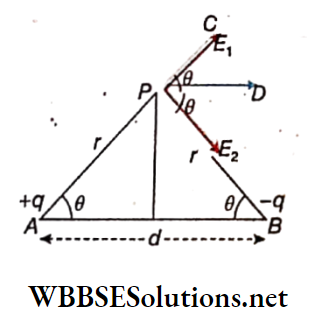
The resultant electric field intensity at all points on the plane perpendicular to the line joining the two charges and passing through its mid-point is directed parallel to the line joining the charges.

In, P is a point on this plane corresponding to the two charges at A and B. AP = BP = r (say).

Class 12 Physics Unit 1 Electrostatics Chapter 2 Electric Field Two charges, +q and -q

Intensity at P due to the charge +q,

⇒ \(E_1=\frac{q}{r^2} ; \text { along } \overrightarrow{P C}\)

Intensity at P due to the charge -q,

⇒ \(E_2=\frac{q}{r^2} ; \text { along } \overrightarrow{P B}\)

Therefore, E1 = E2

The resultant of these two intensities will be along \(\vec{PD}\) , which is the bisector of the angle ZCPB.

∴ ∠CPD = ∠DPB = ∠PBA = 6 (say)

∴ PD is parallel to AB.

Read And Learn More WBCHSE Class 12 Physics Long Question And Answers

Question 2. Two-point charges are separated by a certain distance. Electric field Intensity is zero at a point In between the two charges. What can we conclude about the charges?
Answer:

Two-point charges are separated by a certain distance. Electric field Intensity is zero at a point In between the two charges.

If the intensity of the electric field is zero at a point in between two charges, we conclude that the two charges are of the same nature.

If the charges are not of the same nature, the electric field due to the two charges will act in the same direction. Thus the resultant field will not be zero

Electric Field Long Answer Questions WBCHSE

Question 3. A ring of radius R carries a uniformly distributed charge + Q. A point charge -q is placed on the axis of the ring at a distance 2R from its center and then released. Will the charge -q execute a simple harmonic motion along the axis of the ring?
Answer:

A ring of radius R carries a uniformly distributed charge + Q. A point charge -q is placed on the axis of the ring at a distance 2R from its center and then released.

In this case, it can be shown that the force on the point charge -q is inversely proportional to the square of its distance from the center of the ring.

This is not the characteristic of a simple harmonic motion. So the particle will not execute a simple harmonic motion,

WBCHSE Class 12 Physics Electric Field Long Answer Questions

Question 4. Two small balls have equal positive charges Q (coulomb). They are suspended by two long strings of equal length L (meter) from a hook fixed to a stand. The whole setup is taken to a satellite In space where there Is no gravity (state of weightlessness). Calculate the angle between the two strings and the tension in each string in Newton.
Answer:

Two small balls have equal positive charges Q (coulomb). They are suspended by two long strings of equal length L (meter) from a hook fixed to a stand. The whole setup is taken to a satellite In space where there Is no gravity (state of weightlessness).

As the two balls are weightless, no downward force acts on them. The two strings will be horizontal due to the electrostatic repulsive force between the balls, i.e., the angle between the strings will be 180°.

Tension in each string = \(\frac{1}{4 \pi \epsilon_0}: \frac{Q^2}{(2 L)^2}=\frac{Q^2}{16 \pi \epsilon_0 L^2} \mathrm{~N}\)

WBCHSE Physics Electric Field Detailed Answers

Question 5. A charge q Is placed at the mid-point of the line Joining two equal charges Q. For what value of q will the system of the three charges be In equilibrium?
Answer:

A charge q Is placed at the mid-point of the line Joining two equal charges Q.

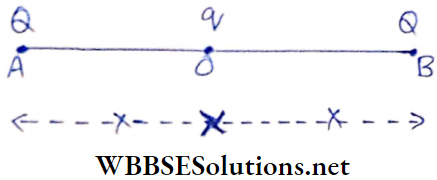
Two equal charges Q are placed at A and B

Electric Field Two equal charges Q are placed at A and B

Charge q is placed at O.

Here, OA = OB = x (say)

Force on the charge q placed at O,

⇒ \(F_1=\frac{1}{4 \pi \epsilon_0}\left[\frac{Q q}{x^2}-\frac{Q q}{x^2}\right]=0\)

Force on the charge Q placed at A,

⇒ \(F_2=\frac{1}{4 \pi \epsilon_0}\left[\frac{Q q}{x^2}+\frac{Q^2}{4 x^2}\right]\)

If the whole system is in equilibrium,

F2 = F1 = 0

∴ \(\frac{1}{4 \pi \epsilon_0}\left[\frac{Q q}{x^2}+\frac{Q^2}{4 x^2}\right]=0\)

or, \(\frac{Q q}{x^2}+\frac{Q^2}{4 x^2}=0 \quad\)

or, \(\frac{Q q}{x^2}=-\frac{Q^2}{4 x^2} \quad\)

or, \(q=-\frac{Q}{4}\)

Class 11 Physics Class 12 Maths Class 11 Chemistry
NEET Foundation Class 12 Physics NEET Physics


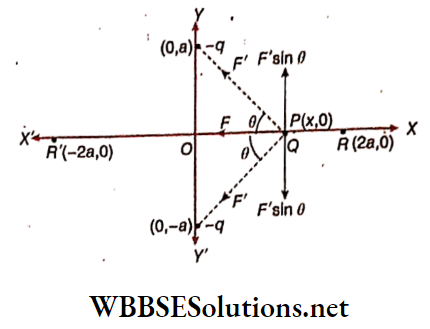
Question 6. Two equal negative charges -q are fixed at points (0, a) and (0, -a) on the Y-axis. A positive charge Q is released from rest at the point (2a, 0) on the X-axis. Will the charge Q execute simple harmonic motion?
Answer:

Two equal negative charges -q are fixed at points (0, a) and (0, -a) on the Y-axis. A positive charge Q is released from rest at the point (2a, 0) on the X-axis.

Charge Q will move to and fro along ROR’. Point 0 is the equilibrium position of the charge Q. Now we shall have to whether the force acting on the charge Q is proportional to the distance of Q from O.

Let the charge Q be the point P(x,0) at any instant.

At that time each of the charges -q exerts force F’ on Q

Class 12 Physics Unit 1 Electrostatics Chapter 2 Electric Field Charge Q will move to and fro along ROR

Therefore, from Coulomb’s law we get,

⇒ \(F^{\prime} \propto-\frac{1}{a^2+x^2}\)

Now, \(F=2 F^{\prime} \cos \theta=2 F^{\prime} \times \frac{x}{\sqrt{a^2+x^2}}\)

or, \(F^{\prime}=\frac{\sqrt{a^2+x^2}}{2 x} F\)

∴ \(\frac{F \sqrt{a^2+x^2}}{2 x} \propto-\frac{1}{a^2+x^2}\)

or, \(F \propto-\frac{x}{\left(a^2+x^2\right)^{3 / 2}}\)

The condition for a simple harmonic motion, F ∝ -x, does not match the above expression. So, the charge Q will not exe- ( cute a simple harmonic motion.

In-depth Questions on Electric Field for Class 12

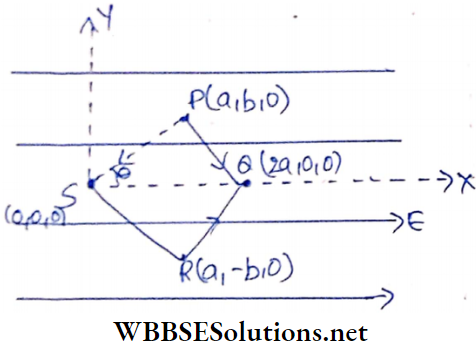
Question 7. A point charge q moves from point P to point S along the path PQRS in a uniform electric field E pointing parallel to the positive X-axis. The coordinates of P, Q, R, and S are (a, b, 0), (2a, 0,0), (a, -b, 0), and (0,0,0) respectively. Determine the work done by the field In the above process.

Electric Field Displacement of charge q

Answer:

A point charge q moves from point P to point S along the path PQRS in a uniform electric field E pointing parallel to the positive X-axis. The coordinates of P, Q, R, and S are (a, b, 0), (2a, 0,0), (a, -b, 0), and (0,0,0) respectively.

Displacement of charge q is PS = \(\sqrt{a^2+b^2}\)

Component of intensity along PS = -Ecosθ = \(-E \cdot \frac{a}{\sqrt{a^2+b^2}}\)

The force against which the external agent does work during the displacement PS of the charge q is,

⇒ \(F=q E \times \frac{a}{\sqrt{a^2+b^2}}\)

Work done by the external agent

⇒ \(F \times P S=q E \cdot \frac{a}{\sqrt{a^2+b^2}} \cdot \sqrt{a^2+b^2}\)

= qEa

Work done by the electric field = -qEa

Question 8. The presence of matter alters the net force acting between two charges. Explain.
Answer:

The presence of matter alters the net force acting between two charges.

According to Coulomb’s law, the effective force between two charges q1 and q2 placed in air or vacuum at a distance r from each other,

⇒ \(F_1=\frac{q_1 q_2}{r^2}\)

Now, let the charges be placed in a medium of permittivity k.

The effective force between the two charges now is,

⇒ \(F_2=\frac{q_1 q_2}{k r^2}\)

Clearly, F2 < F1 , since k > 1 . So the effective force between two charges in the presence of another matter is less. The charges induced in this medium are responsible for this decrease of force

Question 9. What is the difference between the electrical effects due to a point charge at rest and that in motion?
Answer:

The difference between the electrical effects due to a point charge at rest and that in motion

A point charge at rest produces an electric field surrounding it If the point charge is in motion, it constitutes an electric current and a magnetic field is produced by the current The resulting field is then an electromagnetic field.

Question 10. What is the significance of Gauss’ theorem? Does it applicable to any fields other than electric fields?
Answer:

The significance of Gauss’ theorem

If the electric field intensities at all points of a closed surface are known, then with the help of Gauss’ theorem, the amount of charge responsible for creating the field can be found out Again if the charge enclosed by a surface is known, intensities at various points on it can be calculated.

This theorem is also applicable to conservative fields, like magnetic field and gravitational field

Question 11. Can a field line start from a charged conductor and end on it? Answer with reason.
Answer:

If a line of force starts from a charged conductor and terminates on it, one part of the conductor should be positively charged and the other part negatively charged.

But die external surface of a charged conductor is always an equipotential surface. So it is not possible for a conductor to be charged positively in one part and negatively in another part. Thus a field line cannot start from a conductor and end on the same.

Question 12. Two lines of force in an electric field never intersect each other. Why?
Answer:

Two lines of force in an electric field never intersect each other.

Two lines of force can never intersect each other, because if they do so, then at the point of intersection two tangents can be drawn in two different directions. It means that the electric intensity has two directions at a single point, which is not possible.

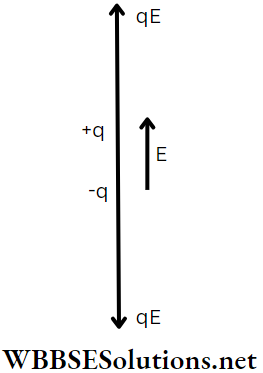
Question 13. An electric dipole is placed in a uniform electric field so that its axis lies along the electric field. Does any force or torque act on the dipole?
Answer:

An electric dipole is placed in a uniform electric field so that its axis lies along the electric field.

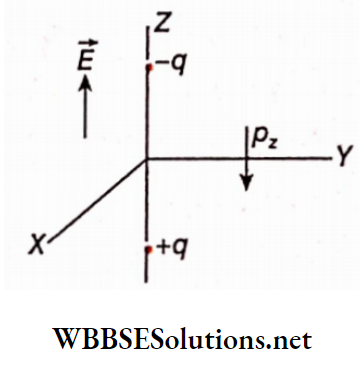
When an electric dipole is placed along a uniform electric field, a force acting on +q of the dipole is qE along the direction of \(\vec{E}\), and force acting on -q is qE in the opposite direction of \(\vec{E}\).

So, the resultant force on the dipole = q\(\vec{E}\) – q\(\vec{E}\) = 0

Since the two equal forces act along the same line, they cannot produce a torque.

So in this case, neither a force nor a torque acts on the dipole.

Electric Field An electric dipole is placed

Electric Field Analysis Questions for Class 12 WBCHSE

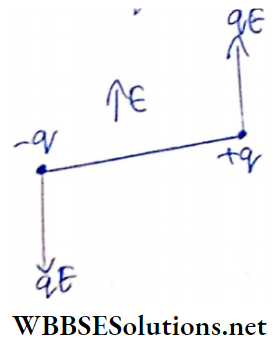
Question 14. An electric dipole is placed in a uniform electric field with its axis inclined at a certain angle with the field. Does any force or torque act on the dipole?
Answer:

An electric dipole is placed in a uniform electric field with its axis inclined at a certain angle with the field.

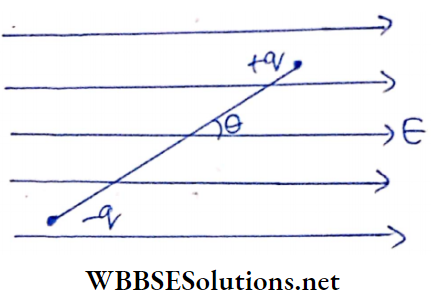
When an electric dipole is inclined at a certain angle with the direction of the field, force acting on +q of the dipole is qE along the direction of \(\vec{E}\), and force acting on-q is qE in the opposite direction of \(\vec{E}\). So a torque acts on the dipole which tends to bring the dipole along the direction of the field. r In this case, the net force acting on the dipole

= q\(\vec{E}\) – q\(\vec{E}\)

= 0

Electric Field An electric dipole is placed in a uniform electric field

Therefore, a torque acts on the dipole but no resultant force acts on it

Question 15. What should the angle of the field line with them normal to its surface so that the flux linked with the surface becomes maximum?
Answer:

Let the intensity of the electric field E make an angle 0 with the normal to a surface element ds Flux linked with the surface = E cosθ ds Now, Ecosθds will be maximum if cosθ = 1 i.e., θ = 0º

So, if the field line makes an angle of 0º with the normal to the surface, the flux linked with the surface becomes maximum.

Question 16. If an electric dipole is placed in a nonuniform electric field, does any torque or force add to the dipole?
Answer:

If an electric dipole Is placed In a non-uniform electronic field, two non-equal, non-parallel forces act at the two ends of the dipole. These forces acting on the dipole produce both rotational and translational motions.

So In this case, a torque and a force both act on the dipole,

Long Form Questions about Electric Field WBCHSE

Question 17. Eight electric dipoles each with charge e are placed inside a culm. What should be the total electric flux linked with the cube?
Answer:

Eight electric dipoles each with charge e are placed inside a culm.

An electric dipole consists of two equal but opposite charges. So here the net charge enclosed is zero. Therefore, the total flux linked with the cube is zero.

Question 18. A cylinder is lying with an axis parallel to a uniform electric field \(\vec{E}\). What Is the total flux through the cylinder with cross-section S and length L?
Answer:

A cylinder is lying with an axis parallel to a uniform electric field \(\vec{E}\).

Electric field \(\vec{E}\) and the axis of the cylinder are in the same direction. So, the electric flux = EScosθ = ES

Question 19. An electric dipole is situated In a uniform electric field \(\vec{E}\) such that Its moment \(\vec{E}\) is aligned in the direction of the field. Is the equilibrium of the dipole stable or unstable? If \(\vec{E}\) and \(\vec{E}\) are In opposite directions, what will be the nature of the equilibrium?
Answer:

An electric dipole is situated In a uniform electric field \(\vec{E}\) such that Its moment \(\vec{E}\) is aligned in the direction of the field.

When the electric dipole moment \(\vec{E}\) is aligned in the direction of the field \(\vec{E}\), the dipole is in stable equilibrium

Because if the dipole is deflected through an angle θ, the torque pEsinθ acting on it brings it back along the field. When p and E are in opposite directions (0 = 180°), the torque acting on the dipole is zero and the dipole is again in equilibrium.

But this equilibrium is unstable because if the dipole is deflected from its present position, the torques acting on it now will rotate the dipole to set it in the direction of the field.

Question 20. The electric field due to a small dipole of length 2l at a distance r(r >> l) from the center of the dipole on the axial line is E. What is the distance of the point on the perpendicular bisector of the dipole from its center at which the electric field intensity is E?
Answer:

The electric field due to a small dipole of length 2l at a distance r(r >> l) from the center of the dipole on the axial line is E.

For a small dipole, the electric field intensity at a distance r from the center of the dipole on the axial line,

⇒ \(B=\frac{2 p}{4 \pi \epsilon_0 r^3}\)

Let the electric field intensity at a distance r’ from the center of the dipole on the perpendicular bisector of the dipole be E’.

∴ \(B^{\prime}=\frac{p}{4 \pi \epsilon_0\left(r^{\prime}\right)^3}\)

Thus, \(\frac{2 p}{4 \pi \epsilon_0 r^3}=\frac{p}{4 \pi \epsilon_0\left(r^{\prime}\right)^3}\) [∵ E = E’]

or, \(r^{\prime}=\frac{r}{\sqrt[3]{2}}\)

Hence, required distance = [ latex]\frac{r}{\sqrt{3}{2}}[/latex]

Question 21. A particle of mass m Is attached to one end of a massless rigid non-conducting rod of length l. Another particle of the same mass Is attached to the other end of the rod. Two particles carry charges +q and -q. This arrangement is held in the region of uniform electric field E such that the rod makes an angle 0 ( < 5°) with the field direction. Find an expression for the minimum time that Is needed for the rod to become parallel to the field after it is set free.
Answer:

A particle of mass m Is attached to one end of a massless rigid non-conducting rod of length l. Another particle of the same mass Is attached to the other end of the rod. Two particles carry charges +q and -q. This arrangement is held in the region of uniform electric field E such that the rod makes an angle 0 ( < 5°) with the field direction.

As the rod has two charges of equal magnitude (but opposite), the torque acting on the rod,

⇒ \(\tau\) = qE x lsinθ

or, \(\tau\) = qEl0 [∵ θ < 5°]

We know, \(\tau\) = Ia [where I = moment of inertia and α = angular acceleration]

Electric Field A particle of mass m Is attached to one end

Hence, \(I \alpha=q E l \theta \quad \text { or, } \alpha=\frac{q E l \theta}{I}\)

∴ Time period, \(T=2 \pi \sqrt{\frac{\text { angular displacement }}{\text { angular acceleration }}}=2 \pi \sqrt{\frac{I}{q E l}}\)

Now, moment of inertia of the dipole,

⇒ \(I=\left[\left(\frac{l}{2}\right)^2+\left(\frac{l}{2}\right)^2\right] m=\frac{1}{2} m l^2\)

∴ \(T=2 \pi \sqrt{\frac{m l^2}{2 q E l}}=2 \pi \sqrt{\frac{m l}{2 q E}}\)

∴ Required time, \(t=\frac{1}{4} \times \text { time period }=\frac{T}{4}=\frac{\pi}{2} \sqrt{\frac{m l}{2 q E}}\)

Electric Field Concepts and Long Answers WBCHSE

Question 22. A uniform non-conducting rod of mass m and length l has linear charge densities + A and -A on its two halves. It is hinged at its midpoint so that it can rotate freely about the mid-point in a uniform electric field E parallel to the A-axis. The rod is rotated by a small angle of 8(< 4°) and released. Calculate the time period of small oscillations of the rod.

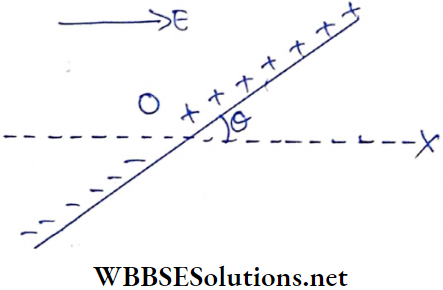
Electric Field A uniform non-conducting rod ofmass

Answer:

A uniform non-conducting rod of mass m and length l has linear charge densities + A and -A on its two halves. It is hinged at its midpoint so that it can rotate freely about the mid-point in a uniform electric field E parallel to the A-axis. The rod is rotated by a small angle of 8(< 4°) and released

The torque due to the electrostatic force on a length dx of the rod at point A (about point O),

⇒ \(d \tau_1=x\left(d F_1\right) \sin \theta=x \lambda d x E \sin \theta\)

Similarly, torque due to the electrostatic force on a length dx of the rod at point B (about point O),

⇒ \(d \tau_2=x\left(d F_2\right) \sin \theta=x \lambda d x E \sin \theta\)

Class 12 Physics Unit 1 Electrostatics Chapter 2 Electric Field A uniform non-conducting rod of mass

∴ Net torque on the rod,

⇒ \(\tau=\int_0^{\frac{l}{2}} d \tau_1+\int_0^{\frac{l}{2}} d \tau_2\)

⇒ \(2 \int_0^{\frac{l}{2}} E \lambda d x(x \sin \theta)\) [∵ \(d \tau_1=d \tau_2\)]

⇒ \(2 E \lambda \theta \int_0^{\frac{l}{2}} x d x\) [∵ 6 is small, sinθ == 0]

∴ \(\tau=\frac{E \lambda l^2}{4} \theta\)……(1)

In this case moment of inertia of rod,

⇒ \(I=\frac{m l^2}{12}\)

∴ \(\tau=I \alpha=\frac{m l^2}{12} \alpha\)……(2)

From equations (I) and (2) we get,

⇒ \(\frac{m l^2}{12} \alpha=\frac{E \lambda l^2 \theta}{4} \quad\)

or, \(\alpha=\frac{3 E \lambda}{m} \theta\)

∴ The time period of oscillations of the rod,

⇒ \(T=2 \pi \sqrt{\frac{\theta}{\alpha}}=2 \pi \sqrt{\frac{m}{3 E \lambda}}\)

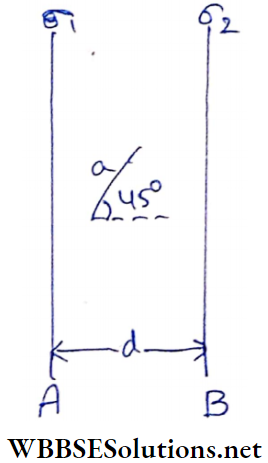
Question 23. Two infinitely large sheets having charge densities σ1 and σ2 respectively (σ1 > σ2) are placed near each other separated by distance d. A charge q is placed in between two plates such that there is no effect on charge distribution on plates. Now this charge is moved at an angle of 45° with the horizontal towards plate A having charge density σ2 by distance a (a < d). Find the work done by the electric field in the process.

Electric Field Two infinitely large sheets having charge densities

Answer:

Two infinitely large sheets having charge densities σ1 and σ2 respectively (σ1 > σ2) are placed near each other separated by distance d. A charge q is placed in between two plates such that there is no effect on charge distribution on plates. Now this charge is moved at an angle of 45° with the horizontal towards plate A having charge density σ2 by distance a (a < d).

An electric field near a large sheet is given by,

⇒ \(E=\frac{\sigma}{2 \epsilon_0}\)

In between the plates, the two fields are in opposite directions

Hence, \(E_{\text {net }}=\frac{\sigma_1-\sigma_2}{2 \epsilon_0}=E_0(\text { say })\)

Now work is done,

W = Facosθ = qE0acos45°

⇒ \(q\left(\frac{\sigma_1-\sigma_2}{2 \epsilon_0}\right)\left(\frac{a}{\sqrt{2}}\right)=\frac{\left(\sigma_1-\sigma_2\right)}{2 \sqrt{2} \epsilon_0} q a\)

WBCHSE Electric Field Explanations and Solutions

Question 24. A small charge is placed at a point in a static electric field. Will the charge move along the electric line of force passing through that point?
Answer:

A small charge is placed at a point in a static electric field.

If the electric line of force is a straight line, then the charge will move along the electric line of force. If the line of force is curved, then the charge will not move along that line of force because the electric line of force indicates the direction of acceleration of the charge, not the direction of the velocity of the charge.

Therefore, If a charge Is placed In an electric field, the locus of the charge does not overlap with the electric line of force,

Question 25. Two point charges e1 and e2 are separated by a distance d. What can be concluded from this?
Answer:

Two point charges e1 and e2 are separated by a distance d.

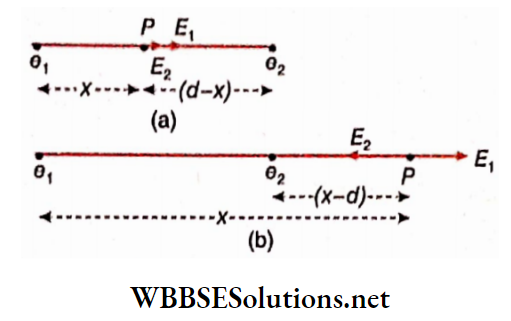
In the first case, let the distance of point P from e1 is x and from e2 is (d-x)

Class 12 Physics Unit 1 Electrostatics Chapter 2 Electric Field Two point charges e, and e2 nrc separated

Electric field at P due to \(e_1, E_1=\frac{e_1}{x^2}\)

Electric field at P due to \(e_2, E_2=\frac{e_2}{(d-x)^2}\)

If e1 and e2 are oppositely charged, then the directions of E1 and E2 at point P will be the same, and their resultant field,

⇒ \(E=\frac{e_1}{x^2}+\frac{e_2}{(d-x)^2}\)

In this case, E will never be zero.

If e1 and e2 are oppositely charged, then the directions of E1 and E2 at point P will be the same and their resultant field, from e2 is (x-d)

In this case, \(E_1=\frac{e_1}{x^2} \text { and } E_2=\frac{e_2}{(x-d)^2}\)

If e1 and e2 are oppositely charged, E1 and E2 will act in opposite directions.

∴ Resultant electric field, \(E=\frac{e_2}{(x-d)^2}-\frac{e_1}{x^2}\)

In this case, if e1 = e2 then E2 will always be unequal. E will never be zero.

Therefore, if the electric field is not zero at any point, then e1 and e2 are equal and opposite in nature, i.e., e1 = -e2.

Question 26. The force between two charges depends on the presence of the material between them – explain.
Answer:

The force between two charges depends on the presence of the material between them

From Coulomb’s law in a vacuum or air medium, the force acting between two charges q1 and q2 separated by a distance r,

⇒ \(F_1=\frac{q_1 q_2}{4 \pi \epsilon_0 r^2}\)

Now If a material of permittivity c Is placed in the space between the two charges then the effective force acting between the two charges,

⇒ \(F=\frac{q(Q-q)}{4 \pi \epsilon_0 r^2}\)

So, F1 ≠ P2

Therefore, the force acting between two charges changes in the presence of a material medium between them.

Long Answer Format for Electric Field Topics

Question 27. Charge Q Is distributed between two particles. What should be the value of charges on the particles so that the repulsive force acting between them Is maximum?
Answer:

Charge Q Is distributed between two particles.

Let the charge on one particle be q a°d that on the other particle is (Q-q) If the distance between them is r then force acting between them,

⇒\(F=\frac{q(Q-q)}{4 \pi \epsilon_0 r^2}\)

The value of F is the maximum for a given value of q, for that value of q,

⇒ \(\frac{d F}{d q}=0\)

∴ \(\frac{d F}{d q}=\frac{1}{4 \pi \epsilon_0 r^2} \cdot \frac{d}{d q}\left(Q q-q^2\right)=0\)

or, \(\frac{1}{4 \pi \epsilon_0 r^2} \cdot(Q-2 q)=0 \quad \text { or, } Q-2 q=0\)

∴ q = \(\frac{Q}{2}\)

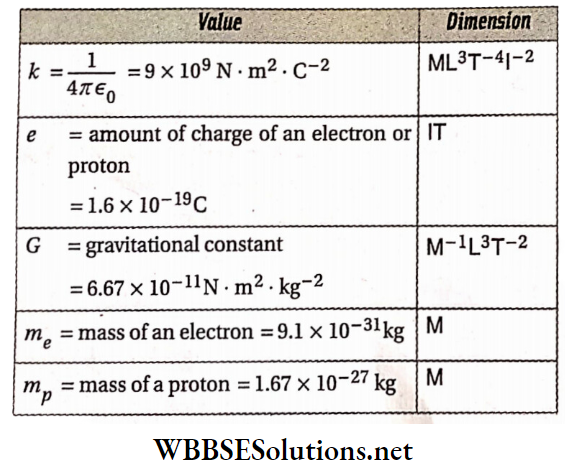
Question 28. A tree electron and a free proton are placed In a uniform electric field. Compare their acceleration and the force acting on them. [Rest mass of electron = 9.1 x10⁻³¹kg and rest mass of proton = 1.67 X 10⁻²⁷ kg]
Answer:

A tree electron and a free proton are placed In a uniform electric field.

If the intensity of the electric field is E, then the force acting on the electron,

Fe = eE [where, e = charge of electron]

Since the charge of a proton is the same as an electron, then the force acting on the proton,

⇒ \(F_p=e E \quad \text { or, } \frac{F_e}{F_p}=1\)

Let fe and fp be the acceleration of electron and proton respectively, then,

⇒ \(\frac{f_e}{f_p}=\frac{\frac{e E}{m_e}}{\frac{e E}{m_p}}\)

= \(\frac{m_p}{m_e}\)

= \(\frac{1.67 \times 10^{-27}}{9.1 \times 10^{-31}}\)

= 1835.2 [me = mass of electron, mp = mass of proton]

Electric Field Theory Long Questions WBCHSE

Question 29. Why electric fields just outside the surface of a conductor is perpendicular to the surface?
Answer:

Charge in a conductor resides on the outer surface. If a unit positive charge is placed just outside the surface to the conductor then it is attracted or repulsed perpendicular to the surface, that is the electric field at that position is also perpendicular to the surface.

Question 30. In the case of the field outside a uniformly charged sphere, the charge can be assumed to be concentrated at the center of the sphere. How can you prove it?
Answer:

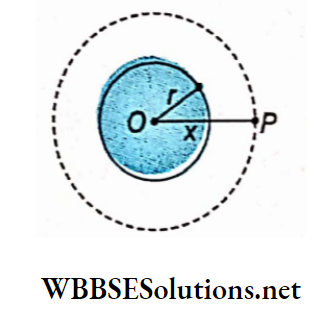
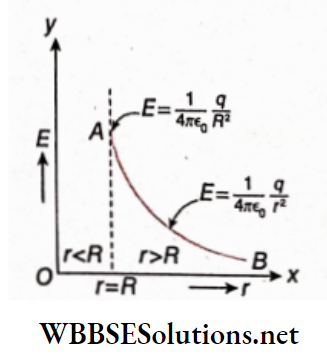
Let a sphere of radius r be changed uniformly with charge q. A point P is taken outside the sphere at a distance x(x > r) from the center of the sphere

Class 12 Physics Unit 1 Electrostatics Chapter 2 Electric Field In case offield outside a uniformly charged sphere

To evaluate the electric field intensity at point P, let us imagine a spherical Gaussian surface concentric to the original conducting sphere.

If E is the intensity of the electric field at a point on the spherical Gaussian surface of radius x, then;

total electric flux = E 4πr²

According to the Gauss’ theorem (in SI)

total electric flux = \(\frac{q}{\epsilon_0}\)

∴ \(E \cdot 4 \pi x^2=\frac{q}{\epsilon_0} \quad\)

or, \(E=\frac{1}{4 \pi \epsilon_0} \cdot \frac{q}{x^2}\)

again, if a charge q is imagined at the center of a sphere of radius x , then from Coulomb’s law (in SI)

⇒ \(E=\frac{1}{4 \pi \epsilon_0} \cdot \frac{q}{x^2}\)

Therefore, in the case of the electric field outside a uniformly charged sphere, the charge can be assumed to be concentrated at the centre of the sphere.

Question 31. How the force acting between two charges will change if the air medium between them is replaced by a metal plate?
Answer:

Force acting between two charged particles is inversely proportional to the dielectric constant of the medium between them. In the case of a metal, the dielectric constant is very high (almost infinity). So the force acting between them will be almost zero

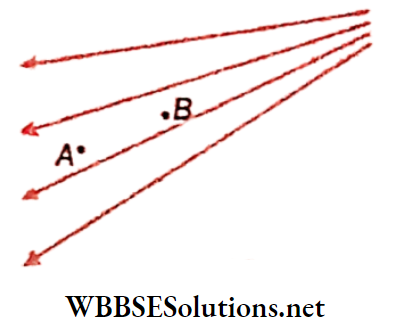
Question 32. If a positively charged particle is kept at points A and B in an electric field, then at which point the particle will feel more force and why?

Class 12 Physics Unit 1 Electrostatics Chapter 2 Electric Field positively charged particle

Answer:

In the region of the electric field where the electric lines of force are closely spaced, the electric field is greater. According to the electric field at point B is greater than that at point A. Since the force on the charged particle, F = qE = charge x electric field.

Therefore, the particle will experience greater force at point B.

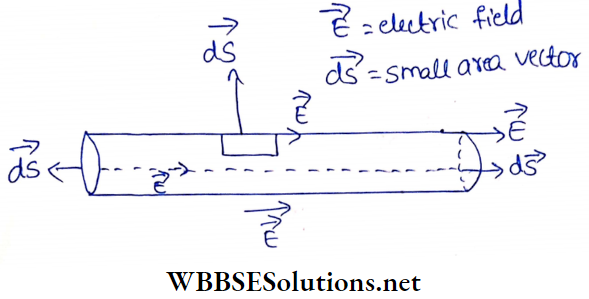
Question 33. If the area of the cross-section of the cylinder is S, then what will be the electric flux through the cylinder?

Electric Field the area of cross section of the cylinder

Answer:

Let, the electric flux through the two circular cross-sections of the left side and right side of the cylinder be Φ1 and Φ2 respectively. Φ3 be the electric flux through the curved surface of the cylinder.

As the angle between the normal on the curved surface and \(\vec{E}\) is 90°, so

⇒ \(\phi_3=\int_S E d S \cos \theta\)

⇒ \(=\int_S E d S \cos 90^{\circ}\)

= 0

Now, \(\phi_1=\int_S E d S \cos 180^{\circ}=-E \int_S d S=-E S\)

⇒ \(\phi_2=\int_S E d S \cos 0=+E \int_S d S=+E S\)

∴ \(\text { Net flux }=\phi_1+\phi_2+\phi_3=-E S+E S+0\)

= 0

WBCHSE Class 12 Physics Electric Field Multiple Choice Question And Answers

WBCHSE Class 12 Physics MCQs

Electrostatics Chapter 2 Electric Field Exercise Multiple Choice Question And Answers

Question 1. The electric flux through the surface

Class 12 Physics Unit 1 Electrostatics Chapter 2 Electric Field Multiple choice question aand answer 1

  1. Is the largest
  2. Is the least
  3. (2) is the same as (3) but is smaller than (4)
  4. Is the same for all the figures

Answer: 4. Is the same for all the figures

The shape of the Gaussian surface does not determine the flux. The flux depends only on the charge enclosed by the Gaussian surface.

Question 2. Electric field lines in which an electric dipole is placed as shown. Which of the following statements is correct?

Class-12-Physics-Unit-1-Electrostatics-Chapter-2-Electric-Field-Multiple-choice-question-aand-answer-2

  1. The dipole will not experience any force.
  2. The dipole will experience a force towards the right.
  3. The dipole will experience a force towards the left.
  4. The dipole will experience a force upwards.

Answer: 3. The dipole will experience a force towards the left.

Read and Learn More Class 12 Physics Multiple Choice Questions

The electric field on the left side of the figure is greater than that on the right side. Thus the force (FL) on -q directed towards the left is more than the force (FR) on +q directed towards the right. Hence the dipole will experience a force towards the left.

Question 3. Five charges q1, q2, q3, q4, and qs are fixed at their positions as shown in Rg. 2.92. S is a Gaussian surface. The Gauss’ law is given by

⇒ \(\oint_S \vec{E} \cdot \overrightarrow{d S}=\frac{q}{\epsilon_0}\)

Which of the following statements is correct?

Class 12 Physics Unit 1 Electrostatics Chapter 2 Electric Field Multiple choice question and answer 3

  1. \(\vec{E}\) on the LHS of the equation will have a contribution from q1, q5, and q3 while q on the RHS will have a contribution from q2 and q4 only.
  2. \(\vec{E}\) on the LHS of the above equation will have a contribution from all charges while q on the RHS will have a contribution from q2 and q4 only.
  3. \(\vec{E}\) on the LHS of the above equation will have a contribution from all charges while q on the RHS will have a contribution from q2 and q4 only.
  4. Both\(\vec{E}\)E on the LHS and q on the RHS will have contributions from q2 and q4 only.

Answer: 2. \(\vec{E}\) on the LHS of the above equation will have a contribution from all charges while q on the RHS will have a contribution from q2 and q4 only.

WBCHSE class 12 physics MCQs

Question 4. A hemisphere has a uniform positive charge. The electric field at a point on a diameter away from the center is directed

  1. Perpendicular to the diameter
  2. Parallel to the diameter
  3. At an angle tilted toward the diameter
  4. At an angle tilted away from the diameter

Answer: 1. Perpendicular to the diameter

The components of an electric field due to various elements parallel to the diameter neutralize one another.

Question 5. A hemisphere has a uniform positive charge. The electric field at a point on a diameter away from the center is directed

  1. Perpendicular to the plane and away from the plane
  2. Perpendicular to the plane but towards the plane
  3. Radially away from the point charge
  4. Radially towards the point charge

Answer: 1. Perpendicular to the plane and away from the plane

WBCHSE Class 12 Physics Electric Field Multiple Choice Question And Answers

Question 6. If \(\oint_S \vec{E} \cdot \overrightarrow{d S}=0\) over a surface then,

  1. The electric field inside the surface and on it is zero
  2. The electric field inside the surface is necessarily uniform
  3. The number of flux lines entering the surface must be equal to the number of flux lines leaving it
  4. All charges must necessarily be outside the surface

Answer:

3. The number of flux lines entering the surface must be equal to the number of flux lines leaving it

4. All charges must necessarily be outside the surface

WBCHSE class 12 physics MCQs

Question 7. The electric field at a point is

  1. Always continuous
  2. Continuous if there is no charge at that point
  3. Discontinuous only if there is a negative charge at that point
  4. Discontinuous if there is a charge at that point.

Answer:

2. Continuous if there is no charge at that point

4. Discontinuous if there is a charge at that point.

Question 8. Consider a region inside which there are various types of charges but the total charge is zero. At points outside the region.

  1. The electric field is necessarily zero
  2. The electric field is due to the dipole moment of the charge distribution only
  3. The dominant electric field is proportional to \(\frac{1}{r^3}\) for large r, where r is the distance from the origin in this region
  4. The work done to move a charged particle along a closed path, away from the region, will be zero

Answer:

3. The dominant electric field is proportional to \(\frac{1}{r^3}\) for large r, where r is the distance from the origin in this region

4. The work done to move a charged particle along a closed path, away from the region, will be zero

Electric Field Class 12 MCQs 

Question 9. The SI unit of electric field intensity is

  1. V.m-1
  2. A.m-1
  3. N.C-1
  4. J.C-1m-1

Answer:

1. V.m-1

3. N.C-1

4. J.C-1m-1

Question 10. If the net electric flux through a closed surface is zero, then

  1. There are no charges inside the surface
  2. The net charge inside the surface is zero
  3. The electric field is zero everywhere on the surface
  4. The number of electric field lines entering the surface equals the number leaving the surface

Answer:

1. There are no charges inside the surface

2. The net charge inside the surface is zero

4. The number of electric field lines entering the surface equals the number leaving the surface

Electric Field MCQs for WBCHSE

Question 11. A dipole of moment \(\vec{p}\) is placed in a uniform field V \(\vec{E}\). The force on the dipole is \(\vec{P}\) and the torque is \(\vec{\tau}\) . Then

  1. \(\vec{F}=0\)
  2. \(\vec{F}=|\vec{p}| \vec{E}\)
  3. \(|\vec{\tau}|=\vec{p} \cdot \vec{E}\)
  4. \(\vec{\tau}=\vec{p} \times \vec{E}\)

Answer:

1. \(\vec{F}=0\)

4. \(|\vec{\tau}|=\vec{p} \cdot \vec{E}\)

Question 12. A proton and an electron are placed in an electric field.
The forces acting on them are F1 and F2 and their accelerations are and a2 respectively. Then

  1. F1 = F2
  2. F1 ≠ F2
  3. a1 = a2
  4. a1 ≠ a2

Answer:

1. F1 = F2

4. a1 ≠ a2

Question 13. Two identical charges +Q are kept at some fixed distance. A small particle P with charge q is placed midway between them. If P is given a small displacement Δx, it will undergo simple harmonic motion if

  1. q is positive and Δx is along the line joining the charges
  2. q is positive and Δx is perpendicular to the line joining the charges
  3. q is negative and Δx is perpendicular to the line joining the charges
  4. q is negative and Δx is along the line joining the charges

Answer:

1. q is positive and Δx is along the line joining the charges

3. q is negative and Δx is perpendicular to the line joining the charges

Question 14. A charge Q is divided into two equal parts q = \(\frac{Q}{2}\). If the charges q and q are placed at a certain distance,

  1. Coulomb force is equal in magnitude for both but opposite in direction
  2. Coulomb force is dependent on the medium in which the charges are placed
  3. Coulomb force is maximum irrespective of the medium in which the charges are placed
  4. None of the above

Answer:

1. Coulomb force is equal in magnitude for both but opposite in direction

2. Coulomb force is dependent on the medium in which the charges are placed

Question 15. Five-point charges each of charge +q C are placed on five vertices of a regular hexagon of side as shown in

Class 12 Physics Unit 1 Electrostatics Chapter 2 Electric Field Multiple choice question and answer Q 7

  1. The force on -q at 0 due to the charges +q at A and D are balanced
  2. The force on -q due to the charges at B and E are balanced
  3. The resultant force on -q at O is \(\frac{1}{4 \pi \epsilon_0} \cdot \frac{q^2}{h^2} \text {; along } \overrightarrow{O E}\)
  4. The resultant force on -q at O is \(\frac{1}{4 \pi \epsilon_0} \cdot \frac{q^2}{h^2}; \text { along } \overrightarrow{O C}\)

Answer:

1. The force on -q at 0 due to the charges +q at A and D are balanced

4. The resultant force on -q at O is \(\frac{1}{4 \pi \epsilon_0} \cdot \frac{q^2}{h^2}; \text { along } \overrightarrow{O C}\)

Question 16. A ring with a uniform charge Q and radius R, is placed in the yz-plane with its center at the origin. The field intensity at

  1. The origin is zero
  2. The origin is \(\frac{Q}{4 \pi \epsilon_0 R^2}\)
  3. \((x, 0,0) \text { is } \frac{Q}{4 \pi \epsilon_0 x^2}\)
  4. \((x, 0,0) \text { is } \frac{Q x}{4 \pi \epsilon_0\left(R^2+x^2\right)^{3 / 2}}\)

Answer:

1. The origin is zero

4. \((x, 0,0) \text { is } \frac{Q x}{4 \pi \epsilon_0\left(R^2+x^2\right)^{3 / 2}}\)

Question 17. A pendulum bob of mass m, carrying a charge q is at rest with its string making an angle 6 with the vertical in a uniform horizontal electric field E. The tension in the string is

  1. \(\frac{m g}{\sin \theta}\)
  2. \(\frac{m g}{\cos \theta}\)
  3. \(\frac{q E}{\sin \theta}\)
  4. \(\frac{q E}{\cos \theta}\)

Answer:

2. \(\frac{m g}{\cos \theta}\)

3. \(\frac{q E}{\sin \theta}\)

Question 18. A cubical region of side a has its center at the origin. It encloses three fixed point charges -q at \(\left(0,-\frac{a}{4}, 0\right)\), 3q at (0, 0, 0), and -q at \(\left(0, \frac{a}{4}, 0\right)\). Choose the correct options

Class 12 Physics Unit 1 Electrostatics Chapter 2 Electric Field Multiple choice question and answer Q 10

  1. The net electric flux crossing the plane x = +\(\frac{a}{2}\)is equal to the net electric flux crossing the plane x = –\(\frac{a}{2}\)
  2. The net electric flux crossing the plane y = +\(\frac{a}{2}\) is more than the net electric flux crossing the plane y = –\(\frac{a}{2}\)
  3. The net electric flux crossing the entire region is \(\frac{q}{\epsilon_0}\)
  4. The net electric flux crossing the plane z = +\(\frac{a}{2}\)is equal to the net electric flux crossing the plane x = +\(\frac{a}{2}\)

Answer:

1. The net electric flux crossing the plane x = +\(\frac{a}{2}\)is equal to the net electric flux crossing the plane x = –\(\frac{a}{2}\)

3. The net electric flux crossing the entire region is \(\frac{q}{\epsilon_0}\)

4. The net electric flux crossing the plane z = +\(\frac{a}{2}\)is equal to the net electric flux crossing the plane x = +\(\frac{a}{2}\)

Question 19. A few electric field lines for a system of two charges Q1 and Q2, fixed at two different points on the x-axis. These lines suggest that

Class 12 Physics Unit 1 Electrostatics Chapter 2 Electric Field Multiple choice question and answer Q 108

  1. \(\left|Q_1\right|>\left|Q_2\right|\)
  2. \(\left|Q_1\right|<\left|Q_2\right|\)
  3. At a finite distance to the left of Q1, the electric field is zero
  4. At a finite distance to the right of Q2, the electric field is zero

Answer:

1. \(\left|Q_1\right|>\left|Q_2\right|\)

4. At a finite distance to the right of Q2, the electric field is zero

Class 12 physics electric field questions 

Question 20. A spherical metal shell A of radius RA and a solid metal sphere B of radius RB(<RA) are kept far apart and each is given charge +Q. Now they are connected by a thin metal wire. Then

  1. \(E_A^{\text {inside }}=0\)
  2. QA > QB
  3. \(\frac{\sigma_A}{\sigma_B}=\frac{R_B}{R_A}\)
  4. \(E_A^{\text {on surface }}<E_B^{\text {on surface }}\)

Answer:

1. \(E_A^{\text {inside }}=0\)

2. QA > QB

3. \(\frac{\sigma_A}{\sigma_B}=\frac{R_B}{R_A}\)

4. \(E_A^{\text {on surface }}<E_B^{\text {on surface }}\)

WBCHSE Physics Electric Field Quiz

Question 21. A non-conducting solid sphere of radius R is uniformly charged. The magnitude of electric field intensity due to the sphere at a distance r from its center

  1. Increases as r increases for r<R
  2. Decreases as r increases for 0 < r < ∞
  3. Decreases as r increases for R < r < ∞
  4. Is discontinuous at r = R

Answer:

1. Increases as r increases for r<R

3. Decreases as r increases for R < r < ∞

Question 22. Which of the following statements is not true for Coulomb’s law in electrostatics?

  1. The law is applicable only for a point charge
  2. The law is applicable to any distance
  3. According to this law force between two charges depends on the medium
  4. It is an inverse square law

Answer: 2. The law is applicable for any distance

Question 23. Select the correct statement.

  1. Both electrostatic force and gravitational force are nonconservative forces
  2. Electrostatic force is conservative but gravitational force is nonconservative
  3. Electrostatic force is nonconservative but gravitational force is conservative
  4. Both electrostatic force and gravitational force are conservative force

Answer: 4. Both electrostatic force and gravitational force are conservative force

Question 24. The number of esu charges in 1C is

  1. 3 x 10¹⁰
  2. 3 x 10⁹
  3. 3 x 10⁸
  4. \(\frac{1}{300}\)

Answer: 2. 3 x 10⁹

Question 25. Charge q1 exerts force on another charge q2. A third charge q3 is brought near them. The force applied by q1 on q2

  1. Will decrease
  2. Will increase
  3. Will remain the same
  4. Will increase if the nature of q1 and q2 is the same and will decrease if their nature is opposite

Answer: 3. Will remain the same

Question 26. The number of electrons corresponding to 1 coulomb of charge is

  1. 6.25 x 10¹⁷
  2. 6.25 x 10¹⁸
  3. 6.25 x 10¹⁹
  4. 1.6 X 10¹⁹

Answer: 2. 6.25 x 10¹⁸

Class 12 physics electric field questions 

Question 27. Two point charges separated by a distance d repel each other with a force of 9N. If the separation between them becomes 3d, the force of repulsion will be

  1. 1N
  2. 3N
  3. 6N
  4. 27 N

Answer: 1. 1N

Question 28. Charges 4Q, q, and Q are placed along the x-axis at positions 1 x = 0, x =\(\frac{l}{2}\) and x = l respectively. The value of q so that the force on charge Q is zero is

  1. Q
  2. \(\frac{Q}{2}\)
  3. – \(\frac{Q}{2}\)
  4. -Q

Answer: 4. -Q

Question 29. Mutual electrostatic force F is acting on two tiny charged spheres when they are d distance apart in air. Keeping all the external conditions fixed, if the spheres are immersed in a liquid of dielectric constant 2, then the force acting on each sphere becomes

  1. 4F
  2. 2F
  3. F
  4. \(\frac{F}{2}\)

Answer: 4. \(\frac{F}{2}\)

Question 30. When a metal plate is introduced between two charges
kept at some distance from each other, the electrostatic force between the two charges will

  1. Decrease
  2. Increase
  3. Remain the same
  4. Zero

Answer: 1. Decrease

Question 31. Two point charges +4q and +q are placed 30 cm apart.
The electric field intensity at a point on the line joining the two charges is zero. The point is situated at a distance

  1. 15 cm from 4q
  2. 20 cm from 4q
  3. 7.5 cm from q
  4. 5 cm from q

Answer: 2. 20 cm from 4q

Class 12 physics electric field questions 

Question 32. If E is the intensity of the electric field at a distance r(r>R) due to a uniformly charged spherical shell, then

  1. E α r
  2. \(E \propto \frac{1}{r}\)
  3. E α r2
  4. \(E \propto \frac{1}{r^2}\)

Answer: 4. \(E \propto \frac{1}{r^2}\)

Question 33. Field lines due to the charges q1 and q2 have been shown. The nature of the charges q1 and 22 is

Class 12 Physics Unit 1 Electrostatics Chapter 2 Electric Field Multiple choice question and answer Q12

  1. Both negative
  2. Both positive
  3. q1 is positive but q2 is negative
  4. q1 is negative but q2 is positive

Answer: 1. Both negative

Question 34. A hollow charged sphere of radius 2 m does not produce
any field intensity

  1. At any internal point of the sphere
  2. At any external point of the sphere
  3. At a distance greater than 2 m
  4. At a distance greater than 10 m

Answer: 1. At any internal point of the sphere

Electric field multiple choice questions 

Question 35. An electron of charge -q and mass m is placed in a uniform electric field of intensity E. The value of E is such that the face on the electron due to the electric field is equal to its weight. Under this condition the value of E is

  1. \(\frac{m g}{e}\)
  2. mge
  3. \(\frac{e}{m g}\)
  4. \(\frac{e^2 g}{m^2}\)

Answer: 1. \(\frac{m g}{e}\)

Question 36. An electron enters normally in a uniform electric field of intensity 3200 V/m with a speed of 4 X 10⁷ m/s. The electron covers a distance of 0.10 m. The deflection of the electron is

  1. 1.76 mm
  2. 17.6 mm
  3. 176 mm
  4. 0.176 mm

Answer: 1. 1.76 mm

Question 37. An electric field of intensity 9 x 10⁴ N/C is produced at a point 2 cm away from an infinitely long straight-charged conducting wire. Electric charge per unit length becomes

  1. 2 x 10⁻⁷ C.m-1
  2. 10-7 C.m-1
  3. 9 x 10⁴ C.m-1
  4. None of these

Answer: 2. 10-7 C.m-1

Class 11 Physics Class 12 Maths Class 11 Chemistry
NEET Foundation Class 12 Physics NEET Physics

Multiple Choice Questions on Electric Field WBCHSE

Question 38. A thin conducting ring of radius R is given a charge + Q. The electric field at the center O of the ring due to the charge on the part AKB of the ring is E. The electric field at the center due to the charge on the part ACDB of the ring is

Class 12 Physics Unit 1 Electrostatics Chapter 2 Electric Field Multiple choice question and answer Q 18

  1. E along KO
  2. 3E along OK
  3. 3E along KO
  4. E along OK

Answer: 4. E along OK

Question 39. A metal sphere is placed in a uniform electric field. The electrostatic lines of force will pass through which of the paths?

Class 12 Physics Unit 1 Electrostatics Chapter 2 Electric Field Multiple choice question and answer Q 39

  1. 1
  2. 2
  3. 3
  4. 4

Answer: 4. 4

Question 40. Due to an electric charge Q, field intensity at the position of test charge q0 is E. The test charge is replaced by -q0, then the field intensity becomes

  1. \(-q_0 \vec{E}\)
  2. \(\frac{\vec{E}}{-q_0}\)
  3. 0
  4. \(\vec{E}\)

Answer: 4. \(\vec{E}\)

Question 41. If an electric dipole of moment \(\vec{E}\) is placed in an electric field of intensity \(\vec{E}\), the torque acting on the dipole is

  1. \(\vec{\tau}=\vec{p} \cdot \vec{E}\)
  2. \(\vec{\tau}=\vec{p} \times \vec{E}\)
  3. \(\vec{\tau}=\vec{p}+\vec{E}\)
  4. \(\vec{\tau}=\vec{p}-\vec{E}\)

Answer: 2. \(\vec{\tau}=\vec{p} \times \vec{E}\)

Question 42. The direction of the intensity of the electric field at a point on the perpendicular bisector of an electric dipole (\(\vec{p}\) = electric dipole moment) is

  1. Along \(\vec{p}\)
  2. Opposite to the direction of \(\vec{p}\)
  3. Perpendicular to \(\vec{p}\)
  4. In any direction

Answer: 2. Opposite to the direction of \(\vec{p}\)

Electric field multiple choice questions 

Question 43. A charge placed at a distance from an electric dipole on its axis experiences a force F. If the distance is doubled, the force will become

  1. 2F
  2. F/2
  3. F/4
  4. F/8

Answer: 4. F/8

Question 44. If E1 is the electric field strength of a short dipole at a point on the axis and E2 that on the perpendicular bisector at the same distance, then

  1. E1 = E2
  2. E2 = 2E1
  3. E2 = 2E1
  4. E1 = 3E2

Answer: 2. E2 = 2E1

Question 45. An electric dipole is placed along x-axis at the origin O . A point P is at a distance of 20 cm from this origin such that OP makes an angle with the x-axis. If the electric field at P makes an angle Η with the x-axis, then the value of 6 is

  1. \(\frac{\pi}{3}\)
  2. \(\frac{\pi}{3}+\tan ^{-1} \frac{\sqrt{3}}{2}\)
  3. \(\frac{3 \pi}{2}\)
  4. \(\tan ^{-1} \frac{\sqrt{3}}{2}\)

Answer: 2. \(\frac{\pi}{3}+\tan ^{-1} \frac{\sqrt{3}}{2}\)

Question 46. A small electric dipole is placed at the origin with its dipole moment directed along the positive X-axis. The direction of electric field at point (2, 2√2, 0) is along

  1. -Z-axis
  2. +Z-axis
  3. -Y-axis
  4. +Y-axis

Answer: 4. +Y-axis

Electric field multiple choice questions 

Question 47. An electric dipole is situated in an electric field of uniform intensity E whose dipole moment is p and moment of inertial is I. If the dipole is displaced by a small angle 9 then the angular frequency of its oscillation is

  1. \(\left(\frac{p E}{I}\right)^{\frac{1}{2}}\)
  2. \(\left(\frac{p E}{I}\right)^{\frac{3}{2}}\)
  3. \(\left(\frac{I}{p E}\right)^{\frac{1}{2}}\)
  4. \(\left(\frac{p}{I E}\right)^{\frac{1}{2}}\)

Answer: 1. \(\left(\frac{p E}{I}\right)^{\frac{1}{2}}\)

Question 48. The electric field intensity at a point near a sphere of radius r and surface density of charge cr placed in a medium of dielectric constant k is

  1. \(\frac{4 \pi \sigma}{k}\)
  2. \(\frac{2 \pi \sigma}{k}\)
  3. \(\frac{\pi \sigma}{kr}\)
  4. \(\frac{\pi \sigma}{2kr}\)

Answer: 1. \(\frac{4 \pi \sigma}{k}\)

Question 49. The electric flux linked with a surface becomes maximum if the angle between the field lines and the normal to the surface is

  1. 45°
  2. 90°
  3. 180°

Answer: 1. 0°

Electric Field Practice Questions for Class 12

Question 50. A circular plate of radius r is placed parallel to a uniform electric field of intensity E. The flux linked with the circular plate is

  1. 0
  2. E x πr²
  3. E x 2πr
  4. E x 4πr²

Answer: 1. 0

Question 51. If the inward and the outward electric flux through a closed surface be Φ1 and Φ2 the charge inside the closed surface is

  1. \(\left(\phi_1-\phi_2\right) \epsilon_0\)
  2. \(\left(\phi_2-\phi_1\right) \epsilon_0\)
  3. \(\left(\phi_1+\phi_2\right) / \epsilon_0\)
  4. \(\left(\phi_2+\phi_1\right) / \epsilon_0\)

Answer: 4. \(\left(\phi_2+\phi_1\right) / \epsilon_0\)

Question 52. A square of side 20 cm Is enclosed within a sphere of radius 80 cm. The centers of the sphere and the square coincide at a common point. There are four charges of 2 x 10⁻⁶ C, -5 x 10⁻⁶ C, -3 X 10⁻⁶ C, and 6 x 10⁻⁶ C at the four comers of the square. Tire total electric flux passing through the surface of the sphere in N.m2/C.

  1. 16π x 10-6
  2. zero
  3. 8π x 10-6
  4. 36π x 10-6

Answer: 2. zero

Question 53. The distribution of charges is shown in the figure. The flux of the electric field due to these charges through the surface S is

Class 12 Physics Unit 1 Electrostatics Chapter 2 Electric Field Multiple choice question and answer Q 53

  1. \(\frac{3 q}{\epsilon_0}\)
  2. \(\frac{2 q}{\epsilon_0}\)
  3. \(\frac{q}{\epsilon_0}\)
  4. 0

Answer: 4. 0

Question 54. A hollow cylinder contains a charge QC. If 888 is the electric flux in a unit of V.m associated with the curved surface B, the flux linked with the plane surface A in a unit of V.m will be (e0 = permittivity)

Class 12 Physics Unit 1 Electrostatics Chapter 2 Electric Field Multiple choice question and answer Q 54

  1. \(\frac{\phi}{3}\)
  2. \(\frac{q}{2 \epsilon_0}\)
  3. \(\frac{1}{2}\left(\frac{q}{\epsilon_0}-\phi\right)\)
  4. \(\frac{q}{\epsilon_0}-\phi\)

Answer: 3. \(\frac{1}{2}\left(\frac{q}{\epsilon_0}-\phi\right)\)

Question 55. A hemispherical bowl of radius r is kept in a uniform electric field of Intensity Total electric flux through the bowl is

Class 12 Physics Unit 1 Electrostatics Chapter 2 Electric Field Multiple choice question and answer Q 55

  1. 2πrE
  2. 4πr²E
  3. 2πr²E
  4. πr²E

Answer: 4. πr²E

Question 56. Two electric charges, + 8q and -2q, are placed at x = 0 and x = L respectively. At what point on the x-axis, does net electric field intensity due to two charges become zero?

  1. (2L, 0)
  2. \(\left(\frac{L}{4}, 0\right)\)
  3. (8L, 0)
  4. (4L, 0)

Answer: 1. (2L, 0)

WBCHSE physics electric field MCQs 

Question 57. A circular copper ring of radius r, placed in a vacuum, has a charge q on it. The electric field intensity at the center of the ring is E1. The electric field intensity on the axis of the ring at a distance x from its center is E2. The value of E2 will be maximum when x = x’.

1. What is the value of E1?

  1. 0
  2. q x πr²
  3. q x 2πr²
  4. \(\frac{q}{r^2}\)

Answer: 1. 0

2. What is the value of E1?

  1. \(\frac{q}{\left(x^2+r^2\right)^{1 / 2}}\)
  2. \(\frac{q x^2}{\left(x^2+r^2\right)^{3 / 2}}\)
  3. \(\frac{q}{\left(x^2+r^2\right)^{3 / 2}}\)
  4. \(\frac{q x}{\left(x^2+r^2\right)^{3 / 2}}\)

Answer: 4. \(\frac{q x}{\left(x^2+r^2\right)^{3 / 2}}\)

3. What is the value of x’?

  1. √2r
  2. \(\frac{r}{\sqrt{2}}\)
  3. \(\frac{r}{\sqrt{3}}\)
  4. √3r

Answer: 2. \(\frac{r}{\sqrt{2}}\)

Electric Field Questions and Answers WBCHSE

Question 58. An electron is released from rest in a uniform electric field of 106 N.C-1. The acceleration of the electron is a. The time taken by the electron in attaining a speed of 0.1c (where c = 3 x 10⁸m.s-1 is t.

1. What is the value of a?

  1. 1.76 x 10¹⁷ m.s-2
  2. 2.56 x 10¹⁸ m s-2
  3. 1.2 x 10¹⁵ m s-2
  4. 3.45 X 10¹⁷ m.s-2

Answer: 1. 1.76 x 10¹⁷ m.s-2

2. What is the value of E?

  1. 2.8 X 10⁻¹⁰s
  2. 1.7 X 10⁻¹⁰s
  3. 3.4 X 10⁻¹⁰s
  4. 1.2 X 10⁻⁸s

Answer: 2. 1.7 X 10⁻¹⁰s

Question 59. A point mass M is attached to one end of a massless rigid non-conducting rod of length L. Another equal point mass is attached to the other end of the rod. The two particles carry charges +q and -q respectively. This arrangement is held in the region of uniform electric field E such that the rod makes a small angle 000 (say about 5° ) with field direction. The moment of inertia of the rod is I. Now answer the questions.

1. The ratio \(\frac{\theta}{\alpha}\) is

  1. \(\frac{2 I}{2 E L}\)
  2. \(\frac{I}{q E L}\)
  3. \(\frac{I}{2 q E L}\)
  4. \(\frac{2 I}{3 q E L}\)

Answer: 2. \(\frac{I}{q E L}\)

2. The time period of SHM of the given system is

  1. \(2 \pi \sqrt{\frac{M L}{2 q E}}\)
  2. \(\frac{2 \pi}{3} \sqrt{\frac{M L}{q E}}\)
  3. \(\frac{\pi}{2} \sqrt{\frac{M L}{2 q E}}\)
  4. \(\frac{\pi}{4} \sqrt{\frac{M L}{2 q E}}\)

Answer 1. \(2 \pi \sqrt{\frac{M L}{2 q E}}\)

3. The time period for the rod to become parallel to E is

  1. \(2 \pi \sqrt{\frac{M L}{q E}}\)
  2. \(\frac{2 \pi}{3} \sqrt{\frac{M L}{q E}}\)
  3. \(\frac{\pi}{2} \sqrt{\frac{M L}{2 q E}}\)
  4. \(\frac{\pi}{4} \sqrt{\frac{M L}{2 q E}}\)

Answer 3. \(\frac{\pi}{2} \sqrt{\frac{M L}{2 q E}}\)

Question 60. An electron having charge e moves with velocity v in +x direction. An electric field acts on it along +y direction. The force on the electron acts along

  1. +z direction
  2. -z-direction
  3. +y direction
  4. -y direction

Answer: 4. -y direction

⇒ \(\vec{E}=\hat{j} E\)

Force, \(\vec{F}=q \vec{E}=-e \vec{E}=(-\hat{j}) e E\)

∴ The force acts along -y direction.

The option 4 is correct.

Question 61. A charge Q is situated inside a cube placed in air. The electric flux passing through all six faces is

  1. \(\frac{Q}{\epsilon_0}\)
  2. \(\frac{Q}{2 \epsilon_0}\)
  3. \(\frac{Q}{6 \epsilon_0}\)
  4. \(\frac{Q}{8 \epsilon_0}\)

Answer: 1.

According to Gauss’ theorem, electric flux = \(\frac{Q}{\epsilon_0}\)

Option 1 is correct.

Question 62. The line AA’ is on a charged infinite conducting plane which is perpendicular to the plane of the paper. The plane has a surface density of charge cr and B is a ball of mass m with a like charge of magnitude q.B is connected by a string from a point on line 1. The tangent of the angle (0) formed between the line AA’ and the string is

Class 12 Physics Unit 1 Electrostatics Chapter 2 Electric Field The line AA' is on a charged infinite

  1. \(\frac{q \sigma}{2 \epsilon_0 m g}\)
  2. \(\frac{q \sigma}{4 \pi \epsilon_0 m g}\)
  3. \(\frac{q \sigma}{2 \pi \epsilon_0 m g}\)
  4. \(\frac{q \sigma}{\epsilon_0 m g}\)

Answer: 1. \(\frac{q \sigma}{2 \epsilon_0 m g}\)

The outward electric field at position B due to the conducting plane AA’,

⇒ \(E=\frac{\sigma}{2 \epsilon_0}\)

∴ Outward electric force, \(F=q E=\frac{q \sigma}{2 \epsilon_0}\)

Now, downward weight = mg

At the equilibrium position of B, the string will be directed towards the resultant of F and mg.

Class 12 Physics Unit 1 Electrostatics Chapter 2 Electric Field The outward electric field at position

Then, \(\tan \theta=\frac{F}{m g}=\frac{q \sigma}{2 \epsilon_0 m g}\)

Option 1 is correct

Question 63. A charge q is placed at one corner of a cube. The electric flux through any of the three faces adjacent to the charge is zero.
The flux through any one of the other three faces is

  1. \(\frac{q}{3 \epsilon_0}\)
  2. \(\frac{q}{6 \epsilon_0}\)
  3. \(\frac{q}{12 \epsilon_0}\)
  4. \(\frac{q}{24 \epsilon_0}\)

Answer: 4. \(\frac{q}{24 \epsilon_0}\)

In three-dimensional space, if we consider a Gaussian surface surrounding the charge q, then according to Gauss’ theorem, the electric flux through that Gaussian surface

⇒ \(\frac{q}{\epsilon_0}\)

Here, the cube under consideration is occupying \(\frac{1}{8}\)th volume of the three-dimensional space surrounding charge q, therefore the electric flux through the three non-adjacent faces = \(\frac{q}{8 \epsilon_0}\)

∴ The electric flux through any one of those faces

⇒ \(\frac{1}{3} \times \frac{q}{8 \epsilon_0}=\frac{q}{24 \epsilon_0}\)

The option 4 is correct.

Question 64. Two charges +q and -q, arc placed at a distance a in a uniform electric field. The dipole moment of the combination is \(2 q a(\cos \theta \hat{i}+\sin \theta \hat{j})\), where 0 Is the angle between the direction of the field and the line joining the two charges. Which of the following statement(s) is/are correct?

  1. The torque exerted by the field on the dipole vanishes
  2. The net force on the dipole vanishes
  3. The torque is independent of the choice of coordinates
  4. The net force is independent of a

Answer:

2. The net force on the dipole vanishes

3. The torque is independent of the choice of coordinates

4. The net force is independent of a

The resultant force is applied on a dipole in a uniform electric field, but the moment of force or torque cannot be zero.

Torque, \(\vec{\tau}=\vec{p} \times \vec{E}\) [\(\vec{p}\) = dipole moment, \(\vec{E}\) = electric field]

This vector relation is independent of the choice of the coordinate system.

Again, since the resultant force is zero, hence it is independent of a.

The potions 2, 3, and 4 are correct.

WBCHSE physics electric field MCQs 

Question 65. A charged particle of mass m1 and charge q1 is revolving in a circle of radius r. Another charged particle of charge q2 and mass m2 is situated at the center of the circle. If the velocity and time period of the revolving particle are v and T respectively, then

  1. \(v=\sqrt{\frac{q_1 q_2 r}{4 \pi \epsilon_0 m_1}}\)
  2. \(v=\frac{1}{m_1} \sqrt{\frac{q_1 q_2}{4 \pi \epsilon_0 r}}\)
  3. \(T=\sqrt{\frac{16 \pi^3 \epsilon_0 m_1^2 r^3}{q_1 q_2}}\)
  4. \(T=\sqrt{\frac{16 \pi^3 \epsilon_0 m_2 r^3}{q_1 q_2}}\)

Answer: 3. \(T=\sqrt{\frac{16 \pi^3 \epsilon_0 m_1^2 r^3}{q_1 q_2}}\)

Here, both q1 and q2 are either positive or negative.

Thus, \(\frac{m_1 v^2}{r}=\frac{1}{4 \pi \epsilon_0} \cdot \frac{q_1 q_2}{r^2} \quad\)

or, \(v=\sqrt{\frac{1}{4 \pi \epsilon_0 m_1} \cdot \frac{q_1 q_2}{r}}\)

Now, time period \(T=\sqrt{\frac{16 \pi^3 \epsilon_0 m_1 r^3}{q_1 q_2}}\) [∵ \(\nu=r \omega \text { and } \omega=\frac{2 \pi}{T}\)]

Hence, none of the options is correct

Question 66. A current \(I=I_0 e^{-\lambda t}\) is following in a circuit consisting of a parallel combination of resistance R and capacitance C. The total charge over the entire pulse period Is

  1. \(\frac{I_0}{\lambda}\)
  2. \(\frac{2 I_0}{\lambda}\)
  3. I0λ
  4. \(e^{I_0 \lambda}\)

Answer: 1. \(\frac{I_0}{\lambda}\)

Here, \(I=I_0 e^{-\lambda t}\)

The total charge over the entire pulse period

⇒ \(\int_0^{\infty} I d t=I_0 \int_0^{\infty} e^{-\lambda t} d t\)

= \(I_0\left[\frac{e^{-\lambda t}}{-\lambda}\right]_0^{\infty}\)

= \(\frac{I_0}{\lambda}\)

The option 1 Is correct

Question 67. A positive charge Q is situated at the center of a cube. The electric flux through any face of the cube is (in SI units)

  1. \(\frac{Q}{6 \epsilon_0}\)
  2. 4πQ
  3. \(\frac{Q}{4 \pi \epsilon_0}\)
  4. \(\frac{Q}{6 \pi \epsilon_0}\)

Answer: 1. \(\frac{Q}{6 \epsilon_0}\)

From Gauss’ theorem, the total flux linked with she surfaces of the cube is Ω, then

⇒ \(\phi=\int \vec{E} \cdot d \vec{S}=\frac{Q}{\epsilon_0}\)

∴ Flux linked with any one surface = \(=\frac{\phi}{6}=\frac{Q}{6 \epsilon_0}\)

The option 1 is correct

Question 68. A charge of 0.8C is divided into two charges Q1 and Q2. These are kept at a separation of 30cm. The force on Q1 is maximum when

  1. Q1 = Q2 = 0.4C
  2. Q1 ≈ 0.8C , Q2 negligible
  3. Q1 negligible, Q2 ≈ 0.8C
  4. Q1 = 0.2C , Q2 = 0.6C

Answer: 1. Q1 = Q2 = 0.4C

We have, Q1 + Q2 = 0.8 C

Therefore, the force of attraction between the two charges,

⇒ \(F=\frac{Q_1 Q_2}{4 \pi \epsilon_0 r^2}=\frac{Q_1\left(0.8-Q_1\right)}{4 \pi \epsilon_0 \times\left(30 \times 10^{-2}\right)^2}\)

This force will be maximum if \(\frac{d F}{d Q_1}=0\)

∴ \(\frac{d}{d Q_1}\left[\frac{Q_1\left(0.8-Q_1\right)}{4 \pi \epsilon_0 \times\left(30 \times 10^{-2}\right)^2}\right]=0\)

or, Q1 = 0.4 C and Q2 = 0.8-0.4 = 0.4 C

The option 1 is correct

Question 69. A particle with charge QC, tied at the end of an inextensible string of length R meter, revolves in a vertical plane. At the center of the circular trajectory, there is a fixed charge of magnitude QC. The mass of the moving charge M is such that \(M g=\frac{Q^2}{4 \pi \epsilon_0 R^2}\). If at the highest position of the particle, the tension of the string just vanishes, the horizontal velocity at the lowest point has to be

  1. 0
  2. \(2 \sqrt{g R}\)
  3. \(\sqrt{2 g R}\)
  4. \(\sqrt{5 g R}\)

Answer: 2. \(2 \sqrt{g R}\)

The tension on the top of the vertical circular path is zero.

Electric Field tension on the top of the vertical circular path is zero

Therefore, at that position,

⇒ \(M g-\frac{Q^2}{4 \pi \epsilon_0 R^2}=\frac{M v^2}{R}\)

But, \(M g=\frac{Q^2}{4 \pi \epsilon_0 R^2}\)

∴ v = 0

Now, from the conservation of mechanical energy,

(PE)B = (AKE)A [∵ \((\mathrm{KE})_B=\frac{1}{2} M v^2=0\)]

or, \(M g \times 2 R=\frac{1}{2} M v_0^2 \quad\)

or, \(v_0=2 \sqrt{g R}\)

The option 2 is correct.

WBCHSE physics electric field MCQs 

Question 70. A particle with charge e and mass m. moving along the Y-axis with a uniform speed u enters a region where a uniform electric field E is acting along the 7-axis. The particle starts to move in a parabola. Its focal length (neglecting any effect of gravity) is

  1. \(\frac{2 m u^2}{e E}\)
  2. \(\frac{e E}{2 m u^2}\)
  3. \(\frac{m u}{2 e E}\)
  4. \(\frac{m u^2}{2 e E}\)

Answer: 4. \(\frac{m u^2}{2 e E}\)

If the particle moves through the electric field for a time t

t = \(\frac{x}{u}\) [∵t = displacement along A’-axis]

∴ Displacement along 7-axis,

⇒ \(y=\frac{1}{2} a t^2=\frac{1}{2}\left(\frac{e E}{m}\right) \cdot \frac{x^2}{u^2}\) [∵ a = acceleration of the particle = \(\)]

∴ \(x^2=\frac{2 m u^2}{e E} y\)

Now, compared with the general equation of a parabola,

x² = 4a’y

Focal length ofthe parabola \(a^{\prime}=\frac{2 m u^2}{4 e E}=\frac{m u^2}{2 e E}\)

The option 4 is correct.

Question 71. A unit negative charge with mass M resides at the midpoint of the straight line of length 2a adjoining two fixed charges of magnitude +Q each. If it is given a very small displacement x (x << a) in a direction perpendicular to the straight line, it will

  1. Come back to its original position and stay there
  2. Execute oscillations with frequency \(\frac{1}{2 \pi} \sqrt{\frac{Q}{4 \pi \epsilon_0 M a^3}}\)
  3. Fly to infinity
  4. Execute oscillations with frequency \(\frac{1}{2 \pi} \sqrt{\frac{Q}{4 \pi \epsilon_0 M a^2}}\)

Answer: 2. Execute oscillations with frequency \(\frac{1}{2 \pi} \sqrt{\frac{Q}{4 \pi \epsilon_0 M a^3}}\)

⇒ \(F_{\text {net }}=-2 F \cos \theta=-2 \times \frac{k Q \times 1}{\left(x^2+a^2\right)} \times \frac{x}{\sqrt{x^2+a^2}}\)

⇒ \(=\frac{-2 k Q}{\left(x^2+a^2\right)^{\frac{3}{2}}} x\)

∴ \(F_{\text {net }} \approx-\left(\frac{2 k Q}{a^3}\right) x\) [∵ x << a]

Electric Field A unit negative charge with mass M resides at the midpoint

Frequency of oscillation

⇒ \(\frac{1}{2 \pi} \sqrt{\frac{2 k Q}{M a^3}}\)

= \(\frac{1}{2 \pi} \sqrt{\frac{2 \times \frac{1}{4 \pi \epsilon_0} Q}{M a^3}}\)

= \(\frac{1}{2 \pi} \sqrt{\frac{Q}{2 \pi \epsilon_0 M a^3}}\)

[frequent of SHM, \(n=\frac{1}{2 \pi} \sqrt{\frac{\text { acceleration }}{\text { displacement }}}\)]

None of the options are correct.

Question 72. Consider a region in free space bounded by the surfaces of an imaginary cube having sides of length as shown in the diagram. A charge + Q is placed at the center 0 of the cube. P is such a point outside the cube that the line OP perpendicularly intersects the surface ABCD at R and also OR = RP = \(\frac{a}{2}\). A charge + Q is placed at point P also. What is the total electric flux through the five faces of the Is cube other than ABCD?

Electric Field Consider a region in free space bounded by the surfaces

  1. \(\frac{Q}{\epsilon_0}\)
  2. \(\frac{5 Q}{6 \epsilon_0}\)
  3. \(\frac{10 Q}{6 \epsilon_0}\)
  4. 0

Answer: 1. \(\frac{Q}{\epsilon_0}\)

According to Gauss’ theorem,

⇒ \(\phi=\oint_s \vec{E} \cdot d \vec{s}=\frac{Q}{\epsilon_0}\)

The electric flux linked with each surface of the cube is equal and is given by

⇒ \(\phi=\frac{Q}{6 \epsilon_0}\)

The total electric flux linked with the five faces of the cube other than ABCD due to charge +Q at point O is \(\frac{5 Q}{6 \epsilon_0}\)

Given, OR = RP = \(\frac{a}{2}\) and the charges placed at points P and 0 are equal.

Now, if the charge +Q placed at point P is enclosed by a similar cube, then the electric flux only through surface ABCD will be \(\frac{Q}{6 \epsilon_0}\).

The same amount of flux \(\left(\frac{Q}{6 \epsilon_0}\right)\) will emerge from the remaining five surfaces of the cube centered at 0.

Hence the total electric flux linked with the five faces of other than ABCD

⇒ \(\frac{5 Q}{6 \epsilon_0}+\frac{Q}{6 \epsilon_0}\)

= \(\frac{Q}{\epsilon_0}\)

The option 1 is correct.

None of the option

Question 73. Four equal charges of value + Q are placed at any four vertices of a regular hexagon of side a . By suitably choosing the vertices, what can be the maximum possible magnitude of the electric field at the center of the hexagon?

  1. \(\frac{Q}{4 \pi \epsilon_0 a^2}\)
  2. \(\frac{\sqrt{2} Q}{4 \pi \epsilon_0 a^2}\)
  3. \(\frac{\sqrt{3} Q}{4 \pi \epsilon_0 a^2}\)
  4. \(\frac{2 Q}{4 \pi \epsilon_0 a^2}\)

Answer: 3. \(\frac{\sqrt{3} Q}{4 \pi \epsilon_0 a^2}\)

If the four +Q charges are placed at four adjacent vertices, then the net electric field at point O will be maximum and the electric field (E1) due to each charge will be equal in magnitude.

Class 12 Physics Unit 1 Electrostatics Chapter 2 Electric Field If the four +Q charges are placed at four adjacent vertices

Since ABCDEF is a regular hexagon,

So, AO = BO = CO = DO = a

The net electric field at point O due to +Q charges placed at points A and D is zero. Hence the net electric field at point O due to +Q charges placed at points B and C is the maximum value of the electric field.

Now, \(E_1=\frac{Q}{4 \pi \epsilon_0 a^2}\)

∴ \(E^{\prime}=\sqrt{E_1^2+E_1^2+2 E_1 E_1 \cos 60^{\circ}}\)

= \(\frac{\sqrt{3} Q}{4 \pi \epsilon_0 a^2}\)

The option 3 is correct.

Question 74. The bob of n provolone of muss m, Hiispeoded by no inextensible string of length l. us shown In the figure carries u small charge q. An Infinite horizontal plane conductor with uniform surface charge density σ Is placed below it. What will be the time period of the pendulum for small amplitude oscillations?

Electric Field the bob of a apendulum of mass

  1. \(2 \pi \sqrt{\frac{L}{\left(g-\frac{m q}{c_0 \sigma}\right)}}\)
  2. \(\sqrt{\frac{L}{\left(g-\frac{m q \sigma}{\epsilon_0}\right)}}\)
  3. \(\frac{1}{2 \pi} \sqrt{\frac{L}{\left(g-\frac{q \sigma}{\epsilon_0 m}\right)}}\)
  4. \(2 \pi \sqrt{\frac{L}{\left(g-\frac{q \sigma}{\epsilon_0 m}\right)}}\)

Answer: 4. \(2 \pi \sqrt{\frac{L}{\left(g-\frac{q \sigma}{\epsilon_0 m}\right)}}\)

Electric field due to a conducting plate, \(E=\frac{\sigma}{\epsilon_0}\)

The electric force on the bob of the pendulum, \(F_e=q E=\frac{q \sigma}{\epsilon_0}\)

The force Fe is directed opposite to gravity

Electric Field the bob of a apendulum of mass

The net force on the bob is directed vertically downward,

⇒ \(F^{\prime}=m g^{\prime}=m g-F_e=m\left(g-\frac{q \sigma}{c_0 m}\right)\)

or, \(g^{\prime}=g-\frac{q \sigma}{\epsilon_0 m}\)

∴The time period for small amplitude oscillations,

⇒ \(T=2 \pi \sqrt{\frac{L}{g^{\prime}}}=2 \pi \sqrt{\frac{L}{\left(g-\frac{q \sigma}{\epsilon_0 m}\right)}}\)

Option 4 Is correct

WBCHSE physics electric field MCQs 

Question 75. A long cylindrical shell carries a positive surface charge in the upper half and a negative surface charge -tr In the lower half. The electric field lines around the cylinder will look like the figure given (figures are schematic and not drawn to scale)

Electric Field A long cylindrical shell carries positive surface charge

Answer: 1.

Actually, the cylindrical shell Is an electric dipole.

Option 1 Is correct.

Question 76. The region between two concentric spheres of radii a and b, respectively, has volume charge density \(\frac{A}{r}\), where A is a constant and r is the distance from the center. At the center of the spheres is a point charge Q. The value of A such that the electric field in the region between the spheres will be constant, is:

Electric Field The region between two concentric spheres of radii

  1. \(\frac{Q}{2 \pi a^2}\)
  2. \(\frac{Q}{2 \pi\left(b^2-a^2\right)}\)
  3. \(\frac{2Q}{\pi\left(a^2-b^2\right)}\)
  4. \(\frac{2 Q}{\pi a^2}\)

Answer: 1. \(\frac{Q}{2 \pi a^2}\)

Let us consider having external radius r and internal radius a.

Amount of charge on the shell,

⇒ \(Q_1=\int_a^r 4 \pi r^2 d r \cdot \frac{A}{r}=2 \pi A\left(r^2-a^2\right)\)

Class 12 Physics Unit 1 Electrostatics Chapter 2 Electric Field sphericalshell

Thus, the field intensity at any point at a distance r from the center,

⇒ \(E(r)=\frac{Q+Q_1}{4 \pi \epsilon_0 r^2}\)

= \(\frac{1}{4 \pi \epsilon_0 r^2} \quad\left[Q+2 \pi A\left(r^2-a^2\right)\right]\)

⇒ \(\frac{Q}{4 \pi \epsilon_0 r^2}+\frac{2 \pi A}{4 \pi \epsilon_0}-\frac{2 \pi A a^2}{4 \pi \epsilon_0 r^2}\)

For uniform electric field, \(\)

[since the magnitude of the uniform electric field does not depend on the value of r ]

∴ \(A=\frac{Q}{2 \pi a^2}\)

Option 1 is correct.

Physics MCQs on Electric Field Concepts

Question 77. An electric dipole has a fixed dipole moment \(\vec{p}\), which makes angle d with respect to x-axis. When subjected to an electric field \(\vec{E}_1=E \hat{i}\), it experiences a torque \(\vec{T}_1=\tau \hat{k}\). When subjected to another electric field \(\vec{E}_2=\sqrt{3} E_1 \hat{j}\) it experiences a torque \(\vec{T}_2=-\vec{T}_1\). The angle d is

  1. 30°
  2. 45°
  3. 60°
  4. 90°

Answer: 3. 60°

Since the dipole makes an angle d with the x-axis,

∴ \(\vec{p}=p \cos \theta \hat{i}+p \sin \theta \hat{j}\)

Class 12 Physics Unit 1 Electrostatics Chapter 2 Electric Field An electric dipole has a fixed dipole moment

∴ \(\vec{T}_1=\vec{p} \times \vec{E}_1=(p \cos \theta \hat{i}+p \sin \theta \hat{j}) \times(E \hat{i})\)

or, \(\tau \hat{k}=-p E \sin \theta \hat{k}\)…(1)

and \(\vec{T}_2=\vec{p} \times \vec{E}_2\)

or, \(-\vec{T}_1=(p \cos \theta \hat{i}+p \sin \theta \hat{j}) \times \sqrt{3} E_1 \hat{j}\)

or, \(-\tau \hat{k}=(p \cos \theta \hat{i}+p \sin \theta \hat{j}) \times \sqrt{3} E \hat{j}\) [∵ E1 = E]

⇒ \(\sqrt{3} p E \cos \theta \hat{k}\)

or, \(\tau \hat{k}=-\sqrt{3} p E \cos \theta \hat{k}\)….(2)

Comparing (1) and (2),

⇒ \(p E \sin \theta=\sqrt{3} p E \cos \theta\)

or, 0 = 60°

The option 3 is correct

Question 78. The electric field in a certain region is acting radially outward and is given by E = Ar. A charge contained in a sphere of radius V centered at the origin of the field, will be given by

  1. 4π∈0Aa²
  2. A∈0
  3. 4π∈0Aa³
  4. 0Aa³

Answer: 3. 4π∈0Aa³

If q is the amount of charge inside the sphere, by considering the upper surface of the sphere to be the Gaussian surface,

⇒ \(E S=\frac{q}{\epsilon_0}\)

or, \(A a \cdot 4 \pi a^2=\frac{q}{\epsilon_0} \quad\)

or, \(q=4 \pi \epsilon_0 A a^3\)

The option 3 is correct.

Short Answer MCQs on Electric Field WBCHSE

Question 79. Two identical charged spheres suspended from a common point by two massless strings of length / are initially at a distance d (d << l ) apart because of their mutual repulsion. The charge begins to leak from both spheres at a constant rate. As a result, the charges approach each other with a velocity of v. Then as a function of distance x between them

  1. v ∝ x-1
  2. v ∝ x1/2
  3. v ∝ x
  4. v ∝ x -1/2

Answer: 4. v ∝ x -1/2

The repulsive force between the charged spheres,

F = Tsinθ

Weight of each sphere = mg = Tcosθ

∴ \(\tan \theta=\frac{F}{m g} \quad\)

or, \(\frac{x}{2 l}=\frac{\frac{1}{4 \pi \epsilon_0} x^2}{m g} \quad\)

or, \(\frac{q^2}{2 l}=\frac{1}{4 \pi \epsilon_0} \cdot \frac{q^2}{m g}\)

Electric Field The repulsive force between the charged spheres

Differentiating with respect to t,

⇒ \(\frac{d q}{d t} \propto \frac{3}{2} x^{\frac{1}{2}} \frac{d x}{d t} \quad \text { or, } v \propto x^{-\frac{1}{2}}\) [∵ \(\frac{dp}{dt}\)]

The option 4 is correct.

Question 80. A wheel having mass m has charges +q and -q on diametrically opposite points. It remains in equilibrium on a rough inclined plane in the presence of a vertical electric field E. Then the value of E is

Electric Field A wheel having mass m has charges

  1. \(\frac{m g \tan \theta}{q}\)
  2. \(\frac{m g}{q}\)
  3. \(\frac{m g}{2 q}\)
  4. \(\frac{m g \tan \theta}{2 q}\)

Answer: 3. \(\frac{m g}{2 q}\)

The magnitude of torque due to the electric field

⇒ \(|\vec{p} \times \vec{E}|=p E \sin \theta=(q \cdot 2 R) E \sin \theta\)

= 2qERsinθ [ R = radius of the wheel]

Component of weight along the surface = mgsinθ

Torque produced due to it = (mgsinθ)K

In equilibrium, 2qEsinθ = mgsinθ.R

or, \(E=\frac{m g}{2 q}[latex]

The option 3 is correct.

WBCHSE physics electric field MCQs 

Question 81. A toy car with large q mows on a frictionless horizontal plane surface under the influence of a uniform electric field [latex]\vec{E}\). Due to the force q\(\vec{E}\), its velocity increases from 0 to 6 m/s in one-second duration. At that instant, the direction of the field is reversed. The car continues to move for two more seconds under the influence of this field. The average velocity and the average speed of the toy car between 0 to 3 seconds are respectively

  1. 1 m/s, 3.5 m/s
  2. 1 m/s, 3 m/s
  3. 2 m/s, 4 m/s
  4. 1.5 m/s, 3 m/s

Answer: 2. 1 m/s, 3 m/s

Electric Field A toy car witli cliarge q mows on a frictionless horizontal

Total displacement = area under the v-t curve

= \(\frac{1}{2}\) x 2 x 6 – \(\frac{1}{2}\) x 1 X 6

∴ Average velocity \(\frac{\text { total displacement }}{\text { total time }}=\frac{3}{3}=1 \mathrm{~m} / \mathrm{s}\)

Total path travelled = \(\frac{1}{2} \times 2 \times 6+\frac{1}{2} \times 1 \times 6=9 \mathrm{~m}\)

∴ Average speed = \(\frac{\text { total path travelled }}{\text { total time }}=\frac{9}{3}=3 \mathrm{~m} / \mathrm{s}\)

The option 2 is correct

Question 82. An electron falls from rest through a vertical distance h in a uniform and vertically upward-directed electric field E. The direction of the electric field is now reversed, keeping its magnitude the same. A proton is allowed to fall from rest in it through the same vertical distance h. The time off of the electron, in comparison to the time of fall of the proton is

  1. 10 times greater
  2. 5 times greater
  3. smaller
  4. equal

Answer: 3.

Acceleration of the electron,

⇒ \(a_e=g+\frac{e E}{m_e}\) [e = charge of electron, me = mass of electron]

Acceleration of the proton,

⇒ \(a_p=g+\frac{e E}{m_p}\)

where mp = mass of a proton

Since, mp > me

∴ ap < ae

So the time of fall will be less for the electron, i.e., te < tp

The option 3 is correct.

WBCHSE Class 12 Physics Electric Field Short Question And Answers

Unit 1 Electrostatics Chapter 2 Electric Field Short Question And Answers

Question 1. An electrostatic field line is a continuous curve. That is, a field line cannot have sudden breaks. Why not?
Answer:

An electrostatic field line is a continuous curve. That is, a field line cannot have sudden breaks.

The tangent drawn at any point of an electrostatic field line indicates the direction of the field at that point Electrostatic field being continuous the field lines (or the lines of force) cannot have any sudden break.

Read And Learn More WBCHSE Class 12 Physics Short Question And Answers

Question 2. Check that the ratio ke²/Gmemp is dimensionless. From the table of physical constants, determine the value of this ratio. What does the ratio signify?

Class 12 Physics Unit 1 Electrostatics Chapter 2 Electric Field value and dimension

Answer:

Dimension of

⇒ \(\left[\frac{k e^2}{G m_e m_p}\right]=\frac{\mathrm{ML}^3 \mathrm{~T}^{-4} \mathrm{I}^{-2} \mathrm{I}^2 \mathrm{~T}^2}{\mathrm{M}^{-1} \mathrm{~L}^3 \mathrm{~T}^{-2} \cdot \mathrm{M} \cdot \mathrm{M}}=\mathrm{M}^0 \mathrm{~L}^0 \mathrm{~T}^0\)

∴ The ratio is dimensionless

⇒ \(\frac{k e^2}{G m_e m_p}=\frac{\left(9 \times 10^9\right) \times\left(1.6 \times 10^{-19}\right)^2}{\left(6.67 \times 10^{-11}\right) \times\left(9.1 \times 10^{-31}\right)}\)

= 2.27 X 1031

The ratio can be written as

⇒ \(=\frac{k e^2}{r^2}: \frac{G m_e m_p}{r^2}\)

⇒ \(\frac{electrostatic force of attraction between a proton and an electron}{gravitational force of attraction between a proton and an electron}\)

WBCHSE Class 12 Physics Electric Field Short Question And Answers

Electric Field Short Q&A WBCHSE

Question 3. The track of three charged particles in a uniform electrostatic field, Give the signs of the three charges. Which particle has the highest target mass ratio?

Class 12 Physics Unit 1 Electrostatics Chapter 2 Electric Field uniform electrostatic field

Answer:

The track of three charged particles in a uniform electrostatic field, Give the signs of the three charges.

Particles 1 and 2 are negative charges as these are attracted towards the positive plate while particle 3 is positively charged. The \(\frac{e}{m}\) ratio is highest for particle 3 as its deflection is maximum.

Question 4. Careful measurement of the electric field at the surface of a black box indicates that the net outward flux through the surface of the box is 8.0 x 10³N m2.C-1.

  1. What is the net charge inside the box?
  2. If the net outward flux through the surface of the box were zero, could you conclude that there were no charges inside the box? Why or why not?

Answer:

1. Flux = \(\frac{q}{\epsilon_0}\)

∴ q = eee0 X flux = 8.854 x 10-12 x 8 x 103 C

= 0.07μC

2. It cannot be said that the box has no charge inside it because if it contained an equal amount of positive and negative charges, the flux would have been zero. It can only be said that the net charge inside the box is zero.

Question 5. A point charge of 10μC is placed at a distance 5 cm directly above the center of a square of side 10 cm. What is the magnitude of the electric flux through the square?

Class 12 Physics Unit 1 Electrostatics Chapter 2 Electric Field magnitude ofthe electric flux through the square

Answer:

A point charge of 10μC is placed at a distance 5 cm directly above the center of a square of side 10 cm.

Let the plane ABCD be one of the sides of a cube of side 10 cm. The point P is situated at the center of the cube.

Class 12 Physics Unit 1 Electrostatics Chapter 2 Electric Field The point P is situated at the centre of the cube

∴ Flux passing through ABCD

⇒ \(\frac{1}{6} \frac{q}{\epsilon_0}=\frac{1}{6} \times \frac{10 \times 10^{-6}}{8.85 \times 10^{-12}} \mathrm{~N} \cdot \mathrm{m}^2 \cdot \mathrm{C}^{-1}\)

= 1.88 X 10⁵ N.m2.C-1

WBCHSE Physics Short Questions on Electric Field

Question 6. A conducting sphere of radius 10 cm has an unknown charge. If the electric field 20 cm from the center of the sphere is 1.5 x 10³ N.C-1 and points radially inward, what is the net charge on the sphere?
Answer:

A conducting sphere of radius 10 cm has an unknown charge. If the electric field 20 cm from the center of the sphere is 1.5 x 10³ N.C-1 and points radially inward

Electric field,

⇒ \(E=\frac{1}{4 \pi \epsilon_0} \frac{q}{r^2}\)

∴ \(q=\frac{E r^2}{\left(\frac{1}{4 \pi \epsilon_0}\right)}=\frac{1.5 \times 10^3 \times(0.2)^2}{9 \times 10^9} \mathrm{C}\)

= 6.67nC

Question 7. Two large, thin metal plates are parallel and close to each other. On their inner faces, the plates have surface charge densities of opposite signs and of magnitude 17.0 x 10⁻²²C.m-2. What is the electric field

  1. In the outer region of the first plate?
  2. In the outer region of the second plate?
  3. Between the plates?

Answer:

Two large, thin metal plates are parallel and close to each other. On their inner faces, the plates have surface charge densities of opposite signs and of magnitude 17.0 x 10⁻²²C.m-2.

1. \(E_1=-\frac{\sigma_A+\sigma_B}{2 \epsilon_0}=-\frac{\sigma_A-\sigma_A}{2 \epsilon_0}=0\) [∵ \(\sigma_A=-\sigma_B=17.0 \times 10^{-22} \mathrm{C} \cdot \mathrm{m}^{-2}\)]

2. Similarly, E2 = 0

3. \(E_3=\frac{\sigma_A-\sigma_B}{2 \epsilon_0}\)

= \(\frac{2 \sigma_A}{2 \epsilon_0}\)

= \(\frac{\sigma_A}{\epsilon_0}\)

= \(\frac{17.0 \times 10^{-22}}{8.854 \times 10^{-12}}\)

= 1.92 X 10⁻¹⁰ N C-1

Question 8. In a certain region of space, the electric field is along the z direction throughout. The magnitude of the electric field is, however, not constant but increases uniformly along the positive z -direction, at the rate of 105 N.C-1 per meter. What are the force and torque experienced by a system having a total dipole moment equal to 10-7 C m in the negative z-direction?
Answer:

In a certain region of space, the electric field is along the z direction throughout. The magnitude of the electric field is, however, not constant but increases uniformly along the positive z -direction, at the rate of 105 N.C-1 per meter.

Let the dipole be along z -direction

Class 12 Physics Unit 1 Electrostatics Chapter 2 Electric Field In a certain region of space

∴ Dipole moment, pz = -10-7 C.m

⇒ \(\frac{\partial E}{\partial z}=10^5 \mathrm{~N} \cdot \mathrm{C}^{-1} \cdot \mathrm{m}^{-1}\)

∴ Net force = \(p_x \frac{\partial E}{\partial x}+p_y \frac{\partial E}{\partial y}+p_z \frac{\partial E}{\partial z}\)

= 0 + 0-10-7 X 10⁵ N

= -10-2 N

Torque = pEsinθ = pEsin80° = 0

Class 11 Physics Class 12 Maths Class 11 Chemistry
NEET Foundation Class 12 Physics NEET Physics

Electric Field FAQs for Class 12 WBCHSE

Question 9.

  1. A conductor A with a cavity is given a charge Q. Show that the entire charge must appear on the outer surface of the conductor.
  2. Another conductor B with charge q is inserted into the cavity keeping B insulated from A. Show that the total charge on the outside die surface of A is (Q + q).
  3. A sensitive instrument is to be shielded from the strong electrostatic fields in its environment. Suggest a possible way.

Class 12 Physics Unit 1 Electrostatics Chapter 2 Electric Field A sensitive instrument is to be shielded from the strong electrostatic fields in its environments

Answer:

1. The charge will reside on the outer surface of the conductor.

2. Charge q inside the cavity would induce a charge -q on the inner side of the cavity and a charge + q would appear on the outer surface making the total charge on this surface equal to (Q + q).

3. The instrument has to be kept inside a closed metallic shell to shield it from the strong electric fields in its environment.

Question 10. A hollow charged conductor has a tiny hole cut into its surface. Show that the electric field in the hole is \(\frac{\sigma}{\epsilon_0} \hat{n}\) where h is the unit vector in the outward direction, after is the surface density of charge near the hole.
Answer:

A hollow charged conductor has a tiny hole cut into its surface.

Suppose the hole has been plugged. Then the field inside the conductor is zero and outside it is \(\frac{\sigma}{\epsilon_0} \hat{n}\). This field is essential the sum of two fields.

One due to the plugged hole and the other due to the rest of the conductor. Inside the conductor, these two forces are equal and opposite and the resultant is zero.

But on the outer surface, these two forces are equal and act in the same direction.

Since the resultant is \(\frac{\sigma}{\epsilon_0} \hat{n}\) then each of 0 these forces is equal to \(\frac{\sigma}{2\epsilon_0} \hat{n}\).

Thus the electric field in the hole is equal to \(\frac{\sigma}{\epsilon_0} \hat{n}\).

Question 11. It is now believed that protons and neutrons (which constitute nuclei of ordinary matter) are themselves built out of more elementary units called quarks. A proton and a neutron consist of three quarks each. Two types of quarks, the so-called ‘up’ quark (denoted by’ u ‘) ofcharge + \(\frac{2}{3}\)e and the ‘down’ quark (denoted by ‘ d ‘) of charge –\(\frac{1}{3}\)e, together with electrons build up ordinary matter. Suggest a possible quark composition of a proton and a neutron
Answer:

It is now believed that protons and neutrons (which constitute nuclei of ordinary matter) are themselves built out of more elementary units called quarks. A proton and a neutron consist of three quarks each. Two types of quarks, the so-called ‘up’ quark (denoted by’ u ‘) ofcharge + \(\frac{2}{3}\)e and the ‘down’ quark (denoted by ‘ d ‘) of charge –\(\frac{1}{3}\)e, together with electrons build up ordinary matter.

The charge of a proton +e.

A proton can be made up of 2u ‘s and Id because In dial case the total charge = \(\frac{2 e}{3}+\frac{2 e}{3}-\frac{e}{3}=e\)

∴ A proton can be composed as used.

A neutron has no charge. It can be made up of 2d ‘s and I u because In that case the total charge = \(\frac{2}{3} e-\frac{1}{3} e-\frac{1}{3} e=0\)

∴ A neutron can be composed as udd.

Question 12.

  1. Consider an arbitrary electrostatic field configuration. A small test charge is placed at a null point (i.e, where \(\vec{E}\) = 0) of the configuration. Show that the equilibrium of the test charge Is necessarily unstable.
  2. Verify this result for the simple configuration of two charges of the same magnitude and sign placed at a certain distance apart.

Answer:

1. Let us assume the free charge to remain in stable equilibrium. Under this condition, the test charge would return to its original position of neutral point when deflected slightly in any direction. This implies that all the field lines near the neutral point are directed towards it.

This proves the existence of inward-bound electric flux associated with the imaginary Gaussian surface surrounding the point But according to Gauss’ theorem, the flux associated with a closed surface in the absence of any enclosed charge is zero. Hence our assumption was not correct, i.e., the free charge should remain in unstable equilibrium.

2. In this case the neutral point is the mid-point of the line joining the two charges. If the free charge is moved slightly from its position along the line connecting the charges, the restoring force will bring the charge back to its original position.

But if it is moved along a direction normal to the line, then it will move further due to the effect of the resultant force. Thus the free charge is not in stable equilibrium.

Question 13. An infinite line charge produces a field of 9 x 10⁴ N.C-1 at a distance of 2 cm. Calculate the linear charge density.
Answer:

An infinite line charge produces a field of 9 x 10⁴ N.C-1 at a distance of 2 cm.

The field at a distance r from a system with linear charge density is given by

⇒ \(E=\frac{1}{2 \pi \epsilon_0} \cdot \frac{\lambda}{r} \quad \text { or, } \lambda=4 \pi \epsilon_0 \frac{E r}{2}\)

∴ \(\lambda=\frac{1}{9 \times 10^9} \times \frac{9 \times 10^4 \times 0.02}{2}\)

= 10-7 C.m-1

Practice Short Answer Questions on Electric Field

Question 14. A spherical conductor of radius 12 cm has a charge of 1.6 x 10⁻⁷C distributed uniformly on its surface. What is the electric field?

  1. Inside the sphere?
  2. Just outside the sphere?
  3. At a point 18 cm from the center of the sphere?

Answer:

1. The electric field inside the conductor is zero because the charge resides on the outer surface of the conductor.

2. Electric field just outside the sphere

⇒ \(E=\frac{1}{4 \pi \epsilon_0} \cdot \frac{q}{R^2}=9 \times 10^9 \times \frac{1.6 \times 10^{-7}}{(0.12)^2}\)

= 105 N.C-1

3. Electric field at a distance 18 cm from the centre,

⇒ \(E^{\prime}=\frac{1}{4 \pi \epsilon_0} \frac{q}{r^2}=9 \times 10^9 \times \frac{1.6 \times 10^{-7}}{(0.18)^2}\)

= 4.44 x 10⁴ N.C-1

Question 15. Two charged conducting spheres of radii a and b are connected to each other by a wire. What is the ratio of electric field at the surfaces of the two spheres?
Answer:

Two charged conducting spheres of radii a and b are connected to each other by a wire.

When two conducting spheres are connected to each other by a wire, a transfer of charge will take place until the two spheres attain the same potential.

i.e., V1 = V2

or, E1a = E2b

∴ \(\frac{E_1}{E_2}=\frac{b}{a}\)

Question 16. Two large conducting spheres carrying charges Q1 and Q2 were brought close to each other. Is the magnitude of the electrostatic force between them exactly given by \(Q_1 Q_2 / 4 \pi \epsilon_0 r^2\), where r is the distance between their centers?
Answer:

No, because Coulomb’s law is applicable only for point charges. For large conductors, if the distance between the conductors becomes very large, then only their size may be neglected. Further, the charges reside only on the surface of the conductor, so the charge distribution is not uniform.

Question 17. A small test charge is released at rest at a point in an electrostatic field configuration. Will it travel along the field line passing through that point?
Answer:

A small test charge is released at rest at a point in an electrostatic field configuration.

The electrostatic force acts along the field line. Hence the test charge will be accelerated along the field line passing through the point. Its velocity (i.e., the motion) will be along the same direction only if the field line is a straight line.

Question 18. Four point charges +q, + q, +q, and -q are placed at the four comers of a square, the length of each side of which is a . Find the magnitude of the intensity of the electric field at the center of the square.
Answer:

Four point charges +q, + q, +q, and -q are placed at the four comers of a square, the length of each side of which is a

The point of intersection O of the diagonals is equidistant from four charges.

∴ \(O A=O B=O C=O D=\frac{a}{\sqrt{2}}\)

Intensities of the electric field at O due to the charges at A and C balance each other, because the two fields are equal and opposite

Intensity 0 due to the charge at \(B=\frac{q}{(a / \sqrt{2})^2} ; \text { along } \overrightarrow{O D}\)

Intensity at 0 due to the charge at \(D=\frac{q}{(a / \sqrt{2})^2}\); along \(\vec{OD}\)

Electric Field The point of intersection 0 of the diagonals is equidistant from four charges

Resultant intensity at O

⇒ \(\frac{q}{(a / \sqrt{2})^2}+\frac{q}{(a / \sqrt{2})^2}=\frac{2 q}{a^2}+\frac{2 q}{a^2}=\frac{4 q}{a^2} ; \text { along } \overrightarrow{O D}\)

Question 19. On the x-y plane, two point charges +q and -q are placed at positions (0, l) and (0, -l) respectively. Find an expression for the intensity of the electric field at a point (0, y) where y >> l. Under what condition does the charging system behave as a dipole and hence express the electric field in terms of the dipole moment of the dipole so formed?
Answer:

On the x-y plane, two point charges +q and -q are placed at positions (0, l) and (0, -l) respectively.

Suppose, the electric field intensity at point C due to the charges at A and B are and E2, respectively

∴ \(E_1=\frac{1}{4 \pi \epsilon_0} \cdot \frac{q}{(y-l)^2} ; \text { along } \overrightarrow{C Y}\)

⇒ \(E_2=\frac{1}{4 \pi \epsilon_0} \cdot \frac{q}{(y+l)^2} ; \text { along } \overrightarrow{C A}\)

As E1 and E2 are acting in the opposite directions and E1 > E2, the resultant electric field at C is,

E = E1-E2

⇒ \(\frac{1}{4 \pi \epsilon_0} \cdot \frac{q}{(y-l)^2}-\frac{1}{4 \pi \epsilon_0} \cdot \frac{q}{(y+l)^2}\)

⇒ \(\frac{q}{4 \pi \epsilon_0}\left[\frac{1}{(y-l)^2}-\frac{1}{(y+l)^2}\right]=\frac{q}{4 \pi \epsilon_0} \cdot \frac{4 y l}{\left(y^2-l^2\right)^2}\)

⇒ \(\frac{1}{4 \pi \epsilon_0} \cdot \frac{4 q y l}{y^4}\) [∵ y >> 1]

⇒ \(-\frac{1}{4 \pi \epsilon_0} \cdot \frac{4 q l}{y^3} \text {; along } \overrightarrow{C Y}\)

If the value of l is small, the combination of the charges behaves as an electric dipole with dipole moment, p = q x 21.

In that case, \(E=\frac{1}{4 \pi \epsilon_0} \cdot \frac{2 p}{y^3} ; \text { along } \overrightarrow{C Y}\)

Class 12 Physics Unit 1 Electrostatics Chapter 2 Electric Field the x-y plane two point charges +q and -q are placed

Question 20. Show graphically how the magnitude of the intensity of the electric field changes with distance r from the center of the shell.
Answer:

The variation of field intensity with distance has been shown by the curved line AB

Class 12 Physics Unit 1 Electrostatics Chapter 2 Electric Field The variation of field intensity

Question 21. An electric field is expressed as \(\vec{E}=20 \hat{i} \mathrm{~V} \cdot \mathrm{m}^{-1}\). Find the electric flux passing through a surface of area 0.25 m2 normal to the x-axis.
Answer:

An electric field is expressed as \(\vec{E}=20 \hat{i} \mathrm{~V} \cdot \mathrm{m}^{-1}\).

The y-z plane is perpendicular to the x-axis.

So, the given area vector is \(\vec{S}=0.25 \hat{i} \mathrm{~m}^2\)

∴ The electric flux across this area,

⇒ \(\phi=\vec{E} \cdot \vec{S}=(20 \hat{i}) \cdot 0.25 \hat{i}\)

= 5V.m

Question 22. State Gauss’s theorem in electrostatics. Find the electric flux through a surface of area 50 m2 in x-y plane in the electric field \(\vec{E}=3 \hat{i}+2 \hat{j}+\hat{k} \mathrm{~V} \cdot \mathrm{m}^{-1}\).
Answer:

The unit vector along the normal to the xy plane i.e., z axis is \(\hat{k}\).

So, the area vector = 50 \(\hat{k}\) m2

∴ Electric flux = \(\int \vec{E} \cdot \overrightarrow{d s}=\int(3 \hat{i}+2 \hat{j}+\hat{k}) \cdot \overrightarrow{d s}\)

⇒ \((3 \hat{i}+2 \hat{j}+\hat{k}) \cdot \int \vec{d} s=(3 \hat{i}+2 \hat{j}+\hat{k}) \cdot 50 \hat{k}\)

= 50 V.m

Essential Electric Field Questions for WBCHSE Students

Question 23. If an electric dipole of the moment \(\vec{p}\) is placed along a uniform electric field of intensity \(\vec{E}\), the torque acting on the dipole is

  1. \(\vec{\tau}=\vec{p} \times \vec{E}\)
  2. \(\vec{\tau}=\vec{p} \cdot \vec{E}\)
  3. \(\vec{\tau}=\vec{p}+\vec{E}\)
  4. \(\vec{\tau}=0\)

The option 4 is correct.

Question 24. Define the surface density of electric charge. Two large conducting spheres carrying charges Q1 and Q2 are brought close to each other. Is the magnitude of the electrostatic force between them exactly given by \(\frac{Q_1 Q_2}{4 \pi \epsilon_0 r^2}\) where r is the distance between their centers?
Answer:

Surface charge density is the amount of electric charge per unit surface area.

Question 25. Define dielectric constant. Two charges ±20 x 10-6 C , placed 2 mm apart from an electric dipole. Determine the electric field at a point 10 cm away from the center of the dipole on its perpendicular bisector. Given,

⇒ \(\frac{1}{4 \pi \epsilon_0}=9 \times 10^9 \mathrm{~N} \cdot \mathrm{m}^2 \cdot \mathrm{C}^{-2}\)

Answer:

Dipole moment,

p = ql = (20 x 10-6) x (2 x 10-3) =4 x 10⁻⁸ C.m

10 cm >> 2 mm; So the distance of the given point is much
greater than the dipole length.

∴ \(E=\frac{1}{4 \pi \epsilon_0} \cdot \frac{p}{r^3}\)

⇒ \(\left(9 \times 10^9\right) \times \frac{\left(4 \times 10^{-8}\right)}{(0.1)^3}\) [10cm = 0.1m]

= 3.6 x 10⁵ V.m-1

Question 26. Why are electric lines of force, not closed-loop?
Answer:

Electric lines of force start from a positive charge and end on a negative charge. There is no electric field inside a conductor, so electric field lines are not present there. Hence electric lines of force do not form a closed loop.

Question 27. A charge q is placed at the center of a cube of side l. What is the electric flux passing through each face of the cube?
Answer:

A charge q is placed at the center of a cube of side l

Flux passing through the surface of the cube = \(\frac{q}{\epsilon_0}\)

∴ Flux passing through each of the face = \(\frac{1}{6} \frac{q}{\epsilon_0}\)

Question 28. An electric dipole is held in a uniform electric field The dipole is aligned parallel to the field. Find the work done in rotating it through the angle of 180°
Answer:

An electric dipole is held in a uniform electric field The dipole is aligned parallel to the field.

Work done in rotating the dipole through an angle dθ is pEsinθdθ.

where, p = dipole moment,

E = magnitude of the field

∴ Work done in rotating the dipole from 0° (parallel to the field) to 180°

⇒ \(\int_{0^{\circ}}^{180^{\circ}} p E \sin \theta d \theta=p E[-\cos \theta]_0^{180^{\circ}}=2 p E\)

Question 29. A charge q is placed at the center of a cube. What is the electric flux passing through two opposite faces of the cube?
Answer:

A charge q is placed at the center of a cube.

The electric flux passes through two opposite faces of the cube

⇒ \(\frac{1}{6} \frac{q}{\epsilon_0} \times 2=\frac{1}{3} \frac{q}{\epsilon_0}\)

Short Questions on Electric Field for Class 12 WBCHSE

Question 30. A charge q is placed at the center of a cube. What Is the electric flux passing through the cube?
Answer:

A charge q is placed at the center of a cube.

The flux passing through the cube = \(\frac{q}{\epsilon_0}\)

Question 31. Two charges of magnitudes -2Q and +Q points (a, 0) and (4a, 0) respectively. What is the electric flux due to these charges through a sphere of radius 3a with its center at the origin?
Answer:

Two charges of magnitudes -2Q and +Q points (a, 0) and (4a, 0) respectively.

According to Gauss’ theorem,

flux through a surface,

⇒ \(\phi=\frac{\text { charge enclosed by the surface }}{\epsilon_0}\)

Since Q is outside the sphere,

flux, \(\phi=\frac{-2 Q}{\epsilon_0}\)

Class 12 Physics Unit 1 Electrostatics Chapter 2 Electric Field Two charges of magnitudes -2Q and +Q

Electric Field Concepts Explained in Short Answers

Question 32. Consider two hollow concentric spheres S1 and S2 enclosing charges 2Q and 4Q respectively.

  1. Find out the ratio of the electric flux through them,
  2. How will the electric flux through S1 change if a medium of dielectric constant er is introduced in the space inside S1 in place of air? Deduce the necessary expression.

Class 12 Physics Unit 1 Electrostatics Chapter 2 Electric Field Consider two hollow concentric spheres

Answer:

1. According to Gausss’ theorem, flux through any surface

⇒ \(\frac{\text { charge enclosed by the surface }}{\epsilon}\)

∴ \(\frac{\phi_{s_1}}{\phi_{s_2}}=\frac{\frac{2 Q}{\epsilon}}{\frac{(2 Q+4 Q)}{\epsilon}}\)

= \(\frac{1}{3}\)

2. when the medium is filled up with a medium of dielectric constant er then, electric field,

⇒ \(E=\frac{2 Q}{4 \pi \epsilon_0 \epsilon_r r^2}\)

∴ Flux through S1

⇒ \(\int E \cdot d S=E \cdot 4 \pi r^2=\frac{2 Q}{4 \pi \epsilon_0 \epsilon_r r^2} \times 4 \pi r^2=\frac{2 Q}{\epsilon_0 \epsilon_r}\)

Question 33. A point charge +Q is placed in the vicinity of a conducting surface. Trace the field lines between the charge and the conducting surface.
Answer:

A point charge +Q is placed in the vicinity of a conducting surface.

Class 12 Physics Unit 1 Electrostatics Chapter 2 Electric Field A point charge +Q is placed in the vicinity of a conducting surface

Question 34. What is the amount of work done in moving a point charge Q around a circular arc of radius ‘r’ at the center of which another point charge ‘q’ is located?
Answer:

The work done in moving a charge along any circular path is zero. So, to move a point charge Q around a circular arc of radius ‘r’ at the center of which another point charge’ is located, no work had to be done.

Question 35. Does the charge given to a metallic sphere depend on whether it is hollow or solid? Give a reason for your ambler.
Answer:

No, the charge given to a metallic sphere does not depend on whether it is hollow or solid, because all the charges given to a metallic sphere will move to the outer surface of the sphere and charges will be distributed uniformly over the surface of a sphere.

Question 36.

1. A point charge q is at a distance of directly above the center of a square of side d, as shown in the figure. Use Gauss’ law to obtain the expression for the electric flux through the square.

Electric Field A point charge q is at a distance

2. If the point charge is now moved to a distance d from the center of the square and the side of the square is doubled, explain how the electric flux will be affected.

Answer:

1. Let us imagine the given square is one of the faces of the cube of edge d. Where the point charge q Is at a distance of \(\frac{d}{2}\) above the center of the square. So it is enclosed by the cube. Hence by Gauss’ theorem, electric flux linked with one surface of the cube is \(Q_{\mathrm{sq}}=\frac{q}{6 \epsilon_0}\)

Electric Field imagine die given square is one of the face

2. If the distance of the point charge from the center of the square is now doubled, the side of the square also gets doubled. So from the same symmetry, the flux through the square will still be \(\frac{q}{6 \epsilon_0}\)

Question 37. Draw a graph to show the variation of E with perpendicular distance r from the line of charge
Answer:

A graph to show the variation of E with perpendicular distance r from the line of charge

Since, \(E=\frac{\lambda}{2 \pi \epsilon_0 r} \quad\)

∴ \(E \propto \frac{1}{r}\)

Therefore, the plot of E versus r will be as shown.

Electric Field dipole on the axial line


WBCHSE Class 12 Physics Notes For Elementary Phenomena Of Electrostatics Question and Answers

Unit 1 Electrostatics Chapter 1 Elementary Phenomena Of Electrostatics Exercise Multiple Choice Question And Answer

Question 1. A positively charged glass rod attracts a light-hanging body and thereafter repels it. The hanging body initially was

  1. Positively charged
  2. Earth-connected
  3. Negatively charged
  4. Uncharged

Answer: 3. Negatively charged

Question 2. Five balls marked by numbers from 1 to 5 are hung by different threads. It is seen that the pairs of balls (1,2), (2,4), and (4,1) attract each other. Again the pairs (2, 3) and (4, 5) repel each other. So the ball marked by 1 is

  1. Positively charged
  2. Negatively charged
  3. Uncharged
  4. Made by metal

Answer: 3. Uncharged

Question 3. The charges of the clouds responsible for lightning are produced due to

  1. Conversion of raindrops into elections
  2. The electric field of the earth
  3. Creation of ions by the sun
  4. Friction among the water drops.

Answer: 4. Friction among the water drops

Question 4. 106 electrons are given to a pith ball. The charge of the ball will be

  1. 1.6 x 10⁻¹³ C
  2. 1.6 X 10⁻²⁵ C
  3. 1.6 x 10⁻¹⁹ C
  4. None of the above

Answer: 3. 1.6 x 10⁻¹⁹C

Question 5. A glass rod rubbed with silk becomes positively charged because

  1. Protons are added to the glass rod
  2. Protons are removed from the glass rod
  3. Electrons are added to the glass rod
  4. Electrons are removed from the glass rod

Answer: 4. Electrons are removed from the glass rod

WBCHSE Class 12 Physics Notes For Elementary Phenomena Of Electrostatics Question and Answers

WBBSE Class 12 Electrostatics Q&A

Question 6. Two identical metallic spheres of the same mass are taken. Positive Q C charge is developed on one and an equal amount of negative charge is developed on the other. After charging

  1. The two spheres will have equal mass
  2. The sphere charged negatively will have a greater mass
  3. The sphere charged positively will have a greater mass
  4. The sphere charged negatively will have a smaller mass

Answer: 2. The sphere charged negatively will have a greater mass

Question 7. If a body is charged by rubbing, its weight

  1. Does not change
  2. Increases a little
  3. Decreases a little
  4. May increase or decrease a little

Answer: 4. May increase or decrease a little

Question 8. If the charge of an electron is 1.6 x 10⁻¹⁹ C, which one of the following cannot be the charge of a body?

  1. 3.2 x 10⁻¹⁰ C
  2. 4.8 x 10⁻¹⁰ C
  3. 5.6 x 10⁻¹⁹ C
  4. 1.6 x 10⁻¹⁹ C

Answer: 3. 5.6 x 10⁻¹⁹ C

Question 9. Electrostatic induction can be brought about

  1. In conductors only
  2. In insulators only
  3. In bad conductors only
  4. In both conductors and insulators

Answer: 4. In both conductors and insulators

Question 10. Two charged spheres attract each other with a force. They are touched by each other and thereafter brought back to their initial positions, the two spheres

  1. Attract each other with a smaller force
  2. Attract each other with a greater force
  3. Repel each other with a smaller force
  4. Repel each other with a greater force

Answer: 3. Repel each other with a smaller force

Class 11 Physics Class 12 Maths Class 11 Chemistry
NEET Foundation Class 12 Physics NEET Physics

Question 11. The charge of a conductor resides on its outer surface of This statement is correct

  1. In all cases
  2. In the case of solid and hollow conductors
  3. In the case of only spherical conductors
  4. In the case of the conductors having no pointed ends

Answer: 1. In all cases

Question 12. With respect to a hollow sphere, a solid metallic sphere of the same radius will retain

  1. More charge
  2. Less charge
  3. An equal amount of charge
  4. None of the above

Answer: 3. Equal amount of charge

Question 13. The unit of surface density of charge in SI is

  1. C
  2. C m-1
  3. C.m-2
  4. C.m-3

Answer: 3. C.m-2

Long Answer Questions on Electrostatic Phenomena

Question 14. The diameter of a hollow conducting sphere is 2 cm. The sphere has a 12.56 unit charge, the surface density of charge in its inner surface in CGS units

  1. 0
  2. 1
  3. 12.56
  4. 6.28

Answer: 1. 0

Unit 1 Electrostatics Chapter 1 Elementary Phenomena Of Electrostatics Very ShortAnswer Type Questions

Question 1. If a glass rod is rubbed with silk, what kind of charge is produced on the rod?
Answer: Positive

Question 2. If an ebonite rod is rubbed with flannel, what kind of charge is produced on the rod?
Answer: Negative

Question 3. A, B, and C are three charged bodies. If A and B repel each other and A attracts C, what will be the nature of the force acting between B and C?
Answer: Attractive

Question 4. Two point charges qx and q2 are such that qxq2< 0. What is the nature of the force acting between the two
Answer: Attractive

Question 5. What is the number of electrons in a 1C charge?
Answer: 6.25 x 10¹⁸

Question 6. If a body has a 1.5 x 10⁷ number of excess electrons, what is the charge on the body?
Answer: -2.4 x 10⁻¹²C

Question 7. If 1022 electrons are transferred from a metallic sphere, what will be the charge of the sphere?
Answer: 1600 C positive charge

Question 8. Write the name of a good conductor.
Answer: Silver

Question 9. Write the name of an insulator.
Answer: Glass

Question 10. What kind of charges are produced at the near end and at the far end of a conductor due to induction?
Answer: Opposite, similar

Question 11. Which is the appropriate season for performing experiments on statical electricity?
Answer: Winter

Question 12. Where does the charge of a conductor reside?
Answer: Outer surface

Question 13. What should be the shape of a conductor to retain its charge?
Answer: Spherical

Question 14. If a cubical conductor is charged, where will the surface density of charge be maximum?
Answer: At each of the vertices of the cube

Question 15. Is it safe or unsafe to remain inside a car at the time of
lightning?
Answer: Safe

Question 16. Why are two metal plates placed on the two inner sides of a gold-leaf electroscope?
Answer: To increase the divergence of the gold leaves

Unit 1 Electrostatics Chapter 1 Elementary Phenomena Of Electrostatics Fill In The Blanks

1. Repulsion is the surer test of electrification.

2. In SI, the amount of charge of an electron is 1.6 x 10⁻¹⁹C

3. The charge on an electron is the smallest magnitude of charge in nature.

4. Dry air is a good insulator

5. Diamonds, ebonite, and bakelite are non-conductors of electricity.

6. If complete induction takes place, the amount of the inducing charge and that of the induced charge become equal.

7. In the case of electrostatic induction there should be a gap between the charged body and the uncharged body.

8. Induction precedes attraction.

9. The greater the curvature of a region of a conductor, the greater the accumulation of charge at that region.

Common Questions on Electric Charges and Fields

10. In the case of a spherical conductor, the surface density of charge is equal everywhere.

11. Charge resides only on the outer surface of a conductor.

12. Charging of a gold-leaf electroscope by the process of conduction is not a good process.

13. If the charge of an experimental body and that of a gold-leaf electroscope are of the same nature, the divergence of the leaves of the gold-leaf electroscope will increase

14. To determine the nature of the charge of a body it is brought slowly to a charged electroscope from a distance.

Unit 1 Electrostatics Chapter 1 Elementary Phenomena Of Electrostatics Problem Set – 1

Question 1. A body has a -80μC charge. What is the number of excess electrons in the body?
Answer: 5 X 10¹⁴

Question 2. A conductor is clinked with 14.4 x 10¹⁹C. Determine the number of the deficit of electrons. In it, What will he the change In men of the conductor?
Answer: 9, 81 x 10-13 kg mass (decrease)

Question 3. How much charge Is to be given to a sphere of radius 30cm so that its surface density of charge will be \(\frac{2}{\pi}\) CGS unit?
Answer: 7200 CGS unit

Question 4. The surface area of a body Is 25 cm2 and Its surface density of charge Is 5 CGS units. What Is the total charge on it?
Answer: 125 CGS unit

Question 5. What will be the surface density of charge of a sphere of radius 4 cm, If it is given 182 esu of charge?
Answer: 0.9 esu.cm-2

Question 6. Two spheres of radii 4 cm and 8 cm have the same amount of charge. Determine the ratio of their surface densities of charge.
Answer: 4:1

Question 7. The diameter of a sphere is 2 cm. The sphere is hollow and conducting and is given a charge of 6.16 units. Determine the surface density of charge of the sphere on its outer and inner surfaces in the CGS unit.
Answer: 0.49 CGS unit, 0

Question 8. 64 equally charged water droplets, each of radius 4 mm, are combined to form a large water drop. Determine the ratio of the surface densities of charges in the two cases.
Answer: 4:1

Question 9. The ratio of the radii of two spheres is 5: 2 and that of their charges is 5:3. Determine the ratio of the surface densities of charge of the two spheres.
Answer: 4:15

Unit 1 Electrostatics Chapter 1 Elementary Phenomena Of Electrostatics Assertion-reason type

Direction: These questions have statement I and statement II. Of the four choices given below, choose the one that best describes the two statements.

  1. Statement 1 Is true, statement 2 is true; statement 2 is a correct explanation for statement 1
  2. Statement 1 is true, and statement 2 is true; statement 2 Is not a correct explanation for statement 1.
  3. Statement 2 is true, statement 2 is false.
  4. Statement 1 is false, and statement 2 is true

Question 1.

Statement 1: If there exists attraction between two bodies, both of them may not be charged.

Statement 2: A charged body can attract a neutral body.

Answer: 1. Statement 1 Is true, statement 2 is true; statement 2 is a correct explanation for statement 1

Question 2.

Statement 1: The Mass of a body decreases slightly when it is negatively charged.

Statement 2: Charging is due to the transfer of electrons

Answer:  4. Statement 1 is false, statement 2 Is true

Question 3.

Statement 1: Total charge on a body is the algebraic sum of charges located at different points of the body.

Statement 2: Electric charge is additive in nature.

Answer: 1. Statement 1 Is true, statement 2 is true; statement 2 is a correct explanation for statement 1

Practice Questions on Coulomb’s Law and Applications

Question 4.

Statement 1: The tires of an aircraft are slightly conducting.

Statement 2: If a conductor is grounded, the extra charge induced on the conductor will flow to the ground.

Answer: 1. Statement 1 Is true, statement 2 is true; statement 2 is a correct explanation for statement 1

Question 5.

Statement 1: The top of a lightning conductor of a high building has sharp pointed ends.

Statement 2: The surface density of charge at sharp points is very high, resulting in the setting up of an electric wind.

Answer: 1. Statement 1 Is true, statement 2 is true; statement 2 is a correct explanation for statement 1

Unit 1 Electrostatics Chapter 1 Elementary Phenomena Of Electrostatics Multiple Choice Question And Answers

In this type of question, more than one option is correct.

Question 1. Two identical metallic spheres are given charges +q and -q respectively. Now

  1. Both spheres have equal masses
  2. The positively charged sphere has a mass smaller than that of the negatively charged sphere
  3. The negatively charged sphere has a mass smaller than that of the positively charged sphere
  4. The change in the masses depends on the magnitude of the charge transfer

Answer:

2. The positively charged sphere has a mass smaller than that of the negatively charged sphere

4. The change in the masses depends on the magnitude of charge transfer

Question 2. A spherical conductor A lies inside a hollow spherical conductor B. Charge Q1 and Q2 are given to A and B respectively.

  1. Charge Q1 will appear on the outer surface of A
  2. Charge -Q1 will appear on the inner surface of B
  3. Charge Q2 will appear on the outer surface of B
  4. Charge Q1 + Q2 will appear on the outer surface of B

Answer:

1. Charge Q1 will appear on the outer surface of A

2. Charge -Q1 will appear on the inner surface of B

4. Charge Q1 + Q2 will appear on the outer surface of B

Question 3. The minimum quantity of charge available in nature is

  1. 1C
  2. 4.8 x 10⁻¹³ C
  3. 1.6 X 10⁻¹C
  4. 4.8 X 10⁻¹⁰ esu

Answer:

3. 1.6 X 10⁻¹C

4. 4.8 X 10⁻¹⁰ esu

Question 4. A, B, and C are three concentric metallic shells. Shell A is the innermost and shell C is the outermost. A is given some charge.

  1. The inner surfaces of B and C will have the same charge
  2. The inner surfaces of B and C will have the same surface density of charge
  3. The outer surfaces of A, B, and C will have the same charge
  4. The outer surfaces of A, B, and C will have the same surface density of charge

Answer:

1. The inner surfaces of B and C will have the same charge

3. The outer surfaces of A, B, and C will have the same charge

Unit 1 Electrostatics Chapter 1 Elementary Phenomena Of Electrostatics Match The Columns

Class 12 Physics Unit 1 Electrostatics Chapter 1 Elementary Phenomena Of Electrostatics Match Column A and Column B 1

Answer: 1-B, 2-A, 3 D, 4-C

Class 12 Physics Unit 1 Electrostatics Chapter 1 Elementary Phenomena Of Electrostatics Match Column A and Column B 2

Answer: 1-D, 2-A, 3-B, 4-C

Class 12 Physics Unit 1 Electrostatics Chapter 1 Elementary Phenomena Of Electrostatics Match Column A and Column B 3

Answer: 1-C, 2-B, 3-E, 4-A

Comprehension type:

Read the following passage carefully and answer the questions at the end of it.

Question 1. A glass rod when rubbed- with silk acquires ‘a. change of +3.2 x 10⁻⁷C.

1. The amount of charge on the silk is

  1. 0
  2. -3.2 x 10⁻⁷C
  3. +1.6 x 10⁻⁷C
  4. Not possible to calculate

Answer: 2. +1.6 x 10⁻⁷C

2. Transfer of mass from glass rod to silk is

  1. 9 x 10-19 kg
  2. 0
  3. 18 x 10-19 kg
  4. None of the above

Answer: 3. 18 x 10-19 kg

Question 2. A hollow spherical conductor of radius 3 cm is charged with a charge of 36πC.

1. The surface density of charge on the inner surface of the following conductor is

  1. 1 C .cm-2
  2. 0
  3. 104 C.cm-2

Answer: 2. 0

2. The surface density of charge on ‘the outer surface of the hollow conductor is

  1. 0
  2. 1 C.m-2
  3. 104C.m-2

Answer: 3. 104C. m-2

3. If the hollow sphere is a solid one, the surface density of charge on its outer surface is

  1. 0
  2. 1C m-2
  3. 104 C.m-2

Answer: 4. 104 C.m-2

Integer answer type:

In this type, the answer to each of the questions is a single-digit integer ranging from 0 to 9:

Question 1. An insulated spherical conductor of radius lm is charged with a positive charge of 8πC. What is the surface density of charge on, the surface of the conductor in C.m-2?
Answer: 2

Question 2. The surface area of a body is 10 cm? and its surface density of charge is 0.4 unit/cm². What is the total charge on it?
Answer: 4

Question 3. A body has a -0.8 x 10⁻¹⁸C, charge. What is the number of excess electrons in the body?
Answer: 5

Question 4. A cube of the side has a 72 πC charge. What is the average surface density of charge of the cube in μC.cm-2?
Answer: 3

Unit 1 Electrostatics Chapter 1 Elementary Phenomena Of Electrostatics Examination Archive With Solutions

Question 1. The number of electrons in 2 C of charge is

  1. 12.5 X 10⁻¹⁸
  2. 12.5 X 10(-19)
  3. 12.5 X 10¹⁸
  4. 12.5 X 10¹⁹

Answer: 3.

Charge of one electron

= 1.6 X 10⁻¹⁹ C

∴Number of electrons in’ 2 C charge

⇒ \(\frac{2}{1.6 \times 10^{-19}}\)

= 12.5 X 10¹⁸

The option 3 is correct.
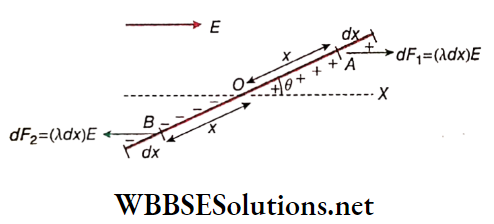
WBCHSE Class 12 Physics Notes For Elementary Phenomena Of Electrostatics Long Answer Questions

Unit 1 Electrostatics Chapter 1 Elementary Phenomena Of Electrostatics Long Questions and Answers

Question 1. When an insulated charged spherical conductor is brought near a light, a small spherical conductor suspended with a silk fiber,

  1. It quickly comes and sticks to the charged sphere.
  2. Instantly move away and remain stationary in a deflected position to explain the phenomena.

Answer:

When the insulated charged spherical conductor is brought near the small spherical conductor suspended with a silk fiber, unlike charge is induced on the near end of the small sphere and like charge on the far end.

As the unlike induced charge is nearer to the inducing charge, the small conductor suspended by the silk fiber is attracted and comes in contact with the insulated charged sphere.

As soon as the small sphere comes in contact with the insulated charged sphere, the former gets the same charge on it. Due to mutual repulsion of like charges, the small sphere instantly moves away from the insulated charged sphere.
Up to a distance such that the tension in the fiber, weight of the suspended ball, and force given by the charged sphere keep the suspended ball in equilibrium

Read And Learn More WBCHSE Class 12 Physics Long Question And Answers

Question 2. State whether attraction can occur between two same kind of charges.
Answer:

We know the same charges repel each other. But, if a highly charged object is brought near to a little charged object quickly, even though it has the same charge, attraction may happen. This happens due to electrostatic induction.

When a highly charged object is brought near to a little charged object, an opposite charge may be induced in the latter. If the quantity of induced charge exceeds the former amount of charge present, attraction instead of repulsion may happen between them

Question 3. If a charged ebonite rod is made to touch the disc of a gold-leaf electroscope, the leaves diverge. Then the rod is removed from the disc and it is found that the divergence of the leaves decreases a little—explain.
Answer:

Suppose, the ebonite rod is charged positively. Ebonite is a non-conductor of electricity. So when the rod touches the disc of a gold-leaf electroscope, the charges of both of them existing at the place of contact spread on the disc and the leaves of the electroscope. So the leaves spread apart

Now the charges on the other parts of the ebonite rod do not move to the electroscope. So these charges induce a negative charge on the disc and a positive charge on the leaves. For this reason, the divergence of the leaves increases further.

Divergence of the leaves depends on both induction and conduction of charges. When the ebonite rod is removed, induction will be absent. So then the leaves will have positive charges due to conduction only. So, the divergence of the leaves decreases a little.

WBBSE Class 12 Electrostatics Long Answer Questions

Question 4. Why are gold leaves used in a gold-leaf electroscope?
Answer:

The leaves of the gold-leaf electroscope should be thin and light. They diverge due to the repulsion of similar charges on them. The divergence of the leaves is more if they are light. Large divergence makes observation easier.

Now gold is a ductile metal, that can be beaten to produce very thin leaves. Moreover, gold does not react with air. For these reasons, gold leaves are used in an electroscope.

Question 5. Where will the surface charge density be maximum in a charged cubical conductor?
Answer:

The surface density of charge will be maximum at each of the cubical conductors.

WBCHSE Class 12 Physics Notes For Elementary Phenomena Of Electrostatics Long Answer Questions

Long Answer Questions on Electric Field and Potential

Question 6. Why Is the metal box of the gold-leaf electroscope
earthed?
Answer:

During experiments with a gold-leaf electroscope, free charges exist on the outer surfaces of the tin (metallic) plates used in it. These free charges repel like charges on the leaves and decrease their divergence.

Because of the earthing of the electroscope, these free charges move to the ground. Hence the sensitivity of the device increases.

Question 7. Why is a drying agent kept inside a gold-leaf electroscope?
Answer:

Though dry air is a good insulator, moist air conducts electricity moderately. If a charged body finds itself in moist air, charges will leak and ultimately get discharged.

Hence, due to the presence of moist air inside a gold-leaf electroscope, the divergence of the leaves will gradually decrease. To avoid this unwanted condition, drying agents (hygroscopic substances) are kept inside a gold-leaf electroscope.

Class 11 Physics Class 12 Maths Class 11 Chemistry
NEET Foundation Class 12 Physics NEET Physics

Question 8. Why should not a strongly charged body be brought very close to a gold-leaf electroscope?
Answer:

If a strongly charged body is brought very close to a gold-leaf electroscope, the amount of charge induced on the leaves of the electroscope will be very large. Then the divergence of the leaves may be large enough to detach them from the rod.

Question 9. Can an alternating static charge at one end of an isolated conductor, developed by an alternating current, be detected by a gold-leaf electroscope?
Answer:

Yes, a gold-leaf electroscope can defect alternating static charges. The divergence of the gold leaves in this electroscope depends only on the magnitude of charge in a test body, not on the nature of the charge, i.e., not on whether the charge is positive or negative.

The average of this magnitude of charge, over a complete period of the alternating source, has a finite value—this average is never zero. So, when the test body is brought near the disc of a gold-leaf electroscope, this average non-zero value of charge will be the input on the electroscope. The leaves will diverge accordingly

Question 10. Why it is not possible to electrify a metal rod by rubbing it while holding it with a bare hand?
Answer:

A metal rod as well as a human body is a good conductor of electricity. 5a by holding a metal rod with a bare hand if it is rubbed. the charge acquired due to friction flows through the body of the experimenter. That’s why the rod remains uncharged.

Practice Long Answer Questions on Gauss’s Law

Question 11. How much is one safe while taking shelter in a vehicle for protection during lightning?
Answer:

The steel frame but not die tires of the topped vehicle can protect one from lightning in the condition that the fellow is not touching metal parts another hide. The lightning charge flows around die outside of there, creating a partial electric screen and protecting the inside

Question 12. How can charge be fully transferred from one spherical conductor to another?
Answer:

If a charged spherical conductor is placed inside a relatively bigger uncharged spherical conductor and a wire is connected between the two, then a charge will be completely transferred from the small spherical conductor to the bigger spherical conductor as the charge resides on die outer surface

Question 13. Why it is not safe to stand under a tree during lightning?
Answer:

Electricity seeks the path of least resistance. Due to the moisture inside, a tree is a much better conductor than its surroundings. The result, a tree provides a preferred path for lightning to easily reach the ground. This is why, one should not stand under a tree during lightning.

Question 14. A spherical shell of charge +Q has an outer radius r2 and an Inner radius r1. If a charge +q is placed at the center of the shell then what are the values of surface charge density of inner and outer surfaces?
Answer:

Here charge +Q resides on the outer surface. As the +q charge is placed at the center, a charge -q is induced on the inner surface and a charge +q is induced on the outer surface.

Hence, the total charge on the outer surface =Q+ q; and the surface charge density of the outer surface,

⇒ \(\sigma_2=\frac{Q+q}{4 \pi r_2^2}\)

The surface charge density of the inner surface,

⇒ \(\sigma_1=\frac{q}{4 \pi r_1^2}\)

Question 15. Charge of 3.2 X 10⁻⁷ C Is obtained by rubbing a piece
Answer:

Since polythene has a negative charge, electrons are transferred from flannel to polythene.

Number of electrons transferred

= \(\frac{\text { total charge transferred }}{\text { charge of an electron }}\)

⇒ \(\frac{3.2 \times 10^{-7}}{1.6 \times 10^{-19}}\)

= \(2 \times 10^{12}\)

Here some mass is transferred from flannel to pohthene.

Mass transferred = number of electrons transferred x mass of an electron

= 2 x 10-12 X 9.1 x 10-31

= 1.82 x 10⁻¹⁸ kg.

Conceptual Long Answer Questions on Electric Dipoles

Question 16. Why does a spherical conductor retain its charge for a longer time in comparison with conductors of any other shape?
Answer:

Any conductor has a higher charge density at its sharp ‘ edge. Such an edge discharges faster than a spherical surface. For a spherical conductor, the distribution of charge over its surface is uniform.

As it has no sharp edge, it loses its charge very slowly due to the discharging action. So a spherical conductor can retain its charge for a longer time.

Question 17. Does a solid metallic sphere retain more charge than a hollow sphere of the same diameter?
Answer:

A solid sphere does not retain more charge than a hollow sphere of the same diameter, because charge resides on the outer surface of a conductor, and the outer surface areas of the two spheres are equal.

Question 18. When a conductor is charged, its charge resides on its outer surface. What is the reason?
Answer:

According to the property of a conductor, a charge may flow easily through it. Like charges repel each other and repulsion causes them to move as far apart as possible. An equilibrium is reached only when they move to the outer surface of the conductor.

Question 19. What is the minimum amount of charge acquired by a charged body? The charge of a body 5.6 X 10⁻¹⁴C justifies it.
Answer:

The minimum charge acquired by a charged body is ±e = ±4.8 X 10⁻¹⁰ esu of charge = +1.6 X 10⁻¹⁹C. All charges present in nature are always an integral multiple of an electronic charge e.

The charge of a body is 5.6 X 10⁻¹⁴ C this statement means that it has a deficit of electrons, and hence is positively charged.

The number of electron deficit

⇒ \(\frac{5.6 \times 10^{-14}}{1.6 \times 10^{-19}}\)

= 350000

Examples of Long Answer Questions on Electric Potential Energy

Question 20. Can charge reside on the inner surface of a hollow conductor? Explain.
Answer:

A charged body is kept inside a hollow conductor in such a way that it does not touch the inside of the conductor. In this case, unlike charges are induced on the inner surface of the hollow conductor and like charges on its outer surface. It is clearly a special arrangement in which the inner surface of a hollow conductor is charged.

Question 21. An isolated metallic conductor is positively charged. Did its mass increase, decrease or remain the same? How will the mass of the conductor change if it is negatively charged?
Answer:

Since the conductor is positively charged, electrons have been removed from it So the mass of the conductor has decreased. Electrons are to be added to the conductor to charge it negatively. So the mass of the conductor will increase.

Question 22. A sensitive instrument is influenced by a strong electric field. Suggest a possible way to prevent the influence.
Answer:

The instrument should be enclosed in a cage made of metal wire. The cage would act as an electric screen; external electric fields would have no influence inside

NEET Foundation Biology Chapter 6 Improvement In Food Resources Short Answer Questions

Chapter 6 Improvement In Food Resources Short Answer Type Question And Answers

Question 1. What are the advantages of organic farming?
Answer.

Advantages of organic farming:

  • There is no use of chemical fertilizers, pesticides, and herbicides in organic farming.
  • Organic farm wastes can be recycled in the form of manure.
  • It also maintains the soil fertility.
  • It controls the attack of pests and the growth of weeds through a cropping system.
  • There is no toxicity released during organic farming which can harm our environment.

Improvement In Food Resource

Read And Learn More NEET Foundation Short Answer Questions

Question 2. Explain any one method of crop production which ensures high yield.
Answer.

Method of crop production:

The one method used for crop production which ensures high yield is plant breeding. It is the science involved in improving the varieties of crops by breeding plants. The plants from different areas/places is picked up with desired traits and then hybridization or cross-breeding of these varieties is done to obtain a plant/crop of desired characteristic.

The high yielding crop variety shows the following characteristics, namely high yield, early maturation, less water for irrigation, better quality seeds are produced, less fertilizers required and adapts itself to the environmental conditions.

NEET Foundation Biology Chapter 6 Improvement In Food Resources Short Answer Questions

Question 3. Discuss the differences between compost and vermicompost.
Answer.

The differences between compost and vermicompost:

NEET Foundation Biology Improvement In Food Resources Short Answer Type Question 3

Question 4. Discuss the different types of biofertilizers with their examples.
Answer.

The different types of biofertilizers with their examples:

  • Nitrogenous fertilizers are those organisms that provide nitrogen to the plants.
    Example: Rhizobium, Azotobacter, BGA (blue-green algae).
  • Phosphate solubilizing microbes provides phosphorous to the plants.
    Example: Azospirilium, Acetobacter and Azotobacter.
  • Mycorrhizal fungi lives in symbiotic relationship with a plant and increases the nutrient and water uptake of the plant, making it disease and drought resistant.

Question 5. What do you understand by water management?
Answer.

Water management:

The arrangement and supply of required water to the crop plants without disturbing the water table and soil aeration and causing soil salinity and water logging problem is defined as water management.

Improvement In Food Resources

Question 6. What are the irrigation system?
Answer.

Irrigation system:

  • The irrigation system provides fresh water to crop plants that are enriched in hydrogen and oxygen. Hence, it provides two important elements to crops that are essential for their growth and development.
  • Irrigation provides sufficient water and minerals dissolved in the water to the crop plants and hence, a number of aerial branches increases in the crop plants leading to an increase in the crop yield.
  • Irrigation water from river basins even carries slit with them which are nutrient rich thereby, improving soil fertility and crop yields.
  • Irrigation allows the cultivation of crops throughout the year rather than being restricted to a specific season.

Question 7. How do you differentiate between capture fishing, mariculture and aquaculture?
Answer.

Difference between capture fishing, mariculture and aquaculture

  • Capture fishing: It is the fishing in which fishes are captured from natural resources like pond, sea water and estuaries.
  • Mariculture: It is the culture of fish in marine water. Varieties like prawns’, oysters, bhetki and mullets are cultured for fishing.
  • Aquaculture: It is done both in fresh water and in marine water.

Question 8. For increasing production, what is common in poultry, fisheries and beekeeping?
Answer.

Through cross-breeding, the production of poultry, fisheries and beekeeping can be increased.

Question 9. How do biotic and abiotic factors affect crop production?
Answer:

The factors responsible for loss of grains, during storage and production are as follows.

  • Biotic factors like rodents, pests, insects, etc.
  • Abiotic factors like temperature, humidity, moisture, etc. Combination of both biotic and abiotic factors are responsible for the following parameters.
    • Infestation of insects
    • Weight loss
    • Poor germination ability
    • Degradation in quality
    • Discolouration
    • Poor market price
Class 11 Physics Class 12 Maths Class 11 Chemistry
NEET Foundation Class 12 Physics NEET Physics

Question 10. What are the desirable agronomic characteristics for crop improvements?

The desirable agronomic characteristics for crop improvements are as follows.

  • Tallness and profuse branching are the desirable characters for fodder crops.
  • Dwarfness is desired in cereals, so that less nutrients are consumed by these crops.

Answer: Diseases in plants are caused by pathogens. To get rid of pathogens, some preventive measures and biological control methods are used as they are simple, economic and minimize pollution without affecting the soil quality.

Question 11. What is genetic engineering?
Answer:

Genetic Engineering:

Introduction of desired gene with specific characteristics in the genome of a plant also produces improved quality of crop. Such crops are known as genetically modified crops (GMO) and the technique employed is known as genetic engineering.

Question 12. What is hybridization?
Answer:

Hybridization:

Hybridization is a process of crossing between genetically dissimilar plants that result in the production of a new variety.

Question 13. What factors may be responsible for losses of grains during storage?
Answer:

The factors responsible for losses of grains during storage are as follows.

  • Abiotic factors like moisture (present in food grains), humidity (of air) and temperature.
  • Biotic factors like insects, rodents, birds, mites, bacteria and fungi.

Question 14. What is nutrient management?
Answer:

Nutrient Management:

The selection of time, nutrient and amount of nutrient is controlled under the system called nutrient management.

Question 15. What do you understand by farm yard manure?
Answer:

Farm Yard Manure:

It is the oldest manure composed of the decomposed mixture of dung, urine of farm animals, remains of roughages or fodder fed to the cattle.

Question 16. What are macronutrients and why are they called macronutrients?
Answer:

Macronutrients:

Macronutrients are the essential elements which are utilized by plants in large quantities. Many macronutrients are required by the plants for the following functions.

  • As the constituent of protoplasm.
  • N, P and S are present in proteins.
  • Ca is present in cell wall.
  • Mg is the important constituent of chlorophyll.

Question 17. How do plants get nutrients?
Answer:

Plants get nutrients as follows

Plants get nutrients from air, water and soil. There are sixteen nutrients essential for the growth of plants. Carbon and oxygen are supplied by water. The remaining thirteen nutrients are supplied by soil.

Question 18. Compare the use of manure and fertilizers in maintaining soil fertility.
Answer:

The effects of using manures on soil quality are as follows.

  • The manures enrich the soil with nutrients.
  • They provide a lot of organic matter (humus) to the soil and thus, it restores the water retention capacity of sandy soils and drainage in clayey soil.
  • The addition of manures reduces soil erosion.
  • They provide food for soil organisms like soil-friendly bacteria.

The effects of using fertilizers on soil quality are as follows.

  • By the continuous use of fertilizers, the soil becomes powdery, dry and the rate of soil erosion increases.
  • Using fertilizers, the organic matter decreases which further decreases the porosity of soil and the plant roots do not get oxygen properly.
  • The nature of soil changes to acidic or basic.

Question 19. Discuss how fertilizers can be classified.
Answer:

classification of fertilizers

They are classified into four groups based on their nutrient content.

  • Nitrogenous fertilizers: They provide nitrogen (macronutrient).
  • Phosphorous fertilizers: They provide phosphorous (macronutrient).
  • Potassic fertilizers: They provide potassium (essential micronutrient).
  • Complex fertilizers: They provide two or more than two nutrients (N2, P2O4 and K2O).

Question 20. What are biofertilizers?
Answer:

Biofertilizers:

Some living microorganisms are also used as fertilizers, which provide nutrient to the plants and such fertilizers are known as biofertilizers.

Question 21. What is irrigation?
Answer:

Irrigation:

The process of supplying water artificially through water reservoirs and tube wells to the agricultural field where crop plants are grown is known as irrigation.

Question 22. What do you understand by the term water augmentation?
Answer:

Water Augmentation:

Augmentation is a process of using existing water to carry out new work.

Question 23. Which of the following conditions will give the most benefits? Why?

  1. Farmers use high-quality seeds and do not adopt irrigation or use fertilizer.
  2. Farmers use quality seeds, adopt irrigation, use fertilizer and use crop protection measures.

Answer: In this, (2) farmers use quality seeds, adopt irrigation, use fertilizer and use crop protection measures.

Use of any quality seeds is not sufficient until they are properly irrigated, enriched with fertilizers and protected from biotic factors. Hence, option (2) will give the most benefits.

Question 23. Which of the following conditions will give the most benefits? Why?

  1. Farmers use high-quality seeds, do not adopt irrigation or use fertilizer.
  2. Farmers use quality seeds, adopt irrigation, use fertilizer and use crop protection measures.

Answer: In this, (2) farmers use quality seeds, adopt irrigation, use fertilizer and use crop protection measures. Use of any quality seeds is not sufficient until they are properly irrigated, enriched with fertilizers and protected from biotic factors. Hence, option (2) will give the most benefits.

Question 24. What are the pathogens?
Answer:

Pathogen:

Pathogens are microorganisms that cause diseases to the crop plants whereas it may be a bacteria, fungus or virus. They are present in the soil, air and water, it becomes virulent in favourable conditions.

Question 25. Why should preventive measures and biological control methods be preferred for protecting crops?
Answer:

Diseases in plants are caused by pathogens. To get rid of pathogens, some preventive measures and biological control methods are used as they are simple, economic and minimize pollution without affecting the soil quality.

Question 26. What factors may be responsible for losses of grains during storage?
Answer:

The factors responsible for losses of grains during storage are as follows.

  • Abiotic factors like moisture (present in food grains), humidity (of air) and temperature.
  • Biotic factors like insects, rodents, birds, mites, bacteria and fungi.

Question 27. What are weeds?
Answer:

Weeds:

The unwanted plants that grow with main crop plants utilize the nutrient of the soil in large amount and hence, they reduce the growth of the crop and such plants are known as weeds.

Question 28. What is intercropping?
Answer:

Intercropping:

When two or more than two crops are grown simultaneously in the same crop field, but in a definite pattern to increase the productivity of farm per unit area, then it is called intercropping.

NEET Foundation Biology Chapter 6 Improvement In Food Resources Long Answer Questions

Chapter 6 Improvement In Food Resources Long Answer Type Question And Answers

Question 1. What is genetic manipulation? How is it useful in agricultural practices?
Answer.

Genetic Manipulation:

Genetic manipulation is a process of incorporating desirable (genes) characters into crop varieties by hybridization. Hybridization involves crossing between genetically dissimilar plants.

This is done for the production of varieties with desirable characteristics like profuse branching in fodder crops, high-yielding varieties in maize, wheat, etc.

Genetic manipulation is useful in developing varieties and it results in nurturing the following factors.

  • Increased yield.
  • Better quality.
  • Shorter and early maturity period.
  • Better adaptability to adverse environmental conditions.
  • Desirable characteristics.

Improvement In Food Resources

Question 2. What are the benefits of GMO crops?
Answer.

Benefits Of GMO Crops:

Cultivation practices and good crop yield also depends upon the weather, soil quality and availability of water. GMO crop varieties are useful as they can be grown in diverse climatic conditions such as drought and flood. Some of the varieties could have special characters such as tolerance to high soil salinity.

Read and Learn More NEET Foundation Long Answer Questions

Question 3. What are water augmentation and discuss its two methods?
Answer.

Water Augmentation:

Augmentation is a process of using existing water to carry out new work. To fulfil the demand of water used in the irrigation augmentation of ground water is done. It is carried out by two methods and they are listed below.

  • Rainwater harvesting: This process includes collection of rainwater, which is further used to recharge ground water by digging up wells.
  • Water-shed management: This process includes construction of check dams to reduce flow of rainwater and prevent soil erosion. It also increases the percolation of water into the ground.

Question 4. What are the advantages of intercropping and crop rotation?
Answer.

Advantages of using intercropping:

  • It helps to maintain soil fertility.
  • It increases productivity per unit area.
  • Save labour and time.
  • Both crops can be easily harvested and processed separately.

Advantages of using crop rotation:

  • It improves the soil fertility.
  • It avoids depletion of a nutrient from soil.
  • It minimizes pest infestation and diseases.
  • It helps in weed control.
  • It prevents change in the chemical nature of the soil.

Question 5. What is aquaculture and discuss its two-aqua culture system?
Answer.

Aquaculture:

Aquaculture includes the production of high yield aquatic plants and animals which have high economic value, such as fishes, prawns, crayfish, shrimps, oysters and sea weeds. It includes two culture systems and they are as follows.

  • Mariculture: In this type of culture, the marine fishes such as bhetki, eel and pearl spots are cultured in the coastal water for commercial purpose.
  • Freshwater culture fishery: In this type, exotic crabs such as English carp, tench and trouts are cultivated in the lakes.

Crop Production Management

Class 11 Physics Class 12 Maths Class 11 Chemistry
NEET Foundation Class 12 Physics NEET Physics

Question 6. Which method is commonly used for improving cattle breeds and why?
Answer:

Cross-breeding is a process in which indigenous varieties of cattle are crossed by exotic breeds to get a breed which is high yielding. During cross-breeding, the desired characters are taken into consideration. The offspring should be high yielding, should have early maturity and should be resistant to climatic conditions.

Question 7. Discuss the implications of the following statement.

‘It is interesting to note that poultry is India’s most efficient converter of low fibre food stuff (which  is unfit for human consumption) into highly nutritious animal protein food’.
Answer:

The basic aim of poultry farming is to raise domestic fowl for egg production and chicken meat. These poultry birds are not only efficient converters of agricultural by-products, particularly cheaper fibrous wastes (which is unfit for human consumption but can be formulated into cheaper diets for poultry birds) into high quality meat and it also help in providing egg, feathers and nutrient rich manure. For this reasons, it is said that, ‘poultry is India’s most efficient converter of low fibre food stuff into highly nutritious animal protein food’.

Question 8. What management practices are common in dairy and poultry farming?
Answer:

Management practices are common in dairy and poultry farming

  • Shelter: Dairy animals and poultry birds require proper shelter, i.e., well-designed dairy and hygienic shelter.
  • Feeding: To get good yield of food product, proper feed is provided to dairy animals and poultry birds.
  • Caring for animal health: Animal and birds must be protected from diseases caused by virus, bacteria or fungi.

Question 9. What are the differences between broilers and layers and in their management?
Answer:

Differences between broilers and layers and in their management:

The poultry bird groomed for obtaining meat is called broiler. The egg laying poultry bird is called layer. The housing, nutritional and environmental requirements of broilers are somewhat different from those of egg layers. The ration (daily food requirement) for broilers is protein rich with adequate fat. The level of vitamins A and K is kept high in the poultry feeds while layers require enough space and proper lightning.

Food Resources

Question 10. How are fish obtained?
Answer:

Obtaining fish

There are two ways of obtaining fish. One is from natural resources, which is called capture fishing. The other way is by fish farming, which is called culture fishery.

Question 11. What are the advantages of composite fish culture?
Answer:

Advantages of composite fish culture:

In composite fish culture, a combination of five or six fish species is used in a single fish pond. These species are selected so that they do not compete for food among them and are having different types of food habits. As a result, the food available in all the parts of the pond is used.

For example, Catlas are surface feeders, Rohus feed in the middle zone of the pond, Mrigals and Common Carps are bottom feeders and Grass Carps feed on the weeds, together these species can use all the food in the pond without competing with each other. This increases the fish yield from pond.

Question 12. What are the desirable characters of bee varieties suitable for honey production?
Answer:

Characters of bee varieties suitable for honey production:

  • The variety of bee should be able to collect a large amount of honey.
  • The bees should stay in a given beehive for a longer period.
  • The bees should have capacity of breeding well.
  • The variety of bee should be disease resistant.

Question 13. What is pasturage and how is it related to honey production?
Answer:

Pasturage

Pasturage means the flowers available to bees for nectar and pollen collection. In addition to adequate quantities of pasturage, the kind of flowers available will determine the taste of honey.

Question 14. How do good animal husbandry practices benefit farmers?
Answer:

Good animal husbandry practices are beneficial to farmers in the following ways.

  • Improvement of breeds of the domesticated animals.
  • Increasing the yield of foodstuffs, such as milk, eggs and meat.
  • Proper management of domestic animals in terms of shelter, feeding, care and protection against diseases.

Question 15. What are the benefits of cattle farming?
Answer:

Cattle farming is beneficial in the following ways.

  • Milk production is increased by high yielding animals.
  • Good quality of meat, fibre and skin can be obtained.
  • Good breed of draught animals can be obtained.

NEET Foundation Biology Chapter 6 Improvement In Food Resources Multiple Choice Questions

Chapter 6 Improvement In Food Resources Multiple Choice Question And Answers

Direction: Choose the correct option for each questions. There is only one correct response for each question.

Question 1. How many nutrients are essential for crops?

  1. 13
  2. 14
  3. 15
  4. 11

Answer. 1. 13

Question 2. A farming system with minimal or no use of chemicals as fertilizers, herbicides, pesticides, etc., and with a maximum input of organic manures, recycled farm wastes and bio-agents with healthy cropping systems is called

  1. mixed farming
  2. organic farming
  3. biotic farming
  4. abiotic farming

Answer. 2. organic farming

Question 3. A system of farming on a particular farm which includes crop production, rising of livestock, etc., is called

  1. organic farming
  2. biotic farming
  3. abiotic farming
  4. mixed farming

Answer. 4. mixed farming

Question 4. Growing of two or more crops simultaneously on the same piece of land is called

  1. organic cropping
  2. biotic cropping
  3. mixed cropping
  4. abiotic cropping

Answer. 3. mixed cropping

Read and Learn More NEET Foundation Multiple Choice Questions

Question 5. Growing two or more crops in definite row patterns is known as

  1. intercropping
  2. organic cropping
  3. biotic cropping
  4. mixed cropping

Answer. 1. intercropping

Question 6. The growing of different crops on a piece of land in pre-planned succession is called

  1. poultry rotation
  2. farm rotation
  3. crop rotation
  4. cross rotation

Answer. 3. crop rotation

Question 7. Farm animals require proper care and management, such as shelter, feeding, breeding and disease control. This is called

  1. poultry husbandry
  2. farming
  3. animal husbandry
  4. cross-breeding

Answer. 3. animal husbandry

Question 8. It is done to raise domestic fowls.

  1. Poultry farming
  2. Poultry husbandry
  3. Cross Breeding
  4. Animal husbandry

Answer. 1. Poultry farming

Question 9. Composite fish culture system is ­commonly used for

  1. poultry farming
  2. poultry husbandry
  3. cross-breeding
  4. fish farming

Answer. 4. fish farming

Question 10. Beekeeping is done to get honey and

  1. wax
  2. eggs
  3. medicine
  4. breeding

Answer. 1. wax

NEET Foundation Biology Chapter 6 Improvement In Food Resources Multiple Choice Questions

Question 11. It has contributed to increased food grain production.

  1. Animal revolution
  2. Blue revolution
  3. Green revolution
  4. Poultry revolution

Answer. 3. Green revolution

Question 12. It has led to better and more efficient use as well as availability of milk.

  1. Green revolution
  2. Poultry revolution
  3. Blue revolution
  4. White revolution

Answer. 4. White revolution

Question 13. There is a need for sustainable practices in animal husbandry and

  1. agriculture
  2. poultry
  3. warehouse
  4. farming

Answer. 1. agriculture

Question 14. Storage in warehouses cannot solve the problem of malnutrition and

  1. hanger
  2. hunger
  3. anger
  4. livestock

Answer. 2. hunger

Question 15. Cereals such as wheat, rice, maize, ­millets and sorghum provide us which of the following energy requirement?

  1. Protein
  2. Sodium
  3. Fats
  4. Carbohydrate

Answer. 4. Carbohydrate

Question 16. Pulses like gram (chana), pea (matar), black gram (urad), green gram (moong), pigeon pea (arhar), lentil (masoor), provide us with

  1. protein
  2. sodium
  3. fats
  4. carbohydrate

Answer. 1. protein

Question 17. Oil seeds including soybean, groundnut, sesame, castor, mustard, linseed and sunflower provide us with necessary

  1. Protein
  2. sodium
  3. fats
  4. carbohydrate

Answer. 3. fats

Question 18. It refers to crossing between genetically dissimilar plants.

  1. Intervarietal
  2. Interspecific
  3. Intergeneric
  4. Hybridization

Answer. 4. Hybridization

Question 19. This crossing may be intervarietal, interspecific or

  1. intervarietal
  2. interspecific
  3. intergeneric
  4. hybridization

Answer. 3. intergeneric

Question 20. It is related to the duration of sunlight.

  1. Photoperiods
  2. Phrotoperiods
  3. Photosynthesis
  4. Photoproduction

Answer. 1. Photoperiods

Question 21. Growth of plants and flowering are dependent on

  1. moonlight
  2. breeding
  3. sunlight
  4. soil

Answer. 3. sunlight

Question 22. Plants manufacture their food in sunlight by the process of

  1. phrotosynthesis
  2. photoperiods
  3. phrotoperiods
  4. photosynthesis

Answer. 4. photosynthesis

Question 23. How many nutrients are essential for plants?

  1. 16
  2. 15
  3. 12
  4. 20

Answer. 1. 16

Question 24. The process in which farm waste material, like livestock excreta (cow dung etc.), vegetable waste, animal refuse, domestic waste, sewage waste, straw, eradicated weeds, etc., is e-composed in pits known as

  1. composting
  2. decompose
  3. accumulate
  4. excrete

Answer. 1. composting

Question 25. Compost is also prepared by using earthworms to hasten the process of decomposition of plant and animal refuse. This process is called

  1. vermicompost
  2. composting
  3. decompose
  4. accumulate

Answer. 1. vermicompost

Question 26. It contains large quantities of organic matter and also supplies small quantities of nutrients to the soil.

  1. Waste
  2. Fertility
  3. Decompose
  4. Manure

Answer. 4. Manure

Question 27. It is prepared by the decomposition of animal excreta and plant waste.

  1. Waste
  2. Fertility
  3. Decompose
  4. Manure

Answer. 4. Manure

Question 28. It occurs due to scarcity or irregular distribution of rains.

  1. Droughts
  2. Floods
  3. Rains
  4. Farms

Answer. 1. Droughts

Question 29. Diseases in plants are caused by

  1. pathogens
  2. herbicides
  3. fungicides
  4. insecticides

Answer. 1. pathogens

Question 30. The unwanted plants in the cultivated field, for example, Xanthium are called

  1. weeds
  2. insects
  3. rodents
  4. mites

Answer. 1. weeds

Question 31. Storage losses in agricultural produce can be very high. The factors responsible for such losses are

(1) biotic

(2) abiotic

(3) weeds

(4) rodents

Select the correct option.

  1. (1), (2) and (3)
  2. (1), (3) and (4)
  3. (1) and (2)
  4. (1), (2), (3) and (4)

Answer. 3. (1) and (2)

Question 32. Biotic are

(1) insects

(2) rodents

(3) fungi

(4) mites

Select the correct option.

  1. (1), (2) and (3)
  2. (1), (3) and (4)
  3. (1) and (2)
  4. (1), (2), (3) and (4)

Answer. 4. (1), (2), (3) and (4)

Question 33. Animal husbandry is the scientific management of animal livestock. It includes various aspects such as

(1) feeding

(2) breeding

(3) disease control

(4) cattle

Select the correct option.

  1. (1), (2) and (3)
  2. (1), (3) and (4)
  3. (1) and (2)
  4. (1), (2), (3) and (4)

Answer. 1. (1), (2) and (3)

Question 34. Animal-based farming includes

(1) cattle

(2) poultry

(3) fish farming

(4) livestock

Select the correct option.

  1. (1), (2) and (3)
  2. (1), (3) and (4)
  3. (1) and (2)
  4. (1), (2), (3) and (4)

Answer. 1. (1), (2) and (3)

Question 35. Indian cattle belongs to different species, such as

(1) Bos indicus

(2) Bos bubalis

(3) Milch

(4) Draught

Select the correct option.

  1. (1), (2) and (3)
  2. (1), (3) and (4)
  3. (1) and (2)
  4. (1), (2), (3) and (4)

Answer. 3. (1) and (2)

Question 36. The food requirements of dairy animals are

(1) maintenance requirement

(2) milk producing requirement

(3) ration requirement

(4) nutrient requirement

Select the correct option.

  1. (1), (2) and (3)
  2. (1), (3) and (4)
  3. (1) and (2)
  4. (1), (2), (3) and (4)

Answer. 3. (1) and (2)

Question 37. Poultry fowl suffer from a number of ­diseases caused by

(1) virus

(2) bacteria

(3) fungi

(4) parasites

Select the correct option.

  1. (1), (2) and (3)
  2. (1), (3) and (4)
  3. (1) and (2)
  4. (1), (2), (3) and (4)

Answer. 4. (1), (2), (3) and (4)

Question 38. Freshwater resources include

(1) canals

(2) ponds

(3) reservoirs

(4) rivers

Select the correct option.

  1. (1), (2) and (3)
  2. (1), (3) and (4)
  3. (1) and (2)
  4. (1), (2), (3) and (4)

Answer. 4. (1), (2), (3) and (4)

Question 39. We require food for body development, growth and health. The food intake supplies necessary

(1) proteins

(2) carbohydrates

(3) fats

(4) vitamins

Select the correct option.

  1. (1), (2) and (3)
  2. (1), (3) and (4)
  3. (1) and (2)
  4. (1), (2), (3) and (4)

Answer. 4. (1), (2), (3) and (4)

Question 40. Nutrients are

(1) macronutrients

(2) micronutrients

(3) mini nutrients

(4) major nutrients

Select the correct option.

  1. (1), (2) and (3)
  2. (1), (3) and (4)
  3. (1) and (2)
  4. (1), (2), (3) and (4)

Answer. 3. (1) and (2)

Question 41. The main sources of nutrient supply to crops are

(1) manure

(2) fertilizers

(3) food

(4) husbandry

Select the correct option.

  1. (1), (2) and (3)
  2. (1), (3) and (4)
  3. (1) and (2)
  4. (1), (2), (3) and (4)

Answer. 3. (1) and (2)

Question 42. There is a need for sustainable practices in

(1) animal husbandry

(2) agriculture

(3) poultry

(4) warehouse

Select the correct option.

  1. (1), (2) and (3)
  2. (1), (3) and (4)
  3. (1) and (2)
  4. (1), (2), (3) and (4)

Answer. 3. (1) and (2)

Question 43. Storage in warehouses cannot solve the problem of

(1) malnutrition

(2) hanger

(3) hunger

(4) anger

Select the correct option.

  1. (1), (2) and (3)
  2. (1) and (3)
  3. (1) and (2)
  4. (1), (2), (3) and (4)

Answer. 2. (1) and (3)

Question 44. Vegetables, spices and fruits provide a range of

(1) vitamins

(2) minerals

(3) proteins

(4) carbohydrates

Select the correct option.

  1. (1), (2) and (3)
  2. (1) and (3)
  3. (1) and (2)
  4. (1), (2), (3) and (4)

Answer. 4. (1), (2), (3) and (4)

Question 45. The major groups of activities for improving crop yields can be classified as

(1) crop variety improvement.

(2) crop production improvement.

(3) crop protection management.

(4) none of these

Select the correct option.

  1. (1), (2) and (3)
  2. (1) and (3)
  3. (1) and (2)
  4. (1), (2), (3) and (4)

Answer. 1. (1), (2) and (3)

Question 46. Cereal plants like wheat, rice, maize and barley are rich in

  1. Proteins
  2. Carbohydrates
  3. Fats
  4. Minerals

Answer. 2. Carbohydrates

Question 47. Pulse crops are rich in

  1. Proteins
  2. Fats
  3. Vitamins
  4. Carbohydrates

Answer. 1. Proteins

Question 48. Vegetables and fruits are rich in

  1. Carbohydrates
  2. Fats
  3. Proteins
  4. Minerals and Vitamins

Answer. 4. Minerals and Vitamins

Class 11 Physics Class 12 Maths Class 11 Chemistry
NEET Foundation Class 12 Physics NEET Physics

Question 49. Which macronutrient is required in largest quantity by plants?

  1. Phosphorus
  2. Potassium
  3. Nitrogen
  4. Magnesium

Answer. 3. Nitrogen

Question 50. Which one is not a ‘Rabi’ crop?

  1. Wheat
  2. Barley
  3. Gram
  4. Maize

Answer. 4. Maize

Question 51. Identify the ‘Kharif’ crop.

  1. Potato
  2. Mustard
  3. Rice
  4. Wheat

Answer. 3. Rice

Question 52. Which one is not a micronutrient?

  1. Iron
  2. Copper
  3. Manganese
  4. Magnesium

Answer. 4. Magnesium

Question 53. Identify the macronutrient.

  1. Copper
  2. Zinc
  3. Sulphur
  4. Boron

Answer. 3. Sulphur

Question 54. The unwanted plants which grow with main crops are called

  1. Bogus plants
  2. Herbs
  3. Weeds
  4. Grasses

Answer. 3. Weeds

Question 55. Which one is not a biofertilizer?

  1. Rhizobium
  2. Azolla
  3. Anabaena
  4. Urea

Answer. 4. Urea

Question 56. The example of ‘green manure’ is

  1. Farm yard manure
  2. Compast
  3. Ammonium phosphate
  4. Berseem

Answer. 4. Berseem

Question 57. Root nodules of leguminous plants contain

  1. Rhizobium
  2. Anabaena
  3. Azolla
  4. Mycorrhiza

Answer. 1. Rhizobium

Question 58. The enrichment of water bodies with nutrients leading to excessive growth of phytoplankton is known as

  1. Nitrification
  2. Ammonification
  3. Eutrophication
  4. Phyto-enrichment

Answer. 3. Eutrophication

Question 59. To solve the food problem of the country, which among the following is necessary?

  1. Increased production and storage of food grains
  2. Easy access of people to the food again
  3. People should have money to purchase the grains
  4. All the above

Answer. 4. All the above

Question 60. Find out the correct sentence

(1) Hybridization means crossing between genetically dissimilar plants.

(2) Cross between two varieties is called as interspecific hybridization.

(3) Introducing genes of desired character into a plant gives genetically modified crop.

(4) Cross between plants of two species is called as inter-varietal hybridisation.

  1. (1) and (3)
  2. (2) and (4)
  3. (2) and (3)
  4. (3) and (4)

Answer. 1. (1) and (3)

Question 61. Weeds affect the crop plants by

  1. killing of plants in field before they grow
  2. dominating the plants to grow
  3. competing for various resources of crops (plants) causing low availability of nutrients
  4. all the above

Answer. 3. competing for various resources of crops (plants) causing low availability of nutrients

Question 62. Find out the correct sentence about manure

(1) Manure contains large quantities of organic matter and small quantities of nutrients.

(2) It increases the water holding capacity of sandy soil.

(3) It helps in draining out of excess of water from clayey soil.

(4) Its excessive use pollutes environment because it is made of animal excretory waste.

  1. (1) and (3)
  2. (1) and (2)
  3. (2) and (3)
  4. (3) and (4)

Answer. 2. (1) and (2)

Question 63. Which one of the following nutrients is not available in fertilizers?

  1. Nitrogen
  2. Phosphorus
  3. Iron
  4. Potassium

Answer. 3. Iron

Question 64. Preventive and control measures adopted for the storage of grains include

  1. strict cleaning
  2. proper disjoining
  3. fumigation
  4. all the above

Answer. 4. all the above

Question 65. Who is known as “Father of white ­revolution” in India?

  1. Prof. M.S. Swaminathan
  2. Dr. V. Kurien
  3. Mrs. Indira Gandhi
  4. Shri Jai Prakash Narain

Answer. 2. Dr. V. Kurien

Question 66. ‘Murrah’ is a high milk-yielding breed of

  1. Goat
  2. Cow
  3. Buffalo
  4. Sheep

Answer. 3. Buffalo

Question 67. ‘Blue Revolution’ refers to increase in

  1. Milk production
  2. Egg production
  3. Grain production
  4. Fish production

Answer. 4. Fish production

Question 68. Which one of the following is a local breed of cow?

  1. Red Sindhi
  2. Brown Swiss
  3. Jersey
  4. Karan production

Answer. 1. Red Sindhi

Question 69. Which one of following is a fresh water fish?

  1. Catla
  2. Sardine
  3. Hilsa
  4. Bombay duck

Answer. 3. Hilsa

Question 70. The exotic variety of bee commonly used for commercial honey production is

  1. Indian bee
  2. Italian bee
  3. Rock bee
  4. Little bee

Answer. 2. Italian bee

Question 71. Find out the wrong statement from the following

  1. White revolution is meant for increase in milk production
  2. Blue revolution is meant for increase in fish production
  3. Increasing food production without compromising with the environmental quality is called as sustainable agriculture
  4. None of the above

Answer. 4. Increasing food production without compromising with the environmental quality is called as sustainable agriculture

Question 72. Cattle husbandry is done for the following purposes

(1) Milk Production

(2) Agricultural work

(3) Meat production

(4) Egg production

  1. (1), (2) and (3)
  2. (2), (3) and (4)
  3. (3) and (4)
  4. (1) and (4)

Answer. 1. (1), (2) and (3)

Question 73. Which of the following are Indian cattle?

(1) Bos indicus

(2) Bos domestica

(3) Bos bubalis

(4) Bos vulgaris

  1. (1) and (3)
  2. (1) and (2)
  3. (2) and (3)
  4. (1) and (4)

Answer. 1. (1) and (3)

Question 74. Poultry farming is under taken to raise following

(1) Egg production

(2) Feather production

(3) Chicken production

(4) Milk production

  1. (1) and (3)
  2. (1) and (2)
  3. (2) and (3)
  4. (3) and (4)

Answer. 1. (1) and (3)

Question 75. Which one of the following species of honey bee is an Italian species?

  1. Apis dorsata
  2. Apis florae
  3. Apis cerana indica
  4. Apis mellifera

Answer. 4. Apis mellifera

Question 76. The seeds of Kharif crop is sown in

  1. April
  2. June
  3. August
  4. December

Answer. 2. June

Question 77. Which of the following is not a Rabi crop?

  1. Wheat
  2. Barley
  3. Oats
  4. Rice

Answer. 4. Rice

Question 78. Yellow revolution refers to which of the following?

  1. Increase in production of wheat.
  2. Increase in production of milk.
  3. Increase in production of oil seed.
  4. Increase in production of crops.

Answer. 3. Increase in production of oil seed.

Question 79. There is no use of ___________ in organic farming.

  1. Fertilizers
  2. Pesticides
  3. Herbicides
  4. All of these

Answer. 4. All of these

Question 80. ___________ is an integrated system of plant and animal production practices with a specific application.

  1. Sustainable agriculture
  2. Manure farming
  3. Irrigation
  4. Organic farming

Answer. 1. Sustainable agriculture

Question 81. White revolution deals with the increased production of milk. Who is the ‘Father of White Revolution’?

  1. Dr. Verghese Kurien
  2. Sam Pitroda
  3. Dr. Swaminathan
  4. Dr. Arun Krishnan

Answer. 1. Dr. Verghese Kurien

Question 82. The science that deals with the practice of growing plants and other crops, feeding, breeding and raising of animals for food or other human needs is

  1. agriculture
  2. irrigation
  3. sustainable agriculture
  4. crop production management

Answer. 1. agriculture

Question 83. Blue revolution deals with increase in the production of

  1. fish
  2. coral reefs
  3. whales
  4. oil

Answer. 1. fish

Question 84. What is the full form of GMO?

  1. Greatly modified crop
  2. Genetically manufactured crop
  3. Genetically modified crop
  4. Genetically modified classes

Answer. 3. Genetically modified crop

Question 85. Which of the following is not a macronutrient?

  1. Iron
  2. Nitrogen
  3. Calcium
  4. Potassium

Answer. 1. Iron

Question 86. Which of the following is a micronutrient?

  1. Nitrogen
  2. Calcium
  3. Molybdenum
  4. Potassium

Answer. 3. Molybdenum

Question 87. ____________ is a decomposed mixture of organic substances obtained from animal excreta and farm based plant waste.

  1. Manure
  2. Fertilizer
  3. Pesticides
  4. Herbicides

Answer. 1. Manure

Question 88. Using fertilizers in farming is an example of

  1. no cost production
  2. low cost production
  3. high cost production
  4. none of these

Answer. 3. high cost production

Question 89. Nitrogen, phosphorus and potassium are examples of

  1. micronutrients
  2. macronutrients
  3. fertilizers
  4. both 1 and 2

Answer. 2. macronutrients

Question 90. What is the process of growing two or more crops in a definite pattern?

  1. Crop rotation
  2. Intercropping
  3. Mixed cropping
  4. Organic cropping

Answer. 2. Intercropping

Question 91. ____________ an undecomposed material consists of green plants and leaves along with twigs.

  1. Green manure
  2. Compost
  3. Nutrients
  4. Fertilizers

Answer. 1. Green manure

Question 92. ____________ are those elements that are utilized by the plants in large amount.

  1. Macronutrients
  2. Micronutrients
  3. Green manure
  4. Trace elements

Answer. 1. Macronutrients

Question 93. Introduction of desired gene with specific characteristics in the genome of a plant also produces improved quality of crop. Such crops are known as ____________

  1. genetically modified crops
  2. genetic engineering
  3. genetic code
  4. crop production

Answer. 1. genetically modified crops

Question 94. What is the process of growing two or more crops in a definite pattern?

  1. Crop rotation
  2. Intercropping
  3. Mixed cropping
  4. Organic cropping

Answer. 2. Intercropping

Question 95. Leghorn is related to which of the following?

  1. Apiculture
  2. Dairy farming
  3. Pisciculture
  4. Poultry

Answer. 4. Poultry

Question 96. ______ is a type of farming, different varieties of crop plants are cultivated on the same land in a pre-planned manner, but by rotation.

  1. Crop rotation
  2. Mixed cropping
  3. Apiculture
  4. Intercropping

Answer. 1. Crop rotation

Question 97. ______ is an advanced technique that supplies fertilizers along with water supply through drip irrigation to increase the productivity of farm.

  1. Fertigation
  2. Fertilization
  3. Mixed cropping
  4. Intercropping

Answer. 1. Fertigation

Question 98. ______ process includes the construction of check dams to reduce flow of rainwater and prevent soil erosion.

  1. Water-shed management
  2. Rainwater harvesting
  3. Water augmentation
  4. Irrigation system

Answer. 1. Water-shed management

Question 99. The arrangement and supply of required water to the crop plants without disturbing the water table and soil aeration and causing soil salinity and water logging problem is defined as ______

  1. water management
  2. river lift system
  3. dip and sprinkler system
  4. rainwater harvesting

Answer. 1. water management

Question 100. Some living microorganisms are also used as fertilizers, which provides nutrient to the plants and such fertilizers are known as ______

  1. biofertilizers
  2. trace elements
  3. micronutrients
  4. nitrogenous fertilizers

Answer. 1. biofertilizers

Question 101. Nitrogenous fertilizers provide ______.

  1. nitrogen
  2. phosphorus
  3. potassium
  4. calcium

Answer. 1. nitrogen

Question 102. Cyperinus and parthenium are types of

  1. diseases
  2. pesticides
  3. weeds
  4. pathogens

Answer. 3. weeds

Question 103. ______, the larva causes damage to rice and maize.

  1. Rice moth
  2. Rice weevil
  3. Red rust
  4. All of these

Answer. 1. Rice moth

Question 104. Wheat weevil (Trogoderma granarium) is found in large amount in stored ______

  1. wheat
  2. rice
  3. maize
  4. corn

Answer. 1. wheat

Question 105. Bacterial blight of rice is a ______

  1. waterborne disease
  2. airborne disease
  3. soilborne disease
  4. landborne disease

Answer. 2. airborne disease

Question 106. Internal feeders live inside the parts of the plant and make hole in the stem and fruits. They are called

  1. borers
  2. weevils
  3. insect feeders
  4. none of these

Answer. 1. borers

Question 107. Unwanted plants that grow with main crop plants utilize the nutrient of the soil in large amount and hence, it reduces the growth of the crop. Such plants are known as ______

  1. weeds
  2. pests
  3. borers
  4. Weevils

Answer. 1. weeds

Question 108. Which of the following is not a biotic component?

  1. Insects
  2. Rodents
  3. Fungi
  4. Moisture

Answer. 4. Moisture

Question 109. Which of the following is a biotic component?

  1. Insect
  2. Bacteria
  3. Temperature
  4. Fungi

Answer. 3. Temperature

Question 110. The branch of science that deals with the scientific management of animal livestock including animals feeding, breeding and disease control is termed as___________.

  1. animal breeding
  2. animal rearing
  3. animal husbandry
  4. cattle farming

Answer. 3. animal husbandry

Question 111. Which of the following is not a disease in fowls?

  1. Fowl pox
  2. Fowl cholera
  3. Aspergillosis
  4. Fowl flu

Answer. 4. Fowl flu

Question 112. Septicemia in bees is caused by

  1. bacteria
  2. virus
  3. fungi
  4. protozoa

Answer. 1. bacteria

Question 113. Mullets, prawns, mussels are examples of

  1. marine fishes
  2. freshwater fishes
  3. finned fishes
  4. shell fish

Answer. 1. marine fishes

Question 114. What is the other name for Apis cerana indica?

  1. Indian cow
  2. Indian buffalo
  3. Indian bee
  4. None of these

Answer. 3. Indian bee

Question 115. The management and production of fish is called

  1. pisciculture
  2. apiculture
  3. sericulture
  4. aquaculture

Answer. 1. pisciculture

Question 116. Rohu and Catla are types of

  1. freshwater fish
  2. marine water fish
  3. both (1) and (2)
  4. none of these

Answer. 1. freshwater fish

Question 117. Pasturage is related to

  1. cattle
  2. fishery
  3. apiculture
  4. sericulture

Answer. 3. apiculture

Question 118. Which one is an oil yielding plant among the following?

  1. Lentil
  2. Sunflower
  3. Cauliflower
  4. Hibiscus

Answer. 2. Sunflower

Question 119. Which one is not a source of carbohydrate?

  1. Rice
  2. Millets
  3. Sorghum
  4. Gram

Answer. 4. Gram

Question 120. Find out the wrong statement from the following.

  1. White revolution is meant for increase in milk production.
  2. Blue revolution is meant for increase in fish production.
  3. Increasing food production without compromising environmental quality is called sustainable agriculture.
  4. None of the above

Answer. 4. None of the above

Question 121. To solve the food problem of the country, which among the following is necessary?

  1. Increased production and storage of food grains.
  2. Easy access of people to the food grain.
  3. People should have money to purchase the grains.
  4. All the above

Answer. 4. All the above

Question 122. Find out the correct sentence from the following.

(1) Hybridization means crossing between genetically dissimilar plants.

(2) Cross between two varieties is called interspecific hybridization.

(3) Introducing genes of desired character into a plant gives genetically modified crops.

(4) Cross between plants of two species is called intervarietal hybridization.

  1. (1) and (3)
  2. (2) and (4)
  3. (2) and (3)
  4. (3) and (4)

Answer. 1. (1) and (3)

Question 123. Weeds affect the crop plants by

  1. killing of plants in field before they grow.
  2. dominating the plants to grow.
  3. competing for various resources of crops (plants) causing low availability of nutrients.
  4. all the above

Answer. 3. competing for various resources of crops (plants) causing low availability of nutrients.

Question 124. Which one of the following species of honey bee is an Italian species?

  1. Apis dorsata
  2. Apis florae
  3. Apis cerana indica
  4. Apis mellifera

Answer. 4. Apis mellifera

Question 125. Find out the correct sentence about manure.

(1) Manure contains large quantities of organic matter and small quantities of nutrients.

(2) It increases the water holding capacity of sandy soil.

(3) It helps in draining out of excess water from clayey soil.

(4) Its excessive use pollutes environment because it is made of animal excretory waste.

  1. (1) and (3)
  2. (1) and (2)
  3. (2) and (3)
  4. (3) and (4)

Answer. 2. (1) and (2)

Question 126. Cattle husbandry is done for the following purposes.

(1) Milk production

(2) Agricultural work

(3) Meat production

(4) Egg production

  1. (1), (2) and (3)
  2. (2), (3) and (4)
  3. (3) and (4)
  4. (1) and (4)

Answer. 1. (1), (2) and (3)

Question 127. Which of the following are Indian cattle?

(1) Bos indicus

(2) Bos domestica

(3) Bos bubalis

(4) Bos vulgaris

  1. (1) and (3)
  2. (1) and (2)
  3. (2) and (3)
  4. (3) and (4)

Answer. 1. (1) and (3)

Question 128. Which of the following are exotic breeds?

(1) Brawn

(2) Jersey

(3) Brown Swiss

(4) Jersey Swiss

  1. (1) and (3)
  2. (2) and (3)
  3. (1) and (4)
  4. (2) and (4)

Answer. 2. (2) and (3)

Question 129. Poultry farming is undertaken to raise the following.

(1) Egg production

(2) Feather production

(3) Chicken meat

(4) Milk production

  1. (1) and (3)
  2. (1) and (2)
  3. (2) and (3)
  4. (3) and (4)

Answer. 1. (1) and (3)

Question 130. Poultry fowl are susceptible to the following pathogens.

  1. Viruses
  2. Bacteria
  3. Fungi
  4. All the above

Answer. 4. All the above

Question 131. Which one of the following fishes is a surface feeder?

  1. Rohus
  2. Mrigals
  3. Common carps
  4. Catlas

Answer. 4. Catlas

Question 132. Animal husbandry is the scientific management of

(1) animal breeding.

(2) culture of animals.

(3) animal livestock.

(4) rearing of animals.

  1. (1), (2) and (3)
  2. (2), (3) and (4)
  3. (1), (2) and (4)
  4. (1), (3) and (4)

Answer. 4. (1), (3) and (4)

Question 133. Which one of the following nutrients is not available in fertilizers?

  1. Nitrogen
  2. Phosphorus
  3. Iron
  4. Potassium

Answer. 3. Iron

Question 134. Preventive and control measures adopted for the storage of grains include

  1. strict cleaning.
  2. proper disjoining.
  3. fumigation
  4. all the above

Answer. 4. all the above