WBCHSE Class 12 Physics Ohm’s Law Multiple Choice Question And Answers

Current Electricity

Electric Current and Ohm’s Law Multiple Choice Question And Answers

Question 1. Consider a current-carrying wire (current 7) in the shape of a circle. Note that as the current progresses along the wire, the direction of current density \(\vec{j}\) changes in an exact manner, while the current I remains unaffected. The agent that is essentially responsible for

  1. Source of emf
  2. The electric field produced by charges accumulated on the surface of the wire
  3. The charges just behind a given segment of wire push them just the right way by repulsion
  4. The charges ahead

Answer: 2. Electric field produced by charges accumulated on the surface of the wire

\(\vec{j}=\sigma \vec{E}\)

Question 2. Two batteries of emf e1 and e2(e2 > e1) and internal resistances r1 and r2 respectively are connected in parallel

Class 12 Physics Unit 2 Current Electricity Chapter 1 Electric Current and Ohm's Law Multiple Choice Question And Answers Question 2

The equivalent of the two cells is eeq.

  1. e1 < eeq < e2
  2. eeq < e1
  3. eeq = e1 + e2
  4. eeq is independent of and r2

Answer: 1. el e_1 \text {, let } e_2=e_1+\Delta e[/latex]

∴ \(\frac{e_{\mathrm{eq}}}{r_{\mathrm{eq}}}=\frac{e_1}{r_1}+\frac{e_1+\Delta e}{r_2}=e_1\left(\frac{1}{r_1}+\frac{1}{r_2}\right)+\frac{\Delta e}{r_2}\)

\(\frac{e_1}{r_{\mathrm{eq}}}+\frac{\Delta e}{r_2}\)

∴ eeq > e1

Again,

∴ \(\frac{e_{\mathrm{eq}}}{r_{\mathrm{eq}}}=\frac{e_2}{r_{\mathrm{eq}}}-\frac{\Delta e}{r_1} \text { or, } e_{\mathrm{eq}}<e_2\)

e1 < eeq < e2

WBBSE Class 12 Ohm’s Law MCQs

Question 3. Temperature dependence of resistivity p(T) of semiconductors, insulators, and metals is significantly based on which of the following factors?

  1. The number of charge carriers can change with temperature T
  2. The time interval between two successive collisions can depend on the T
  3. The length of the material can be a function of T
  4. The mass of carriers is a function of the T

Answer:

1. The number of charge carriers can change with temperature T

2. The time interval between two successive collisions can depend on the T

Question 4. The current in a conductor varies with time t as I = 2t+ 3t², where I is in ampere and t in second. Electric charge flowing through a section of the conductor during t = 2s to f = 3s is

  1. 10C
  2. 24 C
  3. 33 C
  4. 44 C

Answer: 2. 24 C

Question 5. Fmf of a lead-acid accumulator during its prolonged discharging is

  1. 1.08 V
  2. 1.5 V
  3. 2.0 V
  4. 2.2 V

Answer: 3. 2.0 V

WBCHSE Class 12 Physics Ohm’s Law Multiple Choice Question And Answers

Practice MCQs on Voltage and Current Relationships

Question 6. What energy transformation occurs during the discharging of an accumulator?

  1. Electrical energy to chemical energy
  2. Chemical energy to electrical energy
  3. Electrical energy to mechanical energy
  4. Mechanical energy to electrical energy

Answer: 2. Chemical energy to electrical energy

Question 7. What is the nature of energy conversion during the charging of a secondary cell?

  1. Electrical energy to chemical energy
  2. Chemical energy to electrical energy
  3. Electrical energy to mechanical energy
  4. Mechanical energy to electrical energy

Answer: 1. Electrical energy to chemical energy

Class 11 Physics Class 12 Maths Class 11 Chemistry
NEET Foundation Class 12 Physics NEET Physics

Question 8. Which of the following graphs represents the variation of current (7) through a metallic conductor with its terminal potential difference (V)?

Class 12 Physics Unit 2 Current Electricity Chapter 1 Electric Current and Ohm's Law Multiple Choice Question And Answers Question 8

Answer: 1.

Class 12 Physics Unit 2 Current Electricity Chapter 1 Electric Current and Ohm's Law Multiple Choice Question And Answers Question 8.

Question 6. The dimension of resistance is

  1. \(\mathrm{ML}^2 \mathrm{~T}^{-3} \mathrm{I}^{-1}\)
  2. \(\mathrm{ML}^2 \mathrm{~T}^{-1} \mathrm{I}^{-1}\)
  3. \(\mathrm{ML}^2 \mathrm{~T}^{-3} \mathrm{I}^{-2}\)
  4. \(\mathrm{ML}^2 \mathrm{~T}^{-1} \mathrm{I}^{-2}\)

Answer: 3. \(\mathrm{ML}^2 \mathrm{~T}^{-3} \mathrm{I}^{-2}\)

Important Definitions in Ohm’s Law MCQs

Question 9. The resistivity of copper is 1.76 x 10⁻⁶ Ω.cm. What will be the resistance between two opposite faces of a copper cube of side 1 m?

  1. 1.76 x 10⁻⁴Ω
  2. 1.76 x 10⁻⁶Ω
  3. 1.76 x 10⁻⁸Ω
  4. 1.76 x 10⁻¹²Ω

Answer: 3. 1.76 x 10⁻⁸Ω

Question 10. A block has dimensions 1 cm, 2 cm, and 3 cm. The ratio of the maximum and minimum distance between any two points of opposite faces of this block is

  1. 1:6
  2. 1:9
  3. 9:1
  4. 18:1

Answer: 3. 9:1

Question 11. A conductor with a rectangular cross-section has dimensions (a x 2a x 4a). Resistance across AB is R1, across CD is R2, and across EF is R3. Then

Class 12 Physics Unit 2 Current Electricity Chapter 1 Electric Current and Ohm's Law Multiple Choice Question And Answers Question 11

  1. R1 = R2 = R3
  2. R1 > R2 > R3
  3. R2 > R3 > R1
  4. R1 > R3 > R2

Answer: 4. R1 > R3 > R2

Question 12. A wire of resistance 4 Ω is bent through 180° at its midpoint and the two halves are twisted together. Then the resistance is

Answer: 1. 1 Ω

Question 13. The temperature coefficient of resistance of a metal is 0.004°C-1. If a wire of this metal has resistance 1 CL at 0°C then what will be the value of that resistance at 100°C?

  1. 0.6Ω
  2. 0.96Ω
  3. 1.04Ω
  4. 1.4Ω

Answer: 4. 1.4 Ω

Question 14. A carbon resistor has a resistance of 106 x 1. The color of its third band is

  1. Yellow
  2. Green
  3. Blue
  4. Violet

Answer: 2. Green

Question 15. The resistance of a wire is 5 Ω at 50°C and 6 Ω at 100°C. The resistance of the wire at 0°C will be

Answer: 4. 4Ω

Examples of Applications of Ohm’s Law in MCQ Format

Question 16. If three resistances, connected in series, are related as R1>R2> R3 then what is the relation between the currents flowing through them?

  1. I1 = I2 = I3
  2. I1 > I2 > I3
  3. I1 < I2 < I3
  4. I1 > I3 > I2

Answer: 1. I1 = I2 = I3

Question 17. If three resistances are connected in parallel and the relation between them is R1 > R2 > R3, then the relation between the currents flowing through them is

  1. I1 = I2 = I3
  2. I1 > I2 > I3
  3. I1 < I2 < I3
  4. I3 < I1 < I2

Answer: 3. I1 < I2 < I3

Question 18. Two resistances of 6Ω and 3Ω are connected in parallel and this combination is connected to a battery of emf 2 V. What will be the current flowing through the 6Ω resistance?

  1. \(\frac{1}{3}\)A
  2. \(\frac{2}{3}\)A
  3. 1A
  4. 2A

Answer: 1. \(\frac{1}{3}\)A

Question 19. A series combination of three resistances 1Ω, 2Ω, and 3Ω is connected with a cell of emf 1.5 V and negligible internal resistance. What is the terminal potential difference across the third resistance?

  1. \(\frac{1}{4}\)V
  2. \(\frac{1}{2}\)V
  3. \(\frac{3}{4}\)V
  4. 1V

Answer: 3. \(\frac{3}{4}\)V

Question 20. A uniform metal wire of resistance R is stretched to twice its length. Now this wire is halved, and the two halves are connected in parallel. The equivalent resistance is

  1. \(\frac{R}{2}\)
  2. R
  3. 2R
  4. 4R

Answer: 2. R

Question 21. Which of the following is correct?

Class 12 Physics Unit 2 Current Electricity Chapter 1 Electric Current and Ohm's Law Multiple Choice Question And Answers Question 21

  1. 0.50A current flows in 3Ω
  2. 0.25A current flows in 3Ω
  3. 0.50A current flows in 4Ω
  4. 0.25A current flows in 4Ω

Answer: 4. 0.25A current flows in 4Ω

Question 22. The equivalent resistance between points A and B is

Class 12 Physics Unit 2 Current Electricity Chapter 1 Electric Current and Ohm's Law Multiple Choice Question And Answers Question 22

  1. 11Ω

Answer: 2. 4Ω

Conceptual MCQs on Resistance and Conductivity

Question 23. A set of n identical resistors, each of resistance R ohm when connected in series, has effective resistance X ohm, and when connected in parallel the effective resistance is Y ohm. The relation between R, X, and Y is given by

  1. \(R=\sqrt{X Y}\)
  2. \(R=Y \sqrt{X}\)
  3. \(R=X \sqrt{Y}\)
  4. \(\sqrt{R}=X Y\)

Answer: 1. \(R=\sqrt{X Y}\)

Question 24. A uniform wire of resistance 36Ω is bent in the form of a circle. The equivalent resistance across the points A and B is

Class 12 Physics Unit 2 Current Electricity Chapter 1 Electric Current and Ohm's Law Multiple Choice Question And Answers Question 24

  1. 36Ω
  2. 18Ω
  3. 2.75Ω

Answer: 4. 2.75Ω

Question 25. What is the equivalent resistance across points A and B?

Class 12 Physics Unit 2 Current Electricity Chapter 1 Electric Current and Ohm's Law Multiple Choice Question And Answers Question 25

  1. 12Ω
  2. 16Ω
  3. 32Ω

Answer: 1. 8Ω

Question 26. Six equal resistances are connected between points P, Q, and R. Then, the equivalent resistance will be maximum between

Class 12 Physics Unit 2 Current Electricity Chapter 1 Electric Current and Ohm's Law Multiple Choice Question And Answers Question 26

  1. P and Q
  2. Q and R
  3. P and R
  4. Any two points

Answer: 1. P and Q

Question 27. The resistance across A and B in the below will

Class 12 Physics Unit 2 Current Electricity Chapter 1 Electric Current and Ohm's Law Multiple Choice Question And Answers Question 27

  1. 3B
  2. R
  3. \(\frac{R}{3}\)
  4. None of the above

Answer: 3. R

Question 28. A ring is made of a wire having a resistance RQ = 12Ω. Find the points A and B at which a current-carrying conductor should be connected so that the resistance R of the subcircuit between these points is equal to \(\frac{8}{3}\)Ω

Class 12 Physics Unit 2 Current Electricity Chapter 1 Electric Current and Ohm's Law Multiple Choice Question And Answers Question 28

  1. \(\frac{l_1}{l_2}=\frac{5}{8}\)
  2. \(\frac{l_1}{l_2}=\frac{1}{3}\)
  3. \(\frac{l_1}{l_2}=\frac{3}{8}\)
  4. \(\frac{l_1}{l_2}=\frac{1}{2}\)

Answer: 4. \(\frac{l_1}{l_2}=\frac{1}{2}\)

Question 29. A cell of emf E and internal resistance r is connected to an external resistance R. The variation of potential drop V across the resistance R as a function of R is shown by the curve marked as

Class 12 Physics Unit 2 Current Electricity Chapter 1 Electric Current and Ohm's Law Multiple Choice Question And Answers Question 29

  1. 4
  2. 1
  3. 2
  4. 3

Answer: 3. 2

Question 30. A current of 0.1 A flows through a 12Ω resistance when it is connected to a cell of emf 1.5 V. The internal resistance of the cell is

  1. 15Ω

Answer: 2. 3Ω

Question 31. When a resistance of 12Ω is connected with a cell of emf 1.5 V, 0.1 A current flows through the resistance. The internal resistance of the cell is

  1. 1.5Ω

Answer: 2. 3Ω

Question 32. A shunt resistance 1Ω is connected with a galvanometer of resistance 100Ω. What part of the main current will flow through the galvanometer?

  1. \(\frac{1}{99}\)
  2. \(\frac{1}{100}\)
  3. \(\frac{1}{101}\)
  4. \(\frac{1}{98}\)

Answer: 3. \(\frac{1}{101}\)

Real-Life Scenarios in Ohm’s Law Questions

Question 33. A galvanometer of resistance R is connected to an electric circuit. The main current in the circuit is k times the maximum current that the galvanometer can withstand. The maximum value of the shunt resistance that should be used across the galvanometer is

  1. kR
  2. (k-1)R
  3. \(\frac{R}{k}\)
  4. \(\frac{R}{k-1}\)

Answer: 4. \(\frac{R}{k-1}\)

Question 34. Three voltmeters, all having different resistances, are joined. When some potential differences are applied across P and Q, their readings are V1, V2, and V3 respectively. Then

Class 12 Physics Unit 2 Current Electricity Chapter 1 Electric Current and Ohm's Law Multiple Choice Question And Answers Question 34

  1. V1 = V2
  2. V1 ≠ V2 + V3
  3. V1 + V2 = V3
  4. V1 + V2 > V3

Answer: 3. V1 + V2 = V3

Question 35. Two electric cells each of emf 1.5 V and internal resistance 2Ω are connected in parallel and this combination of cells is connected with an external resistance of 2Ω. What will be the current in the external circuit?

  1. \(\frac{1}{4}\)A
  2. \(\frac{1}{3}\)A
  3. \(\frac{1}{2}\)A
  4. 1A

Answer: 3. \(\frac{1}{2}\)A

Question 36. n identical cells, each of emf e and internal resistance r, are first connected in series and then in parallel. What will be the ratio of the emf and of the internal resistances of these two cell combinations?

  1. n, n
  2. n,n²
  3. n²,n
  4. \(\frac{1}{n}\) , n

Answer: 2. n,n²

Question 37. Two cells each of emf e but of internal resistance r1 and r2 are connected in series through an external resistance R. If the potential difference across the first cell is zero while current flows, the value of R in terms of r1 and r2 is

  1. R = r1 + r2
  2. R = r1 – r2
  3. R = \(\frac{1}{2}\)(r1 + r2)
  4. R = \(\frac{1}{2}\)(r1 – r2)

Answer: 2. R = r1 – r2

Question 38. A galvanometer connected with an unknown resistor and two identical cells in series each of emf 2 V, shows a current of 1 A. If the cells are connected in parallel, it shows 0.8 A. Then the internal resistance of the cell is

  1. 2.8Ω
  2. 0.7Ω
  3. 1.4Ω

Answer: 1. 1Ω

Question 39. In a metallic conductor, the number of free electrons per unit volume is n and the drift velocity of those electrons is vd. Then

  1. \(v_d \propto n\)
  2. \(v_d \propto \frac{1}{n}\)
  3. \(v_d \propto n^2\)
  4. \(v_d \propto \frac{1}{n^2}\)

Answer: 2. \(v_d \propto n^2\)

Question 40. When a current of 1 A flows through a copper wire of cross-sectional area 1 mm², the drift velocity of free electrons becomes v. What will be the drift velocity of free electrons when the same current flows through a copper wire of cross-sectional area 2 mm²?

  1. \(\frac{v}{2}\)
  2. v
  3. 2v
  4. 4v

Answer: 1. \(\frac{v}{2}\)


WBCHSE Class 12 Physics Notes For Artificial Transmutation Of Elements

WBCHSE Class 12 Physics Transmutation Notes

Atomic Nucleus Artificial Transmutation Of Elements

We have already seen that radioactive elements are trans¬ formed into new elements. We also know that the identity of an element depends on its proton number. Therefore, if the proton number of an element can somehow be changed, the element is said to have undergone artificial transmutation.

Generally, artificial transmutation is brought about in two ways:

  1. Nuclear reaction: Here the nucleus is bombarded with high-energy particles. Thereby the nucleus changes and forms the nucleus of a new element
  2.  Artificial radioactivity: Often the transmuted nucleus formed by the process of nuclear reaction, is not a stable one and exhibits radioactivity and thereby decays to form a stable nucleus of another element, i.e., a transmuted that only the nuclear reaction is artificial and the subsequent disintegration of the unstable radioactive product is a natural phenomenon

Nuclear Reactions Definition:

Nuclear reaction is the process of transmuting elements by bringing a change in the nucleus, artificially

Energy condition of nude or reactions:

The binding energy per nucleon of a stable nucleus is about 8 MeV. Almost equal or more than this amount of energy is to be supplied from outside to bring about any change in the nucleus. Generally, high-energy particles are used to hit the nucleus to supply energy and to break up the nucleus.

Read and Learn More Class 12 Physics Notes

The sources of these high-energy particles are:

  1. α, β, γ, and y-rays from radioactivity
  2. Stream of high-energy particles resulting from nuclear reactions can be used to bring about further nuclear reactions.
  3. Particles as projectiles from particle accelerators like cyclotron, betatrons, etc

Equations Of nuclear reactions:

In any nuclear reaction, a still or stationary substance called a target is hit by a stream of high-energy particles, each called a projectile.

When a project tile hits the target then either of the two things happens: 

  1. Target and projectile both remain unaltered. This process is called scattering.
  2. The nucleus of the target changes into the nucleus of another element. The impact produces one or more particles emerging with high energy. These particles are called emergent particles and the newly formed nucleus is called product nucleus. This entire process is called a nuclear reaction

Hence, denoting the nucleus ofthe target as X, the projectile as a, the product nucleus as Y, and the emergent particle as b, the nuclear reaction can be shown as

a + X →  Y + b ……………………………………… (1)

1. Conservation of mass number:

If A1, A2, A3, and A4 are mass numbers of a, X, Y, and b, then from equation (1)

A1+ A2 =  A3 +A ……………………………………… (2)

2. Conservation of atomic number: If  Z1, Z2, Z3, and Z4  are atomic numbers of a, X, Y, and b, then from equation

Z1+ Z2 = Z3 +Z ……………………………………… (3)

3. Mass-energy conservation:

Mass lost during the nuclear reaction, changes to energy as per Einstein’s massenergy equivalence. The released energy in a nuclear reaction is called Q -value of the reaction. Q -value for particles from the equation (1),

Q = [(Ma + Mx)-(My+Mb)]c²………………………….. (4)

The reaction is exoergic when the Q -value is positive and endoergic when the Q -value is negative. In the second case, the reaction cannot take place unless a threshold energy is provided to the projectile.

WBCHSE Class 12 Physics Notes For Artificial Transmutation Of Elements

WBBSE Class 12 Artificial Transmutation Notes

Rutherford’s experiment: Proton as a nuclear particle:

Rutherford was the first to bring about the artificial transmutation of elements. His experimental arrangement is represented schematically

Atomic Nucleus Ruthrefords Experiment Proton As Nuclear Particle (2)

C is a container with a window W covered by a thin sheet of aluminum. F is a detector or film to record any emergent particle through W. R is a source of polonium that emits a -rays in the decay process. It is placed opposite to the window. Chamber C is filled with pure nitrogen gas.

The observations after a considerable period are:

  • Chamber C shows the presence of oxygen gas, on chemical analysis.
  • Photographic plate F is exposed and relevant detectors establish that the emerging rays through the window are streams of high-energy protons.

From this experiment, it is understood that the proton is one of the constituents of the atomic nucleus.

Detailed investigations showed that the proton and hydrogen nucleus were identical. Hence, a symbol for proton in a nuclear reaction is 2H¹.

Equation of reaction: The nuclear reaction in the chamber C, can be represented by

2He4 (α) + 7N14 (nitrogen)  → 8O17 + 1H1 (oxygen)

In short form, the reaction is often represented as N14(a, p)017 and the explanation is when N14  as (α, p) O17 bombarded with an α -particle (2He4), O17 (oxygen) is produced j and a proton is emitted.

A few ar-induced transformations:

2He4  + 13A127 →  14Si30 + 1H1 or, Al27(a, p) Si30

2He4 + 5B106C13 + 1H1 or, B10  (α, p) C13

2He4  + 19K3920Ca42 + 1H1 or, K239(α, p) Ca42

Discovery of neutron: Chadwick’s experiment

1. Bothe-Baker’s experiment:

These German scientists in 1930, observed that when Be (beryllium) is exposed to a stream of a -particles, highly penetrating uncharged rays, are emitted. Initially, these rays were considered y

2.  Curie-Joliot’s experiment:

In 1932, Irene Curie and her husband Frederic Joliot observed that when a blt&k of paraffin wax was placed on the path of the above-mentioned rays, high-energy protons were emitted. Emissions in Bothe and Becker’s experiment, if taken as 9-rays, cannot account for the source of the high-energy protons produced in this experiment.

3.  Chadwick’s Analysis :

James Chadwick, in the same year, repeated the experiment and put forward the explanation. His experimental arrangement.

 Chadwick assumed that:

  • The rays emitted due to the impact of α -particles on Be nucleus, were not electromagnetic waves like y-rays but a stream of neutral particles. He named these particles neutron
  • Paraffin wax contains hydrogen atoms and every nucleus of the atom is a proton. Due to the elastic collision between. the stream of neutrons and the protons, the proton stream resulted
  • The ionization chamber helps In finding the energy and momentum of the proton released. Now, by applying the theory of elastic I collision the mass of the neutron can be obtained.

This experiment established a neutron as a fundamental particle that constitutes a nucleus.

Atomic Nucleus Chadwicks Analysis

Short Notes on Nuclear Reactions

Three things are inferred here:

  • That neutron is electrically neutral. Its mass Is slightly greater than the mass of proton. So Its effective atomic number and mass number are 0 and l respectively. St) lit a nuclear reaction it is represented as 0n1
  • A free neutron is not a stable particle. It undergoes a natural $ -decay and changes to a proton.

0n1 0H1 + -1β

The half-life period for radioactivity is about 12 min.

The nuclear reaction in beryllium can be represented as

2He4 + 4Be9 →  6C12 +  0n1

Artificiahir induced Radioactivity

Definition:

When an unstable isotope of a stable element Is artificially formed and if the isotope exhibits natural radioactivity it is called artificial or induced radioactivity

Examples:

Carbon, sodium, and phosphorus are stable elements, and then: isotopes C12, Na23, and P31 are stable isotopes. When C14, Na24, P30 isotopes are produced artificially, they are found to be radioactive. They are generally called radioactive isotopes or radioisotopes. LikeC14 is called radiocarbon, Na24 is known as radiosodium, and so on. The radioactive decay mode of these isotopes can be represented as’

6C147N14 + -1β0 :  Half-life = 5600 y

11Na2412Mg24 + -1β0 :  Half-life = 15 h

15P3014Si30 + -1β0 :  Half-life = 2. 5 min

Positive  β decay or β+ decay:

As evident from the above radioactive decay of P30, the emitted particle is +1β0 or positron. Positrons have the same mass as electrons but are positively charged (+e). Except for the positive charge, the β -decay and positron emission are identical. So, it is called β+ decay. β+ decay is found only in artificial radioactivity.

Class 11 Physics Class 12 Maths Class 11 Chemistry
NEET Foundation Class 12 Physics NEET Physics

Characteristics of artificial radioactivity:

  • Radioisotopes are produced from naturally stable elements.
  • Decay mode of radioisotopes; Atomicis similar to natural radioactivity of radioactive substances. It follows the exponential law of – radioactivity.
  • Natural radioactive substances generally have higher mass numbers. But radioisotopes may be lighter.
  • Radioisotopes can exhibit α -decay, β -decay, γ -decay, or β+ decay, the last one being characteristic of artificial radioactivity only.
  • The displacement rule for fi+ decay is that the mass number remains unaltered but the atomic number decreases by 1.

Artificial transmutation class 12 notes Discovery of Curie-Joliot:

Irine Curie and Frederic Joliot first discovered artificial radioactivity. Projecting a -particles from/polonium on an aluminum target, they identified positron particles mixed with emitted neutrons. The while emission of the neutron is easily explained using the nuclear reaction

2He4 + 13Al27 → 15P30 + 0n1

The presence, of positrons remained unexplained.

They further observed that:

  • On stopping projectile a from the source, the emission of neutrons is stopped but the emission of positrons continues.
  • The rate of, a decrease of positron emission from Al -target excited by α -particles, is exponential, i.e., it obeys the decay law of natural radioactivity.
  • They, therefore, concluded that isotope P30 produced in the above nuclear reaction must be a radioactive isotope

Neutron Induced Nuclear Reactions

A neutron, when used as a projectile Utilising nuclear reactions offers distinct advantages compared to using -particles or protons as projectiles. As a neutral particle, the initial energy of a neutron is not very important because it does not need to overcome the electrostatic repulsion from the positive nucleus. While alpha particles or protons require considerable energy to break the Coulomb barrier and reach the nucleus, neutrons are optimal projectiles for nuclear reactions since they do not need to lose any energy to reach the nucleus.

Thermal neutron

Nuclear reactions brought about by itÿpns of energy of a few MeV are similar to reactions caused by using a or proton projectiles. But when a slow-retrieving neutron hits a target, a set of new types of nuclear reactions take place

Neutrons of kinetic energy of the order of 10-2 eV are called 1 thermal neutrons. This order is the same as the kinetic energy of atomic or subatomic particles at room temperature. Since, the external manifestation of the kinetic energy of atomic or subatomic particles is the thermal energy, these are called thermal neutrons. Thermal neutrons are very slow-moving neutrons.

Common Questions on Artificial Transmutation

U-238 and U-235

Two isotopes of uranium are present in the ore of natural uranium. These are 92U235 and  92U238, or, U – 238 and U- 235 for short. Their abundance in nature is in the ratio 140: 1 (99.28%:’0.7%).

Artificial transmutation class 12 notes Transuranic elements:

The atomic number of uranium is 92 and no element of an atomic number higher than 92 is found in nature. But when U-238 is hit by a thermal neutron then,

  • The neutron is absorbed by U-238 and
  • U-239 is formed and pi] U-239 undergoes βdecay and forms an isotope of atomic number 93, which is a new element and does not exist naturally. This artificially made element is called neptunium
    (Np)

1. 0n192U238  → 92U239

2. 92U239  → 93U239  + -1β0

Proceeding almost in a similar way, it has been possible to produce elements of atomic numbers 94, 95, 96, ……, and 118 in the laboratory. Elements of atomic number higher than 92 and produced artificially are called transuranic elements. Out of these elements, plutonium (93Pu239 ) has the maximum practical use.

List of a few natural and artificial isotopes, decay mode, and half-life period:

Note that associated ϒ -radiation

Atomic Nucleus Artificial Isotopes Decay Mode And Half Life Period

Artificial transmutation class 12 notes 

Atomic Nucleus Artificial Transmutation Of Elements Numerical Examples

Example 1. Complete the following- nuclear reaction: 13Al27 + 2He415P30  +?
Solution:

Let A and Z be” the mass and atomic number of the unknown particle response respectively. From the law of conservation of mass number

27 + 4 = 30 + A _ or, A= 1

From the law of conservation of atomic number

13 + 2 = 15 + Z or, Z = 0

The article is therefore a neutron 0n1

∴ The complete equation ofthe reaction

13Al27 + 2He4 →  15P30  + 0n1

Example 2. Complete-the following-nuclear- -reaction: 7N14 + 2He4 →  8O17  + ?
Solution:

According to the law of conservation of mass number,

14 + 4 = 17 +1

Again, according to the law of conservation of atomic number

7 + 2 = 8 +1

∴ The mass number ofthe unknown particle = 1 and its atomic number = 1.

So it is a proton

∴ The complete equation of the reaction:  

7N14 + 2He4 →  8O17 + 1H1

Practice Problems on Artificial Transmutation

3. Example, Identify the missing particle in the following two reactions

  1. 9F19 + 1H1 →  8O16+ ?
  2. 12Mg25 + ? →  11Na22 → + 2He

Solution:

Since, 19 + 1 = 16 + 4, and 9 + 1 = 8 + 2, the mass number of the missing element = 4 and atomic number = 2 . As Z = 2, the element is α -particle.

The complete equation of the reaction:

9F19 + 1H1 →  8O16+ 2He

As, 25 + 1 = 22 + 4 and 12 +1 = 11 + 2 , the mass number of the missing element = 1 and atomic number = 1 .

So, the element is a proton.

∴ The complete equation of the reaction:

12Mg25 + 1He →  11Na22 → + 2He

Artificial transmutation class 12 notes 

Example 4. When 4Be9  is hit by α-particles of a new neutron element. is Identify emitted the element and write the complete reaction equation
Solution:

α -particle: 2He; neutron: 0n

∴ Let the new element, be ZXA

From the laws of conservation of mass number and atomic number,

9 + 4 = A + 1 of, A = 12 and 4 + 2 = Z + 0 or, Z = 6

∴ The new element = 6C12 (carbon):

∴  The complete equation of the reaction:

4Be + 2He4 6C12 + 0n

Important Definitions in Artificial Transmutation

Example 5. When an aluminum nucleus (13Al27 ) is hit by a proton a new element is formed with the emission of α -particle

  1. Write the complete equation of the reaction
  2. Identify the new element and
  3. Determine the number of neutrons and protons in the nucleus.

Solution:

Proton: 1H1; α  -particle: 2He4

Let the new element =ZXA

[where A = mass number; Z = atomic piifribesr]

From the laws of conservation of mass and atomic number,

27 + 1 = A + 4 and 13 +1 = Z + 2 .

or, A = 24 and Z = 12

1. The complete equation of the reaction:

13Al27 + 1H →  12Mg24  + 2He

2. As Z = 12, the element is magnesium (Mg)

So, the new element = 12Mg24

3. Now, we know, mass number = proton number ,…+ neutron number (x)

Or, 24 = 12 + x [  Since proton number = atomic number]

or x = 12

Class 12 Physics Artificial Transmutation

Example 6. On collision with a neutron, 3Al27  changes to radiOsodium 11Na24 and emits a particle. 11Na24, in its turn, emits a particle and is transmuted to 12Mg24 Write the two nuclear equations and identify the particles.
Solution:

Let the first equation of the reaction be

13Al27 + 0n →  11Na24  +  ZX…………………………. (1)

The second equation of the reaction be

11Na24→  12Mg24+ \(z_1 X^{A_1}\)  . …………………………. (2)

Applying the laws of conservation of atomic number and mass number from equation (1), 27 + 1 = 24+A, or, A = 4 and

Also, from equation (2), 24 = 24 + A1 or, A1 = 0  and 11 = 12 + Z1 or,  Z1 =  -1

Hence, the particles are helium nuclei i.e., α -particle in equation (1) and β -particle in equation (2).

The complete equations are

13Al27 + 0n →  11Na24  + 2He

And 11Na24   →  12Mg24 + -1β0

Examples of Artificial Transmutation Reactions

Example 7. A nucleus disintegrates into two nuclei and their velocity and cities are in the ratio of 2: 1 . What will be the ratio of their sizes? 
Solution:

From the law of conservation of momentum, the two nuclei will have- the same magnitude of momentum. Hence, mass ∝ \(=\frac{1}{\text { velocity }}\) . Again, mass∝ R³, where R is the radius.

⇒ \(\text { mass } \propto R^3 \propto \frac{1}{\text { velocity }}\)

⇒  \(\frac{R_1}{R_2}=\left(\frac{v_2}{v_1}\right)^{\frac{1}{3}}=\left(\frac{1}{2}\right)^{\frac{1}{3}}\)

R1 : R2 = 1: 21/3

Example 8. In the nuclear reaction X(n, α)3Li7 , identify X-
Solution:

The equation of the reaction:

ZXA   + 0n1  →  3Li7  + 2He

Using the conservation laws,

A + 1 = 7 + 4 or, A = 10

And Z + 0 = 3 + 2 or, Z = 5

These are the Z and A values of boron (B) .

The unknown element, X = 5B10  (boron nuclide)

WBCHSE Class 12 Physics For Exponential Law Of Radioactive Decay

WBCHSE Class 12 Physics Notes

Atomic Nucleus Exponential Law Of Radioactive Decay

The statistical law of probability is utilized in the analysis of radioactivity, which is characterized by its spontaneous and stochastic nature. For the radioactive sample, it is impossible to determine which nucleus will be affected.

will disintegrate first, the norcanthesequence of occurrence be ascertained beforehand. Only we can say, that the time rate of disintegration will be directly proportional to the number of radioactive particles present in the sample at that time. Let at time t, the number of radioactive particles present in the sample be N, and in time dt, dN number of particles disintegrate. So, the rate of disintegration is \(\frac{d N}{d t}\) and

⇒ \(\frac{d N}{d t} \propto N \text { or, } \frac{d N}{d t}=-\lambda N\) …………………. (1)

Where A in equation (1) is called the decay constant or radioactive disintegration constant. A is the characteristic ofthe radioactive element used. The negative sign indicates a decrease in several radioactive elements with time.

WBCHSE Class 12 Physics For Exponential Law Of Radioactive Decay

Read and Learn More Class 12 Physics Notes

Radioactive decay curve:

If at the beginning of the count for disintegration that is at t = 0, the number of radioactive particles is N2 and after a time interval t, the number of radioactive particles is N, then from equation (1)

⇒ \(\int_{N_0}^N \cdot \frac{d N}{N}=-\int_0^t \lambda d t \text { or, }\left[\log _e N\right]_{N_0}^N=-\lambda t\)

Or, \(\log _e \frac{N}{N_0}=-\lambda t \text { or, } N=N_0 e^{-\lambda t}\) …………………. (2)

Atomic Nucleus Radioactive Decay Curve

The equation N = \(N_0 e^{-\lambda t}\) is the exponential law of radioactive decay. Represents the law graphically. The graph shows that the value of N decreases exponentially with time.

WBBSE Class 12 Radioactive Decay Questions

Decay constant

Definition: The decay constant is the reciprocal of time j during which the number of atoms of a radioactive substance j decreases to – (or 36.8%) ofthe number present initially

Substituting t = 1/λ inequation(2),weget,

N = \(N_0 e^{-\lambda \cdot \frac{1}{\lambda}}=N_0 e^{-1}=\frac{N_0}{e}=0.368 \times N_0\)

Haff-life

Definition:

The period after which the number of radioactive atoms present in a radioactive sample becomes half of the initial number due to disintegration is called the half-life of that radioactive element.

Atomic Nucleus Half Life

Like decay constant λ, half-life is also a characteristic of that radioactive element. The half-life of different elements is given below.

Key Concepts in Radioactive Decay

1. Relation between half-life and decay constant:

Let at the beginning of the count for disintegration i.e., at t = 0 number of radioactive atoms present in a radioactive sample = N0. After a time t this number = N0.

Then according to the exponential law, N = N0eλT [λ= decay constant]

Now if the half-life of that element = T, then after time T the number of atoms present in the sample

N = \(\frac{N_0}{2}\)

∴ \(\frac{N_0}{2}=N_0 e^{-\lambda T}\)

Or, \(\frac{1}{2}=e^{-\lambda T}\)

eλT = 2

Or, λT = log²e

T = \(\frac{\log _e 2}{\lambda}=\frac{2.303 \log _{10} 2}{\lambda}=\frac{0.693}{\lambda}\) ……………… (3)

Equation (3) gives the relation between the half-life period of the radioactive element and its decay constant. The equation also shows that the half-life period is inversely proportional to the decay constant. Unit of A is per second or s-1

Also, from the relation N = N0 eλT, we get

⇒ \(\frac{N_0}{N}=e^{\lambda t}=\left(e^{\lambda T}\right)^{\frac{t}{T}}=2^{\frac{t}{T}} \text { or, } N=\frac{N_0}{2^{\frac{t}{T}}}\) …………….. (4)

This equation enables one to calculate the number of radioactive particles present after any time interval t,

2. Significance of half-life:

Any radioactive substance has a half-life of T, then after time T, 2T,3T, the fraction of the initial amount (N0) that disintegrates and the fraction that remains.

Atomic Nucleus Initial Amount And The Fractions That Remains

The table clearly shows that no radioactive substance can completely disintegrate and so there is no complete life of such a substance. To express the radioactive properties, therefore, we need to know the mean life ofthe radioactive substance.

Class 11 Physics Class 12 Maths Class 11 Chemistry
NEET Foundation Class 12 Physics NEET Physics

Mean life or average life

The mean life or average life of a radioactive element is defined as the ratio ofthe total lifetime of all the radioactive atoms to the total number of such atoms in it

Let us consider a radioactive element containing N0 number of atoms at time t = 0. Let the number of atoms left at time t be N. Suppose a small number of atoms, dN disintegrates further in a small time dt. Therefore, the lifetime of each of these dN atoms lies between t and (t+dt). Since it is small, we can say. dN atoms lived for a time of t.

So total lifetime of dN atoms = tdN

Total lifetime of all atoms = \(\int_0^{N_0} t d N\)

Atomic Nucleus Mean Life Or Average Life

Thus the mean life or average life of a radioactive element is the reciprocal of the radioactive constant.

Relation between half-life and mean life:

The mean life of a radioactive element is the reciprocal of the decay constant i.e., mean life, τ = 1/λ  Hence from equation (3),

Half-life, T = 0.693r or, τ = 1.443T ………………… (5)

Equation (5) gives us the relation between half-life (T) and mean life (τ). The characteristics of radioactive elements can be represented by mean life instead of half-life in some cases. Ra-226 has a half-life T = 1600 y. Hence, its mean life is (1600 × 1.443) y or about 2300 y.

Exponential law of radioactive decay notes 

Atomic Nucleus Exponential Law Of Radioactive Decay Numerical Examples

Short Answer Questions on Exponential Decay

Example 1. The half-life of a radioactive substance is 1 y. After n2 y, what will the amount of the substance that will be disintegrated?
Solution:

After 1 y, the remaining substance| = \(\frac{1}{2}\) part

∴ After 2y, the amount of substance that will remain

= \(\frac{1}{2} \times \frac{1}{2}=\frac{1}{4}\) part

Amount of the substance that is disintegrated after 2y

= \(1-\frac{1}{4}=\frac{3}{4}\) part

Example 2. In 8000 y a radioactive substance reduces to \(\frac{1}{32}\)th part. Determine its half-life. 
Solution:

Let the initial amount of radioactive substance be 1 and the half-life is T

Atomic Nucleus Part Of Radioactive Substances

According to the question

5 T = 8000

Or, T = \(\frac{8000}{5}\)

= 1600 y

Example 3. A radioactive material reduces to \(\frac{1}{8}\)th of its Initialr-rrajÿÿtt in 18000 y. Find its half-life period
Solution:

Here, t = 18000 y and \(\frac{N}{N_0}=\frac{1}{8}=\frac{1}{2^3}\)

From equation N = \(\frac{N_0}{2^{t / T}}\) , we get

= \(\frac{1}{2^3}=\frac{1}{2^{18000 / T}}\)

Or, 3T = 18000 or, T = 6000 y

Alternative method:

Let the initial amount of radioactive substance be 1 and the half-life is T.

Atomic Nucleus Remaining Part Of Radioactive Element

∴ According to question

3T = 18000 Or, T = \(\frac{18000}{3}\)

= 6000 y

Practice Questions on Radioactive Decay Calculations

Example 4. An accident In the laboratory deposits some amount of radioactive material of half-life 20d on the floor and the walls. Testing reveals that the level of radiation Is 32 times the maximum permissible level. After how many days will it be safe to use the room
Solution:

Half-life, T= 20d

Atomic Nucleus Radiational Level

The number of days after which the room can be used safely

= 5T = 5 ×  20 = 100 d

Exponential law of radioactive decay notes 

Example 5. The half-life of thorium is 1.5 × 10¹⁰ y. How much time is needed for 20% of thorium to disintegrate?
Solution:

Let the initial mass of thorium = N0

If in time t 20% of the thorium is disintegrated then, the amount of thorium that disintegrates

= \(N_0 \times \frac{20}{100}=0.2 N_0\)

Amount of thorium left

N = N0– 2N0 = 0.8 N0

N = N0e– λt

Now N = \(e^{\lambda t}=\frac{N_0}{N}=\frac{N_0}{0.8 N_0}\)

= 1.25

λt  = \(\lambda t=\log _e(1.25)\)

= 0. 223

Or, \(\frac{0.693}{T} \cdot t\)

= 0.223

Since \(T \text { (half-life) }=\frac{0.693}{\lambda}\)

Or, \(\frac{T}{0.693} \times 0.223\)

= Or, \(\frac{1.5 \times 10^{10} \times 223}{693}\)

= 0.48 × 10¹⁰ y (approx)

Alternative method:

N = 0.8 N

Also N = \(\frac{N_0}{2^{t / T}}\)

Or, 0.8  \(=\frac{1}{2^{t / T}} \text { or, } 2^{t / T}=5 / 4\)

t/T = \(\log _2 5 / 4=\frac{\log _{10} 5 / 4}{\log _{10} 2}\)

=  \(\frac{0.0969}{0.3010}\)

= 0.322

Or, t = 0.322T

= 0.322 × 1.5 × 1010 y

= 0.48 × 10¹⁰ y (approx).

Examples of Exponential Decay in Nature

Example 6. The half-life of radium is 1500 y. In how many years will 1 g of pure radium reduce by 1 mg
Solution:

Let the time in which lg radium will reduce by 1 mg = t

So, remaining mass of radium = 1- 0.001 = 0.999 g

Now, assuming the initial mass is N0, and in time t mass becomes N then

N/ N0 = 0.999 /1 = 0.999

Again N = \(N_0 e^{-\lambda t}\)

Or, = \(e^{\lambda t}=\frac{N_0}{N}=\frac{1}{0.999}\) = 1.001(approx)

λt = \(\lambda t=\log _e(1.001)\) = 0.001 (approx)

Or, = \(\frac{0.693}{T} \cdot t\)

= 0.0001

Since = \(\text { half-life, } T=\frac{0.693}{\lambda}\)

Or, t = \(\frac{T}{0.693} \times 0.001\)

= \(\frac{1500}{693}\)

= 2.16y (approx)

Exponential law of radioactive decay notes 

Example 7. State the law of radioactive decay. Three-fourths of a radioactive sample decays in ¾ s. What is the half-life of the sample?
Solution:

The rate of decay of a radioactive sample concerning time is proportional to the number of radioactive atoms present in the sample at that instant. This is the law of radioactive decay. As per this law, if N0 is the number of atoms of a certain radioactive element initially, and N is its number after a time t, then

N = N0 e– λt (where λ = radioactive decay constant)

Atomic Nucleus Number Of Radioactive Atoms And Number Of Decayed Atoms

Given \(\frac{3}{4}\) of the simple decay in \(\frac{3}{4}\) s

So, 2T = \(\frac{3}{4}\) s Or, T = \(\frac{3}{8}\)s

Radioactive Decay Class 12 Notes

Example 8. A radioactive isotope X with a half-life of 1.5 × 10⁹ y decays into a stable nucleus Y. A rock sample contains both elements X and Y in a ratio of 1:15. Find the age of the rock
Solution:

X →  Y (stable)

Let the quantity of X and Y in the sample be Nx and Nrespectively.

⇒ \(\frac{N_x}{N_y}=\frac{1}{15}\) Or, \(\frac{N_x}{N_x+N_y}=\frac{1}{16}\)

Or, \(\frac{N}{N_0}=\frac{1}{16}\)

(\(V_0=N_x+N_y \text { and } N_x=N\))

We know that, N = \(\left[N_0=N_x+N_y \text { and } N_x=N\right]\)

∴ \(e^{\lambda t}=\frac{N_0}{N}\) = 16

Or, t = \(\frac{4 \ln 2}{\lambda}=\frac{4 \ln 2 \times t_{1 / 2}}{\ln 2}\)

or, \(\lambda=\frac{\ln 2}{t_{1 / 2}}\)

Or, t = \(4 \times 1.5 \times 10^9 y=6 \times 10^9 y\)

Age of the rock = 6 × 10⁹ y .

WBCHSE Class 12 Physics Notes For Displacement Laws Of Radioactive Decay

WBCHSE Class 12 Physics Notes

Atomic Nucleus Displacement Laws Of Radioactive Decay

Soddy and Fajans formulated two laws based on the observations made on radioactive decay(α -decay and β -decay). These are known as Soddy-Fajans’ displacement laws.

Law α -decay

Due to α -the decay of a radioactive nucleus, the mass and charge of the daughter nucleus decrease by 4 and 2 respectively from the parent nucleus

⇒ \(\underset{\mathrm{parent}}{Z^{X^A}} \longrightarrow \underset{\mathrm{daughter}}{Z-2 Y^{A-4}}+{ }_2 \mathrm{He}^4\)

Short Notes on Displacement Laws in Radioactivity

Example: \(\underset{\mathrm{radium}}{{ }_{88} \mathrm{Ra}^{226}}\longrightarrow \underset{\mathrm{radon}}{{ }_{86} \mathrm{Rn}^{222}}+{ }_2 \mathrm{He}^4\)

Law of β -decay:

Due to β – decay of a radioactive nucleus, the mass of the daughter nucleus remains the same

As that of the parent nucleus, the charge of the daughter nucleus is increased by 1. It Is interesting to note that the atomic number of the daughter element increases by 1 because during β -decay a neutron is converted into a proton.

⇒ \(\underset{\text { (parent) }}{Z^{X^A}} \longrightarrow \underset{\text { (daughter) }}{Z+1} Y^A+{ }_{-1} e^0\)

Example: \(\underset{\text { (thrium) }}{{ }_{90} \mathrm{Th}^{234}} \longrightarrow \underset{\text { (protactinium) }}{{ }_{91} \mathrm{~Pa}^{234}}+{ }_{-1} e^0\)

Note that the daughter nucleus is an isobar of the parent nucleus

Class 11 Physics Class 12 Maths Class 11 Chemistry
NEET Foundation Class 12 Physics NEET Physics

Rule of emission of γ-ray:

Schematically represents the emission of γ -ray. Due to the emission of a or β -participation cle from the parent nucleus at ground state energy level X, the daughter nucleus stays in an excited energy level Y. To be stable, γ -radiation takes place taking the daughter nucleus to its ground state energy level Y. Thus γ -radiation involves only a transition in energy level of the daughter nucleus and the structure of the nucleus does not change. Hence there is no change in atomic mass number or atomic number

Read and Learn More Class 12 Physics Notes

Atomic Nucleus Rule Of Emission Of Gama Rays

WBBSE Class 12 Radioactive Decay Notes

Conservation laws of mass number and atomic number

In addition to the well-established laws of conservation of momentum, angular momentum, and mass energy, two more conservation laws are to be specially mentioned in the case of radioactive decay.

  1. Conservation of mass number: Radioactive decay does not bring about any change in the total number of neutrons and protons. So, the mass number remains unchanged.
  2. Conservation of atomic number (proton number): There is no change in the total number of protons in the reactant (parent) and the product (daughter nucleus + emitted particle). So atomic number remains the same. These conservation laws also hold good in the case of the artificial transmutation of elements.

Disintegration energy

In both α and β – decay, the mass of the products (the daughter nucleus and emitted particle) is found to be less than the mass of the parent nucleus. As per Einstein’s mass-energy equivalence, this lost mass is transferred to energy and this energy is called disintegration energy. Most of this energy is carried away by the α or β -particles, as they are lighter than the daughter nucleus. Thus nuclear disintegration produces high energy α -particle or γ -particle.

WBCHSE Class 12 Physics Notes For Displacement Laws Of Radioactive Decay

Displacement laws of radioactive decay 

Atomic Nucleus Displacement Laws Of Radioactive Decay Numerical Examples

Example 1: How many α and β -particles are emitted when U-238 changes to Pb-206 due to radioactivity? Atomic numbers of U-238 and Pb-206 are 92 and 82 respectively.
Solution:

As per the displacement rule, the loss of mass number due to the emission of an α -particle is 4 and that due to the emission of β – particle is nil. Also, the decrease in atomic number due to α – emission is 2, and the increase in atomic number due to β – emission is +1.

Let x and y be the required numbers of α  and β -emissions for the transmutation.

∴ 4x+0 = 238-206 = 32

x = \(\frac{32}{4}\) = 8

Again, the reduction in atomic number due to a -emission = 2x and the increase in atomic number due to /9 -emission =y.

Total reduction in atomic number = 2x- y

Now, according to the question,

2x – y = 92 – 82 = 10

y = 16 – 10 = 6

Hence, 8 α  -particles and 6 β  -particles are emitted

Conceptual Questions on Types of Radioactive Decay

Example: 2. decays by emitting successively 8 α -particles and 6 β -particles. Determine the mass number and atomic number of the new element and express it in a symbol.
Solution:

Using the Soddy-Fajans’ displacement rule, Loss in mass number due to α -emission = 8 × 4 = 32, and there is no change in mass number due to β -emission. Hence, the mass number of the element formed

Due to the emission of 8 a -particles the decrease in atomic number

= 8 × 2 = 16

Now, due to the emission of 6 -particles the increase in the atomic number

6 ×1 = 6

The atomic number of a new element

= 92- (16 – 6) = 92 – 10

= 82

The atomic number is 82, the element formed is lead (Pb) and the symbolic representation is 92Pb206

Radioactive decay class 12 notes Practice Problems on Half-Life and Decay Constants

Example 3.  86Pb222 →  84Pb210 Determine how many α -particles end β -particles have been emitted in the above reaction:
Solution:

The reduction in mass number = 222- 210 = 12

This reduction in mass number can only be caused by to emission of a -particles. Now since the mass of an a -particle is 4, the number of α -particles emitted = \(\frac{12}{4}\)= 3

Again, due to the emission of 3 a -particles the decrease in atomic number =2 × 3 = 6

In the reaction the decrease in atomic number = 86 – 84 = 2

∴ Due to the emission of β -particles increase in atomic number 6 – 2 = 4

Since due to the emission of β -particle atomic number increases 4 by 1, the number of β  – particles emitted \(\frac{4}{1}\) = 4

WBCHSE Class 12 Physics Atomic Nucleus Short Question And Answers

Atomic Nucleus Short Question And Answers

Question 1. If there is no electron in the nucleus then how does -emission take place from the nucleus?
Answer:

Inside a nucleus when a neutron is converted to a proton, an electron is produced. Hence, it comes out as a β -particle. The nuclear force does not influence this electron

Question 2. The nucleus of a radioactive element emits an α -particle and then emits 2 β  -particles subsequently. Prove that the product (daughter nucleus) is an isotope of the original elements
Answer:

According to the law of radioactivity, if an α -particle is emitted from an element atomic number decreases by 2. Again, if β -particle is emitted it increases by 1. So if a particular nucleus of an element emits α  – particle and then 2 β-particles, the change in its atomic number =(-2 +1 + 1) = 0.

Again isotopes are elements having equal atomic numbers but different mass numbers. So the daughter nucleus is an isotope of the parent one.

Read And Learn More WBCHSE Class 12 Physics Short Question And Answers

Question 3. What is meant by the statement that the half-life of radium is 1622 years
Answer:

This statement means that the amount of radium present in a radioactive sample will be halved after 1622 years due to radioactive disintegration. After another 1622 years, i.e., (1622 × 2) years from the present, the amount of radium will become \(\frac{1}{4}\) the present amount. In the past, the radioactive disintegration of radium has occurred in the same way.

Question 4. What will be the change in the ratio of neutrons to pro¬ tons of a nucleus if

  1. β -particle is emitted
  2. α –  positron is emitted and
  3.  ϒ -A ray photon is a melt

Answer:

  1. a β -particle i.e., an electron is emitted when a neutron changes into a proton and the ratio will decrease.
  2. Again a positron is emitted from the nucleus when a proton converts to a neutron and the ratio will increase.
  3. However, if a γ -ray photon is emitted the ratio of neutrons to protons will remain unchanged

Question 5. Why is a neutron used as an ideal particle for bombarding the nucleus of elements in a nuclear reaction?
Answer:

Since a neutron has no charge, it is not repelled by the positively charged nucleus. Therefore, even a very weak neutron can bombard a nucleus and initiate a nuclear reaction. Hence neutron is used for bombarding the nucleus in a nuclear reaction.

WBCHSE Class 12 Physics Atomic Nucleus Short Question And Answers

WBBSE Class 12 Atomic Nucleus Short Q&A

Question 6. What is the difference between a chemical reaction and a nuclear reaction?
Answer:

The valence electron of an atom takes part in a chemical reaction and no new element is formed in the process. In a nuclear reaction, the nucleus of the atom changes and results in the formation of an atom of another element.

The energy involved in a chemical reaction is less and ofthe order of eV. Whereas, in a nuclear reaction, the energy involved is very high and of the order of MeV

Question 7. What effect will be noticed when a source of α -particles is introduced in a charged gold leaf electroscope?
Answer:

The leaves will collapse very fast, α -particle ionizes the dry air in the electroscope, making it a good conductor, and the charge from the leaves flows to earth through this conducting air.

Question 8. Is mass defect always positive or negative?
Answer:

Mass defect \(\Delta m=\frac{\Delta E}{c^2}\) The binding energy AE of every nucleus is positive; consequently, the mass defect is positive without any exception.

Question 9. State radioactive decay law. Write down the relation between, the radius of the nucleus and the mass number of an atom
Answer:

Radioactive law states that the number of nuclei undergoing decay per unit time at any instant is proportional to the total number of nuclei in the sample at that instant

Question 10. Draw the variation of binding energy per nucleon with the mass number of atoms and indicate the stable and unstable
Answer:

The almost horizontal region in the middle portion of the graph indicates the stable region. The region to the extreme left and the sloping region to the extreme right indicate unstable regions. regions on the diagram

Question 11. Write down the equation of 0 -decay. Why is the detection of neutrinos difficult?
Answer:

X (parent) → Y (daughter) + β(β- electron) + ν (antineutrino)

The charge and mass of both neutrinos and anti-neutrinos are zero. Hence it is experimentally difficult to detect them.

Question 12. In a nuclear decay, a nucleus emits one α -particle and then two β -particles one after another. Show that the final nucleus is an isotope ofthe formed nucleus.
Answer:

Atomic Nucleus Nuclear Decay

The atomic number decreases by 2 during or α – decay and it increases by 1 for each β -decay. So the atomic numbers of both P and S are equal to Z and hence they are isotopes of each other.

Short Answer Questions on Nuclear Physics

Question 13. R = R0A1/3 RQ = constant A = mass number), R = The option is the correct radius of the nucleus. Taking the relation shows that the nuclear density does not depend on mass number A
Answer:

The volume of a nucleus = \(\frac{4}{3} \pi R^3=\frac{4}{3} \pi R_0^3 A\)

Mass = Au

Density = \(\frac{A}{\frac{4}{3} \pi R_0^3 A}=\frac{3}{4 \pi R_0^3}\) it does not depend on A

Class 11 Physics Class 12 Maths Class 11 Chemistry
NEET Foundation Class 12 Physics NEET Physics

Atomic Nucleus Conclusion

1. The Law of conservation of mass-energy:

The total amount of mass and energy remains constant in the universe. Different types of transformation among them are possible but the creation or destruction of mass energy is not possible.

2. Nuclear force:

Inside the nucleus protons and neutrons are held together tightly due to a tremendous force of attraction between them. This force is called nuclear force.

3.  Unified atomic mass unit:

The mass of part of one carbon- 1/12 atom is called 1 unified atomic mass unit (u). 4 Nuclear mass: Subtracting the mass of electrons present in an atom from the mass ofthe atom, the nuclear mass of that atom can be obtained.

4. Mass number:

The nearest whole number ofthe mass of an atom in the unified atomic mass unit is called the mass number of that atom. The sum of the number of protons and neutrons present in the nucleus of an atom is equal to its mass number

5. Isotopes:

The atoms of the same element having different mass numbers are called isotopes of that element

6. Isobars:

The atoms of the different elements having equal mass numbers are called isobars.

7. Isotones:

The atoms of the different elements having an equal number of neutrons in them are called isotones.

Conceptual Questions on Fission and Fusion

8. Atomic number:

The number of protons present inside the nucleus of an atom of an element is called the atomic number of that element

9. The magnitude of nuclear density is nearly 2 × 10¹⁴ g. cm-3

10. Radioactivity is a nuclear phenomenon of an element Due to radioactivity one element is converted into another ele¬ element

11. From a radioactive element α,β, and γ-rays are emitted.

12. No radioactive isotope can emit α,β  and γ -rays simulta¬ neously

13. Half-life:

The time after which radioactive atoms present in a radioactive sample become half of its initial amount due to disintegration is called half-life.

14. Average life:

The time required for the number of a radioactive sample to fall to its initial number of atoms is called the average life of the radioactive element.

15. Artificial radioactivity:

When a naturally stable element is transformed into its unstable isotope by artificial means and the radioactive disintegration of that isotope in a natural way is possible then this phenomenon is known as artificial radioactivity.

16. Nuclear fission:

The phenomenon of splitting a heavy nucleus into two relatively lighter nuclei of comparable masses is known as nuclear fission.

17. Nuclear fusion:

The phenomenon of a combination of two or more lighter nuclei to form a heavy nucleus is called nuclear fusion.

18. E = mc² [c = velocity of light in vacuum]

19. 1 eV =  1.6 × 10⁻¹² erg = 1.6 × 10⁻¹⁹ J

20. lu = 1.66 × 10⁻²⁴ g = 931.2 MeV

21.

  1. ZXA Z-2 Y A-4 + 2He4
  2. ZXA Z+1 Y A + -1e0

22. N = N0 e-λt [N0 = number of radioactive atoms at t = 0, λ = number of radioactive atoms after time t = disintegration constant]

23. T \(\frac{0.693}{\lambda}\) T = half life]

24. N = \(\frac{N_0}{2^{t / T}}\)

25. τ = \(\frac{1}{\lambda}=1.443 T\)

τ = Average life

26. N = \(\frac{N_0}{e^{t / \tau}}\)

WBCHSE Class 12 Physics Atomic Nucleus Question And Answers

WBCHSE Class 12 Physics Atomic Nucleus Question And Answers

Question 1. Energy evolved during nuclear fission can be used for the welfare of mankind’ as discussed briefly.
Answer:

A thermal neutron is used to disintegrate U-235 resulting in the emission of either 2 or 3 neutrons which in turn disintegrate U-235 again in the next stop. So, In a very short time, the number of disintegrated nuclei increases in multiples and the reaction becomes uncontrolled. The energy evolved due to this uncontrolled chain reaction leading to an explosion.

However, If the chain reaction is maintained in a controlled manner by using only one neutron to bombard the U-235 in each step, the energy produced can be utilized for the welfare of mankind. The reaction will be under control. This will help to evolve energy at the same rate as the rate of the reaction. Usually, nuclear reactors are used for this purpose. Boron is used in these reactions to absorb the excess neutrons

Question 2.  Electromagnetic waves are emitted from an atom in an excited state and γ -rays are emitted during radioactive disintegration. What are the similarities and dissimilarities between them
Answer:

Similarities:

  1. Both are electromagnetic waves and travel with the same velocity.
  2. Both are not deflected by electric and magnetic fields.

Dissimilarities:

Atomic Nucleus Electromagnetic Waves And Gama Rays

Question 3. Write two characteristic features of the nuclear force that distinguish it from the Coulomb force
Answer:

Nuclear force is charge-independent. If the distance remains the same, there is no difference between the proton-proton, proton-neutron, and neutron-neutron force. On the other hand, coulomb force acts between charged particles only

The nuclear force is a short-range force; it is a strong attractive force within a distance of about 10-1’1 m and becomes zero outside that distance. But, Coulomb force has an infinite range

Question 4. A mixture consists of two radioactive materials Ay and decayed? A2 with half-lives of the 20s and 10s respectively, initially the mixture has 40 g of A1 and 160 g of A2. After what time the amount of the two In the mixture will become equal?
Answer:

Let after t s, quantity of A1 and A2 are equal.

We know N = \(N_0\left(\frac{1}{2}\right)^{t / T}\)

where T = Half life

For \(A_1, N_1=N_{01}\left(\frac{1}{2}\right)^{t / 20}\) and For, \(A_2, N_2=N_{02}\left(\frac{1}{2}\right)^{t / 10}\)

N1 = N2

Or, \(40 \times\left(\frac{1}{2}\right)^{t / 20}=160\left(\frac{1}{2}\right)^{t / 10}\)

Or, \(2^{2-\frac{t}{20}}=2^{4-\frac{t}{10}}\)

Or, \(2-\frac{t}{20}=4-\frac{t}{10}\)

Or, t = 40 s

WBBSE Class 12 Atomic Nucleus Q&A

Question 5. The half-life of a radioactive nucleus is 50 days. What is the time interval (t2– f1) between the time t2 when 2/3 of it has decayed and the time t1 when 1/3  of it has decayed?
Answer:

From the law of nuclear decay

N = N0e-λt

If \(\frac{1}{3}\) rd of nucleus decays in time \(t_1, \frac{1}{3} N_0=N_0 e^{-\lambda t_1}\)

And if\(\frac{2}{3}\) rd of nucleus decays in time \(\)

⇒ \(\frac{\frac{1}{3} N_0}{\frac{2}{3} N_0}=\frac{e^{-\lambda t_1}}{e^{-\lambda t_2}} \quad \text { or, } \frac{1}{2}=e^{-\lambda\left(t_2-t_1\right)}\)

Or, \(t_2, \frac{2}{3} N_0=N_0 e^{-\lambda t_2}\)

Putting \(\lambda=\frac{\ln 2}{T_{1 / 2}}\) and solving , we get

⇒ \(t_2-t_1=T_{1 / 2}\)

= 50 days

WBCHSE Class 12 Physics Atomic Nucleus Question And Answers

Question 6. Obtain the binding energy of the nuclei 56Fe26  and 209Bi83 in units of meV from the following data mH = 1.007825 u, mn = 1.008665 unchanged,

⇒  \(m\left({ }_{26}^{56} \mathrm{Fe}\right)=55.934939 \mathrm{u} m\left({ }_{83}^{209} \mathrm{Bi}\right)=208.980388 \mathrm{u}\) Which nucleus has greater binding energy per nucleon?
Answer:

For 56Fe26 mass, the defect

Δm = ZmH + (A-Z)mn-m(2gFe)

Δm = 26 × 1.007825 + (56-26) ×  1.008665-55.934939

∴ Binding energy =Δ m × 931.2 MeV = 492.2 MeV

∴ Binding energy per nucleon = \(\frac{492.2}{56}\)

= 8.79 MeV

For \({ }_{83}^{209} \mathrm{Bi}\) , mass defect

\(\Delta m=83 \times 1.007825+(209-83)\)\(\times 1.008665-208.980388\)

∴ Binding cnergy= 1.760877 X 931.5 MeV = 1640.25 MeV

∴ A Binding energy per nucleon = \(\frac{1640.26}{209}\)

= 7.85 MeV

Class 11 Physics Class 12 Maths Class 11 Chemistry
NEET Foundation Class 12 Physics NEET Physics

Short Answer Questions on Atomic Nucleus

Question 7. A given coin has a mass of 3.0 g. Calculate the nuclear energy that would be required to separate all the neutrons and protons from each other. For simplicity assume that the coin is entirely made of 63Cu29 atoms (of mass 62.92960 u ). The masses of protons and neutrons are 1.00783 u and 1.00867 u respectively.
Answer:

Binding energy = \(Z m_p+(A-Z) m_n-m\left({ }_{29}^{63} \mathrm{Cu}\right)\) ×  931.5

= 0.59225 ×  931.5 MeV

Number of atoms in 3 g of Cu = \(\frac{6.023 \times 10^{23} \times 3}{63}\)

∴ The binding energy of 3 g of Cu

= \(\frac{0.59225 \times 931.5 \times 6.023 \times 10^{23} \times 3}{63}\)

= 1.58 × 1025  MeV

Question 8. The half-life is 28 years. What is the disintegration rate of 15 mg of this isotope?
Answer:

Number of atoms in 15 mg of gSr

= \(\frac{6.023 \times 10^{23} \times 15 \times 10^{-3}}{90}\)

Disintegration constant,

= \(\frac{0.693}{T}=\frac{0.693}{28 \times 365 \times 24 \times 60 \times 60} \mathrm{~s}^{-1}\)

Rate of disintegration

= \(\frac{d N}{d t}=\lambda N\)

= \(\frac{0.693}{28 \times 365 \times 24 \times 60 \times 60}\)\(\times \frac{6.023 \times 10^{23} \times 15 \times 10^{-3}}{90}\)

= 7.87 × 10 Bq

WBCHSE Class 12 Physics Atomic Nucleus Question And Answers

Important Definitions in Nuclear Physics

Question 9. Find Q -value and kinetic energy of the emitted α -particle a -decay of 

  1. In the α -decay  226Ra88 ‘
  2. 226Rn86  

Given , \(m\left({ }_{86}^{226} \mathrm{Ra}\right)=226.02540 \mathrm{u}, m\left({ }_{86}^{222} \mathrm{Rn}\right)=222.01750 \mathrm{u}\)

⇒ \(m\left({ }_{86}^{220} \mathrm{Rn}\right)=220.01137 \mathrm{u}, m\left({ }_{84}^{216} \mathrm{Po}\right)=216.00189 \mathrm{u}\)

⇒ \(m\left({ }_2^4 \mathrm{He}\right)=4.00260 \mathrm{u}\)

Answer:

1. \({ }_{86}^{226} \mathrm{Ra} \rightarrow{ }_{86}^{222} \mathrm{Rn}+{ }_2^4 \mathrm{He}\)

Q – Value \(=m\left({ }_{88}^{226} \mathrm{Ra}\right)-\left[m\left({ }_{86}^{222} \mathrm{Rn}\right)+m\left({ }_2^4 \mathrm{He}\right)\right]\)

226,02540- (1222.0175 + 4.00260)

= 0.0053 u = 0.0053 × 931.2 MeV

= 4.93 MeV

The kinetic energy of α -particle

= \(\left(\frac{A-4}{A}\right) Q=\frac{222-4}{222} \times 4.93\)

= 4.84 MeV

2. Similarly for 220 Rn 86

Q -value = 6.41 MeV and kinetic energy of α  – particle

= 6.29 MeV

Question 10. The radionuclide 11C6 decays accroding to \({ }_6^{11}\mathrm{C}\rightarrow{}_5^{11}\mathrm{~B}+\mathrm{e}^{+}+\nu\) . T1/2 = 20.3 min. The maximum energy of the emitted positron is 0.960 MeV. Calculate Q and compare it with the maximum energy of the positron emitted.Given M(11C6) = 11. 01143 u, m(11B5) = 11.009305 u , me = 0.000548 u
Answer:

Q = \(\left[m\left({ }_6^{11} \mathrm{C}\right)-6 m_e\right]-\left[m\left({ }_5^{11} \mathrm{~B}\right)-5 m_e+m_e\right]\)

(mN stands for the nuclear mass of the element or particle
= atomic mass – a mass of extranuclear electrons).

= \(m\left({ }_6^{11} \mathrm{C}\right)-m\left({ }_5^{11} \mathrm{~B}\right)-2 m_e\)

= (11.011434-11.009305-2 × 0.000548) u

= 0.001033 × 931.2 MeV

= 0.962 MeV

This energy is almost equal to the maximum energy released In the decay process

WBCHSE Class 11 Chemistry Notes For Hydrogen Peroxide

Hydrogen Peroxide And Its Preparation

WBBSE Class 11 Hydrogen Peroxide Overview

Hydrogen Peroxide

Hydrogen peroxide (H2O2) is another hydride of oxygen. It was discovered by the French chemist Thenard in 1818. Unlike water, it is very unstable and so, it does not occur as such in nature.

Hydrogen peroxide can be prepared by the following methods.

From Sodium Peroxide (Merck’s Process)

An aqueous solution of H2O2 may be prepared by the action of 20% dilute sulphuric acid, cooled to 0°C by freezing mixture, on a calculated amount of Na2O2.

Sodium sulfate produced in the reaction separates out as crystals of Glauber’s salt (Na2SO4.10H2O). The filtrate, when distilled under reduced pressure, produces a 30% H2O2 solution. This solution is known as Merck’s perhydrol.

Read and Learn More WBCHSE Class 11 Chemistry

⇒ \(\mathrm{Na}_2 \mathrm{O}_2+\mathrm{H}_2 \mathrm{SO}_4 \rightarrow \mathrm{Na}_2 \mathrm{SO}_4+\mathrm{H}_2 \mathrm{O}_2\)

WBCHSE Class 11 Chemistry Notes For Hydrogen Peroxide

From Barium Peroxide (Laboratory Preparation)

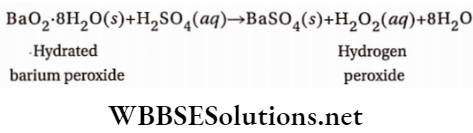
Principle: The laboratory preparation of hydrogen peroxide involves reacting an ice-cold thin paste of hydrated barium peroxide (BaO2-8H2O) with an ice-cold solution of 20% H2SO4.

Hydrogen From barium peroxide

Procedure: In a beaker, a thin paste of hydrated barium peroxide is prepared by adding a small amount of water to it. In another beaker, 20% dilute H2SO4 is taken. Both the beakers are well-cooled by placing them in a freezing mixture.

  • Then the cold paste is slowly added to the cold acid solution, and kept in a freezing mixture, with constant stirring. The addition of paste is stopped when the mixture remains still slightly acidic.
  • As a result of the reaction between barium peroxide and dilute sulphuric acid, H2O2 is produced and white insoluble BaSO4 is precipitated. Solid BaSO4 is then separated by filtration when a dilute aqueous solution (5%) of H2O2 is obtained as the filtrate.

Limitations: Hydrogen peroxide prepared by this method contains appreciable amounts of Ba2+ ions (in the form of dissolved barium persulphate) which may catalyze the decomposition of H2O2. Therefore, H2O2 prepared by this method cannot be preserved for a long time.

Hydrogen Peroxide Safety Guidelines for Students

  1. The reaction should be carried out at low temperatures because H2O2 is a very unstable compound that dissociates easily into H2O and O2 if the temperature is increased.
  2. Dilute H2SO4 instead of concentrated H2SO4 is to be used because H2O2 may decompose by the heat evolved when cone. H2SO4 reacts with BaO2.
  3. A thin paste of hydrated barium peroxide instead of anhydrous barium peroxide is to be used. This is because the heat generated by the addition of H2SO4 on anhydrous BaO2 decomposes H2O2 to H4O and O2.
    Moreover, if anhydrous Ba02 is used, an insoluble layer of BaSO4 is formed on it which prevents further reaction. However, there is no evolution of heat when a thin paste of BaO2 is used. Also, BaO2-8H2O exists as fine particles and this prevents the formation of insoluble BaSO4, and the reaction proceeds.
  4. The paste of BaO2 is poured into dilute H2SO4. If dilute H2SO4 is added to the paste, the concentration of BaO2 at the beginning of the reaction becomes sufficiently higher as compared to that of the acid. As a consequence, the mixture becomes basic in nature.
    In this basic medium, the decomposition of H2O2 becomes very fast. On the other hand, if the paste is poured into the ice-cold dilute acid, the mixture always contains an excess of the acid and this prevents the decomposition of H2O2.
  5. At the end of the reaction, the mixture should contain a small amount of surplus acid. This is because the excess acid acting as a negative catalyst decelerates the rate of decomposition of H2O2.
  6. In this process, neither HCl nor HNO3 can be used. HCl is not used because it reacts with BaOz to form water-soluble BaCl2 and the separation of H2O2 from the mixture becomes quite difficult HNO3 (an oxidizing agent) is not used as it oxidizes H2O2: H2O2 2HNO3→ 2H2O + 2NO2 + O2. Moreover, due to the formation of water-soluble Ba(NO3)2, the separation of H2O2 becomes difficult.
  7. It is better to use syrupy phosphoric acid instead of dilute sulphuric acid. This is because in the reaction of barium peroxide with dilute H2SO4, water-soluble barium persulphate (BaS208) is produced which decomposes H2O2. However, when syrupy phosphoric acid is used, the phosphate ions \(\left(\mathrm{PO}_4^{3-}\right)\) separate the heavy metal impurities like Pb2+ (which promotes the decomposition of H2O2) present in BaO2 as insoluble phosphates. Therefore, although both H2SO4 and H3PO4 slow down the dissociation of H2O2, it is better to use H3PO4.

Physical Properties of Hydrogen Peroxide for Class 11

The Reaction Of CO2 And Barium Peroxide

When a stream of CO2 is passed through a thin paste of barium peroxide in ice-cold water, H2O2 and BaCO3 are produced. The insoluble BaCO3 is separated by filtration when a dilute solution of H2O2 is obtained.

BaO2 + H2O + CO2→BaCOgl↓ + H2O2

Manufacture Of Hydrogen Peroxide

By the electrolysis of 50% H2SO4: H2O2 is manufactured by the electrolysis of 50% H2SO4 solution which is carried out at low temperature (-20°C) using platinum electrodes and a current of high density. Dihydrogen is liberated at the cathode and peroxodi sulphuric acid (H2S2O8) or Marshall’s acid is liberated at the anode.

⇒ \(2 \mathrm{H}_2 \mathrm{SO}_4 \rightleftharpoons 2 \mathrm{H}^{+}+2 \mathrm{HSO}_4^{-}\)

Cathode: \(2 \mathrm{H}^{+}+2 e \rightarrow 2[\mathrm{H}] \rightarrow \mathrm{H}_2\)

Anode: \( 2 \mathrm{HSO}_4^{-} \longrightarrow \mathrm{H}_2 \mathrm{~S}_2 \mathrm{O}_8+2 e\) peroxide sulphuric acid

Peroxodisulphuric acid is collected from the anode chamber and then distilled with water under reduced pressure, when it gets hydrolyzed. The low boiling H2O2 distills over along with water leaving behind the high boiling H2SO4 in the flask.

⇒ \(\mathrm{H}_2 \mathrm{~S}_2 \mathrm{O}_8+\mathrm{H}_2 \mathrm{O} \rightarrow \mathrm{H}_2 \mathrm{SO}_5+\mathrm{H}_2 \mathrm{SO}_4\)

⇒ \(\mathrm{H}_2 \mathrm{SO}_5+\mathrm{H}_2 \mathrm{O} \rightarrow \mathrm{H}_2 \mathrm{SO}_4+\mathrm{H}_2 \mathrm{O}_2\)

Class 11 Physics Class 12 Maths Class 11 Chemistry
NEET Foundation Class 12 Physics NEET Physics

Hydrogen Peroxide Concentration and Volume Strength Explained

Modification: A recent modification of the above method involves the use of an equimolar mixture of sulphuric acid and ammonium sulfate for electrolysis. Ammonium persulphate [(NH4)2S2O8] formed around the anode is collected and then distilled with water to form H2O2.

⇒ \(\left(\mathrm{NH}_4\right)_2 \mathrm{SO}_4+\mathrm{H}_2 \mathrm{SO}_4 \rightarrow 2 \mathrm{NH}_4 \mathrm{HSO}_4\)

⇒ \(\mathrm{NH}_4 \mathrm{HSO}_4 \rightleftharpoons \mathrm{NH}_4 \mathrm{SO}_4^{-}+\mathrm{H}^{+}\)

Cathode: \(2 \mathrm{NH}_4 \mathrm{SO}_4^{-}-2 e \rightarrow\left(\mathrm{NH}_4\right)_2 \mathrm{~S}_2 \mathrm{O}_8\)

Anode: 2\(\mathrm{NH}_4 \mathrm{SO}_4^{-}-2 e \rightarrow\left(\mathrm{NH}_4\right)_2 \mathrm{~S}_2 \mathrm{O}_8\)

⇒ \(\left(\mathrm{NH}_4\right)_2 \mathrm{~S}_2 \mathrm{O}_8+2 \mathrm{H}_2 \mathrm{O} \rightarrow 2 \mathrm{NH}_4 \mathrm{HSO}_4+\mathrm{H}_2 \mathrm{O}_2\)

Deuteroperoxide (D2O2) may be prepared by using K2SO4 instead of (NH4)2SO4 in the above process and distilling the resulting potassium persulphate with D2O.

⇒ \(\mathrm{K}_2 \mathrm{~S}_2 \mathrm{O}_8(s)+2 \mathrm{D}_2 \mathrm{O}(l) \rightarrow 2 \mathrm{KDSO}_4(a q)+\mathrm{D}_2 \mathrm{O}_2(l)\)

By auto-oxidation of 2-ethylanthraquinol: in this process, the air is passed through a 10% solution of 2-ethylanthraquinol in benzene and cyclohexanol when 2-ethylanthraquinol is oxidized by oxygen of air to 2-ethyl anthraquinone and oxygen is reduced to H2O2. The resulting H2O2 is separated from the organic layer by extraction with deionized water and the aqueous solution is distilled under reduced pressure to give a 30% (by weight) H2O2 solution.

2-ethyl-anthraquinone thus obtained is reduced with H2 in the presence of Pd catalyst to give back 2- ethylanthraquinol which is used again. Therefore, the raw materials required in this process are H2 and atmospheric oxygen which are inexpensive. Therefore, this modern industrial method of H2O2 preparation is the most convenient and economical.

Hydrogen By auto-oxidation of 2-ethylanthraquinol

Chemical Properties of Hydrogen Peroxide: Class 11 Notes

By partial oxidation of 2-propanol:

⇒ \(\underset{\text { 2-propanol }}{\left(\mathrm{CH}_3\right)_2 \mathrm{CHOH}} \underset{\text { [under pressure] }}{\stackrel{\left(\text { little } \mathrm{H}_2 \mathrm{O}_2\right)+\mathrm{O}_2}{\longrightarrow}} \underset{\text { 2-propanone }}{\left(\mathrm{CH}_3\right)_2 \mathrm{C}=\mathrm{O}}+\mathrm{H}_2 \mathrm{O}_2\)

Preparation of H2O2 from Us dilute aqueous solution: Hydrogen peroxide produced by any of the above methods is in the form of a dilute solution. The solution is concentrated simply by heating it because H2O2 readily decomposes below its boiling point (2H2O2—>2H2O + O2). The dilute solution of H2O2 is concentrated carefully to get pure H2O2 by the following steps:

Hydrogen Peroxide Preparation Methods for Class 11

  1. The dilute solution of H2O2 is heated carefully in a water bath. Slow evaporation of water leads to the formation of a 50% H2O2 solution.
  2. The 50% solution thus obtained is placed in a vacuum desiccator over concentrated H2S04 when approximately 90% H2O2 solution is obtained.
  3. The 90% solution is distilled under reduced pressure (10-15 mm) when about 99% pure H2O2 is obtained.
  4. The 99% solution is finally cooled in a freezing mixture of solid CO2 and ether when crystals of H2O2 separate out. These are removed, dried, and remelted to yield very pure H2O2.

WBCHSE Class 11 Chemistry Preparation and Properties of Dihydrogen Notes

Preparation Of Dihydrogen, H2

WBBSE Class 11 Dihydrogen Preparation Methods

Preparation Of Dihydrogen In The Laboratory

Dihydrogen

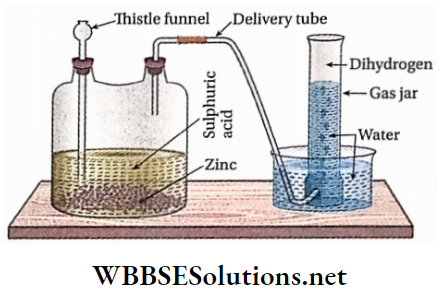
Principle: In the laboratory, dihydrogen is prepared by the action of dilute sulphuric acid on granulated zinc (commercial variety).

Hydrogen Preparation of dihydrogen

Laboratory Preparation of Dihydrogen Notes

Process: Dilute sulphuric acid is added through a thistle funnel to some pieces of granulated zinc taken in a Wolff’s bottle. The liberated hydrogen gas is collected by the downward displacement of water.

Pure zinc cannot be used in this process because it reacts sluggishly with dilute H2SO4. Impurities like Cu, Cd, etc. present in commercial zinc help to speed up tire reactions by constituting electrochemical couples (local Galvanic cells). If pure zinc is used, a few drops of CuSO4 solution should be added to the reaction mixture to increase the reaction rate.

Concentrated H2SO4 cannot be used in this preparative method because being oxidizing in nature it oxidizes dihydrogen into the water and itself gets reduced to SO2 For the same basic reason, concentrated HNO3 is not used.

Read and Learn More WBCHSE Class 11 Chemistry

⇒ \(\mathrm{Zn}+2 \mathrm{H}_2 \mathrm{SO}_4 \text { (conc.) } \rightarrow \mathrm{ZnSO}_4+\mathrm{SO}_2+2 \mathrm{H}_2 \mathrm{O}\)

⇒ \(\left.\mathrm{Zn}+4 \mathrm{HNO}_3 \text { (conc. }\right) \rightarrow \mathrm{Zn}\left(\mathrm{NO}_3\right)_2+2 \mathrm{NO}_2+2 \mathrm{H}_2 \mathrm{O}\)

Concentrated HCl cannot be used in the preparation of dihydrogen because the produced dihydrogen will contain times of volatile HCl. Moreover, ZnCl2 formed in the reaction is insoluble in HCl and hence the reaction stops after some time

⇒ \(\mathrm{Zn}+2 \mathrm{HCl} \rightarrow \mathrm{ZnCl}_2+\mathrm{H}_2 \uparrow\)

Various Methods Of Preparation Of Dihydrogen

By the reaction of dilute mineral acids with metals:

⇒ \(\mathrm{Zn}+\mathrm{H}_2 \mathrm{SO}_4 \rightarrow \mathrm{ZnSO}_4+\mathrm{H}_2 \uparrow ; \mathrm{Mg}+2 \mathrm{HCl} \rightarrow \mathrm{MgCl}_2+\mathrm{H}_2 \uparrow\)

By the reaction of water with metals:

WBCHSE Class 11 Chemistry Preparation and Properties of Dihydrogen Notes

Chemical Properties of Dihydrogen for Class 11

1. By the reaction of certain alkali and alkaline earth metals with water at room temperature:

⇒ \(2 \mathrm{M}+2 \mathrm{H}_2 \mathrm{O} \rightarrow 2 \mathrm{MOH}+\mathrm{H}_2 \uparrow[\mathrm{M}=\mathrm{Na}, \mathrm{K}]\)

⇒ \(\mathrm{M}^{\prime}+2 \mathrm{H}_2 \mathrm{O} \rightarrow \mathrm{M}^{\prime}(\mathrm{OH})_2+\mathrm{H}_2 \uparrow\left[\mathrm{M}^{\prime}=\mathrm{Ca}, \mathrm{Sr}, \mathrm{Ba}\right]\)

Reactions with these very active metals are so vigorous and exothermic that the liberated hydrogen immediately catches fire which may cause accidents. Because of high I.E., Be does not react with water (hot and cold) to produce H2.

2. By the reaction of less active metals like Mg, A1, Zn, etc., with boiling water: Mg, Al, Zn, etc. (less active metals) react with boiling water to produce dihydrogen.

⇒ \(\mathrm{Mg}+\mathrm{H}_2 \mathrm{O} \stackrel{\Delta}{\longrightarrow} \mathrm{Mg}(\mathrm{OH})_2+\mathrm{H}_2 \uparrow\)

⇒ \(2 \mathrm{Al}+6 \mathrm{H}_2 \mathrm{O} \stackrel{\Delta}{\longrightarrow} 2 \mathrm{Al}(\mathrm{OH})_3+3 \mathrm{H}_2 \uparrow\)

3. By the reaction of least active metals like iron and zinc with steam: Least active metals like Fe and Zn react with steam to produce dihydrogen.

⇒ \(3 \mathrm{Fe}+4 \mathrm{H}_2 \mathrm{O} \stackrel{\Delta}{\longrightarrow} \mathrm{Fe}_3 \mathrm{O}_4+4 \mathrm{H}_2 \uparrow\)

⇒ \(\mathrm{Zn}+\mathrm{H}_2 \mathrm{O} \stackrel{\Delta}{\longrightarrow} \mathrm{ZnO}+\mathrm{H}_2 \uparrow\)

By the reaction of strong alkali with metals and certain non-metals: Metals like Al, Sn, Zn, Si, etc., react with strong alkali to liberate dihydrogen.

⇒ \( 2 \mathrm{Al}+2 \mathrm{NaOH}+2 \mathrm{H}_2 \mathrm{O} \rightarrow 2 \mathrm{NaAlO}_2+3 \mathrm{H}_2 \uparrow\)
Sodium aluminate

⇒ \(\mathrm{Sn}+2 \mathrm{NaOH} \rightarrow \mathrm{Na}_2 \mathrm{SnO}_2+\mathrm{H}_2 \uparrow\)
Sodium stannate

⇒ \( \mathrm{Zn}+2 \mathrm{NaOH} \rightarrow \mathrm{Na}_2 \mathrm{ZnO}_2+\mathrm{H}_2 \uparrow\)
Sodium zincate

⇒ \( \mathrm{Si}+2 \mathrm{NaOH}+\mathrm{H}_2 \mathrm{O} \rightarrow \mathrm{Na}_2 \mathrm{SiO}_3+2 \mathrm{H}_2 \uparrow\)
Sodium silicate

By the hydrolysis of ionic hydrides:

⇒ \(\mathrm{CaH}_2+2 \mathrm{H}_2 \mathrm{O} \rightarrow \mathrm{Ca}(\mathrm{OH})_2+2 \mathrm{H}_2 \uparrow\)

⇒ \(\mathrm{LiH}+\mathrm{H}_2 \mathrm{O} \rightarrow \mathrm{LiOH}+\mathrm{H}_2 \uparrow\)

Calcium hydride (CaH2) is called hydrolith and the method of preparing dihydrogen from it is known as the hydrolith process.

By the electrolysis of molten ionic hydrides: in a molten state, ionic hydrides except LiH conduct electricity with the liberation of dihydrogen at the anode.

⇒ \(\mathrm{CaH}_2(\text { molten }) \rightarrow \mathrm{Ca}^{2+}+2 \mathrm{H}^{-}\)

Cathode: \(\mathrm{Ca}^{2+}+2 e \rightarrow \mathrm{Ca}\)

Anode: \(2 \mathrm{H}^{-} \rightarrow \mathrm{H}_2 \uparrow+2 e\)

Class 11 Physics Class 12 Maths Class 11 Chemistry
NEET Foundation Class 12 Physics NEET Physics


Preparation Of Pure Dihydrogen

Pure dihydrogen (>99.95%) can be prepared by the following methods:

1. By the action of pure dilute H2SO4 on Mg -ribbon:

⇒ \(\mathrm{Mg}+\mathrm{H}_2 \mathrm{SO}_4 \rightarrow \mathrm{MgSO}_4+\mathrm{H}_2 \uparrow\)

2. By the hydrolysis of sodium hydride:

⇒ \(\mathrm{NaH}+\mathrm{H}_2 \mathrm{O} \rightarrow\mathrm{NaOH}+\mathrm{H}_2 \uparrow\)

3. By the action of KOH on scrap aluminum (Uyeno’s method):

⇒ \(2 \mathrm{Al}+2 \mathrm{KOH}+2 \mathrm{H}_2 \mathrm{O} \rightarrow 2 \mathrm{KAlO}_2+3 \mathrm{H}_2 \uparrow\)

4. By the electrolysis of a warm dilute solution of barium hydroxide [Ba(OH)2] using orPt-electrode:

Cathode: \(2 \mathrm{H}_2 \mathrm{O}(l)+2 e \rightarrow \mathrm{H}_2(g)+2 \mathrm{OH}^{-}(a q)\)

5. By electrolysis of brine solution:

Cathode: \(2 \mathrm{H}_2 \mathrm{O}(l)+2 e \rightarrow \mathrm{H}_2(g)+2 \mathrm{OH}^{-}(a q)\)

Industrial Preparation Of Dihydrogen

Lane’s process:

This process consists of two stages:

Oxidation stage: Superheated steam is passed over iron filings heated to about 750-800°C. Iron reduces water to dihydrogen and itself gets oxidized to Fe3O4

⇒ \(\begin{gathered} 3 \mathrm{Fe}(s)+\underset{2}{4 \mathrm{H}_2 \mathrm{O}(g) \stackrel{750-800^{\circ} \mathrm{C}}{\longrightarrow}} \mathrm{Fe}_3 \mathrm{O}_4(s)+4 \mathrm{H}_2(g)+\text { heat } \\ \text { steam } \end{gathered}\)

Industrial Methods of Dihydrogen Production

Reduction stage: After the complete oxidation of iron to Fe3O4, the supply of steam is stopped and a steam of water gas (H2 + CO) is passed to reduce Fe3O4 back to iron.

⇒ \(\mathrm{Fe}_3 \mathrm{O}_4+4 \mathrm{H}_2 \rightarrow 3 \mathrm{Fe}+4 \mathrm{H}_2 \mathrm{O} ;\)

⇒ \(\mathrm{Fe}_3 \mathrm{O}_4+4 \mathrm{CO} \rightarrow 3 \mathrm{Fe}+4 \mathrm{CO}_2\)

In the actual process, dihydrogen gas is manufactured from a small amount of iron by passing steam and water gas over it alternately.

Bosch process:

This process involves the steps as follows:

Preparation of watergate /syngas:

1. Water gas (1:1 mixture of CO and H2 ) is produced by passing superheated steam over red hot coke in the presence of Ni catalyst. This process of producing water gas (also called syngas, a term used to indicate a mixture of CO & H2 in any ratio) from coke or coal is called “coal gasification.”

⇒ \(\mathrm{C}(s)+\mathrm{H}_2 \mathrm{O}(g) \stackrel{1000^{\circ} \mathrm{C}}{\mathrm{Ni}} \underbrace{\mathrm{CO}(g)+\mathrm{H}_2(g)}_{\text {Water gas }}-121.3 \mathrm{~kJ}\)

2. Syngas may also be produced by heating hydrocarbon with steam at 1000°C in the presence of a nickel catalyst. This is called steam reforming of hydrocarbon.

⇒ \(\mathrm{C}_n \mathrm{H}_{2 n+2}+n \mathrm{H}_2 \mathrm{O}(\mathrm{g}) \stackrel{1000^{\circ} \mathrm{C}}{\mathrm{Ni}} \underbrace{n \mathrm{CO}(g)+(2 n+1) \mathrm{H}_2}_{\text {Syngas }}\)

Example: \(\mathrm{C}_3 \mathrm{H}_8(g)+3 \mathrm{H}_2 \mathrm{O}(g) \stackrel{1000^{\circ} \mathrm{C}}{\longrightarrow} 3 \mathrm{CO}(g)+7 \mathrm{H}_2(g)\)

Separation of dlhydrogen:

When syngas are passed over steam in the presence of iron chromate or a mixture of ferric oxide and chromium oxide heated at 400°C, CO is oxidized and more hydrogen is produced.

Hydrogen Separation ofdlhydrogen

This is called the water gas shift reaction. When the resulting mixture is passed through the water under 30 atm pressure, C2 dissolves leaving behind H2 which is collected.

Electrolysis of water: In this process, electrolysis of a 15-20% NaOH solution is carried out using an iron cathode and nickel-coated iron anode. Pure water is a bad conductor of electricity while water containing a small amount of alkali (or acid) is a good conductor of electricity.

Cathode:\(2 \mathrm{H}_2 \mathrm{O}(l)+2 e \rightarrow 2 \mathrm{H}_2(g)+2 \mathrm{OH}^{-}(a q)\)

Anode:\(2 \mathrm{Cl}^{-}(a q) \rightarrow \mathrm{Cl}_2(g)+2 e\)

Overall reaction:

⇒ \(2 \mathrm{Cl}^{-}(a q)+2 \mathrm{H}_2 \mathrm{O}(l) \rightarrow\mathrm{Cl}_2(g)+\mathrm{H}_2(g)+2 \mathrm{OH}^{-}(a q)\)

From methanol: The process involves the catalytic decomposition of methanol. A 1:1 mixture of vaporized methanol and water is passed over a special type of catalyst ‘base metal chromite type’ at 400°C. The mixture of H2 and CO obtained as a result of the decomposition reaction is made to react with steam at the temperature to give CO2 and more H2 gas.

⇒ \(\mathrm{CH}_3 \mathrm{OH} \underset{\text { Catalyst }}{\stackrel{40{ }^{\circ} \mathrm{C}}{\longrightarrow}} \mathrm{CO}+2 \mathrm{H}_2 ; \mathrm{CO}+\mathrm{H}_2 \mathrm{O} \underset{\text { Catalyst }}{\stackrel{400^{\circ} \mathrm{C}}{\longrightarrow}} \mathrm{CO}_2+\mathrm{H}_2\)

CO2 is separated bypassing the gas mixture through cold water under pressure.

At present, about 77% of industrial hydrogen is produced from petrochemicals, 18% from coal, 4% from the electrolysis of aqueous solutions, and 1% from other sources.

Properties Of Dihydrogen

Physical properties of Dihydrogen 

  1. Dihydrogen is a colorless, odorless, tasteless, and highly inflammable gas.
  2. It is the lightest gas known. For example, one liter of H2 gas at STP weighs 0.0899 g. Its density is approximately 1/14 -th of that of air.
  3. It is diatomic gas (r = Cp/Cv = 1.40). The two atoms are joined by a very strong covalent bond (bond dissociation enthalpy = 435.9 kj • mol-1 ).
  4. Since its molecules are non-polar its solubility in water is extremely low.
  5. It can be liquefied under high pressure and at low temperatures.

Hydrogen Some physical constants of atomic and molecular hydrogen

Dihydrogen Uses and Applications in Chemistry

Chemical Properties of Dihydrogen 

  • The chemical properties of dihydrogen depend mainly on its bond dissociation enthalpy. The bond dissociation enthalpy of the H —H bond (435.88kj • mol-1 ) is higher than that of any single bond between two atoms.
  • At 2000K, only 0.081% of it dissociates to form H-atoms. At 5000K, the percentage of dissociation increases to about 95.5%. Hence, the activation energy of the reactions involving H2 is very high and at ordinary temperature is very stable and unreactive.
  • Nearly all of its reactions occur at much higher temperatures or under ultraviolet radiations. Atomic hydrogen having electronic configuration Is1 needs one more electron to complete its orbital. Therefore, atomic hydrogen is very reactive and capable of combining with almost all the elements.

It reacts in three different ways:

  1. By the loss of its single electron to form H+,
  2. By the gain of one electron to form H ion and
  3. By sharing its electrons with other atoms to form single covalent bonds.

Dihydrogen Reactions with Metals and Nonmetals

Combustion: Dihydrogen is a combustible gas but does not support combustion. It burns with blue flame in air or in oxygen and as a result, water is formed. The reaction is highly exothermic.

⇒ \(2 \mathrm{H}_2(g)+\mathrm{O}_2(g) \stackrel{\Delta}{\longrightarrow} 2 \mathrm{H}_2 \mathrm{O}(l), \Delta H=-286 \mathrm{~kJ} \cdot \mathrm{mol}^{-1}\)

Reaction with non-metals:

1. Reaction with halogens to form hydrogen halides (HX):

It combines with fluorine in the dark and at ordinary temperatures, with chlorine in the presence of sunlight, with bromine when heated, and with iodine when heated in the presence of Pt -catalyst to form the corresponding hydrogen halides.

⇒ \(\mathrm{H}_2(\mathrm{~g})+\mathrm{F}_2(\mathrm{~g}) \stackrel{\text { Dark }}{\longrightarrow} 2 \mathrm{HF}(\mathrm{g}) ; \mathrm{H}_2(\mathrm{~g})+\mathrm{Cl}_2(\mathrm{~g}) \stackrel{\text { Sunlight }}{\longrightarrow} 2 \mathrm{HCl}(\mathrm{g})\)

⇒ \(\mathrm{H}_2(g)+\mathrm{Br}_2(g) \stackrel{673 \mathrm{~K}}{\longrightarrow} 2 \mathrm{HBr}(g) ; \mathrm{H}_2(g)+\mathrm{I}_2(g) \underset{\mathrm{Pt}}{\longrightarrow} 2 \mathrm{HI}(g)\)

Therefore, the reactivity of halogens towards dihydrogen decreases in the order: \(\mathrm{F}_2>\mathrm{Cl}_2>\mathrm{Br}_2>\mathrm{I}_2\)

Physical Properties of Dihydrogen: Class 11 Overview

2. Reaction with nitrogen to form ammonia:

⇒ \(3 \mathrm{H}_2(g)+\mathrm{N}_2(g) \underset{\mathrm{Fe}(\mathrm{Mo})}{\stackrel{673 \mathrm{~K} / 200 \mathrm{~atm}}{\longrightarrow}} 2 \mathrm{NH}_3(g)+\text { heat }\)

3. Reaction with sulfur to form hydrogen sulfide:

⇒ \(\mathrm{H}_2(g)+\mathrm{S}(l) \stackrel{700 \mathrm{~K}}{\longrightarrow} \mathrm{H}_2 \mathrm{~S}(g)\)

4. Reaction with carbon to form methane and acetylene:

⇒ \(2 \mathrm{H}_2(g)+\mathrm{C}(s) \stackrel{1275 \mathrm{~K}}{\longrightarrow} \mathrm{CH}_4(g)\)

⇒ \(\mathrm{H}_2(g)+2 \mathrm{C}(s) \underset{3300 \mathrm{~K}}{\stackrel{\text { Electric spark }}{\longrightarrow}} \mathrm{C}_2 \mathrm{H}_2(g)\)

Reaction with metals: Dihydrogen reacts with strongly electropositive metals like Na, K, Ca, etc., at much higher temperatures to form salt-like (ionic) metal hydrides. In these hydrides, the oxidation state of hydrogen is -1. In these reactions, H2 acts as an oxidizing agent.

⇒ \(\begin{array}{r} \stackrel{0}{\mathrm{H}}_2(g)+2 \mathrm{M}(g) \rightarrow 2 \mathrm{MH}^{-1}(s) ; \stackrel{0}{\mathrm{H}}_2(g)+\mathrm{M}^{\prime}(g) \rightarrow \mathrm{M}^{\prime-1} \mathrm{H}_2(s) \\ {\left[\mathrm{M}=\mathrm{Li}, \mathrm{Na}, \mathrm{K} \text { etc. and } \mathrm{M}^{\prime}=\mathrm{Ca}, \text { Ba etc. }\right]} \end{array}\)

Reaction with metal ions and metal oxides:

Dihydrogen reduces some metal ions (metals lying below hydrogen in the activity series) in aqueous solutions to the corresponding metals.

⇒ \(\mathrm{CuO}(s)+\mathrm{H}_2(g) \stackrel{\text { heat }}{\longrightarrow} \mathrm{Cu}(s)+\mathrm{H}_2 \mathrm{O}(l)\)

⇒ \(\mathrm{PbO}(s)+\mathrm{H}_2(g) \stackrel{\text { heat }}{\longrightarrow} \mathrm{Pb}(s)+\mathrm{H}_2 \mathrm{O}(l)\)

Reaction with carbon monoxide to form methanol:

⇒ \(\mathrm{CO}(g)+2 \mathrm{H}_2(g) \underset{\mathrm{ZnO} / \mathrm{Cr}_2 \mathrm{O}_3}{\stackrel{700 \mathrm{~K} / 200 \mathrm{~atm}}{\longrightarrow}} \mathrm{CH}_3 \mathrm{OH}(l)\)

Reaction with organic compounds: Dihydrogen reacts with many organic compounds in the presence of a catalyst to form useful hydrogenated products which are commercially important. For example:

1. When dihydrogen is passed through edible vegetable oils such as soybean oil, groundnut oil, cotton seed oil, etc., at about 200°C under pressure in the presence of finely divided Ni as a catalyst, they undergo hardening and change into edible fats such as vanaspati ghee (Example data) or margarine. In this reaction, the C=C bonds present in glycerides or triglycerides (triesters of glycerol) become saturated.

Hydrogen Reaction with organic compounds

The above process is known as hydrogenation or hardening of oils.

2. Hydroformylation is an important process for the manufacture of aldehydes and alcohols from alkenes. The reaction which involves the addition of a formyl group ( —CHO) and hydrogen atom to a carbon-carbon double bond, is carried out by treating alkenes with CO and H2 at high pressure (10-100 atm) and at temperatures between 40-200°C using transition metals as catalysts. The aldehydes thus obtained further get reduced to alcohols.

Hydrogen Reaction with organic compounds.

Proton (H+) has no chemical existence. Because of higher charge density and higher hydration enthalpy (256 kcal • mol-1), in water, it always remains solvated forming droxoniumion or hydroniumion or oxoniumion \(\left(\mathrm{H}_3 \mathrm{O}^{\oplus}\right)\). This ion is again stabilized by solvation through hydrogen bonding with water molecules. Therefore, in water H+ ions actually exists as [H30(H20)3)+ or [H9O4]+ions.

Allotropy Of Dihydrogen And The Two Active Forms Of Dihydrogen

Hydrogen Production by Electrolysis Explained

Ortho- And Para-Hydrogen

  • A dihydrogen molecule contains two H-atoms. The nuclei of both atoms are spinning about their own axis like a top. Depending upon the direction of spin of the nuclei, the molecules of hydrogen are of two types.
  • Dihydrogenin which the spins of both the nuclei are in the same direction (parallel spin) is called ortho-hydrogen and dihydrogen in which the spins of both the nuclei are in the opposite direction (antiparallel spin) is called para-hydrogen.
  • These two types of dihydrogen are called nuclear spin isomers. These are also called allotropes of hydrogen. At ordinary temperatures, dihydrogen contains 75% ortho- and 25% para-hydrogen.
  • As the temperature is lowered the percentage of ortho-hydrogenin tire mixture decreases while that of the para-hydrogen increases. At very low temperatures (20K), it is possible to obtain pure (-100%) para-hydrogen.
  • At high temperatures (>400K), the mixture contains 75% ortho-form. Therefore, the para-form has lower energy as compared to the ortho-form. Both ortho- and para-forms of H2 have the same chemical properties.
  • However, due to different nuclear spins and consequently, different internal energies, they have different physical properties like specific heat, thermal conductivity, boiling point, etc.

Deuterium and helium also exist in ortho and para-allotropic forms.

Hydrogen Spin isomers of hydrogen

Atomic hydrogen

Atomic hydrogen Definition:

Hydrogen in its atomic state, produced by the dissociation of molecular hydrogen at a very high temperature is called atomic hydrogen.

Safety Guidelines for Handling Dihydrogen

Preparation:

Because of high H—H bond dissociation enthalpy, atomic hydrogen is produced only at a much higher temperature. It is usually obtained by passing dihydrogen at atmospheric pressure through an electric arc struck between two tungsten electrodes. The electric arc produces a temperature around 4000-4500°C.

⇒ \(\mathrm{H}_2(\mathrm{~g}) \stackrel{\text { Electric arc }}{\longrightarrow} 2 \mathrm{H}(\mathrm{g}) ; \Delta H=435.90 \mathrm{~kJ} \cdot \mathrm{mol}^{-1}\)

Hydrogen Atomic hydrogen torch

Uses: Atomic hydrogen is very’ reactive (lifetime 0.3 sec). As soon as the hydrogen atoms come in contact with any metallic surface, they immediately get converted into molecular form liberating a large amount of energy (nearly 4000°C), and as a consequence, an extremely hot flame is produced. An atomic hydrogen torch, devised on this principle, is used for welding and cutting purposes

WBCHSE Class 11 Physics For Vibration of Strings and Air Columns

Superposition Of Waves Vibration Air Columns

WBBSE Class 11 Vibration of Strings Overview

Musical instruments like flute, organ, etc., are played by vibrating the air columns enclosed within them. Similarly, sound can be produced by blowing the air columns in whistles, thin pipes, etc.

Such an instrument, whatever be its shape, can be considered, as a pipe or tube enclosing an air column within it. In general, there are two types of pipes.

  1. A pipe having one end open and the other closed is called a closed pipe;
  2. A pipe having both ends open is called an open pipe.
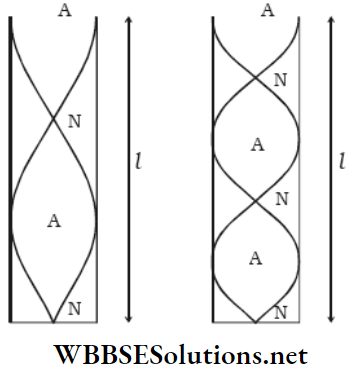
Superposition Of Waves Vibration Of Air Column Open Pipe And Close Pipe

  • In the case of air columns, a closed-end in a column of air is analogous to the fixed end of a vibrating string. That is, at the closed end of an air column, the air is not free to undergo movement.
  • Thus it is assumed the nodal position a standing wave, conversely, the air is free to undergo its back-and-forth longitudinal motion at the open end of the air column, and as such, the standing wave pattern will depict antinodes at the open ends of air columns.
  • Now, we may hold a vibrating tuning fork or we may whiff at the open end B of a closed or an open pipe. Then a longitudinal sound wave propagates along the pipe towards the end A. This wave is reflected at A.
Superposition Of Waves Vibration Of Air Column

Vibrating Air Columns: Key Concepts

When this reflected wave comes back towards B, the incident and the reflected waves superpose. As a result, a stationary wave is generated within the pipe. This stationary wave produces the musical note emitted by instruments like flute, organ, etc.

Characteristics Of The Stationary Waves In An Air Column:

  1. Since sound waves are longitudinal waves, the stationary waves generated in an air column are longitudinal stationary waves. We may recall that the waves in a vibrating stretched string are transverse stationary waves.
  2. The air particles at the closed end (end A) of a closed pipe cannot vibrate at all. So, a node is generated at the closed end. On the other hand, the air particles at the open end (end B) of a closed pipe or at both the open ends of an open pipe, can vibrate with maximum amplitude. So, an antinode is generated at each open end.
  3. The distance between two consecutive nodes or between two consecutive antinodes is \(\frac{\lambda}{2}\); here A = wavelength of the sound wave. Likewise, the distance between a node and its adjacent antinode = \(\frac{\lambda}{4}\).

Closed Pipe: Let the length of a closed pipe be l and the velocity of sound be V. In a closed pipe, incident waves, reflected waves from closed ends and the stationary wave produced are longitudinal waves. But for convenience, the waves in the pipe are drawn.

WBCHSE Class 11 Physics For Vibration of Strings and Air Columns

Fundamental Tone In A Dosed Pipe: For the simplest stationary wave in a closed pipe, the node is at the closed end and the antinode is at the open end. There is no other node or antinode between them. So, the tone produced in the pipe is called the fundamental tone or the fundamental.
Superposition Of Waves Fundamental Tone In A Closed Pipe

Fundamental Frequency of a Vibrating String

If λ0 is the wavelength of the sound wave, the length of the pipe, l = the distance between a node and its adjacent antinode = \(\frac{\lambda_0}{4}\)

or, λ0 = 41.

So, the frequency of the emitted fundamental tone, \(n_0=\frac{V}{\lambda_0}=\frac{V}{4 l}\)…..(1)

This fundamental tone is also known as the 1st harmonic. Equation (1) implies that n0 increases when l decreases. As a result, the pitch of the emitted tone will be higher for shorter pipes.

Overtones In A Closed Pipe: When there is another node-antinode pair between the node at the closed end and the antinode at the open end, the next higher tone or the 1st overtone is produced.

If λ1 is the wavelength of the sound wave, the length of the pipe, l = distance between the node at the closed end and the second antinode from it = \(\frac{3 \lambda_1}{4}\)

∴ \(\lambda_1=\frac{4 l}{3}\)

So, the frequency of the emitted tone, \(n_1=\frac{V}{\lambda_1}=3 \cdot \frac{V}{4 l}\)

Applications of String Vibration in Musical Instruments

Clearly, n1 = 3n0 …(2)

This means that the frequency of the 1st overtone is three times that of the fundamental. For this reason, the 1st overtone is called the 3rd harmonic.

Similarly, for two node-antinode pairs between the open and the closed ends, the 2nd overtone is produced. The same calculations show that n2 = 5 n0; the frequency of the 2nd overtone is five times that of the fundamental.

So, it is the 5th harmonic. Clearly, the next overtones will have frequencies, n3 = 7n0, n4 = 9n0, ………., np = (2p+ 1)n0, etc.

The following two features are evident in this case:

  1. The frequency of each overtone is an integral multiple of the fundamental frequency. So, each overtone is a harmonic.
  2. The harmonics with frequencies \(2 n_0, 4 n_0, 6 n_0, \cdots\) are absent. So, a closed pipe can emit the fundamental tone and its odd harmonics only.

Open Pipe: Let the length of an open pipe be l and the velocity of sound be V. In an open pipe, incident waves, reflected waves from open ends and the stationary wave produced are longitudinal waves. But, for convenience, the waves in the pipe are drawn in as transverse waves.

Fundamental Tone In An Open Pipe: For the simplest stationary wave in an open pipe, two antinodes are formed at the two ends. There is only one node just at the middle of the pipe. This is called the fundamental tone.
Superposition Of Waves Fundamental Tone In A Open Pipe

If λ0 is the wavelength of the sound wave, the length of the pipe, l = the distance between two consecutive antinodes = \(\frac{\lambda_0}{2}\)

or, λ0 = 21

So, the frequency of the emitted fundamental tone, \(n_1=\frac{V}{\lambda_1}=\frac{V}{l}=2 \cdot \frac{V}{2 l}\)…(2)

This fundamental tone is also known as the 1st harmonic.

Overtones In On Open Pipe: The 1st overtone is formed when two nodes lie between the two antinodes of the two ends and a third antinode is at the mid-point.

If λ1 is the wavelength of the sound wave, the length of the pipe, l = distance between three consecutive antinodes = λ1

i.e., λ1 = 1

So, the frequency of the emitted tone, \(n_1=\frac{V}{\lambda_1}=\frac{V}{l}=2\cdot \frac{V}{2 l}\)

Clearly, \(n_1=2 n_0\)

This means that the frequency of the 1st overtone is twice that of the fundamental. For this reason, the 1st overtone is called the 2nd harmonic.

Similarly, for three nodes between the antinodes at the open ends, the 2nd overtone is produced. The same calculations show that n2 = 3n0; the frequency of the 2nd overtone is 3 times that of the fundamental frequency. So, it is the 3rd harmonic. Clearly, the next overtones will have frequencies, \(n_3=4 n_0, n_4=5 n_0, n_5=6 n_0, \cdots, n_p=(p+1) n_0 \text {, etc. }\).

The Following Two Features Are Evident In This Case:

  1. The frequency of each overtone is an integral multiple of the fundamental frequency. So, each overtone is a harmonic.
  2. An open pipe can emit the fundamental tone and all its even and odd harmonics. No harmonic is absent in this case.

A closed pipe does not emit the even harmonics, but all the even and odd harmonics are emitted from an open pipe. So, in general, notes emitted from an open pipe have a greater number of overtones.

  • As a result, this note is of a higher quality and is more pleasant to hear as compared to that emitted from a closed pipe. For this reason, open pipes are used in all good-quality flutes, organs, etc.
  • The fundamental frequency is inversely proportional to the length of a closed or open pipe. In musical instruments like flute, some holes are made along its length. A good instrumentalist can open or close the holes according to the need and can change the effective length of the pipe. In this way, he can change and control the frequency of the emitted tones.

Comparison Of Frequencies Of The Tones Emitted By Closed And Open Pipes Of Equal Length: Let l be the length of each of a closed and an open pipe and V be the velocity of sound in air.

Comparison Of Fundamental Frequencies: For the fundamental tone emitted by the closed pipe, a node is formed at the closed end and an antinode at the open end.

There is no other node or antinode between them.
Superposition Of Waves Comparison Of Frequency Of Tones

If λ0 is the length of the stationary wave,

l = distance from a node to its adjacent antinode = \(\frac{\lambda_0}{4}\)

or, λ0 = 4l

So, the fundamental frequency, \(n_0=\frac{V}{\lambda_0}=\frac{V}{4 l}\)…..(1)

For the fundamental tone emitted by an open pipe, two antinodes are formed at the two open ends. There is only a single node in between them.

If λ’0 is the length of the stationary wave, l = distance between two consecutive antinodes = \(\frac{\lambda_0^{\prime}}{2}\)

or, λ’0 = 2l

  • So, the fundamental frequency, \(n_0^{\prime}=\frac{V}{\lambda_0^{\prime}}=\frac{V}{2 l}\)….(2)
  • Comparing the relations (1) and (2), we get \(\frac{n_0}{n_0^{\prime}}=\frac{\frac{V}{4 l}}{\frac{V}{2 l}}=\frac{1}{2} \quad \text { or, } n_0^{\prime}=2 n_0\)…(3)
  • So, the fundamental frequency of an open pipe is twice that of a closed pipe of the same length. We know that the pitch of a musical sound increases with its frequency. While whiffing at one end of an open pipe, if the opposite end is suddenly closed with a finger, the pipe becomes a closed one.
  • As a result, the pitch of the sound falls abruptly. Conversely, when the closed end of a closed pipe is suddenly opened, the sound emitted from the pipe becomes abruptly sharper.

Comparison Of The Frequencies Of Overtones: In the note emitted from a closed pipe, the frequencies of the fundamental and the overtones are \(n_0, 3 n_{o^{\prime}} 5 n_0, \ldots\), etc.

  • On the other hand, the fundamental and the overtone frequencies in a note emitted from an open pipe are \(n_0^{\prime}, 2 n_0^{\prime}, 3 n_0^{\prime}, \cdots\), etc. If the closed pipe and the open pipe are of equal length, then n’0 = 2n0. So for the open pipe, the frequencies are \(2 n_0, 4 n_0, 6 n_0, \cdots, \text { etc. }\).
  • So, it is seen that if one end of a pipe can be opened and closed as required, it can emit the fundamental tone as well as all the even and odd harmonics.

End Error In Closed And Open Pipes: Some amount of air is trapped inside a closed or an open pipe. Accurate experiments show that a small layer of air in close vicinity outside an open end also behaves like a trapped layer. So, this layer should also be considered as a part of the air column enclosed in the pipe.
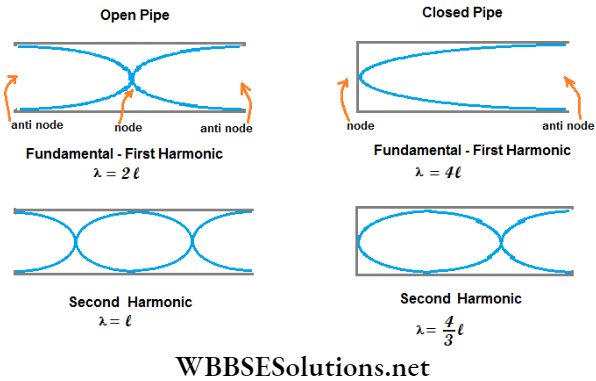
Superposition Of Waves End Error In Closed And Open Pipes

  • As a result, the antinode of a stationary wave is formed not exactly at the open end; rather it is formed at a point slightly outside every open end. This means that the effective length of the pipe is slightly greater than its actual length.
  • This increase in the effective length, due to the open end of a closed pipe or due to both the open ends of an open pipe, is called the end error. If c is the magnitude of the end error for an open end of a pipe of length l then, effective length of a closed pipe, L = l+c; effective length of an open pipe, L = 1 + 2c. The relations of Sections 4.6.1 and 4.6.2 should be modified accordingly.

So, the fundamental frequency for a closed pipe, \(n_0=\frac{V}{4 L}=\frac{V}{4(l+c)}\)

and the fundamental frequency for an open pipe, [lat6ex]n_0=\frac{V}{2 L}=\frac{V}{2(l+2 c)}[/latex]

  • This is known as end correction.
  • Scientists Helmholtz and Rayleigh experimentally showed that, c = 0.58 ≈ 0.6 r; where r = radius of the tube.
  • This means that narrower tubes correspond to fewer end errors. The theory also proposes that the end error increases with the wavelength of the sound emitted.
  • For higher harmonics, the frequencies are very high and the wavelengths are very low. In that case, the end error becomes negligible.
Class 11 Physics Class 12 Maths Class 11 Chemistry
NEET Foundation Class 12 Physics NEET Physics

Effect of Different Physical Quantities on the Frequencies of Air Columns: Considering the end errors, the fundamental frequencies of the notes emitted by a closed and an open pipe are, respectively,

⇒ \(n_0=\frac{V}{4(l+0.6 r)} \text { and } n_0^{\prime}=\frac{V}{2(l+2 \times 0.6 r)}\)

where, l = length of the pipe, r = radius of the pipe and V = velocity of sound in air.

These expressions show that the frequency becomes higher when

  1. l is less,
  2. r is less,
  3. V is higher due to rise in temperature and
  4. V is higher due to an increase in humidity.

The pitch of the emitted sound increases with the increase in frequency. So, the pitch becomes higher for,

  1. Shorter pipes,
  2. Narrower pipes,
  3. The higher temperature of air and
  4. Higher humidity in the air.

Comparison Between The Vibrations Of Air Columns In A Closed And An Open Pipe:
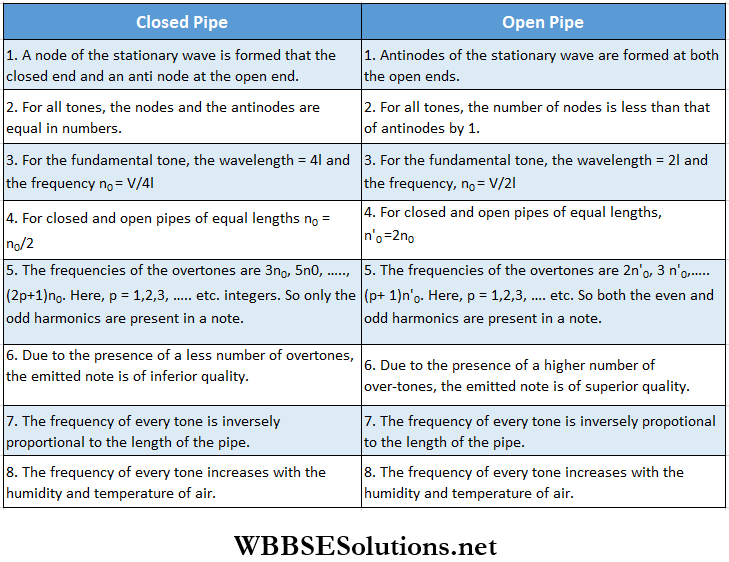
Superposition Of Waves Comparison Between Vibration Of Air Columns Open Pipe And Closed Pipe

Unit 10 Oscillation And Waves Chapter 4 Superposition Of Waves Vibration Air Columns Numerical Examples

Harmonics in Vibrating Strings

Example 1. Find out the frequency of the first overtone emitted by a1.25 m long organ pipe closed at one end. Given, the velocity of sound in air = 320 m · s-1.
Solution:

Mathematical Formulas for Vibration of Strings

Given, the velocity of sound in air = 320 m · s-1

For the 1st overtone, a node-antinode pair is formed in between a node at the closed end and an antinode at the open end.

So, the distance between the node at the closed end and the 2nd antinode from it = \(\frac{3 \lambda}{4}\) = l = length of the pipe.

∴ \(\lambda=\frac{4 l}{3}\)

So, the frequecny of this 1st overtone is \(n_1=\frac{V}{\lambda}=\frac{3 V}{4 l}=\frac{3 \times 320}{4 \times 1.25}=192 \mathrm{~Hz}\)

Example 2. Find out the frequencies of the fundamental and its nearest harmonic emitted by a 1m long closed organ pipe. Given, the velocity of sound in air =332 m · s-1.
Solution:

Given, the velocity of sound in air =332 m · s-1

Fundamental frequency, \(n_0=\frac{V}{4 l}=\frac{332}{4 \times 1}=83 \mathrm{~Hz}\)

A closed organ pipe can produce the odd harmonics only. So the frequency of the next harmonic,

n1 = 3n0 = 3 x 83 = 249 Hz.

Example 3. The length of an organ pipe, closed at one end is 90 cm. Find out the frequency of the harmonic next to the fundamental. Velocity of sound in air = 300 m · s1
Answer:

Given

The length of an organ pipe, closed at one end is 90 cm.

A closed pipe emits the odd harmonics only. So, the frequency of the harmonic next to the fundamental is

n1 = 3 x fundamental frequency

= \(3 \cdot \frac{V}{4 l}=3 \times \frac{(300 \times 100)}{4 \times 90}=250 \mathrm{~Hz} .\)

Example 4. The length of an organ pipe open at two ends is twice that of another organ pipe closed at one end. If the fundamental frequency of the open pipe is 100 Hz, find out the frequency of the 3rd harmonic emitted by the closed pipe.
Solution:

Given

The length of an organ pipe open at two ends is twice that of another organ pipe closed at one end. If the fundamental frequency of the open pipe is 100 Hz

The fundamental frequency of the open pipe, \(n_0^{\prime}=\frac{V}{2 l}; \text { so, } V=2 \ln n_0^{\prime}\); so, V = 2ln0‘ [V = velocity of sound in air, l = length of the open pipe]

The length of the closed pipe is \(\frac{l}{2}\). So the frequency of the 3rd harmonic is

n = 3x fundamental frequency

= \(3 n_0=3 \cdot \frac{V}{4\left(\frac{l}{2}\right)}=\frac{3 \cdot 2 \mathrm{~V}}{4 l}\)

= \(\frac{3 \times 2 \times 2 l n_0^{\prime}}{4 l}=3 n_0^{\prime}\)

= \(3 \times 100=300 \mathrm{~Hz} .\)

Example 5. Find out the fundamental frequency of a 125 cm long organ pipe closed at one end. Given, the velocity of sound in air = 350 m s-1.
Solution:

Given, the velocity of sound in air = 350 m s-1.

If the length of the closed pipe is l and the wavelength of the fundamental is λ,

l = \(\frac{\lambda}{4}\) or, λ= 4l

If V is the velocity of sound in air, fundamental frequency, \(n_0=\frac{V}{4 l}=\frac{350 \times 100}{4 \times 125}=70 \mathrm{~Hz}.\)

Example 6. A 20 cm long closed pipe emits a tone of frequency 400Hz. Find out the length of an open pipe emitting a tone of frequency 600 Hz at the same
Solution:

Given

A 20 cm long closed pipe emits a tone of frequency 400Hz.

The fundamental frequency for the dosed pipe, \(n_0=\frac{V}{4 l}\) [l = length of closed pipe]

The fundamental frequency for the open pipe, \(n_0^{\prime}=\frac{V}{2 L}\)

[L = length of open pipe]

∴ \(\frac{n_0}{n_0^{\prime}}=\frac{V}{4 l} \cdot \frac{2 L}{V}=\frac{1}{2} \cdot \frac{L}{l}\)

or, \(L=2 l \cdot \frac{n_0}{n_0^{\prime}}=2 \times 20 \times \frac{400}{600}=26.67 \mathrm{~cm}\)

Example 7. The length of an open organ pipe is twice the length of a closed organ pipe. If the fundamental frequency of the open pipe is 100 Hz, what is the frequency of the third harmonic of the closed pipe?
Solution:

Given

The length of an open organ pipe is twice the length of a closed organ pipe. If the fundamental frequency of the open pipe is 100 Hz,

Let the length of the closed organ pipe = l

Length of the open organ pipe =2l.

Frequency of the fundamental of the open pipe, \(n_0=\frac{V}{2 \cdot 2 l}=\frac{V}{4 l}\) [V= velocity of sound in air]

or, l = \(\frac{V}{4 n_0}=\frac{V}{4 \times 100}=\frac{V}{400}\)

Frequency of the fundamental of the closed pipe, \(n_c=\frac{V}{4 l}=\frac{V}{4} \cdot \frac{400}{V}=100 \mathrm{~Hz}\)

Only the odd harmonics are produced from a closed pipe; so the frequency of the third harmonic = 100 x (3 x 2- 1) = 500 Hz.

Question 8. One end of an open pipe is suddenly closed. It is the closed pipe is 100 Hz higher than the fundamental frequency of the open pipe. Find out this fundamental frequency when both ends are open.
Solution:

Given

One end of an open pipe is suddenly closed. It is the closed pipe is 100 Hz higher than the fundamental frequency of the open pipe.

If V is the tire velocity of sound and l is the length of the pipe, the fundamental frequencies in the open and closed conditions are respectively,

⇒ \(n_0^{\prime}=\frac{V}{2 l} \text { and } n_0=\frac{V}{4 l}=\frac{n_0^{\prime}}{2}\)

The frequency of the 3rd harmonic for the closed pipe,

n = \(3 n_0=\frac{3}{2} n_0^{\prime}\)

∴ \(n-n_0^{\prime}=100 \text { or, } \frac{3}{2} n_0^{\prime}-n_0^{\prime}=100 \text { or, } n_0^{\prime}=200 \mathrm{~Hz}\).

Comparison of Open and Closed Air Columns

Question 9. In winter, the frequency of a tone emitted at 10°C by an open organ tube is 400 Hz. What will be the frequency of this tone at 40°C In summer?
Solution:

Given

In winter, the frequency of a tone emitted at 10°C by an open organ tube is 400 Hz

Let V0 be the velocity of sound in air at 0°C.

So, the velocity at 10°C , V1 = V0(1 + 0.00183 x 10) = 1.0183 V0;

The velodty at 40°C, V2 = VQ(1 + 0.00183 x 40) = 1.0732 V0

The frequency of a tone is proportional to the velocity of sound.

∴ \(\frac{n_1}{n_2}=\frac{V_1}{V_2}\)

or, \(n_2=n_1 \cdot \frac{V_2}{V_1}=400 \times \frac{1.0732 V_0}{1.0183 V_0}=421.57 \mathrm{~Hz}\).

Example 10. A 1 m long uniform cylindrical container Is closed by two thin vibrating membranes A and B at Its two ends. A third thin vibrating membrane C divides the container Into two equal parts. The parts AC and BC arc are filled with hydrogen and oxygen gases, respectively. The membranes A and B are vibrated with the same frequency. Find out the minimum frequency of this vibration so that a node is formed at C. Given, velocities of sound In hydrogen and oxygen gases arc 1100 m – s1 and 300 m · s-1, respectively.
Solution:

Given

A 1 m long uniform cylindrical container Is closed by two thin vibrating membranes A and B at Its two ends. A third thin vibrating membrane C divides the container Into two equal parts. The parts AC and BC arc are filled with hydrogen and oxygen gases, respectively. The membranes A and B are vibrated with the same frequency.

AC = BC = 0.5 m = l (say).

If membranes A and B are vibrated, antinodes are produced at points A and B. Given, a node is produced at point C.

For an antinode at A and its adjacent node at C, the frequency is \(n_H=\frac{V_H}{4 l}=\frac{1100}{4 \times 0.5}=550 \mathrm{~Hz}\)
Superposition Of Waves Uniform Cyclinder Container

Similarly, for the part BC \(n_O=\frac{V_O}{4 l}=\frac{300}{4 \times 0.5}=150 \mathrm{~Hz}\)

Now, \(\frac{n_H}{n_O}=\frac{550}{150}=\frac{11}{3} or, 3 n_H=11 n_O\)

So, the frequency of the 3rd harmonic in AC matches exactly with that of the 11th harmonic in BC.

∴ The minimum frequency = 3 x 550 = 1650 Hz.

Example 11. Find out the coefficient of linear expansion of the material of an open pipe so that the frequency of any tone emitted from it does not vary with temperature.
Solution:

The fundamental frequencies at 0°C and t°C are respectively,

⇒ \(n_1=\frac{V_0}{2 l_0} \text { and } n_2=\frac{V_t}{2 l_t}\)

Here, V0 = velocity of sound at 0°C, l0 = length of the pipe at 0°C, Vt = velocity of sound at t°C, lt = length of the pipe at t°C.

According to the question, n1 = n2

So, \(\frac{V_0}{2 l_0}=\frac{V_t}{2 l_t}\)

or, \(V_0 l_t=V_t l_0 \quad \text { or, } V_0 l_0(1+\alpha t)=V_0(1+0.00183 t) l_0 \)

(\(\alpha=\text { coefficient of linear expansion }\))

or, \(\alpha=0.00183^{\circ} \mathrm{C}^{-1} \text {. }\)

Determination of the Velocity of Sound in Air by Resonant Air Column: Consider a uniform glass tube P which has its upper end open. The tube is partially filled with water; so the glass tube effectively behaves as a pipe closed at one end.
Superposition Of Waves Velocity Of Sound In Air By Resonant Air Column

  • The tube P is connected to a big water container T through a rubber tube R. The length of the air column in the closed pipe P can be increased or decreased according to the need by raising or lowering the container T. The length of the air column can also be measured from a scale marked on the tube P.
  • Now, a tuning fork F vibrating with a frequency n is held over the open end of the tube P. As a result, forced vibration is produced in the air column of P. The air column gradually rises from a very low value until the tuning fork and the air column are in unison.
Superposition Of Waves Tuning Fork

Factors Affecting Frequency of Vibrating Strings

Under these circumstances, the frequencies become equal and a loud sound is heard due to resonance. This corresponds to the fundamental tone emitted from the tube P. So, the fundamental frequency of the pipe is also n. If l1 is the length of the resonant air column, then neglecting the end error we get,

⇒ \(l_1=\frac{\lambda}{4} \quad \text { or, } \lambda=4 l_1\)

So, \(n=\frac{V}{\lambda}=\frac{V}{4 l_1} \quad or, \quad V=4 n l_1\)…(1)

Here, λ is the wavelength of the sound emitted from the tuning fork and V is the velocity of sound in air.

So, V can be calculated from equation (1) by knowing the frequency n of the tuning fork and by measuring the length l1 of the air column in P.

End Correction: Due to the end error, equation (1) cannot provide the accurate value of V. If c is the end error corresponding to the open upper end of P, equation (1) is modified as

V = \(4 n\left(l_1+c\right) \quad \text { or, } \quad l_1+c=\frac{V}{4 n}\)…(2)

Now, the length of the air column in P can be gradually increased further until the next overtone, which is the 3rd harmonic, comes in unison with the tuning fork. Here again, a loud sound is heard due to resonance. If l2 is the length of the air column in this case, taking the end error into consideration we have,

n = \(3 \cdot \frac{V}{4\left(l_2+c\right)} \quad \text { or, } \quad l_2+c=\frac{3 V}{4 n}\)…(3)

Subtracting (2) from (3), \(l_2-l_1=\frac{V}{2 n} \quad \text { or, } \quad V=2 n\left(l_2-l_1\right)\)…(4)

Equation (4) has been obtained by eliminating the end error c effectively. So it provides the accurate value of the velocity of sound V in air.

Estimation Of End Error: From equations (2) and (3), \(3\left(l_1+c\right)=\frac{3 V}{4 n}=l_2+c\)

or, \(3 l_1+3 c=l_2+c \quad \text { or, } 2 c=l_2-3 l_1\)

or, c = \(\frac{1}{2}\left(l_2-3 l_1\right)\)…(5)

So, the end error can be estimated by measuring the values of l1 and l2. It is observed that c is nearly equal to 0.6r, where r is the radius of the tube P.

WBCHSE Class 11 Physics Notes For Vibration of Strings and Air Columns

Superposition Of Waves Transverse Vibration In A String

Stretched string: A stretched string is a thin metal wire clamped between two rigid supports (A and B) with tension.
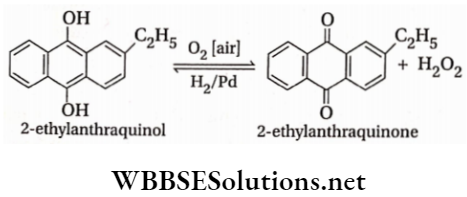
Superposition Of Waves Transverse Vibration In A String

Such a string is the source of sound emitted by musical instruments like sitar, violin, piano, etc. To generate vibrations in the string, it is initially disturbed in a direction normal to its length.

This transverse disturbance is initiated usually by one of the three following methods:

  1. Plucking the wire at any point—this method is used for sitar, guitar, etc.
  2. Striking the wire at any point—this method is used to play a piano.
  3. Bowing on the wire at any point—this method is used to play a violin.

The vibration in a stretched string has two salient features:

  1. When a stretched string is displaced from its equilibrium position, two identical progressive waves are produced. These two waves travel towards the two ends of the wire. After getting reflected from the two ends, they again travel towards the opposite ends.
    • Thus, the two waves are reflected again and again from both ends. Hence, a stationary wave is generated in the string. This is known as a stationary wave in a stretched string.
    • As the string is rigidly clamped at the two ends, two nodal points are formed at the ends. One or more than one loops may be formed between them. Only one loop is shown there is no node other than A and B, and only one antinode is formed at the midpoint.
  2. When the stretched string is vibrated in one or more than one loop, every point on the wire vibrates in a direction normal to the length of the wire. So, it is a transverse vibration.

Understanding Vibrating Strings in Physics

WBCHSE Class 11 Physics Notes For Vibration of Strings and Air Columns

Formation Of Stationary Waves In A Stretched String: Let a uniform string of length l be stretched by a tension T along the x-axis, with its ends rigidly fixed at the end x = 0 and x = l. Suppose a transverse wave is produced in the string travels along the positive x-axis and gets reflected at the fixed end, x = l.

The incident and reflected waves can be written as, y1 = a sin (ωt- kx) and y2 = – a sin(ωt+ kx) The equation of the resultant wave due to the superposition of the incident and the reflected progressive waves will be

y = \(y_1+y_2 =a \sin (\omega t-k x)-a \sin (\omega t+k x)\)

= \(-a[\sin (\omega t+k x)-\sin (\omega t-k x)]\)

= \(-2 a \cos \omega t \sin k x\)… (1)

(Using the relation sinA – sinB = \(2 \cos \frac{A+B}{2} \sin \frac{A-B}{2}\))

Since the supports A and B are rigid, nodes will be formed at these two points. So, y = 0 at x = 0 and y = 0 at x = l

[The coordinates of the supports A and B are x = 0 and x = l respectively, l = length of the string]

Now putting x = l and y = 0 in equation (1) we have

0 = -2a cosωt sinkl

So, for any value of t, sin kl = 0

i.e., kl = pπ, where p = 0, 1, 2, 3…..

Now if p = 0, then y = -2a cosωt sin kx

= \(-2 a \cos \omega t \sin \frac{p \pi}{l} x=0\)

i.e., for any value of t and x, y = 0.

This equation represents a vibrationless stationary string. This is not our subject of discussion.

So the significant values of p are 1, 2, 3,…..

Now, \(\frac{p \pi}{l} \quad \text { or, } \frac{2 \pi}{\lambda}=\frac{p \pi}{l} \quad \text { or, } \lambda=\frac{2 l}{p}\)…..(2)

WBBSE Class 11 Vibration of Strings and Air Columns Notes

Different Modes Of The Stationary Waves:

  1. If p = 1, from equation (2), \(\lambda=2 l \text { or, } l=\frac{\lambda}{2}\). This means that two consecutive nodes must be apart by a distance equal to the length of the string, i.e., the string should vibrate in one segment.
  2. If p = 2, from equation (2), \(\lambda=\frac{2 l}{2}=l \text { or, } l=\lambda\).

This means that between two nodes at the two ends of the string, there is another node. So the string must vibrate in two segments.

Generally, for the values of p = 1, 2, 3, 4,…… the stationary waves are formed in the stretched string and the string vibrates in one, two, three, four …. segments respectively. In each case, there are two nodes at the two ends of the string. Other nodes are formed according to the number of segments.

Laws Of Transverse Vibration In A Stretched String: Let a thin, uniform, and flexible wire be clamped with a tension between two rigid supports. Here, l = length of the wire, M = mass of the wire, r = radius of the wire,ρ = density of the material of the wire, and T = tension along the wire.

So, the area of cross-section = πr²;

volume of unit length of the wire = πr² · l = πr²

∴ Mass per unit length of the wire, m = \(\pi r^2 \rho=\frac{M}{l}\). This mass per unit length is often called the linear density of the wire. It is a characteristic property of the wire used because for a given wire, the linear density is fixed it is independent of the tension applied and the total length of the wire.

As proposed by the French scientist Marin Mersenne, the frequency (n) of transverse vibration in a stretched string varies with the relevant properties of the string according to the following laws:

Law Of Length: If the tension and the mass per unit length remain constant, the frequency of transverse vibration is inversely proportional to the length of the string, i.e., n ∝ \(\frac{1}{l}\), when T and m are constants.

Law Of Tension: If the length and the mass per unit length remain constant, the frequency of transverse vibration is proportional to the square root of the tension in the string, i.e., n ∝ √T, when l and m are constants.

Law Of Mass: If the length and the tension in the wire remain constant, the frequency of transverse vibration is inversely proportional to the square root of the mass per unit length of the string,

i.e., \(n \propto \frac{1}{\sqrt{m}}\), when l and T are constants.

The combination of the three laws gives, \(n \propto \frac{1}{l} \sqrt{\frac{T}{m}} \quad \text { or, } n=\text { constant } \times \frac{1}{l} \sqrt{\frac{T}{m}}\)

When the string vibrates in a single loop, the fundamental tone is emitted. In that case, the value of the above constant is \(\frac{1}{2}\). Then the frequency of the fundamental tone is \(n_1=\frac{1}{2 l} \sqrt{\frac{T}{m}}\)….(1)

Class 11 Physics Class 12 Maths Class 11 Chemistry
NEET Foundation Class 12 Physics NEET Physics

Fundamental Frequency of a Vibrating String

It Is To Be Noted That,

  1. The frequency of transverse vibration of the wire does not depend upon the total mass; it depends on mass per unit length of the wire.
  2. The frequency of the wire does not depend upon the extent of stretching or the strength with which the wire is hit, causing the wire to vibrate.

Now, m = \(\pi r^2 \rho \text { or, } \sqrt{m}=\sqrt{\pi} \cdot r \cdot \sqrt{\rho} \text {. So, the law } n \propto \frac{1}{\sqrt{m}}\) means that \(n \propto \frac{1}{r \sqrt{\rho}}\).

This leads to two supplementary laws on transverse vibration in a string:

Law Of Radius: If the material of the string remains the same, the density remains constant. Thus the frequency of transverse vibration is inversely proportional to the radius of the string when the length and the tension in the string are constant;

i. e., n ∝ \(\frac{l}{r}\), when l, T, and ρ are constants.}{r}[/latex]

Law Of Density: For strings of the same radius, but made of different materials, the frequency of transverse vibration is inversely proportional to the square root of the density of the material, if the length and the tension in the string remain constant;

i. e., \(n \propto \frac{1}{\sqrt{\rho}}\), when l, T and r are constants.

Fundamental Tone And Overtones In A Stretched String: Let us consider the vibration of a stretched string in a single loop. Here, there are two nodes at the two ends, A and B, of the string and only one antinode at the mid-point.

Superposition Of Waves Fundamental Tone And Overtones In A Stretched String

If λ is the wavelength of the stationary wave produced, the distance between two consecutive nodes.

= \(\frac{\lambda}{2}\) = length of the wire (l).

or, λ = 2l

If V is the wave velocity, the frequency is \(n_1=\frac{V}{\lambda}=\frac{V}{2 l}\)…(1)

Now, if the string vibrates in two loops, a node is formed at the mid-point (C) in addition to the nodes A and B at the two ends. So, the distance between three consecutive nodes = λ = length of the wire (l).

Therefore, the frequency is \(n_2=\frac{V}{\lambda}=\frac{V}{l}=2 \cdot \frac{V}{2 l}=2 n_1\)

Similarly, the frequency becomes \(3 n_1, 4 n_1, 5 n_1, \ldots\), vibrations in three, four, five,… loops, respectively.

The above discussions show that the lowest frequency for all the tones that can be emitted from a vibrating string is n1. So the tone of frequency n1 is the fundamental tone or the 1st harmonic. This means that only the fundamental tone is emitted when a stretched string vibrates in n single loop.

Superposition Of Waves Fundamental And Second Harmonic

Harmonics in Vibrating Strings

It is the fundamental tone that is produced by the string. But the string is making all those other possible vibrations too, all at the same time, so that the actual vibration of the string is pretty complex.

The tones with higher frequencies \(2 n_1, 3 n_1, 4 n_1, \ldots\), etc,, are the overtones. Again, the frequency of each overtone is a simple multiple of the fundamental frequency; so each overtone is a harmonic, i.e., the frequency of 2nd harmonic = 2n1, the frequency of 3rd harmonic = 3n1,… the frequency of p-th harmonic = pn1 and so on.

We cannot hear the harmonics as separate notes. It may be noted that a stretched string may emit all tire even and odd harmonics. They are what give the string its rich, musical, string-like sound timbre. (The sound of a single frequency alone is mechanical, uninteresting, and unmusical sound)

If the above equation (1) is compared with equation (1), we get, V  \(=\sqrt{\frac{T}{m}}\)

where, T = tension in the string, m = mass per unit length of the string, and V = velocity of the transverse wave in the string.

The frequencies of the fundamental and the different overtones, in terms of the tension (T), the length of the wire (l), and the mass of the wire per unit length (m), are

⇒ \(n_1=\frac{1}{2 l} \sqrt{\frac{T}{m}}; n_2=2 n_1=\frac{2}{2 l} \sqrt{\frac{T}{m}} ;\)

∴ \(n_p=\frac{p}{2 l} \sqrt{\frac{T}{m}}\)….(3)

where, p = number of loops in the vibration; np is called the frequency of the p-th harmonic.

In principle, a vibrating string can emit all the overtones.

  • But, in reality, the presence of the overtones depends on the point of initial disturbance. For example, let the mid-point of the string be plucked to initiate the vibrations. Clearly, this point will have the maximum amplitude of vibration and will become an antinode.
  • So, a node at the mid-point is never obtained by plucking the mid-point. Accordingly, the harmonics having a node at the mid-point will be absent.
  • These absent harmonics are the 2nd, 4th 6th harmonics. So, a vibrating string generates only the odd harmonics when it is initially plucked at the mid-point.

Initial plucking or striking at a point on the string generates an antinode at that point. At the same time, if some other point is touched loosely, then a node is formed there.

  • A metal bar is used for this loose touch while playing a guitar. In this way, a good instrumentalist can control the musical sound emitted by forming nodes and antinodes at points as per his desire.
  • It is possible to vibrate every wire in sitar, piano, etc. in such a way that the same wire can emit different tones simultaneously. Shows an example where the fundamental and the 2nd harmonic are being produced simultaneously. The string is vibrating in two loops to produce the 2nd harmonic.
  • At the same time, the 2-loop formation is also vibrating in a single loop, so that the fundamental tone is emitted.
  • We know that the quality or timbre of a musical sound depends on the number of overtones in the emitted sound and also on the relations of the overtones with the fundamental. Accordingly, it is evident that instruments like sitar, violin, piano, etc., can emit notes of very rich quality.

Superposition Of Waves – Transverse Vibration In A String Numerical Examples

Example 1. Two stretched wires made of the same material have lengths, diameters, and tensions, each in the ratio 1:2. The first wire emits a fundamental tone of frequency 200 Hz. What is the fundamental frequency of the 2nd wire?
Solution:

If d is the diameter of a wire, the mass per unit length is m = \(\frac{\pi d^2}{4} \rho\)

where ρ = density of the material of the wire. It is the same for the two wires.

Now, the fundamental frequency,

n = \(\frac{1}{2} l \sqrt{\frac{T}{m}}=\frac{1}{2 l} \sqrt{\frac{T \cdot 4}{\pi d^2 \rho}}=\frac{1}{l d} \sqrt{\frac{T}{\pi \rho}}\)

So, for the two wires, \(\frac{n_1}{n_2}=\frac{l_2}{l_1} \cdot \frac{d_2}{d_1} \cdot \sqrt{\frac{T_1}{T_2}}\)

or, \(\quad n_2=n_1 \cdot \frac{l_1}{l_2} \cdot \frac{d_1}{d_2} \cdot \sqrt{\frac{T_2}{T_1}}=200 \times \frac{1}{2} \times \frac{1}{2} \times \sqrt{\frac{2}{1}}\)

[Here, \(n_1=200\)]

∴ \(n_2=50 \sqrt{2}=70.7 \mathrm{~Hz} \text {. }\)

Example 2. The lengths of two wires made of the same material are in the ratio 2:3. Their diameters are equal and the fundamental of the shorter wire is one octave higher than that of the longer wire. Find the ratio
Solution:

The two wires are of the same material and the diameters are equal. So, the mass per unit length m is the same.

Here, the ratio 2 : 3 implies that the 1st wire is shorter

∴ \(n_1=2 n_2 \text { or, } \frac{n_1}{n_2}=\frac{2}{1} \text {. }\)

The fundamental frequency, n = \(\frac{1}{2 l} \sqrt{\frac{T}{m}}\)

So, for the two wires, \(\frac{n_1}{n_2}=\frac{l_2}{l_1} \sqrt{\frac{T_1}{T_2}}\)

or, \(\frac{T_1}{T_2}=\left(\frac{n_1}{n_2}\right)^2 \cdot\left(\frac{l_1}{l_2}\right)^2=\left(\frac{2}{1}\right)^2 \cdot\left(\frac{2}{3}\right)^2=\frac{16}{9}\)

i.e., the ratio between the tensions is 16:9.

Mathematical problems for Vibration Frequencies

Example 3. A wire of density 9 g · cm-3 Is elongated by 0.05 cm when stretched between two clamps 100 cm apart Find out the lowest frequency of transverse vibration in the wire, Given, Young’s modulus of the material of the wire = 9 x10¹¹ dyn · cm-2.
Solution:

Length of the wire, L = 100 cm; elongation, l = 0.05 cm; density of the material, ρ = 9 g · cm-3; Young’s modulus of the material,

Y = 9 x 10¹¹ dyn · cm-2.

Let α = area of the cross-section of the wire

∴ Mass per unit length, m = αρ

Longitudinal stress = \(\frac{\text { tension }}{\text { area of cross-section }}=\frac{T}{\alpha}\)

longitudinal strain = \(\frac{\text { elongation }}{\text { original length }}=\frac{l}{L} .\)

∴ Y = \(\frac{\text { longitudinal stress }}{\text { longitudinal strain }}=\frac{T / \alpha}{l / L}=\frac{T L}{\alpha l}\)

or, T = \(\frac{Y \alpha l}{L}\)

The lowest frequency of transverse vibration = fundamental frequency,

n = \(\frac{1}{2 L} \sqrt{\frac{T}{m}}=\frac{1}{2 L} \sqrt{\frac{Y \alpha l}{L} \cdot \frac{1}{\alpha \rho}}=\frac{1}{2 \times 100} \sqrt{\frac{\left(9 \times 10^{11}\right) \times 0.05}{100 \times 9}}\)

= 35.36 Hz

Example 4. A stationary wave having 5 loops is generated in a 10 m long wire. What is the frequency, if the wave velocity is 20 m · s-1?
Solution:

If λ is the wavelength, length of each loop = \(\frac{\lambda}{2}\)

∴ Length of 5 loops = 5 • \(\frac{\lambda}{2}\) = 10 m or, \(\lambda=\frac{10 \times 2}{5}\) = 4m

So, frequency, n = \(\frac{V}{\lambda}=\frac{20}{4}=5 \mathrm{~Hz}\) = 5 Hz.

Example 5. A uniform wire of length 12 m and mass 6 kg is suspended from a rigid support A mass of 2 kg is attached to the lower free end. A transverse wave of length 0.06 m is generated at the lower end of the wire. What is its wavelength when the wave reaches the upper end?
Solution:

The velocity of transverse vibration in a stretched wire, V = \(\sqrt{\frac{T}{m}}\), where T = tension in the wire and m = mass per unit length = constant, for the uniform wire.

If V1 and V2 are the velocities at the lower and upper ends, respectively, \(\frac{V_1}{V_2}\)=\(\sqrt{\frac{T_1}{T_2}}\)

Here, T1 = tension at the lower end = weight of the suspended mass = 2 x 9.8 N;

T2 = tension at the upper end = weight of the wire and the suspended mass = (2 + 6) x 9.8 = 8 x 9.8 N

The entire wire will emit a sound of a fixed frequency; so the wavelength A is proportional to the wave velocity V.

∴ \(\frac{\lambda_1}{\lambda_2}=\frac{V_1}{V_2}=\sqrt{\frac{T_1}{T_2}}\)

or, \(\lambda_2=\lambda_1 \sqrt{\frac{T_2}{T_1}}=0.06 \times \sqrt{\frac{8 \times 9.8}{2 \times 9.8}}=0.12 \mathrm{~m}\).

Air Column Vibrations in Musical Instruments problems

Example 6. A wire is stretched with negligible tension at 30°C between two rigid supports. Find the velocity Of the transverse wave in the wire at 20°C. Given, the coefficient of linear expansion, Young’s modulus, and the density of the material of the wire are α = 18 x 10-6 °C-1, Y = 12 x 1011 dyn • cm-2, and ρ = 6 g · cm-3, respectively.
Solution:

Decrease in temperature, θ = 30-20 = 10°C; due to this decrement, the wire will tend to contract. As a result, thermal stress will be developed.

This thermal stress = Yαθ;

So the tension in the wire, T = Yαθ A, where A = area of the cross-section of the wire.

Again, mass per unit length of the wire,

m = A · 1 · ρ = Aρ

∴ The velocity of the transverse wave in the wire is

V = \(\sqrt{\frac{T}{m}}=\sqrt{\frac{Y \alpha \theta A}{A \rho}}\)

= \(\sqrt{\frac{Y \alpha \theta}{\rho}}=\sqrt{\frac{\left(12 \times 10^{11}\right) \times\left(18 \times 10^{-6}\right) \times 10}{6}}\)

= \(6000 \mathrm{~cm} \cdot \mathrm{s}^{-1}\)