Electromagnetic Induction Multiple Choice Questions And Answers

Electromagnetic Induction

Question 1. A coil of resistance 400 Ω. is placed in a magnetic field. If the magnetic flux Φ (Wb) linked with the coil varies with time t (s) as Φ = 50t2 + 4, the current in the coil at t = 2 s is

  1. 0.5 A
  2. 0.1 A
  3. 2A
  4. 1A

Answer: 1. 0.5 A

Induced emf = \(\varepsilon=\left|\frac{d \phi}{d t}\right|=\frac{d}{d t}\left(50 t^2+4\right)=100 t \mathrm{~V}\)

∴ Current = I = \(\frac{\varepsilon}{R}=\frac{(100 \times 2) \mathrm{V}}{400 \Omega}=0.5 \mathrm{~A}\).

Electromagnetic Induction Multiple Choice Question And Answers

Question 2. The magnetic flux linked with a coil is given (in Weber) by the equation Φ = 5t2+3t-l6. The induced emf in the coil in the fourth second will be

  1. 210 V
  2. 10 V
  3. 108 V
  4. 145 V

Answer: 2. 10 V

Magnetic flux = Φ = (5t2 + 3t-16) Wb.

⇒ Induced emf = \(\varepsilon=\left|\frac{d \phi}{d t}\right|=\frac{d \phi}{d t}=(10 t+3) \mathrm{V}\)

At t= 3 s, ε1 = (30+ 3) V= 33 V.

At t= 4 S, ε2 = (40+ 3) V = 43 V

∴ Induced emf in the 4th second, ε – ε2– ε1 = 43 V – 33 V = 10 V.

electromagnetic induction question

Read And Learn Also NEET Physics Multiple Choice Question and Answers

Question 3. A long solenoid has 1000 turns. When a current of 4.0 A flows through it, die magnetic flux linked with each turn of the solenoid becomes 4 x10⁻³ Wb. The self-inductance of the solenoid is

  1. 3H
  2. 4H
  3. 1H
  4. 2H

Answer: 3. 1H

Magnetic flux (Φ) linked with a coil is proportional to the current (I) through it,

i.e., Φ ∝ I or ty = LI.

Here Φ = NΦ0 = (1000)(4 x10⁻³ Wb)= 4 Wb

\(L=\frac{\phi}{I}=\frac{4 \mathrm{~Wb}}{4.0 \mathrm{~A}}=1.0 \mathrm{H}\).

Question 4. The adjoining figure shows a conducting circular loop of radius r placed near a long straight wire carrying a steady current I. Which of the following options is true?
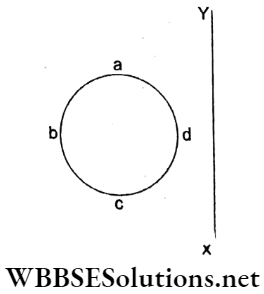
Electromagnetic Induction Multiple Choice Questions And Answers Conducting Circular Loop Q4

  1. The induced current will be clockwise.
  2. The induced current will be anticlockwise.
  3. The induced current will change periodically.
  4. No current will be induced.

Answer: 4. No current will be induced.

When a steady current flows through the conductor XY, the magnetic field \(\left(B=\frac{\mu_0 I}{2 \pi r}\right)\) also be steady. Hence, the magnetic flux linked with the circular loop will not vary with time, thus the emf induced will be zero and no current will flow through the loop.

Question 5. A rectangular conducting loop is placed coplanar near a long straight wire carrying a current 7. If the current increases continuously then which of the given options will be true for the current induced in the loop?
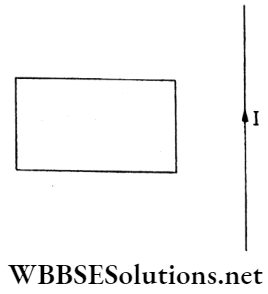
Electromagnetic Induction Multiple Choice Questions And Answers Rectangular Conducting Loop Q5

  1. The induced current will be clockwise.
  2. The induced current will be anticlockwise.
  3. No current is induced.
  4. The direction of the induced current will change periodically.

Answer: 1. The induced current will be clockwise.

When current I flow through the straight conductor, the magnetic field produced will be directed perpendicularly out of the plane of the loop and magnetic flux will be linked. With the continuous increase in I, magnetic flux will also increase. According to Lenz’s law, the induced
current will be directed clockwise to oppose the increasing flux.

Question 6. A conducting circular loop having 10 turns is placed in a uniform magnetic field B = 0.04 T with its plane perpendicular to the magnetic field. Assume that the radius of the loop starts shrinking at a constant rate of 2.0 mm s-1. The induced emf in the loop at an instant when its radii are 4 cm will be approximately

  1. 2 μ V
  2. 40 μ V
  3. 200 μ V
  4. 400 μ V

Answer: 3. 200 μ V

Instantaneous flux through the circular loop is

Φ = NAB ⇒ Φ = N(πR2)B.

∴ \(\frac{d \phi}{d t}=(N \pi B) 2 R \frac{d R}{d t}\).

Hence, induced emf = \(\varepsilon=\frac{d \phi}{d t}=2 \pi N B R \frac{d R}{d t}\).

Given, B = 0.04 T, N =10, R = 4 x 10⁻² m

⇒ and \(\frac{d R}{d t}=2.0 \mathrm{~mm} \mathrm{~s}^{-1}=2.0 \times 10^{-3} \mathrm{~m} \mathrm{~s}^{-1}\)

Substituting the values,

ε = 2(3.14)(10)(0.04 T)(4 x 10⁻² m)(2 x 10⁻³ ms-1)

= 20 x 10-5 V= 200 pV.

Question 7. A square loop ABCD carrying a steady current I1 is placed coplanarly near a long straight conducting wire XY which carries a steady current I2. The net force on the loop will be
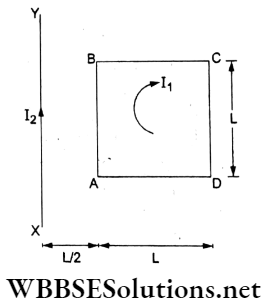
Electromagnetic Induction Multiple Choice Questions And Answers Square Loop Q7

  1. \(\frac{\mu_0 I_1 I_2}{2 \pi}\)
  2. \(\frac{2 \mu_0 I_1 I_2 L}{3 \pi}\)
  3. \(\frac{\mu_0 I_1 I_2 L}{2 \pi}\)
  4. \(\frac{2 \mu_0 I_1 I_2}{3 \pi}\)

Answer: 4. \(\frac{2 \mu_0 I_1 I_2}{3 \pi}\)

The magnetic field around AB due to straight current is

⇒ \(B_1=\frac{\mu_0 I_2}{2 \pi(L / 2)}=\frac{\mu_0 I_2}{\pi L}\)

The force of attraction on AB (towards the left) is

⇒ \(F_1=I_1 B_1 L=\frac{\mu_0 I_1 I_2}{\pi}\)

Similarly, the force of repulsion (F2) on CD is

⇒ \(F_2=I_1 B_2 L=I_1\left(\frac{\mu_0 I_2 L}{2 \pi(3 L / 2)}\right)=\frac{\mu_0 I_1 I_2}{3 \pi}\).

The net force on the loop is

⇒ \(F=F_1-F_2=\frac{\mu_0 I_1 I_2}{\pi}\left(1-\frac{1}{3}\right)=\frac{2}{3} \frac{\mu_0 I_1 I_2}{\pi}\).

Forces on BC and AD are equal and opposite, hence do not contribute to the net force.

electromagnetic induction question

Question 8. At a place the earth’s magnetic field 4 x 10⁻⁵ Wb m-2 is directed perpendicular to the plane of a conducting coil of radius R = 5 cm. If \(\frac{\mu_0}{4 \pi}=10^{-7} \mathrm{TmA}^{-1}\), how much current is induced in the circular loop?

  1. 40 A
  2. 4 A.
  3. 0.4 A
  4. 0 A

Answer: 4. 0 A

Magnetic flux linked with the coil is Φ = BA which is constant in the given question. Hence, there will be no induced emf and no induced current.

Question 9. A circular coil of radius 10 cm, 500 turns, and resistance 2 Q is placed with its plane perpendicular to the horizontal component of the earth’s magnetic field. It is rotated about its vertical diameter through 180° in 0.25 s. The current induced in the coil is (a horizontal component of the earth’s magnetic field at that place is 3.0 x10⁻⁵ T)

  1. 1.9 mA
  2. 2.9 mA
  3. 3.9 mA
  4. 4.9 mA

Answer: 1. 1.9 mA

Magnetic flux = \(\oint=N(\vec{B} \cdot \vec{A})=N B A \cos \theta\)

The angle θ has changed from 0° to 180°.

Change in magnetic flux is

ΔΦ = NBAcos 0°- NBAcos 180°= 2NBA.

Average induced emf is

⇒ \(\varepsilon=\frac{\Delta \phi}{\Delta t}=\frac{2 N B A}{\Delta t}\)

Induced current is

⇒ \(I=\frac{\varepsilon}{R}=\frac{2 N B A}{R \Delta t}\)

Substituting the values

∴ \(I=\frac{2(500)\left(3.0 \times 10^{-5} \mathrm{~T}\right)\left(\pi \times 10^{-2} \mathrm{~m}^2\right)}{(2 \Omega)(0.25 \mathrm{~s})}=1.88 \times 10^{-3} \mathrm{~A}=1.9 \mathrm{~mA}\).

Question 10. A small piece of metal wire is dragged across a gap between the pole pieces of a magnet in 0.4 s. If the magnetic flux between the pole pieces is 8 x 10⁻⁴ Wb then the induced emf in the wire is

  1. 4 mV
  2. 8 mV
  3. 2 mV
  4. 6 mV

Answer: 3. 2 mV

Motional emf induced in a conductor cutting the magnetic field lines is

⇒ \(\varepsilon=B l v=B l \frac{y}{t}\), where yis the spread of the magnetic field.

∴ \(\varepsilon=\frac{B(l y)}{t}=\frac{B A}{t}=\frac{\phi}{t}\)

Given, Φ = 8 x 10⁻⁴ Wb and t = 0.4 s.

∴ \(\varepsilon=\frac{8 \times 10^{-4} \mathrm{~Wb}}{0.4 \mathrm{~s}}=2 \times 10^{-3} \mathrm{~V}=2 \mathrm{mV}\).

Question 11. The north pole of a bar magnet is moved towards a conducting circular ring along its axis. The direction of the induced current in the ring will be

  1. Towards south
  2. Towards north
  3. Anticlockwise
  4. Clockwise

Answer: 3. Anticlockwise

When the north pole moves towards the ring, the magnetic flux through the ring (directed inward) will increase. According to Lenz’s law, induced current in the coil will oppose the. increasing inward flux, hence producing an outward field. This outward field will be due to anticlockwise current.

Question 12. A thin semicircular conducting ring PQR of radius r is falling with its plane vertical in a horizontal magnetic field B as shown in the figure. The potential difference developed across the ring when its speed is v is
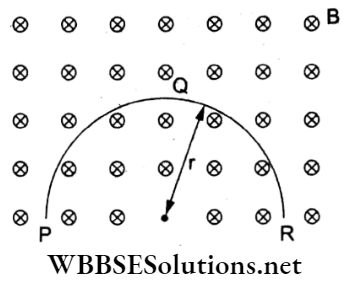
Electromagnetic Induction Multiple Choice Questions And Answers Thin Semicircular Conducting Ring Q12

  1. Zero
  2. \(\frac{1}{2}\)With P at higher potential
  3. πBr2v with P at a higher potential
  4. 2Bvr with R at a higher potential

Answer: 4. 2Bvr with R at a higher potential

Motional emf induced in the semicircular ring will be

B.v. (effective length)= Bv(PR)= Bv2r.

The effective length is the length joining the free ends. Thus, ε = 2Bvr.

According to the relation \(\vec{F}=q(\vec{v} \times \vec{B})\) positive charge will accumulate at R, so R will be at higher potential.

Question 13. The current I through an inductor varies with time according to the plot shown in the figure. Which one of the following is the correct representation of the variation of voltage with time in the coil?
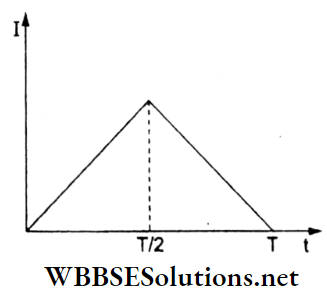
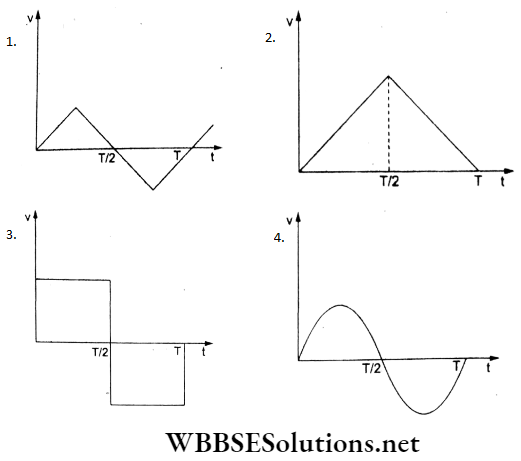
Electromagnetic Induction Multiple Choice Questions And Answers Q13

Electromagnetic Induction Multiple Choice Questions And Answers Current Through An Indicator Q13

Answer: 3.

The induced voltage in an inductor is \(|V|=L\left(\frac{d I}{d t}\right), \text { where } \frac{d I}{d t}\) = slope of I~t graph. From f = 0 to \(\frac{T}{2}, \frac{d I}{d t}\) = positive and constant, whereas from \(t=\frac{T}{2} \text { to } T, \frac{d I}{d t}\) = constantbut negative.

Hence, the plot in option (3) corresponds to the true variation v~t.

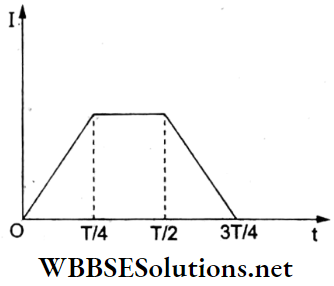
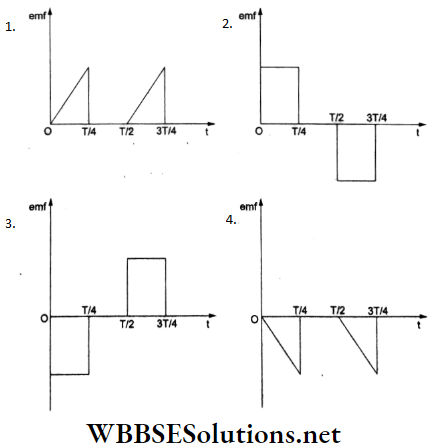
Question 14. The current I flowing through a coil varies with time as shown in the figure. The variation of induced emf with time would be
Electromagnetic Induction Multiple Choice Questions And Answers Q14

Electromagnetic Induction Multiple Choice Questions And Answers The Variation Of Induced emf With Time Q14

Answer: 3.

Induced emf in an inductor is \(\varepsilon=-L\left(\frac{d I}{d t}\right), \text { where } \frac{d I}{d t}\) is the slope of I-t graph. From the given figure, during the time interval 0 to \(\frac{T}{4}, \frac{d I}{d t}\) is positive and constant, so £ = negative and constant. For the interval \(\frac{T}{4} \text { to } \frac{T}{2}, \frac{d I}{d t}=0\), so emf = 0; for \(t=\frac{T}{2} \text { to } t=\frac{3 T}{4}, \frac{d I}{d t}\) negative and constant, so emf = positive and constant. This corresponds to option (3).

Question 15. A circular disc of radius 0.2m is placed in a uniform magnetic field B = \(\left(\frac{1}{\pi}\right) \mathrm{Wb} \mathrm{m}^{-2}\) in such a way that its axis makes an angle of 60° with \(\vec{B}\). The magnetic flux linked with the disc is

  1. 0.02 Wb
  2. 0.01 Wb
  3. 0.06 Wb
  4. 0.08 Wb

Answer: 1. 0.02 Wb

Magnetic flux <j) is a scalar quantity and is given by the dot product of \(\vec{B}\) and \(\vec{A}\) (area vector).

⇒ Thus, \(\phi=\vec{B} \cdot \vec{A}=B A \cos \theta\).

where θ = angle between \(\vec{B}\) and the outward normal to the area vector.

∴ \(\phi=\left(\frac{1}{\pi} W_{b ~ m^{-2}}\right)\left(\pi \times 0.04 \mathrm{~m}^2\right) \cos 60^{\circ}=0.02\).

electromagnetic induction question

Question 16. The magnetic flux linked with a coil of resistance R changes by an amount ΔΦ in a time Δt. The total quantity of electric charge q that flows through the coil during the time At is given by

  1. \(q=\frac{\Delta \phi}{\Delta t}\)
  2. \(q=R \frac{\Delta \phi}{\Delta t}\)
  3. \(q=\frac{1}{R} \frac{\Delta \phi}{\Delta t}\)
  4. \(q=\frac{\Delta \phi}{R}\)

Answer: 4. \(q=\frac{\Delta \phi}{R}\)

Induced emf = \(\varepsilon=\frac{d \phi}{d t}\)

But, \(I=\frac{d q}{d t}=\frac{\varepsilon}{R}=\frac{1}{R}\left(\frac{d \phi}{d t}\right)\)

⇒ \(d q=\frac{1}{R} d \phi\)

∴ Total charge = q = \(\int d q=\frac{1}{R} \int_{\phi_1}^{\phi_2} d \phi=\frac{\phi_2-\phi_1}{R}=\frac{\Delta \phi}{R}\)

Question 17. A conductor of length 0.4 m is moving uniformly with a speed of 7 m s-1 perpendicular to a uniform magnetic field of intensity 0.9 Wb m-2. The induced emf across the conductor is

  1. 1.26 V
  2. 5.04 V
  3. 2.52 V
  4. 25.2 V

Answer: 3. 2.52 V

Motional emf = ε = Blv.

Given, B = 0.9 T, l = 0.4 m and v = 7 m s-1.

∴ ε = (0.9 T)(0.4 m)(7 ms-1 ) = 2.52 V

Question 18. A rectangular coil of 20 turns and an area of cross-section 25 cm2 has a resistance of 100 Ω. If a magnetic field that is perpendicular to the plane of the coil changes at a constant rate of 1000 T s-1, the current in the coil is

  1. 1 A
  2. 5 A
  3. 0.5 A
  4. 50 A

Answer: 3.

Induced emf is

⇒ \(|\mathcal{E}|=\frac{d \phi}{d t}=N A \frac{d B}{d t}=(20)\left(25 \times 10^{-4} \mathrm{~m}^2\right)\left(10^3 \mathrm{~T} \mathrm{~s}^{-1}\right)=50 \mathrm{~V}\)

current through the coil,

∴ \(I=\frac{\varepsilon}{R}=\frac{50 \mathrm{~V}}{100 \Omega}=0.5 \mathrm{~A}\).

Question 19. A uniform magnetic field of 2 x 10⁻² T is directed into the plane of a coil of area 100 cm2 having 50 turns. The average emf induced in the coil is 0.1 V when it is removed from the field in t seconds. The value of t is

  1. 10 s
  2. 1 s
  3. 0.01 s
  4. 0.1 s

Answer: 4. 0.1 s

Average emf induced is

⇒ \(\varepsilon=\frac{\Delta \phi}{\Delta t}\)

Hence, ΔΦ= NAB-0 = NAB, Δt = t, and 8 = 0,1 V.

⇒ \(0.1 \mathrm{~V}=\frac{50\left(100 \times 10^{-4} \mathrm{~m}^2\right)\left(2 \times 10^{-2} \mathrm{~T}\right)}{t}\).

∴ t = 0.1 s.

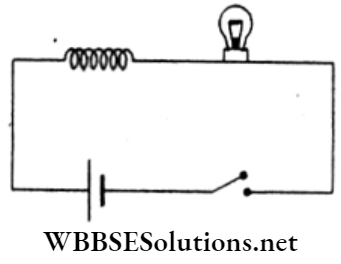
Question 20. In the circuit shown in the figure, what will happen if the contact is broken?
Electromagnetic Induction Multiple Choice Questions And Answers Circuit Q20

  1. The bulb will become suddenly bright.
  2. The bulb will become suddenly dim.
  3. The bulb will fuse.
  4. None of these will happen

Answer: 1. The bulb will become suddenly bright.

In the steady state, the glow in the bulb stays constant. As the contact is broken, there is a sudden change in flux, so back emf \(\frac{\Delta \phi}{\Delta t}\) becomes large. This will make the bulb suddenly very bright.

Question 21. In a region of uniform magnetic field B = 10-2 T, a circular coil of radius 30 cm and resistance π2 Q is rotated about an axis that is perpendicular to the direction of B and which forms a diameter of the coil. If the coil rotates at 200rpm, the amplitude of the alternating current induced in the coil is

  1. 2 mA
  2. 6 mA
  3. 30 mA
  4. 200 mA

Answer: 2. 6 mA

Let at any instant the normal to circular coil make an angle 0 with \(\vec{B}\), so the instantaneous magnetic flux is

⇒ \(\phi=\vec{B} \cdot \vec{A}=B A \cos \theta\)

Induced emf is

⇒ \(\mathcal{E}=-\frac{d \phi}{d t}=B A\left(\frac{d \theta}{d t}\right) \sin \theta\)

ε = BAωsin ωt= ε0 sin ωt,

where ε0 = peak voltage.

the peak value of induced current is

⇒ \(I_0=\frac{\varepsilon_0}{R}=\frac{B A \omega}{R}\)

∴ \(\frac{\left(10^{-2} \mathrm{~T}\right)\left(\pi \times 900 \times 10^{-4} \mathrm{~m}^2\right)(200 \times 2 \pi)}{\left(\pi^2 \Omega\right)(60 \mathrm{~s})}=6 \mathrm{~mA}\).

image

Question 22. The current in an inductor with L = 40 mH is increased uniformly from 1 A to 11 A in 4 ms. The emf induced in the inductor is

  1. 4 V
  2. 0.4 V
  3. 100 V
  4. 440 V

Answer: 3. 100 V

Given, L = 40 mH = 40 x 10-3 H, Δl= 10 A and Δt= 4 ms = 4 x 10⁻³ s.

The average emf induced in the inductor is

∴ \(|\mathcal{E}|=L \frac{\Delta I}{\Delta t}=\frac{\left(40 \times 10^{-3} \mathrm{H}\right)(10 \mathrm{~A})}{\left(4 \times 10^{-3} \mathrm{~s}\right)}=100 \mathrm{~V}\).

Question 23. If the number of turns per unit length of a solenoid is doubled then the self-inductance of the solenoid will

  1. Be halved
  2. Be doubled
  3. Remain unchanged
  4. Be quadrupled

Answer: 4. Be quadrupled

Self-inductance of a solenoid is

⇒ \(L=\frac{\mu_0 N^2 A}{l}=\mu_0\left(\frac{N}{l}\right)^2 A l=\mu_0 n^2 A l\)

Where \(\frac{N}{l}\) = n = number of turns per unit length.

Thus, L ∝ n2.

∴ L’= k(2n)2 = Akn2 = 4L.

electromagnetic induction question

Question 24. What is the self-inductance of a coil that induces 5 V when the current changes from 3.5 A to 2.5 A in one millisecond?

  1. 500 H.
  2. 5 mH
  3. 50H
  4. 5H

Answer: 2. 5 mH

\(\varepsilon=L \frac{\Delta I}{\Delta t}\)

Hence, self-inductance is

∴ \(L=\frac{\varepsilon}{\left(\frac{\Delta I}{\Delta t}\right)}=\frac{5 \mathrm{~V}}{\frac{(3.5-2.5) \mathrm{A}}{10^{-3} \mathrm{~s}}}=5 \times 10^{-3} \mathrm{H}=5 \mathrm{mH}\).

Question 25. A long solenoid has 500 turns. When a current of 2 A is passed through it, the resulting magnetic flux linked with each turn of the solenoid is 4 x 10⁻³ Wb. The self-inductance of the solenoid is

  1. 2H
  2. 1H
  3. 2.5H
  4. 4H

Answer: 2. 1H

Given, N= 500, 1= 2 A, and Φ0 = 4 x 10⁻³ Wb per turn.

Now, Φ -= NΦ0 = LI.

Hence, self-inductance is

⇒ \(L=\frac{N \phi_0}{I}=\frac{(500)\left(4 \times 10^{-3} \mathrm{~Wb}\right)}{(2 \mathrm{~A})}=1 \mathrm{H}\).

Question 26. A varying current in a coil changes from 10 A to zero in 0.5 s. If the average emf induced in the coil is 220 V, the self-inductance of the coil is

  1. 5H
  2. 6H .
  3. 11H
  4. 12H

Answer: 3. 11H

Given, Δl =10 A, Δt = 0.5 s and ε = 220 V.

∴ \(L=\frac{N \phi_0}{I}=\frac{(500)\left(4 \times 10^{-3} \mathrm{~Wb}\right)}{(2 \mathrm{~A})}=1 \mathrm{H}\).

Question 27. A 100-mH coil carries a steady current of 1 A. The energy stored in its magnetic field is

  1. 0.5 J
  2. 0.05 J
  3. 1 J
  4. 0.1 J

Answer: 2. 0.05 J

Magnetic energy stored in an inductor is

∴ \(U=\frac{1}{2} L I^2=\frac{1}{2}\left(100 \times 10^{-3} \mathrm{H}\right)(1 \mathrm{~A})^2=0.05 \mathrm{~J}\).

Question 28. A wire loop is rotated in a magnetic field. The frequency of change of direction of the induced emf is

  1. Once per revolution
  2. Twice per revolution
  3. Four times per revolution
  4. Six times per revolution

Answer: 2. Twice per revolution

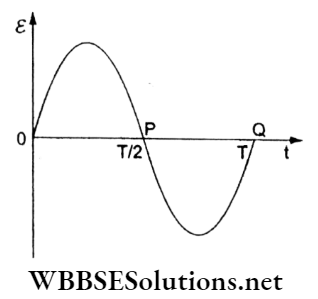
In a coil rotating in a magnetic field, an alternating emf ε = ε0 sinωt is induced which is shown in the adjoining diagram. In one cycle (t = 0 to t = T), there are two instants (at P and Q) when emf changes its direction.
Electromagnetic Induction Multiple Choice Questions And Answers Coil Rotating In A Magnetic Field Q28

Question 29. A coil of wire of a certain radius has 100 turns and a self-inductance of 15 mH. The self-inductance of a similar second coil of 500 turns will be

  1. 75 mH
  2. 375 mH
  3. 15 mH
  4. None of these

Answer: 2. 375 mH

Self-inductance of a solenoid is

⇒ \(L=\frac{\mu_0 N^2 A}{l}=15 \mathrm{mH}=\frac{\mu_0 A}{l}(100)^2\)

If the total number of turns N is increased from 100 to 500 then

∴ \(L^{\prime}=\frac{\mu_0 A}{l}(500)^2=25 L=25(15 \mathrm{mH})=375 \mathrm{mH}\).

Question 30. The self-inductance of a coil having 400 turns is 10 mH. The magnetic flux through the cross-section of the coil corresponding to current 2mA is

  1. 2 x 10⁻⁵ Wb
  2. 2 x 10⁻³ Wb
  3. 3 x 10⁻⁵ Wb
  4. 8 x 10⁻³ Wb

Answer: 4. 8 x 10⁻³ Wb

Magnetic flux Φ linked with a coil is Φ = NLI.

Substituting the values,

Φ = (400)(10 x 10-3 H)(2 x 10⁻³ A) = 8 x 10⁻³ Wb.

Question 31. Two solenoids of equal number of turns have their lengths and radii in the same ratio 1: 2. The ratio of their self-inductances will be

  1. 1:2
  2. 2:1
  3. 1:1
  4. 1:4

Answer: 1. 1:2

Self-inductance of a solenoid is

⇒ \(L=\frac{\mu_0 N^2 A}{l}\)

For the same value of N,

∴ \(\frac{L_1}{L_2}=\left(\frac{A_1}{A_2}\right)\left(\frac{l_2}{l_1}\right)=\left(\frac{r_1}{r_2}\right)^2\left(\frac{l_2}{l_1}\right)=\left(\frac{1}{2}\right)^2\left(\frac{2}{1}\right)=\frac{1}{2}\).

Question 32. When magnetic flux changes by 2 x 10⁻² Wb and current changes by 0.01 A, the coefficient of mutual inductance is

  1. 4H
  2. 2H
  3. 3H
  4. 8H

Answer: 2. 2H

We know that Φ2 = MI1

⇒ ΔΦ2 = MΔI1

⇒ \(M=\frac{\Delta \phi_2}{\Delta I_1}=\frac{2 \times 10^{-2} \mathrm{~Wb}}{1 \times 10^{-2} \mathrm{~A}}=2 \mathrm{H}\).

electromagnetic induction question

Question 33. Mutual inductance M between two concentric coils of radii 1 m and 2 m is

  1. \(\frac{\mu_0 \pi}{2}\)
  2. \(\frac{\mu_0 \pi}{8}\)
  3. \(\frac{\mu_0 \pi}{4}\)
  4. \(\frac{\mu_0 \pi}{10}\)

Answer: 3. \(\frac{\mu_0 \pi}{4}\)

Let I1 be the current through the outer ring.

The magnetic field produced at the center is

⇒ \(B_1=\frac{\mu_0 I_1}{2 R}\)

Magnetic flux linked with the inner coil is

Φ2 = B1A2 = B1πr2.

∵ Φ2 = MI1

∴ \(M=\frac{\phi_2}{I_1}=\frac{B_1 \pi r^2}{I_1}\)

⇒ \(\left(\frac{\mu_0 I_1}{2 R}\right)\left(\frac{\pi r^2}{I_1}\right)=\frac{\mu_0 \pi}{2}\left(\frac{r^2}{R}\right)\)

∴ \(\frac{\mu_0 \pi}{2}\left(\frac{1 \mathrm{~m}}{2 \mathrm{~m}}\right)=\frac{\mu_0 \pi}{4}\).
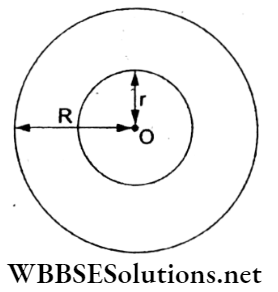
Electromagnetic Induction Multiple Choice Questions And Answers Current Through The Outer Ring Q33

Question 34. Two coils of self-inductances 2 mH and 8 mH are placed so close together that the effective flux in one coil is completely linked with the other. The mutual inductance between these coils is

  1. 10 mH
  2. 6 mH
  3. 4 mH
  4. 16 mH

Answer: 3. 4 mH

For maximum flux linkage between two coils, M = √L1L2, where M = mutual inductance between the two coils, and L1, and L2 are the self-inductances of the two coils.

Given, L1 = 2 mH, = 8 mH.

Hence, M = √L1,L2 = √(2 mHK8 mH) = 4 mH.

Question 35. If the rotational speed of a dynamo armature is doubled then the induced emf will

  1. Become half
  2. Become two times
  3. Become four times
  4. Remain unchanged

Answer: 2. Become two times

The induced voltage in a dynamo is

V= V0 sin ωt = ABNωsin ωt,

where CD = angular frequency and V0 is the voltage amplitude.

When ω is doubled, the induced voltage is also doubled.

Question 36. A conducting ring of radius 1 meter is placed in a uniform magnetic field B of 0.01 T, oscillating with a frequency of 100 Hz with its plane perpendicular to B. What will be the induced electric field?

  1. π V m-1
  2. 10 V m-1
  3. 62 V m-1
  4. 2 V m-1

Answer: 4. 2 V m-1

Induced emf is

⇒ \(|\mathcal{E}|=\frac{d \phi}{d t}=\frac{d}{d t}(B A)=\pi r^2 \frac{d B}{d t}\)  →(1)

If E is the electric field induced in the ring then

⇒ \(\varepsilon=\int E \cdot d l=E \cdot 2 \pi r\)  →(2)

From (1) and (2),

⇒ \(E \cdot 2 \pi r=\pi r^2\left(\frac{2 B}{T / 2}\right)\),

since the magnetic field changes from +B to -B in time T/2

∴ \(E=\frac{2 r B}{T}=2 r B f=2(1.0 \mathrm{~m})(0.01 \mathrm{~T})\left(100 \mathrm{~s}^{-1}\right)=2 \mathrm{~V} \mathrm{~m}^{-1}\).

electromagnetic induction question

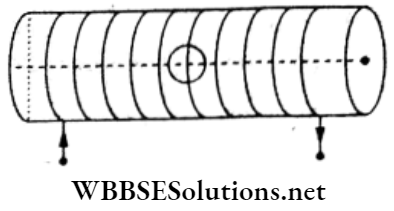
Question 37. A circular coil of cross-sectional area 4 cm2 has 10 turns. It is placed at the center of a long solenoid that has 15 turns per cm and a cross-section of 10 cm2, as shown in the Question figure. The axis of the coil coincides with the axis of the solenoid. What is their mutual inductance?
Electromagnetic Induction Multiple Choice Questions And Answers Circular Coil Of Cross Sectional Area Q37

  1. 7.54 μH
  2. 9.54 μH
  3. 8.54 μH
  4. 10.54 μH

Answer: 1. 7.54 μH

The magnetic field well inside the solenoid is

B = μ0nI1

The magnetic flux linked with the coil at the center is

Φ2 = BAN = (μ0nI1)AN.

If M = mutual inductance,

Φ2 =MI1

⇒ \(M=\frac{\phi_2}{I_1}=\frac{\left(\mu_0 n I_1\right) A N}{I_1}=\mu_0 n A N\)

Given, N =10, A = 4 cm2 = 4 x 10⁻⁴ m2 and n = 1500 m-1.

M = (4π x 10-7H m-1)(1500 m-1)(4 x10⁻⁴ m2)(10)

= 7.54 x 10⁻⁶  H = 7.54 μH.

Question 38. The mutual inductance of two coils can be increased by

  1. Decreasing the number of turns in the coils
  2. Increasing the number of turns in the coils
  3. Winding the coils on a wooden core
  4. None of these

Answer: 2. Increasing the number of turns in the coils

Mutual inductance between two coils is

⇒ \(M=\frac{\mu_0 N_1 N_2 A}{l}\)

M can be increased by increasing N1 and N2 which are the number of turns in the coil.

Class 11 Physics Class 12 Maths Class 11 Chemistry
NEET Foundation Class 12 Physics NEET Physics

Question 39. A long solenoid of diameter 0.1 m has 2 x 10⁴ turns per meter. At the center of the solenoid, a coil of 100 turns and a radius of 1.0 cm is placed with its axis coinciding with the axis of the solenoid. The current in the solenoid reduces at a constant rate from 4 A to 0 A in 0.05 s. If the resistance of the coil is 10π2 Ω, the total charge flowing through the coil during this time is

  1. 32π μC
  2. 16 μC
  3. 32 μC
  4. 16tc μC

Answer: 3. 32 μC

Given, the radius of the solenoid = r1 = 0.05 m and the number of turns per meter = 2 x 10⁴ m-1.

For the small coil, N =100, r2 = 1 x 10⁻² m, resistance, R=10π2 Ω.

The magnetic field through the small coil is

B = μ0nl.

Magnetic flux linked with the coil is

Φ = NBA= Nπr22 μ0nl.

The induced current through the coil is

⇒ \(\frac{d Q}{d t}=I=\frac{|\mathcal{Q}|}{R}=\frac{1}{R} \frac{d \phi}{d t} \Rightarrow Q=\frac{1}{R} \int_0^\phi d \phi=\frac{\phi}{R}\)

∴ \(Q=\frac{100\left(\pi \times 10^{-4} \mathrm{~m}^2\right)\left(4 \pi \times 10^{-7} \mathrm{H} \mathrm{m}^{-1}\right)\left(2 \times 10^4 \mathrm{~m}^{-1}\right)(4 \mathrm{~A})}{10 \pi^2 \Omega}\).

= 32 x l0-6C = 32 μC.

Question 40. A rectangular coil of size 12 cm x 10 cm having 50 turns is suspended vertically in a uniform magnetic field of strength 0.2 Wb m-2. The coil carries a steady current of 2 A. If the plane of the coil is inclined at an angle of 30° with the direction of the magnetic field, the torque required to keep the coil in stable equilibrium will be

  1. 0.24 N m
  2. 0.15N m
  3. 0.20 N m
  4. 0.12N m

Answer: 3. 0.20 N m

The magnetic dipole moment of the rectangular coil is m = NLA.

It is directed along the perpendicular to the plane of the coil.

⇒ Torque = \(\vec{\tau}=\vec{m} \times \vec{B} \Rightarrow|\vec{\tau}|=N I A B \sin \theta\)

Given, N = 50, I = 2 A, A =120 x 10-4 m2, B = 0.2 T, and θ= angle between the normal to the plane of the coil and the field

= 90°- 30°= 60°.

Substituting the values, the required torque tomaintainequilibriumis

∴ \(\tau=(50)(2 \mathrm{~A})\left(120 \times 10^{-4} \mathrm{~m}^2\right)(0.2 \mathrm{~T})\left(\frac{\sqrt{3}}{2}\right)=0.20 \mathrm{~N} \mathrm{~m}\).

electromagnetic induction question

Question 41. In an inductor of self-inductance L = 2 mH, current changes with time according to the relation I = t2e-t. At what time the induced emf is zero?

  1. 4 s
  2. Is
  3. 3s
  4. 2s

Answer: 4. 2s

Induced emf in an inductor is

⇒ \(\varepsilon=L \frac{d I}{d t}=L \frac{d}{d t}\left(t^2 e^{-t}\right)=L\left(2 t e^{-t}-t^2 e^{-t}\right)=L e^{-t}\left(2 t-t^2\right)\).

For induced emf to be zero,

t2 – 2t = 0 ⇒ t = 2s.

Question 42. Two coils have a mutual inductance of 5 x 10⁻³ H. The current changes in the first coil according to the equation I = I0 sinωt, where I0 =10 A and ω = 100π rad s-1. The maximum value of the emf induced in the second coil is

  1. 27π V
  2. 5π V
  3. 4π V
  4. π V

Answer: 2. 5π V

In mutual induction, induced emf in coil 2 (=ε2) is equal to \(M\left(\frac{d I_1}{d t}\right)\), where I1 is the currentin coil 1.

⇒ \(\varepsilon_2=M \frac{d I_1}{d t}=M \frac{d}{d t}\left(I_0 \sin \omega t\right)=M I_0 \omega \cos \omega t\).

Hence, the peak value of the induced emf in coil 2 is

∴ \(\varepsilon_{20}=M I_0 \omega=\left(5 \times 10^{-3} \mathrm{H}\right)(10 \mathrm{~A})\left(100 \pi \mathrm{s}^{-1}\right)=5 \pi \mathrm{V}\).

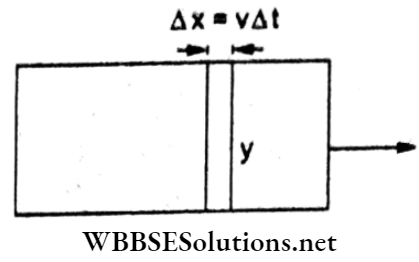
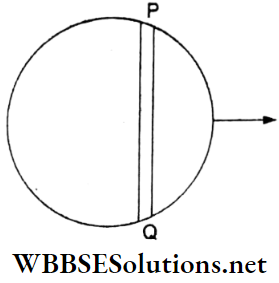
Question 43. A rectangular, a square, a circular, and an elliptical loop, all in the xy-plane are pulled out of a uniform magnetic field with a constant velocity \(\vec{v}=v \hat{i}\). The magnetic field is directed along the negative z-axis. The induced emf during the passage of these loops, out of the field region, will not remain constant for

  1. The rectangular, circular, and elliptical loops
  2. The circular and elliptical loops
  3. The elliptical loop only
  4. Any of the four loops

Answer: 2. The circular and elliptical loops

For the rectangular plate, the area pulled out per second is constant, so the induced emf during its passage out of the field will remain constant with time.
Electromagnetic Induction Multiple Choice Questions And Answers Rectangular Plate Q43

For the circular and elliptical loops, the length of the chord changes, so the area pulled out per second varies, and hence induced emf will vary with time.
Electromagnetic Induction Multiple Choice Questions And Answers Circular And Elliptical Loops Q43

Question 44. A conducting ring of radius r with N turns lies in a horizontal plane. A uniform magnetic field B exists in the vertical direction. If the ring spins about its vertical axis with an angular velocity ω, the emf induced in the ring will be

  1. πr2
  2. \(\frac{1}{2} \pi r^2 B \omega\)
  3. πr2B
  4. Zero

Answer: 4. Zero

When the conducting ring spins about the vertical axis, the magnetic flux <}> linked with the ring remains constant, i.e., Φ = NAB, so the induced emf,

∴ \(|\mathcal{E}|=\frac{d \phi}{d t}=0\)
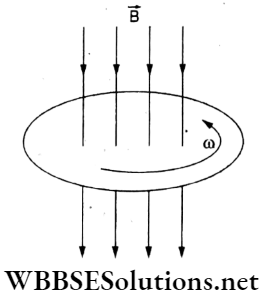
Electromagnetic Induction Multiple Choice Questions And Answers Conducting Ring Spins Q44

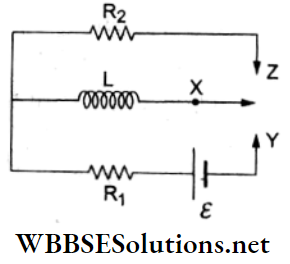
Question 45. In the given circuit, switch X is joined to Y for a long time, and then X is joined to Z. The total heat produced in R2 is
Electromagnetic Induction Multiple Choice Questions And Answers Q45

  1. \(\frac{1}{2} \frac{L E^2}{R_2^2}\)
  2. \(\frac{1}{2} \frac{L \mathcal{E}^2}{R_1^2}\)
  3. \(\frac{1}{2} \frac{L \mathcal{E}^2}{2 R_1 R_2}\)
  4. \(\frac{1}{2} \frac{L \mathcal{E}^2 R_2}{R_1^3}\)

Answer: 2. \(\frac{1}{2} \frac{L \mathcal{E}^2}{R_1^2}\)

When the switch X is joined to Y, the steady current through the closed circuit is I = \(I=\frac{\varepsilon}{R_1}\) and the magnetic energy ’stored in the inductor is

⇒ \(U_B=\frac{1}{2} L I^2=\frac{1}{2} \frac{L \mathcal{E}^2}{R_1^2}\)

When X and Z are joined, this magnetic energy UB appears as heat energy in R2.

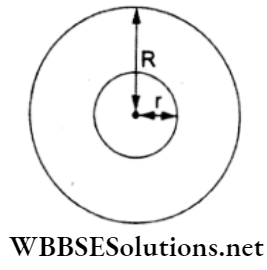
Question 46. A small coil of radius r is placed at the center of a large coil of radius R, where R » r. The two coils are coplanar. The mutual inductance between the coils is proportional to
Electromagnetic Induction Multiple Choice Questions And Answers Mutual Inductance Between The Coils Q46

  1. \(\frac{r}{R}\)
  2. \(\frac{r^2}{R}\)
  3. \(\frac{r^2}{R^2}\)
  4. \(\frac{r}{R^2}\)

Answer: 2. \(\frac{r^2}{R}\)

Let the current in the outer ring be I.

∴ magnetic field at the centre = \(B=\frac{\mu_0 I}{2 R}\)

Magnetic flux linked with the coil at the center is

⇒ \(\phi=B A=\frac{\mu_0 I}{2 R} \cdot \pi r^2\)

∵ Φ = MI.

⇒ \(M=\frac{\phi}{I}=\frac{\mu_0 I \pi r^2}{2 R I}=\frac{\mu_0 \pi}{2} \frac{r^2}{R}=k\left(\frac{r^2}{R}\right)\).

∴ Hence, \(M \propto \frac{r^2}{R}\).

electromagnetic induction question

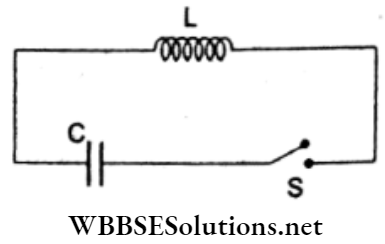
Question 47. A capacitor of capacitance C is initially given a charge Q and then connected to an inductor of inductance L by closing tire switch S. The peak current flowing through the circuit at any later time will be
Electromagnetic Induction Multiple Choice Questions And Answers Capacitor Of Capacitance Q47

  1. \(\frac{Q}{2 \sqrt{L C}}\)
  2. \(\frac{Q}{\sqrt{L C}}\)
  3. \(\frac{2 Q}{\sqrt{L C}}\)
  4. \(\frac{2}{\pi} \frac{Q}{\sqrt{L C}}\)

Answer: 2. \(\frac{Q}{\sqrt{L C}}\)

Current through the inductor will be maximum when the total energy associated with the capacitor is transferred to the inductor.

⇒ Thus, \(\frac{Q^2}{2 C}=\frac{1}{2} L I_0^2\)

∴ Peak current = \(I_0=\frac{Q}{\sqrt{L C}}\)

Question 48. When a charged capacitor is connected across a pure inductor, electrical oscillations are executed, and the charge Q on the capacitor and the current I through the inductor vary with time sinusoidally. The phase difference between Q and I is

  1. π
  2. \(\frac{\pi}{4}\)
  3. \(\frac{\pi}{2}\)
  4. Zero

Answer: 3. \(\frac{\pi}{2}\)

During LC oscillation,

⇒ \(\frac{Q^2}{2 C}+\frac{1}{2} L I^2=\text { constant }\)

Differentiating the above equation twice w.r.t. time, we get

⇒ \(\frac{d^2 Q}{d t^2}=-\frac{1}{\sqrt{L C}} Q\), Which gives the charge Q as a function of time.

Here, Q = Q0 cos cof and I = \(I=\frac{d Q}{d t}=-Q_0 \omega \sin \omega t=Q_0 \omega \cos \left(\omega t+\frac{\pi}{2}\right)\)

∴ Thus, the phase difference between Q and I is \(\frac{\pi}{2}\).

Question 49. A current-carrying conducting flat coil has a magnetic moment \(\vec{m}\). It is placed in a magnetic field \(\vec{B}\) such that \(\vec{m}\) and \(\vec{B}\) antiparallel. The coil is

  1. Not in equilibrium
  2. In neutral equilibrium
  3. In stable equilibrium
  4. In unstable equilibrium

Answer: 4. In unstable equilibrium

The potential energy of a magnetic: dipole of the moment \(\vec{m}\) placed in a magnetic field\(\vec{B}\) is

⇒ \(U=-\vec{B} \cdot \vec{m}=-m B \cos \theta\)

⇒ When \(\vec{m}\) and \(\vec{B}\) are anti-parallel,

0=180°, so U = +mB.

The dipole is in stable equilibrium when PE is minimum (= -mB at θ= 0°) and in unstable equilibrium when PE is maximum (- +mB at θ= 180°).

Hence, the coilisin unstable equilibrium.

Question 50. In the given figure, the conducting ring B is free to move along the horizontal axis of an electromagnet A. The current through A can be altered.
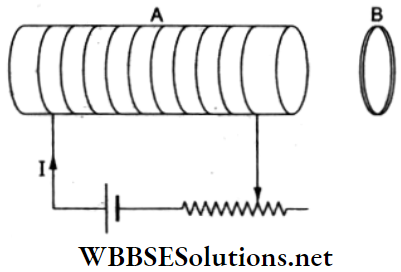
Electromagnetic Induction Multiple Choice Questions And Answers Q50

  1. If I increase, A will repel B
  2. If I increase, A will attract B
  3. If I decreases, A will repel B
  4. If I increase, A will undergo a to-and-fro motion

Answer: 1. If I increases, A will repel B

When the current through coil A increases, the magnetic flux linked with the conducting ring also increases and emf is induced in B. According to Lenz’s law, since the cause of induced emf in the die ring is increasing magnetic flux, the ring will be repelled by A so as to decrease the linked magnetic flux.

Question 51. A ring of radius r and resistance R falls vertically. It is always in contact with two vertical rails which are joined at the top. The rails are without friction and have negligible resistance. A uniform magnetic field of magnitude B exists perpendicular to the plane of the ring and the rails. When the speed of the ring is v, the current in section PQ will be
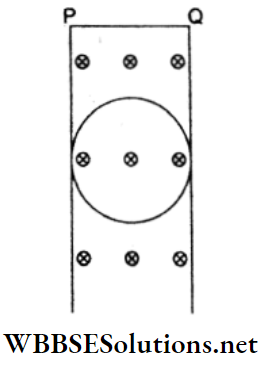
Electromagnetic Induction Multiple Choice Questions And Answers A Ring Q51

  1. \(\frac{2 B r v}{R}\)
  2. \(\frac{4 B r v}{R}\)
  3. \(\frac{8 B r v}{R}\)
  4. Zero

Answer: 3. \(\frac{8 B r v}{R}\)

Emf induced across the diameter of the ring is £- B(2r)v and each half of the ring has resistance \(\frac{R}{2}\). The circuit can be redrawn as shown in the adjoining figure.

From loop rule,

⇒ \(\frac{I}{2}\left(\frac{R}{2}\right)-\varepsilon=0\)

∴ \(I=\frac{4 \varepsilon}{R}=\frac{4(2 B v r)}{R}=\frac{8 B r v}{R}\)
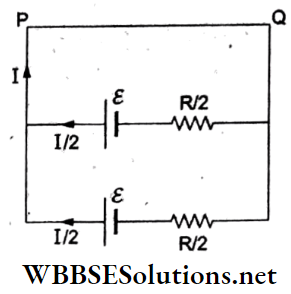
Electromagnetic Induction Multiple Choice Questions And Answers Diameter Of The Ring Q51

Question 52. The network shown in the figure is part of a complete circuit. At an instant when the current I is 5 A and is decreasing at a rate of 103 A s-1 then VA-VB is
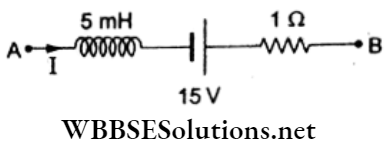
Electromagnetic Induction Multiple Choice Questions And Answers Network Q52

  1. 15V
  2. 20V
  3. -15 V
  4. -5V

Answer: 3. -15 V

From the given figure,

⇒ \(V_{\mathrm{A}}-V_{\mathrm{B}}=\left(V_{\mathrm{A}}-V_{\mathrm{a}}\right)+\left(V_{\mathrm{a}}-V_{\mathrm{b}}\right)+\left(V_{\mathrm{b}}-V_{\mathrm{B}}\right)\)

⇒ \(L\left(\frac{d I}{d t}\right)-\varepsilon+R I\)

⇒ \(\left(5 \times 10^{-3} \mathrm{H}\right)\left(-10^3 \mathrm{~A} \mathrm{~s}^{-1}\right)-15 \mathrm{~V}+(5 \mathrm{~A})(1 \Omega)\)

∴ \(-5 V-15 V+5 V=-15 V\).
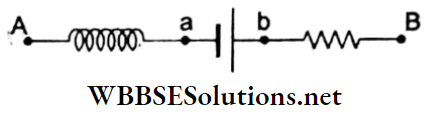
Electromagnetic Induction Multiple Choice Questions And Answers Q52

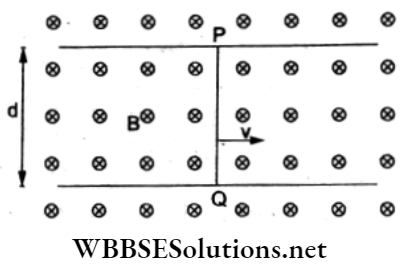
Question 53. The adjoining figure shows a conducting wire PQ sliding on two parallel conducting rails separated at a distance d. A uniform magnetic field B exists in the region directed perpendicularly into the plane of the paper. The force required to keep the wire sliding at a constant velocity v will
Electromagnetic Induction Multiple Choice Questions And Answers Adjoining Q53

  1. Depends on v alone
  2. Depend on \(\vec{B}\) alone
  3. Depend on both v and \(\vec{B}\)
  4. Be zero

Answer: 4. Be zero

Magnetic force on a current-carrying wire moving in a magnetic field is given by

⇒ \(\vec{F}=I(\vec{l} \times \vec{B})\),

where I is the current through the conductor. In the given case both the ends of the rails are open, so no current flows through, and hence force on PQ is zero.

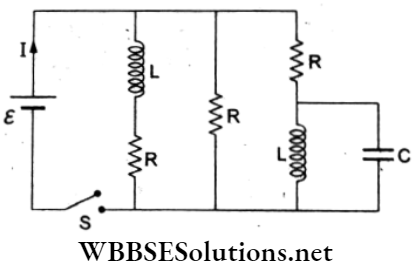
Question 54. The adjoining figure shows a circuit that contains three. identical resistors with resistance R = 9.0 Ω each, two identical inductors L = 2 mH each, a capacitor of 10 μF, and a battery with emf ε = 18 V. The current I through the battery just after the switch S is closed is
Electromagnetic Induction Multiple Choice Questions And Answers Circuit That Contains Three Identical Resistors Q54

  1. 0.4 A
  2. 4.0 A
  3. 0 A
  4. 2 mA

Answer: 2. 4.0 A

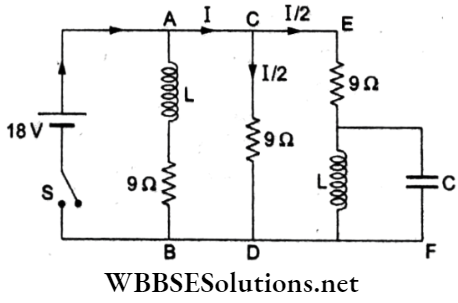
When the switch is closed, the instantaneous current distribution through various branches is shown in the figure. At t= 0, the inductor offers high resistance so no current throughbranch AB. Current is equally divided at C in two branches as the capacitor acts as a conductor at t = 0.

⇒ Hence, net resistance = \(=\frac{9}{2} \Omega\)(in parallel combination).

Current through the battery is

⇒ \(I=\frac{\varepsilon}{R / 2}=\frac{18}{9 / 2} \mathrm{~A}=4 \mathrm{~A}\)
Electromagnetic Induction Multiple Choice Questions And Answers Switch Q54

Question 55. In which of the following devices the eddy current effect is not used?

  1. Induction furnace
  2. Electromagnet
  3. Magnetic braking in train
  4. Electric heater

Answer: 4. Electric heater

Eddy currents are loops of electrical current induced within conductors by a time-varying magnetic field within the conductor following Faraday’slaw of EMI. The electric heater does not involve eddy current but it converts electrical energy into Joule heat.

Question 56. An 800-turn coil of effective area 0.05 m2 is kept perpendicular to a magnetic field of 5 x 10⁻⁵ T. When the plane of the coil is rotated by 90° about any of its coplanar axes in 0.1 s, the emf induced in the coil will be

  1. 2 V
  2. 0.2 V
  3. 2 x 10⁻³V
  4. 0.02 V

Answer: 4. 0.02 V

Magnetic flux, \(\phi=N \vec{A} \cdot \vec{B}=N A B \cos \theta\), where 0 is the angle between \(\vec{B}\) and the normal to the area of the coil. Initially 0= 0° and finally 0= 90° during the time duration Af= 0.1 s.

According to Faraday’s law, induced emf is

⇒ \(\varepsilon=-\frac{\Delta \phi}{\Delta t}=-\frac{\phi_{\mathrm{f}}-\phi_{\mathrm{i}}}{\Delta t}=-\frac{N B A \cos 90^{\circ}-N B A}{0.1 \mathrm{~s}}\)

∴ \(\frac{N B A}{0.1 \mathrm{~s}}=\frac{(800)\left(5 \times 10^{-5} \mathrm{~T}\right)\left(0.05 \mathrm{~m}^2\right)}{0.1 \mathrm{~s}}=0.02 \mathrm{~V}\).

Question 57. If maximum energy is stored in the capacitor at time t = 0 then the time at which current in the circuit during LC oscillation will be maximum is
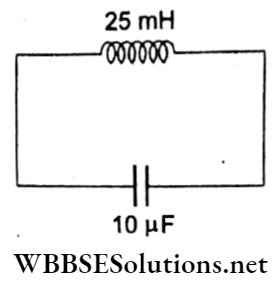
Electromagnetic Induction Multiple Choice Questions And Answers Maximum Energy Q57

  1. \(\frac{\pi}{2} \mathrm{~ms}\)
  2. 3 ms
  3. \(\frac{\pi}{4} \mathrm{~ms}\)
  4. ms

Answer: 3. \(\frac{\pi}{4} \mathrm{~ms}\)

The variation in magnetic energy UB (associated with L) and electrical energy UE (associated with C) with time is shown in the diagram. When electrical energy with a capacitor is maximum, magnetic energy with L is zero. After one fourth of oscillation \(\left(t=\frac{T}{4}\right), u_B\), is maximum (with current maximum). But the time period is T = 2piLC

⇒ Hence, required time = \(t=\frac{T}{4}=\frac{\pi}{2} \sqrt{L C}=\frac{\pi}{2} \sqrt{\left(25 \times 10^{-3} \mathrm{H}\right)\left(10 \times 10^{-6} \mathrm{~F}\right)}\)

∴ \(\frac{\pi}{2} \times 5 \times 10^{-4} \mathrm{~s}=\frac{\pi}{4} \mathrm{~ms}\)
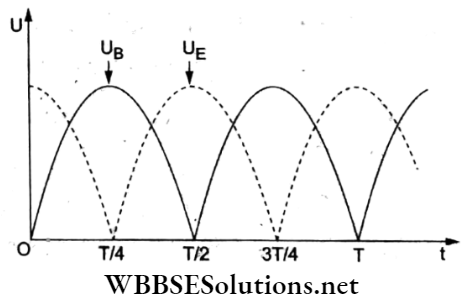
Electromagnetic Induction Multiple Choice Questions And Answers Variation Of Magnetic Energy Q57

Question 58. Let f1 be the frequency of LC oscillation. If a resistance R is also added to it in series, the frequency becomes f2. The ratio \(\frac{f_2}{f_1}\) will be

  1. \(\sqrt{1+\frac{R^2 C}{4 L}}\)
  2. \(\sqrt{1-\frac{R^2 C}{4 L}}\)
  3. \(\sqrt{1+\frac{R^2 C}{L}}\)
  4. \(\sqrt{1-\frac{R^2 C}{L}}\)

Answer: 2. \(\sqrt{1-\frac{R^2 C}{4 L}}\)

In an LC circuit (in the absence of resistance), the angular frequency is \(\omega_1=2 \pi f_1=\frac{1}{\sqrt{L C}}\)

In the presence of resistance Rin the circuit

⇒ \(\omega_2^2=\omega_1^2-\left(\frac{R}{2 L}\right)^2\)

⇒ \(\omega_1^2-\omega_2^2=\frac{R^2}{4 L^2}\)

⇒ \(\omega_1^2\left(1-\frac{\omega_2^2}{\omega_1^2}\right)=\frac{R^2}{4 L^2}\)

⇒ \(\frac{1}{L C}\left(1-\frac{\omega_2^2}{\omega_1^2}\right)=\frac{R^2}{4 L^2}\)

⇒ \(\frac{\omega_2^2}{\omega_1^2}=1-\frac{R^2}{4 L^2} \times L C=1-\frac{R^2 C}{4 L}\)

∴ \(\frac{f_2}{f_1}=\sqrt{1-\frac{R^2 C}{4 L}}\)

Question 59. A solid metal cube of length 2cm is moving in the positive direction at a constant speed of 6 s-1. There is a uniform magnetic field of 0.1 T in the positive z-direction. The potential difference between the two faces of the cube perpendicular to the x-axis is

  1. 2 mV
  2. 12 mV
  3. 6 mV
  4. l mV

Answer: 2. 12 mV

Motional emf (£ =Bfo) induced in each of the four edges of the cube parallel to the r-axis are parallel Hence, PD between the two faces of the cube perpendicular to the r-axis will be

⇒ \(\mathcal{E}=B l v=(0.1 \mathrm{~T})\left(2 \times 10^{-2} \mathrm{~m}\right)\left(6 \mathrm{~m} \mathrm{~s}^{-1}\right)\)

∴ \(12 \times 10^{-3} \mathrm{~V}=12 \mathrm{mV}\)

Question 60. The self-induced emf of a coil is 25 V. When the current through this coil is changed at a uniform rate from 10 A to 25 A in 1 s, the change in the magnetic energy linked with the coil is

  1. 437.5 J
  2. 740 J
  3. 637.5 J
  4. 540 J

Answer: 1. 437.5 J

Induced emf in an inductor is

⇒ \(|\mathcal{E}|=L \frac{d I}{d t}\)

⇒ \(25 \mathrm{~V}=L \frac{(25 \mathrm{~A}-10 \mathrm{~A})}{1 \mathrm{~s}} \Rightarrow L=\frac{25}{15} \mathrm{H}=\frac{5}{3} \mathrm{H}\)

Change in magnetic energy linked with the inductor is

∴ \(\Delta U=\frac{1}{2} L\left(I_1^2-I_2^2\right)=\frac{1}{2}\left(\frac{5}{3} \mathrm{H}\right)\left(625 \mathrm{~A}^2-100 \mathrm{~A}^2\right)=437.5 \mathrm{~J}\).

Question 61. A circular conducting loop is made of a thin wire having a cross-sectional area of 3.5 x 10⁻² m2 and a resistance of 10 Ω. It is placed perpendicular to a time-dependent magnetic field B(t)= (0.4 T)sin (0.5πt). The field is uniform in space. The net charge that flows through the loop during t = 0 to t =1.0 s is close to

  1. 6 mC
  2. 21 mC
  3. 7 mC
  4. 1.4 mC

Answer: 4. 1.4 mC

Induced emf = \(|\mathcal{E}|=\frac{d \phi}{d t}\)

Induced current= I = \(\frac{1}{R} \frac{d \phi}{d t}\)

⇒ Net charge = Q = \(\int I d t=\frac{1}{R} \int d \phi=\frac{1}{R}[A B]_{t=0}^{t=1 \mathrm{~s}}\)

⇒ \(\frac{A}{R} B_0\left[\sin \frac{\pi}{2} t\right]_0^1=\frac{\left(3.5 \times 10^{-2} \mathrm{~m}^2\right)(0.4 \mathrm{~T})}{(10 \Omega)}\)

∴ \(1.4 \times 10^{-3} \mathrm{C}=1.4 \mathrm{mC}\).

Question 62. The figure shows a square loop L of side 5 cm which is connected to a network of resistances. The whole 5 cm set-up is moving towards the right with a uniform velocity of 1cm s-1. At some instant, a part of L is in a uniform magnetic field of 1 T perpendicular to the plane of the loop. If the resistance of L is 1.7 Ω, the current in the loop at that instant will be close to
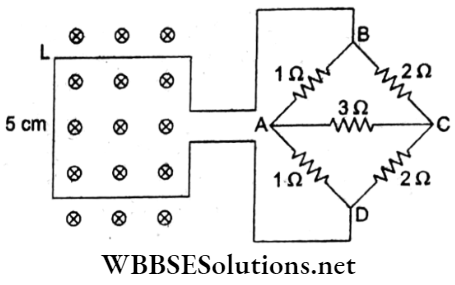
Electromagnetic Induction Multiple Choice Questions And Answers Square Loop Q62

  1. 170 μA
  2. 50 μA
  3. 11.5 μA.
  4. 60 μA.

Answer: 1. 170 μA

Equivalent resistance across BD of the bridge

⇒ \(R_1=\frac{4 \Omega \times 2 \Omega}{6 \Omega}=\frac{4}{3} \Omega=1.3 \Omega\)

Resistance of loop L is = 1.7 Ω.

Total resistance=R = R1 + R2= 1.3 Ω+ 1.7 Ω= 3.0 Ω

Motional emf induced = ε = Blv

⇒ \((1.0 \mathrm{~T})\left(5 \times 10^{-2} \mathrm{~m}\right)\left(1 \times 10^{-2} \mathrm{~m} \mathrm{~s}^{-1}\right)\)

⇒ \(5 \times 10^{-4} \mathrm{~V}\).

current in the loop is

∴ \(I=\frac{\varepsilon}{R}=\frac{5 \times 10^{-4} \mathrm{~V}}{3 \Omega}=1.66 \times 10^{-4} \mathrm{~A} \approx 1.7 \times 10^{-4} \mathrm{~A}=170 \mu \mathrm{A}\).

Question 63. Two coils P and Q are separated, by some distance. When a current of 3 A flows through coil P, a magnetic flux of 10-3 Wb is linked with Q. No current is passed through Q. When no current is passed through P and a current of A is passed through Q, the flux through P is

  1. 3.67 x 10⁻⁴ Wb
  2. 6.67 x 10⁻³ Wb
  3. 3.67 x 10⁻³ Wb
  4. 6.67 x 10⁻⁴ Wb

Answer: 4. 6.67 x 10⁻⁴ Wb

Let M be the mutual inductance between the coils P and Q. Thus, magnetic flux linked with Q =M x current in P.

⇒ \(\phi_{\mathrm{Q}}=M I_{\mathrm{P}} \Rightarrow 10^{-3} \mathrm{~Wb}=M(3 \mathrm{~A})\)

⇒ \(M=\frac{10^{-3}}{3} \mathrm{H}\)

⇒ Next, \(\phi_{\mathrm{P}}=M I_{\mathrm{Q}}=\left(\frac{10^{-3}}{3} \mathrm{H}\right)(2 \mathrm{~A})=0.667 \times 10^{-3} \mathrm{~Wb}\)

∴ \(\phi_P=6.67 \times 10^{-4} \mathrm{~Wb}\).

Question 64. The circuit shown in the figure has two identical resistors with R = 5 Ω and an inductor with mH. An ideal battery of 15 V is connected to the circuit. When switch S is closed, the current through the battery after a long time will be
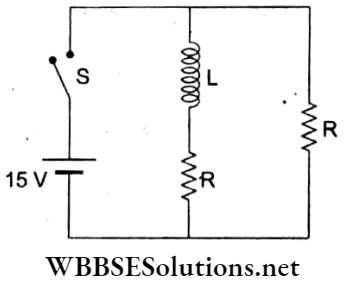
Electromagnetic Induction Multiple Choice Questions And Answers Two Identical Resistors Q64

  1. 5.5 A
  2. 7.5 A
  3. 6 A
  4. 3 A

Answer: 3. 6 A

The inductor offers high resistance at t= 0 and becomes conducting after a long time. Thus, the effective resistance in the circuit is R/2 and L is ineffective when a steady state is reached. Thus,

∴ \(I=\frac{\varepsilon}{R / 2}=\frac{15 \mathrm{~V}}{\frac{5}{2} \Omega}=6 \mathrm{~A}\).

Question 65. A 10-m-long horizontal wire extends from northeast to southwest. It is falling with a speed of 50 m s-1 at a right angle to the horizontal component of the earth’s magnetic field of 0.30 x 10⁻⁴ T. The value of the induced emf in the wire is

  1. 15 mV
  2. 0.3 mV
  3. 2.5 mV
  4. 1.1 mV

Answer: 1. 15 mV

Given, the length of the wire = l =10 m; velocity = p = 50 m s-1; horizontal component of earth’s magnetic field = B = 0.30 x 10⁻⁴ T.

Since the wire falls perpendicular to the magnetic field, motional emf induced will be

∴ \(\varepsilon=B l v=\left(0.3 \times 10^{-4} \mathrm{~T}\right)(10 \mathrm{~m})\left(50 \mathrm{~m} \mathrm{~s}^{-1}\right)=15 \mathrm{mV}\).

Question 66. There are two long coaxial solenoids of the same length l. The inner and outer coils have radii r1 and r2 and the numbers of turns per unit length are n1 and n2 respectively. The ratio of mutual inductance to the self-inductance of the inner coil is

  1. \(\frac{n_2}{n_1} \frac{r_1}{r_2}\)
  2. \(\frac{n_2}{n_1} \frac{r_2^2}{\frac{n_1^2}{2}}\)
  3. \(\frac{n_2}{n_1}\)
  4. \(\frac{n_1}{n_2}\)

Answer: 3. \(\frac{n_2}{n_1}\)

Let N1 and N2 be the total numbers of turns in the inner and outer solenoids of the same length l.

Mutual conductance between them is

⇒ \(M=\mu_0 \frac{N_1 N_2 A}{l}\)

Self-inductance of the inner coil is

⇒ \(L=\mu_0 \frac{N_1^2 A}{l} \text {, where } A=\pi r_1^2\)

∴ \(\frac{M}{L}=\frac{N_2}{N_1}=\frac{n_2 l}{n_1 l}=\frac{n_2}{n_1}\)

Question 67. A coil of radius r is rotating about its diameter with angular frequency (0 in a uniform magnetic field B. Find the peak voltage developed. (Given that r = 10 cm, B = 5 x 10⁻⁵ T, and time period for rotation = 0.4 s.)

  1. 3 x 10⁻⁵ V
  2. 2.5 x 10⁻⁵ V
  3. 5 x 10⁻⁵ V
  4. 5 x 10⁻⁶  V

Answer: 2. 2.5 x 10⁻⁵ V

Instantaneous magnetic flux = Φ = AB cos ωt and induced voltage = \(V=-\frac{d Q}{d t}=A B \omega \sin \omega t\)

Peak voltage is

⇒ \(V_0=A B \omega=\pi r^2 B \frac{2 \pi}{T}=2 \pi^2 \frac{B r^2}{T} \)

⇒ \(2(10)\left(5 \times 10^{-5} \mathrm{~T}\right) \frac{\left(10 \times 10^{-2} \mathrm{~m}\right)^2}{(0.4 \mathrm{~s})}\)

∴ \(2.5 \times 10^{-5} \mathrm{~V}\).

Question 68. An elliptical ring having N turns and of semimajor and semiminor axes a and b respectively rotates about its major axis with angular frequency in a uniform magnetic field B such that the axis of rotation is perpendicular to the direction of the field. If the resistance of the ring is R, the average power produced is

  1. \(\frac{\pi^2 N^2 a^2 b^2 B^2 \omega^2}{2 R}\)
  2. \(\frac{\pi^2 N^2 a^2 b^2 B^2 \omega^2}{4 R}\)
  3. \(\frac{\pi^2 N^2 a^2 b^2 B^2 \omega^2}{R}\)
  4. \(\frac{\pi^2 N^2 a^2 b^2 \omega^2 B^2}{3 R}\)

Answer: 1. \(\frac{\pi^2 N^2 a^2 b^2 B^2 \omega^2}{2 R}\)

Rotating coil in a magnetic field generates AC voltage whose peak voltage = V0 = ANBω.

For a pure resistive coil, average power,

⇒\(P=I_{\mathrm{rms}} V_{\mathrm{rms}}=\frac{1}{2} V_0 I_0=\frac{V_0^2}{2 R}\)

∴ \(P=\frac{1}{2 R}(\pi a b N B \omega)^2=\frac{\pi^2 N^2 a^2 b^2 B^2 \omega^2}{2 R}\).

Question 69. A bar magnet moves through a coil with a constant velocity. Which one of the given options correctly represents the deflection of the galvanometer?
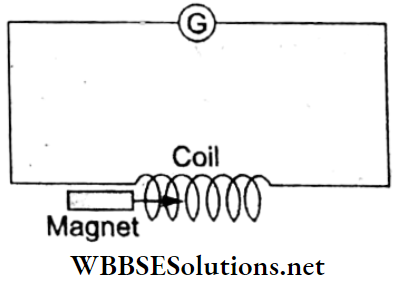
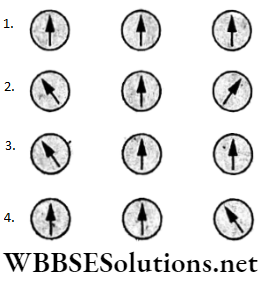
Electromagnetic Induction Multiple Choice Questions And Answers Bar Magnetic Q69

Electromagnetic Induction Multiple Choice Questions And Answers Q69

Answer: 2.

The deflection in the galvanometer follows Lenz’s law.

  1. When the magnet approaches the coil, the induced current opposes its motion showing the deflection towards the left.
  2. When the magnet is well inside the coil, the flux remains unchanged showing null deflection.
  3. When the magnet moves out of the coil, the direction of the induced current is reversed so as to attract the receding magnet.

This is given in option (2).

Question 70. A 30-cm-long wire of uniform cross-section with a diameter of 4 mm forming a square loop is placed in a magnetic field with its plane perpendicular to the field. If the field changes at a constant rate of 0.032 T s-1, find the current induced in the loop. (Given that the resistivity of the material of wire is 1.23 x l0-8 Ωm.)

  1. 0.34 A
  2. 0.43 A
  3. 0.61 A
  4. 0.53 A

Answer: 3. 0.61 A

Resistance of the wire is

⇒ \(R=\rho \frac{l}{A}=\rho \frac{l}{\pi r^2}\)

⇒ \(\frac{\left(1.23 \times 10^{-8} \Omega \mathrm{m}\right)\left(30 \times 10^{-2} \mathrm{~m}\right)}{(3.14)\left(2 \times 10^{-3} \mathrm{~m}\right)^2}=2.94 \times 10^{-4} \Omega\)

∴ \(I=\frac{\mathcal{E}}{R}=\frac{A d B / d t}{R}=\frac{(0.3 \mathrm{~m})^2\left(32 \times 10^{-3} \mathrm{~T}^{\prime} \mathrm{s}^{-1}\right)}{16\left(2.94 \times 10^{-4} \Omega\right)}=0.61 \mathrm{~A} .\)

Question 71. An infinitely long straight wire XY carries a steady current L A rectangular wire frame with one side open is placed in the dieplane of the straight wire. A sliding connector PQ of resistance R slides with constant velocity as shown. The current induced in the connector as a function of time is
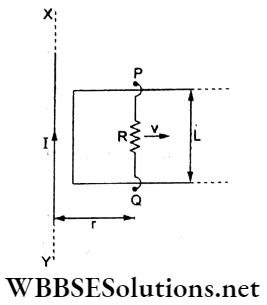
Electromagnetic Induction Multiple Choice Questions And Answers Infinitely Long Straight Wire Q71

  1. \(\frac{\mu_0}{2 \pi} \frac{I v l}{R r}\)
  2. \(\frac{\mu_0}{4 \pi} \frac{I v l}{R r}\)
  3. \(\frac{2 \mu_0}{\pi} \frac{I v l}{R r}\)
  4. \(\frac{\mu_0}{\pi} \frac{\mathrm{I} v \mathrm{l}}{R r}\)

Answer: 1. \(\frac{\mu_0}{2 \pi} \frac{I v l}{R r}\)

As the connector PQ moves, it cuts the magnetic field lines produced by the straight current I. Thus, motional emf = \(B l v=\frac{\mu_0 I}{2 \pi r} v l\) is induced and current induced = \(\frac{B l v}{R}=\frac{\mu_0 I v l}{2 \pi r R}\).

Question 72. Two concentric circular coils C1 and C2 are placed in the xy-plane. C1 has 200 turns and a radius of 1 cm, C2 has 500 turns and a radius of 20 cm. Coil C2 carries a time-dependent current I(t)= (5t2-2t+3) A, where t is time in seconds. The emf induced in C1 (in mV) at t=1 s is

  1. \(\frac{\pi^2}{25}\)
  2. \(\frac{2 \pi^2}{25}\)
  3. \(\frac{\pi^2}{50}\)
  4. \(\frac{3 \pi^2}{50}\)

Answer: 2. \(\frac{2 \pi^2}{25}\)

Given, R1 = lcm, N1= 200, R2 = 20 cm, N2 = 200.

The magnetic field produced by C2 at its center is

⇒ \(B_2=\frac{\mu_0 I N_2}{2 R_2}\)

Magnetic flux linked with coil C1 is

⇒ \(\phi_1=A_1 B_2=\left(\pi R_1^2 N_1\right)\left(\frac{\mu_0 N_2}{2 R_2}\right) I(t)\)

Induced emf is

⇒ \(\varepsilon=\left|\frac{d \phi_1}{d t}\right|=\frac{\pi N_1 N_2 \mu_0 R_1^2}{2 R_2} \frac{d I(t)}{d t}\)

⇒ \(\frac{\pi(200 \times 500)\left(4 \pi \times 10^{-7}\right)\left(10^{-2}\right)^2}{2\left(20 \times 10^{-2}\right)} \cdot \frac{d}{d t}\left(5 t^2-2 t+3\right)\)

∴ \(8 \pi^2 \times 10^{-5} \mathrm{~V}=\frac{2 \pi^2}{25} \mathrm{mV}\).

Heat Engine Refrigerator Multiple Choice Question And Answers

Heat Engine Refrigerator

Question 1. The efficiency of a Carnot engine operating between the temperatures of 100°C and -23°C will be

  1. \(\frac{100-23}{273}\)
  2. \(\frac{100+23}{373}\)
  3. \(\frac{100+23}{100}\)
  4. \(\frac{100-23}{100}\)

Answer: 2. \(\frac{100+23}{373}\)

Temperature of source = T1 = (273 + 100) K

= 373 K,

Temperature of sin k = T2 = (273 – 23 K)

= 250 K.

The efficiency of the Carnot engine is

⇒ \(\eta=1-\frac{T_2}{T_1}\)

= \(\frac{T_1-T_2}{T_1}\)

= \(\frac{123}{373}\)

= \(\frac{100+23}{373}\)

Heat Engine Refrigerator Multiple Choice Question And Answers

Question 2. An engine takes heat from a reservoir and converts \(\frac{1}{6}\) of it into work. If the temperature of the sink is reduced by 62 °C, the efficiency of the engine becomes double. The temperatures of the source and sink must be

  1. 90°C, 37°C
  2. 99°C,37°C
  3. 372°C,37°C
  4. 206°C, 37°C

Answer: 2. 99°C,37°C

Efficiency = \(\frac{\text { output }}{\text { input }}=\frac{\text { work done }(W)}{\text { heat absorbed }(Q)}\)

⇒ \(1-\frac{T_2}{T_1}=\frac{1}{6}\)…..(1) [∵ W = \(\frac{Q}{6}\)]

When the temperature T2 of the sink is reduced by 62°C, the new temperature T2 = T2– 62, and

⇒ \(\eta^{\prime}=1-\frac{T_2^{\prime}}{T_1}\)

= \(2 \eta=2\left(\frac{1}{6}\right)\)

= \(\frac{1}{3}\)

⇒ \(1-\left(\frac{T_2-62}{T_1}\right)\)

= \(\frac{1}{3}\)…(2)

From(1), \(\frac{T_2}{T_1}=\frac{5}{6}\) and from(2), \(\frac{T_2}{T_1}=\frac{2}{3}+\frac{62}{T_1}\)

difference between heat engine heat pump and refrigerator

Equating \(\frac{T_2}{T_1}\) as mentioned above, \(\frac{5}{6}=\frac{2}{3}+\frac{62}{T_1}\)

T1 = 372K

= 99°C,

and \(T_2=\frac{5}{6} T_1\)

= 310K

= 37°C.

∴ The required temperatures are 99 °C and 37°C.

Question 3. The temperatures of the source and sink of a heat engine are 127°C and 27°C respectively. A technician claims its efficiency to be 26%.

  1. It is impossible.
  2. It is possible with high probability.
  3. It is possible with low probability.
  4. The data is insufficient.

Answer: 1. It is impossible.

Given that T1 = (273 + 127) K

= 400 K

T2 = (273 + 27) K

= 300 K.

The efficiency of an ideal engine (Carnot engine),

⇒ \(\eta=1-\frac{T_2}{T_1}\)

= \(1-\frac{300}{400}\)

= \(\frac{1}{4}\)

= 25%

No engine can have an efficiency more than that of a Carnot engine.

Hence, the claim of 26% efficiency is impossible.

Question 4. The efficiency of a Carnot engine is 50% and the temperature of the sink is 500 K. If the temperature of the source is kept constant and the efficiency of the engine is to be raised to 60% then the required temperature of the sink will be

  1. 600 K
  2. 500 K
  3. 400 K
  4. 100 K

Answer: 3. 400 K

Efficiency \(\eta=1-\frac{T_2}{T_1}\)

Given that T2 = 500 K and \(\eta=50 \%=\frac{1}{2} \Rightarrow \frac{1}{2}=1-\frac{500}{T_1}\)

hence T1 = 1000 K.

For 60% efficiency, let the temperature of the sink be T2

difference between heat engine heat pump and refrigerator

⇒ \(\frac{60}{100}=1-\frac{T_2^{\prime}}{T_1}=1-\frac{T_2^{\prime}}{1000}\)

∴ T2 = 400 K

Question 5. An ideal gas heat engine operates as a Carnot cycle between 227°C and 127°C. It absorbs 6 kcal of heat at a higher temperature. The amount of heat (in kcal) converted into work is equal to

  1. 1.6
  2. 1.2
  3. 4.8
  4. 3.5

Answer: 2. 1.2

Temperature of source = T1 = (227 + 273) K

= 500 K.

Temperature ofsink = T2 = (127 + 273) K

= 400 K.

∴ efficiency \(\eta=1-\frac{T_2}{T_1}\)

= \(1-\frac{400}{500}\)

= \(\frac{1}{5}\)

But \(\eta=\frac{\text { output }(W)}{\text { input }(Q)}\)

= \(\frac{W}{6 \mathrm{kcal}}\)

= \(\frac{1}{5}\)

∴ work W = \(\frac{6kcal}{5}\)

= 1.2 kcal

Question 6. An engine has an efficiency of \(\frac{1}{6}\) When the temperature of the sink is reduced by 62°C, its efficiency is doubled. The temperature of the source is

  1. 120°C
  2. 35°C
  3. 99°C
  4. 65°C

Answer: 3. 99°C

Let T1 = temperature of the source.

Given that efficiency n = \(\frac{1}{6}\)

⇒ \(\eta=1-\frac{T_2}{T_1} \Rightarrow \frac{1}{6}=1-\frac{T_2}{T_1}\)….(1)

When T2 is reduced to T2– 62, efficiency gets doubled. So,

difference between heat engine heat pump and refrigerator

⇒ \(\frac{2}{6}=1-\frac{T_2-62}{T_1}\)…..(2)

Solving (1) and (2), T1 = 372 K = 99°C.

Class 11 Physics Class 12 Maths Class 11 Chemistry
NEET Foundation Class 12 Physics NEET Physics

Question 7. A Carnot engine whose sink is at 300 K has an efficiency of 40%. By how much should the temperature of the source be increased so as to increase its efficiency by 50% of the original efficiency?

  1. 250 K
  2. 370 K
  3. 270 K
  4. 390 K

Answer: 1. 250 K

Efficiency of Carnot engine is \(\eta=1-\frac{T_2}{T_1}\)

Given that \(\eta=40 \%=\frac{4}{10}\), the temperature of sink = T2 = 300 K.

Temperature of source = T1.

∴ \(\frac{4}{10}=1-\frac{300}{T_1}\)

⇒ T1 = 500 K

Let the temperature T1 of the source be increased by ΔT1 so that the increased efficiency becomes

⇒ \(\eta^{\prime}=40 \%+50 \% \text { of } \eta=\frac{40}{100}+\frac{50}{100} \times \frac{40}{100}=\frac{60}{100}\)

Hence,

⇒ \(\eta^{\prime}=\frac{60}{100}\)

= \(1-\frac{T_2}{T_1+\Delta T_1}\)

⇒ \(\frac{60}{100}=1-\frac{300}{500+\Delta T_1}\)

⇒ \(\Delta T_1=250 \mathrm{~K}\)

Question 8. Two Carnot engines A and B are operated in series. Engine A receives heat from the source at temperature T1, and rejects heat to the sink at temperature T. The second engine receives heat at temperature T and rejects a part of it to its sink at temperature T2. For what value of T are the efficiencies of the two engines equal?

  1. \(\frac{T_1+T_2}{2}\)
  2. \(\frac{T_1-T_2}{2}\)
  3. \(\sqrt{T_1 T_2}\)
  4. \(\frac{\sqrt{T_1 T_2}}{2}\)

Answer: 3. \(\sqrt{T_1 T_2}\)

For Carnot engine A, efficiency is \(\eta_{\mathrm{A}}=1-\frac{T}{T_1}\) and for Carnot engine B,

it is \(\eta_{\mathrm{B}}=1-\frac{T_2}{T}\)

Given that \(\eta_{\mathrm{A}}=\eta_{\mathrm{B}}\)

⇒ \(1-\frac{T}{T_1}=1-\frac{T_2}{T}\)

⇒ \(\frac{T}{T_1}=\frac{T_2}{T}\)

Hence, \(T=\sqrt{T_1 T_2}\)

Question 9. The coefficient of performance of a refrigerator is 5. If the temperature inside the freezer is -20°C, the temperature of the surroundings to which it rejects heat is

  1. 42 °C
  2. 31 °C
  3. 21 °C
  4. 15°C

Answer: 2. 31 °C

The coefficient of performance (k) of a refrigerator is expressed as

⇒ \(k=\frac{T_2}{T_1-T_2}\)

where T2 = temperature of the refrigerated space,

and T1 = temperature of surroundings.

Given that T2 = -20°C = 253 K.

difference between heat engine heat pump and refrigerator

For k = 5,

⇒ \(5=\frac{253}{T_1-253}\)

⇒ \(T_1=303.6 \mathrm{~K} \approx 31^{\circ} \mathrm{C}\)

Question 10. A Carnot engine having an efficiency of \(\frac{1}{10}\) as a heat engine is used as a refrigerator. If the work done on the system is 10 J, the amount of energy absorbed from the reservoir at a lower temperature is

  1. 110 J
  2. 90 J
  3. 95 J
  4. 10 J

Answer: 2. 90 J

When used as a Carnot engine, efficiency \(\eta=1-\frac{T_2}{T_1}\)

Given that n = \(\frac{1}{10}\)

Hence, \(\frac{T_2}{T_1}=\frac{9}{10}\)……(1)

When used as a refrigerator, its coefficient of performance is

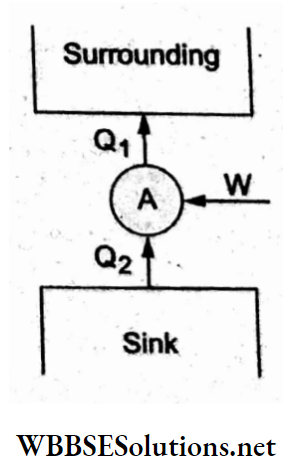
⇒ heat extracted from the reservoir (Q2) / work done on the system

Question 11. A refrigerator works between 4°C and 30°C, It is required to remove 600 calories of heat every second in order to keep the temperature of the refrigerated space constant. The power required is

  1. 24.65 W
  2. 236.5 W
  3. 230 W
  4. 2.365 W

Answer: 2. 236.5 W

For the refrigerator, T2 = (4 + 273) K = 277 K.

T1 = (30 + 273) K

= 303 K.

The coefficient of performance is

⇒ \(\frac{Q_2 \text { (heat absorbed) }}{W(\text { Work done })}=\frac{Q_2}{Q_1-Q_2}\)

= \(\frac{1}{\frac{Q_1}{Q_2}-1}\)

⇒ \(\frac{Q_2}{W}=\frac{1}{\frac{T_1}{T_2}-1}\)

= \(\frac{T_2}{T_1-T_2}\)

Given that Q2 = 600 cal s-1 = 600 x 4.2 J s-1.

∴ required power is,

⇒ \(W=Q_2 \frac{\left(T_1-T_2\right)}{T_2}\)

= \(\frac{\left(600 \times 4.2 \mathrm{~J} \mathrm{~s}^{-1}\right)(26 \mathrm{~K})}{(277 \mathrm{~K})}\)

= 236.5 W.

Question 12. The temperature inside a refrigerator is t2°C and the room temperature is t1°C. The amount of heat delivered to the room for each joule of electrical energy consumed ideally will be

  1. \(\frac{t_1+t_2}{t_1+273} \mathrm{~J}\)
  2. \(\frac{t_1+273}{t_1-t_2} \mathrm{~J}\)
  3. \(\frac{t_1}{t_1-t_2} \mathrm{~J}\)
  4. \(\frac{t_1+273}{t_1-273} \mathrm{~J}\)

Answer: 2. \(\frac{t_1+273}{t_1-t_2} \mathrm{~J}\)

For a refrigerator, the ratio

⇒ \(\frac{Q_1 \text { (heat delivered to the room) }}{Q_2 \text { (heat absorbed) }}=\frac{T_1}{T_2}\)

But Q1– Q2 = W, so Q2 = Q1– W, where W = electrical energy is consumed.

∴ \(\frac{Q_1}{Q_1-W}=\frac{T_1}{T_2} \Rightarrow \frac{1}{1-\frac{W}{Q_1}}=\frac{T_1}{T_2} \Rightarrow Q_1=\frac{W T_1}{T_1-T_2}\)

Given that T1 = 273 + t1, T2 = 273 + t2, W = 1 J.

∴ \(Q_1=\frac{(1 \mathrm{~J})\left(273+t_1\right)}{\left(t_1-t_2\right)}=\frac{273+t_1}{t_1-t_2} \mathrm{~J}\)

Question 13. Determine the efficiency of a Carnot engine if, during its adiabatic expansion, the volume is increased to 3 times the initial volume and y = 1.5.

  1. \(1-\frac{1}{\sqrt{2}}\)
  2. \(1-\frac{1}{\sqrt{3}}\)
  3. \(1-\frac{1}{\sqrt{2}}\)
  4. \(1-\frac{1}{\sqrt{3}}\)

Answer: 2. \(1-\frac{1}{\sqrt{3}}\)

During the adiabatic expansion,

⇒ \(T_1 V_1^{\gamma-1}=T_2 V_2^{\gamma-1}\)

⇒ \(\frac{T_2}{T_1}=\left(\frac{V_1}{V_2}\right)^{\gamma-1}\)

difference between heat engine heat pump and refrigerator

⇒ \(\frac{T_2}{T_1}=\left(\frac{1}{3}\right)^{1.5-1}\)

= \(\frac{1}{\sqrt{3}}\)

Hence, efficiency is \(\eta=1-\frac{T_2}{T_1}=1-\frac{1}{\sqrt{3}}\)

Question 14. In a refrigerator, the heat absorbed from the source is 800 J and the heat supplied to the sink is 500 J. The coefficient of performance is

  1. \(\frac{5}{8}\)
  2. \(\frac{8}{5}\)
  3. \(\frac{5}{3}\)
  4. \(\frac{3}{5}\)

Answer: 3. \(\frac{5}{3}\)

The coefficient of performance of a refrigerator is defined as

⇒ \(k=\frac{\text { heat absorbed }\left(Q_2\right)}{\text { work done on the coolant }(W)}\)

⇒ \(\frac{Q_2}{W}=\frac{Q_2}{Q_1-Q_2}\)

Given that Q1 = 800J,

Q2 = 500J,

Hence k = \(\frac{5}{3}\)

Heat Engine Refrigerator Multiple Choice Question And Answers Q 14

Question 15. A Carnot engine works between 27°C and127°C. The heat supplied by the source is 500 J. The heat delivered to the sink is

  1. 100 J
  2. 667 J
  3. 375 J
  4. 500 J

Answer: 3. 375 J

In a Carnot engine,

⇒ \(\frac{Q_2}{Q_1}=\frac{T_2}{T_1}\)

= \(\frac{27+273}{127+273}\)

= \(\frac{3}{4}\)

∴ heat delivered to the sink,

Q2 = \(\frac{3}{4}\)

Q1 = \(\frac{3}{4}\) x 500J

= 375J.

Question 16. A Carnot engine has an efficiency of \(\frac{1}{6}\). When the temperature of the sink is reduced by 62°C, its efficiency is doubled. The temperatures of the source and the sink are respectively

  1. 99°C, 37°C
  2. 124°C, 62°C
  3. 37°C, 99°C
  4. 62°C, 124°C

Answer: 1. 99°C,37°C

The efficiency of the Carnot engine is

⇒ \(\eta=\frac{1}{6}=1-\frac{T_2}{T_1}\)

⇒ \(\frac{T_2}{T_1}=\frac{5}{6}\)

When T2 is reduced by 62°C, the efficiency becomes

⇒ \(\eta^{\prime}=2 \eta\)

= \(\frac{1}{3}\)

difference between heat engine heat pump and refrigerator

= \(1-\frac{T_2-62}{T_1}\)

⇒ \(\frac{T_2-62}{T_1}=\frac{2}{3}\)

Dividing (2) by (1),

⇒ \(\frac{T_2-62}{T_2}=\frac{2}{3} \times \frac{6}{5}\)

= \(\frac{4}{5}\)

=> 5T2 – 310 = 4T2

=> T2 = 310 K

= (310- 273) °C

= 37°C.

⇒ \(T_1=\frac{6}{5} T_2\)

= \(\frac{6}{5}(310 \mathrm{~K})\)

= 372 K

= (372- 273) °C

= 99°C

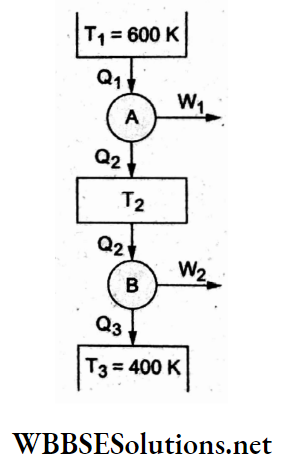
Question 17. TwoCarnotenginesAand B areoperatedinseries. EngineAreceives heat at T1 (= 600 K) and rejects it to a reservoir at temperature T2. Engine B receives heat rejected by Engine A and in turn, rejects heat to a heat reservoir at T3 (= 400 K). If the work outputs by the two engines are equal, the temperature T2 is equal to

  1. 600 K
  2. 500 K
  3. 400 K
  4. 300 K

Answer: 2. 500 K

The diagram shows the working of Carnot engines A and B in series.

For A: Q1 = Q2 + W1,

So, W1 = Q1– Q2.

For B: Q2 = Q3 + W2,

So W2 = Q2-Q3.

Given that work, the output is the same for both A and B, hence W1 = W2

Q1 – Q2 = Q2-Q3

=> Q1 + Q3 = 2Q2

⇒ \(\frac{Q_1}{Q_2}+\frac{Q_3}{Q_2}=2\)

⇒ \(\frac{T_1}{T_2}+\frac{T_3}{T_2}=2\)

Substituting, \(\frac{600 \mathrm{~K}}{T_2}+\frac{400 \mathrm{~K}}{T_2}=2\)

⇒ T2 = 500 K.

Heat Engine Refrigerator Multiple Choice Question And Answers Q 17

Sound Waves Notes

Sound Waves Synopsis

  • General Equations Of Wave Motion:
    • In the positive y = f(vt- x); and in the negative r-direction, y = f(vt + x).
    • Here v = velocity of wave propagation, x = position, and t = time at which the function y (displacement) is measured.
    • In the sinusoidal form, y = Asin(ωt ± kx), where A = amplitude (maximum value of the periodic function), ω = angular frequency = \(\frac{2 \pi}{T}=2 \pi f\), T = time period (in s), and f = frequency

Define Sound Waves

  • Particle Velocity And Slope: The particle velocity is given by
    \(v_{\text {particle }}=\frac{d y}{d t}=A \omega \cos (\omega t \pm k x)=v_{\max } \cos (\omega t \pm k x)\)
    The slope of a waveform is \(\frac{d y}{d x}= \pm A k \cos (\omega t \pm k x)\)
    Thus, \(v_{\text {particle }}=v_{\text {wave }} \cdot \mid \text { slope } \mid\)
  • The resultant amplitude A with a phase difference Φ is given by
    \(A^2=A_1^2+A_2^2+2 A_1 A_2 \cos \phi\)

    • For maxima, \(\phi=\left(\frac{2 \pi}{\lambda}\right) x= \pm 2 n \pi\)
    • For minima, \(\phi=\left(\frac{2 \pi}{\lambda}\right) x= \pm(2 n+1) \pi\)
  • Standing waves are produced by the superposition of identical waves traveling in opposite directions.
    y = A sin(ωt – kx) + A sin(ωt + kx)
    = 2A sin ωt cos kx
    = (2A cos kx) sin ωf.
    In a standing wave, all particles execute an SHM about their mean position with die same frequency but with the amplitude A(x) = 2A cos kx, which is position-dependent

Sound Waves

“Waves And Sound “

  • Transverse Vibrations Of A String:
    Velocity of wave = \(v=\sqrt{\frac{F}{\mu}}\) = where F = tension in string (in N) and
    μ = mass per unit length (in kg m-1).
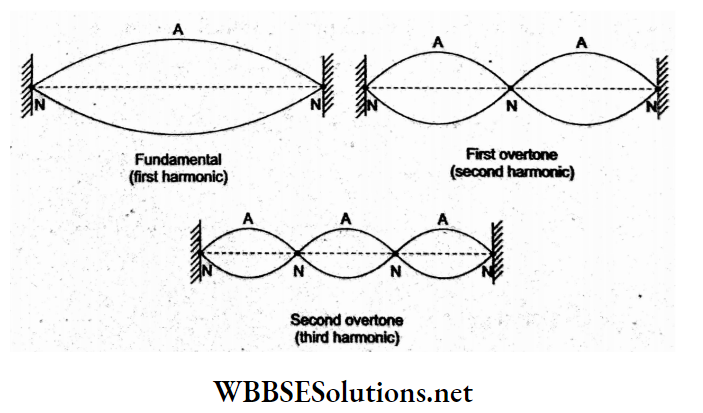
  • Modes Of Vibrations In A Stretched String:
    • Fundamental mode = first harmonic: \(f_1=\frac{1}{2 l} \sqrt{\frac{F}{\mu}}\)
    • First overtone = second harmonic: \(f_2=\frac{2}{2 l} \sqrt{\frac{F}{\mu}}=2 f_1\)
    • Second overtone = third harmonic: \(f_3=\frac{3}{2 l} \sqrt{\frac{F}{\mu}}=3 f_1\)
    • (p-l)th overtone = pth harmonic: \(f_{\mathrm{P}}=\frac{p}{2 l} \sqrt{\frac{F}{\mu}}=p f_1\)

Sound Waves Synopsis Modes of vibrations in a stretched string

“sound waves diagram “

  • Speed Of Sound Waves In A Gaseous Medium:
    \(\hat{v}=\sqrt{\frac{\gamma p}{\rho}}, \text { where } \gamma=\frac{c_p}{c_v}\), where \(\gamma=\frac{c_p}{c_v}\), p = pressure and p = density = \(\frac{M}{V}\)
    Hence, \(v=\sqrt{\frac{\gamma p V}{M}}=\sqrt{\frac{\gamma R T}{M_0}}\), where M0 = molar mass.

“Types Of Sound “

  • Sound Waves Are Pressure Wives: The excess pressure as a function
    of x and t is
    p = p0cos (ωt- kx), where p0 = pressure amplitude.
    Instanding waves, die pressure nodes and displacement antinodes are coincident.
  • The Vibration Of An Air Column (organ pipe):
    • Close Organ Pipe: In a closed pipe, the open end is the pressure node as well as the displacement antinode.

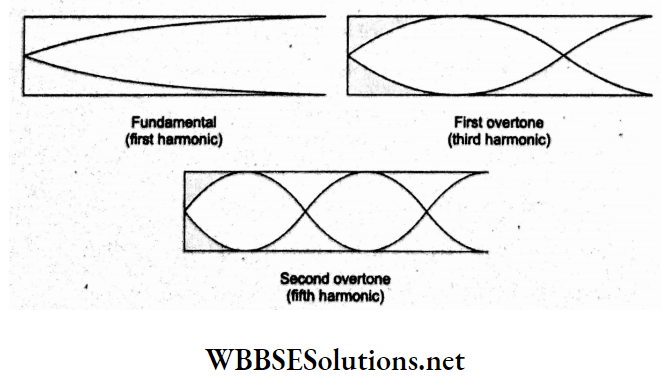
The Following Are The Modes Of Vibrations In A Closed Pipe:

  • Fundamental Or First Harmonic: f1 = \(\frac{v}{4l}\)
  • First Overtone Or Third Harmonic: \(f_3=3\left(\frac{v}{4 l}\right)=3 f_1\)
  • Second Overtone Or Fifth Harmonic: \(f_5=5\left(\frac{v}{4 l}\right)=5 f_1\)

Sound Waves Synopsis Vibration of an air column

Class 11 Physics Class 12 Maths Class 11 Chemistry
NEET Foundation Class 12 Physics NEET Physics


“what is sound vibration “

  • Open Organ Pipe:
  • The Modes Of Vibrations In An Open Pipe Are As Follows:
    • Fundamental Or First Harmonic: \(f_1=\frac{v}{2 l}\)
    • First Overtone Or Second Harmonic: \(f_2=2\left(\frac{v}{2 l}\right)=2 f_1\)
    • Second Overtone Or Third Harmonic: \(f_3=3\left(\frac{v}{2 l}\right)=3 f_1\)
  • Note that, in a closed pipe only odd harmonics are present, while an open pipe contains all the harmonics. The richness of overtones in an open pipe makes the note melodious.
  • Doppler Effect: The apparent change in frequency due to the relative motion between the source of waves and the receiver is called the Doppler effect. A decrease in separation leads to an apparent increase in frequency. The general equation for the apparent frequency is
    \(f^{\prime}=\left(\frac{v \pm v_0}{v \pm v_s}\right) f\)
  • where v = velocity of the sound wave, v0 = velocity of the observer, vs = velocity of the source,f = true frequency, and f’ = apparent frequency.
  • Beats: Beats are the rhythmic variation of loudness at a point due to the superposition of waves having a small difference in their frequencies. This may be regarded as an interference in time (with the path difference fixed).
  • Beat frequency = difference in frequencies.
  • The Intensity Of Sound Waves: It is the amount of energy passing through a unit area per unit of time perpendicular to the area element. Thus, intensity = \(I=\frac{\Delta U}{\Delta A \Delta t}\) (SI Unit: W m-2), and it is proportional
  • to the square of pressure amplitude.
  • Loudness: It is what we perceive as the volume of a sound.
  • The loudness level (β) is defined by the relation
  • \(\beta=\log \frac{I}{I_0} B=10 \log \frac{I}{I_0} \mathrm{~dB}\)
  • The minimum intensity (l0) which is audible to the normal human ear is I0 = 10-12W m-2.

Alternating Current Multiple Choice Questions And Answers

Alternating Current

Question 1. The reactance of an inductance of 0.01 H at 50 Hz AC is

  1. 1.04 Ω
  2. 3.14 Ω
  3. 0.59 Ω
  4. 6.28 Ω

Answer: 2. 3.14 Ω

Inductive reactance is

XL = ωL = 2πfL

= 2(3.14)(50 s-1)(1.0 x 10⁻² H) = 3.14 Ω

Alternating Current Multiple Choice Question And Answers

Question 2. In an AC circuit, an alternating voltage ε = 200√2 sin lOOt V is connected to a capacitor of capacitance 1 p, F. The rat value of the current in the circuit is

  1. 100 mA
  2. 200 mA
  3. 20 mA
  4. 10 mA

Answer: 3. 20 mA

The voltage of the AC source is

S = (200√2 V)sin l00t = ε0 sin ωt.

Capacitive reactance is

⇒ \(X_C=\frac{1}{\omega C}=\frac{1}{(100)\left(10^{-6} \mathrm{~F}\right)}=10^4 \Omega\)

Peak value of current = \(I_0=\frac{\varepsilon_0}{X_C}\)

∴ rms value of current is

∴ \(I_{\mathrm{rms}}=\frac{I_0}{\sqrt{2}}=\frac{1}{\sqrt{2}} \frac{\varepsilon_0}{X_{\mathrm{C}}}=\frac{200 \sqrt{2} \mathrm{~V}}{\sqrt{2}\left(10^4 \Omega\right)}=20 \times 10^{-3} \mathrm{~A}=20 \mathrm{~mA}\).

Question 3. An AC voltage is applied to resistance R and an inductor L in series. If R and the inductive reactance are both equal to 3 Ω, the phase difference between the applied voltage and the current in the circuit is

  1. \(\frac{\pi}{4}\)
  2. \(\frac{\pi}{2}\)
  3. Zero
  4. \(\frac{\pi}{6}\)

Answer: 1. \(\frac{\pi}{4}\)

In an LR circuit, the phase difference 0 between the current and the voltage is given by

⇒ \(\tan \theta=\frac{\text { reactance }}{\text { resistance }}=\frac{X_L}{R}=\frac{3 \Omega}{3 \Omega}=1=\tan 45^{\circ}\).

∴ phase difference = \(\theta=45^{\circ}=\frac{\pi}{4}\).

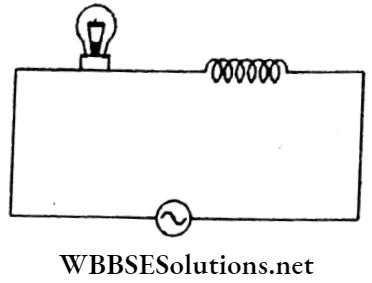
Question 4. A coil of self-inductance L is connected in series with a bulb B and an AC source. The brightness of the bulb decreases when

  1. The frequency of the AC source is decreased
  2. The number of turns in the coil is reduced
  3. A capacitor of reactance Xc = XL is included in the same circuit
  4. An iron rod is inserted into the coil as a core

Answer: 4. An iron rod is inserted into the coil as a core

The brightness of the bulb is due to current I flowing through it.

Current, \(I_0=\frac{V_0}{X_L}=\frac{V_0}{\omega L}\)

Brightness will decrease if ω and L increase. L can be increased by inserting an iron rod in the coil of self-inductance L as the core.

Alternating Current Multiple Choice Questions And Answers Brightness Of The Bulb Q4

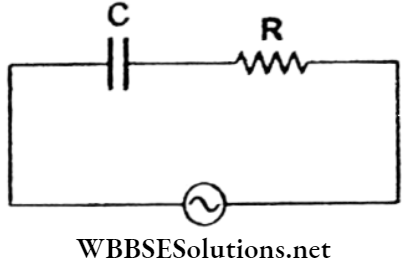
Question 5. A series RC circuit is connected to an alternating voltage source. Consider the following two situations.

  1. When the capacitor is air-filled
  2. When the capacitor is mica-filled

If the current through the resistor is I and the voltage across the capacitor is V then

  1. V1 < V2
  2. V1 > V2
  3. l1 > I2
  4. V1 = V2

Answer: 2. V1 > V2

The current amplitude in the series RC circuit is

⇒ \(I_0=\frac{V_0}{\sqrt{R^2+X_C^2}}\)

∴  the voltage across the capacitor is

⇒ \(V_{\mathrm{C}}=I_0 X_{\mathrm{C}}=\frac{V_0}{\sqrt{1+\frac{R^2}{X_C^2}}}=\frac{V_0}{\sqrt{1+\omega^2 C^2 R^2}}\)

  1. When the capacitor is air-filled, \(V_1=\frac{V_0}{\sqrt{1+\omega^2 C^2 R^2}}\)
  2. and when it is mica filled, \(V_2=\frac{V_0}{\sqrt{1+\omega^2 k^2 C^2 R^2}}\),

where K is the dielectric constant of mica.

Since K>1, therefore V1 > V2.

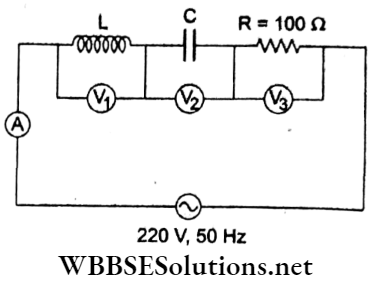
Question 6. In the given circuit, the readings of voltmeters V1 and V2 are 300 V each. The readings of the voltmeter V3 and ammeter A are respectively

Alternating Current Multiple Choice Questions And Answers Voltmeter Q6

  1. 150 V, 2.2 A
  2. 220 V, 2.2 A
  3. 220 V, 2.0 A
  4. 100 V, 2.0 A

Answer: 2. 220 V, 2.2 A

Since the voltage across L and C are in opposite phases and have equal values, they cancel each other.

The current in the circuit is

⇒ \(I=\frac{V}{R}=\frac{220 \mathrm{~V}}{100 \Omega}=2.2 \mathrm{~A}\)

The potential drop across the resistor is

VR = IR = (2.2 A)(100 Ω) = 220 V.

reading of voltmeter V3 and ammeter A is 220 V and 2.2 A respectively.

Question 7. In a circuit, L, C, and R are connected in series with an alternating voltage source of frequency f. The current leads the voltage by 45°. The value of C is

  1. \(\frac{1}{2 \pi f(2 \pi f L-R)}\)
  2. \(\frac{1}{2 \pi f(2 \pi f L+R)}\)
  3. \(\frac{1}{\pi f(2 \pi f L+R)}\)
  4. \(\frac{1}{\pi f(2 \pi f L-R)}\)

Answer: 2. \(\frac{1}{2 \pi f(2 \pi f L+R)}\)

In the LCR circuit, the phase difference θ between the current and voltage is given by

⇒ \(\tan \theta=\frac{X_C-X_L}{R}=\tan 45^{\circ} \text { (given) }\)

∴ \(\mathrm{X}_{\mathrm{C}}-\mathrm{X}_{\mathrm{L}}=R \Rightarrow \mathrm{X}_{\mathrm{C}}=\frac{1}{2 \pi f C}=2 \pi f L+R \Rightarrow C=\frac{1}{2 \pi f(2 \pi f L+R)}\)

Question 8. An LCR series circuit is connected to an alternating voltage source. At resonance, the instantaneous voltage and the current through the circuit will have a phase difference of

  1. \(\frac{\pi}{2}\)
  2. π
  3. \(\frac{\pi}{4}\)
  4. Zero

Answer: 4. Zero

Peak current in the LCR circuit is

⇒ \(I_0=\frac{V_0}{\sqrt{R^2+\left(\omega L-\frac{1}{\omega C}\right)^2}}\)

At resonance as the circuit is purely resistive,

reactance \(X=\omega L-\frac{1}{\omega C}=0\)

and phase difference between the current and the voltage is given by

⇒ \(\tan \theta=\frac{X_L-X_C}{R}=0 \Rightarrow \theta=0\)

Hence, the phase difference is zero.

Question 9. In a series LCR circuit, the voltage across resistance, capacitance, and inductance is 10 V each. If the capacitor is short-circuited, the voltage across the inductance will be

  1. 20 V
  2. 10 V
  3. 10√2V
  4. \(\frac{10}{\sqrt{2}} \mathrm{~V}\)

Answer: 4. \(\frac{10}{\sqrt{2}} \mathrm{~V}\)

In the LCR series circuit,

VR = VL = VC = 10 V

⇒ IR = IXL = IXc = 10 V

⇒ R = XL = Xc

When the capacitor is short-circuited, the circuit becomes an LR circuit for which current,

⇒ \(I=\frac{V_0}{\sqrt{R^2+X_{\mathrm{L}}^2}}=\frac{V_0}{\sqrt{2 R^2}}=\frac{V_0}{R \sqrt{2}}=\frac{10}{R \sqrt{2}}\).

PD across the inductor is

∴ \(V_{\mathrm{L}}=I X_{\mathrm{L}}=I R=\frac{10}{\sqrt{2}} \mathrm{~V}\).

Question 10. In a given series LCR circuit, R = 4 Ω, XL = 5Ω, and Xc = 8 Ω. The current

  1. Leads the voltage by \(\tan ^{-1}\left(\frac{5}{8}\right)\)
  2. Leads the voltage by \(\tan ^{-1}\left(\frac{3}{4}\right)\)
  3. Lags the voltage by \(\tan ^{-1}\left(\frac{3}{4}\right)\)
  4. Lags the voltage by \(\tan ^{-1}\left(\frac{5}{8}\right)\)

Answer: 2. Leads the voltage by \(\tan ^{-1}\left(\frac{3}{4}\right)\)

Since Xc > XL, the current leads the voltage by an angle of θ. From the impedance triangle,

⇒ \(\tan \theta=\frac{X_C-X_L}{R}=\frac{8 \Omega-5 \Omega}{4 \Omega}=\frac{3}{4}\)

∴ \(\theta=\tan ^{-1}\left(\frac{3}{4}\right)\)

Alternating Current Multiple Choice Questions And Answers Impedance Triangle Q10

Question 11. In a series LCR circuit, the phase difference between the applied voltage and current is

  1. Positive when XL > Xc
  2. Positive when Xc > XL
  3. 90°

Answer: 1. Positive when XL > Xc

In a series LCR circuit, the voltage leads the current when XL > Xc, so \(\tan \theta=\frac{X_L-X_C}{R}\) is positive

Question 12. An AC source of 20 V, 50 Hz is connected across R and C as shown in the figure. The voltage across R is 12 V. The voltage across C is

Alternating Current Multiple Choice Questions And Answers Q12

  1. 8 V
  2. 10 V
  3. 16 V
  4. None of these

Answer: 3. 16 V

Current through the series RC circuit is

⇒ \(I=\frac{V}{\sqrt{R^2+X_C^2}}\)

⇒ \(V^2=I^2 R^2+I^2 X_{\mathrm{C}}^2=V_{\mathrm{R}}^2+V_{\mathrm{C}}^2 \)

∴ \((20 \mathrm{~V})^2=(12 \mathrm{~V})^2+V_{\mathrm{C}}^2 \Rightarrow V_{\mathrm{C}}=16 \mathrm{~V}\)

Question 13. For a series LCR circuit, the power loss at resonance is

  1. I2ωC
  2. \(\frac{V^2}{\omega C}\)
  3. I2R
  4. \(\frac{V^2}{\left(\omega L-\frac{1}{\omega C}\right)}\)

Answer: 3. I2R

Power loss in a series LCR circuit is

⇒ \(P=I_{\text {rms }} V_{\text {rms }} \cos \theta=\frac{1}{2} \frac{V_0^2}{Z}=\frac{V_0^2}{2 \sqrt{R^2+\left(X_L-X_C\right)^2}}\)

At resonance, the circuit is purely resistive because XL = Xc

∴ Power loss = \(\frac{V_0^2}{2 R}=\frac{I_0^2 R}{2}=I_{\text {rms }}^2 R\)

Question 14. A 20-mH inductor, a 50-pF capacitor, and a 40-Ω resistor are connected in series across an AC voltage source V =10sin 340t. The power loss in the circuit is

  1. 0.67 W
  2. 0.89 W
  3. 0.76 W
  4. 0.51 W

Answer: 4. 0.51 W

Given, V = l0sin 340t = V0 sin ωt, R = 40 Ω, C = 50 μF, L= 20 mH.

Power loss in the circuit is

⇒ \(P=\frac{V_{\mathrm{rms}}^2}{\mathrm{Z}} \cos \theta=\frac{V_{\mathrm{rms}}^2}{\mathrm{Z}} \frac{R}{\mathrm{Z}}\)

⇒ \(\frac{\left(V_0 / \sqrt{2}\right)^2 R}{Z^2}=\frac{V_0^2 R / 2}{R^2+\left(\omega L-\frac{1}{\omega C}\right)^2}\)

Substituting the given values,

⇒ \(P=\frac{(10 \mathrm{~V})^2(40 \Omega)}{2} \cdot \frac{1}{(40 \Omega)^2+\left(340 \times 20 \times 10^{-3} \Omega-\frac{1 \Omega}{340 \times 50 \times 10^{-6}}\right)^2}\)

∴ \(\frac{100 \times 40}{2(1600+2704)} W \approx 0.5 W\).

Question 15. In an AC circuit, the potential difference across the resistance, capacitance, and inductance is 80 V, 40 V, and 100 V respectively. The power factor of this circuit is

  1. 0.4
  2. 0.8
  3. 0.04
  4. 1.0

Answer: 2. 0.8

The power factor of a series LCR circuit is expressed by,

⇒ \(\cos \theta=\frac{R}{\sqrt{R^2+\left(X_L-X_C\right)^2}}=\frac{V_R}{\sqrt{V_R^2+\left(V_L-V_C\right)^2}}\)

Given, VR = 80 V, Vc = 40 V and VL =100 V

∴ Power factor = \(\frac{80}{\sqrt{80^2+(100-40)^2}}=\frac{80}{100}=0.8\)

Question 16. Power dissipation in an LCR series circuit connected to an AC source of voltage ε is

  1. \(\frac{\mathcal{E}^2 R}{\left[R^2+\left(\omega L-\frac{1}{\omega C}\right)^2\right]}\)
  2. \(\frac{\mathcal{E}^2 R}{\left[R^2+\left(\omega L+\frac{1}{\omega C}\right)^2\right]}\)
  3. \(\frac{\mathcal{E}^2 \sqrt{R^2+\left(\omega L-\frac{1}{\omega C}\right)^2}}{R}\)
  4. \(\frac{\varepsilon^2 R^2+\left(\frac{1}{\omega C}\right)^2}{\omega L}\)

Answer: 1. \(\frac{\mathcal{E}^2 R}{\left[R^2+\left(\omega L-\frac{1}{\omega C}\right)^2\right]}\)

Power dissipation in a series LCR circuit is

⇒ \(P=I_{\mathrm{rms}} \varepsilon_{\mathrm{rms}} \cos \theta\)

∴ \(\frac{\varepsilon_{\mathrm{ms}}^2}{\mathrm{Z}} \frac{R}{\mathrm{Z}}=\frac{\varepsilon_{\mathrm{rms}}^2 R}{\mathrm{Z}^2}=\frac{\varepsilon_{\mathrm{rms}}^2 R}{\left[R^2+\left(\omega L-\frac{1}{\omega C}\right)^2\right]}\)

Question 17. A resistance R draws power P when connected to an AC source. If an inductance is now placed in series with the resistance such that the impedance of the circuit becomes Z, the power drawn will be

  1. \(P\left(\frac{R}{Z}\right)\)
  2. \(P \sqrt{\frac{R}{Z}}\)
  3. \(P\left(\frac{R}{Z}\right)^2\)
  4. P

Answer: 3. \(P\left(\frac{R}{Z}\right)^2\)

With resistance R alone in an AC circuit, the power dissipation is

⇒ \(P=\frac{V^2}{R} \Rightarrow V^2=P R\)

With inductance connected in series with a resistor, the power dissipated is

∴ \(P^{\prime}=\frac{V^2}{Z} \cdot \cos \theta=\frac{V^2}{Z} \frac{R}{Z}=(P R) \frac{R}{Z^2}=P\left(\frac{R}{Z}\right)^2\).

Question 18. In an AC circuit, the potential differences across an inductance and a resistance joined in series are respectively 16 V and 20 V. The total potential difference of the source is

  1. 20 V
  2. 25.6 V
  3. 31.9 V
  4. 53.5 V

Answer: 2. 25.6 V

The voltage across different elements in an AC circuit follows the vector addition rule. Here VR = 20 V and VL =16 V, the phase difference between them being 90°. Hence, the total potential difference is

∴ \(V=\sqrt{V_{\mathrm{R}}^2+V_{\mathrm{L}}^2}=\sqrt{(20 \mathrm{~V})^2+(16 \mathrm{~V})^2}=\sqrt{656} \mathrm{~V}=25.6 \mathrm{~V}\).

Question 19. When a 100-V DC is applied across a coil, a current of 1 A flows through it. When a 100-V AC of frequency 50 Hz is applied across the same coil, only 0.5 A flows. The inductance of the coil is

  1. 55 mH
  2. 0.55 mH
  3. 0.55 H
  4. 5.5 mH

Answer: 3. 0.55 H

In a DC circuit, = \(I=\frac{V}{R}\)

∴ \(1 \mathrm{~A}=\frac{100 \mathrm{~V}}{R} \Rightarrow R=100 \Omega\)

In an AC circuit, = \(I=\frac{V}{Z}\)

⇒ \(\frac{1}{2} A=\frac{100 \mathrm{~V}}{Z} \Rightarrow Z=200 \Omega\)

But Z2 = R2 + ω2L2 ⇒ (200 Ω)2 = (100 Ω)2 + (I00πL)2

∴ \(L=\frac{\sqrt{300 \times 100}}{100 \pi} \mathrm{H}=\frac{\sqrt{3}}{\pi} \mathrm{H}=0.55 \mathrm{H}\).

Question 20. What is the value of inductance L for which the current is maximum in a series LCR circuit with C =10 μF and to =1000 s-1?

  1. 1 mH
  2. 10 mH
  3. 100 mH
  4. Cannot be calculated unless R is known

Answer: 3. 100 mH

In a series LCR circuit, the current is maximum when the circuit is purely resistive, the net reactance is zero (current and voltage are in the same phase).

Hence, \(X_L-X_C=0 \Rightarrow \omega L=\frac{1}{\omega C}\).

inductance is

∴ \(L=\frac{1}{\omega^2 \mathrm{C}}=\frac{1}{\left(10^3 \mathrm{~s}^{-1}\right)^2(10 \mu \mathrm{F})}=\frac{1}{10} \mathrm{H}=0.1 \mathrm{H}=100 \mathrm{mH}\)

Question 21. The reactance of a capacitor of capacitance C is X. If both the frequency and capacitance are doubled then the new reactance will become

  1. \(\frac{x}{4}\)
  2. \(\frac{x}{2}\)
  3. X
  4. 2X

Answer: 1. \(\frac{x}{4}\)

Capacitive reactance is \(X=\frac{1}{\omega C}\)

∴ New reactance is X’ = \(\frac{1}{(2 \omega)(2 C)}=\frac{1}{4}\left(\frac{1}{\omega C}\right)=\frac{X}{4}\).

Question 22. In an AC circuit, the voltage (V) and the current (I) at any instance are given by

V = V0 sin cot and I- I0 sin (ωt – Φ) respectively.

The average power in the circuit over one cycle of AC is

  1. \(\frac{V_0 I_0}{2}\)
  2. \(\frac{V_0 I_0}{2} \sin \phi\)
  3. \(\frac{V_0 I_0}{2} \cos \phi\)
  4. \(V_0 I_0\)

Answer: 3. \(\frac{V_0 I_0}{2} \cos \phi\)

Average power is

∴ \(P=I_{\mathrm{rms}} V_{\mathrm{rms}} \cos \phi=\frac{I_0}{\sqrt{2}} \frac{V_0}{\sqrt{2}} \cos \phi=\frac{I_0 V_0}{2} \cos \phi\)

Question 23. A transformer having an efficiency of 90% is working on 200 V and 3 kW power supply. If the current in the secondary coil is 6 A, the voltage across the secondary coil and the current in the primary coil are respectively

  1. 300 V, 15 A
  2. 450 V, 30 A
  3. 450 V, 15 A
  4. 600 V, 15 A

Answer: 3. 450 V, 15 A

Effidency = \(\frac{\text { output power }}{\text { input power }}=90 \%=0.9\).

Primary voltage = Vp = 200 V.

Power in primary coil = 3 kW = 3000 W.

output power = 0.9 x Vp = 0.9 x 3000 W = 2700 W.

Since the current in the secondary coil is Is = 6 A,

power output = ISVS

⇒ 2700 W = (6 A)(VS) ⇒ VS = 450 V.

For current Ip the power in the primary coil = IpVp

⇒ 3000W = Ip (200V) ⇒ Ip = 15A.

Class 11 Physics Class 12 Maths Class 11 Chemistry
NEET Foundation Class 12 Physics NEET Physics

Question 24. A transformer with an efficiency of 80% works at 4 kW and 100 V. If the secondary voltage is 200 V then the primary and secondary currents are respectively

  1. 40 A and 16 A
  2. 40 A and 20 A
  3. 16 A and 40 A
  4. 20 A and 40 A

Answer: 1. 40 A and 16 A

Input power = 4000 W.

Input voltage = 100 V.

Output (secondary) voltage = 200 V.

⇒ Since efficiency = \(\eta=\frac{\text { output }}{\text { input }} \Rightarrow 0.8=\frac{\text { output }}{4000 \mathrm{~W}}\)

Power in secondary = 200 W.

For the primary circuit, 4000 W = (100 V)Ip.

primary current = Ip = 40 A.

For the secondary circuit, 3200 W = (200 V)Is.

secondary current = Is = 16 A.

Question 25. A series resonant LCR circuit has a Q-factor of 0.4. If R = 2 kΩ and C = 0.1 μF then the value of the inductance is

  1. 0.1 H
  2. 2 H
  3. 64 mH
  4. 5 H

Answer: 3. 64 mH

Q-factor of a series LCR resonant circuit is

⇒ \(Q=\frac{1}{R} \sqrt{\frac{L}{C}}\).

L = Q2R2C = (0.4)2(2000 Ω)2(0.1 X 10⁻⁶ F) = 0.064 H = 64mH.

Question 26. A wire of resistance R is connected in series with an inductor of inductance ωL. The quality factor of the RL circuit is

  1. \(\frac{R}{\omega L}\)
  2. \(\frac{\omega L}{R}\)
  3. \(\frac{R}{\sqrt{R^2+\omega^2 L^2}}\)
  4. \(\frac{\omega L}{\sqrt{R^2+\omega^2 L^2}}\)

Answer: 2. \(\frac{\omega L}{R}\)

Q-factor = \(2 \pi \frac{\text { energy stored }}{\text { energy dissipation per cycle }}\)

∴ \(=2 \pi \frac{L I_{\mathrm{rms}}^2}{\left(I_{\mathrm{ms}}^2 R\right) / f}=2 \pi \frac{L f}{R}=\frac{\omega L}{R}\).

Question 27. Which of the following combinations should be selected for better tuning of an LCR circuit used for communication?

  1. R = 20, L = 1.5H, C = 35 μF
  2. R = 25, L = 2,5H, C = 45 μF
  3. R = 15, L = 3.5H, C = 30 μF
  4. R = 25, L = 1.5H, C = 45 μF

Answer: 3. R = 15, L = 3.5H, C = 30 μF

For better and sharp tuning, the quality factor \(Q=\frac{1}{R} \sqrt{\frac{L}{C}}\) must be high. Hence, the value of R = minimum (=15 Ω), L = maximum (= 3.5 H), and C = minimum (= 30 μF). Thus, the true option is (c).

Question 28. A capacitor of capacitance 2 μF is connected to the tank circuit of an oscillator oscillating with a frequency of 1 kHz. If the current flowing in the circuit is 2 mA, the voltage across the capacitor will be

  1. 0.16 V
  2. 0.32 V
  3. 0.48 V
  4. 15.9 V

Answer: 1. 0.16 V

Voltage across die capacitor is \(V_C=I \cdot X_C=\frac{I}{2 \pi f C}\)

Substituting the values,

∴ \(V_{\mathrm{C}}=\frac{\left(2 \times 10^{-3} \mathrm{~A}\right)}{2(3.14)\left(1000 \mathrm{~s}^{-1}\right)\left(2 \times 10^{-6} \mathrm{~F}\right)}=0.16 \mathrm{~V}\).
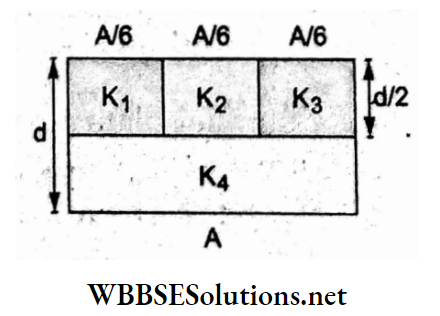
Question 29. In an ideal parallel LC circuit, the capacitor is charged by connecting it to a DC source which is then disconnected. The current in the circuit

  1. Becomes zero instantaneously
  2. Grows monotonically
  3. Decays monotonically
  4. Oscillates instantaneously

Answer: 4. Oscillates instantaneously

A charged capacitor when connected across an inductor constitutes an oscillatory circuit in which the current oscillates instantaneously.

Question 30. Alternating current cannot be measured by a DC ammeter because

  1. AC cannot pass through a DC ammeter
  2. AC changes direction
  3. The average value of current for one complete cycle is zero
  4. DC ammeter will get damaged

Answer: 3. Average value of current for one complete cycle is zero

A DC ammeter cannot measure alternating current because the average value of AC over one complete cycle is zero.

Question 31. An LCR series combination is connected across an AC voltage source. When L is removed from the circuit, the phase difference between the voltage and the current in the circuit is \(\frac{\pi}{3}\). If instead C is removed from the circuit, the phase difference is again \(\frac{\pi}{3}\). The power factor of the circuit is
  1. \(\frac{1}{\sqrt{2}}\)
  2. \(\frac{1}{2}\)
  3. 1
  4. \(\frac{\sqrt{3}}{2}\)

Answer: 3. 1

When L is removed, the combination becomes a series RC circuit in which current leads the voltage by \(\frac{\pi}{3}\), where tan \(\frac{\pi}{3}=\frac{X_C}{R}\).
⇒ Similarly, when C is removed, the phase difference is again \(\frac{\pi}{3}\), for which for \(\frac{\pi}{3}=\frac{X_L}{R}\).
Thus, XL = Xc, and for the LCR circuit, the power factor is

∴ \(\cos \theta=\frac{R}{Z}=\frac{R}{\sqrt{R^2+\left(X_L-X_C\right)^2}}=\frac{R}{R}=1\) [∵ XL = Xc].

Question 32. With the decrease of current in the primary coil from 2 A to zero value in 0.01 s, the emf generated in the secondary coil is 1000 V. The mutual inductance of the two coils is

  1. 1.25 H
  2. 2.50 H
  3. 5.00 H
  4. 10.00 H

Answer: 3. 5.00 H

For two inductively coupled coils,

⇒ \(\phi_2=M I_1 \Rightarrow\left|\varepsilon_2\right|=\frac{d \phi_2}{d t}=M \frac{\Delta I_1}{\Delta t}\)

∴ \(1000 \mathrm{~V}=M \frac{2 \mathrm{~A}-0}{0.01 \mathrm{~s}}=M\left(200 \mathrm{~A} \mathrm{~s}^{-1}\right) \Rightarrow M=5.00\)H.

Question 33. A 220-V input is supplied to a transformer. The output circuit draws a current of 2.0 A at 440 V. If the efficiency of the transformer is 80%, the current drawn by the primary windings of the transformer is

  1. 3.6 A
  2. 2.8 A
  3. 2.5 A
  4. 5.0 A

Answer: 4. 5.0 A

Given, Vp = 220 V, Is = 2.0 A, VS = 440 V.

Output power = ISVS, = (2 A)(440 V) = 880 W.

Since Efficiency = \(\eta=0.8=\frac{\text { output watt }}{\text { input watt }}=\frac{880 \mathrm{~W}}{\text { input watt }}\)

⇒ input power = \(\frac{880 \mathrm{~W}}{0.8}=1100 \mathrm{~W}\)

But input power = IpVp = Ip(220 V) =1100 W.

∴ Primary Current = \(I_{\mathrm{p}}=\frac{1100 \mathrm{~W}}{220 \mathrm{~V}}=5.0 \mathrm{~A}\).

Question 34. A transformer is used to light a 100 W-110 V lamp from a 220-V main. If the main current is 0.5 A, the efficiency of the transformer is approximately

  1. 30%
  2. 10%
  3. 90%
  4. 50%

Answer: 3. 90%

To light the bulb,

power in secondary = Ws = 100 W.

Supply through the primary has

Vp = 220 V, Ip =0.5 A.

Input power = IpVp =(0.5 A)(220 V) =110 W.

Hence, the efficiency of the transformer is

∴ \(\eta=\frac{\text { output watt }}{\text { input watt }}=\frac{100 \mathrm{~W}}{110 \mathrm{~W}}=\frac{10}{11}=0.9=90 \%\).

Question 35. The primary and secondary coils of a transformer have 50 and 1500 turns respectively. If the magnetic flux Φ linked with the primary coil is given by Φ = Φ0 – 4t, where Φ is in Weber, t is in second, and Φ0 is a constant, the output voltage across the secondary coil is

  1. 90 V
  2. 30 V
  3. 120 V
  4. 220 V

Answer: 3. 120 V

The ratio of voltage in terms of turn ratio is given by

⇒ \(\frac{V_{\mathrm{s}}}{V_p}=\frac{N_{\mathrm{s}}}{N_{\mathrm{p}}}=\frac{1500}{50}=30\)

In the primary circuit, magnetic flux is

Φ = Φ0 + 4t.

So, the voltage in the primary circuit is

∴ \(V_{\mathrm{p}}=\left|\frac{d \phi}{d t}\right|=4 \Rightarrow V_{\mathrm{s}}=30\left(V_{\mathrm{p}}\right)=30 \times 4 \mathrm{~V}=120 \mathrm{~V}\)

Question 36. A transformer works on the principle of

  1. Self-induction
  2. Mutual induction
  3. Inverter
  4. Converter

Answer: 2. Mutual induction

In a transformer, the magnetic flux from the primary coil is linked with the secondary one and the transformer works on the principle of mutual induction.

Question 37. The quantity that remains unchanged in a transformer is

  1. Voltage
  2. Current
  3. Frequency
  4. None of these

Answer: 3. Frequency

The frequency of the input AC voltage remains the same in the primary as well as in the secondary circuit.

Question 38. The primary winding of a transformer has 500 turns whereas its secondary one has 5000 turns. The primary is connected to an AC supply of 20 V-50 Hz. The secondary will have an output of

  1. 2 V, 5 Hz
  2. 2 V, 50 Hz
  3. 200 V, 50 Hz
  4. 200 V, 500 Hz

Answer: 2. 2 V, 50 Hz

Given, Np = 500, NS = 5000, Vp = 20 V, f = 50 Hz..

⇒ Since \(\frac{V_{\mathrm{s}}}{V_{\mathrm{p}}}=\frac{N_{\mathrm{s}}}{N_{\mathrm{p}}} \text {, hence } \frac{V_{\mathrm{s}}}{20 \mathrm{~V}}=\frac{5000}{500}=10\)

∴ output voltage = VS = 200 V, but frequency = f= 50 Hz remains unchanged.

Question 39. A step-up transformer operates on a 230-V line and supplies a current of 2 A to a load. The ratio of the primary and the secondary windings is 1: 25. The current in the primary coil is

  1. 12.5 A
  2. 25 A
  3. 50 A
  4. 15 A

Answer: 3. 50 A

Given, \(V_{\mathrm{p}}=230 \mathrm{~V}, I_{\mathrm{s}}=2 \mathrm{~A}, \frac{N_{\mathrm{p}}}{N_{\mathrm{s}}}=\frac{1}{25}\).

⇒ Since, \(\frac{V_{\mathrm{p}}}{V_{\mathrm{s}}}=\frac{N_{\mathrm{p}}}{N_{\mathrm{s}}}, \text { so } \frac{230 \mathrm{~V}}{V_{\mathrm{s}}}=\frac{1}{25}\).

∴ output voltage = VS = (230 V) x 25.

Assuming 100% efficiency,

input power = output power

⇒ IpVp = IsVS

⇒ Ip(230 V) = (2 A)(230 x 25 V).

∴ current in the primary = Ip = 50 A

Question 40. The quantity that is increased in a step-down transformer is

  1. Voltage
  2. Current
  3. Power
  4. Frequency

Answer: 2. Current

In an ideal step-down transformer,

⇒ \(\frac{V_{\mathrm{s}}}{V_{\mathrm{p}}}=\frac{N_{\mathrm{s}}}{N_{\mathrm{p}}}\)

Since Ns < Np, so VS < Vp.

But VpIp = VSIs, so Is > Ip, the current is increased.

Question 41. The turn ratio of a step-up transformer is 1: 2. If a Leclanche cell of 1.5 V is connected across the input, what is the voltage across the output?

  1. 1.5 V .
  2. 0.0 V
  3. 3 V
  4. 0.75 V

Answer: 2. 0.0 V

A transformer works only with AC in which the change of magnetic flux with time induces a voltage. Therefore, with a DC source, there will be zero output in the secondary.

Question 42. A coil of inductive reactance 31 Ω. has a resistance of 8 Ω. It is placed in series with a capacitor of capacitive reactance 25 Ω. The combination is connected to an AC source of 110 V. The power factor of the circuit is

  1. 0.50
  2. 0.80
  3. 0.64
  4. 0.33

Answer: 2. 0.80

The power factor of a series LCR AC circuit is

⇒ \(\cos \phi=\frac{R}{Z}=\frac{R}{\sqrt{R^2+\left(X_L-X_C\right)^2}}\)

Given, R =8Ω, XL = 31Ω, Xc = 25 Ω.

∴ Power factor = \(\frac{8}{\sqrt{8^2+(31-25)^2}}=\frac{8}{10}=0.8\).

Question 43. In an AC circuit with voltage V and current I, the power dissipated is

  1. VI
  2. \(\frac{1}{2} V I\)
  3. \(\frac{1}{\sqrt{2}} V I\)
  4. Dependent on the phase difference between V and I

Answer: 4. Dependent on the phase difference between V and I

Power dissipation in an AC circuit is

P =  Irms Vrms CosΦ.

This depends on the value of the angle Φ, which is the phase difference between the current and voltage.

Question 44. A 50-Hz AC current of crest value 1 A flows through the primary of a transformer. If the mutual inductance between the primary and the secondary is 0.5 H, the crest voltage induced in the secondary is

  1. 75V
  2. 150 V
  3. 100 V
  4. None of these

Answer: 3. 100 V

Flux Φ in the secondary coil is proportional to the current Ip in the primary.

Hence,

⇒ \(\phi_{\mathrm{s}} \propto I_{\mathrm{p}} \Rightarrow \phi_{\mathrm{s}}=M I_{\mathrm{p}}\)

Induced voltage in the secondary is

⇒ \(V_{\mathrm{s}}=\left|\frac{d \phi_{\mathrm{s}}}{d t}\right|=M \frac{\Delta I_{\mathrm{p}}}{\Delta t}\)

⇒ Hence M = \(0.5 \mathrm{H}, \frac{\Delta I_{\mathrm{p}}}{\Delta t}=\frac{1 \mathrm{~A}-(-1 \mathrm{~A})}{T / 2}=\frac{4 \mathrm{~A}}{T}=(4 \mathrm{~A}) f\)

Thus, the voltage induced in the secondary is

∴ VS = (0.5 H)(4 A)(50 s1) =100 V.

Question 45. Consider a series AC circuit containing L = 1.0 H, C = 10 μF, and R, =100 Ω. Find the lower angular frequency corresponding to a half-power point.

  1. 266
  2. 170
  3. 230
  4. 366

Answer: 1. 266

The frequency interval between the half power points in a series LCR resonant circuit is given by

⇒ \(\Delta \omega=\omega_2-\omega_1=\frac{R}{L}\)

Since resonance frequency, \(\omega_0=\frac{1}{\sqrt{L C}}\), so

⇒ \(\omega=\omega_0 \pm \frac{R}{2 L}=\frac{1}{\sqrt{(1 \mathrm{H})\left(10^{-5} \mu \mathrm{F}\right)}} \pm \frac{100 \Omega}{2(1.0 \mathrm{H})}\)

⇒ \(=316.2 \mathrm{rad} \mathrm{s}^{-1} \pm 50 \mathrm{rad} \mathrm{s}^{-1}\)

∴ \(366.2 \mathrm{rad} \mathrm{s}^{-1} \text { and } 266.2 \mathrm{rad} \mathrm{s}^{-1}\)

Question 46. In a transformer, the number of turns in primary is 500 and that in secondary is 10. If the load resistance is 10 Ω and the voltage in the secondary circuit is 50 V then the current in the primary circuit is

  1. 0.2 A
  2. 0.3 A
  3. 0.4 A
  4. 0.1 A

Answer: 4. 0.1 A

Given, Np = 500, Ns =10, Vs = 50 V, RL =10 Ω.

Since \(\frac{V_{\mathrm{s}}}{V_{\mathrm{p}}}=\frac{N_{\mathrm{s}}}{N_{\mathrm{p}}} \Rightarrow V_{\mathrm{p}}=\frac{N_{\mathrm{p}}}{N_{\mathrm{s}}} \cdot V_{\mathrm{s}}=\frac{500}{10} \times 50 \mathrm{~V}=2500 \mathrm{~V}\)

Current in the secondary is

⇒ \(I_{\mathrm{s}}=\frac{V_{\mathrm{s}}}{R_{\mathrm{L}}}=\frac{50 \mathrm{~V}}{10 \Omega}=5 \mathrm{~A}\).

Now, input power = output power

Vp. Ip = VS . IS

current in the primary is

∴ \(I_{\mathrm{p}}=\frac{V_{\mathrm{s}} \cdot I_{\mathrm{s}}}{V_{\mathrm{p}}}=\frac{(50 \mathrm{~V})(5 \mathrm{~A})}{(2500 \mathrm{~V})}=0.1 \mathrm{~A}\)

Question 47. A transformer with turn ratio \(\frac{N_{\mathrm{p}}}{N_{\mathrm{s}}}\) = 50 is connected to a 120-V AC supply. If the resistance in the primary and secondary circuits is 1.5 kΩ and 1Ω respectively, find the power output.

  1. 11.4 W
  2. 5.76 W
  3. 2.3 W
  4. 12.4 W

Answer: 2. 5.76 W

Turn ratio is

⇒ \(\frac{N_{\mathrm{p}}}{N_{\mathrm{s}}}=50=\frac{V_{\mathrm{p}}}{V_{\mathrm{s}}}=\frac{120 \mathrm{~V}}{V_{\mathrm{s}}}\)

⇒ \(V_{\mathrm{s}}=\frac{120}{50} \mathrm{~V}\)

Since, \(R_{\mathrm{s}}=1 \Omega \text {, so } I_{\mathrm{s}}=\frac{V_{\mathrm{s}}}{R_{\mathrm{s}}}=\frac{120}{50} \mathrm{~A}\)

∴ Power output = \(I_s V_s=\left(\frac{120}{50}\right)^2 \mathrm{~W}=\frac{144}{25} \mathrm{~W}=5.76 \mathrm{~W}\).

Question 48. Find the energy stored in the inductor of an LCR circuit at resonance. Given that V =10 V, R = 10 Ω, and L =1 H.

  1. 2J
  2. 4J
  3. 0.5 J
  4. 10 J

Answer: 3. 0.5 J

At resonance, the circuit is purely resistive, and the current

⇒ \(I=\frac{V}{R}=\frac{10 \mathrm{~V}}{10 \Omega}=1 \mathrm{~A}\)

Energy in the inductor is

∴ \(U=\frac{1}{2} L I^2=\frac{1}{2}(1 \mathrm{H})(1 \mathrm{~A})^2=0.5 \mathrm{~J}\)

Question 49. A transformer consisting of 300 turns in the primary and 150 turns in the secondary gives an output power of 2.2 kW. If the current in the secondary coil is 10 A then the input voltage and current in the primary coil are

  1. 440 V, 5 A
  2. 440 V, 20 A
  3. 20 V, 10 A
  4. 220 V, 20 A

Answer: 1. 440 V, 5 A

Given, Np = 300, Ns =150.

Output power = ISVS = 2.2 kW = 2200 W.

Current in secondary is IS =10 A.

(10A)(VS) = 2200W ⇒ Vs = 220 V

⇒ \(\frac{V_{\mathrm{p}}}{V_{\mathrm{s}}}=\frac{N_{\mathrm{p}}}{N_{\mathrm{s}}} \Rightarrow \frac{V_{\mathrm{p}}}{220 \mathrm{~V}}=\frac{300}{150} \Rightarrow V_{\mathrm{p}}=440 \mathrm{~V}\).

Assuming no power loss,

⇒ \(I_{\mathrm{p}} V_{\mathrm{p}}=2200 \mathrm{~W} \Rightarrow I_{\mathrm{p}}=\frac{2200 \mathrm{~W}}{440 \mathrm{~V}}=5 \mathrm{~A}\).

Thus, the input voltage and input current are 440 V and 5 A respectively.

Question 50. An alternating voltage V(t) = 220sin l00πt volt is applied across a purely resistive load of 50 Ω. The time taken for the current to rise from half of the peak value to the peak value is

  1. 2.2 ms
  2. 5 ms
  3. 3.3 ms
  4. 7.2 ms

Answer: 3. 3.3 ms

In a resistive circuit, current and voltage are in the same phase. Thus,

I = I0 sin l00πt.

For current to increase from 0 to \(\frac{I_0}{2}\),

⇒ \(\frac{I_0}{2}=I_0 \sin 100 \pi t_1\)

⇒ \(\sin \frac{\pi}{6}=\sin 100 \pi t_1 \Rightarrow t_1=\frac{1}{600} \mathrm{~s}\)

For the current to increase from 0 to I0,

I0 = I0 sin 100 πt2

⇒ \(\sin \frac{\pi}{2}=\sin 100 \pi t_2 \Rightarrow t_2=\frac{1}{200} \mathrm{~s}\)

So, the required time interval is

∴ \(\Delta T=t_2-t_1=\left(\frac{1}{200}-\frac{1}{600}\right) \mathrm{s}=3.3 \mathrm{~ms}\).

Question 51. A series AC circuit containing an inductor (20 mH), a capacitor (120 μF), and a resistor (60 Ω) is driven by an AC source of 24 V, 50 Hz. The energy dissipated in the circuit in 60 s is

  1. 3.39 x 10³ J
  2. 5.65 x 10² J
  3. 2.26 x 10³ J
  4. 5.17 x 10² J

Answer: 4. 5.17 x 10² J

Energy dissipated is

E = power x time

= (Irms . Vrms Cos Φ) time

⇒ \(\frac{V_{\mathrm{rms}}^2 \times R}{\mathrm{Z}^2} t=\frac{V_{\mathrm{rms}}^2 R t}{R^2+\left(\mathrm{X}_{\mathrm{L}}-X_{\mathrm{C}}\right)^2}\)

Given, Vrms, = 24 V, R = 60Ω, t = 60 s,

XL = ωL = (100π)(20 x 10-3) O = 2π Ω,

⇒ \(X_C=\frac{1}{\omega C}=\frac{1}{100 \pi \times 120 \times 10^{-6}} \Omega=\frac{1000}{12 \pi} \Omega\)

∴ \(E=\frac{(24)^2(60)(60) \mathrm{J}}{3600+(26.5-6.28)^2}=\frac{3600 \times(24)^2}{3600+(20.3)^2} \mathrm{~J}=517.7 \mathrm{~J}=5.17 \times 10^2 \mathrm{~J}\).

Question 52. A power transmission line feeds input power at 2300 V to a stepdown transformer with its primary windings having 4000 turns. The output power is delivered at 230 V by the transformer. If the current through the primary coil is 5 A and the efficiency is 90%, the output current would be

  1. 45 A
  2. 50 A
  3. 25A
  4. 35A

Answer: 1. 45 A

Given, Vp = 2300 V, Np = 4000, VS = 230 V, Ip = 5 A.

Input power = Ip x Vp = (5 A)(2300 V) = (23 x 5 x 100) W.

Output power = \(\frac{90}{100} \times(23 \times 500) \mathrm{W}=450 \times 23 \mathrm{~W}\)

Now, ISVS = (450 x 23) W

⇒ \(I_s=\frac{(450 \times 23) \mathrm{W}}{V_s}=\frac{(450 \times 23) \mathrm{W}}{230 \mathrm{~V}}=45 \mathrm{~A}\).

Question 53. In the given circuit, R1 =10 Ω, R2 = 20 Ω, L = (√3/10) H and C =(√3/2) pF. Current through the L-R1 path is I1 and through the C-R2 path is I2. The voltage of the AC source is given by V = 200√2 sin l00t V. The phase difference between It and I2 is

Alternating Current Multiple Choice Questions And Answers Circuit Q53

  1. 60°
  2. 150°
  3. 90°

Answer: 3. 150°

Capacitive reactance is

⇒ \(X_C=\frac{1}{\omega C}=\frac{10^6}{100 \times \frac{\sqrt{3}}{2}} \Omega=\frac{20000}{\sqrt{3}} \Omega\)

Current I2 leads the voltage by where

⇒ \(\tan \phi_1=\frac{X_C}{R}=\frac{20000}{\sqrt{3} \times 20}=\frac{1000}{\sqrt{3}}\)

hence Φ1 ≈ 90° (lead).

Inductive reactance is

⇒ \(X_L=\omega L=100 \times \frac{\sqrt{3}}{10} \Omega=10 \sqrt{3} \Omega\)

Current I1 lags behind the voltage by Φ2, where

⇒ \(\tan \phi_2=\frac{X_L}{R}=\frac{10 \sqrt{3}}{10}=\sqrt{3}, \text { hence } \phi_2=60^{\circ}(\mathrm{lag})\)

Hence, a phase difference between and I2 is

∴ Φ = Φ1 – Φ2 = 90°- (-60°) =150°.

Question 54. A circuit connected to an AC source of emf ε = ε0 sin l00t with t in seconds gives a phase difference of π/4 between the emf ε and current I. Which of the following circuits will exhibit this?

  1. RL circuit with R =1 kΩ and L=10 mH
  2. RC circuit with R-1 kΩ and C =10 μF
  3. RL circuit with R =1 kΩ and L =1 mH
  4. RC circuit with R =1 kΩ and C =1 μF

Answer: 2. RC circuit with R-1 k£2 and C =10 μ F

Given, ω =100 rad s-1 and phase difference, \(\phi=\frac{\pi}{4}\)

But \(\tan \phi=\frac{X}{R}\), hence R = reactance (XL OR Xc ).

Since R = 1kΩ =1000 Ω, hence with C =10 μF,

⇒ \(X_C=\frac{1}{\omega C}=\frac{1}{100 \times 10 \times 10^{-6}}=10^3 \Omega=1 \mathrm{k} \Omega\).

This is true with option (2).

Question 55. One kilogram of water at 20 °C is heated in an electric kettle whose heating element has a mean resistance of 20Ω. The supply voltage is V = (200√2 V)sin l00πt. Ignoring heat loss by the kettle, the time taken for water to evaporate fully is close to

  1. 22 minutes
  2. 16 minutes
  3. 3 minutes
  4. 10 minutes

Answer: 1. 22 minutes

Heat absorbed by water to boil and turn into steam is

Q = mCωΔT + mL

=1 x 4200 x (100- 20) J +1 x 2250 x 103 J

= (336000 + 2250 x 103) J = 2586 x 103 J.

The energy supplied by the power source is

∴ \(p \times t=\frac{V_{\mathrm{rms}}^2}{R} t=\frac{(200)^2 t}{20} \mathrm{~J} \Rightarrow t=\frac{2586 \times 10^3 \times 20}{4 \times 10^4} \mathrm{~s} \approx 22 \mathrm{~min}\).

Question 56. An AC circuit has R = 100 Ω, C = 2 μP, and L = 80 mH, connected in series. The quality factor of the circuit is

  1. 0.5
  2. 2
  3. 20
  4. 400

Answer: 2. 2

∴ \(Q=\frac{1}{R} \sqrt{\frac{L}{C}}=\frac{1}{100 \Omega} \sqrt{\frac{80 \times 10^{-3} \mathrm{H}}{2 \times 10^{-6} \mathrm{~F}}}=2\)

Question 57. In a series LR circuit, a power of 400 W is dissipated from a 250 V-50 Hz AC source. The power factor of the circuit is 0.8. In order to bring the power factor to unity a capacitor of value C is added to. The series LR circuit. Taking C = \(\left(\frac{n}{3 \pi}\right) \mu \mathrm{F}\), the value Of n is

  1. 200
  2. 400
  3. 300
  4. 500

Answer: 2. 400

Power factor = cos θ = 0.8

⇒ \(\tan \theta=\frac{3}{4}=\frac{X_{\mathrm{L}}}{R} \Rightarrow X_{\mathrm{L}}=\frac{3}{4} R, Z=\sqrt{R^2+X_{\mathrm{L}}^2}=\frac{5 R}{4}\)

Power consumed is

⇒ \(P=I_{\mathrm{V}} V_{\mathrm{V}} \cos \theta=\frac{V_{\mathrm{V}}^2}{Z} \frac{R}{Z}\)

∴ \(R=\frac{P Z^2}{V_{\mathrm{U}}^2}=\frac{(400 \mathrm{~W})}{(250 \mathrm{~V})^2}\left(\frac{5}{4} R\right)^2 \Rightarrow R=100 \Omega\),

so XL = 75 n.

For the power factor to be, the circuit will be purely resistive, the reactance XL – Xc = 0.

⇒ \(X_C=\frac{1}{2 \pi f C}=75 \Omega\)

∴ C=\(\frac{1}{2 \pi\left(50 \mathrm{~s}^{-1}\right)(75 \Omega)}=\left(\frac{400}{3 \pi}\right) \mu \mathrm{F}\)

n = 400.

Question 58. In an LR AC circuit, the impedance is 100 Ω and the phase difference between the current and voltage is 45°. If the frequency of the voltage source is 1 kHz, what is the inductance of the coil?

  1. \(\frac{20 \sqrt{2}}{\pi} \mathrm{mH}\)
  2. \(\frac{50 \sqrt{2}}{\pi} \mathrm{mH}\)
  3. \(\frac{25 \sqrt{2}}{\pi} \mathrm{mH}\)
  4. \(25 \sqrt{2} \mathrm{mH}\)

Answer: 3. \(\frac{25 \sqrt{2}}{\pi} \mathrm{mH}\)

In an AC circuit,

∴ \(\sin \theta=\frac{X}{Z} \Rightarrow \frac{1}{\sqrt{2}}=\frac{\omega L}{Z} \Rightarrow L=\frac{Z}{\sqrt{2} \omega}=\frac{100 \Omega}{\sqrt{2} \cdot 2 \pi \times 1000}=\frac{25 \sqrt{2}}{\pi} \mathrm{mH} .\).

Question 59. In the given LCR circuit, the heat capacity of the resistor is 100 J K-1. The time t required to increase the temperature of the resistor by 10 °C is

Alternating Current Multiple Choice Questions And Answers Heat Capacity Of The Resistor Q59

  1. 20 s
  2. 30 s
  3. 40 s
  4. 10 s

Answer: 1. 20 s

In the given AC circuit,

V0 = 25 V, Z = \(\sqrt{R^2+\left(X_L-X_C\right)^2}=\sqrt{4^2+3^2}\)Ω = 5Ω.

Average power is

⇒ \(P=\frac{1}{2} I_0 V_0 \cos \theta=\frac{V_0^2}{2 Z} \frac{R}{Z}=\frac{(25 \mathrm{~V})^2}{2(5 \Omega)^2} \cdot 4 \Omega=50 \mathrm{~W}\)

Heat absorbed by the resistor is

H = power x t = (100 J K-1)(10 K) =1000 J

∴ \(t=\frac{H}{\text { power }}=\frac{1000 \mathrm{~J}}{50 \mathrm{~J} \mathrm{~s}^{-1}}=20 \mathrm{~s}\).

Question 60. The switch S in the LR circuit is closed at f = 0. Find the time when the energy stored in the inductor becomes 1/n times the maximum energy stored in it during the growth of the current.

Alternating Current Multiple Choice Questions And Answers Switch Q60

  1. \(\frac{L}{R} \ln \left(\frac{\sqrt{n}}{\sqrt{n}+1}\right)\)
  2. \(\frac{L}{R} \ln \left(\frac{\sqrt{n}}{\sqrt{n}-1}\right)\)
  3. \(\frac{L}{R} \ln \left(\frac{\sqrt{n}+1}{\sqrt{n}}\right)\)
  4. \(\frac{L}{R} \ln \left(\frac{\sqrt{n}-1}{\sqrt{n}}\right)\)

Answer: 2. \(\frac{L}{R} \ln \left(\frac{\sqrt{n}}{\sqrt{n}-1}\right)\)

The maximum energy stored in the inductor is

⇒ \(U_0=\frac{1}{2} L I_0^2\)

Current growth is

⇒ \(I=I_0\left(1-e^{-\frac{R}{L} t}\right) \Rightarrow \frac{1}{n}\left(\frac{1}{2} L I_0^2\right)=\frac{1}{2} L I_0^2\left(1-e^{-\frac{R}{L} t}\right)^2\)

∴ \(\frac{1}{\sqrt{n}}=1-e^{-\frac{R}{L} t} \Rightarrow e^{\frac{R}{L} t}=\frac{\sqrt{n}}{\sqrt{n}-1} \Rightarrow t=\frac{L}{R} \ln \left(\frac{\sqrt{n}}{\sqrt{n}-1}\right)\).

Question 61. In a series LCR circuit, the rms voltages measured across the inductor L, the capacitor C, and the resistor R are found to be in the ratio VL: Vc: VR = 1: 2: 3. If the rms voltage of the AC source is 100 V then VR is close to

  1. 50V
  2. 70V
  3. 90V
  4. 100V

Answer: 2. 70V

Let VL =V, Vc = 2V and VR = 3V.

net voltage, VS = \(\sqrt{V_{\mathrm{R}}^2+\left(V_{\mathrm{C}}-V_{\mathrm{L}}\right)^2}=\sqrt{9 V^2+V^2}=\sqrt{10 V^2}=\sqrt{10} V\)

Given that supply voltage, VS =100 V

⇒ \(\sqrt{10} \mathrm{~V}=100 \mathrm{~V} \Rightarrow V=\frac{100}{\sqrt{10}} \mathrm{~V}\)

∴ \(V_{\mathrm{R}}=3 \mathrm{~V}=3\left(\frac{100}{\sqrt{10}}\right) \mathrm{V}=94.8 \mathrm{~V} \approx 90 \mathrm{~V}\)

Question 62. A 40-μF capacitor is connected to a 200-V, 50-Hz AC source. The rms value of the current in the circuit is nearly

  1. 2.05 A
  2. 2.5 A
  3. 25.1 A
  4. 1.7 A

Answer: 2. 2.5 A

Given, Vrms = 200 V, C = 40 x 106 F, and ω = 2πf = I00π rad s-1.

Capacitive reactance = \(X_C=\frac{1}{\omega C}\)

The RMS value of the current is

⇒ \(I_{\mathrm{rms}}=\frac{V_{\mathrm{rms}}}{X_{\mathrm{C}}}=V_{\mathrm{rms}} \cdot \omega \mathrm{C}\)

(200 V)(100π rad s-1)(40 x l0-6 F)

= (O.8)(3.14) A = 2.51 A.

Sound Waves Multiple Choice Question And Answers

Sound Waves

Wave Equation:

Question 1. A wave travelling in the positive having displacement along the y-direction with amplitude 1 m, wavelength 2π m and frequency of \(\frac{1}{\pi}\) Hz is represented by

  1. y = sin(10πx- 20nt)
  2. y = sin(2πx + 2nt)
  3. y = sin(x-2t)
  4. y = sin (2πx- 2nt)

Answer: 3. y = sin(x-2t)

The standard equation of a progressive wave travelling along the +ve x-direction is given by

y = A sin(kx – ωt),

where A = displacement amplitude (=1 m),

⇒ \(k=\frac{2 \pi}{\lambda}\) = angular wavenumber \(\left(=\frac{2 \pi}{(2 \pi) m}\right)\), and

ω = angular frequency \(\left[=\frac{2 \pi}{T}=2 \pi f=2 \pi\left(\frac{1}{\pi} \mathrm{Hz}\right)\right]\)

∴ y = (1 m) sin(x-2t)

= sin(x- 2t).

Sound Waves Multiple Choice Questions


Question 2. The equation of a simple harmonic wave is given by y = 3 sin \(\frac{\pi}{2}\) (50t- x), where x and y are in metres and t is in seconds. The ratio of maximum particle velocity to the wave velocity is

  1. \(\frac{3}{2}\)n
  2. \(\frac{2}{3}\)n

Answer: 2. \(\frac{3}{2}\)n

For a wave equation, y = Asin (ωt-kx),

particle velocity = \(\frac{d y}{d t}=A \omega \cos (\omega t-k x) \Rightarrow\left(v_{\text {particle }}\right)_{\max }=A \omega\)

Wave velocity = \(f \lambda=\frac{\frac{2 \pi}{T}}{\frac{2 \pi}{\lambda}}=\frac{\omega}{k}\)

In the given equation, \(y=3 \sin \left(25 \pi t-\frac{\pi}{2} x\right)\)

A = 3m, ω = 25n and \(k=\frac{\pi}{2}\)

∴ particle, \(\frac{\left(v_{\text {particle }}\right)_{\max }}{v_{\text {wave }}}=\frac{A \omega}{\omega / k}=A k=(3 \mathrm{~m})\left(\frac{\pi}{2} \mathrm{~m}^{-1}\right)=\frac{3 \pi}{2}\)

Question 3. Two waves are represented by the equations y1 = asin (ωt + kx + 0.57) and y2 = acos (ωt + kx), where x is in metres and f is in seconds. The phase difference between them is

  1. 1.0 rad
  2. 1.25 rad
  3. 1.57 rad
  4. 0.57 rad

Answer: 1. 1.0 rad

Given, y1 = asin(ωf+ kt + 0.57) and

⇒ \(y_2=a \cos (\omega t+k x)=a \sin \left(\omega t+k x+\frac{\pi}{2}\right)\)

phase difference = \(\phi=\frac{\pi}{2}\) – 0.57

= 1.57 – 0.57

= 1.0 rad

Read And Learn Also NEET Physics Multiple Choice Question and Answers

Question 4. A transverse wave is represented by y = Asin(ωt – kx). For what value of the wavelength is the wave velocity equal to the maximum particle velocity?

  1. \(\frac{\pi}{2}\)A
  2. πA
  3. 2πA
  4. A

Answer: 3. 2πA

The given wave equation is y = Asin(ω- kx), wave velocity = \(\frac{ω}{k}\), and maximum particle velocity = Aω.

Since both velocities are given as equal,

⇒ \(\frac{ω}{k}\) = Aω

⇒ \(\frac{\lambda}{2 \pi}=A\)

⇒ λ = 2πA

Question 5. A wave is described by y = 0.25sin (10πx- 2πt), where x and y are in metres and t is in seconds. The wave is travelling along

  1. +x-direction with frequency 1 Hz and wavelength λ = 0.2 m
  2. -x-direction with amplitude 0.25 m and wavelength λ = 0.2 m
  3. -x-direction with frequency 1 Hz
  4. +x-direction with frequency n Hz and wavelength λ = 0.2 m

Answer: 1. +x-direction with frequency 1 Hz and wavelength λ = 0.2 m

Comparing the given equation y = (0.25 m)sin(10πr – 2πt) with the standard wave equation travelling along the +ve x-direction,

y= Asin(kx-ωt),

we conclude that

(1) the wave is travelling along the +x-direction,

(2) \(k=\frac{2 \pi}{\lambda}\) =10K, λ = 0.2m, and

(3) ω = 2πf = 2π, f = 1 Hz.

Question 6. A transverse wave propagating along the x-axis is represented by \(y(x, t)=8.0 \sin \left(0.5 \pi x-4 \pi t-\frac{\pi}{4}\right)\) where x is in metres and t is in seconds. The speed of the wave is

  1. 4k m s-1
  2. 0.5k m s-1
  3. 8 ms-1
  4. – m s-1

Answer: 3. 8 ms-1

Given, y = 8.0sin\(\left(0.5 \pi x-4 \pi t-\frac{\pi}{4}\right)\), where k = \(\frac{2 \pi}{\lambda}\) = 0.5π, and

ω = 2πf

= 4π.

∴ speed r of the wave is v = \(\frac{\omega}{k}=\frac{4 \pi}{0.5 \pi}\)

= 8 m s-1.

Question 7. A wave is travelling along the positive x-direction with a = 0.2 m, velocity = 360 m s-1 and λ = 60 m. The correct expression for the wave motion is

  1. \(y=0.2 \sin 2 \pi\left(6 t+\frac{x}{60}\right)\)
  2. \(y=0.2 \sin \pi\left(6 t+\frac{x}{60}\right)\)
  3. \(y=0.2 \sin 2 \pi\left(6 t-\frac{x}{60}\right)\)
  4. \(y=0.2 \sin \pi\left(6 t-\frac{x}{60}\right)\)

Answer: 3. \(y=0.2 \sin 2 \pi\left(6 t-\frac{x}{60}\right)\)

Given that amplitude fl = 0.2m and velocity = \(\frac{ω}{k}\) = 360 m s-1.

λ = 60m

⇒ \(k=\frac{2 \pi}{60} \mathrm{~m}^{-1}\),

So, \(\omega=360 \times \frac{2 \pi}{60}\)

= 12π.

∴ the required wave equation is

y = asin(ωt-kx)

⇒ \(0.2 \sin \left(12 \pi t-\frac{2 \pi}{60} x\right)\)

⇒ \(0.2 \sin 2 \pi\left(6 t-\frac{x}{60}\right)\)

Question 8. The equation of a progressive wave is given by \(y=4 \sin \left[\pi\left(\frac{t}{5}-\frac{x}{9}\right)+\frac{\pi}{6}\right]\) where x, y are in centimetres and t is in seconds. Which of the following is correct?

  1. a = 0.04 cm
  2. λ = 18 cm
  3. f = 50Hz
  4. v = 5 cm s-1

Answer: 2. λ = 18 cm

In the equation \(y=4 \sin \left(\frac{\pi t}{5}-\frac{\pi}{9} x+\frac{\pi}{6}\right)\), x and y are in centimetres and t is in seconds.

∴ amplitude = a = 4.0 cm.

⇒ \(\omega=\frac{2 \pi}{T}=\frac{\pi}{5}\)

⇒ \(f=\frac{1}{10} \mathrm{~s}^{-1}\)

⇒ \(k=\frac{2 \pi}{\lambda}\)

= \(\frac{\pi}{9}\)

⇒ wavelength= y =18cm

Question 9. The equation of a progressive wave is given by y = 5sin (100πt- 0.4πλ), where x and y are in metres and t is in seconds.

(1) The amplitude of the dying wave is 5 m.
(2) The wavelength of the wave is 5 m.
(3) The frequency of the wave is 50 Hz.
(4) The velocity of the wave is 250 m s-1.

Which of the above statements is correct?

  1. (1), (2) and (3)
  2. (2) and (3)
  3. (1) and (4)
  4. All are correct

Answer: 4. All are correct

In the equation y= 5 sin(100πt – 0.4πλ), with x and y in metres, J we have

amplitude = 5m, ω = 2πf = 100π,f = 50Hz,

⇒ \(k=\frac{2 \pi}{\lambda}=0.4 \pi, \lambda=\frac{2}{0.4}\) = 5 m.

∴ velocity = \(\partial=\frac{\omega}{k}=\frac{100 \pi}{0.4 \pi}\)

= 250m s-1.

Question 10. The graph between wavenumber λ and angular frequency ω is

Sound Waves Multiple Choice Question And Answers the graph between wavenumber Q 10

Answer: 1.

Sound Waves Multiple Choice Question And Answers the graph between wavenumber Q 10.

Wavenumber \(\bar{\lambda}=\frac{1}{\lambda}=\frac{f}{v}=\frac{2 \pi f}{2 \pi v}=\frac{\omega}{2 \pi v}\)

∴ \(\omega=(2 \pi 0) \bar{\lambda}\)

Thus the equation connecting ω and \(\bar{\lambda}\). is of the form y= mx which is a straight line passing through the origin as shown in option (1).

Question 11. The wave equation is expressed as \(y=10 \sin \left(\frac{2 \pi t}{30}+\alpha\right)\). If the displacement is 5 cm at t = 0 then the total phase at t = 7.5 s will be

  1. \(\frac{2 \pi}{3} \mathrm{rad}\)
  2. \(\frac{\pi}{3} \mathrm{rad}\)
  3. \(\frac{\pi}{2} \mathrm{rad}\)
  4. \(\frac{2 \pi}{5} \mathrm{rad}\)

Answer: 1. \(\frac{2 \pi}{3} \mathrm{rad}\)

In the equation \(y=10 \sin \left(\frac{2 \pi t}{30}+\alpha\right)\), y = 5 cm at t = 0.

Thus,

⇒ \(5 \mathrm{~cm}=10 \mathrm{~cm} \sin \left(\frac{2 \pi}{30} \cdot 0+\alpha\right)\)

⇒ \(\sin \alpha=\frac{1}{2}\)

Hence, \(\alpha=30^{\circ}=\frac{\pi}{6}\)

∴ total phase angle at t = 7.5s is

⇒ \(\phi=\frac{2 \pi}{30}(7.5)+\frac{\pi}{6}=\frac{\pi}{2}+\frac{\pi}{6}=\frac{2 \pi}{3} \mathrm{rad}\)

Question 12. The equations of two progressive waves are given by \(y_1=a \sin \left(\omega t+\phi_1\right) \text { and } y_2=a \sin \left(\omega t+\phi_2\right)\). If the amplitude and time period of the resultant wave are the same as those of the component waves then \(\left(\phi_1-\phi_2\right)\) is

  1. \(\frac{\pi}{3}\)
  2. \(\frac{2 \pi}{3}\)
  3. \(\frac{\pi}{6}\)
  4. \(\frac{\pi}{4}\)

Answer: 2. \(\frac{2 \pi}{3}\)

The equations of component waves are y1 = asin(ωt + Φ1) and y2 = asin(ωt + Φ2).

The superposition leads to the resultant displacement y = y1 + y2, in which die results in an amplitude A = a

=> A² = a² + a² +2a. acosΦ

=> a² = 2a²(1 + cos Φ)

∴ \(\left(\phi_1-\phi_2\right)=\phi\)

= \(120^{\circ}=\frac{2 \pi}{3}\)

Question 13. A progressive wave is expressed by y = 2.0 cos 2π(10t-8 x 10⁻³x+ 0.45), where x and y are in centimetres and t is in seconds. The phase difference between two points separated by a distance of 4m is

  1. 1.2K rad
  2. 3.2K rad
  3. 6.4K rad
  4. \(\frac{2 \pi}{3} \mathrm{rad}\)

Answer: 3. 6.4K rad

In the given equation,

y = 2.0cos2π(10f- 8 x 10⁻³x + 0.45).

∴ ω = 20π and 16π x 10-3 = k = \(\frac{2 \pi}{\lambda}\)

y = 8 x 10⁻³ cm.

Phase difference= Φ = \(\frac{2 \pi}{\lambda}\) (path difference)

= (167t x 10-3 cm-1)(400 cm)

= 6.4n rad.

Question 14. The equation \(y=A \cos ^2\left(2 \pi f t-\frac{2 \pi}{\lambda} x\right)\) represents a wave in which

  1. Amplitude = A, frequency = f and wavelength = λ
  2. Amplitude = A, frequency = 2f and wavelength = 2λ
  3. Amplitude = \(\frac{A}{2}\), frequency = 2f and wavelength = λ
  4. Amplitude = \(\frac{A}{2}\), frequency = 2f and wavelength = \(\frac{λ}{2}\)

Answer: 4. Amplitude = \(\frac{A}{2}\), frequency = 2f and wavelength = \(\frac{λ}{2}\)

For the given equation

⇒ \(y=A \cos ^2\left(2 \pi f t-\frac{2 \pi}{\lambda} t\right)\)

⇒ \(\frac{A}{2} 2 \cos ^2\left(2 \pi f t-\frac{2 \pi}{\lambda} t\right)\)

⇒ \(\frac{A}{2}\left[1+\cos 2\left(2 \pi f t-\frac{2 \pi}{\lambda} t\right)\right]\)

⇒ \(\frac{A}{2}+\frac{A}{2} \cos \left[2 \pi(2 f) t-\frac{2 \pi}{\frac{\lambda}{2}} t\right]\)

Thus, amplitude = \(\frac{A}{2}\), frequency= 2f and wavelength = \(\frac{\lambda}{2}\)

Question 15. A progressive wave travelling along the positive is represented by y(x, t) = Asin(kx- ωt + Φ). Its amplitude at x = 0 is given in the figure. For this wave the initial phase is

Sound Waves Multiple Choice Question And Answers Q 15

  1. π
  2. \(\frac{\pi}{2}\)
  3. –\(\frac{\pi}{2}\)
  4. 0

Answer: 1. π

Given that y = Asin(kx- ωt + Φ ).

Slope of the waveforms, \(\frac{d y}{d x}=A k \cos (k x-\omega t+\phi)\)

At t = 0, \(\frac{d y}{d x}=A k \cos (k x+\phi)\)

Since the slope is negative, = π.

Question 16. A travelling harmonic wave is represented by the equation y(x, t) = 10-3 sin(50t + 2x), where x and y are in metres and t is in seconds. Which of the following statements is correct?

  1. The wave is propagating along the negative x-axis with a speed of 25 ms-1.
  2. The wave is propagating along the positive x-axis with a speed of 25 ms-1.
  3. The waves propagate along the positive x-axis with a speed of 100 ms-1.
  4. The wave is propagating along the negative x-axis with a speed of 100 ms-1.

Answer: 1. The wave is propagating along the negative x-axis with a speed of 25 ms-1.

The equation of a harmonic wave travelling along the negative x-axis is given by y = Asin (ωt + kx).

Comparing this with the given equation y = 10-3 sin(50t + 2x), we conclude that the wave represented by this equation is travelling

along the negative x-axis with speed v = \(\frac{\omega}{k}=\frac{50 \mathrm{~s}^{-1}}{2 \mathrm{~m}^{-1}}\)

= 25 m s-1.

Doppler Effect:

Question 17. Two cars moving in opposite directions approach each other with speeds of 22 m s-1 and 16.5 m s-1 respectively. The driver of the first car blows a horn having a frequency of 400Hz. The frequency heard by the driver of the second car is (velocity of sound = 340 m s-1)

  1. 361 Hz
  2. 411 Hz
  3. 448 Hz
  4. 350 Hz

Answer: 3. 448 Hz

When the source (vs) and observer (vo) approach each other, the apparent frequency = \(f^{\prime}=\frac{v+v_0}{v-v_{\mathrm{s}}} f\), where the velocity of sound = v = 340 m s-1.

Velocity of source (first car) = vs = 22 m s-1.

Velocity of observer (2nd car) = vo = 16.5m s-1.

True frequency = f = 400 Hz.

∴ \(f^{\prime}=\frac{340+16.5}{340-22} \times 400\)

= 448 Hz.

Question 18. The driver of a car travelling at 108 km h-1 towards a hill sounds a horn of frequency 600 Hz. If the velocity of sound air is 330 m s-1, the frequency of the reflected sound as heard by the driver is

  1. 550 Hz
  2. 555.5 Hz
  3. 720 Hz
  4. 500 Hz

Answer: 3. 720 Hz

Frequency of the sound reaching the hill is \(f^{\prime}=\frac{v}{v-v_{\mathrm{s}}} f\), where vs = vcar This sound is reflected to the car (acts like an observer). The resultant frequency heard by the drivers

⇒ \(f^{\prime \prime}=\frac{\left(v+v_{\mathrm{car}}\right)}{v} f^{\prime}\)

= \(\frac{v+v_{\mathrm{car}}}{v-v_{\mathrm{car}}} f\)

⇒ \(\frac{330+30}{330-30} \times 600 \mathrm{~Hz}\)

= 720 Hz (∵ 108kmh-1 = 30m s-1).

Question 19. Two trains move towards each other at the same speed. The speed of sound is 340 m s-1. If the height of the tone of the whistle of one of them heard the other changes by \(\frac{9}{8}\) times then the speed of each car should be

  1. 20 ms-1
  2. 2 ms-1
  3. 200 ms-1
  4. 2000 ms-1

Answer: 1. 20 ms-1

The apparent frequency in the case of two trains approaching each other is

⇒ \(f^{\prime}=\frac{v+v_{\text {train }}}{v-v_{\text {train }}} f\)

⇒ \(\frac{f^{\prime}}{f}=\frac{v+v_{\text {train }}}{v-v_{\text {train }}}\)

Given, \(\frac{f^{\prime}}{f}=\frac{9}{8}\), velocity of sound = v = 340 m s-1 and

velocity of train = vtrain = ?

Substituting the values, \(\frac{9}{8}=\frac{340+v_{\text {train }}}{340-v_{\text {train }}}\)

vtrain = 20 ms-1.

Question 20. A star emitting radiation of wavelength 500 nm is approaching the earth with a velocity of 1.50 x 10⁶ m s-1. The change in wavelength of the radiation as received on the earth is

  1. 0.25 A
  2. 2.5 A
  3. 25 A
  4. 250 A

Answer: 3. 25 A

According to the Doppler effect, there is an apparent increase in frequency and an apparent decrease in the wavelength of light radiated from the star approaching the Earth. The decrease in wavelength is given by

⇒ \(\Delta \lambda=\lambda\left(\frac{v}{c}\right)\)

= \((500 \mathrm{~nm})\left(\frac{1.5 \times 10^6 \mathrm{~ms}^{-1}}{3 \times 10^8 \mathrm{~ms}^{-1}}\right)\)

= 2.5nm

= 25 A.

Question 21. A whistle is made to revolve in a circle with angular velocity ω = 20 rad s-1 using a string of length 50 cm. If the actual frequency of the sound of the whistle is 385 Hz then the minimum frequency heard by a listener far away from the centre is (given that velocity of sound in air = 340 m s-1)

  1. 385 Hz
  2. 374 Hz
  3. 399 Hz
  4. 333 Hz

Answer: 2. 374 Hz

The tangential velocity of the whistle,

vs = ωr = (20 rad s-1)(50 x 10-2m)

= 10m s-1.

The apparent frequency heard by the listener will be minimum (at A) when the source is moving away and maximum when at B.

∴ \(f_{\min }=\frac{v}{v+v_s} f=\frac{340}{340+10} \times 385 \mathrm{~Hz}\)

= 374 Hz.

Sound Waves Multiple Choice Question And Answers tangential velocity Q 21

Question 22. A car is approaching a high hill. The driver of the car sounds a horn of frequency f. The reflected sound heard by the driver has a frequency of 2f. If the velocity of sound in air is v then the velocity of the car, in the same velocity units, will be

  1. \(\frac{v}{\sqrt{2}}\)
  2. \(\frac{v}{3}\)
  3. \(\frac{v}{4}\)
  4. \(\frac{v}{2}\)

Answer: 2. \(\frac{v}{3}\)

Apparent frequency reaching the hill, \(f^{\prime}=\frac{v}{v-v_{\text {car }}}\). The hill now acts as a sound source emitting sound waves of frequency f’.

Now, the apparent frequency of the car approaching the hill is

⇒ \(f^{\prime \prime}=\frac{v+v_{\mathrm{car}}}{v} f^{\prime}=\frac{v+v_{\mathrm{car}}}{v} \cdot \frac{v}{v-v_{\mathrm{car}}} f\)

Given that \(f^{\prime \prime}=2 f \Rightarrow \frac{v+v_{\mathrm{car}}}{v-v_{\mathrm{car}}}\)

= 2

∴ velocity of the car =vcar = \(\frac{v}{3}\)

Question 23. A listener moves towards a stationary source of sound with a speed \(\frac{1}{5}\) th of the speed of sound. The true values of the frequency and wavelength of the sound emitted are f and y respectively. The apparent frequency and wavelength recorded by the listener are respectively

  1. f, 12λ
  2. 0.8f, 0.8λ
  3. 1.2f, 1.2λ
  4. 1.2f, λ

Answer: 4. 1.2f, λ

When a listener moves towards a stationary source, the apparent frequency is \(f^{\prime}=\frac{v+v_e}{v} f\)

Given that \(v_0=\frac{v}{5} \Rightarrow f^{\prime}=\frac{v+\frac{v}{5}}{v} f=\frac{6}{5} f=1.2 f\)

= 1.2 f.

The motion of the listener does not affect the wavelength.

Hence, f’ = 1.2f, λ’ = λ

Question 24. A siren emitting a sound of frequency 800 Hz moves away from a listener towards a cliff at a speed of 15 m s-1. Then, the frequency of sound that the listener hears in the echo reflected from the cliffs (given that velocity of sound in air = 330 m s-1)

  1. 800 Hz
  2. 885 Hz
  3. 838 Hz
  4. 760 Hz

Answer: 3. 838 Hz

Frequency of sound waves reaching the cliffs

⇒ \(f^{\prime}=\frac{v}{v-v_s} f=\frac{330}{330-15} \times 800\)

= 838 Hz.

This is the apparent frequency of waves reflected from the cliff and heard by the standing listener.

Question 25. A source of sound S emitting waves of frequency 100 Hz and a listener O is located at some distance from each other. The source is moving at a speed of 19.4 m s-1 at an angle of 60° with the source-listener tine as shown in the figure. The listener is at rest. The apparent frequency heard by the listener is (velocity of sound in air = 330 m s-1)

Sound Waves Multiple Choice Question And Answers Q 25

  1. 110 Hz
  2. 103 Hz
  3. 106 Hz
  4. 97 Hz

Answer: 2. 103 Hz

The component of the velocity of the source towards the listener is

⇒ \(v_{\mathrm{s}}^{\prime}=v_5 \cos 60^{\circ}=\frac{v_{\mathrm{s}}}{2}\)

As the separation between the source and the listener decreases, there will be an apparent increase in frequency.

Hence,

⇒ \(f^{\prime}=\frac{v}{v-\frac{v_s}{2}} f\)

= \(\left(\frac{330}{330-\frac{19.4}{2}}\right) 100 \mathrm{~Hz}\)

= \(\frac{330 \times 100}{320.3} \mathrm{~Hz}\)

= 103 Hz.

Question 26. A speeding motorcyclist sees a traffic jam ahead of him. He slows down to 36 km h-1. He finds that traffic has eased and a car moving ahead of him at 18 km h-1 is honking at a frequency of 1392 Hz. If the speed of sound in air is 343 m s-1, the frequency of the honk as heard by him will be

  1. 1332Hz
  2. 1372 Hz
  3. 1412 Hz
  4. 1454Hz

Answer: 3. 1412 Hz

Velocity of the motorcyclist= 36 x \(\frac{5}{18}\) m s-1

= 10 m s-1.

Velocity of the car moving away =18 x \(\frac{5}{18}\)m s-1

= 5m s-1.

Apparent frequency as heard by the motorcyclist,

⇒ \(f^{\prime}=\frac{v+v_{\text {bike }}}{v+v_{\text {car }}} f\)

= \(\frac{343+10}{343+5} \times 1392 \mathrm{~Hz}\)

= 1412 Hz

Question 27. Two sources of sound S1 and S2 are moving towards and away from a stationary listener with the same speed. If 3 beats per second are heard by the listener, find the speed of the sources. (Given that f1 = f2 = 500 Hz, speed of soundin air = 330 m s-1.)

  1. 2.5 ms-1
  2. 1 ms-1
  3. 3.2 ms-1
  4. 2 ms-1

Answer: 2. 1 ms-1

Apparent frequencies heard by the listener are

⇒ \(f_1=\frac{V}{V-v} f \text { and } f_2=\frac{V}{V+v} f \text {, }\)

where V= velocity ofsound= 330m s-1,

v = speed of sources, and

f= true frequency = 500Hz.

Now, f1-f2 = 3S-1

⇒ \(\frac{V}{V-v} f-\frac{V}{V+v} f=3 \mathrm{~s}^{-1}\)

⇒ \(\frac{V f}{V\left(1-\frac{v}{V}\right)}-\frac{V f}{V\left(1+\frac{v}{V}\right)}=3 \mathrm{~s}^{-1}\)

⇒ \(\left(1+\frac{v}{V}\right) f-\left(1-\frac{v}{V}\right) f=3 \mathrm{~s}^{-1}\)

⇒ \(v=\frac{3 \mathrm{~s}^{-1} V}{2 f}\)

= \(\frac{3 \mathrm{~s}^{-1}\left(330 \mathrm{~ms}^{-1}\right)}{2\left(500 \mathrm{~s}^{-1}\right)}\)

= 0.99ms-1

= 1 ms-1.

Sound Waves Multiple Choice Question And Answers Q 27

Question 28. A submarine travelling at 18 km h-1 is being chased by another submarine travelling at 27 km h-1 along the line of its velocity. B sends a sonar of 500Hz to detect A and receives a reflected sound of frequency f. The value of f is close to (speed of sound in water = 1500m s-1)

  1. 504Hz
  2. 499 Hz
  3. 507 Hz
  4. 502 Hz

Answer: 4. 502 Hz

The velocity of A is vA = 5 m s-1 and that of B is vB = \(\frac{15}{2}\) m s-1. The apparent frequency detected by A is \(f^{\prime}=\frac{v-v_{\mathrm{A}}}{v-v_{\mathrm{B}}} f\) when A is the detector and B is the source.

The apparent frequency detected by B for the wave which gets reflected from A is

⇒ \(f^{\prime \prime}=\frac{v+v_{\mathrm{B}}}{v+v_{\mathrm{A}}} f^{\prime}\) (when B is the detector and A is the source)

⇒ \(\left(\frac{v+v_{\mathrm{B}}}{v+v_{\mathrm{A}}}\right)\left(\frac{v-v_{\mathrm{A}}}{v-v_{\mathrm{B}}}\right) f\)

= \(\left(\frac{1500+\frac{15}{2}}{1500+5}\right) \times\left(\frac{1500-5}{1500-\frac{15}{2}}\right) 500 \mathrm{~Hz}\)

= 502 Hz.

Question 29. A source of sound S is moving with a velocity of 50m s-1 towards a stationary listener. The listener detects the frequency of the source as 1000Hz. What will be the source’s apparent frequency when it moves away from the listener after crossing him? (Velocity of sound in air = 350 m s-1.)

  1. 1140 Hz
  2. 750 Hz
  3. 850 Hz
  4. 805 Hz

Answer: 2. 750 Hz

The apparent frequency detected by the listener is

⇒ \(f^{\prime}=\frac{v}{v-v_{\mathrm{s}}} f\)

⇒ \(1000 \mathrm{~Hz}=\frac{350 \mathrm{~m} \mathrm{~s}^{-1}}{350 \mathrm{~m} \mathrm{~s}^{-1}-50 \mathrm{~m} \mathrm{~s}^{-1}} \times f=\frac{350}{300} f\)

When the moving source has crossed the listener and is moving away,

⇒ \(f^{\prime \prime}=\frac{350}{350+50} f=\frac{350}{400} f\)

∴ \(\frac{f^{\prime \prime}}{1000}=\frac{350}{400} \times \frac{300}{350}=\frac{3}{4}\)

Hence f” = 750Hz.

Question 30. Two sources of sound S1 and S2 produce sound waves of the same frequency of 600 Hz. A listener is moving from source S1 towards source S2 with a constant speed u m s-1 and hears 10 beats per second. The velocity of sound in air is 330m s-1. The value of u is

  1. 10.30 ms-1
  2. 5.56 ms-1
  3. 2.75 ms-1
  4. 15.35 ms-1

Answer: 3. 2.75 ms-1

Apparent frequencies detected by the listener are

⇒ \(f_1=\frac{v}{v-u} f=\left(1-\frac{u}{v}\right)^{-1} f \sim\left(1+\frac{u}{v}\right) f\)

and \(f_2=\frac{v}{v+u} f\)

= \(\left(1+\frac{u}{v}\right)^{-1} f \sim\left(1-\frac{u}{v}\right) f\)

Sincebeat frequency = difference in frequency,

⇒ \(10 \mathrm{~s}^{-1}=f_1-f_2\)

= \(2 \frac{u}{v} f\)

= \(\frac{(2 u)\left(600 \mathrm{~s}^{-1}\right)}{330 \mathrm{~m} \mathrm{~s}^{-1}}\)

Hence, \(\frac{330}{120}\) ms-1

= 2.75 m s-1.

Question 31. A stationary source emits sound waves of frequency 500 Hz. Two listeners moving along a line passing through the source detect the sound to be of frequency 480 Hz and 530 Hz. Their respective speeds (in m s-1) are (given that speed of sound = 300 ms-1)

  1. 12, 18
  2. 8, 18
  3. 16, 14
  4. 12, 16

Answer: 1. 12, 18

For the listener moving away from the source, the apparent frequency decreases and for the listener moving towards the sources the apparent frequency increases.

Hence,

⇒ \(480 \mathrm{~Hz}=\left(\frac{v-u_1}{v}\right) f \text { and } 530 \mathrm{~Hz}=\left(\frac{v+u_2}{v}\right) f\)

where u1 and u2 are the velocities of the two listeners. Substituting the
values,

⇒ \(480=\left(1-\frac{u_1}{300}\right) 500 \Rightarrow u_1=12 \mathrm{~m} \mathrm{~s}^{-1}\)

and \(530=\left(1+\frac{u_2}{300}\right) 500 \Rightarrow u_2=18 \mathrm{~m} \mathrm{~s}^{-1}\)

Question 32. A train moves towards a stationary listener with a uniform speed of 34 m s-1. The train sounds a whistle and its frequency detected by the listener is f1 If the speed of the train is reduced to 17 m s-1, the frequency detected is f2. If the speed of sound is 340 m s-1, the ratio is

  1. \(\frac{19}{18}\)
  2. \(\frac{18}{17}\)
  3. \(\frac{20}{19}\)
  4. \(\frac{21}{20}\)

Answer: 1. \(\frac{19}{18}\)

The apparent frequency detected by the approaching train is \(f^{\prime}=\frac{v}{v-v_{\mathrm{T}}} f\)

When \(v_{\mathrm{T}}=34 \mathrm{~m} \mathrm{~s}^{-1}, f_1=\frac{340}{340-34} f\)

When \(v_{\mathrm{T}}=17 \mathrm{~m} \mathrm{~s}^{-1}, f_2=\frac{340}{340-17}\)

∴ \(\frac{f_1}{f_2}=\frac{323}{306}\)

= \(\frac{17 \times 19}{17 \times 18}\)

= \(\frac{19}{18}\)

Class 11 Physics Class 12 Maths Class 11 Chemistry
NEET Foundation Class 12 Physics NEET Physics

Question 33. A person standing on open ground hears the sound of a jet aeroplane coming from the north at an angle of 60° with the ground. But he finds the aeroplane right vertically above his position. If v is the speed of sound then the speed of the plane is

  1. \(\frac{\sqrt{3}}{2} v\)
  2. v
  3. \(\frac{v}{2}\)
  4. \(\frac{2}{\sqrt{3}} v\)

Answer: 3. \(\frac{v}{2}\)

At time t = 0, the sound from the jet plane propagates along the line P0O towards the person at O. During the time interval t, the jet plane has moved through P0P and is directly overhead.

Thus,

P0P = (velocity of jetplane, vp)(time t) and

P0O = (velocity of sound in air, va)(time t).

⇒ \(\frac{P_0 P}{P_0 O}=\frac{v_{\mathrm{p}}}{v_{\mathrm{a}}}=\cos 60^{\circ}\)

Hence, vp = \(\frac{v}{2}\)

Sound Waves Multiple Choice Question And Answers Q 33

Question 34. Two cars A and B are moving away from each other in opposite directions. Both the cars are moving at a speed of 20 m s-1 relative to the ground. If a listener in car A detects a frequency of 2 kHz of the sound coming from car B, what is the true frequency of the sound source in car B? (Given that speed of sound in air = 340 m s-1.)

  1. 2250 Hz
  2. 250 Hz
  3. 300 Hz
  4. 2060 Hz

Answer: 1. 2250 Hz

The apparent frequency detected by a listener in car A will be

⇒ \(f^{\prime}=\frac{v-v_{\mathrm{A}}}{v+v_{\mathrm{B}}} f\)

=> 2kHz = \(\frac{340-20}{340+20} f=\frac{320}{360}\)

true frequency = f = (2000Hz) \(\frac{9}{8}\) = 2250Hz

Sound Waves Multiple Choice Question And Answers Q 34

Question 35. The driver of a car moving with velocity v towards a hill blows a horn which emits a sound of frequency 420 Hz. The frequency of the reflected sound detected by the driver was found to be 490 Hz. The velocity of the car is (given that velocity of sound in air = 330 ms-1)

  1. 71 km h-1
  2. 61 km h-1
  3. 91 km h-1
  4. 81 km h-1

Answer: 3. 91 km h-1

The apparent frequency of a sound wave reaching the hill (as receiver),

⇒ \(f^{\prime}=\frac{v}{v-v_{\mathrm{car}}} f\)

The apparent frequency detected by the driver (observer) moving towards the hill (source) is

⇒ \(f^{\prime \prime}=\left(\frac{v+v_{\mathrm{car}}}{v}\right) f^{\prime}=\left(\frac{v+v_{\mathrm{car}}}{v-v_{\mathrm{car}}}\right) f\)

⇒ \(490=\frac{330+v_{\mathrm{car}}}{330-v_{\mathrm{car}}} \times 420\)

⇒ \(v_{\mathrm{car}}=\frac{330}{13} \mathrm{~m} \mathrm{~s}^{-1}\)

= 91 km h-1

Vibration of Air Column: Organ Pipe

Question 36. The two nearest harmonics of a tube dosed at one end and open at the other end are 220 Hz and 260 Hz. What is the fundamental frequency of the system?

  1. 20Hz
  2. 30Hz
  3. 40Hz
  4. 10Hz

Answer: 1. 20Hz

In a closed organ pipe (open at one end only), only odd harmonics are present with fundamental (or first harmonics) = f1 = \(\frac{v}{4l}\). Two consecutive harmonics are (2n-1)f1 and (2n +1)f1.

Thus, their difference is

(2n + 1)f1– (2n-1)f1

= 260Hz – 220Hz

= 40Hz

or 2f1 = 40Hz. Hence the fundamental frequency is f1 = 20Hz.

Question 37. An air column, closed at one end and open at the other, resonates with a tuning for k when the smallest length of the column is 50 cm. The next larger length of the column resonating with the same tuning for k is

  1. 150 cm
  2. 100 cm
  3. 200 cm
  4. 66.7 cm

Answer: 1. 150 cm

In a closed organ pipe, let be the length of the air column for the 1st resonance; then \(l_1=\frac{\lambda}{4}\)

For the 2nd resonance, \(l_2=\frac{3 \lambda}{4}\)

⇒ \(\frac{l_2}{l_1}=\frac{\frac{3 \lambda}{4}}{\frac{\lambda}{4}}=3, \text { thus } l_2=3 l_1\)

= 3(50 cm)

= 150 cm,

Question 38. The second overtone of an open organ pipe has the same frequency as the first overtone of a closed pipe metres long. The length of the open pipe will be

  1. 2L
  2. L
  3. \(\frac{L}{2}\)
  4. 4L

Answer: 1. 2L

In an open organ pipe, the second overtone is the third harmonic for which \(f_3=3 f_1=3\left(\frac{v}{2 L_0}\right)\),

where P = speed of sound, and L0 = length of the open pipe.

The first overtone of the closed pipe is the third harmonic

⇒ \(f_3^{\prime}=3\left(\frac{v}{4 L_c}\right)=3 \frac{v}{4 L}\) (∵ Lc = L).

Equating f3 and f’3,

⇒ \(\frac{3 v}{2 L_0}=\frac{3 v}{4 L}\)

=> L0 = 2L

Question 39. The fundamental frequency of a closed organ pipe of length 20 cm is equal to the second overtone of an organ pipe open at both ends. The length of the organ pipe open at both ends is

  1. 80 cm
  2. 140 cm
  3. 100 cm
  4. 120 cm

Answer: 4. 120 cm

Given: length of the closed pipe = 20 cm.

Its fundamental frequency is \(f_{\mathrm{c}}=\frac{v}{4 l}=\frac{v}{80 \mathrm{~cm}}\)

The second overtone of the open pipe is the third harmonic for which

⇒ \(f_3=3 f_1=3\left(\frac{v}{2 l_0}\right)\)

Since \(f_{\mathrm{c}}=f_3, \text { so } \frac{3 v}{2 l_0}=\frac{v}{80 \mathrm{~cm}}\)

∴ length of the pipe is l0 = 120 cm.

Question 40. A closed organ pipe (closed at one end) is excited to support the third overtone. It is found that the air column in the pipe has

  1. Three nodes and three antinodes
  2. Three nodes and four antinodes
  3. Four nodes and three antinodes
  4. Four nodes and four antinodes

Answer: 4. Four nodes and four antinodes

In a closed organ pipe, 1st, 3rd, 5th, 7th, … harmonics are present.

So, the 3rd overtone is the 7th harmonic, which will consist of four nodes and four antinodes as shown in the adjoining figure.

Sound Waves Multiple Choice Question And Answers Q 40

Question 41. The number of possible natural oscillations of an air column in a pipe closed at one end of length 85 cm whose frequencies lie below 1250Hz is (velocity of sound = 340 m s-1)

  1. 4
  2. 5
  3. 7
  4. 6

Answer: 4. 6

The fundamental frequency in the closed pipe is

⇒ \(f_1=\frac{v}{4 l}=\frac{340 \mathrm{~m} \mathrm{~s}^{-1}}{4\left(85 \times 10^{-2} \mathrm{~m}\right)}\) = 100Hz.

Since only odd harmonics are present, the harmonics below 1250 Hz are(in Hz) 100, 300, 500, 700, 900 and 1100.

Hence, there are 6 possible harmonics

Question 42. If we study the vibration of a pipe open at both ends, which of the following statements is not true?

  1. The open ends will be antinodes.
  2. Odd harmonics of the fundamental frequency will be present.
  3. All harmonics of the fundamental frequency will be generated.
  4. Pressure change will be maximum at both ends.

Answer: 4. Pressure change will be maximum at both ends.

During the longitudinal vibration of an air column, the displacements of antinodes and pressure nodes are coincident. At open ends in the pipe, there exist displacement antinodes. Hence, pressure nodes exist where a change of pressure is not maximum.

Question 43. A cylindrical resonance tube open at both ends has a fundamental frequency f in air. If half of the length is dipped vertically in water, the fundamental frequency of the air column will be

  1. 2f
  2. \(\frac{3}{2}\)
  3. f
  4. \(\frac{f}{2}\)

Answer: 4. \(\frac{f}{2}\)

Let L be the length of the open organ pipe, for which the fundamental frequency is f = \(\frac{v}{2L}\) When half the length of the pipe is dipped

vertically in water, it becomes a closed organ pipe with length = \(\frac{L}{2}\)

The fundamental frequency of this dosed pipe is

⇒ \(f^{\prime}=\frac{v}{4\left(\frac{L}{2}\right)}\)

= \(\frac{v}{2 L}\)

= f.

Question 44. An organ pipe closed at one end has a fundamental frequency of 1500 Hz. The maximum number of overtones generated by this pipe which a normal person can hear is

  1. 14
  2. 13
  3. 6
  4. 9

Answer: 4. 9

The audible range is 20 Hz to 20 kHz.In a dosed organ pipe, only odd harmonics are produced. Since the fundamental frequency is f1 = 1500 Hz, the overtones are 3f1, 5f1

∴ 20,000 = n x 1500

n ≈ 13.

Hence, the maximum number of possible harmonics is seven, the harmonics being the 1st, 3rd, 5th, 7th, 9th, 11th and 13th.

The number of overtones = 7-1

= 6.

Question 45. In a pipe, the die fundamental frequency is 50 Hz and the next successive frequencies are 150 Hz and 250 Hz. Then, the pipe is

  1. Closed at both ends
  2. Closed at one end
  3. An open pipe
  4. A stretched pipe

Answer: 2. Closed at one end

Since 50 Hz is the fundamental (1st harmonic), the higher harmonics are 150 Hz = 3 x 50 Hz = 3f1, and 250 Hz = 5 x 50 Hz = 5f1.

The presence of only odd harmonics indicates that the pipe is dosed at one end.

Question 46. A tube closed at one end produces the fundamental note of frequency 512 Hz. If it is open at both ends, the fundamental frequency will be

  1. 1024 Hz
  2. 256 Hz
  3. 1250 Hz
  4. 768 Hz

Answer: 1. 1024 Hz

The frequency of the fundamental note in a closed pipe is f1 = 512 Hz

= \(\frac{2}{4l}\) . When the ends are open, the fundamental frequency is

⇒ \(\frac{v}{2 l}=2\left(\frac{v}{4 l}\right)\)

= 2(512 Hz)

= 1024 Hz

Question 47. A pipe open at both ends suddenly dosed at one end, as a result of which the frequency of the third harmonic of the dosed pipe is found to be higher by 100 Hz than the fundamental frequency of the open pipe. The fundamental frequency of the open pipe is

  1. 200 Hz
  2. 240 Hz
  3. 450 Hz
  4. 300 Hz

Answer: 1. 200 Hz

The fundamental frequency of the open pipe is fo = \(\frac{v}{2l}\) and the 3rd harmonic of the dosed pipe is \(f_{\mathrm{c}}=\frac{3 v}{4 l}=\frac{3}{2}\left(\frac{v}{2 l}\right)=\frac{3}{2} f_{\mathrm{o}}\)

Given that fc = fo + 100

⇒ \(\left(\frac{3}{2}-1\right) f_0=100 \mathrm{~Hz}\)

=> fo = 200Hz.

Question 48. The third overtone of an open organ pipe of length has the same frequency as the third overtone of a dosed pipe of length The ratio \(\frac{L_0}{L_c}\) is

  1. 2:1
  2. 3:2
  3. 5:3
  4. 8:7

Answer: 4. 8:7

The third overtone of an open pipe is the fourth harmonic, which is

⇒ \(f_0=4\left(\frac{v}{2 L_0}\right)\)

The third overtone of the dosed pipe is the seventh harmonic, which is

⇒ \(f_{\mathrm{c}}=7\left(\frac{v}{4 L_{\mathrm{c}}}\right)\)

Since \(f_{\mathrm{o}}=f_{\mathrm{c}^{\prime}} \frac{2 v}{L_{\mathrm{o}}}\)

= \(\frac{7 v}{4 L_{\mathrm{c}}}\)

⇒ \(\frac{L_{\mathrm{o}}}{L_{\mathrm{c}}}=\frac{8}{7}\)

Question 49. A pipe of length 1 m is dosed at one end. The velocity of sound in air is 300 m s-1. The air column in the pipe will not resonate for sound of frequency

  1. 75 Hz
  2. 225 Hz
  3. 300 Hz
  4. 378 Hz

Answer: 3. 300 Hz

In a dosed organ pipe only odd harmonics are produced. So the tube will resonate with lengths

⇒ \(l=\frac{\lambda}{4}, 3 \frac{\lambda}{4}, 5 \frac{\lambda}{4}, \ldots,(2 N+1) \frac{\lambda}{4}\)

⇒ \(\lambda=\frac{4 l}{2 N+1}\)

∴ the allowed frequencies are

⇒ \(f=\frac{v}{\lambda}\)

= \((2 N+1) \frac{v}{4 l}\)

= \((2 N+1) \frac{300 \mathrm{~m} \mathrm{~s}^{-1}}{4 \mathrm{~m}}\)

= 75(2N+ 1) Hz.

With N= 0,1, 2, …, f=? 75Hz, 225Hz, 375Hz, ….

So, 300 Hz will not resonate

Question 50. Find the number of tones present in an open organ pipe of length 1 m whose frequencies lie within 1 kHz. (Given that the speed of sound in air = 330m s-1.)

  1. 6
  2. 4
  3. 3
  4. 5

Answer: 1. 6

Fundamental frequency is \(f_1=\frac{v}{2 l}=\frac{330 \mathrm{~m} \mathrm{~s}^{-1}}{2(1 \mathrm{~m})}=165 \mathrm{~s}^{-1}\)

The notes produced have frequencies f1, 2f1, …, so the number of tones

lying within 1 kHz will be n = \(\frac{1000 \mathrm{~Hz}}{165 \mathrm{~Hz}} \approx 6\)

Question 51. Second harmonics are produced by an open organ pipe of length 50 cm. A person moves towards the organ pipe at a speed of 10 km h-1. If the speed of sound is 330m s-1, the frequency heard by the person will be

  1. 666 Hz
  2. 500 Hz
  3. 753 Hz
  4. 333 Hz

Answer: 1. 666 Hz

In an open organ pipe, the frequency of the fundamental is f1 = \(\frac{v}{2l}\)

For the 2nd harmonic, \(f_2=2 f_1=2\left(\frac{v}{2 l}\right)=\frac{330 \mathrm{~m} \mathrm{~s}^{-1}}{50 \mathrm{~cm}}\)

= 660 Hz.

Speed ofobserveris v0 = 10km h-1 = \(\frac{50}{18}\)m s-1.

Because of the Doppler effect, the apparent frequency is

⇒ \(f^{\prime}=\left(\frac{v+v_{\Omega}}{v}\right) f=\left(1+\frac{v_{\Omega}}{v}\right) f_2\)

Substituting the values:

⇒ \(f^{\prime}=\left(1+\frac{50}{18 \times 330}\right) 660 \mathrm{~Hz}\)

= 660Hz + \(\frac{50}{9}\)Hz == 666 Hz

Question 52. A dosed organ pipe has a fundamental frequency of 1.5 kHz. The number of overtones that can be distinctly heard by a person from this organ pipe will be (given that audible range = 20Hz-20 kHz)

  1. 8
  2. 6
  3. 4
  4. 5

Answer: 2. 6

If the die-closed pipe has n overtones, the maximum frequency (2n + 1)f corresponds to the maximum frequency of the audible range (= 20 kHz).

Thus, (2n +1)(1.5 kHz) = 20kHz

or 2n = 12

⇒ number of overtones, n = 6.

Question 53. A tuning fork of frequency 480 Hz is used in an experiment for measuring the speed of sound (v) in air by the resonance tube method. Resonance is observed to occur at two successive lengths of the air column, l1 = 30 cm and l2 = 70 cm. Then v is equal to

  1. 332 ms-1
  2. 371 ms-1
  3. 338 ms-1
  4. 384 m s-1

Answer: 4. 384 m s-1

For 1st resonance, \(\frac{\lambda}{4}=h_1+\epsilon\), and

for 2nd resonance, \(\frac{3 \lambda}{4}=l_2+\epsilon\)

⇒ \(\lambda=2\left(l_2-l_1\right)\)

∴ The velocity of sound is

v = fλ =(480s-1) x 2 x (70cm – 30cm)

= (960 s-1)(40 X 10-2 m)

= 384 m s-1.

Question 54. In a resonance tube experiment, when the tube is filled with water up to a height of 17.0 and from the bottom, it resonates with a given tuning fork. When the water level is raised, the next resonance with die same tuning fork occurs at a height of 24.5 cm. The frequency of the tuning fork is (given that the velocity of sound in air = 330m s-1)

  1. 2200 Hz
  2. 3300 Hz
  3. 1100 Hz
  4. 550 Hz

Answer: 1. 2200 Hz

The difference between the lengths of the air columns at two consecutive resonances is \(\frac{λ}{2}\)

Hence, \(\frac{λ}{2}\) = (24.5 cm-17.0 cm)

= 7.5 cm.

∴ wavelength is λ = 15 cm.

Hence, frequency = \(f=\frac{v}{\lambda}=\frac{330 \mathrm{~m} \mathrm{~s}^{-1}}{15 \times 10^{-2} \mathrm{~m}}\)

= 2200 Hz.

Vibration of a String: Sonometer

Question 55. A stretched string resonates with a tuning fork of frequency 512Hz when the length of the string is 0.5m. The length of the string required for it to vibrate resonantly with a tuning fork of frequency 256Hz would be

  1. 0.25 m
  2. 0.5 m
  3. 1 m
  4. 2 m

Answer: 3. 1 m

In the transverse vibration of a stretched string, frequency \(f \propto \frac{1}{\text { length }(l)}\)

Thus, f1l1 = f2l2

=> (512Hz)(0.5 m)

= (256Hz)l2

⇒  l2 = 1.0 m.

Question 56. A uniform string of length 5.5m has a mass of 35 g. If the tension in the string is 77N, the speed of the wave on the string is

  1. 110 ms-1
  2. 165 ms-1
  3. 77 ms-1
  4. 102 ms-1

Answer: 1. 110 ms-1

Given that mass m = 35 x 10-3 kg, length l = 5.5 m, tension F = 77N.

Then, massperunitlengthis

⇒ \(\mu=\frac{m}{l}\)

= \(\frac{35 \times 10^{-3}}{5.5}\)

= \(\frac{70}{11} \times 10^{-3} \mathrm{~kg} \mathrm{~m}^{-1}\)

The speed of the wave is

⇒ \(v=\sqrt{\frac{F}{\mu}}\)

= \(\sqrt{\frac{77 \mathrm{~N}}{\frac{70}{11} \times 10^{-3} \mathrm{~kg} \mathrm{~m}^{-1}}}\)

= 110 ms-1.

Question 57. A wave of frequency 100 Hz is sent along a string towards its fixed end. When these wave gels are reflected, a node is formed at a distance of 10 cm from the fixed end of the string. The speed of the incident and the reflected wave is

  1. 5ms-1
  2. 10 m s-1
  3. 20 ms-1
  4. 40m s-1

Answer: 3. 20 ms-1

At the fixed end of the string, an ode is produced, so the distance between two consecutive nodes is \(\frac{\lambda}{2}\) = 10 cm

or λ = 20 cm

= 20 x 10-2 m.

The speed of the incident and the reflected wave is

v = fλ = (100 s-1)(20 x 10-2m)

= 20m s-1.

Question 58. A sonometer wire when vibrated over its entire length has frequency n. Now it is divided by bridges into a number of segments of lengths l1, l2, l3,… When vibrated, these segments have frequencies n1, n2, n3 …. Then the correct relation is

  1. n = n1 + n2 + n3 + ……..
  2. \(n^2=n_1^2+n_2^2+n_3^2+\ldots\)
  3. \(\frac{1}{n}=\frac{1}{n_1}+\frac{1}{n_2}+\frac{1}{n_3}+\ldots\)
  4. \(\frac{1}{\sqrt{n}}=\frac{1}{\sqrt{n_1}}+\frac{1}{\sqrt{n_2}}+\frac{1}{\sqrt{n_3}}+\ldots\)

Answer: 3. \(\frac{1}{n}=\frac{1}{n_1}+\frac{1}{n_2}+\frac{1}{n_3}+\ldots\)

According to the law of length, frequency

⇒ \(n \propto \frac{1}{l}\)

⇒ \(n_1 l_1=n_2 l_2=\ldots=k\)

∵ total length l = l1 + l2+ l3+ …

∴ \(\frac{k}{n}=\frac{k}{n_1}+\frac{k}{n_2}+\frac{k}{n_3}+\ldots\)

⇒ \(\frac{1}{n}=\frac{1}{n_1}+\frac{1}{n_2}+\frac{1}{n_3} \ldots\)

Question 59. Two strings A and B of lengths lA and lB have their upper ends fixed to rigid supports, They have masses MA and MB. If nA and nB are the frequencies of their vibrations and nA = 2nB then

  1. lA– 4lB regardless of their masses
  2. lB = 4lA, regardless of their masses
  3. MA = 2MB, lA = 2lB
  4. MB = 2MA, lB– 2lA

Answer: 2. lB = 4lA, regardless of their masses

Frequency of vibration in a suspended string,

⇒ \(n=\frac{1}{2 l} \sqrt{\frac{m g}{\mu}}=\frac{1}{2 l} \sqrt{\frac{m g}{\frac{m}{l}}}=\frac{1}{2 l} \sqrt{l g}=\frac{1}{2} \sqrt{\frac{l g}{l^2}}=\frac{1}{2} \sqrt{\frac{g}{l}}\)

Given that \(n_{\mathrm{A}}=2 n_{\mathrm{B}}\)

⇒ \(\frac{1}{2} \sqrt{\frac{g}{l_{\mathrm{A}}}}=2 \cdot \frac{1}{2} \sqrt{\frac{g}{l_{\mathrm{B}}}}\)

Hence, lB = 4lA which will not depend on the masses MA and MB.

Question 60. When a string is divided into three segments of lengths l1, l2 and l3, the fundamental frequencies of these segments are f1, f2 and f3 respectively. The original fundamental frequency f of the string is

  1. \(\sqrt{f}=\sqrt{f_1}+\sqrt{f_2}+\sqrt{f_3}\)
  2. f = f1 + f2 + f3
  3. \(\frac{1}{\sqrt{f}}=\frac{1}{\sqrt{f_1}}+\frac{1}{\sqrt{f_2}}+\frac{1}{\sqrt{f_3}}\)
  4. \(\frac{1}{f}=\frac{1}{f_1}+\frac{1}{f_2}+\frac{1}{f_3}\)

Answer: 4. \(\frac{1}{f}=\frac{1}{f_1}+\frac{1}{f_2}+\frac{1}{f_3}\)

For the transverse vibration of a stretched string, frequency \(f=\frac{1}{2 l} \sqrt{\frac{F}{\mu}}\)

When F and p are constants,

fl=k

⇒ \(f l=f_1 l_1=f_2 l_2=f_3 l_3=k\)

⇒ \(l=\frac{k}{f}, l_1=\frac{k}{f_1}, l_2=\frac{k}{f_2}, l_3=\frac{k}{f_3}\)

∵ \(l=l_1+l_2+l_{3 f}\)

∴ \(\frac{1}{f}=\frac{1}{f_1}+\frac{1}{f_2}+\frac{1}{f_3}\)

Question 61. A uniform rope of length L and mass M hangs vertically from a rigid support. A block of mass m is attached to the free end of the rope. A transverse pulse of wavelength λ1 is produced at the lower end of the rope. The wavelength of the pulse when it reaches the top of the rope is λ2. The ratio \(\frac{\lambda_2}{\lambda_1}\) is

  1. \(\sqrt{\frac{M+m}{m}}\)
  2. \(\sqrt{\frac{m}{M}}\)
  3. \(\sqrt{\frac{M+m}{M}}\)
  4. \(\sqrt{\frac{M}{m}}\)

Answer: 1. \(\sqrt{\frac{M+m}{m}}\)

Since the rope has mass M, its tension will be different at different points. The tension at the free end will be mg (due to the mass m of the block) and that at the upper fixed end is (M + m)g. The frequency of the wave pulse will be the same everywhere on the rope as it depends only on the frequency of the source. The mass per unit length is also the same throughout.

⇒ \(\lambda=\frac{v}{f}=\frac{1}{f} \sqrt{\frac{F}{\mu}}\)

⇒ \(\lambda \propto \sqrt{F}\)

⇒ \(\frac{\lambda_2}{\lambda_1}=\sqrt{\frac{M+m}{m}}\)

Question 62. The tension in a piano Wire is 10 N. What should be the tensionin the wire to produce a note double the frequency?

  1. 40 N
  2. 5 N
  3. 80 N
  4. 20 N

Answer: 1. 40 N

Since \(f \propto \sqrt{F}\)

⇒ \(\frac{f_2}{f_1}=\sqrt{\frac{F_2}{F_1}}\)

⇒ \(\frac{2 f_1}{f_1}=\sqrt{\frac{F_2}{10 \mathrm{~N}}}\)

F2 = 40 N

Question 63. Standing waves are produced in a 10-m-long stretched string. If the string vibrates in 5 segments and the wave velocity is 20m s-1 its frequency is

  1. 5 Hz
  2. 4 Hz
  3. 2 Hz
  4. 10 Hz

Answer: 1. 5 Hz

Length of string = L = 10 m.

Length of each segment = \(\frac{\lambda}{2}\)

So, 5.\(\frac{\lambda}{2}\) = 10m

or, λ = 4m.

Frequesncy = \(f=\frac{v}{\lambda}=\frac{20 \mathrm{~m} \mathrm{~s}^{-1}}{4 \mathrm{~m}}\) = 5Hz.

Question 64. A transverse wave passes through a string with equation y = 10 sin π(0.02x – 2.0t), where x is in metres and t is in seconds. The maximum particle velocity in the wave motion is

  1. 63
  2. 78
  3. 100
  4. 121

Answer: 1. 63

The wave equation is y = 10π(0.02x- 2.0t).

∵ particle velocity= \(\frac{\partial y}{\partial t}=-20 \pi \cos \pi(0.02 t-2 t)\)

The maximum value of particle velocity is

⇒ \(\left(\frac{\partial y}{\partial t}\right)_{\max }=20 \pi \text { units }\)

= 63 units

Question 65. A string is stretched between fixed points separated by 75 cm. It is observed to have resonant frequencies of 420Hz and 315Hz and other resonant frequencies between these two. The lowest resonant frequency for this string is

  1. 10.5 Hz
  2. 105 Hz
  3. 155 Hz
  4. 205 Hz

Answer: 2. 105 Hz

The given resonant frequencies are

Hence, 315Hz = frequency of the 3rd harmonic and 420 is that of the 4th harmonic.

∴ the lowest (or 1st harmonic) frequency is

⇒ \(f_1=\frac{315}{3} \mathrm{~Hz}=\frac{420}{4} \mathrm{~Hz}\)

= 105Hz.

Question 66. The tension in a string is increased by 44%. If the frequency of vibration is to remain unchanged, its length must be increased by

  1. 44%
  2. V44%
  3. 22%
  4. 20%

Answer: 4. 20%

Frequency = \(f=\frac{1}{2 l} \sqrt{\frac{F}{\mu}}=\frac{1}{2(l+\Delta l)} \sqrt{\frac{F+\frac{44}{100} F}{\mu}}\)

⇒ \(\frac{l+\Delta l}{l}=\frac{12}{10}\)

⇒ \(1+\frac{\Delta l}{l}=1+\frac{2}{10}\)

∴ % increase in length \(\frac{\Delta l}{l} \times 100 \%=\frac{2}{10} \times 100 \%\)

= 20%.

Question 67. The equation of a wave travelling along a stretched string is given by y = (0.002 m)sin(300t- 15x). The mass density is μ = 0.1 kg m-1. The tension in the strings

  1. 30 N
  2. 40 N
  3. 10 N
  4. 45 N

Answer: 2. 40 N

From the given wave equation, the velocity of the wave is

⇒ \(v=\frac{\omega}{k}=\frac{300 \mathrm{~s}^{-1}}{15 \mathrm{~m}^{-1}}=20 \mathrm{~m} \mathrm{~s}^{-1}\)

But \(v=\sqrt{\frac{F}{\mu}}\) hence the tension is F = μv² = (0.1 kg m-1)(20m s-1

= 40N.

Question 68. A 2.0-m-long string fixed at its ends is driven by a 240-Hz vibrator. The string vibrates in its third harmonic mode. The speed of the wave and its fundamental frequency are

  1. 320 ms-1, 80 Hz
  2. 180 m s-1 80 Hz
  3. 320 ms-1, 120 Hz
  4. 180 ms-1, 120 Hz

Answer: 1. 320 ms-1, 80 Hz

Given that l = 2.0 m and the frequency of the 3rd harmonic is

f3 = 3f1 = 240 Hz.

∴ the frequencyofthe fundamental mode is = \(\frac{240}{3}\)Hz = 80 Hz.

For the 3rd harmonic, 3 \(\frac{λ}{2}\) = 2.0m

λ = \(\frac{4}{3}\) m.

Speed of the wave = v = fλ = (240 s-1) (\(\frac{4}{3}\)m)

= 320 ms-1.

Question 69. A string is damped at both ends and is vibrating in its 4th harmonic. The equation of the stationary wave is y = 0.3 sin(0.157x)cos(2007πt). The length of the string is (all quantities are in SI units)

  1. 40 m
  2. 25 m
  3. 80 m
  4. 60 m

Answer: 3. 80 m

The equation of a standing wave is given by y = 2Asin(kx)cos(ωt).

Comparing with the given equation,

y= 0.3sin(0.157x)cos(2007πt),

k = \(\frac{2 \pi}{\lambda}\)

= 0.157 m-1 and

ω = 2πf = 200n s-1.

wavelength λ = \(\frac{2 \pi}{0.157}\) m

= 40m.

Since the string vibrates in its 4thharmonic, the length of the string will be,

⇒ \(L=4\left(\frac{\lambda}{2}\right)=2 \lambda\)

= 80m.

Question 70. A string of length 1 m and mass 5g is fixed at both ends. The tension in the string is 8.0 N. The string is set into transverse vibration, using an external vibrator of frequency 100 Hz. The separation between the successive nodes on the string is due to

  1. 16.6 cm
  2. 33.3 cm
  3. 20.0 cm
  4. 10.0 cm

Answer: 3. 20.0 cm

Given that for a vibrating string, the linear mass density is μ = 5 x 10⁻³ kg m-1, the length of the string is l = 1 m, the tension in the string is F = 8 N and the frequency is f = 100 s. If the string vibrates in its pth harmonic, we have

⇒ \(f=\frac{p}{2 l} \sqrt{\frac{F}{\mu}}\)

⇒ \(p=(2 f l) \sqrt{\frac{\mu}{F}}\)

= \(2\left(100 \mathrm{~s}^{-1}\right)(1 \mathrm{~m}) \sqrt{\frac{5 \times 10^{-3} \mathrm{~kg}}{8 \mathrm{~N}}}\)

Hence, the string vibrates in 5 loops.

∴ \(5\left(\frac{\lambda}{2}\right)=100 \mathrm{~cm}\)

Hence, separationbetween two successivenodes = \(\frac{\lambda}{2}\) = 20 cm.

Question 71. The fundamental frequencies of two identical strings x and y are 450 Hz and 300 Hz respectively. The ratio of the tensions in them is

  1. \(\sqrt{\frac{2}{3}}\)
  2. \(\frac{9}{4}\)
  3. \(\sqrt{\frac{4}{3}}\)
  4. \(\sqrt{\frac{3}{2}}\)

Answer: 2. \(\frac{9}{4}\)

Frequency \(f \propto \sqrt{\text { tension }}\).

Hence,

⇒ \(\frac{f_1}{f_2}=\sqrt{\frac{F_1}{F_2}}\)

⇒ \(\frac{F_1}{F_2}=\left(\frac{f_1}{f_2}\right)^2\)

= \(\left(\frac{450 \mathrm{~Hz}}{300 \mathrm{~Hz}}\right)^2\)

= \(\frac{9}{4}\)

Question 72. A uniform string of mass 6 g is suspended from a rigid support and the lower end has a block of mass 2 g attached to it. A wave pulse of wavelength 6 cm produced at the bottom travels up along the string. The wavelength at the top of the string is

  1. 6 cm
  2. 18 cm
  3. 12 cm
  4. 24 cm

Answer: 3. 12 cm

Velocity = v = fλ = VF.

Since frequency f and mass per unit length remain constant,

⇒ \(\frac{\lambda_1}{\lambda_2}=\sqrt{\frac{F_1}{F_2}}\)

⇒ \(\frac{6 \mathrm{~cm}}{\lambda_2}=\sqrt{\frac{2 g \omega t}{(6+2) g \omega t}}\)

= \(\frac{1}{2}\)

⇒ \(\frac{6 \mathrm{~cm}}{\lambda_2}=\frac{1}{2}\)

λ2 = 12 cm

Beats:

Question 73. A source of unknown frequency gives 4 beats per second when sounded with a source of known frequency 250 Hz. The second harmonic of the source of unknown frequency gives five beats per second when sounded with a source of frequency 513 Hz. The unknown frequency is

  1. 240 Hz
  2. 260 Hz
  3. 254 Hz
  4. 246 Hz

Answer: 3. 254 Hz

Let f be the unknown frequency of the given source. Since 4 beats per second are produced when sounded with a source of frequency = 250 Hz, therefore,

f = (250 ± 4) Hz

= 246 Hz or 254 Hz.

The second harmonic of this fundamental is 2f = 492 Hz or 508 Hz, which gives 5 beats per second when sounded with a source of 513 Hz.

This is possible with the 2ndharmonic of 508Hz = 2f.

∴ unknown frequency = f = 254Hz.

Question 74. Two identical piano wires, kept under the same tension, have a fundamental frequency of 600 Hz. The fractional increase in the tension in one of the wires which will lead to the occurrence of 6 beats per second when wires vibrate together would be

  1. 0.01
  2. 0.02
  3. 0.03
  4. 0.04

Answer: 2. 0.03

The frequency is \(f=\frac{1}{2 l}\left(\frac{F}{\mu}\right)\)

⇒ \(\frac{\Delta f}{f}=\frac{1}{2} \frac{\Delta F}{F}\) (∵ l and μ are constants).

∴ \(\frac{\Delta F}{F}=2 \frac{\Delta f}{f}=\frac{2}{f}\) (beat frequency)

⇒ \(\frac{2}{600}\) x 6

= 0.02.

Question 75. A tuning fork of frequency 512 Hz produces 4 beats per second with the vibrating string of a piano. The beat frequency decreases to 2 beats per second when the tension in the piano string is slightly increased. The frequency of the piano string before the increase in the tension was

  1. 510 Hz
  2. 514 Hz
  3. 516 Hz
  4. 508 Hz

Answer: 4. 508 Hz

Let f be the initial frequency of the piano wire. Since the beat frequency with a 512-Hz tuning fork gives 4 beats per second,

f = 512 ± 4

= 516Hz or 508Hz.

On increasing the tension, the beat frequency decreases to 2 beats per second (but the frequency of the guitar wire is increased).

Hence,

f’ = 512 ± 2

= (514 or 510)Hz.

Since f’ > f, the frequency of the guitar wire has increased from its initial value of 508 Hz to 510 Hz.

The frequency before increasing the tensionis 508Hz.

Question 76. Two sound waves with wavelengths 5.0 m and 5.5 m propagate in gas with a velocity of 330 m s-1. The number of beats per second will be

  1. 6
  2. 12
  3. 0
  4. 1

Answer: 1. 6

Given, the velocity of sound = 330 m s-1; the two wavelengths are λ1 = 5.0 m and λ2 = 5.5 m.

The corresponding frequencies are

⇒ \(f_1=\frac{v}{\lambda_1} \text { and } \lambda_2=\frac{v}{\lambda_2}\)

Beat frequency = \(\Delta f=f_1-f_2\)

= \(\frac{v}{\lambda_1}-\frac{v}{\lambda_2}\)

⇒ \(\frac{330}{5} \mathrm{~s}^{-1}-\frac{330}{5.5} \mathrm{~s}^{-1}\)

= \(330\left(\frac{1}{55}\right)\)

= 6 beats per second.

Question 77. Two waves of wavelengths 50 cm and 51 cm produce 12 beats per second. The velocity of sound in air is

  1. 340 ms-1
  2. 331 ms-1
  3. 306 ms-1
  4. 360 ms-1

Answer: 3. 306 ms-1

Let v = velocity of sound in air.

∴ frequency, \(f_1=\frac{v}{\lambda_1} \text { and } f_2=\frac{v}{\lambda_2}\)

∴ beat frequency is \(12=f_1-f_2\)

= \(v\left(\frac{1}{\lambda_1}-\frac{1}{\lambda_2}\right)\)

⇒ \(v\left(\frac{100}{50 \mathrm{~m}}-\frac{100}{51 \mathrm{~m}}\right)=12 \mathrm{~s}^{-1}\)

⇒ \(v=\left(12 \mathrm{~s}^{-1}\right)\left(\frac{50 \times 51}{100}\right) \mathrm{m}=306 \mathrm{~m} \mathrm{~s}^{-1}\)

Question 78. Two vibrating tuning forks produce waves given by y1 = 4sin 500πt and y2 = 4sin 506πf. The number of beats produced in one minute is

  1. 60
  2. 3
  3. 180
  4. 360

Answer: 3. 180

The angular frequencies are

ω1 = 500π = 2πf1 and ω2 = 506π = 2πf2.

∴ f1 = 250Hz, f2 = 253Hz.

Hence, the number of beats in one second is f2 – f1 = 3 Hz.

So, in one minute, the number of beats = 3 x 60

= 180.

Question 79. Each of the two strings of lengths 51.6 cm and 49.1 cm are tensioned separately by a force of 20 N. The linear mass densities of both strings are the same and equal to 1.0 g m-1. When both the strings vibrate together the beat frequency is

  1. 7 s-1
  2. 3 s-1
  3. 8 s-1
  4. 5 s-1

Answer: 1. 7 s-1

Given, l1 = 51.6 cm, l2 = 49.1 cm, F1 = F2 = 20 N.

Linear mass density = μ1 = μ2

= 1.0 g m-1

= 1 x 10⁻³ kg m-1.

Frequency due to the 1st string,

⇒ \(f_1=\frac{1}{2 l_1} \sqrt{\frac{F}{\mu}}\)

= \(\frac{1}{2\left(51,6 \times 10^{-2} \mathrm{~m}\right)} \sqrt{\frac{20 \mathrm{~N}}{10^{-3} \mathrm{~kg} \mathrm{~m}^{-1}}}\)

= 137 Hz

Similarly, \(f_2=\frac{1}{2 I_2} \sqrt{\frac{F}{\mu}}\)

= 144 Hz

=> beat frequency= Δf = f2-f1

= 7Hz

= 7 s-1.

Question 80. Two sound sources are a finite distance apart. They emit sounds of wavelength λ. An observer situated between them on the line joining the sources approaches one source with speed u. Then the I number of beats heard per second by the observer will be

  1. \(\frac{2u}{λ}\)
  2. \(\frac{u}{λ}\)
  3. \(\frac{u}{2λ}\)
  4. \(\frac{λ}{u}\)

Answer: 1. \(\frac{2u}{λ}\)

Let the observer move towards the source S2, so the apparent frequency will increase from the true frequency of \(f_2=\frac{v+u}{v} f\) and that due to

S1 will decrease from \(f_1=\frac{v-u}{v} f\), where the velocity of sound v = fλ.

Sound Waves Multiple Choice Question And Answers Q 80

∴ beat frequency is

⇒ \(\Delta f=f_2-f_1\)

= \([(v+u)-(v-u)] \frac{f}{f \lambda}\)

= \(\frac{2 u}{\lambda}\)

Question 81. A closed organ pipe and an open organ pipe of the same length produce four beats per second when sounded together. If the length of the closed pipe is increased, the beat frequency will

  1. Increase
  2. Decrease
  3. Remain the same
  4. First, increase then remain constant

Answer: 1. Increase

The fundamental frequency of the openpipe is fo = \(\frac{v}{2L}\), and that of the closed pipe, fc = \(\frac{v}{4L}\)

Since fo > fc, beat frequency = fo-fc.

If the length of the closed pipe is increased, fc will decrease. So the frequency difference (=beat frequency) will increase

Question 82. Two closed organ pipes of lengths 100 cm and 101 cm produce 16 beats in 20 seconds when each pipe is sounded in fundamental mode. The velocity of sound in air is

  1. 303 ms-1
  2. 332 ms-1
  3. 323.2 ms-1
  4. 300 ms-1

Answer: 3. 323.2 ms-1

The lengths of the closed pipes are l1 = 100 cm = 1.0 m and l2 = 101 cm

= 1.01 m.

The frequencies of their fundamental modes of vibration are,

⇒ \(f_1=\frac{v}{4 l_1} \text { and } f_2=\frac{v}{4 l_2}\), where v = speed of sound.

Given thatbeat frequency = \(\frac{16 \text { beats }}{20 \text { seconds }}\)

⇒ \(f_1-f_2=\frac{16}{10}\)

⇒ \(\frac{v}{4}\left(\frac{1}{1.0 \mathrm{~m}}-\frac{1}{1.01 \mathrm{~m}}\right)=\frac{16}{20} \mathrm{~s}^{-1}\)

Simplifying, we get v = 323m s-1.

Question 83. In a guitar, two strings A and B made of the same material are slightly out of tune and produce beats of frequency 6Hz. When the tension in B is slightly decreased, the beat frequency increases to 7 Hz. If the frequency of A is 530 Hz, the original frequency of B will be

  1. 524 Hz
  2. 536 Hz
  3. 537 Hz
  4. 523 Hz

Answer: 1. 524 Hz

Beat frequency = difference in frequencies.

Hence, fA – fB = 6Hz or fB-fA = 6Hz.

The decrease in tension in string B will decrease fB, which will increase the beat frequency to 7.

Hence the first option is true.

fA – fB = 6Hz

=> 530Hz – fB = 6Hz

=> fB = 524Hz

Intensity: Loudness

Question 84. When we hear a sound, we can identify its source from the

  1. Frequency of the sound
  2. Wavelength of the sound
  3. Overtones present in the sound
  4. Amplitude of the sound

Answer: 3. Overtones present in the sound

It is the richness of overtones (harmonics) that changes the quality of sound and the source of sound can be identified.

Question 85. Consider sound waves originating from two identical sources S1 and S2 reaching a point P in the same phase and producing an intensity I0. If the power of S1 is reduced by 64% and the phase difference between S1 and S2 is varied continuously, the ratio of the maximum and minimum intensities recorded at P will be

  1. 16:3
  2. 4:3
  3. 4:1
  4. 16:1

Answer: 4. 16:1

Let l be the intensity originating from two identical sources.

Superposition in the same phase (- 0) produces intensity

⇒ \(I_0=I+I+2 \sqrt{I} \sqrt{I} \cos 0^{\circ}=4 I\)

Next, the changed intensity of one source is reduced to 36%I = 0.361 and for maximum intensity,

⇒ \(I_{\max }=I+0.36 I+2 I \sqrt{0.36} \cos 0^{\circ}\)

⇒ \(=I\left(1.36+\frac{2 \times 6}{10}\right)=2.56 I\)

And, \(I_{\min }=I(1.36-1.20)=0.16 I\)

∴ \(\frac{I_{\max }}{I_{\min }}=\frac{2.56}{0.16}=16\)

Question 86. The intensity of sound from a point source is 1.0 x 10⁻⁸ W m-2 at a distance of 5.0 m from the source. The intensity at a distance of 25m from the source will be

  1. 4.0 x 10⁻⁸ W m-2
  2. 4.0 x 10⁻⁹ Wm-2
  3. 2.0 x 10⁻⁸ W m-2
  4. 4.0 x 10⁻¹⁰ W m-2

Answer: 4. 4.0 x 10⁻¹⁰ W m-2

Intensity \(I \propto \frac{1}{r^2}, \text { so } \frac{I_1}{I_2}=\frac{r_2^2}{r_1^2}\)

⇒ \(\frac{1.0 \times 10^{-8} \mathrm{~W} \mathrm{~m}^{-2}}{I_2}=\frac{(25 \mathrm{~m})^2}{(5.0 \mathrm{~m})^2}=25\)

⇒ \(I_2=\frac{10^{-8} \mathrm{~W} \mathrm{~m}^{-2}}{25}=4.0 \times 10^{-10} \mathrm{~W} \mathrm{~m}^{-2}\)

Question 87. The sound level at a point 5.0m away from a point source is 40 dB. The sound level at a point 50m away from the source will be

  1. 10 dB
  2. 20 dB
  3. 30 dB
  4. 5 dB

Answer: 2. 20 dB

β1 = 40 dB = 10 log I1 and β2 = ? = 10 1og I2.

∴ β1 – β2 = 40 dB – β2 = \(10 \log \frac{I_1}{I_2} \mathrm{~dB}\)

But \(\frac{I_1}{I_2}=\frac{r_2^2}{r_1^2}=\left(\frac{50 \mathrm{~m}}{5 \mathrm{~m}}\right)^2\) = 100

∴ 40 dB – β2 = 10 log 10² dB = 20 log 10 = 20 dB.

∴β2 = 20 dB.

Question 88. If the intensity of sound is tripled, the level of loudness increases by L decibels, where L is

  1. 3
  2. 4.77
  3. 4
  4. 4.7

Answer: 2. 4.77

Loudness level = \(\beta=10 \log \frac{I}{I_0}\)

∴ \(\beta_1=10 \log \frac{I}{I_0}\)

and \(\beta_2=10 \log \frac{I_2}{I_0}\)

= \(10 \log \frac{3 I}{I_0}\)

∴ increase in loudness level,

⇒ \(\beta_2-\beta_1=L\)

= \(10\left(\log \frac{3 I}{I_0}-\log \frac{I}{I_0}\right)\)

= \(10 \log 3\)

= 10(0.477)

= 4.77.

Question 89. The sound level at a point 5.0m away from a point source is 40 dB. At what distance from the same source will the loudness reduce to 20 dB?

  1. 30 m
  2. 10 m
  3. 20 m
  4. 50 m

Answer: 4. 50 m

Given, L1 = 10 \(\log \frac{I_1}{I_0}=40 \mathrm{~dB}\). At a distance of x, let the intensity be I2.

‍∴ \(L_2=10 \log \frac{I_2}{I_0}=20 \mathrm{~dB}\)

Change in level, \(L_1-L_2=10 \log \frac{I_1}{I_2}\)

⇒ \(L_1-L_2=(40-20) \mathrm{dB}=10 \log \left(\frac{x^2}{25 \mathrm{~m}^2}\right)\)

⇒ \(20=10 \log \left(\frac{x}{5 \mathrm{~m}}\right)^2\)

⇒ \(\left(\frac{x}{5 \mathrm{~m}}\right)^2=100\)

x = 50m

Question 90. The loudness level at a point is increased from 50 dB to 60 dB. By what factor is the pressure amplitude increased?

  1. √5
  2. √10
  3. 4
  4. 3

Answer: 2. √10

Increase in loudness level,

⇒ \(\beta_2-\beta_1=60 \mathrm{~dB}-50 \mathrm{~dB}=10 \log \frac{I_2}{I_1}\)

⇒ \(10=10 \log \frac{I_2}{I_1} \Rightarrow \frac{I_2}{I_1}=10\)

But as the intensity is proportional to the square of the pressure amplitude, we have

⇒ \(\frac{p_2}{p_1}=\sqrt{\frac{I_2}{I_1}}=\sqrt{10}\)

Question 91. If the pressure amplitude at a point is increased by a factor of (10)3/2, the loudness level will increase by

  1. 10 dB
  2. 40 dB
  3. 30 dB
  4. 20 dB

Answer: 3. 30 dB

Increase in loudness level = \(\beta_2-\beta_1=10 \log \frac{I_1}{I_2}\)

But \(\frac{I_1}{I_2}=\left(\frac{p_1}{p_2}\right)^2=\left(10^{3 / 2}\right)^2=10^3\)

∴ β21 = 10 log(10)³

= 30 log 10

= 30 dB

Question 92. A small speaker delivers 2 W of audio output. At what distance from the speaker will one detect 120 dB intensity of sound waves? (Given that the reference intensity of sound = 10-12 W m-2.)

  1. 40 cm
  2. 10 cm
  3. 20 cm
  4. 30 cm

Answer: 1. 40 cm

Loudness dB is \(\beta=10 \log \frac{I}{I_0} \mathrm{~dB}\)

∴ \(120 \mathrm{~dB}=10 \log \frac{I}{10^{-12}} \mathrm{~dB}\)

= \(10[12+\log I] \mathrm{dB}\)

=> log10I= 0.

Hence,

I = 1 W m-2.

Intensity at distances

⇒ \(I=\frac{P}{4 \pi r^2}\)

⇒ \(1 \mathrm{~W} \mathrm{~m}^{-2}=\frac{2 \mathrm{~W}}{4 \pi r^2}\)

⇒ \(r=\frac{1}{\sqrt{2 \pi}} \mathrm{m}\)

= 0.399 m

= 0.4m

= 40 cm.

Coulomb’s Law of Electrostatics Notes

Coulomb’s Law Of Electrostatics Notes

Electrostatics Synopsis

  • An electric charge (q or Q) is always associated with electrons and protons which are constituents of atoms.
  • The SI unit of charge is the coulomb (symbol: C). The elementary charge is e = 1.6 x 10⁻¹⁹ C.
  • 1 C of charge is contained in 6.25 x 10¹⁸ electrons (or protons).
  • A charge is quantized as Q = ne, where n = 1, 2, 3,…
  • A charging process involves a gain or loss of electrons. An object becomes positively charged due to the loss of electrons and negatively charged due to the gain of electrons.

“electrostatics physics “

  • Coulomb’s law: \(F=\frac{1}{4 \pi \varepsilon_0}\left(\frac{q_1 q_2}{r^2}\right)=K\left(\frac{q_1 q_2}{r^2}\right)\)
    where ε0 = permittivity of free space
    = 8.85 x 10⁻¹² F m-1 (or C2 N-1 m-2)
    and \(K=\frac{1}{4 \pi \varepsilon_0}\)
  • = \(9 \times 10^9 \mathrm{~N} \mathrm{~m}^2 \mathrm{C}^{-2}\)
  • Principle of superposition: The net force on any charge q due to other charges in space equals the vector sum of all the forces on it on account of the constituent charges in space. Thus,
    ⇒ \(\vec{F}=\vec{F}_1+\vec{F}_2+\ldots=\frac{1}{4 \pi \varepsilon_0}\left[q\left(\frac{q_1}{r_1^2} \cdot \hat{r}_1+\frac{q_2}{r_2{ }^2} \cdot \hat{r}_2+\ldots\right)\right]\)
  • The electric field (or field strength or field intensity) \(\vec{E}\) is defined as the force per unit test charge \(\left(\vec{E}=\frac{\vec{E}}{q_0}\right)\). Its SI unit is NC-1(≡V m-1).
    The electric field due to a single charge Q (monopole) is
    ⇒ \(\vec{E}=\frac{1}{4 \pi \varepsilon_0}\left(\frac{Q}{r^2} \cdot \hat{r}\right)\)
  • Electric dipole: Two equal and opposite point charges separated at a short distance constitute an electric dipole.
  • The electric dipole moment \((\vec{p})\) is the product of one charge |± q| and the separation (δl) between the charges. Thus,
    ⇒ \(|\vec{p}|=|q| \delta l \Rightarrow \vec{p}=|q| \vec{\delta} l\)
    Here \(\vec{p}\) is a vector directed from the negative charge to the positive charge, and its SI unit is the coulomb meter (C m).

Coulomb’s Law of Electrostatics Notes 

Coulomb s Law Of Electrostatics Notes

“coulomb’s law for electrostatic force “

  • Dipole field:
    • At a point on the axis,
      ⇒ \(\vec{E}_{\text {axial }}=\frac{1}{4 \pi \varepsilon_0}\left[\frac{2 \vec{p} r}{\left(r^2-l^2\right)^2}\right] \approx \frac{1}{4 \pi \varepsilon_0}\left(\frac{2 \vec{p}}{r^3}\right)\)
    • At an equatorial point,
      ⇒ \(\vec{E}_{\text {equatorial }}=\frac{1}{4 \pi \varepsilon_0}\left[\frac{-\vec{p}}{\left(r^2+l^2\right)^{3 / 2}}\right] \approx \frac{1}{4 \pi \varepsilon_0}\left(\frac{-\vec{p}}{r^3}\right)\)
    • At any point P(r, θ),
      ⇒ \(E=\frac{1}{4 \pi \varepsilon_0}\left(\frac{p}{r^3} \sqrt{1+3 \cos ^2 \theta}\right)\)
  • Torque on a dipole in a uniform field \(\vec{E}\):
    ⇒ \(\vec{\tau}=\vec{p} \times \vec{E} \Rightarrow \tau=p E \sin \theta\)
  • Flux of an electric field:
    ⇒ \(\phi=\int \vec{E} \cdot \overrightarrow{d A}=\int E d A \cos \theta\)
    Φ is a scalar quantity, and its SI unit is V m (≡ N m2 C-1).
  • Gauss’s law: \(\Phi=\frac{1}{\varepsilon_0}\) (net charge enclosed).
  • Expressions for an electric field:
    • For a line charge, \(\vec{E}=\frac{\lambda}{2 \pi \varepsilon_0 r} \cdot \hat{r}\)
    • For a plane charge sheet, \(\vec{E}=\frac{\sigma}{2 \varepsilon_0} \cdot \hat{n}\)
    • For a uniformly charged spherical shell of radius R,
      ⇒ \(\vec{E}=\left\{\begin{array}{cc}
      \frac{1}{4 \pi \varepsilon_0}\left(\frac{Q}{r^2} \cdot \hat{r}\right) & \text { for } r>R \\
      \frac{1}{4 \pi \varepsilon_0}\left(\frac{Q}{R^2} \cdot \hat{R}\right) & \text { for } r=R \\
      0 & \text { for } r<R
      \end{array}\right.\)
    • For a solid sphere of radius R having a total charge of Q distributed uniformly,
      ⇒ \(\vec{E}=\left\{\begin{array}{l}
      \frac{1}{4 \pi \varepsilon_0}\left(\frac{Q}{r^2} \cdot \hat{r}\right) \text { for } r>R \\
      \frac{1}{4 \pi \varepsilon_0}\left(\frac{Q}{R^2} \cdot \hat{R}\right) \text { for } r=R \\
      \frac{1}{4 \pi \varepsilon_0}\left(\frac{Q r}{R^3} \cdot \hat{r}\right) \text { for } r<R
      \end{array}\right.\)
Class 11 Physics Class 12 Maths Class 11 Chemistry
NEET Foundation Class 12 Physics NEET Physics


“electrostatic charges examples “

  • Potential energy between two charges:
    ⇒ \(U=\frac{1}{4 \pi \varepsilon_0}\left(\frac{q_1 q_2}{r}\right)\)
  • The potential energy of a system of three charges:
    ⇒ \(U_{\text {sys }}=U_{12}+U_{13}+U_{23}=\frac{1}{4 \pi \varepsilon_0}\left(\frac{q_1 q_2}{r_{12}}+\frac{q_1 q_3}{r_{13}}+\frac{q_2 q_3}{r_{23}}\right)\)
  • Potential at a point in an electric field:
    V = \(\frac{U}{q}\) = potential energy per unit test charge.

    • The potential due to a monopole (single charge) Q is
      ⇒ \(V=\frac{1}{4 \pi \varepsilon_0}\left(\frac{Q}{r}\right)\)
    • The potential due to a system of charges is
      ⇒ \(V=V_1+V_2+\ldots=\frac{1}{4 \pi \varepsilon_0}\left(\frac{Q_1}{r_1}+\frac{Q_2}{r_2}+\ldots\right)\)
    • The potential due to a uniformly charged ring of radius R is
      ⇒ \(V=\left\{\begin{array}{l}
      \frac{1}{4 \pi \varepsilon_0}\left(\frac{Q}{\sqrt{R^2+r^2}}\right) \text { atP } \\
      \frac{1}{4 \pi \varepsilon_0}\left(\frac{Q}{R}\right) \text { atO }
      \end{array}\right.\)

“physics coulomb’s law “

Electrostatics Synopsis The potential due to a uniformly changed ring of radius R

“coulomb’s law of electrostatics “

Electrostatics Lecture Notes 

  • Potential due to an electric dipole:
    • At an axial point, V = \(V=\frac{1}{4 \pi \varepsilon_0}\left(\frac{p}{r^2}\right)\)
    • At an equatorial point, V = 0.
    • At any point \(\mathrm{P}(r, \theta), V=\frac{1}{4 \pi \varepsilon_0}\left(\frac{p \cos \theta}{r^2}\right)\)
  • Potential due to a uniformly charged spherical shell of radius R:
    • At an external point, \(V=\frac{1}{4 \pi \varepsilon_0}\left(\frac{Q}{r}\right)\)
    • On the surface of the shell, \(V=\frac{1}{4 \pi \varepsilon_0}\left(\frac{Q}{R}\right)\)
    • Inside theshell, \(V=\frac{1}{4 \pi \varepsilon_0}\left(\frac{Q}{R}\right)\) (the same as thaton thesurface).
  • Potential due to a spherical charge distribution:
    • At an external point, \(V=\frac{1}{4 \pi \varepsilon_0}\left(\frac{Q}{r}\right) \text { for } r>R\)
    • On the surface of the sphere, \(V=\frac{1}{4 \pi \varepsilon_0}\left(\frac{Q}{R}\right)\)
    • Inside the sphere at a distance r (where r < R) from the center,
      ⇒ \(V=\frac{1}{4 \pi \varepsilon_0}\left[\frac{Q\left(3 R^2-r^2\right)}{2 R^3}\right]\)
  • The potential energy of an electric dipole in a uniform electric field \(\vec{E}\):
    ⇒ \(U=-\vec{p} \cdot \vec{E}=-p E \cos \theta\)
  • The potential difference in an electric field:
    ⇒ \(V_2-V_1=-\int_1^2 \vec{E} \cdot \vec{d} r\)
  • Relation between the field \(\vec{E}\) and the potential (V):
    ⇒ \(|\vec{E}|=-\frac{d V}{d r}, \text { where } E_x=-\frac{\partial V}{\partial x}, E_y=-\frac{\partial V}{\partial y} \text { and } E_z=-\frac{\partial V}{\partial z}\)
  • The electric field in the material of a conductor is \(\vec{E}\) = 0, and that in a dielectric medium of dielectric constant K is \(\vec{E}=\frac{\vec{E}_0}{K} \text {, where } \vec{E}_0\) is the external field strength.
  • Dielectric strength: A sufficient increase in the external electric field reduces the ability of atoms and molecules to hold the outer electrons, which get detached to cause a dielectric breakdown. The maximum electric field that- the dielectric can sustain without breaking down is called its dielectric strength. For dry air, the dielectric strength is around 3 x 10⁶ V m-1.
  • Electrical capacitance, C = \(\frac{Q}{V}\). Its SI unit is the farad (symbol F).
    Thus,
    1F = \(\frac{1C}{1V}\)

Coulomb’s Law Physics Notes 

  • The capacitance of a sphere of radius R is C = 4nε0R
  • Electrostatic energy, \(U=\frac{1}{2} C V^2=\frac{Q^2}{2 C}\)
  • The capacitance of a parallel-plate capacitor:
    • With air, \(C_0=\frac{\varepsilon_0 A}{d}\)
    • With a dielectric, \(C=K C_0=\frac{K \varepsilon_0 A}{d}\)
    • With a thin dielectric plate, \(C=\frac{\varepsilon_0 A}{d-t+\frac{t}{K}} \text { for } t<d\)
    • With a thin metal plate, \(C=\frac{\varepsilon_0 A}{d-t} \text { for } t<\underline{d} \text { and } K_{\text {metal }}=\infty\)
  • Equivalent capacitance:
    • In series, \(\frac{1}{C_s}=\frac{1}{C_1}+\frac{1}{C_2}+\ldots\)
    • In parallel, Cp = C1 + C2 + ….
      Cs is less than the least in the combination, Cp is greater than the greatest in the combination.

“state coulomb’s law “

Magnetism And Matter Multiple Choice Questions And Answers

Magnetism And Matter

Question 1. A bar magnet oscillates in the earth’s magnetic field with a period T. What happens to its period and motion if its mass is quadrupled?

  1. Its motion remains simple harmonic with time period = T/2.
  2. Its motion remains simple harmonic with time period = 2T1.
  3. Its motion remains simple harmonic with time period = 4T.
  4. Its motion remains simple harmonic and the time period remains nearly constant.

Answer: 2. Its motion remains simple harmonic with time period = 2T1.

The time period of a bar magnet oscillating in a magnetic field B is

⇒ \(T=2 \pi \sqrt{\frac{I}{m B}}\)

where I = moment of inertia about the axis of oscillation.

⇒ But I = \(M k^2 \Rightarrow T \propto \sqrt{\text { mass }}\)

⇒ \(\frac{T_2}{T_1}=\sqrt{\frac{4 M}{M}}=\sqrt{4}=2, \text { so } T_2=2 T_1\)

∴ Its motion will be SHM with time period 2T1.

Read And Learn Also NEET Physics Multiple Choice Question and Answers

Question 2. A coil in the shape of an equilateral triangle of side l is suspended between the pole pieces of a permanent magnet such that \(\vec{B}\) is in the plane of the coil. If due to a current i in the triangle a torque τ acts on it, the side l of the triangle is

  1. \(\frac{2}{\sqrt{3}}\left(\frac{\tau}{B i}\right)\)
  2. \(2\left(\frac{\tau}{\sqrt{3} B i}\right)^{1 / 2}\)
  3. \(\frac{2}{\sqrt{3}}\left(\frac{\tau}{B i}\right)^{1 / 2}\)
  4. \(\frac{1}{\sqrt{3}}\left(\frac{\tau}{B i}\right)\)

Answer: 2. \(2\left(\frac{\tau}{\sqrt{3} B i}\right)^{1 / 2}\)

The area of the triangle is

⇒ \(A=\frac{1}{2}(l)\left(\frac{\sqrt{3}}{2} l\right)=\frac{\sqrt{3}}{4} l^2\)

Magnetic moment of the current loop,

⇒ \(\vec{m}=i A=\frac{\sqrt{3}}{4} l^2 i\) is directed along the normal to its plane.

Thus, angle between \(\vec{B}\) and \(\vec{m}\) is 90° and the torque is

⇒ \(\tau=m B \sin 90^{\circ}=\frac{\sqrt{3}}{4} i l^2 B\)

∴ Side, l = \(l=\sqrt{\frac{4 \tau}{\sqrt{3} i B}}=2\left(\frac{\tau}{\sqrt{3 i B}}\right)^{1 / 2}\)

Magnetism And Matter Multiple Choice Question And Answers

Question 3. A bar magnet having a magnetic moment of 2 x 10⁴ J T-1 is free to rotate in a horizontal plane. A horizontal magnetic field B = 6 x 10⁻⁴ T exists in the space. The work done in taking the magnet slowly from the direction of the field to a direction 60° from the field is

  1. 12 J
  2. 6 J
  3. 2J
  4. 6.6 J

Answer: 2. 6 J

Given that magnetic moment = m = 2 x l04 J T-1, magnetic field = B = 6 x l0-4 T-1, deflection = θ = 60°.

Hence, work done is

∴ \(W=m B(1-\cos \theta)=\left(2 \times 10^4 \mathrm{~J} \mathrm{~T}^{-1}\right)\left(6 \times 10^{-4} \mathrm{~T}\right)\left(\frac{1}{2}\right)=6 \mathrm{~J}\)

Question 4. A short bar magnet of magnetic moment 0.4 J T-1 is placed in a uniform magnetic field of 0.16 T. The magnetic is in stable equilibrium when the potential energy is

  1. 0.064 J
  2. -0.064 J
  3. -0.082 J
  4. Zero

Answer: 2. -0.064 J

The potential energy of a magnetic dipole in a magnetic field is

⇒ \(U=-\vec{m} \cdot \vec{B}=-m B \cos \theta\)

For stable equilibrium, PE must have a minimum obtained at θ = 0°.

PE in stable equilibrium is

∴ \(U=-m B \cos 0^{\circ}=-\left(0.4 \mathrm{~J} \mathrm{~T}^{-1}\right)(0.16 \mathrm{~T})=-0.064 \mathrm{~J}\)

Question 5. A vibration magnetometer placed in a magnetic meridian has a small bar magnet. The magnet executes angular SHM with a time period of 2 s in the earth’s horizontal magnetic field1 of 24 μ T. When a horizontal field of 18 μ T is produced opposite the earth’s field by placing a current-carrying wire, the new time period of the magnet will be

  1. 1s
  2. 2s
  3. 3 s
  4. 4 s

Answer: 4. 4 s

Time period = \(T=2 \pi \sqrt{\frac{I}{m B}}\)

Since I and m are constant,

⇒ \(T \propto \frac{1}{\sqrt{B}}\)

⇒ \(\frac{T_1}{T_2}=\sqrt{\frac{B_2}{B_1}}=\sqrt{\frac{B_1-B}{B_1}}=\sqrt{\frac{24 \mu \mathrm{T}-18 \mu \mathrm{T}}{24 \mu \mathrm{T}}}=\frac{1}{2}\).

But T1 = 2 s, hence T2 = 2T1 = 4 s.

Question 6. A charged particle (charge q) is moving in a circle of radius R with a uniform speed v. The associated magnetic moment fi is given by

  1. qvR2
  2. \(\frac{q v R^2}{2}\)
  3. \(\frac{q v R}{2}\)
  4. qvR

Answer: 3. \(\frac{q v R}{2}\)

Current = I = \(\frac{q}{T}=\frac{q v}{2 \pi R}\)

The associated magnetic moment is

∴ \(m=I A=\frac{q v}{2 \pi R} \cdot \pi R^2=\frac{q v R}{2}\).

class 12th physics magnetism and matter

Question 7. If the file magnetic dipole moment of an atom of diamagnetic material, paramagnetic material, and ferromagnetic material is denoted by μp, μd,  and μf respectively then.

  1. \(\mu_{\mathrm{d}}=0 \text { and } \mu_{\mathrm{p}} \neq 0\)
  2. \(\mu_d \neq 0 \text { and } \mu_p=0\)
  3. \(\mu_{\mathrm{p}}=0 \text { and } \mu_{\mathrm{f}} \neq 0\)
  4. \(\mu_{\mathrm{d}} \neq 0 \text { and } \mu_{\mathrm{f}} \neq 0\)

Answer: 1. \(\mu_{\mathrm{d}}=0 \text { and } \mu_{\mathrm{p}} \neq 0\)

Diamagnetic substances do not have magnetic dipole moments \(\left(\mu_{\mathrm{d}}=0\right)\) and have negative susceptibility.

∴ However, paramagnetic magnets have positive magnetic moments. Thus, \(\mu_d=0, \mu_p \neq 0\)

Question 8. A bar magnet is hung by a thin cotton thread in a uniform horizontal magnetic field and is in an equilibrium state. The energy required to rotate it by 60° is W. Now the torque required to keep the magnet in this new position is

  1. \(\frac{w}{\sqrt{3}}\)
  2. \(\sqrt{3} W\)
  3. \(\frac{\sqrt{3} W}{2}\)
  4. \(\frac{2 W}{\sqrt{3}}\)

Answer: 2. \(\sqrt{3} W\)

Work done to rotate the magnet by 60° is

⇒ \(W=m B(1-\cos \theta)=m B\left(1-\cos 60^{\circ}\right)=\frac{m B}{2}\)

mB = 2W.

The torque required to maintain the deflected position is

∴ \(\tau=m B \sin 60^{\circ}=2 W \cdot \frac{\sqrt{3}}{2}=\sqrt{3} W\).

Question 9. A bar magnet of magnetic moment m is placed at right angles to a magnetic induction B. If a force F is experienced by each pole of the magnet, the length of the magnet will be

  1. \(\frac{m B}{F}\)
  2. \(\frac{B F}{m}\)
  3. \(\frac{m F}{B}\)
  4. \(\frac{F}{m B}\)

Answer: 1. \(\frac{m B}{F}\)

The torque on the magnet at 0 = 90° is τ = mBsin 90° = mB.

But, τ = F.l.

∴ Hence, length of the magnet = l = \(\frac{m B}{F}\)

Question 10. A magnetic needle suspended parallel to a magnetic field requires √3 f of work to turn it through 60. The torque needed to maintain it in this position will be

  1. 23 J
  2. 3J
  3. 3 J
  4. \(\frac{3}{2} \mathrm{~J}\)

Answer: 2. 3J

⇒ \(W=m B\left(1-\cos 60^{\circ}\right)=\frac{m B}{2}\)

The required torque to maintain the deflected position is

∴ \(\tau=m B \sin 60^{\circ}=(2 W) \frac{\sqrt{3}}{2}=\sqrt{3} W=\sqrt{3}(\sqrt{3} \mathrm{~J})=3 \mathrm{~J}\).

Question 11. There are four lightweight rod samples A, B, C, and D respectively. They are separately suspended by threads. A bar magnet is slowly brought near each sample and the following observations are noted.

  • A is feebly repelled.
  • B is feebly attracted.
  • C is strongly attracted.
  • D remains unaffected.

Which one of the following is true?

  1. B is of a paramagnetic material.
  2. C is of a diamagnetic material.
  3. D is of a ferromagnetic material.
  4. A is of a nonmagnetic material.

class 12th physics magnetism and matter

Answer: 1. B is of a paramagnetic material.

With a bar magnet,

A ferromagnetic material is strongly attracted,

A paramagnetic material is feebly attracted,

A diamagnetic material is feebly repelled and

A nonmagnetic material remains unaffected.

Hence, A is diamagnetic, B is paramagnetic, C is ferromagnetic and D is nonmagnetic.

Question 12. The work done in turning a magnet of magnetic moment m by an angle of 90° from the meridian is n times the corresponding work done to turn it through an angle of 60°. The value of n is given by

  1. \(\frac{1}{2}\)
  2. \(\frac{1}{4}\)
  3. 2
  4. 1

Answer: 3. 2

\(W_1=m B\left(1-\cos 90^{\circ}\right)=m B . \quad W_2=m B\left(1-\cos 60^{\circ}\right)=\frac{m B}{2}\).

Given, \(W_1=n W_2, \text { hence } m B=n \frac{m B}{2} \Rightarrow n=2\).

Question 13. To protect sensitive equipment from the external magnetic field, it should be

  1. Surrounded by fine copper sheet
  2. Placed inside an iron can
  3. Wrapped with insulation around it while passing current through it
  4. Placed inside an aluminum can

Answer: 2. Placed inside an iron can

When sensitive equipment is placed inside a soft iron can, it will be shielded from the influence of an external magnetic field.

Question 14. A bar magnet of magnetic moment \(\vec{m}\) is placed in a magnetic field of B. The torque exerted on it is

  1. \(\vec{m}+\vec{B}\)
  2. \(\vec{m} \cdot \vec{B}\)
  3. \(-\vec{m} \cdot \vec{B}\)
  4. \(-\vec{B} \times \vec{m}\)

Answer: 4. \(-\vec{B} \times \vec{m}\)

Torque on a magnet = \(\vec{\tau}=\vec{m} \times \vec{B}=-\vec{B} \times \vec{m}\).

Question 15. Two bar magnets having the same geometry with magnetic moments m and 2m are first placed in such a way that their like poles are together and their time period of oscillation is T1.  Next, when the polarity of one of the magnets is reversed, their time period of oscillation becomes T2. Thus,

  1. T1 < T2
  2. T1 = T2
  3. T1 > T2
  4. T2 = ∞

Answer: 1. T1 < T2

Magnetic dipole moments are vectors.

When like poles are together, \(\vec{m}=\vec{m}_1+\vec{m}_2\) and when unlike poles are together, \(\vec{m}=\vec{m}_1-\vec{m}_2\).

Corresponding time periods are

⇒ \(T_1=2 \pi \sqrt{\frac{I}{\left(m_1+m_2\right) B}}, T_2=2 \pi \sqrt{\frac{I_1}{\left(m_1-m_2\right)}}\)

∴ T1 < T2.

Question 16. The following figures show the arrangement of two identical bar magnets in different configurations. Which arrangement has the highest net magnetic dipole moment?

Magnetism And Matter Multiple Choice Questions And Answers Arrangement Of Two Identical Bar Magnets In Different Configurations Q16

  1. 1
  2. 2
  3. 3
  4. 4

Answer: 3. 3

Magnetic dipole moment is a vector quantity for which the resultant magnetic moment is

⇒ \(m=\sqrt{m_1^2+m_2^2+2 m_1 m_2 \cos \theta}\)

For

  1. θ = 90°,
  2. θ =180°,
  3. θ = 30° and
  4. θ = 60°.

Thus, m is the maximum for (3).

class 12th physics magnetism and matter

Question 17. A tape recorder records sound in the form of

  1. Magnetic energy
  2. Electrical energy
  3. Variable resistance on the tape
  4. Magnetic field on the tape

Answer: 4. Magnetic field on the tape

A tape recorder records sound in the form of a magnetic field on the tape. As the tape rubs against the recording head, it applies a magnetic field that is proportional to the input signal. The signal orients the magnetic particles in a specific format which acts as indicators of the signal stored.

Question 18. Domain formation is a necessary feature of

  1. Ferromagnetism
  2. Paramagnetism
  3. Diamagnetism
  4. All of these

Answer: 1. Ferromagnetism

The magnetic domain is a region within a ferromagnetic material in which the magnetization is in a uniform direction, so domain formation is an essential feature of ferromagnetism.

Class 11 Physics Class 12 Maths Class 11 Chemistry
NEET Foundation Class 12 Physics NEET Physics

Question 19. Field lines due to Earth’s horizontal magnetic field are

  1. Concentric circles
  2. Curved lines
  3. Parallel and straight lines
  4. Elliptical

Answer: 3. Parallel and straight lines

Earth’s magnetic field varies in magnitude and direction from place to place. The horizontal components are parallel and straight.

Question 20. Which of the following is true regarding diamagnetic substances (the symbols have their usual meaning)?

  1. \(\mu_{\mathrm{r}}>1, \chi_m>1\)
  2. \(\mu_{\mathrm{r}}>1, \chi_{\mathrm{m}}<1\)
  3. \(\mu_{\mathrm{r}}<1, \chi_{\mathrm{m}}<0\)
  4. \(\mu_r<1 ; \chi_m>1\)

Answer: 3. \(\mu_{\mathrm{r}}<1, \chi_{\mathrm{m}}<0\)

For a diamagnetic substance, susceptibility is negative \(\left(\chi_m<0\right)\) and relative permeability is less than unity \(\left(\mu_{\mathrm{r}}<1\right)\). This corresponds to option (3).

Question 21. A bar magnet made of steel has a magnetic moment of 2.5 A m2 and a mass of 6.6 g. The intensity of magnetization of the magnet is (take the density of steel = 7.9 x 10³ kg m-3 )

  1. 1.0 x 10⁶ A m-1
  2. 2.0 x 10⁻⁶ A m-1
  3. 3.0 x 10⁶ A m-1
  4. 3.0 x 10⁻² A m-1

Answer: 3. 3.0 x 10⁶ A m-1

Given, magnetic moment = m = 15 A m2.

The volume of the sample is

⇒ \(V=\frac{\text { mass }}{\text { density }}=\frac{6.6 \times 10^{-3} \mathrm{~kg}}{7.9 \times 10^3 \mathrm{~kg} \mathrm{~m}^{-3}}=\frac{6.6}{7.9} \times 10^{-6} \mathrm{~m}^3\)

The intensity of magnetization is

∴ \(I=\frac{m}{V}=\frac{2.5 \mathrm{~A} \mathrm{~m}^2}{\left(\frac{66}{79} \times 10^{-6} \mathrm{~m}^3\right)}=\frac{2.5 \times 79}{66} \times 10^6 \mathrm{~A} \mathrm{~m}^{-1}=3 \times 10^6 \mathrm{~A} \mathrm{~m}^{-1}\).

class 12th physics magnetism and matter

Question 22. A rectangular coil of length 0.12 m and width 0.1 m having 50 turns of wire is suspended vertically in a uniform magnetic field of strength 0.2 Wb m-2. The coil carries a steady current of 2 A. If the plane of the coil is inclined at an angle of 30° with the direction of the field, the torque required to keep the coil in stable equilibrium will be

  1. 0.24 N m
  2. 0.12 N m
  3. 0.15 N m
  4. 0.20 N m

Answer: 4. 0.20 N m

Area of the rectangular coil = A = (0.12 m)(0.1 m) =12 x10-3 m2,

N = 50 turns, magnetic field = B = 0.2T, current = I = 2 A,

The angle between area vector and field = θ = 60°.

The required torque to maintain a stable equilibrium is

T = mBsin θ = (IAN)Bsin 60°

∴ \((2 \mathrm{~A})\left(12 \times 10^{-3} \mathrm{~m}^2\right)(50)(0.2 \mathrm{~T}) \frac{\sqrt{3}}{2}=0.20 \mathrm{~N} \mathrm{~m}\).

Question 23. A current loop in a magnetic field

  1. Can be in equilibrium in two orientations but the equilibrium states are unstable
  2. Can be in equilibrium in two orientations, one stable while the other unstable
  3. Experiences a torque whether the field is uniform or nonuniform in all orientations
  4. Can be in equilibrium in one orientation

Answer: 2. Can be in equilibrium in two orientations, one stable while the other unstable.

A current loop of magnetic moment \(\vec{m}\) can stay in equilibrium at two positions, one with θ = 0° and PE = -mB (= minimum) when equilibrium is stable, and other with θ =180° and PE = +mB(= maximum) when the equilibrium is unstable

Question 24. A bar magnet of length l and magnetic dipole moment m is bent in the form of an arc as shown in the figure. The new magnetic dipole moment will be

Magnetism And Matter Multiple Choice Questions And Answers Magnetic Dipole Moment Q24

  1. \(\frac{2 m}{\pi}\)
  2. \(\frac{m}{2}\)
  3. m
  4. \(\frac{3 m}{\pi}\)

Answer: 4. \(\frac{3 m}{\pi}\)

The magnetic moment of the bar magnet is m = pm l, where pm = magnetic pole strength. When bent into the form of an arc,

⇒ \(l=\frac{\pi}{3} r \Rightarrow r=\frac{3 l}{\pi}\)

Hence, the magnetic moment is

∴ \(m^{\prime}=p_{\mathrm{m}} r=\frac{p_{\mathrm{m}} 3 l}{\pi}=\frac{3 m}{\pi}\).

Magnetism And Matter Multiple Choice Questions And Answers Magnetic Moment Of The Bar Q24

Question 25. If θ1 and θ2 are the apparent angles of dip observed in two vertical planes mutually perpendicular to each other then the true angle of dip (θ) is given by

  1. \(\tan ^2 \theta=\tan ^2 \theta_1+\tan ^2 \theta_2\)
  2. \(\cot ^2 \theta=\cot ^2 \theta_1-\cot ^2 \theta_2\)
  3. \(\cot ^2 \theta=\cot ^2 \theta_1+\cot ^2 \theta_2\)
  4. \(\tan ^2 \theta=\tan ^2 \theta_1-\tan ^2 \theta_2\)

Answer: 3. \(\cot ^2 \theta=\cot ^2 \theta_1+\cot ^2 \theta_2\)

True dip θ at a place is given by

⇒ \(\tan \theta=\frac{B_{\mathrm{V}}}{B_{\mathrm{H}}}\)

\(\cot ^2 \theta=\left(\frac{B_{\mathrm{H}}}{B_{\mathrm{V}}}\right)^2\) →(1)

In plane 1, inclined ata with the magnetic meridian,

⇒ \(\tan \theta_1=\frac{B_{\mathrm{V}}}{B_{\mathrm{H}_1}}=\frac{B_{\mathrm{V}}}{B_{\mathrm{H}} \cos \alpha}\)

⇒ \(\cot ^2 \theta_1=\left(\frac{B_{\mathrm{H}}}{B_{\mathrm{V}}}\right)^2 \cos ^2 \alpha\) →(2)

Similarly, in plane 2,

⇒ \(\cot ^2 \theta_2=\left(\frac{B_{\mathrm{H}}}{B_{\mathrm{V}}}\right)^2 \sin ^2 \alpha\) →(3)

Adding (2) and (3),

∴ \(\cot ^2 \theta_1+\cot ^2 \theta_2=\left(\frac{B_{\mathrm{H}}}{B_{\mathrm{V}}}\right)^2=\cot ^2 \theta\)

Magnetism And Matter Multiple Choice Questions And Answers True Dip Q25

Question 26. A compass needle which is allowed to move in a horizontal plane is taken to a geomagnetic pole. It will

  1. Become rigid showing no movement
  2. Stay in any position
  3. Stay in the north-south direction only
  4. Stay in the east-west direction only

Answer: 2. Stay in any position

At the geomagnetic pole, the magnetic field lines are vertical. So, the component of the magnetic field in the horizontal direction will be zero. Hence, the compass needle constrained to move in a horizontal plane will stay in any position.

class 12th physics magnetism and matter

Question 27. Two identical bar magnets are fixed with their centers at a distance d apart. A stationary charge Q is placed at P in the gap between the two magnets at a distance D from the center O as shown in the figure. The force on the charge Q is

Magnetism And Matter Multiple Choice Questions And Answers Two Magnetic Bar Magnets Are Fixed Q27

  1. Zero
  2. Directed along OP
  3. Directed along PO
  4. Directed perpendicular to the plane of the paper

Answer: 1. Zero

Force on a charge q in a magnetic field B is \(\vec{F}=q(\vec{v} \times \vec{B})\).

Hence, the force on the stationary charge Q at P will be zero since ν = 0.

Question 28. Curie temperature is the temperature above which a

  1. Paramagnetic material becomes ferromagnetic material
  2. Ferromagnetic material becomes diamagnetic material
  3. Ferromagnetic material becomes paramagnetic material
  4. Paramagnetic material becomes diamagnetic material

Answer: 3. Ferromagnetic material becomes paramagnetic material

Curie temperature is the temperature above which a ferromagnetic substance loses its ferromagnetism and becomes paramagnetic.

Question 29. Nickel shows ferromagnetic properties at room temperature. If the temperature is increased beyond Curie’s temperature then it will show

  1. Anti-ferromagnetism
  2. No magnetic property
  3. Diamagnetism
  4. Paramagnetism

Answer: 4. Paramagnetism

Nickel (a ferromagnetic substance) when heated above the Curie temperature, becomes paramagnetic.

Question 30. In which of the following, the magnetic susceptibility does not depend on temperature?

  1. Diamagnetism
  2. Ferromagnetism
  3. Paramagnetism
  4. None of these

Answer: 1. Diamagnetism

Magnetic susceptibility of a diamagnetic substance is small and negative \((x<0)\) which does not depend on temperature.

Question 31. The magnetic moment of a diamagnetic atom is

  1. Much greater than one
  2. One
  3. Between zero and one
  4. Equal to zero

Answer: 4. Equal to zero

In diamagnetic materials all the electrons are paired so there is no permanent magnetic moment per atom.

Question 32. The magnetic susceptibility is negative for

  1. Ferromagnetic materials only
  2. Paramagnetic and ferromagnetic materials
  3. Diamagnetic materials only
  4. Paramagnetic materials only

Answer: 3. Diamagnetic materials only

Magnetic susceptibility for diamagnetic materials is negative.

Question 33. Electromagnets are made of soft iron because soft iron has

  1. Low retentivity and high coercivity
  2. High retentivity and high coercivity
  3. Low retentivity and low coercivity
  4. High retentivity and low coercivity

Answer: 3. Low retentivity and low coercivity

An electromagnet retains its magnetism as long as current flows through its windings and becomes an ordinary piece of iron in the absence of current.

Hence, electromagnets are made of soft iron which has low retentivity and coercivity.

Question 34. If a diamagnetic substance is brought near the north or south pole of a bar magnet, it is

  1. Repelled by the North Pole and attracted by the South Pole
  2. Attracted by the North Pole and repelled by the South Pole
  3. Attracted by both poles
  4. Repelled by both poles

Answer: 4. Repelled by both the poles

A diamagnetic substance moves from the stronger part of the magnetic field to the weaker part. Hence, it will be repelled by both the magnetic poles of a magnet.

Question 35. According toCurie’slaw, the magnetic susceptibility χ of a magnetic substance is proportional to absolute temperature T as

  1. \(\frac{1}{T}\)
  2. T
  3. \(\frac{1}{T^2}\)
  4. \(T^2\)

Answer: 1. \(\frac{1}{T}\)

According to Curie’s law, susceptibility \((\chi)\) is inversely proportional to temperature (T), thus \(\chi \propto \frac{1}{T}\).

Question 36. The angle of dip at a certain place where the horizontal and vertical components of the earth’s magnetic field are equal is

  1. 30°
  2. 75°
  3. 60°
  4. 45°

Answer: 4. 45°

The angle of dip (δ) at a place is given by tan \(\delta=\frac{B_{\mathrm{V}}}{B_{\mathrm{H}}}\), where By and Bn are BH the components of a magnetic field along the vertical and horizontal directions. Given, Bv = BH; so tan δ =1 ⇒ δ = 45°.

Question 37. The angles of dip at the poles and the equator respectively are

  1. 30° and 60°
  2. 0° and 90°
  3. 45° and 90°
  4. 90° and 0°

Answer: 4. 90° and 0°

A freely suspended needle always aligns its axis parallel to the magnetic field. At geomagnetic poles, field lines are vertical, so dip δ = 90°. At the equator, field lines are horizontal, so dip δ = 0°

Question 38. The temperature of transition from ferromagnetic property to paramagnetic property is called

  1. Transition temperature
  2. Critical temperature
  3. Curie temperature
  4. Triple temperature

Answer: 3. Curie temperature

Curie temperature is the temperature at which a ferromagnetic material changes to a paramagnetic material.

Question 39. The relation between magnetic moment m and angular velocity is

  1. \(m \propto \omega\)
  2. \(m \propto \sqrt{\omega}\)
  3. \(m \propto \omega^2\)
  4. None of these.

Answer: 1. \(m \propto \omega\)

The magnetic moment of a current loop is m = IA.

For a charge revolving in a circular orbit,

⇒ \(m=I A=\frac{q}{T} \pi r^2=q\left(\frac{v}{2 \pi r}\right) \pi r^2\)

⇒ \(q \frac{\omega r^2}{2}=\left(\frac{1}{2} q r^2\right) \omega\).

Thus, m ∝ CD.

Question 40. Due to the earth’s magnetic field, charged cosmic ray particles

  1. Can never reach the poles
  2. Can never reach the equator
  3. Require less kinetic energy to reach the equator
  4. Requires greater kinetic energy to reach the equator than the poles

Answer: 4. Require greater kinetic energy to reach the equator than the poles

The earth’s magnetic field is along the vertical at the poles and along
the horizontal at the equator. At the poles, the magnetic force on charged particles \((\vec{F}=q \vec{v} \times \vec{B})\) is zero since the angle between \(\vec{V}\) and \(\vec{B}\) is 0. But at the equator, v and B are mutually perpendicular, i.e., θ = 90° and the deflecting force is maximum. Thus, only particles with greater KE can reach the equator.

Question 41. At point A on the earth’s surface the angle of dip δ = +25°. At point B on the earth’s surface the angle of dip δ = -25°. We can conclude that

  1. A and B are both located in the northern hemisphere
  2. A is located in the southern hemisphere and B is located in the northern hemisphere
  3. A is located in the northern hemisphere and B is located in the southern hemisphere
  4. A and B are both located in the southern hemisphere.

Answer: 3. A is located in the northern hemisphere and B is located in the southern hemisphere

The dip is called positive if the north pole of the magnetic needle faces downward and negative if it points upward. The dip is zero at the equator and increases positively in the. northern hemisphere and negatively in the southern hemisphere as one approaches the magnetic pole where it is 90°. Hence, the dip is positive in the northern hemisphere (place A) and negative in the southern hemisphere (place B).

class 12th physics magnetism and matter

Question 42. A perfectly diamagnetic sphere has a small concentric spherical cavity at its center which is filled with a paramagnetic substance. The whole system is placed in a uniform magnetic field \(\vec{B}\). The field inside the paramagnetic substance is

Magnetism And Matter Multiple Choice Questions And Answers Diamagmetic Sphere Q42

  1. \(\vec{B}\)
  2. Much stronger than \(|\vec{B}|\) I but opposite to \(\vec{B}\)
  3. Much larger than \(\vec{B}\) and parallel to \(\vec{B}\)
  4. Zero

Answer: 4. Zero

Diamagnetic substances do not allow magnetic field lines to pass through them. Hence, the field inside is zero.

Question 43. An iron rod of susceptibility 599 is subjected to a magnetizing field of 1200 A m-1. The permeability of the material is \(\left(\mu_0=4 \pi \times 10^{-7} \mathrm{~T} \mathrm{~mA}^{-1}\right)\)

  1. \(8.0 \times 10^{-5} \mathrm{~T} \mathrm{~mA}^{-1}\)
  2. \(2.4 \pi \times 10^{-5} \mathrm{~T} \mathrm{~mA}^{-1}\)
  3. \(2.4 \pi \times 10^{-7} \mathrm{~T} \mathrm{~mA}^{-1}\)
  4. \(2.4 \pi \times 10^{-4} \mathrm{~T} \mathrm{~mA}^{-1}\)

Answer: 4. \(2.4 \pi \times 10^{-4} \mathrm{~T} \mathrm{~mA}^{-1}\)

Relative permeability = \(\left(\frac{\mu}{\mu_0}\right)=\mu_{\mathrm{r}}=1+\chi, \text { where } \chi=\text { susceptibility }\)

⇒ \(\mu=\mu_0(1+\chi)\)

⇒  (4π x 10-7 T m A-1)(1 + 599) .

⇒  (600)(4π)(10-7 T m A-1)

∴ 2.4π x lO-4T m A-1.

Question 44. There are two magnets P and T. P is used as a permanent magnet while T is used in transformers. Then,

  1. P has high retentivity and low coercivity
  2. P has low retentivity and high coercivity
  3. T has low coercivity and low retentivity
  4. T has high coercivity and high retentivity

Answer: 3. T has low coercivity and low retentivity

Steel has high coercivity and high retentivity due to which it is used in the making of permanent magnets.

Soft iron has low retentivity and low coercivity due to which it is used in the making of laminated cores in transformers and electromagnets.

Question 45. The controlling torque on a bar magnet making an angle of 30° with the direction of the uniform magnetic field of strength 0.06 T is 0.018 N m. Find the work done by an external force in deflecting it from the configuration of minimum potential energy to that of maximum potential energy.

  1. 0.036 J
  2. 0.018 J
  3. 0.072 J
  4. 0.18 J

Answer: 3. 0.072 J

Torque = t = mBsin θ

⇒ \(m=\frac{\tau}{B \sin \theta}=\frac{0.018 \mathrm{Nm}}{0.06 \mathrm{~T} \times \sin 30^{\circ}}\)

= \(\frac{0.018}{0.06 \times 0.5}=0.6 \mathrm{~A} \mathrm{~m}\)

Potential energy is

⇒ \(U=-\vec{m} \cdot \vec{B}=-m B \cos \theta\)

⇒ \(U_{\min }=-m B \cos 0^{\circ}=-m B\)

⇒ \(U_{\max }=-m B \cos \pi=+m B\)

work done by the external agent is

∴ W = ΔU = 2mB = 2(0.6 A m)(0.06 T) = 0.072 J.

Question 46. An iron rod of volume 10-3 m3 and relative permeability 1000 is placed as a core in a solenoid with 10 turns cm-1. If a steady current of 0.5 A is passed through the solenoid then the magnetic moment of the solenoid will be

  1. 500 A m2
  2. 500 x 102 A m2
  3. 0.5 x 10² A m2
  4. 5000 A m2

Answer: 1. 500 A m2

B = μH =μrμ0H = μ0(H+I),

where I = magnetization = \(\frac{\text { magnetic moment }(m)}{\text { volume }(V)}\)

μrH = H+I ⇒ I = (μr-1)H = (μr– l)nI

⇒ \(\frac{m}{V}=\left(\mu_r-1\right) n I\)

⇒ m = (1000-1)(10 x100 m-1)(0.5 A)(10-3 m3)

∴ (999)(103 x 0.5)(10-3) A m2 ≈ 500 A m2.

Question 47. A paramagnetic sample shows a net magnetization of 6 A m-1 when it is placed in an external magnetic field of 0.4 T at a temperature of 4 K. When placed in an external field of 0.3 T at a temperature of 24 K, the magnetization will be

  1. 0.75 A m-1
  2. 2.25 A m-1
  3. 1.75 A m-1
  4. 4 A m-1

Answer: 1. 0.75 A m-1

According to Curie’s law,

susceptibility \(\chi \propto \frac{1}{T}\)

⇒ \(\frac{I}{H} \propto \frac{1}{T}, \text { hence } \frac{I T}{H}=\text { constant }\)

∴ \(\frac{I_1 T_1}{H_1}=\frac{I_2 T_2}{H_2} \Rightarrow \frac{\left(6 \mathrm{~A} \mathrm{~m}^{-1}\right)(4 \mathrm{~K})}{(0.4 \mathrm{~T})}=\frac{I_2(24 \mathrm{~K})}{(0.3 \mathrm{~T})} \Rightarrow I_2=0.75 \mathrm{~A} \mathrm{~m}^{-1}\)

Ray Optics and Optical Instruments Notes

Optics Synopsis Ray Optics

Laws of reflection:

The incident ray, the reflected ray, and the normal to the reflecting surface are coplanar.

The angle of incidence (i) = angle of reflection (r).

Optics Synopsis Incident Ray

Some important facts about reflection in a plane mirror:

The image and the object are equidistant from the plane mirror.

The image formed by the plane mirror is virtual and of the same size as the object but laterally inverted.

When the plane mirror is turned through an angle θ, the reflected ray is turned through 2θ in the same direction.

The number of images (N) formed due to two plane mirrors inclined at an angle θ is given by

“ray optics class 12 notes “

⇒ \(N=\frac{360^{\circ}}{\theta}-1 \text { when } \frac{360^{\circ}}{\theta} \text { is even }\)

⇒ and \(N=\frac{360^{\circ}}{\theta} \text { when } \frac{360^{\circ}}{\theta} \text { is odd }\)

For θ = 60°, N = 6-1 = 5; and for θ = 40°, N = 9.

The minimum height of the plane mirror required to view the whole image of an object is half the height of the object.

The deviation of a ray is the angle between the directions of the incident and reflected rays.

Optics Synopsis Direction Of Incident Ray

Optics Synopsis Direction Of Reflected Ray

Reflection from spherical surfaces (concave and convex mirrors):

The image formed by a concave mirror is real for u ≥ f and virtual for u < f.

The image formed by a convex mirror is always virtual and diminished.

⇒ Mirror formula: \(\frac{1}{u}+\frac{1}{v}=\frac{1}{f}\)

chapter 9 physics class 12 notes

⇒ Lateral or transverse magnification = \(m_{\mathrm{T}}=-\frac{v}{u}\)

⇒ Longitudinal magnification = \(m_{\mathrm{L}}=-m_{\mathrm{T}}^2=-\left(\frac{v}{u}\right)^2\)

Refraction through a plane surface:

Symmetrical form of Snell’s law:

μ1 sinθ1 = μ2 sinθ2 = μ3 sinθ3 = … .

Here μ is the refractive index of the medium.

Note that this law is true for both plane and curved surfaces.

Refractive index (μ) and speed of light (c):

⇒ \(\mu=\frac{\text { speed of light in vacuum }}{\text { speed of light in the medium }}=\frac{c_0}{c}\)

In symmetrical form, μ1c1 = μ2c2 =c0.

During refraction, the speed of light (c) and its wavelength (λ.) change but its frequency (f) remains invariant. Hence,

⇒ \(\mu_1 \lambda_1=\mu_2 \lambda_2=\ldots=\frac{c_0}{f}\)

Apparent depth (h):

  1. Refractive index = \(\frac{\text { real depth }}{\text { apparent depth }}=\frac{H}{h}\)
  2. Shift of image = \(H-h=\left(1-\frac{1}{\mu}\right) H\)

Critical angle \(\left(\theta_{\mathrm{c}}\right): \sin \theta_{\mathrm{c}}=\frac{\mu_2}{\mu_1}, \text { where } \mu_1>\mu_2\)

Ray Optics and Optical Instruments Notes

Refraction through a spherical surface separating two transparent media:

⇒ \(\frac{\mu_2}{v}-\frac{\mu_1}{u}=\frac{\mu_2-\mu_1}{R}\)

Magnification = \(m=\frac{\mu_1}{\mu_2} \cdot \frac{v}{u}\)

⇒ Lens-maker’s formula: \(\frac{1}{f}=(\mu-1)\left(\frac{1}{R_1}-\frac{1}{R_2}\right)\)

The power of a lens is the reciprocal of its focal length.

⇒ So, \(P(\text { in dioptres })=\frac{100}{f(\text { in centimetres })}\)

P is positive for a convex lens and negative for concave lens.

“physics class 12 chapter 9 notes “

For two lenses in contact,

⇒ \(\frac{1}{F}=\frac{1}{f_1}+\frac{1}{f_2} \text { and } P=P_1+P_2\)

Optics Synopsis Refraction Through A Spherical Surface

Class 11 Physics Class 12 Maths Class 11 Chemistry
NEET Foundation Class 12 Physics NEET Physics


Path of a ray through a prism: The emergent ray bends towards the base of a prism.

A = r + r’ and A + δ = i + i’

Condition for minimum deviation:

i = i’ and r = r’.

⇒ \(\mu=\frac{\sin \frac{A+\delta_m}{2}}{\sin \frac{A}{2}}\)

Deviation through a thin prism (with A small) = δ = (μ-1)A.

Dispersion (Cauchy’s relation): \(\mu=A+\frac{B}{\lambda^2}\)

Mean deviation = δ = (μy-1)A.

Angular dispersion = θ = δV– δR =(μV – μR.)A.

⇒ Dispersive power = \(\omega=\frac{\text { angular dispersion }}{\text { mean deviation }}=\frac{\theta}{\delta_{\mathrm{y}}}=\frac{\mu_{\mathrm{V}}-\mu_{\mathrm{R}}}{\mu_{\mathrm{y}}-1}\)

Optics Synopsis Path Of A Ray Through A Prism

Dispersion without deviation (direct-vision spectroscope):

  1. Condition: \(\frac{A_1}{A_2}=-\frac{\mu_{2 y}-1}{\mu_{1 y}-1} \)
  2. Net angular dispersion = θ = A11y – 1)(ω1 – ω2).

Deviation without dispersion (achromatic combination of prisms):

Condition: \(\frac{A_1}{A_2}=-\frac{\omega_2\left(\mu_{2 y}-1\right)}{\omega_1\left(\mu_{1 y}-1\right)}\)

Achromatic combination of lenses: \(\frac{\omega_1}{f_1}+\frac{\omega_2}{2}=0\)

Optical instruments: These are devices to increase the visual angle.

Magnification (m) of a simple microscope:

  1. \(m=1+\frac{D}{f}\) when the final image is at a distance D.
  2. \(m=\frac{D}{f}\) for normal adjustment, i.e., when the eye is most relaxed (v = ∞).

Magnification (m) of a compound microscope:

  1. \(m=\frac{-v_{\mathrm{o}}}{u_{\mathrm{o}}}\left(1+\frac{D}{f_{\mathrm{e}}}\right) \approx-\frac{L}{f_{\mathrm{o}}}\left(1+\frac{D}{f_{\mathrm{e}}}\right)\)
  2. For normal adjustment, m = \(-\frac{L}{f_0} \frac{D}{f_e}\)

Astronomical telescope:

  1. Magnification = m = \(-\frac{f_0}{f_{\mathrm{e}}}\)
  2. Tube length = L = f0 +fe.

Wave Optics

Light (or any other electromagnetic wave) is a transverse wave motion.

A wavefront is an imaginary surface containing all the points vibrating in the same phase.

“class 12th physics ray optics “

Coherent sources: Sources are said to be coherent if the phase difference between them remains invariant with time.

Path difference is

Δx = S2P-S1P ≈ S2N = d sin θ,

where d = separation between the coherent sources S1 and S2.

Optics Synopsis Path Difference

Phase difference = \(\phi=\frac{2 \pi}{\lambda}(\Delta x)\)

General relation: \(\frac{\Delta x}{\lambda}=\frac{\phi}{2 \pi}=\frac{\Delta t}{T}\), where Δt = time delay.

Optical path = p(path length in the medium).

Intensity ∝ (amplitude)2.

Resultant intensity (I):

A1 = A12 + A22 + 2A1A2 Cos Φ

or I = I1 +12 + 2√I1I2cos Φ.

Optics Synopsis Resultant Intensity

Maxima and minima:

For maxima, cos Φ = +1 ⇒ Φ = 2nπ for n = 0, 1, 2, … .

For minima, cos Φ = -1 ⇒ Φ = (2n +1)π for n = 0, 1, 2, … .

The following table shows the conditions for maxima and minima.

Optics Synopsis Maxima And Minima

Fringe width = \(\beta=\frac{\lambda D}{d}\), where λ = wavelength, D = distance between the screen and the plane of the slits, and d = slit-separation.

Angular width of a fringe = θ = \(\frac{\beta}{D}=\frac{\lambda}{d}\)

⇒ Maximum number of observable fringes = \(N_{\max }=\frac{d}{\lambda}\)

Shift of a fringe system: When a thin film of thickness t and refractive index μ is pasted over one slit, the optical path introduced is Δx = (μ-1)t.

number of fringes shifted = N = \(=\frac{(\mu-1) t}{\lambda}\)

“ray optics in physics “

The angular position of minima in diffraction:

For a single slit of width a:

⇒ a sin θn = nλ ⇒ \(\theta_n \approx n\left(\frac{\lambda}{a}\right)\)

For a circular aperture of diameter b:

⇒ b sin θ =1.22λ ⇒ \(\theta \approx 1.22\left(\frac{\lambda}{b}\right)\)

Airy disc: It is the central bright circular region of the diffraction pattern formed due to a circular aperture (objective lens, pupil, etc.).

  1. Angular width of the principal maximum due to a single slit = \(2 \theta_1=2\left(\frac{\lambda}{a}\right)\)
  2. Angular radius of the Airy disc = θ = \(1.22\left(\frac{\lambda}{b}\right)\)

Rayleigh criterion: Two-point sources cannot be resolved if their separation is less than the radius of the Airy disc.

For resolution, the angular separation is \(\theta \geq \ 1.22\left(\frac{\lambda}{b}\right)\).

Resolving power (RP):

  1. For a telescope, RP = \(\frac{1}{\Delta \theta}=\frac{b}{1.22 \lambda}\) where b = diameter of the objective.
  2. For a microscope,r RP = \(\frac{1}{d_{\min }}=\frac{2 \mu \sin \beta}{1.22 \lambda}=\frac{2 \mathrm{NA}}{1.22 \lambda}\), where NA = numerical aperture = μsinβ

Polarization:

Brewster’s law: μ = tanθp.

Intensity of the polarized light = I = \(\frac{1}{2} I_0\), where I0 = intensity of the unpolarized light.

Malus’s law: I = I0cos2θ, where I0 = initial intensity of the incident polarized light, I = intensity after its emergence and θ = angle between the pass axes.

Electrostatics Multiple Choice Question And Answers

Electrostatics

Question 1. Two identical charged spheres suspended from a common point by two massless strings of length l are initially a distance d (d << l) apart because of their mutual repulsion. The charges begin to leak from both spheres at a constant rate. As a result, the spheres approach each other with a velocity v. Then v varies with separation x between the spheres as

  1. v ∝ x-1/2
  2. v ∝ x-1
  3. v ∝ x1/2
  4. v ∝ x

Answer: 1. v α x-1/2

Resolving the tension T along the horizontal and vertical directions and equating the component forces,

⇒ \(T \sin \theta=F=\frac{K q^2}{x^2}\)…..(1)

and Tcosθ = mg…..(2)

Dividing (1) by (2),

⇒ \(\tan \theta=\frac{K q^2}{m g x^2}\)

For θ → 0, tan 0 → sin θ = \(\frac{x / 2}{l}\)

⇒ \(\frac{x}{2 l}=\frac{K q^2}{m g x^2}\)

⇒ \(x^3=\frac{K \cdot 2 l}{m g} q^2\)

⇒ \(q^2=\frac{m g}{2 k l} x^3=\text { constant } x^3\)

=> q = constant x3/2.

Differentiating w.r.t time t,

⇒ \(\frac{d q}{d t}=\text { constant } \frac{3}{2} x^{1 / 2} \cdot \frac{d x}{d t}\)

∵ \(\frac{d q}{d t}\) is constant, x-1/2 . v = constant

=> v ∝ x-1/2

Electrostatics Multiple Choice Question And Answers Q 1

Question 2. Two pith balls carrying equal charges are suspended from a common point by strings of equal length, the equilibrium separation between them being r. Now, if the strings are rigidly clamped at half the height, the equilibrium separation r’ between the balls becomes

Electrostatics Multiple Choice Question And Answers Q 2

  1. \(\frac{2 r}{\sqrt{3}}\)
  2. \(\frac{2 r}{3}\)
  3. \(\frac{r}{\sqrt{2}}\)
  4. \(\frac{r}{\sqrt[3]{2}}\)

Answer: 4. \(\frac{r}{\sqrt[3]{2}}\)

In the first case, let θ be the deflection of the string and r be the separation between the balls, so

⇒ \(T \sin \theta=F=K \frac{q^2}{r^2}\)

and Tcosθ = mg.

∴ \(\frac{r / 2}{y}=\frac{K q^2}{m g r^2}\)……..(1)

Similarly, in the 2nd case,

⇒ \(\tan \theta^{\prime}=\frac{r^{\prime} / 2}{y / 2}=\frac{K q^2}{m g r^{\prime 2}}\)

Dividing (2) by (1), \(\frac{2 r^{\prime}}{r}=\frac{r^2}{r^{\prime 2}}\)

⇒ \(r^3=\frac{1}{2} r^3\)

⇒ \(r^{\prime}=\frac{r}{\sqrt[3]{2}}\)

Electrostatics Multiple Choice Question And Answers Q 2.

Question 3. Two positive ions, each having a charge q, are separated by a distance d. If F is the force of repulsion between the ions, the number of electrons missing from each ion will be (e = charge on the electron)

  1. \(\frac{4 \pi \varepsilon_0 F d^2}{e^2}\)
  2. \(\sqrt{\frac{4 \pi \varepsilon_0 e^2}{d^2}}\)
  3. \(\sqrt{\frac{4 \pi \varepsilon_0 F d^2}{e^2}}\)
  4. \(\frac{4 \pi \varepsilon_0 e^2}{F d^2}\)

Answer: 3. \(\sqrt{\frac{4 \pi \varepsilon_0 F d^2}{e^2}}\)

Let q = Ne, where N is the number of missing electrons.

From Coulomb’s law,

⇒ \(F=\frac{1}{4 \pi \varepsilon_0} \frac{q^2}{d^2}\)

⇒ \(q=N e=\sqrt{4 \pi \varepsilon_0 F d^2}\)

⇒ \(N=\sqrt{\frac{4 \pi \varepsilon_0 F d^2}{e^2}} .\)

Read And Learn Also NEET Physics Multiple Choice Question and Answers

Question 4. The electric field at a distance \(\frac{3R}{2}\) from the center of a charged conducting spherical shell of radius JR is E. The electric field at a distance \(\frac{R}{2}\) from the centre of the sphere is

  1. E
  2. \(\frac{E}{2}\)
  3. \(\frac{E}{3}\)
  4. Zero

Answer: 4. Zero

The electric field due to a spherical conducting shell of radius R is given by

⇒ \(E=\frac{1}{4 \pi \varepsilon_0} \frac{Q}{r^2} \text { for } r>R \text { and } E=0 \text { for } r<R\)

In this case, since r = \(\frac{R}{2}\) , the value of the field \(\vec{E}\) is zero.

Question 5. A thin conducting ring of radius R is given a charge +Q. The electric field at the center O of the ring due to the charge on the part AKB of the ring is E. The electric field at the center due to the charge on the part ACDB of the ring is

Electrostatics Multiple Choice Question And Answers Q 5

  1. E along KO
  2. 3E along OK
  3. 3E along OK
  4. E along OK

Answer: 4. E along OK

The field at the center O of the ring is zero. This is because the field at each quadrant will cancel out the field of the opposite quadrant. The field due to each quadrant is given as E.

Due to the part ACDB (consisting of three quadrants), the field due to parts AC and BD will cancel out and the net field will be due to part CD, which is E and directed along the bisector OK.

Question 6. The electric field at the centre O of semicircle of radius R having linear charge density yyy is given by

Electrostatics Multiple Choice Question And Answers Q 6

  1. \(\frac{2 \lambda}{\varepsilon_0 R}\)
  2. \(\frac{\pi \lambda}{\varepsilon_0 R}\)
  3. \(\frac{\lambda}{2 \pi \varepsilon_0 R}\)
  4. \(\frac{\lambda}{\pi \varepsilon_0 R}\)

Answer: 3. \(\frac{\lambda}{2 \pi \varepsilon_0 R}\)

Charge on the element AB of the ring is dq = XR dQ.

The field at the centre O due to this element,

⇒ \(d E=K \frac{d q}{R^2}=\frac{k \lambda R d \theta}{R^2}\)

This is directed radially along AO.

From considerations of symmetry, the x-components cancel out, and the net field is along the y-axis.

Thus, \(d E_y=d E \sin \theta=\frac{K \lambda R}{R^2} \sin \theta d \theta\)

Integrating,

⇒ \(E_y=\int d E_y=\frac{1}{4 \pi \varepsilon_0} \frac{\lambda}{R} \int_0^\pi \sin \theta d \theta=\frac{1}{4 \pi \varepsilon_0} \frac{\lambda}{R}[\cos \theta]_\pi^0=\frac{\lambda}{2 \pi \varepsilon_0 R}\)

Electrostatics Multiple Choice Question And Answers Q 6.

electrostatic mcqs class 12

Question 7. A hollow insulated conducting sphere is given a positive charge of 10 μC. The electric field at the centre of the sphere, if its radius is 2 meters, will be

  1. 20 μCm-2
  2. 5 μCm-2
  3. Zero
  4. 8 μCm-2

Answer: 3. Zero

The electric field in the cavity of a hollow, charged conducting spherical shell is zero.

Question 8. A particle of mass m with charge q is placed at rest in a uniform electric field £ and then released. The kinetic energy gained by the particle after moving a distance y is

  1. qEy
  2. qE²y
  3. qEy²
  4. q2Ey

Answer: 1. qEy

Force on the charged particle = F = qE.

Work done by the electric field = Fy = qEy.

According to the work-energy theorem,

work done = change in \(\mathrm{KE}=\mathrm{KE}_{\text {final }}-\mathrm{KE}_{\text {initial }}\)

⇒ \(q E y=\frac{1}{2} m v^2\)

∴ KE gained = qEy

Question 9. The given figure represents electric field lines due to two charges q1 and q2. What are the signs of the two charges?

Electrostatics Multiple Choice Question And Answers Q 9

  1. q1 is positive but q2 is negative.
  2. q1 is negative but q2 is positive.
  3. Both are negative.
  4. Both are positive.

Answer: 3. Both are negative.

According to the convention, electric field lines emerge from positive charges and end at negative charges. In the given figure, the field lines end at both q1 and q2. Hence both q1 and q2 are negative charges.

Question 10. An electron is moving around the nucleus of a hydrogen atom in a circular orbit of radius r. The Coulomb force F between the two is

  1. \(K \frac{e^2}{r^3} \vec{r}\)
  2. \(-K \frac{e^2}{r^3} \vec{r}\)
  3. \(K \frac{e^2}{r^2} \hat{r}\)
  4. \(-K \frac{e^2}{r^3} \hat{r}\)

Answer: 2. \(-K \frac{e^2}{r^3} \vec{r}\)

The force of attraction between the proton and electron has magnitude \(F=\frac{K e^2}{r^2}\) and is directed along PO.

Taking O as the origin,

⇒ \(\vec{F}=-\frac{K e^2}{r^2} \hat{r}=-\frac{K e^2}{r^3} \vec{r}\)

Electrostatics Multiple Choice Question And Answers Q 10

Question 11. A pendulum bob of mass 30.7 x 10⁻⁶ kg carrying a charge of 2 x 10⁻⁸ C is at rest in a horizontal uniform electric field of intensity 2 x 10⁴ V m1. The tension in the thread of the pendulum is (g = 9.8 m s-2)

  1. 3 x 10⁻⁴ N
  2. 3 x 10⁻⁴ N
  3. 5 x 10⁻⁴ N
  4. 6 x 10⁻⁴ N

Answer: 3. 5 x 10⁻⁴ N

Forces acting on the bob are (1) weight mg, (2) force due to electric field (\(\vec{E}\)) qE, and (3) tension T. For the system to be in equilibrium

⇒ \(T=\sqrt{(m g)^2+(q E)^2}\)

⇒ \(\sqrt{\left(30.7 \times 10^{-6} \times 10\right)^2+\left(2 \times 10^{-8} \times 2 \times 10^4\right)^2}\)

⇒ \(\sqrt{\left(3 \times 10^{-4}\right)^2+\left(4 \times 10^{-4}\right)^2}=5 \times 10^{-4} \mathrm{~N}\)

Electrostatics Multiple Choice Question And Answers Q 11

Question 12. According to an early model, an atom was considered to have a positively charged point nucleus of charge Ze, surrounded by a uniform density of negative charge up to a radius R. The atom as a whole was considered neutral even then. The electric field at a distance r(r<R) from the nucleus would then be

Electrostatics Multiple Choice Question And Answers Q 12

  1. \(\frac{Z e}{4 \pi \varepsilon_0}\left(\frac{1}{r^2}-\frac{r}{R^3}\right)\)
  2. \(\frac{1}{4 \pi \varepsilon_0}\left(\frac{1}{r^3}-\frac{r}{R^2}\right)\)
  3. \(\frac{\mathrm{Ze}}{4 \pi \varepsilon_0}\left(\frac{r}{R^3}-\frac{1}{r^2}\right)\)
  4. \(\frac{1}{4 \pi \varepsilon_0}\left(\frac{r}{R^3}+\frac{1}{r^2}\right)\)

Answer: 1. \(\frac{Z e}{4 \pi \varepsilon_0}\left(\frac{1}{r^2}-\frac{r}{R^3}\right)\)

Since the atom as a whole is neutral, the negative charge (-Ze) is uniformly distributed within the radius R of a sphere concentric with a tire nucleus.

Thus, the charge density is

⇒ \(\rho=\frac{(-Z e)}{\frac{4}{3} \pi R^3}=-\frac{3}{4 \pi} \frac{Z e}{R^3}\)

The negative charge enclosed within a sphere of radius r is

⇒ \(Q^{\prime}=-\frac{3}{4 \pi} \frac{Z e}{R^3} \cdot \frac{4}{3} \pi r^3=-\frac{Z e r^3}{R^3}\)

The net charge enclosed in this sphere is

⇒ \(Q_i=Q^{\prime}+Z e=Z e\left(1-\frac{r^3}{R^3}\right)\)

Applying Gauss’s theorem, electric flux = \(E A=\frac{1}{\varepsilon_0} Q_i\)

⇒ \(E \cdot 4 \pi r^2=\frac{1}{\varepsilon_0} Z e\left(1-\frac{r^3}{R^3}\right)\)

⇒ \(E=\frac{Z e}{4 \pi \varepsilon_0}\left(\frac{1}{r^2}-\frac{r}{R^3}\right)\)

Electrostatics Multiple Choice Question And Answers Q 12.

Question 13. The electric field strength (or dielectric strength) of dry air at stp is 3 x 10⁶ V m-1. The maximum charge that can be given to a spherical conductor of radius 3 m is

  1. 3 x 10⁻⁴ C
  2. 3 x 10⁻⁴ C
  3. 3 x 10⁻² C
  4. 0.3 C

electrostatic mcq class 12

Answer: 2. 3 x 10⁻³ C

Dielectric strength is the maximum electric field that the dielectric can sustain without breaking down.

Given, \(E_{\max }=3 \times 10^6 \mathrm{Vm}^{-1}=\frac{1}{4 \pi \varepsilon_0} \frac{Q}{R^2}\)

∴ Q = 4πE0R² (3 x 10⁶ V m-1)

⇒ \(\frac{1}{9 \times 10^9}(3 \mathrm{~m})^2\left(3 \times 10^6 \mathrm{Vm}^{-1}\right)\)

= 3 x 10⁻³ C.

Question 14. A charge Q is enclosed by a Gaussian spherical surface of radius R. If the radius is doubled, the outward electric flux will

  1. Be reduced to half
  2. Remain the same
  3. Be doubled
  4. Increase four times

Answer: 2. Remain the same

The electric flux through a closed spherical surface is \(\phi=\frac{Q}{\varepsilon_0}\), where Q is the charge enclosed. The flux is independent of the radius of the spherical surface.

Hence, a change in the radius will not affect the value of the flux

“electrostatics mcqs class 12 “

Question 15. In a square, the plane surface of the paper side is L placed(in m) in a uniform electric field E (in V m-1) acting along the same plane L at an angle θ with the horizontal side of the square as shown. The electric flux linked to the surface in the unit of V m is

Electrostatics Multiple Choice Question And Answers Q 15

  1. EL²
  2. EL² cosθ
  3. EL² sinθ
  4. Zero

Answer: 4. Zero

In a uniform electric field, the flux of the electric field linked with a surface is \(\phi=\vec{E} \cdot \vec{A}\). The area vector is normal to the surface area, so the

angle between \(\vec{E}\) and \(\vec{A}\) is 90°.

Hence Φ = EA cos 90°

= 0.

Question 16. A hollow cylinder has a charge q coulomb within it. If is the electric flux in units of voltmetres associatedwiththecurvedsurface B, the flux linked with the plane surface A in volt metres will be

Electrostatics Multiple Choice Question And Answers Q 16

  1. \(\frac{1}{2}\left(\frac{q}{\varepsilon_0}-\phi\right)\)
  2. \(\frac{q}{2 \varepsilon_0}\)
  3. \(\frac{\phi}{\varepsilon_0}\)
  4. \(\frac{q}{\varepsilon_0}-\phi\)

Answer: 1. \(\frac{1}{2}\left(\frac{q}{\varepsilon_0}-\phi\right)\)

The total electric flux through the cylinder is linked partly through the curved surface (=Φ ) and partly through two plane faces (2Φp)

According to Gauss’s theorem,

total flux = \(\phi+2 \phi_{\mathrm{p}}=\frac{q}{\varepsilon_0}\)

⇒ \(\phi_{\mathrm{p}}=\frac{1}{2}\left(\frac{q}{\varepsilon_0}-\phi\right)\)

Question 17. A square surface of a side L meter is in the plane of the paper. A uniform electric field E (in V m-1) also in the plane of the paper is limited only to the lower half of the square surface (see figure). The electric flux in SI units linked With the surface is

Electrostatics Multiple Choice Question And Answers Q 17

  1. \(\frac{E L^2}{2 \varepsilon_0}\)
  2. \(\frac{E L^2}{2}\)
  3. Zero
  4. EL²

Answer: 3. Zero

The area vector is directed perpendicular to the plane of the square

surface, so the angle between \(\vec{E}\) and \(\vec{A}\) is 90°.

Hence, \(\phi=\left(\frac{A}{2}\right)(E) \cos 90^{\circ}=0\)

“electrostatics mcq class 12 “

Question 18. A charge q is situated at the center of a cube. The electric flux through any face of the cube is

  1. \(\frac{\pi q}{4 \pi \varepsilon_0}\)
  2. \(\frac{q}{6\left(4 \pi \varepsilon_0\right)}\)
  3. \(\frac{2 \pi q}{6\left(4 \pi \varepsilon_0\right)}\)
  4. \(\frac{4 \pi q}{6\left(4 \pi \varepsilon_0\right)}\)

Answer: 4. \(\frac{4 \pi q}{6\left(4 \pi \varepsilon_0\right)}\)

When the charge is at the center of a cube, its position is symmetrical.

The flux linked with each of the six faces will be equal. Hence, the electric flux through any face is

⇒ \(\phi_0=\frac{1}{6}(\text { total flux })=\frac{1}{6}\left(\frac{q}{\varepsilon_0}\right)=\frac{4 \pi q}{6\left(4 \pi \varepsilon_0\right)}\)

Question 19. Suppose the charge of a proton differs slightly from that of an electron. One of them is -e, and the other is (e + Δe). If the net of electrostatic force and gravitational force between two hydrogen atoms placed a distance d (much greater than atomic size) apart is zero then Ae is of the order of (given that mH = 1.67 x 10⁻²⁷ kg)

  1. 10-23 C
  2. 10-37 C
  3. 10-47 C
  4. 10-20 C

Answer: 2. 10-37 C

The net charge on one H atom is cj = (-e) + (e + Δe) = Δe.

The repulsive force between two H atoms is Fe = \(F_{\mathrm{e}}=\frac{K q^2}{d^2}=\frac{K(\Delta e)^2}{d^2}\) .

The gravitational attractive force between two H atoms is

⇒ \(F_{\mathrm{g}}=\frac{G m_{\mathrm{H}}^2}{d^2}\)

Given that Fnet = 0, we have

⇒ \(F_{\mathrm{g}}=F_{\mathrm{e}}\)

⇒ \(\frac{K(\Delta e)^2}{d^2}=\frac{G m_{\mathrm{H}}^2}{d^2}\)

⇒ \(\Delta e=\sqrt{\frac{G m_{\mathrm{H}}^2}{K}}\)

= \(m_{\mathrm{H}} \sqrt{\frac{G}{K}}\)

= \(\left(1.6 \times 10^{-27}\right) \sqrt{\frac{\left(6.67 \times 10^{-11}\right)}{9 \times 10^9}}\)

=1.38 x 10-37C ≈ 10-37C

Question 20. The accompanying figure shows a S distribution of charges. The flux of the electric field due to these charges through the closed surface S is

Electrostatics Multiple Choice Question And Answers Q 20

  1. \(\frac{3 q}{\varepsilon_0}\)
  2. \(\frac{2 q}{\varepsilon_0}\)
  3. \(\frac{q}{\varepsilon_0}\)
  4. Zero

Answer: 4. Zero

The total flux through a dosed surface is \(\phi=\frac{1}{\varepsilon_0}\) (total net charge enclosed).

In the given case, the outer charge +q does not contribute to the electric flux while the net charge enclosed is zero. Hence, the net flux is zero.

Question 21. The electric field in a certain region is acting radially outward and is given by E = At. A charge contained in a sphere of radius centered at the origin of the field will be given by

  1. 4πε0Aa³
  2. ε0Aa³
  3. 4πε0Aa²
  4. 0

Answer: 1. 4πε0Aa³

The electric field at the surface of the sphere of radius a is Aa, radially directed from the center O.

The total electric flux through the sphere = Φ = 4πa².E = 4πa² (Aa).

If q is the charge enclosed then according to Gauss’s law,

⇒ \(\phi=\frac{q}{\varepsilon_0}\)

\(q=\phi \varepsilon_0\)

= \(4 \pi \varepsilon_0\left(A a^3\right)\)

Electrostatics Multiple Choice Question And Answers Q 21

Question 22. A charge q is placed at the center of the line joining two equal charges Q. The system of the three charges will be in equilibrium if q is equal to

  1. –\(\frac{Q}{4}\)
  2. \(\frac{Q}{4}\)
  3. –\(\frac{Q}{2}\)
  4. \(\frac{Q}{2}\)

Answer: 1. –\(\frac{Q}{4}\)

The charge q is symmetrically placed between two equal charges +Q placed at A and B. Hence, for any value of q, the force on q will be zero. The system is in equilibrium, meaning each Q must experience zero net force.

So, \(F_{\text {net }}=K \frac{Q q}{(r / 2)^2}+K \frac{Q^2}{r^2}=0 \Rightarrow q=-\frac{Q}{4}\)

Electrostatics Multiple Choice Question And Answers Q 22.

Question 23. Three charges are placed at the vertices of an equilateral triangle of side a as shown in the figure. The force experienced by the charge placed at the vertex A in a direction normal to BC is

Electrostatics Multiple Choice Question And Answers Q 23

  1. \(\frac{Q^2}{4 \pi \varepsilon_0 a^2}\)
  2. -Q²(4πε0a²)
  3. Zero
  4. \(\frac{Q^2}{4 \pi \varepsilon_0 a^2}\)

Answer: 3. Zero

The force on +Q at A due to +Q at C is

⇒ \(f_1=\frac{K Q^2}{a^2}\) along CA,

and that due to -Q at B is

⇒ \(f_2=\frac{K Q^2}{a^2}\) along AB

These are equal in magnitudes (f1 = f2) and inclined at an angle of 120°.

Their net force F makes an angle of 60° with f1 as well as f2.

Since the direction of \(\vec{F}\) is parallel to BC, its component normal to BC will be zero.

Electrostatics Multiple Choice Question And Answers Q 23.

Question 24. The variation of electric field due to a uniformly charged conducting solid sphere of radius Rasa function of distance r from its centre is graphically represented by

Electrostatics Multiple Choice Question And Answers Q 24

Answer: 2.

Electrostatics Multiple Choice Question And Answers Q 24..

When charge Q is uniformly distributed throughout the volume of a solid sphere of radius R, the electric field inside the sphere at a distance r(r<R) from its center is \(E(r)=\frac{1}{4 \pi \varepsilon_0} \frac{Q}{R^3} r\), so E ∝ r, which represents a straight line through the origin.

For a point outside, \(E=\frac{1}{4 \pi \varepsilon_0} \frac{Q}{r^2}\) which means E decreases nonlinearly with r.

This represents the graph (b).

Question 25. A charge q is uniformly distributed on a ring of radius R. A sphere of an equal radius is constructed with its centre lying on the periphery of the ring. The flux of the electric field through the surface of the sphere will be

  1. \(\frac{q}{\varepsilon_0}\)
  2. \(\frac{q}{2 \varepsilon_0}\)
  3. \(\frac{q}{3 \varepsilon_0}\)
  4. \(\frac{q}{4 \varepsilon_0}\)

Answer: 3. \(\frac{q}{3 \varepsilon_0}\)

From the figure,

OA = radius of the ring,

O’A = radius of the sphere, and

OO’ = distance between their centers.

Since OA = O’A = OO’ = JR, ΔAOO’ is equilateral.

∴ \(\angle A O B=120^{\circ}=\frac{2 \pi}{3}\)

Arc AO’B of the ring enclosed within the sphere is \(R\left(\frac{2 \pi}{3}\right)\) contains the charge \(\frac{q}{2 \pi R} \cdot R \cdot \frac{2 \pi}{3}=\frac{q}{3}\) the flux of the electric field through the sphere is

⇒ \(\phi=\frac{1}{\varepsilon_0}\left(\frac{q}{3}\right)=\left(\frac{q}{3 \varepsilon_0}\right)\)

Electrostatics Multiple Choice Question And Answers Q 25

Question 26. Four charges are arranged at the corners of a square as shown in the figure. The direction of the electric field at the centre of the square will be along

Electrostatics Multiple Choice Question And Answers Q 26

  1. CD
  2. BC
  3. AD
  4. AB

Answer: 1. CD

The field at a point is the force per unit test charge (+ve).

The field at the centre O due to charges 3q and q at the opposite comers is

⇒ \(E_1=K \frac{2 q}{r^2}\),directed along OG.

Similarly, the field at O due to the pair of charges 4q and 2q is

⇒ \(E_2=K \frac{2 q}{r^2}\), directed along OF.

The fields E1 and E2 are equal in magnitude so that the net field will be along CD.

Electrostatics Multiple Choice Question And Answers Q 26.

Question 27. The electric field due to a charged straight conductor outside will be proportional to the distance r as

  1. \(\frac{1}{r}\)
  2. \(\frac{1}{r^2}\)
  3. \(\frac{1}{r^{3 / 5}}\)
  4. \(\frac{1}{r^{3 / 2}}\)

Answer: 1. \(\frac{1}{r}\)

In order to find the electric field due to a straight-charged conductor, we consider a coaxial cylindrical surface and apply Gauss’s theorem.

∴ \(E 2 \pi r l=\frac{\lambda l}{\varepsilon_0} \Rightarrow E=\frac{\lambda}{2 \pi \varepsilon_0 r}\)

Hence, H oc \(\frac{1}{r}\)

Question 28. An electron is projected with velocity \(\vec{v}=v_0 \hat{i}\) in the electric’ field \(\vec{E}=E_0 \hat{j}\). The path followed by the electron is a

  1. Parabola
  2. Circle
  3. Straight line in the positive y-direction
  4. Straight line in the negative y-direction

Answer: 1. Parabola

The motion of the title electron is along the and the force is along the negative y-direction as die field is along the y-direction. At t = 0, let the electron be at the origin. At time t,

⇒ \(x=v_0 t \text { and } y=\frac{1}{2} a t^2=\frac{1}{2}\left(\frac{e E}{m}\right)\left(\frac{x}{v_0}\right)^2\)

∴ \(y=\frac{1}{2}\left(\frac{e E}{m v_0^2}\right) x^2=k x^2\)

Question 29. The electric field at a distance r from an infinitely long uniformly charged conducting sheet is

  1. Proportional to r-1
  2. Proportional to r-2
  3. Proportional to r-3/2
  4. Independent of r

Answer: 4. Independent of r

According to Gauss’s theorem, the total outward flux is

⇒ \(E=\Delta S+E \Delta S=\frac{1}{\varepsilon_0}(\sigma \Delta S)\)

where σ = surface charge density.

∴ \(E=\frac{\sigma}{2 \varepsilon_0}\)

which is independent of distance r.

Electrostatics Multiple Choice Question And Answers Q 29

Question 30. A solid conducting sphere is placed in a uniform electric field. Which path correctly 2 indicates the electric field lines in the given diagram?

Electrostatics Multiple Choice Question And Answers Q 30

  1. 1
  2. 2
  3. 3
  4. 4

Answer: 4. 4

“electrostatics mcq class 12 “

The surface of a conductor is equipotential, where the direction of the electric field lines is always perpendicular to the surface.

For a sphere, the normal direction is radial (directed towards the center) and hence the field lines terminate radially on the left side and restart radially from the right side, as shown by line 4.

Question 31. Three identical charges, each equal to q, are placed at the vertices of an equilateral triangle of side a. The magnitude of the force experienced by each charge is

  1. \(\frac{1}{4 \pi \varepsilon_0} \frac{2 q^2}{a^2}\)
  2. \(\frac{1}{4 \pi \varepsilon_0} \frac{q^2}{2 a^2}\)
  3. \(\frac{1}{4 \pi \varepsilon_0} \frac{\sqrt{3} q^2}{a^2}\)
  4. \(\frac{1}{4 \pi \varepsilon_0} \frac{q^2}{\sqrt{2} a^2}\)

Answer: 3. \(\frac{1}{4 \pi \varepsilon_0} \frac{\sqrt{3} q^2}{a^2}\)

Forces acting on charge cj at A due to the remaining equal charges are

⇒ \(f=f_1=f_2=\frac{1}{4 \pi \varepsilon_0} \frac{q}{a^2}\)

∴ the magnitude of the net force is

⇒ \(F_{\text {net }}=\sqrt{f_1^2+f_2^2+2 f_1 f_2 \cos 60^{\circ}}\)

⇒ \(\sqrt{2 f^2+2 f^2 \times \frac{1}{2}}\)

= \(\sqrt{3} f\)

= \(\frac{1}{4 \pi \varepsilon_0} \frac{\sqrt{3} q^2}{a^2}\)

Electrostatics Multiple Choice Question And Answers Q 31

Question 32. An electric dipole is placed at an angle of 30° with an electric field of intensity 2 x 10⁵ N C-1. It experiences a torque equal to 4 N m. The charge on the dipole, if the dipole length is 2 cm, is

  1. 8 mC
  2. 2 mC
  3. 5 mC
  4. 7 μC

Answer: 2. 2mC

Given that electric field = = 2 x 10⁵ NC-1, 0 = 30°,E torque = \(\tau\) = 4 N m, dipole length = 2l = 2 x 10⁻² m.

⇒ \(\tau=p E \sin \theta\)

∴ \(p=q 2 l=\frac{\tau}{E \sin \theta}\)

or, \(q=\frac{\tau}{E(2 l) \sin \theta}\)

Substituting the values,

⇒ \(q=\frac{4 \mathrm{~N} \mathrm{~m}}{\left(2 \times 10^5 \mathrm{~N} \mathrm{C}^{-1}\right)\left(2 \times 10^{-2} \mathrm{~m}\right)(0.5)}\)

= 2 x 10⁻³C

= 2mC.

Electrostatics Multiple Choice Question And Answers Q 32

Question 33. The potential (in volts) in a region is expressed as V(x, y, z) = 6xy- y + 2yz. The electric field (in N C-1) at point (1,1, 0) is

  1. \(-(2 \hat{i}+3 \hat{j}+\hat{k})\)
  2. \(-(6 \hat{i}+9 \hat{j}+\hat{k})\)
  3. \(-(3 \hat{i}+5 \hat{j}+3 \hat{k})\)
  4. \(-(6 \hat{i}+5 \hat{j}+2 \hat{k})\)

Answer: 4. \(-(6 \hat{i}+5 \hat{j}+2 \hat{k})\)

Given that the potential is a function of x, y, z, i.e.,

V(x,y,z) = 6xy – y + 2yz.

The electric field along the x-direction is

⇒ \(E_x=-\frac{\delta V}{\delta x}=-6 y\)

Similarly, \({E_y}=-\frac{\delta V}{\delta y}=-6 x+1-2 z\)

⇒ \(E_z=-\frac{\delta V}{\delta z}=-2 y\)

At point (1,1,0) \(\vec{E}_x=-6 \hat{i}, \vec{E}_y=-5 \hat{j} \text { and } \vec{E}_z=-2 \hat{k}\)

Thus, \(\vec{E}=-(6 \hat{i}+5 \hat{j}+2 \hat{k})\)

“electrostatics mcq class 12 “

Question 34. In a region, the potential is represented as V(x, y, z) = 6x – 8xy – 8y + 6yz, where Vis in volts and x, y, z are in meters. The electric force experienced by a charge of 2 coulombs situated at point (1,1, 1) is

  1. 6√5 N
  2. 30 N
  3. 24 N
  4. \(4 \sqrt{35} \mathrm{~N}\)

Answer: 4. \(4 \sqrt{35} \mathrm{~N}\)

Potential = V = 6x – 8xy – 8y + 6yz.

∴ \(E_x=-\frac{\partial V}{\partial x}=-6+8 y\)

⇒ \(E_y=-\frac{\partial V}{\partial y}=8 x+8-6 z, \text { and }\)

⇒ \(E_z=-\frac{\partial V}{\partial z}=-6 y\)

At point (1, 1,1), \(\vec{E}=2 \hat{i}+10 \hat{j}-6 \hat{k}\)

The magnitude of the electric field is,

⇒ \(|\vec{E}|=\sqrt{2^2+10^2+(-6)^2} \mathrm{Vm}^{-1}\)

= \(2 \sqrt{35} \mathrm{Vm}^{-1}\)

∴ the force on the charge Q = 2C is

F = QE

= \((2 \mathrm{C})\left(2 \sqrt{35} \mathrm{Vm}^{-1}\right)\)

= \(4 \sqrt{35} \mathrm{~N}\)

Question 35. An electric dipole of dipole moment \(\vec{p}\) is aligned parallel to a uniform electric field \(\vec{E}\). The energy required to rotate the dipole by 90° is

  1. p²E
  2. pE
  3. pE²
  4. Infinite

Answer: 2. pE

The energy required to rotate the dipole from θ = 0 to θ is

W = pE(1-cosθ).

Here θ = 90°, so die energy required is W = pE

Question 36. A cube of side 10 cm has charge Q at each of its eight comers. If the potential at the center of the cube is 144 x 104 V, the charge Q in coulombs is

  1. √2 μC
  2. √3 μC
  3. 2 μC
  4. 3μC

Answer: 2. √3 μC

The distance of each comer of the cube from the centre is \(r=\frac{\sqrt{3}}{2} a\)

Hence, the total potential at the centre is

⇒ \(V=\frac{1}{4 \pi \varepsilon_0} \frac{8 Q}{r}=\left(9 \times 10^9\right) \frac{8 Q}{\left(\frac{\sqrt{3}}{2} a\right)}\)

⇒ \(Q=\left(\frac{\sqrt{3}}{2} a\right) \frac{V}{8\left(9 \times 10^9\right)} \mathrm{C}\)

⇒ \(\frac{\sqrt{3}}{2} \frac{\left(10 \times 10^{-2}\right)\left(144 \times 10^4\right)}{72 \times 10^9} \mathrm{C}\)

√3 x 10⁻⁶C

= √3μC.

Question 37. A straight wire of length L has charge Q distributed uniformly along its length. If the wire is bent into a semicircular shape, the potential at the centre of curvature of the semicircle is

  1. \(\frac{Q}{L}\)
  2. \(\frac{Q}{\varepsilon_0 L}\)
  3. \(\frac{Q}{4 \pi \varepsilon_0 L}\)
  4. \(\frac{Q}{4 \varepsilon_0 L}\)

Answer: 4. \(\frac{Q}{4 \varepsilon_0 L}\)

Given that length = L = πR, where R is the radius of the semi circle.

∴ the potential at the centre is

⇒ \(V=\frac{1}{4 \pi \varepsilon_0} \frac{Q}{R}=\frac{1}{4 \pi \varepsilon_0} \frac{Q}{L / \pi}=\frac{Q}{4 \varepsilon_0 L}\)

Class 11 Physics Class 12 Maths Class 11 Chemistry
NEET Foundation Class 12 Physics NEET Physics

Question 38. The electric potential at a point P(x, y, z) in space is expressed as V = A(xy + yz + zx), where A is a constant. The electric field at P will be

  1. \(-A(x \hat{i}+y \hat{j}+z \hat{k})\)
  2. \(-A[(x+y) \hat{i}+(y+z) \hat{j}+(z+x) \hat{k}]\)
  3. \(-A[(y+z) \hat{i}+(z+x) \hat{j}+(x+y) \hat{k}]\)
  4. \(\frac{A}{\sqrt{x^2+y^2+z^2}}(x \hat{i}+y \hat{j}+z \hat{k})\)

Answer: 3. \(-A[(y+z) \hat{i}+(z+x) \hat{j}+(x+y) \hat{k}]\)

Given that potential = V = A(xy + yz + zx).

⇒ \(E_x=-\frac{\partial V}{\partial x}=-A(y+z)\)

⇒ \(E_y=-\frac{\partial V}{\partial y}=-A(x+z)\)

⇒ \(E_z=-\frac{\partial V}{\partial z}=-A(x+y)\)

∴ \(\vec{E}=E_x \hat{i}+E_y \hat{j}+E_z \hat{k}\)

= \(-A[(y+z) \hat{i}+(x+z) \hat{j}+(x+y) \hat{k}]\)

“electrostatics mcq class 12 “

Question 39. An electric dipole of moment p is placed in an electric field of intensity £. The dipole acquires a position such that its axis makes an angle 0 with the direction of the field. Assuming that the potential energy of the dipole to be zero when 0 = 90°, the torque and the potential energy of the dipole will respectively be

  1. pE sin θ and -pE cos θ
  2. pE sin θ and-2pE cos θ
  3. pE sin θ and 2pE cos θ
  4. pE cos θ and -pE sin θ

Answer: 1.

Torque on the dipole \(\vec{\tau}=\vec{p} \times \vec{E} . \text { So }|\vec{\tau}|=p E \sin \theta\)

Potential energy \(U=-\vec{p} \cdot \vec{E}=-p E \cos \theta\)

Question 40. Four point charges -Q,-q, 2q and 2Q are placed, one at each comer of a square. The relation between Q and q for which the potential at the centre of the square is zero will be

  1. Q = -q
  2. Q = –\(\frac{1}{q}\)
  3. Q = q
  4. Q = \(\frac{1}{q}\)

Answer: 1. Q = -q

Let the distance of each comer from the centre of the square = r.

∴ the net potential at the centre is,

⇒ \(V=\frac{1}{4 \pi \varepsilon_0}\left(\frac{-Q}{r}+\frac{-q}{r}+\frac{2 q}{r}+\frac{2 Q}{r}\right)\)

⇒ \(\frac{1}{4 \pi \varepsilon_0}\left(\frac{Q+q}{r}\right)\)

∵ V = 0,Q + q = 0

=> Q = -q.

Electrostatics Multiple Choice Question And Answers Q 40

“electrostatics mcq class 12 “

Question 41. Four electric charges +q, +q, -q, -q are placed at the comers of a square of side 2L. The electric potential at A, midway between the two charges +q and +q, is

Electrostatics Multiple Choice Question And Answers Q 41

  1. \(\frac{1}{4 \pi \varepsilon_0} \frac{2 q}{L}(1+\sqrt{5})\)
  2. \(\frac{1}{4 \pi \varepsilon_0} \frac{2 q}{L}\left(1+\frac{1}{\sqrt{5}}\right)\)
  3. \(\frac{1}{4 \pi \varepsilon_0} \frac{2 q}{L}\left(1-\frac{1}{\sqrt{5}}\right)\)
  4. Zero

Answer: 3. \(\frac{1}{4 \pi \varepsilon_0} \frac{2 q}{L}\left(1-\frac{1}{\sqrt{5}}\right)\)

Potential at A due to the pair of charges \((+q,+q) \text { is } V_1=\frac{1}{4 \pi \varepsilon_0} \frac{2 q}{L}\)

Distance of A from each-q charge = \(\sqrt{4 L^2+L^2}=\sqrt{5} L\)

∴ the potential at A due to the pair ofcharges \((-q,-q), V_2=\frac{1}{4 \pi \varepsilon_0} \frac{-2 q}{(\sqrt{5 L})}\)

∴ the total potential at A is \(V=V_1+V_2=\frac{1}{4 \pi \varepsilon_0} \frac{2 q}{L}\left(1-\frac{1}{\sqrt{5}}\right)\)

Question 42. Three charges, each +q, are placed at the comers of an equilateral triangle ABC of side 2a. D and E are the midpoints of BC and CA. The work done in taking a charge Q from D to

Electrostatics Multiple Choice Question And Answers Q 42

  1. \(\frac{3 Q q}{4 \pi \varepsilon_0 a}\)
  2. \(\frac{3 Q_q}{8 \pi \varepsilon_0 a}\)
  3. \(\frac{Q q}{4 \pi \varepsilon_0 a}\)
  4. Zero

Answer: 4. Zero

The potential at E due to the three charges is

⇒ \(V_{\mathrm{B}}=\frac{1}{4 \pi \varepsilon_0}\left(\frac{q}{a}+\frac{q}{a}+\frac{q}{\sqrt{3} a}\right)\)

⇒ \(\frac{1}{4 \pi \varepsilon_0} \frac{q}{a}\left(2+\frac{1}{\sqrt{3}}\right)\)

Similarly at D, \(V_{\mathrm{D}}=\frac{1}{4 \pi \varepsilon_0} q\left(2+\frac{1}{\sqrt{3}}\right)\)

∴ VD = VB, the work done is W = Q (VD – VE) = 0

Electrostatics Multiple Choice Question And Answers Q 42.

Question 43. The electric potential V at any point (x, y, z), all in meters, in space, is given by V = 4x² volts. The electric field of the point (1, 0, 2) in V m-1 is

  1. 8 along the negative x-axis
  2. 8 along the positive x-axis
  3. 16 along the negative x-axis
  4. 16 along the positive x-axis

Answer: 1. 8 along the negative x-axis

Given that V = 4x².

Electric field = \(E=-\frac{\partial V}{\partial x}=-8 x\)

For \(x=1, \vec{E}_x=-8 \mathrm{~V} \mathrm{~m}^{-1} \hat{i}\)

Hence, the field is 8 V m-1 along the negative x-axis.

“electrostatics mcq class 12 “

Question 44. The electric potential at a point (x, y, z) is given by V = -x²y- xz³ + 4. The electric field at that point is

  1. \(\vec{E}=2 x y \hat{i}+\left(x^2+y^2\right) \hat{j}+\left(3 x z+y^2\right) \hat{k}\)
  2. \(\vec{E}=z^3 \hat{i}+x y z \hat{j}+z^2 \hat{k}\)
  3. \(\vec{E}=\left(2 x y-z^3\right) \hat{i}+x y^2 \hat{j}+3 x z^2 \hat{k}\)
  4. \(\vec{E}=\left(2 x y+z^3\right) \hat{i}+x^2 \hat{j}+3 x z^2 \hat{k}\)

Answer: 4. \(\vec{E}=\left(2 x y+z^3\right) \hat{i}+x^2 \hat{j}+3 x z^2 \hat{k}\)

Given that V = -x²y- xz³ + 4.

The electric field \(\vec{E}\) has the following components:

⇒ \(E_x=-\frac{\partial V}{\partial x}=+2 x y+z\)

⇒ \(E_y=-\frac{\partial V}{\partial y}=x^2\)

and \(E_z=-\frac{\partial V}{\partial z}=3 x z^2\)

∴ \(\vec{E}=E_x \hat{i}+E_y \hat{j}+E_z \hat{k}\)

= \(\left(2 x y+z^3\right) \hat{i}+x^2 \hat{j}+3 x z^2 \hat{k}\)

Question 45. The electric potential at a point in free space due to charge Q coulombs is Q x 1011 volts. The electric field at that point is

  1. 4πε0Q x 1020 V m-1
  2. 12πε0Q x 1022 V m-1
  3. 4πε0Q x 1022 V m-1
  4. 12πε0Q x 1020 V m-1

Answer: 3. 4πε0Q x 1022 V m-1

The electric potential due to a charge Q at a distance r is

⇒ \(V=K \frac{Q}{r}=Q \times 10^{11}\)….(1)

At the same point, the electric field

⇒ \(E=K \frac{Q}{r^2} \mathrm{~V} \cdot \mathrm{m}^{-1}\)….(2)

From (1),

⇒ \(\frac{K}{r}=10^{11}\)

⇒ \(r=\frac{K}{10^{11}}\)

From (2),

⇒\(E=\frac{K Q V m^{-1}}{\left(K / 10^{11}\right)^2}\)

= \(\frac{10^{22} Q}{K}\)

= \(4 \pi \varepsilon_0 Q \times 10^{22} \mathrm{Vm}^{-1}\)

Question 46. Charges +q and -q are placed at points A and B respectively, which are a distance 2L apart. C is the midpoint between A and B. The work done in moving a charge Q along the semicircle CRD is

Electrostatics Multiple Choice Question And Answers Q 46

  1. \(\frac{Q q}{2 \pi \varepsilon_0 L}\)
  2. \(\frac{Q q}{6 \pi \varepsilon_0 L}\)
  3. –\(\frac{Q q}{6 \pi \varepsilon_0 L}\)
  4. \(\frac{Q q}{4 \pi \varepsilon_0 L}\)

Answer: 3. –\(\frac{Q q}{6 \pi \varepsilon_0 L}\)

The electric field is conservative, so the work done for the displacement of charge is path-independent.

Potential at \(\mathrm{C}=V_{\mathrm{C}}=\frac{K(+q)}{L}+\frac{K(-q)}{L}=0\)

∴ the potential at D,

⇒ \(V_{\mathrm{D}}=\frac{K(+q)}{3 L}+\frac{K(-q)}{L}=-\frac{2}{3} \frac{K q}{L}\)

∴ potential difference

⇒ \(\Delta V=V_D-V_C=\frac{-2}{3} \frac{K q}{L}\)

∴ work done \(W=Q \Delta V=\frac{-2}{3}\left(\frac{1}{4 \pi \varepsilon_0}\right) \frac{Q q}{L}=-\frac{Q q}{6 \pi \varepsilon_0 L}\)

Electrostatics Multiple Choice Question And Answers Q 46.

Question 47. Three point charges +q, -2q and +q are placed at points (x – 0, y =0a, z = 0), (x = 0, y = 0, z = 0) and (x = a, y = 0, z = 0) respectively. The magnitude and direction of the electric dipole moment vector of this charge assembly are

  1. √2qa along the line joining the points (x = 0, y = 0, z = 0) and
    (x = a,y = a,z = 0)
  2. qa along the line joining the points (x = 0, y = 0, z = 0) and
    (x = a,y = q,z = 0)
  3. √2qa along the positive r-direction
  4. √2qa along the positive y-direction

Answer: 1. √2qa along the line joining the points (x = 0, y = 0, z = 0) and
(x = a,y = a,z = 0)

The given system of charges constitutes yi two electric dipoles of the same magnitude (qa) directed along the x- and y-axes.

Thus, \(\vec{p}=(q a) \hat{i}+(q a) \hat{j}\)

The magnitude of the dipole moment is,

⇒ \(p=\sqrt{p_x^2+p_y^2}\)

= \(\sqrt{(q a)^2+(q a)^2}\)

= \(\sqrt{2} q a\)

Here \(\vec{p}\) makes an angle of 45° with the x-axis, and hence is along the line OP, where the coordinates of P are (a, a, 0)

Electrostatics Multiple Choice Question And Answers Q 47

Question 48. As shown in the figure, a point charge +q is placed at the origin O. Work done in taking another charge -Q’from the point A(0, a) to another point B(a, 0) along the straight path AB is

Electrostatics Multiple Choice Question And Answers Q 48

  1. Zero
  2. \(\left(\frac{Q q}{4 \pi \varepsilon_0 a^2}\right) \sqrt{2} a\)
  3. \(\left(\frac{-Q q}{4 \pi \varepsilon_0 a^2}\right) \sqrt{2} a\)
  4. \(\left(\frac{Q q}{4 \pi \varepsilon_0 a^2}\right) \frac{a}{\sqrt{2}}\)

Answer: 1. Zero

Points A and B are equidistant from the charge q at O, so the potential is

⇒ \(V_{\mathrm{A}}=V_{\mathrm{B}}=K \frac{Q}{a}\)

Work done = W = (-Q)(VB– VA)

= -Q x 0

= 0

Electrostatics Multiple Choice Question And Answers Q 48.

Question 49. A bullet of mass 2 g has a charge of 2 pC. Through what potential difference must it be accelerated, starting from rest, so as to acquire a speed of 10 m s-1?

  1. 5kV
  2. 50 kV
  3. 5 V
  4. 50 V

Answer: 2. 50 kV

Work done = change in KE

=> QV = KEfinal-KEinitial = \(\frac{1}{2}\) mv².

Given: Q = 2μC = 2 x 10⁻⁶C,

m = 2 g

= 2 x 10⁻³ kg,

v = 10 m s-1.

Potential difference = \(V=\frac{1}{2} \frac{m v^2}{Q}\)

⇒ \(\frac{1}{2} \frac{\left(2 \times 10^{-3} \mathrm{~kg}\right)\left(10 \mathrm{~m} \mathrm{~s}^{-1}\right)^2}{\left(2 \times 10^{-6} \mathrm{C}\right)}\)

= 50 x 103 V

= 50 kV.

Question 50. If Ea be the electric field due to an electric dipole on its axial line and Eq be the field on its equatorial line at the same distance r then the relation between Ea and Eq is

  1. Ea = Eq
  2. Ea = 2Eq
  3. Eq = 2E.
  4. Ea = 3Eq

Answer: 2. Ea = 2Eq

The magnitude of the electric field at the axial point is \(E_{\mathrm{ax}}=K\left(\frac{2 p}{r^3}\right)\)
and that at the equatorial point is \(E_{\text {eq }}=K\left(\frac{p}{r^3}\right)\)

Hence, the ratio is \(\frac{E_{\mathrm{ax}}}{E_{\mathrm{eq}}}=2 \Rightarrow E_{\mathrm{ax}}=2 E_{\mathrm{eq}}\)

Question 51. In a certain region of space, an electric field is along the positive z-direction throughout. The magnitude of the electric field, however, is not constant but increases uniformly along the positive z-direction at a constant rate of 105 N C-1 m-1. The force experienced by the system having a total dipole moment equal to 107 C m in the negative z-direction will be

  1. -10-2 N
  2. 10-2 N
  3. 10-4 N
  4. -10-4 N

Answer: 1. -10-2 N

In the given figure, the direction of the dipole moment p is along the negative z-direction and the field is increasing along the positive z-direction.

Force on the the charge +q is E+ = qE and that on charge (-q) is E_ = (-q)(E + AE)

⇒ \((-q)\left(E+\frac{d E}{d z} \cdot \Delta z\right)\)

∴ the net force on the dipole is,

⇒ \(F=q E-q E-q\left(\frac{d E}{d z} \cdot \Delta z\right)\)

⇒ \(-(q \Delta z) \frac{d E}{d z}\)

= \(-p\left(\frac{d E}{d z}\right)\)

= -(10-7 C m) (105 N C-1 m-1)

=-10-2 N.

Electrostatics Multiple Choice Question And Answers Q 51

Question 52. The magnitude of the charge of an electric dipole is q and its dipole moment is p. The dipole is placed in a uniform electric field \(\vec{E}\). Its dipole moment vector \(\vec{p}\) is along the direction of the field \(\vec{E}\). The net force on it and its potential energy are respectively

  1. 2qE and minimum
  2. qE and pE
  3. qE and maximum
  4. Zero and minimum

Answer: 3. qE and maximum

An electric dipole consists of two, equal and opposite charges ±q and experiences equal and opposite forces. Hence, the net force on the dipole in a uniform electric field is zero. The potential energy of the dipole is,

⇒ \(U(\theta)=-\vec{p} \cdot \vec{E}=-p E \cos \theta\)

For θ = 0, U = -pE, which is minimum.

Electrostatics Multiple Choice Question And Answers Q 52

Question 53. Some charge is given to a conductor. Then it’s potential

  1. Is maximum at the surface
  2. Is maximum at the centre
  3. Remains the same throughout the conductor
  4. Is maximum somewhere between the surface and center

Answer: 3. Remains the same throughout the conductor

The surface of a charged conductor of any shape is equipotential and its potential remains the same throughout the conductor as \(\vec{E}\) = 0 inside.

Question 54. If a dipole of dipole moment \(\vec{p}\) is placed in a uniform electric field \(\vec{E}\) then die torque acting on it is given by

  1. \(\vec{\tau}=\vec{p} \cdot \vec{E}\)
  2. \(\vec{\tau}=\vec{p} \times \vec{E}\)
  3. \(\vec{\tau}=\vec{p}+\vec{E}\)
  4. \(\vec{\tau}=\vec{p}-\vec{E}\)

Answer: 2. \(\vec{\tau}=\vec{p} \times \vec{E}\)

Torque = \(\tau\) = pE smQ and in vector notation it is expressed as \(\vec{\tau}=\vec{p} \times \vec{E}\)

Question 55. While bringing an electron towards another electron, the electrostatic potential energy of the system

  1. Becomes zero
  2. Increases
  3. Decreases
  4. Remains the same

Answer: 2. Increases

The electrostatic potential energy of a system of two charges is,

\(U=\frac{1}{4 \pi \varepsilon_0} \frac{Q_1 Q_2}{r}\)

Here, \(Q_1=Q_2=(-e)\)

So, \(U=\frac{1}{4 \pi \varepsilon_0} \frac{e^2}{r}\)

With decreased inseparation r, the potential energy increases.

Question 56. A point charge Q is placed on the perpendicular bisector of an electric dipole of dipole moment p. If the distance of Q from the dipole is r (much larger than the size of the dipole) then the electric field at Q is proportional to

  1. p² and r-3
  2. p and r-2
  3. p-1 and r-2
  4. p and r-3

Answer: 4. p and r-3

The electric field at the perpendicular bisector of an electric dipole is

given by \(E=\frac{1}{4 \pi \varepsilon_0} \frac{p}{r^3}\), which is proportional to (1) and (2) r-3.

Question 57. Two metallic spheres of radii 1 cm and 2 cm are given charges10-2C and 5 x 10⁻² C respectively. If they are connected by a conducting wire, die final charge on the smaller sphere is

  1. 3 x 10⁻²C
  2. 4 x 10⁻² C
  3. 1 x 10⁻²C
  4. 2 x 10⁻² C

Answer: 4. 2 x 10⁻² C

For the smaller sphere A, r1 = 1cm and charge q1 = 10-2C.

For the sphere B, r2 = 2 cm and charge q2 = 5 x 10⁻²C.

When connected by a conducting wire, the system has a common potential V with charge redistribution.

Let q’1 and q’2 be the charges on A and B respectively.

⇒ \(V=K \frac{q_1^{\prime}}{r_1}\)

= \(K \frac{q_2^{\prime}}{r_2}\)

= \(K \frac{\left(q_1^{\prime}+q_2^{\prime}\right)}{r_1+r_2}\)

= \(\frac{K Q}{r_1+r_2}\), where Q = total charge.

∴ charge on \(\mathrm{A}=q_1^{\prime}=\frac{Q}{r_1+r_2} \cdot r_1=\frac{10^{-2} \mathrm{C}+5 \times 10^{-2} \mathrm{C}}{(1 \mathrm{~cm}+2 \mathrm{~cm})}(1 \mathrm{~cm})\)

⇒ \(\frac{6 \times 10^{-2}}{3} \mathrm{C}=2 \times 10^{-2} \mathrm{C}\)

Electrostatics Multiple Choice Question And Answers Q 57

Question 58. There is an electric field \(\vec{E}\) along the x-direction. If the work done on moving a charge of 0.2 C through a distance of 2 m along a line making an angle 60° with the x-axis is 4 J then the value of E is

  1. 5 NC-1
  2. 20 NC-1
  3. √3 NC-1
  4. 4 NC-1

Answer: 2. 20 NC-1

Work done = \(W=\vec{F} \cdot \vec{S}=q \vec{E} \cdot \vec{S}=q E S \cos \theta\)

Here, q = 0.2 C, S = 2 m, 0 = 60° and W = 4J.

Substituting the values, 4 J = (0.2 C) E(2 m) cos 60° = E(0.2 C m).

∴ \(E=\frac{4 \mathrm{~J}}{0.2 \mathrm{Cm}}\)

= 20 V m-1 or 20 NC-1

Question 59. An electric dipole of dipole moment p is placed in the position of stable equilibrium in a uniform electric field E. It is rotated through an angle 0 from the initial position. The potential energy of the electric dipole in the final position is

  1. -pE cos θ
  2. pE (1- cos θ)
  3. pE cos θ
  4. pE sin θ

Answer: 1. -pE cos θ

The PE of an electric dipole of the moment \(\vec{p}\) in a uniform electric field \(\vec{E}\) is given by \(U=-\vec{p} \cdot \vec{E}=-p E \cos \theta\)

The dipole is the most stable when the PE is minimal and this occurs
at θ = 0°.

When rotated through an angle θ, work done = Uf– Ui

=> pE(1- cos θ) = Uf– (-pE)

=> Uf = -pE cosθ.

Question 60. A network of four capacitors of capacitances C1 = C, C2 = 2C, C3 = 3C, and C4 = 4C is connected to a battery as shown in the adjoining figure. The ratio of the charges on C2 and C4 is

Electrostatics Multiple Choice Question And Answers Q 60

  1. \(\frac{4}{7}\)
  2. \(\frac{3}{22}\)
  3. \(\frac{7}{4}\)
  4. \(\frac{22}{3}\)

Answer: 2. \(\frac{3}{22}\)

The given network can be redrawn as shown.

The equivalent capacitance of the series combination is \(\frac{6}{11}\)C.

Charge Q is the same on each capacitor in series, where Q = Q1 = Q2 = Q3 = Ceq.V = \(\frac{6}{11}\)CV.

The charge on C4 is Q4 = (4C) V

⇒ \(\frac{Q_2}{Q_4}=\frac{\frac{6}{11} C V}{4 C V}\)

= \(\frac{3}{22}\)

Electrostatics Multiple Choice Question And Answers Q 60.

Question 61. Three capacitors, each of capacitance 4μF, are to be connected in such a way that the effective capacitance is 6 μF. This can be done by

  1. Connecting All Of them in a series
  2. Connecting Them in parallel
  3. Connecting Two In series and one in parallel
  4. Connecting Two In parallel and one in series

Answer: 3. Connecting two in series and one in parallel

Two capacitors in series give a capacitance of 2 μF. When this combination is connected in parallel to the 3rd capacitor, we get

Ceq = 2 μF + 4 μF

= 6 μF.

Electrostatics Multiple Choice Question And Answers Q 61

Question 62. A capacitor of capacitance C1 is charged up to V volts and then connected to an uncharged capacitor of capacitance C2. The final potential difference across each will be

  1. \(\frac{C_2 V}{C_1+C_2}\)
  2. \(\frac{C_1 V}{C_1+C_2}\)
  3. \(\left(1+\frac{C_2}{C_1}\right) V\)
  4. \(\left(1-\frac{C_2}{C_1}\right) V\)

Answer: 2. \(\left(1+\frac{C_2}{C_1}\right) V\)

When the capacitor C1 is charged to a potential of V volts, its charge is Q = C1V. When connected in parallel to the uncharged C2, the common potential is

⇒ \(V=\frac{Q_1}{C_1}=\frac{Q_2}{C_2}\)

= \(\frac{Q_1+Q_2}{C_1+C_2}\)

= \(\frac{\text { total charge }}{C_1+C_2}\)

= \(\frac{Q}{C_1+C_2}\)

= \(\frac{C_1 V}{C_1+C_2}\)

Question 63. What is the effective capacitance across the terminals x and y?

Electrostatics Multiple Choice Question And Answers Q 63

  1. 12 μF
  2. 18 μF
  3. 24μF
  4. 6 μF

Answer: 4. 6 μF

The given network of capacitors can be redrawn as shown in the figure. The applied voltage across X and Y is equally divided across the two capacitors of equal capacitance in the upper and lower branches, so points A and B will be at the same potential. The 10-μF capacitor will be ineffective.

Hence, the equivalent I capacitance across X and Y will be

⇒ \(C_{e q}=3 \mu \mathrm{F}+3 \mu \mathrm{F}=6 \mu \mathrm{F}\)

Electrostatics Multiple Choice Question And Answers Q 63.


Question 64. Two parallel metal plates having charges +Q and -Q face each other at a certain distance. If the plates are now dipped in kerosene oil and kept in a tank, the electric field between the plates will

  1. Become zero
  2. Increase
  3. Decrease
  4. Remain the same

Answer: 3. Decrease

The electric field between the plates of a charged capacitor with air between the plates is

⇒ \(E=\frac{\sigma}{\varepsilon_0}\), where a = surface charge density.

When immersed in a liquid (here kerosene oil), the field is charged to \(E^{\prime}=\frac{\sigma}{K \varepsilon_0}\) where K = relative permittivity (or dielectric constant) of kerosene oil.
Since K >1, E’ < E.

Question 65. Three capacitors, each of capacitance C and of breakdown voltage V, are joined in series. The capacitance and breakdown voltage for the given combination will be

  1. 3C, \(\frac{V}{3}\)
  2. \(\frac{C}{3}\),3V
  3. 3C,3V
  4. \(\frac{C}{3}\), \(\frac{V}{3}\)

Answer: 2. \(\frac{C}{3}\),3V

The equivalent capacitance in series grouping is

⇒ \(\frac{1}{C_{\mathrm{eq}}}=\frac{1}{C}+\frac{1}{C}+\frac{1}{C}\)

= \(\frac{3}{C}\)

⇒ \(C_{\text {eq }}=\frac{C}{3}\)

Since the voltage across each equal capacitor in series is the same (equal to breakdown voltage V), the breakdown voltage across the combination is 3V.

Question 66. Two capacitors, one of capacitance C and the other of capacitance C/2, are connected to a V-volt battery as shown in the figure. The work in fully charging both the capacitors is

Electrostatics Multiple Choice Question And Answers Q 66

  1. \(\frac{1}{4}\)CV²
  2. \(\frac{3}{4}\)CV²
  3. \(\frac{1}{2}\)CV²
  4. 2CV²

Answer: 2. \(\frac{3}{4}\)CV²

Work done in charging toe capacitor = electrostatic energy stored in the capacitor, hence

⇒ \(W=\frac{1}{2} C V^2\).

The equivalent capacitance (in the parallel combination) is \(C+\frac{C}{2}=\frac{3}{2} C\) C and the voltage across it is V.

Hence, the total work done is

⇒ \(W=\frac{1}{2}\left(\frac{3}{2} C\right) V^2=\frac{3}{4} C V^2\)

Question 67. A parallel-plate air capacitor is charged to a potential difference of V volts. After disconnecting the charging battery, the separation between the plates of the capacitor is increased using an insulating handle. As a result, the potential difference between the plates

  1. Increases
  2. Decreases
  3. Does not change
  4. Becomes zero

Answer: 1. Increases

After the charging battery is disconnected, the charge on the plates of the capacitor will remain unchanged. When the separation between the plates (4) is increased, the capacitance \(\left(C=\frac{\varepsilon_0 A}{d}\right)\) will decrease.

Consequently, the potential difference between the plates \(\left(V=\frac{Q}{C}\right)\) will increase.

Question 68. Two thin dielectric slabs of dielectric constants K1 and K2 (K1 < K2) are inserted between the plates of a parallel-plate capacitor, as shown in the figure. The variation of the electric field between the plates with a distance d as measured from the plate P is correctly shown in

Electrostatics Multiple Choice Question And Answers Q 68

Electrostatics Multiple Choice Question And Answers Q 68.

Answer: 3.

Electrostatics Multiple Choice Question And Answers Q 68...

Electrostatics Multiple Choice Question And Answers Q 68..

Let us divide the space between the plates of the charged capacitor into five regions.

In regions 1, 3, and 5 the medium is air, so the field

⇒ \(E_1=E_3=E_5=\frac{\sigma}{2 \varepsilon_0}\)

In the region 2, field \(E_2=\frac{\sigma}{2 K_1 \varepsilon_0}\) and in die region 4, field \(E_4=\frac{\sigma}{2 K_2 \varepsilon_0}\)

Since K1 < K2, E2 > E4.

Thus, E1 = E3 = E5 > E2 > E4 as shown in option (3).

Question 69. A series combination of n1 capacitors, each of value C1 is charged by a source of potential difference 4V. When another parallel combination of n2 capacitors, each of value C2, is charged by a voltage source of V, it has the same (total) energy stored in it as the series combination has. The value of C2, in terms of C1, is then

  1. \(\frac{2 C_1}{n_1 n_2}\)
  2. \(\frac{16 n_2 C_1}{n_1}\)
  3. \(\frac{2 n_2 C_1}{n_1}\)
  4. \(\frac{16 C_1}{n_1 n_2}\)

Answer: 4. \(\frac{16 C_1}{n_1 n_2}\)

Equivalent capacitance in series grouping = \(\frac{C_1}{n_1}\) . When connected across a voltage source of 4V, the energy stored is

⇒ \(u_1=\frac{1}{2}\left(\frac{C_1}{n_1}\right)(4 V)^2\)

Equivalent capacitance in parallel grouping = n2C2. When connected across the source of voltage V, the energy stored is \(U_2=\frac{1}{2}\left(n_2 C_2\right) V^2\)

Given,

⇒ \(U_1=U_2\)

⇒ \(\frac{1}{2}\left(\frac{C_1}{n_1}\right) 16 V^2\)

⇒ \(\frac{1}{2} n_2 C_2 V^2\)

⇒ \(C_2=\frac{16 C_1}{n_1 n_2}\)

Question 70. A parallel-plate air capacitor has capacitance C and the separation between the plates is d. A potential difference V is applied between the plates. The force of attraction between the plates will be

  1. \(\frac{C V^2}{d}\)
  2. \(\frac{C^2 V^2}{2 d^2}\)
  3. \(\frac{C^2 V^2}{2 d}\)
  4. \(\frac{C V^2}{2 d}\)

Answer: 4. \(\frac{C V^2}{2 d}\)

The electric field between the plates of a charged capacitor is

⇒ \(E=\frac{\sigma}{\varepsilon_0}=\frac{V}{d} \Rightarrow \sigma=\frac{\varepsilon_0 V}{d}\)….(1)

The field due to a single plate is \(\frac{\sigma}{2 \varepsilon_0}\)

The negative plate will experience an attractive force in this field \(\left(\frac{\sigma}{2 \varepsilon_0}\right)\).

This force is given by

⇒ \(F=Q\left(\frac{\sigma}{2 \varepsilon_0}\right)=(\sigma A)\left(\frac{\sigma}{2 \varepsilon_0}\right)=\sigma^2 \frac{A}{2 \varepsilon_0}\)

Substituting σ from the equation (1),

⇒ \(F=\left(\frac{\varepsilon_0 V}{d}\right)^2 \cdot \frac{A}{2 \varepsilon_0}\)

= \(\left(\frac{\varepsilon_0 A}{d}\right) \frac{V^2}{2 d}\)

= \(\frac{C V^2}{2 d}\)

Question 71. A parallel-plate air capacitor of capacitance C is connected to a cell of emf Vand and then disconnected from it. A dielectric slab of dielectric constant K, which can just fill the air gap between the plates is now inserted in it. Which of the following statements is incorrect?

  1. The change in potential energy stored is \(\frac{1}{2} C V^2\left(\frac{1}{K}-1\right)\)
  2. The charge on the capacitor is not conserved.
  3. The potential difference between the plates decreases K times.
  4. The energy stored in the capacitor decreases K times.

Answer: 2. The charge on the capacitor is not conserved.

When the plates of the capacitor are not touched, the charge always remains conserved. So, the option (2) is incorrect.

Change in potential energy = \(u_f-u_i=\frac{Q^2}{2 C^{\prime}}-\frac{Q^2}{2 C}\)

⇒ \(\frac{Q^2}{2 K C}-\frac{Q^2}{2 C}=\frac{1}{2} C V^2\left(\frac{1}{K}-1\right)\)

So, the option (1) is correct.

Potential difference are \(V=\frac{Q}{C} \text { and } V^{\prime}=\frac{Q}{C^{\prime}}=\frac{Q}{K C}\)

So, V’ < V. Therefore, option (3) is correct.

From option (4), (Uf– Ui) is negative, so the energy stored in the capacitor decreases, which is correct. Hence, all the options are correct except (2).

Question 72. A parallel-plate capacitor has a uniform electric field E in the space between the plates. If the separation between the plates is d and the area of each plate is A, the energy stored in the capacitor is

  1. \(\frac{1}{2} \varepsilon_0 E^2\)
  2. \(\frac{E^2 A d}{\varepsilon_0}\)
  3. \(\frac{1}{2} \varepsilon_0 E^2 A d\)
  4. E0EAd

Answer: 3. \(\frac{1}{2} \varepsilon_0 E^2 A d\)

The energy stored in the capacitor is \(U=\frac{1}{2} C V^2, \text { where } C=\frac{\varepsilon_0 A}{d}\), and the

electric field is \(E=\frac{V}{d} \Rightarrow V=E d\)

Substituting these values, energy stored, U is

⇒ \(\frac{1}{2}\left(\frac{\dot{\varepsilon}_0 A}{d}\right)(E d)^2=\frac{1}{2} \varepsilon_0 E^2 A d\)

Question 73. A capacitor is charged by a battery. The battery is removed and another identical uncharged capacitor is connected in parallel. The total electrostatic energy of the resulting system

  1. Decreases by a factor of 2
  2. Remains unchanged
  3. Increases by a factor of 2
  4. Increases by a factor of 4

Answer: 1. Decreases by a factor of 2

The energy of a charged capacitor is \(U_i=\frac{Q^2}{2 C}\). When another identical capacitor is connected in parallel with the battery removed, the charge Q remains unchanged but C increases to 2C. Hence, the final energy

\(U_f=\frac{1}{2} \cdot \frac{Q^2}{2 C}\)

∴ the decrease in energy is \(U_i-U_f=\frac{Q^2}{2 C}-\frac{Q^2}{4 C}=\frac{1}{2}\left(\frac{Q^2}{2 C}\right)\).

The energy decreases by a factor of 2.

Question 74. A capacitor of 2μF is charged as shown in the diagram. When the switch S is turned to the position 2, the percentage of stored energy dissipated is

Electrostatics Multiple Choice Question And Answers Q 74

  1. 75
  2. 80
  3. 10
  4. 20

Answer: 2. 80

The energy stored in the 2-μF capacitor is \(U_1=\frac{Q^2}{2 C_1}\) When the switch is turned to position 2, the battery is disconnected and the capacitors are joined in parallel with charge Q remaining the same and the capacitors are joined in parallel with charge Q remaining the same.

Thus, final energy = \(U_2=\frac{Q^2}{2\left(C_1+C_2\right)}\)

Hence, fractional loss of energy = \(\frac{u_1-u_2}{u_1}=\left(1-\frac{u_2}{u_1}\right)\)

⇒ \(=\left(1-\frac{C_1}{C_1+C_2}\right)\)

= \(\left(1-\frac{2}{10}\right)\)

= \(\frac{8}{10}\)

∴ per cent loss = \(\frac{8}{10}\) x 100%

= 80%.

Question 75. A parallel-plate capacitor of area A, plate separation d, and capacitance C is filled with four dielectric materials having dielectric constants K1, K2, K3, and K44 as shown in the figure. If a single dielectric material is to be used to have the same capacitance C in the capacitor then its dielectric constant K will be given by

Electrostatics Multiple Choice Question And Answers Q 75

  1. k = k1 + k2 + k3 + 3k4
  2. \(\mathrm{k}=\frac{2}{3}\left(k_1+k_2+k_3\right)+2 k_4\)
  3. \(\frac{2}{k}=\frac{3}{k_1+k_2+k_3}+\frac{1}{k_4}\)
  4. \(\frac{1}{k}=\frac{1}{k_1}+\frac{1}{k_2}+\frac{1}{k_3}+\frac{3}{2 k_4}\)

Answer: 3. \(\frac{2}{k}=\frac{3}{k_1+k_2+k_3}+\frac{1}{k_4}\)

The given system can be considered as a combination of four capacitors, as shown in the adjoining figure

The capacitances are:

⇒ \(C_1=\frac{K_1 \varepsilon_0 A / 3}{d / 2}=\frac{2}{3} \frac{K_1 \varepsilon_0 A}{d}\)

⇒ \(C_2=\frac{2}{3} \frac{K_2 \varepsilon_0 A}{d}, C_3=\frac{2}{3} \frac{K_3 \varepsilon_0 A}{d}\)

⇒ \(C_4=\frac{2 K_4 \varepsilon_0 A}{d}\)

If C is the equivalent capacitance then

⇒ \(\frac{1}{C}=\frac{1}{C_1+C_2+C_3}+\frac{1}{C_4}\)

⇒ \(\frac{d}{K \varepsilon_0 A}=\frac{3 d}{2 \varepsilon_0 A\left(K_1+K_2+K_3\right)}+\frac{d}{2 K_4 \varepsilon_0 A}\)

⇒ \(\frac{2}{K}=\frac{3}{K_1+K_2+K_3}+\frac{1}{K_4}\)

Electrostatics Multiple Choice Question And Answers Q 75.

Question 76. The voltage of some clouds is 4 x 10⁶, volts with respect to the ground. In a lightning strike lasting for 100 milliseconds, a charge of 4 coulombs is delivered to the ground. The power of the lightning strike is

  1. 160 MW
  2. 80 MW
  3. 20 MW
  4. 500 MW

Answer: 2. 80 MW

Given that potential difference V = 4 x 10⁶ V, time = 100 ms = 100 x 10-3 s, charge = Q = 4C.

Work done = W = \(\frac{1}{2}\) QV.

Hence power of the lightning strike is

⇒ \(P=\frac{W}{t}=\frac{1}{2} \frac{Q V}{t}=\frac{1}{2} \frac{\left(4 \times 4 \times 10^6\right) J}{0.18}\)

= 8 x 10⁷ W

= 80 MW.

Question 77. Five capacitors, each of capacitance C, are connected as shown in the figure. The ratio of the capacitance between P and R and that between P and R is

Electrostatics Multiple Choice Question And Answers Q 77

  1. 3:1
  2. 5:2
  3. 2:3
  4. 1:1

Answer: 3. 2:3

The two adjoining figures show the connection between P and R and that across P and Q.

In the first case, \(C_{\mathrm{PR}}=\frac{C}{3}+\frac{C}{2}=\frac{5}{6} C\)

In the second case, \(C_{\mathrm{PQ}}=\frac{C}{4}+C=\frac{5}{4} C\)

∴ required ratio = \(\frac{C_{P R}}{C_{P Q}}=\frac{5 C / 6}{5 C / 4}\)

= \(\frac{2}{3}\)

Electrostatics Multiple Choice Question And Answers Q 77.

Question 78. What is the energy stored in the capacitor between terminals a and b of the network shown in the figure? (Given the capacitance of each capacitor, C = 1μF.)

Electrostatics Multiple Choice Question And Answers Q 78

  1. 12.5 μJ
  2. Zero
  3. 25 μJ
  4. 50μJ

Answer: 1. 12.5 μJ

The circuit consisting of five identical capacitors, each of capacitance 1 pF, is redrawn as shown in the figure.

The potential difference across each capacitor is equally divided and the combination constitutes a balanced Wheatstone bridge.

The energy stored in the capacitor across ab is

⇒ \(U=\frac{1}{2} C V^2=\frac{1}{2}\left(10^{-6} \mathrm{~F}\right)(5 \mathrm{~V})^2=12.5 \mu \mathrm{J}\)

Electrostatics Multiple Choice Question And Answers Q 78.

Question 79. What would be the voltage across C3?

Electrostatics Multiple Choice Question And Answers Q 79

  1. \(\frac{\left(C_1+C_2\right) V}{C_1+C_2+C_3}\)
  2. \(\frac{C_1 V}{C_1+C_2+C_3}\)
  3. \(\frac{C_2 V}{C_1+C_2+C_3}\)
  4. \(\frac{C_3 V}{C_1+C_2+C_3}\)

Answer: 1. \(\frac{\left(C_1+C_2\right) V}{C_1+C_2+C_3}\)

The given combination of capacitors consists of C1 and C2 in parallel, which is connected in series with C3 as shown in the adjoining figure. The equivalent combination of C1 and C2 is (C1 + C2). This, in series with C3, gives,

⇒ \(\frac{1}{C_{\mathrm{eq}}}=\frac{1}{C_1+C_2}+\frac{1}{C_3}\)

= \(\frac{C_1+C_2+C_3}{\left(C_1+C_2\right) C_3}\)

⇒ \(C_{\text {eq }}=\frac{\left(C_1+C_2\right) C_3}{C_1+C_2+C_3}\)

Charge delivered to the combination = Q = Ceq.V

⇒ \(\frac{\left(C_1+C_2\right) C_3 V}{C_1+C_2+C_3}\)

∴ the voltage across C3, is

⇒ \(\frac{Q}{C_3}=\frac{\left(C_1+C_2\right) V}{C_1+C_2+C_3}\)

Electrostatics Multiple Choice Question And Answers Q 79.

Question 80. The diameter of the plate of a parallel-plate capacitor is 6 cm. If its capacitance is equal to that of a sphere with a diameter of 200 cm, the Separation between the plates of the capacitor is

  1. 4.5 x 10⁻⁴ m
  2. 2.25 x 10⁻⁴ m
  3. 6.75 x 10⁻⁴ m
  4. 9 x 10⁻⁴ m

Answer: 2. 2.25 x 10⁻⁴ m

The capacitance of a parallel-plate capacitor is

⇒ \(C_1=\frac{\varepsilon_0 A}{d}\)

= \(\frac{\varepsilon_0\left(\pi D^2 / 4\right)}{d}\)

This is equal to the capacitance of a sphere of radius R = \(\frac{200}{2}\) cm =1.0 m, which is C2 = 4πε0R.

∵ \(C_1=C_2 \text { (given), } \frac{\varepsilon_0 \pi D^2}{4 d}\)

= \(4 \pi \varepsilon_0 R\)

∴ the separation between the plates is,

⇒ \(d=\frac{D^2}{16 R}\)

= \(\frac{\left(6 \times 10^{-2} \mathrm{~m}\right)^2}{16(1.0 \mathrm{~m})}\)

= \(\frac{36}{16} \times 10^{-4} \mathrm{~m}\)

= 2.25 x 10⁻⁴ m.

Question 81. A parallel-plate capacitor with air as a dielectric has capacitance C. A slab of dielectric constant K having the same thickness as the separation between the plates is introduced so as to fill one-fourth of the capacitor as shown in the figure. The new capacitance will be

Electrostatics Multiple Choice Question And Answers Q 81

  1. (K + 3) [lartex]\frac{C}{4}[/latex]
  2. (K + 2) [lartex]\frac{C}{4}[/latex]
  3. (K + 1) [lartex]\frac{C}{4}[/latex]
  4. [lartex]\frac{KC}{4}[/latex]

Answer: 1. (K + 3) [lartex]\frac{C}{4}[/latex]

For the air capacitor, the capacitance is C = where A is the total area of each plate.

Electrostatics Multiple Choice Question And Answers Q 81.

After the dielectric is introduced between the plates, we have a situation equivalent to a parallel combination of two capacitors, as shown in the figure.

In this, \(C_1=\frac{\varepsilon_0 3 A / 4}{l}\)

and, \(C_2=\frac{K \varepsilon_0 A / 4}{l}\)

∴ equivalent capacitance \(C_{\mathrm{eq}}=C_1+C_2=\frac{3}{4} \frac{\varepsilon_0 A}{l}+\frac{K}{4} \frac{\varepsilon_0 A}{l}\)

⇒ \((3+K) \frac{\varepsilon_0 A}{4 l}\)

= \((k+3) \frac{C}{4}\)

Question 82. A hollow metal sphere of radius R is uniformly charged. The electric field due to the sphere at a distance r from the center

  1. Increases as r increases for r < R and for r > Rasa
  2. Is zero as r increases for r < R, decreases as r increases for r > R
  3. Is zero as r increases for r < R, increases as r increases for r > R
  4. Decreases as r increases for r < R and for r > R

Answer: 2. Is zero as r increases for r < R, decreases as r increases for r > R

A charged conducting spherical shell has zero electric fields in the cavity, so E = 0 for 0 < r < R. At an external point, the field E is the same as if the total charge were centered at the center of the sphere, obeying the inverse square law \(\left(E \propto \frac{1}{r^2}\right)\) Thus, E decreases as r increased for r>R.

Question 83. Two parallel, infinite line charges with uniform line charge densities +λ. C m-1 and -λ C m-1 are placed at a distance of 2R from each other in free space. What is the electric field midway between the two line charges?

  1. \(\frac{2 \lambda}{\pi \varepsilon_0 R} \mathrm{NC}^{-1}\)
  2. \(\frac{\lambda}{2 \pi \varepsilon_0} \mathrm{NC}^{-1}\)
  3. \(\frac{\lambda}{\pi \varepsilon_0 R} \mathrm{NC}^{-1}\)
  4. Zero

Answer: 3. \(\frac{\lambda}{\pi \varepsilon_0 R} \mathrm{NC}^{-1}\)

According to Gauss’s theorem, the electric

field due to a line charge is

⇒ \(\vec{E}=\frac{\lambda}{2 \pi \varepsilon_0 r} \hat{i}\)

where r is the distance from the line charge. Here, at the midpoint 0,r = R, and the fields due to the two line charges are along the same direction (along the x-axis). These fields add up to give the net field

⇒ \(\vec{E}=\frac{\lambda}{2 \pi \varepsilon_0 R} \hat{i}+\frac{\lambda}{2 \pi \varepsilon_0 R} \hat{i}=\frac{\lambda}{\pi \varepsilon_0 R} \hat{i} \mathrm{~N} \mathrm{C}^{-1}\)

Electrostatics Multiple Choice Question And Answers Q 83

Question 84. Two points A and B having charges +Q and -Q respectively are placed a certain distance apart. The force between them is F. If 25% charge of A is transferred to B then the force between the charges becomes

  1. F
  2. \(\frac{9F}{16}\)
  3. \(\frac{16F}{9}\)
  4. \(\frac{4F}{3}\)

Answer: 2. \(\frac{9F}{16}\)

Initially, the charges are + Q and -Q, so F = \(F=K \frac{Q^2}{r^2}\) (attraction).

Finally, when \(\frac{Q}{4}\) is transferred from A to B, the charge on A is \(Q_1=Q-\frac{Q}{4}=\frac{3}{4} Q\) and the charge on B is \(Q_2=(-Q)+\left(\frac{Q}{4}\right)=-\frac{3}{4} Q\)

∴ the force F’ = \(\frac{K Q_1 Q_2}{r^2}=\frac{K\left(\frac{3}{4} Q\right)\left(\frac{3}{4} Q\right)}{r^2}\) (attraction)

⇒ \(\frac{9}{16}\left(K \frac{Q^2}{r^2}\right)\)

= \(\frac{9}{16} F\)

Question 85. Find the charge on the capacitor 1 s after the switch is opened at t = ∞.

Electrostatics Multiple Choice Question And Answers Q 85

  1. 20 e-10 μC
  2. 30 e-10 μC
  3. 35 e-10 μC
  4. 25 e-10 μC

Answer: 4. 25 e-10 μC

In the state, the current through the 15-kΩ resistance,

⇒ \(I=\frac{9 \mathrm{~V}}{27 \mathrm{k} \Omega}=\frac{1}{3} \times 10^{-3} \mathrm{~A} .\)

The PD across the capacitor is

V = \((15 \mathrm{k} \Omega)\left(\frac{10^{-3}}{3} \mathrm{~A}\right)\)

= 5 V.

Charge Q0 = CV

=(5x 10⁶ F) (5 V)

= 25 pC.

= time constant CR = (5 μF) (20 kΩ) = 0.1 s

= \(Q=Q_0 e^{-t / C R}\)

= \((25 \mu \mathrm{C}) e^{-1 \mathrm{~s} / 0.1 \mathrm{~s}}\)

= \(\frac{25 \mu \mathrm{C}}{e^{10}}\)

= \(25 \times e^{-10} \mu \mathrm{C}\)

Question 86. A capacitor of capacitance 15 nF having a dielectric slab of 2.5 and dielectric strength of 30 MV m-1 has a potential difference of 30 V across its plates. The minimum area of its plates is

  1. 8.4 x 10⁻⁴ m2
  2. 6.7 x 10⁻⁴ m2
  3. 9.8 x 10⁻⁴ m2
  4. 42 x 10-4 m2

Answer: 2. 6.7 x 10⁻⁴ m2

The electric field between the plates of the capacitor,

⇒ \(E=\frac{\sigma}{K \varepsilon_0}=\frac{Q}{K \varepsilon_0 A}\)

Plate area = \(A=\frac{Q}{K \varepsilon_0 A}\)

But \(Q=C V \Rightarrow A=\frac{C V}{K \varepsilon_0 E}\)

Substituting the given values,

⇒ \(A=\frac{\left(15 \times 10^{-9} \mathrm{~F}\right)(30 \mathrm{~V})}{(2.5)\left(8.85 \times 10^{-12} \mathrm{Fm}^{-1}\right)\left(30 \times 10^6 \mathrm{Vm}^{-1}\right)}\)

= 6.7 x 10⁻⁴ m2.

Question 87. In the steady state, the charge on the capacitor is

Electrostatics Multiple Choice Question And Answers Q 87

  1. 8 nC
  2. 10 nC
  3. 12 nC
  4. 5 nC

Answer: 1. 8nC

In the steady state, current through the 200-Ω resistor \(I=\frac{12 \mathrm{~V}}{300 \Omega}=\frac{4}{100} \mathrm{~A}\) Charge \(Q=C V\)

= \(\left(1 \times 10^{-9} \mathrm{~F}\right)\left(\frac{4}{100} \times 200 \mathrm{~V}\right)\)

= 8nC.

Question 88. Four equal point charges Q are placed in the xy-plane at (0, 2), (4, 2), (4, -2) and (0, -2). The work required to put a fifth charge Q at the origin of the coordinate system will be

  1. \(\frac{Q^2}{4 \pi \varepsilon_0}\)
  2. \(\frac{Q^2}{4 \pi \varepsilon_0}\left(1-\frac{1}{\sqrt{3}}\right)\)
  3. \(\frac{Q^2}{2 \sqrt{2} \pi \varepsilon_0}\)
  4. \(\frac{Q^2}{4 \pi \varepsilon_0}\left(1+\frac{1}{\sqrt{5}}\right)\)

Answer: 4. \(\frac{Q^2}{4 \pi \varepsilon_0}\left(1+\frac{1}{\sqrt{5}}\right)\)

The positions of four equal charges are given in the figure.

The net potential at the origin O is

⇒ \(V=K Q\left(\frac{1}{2}+\frac{1}{2}+\frac{2}{\sqrt{20}}\right)\)

= \(\frac{2 K Q}{2}\left(1+\frac{1}{\sqrt{5}}\right)\)

Work done W=QV

= \(K Q^2\left(1+\frac{1}{\sqrt{5}}\right)\)

⇒ \(\frac{Q^2}{4 \pi \varepsilon_0}\left(1+\frac{1}{\sqrt{5}}\right)\)

Electrostatics Multiple Choice Question And Answers Q 88

Question 89. A charge Q is distributed over three concentric spherical shells of radii a, b, and c (a < b < c) such that their surface densities of charge are equal. The total potential at a point at a distance r (r < a) from their common center would be

  1. \(\frac{Q\left(a^2+b^2+c^2\right)}{4 \pi \varepsilon_0\left(a^3+b^3+c^3\right)}\)
  2. \(\frac{Q(a+b+c)}{4 \pi \varepsilon_0\left(a^2+b^2+c^2\right)}\)
  3. \(\frac{Q}{4 \pi \varepsilon_0(a+b+c)}\)
  4. \(\frac{Q}{12 \pi \varepsilon_0} \frac{a b+b c+c a}{a b c}\)

Answer: 2. \(\frac{Q(a+b+c)}{4 \pi \varepsilon_0\left(a^2+b^2+c^2\right)}\)

Let the charges on the three spherical shells be q1,q2 and q3. For equal surface densities,

⇒ \(\sigma=\frac{q_1}{4 \pi a^2}=\frac{q_2}{4 \pi b^2}=\frac{q_3}{4 \pi c^2}\)

⇒ \(\frac{q_1}{a^2}=\frac{q_2}{b^2}=\frac{q_3}{c^2}=\alpha\)

= \(\frac{q_1+q_2+q_3}{a^2+b^2+c^2}\)

⇒ \(\frac{Q}{a^2+b^2+c^2}\)

Electrostatics Multiple Choice Question And Answers Q 89

Question 90. The bob of a simple pendulum has a mass of 2 g and a charge of 5.0 μC. It rests in a uniform horizontal electric field of intensity 2000 V m-1. At equilibrium, the angle that the pendulum makes with the vertical is

  1. tan-1 (5.0)
  2. tan-1 (2.0)
  3. tan-1 (0.5)
  4. tan-1 (0.2)

Answer: 3. tan-1 (0.5)

Resolving the tension T along the horizontal and vertical directions,

Tsin θ = qE and Tcos θ = mg.

Dividing, we get,

⇒ \(\tan \theta=\frac{q E}{m g}=\frac{\left(5 \times 10^{-6} \mathrm{C}\right)\left(2 \times 10^3 \mathrm{~V} \mathrm{~m}^{-1}\right)}{\left(2 \times 10^{-3} \mathrm{~kg}\right)\left(10 \mathrm{~m} \mathrm{~s}^{-2}\right)}\) = 0.5

=> 0 = tan-1(0.5).

Electrostatics Multiple Choice Question And Answers Q 90

Question 91. Three charges + Q,q, and + Q are placed at distances 0, \(\frac{d}{2}\) and d from the origin on the x-axis. If the net force experienced by +Q placed at x = 0 is zero, the value of q is

  1. +\(\frac{Q}{2}\)
  2. +\(\frac{Q}{4}\)
  3. –\(\frac{Q}{2}\)
  4. –\(\frac{Q}{4}\)

Answer: 4. –\(\frac{Q}{4}\)

The net force on charge +Q at the origin O will be zero if the force due to q at x = \(\frac{d}{2}\)is equal and opposite to that due to +Q at x = d.

Hence, q must have a negative value.

∴ \(F_{\text {net }}=-\frac{K Q q}{\left(\frac{d}{2}\right)^2}\)

= \(-\frac{K Q^2}{d^2}\)

Hence, q = –\(\frac{Q}{4}\)

Electrostatics Multiple Choice Question And Answers Q 91

Question 92. A solid conducting sphere having a charge Q is surrounded by a hollow spherical shell that is uncharged and conducting. Let the potential difference between the surface of the solid sphere and that of the outer surface of the hollow shell be V. If the shell is now given a charge of -4Q, the new potential difference between the same two surfaces is

  1. V
  2. 2 V
  3. -2 V
  4. 4 V

Answer: 1. V

The potential at any point in a spherical shell’s cavity is constant and the same as that on its surface. Hence, adding a charge (= -4Q) to this shell will cause an equal change of potential in the outer and inner spheres, keeping the initial potential difference V unchanged.

Question 93. For a uniformly charged ring of radius R, the electric field on its axis has the maximum value at a distance x from its center. The value of x is

  1. \(\frac{R}{\sqrt{2}}\)
  2. R√2
  3. R
  4. \(\frac{R}{\sqrt{5}}\)

Answer: 1. \(\frac{R}{\sqrt{2}}\)

The electric field at a point P on the axis of a uniformly charged ring is given by +

⇒ \(E=\frac{1}{4 \pi \varepsilon_0} \frac{Q x}{\left(R^2+x^2\right)^{3 / 2}}\)

The variation of E with x is shown in the adjoining graph.

The field E is maximum at A where the slope

⇒ \(\frac{d E}{d x}=0\)

Thus,

⇒ \(\frac{1}{\left(R^{2+}+x^2\right)^{3 / 2}}-\frac{3}{2} \frac{x \cdot 2 x}{\left(R^2+x^2\right)^{5 / 2}}=0\)

3x² = R²+x².

⇒ \(x= \pm \frac{R}{\sqrt{2}}\)

Electrostatics Multiple Choice Question And Answers Q 93

Question 94. In free space, a particle A of charge1 pC is held fixed at a point P. Another particle B of the same charge and mass 4 pg is kept at a distance of 1 m from P. If B is released then its velocity at a distance of 9 m from P is

  1. 2.0 x 10³ m s-1
  2. 3.0 x 10⁴ m s-1
  3. 1.0 m s-1
  4. 1.5 x 10² m s-1

Answer: 1. 2.0 x 10³ m s-1

From the work-energy theorem, the work done by the electric field is equal to the gain in KE of the mass.

Thus, the initial PE is \(\frac{K Q_q}{r_1}\) and the final PE is ⇒ \(\frac{K Q_q}{r_2}\) .

Now, loss in \(\mathrm{PE}=\left(\frac{k Q q}{r_1}-\frac{k Q q}{r_2}\right)=\frac{1}{2} m v^2\)

⇒ \(K Q q\left(\frac{1}{r_1}-\frac{1}{r_2}\right)=\frac{1}{2} m\left(v^2\right)\)

Substituting proper values,

⇒ \(\left(9 \times 10^9\right)\left(1 \times 10^{-6} \mathrm{C}\right)\left(1 \times 10^{-6} \mathrm{C}\right)\left(\frac{1}{1}-\frac{1}{9}\right)=\frac{1}{2}\left(4 \times 10^{-9}\right) v^2\)

⇒ \(\left(9 \times \frac{8}{9}\right)\left(10^{-3}\right)=\left(2 \times 10^{-9}\right) v^2\)

⇒ \(v=\sqrt{4 \times 10^6} \mathrm{~m} \mathrm{~s}^{-1}\)

= 2 x 10³ m s-1.

Question 95. Three charges Q, +q, and +q are placed at the vertices of a right-angled isosceles triangle, as shown in the figure. The net electrostatic energy of the system is zero if the value of Q is

Electrostatics Multiple Choice Question And Answers Q 95

  1. +q
  2. -q
  3. \(\frac{-q}{1+\sqrt{2}}\)
  4. \(\frac{-\sqrt{2} q}{1+\sqrt{2}}\)

Answer: 4. \(\frac{-\sqrt{2} q}{1+\sqrt{2}}\)

The electrostatic potential energy of the given system of charges is

⇒ \(U=\frac{1}{4 \pi \varepsilon_0}\left(\frac{Q q}{a}+\frac{q^2}{a}+\frac{Q q}{\sqrt{2} a}\right)\)

For U to be zero, \(Q q+q^2+\frac{Q q}{\sqrt{2}}=0\)

⇒ \(Q\left(1+\frac{1}{\sqrt{2}}\right)=-q\)

⇒ \(Q=-\frac{\sqrt{2} Q}{\sqrt{2}+1}\)

Electrostatics Multiple Choice Question And Answers Q 95.

Question 96. A uniformly charged ring of radius 3a and total charge Q is placed in the xy-plane centered at the origin. A point charge q moves towards the ring along the z-axis and has speed v at z = 4a. The minimum value of v such that it crosses the origin is

  1. \(\sqrt{\frac{2}{m}}\left(\frac{2}{15}, \frac{q^2}{4 \pi \varepsilon_0 a}\right)^{1 / 2}\)
  2. \(\sqrt{\frac{2}{m}}\left(\frac{1}{15} \cdot \frac{q^2}{15 \times 4 \pi \varepsilon_0 a}\right)^{1 / 2}\)
  3. \(\sqrt{\frac{2}{m}}\left(\frac{1}{5} \cdot \frac{q^2}{4 \pi \varepsilon_0 a}\right)^{1 / 2}\)
  4. \(\sqrt{\frac{2}{m}}\left(\frac{4}{15} \cdot \frac{q^2}{4 \pi \varepsilon_0 a}\right)^{1 / 2}\)

Answer: 1. \(\sqrt{\frac{2}{m}}\left(\frac{2}{15}, \frac{q^2}{4 \pi \varepsilon_0 a}\right)^{1 / 2}\)

The minimum speed of the point charge at P should be such that it just reaches the center O of the ring. Conserving energy,

(KE)p + (PE)P = (KE)0f (PE)0.

Thus,

⇒ \(\frac{1}{2} m v^2+K \frac{q^2}{5 a}=0+\frac{K q^2}{3 a}\)

⇒ \(\frac{1}{2} m v^2=\frac{K q^2}{a}\left(\frac{1}{3}-\frac{1}{5}\right)\)

= \(\frac{1}{4 \pi \varepsilon_0} \frac{q^2}{a} \cdot \frac{2}{15}\)

⇒ \(v=\sqrt{\frac{1}{4 \pi \varepsilon_0} \frac{4 q^2}{15 m a}}=\sqrt{\frac{2}{m}}\left(\frac{2}{15} \frac{q^2}{4 \pi \varepsilon_0 a}\right)^{1 / 2}\)

Electrostatics Multiple Choice Question And Answers Q 96

Question 97. Determine the electric dipole moment of the system of three charges placed at the vertices of an equilateral triangle, as shown in the figure.

Electrostatics Multiple Choice Question And Answers Q 97

  1. \(\sqrt{\frac{3}{2}} q l(\hat{j}-\hat{i})\)
  2. \(2 q l \hat{j}\)
  3. \(-\sqrt{3} q l \hat{j}\)
  4. \(\frac{q l}{\sqrt{2}}(\hat{i}+\hat{j})\)

Answer: 3. \(-\sqrt{3} q l \hat{j}\)

The system of charges constitutes two dipoles having magnetic moments of equal magnitude (qa) inclined at 30° with the negative y-axis as shown. The cancel out and the net dipole moment becomes

⇒ \((2 p \cos \theta)(-\hat{j})=2 q l \cos 30^{\circ}(-\hat{j})=-\sqrt{3} q l \hat{j} .\)

Electrostatics Multiple Choice Question And Answers Q 97.

Question 98. An electric field of 1000 V m-1 is applied to an electric dipole at an angle of 45° to the dipole axis. The electric dipole moment is 10-29 C m. The potential energy of the electric dipole is

  1. -20 x 10-18 J
  2. -7 x 10-27 J
  3. -10 x 10-29 J
  4. -9 x 10-20 J

Answer: 2. -7 x 10-27 J

The potential energy of an electric dipole in a uniform electric field (E) is given by

⇒ \(U=-\vec{p} \cdot \vec{E}=-p E \cos \theta\)

⇒ \(-\left(10^{-29} \mathrm{Cm}\right)\left(10^3 \mathrm{~V} \mathrm{~m}^{-1}\right)\left(\cos 45^{\circ}\right)\)

⇒ \(-\frac{1}{\sqrt{2}} 10^{-26} \mathrm{~J}\)

= \(-7 \times 10^{-27} \mathrm{~J}\)

Question 99. The system of charges +q and -q shows an electric dipole with the midpoint at O and length AB = la. OP is perpendicular to AB. A charge Q is placed at P, where OP -y and y >> 2a. The charge Q experiences an electrostatic force F. If Q is moved along the equatorial line to P’ such that OP’ = \(\frac{y}{3}\)the force on Q will be close to (assuming \(\frac{y}{3}\) >> 2a)

Electrostatics Multiple Choice Question And Answers Q 97

  1. \(\frac{F}{3}\)
  2. 3F
  3. 9F
  4. 27F

Answer: 4. 27F

The electric field at the equatorial point P is given by \(E=\frac{1}{4 \pi \varepsilon_0} \frac{p}{y^3}\) where OP = y.

AtP’, where OP’ = \(\frac{y}{3}\), the field

⇒ \(E^{\prime}=\frac{1}{4 \pi \varepsilon_0} \frac{p}{\left(\frac{y}{3}\right)^3}\)

⇒ \(\frac{E^{\prime}}{E}=27\)

Hence, \(\frac{F^{\prime}}{F}=\frac{Q E^{\prime}}{Q E}=27\)

=> F = 27F.

Question 100. The voltage rating of a parallel-plate capacitor is 500 V. Its dielectric can withstand a maximum electric field of 106 V m-1. The plate area is 10-4 m². What is the dielectric constant if the capacitance is 15 pF?

  1. 3.8
  2. 4.5
  3. 6.2
  4. 8.5

Answer: 4. 8.5

Since E = \(\frac{V}{d}\), the separation between the plates is

⇒ \(d=\frac{V}{E}\)

= [\(\frac{500 \mathrm{~V}}{10^6 \mathrm{Vm}^{-1}}\)

= \(\frac{1}{2000} \mathrm{~m}\)

Capacitance = \(C=\frac{K \varepsilon_0 A}{d}\)

Hence the dielectric constant is

⇒ \(k=-\frac{c \cdot d}{\varepsilon_0 A}\)

= \(\frac{\left(15 \times 10^{-12} \mathrm{~F}\right)\left(\frac{1}{2000} \mathrm{~m}\right)}{\left(8.86 \times 10^{-12} \mathrm{Fm}^{-1}\right)\left(10^{-4} \mathrm{~m}^2\right)}\)

= 8.5.

Question 101. A point dipole \(\vec{p}=-p_0 \hat{x}\) is kept at the origin. The potential and electric field due to this dipole on the y-axis at a distance d are respectively,

  1. \(\frac{|\vec{p}|}{4 \pi \varepsilon_0 d^2} \text { and } \frac{-\vec{p}}{4 \pi \varepsilon_0 d^2}\)
  2. \(\frac{|\vec{p}|}{4 \pi \varepsilon_0 d^2} \text { and } \frac{\vec{p}}{4 \pi \varepsilon_0 d^3}\)
  3. \(0 \text { and } \frac{-\vec{p}}{4 \pi \varepsilon_0 d^3}\)
  4. \(0 \text { and } \frac{\vec{p}}{4 \pi \varepsilon_0 d^3}\)

Answer: 3. \(0 \text { and } \frac{-\vec{p}}{4 \pi \varepsilon_0 d^3}\)

The potential at any point P on the equatorial line of the electric dipole is zero (0). At the same point, the electric field \(\vec{E}\) has a magnitude \(\frac{1}{4 \pi \varepsilon_0} \frac{p}{d^3}\) and direction antiparallel to \(\vec{p}\),

⇒ \(\vec{E}=\frac{1}{4 \pi \varepsilon_0}\left(\frac{-\vec{p}}{d^3}\right)\)

= \(\frac{1}{4 \pi \varepsilon_0}\left[-\left(\frac{-p_0 \hat{x}}{d^3}\right)\right]\)

⇒ \(\frac{p_0 \hat{x}}{4 \pi \varepsilon_0 d^3}=\frac{-\vec{p}}{4 \pi \varepsilon_0 d}\)

Electrostatics Multiple Choice Question And Answers Q 101

Question 102. Two electric dipoles A and B with respective dipole moment vectors \(\vec{p}_{\mathrm{A}}=4 q a \hat{i} \text { and } \vec{p}_{\mathrm{B}}=-2 q a \hat{i}\) are placed on the x-axis with a separation R as shown in the figure. The distance from Aat which both of them produce the same potential is

Electrostatics Multiple Choice Question And Answers Q 102

  1. \(\frac{\sqrt{2} R}{\sqrt{2}+1}\)
  2. \(\frac{\sqrt{2} R}{\sqrt{2}-1}\)
  3. \(\frac{R}{\sqrt{2}+1}\)
  4. \(\frac{R}{\sqrt{2}-1}\)

Answer: 2. \(\frac{\sqrt{2} R}{\sqrt{2}-1}\)

Let AP = x, where both the dipoles produce the same potential.

Thus, for V1 = V2, we have

⇒ \(\frac{K p_1}{x^2}=\frac{K p_2}{(R-x)^2}\)

⇒ \(\frac{2 p}{x^2}=\frac{p}{(R-x)^2}\)

⇒ \(x=\sqrt{2}(R-x)\)

⇒ \(x=\frac{\sqrt{2} R}{1+\sqrt{2}}\)

Electrostatics Multiple Choice Question And Answers Q 102.

Question 103. A parallel-plate capacitor having a capacitance of 12 μF is charged by a battery to a potential difference of 10 V between its plates. The charging battery is now disconnected and a dielectric slab of dielectric constant 6.5 is inserted between the plates. The work done by the capacitor on the slab is

  1. 560 pJ
  2. 508 pJ
  3. 692 pJ
  4. 600 pJ

Answer: 2. 508 pJ

The initial electrostatic energy of the capacitor is

⇒ \(U_i=\frac{1}{2} C V^2=\frac{1}{2}\left(12 \times 10^{-12} \mathrm{~F}\right)(10 \mathrm{~V})^2\)

= 600 x 10-12J.

Disconnecting the battery will maintain the charge on the capacitor unchanged but introducing a dielectric slab will increase the capacitance.

Thus, the final energy is \(U_{\mathrm{f}}=\frac{Q^2}{2 k C}=\frac{C^2 V^2}{2 k C}=\frac{C V^2}{2 k}=\frac{600 \times 10^{-12} \mathrm{~J}}{(6.5)}\)

decrease in energy \(\Delta U=U_i-U_f=\left(600 \times 10^{-12} \mathrm{~J}\right)\left(1-\frac{1}{6.5}\right)\)

= 507.7 x 10⁻¹²J

= 508 pJ

This gives the amount of work done by the capacitor.

Question 104. A parallel-plate capacitor has a capacitance of 1 μF. One of its two plates is given a charge of +2 μC and the other plate is given a charge of +4 μC. The potential difference developed across the capacitor is

  1. 5 V
  2. 3 V
  3. 1 V
  4. 2 V

Answer: 3. 1 V

If the plates of a capacitor are H Jo, given unequal charges Q1 and Q2, the charges appearing on its four faces are as shown in the figure. The charge on the capacitor is the charge on its inner faces.

Thus, charge = \(Q=\frac{Q_1-Q_2}{2}\)

= \(\frac{4 \mu C-2 \mu C}{2}\)

= \(1 \mu C\)

∴ the potential difference across the plates of the capacitor is

⇒ \(V=\frac{Q}{C}=\frac{1 \mu \mathrm{C}}{1 \mu \mathrm{F}}\)

= 1V.

Electrostatics Multiple Choice Question And Answers Q 104

Question 105. See the given circuit diagram. After the switch S is turned from position A to B, the energy dissipated in the circuit in terms of capacitance C and total charge Q is

Electrostatics Multiple Choice Question And Answers Q 105

  1. \(\frac{5}{8} \frac{Q^2}{C}\)
  2. \(\frac{9}{5} \frac{Q^2}{C}\)
  3. \(\frac{9}{4} \frac{Q^2}{C}\)
  4. \(\frac{1}{8} \frac{Q^2}{C}\)

Answer: 2. \(\frac{9}{5} \frac{Q^2}{C}\)

The initial energy associated with C is \(U_i=\frac{1}{2} C \mathcal{E}^2=\frac{Q^2}{2 C}\)

When the switch is turned to B, there is a charge redistribution with the total charge Q remaining the same. Thus, the final energy is

⇒ \(U_{\mathrm{f}}=\frac{1}{2} \frac{Q^2}{C_{\mathrm{eq}}}=\frac{Q^2}{2(C+3 C)}=\frac{Q^2}{8 C}\)

∴ dissipated energy = \(\Delta U=U_{\mathrm{i}}-U_{\mathrm{f}}=\frac{3}{8} \frac{Q^2}{\mathrm{C}}\)

Question 106. A parallel-plate capacitor has an area of 6 cm² and a separation of 3 mm. The space between the plates is filled with three dielectric materials of equal thickness (see figure) with dielectric constants K1 = 10, K2 = 12, and K3 = 14. The dielectric constant of the material which gives the same capacitance when fully inserted in the above capacitor would be

Electrostatics Multiple Choice Question And Answers Q 106

  1. 4
  2. 36
  3. 12
  4. 14

Answer: 3. 12

The combination forms three capacitors in parallel. Hence, the equivalent capacitance is

⇒ \(C=C_1+C_2+C_3=\frac{\varepsilon_0 A}{d}\left(K_1+K_2+K_3\right)\)

⇒ \(\frac{\varepsilon_0 A}{d}(10+12+14)\)

= \(36 \frac{\varepsilon_0 A}{d}\)

With a single dielectric of dielectric constant K, we get the same capacitance.

Hence, \(\frac{K \varepsilon_0(3 A)}{d}=36 \frac{\varepsilon_0 A}{d}\)

K = 12.

Question 107. In the file given the combination of capacitors, find the value of C if the effective capacitance of the whole Circuit across AB is to be 0.5 pF. All values in the circuit are in pF.

Electrostatics Multiple Choice Question And Answers Q 107

  1. \(\frac{6}{5} \mu \mathrm{F}\)
  2. \(\frac{7}{10} \mu \mathrm{F}\)
  3. \(\frac{7}{11} \mu \mathrm{F}\)
  4. \(\frac{3}{2} \mu \mathrm{F}\)

Answer: 3. \(\frac{7}{11} \mu \mathrm{F}\)

The given combination of capacitors can be redrawn as shown.

Electrostatics Multiple Choice Question And Answers Q 107.

The equivalent capacitance in the upper branch across PB is

⇒ \(\frac{2 \times 2}{2+2}=1 \mu \mathrm{F}\),

and in the lower branch, it is

⇒ \(\frac{2 \times 4}{2+4}=\frac{8}{6}=\frac{4}{3} \mu \mathrm{F}\).

Hence, \(C_{\mathrm{PB}}=\left(1+\frac{4}{3}\right) \mu \mathrm{F}\)

= \(\frac{7}{3} \mu \mathrm{F}\)

Net capacitance across \(A B=\frac{C \times \frac{7}{3} \mu \mathrm{F}}{C+\frac{7}{3} \mu \mathrm{F}}=0.5 \mu \mathrm{F}=\frac{1}{2} \mu \mathrm{F}\)

⇒ \(\frac{14}{3} C=C+\frac{7}{3} \mu \mathrm{F}\)

⇒ \(\frac{11}{3} C=\frac{7}{3} \mu \mathrm{F}\)

⇒ \(C=\frac{7}{11} \mu F\)

Question 108. In the given figure the charge on the left plate of the 10-μF capacitor is -30 μC. The charge on the right plate of the 6-μF capacitor is

Electrostatics Multiple Choice Question And Answers Q 108

  1. +12 μC
  2. -18 μC
  3. -12 μC
  4. +18 μC

Answer: 4. +18 μC

Since the potential difference (VA – VB) is the same across both the capacitors in parallel, therefore charges are

q1 = (VA – VB) (6 μF),

and q2 = (VA-VB)(4μF).

∴ \(\frac{q_1}{q_2}=\frac{6}{4}=\frac{3}{2}\)

⇒ \(q_2=\frac{2}{3} q_1\)

Now, q1 + q2 = 30μC

⇒ \(\frac{5}{3}\)q1 = 30μC

∴ the charge on the right plate of the upper capacitor q1 = +18 μC.

Electrostatics Multiple Choice Question And Answers Q 108.

Question 109. The parallel combination of two air-filled parallel-plate capacitors of capacitance C and nC is connected to a battery of voltage V. When the capacitors are fully charged, the battery is removed and after that, a dielectric plate of dielectric constant K is inserted between the two plates of the first capacitor. The new potential difference of the combined system is

  1. \(\frac{V}{n+k}\)
  2. \(\left(\frac{n+1}{n+k}\right) V\)
  3. \(\left(\frac{n \cdot}{n+k}\right) V\)
  4. V

Answer: 2. \(\left(\frac{n+1}{n+k}\right) V\)

In the first case, let Q1 and Q2 be the charges on the capacitors.

Hence, Q1 = CV and Q2 = nCV.

∴ the total charge is Q = Q1 + Q2 = CV(n + 1)…. (1)

In the 2nd case, when the battery is removed and a dielectric plate is inserted in the first capacitor, there will be a redistribution of charge at a new PD V such that Q1 = KCV’ and Q2 = nCV’.

∴ the total charge is Q = Q1+ Q2 = C(K + n)V’…(2)

Equating (1) and (2),

C(n + K)V’ = (n + 1) CV

⇒ \(V^{\prime}=\left(\frac{n+1}{n+K}\right) V\)

Electrostatics Multiple Choice Question And Answers Q 109

Question 110. The given figure shows the charge (q) versus voltage (V) graphs for series and parallel combinations of two given capacitors. The capacitances are

Electrostatics Multiple Choice Question And Answers Q 110

  1. 50 μF, 30 μF
  2. 60 μF, 40 μF
  3. 40 μF, 10 μF
  4. 20 μF, 30 μF

Answer: 3. 40μF, 10μF

The slope of the two lines is \(\frac{q}{v}\), which is the equivalent capacitance.

Hence,

⇒ \(C_{\text {parallel }}=\frac{500 \mu \mathrm{C}}{10 \mathrm{~V}}\)

= \(50 \mu \mathrm{F}\)

and \(C_{\text {series }}=\frac{80 \mu \mathrm{C}}{10 \mathrm{~V}}\)

= \(8 \mu \mathrm{F}\)

∴ \(C_1+C_2=50 \mu \mathrm{F} ; \frac{C_1 C_2}{C_1+C_2}\)

= 8μF.

Solving, we get C1 = 40 μF and C2 = 10 μF.

Question 111. A 5-pF capacitor is charged by a 220-V source. The source is disconnected and a 2.5-μF uncharged capacitor is connected to the charged capacitor. The heat dissipated during the process is

  1. \(\frac{121}{3}\) mJ
  2. 200 mJ
  3. \(\frac{1210}{5}\) mJ
  4. \(\frac{121}{3}\) mJ

Answer: 4. \(\frac{121}{3}\) mJ

Given: C1 = 5 μF, C2 = 2.5μF; V1 = 220 V, V2 = 0 (uncharged)

Common Fpotential = \(V=\frac{C_1 V_1+C_2 V_2}{C_1+C_2}\)

= \(\frac{5 \times 220}{7.5} \mathrm{~V}\)

= \(\frac{440}{3} \mathrm{~V}\)

Initial energy = \(U_1=\frac{1}{2} C_1 V_1^2\)

= \(\frac{1}{2}(5 \mu \mathrm{F})(220 \mathrm{~V})^2\)

Final energy = \(U_2=\frac{1}{2}\left(C_1+C_2\right) V^2\)

= \(\frac{1}{2}(7.5 \mu \mathrm{F})\left(\frac{5 \times 220}{7.5} \mathrm{~V}\right)^2\)

Heat dissipation = \(U_1-U_2=\frac{1}{2}(220 \mathrm{~V})^2\left(5-\frac{2.5}{7.5}\right) \mu \mathrm{F}\)

⇒ \(\frac{1}{2}(22,0)^2\left(5-\frac{10}{3}\right) \mu \mathrm{J}\)

= \(\frac{121}{3} \mathrm{~mJ}\)

Alternative method:

Loss of energy \(\Delta U=\frac{1}{2} \frac{C_1 C_2}{C_1+C_2}\left(V_1-V_2\right)^2\)

⇒ \(\frac{1}{2} \frac{(5 \mu \mathrm{F})(2.5 \mu \mathrm{F})}{(7.5 \mu \mathrm{F})}(220 \mathrm{~V})^2\)

⇒ \(\frac{121}{3}\)

Question 112. What is the potential across capacitors of capacitance C in the steady state? All resistors have an equal resistance of 2Ω.

Electrostatics Multiple Choice Question And Answers Q 112

  1. 0 V
  2. 2 V
  3. 8 V
  4. 4 V

Answer: 3. 8 V

Current through the cell = l = \(\frac{10 \mathrm{~V}}{\frac{10}{3} \Omega}\) = 3A

∴ X = \(\frac{4}{6}\) x 3A = 2A, Y = l A.

The potential difference across the capacitor

V = (VA-VB) + (VB-VC)

= (2Ω)(1A) + (2Ω)(3A)

= 8 V.

Electrostatics Multiple Choice Question And Answers Q 112.

Question 113. A 20-μF capacitor is charged up to 50 V and disconnected from the source. When connected to an uncharged capacitor of unknown capacitance C, the common potential becomes 20 V. The value of C is

  1. 10 μF
  2. 20 μF
  3. 30 μF
  4. 40 μF

Answer: 3. 30μF

Given: C1 = 20 μF, C2 = C;

V1 = 50V, V2 = 0.

Common potential \(V=\frac{C_1 V_1+C_2 V_2}{C_1+C_2}\)

⇒ \(20 \mathrm{~V}=\frac{(20 \mu \mathrm{F})(50 \mathrm{~V})+C \times 0}{20 \mu \mathrm{F}+C}\)

=> 20μF + C = 50μF

=> C = 30 pF

Question 114. In the given circuit, C1 = 15μF, C3 = 8 μF, the potential difference across C3 is 20 V, and the total charge delivered by the cell is Q = 750 μC. The charge on C2 is

Electrostatics Multiple Choice Question And Answers Q 114

  1. 450μC
  2. 630 μC
  3. 160 μC
  4. 590 μC

Answer: 4. 590μC

Total charge = Q = Q2 + Q3

= (C2 + C3) (20 V)

=> 750 μC = (C2 + 8 μF) (20 V)

C2 = (37.5-8) μF

= 29.5 μF.

∴ the charge on C2 is Q2 = C2 (20 V)

= (29.5 μF) (20 V)

= 590μC.

Question 115. Two parallel-plate capacitors of capacitances C and 2C are respectively charged to potential differences of V and 2V between their plates. These capacitors are connected in such a way that the positive plate of one is connected to the negative plate of the other. The change in the potential energy of the system is

  1. 3CV²
  2. CV²
  3. \(\frac{1}{2}\)CV²
  4. 2CV²

Answer: 1. 3CV²

The initial energy of the capacitors is

⇒ \(U_i=\frac{1}{2} C V^2+\frac{1}{2}(2 C)(2 V)^2=\frac{9}{2} C V^2\)

When connected with polarity reversed, the common potential of the system is

⇒ \(V_{\mathrm{c}}=\frac{C V+(2 C)(-2 V)}{C+2 C}=-V\)

⇒ \(\left|V_{\mathrm{c}}\right|=V\)

The final energy of the system is

⇒ \(U_{\mathrm{f}}=\frac{1}{2} C \cdot V_{\mathrm{c}}^2+\frac{1}{2}(2 C) V_{\mathrm{c}}^2=\frac{3}{2} C V^2\)

∴ change in energy \(\Delta U=\frac{9}{2} C V^2-\frac{3}{2} C V^2\)

= \(3 C V^2\)

Question 116. A particle having a charge q is released from rest in an electric field E = E0 (1 – αx²) from the origin. Find its position when it again comes to momentary rest for the first time.

  1. \(\sqrt{\frac{1}{\alpha}}\)
  2. \(\sqrt{\frac{2}{\alpha}}\)
  3. \(\sqrt{\frac{3}{\alpha}}\)
  4. \(\sqrt{\frac{1}{2 \alpha}}\)

Answer: 3. \(\sqrt{\frac{3}{\alpha}}\)

Force = F = qE = qE0 (1- αx²).

∴ acceleration \(a=\frac{F}{m}=\frac{q E_0}{m}\left(1-\alpha x^2\right)\)

But \(a=\frac{d v}{d t}=\frac{d v}{d x} \cdot \frac{d x}{d t}=v \frac{d v}{d x}\)

⇒ \(v d v=\frac{q E_0}{m}\left(1-\alpha x^2\right) d x\)

Integrating, \(\int_0^x v d v=\frac{q E_0}{m} \int_0^x\left(1-\alpha x^2\right) d x\)

⇒ \(\frac{q E}{m}\left(x-\frac{\alpha x^3}{3}\right)=0\)

or, \(x=\sqrt{\frac{3}{\alpha}}\)

Question 117. Charge Q is distributed on two concentric spheres of radii r and R (r<R). If the charge density on both spheres is the same, the electric potential at the common center is

  1. \(K Q\left(\frac{1}{r}+\frac{1}{R}\right)\)
  2. \(\frac{k Q(r+R)}{r^2+R^2}\)
  3. \(\frac{k Q r R}{r+R}\)
  4. \(\frac{k Q\left(R^2+r^2\right)}{R+r}\)

Answer: 2. \(\frac{k Q(r+R)}{r^2+R^2}\)

Total charge = Q = q1 + q2 = 4πr²σ + 4πR²σ.

∴ surface charge density \(\sigma=\frac{Q}{4 \pi\left(r^2+R^2\right)}\)

∴ the potential at the common center is

⇒ \(V=V_1+V_2=K\left(\frac{q_1}{r}+\frac{q_2}{R}\right)\)

= K(4πrσ + 4πσR) = K4πσ (r + R)

⇒ \(\frac{K Q(r+R)}{r^2+R^2}\)

Electrostatics Multiple Choice Question And Answers Q 117

Question 118. Two concentric spherical shells of radii r and 4r are given charges Q1 and Q2 respectively. The potential difference between the shells is

  1. \(\frac{3}{4 \pi \varepsilon_0} \frac{Q_1}{r}\)
  2. \(\frac{3}{16 \pi \varepsilon_0} \frac{Q_1}{r}\)
  3. \(\frac{k Q r R}{r+R}\)
  4. \(\frac{k Q\left(R^2+r^2\right)}{R+r}\)

Answer: 2. \(\frac{3}{16 \pi \varepsilon_0} \frac{Q_1}{r}\)

Potential of the inner shell due to its own charge Q1 is \(\frac{1}{4 \pi \varepsilon_0} \frac{Q_1}{r}\) and that due to charge Qz on the outer shell is \(\frac{1}{4 \pi \varepsilon_0} \frac{Q_2}{4 r}\)

∴ the total potential of the inner shell is

⇒ \(V_1=\frac{1}{4 \pi \varepsilon_0}\left[\frac{Q_1}{\dot{r}}+\frac{Q_2}{4 r}\right]\)

Potential of the outer shell due to its own charge Q2 is \(\frac{1}{4 \pi \varepsilon_0} \frac{Q_2}{4 r}\) and that due to the inner shell (with charge Q1) is \(\frac{1}{4 \pi \varepsilon_0} \frac{Q_1}{4 r}\)

∴ the total potential of the outer shell is

⇒ \(V_{\mathrm{o}}=\frac{1}{4 \pi \varepsilon_0}\left[\frac{Q_2}{4 r}+\frac{Q_1}{4 r}\right]\)

Hence, potential difference \(V_1-V_0=\frac{1}{4 \pi \varepsilon_0}\left[\frac{Q_1}{r}-\frac{Q_1}{4 r}\right]=\frac{3}{16 \pi \varepsilon_0} \frac{Q_1}{r}\)

Electrostatics Multiple Choice Question And Answers Q 118

Question 119. Charges Q1 and Q2 are at points A and B of a right-angled triangle OAB. If the resultant electric field at point O is perpendicular to the hypotenuse then \(\frac{Q_1}{Q_2}\) is proportional to

Electrostatics Multiple Choice Question And Answers Q 119

  1. \(\frac{x_1^2}{x_2^2}\)
  2. \(\frac{x_2^2}{x_1^2}\)
  3. \(\frac{x_2}{x_1}\)
  4. \(\frac{x_1}{x_2}\)

Answer: 4. \(\frac{x_1}{x_2}\)

From the given figure,

⇒ \(E_1=K \frac{Q_1}{x_1^2}, E_2=K \frac{Q_2}{x_2^2}\)

⇒ \(\frac{E_1}{E_2}=\frac{Q_1}{Q_2} \frac{x_2^2}{x_1^2}\)

But \(\frac{E_1}{E_2}=\tan \theta+\frac{x_2}{x_1}\)

From (1) and (2),

⇒ \(\frac{Q_1}{Q_2}=\frac{x_1}{x_2}\)

Electrostatics Multiple Choice Question And Answers Q 119.

Question 120. Ten charges are placed on the circumference of a circle of radius R with constant angular separation between successive charges. Alternate charges numbered 1, 3, 5, 7, and 9 have charge +q each, while 2, 4, 6, 8, and 10 have charge -q each. The potential V and the electric field E at the center of the circle are respectively (take V = 0 at infinity)

  1. \(V=\frac{10 q}{4 \pi \varepsilon_0 R} \text { and } E=0\)
  2. V = 0; E = 0
  3. \(V=0 \text { and } E=-\frac{10 q}{4 \pi \varepsilon_0 R^2}\)
  4. \(V=\frac{10}{4 \pi \varepsilon_0 R} \text { and } E=\frac{10 q}{4 \pi \varepsilon_0 R}\)

Answer: 2. V = 0; E = 0

The potential at the center is

⇒ \(V=\frac{K q}{r}+\frac{K}{r}(-q)+\frac{K}{r}(+q) \ldots=0\)

Due to a symmetrical charge distribution, the net field at the center of symmetry is always zero.

Hence,

⇒ \(\vec{E}\) = \(\vec{0}\).

Electrostatics Multiple Choice Question And Answers Q 120

Gravitation Multiple Choice Question And Answers

Gravitation

Question 1. The acceleration due to gravity at a height of 1 km above the earth’s surface is the same as that at a depth d below the surface of the earth. The,

  1. d =1 km
  2. d = 1.5 km
  3. d = 0.5 km
  4. d = 2 km

Answer: 4. d = 2km

The value of g at a height h (= 1 km) is

⇒ \(\frac{g R_{\mathrm{E}}^2}{\left(R_{\mathrm{E}}+h\right)^2}=g\left(1+\frac{h}{R_{\mathrm{E}}}\right)^{-2} \approx g\left(1-\frac{2 h}{R_{\mathrm{E}}}\right)\) […h << RE]

At a depth d, \(g^{\prime}=g\left(1-\frac{d}{R_{\mathrm{E}}}\right)\)

Given that \(g\left(1-\frac{2 \times 1 \mathrm{~km}}{R_{\mathrm{E}}}\right)=g\left(1-\frac{d}{R_{\mathrm{E}}}\right)\)

∴ d = 2 km

Gravitation Multiple Choice Question And Answers

Question 2. Starting from the centre of the earth (having the radius RE) the variation of g (acceleration due to gravity) is represented by

Gravitation Multiple Choice Question And Answers Q 2

Answer: 2.

At the centre of the earth, g = 0. The value of g increases linearly as we move radially towards the surface, and then moving away from the earth, g decreases nonlinearly. The figure given in the option (b) shows the correct variation.

Question 3. The height h at which the weight of a body becomes (1/16)th of its weight on the surface of the earth (radius = RE) is

  1. h = RE
  2. h = 2RE
  3. h = 3RE
  4. h = 4RE

Answer: 3. h = 3RE

The weight w’ at a height h is \(\frac{m g R_{\mathrm{E}}^2}{\left(R_{\mathrm{E}}+h\right)^2}\)

Given that w’ = \(\frac{w}{16}\)

∴ \(\frac{m g R_{\mathrm{E}}^2}{\left(R_{\mathrm{E}}+h\right)^2}=\frac{m g}{16} \Rightarrow h=3 R_{\mathrm{E}}\)

Question 4. The force between a hollow sphere and a point mass at P inside it, as shown in the adjoining figure, is

Gravitation Multiple Choice Question And Answers Q 4

  1. Attractive and constant
  2. Attractive but depends on the separation of the PO
  3. Zero
  4. Repulsive and constant

Answer: 3. Zero

The gravitational field in the cavity of a spherical shell is zero, so the force on the mass m inside is zero.

Question 5. If the mass of the earth is 80 times that of the moon and the radius of the earth is 4 times that of the moon, the ratio gM-gE will be

  1. 1:1
  2. 1:2
  3. 1:3
  4. 1:5

Answer: 4. 1:5

The value of g at the surface of a planet is \(\frac{G M}{R^2}\)

∴ \(\frac{g_{\mathrm{M}}}{g_{\mathrm{E}}}=\frac{\mathrm{M}_{\mathrm{M}}}{M_{\mathrm{E}}} \times \frac{R_{\mathrm{E}}^2}{R_{\mathrm{M}}^2}\)

=\(\frac{\mathrm{M}_{\mathrm{M}}}{80 \mathrm{M}_{\mathrm{M}}} \times \frac{16 R_{\mathrm{M}}^2}{R_{\mathrm{M}}^2}\)

= \(\frac{1}{5}\)

= 1: 5

Question 6. The value of g at a given point on the earth is 9.8 m s-2. Let the earth suddenly shrink uniformly to half its present size without any loss of mass. The value of g at the same point (assuming that the distance of the given point from the centre of the earth remains unchanged) will now be

  1. 4.9 ms-2
  2. 9.8 ms-2
  3. 3.3 m s-2
  4. 19.6 ms-2

Answer: 2. 9.8 ms-2

The gravitational field and the potential point external to the aspherical body remain the same as if its total mass is at the centre. Hence, the shrinkage will not change g and its value remains unchanged at 9.8 m s-2

Read And Learn Also NEET Physics Multiple Choice Question and Answers

Question 7. If the radius of the earth were to shrink by 1%, its mass remaining the same, the acceleration due to gravity on the earth’s surface would

  1. Increase by 1%
  2. Increase by 2%
  3. Decrease by 2%
  4. Decrease by 1%

Answer: 2. Increase by 2%

∴ \(g=\frac{G M_{\mathrm{E}}}{R_{\mathrm{F}}^2}=G M_{\mathrm{E}} R_{\mathrm{E}}^{-2}\)

∴ \(\frac{d g}{g}=-2\left(\frac{d R_{\mathrm{E}}}{R_{\mathrm{E}}}\right)=-2(-1 \%)\)

= 2%

Thus, g increases by 2%.

Question 8. If the value of g at a height h above the earth’s surface is the same as that at a depth x below it then (assuming h << RE and X << RE)

  1. x = h
  2. x = 2h
  3. x = \(\frac{h}{2}\)
  4. x = 4h

Answer: 2. x = 2h

gravitation mcqs with answers pdf

Given that,

⇒ \(\frac{g R_{\mathrm{E}}^2}{\left(R_{\mathrm{E}}+h\right)^2}=g\left(1-\frac{x}{R_{\mathrm{E}}}\right)\)

∴ \(g\left(1+\frac{h}{R_{\mathrm{E}}}\right)^{-2}=g\left(1-\frac{x}{R_{\mathrm{E}}}\right)\)

⇒ \(\left(1-\frac{2 h}{R_{\mathrm{E}}}\right)=\left(1-\frac{x}{R_{\mathrm{E}}}\right)\)

x = 2h.

Question 9. If the angular speed co of the earth is doubled, the value of the acceleration due to gravity at the north pole

  1. Is doubled
  2. Is halved
  3. Remains the same
  4. Becomes zero

Answer: 3. Remains the same

The value of g’ at a place where the latitude is y, is given by

⇒ \(g^{\prime}=g-\omega^2 R_E \cos ^2 \lambda\)

At the poles, y = 90°.

So, g’ =g.

Hence, g’ remains unaffected.

Question 10. The escape velocity of an object from the Earth is about 11 km s-1. Assuming the mass of the earth to be about 81 times the mass of the moon and the radius of the earth to be 4 times the radius of the moon, the escape velocity from the surface of the moon will be

  1. 0.54 km s-1
  2. 2.44 km s-1
  3. 11 km s-1
  4. 49.5 km s-1

Answer: 2. 2.44 km s-1

Escape velocity,

⇒ \(v_{\mathrm{e}}=\sqrt{2 g R_{\mathrm{E}}}=\sqrt{\frac{2 \mathrm{GM}}{R_{\mathrm{E}}}}\)

∴ \(\frac{v_e}{v_m}=\sqrt{\frac{M_e}{M_m} \times \frac{R_m}{R_e}}\)

=\(\sqrt{81 \times \frac{1}{4}}\)

=\(\frac{9}{2}\)

∴ the escape velocity from the moon is

⇒ \(v_{\mathrm{m}}=\frac{2}{9} v_{\mathrm{e}}\)

=\(\frac{2}{9} \times 11 \mathrm{~km} \mathrm{~s}^{-1}\)

=\(2.44 \mathrm{~km} \mathrm{~s}^{-1}\)

Question 11. The given figure shows the motion of a planet around the sun in an elliptical orbit with the sun(S) at the focus. The shaded areas A and B shown in the figure can be assumed to be equal. If t1 and t2 represent the time intervals taken by the planet to move from a to b and c to d respectively then

Gravitation Multiple Choice Question And Answers elliptical orbit with the sun Q 11

  1. t1 > t2
  2. t1 < t2
  3. t1 = t2
  4. t1 = 2t2

Answer: 3. t1 = t2

According to Kepler’s second law, the areal velocity \(\left(\frac{\Delta A}{\Delta t}\right)\)of a planet around the sun remains constant.

So,

⇒ \(\frac{A}{t_1}=\frac{B}{t_2} \Rightarrow \frac{\Delta \mathrm{Sab}}{t_1}=\frac{\Delta \mathrm{Scd}}{t_2}\)

t1 = t2 Since the shaded areas are equal

Question 12. Which of the following graphs is a consequence of the orbital motion of a planet moving around the sun, where T = time of revolution and r = radius of the orbit?

Gravitation Multiple Choice Question And Answers graphs is a consequence of the orbital motion Q 12

Answer: 1.

According to Kepler’s third law, T2 α r3 the T2-r3 graph must be a straight line passing through the origin.

Question 13. If an orbiting satellite suddenly comes to rest in its orbit then the satellite will

  1. Fly off tangentially
  2. Move radially towards the centre of the earth
  3. Escape to outer space
  4. Continue to move in the same orbit

Answer: 2. Move radially towards the centre of the earth

When the satellite suddenly comes to rest in its orbit, the earth’s attraction continues to exist. So, it will move radially towards the earth’s centre.

Question 14. The mean distance of Jupiter from the sun is nearly 5.2 times the corresponding earth-sun distance. Jupiter’s year in its orbit will be n times the earth’s year, where n is

  1. 5
  2. 7.5
  3. 12
  4. 25

Answer: 3. 12

gravitation mcqs with answers pdf

According to Kepler’s third law, T²

So,

⇒ \(\frac{T_{\mathrm{J}}^2}{T_{\mathrm{E}}^2}=\left(\frac{5.2 r}{r}\right)^3 \Rightarrow \frac{T_{\mathrm{J}}}{T_{\mathrm{E}}}=(5.2)^{3 / 2}\)

TJ = 5.2√5.2(1 y)

= 11.8 y ≈ 12 y.

Question 15. The orbital speed of a body orbiting close to the surface of the Earth is approximately

  1. 8 km s-1
  2. 11.2 km s-1
  3. 3 x 10⁶ m s-1
  4. 2.2 km s-1

Answer: 1. 8 km s-1

Close to the surface of the earth, die centripetal force \(\left(\frac{m v^2}{R_{\mathrm{E}}}\right)\) is provided by the weight (mg).

So,

⇒ \(\frac{m v^2}{R_{\mathrm{E}}}=m g\)

⇒ \(v=\sqrt{g R_{\mathrm{E}}}\)

=\(\sqrt{\left(9.8 \mathrm{~m} \mathrm{~s}^{-2}\right)(6400 \mathrm{~km})}\)

⇒ \(\sqrt{9.8 \times 10^{-3} \times 6400 \mathrm{~km}^2 \mathrm{~s}^{-2}}\)

= 7.9 km s-1 ≈ 8kms-1.

Question 16. The orbital speed of an artificial satellite in a circular orbit just above the earth’s surface is v2. For a satellite orbiting at an altitude of half the Earth’s radius, the orbital speed is

  1. \(\frac{3}{2} v_0\)
  2. \(\sqrt{\frac{3}{2}} v_0\)
  3. \(\sqrt{\frac{2}{3}} v_0\)
  4. \(\frac{2}{3} v_0\)

Answer: 3. \(\sqrt{\frac{2}{3}} v_0\)

The orbital speed dose to the earth’s surface is \(v_{\mathrm{o}}=\sqrt{g R_{\mathrm{E}}}\)

Ata height \(h=\frac{R_{\mathrm{E}}}{2}\), orbital speed = v.

∴ \(\frac{m v^2}{r}=\frac{G m M}{r^2}\)

⇒ \(v=\sqrt{\frac{g R_{\mathrm{E}}^2}{R_{\mathrm{E}}+h}}=\sqrt{\frac{g R_{\mathrm{E}}^2}{R_{\mathrm{E}}+\frac{R_{\mathrm{E}}}{2}}}\)

=\(\sqrt{\frac{2}{3} g R_{\mathrm{E}}}\)

=\(\sqrt{\frac{2}{3}} v_{\mathrm{o}}\)

Class 11 Physics Class 12 Maths Class 11 Chemistry
NEET Foundation Class 12 Physics NEET Physics

Question 17. Two artificial satellites of masses m1 and m2 (where m1 > m2) are revolving around the earth in circular orbits of radii r1 and r2 (where r1 > r2) respectively. Which of the following statements is true regarding their speeds v1 and v2?

  1. v1 = v2
  2. v1 > v2
  3. v1< v2
  4. \(\frac{v_1}{r_1}=\frac{v_2}{r_2}\)

Answer: 3. v1< v2 Orbital speed = \(v=\sqrt{\frac{g R_{\mathrm{E}}^2}{r}}\) .. \(\frac{v_1}{v_2}=\sqrt{\frac{r_2}{r_1}}\)

Since r1 > r2, we have v1 < v2

Question 18. An artificial satellite in a circular orbit around the earth has a total (kinetic + potential) energy E0. Its potential energy is

  1. -E0
  2. \(\frac{3 E_0}{2}\)
  3. 2E0
  4. E0

Answer: 3. 2E0

The potential energy and the kinetic energy in orbital motion are respectively given by

⇒ \(\mathrm{PE}=-\frac{\mathrm{GM} m}{r} \text { and } \mathrm{KE}=\frac{1}{2} m v^2=\frac{\mathrm{GMm}}{2 r}\)

∴ total energy = \(E_0=\mathrm{PE}+\mathrm{KE}=-\frac{G M m}{2 r}\)

∴ \(\mathrm{PE}=2\left(-\frac{G M m}{2 r}\right)=2 E_0\)

Question 19. If the speed of a satellite revolving around a planet is increased by 41.4%, it will

  1. Orbit the planet with a greater radius
  2. Orbit the planet with a lesser radius
  3. Escape the gravitational pull of the planet
  4. Fall into the planet

Answer: 3. Escape the gravitational pull of the planet

Let the initial speed be v0 = √gR.

increased speed = v = \(v_0+\frac{41.4}{100} v_0\)

= 1.414v0

= √2v0

= √2gR

The increased speed is the escape speed, so the satellite will escape the planet’s gravitational pull.

Question 20. Two artificial satellites with their mass ratio \(\frac{m_1}{m_2}=\frac{2}{1}\) are orbiting around the earth in the same circular orbit. If T1 and T2 be their time periods of revolution then

  1. \(\frac{T_1}{T_2}=2\)
  2. \(\frac{T_1}{T_2}=\frac{1}{2}\)
  3. \(\frac{T_1}{T_2}=1\)
  4. \(\frac{T_1}{T_2}=\frac{1}{4}\)

Answer: 3. \(\frac{T_1}{T_2}=1\)

The orbital speed of a satellite around the planet is

v0 = \(\sqrt{\frac{G M}{r}}\) which is independent of the satellite’s mass.

So, on the same orbit, T1 = T2.

Question 21. A geostationary satellite is established in a higher orbit. Its distance from the centre of the earth in the new orbit is twice that of the previous orbit. The time period of revolution in the second orbit is

  1. 24 hours
  2. 48√2 hours
  3. 48 hours
  4. 24√2 hours

Answer: 2. 48√2 hours

From Kepler’s third law, T2 α r3.

∴ \(\frac{T_0^2}{T^2}=\frac{r_0^3}{r^3} \Rightarrow \frac{T_0}{T}=\left(\frac{r_0}{2 r_0}\right)^{3 / 2}\)

⇒ \(\frac{24 \mathrm{~h}}{T}=\left(\frac{1}{2}\right)^{3 / 2}=\frac{1}{2 \sqrt{2}}\)

⇒ \(T=48 \sqrt{2} \mathrm{~h}\)

Question 22. A satellite revolving around the earth in a circular orbit whose radius is R. The work done by the earth’s gravitational force during half of its revolution is

  1. 2mgR
  2. πmgR
  3. \(\frac{1}{2}\) mgR
  4. Zero

Answer: 2. πmgR

The orbital motion of a satellite is a uniform circular motion in which the force is radial and the work, done is

⇒ \(W=\vec{F} \cdot \overrightarrow{d S}\)

=\(F d S \cos 90^{\circ}=0\)

gravitation mcqs with answers pdf

Question 23. A simple pendulum has its time period T1 when on the earth’s surface and T2 when taken to a height equal to RE above the earth’s surface, where RE is the radius of the earth. The value of \(\frac{T_2}{T_1}\) is

  1. 2
  2. 4
  3. √2
  4. 1

Answer: 1. 2

⇒ \(T_1=2 \pi \sqrt{\frac{l}{g}} \text { and } T_2\)

=\(2 \pi \sqrt{\frac{l}{g^{\prime}}}\)

=\(2 \pi \sqrt{\frac{l}{\frac{g R_{\mathrm{E}}^2}{4 R_{\mathrm{E}}^2}}}\)

=\(4 \pi \sqrt{\frac{l}{g}}\)

⇒ \(\frac{T_2}{T_1}=\frac{2}{1}\)

= 2.

Question 24. An object when projected vertically upwards from the earth’s surface with a velocity v0, attains a height RE (the radius of the earth). Ifg is the acceleration due to gravity on the earth’s surface then

  1. v0² = gRE
  2. v0² = 2gRE
  3. v0²> 2gRE
  4. v0²< gRE

Answer: 4. v0²< gRE

At the surface, \(\mathrm{KE}=\frac{1}{2} m v_0^2 \text { and } \mathrm{PE}=-\frac{\mathrm{GMm}}{R_{\mathrm{E}}} \text {. }\)

The velocity at a height h = RE is zero, so total energy on the surface = total energy at the height RE

⇒ \(\frac{1}{2} m v_0^2-\frac{G M m}{R_{\mathrm{E}}}=0+\left(-\frac{G M m}{2 R_{\mathrm{E}}}\right)\)

⇒ \(v_0^2=\frac{G M}{R_{\mathrm{E}}}\)

=\(\frac{g R_{\mathrm{E}}^2}{R_{\mathrm{E}}}\)

=\(g R_{\mathrm{E}}\)

⇒ \(v_0^2=g R_{\mathrm{E}}\)

Question 25. An object is projected vertically upwards from the earth’s surface with a velocity equal to half the escape velocity from the earth. If RE be the radius of the earth, the maximum height attained by the object is

  1. \(\frac{R_{\mathrm{E}}}{2}\)
  2. \(\frac{R_{\mathrm{E}}}{3}\)
  3. \(\frac{R_{\mathrm{E}}}{5}\)
  4. \(\frac{R_{\mathrm{E}}}{4}\)

Answer: 2. \(\frac{R_{\mathrm{E}}}{3}\)

Let x be the maximum height attained. Conserving the mechanical energy, we have

⇒ \(\frac{1}{2} m\left(\frac{v_e}{2}\right)^2-\frac{G M m}{R_{\mathrm{E}}}=-\frac{G M m}{R_{\mathrm{E}}+x}\)

or, \(\frac{1}{2} \cdot \frac{m}{4}\left(2 g R_{\mathrm{E}}\right)=m g R_{\mathrm{E}}-\frac{m g R_{\mathrm{E}}^2}{R_{\mathrm{E}}+x}\)

or, \(\frac{R_{\mathrm{E}}}{4}=R_{\mathrm{E}}-\frac{R_{\mathrm{E}}^2}{R_{\mathrm{E}}+x} \text { or } \frac{R_{\mathrm{E}}}{R_{\mathrm{E}}+x}=\frac{3}{4}\)

∴ \(x=\frac{R_E}{3}\)

Question 26. Two artificial satellites of different masses are revolving in the same orbit. They have the same

  1. Mechanical energy
  2. Angular momentum
  3. Time period
  4. Linear momentum

Answer: 3. Time period

In the same orbit, only the time period of revolution is the same and is independent of the mass of the satellite.

Question 27. A body of mass m is moved from the earth’s surface to a height equal to the radius of the earth (RE). The increase in its gravitational potential energy is

  1. mgRE
  2. 2mgRE
  3. \(\frac{1}{2} m g R_{\mathrm{E}}\)
  4. \(\frac{1}{4} m g R_{\mathrm{E}}\)

Answer: 3. \(\frac{1}{2} m g R_{\mathrm{E}}\)

Increase in gravitational PE = Uf-Ui

⇒ \(-\frac{G M m}{2 R_{\mathrm{E}}}-\left(-\frac{G M m}{R_{\mathrm{E}}}\right)=\frac{G M m}{2 R_{\mathrm{E}}}\)

⇒ \(\frac{g R_E^2 m}{2 R_{\mathrm{E}}}=\frac{1}{2} m g R_{\mathrm{E}}\)

Question 28. The escape velocity of an object when projected vertically upwards from the surface of the earth is ve. If the object is projected in a direction making an angle θ with the vertical, the escape velocity will be

  1. vecos θ
  2. vesin θ
  3. ve
  4. v tan θ

Answer: 3. ve

The escape velocity does not depend on the direction of projection (θ). So, it remains ve.

Question 29. If the gravitational force of attraction between two material bodies were to vary as 1/r³ instead of 1/r², the period of revolution of a planet around the sun would vary as

  1. √r
  2. r
  3. r3/2

Answer: 4. r²

Assuming F = \(F=\frac{G M m}{r^3}\), we have

or, \(\frac{m v^2}{r}=\frac{G M m}{r^3}\)

or, \(\left(\frac{2 \pi r}{T}\right)^2=\frac{g R^2}{r^2}\)

or, \(T^2=\frac{4 \pi^2 \cdot r^4}{g R^2} \quad\)

or, \(\quad T=\left(\frac{2 \pi}{\sqrt{g} R}\right) r^2\)

∴ T α r².

Question 30. Let r be the orbital radius of a geostationary satellite of the earth. What will be the time period of revolution of a satellite orbiting the earth at a height equal to 2.5RE, where the radius of the earth is RE (Take r = 7RE.)

  1. 6√2 hours
  2. 6√3 hours
  3. 12 hours
  4. 6√7 hours

Answer: 1. 6√2 hours

According to Kepler’s third law, T2 α r3.

∴ \(\frac{T_1}{T_2}=\left(\frac{r_1}{r_2}\right)^{3 / 2}\)

For the geostationary satellite,

T1 = one day = 24 h

and r1 = RE + 6RE = 7RE.

For the other satellite, r2 = 2.5RE + RE = 3.5RE.

∴ \(T_2=\left(\frac{r_2}{r_1}\right)^{3 / 2} T_1\)

=\(\left(\frac{3.5 R_{\mathrm{E}}}{7 R_{\mathrm{E}}}\right)^{3 / 2}(24 \mathrm{~h})\)

=\(\frac{24 \mathrm{~h}}{2 \sqrt{2}}=6 \sqrt{2} \mathrm{~h}\)

Question 31. If the angular momentum of a planet of mass m, moving around the sun in a circular orbit, is L about the centre of the sun, its areal velocity is

  1. \(\frac{4 L}{m}\)
  2. \(\frac{L}{m}\)
  3. \(\frac{L}{2 m}\)
  4. \(\frac{2 L}{m}\)

Answer: 3. \(\frac{L}{2 m}\)

gravitation mcqs with answers pdf

Angular momentum = \(L=I \omega=m r^2 \frac{d \theta}{d t}\)

∴ \(r^2 \frac{d \theta}{d t}=\frac{L}{m}\)

∴ areal velocity = \(\frac{d A}{d t}=\frac{1}{2}\left(r^2 \frac{d \theta}{d t}\right)\)

=\(\frac{1}{2}\left(\frac{L}{m}\right)\)

=\(\frac{L}{2 m}\)

Question 32. A uniform sphere of mass M and radius R exerts a force F on a point mass m situated at a distance 2R from the centre O of the sphere. A spherical cavity of radius R/2 is formed inside _ the sphere by extracting a portion, as shown in the figure. The force of attraction between the remaining mass of the sphere and the point mass is

Gravitation Multiple Choice Question And Answers Q 32

  1. \(\frac{F}{3}\)
  2. \(\frac{2F}{3}\)
  3. \(\frac{4F}{9}\)
  4. \(\frac{7F}{9}\)

Answer: 4. \(\frac{4F}{9}\)

The mass of the cutout portion of the sphere is

⇒ \(M^{\prime}=\frac{4}{3} \pi\left(\frac{R}{2}\right)^3 \rho=\frac{1}{8}\left(\frac{4}{3} \pi R^3 \rho\right)=\frac{M}{8}\)

The force of attraction due to the solid sphere is

⇒ \(F=\frac{G M m}{(2 R)^2}=\frac{G M m}{4 R^2}\)

The force due to the cavity (assumed as a negative mass) is

⇒ \(f=\frac{G\left(\frac{M}{8}\right) \cdot m}{\left(2 R-\frac{R}{2}\right)^2}=\frac{G M m}{8\left(\frac{9 R^2}{4}\right)}=\frac{G M m}{18 R^2}\)

∴ net force = \(F-f=\frac{G M m}{4 R^2}-\frac{G M m}{18 R^2}\)

⇒ \(\frac{7}{36}\left(\frac{G M m}{R^2}\right)\)

=\(\frac{7}{9}\left(\frac{G M m}{4 R^2}\right)\)

=\(\frac{7 F}{9}\)

Question 33. The radius of the earth is JRE and g is the acceleration due to gravity on its surface. What should be the angular speed of the earth about its axis, so that bodies lying on the equator become weightless?

  1. \(\sqrt{\frac{g}{R_{\mathrm{E}}}}\)
  2. \(\sqrt{\frac{2 g}{R_{\mathrm{E}}}}\)
  3. \(\sqrt{\frac{8}{2 R_E}}\)
  4. \(2 \sqrt{\frac{g}{R_E}}\)

Answer: 1. \(\sqrt{\frac{g}{R_{\mathrm{E}}}}\)

For circular motion,

⇒ \(m g-\propto V=\frac{m v^2}{R_{\mathrm{E}}}=m \omega^2 R_{\mathrm{E}}\)

For weightlessness,

⇒ \(\alpha=0 \Rightarrow m \omega^2 R_E=m g\)

Hence, angular velocity = \(\omega=\sqrt{\frac{g}{R_{\mathrm{E}}}}\)

Gravitation Multiple Choice Question And Answers Q 33

Question 34. A hollow spherical shell is compressed uniformly to half its initial radius. The gravitational potential at the centre

  1. Increases
  2. Decreases
  3. Remains unchanged
  4. Varies during the process of compression

Answer: 2. Decreases

Initially, thegravitational potentialatthecentre oftheshellis \(V_{\mathrm{i}}=-\frac{G M}{R}\)

Finally, when R’ = \(R^{\prime}=\frac{R}{2}, V_{\mathrm{f}}=-\frac{G M}{\frac{R}{2}}=-\frac{2 G M}{R}\)

So, the potential is reduced (being more negative).

Question 35. A planet revolves around the sun in an elliptical orbit. The areal velocity (dA/dt) of the planet is 4.0 x 10¹⁶ m2 s-1, and the least distance between the planet and the sun is 2 x 10¹² m. The maximum linear speed of the planet is

  1. 10 km s-1
  2. 2010ns-1
  3. 40 km s-1
  4. 80 km s-1

Answer: 3. 40 km s-1

Areal velocity = \(\frac{d A}{d t}=\frac{1}{2} r(r \omega)=\frac{1}{2} r v\)

∴ \(\frac{1}{2} r v=\frac{d A}{d t}\)

Hence, linear speed = \(=v=\frac{2}{r} \frac{d A}{d t}\)

⇒ \(\frac{2}{2 \times 10^{12} \mathrm{~m}}\left(4.0 \times 10^{16} \mathrm{~m}^2 \mathrm{~s}^{-1}\right)\)

= 4 x 10⁴ m s-1

= 40 km s-1

Question 36. A particle of mass m on the earth’s surface has imparted a velocity twice the escape velocity ve on the earth. Its total mechanical energy will be

  1. \(\frac{1}{2} m v_{\mathrm{e}}^2\)
  2. \(\frac{2}{3} m v_{\mathrm{e}}^2\)
  3. \(\frac{3}{2} m v_{\mathrm{e}}^2\)
  4. 3mve²

Answer: 3. \(\frac{3}{2} m v_{\mathrm{e}}^2\)

⇒ \(\mathrm{PE}=-\frac{G M m}{R_{\mathrm{E}}}\)

and \(\mathrm{KE}=\frac{1}{2} m\left(2 v_{\mathrm{e}}\right)^2\)

=\(\frac{1}{2} m \cdot 4\left(\frac{2 G M}{R_{\mathrm{E}}}\right)\)

=\(\frac{4 G M m}{R_{\mathrm{E}}}\)

∴ the total mechanical energy is

⇒ \(E_{\mathrm{tot}}=\mathrm{KE}+\mathrm{PE}\)

=\(\frac{3 G M m}{R_{\mathrm{E}}}\)

=\(\frac{3}{2} m\left(\frac{2 G M}{R_{\mathrm{E}}}\right)\)

=\(\frac{3}{2} m v_{\mathrm{e}}^2\)

Question 37. Two artificial satellites are revolving in the same circular orbit around the centre of the earth. They must have the same

  1. Mass
  2. Kinetic energy
  3. Angular momentum
  4. Linear speed

Answer: 4. Linear speed

The linear speed of the earth’s satellite is \(v=\sqrt{\frac{G M}{r}}\), which is constant (independent of mass) for all satellites.

gravitation mcqs with answers pdf

Question 38. The work done in slowly lifting a body from the earth’s surface to a height equal to RE (radius of the earth) is equal to twice the work done in lifting the same body from the earth’s surface to a height h, where h is equal to

  1. \(\frac{R_{\mathrm{E}}}{4}\)
  2. \(\frac{R_{\mathrm{E}}}{3}\)
  3. \(\frac{R_{\mathrm{E}}}{6}\)
  4. \(\frac{R_{\mathrm{E}}}{2}\)

Answer: 2. \(\frac{R_{\mathrm{E}}}{3}\)

Work done = change in PE = ΔPE.

Initial \(\mathrm{PE}=-\frac{G M m}{R_{\mathrm{E}}} \text { and final } \mathrm{PE}=-\frac{G M m}{R_{\mathrm{E}}+h}\)

When raised to a height RE,

⇒ \(\Delta \mathrm{PE}_1=U_{\mathrm{f}}-U_{\mathrm{i}}\)

=\(-\frac{G M m}{R_{\mathrm{E}}+R_{\mathrm{E}}}-\left(-\frac{G M m}{R_{\mathrm{E}}}\right)\)

=\(\frac{G M m}{2 R_{\mathrm{E}}}\)

When raised to a height of h,

⇒ \(\Delta \mathrm{PE}_2=-\frac{G M m}{R_{\mathrm{E}}+h}+\frac{G M m}{R_{\mathrm{E}}}\)

Given that ΔPE1 = 2ΔPE2.

∴ \(\frac{G M m}{2 R_{\mathrm{E}}}=-\frac{2 G M m}{R_{\mathrm{E}}+h}+\frac{2 G M m}{R_{\mathrm{E}}}\)

⇒ \(h=\frac{R_{\mathrm{E}}}{3}\)

Question 39. For a system of three uniform spherical shells, each of mass M and radius R, are kept so as to touch each other as shown in the figure. The magnitude of the gravitational force on any of the shells due to the other two is

Gravitation Multiple Choice Question And Answers system of three uniform spherical shellsQ 39

  1. \(\frac{\sqrt{3}}{2}\left(\frac{G M^2}{R^2}\right)\)
  2. \(\frac{\sqrt{3}}{4}\left(\frac{G M^2}{R^2}\right)\)
  3. \(\frac{3}{2}\left(\frac{G M^2}{R^2}\right)\)
  4. \(\sqrt{\frac{G M^2}{R^2}}\)

Answer: 2. \(\frac{\sqrt{3}}{4}\left(\frac{G M^2}{R^2}\right)\)

The spherical shells may be considered as point masses at the centre. These are at the vertices of an equilateral triangle of side 2R.

The gravitational force between two shells is \(f=\frac{G M^2}{4 R^2}\)

Hence, the net force on any shell is

⇒ \(F=\sqrt{f^2+f^2+2 f \cdot f \cos 60^{\circ}}=\sqrt{3} f=\frac{\sqrt{3}}{4}\left(\frac{G M^2}{R^2}\right)\)

Question 40. The mass and diameter of a planet are thrice the respective values of the Earth. The period of oscillations of a simple pendulum on the earth is 2 s. The period of oscillations of the same pendulum on the planet would be

  1. \(\frac{2}{\sqrt{3}} \mathrm{~s}\)
  2. 2√3 s
  3. \(\frac{\sqrt{3}}{2} \mathrm{~s}\)
  4. \(\frac{3}{2} \mathrm{~s}\)

Answer: 2. 2√3 s

⇒ \(\frac{g_{\mathrm{E}}}{g_{\mathrm{P}}}=\frac{G M_{\mathrm{E}} / R_{\mathrm{E}}^2}{G M_{\mathrm{p}} / R_{\mathrm{P}}^2}\)

=\(\frac{M_{\mathrm{E}}}{M_{\mathrm{P}}} \times\left(\frac{R_{\mathrm{P}}}{R_{\mathrm{E}}}\right)^2\)

=\(\frac{M_{\mathrm{E}}}{3 M_{\mathrm{E}}} \times\left(\frac{3 R_{\mathrm{E}}}{R_{\mathrm{E}}}\right)^2\)

= 3.

Time period = \(T=2 \pi \sqrt{\frac{l}{g}}\)

∴ \(\frac{T_{\mathrm{p}}}{T_{\mathrm{E}}}=\sqrt{\frac{g_{\mathrm{E}}}{g_{\mathrm{p}}}}\)

⇒ \(=\sqrt{3}\)

⇒ \(T_{\mathrm{p}}=2 \sqrt{3} \mathrm{~s}\)

Question 41. A black hole is an object whose gravitational field is so strong that even light cannot escape it. To what approximate radius would the earth (mass = 5.98 x 1024 kg) have to be compressed to make it a black hole?

  1. 10-9 m
  2. 10-6m
  3. 10-2m
  4. 100 m

Answer: 3. 10-2m

For the Earth to be a black hole, the escape velocity from the Earth must be equal to the speed of light.

Hence,

⇒ \(v_{\mathrm{e}}=\sqrt{\frac{2 G M}{r}}=c\)

⇒ \(r=\frac{2 G M}{c^2}=\frac{2\left(6.67 \times 10^{-11}\right)\left(5.98 \times 10^{24}\right)}{\left(3 \times 10^8\right)^2} \mathrm{~m}\)

= 8.86 x 10⁻³ m ≈ 10-2 m.

Question 42. An infinite number of spherical bodies, each of mass m = 2 kg, are placed on the x-axis at the distances 1 m, 2 m, 4 m, 8 m, etc., respectively from the origin. The resulting gravitational potential due to this system at the origin in SI units will be

  1. \(-\frac{4}{3} G\)
  2. -4 G
  3. -G
  4. \(-\frac{8}{3} G\)

Answer: 2. -4 G

Gravitational potential due to the masses at 0 the origin O is

⇒ \(V_{\mathrm{O}}=-\frac{G(2 \mathrm{~kg})}{1 \mathrm{~m}}-\frac{G(2 \mathrm{~kg})}{2 \mathrm{~m}}-\frac{G(2 \mathrm{~kg})}{4 \mathrm{~m}}-\frac{G(2 \mathrm{~kg})}{8 \mathrm{~m}}-\ldots\)

⇒ \(-G(2 \mathrm{~kg})\left(\frac{1}{1}+\frac{1}{2}+\frac{1}{4}+\frac{1}{8}+\ldots\right)\)

⇒ \(-G(2 \mathrm{~kg})\left(\frac{1}{1-\frac{1}{2}}\right)\)

= -2G(2 kg)

= -4G units.

Gravitation Multiple Choice Question And Answers gravitational potential Q 42

Question 43. A planet moving along an elliptical orbit is closest to the sun at a distance r1 and farthest at a distance r2 as shown in the figure. If v1 and v2 are their linear velocities at these points respectively, the ratio v1/v2 is equal to

Gravitation Multiple Choice Question And Answers Q 43

  1. \(\left(\frac{r_1}{r_2}\right)^2\)
  2. \(\frac{r_2}{r_1}\)
  3. \(\left(\frac{r_2}{r_1}\right)^2\)
  4. \(\frac{r_1}{r_2}\)

Answer: 2. \(\frac{r_2}{r_1}\)

Since the angular momentum is conserved,

L1 = L2

mv1r1 = mv2r2

⇒ \(\frac{v_1}{v_2}=\frac{r_2}{r_1}\)

gravitation mcqs with answers pdf

Question 44. The earth (mass = 6 x 1024 kg) revolves around the sun with an angular velocity of 2 x 10⁷ rad s-1 in a circular orbit of radius 1.5 x 10⁸ km. The force exerted by the sun on the earth is

  1. 36 x 1021 N
  2. 27 x 1039 N
  3. 18 x 1025 N
  4. Zero

Answer: 1. 36 x 1021 N

Gravitational pull by the sun on the earth provides the necessary centripetal force. Hence, the force exerted by the sun is

F = m

= 36 x 1021 N.

Question 45. The mean radius of the earth is R& its angular speed on its own axis is to, and the acceleration due to gravity on the earth’s surface is g. What will be the radius of the orbit of a geostationary satellite?

  1. \(\left(\frac{R_{\mathrm{E}}^2 g}{\omega^2}\right)^{1 / 3}\)
  2. \(\left(\frac{R_{\mathrm{E}} g}{\omega^2}\right)^{1 / 3}\)
  3. \(\left(\frac{R_{\mathrm{E}}^2 \omega^2}{g}\right)^{1 / 3}\)
  4. \(\left(\frac{R_{\mathrm{E}}^2 g}{\omega}\right)^{1 / 3}\)

Answer: 1. \(\left(\frac{R_{\mathrm{E}}^2 g}{\omega^2}\right)^{1 / 3}\)

For a geostationary satellite, the angular velocity must be equal to that of the earth (ω). For circular motion, the centripetal force (mω²r) is provided by the gravitational attraction \(\left(\frac{G M m}{r^2}\right)\) by the earth on the satellite.

Thus,

⇒ \(m \omega^2 r=\frac{G M m}{r^2}\)

=\(\frac{g R_{\mathrm{E}}^2 m}{r^2}\)

= \(\left(\frac{R_{\mathrm{E}}^2 g}{\omega^2}\right)^{1 / 3}\)

Question 46. A satellite is orbiting the earth at a constant speed v in a circular orbit of radius r. An object of mass m is ejected from the satellite such that it just escapes from die gravitational pull of the earth. At the time of ejection, the kinetic energy of the object is

  1. \(\frac{3}{2} m v^2\)
  2. mv²
  3. 2mv²
  4. \(\frac{1}{2} m v^2\)

Answer: 2. mv²

The orbital speed of the satellite is \(v=\sqrt{\frac{G M}{r}}\) To escape the earth’s gravity, its total mechanical energy (PE + KE) must be zero. So,

(KE of the mass m) + \(\left(-\frac{G M m}{r}\right)=0\)

(KE of the mass m) = \(\frac{G M m}{r}\)

= \(m\left(\sqrt{\frac{G M}{r}}\right)^2\)

=\(m v^2\)

Question 47. A body weighs 200 N on the surface of the earth. How much will it weigh halfway down to the centre of the earth?

  1. 150 N
  2. 200 N
  3. 250 N
  4. 100 N

Answer: 4. 100 N

The acceleration due to gravity at a depth x below the earth’s surface is

⇒ \(g^{\prime}=g\left(1-\frac{\dot{x}}{R_{\mathrm{E}}}\right)=g\left(1-\frac{\frac{R_{\mathrm{E}}}{2}}{R_{\mathrm{E}}}\right)=\frac{g}{2}\)

∴ \(\frac{w^{\prime}}{w}=\frac{\frac{m g}{2}}{m g}=\frac{1}{2} \Rightarrow w^{\prime}=\frac{w}{2}=\frac{200 \mathrm{~N}}{2}\)

= 100N.

Question 48. The work done to raise a body of mass m from the surface of the earth to a height h, which is equal to the radius of the earth, is

  1. mgRE
  2. 2mgRE
  3. \(\frac{1}{2} m g R_{\mathrm{E}}\)
  4. \(\frac{3}{2} m g R_{\mathrm{E}}\)

Answer: 3. \(\frac{1}{2} m g R_{\mathrm{E}}\)

The gravitational field is conservative, for which KE + PE = constant and the change in potential energy equals the work done.

Initial PE at the surface = \(U_{\mathrm{i}}=-\frac{G M m}{R_{\mathrm{E}}}\)

At a height \(h=R_{\mathrm{E}} \text {, final } \mathrm{PE}=U_{\mathrm{f}}=-\frac{G M m}{R_{\mathrm{E}}+h}=-\frac{G M m}{2 R_{\mathrm{F}}}\)

Hence, increase in \(\mathrm{PE}=U_{\mathrm{f}}-U_{\mathrm{i}}=-\frac{G M m}{2 R_{\mathrm{E}}}-\left(-\frac{G M m}{R_{\mathrm{E}}}\right)\)

⇒ \(\frac{G M m}{2 R_{\mathrm{E}}}=\frac{\left(g R^2\right) m}{2 R_{\mathrm{E}}}=\frac{1}{2} m g R_{\mathrm{E}}\)

This is equal to the work done by the agent.

gravitation mcqs with answers pdf

Question 49. A solid sphere of mass M and radius r is surrounded by a uniform concentric spherical shell of thickness 2r and mass 2M. The gravitational field at a distance 3r from the common centre will be GM

  1. \(\frac{2 G M}{3 r^2}\)
  2. \(\frac{2 G M}{9 r^2}\)
  3. \(\frac{G M}{3 r^2}\)
  4. \(\frac{G M}{9 r^2}\)

Answer: 3. \(\frac{G M}{3 r^2}\)

The point P at a distance 3r from the centre lies on the surface of the outer thick shell. Now, for a spherical mass distribution, the field at an external point will be the same as if its total mass is considered as a point mass at the centre. Hence, the required field has the magnitude

⇒ \(E=\frac{G(M+2 M)}{(3 r)^2}=\frac{G M}{3 r^2}\)

Gravitation Multiple Choice Question And Answers Q 49

Question 50. Two stars of masses 3 x 1031 kg each and at a separation of 2 x 10¹¹ m rotate in a plane about their common centre of mass O. A meteorite passes through O moving perpendicular to the star’s plane of rotation. In order to escape the gravitational pull of this double-star system, the minimum speed that the meteorite should have at O is

  1. 2.8 x 10⁵ m s-1
  2. 3.8 x 10⁴ m s-1
  3. 1.4 x 10⁵ m s-1
  4. 2.4 x 10⁴ ms-1

Answer: 1. 2.8 x 10⁵ m s-1

Let KE of the meteorite of mass m while crossing the centre O be \(\frac{1}{2} m v^2\) and its PE be

⇒ \(\left(-\frac{G M m}{r}\right)+\left(-\frac{G M m}{r}\right)=-\frac{2 G M m}{r}\)

∴ the total energy of the meteorite is

⇒ \(E_0=\frac{1}{2} m v^2-\frac{2 G M m}{r}\)

When it moves to the infinity, the total mechanical energy must be zero, so,

Et = 0.

Conserving the energy,

⇒ \(\frac{1}{2} m v^2-\frac{2 G M m}{r}=0\)

⇒ \(v=2 \sqrt{\frac{G M}{r}}\)

Substituting the values,

⇒ \(v=2 \sqrt{\frac{\left(6.67 \times 10^{-11}\right)\left(3 \times 10^{31}\right)}{1 \times 10^{11}}} \mathrm{~m} \mathrm{~s}^{-1}\)

=\(2.8 \times 10^5 \mathrm{~m} \mathrm{~s}^{-1}\)

Gravitation Multiple Choice Question And Answers Q 50

Question 51. A satellite is revolving in a circular orbit at a height h above the earth’s surface such that h« RE, where RE is the radius of the earth. Assuming the effect of the earth’s atmosphere to be negligible, the minimum increase in the speed required so that the satellite could escape the gravitational pull of the earth is

  1. \(\sqrt{\frac{g R_{\mathrm{E}}}{2}}\)
  2. √gRE
  3. √2gRE
  4. \((\sqrt{2}-1) \sqrt{g R_{\mathrm{E}}}\)

Answer: 4. \((\sqrt{2}-1) \sqrt{g R_{\mathrm{E}}}\)

The orbital speed (v1) of the satellite at a height h above the earth’s surface is given by

⇒ \(\frac{m v_1^2}{r}=\frac{G M m}{r^2}\)

or \(v_1=\sqrt{\frac{G M}{r}}=\sqrt{\frac{g R_{\mathrm{E}}^2}{R_{\mathrm{E}}+h}}\)

For this satellite to escape the gravitational pull of the earth, the escape speed v2 is given by

⇒ \(\frac{1}{2} m v_2^2-\frac{G M m}{r}=0 \quad \text { or } \quad v_2=\sqrt{\frac{2 G M}{R_{\mathrm{E}}+h}}=\sqrt{\frac{2 g R_{\mathrm{E}}^2}{R_{\mathrm{E}}+h}}\)

increase in velocity = v2-v1

⇒ \((\sqrt{2}-1) \sqrt{\frac{g R_{\mathrm{E}}^2}{R_{\mathrm{E}}+h}} \approx(\sqrt{2}-1) \sqrt{g R_{\mathrm{E}}}\) [… h<<Rg]

Question 52. If the acceleration due to gravity at a height x above the earth’s surface is the same as that below the earth’s surface at the same depth then x in terms of the earth’s radius RE is

  1. \((\sqrt{5}-1) \frac{R_{\mathrm{E}}}{2}\)
  2. √2RE
  3. \(\frac{R_{\mathrm{E}}}{\sqrt{2}}\)
  4. \((\sqrt{5}+1) \frac{R_{\mathrm{E}}}{2}\)

Answer: 1. \((\sqrt{5}-1) \frac{R_{\mathrm{E}}}{2}\)

At a height x above the earth’s surface,

⇒ \(\delta_1=\frac{g R_{\mathrm{E}}^2}{\left(R_{\mathrm{E}}+x\right)^2}\)

At a depth x below the earth’s surface,

⇒ \(g_2=g\left(1-\frac{x}{R_E}\right)\)

Given that g1 = g2. Hence,

⇒ \(\frac{R_{\mathrm{E}}^2}{\left(R_{\mathrm{E}}+x\right)^2}=\left(1-\frac{x}{R_{\mathrm{E}}}\right)\)

(RE+X)(RE²-X²)=RE³.

x² + REx-RE² =0

⇒ \(x=(\sqrt{5}-1) \frac{R_{\mathrm{E}}}{2}\)

Question 53. The orbital velocity v0 of a satellite revolving close to the earth is increased to \(\sqrt{\frac{3}{2}} v_0\). The radius of the satellite’s orbit around the earth will now be (given that the earth’s radius is RE)

  1. \(\sqrt{\frac{3}{2}} R_{\mathrm{E}}\)
  2. 2RE
  3. 3RE
  4. 4RE

Answer: 3. \(\sqrt{\frac{3}{2}} R_{\mathrm{E}}\)

Let the satellite get established in an orbit of radius r with the orbital velocity v0.

Conserving the mechanical energy,

⇒ \(\frac{1}{2} m\left(\sqrt{\frac{3}{2}} v_0\right)^2-\frac{G M m}{R_{\mathrm{E}}}=\frac{1}{2} m v^2-\frac{G M m}{r}\)…..(1)

Conserving the angular momentum,

⇒ \(m \cdot \sqrt{\frac{3}{2}} \cdot v_{\mathrm{o}} R_{\mathrm{E}}=m v r \text { or } v=\sqrt{\frac{3}{2}} \cdot \frac{v_{\mathrm{o}} R_{\mathrm{E}}}{r}\)….(2)

Substituting v from (2) and putting \(v_{\mathrm{o}}=\sqrt{g R_{\mathrm{E}}} \text { and } G M=g R_{\mathrm{E}}^2\) in (1),

⇒ \(\frac{1}{2} m \frac{3}{2} g R_{\mathrm{E}}-m g R_{\mathrm{E}}=\frac{3}{4} m\left(\frac{g R_{\mathrm{E}}^3}{r^2}\right)-\frac{m g R_{\mathrm{E}}^2}{r}\)

or, \(-\frac{1}{4}=\frac{3}{4}\left(\frac{R_{\mathrm{E}}^2}{r^2}\right)-\frac{R_{\mathrm{E}}}{r} \text { or } r^2-4 R_{\mathrm{E}} r+3 R_{\mathrm{E}}^2=0\)

Solving we get, r = 3RE

Question 54. Two bodies A and B have equal weights when A is placed at the equator of the earth and B is situated at a height h above the pole of the earth. Express h in terms of the earth’s radius RE, the earth’s angular speed CD and the acceleration due to gravity g close to the earth.

  1. \(\frac{R_E \omega^2}{2 g}\)
  2. \(\frac{R_{\mathrm{B}}^2 \omega^2}{2 g}\)
  3. \(\frac{R_{\mathrm{E}} g}{\omega^2}\)
  4. \(\frac{g}{\omega^2}\)

Answer: 2. \(\frac{R_{\mathrm{B}}^2 \omega^2}{2 g}\)

For the same weight, gA = gB.

But \(g_{\mathrm{A}}=g-\omega^2 R_{\mathrm{E}}\)

and \(g_{\mathrm{B}}=\frac{g R_{\mathrm{E}}^2}{\left(R_{\mathrm{E}}+h\right)^2}\)

=\(g\left(1+\frac{h}{R_{\mathrm{E}}}\right)^{-2}\)

= \(g\left(1-\frac{2 h}{R_{\mathrm{E}}}\right)\)

∴ \(\omega^2 R_{\mathrm{E}}=\frac{2 g h}{R_{\mathrm{E}}}\)

⇒ \(h=\frac{\omega^2 R_{\mathrm{E}}^2}{2 g}\)

Question 55. A satellite is in an elliptical orbit around a planet. It is observed that the speed of the satellite when it is farthest from the planet is 6 times less than that when it is closest to the planet. The ratio of the distances between the satellite and the planet at the closest and farthest points is

  1. 3:4
  2. 1:1
  3. 1:2
  4. 1:6

Answer: 4. 1:6

Conserving the angular momentum,

⇒ \(m r_1^2 \omega_1=m r_2^2 \omega_2\)

⇒ \(w r_1^2\left(\frac{v_0}{r_1}\right)=r_2^2\left(\frac{v_2}{r_2}\right)\)

⇒ \(r_1(6 v)=r_2(v)\)

⇒ \(\frac{r_1}{r_2}=\frac{1}{6}\)

r1: r2= 1: 6

Question 56. Two planets have masses M and 16M, and radii R and 2R. The separation between their centres is 10R. An object of mass m is fired from the surface of the larger planet towards the smaller planet along the line joining their centres. For the object to strike the surface of the smaller planet, the minimum speed of projection is

  1. \(\sqrt{\frac{G M^2}{m R}}\)
  2. \(\sqrt{\frac{G M}{R}}\)
  3. \(\frac{3}{2} \sqrt{\frac{5 G M}{R}}\)
  4. \(\sqrt{\frac{G M}{R}}\)

Answer: 3. \(\frac{3}{2} \sqrt{\frac{5 G M}{R}}\)

For the object to reach the smaller planet, the speed of projection v must be such so as to just cross the point P, where the net gravitational field due to the planets is zero.

Graviation Multiple Choice Question And Answers Q 56

∴ \(\frac{G(16 M)}{r^2}=\frac{G M}{(10 R-r)^2}\)

r = 8R

Conserving the mechanical energy,

⇒ \(-\frac{G \cdot 16 M m}{2 R}-\frac{G M m}{10 R-2 R}+\frac{1}{2} m v^2\)

=\(-\frac{G \cdot 16 M m}{8 R}-\frac{G M m}{2 R}\)

or, \(v=\frac{3}{2} \sqrt{\frac{5 G M}{R}}\)