Logic Gates Multiple Choice Question And Answers

Logic Gates

Question 1. The logic gate represented in the adjoining figure is

Logic Gates Multiple Choice Question And Answers Logic Gate Q1

  1. An OR gate
  2. A NOT gate
  3. A NAND gate
  4. An XOR gate

Answer: 1. An OR gate

The output of the combination of the two given gates represents an OR gate.

G1 is a NOR gate, which gives the output \(Y^{\prime}=\overline{A+B}\).

Two identical inputs in a NOR gate give the same output as a NOT gate.

Thus, \(\bar{Y}=\overline{Y^{\prime}}=\overline{\overline{A+B}}\) = A + B.

Hence, it is an OR gate.

The truth table for this gate is as under.

Logic Gates Multiple Choice Question And Answers OR Gate Output Q1

This output corresponds to an OR gate.

Logic Gates Multiple Choice Question And Answers OR Gate Q1

Logic Gates Multiple Choice Question And Answers

Question 2. The given combination of gates is equivalent to

Logic Gates Multiple Choice Question And Answers Gates Is Equivalent Q2

  1. An AND gate
  2. An OR gate
  3. A NOR gate
  4. A NOT gate

Answer: 3. A NOR gate

The output of the combination of the given gates (G1 and G2) with a NOT gate is the same as that of a NOR gate.

The output of G1 (a NOR gate) is \(Y^{\prime}=\overline{A+B}\).

The G2 gate is equivalent to a NOT gate.

Hence, \(Y^{\prime \prime}=\overline{Y^{\prime}}=\overline{\overline{A+B}}\) = A + B.

Finally, through a NOT gate, \(Y=\overline{A+B}\), which is the output of a NOR gate. This is also indicated by the following truth table.

The output corresponds to that of a NOR gate.

Logic Gates Multiple Choice Question And Answers NOR Gate Output Q2

Logic Gates Multiple Choice Question And Answers NOR Gate Q2

Question 3. Which logic gate is represented by the given combination of logic gates?

Logic Gates Multiple Choice Question And Answers Combination Of Logic Gates Q3

  1. OR
  2. NAND
  3. AND
  4. NOR

Answer: 3. AND

The truth table for the given combination of gates is shown below. In the given circuit, there are two NOT gates whose outputs Y1 and Y2 are complements of A and B. These inputs to the given NOR gate give the final output Y as that of an AND gate.

Logic Gates Multiple Choice Question And Answers AND Gate Output Q3

The truth table shows that when both the inputs are high then only we are getting a high value of the output, otherwise zero. This corresponds to an AND gate.

Logic Gates Multiple Choice Question And Answers AND Gate Q3

Question 4. The output in the given circuit is

Logic Gates Multiple Choice Question And Answers Circuit Q4

  1. (A + B).\(\bar{B}\)
  2. (A.B).\(\bar{B}\)
  3. (A + B).B
  4. (A.B) + B

Answer: 1. (A + B).\(\bar{B}\)

The output Y’ of the OR gate. G1 is Y’ = A + B and the output of G2 is \(\bar{B}\). G3 is an AND gate whose output is

\(Y=Y^{\prime} \cdot B=(A+B) \cdot \bar{B}\)

Logic Gates Multiple Choice Question And Answers AND Gate Q4

Question 5. The symbolic representations of four logic gates are shown below.

Logic Gates Multiple Choice Question And Answers Four Logic Gates Q5

Pick out the combination that represents the symbols for the AND, NAND, and NOT gates respectively.

  1. (3), (2), and (1)
  2. (2), (4), and (3)
  3. (3), (2), and (4)
  4. (2), (3), and (4)

Answer: 3. (3), (2), and (4)

Read And Learn Also NEET Physics Multiple Choice Question and Answers

The symbols given in the question are for the

  1. OR,
  2. AND,
  3. NOT and
  4. NAND gates

“logic gates questions with answers “

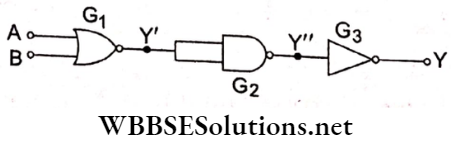
Question 6. The circuit given here is equivalent to

Logic Gates Multiple Choice Question And Answers Q6

  1. An AND gate
  2. A NAND gate
  3. A NOR gate
  4. A OR gate

Answer: 3. A NOR gate

The output of the (NOR gate) G1 is \(Y^{\prime}=\overline{A+B}\)

The output of the (NAND gate) G2 is Y” = \(Y^{\prime \prime}=\overline{Y^{\prime}}=\overline{A+B}=A+B\)

The output of the (NOT gate) G3 is Y = Y” = A + B.

This final output corresponds to a NOR gate, which is confirmed by the truth table given below.

Logic Gates Multiple Choice Question And Answers NOR Gate Truth Table Q6

Logic Gates Multiple Choice Question And Answers NOR Gate Output Q6

Question 7. To get an output of 1 for the following circuit, the correct choice for the inputs is

Logic Gates Multiple Choice Question And Answers Q7

  1. A = 1, B = 0, C = 0
  2. A = 1, B = 1, C = 0
  3. A = 1, B = 0, C = 1
  4. A = 0, B = 1, C = 0

Answer: 3. A = 1, B = 0, C = 1

The output of G1 (an OR gate) is Y’ = A + B.

The output Y of G2 (an AND gate) is Y = (A + B).C

For Y =1, we have C = 1, and either A = 0 and B =1 or A =1 and B = 0 or A = 1 and B = 1.

Hence, option (3) gives a correct combination.

Logic Gates Multiple Choice Question And Answers OR Gate Q7

Question 8. What are the respective values of the output Y in the given circuit when all three inputs (A, B, C) are first 0 and then 1?

Logic Gates Multiple Choice Question And Answers Q8

  1. 0 and 1
  2. 0 and 0
  3. 1 and 0
  4. 1 and 1

Answer: 3. 1 and 0

The output of the AND gate G1 is Y’ = A.B

The output of the NAND gate G2 is \(Y=\overline{Y^{\prime} \cdot C}=\overline{(A \cdot B) \cdot C}\)

If A = B = C = 0 then Y = \(\bar{0}\) = 1.

If A = B = C =1 then Y = \(\bar{1}\) = 0.

This can be shown by the truth table given below.

Logic Gates Multiple Choice Question And Answers NAND Gate Truth Table Q8

Logic Gates Multiple Choice Question And Answers NAND Gate Q8

Question 9. The output Y in the logic circuit shown in the figure will be

Logic Gates Multiple Choice Question And Answers Logic Circuit Q9

  1. \(Y=\bar{A} \cdot \bar{B}\)
  2. \(Y=\overline{A \cdot B}\)
  3. Y = A.B
  4. Y = \(Y=\overline{A+B}\)

Answer: 3. Y = A.B

In the given circuit, G1 is a NAND gate and G2 acts as a NOT gate.

⇒ \(Y^{\prime}=\overline{A \cdot B}\)

and \(Y=\overline{Y^{\prime}}=\overline{\overline{A \cdot B}}=A \cdot B\) → (1)

Now, (1) is the Boolean expression for an AND gate.

Logic Gates Multiple Choice Question And Answers Boolean Q9

Question 10. In the given circuit, the values of the output Y for all possible inputs A and B are expressed by the truth table

Logic Gates Multiple Choice Question And Answers Q10

Logic Gates Multiple Choice Question And Answers Truth Table Q10

Answer: 4.

In the given diagram, G1 represents a NOR gate and G2 is effectively NOT gate.

The output of G1 is \(Y^{\prime}=\overline{A+B}\) and the final output is \(Y=\overline{Y^{\prime}}=\overline{\overline{A+B}}=A+B\) which represents the Boolean expression for an OR gate. The truth table is given below.

This corresponds to the option (4).

Logic Gates Multiple Choice Question And Answers Boolean Expression For OR Gate Q10

Class 11 Physics Class 12 Maths Class 11 Chemistry
NEET Foundation Class 12 Physics NEET Physics

Question 11. The diagram shown in the adjoining figure performs the logic operation of a/an

Logic Gates Multiple Choice Question And Answers Logic Operation Q11

  1. OR gate
  2. AND gate
  3. XOR gate
  4. NAND gate

Answer: 2. AND gate

Gx is a NAND gate whose output is \(Y^{\prime}=\overline{A \cdot B}\).

A NAND gate with one input is equivalent to a NOT gate. Thus, the final output is \(Y=\overline{Y^{\prime}}=\overline{\overline{A \cdot B}}\) = A.B, which is the Boolean expression for an AND gate.

Thus, the given combination of gates performs the logic operation of an AND gate.

“logic gate questions and answers pdf “

Question 12. Which of the following gates will have an output of 1?

Logic Gates Multiple Choice Question And Answers Q12

  1. 1
  2. 2
  3. 3
  4. 4

Answer: 2. 2

  1. Is a NAND gate with the output Y = \(\overline{1 \cdot 1}=\overline{1}\) = 0.
  2. Is a NAND gate with the output Y = \(\overline{0 \cdot 1}=\overline{0}\) = 1.
  3. Is a NOR gate with the output Y = \(\overline{1+1}=\overline{1}\) = 0.
  4. Is an XOR gate with the output Y = 0.

Thus, only (2) will give an output of 1.

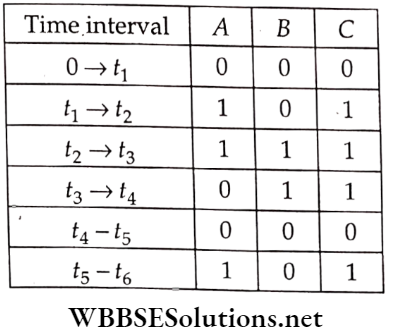
Question 13. The given figure shows a logic operation with two inputs A and B and the output C. The voltage waveforms across A, B, and C are as given. The logic circuit represents a/an

Logic Gates Multiple Choice Question And Answers Voltage Waveforms Q13

  1. NOR gate
  2. AND gate
  3. OR gate
  4. NAND gate

Answer: 3. OR gate

The values of the inputs A and B and the output C as given in waveforms are shown in the following table.

The values of the output C indicate that the logic circuit represents an OR gate.

Logic Gates Multiple Choice Question And Answers Waveforms Q13

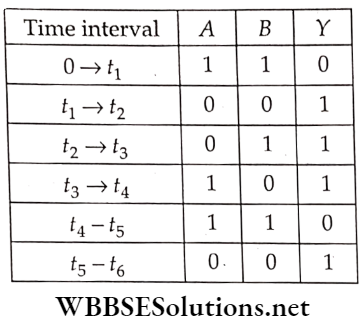
Question 14. The adjoining figure shows a logic circuit with two inputs A and B and the output Y. The voltage waveforms of A, B, and Y are given in the figure. The logic circuit represents

Logic Gates Multiple Choice Question And Answers Q14

  1. A NOR gate
  2. An OR gate
  3. A NAND gate
  4. An AND gate

Answer: 3. A NAND gate

The values of the inputs A and B and the output Y at different time intervals are shown in the following table.

The values of the output Y indicates that the. logic operation is of a NAND gate.

Logic Gates Multiple Choice Question And Answers Time Intervals Q14

Question 15. The figure given here shows a logic circuit with two inputs A and B and the output C. The voltage waveforms of A, B, and C are shown in the figure. The logic circuit is for a/an

Logic Gates Multiple Choice Question And Answers Logic Circuit Q15

  1. AND gate
  2. NAND gate
  3. OR gate
  4. NOR gate

Answer: 1. AND gate

The values of the inputs A and B and the output C at different time intervals are shown below in a tabular form.

The values of the output C correspond to the logic operation of an AND gate.

Logic Gates Multiple Choice Question And Answers Time Intervals Q15

Question 16. The correct Boolean operation represented by the circuit diagram shown is

Logic Gates Multiple Choice Question And Answers Boolean Operation Q16

  1. AND
  2. OR
  3. NAND
  4. NOR

Answer: 3. NAND

According to the given logic circuit, the LED will glow when both A and B are OFF (A = B = 0) or when either A or B is OFF.

The LED will not glow when it is short-circuited by closing both A and B (A = B = 1).

This is expressed in the following truth table, which gives the Boolean expression \(Y=\overline{A \cdot B}\) corresponding to a NAND gate.

Logic Gates Multiple Choice Question And Answers Q16

Question 17. The truth table for the circuit given in the adjoining figure is

Logic Gates Multiple Choice Question And Answers Circuit Q17

Logic Gates Multiple Choice Question And Answers Truth Table Q17

“logic gate questions and answers “

Answer: 2.

Let Y1 be the output of the given OR gate. With Y1 and A as the inputs in the NAND gate, the circuit produces the final output Y as shown in the following truth table.

Logic Gates Multiple Choice Question And Answers Final Output Q17

Question 18. To get an output of 1 at R in the given logic circuit, the input values must be

Logic Gates Multiple Choice Question And Answers Q18

  1. X = 0 and Y = 0
  2. X = 1 and Y = 0
  3. X = 1 and Y = 1
  4. X = 0 and Y = 1

Answer: 2.

The given logic circuit can be redrawn as shown in the given figure. The final output R is obtained as given in the truth table shown below.

Thus, to get an output of 1 at R, the values of the inputs must be X =1 and y = 0.

Logic Gates Multiple Choice Question And Answers Logic Circuit Q18

Logic Gates Multiple Choice Question And Answers Table Q18

Question 19. The output of the given combination of logic gates is

Logic Gates Multiple Choice Question And Answers Q19

  1. \(A \cdot \bar{B}\)
  2. \(\bar{A} \cdot B\)
  3. A.B + \(\overline{A \cdot B}\)
  4. \(A \cdot \bar{B}+\bar{A} \cdot B\)

Answer: 1. \(A \cdot \bar{B}\)

The logic circuit has been redrawn as shown here. The corresponding truth table is shown below.

Logic Gates Multiple Choice Question And Answers Circuit Q19

Logic Gates Multiple Choice Question And Answers Truth Table Q19

This output Y is the same as that produced by the \(A \cdot \bar{B}\) gate shown below.

Logic Gates Multiple Choice Question And Answers Circuit Corresponding Q19

Hence, the given circuit corresponds to the Boolean expression \(Y=A \cdot \bar{B}\).

Question 20. The given logic circuit is equivalent to a/an

Logic Gates Multiple Choice Question And Answers Q20

  1. AND gate
  2. NOR gate
  3. NANDgate
  4. OR gate

Answer: 4. OR gate

The truth table for the given logic circuit is shown below.

The output Y corresponds to an OR gate. Thus, the given logic circuit represents an OR gate.

Note: Y = \(\bar{A} \cdot \bar{B}\) = A + B

“logic gate questions and answers “

Logic Gates Multiple Choice Question And Answers Logic Circuit Q20

Logic Gates Multiple Choice Question And Answers Truth Table Q20

Question 21. The output of the given combination of gates is equivalent to a/an

Logic Gates Multiple Choice Question And Answers Q21

  1. AND gate
  2. OR gate
  3. NOR gate
  4. NAND gate

Answer: 1. AND gate

The symbol NOT Gate acts as a NOT gate.

Hence, the Boolean expression for the output will be

∴\(\overline{(\overline{A+A})+(\overline{B+B})+(\overline{C+C})}=\overline{\bar{A}+\bar{B}+\bar{C}}=A \cdot B \cdot C\)

Hence, the given combination of gates is equivalent to an AND gate.

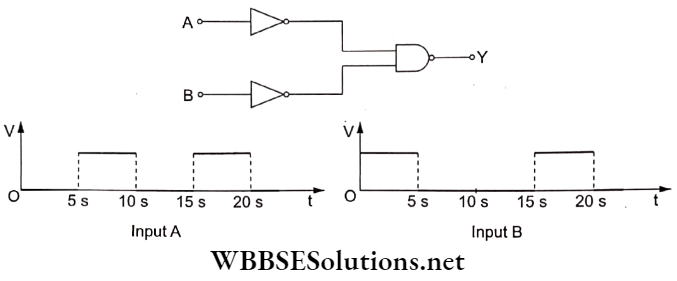
Question 22. The figure given below shows a logic circuit with two input signals A and B.

Logic Gates Multiple Choice Question And Answers Two Input Signals Q22

The output signal y is given by the graph

Logic Gates Multiple Choice Question And Answers Output Signal Graph Q22

Answer: 3.

For the given logic gate, Y = \(\overline{\bar{A} \cdot \bar{B}}\) = A + B.

The truth table and the corresponding output are given below. The circuit is equivalent to an OR gate.

Logic Gates Multiple Choice Question And Answers OR Gate Graphy Q22

Logic Gates Multiple Choice Question And Answers OR Gate Table Q22

“logic gate questions and answers “

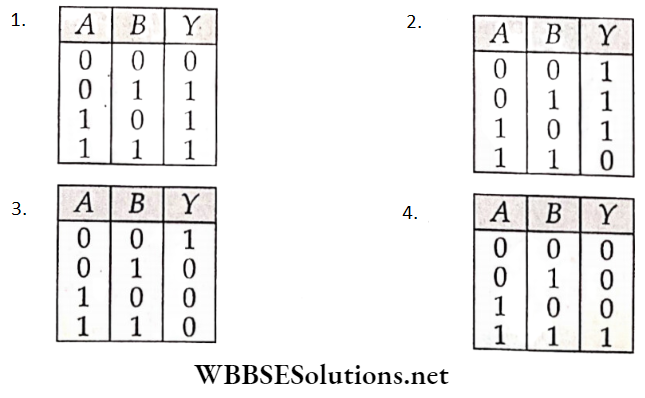
Question 23. For the given logic circuit, the truth table is

Logic Gates Multiple Choice Question And Answers Q23

Logic Gates Multiple Choice Question And Answers Truth Table Q23

Answer: 4.

The output Y for the given logic circuit corresponds to an AND gate, whose truth table is given in option (4). This can be seen in the following table.

Logic Gates Multiple Choice Question And Answers AND Gate Table Q23

Communication Systems Multiple Choice Questions And Answers

Communication Systems

Question 1. From a television tower of height h, the maximum distance up to which TV signals can be received is proportional to

  1. h-1/2
  2. h1/2
  3. h2
  4. h

Answer: 2. h1/2

The maximum range for the reception of TV signals is given by

⇒ \(d=\sqrt{2 R_{\mathrm{E}} h}\)

where RE is the earth’s radius and h is the height of the transmitting antenna.

∴ Thus, d ∝ h1/2.

Question 2. The area covered by a TV transmitting antenna of a height of 50 m is

  1. 120 π km2
  2. 1440π km2
  3. 640π km2
  4. 320π km2

Answer: 3. 640π km2

Given that the height of the transmitting antenna = h = 50 m.

Now, the maximum range for the reception of TV signals is \(d=\sqrt{2 R_{\mathrm{E}} h}\)

∴ area covered = A = nd2 = π(2Rh)

= π(2 x 6400 km x 50 m) = 640π km2.

Communication Systems Multiple Choice Question And Answers

Question 3. If the height H of a TV transmitting antenna is doubled, the range d covered initially would become

  1. 2d
  2. √2d
  3. 3d
  4. 4d

Answer: 2. √2d

Initial covering range = d = \(\sqrt{2 R_{\mathrm{E}} H}\)

If the height is doubled, the new range is

∴ \(d=\sqrt{2 R_{\mathrm{E}}(2 H)}=\sqrt{2}\left(\sqrt{2 R_{\mathrm{E}} H}\right)=\sqrt{2} d\).

digital communications mcq

Question 4. In short-wave communications, waves of which of the following frequencies will be reflected by the ionospheric layer having an electron density of 1011 m-3?

  1. 18 MHz
  2. 10 MHz
  3. 12 MHz
  4. 2 MHz

Answer: 4. 2 MHz

The critical frequency is the highest frequency above which the electromagnetic waves penetrate the ionosphere and below which the waves are reflected from the ionosphere. The critical frequency is given by \(f_c=9 \sqrt{N_{\max }}\) Hz, where Nmax is the maximum electron density (inm-3).

Given that Nmax = 1011

Hence, \(f_c=9 \sqrt{10^{11}} \mathrm{~Hz}=9 \times 10^5 \sqrt{10} \mathrm{~Hz}=2.8 \times 10^6 \mathrm{~Hz} \approx 2 \mathrm{MHz}\)

digital communications mcq

Read And Learn Also NEET Physics Multiple Choice Question and Answers

Question 5. For satellite communications, which waves are used?

  1. Ground waves
  2. Space waves
  3. Microwaves
  4. Sky waves

Answer: 2. Space waves

Space waves travel in a straight line from the transmitting antenna to the receiving antenna. Space waves are used for line-of-sight communications as well as satellite communications.

Question 6. A long-distance communication between two points on the earth is achieved by

  1. Satellites
  2. Line-of-sight (LoS) transmissions
  3. Space waves
  4. Sky waves

Answer: 4. Sky waves

Sky waves are used for long-distance communications between two points on the earth.

Question 7. For sky-wave communications of 10-MHz signals, the appropriate number density of electrons in the ionospheric layer will be approximately

  1. 1.2 x l012 m-3
  2. 1022 m-3
  3. 104 m-3
  4. 1014 m-3

Answer: 1. 1.2 x l012 m-3

Given that critical frequency = fc =10 MHz = 10  x 106 Hz.

We know that \(f_{\mathrm{c}}=9 \sqrt{N_{\max }} \mathrm{Hz}\)

∴ \(10 \times 10^6 \mathrm{~Hz}=9 \sqrt{N_{\max }} \mathrm{Hz}\)

⇒ \(N_{\max }=\frac{\left(10^7\right)^2}{81}=1.2 \times 10^{12}\)

Hence, the number density of electrons must be 1.2 x 10¹² m-3.

digital communications mcq

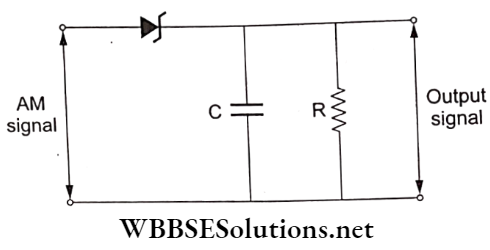
Question 8. The given circuit diagram shows an AM demodulator. For a good demodulation of an AM signal of carrier frequency fc, the value of RC is given by the relation

Communication Systems Multiple Choice Questions And Answers Circuit Q8

  1. \(R C=\frac{1}{f_c}\)
  2. \(R C \geq \frac{1}{f_c}\)
  3. \(R C \leq \frac{1}{f_c}\)
  4. \(R C \gg \frac{1}{f_{\mathrm{c}}}\)

Answer: 4. \(R C \gg \frac{1}{f_{\mathrm{c}}}\)

For high-frequency carrier waves, the capacitive reactance \(\left(X_c=\frac{1}{\omega_c C}\right)\) must be small for the carrier to bypass.

Hence, \(R C \gg \frac{1}{f_c}\).

Question 9. If the modulation index is 0.5 and the power of the carrier wave is 2 W, the total power in the modulated wave will be

  1. 0.25 W
  2. 1.0W
  3. 0.5 W
  4. 2.25 W

Answer: 4. 2.25 W

If Pc is the power of the carrier wave, the power of the modulated wave will be

⇒ \(P_{\mathrm{m}}=P_{\mathrm{c}}\left(1+\frac{m^2}{2}\right)\) where m the modulation index.

Given that m = 0.5 and Pc = 2 W.

Hence, \(P_{\mathrm{m}}=(2 \mathrm{~W})\left(1+\frac{1}{2} \times \frac{1}{4}\right)=\frac{9}{8} \times 2 \mathrm{~W}=2.25 \mathrm{~W}\)

digital communications mcq

Question 10. A modulating wave of voltage 5 V and frequency 10 MHz was superimposed on a carrier wave of frequency 20 MHz and voltage 20 V. Then, the modulation index is

  1. 2.43
  2. 1.25
  3. 0.25
  4. 64

Answer: 3. 0.25

Given that the amplitude of the modulating voltage is Am = 5 V and that of the carrier voltage is Ac = 20 V.

Hence, the modulation index is

∴ \(\mu=\frac{A_{\mathrm{m}}}{A_{\mathrm{c}}}=\frac{5 \mathrm{~V}}{20 \mathrm{~V}}=0.25\)

Question 11. If the highest modulating frequency of a wave is 5 kHz, the number of stations that can be accommodated in a bandwidth of 150 kHz will be

  1. 10
  2. 15
  3. 5
  4. none of these

Answer: 2. 15

The number of stations to be accommodated is

∴ \(N=\frac{\text { bandwidth }}{\text { bandwidth per station }}=\frac{150 \mathrm{kHz}}{2 \times 5 \mathrm{kHz}}=\frac{150}{10}=15\)

digital communications mcq

Question 12. A message signal of frequency 100 MHz and peak voltage 100 V is used to execute an amplitude modulation on a carrier wave of frequency of 300 GHz and peak voltage 400 V. The modulation index and the difference between the two sideband frequencies are respectively

  1. 4 and 2 x l05 Hz
  2. 0.25 and 2 x l07 Hz
  3. 4.0 and 1 x 10⁸ Hz
  4. 0.25 and 2 x 10⁸ Hz

Answer: 4. 0.25 and 2 x 10⁸ Hz

Modulation index = \(\mu=\frac{V_{\mathrm{m}}}{V_{\mathrm{c}}}=\frac{100 \mathrm{~V}}{400 \mathrm{~V}}=0.25\)

The frequencies of the sidebands are f1 = fc + fm and f2 = fc – fm.

∴ Δf = f1 – f2 = 2fm = 2(100 MHz) = 200 MHz = 2 X 10⁸ Hz.

Class 11 Physics Class 12 Maths Class 11 Chemistry
NEET Foundation Class 12 Physics NEET Physics

Question 13. Given below in the left column are different modes of communication using the kinds of waves given in the right column.

From the options given below, find the most appropriate match between the entries in the left and the right columns.

  1. A-Q B-S C-P D-R
  2. A-S B-Q C-R D-P
  3. A-R B-P C-S D-Q
  4. A-Q B-P C-R D-S

Answer: 1. A-Q B-S C-P D-R

In optical fiber communications with glass fibers, light waves in the infrared region between 1300 nm and 1550nm are used for low attenuation and absorption. So, A → Q.

Radar is a detection system that uses radio waves to detect aircraft, ships, guided missiles, etc. Hence, B → S.

Ultrasound, or ultrasonic, waves (frequencies greater than 20 kHz) are used in sonar, as these waves can penetrate water to long distances (because of their higher frequencies and very short wavelengths). So, C → P.

Mobile phones, or cell phones, operate with radio frequencies, which are a form of electromagnetic energy located in the electromagnetic spectrum around microwaves. Hence, D → R.

Question 14. A signal A cos ωt is transmitted using V0 sin ω0t as the carrier wave. The correct amplitude-modulated (AM) signal is

  1. \(V_0 \sin \omega_0 t+A \cos \omega t\)
  2. \(V_0 \sin \omega_0 t+\frac{A}{2} \sin \left(\omega_0-\omega\right) t+\frac{A}{2} \sin \left(\omega_0+\omega\right) t\)
  3. \(\left(V_0+A\right) \cos \omega t \cdot \sin \omega_0 t\)
  4. \(V_0 \sin \omega_0(1+0.01 A \sin \omega t) t\)

Answer: 2. \(V_0 \sin \omega_0 t+\frac{A}{2} \sin \left(\omega_0-\omega\right) t+\frac{A}{2} \sin \left(\omega_0+\omega\right) t\)

In amplitude modulation, the amplitude of the carrier wave is varied in accordance with the variation in the signal voltage to be communicated. Thus, the modulated signal is

⇒ \(V(t)=\left(V_0+A \cos \omega t\right) \sin \omega_0 t=V_0 \sin \omega_0 t+\frac{A}{2}\left(2 \cos \omega t \sin \omega_0 t\right)\)

∴ \(V_0 \sin \omega_0 t+\frac{A}{2} \sin \left(\omega_0-\omega\right) t+\frac{A}{2} \sin \left(\omega_0+\omega\right) t\).

Question 15. The wavelength of a carrier wave in a modern optical-fiber communications network is close to

  1. 600. nm
  2. 100 nm
  3. 2400 nm
  4. 1500 nm

Answer: 4. 1500 nm

In optical-fiber communications, the carrier waves used are part of the infrared region which has wavelengths close to 1500 nm.

digital communications mcq

Question 16. A TV transmission tower has a height of 140 m and the receiving antenna is 40 m. What is the maximum distance up to which signals can be broadcast from this tower in the LoS mode? (Given that the radius of the earth = 6400 km.)

  1. 65 km
  2. 80 m
  3. 40 km
  4. 48 km

Answer: 1. 65 km

The maximum line-of-sight distance between the transmitting and receiving antennas is given by

⇒ \(d=\sqrt{2 R_{\mathrm{E}} h_{\mathrm{T}}}+\sqrt{2 R_{\mathrm{E}} h_{\mathrm{R}}}\)

where RE = radius of the earth = 6400 x 103 m,

hT = height of the transmitter = 140 m

and hR = height of the receiver = 40 m.

∴ \(d=\sqrt{2\left(64 \times 10^5 \mathrm{~m}\right)(140 \mathrm{~m})}+\sqrt{2\left(64 \times 10^5 \mathrm{~m}\right)(40 \mathrm{~m})}\)

∴ \((8000 \mathrm{~m})(\sqrt{28}+\sqrt{8})=(8 \mathrm{~km})(5.29+2.83)=64.96 \mathrm{~km} \approx 65 \mathrm{~km}\)

Question 17. In a communication system, only one percent frequency of a signal of wavelength 800 .nm can be used as the bandwidth. How many channels of 6 MHz bandwidth can broadcast this signal?

  1. 3.75 x l06
  2. 6.25 x 10⁵
  3. 3.86 x lO6
  4. 4.87 x 10⁵

Answer: 3. 3.86 x lO6

Signal wavelength = λ = 800 nm = 800 x 10-9 m.

The corresponding frequency is

⇒ \(f=\frac{c}{\lambda}=\frac{3 \times 10^8 \mathrm{~m} \mathrm{~s}^{-1}}{8 \times 10^{-7} \mathrm{~m}}=3.75 \times 10^{14} \mathrm{~s}^{-1}\)

∴ total bandwidth used for communications = 1% of f

= 3.75 x 10¹² s-1

∴ the total number of channels is

∴ \(N=\frac{\text { total bandwidth }}{\text { signal bandwidth }}=\frac{3.75 \times 10^{12} \mathrm{~Hz}}{6 \times 10^6 \mathrm{~Hz}}=6.25 \times 10^5\)

digital communications mcq

Question 18. The modulation frequency of an AM radio station is 250 kHz, which is 10% of the carrier wave. If another AM station approaches you to get a license, what broadcast frequency will you allot?

  1. 2000 kHz
  2. 2250 kHz
  3. 2900 kHz
  4. 2750 kHz

Answer: 1. 2000 kHz

If fc and fm respectively are the frequencies of the carrier wave and the modulating signal, the maximum and minimum frequencies of the bandwidth are fmax = fc+ fm and fmin = fc – fm respectively.

To avoid overlapping, the next broadcast frequencies will be f1 = fc ± 2fm, f2 = fc ± 3fm,…

Hence, for the next broadcast frequency,

f1 = fc + 2fm and f1‘ = fc – 2fm.

Given that fm = 250 kHz and fc = 10fm = 2500 kHz.

f1 = [2500 + 2(250)] Hz = 3000 kHz

and f1‘ = [2500- 2(250)] Hz = 2000 kHz.

Question 19. An amplitude-modulated signal is given by V(t) = 10[1 + 0.3 cos (2.2 x 10⁴ )t]sin (5.5 x 10⁵ )t, where t is in seconds. The sideband frequencies are approximately

  1. 892.5 kHz and 857.5 kHz
  2. 91 kHz and 84 kHz
  3. 178.5 kHz and 171.5 kHz
  4. 1785 kHz and 1715 kHz

Answer: 2. 91 kHz and 84 kHz

From the given expression of the modulated signal,

ωm = 2πfm = 2.2 x 10⁴ rad s-1

and ωc = 2πfc = 5.5 x 10⁵ rad s-1.

The sideband frequencies are fc ± fm.

Thus, the upper sideband is

⇒ \(f_1=f_{\mathrm{c}}+f_{\mathrm{m}}=\frac{10^4}{2 \pi}(55+2.2) \mathrm{Hz}=\frac{5}{\pi}(57.2) \mathrm{kHz}=91.08 \mathrm{kHz}\)

and the lower sideband is

∴ \(f_2=f_{\mathrm{c}}-f_{\mathrm{m}}=\frac{10^4}{2 \pi}(55-2.2) \mathrm{kHz}=\frac{5}{\pi}(52.8) \mathrm{kHz}=84 \mathrm{kHz}\)

These approximately correspond to the option (2).

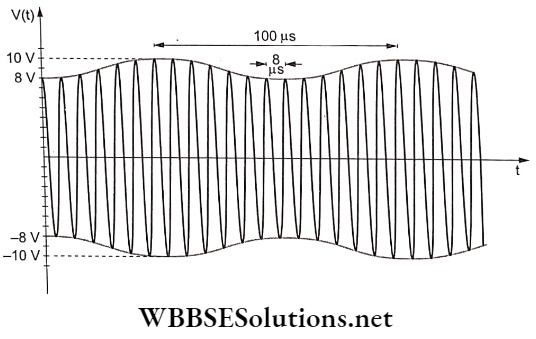
Question 20. An amplitude-modulated signal is given in the figure. Which of the following best describes the given signal?

Communication Systems Multiple Choice Questions And Answers Amplitude Modulated Signal Q20

  1. [1 + 9 sin (2π X 104 )t]sin (2.5π x 105 )t V
  2. [9 + sin (2π x 104 )t]sin (2.5π X 105 )t V
  3. [9 + sin (4π x 104 )t]sin (5π X 105 )t V
  4. [9 + sin (2.5π X 105 )t]sin (2π x 104 )t V

Answer: 2. [9 + sin (2π x 104 )t]sin (2.5π X 105 )t V

From the given diagram of the modulated signals,

maximum amplitude = Ac + Am = 10 V

and minimum amplitude = Ac – Am = 8 V.

∴ Ac = 9 V and Am = 1 V.

∴ the angular frequency of the carrier is

⇒ \(\omega_c=\frac{2 \pi}{T_c}=\frac{2 \pi}{8 \times 10^{-6}} \mathrm{~s}^{-1}=2.5 \pi \times 10^5 \mathrm{~s}^{-1}\)

Similarly \(\omega_{\mathrm{m}}=\frac{2 \pi}{T_{\mathrm{m}}}=\frac{2 \pi}{100 \times 10^{-6}} \mathrm{~s}^{-1}=2 \pi \times 10^4 \mathrm{~s}^{-1}\)

Substituting these values in the equation for the modulated signal, cm = (Ac + Am sin ωmt)sin ωct, we get

cm = [9 + sin (2π x 104)t]sin (2.5K X 105 )t V

digital communications mcq

Question 21. A 100-V carrier wave is made to vary between 160 V and 40 V by a modulating signal. What is the modulation index?

  1. 0.5
  2. 0.8
  3. 0.4
  4. 0.6

Answer: 4. 0.6

Vmax = Vc + Vm = 160 V and Vmin = Vc – Vm = 40 V.

∴ Vc = 100 V and Vm = 60 V.

∴ modulation index = \(\mu=\frac{V_{\mathrm{m}}}{V_{\mathrm{c}}}=\frac{60 \mathrm{~V}}{100 \mathrm{~V}}=0.6\)

Question 22. To double the covering range of a TV transmission tower, its height should be multiplied by

  1. 2
  2. 4
  3. 2
  4. \(\frac{1}{\sqrt{2}}\)

Answer: 2. 4

The covering range for communications is given by \(d=\sqrt{2 R_E h}\), where RE is the radius of the earth and h is the height of the transmission tower.

When the range is doubled, \(2 d=\sqrt{2 R_E h^{\prime}}\)

∴ \(\frac{h^{\prime}}{h}=4 \Rightarrow h^{\prime}=4 h\)

Question 23. In a line-of-sight radio communication, a distance of about 50 km is kept between the transmitting and receiving antennas. If the height of the receiving antenna is 70 m, the minimum height of the transmitting antenna should be

  1. 51 m
  2. 40 m
  3. 32 m
  4. 20 m

Answer: 3. 32 m

For line-of-sight radio communications,

⇒ \(\sqrt{2 R_{\mathrm{E}} h_{\mathrm{T}}}+\sqrt{2 R_{\mathrm{E}} h_{\mathrm{R}}} \geq d=50 \mathrm{~km}\)

∴ \(\sqrt{2(6400 \mathrm{~km}) h_{\mathrm{T}}}+\sqrt{2(6400 \mathrm{~km})(70 \mathrm{~m})} \geq 50 \mathrm{~km}\)

⇒ \(\sqrt{2(6400 \mathrm{~km}) h_{\mathrm{T}}} \geq 50 \mathrm{~km}-30 \mathrm{~km}=20 \mathrm{~km}\)

∴ \(h_{\mathrm{T}} \geq \frac{(20 \mathrm{~km})^2}{12800 \mathrm{~km}}=31.25 \mathrm{~m} \Rightarrow h_{\mathrm{T}} \geq 31.25 \mathrm{~m}\).

Hence, the minimum height of the transmitter is (hT)min = 32 m.

digital communications mcq

Question 24. The physical sizes of the transmitting and receiving antennas in a communication system are

  1. Inversely proportional to the carrier frequency
  2. Independent of both the carrier and modulating frequencies
  3. Inversely proportional to the modulating frequency
  4. Proportional to the carrier frequency

Answer: 1. Inversely proportional to the carrier frequency

In communication systems, the size of the transmitting or receiving antenna is directly proportional to the wavelength (λ).

Thus, \(l \propto \lambda \Rightarrow l \propto \frac{1}{\omega_{\mathrm{c}}}\)

Question 25. In an amplitude-modulator circuit, the carrier wave is given by c(t) = 4 sin 20000πt, while the modulating signal is given by m(t) = 2 sin 2000πt. The values of the modulation index and the lower sideband frequency are respectively

  1. 0.2 and 9 kHz
  2. 0.5 and 9 kHz
  3. 0.5 and 10 kHz
  4. 0.4 and 10 kHz

Answer: 2. 0.5 and 9 kHz

Given that Ac = 4 units, Am = 2 units, ωc = 20000π and ωm = 2000π.

∴ fc = 10000 Hz and fm = 1000 Hz.

∴ modulation index = \(\mu=\frac{A_{\mathrm{m}}}{A_{\mathrm{c}}}=\frac{2}{4}=0.5\)

Lower sideband = fc – fm = 10 kHz – 1 kHz = 9 kHz.

Simple Harmonic Motion Multiple Choice Questions And Answers

Simple Harmonic Motion

Question 1. A particle executing an SHM has a maximum acceleration of a and a maximum velocity of β. Then, its period of oscillations will be

  1. \(\frac{\beta^2}{\alpha^2}\)
  2. \(\frac{\beta^2}{\alpha}\)
  3. \(\frac{\alpha}{\beta}\)
  4. \(\frac{2 \pi \beta}{\alpha}\)

Answer: 4. \(\frac{2 \pi \beta}{\alpha}\)

In an SHM, maximum acceleration = ω²A = α

and maximum velocity = ωA = β, where A = amplitude.

∴ \(\frac{\alpha}{\beta}=\omega=\frac{2 \pi}{T}\)

⇒ \(T=\frac{2 \pi \beta}{\alpha}\)

Simple Harmonic Motion Multiple Choice Question And Answers

Question 2. Out of the following four functions, each representing the motion of a particle, which represents an SHM?

1. y = sin ω -cos ωt

2. y = 1 + ωt+ ω²t²

3. y = sin³ωt

4. \(y=A \cos \left(\frac{3 \pi}{4}-3 \omega t\right)\)

  1. All except (2)
  2. Both (1) and (4)
  3. Both (1) and (3)
  4. Only (1).

Answer: 2. Both (1) and (4)

neet ug physics-class 11 oscillations and waves

For an SHM, \(\frac{d^2 y}{d t^2}=-k y\)

This is satisfied only by the given functions (1) and (4).

In anSHM, displacement = y = Asin(ω ± Φ).

(1) can also be expressed as

⇒ \(y=\sqrt{2} \sin \left(\omega t-\frac{\pi}{4}\right)\)

which is an SHM, and so is (4).

Read And Learn Also NEET Physics Multiple Choice Question and Answers

Question 3. A simple pendulum performs an SHM about x = 0 with an amplitude of a and a time period of T. The speed of its bob at x = \(\frac{a}{2}\) will be

  1. \(\frac{\sqrt{3} \pi a}{2 T}\)
  2. \(\frac{\pi a}{T}\)
  3. \(\frac{3 \pi^2 a}{T}\)
  4. \(\frac{\sqrt{3} \pi a}{T}\)

Answer: 4. \(\frac{\sqrt{3} \pi a}{T}\)

The speed at a distance x = \(\frac{a}{2}\) from the mean position (x = 0) is

⇒ \(v=\omega \sqrt{a^2-x^2}=\omega \sqrt{a^2-\frac{a^2}{4}}\)

=\(\frac{\sqrt{3}}{2} a \omega\)

=\(\frac{\sqrt{3}}{2}\left(\frac{2 \pi}{T}\right) a\)

=\(\frac{\sqrt{3} \pi a}{T}\)

Question 4. A particle executes an SHM with a time period of T. Its motion is represented by \(x=a \sin \left(\omega t+\frac{\pi}{6}\right)\) After the elapse of what fraction of time period, the velocity of the particle will be equal to half its maximum velocity?

  1. \(\frac{T}{8}\)
  2. \(\frac{T}{6}\)
  3. \(\frac{T}{3}\)
  4. \(\frac{T}{12}\)

Answer: 2. \(\frac{T}{6}\)

The instantaneous velocity is given by

⇒ \(v=\frac{d x}{d t}=a \omega \cos \left(\omega t+\frac{\pi}{6}\right)\)

Now, \(v=\frac{1}{2} v_{\max }=\frac{a \omega}{2}\)

⇒ \(\frac{a \omega}{2}=a \omega \cos \left(\omega t+\frac{\pi}{6}\right)\)

⇒ \(\frac{1}{2}=\cos \left(\omega t+\frac{\pi}{6}\right)=\cos \frac{\pi}{3}\)

⇒ \(\omega t=\frac{\pi}{3}-\frac{\pi}{6}=\frac{\pi}{6} .\)

∴ \(t=\frac{\pi}{6 \omega}\)

=\(\frac{\pi}{6\left(\frac{2 \pi}{T}\right)}\)

=\(\frac{T}{12}\)

time period of spring

Question 5. A particle executes an SHM with an amplitude of A and a time period of T. The minimum time taken by the particle to travel half its amplitude from the equilibrium position is

  1. \(\frac{T}{4}\)
  2. \(\frac{T}{8}\)
  3. \(\frac{T}{12}\)
  4. \(\frac{T}{2}\)

Answer: 3. \(\frac{T}{12}\)

In an SHM, x = \(A \sin \frac{2 \pi t}{T}\)

For \(x=\frac{A}{2}, \frac{A}{2}\)

=\(A \sin \frac{2 \pi t}{T}\)

⇒ \(\frac{1}{2}=\sin \frac{\pi}{6}\)

=\(\sin \frac{2 \pi t}{T}\)

∴ t = \(\frac{T}{12}\)

Question 6. Which of the following statements is true for the velocity (v) and the acceleration of a particle executing an SHM?

  1. When v is maximum, a is maximum.
  2. The value of a is zero for all values of u.
  3. When v is zero, a is zero.
  4. When v is maximum, a is zero.

Answer: 4. When v is maximum, a is zero.

In an SHM,| acceleration | = ω²x

and velocity = \(\omega \sqrt{A^2-x^2}\)

At the extreme position, x = ±A.

Now, \(|a|_{\max }=\omega^2 A \text { at } x= \pm A\)

⇒ \(|a|_{\min }=0 \quad \text { at } x=0 \text {, }\)

⇒ \(|v|_{\max }=\omega A \text { at } x=0\)

and \(|v|_{\min }=0 \quad \text { at } x= \pm A\)

Thus, v is maximum with acceleration = 0 at the equilibrium position
(x = 0).

Question 7. A simple harmonic oscillator has a displacement amplitude of a and a time period of T. The time required to travel from x = a to x = \(\frac{a}{2}\) is

  1. \(\frac{T}{6}\)
  2. \(\frac{T}{2}\)
  3. \(\frac{T}{3}\)
  4. \(\frac{T}{4}\)

Answer: 1. \(\frac{T}{6}\)

In an SHM, when we start counting time from the extreme position, the displacement is y = a cos at.

For \(y=\frac{a}{2}=a \cos \frac{2 \pi t}{T}\)

⇒ \(\frac{2 \pi t}{T}=\frac{\pi}{3}\)

⇒ \(t=\frac{T}{6}\)

“a simple pendulum is oscillating without damping “

Question 8. The angular velocity and the amplitude of a particle executing an SHM are co and A respectively. At a displacement of x from the mean position, the KE is K and the PE is U. Then, the ratio of K to U is equal to

  1. \(\frac{A^2-\omega^2 x^2}{\omega^2 x^2}\)
  2. \(\frac{x^2 \omega^2}{A^2-\omega^2 x^2}\)
  3. \(\frac{A^2-x^2}{x^2}\)
  4. \(\frac{x^2}{A^2-x^2}\)

Answer: 3. \(\frac{A^2-x^2}{x^2}\)

KE = \(K=\frac{1}{2} m v^2=\frac{1}{2} m \omega^2\left(A^2-x^2\right)\)

and \(\mathrm{PE}=U=\frac{1}{2} m \omega^2 x^2\)

∴ \(\frac{K}{U}=\frac{A^2-x^2}{x^2}\)

Question 9. A particle is executing an SHM along a straight line. Its velocities at the distances x1 and x2 from the mean position are v1 and v2 respectively. Its time period is

  1. \(2 \pi \sqrt{\frac{x_1^2+x_2^2}{v_1^2+v_2^2}}\)
  2. \(2 \pi \sqrt{\frac{x_2^2-x_1^2}{v_1^2-v_2^2}}\)
  3. \(2 \pi \sqrt{\frac{v_1{ }^2+v_2{ }^2}{x_1{ }^2+x_2{ }^2}}\)
  4. \(2 \pi \sqrt{\frac{v_1{ }^2-v_2{ }^2}{x_1^2-x_2{ }^2}}\)

Answer: 2. \(2 \pi \sqrt{\frac{x_2^2-x_1^2}{v_1^2-v_2^2}}\)

⇒ \(\text { At } x=x_1, v_1^2=\omega^2\left(A^2-x_1^2\right)\)…(1)

⇒ \(\text { At } x=x_2, v_2^2=\omega^2\left(A^2-x_2{ }^2\right)\)…(2)

Subtracting (2) from (1), we get

⇒ \(v_1^2-v_2^2=\omega^2\left(x_2^2-x_1^2\right)\)

⇒ \(\omega^2=\left(\frac{2 \pi}{T}\right)^2=\frac{v_1^2-v_2^2}{x_2^2-x_1^2}\)

∴ time period = \(T =2 \pi \sqrt{\frac{x_2^2-x_1^2}{v_1^2-v_2^2}}\)

Question 10. A particle executing an SHM with an amplitude of 5 m has a maximum speed of 31.4 cm s-1. The frequency of its oscillations is

  1. 3 Hz
  2. 2 Hz
  3. 4 Hz
  4. 1 Hz

Answer: 4. 1 Hz

Maximum velocity = \(v_{\max }=A \omega=A\left(\frac{2 \pi}{T}\right)=A(2 \pi f)\)

∴ frequency = \(f=\frac{v_{\max }}{A \cdot 2 \pi}\)

=\(\frac{31.4 \mathrm{~cm} \mathrm{~s}^{-1}}{(5 \mathrm{~cm}) \cdot 2(3.14)}\)

=\(\frac{10 \pi}{10 \pi} \mathrm{s}^{-1}\)

= 1Hz.

Question 11. A particle executes a linear SHM with an amplitude of 3 cm. When the particle is at 2 cm from the mean position, the numerical magnitude of its velocity is equal to that of its acceleration. Then, the time period is

  1. \(\frac{\sqrt{5}}{\pi} \mathrm{s}\)
  2. \(\frac{\sqrt{5}}{2 \pi} \mathrm{s}\)
  3. \(\frac{4 \pi}{\sqrt{5}} \mathrm{~s}\)
  4. \(\frac{2 \pi}{\sqrt{3}} \mathrm{~s}\)

Answer: 3. \(\frac{4 \pi}{\sqrt{5}} \mathrm{~s}\)

Given that amplitude = A = 3 cm.

At x = 2 cm, v = a

⇒ \(\omega \sqrt{A^2-x^2}=\omega^2 x .\)

Substituting the values,

⇒ \(\omega \sqrt{(3 \mathrm{~cm})^2-(2 \mathrm{~cm})^2}=\omega^2(2 \mathrm{~cm})\)

⇒ \(\sqrt{5} \mathrm{~cm}=\frac{2 \pi}{T}(2 \mathrm{~cm})\)

∴ time period = \(T=\frac{4 \pi}{\sqrt{5}} \mathrm{~s}\)

Question 12. When two displacements represented by the equations y1 = asinωt and y2 = bcos ωt are superposed, the motion is

  1. Not simple harmonic
  2. Simple harmonic with an amplitude of \(\frac{a}{b}\)
  3. Simple harmonic with an amplitude of \(\sqrt{a^2+b^2}\)
  4. Simple harmonic with an amplitude of \(\frac{(a+b)}{2}\)

Answer: 3. Simple harmonic with an amplitude of \(\sqrt{a^2+b^2}\)

When the two SHMs are superposed, the resultant displacement is

y = y1 + y2 = a sin ωt + b cos ωt

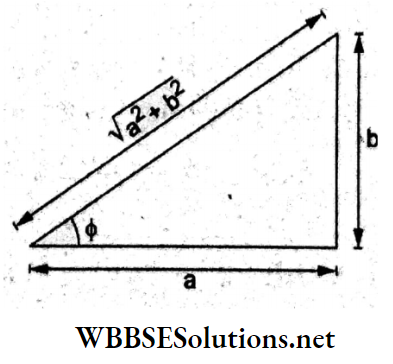
\(\sqrt{a^2+b^2}\left(\frac{a}{\sqrt{a^2+b^2}} \sin \omega t+\frac{b}{\sqrt{a^2+b^2}} \cos \omega t\right)\)

⇒ \(\sqrt{a^2+b^2}(\sin \omega t \cos \phi+\cos \omega t \sin \phi)\)

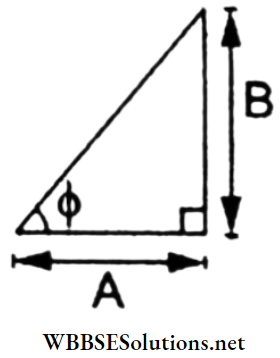
As shown in the adjoining figure,

⇒ \(y=\sqrt{a^2+b^2} \sin (\omega t+\phi)\)

This represents an SHM with an amplitude of

A = \(A=\sqrt{a^2+b^2}\)

in simple harmonic motion particle is always

Simple Harmonic Motion Multiple Choice Question And Answers Q 12

Question 13. Two simple harmonic motions of angular frequencies 100 rad s-1 and 1000 rad s-1 have the same displacement amplitude. The ratio of their maximum accelerations is

  1. 1:10
  2. 1: 10²
  3. 1: 10³
  4. 1: 104

Answer: 2. 1: 10²

The maximum acceleration is given by \(|a|_{\max }=\omega^2 A.\)

⇒ \(\frac{\left|a_1\right|_{\max }}{\left|a_2\right|_{\max }}=\left(\frac{\omega_1}{\omega_2}\right)^2\)

=\(\left(\frac{100 \mathrm{rad} \mathrm{s}^{-1}}{1000 \mathrm{rad} \mathrm{s}^{-1}}\right)^2=\frac{1}{100}\)

Hence, the required ratio is 1: 10²

Question 14. Which of the following equations of motion represents an SHM, where c, D, and a are constants?

  1. Acceleration = -cx + Dx²
  2. Acceleration = -c(x + a)
  3. Acceleration = c(x + a)
  4. Acceleration = cx

Answer: 2. Acceleration = -c(x + a)

In an SHM, the restoring force (F) is directly proportional to the negative of the displacement from the mean position.

Thus, F = -kx.

Then, acceleration = \(\frac{F}{m}=-\frac{k x}{m}=-\omega^2 x\)

This condition for an SHM is also satisfied for acceleration = -c(x + a), whereflisa constant.

Question 15. A particle executes an SHM. When the displacements from the mean position are 4 cm and 5 cm, foe corresponding velocities of the foe particle are 10 cm s-1 and 8 cm s-1 respectively. The period of oscillation of the particle is

  1. 2πs
  2. \(\frac{\pi}{2} \mathrm{~s}\)
  3. πs
  4. \(\frac{3 \pi}{2} s\)

Answer: 3. πs

Given that x1 = 4 cm, v1 = 10 m s-1, x2 = 5 cm and v2 = 8 cm s-1.

∴ time period = \(T=2 \pi \sqrt{\frac{x_2^2-x_1^2}{v_1^2-v_2^2}}\)

Substituting the values, we have

⇒ \(T=2 \pi \sqrt{\frac{5^2-4^2}{10^2-8^2}} \mathrm{~s}\)

=\(2 \pi \sqrt{\frac{9}{36}} \mathrm{~s}=\pi \mathrm{s}\)

Question 16. A simple harmonic oscillator at a given time has a displacement of 0.02 m and an acceleration equal to 2.0 m s-2. The angular frequency of the oscillator is

  1. 100 rad s-1
  2. 1 rad s-1
  3. 10 rads-1
  4. 2 rad s-1

Answer: 3. 10 rad s-1

⇒ \(|a|=\omega^2 x\)

⇒ \(\omega=\sqrt{\frac{|a|}{x}}\)

=\(\sqrt{\frac{2.0 \mathrm{~m} \mathrm{~s}^{-2}}{0.02 \mathrm{~m}}}\)

= 10 rad s-1

Question 17. If the maximum speed of a particle in an SHM (x = Asin ωt) is given by V0, what is its average speed from t = 0 to t = \(\frac{T}{4}\)?

  1. \(\frac{\pi v_0}{2}\)
  2. \(\frac{2 v_0}{\pi}\)
  3. \(\frac{\pi v_0}{4}\)
  4. \(\frac{v_0}{\sqrt{2}}\)

Answer: 2. \(\frac{2 v_0}{\pi}\)

The instantaneous speed is given by v = Aω cos ωt = v0 cos ωt.

∴ the average speed in the interval from t = 0 to t = \(\frac{T}{4}\) is

⇒ \(v_{\mathrm{av}}=\frac{1}{T / 4} \int v_0 \cos \omega t d t=\frac{4 v_0}{T}\left[\frac{\sin \omega t}{\omega}\right]_0^{T / 4}\)

=\(\frac{4 v_0}{T \omega}=\frac{2 v_0}{\pi}\)

Question 18. The time period of a simple pendulum kept in an artificial satellite orbiting the Earth is

  1. πs
  2. \(\frac{1}{\pi} \mathrm{s}\)s
  3. Zero
  4. Infinity

Answer: 4. Infinity

Any object inside an artificial satellite orbiting the earth is in a state of weightlessness, so geff = 0.

time period = T = \(2 \pi \sqrt{\frac{l}{g_{\text {eff }}}}\)

=\(2 \pi \sqrt{\frac{l}{0}}=\infty\)

Question 19. The period of oscillations of a spring-block system in an orbiting satellite is (take m = mass and k = spring constant)

  1. Zero
  2. Infinity
  3. \(2 \pi \sqrt{\frac{m}{k}}\)
  4. \(\sqrt{\frac{m g}{k}}\)

Answer: 3. \(2 \pi \sqrt{\frac{m}{k}}\)

The time period of oscillations of a spring-block system is given by \(T=2 \pi \sqrt{\frac{m}{k}}\) which is independent of the acceleration due to gravity (g).

In an orbiting satellite, even if the effective value of g is zero (condition of weightlessness), T will have the same value.

Question 20. The time period of a simple pendulum in a stationary lift is T. If the lift starts accelerating upwards with an acceleration of \(\frac{g}{3}\) the time period of the pendulum will be

  1. √3T
  2. \(\frac{T}{3}\)
  3. \(\frac{\sqrt{3} T}{2}\)
  4. \(\frac{T}{\sqrt{3}}\)

Answer: 3. \(\frac{\sqrt{3} T}{2}\)

The effective value of g in a lift accelerating upwards at a is g’ = g + a.

Here, a = \({g}{3}\) Hence,

⇒ \(T=2 \pi \sqrt{\frac{l}{g}}\)

and \(T^{\prime}=2 \pi \sqrt{\frac{l}{g+\frac{g}{3}}}\)

= \(\frac{\sqrt{3}}{2}\left(2 \pi \sqrt{\frac{l}{g}}\right)\)

= \(\frac{\sqrt{3} T}{2}\)

Question 21. Let an SHM be represented by the equation y = Asin 4πt + Bcos 4πt, where y, A, and B are in meters. The displacement amplitude of oscillations is

  1. A + B
  2. A-B
  3. \(\sqrt{A^2+B^2}\)
  4. \(\sqrt{A^2-B^2}\)

Answer: 3. \(\sqrt{A^2+B^2}\)

For an SHM, the displacement at a time t may be given by

x = a sin ωt + b cos ωt,

for which the displacement amplitude is \(\sqrt{a^2+b^2}\)

Here, y = A sin ωt + B cos ωt, where ω = 4π

∴ amplitude = \(\sqrt{A^2+B^2}\)

Class 11 Physics Class 12 Maths Class 11 Chemistry
NEET Foundation Class 12 Physics NEET Physics

Question 22. A horizontal platform is executing an SHM in the vertical direction ’ with a frequency of f. A block of mass m is placed on the platform. What is the maximum amplitude of the platform so that the block is not detached from it?

  1. \(\frac{g}{4 \pi^2 f^2}\)
  2. \(\frac{g}{2 \pi^2 f^2}\)
  3. \(\frac{m g}{2 \pi^2 f^2}\)
  4. \(\frac{m g}{4 \pi^2 f^2}\)

Answer: 1. \(\frac{g}{4 \pi^2 f^2}\)

During the upward motion of the platform, the acceleration (a = -ω² x) acts downwards. At the uppermost extreme point, when the platform starts descending, acceleration changes its sign, so the weight (mg) and the force mamax = mω²A act in opposite directions. For the block not to detach from the platform, mω²A ≤ mg.

∴ maximum amplitude = \(A_{\max }=\frac{g}{\omega^2}=\frac{g}{4 \pi^2 f^2}\)

Question 23. A block is placed on a rough horizontal platform. The platform is executing an SHM of time period T in the horizontal plane. The coefficient of static friction between the block and the platform is mmm The maximum amplitude of the platform for which the block does not slip on the surface of the platform is

  1. \(\frac{\mu g T}{2 \pi}\)
  2. \(\frac{\mu g T^2}{2 \pi^2}\)
  3. \(\frac{\mu g T^2}{4 \pi^2}\)
  4. μgT²

Answer: 3. \(\frac{\mu g T^2}{2 \pi^2}\)

The force of limiting friction is fmax = μN = mμg.

For the block not to slip at the extreme position, fmax > mω²A.

For the maximum amplitude,

⇒ \(m \omega^2 A_{\max }=f_{\max }=\mu m g\)

⇒ \(A_{\max }=\frac{\mu g}{\omega^2}=\frac{\mu g T^2}{4 \pi^2}\)

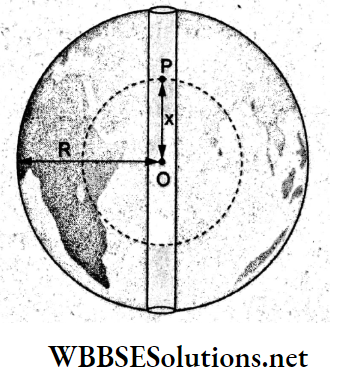
Question 24. A tunnel is drilled along the diameter of the earth and a stone is dropped into the tunnel. Then,

  1. The stone will reach the center of the earth and stop there
  2. The stone will reach the other end of the earth and stop there
  3. The stone will execute an SHM about the center of the earth
  4. The stone will reach the other side of the tunnel and escape the gravitational pull of the earth

Answer: 3. The stone will execute an SHM about the center of the earth

The speed of the stone goes on increasing and gets its maximum value at the center of the earth. Due to inertia, it moves further away from the centre, and the speed goes on decreasing to become zero at the other end. Thus, the stone undergoes an SHM with the centre as the origin, the radius R as the amplitude, and 2R as the path length.

Question 25. In the preceding problem, if R is the radius of the earth and g is the acceleration due to gravity at the earth’s surface, the period of oscillations of the stone will be

  1. \(\frac{R}{g}\)
  2. \(2 \sqrt{R g}\)
  3. \(2 \pi \sqrt{\frac{R}{g}}\)
  4. \(\frac{1}{2 \pi} \sqrt{\frac{R}{g}}\)

Answer: 3. \(2 \pi \sqrt{\frac{R}{g}}\)

Let M = mass of the earth and R = radius of the earth. When the stone during its fall be at P, where OP = x, the force due to gravity is

⇒ \(F=\frac{G(\text { mass of the inner core }) \cdot m}{O P^2}\)

⇒ \(\frac{G m}{x^2} \cdot \frac{4}{3} \pi x^3 \cdot \frac{M}{\frac{4}{3} \pi R^3}\) [∵ \(\text { density }=\frac{M}{\frac{4}{3} \pi R^3}\)]

⇒ \(\frac{G M m x}{R^3}\)

Simple Harmonic Motion Multiple Choice Question And Answers Q 25

∴ acceleration = \(a=\frac{F}{m}=-\frac{G M x}{R^3}\) [∵ f and x are in opposite directions]

⇒ \(-\frac{g x}{R}\)

Thus, a ∝ -x.

Hence, the motion is an SHM for which

⇒ \(\omega^2=\frac{g}{R}\)

⇒ \(\omega=\frac{2 \pi}{T}=\sqrt{\frac{g}{R}}\)

⇒ \(T=2 \pi \sqrt{\frac{R}{g}}\)

Question 26. The time period of a simple pendulum of infinite length is

  1. Infinity
  2. \(2 \pi \sqrt{\frac{R}{g}}\)
  3. \(2 \pi \sqrt{\frac{2 R}{g}}\)
  4. \(2 \pi \sqrt{\frac{R}{2 g}}\)

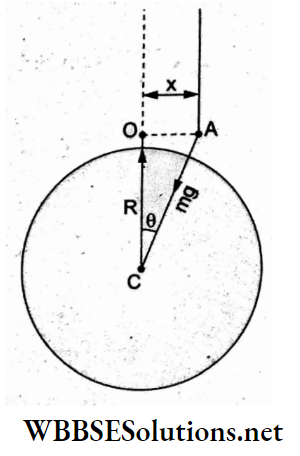
Answer: 2. \(2 \pi \sqrt{\frac{R}{g}}\) Let the thread of infinite length be attached to the pendulum bob of mass m. When the bob is displaced from O to A, the weight (mg) acts radially along AC, whose component along AO \(\left(m g \sin \theta=m g \frac{O A}{A C}=\frac{m g}{R} \cdot x\right)\) provides the restoring force for the SHM.

Thus, the acceleration is

⇒ \(a=\frac{F}{m}=-\frac{g}{R} \cdot x\)….(1)

Note that the minus sign is due to the force along AO and the displacement along OA. Further, threads have been shown parallelly as die threads are of infinite lengths.

Comparing (1) with the acceleration in an SHM (a = -ω²x), we have

⇒ \(\omega^2=\frac{g}{R} \Rightarrow T=2 \pi \sqrt{\frac{R}{g}}\)

Simple Harmonic Motion Multiple Choice Question And Answers Q 26

Question 27. A cubical block of wood (density = pw) of length I and mass M floats in a liquid,(density = pliq). It is slightly pressed vertically and then released. It will execute an SHM. The period of oscillation is

  1. \(2 \pi \sqrt{\frac{L \rho_{\text {liq }}}{\rho_w g}}\)
  2. \(2 \pi \sqrt{\frac{M}{\rho_{\mathrm{w}} g}}\)
  3. \(2 \pi \sqrt{\frac{L \rho_{\mathrm{w}}}{\rho_{\mathrm{liq}} g}}\)
  4. \(2 \pi \sqrt{\frac{L}{g}}\)

Answer: 3. \(2 \pi \sqrt{\frac{L \rho_{\mathrm{w}}}{\rho_{\mathrm{liq}} g}}\)

Let the wooden block be displaced vertically down by x so that the force of buoyancy, or upthrust, \(\left(L^2 x\right) \rho_{\mathrm{liq}} g\) acts upwards.

∴ \(F=M a=-\left(L^2 \rho_{\text {liq }} g\right) x\)

⇒ \(a=-\left(\frac{L^2 \rho_{\mathrm{liq}} g}{M}\right) x=-\left(\frac{\rho_{\mathrm{liq}} g}{L \rho_{\mathrm{w}}}\right) x\)

[∵ M = L³pw]

Since a ∝ -X, the motion is an SHM, whose time period is

⇒ \(T=2 \pi \sqrt{\frac{L \rho_{\mathrm{w}}}{\rho_{\mathrm{liq} g} g}}\)

Question 28. A particle executing an SHM has its KE = K0 COS²ωt. The maximum values of the potential energy and the total energy are respectively

  1. 0 and 2K0
  2. \(\frac{K_0}{2} \text { and } K_0\)
  3. K0 and K0
  4. K0 and 2K0

Answer: 3. K0 and K0

KE = K0 COS² ωt, so the maximum KE is K0.

Since the total energy is conserved,

KEmax = PEmax = total energy = K0.

∴ PEmax = K0 and total energy = K0.

Question 29. The potential energy of a simple harmonic oscillator when the particle is halfway to its end point is (where E is the total energy)

  1. \(\frac{E}{2}\)
  2. \(\frac{E}{4}\)
  3. \(\frac{2E}{3}\)
  4. \(\frac{E}{8}\)

Answer: 2. \(\frac{E}{4}\)

At a distance x from the mean position, PE = \(\frac{1}{2} m \omega^2 x^2\)

For \(x=\frac{A}{2}, \mathrm{PE}=\frac{1}{2} m \omega^2 \frac{A^2}{4}\)

=\(\frac{1}{4}\left(\frac{1}{2} m \omega^2 A^2\right)\)

=\(\frac{\text { total energy }}{4}\)

=\(\frac{E}{4}\)

Question 30. In an SHM, when the displacement is half the displacement amplitude, what fraction of the total energy is kinetic?

  1. \(\frac{1}{2}\)
  2. \(\frac{1}{4}\)
  3. \(\frac{3}{4}\)
  4. \(\frac{2}{3}\)

Answer: 3. \(\frac{3}{4}\)

The KE in an SHM is \(\frac{1}{2} m \omega^2\left(A^2-x^2\right)\)

AT \(x=\frac{A}{2}, \mathrm{KE}=\frac{1}{2} m \omega^2\left(A^2-\frac{A^2}{4}\right)\)

=\(\frac{3}{4}\left(\frac{1}{2} m \omega^2 A^2\right)\)

⇒ \(\frac{3}{4}(\text { total energy })\)

=\(\frac{3 E}{4}\)

∴ \(\frac{\mathrm{KE}}{\text { total energy }}=\frac{\frac{3 E}{4}}{E}\)

=\(\frac{3}{4}\)

Question 31. A simple pendulum is displaced to an angle from its equilibrium position and then released. While passing through the equilibrium position, its velocity v will be

  1. \(\sqrt{2 g l}\)
  2. \(\sqrt{2 g l \cos \theta}\)
  3. \(\sqrt{2 g l \sin \theta}\)
  4. \(\sqrt{2 g l(1-\cos \theta)}\)

Answer: 4. \(\sqrt{2 g l(1-\cos \theta)}\)

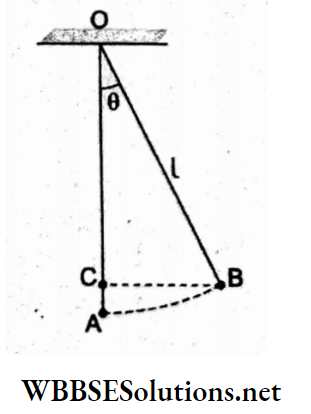
When released from the angular position 0, the loss in PE is

mg(CA) = mg(OA-OC)

= mg(l-l cosθ)

= mgl(1-cosθ).

This loss in PE appears as KE = \(\frac{1}{2}\) mv2.

∴ \(\frac{1}{2}\)mv²= mgl(1-cos θ)

⇒ \(v=\sqrt{2 g l(1-\cos \theta)}\)

Simple Harmonic Motion Multiple Choice Question And Answers Q 31

Question 32. The displacement of a particle (executing an SHM) between the positions of the maximum PE and the maximum KE are (A being the displacement amplitude)

  1. \(\pm \frac{A}{2}\)
  2. ±A
  3. ±2A
  4. ±1

Answer: 2. ±2A

In an SHM, the maximum KE is obtained at x = 0, and the position for the maximum PE is x = ±A.

Hence, the required displacement is ±A.

Question 33. In an SHM, the restoring force is F = -kx, where k is the force constant, x is the displacement from the mean position and a is the amplitude. Then, the total mechanical energy depends upon

  1. k, a and m
  2. k, x and m
  3. k and a
  4. k and x

Answer: 3. k and a

Since F = -kx, the potential energy is

⇒ \(U=-W\)

⇒ \(=-\int d W\)

⇒ \(=-\int F d x\)

⇒ \(=-\int_0^x(-k x) d x\)

⇒ \(=\frac{1}{2} k x^2\)

∴ total mechanical energy = E = maximum PE

⇒ \(\frac{1}{2} k x^2\)

=\(\frac{1}{2} k a^2\) [∵ x = a]

Thus, the total energy depends on k and a.

Question 34. A force of 6.4 N stretches a vertical spring by 0.1 m. The mass that must be suspended from the spring s6 that it oscillates with a period of (π/4) s is

  1. \(\frac{\pi}{4} \mathrm{~kg}\)
  2. 1 kg
  3. \(\frac{1}{\pi} \mathrm{kg}\)
  4. 10 kg

Answer: 2. 1 kg

Since F = kx, the force constant is

⇒ \(k=\frac{F}{x}=\frac{6.4 \mathrm{~N}}{0.1 \mathrm{~m}}=64 \mathrm{~N} \mathrm{~m}^{-1}\)

The time period of the spring-block system is given by

⇒ \(T=2 \pi \sqrt{\frac{m}{k}} \Rightarrow \frac{\pi}{4} s=2 \pi \sqrt{\frac{m}{64}}=\frac{2 \pi \sqrt{m}}{8}\)

m = 1 kg.

Question 35. The periodic time of oscillations of a spring-block system of mass M is T. If the mass is increased to 2M, the time of oscillations T will be equal to

  1. 2T
  2. √2T
  3. \(\frac{T}{\sqrt{2}}\)
  4. T

Answer: 2. √2T

For a spring-block system,

⇒ \(T=2 \pi \sqrt{\frac{M}{k}}\)

and \(T^{\prime}=2 \pi \sqrt{\frac{2 M}{k}}\)

= \(\sqrt{2}\left(2 \pi \sqrt{\frac{M}{k}}\right)\)

= \(\sqrt{2} T\)

Question 36. A block of mass m is attached to the lower end of a spring whose upper end is fixed to a rigid support. The spring has a negligible mass. When the block is slightly pulled down and released it oscillates with a time period of 3 s. When the mass is increased by 1 kg, the time period of oscillations increases to 5 s. The value of mis

  1. \(\frac{3}{4}\) kg
  2. \(\frac{4}{3}\) kg
  3. \(\frac{16}{9}\) kg
  4. \(\frac{9}{16}\) kg

Answer: 4. \(\frac{9}{16}\) kg

With mass = m, T = \(2 \pi \sqrt{\frac{m}{k}}\)

= 3s.

With mass = m + 1 kg,

⇒ \(T^{\prime}=2 \pi \sqrt{\frac{m+1 \mathrm{~kg}}{k}}\)

= 5s.

∴ \(\frac{T^{\prime}}{T}=\frac{5 \mathrm{~s}}{3 \mathrm{~s}}\)

=\(\sqrt{\frac{m+1 \mathrm{~kg}}{m}}\)

⇒ \(m=\frac{9}{16} \mathrm{~kg}\)

Question 37. A block of mass fn is suspended vertically from a light spring which oscillates with a frequency f. With what frequency will the system oscillate if another block of mass 4m is suspended from the same spring?

  1. \(\frac{f}{4}\)
  2. 4f
  3. \(\frac{f}{2}\)
  4. 2f

Answer: 3.

Time period = \(T=2 \pi \sqrt{\frac{m}{k}}, \text { so frequency }=f=\frac{1}{T}\)

=\(\frac{1}{2 \pi} \sqrt{\frac{k}{m}}\)

When the mass is changed from m to 4m, the frequency becomes

⇒ \(f^{\prime}=\frac{1}{2 \pi} \sqrt{\frac{k}{4 m}}\)

=\(\frac{1}{2}\left(\frac{1}{2 \pi} \sqrt{\frac{k}{m}}\right)\)

=\(\frac{f}{2}\)

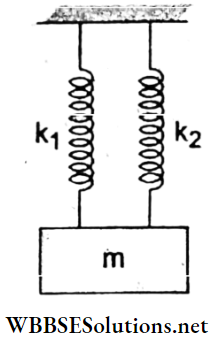
Question 38. A mass m is suspended successively by two springs of force constants and separately. The time periods of oscillations in die two cases are T1 and T2 respectively. If the same mass is suspended by connecting the two springs in parallel (as shown in the figure), the time period of oscillations is T. The correct relation is

Simple Harmonic Motion Multiple Choice Question And Answers The time periods of oscillation Q 38

  1. T2 = T1² + T2²
  2. \(\frac{1}{T}=\frac{1}{T_1}+\frac{1}{T_2}\)
  3. T = T1 + T2
  4. \(T^{-2}=T_1^{-2}+T_2^{-2}\)

Answer: 4. \(T^{-2}=T_1^{-2}+T_2^{-2}\)

With the first spring, \(T_1=2 \pi \sqrt{\frac{m}{k_1}}\)

With the second spring, \(T_2=2 \pi \sqrt{\frac{m}{k_2}}\)

With the two springs in parallel, the equivalent spring constant is k = k1 + k2, so the time period is

⇒ \(T=2 \pi \sqrt{\frac{m}{k_1+k_2}}\)

∴ \(\frac{1}{T_1^2}=\frac{1}{4 \pi^2} \cdot \frac{k_1}{m} \text { and } \frac{1}{T_2^2}=\frac{1}{4 \pi^2} \cdot \frac{k_2}{m}\)

∴ \(\frac{1}{T^2}=\frac{1}{4 \pi^2} \cdot \frac{k_1+k_2}{m}=\frac{1}{T_1^2}+\frac{1}{T_2^2}\)

⇒ \(T^{-2}=T_1^{-2}+T_2^{-2}\)

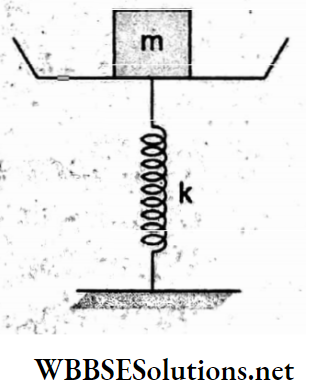
Question 39. A block having mass m = 2 kg is placed on a flat pan attached to a vertical spring fixed on the ground, as shown in the figure. The combined mass of the pan and the spring is negligible. When pressed slightly and released, the bloc executes an SHM. The spring constant is k = 200 N m-1. What should be the minimum amplitude of the motion so that the block gets detached from the pan? (Take g = 10 m s-2.)

Simple Harmonic Motion Multiple Choice Question And Answers The combined mass of the pan Q 39

  1. 8.0 cm
  2. 10.0 cm
  3. 4.0 cm
  4. Any value less than 12 cm

Answer: 2. 10.0 cm

The pan (as a frame) while moving upwards gets decelerated, i.e., its acceleration (a = -ω²x) is directed downwards. So, the pseudo force is

⇒ \(\vec{F}_{\mathrm{ps}}=(\text { mass of the block })\left(-\vec{a}_{\mathrm{fr}}\right)\)

which is vertically upwards.

Maximum pseudoforce = mamax = mω²A,

where A is the displacement amplitude.

For no detachment, m ω²A < mg. So, the minimum amplitude is

⇒ \(A=\frac{g}{\omega^2}=\frac{g}{\frac{k}{m}}=\frac{m g}{k}\)

Substituting the values,

⇒ \(A=\frac{(2 \mathrm{~kg})\left(10 \mathrm{~m} \mathrm{~s}^{-2}\right)}{200 \mathrm{~N} \mathrm{~m}^{-1}}\)

= 0.1 m

= 10.0 cm.

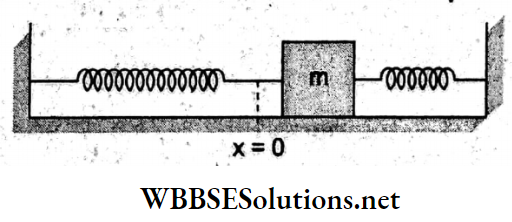
Question 40. What is the expression for the time period (T) of the block-spring system executing an SHM smooth horizontal surface?

Simple Harmonic Motion Multiple Choice Question And Answers Q 40

  1. \(T=2 \pi \sqrt{\frac{m}{k_1+k_2}}\)
  2. \(T=2 \pi \sqrt{\frac{k_1+k_2}{m}}\)
  3. \(T=2 \pi \sqrt{\frac{k_1 k_2 m}{k_1+k_2}}\)
  4. \(T=2 \pi \sqrt{\frac{\left(k_1+k_2\right) m}{k_1 k_2}}\)

Answer: 1. \(T=2 \pi \sqrt{\frac{m}{k_1+k_2}}\)

Let the block be displaced on either side by x so that the first spring gets extended by x and the second one gets compressed by x as shown in the adjoining figure.

The net force towards the left is (k1 + k2)x.

⇒ \(|a|=\frac{F}{m}=\left(\frac{k_1+k_2}{m}\right) x\)

=\(\omega^2 x\)

⇒ \(T=\frac{2 \pi}{\omega}\)

=\(2 \pi \sqrt{\frac{m}{k_1+k_2}}\)

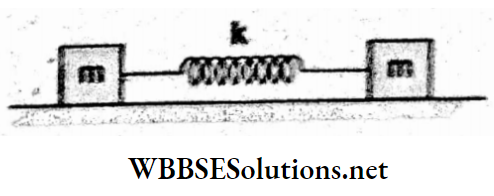
Question 41. In the adjoining figure, two blocks, each of mass m, are connected to the two ends of a light spring of force constant K. Thereisnofriction anywhere. If the blocks are displaced slightly in opposite directions and then released, they will execute an SHM with a frequency f, which is equal to

Simple Harmonic Motion Multiple Choice Question And Answers Q 41

  1. \(\frac{1}{2 \pi} \sqrt{\frac{k}{2 m}}\)
  2. \(\frac{1}{2 \pi} \sqrt{\frac{2 k}{m}}\)
  3. \(\frac{1}{2 \pi} \sqrt{\frac{m}{k}}\)
  4. \(\frac{1}{2 \pi} \sqrt{\frac{k}{m}}\)

Answer: 2. \(\frac{1}{2 \pi} \sqrt{\frac{2 k}{m}}\)

In the absence of external forces, the center of mass of the system (lying at the center of the spring) will remain fixed. For the force constant k of a half spring,

⇒ \(k^{\prime}\left(\frac{l}{2}\right)=k l \Rightarrow k^{\prime}=2 k\)

With the mass m and the spring constant k – 2k, the time period is,

⇒ \(T=2 \pi \sqrt{\frac{m}{2 k}}\)

and the frequency is,

⇒ \(f=\frac{1}{2 \pi} \sqrt{\frac{2 k}{m}}\)

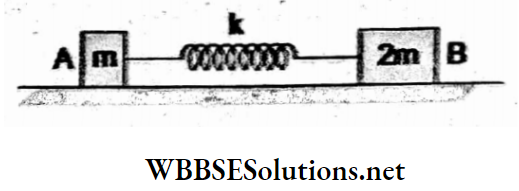
Question 42. Two blocks A and B of respective masses m and 2m are attached to the two ends of a light spring of force constant k. If the blocks are pulled apart in opposite directions and released, the system of the blocks oscillates with a time period T. Find the expression for T. (Assume the friction to be negligible.)

Simple Harmonic Motion Multiple Choice Question And Answers Q 42

  1. \(2 \pi \sqrt{\frac{2 m}{k}}\)
  2. \(2 \pi \sqrt{\frac{m}{k}}\)
  3. \(2 \pi \sqrt{\frac{2 m}{3 k}}\)
  4. \(2 \pi \sqrt{\frac{m}{2 k}}\)

Answer: 3. \(2 \pi \sqrt{\frac{2 m}{3 k}}\)

Taking block A as the origin, the position of the centre of mass of the system is

⇒ \(x_{\mathrm{CM}}=\frac{m \cdot 0+2 m \cdot l}{m+2 m}=\frac{2}{3} l\)

This position remains fixed in the absence of external forces.

The equivalent force constant is

⇒ \(\left(\frac{2}{3} l\right) k^{\prime}=l \cdot k\)

⇒ \(k^{\prime}=\frac{3}{2} k\)

∴ time period = \(T=2 \pi \sqrt{\frac{m}{k^{\prime}}}\)

=\(2 \pi \sqrt{\frac{2 m}{3 k}}\)

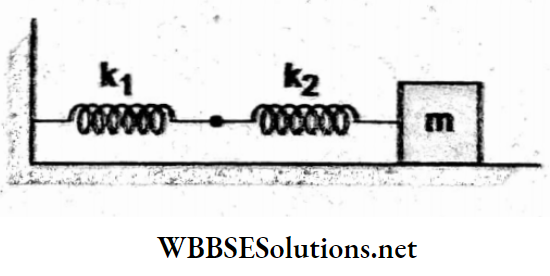
Question 43. Two springs of force constants k1 are connected to a block of mass m placed on a frictionless surface, as shown in the figure. When the force constants of both the springs have the same value k, the frequency of oscillations of the block is

Simple Harmonic Motion Multiple Choice Question And Answers frictionless sutrface Q 43

  1. \(\frac{1}{2 \pi} \sqrt{\frac{k}{m}}\)
  2. \(\frac{1}{2 \pi} \sqrt{\frac{k}{2 m}}\)
  3. \(\frac{1}{2 \pi} \sqrt{\frac{2 k}{m}}\)
  4. \(\frac{1}{2 \pi} \sqrt{\frac{m}{k}}\)

Answer: 2. \(\frac{1}{2 \pi} \sqrt{\frac{k}{2 m}}\)

For die given system of springs connected in series, the equivalent spring constant V is given by

⇒ \(\frac{1}{k^{\prime}}=\frac{1}{k_1}+\frac{1}{k_2}=\frac{k_1+k_2}{k_1 k_2}\)

⇒ \(k^{\prime}=\frac{k_1 k_2}{k_1+k_2}\)

∴ frequency = \(f=\frac{1}{2 \pi} \sqrt{\frac{k^{\prime}}{m}}=\frac{1}{2 \pi} \sqrt{\frac{k_1 k_2}{\left(k_1+k_2\right) m}}\)

When \(k_1=k_2=k, f=\frac{1}{2 \pi} \sqrt{\frac{k}{2 m}}\)

Question 44. In the preceding question, the frequency of oscillations of the block of mass m connected to a single spring horizontally is 4 Hz. When the spring is replaced by two identical springs, as shown in the figure, die effective frequency will be

  1. 4√2 Hz
  2. 1.5 Hz
  3. 1.31 Hz
  4. 2√2 Hz

Answer: 4. 2√2 Hz

The frequency of the spring-block system is \(f=\frac{1}{2 \pi} \sqrt{\frac{k}{m}}, \text { so } f \propto \sqrt{k}\)

With one single spring, f ∝ Vk.

With two identical springs in series,

⇒ \(f^{\prime} \propto \sqrt{\frac{k}{2}}\)

∴ \(\frac{f^{\prime}}{f}=\frac{\sqrt{\frac{k}{2}}}{\sqrt{k}}\)

⇒ \(\frac{1}{\sqrt{2}}\)

⇒ \(f^{\prime}=\frac{1}{\sqrt{2}} f\)

=\(\frac{1}{\sqrt{2}}(4 \mathrm{~Hz})\)

=\(2 \sqrt{2} \mathrm{~Hz}\)

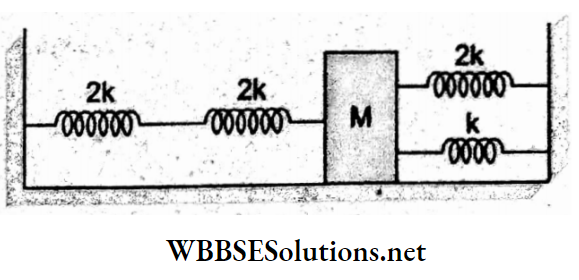
Question 45. Four massless springs, whose force constants are 2k, 2k, k, and 2k, are attached to a block of mass M as shown in the figure. If the block is displaced in the horizontal direction to either 2k side released, the frequency of oscillations of the block is

Simple Harmonic Motion Multiple Choice Question And Answers massless springs Q 45

  1. \(\frac{1}{2 \pi} \sqrt{\frac{k}{7 M}}\)
  2. \(\frac{1}{2 \pi} \sqrt{\frac{k}{4 M}}\)
  3. \(\frac{1}{2 \pi} \sqrt{\frac{4 k}{M}}\)
  4. \(\frac{1}{2 \pi} \sqrt{\frac{7 k}{M}}\)

Answer: 3. \(\frac{1}{2 \pi} \sqrt{\frac{4 k}{M}}\)

The equivalent force constant to the left of the block is k (for the series combination) and that to the right is 2k + k = 3k. These taken together constitute a parallel combination for which the force constant is

keq = k + 3k = 4k and thus frequency = \(f=\frac{1}{2 \pi} \sqrt{\frac{k_{\text {eq }}}{M}}=\frac{1}{2 \pi} \sqrt{\frac{4 k}{M}}\)

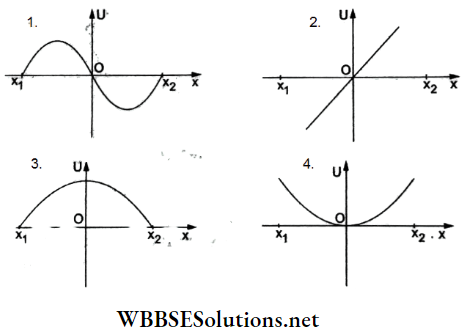
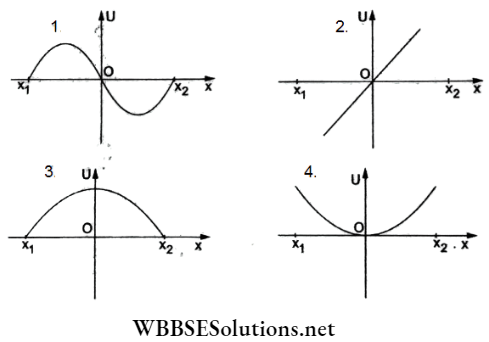
Question 46. A particle executes an SHM between the extreme positions x = x1 and x = x2, the equilibrium position being O. Which of the following graphs correctly represents the variation of potential energy with a position?

Simple Harmonic Motion Multiple Choice Question And Answers variation of potential energy Q 46

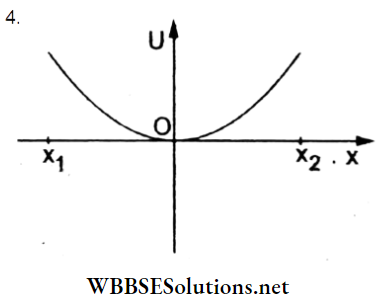
Answer: 4.

Simple Harmonic Motion Multiple Choice Question And Answers variation of potential energy Q 46.

In an SHM, potential energy \(U=\frac{1}{2} k x^2=\frac{1}{2} m \omega^2 x^2\)

This is positive for both negative and positive values of x, and zero at the mean position (x = 0). This is given in the option (d).

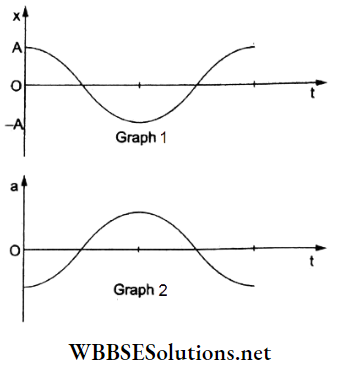
Question 47. Which of the following graphs correctly represents the variation of acceleration with time (t) for a particle executing a simple harmonic motion for which the displacement is x = Acos ωt?

Simple Harmonic Motion Multiple Choice Question And Answersharmonic motion Q 47.

Answer: 3.

Simple Harmonic Motion Multiple Choice Question And Answersharmonic motion Q 47

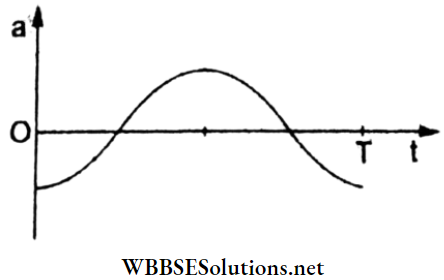
The given expression for displacement in the SHM is x = Acos ωt, represented in the adjoining graph 1. On differentiation, we get acceleration

⇒ \(a=\frac{d^2 x}{d t^2}=-\omega^2 A \cos \omega t\)

= -a0 cos ωt.

This is just the mirror image of Graph 1 about the central line (x = 0), as shown in Graph 2.

Simple Harmonic Motion Multiple Choice Question And Answers Q 47

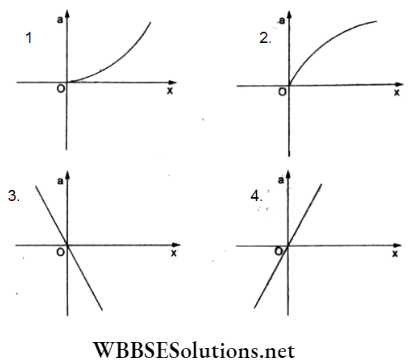
Question 48. The variation of the acceleration of a particle in an SHM with its displacement (x) is shown by the graph

Simple Harmonic Motion Multiple Choice Question And Answers the variation of the acceleratio Q 48

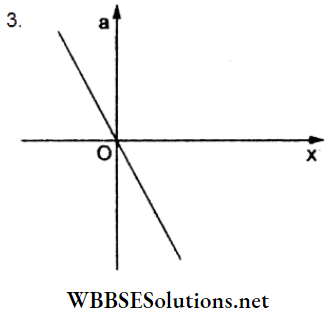
Answer: 3.

Simple Harmonic Motion Multiple Choice Question And Answers the variation of the acceleratio Q 48.

The acceleration in an SHM is given by a ∝ -x

=> a = -kx.

The a-x graph is a straight line with a negative slope and passing through the origin, as shown in the option (3)

Question 49. The displacement of a particle from the mean position is given by y = asin 4π(2t + 0.4). The time period of oscillations is

  1. 0.25 s
  2. 0.2s
  3. 1.0 s
  4. 2.0 s

Answer: 1. 0.25 s

In the given equation,

y = asin4 π(2t + 0.4)

= a sin(8πt +1.6π) = a sin(ωt + 0).

Thus, to = \(\frac{2 \pi}{T}\) = 8πt

T = \(\frac{1}{4}\) s

= 0.25 s.

Question 50. A particle executes an SHM such that its acceleration is given by a = -bx, where x is its displacement from the mean position. The time period of oscillations is

  1. 2π√b
  2. \(\frac{2 \pi}{\sqrt{b}}\)
  3. \(\frac{2 \pi}{b}\)
  4. \(\sqrt{\frac{2 \pi}{b}}\)

Answer: 2. \(\frac{2 \pi}{\sqrt{b}}\)

For an SHM, acceleration-a = -ω²x.

Comparing this with the given equation a = -bx, we get

⇒ \(\omega^2=b \Rightarrow \omega=\frac{2 \pi}{T}=\sqrt{b}\)

⇒ \(T=\frac{2 \pi}{\sqrt{b}}\)

Question 51. A particle executes an SHM with a frequency f. The frequency with which its KE oscillates is

  1. \(\frac{f}{2}\)
  2. f
  3. 2f
  4. 4f

Answer: 3. 2f

For an SHM, x = asin ωt

v = aω cos ωt

and KE = E = \(\frac{1}{2}\) mv²

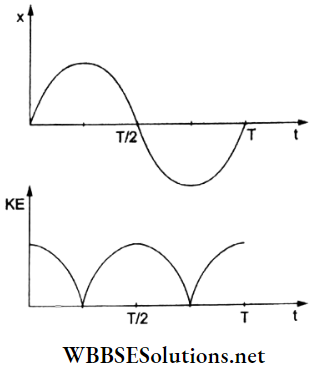
From (1), the frequency of oscillations is to, while. the frequency of variation of KE is 2

This is also clear in the given graph. The x-t graph completes one cycle in the time period T, whereas KE completes two complete oscillations (one from O to \(\frac{T}{2}\) and the other from \({T}{2}\) to T.

Simple Harmonic Motion Multiple Choice Question And Answers Q 51

Question 52. The displacement of a particle executing an SHM is expressed by the equation y = A0 + A sin ωt + B cos ωt. Then, the amplitude of its oscillations is

  1. \(A_0+\sqrt{A^2+B^2}\)
  2. \(\sqrt{A^2+B^2}\)
  3. \(\sqrt{A_0^2+(A+B)^2}\)
  4. A + B

Answer: 2. \(\sqrt{A^2+B^2}\)

The given equation represents an SHM with a displaced origin of displacement amplitude \(\), as shown below.

y= A0+ A sin ωt + Bcos ωt

⇒ \(A_0+\sqrt{A^2+B^2}\left(\frac{A}{\sqrt{A^2+B^2}} \sin \omega t+\frac{B}{\sqrt{A^2+B^2}} \cos \omega t\right)\)

⇒ \(A_0+\sqrt{A^2+B^2}(\sin \omega t \cos \phi+\cos \omega t \sin \phi)\)

⇒ \(A_0+\sqrt{A^2+B^2} \sin (\omega t+\phi)\)

where \(\phi=\tan ^{-1}\left(\frac{B}{A}\right)\) from the triangle.

The amplitude \(\sqrt{A^2+B^2}\) is always associated with the sinusoidal function.

Simple Harmonic Motion Multiple Choice Question And Answers Q 52

Question 53. The average velocity of a particle executing an SHM in one r complete oscillation is

  1. \(\frac{A \omega}{2}\)
  2. \(\frac{A \omega^2}{2}\)
  3. Zero

Answer: 4. Zero

An SHM is expressed by y = Asin ωt and its velocity is given by

⇒ \(v=\frac{d y}{d t}=A \omega \cos \omega t\)

We know that the average value of any sinusoidal function (sine, cosine or any of their combinations) in one complete cycle (t = 0 to t = T) is always zero.

So, v = Aω cos ωt being sinusoidal has a zero average velocity

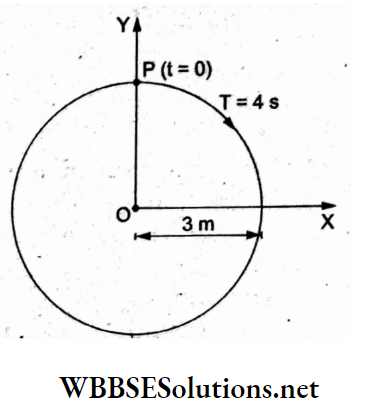
Question 54. The radius of a circle, the period of revolutions, the initial position, and the sense of revolutions are indicated in the adjoining figure. The projection of the rotating radius vector \(\overrightarrow{\mathrm{OP}}\) on the y-axis is given by

Simple Harmonic Motion Multiple Choice Question And Answers the radious of a circle Q 54

  1. y(t) = -3cos 2nt, where y is in metres
  2. \(y(t)=4 \sin \frac{\pi t}{2}\), where y is in metres
  3. \(y(t)=3 \cos \frac{3 \pi t}{2}\), where y is in metres
  4. \(y(t)=3 \cos \frac{\pi t}{2}\), where y is in metres

Answer: 4. \(y(t)=3 \cos \frac{\pi t}{2}\), where y is in metres

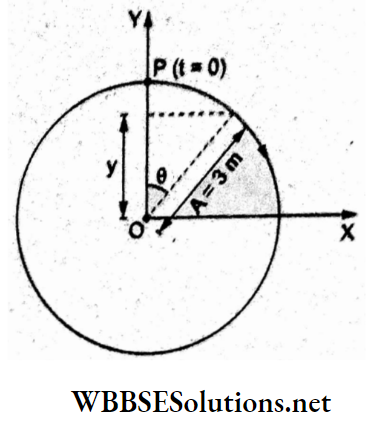
The projection of a uniform circular motion on its diameter executes an SHM with an amplitude of A = radius of the circle. Here, at t = 0, a particle is at the extreme position. So, the instantaneous position (y) will be a cosine function.

Further, T = 4 s.

So,

⇒ \(\omega=\frac{2 \pi}{T}=\frac{\pi}{2} \mathrm{rad} \mathrm{s}^{-1}\)

Hence, \(y=A \cos \omega t=3 \cos \frac{\pi t}{2}\)

Simple Harmonic Motion Multiple Choice Question And Answers uniform circle motion Q 54

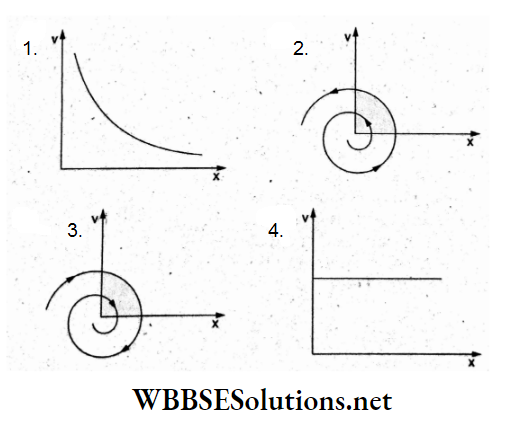
Question 55. In a damped oscillation, the graph between velocity (v) and position (x)will be

Simple Harmonic Motion Multiple Choice Question And Answers graph between velocity and position Q 55

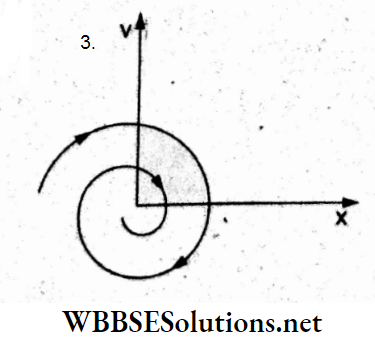
Answer: 3.

Simple Harmonic Motion Multiple Choice Question And Answers graph between velocity and position Q 55.

In a damped SHM, the velocity changes periodically between the extreme positive and negative values at the origin with the zero values at the two extremes. Due to damping, the velocity amplitude goes on decreasing. This variation corresponds to the option (3).

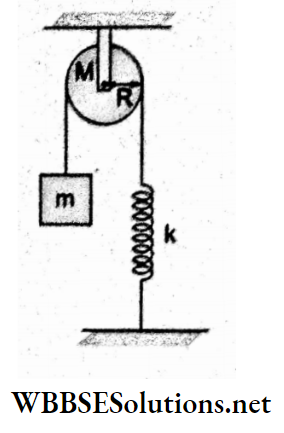
Question 56. For the system given in the adjoining figure, M = 1 kg, R = 2 cm, m = 250 g, and k = 100 N m-1. The angular frequency of the spring-block system will be

Simple Harmonic Motion Multiple Choice Question And Answers frequency of the spring block system Q 56

  1. \(\frac{20}{\sqrt{3}} \mathrm{rad} \mathrm{s}^{-1}\)
  2. 10√3 rad s-1
  3. \(\frac{10}{\sqrt{3}} \mathrm{rad} \mathrm{s}^{-1}\)
  4. 20√3 rad s-1

Answer: 1. \(\frac{20}{\sqrt{3}} \mathrm{rad} \mathrm{s}^{-1}\)

From the law of conservation of energy,

⇒ \(\frac{1}{2} m v^2+\frac{1}{2} I \omega^2+\frac{1}{2} k x^2=\text { constant }\)

Differentiating the above equation with respect to time,

⇒ \(\frac{1}{2} m \cdot 2 v \cdot \frac{d v}{d t}+\frac{1}{2} I \cdot 2 \omega \frac{d \omega}{d t}+\frac{1}{2} k \cdot 2 x \frac{d x}{d t}=0\)

⇒ \(m v a+I \omega \alpha+k x v=0 \Rightarrow m v a+\frac{1}{2} M R^2 \cdot \frac{v}{R} \cdot \frac{a}{R}+k x v=0\)

⇒ \(a\left(m+\frac{M}{2}\right)=-k x \Rightarrow a=-\left(\frac{k}{m+\frac{M}{2}}\right) x \Rightarrow a=-\omega^2 x\)

This represents an SHM with an angular frequency of

⇒ \(\omega=\sqrt{\frac{k}{m+\frac{M}{2}}}=\sqrt{\frac{100 \mathrm{Nm}^{-1}}{\frac{1}{4} \mathrm{~kg}+\frac{1}{2} \mathrm{~kg}}}\)

⇒ \(\sqrt{\frac{400}{3}} \mathrm{~s}^{-1}=\frac{20}{\sqrt{3}} \mathrm{rad} \mathrm{s}^{-1}\)

Question 57. The spring constant is given by k = 100 N m-1. The system executes an SHM with an amplitude of A. Find the maximum amplitude Amax so, that block A does not slip over B.

Simple Harmonic Motion Multiple Choice Question And Answers spring constant Q 57

  1. 2 cm
  2. 6 cm
  3. 8 cm
  4. 4 cm

Answer: 2. 6 cm

For no slipping between the blocks A and B, the limiting static friction is

⇒ \(f_{\max }=\mu \delta V \geq F_{\mathrm{ps}} \Rightarrow \mu m_{\mathrm{A}} g \geq m_{\mathrm{A}} a_{\mathrm{fr}}\)….(1)

For the combined system, (mA +mB)a = -kx.

∴ maximum acceleration = \(\frac{k A}{m_A+m_B}, \text { where } A=\text { amplitude }\)

∴ \(A \leq \frac{\mu g\left(m_{\mathrm{A}}+m_{\mathrm{B}}\right)}{k}\)

maximum amplitude = \(\frac{0.4 \times 10 \times 1.5}{100} \mathrm{~m}=6 \mathrm{~cm}\)

Question 58. A particle executes an SHM with an amplitude of 5 cm. When the particle is at 4 cm from the mean position, the numerical value of the magnitude of its velocity in SI units is equal to that of its acceleration. Its periodic time is

  1. \(\frac{8 \pi}{3} \mathrm{~s}\)
  2. \(\frac{3 \pi}{8} \mathrm{~s}\)
  3. \(\frac{7 \pi}{4} \mathrm{~s}\)
  4. \(\frac{4 \pi}{3} \mathrm{~s}\)

Answer: 1. \(\frac{8 \pi}{3} \mathrm{~s}\)

Given that amplitude = A = 5 cm, displacement-x-4 cm.

Hence, velocity = \(v=\omega \sqrt{A^2-x^2}\) and the magnitude of die acceleration is |a| = ω²x,

∵ \(\omega^2 x=\omega \sqrt{A^2-x^2}\)

∴ \(\frac{2 \pi}{T}=\frac{\sqrt{(5 \mathrm{~cm})^2-(4 \mathrm{~cm})^2}}{4 \mathrm{~cm}}\)

⇒ \(T=2 \pi \cdot \frac{4}{3} s=\frac{8 \pi}{3} s\)

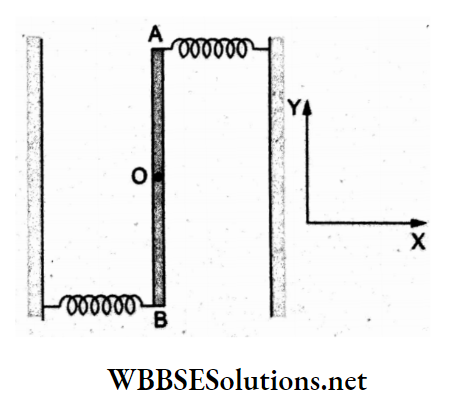
Question 59. Two light identical springs, each of spring constant k, are attached horizontally at the two ends of a uniform horizontal rod AB of length l and mass m. The rod is pivoted at its centre O and can rotate freely in the horizontal plane. The other ends of the two springs are fixed to two rigid supports, as shown in the figure. The rod is now turned through a small angle and then released. The frequency of the resulting oscillations will be

Simple Harmonic Motion Multiple Choice Question And Answers uniform horizontal rod Q 59

  1. \(\frac{1}{2 \pi} \sqrt{\frac{k}{2 m}}\)
  2. \(\frac{1}{2 \pi} \sqrt{\frac{3 k}{2 m}}\)
  3. \(\frac{1}{2 \pi} \sqrt{\frac{6 k}{m}}\)
  4. \(\frac{1}{2 \pi} \sqrt{\frac{k}{m}}\)

Answer: 3. \(\frac{1}{2 \pi} \sqrt{\frac{6 k}{m}}\)

The compression in each spring is \(x=\frac{l}{2} \sin \theta \approx l\left(\frac{\theta}{2}\right) \text { for } \theta \rightarrow 0\)

The force on each end of the rod is

⇒ \(F=k x=\frac{k l \theta}{2}\)

The controlling torque Y during the rotational motion is

⇒ \(\tau=-k x\left(A^{\prime} C\right)=-\frac{k l \theta}{2}(l \cos \theta)\)

⇒ \(-\frac{k l^2 \theta}{2} \text { for } \cos \theta \rightarrow\)

But torque \(I \alpha=\left(\frac{m l^2}{12}\right)\)

⇒ \(\left(\frac{m l^2}{12}\right) \alpha=-\left(\frac{k l^2}{2}\right) \theta \Rightarrow \alpha=-\left(\frac{6 k}{m}\right) \theta\)

This represents an angular SHM with an angular frequency of

⇒ \(\omega=2 \pi f=\sqrt{\frac{6 k}{m}}\)

∴ \(f=\frac{1}{2 \pi} \sqrt{\frac{6 k}{m}}\)

Simple Harmonic Motion Multiple Choice Question And Answers Q 59

Question 60. An SHM is represented by y = 5(sin 3πt + √3 cos 3πt) cm. The amplitude and the period of oscillations are respectively

  1. 5 cm and \(\frac{3}{2}\) s
  2. 5 cm and \(\frac{2}{3}\) s
  3. 10 cm and \(\frac{2}{3}\) s
  4. 10 cm and \(\frac{3}{2}\) s

Answer: 3. 10 cm and \(\frac{2}{3}\) s

The given equation is \(y=5 \sin (3 \pi t)+5 \sqrt{3} \cos (3 \pi t)\)

Comparing this equation with y = Asin

⇒\(a=\sqrt{A^2+B^2}=\sqrt{5^2+(5 \sqrt{3})^2} \mathrm{~cm}\)

= 10 cm.

∴ angular frequency = \(\omega=\frac{2 \pi}{T}=3 \pi \Rightarrow T=\frac{2}{3}\)

Question 61. A pendulum executes an SHM with its maximum kinetic energy Kv If the length of the pendulum is doubled and it performs an SHM with the same amplitude as in the first case, the maximum kinetic energy is K2. Then,

  1. K2 = 2K1
  2. K2 = K1
  3. \(K_2=\frac{K_1}{2}\)
  4. \(K_2=\frac{K_1}{4}\)

Answer: 3. \(K_2=\frac{K_1}{2}\)

The maximum KE in the given SHM is

⇒ \(K_1=\frac{1}{2} m \omega_1^2 A^2\)

When the length of the pendulum is doubled keeping its amplitude (A) unchanged, the maximum KE becomes

⇒ \(K_2=\frac{1}{2} m \omega_2^2 A^2\)

∴ \(\frac{K_1}{K_2}=\left(\frac{\omega_1}{\omega_2}\right)^2=\left(\frac{\frac{1}{2 \pi} \sqrt{\frac{g}{l}}}{\frac{1}{2 \pi} \sqrt{\frac{g}{2 l}}}\right)^2=2\)

⇒ \(K_2=\frac{K_1}{2}\)

Question 62. A spring-block system having a block of mass m executes an SHM with an amplitude of A and a frequency of l. While crossing the mean position, the mass is reduced to m/2. The resulting amplitude changes to kA, where k is equal to

  1. \(\frac{1}{2}\)
  2. \(\frac{1}{\sqrt{2}}\)
  3. √2
  4. 1

Answer: 3. √2

At the mean position, the velocity is maximum (= Aw) but the acceleration is zero, the net force is zero, and hence the momentum is conserved.

∴ \(m A \omega=\frac{m}{2} \cdot A^{\prime} \omega^{\prime}\)

⇒ \(A \sqrt{\frac{k}{m}}=\frac{A^{\prime}}{2} \sqrt{\frac{\frac{k}{m}}{2}}\)

⇒ \(A=\frac{A^{\prime}}{\sqrt{2}}\)

⇒ \(A^{\prime}=\sqrt{2} A\)

∴ k = √2.

Question 63. An object of mass m is suspended at the end of a light wire of length L and of the area of cross-section A. The Young modulus of the material of the wire is Y. If the mass is pulled down slightly and then released, its frequency of oscillations in the vertical direction is

  1. \(f=\frac{1}{2 \pi} \sqrt{\frac{Y L}{m A}}\)
  2. \(f=\frac{1}{2 \pi} \sqrt{\frac{m L}{Y A}}\)
  3. \(f=\frac{1}{2 \pi} \sqrt{\frac{Y A}{m L}}\)
  4. \(f=\frac{1}{2 \pi} \sqrt{\frac{m A}{Y L}}\)

Answer: 3. \(f=\frac{1}{2 \pi} \sqrt{\frac{Y A}{m L}}\)

For the extension x, let the restoring force be F.

∴ \(Y=\frac{\frac{F}{A}}{\frac{x}{L}}\)

⇒ \(F=-\left(\frac{Y A}{L}\right) x\)

∴ acceleration = \(a=\frac{F}{m}\)

=\(-\left(\frac{Y A}{m L}\right) x\)

=\(-\omega^2 x\)

This represents an SHM with

⇒ \(\omega=\sqrt{\frac{Y A}{m L}}\)

or, \(f=\frac{\omega}{2 \pi}=\frac{1}{2 \pi} \sqrt{\frac{Y A}{m L}}\)

Question 64. A spring of force constant is suspended from a support, and a block of mass m is attached to its lower end. The block is released when the spring is relaxed. The motion is described by y(t)= y0sin²ωf, where y is measured from the free end of the released spring. Then, die angular frequency (ω) is

  1. \(\frac{1}{2} \sqrt{\frac{g}{y_0}}\)
  2. \(\sqrt{\frac{g}{y_0}}\)
  3. \(\sqrt{\frac{g}{2 y_0}}\)
  4. \(\sqrt{\frac{2 g}{y_0}}\)

Answer: 3. \(\sqrt{\frac{g}{2 y_0}}\)

Given that \(y(t)=y_0 \sin ^2 \omega t=\frac{y_0}{2}(1-\cos 2 \omega t)\)

Hence, the elongation in the spring when in equilibrium (before the block is released) is \(\frac{y_0}{2}\), which is produced by the weight mg of the object.

Now, \(m g=k\left(\frac{y_0}{2}\right) \text { and } 2 \omega=\sqrt{\frac{k}{m}}=\sqrt{\frac{2 g}{y_0}}\) [∵ \(\text { in an SHM, } \omega^2=\frac{k}{m}\)]

∴ \(\omega=\frac{1}{2} \sqrt{\frac{2 g}{y_0}}=\sqrt{\frac{g}{2 y_0}}\)

Mechanical Properties of Matter Elasticity Surface Tension and Viscosity Multiple Choice Question And Answers

Mechanical Properties of Matter Elasticity Surface Tension and Viscosity

Question 1. Which of the following has no dimensions?

  1. Young modulus
  2. Stress
  3. Poisson ratio
  4. Compressibility

Answer: 3. Poisson ratio

Poisson ratio = \(\sigma=\frac{\text { lateral strain }}{\text { longitudinal strain }}\)

As strain is dimensionless, the Poisson ratio also has no dimensions.

Mechanical Properties of Matter Elasticity Surface Tension and Viscosity Multiple Choice Question And Answers

Question 2. The dimensional formula for the modulus of rigidity is

  1. ML-2r-2
  2. ML-3T-2
  3. ML2T-2
  4. ML-1T-2

Answer: 4. ML-1T-2

Modulus of rigidity = \(\eta=\frac{\text { tangential stress }}{\text { shear strain }}\)

Shear strain is dimensionless, so

⇒ \([\eta]=\frac{[\text { force }]}{[\text { area }]}=\mathrm{ML}^{-1} \mathrm{~T}^{-2}\)

mechanical properties of fluids mcq

Question 3. Which of the following symbols does not denote a unit of the Young modulus?

  1. MPa
  2. dyn cm-2
  3. Nm-1
  4. Nm-2

Answer: 3. Nm-1

Y is \(\frac{fprce}{area}\) ,so the newton per metre (N m-1) is not a unit of Y

Question 4. A 10-m-long steel wire of a cross-sectional area 10-5 m2 subjected to an extensional force of 2500 N elongates by 1.0 cm. The Young modulus for steel is

  1. 2.5 x 10⁷ N m-2
  2. 2.5 x 10⁹ N m-2
  3. 2.5 x 10¹¹ N m-2
  4. 3.0 x 10¹⁰ N m-2

Answer: 3. 2.5 x 10¹¹ N m-2

⇒ \(Y=\frac{\frac{F}{A}}{\frac{\Delta L}{L}}=\frac{\frac{2500 \mathrm{~N}}{10^{-5} \mathrm{~m}^2}}{\frac{1 \times 10^{-2} \mathrm{~m}}{10 \mathrm{~m}}}\)

= \(2.5 \times 10^{11} \mathrm{~N} \mathrm{~m}^{-2}\)

Question 5. The theoretical value of the Poisson ratio lies between

  1. -∞ and +∞
  2. -1 and +1
  3. 0 and +1
  4. -1 and +\(\frac{1}{2}\)

Answer: 4. -1 and +\(\frac{1}{2}\)

Theoretically, the value of the Poisson ratio lies between-1 and + \(\frac{1}{2}\)

Question 6. If the longitudinal strain for a wire is 0.03 and its Poisson ratio is 0.5, its lateral strain is

  1. 0.003
  2. 0.0075
  3. 0.015
  4. 0.4

Answer: 3. 0.015

Poisson ratio = \(\sigma=\frac{\text { lateral strain }}{\text { longitudinal strain }}\)

∴ 0.5 = \(\frac{\text { lateral strain }}{0.03}\)

lateral strain = 0.015

mechanical properties of fluids mcqs

Question 7. The relation between the Young modulus (Y), bulk modulus (B), and modulus of rigidity (n) is

  1. \(\frac{1}{Y}=\frac{1}{B}+\frac{1}{\eta}\)
  2. \(\frac{3}{Y}=\frac{1}{\eta}+\frac{1}{3 B}\)
  3. \(\frac{1}{Y}=\frac{3}{\eta}+\frac{1}{3 B}\)
  4. \(\frac{1}{\eta}=\frac{3}{Y}+\frac{1}{3 B}\)

Answer: 2. \(\frac{3}{Y}=\frac{1}{\eta}+\frac{1}{3 B}\)

The relation connecting Y, n, and B is

⇒ \(\frac{3}{Y}=\frac{1}{\eta}+\frac{1}{3 B}\)

Question 8. A uniform steel wire of a cross-sectional area of 4 mm² is stretched by 0.1 mm by some stretching force. How much will another steel wire of the same length but of a cross-sectional area of 8 mm² get stretched by the same stretching force?

  1. 0.5 mm
  2. 1.0 mm
  3. 0.05 mm
  4. 0.08 mm

Answer: 3. 0.05 mm

⇒ \(Y=\frac{F}{A} \cdot \frac{L}{\Delta L}\)

Given that F and L are constant.

∴ Δ1 . ΔL1 = Δ2.ΔL2

(4mm²)(0.1mm) = (8mm²)ΔL2

ΔL2 = 0.05mm.

Question 9. The breaking force for a wire of diameter D of a material is F. The breaking force for a wire of the same material of radius D is

  1. \(\frac{F}{4}\)
  2. F
  3. 2F
  4. 4F

Answer: 4. 4F

The breaking stress for a given material is constant. Thus, the breaking force (F) is proportional to the area (A).

Here, \(F=k \pi\left(\frac{D}{2}\right)^2\)

and F’ = knD² = 4F.

Question 10. A cube is subjected to a uniform volume compression. If the length of each side of the cube is reduced by 2%, the bulk strain is

  1. 0.02
  2. 0.03
  3. 0.04
  4. 0.06

Answer: 4. 0.06

Volume strain = \(\frac{\Delta V}{V}\)

∵ V = L³,

∴ \(\frac{\Delta V}{V}=3\left(\frac{\Delta L}{L}\right)\)

= 3(2%)

= 6%

= 0.06′

mechanical properties of fluids mcqs

Question 11. The energy density in a stretched string is equal to

  1. stress x strain
  2. \(\frac{stress}{strain}\)
  3. \(\frac{1}{2}\) (stress x strain)
  4. \(\frac{strain}{stress}\)

Answer: 3. \(\frac{1}{2}\) (stress x strain)

The elastic energy stored is

U = \(\frac{1}{}2\) (stress)(strain)(volume).

∴ energy density = \(\frac{U}{\text { volume }}=\frac{1}{2}\) (stress)(strain).

Question 12. A wire fixed at the upper end stretches by a length l by applying a stretching force F. The work done in this stretching is stress

  1. \(\frac{E}{2l}\)
  2. Fl
  3. 2Fl
  4. \(\frac{Fl}{2}\)

Answer: 4. \(\frac{Fl}{2}\)

Work done = \(\frac{1}{2}\)(stretching force)(stretch)

= \(\frac{1}{2}\)Fl.

Question 13. A uniform wire suspended vertically from one of its ends is stretched by a 20-kg load suspended from the lower end. The load stretched the wire by 1 mm. The elastic energy stored in the wire is

  1. 0.1 J
  2. 0.21 J
  3. 10 J
  4. 20 J

Answer: 1. 0.1 J

Given that F = 20 kg F

= 200 N

and stretch = 1 mm

= 1 x 10⁻³ m.

∴ energy stored = U = \(\frac{1}{2}\)Fl

= 0.1 J.

Question 14. If S is the stress and Y is the Young modulus of the material of a wire, the energy stored per unit volume in the wire is

  1. \(\frac{2Y}{S}\)
  2. \(\frac{S^2}{2 Y}\)
  3. \(\frac{S}{2Y}\)
  4. 2S²Y

Answer: 2. \(\frac{S^2}{2 Y}\)

Energy density = \(\frac{1}{2}\) (stress)(strain)

= \(\frac{1}{2} \text { (stress) }\left(\frac{\text { stress }}{Y}\right)\)

= \(\frac{S^2}{2 Y}\)

Question 15. A pendulum made of a uniform wire of cross-sectional area A has a time period of T. When an additional mass M is added to its bob, the time period changes to TM. If Y is the Young modulus of the wire then is equal to

  1. \(\left[\left(\frac{T_M}{T}\right)^2-1\right] \frac{A}{M g}\)
  2. \(\left[\left(\frac{T_M}{T}\right)^2-1\right] \frac{M g}{A}\)
  3. \(\left[1-\left(\frac{T_M}{T}\right)^2\right] \frac{A}{M g}\)
  4. \(\left[1-\left(\frac{T}{T_M}\right)^2\right] \frac{A}{M g}\)

Answer: 1. \(\left[\left(\frac{T_M}{T}\right)^2-1\right] \frac{A}{M g}\)

⇒ \(T=2 \pi \sqrt{\frac{L}{g}} \text { and } T_M=2 \pi \sqrt{\frac{L+\Delta L}{g}}\)

∴ \(\frac{T_M}{T}=\sqrt{\frac{L+\Delta L}{L}} \Rightarrow\left(\frac{T_M}{T}\right)^2=1+\frac{\Delta L}{L}\)

But \(Y=\frac{F L}{A \cdot \Delta L}=\frac{M g L}{A \cdot \Delta L}\)

∴ \(\frac{1}{Y}=\frac{A \cdot \Delta L}{M g L}=\left[\left(\frac{T_M}{T}\right)^2-1\right] \frac{A}{M g}\)

mechanical properties of fluids mcqs

Question 16. The potential-energy function for the force between two atoms in a diatomic molecule is approximately given by  \(U(x)=\frac{a}{x^{12}}-\frac{b}{x^6}\) where a and b are two constants, and x is the distance between the atoms. If the dissociation energy is \(D=U(x=\infty)-U_{\mathrm{eq}}\) then D is equal to

  1. \(\frac{b^2}{6 a}\)
  2. \(\frac{b^2}{2 a}\)
  3. \(\frac{b^2}{12 a}\)
  4. \(\frac{b^2}{4 a}\)

Answer: 4. \(\frac{b^2}{4 a}\)

Potential energy = U = \(\frac{a}{x^{12}}-\frac{b}{x^6}\)

Force = \(F=-\frac{d U}{d x}=\frac{12 a}{x^{13}}-\frac{6 b}{x^7}\)

For equilibrium, F = 0

x6 = \(\frac{2a}{b}\)

U at x = ∞ is zero, and U at equilibrium, when x = \(x=\left(\frac{2 a}{b}\right)^{1 / 6}\), will be equal to

⇒ \(\frac{a}{\left(\frac{2 a}{b}\right)^2}-\frac{b}{\frac{2 a}{b}}=-\frac{b^2}{4 a}\)

∴ dissociation energy = \(=\frac{b^2}{4 a}\)

Question 17. If in a wire of Young modulus Y, a longitudinal strain of x is produced, the value of the potential energy stored in its unit volume will be

  1. Yx²
  2. 2Yx²
  3. 0.5Yx²
  4. 0.5Y²x

Answer: 4. 0.5Y²x

Elastic potential energy density = \(\frac{U}{\text { volume }}=\frac{1}{2}\) (stress)(strain)

= \(\frac{1}{2}\) [Y(strain)(strain)]

= \(\frac{1}{2}\) Y(strain)²

= 0.5Yx²

Question 18. A metal ring of initial radius r and cross-sectional area A is fitted onto a wooden disc of radius R > r. If the Young modulus of the metal is Y, the tension in the ring is

  1. \(\frac{A Y R}{r}\)
  2. \(\frac{Y r}{AR}\)
  3. \(\frac{A Y(R-r)}{r}\)
  4. \(\frac{Y(R-r)}{A r}\)

Answer: 3. \(\frac{A Y(R-r)}{r}\)

Initial length = L = 2πr and final length = 2πR.

∴ extension = AL = final length- initial length = (R- r).

∴ tension = \(F=\frac{Y A \cdot \Delta L}{L}\)

= \(\frac{Y A \cdot 2 \pi(R-r)}{2 \pi r}\)

= \(\frac{A Y(R-r)}{r}\)

Question 19. The compressibility of water is 4 x 10⁻⁵ per unit atmospheric pressure. The decrease in the volume of 100 cm3 water under a pressure of 100 atm will be

  1. 0.4 cm3
  2. 4 x 105 cm3
  3. 0.025 cm3
  4. 0.004 cm3

Answer: 1. 0.4 cm3

Compressibility = \(\frac{1}{B}=\frac{\Delta V}{p V}\)

∴ \(4 \times 10^{-5} \mathrm{~atm}=\frac{\Delta V}{\left(100 \times 10^{-6} \mathrm{~m}^3\right)(100 \mathrm{~atm})}\)

∴ the decrease in volume = AV = 4 x 10-7

= 0.4 cm3.

Question 20. The breaking stress of a wire depends upon the

  1. Length of the wire
  2. The radius of the wire
  3. Material of the wire
  4. The shape of its cross-section

Answer: 3. Material of the wire

The breaking stress does not depend on the shape and size of the wire. It depends on the material of the wire.

Question 21. The length of a metal wire is l2under a tension of T1and l1 under a tension of T2. The natural length of the wire is

  1. \(\frac{l_1+l_2}{2}\)
  2. \(\sqrt{h_1 l_2}\)
  3. \(\frac{l_1 T_2-l_2 T_1}{T_2-T_1}\)
  4. \(\frac{h_1 T_2+l_2 T_1}{T_1+T_2}\)

Answer: 3. \(\frac{l_1 T_2-l_2 T_1}{T_2-T_1}\)

Let U be the original length of the wire,

∴ under the tension T1 stretch = l1-l

and under the tendon Tystretch = l2-l

∵ stretching force = extension

∴ \(\frac{T_1}{T_2}=\frac{l_1-l}{l_2-l}\)

Hence, \(l=\frac{l_1 T_2-l_2 T_1}{T_2-T_1}\)

mechanical properties of fluids mcqs

Question 22. A steel cable with a cross-sectional area of 3 cm² has an elastic limit of 2.4 x 10⁸ N m-2. The maximum upward acceleration that can be given to a 1200-kg elevator supported by this cable, if the stress is not to exceed one-third of its elastic limit, is (assuming g = 10 m s-2)

  1. 12 ms-2
  2. 10ms-2
  3. 8ms-2
  4. 7ms-2

Answer: 2. 10ms-2

Maximum tension = \(\frac{1}{3}\) (stress)(area)

= \(\frac{1}{3}\left(2.4 \times 10^8 \mathrm{Nm}^{-2}\right)\left(3 \times 10^{-4} \mathrm{~m}^2\right)\)

= 2.4 x 10⁴N

Ifais the maximum upward acceleration of die elevator,
tension = T= m(g +a)

2.4 X10⁴N = (1200 kg)(10 ms-2 + a)

a = 10 ms-2

Question 23. The Young modulus for a steel wire is 2 x 10¹¹ Pa and- its elastic limit is 2.5 x 10⁸ Pa. By how much can a steel wire of 3 m length and 2 mm diameter be stretched before its elastic limit is reached?

  1. 3.75 mm
  2. 7.50 mm
  3. 4.75 mm
  4. 4.00 mm

Answer: 1. 3.75 mm

The maximum stretching force is

F = (elastic limit)(area of cross-section)

= (2.5 x 10⁸ N m-2)(rc)(10-3 m)²

= 2.5n x 10²N.

∴ the length by which the wire can be stretched is

⇒ \(\Delta L=\frac{F}{A} \cdot \frac{L}{Y}=\frac{250 \times \pi \times 3}{\pi \times 10^{-6} \times 2 \times 10^{11}}\)

= 3.75 x 10⁻³m

= 3.75 mm.

Question 24. For a constant hydraulic stress P on an object of bulk modulus B, the fractional change in the volume of the object will be

  1. \(\frac{P}{B}\)
  2. \(\frac{B}{P}\)
  3. \(\sqrt{\frac{P}{B}}\)
  4. \(\left(\frac{B}{P}\right)^2\)

Answer: 3. \(\sqrt{\frac{P}{B}}\)

∵ bulk modulus = B = \(B=\frac{P}{\frac{\Delta V}{V}}\),

∴ fractionalchange in volume = \(\frac{\Delta V}{V}=\frac{P}{B}\)

Question 25. Four wires having the following lengths and diameters are made of the same material. Which of these will have the largest extension when the same tension is applied?

  1. Length = 50 cm and diameter = 0.5 mm
  2. Length = 100 cm and diameter =1 mm
  3. Length = 200 cm and diameter = 2 mm
  4. Length = 300 cm and diameter = 3 mm

Answer: 1. Length = 50 cm and diameter = 0.5 mm

Youngmodulus = Y = \(Y=\frac{\frac{F}{A}}{\frac{\Delta L}{L}}-\frac{4 F L}{\pi D^2 \cdot \Delta L}\)

For all the four wires, Y and F are the same.

Hence, \(\Delta L \propto \frac{L}{D^2}\)

In (a), \(\frac{L}{D^2}=\frac{50 \mathrm{~cm}}{(0.05 \mathrm{~cm})^2}=20 \times 10^3 \mathrm{~cm}^{-1}\)

In (b), \(\frac{L}{D^2}=\frac{100 \mathrm{~cm}}{(0.1 \mathrm{~cm})^2}=10 \times 10^3 \mathrm{~cm}^{-1}\)

In (c), \(\frac{L}{D^2}=\frac{200 \mathrm{~cm}}{(0.2 \mathrm{~cm})^2}=5 \times 10^3 \mathrm{~cm}^{-1}\)

In (d), \(\frac{L}{D^2}=\frac{300 \mathrm{~cm}}{(0.3 \mathrm{~cm})^2}=3.3 \times 10^3 \mathrm{~cm}^{-}\)

Hence, AL is maximum in option (1)

Question 26. The approximate depth of an ocean is 2700 m. The compressibility of water is 45.4 x 10¹¹ Pa-1 and the density of water is 10³ kg m. What fractional compression of water will be obtained at the bottom of the ocean?

  1. 1.0 x 10⁻²
  2. 12 x 10-2
  3. 1.4 x 10⁻²
  4. 0.8 x 10⁻²

Answer: 2. 12 x 10-2

The excess pressure at the bottom is

Ap = hpg = (2700 m)(10³ kg m)(10 m s-2) = 27 x 106 Pa.

∵ bulk modulus = B = V \(V\left(\frac{\Delta p}{\Delta V}\right)\)

∴ compressibility = \(\kappa=\frac{1}{B}=\frac{1}{V} \cdot \frac{\Delta V}{\Delta p}\)

∴ the fractional compression in volume is

⇒ \(\frac{\Delta V}{V}\) = k . Ap

= (45.4 x10⁻¹¹Pa-1)(27 x106 Pa)

= 1.2 x 10⁻².

Question 27. Copper of a fixed volume (V) is drawn into a wire of length l. When the wire is subjected to a constant force F, the extension produced in the wire is Al. Which of the following graphs is a straight line?

  1. Al versus \(\frac{1}{l}\)
  2. Al versus l²
  3. AZ versus \(\frac{1}{l^2}\)
  4. Al versus l

Answer: 2. Al versus l²

Volume = V= Al.

Young modulus = Y = \(=Y=\frac{\frac{F}{A}}{\frac{\Delta l}{l}}=\frac{F l}{A \cdot \Delta l}\)

∴ extension = \(\Delta l=\frac{F l}{Y A}=\frac{F l^2}{Y V}\)

∴ Δl ∝ l², so the Δl-versus-l² graph is a straight line

Question 28. The Young modulus of steel is twice that of brass. Two wires of the same length and the same area of cross-section, one of steel and another of brass, are suspended from the same roof. If we want the lower ends of the wires to be at the same level, the weights added to the steel and brass wires must be in the ratio

  1. 1:1
  2. 1:2
  3. 2:1
  4. 4:1

Answer: 3. 2:1

Let and be the required weights to produce the same extension

⇒ \(\Delta L=\frac{w L}{Y A}\)

Thus, \(\frac{w_{\mathrm{gt}} L}{Y_{\mathrm{st}} A}=\frac{w_{\mathrm{br}} L}{Y_{\mathrm{br}} A}\)

⇒ \(\frac{w_{\mathrm{st}}}{\omega_{\mathrm{br}}}\)

= \(\frac{Y_{\mathrm{st}}}{Y_{\mathrm{br}}}\)

= \(\frac{2}{1} \Rightarrow w_{\mathrm{st}}: w_{\mathrm{br}}=2: 1\)

mechanical properties of fluids mcqs

Question 29. Which among the following materials is the most elastic?

  1. Iron
  2. Copper
  3. Quartz
  4. Rubber

Answer: 3. Quartz

Quartz is the closest approach to a perfectly elastic material.

Question 30. A substance breaks down by a stress of 106 N m-2. If the density of the material of a wire is 3 x 10³ kg m-3, the length of the wire which will break under its own weight when suspended vertically will be

  1. 66.6 m
  2. 60.0 m
  3. 30.3 m
  4. 33.3 m

Answer: 3. 30.3 m

Breaking stress = \(\frac{m g}{A}=\frac{(A L) \rho g}{A}=L \rho g\)

∴ L = \(\frac{\text { breaking stress }}{\rho g}\)

= \(\frac{10^6 \mathrm{~N} \mathrm{~m}^{-2}}{\left(3 \times 10^3 \mathrm{~kg} \mathrm{~m}^{-3}\right)\left(10 \mathrm{~m} \mathrm{~s}^{-2}\right)}\)

= 33.3 m.

Question 31. A body of mass m = 10 kg is attached to a wire of length 0.3 m. Calculate the maximum angular velocity with which it can be rotated in a horizontal circle. (Given that the breaking stress of the wire = 4.8 x 10⁷ N m-2 and the area of cross-section of the wire = 10-6 m².)

  1. 4 rad s-1
  2. 8 rad s-1
  3. 1 rad s-1
  4. 2 rad s-1

Answer: 1. 4 rad s-1

The breaking force is the tension produced in the wire while the body undergoes a circular motion.

Thus, tension = F = (breaking stress)(area of cross-section)

∴ mω²l = (4.8 x 10⁷Nm-2)(10-6 m2) = 48 N

∴ angular frequency =ω = \(\sqrt{\frac{48^{\prime} \mathrm{N}}{(10 \mathrm{~kg})(0.3 \mathrm{~m})}}\)

= \(4 \mathrm{rad} \mathrm{s}^{-1}\)

Question 32. A sphere of radius 3 cm is subjected to a pressure of 100 atm. Its volume decreases by 0.3 cm³. What is the bulk modulus of its material?

  1. 4π x 105 atm
  2. 4π x 106 atm
  3. 4π x 3 x 10³ atm
  4. 4π x 108 atm

Answer: 3. 4π x 3 x 10³ atm

Bulk modulus = \(B=\frac{\text { stress }}{\text { volume strain }}\)

⇒ \(V\left(\frac{\Delta p}{\Delta V}\right)\)

= \(\frac{\frac{4}{3} \pi(3 {~cm})^3(100 {~atm})}{0.3 {~cm}^3}\)

= 4π x 3 x 10³ atm.

Question 33. A solid sphere of radius R made of a material of bulk modulus B is surrounded by a liquid contained in a cylindrical container. A massless piston of area A floats on the surface of the liquid. When a block of mass m is placed on the piston to compress the liquid, the fractional change in the radius of the sphere is

  1. \(\frac{m g}{3 A R}\)
  2. \(\frac{m g}{A}\)
  3. \(\frac{m g}{3 A B}\)
  4. \(\frac{m g}{A B}\)

Answer: 3. \(\frac{m g}{3 A B}\)

Volume of the sphere = V = \(\frac{4}{3} \pi R^3\)

∴ \(\frac{\Delta V}{V}=3\left(\frac{\Delta R}{R}\right)\)

bulk modulus = \(B=V\left(\frac{\Delta p}{\Delta V}\right)\)

∴ \(\frac{\Delta V}{V}=\frac{\Delta p}{B}=\frac{\frac{m g}{A}}{B}=\frac{m g}{A B}\)

⇒ \(3\left(\frac{\Delta R}{R}\right)=\frac{m g}{A B}\)

⇒ \(\frac{\Delta R}{R}=\frac{m g}{3 A B}\)

Question 34. A given quantity of an ideal gas is at a pressure p and an absolute temperature T. The isothermal bulk modulus of the gas is

  1. \(\frac{2p}{3}\)
  2. p
  3. \(\frac{3}{2}\)
  4. 2p

Answer: 2. p

For an isothermal process, pV = constant.

∴ P.ΔV + V.Δp = 0

⇒ \(p=-V\left(\frac{\Delta p}{\Delta V}\right)=\frac{\Delta p}{-\frac{\Delta V}{V}}\)

=\(\frac{\text { stress }}{\text { volume strain }}\)

= B

Thus, bulk modulus = B = p.

Question 35. One end of a thick horizontal copper wire of length 2L and radius 2R is welded to one end of a thin horizontal copper wire of length L and radius R. When this arrangement is stretched by applying equal forces at the two ends, the ratio of the elongation in the thin wire to that in the thick wire is equal to

  1. 0.25
  2. 0.50
  3. 2
  4. 4

Answer: 3. 2

The elongation in the thin wire is

⇒ \(h=\frac{F L}{\pi R^2 Y}\)

The elongation in the thick wire is

⇒ \(h_2=\frac{F(2 L)}{\pi(2 R)^2 Y}\)

∴ \(\frac{h_1}{h_2}=\frac{L}{2 L} \cdot \frac{4 R^2}{R^2}=2\)
Mechanical Properties of Matter Elasticity Surface Tension and Viscosity Multiple Choice Question And Answers Q 35

Question 36. The adjoining graph shows the extension (Al) of a wire of length 1 m suspended 4xio-3m from a rigid support at one end with a load w connected to the other end. If the cross-sectional area of the wire is 10-6 m², calculate 1 x 10 m the Young modulus of the material of the wire.
Mechanical Properties of Matter Elasticity Surface Tension and Viscosity Multiple Choice Question And Answers Q 36

  1. 2 x10¹¹ N m-2
  2. 2 x 10-11 N m-2
  3. 2 x 10¹² Nm-2
  4. 2 x 10¹³ N m-2

Answer: 1. 2 x10¹¹ N m-2

From the given load-extension graph, when the load is w = 20 N, the extension is Al = 1 x 10⁻⁴ m.

Young modulus = Y = \(\frac{w / A}{\Delta l / l}\)

= \(\frac{(20 \mathrm{~N})(1 \mathrm{~m})}{\left(10^{-6} \mathrm{~m}^2\right)\left(1 \times 10^{-4} \mathrm{~m}\right)}\)

= 2 x 10¹¹ Nm-2.

mechanical properties of fluids mcqs

Question 37. A longitudinal strain is possible in

  1. Solids
  2. Liquids
  3. Gases
  4. All of these

Answer: 1. Solids

The longitudinal strain is possible only in solids.

Question 38. Which of the following affects the elasticity of a substance? Choose the best option,

  1. Impurity of the substance
  2. Hammering and annealing
  3. A change in temperature
  4. All of these

Answer: 4. All of these

Impurity, hammering, and temperature variation affect the elastic property of a substance.

Question 39. For a constant hydraulic stress on an object, the fractional change \(\left(\frac{\Delta V}{V}\right)\) in the object’s volume and its bulk modulus are related as

  1. \(\frac{\Delta V}{V} \propto B^2\)
  2. \(\frac{\Delta V}{V} \propto \frac{1}{B}\)
  3. \(\frac{\Delta V}{V} \propto B\)
  4. \(\frac{\Delta V}{V} \propto \frac{1}{B^2}\)

Answer: 2. \(\frac{\Delta V}{V} \propto \frac{1}{B}\)

Bulk modulus = B = \(\frac{\text { strese }}{\frac{\Delta V}{V}}\)

∴ \(B \propto \frac{1}{\frac{\Delta V}{V}} \Rightarrow \frac{\Delta V}{V} \propto \frac{1}{B}\)

Question 40. The shear modulus is zero for

  1. Solids only
  2. Liquids only
  3. Gases only
  4. Both liquids and gases

Answer: 3. Gases only

In solids and liquids, a shearing strain may exist, so they have a shear modulus. But in gases, there is no shearing and hence no shear modulus.

Question 41. A uniform wire of length l is extended to a new length l’. The work done is

  1. \(\frac{Y A}{l}\left(l^{\prime}-l\right)\)
  2. \(\frac{Y A}{l}\left(l^{\prime}-l\right)^2\)
  3. \(\frac{Y A}{2 l}\left(l^{\prime}-l\right)^2\)
  4. \(\frac{2 Y A}{l}\left(l^{\prime}-l\right)^2\)

Answer: 3. \(\frac{Y A}{2 l}\left(l^{\prime}-l\right)^2\)

Work done = W = strain energy stored = \(\frac{1}{2}\)(stress)(strain)(volume),

stress = Y(strain) = \(Y\left(\frac{l-l}{I}\right)\) and volume = Al.

∴ \(W=\frac{1}{2} Y\left(\frac{l^{\prime}-l}{l}\right)\left(\frac{l^{\prime}-l}{l}\right)(A l)\)

= \(\frac{Y A}{2 l}\left(l^{\prime}-l\right)^2\)

Question 42. The bulk modulus of the material of a sphere is B. If it is subjected to a uniform pressure p, the fractional decrease in its radius is

  1. \(\frac{p}{B}\)
  2. \(\frac{3p}{B}\)
  3. \(\frac{B}{3p}\)
  4. \(\frac{p}{3B}\)

Answer: 4. \(\frac{p}{3B}\)

Volume = V = \(\frac{4}{3} \pi R^3\)

⇒ \(\frac{\Delta V}{V}=3\left(\frac{\Delta R}{R}\right)\)

⇒ \(\frac{\Delta R}{R}=\frac{1}{3}\left(\frac{\Delta V}{V}\right)\) ….(1)

Bulk modulus = B = \(\left(\frac{V}{\Delta V}\right) p=\frac{R p}{3 \Delta R}\) [from(1)]

⇒ \(\frac{\Delta R}{R}=\frac{p}{3 B}\)

Question 43. A uniform rod of weight w is supported by two parallel knife edges A and B, and it is in equilibrium in a horizontal position. The two knives are at a distance d from each other. The center of mass of the rod is at a distance x from A. The normal reaction on A is

  1. \(\frac{wx}{d}\)
  2. \(\frac{wd}{x}\)
  3. \(\frac{w(d-x)}{d}\)
  4. \(\frac{w(d-x)}{x}\)

Answer: 3. \(\frac{w(d-x)}{d}\)

Let NA and NB be the normal reactions at the knife edges A and B respectively, and w be the weight, as shown. To find NA, we take the moments of the forces about B, which gives

NAd – w(d – x) = 0 [ ∵ the system is in equilibrium]

⇒ \(N_{\mathrm{A}}=\frac{w(d-x)}{d}\)
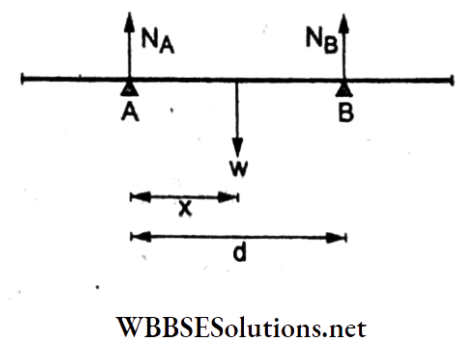
Mechanical Properties of Matter Elasticity Surface Tension and Viscosity Multiple Choice Question And Answers Q 43

Question 44. If the ratios of the diameters, length,s and Young moduli of the steel and copper wires shown in the given figure are p, q and s respectively, the corresponding ratio of the increases in their lengths would be
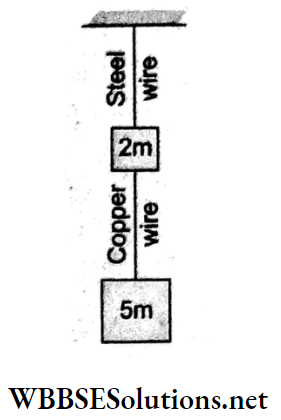
Mechanical Properties of Matter Elasticity Surface Tension and Viscosity Multiple Choice Question And Answers steel and copper wires Q 44

  1. \(\frac{5 q}{2 s p^2}\)
  2. \(\frac{7 q}{5 s p^2}\)
  3. \(\frac{2 q}{5 s p}\)
  4. \(\frac{7 q}{5 s p}\)

Answer: 2. \(\frac{7 q}{5 s p^2}\)

Young6 modulus = Y = \(\frac{\frac{F}{A}}{\frac{\Delta L}{L}}=\frac{4 F L}{\pi D^2 \cdot \Delta L}\)

∴ extension = \(\Delta L=\frac{4 F L}{\pi D^2 \gamma}\)

For steel, \(\Delta L_{\mathrm{st}}=\frac{4 F_{\mathrm{st}} L_{\mathrm{st}}}{\pi D_{\mathrm{st}}^2 Y_{\mathrm{st}}}\)

Similarly, for copper, \(\Delta L_{C u}=\frac{4 F_{C u} L_{C u}}{\pi D_{C u}^2 Y_{C u}}\)

∴ \(\frac{\Delta L_{\mathrm{st}}}{\Delta L_{\mathrm{Cu}}}=\frac{F_{\mathrm{st}}}{F_{\mathrm{Cu}}} \frac{L_{\mathrm{st}}}{L_{\mathrm{Cu}}}\left(\frac{D_{\mathrm{cu}}}{D_{\mathrm{st}}}\right)^2\left(\frac{Y_{\mathrm{cu}}}{Y_{\mathrm{st}}}\right)\)

⇒ \(\left(\frac{7 m g}{5 m g}\right)(q)\left(\frac{1}{p}\right)^2\left(\frac{1}{s}\right)\)

= \(\frac{7 q}{5 s p^2}\)

Class 11 Physics Class 12 Maths Class 11 Chemistry
NEET Foundation Class 12 Physics NEET Physics

Question 45. A uniform cylindrical rod of length L and radius r is made of a material whose Young modulus of elasticity is Y. When this rod is heated by a temperature AT and simultaneously subjected to a net longitudinal compressional force F, its length remains unchanged. The coefficient of volume expansion of the material of the rod is nearly equal to

  1. \(\frac{F}{3 \pi r^2 Y \cdot \Delta T}\)
  2. \(\frac{6 F}{\pi r^2 \gamma \cdot \Delta T}\)
  3. \(\frac{9 F}{\pi r^2 Y \cdot \Delta T}\)
  4. \(\frac{3 F}{\pi r^2 Y \cdot \Delta T}\)

Answer: 4. \(\frac{3 F}{\pi r^2 Y \cdot \Delta T}\)

The coefficient of linear expansion is given by

⇒ \(\alpha=\frac{1}{L} \cdot \frac{\Delta L}{\Delta T}=\frac{\text { longitudinal strain }}{\Delta T}\)

∴ Young modulus = Y = \(\frac{\text { stress }}{\text { strain }}=\frac{\frac{F}{A}}{\alpha \cdot \Delta T}\)

⇒ \(\alpha=\frac{F}{Y A \cdot \Delta T}\)

mechanical properties of fluids mcqs

Hence, the coefficient of volume expansion is

⇒ \(\gamma=3 \alpha=\frac{3 F}{A Y \cdot \Delta T}=\frac{3 F}{\pi r^2 Y \cdot \Delta T}\)

Question 46. When a block of mass M is suspended by a long wire of length L, the extension produced is l. The elastic potential energy stored in the stretched wire is

  1. Mgl
  2. MgL
  3. \(\frac{1}{2}\) MgL
  4. \(\frac{1}{2}\) Mgl

Answer: 4. \(\frac{1}{2}\) Mgl

The elastic potential energy in a stretched wire is given by

⇒ \(U=\frac{1}{2} k x^2=\frac{1}{2}(k x) x=\frac{1}{2} F_{\max }\) (extension)

= \(\frac{1}{2}\)(stretching force)(stretch)

= \(\frac{1}{2}\) Mgl

Question 47. A boy’s catapult is made of a rubber cord, which is 42 cm long with 6 mm diameter of cross section and of a negligible mass. The boy keeps a stone weighing 0.02 kg on it and stretches the cord by 20 cm by applying a constant force. When released, the stone flies off with a velocity of 20 m s-1. Neglect the change in the area of the cross-section of the cord while stretched. The Young modulus of rubber is close to

  1. 5 x 10⁴ N m-2
  2. 4 x 10⁸ N m-2
  3. 3 x 10⁶ N m-2
  4. 2 x 10³ N m-2

Answer: 3. 3 x 10⁶ N m-2

The elastic potential energy stored in the rubber cord on stretching is

⇒ \(U=\frac{1}{2} \text { (stress) (strain)(volume) }\)

⇒ \(\frac{1}{2} Y(\text { strain })^2 \text { (volume) }\)

⇒ \(\frac{1}{2} Y\left(\frac{\Delta L}{L}\right)^2 A L\)

= \(\frac{Y(\Delta L)^2 A}{2 L}\)

This energy appears as the KE of the stone.

Thus, \(\frac{1}{2} m v^2=\frac{Y(\Delta L)^2 A}{2 L}\)

∴ Young modulus = Y = \(\frac{m v^2 L}{(\Delta L)^2 A}\)

Substituting the appropriate values, we have

⇒ \(Y=\frac{\left(2 \times 10^{-2} \mathrm{~kg}\right)\left(20 \mathrm{~m} \mathrm{~s}^{-1}\right)^2(0.42 \mathrm{~m})}{\left(2 \times 10^{-1} \mathrm{~m}\right)^2(3.14)\left(3 \times 10^{-3} \mathrm{~m}\right)^2} \approx 3 \times 10^6 \mathrm{~N} \mathrm{~m}^{-2}\)

Question 48, The elastic limit of brass is 379 MPa. What should be the minimum diameter of a brass rod if it is to support a 400-N load without exceeding the elastic limit?

  1. 1.00 mm
  2. 1.16 mm
  3. 1.86 mm
  4. 0.90 mm

Answer: 2. 1.16 mm

The elastic limit is the maximum permissible stress for a given material.

Thus,

⇒ \(379 \times 10^6 \mathrm{~Pa}=\frac{400 \mathrm{~N}}{\pi\left(\frac{d}{2}\right)^2}=\frac{1600 \mathrm{~N}}{\pi d^2}\)

∴ minimum diameter = d = \(\sqrt{\frac{1600 \mathrm{~N}}{(3.14)\left(379 \times 10^6 \mathrm{~N} \mathrm{~m}^{-2}\right)}}\)

= 1.159 mm ≈ 1.16 mm.

Question 49. A wire of length L and an area of cross-section A is hanging from a fixed support. The length of the wire changes to L1 when a block of mass M is suspended from its free end. The expression for its Young modulus is

  1. \(\frac{M g\left(L_1-L\right)}{A L}\)
  2. \(\frac{M g L}{A L_1}\)
  3. \(\frac{M g L}{A\left(L_1-L\right)}\)
  4. \(\frac{M g L_1}{A L}\)

Answer: 3. \(\frac{M g L}{A\left(L_1-L\right)}\)

Young modulus = Y = \(\frac{\text { stress }}{\text { longitudinal strain }}\)

⇒ \(\frac{\frac{F}{A}}{\frac{\Delta L}{L}}\)

= \(\frac{\frac{M g}{A}}{\frac{\left(L_1-L\right)}{L}}\)

= \(\frac{M g L}{A\left(L_1-L\right)}\)

Question 50. A 2-m-long rope of uniform cross-sectional area 2 cm² is being pulled by two persons towards themselves, each exerting a force of 100 N on the rope. If the rope extends in length by 1 cm, the Young modulus of the material of the rope is

  1. 2 x 10⁶ N m-2
  2. 1 x 10⁸ Nm-2
  3. 1 x 10¹⁰ N m-2
  4. 1 x 10⁷ N m-2

Answer: 2. 1 x 10⁸ Nm-2

Given that tension = F = 100 N, L = 2 m,

ΔL = 1 cm =1 x 10² m and A = 2 x 10⁻⁴ m².

∴ \(Y=\frac{\frac{F}{A}}{\frac{\Delta L}{L}}=\frac{F}{A} \cdot \frac{L}{\Delta L}\)

= \(\frac{(100 \mathrm{~N})(2 \mathrm{~m})}{\left(2 \times 10^{-4} \mathrm{~m}^2\right)\left(1 \times 10^{-2} \mathrm{~m}\right)}\)

= 100 x 106Nm-2

= 1 x 10⁸ N m-2.

Question 51. If the liquid in a capillary tube neither rises nor falls inside it, the angle of contact is

  1. 180°
  2. 90°
  3. 45°

Answer: 3. 90°

When the angle of contact is 0 = 90°, the surface tension acts perpendicular to the wall of the capillary tube and its vertically upward component will be zero. Hence, there will be no rise of the liquid column.

In the other words, h = \(\frac{2 S \cos \theta}{r \rho g}\)

= 0 for θ

= 90°.

Question 52. The pressures inside two soap bubbles are 1.01 atm and 1.03 atm. The ratio of their volumes is

  1. 27:1
  2. 3:1
  3. 127:101
  4. None of these

Answer: 1. 27:1

The excess pressure inside a soap bubble is given by p = \(\frac{\Delta S}{R}\)

∴ \(\frac{p_1}{p_2}=\frac{R_2}{R_1}\)

Hence, the ratio of die volumes is

⇒ \(\frac{V_1}{V_2}=\left(\frac{R_1}{R_2}\right)^3\)

= \(\left(\frac{p_2}{p_1}\right)^3\)

= \(\left(\frac{0.03}{0.01}\right)^3\)

= 27:1.

Question 53. The wettability of a surface by a liquid depends primarily on the

  1. Viscosity of the liquid
  2. Surface tension of the liquid
  3. Density of lhe liquid
  4. The angle of contact between the surface and the liquid

Answer: 4. Angle of contact between the surface and the liquid

The wettability of a solid surface by a liquid depends on the angle of contact 0. Liquids with 0 < 90° wet, and liquids with 0 > 90° do not wet. For no wetting (glass-mercury pair), the adhesive force (Fgl-Hg) is less than the cohesive force (FHg-Hg)- For wetting (glass-water pair), the adhesive force (Fgl-W) is greater than the cohesive force (Fw_w).

Question 54. A certain number of spherical drops, each of radius r, of a liquid coalesce into a single drop of radius R and volume V. If T is the surface tension of the liquid then

  1. Energy released = \(4 V T\left(\frac{1}{r}-\frac{1}{R}\right)\)
  2. Energy absorbed = \(3 V T\left(\frac{1}{r}+\frac{1}{R}\right)\)
  3. Energy released = \(=3 V T\left(\frac{1}{r}-\frac{1}{R}\right)\)
  4. Energy is neither released nor absorbed

Answer: 3. Energy’released = \(=3 V T\left(\frac{1}{r}-\frac{1}{R}\right)\)

Since the volume remains constant, V = \(\frac{4}{3} \pi R^3=N\left(\frac{4}{3} \pi r^3\right)\)

Initial surface area = Ai = N(4πr²) and final surface area = Af = 4πR². Since liquids have the property to contract, the final surface area will be less than the initial surface area, and thus energy is released.

The energy released = ΔU = surface tension x ΔA

= T(N.4πr² – 4πR²)

= \(\left(N \cdot \frac{4}{3} \cdot \frac{\pi r^3}{r}-\frac{4 \pi}{3} \cdot \frac{R^3}{R}\right)\)

= \(3 V T\left(\frac{1}{r}-\frac{1}{R}\right)\)

Question 55. A square wireframe of side L is dipped in a liquid. On taking it out, a membrane is formed. If the surface tension of the liquid is T, the force acting on the wireframe will be

  1. 2TL
  2. 4TL
  3. 8TL
  4. 10TL

Answer: 3. 8TL

The membrane in the air has two surfaces.

The total force acting on the frame is

F = (surface tension)(perimeter) x 2

= (T)(4L)(2)

= 8TL

Question 56. At its critical temperature, the surface tension of a liquid

  1. Is zero
  2. Is infinity
  3. Is the same as that at any other temperature
  4. Cannot be determined

Answer: 1. Is zero

The surface tension decreases with an increase in temperature and its value is zero at the critical temperature.

Question 57. Two spherical soap bubbles of radii a and b in a vacuum coalesce under isothermal conditions. The resulting bubble has a radius equal to

  1. \(\frac{a+b}{2}\)
  2. \(\frac{a b}{a+b}\)
  3. \(\sqrt{a^2+b^2}\)
  4. a + b

Answer: 3. \(\sqrt{a^2+b^2}\)

In a vacuum under isothermal conditions, the surface energy remains unchanged. Thus,

8πa²S + 8πb²S = 8πR²S.

⇒ \(R=\sqrt{a^2+b^2}\)

mechanical properties of fluids mcqs

Question 58. The surface tension of a soap solution is 25 x 10-3 Nml The excess pressure in a soap bubble of diameter 1 cm is

  1. 10 Pa
  2. 20 Pa
  3. 5 Pa
  4. None of these

Answer: 2. 20 Pa

The excess pressure inside each soap bubble is

⇒ \(\Delta p=\frac{4 S}{r}\)

= \(\frac{4\left(25 \times 10^{-3} \mathrm{~N} \mathrm{~m}^{-1}\right)}{0.5 \times 10^{-2} \mathrm{~m}}\)

=20 Pa

Question 59. The force required to separate two glass plates of area 10-2 m², with a 0.05-mm-thick film of water between them, is (given that surface tension of water = 70 x 10-3 N m-1)

  1. 25 N
  2. 20 N
  3. 14 N
  4. 28 N

Answer: 4. 28 N

The pressure difference across the glass plates due to a thin layer of water of thickness d is given by

⇒ \(\Delta p=\frac{S}{R}=\frac{S}{\frac{d}{2}}=\frac{2 S}{d}\)

Hence, the required force is

⇒ \(F=A \cdot \Delta p\)

= \(\frac{\left(10^{-2} \mathrm{~m}^2\right)\left(2 \times 70 \times 10^{-3} \mathrm{~N} \mathrm{~m}^{-1}\right)}{0.05 \times 10^{-3} \mathrm{~m}}\)

= 28 N.

Question 60. For different capillaries of radius r, the condition for liquid rise (h) above the free surface of the liquid is

  1. \(\frac{h}{r}\) = constant
  2. hr = constant
  3. h + r = constant
  4. h-r = constant

Answer: 2. hr = constant

The capillary rise due to the surface tension (S) is given by

⇒ \(h=\frac{2 S \cos \theta}{r \rho g}\)

For a given solid-liquid pair; S, 0, p, and are constant.

Hence, the products also constant.

Question 61. The excess pressure inside a soap bubble of radius r is proportional to

  1. r
  2. \(\frac{1}{r}\)
  3. r2
  4. \(\frac{1}{r^2}\)

Answer: 2. \(\frac{1}{r}\)

The excess pressure inside a soap bubble is Δp = 4S/r, which is proportional to 1/r.

Question 62. When the temperature is increased, the angle of contact of a liquid

  1. Increases
  2. Decreases
  3. Remains the same
  4. First increases and then decreases

Answer: 1. Increases

When the temperature rises, the surface tension decreases, and the angle of contact increases.

Question 63. The radius of a soap bubble is r and the surface tension of the soap solution is T. Keeping the temperature constant, the extra energy needed to double the radius of the bubble by blowing is

  1. 8πr²T
  2. 16πr²T
  3. 24πr²T
  4. 32πr²T

Answer: 3. 24πr²T

The extra energy required = work done

= (surface tension)(increase in surface area)

= \(T\left[2.4 \pi(2 r)^2-2.4 \pi(r)^2\right]=24 \pi r^2 T\)

Question 64. A work of 3.0 x 10⁻⁴J is required to stretch a soap film from 10 cm x 6 cm to 10 cm x 11 cm. The surface tension of the soap solution is

  1. 5 x 10⁻² N m-1
  2. 3 x 10⁻² N m-1
  3. 1.5 x 10⁻² N m-1
  4. 1.2 x 10⁻²Nm-1

Answer: 2. 3 x 10⁻² N m-1

Work done = (surface tension) (increase in surface area)

=> 3.0 x 10⁻⁴J =T[2(110 x 10-4cm2-60 x 104m2)]

= T(10-2m2)

⇒ \(T=\frac{3.0 \times 10^{-4} \mathrm{~J}}{10^{-2} \mathrm{~m}^2}\)

= \(3.0 \times 10^{-2} \mathrm{Nm}^{-1}\)

Question 65. One large soap bubble of diameter D breaks into 27 bubbles, each having a surface tension of T. The change in the surface energy is

  1. 2πTD²
  2. 4πTD2
  3. πTD2
  4. 8πTD2

Answer: 2. 4πTD²

Assuming the volume of air enclosed to be unchanged,

⇒ \(\frac{4}{3} \pi\left(\frac{D}{2}\right)^3=27 \times \frac{4}{3} \pi r^3\)

∴ the radius of the smaller bubble is r = D/6.

Now, the increase in surface area is

⇒ \(\Delta S=27 \times 2\left(4 \pi r^2\right)-2 \times\left[4 \pi\left(\frac{D}{2}\right)^2\right]\)

⇒ \(27 \times 8 \pi\left(\frac{D}{6}\right)^2-2 \times 4 \pi\left(\frac{D}{2}\right)^2\)

= \(4 \pi D^2\)

Hence, the increase in surface energy is

⇒ \(\Delta U=T(\Delta A)=4 \pi T D^2\)

Question 66. A mercury drop of radius 1 cm is broken into 106 droplets of equal sizes. The work done is (the surface tension of mercury being 35 x 10-2 N m-1)

  1. 4.35 x 10⁻² J
  2. 4.35 x 10⁻³ J
  3. 4.35 x l0-6J
  4. 4.35 x 10⁻⁸ J

Answer: 1. 4.35 x 10⁻² J

Since the volume remains unchanged,

⇒ \(\frac{4}{3} \pi R^3=10^6 \cdot \frac{4}{3} \pi r^3\)

⇒ \(r=\frac{R}{100}\)

∴ work done = T.ΔA

⇒ \(T \cdot 4 \pi\left(10^6 \cdot r^2-R^2\right)=T \cdot 4 \pi\left(10^6 \cdot \frac{R^2}{10^4}-R^2\right)\)

= 4πT(99R²)

== 4(3.14)(35 x 10-2 N m-1) x 99(1 x 10⁻²m)2

= 4.35 x 10⁻² J.

Question 67. Eight identical mercury droplets coalesce into one mercury drop. The energy changes by a factor of

  1. 1
  2. 2
  3. 4
  4. 6

Answer: 2. 2

⇒ \(V=\frac{4}{3} \pi R^3\)

= \(8 \times \frac{4}{3} \pi r^3\)

⇒ \(r=\frac{R}{2}\)

Initial surface energy = Ui = 4πR2T

and final surface energy = Uf = 8(4πr²)T.

⇒ \(8 \times 4 \pi\left(\frac{R}{2}\right)^2 T\)

= \(2\left(4 \pi R^2 T\right)\)

= \(2 U_i\)

Thus, increases by a factor of 2.

Question 68. There is a small bubble at one end and a bigger bubble at the other end of the tube, as shown in the figure. Which of the following statements is true?
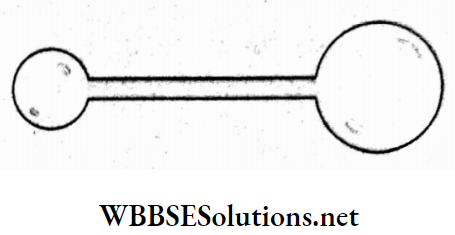
Mechanical Properties of Matter Elasticity Surface Tension and Viscosity Multiple Choice Question And Answers small bubble ad bigger bubble Q 68

  1. The smaller bubbles will grow until they collapse.
  2. The bigger bubbles will grow until they collapse.
  3. They remain in equilibrium.
  4. None of these.

Answer: 2. The bigger bubbles will grow until they collapse.

If p0 be the pressure outside then

inside the smaller bubble, \(p_1=p_0+\frac{4 T}{r}\)

and inside the bigger bubble, \(p_2=p_0+\frac{4 T}{R}\)

∵ r < R;

∴ p1 > p2

Hence, air will flow from the smaller bubble to the bigger bubble, which will further grow until both the bubbles collapse.

Question 69. A 15-cm-long capillary tube is vertically dipped in water. The water rises up to 7 cm. If the entire setup is put in a freely falling elevator, the length of the water column in the capillary tube will be

  1. 3.5 cm
  2. 15 cm
  3. 6 cm
  4. 8 cm

Answer: 2. 15 cm

During free fall (under gravity), the system is in a state of artificial weightlessness.

So, effectivelyg = 0.

Hence, gravity does not work but the force of surface tension still acts and the maximum ascent of the water column occurs in the full length of the tube (up to 15 cm).

Question 70. The surface tension of a liquid decreases with a rise in the

  1. Viscosity of the liquid
  2. Temperature of the liquid
  3. Diameter of the container
  4. Thickness of the container

Answer: 2. Temperature of the liquid

The surface tension decreases with rise in temperature as

Sθ = S0 (l – αθ),

where a is the temperature coefficient of surface tension.

Question 71. The potential energy of a soap bubble having a surface tension equal to 0.04 N m-1 and of diameter 1 cm is

  1. 6π x 10-6 J
  2. 4π x 10-6 J
  3. 2π x 10-6 J
  4. 8π x 10-6 J

Answer: 4. 8n x 10-6J

Potential energy = U = T x surface area

= T x 2(4πR²)

= 8πTR²

= Sπ (0.04 N m-1) (0.5 x 10⁻² m)2

= 8π X 10-6 J.

Question 72. When there are no external forces, the shape of a small liquid drop is determined by the

  1. Surface tension of the liquid
  2. Viscosity of the liquid
  3. Temperature of air
  4. Density of the liquid

Answer: 1. Surface tension of the liquid

The shape of a free liquid drop is determined by its molecular forces, which gives rise to its surface tension

Question 73. Raindrops are spherical due to their

  1. Viscosity
  2. Surface tension
  3. Thrust on dropping
  4. Residual pressure

Answer: 2. Surface tension

A liquid surface tends to contract due to its surface tension and assumes a spherical shape, which has the minimum surface area for a given volume.

Question 74. For a liquid to rise in a capillary tube, the angle of contact should be

  1. An acute angle
  2. An obtuse angle
  3. A right angle
  4. None of these

Answer: 1. An acute angle

A liquid rises in a capillary tube if the angle of contact (0) between the solid-liquid pair is acute. The vertically upward component of the surface tension (T cos θ) makes the liquid rise.

Question 75. Two small drops of mercury, each of radius R, coalesce into a single large drop. The ratio of the total surface energies before and after the change is

  1. 1:21/3
  2. 21/3:1
  3. 2:1
  4. 1:2

Answer: 2. 21/3:1

Volume, \(V=2\left(\frac{4}{3} \pi R^3\right)\)

= \(\frac{4}{3} \pi R^{\prime 3}\)

R’ = 21/3R.

Now, Ui = T(2 x 4πR2)

and Uf = T (4πR2)

= T(4π)22/3

∴ \(\frac{U_i}{U_f}=\frac{2 R^2}{2^{2 / 3} R^2}=2^{1 / 3}: 1\)

Question 76. A thread is tied slightly loose to a wireframe. The frame is dipped in a soap solution and then taken out. The frame is completely covered with a soap film, as shown in the figure. When the portion A is punctured with a pin, the thread
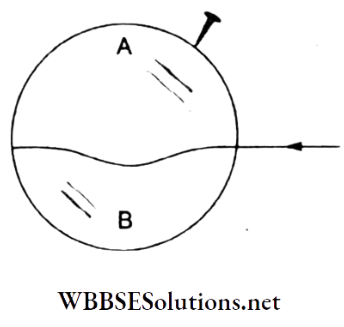
Mechanical Properties of Matter Elasticity Surface Tension and Viscosity Multiple Choice Question And Answers Q 76

  1. Becomes concave towards A
  2. Becomes convex towards A
  3. Remains in its initial position
  4. Becomes either concave or convex towards A depending on
    the size of A relative to B.

Answer: 1. Becomes concave towards A

When portion A is punctured, the soap film will start contracting and the circular hole created will gradually increase in size. This will lead the thread to become concave towards A.

Question 77. A capillary tube of radius r is immersed in water and the water rises to a height of h. The mass of the water in the capillary tube is 5 g. Another capillary tube of radius 2r is immersed in water. The mass of water that will rise in this tube is

  1. 2.5 g
  2. 5.0 g
  3. 10 g
  4. 20 g

Answer: 3. 10 g

mechanical properties of fluids mcqs

In a capillary rise, surface tension = T = \(\frac{{rhpg}}{2 \cos \theta}\)

So, \(r h=\frac{2 T \cos \theta}{\rho g}=\text { constant }\)

⇒ \(r h=2 r h^{\prime}\)

⇒ \(h^{\prime}=\frac{h}{2}\)

Now, \(m=\pi r^2 h\)

and \(m^{\prime}=\pi(2 r)^2\left(\frac{h}{2}\right)\)

∴ \(\frac{m^{\prime}}{m}=\frac{2 \pi r^2 h}{\pi r^2 h}=2\)

m = 2m

= 10g.

Question 78. A rectangular film of a liquid is extended from an area of 4 cm x 2 cm to 5 cm x 4 cm. If the work done is 3 x 10⁻⁴ J, the value of the surface tension of the liquid is

  1. 0.25 N m-1
  2. 8.0 Nm-1
  3. 0.125 Nm-1
  4. 0.2 Nm-1

Answer: 3. 0.125 Nm-1

Work done = (surface tension)(increase in surface area)

3 x 10⁻⁴ J = T[2(20 x 10-4 m²-8 x 10⁻⁴m²)]

∴ suface tension = T = \(\frac{3 \times 10^{-4} \mathrm{~J}}{2 \times 12 \times 10^{-4} \mathrm{~m}^2}\)

= \(0.125 \mathrm{Nm}^{-1}\)

Question 79. Three liquids of densities p1, p2, and p3 (where p1 > p2 > p3), and having the same value of surface tension rise to equal heights in three identical capillaries. The angles of contact θ1, θ2 and θ3 obey the relation

  1. \(\frac{\pi}{2}>\theta_1>\theta_2>\theta_3>0\)
  2. \(0 \leq \theta_1<\theta_2<\theta_3<\frac{\pi}{2}\)
  3. \(\frac{\pi}{2}<\theta_1<\theta_2<\theta_3<\pi\)
  4. \(\pi>\theta_1>\theta_2>\theta_3>\frac{\pi}{2}\)

Answer: 2. \(0 \leq \theta_1<\theta_2<\theta_3<\frac{\pi}{2}\)

The rise of a liquid in a capillary tube is given by

⇒ \(h=\frac{2 T \cos \theta}{r \rho g}\)

So, \(\frac{\cos \theta}{\rho}=\frac{h r g}{2 T}\)

∴ for the three given capillaries,

⇒ \(\frac{\cos \theta_1}{\rho_1}=\frac{\cos \theta_2}{\rho_2}=\frac{\cos \theta_3}{\rho_3}\)

Given that p1 > p2 > p3

∴ cos θ1 > cos θ2 > cos θ3.

Hence, \(0 \leq \theta_1<\theta_2<\theta_3<\frac{\pi}{2}\)

Question 80. Two soap bubbles of radii R1 and R2 (where R1 > R2) come into contact, as shown in the adjoining figure. The radius of curvature of the common surface is given by
Mechanical Properties of Matter Elasticity Surface Tension and Viscosity Multiple Choice Question And Answers Q 80

  1. \(R=\frac{R_1+R_2}{2}\)
  2. \(R=\frac{R_1-R_2}{2}\)
  3. \(R=\frac{R_1 R_2}{R_1-R_2}\)
  4. \(R=\frac{R_1 R_2}{R_1+R_2}\)

Answer: 3. \(R=\frac{R_1 R_2}{R_1-R_2}\)

If p0ise the pressure outside the bubbles, the pressure inside the larger bubble is \(p_1=p_0+\frac{4 T}{R_1}\) and that inside the smaller bubble is \(p_2=p_0+\frac{4 T}{R_2}\)

Since p2 > P1, the pressure difference across the common surface is

⇒ \(\Delta p=p_2-p_1=\frac{4 T}{R}\)

⇒ \(4 T\left(\frac{1}{R_2}-\frac{1}{R_1}\right)=\frac{4 T}{R}\)

⇒ \(R=\frac{R_1 R_2}{R_1-R_2}\)

Question 81. A liquid drop at a temperature of 0, isolated from its surroundings breaks into a number of droplets. The temperature of the droplets will be

  1. Equal to θ
  2. Greater than θ
  3. Less than θ
  4. Either of the three, depending on the surface tension of the liquid

Answer: 3. Less than θ

When the drop breaks into droplets, the total surface area increases, leading to a greater surface energy. This extra energy is drawn from the internal energy of the drop and it cools down. The temperature of the droplets will be less than θ.

Question 82. The adjoining figure shows two soap bubbles A (smaller) and B (larger) formed at the two open ends of a tube, with its valve V closed. When the valve is opened, air can flow freely between the bubbles. Which of the following options is true?
Mechanical Properties of Matter Elasticity Surface Tension and Viscosity Multiple Choice Question And Answers two soap bubbles smaller and larger Q 82

  1. There will be no change in the size of the bubbles.
  2. The bubbles will become of equal size.
  3. The sizes of A and B will get interchanged.
  4. A will become smaller and B will become larger.

Answer: 4. A will become smaller and B will become larger.

mechanical properties of fluids mcqs

The air pressure is greater inside the smaller bubble. Hence, air flows from the smaller bubble to the larger bubble. So, A will become smaller and B will become larger.

Question 83. The arms of a manometer consist of tubes B of radii and r2 (where r1 > r2) filled with a liquid of surface tension S, as shown in the figure. Find the expression for h (the level difference of the menisci at A and B) in terms of r1,r2 and S.
Mechanical Properties of Matter Elasticity Surface Tension and Viscosity Multiple Choice Question And Answers the arms of a manometer consists of tubes Q 83

  1. \(\frac{S}{\rho g}\left(\frac{r_1-r_2}{r_1 r_2}\right)\)
  2. \(\frac{2 S}{\rho g}\left(\frac{r_1-r_2}{r_1 r_2}\right)\)
  3. \(\frac{S}{2 \rho g}\left(\frac{r_1+r_2}{r_1 r_2}\right)\)
  4. \(\frac{S}{\rho g}\left(\frac{r_1+r_2}{r_1 r_2}\right)\)

Answer: 2. \(\frac{2 S}{\rho g}\left(\frac{r_1-r_2}{r_1 r_2}\right)\)

Let p0 be the atmospheric pressure.

∴ the pressure below the meniscus at A is \(p_1=p_0-\frac{2 S}{r_1}\)

and that below the meniscus B is \(p_2=p_0-\frac{2 S}{r_2}\)

Equalizing the pressure in the same level at A, we have,

p1 = p2 + hpg

⇒ \(p_0-\frac{2 S}{r_1}=p_0-\frac{2 S}{r_2}+h \rho g\)

⇒ \(h=\frac{2 S}{\rho g}\left(\frac{r_1-r_2}{r_1 r_2}\right)\)

Question 84. A soap bubble is blown slowly at the end of a tube by a pump supplying air at a constant rate. Which of the following graphs correctly represents the variation of the excess pressure inside the bubble with time?
Mechanical Properties of Matter Elasticity Surface Tension and Viscosity Multiple Choice Question And Answers Q 84

Answer: 2.

Mechanical Properties of Matter Elasticity Surface Tension and Viscosity Multiple Choice Question And Answers Q 84.

The excess pressure inside a soap bubble of radius r is

p = \(\frac{4S}{r}\)

So, \(p \propto \frac{1}{r}\)

Since air is supplied at a constant rate, the radius r will be proportional
to time.

Thus, pt = constant, which is represented by the curve given in option (2)

Question 85. The pressure inside two soap bubbles is 1.01 atm and 1.02 atm respectively. The ratio of their respective volumes is equal to

  1. 8
  2. 4
  3. 16
  4. 2

Answer: 1. 8

The excess pressure inside the first bubble is

Pi = \(\frac{4 S}{r_1}\)

= 1.01 atm – 1.0 atm

= 0.01 atm,

and that for the second bubble is

⇒ \(p_2=\frac{4 S}{r_2}=1.02 \mathrm{~atm}-1 \mathrm{~atm}=0.02 \mathrm{~atm}\)

∴ \(\frac{p_2}{p_1}=\frac{r_1}{r_2}=\frac{0.02 \mathrm{~atm}}{0.01 \mathrm{~atm}}\)

= 2.

Hence, \(\frac{V_1}{V_2}=\frac{r_1^3}{r_2^3}\)

= 8.

Question 86. An ice cube floating in a gravity-free space melts and converts into water. The shape of this water is

  1. A cylinder
  2. An ellipsoid
  3. A sphere
  4. Unpredictable

Answer: 3. A sphere

In a gravity-free space, any volume of liquid (when free) assumes a spherical shape. Hence, the ice cube will assume the shape of a large spherical drop.

Question 87. Consider an ice cube of edge L kept in a gravity-free space. Assuming the densities of ice and water to be equal, the surface area of the water formed when the ice melts will be

  1. (36π)½L²
  2. (6π)1/3
  3. (36π)1/3
  4. None of these

Answer: 3. (36π)1/3

The ice cube of edge L will assume the shape of a sphere of radius R when it melts. Since its volume is unchanged,

⇒ \(L^3=\frac{4}{3} \pi R^3 \Rightarrow R=\left(\frac{3}{4 \pi}\right)^{1 / 3}\)

∴ the final surface area of the spherical drop is

⇒ \(4 \pi R^2=4 \pi\left(\frac{3}{4 \pi}\right)^{2 / 3} L^2=(36 \pi)^{1 / 3} L^2\)

Question 88. A soap bubble having a radius of 1 mm is blown from a detergent solution having a surface tension of 2.5 x 10⁻²Nm-2. The pressure inside the bubble equals a depth z0 below the free surface of water in a container. Taking = 10 ms-2 and density of water = 10³ kgm-3, the value of z0 is

  1. 100 cm
  2. 10 cm
  3. 1 cm
  4. 0.5 cm

Answer: 3. 1 cm

The excess pressure inside a soap bubble is given by \(\Delta p=\frac{4 T}{R}\), which is equal to the pressure due to a column (of height z0) of water (p = Z0pg).

∴ \(\frac{4 T}{R}=z_0 \rho g\)

⇒ \(z_0=\frac{4 T}{\rho g R}\)

Hence, \(z_0=\frac{4\left(2.5 \times 10^{-2} \mathrm{~N} \mathrm{~m}^{-1}\right)}{\left(10^3 \mathrm{~kg} \mathrm{~m}^{-3}\right)\left(10 \mathrm{~m} \mathrm{~s}^{-2}\right)\left(1 \times 10^{-3} \mathrm{~m}\right)}=10^{-2} \mathrm{n}\)

= 1 cm.

Question 89. The ratio of the surface tensions of mercury and water is given to be 7.5, while the ratio of their densities is 13.6. Their contact angles with their glass containers are close to 135° and 0° respectively. It is observed that mercury gets depressed by an amount of h in a capillary tube of radius rv while water rises by the same amount of h in a capillary tube of radius r2. The ratio \(\frac{r_1}{r_2}\) is then close to

  1. \(\frac{4}{5}\)
  2. \(\frac{2}{5}\)
  3. \(\frac{2}{3}\)
  4. \(\frac{3}{5}\)

Answer: 2. \(\frac{2}{5}\)

The depression of mercury in the capillary tube is

⇒ \(h_{\mathrm{Hg}}=\frac{r_1 h_1 \rho_{\mathrm{Hg}} g}{2 S_{\mathrm{Hg}} \cos \theta_{\mathrm{Hg}}}\)

and the rise of the water level is

⇒ \(h_w=\frac{r_2 h_2 \rho_w g}{2 S_w \cos \theta_w}\)

Given that hHg= hw.

∴ \(\frac{r_1 h_1 \rho_{\mathrm{Hg}} g}{2 S_{\mathrm{Hg}} \cos \theta_{\mathrm{Hg}}}=\frac{r_2 h_2 \rho_{\mathrm{w}} g}{2 S_{\mathrm{w}} \cos \theta_{\mathrm{w}}}\)

∴ \(\frac{r_1}{r_2}=\frac{h_2}{h_1} \cdot \frac{\rho_{\mathrm{w}}}{\rho_{\mathrm{Hg}}} \cdot \frac{S_{\mathrm{Hg}}}{S_{\mathrm{w}}} \cdot \frac{\cos \theta_{\mathrm{Hg}}}{\cos \theta_{\mathrm{w}}}\)

Substituting the appropriate values,

⇒ \(\frac{r_1}{r_2}=\left(\frac{h}{h}\right)\left(\frac{1}{13.6}\right)\left(\frac{7.5}{1}\right)\left(\frac{1}{\sqrt{2}}\right)\)

= 0.4

= \(\frac{2}{5}\)

Question 90. The work done to blow a soap bubble of radius 5 cm is (given that surface tension of the soap solution = 0.1 N m-1)

  1. 6.28 x 10⁻³ J
  2. 3.14 x 10⁻² J
  3. 2.5 x 10⁻² J
  4. 5.8 x 10⁻³ J

Answer: 1. 6.28 x 10⁻³ J

The work done in blowing a soap bubble is

W = (surface tension)(increase in surface area)

= S.ΔA = S(8πR²).

Substituting the values,

W= (0.1 N m-1) [8 x 3.14 x(5x 10-2 m)2]

= 62.8 x 10⁻⁴ J

= 6.28 x 10⁻³ J.

Question 91. In an isothermal process, two water drops each of a radius 1 mm are combined to form a bigger drop. The amount of energy released during the process is (given that surface tension = 0.1 N m-1)

  1. 1 μJ
  2. 0.75 μJ
  3. 0.5 μJ
  4. 0.25 μJ

Answer: 3. 0.5 μJ

Let R be the radius of the bigger drop.

∴ \(\left(\frac{4}{3} \pi r^3\right) \times 2=\frac{4}{3} \pi R^3\)

=> R = 21/3r.

The change in the surface area of the drops is

ΔA = 4πr².2-4πR²

= 4π(2r² -22/3r2)

= 4πr2(2-22/3).

Since the surface area decreases, energy is released. This energy is
given by

All = S.ΔA = (0.1 Nm-1)[4 x 3.14 x (10-3 m)2(2-1.58)]

= 0.52 x 10⁻⁶ J ≈ 0.5 mmmJ

Question 92. A soap bubble, blown by a mechanical pump at the mouth of a tube, increases in volume with time at a constant rate. The graph that correctly depicts, the time dependence of the pressure inside the die bubble is
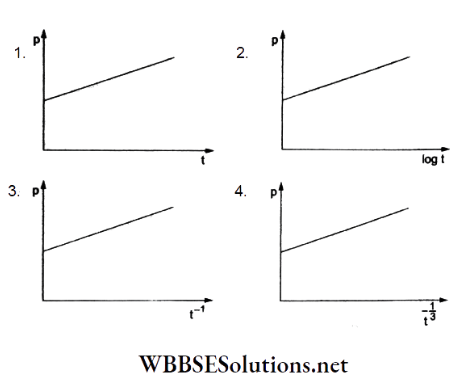
Mechanical Properties of Matter Elasticity Surface Tension and Viscosity Multiple Choice Question And Answers Q 92

Answer: 4.

Mechanical Properties of Matter Elasticity Surface Tension and Viscosity Multiple Choice Question And Answers Q 92.

The volume of a soap bubble is \(V=\frac{4}{3} \pi R^3\).

∴ \(\frac{d V}{d t}=4 \pi R^2 \frac{d R}{d t}=\text { constant (given) }\)

∴ R2dR = (constant)dt.

Integrating,

⇒ \(\frac{R^3}{3}=(\text { constant }) t\)

⇒ \(R \propto t^{1 / 3}\)

For a soap bubble, a pressure difference is

⇒ \(p-p_0=\frac{4 S}{R}=\frac{k}{t^{1 / 3}}\)

⇒ \(p=p_0+\frac{k}{t^{1 / 3}}\)

This shows that the graph in option (4) is correct.

Question 93. A capillary tube of radius 0.15 mm is dipped in a liquid of A density 667 kg m-3. Find the height to which the liquid will rise. [Given that surface tension of the liquid = (1/20) N m-1 and angle of contact = 60°]

  1. 0.02 m
  2. 0.01 m
  3. 0.05 m
  4. 0.04 m

Answer: 4. 0.04 m

The rise of tire liquid (h) in a capillary is given by

⇒ \(T=\frac{r h \rho g}{2 \cos \theta}\)

⇒ \(h=\frac{2 T \cos \theta}{r \rho g}\)

On substituting the given values,

⇒ \(h=\frac{2\left(\frac{1}{20} \mathrm{~N} \mathrm{~m}^{-1}\right) \cos 60^{\circ}}{\left(0.15 \times 10^{-3} \mathrm{~m}\right)\left(667 \mathrm{~kg} \mathrm{~m}^{-3}\right)\left(10 \mathrm{~m} \mathrm{~s}^{-2}\right)}\)

= 0.05m.

Question 94. The pressure inside two soap bubbles is 1.01 atm and 1.02 atm. The ratio of their volumes is

  1. 4:1
  2. 8:1
  3. 1:8
  4. 1:4

Answer: 2. 8:1

The excess pressure (pi -p0) in a soap bubble is \(\frac{4T}{R}\)

Hence, \(\frac{4 T}{R_1}\) = 1.01 atm-1 atm

= 0.01 atm

and \(\frac{4 T}{R_2}\) 1.02 atm-1 atm = 0.02 atm.

∴ \(\frac{R_1}{R_2}=\frac{0.02 \mathrm{~atm}}{0.01 \mathrm{~atm}}\)

= 2.

⇒ \(\frac{V_1}{V_2}=\left(\frac{R_1}{R_2}\right)^3=2^3\)

=8

V1:V2 =8:1

Question 95. A capillary tube made of glass and of radius 0.15 mm is dipped vertically in a beaker filled with a liquid of surface tension 5 x 10⁻² Nm -1 and density 667 kg m-3. The capillary rise is h. It is observed that tangents drawn from the meniscus from two diametrically opposite points are inclined at 60°. The value of h is

  1. 0.049 m
  2. 0.172 m
  3. 0.087 m
  4. 0.137 m

Answer: 3. 0.087 m

Capillary rise = h = \(\frac{2 T \cos \theta}{r \rho g}\)

= \(\frac{2\left(5 \times 10^{-2} \mathrm{~N} \mathrm{~m}^{-1}\right)\left(\cos 30^{\circ}\right)}{\left(0.15 \times 10^{-3} \mathrm{~m}\right)\left(667 \mathrm{~kg} \mathrm{~m}^{-3}\right)\left(10 \mathrm{~m} \mathrm{~s}^{-2}\right)}\)

⇒ \(\frac{1.732 \times 5 \times 10^{-2}}{0.15 \times 667 \times 10^{-2}} \mathrm{~m}\)

= 0.087 m.
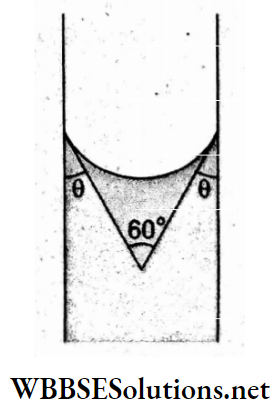
Mechanical Properties of Matter Elasticity Surface Tension and Viscosity Multiple Choice Question And Answers Q 95

Question 96. A capillary tube of radius r is immersed vertically in water, and the water rises to a height of h. The mass of the water in the capillary is 5 g. Another capillary tube of radius 2r is immersed in water. The mass of the water that will rise in this tube is

  1. 5.0 g
  2. 10.0 g
  3. 20.0 g
  4. 2.5 g

Answer: 2. 10.0 g

The weight of the liquid column in the capillary tube is balanced by the force due to surface tension.

Hence, 2πrTcos θ = mg.

For the capillary tube of radius 2r, let the mass of the liquid that rises be m’.

∴ 2π(2r)Tcos θ = m’g.

Hence, \(\frac{m^{\prime}}{m}=2\)

=> m’ = 2m

= 2(5 g)

=10g.
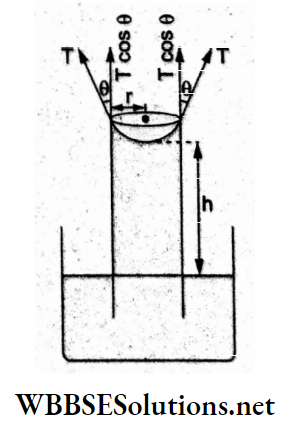
Mechanical Properties of Matter Elasticity Surface Tension and Viscosity Multiple Choice Question And Answers Q 96

Question 97. Ablockofdensitydx and massMmovesdownwards with a uniform speed in glycerine of density d2. What is the viscous force acting on the die block?

  1. Mgd1
  2. Mgd2
  3. \(M g\left(1-\frac{d_1}{d_2}\right)\)
  4. \(M g\left(1-\frac{d_2}{d_1}\right)\)

Answer: 4. \(M g\left(1-\frac{d_2}{d_1}\right)\)

Weight of the block (acting downwards) = Mg,

weight of the liquid = buoyant force (acting upwards)

⇒ \(M^{\prime} g=V d_2 g=\left(\frac{M}{d_1}\right) d_2 g\)

and f = viscous force (upward).

Since the motion is uniform, net force = 0.

∴ \(M g-M\left(\frac{d_2}{d_1}\right) g-f=0\)

⇒ \(f=M g\left(1-\frac{d_2}{d_1}\right)\)

Question 98. An object is moving through a liquid. The viscous damping force acting on it is proportional to the velocity. The dimensions of the constant of proportionality are

  1. ML-1T-1
  2. MLT-1
  3. M0LT-1
  4. ML0T-1

Answer: 4. ML0T-1

Viscous damping force = f = kv.

∴ \([k]=\frac{[f]}{[v]}\)

= \(\frac{\mathrm{MLT}^{-2}}{\mathrm{LT}^{-1}}\)

= \(\mathrm{ML}^0 \mathrm{~T}^{-1}\)

Question 99. Which of the following is not a dimensional quantity?

  1. Acceleration due to gravity
  2. Surface tension
  3. Reynolds number
  4. Velocity of light

Answer: 3. Reynolds number

The critical velocity is given by \(v_c=\frac{k \eta}{\rho R}\) where the Reynolds number k is dimensionless.

Question 100. The Reynolds number for fluid flow through a pipe is independent of the

  1. Viscosity of the fluid
  2. Velocity of the fluid
  3. Length of the pipe
  4. Diameter of the pipe

Answer: 3. Length of the pipe

In a fluid flow, critical velocity = \(v_c=\frac{k \eta}{\rho D}\) where the Reynolds number

k is independent of the length of the pipe.

Question 101. When a steel ball is dropped in an oil,

  1. The ball attains a constant velocity after some time
  2. The speed of the ball will keep on increasing
  3. The ball stops after some time
  4. None of the above takes place

Answer: 1. The ball attains a constant velocity after some time

A steel ball dropped in oil will experience its’ weight (downward), buoyant force (upward), and viscous force (upward). The viscous force gradually increases with speed, and the net force becomes zero when the ball finally attains a constant terminal velocity.

Question 102. The ratio of the terminal velocities of two drops of radii R and R/2 is

  1. 1:1
  2. 2:1
  3. 4:1
  4. 1:4

Answer: 3. 4:1

Terminal velocity = \(v=\frac{2}{9} \cdot \frac{(\rho-r) r^2}{\eta}\)

∴ v ∝ r²

⇒ \(\frac{v_1}{v_2}=\frac{R^2}{(R / 2)^2}\)

= \(\frac{4}{1}\)

v1: v2 = 4: 1

Question 103. The volume of a liquid flowing per unit of time through a tube of radius r and length l whose ends are maintained at a pressure difference P is given by \(V=\frac{\pi Q P r^4}{\eta l}\) where t is the coefficient of viscosity and Q is equal to

  1. 8
  2. \(\frac{1}{8}\)
  3. 16
  4. \(\frac{1}{16}\)

Answer: 2. \(\frac{1}{8}\)

The volume flowing per unit of time is given by Poiseuille’s equation, i.e,

⇒ \(V=\frac{\pi P r^4}{8 \eta l}\)

Comparing this with the given equation, we have Q = \(\frac{1}{8}\)

Question 104. The radii of two drops of a liquid are in the ratio of 3: 2. Their terminal velocities are in the ratio

  1. 2:3
  2. 3:2
  3. 9:4
  4. 4:9

Answer: 3. 9:4

The ratio of the terminal velocities is

⇒ \(\frac{v_1}{v_2}=\frac{r_1^2}{r_2^2}\)

= \(\left(\frac{3}{2}\right)^2\)

= \(\frac{9}{4}\)

Question 105. The coefficient of viscosity of hot air

  1. Is Greater Than The Coefficient Of Viscosity Of Cold Air
  2. Is The Same As The Coefficient Of Viscosity Of Cold Air
  3. Is Smaller Than The Coefficient Of Viscosity Of Cold Air
  4. Increases or decreases depending on the external pressure

Answer: 1. Is Greater Than The Coefficient Of Viscosity Of Cold Air

An increase in gas temperature causes the gas molecules to collide more often and thus increases the gas viscosity. Hence, hot air is more viscous than cold air.

Question 106. The viscous force exerted by a liquid flowing between two plates in a streamline flow depends upon

  1. The velocity gradient in the direction perpendicular to the plates only
  2. The areas of the plates only
  3. The coefficient of viscosity of the plates only
  4. All of these

Answer: 4. All of these

The viscous force exerted by a liquid flowing between two horizontal plates is given by

⇒ \(F=-\eta A \frac{d v}{d z}\)

which depends on all the three factors given in options (1), (2), and (3).

Question 107. Under a constant-pressure head, the volume flowing per unit time through a tube is V. If the length of the tube is doubled and the diameter of the bore is halved, the rate of flow would become

  1. \(\frac{V}{4}\)
  2. 16V
  3. \(\frac{V}{8}\)
  4. \(\frac{V}{32}\)

Answer: 4. \(\frac{V}{32}\)

The rate of flow is given by

⇒ \(V=\frac{\pi P r^4}{8 \eta l}\)

Hence, the new rate of flow will be

⇒ \(V^{\prime}=\frac{\pi P}{8 \eta} \cdot \frac{\left(\frac{r}{2}\right)^4}{2 l}\)

= \(\frac{\pi P r^4}{8 \eta l} \cdot \frac{1}{32}\)

= \(\frac{V}{32}\)

Question 108. A spherical ball is dropped in a p-long column of liquid. Which of the following three plots (P, Q, and R) represents the variation of gravitational force with time, that of viscous force with time, and that of the net force acting on the ball with time respectively?
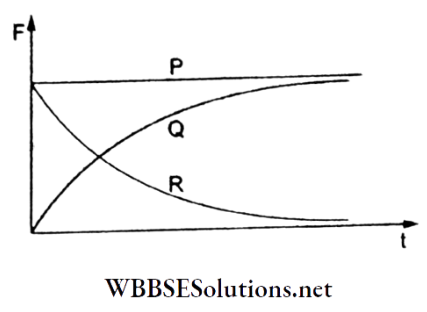
Mechanical Properties of Matter Elasticity Surface Tension and Viscosity Multiple Choice Question And Answers Q 108

  1. Q, R, and P
  2. R, Q, and P
  3. P, Q, and R
  4. R, P, and Q

Answer: 3. P, Q, and R

The gravitational force (= weight = mg) remains constant (given by the plot P). The viscous force gradually increases with time and becomes constant when the terminal velocity is reached (represented by the plot Q). The net force gradually decreases and has a zero value when the motion becomes uniform (shown by plot R).

Question 109. A lead shot of 1 mm diameter falls through a long column of glycerine. The variation of its velocity (v) with the distance covered (s) is represented by
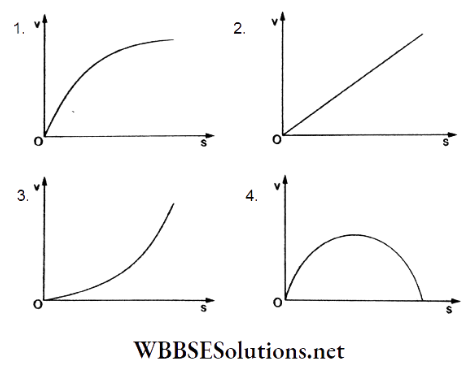
Mechanical Properties of Matter Elasticity Surface Tension and Viscosity Multiple Choice Question And Answers Q 109

Answer: 1.

Mechanical Properties of Matter Elasticity Surface Tension and Viscosity Multiple Choice Question And Answers Q 109.

Initially, the velocity increases due to gravity. Simultaneously, a viscous force acts, so the lead shot attains a constant terminal velocity, as shown in the graph in option (1).

Question 110. A sphere of mass M and radius R is falling in a viscous fluid. The terminal velocity attained by the falling object will be proportional to

  1. R
  2. \(\frac{1}{R}\)
  3. \(\frac{1}{R^2}\)

Answer: 1. R²

The terminal velocity of a spherical body falling under gravity in a viscous fluid is given by

⇒ \(v=\frac{2}{9} \cdot \frac{\rho-\sigma}{\eta} \cdot R^2\)

⇒ \(v \propto R^2\)

Question 111. A raindrop reaching the ground with a terminal velocity has a momentum of p. Another drop of twice its radius, also reaching the ground with a terminal velocity, will have a momentum of

  1. 4p
  2. 16p
  3. 8p
  4. 32p

Answer: 4. 32p

The terminal velocity is given by v ∝ r², and the mass is given by

⇒ \(m=\frac{4}{3} \pi r^3 \rho \propto r^3\)

Hence, the momentum is given by p ∝ r³.

For the smaller drop, p = kr5.

For a larger drop, p’ = k(2r) = 32kr5.

∴ \(\frac{p^{\prime}}{p}=32\)

p’ = 32p

Question 112. A cylindrical drum, open at the top, contains 30 liters of water. It drains out through a small hole at the bottom. 10 liters of water comes out in a time of the next 10 liters in a further time t2 and the last 10 liters in a further time t3. Then,

  1. t1 = t2 = t3
  2. t1>t2<t3
  3. t1<t2<t3
  4. \(\frac{1}{t_1}+\frac{1}{t_2}=\frac{1}{t_3}\)

Answer: 3. t1<t2<t3

The velocity of efflux is given by \(v=\sqrt{2 g x}\), where x is the height of the liquid. As the water drains out, x reduces, so v reduces. This reduces the rate of drainage. Hence, it requires a longer time to drain out the same volume of water. Thus,

t1<t2<t3

Question 113. A solid sphere of radius R acquires a terminal velocity while falling under gravity through a viscous fluid having the coefficient of viscosity r1. The sphere is broken into 27 identical solid spheres. If each of these small spheres acquires a terminal velocity of v2 while falling through the same fluid, the ratio v1/v1 equals

  1. 9
  2. \(
  3. 27
  4. [latex]\frac{1}{9}\)

Answer: 1. 9

The terminal velocity of a sphere falling through a viscous medium under gravity is given by

⇒ \(v=\frac{2}{9} \cdot \frac{r^2(\rho-\sigma) g}{\eta}\)

Thus, v1 = kr2….(1)

When the drop is split up into 27 droplets of equal radii r0 then,

⇒ \(\frac{4}{3} \pi r^3=27 \cdot \frac{4}{3} \pi r_0^3\)

Hence, r0 = \(\frac{r}{3}\) and its terminal velocity is

⇒ \(v_2=k r_0^2=k\left(\frac{r}{3}\right)^2\)…..(2)

∴ \(\frac{v_1}{v_2}=\frac{r^2}{\left(\frac{r}{3}\right)^2}=9\)

Question 114. A small hole of area of cross-section 2 mm² is punched near the bottom of a fully filled open tank of height 2 m. Taking =10 m s-2, the rate of flow of water through the open hole would be nearly

  1. 12.6 x 10⁻⁶ m3 s-1
  2. 8.9 x 10⁻⁶ m3 s-1
  3. 2.23 x 10⁻⁶ m3s-1
  4. 6.4 x 10⁻⁶ m3 s-1

Answer: 1. 12.6 x 10⁻⁶ m3 s-1

According to Torricelli’s law, the efflux speed of a liquid at a depth of h is \(v=\sqrt{2 g h}\) and thus the volume flowing per unit time is

V = (area) (velocity)

= A\(v=\sqrt{2 g h}\)

= \(\left(2 \times 10^{-6} \mathrm{~m}^2\right) \sqrt{2\left(10 \mathrm{~m} \mathrm{~s}^{-2}\right)(2 \mathrm{~m})}\)

= \(=4 \times 10^{-6} \times \sqrt{10} \mathrm{~m}^3 \mathrm{~s}^{-1}\)

= 12.6 x 10⁻⁶ m3 s-1.

Question 115. Water from a pipe is coming at a rate of 100 litres per minute. If the radius of the pipe is 5 cm, the Reynolds number for the flow is of the order of (given that density of water = 1000 kg m-3 and coefficient of viscosity of water =1 mPa s)

  1. 106
  2. 103
  3. 104
  4. 102

Answer: 3. 104

The volume flowing per unit time is given by V = (area ofcross section)(velocity) = Av.

Since critical velocity = \(v_{\mathrm{c}}=\frac{k \eta}{\rho R}\)

∴ \(\frac{V}{A}=\frac{k \eta}{\rho R}\)

Hence, Reynolds number = k\(\frac{V \rho R}{A \eta}\) ,

Substituting the proper radius, we obtain

⇒ \(k=\frac{\left(100 \mathrm{~L} \mathrm{~min}^{-1}\right)\left(10^3 \mathrm{~kg} \mathrm{~m}^{-3}\right)}{\pi\left(5 \times 10^{-2} \mathrm{~m}\right)\left(10^{-3} \mathrm{~Pa} \mathrm{~s}\right)} \approx \frac{\left(\frac{100 \times 10^{-3}}{60}\right)\left(10^3\right)}{(3.14)\left(5 \times 10^{-5}\right)}\)

⇒ \(\frac{10^7}{3.14 \times 300} \approx 10^4\)

Question 116. Water flows into a large tank with a flat bottom at the rate of 10-4 m3 s-1 Water is also leaking out of a hole of area 1 cm² at its bottom. If the height of the water in the tank remains steady then this height is close to

  1. 4 cm
  2. 3 cm
  3. 5 cm
  4. 1.7 cm

Answer: 3. 5 cm

The water level will remain steady if in flow rate = outflow rate.

Hence, V = Av = A\(\sqrt{2 g h}\)

⇒ \(h=\frac{V^2}{2 A^2 g}=\frac{\left(10^{-4} \mathrm{~m}^3 \mathrm{~s}^{-1}\right)^2}{2\left(10^{-4} \mathrm{~m}^2\right)^2\left(10 \mathrm{~m} \mathrm{~s}^{-2}\right)}\)

⇒ \(\frac{10^{-8}}{2 \times 10^{-7}} \mathrm{~m}\)

= \(\frac{1}{20}\)

= 5 cm.

Question 117. A spherical ball of radius r and density p is released from a height h above the surface of a viscous liquid. If the terminal velocity gained by the ball in die liquid is the same as that before entering the liquid then h is proportional to

  1. r4
  2. r3
  3. r2
  4. r

Answer: 1. r4

The velocity of the ball just before entering the liquid is v = \(\sqrt{2 g h}\)

Its terminal velocity in the liquid will be

⇒ \(v_{\mathrm{t}}=\frac{2}{9} \cdot \frac{r^2(\rho-\sigma) g}{\eta}=k r^2\)

∴ \(\sqrt{2 g h}=k r^2\)

⇒ \(h=\frac{k^2 r^4}{2 g} \propto r^4\)

Magnetic Effect of Current Multiple Choice Questions And Answers

Magnetic Effect of Current

Question 1. Three straight wires parallel to each other carry the same steady current I in the same direction. They are placed perpendicular to the plane of the paper, as shown in the figure. The magnitude of the force per unit length on the middle wire B is given by

Magnetic Effect of Current Multiple Choice Questions And Answers Three Straight Wires Parallel To Each Other Q1

  1. \(\frac{\mu_0 I^2}{2 \pi d}\)
  2. \(\frac{2 \mu_0 I^2}{\pi d}\)
  3. \(\frac{\mu_0 I^2}{\sqrt{2} \pi d}\)
  4. \(\frac{\sqrt{2} \mu_0 I^2}{\pi d}\)

Answer: 3. \(\frac{\mu_0 I^2}{\sqrt{2} \pi d}\)

Like currents attract, so the forces acting on the middle wire are equal in magnitude \(\left(f=\frac{\mu_0 I^2}{2 \pi d}\right)\)and mutually perpendicular. Hence, the net force per unit length is \(\sqrt{2} f=\frac{\mu_0 I^2}{\sqrt{2} \pi d}\).

Magnetic Effect of Current Multiple Choice Question And Answers

Question 2. A long straight wire of radius carries a steady current I. The current is uniformly, distributed over its cross-section. The ratio of the magnetic fields B and B’ radial distances \(\frac{a}{2}\) and 2a respectively from the axis of the wire is

  1. \(\frac{1}{2}\)
  2. 1
  3. 4
  4. \(\frac{1}{4}\)

Answer: 2. 1

Currentper unit area of cross section = \(\frac{I}{\pi a^2}\).

According to Ampere’s circuital law, at r = \(\frac{a}{2}\),

⇒ \(B=\frac{\mu_0}{2 \pi \frac{a}{2}}\left[\frac{I}{\pi a^2} \cdot \pi\left(\frac{a}{2}\right)^2\right]=\frac{\mu_0 I}{4 \pi a}\)

At r = 2a B’ = \(\frac{\mu_0}{2 \pi(2 a)} I=\frac{\mu_0 I}{4 \pi a}\)

∴ B: B’ = 1.

Magnetic Effect of Current Multiple Choice Questions And Answers Current Per Unit Area Q2

“mcq on magnetic effect of electric current “

Question 3. A 250-tum rectangular coil of length 2.1 cm and width 1.25 cm carries a steady current of 85μA and is subjected to a magnetic field of strength 0.85 T. The work done for rotating the coil by 180° against the torque is

  1. 1.5pJ
  2. 4.55pJ
  3. 9.5pJ
  4. 2.3pJ

Answer: 3. 9.5pJ

Given,N = 250, l = 2.1 cm, b =1.25 cm, I = 85 nA, B= 0.85 T, θ =180°.

The magnetic moment of the coil is

m = NAI = (250)(2.1 x1.25 x 10-4 m2 )(85 x 10-6 A).

Work done for rotation through 180° is

W = mB (1- cos θ)= mB (l- cos 180°)= 2mB

⇒ 2(250)(2.1 x 1.25 x 10-4 m2)(85 x 10-6 A)(0.85 T)

∴ 9.48 x 10⁻⁶ J = 9.5 nJ.

Read And Learn Also NEET Physics Multiple Choice Question and Answers

Question 4. A circular loop of wire and a long straight wire carry currents I1 and I2 respectively as shown in the figure. Assuming that these are coplanar, the magnetic field at the center of the circular loop will be zero when the separation H is

Magnetic Effect of Current Multiple Choice Questions And Answers A Circular Loop Of Wire And Long Straight Wire Carry Currents Q4

  1. \(\frac{I_1 R}{\pi I_2}\)
  2. \(\frac{I_2 R}{\pi I_1}\)
  3. \(\frac{\pi I_2 R}{I_1}\)
  4. \(\frac{\pi I_1 R}{I_2}\)

Answer: 2. \(\frac{I_2 R}{\pi I_1}\)

The magnetic field at the center of the circular coil due to its own current is \(B_1=\frac{\mu_0 I_1}{2 R}\) directed normally outward. The magnetic field at the center of the circular loop due to the straight current is \(B_2=\frac{\mu_0 I_2}{2 \pi H}\) directed normally inward.

For the magnetic field at the center to be zero,

∴ \(\frac{\mu_0 I_2}{2 \pi H}=\frac{\mu_0 I_1}{2 R} \Rightarrow H=\frac{I_2 R}{\pi I_1}\).

Question 5. The ratio of the magnetic field on the axis of a current-carrying circular coil of radius and at a distance x from the center of the coil to the magnetic field at its center will be

  1. \(\left(1+\frac{x^2}{a}\right)^{-3 / 2}\)
  2. \(\left(1+\frac{a^2}{x^2}\right)^{-1 / 2}\)
  3. \(\left(1+\frac{a^2}{x^2}\right)^{-2}\)
  4. \(\left(1+\frac{a^2}{x^2}\right)^{-3}\)

Answer: 1. \(\left(1+\frac{x^2}{a}\right)^{-3 / 2}\)

The magnetic field at a distance of x from the center of the circular coil is

⇒ \(B_1=\frac{\mu_0 I a^2}{2\left(a^2+x^2\right)^{3 / 2}}\),

and the magnetic field at the center is

⇒ \(B_2=\frac{\mu_0 I}{2 a}\)

⇒ ratio \(\frac{B_1}{B_2}=\frac{\mu_0 I a^2}{2\left(a^2+x^2\right)^{3 / 2}} \cdot \frac{2 a}{\mu_0 I}\)

∴ \(\frac{a^3}{\left(a^2+x^2\right)^{3 / 2}}=\left(1+\frac{x^2}{a^2}\right)^{-3 / 2}\).

Question 6. Magnetic energy per unit volume is represented by

  1. \(\frac{B^2}{2 \mu_0^2}\)
  2. \(\frac{B^2}{\mu_0}\)
  3. \(\frac{2 B^2}{\mu_0}\)
  4. \(\frac{B^2}{2 \mu_0}\)

Answer: 4. \(\frac{B^2}{2 \mu_0}\)

Magnetic energy density = \(\frac{U}{\text { volume }}=\frac{B^2}{2 \mu_0}\).

Question 7. The magnetic field at a distance from a straight wire carrying a steady current is proportional to

  1. \(\frac{1}{a}\)
  2. \(\frac{1}{a^2}\)
  3. \(\frac{1}{\sqrt{a}}\)
  4. \(\frac{1}{a^{3 / 2}}\)

Answer: 1. \(\frac{1}{a}\)

The magnetic field due to a straight wire at a distance a is \(B=\frac{\dot{\mu}_0 I}{2 \pi a} \Rightarrow B \propto \frac{1}{a}\).

“mcqs on magnetic effects of electric current “

Question 8. A long straight wire carries a steady current of 10 A. An electron travels perpendicular to the plane containing this wire at a distance of 0.1 m with a velocity of 5.0 x 10⁶ m s-1. The force acting on the electron due to the current in the wire is

  1. 1.6 x 10⁻¹⁷ N
  2. 2.4 x10⁻¹⁷N
  3. 0.6 x 10⁻¹⁷ N
  4. zero

Answer: 4. zero

The magnetic field lines due to a straight current are concentric circles with the center on the wire itself. Hence, the direction of the field \(\vec{B}\) and the velocity of the electron \(\) will either be parallel or antiparallel (θ= 0 or n).

∴ Hence, \(\vec{F}=q(\vec{v} \times \vec{B})=(-e) v B \sin \theta=0\).

Question 9. The force per unit length between two straight, parallel, current-carrying wires separated by a distance of 0.02 m is 2 x 10⁻³ N m-1. If the current in one conductor is 10 A then that in the other conductor is

  1. 2 A
  2. 5A
  3. 10 A
  4. 20A

Answer: 4. 20A

The force per unit length between two straight, parallel currents is

⇒ \(F=\frac{\mu_0 I_1 I_2}{2 \pi d} \mathrm{Nm}^{-1}\)

Given, I1 =10 A, d= 0.02 m,F = 2 x 10⁻³ N m-1.

Substituting the values,

⇒ \(\left(2 \times 10^{-3} \mathrm{~N} \mathrm{~m}^{-1}\right)=\left(2 \times 10^{-7} \mathrm{H} \mathrm{m}^{-1}\right) \frac{(10 \mathrm{~A}) I_2}{2 \times 10^{-2} \mathrm{~m}}\)

∴ I2 = 20 A.

Question 10. A steady current flows through a loop. The direction of the current and the shape of the loop are shown in the figure. The magnetic field at the common center O is \(\frac{\mu_0 I}{R}\) times (OA = R, OB = 2R, ∠AOD = 90°)

Magnetic Effect of Current Multiple Choice Questions And Answers Current Flows Through A Loop Q10

  1. \(\frac{5}{16}\), out of the plane of the paper
  2. \(\frac{5}{16}\), into the plane of the paper
  3. \(\frac{7}{16}\), out of the plane of the paper
  4. \(\frac{7}{16}\), into the plane of the paper

Answer: 4. \(\frac{7}{16}\) into the plane of the paper

The magnetic field at the center O due to both the segments will be directed into the plane of the paper and hence will add up. Magnetic field due to the arc of radius R is

⇒ \(B_1=\frac{3}{4} \frac{\mu_0 I}{2 R}\)

and due to the arc of radius 2R is

⇒ \(B_2=\frac{1}{4} \frac{\mu_0 I}{2(2 R)}=\frac{\mu_0 I}{16 R}\)

∴ \(B_{\text {net }}=B_1+B_2=\frac{7}{16}\left(\frac{\mu_0 I}{R}\right)\)

Question 11. A wire carrying a steady current I has the shape shown in the adjoining figure. The linear parts of the wire are very long and parallel to the x-axis while the semicircular portion, of radius R, lies in the yz-plane. The magnetic field at O is

Magnetic Effect of Current Multiple Choice Questions And Answers A Wire Carrying A Steady Current Q11

  1. \(\vec{B}=\frac{\mu_0}{4 \pi} \frac{I}{R}(\pi \hat{i}+2 \hat{k})\)
  2. \(\vec{B}=-\frac{\mu_0}{4 \pi} \frac{I}{R}(\pi \hat{i}-2 \hat{k})\)
  3. \(\vec{B}=-\frac{\mu_0}{4 \pi} \frac{I}{R}(\pi \hat{i}+2 \hat{k})\)
  4. \(\vec{B}=\frac{\mu_0}{4 \pi} \frac{I}{R}(\pi \hat{i}-2 \hat{k})\)

Answer: 3. \(\vec{B}=-\frac{\mu_0}{4 \pi} \frac{I}{R}(\pi \hat{i}+2 \hat{k})\)

The magnetic field at the center O of the semicircle

  1. Due to the semicircular currents \(\vec{B}_1=\frac{\mu_0 I}{4 R}(-\hat{i})\) and
  2. Due to the straight currents is \(\overrightarrow{B_2}=2\left(\frac{\mu_0}{4 \pi R} I\right)(-\hat{k})\).

Hence, the net field at O is

∴ \(\vec{B}=\overrightarrow{B_1}+\overrightarrow{B_2}=-\frac{\mu_0}{4 \pi} \frac{I}{R}(\pi \hat{i}+2 \hat{k}) .\)

Question 12. An electron moving in a circular orbit of radius r makes n revolutions per second. The magnetic field produced at the center has a magnitude of

  1. \(\frac{\mu_0 n e}{2 \pi r}\)
  2. \(\frac{\mu_0 n^2 e}{r}\)
  3. \(\frac{\mu_0 n e}{2 r}\)
  4. Zero

Answer: 3. \(\frac{\mu_0 n e}{2 r}\)

The motion of an electron revolving in a circular path is equivalent to an electric current \(I=\frac{e}{T}\) = ne.

The magnetic field at the center is

∴ \(B=\frac{\mu_0 I}{2 r}=\frac{\mu_0 n e}{2 r}\).

Question 13. An electron with a kinetic energy of 10 eV is undergoing a uniform circular motion in a plane perpendicular to a uniform magnetic field of 10-4 T. The orbital radius of the electron is

  1. 11 cm
  2. 18 cm
  3. 16 cm
  4. 12 cm

Answer: 1. 11 cm

The magnetic force \((\vec{F}=q \vec{v} \times \vec{B})\) provides the required centripetal force \(\left(=\frac{m v^2}{r}\right)\).

Hence, for θ = 90°, \(\frac{m v^2}{r}=q v B\)

⇒ mv = qBr => m2v2 = q2B2r2  →(1)

KE of the electron is

⇒ \(E=\frac{1}{2} m v^2=10 \mathrm{eV}\).

⇒ mv2 = 2E.    →(2)

Dividing (1) by (2),

⇒ \(\frac{m^2 v^2}{m v^2}=\frac{q^2 B^2 r^2}{2 E}\)

⇒ radius of the orbit = t = \(\frac{\sqrt{2 m E}}{q B}\).

Substituting the values,

⇒ \(r=\frac{\sqrt{2\left(9.1 \times 10^{-31} \mathrm{~kg}\right)\left(10 \times 1.6 \times 10^{-19} \mathrm{~J}\right)}}{\left(1.6 \times 10^{-19} \mathrm{C}\right)\left(10^{-4} \mathrm{~T}\right)}\)

∴ 1.06 X 10 cm ≈11 cm.

Question 14. A deuteron of kinetic energy 50 keV is describing a circular orbit of radius 0.5 min a plane perpendicular to a magnetic field B. The kinetic energy of the proton that describes a circular orbit of radius 0.5 m in the same plane with the same magnetic field is

  1. 25keV
  2. 100 keV
  3. 50keV
  4. 200 keV

Answer: 2. 100 keV

The force experienced by a charged particle during circular motion in a magnetic field is given by

⇒ \(q v B=\frac{m v^2}{r}\)

⇒ Momentum = p = mv = qBr and KE = \(\frac{p^2}{2 m}=\frac{q^2 B^2 r^2}{2 m}\).

For a deuteron, KE = 50 keV, and q, B, and r are the same for both the deuteron and the proton.

⇒ Now, \(\mathrm{KE} \propto \frac{1}{m}\)

⇒ Hence, \(\frac{50 \mathrm{keV}}{E}=\frac{m_P}{m_D}=\frac{1}{2}\)

∴ KE of proton = E = 100 keV.

Question 15. The cyclotron frequency of an electron gyrating in a magnetic field of 1 T is approximately

  1. 280 MHz
  2. 28 GHz
  3. 280 GHz
  4. 2.8 GHz

Answer: 2. 28 GHz

Cyclotron frequency = \(f=\frac{q B}{2 \pi m}\).

Substituting the values,

⇒ \(f=\frac{\left(1.6 \times 10^{-19} \mathrm{C}\right)(1.0 \mathrm{~T})}{2(3.14)\left(9.1 \times 10^{-31} \mathrm{~kg}\right)}=28 \times 10^9 \mathrm{~Hz}=28 \mathrm{GHz}\).

“magnetic effects of electric current class 10 question answer “

Question 16. A conductor AB carrying a steady current I1 is placed near another long wire CD carrying a steady current I2, If the wire AB is free to move, it will have

Magnetic Effect of Current Multiple Choice Questions And Answers A Conductor AB Carrying A Steady Current Q16

  1. Only rotational motion
  2. Only translational motion
  3. Rotational as well as translational motion
  4. Neither rotational nor translational motion

Answer: 3. Rotational as well as translational motion

The magnetic field to the right of the CD is directed perpendicularly inward into the plane of die paper in which the wire AB is placed. The forces f1,f2,…, will depend upon distance from CD and they decrease with an increase in d.

Hence, there will be a net force parallel to CD producing translational motion and a torque about B which will produce a rotational motion. Hence, there will be rotational as well as translational motion.

Magnetic Effect of Current Multiple Choice Questions And Answers Q16

Question 17. Two conducting wires carrying

  1. Parallel currents repel each other
  2. Antiparallel currents attract each other
  3. Antiparallel currents repel each other
  4. Antiparallel currents of equal magnitudes attract each other

Answer: 3. Antiparallel currents repel each other

When two wires carry parallel currents, the force on each wire is due to the magnetic field produced by the other. Like (or parallel) currents always attract and unlike (or antiparallel) currents always repel.

Question 18. An uncharged particle is moving with a velocity of \(\vec{V}\) through a nonuniform magnetic field as shown. The velocity v would be

Magnetic Effect of Current Multiple Choice Questions And Answers Nonuniform Magnetic Field Q18

  1. Maximum at A and B
  2. Minimum at A and B
  3. Minimum at M
  4. The same at all points

Answer: 4. The same at all points

An uncharged particle does not interact with a magnetic field, so its velocity will be the same at all points (in terms of both magnitude and direction).

If the particle is charged and moves parallel to the magnetic field, the force \(|\vec{F}|=q v B \sin 0^{\circ}=0\), so the velocity is the same at all points.

Question 19. A coil in the shape of an equilateral triangle of side l is suspended between the poles of a permanent magnet such that \(\vec{B}\) is in the plane of the coil. If due to a current I in the triangle, a torque x acts on the coil, the side of the triangle is

  1. \(\frac{2}{\sqrt{3}}\left(\frac{\tau}{B I}\right)^{1 / 2}\)
  2. \(\frac{2}{\sqrt{3}}\left(\frac{\tau}{B I}\right)\)
  3. \(2\left(\frac{\tau}{\sqrt{3} B I}\right)^{1 / 2}\)
  4. \(\frac{1}{\sqrt{3}} \frac{\tau}{B}\)

Answer: 3. \(2\left(\frac{\tau}{\sqrt{3} B I}\right)^{1 / 2}\)

The magnetic moment of the current loop is

⇒ \(\vec{m}=I \vec{A}, \text { where } A=\frac{1}{2} \times l \times \frac{\sqrt{3}}{2} l=\frac{\sqrt{3} l^2}{4}\).

The magnitude of the torque in magnetic field B will be x = mB sin θ.

∴ Intially, \(\theta=90^{\circ} \cdot \tau=A I B=\frac{\sqrt{3}}{4} l^2 I B \Rightarrow l=\left(\frac{4 \tau}{\sqrt{3} I B}\right)^{1 / 2}=2\left(\frac{\tau}{\sqrt{3} I B}\right)^{1 / 2}\).

Question 20. A charged particle (charge q) is revolving in a circle of radius R with a uniform speed ν. The associated magnetic moment μ, is given by

  1. \(\frac{q v R}{2}\)
  2. \(\frac{q v R^2}{2}\)
  3. qvR
  4. qvR2

Answer: 1. \(\frac{q v R}{2}\)

Equivalent current, \(I=\frac{q}{T}=\frac{q v}{2 \pi R}\)

Associated magnetic moment

∴ \(m=I A=\frac{q v}{2 \pi R} \cdot \pi R^2=\frac{q v R}{2}\).

Question 21. A rectangular loop carrying a steady current I1 is situated coplanar near a long straight wire carrying a steady current I2. The wire is parallel to one of the sides of the loop as shown in the figure. Then, the current loop will

Magnetic Effect of Current Multiple Choice Questions And Answers A Rectangular Loop Q21

  1. Move away from the wire
  2. Move towards the wire
  3. Rotate about an axis parallel to the wire
  4. Remain stationary

Answer: 2. Move toward the wire

The coil PQRS is situated coplanar with the straight current-carrying wire. Force f1 on PQ is attractive and force f2 on RS is repulsive. Forces f3 and f4 are equal and opposite. Since f1 > f2, the current loop will move towards the wire.

Magnetic Effect of Current Multiple Choice Questions And Answers The Coil Q21

Question 22. A charged particle enters a magnetic field \(\vec{B}\) with initial velocity \(\vec{v}\), making an angle of 45° with \(\vec{B}\). The path of the particle will be

  1. An ellipse
  2. A circle
  3. A straight line
  4. A helix

Answer: 4. A helix

The velocity \(\vec{V}\) of the charged particle has two components: one component is parallel to the field = \(v_1=v \cos \theta\) and the other component is perpendicular to file field = \(v_{\perp}=v \sin \theta\).

The vcomponent provides the centripetal force for circular motion and the vcomponent moves the particle ahead along the field. Because of this combined motion, the path followed by the charged particle will be a helix.

Magnetic Effect of Current Multiple Choice Questions And Answers Q22

Question 23. The earth’s magnetic field at a given point is 0.5 x 10⁻⁵ Wb m-2. This field is to be annulled by the magnetic field at the center of a circular conducting loop of radius 5.0 cm. The current required to be flown in the loop is nearly

  1. 0.2 A
  2. 4 A
  3. 40 A
  4. 0.4 A

Answer: 4. 0.4 A

The magnetic field at the center of a current-carrying circular coil is \(B=\frac{\mu_0 I}{2 R}\).

This must balance the earth’s field% = 0.5 x 10⁻⁵ T.

⇒ \(I=\frac{2 B_{\mathrm{H}} R}{\mu_0}=\frac{2\left(0.5 \times 10^{-5} \mathrm{~T}\right)\left(5.0 \times 10^{-2} \mathrm{~m}\right)}{4(3.14)\left(10^{-7} \mathrm{H} \mathrm{m}^{-1}\right)}\)

∴ 0.398 A = 0.4 A.

Question 24. A particle of mass m, charge q, and kinetic energy E enters a transverse uniform magnetic field B. After 3 s, the kinetic energy of the particle will be

  1. 2E
  2. 3E
  3. E
  4. 4E

Answer: 3. E

The magnetic force \(\vec{F}\) on a moving charged particle in a magnetic field is given by \(\vec{F}=q(\vec{v} \times \vec{B})\). Since \(\vec{F}\) is perpendicular to velocity \([\vec{V}/latex], the work done is zero, so the change in KE is zero. Hence, KE will remain unchanged as E.

Question 25. A particle of charge q and mass m enters a magnetic field [latex]\vec{B}\), perpendicularly. If the kinetic energy of the particle is E, five frequencies of revolution in its circular path will be

  1. \(\frac{q B}{\pi m}\)
  2. \(\frac{q B}{2 \pi m}\)
  3. \(\frac{q B E}{2 \pi m}\)
  4. \(\frac{q B}{2 \pi E}\)

Answer: 2. \(\frac{q B}{2 \pi m}\)

The magnetic forceF= qvB provides the required centripetal force \(\frac{m v^2}{r}\).

Hence, \(\frac{m v^2}{r}=q v B \Rightarrow \frac{m}{r} \frac{2 \pi r}{T}=q B\)

∴ frequency of revolution = f = \(\frac{1}{T}=\frac{q B}{2 \pi m}\).

Question 26. A uniform magnetic field acts at right angles to the direction of the motion of electrons. As a result, the electrons move in a circular path of radius 2 cm. If the speed of the electrons is doubled, the radius of the circular path will become

  1. 2 cm
  2. 4 cm
  3. 1cm
  4. 0.5 cm

Answer: 2. 4 cm

Since \(\frac{m v^2}{R}=q v B\), the radius of the circular path is R = \(\frac{m v}{q B}=\left(\frac{m}{q B}\right) v=k v\)

When the speed doubled, R’ = k (2v)

⇒ \(\frac{R^{\prime}}{R}=\frac{k(2 v)}{k v}=2 \Rightarrow R^{\prime}=2 R=2(2 \mathrm{~cm})=4 \mathrm{~cm}\).

Question 27. A charged particle moving with a velocity \(\vec{v}=v \hat{i}\) is subjected to a uniform magnetic field \(\vec{B}=-B \hat{i}\). As a result, the particle will

  1. Move along a helical path around the X-axis
  2. Startmovingin a circular yz-plane
  3. Retard along the x-axis
  4. Remain unaffected

Answer: 4. Remain unaffected

Given, \(\vec{v}=v \hat{i} \text { and } \vec{B}=-B \hat{i}\).

⇒ \(\vec{F}=q(\vec{v} \times \vec{B})=q v B(\hat{i}) \times(-\hat{i})=0\)

Since the force is zero, the particle’s motion will remain unaffected.

Question 28. A positively charged particle moving due east enters a region of uniform magnetic field directed vertically upwards. The particle will

  1. Continue to move due east
  2. Get deflected vertically upwards
  3. Move in a circular orbit with increased speed
  4. Move in a circular path with its speed unchanged

Answer: 4. Move in a circular path with its speed unchanged

Given, \(\vec{v}=v \hat{i} \text { and } \vec{B}=B \hat{k}\).

The magnetic force on the charged particle inside the magnetic field,

⇒ \(\vec{F}=q \vec{v} \times \vec{B}=q v B(\hat{i} \times \hat{k})=-q v B \hat{j}\).

The particle moves towards the right, following a circular path with speed unchanged.

“magnetic effects of electric current class 10 question answer “

Magnetic Effect of Current Multiple Choice Questions And Answers The Magnetic Force On The Charged Particle Q28

Question 29. Two charges +q and -q are attached to the two ends of a light rod of length L as shown in the figure. The system is given a velocity \(\vec {V}\) perpendicular to the magnetic field \(\vec{B}\). The magnetic force on the system of charges and the magnitude of the force on one charge of the system are respectively

Magnetic Effect of Current Multiple Choice Questions And Answers The Two Ends Of The Light Rod Q29

  1. 0,0
  2. 2qvB, 0
  3. 0, qvB
  4. 2qvB, qvB

Answer: 3. 0, qvB

Since \(\vec{F}=q \vec{v} \times \vec{B}=q(v \hat{i}) \times(-B \hat{k})\)

⇒ \(q v B(-\hat{i} \times \hat{k})=q v B \hat{j}\).

Forces acting on the two charged particles will be equal and opposite along the y-axis, so the net force on the system is zero while the magnitude of the force on one single particle will be qvB.

Magnetic Effect of Current Multiple Choice Questions And Answers Q29

Question 30. In the trajectory of the particles in a uniform magnetic field, which particle has the highest e/m value?

Magnetic Effect of Current Multiple Choice Questions And Answers Trajectory Of The Particle In A Uniform Magnetic Field Q30

  1. A
  2. B
  3. C
  4. D

Answer: 4. D

For the curved path followed by a moving charge a magnetic field,

⇒ \(q v B=\frac{m v^2}{R} \Rightarrow \frac{q}{m}=\frac{v}{B R}=\frac{k}{R}\)

⇒ \(\text { ratio } \frac{q}{m} \propto \frac{1}{R}\).

For the smallest radius of curvature R, the ratio \(\) is maximum, which is true for D.

Class 11 Physics Class 12 Maths Class 11 Chemistry
NEET Foundation Class 12 Physics NEET Physics

Question 31. An electron is traveling along the x-direction. It encounters a magnetic field in the y-direction. Its subsequent motion will be a

  1. Straight line along the x-direction
  2. Circle in the xz-plane
  3. Circle in the yz-plane
  4. Circle in the xy-plane

Answer: 2. Circlein the xz-plane

Given that \(\vec{v}=v \hat{i} \text { and } \vec{B}=B \hat{j}\). Hence, \(\vec{F}=q(\vec{v} \times \vec{B})=q v B(\hat{i} \times \hat{j})=q v B \hat{k}\).

The centripetal force is along the z-direction. Hence, the path followed will be a circle in the xz-plane.

Note: The axis of the circular path followed will be the direction of the magnetic field, which is along the y-axis, so the plane of motion will be the xz-plane.

Question 32. A current-carrying coil is subjected to a uniform magnetic field. The coil will orient itself such that its plane becomes

  1. Inclined at 45 to the magnetic field
  2. Inclined at any arbitrary angle to the magnetic field
  3. Parallel to the magnetic field
  4. Perpendicular to the magnetic field

Answer: 4. Perpendicular to the magnetic field

A current-carrying coil is equivalent to a magnetic dipole whose magnetic moment is \(\vec{m}=I \vec{A}\).

In a magnetic field, it has PE = U = \(-\vec{m} \cdot \vec{B}=-I(\vec{A} \cdot \vec{B})=-I A B \cos \theta\),

where θ= the angle between the normal to the area and the magnetic field. For the system to be stable, PE = minimum, so θ= 0.

Hence, the plane of the coil must be perpendicular to the field.

Question 33. The magnetic field due to a current of 0.1 A flowing through a circular coil of radius 0.1 m and 1000 turns at the center is

  1. 0.2 T
  2. 2 x 10⁻⁴
  3. 6.28 x 10⁻⁴ T
  4. 98 x 10-4 T

Answer: 3. 6.28 x 10⁻⁴ T

\(B=\frac{\mu_0 N I}{2 R}\)

Given that/= 0.1 A,R= 0.1 m,N = 103

∴ \(B=\frac{\left(2 \pi \times 10^{-7}\right)\left(10^3\right)(0.1) \mathrm{T}}{0.1}=2(3.14)\left(10^{-4}\right) \mathrm{T}=6.28 \times 10^{-4} \mathrm{~T}\).

Question 34. If a charged particle enters a region where \(\vec{E}\) and \(\vec{B}\) fields are mutually perpendicular then will

  1. Always move in the direction of \(\vec{B}\)
  2. Always move in the direction of \(\vec{E}\)
  3. Always undergo circular motion
  4. May emerge undeflected from the fields

Answer: 4. May emerge undeflected from the fields

The Lorentz force is given by

⇒ \(\vec{F}=\vec{F}_{\text {elec }}+\vec{F}_{\text {mag }}=q \vec{E}+q \vec{v} \times \vec{B}\)

When the charged particle enters the region of crossed fields, it experiences electric and magnetic forces in opposite directions and may emerge undeflected when \(q E=q v B \Rightarrow v=\frac{E}{B}\).

Question 35. The magnetic field \(\overrightarrow{d B}\) due to a small element \(\overrightarrow{d l}\) at a distance \(\vec{r}\) carrying a steady current I will be

  1. \(\overrightarrow{d B}=\frac{\mu_0}{4 \pi} I\left(\frac{\overrightarrow{d l} \times \vec{r}}{r}\right)\)
  2. \(\overrightarrow{d B}=\frac{\mu_0}{4 \pi} I^2\left(\frac{\overrightarrow{d l} \times \vec{r}}{r^2}\right)\)
  3. \(\overrightarrow{d B}=\frac{\mu_0}{4 \pi} I^2\left(\frac{\overrightarrow{d l} \times \vec{r}}{r}\right)\)
  4. \(\overrightarrow{d B}=\frac{\mu_0}{4 \pi} I\left(\frac{\overrightarrow{d l} \times \vec{r}}{r^3}\right)\)

Answer: 4. \(\overrightarrow{d B}=\frac{\mu_0}{4 \pi} I\left(\frac{\overrightarrow{d l} \times \vec{r}}{r^3}\right)\)

According to the Biot-Savartlaw, the magnetic field at point O will be \(d B=\frac{\mu_0}{4 \pi} \frac{I d l \sin \theta}{r^2}\) which will be directed perpendicularly into the plane of the paper. In vector notation,

⇒ \(\overrightarrow{d B}=\frac{\mu_0}{4 \pi} \frac{I \overrightarrow{d l} \times \hat{r}}{r^2}=\frac{\mu_0}{4 \pi} I\left(\frac{\overrightarrow{d l} \times \vec{r}}{r^3}\right)\)

Magnetic Effect of Current Multiple Choice Questions And Answers Biot-Savart Law Q35

Question 36. Abeam of monoenergetic electrons is moving at a constant velocity through a region having mutually perpendicular electric and magnetic fields of intensities 20 V mf1 and 0.5 T respectively at right angles to the direction of motion of the electrons. The velocity of the electrons must be

  1. 8ms-1
  2. 40 ms-1
  3. 20 ms-1
  4. 10 ms-1

Answer: 3. 20 ms-1

For the beam of electrons to emerge undeflected through the crossed \(\vec{E}\) and \(\vec{B}\) fields, the electric and magnetic forces must balance each other.

Hence, qE = qvB

∴ \(v=\frac{E}{B}=\frac{20 \mathrm{Vm}^{-1}}{0.5 \mathrm{~T}}=40 \mathrm{~m} \mathrm{~s}^{-1}\).

Question 37. Two electric currents are .flowing perpendicular to each other as shown in the figure. AB and CD are perpendicular lines symmetrically placed relative to the currents. Where should we expect the resultant magnetic field to be zero?

Magnetic Effect of Current Multiple Choice Questions And Answers Two Electric Currents Are Flowing Perpendicular Q37

  1. On AB
  2. On CD
  3. On both AB and CD
  4. On both OD and BO

Answer: 1. On AB

The directions of the magnetic fields due to straight currents are shown close to the wires by Θ indicating a direction out of the paper and ⊗ indicating a direction the paper.

In the 1st and 3rd quadrants, the directions of the fields are in opposite directions so they cancel out, while in the 2nd and 4th quadrants, they are in the same direction.

Hence, the magnetic field will be zero on the line AB

Magnetic Effect of Current Multiple Choice Questions And Answers The Direction Of The Magnetic Field Q37

Question 38. Two straight wires are held perpendicular to the plane of the paper and are 5 m apart. They carry steady currents of 2.5 A and 5.0 A in the same direction. The magnitude of the magnetic field at a point midway between the wires will be

  1. \(\frac{\mu_0}{4 \pi} T\)
  2. \(\frac{\mu_0}{2 \pi} T\)
  3. \(\frac{3 \mu_0}{2 \pi} T\)
  4. \(\frac{3 \mu_0}{4 \pi} T\)

Answer: 2. \(\frac{\mu_0}{2 \pi} T\)

The magnetic field midway between two parallel, straight currents is in opposite directions. Hence, B = B1 – B2.

⇒ Here, \(B_1=\frac{\mu_0 I_1}{2 \pi d} \text { and } B_2=\frac{\mu_0 I_2}{2 \pi d}\)

∴ \(B=\frac{\mu_0}{2 \pi d}\left(I_2-I_1\right)=\frac{\mu_0}{2 \pi(5 \mathrm{~m}) / 2}(5.0-2.5) \mathrm{A}=\frac{\mu_0}{2 \pi} \mathrm{T}\)

“magnetic effects of electric current class 10 question answer “

Question 39. The magnetic field at the center of a circular coil of a single turn is B. If the same wire is coiled into two turns, the magnetic field at the center for file same current will be

  1. \(\frac{B}{4}\)
  2. \(\frac{B}{2}\)
  3. 2B
  4. 4B

Answer: 4. 4B

When the coil has a single turn, \(B=\frac{\mu_0 I}{2 R}\).

When it has two turns,

⇒ \(2\left(2 \pi R^{\prime}\right)=2 \pi R \Rightarrow R^{\prime}=\frac{R}{2}\)

∴ Now \(B^{\prime}=\frac{\mu_0 N I}{2 R^{\prime}}=\frac{\mu_0 2 I}{2 R / 2}=\frac{4 \mu_0 I}{2 R}=4 B\).

Question 40. A charged particle moves through a magnetic field in a direction perpendicular to it. Then, the

  1. Acceleration remains unchanged
  2. Velocity remains unchanged
  3. The speed of the particle remains unchanged
  4. The direction of the particle’s motion remains unchanged

Answer: 3. The Speed of the particle remains unchanged

For a charged particle moving through the magnetic field, the work done is zero, so the speed of the particle remains unchanged.

Question 41. An electron revolves in a circular orbit with a uniform speed v. It produces a magnetic field B at the center. The radius of the circle is proportional to

  1. \(\frac{B}{v}\)
  2. \(\frac{v}{B}\)
  3. \(\sqrt{\frac{v}{B}}\)
  4. \(\sqrt{\frac{B}{v}}\)

Answer: 3. \(\sqrt{\frac{v}{B}}\)

Speed = \(v=\frac{2 \pi R}{T}\)

⇒ equivalent current = \(I=\frac{e}{T}=\frac{e v}{2 \pi R}\)

The magnetic field at the center is

⇒ \(B=\frac{\mu_0 I}{2 R}=\frac{\mu_0}{2 R}\left(\frac{e v}{2 \pi R}\right)\)

⇒ \(R^2=\frac{\mu_0 e v}{4 \pi B}=\left(\frac{\mu_0 e}{4 \pi}\right) \frac{v}{B}\)

∴ \(R^2 \propto \frac{v}{B} \Rightarrow R \propto \sqrt{\frac{v}{B}}\).

Question 42. A conducting circular loop of radius R is connected to a long, straight wire which carries a steady current I as shown. The magnetic field at the center O of the loop is

Magnetic Effect of Current Multiple Choice Questions And Answers A Conductor Circular Loop Q42

  1. Directed into the plane of the loop
  2. Directed out of the plane of the loop
  3. Dependent on the angle of 0
  4. Zero for all values of 0

Answer: 4. Zero for all values of 0

If B1 and B2 are the magnetic fields at the center O due to the upper branch and lower branch of the loop then

⇒ \(\frac{B_1}{B_2}=\frac{I_1 h_1}{I_2 l_2}, \text { since } B=\frac{\mu_0 I l}{4 \pi d^2}=k(I l)\)

⇒ But, \(\frac{I_1}{I_2}=\frac{R_2}{R_1}=\frac{\sigma l_2}{\sigma l_1}=\frac{l_2}{l_1}\) where a = resistance per unit length

∴ \(\frac{B_1}{B_2}=\left(\frac{l_2}{l_1}\right)\left(\frac{l_1}{l_2}\right)=1 \Rightarrow B_1=B_2\)

Since B1 and B2 are in opposite directions, Bnet at O= 0 for all values of 0.

Question 43. A beam of electrons emerges undeflected through mutually perpendicular electric and magnetic fields. If the electric field is switched off and the same magnetic field is maintained, the electrons move

  1. In an elliptical orbit
  2. In a circular orbit
  3. Along a parabolic path
  4. Along a straight line

Answer: 2. In a circular orbit

In a magnetic field, the path followed by a charge moving perpendicular to the field will be circular.

Question 44. The magnetic force acting on a particle with charge (-2 μC) in a magnetic field of 2T directed along the y-direction, when the particle velocity is \(\vec{v}=(2 \hat{i}+3 \hat{j}) \times 10^6 \mathrm{~m} \mathrm{~s}^{-1}\), is

  1. 8N in the +z direction
  2. 4N in the +z direction
  3. 8N in the -y direction
  4. 8N in the -z-direction

Answer: 4. 8N in the -z-direction

Given that q = \(\left(-2 \times 10^{-6} C\right), \vec{B}=(2 T) \hat{j}\)

⇒ and velocity = \(\vec{v}=(2 \hat{i}+3 \hat{j}) \times 10^6 \mathrm{~m} \mathrm{~s}^{-1}\)

⇒ Magnetic force = \(\vec{F}=q(\vec{v} \times \vec{B})\)

⇒ \(\left(-2 \times 10^{-6} \mathrm{C}\right)(2 \hat{i}+3 \hat{j})\left(10^6 \mathrm{~m} \mathrm{~s}^{-1}\right) \times(2 \hat{j} T)\)

∴ \(-4(2 \hat{k}) N=-8 \hat{k} N=8 N\) along the z-direction.

Question 45. A square current-carrying loop is suspended in a uniform magnetic field acting in the plane of the loop. If the force on one arm of the loop is \(\vec{F}\), the net force on the remaining three arms is

  1. \(3 \vec{F}\)
  2. \(2 \vec{F}\)
  3. \(-\vec{F}\)
  4. \(-3 \vec{F}\)

Answer: 3. \(-\vec{F}\)

The current-carrying square loop, when placed in a uniform magnetic field such that the direction of B is parallel to the plane of the coil, then the force acting on arm PQ is directed perpendicularly into the plane of the paper, while that on RS will be perpendicularly out of the plane of the paper. Both have equal magnitude, i.e., \(\left|\vec{F}_1\right|=\left|\vec{F}_2\right|=I B l\) but are in opposite directions.

Thus, \(\vec{F}_2=-\vec{F}\)

Since currents through QR and PS are along the line of a magnetic field \(\vec{B}\), they do not experience any magnetic force.

Magnetic Effect of Current Multiple Choice Questions And Answers Current Carrying Square Loop Q45

Question 46. A beam of cathode rays is subjected to crossed electric \(\vec{E}\) and magnetic \(\vec{B}\) fields. The electric field is adjusted by regulating the potential difference V between the electrodes such that the beam emerges undeflected. The specific charge of the cathode rays is given by

  1. \(\frac{B^2}{2 V E^2}\)
  2. \(\frac{2 V B^2}{E^2}\)
  3. \(\frac{2 V E^2}{B^2}\)
  4. \(\frac{E^2}{2 V B^2}\)

Answer: 4. \(\frac{E^2}{2 V B^2}\)

The kinetic energy gained by the accelerating voltage V is

⇒ \(\frac{1}{2} m v^2=q V\)

Specific charge = \(\frac{q}{m}=\frac{v^2}{2 V}\)

For cathode rays to emerge undeflected,

∴ \(v=\frac{E}{B} \text {, hence } \frac{q}{m}=\frac{1}{2 V}\left(\frac{E}{B}\right)^2=\frac{E^2}{2 V B^2}\).

Question 47. A square conducting loop ABCD, carrying a steady current I2, is placed near and coplanar with a long straight conductor XY, carrying a steady current I1 as shown in the figure. The net force on the loop will be

Magnetic Effect of Current Multiple Choice Questions And Answers A Square Conducting Loop Q47

  1. \(\frac{2 \mu_0 I_1 I_2}{2 \pi}\)
  2. \(\frac{\mu_0 I_1 I_2 L}{2 \pi}\)
  3. \(\frac{2}{3} \frac{\mu_0 I_1 I_2 L}{\pi}\)
  4. \(\frac{2 \mu_0 I_1 I_2}{3 \pi}\)

Answer: 4. \(\frac{2 \mu_0 I_1 I_2}{3 \pi}\)

Forces on sides BC and AD are equal and opposite.

The attractive force on side AB is

⇒ \(F_1=\frac{\mu_0 I_1 I_2 L}{2 \pi L / 2}=\frac{\mu_0 I_1 I_2}{\pi}\)

Repulsive force on the side CD is

⇒ \(F_2=\frac{\mu_0 I_1 I_2 L}{2 \pi(3 L / 2)}=\frac{\mu_0 I_1 I_2}{3 \pi}\)

∴ \(F_{\text {net }}=\left(F_1-F_2\right)=\frac{\mu_0 I_1 I_2}{\pi}-\frac{\mu_0 I_1 I_2}{3 \pi}=\frac{2 \mu_0 I_1 I_2}{3 \pi}\)

Magnetic Effect of Current Multiple Choice Questions And Answers Q47

Question 48. The magnetic field at the center O of the arc, as shown in the figure, is

Magnetic Effect of Current Multiple Choice Questions And Answers Magnetic Field At The Centre Q48

  1. \(\frac{2 I}{r}(\pi+\sqrt{2}) \times 10^{-7} \mathrm{~T}\)
  2. \(\frac{2 I}{r}\left(\frac{\pi}{4}+\sqrt{2}\right) \times 10^{-7} \mathrm{~T}\)
  3. \(\frac{I}{r}(\pi+\sqrt{2}) \times 10^{-7} \mathrm{~T}\)
  4. \(\frac{I}{r}\left(\frac{\pi}{4}+\sqrt{2}\right) \times 10^{-7} \mathrm{~T}\)

Answer: 2. \(\frac{2 I}{r}\left(\frac{\pi}{4}+\sqrt{2}\right) \times 10^{-7} \mathrm{~T}\)

The distance of each straightpart from thecentreOisd =rcos 45° = \(\frac{r}{\sqrt{2}}\).

The field due to each segment is directed perpendicularly into the plane of the paper, so the fields add up.

\(B_1=\frac{\mu_0 I}{4 \pi d}=\frac{\mu_0 I}{4 \pi r / \sqrt{2}}=\frac{\sqrt{2} \mu_0 I}{4 \pi r}\)

⇒ \(B_2=\frac{\mu_0 I}{4(2 r)}=\frac{\mu_0 I}{8 r}\)

∴ Bnet = B1 + B2 + B3 = 2B1+ B2    [∵ B3 = B1]

⇒ \(\frac{\sqrt{2} \mu_0 I}{2 \pi r}+\frac{\mu_0 I}{8 r}=\frac{I}{r} 2 \sqrt{2} \times 10^{-7}+\frac{I}{r} \frac{\pi}{2} \times 10^{-7}\)

⇒  \(\frac{I}{r}\left(2 \sqrt{2}+\frac{\pi}{2}\right) \times 10^{-7} \mathrm{~T}=\frac{2 I}{r}\left(\frac{\pi}{4}+\sqrt{2}\right) \times 10^{-7} \mathrm{~T}\)

“magnetic effects of electric current class 10 question answer “

Question 49. A particle of charge q and mass m starts moving from the origin under the action of an electric field \(\vec{E}=E_0 \hat{i}\) and a magnetic field \(\vec{B}=B_0 \hat{i}\) at a velocity \(\vec{v}=v_0 \hat{j}\). The speed of the particle will become \(\frac{\sqrt{5}}{2} v_0\) after a time

  1. \(\frac{m v_0}{q E_0}\)
  2. \(\frac{m v_0}{2 q E_0}\)
  3. \(\frac{\sqrt{3} m v_0}{2 q E_0}\)
  4. \(\frac{\sqrt{5} m v_0}{2 q E_0}\)

Answer: 2. \(\frac{m v_0}{2 q E_0}\)

Given that \(\vec{E}=E_0 \hat{i}, \vec{B}=B_0 \hat{i} \text { and } \vec{v}=v_0 \hat{j}\).

Since v is perpendicular to \(\vec{}B\), the path will be circular, while the electric field will push (accelerate) the particle along the x-direction with acceleration \(a_x=\frac{q E_0}{m}\).

⇒ At time t, \(v_x=0+a_x t=\frac{q E_0}{m} t\).

Due to the magnetic field, the speed always remains constant(= v0) and perpendicular to the x-axis.

the magnitude of the resultant velocity,

⇒ \(v=\sqrt{v_x^2+v_y^2}=\sqrt{v_0^2+\left(\frac{q E_0}{m} t\right)^2}\)

⇒  \(\left(\frac{\sqrt{5}}{2} v_0\right)^2=v_0^2+\frac{q^2 E_0^2}{m^2} t^2\)

∴  \(t=\frac{m v_0}{2 g E_0}\).

Question 50. A wire of mass 100 g and length 1 m carries a steady current of 5 A. It is balanced in mid-air by a uniform magnetic field B. The value of B is

  1. 0.1 TI
  2. 0.2 T
  3. 0:ST
  4. 0.6 T

Answer: 2. 0.2 T

For balance, the force due to the magnetic field FB = IIB, and the weight

W= mg must balance each other. Thus, IIB = mg

∴ \(B=\frac{m g}{I l}=\frac{\left(100 \times 10^{-3} \mathrm{~kg}\right)\left(10 \mathrm{~m} \mathrm{~s}^{-2}\right)}{(5 \mathrm{~A})(1 \mathrm{~m})}=0.2 \mathrm{~T}\).

Question 51. When a charged particle enters a uniform magnetic field with uniform velocity, its trajectory can be

  • A straight line
  • A circle
  • A helix
  1. (1) only
  2. (1) or (2)
  3. (1) or (3)
  4. Any one of (1), (2) and (3)

Answer: 4. Any one of (1), (2) and (3)

When the direction of the charged particle is parallel or antiparallel to the \(\vec{B}\)-field, the force \((\vec{F}=q \vec{v} \times \vec{B})\) is zero and hence the path will be a straight line. When \(\vec{V}\) and \(\vec{B}\) are perpendicular to each other, the path will be circular. And when the angle between \(\vec{V}\)and \(\vec{B}\) is 0(≠ 90°), the path will be helical. Hence, all the three paths are possible.

Question 52. The magnetic field due to a straight current-carrying cylindrical conductor of uniform cross-section of radius R is represented by

Magnetic Effect of Current Multiple Choice Questions And Answers Cylindrical Conductor Of Uniform Cross Section Of Radius Q52

Answer: 2.

The magnetic fields inside a current-carrying cylindrical conductor of
radius R are as follows.

⇒ \(\text { For } 0<r<R, B=\frac{\mu_0 I}{2 \pi R^2} r \Rightarrow B \propto r\).

This represents a straight line through the origin.

⇒ \(\text { For } r>R, B=\frac{\mu_0 I}{2 \pi r} \Rightarrow B \propto \frac{1}{r}\).

This represents a nonlinear decrease (rectangular hyperbola) of B with r.

Hence, option (2)is correct.

Question 53. When a charged particle moving with a velocity \(\vec{V}\) is subjected to a magnetic field \(\vec{B}\), the force exerted on it is nonzero. This implies that the angle between

  1. \(\vec{B}\) and \(\vec{V}\) is necessarily
  2. \(\vec{V}\) and \(\vec{B}\) can have any value other than 90°
  3. \(\vec{V}\) and \(\vec{B}\) can have any value other than 0° and 180°
  4. \(\vec{V}\) and \(\vec{B}\) is either zero or 180°

Answer: 3. \(\vec{V}\) and \(\vec{B}\) can have any value other than 0° and 180°

The force on a charged particle in a magnetic field is

⇒ \(\vec{F}=q(\vec{v} \times \vec{B})\)

⇒ F- qvBsin 0, when0 is the angle between \(vec{V}\) and \(vec{B}\).

For θ= 0 or 180°, F= 0. So, for the force to be nonzero, θ can have any value other than 0° and 180°.

Question 54. A current loop in a magnetic field

  1. Experiences a torque whether the field is uniform or nonuniform in all orientations
  2. Can be equilibrium in one orientation
  3. Can be in equilibrium in two orientations and both the equilibrium states are unstable
  4. Can be equilibrium in two orientations, one is stable while the other is unstable

Answer: 4. Can be equilibrium in two orientations, one is stable while the other is unstable

A current loop is equivalent to a magnetic dipole with magnetic moment \(\), where the area vector \(\vec{A}\) is perpendicular to the plane of the coil.

In a magnetic field B, the potential energy

⇒ \(U=-\vec{m} \cdot \vec{B}=-m B \cos \theta\)

For θ = 0°, U = -mB = minimum, which corresponds to stable equilibrium.

For θ =180°, U = +mB = maximum, which corresponds to unstable equilibrium.

Question 55. An electron is moving in a circular path under the influence of a transverse magnetic field of 3.57 x 10⁻² T. If the specific charge of the electron is 1.76 x 10¹¹ C kg-1, the frequency of revolution of the electron is

  1. 100 MHz
  2. 1 GHz
  3. 62.8 MHz
  4. 6.28 MHz

Answer: 2. 1 GHz

Frequency of revolution is \(f=\frac{q B}{2 \pi m}=\left(\frac{q}{m}\right) \frac{B}{2 \pi}\)

Given, specific charge \(\left(\frac{q}{m}\right)\) of an electron = 1.76xlOn Ckg-1 and magnetic field = B= 3.57 x10⁻² T.

⇒ frequency = \(f=\left(1.76 \times 10^{11} \mathrm{C} \mathrm{kg}^{-1}\right)\left(\frac{3.57 \times 10^{-2} \mathrm{~T}}{2 \times 3.14}\right)\)

∴ 1.0 x 10⁹Hz=1 GHz

Question 56. A long cylindrical wire of radius b carries a steady current I distributed uniformly over its cross-section. The magnitude of the magnetic field at a point inside the wire at a distance from the axis is

  1. \(\frac{\mu_0 I a}{2 \pi b^2}\)
  2. \(\frac{\mu_0 I b}{2 \pi a^2}\)
  3. \(\frac{\mu_0 I a}{2 \pi b}\)
  4. \(\frac{\mu_0 I b}{2 \pi a}\)

Answer: 1. \(\frac{\mu_0 I a}{2 \pi b^2}\)

Consider the Amperian circular loop of radius a coaxial with the axis of the cylindrical wire. Currently enclosed in the loop is

⇒ \(I_0=\frac{I \cdot \pi a^2}{\pi b^2}=\frac{I a^2}{b^2}\)

Applying Ampere’s circuital law

⇒ \(\oint \vec{B} \cdot \overrightarrow{d l}=B \cdot 2 \pi a=\mu_0 I_0=\mu_0 \frac{I a^2}{b^2}\)

∴ \(B=\frac{\mu_0 I a}{2 \pi b^2}\)

Magnetic Effect of Current Multiple Choice Questions And Answers Amperian Circular Loop Q56

Question 57. A moving charge produces

  1. A magnetic field only
  2. An electric field only
  3. Both magnetic and electric fields
  4. Neither an electric nor a magnetic field

Answer: 3. Both magnetic and electric fields

A stationary charge produces an electric field only. While moving, it acts as a current element and thus produces a magnetic field in addition to an electric field.

Question 58. A charged particle is released from rest in a region that comprises the uniform electric field \(\vec{E}=E_0 \hat{i}\) and uniform magnetic field \(\vec{B}=B_0 \hat{i}\). The charged particle (neglect gravity)

  1. Will remain at rest
  2. Will move along the x-axis with a uniform velocity
  3. Will move along the x-axis with a uniform acceleration
  4. Will follow a parabolic path

Answer: 3. Will move along the x-axis with a uniform acceleration

A charged particle at rest will not experience a force in a magnetic field, but an electric field \(\vec{E}\) will exert a force \(\vec{F}_{\text {elec }}=q \vec{E}=q E_0 \hat{i}\) on it and the particle will start moving with a constant acceleration \(\vec{a}=\frac{\vec{F}}{m}=\frac{q E_0 \hat{i}}{m}\).

⇒  Since velocity \(\vec{V}\) and \(\vec{B}\) are both along the x-axis, magnetic force \(\vec{F}_B=q(\vec{v} \times \vec{B})=q v B \sin \theta=0\).

So, the motion will be along the x-axis with uniform acceleration.

Question 59. Ionized hydrogen atoms and a-particles with the same momenta enter perpendicular to a constant magnetic field B. The ratio of the radii of their paths rH: rα will be

  1. 2:1
  2. 1:2
  3. 4:1
  4. 1:4

Answer: 1. 2:1

For the motion of a charged particle in a constant magnetic field, the centripetal force is

⇒ \(\frac{m v^2}{r}=q v B \Rightarrow r=\frac{m v}{q B}=\frac{p}{q B}\)

⇒ For \(\mathrm{H}: r_{\mathrm{H}}=\frac{p}{e B} ; \text { for } \alpha \text {-particle }: r_\alpha=\frac{p}{(2 e) B}\)

∴ \(r_{\mathrm{H}}: r_\alpha=2: 1\).

Question 60. A cylindrical conductor of radius R is carrying a constant steady current. Which of the following correctly represents the plot of the magnitude of the magnetic field B with a distance d from the axis of the conductor?

Magnetic Effect of Current Multiple Choice Questions And Answers A Cylindrical Conductor Of Radius Q60

Answer: 3.

Current per unit base area of the cylindrical conductor = \(\frac{I}{\pi R^2}\)

According to Ampere’s circuital law,

⇒ \(\oint \vec{B} \cdot \overrightarrow{d l}=\mu_0 \Sigma I\)

Thus, ford \(d<R, B \cdot 2 \pi d=\frac{\mu_0 I \pi d^2}{\pi R^2}\)

⇒ \(B=\frac{\mu I}{2 \pi R^2} d \Rightarrow B \propto d\)

This represents a straight line from d =0tod= R

⇒ \(d>R, B \cdot 2 \pi d=\mu_0 I\)

∴ \(B=\left(\frac{\mu_0 I}{2 \pi}\right) \frac{1}{d}=k\left(\frac{1}{d}\right)\).

This represents a rectangular hyperbola, as in (3).

Question 61. If two protons are moving with speed v= 4.5 x 10⁵ m s-1 parallel to each other then the ratio of the electrostatic and magnetic forces between them is

  1. 4.4 x 10⁵
  2. 2.2 x 10⁵
  3. 3.3 x 10⁵
  4. l.l x 105

Answer: 1. 4.4 x 10⁵

The electrostatic force between the two protons is \(F_{\text {elec }}=\frac{1}{4 \pi \varepsilon_0} \frac{q^2}{r^2}\)

Moving charge is equivalent to a current I, where Idl = qv.

⇒ Magnetic field = B = \(\frac{\mu_0}{4 \pi} \frac{I d l}{r^2}=\frac{\mu_0}{4 \pi} \frac{q v}{r^2}\)

⇒ Hence, magnetic force = \(F_{\text {mag }}=q v B=\frac{\mu_0}{4 \pi} \frac{q^2 v^2}{r^2}\)

∴ Ratio \(\frac{F_{\text {elec }}}{F_{\text {mag }}}=\frac{\frac{1}{4 \pi \varepsilon_0} \frac{q^2}{r^2}}{\frac{\mu_0}{4 \pi} \frac{q^2 v^2}{r^2}}=\frac{9 \times 10^9}{10^{-7}} \frac{1}{\left(4.5 \times 10^5\right)^2}=4.4 \times 10^5\).

Question 62. Find the magnetic field at the center O. Given that 1 = 2.5 A and r = 5 cm.

Magnetic Effect of Current Multiple Choice Questions And Answers Magnetic Field At Centre Q62

  1. \(\pi\left(1+\frac{1}{\pi}\right) \times 10^{-5} \mathrm{~T}\)
  2. \(\pi\left(1+\frac{1}{\pi}\right) \times 10^{-6} \mathrm{~T}\)
  3. \(\pi\left(\frac{\pi+1}{\pi}\right) \times 10^{-6} \mathrm{~T}\)
  4. \(\left(\frac{\pi+1}{\pi}\right) \times 10^{-6} \mathrm{~T}\)

Answer: 1. \(\pi\left(1+\frac{1}{\pi}\right) \times 10^{-5} \mathrm{~T}\)

The magnetic field at the center

Due to the straight current = \(\frac{\mu_0 I}{2 \pi r}\) (inward),

Due to the circular current = \(\frac{\mu_0 I}{2 r}\) (inward).

Hence, the net field B = \(\frac{\mu_0 I}{2 r}\left(1+\frac{1}{\pi}\right)=\frac{2 \pi \times 10^{-7} \times 2.5}{\left(5 \times 10^{-2}\right)}\left(1+\frac{1}{\pi}\right)\)

∴ \(\pi\left(1+\frac{1}{\pi}\right) \times 10^{-5} \mathrm{~T}\)

Question 63. Two infinitely long parallel current-carrying conducting wires are shown in the figure. If the magnetic field at A is zero, the value of I is

Magnetic Effect of Current Multiple Choice Questions And Answers Two Infinitely Long Parallel Current Carrying Conducting Wires Q63

  1. 50 A
  2. 15 A
  3. 30 A
  4. 25 A

Answer: 3. 30 A

The magnetic field at A due to current I is

⇒ \(B_1=\frac{\mu_0 I}{2 \pi d}=\frac{\mu_0 I}{2 \pi(27 \mathrm{~cm})}\), direct outward.

Due to a current of 10 A, \(B_2=\frac{\mu_0(10 \mathrm{~A})}{2 \pi(9 \mathrm{~cm})}\), directed inward.

Given, = 0 => \(\frac{\mu_0 I}{2 \pi(27 \mathrm{~cm})}=\frac{\mu_0(10 \mathrm{~A})}{2 \pi(9 \mathrm{~cm})}\).

Hence, I = 30 A.

Question 64. Find the ratio of the strengths of E- and B-fields due to a point charge moving at a constant velocity of 4.5 x 10⁵ m s-1.

  1. 2 x 10¹¹
  2. 2 x l08
  3. 3 x 10¹¹
  4. 3 x l08

Answer: 1. 2 x 10¹¹

Electric field is E = \(\frac{1}{4 \pi \varepsilon_0} \frac{q}{r^2}\), and magnetic field is B = \(B=\frac{\mu_0}{4 \pi} \frac{q v}{r^2}\).

⇒ \(\frac{E}{B}=\frac{\left(9 \times 10^9\right) \frac{q}{r^2}}{\left(10^{-7}\right) \frac{q v}{r^2}}=\frac{9 \times 10^{16}}{v}=\frac{9 \times 10^{16}}{\frac{9}{2} \times 10^5}=2 \times 10^{11}\).

Question 65. Find the magnetic field inside a toroid along its axis if its average radius = 0.5 cm, current flowing through it = 1.5 A, number of turns = 250, and relative permeability = 700.

  1. 8.5 T
  2. 5.7 T
  3. 10.5 T
  4. 12.7 T

Answer: 3. 10.5 T

The magnetic field B inside a toroid is

B.2πR= uNI

⇒ \(B=\frac{\mu_r \mu_0 N I}{2 \pi R}=\frac{700\left(4 \pi \times 10^{-7}\right)(250)(1.5)}{2 \pi\left(0.5 \times 10^{-2}\right)}=10.5 \mathrm{~T}\).

Question 66. The current density in a solid cylindrical wire of radius R, as a function of radial distance r, is given by j = j0 \(\left(1-\frac{r}{R}\right)\) The total current in the radial region r = 0 to r = will be

  1. \(\frac{3}{64} \pi R^2 j_0\)
  2. \(\frac{1}{128} \pi R^2 j_0\)
  3. \(\frac{5}{32} \pi R^2 j_0\)
  4. \(\frac{5}{96} \pi R^2 j_0\)

Answer: 4. \(\frac{5}{96} \pi R^2 j_0\)

Current density is

⇒ \(j=\frac{d I}{d A}=\frac{d I}{2 \pi r d r}\)

⇒ \(d I=j \cdot 2 \pi r d r=j_0\left(1-\frac{r}{R}\right) 2 \pi r d r\)

Total current is

⇒ \(I=\int d I=j_0 \cdot 2 \pi \int_0^{R / 4}\left(1-\frac{r}{R}\right) r d r\)

⇒ \(2 \pi j_0\left[\frac{r^2}{2}-\frac{1}{R} \frac{r^3}{3}\right]_0^{R / 4}\)

∴ \(2 \pi j_0\left[\frac{R^2}{32}-\frac{R^2}{64 \times 3}\right]=\frac{5}{96} \pi R^2 j_0\).

Question 67. Consider a closed current-carrying semicircular loop That carries a steady current I as shown in the figure. Find the magnetic force per unit length on a small element at the center O.

Magnetic Effect of Current Multiple Choice Questions And Answers Closed Current Carrying Semicircular Loop Q67

  1. \(\frac{\mu_0 I^2}{4 r}\)
  2. \(\frac{\mu_0 I^2}{2 r}\)
  3. \(\frac{2 \mu_0 I^2}{r}\)
  4. \(\frac{\mu_0 I^2}{r}\)

Answer: 1. \(\frac{\mu_0 I^2}{4 r}\)

The magnetic field at the center of the semicircular current loop is B = \(\frac{\mu_0 I}{4 r}[latex]

Magnetic force per unit length = [latex]\frac{I B \Delta l}{\Delta l}=I B=\frac{\mu_0 I^2}{4 r}\).

Question 68. An electron in a hydrogen atom revolves in the n = 3 states. Find the magnetic field at the center.

  1. 9T
  2. 0.1 T
  3. 0.5 T
  4. 0.05 T

Answer: 4. 0.05 T

The radius of the 3rd orbit in a hydrogen atom is r = n2a0 = 9a0, where a0 = Bohr radius = 5.3 x 10⁻¹¹m.

Equivalent current = I = \(\frac{e}{T}=\frac{e v}{2 \pi r}\)

The magnetic field at the center is

⇒ \(B=\frac{\mu_0 I}{2 r}=\frac{\mu_0}{2 r} \cdot \frac{e v}{2 \pi r}=\frac{\mu_0}{4 \pi} \frac{e}{r^2} v\)

⇒ \(\frac{\mu_0}{4 \pi} \frac{e}{\left(9 a_0\right)^2} \cdot \frac{v_1}{3}=\frac{\left(10^{-7}\right)\left(1.6 \times 10^{-19}\right)}{\left(9 \times 5.3 \times 10^{-11}\right)^2} \frac{2.2 \times 10^6}{3}\)

∴ 0.05 T.

Question 69. A proton is projected with a velocity \(\vec{v}=2 \hat{i} \mathrm{~m} \mathrm{~s}^{-1}\) in a region in which a magnetic field \(\vec{B}=(\hat{i}+3 \hat{j}+4 \hat{k}) \mu \mathrm{T}\) and an electric field \(\vec{E}=10 \hat{i} \mu \mathrm{V} \mathrm{m}^{-1}\) exist. The magnitude of the net acceleration of the proton is

  1. 1414 m s-2
  2. 1200 m s-2
  3. 700 m s-2
  4. 400 m s-2

Answer: 1. 1414 m s-2

The force due to the electric field is

⇒ \(\vec{F}_1=q \vec{E}=q\left(10 \times 10^{-6}\right) \hat{i}\)

The force due to the magnetic field

⇒ \(\overrightarrow{F_2}=q(\vec{v} \times \vec{B})=q(2 \hat{i}) \times(\hat{i}+3 \hat{j}+4 \hat{k}) \times 10^{-6}\)

⇒ \(q(6 \hat{k}-8 \hat{j}) \times 10^{-6}\)

⇒ \(\vec{a}=\frac{\vec{F}_1}{m}+\frac{\vec{F}_2}{m}=\frac{q}{m}[10 \hat{i}-8 \hat{j}+6 \hat{k}] \times 10^{-6}\)

⇒ \(|\vec{a}|=\frac{1.6 \times 10^{-19}}{1.6 \times 10^{-27}} \times 10^{-6} \sqrt{100+64+36} \mathrm{~m} \mathrm{~s}^{-2}\).

∴ 100 x 102 m s-2 = 1414m s-2.

Question 70. Find the force per unit length at P.

Magnetic Effect of Current Multiple Choice Questions And Answers Force Per Unit Length Q70

  1. 10-2 N m-1
  2. 3 x 10⁻⁴ N m-1
  3. 0.3 N m-1
  4. 10-4 N m-1

Answer: 4. 10-4 N m-1

The magnetic field at P due to each semi-infinite straight wire is \(\frac{\mu_0 I}{4 \pi d}\) directed into the plane of the paper. Hence, thenet field atP is B = \(\frac{\mu_0 I}{2 \pi d}\).

Force per unit length is

\(\frac{\Delta F}{\Delta l}=B I=\frac{\mu_0 I^2}{2 \pi d}=\frac{\left(2 \times 10^{-7} \cdot \mathrm{H} \mathrm{m}^{-1}\right)(5 \mathrm{~A})^2}{\left(5 \times 10^{-2} \mathrm{~m}\right)}=10^{-4} \mathrm{~N} \mathrm{~m}^{-1}\).

Question 71. Find the magnetic field at the center P of a square loop with each side of length 20 cm.

Magnetic Effect of Current Multiple Choice Questions And Answers Magnetic Field At The Centre P Of A Square Loop Q71

  1. 122 x l0-6 T
  2. 6 x 10⁻⁴ T
  3. 12 x l0-6 T
  4. 62 x l0-6 T

Answer: 1. 122 x l0-6 T

The field at P due to each straight current is

⇒ \(B_{\mathrm{P}}=\frac{\mu_0}{4 \pi} \frac{I}{d}\left(\sin 45^{\circ}+\sin 45^{\circ}\right)=\frac{\mu_0 I}{4 \pi d} \cdot \frac{2}{\sqrt{2}}(\text { directed inward })\).

The net field at the center is

∴ \(B=4 B_{\mathrm{P}}=\frac{\mu_0 I}{4 \pi d} \cdot \frac{8}{\sqrt{2}}=\frac{\left(10^{-7} \mathrm{H} \mathrm{m}^{-1}\right)(3 \mathrm{~A}) 8}{\left(10 \times 10^{-2} \mathrm{~m}\right) \sqrt{2}}=12 \sqrt{2} \times 10^{-6} \mathrm{~T}\).

Question 72. Two coaxial circular loops having the same radius R=10 cm have the same current I = 3.5 A flowing through them. If the separation between their centers is 10 cm, find the magnitude of the net magnetic field at point P.

Magnetic Effect of Current Multiple Choice Questions And Answers Two Coaxial Circular Loops Q72

  1. \(\frac{50 \mu_0}{\sqrt{5}} \mathrm{~T}\)
  2. \(\frac{20 \mu_0}{\sqrt{5}} \mathrm{~T}\)
  3. \(\frac{56 \mu_0}{\sqrt{5}} \mathrm{~T}\)
  4. \(\frac{50 \mu_0}{\sqrt{3}} \mathrm{~T}\)

Answer: 3. \(\frac{56 \mu_0}{\sqrt{5}} \mathrm{~T}\)

The magnetic field at P due to each circular current loop will have the same magnitude and the same direction (towards the right) so the fields add up.

Hence, the net field is

⇒ \(B=2 \frac{\mu_0 I R^2}{2\left(R^2+x^2\right)^{3 / 2}}, \text { where } I=3.5 \mathrm{~A}, R=10 \mathrm{~cm}, x=5 \mathrm{~cm} \text {. }\).

∴ \(B=\frac{\mu_0(3.5 \mathrm{~A})\left(10 \times 10^{-2} \mathrm{~m}\right)^2}{\left[\left(10^{-1} \mathrm{~cm}\right)^2+\left(0.5 \times 10^{-1} \mathrm{~m}\right)^2\right]^{3 / 2}}=\frac{56 \mu_0}{\sqrt{5}} \mathrm{~T}\).

Question 73. The currents through two parallel wires are I2 with I1>I2. When the currents are in the same direction, the magnetic field at a point midway between the wires is 10T. If the direction of the current is reversed in one of the wires, the magnetic field becomes 30 μT The ratio I1/I2 is

  1. 1
  2. 2
  3. 3
  4. 4

Answer: 2.  2

When the currents are in the same direction,

⇒ \(B_1=\frac{\mu_0\left(I_1-I_2\right)}{2 \pi d}=10 \mu \mathrm{T}\)

When the currents flow in opposite directions,

⇒ \(B_2=\frac{\mu_0\left(I_1+I_2\right)}{2 \pi d}=30 \mu \mathrm{T}\)

∴ \(\frac{I_1+I_2}{I_1-I_2}=\frac{3}{1} \Rightarrow \frac{I_1}{I_2}=2\)

Magnetic Effect of Current Multiple Choice Questions And Answers Currents Are In The Same Direction Q73

Question 74. A thin ring of radius 10 cm carries a uniformly distributed charge. The ring rotates at a constant angular speed of 40K rad s-1 about its axis, perpendicular to its plane. If the magnetic field at its center is 3.8 x 10⁻⁹ T then the charge carried by the ring is close to (given that μ0 = 4n x 10-7 N A-2 )

  1. 3 x 10⁻⁵ C
  2. 2 x 10⁻⁶ C
  3. 4 x 10⁻⁵ C
  4. 7 x 10⁻⁶ C

Answer: 1. 3 x 10⁻⁵ C

A revolving circular coil with charge Q and time period T is equivalent to a current I = \(=\frac{Q}{T}=\frac{Q \omega}{2 \pi}\)

It produces a magnetic field B at the center, where

⇒ \(B=\frac{\mu_0 I}{2 R}=\frac{\mu_0 Q_\omega}{4 \pi R}\)

⇒ \(Q=\frac{4 \pi R \cdot B}{\mu_0 \omega}=\frac{4 \pi\left(10 \times 10^{-2} \mathrm{~m}\right)\left(3.8 \times 10^{-9} \mathrm{~T}\right)}{\left(4 \pi \times 10^{-7} \mathrm{~N} \mathrm{~A}^{-2}\right)\left(40 \pi \mathrm{rad} \mathrm{s}^{-1}\right)}\)

∴ \(\frac{3.8}{4 \pi} \times 10^{-4} \mathrm{C} \approx 3.0 \times 10^{-5} \mathrm{C}\).

Question 75. Two straight wires A and B carrying steady current I1 and I2 as shown in the figure have a separation d between them. A third wire C carrying a steady current I is to be placed parallel to them at a distance x from A such that the net force acting on it is zero. The possible values of x are

Magnetic Effect of Current Multiple Choice Questions And Answers Two Straight Wires Q75

  1. \(x=\left(\frac{I_2}{I_1+I_2}\right) d \text { and } x=\left(\frac{I_2}{I_1-I_2}\right) d\)
  2. \(x=\left(\frac{I_1}{I_1-I_2}\right) d \text { and } x=\left(\frac{I_2}{I_1+I_2}\right) d\)
  3. \(x= \pm \frac{I_1 d}{\left(I_1-I_2\right)}\)
  4. \(x=\left(\frac{I_1}{I_1+I_2}\right) d \text { and } x=\left(\frac{I_2}{I_1-I_2}\right) d\)

Answer: 3. \(x= \pm \frac{I_1 d}{\left(I_1-I_2\right)}\)

The third wire C will never experience zero force when lying between five two wires A and B carrying currents I1 and I2 in opposite directions. Let C be placed at a distance x to the left of A. The forces due to I1 and I2 will be in opposite directions leading to zero net force. Hence,

⇒ \(\frac{\mu_0 I_1 I}{2 \pi x}=\frac{\mu_0 I_2 I}{2 \pi(d+x)} \Rightarrow x=\frac{I_1 d}{I_2-I_1}=-\frac{I_1 d}{I_1-I_2}\).

When C is placed to the right of B at a distance x from A then

⇒ \(\frac{\mu_0 I_1 I}{2 \pi x}=\frac{\mu_0 I_2 I}{2 \pi(x-d)} \Rightarrow x=\frac{I_1 d}{I_1-I_2}\).

∴ \(\text { Hence, } x= \pm\left(\frac{I_1 d}{I_1-I_2}\right)\).

Question 76. A proton, an electron, and a helium nucleus have the same energy in circular motion in a plane due to a magnetic field perpendicular to the plane. If rp, re and rHe are their respective radii then

  1. \(r_{\mathrm{e}}>r_{\mathrm{p}}=r_{\mathrm{He}}\)
  2. \(r_{\mathrm{e}}>r_{\mathrm{p}}>r_{\mathrm{He}}\)
  3. \(r_{\mathrm{e}}<r_{\mathrm{p}}<r_{\mathrm{He}}\)
  4. \(r_{\mathrm{e}}<r_{\mathrm{p}}=r_{\mathrm{He}}\)

Answer: 4. \(r_{\mathrm{e}}<r_{\mathrm{p}}=r_{\mathrm{He}}\)

For a charged particle moving in a magnetic field, the centripetal force is

⇒ \(F=q v B=\frac{m v^2}{r}\)

Momentum = p = mv = qBr,

⇒ The KE = E = \(\frac{p^2}{2 m}=\frac{q^2 B^2 r^2}{2 m} \Rightarrow r^2 \propto \frac{m}{q^2}\)

Since E is the same for p, e, and He+,

⇒ \(r_{\mathrm{p}}^2: r_{\mathrm{e}}^2: r_{\mathrm{He}}^2=\frac{m_{\mathrm{p}}}{e^2}: \frac{m_{\mathrm{e}}}{e^2}: \frac{4 m_{\mathrm{p}}}{(2 e)^2}\)

⇒ latex]r_{\mathrm{p}}: r_{\mathrm{e}}: r_{\mathrm{He}}=\sqrt{m_{\mathrm{p}}}: \sqrt{m_{\mathrm{e}}}: \sqrt{m_{\mathrm{p}}}[/latex]

∴ rp < re = rHe.

Question 77. A current loop having two circular arcs joined by two radial lines is shown in the figure. It carries a steady current of 10 A. The magnetic field at point O will be close to [Take θ = 45°]

Magnetic Effect of Current Multiple Choice Questions And Answers Two Circular Arcs Joined By Two Radial Lines Q77

  1. 1.6 x 10⁻⁵ T
  2. 1.0 X 10⁻⁷ T
  3. 1.5 x 10⁻⁷ T
  4. 1.5 x 10⁻⁵ T

Answer: 1. 1.6 x 10⁻⁵ T

The magnetic field at O due to element SP is

⇒ \(B_1=\frac{1}{8} \frac{\mu_0 I}{2 R_1}\)

⇒ (directed into the plane) and due to element QR, \(B_2=\frac{1}{8} \frac{\mu_0 I}{2 R_2}\) (directed outward).

∴ net field = B = B2 – B1 = \(\frac{\mu_0}{1 \times 4}\left(\frac{I}{R_2}-\frac{I}{R_1}\right)\)

⇒ \(\frac{\pi}{4} \times\left(10^{-7} \mathrm{H} \mathrm{m}^{-1}\right)\left(\frac{10 \mathrm{~A}}{3 \times 10^{-2} \mathrm{~m}}-\frac{10 \mathrm{~A}}{5 \times 10^{-2} \mathrm{~m}}\right)\)

∴ \(\frac{\pi 10^{-5}}{4}\left(\frac{20}{15}\right) \mathrm{T}=\frac{\pi}{3} \times 10^{-5} \mathrm{~T} \approx 1 \times 10^{-5} \mathrm{~T}\).

Magnetic Effect of Current Multiple Choice Questions And Answers Magnetic Field Q77

Question 78. An insulated thin rod of length l has a linear charge density \(\rho(x)=\rho_0 \frac{x}{l}\) on it. The rod is rotated about an axis passing through the origin (x = 0) and perpendicular to the rod, making η rps. The time-averaged magnetic moment of the rod is

  1. \(\eta \rho_0 l^3\)
  2. \(\pi \eta \rho_0 l^3\)
  3. \(\frac{\pi}{3} \eta \rho_0 l^3\)
  4. \(\frac{\pi}{4} \eta \rho_0 l^3\)

Answer: 4. \(\frac{\pi}{4} \eta \rho_0 l^3\)

The element of length dr at a distance r from O contains charge

⇒ \(d Q=\rho(r) d r=\rho_0 \frac{r}{l} d r\)

The circular motion of this charges electric current

⇒ \(I=\frac{d Q}{T}=(d Q) f=\frac{\eta \rho_0 r d r}{l}\)

Where frequency f = ηrps

The equivalent magnetic moment will be

⇒ \(d m=L A=\frac{n \rho_0 r d r}{l} \cdot \pi r^2\)

Net magnetic momentis

∴ \(m=\int d m=\frac{\pi}{l} \eta \rho_0 \int_0^l r^3 d r=\frac{\pi}{4} \eta \rho_0 l^3\)

Magnetic Effect of Current Multiple Choice Questions And Answers Q78

Question 79. One of two conducting wires of length L is bent in the form of a circular loop and a circular coil of N identical turns is formed from the other. If the same current is passed through, the ratio of the magnetic field at the center of the loop to that at the center of the coil will be

  1. \(\frac{1}{N}\)
  2. N
  3. \(\frac{1}{N^2}\)
  4. N2

Answer: 3. N2

The magnetic field at the center of the current-carrying circular coil is \(B=\frac{\mu_0 N I}{2 R}\)

In case(1),

\(N_1=1, R=\frac{L}{2 \pi}\)

∴ \(B_1=\frac{\mu_0 I}{2 L / 2 \pi}=\frac{\mu_0 \pi I}{L}\)

In case (2),

\(N_2=N, R_2=\frac{L}{2 \pi N}\)

∴ \(B_2=\frac{\mu_0 I N}{2 L / 2 \pi N}=\frac{\mu_0 \pi I N^2}{L}\)

⇒ \(\frac{B_1}{B_2}=\frac{\mu_0 \pi I}{L} \times \frac{L}{\mu_0 I N^2 \pi}=\frac{1}{N^2}\).

Question 80. A particle of mass m and charge q is in a region containing
\(\vec{E}=(2 \hat{i}+3 \hat{j}) \mathrm{V} \cdot \mathrm{m}^{-1}\) and \(\vec{B}=(4 \hat{j}+6 \hat{k}) \mathrm{T}\) T. The charged particle is shifted from the origin to the point P(l, 1) along a straight path. The magnitude of the total work done is

  1. 5q
  2. (2.5)q
  3. (0.35)4
  4. (0.15)4

Answer: 1. 5q

When a charged particle enters a region containing \(\vec{E}[latex] and [latex]\vec{B}[latex], work is done only by the electric field.

Thus, W = [latex]\vec{F} \cdot \overrightarrow{d r}=q \vec{E} \cdot \overrightarrow{d r}\)

⇒ \(q(2 \hat{i}+3 \hat{j}) \cdot(\hat{i}+\hat{j})\)

∴ q (2+3) = 5q J.

Question 81. Two infinitely long identical wires are bent at 90° and placed in such a way that the segments LP and QM are along the x-axis, while segments PS and QN are parallel to the y-axis. If OP = OQ = 4cm the magnitude of the magnetic field at O is 10-4 T and the two wires carry equal currents, the magnitude of the current in each wire and the direction of the magnetic field at O will

Magnetic Effect of Current Multiple Choice Questions And Answers Two Infinitely Long Identical Wires Q81

  1. 40 A, perpendicularly out of the page
  2. 20 A, perpendicularly into the page
  3. 20 A, perpendicularly out of the page
  4. 40 A, perpendicularly into the page

Answer: 2. 20 A, perpendicularly into the page

Since O lies on the x-axis, currents along the x-axis will not contribute to the magnetic field at O. The field due to the current along the y-axis at O is \(\frac{1}{2}\left(\frac{\mu_0 I}{2 \pi d}\right)\) due to each wire.

The net magnetic field at O will be

⇒ \(B_0=2\left(\frac{1}{2} \frac{\mu_0 I}{2 \pi d}\right)=10^{-4} \mathrm{~T} \quad \text { (given) }\)

⇒ \(2\left(10^{-7} \mathrm{H} \mathrm{m}^{-1}\right) \frac{I}{\left(4 \times 10^{-2} \mathrm{~m}\right)}=10^{-4} \mathrm{~T}\).

∴ \(I=2 \times 10 \mathrm{~A}=20 \mathrm{~A}, \vec{B}_0\) is directed into theplane of the paper.

Question 82. Two very long, straight, and insulated wires are kept at 90° with each other in the xy-plane as shown in the figure. These wires carry currents of equal magnitude. I, whose directions are shown in the figure. Thenetmagnetic field at point P will be

Magnetic Effect of Current Multiple Choice Questions And Answers Two Very Long, Straight And Insulated Wires Q82

  1. \(\frac{\mu_0 I}{2 \pi d}(\hat{x}+\hat{y})\)
  2. \(-\frac{\mu_0 I}{2 \pi d}(\hat{x}+\hat{y})\)
  3. Zero
  4. \(\frac{\mu_0 I}{\pi d}\)

Answer: 3. Zero

The magnetic field at P due to the current along the x-axis s given by

⇒ \(\vec{B}_1=\frac{\mu_0}{2 \pi} \frac{I}{d}(+\hat{k})\)

and that due to the current along the they-axis is

⇒ \(\vec{B}_2=\frac{\mu_0}{2 \pi} \frac{I}{d}(-\hat{k})\)

∴ \(\vec{B}=\vec{B}_1+\vec{B}_2=0\).

Magnetic Effect of Current Multiple Choice Questions And Answers Q82

Question 83. A conducting square loop carrying a steady current I has a magnitude of magnetic dipole moment. If the shape of this square loop is changed to circular and the current I remains unchanged, the magnitude of the dipole moment of the circular loop will be

  1. \(\frac{m}{\pi}\)
  2. \(\frac{4 m}{\pi}\)
  3. \(\frac{3 m}{\pi}\)
  4. \(\frac{2 m}{\pi}\)

Answer: 2. \(\frac{4 m}{\pi}\)

The magnetic moment of a current loop is

m = IA = I(a2), where a = side of square

When shaped into a circle, 4a= 2πR

⇒ \(R=\frac{2 a}{\pi} \text { and area } \pi R^2=\frac{4 \pi a^2}{\pi^2}\)

⇒ resultant magnetic moment

∴ \(m^{\prime}=I\left(\pi R^2\right)=\left(I a^2\right)\left(\frac{4}{\pi}\right)=\frac{4 m}{\pi}\).

Question 84. The magnitude of the magnetic field at the centroid of an equilateral triangular loop of side 1 m which is carrying a steady current of 10 A is

Magnetic Effect of Current Multiple Choice Questions And Answers Magnetic Field At The Centroid Of An Equilateral Triangular Loop Q84

  1. 3 μT
  2. 1 μT
  3. 18 μT
  4. 9 μT

Answer: 3. 18 pT

The magnetic field at the centroid of the equilateral triangle due to each of its sides will be the same(= B0 ) and directed into the plane of the paper.

From ΔOQN, \(\frac{Q N}{O N}=\tan 60^{\circ}=\sqrt{3}\)

⇒ \(O N=d=\frac{1}{2 \sqrt{3}}\)

The magnetic field at O due to side QR,

⇒ \(B_0=\frac{\mu_0 I}{4 \pi d}\left[\sin 60^{\circ}+\sin 60^{\circ}\right]\)

⇒ \(\frac{10^{-7}(10 \mathrm{~A}) \sqrt{3}}{\left(\frac{1}{2 \sqrt{3}} \mathrm{~m}\right)} \mathrm{T}=60 \times 10^{-7} \mathrm{~T}\)

Net field= 3 B0 =180 x 10-7 T = 18 μT.

Magnetic Effect of Current Multiple Choice Questions And Answers Centroid Of The Equilateral Triangle Q84

Question 85. Find the magnetic field at point P due to a straight line segment AB of length 6 cm carrying a steady current of 5 A.

Magnetic Effect of Current Multiple Choice Questions And Answers The Magnetic Field Q85

  1. 3.0 x 10⁻⁵ T
  2. 2.0 x 10⁻⁵ T
  3. 2.5 x 10⁻⁵ T
  4. 1.5 x 10⁻⁵ T

Answer: 4. 1.5 x 10⁻⁵ T

Due to line segment AB, the magnetic field at P will be

⇒ \(B=\frac{\mu_0}{4 \pi} \frac{I}{d}(\sin \theta+\sin \theta)\)

∴ \(\left(10^{-7} \mathrm{H} \mathrm{m}^{-1}\right) \frac{(5 \mathrm{~A})}{\left(4 \times 10^{-2} \mathrm{~m}\right)}\left[\frac{3}{5}+\frac{3}{5}\right]=1.5 \times 10^{-5} \mathrm{~T}\).

Magnetic Effect of Current Multiple Choice Questions And Answers Line Segment Q85

Question 86. A proton moving at 10 m s-1 enters a uniform magnetic field of 2.0 mT, making an angle of 60° with the direction of the magnetic field. Find the pitch of its spiral trajectory.

  1. 30 πm
  2. 50 πm
  3. 80 μπm
  4. l0 μπm

Answer: 3. 80 μπm

The helical path followed by the proton has time period T \(\frac{2 \pi m}{q B}\) and the proton moves forward with velocity component \(v_{\|}=v \cos \theta\).

∴ pitch = \((v \cos \theta) \frac{(2 \pi m)}{q B}\)

⇒ \(\frac{\left(10 \mathrm{~m} \mathrm{~s}^{-1}\right)\left(\cos 60^{\circ}\right)(2 \pi)\left(1.6 \times 10^{-27} \mathrm{~kg}\right)}{\left(1.6 \times 10^{-19} \mathrm{C}\right)\left(2 \times 10^{-3} \mathrm{~T}\right)}\).

⇒ 5n x 10-5 m = 50π μm.

Magnetic Effect of Current Multiple Choice Questions And Answers Helical Path Q86

Question 87. A square loop of side 2a carrying a steady current I is kept in the xz-plane with its center at the origin. A long wire carrying the same Steady current I is placed parallel to the z-axis and passes through the point (0, h, 0), where b » a. The magnitude of the torque on the loop about the z-axis will be

  1. \(\frac{\mu_0 I^2 a^2 b}{2 \pi\left(a^2+b^2\right)}\)
  2. \(\frac{\mu_0 I^2 a^2}{2 \pi b}\)
  3. \(\frac{2 \mu_0 I^2 a^2}{\pi b}\)
  4. \(\frac{2 \mu_0 I^2 a^2 b}{\pi\left(a^2+b^2\right)}\)

Answer: 3. \(\frac{2 \mu_0 I^2 a^2}{\pi b}\)

The magnetic moment of the current loop is \(\vec{m}\) = (A I) \hat{j}=\left(4 a^2 I\right) \hat{j}

The magnetic field due to a straight current at a distance b (around the current loop and in its plane) is

⇒ \(\vec{B}=\left(\frac{\mu_0 I}{2 \pi b}\right) \hat{i}\).

∴ Torque = \(|\vec{\tau}|=|\vec{m} \times \vec{B}|=\left(4 a^2 I\right)\left(\frac{\mu_0 I}{2 \pi b}\right)=\frac{2 \mu_0 I^2 a^2}{\pi b}\).

Question 88. A charged particle of mass m having charge q is undergoing uniform circular motion in a uniform magnetic field. It equivalent magnetic moment is

  1. \(-\frac{m v^2}{B^2} \vec{B}\)
  2. \(-\frac{m v^2}{2 B^2} \vec{B}\)
  3. \(-\frac{m v^2}{2 \pi B^2} \vec{B}\)
  4. \(\frac{m v^2}{2 B^2} \vec{B}\)

Answer: 2. \(-\frac{m v^2}{2 B^2} \vec{B}\)

Let the charged particle moving with a speed v describe anticlockwise a circular path in \(\vec{B}\) field directed inward.

Magnetic force \(q|(\vec{v} \times \vec{B})|=\frac{m v^2}{r}\).

Orbital Radius \(r=\frac{m v}{q B}\) and frequency

⇒ \(f=\frac{1}{T}=\frac{q B}{2 \pi m}\).

Hence, equivalent current is I = \(=\frac{q}{T}=\frac{q^2 B}{2 \pi m}\).

⇒ Magnetic momentis \(\mu=L A=\frac{q^2 B}{2 \pi m} \pi\left(\frac{m v}{q B}\right)^2=\frac{m v^2}{2 B}\).

Since the current is anticlockwise, the magnetic moment is directed outward (against \(\vec{B}\)).

∴ Hence, \(\vec{\mu}=\frac{m v^2}{2 B}(-\hat{B})=-\frac{m v^2}{2 B^2} \vec{B}\).

Magnetic Effect of Current Multiple Choice Questions And Answers Anticlockwise A Circular Path Q88

Question 89. A regular hexagonal loop of side 10 cm and a total of 50 turns carries a steady current I. The magnetic field at the center O in units of \(\frac{\mu_0 I}{\pi}\) is

Magnetic Effect of Current Multiple Choice Questions And Answers Regular Hexagonal Loop Q89

  1. 2503
  2. 500√3
  3. 3003
  4. 4003

Answer: 2. 500√3

The magnetic field at the center O due to each side of the hexagon is given by

⇒ \(B_0=\frac{\mu_0 I}{4 \pi d}\left(\sin 30^{\circ}+\sin 30^{\circ}\right) 50\)

⇒ \(\frac{\mu_0 I 50}{4 \pi a \frac{\sqrt{3}}{2}}=\frac{\mu_0 I}{\pi}\left(\frac{50}{2 a \sqrt{3}}\right)\)

∴ Total field = B = \(6 B_0=\frac{\mu_0 I}{\pi}\left(\frac{6 \sqrt{3} \times 50}{6 \times 10 \times 10^{-2} \mathrm{~m}}\right) \mathrm{T}=\frac{\mu_0 I}{\pi}(500 \sqrt{3}) \mathrm{T}\)

Magnetic Effect of Current Multiple Choice Questions And Answers Hexagon Q89

Question 90. A particle carrying charge 1|iC moves with a velocity \(\vec{v}=(4 \hat{i}+6 \hat{j}+3 \hat{k}) \mathrm{m} \mathrm{s}^{-1}\) in a uniform magnetic field of \((3 \hat{i}+4 \hat{j}-3 \hat{k}) \mathrm{mT}\). The force exerted on the charged particle in units of 10-9 N is

  1. \(-0.3 \hat{i}+2.1 \hat{j}+0.4 \hat{k}\)
  2. \(-3 \hat{i}+0.21 \hat{j}+0.4 \hat{k}\)
  3. \(-30 \hat{i}+21 \hat{j}-2 \hat{k}\)
  4. \(-0.3 \hat{i}+0.21 \hat{j}+0.04 \hat{k}\)

Answer: 3. \(-30 \hat{i}+21 \hat{j}-2 \hat{k}\)

The force on a moving charge in a magnetic field,

\(\vec{F}=q(\vec{v} \times \vec{B})=q\left|\begin{array}{ccc}
\hat{i} & \hat{j} & \hat{k} \\
4 & 6 & 3 \\
3 & 4 & -3
\end{array}\right|\)

⇒ \(q[(-18-12) \hat{i}+(9+12) \hat{j}+(16-18) \hat{k}]\)

⇒ \(\left(10^{-6} \mathrm{C}\right)(-30 \hat{i}+21 \hat{j}-2 \hat{k}) \mathrm{mT} \mathrm{m} \mathrm{s}^{-1}\).

⇒ \(10^{-9}(-30 \hat{i}+21 \hat{j}-2 \hat{k}) \mathrm{N}\).

Question 91. Conducting wires in the form of two concentric circular arcs of radii R1 and R2 carrying a steady current of 2 A are shown in the figure. The ratio of magnetic fields \(\frac{B_1}{B_2}\) produced by them at the center is

Magnetic Effect of Current Multiple Choice Questions And Answers Conducting Wires In The Form Of Two Concentric Circular Arcs Q91

  1. \(\frac{5}{6}\)
  2. \(\frac{6}{5}\)
  3. \(\frac{3}{4}\)
  4. \(\frac{4}{3}\)

Answer: 2. \(\frac{6}{5}\)

The magnetic field at the centre of the circular arcs subtending an angle of 0 at the centre will be

⇒ \(B=\frac{\mu_0 I}{2 R} \frac{\theta}{2 \pi}=\frac{\mu_0 I \theta}{4 \pi R}\)

The field at O due to the inner arc is

⇒ \(B_1=\frac{\mu_0 I_1}{4 \pi R_1}\left(2 \pi-\frac{\pi}{2}\right)=\frac{3 \mu_0 I_1}{8 R_1}\)

and that due to the outer arc is

⇒ \(B_2=\frac{\mu_0 I_2}{4 \pi R_2}\left(2 \pi-\frac{\pi}{3}\right)=\frac{5 \mu_0 I_2}{12 R_2}\)

∴ ratio = \(\frac{B_1}{B_2}=\frac{3}{8} \times \frac{12}{5} \times \frac{I_1}{I_2} \times \frac{R_2}{R_1}=\frac{9}{10} \times\left(\frac{2 \mathrm{~A}}{2 \mathrm{~A}}\right) \times\left(\frac{4 \mathrm{~cm}}{3 \mathrm{~cm}}\right)=\frac{6}{5}\).

Fluid Mechanics Multiple Choice Question And Answers

Fluid Mechanics

Question 1. Two nonmixing liquids of densities p and np (where n > 1) are put in a container. The height of each liquid is h. A solid cylinder of length L and density d is put in this container. The cylinder floats keeping its axis vertical so that a length of pL (where p < 1) is in the denser liquid. The density d is equal to

  1. [2 + (n + 1)p]p
  2. [2 + (n- 1)p]p
  3. [1 + (n-1)p]p
  4. [1 + (n + 1)p]p

Answer: 3. [1 + (n-1)p]p

Let A be the cross-sectional area of the cylindrical block. weight of the cylinder = ALdg (downward),

buoyant force due to the lower part of the liquid = ApLnpg (upward),

and that due to the upper part of the liquid =A(1 -p)Lpg (upward).

For equilibrium, when the cylinder floats,

ALdg= ApLnpg + A(1 -p)Lpg

=> d = pnp + (1-p)p = [1 + (n-1)p]p.

“fluid mechanics questions “

Fluid Mechanics Multiple Choice Question And Answers Q 1

Question 2. A candle of diameter d is floating in a liquid kept in a cylindrical container of diameter D (where D = d), as shown in the figure. It is burning at the rate of 2 cm h-1. Then, the top of the candle will

Fluid Mechanics Multiple Choice Question And Answers Q 2

  1. Remain at the same height
  2. Fall at the rate of 1 cm h-1
  3. Fall at the rate of 2 cm h-1
  4. Go up at the rate of 1 cm h-1

Answer: 2. Fall at the rate of 1 cm h-1

Let pc and pliq be the densities of the candle and liquid respectively. For the candle to float initially, weigh to f the candle- buoyant force

A.2L.pcg = ALpliqg

pliq = 2pc….(i)

“mechanical properties of fluids mcq “

Thus, the candle’s length is equally distributed below and above foe liquid surface.

If 2 an of the candle is burnt out, for length above for liquid level will be

⇒ \(\frac{2 L-2 \mathrm{~cm}}{2}=L-1 \mathrm{~cm}\)

which is reduced by 1 cm.

So, for top footcandle will fall at a rate of 1 cm h-1

Fluid Mechanics Multiple Choice Question And Answers

Question 3. By sucking through a straw a person can reduce the pressure in his lungs to 750 mmHg (density of mercury being 13.6 g cm-3). Using the straw, he can drink water from a glass up to a maximum depth of

  1. 10 cm
  2. 13.6 cm
  3. 75 cm
  4. 1.36 cm

Answer: 2. 13.6 cm

Standard atmospheric pressure = 760 mmHg.

The pressure in the lungs is reduced to 750 mmHg.

∴ pressure difference =10 mmHg.

Fewfoesame pressure difference, let ft = height of the water column.

∴ h (1 g cm-33)g = (10 mm) (13.6 g cm-3)g

= 136 mm Hg

= 13.6 cmHg.

Hence, for required depth is 13.6 cm

Question 4. A solid sphere of volume V and density p floats at the interface of two immiscible liquids of densities p1, and p2 respectively. If p1 < p < p2 then the ratio of the volume of the parts of the sphere in the upper and lower liquids is

  1. \(\frac{\rho-\rho_1}{\rho_2-\rho}\)
  2. \(\frac{\rho_2-\rho}{\rho-\rho_1}\)
  3. \(\frac{\rho+\rho_1}{\rho+\rho_2}\)
  4. \(\frac{\rho+\rho_2}{\rho+\rho_1}\)

Answer: 2. \(\frac{\rho_2-\rho}{\rho-\rho_1}\)

Let V1 be the volume of the sphere immersed in the liquid of density p1 and V2 be the volume immersed in the liquid of density p2.

Total weight of the sphere = Mg = (V1 + V2)pg (downward) and buoyant force due to the liquids displaced

= V1p1g + V2p2g

= (V1 P1 + V2 P2)g (upward)

For equilibrium,

(V1 + V2)pg = (V1p1 + V2p2)g

⇒  V1(p-p1) = V2(p2-p)

⇒ \(\frac{V_1}{V_2}=\frac{\rho_2-\rho}{\rho-\rho_1}\)

“mechanical properties of fluids mcqs “

Question 5. If water is used to construct a barometer, what would be the approximate height of the water column in the tube at the standard atmospheric pressure (76 cm Hg)?

  1. 2m
  2. 4 m
  3. 6 m
  4. 10 m

Answer: 4. 10 m

For the same pressure,

⇒ \(h_{\mathrm{w}} \rho_{\mathrm{w}} g=h_{\mathrm{Hg}} \rho_{\mathrm{Hg}} g\)

⇒ \(h_w=\frac{h_{\mathrm{Hg}} \rho_{\mathrm{Hg}}}{\rho_{\mathrm{w}}}\)

⇒ \(\frac{(76 \mathrm{~cm})\left(13.6 \times 10^3 \mathrm{~kg} \mathrm{~m}^{-3}\right)}{1 \times 10^3 \mathrm{~kg} \mathrm{~m}^{-3}}\)

= 1033.6 cm ≈ 10 m.

Question 6. A cube of ice floats partly in water and partly in an oil l as shown in the figure. If the relative densities of the oil, ice, and water are 0.8, 0.9, and 1.0 then the ratio of the volumes of ice immersed in water to that in the oil will be

Fluid Mechanics Multiple Choice Question And Answers cube of ice floats Q 6

  1. 8:9
  2. 9:8
  3. 1:1
  4. None of these

Answer: 3. 1:1

From the law of floatation, the weight of the ice block = the weight of the liquids displaced.

Now, the weight of the ice block = Vpiceg = (Vw + Vo) piceg,

the weight of the displaced water = Vwpwg,

and the weight of the displaced oil = Vopog.

For equilibrium,

⇒ \(\left(V_{\mathrm{w}}+V_{\mathrm{o}}\right) \cdot \rho_{\mathrm{ice}}=V_{\mathrm{w}} \rho_{\mathrm{w}}+V_{\mathrm{o}} \rho_{\mathrm{o}}\)

Vw (Pice – Pw) = Vo (po – Pice)

⇒ \(\frac{V_w}{V_0}=\frac{\rho_0-\rho_{\text {ice }}}{\rho_{\text {ice }}-\rho_w}\)

= \(\frac{0.8-0.9}{0.9-1.0}=\frac{-0.1}{-0.1}=1\)

=> Vw:Vo =1:1.

Question 7. A thick spherical shell of inner and outer radii R and 2R respectively, floats half-submerged in a liquid of density p0. The density of the material of the spherical shell is

  1. \(\frac{\rho_0}{2}\)
  2. p0
  3. \(\frac{4}{3} \rho_0\)
  4. \(\frac{4}{7} \rho_0\)

Answer: 4. \(\frac{4}{7} \rho_0\)

The volume of the material of the shell is

⇒ \(\frac{4}{3} \pi\left[(2 R)^3-R^3\right]=\frac{4}{3} \pi\left(7 R^3\right)\)

∴ its mass is \(M=\frac{4}{3} \pi\left(7 R^3\right) p\)

∴ the buoyant force (due to the displaced liquid) is

⇒ \(\frac{1}{2}\left[\frac{4}{3} \pi(2 R)^3\right] \rho_0 g\)

For equilibrium,

“mechanical properties of fluids mcqs “

⇒ \(\frac{4}{3} \pi\left(7 R^3\right) \rho g=\frac{1}{2} \cdot \frac{4}{3} \pi\left(8 R^3\right) \rho_0 \cdot g\)

⇒ \(\rho=\frac{4}{7} \rho_0 .\)

Fluid Mechanics Multiple Choice Question And Answers the volume of the material of the shell Q 7

Question 8. A U-tube containing a liquid is accelerated horizontally with a constant acceleration a0. If the separation between the vertical arms is l then the difference in the heights of the liquid columns in the two arms will be

  1. \(\frac{l g}{a_0}\)
  2. \(\frac{l a_0}{g}\)
  3. \(l\left(1+\frac{a_0}{g}\right)\)
  4. \(i\left(1-\frac{a_0}{g}\right)\)

Answer: 2. \(\frac{l a_0}{g}\)

Let A be the area of the cross-section of the tube t and p be the density of the liquid. Consider section AB of the tube.

Mass of the liquid in AB = volume x density = Alp.

The pressures at A and B due to the liquid column are h2pg and h1pg respectively.

∴ the net force on the liquid in AB to the right is (h2– h1) pgA.

(h2-h1)pgA = Ma0 = Alpa0.

Hence, the difference in height is

(h2– h1) = la0/g

“mechanical properties of fluids mcqs “

Fluid Mechanics Multiple Choice Question And Answers Q 8

Question 9. A beaker containing a liquid of density p moves vertically upwards with a uniform acceleration a. The hydrostatic pressure due to the liquid column at a depth h below the free liquid surface is

  1. hpg
  2. hp (g – a)
  3. hp (g + a)
  4. \(h \rho g\left(\frac{g-a}{g+a}\right)\)

Answer: 3. hp (g + a)

Consider the forces acting on an element of the liquid of cross-section A and height h. The force on the upper section is F1 = P0A and that on the lower section is F2 = (p0 + p)A, where p = pressure due to the liquid column.

∵ weight = mg = Vpg = Ahpg,

∴ upward net force =F2– F1– mg = ma.

∴ (p0+p)A – p0A – Ahpg = Ahpa

Hence,p = hp(g + a)

Fluid Mechanics Multiple Choice Question And Answers Q 9

Question 10. The area of the cross-section of two arms of a hydraulic press is A and nA (where n >1) respectively, as shown in the figure. A force F is applied to the liquid in the thinner arm. In order to maintain the equilibrium of the liquid, the force F’ to be applied on the liquid in the thicker arm is

Fluid Mechanics Multiple Choice Question And Answers the carea of cross section of two arems of a hydraulic press Q 10

  1. \(\frac{F}{n}\)
  2. nF
  3. \(\frac{F}{n+1}\)
  4. (n + 1)F

Answer: 2. nF

In equilibrium, the pressures at the two surfaces are equal as they lie in the same horizontal plane.

∴ \(p_{\mathrm{atm}}+\frac{F}{A}=p_{\mathrm{atm}}+\frac{F^{\prime}}{n A}\)

⇒ \(F=\frac{F^{\prime}}{n}\)

⇒ F’=nF

Class 11 Physics Class 12 Maths Class 11 Chemistry
NEET Foundation Class 12 Physics NEET Physics

Question 11. A wind blows parallel to the roof of a house at a speed of 40 m s-1. The area of the roof is 250 m2. Assuming the pressure inside the house to die standard atmospheric pressure, the force exerted by the wind on the roof and the direction of the force will be (given that pair = 1.2 kg m3)

  1. 4,8 x 10⁵ N (downward)
  2. 4.8 x 10⁵ N (upward)
  3. 2.4 x 10⁵ N (upward)
  4. 2.4 x 10⁵ N (downward)

Answer: 3. 2.4 x 10⁵ N (upward)

According to Bernoulli’s theorem,

⇒ \(p_1+\frac{1}{2} \rho v_1^2+h \rho g=p_2+\frac{1}{2} \rho v_2^2+h \rho g\)

So, the pressure difference inside and outside the roof is

AP = P2 ~ P1

⇒ \(\frac{1}{2} \rho\left(v_2^2-v_1^2\right)\)

Substituting the values,

“mechanical properties of fluids mcqs “

⇒ \(\Delta p=\frac{1}{2}\left(1.2 \mathrm{~kg} \mathrm{~m}^{-3}\right)\left[\left(40 \mathrm{~m} \mathrm{~s}^{-1}\right)^2-0\right]\)

= 960 N m-2.

∴ the force acting on the roof upwards is

ΔpA = (960 N m-2) (250 m2)

= 240000 N

= 2.4 X 10⁵N.

Question 12. The cylindrical tube of a spray pump has a radius of R. One end of the pump has n fine holes, each of radius r. If the speed of the liquid in the tube is v, the speed with which the liquid is ejected through the hole is

  1. \(\frac{v R^2}{n^2 r^2}\)
  2. \(\frac{v R^2}{n r^2}\)
  3. \(\frac{v R^2}{n^3 r^2}\)
  4. \(\frac{v^2 R}{n r}\)

Answer: 2. \(\frac{v R^2}{n r^2}\)

According to the equation of continuity,

A1v1 = A2v2

⇒ πR²v = n(πr²)v’

⇒ \(v^{\prime}=\frac{v R^2}{n r^2}\)

Question 13. Bernoulli’s theorem is a consequence of the conservation of

  1. Energy
  2. Linear momentum
  3. Angular momentum
  4. Mass

Answer: 1. \(\frac{v R^2}{n^2 r^2}\)

Bernoulli’s theorem is a consequence of the conservation of energy in fluids, which have their KE, PE, and pressure energy

Question 14. In old age, arteries carrying blood in the human body become narrow resulting in an increase in blood pressure. This follows from

  1. Stokes’ law
  2. Archimedes’ principle
  3. Pascal’s law
  4. Bernoulli’s principle

Answer: 4. Bernoulli’s principle

According to the equation of continuity,

av = constant.

So, an increase in area (a2 >a1 decreases the velocity (v2 < v1)

From Bernoulli’s theorem,

⇒ \(p_1+\frac{1}{2} \rho v_1^2=p_2+\frac{1}{2} \rho v_2^2\)

Hence, increase in pressure = \(p_2-p_1=\frac{1}{2} \rho\left(v_1^2-v_2^2\right)\)

Fluid Mechanics Multiple Choice Question And Answers Q 14

Question 15. A liquid kept in a cylindrical vessel is rotated about a vertical axis through the centre of the circular base. If the radius of the vessel is r and the angular velocity of rotation is co, the difference in the heights of the liquid at the centre of the vessel and the edge is

  1. \(\frac{r \omega}{2 g}\)
  2. \(\frac{r^2 \omega^2}{2 g}\)
  3. \(\sqrt{2 g \omega r}\)
  4. \(\frac{\omega^2}{2 g r^2}\)

Answer: 2. \(\frac{r^2 \omega^2}{2 g}\)

At the point P, let

So, N cos θ = mg and N sinθ = \(\frac{m v^2}{x}\)

⇒ \(\tan \theta=\frac{v^2}{x g}=\frac{d y}{d x}\)

Integrating,

⇒ \(\int_0^h d y=\int_0^r \frac{\omega^2 x}{g} d x\) [∵ v = xwww]

⇒ \(h=\frac{r^2 \omega^2}{2 g}\)

Alternative method:

According to Bernoulli’s theorem,

⇒ \(p+\frac{1}{2} \rho v^2\) = constant.

At the sides, the speed (v = m) is large, so the pressure is low. However, the pressure at a given horizontal level in a liquid is constant. Hence, the liquid rises such that

⇒ \(\frac{1}{2} \rho v^2=\rho g h \text { and } h=\frac{r^2 \omega^2}{2 g}\)

Fluid Mechanics Multiple Choice Question And Answers Q 15

“mechanical properties of fluids mcqs “

Question 16. The velocity of water flowing through a cylindrical tube of diameter Semis 4 m s-1. It is connected to a pipe with an end tip of a diameter of 2 cm. The velocity of water at the free end is

  1. 4 ms-1
  2. 8 ms-1
  3. 32 ms-1
  4. 64 ms-1

Answer: 4. 64 ms-1

From the equation of continuity,

A1V1 = A2V2

⇒ \(\pi R_1^2 v_1=\pi R_2^2 v_2\)

⇒ \(v_2=v_1\left(\frac{R_1}{R_2}\right)^2\)

= \(\left(4 \mathrm{~m} \mathrm{~s}^{-1}\right)\left(\frac{8 \mathrm{~cm}}{2 \mathrm{~cm}}\right)^2\)

= \(64 \mathrm{~m} \mathrm{~s}^{-1}\)

Question 17. The pressure head in the Bernoulli equation is

  1. \(\frac{p p}{g}\)
  2. \(\frac{p}{pg}\)
  3. ppg
  4. Pg

Answer: 2. \(\frac{p}{pg}\)[/latex]

From Bernoulli’s theorem,

⇒ \(\frac{1}{2} \rho v^2+\rho g h+p=\text { constant }\)

⇒ \(\frac{v^2}{2 g}+h+\frac{p}{\rho g}=\text { constant. }\)

Hence, the pressure head is \(\frac{p}{p g}\)

Question 18. Water flows through a horizontal tube with a constriction at B, as shown in the figure. The pressure difference between the regions A and B is 600 Pa, while the cross-sectional areas are in the ratio 2:1. The speed of flow (vA) in the region A is

Fluid Mechanics Multiple Choice Question And Answers Q 18

  1. 2ms-1
  2. √2 ms-1
  3. 4 ms-1
  4. √0.4 ms-1

Answer: 4. √0.4 ms-1

From the equation of continuity,

vAaA = vBaB

⇒ \(v_{\mathrm{B}}=v_{\mathrm{A}} \cdot \frac{a_{\mathrm{A}}}{a_{\mathrm{B}}}=v_{\mathrm{A}} \cdot \frac{2}{1}=2 v_{\mathrm{A}}\)

From Bernoulli’s theorem,

⇒ \(p_{\mathrm{A}}+\frac{1}{2} \rho v_{\mathrm{A}}^2=p_{\mathrm{B}}+\frac{1}{2} \rho v_{\mathrm{B}}^2\)

⇒ \(p_{\mathrm{A}}-p_{\mathrm{B}}=\frac{1}{2} \rho\left(v_{\mathrm{B}}^2-v_{\mathrm{A}}^2\right)\)

⇒ \(\frac{1}{2} \rho\left(4 v_{\mathrm{A}}^2-v_{\mathrm{A}}^2\right)=\frac{3}{2} \rho v_{\mathrm{A}}^2\)

⇒ \(v_{\mathrm{A}}=\sqrt{\frac{2}{3 \rho}\left(p_{\mathrm{A}}-p_{\mathrm{B}}\right)}\)

= \(\sqrt{\frac{2}{3} \cdot \frac{600 \mathrm{~N} \mathrm{~m}^{-2}}{10^3 \mathrm{~kg} \mathrm{~m}^{-3}}}\)

= \(\sqrt{0.4} \mathrm{~m} \mathrm{~s}^{-1}\)

Question 19. Water and mercury are filled in two cylindrical vessels up to the same height. Both vessels have a hole in the wall near the bottom. The velocity of water and mercury coming out of the holes are v1 and v2 respectively, then

  1. v1 = 13.6v2
  2. \(v_1=\frac{v_2}{13.6}\)
  3. v1 = v2
  4. \(v_1=\sqrt{13.6} v_2\)

Answer: 3. v1 = v2

Efflux speed \(v=\sqrt{2 g h}\), which is independent of the density of the liquid. So, for the same height h, the efflux speed will always be the same.

Question 20. There is a small hole near the bottom of an open tank filled with a liquid. The speed of the liquid ejected out through the hole does not depend on the

  1. Area of the hole
  2. Density of the liquid
  3. Acceleration due to gravity
  4. Height of the liquid column from the hole

Answer: 1. Area of the hole

Efflux speed \(v=\sqrt{2 g h}\), which is independent of the area of the hole.

“mechanical properties of fluids mcqs “

Question 21. The efflux speed of the liquid coming out of a small hole of a large vessel containing two different liquids of densities 2p and p (as shown 2h in the figure) will be

Fluid Mechanics Multiple Choice Question And Answers the efflux speed of the liquid Q 21

  1. \(\sqrt{g h}\)
  2. \(2 \sqrt{g h}\)
  3. \(\sqrt{8 g h}\)
  4. \(\sqrt{6 g h}\)

Answer: 2. \(2 \sqrt{g h}\)

A liquid column of height 2h with a density of p is equivalent to a liquid column of height h with a density of 2p, as they produce the same pressure.- Hence, the equivalent height H of the top surface from the hole is

H = h + h = 2h,

and the efflux speed is \(v=\sqrt{2 g(2 h)}=2 \sqrt{g h}\)

Question 22. A block of silver of mass 4 kg hanging from a string is immersed in a liquid of relative density 0.72. If the relative density of silver is 10, what will be the tension in the string?

  1. 73 N
  2. 21 N
  3. 42.5 N
  4. 37.2 N

Answer: 4. 37.2 N

Tension in the string = true weight- upthrust

⇒ \((4 \mathrm{~kg})\left(10 \mathrm{~m} \mathrm{~s}^{-2}\right)-\frac{(4 \mathrm{~kg})\left(0.72 \times 10^3 \mathrm{~kg} \mathrm{~m}^{-3}\right)\left(10 \mathrm{~m} \mathrm{~s}^{-2}\right)}{10 \times 10^3 \mathrm{~kg} \mathrm{~m}^{-3}}\)

= 40 N – 2.8 N

= 37.2 N.

“mechanical properties of fluids mcqs “

Question 23. An incompressible fluid of density p is filled in two identical containers of base area A. On opening the l valve V connecting the containers, the levels become equal. The loss in the gravitational potential energy during the process is

Fluid Mechanics Multiple Choice Question And Answers incompressible fluid of density Q 23

  1. \(\frac{A p g}{4}\left(x_1-x_2\right)^2\)
  2. \(\frac{A \rho g}{4}\left(x_1+x_2\right)^2\)
  3. \(\frac{A \rho g}{4}\left(x_1^2-x_2^2\right)\)
  4. \(\frac{A \rho g}{4}\left(x_1^2+x_2^2\right)\)

Answer: 1. \(\frac{A p g}{4}\left(x_1-x_2\right)^2\)

The initial potential energy of the system is

Ui = m1gh1 + m2gh2

⇒ \(\left(\rho A x_1, \frac{x_1}{2}+\rho A x_2 \cdot \frac{x_2}{2}\right) g\)

⇒ \(\left(x_1^2+x_2^2\right)\left(\frac{A p g}{2}\right)\)

When the connecting valve is opened, the fluid attains the same height \(x=\frac{\left(x_1+x_2\right)}{2}\) in both containers.

Hence, the final potential energy is

⇒ \(U_f=2\left(\frac{x_1+x_2}{2}\right)^2\left(\frac{A p g}{2}\right)\)

⇒ \(\left(x_1+x_2\right)^2\left(\frac{A \rho g}{4}\right)\)

∴ loss in \(\mathrm{PE}=U_1-U_f=\frac{A \rho g}{2}\left[x_1^2+x_2^2-\frac{\left(x_1+x_2\right)^2}{2}\right]\)

⇒ \(\frac{A \rho g}{4}\left(x-x_2\right)^2\)

Question 24. A shell of relative density 27/9 relative to water is just submerged in water. If its inner and outer radii are r and R respectively, r/R is equal to

  1. \(\left(\frac{1}{3}\right)^{\frac{1}{3}}\)
  2. \(\left(\frac{2}{3}\right)^{\frac{1}{3}}\)
  3. \(\left(\frac{3}{4}\right)^{\frac{1}{3}}\)
  4. \(\left(\frac{5}{9}\right)^{\frac{1}{3}}\)

Answer: 2. \(\left(\frac{2}{3}\right)^{\frac{1}{3}}\)

For equilibrium,

mass of shell = buoyant force

⇒ \(\frac{4}{3} \pi\left(R^3-r^3\right) \rho_{\mathrm{sh}} g=\frac{4}{3} \pi R^3 \rho_{\mathrm{w}} g\)

⇒ \(\left(R^3-r^3\right) \cdot 3=R^3 \Rightarrow 1-\left(\frac{r}{R}\right)^3=\frac{1}{3}\)

⇒ \(\left(\frac{r}{R}\right)^3=\frac{2}{3} \Rightarrow \frac{r}{R}=\left(\frac{2}{3}\right)^{\frac{1}{3}}\)

Heat And Thermodynamics Notes

Heat And Thermodynamics Synopsis

  • Heat is a form of energy that exists in matter due to the constant random motion of molecules. Its SI unit is the joule (symbol: J) and cgs unit is the calorie (symbol: cal).1 cal = 4.2 J and 1 kcal = 4200 J.
  • The temperature of a body indicates its thermal state and determines the direction of the flow of heat Heat always flows from a higher to a lower temperature.
  • The absolute zero, or OK, corresponds to a temperature of -273.15 degrees on the Celsius temperature scale. The lower and upper fixed points in the Celsius scale correspond to 273.15 K and 373.15 K respectively.
  • The triple point for pure water is 0.01°C (273.16 K) at 611 Pa, and is used to calibrate thermometers.
  • Ideal gas equation of state: pV= nRT, where p = pressure (in pascals or newtons per meter squared), V = volume (in m³), n = amount of substance (in moles), and R = gas constant ≈ 8.3 J K-1 mole-1.
  • van der Waals equation of state for real gases:
    \(\left(p+\frac{a}{V^2}\right)\) (V – b) = nRT, where a and b are constants.
  • Thermal expansion:
    • For length, L = Lv(1 + αθ).
    • For area, Aθ = A0(1 + βθ).
    • For volume, Vθ = V0(1 + γθ).
    • 6α = 3β = 2γ.
  • Molar mass M = wNA, where m = mass of each molecule and NA = Avogadro constant ≈ 6.022 x 10²³ mol-1.
  • Boltzmann constant,
    \(k=\frac{R}{N_{\mathrm{A}}} \approx \frac{8.3 \mathrm{~J} \mathrm{~K}^{-1} \mathrm{~mol}^{-1}}{6.022 \times 10^{23} \mathrm{~mol}^{-1}} \approx 1.38 \times 10^{-23} \mathrm{~J} \mathrm{~K}^{-1}\)
  • Gaseous pressure,
    \(p=\frac{1}{3}\left(\frac{M}{V}\right) c_{\mathrm{rms}}^2=\frac{1}{3} \rho c_{\mathrm{rms}}^2\).


Heat And Thermodynamics Notes

“heat thermodynamics “

In this equation:

    • RMS speed, \(c_{\mathrm{rms}}=\sqrt{\frac{3 p}{\rho}}=\sqrt{\frac{3 p V}{M}}=\sqrt{\frac{3 n R T}{M}}=\sqrt{\frac{3 k T}{m}}\), where
      m = mass of each molecule;
    • mean speed, \(\bar{c}=\sqrt{\frac{8 R T}{\pi M}}=\sqrt{\frac{8 k T}{\pi m}}\)

“thermodynamics class 12 physics notes “

  • Most probable velocity, \(c_{\mathrm{mp}}=\sqrt{\frac{2 R T}{M}}=\sqrt{\frac{2 k T}{m}}\)
  • Thus, cmp < vmean < crms.
  • Heat absorbed (or expelled) Q = mcAT, where Q is in joules, specific heat capacity (unit: J kg-1K-1), and AT = change in temperature (in°C or K).
  • Specific latent heat = L (SI unit: J kg-1).
  • During a phase change, Q = mL.
  • The molar heat capacity C (SI unit: J mol-1C-1) of gases is process dependent and is given by the equation Q = nCAT, where n = amount of substance (in moles).
    • At a constant volume, \(C_V=\left.\frac{Q}{n \Delta T}\right|_{V=\text { constant }}\)
    • At a constant pressure, \(C_p=\left.\frac{Q}{n \Delta T}\right|_{p=\text { constant }}\)

“heat and thermodynamics pdf “

  • \(C_p-C_V=R, \frac{C_p}{C_V}=\gamma, C_p=\left(\frac{R \gamma}{\gamma-1}\right), p V^\gamma=\text { constant }\)
  • Change in internal energy, AU = nCvΔT.
  • The first law of thermodynamics: ΔQ = ΔU + ΔW.
  • Thermodynamic processes:

Heat And Thermodynamics Thermodynamic processes

  • Molar heat capacity of a mixture of gases:
    • \(\left(C_V\right)_{\text {mix }}=\frac{n_1 C_{V_1}+n_2 C_{V_2}+\ldots}{n_1+n_2+\ldots}\)
    • \(\left(C_p\right)_{{mix}}=\frac{n_1 C_{p_1}+n_2 C_{p_2}+\ldots}{n_1+n_2+\ldots}\)
    • \((\gamma)_{{mix}}=\frac{n_1 C_{p_1}+n_2 C_{p_2}+\ldots}{n_1 C_{V_1}+n_2 C_{V_2}+\ldots}\)
Class 11 Physics Class 12 Maths Class 11 Chemistry
NEET Foundation Class 12 Physics NEET Physics

“heat and thermodynamics definition 

  • Equipartition law: This law states that the average energy of a molecule in a gas associated with each degree of freedom is \(\frac{1}{2}\)kT, where k = Boltzmann constant and T = temperature (in kelvin).

Heat And Thermodynamics Equipartition law

Thermal Expansion and Calorimetry Multiple Choice Question And Answers

Thermal Expansion and Calorimetry

Question 1. A Celsius thermometer and a Fahrenheit thermometer are dipped in boiling water. The water temperature is lowered until the Fahrenheit thermometer registers 140 °F. What is the fall in temperature as registered by the Celsius thermometer?

  1. 80°C
  2. 30 °C
  3. 60°C
  4. 40 °C

Answer: 4. 40 °C

Given that F = 140°.

Putting this value of F in the relation

⇒ \(\frac{F-32}{9}=\frac{C}{5}\), we get

⇒ \(\frac{140-32}{9}=\frac{C}{5}\)

or, \(C=60^{\circ} \mathrm{C}\)

The fall in temperature in the Celsius scale is

AC = 100°C – 60 °C

= 40°C

Thermal Expansion and Calorimetry

Question 2. On a new scale of temperature (which is linear), called the W-scale, the freezing and boiling points of water are 39 °W and 239°W respectively. What will be the temperature on the new W-scale, corresponding to a temperature of 39 °C on the Celsius scale?

  1. 200°W
  2. 117°W
  3. 78 °W
  4. 139°W

Answer: 2. 117°W

Comparing the two scales, we get

“mcqs on heat “

⇒ \(\frac{x-39}{239-39}=\frac{39-0}{100-0}\)

x = 117°W

Thermal Expansion and Calorimetry Multiple Choice Question And Answers Q 2

Question 3. The coefficients of linear expansion of a brass rod and a steel rod are 04 and their lengths are l1 and l2 respectively. If (l2– l1) is maintained the same at all temperatures, which of the following relations holds good?

  1. \(\alpha_1^2 l_2=\alpha_2{ }^2 l_1\)
  2. \(\alpha_1 l_1=\alpha_2 l_2\)
  3. \(\alpha_1 l_2=\alpha_2 l_1\)
  4. \(\alpha_1 l_2^2=\alpha_2 l_1^2\)

Answer: 2. \(\alpha_1 l_1=\alpha_2 l_2\)

Coefficient of linear expansion \(\alpha=\frac{l_2-l_1}{l_1 \Delta T}\)

Increase in length = (l2– l1) = l1αΔT.

Read And Learn Also NEET Physics Multiple Choice Question and Answers

Let the initial lengths of brass and steel be l1 and l2 and on increasing the temperature by AT let their lengths be l’1 and l’2.

So, (l’1 – l1)= α1ΔT and (l2 —l2) = l2α2ΔT.

Subtracting, (l’1 – l2) – (l1 – l2) = (l1α1 -l2α2)AT.

Since the change in length (l2– l1) is maintained the same,

l1α1 – l2α2 = 0

α1l1 = α2l2

Question 4. The coefficient of volume expansion of glycerine is 5 x 10⁻⁴ K-1. The fractional change in the density of glycerine for a rise of 40°C in its temperature is

  1. 0.025
  2. 0.015
  3. 0.010
  4. 0.020

Answer: 4. 0.020

Since the mass remains constant,

Vθpθ = Vθp0

or, \(\frac{\rho_\theta}{\rho_0}=\frac{V_0}{V_\theta}=\frac{V_0}{V_0(1+\gamma \theta)}\)

= \((1-\gamma \theta)\)

heat mcqs

or, \(\frac{\rho_0-\rho_\theta}{\rho_0}=\gamma \theta\)

∴ the fractional change in density is

⇒ \(\frac{\Delta \rho}{\rho}=\frac{\rho_0-\rho_\theta}{\rho_0}=\gamma \theta\)

= \(\left(5 \times 10^{-4} \mathrm{~K}^{-1}\right)(40 \mathrm{~K})\)

= 0.020.

Question 5. The density of water at 20°C is 998 kg m-3 and at 40°C it is 992 kg m-3. The coefficient of volume expansion of water is

  1. 3 x 10⁻⁴ °C-1
  2. 2 x 10⁻⁴ °C-1
  3. 6 x 10⁻⁴ °C-1
  4. 10-4 °C -1

Answer: 1. 3 x 10⁻⁴ °C-1

Since the fractional change in the density of a liquid is

⇒ \(\frac{\Delta \rho}{\rho}=\gamma \theta \Rightarrow \frac{\rho_{20^{\circ} \mathrm{C}}-\rho_{40^{\circ} \mathrm{C}}}{\rho_{20^{\circ} \mathrm{C}}}\)

= \(\gamma\left(40^{\circ} \mathrm{C}-20^{\circ} \mathrm{C}\right)\)

\(\frac{998 \mathrm{~kg} \mathrm{~m}^{-3}-992 \mathrm{~kg} \mathrm{~m}^{-3}}{998 \mathrm{~kg} \mathrm{~m}^{-3}}\)

= \(\gamma \times 20^{\circ} \mathrm{C}\)

Hence, the coefficient of volume expansion of water is

⇒ \(\gamma=\frac{6}{20^{\circ} \mathrm{C}(998)}=\frac{3}{10(998)^{\circ} \mathrm{C}} \approx 3 \times 10^{-4}{ }^{\circ} \mathrm{C}^{-1}\)

Question 6. 4.0 g of a gas occupies 22.4 L at stp. The molar heat capacity of the gas at constant volume is 5.0 J mol-1 K-1. If the speed of sound in this gas at NTP is 952 m s-1 then the molar heat capacity of that gas at constant pressure is (take R = 8.3 J K-1 mol-1)

  1. 8.0 J K-1 mol-1
  2. 8.5 J K-1 mol-1
  3. 7.0 J K-1 mol-1
  4. 7.5 J K-1 mol-1

Answer: 1. 8.0 J K-1 mol-1

Given that mass m- 4 g; volume V = 22.4 L; Cv = 5 J 10-1 mol-1; velocity
of sound v = 952 ms-1.

∵ velocity of sound, v = \(v=\sqrt{\frac{\gamma p}{\rho}}=\sqrt{\frac{\gamma p V}{M}}\)

∴ \(\frac{C_p}{C_V}=\gamma=\frac{M}{p V} v^2\)

⇒ \(C_p=C_V \frac{M}{p V} v^2=\left(5 \mathrm{~J} \mathrm{~mol}^{-1} \mathrm{~K}^{-1}\right) \frac{\left(4 \times 10^{-3} \mathrm{~kg}\right)\left(952 \mathrm{~m} \mathrm{~s}^{-1}\right)^2}{\left(10^5 \mathrm{~Pa}\right)\left(\left(22.4 \times 10^{-3} \mathrm{~m}^3\right)\right.}\)

= 8.09 J mol-1K-1

Question 7. 1.0 g of ice at its melting point is mixed with 1.0 g of steam. At thermal equilibrium, the resultant temperature of the mixture is

  1. 240°C
  2. 100°C
  3. 120°C
  4. 200 °C

Answer: 2. 100°C

Heat required to convert 1.0 g of ice (at 0°C) to water (at 100°C) is

H = mLice + mCwater (100°C – θ)

= (1.0 g)(80 cal g-1) + (1.0 g) (1 cal g-1 °C-1)(100°C)

= 80 cal + 100 cal

= 180 cal.

The heat released by 1.0 g of steam to convert itself into water at 100°C is 540 cal, which is greater than 180 cal. Hence, the temperature of the mixture will be100°C.

Question 8. If 10 g of ice is added to 40 g of water at 15 °C then the temperature of the mixture is (Cwater = 4.2 x 10³ J kg-1 K-1, Lice = 3.36 x 10s J kg-1)

  1. 10°C
  2. 12°C
  3. 0°C
  4. 15°C

Answer: 3. 0°C

The heat required to melt 10 g of ice (at 0°C) to water (at 0°C) is

H1 = mLice =(10 x 10-3 kg)(3.36 x 10⁵ J kg-1)

= 3360J.

heat mcqs

Heatlostby 40 g of water to cool down from 15°C to 0°C is

H2 = mCwater Δθ

= (40 x 10-3 kg) (4.2 x 10³ J kg-1 K-1)(15 °C – 0°C)

=2520J.

Since H2 <  H1 heat lost by water is not sufficient to melt all the ice, the the temperature of the mixture, containing some ice and water will be 0°C.

Class 11 Physics Class 12 Maths Class 11 Chemistry
NEET Foundation Class 12 Physics NEET Physics

Question 9. A body initially at 80°C cools down to 64°C in 5 min and 52°C in 10 min. The temperature of the surroundings is

  1. 16 °C
  2. 36 °C
  3. 40 °C
  4. 26 °C

Answer: 1. 16 °C

According to Newton’s law of cooling, the rate of cooling = the difference in temperature between the body and the surroundings

⇒ \(\frac{\theta_1-\theta_2}{t}=k\left(\frac{\theta_1+\theta_2}{2}-\theta_0\right)\)

⇒ \(\frac{80^{\circ} \mathrm{C}-64^{\circ} \mathrm{C}}{5}=k\left(\frac{80+64}{2}-\theta_0\right)\)

⇒ \(\frac{16}{5}=k\left(72-\theta_0\right)\)….(1)

Similarly, \(\frac{64-52}{5}=k\left(58-\theta_0\right)\)

⇒ \(\frac{12}{5}=k\left(58-\theta_0\right)\)….(2)

Taking the ratio of (1) and (2),

⇒ \(\frac{16}{5} \times \frac{5}{12}=\frac{72-\theta_0}{58-\theta_0}\)

⇒ \(\frac{4}{3}=\frac{72-\theta_0}{58-\theta_0}\)

θ0 =16 °C

Question 10. A beaker full of hot water is kept in a room. If it cools from 80 °C to i 75 °C in t1 min, from 75°C to 70°C in t2 min and from 70 °C to 65 °C in t3 min then

t1 = t2 = t3

t1< t2 = t3

t1<t2<t3

t1>t2> t3

Answer: 3. t1<t2<t3

The cooling curve (temperature 0 vs time t) is shown in the figure. The slope of this curve \(\left(\frac{d \theta}{d t}\right)\) gives the instantaneous rate of cooling, which decreases as time increases. So, for the same fall in temperature successively more time is required. Hence, t1<t2< t3.

Thermal Expansion and Calorimetry Multiple Choice Question And Answers the cooling cover Q 10

Question 11. Water cools from 70 °C to 60°C in the first 5 min and to 54°C in the next 5 min. The temperature of the surroundings is

  1. 45 °C
  2. 10 °C
  3. 20 °C
  4. 42°C

Answer: 1. 45 °C

According to the law of cooling,

⇒ \(\frac{70-60}{5}=k\left(\frac{70+60}{2}-\theta_0\right)\)

or 2 = k(65 – θ0),…..(1)

Similarly,

heat mcqs

⇒ \(\frac{60-54}{5}=k\left(\frac{60+54}{2}-\theta_0\right)\)

or, \(\frac{6}{5}=k\left(57-\theta_0\right)\)…..(2)

Dividing (1) by (2),

⇒ \(\frac{5}{3}=\frac{65-\theta_0}{57-\theta_0}\)

θ0 = 45C.

Question 12. A body cools from temperature 3T to 2T in 10 min. The room temperature is T. Assuming that Newton’s law of cooling is applicable, the temperature of the body at the end of the next 10 minutes will be

  1. \(\frac{7}{4}\)T
  2. \(\frac{3}{2}\)T
  3. \(\frac{4}{3}\)T
  4. T

Answer: 2. \(\frac{3}{2}\)T

From the law of cooling, \(\frac{3 T-2 T}{10 \min }=k(1.5 \mathrm{~T})\)

\(k=\left(\frac{2}{30 \min }\right)\)

After the next 10 min, let x be the temperature of the body. So,

⇒ \(\frac{2 T-x}{10 \min }=k\left(\frac{2 T+x}{2}-T\right)=\left(\frac{2}{30 \min }\right)\left(\frac{x}{2}\right)\)

⇒ \(2 T-x=\frac{x}{3} \Rightarrow x=\frac{3 T}{2}\)

Question 13. A piece of ice falls from a height h so that it melts completely. Only one quarter of the heat produced is absorbed by the ice and all the energy of the ice gets converted into heat during its fall. The value of ft is (Lice = 3.4 X 10⁵ J kg-1, g = 10 N kg-1)

  1. 34 km
  2. 68 km
  3. 136 km
  4. 544 km

Answer: 3. 136 km

Loss in potential energy mgh is spent in the form of heat, i.e., H = mgh.

Since one-quarter of the heat is used in melting the ice,

⇒ \(\frac{1}{4}\)mgh = mLice.

height = \(h=\frac{4\left(L_{\text {ice }}\right)}{g}=\frac{4\left(3.4 \times 10^5 \mathrm{~J} \mathrm{~kg}^{-1}\right)}{\left(10 \mathrm{~N} \mathrm{~kg}^{-1}\right)}\)

= 136 x 10³ m

= 136 km.

Question 14. Steam at 100°C is passed into 20 g of water at10°C. When the water acquires a temperature of 80°C, the mass of the water present will be (Cwater =1 cal g-1 °C-1, Lsteam– 540 cal g )

  1. 24 g
  2. 31.5 g
  3. 5g
  4. 22.5 g

Answer: 4. 22.5 g

Let m be the mass of steam (at 100°C), which is condensed into water at a temperature of 80°C.

∴ heat lost by steam is

⇒ \(H_1=m L_{\text {steam }}+m C_{\text {water }} \Delta \theta\)

= m(540 cal g-1) + m(1 cal g-1 °C-1)(100°C – 80°C)

= 560m cal g-1

Heat gained by water to increase its temperature is

heat mcqs

H2 = mwater Cwater A0 = (20 g)(l cal g-1 °C-1)(80°C-10 °C)

= 1400 cal.

Since heat gained- heat lost, H1 = H2.

∴ 560m cal g-1 = 1400 cal

m = 2.5 g.

∴ total mass of water present = 22.5 g.

Question 15. Ice cubes of mass 10 g are released at 0°C in a calorimeter (water equivalent = 55 g) at 40°C. Assuming no loss of heat to the surroundings, the temperature of water in the calorimeter becomes (Lice = 80 cal g-1)

  1. 30 °C
  2. 20°C
  3. 22°C
  4. 15°C

Answer: 3. 22°C

Let the final temperature of the system be 0.

Heat lost by ice is

H1 = miceLice + mice Cwater (θ  – 0°C)

= (10 g)(80 cal g-1) + (10 g)(1 cal g-1 °C-1)0

= 800 cal + 100 cal.

Heat lost by calorimeter is

H2 = (water equivalent)(l cal g-1 °C-1)(40 °C – θ)

= (55 g)(l cal g-1 °C-1)(40°C- θ).

Equating H1 and H2,

800 + 10θ = 55(40-θ)

0 = 21.54°C ≈ 22°C

Question 16. The amount of heat energy required to raise the temperature of 1g of helium at stp from T1 K to T2 K is

  1. \(\frac{3}{8} N_{\mathrm{A}} k_{\mathrm{B}}\left(T_2-T_1\right)\)
  2. \(\frac{3}{2} N_{\mathrm{A}} k_{\mathrm{B}}\left(T_2-T_1\right)\)
  3. \(\frac{3}{4} N_{\mathrm{A}} k_{\mathrm{B}}\left(T_2-T_1\right)\)
  4. \(\frac{3}{4} N_{\mathrm{A}} k_{\mathrm{B}} \frac{T_2}{T_1}\)

Answer: 1. \(\frac{3}{8} N_{\mathrm{A}} k_{\mathrm{B}}\left(T_2-T_1\right)\)

Helium is monatomic and has three degrees of freedom for translational motion.

Further,

⇒ \(1 \mathrm{~g} \text { of } \mathrm{He}=\frac{1}{4} \mathrm{~mol}\)

⇒ \(U_{\mathrm{i}}=\left(\frac{1}{2} k_{\mathrm{B}} T_1\right) \frac{3}{4} N_{\mathrm{A}} \text { and } U_{\mathrm{f}}\)

= \(\left(\frac{1}{2} k_{\mathrm{B}} T_2\right) \frac{3}{4} N_{\mathrm{A}}\)

energy required = \(\Delta U=U_{\mathrm{f}}-U_{\mathrm{i}}\)

= \(\frac{3}{8} N_{\mathrm{A}} k_{\mathrm{B}}\left(T_2-T_1\right)\)

Question 17. At 10°C, the value of the density of a fixed mass of an ideal gas divided by its pressure is x. At 110°C this ratio is

  1. x
  2. \(\frac{283}{383} x\)
  3. \(\frac{10}{110} x\)
  4. \(\frac{383}{283} x\)

Answer: 2. \(\frac{283}{383} x\)

From the gas equation,

pV = nRT

or, pV = \(\frac{m}{M}\)RT, where m = mass ofgas and M = molar mass

or, \(p\left(\frac{V}{m}\right)=\left(\frac{R}{M}\right) T\)

or, \(\frac{p}{p}\) = constant x T.

∴ \(\frac{\rho}{p} \propto \frac{1}{T}\)

In the given situations,

⇒ \(\frac{\rho_1 / p_1}{\rho_2 / p_2}=\frac{T_2}{T_1}\)

or, \(\frac{x}{\rho_2 / p_2}=\frac{110+273}{10+273}=\frac{383}{283}\)

heat mcqs

∴ required ratio, \(\frac{\rho_2}{p_2}=\frac{283}{383} x\)

Question 18. The equation of state for 5g of oxygen at a pressure p and temperature T, when occupying a volume V, will be

  1. pV = \(\frac{5}{32}\) RT
  2. pV = 5 RT
  3. pV = \(\frac{5}{2}\) RT
  4. pV = \(\frac{5}{16}\) RT

Answer: 1. pV = \(\frac{5}{32}\) RT

For oxygen, molar mass = M = 32 g.

∴ number of moles in5 g is \(n=\frac{m}{M}=\frac{5}{32}\)

For gas equation,

pV=nRT

or PV = \(\frac{5}{32}\)

Question 19. A thermometer graduated according to a linear scale reads a value x0 when in contact with boiling water and x0/3 when in contact with ice. What is the temperature of an object in °C if this thermometer in contact with the object reads x0/2?

  1. 40
  2. 60
  3. 35
  4. 25

Answer: 4. 25

Since the graduation is linear, we have from the given scale,

⇒ \(\frac{100^{\circ} \mathrm{C}-0^{\circ} \mathrm{C}}{\theta-0^{\circ} \mathrm{C}}=\frac{x_0-\frac{x_0}{3}}{\frac{x_0}{2}-\frac{x_0}{3}}\)

or, \(\frac{100^{\circ} \mathrm{C}}{\theta}=\frac{2}{3} \times \frac{6}{1}=4\)

0 = 25°C

fig

Question 20. Two rods A and B of identical dimensions are at a temperature 30 °C. If A is heated up to 180°C and B up to 0°C then their new lengths are found to be the same. If the ratio of the coefficients of linear expansion of A and B is 4: 3 then the value of 0 is

  1. 220 °C
  2. 270 °C
  3. 230°C
  4. 250 °C

Answer: 3. 230°C

Since the change in length is the same for both A and B,

ΔLA = ΔLB

or αAL(180°C – 30°C) = αBL(θ – 30°C)

or, \(\frac{\alpha_{\mathrm{A}}}{\alpha_{\mathrm{B}}}\left(150^{\circ} \mathrm{C}\right)=\theta-30^{\circ} \mathrm{C}\)

Hence, θ = \(\frac{4}{3}\) x 150°C + 30°C

= 230°C.

Question 21. A thermally insulated vessel contains 150 g of water at 0°C. Then, die air from the vessel is pumped out adiabatically when a fraction of water turns into ice and the rest evaporates at 0°C itself. The mass of evaporated water will be closest to (given that Lice = 3.36 x 10⁵ J kg-1, Lwater = 2.10 x 10⁶J kg-1)

  1. 130 g
  2. 35g
  3. 20 g
  4. 150 g

Answer: 3. 20 g

Let x = mass of water frozen twice and y = mass of water that evaporates.

Thus, x + y = 150 g……(1)

The amount of heat Q1 released during freezing will be sufficient to evaporate water.

Thus,

xLice = yLwater => x(3.36 x 10⁵) = y(2.10 x 10⁶)

x = \(\frac{21.0}{3.36}\)y

= 6.25y.

Substituting in (1),

6.25y + y = 150g

y = 20.6 g

= 20g.

Question 22. When Mj g of ice at -10 °C (specific heat capacity = 0.5 cal g-1 °C-1) is added to M2 g of water at 50°C, finally no ice is left and the final temperature of the mixture is 0°C. The latent heat of ice (in cal g-1) is

  1. \(\frac{5 M_1}{M_2}-50\)
  2. \(\frac{50 M_2}{M_1}\)
  3. \(\frac{5 M_2}{M_1}-5\)
  4. \(\frac{50 M_2}{M_1}-5\)

Answer: 4. \(\frac{50 M_2}{M_1}-5\)

Heat gained by ice,

Q1 = M1Cice(Δθ) + M1Lice

⇒ \(M_1\left(\frac{1}{2} {cal~g}^{-1}{ }^{\circ} \mathrm{C}^{-1}\right)\left(10^{\circ} \mathrm{C}\right)+M_1 L \mathrm{cal} \mathrm{g}^{-1}\)

= 5M1cal g-1 + M1L cal g-1

= M1(L + 5) cal g-1.

Heat lost by water,

Q2 = M2Cwater

= M2(1 cal g-1 °C)50°C

= 50 M2cal g-1.

Since heat lost = heat gained,

heat mcqs

Ml(L + 5) = 50M2

⇒ \(L=\frac{50 M_2}{M_1}-5\)

Question 23. A rod is heated from 0°C to 10°C so that its length is changed by 0.02%. What is the percentage change in its mass density?

  1. 0.02
  2. 0.08
  3. 0.04
  4. 0.06

Answer: 4. 0.06

⇒ \(\alpha=\frac{1}{L} \frac{\Delta L}{\Delta T}\)

= \(\frac{1}{\Delta T}\left(\frac{\Delta L}{L}\right)\)

= \(\frac{1}{10^{\circ} \mathrm{C}}\left(\frac{0.02}{100}\right)\)

= \(2 \times 10^{-5}{ }^{\circ} \mathrm{C}^{-1}\)

∴ y = 3a = 6 x 10⁻⁵ °C-1.

Density \(=\rho=\frac{M}{V}\) Hence, the fractional change in density is,

⇒ \(\frac{\Delta \rho}{\rho}\)

= \(-\frac{\Delta V}{V}=-\gamma \Delta T\)

= \(-6 \times 10^{-5} \times 10\)

Hence, percentage change in density = 6 x 10-4 x 100

= 6 x 10-2

= 0.06.

Question 24. A cubical block at 273 K is compressed by an external pressure p uniformly from all directions. To bring the cube back to its original size by heating, the rise in temperature is (take α = coefficient of linear expansion, B = bulk modulus of elasticity)

  1. \(\frac{p}{2 \alpha B}\)
  2. \(\frac{p}{4 \alpha B}\)
  3. \(\frac{p}{3 \alpha B}\)
  4. \(\frac{p}{\alpha B}\)

Answer: 3. \(\frac{p}{3 \alpha B}\)

Bulk modulus is

⇒ \(B=\frac{\text { stress }}{\text { volume strain }}\)

= \(\frac{p}{\Delta V / V}\)

decrease in volume = AV = \(\frac{pV}{B}\)…..(1)

If ATbe the rise in temperature regains its original volume,

ΔV = yVΔT….(2)

Equating (1) and (2),

⇒ \(\gamma V \Delta T=\frac{p V}{B}\)

⇒ \(\Delta T=\frac{p}{\gamma B}=\frac{p}{3 \alpha B}\)

Question 25. Two rods of the same cross-section and of lengths l1 and l2 have coefficients of linear expansion α1 and α2 respectively. The equivalent coefficient of the linear expansion for their combination in series is

  1. \(\frac{\alpha_1+\alpha_2}{2}\)
  2. \(\sqrt{\alpha_1 \alpha_2}\)
  3. \(\frac{\alpha_1 L_1+\alpha_2 L_2}{L_1+L_2}\)
  4. \(\frac{\alpha_1 L_2+\alpha_2 L_1}{L_1+L_2}\)

Answer: 3. \(\frac{\alpha_1 L_1+\alpha_2 L_2}{L_1+L_2}\)

L = L2 + L1; ΔL = ΔL1 + ΔL2.

But ΔL1 = L1α1ΔT and ΔL2 = L2α2AT

∴ ΔL = ΔL1 + ΔL2

= (L1α1 + L2α2)ΔT…..(1)

For the series combination,

ΔL = (L1 + L2eqΔT……(2)

From (1) and (2),

⇒ \(\alpha_{e q}=\frac{L_1 \alpha_1+L_2 \alpha_2}{L_1+L_2}\)

Kinetic Theory Multiple Choice Question And Answers

Kinetic Theory

Question 1. A gas behaves as an ideal gas at

  1. High pressure and low temperature
  2. Low pressure and high temperature
  3. High pressure and high temperature
  4. Low pressure and low temperature

Answer: 2. Low pressure and high temperature

For an ideal gas, no intermolecular force exists. Since at low pressure and high temperature, the molecules in a gas are far apart, the gas behaves like an ideal gas.

Kinetic Theory Multiple Choice Question And Answers

Question 2. According to the kinetic theory of gases, molecules of a gas behave like

  1. Inelastic spheres
  2. Perfectly elastic rigid spheres
  3. Inelastic nonrigid spheres
  4. Perfectly elastic nonrigid spheres

Answer: 2. Perfectly elastic rigid spheres

According to the fundamental postulates of kinetic theory, gas molecules undergo perfectly elastic collisions and thus act like perfectly elastic rigid shapers

Question 3. The graph of molar heat capacity at constant volume (Cy) for a monatomic gas is given by

Kinetic Theory Multiple Choice Question And Answers the graph of molar heat capacity Q 3

Answer: 3.

Kinetic Theory Multiple Choice Question And Answers the graph of molar heat capacity Q 3.

“ch 13 physics class 11 “

For an ideal monatomic gas, the internal energy for 1 molar temperature T is given by

⇒ \(U=\left(\frac{1}{2} k T\right)(3 N)=\frac{3}{2} \frac{R}{N} T N=\frac{3}{2} R T\)

But \(C_V=\frac{d U}{d T}=\frac{3}{2} R\)

Question 4. The degree(s) of freedom for a polyatomic gas molecule is

  1. < 4
  2. ≥ 5
  3. ≥ 6
  4. >7

Answer: 3. <= 6

The motion of a polyatomic gas molecule consists of 3 degrees of freedom of translational motion, 3 degrees of freedom of rotational motion, and a number of degrees of freedom for vibrational motion.

Thus, the total number is more than 6.

Question 5. The average kinetic energy of a gas molecule at 27 °C is 6.21 x 10⁻²¹ J. Its average KE at 227 °C will be

  1. 52.2 x 10⁻²¹ J
  2. 10.35 x 10⁻²¹ J
  3. 5.22 x 10⁻²¹ J
  4. 11.35 x 101 J

Answer: 2. 10.35 x 10⁻²¹ J

The kinetic energy of a gas molecule is given by

⇒ \(E=\frac{3}{2} k T \text { or } E \propto T\)

∴ \(\frac{E_1}{E_2}=\frac{T_1}{T_2}\)

⇒ \(\frac{6.21 \times 10^{-21} \mathrm{~J}}{E_2}\)

= \(\frac{27+273}{227+273}\)

= \(\frac{300}{500}\)

⇒ \(E_2=\frac{5}{3} \times 6.21 \times 10^{-21} \mathrm{~J}\)

= 10.35 x 10⁻²¹ J

Read And Learn Also NEET Physics Multiple Choice Question and Answers

Question 6. A perfect gas is contained in a closed cylindrical vessel kept in f vacuum. If the cylinder suddenly bursts then the temperature of the gas

  1. Is increased
  2. Becomes zero K
  3. Remains unchanged
  4. Is decreased

Answer: 4. Is decreased

Sudden expansion or compression is an adiabatic process. In an adiabatic expansion, cooling is produced; consequently, the temperature of the gas decreases.

Question 7. An ideal gas is heated from 27°C to 627°C at constant pressure. If its initial volume was 4 m³ then the final volume Of the gas will be

  1. 6 m³
  2. 4 m³
  3. 12 m³
  4. 2 m³

Answer: 3. 12 m³

According to Charles’s law, V ∝ T, when pressure is constant.

Thus,

⇒ \(\frac{V_1}{V_2}=\frac{T_1}{T_2}\)

or, \(\quad \frac{4 \mathrm{~m}^3}{V_2}\)

= \(\frac{27+273}{627+273}\)

= \(\frac{300}{900}\)

=\(\frac{1}{3}\)

V2 = 3(4m³)

=12m³

Question 8. Let a gas sample be heated from 27°C to 327°C when the initial KE of the molecules is E. What will be the average KE after heating?

  1. 2E
  2. 327E
  3. 300E
  4. V2E

Answer: 1. 2E

Given, T1 = (273 + 27) K = 300 K

and T2 = (327 + 273) K = 600 K.

Since average KE ∝ T, we have

⇒ \(\frac{E}{E_{\mathrm{f}}}=\frac{300}{600}\)

⇒ \(E_{\mathrm{f}}=2 E\)

“chapter 13 physics class 11 “

Question 9. The temperature corresponding to the energy of 1 eV is approximately

  1. 7.6 x 10³ K
  2. 7.2 x 10³ K
  3. 7.7 x 10³ K
  4. 7.1 x 10⁻² K

Answer: 3. 7.7 x 10³ K

Given that average KE = 1 eV = 1.6 x 10⁻¹⁹ J.

The average KE of a molecule of a monatomic gas is \(\frac{3}{2}\), where k = Boltzmann constant = 1.38 x 10⁻²³ J K-1 and T tires absolute temperature.

∴ \(\frac{3}{2} k T=1.6 \times 10^{-19} \mathrm{~J} \quad\)

or, \(\quad T=\frac{2\left(1.6 \times 10^{-19} \mathrm{~J}\right)}{3\left(1.38 \times 10^{-23} \mathrm{JK}^{-1}\right)}\)

= \(7.73 \times 10^3 \mathrm{~K}\)

Class 11 Physics Class 12 Maths Class 11 Chemistry
NEET Foundation Class 12 Physics NEET Physics

Question 10. A constant-pressure air thermometer gave a reading of 47.5 units of volume when immersed in ice-cold water, and 67 units in a boiling liquid. The boiling point of the liquid is

  1. 135°C
  2. 112°C
  3. 100°C
  4. 125°C

Answer: 2. 112°C

According to the pressure law, V ∝ T, when the pressure is constant.

Hence,

⇒ \(\frac{V_1}{V_2}=\frac{T_1}{T_2}\)

or, \(\frac{47.5}{67}=\frac{0+273}{\theta+273}\)

0 = 112°C

Question 11. A bulb contains one mole of hydrogen mixed with one mole of oxygen at temperature T. The ratio of rms values of the velocity of hydrogen molecules to that of oxygen molecules is

  1. 1:4
  2. 1:16
  3. 16:1
  4. 4:1

Answer: 4. 4:1

According to the kinetic theory of gaseous pressure,

⇒ \(p=\frac{1}{3} \frac{M}{V} c_{\mathrm{rms}}^2 \quad \text { or } \quad p V=\frac{1}{3} M c_{\mathrm{rms}}^2=R T\)

⇒ \(c_{\mathrm{rms}}^2=\frac{3 R T}{M} \quad\)

or, \(\quad c_{\mathrm{rms}} \propto \frac{1}{\sqrt{M}}\)

Hence,

⇒ \(\frac{\left(v_{\mathrm{rms}}\right)_{\mathrm{H}_2}}{\left(v_{\mathrm{rms}}\right)_{\mathrm{O}_2}}=\sqrt{\frac{(M)_{\mathrm{O}_2}}{(M)_{\mathrm{H}_2}}}\)

= \(\sqrt{\frac{32}{2}}=4\)

= \(\frac{4}{1}\)

Question 12. In a closed vessel, a gas is at pressure p. Ifthemass of all the molecules is halved and their speed is doubled then the resultant pressure will be

  1. p
  2. 2p
  3. 4p
  4. \(\frac{p}{2}\)

Answer: 2. 2p

Gaseous pressure is \(p=\frac{1}{3} \frac{M}{V} c_{\mathrm{rms}}^2\).

If the mass of each molecule is m and N is the number of molecules then M = mN.

∴ \(p=\frac{1}{3} \frac{m N}{V} c_{\mathrm{rms}}^2 \propto m c_{\mathrm{rms}}^2\)

Let \(m_1=m \text { and } m_2=\frac{m}{2}\)

∴ \(\left(c_{r m s}\right)_1=v \text { and }\left(c_{r m s}\right)_2=2 v \Rightarrow \frac{p_1}{p_2}=\frac{m v^2}{\frac{m}{2}(2 v)^2}=\frac{1}{2}\)

Hence, the resultant pressure = p2 = 2p1 = 2p.

Question 13. The temperature of a gas is held constant while its volume is decreased. The pressure exerted by the gas on the walls of the container increases because its molecules

  1. Strike the walls more frequently
  2. Strike the walls with higher velocities
  3. Are in contact with the wall for a shorter time
  4. Strike die walls with a larger force

Answer: 1. Strike the walls more frequently

The pressure exerted by the gas molecules on the walls of the container arises due to their impact on the walls. This impact causes the transfer of momentum from the molecules to the walls and hence, pressure is produced. With the decrease in volume, the impact is much more frequent which leads to an increase in gaseous pressure.

“chapter 13 physics class 11 “

Question 14. A column of mercury of length 10 cm is contained in the middle of a narrow horizontal tube of length 1 m closed at both ends. The air in both halves of the tube is under the pressure of 76 cm of mercury column. The tube is now slowly made vertical. The distance moved by the mercury will be

  1. 2.5 cm
  2. 4.5 cm
  3. 3.0 cm
  4. 1.2 cm

Answer: 3. 3.0 cm

In the horizontal position of the tube, the volume of air on both sides of the mercury pellet is 45 A and the pressure is 76 cm of the Hg column. In the vertical position, let the Hg pellet drop by x so the volume of air above mercury = (45 cm + x)A and the new pressure = p1

Similarly, for air below the Hg pellet,

volume = (45 cm- x)A and pressure = p2.

Applying Boyle’s law

76(45 cm)A = p1(45 cm + x)A

=> p1 = \(p_1=\frac{76 \times(45 \mathrm{~cm})}{(45 \mathrm{~cm}+x)}\)

Similarly, for the lower portion,

76(45 cm)A = p2(45 cm- x)A

p2 = \(\frac{76(45 \mathrm{~cm})}{(45 \mathrm{~cm}-x)}\)

Now, p2 > P1, so the difference (p2– p1) is the pressure produced by the Hg column.

⇒ \((10 \mathrm{~cm})=\frac{76 \times 45 \mathrm{~cm}}{(45 \mathrm{~cm}-x)}-\frac{76 \times 45 \mathrm{~cm}}{(45 \mathrm{~cm}+x)}\)

= \(\frac{(76 \times 45) 2 x}{45^2-x^2}\)

Solving, we get,

x = 2.9cm ≈ 3 cm.

Question 15. 3 mol of hydrogen is mixed with 1 mol of neon. The molar heat capacity at constant pressure is

  1. \(\frac{9}{4}\) R
  2. \(\frac{13}{2}\) R
  3. \(\frac{9}{2}\) R
  4. \(\frac{13}{4}\) R

Answer: 4. \(\frac{13}{4}\) R

For hydrogen: n = 3 mol, Cv = latex]\frac{5}{2}[/latex]R (diatomic).

For neon: n =1 mol, CV = \(\frac{3}{2}\)R (monatomic).

For the mixture,

⇒ \(C_V=\frac{n_1 C_{V_1}+n_2 C_{V_2}}{3+1}=\frac{3\left(\frac{5}{2} R\right)+1\left(\frac{3}{2} R\right)}{4}=\frac{9 R}{4}\)

Now, \(C_p-C_V=R\)

⇒ \(C_p=C_V+R\)

= \(\frac{9 R}{4}+R\)

= \(\frac{13}{4} R\)

Question 16. If vrms, vav, and Vmp be rms, average speed, and most probable speed of molecules of a gas obeying Maxwellian velocity distribution then which of the following statements is correct?

  1. vrms < vav < vmp
  2. vmp > vrms > vav
  3. vrms > vav > vmp
  4. vmp < vrms < vav

Answer: 3. vrms > vav > vmp

From Maxwell’s distribution, the expressions for velocities are as under:

RMS velocity = \(\sqrt{\frac{3 k T}{m}}=1.73 \sqrt{\frac{k T}{m}}\)

Average velocity = \(=\sqrt{\frac{8 k T}{\pi m}}\)

= \(\sqrt{\frac{8}{3.14}} \sqrt{\frac{k T}{m}}\)

= \(1.6 \sqrt{\frac{k T}{m}}\)

Most probable velocity = \(\sqrt{\frac{2 k T}{m}}=1.41 \sqrt{\frac{k T}{m}}\)

Thus, vrms>vav>vmp

Question 17. One mole of hydrogen gas is contained in a box of volume V = 1.00 m3 at T- 300 K. It is heated to 3000 K and gets converted to a gas of hydrogen atoms. The final pressure would be (assume the gas to be ideal)

  1. Same as the initial pressure
  2. Twice the initial pressure
  3. Ten times the initial pressure
  4. Twenty times the initial pressure

Answer: 4. Twenty times the initial pressure

From gas laws,pV = nRT

=> p1V1 = n1RT1; p2V2 = n2RT2

“chapter 13 physics class 11 “

Hence = \(\frac{p_1 V_1}{p_2 V_2}=\frac{n_1 T_1}{n_2 T_2}\)

V1 = V2 = V; n1 =1, n2 = 2 (as H2 molecule splitsinto atoms)

T1 = 300K, T2 = 3000 K.

These substitutions in (1) give

⇒ \(\frac{p_1}{p_2}=\frac{300}{2(3000)}\)

= \(\frac{1}{20}\)

⇒ \(p_2=20 p_1\)

Question 18. Two balloons are filled, one with pure He gas and the other with air. If the pressure and temperature of these balloons are the same then the number of molecules per unit volume is

  1. More in the He-filled balloon
  2. The same in both balloons
  3. More in an air-filled balloon
  4. In file ratio 1: 2

Answer: 2. The same in both balloons

From the gas laws, \(\frac{p_1 V_1}{T_1}=\frac{p_2 V_2}{T_2}\)

Since p1 = p2 and T1 = T2, the volumes V1 = V2.

Again, pV = nRT.

Hence, for the same values of p, V, and T, both hydrogen and air will have an equal number of molecules per unit volume.

Question 19. A gas mixture contains one mole of O2 and one mole of He gas. Find the ratio of the specific heat at constant pressure to that at constant volume of the gaseous mixture.

  1. 2.5
  2. 1.5
  3. 2
  4. 4

Answer: 2. 1.5

For oxygen: n = 1, Cv = \(\frac{5}{2}\)(diatomic).

For helium: n = 1, Cv = \(\frac{3}{2}\)R (monatomic).

⇒ \(\left(C_V\right)_{\text {mixture }}=\frac{\frac{5}{2} R+\frac{3}{2} R}{1+1}=2 R\)

(Cp)mixture = (CV)mixture + R = 2R + R = 3R.

⇒ \(\frac{C_p}{C_V}=\frac{3 R}{2 R}\)

= 1.5

Question 20. A closed cylindrical vessel contains 60 g of Ne and 64 g of 02. If the pressure of the gaseous mixture in the cylinder be 30 bar then the partial pressure of O2 (in bar) in the cylinder is

  1. 15
  2. 30
  3. 12
  4. 20

Answer: 3. 12

Number of moles2R in Ne = \(\frac{60 \mathrm{~g}}{20 \mathrm{~g} \mathrm{~mol}^{-1}}\) = 3 mol.

Number of moles in O2 = \(\frac{64 \mathrm{~g}}{32 \mathrm{~g} \mathrm{~mol}^{-1}}\) = 2 mol.

Total number of moles = (3 + 2) mol

= 5 mol.

∴ the partial pressure of oxygen

(P) = mole fraction x (32 bar)

= \(\frac{2}{5}\) (30 bar)

= 12 bar.

Question 21. A certain gas is taken to the five states represented by dots in the graph. The plotted curves are isothermals. The order of the most probable speed-up of the molecules at these five states is

Kinetic Theory Multiple Choice Question And Answers the plotted curve's are isothermals Q 21

  1. vp at 3 > vp at 1 = vp at 2 > vp at 4 = vp at 5
  2. vp at 1 > vp at 2 = vp at 3 > vp at 4 = vp at 5
  3. vp at 3 > vp at 2 = vp at 4 > vp at 1 = vp at 5
  4. vp at 3 > vp at 2 = vp at 4 > vp at 1 = vp at 5

Answer: 1. vp at 3 > vp at 1 = vp at 2 > vp at 4 = vp at 5

Let T1 T2, …, T5 represent the temperatures and \(v_{p_1}, v_{p_2}, \ldots, v_{p_5}\) the corresponding values of the most probable velocities at these temperatures.

From the given set of isothermals, T1 = T2, T4 = T5, and T3 is the maximum temperature.

“chapter 13 physics class 11 “

Thus, T3 > T1 = T2 > T4

= T5

Since vp ∝ √T, hence vp3 > vp1 = vp2 > vp4 = vp5.

Question 22. The molecules of a given mass of a gas have an rms velocity of 200 ms’1 at 27°C and 1.0 x 10⁵ N m_2 pressure. When the temperature and pressure of the gas are 127 °C and 0.05 x 10⁵ N m“2 respectively, the rms velocity of its molecules in m s-1 is

  1. \(\frac{100 \sqrt{2}}{3}\)
  2. 100V2
  3. \(\frac{100}{3}\)
  4. \(\frac{400}{\sqrt{3}}\)

Answer: 4. \(\frac{400}{\sqrt{3}}\)

At T1 = 27 °C = (27 + 273) K = 300K, p1= 105 N m-1, vrms = 200m s-1.

At T2 = 127 ºC = (127 + 273) K = 400 K, p2 = 0.05N m-2.

vrms = ?

From kinetic theory, \(v_{\mathrm{rms}} \propto \sqrt{T}\)

⇒ \(\frac{v_2}{v_1}=\sqrt{\frac{T_2}{T_1}} \Rightarrow \frac{v_2}{200 \mathrm{~m} \mathrm{~s}^{-1}}=\sqrt{\frac{400}{300}}\)

∴ \(v_2=\left(200 \mathrm{~m} \mathrm{~s}^{-1}\right) \sqrt{\frac{4}{3}}=\frac{400}{\sqrt{3}} \mathrm{~m} \mathrm{~s}^{-1}\)

Question 23. A given sample of an ideal gas occupies a volume V at pressure p and absolute temperature T. The mass of each molecule of the gas is m. Which of the following gives the density of the gas?

  1. \(\frac{p}{kT}\)
  2. \(\frac{mp}{kT}\)
  3. \(\frac{p}{kTV}\)
  4. mkT

Answer: 2. \(\frac{mp}{kT}\)

From the gas equation, pV = nRT.

∴ \(\frac{p V}{R T}=n \text { (number of moles) }=\frac{\text { mass }}{\text { molar mass }}\)

Density = \(\rho=\frac{\text { mass }}{\text { volume }}\)

= \(\frac{p(\text { molar mass })}{R T}\)

= \(\frac{p}{R T} \cdot\left(m N_{\mathrm{A}}\right)\)

= \(\frac{m p}{T\left(R / N_{\mathrm{A}}\right)}\)

= \(\frac{m p}{k T}\)

Question 24. Keeping the volume constant, if the temperature of a .gas is increased, the

  1. Collision on the walls will be less
  2. The number of collisions per unit of time will increase
  3. Collisions will be in straight lines
  4. The rate of collision will not change

Answer: 2. Number of collisions per unit of time will increase

With the increase in temperature, the molecules move more rapidly at random and this leads to an increase in the collision rate.
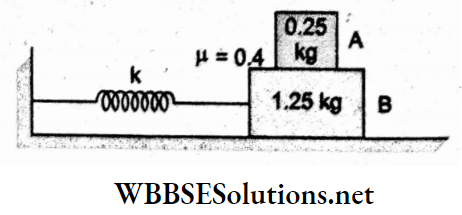
Question 25. A polyatomic gas with n degrees of freedom has a mean energy per molecule given by

  1. \(\frac{n k T}{2}\)
  2. \(\frac{n k T}{2N}\)
  3. \(\frac{3 k T}{2}\)
  4. \(\frac{n k T}{N}\)

Answer: 1. \(\frac{n k T}{2}\)

According to the law of equipartition of energy, energy per degree of

freedom = \(\frac{1}{2}\)KT.

In a polyatomic gas, each molecule has n degrees of freedom (given),

So the average energy per molecule is,

⇒  \(\left(\frac{1}{2} k T\right) n=\frac{n k T}{2}\)

Question 26. According to the kinetic theory of gases, at absolute zero temperature,

  1. Water freezes
  2. Liquid helium freezes
  3. Molecular motion stops
  4. Liquid hydrogen freezes

Answer: 3. Molecular motion stops

According to the kinetic theory,

⇒  \(p=\frac{1}{3} \frac{m}{V} C_{\mathrm{rms}}^2 \Rightarrow p V=R T=\frac{1}{3} M C_{\mathrm{rms}}^2\)

At absolute zero,

⇒ \(C_{\mathrm{rms}}^2=0 \Rightarrow \frac{1}{n}\left(C_1^2+C_2^2+C_3^2+\ldots+C_n^2\right)=0\)

This is possible if C1 = C2 = C3 = ….. = 0.

Hence, molecular motion of all types stops.

Question 27. In Maxwell’s speed distribution curve for nitrogen, the average relative velocity between two molecules at 300 K will be

  1. 300 ms-1
  2. 920 ms-1
  3. 606 ms-1
  4. zero

Answer: 3. 606 ms-1

The magnitude of relative velocity between two molecules is

⇒ \(\left|\vec{v}_{\text {rel }}\right|=\sqrt{v^2+v^2-2 v^2 \cos \theta}=2 v \sin \frac{\theta}{2}\)

Average value is

⇒ \(\mid \vec{v}_{\mathrm{rel}} \mathrm{lav}_{\mathrm{av}}=\frac{1}{\pi} \int_0^\pi 2 v \sin \frac{\theta}{2} d \theta=\frac{4 v_{\mathrm{av}}}{\pi}\)

According to.Maxwell’s velocity distribution,

⇒ \(v_{\mathrm{av}}=\sqrt{\frac{8 R T}{\pi m}}\)

average relative velocity

⇒ \(=\frac{4}{\pi} \sqrt{\frac{8 R T}{\pi m}}\)

⇒ \(\frac{4}{3.14} \sqrt{\frac{8\left(8.3 \mathrm{~J} \mathrm{~mol}^{-1} \mathrm{~K}^{-1}\right)(300 \mathrm{~K})}{3.14\left(28 \times 10^{-3} \mathrm{~kg} \mathrm{~mol}^{-1}\right)}}\)

= \(606 \mathrm{~m} \mathrm{~s}^{-1}\)

Kinetic Theory Multiple Choice Question And Answers Q 27

Question 28. The radius of an oxygen molecule is 40 A. Its time of relaxation at atmospheric pressure and a temperature of 27°C will be

  1. 10-12 s
  2. 10-10 s
  3. 10-16 s
  4. 10-14 s

Answer: 1. 10-12s

The rms velocity of gaseous molecules is

⇒ \(v_{\mathrm{rms}}=\frac{\text { mean free path }(\lambda)}{\text { relaxation time }(\tau)}\)

⇒ \(\tau=\frac{\lambda}{v_{\mathrm{rms}}}\)

= \(\frac{1}{\sqrt{2} \pi n d^2} \sqrt{\frac{m_{\mathrm{O}}}{3 R T}}\)

Now, number density = \(\), where p = number of moles.

But \(n=\frac{N}{V}=\frac{\mu N_A}{V}\)

∴ \(p V=\mu R T \text { or } \frac{\mu}{V}=\frac{p}{R T} \text {. Hence, } n=\frac{N_{\mathrm{A}} p}{R T}\)

Substituting the given values, x = 0.01 x 10⁻¹⁰s

= 10-12 s.

Question 29. If 1022molecules of a gas, each of mass 10-26 kg, collide elastically and perpendicularly with a surface per second over an area of 1 m2 with a speed of 104 m s-1, the pressure exerted by the gas molecules will be of the order of

  1. 4 Pa
  2. 3 Pa
  3. 2 Pa
  4. 5 Pa

Answer: 3. 2 Pa

For an elastic collision, the change in momentum per collision = 2mu,

and in 1 s, n molecules collide. Hence, net force F = 2mun.
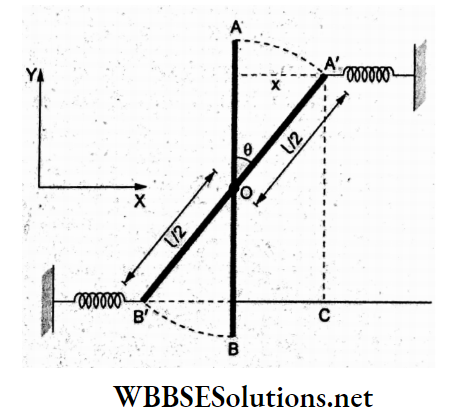
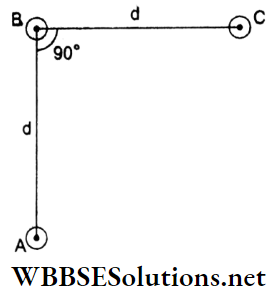
This force acts on an area of 1 m2. Hence, pressure is

⇒ \(p=\frac{F}{A}\)

= \(\frac{2 m u n}{1 \mathrm{~m}^2}\)

= \(\frac{2\left(10^{-26} \mathrm{~kg}\right)\left(10^4 \mathrm{~m} \mathrm{~s}^{-1}\right)\left(10^{22}\right)}{1 \mathrm{~m}^2}\)

= \(2 \mathrm{Nm}^{-2}\)

= 2Pa.

Question 30. 15 g of nitrogen is enclosed in a vessel at a temperature of 27°C. For the rms speed of its molecules to get doubled, the amount of heat absorbed by the gas is about

  1. 10 kJ
  2. 14 kJ
  3. 6 kJ
  4. 0.5 kJ

Answer: 1. 10 kJ

The rms velocity \(v_{\mathrm{rms}}=\sqrt{\frac{3 R T}{M}}\)

When vrms is doubled, temperature increases from T to 4T.

Hence, increase in temperature = AT = 4T-T

= 3T

= 3(273 + 27) K

= 900 K.

Heat absorbed (at constant volume) = ΔQ = nCvΔT.

Here,

n = \(\frac{15g}{28g}\)

= \(\frac{15}{28}, C_V=\frac{5}{2} R\)

⇒ \(\Delta Q=\frac{15}{28} \cdot \frac{5}{2}\) (8-3).900

= 104J

= 10kJ.

Question 31. An increase in the temperature of a gas-filled in container would lead to

  1. An increase in its mass
  2. An increase in its kinetic energy
  3. A decrease in its pressure
  4. A decrease in intermolecular separation

Answer: 2. An increase in its kinetic energy

The energy of an ideal gas is purely kinetic, and is \(\frac{1}{2}\)kT per degree of freedom.

Hence, an increase in temperature leads to an increase in its kinetic energy.

Question 32. A gas mixture consists of 3 mol of oxygen and 5 mol of argon at temperature T. Considering only translational and rotational modes, the total internal energy of the gaseous mixture will be

  1. 12 RT
  2. 20 RT
  3. 15 RT
  4. 4 RT

Answer: 3. 15 RT

Oxygen is diatomic, so it has 5 degrees of freedom for each molecule.
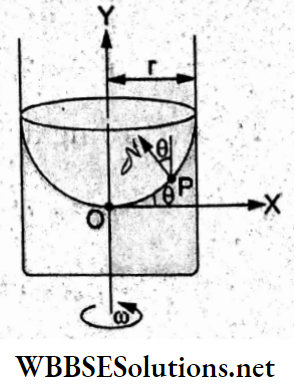
Hence, 3 mol of oxygen has total degrees of freedom = (3NA)5 = 15NA.
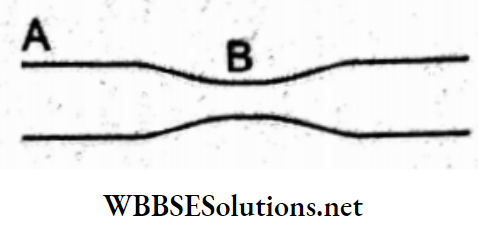
Similarly, argon (monatomic) has 3 degrees of freedom per molecule, and thus for 5 mol, the number of degrees of freedom = (5NA)3 = 15NA.

∴ total numberofdegrees offreedom = 30NA.

According to the equipartition law, the total energy is

⇒ \(E=\left(30 N_A\right)\left(\frac{1}{2} k T\right)\)

Question 33. An ideal gas occupies a volume of 2 m3 at a pressure of 3 x 10⁶ Pa. The energy of the gas is

  1. 6 x 10⁴ J
  2. 9 x 10⁶ J
  3. 3 x 10³ J
  4. 107J

Answer: 2. 9 x 10⁶ J

According to the kinetic theory, the pressure is

⇒ \(p=\frac{1}{3} \frac{M}{V} C_{\mathrm{rms}}^2\)

= \(\frac{2}{3 V}\left(\frac{1}{2} M C_{\mathrm{rms}}^2\right)\)

= \(\frac{2}{3 V}(\mathrm{KE})\)

∴ energy of the gas = E = \(\frac{3}{2}\) pV.

Substituting the given values,

E = \(\frac{3}{2}\) (3 x 10⁶ Pa)(2 m3)

= 9 x 10⁶ J.

Question 34. The temperature at which the rms speed of hydrogen molecules equals their escape velocity from the earth is closest to (given that Boltzmann constant, kB = 1.38 x 10⁻²³ J K-1; Avogadro’s number, NA = 6.02 x 10²³ mol-1; earth’s radius = 6400 km; acceleration due to gravity = 10 m s-2)

  1. 104K
  2. 650 K
  3. 800 K
  4. 3 x 10⁵ K

Answer: 1. 104K

The rms speed \(C_{\mathrm{rms}}=\sqrt{\frac{3 R T}{M}}\)

where M = molar mass ofhydrogen = 2 g mol-1 = 2 x 10³ kgmol-1.

Given that = escape velocity = \(\sqrt{2 g r}\), where r is earth’s radius

Substituting the given values,

⇒ \(\sqrt{\frac{3 R T}{M}}=\sqrt{2 g r}\)

⇒ \(T=\frac{2 M g r}{3 R}\)

1.02 x 10⁴K ≈ 104K

Question 35. If the temperature of an ideal gas enclosed in a box is increased then the

  1. Mean free path decreases
  2. The mean free path remains unchanged
  3. Relaxation time decreases
  4. Relaxation time remains unchanged

Answer: 2. Mean free path remains unchanged

Mean free path = \(\lambda=\frac{1}{\sqrt{2} \pi n d^2}, \text { where } n=\frac{N}{V}\) = number density,

d = diameter of molecule.

With the increase in temperature, the rate of collision increases, so relaxation time decreases, but the mean free path remains unchanged.

Thermodynamic Processes Multiple Choice Question And Answers

Thermodynamic Processes

Question 1. A thermodynamic system is taken from state A to state B along ACB and brought back to A along BDA as shown in the adjoining p-V diagram. The net work done during the complete cycle is given by the area

Thermodynamic Processes A thermodynamic system Q 1

  1. p1ACBp2p1
  2. ACBB’A’A
  3. ACBDA
  4. ADBB’A’A

Answer: 3. ACBDA

Work done in a cyclic process is the area enclosed by the cycle on the p-V diagram.

Thus, W = area ACBDA. Note that work done is positive for a clockwise cycle and negative for an anticlockwise process in the p-V diagram.

Thermodynamic Processes Multiple Choice Question And Answers

Question 2. An ideal gas undergoing an adiabatic process has a pressure-temperature relationship

  1. pγ-1Tγ = constant
  2. pγTγ-1 = constant
  3. pγT1-γ = constant
  4. p1-γTγ = constant

Answer: 4. p1-γTγ = constant

For an adiabatic process, the relation between p and V is pVγ = constant. From the equation of state pV = RT, we get

⇒ \(V=\frac{R T}{p}\)

or, \(p\left(\frac{R T}{p}\right)^\gamma=\text { constant or } p^{1-\gamma} T^\gamma=\text { constant. }\)

“thermodynamics multiple choice questions “

Question 3. An ideal gas at 27 °C is compressed adiabatically to 8/27 of its original volume. The rise in temperature is (take y = 5/3)

  1. 475°C
  2. 402°C
  3. 275°C
  4. 375°C

Answer: 4. 375°C

For adiabatic compression,

⇒ \(T_1 V_1^{\gamma-1}=T_2 V_2^{\gamma-1}\)

∴ \((27+273) V^{\frac{5}{3}-1}=T_2\left(\frac{8}{27} V\right)^{\frac{5}{3}-1}\)

∴ \(300 V^{\frac{2}{3}}=\left(T_2\right)\left(\frac{2}{3}\right)^2 V^{\frac{2}{3}}\)

9(300) = 4T2

∴ \(T_2=\frac{9 \times 300}{4}\)

= 675K.

Hence, the rise in temperature is T2 – T1 = 675 – 300

= 375°C.

Question 4. The molar heat capacity at constant pressure of an ideal gas is \(\frac{7}{2}\) R. The ratio of the molar heat capacity at constant pressure to that at constant volume is

  1. \(\frac{7}{5}\)
  2. \(\frac{8}{7}\)
  3. \(\frac{5}{7}\)
  4. \(\frac{9}{7}\)

Answer: 1. \(\frac{7}{5}\)

Given that,

⇒ \(C_p=\frac{7}{2} R, \text { but } C_p-C_V=R \text { or } C_V=\frac{7}{2} R-R=\frac{5}{2} R\)

∴ \(\frac{C_p}{C_V}=\frac{\frac{7 R}{2}}{\frac{5 R}{2}}=\frac{7}{5}\)

Question 5. A thermodynamic system is taken through a cyclic process ABCDA as shown in the figure. Heat expelled by the gas during the cycle is

Thermodynamic Processes A thermodynamic system Q 5

  1. 2pV
  2. 4pV
  3. \(\frac{1}{2}\) pV
  4. pV

Answer: 1. 2pV

From the first law of thermodynamics, dQ = dU + dW, and the change in internal energy in a cyclic process is dU = 0.

dQ = dW = area of cyclic process = (2p-p)(3V- V)

= 2pV.

Since the cycle is anticlockwise, work done is negative; hence heat expelled is 2pV

Read And Learn Also NEET Physics Multiple Choice Question and Answers

thermodynamics questions

Question 6. A gas is taken through the cycle ABCA as shown in the figure. What is the net work done by the gas?

Thermodynamic Processes A thermodynamic system Q 6

  1. 2000 J
  2. 1000 J
  3. -200 J
  4. Zero

Answer: 2. 1000 J

Net work done is the area enclosed by the cycle in the p-V diagram.

Hence,

⇒ \(W=\frac{1}{2}(A C)(B C)=\frac{1}{2}\left(5 \times 10^{-3} \mathrm{~m}^3\right)\left(4 \times 10^5 \frac{\mathrm{N}}{\mathrm{m}^2}\right)\)

= 1000J.

Question 7. The molar heat capacities of an ideal gas at constant pressure and constant volume are Cp and Cv respectively. If \(\gamma=\frac{C_p}{C_V}\) and R is the universal gas constant then Cv is equal to

  1. \(\frac{1+\gamma}{1-\gamma}\)
  2. \(\frac{R}{\gamma-1}\)
  3. \(\frac{\gamma-1}{R}\)
  4. yR

Answer: 2. \(\frac{R}{\gamma-1}\)

For a gas, Cp -Cv = R.

Dividing throughout by Cv,

⇒ \(\frac{C_p}{C_V}-1=\frac{R}{C_V}\)

⇒ \(\gamma-1=\frac{R}{C_V}\)

⇒ \(C_V=\frac{R}{\gamma-1}\)

“thermodynamics mcq class 11 “

Question 8. In the given (V-T) diagram, what is the relation between pressures p1 and p2?

Thermodynamic Processes A thermodynamic system Q 8

  1. p2 = p1
  2. p2 > p1
  3. p2 < P1
  4. Cannot be predicted

Answer: 3. p2 < P1

From the gas laws, pV = nRT or V = \(V=\left(\frac{n R}{p}\right) T\)

Hence, the slope of the V-Tline is inversely proportional to the pressure

⇒ \(\left(\text { slope } \propto \frac{1}{p}\right)\),

Hence p2 < P1.

Question 9. During an adiabatic process, the pressure of a gas is found to be proportional to the cube of its temperature. The ratio Cp/Cv for the gas is

  1. \(\frac{4}{3}\)
  2. 2
  3. \(\frac{5}{3}\)
  4. \(\frac{3}{2}\)

Answer: 4. \(\frac{3}{2}\)

For an adiabatic process,

p1-γTγ = constant

⇒ \(p T^{\frac{\gamma}{1-\gamma}}=\text { constant }\)

⇒ \(\frac{p}{T^{\frac{\gamma}{\gamma-1}}}=\text { constant }\)

⇒ \(p \propto T^{\frac{\gamma}{\gamma-1}}\)…..(1)

Comparing (1) with the given condition p ∝ T3, we conclude that

⇒ \(\frac{\gamma}{\gamma-1}=3, \text { thus } \gamma=\frac{3}{2}\)

Question 10. One mole of an ideal diatomic gas undergoes a transition from A to B along the straight path AB as shown in the figure. The change in internal energy of the gas during the transition is

Thermodynamic Processes A thermodynamic system One mole of an idea diatomic Q 10

  1. 20 kJ
  2. -20 kJ
  3. 20 J
  4. -12 kJ

Answer: 2. -20 kJ

For a diatomic gas, Cv = \(\frac{5}{2}\) R, and change in internal energy is

⇒ \(\Delta U=n C_V \Delta T=\frac{5}{2} R\left(T_2-T_1\right)\) [∵ n = l].

From the gas laws, pV = RT, hence T = \(\frac{pV}{R}\)

∴ \(\Delta U=\frac{5}{2} R \frac{\left(p_2 V_2-p_1 V_1\right)}{R}=\frac{5}{2}\left(p_2 V_2-p_1 V_1\right)\)

Substituting the values from the given graph,

“thermodynamics practice problems “

⇒ \(\Delta U=\frac{5}{2}\left[\left(2 \times 10^3 \mathrm{~Pa}\right)\left(6 \mathrm{~m}^3\right)-\left(5 \times 10^3 \mathrm{~Pa}\right)\left(4 \mathrm{~m}^3\right)\right]\)

= \(\frac{5}{2}(-8 \mathrm{~kJ})\)

= -20 kJ.

Question 11. An ideal gas is compressed to half its initial volume by means of several processes. Which of the processes results in the work done on the gas?

  1. Isochoric
  2. Adiabatic
  3. Isobaric
  4. Isothermal

Answer: 2. Adiabatic

For the gas undergoing an isochoric process (volume constant), no work is done by the gas. The work done on the gas is the area under the p-V diagram. Hence, according to the given figures,

Thermodynamic Processes A thermodynamic system Q 11

Question 12. A thermodynamic system undergoes a cyclic process ABCDA as shown in the figure. The work done by the system in one cycle is

Thermodynamic Processes A thermodynamic system Q 12

  1. p0V0
  2. 2p0V0
  3. \(\frac{p_0 V_0}{2}\)
  4. Zero

Answer: 4. Zero

For a cyclic process, the net work done by the system is equal to the area enclosed in the p-V diagram. The given process comprises two closed areas, AODA and COBC. The first is clockwise, so the work done is +ve while that for the second is -ve (being anticlockwise).

∴ Wnet = area AOD- area COB

⇒ \(\frac{1}{2}\left(2 V_0-V_0\right)\left(2 p_0-p_0\right)-\frac{1}{2}\left(2 V_0-V_0\right)\left(3 p_0-2 p_0\right)\)

⇒ \(\frac{1}{2} p_0 V_0-\frac{1}{2} p_0 V_0\)

= 0.

Question 13. One mole of an ideal monatomic gas undergoes a process described by the equation (pV³ = constant). The heat capacity of the gas during this process is

  1. \(\frac{3}{2}\) R
  2. \(\frac{5}{2}\) R
  3. 2R
  4. R

Answer: 4. R

For a polytropic process (pVn = constant), the molar heat capacity is

⇒ \(C=C_V+\frac{R}{1-n}\)

In the given process, pV³ = constant, we have n = 3

“thermodynamics practice problems “

∴ \(C=C_V+\frac{R}{1-3}=\frac{3}{2} R-\frac{R}{2}=R\) [∵ \(C_V=\frac{3}{2} R\)]

Question 14. One mole of an ideal gas undergoes a process from an initial state A to the final state B via two processes. It first undergoes isothermal expansion from volume V to 3V and then its volume is reduced from 3V to V at constant pressure. The correct p-V diagram representing the two processes is

Thermodynamic Processes A thermodynamic system Q 14

Answer: 4.

Thermodynamic Processes A thermodynamic system Q 14.

The isothermal expansion from state A (volume V) to state C (volume 3V) is represented by the rectangular hyperbola AC in (4).

In the second process, the isobaric compression from state C to final state B is shown by the line CB in (4).

Hence, the correct p-V is (4).

Question 15. The ratio of the molar heat capacities \(\frac{C_p}{C_V}=\gamma\) in terms of degrees of freedom (f) is given by

  1. 1 + \(\frac{1}{f}\)
  2. 1 + \(\frac{f}{3}\)
  3. 1 + \(\frac{2}{f}\)
  4. 1 + \(\frac{f}{2}\)

Answer: 3. 1 + \(\frac{2}{f}\)

If the total number of degrees of freedom of a polyatomic gas molecule is f, the internal energy per mole of the gas will be

U = \(\frac{f}{2}\) RT.

∴ \(C_V=\frac{d U}{d T}=\frac{1}{2} f R, \text { hence } C_p=C_V+R=\left(\frac{f}{2}+1\right) R\)

∴ \(\frac{C_p}{C_V}=\frac{\left(\frac{f}{2}+1\right) R}{\frac{f_2}{2} R}=1+\frac{2}{f}\)

Question 16. A gas undergoes two processes to reach the final state C from the initial state A as shown in the p-V diagram. In the process, AB, 400 J of heat is absorbed by the gas, and in the process BC, 100 J of heat is absorbed. The heat absorbed by the system in the process of AC will be

Thermodynamic Processes A thermodynamic system Q 16

  1. 380 J
  2. 500 J
  3. 460 J
  4. 300 J

Answer: 3. 460 J

Since the initial state (A) and the final state (C) are the same for the two processes, the change in internal energy AU will be the same.

For the process ABC,

ΔQABC = WAB + WBC + AU

=> 400J +100J = 0(isochoric) + 6 x 20J + AU

=> 500 J = 120 J + AU……(1)

Similarly, for the process AC,

ΔQAC = AU + AW = AU + \(\frac{1}{2}\)(8 x 20)J

⇒ ΔQAC = 80J + AU…..(2)

Subtracting (2) from (1),

500J – ΔQAC = 40J

ΔQAC = 500 J- 40 J

= 460 J.

Question 17. A monatomic gas at pressure p and volume Vexpands isothermally to a volume 2V and then adiabatically to a volume of 16V. The final pressure of the gas is (take y = 5/3)

  1. 64p
  2. 32p
  3. \(\frac{p}{34}\)
  4. 16p

Answer: 3. \(\frac{p}{34}\)

For the isothermal process, pV = \(\frac{p}{2}\)(2V).

“thermodynamics practice problems “

For the adiabatic process, pVγ = constant.

∴ \(\frac{p}{2}(2 V)^{5 / 3}=p^{\prime}(16 V)^{5 / 3} \Rightarrow p \cdot 2^{2 / 3}=p^{\prime} \cdot 2^{20 / 3}\)

∴ final pressure = \(\frac{p}{2^6}=\frac{p}{64}\)

Question 18. If All and AW represent the increase in internal energy and work done by the system respectively in a thermodynamical process, which of the following is true?

  1. ΔU = -ΔW in an adiabatic process
  2. ΔU = ΔW in an isothermal process
  3. ΔU = ΔW in an adiabatic process
  4. ΔU = -ΔW in an isothermal process

Answer: 1. ΔU = -ΔW in an adiabatic process

For an isothermal process, ΔU = 0,

So, options (2) and (4) are incorrect.

For an adiabatic process,

ΔQ = ΔU + ΔW

⇒ ΔU + ΔW = 0

⇒ ΔU = – ΔW is correct.

Question 19. In a thermodynamic process, which of the following statements is not true?

  1. In an adiabatic process, the system is insulated from the surroundings.
  2. In an isochoric process, pressure remains constant.
  3. In an isothermal process, the temperature remains constant.
  4. In an adiabatic process, pVγ = constant.

Answer: 2. In an isochoric process, pressure remains constant.

For an adiabatic process, there is no exchange of heat between the body and the surroundings and the process follows the law pVγ = constant.

Hence, (1) and (4) are true.

For an isothermal process, temperature remains constant, so (3) is true.

Finally, for an isochoric process, the volume remains constant and not the pressure.

So, option (4) is incorrect.

Question 20. The internal energy change in a system that has absorbed 2 kcal of heat and done 500 J of work is

  1. 8900 J
  2. 6400 J
  3. 5400 J
  4. 7900 J

Answer: 4. 7900 J

From the first law of thermodynamics, ΔQ = ΔU + ΔW.

Given, ΔQ = 2000 cal

= 2000 x 4.2J

= 8400 J and ΔW

= 500 J.

∴ ΔU = ΔQ – ΔW

= 8400 J- 500 J

= 7900 J

Question 21. In the cyclic process shown in the V-p diagram, the magnitude of work done is

Thermodynamic Processes A thermodynamic system Q 21

  1. \(\frac{\pi}{4}\left(p_2-p_1\right)^2\)
  2. \(\frac{\pi}{4}\left(V_2-V_1\right)^2\)
  3. \(\frac{\pi}{4}\left(p_2-p_1\right)\left(V_2-V_1\right)\)
  4. \(\pi\left(p_2 V_2-p_1 V_1\right)\)

Answer: 3. \(\frac{\pi}{4}\left(p_2-p_1\right)\left(V_2-V_1\right)\)

For a cyclic process plotted in the p-V diagram, the work done = area inside the closed curve. We can treat the circle as an ellipse ot

semimajor axis \(\frac{1}{2}\)(P2 – P1) semimmor axis \(\frac{1}{2}\)(V2 – V1).

∴ work done \(\pi \frac{1}{2}\left(p_2-p_1\right) \frac{1}{2}\left(V_2-V_1\right)=\frac{\pi}{4}\left(p_2-p_1\right)\left(V_2-V_1\right)\)

Question 22. A gas with \(\frac{C_p}{C_V}=\gamma\) goes from an initial state (p1, V1, T1) to a final state (P2, V2, T2) Enough an adiabatic process. The work done by the gas is

  1. \(\frac{p_1 V_1-p_2 V_2}{\gamma-1}\)
  2. \(\frac{p_1 V_1+p_2 V_2}{\gamma+1}\)
  3. \(\frac{n R\left(T_1+T_2\right)}{\gamma-1}\)
  4. nyR(T1 – T2)

Answer: 1. \(\frac{p_1 V_1-p_2 V_2}{\gamma-1}\)

Work done during the adiabatic expansion from state A (p1, V1, T1) to state B (p2, V2, T2) is given by

⇒ \(W=\frac{n R}{\gamma-1}\left(T_1-T_2\right)=\frac{1}{\gamma-1}\left(n R T_1-n R T_2\right)\)

⇒ \(\frac{1}{\gamma-1}\left(p_1 V_1-p_2 V_2\right)\) [∵ pV = nRT]

Class 11 Physics Class 12 Maths Class 11 Chemistry
NEET Foundation Class 12 Physics NEET Physics

Question 23. A cyclic process ABCA is shown in the p-T diagram. Which of the following diagrams shows the same process in the p-V diagram?

Thermodynamic Processes A thermodynamic system Q 23

Thermodynamic Processes A thermodynamic system Q 23.

Answer: 2.

In the given cyclic process, consider the three processes individually.

(1) Process AB: p oc T(for the straight line) The process is isochoric (volume constant) as in options (1) and (2).

(2) Process BC: Isobaric compression as in options (a) and (b).

(3) Process GA: Isothermal process (T – constant), so according to Boyle’s law (pV = constant) which gives a rectangular hyperbola, option (2) is true.

Thermodynamic Processes A thermodynamic system Q 23..

Question 24. A cyclic process ABC is shown in the p-T diagram. Which of the following curves shows the same process in a V-T diagram?

Thermodynamic Processes A thermodynamic system Q 24

Thermodynamic Processes A thermodynamic system Q 24.

Answer: 3.

Process AB: pecT, hence V = constant with T increasing: option (3).

Process BC: Isothermal expansion (T=constant), T constant and volume increasing: option (3).

Process CA: Isobaric (p = constant), volume decreases linearly with temperature as in option (3).

“thermodynamics practice problems “

Hence (3) is the correct representation.

Thermodynamic Processes A thermodynamic system Q 24..

Question 25. A sample of n moles of a gas undergoes isothermal expansion from volume V1 to V2 at temperature T. The work done by the gas is

  1. \(n R T \ln \left(\frac{V_2}{V_1}+1\right)\)
  2. \(n R T \ln \left(\frac{V_2}{V_1}-1\right)\)
  3. \(n R T \ln \frac{V_2}{V_1}\)
  4. \(n R T\left(\frac{V_2}{V_1}\right)\)

Answer: 4. \(n R T\left(\frac{V_2}{V_1}\right)\)

Work done during the isothermal expansion is

⇒ \(W=n R T \ln \frac{V_2}{V_1}\)

Question 26. A system is taken from state A to state B along two different paths, 1 and 2. The heat absorbed and work done by the system along these two paths are Q1 and Q2, and W1 and W2 respectively. Which of the following is true?

  1. Q1– Q2
  2. W1 = W2
  3. Q1-Q2 = W1-W2
  4. Q1 + W1 = Q2 + W2

Answer: 3. Q1-Q2 = W1-W2

The internal energy function is a state function, which depends only on the initial and final states.

For A: Q1 = W2 + ΔU.

For B: Q2 = W2 + ΔU, where ΔU= UB-UA.

∴ Q1 – W1 = Q2 – W2

Q1 – Q2 = W1 – W2

Question 27. If the ratio of the specific heat capacity of a gas at constant pressure to that at constant volume is y then the change in internal energy of a given mass of the gas when its volume changes from V to 2V at constant pressure p is

  1. \(\frac{R}{\gamma-1}\)
  2. pV
  3. \(\frac{pV}{\gamma-1}\)
  4. \(\frac{\gamma p V}{\gamma-1}\)

Answer: 3. \(\frac{pV}{\gamma-1}\)

Change in internal energy is

⇒ \(\Delta U=n C_V \Delta T=n\left(\frac{R}{\gamma-1}\right)\left(T_2-T_1\right)\)

⇒ \(\frac{1}{\gamma-1}\left(n R T_2-n R T_1\right)=\frac{1}{\gamma-1}\left(p_2 V_2-p_1 V_1\right)\)

Given that p1 = p2 = p, V2 = 2V, V1 = V, so

⇒ \(\Delta U=\frac{p}{\gamma-1}(2 V-V)=\frac{p V}{\gamma-1}\)

Question 28. An ideal gas A and a real gas B have their volumes increased from V to 2V under isothermal conditions. The increase in internal energy

  1. Will be the same in both A and B
  2. There will be zero in both gases
  3. Of B will be more than that of A
  4. Of A will be more than that of B

Answer: 2. Will be zero in both the gases

Under isothermal conditions temperature T remains constant, so dT = 0. The change in internal energy = AU = nCvdT = 0. Hence, the increase in internal energy in both A and B is zero.

Question 29. The temperature inside a refrigerator is maintained at 4°C and the temperature of the atmosphere is 15°C. If the gas enclosed undergoes the Carnot process in its working, find the Carnot efficiency.

  1. 0.028
  2. 0.038
  3. 0.072
  4. 0.054

Answer: 2. 0.038

During the Carnot cyclic process, efficiency

⇒ \(\eta=1-\frac{T_2}{T_1}=1-\frac{(273+4) \mathrm{K}}{(273+15) \mathrm{K}}\)

⇒ \(1-\frac{277}{288}=\frac{11}{288}\)

= 0.038.

Question 30. A conducting, closed container of capacity 100 litres contains an ideal gas at a high-pressure p0. Using an exhaust pump the gas from the container is pumped out at a constant rate of 5 litres per second. Find the time in which the pressure inside the container is reduced to \(\frac{p_0}{100}\) (Assume isothermal conditions.)

  1. 92 s
  2. 110 s
  3. 45 s
  4. 150 s

Answer: 1. 92 s

For an isothermal process,

pV = constant

pdV + Vdp = 0

⇒ \(\frac{d p}{p}=-\frac{d V}{V}\)……(1)

Given that V = 100 L = 100 x 10-3 m3, initial pressure = p0,

⇒ \(\frac{d V}{d t}=5 \mathrm{~L} \mathrm{~s}^{-1}\)

= \(5 \times 10^{-3} \mathrm{~m}^3 \mathrm{~s}^{-1}\)

⇒ \(d V=\left(5 \times 10^{-3} d t\right) \mathrm{m}^3 \mathrm{~s}^{-1}\)

Final pressure = \(\frac{p_0}{100}\)

Integrating (1),

⇒ \([\ln p]_{p_0}^{p_0 / 100}=-\int_0^t \frac{5 \times 10^{-3} d t}{100 \times 10^{-3}}\)

⇒ \(\ln p_0-\ln \frac{p_0}{100}=5 \times 10^{-2} t\)

∴ time \(t=\frac{1}{5 \times 10^{-2}}(2 \ln 10)\)

= 0.4 x 100 x 2.3

= 92 s.

“thermodynamics practice problems “

Question 31. The given p-V indicator diagram p shows four processes: isochoric, isobaric, isothermal, and adiabatic. The correct assignment of the processes in the same order is given

Thermodynamic Processes A thermodynamic system Q 31

  1. ADCB
  2. ADBC
  3. DABC
  4. DBCA

Answer: 3. DABC

Process A: Isobaric (p constant)

Process B: Isothermal (T constant)

Process C: Adiabatic (greater slope, ΔQ = 0)

Process D: Isochoric (V constant)

Hence, option (3)

Question 32. In an isobaric process, work done by a diatomic gas is 10 J. The heat given to the gas will be

  1. 35 J
  2. 25 J
  3. 45 J
  4. 30 J

Answer: 1. 35 J

For an isobaric process (p constant),

pV =nRT

=> pdV = nRdT.

Work done = dW = pdV = nRdT……(1)

Heat given to the gas is

⇒ \(d Q=n C_p d T=n\left(\frac{7}{2} R\right) d T\) [∵ \(C_p=\frac{7}{2} R\)]

⇒ \(\frac{7}{2}(n R d T)=\frac{7}{2}(d W)\) [from (1)]

= \(\frac{7}{2}\) (10J)

= 35J.

Question 33. An ideal gas initially at a pressure of 1 bar is compressed from 30 m³ to 10 m³ and its temperature decreases from 320 K to 280K. The final pressure will be

  1. 3.4 bar
  2. 1.25 bar
  3. 2.625 bar
  4. 4.36 bar

Answer: 3. 2.625 bar

From the gas laws, \(\frac{p_1 V_1}{T_1}=\frac{p_2 V_2}{T_2}\)

⇒ \(\frac{(1 \mathrm{bar})\left(30 \mathrm{~m}^3\right)}{(320 \mathrm{~K})}=\frac{p_2\left(10 \mathrm{~m}^3\right)}{(280 \mathrm{~K})}\)

final pressure = p2 = 2.625 bar.

Question 34. One mole of nitrogen is heated isobarically from 300 K to 600 K. The change in its entropy is

  1. 20 J K-1
  2. 30 JK-1
  3. 40 JK-1
  4. 50 JK-1

Answer: 1. 20 J K-1

Change in entropy \(\Delta S=\int \frac{d Q}{T}\)

But \(d Q=n C_p d T=1\left(\frac{7}{2} R\right) d T\)

⇒ \(\Delta S=\frac{7}{2} R \int_{300 \mathrm{~K}}^{600 \mathrm{~K}} \frac{d T}{T}\)

= \(\frac{7 R}{2} \ln 2\)

= \(\frac{7}{2}(8.3)(0.693) \mathrm{JK}^{-1}\)

= 20JK-1

“thermodynamics practice problems “

Question 35. One mole of an ideal gas undergoes the process A → B → C. Given p A that TA = 40 K, Tc = 400 K, and \(\frac{p_{\mathrm{B}}}{p_{\mathrm{A}}}=\frac{1}{5}\). The heat supplied to the gas is

Thermodynamic Processes A thermodynamic system Q 35

  1. 2059.2 J
  2. 2659.2 J
  3. 3659.2 J
  4. 2259.2 J

Answer: 2. 2659.2 J

For isochoric compression A → B, heat expelled = nCvdT = nCv(TB– TA)

and for isobaric expansion B → C, heat absorbed = nCpdT = nCp(TC– TB).

∴ net heat absorbed is

ΔQ = nCpdT + nCvdT

= nCp(TC – TB) + nCv(TB– TA).

Given that

⇒ \(\frac{p_{\mathrm{B}}}{p_{\mathrm{A}}}=\frac{1}{5}=\frac{T_{\mathrm{B}}}{T_{\mathrm{A}}}\)

⇒ \(T_{\mathrm{B}}=\frac{T_{\mathrm{A}}}{5}=\frac{400 \mathrm{~K}}{5}\)

∴ ΔQ = (TC – TB)Cp-Cv(TC-TB) [∵ TA = TC (given)]

⇒ \(\left(400-\frac{400}{5}\right) R\)

= \(\frac{4}{5}(400)(8.31) \mathrm{J}\)

= 2659.2J

Question 36. Cp/Cv for a mixture of 11 g of CO2 and 14 g of N2 is

  1. \(\frac{7}{5}\)
  2. \(\frac{11}{5}\)
  3. \(\frac{4}{3}\)
  4. \(\frac{11}{8}\)

Answer: 4. \(\frac{11}{8}\)

For CO2: \(n=\frac{1}{4}, C_V=3 R, C_p=4 R\)

For N2: \(n=\frac{1}{2}, C_V=\frac{5}{2} R, C_p=\frac{7}{2} R\)

∴ \(\gamma_{\text {mixture }}=\frac{n_1 C_{p_1}+n_2 C_{p_2}}{n_1 C_{V_1}+n_2 C_{V_2}}=\frac{\frac{1}{4} \times 4 R+\frac{1}{2} \times \frac{7}{2} R}{\frac{1}{4} \times 3 R+\frac{1}{2} \times \frac{5}{2} R}=\frac{11}{8}\)

“thermodynamics practice problems “

Question 37. For the given cyclic process CABC for a gas shown in the p-V indicator diagram, the work done by the gas is

Thermodynamic Processes A thermodynamic system Q 37

  1. 5 J
  2. 1 J
  3. 30 J
  4. 10 J

Answer: 4. 10 J

Work done by the gas during the process

C → A (expansion) = area under CA

WCA = (6 Pa)(5 m3-1 m3) = 24J.

WAB = zero, for the isochoric process.

WBC = area under BC.(compression)

= –\(\frac{1}{2}\)(6 Pa +1 Pa)(5 m3-1 m3)

= -14J.

Net work done during one complete cycle is

W = 24J + (-14) J

= 10J.

“thermodynamics practice problems “

Question 38. When heat Q is supplied to a diatomic gas of rigid molecules at constant volume, its temperature increases by AT. The heat required to produce the same change in temperature at a constant pressure is

  1. \(\frac{7Q}{5}\)
  2. \(\frac{5Q}{3}\)
  3. \(\frac{3Q}{2}\)
  4. \(\frac{2Q}{3}\)

Answer: 1. \(\frac{7Q}{5}\)

For a diatomic gas, \(C_V=\frac{5}{2} R, C_p=\frac{7}{2} R\)

At constant volume, \(Q=n C_V \Delta T=n \frac{5}{2} R \Delta T\)

At constant pressure, \(Q^{\prime}=n C_p \Delta T=n \cdot \frac{7}{2} R \Delta T\)

∴ \(\frac{Q^{\prime}}{Q}=\frac{7}{5}, \text { hence } Q^{\prime}=\frac{7}{5} Q\)

Question 39. A diatomic gas with rigid molecules does 10 J of work when expanded at constant pressure. The amount of heat absorbed during the process will be

  1. 40 J
  2. 35 J
  3. 30 J
  4. 25J

Answer: 2. 35 J

Work done at constant pressure is

dW= pdV= nRdT = 10J …..(1)

Heat absorbed = dQ = dU + dW.

For a diatomic gas, C = \(\frac{5}{2}\)R.

Hence, change in internal energy is

⇒ \(d U=n C_V d t=\frac{5}{2} R n d T=\frac{5}{2}(10 \mathrm{~J})\) [from (1)]

= 25J.

Substituting in (2), heat absorbed is

dQ = 25J +10J

= 35J.

Question 40. A cylinder with a fixed capacity of 67.2 L contains helium gas at the stop. The amount of heat needed to raise the temperature of the gas by 20°C is (given that R = 8.31 J mol-1 K-1)

  1. 748 J
  2. 700 J
  3. 374 J
  4. 350 J

Answer: 1. 748 J

Helium is monatomic, for which Cv = \(\frac{3}{2}\)R.

Number of moles = \(\frac{67.2 \mathrm{~L}}{22.4 \mathrm{~L}}\) = 3.

The amount of heat required is

⇒ \(\Delta Q=n C_V \Delta T=3 \mathrm{~mol}\left(\frac{3}{2} R\right) \Delta T\)

= \(\frac{9}{2}\) mol (8.31 J mol-1 K-1)(20 K)

= 747.9 J ≈ 748 J.

Question 41. A gas is taken from state A to state P B via two different paths, ACB and c ADB. When path ACB is used, 60 J of heat flows into the system and the system does 30 J of work. If the path ADB is used, work done by the system is 10 J. The heat which flows A into the system for the path ADB is

Thermodynamic Processes A thermodynamic system Q 41

  1. 80 J
  2. 40 J
  3. 100 J
  4. 20 J

Answer: 2. 40 J

Internal energy is a state function and depends only on the initial and final states—it is path-independent.

From the first law of thermodynamics,

ΔQ = ΔU + ΔW

⇒ ΔU = ΔQ – ΔW.

For process ACB, ΔU = 60 J-30 J

= 30 J.

For process ADB, ΔU = ΔQ-10 J.

Since AU is the same for both,

ΔQ – 10J = 30J

⇒ ΔQ = 40J.

Question 42. A sample of an ideal gas is taken through a cyclic process abca as p shown in the figure. The change in the internal energy of the gas along the path ca is -180 J. The gas absorbs 250 J of heat along the path ab and 60 J along the path be. The work done by the gas along the 0L path abc is

Thermodynamic Processes A thermodynamic system Q 42

  1. 120 J
  2. 140 J
  3. 100 J
  4. 130 J

Answer: 4. 130 J

Consider the values of ΔQ, ΔU, and ΔW given in the following table.

For the process b → c (isochoric),

ΔW = 0,

so, (ΔU)bc = (dQ)bc = 60J.

In the total cyclic process, ΔU = 0.

So,(ΔU)ab + (ΔU)bc + (ΔU)ca = 0

=> (ΔU)ab + 60J – 180J = 0

=> (ΔU)ab = 120J.

For a → b, ΔW = ΔQ – ΔU

= 250 J-120 J

= 130 J.

∴ Wabc = Wab + Wbc

= 130 J + 0

= 130 J.

Thermodynamic Processes A thermodynamic system Q 42.

Question 43. Two moles of helium gas is mixed with three moles of hydrogen molecules. The molar heat capacity of the mixture at constant volume is (given that = 8.3 J KT-1 mol-1)

  1. 21.6 J mol-1 K-1
  2. 15.7 J mol-1 K-1
  3. 19.7 J mol-1 K-1
  4. 17.4 J mol-1 K-1

Answer: 4. 17.4 J mol-1 K-1

Helium → monatomic \(\left(C_V=\frac{3}{2} R\right)\)

Hydrogen → diatomic \(\left(C_V=\frac{5}{2} R\right)\)

∴ \(\left(C_V\right)_{\text {mixture }}=\frac{n_1 C_{V_1}+n_2 C_{V_2}}{n_1+n_2}\)

⇒ \(\frac{2\left(\frac{3}{2} R\right)+3\left(\frac{5}{2} R\right)}{2+3}=\frac{21}{10} R\)

= \(\frac{21}{10}\)(8.3Jmol-1K-1)

= 17.43 J mol-1 K-1.

Question 44. A sample of n moles of an ideal gas with heat capacity at constant volume Cv undergoes an isobaric expansion by a certain volume. The ratio of the work done in the process to the heat supplied is

  1. \(\frac{4 n R}{C_V+n R}\)
  2. \(\frac{n R}{C_V+n R}\)
  3. \(\frac{n R}{C_V-n R}\)
  4. \(\frac{4 n R}{C_V-n R}\)

Answer: 2. \(\frac{n R}{C_V+n R}\)

Heat capacity of n moles of a gas at constant volume = nCv-Cv (given).

Work done = ΔW = pΔV = nRΔT,

Heat absorbed = nCpΔT = n(Cv + R)ΔT

⇒ (nCv + nR)ΔT = (C2 + nR)ΔT.

∴ ratio = \(\frac{\Delta W}{\Delta Q}=\frac{n R \Delta T}{\left(C_V+n R\right) \Delta T}=\frac{n R}{C_V+n R}\)

Question 45. Half a mole of an ideal monatomic gas is heated at a constant pressure of 1 atm from 20°C to 90°C. The work done by the gas is close to (take R = 8.31 J mol-1 K-1)

  1. 291 J
  2. 581 J
  3. 146 J
  4. 73 J

Answer: 1. 291 J

Work done by a gas is ΔW = pΔV = nRΔT.

Substituting the given values,

AW = (\(\frac{1}{2}\) mol) (8.31 J mol-1K-1)(70 K)

= 291 J

Question 46. A diatomic ideal gas undergoes an adiabatic process at room temperature. The relation between temperature and volume for this process is TVn = constant. The value of n is

  1. \(\frac{2}{5}\)
  2. \(\frac{3}{5}\)
  3. \(\frac{5}{3}\)
  4. \(\frac{2}{3}\)

Answer: 1. \(\frac{2}{5}\)

For an adiabatic process, TVγ-1 = constant.

For a diatomic gas, \(C_V=\frac{5 R}{2}, C_p=\frac{7 R}{2}\)

∴ y = \(\frac{7}{5}\)

Given that TVn = constant.

∴ \(n=\gamma-1=\frac{7}{5}-1=\frac{2}{5}\)

Question 47. Three moles’ of oxygen is mixed with 5 moles of argon, both at temperature T. The total internal energy of the mixture is

  1. 15RT
  2. 12RT
  3. 19RT
  4. 10RT

Answer: 1. 15RT

Oxygen is diatomic, meaning that f = 5, and argon is monatomic, implying f = 3.

Total internal energy \(U=\left(\frac{1}{2} k T\right)(3 N) 5+\left(\frac{1}{2} k T\right)(5 N) 3\)

= 15NkT

= 15JRT.

Question 48. The internal energy of 1 mol of a nonlinear triatomic molecule at temperature T is

  1. \(\frac{9}{2}\) RT
  2. \(\frac{3}{2}\) RT
  3. 3RT
  4. \(\frac{5}{2}\) RT

Answer: 3. 3RT

For a nonlinear triatomic molecule,f = 6.

∴ \(U=\left(\frac{1}{2} k T\right)(6 N)\)

= 3 RT

Question 49. 0.1 mol of a gas at 200 K is mixed with 0.05 mol of the same gas at 400 K. If the final temperature of the mixture is 10T0, the value of T0 is (in kelvin)

  1. 20.44
  2. 26.66
  3. 22.44
  4. 25.15

Answer: 2. 26.66

Conserving internal energy,

⇒ \(n_1 C_V T_1+n_2 C_V T_2=\left(n_1+n_2\right) C_V T_0\)

⇒ (0.1)(200 K) + (0.05)(400 K) = (0.15)(10T0)

⇒ \(T_0=\frac{20 \mathrm{~K}+20 \mathrm{~K}}{0.15}\)

= 26.66 K

Question 50. The absorption of 160 J of heat by an ideal gas at constant pressure increases its temperature by50°C. For the same gas, the temperature rises by 100°C when 240 J of heat is absorbed at constant volume. The number of degrees of freedom of each of its molecules is

  1. 5
  2. 3
  3. 6
  4. 7

Answer: 3. 6

At constant pressure, ΔQ = nCpΔT

⇒ 160 J = nCp 50.

At constant volume, 240 J = nCv .100

∴ \(\frac{C_p}{C_V}=\gamma\)

= \(\frac{160}{240} \times \frac{100}{50}\)

= \(\frac{4}{3}\)

But y =1 + \(\frac{2}{f}\)

⇒ f = 6.

Question 51. An ideal diatomic gas undergoes an adiabatic process in which its density is increased to 32 times its original value. If the pressure increases to n times its original value, the value of n will be

  1. 4
  2. 8
  3. 64
  4. 128

Answer: 4. 128

For an adiabatic process, pVγ = p’V’γ

⇒ \(p\left(\frac{M}{\rho}\right)^\gamma=p^{\prime}\left(\frac{M}{\rho^{\prime}}\right)^\gamma\)

⇒ \(p\left(\frac{1}{\rho}\right)^\gamma=(n p)\left(\frac{1}{32 \rho}\right)^\gamma\)

=> n = 32γ

= (25)7/5

= 128 [ ∵ y =\(\frac{7}{5}\)]

Question 52. A bullet of 5 g moving at 210 m s-1 strikes a fixed wooden target. Half of its kinetic energy is converted into heat in the bullet while the remaining half is absorbed by wood. What is the rise in temperature of the bullet? (Given that the specific heat capacity of the bullet’s metal = 0.03 cal g-1 °C-1 and 1 cal = 4.2 J)

  1. 83.3°C
  2. 38.4°C
  3. 87.5 °C
  4. 110°C

Answer: 3. 87.5 °C

Kinetic energy, E = \(\frac{1}{2}\)mv²;

Heat absorbed = H = \({E}{2}\) = \(\frac{1}{4}\)mv²

= mcΔθ.

Hence, rise in temperature,

⇒ \(\Delta \theta=\frac{v^2}{4 c}\)

= \(\frac{\left(210 \mathrm{~m} \mathrm{~s}^{-1}\right)^2}{4\left(0.03 \times 4200 \mathrm{~J} \mathrm{~kg}^{-1}{ }^{\circ} \mathrm{C}^{-1}\right)}\)

= 87.5°C.

Question 53. A helium-filled balloon at 32°C and 1.7 atm suddenly burst. Immediately after it bursts, the expansion of helium can be considered as

  1. Irreversible isothermal
  2. Irreversible adiabatic
  3. Reversible adiabatic
  4. Reversible isothermal

Answer: 2. Irreversible adiabatic

An isothermal process is slow but bursting is fast and sudden. Hence, the bursting of the balloon is an irreversible adiabatic process.