- NEET Biology Class 9 Improvement In Food Resources Question And Answers
- NEET Biology Class 9 Natural Resources Question And Answers
- NEET Biology Class 9 The Fundamental Unit of Life Question And Answers


Have you ever thought of the multitude of life-forms that surround us?
Each organism is different from all others to a lesser or greater extent. For instance, consider yourself and a friend. Clearly, the movement to be made depends on the event that is triggering it.
Are you both of the same height? Does your nose look exactly like your friend’s nose? Is your hand-span the same as your friend’s?
Read And Learn More NEET Biology Class 9 Question And Answers
However, if we were to compare ourselves and our friends with a monkey, what would we say? Obviously, we and our friends have a lot in common when we compare ourselves with a monkey. But suppose we were to add a cow to the comparison? We would then think that the monkey has a lot more in common with us than with the cow. But suppose we were to add a cow to the comparison?
We would then think that the monkey has a lot more in common with us than with the cow.

Activity
We have heard of desi cows and Jersey cows.
Does a desi cow look like a Jersey cow? Do all desi cows look alike? Will we be able to identify a Jersey cow in a crowd of desi cows that don’t look like each other? What is the basis of our identification?
In this activity, we had to decide which characteristics were more important in forming the desired category. Hence, we were also deciding which characteristics could be ignored. Now, think of all the different forms in which life occurs on earth. On one hand we have microscopic bacteria of a few micrometre in size.
While on the other hand we have blue whale and red wood trees of california of approximate sizes of 30 metres and 100 metres repectively. Some pine trees live for thousands of years while insects like mosquitoes die within a few days.
Life also ranges from colourless or even transparent worms to brightly coloured birds and flowers. This bewildering variety of life around us has evolved on the earth over millions of years. However, we do not have more than a tiny fraction of this time to try and understand all these living organisms, so we cannot look at them one by one.
Instead, we look for similarities among the organisms, which will allow us to put them into different classes and then study different classes or groups as a whole.
In order to make relevant groups to study the variety of life forms, we need to decide which characteristics decide more fundamental differences among organisms. This would create the main broad groups of organisms. Within these groups, smaller subgroups will be decided by less important characteristics.

Aristotle Classification
Attempts at classifying living things into groups have been made since time immemorial. Greek thinker Aristotle classified animals according to whether they lived on land, in water or in the air. This is a very simple way of looking at life, but misleading too.
For example, animals that live in the sea include corals, whales, octopuses, starfish and sharks. We can immediately see that these are very different from each other in numerous ways. In fact, their habitat is the only point they share in common. This is no good as a way of making groups of organisms to study and think about.
Requirements for Classification
We therefore need to decide which characteristics to be used as the basis for making the broadest divisions. Then we will have to pick the next set of characteristics for making sub-groups within these divisions.
This process of classification within each group can then continue using new characteristics each time. Before we go on, we need to think about what is meant by ‘characteristics’.
Characteristics – Its Meaning
When we are trying to classify a diverse group of organisms, we need to find ways in which some of them are similar enough to be thought of together. These ‘ways’, in fact, are details of appearance or behaviour, in other words, form and function.
What we mean by a characteristic is a particular form or a particular function. Most of us have five fingers on each hand is thus a characteristic. We can run, but the banyan tree cannot, is also a characteristic.
To understand how some characteristics are decided as being more fundamental than others, let us consider how a stone wall is built. The stones used will have different shapes and sizes. The stones at the top of the wall would not influence the choice of stones that come below them.
On the other hand, the shapes and sizes of stones in the lowermost layer will decide the shape and size of the next layer and so on. The stones in the lowermost layer are like the characteristics that decide the broadest divisions among living organisms. They are independent of any other characteristics in their effects on the form and function of the organism.
The characteristics in the next level would be dependent on the previous one and would decide the variety in the next level. In Diversity in Living Organisms this way, we can build up a whole hierarchy of mutually related characteristics to be used for classification. Now-a-days, we look at many inter-related characteristics starting from the nature of the cell in order to classify all living organisms.
What are some concrete examples of such characteristics used for a hierarchical classification?
Characteristics – Some Examples
We can see that, even in these few questions that we have asked, a hierarchy is developing. The characteristics of body design used for classification of plants will be very different from those important for classifying animals. This is because the basic designs are different, based on the need to make their own food (plants), or acquire it (animals).
Therefore, these design features (having a skeleton, for example) are to be used to make sub-groups, rather than making broad groups.
Basis for Classification
All living things are identified and categorised on the basis of their body design in form and function. Some characteristics are likely to make more wide-ranging changes in body design than others. So, once a certain body design comes into existence, it will shape the effects of all other subsequent design changes, simply because it already exists.
In other words, characteristics that came into existence earlier are likely to be more basic than characteristics that have come into existence later. This means that the classification of life forms will be closely related to their evolution.
What is Evolution?
Most life forms that we see today have arisen by an accumulation of changes in body design that allow the organism possessing them to survive better.
Charles Darwin first described this idea of evolution in 1859 in his book, The Origin of Species. When we connect this idea of evolution to classification, we will find some groups of organisms which have ancient body designs that have not changed very much.
We will also find other groups of organisms that have acquired their particular body designs relatively recently.
Those in the first group are frequently referred to as primitive or lower organisms, while those in the second group are called advanced or higher organisms.
In reality, these terms are not quite correct since they do not properly relate to the differences. All that we can say is that some are Older organisms, while some are Younger organisms.
Biologists, such as Ernst Haeckel (1894), Robert Whittaker (1959) and Carl Woese (1977) have tried to classify all living organisms into broad categories, called kingdoms.
Whittaker’s Classification
The classification Whittaker proposed has five kingdoms: Monera, Protista, Fungi, Plantae and Animalia, and is widely used.
These groups are formed on the basis of their cell structure, mode and source of nutrition and body organisation.
Woese Classfication
The modification Woese introduced by dividing the Monera into Archaebacteria (or Archaea) and Eubacteria (or Bacteria) is also in use.

Understanding Biodiversity for NEET
Naming of Subgroups
Further classification is done by naming the sub-groups at various levels as given in the following scheme:
KingdomPhylum (for animals) / Division (for plants) Class orderFamilyGenusspecies
By separating organisms on the basis of a hierarchy of characteristics into smaller and smaller groups, we arrive at the basic unit of classification, which is a ‘species’.
So what organisms can be said to belong to the same species? Broadly, a species includes all organisms that are similar enough to breed and perpetuate.
Monera
Organisms of this class do not have a defined nucleus or organelles, nor do any of them show multi-cellular body designs. Some of them have cell walls while some do not. The mode of nutrition of organisms in this group can be either by synthesising their own food (autotrophic) or getting it from the environment (heterotrophic).
Examples

Protista
This group includes many kinds of unicellular eukaryotic organisms.Some of these organisms use appendages, such as hair-like cilia or whip-like flagella for moving around. Their mode of nutrition can be autotrophic or heterotrophic.
Examples


Fungi
These are heterotrophic eukaryotic organisms. They use decaying organic material as food and are therefore called Saprophytes. Many of them have the capacity to become multicellular organisms at certain stages in their lives.They have cell-walls made of a tough complex sugar called chitin.
Examples

Some fungal species live in permanent mutually dependent relationships with blue-green algae (or cyanobacteria). Such relationships are called Symbiotic. These symbiobic life forms are called Lichens.We have all seen lichens as the slow-growing large coloured patches on the bark of trees.
Plantae
These are multicellular eukaryotes with cell walls. They are autotrophs and use chlorophyll for photosynthesis. Thus, all plants are included in this group. Since plants and animals are most visible forms of the diversity of life around us, we will look at the subgroups in this category later.
Animalia
These include all organisms which are multicellular eukaryotes without cell walls. They are heterotrophs. Again, we will look at their subgroups a little later in upcoming slides.
Question 1. The five kingdom classification includes Kingdoms Monera, Protista, Fungi, Planate, and Animalia. Bacteria are classified under Kingdom
Answer. 3. Monera
Question 2. In micro-organisms, locomotion occurs through different methods. Cilia are body structures that help them in movement. They also move with the help of pseudopodia. Which of the following organisms moves with the help of pseudopodia?
Answer. 3. Amoeba
WBBSE Class 9 Diversity in Living Organisms Q&A
Question 3. Which locomotive structure is exhibited by amoeba?
Answer. 1. Pseudopodia
The first level of classification among plants depends on whether the plant body has well differentiated, distinct components. The next level of classification is based on whether the differentiated plant body has special tissues for the transport of water and other substances within it. Further classification looks at the ability to bear seeds and whether the seeds are enclosed within fruits.
Thallophyta
Plants that do not have well-differentiated body design fall in this group. The plants in this group are commonly called algae. These plants are predominantly Aquatic.
Examples

Bryophyta
These are called the amphibians of the plant kingdom. The plant body is commonly differentiated to form stem and leaf-like structures. However, there is no specialised tissue for the conduction of water and other substances from one part of the plant body to another.
Examples

Pteridophyta
In this group, the plant body is differentiated into roots, stem and leaves and has specialised tissue for the conduction of water and other substances from one part of the plant body to another. Some examples are Marsilea, ferns and horse-tails.

The thallophytes, the bryophytes and the pteridophytes have naked embryos that are called Spores. The reproductive organs of plants in all these three groups are very inconspicuous, and they are therefore called ‘cryptogamae’, or ‘those with hidden reproductive organs’. On the other hand, plants with well-differentiated reproductive tissues that ultimately make seeds are called Phanerogams.
Seeds are the result of the reproductive process. They consist of the embryo along with stored food, which serves for the initial growth of the embryo during germination. This group is further classified, based on whether the seeds are naked or enclosed in fruits, giving us two groups: gymnosperms and angiosperms.
Gymnosperms
This term is made from two Greek words: gymno- means naked and sperma- means seed. The plants of this group bear naked seeds and are usually perennial, evergreen and woody. Examples are pines, such as deodar.
Angiosperms
This word is made from two Greek words: angio means covered and sperma- means seed. The seeds develop inside an organ which is modified to become a fruit. Cotyledons are called ‘seed leaves’ because in many instances they emerge and become green when the seed germinates. These are also called flowering plants. Plant embryos in seeds have structures called cotyledons.
Thus, cotyledons represent a bit of pre-designed plant in the seed. The angiosperms are divided into two groups on the basis of the number of cotyledons present in the seed. Plants with seeds having a single cotyledon are called monocotyledonous or monocots. Plants with seeds having two cotyledons are called Dicots.
These are organisms which are eukaryotic, multicellular and heterotrophic. Their cells do not have cell-walls. Most animals are mobile. They are further classified based on the extent and type of the body design differentiation found.
Porifera
Porifera means organisms with holes. These are non-motile animals attached to some solid support. There are hole s or pores, all over the body. Some of these species live in colonies (corals), while others have a solitary like-span (Hydra). These lead to a canal system that helps in circulating water throughout the body to bring in food and oxygen.
These animals are covered with a hard outside layer or skeleton. The body design involves very minimal differentiation and division into tissues. They are commonly called sponges, and are mainly found in marine habitats.
Jellyfish and sea anemones are common examples.

Coelenterata
These are animals living in water. They show more body design differentiation. There is a cavity in the body. The body is made of two layers of cells: one makes up cells on the outside of the body, and the other makes the inner lining of the body. Some of these species live in colonies (corals), while others have a solitary like-span (Hydra). Jellyfish and sea anemones are common examples.


Platyhelminthes
The body of animals in this group is far more complexly designed than in the two other groups we have considered so far. The body is bilaterally symmetrical, meaning that the left and the right halves of the body have the same design. There are three layers of cells from which differentiated tissues can be made, which is why such animals are called triploblastic.
This allows outside and inside body linings as well as some organs to be made. There is thus some degree of tissue formation. However, there is no true internal body mcavity or coelom, in which well-developed organs can be accommodated. The body is flattened dorsiventrally, meaning from top to bottom, which is why these animals are called flatworms.
They are either free-living or parasitic. Some examples are free-living animals like planarians, or parasitic animals like liverflukes.


Annelida
Annelid animals are also bilaterally symmetrical and triploblastic, but in addition they have a true body cavity. This allows true organs to be packaged in the body structure. There is, thus, extensive organ differentiation This differentiation occurs in a segmental fashion, with the segments lined up one after the other from head to tail. These animals are found in a variety of habitats- fresh water, marine water as well as land.
Earthworms and leeches are familiar examples.

Nematoda
The nematode body is also bilaterally symmetrical and triploblastic. However, the body is cylindrical rather than flattened. There are tissues, but no real organs, although a sort of body cavity or a pseudo-coelom, is present. These are very familiar as parasitic worms causing diseases, such as the worms causing elephantiasis (filarial worms) or the worms in the intestines (roundworm or pinworms).

Arthropoda
This is probably the largest group of animals. These animals are bilaterally symmetrical and segmented. There is an open circulatory system, and so the blood does not flow in well-defined blood vessels. The coelomic cavity is blood-filled. They have jointed legs (the word ‘arthropod’ means ‘jointed legs’).
Examples : Prawns, Butterflies, houseflies, spiders, scorpions and crabs.

Mollusca
In the animals of this group, there is bilateral symmetry. The coelomic cavity is reduced. There is little segmentation. There is a foot that is used for moving around.
Examples are snails and mussels.

Echinodermata
In Greek, echinos means hedgehog, and derma means skin.Thus, these are spiny skinned organisms. These are exclusively free-living marine animals. They are triploblastic and have a coelomic cavity. They also have a peculiar water-driven tube system that they use for moving around. They have hard calcium carbonate structures that they use as a skeleton.
Examples: Starfish and sea urchins

Question 1. Which type of plant produces flowers and seeds but not fruits?
Answer. 4. Gymnosperm
Question 2. A particular plant produces flowers, seeds, and fruits. Its body is divided into stem, roots, and leaves. The plant described here is a
Answer. 2. Angiosperm
Question 3. Which table correctly matches the organisms with their respective phyla?
Answer.
2. Organism Phylum
Cockroach Arthropoda
Earthworm Annelida
Hydra Cnidaria
Snail Mollusca
Question 4. The presence of body pores is a unique feature of
Answer. 2. sponges
Question 5. Invertebrates can be either symmetrical (i.e. their bodies can be divided into equal parts) or asymmetrical (i.e. their bodies cannot be divided into equal parts). Symmetrical body structures are of two types: bilateral (i.e. the body can be divided into two equal halves in one plane) and radial (i.e. the body can be divided into equal parts in more than one plane). Which of the following invertebrates exhibits radial symmetry?
Answer. 3. Echinoderm
Question 6. Annelids are segmented worms. Their bodies can be divided into two equal halves. Which of the following organisms is an annelid?
Answer. 3. Earth worm
Question 7. Phyla have been named according to the characteristic features of the organisms that belong to it. For example, phylum Porifera is so named because of the presence of pores on the body structures of the animals that belong to this phylum. Organisms that have jointed legs are classified as
Answer. 3. Arthropodas
Question 8. Animals have been divided into two groups: vertebrates and invertebrates. Animals that have backbones are called vertebrates, whereas animals that do not have backbones are called invertebrates. Which of the following characteristic features is not found in vertebrates?
Answer. 4. Jointed legs
Question 9. Arthropods are one of the largest phyla of the animal kingdom. The presence of which of the following features is characteristic of arthropods?
Answer. 1. Jointed appendages
Question 10. Use the following information to answer the next question. Apple snail is a soft bodied invertebrate. Its body is divisible into a head, foot, and a hard shell. With which group of organisms are apple snails associated?
Answer. 1. Molluscans
Question 11. Which of the following organisms does not have an exoskeleton?
Answer. 1. Snail
Question 12. Plants cannot move from one place to another. However, they can produce food for themselves. Animals depend on plants and other animals for their food and move from once place to another in search of food. Sponges are an exception to the animal category since they cannot move. Sponges obtain nutrition by
Answer. 3. filter-feeding from the water
Question 13. Which of the following animals belong to the arthropod group?
Answer. 2. Butterfly
Question 14. Scorpions are commonly present in deserts. Which of the following groups of animals does the scorpion belong to?

Answer. 2. Arachnids
Protochordata
These animals are bilaterally symmetrical, triploblastic and have a coelom. In addition, they show a new feature of body design, namely a notochord, at least at some stages during their lives. The notochord is a long rod-like support structure (chord=string) that runs along the back of the animal separating the nervous tissue from the gut.
It provides a place for muscles to attach for ease of movement. Protochordates may not have a proper notochord present at all stages in their lives or for the entire length of the animal. Protochordates are marine animals.

Examples: Balanoglossus, Herdemania Amphioxus
Vertebrata
These animals have a true vertebral column and internal skeleton, allowing a completely different distribution of muscle attachment points to be used for movement.
Vertebrates are bilaterally symmetrical, triploblastic, coelomic and segmented, with complex differentiation of body tissues and organs.
All chordates possess the following features:
Vertebrates are grouped into five classes.
Pisces
These are fishes. They are exclusively water-living animals. Their skin is covered with scales/ plates.
They obtain oxygen dissolved in water by using gills. The body is streamlined, and a muscular tail is used for movement. They are cold-blooded and their hearts have only two chambers, unlike the four that humans have. They lay eggs.
We can think of many kinds of fish, some with skeletons made entirely of cartilage, such as sharks, and some with a skeleton made of both bone and cartilage, such as tuna or rohu.
Examples

Amphibia
These animals differ from the fish in the lack of scales, in having mucus glands in the skin, and a three-chambered heart. Respiration is through either gills or lungs. They lay eggs. These animals are found both in water and on land.
Frogs, toads and salamanders are some examples

Reptilia
These animals are cold-blooded, have scales and breathe through lungs. While most of them have a three-chambered heart, crocodiles have four heart chambers. They lay eggs with tough coverings and do not need to lay their eggs in water, unlike amphibians. Snakes, turtles, lizards and crocodiles fall in this category

Aves
These are warm-blooded animals and have a four-chambered heart. They lay eggs. There is an outside covering of feathers, and two forelimbs are modified for flight. They breathe through lungs. All birds fall in this category.

Mammals
Mammals are warm-blooded animals with four-chambered hearts. They have mammary glands for the production of milk to nourish their young. Their skin has hairs as well as sweat and oil glands. Most mammals familiar to us produce live young ones.
However, a few of them, like the platypus and the echidna lay eggs, and some, like kangaroos give birth to very poorly developed young ones. Some examples are shown below.

Question 1. Which of the following features is present only in vertebrates?
Answer. 1. Gill slits
Question 2. Fishes are adapted to live in water. They can swim because of the presence of ___(i)____, while their___(2)____help them breathe in water. The niches in the second statement are completed by the information in row.
Answer. 3. 1 – Scales , 2-Nose
Question 3. All fishes have gills, fins, and a back bone. Which of the following organisms is a fish?
Answer. 1. Cat fish
Step-by-Step Guide to Diversity Questions
Question 4. Amphibians are organisms that can live both on land and in water. Although they can live on land, they have to return to water in order to reproduce. Which of the following organisms is an amphibian?
Answer. 3. Frog
Question 5. Amphibians can live in water as well as on land. They use different structures for breathing on land and in water. The respiratory structures that they use for breathing on land and in water are _____1____ and _____2_____ respectively. Which row completes the two niches in the last statement?
Answer. 3. 1 – Lungs, 2-Gills
Question 6. Light hollow bones are a characteristic feature of
Answer. 1. birds
Question 7. Which of the following features is characteristic of vertebrates?
Answer. 3. Presence ofbackbone
Question 8. Warm blooded organisms can maintain a constant body temperature throughout the year. Which of the following animals is warm blooded?
Answer. 2. Lion
Practice Questions on Living Organisms Diversity
Question 9. Cold blooded organisms are organisms that cannot maintain their body temperature. Which of the following organisms is cold blooded?
Answer. 2. Frog
Question 10. Warm blooded animals are able to maintain their body temperature in a wide range of temperatures in the environment. Which of the following mammals is not warm blooded?
Answer. 1. Bats
Question 11. Which of the following sets of features is common to all birds?
Answer. 2. Feathers, wings and beaks
Question 12. Organisms which do not have a backbone are known as invertebrates. Invertebrates are the most biodiverse group of animals on earth All animals except fish, amphibians, reptiles, birds and mammals are invertebrates.Which of the following statements about invertebrates is true?
Answer. 1. Echinoderms have more than ten feeding arms
Question 13. Ammonia is toxic to the body and is excreted directly in an aquatic environment. Terrestrial animals tend to conserve water and ammonia is converted to urea, since it is less toxic than ammonia. However, the excretion of urea requires large amounts of energy. Therefore, to conserve this energy, birds excrete uric acid. Which of the following animals excretes the most dilute urine?
Answer. 2. Fish
Examples of Classification in Living Organisms
Question 15. Mammals are one of the most evolved groups of Kingdom Animalia. The characteristic feature common to all mammals is the
Answer. 1. presence of mammary glands
Question 1. Earthworms have a true cavity. They are characterized by a segmented body and organised organ systems. Which of the following phylum categories do earthworms belong to?
Answer. 2. Annelida
Question 2. Annelids were the first organisms to exhibit a segmented body in which segments were lined one after another. Annelids are also characterized by the presence of a true body cavity and an orderly arrangement of organ systems.Which of the following animals belong to the phylum annelida class?
Answer. 3. Earth worm
Question 3. Poriferans are organisms with a simple body organisation. Glass sponges, bath sponges, and sycons are classified as poriferans.Which of the following features of the phylum porifera is true?
Answer. 3. They show bilateral symmetry
Question 4. Sponges are primitive, marine and sedentary organisms. The three classes of sponges include calcarea, hexactinellida and demospongiae.Which of the following organisms belongs to the phylum porifera class?
Answer. Euplectella
Conceptual Questions on Applications of Biodiversity
Question 5. Amphibians evolved from fishes. Which of the following distinguishes amphibians from fishes?
Answer. 2. Amphibians can live on both land and water
Question 6. A closed circulatory system consists of the heart, arteries and veins. In an open circulatory system, blood does not flow through the arteries and veins. Which of the following organisms does not have an open circulatory system?
Answer. 4. Octopus
Question 7. In some animals, the mouth acts as the organ of ingestion as well as egestion. This type of digestive system is called incomplete digestive system.Which of the following animals has a complete digestive system?
Answer. 3. Lobster
Question 8. The space between the body wall and the wall of the digestive tract is known as the coelom. Animals are divided into different groups based on the nature of the coelom. For example, coelomates have a true coelom, pseudocoelomates have a false body cavity, and acoelomates do not have a body cavity. Which of the following organisms is classified as an acoelomate?
Answer. 4. Flatworm
Question 9. Which three organisms are classified as vertebrates?
Answer. 2. Crocodiles, frogs, and rabbits
Question 10. Although, bats can fly, they are not classified as birds. Bats differ from birds because they
Answer. 2. have fur-covered bodies
Question 11. A certain warm blooded chordate has hair on its body and a layer of fat under the skin for insulation. The animal has mammary glands and a four chambered heart. The described animal belongs to the class
Answer. 4. Mammalia
Key Terms Related to Biodiversity for Class 9
Question 12. Sting ray is a chordate with dorsoventrally flattened body. It has fins for locomotion and a tail. It has well developed organ systems, with a two chambered heart. Sting ray belongs to the class
Answer. 1. Pisces
Question 13. An organism has a star-like appearance. It has a water vascular system that helps it in movement. The digestive system is present but excretory organs are absent in it.The described organism belongs to the phylum
Answer. 1. echinodermata
Question 14. Mollusks are soft bodied animals that lack appendages. Their body is divided into a head, foot, and visceral mass. Which of the following animals is a mollusk?
Answer. 1. Pila
Question 15. Leeches are worms that have segmented bodies without exoskeletons. They have a tube-like alimentary canal and they reproduce sexually. Leeches belong to Phylum
Answer. 1. Annelida
Question 16. Michael saw the picture of an invertebrate in his Life Science book. It had tentacles around its mouth. It also had stinging cells called nematocysts. However, the major organ systems were not present in its body. The organism described here is
Answer. 1. a coelenterate
Question 17. Which type of plant produces flowers and seeds but not fruits?
Answer. 4. Gymnosperm
Question 18. A particular plant produces flowers, seeds, and fruits. Its body is divided into stem, roots, and leaves. The plant described here is a
Answer. 2. angiosperm
Question 19. Reptiles are a group of vertebrates. Lizards, snakes, crocodiles etc are examples of reptiles. Which of the following characteristics cannot be attributed to reptiles?
Answer. 4. They have smooth and slimy skin
Question 20. Arthropods are the largest group of organisms on Earth. Which characteristic feature is common to all arthropods?
Answer. 2. Segmented body plan
You must have heard people discussing about the requirement to improve ways of crop production. Do you know why we require devising methods to improve production of crops to obtain a better yield? This is because our country is over-populated and supports around one billion people.
Therefore, in order to feed such a large population, we have to improve the methods of crop production to obtain a better crop yield.
Types of crops
Crops are plants which are cultivated by humans for food, folder, fiber, flowers, timber, etc. There are about 2000 plant species which are cultivated for eating purposes. Following parts of the plants are eaten as food.
Seeds. Not all seeds of plants are edible. For example, large seeds such as those from a lemon pose a choking hazard, whereas seeds from apple and cherries contain poison cyanide. Edible seeds include cereals, pulses, oil seeds and nuts (dry fruits).
Read And Learn More NEET Biology Class 9 Question And Answers

Fruits. They include apple, orange, mango, banana, pineapple, guava, papaya, watermelon, muskmelon, pomegranate, pear, peach, apricot, grapes, dates, custard apple, etc., Essentially fruits are ripened ovaries of plants and are a good source of vitamins, minerals, roughage, proteins, carbohydrates and fats.
Vegetables. They are the edible parts of the herbaceous plants. They are eaten in raw or cooked form vegetables are of following types:
Species. Certain parts of some plants (eg., leaves, stems, flowers, fruits and seeds) are used to enhance the palatability of food. They include chilly, turmeric, black pepper, cumin, fenugreek, cardamom, fennel, nutmeg, lovage, sesame, cinnamon, dried ginger (sounth), etc.,
Fodder crops. They provide green fodder to the cattle, e.g., berseem, oat, sudan grass, sorghum etc.
Other crops. Crops plants also yield fibres (e.g., cotton) tobacco, tea, coffee, chocolate, peppermint, etc.,
Classification of crops based on seasons of cultivation
Kharif crops: The crops which are grown in the rainy season (or kharif season) are known as Kharif crops. These crops are cultivated between the months of June and October. Examples of kharif crops include paddy, soya bean, pigeon pea, maize, cotton, green gram, and black gram.
Rabi crops: The crops which are grown in the winter season (or Rabi season) are known as Rabi crops. These crops are cultivated between the months of November and April. Examples of Rabi crops include wheat, gram, peas, mustard, and linseed.
Seasonal cultivation of crops assures a maximum yield. Do you know any other methods of cultivation by which the crop yield can improve? Let us explore.
The following activities can lead to an improvement in crop production:
These activities can be understood by following practices involved in farming. The practices involved in farming can be divided into the following three stages:
A farmer grows two varieties of rice, one which produces nutritionally-rich grains during the monsoon season and the other which produces nutritionally-poor grains in all seasons.
He begins to wonder if he could grow nutritionally-rich grains in all seasons. Do you think it is possible?
Hybridization is the method by which two characteristics present in different organisms can be brought together into one organism.
Therefore, a hybrid plant produced from two varieties will have characteristics from both the parent plants. Therefore, it will be able to produce nutritionally-rich grains, which can be cultivated throughout the year.
Genes are responsible for the features present in an organism. Therefore, another method to grow plants with the desired characteristics is to incorporate genes responsible for that character into plants. This method will result in the production of genetically modified plants.
Can you tell what other characteristics are desired in plants?
India is a country with varied regions. Certain regions are very fertile while others are dry with very low rainfall. Hence, all crop plants cannot grow in all regions. Therefore, crop plants that produce high yields in all regions with different conditions have to be produced.
Take a handful of beans and sow them in soil. Water the soil regularly and allow the beans to grow. You will observe that all plants do not grow together. Some grow faster while others grow much later. Imagine this problem in a vast farm land. If a farmer sows seeds and they do not grow uniformly, then they would not mature uniformly and he would not be able to harvest the yield at the same time. Therefore, seeds that germinate under similar conditions have to be produced.
Factors that affect the growth of crop plants
Rainfall: The amount of rainfall affects the crop plants i.e., flood and drought conditions affect the growth of crop plants.
Soil condition: In coastal regions (sometimes in other regions too), soil has a high salt content. Therefore, producing plants, which can resist a high salt content in soil, is beneficial. The problems caused by non-living factors are termed as abiotic stress. The produced plants, which can resist them, are called abiotic stress resistant plants. Some abiotic stress resistant plants produced are
Disease: Plants are attacked by insects, nematodes, and other disease-causing microbes, which can decrease the yield. Therefore, producing plants, which can resist the attack by pathogens, is beneficial.
The problems caused by living factors are termed as biotic stress. The produced plants, which can resist them, are called biotic stress resistant plants.
Biotic stress-resistant plants that are produced are called disease resistant plants.
Factors that improve the yield of crop plants.
Improvements are aimed to maintain the quality of crop plants (nutritional factors).
Improving crop quality is done in the following plants.
Changing maturity time
By growing a plant that grows and yields faster, the crop cycle is reduced to increase profits. This reduces the cost that a farmer incurs during crop production. Uniform maturity allows the farmer to harvest crops together.
Other agronomical factors
Tall branching plants are beneficial for plants whose leaves are to be utilized (for example, fodder crops that are grown to feed farm animals). Short plants are beneficial in cereals so that nutrition is not consumed by plants to grow taller.
In India, as in many other agriculture-based countries, farming ranges from small to very large farms. Different farmers thus have more or less land, money and access to information and technologies. In short, it is the money or financial conditions that allow farmers to take up different farming practices and agricultural technologies.
There is a correlation between higher inputs and yields. Thus, the farmer’s purchasing capacity for inputs decides cropping system and production practices. Therefore, production practices can be at different levels. They include ‘no cost’ production, ‘low cost’ production and ‘high cost’ production practices.
Observe a plant growing in your garden. What are the sources from which a plant obtains nutrition? A plant is exposed to air. Its roots are present in soil. Water is obtained from soil or provided by us. Therefore, the sources of nutrients for plants are as follows.
Nutrients required by plants
In total, there are sixteen nutrients required by plants. Some nutrients are required in small quantities and are called micronutrients. Nutrients required in larger quantities are called macronutrients. Nutrients are essential elements, which are used by plants in large quantities.
The table lists the various nutrients required by plants.

“Class 9 food resources NCERT solutions”
The table below separates the nutrients obtained from different sources.

When nutrients are not available to plants, physiological activity (such as growth, reproduction, and vulnerability to diseases) increases. Providing proper quantity of nutrients to plants ensures proper growth.
But what are the ways by which nutrients can be added to soil? Soil can be replenished and the lost nutrients can be retrieved by adding manures and fertilizers. Let us learn about them.
Manure
Collect kitchen waste, plant waste, ash, newspaper, food scraps, etc. Mix them with soil and add some water. Stir and mix the contents regularly. Allow the materials to decompose. This mixture is rich in organic matter, renders soil fertile, and promotes luscious growth of plants.
This mixture is called manure. Therefore, manure is decomposed animal and plant waste. It increases the water-holding capacity of soil.
Composition of manure
Manure is a source of many plant nutrients. It is composed of organic matter and minerals. Ammonia, nitrate, organic substances, etc. are predominant organic matters found in manures. Manures are mostly composed of micronutrients such as zinc (Zn), manganese (Mn), copper (Cu), magnesium (Mg), sodium (Na), etc.
Advantages of manures
Manures affect the soil in following three ways:
Disadvantages of manures
Manures are bulky with low nutrient content. The nutrients get released slowly, unable to fulfill the high and rapid demand of nutrients required by improved high-yielding hybrid varieties of crops. Being bulky and voluminous, they are inconvenient to handle, store and transport. Moreover, manures are not nutrient specific and hence, are not much useful when a particular nutrient is required in the soil for a particular crop.
Types of manures
Farmyard manure (FYM). FYM is the decomposed mixture of cattle excreta, (dung), urine, litter (i.e., bedding material used in night under cattle) and left over organic matter such as roughage, or fodder. These waste materials are collected daily from the cattle shed and stored in pit for decomposition by the microorganisms (bacteria, fungi, etc).
FYM contains nitrogen, phosphorus and potassium. A well decomposed farmyard manure contains about 0.5 per cent nitrogen (N), 0.2 per cent phosphorus pentaoxide (P2O5) and 0.5 per cent potassium monoxide (K2O).
Compost. Compost is prepared from farm and town refuge such as vegetable and animal refuse (e.g., excreta of domestic animals such as cattle, goat, sheep, horse, donkey, camel, dogs, cats, etc.,) faecal matter of human beings, sewage waste, weeds, crop, stubble, straw, rice hulls, forest litter, etc. Compositing is a biological process in which both aerobic (organisms requiring the presence of oxygen for the respiration) and anaerobic (organisms, in which respiration takes place in the absence of oxygen) microorganisms decompose the organic matter.
It takes about 3 to 6 months for decomposition of organic refuse. The nutrient contents of town compost are about 1.4 per cent nitrogen (N), 1.0 per cent phosphorus pentaoxide (P2O5) and 1.4 per cent potassium monoxide (K2O).
Fertilizers
Fertilizers provide plant nutrients, commercially manufactured using chemicals. Fertilizers supply nitrogen, phosphorus and potassium (NPK). They are used for good vegetative growth (i.e., growth of leaves, branches and flowers), giving rise to healthy plants. Fertilizers are one of the major components for obtaining higher yields especially in expensive farming practices.
Fertilizers contain much higher amount of nutrients in comparison to the manures and are, therefore, used in very small quantities. A complete fertilizer is one which contains all the three critical elements or minerals, nitrogen, phosphorus and (e.g., ammonium sulphate) or organic compounds (e.g., urea). On the basis of the availability of nutrients from them, fertilizers are divided into following four groups:
Fertilizers should be applied scientifically, in terms of proper dose, time pre-and post application precautions for their complete utilization. For example, sometimes due to excessive water, fertilizer gets washed away and do not get fully absorbed by the plants. Fertilizers generally get washed off through irrigation, rainfall as drainage, and pollute rivers, lakes, streams (causing toxicity, algal bloom and eutrophication) and disturbing the ecosystem.
The water of these water bodies becomes unfit for human consumption and even kills the aquatic such as fishes. So, chemical fertilizers must be used carefully and judiciously.
Differences between manure and fertilizer

“Improvement in food resources extra questions”
Biofertilizers. Organisms which enrich the soil with nutrients are called biofertilizers. Biofertilizers are used for the specific crop plants such as pulses, legumes, oil seeds and rice. Biofertilizers are renewable and non-pollutant sources of plant nutrients such as nitrogen.
They are not alternatives to chemical fertilizers but can play a supplementary role is supplying nitrogen to specific crop under specific soil conditions. Nitrogen fixing microorganisms, i.e., non-symbolic and symbiotic cyanobacteria and phosphate- solubilising microorganism are the main type of biofertilizers that are being in India.
Recently, two biofertilizers, namely Rhizobium cultures and blue green algae (such as Anabaena and Nostoc) have gained popularity amongst farmers cultivating pulses, legumes, oil seeds and wet land rice.
Mycorrhiza. Mycorrhiza is a symbiotic (mutualistic) association of certain fungi with roots of higher plants). Mycorrhiza increases water and nutrient uptake by plants and increase growth, vigour and yield of the plants.
Advantages of fertilizers
Disadvantages of fertilizers
Therefore, to get an optimum yield, it is necessary to use a balanced combination of manures and fertilizers.
Organic Farming
This method of farming involves a limited use of chemicals such as fertilizers, pesticides, herbicides, genetically-modified organisms, etc. Sometimes they are not used at all. This system of farming is called organic farming. This method utilizes farm-wastes such as excreta, healthy cropping system (mixed cropping, intercropping, and crop rotation), the use of bio-pesticides (such as neem and turmeric leaves mixed with stored gains etc.).
This method is effective for providing nutrition in plants, managing pests, and producing a good yield.
Rainfall in India is seasonal, but farming is practised throughout the year. During summers and winters, how do farmers supply water to their agricultural lands?
Farmers supply water to their agricultural lands by using ground water or from a nearby reservoir. The method of providing water is known as irrigation.
Irrigation is the process in which water requirement, usually for agricultural activities, is met from sources other than rain water.
Earlier, rain water was the only source for meeting the water requirements of the growing crops. But, scarcity of rain resulted in low crop yielding. Thus, more methods were developed in order to improve water availability for crop production. This helped in better irrigation management, which led to a higher yield of crops.
Types of irrigation systems
Advantages of Irrigation
In agriculture irrigation fulfill the following goals:
Some other Advantages of Irrigation
Irrigation has many other advantages compared to natural rain water supplies.
Factors controlling irrigation
The irrigation of water requirements of crop plants depends on the following two factors:
Irrigation dependent on the nature of the crop plants (i.e., crop-based irrigation)
Irrigation dependent on the nature of soil of the crop fields (i.e., soil-based irrigation).
Sources of water for irrigation
Have you noticed different crops growing together in the same field? Do you know the reason for this? Farmers often grow different crops together without any definite pattern. You will also see that different crops are grown in a definite pattern i.e. in a sequence (like alternating each crop with the other etc.). These methods increase the yield.
How does growing of different crops in a definite pattern in a field increase the yield? Three different cropping patterns, namely mixed cropping, intercropping, and crop rotation are generally practised.
Mixed Cropping
Mixed cropping allows two or more crops to be sowed simultaneously in the same land. Wheat and gram, wheat and mustard, ground nut and sunflower etc. are some common examples of mixed cropping.
In mixed cropping, crops are chosen in such a way that they require different amounts of minerals.
Advantages of Mixed Cropping
Intercropping
Intercropping allows farmers to grow two or more crops simultaneously in the same field in a definite pattern.
For example, cauliflower and chilli plants are grown together in alternating rows. To ensure the maximum utilization of nutrients applied, crops are selected in such a way that their nutrient requirements are different. Other examples include soya bean and maize, finger miller (bajra) and cowpea (lobia) etc.
Advantages of Intercropping
Comparison between mixed cropping and intercropping

Crop rotation
Crop rotation is the practice of growing two or more varieties of crops in the same region in sequential seasons. A common example of crop rotation is to cultivate maize followed by soya bean. This system also helps in preventing crops from pests and diseases. The crops selected, vary in nutrient requirements. This ensures complete and uniform utilization of nutrients. Mixed cropping also increases soil fertility by maintaining microbial diversity.
Types of Crop protection

Crops are affected by pests and a large number of weeds in fields. Uncontrolled growth of weeds and pests reduce productivity. Also, after harvesting, the produce is still at danger of getting spoilt by various biotic and abiotic factors. Therefore, these factors must be controlled to prevent loss. Let us first learn about the factors that affect crop plants and measures used to control them.
Weeds
Weeds are plants that grow in cultivated fields along with the crop plant. They compete with the crop plant for nutrients, light, and space. As a result, the crop plant gets lesser nutrient, light, and space. This reduces the productivity of crop plants. Xanthium (gokhroo), Parthenium (gajar ghas), Cyperinus rotundus(motha) are some examples of weeds.
Pests
These are generally insects. They destroy crops by the following methods:
Micro-organisms or pathogens
These cause diseases in crop plants. Pathogens can be bacteria, fungi, or virus. These pathogens are generally transmitted through soil, water, and air.
Protect crops from pests, weeds, and infectious agents
Using pesticides is the most common method used to eradicate weeds, pests, and infectious diseases. Herbicides are used to eradicate weeds. Fungicides are used to destroy fungus. Insecticides are used against insects. These chemicals are generally sprayed on crops. Weeds can also be eradicated by the following methods:
Chemicals should be used in limited amounts. An excessive use of chemicals can lead to several environmental problems. Moreover, these chemicals are poisonous for plants and animals.
Do you know that Bacillus thuringiensis is an insect pathogen, used as a bio-pesticide. It kills a wide range of insect larvae.
After harvesting, the grains are stored in store houses. There are certain factors that affect the produce after harvesting.
Factors affection the production
Different biotic and abiotic factors can affect the storage of grains. The biotic factors are insects, rodents, fungi, mutes, bacteria. The abiotic factors are moisture, temperature. These factors result in:
These factors bring down the cost and profits. Therefore, proper management of stored grains is important. The methods listed below help in the proper maintenance of stored grains.
Question 1. The crops that are grown in the rainy season are known as crops. The example includes and paddy. The information in which alternative completes the given statement?
Answer. 3. 1. Kharif 2. maize
Question 2. Fodder crops are used for providing food to livestock. Which of the following agronomic characteristics is a desirable characteristic in fodder crops?
Answer. 2. Tallness and profuse branching
Question 3. Variety improvement of plants is carried out to obtain desirable characteristics in crop plants. Which of the following agronomic characteristics is desired in cereal crops?
Answer. 1. Dwarfness
Question 4. Which of the following factors can lead to a decrease in crop yield?
Answer. 4. Low soil quality
Question 5. Intergeneric hybridisation is the process of crossing between plants of
Answer. 2. different genera
Question 6. Variety improvement of plants is carried out to produce plants that
Answer. can tolerate environmental stress
Question 7. Various factors can affect the yield of crops. Which of the following factors favours higher crop yield?
Answer. 3. High quality seeds
Question 8. The process of hybridization involves the
Answer. 2. crossing between genetically dissimilar plants
Question 9. It is a common observation that tallness is dominant over dwarfness, and the ability to get infected is recessive over resistance. Most crop plants are preferred to be short for easy harvesting. A cross is made between two parent crop plants to produce an offspring of an improved variety.
Answer. 2. Disease resistant dwarf plant and disease susceptible dwarf plant
“Animal husbandry practices Class 9”
Question 10. The given list represents some of the factors that influence the crop yield.
Which of the following factors contributes the maximum to increase the yield of crops?
Answer. 4. 1, 2, and 3
Question 11. Plants obtain some nutrients from air. Which of the following nutrients is taken up by plants from air?
Answer. 1. Carbon
Question 12. The absorption of which of the following nutrients is not enabled by the xylem tissue present in plants?
Answer. 1. Carbon
Question 13. Plants obtain some nutrients from water. Which of the following nutrients is obtained by plants from water?
Answer. 2. Hydrogen
Question 14. Iron is a plant as it is required in amounts by plants. The information in which alternative completes the given statement?
Answer. 4. 1. micronutrient 2. small
Question 15. Which of the following agricultural practices has no harmful effect on soil?
Answer. 4. Use of manure
Question 16. Manure differs from fertilizers because it
Answer. 2. contains a large amount of organic matter
Question 17. Which of the following statements about manure is incorrect?
Answer. 2. It promotes water-logging in fields
“Green revolution impact on food production”
Question 18. Green manures help in increasing the fertility of soil. Which of the following statements about green manure is correct?
Answer. 2. Green manure enriches the soil with hydrogen and oxygen.
Question 19. Vermicompost is an example of manure. Which organism is used in the preparation of vermicompost?
Answer. 1. Earthworm
Question 20. Manure is prepared by decomposing animal excreta and plant waste. Which of the following statements about manure is correct?
Answer. 3. Manure increases the water-holding capacity of soil
Question 21. Which of the following statements about fertilizers is incorrect?
Answer. 4. They can be applied at any time
Question 22. Excessive use of fertilizers leads to a decrease in the natural microflora of soil. This decrease leads to
Answer. 4. a decrease in the nutrient content of soil
Question 23. Which of the following practices can decrease soil fertility?
Answer. 3. Use of chemical fertilizers
Question 24. Fertilizers are used by farmers to increase crop production. The continuous use of chemical fertilizers can lead to
Answer. 1. a decrease in the bacterial population of soil
Question 25. Which of the following statements about the difference between fertilizers and manures is correct?
Answer. 1. Fertilizers decrease soil fertility in the long run, whereas long term use of manures does not affect soil fertility.
Question 26. The primary disadvantage of using fertilizers over manure is that
Answer. 3. their long term use can reduce the fertility of soil
Question 27. Which macronutrients is supplied by fertilizers?
Answer. 1. Phosphorus
Question 28. Small reservoirs that store the run-off from small catchment areas are known as
Answer. 4. tanks
Question 29. The given figure illustrates the depth of water table in a farmer’s field.

Which of the following irrigation methods would be the best suited for the farmer’s field?
Answer. 2. Tube well
“Types of crops grown in India Class 9”
Question 30. There are different kinds of irrigation systems such as canals, wells, rivers, and tanks. Which irrigation system taps water from the water-bearing strata of soil?
Answer. 3. Dug wells
Question 31. Irrigation is an important part of crop production. Irrigation increases crop yield by
Answer. 2. reducing the dependence of crops on monsoons
Question 32. There are different kinds of irrigation systems such as canals, wells, rivers and tanks. Which irrigation system taps water from the deeper strata of soil?
Answer. 1. Tube wells
Question 33. Irrigation is an important part of crop production. Which of the following statements about irrigation is correct?
Answer. 2. It reduces the dependence of crops on monsoons
Question 34. Which of the following statements about mixed cropping is correct?
Answer. 3. It gives insurance to farmers against the failure of one crop
Question 35. Different methods of growing crops can be used for obtaining higher crop yield. The process of mixed cropping involves growing
Answer. 2. two or more crops simultaneously on the same piece of land
Question 36. A farmer wants to practice intercropping to increase the yield of his crop. He wants to grow leguminous crops along with non-leguminous crops so that he could reduce the use of chemical fertilisers. Which of the following patterns will be the most beneficial for the farmer to achieve his motive?
Answer. 3. Soyabean + Bajra
“Importance of fertilizers in agriculture Class 9”
Question 37. Which of the following statements about inter-cropping is incorrect?
Answer. 2. It decreases the irrigation requirements of fields
Question 38. A farmer grows wheat for four successive years in a field. This will lead to
Answer. 2. depletion of certain nutrients from soil
Question 39. Crop rotation helps increase crop harvest. In crop rotation
Answer. 4. different crops are grown on the same piece of land within a year
Question 40. Scientists conducted a research for finding the effect of factor X on an annual crop. They conducted the experiment in a greenhouse to ensure that all the climatic factors remain the same during the research period. The other factors such as seed quality, pesticides, manure, and irrigation methods were also kept the same. The given figure represents the effect of factor X on the crop yield in the farmer’s field over a period of 5 years from 2003 − 2007. The factor ‘X’ is

Answer. 2. pesticides
Question 41. Which of the following methods does not control the growth of weeds on crop field?
Answer. 3. Application of pesticides
Question 42. Proper storage of grains helps in reducing the loss of agricultural produce. Which of the following methods prevent the spoilage of produce while in storage?
Answer. 2. Drying of grains in the sun
Question 43. Proper storage of food grains helps in reducing the loss of agricultural produce. Which of the following measures is not a preventive measure for reducing the damage to grains while in storage?
Answer. 2. Spraying of herbicides in the storage area
Animal husbandry is the science of managing animal livestock. It involves feeding, breeding, and controlling diseases in farm animals. Animal husbandry involves the rearing of animals like cattle, poultry, and fish to obtain desired products from them.
Cattle farming
You can visit a dairy in order to have a better idea of cattle farming. Many products like curd, cheese, butter etc. are produced in a dairy. Can you think of some more milk products? A dairy farm rears cows and buffaloes, which provide milk, the primary material for all these products.
Methods of farming cattle.
In India, two different species of cattle are widely reared, Bos indicus (cow) and Bos bubalis (buffalo). The purpose of cattle farming is usually for the production of milk and labour in agricultural fields. Female dairy animals used to obtain milk are known as milch animals. The production of milk depends upon the lactation period. Male animals are engaged in agricultural fields for labour work like carting, irrigation, tilling etc. Cattle used for labour is called draught animal.
Cattle management involves maintaining proper shelter facilities and regular cleaning. Animals require a regular bath and brushing to control the spread of diseases. They should be kept under a well-ventilated roof, which will prevent them from the heat, cold, and rain.
Breeding cattle
Choosing improved breed is another element of cattle management. Hybrid cattle breeds are produced for improved productivity. For example, two breeds with required qualities are cross-bred.
Exotic or foreign breeds like Jersey, Brown Swiss etc. are selected for increased milk production.
Local breeds like Red Sindhi, Sahiwal etc. are highly resistant to diseases.
These two breeds are crossed to produce a hybrid breed, in which both the characteristics are available.
Therefore, the offspring not only produces more milk, but is also more resistant to diseases.
Feeding cattle
The cattle should be provided with healthy and nutritious food. Their food requirements can be classified into two types based on:
Cattle should be provided with a well balanced diet which contains:
Diseases affecting cattle
A variety of diseases affect cattle. Parasites are the common cause for these diseases. Parasites present on the body surface (called external parasites) of an animal cause skin diseases. The internal parasites include worms (in the stomach and intestine) and flukes (in the liver). Cattle are also affected by viral and bacterial diseases. However, vaccination can be given to prevent viral and bacterial diseases.
Poultry farming
Poultry farming involves large-scale rearing of poultry birds. Why is poultry farming required? Poultry farming is undertaken to meet an increased demand of eggs and chicken. It deals with the management of domestic fowl in order to improve the quality and productivity of egg and chicken.
Improvement in poultry variety is achieved through the process of hybridization or cross breeding. Hybridization between an Indian breed like Aseel and a foreign breed like Leghorn has been done to bring about desirable traits in the improved variety.
Some beneficial varieties are:
Poultry birds are bred for eggs and meat
Boilers are reared for meat. They are fed with protein and vitamin-rich supplements (mainly vitamin A and vitamin K), with adequate amounts of fat. This helps in maintaining their feather and carcass quality. It also reduces mortality rate. Nutritional requirements are different for egg and meat production. Food supplemented with respective nutritional needs is provided. Housing of the two types also varies.
For good production of poultry, proper management techniques should be followed. Regular cleaning of the farm is of utmost importance. Maintenance of temperature is also required.
Diseases of poultry
Poultry birds suffer from a variety of diseases which are caused by bacteria, virus, fungi, or parasites. They also suffer from nutritional deficiencies. These diseases in the poultry birds can result in economic losses.
Preventive measures include providing a clean housing area, with regular sanitation, and spraying of disinfectants. Vaccination also prevents the spread of infectious diseases. You now know about poultry farms and dairy farms. However, have you ever heard about a fish farm? What do you think is done in fish farms? Let us explore.
“Kharif and Rabi crops explanation”
Fish farming
Fish farming is the practice of raising fish population commercially. It involves the production of aquatic animals, which are of high economic value like prawns, fishes, lobsters, crabs, shrimps, mussels, oysters etc.
There are two ways of obtaining fishes:
Farming can be done in both fresh water (such as rivers, ponds etc.) and marine ecosystems.
Marine fisheries
In India, marine fishery is carried out along the 7,500 km coastline and the deep seas beyond it. Fishing is done using fishing nets and boats. The amount of fishes caught can be increased by locating schools of fishes using satellites or echo sounders. Some examples of marine fishes include mackerel, tuna, sardine, pomfret, and bombay duck.
Some varieties of marine fish are of high economic value and include finned fishes (like pearl spot, bhetki, mullet etc.) and shelled fishes (like prawns, mussels, oysters etc.). The cultivation of marine organisms for a commercial purpose is known as mariculture.
Inland fisheries
Canals, ponds, and rivers are some freshwater resources. Brackish water resources are generally found where seawater and fresh water occur together. It includes estuaries and lagoons. Fresh water fisheries and brackish water fisheries are called inland fisheries.
An intensive way of farming fishes is the composite fish culture system. In such a system, five or six different species of fishes are grown together in a single fishpond. Fishes with different food habitats are chosen, so that they do not compete for food among themselves. For example, catla feed on the surface of water,rohu are middle zone feeders, mrigal and common carp are bottom feeders, and grass carp feed on weeds. This ensures complete utilization of food resources in the pond. Such a system increases the fish yield.
A major problem with this system is that many of these fishes breed only during monsoon. However, the use of hormonal stimulations has provided a solution for this problem.
Some Interesting Facts
Apiculture
We know that the honey we use is produced by bees, but how is this honey obtained commercially? Are there any bee farms like cattle and poultry farms? Let us find out.
Bee keeping
Bee keeping is practiced all over the world. Its products are honey, bees wax etc. Honey has many uses. It has medicinal value and is useful in the treatment of many disorders like cold, cough, flu, dysentery etc. Therefore, bee keeping has become a popular agricultural enterprise for the production of honey.
Apiculture
The practice of bee keeping is known as apiculture, and the bee farms are known as apiaries. Bee keeping industry has become an additional income generating activity among farmers as it requires low investment. Moreover, beehives can also be used as a source of wax. Bees wax is used in several medicinal preparations.
Varieties of Bees
In India, both local and foreign breeds are used for commercial honey production. Local breeds include Apis cerana indica (Indian bee), Apis dorsata (rock bee), andApis florae (little bee). Commercially, the Italian breed Apis mellifera is used for honey production. This is because of the following reasons:
Quality of honey produced
The quality of honey produced does not depend upon the variety of bees used. The quality of honey is greatly affected by both the quantity and quality of the available flowers, from which bees collect nectar and pollen.
Question 1. The production of milk by milch animals can be increased by increasing the lactation period of the females. In cattle farming, which two breeds of cattle are selected for their longer lactation periods?
Answer. 1. Jersey and Brown Swiss
Question 2. Exotic breeds of cattle are sometimes crossed with local breeds of cattle to obtain animals possessing the characteristics of both the breeds. Local breeds of cattle are selected because of their
Answer. 2. resistance to diseases
Question 3. Exotic breeds of cattle are selected because of their
Answer. 1. longer lactation period
Question 4. Production of eggs and meat are essential factors in chicken breeding. Which of the following sets of parents will be used for selective breeding in poultry?
Answer. 1. Muscular body and high egg laying capacity
Question 5. Which of the following characteristics is not desirable in the commercial production of broiler chicken?
Answer. 3. Production of large feathers
“Food security factors Class 9 biology”
Question 6. Which of the following traits is desirable for variety improvement in poultry?
Answer. 3. Dwarf broiler parents for commercial production of chicks
Question 7. Some desirable traits are considered while developing improved varieties of breeds. Which of the following traits is not desirable for variety improvement in poultry?
Answer. 1. Large feathers of the egg-laying bird
Question 8. Modern fish culture techniques include composite fish culture system. In this system, different species of fish having different food habits are cultivated inside a pond. Which of the following species of fish used in composite fish culture acts as a bottom feeder?
Answer. 4. Common carp
Question 9. The lack of availability of good quality seeds in fish farming can be overcome by
Answer. 2. stimulating desired variety of fishes with hormones
Question 10. Anand set up a combination fish pond. He selected the fish species that do not compete with each other for food. Which of the following combinations of fishes could be available in Anand’s fish pond?
Answer. 1. Catla, Rohu, and carp
Question 11. Composite fish culture system includes culturing a combination of five or six fishes in a single fish pond. Which of the following statements about composite fish culture system is correct?
Answer. 2. The fishes used in composite fish culture system have different food requirements.
Question 12. Which of the following statements about the Italian variety of bees is incorrect?
Answer. 1. They stay in their hives for very short period of time.
Question 13. Which of the following statements about Apis mellifera is incorrect?
Answer. 2. They produce honey of inferior quality
Question 14. Which bee species is most preferred for honey production?
Answer. 4. Apis mellifera
Question 1. Which of the following agricultural practices has no harmful effect on soil?
Answer. 4. Use of chemical pesticides
Question 2. Excessive use of fertilizers leads to a decrease in the natural microflora of soil. This decrease leads to
Answer. 4. a decrease in the nutrient content of soil
Question 3. Which of the following practices can decrease soil fertility?
Answer. 3. Use of chemical fertilizers
“Sustainable agriculture practices for Class 9”
Question 4. Fertilizers are used by farmers to increase crop production. The continuous use of chemical fertilizers can lead to
Answer. 1. a decrease in the bacterial population of soil
Question 5. A farmer grows wheat for four successive years in a field. This will lead to
Answer. 3. an increase in the nitrogen content of soil
Question 6. Production of eggs and meat are essential factors in chicken breeding. Which of the following sets of parents will be used for selective breeding in poultry?
Answer. 1. Muscular body and high egg laying capacity
Question 7. It is a common observation that tallness is dominant over dwarfness, and the ability to get infected is recessive over resistance. Most crop plants are preferred to be short for easy harvesting. A cross is made between two parent crop plants to produce an offspring of an improved variety. Which of the following sets of parent crop plants will produce an improved crop variety?
Answer. 2. Disease resistant dwarf plant and disease susceptible dwarf plant
Question 8. The nutrients that are required in large quantity for the growth and development of plants are known as. Potassium and are examples of such nutrients. The information in which alternative completes the given statements?
Answer. 4. 1- macronutrients 2- calcium
Question 9. The crops that are grown in the rainy season are known as crops. The example includes and paddy. The information in which alternative completes the given statement?
Answer. 3. 1- Kharif 2- maize
“Composite fish culture advantages Class 9”
Question 10. Which of the following characteristics is not desirable in the commercial production of broiler chicken?
Answer. 3. Production of large feathers
Question 11. Modern fish culture techniques include composite fish culture system. In this system, different species of fish having different food habits are cultivated inside a pond. Which of the following species of fish used in composite fish culture acts as a bottom feeder?
Answer. 4. Common carp
Question 12. Which of the following statements about the Italian variety of bees is incorrect?
Answer. 1. They stay in their hives for very short period of time.
Question 13. and are used in mariculture practices. The information in which alternative completes the given statement?
Answer. 1. 1- Oyster 2- Prawn
Question 14. Concentrate is a part of animal fodder that is high in content and low in content. The information in which alternative completes the given statement?
Answer. 2. 1- protein 2- Fibre
Question 15. The production of milk by milch animals can be increased by increasing the lactation period of the females. In cattle farming, which two breeds of cattle are selected for their longer lactation periods?
Answer. 1. Jersey and Brown Swiss
In our lower classes, we have observed that cells are the fundamental units of living organisms. They are made of a variety of chemical substances such as proteins, carbohydrates, fats or lipids and so on. We have also seen that each living cell is a dynamic place.
Things are always happening there. For instance, cells move from place to place. Even if a cell is not moving, in it repairing may go on. New cells are being made. In our body organs, too, various specialised activities are going on, e.g., the heart is beating to pump blood to all body parts, the lungs are breathing to exchange gases, the kidneys are filtering the blood and making the urine and brain is thinking.
All these activities of various body organs are interconnected. If kidneys, for example, stop filtering the blood, poisonous substances will accumulate in the body. Under such conditions, the brain will not be able to think properly. For all these interconnected activities, energy and raw materials are needed from outside the body. In other words, food is necessary for cell and tissue functions.
Anything that prevents proper functioning of the cells and tissues will lead to a lack of proper activities of the body.
Read And Learn More NEET Biology Class 9 Question And Answers


Sources Of Disease
Human health is effected by various factors, causes or sources These factors are of following types:


WBBSE Class 9 Why Do We Fall Ill Q&A
Disease-causing microorganisms or pathogens.
Inadequate diet.

Environment pollutants. Various environmental pollutants such as gases (e.g., oxides of carbon, oxides of nitrogen and oxides of sulphur), particulate matter, industrial chemicals, heavy metals, (e.g., mercury, lead, cadmium and arsenic), pesticides, etc., also are causes of diseases.
Tobacco, alcohol and narcotic drugs. Continuous use of tobacco, alcohol and narcotic drugs result in harmful effects leading to chronic diseases.
Question 1. Statement – 1: Personal hygiene and community hygiene help in the prevention and spreading of the causes of diseases.
Statement – 2: Social equality and harmonious relationships are not necessary for the individual health.
Answer. 1. Statement – I is true, Statement – 2 is false.
Question 2. Spot the errors in the given statements and correct them.
Answer. Both statements are incorrect.
Question 3. Which of the following are the essential conditions for good health.
Answer. 4. All the above
Question 4. Statement – 1: The disease causing factors which exist within the human body are called extrinsic factors.
Statement – 2: The disease causing (pathogenic) factors which enter the human body from outside are called intrinsic factors.
Answer. 4. Both statements are false.
Question 5. Match the following:
A Graves disease P Hypo secretion of Aldosterone
B Cretinism Q Hyper secretion of thyroid hormone
C Myxoderma R Hypo secretion of Insulin
D Addison’s disease
E Diabetes millitus
Answer. A, B, C – Q ; D – P; E – R
Understanding Causes of Diseases for NEET
Question 6. Match the following:
Type of disease Example
A Physical P Typhoid
B Infectious Q Haemophilia
C Deficiency R Bone fracture
D Inherited S Kwashiorkor
Answer. ABCD/RPSQ
Question 7. Match the following:
Type of disease Example
A Inherited P Alcoholism
B Degnerative Q Paronia
C Mental R Arthritis
D Social S Sickle Cell anaemia
Answer. ABCD/SRQP
Question 8. Match the following:
Type of disease Cause
A Infectious P Inadequate diet
B Deficiency Q Organs and tissues wear away and do not work so well with age.
C Inherited R Invasion of the body by other organisms
D Degenerative S Defective genes passed on from parents to off spring.
Answer. ABCD/RPSQ
Question 9. Match the following:
Column –1 Column–2
A Cardiac failure P Extrinsic
B Marasmus Q Intrisinic
C Kidney failure
D Night-blindness
Answer. ABCD/QPQP
Question 10. Match the following:
Column –1 Column–2
A Gigantism P Extrinsic
B Diabetes Q Intrisinic
C Diarrhoea
D Pneumonia
Answer. ABCD/QQPP
Question 11. Which of the following are intrinsic factors causing diseases?
P) Malfunctioning or improper functioning of various body parts
Q) Unbalanced diet or inadequate diet.
R) Hormonal imbalances
S) Environmental pollutants
Answer. 3. P, R
Question 12. Which of the following are extrinsic factors causing diseases?
P) Malfunctioning or improper functioning of various body parts
Q) Unbalanced diet or inadequate diet.
R) Hormonal imbalances
S) Environmental pollutants
Answer. 4. Q, S
Step-by-Step Guide to Disease Questions
Question 13. Which of the following are organic diseases?
P) Haemophilia
Q) Pneumonia
R) Cancer
S) Amoebic dysentary
Answer. 3. P, R
Question 14. Which of the following are organic diseases?
P) Dwarfism
Q) Tuberculosis
R) Arthritis
S) Conjunctivitis
Answer. 3. P, R
Question 15. Fill in the following blanks.
1) Kala – azar and Cholera are the diseases caused by ________ factors ( extrinsic / intrisinsic)
2) Sickle cell anaemia and Allergies are the diseases caused by ________ factors ( extrinsic / intrisinsic)
Answer. (a) Extrinsic factors, (b) Intrinsic factors
Question 16. Match the following:
Deficiency nutrient Disease
A Protein P Cheilosis
B Vitamin A Q Beri–Beri
C Vitamin B1 R Night blindness
D Vitamin B2 S Kwashiorkor
Answer. ABCD/SRQP
Question 17. Match the following:
Deficiency nutrient Disease
A Niacin P Scurvy
B Vitamin B12 Q Pellagra
C Vitamin C R Rickets
D Vitamin D S Pernicious anemia
Answer. ABCD/QSPR
Question 18. Statement – 1: Bleeding disease is caused due to the deficiency of fluorine.
Statement – 2: Deficiency of iodine causes goitre
Answer. 2. Statement – 1 is false, Statement – 2 is true.
Question 19. Fill in the following blanks.
1) Microcytic anameia is caused due to deficiency of _________.
2) Xeropthalmia is caused due to deficiency of _________.
Answer. (1) Iron (2) Vitamin A
Question 20. 1) Give five examples of healthy habits.
2) What is the meaning of word “homeostasis” ?
Answer. Conceptual


Question 1. Statement – 1: Non communicable diseases are are caused by attack of pathogen.
Statement – 2: Infectious or Communicable Diseases are caused by factors other than living pathogen.
Answer. 4. Both statements are false.
Question 2. Fill in the following blanks.
Answer. (1) Extrinsic factors (2) Intrinsic factors.
Question 3. Pick the odd one out.
Answer. (1) Diabetes (2) Cholera
Question 4. Statement – 1: Influenza is an acute disease.
Statement – 2: Elephantiasis and tuberculosis are chronic diseases.
Answer. 3. Both statements are true.
Practice Questions on Causes of Illness
Question 5. Statement – 1: The diseases that are present since birth are called Congenital disease
Statement – 2: These are caused due to genetic abnormality or due to metabolic disorders or malfunctioning of any organ.
Answer. 3. Both statements are true.
Question 6. Assertion (A): The diseases are caused by some biological agents or pathogens such as viruses, bacteria, protozoans, helminthes, nematodes and fungi are infectious in nature.
Reason (R): These diseases can be communicated from diseased person to healthy person.
Answer. 1. A is correct and R is the correct explanation of A.
Question 7. Which of the following are the causes of infectious disease?
Answer. 4. All the above
Common human disease caused by infectious agents.
Common Human Diseases transmitted by insects

Thus, means of transmission (spread) of infectious diseases may be of two main types:
Direct transmission :
Indirect transmission:
Symptoms of Disease

Principle of Treatment
Principles of Prevention of Disease
Following three limitations are normally confronted while treating an infectious disease :
General ways of prevention of infectious diseases.
Public hygiene is one basic key to the prevention of infectious diseases. Thus, in this method of prevention of diseases, following practices are adopted :
Specific ways of prevention of infectious diseases.
Immune system and immunisation: Children escape infection of cold and cough because the immune system of their bodies is normally fighting off the microbes (pathogenic microorganisms). These cells go into action each time infecting microbes enter the body. If these cells are successful.
Passive immunity.
It occurs when an individual becomes temporarily immune to an antigen by receiving ready-made antibodies from someone else. Passive immunity is also of two types :
Vaccination is the administration of antigenic material (a vaccine) to stimulate the immune system of an individual to develop adaptive immunity to a disease. Vaccines can prevent or ameliorate the effects of infection by many pathogens.
Many such vaccines have infectious diseases, and provide a disease-specific means of prevention. These are vaccines against
All these vaccines form the public health programme of childhood immunisation for preventing infectious diseases.
1. Derivation of term vaccination
Three centuries ago, an English physician Edward Jenner (1749-1823) realised that milkmaids had cowpox did not catch smallpox even during epidemics. He tried deliberately giving cowpox to people, and found that they were now resistant to the smallpox virus.
This was because the smallpox virus is closely related to the cowpox virus. ‘Cow’ is ‘vacca’ in Latin, and a cowpox is ‘vaccinia’. From these roots, the word vaccination has come into our
Examples of Infectious and Non-Infectious Diseases
2. How are vaccines made ?
A vaccine is an antigen that is injected or swallowed. It causes the development of active immunity in the patient. The small quantities of antigen introduced into the person’s body stimulate the production of antibodies as if infected by the disease. This type of immunity is long term since the body is able to produce memory cells in the natural pathway.
Antigens are treated before being introduced to the body of the person, in order to make them relatively harmless. Most vaccines are made in one of the following ways :

Question 1. Statement – 1: Infection agents viruses, some are bacteria, some are fungi and some are unicellular animals, the protozoans.
Statement – 2: Infectious diseases are caused only by unicellular organisms.
Answer. 1. Statement – 1 is true, Statement – 2 is false.
Question 2. Statement – 1: Common cold, influenza, dengue, fever and AIDS are bacterial diseases.
Statement – 2: Diseases like typhoid fever, cholera, tuberculosis and anthrax are caused by virus.
Answer. 1. Statement – 1 is true, Statement – 2 is false.
Question 3. Which of the following statements are false.
P) Malaria and kala-azar are caused by fungi.
Q) Most of the skin diseases are caused by protozoans.
R) Worms tend to cause a variety of intestinal infections and elephatiasis.
S) Antibiotics commonly block biochemical pathways important for bacteria
Answer. 1. P, Q
Question 4. Match the following:
Disease Caused by
A Dengue fever P Protozoa
B Typhoid fever Q Fungi
C Malaria fever R Bacteria
D Athlete’s foot S Virus
Answer. ABCD/SRPQ
Question 5. Match the following:
Disease Caused by
A Poliomyletis P Protozoa
B Tuberculosis Q Fungi
C Ring worm R Bacteria
D Kala-azar S Virus
Answer. ABCD/SRQP
Question 6. Spot the errors in the given statements and correct them.
Answer. Both are incorrect
Question 7. Fill up the blanks
Answer. 1) virus
2) bacteria
3) virus
4) fungi
Question 8. Say True or false.
Answer. 1) True
2) False
3) False
4) True
Question 9. Match the following:
Disease Caused by
A Common Cold P Vector
B Cholera Q Sex
C AIDS R Air borne
D Malaria S Water borne
Answer. ABCD/RSQP
Question 10. Assertion (A): Filariasis is a vector transmitted disease.
Reason (R): It is transmitted by a vector named culex mosquito.
Answer. 1. A is correct and R is the correct explanation of A.
Conceptual Questions on Health and Illness
Question 11. Assertion (A): Syphilis is a sexually transmitted disease.
Reason (R): Epidemic typus is a vector transmitted disease.
Answer. 2. A is correct and R is not the correct explanation of
Question 12. Match the following:
Disease Caused by
A AIDS P Trans placental
B Tetanus Q Animal bites
C Rabies R Contact with infected person
D German measles S Contact with soil
Answer. ABCD/RSQP
Question 13. Match the following:
Disease Causative agent enters through
A Tuberculosis P Mosquito bit
B Typhoid Q Nose
C AIDS R Mouth
D Japanese S Sexual organs encephalitis
Answer. ABCD/QRSP
Question 14. P indicates the presence of a disease. Q provides the information about the presence of a particular disease. Local effects of an inflammation is shown in the form of R and S. General effect of an inflammation is depicted in the form of T. Identify P, Q, R, S, T.
Answer. P = Symptoms, Q = Signs, R /S=Swelling/Pain, T= Fever
Question 15. Fill up the blanks
1) ___________are chemicals produced by mircro organisms (mainly bacteria and fungi) which at low concentrations have the ability to inhibit or destroy pathogens.
2) __________ antibiotics kill a wide range of bacteria.
Answer. 1) Antibiotics 2) Broad spectrum
Question 16. Match the following:
Column – 1 Column – 2
A Pencillin P Preventing protein synthesis
B Streptomycin Q Damage bacterial cell (plasma) membranes
C Tetracyclines R Interferes with bacterial ribosomes
D Polymixines S Inhibits the enzymes
Answer. ABCD/SPRQ
Question 17. Which of the following are the limitations that are normally confronted while treating an infectious disease?
Answer. 4. All the above
Question 18. Match the following:
Disease Prevention method
A Air borne P Safe drinking water
B Water borne Q Clean environments
C Vector borne R Living conditions that are not overcrowded.
Answer. ABCD/QPR
Question 19. Fill up the blanks
1) An _________is the way in which the body responds to invasion by a specific pathogen or antigen.
2) __________ are substances that can produce an immune response.
Answer. 1) Immune response
2) Antigens
Question 20. Spot the errors in the given statements and correct them.
Answer. Both are incorrect.
Question 21. Identify the following type of B– lymphocytes.
P) They produce more B-lymphocyte cells.
Q) They secrete antibodies into the blood circulation.
R) They do not produce antibodies, but become programmed to remember a specific antigen and respond very rapidly to any subsequent infection.
Answer. P) Dividing – B cells
Q) Plasma – B cells
R) Memory – B cells
Question 22. 1) _________occurs when preformed antibodies pass naturally from mother to baby across the placenta and in breast milk. ( Natural passive immunity / Artificial passive immunity)
2) ___________occurs when pre-formed antibodies extracted from one individual are injected into another as serum. ( Natural passive immunity / Artificial passive immunity)
Answer. 1) Natural passive immunity
2) Artificial passive immunity)
Question 23. Statement – 1: A vaccine is an antigen that is generally applied on the skin.
Statement – 2: Vaccine for whooping cough-bacteria is made by killing virulent organisms.
Answer. 2. Statement – 1 is false, Statement – 2 is true.
Question 24. Statement – 1: Vaccines made Live non-virulent strains are often called attenuated vaccines.
Statement – 2: The “flu vaccine” contains a mixture of antigens from various strains of influenza virus, in an attempt to combat the great variations that exists.
Answer. 3. Both statements are true.
Question 25. Name the vaccines used for the following diseases.
P) Diphtheria
Q) Poliomyelitiss
R) Tuberculosis
S) Heptatitis
T) Heamophilus influenzae type B
Answer. P) DPT-Hib
Q) Polio
R) BCG
S) Hepatitis – B
T) DPT-Hib
Question 26 The age group for different vaccines is mentioned below. Name the vaccine for each of the following.
P) All infants up to 5 years of age; minimum of three doses at one month interval.
Q) All infant, children and even adult.
R) To all infants of l 1/2, 2 1/2 and 3 1/2 month age.
S) All children between 10 to 14 years.
Answer. P) Polio
Q) Hepatitis-B
R) DPT-Hib
S) BCG
Question 27. (1) What do you mean by symptoms of a disease ?
(2) What are signs of disease ?
(3) Give one example of each of diseases caused by bacteria and virus.
Answer. Conceptual
Question 28. (1) Name the causal organism of ringworm and elephantitis.
Answer. Fungi and worm
(2) Name a sexually transmitted disease caused by bacteria.
Answer. Syphilis
(3) What is full form of HIV ?
Answer. Human Immunodeficiency Virus
Question 29. (1) Name the disease transmitted by dog bite.
Answer. Rabies
(2) Name the causal organism of kala-azar.
Answer. Protozoan
(3) Why female Anopheles mosquito feeds on human blood ?
Answer. Conceptual
Question 30. (1) Name two diseases transmitted by the contaminated food and water.
Answer. Typhoid & cholera
(2) Name the causal organism of measles and anthrax respectively.
Answer. Virus & Bacteria
Diseases Caused Due To Infection By Microorganisms
Symptoms
Note:
Some Facts About Malaria
Prevention
Control
Symptoms
Prevention
Control
Hepatitis A
Symptoms
Prevention
For avoiding infection of hepatitis A following preventive measures should be taken.
Control
Hepatitis B
Symptoms
Prevention
Symptoms.
Prevention
Control
Note:
Symptoms.
Prevention and control.
So far no medicine or vaccine has been developed to cure AIDS, so, once a person gets AIDS, he is sure to die in a short span of time. The following steps may help in controlling infection of this dreaded disease :

Symptoms
Prevention.
Pulse polio immunisation programme (PPIP).
Symptoms.
Prevention.
Control.
The tuberculosis can be cured by the following six essential drugs.
Thus, T.B. can be controlled by the use of antitubercular therapy (ATT)
NOTE:
Symptoms
Prevention
Control
Symptoms
Prevention
Control
There are standard drugs (e.g., Chloromycetin) which cure typhoid.
Symptoms
Prevention
Control
Symptoms.
Infection of anthrax can occur in following three forms:
Prevention
Control
Some Vital Facts About Diseases
Question 1. Name the causative agent for the following diseases.
Answer. 1) Plasmodium
2) Myxovirus influenza
3) RNA containing virus
4) lyssa virus
5) Human Immunodeficiency Virus (HIV)
Question 2. Name the causative agent for the following diseases.
Answer. 1) Polio virus
2) Mycobacterium tuberculosis
3) Vibrio cholerae.
4) Salmonella typhi
5) Escherichia coli, Clostridium botulinum, Shigella dysentiriae, Campylobacter jejuri and Salmonella
6) Helicobacter pylori
Question 3. Vijay’s friend Raj was not attending the classes due to ill health. The tensed Vijay went to Raj’s house and could find he is having following symtoms.
Answer. Malaria
Question 4. Statement – I: Malaria disease spreads through the bite of an insect vector, the female Anopheles mosquito.
Statement – 2: Malaria may also secondarily cause enlargement of spleen and liver.
Answer. 3. Both statements are true.
Question 5. Fill up the blanks.
1) A drug named __________, which is extracted from the bark of Cinchona tree, is used to treat a person suffering from malaria.
2) Influenza is caused by _________ virus.
Answer. 1) Quinine
2) Myxovirus influenza
Question 6. Say True or False
Answer.
1) False
2) True
3) False
4) True
Question 7. Assume that your friend is ill. If the following symptoms are seen, identify the disease. Sudden onset of chills, discharge from the nose, sneezing, fever, headache, muscular pains, coughing, inflammation of respiratory mucosa and general weakness.
Answer. Influeza
Question 8. Which of the following are the symptoms of Heptatitis A?
P) High temperature, headache, fatigue, general weakness, and joint pains.
Q) Loss of appetite (called anorexia) with a feeling of nausea and vomiting.
R) Dark yellow urine.
S) Painful contraction of muscles of throat and chest
T) The patient feels restless, does excessive salivation, has a chocking feeling and finds difficulty in taking in even liquid food.
Answer. P, Q, R
Key Terms Related to Diseases for Class 9
Question 9. Fill up the blanks.
P) Hepatitis B is also known as ___________or __________.
Q) HBV is a __________virus.
R) Rabies is caused by a ______________which is present in the saliva of the infected animals.
S) Rabies can be treated with __________, in which a course of 14 vaccines was given.
T) AIDS stands for _________________________.
Answer. P) Serum hepatitis or Transfusion hepatitis
Q) Blood borne DNA virus
R) Lyssa virus
S) Pasteur’s treatment
T) Acquired Immuno Deficiency Syndrome.
Question 10. Statement – 1: The disease of AIDS is caused by retrovirus (a DNA virus) known as Human Immunodeficiency Virus (HIV)
Statement – 2:The AIDS disease also spreads through the transfusion of blood contaminated with AIDS virus.
Answer. 3. Both statements are true.
Question 11. Assertion (A): The patients suffering from AIDS becomes prone to many other infections or diseases. Reason (R): AIDS virus reduces the natural immunity of the human body.
Answer. 1. A is correct and R is the correct explanation of A.
Question 12. Through which of the following, AIDS is NOT spread through.
P) Unprotected sexual contact with an infected person carrying AIDS virus
Q) Hugging the infected person carrying AIDS virus.
R) Transfusion of blood contaminated with AIDS virus
S) Touching the infected person with AIDS virus.
Answer. 3. Q, S
Question 13. Which of the following symptoms are seen in AIDS patient.
P) Swollen lymph nodes
Q) Regular fever
R) Sweating at night and weight loss
S) Damage to brain and may lead to loss of memory
Answer. 4. P, Q, R, S
Question 14. Assertion (A): The muscles of polio-infected person become unable to carry out the normal functions. Reason (R): The polio virus destroys the motor nerve cells of spinal cord that are responsible for the muscular control.
Answer. 1. A is correct and R is the correct explanation of A.
Question 15. Identify the following disease.
Children between the age of 6 months and 3 years are most prone to this disease. The early symptoms of this disease are sore throat and headache. If the infection persists, the patient suffers from fever, vomiting, muscular pain, stiffness in the neck, tingling sensation in limbs and ultimately occurrence of paralysis.
Answer. Polio
Question 16. Write the expanded forms of the following related to diseases.
1) AIDS = Acquired Immuno Deficiency Syndrome.
2) HIV = Human Immunodeficiency Virus
3) HBV = Hepatitis B virus
4) DPT = Diphtheria Pertussis Tetanus
5) BCG = Bacillus-Calmette-Guerin
6) OPV = Oral Polio Vaccine
7) PPIP = Pulse Polio immunisation programme
8)NIDS = National Immunisation Days
9) ATT = Antitubercular therapy
10) ORS = Oral Rehydration Solution
Question 17. Identify the following scientists.
Answer. 1) C.L.A. Laveran (1880)
2) Sir Ronald Ross
3) Robert Koch
4) Robin Warren
Question 18. Fill in the blanks
Answer. 1) Mycobacterium tuberculosis, tuberculin
2) Vibrio cholerae.
3) Salmonella typhi
Question 19. Spot the errors in the given statements and correct them.
Answer. Both are incorrect.
Question 20. Say True or False
Answer. 1) True 2) True
Question 21. Statement – I: The causative agents of diarrhoea are mainly bacteria such as Escherichia coli, Clostridium botulinum, Shigella dysentiriae, Campylobacter jejuri and Salmonella .
Statement – 2:Anthrax is an acute infectious disease caused by a rod-shaped non-motile bacterium called Bacillus anthracis.
Answer. Both statements are true.
Question 22. (1) Give two examples of viral diseases.
Answer. Common cold, Influenza , Dengue fever Poliomyelitis
(2) Give two examples of bacterial diseases.
Answer. Typhoid fever, Cholera, Tuberculosis Anthrax
(3) Give one examples of protozoan diseases.
Answer. Malaria, Kala-azar, Amoebic dysentry, Sleeping sickness
Question 23. (1) What is infective agent of peptic ulcers ?
Answer. Helicobacter pylori
(2) Who were awarded Nobel Prize for discovery of treatment for peptic ulcers ?
Answer. Marshall and Warren
Question 24. Name the disease in which
(a) Patient fears from water; (b) Yellowing of skin takes place.
Answer. Hydrophobia
Question 25. (1) Name one sexually transmitted viral disease.
Answer. AIDS
(2) What is full form of ORS ?
Answer. Oral Rehydration Solution
(3) Name the causal organism and vector of malaria respectively.
Answer. Plasmodium, Female Anopheles mosquito
Question 26. (1) Name the causal organism of (a) Tuberculosis; (b) Typhoid.
Answer. Mycobacterium tuberculosis, Salmonella typhi
(2) Name two diseases against which vaccines are available.
Answer. Diphtheria, Tetanus, Hepatatis
(3) Write full form of AIDS.
Answer. Acquired Immuno Deficiency Syndrome
Question 27. (1) Name two domestic animals which transmit rabies to human beings.
Answer. Dogs, rabbits or cats
(2) Name two modes of transmission of AIDS.
Answer. Unprotected sexual contact, Tranfusion of blood from infected person.
(3) Mention two preventive measures against rabies.
Answer. Cleaning the wound with carbolic soap, Any antiseptic medicine (e.g., Savalon, Dettol) should be applied to the wound
Question 28. (1) Name the toxin released by tuberculosis bacteria.
Answer. Ttuberculin
(2) Write down the modes of transmission of tuberculosis.
Answer. Conceptual
(3) Name the disease in which legs become paralysed.
Answer. Polio
Question 29. (1) When was the Pulse Polio Immunization Programme launched in India ?
Answer. December, 1995
(2) What is full form of BCG ?
Answer. Bacillus-Calmette-Guerin
(3) Name the causal organism of diarrhoea.
Answer. Escherichia coli, Clostridium botulinum
Question 30. (1) Name the disease the child will not suffer from if BCG vaccine is given.
Answer. Tuberculosis
(2) Name any three diseases of human beings caused by bacteria and three diseases caused by virus.
Answer. Common cold, Influenza ,Dengue fever are viral diseases.Cholera, Tuberculosis, Anthrax are bacterial diseases.
(3) How does dehydration set in during diarrhoea ?
Answer. Conceptual
Question 1. is an example of a bacterial disease that spreads through . The information in which alternative completes the given statement?
Answer. 4. 1- Cholera 2- water
Question 2. AIDS virus affects the body’s immune system. Which of the following acts does not lead to the transmission of AIDS?
Answer. 4. Handshake with an infected person
Question 3. and are examples of diseases caused by protozoans. The information in which alternative completes the given statement?
Answer. 3. 1- Malaria 2- kala-azar
Question 4. Viruses cause a number of diseases in humans. Which of the following diseases is caused by viruses?
Answer. 2. Influenza
Question 5. Infectious diseases are diseases that spread through microbes, whereas non- infectious disease are diseases that are caused due to abnormalities in the internal structure of the body or its functioning. Which of the following diseases is non-infectious?
Answer. 1. Cancer
Question 6. is a chronic disease as it affects the body for a duration of time. The information in which alternative completes the given statement?
Answer. 1. 1- Tuberculosis 2- long
Question 7. Tuberculosis is a disease, which affects the .The information in which alternative completes the given statement?
Answer. 2. 1- chronic 2- respiratory system
Question 8. Vaccines are small doses of a particular disease-causing microbe injected into the body of an individual. They act by fooling our immune system. Which of the following statements is incorrect regarding the given information?
Answer. 3. Vaccines block the entry of disease-causing microbes.
Question 9. Penicillin was the first antibiotic to be discovered. It is effective against most bacterial disease, but is ineffective against fungal diseases. Which of the following reasons correctly explains the given observation?
Answer. 4. Bacterial cells and fungi have dissimilar biochemical pathways.
Question 10. Japanese Encephalitis is a vector-borne disease that transmits through the bite of mosquitoes. Which of the following organs is mainly affected by this disease?
Answer. 3. Brain
Question 11. Diseases can be transmitted from one person to another by many means. A particular disease is transmitted through direct contact, but cannot be transmitted by hugging or shaking hand. Which of the following diseases best suits the given mode of transmission?
Answer. 2. Syphilis
Question 12. Helicobacter pylori is a . It causes peptic ulcers, which is a disease. The information in which alternative completes the given statement?
Answer. 1. 1- bacteria 2- chronic
Question 13. Which type of diseases can be prevented by controlling the breeding of mosquitoes?
Answer. 4. Vector-borne
Question 14. Vaccines are available for which of the following diseases?
Answer. 1. Polio
Question 15. Antibiotic penicillin is ____1______ against common cold, which is caused by a ____2______. The information in which alternative completes the given statement?
Answer. 2. 1- ineffective 2- virus
Question 16. Supply of safe drinking water helps prevent ____1_____ diseases, while a clean environment helps prevent ____2_____ diseases. The information in which alternative completes the given statement?
Answer. 4. 1- water-borne 2- vector-borne
Question 17. Which of the following diseases cannot be prevented by vaccination?
Answer. 3. Common cold
Question 18. Penicillin is an antibiotic that blocks the formation of ____1______. Hence, it is effective against ____2______. The information in which alternative completes the given statements?
Answer. 3. 1- cell wall 2- virus
Question 19. Malaria-causing microbes enter the body through mosquito bites. They first infect the _____1______ and then the _____2______. The information in which alternative completes the given statements?
Answer. 4. 1- liver 2- red blood cells
Question 20. Which of the following statements about sexually transmitted diseases is incorrect?
Answer. 4. Sexually transmitted diseases spread through sexual contact
Question 21. A water-borne disease such as _____1______ is more likely to spread in the ____2______ of safe supplies of drinking water. The information in which alternative completes the given statement?
Answer. 3. 1- cholera 2- presence
Question 22. Which of the following statements about air-borne diseases is correct?
Answer. 2. Air-borne diseases spread easily in crowded areas
Question 23. Tuberculosis-causing bacteria enter the body through
Answer. 1. nose
Question 24. Diseases such as _____1______ and AIDS are _____2______ diseases. The information in which alternative completes the given statement?
Answer. 4. 1- syphilis 2- sexually transmitted
Question 25. Which of the following statements about water-borne diseases is incorrect?
Answer. 1. Water-borne diseases spread through physical contact with the person infected by the disease
Question 26. Which of the following statements is incorrect?
Answer. 4. Hepatitis A is an air-borne disease
The major components of the planet Earth can be divided into water, land, and air. The land surface is known as lithosphere. Water covers about 75% of the Earth’s surface and is called hydrosphere. Air, which covers the water and land, is known as atmosphere. These are the abiotic (non-living) components. The abiotic components interact with the biotic (living) components in the biosphere.
Effect of atmosphere on life on Earth
We know that the position of the Earth in the solar system and its distance from sun helps in maintaining the temperature of the Earth and thus supporting life. Moon too is located at the same distance from sun as the Earth. Yet, life does not exist on moon. The moon has extreme temperatures, which ranges from about “190 ºC to 110 ºC, although it is located at a similar distance from sun as the Earth. However, the
Read And Learn More NEET Biology Class 9 Question And Answers
Earth maintains a moderate range of temperature. This is because the Earth has an atmosphere and moon does not. Atmosphere is a mixture of gases. It is basically a mixture of nitrogen, oxygen, carbon dioxide, water vapour, and hydrogen.
How does atmosphere maintain the temperature?
Air is a bad conductor of heat. During the day, it resists the heat from entering the Earth and at night, it does not allow the heat to escape from the Earth.
Thus, the atmosphere does not allow a sudden increase in temperatures during the day and a sudden decrease in temperatures at night. This helps to maintain a moderate temperature, which is essential for life.

We can feel the presence of air although we cannot see it. We are able to see the trees and plants move due to the moving air. This movement of air is called wind.
Wind can be defined as the air which moves horizontally over the surface of the Earth.
Formation of Wind
Wind is formed as a result of the differential heating of the atmosphere. A portion of the solar radiation that reaches the Earth’s surface is radiated back into the atmosphere. This heats up the atmosphere. The extent of this heating varies across land and water.

How does differential heating lead to the formation of wind?
During the day, solar radiations heat up the land surface. This causes the air over land surface to heat up.
The hot air expands and rises upwards. This vertical movement of air is known as convection current.
A low pressure area is thus created over land surface.
The solar radiations do not heat up water as fast as they heat up land. This is because water takes a longer time to heat up as compared to land.
Therefore, during the day, when the air over the land surface is heated up, the air over the water surface is relatively cooler. This creates a high pressure area over the water surface.
When the hot air over the land surface rises up, it creates a vacant space. This vacant space in the low pressure area (over the land) is occupied by the air present in the high pressure area (over the water).
Thus, the air over the water surface starts blowing towards the land surface during the day.

WBBSE Class 9 Natural Resources Q&A
During the night, this situation gets reversed.
The land surface cools down much faster as compared to the water surface. Therefore, the air over land is cooler in comparison to the air over water. A high pressure area is thus created over the land surface and a low pressure area prevails over the water surface.
This causes wind to blow from the land surface towards the water surface during the night.
The given animation explains the process of land breeze and sea breeze.
Did you know that hot air always moves upwards?
Smoke is always seen rising upwards! This is because fire heats the air around it. The heated air moves upwards, carrying along burnt carbon particles that we observe as smoke.
Important Characteristics of Wind
Formation of rain
When the air over the land and water body heats up, water gets converted into water vapour and rises along with the air. Water vapour cools down at lower temperatures and starts condensing. This leads to the formation of clouds. Millions of tiny water droplets in the clouds keep growing in size.
When these drops become so large that they can no longer be held in the clouds, they fall down as rain. Thus, during precipitation, water vapour forms rain drops. At lower temperatures, rain freezes and precipitates as snow, hail, or sleet.

Question 1. During photosynthesis plants make use of the light from the
Answer. 4. sun
Question 2. Moon is a natural satellite of the Earth. Although it is situated at a similar distance from the Sun as the Earth, the variations in its temperature is very large. The primary reason behind this is the fact that
Answer. 1. moon lacks atmosphere
Question 3. When air is heated it rises up leaving a vacant space. The surrounding cool air rushes in to fill this vacant space. The process described above is known as
Answer. 2. convection
Understanding Natural Resources for NEET Preparation
Question 4. In atmosphere, water droplets that are too heavy to float in air form
Answer. 4. precipitation
Question 5. Tiny droplets of water get formed on the outer surface of an ice box, as shown in the given figure. These droplets appear because of X. The ‘X’ referred to in the preamble is
Answer. 4. condensation
Question 6. During the process of cloud formation, the role of dust particles suspended in the air is to
Answer. 4. facilitate the process of condensation
Question 7. The water present on Earth evaporates regularly because of solar energy. This causes the occurrence of a phenomenon called water cycle. The evaporated water comes back to Earth through the process of
Answer. 2. precipitation
Question 8. Precipitation is the process of the water cycle in which water
Answer. 1. falls from clouds as rain
Question 9. Which process occurs after the evaporation of water in the water cycle?
Answer. 4. Condensation
Question 10. The process that transports water from the surface of Earth to the atmosphere is known as
Answer. 3. evaporation
Step-by-Step Guide to Natural Resources Questions
Question 11. Water droplets that are too heavy to float in air give rise to
Answer. 2. rainfall
Question 12. Which process of water cycle takes place because of the saturation of water vapour in the atmosphere?
Answer. 3. Precipitation
Water is a colourless, odourless and tasteless liquid that covers over 70% of the Earth’s surface. It is present in rain, clouds and the seas. Water is not only all around us, but it is inside us as well. On an average, the human body contains almost 65% of water. Some foods are almost all water. For example, a ripe tomato consists of nearly 95% water.
Role of Water in the Human Body
Role of water in plants
Importance of sea water
Extraction of Common Salt from Sea water:
Reasons for life in sea water
The mystery of dead sea
The dead sea is a terminal lake with no outlet, meaning water can only leave through evaporation. Water from its surrounding tributaries flow in to the dead sea. Bringing with them all sorts of minerals, including salts. Since, there is no outlet, the water evaporates depositing minerals and salts. This is the basic reason why dead sea has such high concentration and thus life cannot sustain in it.
Occurrence of Water
Water is widely distributed in nature in all the physical states. It is found in the combined states in certain minerals and crystalline substances.
In solid state
It occurs as ice, snow and hails stones in Polar regions and mountainous areas of the Earth.
As the temperature rises during summer, some amount of these forms melt down.
In liquid state
Water in the liquid state covers about three-fourth of the surface of the Earth. The volume of water in ocean is estimated to be 3 × 10¹⁸ cubic metres.
In gaseous state
A large amount of water is present in the form of vapours in the atmosphere. This water plays a vital role in sustaining life in plants and animals. A dry weather (without moisture) is injurious to plant and animal tissues.
Note: Water is the only substance that can exist in all three states (solid, liquid, gas), at ordinary temperature and pressure.
Soil is formed by the process of weathering during which rocks break down to form soil particles. This breaking down of rock occurs over a period of millions of years. Weathering can be physical, chemical, and biological.
Role of sun in soil formation
During the day, sunlight heats up the rocks on the Earth’s surface and during the night, it cools them down. Rocks expand when heated and contract when cooled down. This repeated heating and cooling of rocks causes them to break down into smaller particles.
Role of water in soil formation
Water too aids in the process of soil formation. It enters the rocks through the cracks in them and freezes at low temperatures. This expands and contracts the rocks, which results in the breaking down of the rocks. Another way in which water helps in the formation of soil is when running water flows along rocks.
The flow of water along the rocks creates a friction between water and rocks, which results in the weathering of rocks. This leads to the formation of soil. The soil thus formed may flow along with the water and get deposited elsewhere.
Role of winds in soil formation
Strong winds wear down or erode rocks. They carry soil particles thus formed and deposit them at places where the winds slow down.
Role of living organisms in soil formation
Living organisms also help in the formation of soil. Mosses and lichen break down the surface of rocks due to the action of the chemicals that they release. The roots of plants also help in the breaking down of rocks. These roots enter the rocks through the cracks in them. In course of time, as they expand and grow, they cause the break down of rocks into smaller pieces.
Thus, soil is formed from rocks. In other words, soil contains rock particles.
Components of Soil
One important component of soil is the organic component comprising the dead and decaying leaves, parts of plants, and animals. This organic material decomposes to form humus, which determines the fertility of the soil. It is porous in nature and allows water to pass through it. The parent rock of the soil determines its mineral component.
Humus and the nutrient content of the soil are important factors in determining the type of plant that the soil can support. Since these factors are present in the topmost layer of the soil, it is this topsoil that essentially decides the type of plant or animal life that it can support.
Can we alter the nutrient and humus content of the soil to support plant life?
It is possible to increase the nutrient and humus content of the soil by using manures and fertilizers. Manures are naturally decomposed organic materials that increase soil fertility. Fertilizers are either natural or chemical in nature and add essential nutrients to the soil. The use of fertilizers is a common practice in agriculture.
Threat to Soil
Most fertilizers and pesticides are made of chemicals. Excessive use of fertilizers and chemicals can kill the natural microorganisms present in soil. It also affects earthworms, which help in the conversion of organic matter into humus. If the use of fertilizers and pesticides is not controlled, then soil may lose its fertility and no longer be able to sustain life. This change in soil fertility, brought about by the addition of harmful substances that affect the useful components present in the soil, is called soil pollution.
Loss of the valuable topsoil during rains is another threat to soil. This process is called soil erosion. Soil takes millions of years to form and it can be washed away by wind or water in no time. Plants do not grow in eroded regions because of the absence of nutrients and humus. Soil erosion thus results in a loss of plant life and converts previously fertile land into barren land.
Prevention of Soil erosion
Plant roots help in holding the soil and preventing erosion. Therefore, plants play a very important role in maintaining the quality of topsoil. Since topsoil is difficult to recover, planting trees should be encouraged and deforestation should be avoided.
We know that plants absorb nitrogen from the soil. Assuming that all plants do so, the nitrogen in the soil should have been completely exhausted by now. However, this is not the case.
Similarly, organisms breathe-in oxygen and breathe-out carbon dioxide. If all organisms inhale oxygen from the atmosphere and exhale carbon dioxide, then the atmosphere should be left with only carbon dioxide, as all the oxygen should have been exhausted. However, once again, this is not true!
To maintain the concentrations of substances in the environment, there should be a mechanism to constantly recycle these substances. These recycle mechanisms are called biogeochemical cycles.
Some important biogeochemical cycles are as follows.
The water cycle
To understand the water cycle, we should know

Practice Questions on Natural Resources for Class 9
Water molecules change into water vapour and move into the atmosphere by the process of evaporation.
The excess water absorbed by plant roots is released through the pores on the surface of leaves by the process of transpiration.
The process by which water vapour rises up, cools down in the higher atmosphere, and forms clouds is called condensation.
As condensation proceeds, water vapour changes into water droplets. When enough water droplets accumulate, they fall down as rain. This process is called precipitation. The rain replenishes the water in the lakes, ponds, oceans, and other water bodies. The process of rain water thus entering the soil is known as infiltration. When rain water flows over the surface of land before entering the water bodies, it is called surface runoff.
At very low temperatures, water freezes and falls down as hail, snow, or sleet.
The process of water cycle is depicted in the given animation.
The nitrogen cycle
To understand the nitrogen cycle, we should know
In the atmosphere, the concentration of nitrogen is about 78%. It is essential for plants. Nitrogen forms a structural component of many important molecules such as DNA, RNA, and other vitamins.
Plants cannot absorb nitrogen from the atmosphere. So, how is atmospheric nitrogen utilized by plants?
There are methods that change atmospheric nitrogen into usable forms through the process of nitrogen fixation. Two such methods are given below.
These usable forms of nitrogen are absorbed by plants to produce many compounds such as amino acids, which in turn form proteins.
When an animal feeds on plants, nitrogen enters its body.

How does nitrogen return to the environment?
When plants and animals die, they start decomposing after some time. During this process, proteins are converted into nitrates and nitrites by the action of decomposing bacteria. Certain other forms of bacteria convert nitrates and nitrites into elemental nitrogen. Thus, nitrogen flows between the various components of the biosphere in a cyclical manner.
The carbon cycle
To understand the carbon cycle, we should know
Carbon is present in the environment in many forms. Graphite and diamond are the elemental forms of carbon. In the atmosphere, carbon is present as carbon dioxide. Mineral forms of carbon include carbonates or hydrogen carbonates.
All organic substances are made up of carbon. Fats, vitamins, nucleic acids, carbohydrates, and proteins contain carbon as a structural component. Carbonate salts form endoskeletons and exoskeletons of many animals.
Carbon enters life forms through the process of photosynthesis. Photosynthesis is the process by which plants prepare food in the presence of sunlight and chlorophyll. During photosynthesis, carbon dioxide and water combine to produce glucose and oxygen. This changes the atmospheric carbon into glucose molecules.

Glucose, which is a source of food, is utilized by organisms to produce energy during respiration. During this process, glucose is broken down in the presence of oxygen to produce carbon dioxide.
Thus, through the processes of photosynthesis and respiration, carbon is utilized and then returned to the environment.
All organisms do not require oxygen to break down glucose and produce energy. The organisms which survive in the absence of oxygen are called anaerobes.
Another process that releases carbon dioxide is called combustion. It is the process of burning. Many substances release carbon dioxide on burning. Vehicular emissions, industrial fumes, and the gases released during the process of cooking are some instances during which carbon dioxide is released.
The oxygen cycle

Oxygen is an important component of everyday life. We cannot survive without oxygen. It comprises about 21% of atmospheric air. It is a component of several biological molecules such as carbohydrates, proteins, nucleic acids, and fats.
Similar to carbon dioxide, oxygen too is cycled through the process of photosynthesis and respiration. Oxygen is also utilized during combustion or burning.
Question 1. A schematic diagram of the water cycle is shown in the given figure. In the given figure, the energy that runs the water cycle is represented as

Answer. 2. N
Question 2. In the given figure, the process of precipitation is represented by
Answer. 4. Q
Examples of Natural Resources Questions for NEET
Question 3. The given figure represents the cycle of fixation of oxygen in the atmosphere. If stage 1 represents atmospheric oxygen, then stage 4 is represented by
Answer. 4. photosynthesis
Question 4. The nitrogen cycle is shown in the given figure.


Answer.
3.
Question 5. Consider the following biogeochemical cycle. X, Y, and Z represent

Answer. 4. nitrification, decomposers, and denitrification respectively
Sources of Air Pollution
Air is everywhere around us and we all need clean air for breathing. But did you know that as a result of the addition of some substances to air, it is increasingly becoming toxic for living organisms?
The contamination of air with unwanted substances, which have harmful effects on both plants and animals, is known as air pollution.
The substances that cause the contamination of air are called air pollutants.
There are two source of air pollution are: (i) Natural sources and (2) Man-made sources
Natural sources
You may have seen on television that during the summer season some forests catch fire. These fires are caused when, as a result of high temperatures, dead plant materials such as barks, twigs, and leaves, which are lying on the forest floor, start burning. These fires emit large amounts of smoke into the atmosphere, thereby polluting the air.
The other natural source of air pollution is volcanoes. Volcanoes emit large amounts of harmful gases and dust particles into the atmosphere, thus contributing to air pollution.
Man-made sources
Although natural sources contribute to air pollution, did you know that human activities contribute the most toward air pollution?
Human activities that cause air pollution include emissions from power plants, automobile exhausts, and factories; burning of fossil fuels and firewood, etc.
Let us now explore various air pollutants and their sources.
Carbon monoxide
Carbon monoxide is a toxic, colourless gas. It is produced by the incomplete burning of fossil fuels. It is mainly produced by vehicles.
Smog
Smog is formed by the combination of smoke and fog. It is a highly noxious mixture of pollutants that affects the health of living organisms. Smog is a common winter phenomenon in a large number of modern day cities such as Delhi.
Oxides of sulphur and Nitrogen
Sulphur dioxide and nitrogen dioxide are major oxides of sulphur and nitrogen that act as pollutants. These are released from petroleum refineries and also from power plants that use coal as a fuel.
Chlorofluorocarbons
Chlorofluorocarbons are also known as CFCs. They are used in refrigerators, air conditioners, and aerosol sprays. They cause damage to the ozone layer in the atmosphere.
Suspended Particulate Matter (SPM)
These are tiny particles that are produced on the burning of coal and petroleum. They are also released during industrial processes such as mining and making of steel.
Effects of Air Pollution On Living Organisms
Air pollution has significant health effects on all living organisms including human beings. Various air pollutants cause diseases that range from skin cancers to respiratory disorders. Let us examine in detail the effect that each pollutant has on living organisms.
Carbon monoxide
Carbon monoxide is a pollutant that is released as a result of the incomplete burning of fuels such as diesel and petrol. What effect does carbon monoxide have on the health of humans?
Carbon monoxide combines with haemoglobin, which is present in the red blood cells, and decreases the oxygen-carrying capacity of blood.

Sulphur dioxide
Sulphur dioxide is a pollutant that is produced during the combustion of fuels such as coal. It causes many respiratory problems such as cough and throat irritation when inhaled in small amounts. Continuous exposure to sulphur dioxide may cause permanent damage to the lungs.
Nitrogen dioxide
Exposure to nitrogen dioxide causes damage to the lungs apart from other respiratory disorders.
Smog
Some of you may have seen a thick fog-like layer in the atmosphere during the winter months. This is smog. Smog is formed when smoke mixes with fog.
Smog is made up of many air pollutants such as the oxides of nitrogen. It causes breathing difficulties such as asthma, cough, and wheezing among children.
Chlorofluorocarbons (CFCs)
Chlorofluorocarbons are responsible for damaging the ozone layer and have led to the formation of the ozone hole in the atmosphere. A rapidly depleting ozone layer allows the harmful UV radiations of the sun to reach the Earth, which is responsible for an increase in the cases of skin cancers.
Suspended particles
Suspended particles are tiny particles that are produced because of the burning of fossil fuels. They trigger many respiratory diseases such as asthma and sneezing when inhaled. The hair present in the nostrils prevents the suspended dust particles from entering our lungs. However, some dust particles are so small that they cannot be trapped in the nostrils and they enter the respiratory system.
Effect of Air Pollution on Non-Living Objects
All of us have seen the Taj Mahal, either in reality or in pictures. Did you know that the Taj Mahal is in danger because of rising air pollution levels? Taking the Taj Mahal as a case study, let us explore how air pollution affects non-living objects such as buildings and monuments. The industries present around the
Taj Mahal, especially the Mathura oil refinery, are primarily responsible for the damage caused to the monument.
Acid rains are very harmful. These rains cause widespread damage to several materials and property, especially to monuments, which undergo heavy corrosion as a result of these rains. Acid rains have corroded the marble of the Taj Mahal, a phenomenon also known as Marble-cancer.
This particulate matter released from Mathura oil refinery is responsible for the yellowing of the marble of the Taj Mahal.

What are we doing to protect the Taj Mahal or other monuments from the harmful effects of air pollution? Let us find out.
The Supreme Court of India has taken many steps in the direction of protecting the Taj Mahal from pollution. It has directed the industries around the Taj Mahal to use cleaner fuels such as LPG (Liquefied Petroleum Gas) and CNG (Compressed Natural Gas). In addition, all vehicles have been ordered to switch-over to unleaded petrol. CNG and LPG are clean fuels. Hence, they do not produce soot on burning.
The addition of harmful substances to water which causes its physical, chemical and biological properties to change is called water pollution.
The substances that pollute water are called water pollutants. Sewage, toxic chemicals, silt etc. are examples of water pollutants.
Sources of water pollution
All of you are aware that Ganga is one of the most important holy rivers of India. It supports the lives of millions of people living in the northern plains. According to a study by the WWF, Ganga is one of the ten most endangered rivers.
The river Ganga is practically dead at many places. This is because the pollution levels in the river are so high that it cannot support any life form. The portion of the river that flows through the city of Kanpur is a stretch that is completely dead.
The factors that have contributed to the increase in the pollution levels of the river are
These are common factors that are responsible for polluting the rivers of our country. In addition, factories manufacturing fertilizers, detergents, leather goods, and paints that are located near a river, throw their industrial wastes and toxic chemicals into the river. This makes the water of the river unfit for use by living organisms.
In order to address all the above mentioned problems, the Ganga Action Plan was launched in the year 1985 with the purpose of reviving the river. However, unplanned urbanisation and industrialization has taken its toll on the river and it has been damaged beyond repair.
Effects of Water Pollution on Living Organisms
Industrial waste:
In the absence of proper treatment facilities for industrial wastes, most of these wastes are directly dumped into the rivers. The industrial wastes from oil refineries, chemical factories, sugar mills, and fertilizer plants carry toxic substance such as arsenic, lead, mercury, and fluoride. These substances cause toxicity in plants and animals.
They also pollute the soil by increasing its acidity, decreasing its fertility, and affecting the growth of worms which are beneficial for the soil.
Pesticides and fertilizers
We know that fertilizers and pesticides are a farmer’s friends as these help in killing the pests and weeds and increasing the fertility of the soil.The chemicals that are contained in these pesticides and fertilizers get dissolved in the water and eventually get washed away to the water bodies. They also seep into the ground and pollute the ground water.
On entering the water bodies, these pesticides and fertilizers increase the nutrient content of the soil as they contain various nutrients. This accelerates the growth of algae in the water bodies. You may have observed that some water bodies appear green in colour. This is because of the excessive growth of algae in water.
When these algae die, they are decomposed by the action of micro-organisms that are present in water. Consequently, the number of these micro-organisms in water bodies increases. Since they consume a large quantity of oxygen that is present in the water, it leads to a decrease in the levels of oxygen. The absence of oxygen eventually leads to the death of the living organisms.
Sewage
Sewage is waste water that contains faecal matter, urine, food wastes, detergents, and other solid substances. Sewage contains many disease-causing pathogens such as bacteria, fungi, viruses, and parasites. When drinking water gets contaminated with sewage water, these harmful organisms enter the bodies of the living organisms and cause several diseases. Some of the diseases caused by the drinking of contaminated water and the names of the respective causal organisms are listed in the table.

Several bacteria are present in the faeces of mammals. If the water is contaminated with faeces, then these bacteria function as indicator organisms for the quality of water i.e., the number of these faecal bacteria indicates the extent to which the water is contaminated by faecal matter.
Conservation and Purification Of Water
Water is a precious resource and we need to conserve it. Water can be conserved by following the simple principle of reduce, reuse, and recycle. This can be practiced easily at homes. Some examples are
Thus, we can reduce the total amount of water consumed by us by recycling and reusing most of the waste water for other purposes.
The waste water from industries first needs to be treated in sewage treatment plants. This water can then be used for growing plants and other industrial purposes.
Purification of water
Potable water is the water that is safe for drinking. Although the water may look clean on mere observation, it may contain disease-carrying micro-organisms. In order to prevent the occurrence of diseases, this water has to be cleaned and only then can it be used safely for drinking.
Methods to purify water
Physical methods
Chemical Methods
Question 1. Which of the following sources of energy causes environmental pollution?
Answer. 4. Fossil fuels
Question 2. Atmosphere does not get polluted by
Answer. 2. farming
Question 3. The oxides of which of the following pairs of elements cause acid rain?
Answer. 1. Sulphur and nitrogen
Question 4. Which of the following air pollutants is produced from the incomplete burning of vehicle fuels?
Answer. 1. Carbon monoxide
Question 5. The discharge of excessive chemicals from industries, households, etc., into ponds is responsible for which of the following effects?
Answer. 4. It decreases the population of aquatic organisms
Question 6. Gases produced from vehicles, power plants, cooling devices, etc. cause diseases such as respiratory problems, breathing difficulties and skin diseases. Which table correctly matches the pollutant gases with the diseases caused by them?


Answer.
2.
Question 7. Air pollutants cause serious damage to health. Which gas is paired correctly with the disease caused by it?
Answer. 1. Gas-smog, disease – Asthama
Question 8. Consider the following statements regarding the case study of Taj Mahal.I. Corroding of the marble of the monument is caused by carbon dioxide and sulphur dioxide.2. Suspended soot particles emitted by Mathura oil refinery cause the yellowing of the marble.3. One of the steps to save the Taj is to use CNG and LPG in the automobiles in the Taj zone. Among the given statements,
Answer. 4. 2 and 3 are correct
Conceptual Questions on Applications of Natural Resources
Question 9. Chlorofluorocarbon (CFC) is another kind of pollutant that causes damage to the environment. Which of the following statements is correct regarding the environmental problem caused by CFCs?
Answer. 4. It damages the ozone layer.
Question 10. Taj Mahal is one of the Seven Wonders of the world. It is situated on the banks of river Yamuna. Environmental pollution has damaged the marble of the monument. The Taj Mahal is threatened by which type of pollution?
Answer. 1. Air
Question 11. Human activities play a major role in water pollution. Which of the following human activities does not cause water pollution?
Answer. 3. Exhaust from automobiles
Question 12. Which of the following chemical elements does not make water toxic?
Answer. 1. Chlorine
Question 13. Environment has been negatively affected by an increase in industrialization. Waste material from various industries is dumped into rivers or lakes. As a result, rivers and lakes get polluted.Which of the following occurrences is not a result of water pollution?
Answer. 2. Breeding of mosquitoes
Question 14. Which of the following diseases is caused by the consumption of polluted water?
Answer. 1. Jaundice
Question 15. The given graph shows the number of fishes that died in a certain lake as a result of industrial pollution, between the years 2001-2006.
The number of fishes that died as a result of industrial pollution over the years has

Answer. 1. increased continuously
Question 16. In a certain town, a factory discharges its chemical waste directly into a small lake. The water in this lake is then used by farmers for irrigation purpose. Which of the following changes will not be noted in this town?
Answer. 4. The fertility of the lands irrigated by the lake water will increase.
Question 17. The excessive use of fertilizers increases the nutrient content of soil. If these nutrients find their way to a nearby lake, then it would result in the
Answer. 3. increase in the growth of aquatic vegetation
Question 18. Which of the following consequences can be caused by an oil spill?
Answer. 3. Increase in the amount of toxins
Question 19. Which of the following changes is not a result of an increase in water pollution?
Answer. 2. Increase in the amount of rainfall and floods
Question 20. Water pollution is a phenomenon in which unwanted substances enter into a water body and thus into the water cycle.Which of the following is a consequence of water pollution?
Answer. 1. Eutrophication
Have you seen a greenhouse in a nursery where plants are kept? A greenhouse is a structure that traps the sun’s heat and does not allow it to escape. This provides a warm atmosphere for the plants to grow.
We know that the sun’s rays keep the Earth’s surface warm.
Some of the solar radiation is absorbed by the Earth, while a part of it is reflected back into space. This reflected radiation is trapped by the atmosphere of the Earth. This phenomenon, which imitates the greenhouse of a nursery, is known as the greenhouse effect.

How does the greenhouse effect affect our environment?
There are a few gases in the atmosphere that aggravate the greenhouse effect. These gases are called greenhouse gases. The levels of these gases in the atmosphere have increased as a result of increasing pollution levels. Carbon dioxide is one of the gases that cause the greenhouse effect.
Carbon dioxide (CO2) is a natural component of the atmosphere. How can a natural part of the
Earth pose a threat to life?
All of us know that plants absorb carbon dioxide from the atmosphere to synthesize their own food through the process of photosynthesis. However, as a result of deforestation, the number of trees has gone down drastically.
This has reduced the uptake of carbon dioxide by trees, which in turn has led to an increase in its concentration in the atmosphere. The burning of fossil fuels further adds to the carbon dioxide levels in the atmosphere. As a result, more and more solar radiation is being trapped in the atmosphere, thereby leading to an increase in the Earth’s temperature. This warming-up of the Earth is termed as global warming. Other gases such as methane, nitrous oxide, and water vapour also contribute to the greenhouse effect.
What are the likely consequences of global warming?
Global warming will result in extreme temperature conditions. There will be changes in the precipitation patterns that may lead to floods and droughts. The water trapped in the ice caps of the Polar Regions will start melting at a rapid rate, which will cause the sea levels to rise.
Even a marginal increase in the temperature of the Earth (i.e., +0.5°C) may lead to serious disasters.
Importance Of Ozone Layer
Did you know that there is an increase in the incidence of skin cancer? Did you know that one of the main causes of skin cancer is an increased exposure to the ultraviolet radiations from the sun?
Sun is very important for life on the Earth. It has been in existence from the very time life started on the planet Earth. Sun provides the optimum temperatures for the existence of life on our planet. Why then is there an increase in the occurrence of skin cancer cases now?
To answer this question, let us understand the importance of the ozone layer.
Ozone (O3) is a form of oxygen and is more stable than the two-atom oxygen (O2). O3 is a tri-atomic molecule of oxygen. The ozone layer is found in the atmosphere at a height of about 15 to 30 km from the surface of the Earth.
Ozone is a poisonous gas that has harmful effects on the respiratory system of animals. However, this gas protects us from the harmful ultraviolet radiations of sun.
The ozone layer protects and prevents these ultraviolet radiations from reaching the Earth’s surface. Some of the harmful effects of ultraviolet radiations are given below.
This useful ozone layer is getting depleted as a result of pollution. The pollutants that are responsible for depleting the ozone layer are gases such as chlorine and fluorine.

These gases are stable and are not broken down by any biological process. When these gases reach the ozone layer, they break the bonds between the three atoms of oxygen in ozone, thereby leading to the destruction of the ozone molecule. This process gradually results in ozone depletion.
As a result of ozone depletion, a hole has developed in the ozone layer over Antarctica and its size has been steadily increasing over the years.
Initiatives to Reduce Air Pollution and Global Warming
Air pollution and global warming pose a serious threat to the Earth.
What initiatives can we take to reduce these problems?
The government of Delhi has taken several initiatives to reduce the levels of air pollution in the city. Delhi was ranked among the most polluted cities of the world till a few years ago. The air in the city was heavily laden with fumes and poisonous gases from automobiles. On the intervention of the Supreme Court, a decision was taken to introduce CNG (Compressed Natural Gas) as a fuel to run the public transport system of Delhi. In addition, the use of unleaded petrol was made compulsory. The results of these initiatives reflected in the quality of air. The air in Delhi now is much cleaner as compared to the past. Thus, the use of CNG and unleaded petrol are a few of the measures that can be taken to reduce air pollution.
Measures to help combat air pollution
One measure of preventing air pollution and global warming involves the switching over from traditional fuels to alternative, cleaner fuels such as solar energy, wind energy, and hydropower energy. Unlike fossil fuels, these alternative sources of energy do not cause pollution and can be tapped from nature, where these are available in abundance.
The burning of dry leaves causes a lot of pollution. Therefore, instead of burning them, one can bury these leaves in a compost pit. The leaf compost thus obtained can be used as manure for plants.
Planting of trees is another measure that can be taken to reduce air pollution. Plants use carbon dioxide during photosynthesis. Thus, planting more trees will increase the utilization of carbon dioxide from the atmosphere. This will reduce the carbon dioxide concentration in the atmosphere and will help in reducing the growing effects of global warming. In India, Van Mahotsav is celebrated every year during the rainy season in the months of July and August. During this period, large scale plantation of trees is carried out.
Question 1. Fossil fuels such as coal and petroleum are found deep inside Earth’s surface. They are extracted from Earth by mining. Mining does not result in
Answer. 2. global warming
Question 2. Which of the following human activities does not contribute to global warming?
Answer. 3. Communication
Question 3. Human activities contribute to global warming by increasing the concentration of carbon dioxide,
Answer. 1. methane, and ozone in atmosphere
Question 4. The global average temperature change is shown in the given graph. Earth’s global average temperature has been increasing gradually since 1860. The change in Earth’s global average temperature has been recorded by investigating

Answer. 3. fossils
Question 5. Which of the following human activities results in global warming?
Answer. 2. Mining
Question 6. The weather change that can be attributed to global warming is
Answer. 1. an increase in extreme weather activities
Question 7. Air pollution leads to global warming, acid rain, ozone depletion and a wide variety of respiratory diseases. Which of the following activities does not contribute to air pollution?
Answer. 3. Application of fertilizers to soil
Question 8. Four events that result in the greenhouse effect are resulted below:I. Earth reflects a part of sunlight2. Trapped radiation heats up the atmosphere3. The Earth’s atmosphere traps the reflected sunlight.4. Sunlight falls on the surface of the Earth. Which arrow diagram correctly represents the sequence of events that result in the greenhouse effect?
Answer. 4. 4 1 3 2
Key Terms Related to Natural Resources for Class 9
Question 9. Which of the following gases is not a greenhouse gas?
Answer. 3. Ammonia
Question 10. Anand burns crackers on all occasions. Every year Sameer plants a tree on his birthday. Mehar cleans up her house and dumps the wastes in an open area in her colony. Basheer collects dry leaves and twigs from the garden and burns them.Who contributes to reducing environmental pollution?
Answer. 2. Sameer
Question 11. Consider the following statements regarding air pollution.1. Use of mass transit system reduces air pollution.2. Fuels such as CNG should be encouraged to reduce air pollution.3. Burning crackers reduces the CO2 content of air. Among the given statements,
Answer. 3. st- 1 and 2 are true
Question 1. Global warming is the rise in the average temperatures of the Earth. This is caused due to the presence of greenhouse gases. Which greenhouse gas contributes the most to global warming?
Answer. 3. Carbon dioxide
Question 2. Nitrogen fixing bacteria have the ability to convert inert nitrogen into nitrates and nitrites that is essential k,for the growth of all life forms. In plants this bacteria is found in
Answer. 4. root nodules
Question 3. The picture of the water cycles is shown in the given figure. The process of condensation is labelled as

Answer. 4
Question 4. The process that involves the seeping of water into the ground is known as
Answer. 4. infiltration
Question 5. The term ‘water pollution ‘does not involve
Answer. 2. a change in the direction of flow of water
Question 6. John took a beaker and placed a lighted candle in it. He lighted an incense stick and took it to the mouth of the beaker.Which of the following observations will be made by John?

Answer. 2. Smoke moves in all directions outside the beaker but only in upward direction above the candle.
Question 7. On the surface of the moon, the difference in temperature during day and night is very large. However, this is not the case on earth. Which of the following reasons holds correct for the above observation?
Answer. 1. There is no atmosphere on the moon.
Question 8. Consider the given biogeochemical cycle. What do W, X, Y, and Z in the given figure respectively represent?

Answer. 1. Evaporation, condensation, precipitation, and transpiration
Question 9. Chetan studied about biogeochemical cycles in his class. He made a list of the processes which take place in carbon cycle. His list includes the given points.I. Both plants and animals release carbon dioxide in the atmosphere.2. Decomposition of organic wastes takes place with the help of carbondioxide.3. Burning of fossil fuels releases carbon dioxide.IV. During photosynthesis, plants break down glucose to produce carbon dioxide. Which of the following pairs of processes listed by Chetan is correct?
Answer. 2. 1 and 3
Question 10. Sunita studied about ozone layer in her class. She went back home and listed out a few points regarding ozone.I. The chemical formula of ozone is O3.2. It protects the earth from harmful ultraviolet radiation of the sun.3. It is not harmful to humans.IV. The ozone layer is being depleted by chemicals such as CFCs.However, when she showed this list to her brother, he pointed out a few mistakes in the list. Which of following pairs of statements is incorrectly written by Sunita?
Answer. 2. 1 and 3
Question 11. Reena was making notes of the chapter ‘Soil’. She wrote down the given points from the chapter.1. The formation of soil is independent of climate of an area.2. Water helps in the formation of soil.3. Soil contains small particles of rocks.IV. The top soil and the sub-soil contain humus.However, she later realised that she had made some mistakes in her notes. Which of the following pairs of statements is incorrectly written by Reena?
Answer. 4. 1 and 4
Question 12. Diksha studied about biogeochemical cycles in her class. Then at home, she listed the various processes that are part of these cycles as shown.I. Water cycle: Evaporation and Condensation2. Nitrogen cycle: Nitrification and Denitrification3. Oxygen cycle: Respiration and photosynthesis 4. Carbon cycle: Ammonification and respirationHowever, when she took this list to her teacher, the teacher pointed out some errors in the table. In the list prepared by Diksha,
Answer. 4. only 4 is incorrectly listed
Question 13. Plant X grows in saline water. Plant Y grows in fresh water. Under certain conditions both plants X and Y become dry.Plants X and Y become dry when
Answer. 1. plant X is grown in pond water and plant Y is grown in sea water
Question 14. A certain area has four different regions, W, X, Y, Z. The air from region Z flows toward region W. The air from region Y flows toward region W. The air from region W flows toward region X. Which region has the maximum temperature?
Question 15. If a wind moves from region X to region Y, then the air is
Answer. 4. hot in region Y and cool in region X
Question 16. Which of the following statements about air is incorrect?
Answer. 2. Air moves from a region of lower concentration to a region of higher concentration.
Question 17. Deforestation will increase the occurrence of which of the following events?
Answer. 2. Soil erosion
Question 18. Which of the following sets of processes result in a decrease in oxygen level?
Answer. 4. Combustion, respiration and formation of oxides of nitrogen
Question 19. In the early eighties, an ozone hole over the continent of Antarctica was discovered. The surface area of this hole is increasing with time. An increase in which of the following compounds in the atmosphere has resulted in the above situation?
Answer. 4. Chlorofluorocarbons
Question 20. Consider the following statements. I Ozone gas is poisonous in nature.2 Ozone layer is depleted by the presence of excess CO2.3 Ozone layer allows harmful solar radiations to enter the Earth’s atmosphere. Among the given statements,
Answer. 4. both statements 2 and 3 are incorrect ,,,,,,,,,,,,,,,kl
Have you ever seen a cell?
Take an onion bulb. Peel off the skin from its inner side using forceps. Then, place individual layers in a watch glass containing water. Carefully transfer each layer on a clean glass slide using a paint brush. Add one-two drops of iodine solution on the material to stain the cell for visualization. Place a cover slip on the material in such a way that no bubbles are formed. Observe the slide under the microscope.

What do you observe?
You will observe a number of rectangular chambers under the microscope (as shown in the given figure). Each chamber is a cell here. You will find a similar pattern and structure in each slide.
Read And Learn More NEET Biology Class 9 Question And Answers
What are cells? Who named them so?
All living organisms are made up of cells. The Cell is the structural and functional unit of life. It is the smallest living entity found in living organisms.
The term cell was introduced by Robert Hooke in 1665, while examining a slice of cork through his microscope. Cork is obtained from the bark of a tree. Under a compound microscope, he observed many small compartments resembling a honeycomb. He termed these as cells. The given table lists some properties of cells.

WBBSE Class 9 Fundamental Unit of Life Q&A
Properties of cell
Cell is the basic unit of life. All cells vary in their shape, size, and activity they perform. In fact, the shape and size of the cell is related to the specific functions they perform.
The table given below lists the shape and size of certain cells.

Amoeba is a simple, unicellular organism. Larger animals are more evolved than unicellular Amoeba. Do you know the reason for this?
Have you ever tried to know how multicellular organisms evolve?
Multicellular organisms have several advantages over unicellular organisms.
Do you know what division of labour is?
Division of labour suggests the specialized functions of organs. All organs, tissues, or cells cannot carry out all the functions. They are evolved to carry out a specific set of functions. Each organ system coordinates with the other to carry out functions required for life. Therefore, by dividing the work or function, they minimize the load of carrying out all functions and therefore, they work or function efficiently.
Let us learn more about unicellular and multicellular cells.
Organisms are often grouped as unicellular or multicellular organisms. Unicellular organisms represent a single cell, while multicellular organisms are made up of numerous cells.
Some Interesting Facts:
The table given below lists the characteristics of some unicellular and multicellular organisms with a few examples.

Understanding Cell Structure and Function
Cells can also be classified on the basis of their cellular complexity.
Based on their sub-cellular organization and cellular complexity, cells can be classified as prokaryotes and eukaryotes. Animals, plants, fungi, protozoans, and algae, all are composed of eukaryotic type of cells, while bacteria are prokaryotes in nature. Prokaryotes are unicellular organisms, while eukaryotes are usually multicellular organisms. Yeast is exceptionally a unicellular eukaryote. The table given below lists the characteristic features of both prokaryotes and eukaryotes.

Question 1. Robert Hooke was the first scientist who coined the term ‘cell’. Which cell did he observe under the microscope?
Answer. 2. Cork
Answer. 1. Hydra
Question 3. All living organisms are made up of cells. Cells are often referred to as the ‘building blocks’ of life. Which of the following organisms is not a unicellular organism?
Answer. 2. Coral
Question 4. Organisms that are made up of many cells are called multi-cellular organisms; whereas organisms that are made up of only a single cell that performs all functions are called unicellular organisms. Which of the following organisms is unicellular?
Answer. 4. Amoebae
Step-by-Step Guide to Cell Biology Questions
Question 5. Multicellular organisms are made of a large number of cells, wherein each cell performs a specific function. Which of the following organisms is not multicellular?
Answer. 2. Protists
Question 6. Which of the following organisms is not multicellular?
Answer. 3. Diatom
Question 7. An organism made up of a single cell is known as a unicellular organism. Which of the following organisms is not unicellular?
Answer. 2. Mushroom
Question 8. In a multicellular organism, different cells are specialized to perform different functions. Which of the following organisms is multicellular?
Answer. 4. Hydra
Question 9. In a unicellular organism, the single cell performs all the functions necessary for its survival. Which of the following organisms is unicellular?
Answer. 3. Amoeba
Question 10. Prokaryotes are distinguished from eukaryotes by the
Answer. 2. absence of nucleus
Question 11. Which of the following statements about prokaryotes is true?
Answer. 2. Nucleus is absent in all prokaryotes
Practice Questions on The Fundamental Unit of Life
Question 12. Which arrow diagram correctly illustrates the arrangement of cell organelles starting from the outermost layer of plant cells?
Answer. 2. Cell wall plasma membrane cytoplasm nucleus
Question 13. Living organisms are grouped into eukaryotes and prokaryotes on the basis of
Answer. 2. nucleus
Question 14. In multi-cellular organisms, cells are usually
Answer. 2. dependent upon each other
Question 15. Plant cells can perform certain functions which animal cells cannot perform. The function unique to a plant cell is the
Answer. 3. production of starch
Question 16. Cells perform the essential life functions in an animal body. Which of the following functions is not performed by animal cells?
Answer. 4. Carbohydrate synthesis
Question 17. As compared to plant cells, animal cells are found in a variety of shapes. Animal cells are found in a verity of shapes because of the presence of a flexible
Answer. 4. cell membrane
Question 18. Vacuole is cell structure present in both plant and animal cells. Which of the following statements about plant and the animal cell vacuoles is true?
Answer. 2. The plant cell has one large vacuole, but the animal cell has many small vacuoles.
Question 19. Which of the following processes does not occur in animal cells?
Answer. 1. Photosynthesis
Question 20. Animal cells are found in a verity of shapes because of the presence of a flexible
Answer. 4. Cell membrane
We know that a cell contains a cell wall, a plasma membrane, and a cytoplasm.
Can you identify the plasma membrane and the cytoplasm in a cell?
Collect a small piece of onion. Peel off the skin (also called epidermis) from the concave side of the onion using forceps. Place this thin layer of onion skin in a watch glass containing water. Transfer it on a clean glass slide using a paint brush and add a drop of iodine solution to it. Mount a cover slip on the material in such a way that no bubbles are formed inside. Observe it under the microscope.
What do you observe?
You will observe cells. There is a clear boundary around cells, which is the plasma membrane. A small, dark coloured, round-shaped structure can be seen inside the cell. This is the nucleus of cells. The entire space (apart from the nucleus) is enclosed by the plasma membrane.
The basic component of cells is the protoplasm and plasma membrane. Protoplasm consists of the cytoplasm and the nucleus. Cytoplasm is the cellular matrix in which the nucleus is suspended. However, in bacteria, cellular materials are surrounded by the bacterial cell wall.
In plant cells, the outermost covering also constitutes the cell wall, beneath which the plasma membrane lies.
Let us study the plasma membrane, the cell wall, and the cytoplasm in detail.
The plasma membrane is the outermost covering in animal cells. However, in plant cells and in certain unicellular organisms, the outermost covering is the cell wall. The plasma membrane is a selectively permeable lipid bilayer.
Lipids and proteins are major components of the cell membrane. However, a small amount of carbohydrates can also be found in the plasma membrane. The plasma membrane is flexible in nature.
The table given below lists the various functions of the plasma membrane.

Let us explore the process of diffusion and osmosis in detail.
Diffusion
Do you know how nutrients are absorbed in the digestive tract?
In the digestive tract, food is broken down into simpler products such as glucose. Nutrients are then absorbed by the intestinal cells through a process known as diffusion.
Do you know how oxygen reaches the cells in the human body?
The inhaled air contains oxygen. In the lungs, oxygen diffuses through the blood capillaries and reaches the red blood cells. There, it binds with haemoglobin to form oxy-haemoglobin. Oxy-haemoglobin is then circulated throughout the body. In tissues, where oxygen concentration is lesser than blood or the red blood cells, oxygen diffuses out of it and enters into tissues and then into cells.
Osmosis
Osmosis is the movement of water molecules across a semi-permeable membrane from a higher to a lower concentration.
Plasma membrane acts as a semi-permeable membrane. Water moves in and out of cells through osmosis to maintain the amount of water in cells and in the outside environment.
How does water move from one region to another?
Solutions can be of three types: isotonic, hypotonic, and hypertonic. Let us explore the differences between these solutions.
Let us perform an experiment to understand osmosis using raisins or apricots.
Take raisins in three breakers. Pour pure water in the first beaker, isotonic solution in the second, and a high concentrated salt solution in the third beaker.
What do you observe?
After five minutes, you will observe that the raisins swell up in the first beaker. Pure water does not contain salt. Thus, to maintain equilibrium, water enters into the raisins. This swells up the raisins. In the second beaker, you will see no change in the raisins. An isotonic solution contains similar salt concentration as that of raisins. This produces osmotic balance. Hence, no change can be observed. In the third beaker, you will observe that the raisins shrink. This beaker contains a hypertonic solution. To maintain equilibrium, water moves out of the raisins. This shrinks the raisins. Excessive shrinkage results in the breakdown of the membrane. This phenomenon is called plasmolysis.

Artificial kidney dialysis!
An artificial dialysis must be performed when the kidneys stop functioning. Artificial kidney dialysis uses the cellulose membrane, which acts as a semi-permeable membrane. Such a system filters blood through osmosis and diffusion (as the kidneys do). This keeps the body activity normal.

Differences between osmosis and diffusion Can you distinguish between diffusion and osmosis?
The table given below lists some distinguishing characteristics of diffusion and osmosis.

Plasma membrane of cells acts as semi-permeable membrane. It allows the movement of water and gaseous molecules freely (diffusion). However, it does not allow the movement of other larger molecules such as sugar, amino acids, etc. All such molecules are transported across the membrane by facilitated diffusion (with the help of other carrier proteins) and active transport (with the expenditure of energy).
Do you know why brine is used to preserve food?
Brine is a high salt concentration solution. Perishable food items such as fish, meat, etc. are preserved for a longer period of time in such solutions. Brine is hypertonic for bacteria. Therefore, water comes out of bacterial cells, causing dehydration. This kills the bacteria. Thus, bacterial contamination is prevented.
Cell wall
The cell wall is the outermost rigid structure in plant cells. The main component providing structural strength to the cell wall is cellulose. However, the bacterial cell wall is mainly composed of peptideglycan. The table given below lists the various functions of the cell wall.
Functions of cell wall:
Cytoplasm
The cytoplasm is the inner content of the cell membrane, which is separated from the nucleus. It includes cytosol, organelles, and inclusions. Cytosol is a soft and sticky, semi-transparent fluid in which various cell organelles are suspended. Inclusions are stored nutrients.
The table given below lists various functions of the cytoplasm.
Functions of Cytoplasm:
Do you know what cybrid is?
Cybrids are cytoplasmic hybrids. Plasma membrane of cells (of different origins) is broken down to obtain cytoplasm. These naked cells are then fused to obtain hybrid cells called cybrids. Cybrids are often known as heterokaryon as they contain the nucleus from different origins. Cybrids are important for research purposes.
Question 1. Which of the following functions holds true for plasma membrane?
Answer. 3. It regulates substances moving in and out of cells
Question 2. The nucleus of a cell is a membrane-bound organelle that contains the genetic material i.e., DN(A) The cellular material present outside the nucleus is called cytoplasm. Which membrane separates the components of nucleus and cytoplasm?

Answer. 4. Nuclear envelope
Question 3. Which organelle forms the outermost layer in animal cells?
Answer. 2. Plasma membrane
Question 4. The flow of molecules in and out of a cell is regulated by
Answer. 1. cell membrane
Question 5. Emily reads about a cell structure made up of proteins and lipids. This structure holds the constituents of the cell together. Which cell structure is described here?
Answer. 2. Cell membrane
Question 6. Osmosis is the movement of molecules from a region of higher concentration to a region of lower concentration. Which of the following processes does not involve osmosis?
Answer. 2. Exchange of gases through stomata
Question 7. A hypotonic solution is one that contains a low concentration of the solute relative to the comparative solution. A hypertonic solution is one that contains a high concentration of the solute relative to the comparative solution. Isotonic solution is a solution whose solute concentration is equal for both the solutions under comparison. Osmosis occurs when a cell is placed in a solution hypertonic to it. Which of the following observations would be recorded if an animal cell is placed in a solution hypotonic to it?
Answer. 3. There would be a movement of contents from the solution to the cell
Question 8. Cell bursting occurs when cell is immersed in a solution.(x is isotonic to cells) Which alternative completes the given sentence?


Answer.
3.
Question 9. Human cells are observed to be spherical when placed in an isotonic solution that has 0.9% salt concentration.

What will be the effect of the solution on the cells?
Answer. 4. They will neither increase nor decrease in size
Question 10. A red blood cell is placed in a hypotonic solution. It is observed that
Answer. 1. water enters the cell
Question 11. Which of the following biomolecules is not a component of animal cells?
Answer. 4. Cellulose
Question 12. A cell structure in the plant cell is made up of cellulose and protects the cell from physical injury. The described cell structure is the
Answer. 1. cell wall
Question 13. In the given figure, label X represents the

Answer. 3. cell wall
Question 14. Cell wall is the outermost covering of the plant cell. Its main function is to
Answer. 1. provide support to the cell
Examples of Questions on Cell Organelles
Question 15. The presence of a thick cell wall is one of the important factors that differentiate plant cells from animal cells. The cell wall surrounds the cell or plasma membrane. The presence of cell wall allows plant cells to
Answer. 4. withstand changes in their surroundings
Question 16. The given figure shows a labeled plant cell. In the given figure, the cytoplasm is labeled as

Answer. 4. 4
Question 17. Cell wall is the most distinguishing feature of plant cells. Which of the following functions is not performed by plant cell wall?
Answer. 4. Protecting cellular contents
Question 18. The cells of which of the following organisms have a cell wall, chloroplast, and a prominent vacuole?
Answer. 1. Sea kelp
Question 19. Cytoplasm is composed of all cell organelles except nucleus. The contents of nucleus are separated from cytoplasm by the nuclear membrane. Nucleus and nuclear membrane together form nucleoplasm. Cytoplasm and nucleoplasm are together referred to as
Answer. 3. protoplasm
Question 20. Cytoplasm is a water-like substance that is present outside the nucleus and contains all cellular organelles. In animal cells, it occupies nearly half of a cell’s volume. It occupies less space in plant cells. Cytoplasm occupies less space in plant cells because of the
Answer. 2. presence of vacuoles
We often hear of scientists producing clones.
Do you know what clones are? Do you know how clones are created?
Cloning refers to an identical copy of something. In biology, clones signify genetically identical organisms. The nucleus holds the genetic material. Therefore, if the nucleus is similar in two cells, then they would be similar. Hence, clones are produced by obtaining the nucleus from the cells of donor organisms.
The nucleus, thus obtained, is reintroduced inside the cell whose nucleus is removed. These cells are allowed to grow by providing all the required conditions. Some of these cells divide, producing a zygote. This zygote is then placed inside the uterus of a female recipient to give birth to a baby. Thus, the baby born is identical to the donor organism (whose nucleus is used) and is said to be a clone of the donor.
Have you ever seen a nucleus?
Nucleus is visible under a light microscope. It is acidic in nature. Any basic stain can be used to see the nucleus. Take a toothpick and spool out the materials gently from the inner surface of your cheek. Spread the materials on a clean glass slide and dry it. Add a few drops of methylene-blue solution to the material for staining. After staining, place a cover slip on the material and observe under the microscope.
What do you observe?
You will observe numerous round-shaped cells, which are light blue in colour. Inside each cell, a nucleus can be observed as a dark blue coloured structure.
The nucleus is the largest organelle present in the eukaryotic cells. In mammalian cells, the size of the nucleus typically varies from 11 to 22 µm in diameter. It is spherical in shape.

How are chromosomes and genetic material present in cells?
Thus, the nucleus controls all life activities. The entire segment of the DNA present is not always functional. The functional regions are calledgenes.
Role of the nucleus in cellular reproduction and heredity
Genetic material is present inside the nucleus. The nucleus plays an important role in cellular reproduction as it divides and passes the genetic material to the offspring. The genetic material decides both the appearance and the function of cells. Therefore, heredity depends upon the division of nucleus.
Do you know what vacuoles are?
Vacuoles are membrane-bound structures, which are believed to store ergastic substances of cells. In plant cells, vacuoles are large in size, while in animal cells vacuoles are small. The table given below lists some functions of vacuoles.
Functions of vacuoles:
Endoplasmic reticulum, or ER, is an interconnected network of membranous structureslike tubules, vesicles, and cisternae. Cisternae are the flattened disk-like membranous structures. Tubules are tubular in shape, while vesicles are sac-like structures.
There are two types of endoplasmic reticulum, namely smooth endoplasmic reticulum (SER) and rough endoplasmic reticulum (RER). When ribosomes get attached to the surface of smooth endoplasmic reticulum, it becomes rough endoplasmic reticulum.

Functions of smooth endoplasmic reticulum
Functions of rough endoplasmic reticulum
Question 1. Endoplasmic reticulum forms a tubular network throughout the cell. The main function of the endoplasmic reticulum is to
Answer. 2. synthesize lipids in the cell
Question 2. Lysosomes are involved in the autolysis of cells and cell organelles. They also digest themselves when worn out. They disintegrate or fuse with other vacuoles to release lytic enzymes at the site of action. Lysosomes are also known as
Answer. 3. suicidal bags
Question 3. A certain cell organelle controls various activities of the cell such as protein synthesis. It also contains the hereditary information of an organism. The described cell organelle is the
Answer. 1. nucleus
Question 4. Which cell organelle does the highlighted region represent?

Answer. 1. Endoplasmic reticulum
Question 5. Nucleus is one of the most important cell organelles in the cell. It performs the function of
Answer. 1. controlling the activities of the cell
Question 6. The vacuoles present in animal cells are
Answer. 3. small, scattered, and more in number
Question 7. Joshua draws the diagram of a cell organelle. The function of this organelle is to carry out the transport of substances within the cell. Which cell organelle is drawn by Joshua?
Answer. 1. Endoplasmic reticulum
Question 8. Michael reads about a cell structure in his science book. This structure stores the waste material of the cell. This cell structure is the
Answer. 1. vacuole
Question 9. Lysosomes are responsible for the destruction of foreign bodies and dead and worn-out cell organelles. They also digest themselves when worn out.Which of the following substances is present in lysosomes?
Answer. 3. Hydrolyses
Question 10. Which cell structures are present on the surface of the endoplasmic reticulum as well as scattered throughout the cytoplasm?
Answer. 2. Ribosomes
Conceptual Questions on Applications of Cell Biology
Question 11. The old and worn out cell organelles are removed by the
Answer. 1. lysosome
Question 12. A certain cell organelle is surrounded by a single membrane and contains enzymes. This organelle is the
Answer. 2. lysosome
Question 13. Vacuoles are cell structures present in both plant and animal cells. Vacuoles perform the function of
Answer. 2. storing water, food, and waste
Question 14. The membranous system which helps in the synthesis of fat and proteins and forms vacuoles and vesicles is considered to be the extension of infolded plasmalemma. The given membrane system is known as
Answer. 1. endoplasmic reticulum
Question 15. The intracellular digestion of macromolecules in a cell is performed by a membranous bag which contains hydrolases. This bag is known as a
Answer. 4. lysosome
Golgi apparatus are the membrane-bound, sac-like structures called cisternae. They are arranged parallel to each other in stacks. They were discovered by Camillo Golgi in 1898. Golgi body is usually composed of five-eight cisternae in stacks. Vesicles leave the Golgi body from one end known as the cis face. The other end is known as the trans face. The table given below lists some functions of the Golgi apparatus.

Functions of Golgi apparatus:
Mitochondrion is a membrane-enclosed organelle found in eukaryotic cells.
Mitochondria are responsible for the production of most of the energy (or ATP) in cells. Therefore, mitochondria are also known as the power house of cells. A mitochondrion is composed of two lipid membranes, enclosing the matrix. The inner membrane gets folded to form numerouscristae. Cristae are the main site for ATP production. Mitochondrial matrix contains mitochondrial DNA and ribosomes.

Functions of mitochondria:
Lysosomes are the membrane-bound vesicles, which contain digestive (hydrolytic) enzymes like acid hydrolase. They digest a variety of substances including worn out organelles, food particles, viruses, and bacteria. They are also known as ‘suicide-bags’ of cells as they burst out and release hydrolytic enzymes in the cytosol, where cells are heavily injured.
Functions of lysosomes:
Do you know what plastids are?
Plastids are major organelles found in plant cells and algae. There are two major types of plastids, namely chromoplasts and leucoplasts.
Chromoplasts are coloured plastids, while leucoplasts are white or colourless plastids. Chromoplasts contain coloured pigments like carotene (orange), xanthophylls (yellow) etc. These pigments are responsible for the colour of plants. Unlike chromoplasts, leucoplasts lack pigments.
Chloroplasts are plastids containing the pigment called chlorophyll. A chloroplast is enclosed by two lipid membranes.
The inner matrix is called the stroma. Thylakoids are the sub-organelles arranged in stacks within the stroma to form grana. The thylakoids are believed to be the main site for photosynthesis. Plastids also contain their own DNA and ribosomes.

Functions of plastids:
Question 1.


The cell organelle that is the site for cellular respiration is labeled
Answer. 2. 2
Question 2. Which cell organelle does the highlighted region represent?
Answer. 2. Golgi apparatus
Question 3. Mitochondria contain their own genetic material for replication. They are also known as semi-autonomous organelles. Which other cell organelle is semi-autonomous?
Answer. 1. Plastids
Question 4. Golgi apparatus is made up of stacks of flattened sacs that resemble the endoplasmic reticulum in structure. The main function of the Golgi apparatus is to
Answer. 1. package materials for transport outside the cell
Question 5. A certain cell organelle stores and modifies the substances produced by the cell. The change makes the produced substances active. Which cell organelle is described here?
Answer. 2. Golgi apparatus
Question 6. Chloroplast is the cell organelle present only in the plant cell. Chloroplast is involved in the production of
Answer. 1. glucose
Question 7. Which of the following functions is performed by the mitochondria?
Answer. 2. Cellular respiration
Question 8. Which of the following structures is not found in animal cells?
Answer. 4. Plastid
Question 9. Which of the following statements about mitochondrial respiration is false?
Answer. 4. O2 is released by the mitochondria.
Question 10. Annie sees a plant which has green leaves as well as leaves with white patches. Annie analyses that photosynthesis is affected in the white patches of the leaves. The white patches appear as a result of the damage to the
Answer. 2. chloroplast
Question 11. Mitochondria are double membrane bound cell organelles. Mitochondria are involved in the production of
Answer. 3. energy
Question 12. Semi-autonomous organelles are those which can replicate on their own. These organelles contain the genetic information to carry out protein synthesis required for replication. Which of the following organelles is semi-autonomous?
Answer. 3. Mitochondria
Question 13.
The cell organelle that performs photosynthesis is labeled
Answer. 3. 3
Question 14. Chloroplasts perform the function of
Answer. 4. photosynthesis
Key Terms Related to Cell Biology for Class 9
Question 15. Which of the following processes does not occur in animal cells?
Answer. 1. Photosynthesis
Question 16. Which of the following statements about mitochondria is true?
Answer. 2. Glucose is utilized by the mitochondria.
Question 1. The first person to observe a cell under microscope was
Answer. 3. Robert Hook
Question 2. Cell theory was propounded by
Answer. 3. Schleiden and Schwann
Question 3. The word cell was coined by
Answer. 1. Robert hooke
Question 4. Nucleus discovered by
Answer. 2. Robert Brown
Question 5. Smallest cells so far known are
Answer. 3. PPLOs
Question 6. Which of the following is the longest cell of animal kingdom?
Answer. 2. Nerve cell
Question 7. Which one of the following is an example of prokaryotic cell?
Answer. 3. Bacteria
Question 8. What is cytology?
Answer. 2. Study of structure and composition of cell
Question 9. Who coined term protoplasm?
Answer. 2. Purkinje
Question 10. Cell is
Answer. 4. all of the above
Question 11. Plasma membrane is made up of
Answer. 2. Proteins and lipids
Question 12. Plant cell wall is mainly composed of
Answer. 2. Cellulose
Question 13. Nucleus was discovered of
Answer. 1. Robert Brown
Question 14. A solution is said to be hypotonic when
Answer. 3. Concentration of medium is lower than that of the cell
Question 15. Cell wall shows
Answer. 1. Complete permeability
Question 16. Plasma membrane is
Answer. 3. selectively permeable
Question 17. Ribosome was named by
Answer. 1. Palade
Question 18. Ribosome consist of
Answer. 2. RNA and protein
Question 19. The solution having concentration equal to the concentration of solution of inside the cell is called as
Answer. 1. Isotonic solution
Question 20. If a cell will be placed in hypotonic solution what will happen to it ?
Answer. 1. The cell will swell and burst
Question 21. What is more abundant in smooth endoplasmic reticulum?
Answer. 2. Cistemae and vesicle
Question 22. Mitochondria are concerned with
Answer. 1. Kreb cycle
Question 23. Which of the following organelle is the site of Kreb cycle?
Answer. 3. eukaryotic cells
Question 24. Mitochondria are absent in
Answer. 4. (1) and (2) Both
Question 25. Mitochondria stores energy in from of
Answer. 2. ATP
Question 26. The ATP synthesizing units of Mitochondria are
Answer. 1. Oxysomes
Question 27. Lipid synthesis is performed by
Answer. 3. both of above
Question 28. Who observed Mitochondria at first?
Answer. 3. Koliker
Question 29. Detoxification of body is done by?
Answer. 3. Smooth endoplasmic reticulum
Question 30. Golgi apparatus is made of
Answer. 4. all of the above
Question 31. Which of the following is called as ‘Suicidal bags’ ?
Answer. 2. Lysosome
Question 32. Eukaryotic ribosomes are
Answer. 3. 80s
Question 33. Plastids that are white in colour (Pigment free)
Answer. 3. leucoplast
Question 34. Striking difference between a plant cell and an animal cell is due to the presence
Answer. 3. cell wall
Question 35. Tonoplast is the membrane surrounding the
Answer. 2. vacuole
Question 36. Lysosomes are responsible for
Answer. 2. digestion of organic molecules
Question 37. In prokaryotic cell
Answer. 3. double membrane bounded organelles are absent
Question 38. A typical plant cell contains
Answer. 4. all of the above
Question 39. The waste disposal system of cell is formed by
Answer. 1. lysosomes
Question 40. In which cell Centriole is absent?
Answer. 1. plant cell
A tissue is a group of similar or dissimilar cells engaged in similar functions. All multicellular organisms including plants possess tissues. In plants, there are two major types of tissues-meristematic and permanent.
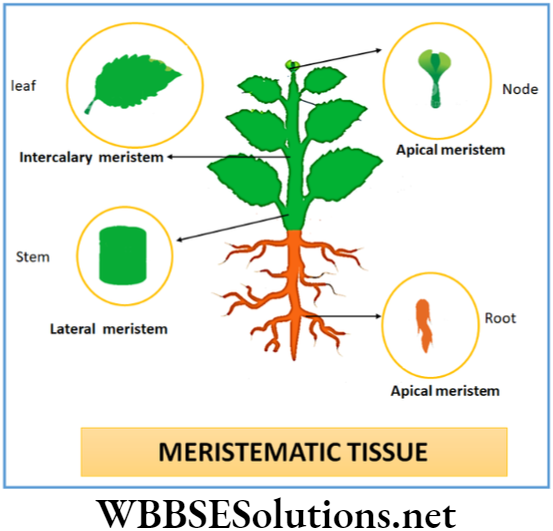
Meristematic tissue, also known as meristem, is composed of immature and continuously dividing cells. In plants, shoot and root tips are made up of meristematic tissues.
Read And Learn More NEET Biology Class 9 Question And Answers
Characteristics of Meristematic tissues
Types of meristematic tissues:
Meristem can be further classified based on the position or locations of meristematic tissues. They are of three types:

Are flowers, stems, and roots composed of the same types of tissues or cells? No. They have different functions. Therefore, they should have different cells to perform specific functions.
A flower cannot change into a leaf and a leaf cannot change into a stem. Therefore, component tissues are permanent and do not differentiate.
Permanent tissues are composed of mature cells, which have lost their power of division. Cells in a permanent tissue attain definite shape, size, and functions. They may be dead or living. Permanent tissues are derived from meristematic tissues.
Permanent tissues are broadly classified into two major groups: Simple permanent tissue and complex permanent tissue.

This permanent tissue consist of only one type of cells.
Types of simple permanent tissues:


WBBSE Class 9 Tissues Q&A


Do you know what complex permanent tissues are and what are its types?
Complex permanent tissues are conducting tissues, which take part in the transport function of plants. They are of two types–xylem (which transports water), and phloem (which transports food materials). The presence of this vascular tissue is an important feature of all complex terrestrial plants.
Xylem comprises of the following:

Phloem comprises of the following:

Question 1. meristem is responsible for the increase in the length of the stem and roots. responsible for the increase in the girth of the stem and roots. The information in which alternative completes the given statements?
Answer. 2. i – apical , 2-laterial eristem is
Question 2. The figure illustrates the location of meristematic tissues in plants. The label ‘X’ in the given illustration is meristem that helps in increasing the of stem and root.

Question 3. Which of the following organelles is absent in the cells of the meristematic tissue?
Answer. 2. Vacuoles
Understanding Types of Tissues for NEET
Question 4. The given figure illustrates the section of a stem.In the given figure, which labelled structure helps in increasing the girth of a banyan tree?

Answer. 3. 4
Question 5. Which type of permanent tissue helps in storing food in plants?
Answer. 1. Parenchyma
Question 6. Simple permanent tissue is made of only one type of cells. Which type of permanent plant tissue provides buoyancy to aquatic plants?
Answer. 3. Aerenchyma
Question 7. Permanent plant tissues are of two types: simple and complex. Which type of simple permanent tissue provides flexibility to plants?
Answer. 3. Collenchyma
Question 8. Stomata are present on the epidermis of the leaf. What is the primary function of stomata?
Answer. 4. Carrying out gaseous exchange
Question 9. The epidermis of some desert plants is covered with a thick, waxy coating of a chemical called . the chemical present in the walls of cork cells. It makes them impervious to water.The information in which alternative completes the given statements?
Answer. 1. 1 – cutin, 2-suberin is
Question 10. Some fruits such as plum and apricot have a hard coving over their seeds. Almond fruit has a hard covering over its seeds because of the presence of
Answer. 4. sclerenchyma
Question 11. The given list presents some of the simple permanent tissues found in plants.
1. Parenchyma 2. Collenchyma 3. Sclerenchyma 4. Epidermis 5. Cork
Which of the following pairs of tissues are made up of dead cells?
Answer. 3. 3 and 5
Question 12. Sieve tubes and companion cells are components of
Answer. 2. phloem
We breathe with the help of specialised cells called muscle cells . The contraction and relaxation of these cells result in movement. During breathing we inhale oxygen. This oxygen is absorbed in the lungs and then is transported to all the body cells through blood. Blood flows and carries various substances from one part of the body to the other. For example, it carries oxygen and food to all cells. It also collects wastes from all parts of the body and carries them to the liver and kidney for disposal. Blood and muscles are both examples of tissues found in our body. On the basis of the functions they perform we can think of different types of animal tissues, such as epithelial tissue, connective tissue, muscular tissue and nervous tissue. You can see the chart showing the classification of animal tissues.
The human body performs different types of functions. Since different cells perform different functions, the body must have many cells to perform one or more specific functions. Tissues are broadly classified into four different groups, namely epithelial, connective, muscular,and nervous tissues.
Let us explore epithelial tissues in detail.
Epithelial tissue
Do you know that since epithelium covers the body and all organs, all particles entering or leaving the body pass through it! Therefore, epithelial cells play an important medium for the transportation of substances in and out of the body.
Different types of epithelial tissues
Based on different shapes of epithelial cells, epithelium can be broadly classified as squamous epithelium, columnar epithelium, and cuboidal epithelium.

The human body performs different types of functions. Since different cells perform different functions, the body must have many cells to perform one or more specific functions. Tissues are broadly classified into four different groups, namely, epithelial, connective, muscular,and nervous tissues. Let us explore connective tissues in detail.
Epithelial tissues, muscular tissues, and nervous tissues are present in different regions and perform different functions.
How do tissues form a compact mass? It is because of the presence of connective tissues. They are loosely packed cells, present in intercellular spaces. Based on the region and function, their compositions differ.

Do you know where connective tissues are located in the human body?
Blood is a connective tissue. Blood consists of three different types of cells: red blood cells (RBC), white blood cells (WBC), and platelets (present in liquid part of plasma). The plasma consists of various proteins, minerals, salts, hormones, etc.
Different blood cells can be observed by first smearing a drop of blood on a clean glass slide and then staining the sample using a Leishman’s stain.

Bone is another connective tissue.
They are elastic and strong in nature. Tendons are similar to ligaments. Unlike ligaments, tendons connect muscles to bones. Tendons are fibrous and strong, but they are not very flexible.
Cartilage is another example of connective tissues.
The matrix in cartilage is composed of proteins and sugars. It is present in the nose, ear, trachea, and larynx.
We can bend and move our ears and nose because cartilage is flexible!
Areolar connective tissue is another type of connective tissue. They are present between the skin and muscles in the bone marrow. They are present in spaces found inside the organs. They also support organs because of the presence of cells (macrophages and mast cells), which also help in the repair of tissues.
Adipose tissues are those tissues where fat is deposited as fat globules. They protect the body from cold by providing an insulating layer.


The human body performs different types of functions. Since different cells perform different functions, the body must have many cells to perform one or more specific functions.
Tissues are broadly classified into four different groups, namely epithelial, connective, muscular, and nervous tissues.
Let us explore muscular tissues in detail.
Movement is an important function in animals. The system called muscular system performs this function. The muscular system is composed of muscular tissues.
Close your fingers to form a fist and then open the same. Repeat the process and observe the movements of your skin. What do you observe? You will observe contractions and relaxations of muscles. Muscle cells are elongated cells that contain special contractile proteins to aid this function. Some movements are controlled, while some other movements cannot be controlled. Therefore, these muscles are categorised into voluntary muscles and involuntary muscles.
Types of muscular tissues
Voluntary muscles
Involuntary muscles
The human body performs different types of functions. Since different cells perform different functions, the body must have many cells to perform one or more specific functions.
Tissues are broadly classified into four different groups, namely epithelial, connective, muscular, and nervous tissues.
Let us explore nervous tissues in detail.
Suppose we want to move our hand, but the question comes how we are going to do it?
Brain is the region where this information is generated, and the muscles are the tissues that are responsible for the movement.
The nervous system coordinates the functioning of all other systems.
Neurons consist of a cell body and an axon. The cell body contains a nucleus and cytoplasm. The axon elongates from the cell body and branches into many dendrites. Many nerve fibres with connective tissues form a nerve.


Question 1. Which type of epithelial tissue is found in the cells lining blood vessels?
Answer. 1. Squamous epithelium
Question 2. The given illustration represents the human respiratory system. In the given illustration, the structure labelled I is lined with which type of epithelial tissue?

Answer. 4. Simple squamous
Question 3. Skin is a protective body covering. Which epithelium is present in skin?
Answer. 1. Stratified squamous epithelium
Step-by-Step Guide to Tissues Questions
Question 4. The goblet cells are specialised cells found in the intestine, which secrete mucus. Mucus acts as a lubricant. Which of the following epithelial cells is modified as goblet cells?
Answer. 2. Columnar epithelium
Question 5. Ciliated columnar epithelium, which is made of cilia, is found in the lining of the
Answer. 1. Respiratory tract
Question 6. Blood is a type of connective tissue. Which of the following statements about the functions of blood is correct?
Answer. 1. It helps in transporting gases and nutrients
Question 7. In human respiratory system, the air enters the nostrils and is transported to the lungs through trachea. A particular connective tissue lines the trachea and prevents it from collapsing. Which connective tissue supports the trachea?
Answer. 4. Cartilage
Question 8. The given figure illustrates a type of connective tissue. In the given figure, the structure labelled ‘X’ is composed of which types of cells?

Answer. 2. Osteocytes
Question 9. Polar bears live at the North Pole. They have a number of adaptations to enable them to live in the harsh conditions. For example, they have a thick layer of blubber (fat) up to 11 cm, which helps them in keeping warm while swimming in cold water. Which type of tissues helps the polar bear in the given situation?
Answer. 2. Adipose tissue
Question 10. The given illustration represents a type of muscle.

The type of muscle shown in the given illustration is likely to be found in the
Answer. 3. stomach
Practice Questions on Plant and Animal Tissues
Question 11. The given illustration represents a neuron. In the given illustration, the structure labeled I is the

Answer. 4. axon
Question 12. Which connective tissue helps in storing fats?
Answer. 3. Adipose tissue
Question 13. Bones and muscles are connected to each other with the help of a connective tissue. Which connective tissue joins muscles to bones?
Answer. 1. Tendon
Question 14. The given figure illustrates the structure of nerve cell.

All the activities of the cell are controlled by the part labelled as
Answer. 3. 3
Question 15. The given figure illustrates some animal tissues.

Which of the following statements best describes the relationship between the cells in the given figure?
Answer. 1. 4 transmits messages to 3.
Question 1. The xylem is a complex permanent tissue, which is made of four different components. The tracheids and vessels are made up of dead cells and help in the vertical transportation of water and minerals. Which type of cells makes up the tracheids and vessels?
Answer. 4. Sclerenchyma
Question 2. In an experiment to study parasitism in rice plants, it was found that a species of fungi was able to penetrate the stem of rice plant. The fungi produced chemicals which degraded
Answer. 2. cuticle
Question 3. Piyush cut a branch of a dicot plant and put it in blue ink. After 2 hours, he observed that the leaves as well as the stem had turned blue.

The parts of stem and leaf respectively which have turned blue first are
Answer. 1. 1 and 3
Examples of Tissue Function Questions
Question 4. The primary function of the cells of the nervous tissue is to
Answer. 2. transmit stimulus
Question 5. Which tissue constitutes the husk of a coconut?
Answer. 3. Sclerenchyma
Question 6. The given illustration represents a neuron.

In the given illustration, the cell body of the neuron is labelled as
Answer. 3. 3
Question 7. The given illustration represents a neuron. In the given illustration, the structure labelled X is the

Answer. 2. dendrite
Question 8. The given illustration represents a type of muscle fibre. The illustrated muscle fibre is present in the
Answer. 1. heart
Question 9. Involuntary muscles control the movement of food in the alimentary canal. The cells of involuntary muscles are
Answer. 3. spindle-shaped and uninucleate
Question 10. Which of the following statements about bone is incorrect?
Answer. 1. It stores fats
Conceptual Questions on Applications of Tissues
Question 11. Which of the following statements about blood is incorrect?
Answer. 2. It forms the framework of the body
Question 12. Which connective tissue transports gases, nutrients, and wastes to different body parts?
Answer. 2. Blood
Question 13. What is the primary function of cuboidal epithelium?
Answer. 3. To prevent microbial infection
Question 14. The given figure represents a cell present in the inner lining of the gut.

Which epithelial tissue is represented in the given figure?
Answer. 3. Columnar epithelium
Key Terms Related to Tissues for Class 9
Question 15. Which illustration represents stratified squamous epithelium?

Answer.
4. 
Question 16. Which epithelial tissue forms the lining of the mouth?
Answer. 2. Simple squamous
Question 17. Which type of epithelium is present in the inner lining of the intestine?
Answer. 3. Columnar
Question 18. Which type of epithelium is illustrated in the given figure?
Answer. 2. Stratified squamous
Question 19. In plants, water and minerals are primarily transported through
Answer. 1. tracheids and vessels
Question 20. Phloem is a type of complex permanent tissue that helps in the translocation of food. Which component of phloem consists of dead cells?
Answer. 2. Phloem fibre