WBBSE Solutions For Class 7 Geography Chapter 6 Rock And Soil Topic A Rock

WBBSE Chapter 6 Rock And Soil Topic A Rock Long Question And Answers

Question 1. State the differences between rocks and minerals.
Answer:

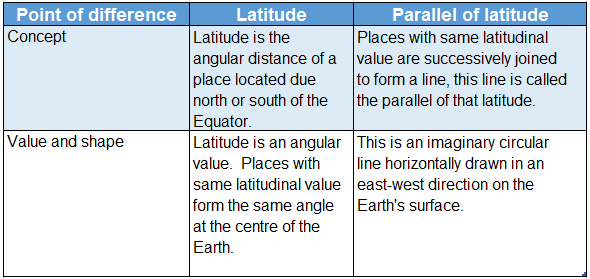
Differences between rocks and minerals:

The differences between rocks and minerals are as follows-

WBBSE Solutions For Class 7 Geography Chapter 6 Rock And Soil Topic A Rock Differences between rocks and minerals

Read And Learn Also WBBSE Solutions For Class 7 Geography

Question 2. What is meant by a rock? Describe the various types of rocks.
Answer:

Rock:

A rock can be defined as a naturally formed solid aggregate of one on more minerals present in varying proportions. In other words, all components that make up the Earth’s solid crust are called rocks.

Classification of rocks:

Based on origin, rocks can be classified into three types. They are as follows-

1. Igneous rock:

  • Igneous rock is formed by the cooling and solidification of hot molten lava or magma that comes out on the Earth’s surface or remains within the Earth’s interior due to volcanic activity.
  • Igneous rocks are the first-formed rocks on the Earth’s surface and are also known as primary rocks.

Example: Granite and basalt.

2. Sedimentary rock:

  • Sedimentary rocks are formed when igneous rocks get weathered and eroded by different natural agents (such as rivers, wind, glaciers, and ocean waves).
  • Erosion leads to the formation of small pebbles, cobbles and sand particles.
  • These smaller rock fragments are then transported by natural agents like rivers and wind are then deposited in layers under the sea as well as in other locations.
  • These layers of sediments under the sea get hardened and compacted over time to form hard rocks called sedimentary rocks.

Examples: Sandstone, mudstone, limestone.

3. Metamorphic rock:

  • Metamorphic rocks are formed when pre-existing igneous and ‘sedimentary rocks change into hard, crystalline rocks due to the effects of temperature and pressure of overlying materials.
  • This process is known as metamorphism.

Example: Marble from limestone and phyllite from slate.

WBBSE Solutions For Class 7 Geography Chapter 6 Rock And Soil Topic A Rock

Question 3. Make a comparative study of igneous, sedimentary and metamorphic rocks.
Answer:

A comparative study of igneous, sedimentary and metamorphic rocks:

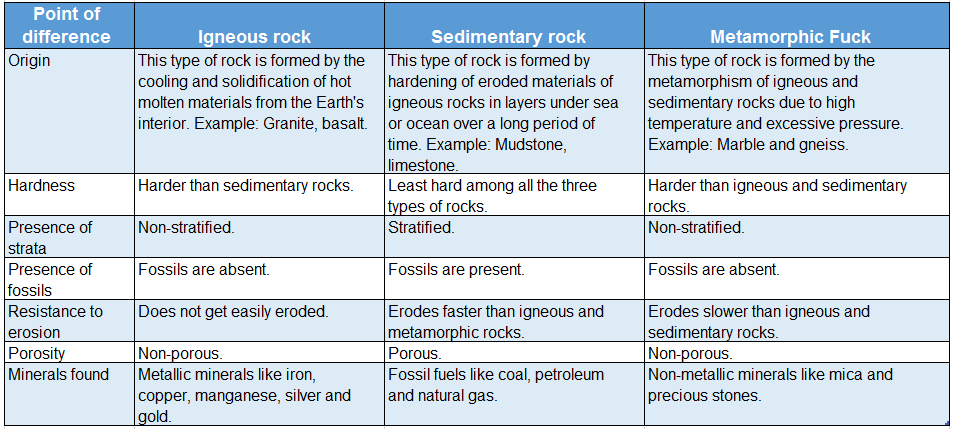
A comparative study of igneous, sedimentary and metamorphic rock is tabulated below-

WBBSE Solutions For Class 7 Geography Chapter 6 Rock And Soil Topic A Rock Differences between Igneous, Sedimentary and Metamorphic rocks


Question 4. Explain the importance of rocks in human life.
Answer:

Importance of rocks in human life:

The importance of rocks in the life of man can be classified into two groups-

1. Direct importance:

  1. Fossil fuels like coal and petroleum are obtained from the layers of sedimentary rocks.
  2. Valuable minerals like gold, silver, and copper are found in igneous rocks.
  3. Granite, basalt, etc. are used in the construction of roads.
  4. Limestone is used in cement and steel industries.
  5. Sandstone or claystone is used in the construction of buildings.

2. Indirect importance:

  1. Weathering of rocks like granite, gneiss, etc. forms red soil.
  2. Weathering of rocks like basalt forms black soil or regur.
  3. The permeable or impermeable nature of rocks determines its water-holding capacity.
WBBSE Class 7 Geography Notes WBBSE Solutions For Class 7 History
WBBSE Solutions For Class 7 Geography WBBSE Class 7 History Multiple Choice Questions
WBBSE Class 7 Geography Multiple Choice Questions WBBSE Solutions For Class 7 Maths


Question 5. What are igneous rocks?
Answer:

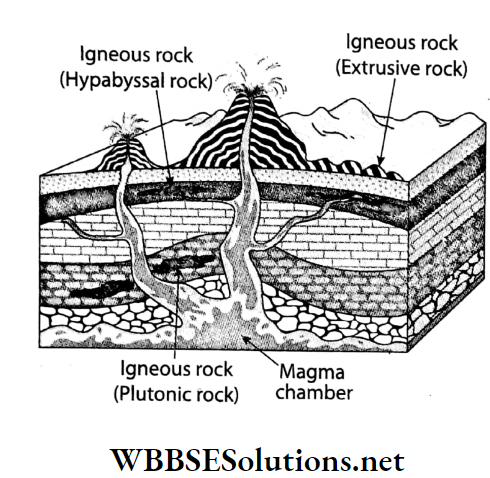
Igneous rocks :

  • Igneous rocks are formed through the cooling and solidification of hot molten lava or magma that comes out on the Earth’s surface or remains beneath it due to volcanic activity.
  • The term ‘igneous’ comes from the Latin word ‘ignis’ meaning fire.
  • For example, the two most important igneous rocks are granite and basalt.
  • Igneous rocks are the first formed rocks on the Earth’s surface and are also known as primary rocks.


WBBSE Solutions For Class 7 Geography Chapter 6 Rock And Soil Topic A Rock Igneous rock


Question 6. What are sedimentary rocks?

Answer:

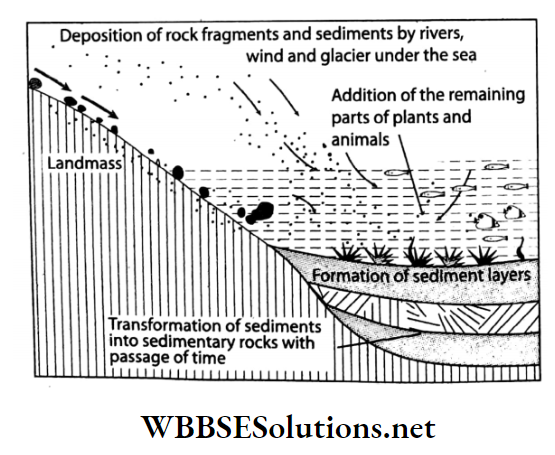
Sedimentary rocks:

  • Igneous rocks get disintegrated into small pebbles, cobbles and sand particles by the action of different natural agents such as rain, running water, wind, glacier, etc.
  • These fragments of rocks and sediments are then transported by glaciers, rivers, streams, winds, etc. and are subsequently deposited in layers under the sea.
  • With time, after being subjected to high temperatures and great pressure, these layers of sediments get hardened and compacted to form sedimentary rocks, such as sandstone, mudstone, and limestone.
  • Sedimentary rocks are formed by the deposition of sediment layers over a long period of time and so fossils or impressions of dead organisms are found in these rocks.

Examples of sedimentary rocks are sandstone, claystone, and limestone.


WBBSE Solutions For Class 7 Geography Chapter 6 Rock And Soil Topic A Rock formation of Sedimentary rock

Question 7. What are the characteristics of sedimentary rocks?
Answer:

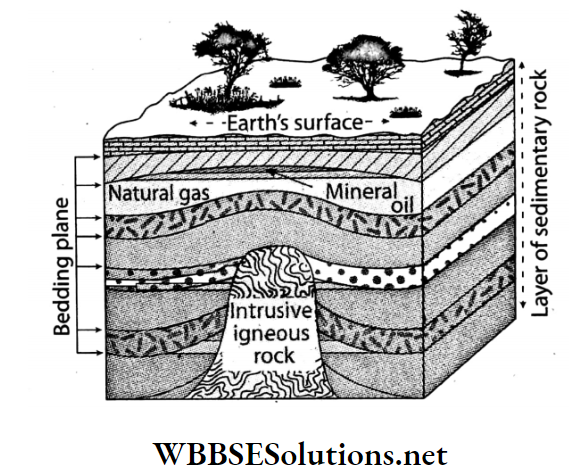
The characteristics of sedimentary rocks are as follows-

  1. Sedimentary rocks are formed in strata or layers. So they are also called stratified rocks.
  2. As they are soft and light, sedimentary rocks are prone to erosional activities.
  3. Sedimentary rocks are porous.
  4. Fossils are found in this type of rock.
  5. Fossil fuels such as mineral oil, coal, and natural gas are found in sedimentary rocks.


WBBSE Solutions For Class 7 Geography Chapter 6 Rock And Soil Topic A Rock Sedimentary rock


Question 8. What are the uses of sedimentary rocks?
Answer:

The uses of sedimentary rocks are-

  1. Fuels like coal, mineral oil and natural gas are found in sedimentary rocks.
  2. Sedimentary rocks like limestone and dolomite are used in the iron and steel industry, the cement industry and the construction of houses.
  3. Mudstone is used in idol-making.
  4. Sedimentary rocks being porous, act as an important source of groundwater.

Question 9. What are metamorphic rocks?
Answer:

Metamorphic rocks:

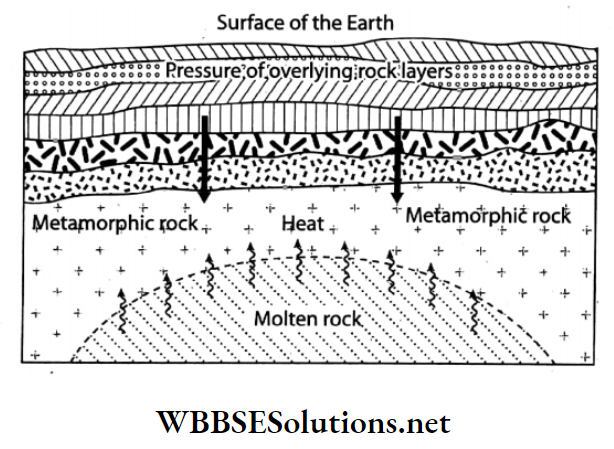
  • The word ‘metamorphism’ comes from the Greek word ‘meta’ meaning ‘change’. Under high temperatures and pressure of overlying materials, a pre-existing igneous or sedimentary rock may change into a hard new rock which is called metamorphic rock.
  • Their original character and appearance get altered due to various processes-thus changing their intrinsic properties like colour and hardness.
  • Sometimes, a metamorphic rock may change into a completely new form with a new mineral composition, such as, gneiss from granite (igneous rock), marble from limestone (sedimentary rock), phyllite from slate (metamorphic rock), etc.


WBBSE Solutions For Class 7 Geography Chapter 6 Rock And Soil Topic A Rock Origin of metamorphic rock


Question 10. Write the different characteristics of metamorphic rocks.
Answer:

The different characteristics of metamorphic rocks are as follows-

  1. Metamorphic rocks being hard and heavy are resistant to erosion.
  2. Metamorphic rocks are non-stratified.
  3. The fossils present in sedimentary rocks get destroyed due to heat and pressure. So, fossils are absent in metamorphic rocks.
  4. Metamorphic rocks are the last to form on the Earth’s surface.

Question 11. What are the uses of metamorphic rocks?
Answer:

The uses of metamorphic rocks are-

  1. Valuable minerals like iron, copper, gold, silver, mica, and manganese, are found in metamorphic rocks.
  2. As metamorphic. rocks erode slowly, they can be used for a variety of purposes. For example-Slate is used for writing. It is also used for making floors and roofs of houses.
  3. Marble, which is a metamorphic rock, is used for making palaces, monuments, houses, temples, etc.
  4. Gneiss is used in the construction of bridges and dams.

Question 12. Write a brief note on the Rock cycle.
Answer:

Rock cycle:

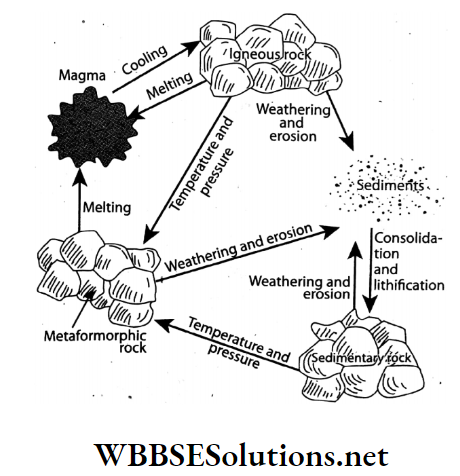
  • Magma solidifies to form igneous rocks which get disintegrated and decomposed by physical and chemical weathering.
  • These materials are then transported by various external agents such as rivers, glaciers and winds and are deposited in layers on the land surface or sea floor forming sedimentary rocks.
  • These in turn, gets metamorphosed when subjected to high temperature and pressure, forming metamorphic rocks.


WBBSE Solutions For Class 7 Geography Chapter 6 Rock And Soil Topic A Rock Rock cycle


Similarly, igneous rocks may transform into metamorphic rocks, metamorphic and sedimentary rocks into igneous rocks and metamorphic rocks into sedimentary rocks. This transformation of one rock to another over time is called the Rock cycle.

Question 13. What are fossils and how are they formed?
Answer:

Fossils:

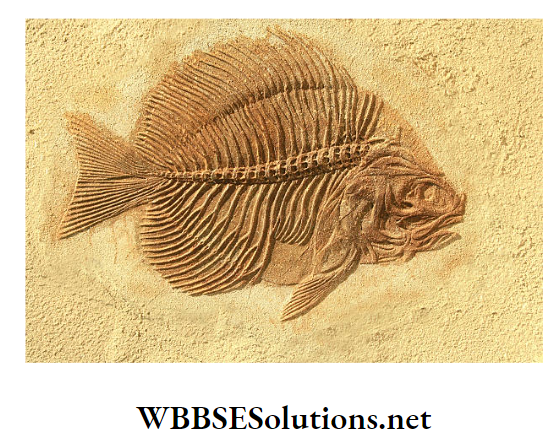
Fossils are preserved remains or traces of plants, animals and other organisms from the remote past. The geological age of rocks may be determined with the help of fossils.


WBBSE Solutions For Class 7 Geography Chapter 6 Rock And Soil Topic A Rock Fossil


Formation of fossils:

  • As living organisms die, its framework settles on the sea floor or land surface and is buried by sediments. With time, this sediment subjected to high pressure and temperature solidifies.
  • The buried framework dissolves forming a mould. Water rich in minerals enter the mould and fill the cavity, leaving behind a cast, similar to the original framework, known as a fossil.

Example:

Fossils or impressions of plants and animals are found in the layers of sedimentary rocks in the Himalayan region.

Question 14. Why are fossils are found in sedimentary rocks?
Answer:

Fossils are found in sedimentary rocks:

  • The process of formation of sedimentary rocks is highly responsible for the presence of fossils in its layers.
  • When layers of sediments accumulated on the sea floor or land surface are subjected to high temperature and pressure, the plant and animal remains buried within dissolve or undergo cementation and solidification leaving behind casts or traces.
  • This is the reason fossils are found in sedimentary rocks. For example, numerous fossils have been found in the Himalayas as it is formed of sedimentary rocks.

Question 15. What is the economic importance of rocks?
Answer:

1. Direct importance:

  1. Fossil fuels like coal and petroleum are obtained from the layers of sedimentary rocks.
  2. Valuable minerals like gold, silver, and copper are found in igneous rocks.
  3. Granite, basalt, etc. are used in the construction of roads.
  4. Limestone is used in the cement and steel industries.
  5. Sandstone or claystone is used in the construction of buildings.

Question 16. Write a brief note on gneiss.
Answer:

Gneiss:

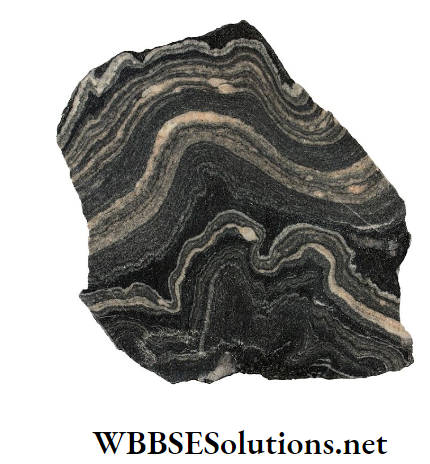
Gneiss is a type of metamorphic rock formed due to the metamorphism of granite.

  • The rock particles are quite large in size and minerals are present in clear bands.
  • It is pink in colour. The mineral constituents of gneiss are quartz, mica, and feldspar.


WBBSE Solutions For Class 7 Geography Chapter 6 Rock And Soil Topic A Rock Gneiss


WBBSE Chapter 6 Rock And Soil Topic A Rock Short Question And Answers

Question 1. What type of rocks are the sharp-edged stones found on a railway track?
Answer:

The sharp-edged stones found on a railway track:

  • The sharp-edged, dark grey stones found on railway tracks are actually basalt rock. Basalt is an igneous rock. So, when basaltic rocks are cut by machines, they generally attain sharp edges.
  • These stones are used to bear the load of the railway lines, keep the railway lines in place, help in drainage and prevent the growth of weeds on the railway tracks.

Question 2. What is a mineral?
Answer:

Mineral:

A mineral is a naturally-occurring inorganic substance that consists of one or more elements to form a rock.

Question 3. What is a rock?
Answer:

Rock:

  • All components that make up the Earth’s solid crust are called rocks. A rock may be defined as a naturally formed solid aggregate of one or more minerals present in varying proportions.
  • The term ‘rock’ not only refers to hard materials like granite but also includes loose and smaller particles like sand, pebbles, etc.

Question 4. Rocks are actually naturally formed aggregates of one or more minerals. Can you name some minerals which are commonly used in our daily life?
Answer:

Rocks are actually naturally formed aggregates of one or more minerals.

Some minerals which are commonly used in our daily life are salt, rock salt, baking soda, alum and pencil lead.

Question 5. How do rocks form on the Earth’s surface?
Answer:

Rocks form on the Earth’s surface:

  • The first rock to originate on the Earth’s surface is igneous rock, also known as primary rock. Magma comes out on the Earth’s surface through volcanic vents or fissures.
  • It cools and solidifies to form igneous rock.
  • Sedimentary rocks form from igneous rocks whereas metamorphic rocks originate from both igneous and sedimentary rocks.

Question 6. How can you classify rocks?
Answer:

Classification Of rocks:

All components that make up the Earth’s solid crust are called rocks.

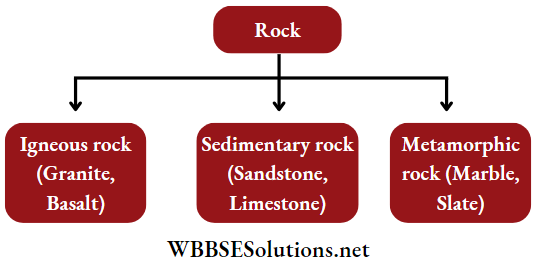
According to the origin, rocks can be classified into three types-

  1. Igneous rocks,
  2. Sedimentary rocks and
  3. Metamorphic Rocks.

WBBSE Solutions For Class 7 Geography Chapter 6 Rock And Soil Topic A Rock folwchart of Rock

Question 7. Why are metallic minerals commonly found in igneous rocks?
Answer:

Metallic minerals commonly found in igneous rocks:

  • Valuable minerals like gold, silver, iron, copper etc. are found in the magma of the Earth’s interior.
  • Since igneous rocks are formed from this magma, they are rich in metallic minerals.

Question 8. Write a short note on granite.
Answer:

Granite:

  • Granite is an igneous rock formed deep inside the Earth. Hot, molten magma from the Earth’s interior cools and solidifies over time to form granite.
  • Since it is formed in the deep interior of the Earth, it is also called plutonic rock.
  • In the absence of air, rate of cooling is very slow in the Earth’s interior, thus forming large crystals
  •  Granite can be red, pink or white in colour. The mineral constituents of granite are quartz, feldspar and mica.

Question 9. Briefly write about the rock basalt.
Answer:

Rock basalt:

  • Basalt is a type of igneous rock. Hot, molten, magma that comes out of the Earth’s interior through volcanoes cools rapidly and solidifies very fast to form fine crystals of basalt.
  • Basalt is black in colour and is very hard. The mineral constituents of basalt are pyroxene, iron, and olivine.

Question 10. Write a brief note on sandstone.
Answer:

Sandstone:

  • Sandstone is a type of sedimentary rock. Compaction and hardening of sand particles lead to the formation of this rock which can be found in several colours like white, brown, red, etc.
  • Sand particles are of various shapes.
  • If the sandstone is formed of fine particles, then it is called siltstone while a sandstone made of large particles is called a conglomerate.

Question 11. What do you know about limestone?
Answer:

Limestone:

Limestone is a sedimentary rock made of marine organisms.

  • Chemical reaction brings about the cementation of calcium carbonate (CaCO3) to form limestone.
  • Deposits of decomposed shells and skeletons of marine organisms form this sedimentary rock.
  • The limestone is brownish in colour. It is composed of calcite, which is very soft by nature.

Question 12. Write a short note on the slate.
Answer:

Slate:

  • Slate is a type of metamorphic rock. Great pressure metamorphoses mudstone, which is a sedimentary rock into slate. Its particles are very fine and smooth.
  • Slate is usually found in the form of smooth, flat sheets and is used to make roofs of houses. Slate is generally bluish-black in colour.

Question 13. Briefly mention the origin of different rocks.
Answer:

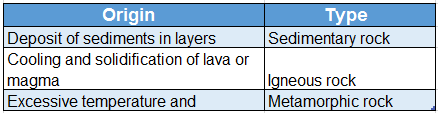
The origin of rocks are given in the following table-

WBBSE Solutions For Class 7 Geography Chapter 6 Rock And Soil Topic A Rock Origin of different rocks


Question 14. What are the characteristics of sedimentary and igneous rock according to strength?
Answer:

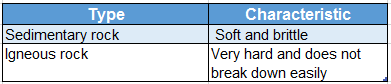
The characteristics of sedimentary and igneous rock according to strength are as below-

WBBSE Solutions For Class 7 Geography Chapter 6 Rock And Soil Topic A Rock Characteristics of sedimentary and igneous rock according to strength

Question 15. What are stratified rocks?
Answer:

Stratified rocks:

  • Rocks which have different layers or strata are called stratified rocks.
  • Since sedimentary rocks have strata, they are also known as stratified rocks.

Question 16. What are unstratified rocks?
Answer:

Unstratified rocks:

  • Unstratified rocks are those which do not have any strata or layers in them.
  • Igneous rocks and metamorphic rocks are called unstratified rocks because no strata or layers are found in these rocks.

Question 17. Describe the origin of igneous rocks.
Answer:

The origin of igneous rocks:

  • In the beginning, when the Earth was formed, it was just a glowing ball of gas. Gradually, it cooled down and its molten, volatile surface solidified.
  • Then in later geologic periods, hot molten materials came out through volcanic openings or cracks and faults, cooled and then solidified to form igneous rocks.
  • Since igneous rocks are the first formed rocks on the surface, they are also known as primary rocks.

Question 18. What are the uses of igneous rocks?
Answer:

The uses of igneous rocks are-

  1. Igneous rocks are very hard and are thus, used in the construction of buildings and roads.
  2. Metallic minerals (For example, iron, copper, silver, gold, etc) are found in igneous rocks.
  3. Regur soil is formed by weathering of basalt and is very useful for agriculture.
  4. Ancient temples and monuments in India were constructed with granite such as, in certain temples at Rameswaram and Tiruchirapalli of south India.

Question 19. What are the characteristics of igneous rocks?
Answer:

The characteristics of igneous rocks are-

  1. Igneous rocks are compact and massive.
  2. Igneous rocks do not have layers or strata and are also called unstratified rocks.
  3. They may possess metallic minerals.
  4. These rocks are hard and so they do not erode easily.
  5. They do not contain fossils.
  6. These rocks are non-porous as water cannot percolate.
  7. Igneous rocks are also called primary rocks.
  8. On polishing, these rocks appear smooth and glossy.

Question 20. Why are fossils not found in igneous rocks?

Answer:

Fossils are not found in igneous rocks because of the following reasons-

  1. Igneous rocks were formed at such a time when living organisms did not exist on Earth.
  2. If any organism or organic matter would have existed, then it would have got crushed under the heat, leaving behind no impressions during the cooling and solidification of magma to form igneous rocks.

WBBSE Chapter 6 Rock And Soil Topic A Rock Very Short Question And Answers

Question 1. What is actually a naturally formed aggregate of one or more minerals and is also an integral part of the lithosphere?
Answer: Rock.

Question 2. What is that naturally-occurring inorganic substance that consists of one or more elements to form a rock?
Answer: Mineral.

Question 3. Which rock, formed from cooled molten lava, was the first to be formed on the surface of the Earth?
Answer: Primary or Igneous rock.

Question 4. Which type of rock do we see right next to railway tracks?
Answer: Basalt.

Question 5. Which rocks do not have strata or layers?
Answer: Non-stratified rocks.

Question 6. What is another name for igneous rock?
Answer: Primary rock.

Question 7. What do we call the magma that reaches the Earth’s surface through a volcanic vent or fissure?
Answer: Lava.

Question 8. What is the term used to measure the void spaces in a rock structure?
Answer: Porosity.

Question 9. Name an igneous rock that is commonly used to construct roads.
Answer: Basalt.

Question 10. Which type of rock is formed by the solidification of lava?
Answer: Extrusive igneous rock.

Question 11. Which type of rock is formed by the solidification of magma?
Answer: Intrusive igneous rock.

Question 12. Which factors are responsible for the transformation of igneous and sedimentary rocks into metamorphic rocks?
Answer: Great heat and pressure of overlying materials.

Question 13. Which type of rocks are soft and brittle?
Answer: Sedimentary rocks.

Question 14. Which rocks have strata or layers?
Answer: Stratified rocks or sedimentary rocks.

Question 15. Which rock is formed due to the deposition of silt and sediment carried down by rivers on their banks?
Answer: Sedimentary rock.

Question 16. Name the black rock on which we can write with chalk.
Answer: Slate.

Question 17. Which rock is used as a raw material in the cement industry?
Answer: Limestone.

Question 18. Which rock is formed when the pre-existing igneous and sedimentary rocks are subjected to very high temperatures and pressure?
Answer: Metamorphic rock.

Question 19. During the formation of which rock do the minerals arrange themselves in one direction making the extraction of minerals easy?
Answer: Metamorphic rock.

Question 20. Name a metamorphic rock that is commonly used to construct monuments.
Answer: Marble.

Question 21. What do we call the remains and impressions of plants and animals embedded in sedimentary rocks formed due to pressure from the overlying sediment layers?
Answer: Fossils.

Question 22. Which fossil fuel, found in sedimentary rock, has hydrocarbon as its main constituent?
Answer: Mineral oil or petroleum.

Question 23. Which black-coloured rock-used as fossil fuel-is formed from plant remains that have been pressurised for millions of years?
Answer: Coal.

Question 24. What is the process of transformation of rock from one form to the other known as?
Answer: Rock cycle.

Question 25. In which type of rock is a fossil fuel found?
Answer: Sedimentary rock.

Question 26. Which rock is formed due to the deposition of sediments in layers within the waterbodies?
Answer: Sedimentary rock.

WBBSE Chapter 6 Rock And Soil Topic A Rock Fill In The Blanks

Question 1. Most of the Earth’s crust is composed of _________ minerals.
Answer: Silicate

Question 2. _________ is used in the construction of roads.
Answer: Basalt

Question 3. The Earth’s crust is composed of naturally- occurring substances called _________.
Answer: Rocks

Question 4. According to the origin, rocks can be classified into _________ types.
Answer: Three

Question 5. All rocks have their origin from _________ rocks.
Answer: Igneous

Question 6. Basalt is an example of _________ rock.
Answer: Igneous

Question 7. Granite is an example of _________ rock.
Answer: Igneous

Question 8. The western plateau of West Bengal is composed of _________ and _________.
Answer: Granite and gneiss

Question 9. The thin, outermost layer of the Earth on which we live is called _________.
Answer: Lithosphere

Question 10. Igneous rocks on the Earth’s surface have been weathered, _________ and broken into rock debris to form sand, pebbles and gravel.
Answer: Eroded

Question 11. An example of porous rock is _________.
Answer: Sandstone

Question 12. Chalk is an example of _________ rock.
Answer: Sedimentary

Question 13. Gneiss is an example of _________ rock.
Answer: Metamorphic

Question 14. The process by which rocks crumble and decay is known as _________.
Answer: Weathering

Question 15. Impressions of plants and animals embedded on sedimentary rocks are called _________.
Answer: Fossils

Question 16. Limestone Sedimentary rock:: Marble: _________.
Answer: Metamorphic rock

Question 17. Igneous rock: Basalt:: Mudstone: _________
Answer: Sedimentary rock

WBBSE Chapter 6 Rock And Soil Topic A Rock True Or False

Question 1. Sedimentary rocks are formed from sediment particles.
Answer: True

Question 2. Metamorphic rocks are formed under the influence of high temperature and pressure in the Earth’s interior.
Answer: True

Question 3. The first rock formed on the surface of the Earth is igneous rock.
Answer: True

Question 4. Metamorphic rocks are also known as stratified rocks.
Answer: False

Question 5 Minerals are not found within rocks.
Answer: False

Question 6. Fossils are found in sedimentary rocks.
Answer: True

Question 7. Strata cannot be found in igneous rocks.
Answer: False

Question 8. Sedimentary rocks are also called stratified rocks.
Answer: True

Question 9. Deccan Trap is made up of basalt.
Answer: True

Question 10. Porosity is an important characteristic of sedimentary rocks.
Answer: True

Question 11. Coal is an example of igneous rock.
Answer: False

Question 12. Sandstone is an example of stratified rock.
Answer: True

Question 13. Fossil fuels like coal and petroleum are found in igneous rocks.
Answer: False

Question 14. The metamorphosed form of limestone is marble.
Answer: True

Question 15. Cooling and solidifying of magma in the Earth’s interior forms intrusive igneous rocks.
Answer: True

Question 16. Minerals are organic components.
Answer: False

Question 17. Augite is an example of a rock-forming mineral.
Answer: True

Question 18. Limestone is used in the pottery industry.
Answer: False

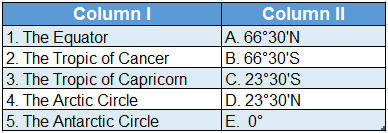
WBBSE Chapter 6 Rock And Soil Topic A Rock Match The Columns

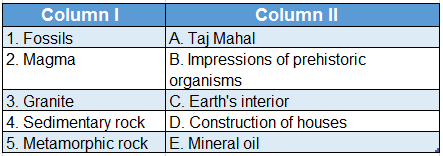
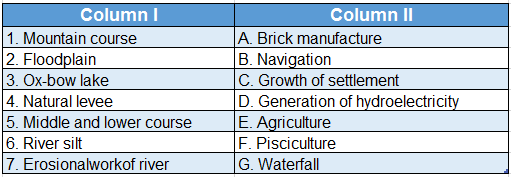
Question 1.WBBSE Solutions For Class 7 Geography Chapter 6 Rock And Soil Topic A Rock Match the Columns

Answers: 1. B, 2. C, 3. D, 4. E, 5. A

WBBSE Solutions For Class 7 Geography Chapter 5 River Topic B Works Of River And Its Influences On Our Life

WBBSE Chapter 5 River Topic B Works Of River And Its Influences On Our Life Long Question And Answers

Question 1. What are the works of a river in its upper course? Describe the features created in its mountainous stage.
Answer:

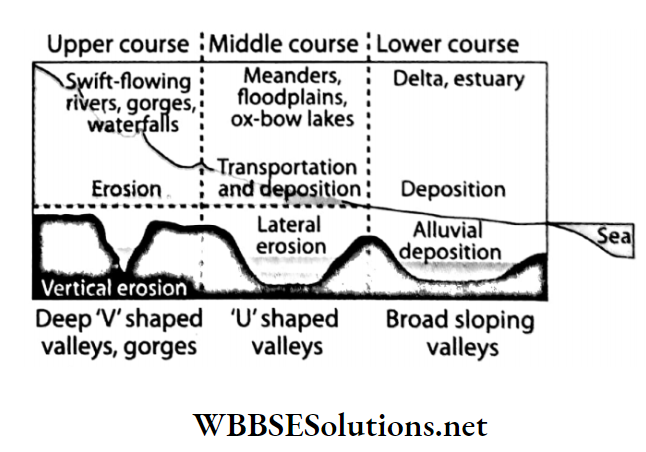
Works of a river in its upper course:

The river flows through a mountainous region in its upper course. So its velocity is very high. Its main work is erosion and it also carries the eroded materials along as it flows.

Features created by the river in its mountainous stage:

The main features created by the river in its mountainous stage are-

1. Gorge and canyon:

The river forms a deep and narrow valley in the mountainous region due to intensive vertical erosion. In the moist regions, lateral erosion also takes place along with vertical erosion. This forms a wide, V-shaped valley. This is called a gorge.

Read And Learn Also WBBSE Solutions For Class 7 Geography

Example: Gorge of River Kali in Nepal.

In certain regions, only vertical erosion takes place. This gives rise to deep l-shaped valleys called canyons. Example: The Grand Canyon of River Colorado is the largest canyon in the world.

WBBSE Solutions For Class 7 Geography Chapter 5 River Topic B Works Of River And Its Influences On Our Life Gorge and Canyon

2. Waterfall:

  • The waterfall is a variation in the general level of a flowing river. When the river flows down a steep slope, its mass of water suddenly jumps downwards.
  • When the river reaches a soft bedrock from a resistant bedrock, the soft rocks get eroded quickly farming a steep slope. Here, the river jumps down forming a waterfall.

Example: Shivasamudram Falls on Cauvery and Jog Falls on Sharavati.

3. Plunge pool:

The large hole formed at the foot of a waterfall as a result of continuous striking by water and heavy rocks is called a plunge pool. Its size and depth depend on the height of the waterfall, the volume of water and the volume of the suspended rocks.

Question 2. Describe the features formed in the middle course of the river.
Answer:

Features formed in the middle course of the river:

  • In the middle stage, the slope of the land is moderate and so the velocity as well as the energy of the river decreases.
  • At this stage, its main work is transportation and deposition.

The main features formed by a river in this stage are:

1. Meander:

In the middle course, the energy of the river decreases due to changes in the slope. If the river faces any obstacle, it begins to move in a winding path called meander. It may also form a hairpin bend.

Example: The Ganga has formed a beautiful bend near Varanasi.

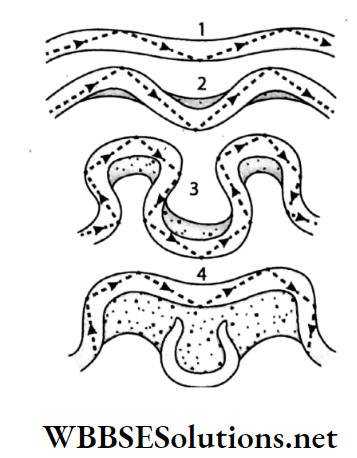
2. Ox-bow Lake:

  • When the river moves in meanders, lateral erosion also occurs on the outer banks. Gradually any two bends or loops move near each other and the river straightens its course cutting off from the loops.
  • As deposition simultaneously occurs on the inner bank, the loops get clogged and separated. This part resembles a horse-shoe and is, therefore, called a horse-shoe lake or an ox-bow lake.

3. River Island:

  • Since the slope of the land is moderate in the middle course of a river, its transportation power decreases. So the river’s load i.e. pebbles, silt, sand and gravel get deposited in the middle or on the two sides of the river.
  • Sedimentation takes place and sometimes, island-like structures are formed. These are called river islands. The Majuli Island on the Brahmaputra is a famous river island and is also the largest river island in the world.

4. Wide and shallow valley:

In this stage vertical erosion decreases and the depth of the valley also decreases. However, due to the increase in the volume of water, lateral erosion increases proportionately. This results in the widening of the valley.

WBBSE Solutions For Class 7 Geography Chapter 5 River Topic B Works Of River And Its Influences On Our Life

Question 3. Describe the features formed in the lower course of the river.
Answer:

Features formed in the lower course of the river:

The main work of the river in the lower course is deposition. The main features formed in this course of the river are-

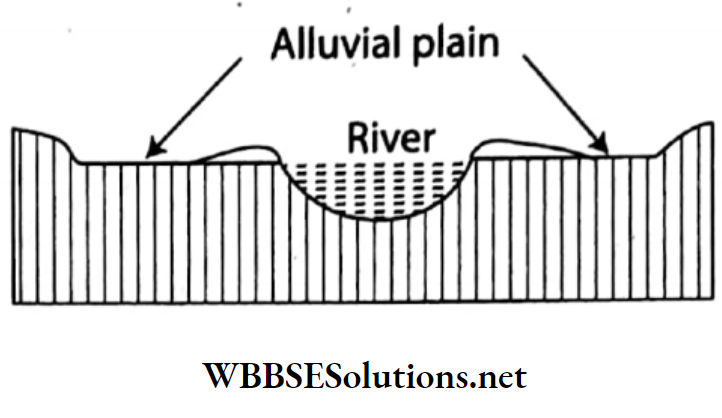
1. Floodplain:

  • The river flows very gently in its lower course. So pebbles, sand and silt get deposited on the river bed which becomes shallow due to deposition. Every year, when the volume of water increases during the rainy season, the river overflows its banks.
  • This causes a flood. The sedimentation on the bank that results because the flood water spills over the lands on both banks, makes them very fertile. The plain thus formed on the banks is called a floodplain.

Example: The Ganga forms a floodplain in its lower course.

2. Natural levee:

  • Sometimes, the sediments transported during a flood get deposited in a heap on the banks.
  • They form natural embankments called levees.
  • They are about 2-3 metres higher than the floodplains.

3. Delta:

  • When the sand, silt and clay transported by the river get deposited at the mouth, a triangular-shaped structure is formed.
  • This is called a delta. As it looks like the Greek letter A, it is named so.
WBBSE Class 7 Geography Notes WBBSE Solutions For Class 7 History
WBBSE Solutions For Class 7 Geography WBBSE Class 7 History Multiple Choice Questions
WBBSE Class 7 Geography Multiple Choice Questions WBBSE Solutions For Class 7 Maths


Question 4. Draw a comparison among the different courses of a river.
Answer:

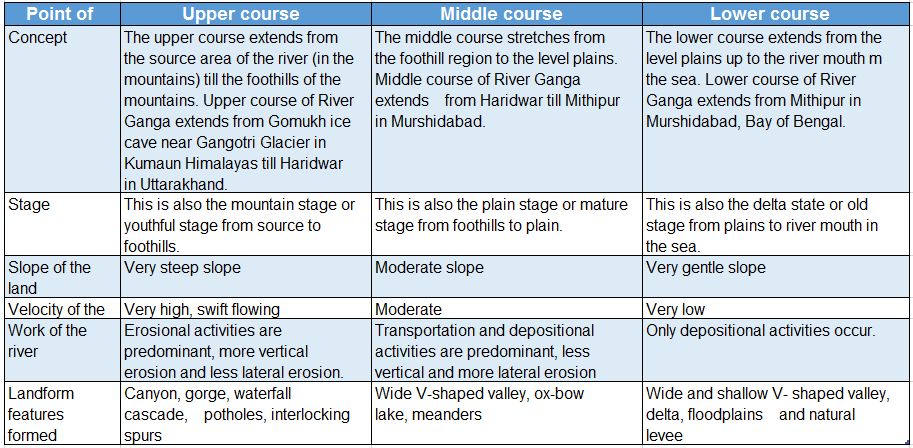
A comparison among the different courses of a river:

A comparison among the different courses of a river is as follows-

WBBSE Solutions For Class 7 Geography Chapter 5 River Topic B Works Of River And Its Influences On Our Life Comparision among the different courses of a river


Question 5. Write about the influence of rivers on our life.
Answer:

The influence of rivers on our life:

The influence of rivers on our life can be discussed as follows-

  1. Rivers are a source of drinking water from times immemorial.
  2. Fertile silt deposits on the banks of the rivers are good for agricultural activities.
  3. In the industrial sector, river water acts as a raw material.
  4. Places on the river banks have moderate climatic conditions in comparison to extreme climatic conditions in areas away from the influence of water.
  5. Rivers play an important role in maintaining the balance of our earth’s hydrological cycle. Rivers are one of the main sources of water vapour, which condenses and forms precipitation and carries on the hydrological cycle.
  6. Rivers are the natural route of transport and communication between different countries that help in the navigation and transport of trade items.
  7. Perennial rivers enhance the irrigation system of the country. Canals, drawn out from the perennial rivers, provide water for irrigation even in the dry season.
  8. River deltas are the hotspots for aqua culture, that involves commercial fish farming or pisciculture.
  9. Rivers are also used to generate hydroelectricity. The energy of water flowing through a river, spins a turbine to produce electricity.

Question 6. Write about the consequences of human activities on the health of a river.
Answer:

The negative consequences of human activities on the health of a river:

Even though rivers have a very influential effect on human life. Man has never adequately valued this natural resource. Different human activities have often had negative consequences on the health of a river. Like-

1. Multi-purpose river valley projects:

  • Dam-building on the rivers might yield short-term benefits but has long-term negative consequences also. Building a dam on the upper reaches of the river results in the drying up of the lower course.
  • Again, at times during monsoon, heavy rainfall in the upper reaches causes devastating floods in the lower course along the banks which destroys life and property and hampers the ecosystem.

2. Water pollution due to industrialisation:

  • Discharge of industrial wastes into the river water and discharge of fertiliser mixed water from the agricultural fields pollute the rivers
  • This water pollution in turn kills the fish in the river.

3. Irrigation on the agricultural fields:

  • Daming on the river to divert the river water for irrigation to agricultural fields results in the drying up of the rivers.
  • On the other hand, discharged water from agricultural fields carries soil sediments and crop residues along with it.
  • These settle on the river beds making them shallow and prone to floods.

4. Urbanisation:

  • The expansion of urban settlements on the river banks is mainly due to the increase in demand for the river water.
  • This excessive use of river water decreases its volume. Also, the household wastes dumped into the river hugely pollute the river.

Question 7. The majority of the Indian population resides in the Ganga River Basin. Our lives depend on this river. What are the probable consequences if the Ganga dries up?
Answer:

The probable consequences if the Ganga dries up:

River Ganga is the main and the most voluminous river of India. The probable consequences if the Ganga dries up are-

  • Scarcity in drinking water: One-third of the Indian population resides in the Ganga Basin and is dependent on the purified water of this river for drinking purposes. If the river dries up, there would be a large scale drinking water scarcity in the country.
  • Problem in water transport: The waterways on the Ganga would be rendered useless and thus creating a huge problem in water transport, if the Ganga dries up.
  • Shut down of industries: The industries on the banks of the Ganga are hugely dependent on the river water for their manufacturing process. A dried-up river would impact the industries.
  • Infertile agricultural fields: The floodplains would run infertile in the absence of water and that would affect the agricultural production.
  • Scarcity in groundwater: In the absence of river water, the dependency on groundwater would increase magnanimously. As a result, the groundwater table would rapidly deplete.
  • Death of aquatic organisms: If the Ganga dries up, all the aquatic organisms in the water would die, disrupting the ecological balance

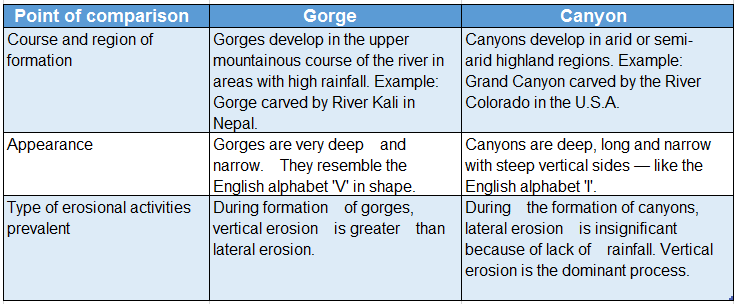
Question 8. Compare a gorge and a canyon.
Answer:

The comparison between a gorge and a canyon are given in the table below.

WBBSE Solutions For Class 7 Geography Chapter 5 River Topic B Works Of River And Its Influences On Our Life Comparision between Gorge Canyon


Question 9. Write a note on waterfalls.
Answer:

Waterfalls:

  • If alternate bands of hard and soft rocks the harder rocks being more resistant remain exist horizontally along the course of the river, protruding outward like an outcrop while the softer rocks are easily eroded.
  • When the river plunges over the protruding rock beds, a waterfall is formed.
  • Waterfalls are commonly formed along young swift flowing streams.


WBBSE Solutions For Class 7 Geography Chapter 5 River Topic B Works Of River And Its Influences On Our Life Waterfall


Waterfalls form in the upper courses of the rivers because of the steep slope of the land and the presence of faults in the course of the rivers.

  • For example, Gersoppa or Jog Falls on the Sharavati River in Karnataka is the second-highest waterfall in India.
  • More intensive erosion of the softer rocks in comparison to the resistant rocks makes the harder rocks collapse, disturbing the balance of the waterfall-forming conditions.
  • This is called the ‘retreat of a waterfall’.

Question 10. Briefly write about potholes.
Answer:

Potholes:

Potholes are formed when a river cuts directly into its bedrock as a result of vertical erosion and processes of abrasion. Potholes are deepened by spherical or disc-shaped stones which are often found at their bottom.

WBBSE Solutions For Class 7 Geography Chapter 5 River Topic B Works Of River And Its Influences On Our Life Potholes

A spiralling flow of water or turbulence in the pothole rotates these spherical or disc-shaped stones gradually boring into the rock and scooping out the softer rocks.

For example, potholes are found on the bed of River Subarnarekha.

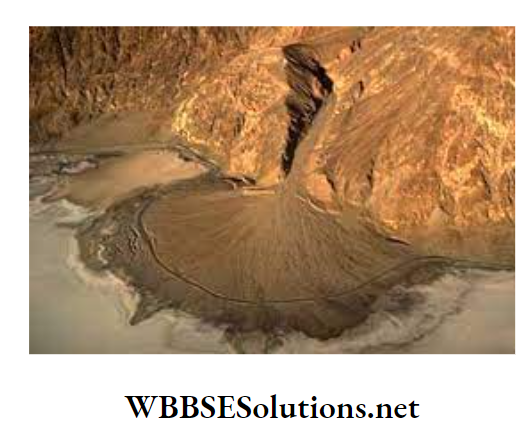
Real-Life Scenarios Involving Flood Management

Question 11. Write a short note on the alluvial fan and alluvial cone.
Answer:

Alluvial fan and alluvial cone:

When a river leaves the mountainous terrain and enters the plain, there is a sudden decrease in the steepness of the land slope and its erosive power.

  • This causes the river to deposit its load comprising boulders, pebbles, sand, and silt in a conical manner leading to the formation of an alluvial cone.
  • As the river continues to flow over the alluvial cone, it sometimes radiates downslope into a fan-shaped deposit comprising the finer particles called an alluvial fan.
  • The sediment content is more in the case of alluvial cones than fans.


WBBSE Solutions For Class 7 Geography Chapter 5 River Topic B Works Of River And Its Influences On Our Life Alluvial fan


Question 12. Discuss the middle course or plain stage of a river.
Answer:

The middle course or plain stage of a river:

  • When the river leaves the mountains and flows over land with relatively low height, it is in the middle course.
  • The moderate slope of the land, greater volume of water and moderate velocity of river flow decrease its erosional activity and mainly transport the eroded materials with little deposition along the channel.
  • For example, the middle course of the River Ganga extends from Haridwar to Mithipur in Murshidabad.

Question 13. What are the characteristics of a river in its middle course?
Answer:

The characteristics of a river in its middle course are-

  1. The moderate slope of the land lowers the speed of the river flow.
  2. The volume of water increases as many tributaries join the main channel leading to an increase in the ‘load’ carried by the river.
  3. The main work of a river in the middle course is lateral erosion or side-cutting and transportation. The river water here is used for irrigation as well as for navigation.

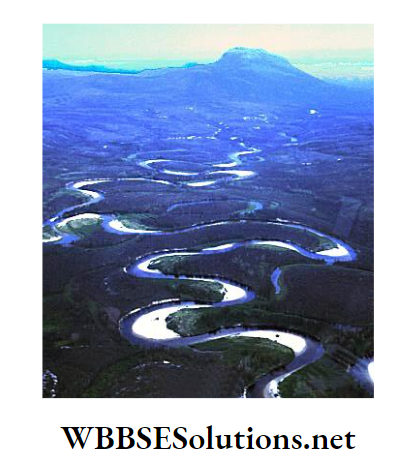
Question 14. Write a note on meander.
Answer:

Meander:

In the plain stage or middle course of a river there is a sudden decrease in the velocity of water flow.

  • The river winds its course the moment it gets the slightest resistance.
  • When the river channel winds its course through a series of bends, it forms meanders or loops.
  • The term ‘Meander’ has been derived from the winding River Menderes in Asia Minor.

Example: the meandering course of River Ganga can be observed near Varanasi.


WBBSE Solutions For Class 7 Geography Chapter 5 River Topic B Works Of River And Its Influences On Our Life Meandering course of a river


Question 15. Briefly write about sandbars and braided rivers.
Answer:

Sandbars and braided rivers:

In the middle course, the slope of the land becomes moderate and the velocity of the river decreases. So the river deposits the sand, silt etc.carried from the mountains on the valley floor forming sandbars or, the bigger ones eventually form river islands.

  • The river gradually becomes shallow due to the extensive formation of sandbars with time.
  • Valley widening takes place as a number of tributaries join the main river.
  • The water of the main river branches out into several channels due to the presence of sandbars in its course forming a braided river.

Example:

River Brahmaputra is a braided river as it has formed many river islands along its course in Assam of which Majuli is the largest.

WBBSE Solutions For Class 7 Geography Chapter 5 River Topic B Works Of River And Its Influences On Our Life Sandbars and braided river

Examples of Real-Life Applications of River Knowledge

Question 16. How are river cliffs and slip-off slopes formed?
Answer:

River cliffs and slip-off slopes formed:

A river has two bends or banks- an outside bend or concave bank and an inside bend or convex bank.

  • The water dashes straight to the outside bend, eroding it and forming a steep river cliff while the eroded sediments, get transported and are deposited in the inner bend or convex bank forming a gentle slip-off slope.
  • The outer bend is therefore the bank of continuous erosion while the inner bend is the bank of continuous deposition.

Question 17. Write about ox-bow lake.
Answer:

Ox-bow lake:

In the plain stage or middle course of a river, since the land has a moderate slope, it winds its course the moment it gets the slightest resistance.

  • As the river meanders, its steeper bank gets eroded, while these eroded sediments get deposited on its opposite bank. In this way, meanders become prominent.
  • When two such steeper banks come very close to each other, the meander neck is pronounced, making it difficult for the river to follow such a curved course.


WBBSE Solutions For Class 7 Geography Chapter 5 River Topic B Works Of River And Its Influences On Our Life Stages of ox-bow lake formation


  • The river then flows straight, leaving behind a cut-off lake with its ends sealed off by deposition.
  • This abandoned channel of water is known as an oxbow lake or horseshoe lake, as it resembles the foot of a horse in shape.

Example: Oxbow lakes are commonly seen in the plain stage of River Ganga.

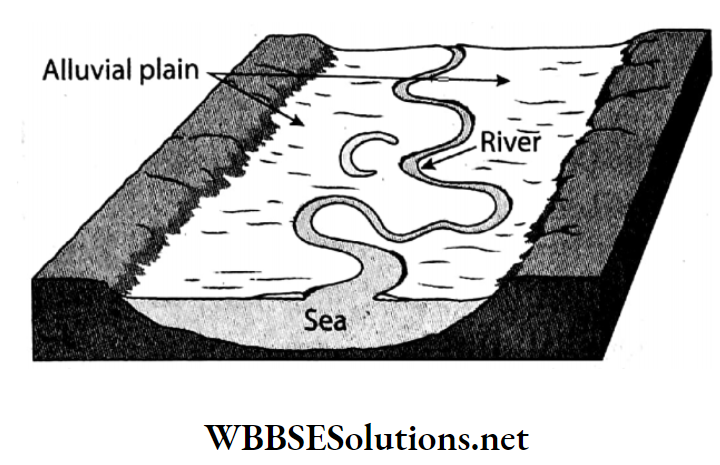
Question 18. Discuss the lower course or delta stage of a river.
Answer:

Lower course or delta stage of a river:

  • When the river flows over extensive level land near its mouth, it is in the lower course.
  • Alluvium deposition is the main work of the river in this course caused by gently sloping land.
  • The river deposits its load leading to the formation of various small and big deltas.
  • Here, the main river channel subdivides itself into numerous channels i.e., distributaries before draining into the ocean or sea.

For example, the lower course of River Ganga extends from Mithipur in Murshidabad to the Bay of Bengal.

Question 19. What are the characteristics of a river in its lower course?
Answer:

The characteristics of a river in its lower course are-

  1. In its lower course, the river flowing along gently sloping lands becomes sluggish as the velocity of flow reduces drastically.
  2. The main work of the river in this course is deposition. The river deposits its entire bed load comprising alluvium or silt.
  3. Before flowing into the ocean or sea most of the rivers develop deltas at their mouths. This stretch of the river is highly navigable.


WBBSE Solutions For Class 7 Geography Chapter 5 River Topic B Works Of River And Its Influences On Our Life Characteristicks of a river in its different courses

Important Definitions Related to River Works

Question 20. Why is deposition the main work of a river in its lower course?
Answer:

Deposition is the main work of the river in the delta stage or lower course because-

  1. Near its mouth, the slope of the land and the velocity of the water flow decreases.
  2. The load carried by it increases.
  3. It follows a winding course instead of a straight course.
  4. Near its mouth, the action of water currents helps in deposition.

Question 21. Write a short note on floodplains and natural levees.
Answer:

Floodplains and natural levees:

  • In the lower course, a river carrying pebbles, sand, silt, etc. makes its valley shallower. At times of flood, the volume of water in the river increases and the river then overflows its banks.
  • The silt brought by flood water is then spread over the low-lying areas along the channel and further away.
  • These result in the formation of floodplains. Floodplains are very favourable for agricultural activities.
  • Large deposits of silt or mud on either side of the river often form an elongated deposit which then creates a ridge or embankment. This is called levee.

Example:

Floodplains and natural levees are found along the course of River Ganga near Rajmahal Hills in the state of Jharkhand.

WBBSE Solutions For Class 7 Geography Chapter 5 River Topic B Works Of River And Its Influences On Our Life Floodplain and natural levee

Question 22. What are the causes of frequent floods in the lower course of a river?
Answer:

Floods are frequent in the lower course of a river because-

  1. Numerous tributaries joining the main river increase the volume of water near its mouth.
  2. As the land slope is gentle, the velocity of river flow decreases.
  3. Sand, silt and clay are deposited on the river bed making it shallow.
  4. In the rainy season, as the volume of water increases, the river overflows its banks and causes a flood.

Question 23. Briefly write about delta formation.
Answer:

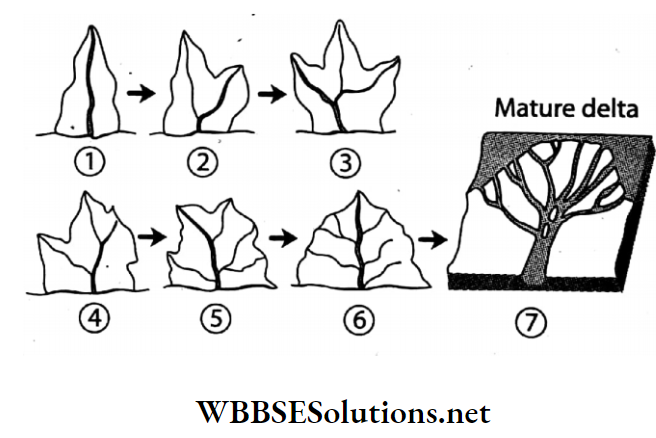
Delta formation:

  • In the lower course of a river, the slope of the land is very gentle. This leads to a slow and sluggish flow of water with almost no erosional activities.
  • When the river reaches the sea, the fine sediments are deposited at its mouth forming a fan-shaped alluvial land called delta. The word ‘delta’ originated from the Greek letter Δ.

For example, the Ganga-Brahmaputra Delta is the largest delta in the world.

  • Due to the obstruction in the river flow caused. by the deposited alluvium, the river may discharge its water through several channels which are known as distributaries.
  • The river bifurcates at these deltas and the distributaries flow along its sides.
  • Deltas can be further classified into several types depending on the shape they take.


WBBSE Solutions For Class 7 Geography Chapter 5 River Topic B Works Of River And Its Influences On Our Life Step of delta formation


Question 24. What are the conditions necessary for the formation of a delta?
Answer:

The favourable conditions for delta formation are-

  1. Large amounts of sediment should be carried by the river.
  2. The coast should be preferably tideless.
  3. The sea adjoining the delta should be current less and shallow or else the sediments will disappear in the deep water.
  4. There should be no large lake in the river course because the sediments will get deposited in the lake.
  5. The wind must blow from the opposite direction.
  6. The river must have a long course which will help to collect a large amount of eroded matter as bed load.
  7. The river must have a large number of tributaries.

Question 25. What are the causes for the formation of distributaries in the delta stage?
Answer:

In the delta stage, many distributaries form because-

  1. At the mouth of the river, the land slope is gentle and the water is shallow. Though the volume of water is more, the velocity is less and the river divides into several channels as soon as any rock obstructs its path.
  2. The sand banks obstruct the flow of the river forcing it to branch out into channels.
  3. Thus, the sediment load carried by the river paves the way for the formation of its distributaries.

Question 26. What are the reasons for some rivers not forming deltas?
Answer:

The reasons for some rivers not forming deltas are-

  •  At the mouth of the river near the sea, river current and rate of transportation decreases while the rate of deposition increases.
  • But this rate of deposition should be more than the velocity of the ocean current. If the velocity of the river carrying the eroded materials is more, then the sediments will get carried deep into the sea and not form a delta.
  • If the river is not very long it will not have caused much erosion all through its course.
  • If the river has a lesser number of tributaries the amount of sediment carried would be less.
  • If the river has eroded less in its upper and middle courses the amount of sediment carried would be less.
  • If the coast is not sheltered.
  • If the wind blows in a direction as that of the river, the sediments will be carried into the sea due to the wind.

For example, west-flowing rivers like Narmada and Tapi do not form deltas.

Question 27. River Ganga is an ideal river.-Give reason.
Answer:

River Ganga is an ideal river:

The main river of India, River Ganga performs erosional activities in its upper course or mountain stage (from Gomukh ice cave near Gangotri Glacier in Kumaun Himalayas to Haridwar in Uttarakhand), transportation activities in its middle course or plain stage (from Haridwar to Mithipur in Murshidabad) and depositional activities in its lower course or delta stage (from Mithipur in Murshidabad to river mouth in Bay of Bengal).

Since River Ganga displays all three courses distinctly it is called an ideal river.

Question 28. Discuss the three courses of River Ganga.
Answer:

The three courses of River Ganga are-

  1. The upper course or mountain stage of River Ganga extends from Gomukh ice cave near Gangotri Glacier in Kumaun Himalayas to Haridwar in Uttarakhand.
  2. The middle course or plain stage or River Ganga extends from Haridwar in Uttarakhand to Mithipur in Murshidabad.
  3. The lower course or delta stage of River Ganga extends from Mithipur in Murshidabad to the river mouth in the Bay of Bengal.

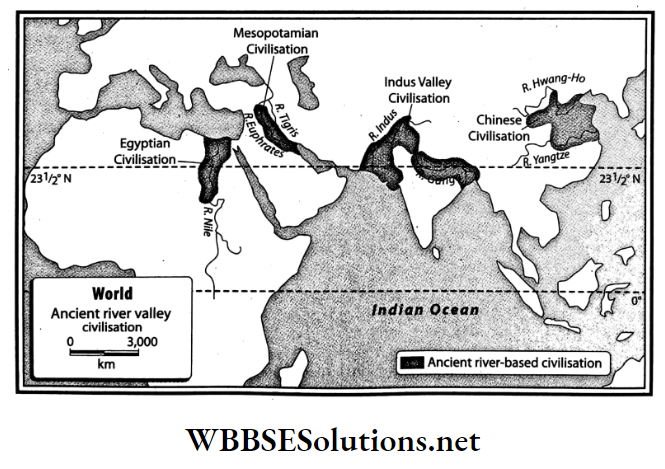
Question 30. What is meant by river valley civilisations?
Answer:

River valley civilisations:

In ancient times, the ease of conducting agricultural activities along the river banks caused the growth and development of human settlements there.

  • There were other advantages of living in settlements on the banks of rivers – such as the plentiful supply of water for drinking and other activities, communication through waterways as well as growing trade.
  • As the population increased, these settlements developed and transformed into proper towns and cities.
  • Throughout history, many civilisations have developed along the rivers.

Example:

Indus Valley Civilisation along River Indus, Chinese Civilisation along River Yangtze and Hwang Ho, Mesopotamian Civilisation along River Tigris and Euphrates and the Egyptian Civilisation along River Nile.


WBBSE Solutions For Class 7 Geography Chapter 5 River Topic B Works Of River And Its Influences On Our Life Ancient river valley civilisations

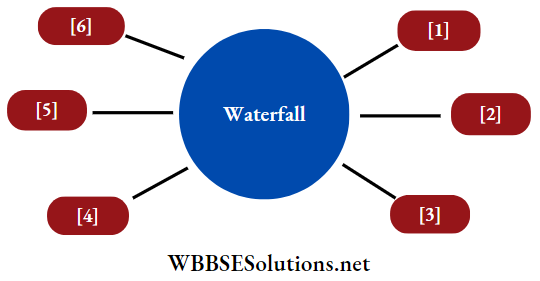
Question 31. Fill up the knowledge hive information about the waterfall.

WBBSE Solutions For Class 7 Geography Chapter 5 River Topic B Works Of River And Its Influences On Our Life Water fall

Answers:

1. A waterfall forms along a steep slope, that may have formed, along the course of a river due to an earthquake.
2. The direction of a river changes at the waterfall.
3. A nick point is formed along the course.
4. In a plateau region waterfall may form due to the presence of faults along the course.
5. Waterfalls form where hard and soft rocks lie along the course alternately.
6. If the balance of waterfall forming conditions is disturbed, the waterfall retreats.

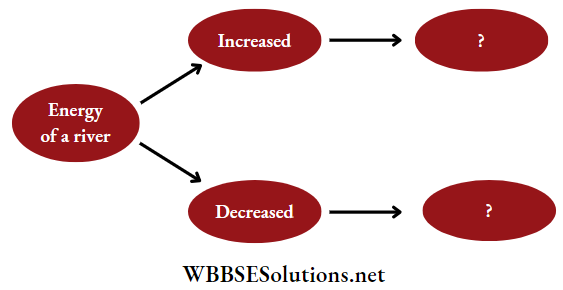
Question 32. Think and write down.

WBBSE Solutions For Class 7 Geography Chapter 5 River Topic B Works Of River And Its Influences On Our Life Energy of a river

Answers:

1. Enhanced erosion
2. Enhanced deposition

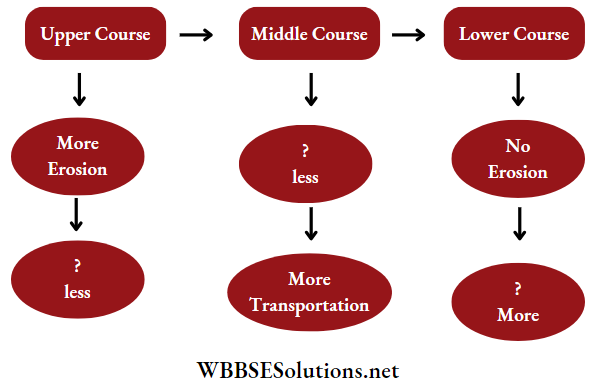
Question 33. Fill it up correctly.

WBBSE Solutions For Class 7 Geography Chapter 5 River Topic B Works Of River And Its Influences On Our Life courses

Answers:

1. Deposition
2. Erosion
3. Deposition

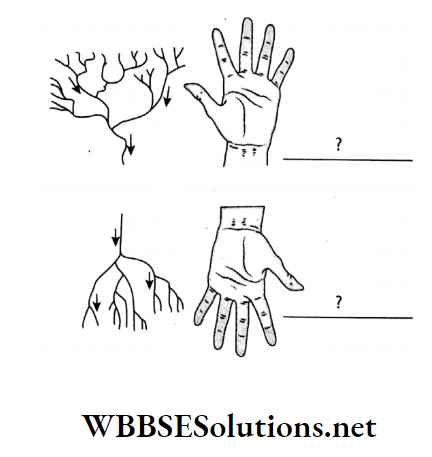
Question 3.


WBBSE Solutions For Class 7 Geography Chapter 5 River Topic B Works Of River And Its Influences On Our Life Tributaries and Distributaries


Answers:

1. Tributaries
2. Distributaries

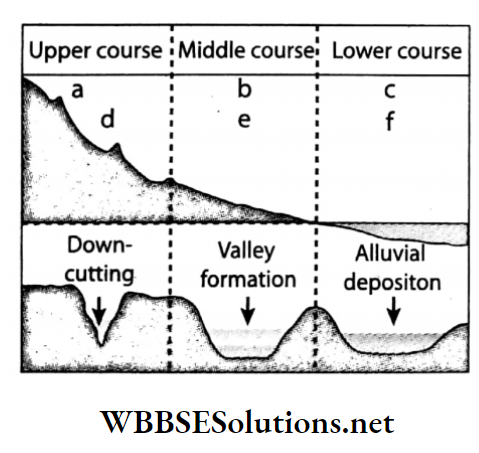
Question 34. A diagram of the course of a river is given below. Now mark the works of the river in its different stages as (a), (b) and (c) and the landforms as (d), (e) and (f).


WBBSE Solutions For Class 7 Geography Chapter 5 River Topic B Works Of River And Its Influences On Our Life work of the rivers and different stages


Answers:

1. Works of the river-(a) erosion and transportation (b) transportation and deposition (c) deposition.
2. Features-(d) gorge, waterfall, rapid (e) meander, ox-bow lake, river island (f) delta, floodplain.

Question 35.


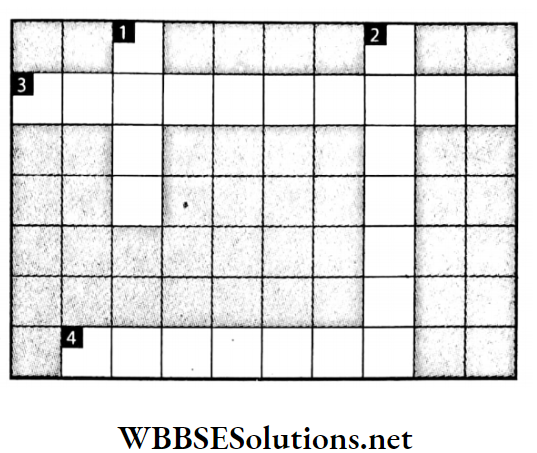
WBBSE Solutions For Class 7 Geography Chapter 5 River Topic B Works Of River And Its Influences On Our Life Crossword

Down:

1. Fertile stretch of land lying between two rivers.
2. Sand deposits are found in the middle of the river.

Across:

3. Flooded banks of a river.
4. Winding path of a river.

Answers:

Down: 1. DOAB, 2. SAND BAR
Across: 3. FLOODPLAIN, 4. MEANDER

Question 36.


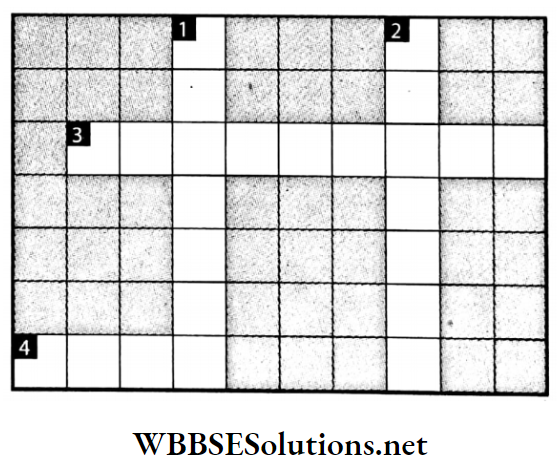
WBBSE Solutions For Class 7 Geography Chapter 5 River Topic B Works Of River And Its Influences On Our Life Crossword.

Down:

1. Kettle-like depressions on the river bed.
2. Winding course of a river.

Across:

3. Vertical fall of water in mountainous regions.
4. Longest river of the world.

Answers:

Down: 1. POTHOLE, 2. MEANDER
Across: 3. WATERFALL, 4. NILE

Question 37.


WBBSE Solutions For Class 7 Geography Chapter 5 River Topic B Works Of River And Its Influences On Our Life Crossword.,

1. Where a river meets the sea.
2. River in which water flows throughout the year.
3. River originating from a main river.
4. A highland that makes rainwater runoff to different sides to form rivers flowing in different directions.
5. Deep-cut river valley in a dry region.
6. River water falls from a height along a steep slope to form a ________.
7. Alluvium is deposited along both banks of a river during a flood to form.


WBBSE Solutions For Class 7 Geography Chapter 5 River Topic B Works Of River And Its Influences On Our Life Crossword...


Answers:

1. MOUTH,
2. PERENNIAL,
3. DISTRIBUTARY,
4. WATERSHED,
5. CANYON,
6. WATERFALL,
7. FLOODPLAIN

Question 38. What is an ‘interlocking spur’?
Answer:

  • As the river wanders in the mountainous region eroding the landscape, it winds and bends to avoid areas of hard rock along its course.
  • This profile of mountains when seen from a distance appears as an interlocked feature like the teeth of a zip known as an interlocking spur.

WBBSE Solutions For Class 7 Geography Chapter 5 River Topic B Works Of River And Its Influences On Our Life Interlocking Spur

Question 39. What is the sixth power law?
Answer:

The river processes-erosion, transportation and deposition, are related to one another. The velocity of flowing water controls these riverine processes.

  • An increase in the velocity of running water increases the energy of the river while a decrease in the velocity of running water decreases the energy.
  • If the velocity of the river increases 2 times then the rate of transportation of the river increases 6 times (26 = 64).
  • The proportional relationship between velocity and transportation is called the sixth power law.

The load that can be carried by a river depends on the following factors-

  1. The velocity of water flow,
  2. The volume of water,
  3. Amount of load.

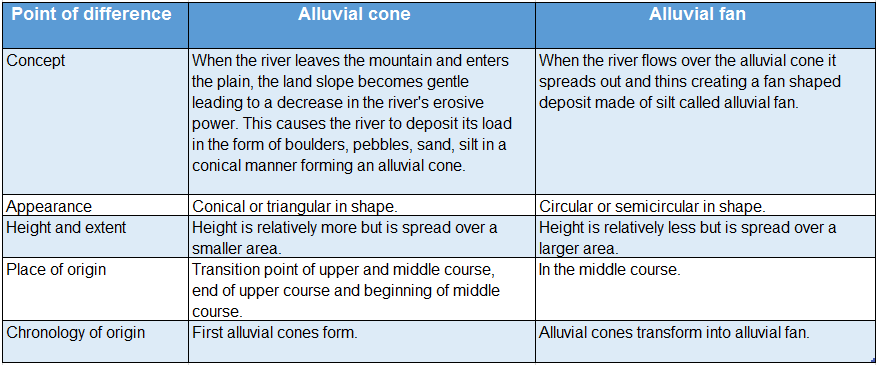
Question 40. Differentiate between an alluvial fan and an alluvial cone.
Answer:

The differences between an alluvial fan and an alluvial cone are listed in the table below-

WBBSE Solutions For Class 7 Geography Chapter 5 River Topic B Works Of River And Its Influences On Our Life Difference between Alluvial cone and Alluvial Fan

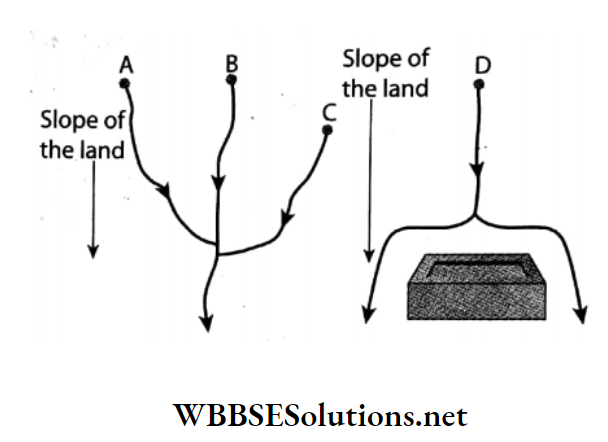
Question 41. Pour water on sloping surfaces in your yard, in the park or in the school playground. Watch where the water flows. It surely flows from the higher to the lower ground. Now, mark three points ‘A’, ‘B’ and ‘C’ at different heights in the upper reaches of the slope. Pour water at these three points and observe how the water along the three channels flow.

Mark another point ‘D’. Keep a brick a foot down the slope from ‘D’ and pour water on the point. Now, observe how this channel lays out.
Answer:

  • If we pour water in the yard, in the park or on a sloping place, we will see that the water starts flowing. The place from where the water starts flowing in the source. and the direction to which the. water is flowing, is the mouth.
  • Three points ‘A’, ‘B’, and ‘C’ are marked 6 inches apart at the top of a slope. If we pour water at those three points and wait for a while, we will see that the Slope of the land three streams start flowing from the high to the low end of the slope.


WBBSE Solutions For Class 7 Geography Chapter 5 River Topic B Works Of River And Its Influences On Our Life Water starts flowing


  • These are tributaries because those three streams join with the former stream. Another point ‘D’ is taken. In front of point ‘D’ a little away a brick or a big stone is placed.
  • This time, if water is poured from point ‘D’, the flowing water will get obstructed at the brick and then it will bifurcate on both sides of the brick. Thus the distributaries are formed.

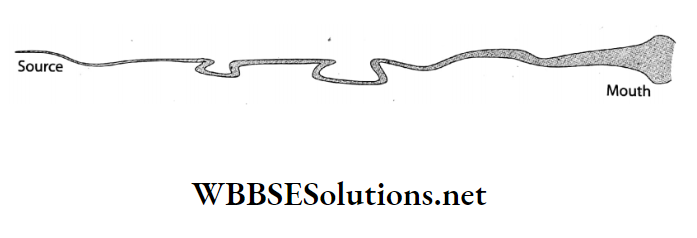
Question 42. Can you make out something from the diagram?


WBBSE Solutions For Class 7 Geography Chapter 5 River Topic B Works Of River And Its Influences On Our Life Source and mouth

Answer:

What I could make out from the given diagram are as follows:

  1. A general idea about the course of a river from source to mouth and the main works of a river can be established.
  2. The slope of the entire river basin is from west to east.
  3. Three stages of the river i.e., upper, middle and lower, are clearly noticeable.
  4. Narrow valleys in the upper course, meanders in the middle and floodplain estuaries in the lower course are noteworthy here.
  5. This river is a perennial one.
  6. There are neither tributaries nor distributaries of the river, as found in the diagram.

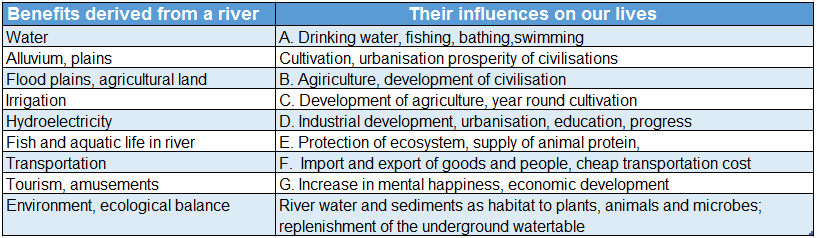
Question 43. You can fill this up from the college

WBBSE Solutions For Class 7 Geography Chapter 5 River Topic B Works Of River And Its Influences On Our Life Influnces on our lives

Answer:

WBBSE Solutions For Class 7 Geography Chapter 5 River Topic B Works Of River And Its Influences On Our Life Benefits derived from a river, influences on our lives

WBBSE Chapter 5 River Topic B Works Of River And Its Influences On Our Life Short Question And Answers

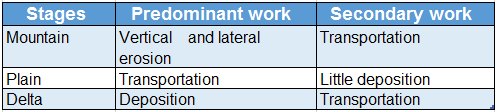
Question 1. Mention the work of the river in its different stages.
Answer:

WBBSE Solutions For Class 7 Geography Chapter 5 River Topic B Works Of River And Its Influences On Our Life Work of the river in its different Stages


Question 2. Why is erosion an important riverine activity in the mountain stage?
Answer:

  • The upper course or mountain stage of a river extends from the source to the foothills of mountains.
  • In this stage, the swift-flowing river mainly erodes the rugged mountain terrain and steep land due to the high velocity of the water flow and carries the eroded materials downstream.
  • Thus, erosional activities can be distinctly observed in the upper course due to the processes of attrition, solution and corrosion or abrasion.

Question 3. Define the water cycle.
Answer:

Water cycle;

  • A river is an important part of the water cycle. Rainwater drains along a river and empties into the sea.
  • Water evaporating from the sea and other waterbodies cool down and come back as rain into the rivers.
  • This cyclical movement of water is known as the water cycle.

Question 4. What is a V-shaped valley?
Answer:

V-shaped valley:

  • In humid regions, rivers in their upper course usually form a V-shaped valley, as a result of extensive vertical erosion along the steep slope of the land and slight lateral erosion due to rainfall.
  • The narrow river valley with its steep slopes resembles the English letter ‘V’. It is also known as a gorge.

Question 5. What is an ‘estuary’?
Answer:

Estuary:

  • In the delta stage or lower course, if the velocity of the river is high, the sediments are carried into the sea along with the water.
  • Thus no delta is formed and the river mouth becomes very wide.
  • This wide, funnel-shaped mouth of the river is called an estuary. Example: Tidal rivers of Sundarbans form estuaries.

Question 6. Define an ideal river.
Answer:

Ideal river:

  • A river which displays all three stages from source to mouth i.e., upper course or mountain stage, middle course or plain stage and lower course or delta stage is called an ideal river.
  • For example, the main river of India, the River Ganga is an ideal river.

Question 7. Identify the course of a river in which the landform shown in the following figure is seen.
Answer:

Upper course of a river.

WBBSE Solutions For Class 7 Geography Chapter 5 River Topic B Works Of River And Its Influences On Our Life Upper course of a river

Question 8. What is meant by transportation by suspension?
Answer:

Transportation by suspension:

  • Fine light materials like sand, silt and mud are carried along with the water as the stream flows.
  • This is called transportation by the suspension.

Question 9. What is meant by transportation by the solution?
Answer:

Transportation by the solution:

  • The minerals present in the rocks eroded by the river get dissolved in the water and are carried along the channel by solution.
  • Limestone and salt also dissolve in water and are transported down the channel by solution.

Question 10. What is meant by transportation by dissolving action is the work of fresh water, saltation?
Answer:

Transportation by dissolving action is the work of fresh water, saltation:

  • The transportation of eroded particles like small pebbles which make intermittent leaps from the river bed is called saltation.
  • In this process, particles are lifted from the river bed, carried short distances downstream, returned to the river bed, lifted again and so on.
  • These particles are of intermediate size and too heavy to be suspended load.

Question 11. What is meant by transportation by traction?
Answer:

Transportation by traction:

  • Eroded particles that are too heavy for saltation move along the river bed by traction.
  • These include coarser materials such as pebbles, stones, rocks and boulders.
  • These particles either roll and slide along the river bed or move forward by mutual collision.

Question 12. What is meant by ‘erosion by attrition’?
Answer:

Erosion by attrition:

  • Attrition is a form of erosion, in which the bed load is eroded due to friction between itself and the bed.
  • The rocks break down into smaller pieces by rubbing against one another and by the pressure of water.
  • The pebbles, stones and boulders carried by the river current roll and collide with one another and break into finer particles. Gradually the rocks turn rounder and smoother.

Question 13. What is meant by ‘erosion by solution’?
Answer:

Erosion by solution:

  • Erosion by solution takes place due to the action of water on soluble or partly soluble rocks which the river comes in contact with.
  • Erosion by dissolving action is the work of fresh water, salt water, and acidic water.

Example:

Calcium carbonate present in limestone gets easily dissolved and eroded by solution when rivers flow through limestone topography.

Question 14. What is meant by ‘erosion by cavitation’?
Answer:

Erosion by cavitation:

  • In the upper course of a river, air bubbles form in the water as the river flows at a high speed.
  • The air trapped within these bubbles bursts and sends ripples outwards, eroding the river banks by creating cracks in the rocks.

Question 15. What is ‘erosion by hydraulic action’?
Answer:

Erosion by hydraulic action:

  • Erosion by hydraulic action is caused by water flowing over the stream bed and bank.
  • This flow, coupled with the impact of other smaller forces, easily loosens and erodes smaller alluvial matter, such as gravel, sand, silt and clay.

Question 16. Observe any river near your home and get an idea about its characteristics.
Answer:

I live in Balagarh village of Hooghly district.

  1. Name of the river: Hooghly River
  2. The volume of water (high/low): High
  3. The velocity of water (high/low): Low
  4. The slope of the land (steep/gentle): Gentle
  5. So, which course of the river are you watching (upper/middle/lower): Lower course

Question 17. What do you mean by the term ‘river processes’?
Answer:

River processes:

A river uses its energy to carry out three main processes-

  1. Erosion
  2. Transportation
  3. Deposition.

In the upper course or mountain stage, the river is in its youth stage and carries out erosional activities on the surrounding landscape. It also transports the eroded materials with little or no deposition. In the middle course or plain stage, the river mainly transports the eroded materials down its channel. There is little lateral erosion. In the lower course or delta stage, the river deposits its bed load along the channel with little transportation.

Question 18. What is meant by river load?
Answer:

River load:

The eroded rock debris carried by a river along its course is known as river load. A river’s load includes rocks, stones, pebbles, sand, and silt, much of which are washed along the river bed.

River load is mainly of three types-

  1. Soluble load or dissolved load,
  2. Suspended load,
  3. The load is carried by saltation and traction or bed load.

Question 19. List the governing factors in the erosion, transportation depositional work of a river.
Answer:

The governing factors in the erosion, transportation and depositional work of a river are-

  • The volume of water: The increase or decrease of the volume of water is directly proportional to the rate of erosional and transportation capacity of a river.
  • The velocity of water: The velocity of a river directly determines its erosional and transportation capacity.
  • The slope of the land: The slope of the land is also directly proportional to the work of the river. The higher is the slope, the higher is the rate of work and vice versa.

Question 20. What are the sources of the energy of a river?
Answer:

The sources of the energy of a river are-

  1. Streams flowing through steep slopes have greater energy as compared to ones flowing through gentle slopes.
  2. The more is the volume of water in a river, the more is energy and vice-versa.
  3. The higher is the stream’s velocity, the higher is the energy and vice-versa.
  4. As the bed load carried by the river increases, the energy of the river decreases and vice-versa.

Conceptual Questions on the Cultural Significance of Rivers 

Question 21. What are the factors on which the rate of transportation is dependent?
Answer:

The rate of transportation depends on-

  • Volume of water: If the volume of water increases, the rate of transportation by the river also increases.
  • Velocity of water flow: If the velocity of the river increases, transportation by the river also increases. The velocity of the river depends on the slope of the land – the velocity of the river increases if the land is steep, thus increasing the rate of transportation.
  • The grain size of the sediment load: If smaller and finer particles are carried by the river, transportation is more as compared to that of larger particles.
  • Nature of particles: If particles being transported are soluble, the rate of transportation increases.

Question 22. Discuss the upper course or mountain stage of a river.
Answer:

Upper course or mountain stage of a river:

  • The upper course or mountain stage of a river extends from the source area of the river in the mountains to the foothills.
  • Steepness of the land slope, strong currents and high velocity of water flow in the channel lead to erosional activities along this stretch.

Example: The upper course of River Ganga extends from Gomukh ice cave, near Gangotri Glacier in Uttarakhand to Haridwar.

Question 23. What are the characteristics of a river in its upper course?
Answer:

The characteristics of a river in its upper course are-

  1. The river in its youth stage flows through mountainous or plateau regions. The steep slope of the land makes vertical erosion or down-cutting by the river very prominent.
  2. Though the ‘load’ of the river is less, transportation takes place due to the high velocity of the water flow.
  3. Since the river is swift-flowing, it helps in the generation of hydel power in this course but is unsuitable for navigation.

Question 24. Write a short note on the gorge and Canyon.
Answer:

Gorge and Canyon:

In mountainous regions, laterally eroded V-shaped valleys undergo rapid vertical erosion due to an increase in the velocity of water flow along the steep slopes.

  • This deep valley with steeply sloping sides, resembling the English letter ‘V’ is called a gorge. Gorges are a common feature in dry mountainous regions.
  • For example, Rivers Indus, Ganga and Brahmaputra have carved deep gorges along their courses in the Himalayas.
  • One of the deepest gorges in the world is carved by River Colca in Peru (4,370 m).
  • When the snow-fed river passes through rain-less, arid areas, lateral erosion becomes almost insignificant.
  • If non-resistant rocks are present at the valley bottom, it leads to rapid down- cutting forming very narrow and deep gorges resembling the English letter ‘I’ called canyons.
  • Example: Grand Canyon on River Colorado (1800 m deep) is world famous.

Question 25. What is a canyon or I-shaped valley?
Answer:

Canyon or I-shaped valley:

In arid and semi-arid regions, erosional activities by the river lead to the formation of I-shaped valleys because physical weathering has a more localised effect in arid zones.

  • The wind and the water of the river combine to erode and cut away the less resistant rock fragments.
  • The freezing and expansion of water and seepage of water into the cracks between the rocks eventually widen the valley.
  • Such narrow, deep valleys, resembling the English letter ‘l’ are called canyons.

WBBSE Chapter 5 River Topic B Works Of River And Its Influences On Our Life Very Short Question And Answers

Question 1. Where do you find water flowing faster- on a flat surface or on a slope?
Answer: On a slope.

Question 2. When does water flow faster on slopes- when the volume of water is more or when the volume of water is less?
Answer: When the volume of water is more.

Question 3. Name a river that you have seen flowing in graceful loops.
Answer: River Ganga near Varanasi.

Question 4. In which course is the velocity of a river maximum?
Answer: Upper course.

Question 5. What is an I-shaped river valley called?
Answer: Canyon.

Question 6. What is a V-shaped deep river valley called?
Answer: Gorge.

Question 7. What is the aggregate of solid matter transported by river called?
Answer: River load.

Question 8. What is a fan-shaped depositional feature of a river called?
Answer: Alluvial fan.

Question 9. What is the winding course of a river known as?
Answer: Meander.

Question 10. What is a horse-shoe-shaped lake called?
Answer: Oxbow Lake.

Question 11. In which course of a river does deposition mainly take place?
Answer: Lower course.

Question 12. What is the principal work of the river in its lower course?
Answer: Deposition.

Question 13. What is a feature developed due to the accumulation of sand, silt, etc in the lower course of a river called?
Answer: Floodplain.

Question 14. What is a funnel-shaped river mouth known as?
Answer: Estuary.

Question 15. What is a river comprising three distinct courses known as?
Answer: Ideal river.

Question 16. What is the base level of river erosion?
Answer: Sea level.

Question 17. What are the small holes formed on the surface of rocks due to air bubbles known as?
Answer: Cavitation.

Question 18. What is the wear and tear of transported materials due to mutual collision termed as?
Answer: Attrition.

Question 19. By which process are the very fine rock fragments transported from one place to another?
Answer: Suspension.

Question 20. What is meant by ‘erosion by abrasion or corrasion’?
Answer:

Erosion by abrasion or corrosion:

Abrasion is the wearing away and the breaking up of rock surfaces along the valley sides using bed load (rocks, pebbles, boulders) as the grinding tools.

Question 21. I am a feature formed by a river falling from higher to lower altitudes in the form of steps. Who am I?
Answer: Waterfall

Question 22. I am a kettle-shaped depression on the river bed formed by the whirling motion of water. Who am I?
Answer: Pothole

Question 23. I am a fan-shaped depositional landform at the foothills. Who am I?
Answer: Alluvial fan

Question 24. I follow a winding path along the middle course of a river. Who am I?
Answer: Meander

Question 25. I am a horse-shoe-shaped lake. Who am I?
Answer: Ox-bow lake

Question 26. I am a landform like Δ the 4th letter of the Greek alphabet. Who am I?
Answer: Delta

Question 27. I form on both sides of a river due to flooding. Who am I?
Answer: Floodplain

Question 28. I am a natural embankment formed on both sides of the river due to silt deposition. Who am I?
Answer: Natural Levee

Question 29. I am a funnel-shaped mouth of the river. Who am I?
Answer: Estuary

Question 30. I refer to the volume and velocity of the water flowing in a river. Who am I?
Answer: River Discharge

Question 31. From the last experiment performed, do you find any similarity of that experiment with the concept of tributaries and distributaries?
Answer: Yes, the concept of tributaries and distributaries is exactly similar to the concept of the experiment performed.

Question 32. What is meant by ‘deposition by a river’?
Answer:

Deposition by a river:

When the amount of sediment or bed load of a river exceeds its carrying capacity i.e., capacity < bed load, then the eroded materials are deposited either on the river bed or along its banks.

WBBSE Chapter 5 River Topic B Works Of River And Its Influences On Our Life Find The Odd One Out

Question 1. Luni: Yamuna Amu Darya: Syr Darya
Answer: Yamuna (not an inland river)

Question 2. Indus: Narmada : Rhine: Danube
Answer: Narmada (not an international river)

Question 3. Floodplain : Waterfall: Gorge: Canyon
Answer: Floodplain (not have an erosional feature)

Question 4. Meander: River island: Delta: Ox-bow Lake Answers
Answer: Delta (not a feature of the middle course)

WBBSE Chapter 5 River Topic B Works Of River And Its Influences On Our Life Correct The Following

Question 1. The place where a river originates is called its mouth.
Answer: Source

Question 2. The Ganga originates from the Yamunotri Glacier.
Answer: Gangotri

Question 3. The smaller rivers which join a larger river are called distributaries.
Answer: Tributaries

Question 4. The river which flows through more than one country is called an inland river.
Answer: International

Question 5. The main work of a river in its lower course is erosion and transportation.
Answer: Deposition

Question 6. Almost 50% of the land surface of the earth bears evidence of the work of rivers.
Answer: 60

Question 7. There is no delta at the mouth of the Ganga River.
Answer: Amazon

WBBSE Chapter 5 River Topic B Works Of River And Its Influences On Our Life Fill In The Blanks

Question 1. The youthful age of a river is also known as the ________ stage.
Answer: Mountain

Question 2. Erosional activities are more distinct than depositional activities in the ________ course of a river.
Answer: Upper

Question 3. The main work of a river in its upper course is ________.
Answer: Erosion

Question 4. The two types of river erosion are vertical and ________.
Answer: Lateral

Question 5. Waterfalls are formed in the ________ stage of a river.
Answer: Mountain

Question 6. Narrow, deep river valleys are called ________.
Answer: Gorges

Question 7. Canyons are found in the ________ region.
Answer: Arid

Question 8. When a waterfall descends over a series of rock steps, it is known as a ________.
Answer: Cascade

Question 9. Gersoppa Falls is on the ________ river.
Answer: Sharavati

Question 10. The ________ Falls on River Narmada is located near Jabbalpur.
Answer: Dhuandhar

Question 11. Small holes on the river bed formed due to the drilling action of rock fragments are called ________.
Answer: Potholes

Question 12. Alluvial fans are formed by the river in its ________ course.
Answer: Middle

Question 13. When a river winds its course, it forms a ________.
Answer: Meander

Question 14. Meanders are observed in the ________ course of a river.
Answer: Middle

Question 15. The largest river island of India, ________ is formed by the River Brahmaputra.
Answer: Majuli

Question 16. The mature age of a river is also known as the ________ stage.
Answer: Plain

Question 17. River Ganga is joined by its tributary Kosi in its ________ stage.
Answer: Plain

Question 18. Depositional activities are more distinct’ than erosional activities in the ________ course of a river.
Answer: Lower

Question 19. Wide and shallow valleys are formed in the ________ course of a river.
Answer: Lower

Question 20. The rivers usually form ________ in their old stage.
Answer: Deltas

Question 21. Fluvial landforms are found all over the earth’s surface except in ________ areas.
Answer: Desert and Pola

Question 22. The ________ flowing rivers of India do not form any delta at their mouth.
Answer: West

WBBSE Chapter 5 River Topic B Works Of River And Its Influences On Our Life True Or False

Question 1. The course of an ideal river can be divided into three stages.
Answer: True

Question 2. The main work of a river in its mountain stage is erosion.
Answer: True

Question 3. In arid regions, lateral erosion is high in river valleys because of scanty rainfall.
Answer: True

Question 4. The main work of a river in its middle course is transportation.
Answer: True

Question 5. Interlocking spurs are observed in the middle course of a river.
Answer: False

Question 6. The accumulation of silt, sand, pebbles, etc. on the banks of a river lead to the formation of natural levees.
Answer: True

Question 7. The word ‘meander’ has been derived from the winding river Menderes of Turkey.
Answer: True

Question 8. On a plain-land, erosion of the banks of a meandering river makes the river flow straight forming islands or bars in its path.
Answer: False

Question 9. The stretch from Haridwar to Rajmahal Hills is identified as the upper course of River Ganga.
Answer: False

Question 10. ‘V’-shaped valleys are formed in the middle course of a river.
Answer: False

Question 11. River Brahmaputra forms the largest delta in the world.
Answer: False

Question 12. The meandering course of River Ganga can be seen near Varanasi.
Answer: True

Question 13. Potholes are common along the upper course of River Ganga.
Answer: True

Question 14. Floodplains develop on either side of a river in its lower course.
Answer: True

Question 15. A river flows in a winding course in its mountain stage.
Answer: False

Question 16. The alluvial fans formed by River Ganga are observed near Haridwar.
Answer: True

WBBSE Chapter 5 River Topic B Works Of River And Its Influences On Our Life Scrambled Words

1. NGYOFALBEBA
2. NTCATEAMECHAR
3. VIWARDITEDE
4. NBAERVSIRI
5. RIRENNVALIERPE
6. SIONPODETI
7. OWKEOXLAB
8. DINOOPLFLA

Answers:

1. BAY OF BENGAL
2. CATCHMENT AREA
3. WATER DIVIDE
4. RIVER BASIN
5. PERENNIAL RIVER
6. DEPOSITION
7. OX-BOW LAKE
8. FLOODPLAIN

WBBSE Chapter 5 River Topic B Works Of River And Its Influences On Our Life Match The Columns

Question 1.WBBSE Solutions For Class 7 Geography Chapter 5 River Topic B Works Of River And Its Influences On Our Life Match the columns

Answer: 1. D, 2. E, 3. F, 4. C, 5. B, 6. A, 7. G

WBBSE Solutions For Class 7 Geography Chapter 4 Landforms Topic B Plateaus

WBBSE Class 7 Geography Chapter 4 Landforms Topic B Plateaus Long Question And Answers

Question 1. Classify plateaus with examples.
Answer:

Classification of plateaus:

Based on their origin, plateaus can be classified into three categories. These are-

1. Tectonic plateau:

Tectonic plateaus are formed as a result of tectonic movements that cause an uplift of the crust.

Example: Bolivian Plateau.

2. Volcanic plateau:

Volcanic plateaus are formed due to the solidification of lava which emerges from fissures in the Earth’s crust.

Example: Deccan Plateau of India.

Read And Learn Also WBBSE Solutions For Class 7 Geography

3. Dissected plateau:

Dissected plateaus are formed due to the continuous process of weathering and erosion.

Example: Chhotanagpur Plateau of India.

Based on their location, plateaus can be classified into three types.

These are-

1. Intermontane plateau:

An intermontane plateau lies between mountain ranges. This type of plateau extends alongside the mountains and are generally among the highest plateaus of the world.

Example: Tibet Plateau.

2. Piedmont plateau:

A Piedmont plateau lies at the foot of a mountain and is generally bounded on other sides by a plain or an ocean.

Example: Colorado Plateau.

3. Continental plateau:

A continental plateau rises abruptly from the plains. It is formed either by an extensive continental uplift or by the spread of less viscous lava that covers the primary topography entirely to a great depth.

Example: Plateau of Africa.

WBBSE Solutions For Class 7 Geography Chapter 4 Landforms Topic B Plateaus

Question 2. Discuss the influence of plateaus on human life.
Answer:

Influence of plateaus on human life:

Plateaus greatly influence human life in various observable ways. Some of them are discussed below-

  • Source of minerals: As the plateaus are made up of igneous rocks, they are rich in minerals. So, the plateau regions act as an important natural source of raw materials for different industries.
  • Generation of hydroelectricity: Rivers while flowing over plateau regions are quite swift and for this reason, hydroelectricity can be generated from these rivers.
  •  Difficulty in cultivation: As the surface of the plateau regions is rugged and stony, cultivation of crops is difficult in these areas. Agricultural activities are carried out only near the banks of the rivers.
  • Moderate population density: The transport system is more developed and life is much easier in plateau regions than in mountainous regions. So, the population density in these regions is moderate.
  • Development of metal-based industries: As minerals are abundantly found in plateau regions, metal-based industries have extensively developed in these regions.
  • Development of tourist spots: The natural beauty of areas around plateaus helps these to be recognised as famous tourist spots.
WBBSE Class 7 Geography Notes WBBSE Solutions For Class 7 History
WBBSE Solutions For Class 7 Geography WBBSE Class 7 History Multiple Choice Questions
WBBSE Class 7 Geography Multiple Choice Questions WBBSE Solutions For Class 7 Maths


Question 3. What are the causes of the origin of a plateau?
Answer:

Plateaus originate mainly due to three reasons. They are as follows-

1. Tectonic movement:

Due to tectonic movement, the old landmasses on the Earth’s surface get separated from each other and increase in height, forming a plateau.

Example: Deccan Plateau, Arabian Plateau.

2. Natural erosional forces:

The natural erosional forces or exogenic forces like the Sun’s heat, wind, river, glacier, etc. gradually erode the surface of a mountainous region or any other highland to form a flat-topped region resulting in a plateau.

Example: Chhotanagpur Plateau.

3. Deposition of lava:

The magma that comes out from the Earth’s interior is gradually deposited as lava on its surface forming a plateau.

Example: The north-western part of the Deccan Plateau in India is a lava plateau and is known as the Deccan Trap.

Understanding Plateaus

Question 4. What are the characteristics of a plateau?
Answer:

The characteristics of a plateau are as follows-

  • Height: The average height of a plateau is generally 300-600 metres above sea level. However, some plateaus also have higher elevations.
  • Expanse: Plateaus generally extend over large areas.
  • Flat top: The top of a plateau is somewhat wavy or flat. It looks mostly like a table i.e. vertical slopes all around with a flat top.

Formation of a dissected plateau:

  • Sometimes a large plateau gets eroded by natural forces like rain, river water, etc.
  • And is divided into several smaller plateaus forming a dissected Plateau.

Presence of hills:

There are many small hills on top of a plateau.

Example:

Rajmahal Hills on Chhotanagpur Plateau.

Question 5. What is an intermontane plateau?
Answer:

Intermontane plateau:

  • During the formation of fold mountains due to tectonic movement, the region between parallel mountain ranges rises to form a plateau as a result of the lateral pressure.
  • This type of plateau surrounded by mountains on all sides is called an intermontane plateau.

Example:

Tibetan Plateau (between the Himalayan and Kunlun mountain ranges), Anatolian Plateau (between the Pontic and Taurus mountain ranges), Iranian Plateau (between the Elbrus and Zagros mountain ranges), etc.

WBBSE solutions For Class 7 Geography Chapter 4 Landforms Topic B Plateaus Intermontane plateau

Question 6. What are the characteristics of a laya plateau?
Answer:

The characteristics of a lava plateau are as follows-

  1. Type of rock: A lava plateau is generally formed of black basaltic rocks.
  2. Upper surface: The upper surface or the top of this plateau tends to be plain or a little wavy.
  3. Nature of erosion: These plateaus get less eroded as they are formed by hard igneous rocks.
  4. Associated feature: The margins of a lava plateau gradually descend in the form of steps or stairs. So, the other name of the north-western part of the Deccan Plateau is Deccan Trap. (Here the word ‘trap’ means step or stair).

Question 7. What is a dissected plateau?
Answer:

Dissected plateau:

  • Different exogenic forces like rivers, wind, glaciers etc. gradually erode the surface of old plateaus resulting in a decrease in their heights.
  • The rivers, their tributaries and distributaries erode the plateau region along their valleys and divide it into many smaller parts.
  • Thus, when an extensive plateau region gets divided into many narrow valleys, the whole plateau is called a dissected plateau.

Example: Chhotanagpur Plateau, Mysore Plateau of Karnataka etc.

WBBSE solutions For Class 7 Geography Chapter 4 Landforms Topic B Plateaus Dissected plateau

Conceptual Questions on Climate and Vegetation in Plateau Regions 

Question 8. Why are plateau regions rich in minerals?
Answer:

Plateau regions rich in minerals:

The plateau regions are rich in minerals, because of the following reasons-

  1. Plateaus are mostly formed of old igneous and metamorphic rocks. These rocks are rich in minerals and so are the plateaus.
  2. Due to intense pressure and temperature, similar types of minerals become recrystallised during metamorphosis and some commercially useful minerals are formed. As the Chhotanagpur Plateau is rich in minerals, it is called the ‘Storehouse of Minerals’ in India.

WBBSE Class 7 Geography Chapter 4 Landforms Topic B Plateaus True Or False

Question 1. A plateau is also referred to as a tableland.
Answer: True

Question 2. The highest plateau in India is the Pamir Plateau.
Answer: True

Question 3. The Tibetan Plateau is an example of an intermontane plateau.
Answer: True

Question 4. Deccan Trap is an example of a lava plateau.
Answer: True

Question 5. The Arabian Plateau is an example of a continental plateau.
Answer: True

Question 6. Mining activities have developed in the plateau regions.
Answer: True

Question 7. Plateaus are generally over 600m high.
Answer: False

Question 8. Dissected plateaus are formed due to the continuous process of weathering and erosion.
Answer: True

Question 9. The plateau region of West Bengal is a part of the Malwa Plateau.
Answer: False

WBBSE Class 7 Geography Chapter 4 Landforms Topic B Plateaus Very Short Question And Answers

Question 1. What is a flat-topped highland with a steep slope known as?
Answer: Plateau.

Question 2. What is a tabular landform surrounded by mountains on all sides known as?
Answer: Intermontane plateau.

Question 3. Name the tabular landform located between the Himalayan range in the south and the Kunlun range in the north.
Answer: Tibetan  Plateau.

Question 4. What is the name given to a tabular landform that undergoes severe erosional activity for a long time, resulting in sharp relief and transforming into several hills?
Answer: Dissected plateau.

Question 5 Which exogenetic force acts the most to form dissected plateaus?
Answer: River.

Question 6 Which type of plateau forms due to volcanic eruption?
Answer: Lava plateau or volcanic plateau.

Question 7. Which is the largest plateau in India?
Answer: Deccan Plateau.

Question 8. Which is the highest plateau in India?
Answer: Ladakh Plateau.

Question 9. Which highland is known as the ‘Roof of the World’?
Answer: Pamir Plateau.

Question 10. Why is a plateau also called ‘tableland’? Or What is a tableland?
Answer:

As the top of a plateau is flat-like or a little wavy with steep slopes and resembles the shape of a table, a plateau is also referred to as a tableland.

WBBSE Class 7 Geography Chapter 4 Landforms Topic B Plateaus Short Question And Answers

Question 1. What is a plateau?
Answer:

Plateau:

An extensive landform which is more than 300 metres high, has steep slopes on all sides and has a flat or slightly wavy plane at the top is called a plateau.

Examples: Tibetan Plateau, Brazilian Plateau, and Chhotanagpur Plateau.

Question 2. What is a lava plateau?
Answer:

Lava plateau:

  • Often magma from the interior of the Earth, emitted from any fissure or weak zone in the crust as a lava flow, gets deposited in layers on the Earth’s surface.
  • These lava flows gradually cool down, accumulate, solidify and rise in height to form a lava plateau.

Example: Deccan Trap (the north-western part of the Deccan Plateau in India).

WBBSE solutions For Class 7 Geography Chapter 4 Landforms Topic B Plateaus lava plateau

Question 3. What is a continental plateau?
Answer:

Continental plateau:

Sometimes due to the tectonic movement, old landmasses on the Earth’s surface separate from each other forming a continental plateau.

Example: Canadian Shield, Arabian Plateau.

Question 4. Briefly describe the Tibetan Plateau.
Answer:

Tibetan Plateau:

  • The Tibetan Plateau is the largest intermontane plateau in the world. Its average height is around 3655 metres.
  • This plateau is located in China and lies between the Himalayan and Kunlun mountain ranges.
  • The plateau extends over an area of about 25 lakh square km.

Real-Life Scenarios Involving Ecosystems on Plateaus

Question 5. Give a brief description of the Pamir Plateau.
Answer:

Pamir Plateau:

  • The Pamir Plateau is mostly situated in Tajikistan in Central Asia. This plateau has approximately flat top and vertical slopes all around. (i.e. resembles the shape of the roof of a house).
  • The average height of this plateau is nearly 4873 metres. Pamir Plateau is also known as the ‘Roof of the World’ because it is the highest plateau in the world.

WBBSE Class 7 Geography Chapter 4 Landforms Topic B Plateaus Fill In The Blanks

Question 1. A plateau is also known as a ________.
Answer: Tableland

Question 2. The top of a plateau is ________.
Answer: Flat

Question 3. The largest intermontane plateau in the world is the ________ Plateau.
Answer: Tibetan

Question 4. ________ plateau is situated between Kunlun and the Himalayan mountain range.
Answer: Tibetan

Question 5. Greenland is occupied by ________ plateaus.
Answer: Continental

Question 6. Lava plateau is formed due to ________ eruption.
Answer: Fissure

Question 7. Malwa Plateau is a type of ________ plateau.
Answer: Volcanic

Question 8. The plateau which has been divided by several river valleys is called a ________ plateau.
Answer: Dissected

Question 9. The world’s largest plateau is the ________ Plateau.
Answer: Tibetan

Question 10. The ________ Plateau is also known as the ‘Roof of the World’
Answer: Pamir

WBBSE Class 7 Geography Chapter 4 Landforms Topic B Plateaus Match The Columns

Question 1. WBBSE solutions For Class 7 Geography Chapter 4 Landforms Topic B Plateaus Match the columns

Answer: 1. D, 2. C, 3. B, 4. A

WBBSE Solutions For Class 7 Geography Chapter 2 Determination Of The Location Of A Place On The Earths Surface Topic B Meridians Of Longitude

WBBSE Chapter 2 Determination Of The Location Of A Place On The Earth Surface Topic B Meridians Of Longitude Long Question And Answers

Question 1. How do we determine the exact location of a place on the Earth’s surface? Or, Determine the location of a place on the Earth’s surface with the help of latitude and longitude. Or, How do you determine the location of a place on the Earth’s surface with a suitable diagram?
Answer:

Determination of the location of a place on the Earth’s surface with the help of latitude and longitude:

Our Earth is a spherical body and to determine the location of any place on its surface, we have to determine the angular distance of the parallel i.e. latitude and angular distance of the meridian, i.e longitude of that place from the centre of the Earth.

The parallels are imaginary circular lines drawn horizontally around the Earth, oriented in an east-west direction, while the meridians are imaginary semi-circular lines extending from north to south.

Read And Learn Also WBBSE Solutions For Class 7 Geography

So the parallels and meridians intersect each other perpendicularly forming a geographic coordinate system. The location of any place on the Earth’s surface can be determined with the help of this grid or geographic coordinate system.

Example-The location of Kolkata is (22°34’N, 88°30’E) i.e. the intersection point of 22°34′ north parallel and 88°30′ east meridian is the actual location of Kolkata on the Earth’s surface.

WBBSE Solutions For Class 7 Geography Chapter 2 Topic B Meridians Of Longitude Location of a [place using latitude and Longitude

Question 2. Differentiate between the parallels of latitude and meridians of longitude. Or, Compare and contrast between the parallels of latitude and meridians of longitude.
Answer:

Difference between the parallels of latitude and meridians of longitude:

The difference between the parallels of latitude and meridians of longitude are-

WBBSE Solutions For Class 7 Geography Chapter 2 Topic B Meridians Of Longitude Differences between parallels of latitude And Meridians of longitude

Question 3. Determine the relationship between the lines of longitude and time.
Answer:

Relation between the lines of longitude and time:

Determination and calculation of time is dependent on the lines of longitude to a great extent. The reasons are discussed below-

1. Determination of noon and local time:

  • The Earth’s rotation causes all the lines of longitude to experience the Sun overhead at some point of the day.
  • This overhead position of the Sun is considered as noon for that place.
  • The time for that particular longitude is calculated based on this noon time or 12 o’clock, midday.

2. Determination of time difference based on longitudinal difference:

  • The Earth covers 360° as it completes one full rotation. So, the Earth covers 360° in 24 hours, i.e., (360°/24)= 15° in 1 hour or 60 minutes.
  • This means for every 1° difference in longitude, we experience a time difference of (60/15) 4 minutes.
  • Therefore, it is established that each longitude experiences a different local time.

3. Time difference with GMT:

Time is always ahead of Greenwich Mean Time towards the east and behind towards the west.

4. Calculation of time and longitude:

  • The longitudinal difference of the two places can be easily determined if the time difference between those two places is known.
  • Moreover, if the longitudes of any two places are known along with the local time of any one place, the time of the other place can be easily calculated.
  • Apart from this, if the local times of any two places are known along with the longitude of any one place, the longitude of the other place can be easily calculated.


WBBSE Solutions For Class 7 Geography Chapter 2 Determination Of The Location Of A Place On The Earths Surface Topic B

Question 4. The opening ceremony of a game in New York (74°W) had been telecast at 3:44 p.m. in Karachi (67°E). At what time did the ceremony actually start in New York?
Answer:

The opening ceremony of a game in New York (74°W) had been telecast at 3:44 p.m. in Karachi (67°E).

Step 1: The calculation of longitudinal difference.

The longitudinal difference between New York and Karachi is (74°+67°) = 141°

Step 2: The calculation of the time difference. We know,

  • For 1° longitudinal difference, the time difference is 4 minutes
  • Therefore, for 141° longitudinal time difference is (141 x 4) = 564 minutes or 9 hours 24 minutes
  • So, the total time difference is 9 hours and 24 minutes.

Step 3: The time in New York would be behind the time of Karachi, as New York is located to the west of Karachi.

Step 4: So the time of New York would be 3:44 p.m. or 15 hours 44 minutes 9 hours 24 minutes = 6 hours 20 minutes or 6:20 a.m. Therefore, the opening ceremony of the game in New York started at 6:20 a.m. local time.

Question 5. The live telecast of the inauguration ceremony of the London Olympics started at 11:30 p.m. in India. When did the programme start in London?
Answer:

The live telecast of the inauguration ceremony of the London Olympics started at 11:30 p.m. in India.

The longitude of London = 0° Standard Meridian for Indian Standard Time = 82°30’E

Step 1: The calculation of the difference in longitude. The difference in longitude between the two places is = (82°30′- 0) = 82°30′

Step 2: The calculation of the time difference between the two places. We know,

  • For 1° longitudinal difference, the time difference is 4 minutes
  • For 82° longitudinal difference, time difference is = 82 x 4 minutes = 328 minutes
  • For 30′ or 30 minutes longitudinal difference, the time difference is 2 minutes

∴ The total difference in time

= 328 minutes + 2 minutes
= 330 minutes
= 5 hours 30 minutes

Step 3: The local time in London will be behind that of India because London is located due west of India.

Step 4: If the local time in India is 23 hours 30 minutes, then, the local time in London will be: 23 hours 30 minutes 5 hours 30 minutes = 18 hours or 6 p.m.

Therefore, the programme started at 6 p.m. in London.

Question 6. What is the method for determining the longitude of a place on the Earth?
Answer:

Longitude of a place on the Earth:

To determine the longitude of a place, for example, we have to draw a line from the point of intersection (of the Equator and the meridian of that place.) i.e., B, to the Earth’s centre (O).

WBBSE Solutions For Class 7 Geography Chapter 2 Topic B Meridians Of Longitude Determinig the longitude of a place

  • Similarly, another line from the intersection point (of Prime Meridian and the Equator) A to the centre of the Earth, O is drawn.
  • The angle ZAOB formed between these two lines on the equatorial plane is the longitude of point Z.
  • According to the diagram, the angular distance is 80°. As point Z is located due east of the Prime Meridian, the longitude of that point is 80°E.

Question 7. What is the importance of Prime Meridian?
Answer:

The importance of Prime Meridian are-

1. Determining the hemisphere in which a place is located:

  • The Prime Meridian divides the Earth into two equal halves- the Eastern Hemisphere and the Western Hemisphere.
  • Places located due east of the Prime Meridian are in the Eastern hemisphere and those due west of the Prime Meridian are in the western hemisphere.

2. Determining the longitude of a place:

The longitude of a place on the Earth’s surface is determined by its angular distance east or west of the Prime Meridian.

3. Determining the standard time of a place:

For convenience in carrying out activities at an international level, all the countries across the globe calculate their standard time with reference to the local time of Prime Meridian i.e. the Greenwich Mean Time.

WBBSE Solutions For Class 7 Geography Chapter 2 Topic B Meridians Of Longitude Prime Meridian

Question 8. State the importance of the meridians of longitude.
Answer:

The importance of the meridians of longitude are-

1. Determining the location of a place:

The location of a place is determined by its angular distance from the centre of the Earth, east or west of the Prime Meridian.

2. Determining the local time of a place:

All the places located on a meridian experience sunrise, noon and sunset at the same time. So, the local time of a place can be easily determined with the help of a meridian.

3. International Date Line:

  • The imaginary line more or less the same as the 180° meridian but not a straight line is known as the International Date Line.
  • If we cross the date line from the eastern hemisphere to the western hemisphere, we subtract a day from our calendar while we add a day to it when we cross the date line from the western hemisphere to the eastern hemisphere.

Question 9. Narrate the experience of travelling around the Earth along the Equator and any meridians.
Answer:

Travelling around the Earth along the Equator:

  • The Earth rotates around its axis from west to east and it completes one rotation or 360° in 24 hours or 1 day.
  • If an observer travels around the Earth along the Equator, he/she has to cross the meridians.
  • The difference in time for 1° longitude is 4 minutes due to the Earth’s rotation.
  • So, the observer will gain an experience of change in time while travelling around the Earth along the Equator.

Travelling around the Earth along any meridian:

As the intensity of the sun rays gradually decreases from the Equator towards the Poles, the weather becomes cooler. Thus if we travel from the Equator to the Poles along any meridian, a change in weather (from hot to cold) is observed.

Question 10. What is meant by Indian Standard Time (IST)?
Answer:

Indian Standard Time (IST):

  • India, a country in the eastern hemisphere has a vast longitudinal extension i.e. from 68°07’E to 97°25′ E. 30 meridians each having their own local time passes through this country.
  • As a result, it becomes difficult to carry out activities or services on a national scale. To avoid this problem, the local time of the meridian 821⁄2° E that passes through the city of Allahabad which is more or less in the middle of the country is followed as its standard time.
  • This local time is known as the Indian Standard Time (IST).

WBBSE Solutions For Class 7 Geography Chapter 2 Topic B Meridians Of Longitude Standard Meridian of india

Question 11. The parallels of latitude are parallel to one another but the meridians of longitude are not.-Explain.
Answer:

The parallels of latitude are parallel to one another but the meridians of longitude are not.

The set of imaginary circular lines drawn horizontally between the Poles parallel to the Equator and to one another are called the parallels of latitude.

  • They never meet one another.
  • Whereas, the meridians of longitude are a set of imaginary lines drawn vertically from the North Pole to the South Pole.
  • These imaginary lines are semi-circular in shape converging at the Poles.
  • Thus, they are not parallel to one another irrespective of their lengths being equal.

WBBSE Solutions For Class 7 Geography Chapter 2 Topic B Meridians Of Longitude Parallel to one another but the meridians of langitude are not

Question 12. What is meant by meridians of longitude?
Answer:

Meridians of longitude:

  • Meridians of longitude are half circles drawn vertically from the North Pole to the South Pole, joining all places within the same longitudinal value. A meridian is half of a great circle.
  • All meridians are perpendicular to all parallels of latitude. All meridians are equal in length.
  • The meridian of longitude passing through Greenwich with an angular measure of 0° with the Earth’s centre is called the Prime Meridian.

WBBSE Solutions For Class 7 Geography Chapter 2 Topic B Meridians Of Longitude Meridians of longitude

Question 13. Fill up the knowledge live with information about the Royal Observatory in Greenwich.

WBBSE Solutions For Class 7 Geography Chapter 2 Topic B Meridians Of Longitude Royal observatory

Answers:

1. The observatory was commissioned in. 1675 with the foundation stone being laid on 10 August.
2. The Prime Meridian passes through this observatory.
3. Since 1924, hourly time signals from the Royal Observatory is broadcast every 5 February.
4. Today, the observatory houses a museum for astronomical and navigational tools.

Question 14. Fill up the knowledge live with information about the Global Positioning System.

WBBSE Solutions For Class 7 Geography Chapter 2 Topic B Meridians Of Longitude Global positioning system

Answers:

1. GPS satellites fly in medium Earth orbit at an altitude of approximately 20,200 km above the Earth’s surface.
2. GPS was created and accomplished by the U. S. Department of Defence.
3. At present 31 satellites have been installed by the US Space Force out of which 24 are for general use and rest are used by the U.S. Department of Defence.
4. GPS plays a major role in determining the accurate location of a place.
5. GPS is being used to determine the land use or location of mineral resources, connect mobile networks, transport and communication and many others.

Question 15. They are standing in three different longitudes. Can you say whose time, Sabina’s or Piku’s will be ahead or behind of Mandira’s?


WBBSE Solutions For Class 7 Geography Chapter 2 Topic B Meridians Of Longitude different longitudes can you say time

Answer: According to the picture, Sabina’s time is ahead of Mandira, because she is at a position due east of Mandira. On the other hand, Pinku’s position being west with respect to Mandira is behind in time.

Question 16.


WBBSE Solutions For Class 7 Geography Chapter 2 Topic B Meridians Of Longitude Crossword

Down:

1. The point which is diametrically opposite to a place on the Earth’s surface.
2. The place where the Royal Observatory is located.
4. This is formed due to the intersection of parallels and meridians.

Across:

2. Small replica of the earth.
3. Angular distance of a place measured in degrees, with respect to the Equator.
5. The nearest star from the Earth, other than the Sun.
6. The instrument used to calculate the local time of a place by observing the Sun’s altitude.

Answers:

Down: 1. ANTIPODE, 2. GREENWICH, 4. GRID
Across: 2. GLOBE, 3. LATITUDE 5. PROXIMA CENTAURI, 6. SEXTANT

Question 17.


WBBSE Solutions For Class 7 Geography Chapter 2 Topic B Meridians Of Longitude Crossword.

Down:

1. The time of a place expressed with reference to the Sun’s position on the meridian passing through it.
3. The Meridian is also known as the fixed meridian or zero meridians.

Across:

1. Angular distance of a place lying on either side of the Prime Meridian.
2. All parallels are of this shape.
4. The time of a place is calculated with reference to the Greenwich Mean Time.

Answers:

Down: 1. LOCAL TIME, 3. PRIME
Across: 1. LONGITUDE 2. CIRCULAR, 4. STANDARD TIME

Question 18. What is the role of the Sextant and Marine Chronometer in determining the location of any place or determining the location of any ship in danger at mid-sea?
Answer:

Marine Chronometer is a precise and accurate clock, used to determine the longitude of any place by means by celestial navigation and Sextant is an instrument used to determine the latitude of any place by measuring the altitude of the Sun at that place.

  • Every ship carries a Chronometer and Sextant. So that sailors can measure the longitude and the latitude of the place at which the ship is located.
  • The sailors of the ship which is in danger at mid-sea, thus measure the latitude and longitude of that place and transmit this information by radio to the nearest ship or port asking for help.
  • This information helps the rescue team to reach the spot quickly.

WBBSE Solutions For Class 7 Geography Chapter 2 Topic B Meridians Of Longitude Marine Chronometer, sextant

Question 19. What is the exact location of a point you have marked on the ball?
Answer:

  • It is not possible for us to tell the exact position of the point drawn on a ball.
  • Since there is no fixed point on the ball, with respect to which distance of a point can be measured.
  • Turning the ball again changes the position of the point east or west, north or south, up or down on the ball.
  • As a result, the exact position of the point drawn on the ball cannot be stated.

WBBSE Solutions For Class 7 Geography Chapter 2 Topic B Meridians Of Longitude Standard Meridian of india ball

Important Definitions Related to Meridians of Longitude

Question 20. Prepare a list of different places situated on the same meridian from the atlas.
Answer:

Here we list different cities on the atlas along the 0° meridian or the Prime Meridian.

WBBSE Solutions For Class 7 Geography Chapter 2 Topic B Meridians Of Longitude Different cities on the atlas along the prime meridian

Question 21. Determine the latitudinal and longitudinal location on the globe.

WBBSE Solutions For Class 7 Geography Chapter 2 Topic B Meridians Of Longitude Latitude and longitude location on the globe
Answer:

WBBSE Solutions For Class 7 Geography Chapter 2 Topic B Meridians Of Longitude Latitude and Longitudinal location on the globe

Question 22. Find the locations of the marked points on the globe.

WBBSE Solutions For Class 7 Geography Chapter 2 Topic B Meridians Of Longitude Latitude and longitude location on the globe.
Answer:

WBBSE Solutions For Class 7 Geography Chapter 2 Topic B Meridians Of Longitude Location of the marked points on the globe

Question 23. Cut a piece from a watermelon as shown in the figure. Is the concept of latitude available from this figure?

WBBSE Solutions For Class 7 Geography Chapter 2 Topic B Meridians Of Longitude Watermelon

Answer:

  • Cutting a watermelon with a knife according to the picture gives an idea of latitude. Removing the cut piece creates a triangular space.
  • The innermost part of the hollow portion is considered to be the centre of the watermelon as well as the centre of the Earth.
  • The plane along the centre is the equatorial plane.
  • The angle at the centre of the equatorial plane of the Earth with the vertex above is the value of the latitude of that vertex (∠).

Question 24. Draw parallels of latitude and meridians of longitude on the world map.
Answer:

Parallels of latitude and meridians of longitude on the world map-

WBBSE Solutions For Class 7 Geography Chapter 2 Topic B Meridians Of Longitude Parallel of latitude and meridians of longitudeon world map

Question 25. Create a small earth for yourself by drawing two poles and the parallels of latitude on a ball.
Answer:

A small earth is made by a ball-

WBBSE Solutions For Class 7 Geography Chapter 2 Topic B Meridians Of Longitude Latitude and longitude location on the Earth

WBBSE Chapter 2 Determination Of The Location Of A Place On The Earth Surface Topic B Meridians Of Longitude Short Question And Answers

Question 1. What is the time difference for 1° longitude?
Answer:

Time difference for 1° longitude:

  • The time difference for 1° longitude is 4 minutes. As our Earth is a sphere, the sum total of the angular measures of all the meridians is 360°.
  • It takes 24 hours (24 x 60 minutes) or 1440 minutes to complete one rotation.
  • So, to cover an angular distance of 1° it takes 4 minutes (1440 minutes ÷ 360).

Question 2. It is very easy to describe the location of a house in a locality. But how can you explain the location of that house as a place on the Earth’s surface?
Answer:

  • The exact location of a place on the surface of the Earth is easily understood by the name of the place, district, state, country, continent and hemisphere.
  • However, to be more precise, the location of the place is determined by the intersecting coordinate of the parallel and meridian passing over it.

Question 3. What is meant by local time?
Answer:

Local time:

  • The time in a particular place calculated by the Sun’s transit over the meridian passing through that place is referred to as its local time.
  • This local time is also known as the Sun time because it is calculated with respect to the Sun being overhead at a particular meridian, which is the noon for that meridian.
  • Places located on different meridians have different local times.

Question 4. What is meant by standard time?
Answer:

Standard time:

  • Places situated on different meridians have different local times.
  • Several meridians pass through every country. If their local time are considered then the proper functioning of the national services like railways, airways, and postal department in the country would get hindered.
  • So, to remove this hindrance, the local time of a central meridian is taken as the time for the whole country.
  • This meridian passes more or less through the Middle of the country and its local time is referred to as the standard time of that country.

Example: The central meridian of India, 82½° E passes through the city of Allahabad and its local time is known as the Indian Standard Time (IST).

Question 5. What is Greenwich Mean Time or International Standard Time?
Answer:

Greenwich Mean Time or International Standard Time:

Greenwich Mean Time (GMT) is the local time of the meridian passing through Greenwich near London.

  • As different countries have different standard times, it becomes difficult to carry out international communications.
  • To avoid this problem, Greenwich Mean Time is followed across the globe as the International Standard Time.
  • Countries located due east of the Prime Meridian are ahead of the GMT while those due west are behind GMT.

Question 6. What is the difference in local time
Answer:

Difference in local time:

The longitude of Kolkata is 88°30′ East. The longitude of Dhaka is 90° East.

∴ The longitudinal difference between Kolkata and Dhaka is (90°-88°30′)= 1°30′ We know, for 10 or 60′ longitudinal difference, a time difference of 4 minutes occurs.

∴ For 1′ longitudinal difference, the time difference will be 4 seconds.

∴ For 30′ longitudinal difference, the time difference will be 30 x 4 seconds = 120 seconds 2 minutes.

∴ For a 1°30′ longitudinal difference, the total time difference will be (4+2) minutes = 6 minutes.

Question 7. Define time zone.
Answer:

Time zone:

  • Countries with wide east-west extensions have a large number of meridians passing through them which results in difficulty in administration according to the local time of any one meridian.
  • To solve this inconvenience, the Earth has been divided into 24 zones of a 1-hour time span at every 15° interval.
  • These are called time zones. For example, the United States of America and Russia have 4 and 11 time zones respectively.

Question 8. What is Prime Meridian?
Answer:

Prime Meridian:

  • The meridian passing through the Royal Observatory at Greenwich near London, having an angular measure of 0° is called the Prime Meridian.
  • It divides the Earth in two equal halves-the eastern hemispheres and the western hemisphere.

Question 9. What are the three important characteristics of the Prime Meridian?
Answer:

The three important characteristics of the Prime Meridian are-

1. Orientation: The Prime Meridian runs from the North Pole to the South Pole.

2. Shape: The Prime Meridian is semi-circular.

3. Hemisphere: The Prime Meridian divides the Earth into two equal halves-the eastern and the western hemispheres.

Question 10. What are longitudes?
Answer:

Longitudes:

  • The longitude of a place is the angular distance of that place east or west of the Prime Meridian from the centre of the Earth.
  • All the longitudes to the east of the Prime Meridian are denoted by the letter E, while those on the west are denoted by the letter W.

Question 11. Why are the lines of longitudes also known as the ‘meridians’?
Answer:

  • The lines that connect all the points on the surface of the Earth that are equidistant from the Prime Meridian having the same longitudinal values are called meridians or ‘lines of longitude’.
  • This word originates from the Latin word ‘meridian’ meaning ‘noon’. This is because the Sun is directly overhead a meridian at noon.
  • Noon time at a particular line of longitude is the reference point for determining the local time at that place. So, they are also called ‘meridians’.

Question 12. What are the important characteristics of meridians?
Answer:

The important characteristics of meridians are-

  1. Orientation: The meridians run from the North Pole to the South Pole.
  2. Shape: Every meridian is a half circle.
  3. Length: All the meridians are equal in length.
  4. Angular measurement: Each meridian forms an angle of 180°.

Question 13. Categorise the lines of meridians.
Answer:

The different lines of meridians are-

  1. Meridians towards the east: The meridians extend from the Prime Meridian (0°) to 180° (eastwards).
  2. Meridians towards the west: The meridians extend from the Prime Meridian (0°) to 180° (westwards).
  3. 180° meridian: The 180° east and the 180° west meridians are actually the same meridian.

Question 14. At which place can a person stand on both the eastern and the western hemispheres simultaneously? Or, Where can you see the eastern and the western hemispheres simultaneously?
Answer:

  • At Greenwich, a person visiting the British Royal Observatory can stand on both the eastern and the western hemispheres simultaneously by placing his feet on either side of the Greenwich Mean Line (0°).
  • Similarly, both hemispheres can be seen if one stands on the 180° meridian.

Question 15. The longitude of Kolkata is 88°30′ east. -Explain.
Answer:

The longitude of Kolkata is 88°30′ east:

  • The longitude of a place is its angular distance east or west of the Prime Meridian as measured from the centre of the Earth.
  • The angular distance of the longitude passing through Kolkata with respect to the Prime Meridian is 88°30′ east, i.e.
  • Kolkata is located in the eastern hemisphere. Hence, we say that the longitude of Kolkata is 88°30’E.

Question 16. “The location of a place is 30°20′ east and 18°22′ south.”-What do you mean by this?
Answer:

“The location of a place is 30°20′ east and 18°22′ south.”:

  • The location of a place is 30°20′ east and 18°22′ south means that the location of that place on the Earth’s surface is at the intersection point of the meridian situated 30°20′ due east of the Prime Meridian and the parallel situated 18°22′ due south of the Equator.
  • This intersection point lies in the southeastern hemisphere.

Question 17. What is the time difference between the Greenwich Mean Time and the Indian Time and Standard Time?
Answer:

  • The angular measure of the meridian passing through Greenwich near London is 0° and that of the standard meridian of India is 82°30′ east.
  • Therefore India being located 82°30′ east of the Greenwich Meridian (0°) will be ahead of the Greenwich Mean Time (GMT) by 330 minutes i.e., 330÷60 = 5 hours 30 minutes.
  • So, there is a time difference of 5 hours and 30 minutes between the Greenwich Mean Time and the Indian Standard Time.

Question 18. Why is the local time of all places the same on the same meridian?
Answer:

  • The Earth takes 24 hours to rotate around its axis, from west to east.
  • As a result, each meridian receives vertical sun rays when it comes in front of the Sun.
  • This is the time when the Sun is directly overhead at all the places on that meridian and the local time becomes noon.
  • Hence, the local time is the same places at all on the same meridian.

Example: The local time of all the places on the 82°30’E meridian is the same.

Question 19. There is a change in local time with the change in meridian.- Why?
Answer:

There is a change in local time with the change in meridian:

  • The meridians are imaginary semi-circular lines oriented in a north-south direction.
  • As the Earth completes one rotation in 24 hours, all the meridians are brought under the Sun in succession in this specified time interval.
  • The Sun’s transit over a meridian determines the local noon time of all the places located on it.
  • So as every meridian experiences noon at a different time in 24 hours, there is a change in local time with the change in meridian.

Question 20. In which direction of the Earth, does the time increase and why?
Answer:

  • The Earth rotates from west to east. So, the Sun rises in the east and sets in the west.
  • That is why, places that are located due east, experience sunrise, noon and sunset in advance.
  • As a result, out of two places, the place which is due east to the other place is ahead of time.
  • Hence we can say that towards the eastern direction of the Earth, the time increases.

Question 21. Ram      Shyam     Yadu
                       0°  ←      10° E   → 20° E
                      ?      ←     Noon  →?
Who is ahead in time with respect to Shyam? Explain.
Answer:

Yadu is ahead in time with respect to Shyam and Ram, because he is at a position due east of Shyam and Ram. Whereas Ram’s position being west with respect to Shyam and Yadu is behind in time.

WBBSE Chapter 2 Determination Of The Location Of A Place On The Earth Surface Topic B Meridians Of Longitude Very Short Question Answers

Question 1. What do we call the angular distance of a place located east and west of the Prime Meridian?
Answer: Longitude.

Question 2. What are the lines of longitude also known as?
Answer: Meridians.

Question 3. Which is the line that passes in a north-south orientation through the British Royal Observatory?
Answer: The Prime Meridian.

Question 4. What is the Prime Meridian also known as?
Answer: Greenwich Meridian.

Question 5. What is the time difference for every 1° difference in longitude?
Answer: 4 minutes.

Question 6. What is the local time at a longitude passing through the centre of a country called?
Answer: Standard time.

Question 7. What is the term for the time of a place with reference to the Sun’s position on the meridian passing through it called?
Answer: Local time.

Question 8. What is the suffix added to the time within the period 12 o’clock at noon and 12 o’clock at midnight?
Answer: p.m.

Question 9. What is the suffix added to the time within the period 12 o’clock at midnight and 12 o’clock at noon the next day?
Answer: a.m.

Question 10. What is the angular value of the standard meridian of India?
Answer: 82° 30′ E.

Question 11. Which time is referred to across the globe as the International Standard Time?
Answer: Greenwich Mean Time.

Question 12. What is the time difference between the Indian Standard Time and the Greenwich Mean Time?
Answer: 5 hours 30 minutes.

Question 13. Which technology helps us to find the latitude and longitude of a place on the Earth’s surface at any time of the day?
Answer: GPS.

Question 14. What is the name for the point that is diametrically opposite to a place on the Earth’s surface?
Answer: Antipode.

Question 15. Which instrument is used to determine the time at Greenwich?
Answer: Chronometer.

Question 16. Which instrument is used to calculate the local time of a place by observing the Sun’s altitude?
Answer: Sextant.

Question 17. I am an imaginary line on the Earth’s surface equidistant from the two Poles dividing the Earth into two equal halves-the northern and the southern hemispheres. Who am I?
Answer: Equator

Question 18. We are a set of circular lines running in the east-west direction which extend from east to west across the globe. Who are we?
Answer: Parallels

Question 19. I am an imaginary circular line located 232° north of the Equator. Who am I?
Answer: Tropic of Cancer

Question 20. I am an imaginary circular line located at 23% south of the Equator. Who am I?
Answer: Tropic of Capricorn

Question 21. In both hemispheres, the meridians converge at us. Who are we?
Answer: North and South pole

Question 22. I am an imaginary line passing through Greenwich (east of London), oriented in a north-south direction. Who am I?
Answer: Prime Meridian

Question 23. We are semi-circular imaginary lines having a north-south orientation. Who are we?
Answer: Meridians

Question 24. We divide the Earth into two halves- the eastern and the western hemispheres. Who are we?
Answer: Prime Meridian (0°) and International Date Line (180°)

Question 25. I am an imaginary semi-circular line passing through a place whose standard time is 24 hours ahead of Greenwich Mean Time. Who am I?
Answer: 180°

Question 26. The location of a place on the Earth’s surface is determined by the point of our intersection. Who are we?
Answer: Parallels and Meridians

Question 27. When we look at a globe or a map in the atlas, we find some horizontal and vertical lines on the map. Now what are these lines?
Answer:

On the globe or a map in the atlas, the. horizontal lines are called parallels of latitude and the vertical lines are called meridians of longitude.

Question 28. What do a.m. and p.m. mean?
Answer:

a.m. and p.m.:

A.M. (Ante Meridian i.e. ‘before midday’) and p.m. (Post Meridian i.e. after midday) are suffixes used to denote the time from midnight to noon and from noon to midnight respectively.

WBBSE Chapter 2 Determination Of The Location Of A Place On The Earth Surface Topic B Meridians Of Longitude Fill In The Blanks

Question 1. An imaginary line passing through Greenwich having a north-south orientation is called _________.
Answer: The Prime Meridian

Question 2. The parallels of latitude intersect the meridians of longitude _________.
Answer: Perpendicularly

Question 3. The meridians of longitude intersect the parallels of latitude at an angle of _________.
Answer: 90°

Question 4. For determining the location of a place, angular measures of both _________ and parallels are required.
Answer: Meridians

Question 5. The location of a place is determined with the help of the point of intersection of the _________ and the _________.
Answer: Latitude, longitude

Question 6. The angular measure of longitudes begins from _________ degrees.
Answer: 0

Question 7. The angular measure of longitudes extends up to _________ degrees.
Answer: 180

Question 8. The angular measure of a meridian is calculated with respect to the _________.
Answer: Prime Meridian

Question 9. The longitude of _________ passes through Kolkata.
Answer: 88°30’E

Question 10. The meridian of _________ east and west is a common line.
Answer: 180°

Question 11. The _________ Line is located opposite to the Prime Meridian.
Answer: International Date

Question 12. The total number of meridians drawn across the globe is _________.
Answer: 360

Question 13. 1°= _________ minutes.
Answer: 60

Question 14. The time difference for 1° longitude is _________ minutes.
Answer: 4

Question 15. _________ will change if one walks towards the east or the west from the Prime Meridian.
Answer: Time

Question 16. The time difference between Indian Standard Time and Greenwich Mean Time is _________.
Answer: 5 hours 30 minutes

Question 17. The distance between any two meridians is _________.
Answer: Variable

Question 18. The linear distance between any two meridians at the Equator is _________.
Answer: 111 km

Question 19. _________ is calculated by observing the maximum vertical angle of the Sun.
Answer: Local time

Question 20. The clock measuring the time at Greenwich is called the _________.
Answer: Chronometer

Question 21. The instrument used to measure the vertical angle of the Sun is called ________.
Answer: Sextant

Question 22. The time difference between any two places is determined by their longitudinal values.
Answer: True

Question 23. The meridian adopted as the central meridian of India for calculating the Indian Standard Time (IST) is 881⁄2° E.
Answer: False

Question 24. The meridians are also known as latitudes.
Answer: False

Question 25. The Royal Observatory, Greenwich is situated in London.
Answer: True

Question 26. The angular measure of longitudes extends up to 90°.
Answer: False

Question 27. The International Date Line is a meridian defined to be 180°.
Answer: True

Question 28. The local time at Allahabad is referred to as the Indian Standard Time (IST).
Answer: True

Question 29. The local time of a place is determined concerning the parallels of latitude.
Answer: False

Question 30. The Prime Meridian is also referred to as the International Date Line.
Answer: False

Question 31. All meridians are half-circles.
Answer: True

Question 32. 180° east longitude and 180° west longitude are two different meridians.
Answer: False

Question 33. The lengths of all meridians are not equal.
Answer: False

Question 34. The GPS or Global Positioning System is a modern technique that helps to determine the location of a place.
Answer: True

Question 35. The Prime Meridian helps us to determine the northern and southern location of a place.
Answer: False

WBBSE Chapter 2 Determination Of The Location Of A Place On The Earth Surface Topic B Meridians Of Longitude Find The Odd One Out

Question 1. Equator: Arctic Circle: Prime Meridian: Antarctic Circle
Answer: Prime Meridian (not a full circle)

Question 2. 1 hour: 1° 1′ 1″
Answer: 1 hour (not a unit of latitude and longitude)

Question 3. 1 hour: 1°: 1 minute: 1 second
Answer: 1° (not a unit of time)

Question 4. Local Time: School time: Standard Time: Greenwich Mean Time
Answer: School time (not a measurement of geographical time)

WBBSE Chapter 2 Determination Of The Location Of A Place On The Earth Surface Topic B Meridians Of Longitude Correct The Following

Question 1. The Equator runs north-south through the middle of the Earth.
Answer: East-west

Question 2. The Prime Meridian runs through the River Thames.
Answer: Greenwich

Question 3. The Prime Meridian divides the Earth into the northern and southern Hemispheres.
Answer: Eastern and western

Question 4. The lines running from the North Pole to the South Pole are known as latitudes.
Answer: Meridians of Longitude

Question 5. The Royal Astronomical Observatory is located in the city of Reading near London in the United Kingdom.
Answer: Greenwich

Question 6. The Earth needs 4 seconds to cover 1° of longitudinal distance.
Answer: 4 minutes

WBBSE Chapter 2 Determination Of The Location Of A Place On The Earth Surface Topic B Meridians Of Longitude Scrambled Words

1. TORUAEQ
2. PICCAPCORIRNTROOF
3. TUNLOGIDE
4. LENORPOTH
5. PHEHEMISRE
6. NEPLAEQTOUARIAL

Answers:

1. EQUATOR
2. TROPIC OF CAPRICORN
3. LONGITUDE
4. NORTH POLE
5. HEMISPHERE
6. EQUATORIAL PLANE

WBBSE Chapter 2 Determination Of The Location Of A Place On The Earth Surface Topic B Meridians Of Longitude Match The Columns

Question 1.WBBSE Solutions For Class 7 Geography Chapter 2 Topic B Meridians Of Longitude Match The Cloumns

Answer: 1. B, 2. D, 3. E, 4. C, 5. A

Question 2. WBBSE Solutions For Class 7 Geography Chapter 2 Topic B Meridians Of Longitude Match The Cloumns.

Answer: 1. E, 2. D, 3. A, 4. B, 5. C

WBBSE Solutions For Class 7 Geography Chapter 4 Landforms Topic A Mountains

WBBSE Chapter 4 Landforms Topic A Mountain-Long Question And Answers

Question 1. Describe the origin of fold mountains concerning the Plate Tectonic Theory.
Answer:

Origin of fold mountains concerning the Plate Tectonic Theory:

The most recent scientific theory explaining the origin of fold mountains is the Plate Tectonic Theory. Leading geomorphologists such as Mackenzie, Parker, and Morgan endorse the Plate Tectonic Theory in relation to the formation of fold mountains.

Plate movement:

  • According to this theory, the Earth’s crust is made up of various plates. The average depth of the plates is almost 70 km for the oceanic ones and almost 150 km for the continental ones.
  • These plates are floating on the mantle which is in a viscous state. Tremendous heat and pressure within the Earth generate convection currents. These currents cause the movement of the tectonic plates.

Read And Learn Also WBBSE Solutions For Class 7 Geography

Origin of Fold Mountains:

The following steps occur during the formation of a fold mountain-

  1. There exists a constant convectional current in the Asthenosphere, on which plates are floating. As a result of this current, the plates start moving slowly at an average speed of 2-3 cm per year.
  2. When two plates move towards each other, they are known as converging plates. In such a situation, the oceanic plate will move below the continental plate as it is heavier.
  3. The thickest deposits of sedimentary rocks are generally found at the edges of the continents. As the plates collide with each other, the accumulated layers of rocks crumple and fold like a tablecloth that is pushed across a table.

WBBSE Solutions For Class 7 Geography Chapter 4 Landforms Topic A Mountains Origin of fold mountains with references to the plate tectonic Theory

Example:

The Himalayan Mountain Range originated as a result of the collision between the Indian plate and the Eurasian plate.

WBBSE Solutions For Class 7 Geography Chapter 4 Landforms Topic A Mountains

Question 2. Describe the origin of block mountains.
Answer:

Origin of Block Mountains:

  • Tectonic movement sometimes causes cracks or fractures in the rigid lithosphere. One side of this crack subsidies, resulting in a fault.
  • When the landmass between any two fractures rises comparatively higher than the surrounding level, a block mountain is developed.
  • Again, when the landmass between any two faults sinks comparatively lower than its surrounding level, the comparatively higher landmasses form block mountains.

The following steps take place to form a block mountain-

  1. The landmass between any two parallel faults moving upwards due to the pressure (upthrust) forms block mountains. These are also called horses.
    • Example: Satpura Range in Central India.
  2. If the landmass between two parallel faults moves downwards instead of upwards, then the two elevated landmasses beside the subsided region, are both block mountains.
    • Example-Vosges in France and Black Forest in Germany are two block mountains of this type.

WBBSE Solutions For Class 7 Geography Chapter 4 Landforms Topic A Mountains Formation of block mountains

WBBSE Class 7 Geography Notes WBBSE Solutions For Class 7 History
WBBSE Solutions For Class 7 Geography WBBSE Class 7 History Multiple Choice Questions
WBBSE Class 7 Geography Multiple Choice Questions WBBSE Solutions For Class 7 Maths


Question 3. Describe the origin of volcanic mountains.
Answer:

Origin of volcanic mountains:

The formation of a volcanic mountain is a slow and gradual process that can be divided into stages. The different stages involved are discussed below-

  1. First, due to an abnormal increase in temperature at a depth of 80 to 160 km, in the interior of the Earth, rocks melt to form magma and enormous pressure is generated.
  2. Then, this magma gets transported to the Earth’s surface through fissures or vents and spreads there as lava along with ashes, lapilli and volcanic bombs.
  3. The pyroclastic materials emitted from the interior of the Earth get deposited around the fissure or crater and gradually increase in height as well as volume to form a conical-shaped volcanic mountain.

WBBSE Solutions For Class 7 Geography Chapter 4 Landforms Topic A Mountains Origin of Volcanic mountains

Thus, volcanic mountains are formed mainly due to the deposition of pyroclastic materials. Igneous mountains or volcanic mountains developed mostly near the plate boundaries-the convergent, the divergent or the transitional plate boundaries.

Question 4. Discuss the characteristics of fold mountains and block mountains.
Answer:

Characteristics of fold mountains:

The characteristics of fold mountains are as follows-

  • Type of fold: Fold mountains have different kinds of folds in their rock beds. These are- symmetrical fold, asymmetrical fold, overfold, recumbent fold, overthrust fold, nappes, etc.
  • Anticlines and Synclines: Folds are collectively formed by both anticlines and synclines.
  • Type of rock: Fold mountains are mainly formed out of sedimentary rocks. As a result, fossils are found in fold mountains.
  •  Shape of the peak: The peaks of most of these mountains are usually cone-shaped. However, old fold mountains like the Aravallis have been exposed to erosion for a long time. So they have been lowered and their summits are rounded off.

Characteristics of block mountains:

The characteristics of block mountains are as follows-

  1. Slope: The two sides of a block mountain or the slopes along the faults are quite steep.
  2. Summit: The summit or crest of this type of mountain is a little flat.
  3. Height and extension: Block mountains are not as high as the fold mountains and do not extend over a large area.
  4. Associated features: Block mountains (horsts) are generally associated with rift valleys (grabens) and these mountains generally do not have any peaks.

Question 5. Explain the influence of mountains on human life.
Answer:

Influence of mountains on human life:

Mountains have a great influence on human life. These are discussed below-

  • Source of rivers: Most rivers originate from mountains. Rivers that originate from mountains generally create fertile plains.
  • Influence the climate: Relief rainfall occurs due to the presence of mountains. The climatic conditions on the windward side and on the leeward side of mountains are completely different.
  • Generation of hydroelectricity: Hydroelectricity is generated from fast-flowing rivers that originate on mountains. This aids in power generation and also in agriculture.
  • Forest resources: The soft wood that is available in the forests on the mountains, provides many human needs. Moreover, this region the primary areas for growing tea, fruits and herbs.
  • Tourist spots: Mountains are ideal locations to be developed as tourist spots.
  • Guard from external enemies: Countries that are bounded by mountains always enjoy a natural barrier against external enemies.
  •  Difficulty for carrying out agriculture: It is difficult to carry out agriculture in the mountainous region because of the height, the soil infertility and the overall difficult terrain.
  • Transportation is difficult: ‘It is difficult to develop a transportation system in the mountains. This makes life more difficult for the people residing in the mountains.

Question 6. How are landforms classified?
Answer:

Classification Of landforms:

In general, landforms can be classified into three types on the basis of altitude, shape, geological structure, slope, ruggedness, etc. of the land.

These are-

  1. Mountains
  2. Plateaus and
  3. Plains.

These three types can be further divided into many sub-classes.

They are-

WBBSE Solutions For Class 7 Geography Chapter 4 Landforms Topic A Mountains Landform

Question 7. What are the characteristics of a mountain?
Answer:

The characteristics of a mountain are as follows-

  1. Height: Generally the height of a mountain is more than 900 metres above sea level.
  2. Rough surface: The rocky and stony surface of the mountain is usually rugged and uneven in nature.
  3. Location and expanse: Mountains extend over a large area and are much higher than the surrounding level.
  4. Landforms: Gorges, deep valleys, and steep slopes are found in mountainous regions.
  5. Mountain peak: The topmost part of a mountain is called the peak. The mountain peaks remain covered with snow for most of the year.

Question 8. What are the characteristics of a fold mountain?
Answer:

Characteristics of fold mountains:

The characteristics of fold mountains are as follows-

  • Type of fold: Fold mountains have different kinds of folds in their rock beds. These are- symmetrical fold, asymmetrical fold, overfold, recumbent fold, overthrust fold, nappes, etc.
  • Anticlines and Synclines: Folds are collectively formed by both anticlines and synclines.
  •  Type of rock: Fold mountains are mainly formed out of sedimentary rocks. As a result, fossils are found in fold mountains.
  • Shape of the peak:
    • The peaks of most of these mountains are usually cone-shaped.
    • However, old fold mountains like the Aravallis have been exposed to erosion for a long time.
    • So they have been lowered and their summits are rounded off.

Question 9. Give examples of some important fold mountains.
Answer:

Examples of some important fold mountains in different continents are given in the following table.

WBBSE Solutions For Class 7 Geography Chapter 4 Landforms Topic A Mountains important of fold mountains


Question 10. What are block mountains?
Answer:

Block mountains:

  • Due to tectonic movement, sometimes cracks or fractures develop in the rigid lithosphere. One side of this crack gets depressed resulting in a fault.
  • When the landmass between any two fractures rises comparatively higher than its surrounding level, a mountain is formed which is referred to as a block mountain.
  • Again, when the landmass between any two faults sinks or gets depressed comparatively lower than its surrounding level, the comparatively higher landmasses look like mountains and are called block mountains.

Example: Satpura Range in India, etc.

WBBSE Solutions For Class 7 Geography Chapter 4 Landforms Topic A Mountains Block mountains

Real-Life Scenarios Involving Mountain Ecosystems

Question 11. What are the characteristics of a block mountain?
Answer:

The characteristics of block mountains are as follows-

  1. Slope: The two sides of a block mountain or the slopes along the faults are quite steep.
  2. Summit: The summit or crest of this type of mountain is a little flat.
  3. Height and extension: Block mountains are not as high as the fold mountains and do not extend over a large area.
  4. Associated features: Block mountains (horsts) are generally associated with rift valleys (grabens) and these mountains generally do not have any peaks.

Question 12. What do you mean by rift valley?
Answer:

Rift valley:

  • Sometimes within the Earth’s surface, intense tectonic movement results in vertical cracks which eventually develop into faults.
  • When the landmass between any two parallel faults sinks downwards instead of going upwards, then it is called a rift valley.
  • Generally, rift valleys are associated with block mountains.

For example– the Satpura Range in Central India and the Rift Valley of the Narmada River are associated with each other.

Question 13. “Block mountains and rift valleys are two associated features.”- Explain.
Answer:

Block mountains and rift valleys are two associated features, because-

  1. The landmass between any two parallel faults may rise upwards to form a block mountain. In this case, there will be two rift valleys located on both sides.
  2. If the landmass between any two parallel faults remains at the same position while its adjacent landmasses subside, then also a block mountain is formed with two rift valleys on both its sides.
  3. If the landmass between any two parallel faults subsides, while the surrounding landmasses remain in the same position, then a rift valley is formed with two block mountains on either side.

Question 14. What are the differences between fold mountains and block mountains?
Answer:

The differences between fold mountains and block mountains are as follows-

WBBSE Solutions For Class 7 Geography Chapter 4 Landforms Topic A Mountains Differences between fold and block mountains

Question 15. What are the characteristics of a volcanic mountain?
Answer:

The characteristics of a volcanic mountain are as follows-

Shape:

These mountains are more or less conical in shape. The slopes surrounding this mountain are quite steep.

Crater: There is an opening at the top of this mountain called a crater. More than one crater is found in large volcanic mountains.

Type of rock:

  • The crater is connected to the magma chamber in the Earth’s interior through a vent.
  • The magma that reaches the Earth’s surface deposits around the crater and forms the mountain.
  • This is the reason why this mountain is formed of igneous rocks only.

Question 16. What are residual mountains?
Answer:

Residual mountains:

  • Due to the action of different exogenic natural forces (river, glacier, wind, sea waves, sunlight, rainfall, etc.), old mountains or soft rock-bedded highlands get partially eroded to form a plain whereas the relatively harder rock-beds are barely eroded and remain intact.
  • This type of eroded mountain are called a residual mountain.

Example- Aravallis in Rajasthan.

WBBSE Solutions For Class 7 Geography Chapter 4 Landforms Topic A Mountains Residual mountain

Question 17. What are the reasons that heavy industries do not develop in hilly regions?
Answer:

The reasons that heavy industries do not develop in hilly regions:

  • The hilly regions are steep and have stony and rugged topography. The transport system is also not well-developed and mining is practised to a very limited extent.
  • Due to low population in the hilly regions, there is insufficient availability of skilled labour and demand for industrial products is also less.
  • Again, as the region is economically undeveloped, heavy industries cannot be established, due to a lack of sufficient capital and developed technology.
  • Due to all these reasons, heavy industries do not develop in hilly regions.

Question 18.  Why are fossils found in fold mountains?
Answer:

Fossils found in Fold Mountains:

Fossils are usually formed in sedimentary rock, almost all of which were originally deposited as sediments in the depths of the sea.

  • These rocks unlike igneous and metamorphic rocks are formed at low temperatures and pressure.
  • This helps in preserving buried animal and plant remains in the sediments. As the sediments are compressed into sedimentary rocks, the dead organisms decay and dissolve, leaving behind a cast of their skeleton i.e. fossil.
  • As fold mountains are formed mainly by the effects of folding on layers of sedimentary rock, fossils are mostly found in the fold mountains.

Question 19. What is a hill?
Answer:

Hill:

  • A rocky block with an elevation lower than that of a mountain and extending over a smaller area is called a hill.
  • The average height of a hill is between 600-900 metres. Hills also consist of many valleys and are comparatively less rugged.

Examples: Ajodhya Hills in Purulia, West Bengal, Susunia Hill in West Bengal, etc.

WBBSE Solutions For Class 7 Geography Chapter 4 Landforms Topic A Mountains Hill

Question 20. What are folding mountains?
Answer:

Folding mountains:

The mountains formed due to the bending or folding of underlying rock beds resembling the shape of a wave on the Earth’s surface, over a large area are called fold mountains.

Example-Himalayas.

WBBSE Solutions For Class 7 Geography Chapter 4 Landforms Topic A Mountains Fold mountain

Question 21. What is a volcanic mountain?
Answer:

Volcanic mountain:

  • When the hot and molten magma, ash, cinder or other rock fragments cannot flow away readily on reaching the Earth’s surface due to its high viscosity.
  • It accumulates around the vent forming a steep-sided conical mound called a volcanic mountain.

Example: Mt. Vesuvius.

WBBSE Solutions For Class 7 Geography Chapter 4 Landforms Topic A Mountains Volcanic mountain

Question 22. What is Asthenosphere?
Answer:

Asthenosphere:

  • The word ‘Asthenosphere’ has been derived from the Greek words ‘asthenes’ So ‘asthenosphere’ means weak region. It is the meaning ‘weak’ and ‘sphere’ means ‘region’. highly viscous, mechanically weak, flexible and Earth.
  • It lies below the Lithosphere at depths deforming region of the upper mantle of between 100 km to 200 km below the Earth’s surface.


]WBBSE Solutions For Class 7 Geography Chapter 4 Landforms Topic A Mountains cross section of the earths interior showing the Asthenosphere

WBBSE Chapter 4 Landforms Topic A Mountain Short Question And Answers

Question 1. What is meant by landform?
Answer:

Landform:

Landform refers to the natural physical features on the Earth’s surface that can be categorised by characteristic physical attributes such as elevation, slope, orientation, stratification, surface area, ruggedness etc.

According to these attributes, landforms are broadly classified into three major types

  1. Mountains and hills
  2. Plateaus and
  3. Plains.

Question 2. Define endogenic forces.
Answer:

Endogenic forces:

The forces which originate and act beneath the Earth’s surface or in the interior of the Earth are called endogenic forces.

Example: Tectonic movement, continents, oceans, plateaus, and mountains are created by these forces.

Question 3. Define exogenic forces.
Answer:

Exogenic forces:

  • The forces which originate above and on the Earth’s surface and create different types of landforms by acting on or above it are called exogenic forces.
  • Examples: Rivers, wind, glaciers, sea waves, etc.

Question 4. What is a tectonic plate?
Answer:

Tectonic plate:

  • The Earth’s crust, which is the rigid outermost shell of our planet, is broken up into several slabs called crustal or tectonic plates.
  • These slabs are in constant motion i.e. floating over the molten asthenosphere.
  • These slabs are called plates. Average thickness of these plates is 100 km. The Earth’s lithosphere consists of 7 major and 20 minor plates.

Important Definitions Related to Mountains

Question 5. What are mountains?
Answer:

Mountains:

  • Extensive and unequal rock blocks with an elevation of more than 900 metres above sea level are called mountains.
  • Mountains are sometimes associated with deep gorges, steep slopes, very high peaks etc.

Examples: the Himalayas in Asia, the Alps in Europe, the Rockies in North America, etc.

WBBSE Solutions For Class 7 Geography Chapter 4 Landforms Topic A Mountains Mountain

Question 6. What are mountain peaks?
Answer:

Mountain peaks:

The topmost part of a mountain shaped like a needle is called the mountain peak.

Example: Mt. Everest and Kanchenjunga are two important mountain peaks located in the Himalayas.

Question 7. What is a mountain valley?
Answer:

Mountain Valley:

The lowland or depression between two mountains is called a mountain valley. Example: Dun Valley and the Vale of Kashmir in the Himalayas.

Question 8. What is a mountain range?
Answer:

Mountain range:

A series of mountains, or parallel lines of mountains, closely connected by highland over a large region, is called a mountain range.

Example:

The Himalayas in Asia consists of three parallel mountain ranges. Some other well-known mountain ranges are the Alps in Europe and the Rockies in North America.

WBBSE Solutions For Class 7 Geography Chapter 4 Landforms Topic A Mountains mountain ranga

Question 9. What is a knot?
Answer:

Knot:

A high elevated place on the Earth’s surface, where several mountain ranges meet or from where several mountain ranges radiate in different directions is called a knot.

Example: Pamir Knot, Armenian Knot.

Question 10. Why aren’t all places on the Earth’s surface similar?
Answer:

On the Earth’s surface, we find different landforms, like mountains, plateaus and plains. These landforms can also change due to erosional and depositional processes. All these landforms form by two main forces-

  1. Exogenetic forces and
  2. Endogenetic forces.

These forces are the reason for the continuous change of the Earth’s crust. That is why, all places on the Earth’s surface are not similar.

Question 11. What are the characteristics of a hill?
Answer:

The characteristics of a hill are as follows-

  1. Height: The average height of a hill is 600- 900 metres above sea level. Generally, hills are the smaller form of mountains.
  2. Peak: Hills usually have peaks which are not as high as that of mountains. They may be sharp or flat or rounded in shape.
  3. Other features: Hills consist of valleys. The surface of hills are moderately rugged in nature.

Conceptual Questions on Human Activities in Mountain Regions

Question 12. How are mountains classified?
Answer:

According to the origin, mountains on the Earth’s surface can be classified into three types. They are-

  1. Fold mountains: Examples of fold mountains are the Himalayas in Asia, the Andes in South America, etc.
  2. Block mountains: Examples of block mountains are Satpura Range in Central India, the Black Forest in Germany, etc.
  3. Volcanic or Depositional mountains: Examples of volcanic mountains are- Barren and Narcondam in India, Mt. Fujiyama in Japan, etc.

Other than these, all three types of mountains get eroded due to exogenic processes (river, wind, glacier etc.) and form erosional mountains. Prolonged erosion results in residual mountains, such as the Aravalli Range in India.

WBBSE Chapter 4 Landforms Topic A Mountain Very Short Question And Answers

Question 1. What do we call a rocky landform that is spread across a wide area with an average height of 900 metres above sea level?
Answer: Mountain.

Question 2. What is the collective name for the external forces that work on and shape the Earth’s surface?
Answer: Exogenic forces.

Question 3. What is the collective name given to the forces that originate within the Earth’s interior and cause horizontal and vertical movements?
Answer: Endogenic forces.

Question 4. What is the name of a rigid layer of Earth’s crust that is believed to be drifting slowly?
Answer: Plate.

Question 5. What is the molten upper mantle known as?
Answer: Asthenosphere.

Question 6. What kind of mountains are formed due to the folding of the upper part of the crust?
Answer: Fold mountains.

Question 7. What kind of mountains are formed due to the crumpling of the underlying rock structure?
Answer: Fold mountains.

Question 8. Name a fold mountain of South America.
Answer: Andes.

Question 9. What kind of mountains are formed due to the uplifting of the land surface lying between two faults?
Answer: Block mountains.

Question 10. What kind of mountains are formed due to the deposition of lava and magma?
Answer: Volcanic mountains.

Question 11. What do we call the topmost part of a as? volcanic mountain through which magma comes out?
Answer: Crater.

Question 12. Name a famous volcanic mountain in Japan.
Answer: Mt. Fujiyama.

Question 13. Which types of mountains, belonging to the pre-drift era, are subjected to denudation and uplift?
Answer: Relict mountains.

Question 14. What are smaller mountains known as?
Answer: Hills.

Question 15. What is the topmost part of a mountain, resembling the shape of a needle known as?
Answer: Mountain peak.

Question 16. What is a chain of mountains known as?
Answer: Mountain range.

Question 17. Which mountain range was formed due to the collision of Indo-Australian and Eurasian plates?
Answer: The Himalayas.

Question 18. What kind of landform forms between two mountains through which a river flows?
Answer: Valley.

Question 19. What do we call the junction of numerous mountain ranges?
Answer: Mountain knot.

WBBSE Chapter 4 Landforms Topic A Mountain Fill In The Blanks

Question 1. The formation of mountains is known as _______ movement.
Answer: Orogenic

Question 2. The longest mountain range in the world is the _______.
Answer: Andes

Question 3. The largest mountain range not only in Asia, but also in the world is the _______.
Answer: Himalayas

Question 4. The oldest mountain range of India is the _______.
Answer: Aravallis

Question 5. Fossils are found in _______ mountains.
Answer: Fold

Question 6. Block mountains are formed as a result of _______ movement.
Answer: Tectonic

Question 7. _______ is a block mountain situated in India.
Answer: Satpura

Question 8. Mountains formed out of lava deposits are called _______ mountains.
Answer: Volcanic

Question 9. _______ is a dormant volcano in the Andaman group of islands in India.
Answer: Narcondam Island

Question 10. The opening or mouth of a volcano through which lava comes out is called _______.
Answer: Crater

Question 11. _______ is an extinct volcano situated in Myanmar.
Answer: Mt. Popa

Question 12. The highest active volcano in the world is _______.
Answer: Ojos del Salado

Question 13. The Pacific Ring of Fire has been formed along a _______ plate boundary.
Answer: Convergent

Question 14. _______ is known as the ‘Lighthouse of the Mediterranean Sea’.
Answer: Mt. Stromboli

Question 15. The other name of relict mountain is _______ mountain.
Answer: Residual

WBBSE Chapter 4 Landforms Topic A Mountain True Or False

Question 1. Block mountains are referred to as ‘horsts’ in German.
Answer: True

Question 2. Generally, rift valleys are associated with fold mountains.
Answer: False

Question 3. The size and extension of a hill is much more than a mountain.
Answer: False

Question 4. Volcanic mountains are also called relict mountains.
Answer: False

Question 5. Narmada and Tapti river valleys are examples of rift valleys located in India.
Answer: True

Question 6. Generally, the height of a mountain is more than 900 metres above sea level.
Answer: True

Question 7. The Black Forest in Germany is a volcanic mountain.
Answer: False

Question 8. The Appalachians of the USA are fold mountains.
Answer: True

Question 9. Fossils are found in fold mountains.
Answer: True

Question 10. Horsts or block mountains are formed due to the rise of the intermediate landmass between two parallel faults.
Answer: True

Question 11. The transport system is quite developed in mountainous regions.
Answer: False

WBBSE Chapter 4 Landforms Topic A Mountain Match The Columns

Question 1.WBBSE Solutions For Class 7 Geography Chapter 4 Landforms Topic A Mountains Match the columns

Answer: 1. B, 2. A, 3. D, 4. C

Question 2.WBBSE Solutions For Class 7 Geography Chapter 4 Landforms Topic A Mountains Match the columns.

Answer: 1. B, 2. A, 3. D, 4. C

Question 3.WBBSE Solutions For Class 7 Geography Chapter 4 Landforms Topic A Mountains Match the columns..

Answer: 1. C, 2. D, 3. A, 4. B

WBBSE Solutions For Class 7 Geography Chapter 4 Landforms Topic C Plains

WBBSE Chapter 4 Landforms Topic C Plains Long Question And Answers

Question 1. Classify plains with examples.
Answer:

Classification of plains:

A ‘plain’ refers to an area of land that is not significantly higher than the adjacent areas and has relatively minor differences in elevation, generally less than 300 metres, within the area. Plains can be of different types.

These are discussed below-

1. Alluvial plain:

Alluvial plains are formed by the deposition of silt, brought down by the rivers.

Read And Learn Also WBBSE Solutions For Class 7 Geography

Example: Indo-Gangetic Plain.


WBBSE Solutions For Class 7 Geography Chapter 4 Landforms Topic C Plains Alluvial plain

2. Loess plain:

Loess plains are formed due to the continuous accumulation of fine-grained sand particles blown away by winds from deserts and deposited in far-off places.

Example: Loess plains have formed in the Hwang Ho river basin due to the deposition of sand particles blown away by the wind from the Gobi desert.

WBBSE Solutions For Class 7 Geography Chapter 4 Landforms Topic C Plains Loess plain

3. Lava plain:

These plains are formed by the accumulation of lava that seeps out from the fissures and deposits over vast, flat, low-lying stretches.

Example: Lava plain of Iceland.

  • All the above-mentioned plains fall under the category of depositional plains.
  • The plains that develop from the depositions brought down by the agents of erosion, such as rivers, wind, sea waves or glaciers are called depositional plains.
  • Glacial plains and Bajada also are depositional plains.
  • Apart from depositional plains, there can be two more types of plains namely, erosional plains and tectonic plains.
  • Erosional plains can be further divided into peneplain and pediplain whereas tectonic plains are classified into uplifted plains and subsided plains.

WBBSE Solutions For Class 7 Geography Chapter 4 Landforms Topic C Plains plain

Question 2. Explain the influence of plains on human life.
Answer:

  • Influence of plains on human life: Plains have a great influence on human life. Some of the important ones are discussed below-
  • Development of agriculture: The soil of most plains is generally formed by the deposition of silt, which makes plains fertile. Thus, agricultural activities are quite developed in the plains.
  • Development of transport and communication: Development of railways, roadways and waterways is easier on the plains. It helps in better transport and communication.
  • Industrialisation:
  • The establishment of industries in plain regions is always easier than in regions with rough terrain.
  • Due to extensive agricultural activities and improved transportation and communication system, many agro-based and labour-intensive industries have developed in the plains.
  • Water for drinking and irrigation purposes: Major parts of most rivers flow through the plains making water easily available for drinking and irrigation purposes.
  • Suitable environment for living: Plains are the most favourable places to live among all types of landforms.
  • Urbanisation: The fact that life is easier in the plains has given rise to the world’s biggest urban areas in the plain regions.
  • Development of animal-rearing farms: In plain regions, the lands which are not used for agricultural activities, are used as grazing fields for farm animals.
  • Development of pisciculture: Due to the presence of rivers, waterbodies and sometimes proximity to the sea, the plains are quite suitable for pisciculture and fishing.


WBBSE Solutions For Class 7 Geography Chapter 4 Landforms Topic C Plains

Question 3. How do landforms influence our lives?
Answer:

Impact of landforms on human life:

Landforms are intimately related to the ways of our lives. Human lifestyle adjusts itself to the local landforms in all parts of the world. Landforms control our livelihood patterns, social and cultural activities, economic activities etc.

Landforms affect our lives in the following ways-

Impact of mountains:

Suitable for agriculture and animal rearing:

The slopes of mountains are ideal for animal rearing as they are extremely suitable for grazing. Mountains also directly influence step farming or terrace farming.

1. Favourable for tourism:

Mountains are very popular tourist spots. Some popular hill stations are Ooty, Shimla, Darjeeling etc. The elevation, climate and natural beauty of mountains always attract tourists which directly influences the livelihood of the locals.

2. Development of industries:

Rivers originating from the mountains are quite swift and this property is utilised for the development of hydroelectric power plants in the mountainous regions. This, in turn, has contributed significantly to the development of industries.

Impact of plateaus:

1. Source of minerals:

Plateaus are mainly made up of igneous rocks and thus are rich in minerals. So the plateau religious acts as an important natural source of industrial raw materials, that has led to the development of many mineral-based industries.

2. Suitable for animal husbandry:

Plateau regions have rugged and stony terrain that is not favourable for cultivation. However, the extensive grasslands of these regions help in grazing and thereby promote animal husbandry.

3. Impact of plains:

1. Suitable for agriculture:

Most of the plains have formed due to the deposition of silt which makes them very fertile. Due to this fertile soil, agricultural activities are extensively carried out in the plains.

Easy livelihood:

Plains are the most suitable place for agriculture, industrial activities, transport and communication etc. All these facilities bring different opportunities, which make lives easier.

The suitable living place for humans:

Due to low elevation, easy availability of drinking water and food, favourable agricultural and industrial practices, easy transport system, etc, plains are the most convenient of all landforms to live.

WBBSE Class 7 Geography Notes WBBSE Solutions For Class 7 History
WBBSE Solutions For Class 7 Geography WBBSE Class 7 History Multiple Choice Questions
WBBSE Class 7 Geography Multiple Choice Questions WBBSE Solutions For Class 7 Maths


Question 4. What are the differences between mountains, plateaus and plains?
Answer:

Differences between mountains, plateaus and plains:

The differences between mountains, plateaus and plains are discussed in the following table-

WBBSE Solutions For Class 7 Geography Chapter 4 Landforms Topic C Plains Difference between mountains, plateaus and plains

Question 5. Give a brief account of the origin of plains.
Answer:

Origin of plains:

The origin of plains can be attributed to any one of the following causes-

1. Erosion:

Prolonged erosion of highlands leads to the formation of plains.

2. Deposition:

Prolonged sedimentation and filling of lowlands result in a plain. This may occur due to the action of natural agents like wind, rivers, glaciers, etc.

3. Tectonic movement:

The accumulation and solidification of lava over time also lead to the formation of a certain type of plain known as a lava plain.

Question 6. What are the characteristics of a plain?
Answer:

The different characteristics of a plain are as follows-

1. Slope:

The plains usually have a very gentle slope meeting the sea surface.

2. Height:

The height of a plain is generally less than 300 metres from the sea level.

3. Type of soil:

As the plains are generally made up of alluvial soil, they are fertile and important for agriculture.

4. Location and expanse:

Among the three types of landforms, plains occupy the largest part on the Earth’s surface. Most of the plains in the world have formed along river valleys and sea coasts.

Question 7. Write any three differences between a mountain and a plateau.
Answer:

WBBSE Solutions For Class 7 Geography Chapter 4 Landforms Topic C Plains Difference between mountains, plateaus

Question 8. Write any three differences between a plateau and a plain.
Answer:

WBBSE Solutions For Class 7 Geography Chapter 4 Landforms Topic C Plains Difference between plateaus and plains

Question 9. Why does the majority of the world’s population live on the plains?
Answer:

The majority of the world’s population lives on the plains, because-

  1. Most plains are made up of fertile alluvium, and so agriculture is highly developed in this region.
  2. The flat of a proper transport system comprising railways, roadways and waterways.
  3. As the region is developed in agriculture and communication systems, different types of industries, like agro-based industries can easily develop and grow.
  4. Most of the large rivers flow over plains and so there is no scarcity of water for drinking or irrigation.

Question 10. Fill up the knowledge hive with information about how mountains influence our lives.

WBBSE Solutions For Class 7 Geography Chapter 4 Landforms Topic C Plains Influence of mountains

Answers:

1. The crust is divided into small parts. These parts are known as plates, which are floating on the Asthenosphere.
2. These plates are moving because of the convectional current that is going on in the Asthenosphere.
3. When two plates move towards each other, the oceanic plate will move below the continental plate as it is heavier.
4. As the thickest deposits of sedimentary rocks accumulate at the edges of the continent, they crumple due to the convergent movement of the plates and fold mountains are formed.

Question 11. Fill up the knowledge hive with information about the process of fold mountain formation.

WBBSE Solutions For Class 7 Geography Chapter 4 Landforms Topic C Plains Formation Of mountains

Answers:

1. Generate several perennial rivers.
2. Mountains act as barriers for wind flow and produce orographic rainfall.
3. Mountains influence the climate of a country or a region.
4. Rivers originating from the mountains generate hydroelectricity.
5. Softwood forests are found here.
6. Make ideal tourist spots.

Question 12.


WBBSE Solutions For Class 7 Geography Chapter 4 Landforms Topic C Plains Crossword

Down:

5. Plains of South America.
6. A fold mountain in North America.
7. A fold mountain in South America.

Across:

1. A fold mountain in Europe.
2. A volcanic mountain in Japan.
3. A block mountain in India.
4. A fold mountain in Asia.

Answers:

Down: 5. PAMPAS, 6. ROCKY, 7. ANDES
Across: 1. ALPS, 2. FUJIYAMA, 3. SATPURA, 4. HIMALAYAS

Question 2.

WBBSE Solutions For Class 7 Geography Chapter 4 Landforms Topic C Plains Crossword.

Down:

2. Fold Mountain in North America.
3. Block Mountain in India.
4. Intermontane plateau between the Himalayas and Kunlun.
5. Darjeeling is a famous spot.

Across:

1. Landforms exceeding 1000m in height.
6. A famous hill station in South India.
7. A volcano in Sicily.

Answers:

Down: 2. ROCKY, 3. SATPURA, 4. TIBET, 5. TOURIST
Across: 1. MOUNTAIN, 6. OOTY, 7. ETNA

Question 13. What is a caldera?
Answer:

Caldera:

The mouth of a volcano through which lava, gas, ash, etc. are ejected is called a crater. A large but shallow crater is called a caldera. Calderas are usually formed when the existing volcanic cone gets blown off.

Sometimes calderas are formed due to the collapse of craters. The word caldera has been derived from the Latin word ‘caldaria’ meaning ‘cooking pot’.

WBBSE Solutions For Class 7 Geography Chapter 4 Landforms Topic C Plains Caldera

Question 14. Solve it if you grasp it.

WBBSE Solutions For Class 7 Geography Chapter 4 Landforms Topic C Plains grasp mountains, plateaus, plains.

Answer:

WBBSE Solutions For Class 7 Geography Chapter 4 Landforms Topic C Plains Grasp mountains, plateaus and plains

Question 15. By showing the pictures, the teacher checks the students’ enthusiasm and interest in asking questions. Does the teacher want to know what are these pictures.

WBBSE Solutions For Class 7 Geography Chapter 4 Landforms Topic C Plains Mountains
Answer:

Student: The first one is a picture of a mountain, the second one is a picture of a plateau and the third one is of a plain. Okay! are they all created at once?

Teacher: Not at all. They have been created for different reasons, at different times, in different ways.

Student: How did such a high mountain come to be?

Teacher: The picture is of a fold mountain. The terrain on which we stand is not static, it is moving. This Earth’s crust is made up of large and small plates which are floating on a viscous layer (Asthenosphere). When two plates are facing each other, the sediments of the shallow sea in the space between fold to form such a mountain.

Student: Are all mountains formed in the same way?

Teacher: Not at all. Many times hot underground magma comes out and solidifies in the form of lava to form volcanic mountains. Sometimes tectonic movements occur and the surface of the Earth ruptures and rises to form block mountains. Sometimes, due to the action of rivers, glaciers, winds, weathering, etc. those mountains get eroded and form residual mountains or hills.

Student: Are plateaus, and plains also formed in different ways?

Teacher: Yes, they are all created by different ways. That can be explained later.

Question 16. Write the method of making shapes of different landforms with the help of a square paper.
Answer:

Mountain making:

  • Fold a square of paper into a triangle or into three corners. Look at the top of the paper that becomes sharp like a needle. This part can be considered as a mountain peak.
  • Because it is the highest part of that triangular piece of paper. Overall, the triangular paper may be considered as a replica of a mountain.

Plateau making:

  • Now the sharp part of the top of the triangular paper is folded a little.
  • Then the sharp, pointed part of the paper is flattered and lowered.
  • This shape of this paper resembles like a plateau.

Plain making:

  • Fold the top of the paper one more time and the top side becomes more flat and lower.
  • With such a shape, the idea of the shape of a plain can be found.

WBBSE Solutions For Class 7 Geography Chapter 4 Landforms Topic C Plains shapes of different landforms with the help of a paper

Question 17. Explain how a fold mountain is formed with the help of a mat.
Answer:

Fold mountain is formed with the help of a mat:

  • We ourselves can explain how a fold mountain is formed with the help of a mat. At first, a mat is stretched on a plain floor.
  • Now push the mat from two sides or ends towards the middle. Then the mat gradually folds and rises upwards.
  • Thus, when the plates come forward and collide against each other, the accumulated sediments fold in the middle under strong pressure from the two moving plates and rise to form a fold mountain.

WBBSE Solutions For Class 7 Geography Chapter 4 Landforms Topic C Plains Formation of a fold mountain with the help of a mat


WBBSE Chapter 4 Landforms Topic C Plains Short Question And Answers

Question 1. What is a plain?
Answer:

Plain:

An extensive region of land area with an elevation that is slightly higher than sea level. and a very gentle slope is called a plain. The average height of a plain is generally less than 300 metres.

Example: The Indo-Gangetic Plain of North India. Extensive regions of Punjab, Uttar Pradesh, Bihar and West Bengal are a part of this plain.

Question 2. What is an alluvial plain?
Answer:

Alluvial Plain:

Generally, alluvium and sand carried by a river get deposited on both sides of the river or at its mouth forming a flat fertile surface or plain, which is called an alluvial plain.

Example: Ganges Plain, Plains of Hwang-Ho etc.

WBBSE Solutions For Class 7 Geography Chapter 4 Landforms Topic C Plains Alluvial plain.

Question 3. What is a loess plain?
Answer:

Loess plain:

  • Fine sand particles get carried by the wind from deserts to distant low-lying areas.
  • The prolonged deposition of these fine sand particles in the low-lying areas leads to the formation of a plain called loess plain.

Example: The loess plain along the Hwang Ho river basin formed from loess sediments from the Gobi Desert.

Question 4. How is a lava plain formed?
Answer:

Hot and molten magma from the interior of the Earth erupts as lava on the surface of the Earth and solidifies to form a type of plain called lava plain.

Example: The northern part of the Deccan Plateau is a lava plain commonly known as the Deccan Traps.

Real-Life Scenarios Involving Floodplains

Question 5. Write two differences between alluvial plain and loess plain.
Answer:

Two differences between alluvial and loess plain are-

Formation: Alluvial plains are formed by the silt brought down by the rivers.

On the other hand, loess plains are formed due to the accumulation of sand particles blown away by winds from deserts and deposited far-off places.

Fertility: Alluvial plains are fertile.

On the other hand, loess plains are infertile.

Question 6. What are active volcanoes?
Answer:

Active volcanoes:

The volcanoes which erupt often are called active volcanos. These volcanoes are of two types-

  1. Volcanoes which erupt incessantly example Mt. Vesuvius in Italy.
  2. Volcanoes which erupt intermittently example Stromboli in Italy.

Question 7. What are dormant volcanoes?
Answer:

Dormant Volcanoes:

The volcanoes which have not erupted for a long time but can erupt at any moment, are called dormant volcanoes.

Example: Mauna Kea in Hawaii, Mt. Kilimanjaro in Africa.

Question 8. What is an extinct volcano?
Answer:

Extinct Volcano:

The volcanoes which have erupted in historical times, but do not show any sign of eruption in the future are called extinct volcanoes.

Example: Mount Popa in Myanmar.

Question 9. Name the mountain ranges radiating from the Armenian Knot.
Answer:

Several mountain ranges radiate in different directions from the Armenian Knot. They are-

WBBSE Solutions For Class 7 Geography Chapter 4 Landforms Topic C Plains Mountain ranges radiating from the armenian Knot.

Question 10. Name the mountain ranges radiating from Pamir Knot.
Answer:

Several mountain ranges radiate in different directions from the Pamir Knot. These are-

WBBSE Solutions For Class 7 Geography Chapter 4 Landforms Topic C Plains Mountain ranges radiating from Pamir Knot

Question 11. What is a geosyncline?
Answer:

Geosyncline:

Shallow seas in the interior of any continent or at the edge of any continent where deposition of sediments takes place accompanied by folding and crumpling of the deposits, gets transformed into a belt of folded mountains, called geosynclines.

Characteristics:

The characteristics of geosyncline are-

  1. They are narrow, elongated and shallow water bodies.
  2. The geosynclines become shallow and subside due to the accumulation of the vast amounts of sediments.
  3. Geosynclines are surrounded by continental landmasses called foreland.

Example:

Tethys Geosyncline between Angaraland and Gondwanaland.

Question 12. Write the differences between epeirogenic and orogenic movements.
Answer:

The differences between epeirogenic and orogenic movements are-

WBBSE Solutions For Class 7 Geography Chapter 4 Landforms Topic C Plains Difference between Epeirogenic and orogenic movements

Question 13. Write a short note on the anticline and syncline.
Answer:

Anticline and Syncline:

Fold mountains consist of different types of folds. The apex of the fold pointing upwards is called an anticline and the apex of the fold pointing downwards is called a syncline.

In other words, the crest between any two bends is called an anticline (A-shaped) and the trough is called a syncline (V-shaped).

WBBSE Solutions For Class 7 Geography Chapter 4 Landforms Topic C Plains Anticline and Syncline

Question 14. Write a short note on fossils.
Answer:

Fossils:

Fossils are the preserved remains or traces of animals, plants or other organisms from the ancient past buried inside the sedimentary rocks millions of years ago.

Example: Glossopteris.

Importance of fossils: With the help of fossils-

  1. The age of the rocks can be estimated,
  2. The climate during the historic times can be assumed,
  3. The nature of the organisms which lived in the historic times can be understood.

WBBSE Solutions For Class 7 Geography Chapter 4 Landforms Topic C Plains Loess Fossil

Important Definitions Related to Plains

Question 15. What is a crater?
Answer:

Crater:

  • The mouth or opening at the top of a volcanic mountain through which magma, gas, ash, etc. erupt, is called a crater. The crater is connected to the magma chamber inside the Earth through a cylindrical path called a vent.
  • The diameter of a crater may vary from a few metres to a few kilometres. Some volcanoes have subsidiary cones beside the main crater.
  • Sometimes lake can also be formed in a crater which is called a crater lake. Lake Pinatubo of the Philippines is an example of a crater lake located at the mouth of a volcanic crater.

WBBSE Chapter 4 Landforms Topic C Plains Very Short Question And Answers

Question 1. Which is the world’s largest deltaic plain?
Answer: Ganga-Brahmaputra Plain.

Question 2. What is formed by the deposition of alluvial sediments that are brought down by rivers over a period of time?
Answer: Alluvial plain.

Question 3. What do we call A-shaped flat plains formed by alluvium deposition on river beds?
Answer: Deltaic plain.

Question 4. What do we call a large expanse of nearly flat plains formed by the accumulation of lava?
Answer: Lava plain.

Question 5. Which type of plain can be seen in Iceland?
Answer: Lava plain.

Question 6. What kind of landform is created by the deposition of sand or silt particles carried by the wind from one place to another?
Answer: Loess plain.

Question 7. Where can we find the plain land of Prairies?
Answer: North America.

Question 8. Which type of landform enables an easy livelihood?
Answer: Plains.

Question 9. I am a rocky highland. My average height is more than 900 metres above sea level. Who am I?
Answer: Mountain

Question 10. I extend over a wide area, comprising a chain of mountains. Who am I?
Answer: Mountain range

Question 11. I am the topmost portion of a mountain, resembling the shape of a needle. Who am I?
Answer: Mountain peak

Question 12. I am the lowland between two mountains. Who am I?
Answer: Valley

Question 13. I am a special type of mountain formed due to the folding of my rock beds. Who am I?
Answer: Fold mountain

Question 14. I am a chain of young fold mountains located to the north of India. Who am I?
Answer: Himalayas

Question 15. I am a steep-sloped highland resembling the shape of a table. Who am I?
Answer: Plateau

Question 16. I am a tabular landform surrounded by mountains on all sides. Who am I?
Answer: Intermontane Plateau

Question 17. I am the highest plateau in the world. Who am I?
Answer: Pamir Plateau

Question 18. I am a junction of several mountain ranges. Who am I?
Answer: Knot

Question 19. I am a flat plain formed by the deposition of fine sand particles blown by winds. Which type of plain am I?
Answer: Loess plain

Question 20. Several river valley civilisations have developed on me. Who am I?
Answer: Plain

WBBSE Chapter 4 Landforms Topic C Plains Fill In The Blanks

Question 1. Generally, river-based civilisations have flourished in the __________ regions.
Answer: Plain

Question 2. The Indo-Ganga-Brahmaputra plain is an __________ plain.
Answer: Alluvial

Question 3. Loess plains are found in the __________ river basin.
Answer: Hwang Ho

Question 4. The plainland of Pampas is in __________.
Answer: South America

Question 5. The Nile River Basin is an example of a __________ plain.
Answer: Flood

Question 6. The most famous plain of South America is __________.
Answer: Pampas

Question 7. A __________ is the most fertile region among all landforms.
Answer: Plain

Question 8. A notable plain of North America is __________.
Answer: Prairie

WBBSE Chapter 4 Landforms Topic C Plains True Or False

Question 1. The Ganga Plain is an example of an alluvial plain.
Answer: True

Question 2. A loess plain is formed due to the deposition of lava.
Answer: False

Question 3. The upper surface of a plain is undulating.
Answer: False

Question 4. Both internal and external forces are responsible for the formation of plains.
Answer: True

Question 5. The highest density of population is found in the plains.
Answer: True

Question 6. Flood plains are examples of the depositional plains.
Answer: True

Question 7. Alluvial plains are formed due to the deposition of alluvium.
Answer: True

Question 8. Plains do not have any influence on human life.
Answer: False

Question 9. Glacial plains and Bajada are examples of the erosional plains.
Answer: False

Question 10. The slope of a mountain is ideal for animal rearing.
Answer: True

WBBSE Chapter 4 Landforms Topic C Plains Find The Odd One Out

Question 1. Hill: River: Plateau: Plain
Answer: River (not a landform)

Question 2. River: Wind: Glacier: Asthenosphere
Answer: Asthenosphere (not an exogenic force)

Question 3. Aravalli: Himalaya: Alps: Andes
Answer: Aravalli (not a fold mountain)

Question 4. Vesuvius: Fujiyama: Himalaya: Krakatoa
Answer: Himalaya (not a volcanic mountain)

Question 5. Deccan Plateau: Tibetan Plateau: Malwa Plateau: Columbia Plateau
Answer: Tibetan Plateau (not a volcanic plateau)

Question 6. Tibetan Plateau: Deccan Plateau: Pamir Plateau: Bolivian Plateau
Answer: Deccan Plateau (not an intermontane plateau)

Question 7. Darjeeling: Puri: Ooty: Shimla
Answer: Deccan Plateau (not an intermontane plateau)

WBBSE Chapter 4 Landforms Topic C Plains Correct The Following

Question 1. The arrangement of landscape on the surface of the Earth is known as hill.
Answer: Landform

Question 2. The continental and oceanic plates float on the ocean.
Answer: Asthenosphere

Question 3. Aravalli is a new fold mountain.
Answer: Himalaya

Question 4. Satpura is a volcanic mountain.
Answer: Block

Question 5. stretch of the geographic area consisting of mountain peaks and valleys is known as a knot.
Answer: Mountain range

Question 6. Ladakh Plateau is called the ‘Roof of the World’.
Answer: Pamir Plateau

Question 7. The aeolian (wind-blown) sediments from the deserts accumulate to form a deltaic plain.
Answer: Loess

WBBSE Chapter 4 Landforms Topic C Plains Scrambled Words

1. DOENNICGE
2. CAVOLNIC
3. VALARALI
4. TNKO
5. JAKIMANROLI
6. TALTICONNEN
7. ELOSS
8. TOTECNIC
9. YAMAHILA
10. SSFOIL

Answers:

1. ENDOGENIC
2. ARAVALLI
3. VOLCANIC
4. KNOT
5. KILIMANJARO
6. CONTINENTAL
7. LOESS
8. TECTONIC
9. HIMALAYA
10. FOSSIL

WBBSE Chapter 4 Landforms Topic C Plains Match The Columns

Question 1.WBBSE Solutions For Class 7 Geography Chapter 4 Landforms Topic C Plains Match the following

Answer: 1. D, 2. C, 3. A, 4. B

WBBSE Solutions For Class 7 Geography Chapter 5 River Topic A Concept Of River

WBBSE Chapter 5 River Topic A Concept Of River Long Question And Answers

Question 1. What do you mean by a river? State the general characteristics of a river.
Answer:

River:

A river is a natural course of water that flows through a channel down the slope of the land under the influence of gravity from the source towards the confluence.

  • The place of origin of a river is known as its source, the path it follows is called its course and the place where it joins a sea or a lake is called its mouth.
  • Usually, a river is either rain-fed or snow-fed and always flows into a sea, lake or another river. Example: Ganga, Brahmaputra, Yamuna, etc.

General Characteristics of a River:

The general characteristics of a river are as follows-

  1. A river flows in a specific direction through a valley following the slope of the land.
  2. The water flowing through the rivers has natural sources which usually drains into the sea, ocean or any other water body.
  3. A river performs three activities-erosion, transportation and deposition along its course and also creates various landforms.
  4. Several small streams join together to form the main river and several small streams also branch out from the main river. These are known as tributaries and distributaries respectively.

Read And Learn Also WBBSE Solutions For Class 7 Geography

Question 2. What is meant by a river basin?
Answer:

River basin:

A total surface area drained by a river and its tributaries and distributaries is called a basin. Each drainage basin is separated topographically from adjacent basins by a watershed.

Example: Ganga Basin is the largest river basin in India.

  • Important river basins of the world are- Amazon Basin, Thames Basin (London Basin), Seine Basin (Paris Basin), Ganga Basin, etc.
  • Amazon Basin is the largest basin in the world (almost 70.50 lacks sq. km) and Ganga Basin is the largest basin in India (13.2 lacks sq. km).


WBBSE Solutions For Class 7 Geography Chapter 5 River Topic A Concept Of River River Basin

WBBSE Chapter 5 River Topic A Concept Of River Short Question And Answers

Question 1. What do you mean by the source of the river? What is the mouth of a river? Which force helps a river to flow from source to confluence?
Answer:

Source of the river:

  • The place where a river originates is called the source of a river. Example-‘Gomukh’ in the Gangotri glacier is the source of the river Ganga.
  • The place where a river ends or flows into a sea or bay or lake or any other waterbody is called the mouth of a river.

Example: The Bay of Bengal is the mouth or confluence of the river Ganga.

The gravitational force helps a river to flow from the source of confluence.

Question 2. Prepare a table of the major rivers of the world along with their respective continents and length.
Answer:

Major rivers along with their respective continents and length are tabulated below-

WBBSE Solutions For Class 7 Geography Chapter 5 River Topic A Concept Of River Major rivers of the world along with their respective continents and length


Question 3. Why is River Ganga narrow at Haridwar but wide at Diamond Harbour?
Answer:

River Ganga narrow at Haridwar but wide at Diamond Harbour:

River Ganga has its source at Gomukh ice cave near Gangotri Glacier and enters the plain land at Haridwar.

  • As the land is very steep and river velocity is high, vertical erosion predominates making the river valley narrow and deep.
  • Near Diamond Harbour, River Ganga is at its mouth, and flows into the Bay of Bengal.
  • Here, the land slope is gentle and lateral erosion is predominant with little vertical erosion.
  • Moreover, many tributaries join River Ganga although its middle course increasing its water content and thus, making the river wide.


WBBSE Solutions For Class 7 Geography Chapter 5 River Topic A Concept Of River

Question 4. What determines the velocity of river flow?
Answer:

The velocity of river flow:

  • The volume of water and river current together determine the velocity of river flow. The unit used to measure river flow is ‘cusec’ or ‘cumec’.
  • The unit used to measure the volume of water flowing within a specific area per second is called cusec (cubic feet per second). In the metric system instead of cubic feet, a cubic metre is used for calculation, that is cumec (cubic metre per second).
  • Thus, the unit to measure river velocity in a specific area is cusec or cumec.

Question 5. What is a river?
Answer:

River:

A river is a natural course of water that flows through a channel down the slope of the land under the influence of gravity from the source towards the confluence.

  • The place of origin of a river is known as its source, the path it follows is called its course and the place where it joins a sea or a lake is called its mouth.
  • Usually, a river is either rain-fed or snow-fed and always flows into a sea, lake or another river.

Example: Ganga, Brahmaputra and Yamuna, etc.

Question 6. What do you mean by the source of a river?
Answer:

Source of a river:

  • The place of origin of a river is called its source. For example, the source of the River Indus is the Senge Khabab, a spring near Manasarovar in Tibet.
  • The source of a river is almost always a highland.
WBBSE Class 7 Geography Notes WBBSE Solutions For Class 7 History
WBBSE Solutions For Class 7 Geography WBBSE Class 7 History Multiple Choice Questions
WBBSE Class 7 Geography Multiple Choice Questions WBBSE Solutions For Class 7 Maths


Question 7. What is meant by the mouth of a river?
Answer:

Mouth of a river:

The place where a river joins a sea, lake or any other waterbody is known as its mouth.

Example: The mouth of the River Ganga is near Sagar Island where it flows into the Bay of Bengal after forming many deltas and distributaries.

Question 8. Define ‘catchment area’.
Answer:

catchment area:

  • A river usually originates in the mountains or high plateaus and flows down along the slope towards lowlands under the force of gravity.
  • The extensive area over which several small streams or channels and the main river flow is called the catchment area of the river.
  • These streams originate from the highlands and join to form a river at the foothills.

Example: The catchment area of River Ganga is in the mountains of Uttarakhand.

Question 9. Define ‘watershed’ or ‘water divide’.
Answer:

‘Watershed’ or ‘water divide’:

  • The highland which separates the course of one river system from another is called a watershed or water divide.
  • The peak of the highland divides and distributes the water and makes parts of it flow in different directions.
  • In most cases, river basins are surrounded by watersheds.

Example: The Central Highlands of India separate the rivers of North and South India.

Question 10. Differentiate between a catchment area and a water divide.
Answer:

The differences between a catchment area and a water divide are as follows-

WBBSE Solutions For Class 7 Geography Chapter 5 River Topic A Concept Of River Differences between a catchment area and water divide


Question 11. What would happen if a water divide gets eroded?
Answer:

A water divide gets eroded:

A water divide separates the course of one river from the other. In case the water divide gets eroded, the two distinct river systems would join as one and the entire volume of water would flow in one direction.

As a result of this increased volume, there would be floods on the river banks.

Question 12. Define the terms ‘tributary’ and ‘distributary’.
Answer:

‘Tributary’ and ‘distributary’:

  • The small streams which flow from different source regions and join the main river are called tributaries. Example: River Yamuna is a tributary of the River Ganga.
  • Whereas, the small streams which branch off the main river channel and has its mouth somewhere else are called distributaries.
  • The water of the main river flows through the distributaries.

Example: River Bhagirathi- Hooghly is a distributary of River Ganga.

Question 13. Define ‘inland river’ and ‘international inland river a river’. Or, What do you mean by ‘International river’? Or, What do you mean by ‘inland river’?
Answer:

A river originating in a highland and flowing into a lake or any waterbody or swamp within the same country is called an inland river.

Example: River Luni of India.

A river which flows through more than one country is called an international river.

Example: River Ganga in India and Bangladesh.

Question 14. Have you ever wondered where does the huge volume of water in a river that you have seen come from?

(ice-melt water/rainwater/water from a waterfall/a lake/ another river)

Answer:

  1. Name of the river-Nagar River
  2. Location of river-Raiganj

Such a huge volume of water in this river comes from rainwater.

Question 15. What is a perennial river?
Answer:

Perennial river:

A perennial river is a stream or river that has a continuous flow of water in its channel throughout the year. They are fed by the melting snow from glaciers of the high mountains where the streams have their sources.

Example: Ganga, Indus, and Brahmaputra are all perennial rivers.

Question 16. What is a non-perennial river?
Answer:

Non-perennial river:

  • A non-perennial river is a river which does not have a continuous flow of water in its channel throughout the year.
  • In the summer season, these streams have little water in their channels but in the rainy season, they come alive when rainfall is sufficient to generate run-off.
  • These rain-fed rivers generally originate from areas of low elevation such as hills and plateaus and are called non-perennial or seasonal rivers.

Example: Rivers of the western plateau in West Bengal namely Ajoy, Damodar, Mayurakshi, etc. are all non-perennial rivers.

Short Answers on Stages of a River

Question 17. All rivers don’t have water flow throughout the year. Give a geographical explanation.
Answer:

All rivers don’t have water flow throughout the year.

  • The volume of water or the water content in various rivers varies. The rivers originating from the high mountains are glacier-fed and thus perennial.
  • Whereas, rivers originating from the plateaus are rain-fed and thus remain low in water content in seasons apart from the monsoon.
  • Thus the volume of water or water content varies in different rivers throughout the year.

Question 18. What is a river valley?
Answer:

River valley:

  • A lowland between two highlands or mountains is called a valley. It may be narrow or wide.
  • A number of tributaries in the course of a river determines its width. When a river flows through a valley, it is called a river valley.
  • In other words, from source to mouth, the valley confined by lateral banks through which the river maintains its flow is called a river valley.

Question 19. What is a doab?
Answer:

Doab:

  • Doab (Do two, ab – water) is a tract of land lying between two rivers. The confluence of any two rivers which have the same slope forms a doab. It is also called an interfluve.
  • Silt deposition in a doab makes the land very fertile and suitable for agriculture.

Example: The confluence of River Ganga and River Yamuna near Allahabad. Punjab is situated at the confluence of five rivers.

Question 20. How do the river valleys of perennial and non-perennial rivers form?
Answer:

The rivers of the mountainous regions being perennial form valleys that are very deep and very wide.

Example: The valleys of the River Ganga.

Since the rivers of the plateau region are non-perennial and do not have water throughout the year, the valleys formed are shallow and less wide.

Example:-The valleys of the River Mayurakshi.

WBBSE Chapter 5 River Topic A Concept Of River Very Short Question And Answers

Question 1. What is a natural stream of water regulated by slope called?
Answer: River.

Question 2. What is the place from where a river originates called?
Answer: Source.

Question 3. What is the place where a river flows into the sea, lake or any other waterbody called?
Answer: Mouth.

Question 4. Which is the longest river in the world?
Answer: River Nile.

Question 5. What is a river that flows into a main river called?
Answer: Tributary.

Question 6. What is a river that branches off from and flows away from the main river called?
Answer: Distributary.

Question 7. What is a river which has water throughout the year called?
Answer: Perennial.

Question 8. What is a river which remains dry for the most part of the year known as?
Answer: Non-perennial.

Question 9. What is a river which has its source and mouth within the mainland of the same country called?
Answer: Inland river.

Question 10. What is a river which flows through more than one country known as?
Answer: International river.

Question 11. What is the land in between two rivers called?
Answer: Doab.

Question 12. Give the unit for the volume of water (in cubic centimetres) flowing per second.
Answer: Cusec.

Question 13. Which is the most important river in Oceania?
Answer: Murray-Darling.

Question 14. Why does river water appear muddy in the rainy season?
Answer:

Rainwater carries sand, silt, etc. from the land surface to the river, which mixes with the water making the river water appear muddy.

WBBSE Chapter 5 River Topic A Concept Of River Fill In The Blanks

Question 1. The place where a river originates is called its __________.
Answer: Source

Question 2. Gomukh ice cave of the Gangotri Glacier is the source of River __________.
Answer: Ganga

Question 3. The length of River Nile is __________.
Answer: 6650 km

Question 4. The longest river in India is __________ (length 2,510 km).
Answer: Ganga

Question 5. The longest river in the world is __________ (length 6650 km).
Answer: Nile

Question 6. The volume of water flow transported through a given cross-sectional area of a river at a given rate and time is called __________.
Answer: Discharge

Question 7. The widely used unit to measure river discharge is __________.
Answer: Cusec

Question 8. The largest river basin in the world is formed by the River __________.
Answer: Amazon

Question 9. The area in the highlands from where a river gets its supply of water is called its __________ area.
Answer: Catchment

Question 10. The highland which separates the course of one river system from another is called a __________.
Answer: Watershed

Question 11.The watershed separating the North Indian and South Indian rivers is called __________.
Answer: Central Highlands of India

Question 12. Channels of water branching from the main river are __________.
Answer: Distributaries

Question 13. River __________ is an inland river of India.
Answer: Luni

Question 14. The meeting point of the two rivers is known as their __________.
Answer: Confluence

Question 15. The land in between two rivers is called a __________.
Answer: Doab

Question 16. With the decrease in the slope of the land, the river’s velocity __________.
Answer: Decreases

WBBSE Chapter 5 River Topic A Concept Of River True Or False

Question 1. The source of the River Ganga is the Gangotri Glacier.
Answer: True

Question 2. River Mahananda is a tributary of River Ganga.
Answer: True

Question 3. The highland which separates the course of one river system from another is called a river valley.
Answer: False

Question 4. The surface area covered by a river, its tributaries and distributaries is called the watershed.
Answer: False

Question 5. The land in between two river valleys is called a catchment area.
Answer: False

Question 6. The River Nile of Egypt is the longest river in the world.
Answer: True

Question 7. The Yangtze is the longest river in Asia.
Answer: True

Question 8. The number of tributaries of a river is highest in the delta region.
Answer: False

Question 9. The supply of water is maximum in the catchment area of a river.
Answer: True

Question 10. Bhagirathi-Hooghly is the most important distributary of Ganga.
Answer: True

Question 11. Perennial rivers are generally rain-fed.
Answer: False

WBBSE Chapter 5 River Topic A Concept Of River Match The Columns

1.WBBSE Solutions For Class 7 Geography Chapter 5 River Topic A Concept Of River Match the columns

Answer: 1. B, 2. D, 3. F, 4. C, 5. A, 6. E

WBBSE Solutions For Class 7 Geography Chapter 1 Earths Revolution Topic B Apparent Annual Motion Of The Sun And Effects Of The Earths Revolution

WBBSE Chapter 1 Topic B Apparent Annual Motion Of The Sun And Effects Of The Earths Revolution Long Question And Answers

Question 1. What are the reasons for the season change? Or, How is the setting in of different seasons affected by the varying lengths of days and night and the difference of the Sun’s angle of incidence?
Answer:

Reasons for season change:

The reasons behind the cycle of seasons are as follows-

1. Geoid shape of the Earth:

Due to the geoid shape of the Earth, the angle of incidence of the Sun’s rays is not equal all over the Earth. Thus, there is a difference of surface temperature.

2. Varying lengths of days and nights:

The hemisphere that experiences the vertical rays of the Sun, has longer days and shorter nights.

  • The heat received during these longer days is more and all of it is not radiated back during the short night span.
  • Thus, some of the retained heat increases the temperature of the surface and those places experience summer.
  • Likewise, when the nights are longer and the days are shorter, the entire heat is lost during the long nights.
  • Thus, the region becomes cold and experiences winter.

WBBSE Solutions For Class 7 Geography

3. Difference in the heat received due to the difference in the incidence of sunrays:

During a revolution, the region which remains inclined towards the Sun receives more sunlight. Therefore this region experiences summer and the other regions experience winter, spring and autumn.

4. Elliptical orbit of the Earth:

Since the orbit of the Earth is elliptical, the distance between the Sun and the Earth varies. This varying distance gives rise to the difference in the heat received and the experience of seasons.

WBBSE Solutions For Class 7 Geography Chapter 1 Earths Revolution Topic B Apparent Annual Motion Of The Sun

Question 2. Describe the different seasons or cycles of seasons that prevail over the Earth.
Answer:

Different seasons that prevail over the Earth:

There are four seasons-

  1. Spring,
  2. Summer,
  3. Autumn and
  4. Winter.

1. Spring:

On 21 March the Earth reaches such a position with respect to the Sun that-

  1. The sun rays fall vertically on the equator,
  2. Days and nights are equal all over the earth on that day,
  3. The sun remains equidistant from both poles,
  4. At every place on the earth, the sun rises and sets at 6 a.m. And 6 p.m. Respectively. The northern hemisphere has sprung for a period of 1 month before and 12 months after 21 March. The southern hemisphere has autumn at that time.

2. Summer:

After 21 March, the Earth slowly moves towards such a position that the sun’s rays gradually begin to fall vertically over the northern hemisphere. On 21 June the Earth reaches such a position on its orbit with respect to the Sun that-

  1. The sun rays fall vertically on the tropic of cancer,
  2. The north pole remains completely inclined towards the sun,
  3. The south pole remains completely away from the sun,
  4. The northern hemisphere has longer days and shorter nights. The northern hemisphere experiences summer for a period of 1½ months before and 1½ months after 21 June. The southern hemisphere experiences winter at that time.

3. Autumn:

On 23 September the Earth reaches such a position on its orbit that-

  1. The sun rays fall vertically on the Equator due to which days and nights become equal on every place over the Earth,
  2. Like 21 March, this day is also called Equinox. The northern hemisphere has autumn for a period of 1½ months before and 12 months after 23 September. The southern hemisphere has spring at that time.

4. Winter:

On 22 December the Earth reaches such a position that-

  1. The sun rays fall vertically on the Tropic of Capricorn,
  2. The North Pole remains completely away from the Sun,
  3. The northern hemisphere has shorter days and longer nights. Winter prevails in the northern hemisphere for a period of 1½  months before and 1½ months after 22 December. The southern hemisphere has summer at that time.
WBBSE Class 7 Geography Notes WBBSE Solutions For Class 7 History
WBBSE Solutions For Class 7 Geography WBBSE Class 7 History Multiple Choice Questions
WBBSE Class 7 Geography Multiple Choice Questions WBBSE Solutions For Class 7 Maths


Question 3. Draw a diagram to explain the occurrence of the summer season in the northern hemisphere.
Answer:

A diagram to explain the occurrence of the summer season in the northern hemisphere:

Occurrence of the summer season in the northern hemisphere:

  • After 21 March, the Earth gradually comes to such a position concerning,
  • The Sun that sunlight begins to fall vertically on the northern hemisphere.
  • As a result, the length of days increases while that of nights decreases.
  • This indicates the apparent movement of the Sun towards the north.


WBBSE Solutions For Class 7 Geography Chapter 1 Topic B Apparent Annual Motion Of The Sun And Effects Of The Earths Revolution Day and night


On 21 June the Sun and the Earth lie at such a position concerning each other that-

  1. The sun rays fall vertically on the Tropic of Cancer,
  2. The North Pole remains completely inclined towards the Sun,
  3. The northern hemisphere experiences the longest day (14 hours) and the shortest night (10 hours).
  4. So the temperature increases and the summer season prevails.
  5. This season continues over a period of 1½ months before and 1½ months after 21 June.
  6. At this time the Sun can be seen at the North Pole for 24 hours. On the other hand, the South Pole experiences 24 hours of darkness.
  7. Thus the northern hemisphere has summer while the southern hemisphere has winter.

Question 4. Describe the position of the Earth and the Sun from 23 September to 22 December and its effect.
Answer:

The position of the Earth and the Sun from 23 September to 22 December and its effects: The effects of the Earth-Sun position from 23 September – 22 December are as follows-

1. Autumnal Equinox:

  • On 23 September both the hemispheres of the Earth lie at an equal distance from the Sun.
  • he sun rays fall vertically on the Equator and the length of the day and night is equal all over the Earth.
  • The northern hemisphere experiences autumn and thus it is known as the autumnal equinox.

WBBSE Solutions For Class 7 Geography Chapter 1 Topic B Apparent Annual Motion Of The Sun And Effects Of The Earths Revolution earth and sun from 23 sep to 22 dec

2. Commencement of winter in the northern hemisphere and summer in the southern hemisphere:

  • From after 23 September, the Earth is positioned on its orbit in such a way that the southern hemisphere receives vertical rays of the Sun.
  • Thus, the days are longer and nights are shorter in the southern hemisphere.
  • Due to the southward march of the Sun, there is the commencement of winter in the northern hemisphere and summer in the southern hemisphere.

3. Winter Solstice:

  • On 22 December the Earth is positioned on its orbit in such a way that vertical sun rays fall on the Tropic of Capricorn (23½° S). On this day the southern hemisphere experiences the longest day and shortest night.
  • During this time there is 24 hours of sunlight in the South Pole and 24 hours of darkness in the North Pole. This day is known as the winter solstice.

Question 5. Discuss the effects of revolution.
Answer:

Effects of revolution:

The revolution of the Earth causes various changes on the Earth’s surface.

These are as follows-

1. Varying lengths of day and night:

  • As the Earth’s axis always remains inclined at an angle of 66½° towards the orbital plane, the lengths of days and nights on the Earth’s surface vary.
  • It has been observed that- On 21 June days are longer and nights are shorter in the northern hemisphere. On 21 March and 23 September days and nights are of equal duration.
  • These days are called equinoxes. On 22 December the southern hemisphere experiences shorter days and longer nights.

2. Change of seasons:

  • The variation in the lengths of days and nights leads to differences in temperature and this causes changes of seasons.
  • So we can experience four seasons all over the Earth-summer, autumn, winter and spring. Opposite conditions prevail in the two hemispheres.

3. Determining year and leap year:

  • The Earth revolves around the Sun once in 365 days 5 hours 48 minutes 46 seconds. This constitutes 1 year.
  • Again one whole day is added to every fourth year which has 366 days with 29 days in the month of February. This is called a leap year.

4. Creation of heat zones:

  • The sun rays fall at different angles at different places on the Earth at different times of the year.
  • The Earth is divided into three heat zones based on the angle at which the sunrays fall.

These are-

  1. Torrid Zone
  2. Temperate Zone
  3. Frigid Zone.

Question 6. What are the various ways to prove the Earth’s revolution?
Answer:

Ways to prove the Earth’s revolution:

Some ways to prove that the Earth is in a state of constant revolution are as follows-

1. Observation of stars:

  • If we observe a particular group of stars in a particular part of the night sky for a few days, then we will find that they keep shifting towards the west.
  • After a few days, they disappear and new stars appear in their place. After one year, the first set of stars appears again. This happens because of the revolution.

2. Apparent movement of the Sun:

  • On 21 March and 23 September, the Sun rises in the due east and sets in the due west.
  • On other days it rises and sets a little towards the north or the south.
  • If the Earth would have rotated at the same place then sunrise and sunset would have taken place at the same place every day.

3. Gravitational Force theory:

The Sun is 13 lakh times larger and 34 million times heavier than the Earth. So, according to the Gravitational Force theory, the Earth revolves around the Sun.

WBBSE Solutions For Class 7 Geography Chapter 1 Topic B Apparent Annual Motion Of The Sun And Effects Of The Earths Revolution Apparent movement of the sun

4. Revolution of other planets:

  • It has been observed through powerful telescopes that other planets in the solar system revolve around the Sun.
  • So the Earth, being a planet, cannot be an exception.

5. Direct proof:

The photographs taken from space through the satellites also show that the Earth exhibits revolutionary movement.

Question 7. What do you mean by the apparent daily movement of the Sun?
Answer:

Daily movement of the Sun:

Every day we see the sun rises in the east and set in the west. It seems as if the Earth is still while the Sun is moving around it.

  • This movement, showing the change in the position of the Sun with respect to the stars as seen from the Earth is called the apparent daily movement of the Sun or its apparent diurnal motion.
  • The term apparent is used because the Earth actually to the Tropic of Cancer and this movement is known to revolve around the Sun. as the apparent northward movement of the Sun.

WBBSE Solutions For Class 7 Geography Chapter 1 Topic B Apparent Annual Motion Of The Sun And Effects Of The Earths Revolution Apparent daily movement of the sun

Question 8. What is Vernal Equinox?
Answer:

Vernal Equinox:

Vernal Equinox in the northern hemisphere refers to the day on which vertical sunrays fall over the Earth’s Equator at midday.

WBBSE Solutions For Class 7 Geography Chapter 1 Topic B Apparent Annual Motion Of The Sun And Effects Of The Earths Revolution Vernal Equinox

  • It falls on 21 March every year. On this day, every place on the Earth’s surface experiences equal hours of day and night (i.e. 12 hours of the day and 12 hours of the night).
  • Since it marks the end of winter and the beginning of spring in the northern hemisphere, the day is also called Spring Equinox.

Question 9. What is Summer Solstice?
Answer:

Summer Solstice:

According to the apparent movement of the Sun, the Tropic of Cancer or 23½° N marks as the ultimate limit of the Sun’s movement towards the north.

  • This movement ends on 21 June. This day is referred to as Summer Solstice.
  • On this day, the sun rays fall vertically over the Tropic of Cancer at noon.
  •  The northern hemisphere experiences the longest day (14 hours) and shortest night (10 hours) and the southern hemisphere experiences the opposite-shortest day and longest night.

WBBSE Solutions For Class 7 Geography Chapter 1 Topic B Apparent Annual Motion Of The Sun And Effects Of The Earths Revolution Summer solstice

Question 10. What do you mean by Midnight Sun and the Land of the Midnight Sun? Or, Why can the Sun be seen at midnight from Hammerfest Port in Norway?
Answer:

The tilted axis of the Earth and its movement around the Sun results in six months of continuous daylight (21 March – 23 September) at the North Pole and its surrounding areas.

WBBSE Solutions For Class 7 Geography Chapter 1 Topic B Apparent Annual Motion Of The Sun And Effects Of The Earths Revolution Mid Night Sun

During this time, from the northern extent of Port Hammerfest in Norway (70½° N, 24°E) the Sun (May-July) can be seen near the horizon even at night according to local time.

This is known as Midnight Sun and the country is known as the ‘Land of the Midnight Sun’.

Question 11. What is Winter Solstice?
Answer:

Winter Solstice:

According to the apparent movement of the Sun, the Tropic of Capricorn or 23%1⁄2°S marks as the ultimate limit of the Sun’s movement towards the south.

  • This movement ends on 22 December. This day is referred to as Winter Solstice.
  • On this day the sun rays fall vertically over the Tropic of Capricorn at noon.
  • The southern hemisphere experiences the longest day (14 hours) and shortest nights (10 hours).
  • The northern hemisphere experiences the opposite -the shortest day and the longest night.

WBBSE Solutions For Class 7 Geography Chapter 1 Topic B Apparent Annual Motion Of The Sun And Effects Of The Earths Revolution Winter solstice

Question 12. What is meant by the apparent path of the Sun?
Answer:

The apparent path of the Sun:

We all know that the Earth moves around the Sun but it seems as if the Sun is moving around the Earth from east to west.

  • This path is fixed and is termed the apparent annual movement of the Sun.
  • The revolution of the Earth around the Sun results in the apparent annual movement of the Sun.
  • The Sun apparently moves northwards from 22 December to 21 June and southwards from 21 June to 22 December.

WBBSE Solutions For Class 7 Geography Chapter 1 Topic B Apparent Annual Motion Of The Sun And Effects Of The Earths Revolution Apparent part of the sun

Question 13. Fill up the knowledge hive with information about Summer Solstice.

WBBSE Solutions For Class 7 Geography Chapter 1 Topic B Apparent Annual Motion Of The Sun And Effects Of The Earths Revolution Summer solstice.

Answers:

1. On 21 June the sunrays fall vertically on the Tropic of Cancer (23½°).
2. The northern hemisphere leans more towards the Sun.
3. The area from the Arctic Circle to the North Pole receives 24 hours of daylight for a period of 6 months around this time.
4. The area from the Antarctic Circle to the South Pole has 24 hours of darkness for a period of 6 months around this time.
5. The northern hemisphere experiences the longest day and shortest night.
6. The southern hemisphere experiences the shortest day and longest night.

Question 14.

WBBSE Solutions For Class 7 Geography Chapter 1 Topic B Apparent Annual Motion Of The Sun And Effects Of The Earths Revolution sun

Answers:

1. 23 September
2. 22 December
3. 21 March

Question 15.

WBBSE Solutions For Class 7 Geography Chapter 1 Topic B Apparent Annual Motion Of The Sun And Effects Of The Earths Revolution Crossword 1

Down:

2. This is the season after winter.
3. 0° latitude.
4. This season is known as fall and marks the transition from summer to winter.

Across:

1. February has 29 days in this year

Answers:

Down: 2. SPRING, 3. EQUATOR, 4. AUTUMN
Across: 1. LEAP YEAR

Question 16.

WBBSE Solutions For Class 7 Geography Chapter 1 Topic B Apparent Annual Motion Of The Sun And Effects Of The Earths Revolution Crossword 2

Down:

1. A star at the centre of the solar system.
3. It contains within itself all the planets, stars, intergalactic matter, etc.

Across:

2. This motion of the Earth is the reason behind the occurrence of seasons.
4. This motion of the Earth causes day and night.

Answers:

Down: 1. SUN, 3. UNIVERSE
Across: 2. REVOLUTION, 4. ROTATION

Question 17.

WBBSE Solutions For Class 7 Geography Chapter 1 Topic B Apparent Annual Motion Of The Sun And Effects Of The Earths Revolution Crossword 3

Up-Down:

2. The position when the Earth is furthest away from the Sun on its orbit.
3. Equal days and equal nights.
4. Our galaxy.

Across:

1. The eighth planet.
5. The shape of the Earth’s orbit.
6. The dramatic play of light in the night sky near the Poles.
7. 23½° N latitude is the Tropic of ________.

Answers :

Up-Down: 2. APHELION, 3. EQUINOX. 4. MILKY WAY
Across: 1. NEPTUNE, 5. ELLIPTICAL, 6. AURORA, 7. CANCER

Question 18. Why is the heat received at the lower latitudes more than that at the higher latitudes?
Answer:

  • At the lower latitudes, sunrays fall vertically over the Earth’s surface producing more heat. At the equator (0°) it is summer throughout the year.
  • As one moves away from the Equator, sunrays become slanting. This leads to a decrease in average heat received on the Earth’s surface.


WBBSE Solutions For Class 7 Geography Chapter 1 Topic B

Question 19. Every object light or heavy falls downwards, isn’t it? Which direction is downwards?

WBBSE Solutions For Class 7 Geography Chapter 1 Topic B Light Or Heavy Falls Downwords

Answer:

According to the picture, all four of them will say that the ball is falling downwards, be it from the bottom, from the sides, from the top, i.e., from all sides.

Question 20. In the following diagram, mark the positions of the Earth, the date of positions and the distance from the Sun.


WBBSE Solutions For Class 7 Geography Chapter 1 Topic B Apparent Annual Motion Of The Sun And Effects Of The Earths Revolution earth Date and distance from the sun

Answer:

  1. Perihelion,
  2. Aphelion,
  3. January,
  4. July,
  5. 14 crore 70 lakh km,
  6. 15 crore 20 lakh km

Question 21. Examine the perpendicular and oblique rays with the help of a torch.
Answer:

  • The light of a torch is cast on a table or the floor in a dark room. First, the torch is held 1-2 feet above the table. How big is the circular lit area formed on the table? And how bright is it? It looks like a circle of brightly lit areas has formed on the table or on the floor.
  • Now the torch is kept at the same height and held slightly tilted. Does it make the size of the lit circular area bigger and brighter? It is seen that the light is spreading in more places.
  • However, the light is much less intense than when it was held vertically. This test gives an idea of why the heat is gradually decreasing towards the two Poles of the Earth.

Examples of Real-Life Applications of Solar Positioning


WBBSE Solutions For Class 7 Geography Chapter 1 Topic B Apparent Annual Motion Of The Sun And Effects Of The Earth Revolution Perpendicular, Oblique rays helpsTorch

Question 22. Make a Sun Dial.
Answer:

The steps to build a sundial are as follows-

  1. At first, a white paper on a plain surface is placed.
  2. Then a long stick is placed in the middle of the white paper.
  3. Next, on a sunny day, the shadow of the stick on the paper from sunrise to sunset is marked with a pencil.
  4. Last, the time of the shadow lines are noted down. In this manner, a sundial showing accurate time can be made.
  5. It can be seen that a time clock has been made on the white paper. This is where any time of the day can be determined by looking at the shadow of the stick. In this way, a useful sundial is prepared.

WBBSE Solutions For Class 7 Geography Chapter 1 Topic B Apparent Annual Motion Of The Sun And Effects Of The Earths Revolution making a sun Dial

Question 23. Draw an ellipse with the help of a pencil, two pins and a small thread.
Answer:

  • Ellipses can be drawn with the help of a pencil, pin and thread. The two ends of the thread are tied together and knotted to make a loop.
  • Two pins on cardboard are stuck according to the picture. Now the loop of the thread is placed on the cardboard in such a way that the loop surrounds the two pins.
  • Then a pencil is put inside the loop, the loop is kept tight and turned on the cardboard to draw a circle. It will not be exactly round, it will be an elongated circle. The name of this circle is an ellipse.
  • 39 Many more ellipses can be drawn by sticking the two pins near or far apart. Some will be oval-shaped and some will be very flat. However, it can be seen when two pins are very closely stuck, the shape will be almost round.

WBBSE Solutions For Class 7 Geography Chapter 1 Topic B Apparent Annual Motion Of The Sun And Effects Of The Earths Revolution drawing of an ellipse

WBBSE Chapter 1 Topic B Apparent Annual Motion Of The Sun And Effects Of The Earths Short Question And Answers

Question 1. What do you mean by the apparent annual movement of the Sun?
Answer:

Annual movement of the Sun

  • If we look carefully at the positions of the sunrise and sunset throughout the year, we will notice that except on 21 March and 23 September, the sun rises a little more towards the north or south of due east.
  • The same thing happens with sunset. Since the sun’s rays fall vertically on the tropics at different times of the year, it seems as if the Sun moves between the Tropic of Cancer and the Tropic of Capricorn (23½° N-23½° S) throughout the year.
  • This change in the position of the Sun as seen from the Earth is termed as Sun’s apparent annual movement.

Question 2. Write about the Sun’s apparent northward movement.
Answer:

Sun’s apparent northward movement:

  • The change in the position of the Sun with respect to the stars as seen from the Earth is known as the Sun’s apparent movement.
  • This motion of the Sun is restricted between the Tropic of Cancer (23½°North) and the Tropic of Capricorn (23½° South).
  • From December till 21 June, the Sun apparently moves from the Tropic of Capricorn to the Tropic of Cancer and this movement is known as the apparent northward movement of the sun.

Question 3. Write about the Sun’s apparent southward movement.
Answer:

Sun’s apparent southward movement:

  • The change in the position of the Sun with respect to the stars as seen from the Earth is known as the Sun’s apparent movement.
  • This motion is restricted between the Tropic of Cancer (23½° N) and the Tropic of Capricorn (23½°S).
  • After 21 June till 22 December, the Sun apparently moves from the Tropic of Cancer to the Tropic of Capricorn.
  • This movement is known as the apparent southward movement of the Sun.

Short Answers on Seasonal Changes and Sun’s Position

Question 4. Why is it winter in the northern hemisphere, when it is summer in the southern hemisphere?
Answer:

  • Due to the tilt of the Earth after 23 September, the southern hemisphere moves towards the Sun while the northern hemisphere moves away from the Sun.
  • As a result of this apparent movement, vertical rays of the Sun fall over the area in the southern hemisphere and it experiences summer while the northern hemisphere experiences winter

Question 5. What is Autumnal Equinox?
Answer:

Autumnal Equinox:

  • Autumnal Equinox refers to the day on which vertical sun rays fall on the Earth’s Equator at midday. It falls on 23 September every year.
  • On this day, every place on the Earth’s surface experiences equal hours of day and night (12 hours of day and 12 hours of night).
  • Since it marks the beginning of autumn in the northern hemisphere it is called the Autumnal or Fall Equinox.

Question 6. Write a short note on Solstice.
Answer:

Solstice:

  • Solstice refers to either of the two days of a year when the Sun is at the farthest point from the Equator.
  • The summer solstice in the northern hemisphere is on 21 June, when the sunrays fall directly over the Tropic of Cancer.
  • The winter solstice is on 22 December, when the sunrays fall directly over the Tropic of Capricorn. The word ‘solstice’ is derived from the Latin words ‘sol’ (Sun) and ‘sister’ (to stand still).
  • The day of the solstice is either the longest day of the year (in summer) or the shortest day of the year (in winter) for any place on the tropics.

Question 7. Differentiate between Summer Solstice and Winter Solstice.
Answer:

The differences between Summer Solstice and Winter Solstice are as follows-

WBBSE Solutions For Class 7 Geography Chapter 1 Topic B Apparent Annual Motion Of The Sun And Effects Of The Earth Differences between summer and winter Solstice

Question 8. How does summer set in the northern hemisphere?
Answer:

Due to the Earth’s axial tilt (66½°) with the orbital plane from 21 March the northern hemisphere becomes more inclined towards the Sun.

  • During this time, sunrays fall vertically over the northern hemisphere leading to an increase in the length of the day and an average temperature of the Earth.
  • This period is termed as summer in the northern hemisphere.
  • At the same time, the opposite happens in the southern hemisphere.

Question 9. How does autumn occur in the northern hemisphere?
Answer:

After 21 June, there is a gradual inclination of the South Pole towards the Sun and of the North Pole away from the Sun.

  • On 23 September, sunrays fall vertically on the Equator leading to equal lengths of day and night.
  • The insolation received by the Earth’s surface during the day is radiated back to space at night as a result we experience moderate temperatures.
  • The period of one and half months before and after 23 September is known as autumn in the northern hemisphere. In the southern hemisphere, it is spring during this period.

Conceptual Questions on Equinoxes and Solstices

Question 10. How does winter set in the northern hemisphere?
Answer:

After 23 September the North Pole moves away from the Sun and sunrays fall obliquely over the northern hemisphere.

  • During this time days are shorter than the nights in the northern hemisphere and the surface of the Earth of this hemisphere gets less heated.
  • Longer nights mean that the solar insolation received during the days is completely radiated back to space and a sharp dip in the temperature is felt.
  • This period of one and a half months before and after 22 December, is known as winter.

Question 11. When is it spring in the northern hemisphere and autumn in the southern hemisphere?
Answer:

On 21 March, the Earth reaches a position on its orbit at which both the Poles are equidistant from the Sun.

  • Sun’s rays fall vertically over the Equator leading to equal lengths of day and night.
  • At this time, the solar insolation received during the day is completely radiated back to space and moderate temperature prevails.
  • This period is called spring in the northern hemisphere and autumn in the southern hemisphere.

Question 12. How does summer set in the southern hemisphere?
Answer:

After 23 September, the South Pole gradually begins to incline towards the Sun and more than half of the southern hemisphere receives direct sun rays.

  • As a result of this, days are longer than nights in this hemisphere.
  • The solar insolation received during the day does not completely radiate back to space.
  • This leads to a gradual increase in the average surface temperature of the areas of the southern hemisphere.
  • This period of one and half months before and after 22 December, is summer in the southern hemisphere.

Question 13. Why do the people living in the southern hemisphere celebrate Christmas during summer?
Answer:

Christmas in the southern hemisphere is celebrated at the same time as the rest of the world i.e. 25 December.

  • On 22 December, sunrays fall vertically over the Tropic of Capricorn (23½° S) in the southern hemisphere.
  • For this reason, from November to January, it is summer in the southern hemisphere.
  • Since 25 December falls within this period people living in the southern hemisphere celebrate Christmas during summer.

Question 14. What is meant by illuminated night?
Answer:

Illuminated night:

Sunrays fall slantingly on the Arctic and Antarctic Circles throughout the year.

  • From 22 March to 21 June, the Sun does not rise above the horizon or set below in the northern hemisphere.
  • It remains at a position parallel to the horizon i.e. for 24 hours the Sun can be seen in the sky.
  • Since it can be seen in the sky even at night, the night seems to be illuminated.

Question 15.  Why do polar regions experience continuous daylight for six months and continuous night-time for the next six months?
Answer:

The Earth is tilted at an angle of 66½° towards its orbital plane and rotates around at that angle. As it orbits the Sun, the northern.

  • The hemisphere that is tilted towards the Sun receives more sunlight than the other hemisphere.
  • The poles are at the extreme ends and therefore, have extreme periods of Sun exposure i.e. when the North Pole experiences six months of daylight, darkness prevails at the South Pole (21 March – 23 September) and vice versa (23 September – 21 March).

Question 16. Write a brief note on Aurora Borealis and Aurora Australis.
Answer:

Aurora Borealis and Aurora Australis:

An ‘aurora’ is a natural light display in the sky, particularly in the high latitudes i.e. in the Arctic and the Antarctic regions.

  • When the polar regions experience six months of continuous night-time (23 September-21 March in the northern hemisphere and 21 March – 23 September in the southern hemisphere) spectacular glowing lights can be seen in the sky caused due to the collision of ionised gas present in the atmosphere and sun rays.
  • In the northern hemisphere, it is known as Aurora Borealis or Northern Lights and in the southern hemisphere it is known as Aurora Australis or Southern Lights.

WBBSE Solutions For Class 7 Geography Chapter 1 Topic B Apparent Annual Motion Of The Sun And Effects Of The Earths Revolution Aurora

Question 17. Throughout the year, there is no seasonal change in the equatorial and polar regions. Why?
Answer:

Throughout the year, sunrays fall vertically over the Equator (0°) and the summer season persists in the equatorial region (equal lengths of days and nights).

  • Since there is no change in temperature there is no seasonal change as well in the equatorial region.
  • Whereas, the polar regions experience six months of daylight and six months of night-time as a result of which the surface never gets heated in excess and winter is prevalent.

Question 18. If the axis of the Earth was in the same plane with its orbit, (as seen in Uranus) what would have happened to the natural cycle of days, nights and seasons in such cases?
Answer:

Effects, if the axis of the Earth would have been on the same plane as the orbit-

Effect on the natural cycle of days and nights:

  1. There would have been no variation in the lengths of days and nights.
  2. The sunlight would have been incident on one-half of the Earth equally throughout the year.
  3. The lengths of days and nights would have been equal both in summers and winters.
  4. The two Poles wouldn’t have experienced 6 prolonged months of day and night.

Effect on seasons:

  1. Seasons wouldn’t have changed.
  2. The equatorial region would have changed into the cold polar region and the polar regions would have changed into the hot dry equatorial region.

Question 19. Tabulate the increase/decrease in the length of day and night as the year progresses.
Answer:

The increase/decrease in the length of day and night as the year progresses is tabulated below-

 Vertical Sunrays Length of Day and Night  
Date Name of the day Latitude Sun angle Northern Hemisphere Southern Hemisphere 
Day Night Day Night 
21-Jun Summer Solstice 23½°N 90° 14 hours 10 hours 10 hours 14 hours
23 September Autumnal Equinox 90° 12 hours 12 hours 12 hours 12 hours
22 December Winter Solstice 23½° S 90° 10 hours 14 hours 14 hours 10 hours
21 March Vernal Equinox 90° 12 hours 12 hours 12 hours 12 hours


Question 20. At what local time does the Sunset in New York, Delhi and Cairo on 23 September?
Answer:

  • 23 September is the day of the Autumnal Equinox when the Sun shines vertically on the Equator and all places on the Earth experience equal hours of day and night, i.e. 12 hours each.
  • Thus, at 6:00 pm according to respective local times, the Sun will set in New York, Delhi and Cairo.

Question 21. How is the cycle of seasons caused?
Answer:

The cycle of seasons caused:

  • The cycle of seasons is caused by the inclination of the Earth’s axis.
  • It is the transitional change of the four seasons i.e. summer, spring, autumn and winter at different places on the Earth’s surface.

WBBSE Solutions For Class 7 Geography Chapter 1 Topic B Apparent Annual Motion Of The Sun And Effects Of The Earths Revolution Cycle of seasons

Given below is a table showing the cycle of seasons:

WBBSE Solutions For Class 7 Geography Chapter 1 Topic B Apparent Annual Motion Of The Sun And Effects Of The Earth Revolution Cycle of seasons

Question 22. What are the reasons behind the variation in the lengths of day and night?
Answer:

The variation observed in the lengths of day and night is mainly due to-

  1. Earth’s revolution
  2. The tilt of the Earth’s axis makes an angle of 66½° with the orbital plane.
  3. Geoid shape of the Earth
  4. Earth’s rotation
  5. The elliptical shape of the Earth’s orbit
  6. The fixed position of the tilted axis of the Earth (in the direction of the Pole Star) etc.

Question 23. How do seasons Influence human life?
Answer:

Seasons Influence human life:

Human life is greatly affected by the occurrence of seasons. Seasons play an important role in every sphere of our daily life.

For the definition of time for agricultural practices and other occupations, clothes we wear, and festivals we celebrate. Everything is season-oriented. Apart from these, even animals have a fixed time for laying eggs and giving birth to offspring. Seasonal variations also affect our moods.

Question 24. Write a brief not on the season and seasonal change.
Answer:

  • The Sun is the only source of energy and heat on the Earth’s surface.
  • The Earth’s surface gets heated by the insolation coming from the Sun but due to the tilt of the Earth’s axis
  • Every part on its surface does not get an equal amount of sunrays throughout the year.
  • This division of the year marked by changes in weather, ecology and hours of daylight is known as season.
  • The transitional period between two seasons is known as seasonal change.

Question 25. Carefully observe the position of the sunrise in the sky on the 1st and 2nd day of each month. Mark these positions with a straight line in the direction.
Answer:

The position of the sunrise in the sky in different of the month is tabulated below-

WBBSE Solutions For Class 7 Geography Chapter 1 Topic B Apparent Annual Motion Of The Sun And Effects Of The Earth Revolution Different of the month from sunrise


Question 26. Prepare a list and write down the time of sunrise and sunset on any particular day each week in the month of June. Repeat this exercise in December.
Answer:

Time of sunrise and sunset in a different month of the year is tabulated below-

WBBSE Solutions For Class 7 Geography Chapter 1 Topic B Apparent Annual Motion Of The Sun And Effects Of The Earth Revolution Different month of year from sunrise

Question 27. In summer you have a long time to play after school. But winter, dusk sets in earlier. Why?
Answer:

  • In winter dusk sets earlier because the hemisphere that experiences winter is away from the Sun.
  • Thus, it receives slanting rays of the Sun resulting in shorter days (approximately 10 hours) and longer nights (approximately 14 hours).

Question 28. Why do we feel hot during summer? Or, Why is summer hotter than winter?
Answer:

  • During summer, the Sun’s rays hit the Earth at a steep angle. The light does not spread out much leading to an increase in the amount of energy received at the surface.
  • Also, during summer the length of the day is much longer. The long daylight hours give the Earth’s atmosphere plenty of time to get heated and we feel hot.

Question 29. Why do we feel cold during winter?
Answer:

During winter, the Sun’s rays hit the Earth at a shallow angle.

  • These rays spread out on the surface minimising the amount of energy received at any particular point.
  • Also, the long nights and shorter days prevent the Earth from warming up and therefore, we feel cold.

Question 30. Choose the correct reason for the following-

The Sun’s apparent annual motion, changes in day and night, and season change.

  1. Elliptical Orbit of the Earth
  2. Earth’s inclined axis
  3. Rotation and revolution.
    (1,2/2,3/1,3/1,2,3)

Answer: 1,2,3-all the options are correct.

Question 31. Is Christmas Day truly a long day?
Answer:

  • Christmas Day is on 25 December, 3 days after Winter Solstice. During this time, the southern hemisphere experiences summer with shorter nights and longer days.
  • The opposite condition prevails in the north. Thus, Christmas Day is never truly a longer day in the Northern Hemisphere.

Question 32. Had the axis of the Earth been perpendicular to its orbital plane (as seen in Jupiter) what would have happened to the natural cycle of days, nights and seasons in such a case?
Answer:

Effects if the axis of the Earth is perpendicular to the orbital plane-

  1. There would have been no variation in the lengths of days and nights.
  2. There wouldn’t have been 6 prolonged months of days and nights at the Poles.
  3. There wouldn’t have been any season change on Earth.

Question 33. What is the length of the day at 0° latitude when it is daytime in North Pole (six months of day)?
Answer:

The Earth’s axis is tilted on the orbital plane at an angle of 66 and its centre coincides with that of the Circle of Illumination due to which places on the 0° latitude experience equal hours of day and night (i.e. 12 hours of day and night) throughout the year.

Question 34. Why is there no seasonal change in the equatorial region?
Answer:

Our Earth makes an angle of 66% with the orbital plane and the centre of the Earth coincides with that of the Circle of Illumination.

  • Throughout the year, during midday sunrays fall vertically over the areas near the Equator resulting in equal lengths of day and night (12 hours of day and 12 hours of night).
  • Since the amount of sunlight received at the surface does not change there is no seasonal change.

Question 35. What is the local time of sunrise in Tokyo, Kolkata and Sydney on 21 March?
Answer:

  • On 21 March, the Sun will rise at 6 ‘o’clock in the morning in Tokyo, Kolkata and Sydney.
  • As 21 March is the day of the Vernal Equinox, each and every place on the Earth’s surface experiences the Sunrise at the same time on this day.

Real-Life Scenarios Involving Daylight Variation

Question 36. When is the local time of sunrise on 4 July, 25 January and 20 September at any place on the Equator?
Answer:

Places on the equatorial line experience equal day and night throughout the year. So every day the sun rises at 6 ‘o’clock at places on the Equator.

Question 37. Each and every place on the Earth’s surface experiences equal hours of day and night on 21 March and 23 September. Why?
Answer:

  • During the revolution around the Sun, on 21 March and 23 September, the Earth reaches a point on its orbit which is perpendicular to the position of the Sun.
  • The Sun rises at 6 am and sets at 6 pm as per local time in all places resulting in equal length of day and night on the Earth’s surface.

Question 38. Have you seen, reverse seasons in the Northern and Southern Hemispheres?
Answer:

Special Day Northern Hemisphere Seasonal flowers, fruits and festivals Southern Hemisphere
21 March Equal day-night Spring Olive, Palash, Holi Equal day-night Autumn
21 June Longest day Summer Rajnigandha, Mango, New year, Charak Mela Shortest day Winter
23 September Equal day-night Autumn Shiuli, Kash, Custard apple, Durga Puja Equal day-night Spring
22 December Shortest Winter Sunflower, Orange, X-mas Longest day Summer


Question 39. When does the sun rise over the equinoctial line on 25 August?
Answer:

  • On 25 August, the sun rises at 6 a.m. over the equinoctial line. Throughout the year, sunrays fall vertically on the equinoctial or equatorial line.
  • As a result of this, any place situated on this line experiences equal hours of day and night (12 hours of day and 12 hours of night).

Question 40. Why do scientists visit Antarctica in December?
Answer:

  • Antarctica is the Earth’s southernmost continent and is always covered in snow.
  • During December it is summer in the southern hemisphere and with an increase in the surface temperature, many parts become frost-free.
  • For this reason, scientists prefer to undertake Antarctic expeditions in December.

Question 41. Briefly explain the Relation between the celestial bodies with respect to the Law of Gravitation.
Answer:

Relation between the celestial bodies with respect to the Law of Gravitation:

  • According to the Law of Gravitation, lighter objects move around the heavier ones. Since the Earth’s mass is less than that of the Sun, the former moves around the latter.
  • Similarly, the satellites move around the planets as they are lighter.

Question 42. Why is there a gradual decrease in surface temperature from the Equator to the Poles? Or, As we move towards the north or south from the Equator, a distinct change in the intensity of the sun’s rays is observed. Why is it so?
Answer:

As the Earth is in the form of a sphere, the angle of incidence of the sun’s rays at the Earth’s surface decreases from the Equator towards the Poles and therefore the amount of heat received over a given area decreases in the same direction.

Surface temperature is normally highest near the Equator and lowest at the Poles. However, there is a seasonal variation of temperature owing to the annual changes in the Sun’s declination between 23½° N and 23½° S.

Question 43. What would have happened if the Earth had rotated in the north-south direction?
Answer:

The following would have happened if the Earth rotated in the north-south direction-

  1. If the Earth had rotated in the north-south direction then day and night would not have occurred as at present.
  2. The Sun would have risen from the north and set in the south.
  3. The polar regions would have experienced 12 hours of the day and 12 hours of the night throughout the year.
  4. Sunrays would have fallen vertically on the central meridian of the Earth.

WBBSE Chapter 1 Topic B Apparent Annual Motion Of The Sun And Effects Of The Earths Very Short Question And Answers

Question 1. What is the apparent path followed by the Sun while moving from east to west in the sky called?
Answer: Sun Path.

Question 2. What is the apparent seasonal and hourly positional changes of the Sun known as?
Answer: Sun’s Ecliptic.

Question 3. What is the limit of the Sun’s apparent northward movement?
Answer: Tropic of Cancer (23½° N).

Question 4. What is the limit of the Sun’s apparent southward movement?
Answer: Tropic of Capricorn (23½° S).

Question 5. On which day in March does every place on the Earth’s surface have 12 hours of day and night?
Answer: Vernal Equinox (21 March).

Question 6. On which day in September does every place on the Earth’s surface have 12 hours of day and night?
Answer: Autumnal Equinox (23 September).

Question 7. On which day does the Tropic of Cancer receive vertical sun rays?
Answer: Summer Solstice (21 June).

Question 8. What is the longest day in the northern hemisphere and shortest day in the southern hemisphere called?
Answer: Summer Solstice

Question 9. On which day does the Tropic of Capricorn receive vertical sun rays?
Answer: Winter Solstice (22 December).

Question 10. What is the shortest day in the northern hemisphere called?
Answer: Winter Solstice (22 December).

Question 11. Which direction does the Sun apparently move towards from 22 December to 21 June?
Answer: North.

Question 12. In which region do we observe six months of daylight at a stretch?
Answer: Polar regions.

Question 13. Which direction does the Sun apparently move towards in between 21 June and 22 December?
Answer: South.

Question 14. What is the name of the Polar Lights seen in the Polar skies at night?
Answer: Aurora Borealis in the North Pole and Aurora Australis in the South Pole.

Question 15. Name a port in Norway from which the midnight Sun can be seen.
Answer: Hammerfest.

Question 16. In which seasons do we have a clear sky on most of days?
Answer: Spring and autumn.

Question 17. Name the season in which the Earth is parched.
Answer: Summer.

Question 18. Name the season in which ponds are full of water.
Answer: Monsoon.

Question 19. Name the season in which floods are likely.
Answer: Monsoon and autumn.

Question 20. Name the season in which you can actually fish in shallows and canals.
Answer: Summer and winter.

Question 21. In which season does the location of sunrise shift the most southward in the sky?
Answer: Winter.

Question 22. In which season is the shadow at 12 noon found to be the longest compared to the rest of the year?
Answer: Winter.

Question 23. What is the name of the season when you hear the Cuckoo calling?
Answer: Spring

Question 24. In which season is the day longest in the northern hemisphere?
Answer: Summer.

Question 25. Does the southern hemisphere feel warm or cold on 25 December?
Answer: Warm.

Question 26. When do we come closer to Sun, July or January?
Answer: January.

Question 27. When is the shadow of the pole the smallest? (Morning/Noon/Afternoon)
Answer: Noon.

Question 28. When does the shadow become the tallest? (Morning/Noon/Afternoon)
Answer: Morning and afternoon.

Question 29. The shadow in a sundial! In your sundial measure the length of the shadow at 12 noon on 21 March, 21 June and 22 December.
1. On which days is the length of the shadow the smallest?
2. On which day is it the longest?
Answer:

  • The smallest shadow is on 21 June.
  • The tallest shadow is on 22 December.

WBBSE Chapter 1 Topic B Apparent Annual Motion Of The Sun And Effects Of The Earths Fill In The Blanks

Question 1. When it is summer in the northern hemisphere, the southern hemisphere experiences _____________.
Answer: Winter

Question 2. The apparent annual motion of the Sun is termed _____________.
Answer: Sun’s Ecliptic

Question 3. _____________ Onwards sunrays fall perpendicularly over the northern hemisphere.
Answer: 21 March

Question 4. When the northern hemisphere experiences winter, it is _____________ in the southern hemisphere.
Answer: Summer

Question 5 When the northern hemisphere experiences spring, it is _____________ in the southern hemisphere.
Answer: Autumn

Question 6. The limit of the Sun’s apparent northward movement is _____________.
Answer: Tropic of Cancer

Question 7. The limit of the Sun’s apparent southward movement is _____________.
Answer: Tropic of Capricorn

Question 8. Throughout the year, _____________ season prevails in the polar regions.
Answer: Winter

Question 9. _____________ region experiences equal lengths of day and night throughout the year.
Answer: Equatorial

Question 10.  Winter Solstice is on _____________.
Answer: 22 December

Question 11. During winter, Sun’s rays fall _____________ on the northern hemisphere.
Answer: Slantingly

Question 12. In the northern hemisphere, Summer Solstice is on _____________.
Answer: 21 June

Question 13. 21 March is also known as _____________.
Answer: Vernal Equinox

Question 14. Vernal Equinox is also known as _____________ Equinox.
Answer: Spring

Question 15. _____________ is on 23 September.
Answer: Autumnal Equinox

Question 16. _____________ season follows the winter season and precedes the summer season.
Answer: Spring

Question 17. _____________ is also termed as ‘fall’ in North America.
Answer: Autumn

Question 18. Summer is the only season in the _____________ region.
Answer: Equatorial

Question 19. Winter is the dominant season in the _____________ regions.
Answer: Polar

Question 20. The longest day in the northern hemisphere is on _____________.
Answer: 21 June

Question 21. The longest day in the southern hemisphere is on _____________.
Answer: 22 December

Question 22. The shortest day in the northern hemisphere is on _____________.
Answer: 22 December

Question 23. The shortest day in the southern hemisphere is on _____________.
Answer: 21 June

Question 24. A gradual decrease in the length of the day is observed in the _____________ hemisphere after 22 December.
Answer: Southern

Question 25. The north polar region experiences 24 hours of night from _____________  to  _____________month.
Answer: September, January

Question 26. The north polar region experiences 24 hours of day from _____________ to _____________ month.
Answer: March, June

Question 27. The south polar region experiences 24 hours of day from _____________ to  _____________ month.
Answer: September, December

Question 28. The south polar region experiences 24 hours of night from _____________ to  _____________month.
Answer: March, June

Question 29. In the southern hemisphere, Christmas is celebrated during _____________.
Answer: Summer

Question 30. In the northern hemisphere, Christmas is celebrated during _____________.
Answer: Winter

Question 31. The Northern Lights are also known as _____________.
Answer: Aurora Borealis

Question 32. The Southern Lights are also known as _____________.
Answer: Aurora Australis

Question 33. In the northern hemisphere, the Sun can be seen at midnight from _____________ port of _____________.
Answer: Hammerfest, Norway

Question 34. Seasonal changes occur due to the Earth’s _____________.
Answer: Tilted axis

Question 35. The periodic change from winter to summer is known as _____________.
Answer:  Cycle of seasons

Question 36. In India the season before summer is called _____________.
Answer: Spring

Question 37. In India, the end of summer is called _____________.
Answer: Monsoon

Question 38. In the northern hemisphere, _____________ season prevails from the first week of August to that of November.
Answer: Autumn

Question 39. In India, _____________ sets in with the end of winter season.
Answer: Spring

Question 40. In the northern hemisphere, _____________ season prevails from the last week of November to the mid-week of February.
Answer: Winter

Question 41. During _____________ leaves change colour and fall from the trees.
Answer: Autumn

Question 42. In India, the season before winter is called _____________.
Answer: Autumn

Question 43. During winter, days are _____________ in length.
Answer: Shorter

Question 44. In the month of _____________ Scientists undertake voyages to Antarctica.
Answer: December

Question 45. Vernal Equinox: ____________:: Autumnal Equinox: 23 September.
Answer: 21 March

Question 46. Aurora Borealis North Pole: : ____________: South Pole.
Answer: Aurora Australis

WBBSE Chapter 1 Topic B Apparent Annual Motion Of The Sun And Effects Of The Earths True Or False

Question 1. Polar regions have continuous 6 months of day and 6 months of night.
Answer: True

Question 2. 23½° N latitude is the limit of the Sun’s apparent northward movement.
Answer: True

Question 3. 23½° S latitude is the Tropic of Capricorn.
Answer: True

Question 4. Seasonal changes are not observed in equatorial regions.
Answer: True

Question 5. Polar regions experience 6 months of winter and 6 months of summer.
Answer: False

Question 6. Australia is known as ‘the Land of the Midnight Sun’.
Answer: False

Question 7. Equatorial regions experience equal day and night hours throughout the year.
Answer: True

Question 8. In the North Pole, from 21 March to 23 September Northern Lights or Aurora Borealis can be seen.
Answer: False

Question 9. In the northern hemisphere, sunrays fall vertically on the Earth’s surface up to the Arctic Circle.
Answer: False

Question 10. In the southern hemisphere, sunrays fall vertically on the Earth’s surface up to the Tropic of Capricorn.
Answer: True

Question 11. During autumn and spring, the length of day and night becomes equal.
Answer: False

Question 12. From the Poles towards the Equator sunrays gradually become slanted or oblique.
Answer: False

Question 13. The word ‘Equinox’ means equal day and night.
Answer: True

Question 14. On 21 June days and nights are equal in all parts of the Earth’s surface.
Answer: False

WBBSE Chapter 1 Topic B Apparent Annual Motion Of The Sun And Effects Of The Earths Find The Odd One Out

Question 1. Sun Earth Moon: life
Answer: Life (not a celestial body)

Question 2. North Pole South Pole centre of Earth: Tropic of Cancer
Answer: Tropic of Cancer (not an imaginary point)

Question 3. Month: hour minute: second
Answer: Month (not a unit of time)

Question 4. 1996 2004 2007: 2012
Answer: 2007 (not a leap year)

Question 5. 21 March 21 April: 21 June: 23 September
Answer: 21 April (not a date of Equinox or Solstice)

Question 6. India: Norway: Alaska: Sweden
Answer: India (not a country experiencing Northern Lights)

WBBSE Chapter 1 Topic B Apparent Annual Motion Of The Sun And Effects Of The Earths Correct The Following

Question 1. The Sun is 13 times larger than the Earth.
Answer: 13 lakh

Question 2. The imaginary line on which the Earth rotates is called an orbit.
Answer: Axis

Question 3 The orbit of the Earth is circular.
Answer: Elliptical

Question 4. The Sun lies at the centre of the ellipse.
Answer: Focus

Question 5. 4 July is called Perihelion.
Answer: Aphelion

Question 6. A year with 365 days is called a leap year.
Answer: 366

Question 1. On 21 June, sunrays fall vertically on me. Who am I?
Answer: Tropic of Cancer

Question 2. In the sky above me midnight Sun can be observed. I am in Norway. Who am I?
Answer: Hammerfest Port

Question 3. People who live within my boundaries have to wear woollen clothes throughout the year. Which region am I?
Answer: Polar region

Question 4. I am a place on Earth where the Sun rises at 6 in the morning and where there is 12 hours of the day and 12 hours of the night throughout the year. Who am I?
Answer: Equatorial region

Question 5. I was the one who first stated that the Earth and the other planets revolve around the Sun. Who am I?
Answer: Copernicus

Question 6. I stay at the focus of the elliptic orbital path. Who am I?
Answer: Sun

Question 7. I am the only satellite of the Earth. Who am I?
Answer: Moon

Question 8. Due to me all the celestial bodies move along specific paths in space. Who am I?
Answer: Gravitational force

Question 9. We were the ones who first put forward the idea of leap year. Who are we?
Answer: Egyptians

Question 10. I illuminate the northern polar region during the six months of night time. Who am I?
Answer: Aurora Borealis or Northern Lights

WBBSE Chapter 1 Topic B Apparent Annual Motion Of The Sun And Effects Of The Earths Scrambled Words

1 CALLIPELTI
2 LOCAPETYVEESCI
3 ONAPLI HE
4 THNARMONLU
5 YESOLARAR
6 ARAPLEYE
7 MERICESOLSUMST
8 UINOXEQ

Answers:

1. ELLIPTICAL
2. ESCAPE VELOCITY
3. APHELION
4. LUNAR MONTH
5. SOLAR YEAR
6. LEAP YEAR
7. SUMMER SOLSTICE
8. EQUINOX

WBBSE Chapter 1 Topic B Apparent Annual Motion Of The Sun And Effects Of The Earths Match The Columns

Question 1.WBBSE Solutions For Class 7 Geography Chapter 1 Topic B Apparent Annual Motion Of The Sun And Effects Of The Earth Revolution Match the columns 1

Answer: 1. B, 2. A, 3. D, 4. C, 5. E

Question  2. WBBSE Solutions For Class 7 Geography Chapter 1 Topic B Apparent Annual Motion Of The Sun And Effects Of The Earth Revolution Match the columns 2

Answer: 1. A, 2. C, 3. B, 4. E, 5. D
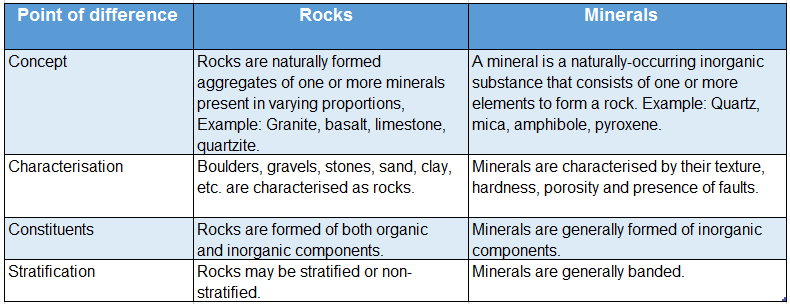
WBBSE Solutions For Class 7 Geography Chapter 1 Earths Revolution Topic A Revolution Of The Earth

WBBSE Chapter 1 Earths Revolution Topic A Revolution Of The Earth Long Question And Answers

Question 1. What is an ellipse? How different is it from a circle?
Answer:

Ellipse:

An ellipse has two axes, the major axis AB and the minor axis CD (see figure), which intersect at the center O. In an ellipse, there are two foci, F and F1, equidistant from the center ‘O’.

WBBSE Solutions For Class 7 Geography Chapter 1 Earths Revolution Topic A Revolution Of The Earth Circle

  1. Here, AB And CD = Two axis of equal length
  2. O = Centre

WBBSE Solutions For Class 7 Geography Chapter 1 Earths Revolution Topic A Revolution Of The Earth Ellipse

  1. Here, AB = Major Axis CD Minor Axis
  2. O = Centre
  3. F and F1 = Two Foci

Read And Learn Also WBBSE Solutions For Class 7 Geography

The differences noticed between a circle and an ellipse from the figure are-

WBBSE Solutions For Class 7 Geography Chapter 1 Earths Revolution Topic A Revolution Of The Earth Differences between circle and ellipse

WBBSE Class 7 Earth’s Revolution

WBBSE Solutions For Class 7 Geography Chapter 1 Earths Revolution Topic A Revolution Of The Earth

Question 2. What are the distinct characteristics of the Earth as it revolves around the Sun?
Answer:

Characteristics of the Earth as it revolves around the Sun:

As the Earth revolves around the Sun, the following distinct characteristics are observed-

1. Elliptical orbit: The Earth moves around the Sun in a fixed elliptical path known as the Earth’s orbit.

2. Counter-clockwise movement: The Earth moves around the Sun along an elliptical path in an anti-clockwise direction.

3. Speed: The Earth revolves around the Sun at a speed of 30 km per second.

WBBSE Class 7 Geography Notes WBBSE Solutions For Class 7 History
WBBSE Solutions For Class 7 Geography WBBSE Class 7 History Multiple Choice Questions
WBBSE Class 7 Geography Multiple Choice Questions WBBSE Solutions For Class 7 Maths


Question 3. What do you mean by the revolution of the Earth?
Answer:

Revolution of the Earth:

The Earth’s revolution refers to its movement around the Sun along a defined elliptical orbit. It takes 365 days, 5 hours, 48 minutes and 46 seconds or 1 year for the Earth to complete one revolution around the Sun.

The speed of the revolution of the Earth is 107000 km/h or 30 km/second.

WBBSE Solutions For Class 7 Geography Chapter 1 Earths Revolution Topic A Revolution Of The Earth Revolution of the earth

Question 4. What are the types of the Earth’s motion?
Answer:

The Earth does not remain static in space, it is always in motion.

The Earth’s movement is of two types-

  1. Rotation,
  2. Revolution.

1. Rotation:

Rotation is the motion of the Earth on its own axis. It takes 24 hours for the Earth to complete one rotation and causing the occurrence of day and night.

2. Revolution:

Revolution is the motion of the Earth around the Sun. It takes 365 days, 5 hours, 48 minutes, and 46 seconds to complete one revolution.

Question 5. Discuss the features of the Earth’s orbit.
Answer:

Features of the Earth’s orbit:

The path along which the Earth revolves around the Sun is called its orbit. Its features are as follows-

  1. It is elliptical in shape.
  2. Its circumference is about 940 million km.
  3. The Sun lies at the focus of the orbit.
  4. The plane on which the orbit lies is called the orbital plane.
  5. The speed at which the Earth revolves around the Sun along its orbit is approximately 30 km/s.
  6. The Earth revolves around the Sun along this path from west to east in 365 days 5 hours 48 minutes 46 seconds.


WBBSE Solutions For Class 7 Geography Chapter 1 Earths Revolution Topic A Revolution Of The Earth Earths Elliptical orbit

Question 6. What are the three universal ways of determining time?
Answer:

Three ways of determining time are as the time lag. Therefore, in every 4 years follows-

1. On the basis of rotation:

Every 24 hours gives us a new day and a night. We consider 24 hours to be 1 day and break it into 24 parts.

2. On the basis of revolution:

The Earth takes 365 days to complete 1 revolution around the Sun. Considering 365 days to be 1 year we can determine time.

3. On the basis of lunar month:

The Moon, the only natural satellite of the Earth takes about 28 days (27 days 3 hours) to complete one revolution around the Earth. These 28 days are considered to be 1 month, though we have months of 30 and 31 days.

Question 7. What is Aphelion?
Answer:

Aphelion:

  • Aphelion is the position when the Earth is farthest from the Sun.
  • The Earth reaches its Aphelion position when the northern hemisphere July when it is about 15 crore 20 lakh km away from the Sun.

WBBSE Solutions For Class 7 Geography Chapter 1 Earths Revolution Topic A Revolution Of The Earth Aphelion and Perihelion

The word Aphelion is derived from the Greek words ‘apo’ meaning away or, apart, and ‘helios’ meaning the Greek God of the Sun.

Question 8. What is the position of the Earth’s axis as it moves around the Sun?
Answer:

As the Earth moves around the Sun, its axis makes an angle of 66½° with the orbital plane.

This tilt in the axis is responsible for the orientation of the North Pole towards the Pole Star and the South Pole towards Hadley’s Octant. The angular tilt of the Earth’s axis is fixed irrespective of its position.

WBBSE Solutions For Class 7 Geography Chapter 1 Earths Revolution Topic A Revolution Of The Earth Position of the earths axis

WBBSE Chapter 1 Earths Revolution Topic A Revolution Of The Earth Short Question And Answers

Question 1. Explain the Law of Gravitation as per Newton. Does this work in outer space too?
Answer:

Law of Gravitation as per Newton:

  • Newton’s Law of Gravitation states that any two bodies in the universe attract each other with a force that is directly proportional to the product of their masses and inversely proportional to the square of the distance between them.
  • This law was discovered by Newton in the year 1867. Yes, this Law of Gravity is applicable in outer space too.

Question 2. Write a brief note on the Milky Way.
Answer:

Milky Way:

  • The Milky Way is the galaxy that contains our solar system. Its name ‘milky’ is derived from its appearance as a dim glowing band arching across the night sky in which individual stars cannot be distinguished.
  • The diameter of the Milky Way is about 0.1 million light-years i.e. light would take 0.1 million years to travel from one end to the other.

Question 3. What is escape velocity? If an object is thrown upwards at a velocity of 11.2 km per second, it does not fall back to the surface. Why?
Answer:

Escape velocity:

  • Escape velocity is the velocity at which an object needs to travel to break free from a planet’s gravitational field and leave it without further propulsion.
  • The escape velocity of an object from the Earth’s surface is 11.2 km per second.
  • However small or big an object may be, the escape velocity is the same for all i.e. it does not depend on the mass of the object.

Question 4. Define leap year. or, Why does the month of February have 29 days after every 4 years? or, What is the reason behind the addition of a day in the calendar in every 4 years?
Answer:

Leap year:

  • The period of time taken by the Earth to complete one revolution around the Sun (365 days, 5 hours, 48 minutes, and 46 seconds) is known as a solar year.
  • For ease in calculation, this time is taken as 365 days and 6 hours (5 hours, 48 minutes, 46 seconds).
  • The extra 6 hours of each year is added after every 4 years to the month of February (6 x 4 = 24 hours or 1 day) to adjust February has 29 days. This year with 366 days is known as a leap year.

Question 5. Identify the leap years- 2004, 2000, 2012, 1900, 2013, 2100.
Answer:

Year Leap Year
Yes No
2004 Yes
2000 Yes
2012 Yes
1900 Yes
2013 Yes
2100 Yes


Question 6. Differentiate between the orbit and orbital plane of the Earth.
Answer:

The differences between the orbit and the orbital plane of the Earth are-

WBBSE Solutions For Class 7 Geography Chapter 1 Earths Revolution Topic A Revolution Of The Earth Differences between Orbit And Orbital plane of the earth

Question 7. Why is the heat produced by vertical sun rays more intense than that of oblique sunrays?
Answer:

The reasons for why the heat produced by vertical sun rays is more are as follows-

  1. In comparison to vertical sun rays, oblique sunrays travel a longer distance through the atmosphere and thus, produce
    less heat.
  2. Since the oblique rays travel a longer distance through the atmosphere, part of it gets absorbed by the surface of the water vapour droplets and minute dust particles in the atmosphere. Since the vertical rays travel a shorter distance lesser part of it gets absorbed by the atmospheric components.
  3. The vertical sunrays are concentrated on a smaller portion of the Earth’s surface and so the heat produced is much more than that by the oblique ones.

Question 8. What is the reason behind the seasonal changes on the Earth’s surface?
Answer:

The Earth’s seasons are not caused by the distance from the Sun but the tilt in the Earth’s axis.

Due to this tilt different parts of the globe are oriented toward the Sun at different times of the year resulting in differential heating of the land surface. Therefore, we experience seasonal changes.

Question 9. During winter, in the northern hemisphere, the Sun appears to be bigger in size. Why?
Answer:

  • The Sun is positioned at the center of the elliptical orbit of the Earth.
  • The Earth-Sun distance is not constant and varies throughout the year.
  • On 3 January when it is winter in the northern hemisphere, the Earth reaches a point nearest to the Sun (Sun-Earth distance is 14 crore 70 lakh km).
  • Therefore the Sun appears bigger in size when seen from the Earth.

Question 10. What is the role of the daily motion of the Earth in determining time in hours, minutes, and seconds?
Answer:

  • The geoid-shaped Earth takes 24 hours to complete one full rotation on its own axis from west to east.
  • Every 1° rotation takes 4 mins (i.e. 360° x 4 minutes = 24 hours).
  • Thus we divide each day into 24 parts and consider each part to be an hour. Further, 1 hour is divided into 60 minutes and 1 minute is divided into 60 seconds.
  • In this manner, we can determine the time at a place in hours, minutes, and seconds.

Question 11. What happens if you drop a ball from your hand?
Answer:

  • If we drop a ball from our hand, it will fall on the ground. This is because the Earth attracts every object towards its center.
  • Thus, we do not fall off from the surface of the Earth and stay on it. This attraction is known as the gravitational force.

Question 12. What is the Earth attracted to?
Answer:

Earth attracted to:

  • According to the law of gravity, every object in this universe attracts other objects.
  • Likewise, the Earth also attracts any object closer or farther away from it and also gets attracted to any such.
  • The heaviest object closest to the Earth is the Sun.
  • Compared to the Earth the Sun is 13 lakh times bigger and thus the Earth is always attracted to it.

Question 13. If we drop a ball from our hand, it will fall on the ground. The Earth is like a heavy ball and also has chance of falling. In which direction and why will it fall? Or, The Earth is also a heavy sphere. Suppose the Earth also falls like a ball, what will happen to us?
Answer:

The Earth is constantly acted upon by the Sun’s gravity. If at all the Earth’s motion stops, then it will fall on the Sun’s surface.

Question 14. What problems would we have had faced in the absence of the gravitational force?
Answer:

  • Gravitational force is responsible for the presence of an atmosphere, water, humans, birds animals, etc. on the surface of the Earth.
  • In the absence of gravitational force, these would not have had existed and the Earth would have been a lifeless planet.

Question 15. An apple falls on the Earth’s surface from a tree. Both the apple and the Earth have the gravitational force of their own by which they attract each other. Then why does the apple fall down on the Earth’s surface and not the other way around?
Answer:

  • Objects with more mass have more gravity.
  • As the mass of the Earth is many times greater than the mass of the apple, the force acting on the apple is far stronger than the force acting on the Earth.
  • So the apple falls on the Earth and not the other way round.

Question 16. How does the Earth move smoothly around the Sun?
Answer:

  • The Earth revolves around the Sun along a fixed elliptical path. An object requires a centripetal force to revolve around the Sun.
  • This centripetal force is provided by the Sun itself, helping in the swift movement of the Earth along its path.

Question 17. If you place a small piece of paper on a ball and let it go after rotating it, the paper would fall off. Similarly, we reside on the Earth’s surface but don’t fall off. Why?
Answer:

  • In the given example we saw that the ball did not have any gravitational force of its own due to which the piece of paper fell off from its surface.
  • Our Earth has its own gravitational force that always attracts us downwards and hence, we do not fall off from its surface.

Question 18. What do you mean by rotation?
Answer:

Rotation:

  • The spinning of the Earth on its own axis is termed as Earth’s rotation.
  • The average rotation period of the Earth is 23 hours 56 minutes 4 seconds i.e. 24 hours.

Question 19. Why is the Earth’s revolution also called the annual motion of the Earth?
Answer:

  • The Earth takes 365 days, 5 hours, 48 minutes, and 46 seconds to complete one revolution around the Sun.
  • Since 365 days is taken to be 1 year the movement is also known as the annual motion of the Earth.

Question 20. What is the orbit of the Earth?
Answer:

Orbit of the Earth:

  • The elliptical path along which the Earth revolves around the Sun is termed as the Earth’s orbit.
  • The circumference of the orbit is about 940 million km.
  • The Sun is positioned at the center or focus of the elliptical orbit.

Question 21. State Kepler’s first law.
Answer:

Kepler’s first law:

Kepler’s first law says, “Each planet revolves around the Sun in an elliptical orbit with the Sun at the focus of the ellipse.”

Question 22. What is Earth’s orbital plane?
Answer:

Earth’s orbital plane:

  • The imaginary plane on which the orbit of the Earth is situated is known as the orbital plane of the Earth.
  • This two-dimensional plane is elliptic in shape and prevents celestial bodies from bumping into each other.
  • The center of the Sun and the center of the Earth are on the same orbital plane.

Question 23. What is Perihelion?
Answer:

Perihelion:

  • Perihelion is the position when the Earth is nearest to the Sun. It occurs on 3 January every year and the Sun-Earth distance at this point is about 14 crore 70 lakh km.
  • The word Perihelion is derived from the Greek words ‘peri’ meaning near and ‘helios’ meaning the Greek God of the Sun.

Question 28. One bucket of water warms up within half an hour if it is placed in the Sun at noon. When do you think we get more heat during that time?
At the time of sunrise
At noon when the Sun is overhead During sunset
At night after sunset
Answer:

At noon when the Sun is overhead.

Question 29. What is escape velocity?
Answer:

Escape Velocity:

  • If an object is thrown upwards at a velocity of 11.2 km/sec, it will go past the Earth’s gravitational force and start revolving around it.
  • This velocity is known as the object’s escape velocity in the case of the Earth.

Question 30. On 3 January, the Sun-Earth distance is minimum (14 crores 70 lakh km) as a result of which we should feel warmer but we normally feel cold. Why?
Answer:

  • On 3 January, the southern hemisphere is tilted towards the Sun while the northern. hemisphere is tilted away from it.
  • Due to this, the Sun’s rays fall vertically over the southern hemisphere and obliquely over the northern hemisphere and hence, we feel cold.

WBBSE Chapter 1 Earths Revolution Topic A Revolution Of The Earth Very Short Question And Answers

Question 1. Name the galaxy which contains the Sun and the entire solar system.
Answer: Milky Way.

Question 2. Where is the Sun located in the solar system?
Answer: Centre.

Question 3 What is the diurnal motion of the Earth on its own axis called?
Answer: Rotation.

Question 4 What is the name for the Earth’s movement around the Sun in 365 days?
Answer: Earth’s revolution.

Question 5. What is the term for the velocity at which an object thrown upwards from the Earth manages to escape the gravitational force of the Earth?
Answer: Escape velocity.

Question 6. What is the elliptical path on which the Earth moves around the Sun called?
Answer: Orbit.

Question 7. What is the line imagined to join the Poles of the Earth known as?
Answer: Earth’s axis.

Question 8. What is the name of the position attained on 3 January at which the Sun-Earth distance is minimum?
Answer: Perihelion.

Question 9. What is the name of the position attained on 4 July at which the Sun-Earth distance is maximum?
Answer: Aphelion.

Question 10 What is the period of 28 days during which the Moon completes one revolution around the Earth called?
Answer: Lunar month.

Question 11 What is a year that is exactly divisible by four called?
Answer: Leap year.

Question 12 What is the year with 366 days and with 29 days in February called?
Answer: Leap Year.

Question 13. Mention the angle at which the Earth’s axis is tilted with respect to the orbital plane.
Answer: 66½°.

Question 14. Where on Earth are days and nights equal?
Answer: Equator.

Question 15. Name the planet whose axial line and orbital path are parallel to each other.
Answer: Uranus.

Question 16. Name the planet whose axis is perpendicular to the orbital plane.
Answer: Jupiter.

Question 17. Why is the axis of the Earth tilted? Or, Why does the axis of the Earth make an angle of 66% with its orbit?
Answer:

Scientists believe that during the formation of the Earth due to collision with several extraterrestrial elements the axis of the Earth got inclined at an angle of 662°.

Question 18. What is a lunar month?
Answer:

Lunar month:

The Earth’s satellite Moon revolves around the Earth in about 27% of days or 28 days (approx). This period is called a lunar month.

Question 20. What is a solar day?
Answer:

Solar day

Solar day refers to th:e interval between two successive returns of the Sun to the local meridian. The length of a solar day varies throughout the year.

Question 21. How will you identify a year as a leap year?
Answer:

A year can be termed a leap year only if it is completely divisible by 4. In the case of millennium years like 1600, 2000, 2400, and so on, if it is divisible by 400, it is a leap year.

Question 22. What do you know about the Earth’s axis?
Answer:

Earth’s axis:

The imaginary line that joins the North and the South Poles and passes through the center of the Earth is known as the Earth’s axis. It is tilted, making an angle of 66½° with the orbital plane.

WBBSE Chapter 1 Earths Revolution Topic A Revolution Of The Earth Fill In The Blanks

Question 1. The force of the Earth that holds us onto its surface is called _______.
Answer: Gravitational force

Question 2. The Sun is _______ lakh times bigger than the Earth.
Answer: 13

Question 3. The Sun is at the _______ of the solar system.
Answer: Center

Question 4. ‘The Earth revolves around the Sun’-this idea was first put forward by _______.
Answer: Kepler

Question 5. Earth’s orbital path is _______.
Answer: Elliptical

Question 6. The idea of a heliocentric universe was first put forward by _______.
Answer: Copernicus

Question 7. The Theory of Planetary Motion was first put forward by famous scientist _______.
Answer: Kepler

Question 8. _______ is a result of the Earth’s rotation.
Answer: Day and night

Question 9. Smaller objects that move in an orbit around a larger object obey Newton’s Law of _______.
Answer: Gravitation

Question 10. In the month of _______ the Sun comes closest to the Earth.
Answer: January

Question 11. The duration of the solar year is _______
Answer: 365 days 5 hours 48 minutes 46 seconds

Question 12. The solar day is computed by _______ of the Earth.
Answer: Rotational

Question 13. The Sun takes _______ minutes to apparently cross one degree of longitude.
Answer: 4

Question 14. The year with 366 days is a _______.
Answer: Leap year

Question 15. During winter, in the northern hemisphere, the Sun appears to be slightly _______ in size.
Answer: Larger

Question 16. In the northern hemisphere, the Sun appears to be slightly smaller in size during _______.
Answer: Summer

Question 17. The Earth’s axis oriented in the direction of the Pole Star makes an angle of _______ with the orbital plane.
Answer: 662°

Question 18. The position of the North Pole is determined by the position of the _______.
Answer: Pole Star

Question 19. The Pole Star is observed in the _______ part of the sky in Kolkata.
Answer: Northern

WBBSE Chapter 1 Earths Revolution Topic A Revolution Of The Earth True or False

Question 1. The Egyptians first applied the concept of leap year.
Answer: True

Question 2. The Earth’s orbital path is circular in shape.
Answer: False

Question 3. During the revolution, the Earth’s axis remains tilted at an angle of 652°.
Answer: False

Question 4. At Aphelion, the Sun-Earth distance is minimum.
Answer: False

Question 5. At Perihelion, the Sun-Earth distance is maximum.
Answer: False

Question 6. A year with 365 days, 5 hours, 48 minutes, and 46 seconds is considered to be a leap year.
Answer: False

Question 7. Escape velocity from the surface of the Earth is 11.7 km per hour.
Answer: False

Question 8. The year 2008 was a leap year.
Answer: True

Question 9. In the northern hemisphere during summer, the Sun appears to be smaller.
Answer: True

Question 10. Speed of revolution: 30 km/sec:: Escape velocity:_________.
Answer: 11.2 km/sec

Question 11. Aphelion : _________:: Perihelion: 3 January.
Answer: 4th July

Question 12. Aphelion: 15 crore 20 lakh km:: Perihelion: _________.
Answer: 14 crores 70 lakh km

Question 13. Near to the Sun : _________:: Far away from the Sun: July.
Answer: January

Question 14. Lunar month: 27% days:: Solar year: _________.
Answer: 365 days

WBBSE Chapter 1 Earths Revolution Topic A Revolution Of The Earth Match The Columns

1.WBBSE Solutions For Class 7 Geography Chapter 1 Earths Revolution Topic A Revolution Of The Earth match the Columns 1

Answer: 1. D, 2. A, 3. C, 4. B

2.WBBSE Solutions For Class 7 Geography Chapter 1 Earths Revolution Topic A Revolution Of The Earth match the Columns 2

Answer: 1. B, 2. C, 3. A, 4. D

3.WBBSE Solutions For Class 7 Geography Chapter 1 Earths Revolution Topic A Revolution Of The Earth match the Columns 3

Answer: 1. B, 2. A, 3. D, 4. C

4.WBBSE Solutions For Class 7 Geography Chapter 1 Earths Revolution Topic A Revolution Of The Earth match the Columns 4

Answer: 1. B, 2. A, 3. D, 4. C

WBBSE Solutions For Class 7 Geography Chapter 2 Determination Of The Location Of A Place On The Earths Surface Topic A Parallels Of Latitude

WBBSE Chapter 2 Determination Of The Location Of A Place On The Earths Surface Topic A Parallels Of Latitude Long Question And Answers

Question 1. Describe the important parallels of latitude.
Answer:

Important parallels of latitude:

The important parallels of latitude present in either hemisphere are designated with individual names because of their importance. Some of these important parallels of latitude are described below-

1. Equator (0°):

The east-west line that runs around the middle of the Earth is called the Equator. The northern half of the Earth as divided by the Equator is called the northern hemisphere and the southern half is known as the southern hemisphere.

2. Tropics of Cancer (23½°N):

The 23½° north latitude is known as the Tropic of Cancer. It marks the northern limit of the apparent movement of the Sun.

3. Tropics of Capricorn (23½°S):

The 23½° south latitude is known as the Tropic of Capricorn. It marks the southern limit of the apparent movement of the Sun.

Read And Learn Also WBBSE Solutions For Class 7 Geography

4. Arctic Circle (66½°N):

The 66½° north latitude is known as the Arctic Circle. The area between the Arctic Circle and the North Pole experiences 24 hours of daylight from 21 June of every year for six months.

5. Antarctic Circle (66½°S):

The 66½° south latitude is known as the Antarctic Circle. The area between the Antarctic Circle and the South Pole experiences 24 hours of daylight from 22 December of every year for six months.

6. North Pole (90° N):

The 90° north latitude is known as the North Pole. The location of the North Pole is determined by the North Star.

7. South Pole (90° S):

The 90° south latitude is known as the South Pole. The location of the South Pole is determined by Hadley’s Octant.

WBBSE Solutions For Class 7 Geography Chapter 2 Determination Of The Location Of A Place On The Earths Surface Topic A

Question 2. Mention the types of latitude.
Answer:

Different types of latitudes are-

1. Northern latitudes:

Latitudes located due north of the Equator are called the northern latitudes. These are denoted by the letter ‘N’.

2. Southern latitudes:

Latitudes located due south of the Equator are called southern latitudes. These are denoted by the letter ‘S’.

3. Low, middle, and high latitudes:

The parallels within 30° north and south of the Equator are called low latitudes. The parallels within 30°-60° north and south of the Equator are called middle latitudes and those of 60° north and south of the Equator are called high latitudes.

Question 3. Define the Equator. What are the characteristics of the Equator?
Answer:

Equator:

The imaginary line encircling the Earth equidistant from the two Poles and dividing the Earth into two equal halves-the northern and the southern hemispheres is known as the Equator.

WBBSE Solutions For Class 7 Geography Chapter 2 Topic A Parallels Of Latitude The Equator

The main characteristics of the Equator are-

  1. The Equator has an angular measure of 0°.
  2. It is the only great circle on Earth.
  3. Throughout the year, sunrays fall vertically over the Equator.
  4. The Equator divides the Earth in two hemispheres-northern and southern hemispheres.
  5. The center of the Equator and the center of the Earth is the same.
WBBSE Class 7 Geography Notes WBBSE Solutions For Class 7 History
WBBSE Solutions For Class 7 Geography WBBSE Class 7 History Multiple Choice Questions
WBBSE Class 7 Geography Multiple Choice Questions WBBSE Solutions For Class 7 Maths


Question 4. Name the important parallels of latitude.
Answer:

Important parallels of latitude:

Among all the parallels, there are certain parallels in each of the hemispheres that are considered important as they help us to divide the Earth into different zones. These are-

WBBSE Solutions For Class 7 Geography Chapter 2 Topic A Parallels Of Latitude Different types of Zones


WBBSE Solutions For Class 7 Geography Chapter 2 Topic A Parallels Of Latitude Important Parallels of latitude

Question 5. What are the important characteristics of parallels of latitude?
Answer:

The important characteristics of parallels of latitude are-

1. Orientation:

The parallels of latitude run in an east-west direction. The Equator is the most important latitude and its value is 0.

2. Shape:

Except for the two Poles, all the parallels of latitude are complete circles and parallel to one another.

3. Circumference:

The circumferences of the parallels of latitude gradually decrease as one moves away from the Equator toward the Poles.

4. Angular measurement:

The sum total of the angular measures of each parallel of latitude is 360° (except the two Poles).

Question 6. How can we determine the latitude of a place on the Earth’s surface?
Answer:

To determine the latitude of a place on the surface, for example, point A on Earth, we have to draw a line \((\overrightarrow{A O})\) from the mentioned point (A) to the center of the Earth (O).

Then, we have to draw another line \((\overrightarrow{O B})\) from the intersection (of the meridian and the Equator) point (B), to the Earth’s center (O). The angle ∠AOB formed by these two lines is the latitude of point A.

According to the diagram, the angular distance of the parallel is 55° and as it is located due North of the Equator, it is denoted as 55°N.

WBBSE Solutions For Class 7 Geography Chapter 2 Topic A Parallels Of Latitude Determining the latitude of a place


Question 7. Why is the Equator important?
Answer:

The Equator is important because of the following reasons-

1. Determining the hemispheres:

The Equator being equidistant from the North Pole and the South Pole divides our Earth into two equal halves-the northern hemispheres and the southern hemisphere.

2. Determining a location:

The location of a place in any of the two hemispheres is determined by its angular distance north or south of the Equator.

3. Determining the length of day and night:

The Circle of Illumination bisects the Equator at an angle of 90°. As a result, all the places located on this line experience equal lengths of day and night throughout the year.

By determining the Sun’s angle of incidence, weather, pressure zones, heat zones, and precipitation zones can be defined. So, the Equator is a very important parallel.

Question 8. State the difference between latitude and parallel of latitude.
Answer:

The difference between latitude and parallel of latitude are-

WBBSE Solutions For Class 7 Geography Chapter 2 Topic A Parallels Of Latitude Differences between latitude and Parallel of latitude

Question 9. State the importance of the parallels of latitude.
Answer:

The importance of the parallels of latitude are-

1. Determining the location of a place:

The location of a place is determined by its angular distance north or south of the Equator as measured from the Earth’s center. As we move north or south of the Equator, the angular distance increases.

2. Determining the extent of heat zones:

The Earth can be divided into three heat zones on the basis of the amount of heat received from the Sun over the parallels. These are torrid, temperate, and frigid zones.

3. Determining the climate of a place:

The climate of a place can be determined from the latitudinal position of that place on the Earth’s surface. Higher the latitudinal position, the colder the climate, and vice versa.

Question 10. What is the relation between the parallels of latitude and the climate?
Answer:

Throughout the year the Sun’s rays fall vertically over the Equator and regions near it. Away from the Equator towards the Poles the vertical rays of the Sun tend to become more and more oblique.

Direct rays give more heat than slanted rays. As a result, there is a gradual decrease in the average temperature towards the Poles.

WBBSE Solutions For Class 7 Geography Chapter 2 Topic A Parallels Of Latitude Relation between the parallelsof latitude and the climate

Question 11. What is the equatorial plane?
Answer:

Equatorial plane:

The plane passing through the Equator of the Earth is known as the equatorial plane. It runs midway between the Poles perpendicular to the Earth’s axis.

If the Earth is cut from the Equator, then we can see the equatorial plane shown in the diagram.

WBBSE Solutions For Class 7 Geography Chapter 2 Topic A Parallels Of Latitude Equatorial Plane

Question 12. What are the parallels of latitude?
Answer:

Parallels of latitude:

Parallels of latitude are imaginary circular lines drawn horizontally between the two Poles running in the east-west direction.

  • The Equator is a parallel of latitude that runs exactly midway between the two Poles.
  • Each parallel of latitude has a specific angular measure.
  • 89 parallels of latitude can be drawn in each of the hemispheres at an interval of 1°.

WBBSE Solutions For Class 7 Geography Chapter 2 Topic A Parallels Of Latitude Parallels Of Latitude

WBBSE Chapter 2 Determination Of The Location Of A Place On The Earths Surface Topic A Parallels Of Latitude Short Question And Answers

Question 1. Define high, middle, and low latitudes.
Answer:

High, middle, and low latitudes:

  • On the Earth’s surface, the angular measure of the latitudes ranges from 0° to 90°. In both hemispheres, the parallels having an angular measure of 0° to 30° are termed as low latitudes.
  • The parallels having an angular measure of 30° to 60° are termed as middle latitudes and those beyond 60° are termed as high latitudes.

Question 2. How do we calculate the location of a place situated between two parallels? Or, How can you determine the location of a place between two parallels?
Answer:

  • Let us take two parallels, 10°N and 11°N. Difference between the two parallels = (11° 10°) 1° = 60 minutes.
  • The latitude of a place in between the two parallels = 10° N + 60/2 minutes= 10°30’N
  • Or, 11° N- 60/2 minutes= 10°30’N
  • Therefore, a place in between 10°N and 11°N will be located at 10°30′ north of the Equator.

Question 3. Why is the Equator called ‘a great circle’?
Answer:

  • Any imaginary circle that surrounds the center of the Earth and divides the planet into two hemispheres is called the great circle.
  • The equator being an imaginary circular line equidistant from the two Poles, dividing the Earth into two halves
  • The northern and the southern hemispheres is the only parallel of latitude with its center coinciding with that of the Earth.
  • On the other hand, the center of all other parallels is located on the Earth’s axis and not at the center of the Earth. Therefore, only the Equator is called a great circle among all the parallels.

Question 4. Define the Tropic of Cancer and the Tropic of Capricorn.
Answer:

  • The imaginary circular line drawn at an angular distance of 23½° north of the Equator is known as the Tropic of Cancer. It marks the northern limit of the vertical sun rays.
  • On the other hand, the imaginary circular line drawn at an angular distance of 23½° south of the Equator is known as the Tropic of Capricorn. It marks the southern limit of the vertical sun rays.

Question 5. Define the Arctic and the Antarctic Circles.
Answer:

The Arctic and the Antarctic Circles:

  • The Arctic Circle is the parallel of latitude that runs 66½° north of the Equator, whereas, the Antarctic Circle is the parallel of latitude that runs 661⁄2 south of the Equator.
  • The regions beyond the Arctic and the Antarctic Circles experience 6 months of complete daylight and 6 months of complete darkness throughout the year.

Question 6. Define the North and the South Poles.
Answer:

The North and the South Poles:

  • The North and the South Poles are not parallels but points on the northern and southern hemispheres where the Earth’s axis of rotation meets its surface.
  • It has an angular measure of 90°. The South Pole lies on a continental landmass and the North Pole is located in the middle of the Arctic Ocean.

Question 7. The places located on a particular parallel of latitude do not experience sunrise and sunset at the same time. Or, Do you experience day and night at the same time on the same parallel? If not, why?
Answer:

  • Places located on a particular parallel of latitude do not experience day and night at the same time because the parallels of latitude on the surface of the Earth run in an east-west direction.
  • As our Earth rotates from west to east, the places on a particular parallel located due east experience sunrise way ahead of the places located due west.

Question 8. What changes do you observe as you move toward the Poles from the Equator?
Answer:

As we move towards higher latitudes i.e. from the Equator towards the Poles, the following are observed-

  1. Sunrays become oblique i.e. striking the Earth’s surface at a wider angle.
  2. A gradual decrease in average temperature.
  3. A change in the characteristics of flora and fauna.

Question 9. What do you mean by linear distance?
Answer:

Linear distance:

  • The straight distance between two defined places on a plain surface is known as linear distance.
  • This distance is expressed in the units of inches, feet, gauge, miles, meters or kilometers, etc.

Question 10. What do you mean by angular distance?
Answer:

Angular distance:

If two straight lines are drawn from any two points on a spherical surface to the center of the sphere, then the size of the angle formed between the lines at an angular distance the center is known as their angular distance.

WBBSE Solutions For Class 7 Geography Chapter 2 Topic A Parallels Of Latitude Determination of the angular distance

Question 11. “The latitude of Kolkata is 22°34′ north”- Explain.
Answer:

“The latitude of Kolkata is 22°34′ north”

  • The latitude of a place is its angular distance north or south of the Equator as measured from the center of the Earth.
  • The angular distance of Kolkata concerning the Equator is 22°34′ N i.e., it is located in the northern hemisphere. So the latitude of Kolkata is 22°34′ N.

WBBSE Chapter 2 Determination Of The Location Of A Place On The Earths Surface Topic A Parallels Of Latitude  Very Short Question And Answers

Question 1. What do we call the angular distance of a place north and south of the Equator?
Answer: Latitude.

Question 2. What are the lines of latitude also known as?
Answer: Parallels.

Question 3. What do we call the imaginary circular line on the Earth’s surface that is equidistant from the two Poles?
Answer: The Equator.

Question 4. What is the 23½° parallel line in the northern hemisphere known as?
Answer: The Tropic of Cancer.

Question 5. What is the 23½° parallel line in the southern hemisphere known as?
Answer: The Tropic of Capricorn.

Question 6. What is the 66½° parallel line in the northern hemisphere known as?
Answer: The Arctic Circle.

Question 7. What is the 66½° parallel line in the southern hemisphere known as?
Answer: The Antarctic Circle.

Question 8. What is the 90° latitude in the northern hemisphere known as?
Answer: The North Pole.

Question 9. What is the 90° latitude in the southern hemisphere known as?
Answer: The South Pole.

Question 10. Places on which line of latitude experience equal lengths of day and night?
Answer: The Equator.

Question 11. What do we call the imaginary plane that passes through the Equator and is perpendicular to its axis?
Answer: The Equatorial plane.

WBBSE Chapter 2 Determination Of The Location Of A Place On The Earths Surface Topic A Parallels Of Latitude Fill In The Blanks

Question 1. The _______________ divides the Earth into two equal halves, the northern and the southern hemispheres.
Answer: Equator

Question 2. The location of a place on the spherical surface of the Earth is determined with the help of its _______________ distance.
Answer: Angular

Question 3. The minimum angular measure of latitude is _______________ degree.
Answer: 0

Question 4. The angular measure of latitudes begins from _______________ degrees.
Answer: 0

Question 5. The angular measure of latitudes extends up to _______________ degrees.
Answer: 90

Question 6. The Earth being a full circle has an angular measure of _______________.
Answer: 360°

Question 7. The imaginary circles drawn parallel to the Equator are known as _______________.
Answer: parallels of latitude

Question 8. _______________ are complete circles.
Answer: Parallels

Question 9. The parallels run in an _______________ direction.
Answer: East-west

Question 10. The _______________ is the longest parallel.
Answer: Equator

Question 11. All the latitudes are _______________ to one another.
Answer: Parallel

Question 12. Although the latitudes are parallel to one another, their circumferences are _______________.
Answer: Unequal

Question 13. The latitude located at _______________ of the Equator is referred to as the Tropic of Cancer.
Answer: 23½° N

Question 14. _______________ latitude passes through Kolkata.
Answer: 22°34′ N

Question 15. The northernmost latitude in the northern hemisphere which is a point is known as _______________.
Answer: North Pole

Question 16. In both the hemispheres, the region within 30° north and south of the Equator is referred to as the _______________.
Answer: Low latitude region

Question 17. The position of _______________ is used for determining the latitude of a place in the southern hemisphere.
Answer: Hadley’s Octant

Question 18. A change in the _______________ is observed as one walks away from the Equator, towards the Poles.
Answer: Climate

Question 19. Each and every place located within 23½°N and 23½°S latitudes experiences _______________sunrays twice a year.
Answer: Vertical

Question 20. The average linear distance between any two parallels at an interval of 1° is approximate _______________.
Answer: 111 Km

WBBSE Chapter 2 Determination Of The Location Of A Place On The Earths Surface Topic A Parallels Of Latitude True Or False

Question 1. The distance between any two parallels is constant throughout the globe.
Answer: True

Question 2. The 90° parallel is called the Equator.
Answer: False

Question 3. The Equator is also known as the Prime Meridian.
Answer: False

Question 4. Parallels are complete circles.
Answer: True

Question 5. The two Poles on the Earth’s surface are actually two points.
Answer: True

Question 6. The radius of the parallels are equal throughout the globe.
Answer: False

Question 7. The average distance between any two parallels is about 110.5 km.
Answer: False

Question 8. Angular distance is also known as linear distance.
Answer: False

Question 9. A sum total of the angular measures of all the parallels is 180°.
Answer: False

Question 10. The region beyond 60° north and south of the Equator is referred to as the region of high latitudes.
Answer: True

Question 11. The region on the Earth’s surface between 30°-60° north and south of the Equator is referred to as the region of low latitudes.
Answer: False

Question 12. The Pole Star is located at 90° south of the Equator.
Answer: False

Question 13. An example of a great circle is the Prime Meridian.
Answer: False

Question 14. The sun rays fall obliquely over the equatorial region.
Answer: False

Question 15. The north-south extension of any place on the Earth’s surface can be determined with the help of meridians.
Answer: False

Question 16. The latitude of a place in the southern hemisphere is determined with the help of the position of the Pole Star.
Answer: False

Question 17. The angular measure of the Equator is 0°.
Answer: True

Question 18. The Antarctic Circle is located in the northern hemisphere.
Answer: False

WBBSE Chapter 2 Determination Of The Location Of A Place On The Earths Surface Topic A Parallels Of Latitude Match The Columns

Question 1.WBBSE Solutions For Class 7 Geography Chapter 2 Topic A Parallels Of Latitude match the columns

Answer: 1. E, 2. D, 3. C, 4. A, 5. B