WBCHSE Class 12 Physics Ohm’s Law Multiple Choice Question And Answers

Current Electricity

Electric Current and Ohm’s Law Multiple Choice Question And Answers

Question 1. Consider a current-carrying wire (current 7) in the shape of a circle. Note that as the current progresses along the wire, the direction of current density \(\vec{j}\) changes in an exact manner, while the current I remains unaffected. The agent that is essentially responsible for

  1. Source of emf
  2. The electric field produced by charges accumulated on the surface of the wire
  3. The charges just behind a given segment of wire push them just the right way by repulsion
  4. The charges ahead

Answer: 2. Electric field produced by charges accumulated on the surface of the wire

\(\vec{j}=\sigma \vec{E}\)

Question 2. Two batteries of emf e1 and e2(e2 > e1) and internal resistances r1 and r2 respectively are connected in parallel

Class 12 Physics Unit 2 Current Electricity Chapter 1 Electric Current and Ohm's Law Multiple Choice Question And Answers Question 2

The equivalent of the two cells is eeq.

  1. e1 < eeq < e2
  2. eeq < e1
  3. eeq = e1 + e2
  4. eeq is independent of and r2

Answer: 1. el e_1 \text {, let } e_2=e_1+\Delta e[/latex]

∴ \(\frac{e_{\mathrm{eq}}}{r_{\mathrm{eq}}}=\frac{e_1}{r_1}+\frac{e_1+\Delta e}{r_2}=e_1\left(\frac{1}{r_1}+\frac{1}{r_2}\right)+\frac{\Delta e}{r_2}\)

\(\frac{e_1}{r_{\mathrm{eq}}}+\frac{\Delta e}{r_2}\)

∴ eeq > e1

Again,

∴ \(\frac{e_{\mathrm{eq}}}{r_{\mathrm{eq}}}=\frac{e_2}{r_{\mathrm{eq}}}-\frac{\Delta e}{r_1} \text { or, } e_{\mathrm{eq}}<e_2\)

e1 < eeq < e2

WBBSE Class 12 Ohm’s Law MCQs

Question 3. Temperature dependence of resistivity p(T) of semiconductors, insulators, and metals is significantly based on which of the following factors?

  1. The number of charge carriers can change with temperature T
  2. The time interval between two successive collisions can depend on the T
  3. The length of the material can be a function of T
  4. The mass of carriers is a function of the T

Answer:

1. The number of charge carriers can change with temperature T

2. The time interval between two successive collisions can depend on the T

Question 4. The current in a conductor varies with time t as I = 2t+ 3t², where I is in ampere and t in second. Electric charge flowing through a section of the conductor during t = 2s to f = 3s is

  1. 10C
  2. 24 C
  3. 33 C
  4. 44 C

Answer: 2. 24 C

Question 5. Fmf of a lead-acid accumulator during its prolonged discharging is

  1. 1.08 V
  2. 1.5 V
  3. 2.0 V
  4. 2.2 V

Answer: 3. 2.0 V

WBCHSE Class 12 Physics Ohm’s Law Multiple Choice Question And Answers

Practice MCQs on Voltage and Current Relationships

Question 6. What energy transformation occurs during the discharging of an accumulator?

  1. Electrical energy to chemical energy
  2. Chemical energy to electrical energy
  3. Electrical energy to mechanical energy
  4. Mechanical energy to electrical energy

Answer: 2. Chemical energy to electrical energy

Question 7. What is the nature of energy conversion during the charging of a secondary cell?

  1. Electrical energy to chemical energy
  2. Chemical energy to electrical energy
  3. Electrical energy to mechanical energy
  4. Mechanical energy to electrical energy

Answer: 1. Electrical energy to chemical energy

Class 11 Physics Class 12 Maths Class 11 Chemistry
NEET Foundation Class 12 Physics NEET Physics

Question 8. Which of the following graphs represents the variation of current (7) through a metallic conductor with its terminal potential difference (V)?

Class 12 Physics Unit 2 Current Electricity Chapter 1 Electric Current and Ohm's Law Multiple Choice Question And Answers Question 8

Answer: 1.

Class 12 Physics Unit 2 Current Electricity Chapter 1 Electric Current and Ohm's Law Multiple Choice Question And Answers Question 8.

Question 6. The dimension of resistance is

  1. \(\mathrm{ML}^2 \mathrm{~T}^{-3} \mathrm{I}^{-1}\)
  2. \(\mathrm{ML}^2 \mathrm{~T}^{-1} \mathrm{I}^{-1}\)
  3. \(\mathrm{ML}^2 \mathrm{~T}^{-3} \mathrm{I}^{-2}\)
  4. \(\mathrm{ML}^2 \mathrm{~T}^{-1} \mathrm{I}^{-2}\)

Answer: 3. \(\mathrm{ML}^2 \mathrm{~T}^{-3} \mathrm{I}^{-2}\)

Important Definitions in Ohm’s Law MCQs

Question 9. The resistivity of copper is 1.76 x 10⁻⁶ Ω.cm. What will be the resistance between two opposite faces of a copper cube of side 1 m?

  1. 1.76 x 10⁻⁴Ω
  2. 1.76 x 10⁻⁶Ω
  3. 1.76 x 10⁻⁸Ω
  4. 1.76 x 10⁻¹²Ω

Answer: 3. 1.76 x 10⁻⁸Ω

Question 10. A block has dimensions 1 cm, 2 cm, and 3 cm. The ratio of the maximum and minimum distance between any two points of opposite faces of this block is

  1. 1:6
  2. 1:9
  3. 9:1
  4. 18:1

Answer: 3. 9:1

Question 11. A conductor with a rectangular cross-section has dimensions (a x 2a x 4a). Resistance across AB is R1, across CD is R2, and across EF is R3. Then

Class 12 Physics Unit 2 Current Electricity Chapter 1 Electric Current and Ohm's Law Multiple Choice Question And Answers Question 11

  1. R1 = R2 = R3
  2. R1 > R2 > R3
  3. R2 > R3 > R1
  4. R1 > R3 > R2

Answer: 4. R1 > R3 > R2

Question 12. A wire of resistance 4 Ω is bent through 180° at its midpoint and the two halves are twisted together. Then the resistance is

Answer: 1. 1 Ω

Question 13. The temperature coefficient of resistance of a metal is 0.004°C-1. If a wire of this metal has resistance 1 CL at 0°C then what will be the value of that resistance at 100°C?

  1. 0.6Ω
  2. 0.96Ω
  3. 1.04Ω
  4. 1.4Ω

Answer: 4. 1.4 Ω

Question 14. A carbon resistor has a resistance of 106 x 1. The color of its third band is

  1. Yellow
  2. Green
  3. Blue
  4. Violet

Answer: 2. Green

Question 15. The resistance of a wire is 5 Ω at 50°C and 6 Ω at 100°C. The resistance of the wire at 0°C will be

Answer: 4. 4Ω

Examples of Applications of Ohm’s Law in MCQ Format

Question 16. If three resistances, connected in series, are related as R1>R2> R3 then what is the relation between the currents flowing through them?

  1. I1 = I2 = I3
  2. I1 > I2 > I3
  3. I1 < I2 < I3
  4. I1 > I3 > I2

Answer: 1. I1 = I2 = I3

Question 17. If three resistances are connected in parallel and the relation between them is R1 > R2 > R3, then the relation between the currents flowing through them is

  1. I1 = I2 = I3
  2. I1 > I2 > I3
  3. I1 < I2 < I3
  4. I3 < I1 < I2

Answer: 3. I1 < I2 < I3

Question 18. Two resistances of 6Ω and 3Ω are connected in parallel and this combination is connected to a battery of emf 2 V. What will be the current flowing through the 6Ω resistance?

  1. \(\frac{1}{3}\)A
  2. \(\frac{2}{3}\)A
  3. 1A
  4. 2A

Answer: 1. \(\frac{1}{3}\)A

Question 19. A series combination of three resistances 1Ω, 2Ω, and 3Ω is connected with a cell of emf 1.5 V and negligible internal resistance. What is the terminal potential difference across the third resistance?

  1. \(\frac{1}{4}\)V
  2. \(\frac{1}{2}\)V
  3. \(\frac{3}{4}\)V
  4. 1V

Answer: 3. \(\frac{3}{4}\)V

Question 20. A uniform metal wire of resistance R is stretched to twice its length. Now this wire is halved, and the two halves are connected in parallel. The equivalent resistance is

  1. \(\frac{R}{2}\)
  2. R
  3. 2R
  4. 4R

Answer: 2. R

Question 21. Which of the following is correct?

Class 12 Physics Unit 2 Current Electricity Chapter 1 Electric Current and Ohm's Law Multiple Choice Question And Answers Question 21

  1. 0.50A current flows in 3Ω
  2. 0.25A current flows in 3Ω
  3. 0.50A current flows in 4Ω
  4. 0.25A current flows in 4Ω

Answer: 4. 0.25A current flows in 4Ω

Question 22. The equivalent resistance between points A and B is

Class 12 Physics Unit 2 Current Electricity Chapter 1 Electric Current and Ohm's Law Multiple Choice Question And Answers Question 22

  1. 11Ω

Answer: 2. 4Ω

Conceptual MCQs on Resistance and Conductivity

Question 23. A set of n identical resistors, each of resistance R ohm when connected in series, has effective resistance X ohm, and when connected in parallel the effective resistance is Y ohm. The relation between R, X, and Y is given by

  1. \(R=\sqrt{X Y}\)
  2. \(R=Y \sqrt{X}\)
  3. \(R=X \sqrt{Y}\)
  4. \(\sqrt{R}=X Y\)

Answer: 1. \(R=\sqrt{X Y}\)

Question 24. A uniform wire of resistance 36Ω is bent in the form of a circle. The equivalent resistance across the points A and B is

Class 12 Physics Unit 2 Current Electricity Chapter 1 Electric Current and Ohm's Law Multiple Choice Question And Answers Question 24

  1. 36Ω
  2. 18Ω
  3. 2.75Ω

Answer: 4. 2.75Ω

Question 25. What is the equivalent resistance across points A and B?

Class 12 Physics Unit 2 Current Electricity Chapter 1 Electric Current and Ohm's Law Multiple Choice Question And Answers Question 25

  1. 12Ω
  2. 16Ω
  3. 32Ω

Answer: 1. 8Ω

Question 26. Six equal resistances are connected between points P, Q, and R. Then, the equivalent resistance will be maximum between

Class 12 Physics Unit 2 Current Electricity Chapter 1 Electric Current and Ohm's Law Multiple Choice Question And Answers Question 26

  1. P and Q
  2. Q and R
  3. P and R
  4. Any two points

Answer: 1. P and Q

Question 27. The resistance across A and B in the below will

Class 12 Physics Unit 2 Current Electricity Chapter 1 Electric Current and Ohm's Law Multiple Choice Question And Answers Question 27

  1. 3B
  2. R
  3. \(\frac{R}{3}\)
  4. None of the above

Answer: 3. R

Question 28. A ring is made of a wire having a resistance RQ = 12Ω. Find the points A and B at which a current-carrying conductor should be connected so that the resistance R of the subcircuit between these points is equal to \(\frac{8}{3}\)Ω

Class 12 Physics Unit 2 Current Electricity Chapter 1 Electric Current and Ohm's Law Multiple Choice Question And Answers Question 28

  1. \(\frac{l_1}{l_2}=\frac{5}{8}\)
  2. \(\frac{l_1}{l_2}=\frac{1}{3}\)
  3. \(\frac{l_1}{l_2}=\frac{3}{8}\)
  4. \(\frac{l_1}{l_2}=\frac{1}{2}\)

Answer: 4. \(\frac{l_1}{l_2}=\frac{1}{2}\)

Question 29. A cell of emf E and internal resistance r is connected to an external resistance R. The variation of potential drop V across the resistance R as a function of R is shown by the curve marked as

Class 12 Physics Unit 2 Current Electricity Chapter 1 Electric Current and Ohm's Law Multiple Choice Question And Answers Question 29

  1. 4
  2. 1
  3. 2
  4. 3

Answer: 3. 2

Question 30. A current of 0.1 A flows through a 12Ω resistance when it is connected to a cell of emf 1.5 V. The internal resistance of the cell is

  1. 15Ω

Answer: 2. 3Ω

Question 31. When a resistance of 12Ω is connected with a cell of emf 1.5 V, 0.1 A current flows through the resistance. The internal resistance of the cell is

  1. 1.5Ω

Answer: 2. 3Ω

Question 32. A shunt resistance 1Ω is connected with a galvanometer of resistance 100Ω. What part of the main current will flow through the galvanometer?

  1. \(\frac{1}{99}\)
  2. \(\frac{1}{100}\)
  3. \(\frac{1}{101}\)
  4. \(\frac{1}{98}\)

Answer: 3. \(\frac{1}{101}\)

Real-Life Scenarios in Ohm’s Law Questions

Question 33. A galvanometer of resistance R is connected to an electric circuit. The main current in the circuit is k times the maximum current that the galvanometer can withstand. The maximum value of the shunt resistance that should be used across the galvanometer is

  1. kR
  2. (k-1)R
  3. \(\frac{R}{k}\)
  4. \(\frac{R}{k-1}\)

Answer: 4. \(\frac{R}{k-1}\)

Question 34. Three voltmeters, all having different resistances, are joined. When some potential differences are applied across P and Q, their readings are V1, V2, and V3 respectively. Then

Class 12 Physics Unit 2 Current Electricity Chapter 1 Electric Current and Ohm's Law Multiple Choice Question And Answers Question 34

  1. V1 = V2
  2. V1 ≠ V2 + V3
  3. V1 + V2 = V3
  4. V1 + V2 > V3

Answer: 3. V1 + V2 = V3

Question 35. Two electric cells each of emf 1.5 V and internal resistance 2Ω are connected in parallel and this combination of cells is connected with an external resistance of 2Ω. What will be the current in the external circuit?

  1. \(\frac{1}{4}\)A
  2. \(\frac{1}{3}\)A
  3. \(\frac{1}{2}\)A
  4. 1A

Answer: 3. \(\frac{1}{2}\)A

Question 36. n identical cells, each of emf e and internal resistance r, are first connected in series and then in parallel. What will be the ratio of the emf and of the internal resistances of these two cell combinations?

  1. n, n
  2. n,n²
  3. n²,n
  4. \(\frac{1}{n}\) , n

Answer: 2. n,n²

Question 37. Two cells each of emf e but of internal resistance r1 and r2 are connected in series through an external resistance R. If the potential difference across the first cell is zero while current flows, the value of R in terms of r1 and r2 is

  1. R = r1 + r2
  2. R = r1 – r2
  3. R = \(\frac{1}{2}\)(r1 + r2)
  4. R = \(\frac{1}{2}\)(r1 – r2)

Answer: 2. R = r1 – r2

Question 38. A galvanometer connected with an unknown resistor and two identical cells in series each of emf 2 V, shows a current of 1 A. If the cells are connected in parallel, it shows 0.8 A. Then the internal resistance of the cell is

  1. 2.8Ω
  2. 0.7Ω
  3. 1.4Ω

Answer: 1. 1Ω

Question 39. In a metallic conductor, the number of free electrons per unit volume is n and the drift velocity of those electrons is vd. Then

  1. \(v_d \propto n\)
  2. \(v_d \propto \frac{1}{n}\)
  3. \(v_d \propto n^2\)
  4. \(v_d \propto \frac{1}{n^2}\)

Answer: 2. \(v_d \propto n^2\)

Question 40. When a current of 1 A flows through a copper wire of cross-sectional area 1 mm², the drift velocity of free electrons becomes v. What will be the drift velocity of free electrons when the same current flows through a copper wire of cross-sectional area 2 mm²?

  1. \(\frac{v}{2}\)
  2. v
  3. 2v
  4. 4v

Answer: 1. \(\frac{v}{2}\)


WBCHSE Class 12 Physics Notes For Atomic Nucleus

WBCHSE Class 12 Physics Atomic Nucleus

Atomic Nucleus Introduction

Physicist Ernest Rutherford was able to reach two important conclusions from his famous alpha particle scattering experiment, regarding the distribution of charge carriers and mass in an atom:

  1. The entire positive charge and most of the mass of an atom is concentrated in a very small space of the atom called the nucleus. The volume of the nucleus is only about 1 in 10-12 part of the atom (atomic diameter is about 10-8cm and the diameter of the nucleus is estimated as 10-12 cm).
  2. The remaining part of the atom contains negatively charged electrons. These electrons are distributed in a regular pattern outside the nucleus, and a large part of the atom is in space. The total mass of the electrons is negligible in comparison to the mass of the atom.

WBCHSE class 12 physics atomic nucleus 

Atomic Nucleus Mass-Energy Equivalence

Matter can be viewed as concentrated energy. Max Planck and others had realized the importance of the concept, early in the twentieth century but it was Albert Einstein who first proposed an equivalence of mass and energy. He suggested c² (c = velocity of light) as the conversion factor from mass to energy. The principle of mass-energy equivalence can be stated thus: If the mass m of a body is completely converted to energy, the amount of the energy is

Read and Learn More Class 12 Physics Notes

E = mc² [c = speed of light in vacuum = constant] The relation suggests that the energy E is equivalent to mass m or that the mass m is equivalent to energy E.

Example:

1. In the CGS system

c = \(2.998 \times 10^{10} \mathrm{~cm} \cdot \mathrm{s}^{-1} \simeq 3 \times 10^{10} \mathrm{~cm} \cdot \mathrm{s}^{-1}\)

∴ Equivalent energy contained in 1 g,

E = 1 × (3  ×1010)2 = 9 ×10²⁰ erg = 9 ×10¹³ J

Again in SI, c = 3×10⁸ m. s-1

∴ Equivalent energy contained in 1 kg,

E =1 kg × (3 × 108 m. s-1)2 = 9 × 10¹⁶ J

2. Mass of electron, me = 9.109 × 10⁻²⁸ g

∴ Equivalent energy of mass of an electron

= 9.109 × 10-28  × (3 × 1010  )2 erg

= \(\frac{9.109 \times 10^{-28} \times 9 \times 10^{20}}{1.602 \times 10^{-12}}\) eV

= 0.511 × 10⁶ eV

= 0.511 MeV

WBBSE Class 12 Atomic Nucleus Notes

Rest mass:

Einstein’s theory of relativity also suggests that the mass of a body is not a constant but depends on the velocity of the body. Especially when speed is comparable to the speed of light in a vacuum, the mass of a body increases considerably. Hence, when mentioning the mass as an innate property of matter, the body should be considered to be at rest. This is called rest mass. For example rest mass of an electron = 9.109 × 10⁻²⁸ g. Lorentz derived the relation between rest mass ( mQ) and the mass at velocity v close to c as

m = \(\frac{m_0}{\sqrt{1-\frac{v^2}{c^2}}}\)

Unit of mass and energy: As mass and energy are equivalent to each other, their units too are equivalent. Hence, the energy unit is also used to represent mass and vice versa. For example, 1 g energy denotes 9 × 10²⁰ erg of energy or a mass of 9 × 10¹⁶ J indicates 1 kg mass. Using this equivalence of mass and energy we can say, the rest mass of an electron, me = 0.511 MeV

Atomic nucleus class 12 notes Law of conservation of mass energy:

When there occurs an interconversion between mass and energy, the law of conservation of mass and the law of conservation of energy cannot be applied separately. Instead, these laws combine to form the law of conservation of mass energy.

In nature, the sum of mass and energy of a system is a con¬ stant. While there may be various changes in the form, energy cannot be destroyed or created.

Atomic energy:

Conversion of mass into energy can take place only in nuclear phenomena within atoms. Energy from this conversion is the source of atomic energy. Atomic energy is used in making nuclear weapons like atomic bombs, and hydrogen bombs, in generating electricity in nuclear power stations, etc
WBCHSE Class 12 Physics Notes For Atomic Nucleus

Short Notes on Nuclear Structure

Atomic Nucleus Mass-Energy Equivalence Numerical Examples

Example 1. In any nuclear reaction  \(\frac{1}{1000}\) part ofthe mass of a particular substance is converted into energy. If 1 g of that substance takes part in a nuclear reaction then determine the energy evolved in kilowatt-hour
Solution:

Energy converted = \(\frac{1}{1000}\) × 1

= 0.001 g

∴ Energy involved

E = mc² = 0.001 × (3 × 1010)2

= 9 × 10¹⁷erg

= 9 × 10¹⁰  J

=   9 × 10¹⁰ kW

= \(\frac{9 \times 10^{10}}{1000 \times 3600}\) kW. h.

h = 25000 kW.h

Example 2. If a metal is completely converted into energy, calculate how much of this metal would be required as fuel for a power plant in a year. The power plant, let us suppose, generates 200 MW on average.
Solution:

200 MW = 200 × 1016  W = 2 × 10⁸ W,

1 year = 365 × 24 × 60 × 60 J

In 1 year the energy generated,

E= 2 × 108 × 365 × 24 × 60 × 60 J

Equivalent mass m = \(\frac{E}{c^2}=\frac{2 \times 10^8 \times 365 \times 24 \times 60 \times 60}{\left(3 \times 10^8\right)^2}\)

= 0.070 kg

= 70 kg

Atomic nucleus class 12 notes 

Atomic Nucleus Nuclear Structure

Constituents of the Nudeus

Proton:

It is an elementary particle that carries a charge equal to the charge of an electron. Unlike an electron, a proton is positively charged. Its rest mass is about 1836 times that of an electron. Thus rest mass of a proton,

mp = 1836 × (9.109 × 10-28 ) =1.672 × × 10-24 g

And equivalent energy of mp = 938.8 MeV (approx.)

Neutron:

An uncharged or electrically neutral elementary particle of mass slightly greater than that of a proton and equal to 1839 times the rest mass of an electron.

∴  mn = 1839 × (9.109 × 10-28 ) = 1.675× 10⁻²⁴ g

And equivalent energy of mn = 939.6 MeV (approx.)

Protons and neutrons occupy the space in the nucleus and hence are commonly called nucleons.

Atoms have two parts, a nucleus at the center and electrons that revolve in orbits surrounding the nucleus

  1. Electron,
  2. Proton and
  3. Neutron

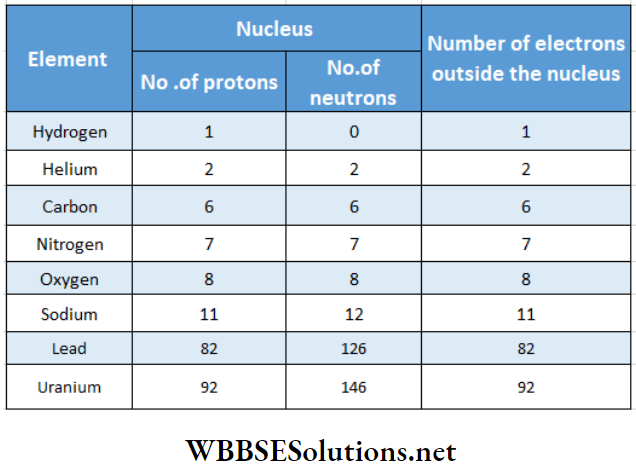
Are the constituents of the atom of any element though relative abundance differs from element to element shows the constituents of neutral atoms of few elements
Atomic Nucleus Proton And Neutron Are Collectively

Common Questions on Atomic Nucleus

The following points must be remembered:

  • There is no neutron in the hydrogen nucleus.
  • Only one proton forms its nudes. As electrons and protons have equal and opposite charges so for a neutral atom, several protons in nudes is equal to the number of electrons outside the nucleus.
  • Only neutrons cannot form a nucleus.

Nuclear force

A strong force of attraction keeps the neutrons and the protons bound together within the nucleus. This interaction is called strong interaction and the force thus produced and acting between the neutrons is called nuclear force. Neither the law of gravitation nor Coulomb’s law can explain the intensity or properties of this nuclear force.

Characteristics of nuclear force:

  • The nuclear force is stronger than gravitational or coulombia force.
  • It Is only an attractive force
  • Nuclear force Is Independent of charge.
  • So the magnitude of the nuclear force of proton and neutron Is the same l.e., neutron-proton, proton-proton, and neutron-neutron pairs experience die same force.
  • It Is a very short-range force limited to a distance of about 10 -12 cm. So only closer nucleons are bound together by this force, not the distant ones.
  • Protons, neutrons, and some other fundamental particles take part in nuclear interaction.

Atomic Nucleus Atomic Mass And Numar Mass

Atomic mass unit Definition:

\(\frac{1}{12}\) th of the mass of a C¹² atom is called 1 atomic mass unit(u)

Unified atomic mass unit

The mass of an atom is so small that It is not expressed In kilogram or grams. Instead, a special unit called imified atomic mass unit has been designed for this and is expressed as u. This unit is often called Dalton or Da. Earlier the atomic mass was represented by amu or atomic mass unit, it was expressed in terms of the mass of hydrogen or oxygen atom. Presently, carbon Is taken as the standard as C¹² atoms can be obtained free from its Isotopes, in nature.

1 mol of carbon-12 has a mass of 12 g and contains 6.023× 10 23 (Avogadro’s number) of atoms

Hence, mass of 1 atom of C¹² = \(\frac{12}{6.023 \times 10^{23}} \mathrm{~g}\)

∴ As per definition.

1 u = \(\frac{1}{12} \times \frac{12}{6.023 \times 10^{23}}\)g

= 1.66 × 10 -24 g

= 1.66 × 10 -27  kg

Equivalent energy of the unified atomic mass:

According to E = mc². equivalent energy of

1 u of mass = \(1.66 \times 10^{-24} \times\left(2.998 \times 10^{10}\right)^2\) erg

= \(=\frac{1.66 \times 10^{-24} \times\left(2.998 \times 10^{10}\right)^2}{1.6022 \times 10^{-12}} \mathrm{eV}\)

= \(931.2 \times 10^6 \mathrm{eV}=931.2 \mathrm{MeV}\)

It is important to remember the value 931.2 MeV for several mathematical calculations. In nuclear physics.

Atomic moss: Relative atomic men

The atomic mass of an element Is the mass of an Isotope of that element (discussed later).

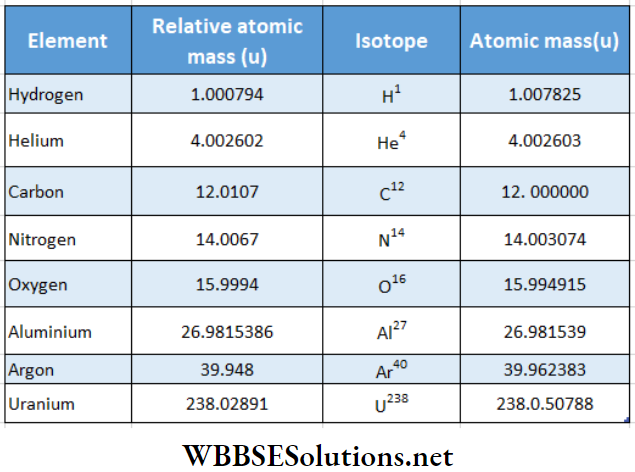
Depending upon the abundance of Isotopes of an element present on the earth’s surface or in the atmosphere, an average mass of the button of an element Is calculated. This average atomic mass is called the relative atomic mass of that element. It is sometimes referred to as atomic weight though it expresses the mass and not the weight.

It has been possible to measure precisely the atomic mass or relative atomic mass of elements using mass spectroscopes.

Represents the values In u of a few elements. Data sources are
Atomic Nucleus Atomic Mass

Nuclear mass

Nuclear mass = atomic mass- a mass of electrons in the atom ofthe element Mass of one electron I is taken as 0.00055 u . Except for very precise measurements, mass of a the nucleus and the atomic mass are taken to be the same

Mass number

Mass number Definition:

The whole number nearest to the atomic mass of an element expressed in atomic mass unit, is the mass number of the element Mass number is equal to the number of protons and neutrons in the nucleus of that atom.

Example: The mass number of hydrogen (H¹) is 1 and that of uranium (U238) is 238.

A mass number is simply a number and has no unit It is usually expressed by the letter A.

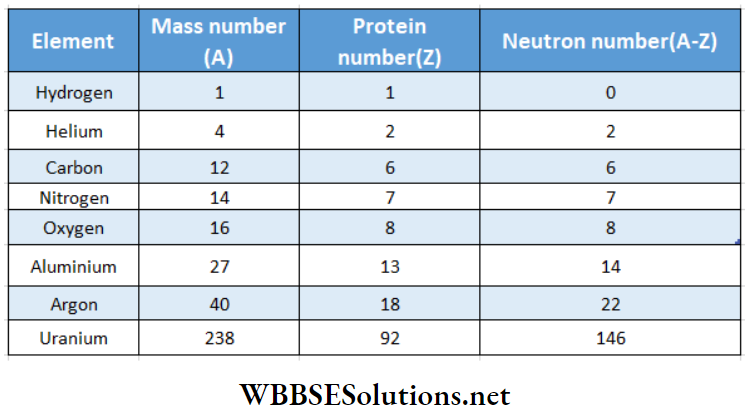
The number of protons present in the nucleus of an element is called the atomic number ofthe element and is represented by Z. The difference (A-Z) represents the number of neutrons in the nucleus. The mass number, atomic number, and neutron number of some elements are listed in
Atomic Nucleus Mass Number

Important Definitions in Nuclear Physics

Notation for mass number

To denote or express the mass number (A) of any element the symbol of the element is used then the mass number is written as a superscript either to the left or to the right side of the symbol

Example: H1, C12, N14,- or, 1H, 4He, 12C, 14N

Isotopes

Atoms having the same atomic number but different mass numbers are called isotopes.

Isotopes have identical chemical properties because they are the same element, but differ in physical properties because they differ in mass. All the isotopes of an element should in principle occupy the same place as the parent element in the periodic table. The name has originated from this property. Isotopes are formed due to the difference in number of neutrons in the nucleus of an element.  lists some important isotopes of a few elements.
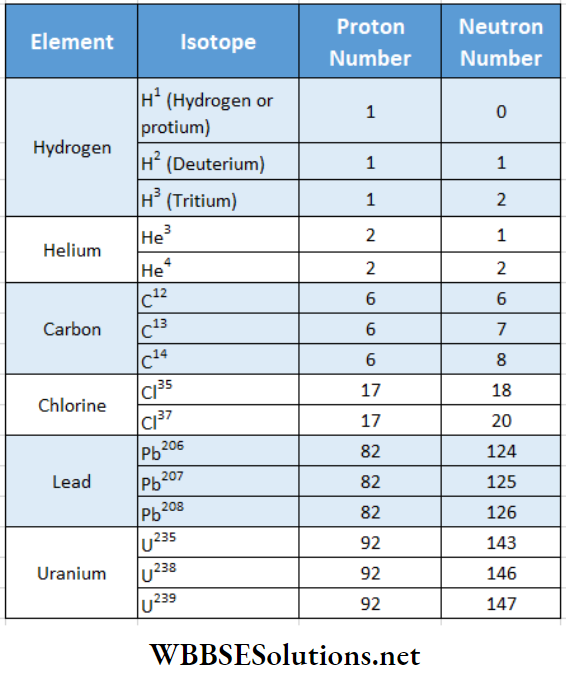
Atomic Isotopes

Carbon has three isotopes C12, C13, and C14. Therefore, when defining relative atomic mass one should write carbon- 12 atom and not carbon atom.

Heavy water

The isotope of hydrogen having mass number 2 is called deuterium. Its symbol is H2. Often it is also expressed as D . Deuterium has one proton and one neutron in its nucleus.

In water (H2O) hydrogen chemically combines with oxygen. Deuterium too, can form a similar molecule, D20 in combination with oxygen and is called deuterium oxide or heavy. Natural water and heavy water have the same chemical properties but they differ in physical properties as shown
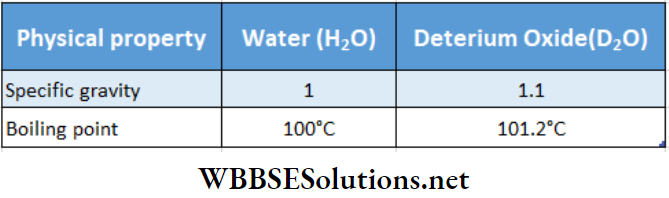
Atomic Nucleus Physical Properties

In any sample of common water, the abundance of heavy water is 1 in 5000 parts. Heavy water is used in nuclear reactors as ‘moderators’ that slow down the fast-moving neutrons formed.

Isobars

The atoms having the same mass number are called isobars. However, isobars differ in their neutron and pro¬ ton numbers.

Example:

C14 and N14  are isobars but the neutron number and proton number in C14 are 8 and 6 while those in N14 are 7 and 7 respectively.

Isotones

Atoms having the same number of neutrons in their nucleus are isotones. They differ in mass number and proton number.

Example: C14 and O16 are mutual isotones. In C14, neutron number = 8, proton number = 6, mass number = 14. In O16 the corresponding numbers are 8, 8, and 16 respectively.

Atomic number

Atomic nucleus class 12 notes Definition:

Taking hydrogen as the first element, the serial number of an element, arranged according to gradual changes in chemical properties in the periodic table is called the atomic number of that element

1.  Importance of atomic number in an atom:

The number of protons in the nucleus of an atom of an element determines the characteristics of that element. For instance, if there are 6 protons it is a carbon atom, if there are 8 protons it is an oxygen atom. Neutrons inside the nucleus and electrons outside the nucleus cannot be used to identify the element

If the number of neutrons in an atom changes an isotope is formed and when there is a change in the number of electrons an ion is formed. Interestingly, if the proton number is altered, the element itself changes into another element For example, all atoms of oxygen invariably have 8 protons in their nucleus. While the proton number remains constant, the electron and neutron numbers may vary in an atom.

We know, that elements are arranged in the periodic table according to the change in their chemical properties, taking hydrogen as the first element. In the periodic table, we observe that a change in chemical property results in a corresponding change in its atomic number (or number of protons). This observation led to the definition of atomic number.

Modem definition of atomic number is as follows:

Definition:

The atomic number or proton number (Z) of an element is the number of protons present in the nucleus of an atom of that element.

From the position of the element in the periodic table its atomic number can be determined.

Since, an atom is electrically neutral and the number of electrons is equal to the number of protons so, the number of electrons in a neutral atom can also be taken as the atomic number of that element.

2. Representation of atomic number:

An atomic number of an element is represented by Z. The Electric charge in the nucleus of an atom is +Ze where e is died magnitude of the charge of an electron. Similar to the method of denoting the mass number of an atom, we can express the atomic number of an element

In this case, we write the symbol of the element, and then either on the left or on the right side of the symbol we write the atomic num¬ ber as a subscript. When writing the symbol of an element we don’t need to write the atomic number But the mass number needs to be mentioned.

For example, we can write H¹ instead of 1H1 but not H as it could mean either H¹ or H² and we will not be able to differentiate between the two.

Atomic Nucleus Binding Energy Of A Nucleus

Binding Energy Definition:

The energy that keeps protons and neutrons confined to the nucleus, is called nuclear binding energy. If an amount of energy equal to the nuclear binding energy is supplied from outside then the nucleus disintegrates and the protons and neutrons exist as free particles. Hence, the binding energy of a nucleus is also defined as the external energy required to separate the constituents of the nucleus.

Relation between binding energy and mass defect:

The binding energy of a nucleus can be explained using mass-energy equivalence. When protons and neutrons exist freely, the sum of their masses gives the ‘mass energy of the system. But when these very protons and neutrons form a nucleus, both nuclear binding energy and a nuclear mass exist. Hence, from the law of conservation of mass energy,

(Sum of masses of protons and neutrons) × c² = mass of nucleus × c² + nuclear binding energy

If Z = atomic number and A = mass number of the nucleus and mp and mn, mass of proton and mass of neutron independently, the conservation condition can be mathematically expressed as

Zmpc² + (A- Z)mnc²= MzA c² > AC² + ΔE

Where Mz A = mass of the nucleus and AE = binding energy

Hence, AE = {Zmz + (A-Z)mn MZ,A}c² ………………………………………………. (1)

This can be written as

ΔE = Am c²………………………………………………. (2)

The expression within the second bracket in equation (1) represents Δm. When a nucleus is formed from its nucleons, the mass of the nucleus is less than the masses of the nucleons taken together. This means that {Zmp + (A-Z)mn} is greater than MZ, A. This difference is called mass defect, Am. In fact, this reduced mass is transformed into binding energy to form the nucleus

Class 11 Physics Class 12 Maths Class 11 Chemistry
NEET Foundation Class 12 Physics NEET Physics

Example: Mass of proton mp = 1.0073 u and that of neutron

mn = 1.0087 u. Since the nucleus of He4 consists of 2 protons and 2 neutrons, their total mass

The experimental value of the mass of He nucleus, M2 > 4 = 4.0015.

Hence, mass defect in the He4 nucleus

Δm =[2mp + 2mn]-M2,4  = 4.0320-4.0015 = 0.0305 u

The binding energy of the He4 nucleus

ΔE = 0.0305 × 931.2 MeV = 28.4016 MeV

Hence, the binding energy per nucleon or the average binding energy of the He4 nucleus

⇒ \(\frac{\Delta E}{4}=\frac{28.4016}{4}\)= 7.1004 MeV

Stability of a nucleus:

The more the binding energy of a nucleus, more is the energy required to separate its nucleons and hence the nucleus is more stable. In this respect, a nucleus can be compared with a liquid drop. A very large liquid drop tends to break up into smaller drops whereas a large number of small drops tend to join to form a large drop. Similarly, a large nucleus (like that of U238 ) and a small nucleus (like H² ) both are unstable.
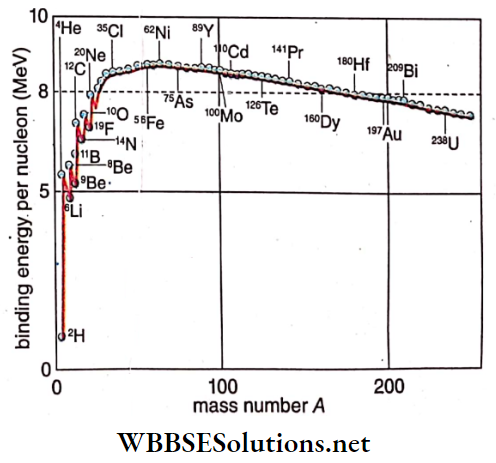
Atomic Nucleus Stability Of A Nucleus

The stability of a nucleus depends upon the binding energy per nucleon. The graph of binding energy per nucleon of different elements vs mass number is.

Significance of the binding energy curve:

The nearly constant value of the binding energy per nucleon for nuclei of about A

= 25 to A = 170 shows a

  1. Saturation, since no further increase occurs if extra nucleons are added.
  2. The saturation means that nuclear force is a short-range force—any extra nucleon, when added, resides on the surface, not affect the nucleons deep inside the pre¬ existing nucleus.
  3. The binding energy per nucleon for A higher than about 220 is less than that at the middle region of the periodic table.
  4. So a heavy nucleus tends to break up into two mid-range nuclei to attain higher stability this is nuclear fission. A significant amount of energy is released in this process.
  5. Nuclei with say, A < 4 to 6 have a relatively low value of binding energy per nucleon. So two or more of them tend to unite into one nucleus with a higher value of binding energy per nucleon, to attain stability. This is nuclear fusion. In this pro¬ cess also, a significant amount of energy is released.

Atomic nucleus class 12 notes Mass excess

Mass excess Definition:

If mass number = A and atomic mass = M of a nuclide then mass excess of that nucleus, ΔM = M- A.

For the C12 atom, A = 12, and in this case, | according to the definition of atomic mass the actual mass of the C12 atom, M = 12 u. However, for all other elements, the values of A and M are different. For example, for He4, A = 4 but Af

= 4.002603 u, for O16, A = 16 but M = 15.994915 u. This difference in the value A and the experimental value of M is called mass excess. Mass excess can be either positive or negative for different nuclei

From the above examples, the mass excess ofthe elements is listed below
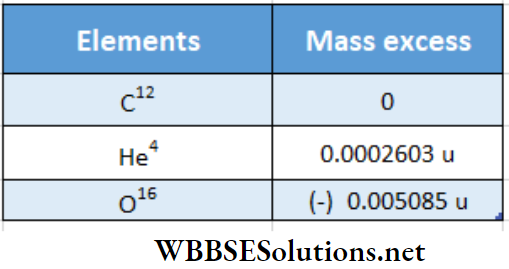
Atomic Nucleus Mass Excess

Atomic Nucleus Volume And Density Of A Nucleus

Different nuclei are similar to a drop of liquid of constant density. The volume of a liquid drop is proportional to its mass, which is proportional to the number of molecules contained in it. Similarly, the nuclear density is also a constant quantity. So the nuclear volume is directly proportional to the mass number and is independent of the separate values of the proton number and the neutron number.

Radius of the nucleus

Experimentally it has been found that a proton or a neutron has a radius,

r0 = 1.2 × 10 -13 cm

= 1.2 × 10 -15 m

So the volume of each proton or neutron, V’ = \(\frac{4}{3} \pi r_0^3 A\)

Let the total number of protons and neutrons in the nucleus = mass number =A

Then the volume of the nucleus V = \(\frac{4}{3} \pi R^3\)

Let the total number of protons and neutrons in the nucleus = mass number =A

Hence, R³ = r ³0 A or, R = r0 A1/3

For A = 216 , we get R = 6r0 = 7.2 × 10 -13  cm
.
Hence even the radius of a heavy nucleus is less than 10-12cm.

Calculation of nuclear density:

Estimated mass M of a nucleus of mass number A,

M = A u = A × 1.66 × 10 -24 g

Also, volume of this nucleus, V = \(\frac{4}{3} \pi r_0^3 \times\) × A

Hence, nuclear density

V = \(\frac{M}{V}=\frac{A \times 1.66 \times 10^{-24}}{\frac{4}{3} \pi r_0^3 \cdot A}\)

= \(\frac{3 \times 1.66 \times 10^{-24}}{4 \pi \times\left(1.2 \times 10^{-13}\right)^3}\)

= 2.3 × 10 -14 g. cm-3

Generally, nuclear density Is taken as 2 × 10 14  g.cm-3 or 2 × 10 17 kg. m-3, which is very high and represents the presence of a lot of mass concentrated within a very small space. So, nuclear density is more than 1014 times the density of water

Class 12 physics nucleus chapter notes 

Atomic Nucleus Volume And Density Of A Nucleus Numerical Examples

Example 1. For a nearly spherical nucleus-, r =r0 A1/3, where r is the radius A is the mass number and rQ is a constant of value 1.2 × 10 -15 m. If the mass of the neutrons and protons are equal and equal to 1.67 × 10 -27 kg, prove that the density of the nucleus is  10 14 times the density of water.
Solution:

Mass of A -number of neutrons and protons « mass of nucleus (M) = 1.67 × 10 -27 A kg

Again, the volume of the nucleus

V = \(\frac{4}{3} \pi r^3=\frac{4}{3} \pi r_0^3 A\)

= \(\frac{4}{3} \times 3.14 \times\left(1.2 \times 10^{-15}\right)^3\)

Density of nucleus = \(\frac{M}{V}=\frac{1.67 \times 10^{-27} \times A}{\frac{4}{3} \times 3.14 \times\left(1.2 \times 10^{-15}\right)^3 \cdot A}\)

= 2.3 × 10¹⁷ kg.m-3

∴ \(\frac{\text { density of nucleus }}{\text { density of water }}=\frac{2.3 \times 10^{17}}{1000}\)

= 2.3 × 10¹⁴

∴ The density of the nucleus is more than 1014  times the density of water.

Practice Problems on Atomic Mass and Number

Atomic Nucleus Discovery Of Radioactivity

Uranium and thorium

Henry Becquerel first observed in 1896 that photographic plates preserved in opaque black paper get affected, when kept close to a compound, uraniumpotassium sulphate, and also found that no external energy source was required to initiate the chemical reaction. Becquerel also observed similar properties in other compounds of uranium and named it radioactivity. Scientist Madam Marie Curie of Poland, discovered radioactivity in the element thorium too.

Polonium and radium:

Marie Curie and Pierre Curie extracted radioactive elements polonium and radium from the uranium ore ‘pitchblend’. Polonium and radium exhibit radioactivity 103 and 10® times more than that exhibited by uranium.

Characteristics of radioactivity:

  • Elements of mass number 210 or more, generally exhibit radioactivity.
  • All radioactive substances emit highly penetrating radiations (rays) that can easily penetrate thin metal sheets and similar substances.
  • Radioactivity is a continuous and spontaneous activity.
  • Radioactive rays affect photographic plates.
  • Radioactivity is not affected by physical changes brought about by light, heat, electric or magnetic fields.
  • Chemical changes of radioactive elements cannot influence the amount of radioactivity. Hence, the radioactivity of an ele¬ ment and that of its compound is the same.
  • A chemical change cannot influence the radioactivity of an element and that chemical change involves electrons outside the nucleus. It led to the conclusion that radioactivity is entirely a nuclear phenomenon that happens due to internal changes in the nucleus.
  • Radioactivity brings about the transmutation of elements 1000 where one element changes into another.

Some useful definitions

1. Radioactivity or radioactive decay or radioactive disintegration:

The phenomenon of spontaneous emission of rays from an unstable nucleus or due to a nuclear reaction is called radioactivity radioactive decay or radioactive disintegration. Radioactive rays are highly penetrating and originate due to changes in nuclear structure.

Radioactive elements: Elements that exhibit radioactivity spontaneously are called radioactive elements. Generally, the nucleus of a radioactive element is unstable. The nature of stability varies from element to element.

Examples: Uranium, Radium, Thorium.

Parent and daughter atom:

A radioactive element or atom that exhibits radioactivity is called a parent atom. The atom that is left behind after the emission of radioactive radiation is called a daughter atom, which may or may not be radioactive. If it is radioactive then it will be the parent atom for the next decay.

Radioactive sample:

A radioactive sample is a specimen of the material that emits radioactive radiation. From medicine making to paper manufacture, radioactive samples are in wide use. The entire mass of any naturally occurring radioactive substance is not radioactive. Because radioactive decay starts from its beginning, some part of the radioactive substance transforms into stable non-radioactive parts For example, any radioactive sample of uranium also contains some non-radioactive lead.

Radioactive isotopes or radioisotopes:

Radioactivity is not a characteristic of an element One isotope of an element may be radioactive like C14 whereas the other isotope C12 is non-radioactive. Hence, radioisotopes are radioactive isotopes of elements.

Example: The radioactive nature of two uranium isotopes U238  and U235 are different. Again, Pb206, and Pb208 are non-radioactive but Pb210 called RaD is radioactive.

Class 12 physics nucleus chapter notes 

Atomic Nucleus Classification Of Radioactive Emissions

Rutherford’s experiment

The radioactive emissions from radioisotopes when subjected to a strong magnetic field at right angles to the plane of the radiations, show different deflections. The experimental arrangement.
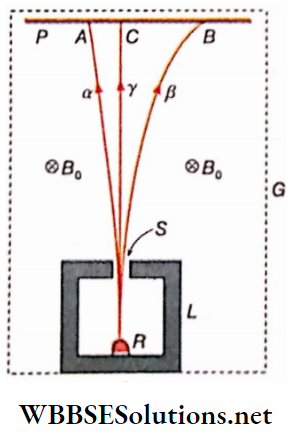
Atomic Nucleus Ruthrefords Experiment

Experimental arrangement

G  – A container, nearly evacuated and placed In a dark room.

L –  A small, deep, and thick-walled lead container.

R –  A mixture of different radioisotopes.

S –  Slit on the lid of the lead container that allows radiation to come out upwards.

P – A photographic plate.

B0 –  A strong magnetic field perpendicular to the plane of the paper and directed downwards.

1. Observation:

When the photographic plate is examined after a considerable length of time,

Three distinct lines are seen on the plate:

  1. Line A: It shows a small deviation of some emissions to the left.
  2. Line B: This shows a significant deviation of some emissions to the right.
  3. Line C: It shows a part of the radiation not affected by the magnetic field.

2. Inference:

The inferences from the observations are that a mixture of radioactive samples can emit three types of radiation.

  1. α -rays (alpha rays): Applying Fleming’s left-hand rule it is seen that line A Is produced by the comparatively heavy, positively charged stream of high-speed particles called α – rays or α -particles
  2. β –  (beta rays): By similar analysis, the Une made by light, negatively charged stream of high-speed particles called β -rays or β  – particles.
  3. γ -rays (gamma rays): The emission, that is not deflected by the magnetic field and produces line C, consists of y rays or γ -radiations.  γ -radiation is not a stream of charged particles.

3. Discussions:

  1.  Identical results will be obtained when instead of a netic field an electrical field is applied from the right to the left along the plane of the paper.
  2. No radioactive Isotope can emit all three regulations α, β, and γ simultaneously. Hence, a mixture of different types of radioisotopes needs to be kept in R to obtain the results described. Generally, any radioactive sample contains parent Isotopes us well as a daughter isotope.
  3. If this daughter Isotope is also radioactive then we can get three types of rays.
  4. For example: This event may happen parent isotope emits α -rays and the daughter isotope  emits β – rays

Alpha (α) rays

1. Nature of α -rays:

Measurements of charge q and specific q/m  charge establish that α -rays are high-speed, streams of particles.

  • α -particles are positively charged and their charge q – + 2e, that is it contains two units of elementary” charge (e = +1.6 × 10 -12 C  ) as that of a proton or electron.
  • The mass of an a -particle is four times the mass of a proton.

Experimentally it is found that an a -particle is comparable to a helium-4 nucleus. As the helium-4 nucleus consists of two protons and two neutrons, so alpha particle is denoted by the symbol 2He4.

Properties of  α – rays:

Α -rays are not rays, they are a stream of high-speed particles. Each of the particles is known as α -particle.

  • Each α -particle is positively charged and it contains two units of elementary charge as that of the electron.
  • The mass of each α -particle is equal to the mass of 4 protons.
  • From its mass and charge, it is concluded that α -particles are structurally identical to a helium nucleus.
  • As α -particles are positively charged they can be deflected by the electric or magnetic field
  •  The initial velocity and kinetic energy of α -particles depend on radioisotopes from which a -particles are emitted. In most cases, the initial velocity is nearly 109cm s -1 and initial kinetic energy is within the limit of 5 MeV to 10 MeV.
  • 1C1 From its high initial kinetic energy it can be concluded that α-particles are emitted from the nucleus of an atom. CD  α -particles have low penetrating power in comparison to β  and γ -rays and can be completely absorbed in mm thick aluminum plate.
  • As penetrating power is less, or -particles have high ionization power in comparison to β  and γ -rays. In a gaseous medium a -particles dislodge orbiting electrons and ionize the gas.
  • Affects the photographic plate. When it strikes fluorescent material (like zinc sulfide) it produces scintillation (flashes of light).
  • In a gaseous medium α -rays cannot travel beyond a certain range. This range is determined by the nature ofthe the emission source. α -rays are used in nuclear reactions and in artificial transmutation of one element into another:

Beta(β)rays 

1. Nature Of β -rays:

From the experiment, we know that like α -rays, β -rays are also a stream of fast-moving particles.

From the measurement of charge q and the specific q/m charge of β-rays, it is proved that each β-particle is an electron, i.e.,

  1. Charge of β -particle e = -1.6 × 10⁻¹⁹  C and
  2. Mass of β  -particle =9.1 × 10– 31 1 kg

Since the mass of an electron is negligible compared to the mass of the proton, therefore the mass number of β -particle is taken as zero. Due to its unit negative charge fi -particle is sometimes expressed as -1β2 or  -1e2

Class 12 physics nucleus chapter notes Properties of β -rays:

β  -rays are not rays rather they are a stream of high-speed particles known as β – particles.

Each β -particle is an electron

  • As β -particles are light and negatively charged they are significantly deflected by the electric or magnetic field.
  • Initial velocity, as well as the kinetic energy of each particle, depends on the radioisotopes from which the particle is emitted. Initial velocity may take any value from zero to the velocity of light.
  • Similarly, kinetic energy ranges from zero to a certain upper limit Generally this value ranges from 5 MeV to 10 MeV.
  • From its high initial kinetic energy, it can be concluded that they are emitted from the nucleus of an atom.
  • Inside a nucleus when a neutron transforms into a proton, an electron is generated. As nuclear force does not influence electrons, it cannot confine the electron in the nucleus and so it comes out. This electron is β – particle and not orbital.
  • The penetration power of β -rays is 100 times greater than that of β -rays but \(\frac{1}{100}\)  part of that of γ -rays. It is completely absorbed by a 1 cm thick aluminum plate.
  • β-rays can ionize gas but its ionizing power is \(\frac{1}{100}\)  of that of a -rays.
  • It affects photographic plates and produces weak scintillation on falling on a fluorescent screen. -β rays are used in the nuclear reaction and artificial trans¬ mutation.
  • Whenever a β -particle is emitted from the nucleus of a radioactive element a massless, chargeless particle called neutrino is formed, the existence of which was originally suggested by Wolfgang Pauli in the year 1930. The name was given by Fermi (in 1934) while giving his neutrino theory of β -decay. It was detected in 1956 by Reines and Cowan.

Comparison between cathode rays and  β – rays:

1. Similarities:

  • Both are streams of moving electrons.
  • Both possess penetrating and ionizing properties.
  • Both affect photographic plates and exhibit fluorescence when falling on compounds like zinc sulfide etc.
  • Both are deflected by an electric or a magnetic field.

2. Dissimilarities:
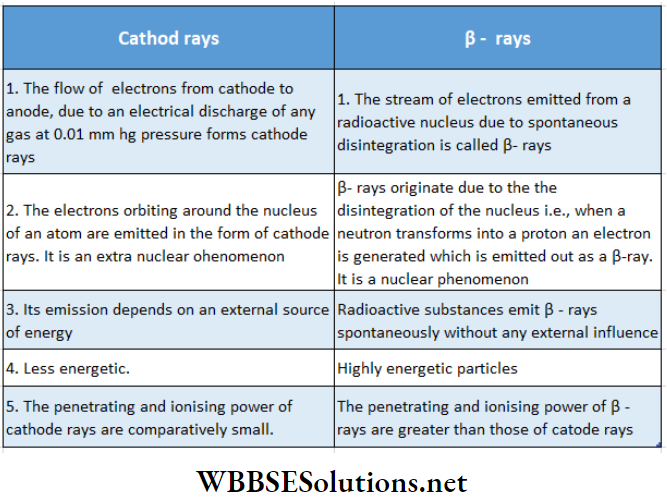
Atomic Nucleus Dissimilarities Of Cathode And Beta Rays

Gamma rays

Nature of γ-rays:

  • γ-rays are electromagnetic rays like light rays and with the same speed as that of light in a vacuum.
  • According to Planck’s quantum theory, γ-ray is constituted of a stream of photons. As frequency is high, so energy of each photon is also high. Its wavelength is shorter than that of X-rays, ranging from 0.005 Å to 0.5 Å.

Example: The energy of γ -ray photon of wavelength 0.01Å is 1.24 MeV.

Properties of γ -rays:

Like light, γ-rays are electromagnetic waves and travel at the same speed as that of light in any medium.

The wavelength of γ -rays is in the range from 0.005Å to 0.5Å γ -rays are neutral and therefore they are not deflected by an electric or a magnetic field.

According to quantum theory, γ -rays comprise high-energy photons. The energy of each photon is considerably high and can measure up to a few MeV

The high energy of γ-ray photons implies that γ-rays are emitted from the nucleus. When a and β -particles are emitted from a nucleus the nucleus acquires an excited energy state. To return to the ground state γ -rays are emitted

The penetrating power of γ -rays is high in comparison with a or ft -rays. It can penetrate a few centimeters of lead plate. The ratio of the penetrating power of α, β, and γ- rays is 1 : 102: 104.

The ionizing power of 7 -rays is comparatively less than that of α and β  -rays.

γ  -ray, like X-rays, undergoes diffraction.

γ  -rays, can affect photographic plates and adversely affect the cells of the human body. Therefore, for the treatment of cancer and tumor γ -rays are used. Powerful γ -ray bursts are used to probe star formation.

γ -rays are used in nuclear reactions and artificial trans¬ mutation operations.

γ -ray photon of energy of a few MeV or more, when pass¬ ing close to a heavy nucleus changes into an electron and a positron (particle identical to an electron but with positive charge). This is called “pair production’’ which is an example of energy changing to mass hence the energy associated with a γ -ray photon can be taken as E = 2me × c² J.

Comparison between X-rays and γ  -rays:

1. Similarities:

  • Both X-rays and γ-rays are electromagnetic waves. ElSl Both can create fluorescence and affect photographic plates.
  • Both have ionizing and penetrating power. Crystals can diffract both X -rays and γ -rays. ‘Both X -rays and γ -rays remain unaffected by an electric or a magnetic field.
  • x -rays and 7 -rays travel with the speed of light in a vacuum.

2. Dissimilarities:
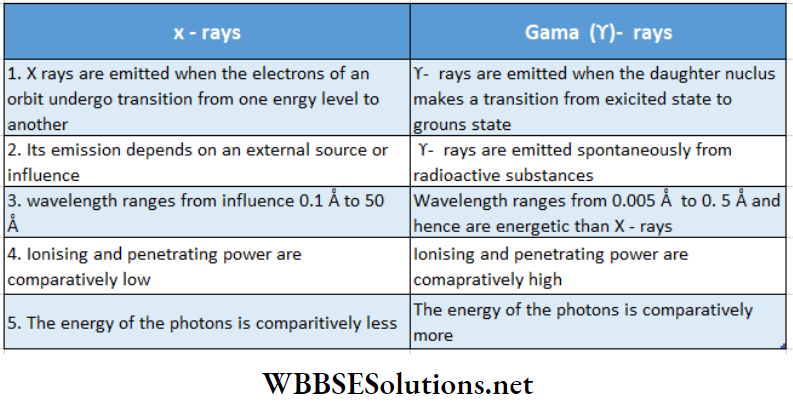
Atomic Nucleus Dissimilarities Of X Rays And Gama Rays

Nuclear Physics Class 12 Notes

Atomic Nucleus Activity

Activity Definition:

The rate of radioactive disintegration with time is called the activity of the sample.

Mathematically, activity (A) \(\frac{d N}{d t}=\lambda N\) = the numerical value

There fore activity A∝ N and \(A \propto \lambda \propto \frac{1}{T} .\)

From this, we can say, a radioactive sample has greater activity if

  • The sample contains a large number of radioactive atoms [N)
  • Decay constant is high or half-life is low.

Also if A0 and A are the activities initially and after a time t, then

⇒ \(A_0=\lambda N_0, \text { and } A=\lambda N\)

∴ \(\frac{A}{A_0}=\frac{N}{N_0}=e^{-\lambda t}\)

Or, A =  \(A_0 e^{-\lambda t}\)

∴ Activity also decreases exponentially with time

Units to measure activity

The activity of a radioactive substance is measured in terms of the number of disintegrations per unit of time. In SI, the unit is becquerel or Bq and 1 Bq = 1 dis¬ integration per second or 1 dps.

Other practical units are:

Curie 1 Ci= 3.70 × 10¹⁰ dps

Rutherford = 1 Rd = 106 dps

Atomic Nucleus Activity Numerical Examples

Example 1. Po210 has a half-life of 140 d. In lg Po210 how many disintegrations will take place every second? (Avogadro’s number = 6.023 × 10²³ )
Solution:

Disintegration constant,

λ = \(\frac{0.693}{T}=\frac{0.693}{140 \times 24 \times 60 \times 60} \mathrm{~s}^{-1}\)

Number of atoms in 210 g Po210

= Avogadro’s number = 6.023 × 10²³

Number of atoms in 1 g  Po210, N = \(\frac{6.023 \times 10^{23}}{210}\)

Disintegration per second

= Activity = λN

= \(\frac{0.693}{140 \times 24 \times 60 \times 60} \times \frac{6.023 \times 10^{23}}{210}\)

= 1.64 × 10¹⁴ dps

Example 2. A radioactive sample of half-life 30 d contains 1012 particles at an instant of time. Find the activity of the 1 sample
Solution:

Decay constant

λ = \(\frac{0.693}{T}\)

= \(\frac{0.693}{30 \times 24 \times 60 \times 60} \mathrm{~s}^{-1}\) and N = 1012

∴ Activity , λN = \(\lambda N=\frac{0.693 \times 10^{12}}{30 \times 24 \times 60 \times 60}\)

= 2.67 × 10⁵ dps

Examples of Nuclear Reactions

Example 3. How much  84Po210 of a half-life of 138 days is required to produce a source of α -radiation of intensity 5 (millicurie)?
Solution:

Decay constant, \(\frac{0.693}{T}=\frac{0.693}{138 \times 24 \times 60 \times 60} \mathrm{~s}^{-1}\)

Activity, A =5 mCi = 5 × 3.70 × 107 dps

Now, A = λN

N = \(\frac{A}{\lambda}=\frac{5 \times 3.7 \times 10^7 \times 138 \times 24 \times 60 \times 60}{0.693}\)

Again, the number of atoms contained in 210 g Po210

= Avogadro’s number = 6.023 × 10²³

Hence, the mass of N such particles

= \(\frac{210 \times 5 \times 3.7 \times 10^7}{6.023 \times 10^{23}} \times \frac{138 \times 24 \times 60 \times 60}{0.693}\)

1.11 × 10⁻⁶ (approx)

Nuclear physics class 12 notes 

Example 4. A 280-day-old radioactive substance shows an activity of 6000 dps, 140 days later its activity becomes 3000 dps. What was its initial activity?
Solution:
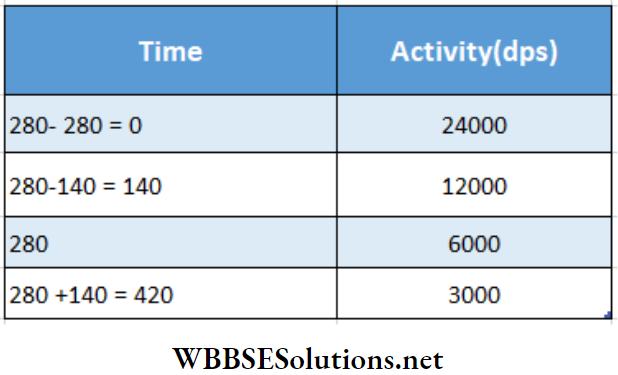
Atomic Nucleus Time And Activity

In the table, the last two values of activity are given. These are used to calculate the first two values.

Hence, initial activity =24000 dps

Nuclear physics class 12 notes 

Atomic Nucleus Nuclear Fission

Nuclear Fission Definition:

Breaking up of a heavy nucleus into two nuclei of almost equal masses is called Nuclear Fission

Peripheral reactions: In most nuclear reactions, the emitted particle is not heavier than a projectile particle. This indicates that there is a small change in the atomic number and mass number ofthe target nucleus. These are termed peripheral reactions because the core of the nucleus is practically unaffected. For example,

⇒ \({ }_7 \mathrm{~N}^{14}+{ }_2 \mathrm{He}^4 \rightarrow{ }_8 \mathrm{O}^{17}+{ }_1 \mathrm{H}^1 ;{ }_7 \mathrm{~N}^{14}+{ }_0 \mathrm{n}^1 \rightarrow{ }_6 \mathrm{C}^{14}+{ }_1 \mathrm{H}^1\)

Collision of thermal neutron with U-235: This results in the formation of almost two equally heavy nuclei, due to the disintegration of the heavier U-235 nucleus. For example

⇒ \({ }_0 \mathrm{n}^1+{ }_{92} \mathrm{U}^{235} \rightarrow{ }_{35} \mathrm{Br}^{85}+{ }_{57} \mathrm{La}^{148}+3{ }_0 \mathrm{n}^1\) …………………….. (1)

⇒ \({ }_0 \mathrm{n}^1+{ }_{92} \mathrm{U}^{235} \rightarrow{ }_{36} \mathrm{Kr}^{92}+{ }_{56} \mathrm{Ba}^{141}+3{ }_0 \mathrm{n}^1\) …………………….. (2)

Such splitting up of the nucleus cannot be termed a peripheral reaction. Generally, it is called nuclear fission. This was invented in 1939 by Otto Han and Strassman

The energy released In nuclear fission:

Mass lost during nuclear fission changes to energy as per mass-energy equivalence. In the equation (1),

Initial mass = total mass of U-235 and neutron

= 235.1 + 1.009 = 236.1 u (approx.) J

Final mass = total mass of Br-85 , La-148 and 3 neutrons

= 84.9 + 148.0 + 3 × 1.009 = 235.9 u (approx.)

∴ Mass loss =236.1- 235.9 = 0.2 u

∴ Energy released =0.2 × 931MeV = 186 MeV (approx.) (as- 1 u ≈ 931 MeV ). This energy is available from only one nucleusÿ of U-235

Considering the number of atoms of U-235 in 1 g of.U-235, the energy released during nuclear fission is of the order of 7.6 x 10¹⁰ J per g. This energy is equivalent to the energy that can be obtained by burning 3000 tons of coal.

Moderator

The three neutrons released in nuclear fission practically absorb the released energy (approximately 186 . MeV) and change to high-speed neutrons as kinetic energy increases. For further use of these neutrons for fission reaction, these are to be slowed down as thermal neutrons. Substances like heavy water (D2O), and graphite can slow down the high-speed neutrons when neutrons pass through them. These are called moderators

Chain reaction

Nuclear reactions sustained by the product of the initial reaction leading from one reaction to the other consecutively is called chain reactions. In equation (1), one neutron is bombarded on the U-235 target and 3. neutrons are released. They are slowed down to thermal neutrons.

Now they are used to set up further fission of 3 U-235 nuclei, releasing 9 new neutrons and so on. The number of fissions, like 1, 3, 9, 27, 81, is increasing in the form of multiple progression. Hence, in a short time, a large number of fissions take place, t releasing a huge amount of thermal energy. This is the principle’ i of an atomic bomb

Critical Size

Neutrons formed during fission tend to escape without hitting the target nucleus. This decreases the number of available neutrons to sustain the chain reaction, ultimately resulting in the cessation of the chain tion.

To prevent this, the following two methods are applied:

  1. The radioactive sample Uiat is taken in the shape of a sphere, which has less surface area compared to its volume.
  2. Mass of the sample taken is a little more than the calculated value. To continue nuclear fission sustaining its chain reaction the minimum size of the sample required is called critical size.

Controlled fission: Nuclear reactor

The energy released during nuclear fission should not be misused. Rather it should be used for useful and necessary purposes like the tion of electricity.

But for that, the following precautions should be taken: 

  1. The huge energy produced should not go out of control causing immense destruction and
  2. Energy supply should continue almost at the same rate for a long time. Fission brought about conforming to the above two conditions is called controlled chain reaction or controlled fission.

The device where controlled fission and subsequent generation of electricity is conducted is called a nuclear reactor.

The effective number of fission neutrons produced per absorp¬ tion in the fuel in each successive step of a chain reaction is the balled neutron reproduction factor. In case of an uncontrolled chain reaction in an atomic bomb, the ratio is 2.5 or above.

In a nuclear reactor, the factor is kept close to 1 or slightly more to attain the condition stated above. This Is the guiding principle of an atomic reactor.

Out of different types of reactors, a Pressurised Water Reactor or PWR is most widely used.

A schematic diagram of a PWR is shown in Fig. 2.7. The reactor consists of:

Core:

Inside the core the nuclear reaction takes place. Core contains

  • Fuel rod,
  • Control rod
  • Moderator and
  • Coolant.

1. U-235 ’is used as a fuel rod. Heat is generated when U-235 is bombarded with neutrons.

2. A steel rod with a coating of boron is used as a control rod. Boron absorbs surplus thermal neutrons

3. Heavy water is usually used as a moderator. Moderator slows down the high energy neutrons produced1 =, due to the nuclear reaction in the core to thermal neutrons to sustain the chain reaction.

4. Generally water is used as a coolant. The heat generated due to fission is absorbed by coolant water maintained at high 1 pressure to avoid boiling

WBCHSE physics class 12 nucleus notes Heat exchanger:

In this part, heat from coolant which is radioactive is transferred to non-radioactive water for further use. Radioactive water from coolant is kept confined within the core area by protective concrete shielding.

Turbine:

Non-radioactive water, at high temperature, is piped out of the shielding and converted to steam to rotate the turbine to produce electricity in the same manner as in a Thermal Power Station.
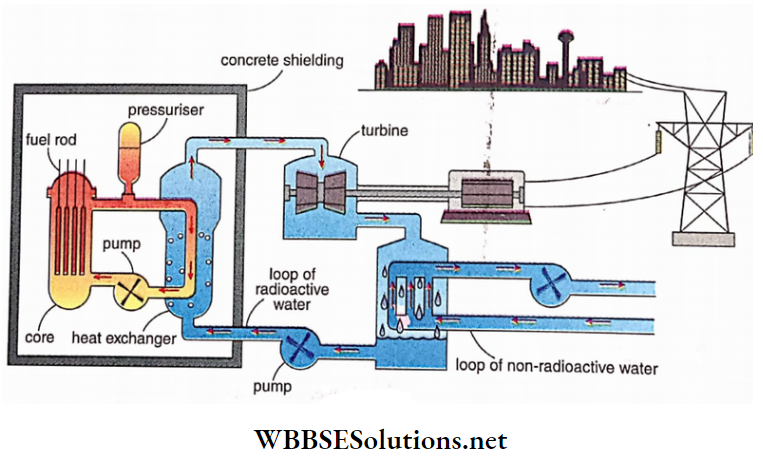
Atomic Nucleus Nuclear Reactor

WBCHSE physics class 12 nucleus notes 

Atomic Nucleus Nuclear Fission Numerical Examples

Example 1. The kinetic energy of a slow-moving neutron is 0.04 eV. What fraction of the speed of light is the speed of this neutron? At what temperature will the average kinetic energy of a gas molecule be equal to the energy of this neutron? [mass of neutron : 1.675 ×  10-27 kg, Boltzmann constant, kB = 1.38 × 10⁻²³ J. K-1
Solution:

The kinetic energy of the slow neutron

= 0.04 eV = 0.04 ×  (1.6 ×  10-19)J

Kinetic Energy, \(E_k=\frac{1}{2} m v^2\)

v = \(\sqrt{\frac{2 E_k}{m}}=\sqrt{\frac{2 \times 0.04 \times 1.6 \times 10^{-19}}{1.675 \times 10^{-27}}}\)

= 2764 m.s1

⇒ \(\frac{v}{c}=\frac{2764}{3 \times 10^8} \times 100 \%\)

= 0.00092%

Average kinetic energy at temperature T

= \(\frac{3}{2} k_B T=0.04 \times\left(1.6 \times 10^{-19}\right) \mathrm{J}\)

T = \(\frac{2 \times 0.04 \times\left(1.6 \times 10^{-19}\right)}{3 \times\left(1.38 \times 10^{-23}\right)}\)

= 309 K

= 36° C

Conceptual Questions on Radioactive Decay

2. Example In a typical nuclear fission reaction, it was found that there was a loss of mass of 0.2150 u. How much energy in MeV will be released from this reaction?  (c = 3× 10⁸ms-1).
Solution:

Loss of mass

Δm = 0.2150 u = 0.2150 × (1.66  × 10-27) kg

Associated release of energy,

ΔE = Δm c²

= \(0.2150 \times\left(1.66 \times 10^{-27}\right) \times\left(3 \times 10^8\right)^2\)

= \(3.2121 \times 10^{-11} \mathrm{~J}=\frac{3.2121 \times 10^{-11}}{1.6 \times 10^{-19}}\)

200 × 106  eV

= 200 MeV

WBCHSE Physics Class 12 Nucleus Notes

Atomic Nucleus Nuclear Fusion

Nuclear fusion Definition:

The phenomenon in which two or more light nuclei combine to form a comparatively heavy nucleus is called nuclear fusion

Fusion is the reverse phenomenon of fission.

Example:

The probability of fusion of two hydrogen nuclei is very low. A good example of nuclear fusion is the fusion between two deuterons i,e.f two heavy hydrogen nuclei (jH2)

⇒ \({ }_1 \mathrm{H}^2+{ }_1 \mathrm{H}^2 \rightarrow{ }_2 \mathrm{He}^3+{ }_0 \mathrm{n}^1\) …………… (1)

The probability of fusion of another hydrogen isotope, tritium (jH3) with deuteron is also high

⇒ \({ }_1 \mathrm{H}^3+{ }_1 \mathrm{H}^2 \rightarrow{ }_2 \mathrm{He}^4+{ }_0 \mathrm{n}^1\) …………… (1)

The energy released In nuclear fusion: Mass lost during nuclear fusion changes to energy as per mass-energy equivalence. In the equation (1) :

Initial mass = total mass of 2 deuterons = 2 × 2.015 = 4.030 u

Final mass = total mass of He3 and neutron

= 3.017 + 1.009 = 4.026 u

Mass loss = 2 × 2.015 -(3.017 + 1.009)

= 0.004 u

The energy released =0.004 × 931 MeV

= 3.7 MeV (approx.)

Hence, the energy released from 1 g of deuterium will be about

“For fusion of tritium with deuteron, the released per gram will be more and is about 30 × 1010 J.

Thus, the energy released from comparatively easily available deuterium or tritium fusion is greater than tÿat obtained from the fission of U-235

In addition, in a fusion reaction, a greater percentage of the nucleus takes part than the participant in fission nuclei in a fission reaction. A hydrogen bomb is made, based on this fusion reaction.

Conditions of Nuclear Fusion:

1. light dement:

For bringing about (Vision of two post* tively charged nuclei. the electrostatic force of repulsion needs to be overcome. Hydrogen-like lighter elements arc convenient because of die low positive charge contained in them and thereby there is less force of repulsion.

2. High temperature:

To bring about nuclear (Vision, hydrogen isotopes are to be raised to a few awe degrees Celsius temperature. That is why fusion reaction Is a thermonuclear reaction. To reach a high temperature, the most effective way is to set up an uncontrolled fission reaction. Therefore, to get nuclear energy from fusion, nuclear fission has to take place first.

The energy of the sun and the stars:

In the sun and other stars, the energy at the center is produced by the thermonuclear reaction. The core of stars being at a very high temperature, favours the process. According to the presently accepted theory, the thermonuclear reaction cycle in the sun is completed in steps. In ever)’ Cycle, primarily due to nudear fusion of four protons, one helium nudes, and two positrons are formed.

1H1 + 1H1 + 1H1 + 1H1 2He4 + +1e0 + +1e0

The mass defect = mass of 4 protons- combined mass of 2He4 and 2 positrons = 4 × 1.008 – (4.003 + 2  0×.00055) = 0.0279 u Corresponding energy =0.0279 × 931 = 26MeV (approx.)

Sun has a huge hydrogen stored, but per year only 1 part in 1011 of the hydrogen stored in the sun is used. Also, the energy released due to thermonuclear reaction is about 4 × 1026 W. It is estimated that the sun will continue producing energy for another 5 billion years before the total store of energy fuels is exhausted

Atomic Nucleus Uses Of Radioactive Isotopes

Medical science:

  • Studying blood circulation patterns and investigating of
    ailments, radioactive sodium (Na-24) and radioactive
    phosphorus (P-32) are used.
  • Radioactive radium or strontium are used to destroy
    cancer cells. Presently radioactive cobalt (Co-GO) is extensively used for this purpose.
  • Radioactive phosphorus (P-32) is very effective in treating blood cancer and brain tumors. S3 Radioactive iodine (1-131) is used in the treatment of the thyroid gland.

Radioactive tracer or indicator:

For various investigation purposes, P-32 and Na-24 are used as tracers or indicators. Examples: Different chemical reactions in plants and animals, the reaction of phosphorus-containing manure for agriculture, and detecting cracks in dams and reservoirs.

Radioactive pigments:

A paint in which traces of radium and a fluorescent ZnS are mixed glows even in the darkness. This pigment is used in watch dials, electrical switches, roads, etc.

Radiocarbon dating:

Cosmic rays bring about a nuclear reaction with atmospheric nitrogen producing some C-14 of half-life about 5600 years. C-14, in the atmosphere, changes to CO (carbon dioxide) and during the process of photosynthesis enters into the plant body. In living plant and animal bodies, a definite ratio is maintained between radioactive C-14 and normal C-12.

Assume this ratio is 1: x. The quantity of radiocarbon C-14 decreases exponentially after the death of a carbon-enriched sample, but the quantity of C-12 remains constant. So, at the time T, 2T, 3T, ……….., the ratio of C-14 and C-12 will be 1/2 :x, 1/4 :x, 1/8 :x, respectively. Hence, by estimating this ratio in an archaeological sample, the age of the sample can be estimated. Thus, radiocarbon C-14 acts as a radioactive clock.

Geological time determination:

The half-life of c-14 is only 5600 years while Earth and other geological specimens are more ancient. Therefore C-14 clock cannot be used for determine their age. Here uranium clock is used by noting the ratio of lead and uranium (half-life = 450 crores of years) in the sample. Q Production of energy: Radioactive uranium or plutonium is used as fuel in nuclear power stations.

WBCHSE physics class 12 nucleus notes 

Atomic Nucleus Uses Of Radioactive Isotopes Numerical Examples

1. In a piece of ancient wood, C and C-12 are present. The ratio of C-14 and C-12 in this wood at present is part of their ratio in the ancient wood. The half-life of C14 is 5570 y. What is the age of the wood?
Solution: 

Half-life C14 , T = 5570 y
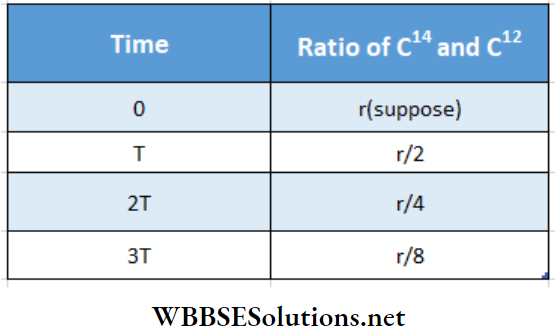
Atomic Nucleus Ratio Of C12 And C14

From the table, in time 3T ratio of C and C is \(\frac{r}{8}\) i.e., \(\frac{1}{8}\) of that ratio when T = 0

∴ The age of the piece of wood

3T = 3 × 5570

= 16710 y

Real-Life Applications of Nuclear Energy

Atomic Nucleus Very Short Questions And Answers

Question 1. What is the relation between a unified atomic mass unit (u) and an electron volt?
Answer: [lu = 931.2 MeV]

Question 2. The mass of a proton or 1.67 × 10⁻²⁴ g. What is its equivalent energy in MeV?
Answer: [939.4 MeV]

Question 3. What is the order of magnitude of the density of nuclear matter? 
Answer: [1017kg. m-3]

Question 4. What is the difference in the structure’s nuclei?
Answer: Cl37 has 2 extra neutrons

Question 5. What is the relation between the atomic number (Z) and the mass number (A) of two isobars?
Answer: [Z is different, but A is the same]

Question 6. What is the difference in the properties of the two carbon isotopes C12 and C14, in the context of radioactivity?
Answer: C14 is radioactive, but C12 is not

Question 7. What is the approximate ratio of the penetrating power of rays α, β and ϒ
Answer: 1: 102:104

Question 8. What is the relation between the half-life and decay constant of a radioactive isotope?
Answer: \(\lambda=\frac{\ln 2}{T}\)

Question 9. When a β -particle is emitted from the radioactive isotope 15P32, it is converted into 16S32. Write down the required transformation equation.
Answer:  \({ }_{15} \mathrm{P}^{32} \rightarrow{ }_{16} \mathrm{~S}^{32}+{ }_{-1} \beta^0\)

Question 10. When an α -particle is emitted from a uranium nucleus (atomic no, 92, mass number 238), a new nucleus is formed. From this nucleus β -particle is also emitted What will be the atomic number and mass number of the final nucleus?
Answer: 91, 234

Question 11. What are the atomic number and the mass number of the plutonium isotope produced due to two successive  β – decays of the isotope 92PU239 of uranium
Answer:  94, 239

Question 12. Which fundamental particle was first discovered from artificial transmutation?
Answer: Neutron

Question 13. \({ }_1 \mathrm{H}^2+{ }_1 \mathrm{H}^3 \rightarrow{ }_2 \mathrm{He}^4+\) __________
Answer: 0n1

Question 14. Write down the decay scheme of a free neutron.
Answer: n→  p+e

Question 15. \({ }_1 \mathrm{H}^1+{ }_1 \mathrm{H}^1+{ }_1 \mathrm{H}^1+{ }_1 \mathrm{H}^1 \rightarrow{ }_2 \mathrm{He}^4+2\) ______________
Answer:
+1β0

Question 16. Four nuclei of an element undergo fusion to form a heavier nucleus, with a release of energy. Which of the two the parent or the daughter nucleus would have higher binding energy per nucleon? The d
Answer:

Daughter nucleus in nuclear fusion would have higher binding energy per nucleon

Atomic Nucleus Assertion Type

Direction: These questions have statement 1 and statement 2. Of the four choices given below, choose the one that best describes the two statements.

  1. Statement 1 Is true, statement 2 Is true; statement 2 Is a correct explanation for statement 1
  2. Statement 1 Is true, statement 2 Is true; statement 2 Is not a correct explanation for statement 1
  3. Statement 1 Is true, and statement 2 Is false
  4. Statement I is false, statement 2 Is true

Question 1.

Statement 1: Negative charges are never emitted from the nucleus of an atom.

Statement 2: Nucleus of an atom is constituted only of protons and neutrons.

Answer: 4. Statement I is false, statement 2 Is true

Question 2.

Statement 1: The Mass of the O16 nucleus is less than the sum of masses of 8 protons and 8 neutrons.

Statement 2: Some internal energy is needed to keep the protons and neutrons bound in the nucleus.

Answer: 1.  Statement 1 Is true, statement 2 Is true; statement 2 Is a correct explanation for statement 1

Question 3.

Statement 1:  At any specific instant, if the number of atoms in two radioactive samples of radium-226 and polonium-210 is equal, then the activity of the radium sample will be less because the half-life of radium and that of polonium are 1600 y and 140 d respectively.

Statement 2: The activity of a radioactive sample is proportional to its decay constant.

Answer: 1.  Statement 1 Is true, statement 2 Is true; statement 2 Is a correct explanation for statement 1

Question 4.

Statement 1: Some energy is released when a heavy nucleus disintegrates into two nuclei of moderate size

Statement 2: The more the mass number of the nucleus, the more is the binding energy for each proton of the neutron.

Answer: 3. Statement 1 Is true, statement 2 Is false

Question 5.

Statement 1: No natural radioisotope can emit positron.

Statement 2: Some artificially transmuted isotopes show radioactivity some of these may emit positrons.

Answer: 3. Statement 1 Is true, statement 2 Is false

Question 6.

Statement 1: The greater the decay constant of a radioactive element, the smaller its half-life.

Statement 2: An element, although radioactive, can last longer, if its decay with time is slow.

Answer:  2.  Statement 1 Is true, and statement 2 Is true; statement 2 Is not a correct explanation for statement 1

WBCHSE physics class 12 nucleus notes 

Atomic Nucleus Match The Columns

Question 1.  Match column A with column B.
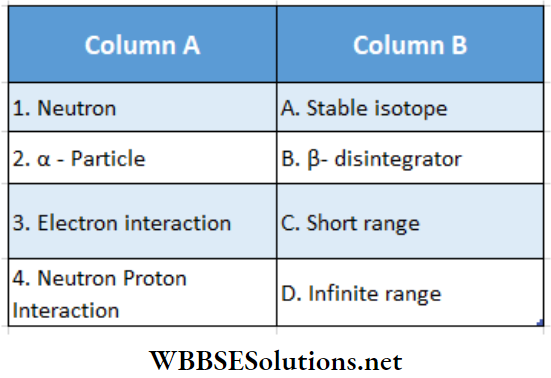
Atomic Nucleus Particles

Answer: 1 – B, 2 – A, 3 – D, 4 -C

Question 2. The half-life of radium-226 is about 1600y. Match the columns for a sample rich in radium
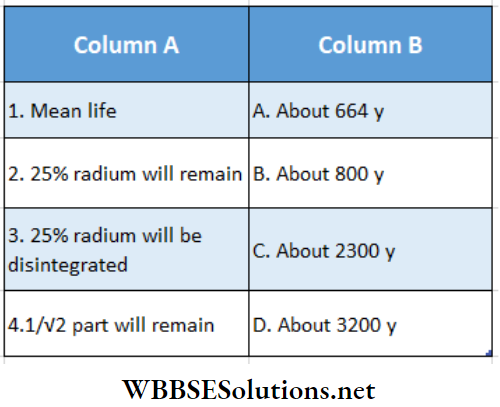
Atomic Nucleus Half Life Of Radium

Answer: 1 – C, 2 – D, 3 – A, 4 – B

WBCHSE Class 12 Physics Notes For Artificial Transmutation Of Elements

WBCHSE Class 12 Physics Transmutation Notes

Atomic Nucleus Artificial Transmutation Of Elements

We have already seen that radioactive elements are trans¬ formed into new elements. We also know that the identity of an element depends on its proton number. Therefore, if the proton number of an element can somehow be changed, the element is said to have undergone artificial transmutation.

Generally, artificial transmutation is brought about in two ways:

  1. Nuclear reaction: Here the nucleus is bombarded with high-energy particles. Thereby the nucleus changes and forms the nucleus of a new element
  2.  Artificial radioactivity: Often the transmuted nucleus formed by the process of nuclear reaction, is not a stable one and exhibits radioactivity and thereby decays to form a stable nucleus of another element, i.e., a transmuted that only the nuclear reaction is artificial and the subsequent disintegration of the unstable radioactive product is a natural phenomenon

Nuclear Reactions Definition:

Nuclear reaction is the process of transmuting elements by bringing a change in the nucleus, artificially

Energy condition of nude or reactions:

The binding energy per nucleon of a stable nucleus is about 8 MeV. Almost equal or more than this amount of energy is to be supplied from outside to bring about any change in the nucleus. Generally, high-energy particles are used to hit the nucleus to supply energy and to break up the nucleus.

Read and Learn More Class 12 Physics Notes

The sources of these high-energy particles are:

  1. α, β, γ, and y-rays from radioactivity
  2. Stream of high-energy particles resulting from nuclear reactions can be used to bring about further nuclear reactions.
  3. Particles as projectiles from particle accelerators like cyclotron, betatrons, etc

Equations Of nuclear reactions:

In any nuclear reaction, a still or stationary substance called a target is hit by a stream of high-energy particles, each called a projectile.

When a project tile hits the target then either of the two things happens: 

  1. Target and projectile both remain unaltered. This process is called scattering.
  2. The nucleus of the target changes into the nucleus of another element. The impact produces one or more particles emerging with high energy. These particles are called emergent particles and the newly formed nucleus is called product nucleus. This entire process is called a nuclear reaction

Hence, denoting the nucleus ofthe target as X, the projectile as a, the product nucleus as Y, and the emergent particle as b, the nuclear reaction can be shown as

a + X →  Y + b ……………………………………… (1)

1. Conservation of mass number:

If A1, A2, A3, and A4 are mass numbers of a, X, Y, and b, then from equation (1)

A1+ A2 =  A3 +A ……………………………………… (2)

2. Conservation of atomic number: If  Z1, Z2, Z3, and Z4  are atomic numbers of a, X, Y, and b, then from equation

Z1+ Z2 = Z3 +Z ……………………………………… (3)

3. Mass-energy conservation:

Mass lost during the nuclear reaction, changes to energy as per Einstein’s massenergy equivalence. The released energy in a nuclear reaction is called Q -value of the reaction. Q -value for particles from the equation (1),

Q = [(Ma + Mx)-(My+Mb)]c²………………………….. (4)

The reaction is exoergic when the Q -value is positive and endoergic when the Q -value is negative. In the second case, the reaction cannot take place unless a threshold energy is provided to the projectile.

WBCHSE Class 12 Physics Notes For Artificial Transmutation Of Elements

WBBSE Class 12 Artificial Transmutation Notes

Rutherford’s experiment: Proton as a nuclear particle:

Rutherford was the first to bring about the artificial transmutation of elements. His experimental arrangement is represented schematically

Atomic Nucleus Ruthrefords Experiment Proton As Nuclear Particle (2)

C is a container with a window W covered by a thin sheet of aluminum. F is a detector or film to record any emergent particle through W. R is a source of polonium that emits a -rays in the decay process. It is placed opposite to the window. Chamber C is filled with pure nitrogen gas.

The observations after a considerable period are:

  • Chamber C shows the presence of oxygen gas, on chemical analysis.
  • Photographic plate F is exposed and relevant detectors establish that the emerging rays through the window are streams of high-energy protons.

From this experiment, it is understood that the proton is one of the constituents of the atomic nucleus.

Detailed investigations showed that the proton and hydrogen nucleus were identical. Hence, a symbol for proton in a nuclear reaction is 2H¹.

Equation of reaction: The nuclear reaction in the chamber C, can be represented by

2He4 (α) + 7N14 (nitrogen)  → 8O17 + 1H1 (oxygen)

In short form, the reaction is often represented as N14(a, p)017 and the explanation is when N14  as (α, p) O17 bombarded with an α -particle (2He4), O17 (oxygen) is produced j and a proton is emitted.

A few ar-induced transformations:

2He4  + 13A127 →  14Si30 + 1H1 or, Al27(a, p) Si30

2He4 + 5B106C13 + 1H1 or, B10  (α, p) C13

2He4  + 19K3920Ca42 + 1H1 or, K239(α, p) Ca42

Discovery of neutron: Chadwick’s experiment

1. Bothe-Baker’s experiment:

These German scientists in 1930, observed that when Be (beryllium) is exposed to a stream of a -particles, highly penetrating uncharged rays, are emitted. Initially, these rays were considered y

2.  Curie-Joliot’s experiment:

In 1932, Irene Curie and her husband Frederic Joliot observed that when a blt&k of paraffin wax was placed on the path of the above-mentioned rays, high-energy protons were emitted. Emissions in Bothe and Becker’s experiment, if taken as 9-rays, cannot account for the source of the high-energy protons produced in this experiment.

3.  Chadwick’s Analysis :

James Chadwick, in the same year, repeated the experiment and put forward the explanation. His experimental arrangement.

 Chadwick assumed that:

  • The rays emitted due to the impact of α -particles on Be nucleus, were not electromagnetic waves like y-rays but a stream of neutral particles. He named these particles neutron
  • Paraffin wax contains hydrogen atoms and every nucleus of the atom is a proton. Due to the elastic collision between. the stream of neutrons and the protons, the proton stream resulted
  • The ionization chamber helps In finding the energy and momentum of the proton released. Now, by applying the theory of elastic I collision the mass of the neutron can be obtained.

This experiment established a neutron as a fundamental particle that constitutes a nucleus.

Atomic Nucleus Chadwicks Analysis

Short Notes on Nuclear Reactions

Three things are inferred here:

  • That neutron is electrically neutral. Its mass Is slightly greater than the mass of proton. So Its effective atomic number and mass number are 0 and l respectively. St) lit a nuclear reaction it is represented as 0n1
  • A free neutron is not a stable particle. It undergoes a natural $ -decay and changes to a proton.

0n1 0H1 + -1β

The half-life period for radioactivity is about 12 min.

The nuclear reaction in beryllium can be represented as

2He4 + 4Be9 →  6C12 +  0n1

Artificiahir induced Radioactivity

Definition:

When an unstable isotope of a stable element Is artificially formed and if the isotope exhibits natural radioactivity it is called artificial or induced radioactivity

Examples:

Carbon, sodium, and phosphorus are stable elements, and then: isotopes C12, Na23, and P31 are stable isotopes. When C14, Na24, P30 isotopes are produced artificially, they are found to be radioactive. They are generally called radioactive isotopes or radioisotopes. LikeC14 is called radiocarbon, Na24 is known as radiosodium, and so on. The radioactive decay mode of these isotopes can be represented as’

6C147N14 + -1β0 :  Half-life = 5600 y

11Na2412Mg24 + -1β0 :  Half-life = 15 h

15P3014Si30 + -1β0 :  Half-life = 2. 5 min

Positive  β decay or β+ decay:

As evident from the above radioactive decay of P30, the emitted particle is +1β0 or positron. Positrons have the same mass as electrons but are positively charged (+e). Except for the positive charge, the β -decay and positron emission are identical. So, it is called β+ decay. β+ decay is found only in artificial radioactivity.

Class 11 Physics Class 12 Maths Class 11 Chemistry
NEET Foundation Class 12 Physics NEET Physics

Characteristics of artificial radioactivity:

  • Radioisotopes are produced from naturally stable elements.
  • Decay mode of radioisotopes; Atomicis similar to natural radioactivity of radioactive substances. It follows the exponential law of – radioactivity.
  • Natural radioactive substances generally have higher mass numbers. But radioisotopes may be lighter.
  • Radioisotopes can exhibit α -decay, β -decay, γ -decay, or β+ decay, the last one being characteristic of artificial radioactivity only.
  • The displacement rule for fi+ decay is that the mass number remains unaltered but the atomic number decreases by 1.

Artificial transmutation class 12 notes Discovery of Curie-Joliot:

Irine Curie and Frederic Joliot first discovered artificial radioactivity. Projecting a -particles from/polonium on an aluminum target, they identified positron particles mixed with emitted neutrons. The while emission of the neutron is easily explained using the nuclear reaction

2He4 + 13Al27 → 15P30 + 0n1

The presence, of positrons remained unexplained.

They further observed that:

  • On stopping projectile a from the source, the emission of neutrons is stopped but the emission of positrons continues.
  • The rate of, a decrease of positron emission from Al -target excited by α -particles, is exponential, i.e., it obeys the decay law of natural radioactivity.
  • They, therefore, concluded that isotope P30 produced in the above nuclear reaction must be a radioactive isotope

Neutron Induced Nuclear Reactions

A neutron, when used as a projectile Utilising nuclear reactions offers distinct advantages compared to using -particles or protons as projectiles. As a neutral particle, the initial energy of a neutron is not very important because it does not need to overcome the electrostatic repulsion from the positive nucleus. While alpha particles or protons require considerable energy to break the Coulomb barrier and reach the nucleus, neutrons are optimal projectiles for nuclear reactions since they do not need to lose any energy to reach the nucleus.

Thermal neutron

Nuclear reactions brought about by itÿpns of energy of a few MeV are similar to reactions caused by using a or proton projectiles. But when a slow-retrieving neutron hits a target, a set of new types of nuclear reactions take place

Neutrons of kinetic energy of the order of 10-2 eV are called 1 thermal neutrons. This order is the same as the kinetic energy of atomic or subatomic particles at room temperature. Since, the external manifestation of the kinetic energy of atomic or subatomic particles is the thermal energy, these are called thermal neutrons. Thermal neutrons are very slow-moving neutrons.

Common Questions on Artificial Transmutation

U-238 and U-235

Two isotopes of uranium are present in the ore of natural uranium. These are 92U235 and  92U238, or, U – 238 and U- 235 for short. Their abundance in nature is in the ratio 140: 1 (99.28%:’0.7%).

Artificial transmutation class 12 notes Transuranic elements:

The atomic number of uranium is 92 and no element of an atomic number higher than 92 is found in nature. But when U-238 is hit by a thermal neutron then,

  • The neutron is absorbed by U-238 and
  • U-239 is formed and pi] U-239 undergoes βdecay and forms an isotope of atomic number 93, which is a new element and does not exist naturally. This artificially made element is called neptunium
    (Np)

1. 0n192U238  → 92U239

2. 92U239  → 93U239  + -1β0

Proceeding almost in a similar way, it has been possible to produce elements of atomic numbers 94, 95, 96, ……, and 118 in the laboratory. Elements of atomic number higher than 92 and produced artificially are called transuranic elements. Out of these elements, plutonium (93Pu239 ) has the maximum practical use.

List of a few natural and artificial isotopes, decay mode, and half-life period:

Note that associated ϒ -radiation

Atomic Nucleus Artificial Isotopes Decay Mode And Half Life Period

Artificial transmutation class 12 notes 

Atomic Nucleus Artificial Transmutation Of Elements Numerical Examples

Example 1. Complete the following- nuclear reaction: 13Al27 + 2He415P30  +?
Solution:

Let A and Z be” the mass and atomic number of the unknown particle response respectively. From the law of conservation of mass number

27 + 4 = 30 + A _ or, A= 1

From the law of conservation of atomic number

13 + 2 = 15 + Z or, Z = 0

The article is therefore a neutron 0n1

∴ The complete equation ofthe reaction

13Al27 + 2He4 →  15P30  + 0n1

Example 2. Complete-the following-nuclear- -reaction: 7N14 + 2He4 →  8O17  + ?
Solution:

According to the law of conservation of mass number,

14 + 4 = 17 +1

Again, according to the law of conservation of atomic number

7 + 2 = 8 +1

∴ The mass number ofthe unknown particle = 1 and its atomic number = 1.

So it is a proton

∴ The complete equation of the reaction:  

7N14 + 2He4 →  8O17 + 1H1

Practice Problems on Artificial Transmutation

3. Example, Identify the missing particle in the following two reactions

  1. 9F19 + 1H1 →  8O16+ ?
  2. 12Mg25 + ? →  11Na22 → + 2He

Solution:

Since, 19 + 1 = 16 + 4, and 9 + 1 = 8 + 2, the mass number of the missing element = 4 and atomic number = 2 . As Z = 2, the element is α -particle.

The complete equation of the reaction:

9F19 + 1H1 →  8O16+ 2He

As, 25 + 1 = 22 + 4 and 12 +1 = 11 + 2 , the mass number of the missing element = 1 and atomic number = 1 .

So, the element is a proton.

∴ The complete equation of the reaction:

12Mg25 + 1He →  11Na22 → + 2He

Artificial transmutation class 12 notes 

Example 4. When 4Be9  is hit by α-particles of a new neutron element. is Identify emitted the element and write the complete reaction equation
Solution:

α -particle: 2He; neutron: 0n

∴ Let the new element, be ZXA

From the laws of conservation of mass number and atomic number,

9 + 4 = A + 1 of, A = 12 and 4 + 2 = Z + 0 or, Z = 6

∴ The new element = 6C12 (carbon):

∴  The complete equation of the reaction:

4Be + 2He4 6C12 + 0n

Important Definitions in Artificial Transmutation

Example 5. When an aluminum nucleus (13Al27 ) is hit by a proton a new element is formed with the emission of α -particle

  1. Write the complete equation of the reaction
  2. Identify the new element and
  3. Determine the number of neutrons and protons in the nucleus.

Solution:

Proton: 1H1; α  -particle: 2He4

Let the new element =ZXA

[where A = mass number; Z = atomic piifribesr]

From the laws of conservation of mass and atomic number,

27 + 1 = A + 4 and 13 +1 = Z + 2 .

or, A = 24 and Z = 12

1. The complete equation of the reaction:

13Al27 + 1H →  12Mg24  + 2He

2. As Z = 12, the element is magnesium (Mg)

So, the new element = 12Mg24

3. Now, we know, mass number = proton number ,…+ neutron number (x)

Or, 24 = 12 + x [  Since proton number = atomic number]

or x = 12

Class 12 Physics Artificial Transmutation

Example 6. On collision with a neutron, 3Al27  changes to radiOsodium 11Na24 and emits a particle. 11Na24, in its turn, emits a particle and is transmuted to 12Mg24 Write the two nuclear equations and identify the particles.
Solution:

Let the first equation of the reaction be

13Al27 + 0n →  11Na24  +  ZX…………………………. (1)

The second equation of the reaction be

11Na24→  12Mg24+ \(z_1 X^{A_1}\)  . …………………………. (2)

Applying the laws of conservation of atomic number and mass number from equation (1), 27 + 1 = 24+A, or, A = 4 and

Also, from equation (2), 24 = 24 + A1 or, A1 = 0  and 11 = 12 + Z1 or,  Z1 =  -1

Hence, the particles are helium nuclei i.e., α -particle in equation (1) and β -particle in equation (2).

The complete equations are

13Al27 + 0n →  11Na24  + 2He

And 11Na24   →  12Mg24 + -1β0

Examples of Artificial Transmutation Reactions

Example 7. A nucleus disintegrates into two nuclei and their velocity and cities are in the ratio of 2: 1 . What will be the ratio of their sizes? 
Solution:

From the law of conservation of momentum, the two nuclei will have- the same magnitude of momentum. Hence, mass ∝ \(=\frac{1}{\text { velocity }}\) . Again, mass∝ R³, where R is the radius.

⇒ \(\text { mass } \propto R^3 \propto \frac{1}{\text { velocity }}\)

⇒  \(\frac{R_1}{R_2}=\left(\frac{v_2}{v_1}\right)^{\frac{1}{3}}=\left(\frac{1}{2}\right)^{\frac{1}{3}}\)

R1 : R2 = 1: 21/3

Example 8. In the nuclear reaction X(n, α)3Li7 , identify X-
Solution:

The equation of the reaction:

ZXA   + 0n1  →  3Li7  + 2He

Using the conservation laws,

A + 1 = 7 + 4 or, A = 10

And Z + 0 = 3 + 2 or, Z = 5

These are the Z and A values of boron (B) .

The unknown element, X = 5B10  (boron nuclide)

WBCHSE Class 12 Physics For Exponential Law Of Radioactive Decay

WBCHSE Class 12 Physics Notes

Atomic Nucleus Exponential Law Of Radioactive Decay

The statistical law of probability is utilized in the analysis of radioactivity, which is characterized by its spontaneous and stochastic nature. For the radioactive sample, it is impossible to determine which nucleus will be affected.

will disintegrate first, the norcanthesequence of occurrence be ascertained beforehand. Only we can say, that the time rate of disintegration will be directly proportional to the number of radioactive particles present in the sample at that time. Let at time t, the number of radioactive particles present in the sample be N, and in time dt, dN number of particles disintegrate. So, the rate of disintegration is \(\frac{d N}{d t}\) and

⇒ \(\frac{d N}{d t} \propto N \text { or, } \frac{d N}{d t}=-\lambda N\) …………………. (1)

Where A in equation (1) is called the decay constant or radioactive disintegration constant. A is the characteristic ofthe radioactive element used. The negative sign indicates a decrease in several radioactive elements with time.

WBCHSE Class 12 Physics For Exponential Law Of Radioactive Decay

Read and Learn More Class 12 Physics Notes

Radioactive decay curve:

If at the beginning of the count for disintegration that is at t = 0, the number of radioactive particles is N2 and after a time interval t, the number of radioactive particles is N, then from equation (1)

⇒ \(\int_{N_0}^N \cdot \frac{d N}{N}=-\int_0^t \lambda d t \text { or, }\left[\log _e N\right]_{N_0}^N=-\lambda t\)

Or, \(\log _e \frac{N}{N_0}=-\lambda t \text { or, } N=N_0 e^{-\lambda t}\) …………………. (2)

Atomic Nucleus Radioactive Decay Curve

The equation N = \(N_0 e^{-\lambda t}\) is the exponential law of radioactive decay. Represents the law graphically. The graph shows that the value of N decreases exponentially with time.

WBBSE Class 12 Radioactive Decay Questions

Decay constant

Definition: The decay constant is the reciprocal of time j during which the number of atoms of a radioactive substance j decreases to – (or 36.8%) ofthe number present initially

Substituting t = 1/λ inequation(2),weget,

N = \(N_0 e^{-\lambda \cdot \frac{1}{\lambda}}=N_0 e^{-1}=\frac{N_0}{e}=0.368 \times N_0\)

Haff-life

Definition:

The period after which the number of radioactive atoms present in a radioactive sample becomes half of the initial number due to disintegration is called the half-life of that radioactive element.

Atomic Nucleus Half Life

Like decay constant λ, half-life is also a characteristic of that radioactive element. The half-life of different elements is given below.

Key Concepts in Radioactive Decay

1. Relation between half-life and decay constant:

Let at the beginning of the count for disintegration i.e., at t = 0 number of radioactive atoms present in a radioactive sample = N0. After a time t this number = N0.

Then according to the exponential law, N = N0eλT [λ= decay constant]

Now if the half-life of that element = T, then after time T the number of atoms present in the sample

N = \(\frac{N_0}{2}\)

∴ \(\frac{N_0}{2}=N_0 e^{-\lambda T}\)

Or, \(\frac{1}{2}=e^{-\lambda T}\)

eλT = 2

Or, λT = log²e

T = \(\frac{\log _e 2}{\lambda}=\frac{2.303 \log _{10} 2}{\lambda}=\frac{0.693}{\lambda}\) ……………… (3)

Equation (3) gives the relation between the half-life period of the radioactive element and its decay constant. The equation also shows that the half-life period is inversely proportional to the decay constant. Unit of A is per second or s-1

Also, from the relation N = N0 eλT, we get

⇒ \(\frac{N_0}{N}=e^{\lambda t}=\left(e^{\lambda T}\right)^{\frac{t}{T}}=2^{\frac{t}{T}} \text { or, } N=\frac{N_0}{2^{\frac{t}{T}}}\) …………….. (4)

This equation enables one to calculate the number of radioactive particles present after any time interval t,

2. Significance of half-life:

Any radioactive substance has a half-life of T, then after time T, 2T,3T, the fraction of the initial amount (N0) that disintegrates and the fraction that remains.

Atomic Nucleus Initial Amount And The Fractions That Remains

The table clearly shows that no radioactive substance can completely disintegrate and so there is no complete life of such a substance. To express the radioactive properties, therefore, we need to know the mean life ofthe radioactive substance.

Class 11 Physics Class 12 Maths Class 11 Chemistry
NEET Foundation Class 12 Physics NEET Physics

Mean life or average life

The mean life or average life of a radioactive element is defined as the ratio ofthe total lifetime of all the radioactive atoms to the total number of such atoms in it

Let us consider a radioactive element containing N0 number of atoms at time t = 0. Let the number of atoms left at time t be N. Suppose a small number of atoms, dN disintegrates further in a small time dt. Therefore, the lifetime of each of these dN atoms lies between t and (t+dt). Since it is small, we can say. dN atoms lived for a time of t.

So total lifetime of dN atoms = tdN

Total lifetime of all atoms = \(\int_0^{N_0} t d N\)

Atomic Nucleus Mean Life Or Average Life

Thus the mean life or average life of a radioactive element is the reciprocal of the radioactive constant.

Relation between half-life and mean life:

The mean life of a radioactive element is the reciprocal of the decay constant i.e., mean life, τ = 1/λ  Hence from equation (3),

Half-life, T = 0.693r or, τ = 1.443T ………………… (5)

Equation (5) gives us the relation between half-life (T) and mean life (τ). The characteristics of radioactive elements can be represented by mean life instead of half-life in some cases. Ra-226 has a half-life T = 1600 y. Hence, its mean life is (1600 × 1.443) y or about 2300 y.

Exponential law of radioactive decay notes 

Atomic Nucleus Exponential Law Of Radioactive Decay Numerical Examples

Short Answer Questions on Exponential Decay

Example 1. The half-life of a radioactive substance is 1 y. After n2 y, what will the amount of the substance that will be disintegrated?
Solution:

After 1 y, the remaining substance| = \(\frac{1}{2}\) part

∴ After 2y, the amount of substance that will remain

= \(\frac{1}{2} \times \frac{1}{2}=\frac{1}{4}\) part

Amount of the substance that is disintegrated after 2y

= \(1-\frac{1}{4}=\frac{3}{4}\) part

Example 2. In 8000 y a radioactive substance reduces to \(\frac{1}{32}\)th part. Determine its half-life. 
Solution:

Let the initial amount of radioactive substance be 1 and the half-life is T

Atomic Nucleus Part Of Radioactive Substances

According to the question

5 T = 8000

Or, T = \(\frac{8000}{5}\)

= 1600 y

Example 3. A radioactive material reduces to \(\frac{1}{8}\)th of its Initialr-rrajÿÿtt in 18000 y. Find its half-life period
Solution:

Here, t = 18000 y and \(\frac{N}{N_0}=\frac{1}{8}=\frac{1}{2^3}\)

From equation N = \(\frac{N_0}{2^{t / T}}\) , we get

= \(\frac{1}{2^3}=\frac{1}{2^{18000 / T}}\)

Or, 3T = 18000 or, T = 6000 y

Alternative method:

Let the initial amount of radioactive substance be 1 and the half-life is T.

Atomic Nucleus Remaining Part Of Radioactive Element

∴ According to question

3T = 18000 Or, T = \(\frac{18000}{3}\)

= 6000 y

Practice Questions on Radioactive Decay Calculations

Example 4. An accident In the laboratory deposits some amount of radioactive material of half-life 20d on the floor and the walls. Testing reveals that the level of radiation Is 32 times the maximum permissible level. After how many days will it be safe to use the room
Solution:

Half-life, T= 20d

Atomic Nucleus Radiational Level

The number of days after which the room can be used safely

= 5T = 5 ×  20 = 100 d

Exponential law of radioactive decay notes 

Example 5. The half-life of thorium is 1.5 × 10¹⁰ y. How much time is needed for 20% of thorium to disintegrate?
Solution:

Let the initial mass of thorium = N0

If in time t 20% of the thorium is disintegrated then, the amount of thorium that disintegrates

= \(N_0 \times \frac{20}{100}=0.2 N_0\)

Amount of thorium left

N = N0– 2N0 = 0.8 N0

N = N0e– λt

Now N = \(e^{\lambda t}=\frac{N_0}{N}=\frac{N_0}{0.8 N_0}\)

= 1.25

λt  = \(\lambda t=\log _e(1.25)\)

= 0. 223

Or, \(\frac{0.693}{T} \cdot t\)

= 0.223

Since \(T \text { (half-life) }=\frac{0.693}{\lambda}\)

Or, \(\frac{T}{0.693} \times 0.223\)

= Or, \(\frac{1.5 \times 10^{10} \times 223}{693}\)

= 0.48 × 10¹⁰ y (approx)

Alternative method:

N = 0.8 N

Also N = \(\frac{N_0}{2^{t / T}}\)

Or, 0.8  \(=\frac{1}{2^{t / T}} \text { or, } 2^{t / T}=5 / 4\)

t/T = \(\log _2 5 / 4=\frac{\log _{10} 5 / 4}{\log _{10} 2}\)

=  \(\frac{0.0969}{0.3010}\)

= 0.322

Or, t = 0.322T

= 0.322 × 1.5 × 1010 y

= 0.48 × 10¹⁰ y (approx).

Examples of Exponential Decay in Nature

Example 6. The half-life of radium is 1500 y. In how many years will 1 g of pure radium reduce by 1 mg
Solution:

Let the time in which lg radium will reduce by 1 mg = t

So, remaining mass of radium = 1- 0.001 = 0.999 g

Now, assuming the initial mass is N0, and in time t mass becomes N then

N/ N0 = 0.999 /1 = 0.999

Again N = \(N_0 e^{-\lambda t}\)

Or, = \(e^{\lambda t}=\frac{N_0}{N}=\frac{1}{0.999}\) = 1.001(approx)

λt = \(\lambda t=\log _e(1.001)\) = 0.001 (approx)

Or, = \(\frac{0.693}{T} \cdot t\)

= 0.0001

Since = \(\text { half-life, } T=\frac{0.693}{\lambda}\)

Or, t = \(\frac{T}{0.693} \times 0.001\)

= \(\frac{1500}{693}\)

= 2.16y (approx)

Exponential law of radioactive decay notes 

Example 7. State the law of radioactive decay. Three-fourths of a radioactive sample decays in ¾ s. What is the half-life of the sample?
Solution:

The rate of decay of a radioactive sample concerning time is proportional to the number of radioactive atoms present in the sample at that instant. This is the law of radioactive decay. As per this law, if N0 is the number of atoms of a certain radioactive element initially, and N is its number after a time t, then

N = N0 e– λt (where λ = radioactive decay constant)

Atomic Nucleus Number Of Radioactive Atoms And Number Of Decayed Atoms

Given \(\frac{3}{4}\) of the simple decay in \(\frac{3}{4}\) s

So, 2T = \(\frac{3}{4}\) s Or, T = \(\frac{3}{8}\)s

Radioactive Decay Class 12 Notes

Example 8. A radioactive isotope X with a half-life of 1.5 × 10⁹ y decays into a stable nucleus Y. A rock sample contains both elements X and Y in a ratio of 1:15. Find the age of the rock
Solution:

X →  Y (stable)

Let the quantity of X and Y in the sample be Nx and Nrespectively.

⇒ \(\frac{N_x}{N_y}=\frac{1}{15}\) Or, \(\frac{N_x}{N_x+N_y}=\frac{1}{16}\)

Or, \(\frac{N}{N_0}=\frac{1}{16}\)

(\(V_0=N_x+N_y \text { and } N_x=N\))

We know that, N = \(\left[N_0=N_x+N_y \text { and } N_x=N\right]\)

∴ \(e^{\lambda t}=\frac{N_0}{N}\) = 16

Or, t = \(\frac{4 \ln 2}{\lambda}=\frac{4 \ln 2 \times t_{1 / 2}}{\ln 2}\)

or, \(\lambda=\frac{\ln 2}{t_{1 / 2}}\)

Or, t = \(4 \times 1.5 \times 10^9 y=6 \times 10^9 y\)

Age of the rock = 6 × 10⁹ y .

WBCHSE Class 12 Physics Notes For Displacement Laws Of Radioactive Decay

WBCHSE Class 12 Physics Notes

Atomic Nucleus Displacement Laws Of Radioactive Decay

Soddy and Fajans formulated two laws based on the observations made on radioactive decay(α -decay and β -decay). These are known as Soddy-Fajans’ displacement laws.

Law α -decay

Due to α -the decay of a radioactive nucleus, the mass and charge of the daughter nucleus decrease by 4 and 2 respectively from the parent nucleus

⇒ \(\underset{\mathrm{parent}}{Z^{X^A}} \longrightarrow \underset{\mathrm{daughter}}{Z-2 Y^{A-4}}+{ }_2 \mathrm{He}^4\)

Short Notes on Displacement Laws in Radioactivity

Example: \(\underset{\mathrm{radium}}{{ }_{88} \mathrm{Ra}^{226}}\longrightarrow \underset{\mathrm{radon}}{{ }_{86} \mathrm{Rn}^{222}}+{ }_2 \mathrm{He}^4\)

Law of β -decay:

Due to β – decay of a radioactive nucleus, the mass of the daughter nucleus remains the same

As that of the parent nucleus, the charge of the daughter nucleus is increased by 1. It Is interesting to note that the atomic number of the daughter element increases by 1 because during β -decay a neutron is converted into a proton.

⇒ \(\underset{\text { (parent) }}{Z^{X^A}} \longrightarrow \underset{\text { (daughter) }}{Z+1} Y^A+{ }_{-1} e^0\)

Example: \(\underset{\text { (thrium) }}{{ }_{90} \mathrm{Th}^{234}} \longrightarrow \underset{\text { (protactinium) }}{{ }_{91} \mathrm{~Pa}^{234}}+{ }_{-1} e^0\)

Note that the daughter nucleus is an isobar of the parent nucleus

Class 11 Physics Class 12 Maths Class 11 Chemistry
NEET Foundation Class 12 Physics NEET Physics

Rule of emission of γ-ray:

Schematically represents the emission of γ -ray. Due to the emission of a or β -participation cle from the parent nucleus at ground state energy level X, the daughter nucleus stays in an excited energy level Y. To be stable, γ -radiation takes place taking the daughter nucleus to its ground state energy level Y. Thus γ -radiation involves only a transition in energy level of the daughter nucleus and the structure of the nucleus does not change. Hence there is no change in atomic mass number or atomic number

Read and Learn More Class 12 Physics Notes

Atomic Nucleus Rule Of Emission Of Gama Rays

WBBSE Class 12 Radioactive Decay Notes

Conservation laws of mass number and atomic number

In addition to the well-established laws of conservation of momentum, angular momentum, and mass energy, two more conservation laws are to be specially mentioned in the case of radioactive decay.

  1. Conservation of mass number: Radioactive decay does not bring about any change in the total number of neutrons and protons. So, the mass number remains unchanged.
  2. Conservation of atomic number (proton number): There is no change in the total number of protons in the reactant (parent) and the product (daughter nucleus + emitted particle). So atomic number remains the same. These conservation laws also hold good in the case of the artificial transmutation of elements.

Disintegration energy

In both α and β – decay, the mass of the products (the daughter nucleus and emitted particle) is found to be less than the mass of the parent nucleus. As per Einstein’s mass-energy equivalence, this lost mass is transferred to energy and this energy is called disintegration energy. Most of this energy is carried away by the α or β -particles, as they are lighter than the daughter nucleus. Thus nuclear disintegration produces high energy α -particle or γ -particle.

WBCHSE Class 12 Physics Notes For Displacement Laws Of Radioactive Decay

Displacement laws of radioactive decay 

Atomic Nucleus Displacement Laws Of Radioactive Decay Numerical Examples

Example 1: How many α and β -particles are emitted when U-238 changes to Pb-206 due to radioactivity? Atomic numbers of U-238 and Pb-206 are 92 and 82 respectively.
Solution:

As per the displacement rule, the loss of mass number due to the emission of an α -particle is 4 and that due to the emission of β – particle is nil. Also, the decrease in atomic number due to α – emission is 2, and the increase in atomic number due to β – emission is +1.

Let x and y be the required numbers of α  and β -emissions for the transmutation.

∴ 4x+0 = 238-206 = 32

x = \(\frac{32}{4}\) = 8

Again, the reduction in atomic number due to a -emission = 2x and the increase in atomic number due to /9 -emission =y.

Total reduction in atomic number = 2x- y

Now, according to the question,

2x – y = 92 – 82 = 10

y = 16 – 10 = 6

Hence, 8 α  -particles and 6 β  -particles are emitted

Conceptual Questions on Types of Radioactive Decay

Example: 2. decays by emitting successively 8 α -particles and 6 β -particles. Determine the mass number and atomic number of the new element and express it in a symbol.
Solution:

Using the Soddy-Fajans’ displacement rule, Loss in mass number due to α -emission = 8 × 4 = 32, and there is no change in mass number due to β -emission. Hence, the mass number of the element formed

Due to the emission of 8 a -particles the decrease in atomic number

= 8 × 2 = 16

Now, due to the emission of 6 -particles the increase in the atomic number

6 ×1 = 6

The atomic number of a new element

= 92- (16 – 6) = 92 – 10

= 82

The atomic number is 82, the element formed is lead (Pb) and the symbolic representation is 92Pb206

Radioactive decay class 12 notes Practice Problems on Half-Life and Decay Constants

Example 3.  86Pb222 →  84Pb210 Determine how many α -particles end β -particles have been emitted in the above reaction:
Solution:

The reduction in mass number = 222- 210 = 12

This reduction in mass number can only be caused by to emission of a -particles. Now since the mass of an a -particle is 4, the number of α -particles emitted = \(\frac{12}{4}\)= 3

Again, due to the emission of 3 a -particles the decrease in atomic number =2 × 3 = 6

In the reaction the decrease in atomic number = 86 – 84 = 2

∴ Due to the emission of β -particles increase in atomic number 6 – 2 = 4

Since due to the emission of β -particle atomic number increases 4 by 1, the number of β  – particles emitted \(\frac{4}{1}\) = 4

WBCHSE Class 12 Physics Atomic Nucleus Short Question And Answers

Atomic Nucleus Short Question And Answers

Question 1. If there is no electron in the nucleus then how does -emission take place from the nucleus?
Answer:

Inside a nucleus when a neutron is converted to a proton, an electron is produced. Hence, it comes out as a β -particle. The nuclear force does not influence this electron

Question 2. The nucleus of a radioactive element emits an α -particle and then emits 2 β  -particles subsequently. Prove that the product (daughter nucleus) is an isotope of the original elements
Answer:

According to the law of radioactivity, if an α -particle is emitted from an element atomic number decreases by 2. Again, if β -particle is emitted it increases by 1. So if a particular nucleus of an element emits α  – particle and then 2 β-particles, the change in its atomic number =(-2 +1 + 1) = 0.

Again isotopes are elements having equal atomic numbers but different mass numbers. So the daughter nucleus is an isotope of the parent one.

Read And Learn More WBCHSE Class 12 Physics Short Question And Answers

Question 3. What is meant by the statement that the half-life of radium is 1622 years
Answer:

This statement means that the amount of radium present in a radioactive sample will be halved after 1622 years due to radioactive disintegration. After another 1622 years, i.e., (1622 × 2) years from the present, the amount of radium will become \(\frac{1}{4}\) the present amount. In the past, the radioactive disintegration of radium has occurred in the same way.

Question 4. What will be the change in the ratio of neutrons to pro¬ tons of a nucleus if

  1. β -particle is emitted
  2. α –  positron is emitted and
  3.  ϒ -A ray photon is a melt

Answer:

  1. a β -particle i.e., an electron is emitted when a neutron changes into a proton and the ratio will decrease.
  2. Again a positron is emitted from the nucleus when a proton converts to a neutron and the ratio will increase.
  3. However, if a γ -ray photon is emitted the ratio of neutrons to protons will remain unchanged

Question 5. Why is a neutron used as an ideal particle for bombarding the nucleus of elements in a nuclear reaction?
Answer:

Since a neutron has no charge, it is not repelled by the positively charged nucleus. Therefore, even a very weak neutron can bombard a nucleus and initiate a nuclear reaction. Hence neutron is used for bombarding the nucleus in a nuclear reaction.

WBCHSE Class 12 Physics Atomic Nucleus Short Question And Answers

WBBSE Class 12 Atomic Nucleus Short Q&A

Question 6. What is the difference between a chemical reaction and a nuclear reaction?
Answer:

The valence electron of an atom takes part in a chemical reaction and no new element is formed in the process. In a nuclear reaction, the nucleus of the atom changes and results in the formation of an atom of another element.

The energy involved in a chemical reaction is less and ofthe order of eV. Whereas, in a nuclear reaction, the energy involved is very high and of the order of MeV

Question 7. What effect will be noticed when a source of α -particles is introduced in a charged gold leaf electroscope?
Answer:

The leaves will collapse very fast, α -particle ionizes the dry air in the electroscope, making it a good conductor, and the charge from the leaves flows to earth through this conducting air.

Question 8. Is mass defect always positive or negative?
Answer:

Mass defect \(\Delta m=\frac{\Delta E}{c^2}\) The binding energy AE of every nucleus is positive; consequently, the mass defect is positive without any exception.

Question 9. State radioactive decay law. Write down the relation between, the radius of the nucleus and the mass number of an atom
Answer:

Radioactive law states that the number of nuclei undergoing decay per unit time at any instant is proportional to the total number of nuclei in the sample at that instant

Question 10. Draw the variation of binding energy per nucleon with the mass number of atoms and indicate the stable and unstable
Answer:

The almost horizontal region in the middle portion of the graph indicates the stable region. The region to the extreme left and the sloping region to the extreme right indicate unstable regions. regions on the diagram

Question 11. Write down the equation of 0 -decay. Why is the detection of neutrinos difficult?
Answer:

X (parent) → Y (daughter) + β(β- electron) + ν (antineutrino)

The charge and mass of both neutrinos and anti-neutrinos are zero. Hence it is experimentally difficult to detect them.

Question 12. In a nuclear decay, a nucleus emits one α -particle and then two β -particles one after another. Show that the final nucleus is an isotope ofthe formed nucleus.
Answer:

Atomic Nucleus Nuclear Decay

The atomic number decreases by 2 during or α – decay and it increases by 1 for each β -decay. So the atomic numbers of both P and S are equal to Z and hence they are isotopes of each other.

Short Answer Questions on Nuclear Physics

Question 13. R = R0A1/3 RQ = constant A = mass number), R = The option is the correct radius of the nucleus. Taking the relation shows that the nuclear density does not depend on mass number A
Answer:

The volume of a nucleus = \(\frac{4}{3} \pi R^3=\frac{4}{3} \pi R_0^3 A\)

Mass = Au

Density = \(\frac{A}{\frac{4}{3} \pi R_0^3 A}=\frac{3}{4 \pi R_0^3}\) it does not depend on A

Class 11 Physics Class 12 Maths Class 11 Chemistry
NEET Foundation Class 12 Physics NEET Physics

Atomic Nucleus Conclusion

1. The Law of conservation of mass-energy:

The total amount of mass and energy remains constant in the universe. Different types of transformation among them are possible but the creation or destruction of mass energy is not possible.

2. Nuclear force:

Inside the nucleus protons and neutrons are held together tightly due to a tremendous force of attraction between them. This force is called nuclear force.

3.  Unified atomic mass unit:

The mass of part of one carbon- 1/12 atom is called 1 unified atomic mass unit (u). 4 Nuclear mass: Subtracting the mass of electrons present in an atom from the mass ofthe atom, the nuclear mass of that atom can be obtained.

4. Mass number:

The nearest whole number ofthe mass of an atom in the unified atomic mass unit is called the mass number of that atom. The sum of the number of protons and neutrons present in the nucleus of an atom is equal to its mass number

5. Isotopes:

The atoms of the same element having different mass numbers are called isotopes of that element

6. Isobars:

The atoms of the different elements having equal mass numbers are called isobars.

7. Isotones:

The atoms of the different elements having an equal number of neutrons in them are called isotones.

Conceptual Questions on Fission and Fusion

8. Atomic number:

The number of protons present inside the nucleus of an atom of an element is called the atomic number of that element

9. The magnitude of nuclear density is nearly 2 × 10¹⁴ g. cm-3

10. Radioactivity is a nuclear phenomenon of an element Due to radioactivity one element is converted into another ele¬ element

11. From a radioactive element α,β, and γ-rays are emitted.

12. No radioactive isotope can emit α,β  and γ -rays simulta¬ neously

13. Half-life:

The time after which radioactive atoms present in a radioactive sample become half of its initial amount due to disintegration is called half-life.

14. Average life:

The time required for the number of a radioactive sample to fall to its initial number of atoms is called the average life of the radioactive element.

15. Artificial radioactivity:

When a naturally stable element is transformed into its unstable isotope by artificial means and the radioactive disintegration of that isotope in a natural way is possible then this phenomenon is known as artificial radioactivity.

16. Nuclear fission:

The phenomenon of splitting a heavy nucleus into two relatively lighter nuclei of comparable masses is known as nuclear fission.

17. Nuclear fusion:

The phenomenon of a combination of two or more lighter nuclei to form a heavy nucleus is called nuclear fusion.

18. E = mc² [c = velocity of light in vacuum]

19. 1 eV =  1.6 × 10⁻¹² erg = 1.6 × 10⁻¹⁹ J

20. lu = 1.66 × 10⁻²⁴ g = 931.2 MeV

21.

  1. ZXA Z-2 Y A-4 + 2He4
  2. ZXA Z+1 Y A + -1e0

22. N = N0 e-λt [N0 = number of radioactive atoms at t = 0, λ = number of radioactive atoms after time t = disintegration constant]

23. T \(\frac{0.693}{\lambda}\) T = half life]

24. N = \(\frac{N_0}{2^{t / T}}\)

25. τ = \(\frac{1}{\lambda}=1.443 T\)

τ = Average life

26. N = \(\frac{N_0}{e^{t / \tau}}\)

WBCHSE Class 12 Physics Atomic Nucleus Question And Answers

WBCHSE Class 12 Physics Atomic Nucleus Question And Answers

Question 1. Energy evolved during nuclear fission can be used for the welfare of mankind’ as discussed briefly.
Answer:

A thermal neutron is used to disintegrate U-235 resulting in the emission of either 2 or 3 neutrons which in turn disintegrate U-235 again in the next stop. So, In a very short time, the number of disintegrated nuclei increases in multiples and the reaction becomes uncontrolled. The energy evolved due to this uncontrolled chain reaction leading to an explosion.

However, If the chain reaction is maintained in a controlled manner by using only one neutron to bombard the U-235 in each step, the energy produced can be utilized for the welfare of mankind. The reaction will be under control. This will help to evolve energy at the same rate as the rate of the reaction. Usually, nuclear reactors are used for this purpose. Boron is used in these reactions to absorb the excess neutrons

Question 2.  Electromagnetic waves are emitted from an atom in an excited state and γ -rays are emitted during radioactive disintegration. What are the similarities and dissimilarities between them
Answer:

Similarities:

  1. Both are electromagnetic waves and travel with the same velocity.
  2. Both are not deflected by electric and magnetic fields.

Dissimilarities:

Atomic Nucleus Electromagnetic Waves And Gama Rays

Question 3. Write two characteristic features of the nuclear force that distinguish it from the Coulomb force
Answer:

Nuclear force is charge-independent. If the distance remains the same, there is no difference between the proton-proton, proton-neutron, and neutron-neutron force. On the other hand, coulomb force acts between charged particles only

The nuclear force is a short-range force; it is a strong attractive force within a distance of about 10-1’1 m and becomes zero outside that distance. But, Coulomb force has an infinite range

Question 4. A mixture consists of two radioactive materials Ay and decayed? A2 with half-lives of the 20s and 10s respectively, initially the mixture has 40 g of A1 and 160 g of A2. After what time the amount of the two In the mixture will become equal?
Answer:

Let after t s, quantity of A1 and A2 are equal.

We know N = \(N_0\left(\frac{1}{2}\right)^{t / T}\)

where T = Half life

For \(A_1, N_1=N_{01}\left(\frac{1}{2}\right)^{t / 20}\) and For, \(A_2, N_2=N_{02}\left(\frac{1}{2}\right)^{t / 10}\)

N1 = N2

Or, \(40 \times\left(\frac{1}{2}\right)^{t / 20}=160\left(\frac{1}{2}\right)^{t / 10}\)

Or, \(2^{2-\frac{t}{20}}=2^{4-\frac{t}{10}}\)

Or, \(2-\frac{t}{20}=4-\frac{t}{10}\)

Or, t = 40 s

WBBSE Class 12 Atomic Nucleus Q&A

Question 5. The half-life of a radioactive nucleus is 50 days. What is the time interval (t2– f1) between the time t2 when 2/3 of it has decayed and the time t1 when 1/3  of it has decayed?
Answer:

From the law of nuclear decay

N = N0e-λt

If \(\frac{1}{3}\) rd of nucleus decays in time \(t_1, \frac{1}{3} N_0=N_0 e^{-\lambda t_1}\)

And if\(\frac{2}{3}\) rd of nucleus decays in time \(\)

⇒ \(\frac{\frac{1}{3} N_0}{\frac{2}{3} N_0}=\frac{e^{-\lambda t_1}}{e^{-\lambda t_2}} \quad \text { or, } \frac{1}{2}=e^{-\lambda\left(t_2-t_1\right)}\)

Or, \(t_2, \frac{2}{3} N_0=N_0 e^{-\lambda t_2}\)

Putting \(\lambda=\frac{\ln 2}{T_{1 / 2}}\) and solving , we get

⇒ \(t_2-t_1=T_{1 / 2}\)

= 50 days

WBCHSE Class 12 Physics Atomic Nucleus Question And Answers

Question 6. Obtain the binding energy of the nuclei 56Fe26  and 209Bi83 in units of meV from the following data mH = 1.007825 u, mn = 1.008665 unchanged,

⇒  \(m\left({ }_{26}^{56} \mathrm{Fe}\right)=55.934939 \mathrm{u} m\left({ }_{83}^{209} \mathrm{Bi}\right)=208.980388 \mathrm{u}\) Which nucleus has greater binding energy per nucleon?
Answer:

For 56Fe26 mass, the defect

Δm = ZmH + (A-Z)mn-m(2gFe)

Δm = 26 × 1.007825 + (56-26) ×  1.008665-55.934939

∴ Binding energy =Δ m × 931.2 MeV = 492.2 MeV

∴ Binding energy per nucleon = \(\frac{492.2}{56}\)

= 8.79 MeV

For \({ }_{83}^{209} \mathrm{Bi}\) , mass defect

\(\Delta m=83 \times 1.007825+(209-83)\)\(\times 1.008665-208.980388\)

∴ Binding cnergy= 1.760877 X 931.5 MeV = 1640.25 MeV

∴ A Binding energy per nucleon = \(\frac{1640.26}{209}\)

= 7.85 MeV

Class 11 Physics Class 12 Maths Class 11 Chemistry
NEET Foundation Class 12 Physics NEET Physics

Short Answer Questions on Atomic Nucleus

Question 7. A given coin has a mass of 3.0 g. Calculate the nuclear energy that would be required to separate all the neutrons and protons from each other. For simplicity assume that the coin is entirely made of 63Cu29 atoms (of mass 62.92960 u ). The masses of protons and neutrons are 1.00783 u and 1.00867 u respectively.
Answer:

Binding energy = \(Z m_p+(A-Z) m_n-m\left({ }_{29}^{63} \mathrm{Cu}\right)\) ×  931.5

= 0.59225 ×  931.5 MeV

Number of atoms in 3 g of Cu = \(\frac{6.023 \times 10^{23} \times 3}{63}\)

∴ The binding energy of 3 g of Cu

= \(\frac{0.59225 \times 931.5 \times 6.023 \times 10^{23} \times 3}{63}\)

= 1.58 × 1025  MeV

Question 8. The half-life is 28 years. What is the disintegration rate of 15 mg of this isotope?
Answer:

Number of atoms in 15 mg of gSr

= \(\frac{6.023 \times 10^{23} \times 15 \times 10^{-3}}{90}\)

Disintegration constant,

= \(\frac{0.693}{T}=\frac{0.693}{28 \times 365 \times 24 \times 60 \times 60} \mathrm{~s}^{-1}\)

Rate of disintegration

= \(\frac{d N}{d t}=\lambda N\)

= \(\frac{0.693}{28 \times 365 \times 24 \times 60 \times 60}\)\(\times \frac{6.023 \times 10^{23} \times 15 \times 10^{-3}}{90}\)

= 7.87 × 10 Bq

WBCHSE Class 12 Physics Atomic Nucleus Question And Answers

Important Definitions in Nuclear Physics

Question 9. Find Q -value and kinetic energy of the emitted α -particle a -decay of 

  1. In the α -decay  226Ra88 ‘
  2. 226Rn86  

Given , \(m\left({ }_{86}^{226} \mathrm{Ra}\right)=226.02540 \mathrm{u}, m\left({ }_{86}^{222} \mathrm{Rn}\right)=222.01750 \mathrm{u}\)

⇒ \(m\left({ }_{86}^{220} \mathrm{Rn}\right)=220.01137 \mathrm{u}, m\left({ }_{84}^{216} \mathrm{Po}\right)=216.00189 \mathrm{u}\)

⇒ \(m\left({ }_2^4 \mathrm{He}\right)=4.00260 \mathrm{u}\)

Answer:

1. \({ }_{86}^{226} \mathrm{Ra} \rightarrow{ }_{86}^{222} \mathrm{Rn}+{ }_2^4 \mathrm{He}\)

Q – Value \(=m\left({ }_{88}^{226} \mathrm{Ra}\right)-\left[m\left({ }_{86}^{222} \mathrm{Rn}\right)+m\left({ }_2^4 \mathrm{He}\right)\right]\)

226,02540- (1222.0175 + 4.00260)

= 0.0053 u = 0.0053 × 931.2 MeV

= 4.93 MeV

The kinetic energy of α -particle

= \(\left(\frac{A-4}{A}\right) Q=\frac{222-4}{222} \times 4.93\)

= 4.84 MeV

2. Similarly for 220 Rn 86

Q -value = 6.41 MeV and kinetic energy of α  – particle

= 6.29 MeV

Question 10. The radionuclide 11C6 decays accroding to \({ }_6^{11}\mathrm{C}\rightarrow{}_5^{11}\mathrm{~B}+\mathrm{e}^{+}+\nu\) . T1/2 = 20.3 min. The maximum energy of the emitted positron is 0.960 MeV. Calculate Q and compare it with the maximum energy of the positron emitted.Given M(11C6) = 11. 01143 u, m(11B5) = 11.009305 u , me = 0.000548 u
Answer:

Q = \(\left[m\left({ }_6^{11} \mathrm{C}\right)-6 m_e\right]-\left[m\left({ }_5^{11} \mathrm{~B}\right)-5 m_e+m_e\right]\)

(mN stands for the nuclear mass of the element or particle
= atomic mass – a mass of extranuclear electrons).

= \(m\left({ }_6^{11} \mathrm{C}\right)-m\left({ }_5^{11} \mathrm{~B}\right)-2 m_e\)

= (11.011434-11.009305-2 × 0.000548) u

= 0.001033 × 931.2 MeV

= 0.962 MeV

This energy is almost equal to the maximum energy released In the decay process

WBCHSE Class 12 Physics Atomic Nucleus Multiple Choice Questions

WBCHSE Class 12 Physics MCQs

Atomic Nucleus Multiple Choice Questions

Question 1. Suppose we consider a large number of containers each containing initially 10000 atoms of radioactive material with a half-life of 1 year. After 1 year,

  1. All containers will have 5000 atoms
  2. All the containers will contain the same number of
  3. Atoms but that number will only be approximately 5000
  4. The containers will in general have different numbers of atoms but their average will be close to 5000
  5. None ofthe containers can have more than 5000 atoms

Answer: 3. The containers will in general have different numbers of atoms but their average will be close to 5000

Question 2. When a nucleus in an atom undergoes radioactive decay, the electronic energy levels of the atom

  1. Do not change for any type of radioactivity
  2. Change for α  and β -radioactivity but not for y radioactivity
  3. Change for α -radioactivity but not for others
  4. Change for β -radioactivity but not for other

Answer: 2. Change for α  and β -radioactivity but not for y radioactivity

Question 3. Mx and My denote the atomic masses of the parent and; the daughter nuclei respectively in a radioactive decay. The Q -value for β -decay is Q1 and that for a β+ -decay is Q2. If me denote the mass of an electron, then which of the following statements is correct?

  1. Q1  = (Mx -My)c² and Q2 = (Mx-My-2me)c²
  2. Q1 = (Mx – My)c² and Q2 = (Mx-My)c²
  3. Q1 = (Mx-Mx-2me)c² and Q2 = (Mx-My + 2me)c²
  4. Q = (Mx-Mx + 2me)c² and Q2 = (Mx-My+ 2me)c²

Answer: 1. Q1  = (Mx -My)c² and Q2 = (Mx-My-2me)c²

Read and Learn More Class 12 Physics Multiple Choice Questions

Question 4. Heavy and stable nuclei have more neutrons than protons. This is because the factor

  1. Neutrons are heavier than protons
  2. Electrostatic force between protons is repulsive
  3. Neutrons decay into protons through fi -decay
  4. Nuclear forces between neutrons are weaker than those between protons

Answer: 2. Electrostatic force between protons are repulsive

Question 5. In a nuclear reactor, moderators slow down the neutrons which come out in a fission process. The moderator used light nuclei. Heavy nuclei will not serve the purpose because,

  1. They will break up
  2. Elastic collision of neutrons with heavy nuclei will not slow them down
  3. The net weight of the reactor would be unbearably high
  4. Substances with heavy nuclei do not occur in liquid or gaseous state at room temperature

Answer:  2. Elastic collision of neutrons with heavy nuclei will not slow them down

WBCHSE Class 12 Physics Atomic Nucleus Multiple Choice Questions

WBBSE Class 12 Atomic Nucleus MCQs

Question 6. Fusion processes, like combining two deuterons to form a He nucleus are impossible at ordinary temperatures and pressure. The reasons for this can be traced to the fact

  1. Nuclear forces have short-range
  2. Nuclei are positively charged
  3. The original nuclei must be completely ionized before fusion can take place
  4. The original nuclei must break up before combining

Answer: 1 and 2

Question 7. The density of the uranium nucleus is approximately

  1. 1020 kg. m-3
  2. 1017 kg. m3
  3. 1013 kg. m3
  4. 1011 kg. m 3

Which is the correct option? Given, mp – 1.67 × 10⁻²⁷ kg

Answer: 2. 1 017 kg. m3

The density of all nuclei is almost the same and its magnitude, ρ ≈ 1014 g cm 3 = 1017 kg m 3

WBCHSE class 12 physics MCQs

Question 8. The approximate value of the density of the uranium nucleus (mp = 1.67 × 1027 kg) is

  1.  1020 kg. m-3
  2.  1017 kg. m-3
  3.  1014 kg. m-3
  4.  1011kg.m-3

Answer: 2.  1017 kg. m-3

Question 9. Which of the following is correct?

  1. The rest mass of a stable nucleus is less than the sum of the rest masses of the isolated nucleons
  2. The rest mass of a stable nucleus is more than the sum of the rest masses of the isolated nucleons
  3. In nuclear fusion, energy is emitted due to the combination of two nuclei of comparable masses ( lOOu approx)
  4. In nuclear fission, no energy is released due to fragmentation of a very heavy nucleus

Answer:  1. The rest mass of a stable nucleus is less than the sum of the rest masses of the isolated nucleons

Question 10. During the emission of a negative β -particle

  1. An electron from the atom is emitted
  2. An electron already present inside the nucleus is emitted
  3. An electron is emitted due to the disintegration of a neutron inside the nucleus
  4. A part of nuclear binding energy is converted into an electron.

Answer:  3. An electron is emitted due to the disintegration of a neutron inside the nucleus

Question 11. Which of the following statements is correct?

  1. β-rays and cathode rays are identical.
  2. γ -rays are a stream of highly energetic neutrons
  3. α -particles are singly charged helium atoms
  4. The mass of a proton and that of a neutron are exactly equal

Answer: 1. β-rays and cathode rays are identical.

Question 12. A radioactive nucleus of mass number A, initially at rest, emits an a -particle with a speed v. The recoil speed of the daughter nucleus will be

  1. \(\frac{2 v}{A-4}\)
  2. \(\frac{2 v}{A+4}\)
  3. \(\frac{4 v}{A-4}\)
  4. \(\frac{4 v}{A+4}\)

Answer: 3. \(\frac{4 v}{A-4}\)

Question 13. An excited Ne²² nucleus is disintegrated into an unknown nucleus and two α -particles. This unknown nucleus is

  1. Nitrogen
  2. Carbon
  3. Boron
  4. Oxygen

Answer: 2. Carbon

Question 14. The half-life of radioiodine I¹³¹ is 8 d. If a sample of I¹³¹ is taken at time t = 0 then it can be said that

  1. No nuclear disintegration will occur before t = 4 d
  2. No nuclear disintegration will occur before t  8 d
  3. All nuclei will be disintegrated in t = 16 d
  4. A definite nucleus may be disintegrated at any time after t = 0

Answer: 4. A definite nucleus may be disintegrated at any time after t = 0

WBCHSE class 12 physics MCQs

Question 15. In a freshly prepared radioactive sample, the rate of radia¬ tion is 64 times greater than the safe limit. If its half-life is 2 h then using these safety experiments can be performed safely after

  1. 6h
  2. 12 h
  3. 24 h
  4. 128 h

Answer: 2. 12 h

Short Answer Questions on Atomic Nucleus

Question 16. The mean life of a radioactive element is 13 days. Initially, a sample contains 1 g of this element. The mass of the ele¬ ment will be 0.5 g after a time of

  1. 13 days
  2. 9 days
  3. 18.75 days
  4. 6.5 days

Answer: 2.  9  days

Class 11 Physics Class 12 Maths Class 11 Chemistry
NEET Foundation Class 12 Physics NEET Physics

Question 17. The half-life of At215 is 100 μs. The time taken for the radioactivity of the sample ofthe element to decay 1/16  th of its initial value is

  1. 400 μs
  2. 6.3μs
  3. 40 μs
  4. 300 μs

Answer:   1. 400 μs

Question 18. The half-life of a radioactive substance is 20 min. The approximate time interval (t2– t1) between the time t2 when 2/3 of it has decayed and time t1 when1/3 of it had decayed is

  1. 14 min
  2. 20 min
  3. 28 min
  4. 7 min

Answer: 2. 20 min

Hint: Given, half-life T = \(\frac{\ln 2}{\lambda}\)

T = \(\frac{\ln 2}{\lambda}\) = 20 min

We know that, N = \(N_0 e^{-\lambda t}\)

∴ \(\left(1-\frac{2}{3}\right) N_0=N_0 e^{-\lambda t_2}\)

Or,  \(\frac{1}{3} N_0=N_0 e^{-\lambda t_2}\)……….(1)

Again \(\left(1-\frac{1}{3}\right) N_0=N_0 e^{-\lambda t_1}\)

Or, \(\frac{2}{3} N_0=N_0 e^{-\lambda t_1}\) …………….(2)

Dividing equation (l) by equation (2), we get

⇒ \(\frac{1}{2}=e^{-\lambda\left(t_2-t_1\right)}\)

∴ \(t_2-t_1=\frac{\ln 2}{\lambda}\)

= 20 min

Dual nature of matter and radiation class 12 MCQs 

Question 19. The half-life of radioactive isotope X is 50 years. It decays to another element Y which is stable. The two elements X and Y were found to be in the ratio of 1: 15 in a sample of a given rock. The age of the rock was estimated to be

  1. 200 years
  2. 150 years
  3. 250 years
  4. 100 years

Answer: 2. 150 years

Question 20. A nucleus emits one particle and two γ- particles. The resulting, nucleus is

  1. n-4 Z m-6
  2. n Zm-6
  3. n  X m-4
  4. n-2 Y m-4

Answer: 3. n Xm-4

Question 21. Two radioactive nuclei P and Q in a given sample decay into a stable nucleus R . At time t – 0, the number of P species is 4N0 and that of Q is N0. The half-life of P (for conversion to R ) is1 min whereas that of Q is 2 min. Initially version of R ) is 1 min whereas that of Q is 2 min. Initially version of R ) is 1 min whereas that of Q is 2 min. Initially R present in the sample would be

  1. 2N0
  2. 3N0
  3. \(\frac{9 N_0}{2}\)
  4. \(\frac{5 N_0}{2}\)

Answer: 3. \(\frac{9 N_0}{2}\)

Hint: At’ t = 0, the number of nuclei of P and Q respectively 4N0 and N0

Let at t = t, the number of nuclei of P and Q are respectively NP and NQ

⇒ \(4 N_0\left(\frac{1}{2}\right)^{t / 1}\)

⇒ \(N_Q=N_0\left(\frac{1}{2}\right)^{t / 2}\)

∴NP = NQ

∴ \(4 N_0\left(\frac{1}{2}\right)^t=N_0\left(\frac{1}{2}\right)^{t / 2}\)

So, \(\frac{4}{(2)^t}=\frac{1}{2^{t / 2}}\)

t = 4 min

∴ After 4 minutes number of atoms of both types is the same; the Number of atoms after 4 minutes,

⇒ \(\left(4 N_0-\frac{N_0}{4}\right)+\left(N_0-\frac{N_0}{4}\right)=\frac{9 N_0}{2}\)

Common MCQs on Nuclear Structure

Question 22.  Of the following equations which one is the probable nuclear fusion reaction?

  1.  5C13+ 1H1 →  6C14+ 4.3 MeV
  2. 6C12 + 1H1 →  7N13 + 2 MeV
  3. 7N14+ 1H1 →  8O15
  4. 92U235 + 0n1 34 Xe140 + 38Sr94 + 0n1 + ϒ + 200.Mey

Answer: 2.6C12 + 6C12 + 1H1 →  7N13 + 2 MeV→  7N13 + 2 MeV

Question 23. In the nuclear reaction \({ }_7^{14} \mathrm{~N}+X \longrightarrow{ }_6^{14} \mathrm{C}+{ }_1^1 \mathrm{H}\) X will be

  1.  1H1
  2.  1H1
  3. 1H2
  4. 0n1

Answer: 4. 0n1

Question 24. Fast-moving neutrons are retarded

  1. By using lead obstacle
  2. By passing through water
  3. After colliding elastically with heavy nuclei
  4. Strong electric fields

Answer: 2. By passing through water

Dual nature of matter and radiation class 12 MCQs 

Question 25. In nuclear fusion

  1. A heavy nucleus breaks into two intermediate nuclei and a few high particles
  2. A light nucleus breaks due to collision with a thermal neutron
  3. A heavy nucleus breaks due to collision with a thermal neutron
  4. Two or more light nuclei combine into a heavier nucleus and a few light particles

Answer: 4. Two or more light nuclei combine into a heavier nucleus and a few light particles

Question 26. 41H1 2He4 + 2e+ + 26 MeV: this is an equation of

  1. β-decay
  2. γ-decay
  3. Fusion
  4. Fission

Answer:  3. Fusion

Question 27. The power obtained in a reactor using U235 disintegration is 1000 kW. The mass decay of U – 235 per hour is

  1. 10μg
  2. 20μg
  3. 40μg
  4. 1μg

Answer: 3. 40μg

Question 28. A radioactive isotope XA becomes YA~4 after decay. Which ofthe following radioactive emissions are not possible in this case? ‘

  1. α
  2. β
  3. Meson
  4. Positron

Answer: 2,3 and 4

Question 29. A radioactive isotope XA becomes YA-4 after disintegration. Which ofthe following radioactive emissions are not possible in this case?

  1. α
  2. β
  3. Meson
  4. Positron

Answer: 1 and 3

Question 30. In the case of a radioactive element which of the following relations are correct where λ = decay constant, T = half-life, and τ = mean life?

  1. \(\tau=\frac{1}{\lambda}\)
  2. \(\tau=\frac{0.693}{\lambda}\)
  3. \(0.6 T\)
  4. \(\tau=\frac{T}{0.693}\)

Answer: 1 and 4

Question 31. When α -rays and β -rays are compared as radioactive radiation, it is found that ‘

  1. The deflection of β -particles in an electric or magnetic field is comparatively larger
  2. The penetration power of β -particles is more
  3. The ionization power of β -particles Is more
  4. The velocity of β -particles is more

Answer: 1, 2 and 4

Dual nature of matter and radiation class 12 MCQs 

Question 32. The ratio of the mass number of two nuclei is 1: 8, then

  1. Ratio of diameter =1:4
  2. Ratio of diameter =1:2
  3. Ratio of volume =1:8
  4. Ratio of volume =1:4

Answer: 2, 3

Question 33. In any nuclear reaction

  1. The total number of protons and neutrons remains the same before and after the reaction
  2. An increase or decrease in the number of protons is equal to a decrease or increase in the number of neutrons
  3. Kinetic energy of the incident particle is approximately 8 MeV or its equivalent
  4. Some energy is released if total mass is reduced

Answer: 1, 3 and 4

Question 34. The initial number of radioactive atoms in a radioactive sample is N0. If after time t the number becomes N, then N = N0 e-λt, where λ is known as the decay constant ofthe element. The time in which the number of radioactive atoms becomes half of its initial number is called the half-life (T) of the element. The time in which the number of atoms falls to 1/e times its initial number is the mean life (τ) ofthe element. The product λN is the activity (A) ofthe radioactive sample when the number of atoms is N. The SI unit of activity is bequerel (Bq); where lBq = 1decay. s-1, and Avogadro’s number, N = 6.023 × 10²³.

1. The half-life of iodine-131 is 8d. Its decay constant (in SI)

  1. 10-6
  2. 1.45 × 10⁻⁶
  3. 2 × 10⁻⁶
  4. 2.9  × 10-6

Answer: 1. 10-6

2. The half-life of iodine-131 is 8d. Its mean life (in SI ) is

  1. 4.79 × 10⁵
  2. 6.912× 10⁵
  3. 9.974× 10⁵
  4. 22. 96 × 105

Answer: 3. 9.974× 10⁵

3. The half-life of Iodine 131 is 8d. What is the activity Bq) of 1 g of iodine?

  1. 2.3 × 10¹⁵
  2. 4.6 × 10¹⁵
  3. 6.9 × 10¹⁵
  4. 9.2 × 10¹⁵

Answer: 2. 4.6 × 10¹⁵

Class 12 physics dual nature questions 

4.  in the equation above After how many days the activity of iodine-131 will be \(\frac{1}{16}\)th of its initial value

  1. 24 data
  2. 32 data
  3. 40 data
  4. 48 data

Answer: 2. 32 data

5. In the question above, what is the ratio of the activity of sodium- 24 to that of iodine-131 (half-life of sodium- 24 is 15h)?

  1. \(\frac{1}{70}\)
  2. \(\frac{1}{7}\)
  3. 7
  4. 70

Answer: 4. 70

Question 35. For the radioactive nuclei that undergo either a or /S decay, which one of the following cannot occur?

  1. Isobar of the original nucleus is produced
  2. Isotope of the original nucleus is produced
  3. Nuclei with higher atomic numbers than that of the original nucleus is produced
  4. Nuclei with lower atomic number than that of the

Answer: 2. Isotope of the original nucleus is produced

Practice MCQs on Nuclear Forces

Question 36. Radon-222 has a half-life of 3.8 days. If one starts with 0.064 kg of radon-222 the quantity of radon-222 left after 19 days
will be

  1. 0.002 kg
  2. 0.032 kg
  3. 0.062 kg
  4. 0.024 kg

Answer: 1. 0.002 kg

⇒ \(\frac{N}{N_0}=\left(\frac{1}{2}\right)^{t / T}\)

Or, \(N=N_0\left(\frac{1}{2}\right)^{19 / 3.8}\)

= \(0.064 \times \frac{1}{32}\)

= 0.002 kg

Question 37. If the half-life of a radioactive nucleus is 3 days, nearly what fraction of the initial number of nuclei will decay on the 3rd day? (given, \(\sqrt[3]{0.25}\) = 0.63 )

  1. 0.63
  2. 0.37
  3. 0.5
  4. 0.13

Answer: 4. 0.13

We know, in case of radioactive decay

N = \(N_0 e^{-\lambda t}\)

Again = \(\lambda=\frac{\ln 2}{T_{1 / 2}}\)

Given T = 3 day

∴ \(\lambda=\frac{\ln 2}{3}\)

The fraction ofthe initial number of nuclei will decay on the 3rd day

= \(\frac{N_0 e^{-\frac{\ln 2}{3} \times 2}-N_0 e^{-\frac{\ln 2}{3} \times 3}}{N_0}=e^{-\frac{2 \ln 2}{3}}-e^{-\frac{3 \ln 2}{3}}\)

= \(2^{-\frac{2}{3}}-2^{-1}\)

= 0.13

Class 12 physics dual nature questions 

Question 38. Half-lives of two radioactive elements A and B are 20 minutes and 40 minutes, respectively. Initially, the samples have an equal number of nuclei. After 80 minutes, the ratio of decayed numbers of A and B nuclei will be

  1. 1:16
  2. 4:1
  3. 1:4
  4. 5:4

Answer: 4. 5:4

80 minutes = 4 half-lives of A = 2 half-lives of B

Let the initial number of nuclei in each sample be N.

Number of undecayed nuclides of element A after 80 minutes \(\)

Number of A nuclides decayed = \(\frac{N}{2^2}\)

Number of undecayed nuclides of element B after 80 minutes = \(\frac{N}{2^2}\)

Number of B nuclides decayed \(\frac{3}{4}\)

Required ratio = \(\frac{15 / 16}{3 / 4}=\frac{5}{4}\)

Question 39. A radioactive nucleus A with a half-life of T, decays into a nucleus B. At t = 0, there is no nucleus B. At some time t, the ratio of the number of B to that of A is 0.3. Then, t is given by

  1. t = \(\frac{T}{2} \frac{\log 2}{\log 1.3}\)
  2. t = \(T \frac{\log 1.3}{\log 2}\)
  3. t = \(T \log (1.3)\)
  4. t = \(\frac{T}{\log (1.3)}\)

Answer:  2. t = \(T \frac{\log 1.3}{\log 2}\)

After time t, the number of nuclei of A

⇒ \(N_B=N_0-N_A=N_0\left(1-e^{-\lambda t}\right)\)

⇒  \(\frac{N_B}{N_A}\) = 0.3

⇒  \(\frac{1-e^{-\lambda t}}{e^{-\lambda t}}\) = 0.3

t = In 1.3

\(\left(\frac{\ln 2}{T}\right) t\)= In 1.3

t = \(T \frac{\ln 1.3}{\ln 2}=T \frac{\log 1.3}{\log 2}\)

Question 40. The binding energy per nucleon of 3Li7 and 2He nuclei are 5.60MeV and 7.06MeV respectively. In the nuclear reaction \({ }_3^7 \mathrm{Li}+{ }_1^1 \mathrm{H} \rightarrow{ }_2^4 \mathrm{He}+\mathrm{Q}\) the value of energy Q released is

  1. 19.6 MeV
  2. – 2.4 meV
  3. 8.4 MeV
  4. 17.3 MeV

Answer: 4. 17.3 MeV

Binding energy of 2He4 = 4 ×7.06 MeV

Binding energy of 3Li7 = 7 × 5.60 MeV

The nuclear equation is

⇒ \({ }_3^7 \mathrm{Li}+{ }_1^1 \mathrm{H} \rightarrow{ }_2^4 \mathrm{He}+\mathrm{Q}\)

7 × 5.60 = 4 × 7.06 + 4 × 7.06 + Q

or, Q = 56.48- 39.20 = 17.28 MeV

Question 41. A radioisotope X with a half-life of 1.4 × 10⁹ years decays to stable Y. A sample of the rock from a cave was found to contain X and Y in a ratio of 1:7. The age of the rock is

  1. 1.96 × 10⁹ years
  2. 3.92 × 10⁹ y
  3. 3.92 × 10⁹ y
  4. 4.20 × 10⁹ years

Answer:  3. 3.92 × 10⁹ y

Suppose N atoms out of N0 atoms of element X disintegrate to element Y in time t

∴ \(\frac{N}{N_0-N}=\frac{1}{7} \quad \text { or, } \frac{N}{N_0}=\frac{1}{8}\)

∴ \(\frac{N}{N_0}=\left(\frac{1}{2}\right)^3\)

∴  Time taken for this disintegration is 3 times the half-life.

t = 3 × 1.4 × 109 = 4.2 × 10⁹ years

Conceptual Questions on Radioactivity

Question 42. If the radius of the 13Li27 nucleus is taken to be RM, then the 125 radius of the 53Te125 nucleus is nearly

  1. \(\left(\frac{53}{13}\right)^{1 / 3} R_{\mathrm{Al}}\)
  2. \(\frac{5}{3} R_{\mathrm{Al}}\)
  3. \(\frac{3}{5} R_{\mathrm{Al}}\)
  4. \(\left(\frac{13}{53}\right)^{1 / 3} R_{\mathrm{Al}}\)

Answer: 2. \(\frac{5}{3} R_{\mathrm{Al}}\)

We know R = \(r_0 \mathrm{~A}^{1 / 3}\)

Then R Al = \(r_0(27)^{1 / 3}\) = 3rd

= \(R_{\mathrm{Te}}=r_0(125)^{1 / 3}\) = 5r

= \(\frac{5}{3} \cdot 3 r_0=\frac{5}{3} R_{\mathrm{Al}}\)

Question 43. The energy liberated per nuclear fission 10zo fissions occur per second the amount of power produced will be

  1. 2 × 10²² W
  2. 32 × 108 W
  3. 16 × 108 W
  4. 5 × 10¹¹ W

Answer: 2. 32 × 108 W

Power = Energy liberated per nuclear fission x number of fissions per second

= 200 × 1020 MeV/s

= (200 × 106 × 1. 6 × 10-19) × 1020 J/s

= 3.2 × 109

= 32 × 108W

Question 44. For a radioactive material, the half-life is 10 minutes. If initially there are 600 nuclei, the time taken (in minutes) for the disintegration of 450 nuclei is

  1. 3
  2. 10
  3. 20
  4. 15

Answer: 3. 20

⇒ \(\left(\frac{N}{N_0}\right)=\left(\frac{1}{2}\right)^{t / T}\)

⇒ \(\frac{600-450}{600}=\left(\frac{1}{2}\right)^{t / 10}\)

or, t/10 = 2

t = 20 min

Photoelectric effect multiple choice questions 

Question 45. A radioactive element emits 2 or -particles and 3 0 – particles. The values of atomic number (Z) and mass number (A) of the new element will be
Answer:

  1. (A +5),(Z-1)
  2. (A – 5) ,(Z+1)
  3. (A -8),(Z-1)
  4. (A – 8) ,(Z+1)

Answer: 3. (A -8),(Z-1)

The mass number after emission of 2 or -particles

= A – (2 × 4) = (A – 8)

The atomic number after emission of 2 α -particles and 3 β   particles

Z- (2 × 2) + (3 × 1)  = Z-1

WBCHSE Class 12 Physics Atom Multiple Choice Questions

WBCHSE Class 12 Physics MCQs

Atom Multiple Choice Questions

Question 1. The binding energy of an H atom, considering an electron moving around a fixed nucleus (proton), is B = \(\frac{m e^4}{8 n^2 \epsilon_0^2 h^2}\) ( m = mass of an electron)  If one decides to work in a frame of reference where the electron is at rest, the proton would be moving around it. By similar arguments, the binding energy would be  B = \(\frac{m e^4}{8 n^2 \epsilon_0^2 h^2}\) ( m = mass of proton). This last expression is not correct because

  1. n would not be integral
  2. Bohr’s quantization applies only to electrons
  3. The frame in which the electron is at rest Is not inertial
  4. The motion of the proton would not be in circular orbits, even if approximately

Answer: 3. The frame in which the electron is at rest Is not inertial

Question 2. The simple Bohr model cannot be directly applied to calculate the energy levels of an atom with many electrons. This is because

  1. Of the electrons not being subject to a central force
  2. Of the electrons colliding with each other
  3. Of screening effects
  4. The force between the nucleus and an electron will no longer be given by Coulomb’s law

Answer:  1. Of the electrons not being subject to a central force

Question 3. O2 molecules consist of two oxygen atoms. In the molecule, nuclear force between the nuclei of the two atoms

  1. Is not important because nuclear forces are short-ranged
  2. Is as important as electrostatic force for binding the two atoms
  3. Cancels the repulsive electrostatic force between the nuclei
  4. Is not important because oxygen nuclei have an equal number of neutrons and protons

Answer: 1. Is not important because nuclear forces are short-ranged

Read and Learn More Class 12 Physics Multiple Choice Questions

Question 4. For the ground state, the electron in the H atom has an angular momentum =ti, according to the simple Bohr model. Angular momentum is a vector and hence there will be infinitely many orbits with the vector pointing in all possible directions. It is not true,

  1. Because the Bohr model gives incorrect values of angular momentum
  2. Because only one of these would have a minimum energy
  3. Angular momentum must be in the direction of the spin of electrons
  4. Because electrons go around only in horizontal orbits

Answer: 1. Because the Bohr model gives incorrect values of angular momentum

Question 5. Two H atoms in the ground state collide inelastically. The maximum amount by which their combined kinetic energy is reduced is

  1. 10.20 eV
  2. 20.40 eV
  3. 13.6 eV
  4. 27.2 eV

Answer:  1. 10.20

WBCHSE Class 12 Physics Atom Multiple Choice Questions

WBBSE Class 12 Atom MCQs

Question 6. An ionized H molecule consists of an electron and two protons. The protons are separated by a small distance of the order of angstrom. In the ground state

  1. The electron would not move in circular orbits
  2. The energy would be 24 times that of a H -atom
  3. The electrons, orbits would go around the protons
  4. The molecule soon decays in a proton and a neutron

Answer: 1 and 3

Question 7. Consider aiming a beam of free electrons towards free protons. When they scatter, an electron, and a proton cannot combine to produce a H atom

  1. Because of energy conservation
  2. Without simultaneously releasing energy in the form of radiation
  3. Because of momentum conservation
  4. Because of angular momentum conservation

Answer: 1 and 2

Question 8. The Bohr model for the spectra of a H atom

  1. This will not apply to hydrogen in the molecular form
  2. Will not be applicable as it is for a He atom
  3. Is valid only at room temperature
  4. Predicts continuous as well as discrete spectral lines

Answer: 1 and 2

WBCHSE class 12 physics MCQs

Question 9. The simple Bohr model does not apply to the He atom because

  1. He4 is an inert gas
  2. He4 has neutrons in the nucleus
  3. He4 has one more electron
  4. Electrons are not subject to central forces

Answer: 3 and 4

Question 10. The Balmer series for the H atom can be observed

  1. If we measure the frequencies of light emitted when an excited atom falls to the ground state
  2. If we measure the frequencies of light emitted due to transitions between excited states and the first excited state
  3. In any transition in an H atom
  4. As a sequence of frequencies with the higher frequencies getting closely packed

Answer: 2 And 4

Question 11. Let \(E_n=-\frac{1}{8 \epsilon_0^2} \frac{m e^4}{n^2 h^2}\) be the energy of the nth level of the H atom If all the H atoms are in the ground state and radiation of frequency (E2 – E1)/h falls on it

  1. It will not be absorbed at all
  2. Some atoms will move to the first excited state
  3. All atoms will be excited to the n = 2 state
  4. No atoms will make a transition to the n = 3 state

Answer: 2 And 4

Question 12. According to Rutherford’s atomic model, which of the following is correct?

  1. Atom is stable
  2. The majority of space in an atom is empty
  3. E = hf
  4. None of these

Answer: 2. The majority of space in an atom is empty

Question 13. Which of the following was used in Rutherford’s experiment

  1. Aluminium
  2. Platinium foil
  3. Silver foil
  4. Gold foil

Answer: 4. Gold foil

Common MCQs on Atomic Models

Question 14. What is the velocity of the electron in the first Bohr orbit of a hydrogen atom?

  1. 3 × 10⁸ m.s-1
  2. 2.19 × 10⁶ m. s-1
  3. 3 × 10⁷ m. s-1
  4. 3 × 10⁷ m. s-1

Answer:  2. 2.19 × 10⁶ m. s-1

Question 15.  How many times will the electron in the first Bohr orbit of a hydrogen atom revolve in 1 s?

  1. 6.58 × 10¹⁵
  2. 4. 13 × 1016
  3. 1.64 × 10¹⁵
  4. 4.13× 10¹⁵

Answer: 1. 6.58 × 10¹⁵

Question 16. The total energy of an electron in the ground state of a hydrogen atom is

  1. Zero
  2. 13.6 eV
  3. – 13.6 eV
  4. -13.6 J

Answer: 3. – 13.6 eV

Question 17. What is the minimum energy (in eV) necessary to liberate an electron from the ground state of a Li++ ion (Z = 3), according to Bohr’s theory?

  1. 1.51
  2. 13.6
  3. 40.8
  4. 122.4

Answer: 4. 122.4

Question 18. An electron in a hydrogen atom undergoes a transition from n1 to n2, where n1 and n2 are the principal quantum numbers of two given states. According to Bohr’s theory, if the period ofthe electron in the initial state is eight times that in the final state, the possible values of n1 and n2 will be, respectively

  1. 4 and 2
  2. 8 and 2
  3. 8 and 1
  4. 6 and 4

Answer: 4 and 2

WBCHSE class 12 physics MCQs

Question 19. The atomic number of Helium is 2. What is the energy of the ground state of Helium ion having a single positive charge?

  1. -13.6 eV
  2. -54.4 eV
  3. -40.8 eV
  4. -122.4 eV

Answer: 2. -54.4 eV

Question 20. The ionization potential of an atom is 24.6 V. How much energy is required to ionize it?

  1. 24.6 eV
  2. 2.46 eV
  3. 246 eV
  4. 0.246 eV

Answer: 1. 24.6 eV

Question 21. In Bohr’s model of the hydrogen atom

  1. The radius of the n-th orbit is directly proportional to n²
  2. The total energy of an electron in the n-th orbit is inversely proportional to n
  3. The angular momentum of an electron in any orbit is an integral multiple of h
  4. The potential energy of an electron in any orbit is more than its kinetic energy

Answer: 1. The radius of the n-th orbit is directly proportional to n²

Question 22. The ground state energy of the hydrogen atom is -13.6 eV. If the electron in this atom jumps from the fourth level to the second level, what will be the wavelength of the emitted radiation?

  1. 2918 Å
  2. 1824 Å
  3. 4863 Å
  4. 3824 Å

Answer: 3. 4863 Å

Question 23. The electron in a hydrogen atom has been excited to the nth state. What is the maximum number of spectral lines that may be emitted by the atom when the electron transits to the ground state?

  1. \(\frac{1}{6} n(n-1)(n-2)\)
  2. n
  3. n(n-1)
  4. \(\frac{1}{2} n(n-1)\)

Answer: 4. \(\frac{1}{2} n(n-1)\)

Question 24. If the electron in a hydrogen atom is raised to the third orbit, how many photons of different energies may be emitted?

  1. 1
  2. 2
  3. 3
  4. 4

Answer: 3. 3

Question 25. According to Bohr’s model, the ratio of the energies of the electron in the first orbit of the hydrogen atom and the He+ atom is

  1. 1:2
  2. 4:1
  3. 1:4
  4. 1:9

Answer: 3. 1:4

Dual nature of matter and radiation class 12 MCQs 

Question 26. The quantized physical quantity of an atomic electron, according to Bohr’s model, is

  1. Linear velocity
  2. Angular velocity
  3. Linear momentum
  4. Angular momentum

Answer: 4. Angular momentum

Practice MCQs on Atomic Theory

Question 27. A one-electron atom has an energy of -3,4eV. The kinetic energy of the electron is

  1. -3.4 eV
  2. 3.4 eV
  3. -6.8 eV
  4. 6.8 eV %

Answer: 2. 3.4 eV

Question 28. A one-electron atom has an energy of -3.4 eV. The potential energy of the electron is

  1. -3.4 eV
  2. 3.4 eV
  3. -6.8 eV
  4. 6.8 eV

Answer: 3. -6.8 eV

Question 29. An electron is in the third orbit of a hydrogen atom. If h = 6.6 × 10⁻³⁴J.s, its orbital angular momentum is

  1. 1.98 × 1033J.s
  2. 2.2 × 10⁻³⁴J.s
  3. 3.15 × 10⁻³⁴J.s
  4. 1.05 × 10⁻³⁴J.s

Answer: 3. 3.15 × 10⁻³⁴J.s

Question 30. The ratio between the radii of the fourth and the second electron orbits of a hydrogen atom is

  1. 2:1
  2. 4:1
  3. 8:1
  4. 16:1

Answer: 2. 4:1

Question 31. The ratio between the electron velocities in the second and the third orbits of a hydrogen atom is

  1. 4:9
  2. 2:3
  3. 3:2
  4. 9:4

Answer: 3. 3:2

Question 32. The ratio of the electron revolution frequencies in the first and in second orbits of a hydrogen atom is

  1. 8:1
  2. 4:1
  3. 2: 1
  4. 1:4

Answer: 8:1

Dual nature of matter and radiation class 12 MCQs 

Question 33. In an inelastic collision, an electron excites as a hydrogen atom from its ground state to a M -shell state. A second electron collides instantaneously with the excited hydrogen atom in the M -state and ionizes it. At least how much energy does the second electron transfer to the atom in the M – state?

  1. + 3.4 eV
  2. +1.51 eV
  3. -3.4 eV P
  4. -1.51 eV

Answer: 2. +1.51 eV

Hint: Total energy of the electrons in n -th state hydrogen of the atom,

⇒ \(E_n=-\frac{13.6}{n^2} \mathrm{eV}\)

For M state

Em = \(-\frac{13.6}{3^2}\)

= 0 –  (-1.51)= -1.51 eV

∴ The least energy transferred to the atom

= -1.51 eV

Class 12 physics dual nature questions 

Question 34. The energy required for the electron excitation In Li2+ from the first to the thin! Bohr orbit Is

  1. 36.3 eV
  2. 108.8 eV
  3. 122.4 eV
  4. 12.1 eV

Answer: 2. 108.8 eV

Hint: Total energy of the nth state of an atom

⇒ \(-13.6 \frac{Z^2}{n^2} \mathrm{eV}\)

For Li2+ Z = 3

Class 11 Physics Class 12 Maths Class 11 Chemistry
NEET Foundation Class 12 Physics NEET Physics

Question 35. The wavelength of the first line of the Lyman series for a hydrogen atom is equal to that of the second line of the Balmer series for a hydrogen-like ion. The atomic number Z of hydrogen-like ion is

  1. 3
  2. 4
  3. 1
  4. 2

Answer: 4. 2

Hint:  The wavelength of the first line of the Lyman series of hydrogen atoms is given by

⇒ \(\frac{1}{\lambda}=R\left(\frac{1}{1^2}-\frac{1}{2^2}\right)\)

Or, \(\lambda=\frac{4}{3 R}\)

The wavelength of the second line of the Balmer series for hydrogen-like atoms is given by

⇒ \(\lambda=\frac{4}{3 R}\)

According to the question

⇒  \(\frac{1}{\lambda^{\prime}}=Z^2 R\left(\frac{1}{2^2}-\frac{1}{4^2}\right)\)

⇒  \(\lambda^{\prime}=\frac{16}{3 Z^2 R}\)

Or Z =2

According to the question

Or = \(\frac{4}{3 R}=\frac{16}{3 Z^2 R}\)

Or, Z = 2

Important Formulas in Atomic Physics

Question 36. An electron in the hydrogen atom jumps from the excited state n to the ground state. The wavelength so emitted indicates a photosensitive material having a work function of 2.75 eV. If the stopping potential of the photoelectron is 10V, then the value of n is

According to Einstein’s photoelectric equation

eV0 = hf- W0

Or, hf – eV0 +W0

= 10+ 2.75

= 12.75 eV

When an electron In the hydrogen atom makes a transition from excited state n to the ground state (n = 1), then the frequency (f) of the emitted photon is given by,

hf = \(E_n-E_1\)

=\(-\frac{13.6}{n^2}-\left(-\frac{13.6}{1^2}\right)\)

Or, n= 4

Question 37. Out of the following which one is not a possible energy for a photon to be emitted by a hydrogen atom according to Bohr’s atomic model?

  1. 0.65 eV
  2. 1.9 eV
  3. 11.1 eV
  4. 13.6 eV

Answer: 3. 11.1 eV

Hint: The energy of n th orbit of a hydrogen atom is given by,

⇒ \(E_n=-\frac{13.6}{n^2}\)

∴ E – E1 = 0- (13.6 ) = 13.6 eV

E3 – E2 = = -1.5 -(-3.4) = 1.9 eV

E4 – E3 = 0.85 – (1.5 ) eV =  0.65 eV

Class 12 physics dual nature questions 

Question 38. The wavelength λ and the frequency f of a particular X-ray spectral line varies with the atomic number Z of the target element. In this event, Z is nearly proportional to

  1. λ
  2. √λ
  3. f
  4. √f

Answer: 4. √f

Question 39. The ratio of the wavelengths of Ka and KQ spectral lines of hydrogen is

  1. 8: 27
  2. 16: 27
  3. 27: 32
  4. 9: 16

Answer: 3. 27: 32

Question 40. Let, λ21, and λ31 and λ32 be the wavelengths of the spectral lines for the transition of electrons in the energy levels 2 → 1, 3 → 1, and 3 → 2 of an atom. Then

  1.  λ21 > λ31
  2.  λ21 > λ32
  3.  λ31 > λ32
  4.  λ31 > λ32

Answer: 1 and 3

Question 41. Energy in the second energy state of a hydrogen atom is E2 Then

  1. Energy in the third energy state of He+ ion (Z =.2) is
  2. Energy in the ground state of He+ ion (Z = 2) is 16E2
  3. Energy in the third energy state of Li2+ ion (Z = 3) is
  4. Energy in the second energy state of Li2+ ion (Z = 3) is 9E2

Answer: 2, 3, and 4

Question 42. The radius of the orbit of an electron in the ground state of a hydrogen atom is a0. Then

  1. The radius of the orbit of an electron in the second energy state of the He+ ion (Z = 2) is 2a0
  2. The radius of orbit of an electron in the third energy state of He+ ion (Z = 2) is 3a0
  3. The radius of orbit of an electron in the ground state of Li2+ ion (Z = 3) is a0/3
  4. The radius of orbit of an electron in the third energy state of Li2+ ion (Z = 3) is 3a0

Answer: 1, 3 and 4

Question 43. In the hydrogen atom spectrum

  1. Lines of the Balmer series are in the visible region
  2. Lines of the Lyman series are in the ultraviolet region
  3. Lines of the Paschen series are in the ultraviolet region
  4. Lines of Brackett series arc in the infrared region

Answer: 1, 2 and 3

Class 12 physics dual nature questions 

Question 44. In the case of X-ray spectrum

  1. Cut-off wavelength depends on the kinetic energy of the electrons incident on the target
  2. Cut-off wavelength depends on. the material of the target
  3. Wavelength of Ka -line depends on the material of the target
  4. The Wavelength of Kg -line is larger than the wavelength of

Answer: 1 and 3

Question 45. H, He+, and Li2+ are examples of .atoms or ions with one electron each. The energy of such atoms when in the n-th energy state (according to Bohr’s theory, n = 1, 2, 3,……. = principal quantum number) is En = \(-\frac{13.6 \mathrm{Z}^2}{n^2}\)  (1eV = 1.6 × 10⁻¹⁹ J). For the ground state, n = 1 . To raise the atom from the ground state to n = f, the suitable incident light should have a wavelength given by λ  = \(\frac{h c}{E_f-E_1}\) But the atom cannot stay permanently in the Ef – E1, energy state, ultimately, it comes to the ground state by radiating extra energy, Ef – E1, as electromagnetic radiation. The electron of the atom comes from n = f to n = 1 in one or more steps using the permitted energy levels. As a result, there is a possibility of emission of radia¬tion with more than one wavelength from the atom. Planck’s constant = 6.63 × 10⁻³⁴ J.s. s and velocity of light c = 3× 10⁸ m.s-1

1. What Is the wavelength of the light incident on thr atom to raise it to the fourth quantum level hum ground stale?

  1. 952 Å
  2. 975 Å
  3. 1027 Å
  4. 1219 Å

Answer:  2. 975 Å

2. Radiations of how many wavelengths are possible in case of die excited atom In example 1 to come to ground state?

  1. 2
  2. 3
  3. 6
  4. 9

Answer: 3. 6

3.  What is the value of the maximum wavelength in example

  1. 952  Å
  2. 975 Å
  3. 577 Å
  4. 10630 Å

Answer:   4. 10630 Å

4. What is the value of the minimum wavelength in example 

  1. 952 Å
  2. 975 Å
  3. 6577 Å
  4. 18830 Å

Answer: 2. 975 Å

Class 12 physics dual nature questions 

5. Energy of which quantum state of He+ ion will be equal to the ground-level energy of hydrogen?

  1. n = 1
  2. n = 2
  3. n = 3
  4.  n = 4

Answer:  2. n= 2

6. The wavelength of radiation emitted for the transition of the electron of He4 ion from n = 1 to n & 2 Is

  1. 952 Å
  2. 975 Å
  3. 1027 Å
  4. 1219 Å

Answer: 4. 1219 Å

7. For what wavelength of Incident radiation He+ ion will be raised to the fourth quantum state from the ground state?

  1. 243.7 Å
  2. 487.5 Å
  3. 731.2 Å
  4. 975 Å

Answer:  1. 243.7 Å

8. Which among the following differences In the energy levels for a Li2+ Ion is minimum?

  1. E2– E1
  2. E3 – E2
  3. E3 – E1
  4. E4 – E3

Answer:  4. E4 – E3

Real-Life Applications of Atomic Concepts

Question 46. The total energy of an electron for any particular energy level in a hydrogen atom Is -1,51 eV. The value of the principle quantum number of the energy level is

  1. n = 2
  2. n = 1
  3. n = 3
  4. n = 4

Answer: 3. n = 3

The energy of electron In n -th energy level, wavelength

⇒ \(E_n=-\frac{13.6}{n^2}\)

-1. 51 = \(-\frac{13.6}{n^2}\)

Or, n = \(\sqrt{\frac{13.6}{1.51}}\)

= 3

Question 47. The ratio of the minimum wavelength of Lyman and Balmer scries In the hydrogen spectrum will be

  1. 10
  2. 5
  3. 0.25
  4. 1.25

Answer: 3. 0.25

Question 48. If V is the accelerating voltage, then the maximum frequency of X-ray emitted from an X-ray tube is

  1. \(\frac{e h}{V}\)
  2. \(\frac{e V}{h}\)
  3. \(\frac{h}{e V}\)
  4. None of these

Answer: 2. \(\frac{e V}{h}\)

The energy of an electron = eV = Iwmax = maximum energy of an X-ray photon

⇒ \(\nu_{\max }=\frac{e V}{h}\)

Photoelectric effect multiple choice questions 

Question 49. The ionization energy of hydrogen is 13.6 eV. The energy of tire photon released when an electron jumps from the first excited state (n = 2) to the ground state of a hydrogen atom is

  1. 3.4 eV
  2. 4.53 eV
  3. 10.2 eV
  4. 13.6 eV

Answer: 3. 10.2 eV

The energy of the released photon

= \(13.6\left[\frac{1}{n_i^2}-\frac{1}{n_f^2}\right]\)

= \(13.6\left[\frac{1}{1^2}-\frac{1}{2^2}\right]\)

= 10.2 eV

Question 50. A photon of wavelength 300 nm interacts with a stationary hydrogen atom in the ground state. During the interaction, the whole energy of the tire photon is transferred to the electron of the atom. State which possibility is correct considering Planck’s constant = 4 × 40-15eV velocity of light = 3 × 10⁸  m/s, the ionization energy of hydrogen =13.6 eV.

  1. The election will be knocked out of the atom
  2. Electrons will go to any excited seas of dead atom
  3. The electron will go only to the first excited state of the atom
  4. The electron will keep orbiting in the ground state of an atom

Answer: 4. Electron will keep orbiting in the ground state of

Energy ofthe photon

E = \(hf\frac{h c}{\lambda}=\frac{\left(4 \times 10^{-15}\right) \times\left(3 \times 10^6\right)}{300 \times 10^{-9}}\)

= 4 eV

Groundstate energy of hydrogen atom = – 13.6eV

Energy ofthe second orbit = \(\frac{13.6}{2^2}\)

= -3.4 eV

∴ The energy required to move the electron from the ground state second orbit = -3.4- (-13.6) = 10.2 eV.

Hence, the electron will keep orbiting the groundstate of the atom

Question 51. The number of Broglie wavelengths contained in the second Bohr orbit of a Hydrogen atom is
Answer:

  1. 1
  2. 2
  3. 3
  4. 4

Answer: 2. 2

Question 52. The wavelength of the second Balmer line in the Hydrogen spectrum is 600 nm. The wavelength for its third line in the Lyntann series is
Answer:

  1. 800
  2. 600
  3. 400
  4. None of these

Answer:  4. None of these

We know, for the second line in the Balmer series.

⇒ \(\frac{1}{\lambda_1}=R\left[\frac{1}{4}-\frac{1}{16}\right]=\frac{3 R}{16}\)

For tliini line in Lyniann series,

⇒  \(\frac{1}{\lambda_2}=R\left[\frac{1}{1}-\frac{1}{16}\right]=\frac{15}{16} R\)

⇒  \(\frac{\lambda_2}{\lambda_1}=\frac{3 R}{16} \times \frac{16}{15 R}=\frac{1}{5}\)

Or, \(\lambda_2=\frac{1}{5} \times \lambda_1=\frac{1}{5} \times 600 \mathrm{~nm}\)

= 120 nm

Photoelectric effect multiple choice questions 

Question 53. Let vn and En be the respective speed and energy of an electron in the -th orbit of radius rn, in a hydrogen atom, as predicted by Bohr’s model. Then

  1. The plot of \(E_n r_n / E_1 r_1\) as a function of n is a straight line of slope 0
  2. The plot of \(r_n v_n / r_1 v_1\) as a function of n is a straight line of slope 1
  3. Plot of In \(\left(\frac{r_n}{r_1}\right)\) as a function of In(n) is a straight line of slope 2
  4. Plot of \(\left(\frac{r_n E_1}{E_n r_1}\right) \) as a function of In(n) is a straight line of slope 4

Answer:  1,2, 3 and 4

According to Bohr’s theory, vn \(v_n \propto \frac{1}{n}\) ……………. (1)

\(E_n \propto \frac{1}{n^2}\) ……………. (2)

And \(r_n \propto n^2\) ……………. (3)

From equations (2) and (3) we get

⇒ \(E_n r_n \propto n^2 \times \frac{1}{n^2} \text { or, } E_n r_n \propto n^0\)

Hence En rn = constant

⇒ \(\frac{E_n r_n}{E_1 r_1}\)

From equations (1) and (3) we get, rnt/n« n

⇒ \(\frac{r_n v_n}{r_1 v_1}=n \text { or, } \frac{\left(r_n v_n\right) /\left(r_1 v_1\right)}{n}\)

= 1

From equation (3) \(\frac{r_n}{E_n} \propto n^4\)

⇒ \(\frac{r_n E_1}{E_n r_1}=n^4 \text { or, } \frac{\ln \left(r_n E_1 / E_n r_1\right)}{\ln (n)}\) = 4

Question 54. How the linear velocity v of an electron in the Bohr orbit Is related to its quantum number n?

  1. \(v \propto \frac{1}{n}\)
  2. \(v \propto \frac{1}{n^2}\)
  3. \(v \propto \frac{1}{\sqrt{n}}\)
  4. \(\nu \propto n\)

Answer: 1. \(v \propto \frac{1}{n}\)

We know, for n -th orbit

⇒ \(m v_n r_n=\frac{n h}{2 \pi}\)

Or, \(v_n=\frac{n h}{2 \pi m r_n}\)

⇒ \(v_n \propto \frac{1}{n}\left[r_n=\frac{\epsilon_0 n^2 h^2}{\pi m Z e^2}\right]\)

Question 55. The radiation corresponding to the 3 → 2 transition of hydrogen atom falls on a metal surface to produce photoelectrons. These electrons are made to enter a magnetic field of 3 × 10⁻⁴  T.If the radius of the largest circular path followed by these electrons is 10.0 mm, the work function ofthe metal is close to

  1. 1.6 eV
  2. 1.8 eV
  3. 1.1 eV
  4. 0.8 eV

Answer: 3. 1.1 eV

The kinetic energy of an electron

= \(E_K=\frac{q^2 B^2 R^2}{2 m}\)

= \(=\frac{\left(1.6 \times 10^{-19}\right)^2 \times\left(3 \times 10^{-4}\right)^2 \times\left(10 \times 10^{-3}\right)^2}{2 \times 9.1 \times 10^{-31} \times 1.6 \times 10^{-19}}\)

= 0.79 eV

For the transition of an electron from energy state 3 to 2

E = \(13.6\left(\frac{1}{2^2}-\frac{1}{3^2}\right)=\frac{13.6 \times 5}{36}\)

= 1.88 eV

According to Einstein’s photoelectric equation

E = EK+ W0

Or, W0 = E- Ek

= 1.88 – 0.79 ≈ 1.1 ev

Question 56. Hydrogen (¹H1), deuterium (²H1)), singly ionized helium (4He2)+, and doubly ionized lithium (6Li3)++ all have electrons around the nucleus. Consider an electron transition from n = 2 to n = 1. If the wavelengths of emitted radiation are, λ1, λ2, λ3 and λ4 respectively then approximately which one of the following is correct?

  1. λ1 = 2λ2= 3λ3= 4λ4
  2. 1= 2λ2=2λ2 = λ4
  3. λ1 = 2λ2 = 2λ3, = λ4
  4. λ1= λ2= 4λ3= 9λ4

Answer: 4. λ1= λ2= 4λ3= 9λ4

For hydrogen, Z = 1 , for deuterium, Z = 1

For helium ion, Z = 2 ; for lithium-ion, Z = 3

Photoelectric effect multiple choice questions 

Question 57. As an electron makes a transition from an excited state to the ground state of a hydrogen-like atom ion

  1. Its kinetic energy increases but potential energy and total energy decrease
  2. Kinetic energy, potential energy, and total energy decrease
  3. Kinetic energy decreases, potential energy increases but total energy remains the same
  4. Kinetic energy and total energy decrease but potential

Answer:  1. Its kinetic energy increases but potential energy and total energy decrease

The kinetic energy, potential energy, and total energy of a revolving electron in an atom or ion are Ek, Ep, and E respectively.

EK + Ep = E-,EK = -E-,Ep= 2E

∴ EK is always positive,

∴  Ep and E are always negative

E gets decreased as an electron makes a transition from an excited state to the ground state of a hydrogen-like atom/ ion.

Hence, Ep also decreases, but EK increases

Question 58. An electron beam is accelerated by a potential difference V to hit a metallic target to produce X-rays. It produces continuous as well as characteristic X-rays. If λmin  is the smallest possible wavelength of X-ray in the spectrum, the variation of log λmin with IogV is correctly represented in

Atom An Electron Beam Is Accelerated

Answer:  1

⇒ \(\lambda_{\min }=\frac{h c}{e V}\)

Or, \(\log \lambda_{\min }=-\log V+\log \left(\frac{h c}{e}\right)\)

The negative sign implies a negative slope

Question 59. Some energy levels of a molecule are. The ratio ofthe wavelengths r = λ1/ λ2 is given by

Atom Some Energy Levels Of Molecule

  1. \(r=\frac{4}{3}\)
  2. \(r=\frac{2}{3}\)
  3. \(r=\frac{3}{4}\)
  4. \(r=\frac{1}{3}\)

Answer: 4. \(r=\frac{1}{3}\)

According to Bohr’s postulate

ΔE = hν = \(h \frac{c}{\lambda}\)

Or, \(\lambda=\frac{h c}{\Delta E}\)

In this case \(\frac{\lambda_1}{\lambda_2}=\frac{\Delta E_2}{\Delta E_1}=\frac{\left(-\frac{4}{3} E\right)-(-E)}{(-2 E)-(-E)}\)

⇒ \(\frac{1}{3}\)

Examples of Spectral Series Questions

Question 60. If the series  limit frequency of the Lyman series is vL, then the series limit frequency of the Pfund series is

  1. \(\frac{\nu_L}{16}\)
  2. \(\frac{\nu_L}{25}\)
  3. 25νL
  4. 16νL

Answer: 2. \(\frac{\nu_L}{25}\)

For the series limit frequency of the Lyman series

\(h \nu_L=E\left[\frac{1}{1^2}-\frac{1}{\infty}\right]\) = E

Again, for the series limit frequency of the Pfund series,

⇒ \(h \nu_p=E\left[\frac{1}{5^2}-\frac{1}{\infty}\right]=\frac{E}{25}\)

⇒ \(\nu_P=\frac{\nu_L}{25}\)

WBCHSE physics dual nature MCQs 

Question 61. An electron from various excited states of hydrogen atom emit radiation to come to the ground state. Let An, A& be the de Broglie wavelength of the electron in the n -th state and the groundstate respectively. Let An be the wavelength of the emitted photon in the transition from the n -th state to the ground state. For large n,[A, B are constants)

  1. \(\Lambda_n^2 \approx A+B \lambda_n^2\)
  2. \(\Lambda_n^2 \approx \lambda\)
  3. \(\Lambda_n \approx A+\frac{B}{\lambda_n^2}\)
  4. \(\Lambda_n \approx A+B \lambda_n\)

Answer: 3. \(\Lambda_n \approx A+\frac{B}{\lambda_n^2}\)

We Know,

Atom An Electron Various Excited

Question 62. A hydrogen atom in the ground state is excited by a monochromatic radiation of = 975 Å. The number of spectral lines in the resulting spectrum emitted will be

  1. 3
  2. 2
  3. 6
  4. 10

Answer: 3. 6

From Rydberg formula

⇒ \(\frac{1}{\lambda}=R\left(\frac{1}{1^2}-\frac{1}{n^2}\right)\)

⇒  \(\left(1-\frac{1}{n^2}\right)=\frac{1}{\lambda R}=\frac{1}{975 \times 10^{-8} \times 109706}\)

= 0.334

⇒  \(\frac{1}{n^2}=1-0.934\)

= 0.065

Or, n = 15.36

or, n = 3.91 ≈ 4

∴ Number of line spectra = nC2 = 4C2

= 6

Question 63. Consider the 3rd orbit of He+ (Helium), using the non-relativistic approach, the speed of an electron in this orbit will be [given k = 9 × 10⁹ constants, Z = 2 and h (Planck’s constant) = 6.6 × 10⁻³⁴  J.s ]

  1. 2.92 × 10⁶ m/s
  2. 0.73 × 10⁶ m/s
  3. 1.46 × 10⁶ m/s
  4. 3.0 × 10⁸ m/s

Answer: 2. 0.73 × 10⁶ m/s

According to Bohr’s quantum condition

⇒ \(m v_n r_n=n \frac{h}{2 \pi} \text { or, } v_n=\frac{n h}{2 \pi m r_n}\)

Again \(r_n \propto \frac{n^2}{m Z} \text { or, } m r_n \propto \frac{n^2}{Z}\)

Hence \(v_n \propto n \frac{Z}{n^2} \quad \text { i.e., } v_n \propto \frac{Z}{n}\)

For ground state of hydrogen, Z = 1 and n = 1

⇒  \(v=\frac{c}{137}\)

For rhird orbit of he Z= 2

⇒  \(\frac{c}{137} \cdot \frac{2}{3}=\frac{3 \times 10^8}{137} \times \frac{2}{3}\)

Conceptual Questions on Electron Configuration

Question 64. Given the value of the Rydberg constant is 106 m-1,  wave number of the last line of the Balmer series in the hydrogen spectrum will be

  1. 0.53× 10⁷ m-1
  2. 0.25 × 10⁷ m-1
  3. 2.5 × 10⁷ m-1
  4. 0.025 × 10⁴ m-1

Answer: 2. 0.25 × 10⁷ m-1

⇒  \(\frac{1}{\lambda}=R\left(\frac{1}{n_1^2}-\frac{1}{n_2^2}\right)\)

The wave number ofthe last line ofthe Balmer series,

⇒  \(\bar{\nu}=\frac{1}{\lambda}=10^7\left(\frac{1}{2^2}-\frac{1}{\infty^2}\right)\)

= 0.25 × 10⁷ m-1

Question 65. If the longest wavelength in the ultraviolet region of the hydrogen spectrum is the shortest wavelength in its infrared region is

  1. \(\frac{46}{7} \lambda_0\)
  2. \(\frac{20}{3} \lambda_0\)
  3. \(\frac{36}{5} \lambda_0\)
  4. \(\frac{27}{4} \lambda_0\)

Answer: 4. \(\frac{27}{4} \lambda_0\)

The longest wavelength in the ultraviolet region of

⇒ \(\frac{1}{\lambda_0}=R\left(\frac{1}{1^2}-\frac{1}{2^2}\right)\)

= \(\frac{3}{4}\) R

Or, \(\lambda_0=\frac{4}{3 R}\)

Again, if the shortest wavelength in the infrared region of the hydrogen spectrum = the shortest wavelength in the Paschen series = A

⇒ \(\frac{1}{\lambda}=R\left(\frac{1}{3^2}-\frac{1}{\infty^2}\right)=\frac{R}{9}\)

Or, \(\lambda=\frac{9}{R}=\frac{27}{4} \lambda_0\)

WBCHSE physics dual nature MCQs 

Question 66. The ratio of kinetic energy to the total energy of an electron in a Bohr orbit ofthe hydrogen atom is

  1. 2: -1
  2. 1: – 1
  3. 1:1
  4. 1:-2

Answer: 2. 1: – 1

The total energy and the kinetic energy of an electron in n nth Bohr radius is En and Ek respectively

Ek = – En

Or, \(\frac{E_K}{E_n}=1:(-1)\)

WBCHSE Class 12 Physics Dual Nature Of Matter And Radiation Multiple Questions

WBCHSE Class 12 Physics MCQs

Dual Nature Of Matter And Radiation Multiple Questions And Answers

Question 1. A particle is dropped from a height of H. The de Broglie wavelength of the particle as a function of height is proportional to

  1. H
  2. H½
  3. H
  4. H

Answer: 4. H

Question 2. Consider a beam of electrons (each electron with energy E0) incident on a metal surface kept in an evacuated chamber. Then

  1. No electrons will be emitted as only photons can emit electrons
  2. Electrons can be emitted but all with an energy Ep
  3. Electrons can be emitted with any energy, with a maximum of Ep– Φ (Φ is the work function)
  4. Electrons can be emitted with any energy, with a maximum of E0

Answer: 4. Electrons can be emitted with any energy, with a maximum of E0

Question 3. An electron (mass m ) with an \(\vec{V}=v_0 \hat{i}\) is in an electric (\(\vec{E}=E_0 \hat{j}\)  constant E0> 0 ). Its de Broglie wavelength at time t is given by

  1. \(\frac{\lambda_0}{\left(1+\frac{e E_0}{m} \cdot \frac{t}{v_0}\right)}\)
  2. \(\lambda_0\left(1+\frac{e E_0 t}{m v_0}\right)\)
  3. λ0
  4. λ0t

Answer: 1. \(\frac{\lambda_0}{\left(1+\frac{e E_0}{m} \cdot \frac{t}{v_0}\right)}\)

Question 4. An electron (mass m ) with an initial velocity \(\vec{V}=v_0 \hat{i}\)  is in an electric field \(\vec{E}=E_0 \hat{j}\). \(\lambda_0=\frac{h}{m v_0}\)  If,  its de Broglie wavelength at time t is given by

  1. λ0
  2. \(\lambda_0 \sqrt{1+\frac{e^2 E_0^2 t^2}{m_0^2 v_0^2}}\)
  3. \(\frac{\lambda_0}{\sqrt{1+\frac{e^2 E_0^2 t^2}{m_0^2 \nu_0^2}}}\)
  4. \(\frac{\lambda_0}{\left(1+\frac{e^2 E_0^2 t^2}{m_0^2 v_0^2}\right)}\)

Answer: 3. \(\frac{\lambda_0}{\sqrt{1+\frac{e^2 E_0^2 t^2}{m_0^2 \nu_0^2}}}\)

Read and Learn More Class 12 Physics Multiple Choice Questions

Question 5. An electron is moving with an initial velocity \(\vec{V}=v_0 \hat{i}\)  and is in a magnetic field \(\vec{B}=B_0 \hat{i}\),  its de Broglie wavelength

  1. Remains constant
  2. Increase with time
  3. Decreases with time
  4. Increases and decreases periodically

Answer: 1. Remains constant

WBCHSE Class 12 Physics Dual Nature Of Matter And Radiation Multiple Questions

Dual Nature of Matter Short Questions WBCHSE

Question 6. Relativistic corrections become necessary when the expression for kinetic energy ½mv² becomes comparable to me2. At what de Broglie wavelength will relativistic corrections become important for an electron?

  1. 10 nm
  2. 10 nm
  3. 10 nm
  4. 10-4 nm

Answer: 3 and 4

Question 7. Photons absorbed in matter are converted to heat. A source emitting n photons of frequency f is used to convert 1 kg of ice at 0°C to water at 0°C. Then the time T taken for the conversion

  1. Decreases with increasing n, with f fixed
  2. Decreases with n fixed, f Increasing
  3. Remains constant with n and f changing such that nf= constant
  4. Increases when product nf increases

Answer: 1, 2, And 3

WBCHSE class 12 physics MCQs 

Question 8. A particle moves in a closed orbit around the origin, due to a force that is directed towards the origin. The de Broglie wavelength of the particle varies cyclically between two values, λ12 with  λ12 Which of the following statements is true?

  1. The particle could be moving in a circular orbit with the origin as the center.
  2. The particle could be moving in an elliptic orbit with the origin as the focus.
  3. When the de Broglie wavelength is λ1, the particle is the origin than when its value is λ2.
  4. When the de Broglie wavelength is λ2, the particle is nearer the origin than when its value is λ2

Question 9. A monochromatic source of light is kept at a distance of 0.2 m from a photoelectric cell. Stopping potential V0 and sat¬ uration current I0 are 0.6V and 18.0 mA, respectively. Now the source is kept at a distance of 0.6m from the cell. Then

  1. V0 = 0.2V, I0= 18.0mA
  2. V0 = 0.2 V, I0= 2.0mA
  3. V0 = o.6V,I0 = 18.0mA
  4. V0 = 0.6V, I0 = 2.0mA

Answer: 4. V0 = 0.6V, I0 = 2.0mA

Question 10. For a monochromatic light incident on a metal surface, the stopping potential is V. Then the kinetic energy of the fast¬ est photoelectrons emitted from that surface is

  1. eV
  2. 2eV
  3. \(\frac{2 e V}{m}\)
  4. \(\sqrt{\frac{2 e V}{m}}\)

Answer: eV

WBCHSE Physics Questions on Dual Nature of Radiation

Question 11. If in a photo-electric experiment, the wavelength of inci¬ dent radiation is reduced from 6000 A to 4000 A then

  1. Stopping potential will decrease
  2. Stopping potential will increase
  3. The kinetic energy of emitted electrons will decrease
  4. The value of the work function will decrease

Answer: 2. Stopping potential will increase

Question 12. If the stopping potential for photoelectric emission is 0.75 V,’ the kinetic energy of the fastest photoelectrons is

  1. 0.75 V
  2. 7.5eV
  3. 0. 7.5eV
  4. 0.75 × 10⁻¹⁹ J

Answer: 3. 0. 7.5eV

Question 13. For a monochromatic light incident on a metal surface, the maximum velocity of the emitted photoelectrons is v. Then the stopping potential would be

  1. \(\frac{2 m v^2}{e}\)
  2. \(\frac{m v^2}{e}\)
  3. \(\frac{m v^2}{2e}\)
  4. \(\frac{m v^2}{\sqrt{2} e}\)

Answer: 3. \(\frac{m v^2}{2e}\)

Question 14. For two monochromatic radiations incident on the same metal surface, the stopping potentials are 1.0 V and 2.0V. The ratio between the maximum velocities, of the emitted photoelectrons is

  1. 2:1
  2. √2:1
  3. 1:√2
  4. 1:2

Answer: 3. 1: √2

WBCHSE class 12 physics MCQs 

Question 15. The energy of photon incident on a metal plate is twice its work function. How many times should be the wavelength of incident light so that the kinetic energy of the fastest elec¬ tron will be doubled?

  1. \(\frac{3}{2}\) times
  2. \(\frac{2}{3}\) times
  3. \(\frac{1}{2}\) times
  4. 2 times

Answer: 2. \(\frac{2}{3}\) times

Brief Q&A on Dual Nature of Matter for Students

Question 16. The work function of zinc is twice that of sodium. If the photo¬ electric threshold wavelength for sodium is 7000A, what will be its value for zinc?

  1. 3500A°
  2. 14000A°
  3. 10500A°
  4. 4667A°

Answer: 1. 3500A°

Question 17. The threshold wavelength of a metal for electron emission is 5200A. Which one of the following sources of light will be able to emit electrons from the metal?

  1. 50 W infrared
  2. 1W infrared
  3. 50 W red light
  4. 1W ultraviolet

Answer: 4. 1W ultraviolet

Question 18. When photons of energy 6eV are incident on a metal surface, the kinetic energy of the fastest electrons becomes 4eV. The value of stopping potential is (in V)

  1. 2
  2. 4
  3. 6
  4. 10

Answer: 2 . 4

Dual nature of matter and radiation class 12 MCQs 

Question 19. In the case of the photoelectric effect, the incident photon

  1. Vanishes completely
  2. Is scattered with lower frequency
  3. Is scattered with higher frequency
  4. Is scattered with the same frequency

Answer: 1. Vanishes completely

Question 20. Which of the following quantities has the same dimension as that of Planck’s constant?

  1. Linear momentum
  2. Angular momentum
  3. Energy
  4. Power

Answer: 2. Angular momentum

Question 21. In the case of the photoelectric effect, the graph of the kinetic energy of the photoelectron concerning the frequency of incident radiation will be a straight line. The slope of this straight line depends on

  1. The nature of the metal surface
  2. The intensity of the incident radiation
  3. The nature of the metal surface as well as the intensity of incident radiation
  4. None of the nature of the metal surface or the intensity

Answer: 4. None of the nature of the metal surface or the intensity

Essential Questions About Dual Nature of Matter WBCHSE

Question 22. A body absorbs 5 x 1029 photons of frequency 102° Hz. Which of the following information is correct? [Assume, all the energy of photons is transformed into mass.]

  1. The mass of the body remains unchanged
  2. The mass of the body increases by 0.00037 kg
  3. The mass of the body increases by 0.37 kg
  4. The mass of the body increases by 3.7 kg

Answer: 3. Mass of the body increases by 0.37 kg

Question 23. The momentum of a photon (frequency = f, rest mass = 0 )

  1. \(\frac{h f}{c}\)
  2. \(\frac{h \lambda}{c}\)
  3. \(\frac{h c}{\lambda}\)
  4.  Zero

Answer: 1. \(\frac{h f}{c}\)

Dual nature of matter and radiation class 12 MCQs 

Question 24. A monochromatic radiation of wavelength A and intensity f is incident on a plate of area A. Find the number of photons striking the plate per second.

  1. \(\frac{I \lambda}{A h c}\)
  2. \(\frac{h c}{I \lambda A}\)
  3. \(\frac{I \lambda A}{h c}\)
  4. \(\frac{h \lambda}{c \lambda A}\)

Answer: 3. \(\frac{I \lambda A}{h c}\)

Question 25. The threshold frequency for a photosensitive metal is 3.3 × 10¹⁴ Hz. If a light of frequency 8.2 × 10¹⁴Hz is incident on this metal, the cut-off voltage for the photoelectron emission is nearly

  1. 1V
  2. 2V
  3. 3V
  4. 5V

Answer: 2. 2V

Question 26. The anode voltage of n photocell I kept fixed, The 24. The wave wavelength λ of the light falling on the cathode Is gradually changed. The plate current I of the photocell varies as follows

Dual Nature Of Matter And Radiation Anode Voltage Of A Photocell

Answer: 2

Dual nature of matter and radiation class 12 MCQs 

Question 27. A body of mass 60g is moving with a velocity of 10 m. s-1. The de Broglie wavelength of the body will be approximately (h = 6.63 × 10⁻³⁴J.s )

  1. 10-35m
  2. 10-25 m
  3. 10-33m
  4. 10-23m

Answer: 3. 10-33m

Question 28. If the de Broglie wavelength of a gas molecule at 0°C is λ, what will be its wavelength at 819°C?

  1. λ
  2. λ/2
  3. λ/3
  4. λ/4

Answer:  2. λ/2

Question 29. Two moving electrons have a ratio of 1: 2 between their respective kinetic energies. The ratio between their de Broglie wavelength is

  1. 2:1
  2. √2:1
  3. 1: √2
  4. 1:2

Answer:  2. √2:1

Class 12 physics dual nature questions 

Question 30. An electron is accelerated by a potential difference V and as a result, its de Broglie wavelength becomes A. If the applied potential difference was 2 V, the de Broglie wave¬ length would have been

  1. √2λ
  2. λ/√2
  3. λ/2

Answer: 4. λ/2

Question 31. The wavelength associated with an electron of mass m having kinetic energy E is given by

  1. \(\frac{2 h}{m E}\)
  2. 2mhE
  3. \(\frac{2 \sqrt{2 m E}}{h}\)
  4. \(\frac{h}{\sqrt{2 m E}}\)

Answer: 4. \(\frac{h}{\sqrt{2 m E}}\)

Question 32. The wavelength of a light is. 0.01 A° .If h is Planck constant, then the momentum of the corresponding photon will be

  1. 10-2 h
  2. h
  3. 102h
  4. 1012 h

Answer: 4. 1012 h

Question 33. Electrons used in an electron microscope are accelerated by a voltage of 25 kV. If the voltage is increased to 100kV then the de Broglie wavelength associated with the electrons would

  1. Increase by 2 times
  2. Decrease by 2 times
  3. Decrease by 4 times
  4. Increase by 4 times

Answer: 2. Decrease by 2 times

Class 12 physics dual nature questions 

Question 34. The de Broglie wavelength associated with proton changes by 0.25% If its momentum is changed by pQ. The initial momentum was

  1. 100 p0
  2. p0 / 400
  3. 401 p0
  4. p0 /100

Answer: 3. 401 p0

Question 35. The proton when accelerated through a potential difference of V volt has a wavelength A associated with it. If an a -particle is to have the same wavelength A, it must be accelerated through a potential difference of

  1. \(\frac{V}{8}\)
  2. \(\frac{V}{4}\)
  3. 4V
  4. 8V

Answer: 1. \(\)

Class 11 Physics Class 12 Maths Class 11 Chemistry
NEET Foundation Class 12 Physics NEET Physics

Question 36. The threshold frequency of a photoelectric effect depends on

  1. Nature of the metal surface
  2. The intensity of the incident radiation
  3. The energy of the incident photon
  4. The work function of the metal

Answer: 1 And 4

Question 37. Maximum kinetic energy of photoelectron depends on

  1. Nature of the metal surface
  2. Intensity of incident radiation
  3. The energy of an incident photon
  4. The work function of the metal

Answer: 1,3 And 4

Photoelectric effect multiple choice questions 

Question 38. The work function of a metal surface is 2.0 eV. Light of wavelength 5000 A is incident on it:

  1. The energy of each incident photon is 2.48 eV
  2. The threshold wavelength for the photoelectric effect is 6200 A°
  3. The maximum kinetic energy of the emitted photoelectron is 0.48 eV
  4. The stopping potential is 0.48 eV

Answer: 1,2,3 And 4

Question 39. n number of photons of frequency f are emitted per second from a light source of power P (h =Planck’s constant; c = speed of light). Then

  1. n = \(\frac{P}{h f}\)
  2. Energy of each photon = \(\frac{P}{c n}\)
  3. Momentum of each photon = \(\frac{P}{p n}\)
  4. The value of n increases if the wavelength of the light increases

Answer: 1,3 And 4

Question 40. The threshold frequency and the threshold wavelength of photoelectric emission from a metal surface are fQ and. The; frequency and the wavelength of incident light are f and λ0. Then

  1. There will be no photoelectric effect If f>f0
  2. There will be no photoelectric effect If  λ> λ0
  3. Stopping potential ∝ ( f – f0)
  4. Maximum kinetic energy of photoelectron ∝ (f>f0)

Answer: 2 And 3

Question 41. Work functions of two metals .1 and It art’ 3.1 eV and 1.9 eV respectively light of wavelength 3000 A° Is incident on both the surfaces.

  1. No photo mission will take place in case of metal A
  2. Photoelectrons will be emitted from both metals
  3. The maximum kinetic energy of the photoelectron will be higher in metal It
  4. Threshold wavelength of photoelectric effect In the case of metal .-1 will lie <1000 A° approximately

Answer: 2,3 And 4

Question 42. The de Broglie wavelength of a moving particle of mass m is A . For a few particles of different masses

  1. \(\lambda \propto \frac{1}{m}\) , If their momenta are same
  2. \(\lambda \propto \frac{1}{m}\) , If their velocities are same
  3. \(\lambda \propto \frac{1}{m}\) , If kinetic energies are same
  4. \(\lambda \propto \frac{1}{\sqrt{m}}\), If their kinetic energies are same

Answer: 2 And 4

Photoelectric effect multiple choice questions 

Question 43. An electron (mass in ) and a proton (mass M) are acceler¬ rated with the same potential difference, then

  1. Ratio of their velocities = \(\sqrt{\frac{M}{m}}\)
  2. Ratio of their momenta = \(\sqrt{\frac{M}{m}}\)
  3. The ratio of their kinetic energies = 1
  4. Ratio of their de Broglie wavelengths = \(\sqrt{\frac{M}{m}}\)

Answer: 1, 3 And 4

Question 44. The wavelength of Ka X-ray for lead isotopes Pb208, Ph206, Pb204 are Av A2 and A3 respectively. Then

  1. λ1 = λ2 =  λ3
  2. λ1 > λ2 > λ3
  3. λ1 < λ2 <  λ3
  4. \(\sqrt{\lambda_1 \lambda_2}\)

Answer: 1 And 4

Question 45. In which of the following situations the heavier of the two particles have a smaller de Broglie wavelength? The two particles

  1. Move with the same speed
  2. Move with the same kinetic energy
  3. Move with the same linear momentum
  4. Have fallen through the same height

Answer: 1,2 And 4

Question 46. The graph represents the variation of maximum kinetic energy with the frequency of an emitted photoelectron. this graph helps us to determine.

Dual Nature Of Matter And Radiation Variation Of Maximum Kinetic Energy

  1. Work function
  2. Planks constant
  3. Threshold frequency
  4. Charge on an electron

Answer: 1,2 And 3

Question 47. Einstein established the idea of photons or the basis of Planck’s quantum theory. According to his idea? the light of frequency f or wavelength A is a stream of photons The rest mass of each photon is zero velocity is equal to the mass of each photon, and velocity is equal to the velocity of light (c)
= 3 ×10⁻⁸, J.s energy E = hf , where h = planks constant = 6.625 ×10⁻³⁴ J.s . Each photon has a momentum p= \(\), although its rest mass is zero. The number of photons increases when the intensity of incident light increases and vice-versa

On the other hand, according to de Broglie, any stream of moving particles may be represented by progressive waves. The wavelength of the wave (de Broglie wavelength) is λ = h/p, where p is the momentum of the particle. When a particle having charge e is accelerated with a potential difference of V, the kinetic energy gained by the particle is K = eV. Thus as the applied potential difference is increased, the kinetic energy of the particle and hence the momentum increase resulting in a decrease in the de Broglie wavelength. Given, a charge of electron e = 1.6 ×10⁻¹⁹C and mass = 9.1×10⁻³¹kg.

1. The energy (in eV) of each photon associated with the light of wavelength 5893 A

  1. 2.1
  2. 3.9
  3. 4.2
  4. 5.89

Answer: 1. 2.1

2. The number of photons emitted per second from a light source of power 40 W and wavelength 5893 A

  1. 3.95 ×10¹¹
  2. 1.186 ×10²⁰
  3. 3.56 ×1020
  4. 3.56×1028

Answer: 2. 1.186 ×10²⁰

Photoelectric effect multiple choice questions 

3. The number of photons emitted per second by a source of light of power 30 W is 1020; the momentum of each photon (in kg – m. s-1 )

  1. 10-24
  2. 10-25
  3. 10-26
  4. 10-37

Answer: 4. 10-37

4. Two stationary electrons accelerated with potential differences V1 and V2 respectively such that V1 : V2 = n . The ratio of their de Broglie Wavelength

  1. \(\sqrt{n}\)
  2. \(\frac{1}{\sqrt{n}}\)
  3. n2
  4. \(\frac{1}{n^2}\)

Answer: 2. \(\frac{1}{\sqrt{n}}\)

5. A proton is 1836 times heavier than an electron and has the same charge as that of the electron. For what velocity of the proton will its de Broglie wavelength’ be 4455 A °?

  1. 106 m.s-1
  2. 107 m.s-1
  3. 3 × 10⁶ m.s-1
  4. 3 × 10⁷m.s -1

Answer: 3.3 × 10⁶ m.s-1

Question 48. Einstein’s equation for photoelectric effect is Emax = ty-Wo’ where h = Planck’s constant = 6.625 3 × 10-34 m.s-1J.s , f = frequency of light incident on metal surface, WQ = work function of metal and E = maximum kinetic energy of the emitted photoelectrons. It is evident that if the frequency is less than a minimum value of f0 or if the wavelength λ is greater than a maximum value λ0, the value of Emax would be negative, which is impossible. Thus for a particular metal surface, λ0 is the threshold frequency f0 is the threshold wavelength for photoelectric emission to take place.

Again the collector plate is kept at a negative potential concerning the emitter plate, the velocity of the photoelectrons would decrease. The minimum potential for which the velocity of the speediest electron becomes zero is known as the stopping potential, the photoelectric effect stops for a potential lower than this [velocity of light = 3× 10⁸ m.s-1; the mass of an electron, m = 9.1× 10⁻³¹ kg; charge of an electron, e = 1.6× 10¹⁹ C]

1. The. threshold wavelength of the photoelectric effect for a metal surface is 4600 A. The work function of the metal (in eV) is

  1. 2.7
  2. 3.45
  3. 4.2
  4. 6.9

Answer: 1. 2.7

2. Ultraviolet ray of wavelength 1800 A° is incident on the metal surface. The maximum velocity of the emitted photoelectron (in m s_1) is

  1. 8.5 × 10⁵
  2. 1.2 × 10⁶
  3. 1.7 × 10⁶
  4. 2.4 × 10⁶

Answer: 2. 1.2 × 10⁶

WBCHSE physics dual nature MCQs 

3. The stopping potential in case of an incident ultraviolet ray of wavelength 1800 A (in V) is

  1. 2.7
  2. 3.45 V
  3. 4.2
  4. 6.9

Answer: 3. 4.2

Question 49. The wavelength of matter waves associated with an electron of mass m having kinetic energy E is given by (h is Planck’s constant)

  1. \(\frac{2 h}{m E}\)
  2. 2mhE
  3. \(\frac{2 \sqrt{2 m E}}{h}\)
  4. \(\frac{h}{\sqrt{2 m E}}\)

Answer: 4. \(\frac{h}{\sqrt{2 m E}}\)

If p is the momentum, E = \(\frac{p^2}{2 m}\)

Or, p = \(\sqrt{2 m E}\)

Wavelength ofthe associated matter wave = \(\frac{h}{p}=\frac{h}{\sqrt{2 m E}}\)

Physics MCQs on Dual Nature of Matter and Radiation

Question 50. For a monochromatic light incident on a metal surface, the maximum velocity of the emitted photoelectrons is v . Then the stopping potential would be

  1. \(\frac{2 m v^2}{e}\)
  2. \(\frac{m v^2}{e}\)
  3. \(\frac{m v^2}{2 e}\)
  4. \(\frac{m v^2}{\sqrt{2} e}\)

Answer: 3. \(\frac{m v^2}{2 e}\)

If V0 is the stopping potential, then the maximum energy of emitted photoelectrons = eV0

∴ eV0 =½mv²

Or, V0= \(\frac{m v^2}{2 e}\)

Question 51. When green light is incident on a certain metal surface, electrons are emitted but no electrons are emitted with yellow light. If the red light is incident on the same metal surface

  1. More energetic electrons will be emitted
  2. Less energetic electrons will be emitted
  3. The emission of electrons will depend on the intensity of light
  4. No electrons will be emitted

Answer: 4. No electrons will be emitted

The energy of photons of red light is less than that of yellow light

Question 52. The wavelength of de Broglie waves associated with a thermal neutron of mass m at absolute temperature T is given by (k is the Boltzmann constant)

  1. \(\frac{h}{\sqrt{m k T}}\)
  2. \(\frac{h}{\sqrt{2 m k T}}\)
  3. \(\frac{h}{\sqrt{3 m k T}}\)
  4. \(\frac{h}{2 \sqrt{m k T}}\)

Answer:  3. \(\frac{h}{\sqrt{3 m k T}}\)

E = \(\frac{3}{2}\) kT

Again  E = ½mv²

Or, mv = \(\sqrt{2 m E}=\sqrt{2 m \cdot \frac{3}{2} k T}\)

= \(\sqrt{3 m k T}\)

de Broglie wavelength

λ = \(\frac{h}{m v}=\frac{h}{\sqrt{3 m k T}}\)

WBCHSE physics dual nature MCQs 

Question 53. Find the correct statements about the photoelectric effect.

  1. There is no significant time delay between the absorption of suitable radiation and the emission of electrons.
  2. Einstein analysis gives a threshold frequency above which no electron can be emitted.
  3. The maximum kinetic energy of the emitted photoelectrons is proportional to the frequency of incident radiation.
  4. The maximum kinetic energy of electrons does not depend on die intensity of radiation

Answer: 1 And 4

Question 54. The de Broglie wavelength of an electron is the same as that of a 9.50 KeV X-ray photon. The ratio of the energy of the photon to the kinetic energy of the electron is (the energy equivalent of electron mass is 03 MeV)

  1. 1:50
  2. 1:20
  3. 20:1
  4. 50:1

Answer: 3. 20:1

The energy of photons,

E = \(\frac{h c}{\lambda}\)

= 50 × 103 eV

The kinetic energy of the electron

K = ½mv²

= \(\frac{h^2}{2 m \lambda^2}\)

Since v = h/mλ

= \(\frac{E}{K}=\frac{h c}{\lambda} \times \frac{2 m \lambda^2}{h^2}\)

= \(\frac{2 m \cdot c^2}{\left(\frac{h c}{\lambda}\right)}=\frac{2 \times 0.5 \times 10^6}{50 \times 10^3}=\frac{20}{1}\)

E:K = 20:1

Question 55. The work function of metals is in the range of 2 eV to 5 eV. Find which of the following wavelengths of light cannot be used for the photoelectric effect (Consider, Planck’constan = 4 × 10-15 eV s, the velocity of light
= 3 × 10⁸ m/s )

  1. 510 nm
  2. 600 nm
  3. 400 nm
  4. 570 nm

Answer: 2. 600 nm

The energy of the incident photons should not be less than 2 eV

The energy of the photon, E = hv = hc/λ

Hence maximum value of the wavelength

λm = hc/E = \(\frac{\left(4 \times 10^{-15}\right) \times\left(3 \times 10^4\right)}{2}\)

= 6 × 10⁻⁷m

= 6 × 10⁻⁹m

=  600 nm

Therefore light of wavelength 600 nm cannot be used for a photoelectric effect

Question 56. Consider two particles of different masses. in which of the following situations the beaver of the two particles will have a smaller de Broglie wavelength?

  1. Both have a free fall through the same height
  2. Both move with the same kinetic energy
  3. Both move with the same linear momentum
  4. Both move with the same speed

Answer: 1, 2 And 4

de Broglie wavelength

λ = \(\frac{h}{p}=\frac{h}{m v}\)

= \(\frac{h}{\sqrt{2 m E}}\)

h = Planks constant , m = mass, v= velocity, p= momentum, E = Kinetic energy

I the linear momentum of the two particles are equal their ewavelenght s will also be equal. The velocities of the particles are the same in both cases 1 And 4, hence will be relatively smaller for the heavier particle, Similarly, the E of the two particles i the same for case B, hence will be smaller again for the heavier particle.

WBCHSE physics dual nature MCQs 

Question 57. The potential difference V required for Accelerating an electron to have the de Broglie of 1/λ is wavelength of 1/λ  is

  1. 100 V
  2. 125 V
  3. 150 V
  4. 200V

Answer: 3. 150 V

de Broglie wavelength of an electron

λ = \(\frac{h}{\sqrt{2 m q V}}\)

or, V=  \(\frac{h^2}{2 m q \lambda^2}\)

= \(\frac{\left(6.6 \times 10^{-34}\right)^2}{2 \times 9.1 \times 10^{-31} \times 1.6 \times 10^{-19} \times\left(1 \times 10^{-10}\right)^2}\)

= 1.496 × 10² ≈ 150 V

Question 58. The work function of cesium is 2.27 eV. The cut-off voltage which stops the emission of electrons from a cesium cathode irradiated with light of 600 nm wavelength is

  1. 0. 5 V
  2. – 0.2 V
  3. -0.5 V
  4. 0.2 V

Answer: None of these

The energy of each photon incident on cesium

E = \(\frac{h c}{\lambda}=\frac{6.6 \times 10^{-34} \times 3 \times 10^8}{600 \times 10^{-9}}\)

= 3.3 × 10⁻¹⁹ J

= 2.06 eV

Which is less than the work function of cesium (2.27 eV). Hence there will not be any photocurrent

Question 59. The distance between a light source and a photoelectric cell is d. The distance is decreased to \(\) then

  1. The emission of electrons per second will be four times
  2. The maximum kinetic energy of photoelectrons will be four times
  3. Stopping potential will remain the same
  4. The emission of electrons per second will be doubled

Answer: 1 And 3

The intensity oflight incident on the photoelectric cell

I ∝ \(\frac{1}{d^2}\)

When the distance between the light source and the photoelectric cell is d.

Again, the number of photoelectrons emitted, n ∝ I

∴ n = \(\frac{1}{d^2}\)

Or = \(\frac{n_2}{n_1}=\left(\frac{d_1}{d_2}\right)^2\)

Or = \(n_2=n_1 \times\left(\frac{d_1}{d_2}\right)^2\)

= \(n_1\left(\frac{d}{\frac{d}{2}}\right)^2\)

= 4n1

Maximum kinetic energy of photoelectrons,

Emax = eV0 = hf – W0

As the frequency (f) of incident light remains the same, the maximum kinetic energy (Emax) and stopping potential (Emax) will remain unchanged.

Question 60. The de Broglie wavelength of an electron is 0.4 ×10⁻¹⁰m when its kinetic energy is 1.0 keV. Its wavelength will be 1.0  ×10-10m when its kinetic energy is

  1. 0.2 keV
  2. 0.8 keV
  3. 0.63 keV
  4. 0.16 keV

Answer: 4. 0.16 keV

de Broglie wavelength, λ = \(\frac{h}{p}=\frac{h}{\sqrt{2 m E_k}}\)

[p = momentum, Ek =  kinetic energy]

∴ \(\frac{\lambda_1}{\lambda_2}=\sqrt{\frac{\left(E_k\right)_2}{\left(E_k\right)_1}}\)

∴ \(\left(E_k\right)_2=\left(\frac{\lambda_1}{\lambda_2}\right)^2 \times\left(E_k\right)_1\)

= \(\left(\frac{0.4 \times 10^{-10}}{1.0 \times 10^{-10}}\right)^2 \times 1\)

= 0.16 keV

Question 61. When light of frequency ν1 is incident on a metal with work function W (where hν1>W), the photocurrent falls to zero at a stopping potential of V1. If the frequency of light is increased to ν2, the stopping potential changes to V2. Therefore the change of an electron is given by.

  1. \(\frac{W\left(\nu_2+\nu_1\right)}{\nu_1 V_2+\nu_2 V_1}\)
  2. \(\frac{W\left(\nu_2+\nu_1\right)}{\nu_1 V_1+\nu_2 V_2}\)
  3. \(\frac{W\left(\nu_2-\nu_1\right)}{\nu_1 V_2-\nu_2 V_1}\)
  4. \(\frac{W\left(\nu_2-\nu_1\right)}{\nu_2 V_2-\nu_1 V_1}\)

Answer: 3.\(\frac{W\left(\nu_2-\nu_1\right)}{\nu_1 V_2-\nu_2 V_1}\)

According to Einstein’s photoelectric equation

h = W+eV1 …………………………(1)

And = W+eV2 …………………….(2)

Solving equation (1) and (2) we get

e = \(\frac{W\left(\nu_2-\nu_1\right)}{\nu_1 V_2-\nu_2 V_1}\)

Question 62. An electron accelerated through a potential of 10000 V from rest has a de Broglie wavelength A. What should be the accelerating potential so that the wavelength is 4 doubled? a

  1. 20000 V
  2. 40000 V
  3. 5000 V
  4. 2500 V

The stored energy in the electron accelerated through a potential of 10000 V

E = hf

Or, 10000 e = \(\) Where e = charge of electron

= de Broglie wavelength of the electron

Or, 5000 e = hc/2

The accelerating potential should be 5000 V so that the wavelength is doubled

WBCHSE physics dual nature MCQs 

Question 63. Radiation of wavelength A is incident on a photocell. The fastest emitted electron has speed v. If the wavelength is changed to \(\frac{3}{4}\), the speed of the fastest emitted electron will be

  1. \(>v\left(\frac{4}{3}\right)^{1 / 2}\)
  2. \(<v\left(\frac{4}{3}\right)^{1 / 2}\)
  3. \(=v\left(\frac{4}{3}\right)^{1 / 2}\)
  4. \(=v\left(\frac{3}{4}\right)^{1 / 2}\)

Answer: 1. \(>v\left(\frac{4}{3}\right)^{1 / 2}\)

In the first case \(\frac{1}{2} m v^2=\frac{h c}{\lambda}-W_0\) ………. (1)

In the second case,

⇒ \(\frac{1}{2} m v^2=\frac{h c}{\lambda}-W_0\)

[where = speed of fastest emitted electron when wavelength is \(\frac{3}{4}\)

Or, \(\frac{1}{2} m v_1^2=\frac{1}{2} m v^2+\frac{h c}{3 \lambda}\)

Using equation (1)

Or, \(\sqrt{v^2+\frac{2 h c}{3 \lambda m}}=\sqrt{v^2+\frac{2}{3 m}\left(\frac{1}{2} m v^2+W_0\right)}\)

= \(\sqrt{\frac{4 v^2}{3}+\frac{2 W_0}{3 m}}\)

= \(v_1>\sqrt{\frac{4}{3} v^2} \quad \text { or, } v_1>\sqrt{\frac{4}{3}} v\)

Question 64. A particle A of mass m and initial velocity v collides with a particle B of mass y which is at rest. The collision is head-on and elastic. The ratio of the de Broglie wavelengths AA to AB after collision is

  1. \(\frac{\lambda_A}{\lambda_B}=\frac{1}{3}\)
  2. \(\frac{\lambda_A}{\lambda_B}\) = 2
  3. \(\frac{\lambda_A}{\lambda_B}=\frac{2}{3}\)
  4. \(\frac{\lambda_A}{\lambda_B}=\frac{1}{2}\)

Answer: 2. \(\frac{\lambda_A}{\lambda_B}\) = 2

Let after collision the velocities of A and B respectively vA and vB.

According to the law of conservation of momentum

mv = \(m v_A+\frac{m}{2} v_B\)

According to the law of conservation of relative velocity

v = vB – vA

Solving (1) and (2) we get, vA = \(\) and \(\frac{4 u}{3}\)

= \(\frac{\lambda_A}{\lambda_B}=\frac{\frac{h}{p_A}}{\frac{h}{p_B}}=\frac{p_B}{p_A}\)

= \(\frac{\frac{m}{2} v_B}{m v_A}=\frac{\frac{4 v}{3 \times 2}}{\frac{v}{3}}\)

= 2

Question 65. When the energy of the incident radiation is increased by 20%, the kinetic energy of the photoelectrons emitted from a metal surface increases from 0.5eV to 0.8eV. The work function of the metal is

  1. 0. 65 eV
  2. 1.0 eV
  3. 1.3 eV
  4. 1.5 eV

Answer: 2. 1.0 eV

According to Einstein’s equation,

E = hf – W0 or,hf = E + W0

For the first case, hf1 = E1 + W0

For the second case, hf2 = E2 + W0

⇒ \(\frac{h f_2}{h f_1}=\frac{E_2+W_0}{E_1+W_0} \text { or, } \frac{120}{100}=\frac{0.8+W_0}{0.5+W_0}\)

Or, 3+ 6W0 = 4+5 W0

9W0 = 9W0

W0 =  \(\frac{9}{9}\)

W0 =  1eV

WBCHSE physics dual nature MCQs 

Question 66. If the kinetic energy of the particle is increased to 16 times its previous value, the percentage change in the de Broglie wavelength of the particle is

  1. 25%
  2. 75%
  3. 60%
  4. 50%

Answer: 2. 75%

Wavelength = \(\)

= \(\lambda=\frac{h}{p}=\frac{h}{\sqrt{2 m E}} \quad \text { or, } \lambda \propto \frac{1}{\sqrt{E}}\)

= \(\frac{\lambda_2}{\lambda_1}=\sqrt{\frac{E_1}{E_2}}=\frac{1}{4}\)

Or, = 4λ2

∴ Percentage change in wavelength

= \(\frac{\lambda_1-\lambda_2}{\lambda_1} \times 100=\frac{4 \lambda_2-\lambda_2}{4 \lambda_2} \times 100\)

= 75

Question 67. Radiation of energy E falls normally on a perfectly reflecting surface. The momentum transferred to the surface is (c = velocity of light)

  1. E/c
  2. 2E/c
  3. 2E/c²
  4. E/c²

Answer: 2. 2E/c

Transfer of momentum for an incident photon of energy hf is hf/c. Hence, the transfer of momentum for the incidence of energy

E is E/c

Again, the transfer of momentum due to the reaction for total reflection of radiation is E/c

∴ The total momentum transferred = 2E/c

Question 68. A certain metallic surface is illuminated with monochromatic light of wavelength, A. The stopping potential for photoelectric current for this light is 3 V0. If the same surface is illuminated with light of wavelength 2λ, the stopping potential is V0 The threshold wavelength for this surface for the photoelectric effect is

  1. λ/4
  2. λ/6

Answer: 2. 4λ

eV0 = h(f-f0)

Or, eV0 = \(\left(\frac{c}{\lambda}-f_0\right)\)

f0 = Threshold frequency

In the first case

e. 3V0 = \(\left(\frac{c}{\lambda}-f_0\right)\)………………….. (1)

In the second case

= \(\left(\frac{c}{2 \lambda}-f_0\right)\)……………………… (2)

Dividing equation (1 ) by equation (2)

3 =  \(=\frac{\frac{c}{\lambda}-f_0}{\frac{c}{2 \lambda}-f_0}\)

Or, \(\frac{c}{\lambda}-f_0=\frac{3}{2} \cdot \frac{c}{\lambda}-3 f_0\)

Or,  2f0 = \(\frac{1}{2} \frac{c}{\lambda} \quad \text { or, } f_0=\frac{c}{4 \lambda}\)

∴ Threshold wavelength, λ0 = c/f0 = 4λ

Practice Questions on Wave-Particle Duality WBCHSE

Question 69. Which of the following figures represents the variation of the particle momentum and the associated de Broglie wavelength?

Dual Nature Of Matter And Radiation Momentum Of de Broglie Wavelength

Answer: 2.

de Broglie wavelength, \(\)

p = Momentum

So, pλ = h = constant

The λ – p graph will be a rectangular hyperbola.

Question 70. When a metallic surface is illuminated with radiation of wavelength λ, the stopping potential is V. If the same surface Is illuminated with radiation of wavelength 2 λ, the stopping potential is V/4 The threshold wavelength for the metallic surface is

  1. 5/2λ

Answer: 3. 3λ

In the first eV = \(\frac{h c}{\lambda}-W_0\)  ……………………………….(1)

In the second case = \(e \frac{V}{4}=\frac{h c}{2 \lambda}-W_0\) ………………………………(2)

Subtracting equation (2) × 4 from equation (1 ), we get,

0 = \(-\frac{h c}{\lambda}+3 W_0\)

Or, \(W_0=\frac{h c}{3 \lambda}\)

Threshold wavelength, λ0 = 3λ

Question 71. An electron of mass m and a photon have the same energy E. The ratio of de Broglie wavelengths associated with them is

  1. \(\left(\frac{E}{2 m}\right)^{1 / 2}\)
  2. \(c(2 m E)^{1 / 2}\)
  3. \(\frac{1}{c}\left(\frac{2 m}{E}\right)^{1 / 2}\)
  4. \(\frac{1}{c}\left(\frac{E}{2 m}\right)^{1 / 2}\)

Answer: 4.

de Broglie wavelength of electron = \(\lambda_e=\frac{h}{p}=\frac{h}{\sqrt{2 m E}}\)

de Broglie wavelength of photon = \(\lambda_p=\frac{h c}{E}\)

∴ \(\frac{\lambda_e}{\lambda_p}=\frac{h}{\sqrt{2 m E}} \times\)\(\frac{E}{h c}\)

= \(\frac{1}{c} \sqrt{\frac{E}{2 m}}\)

Question 72. If the mass of a neutron is 1.7 × 10⁻²⁷ kg, then the de (*ÿ50 Broglie wavelength of neutron of energy 3 eV is h = 6.6 × 10⁻³⁴ J.s)

  1. 1.4 × 10-1111m
  2. 1.6 × 10⁻¹⁰ m
  3. 1.65 × 10⁻¹¹m
  4. 1.4 × 10⁻¹⁰m

Answer: 4. 1.4 × 10⁻¹⁰m

= \(\frac{h}{p}=\frac{h}{\sqrt{2 m E}}\)

= \(\frac{6.6 \times 10^{-34}}{\sqrt{\left[2 \times\left(1.7 \times 10^{-27}\right) \times\left(3 \times 1.6 \times 10^{-19}\right)\right]}}\)

1.634 × 10⁻¹⁰m

Question 73. In an experiment of photoelectric effect, the stopping potential was measured to be V and V2 with incident light of wavelength λ and λ/2 respectively. The relation V1 and V2 is

  1. V2 >2V1
  2. V2 >V1
  3. V1 <V2< 2V1
  4. V2 = 2V1

Answer: 1. V2 >2V

ev = hf – W0

Or \(\frac{h c}{\lambda}=e V+W\)

For these two cases \(\frac{h c}{\lambda}=e V_1+W\) eV1+ W

And \(\frac{h c}{\lambda / 2}=e V_2+W\) hc/ = ev1+W0

Hence, \(\frac{2 h c}{\lambda}=e V_2+W\)

∴ eV1 + W = 2eV1 + 2W

V2 = 2V1 + \(\frac{W}{e}\)

So, V2 > 2V1

Question 74. An electron of mass m with an initial velocity \(\vec{V}=V_0 \hat{i}\), field (V>0) enters an electric \(\vec{E}=E_0 \hat{i}\) E0 = constant > 0) at t = 0. If λ0 is its de Broglie de Broglie wavelength of electron

  1. λ0t
  2. \(\lambda_0\left(1+\frac{e E_0}{m V_0} t\right)\)
  3. \(\frac{\lambda_0}{\left(1+\frac{e E_0}{m V_0} t\right)}\)
  4. λ

Answer: 3. \(\frac{\lambda_0}{\left(1+\frac{e E_0}{m V_0} t\right)}\)

Dual Nature Of Matter And Radiation Initial Velocity

Initial de Broglie wavelength of the electron,

⇒ \(\lambda_0=\frac{h}{m V_0}\)

Velocity ofthe electron after time t

V = u+ at = \(V_0+\frac{F}{m} t=V_0+\frac{e E_0}{m} t\)

= \(V_0\left[1+\frac{e E_0}{m V_0} t\right]\)

= \(\frac{h}{m V}=\frac{h}{m V_0\left[1+\frac{e E_0}{m V_0} t\right]}\)

= \(\frac{\lambda_0}{\left[1+\frac{e E_0}{m V_0} t\right]}\)

Study Guide for Dual Nature of Matter WBCHSE

Question 75. When the light of frequency 2ν0 (where l/Q is threshold frequency) is incident on a metal plate, the maximum velocity of electrons emitted is v1. When the frequency of the incident radiation is increased to 5ν0, the maximum velocity ofelectrons emitted from the same plate is v2. The ratio of v1 to v2 is

  1. 4: 1
  2. 1:4
  3. 1:2
  4. 2:1

Answer: 3. 1:2

E = \(W_0+\frac{1}{2} m v^2\)

First case \(h \nu_0+\frac{1}{2} m v_1^2\)

Or, \(h \nu_0=\frac{1}{2} m \nu_1^2\) …………….. (1)

For the second case \(=h \nu_0+\frac{1}{2} m \nu_2^2\)

Or, \(-4 h \nu_0=\frac{1}{2} m v_2^2\)

Now dividing (1) by (2), we have

⇒ \(\frac{\nu_1^2}{\nu_2^2}=\frac{h \nu_0}{4 h \nu_0}=\frac{1}{4}\)

Or, \(\frac{v_1}{v_2}\) = 1:2

Question 41. The wavelength of de Broglie waves associated with a thermal neutron of mass m at absolute temperature T is given by (k is the Boltzmann constant)
Answer:

  1. \(\frac{h}{\sqrt{m k T}}\)
  2. \(\frac{h}{\sqrt{2 m k T}}\)
  3. \(\frac{h}{\sqrt{3 m k T}}\)
  4. \(\frac{h}{2 \sqrt{m k T}}\)

Answer: 3. \(\frac{h}{\sqrt{3 m k T}}\)

E \(\frac{3}{2}\)

Again E = ½ mv²

Or, mv = \(\sqrt{2 m E}\)

= \(\sqrt{2 m \cdot \frac{3}{2} k T}=\sqrt{3 m k T}\)

de Broglie wavelength \(\frac{h}{m v}=\frac{h}{\sqrt{3 m k T}}\)

Unit 7 Dual Nature Of Matter And Radiation Synopsis

When the surface of a substance is irradiated by light of a suitable wavelength, electrons are emitted from that surface. This phenomenon is known as the photoelectric effect or photo¬ electric emission.

1. The electrons emitted in the photoelectric effect are called
photoelectrons.

2. With the help of suitable arrangement a stream of unidirectional photoelectrons can be obtained and the electric current thus produced is called photoelectric current.

3. The minimum amount of energy required to remove an electron from the surface of a particular substance, is called the work function of that substance.

4. The minimum negative potential of the anode concerning the photocathode, for which photoelectric current becomes zero is called the stopping potential.

5. The value of stopping potential depends on

  • The nature of the metallic surface of the photocathode and
  • The wavelength or frequency of the incident light.

6. The minimum frequency of the incident radiation required to emit photoelectrons from the surface of a substance, is called the threshold frequency for that substance.

7. Photoelectric emission is an instantaneous process.

8. The cell made based on the photoelectric effect where light energy is converted into electrical energy, is called a photoelectric cell.

9. According to de Broglie’s hypothesis, matter also behaves as waves.

10. The photoelectric effect cannot be explained in terms of the wave theory oflight. Einstein first introduced the concept of photon particles by using Planck’s quantum theory. Elec¬ tromagnetic radiation consists of a stream of particles. These particles are called photons

Unit of Planck’s constant (h) :

Unit of h in SI = J .s

Unit of h in CGS system = org-s

Unit of h In eV = eV.s

11. Einstein’s photoelectric equation is based on the quantum theory of radiation. This equation correctly explains the following observations in the photoelectric effect.

  1. Maximum kinetic energy of photoelectrons,
  2. Threshold frequency,
  3. Photoelectric emission is Instantaneous,
  4. Dependence of photoelectric current on Intensity of incident light.

12. Radiation sometimes behaves like waves and sometimes like a stream of particles. Thus, wave theory and particle theory are not contradictory but complementary to each other.

13. According to de Broglie’s hypothesis, the concept of matter waves is only important in the case of particles of atomic dimensions.

14. In 1927, two American scientists Davisson and Germer first experimentally, demonstrated diffraction of electrons to prove the existence of matter waves.

15. The matter wave cannot be represented by a pure sinusoidal wave. Matter waves can be represented by duly formed wave groups or wave packets.

16. Matter wave is neither a type of elastic wave nor a magnetic wave.

17. At any instant, a moving particle is located at a specific point but at that instant matter wave associated with that particle extends over some space. This is an inherent property of matter-wave

18. The relation between the kinetic energy of photoelectrons and the stopping potential is,

½ mv²max = eV0

Or, \(\sqrt{\frac{2 e V_0}{m}}\)

m – mass of electron having charge e, vmax = maximum initial velocity of photoelectron and V0 =stoppingpotential

4 If the threshold frequency is f0,

Threshold wavelength,

λ0 = \(\frac{c}{f_0}\) = c( velocity of light)

Amount of energy carried by a photon, E = hf.

Here, f = frequency of the radiation, h = Planck’s constant

19. According to the theory of relativity, if the rest mass of a particle is m0 and its momentum is p, the energy of the particle

E = \(\sqrt{p^2 c^2+m_0^2 c^4}\)

In the case of a photon m0 = 0

Hence E = pc

∴ p = \(\frac{E}{c}=\frac{h f}{c}\)

20. The relation between the wavelength of radiation and photon energy is E = 12400/ λ (inÅ)

21. Einstein’s photoelectric equation can be written as,

Emax  = hf-W0

Or, ½mv² =  hf-W0

Or, ev0 = hf- W0

22. When a radiation of frequency f is incident on a metal of threshold frequency f0(f > f0)’, ten the maximum kinetic energy of emitted photoelectrons

Emax= hf-hf0= h(f-f0)

Since (W0= hf0)

= hc \(\left(\frac{1}{\lambda}-\frac{1}{\lambda_0}\right)\)

Where λ and λ0 are the wavelength of the incident light and threshold wavelength for the metal surface, respectively.

This equation is another form of Einstein’s photoelectric equation. Important information

h = 6.625 ×10⁻¹² erg. s , c = 3 ×1010 cm .s-1

1 eV = 1.6 × 10⁻¹² erg

22. de Broglie wavelength, λ = \(\frac{h}{p}\)

Where, p = mv – momentum of the particle

23. If an electron is accelerated by V volt, then the de Broglie wavelength associated with the moving electron

λ =   \(\frac{12.27}{\sqrt{V}}\) Å

24. de Broglie wavelength of any molecule (mass m ) of gas at temperature TK,

λ =   \(\frac{h}{\sqrt{3 m k T}}\)

(k = Boltzmann constant)

25. Number of photons of wavelength X emitted from a lamp of power P in time t is

n = \(\frac{p t \lambda}{h c}\)

26. Photoclectrons are easily produced from the surface of metals that have a low work function. For example, cesium.