WBCHSE Class 12 Physics Electric Energy And Power Questions And Answers

WBCHSE Class 12 Physics Electric Energy And Power Questions And Answers

Question 1. Among emf, energy, power, and charge, which one has the unit As?
Answer:

A.s = unit of current x unit of time

By definition, the charge (Q) flowing through a conductor in unit time, is called current (I).

∵ I = \(\frac{Q}{t}\)

or, Q = It

So, charge = current x time

∴ A.s is the unit of charge.

Question 2. How are lamps, fans, etc. connected in domestic electrical connection in series combination or parallel combination?
Answer:

The voltage rating of the lamp, fan, etc. is generally fixed at a definite value (for example, 220 V ), and at this voltage, they work at the maximum rate. Again, we know that if a few conductors are connected in parallel, the potential difference across each conductor is equal. So, in domestic electric wiring lamps, fans, etc. are connected in parallel combination.

Essential Questions on Electric Energy WBCHSE

Question 3. The speed of an electric fan is reduced with the help of a regulator. What will happen in the energy consumption?
Answer:

If an electric fan of resistance R runs under potential difference V for time t, then work done,

⇒ \(W=I^2 R t=\frac{I^2 R^2 t}{R}=\frac{V^2 t}{R}\)

To reduce the speed, some resistance, say R1 is added in series through a regulator. So the potential difference at the two ends of the combination of R and R1 is V.

So, work done in time t, \(W_1=\frac{V^2 t}{R+R_1}\)

Evidently, Wx is less than W. So, energy consumption decreases.

Question 4. Is the filament of the lamp marked ‘240 V-1000 W’ thin or thick in comparison to the filament of the lamp marked ‘240 V-100W’?
Answer:

Power, \(P=\frac{V^2}{R} \quad \text { or, } R=\frac{V^2}{P}\)

So, if the same potential difference is applied to both lamps, the resistance of the lamp having larger power will be less than that of the lamp having less power.

Again, the larger the cross-sectional area (A) of a conducting wire (filament), the smaller will be its resistance (since \(R \propto \frac{1}{A}\) ). So, the filament of a 1000 W lamp will be thicker than that of a 100 W lamp.

Question 5. A series combination of a 60 W and a 100 W lamp is connected to the mains. Which lamp will glow brighter and why?
Answer:

Resistance of 60 W lamp, \(R_1=\frac{V^2}{60}\);

V is the mains voltage.

Resistance of 100 W lamp, \(R_2=\frac{V^2}{100}\)

Obviously, R1 > R2.

As the two lamps connected in series, are connected to the mains, the same current will flow through them. So from Joule’s law [latex]H \propto I^2 R t[/latex], it can be said that more heat will be produced in the lamp having higher resistance i.e., 60 W lamp. Hence, the 60 W lamp will glow brighter than the 100 W lamp.

WBCHSE Class 12 Physics Electric Energy And Power Question And Answers

Electric Energy Questions and Answers WBCHSE

Question 6. A heater coil is cut into two equal parts and only one part is now used in the heater. What is the percentage of increase or decrease in the rate of production of heat?
Answer:

In both cases, the potential differences between the two ends of the coil (V) are the same. So, rate of production of heat \(\propto \frac{V^2}{R}\). When the coil is cut into two equal parts, the value of R becomes half. So, the rate of production of heat becomes double, i.e., this rate increases by 100%

Class 11 Physics Class 12 Maths Class 11 Chemistry
NEET Foundation Class 12 Physics NEET Physics

Question 7. A few wires of the same dimension but of different specific resistances are connected in parallel and then this parallel combination is connected to a battery. In which wire will the rate of production of heat due to the Joule effect be maximum?
Answer:

As the wires are connected in parallel, so potential difference across each wire will be the same.

Heat produced, \(H=\frac{V^2 t}{R J}=\frac{V^2 t}{J \cdot \rho \frac{l}{A}}\)

As each wire is of the same dimension, the rate of production of heat will be maximum in the wire, whose specific resistance is minimum.

Question 8. The specific resistance of the material of a conducting wire is p and the current through unit cross-sectional area of the wire (i.e., current density) is J. What is the power consumed per unit volume of the wire?
Answer:

Let the length of the wire = l, the cross-sectional area of the wire = A, and current through the wire = I.

So, resistance, \(R=\rho \cdot \frac{l}{A}\) ;

current density, \(J=\frac{I}{A}\) ; volume of the

wire = lA

Power consumed, P = I²R

So, power consumed per unit volume,

⇒ \(\frac{P}{l A}=\frac{I^2 R}{l A}=\frac{I^2}{l A} \cdot \rho \frac{l}{A}=\left(\frac{I}{A}\right)^2 \cdot \rho=J^2 \rho\)

Question 9. A few electric bulbs are connected in series to the 220 V mains. One bulb is fused, and the remaining bulbs are again put in series and connected to the same supply of 220 V. In which case will the bulbs glow brighter and why?
Answer:

In the second case, the bulbs will glow brighter. Let n be the number of bulbs and the bulbs be connected to 220 V mains.

So, potential difference across each bulb, V1 = \(\frac{220}{n}\)V.

One bulb out of them is fused. So, now the potential difference across each bulb,

⇒ \(V_2=\frac{220}{n-1} \mathrm{~V} \quad ∴ V_2>V_1\)

So, in the second case, the bulbs will glow brighter.

WBCHSE Physics Q&A on Electric Power

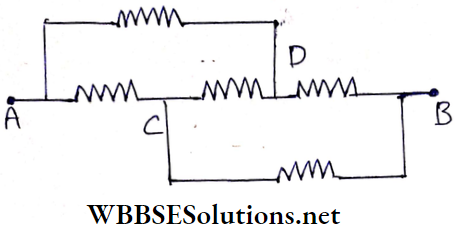
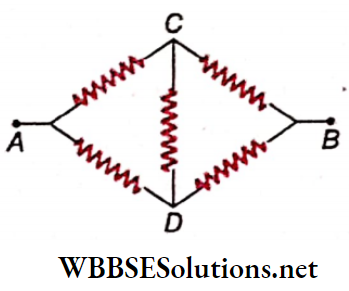
Question 10. Three resistances of equal value are connected in four different combinations. Arrange them in increasing order of power dissipation.

Electric Energy And Power Three resistances of equal value

Answer:

Let R be the value of each resistance.

The equivalent resistance of the circuit (a), R1 = 3R

Equivalent resistance of circuit (b), R2 = \(\frac{R}{3}\)

The equivalent resistance of the circuit (c), \(R_3=\frac{2 R \cdot R}{2 R+R}=\frac{2}{3} R\)

The equivalent resistance of the circuit (d), \(R_4=\frac{R}{2}+R=\frac{3}{2} R\)

∴ R2 < R3 < R4 < R1

Since, power, P = I²R

So, P2 < P3 < P4 < P1.

Question 11. A heater coil has been cut into two equal parts and one coil is used as a heater. What is the percentage change in heat generation?
Answer:

The potential difference across the coU in both cases is V.

Therefore rate of heat generation = \(\frac{V^2}{R}\)

If the coil is cut into half then the value of R becomes half. That’s why, the rate of heat generation has doubled.

That is, this rate increases by 100%.

Question 12. Two electric bulbs of 50 W and 100 W are connected in mains once in

  1. Series and next in
  2. Parallel combination. Which bulb will glow brighter in each case?

Answer:

1. In a series combination, a 50 W bulb will glow brighter than a 100 W bulb. We know, the resistance of the bulb,

⇒ \(R=\frac{V^2}{P}\) [V = potential difference, P = power]

So the resistance of the 50W bulb is greater than that of the 100W bulb.

In this combination, the current in both bulbs is are same.

As heat generation is proportional to I²R, that’s why a 50W bulb glows brighter than a 100W bulb.

2. In parallel combination, a 100W bulb will glow brighter than a 50W bulb

When the bulbs are connected in parallel combination potential difference across each one is the same.

As, heat generation is proportional to \(\frac{V^2}{R}\), that’s why a 100 W bulb glows brighter than a 50 W bulb in parallel combination.

Short Answer Questions on Electric Energy WBCHSE

Question 13. A wire, when connected to a 220 V mains supply, has power dissipation. Now the wire is cut into two equal pieces, which are connected in parallel to the same supply. Power dissipation in this case is P2. What is the ratio of P2 and P1?
Answer:

If R is the resistance of the wire, then the resistance of each of the two pieces is

⇒ \(\frac{R}{2}\).

Equivalent resistance of the parallel combination,

⇒ \(r=\frac{\frac{R}{2} \times \frac{R}{2}}{\frac{R}{2}+\frac{R}{2}}=\frac{R}{4} \quad \text { or, } \frac{R}{r}=4\)

So, \(\frac{P_2}{P_1}=\frac{\frac{V^2}{r}}{\frac{V^2}{R}}=\frac{R}{r}=4\)

Question 14. Power consumed in resistance R3 is P3. Determine the power consumed in resistances R1 and R2.

Electric Energy And Power Power consumed in resistance

Answer:

Let I1 and I2 be the currents flowing in the upward branch and downward branch respectively.

So, \(I_1\left(R_1+R_2\right)=I_2 R_3 \quad \text { or, } \frac{I_1}{I_2}=\frac{R_3}{R_1+R_2}\)

Now, \(\frac{P_1}{P_3}=\frac{I_1^2 R_1}{I_2^2 R_3}=\left(\frac{R_3}{R_1+R_2}\right)^2 \cdot \frac{R_1}{R_3}=\frac{R_1 R_3}{\left(R_1+R_2\right)^2}\)

or, \(P_1=P_3 \cdot \frac{R_1 R_3}{\left(R_1+R_2\right)^2}\)

Similarly \(P_2=P_3 \cdot \frac{R_2 R_3}{\left(R_1+R_2\right)^2}\)

Question 15. A generating station supplies electric power P at voltage V to a factory through a cable of resistance R. Show that the loss of power in the connecting cable is inversely proportional to V2.
Answer:

Supplied power, P = VI

∴ I = \(\frac{P}{V}\)

Loss in power, \(\Delta P=I^2 R=\frac{P^2 R}{V^2}\)

∴ \(\Delta P \propto \frac{1}{V^2}\)

Electric Power Study Questions for Students

Question 16. Prove that total heat produced in different resistors of the circuit is minimal when the current is divided into a number of branches.
Answer:

When the current is divided into a number of parallel branches, then I = I1 + I2

Heat produced in the circuit in time t,

⇒ \(H=\frac{I_1^2 r_1 t}{J}+\frac{\left(I-I_1\right)^2 r_2 t}{J}\)

Electric Energy And Power total heat produced

Differentiating both sides with respect to I1,

⇒ \(\frac{d H}{d I_1}=\frac{2 I_1 r_1 t}{J}-\frac{2\left(I-I_1\right) r_2 t}{J}\)

When the heat generated in the circuit is minimal,

⇒ \(\frac{d H}{d I_1}=0 \text { or, } \frac{2 I_1 r_1 t}{J}-\frac{2\left(I-I_1\right) r_2 t}{J}=0\)

or, \(\frac{2 I_1 r_1 t}{J}=\frac{2\left(I-I_1\right) r_2 t}{J} \text { or, } I_1 r_1=\left(I-I_1\right) r_2=I_2 r_2\)

∴ \(\frac{I_1}{I_2}=\frac{r_2}{r_1}\)

i.e., the heat produced in the circuit will be minimal if the current is divided into the branches such that the current in each branch is inversely proportional to the resistance.

WBCHSE Class 12 Physics Reflection Of Light Notes

WBCHSE Class 12 Physics Notes

Reflection Of Light Light Introduction

Any luminous body is a source of light. The sources of light ‘ may be of two kinds

  1. Self-luminous source and
  2. Nonluminous source.

The sun, the stars, electric bulbs, burning candles, etc. are lumi¬ nous sources. Non-luminous sources themselves become visible when light from a luminous body falls on them.

The moon and the planets are non-luminous bodies. These are visible as light from the sun falls on them and is reflected.

Reflection of light:

When a ray of light passing through a medium is incident on the interface with another medium then, a portion of light returns to the first medium. This phenomenon Is called the Reflection of light

 Reflection, absorption, and refraction of light:

Light travels in a straight line in a homogeneous medium.

When it is traveling in one homogeneous medium and meets the surface of another homogeneous medium.

Read and Learn More Class 12 Physics Notes

The following effects may occur:

  1. A portion of the light falling on the surface of separation returns to the first medium. This phenomenon is called the reflection of light.
  2. A part of the incident light is absorbed by the second medium.
  3.  If the second medium is transparent or translucent then a portion of the incident light penetrates into the second medium and undergoes a change of direction at the surface separating the two media and continues to travel along a straight line.
  4. This phenomenon is called refraction of light

The surface from which the reflection of light takes place is called the reflector.

The amount of reflected light depends on the following two factors:

  1. Direction of Incident light:  The more obliquely the Inol dent light falls on the reflector, the more the amount of reflected light.
  2. Nature of the first and second medium: It Is found from the experiment that if light Is Incident from air to glass nor¬ mally, about 4% of incident light Is reflected, hot If light from air is incident on u plane mirror normally, about W0% of incident light is reflected.

Again if light Is incident from air to glass the amount of light reflected Is more than the amount of light reflected when light Is Incident from air to water. On the other hand, If the reflector is black, most part of the incident light is absorbed by the reflector. As a result, there is negligible reflection from a black body or surface

WBBSE Class 12 Reflection of Light Notes

Reflection Of Light Some Definitions

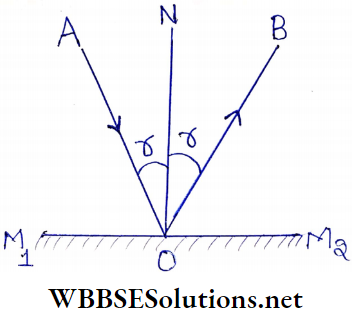
In M1, M2 is a reflector. A ray AO is incident on the reflector at point 0 and is reflected along OB. AO is the incident ray and OB is the reflected ray. 0 is the point of incidence.

Class 12 Physics Unit 6 Optics Chapter 1 Reflection Of Light Reflected Ray

The angle of incidence: The angle that the incident ray makes with the normal to the reflector at the point of incidence is called the angle of incidence. ON is the normal drawn on M1 M2 at O . Hence, ∠AON is the angle of incidence.

The angle of reflection:

The angle that the reflected ray makes with the normal to the reflector at the point of incidence is called the angle of reflection. ∠BON is the angle of reflection.

Reflection Of Light – Laws Of Reflection

Reflection of light obeys the following two laws:

  1. The Incident ray the reflected ray and the normal to the reflecting surface at the point of incidence, are all He on the same plane.
  2. The angle of incidence is equal to the angle of reflection.
    ∠AON = ∠BON.

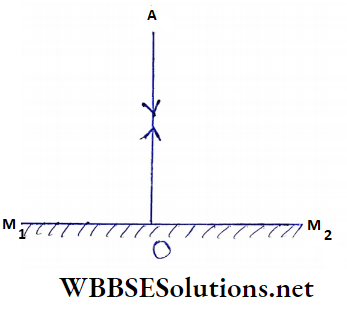
Normal Incidence:

The ray of light AO is incident normally on M1 M2 So the angle of incidence is zero. According to the law of reflection, the angle of reflection is also zero. Thus die ray retraces its path into the first medium.

Class 12 Physics Unit 6 Optics Chapter 1 Reflection Of Light Normal Incidence

 Reflection Of Light – Types Of Reflection

Reflection can be of two types depending on the nature of the surface of the reflector. O regular reflection and 0 diffused reflection

1. Regular Reflection:

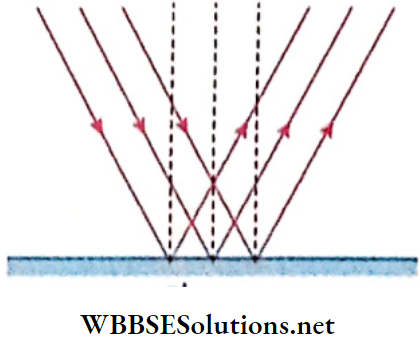
If a parallel beam of rays is incident on a smooth plane reflector, then it is reflected wholly as a parallel beam This type of reflection is called regular reflection. Such reflectors are plane mirrors, upper surfaces of undisturbed water, polished metal surfaces, etc.

In the case of a smooth plane surface, the normals drawn at the points of incidence of the beam of rays are parallel to each other. So in the case of regular reflection, if the incident rays are parallel, the reflected rays are also parallel to each other.

Class 12 Physics Unit 6 Optics Chapter 1 Reflection Of Light Regular Reflection

WBCHSE class 12 Physics Notes Short Notes on Laws of Reflection

The image of an object is formed due to regular reflection [vide section So, we see our image In a plane mirror

It will be interesting to note that only the part of the reflector that reflects parallel rays into the observer’s eyes appears brighter to the observer than the other part of the reflector.

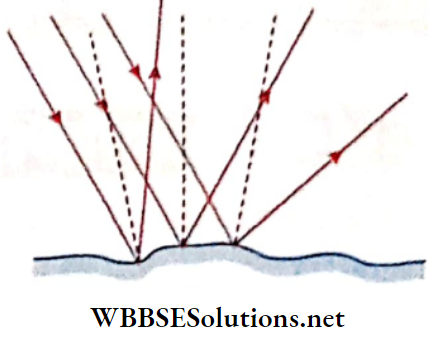
2. Diffuse Reflection:

A parallel beam of rays after reflection from a rough surface does the Reflection of light obey the following two laws. not remain parallel. Such type of reflection of light is called diffused reflection, of reflection, reflection.

Inoccurs this type on the surface of every visible object, each ray of the incident parallel beam is reflected in its own way without being parallel to one another. This is because

Class 12 Physics Unit 6 Optics Chapter 1 Reflection Of Light Diffuse Reflection

The normals at the points of incidence are not parallel to each other. Hence no image is obtained.

However, it is because of diffuse reflection the objects in our surroundings are visible. When a beam of rays falls on the rough sur¬ faces of those objects, it is scattered in all directions.

So, whatever may be the position of the observer, quite a few rays will invariably enter the eyes. As a result, the observer sees the object more or less destined. In this case the reflector looks almost equally bright from all directions but no image of a source is seen.

Reflection from any plane, curved or rough surface, follows the two laws of reflection.

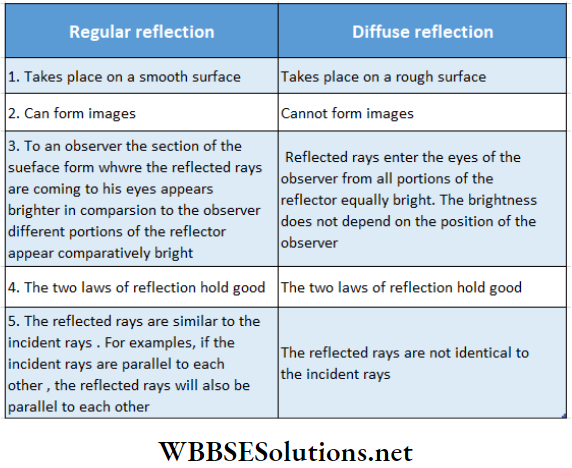
3. Comparison between Regular and Diffuse Reflections

Class 12 Physics Unit 6 Optics Chapter 1 Reflection Of Light Comparision Between Regular And Diffuse Reflection

Reflection Of Light – Deviation Of A Ray Due To Reflection

When a ray of light changes its original course due to reflection. the angle between the original and the final directions of the ray is a measure of the magnitude of deviation of the ray.

It is obvious from the figure that in the absence of the reflector M1M2, the M ray AO would have traveled straight in the direction AOC, but has instead been deviated due to reflection. The magnitude of this deviation,

δ = ∠BOC = 180° – ∠AOB = 180°- 2i

Class 12 Physics Unit 6 Optics Chapter 1 Reflection Of Light Deviation Of The Ray

Reflection Of Light Class 12 Notes

Reflection Of Light – Some Phenomena Of Reflection

When light falls on a black body, practically no reflection takes place. The black body absorbs almost all the light from the incident. Hence, optical instruments like cameras, tele¬ scopes, etc.

Are painted black on the insides to avoid unwanted reflection. On the other hand, white objects do not absorb any light but rather reflect it. Hence to stop the absorption of light and to increase the brightness, white surface air is used.

This is the reason why white screens are used for projection In the cinema.

Twilight: 

Twilight Is the time between dawn and surface and the time between sunset and dusk. The sun itself is not actually visible from this ground level because It is below the horizon. However, the suspended dust particles in all upper atmospheres still receive direct fuse reflection, this light spreads In all directions and pat daily illuminates the ground daily.

When light falls on a glass slab only a negligible portion Is reflected: most of the rays pass through It. Hence the glass slab Is coated with aluminium1, to make a mirror. As the coating is opaque the Incident rays are almost completely reflected from the silvered surface, with only a small portion of the incident is reflected from the front surface.

WBCHSE Class 12 Physics Reflection Of Light Notes

Reflection Of Light Image

 Image Definition:

When rays of light diverging from a point source after reflection or refraction converge to or appear to diverge from a second point, the second point Is called the Image of the first point.

When light rays from an see the object at the place whore it Is actually situated. Hut If the rays come after reflection or refraction we see the object elsewhere. What we see In the new position Is actually Its Image

There are two kinds of images:

  1. Real linage and
  2. Virtual image.

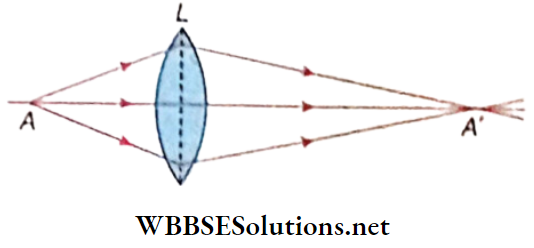
1. Real image:

When rays of light diverging from a point source after reflection or refraction converge to a second point, the second point is called the real Image of the first point.

A real image can be formed on a screen, as evident from, where a convex lens has formed a real image A’ of a point source A.

Class 12 Physics Unit 6 Optics Chapter 1 Reflection Of Light Real Image

Some examples of real image:

  1. The image formed on the cinema screen
  2. The image formed by a camera, etc

2. Virtual image:

When rays of light diverging from a point source after reflection or refraction appear to diverge from a second point, the second point is called the virtual image of the first point.

Class 12 Physics Unit 6 Optics Chapter 1 Reflection Of Light Virtual Image

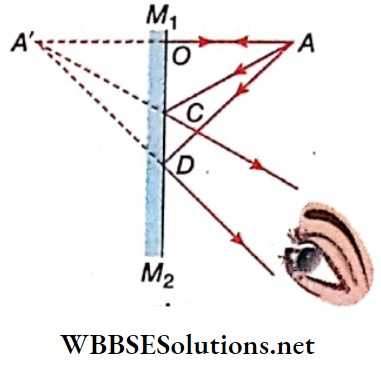
A virtual image cannot be formed on a screen as illustrated, where a plane mirror has formed a virtual image A’ of the point source A

The image of a tree standing by the side of a pond, on the surface of water is a virtual image. A mirage is also a virtual image.

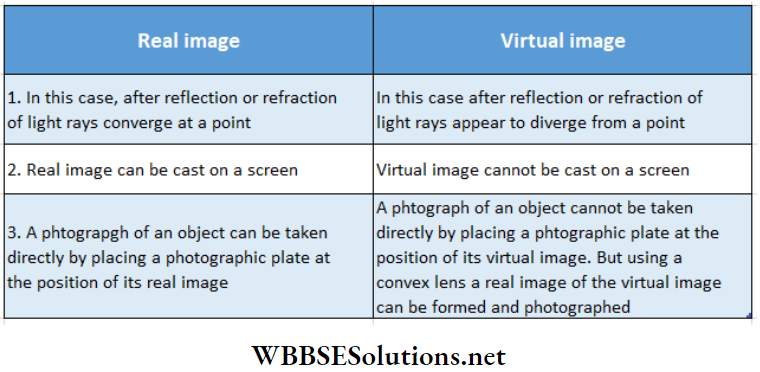
Reflection of light Class 12 Notes Differences between real image and virtual image:

Class 12 Physics Unit 6 Optics Chapter 1 Reflection Of Light Difference Between Real Image And Virtual Image

Image in a Plane Mirror:

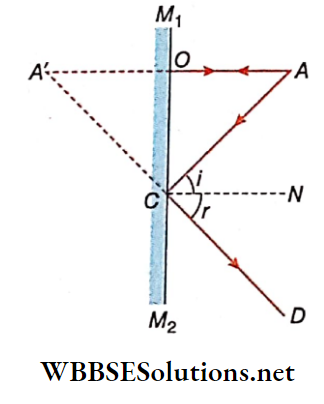
Imags of a point object: Let A be a point source A ray of light AO is incident at O normally and retraces its path along OA.

Another ray AC follows the path CD after reflection. The reflected rays when produced backwards, meet at A’. It appears that the two reflected rays are coming from A’. So, A’ is the virtual image of A. The line AOA’ joins the object and the image is normal to the mirror.

CN is normal at the point of incidence. Since OA and CN
are parallel,

∠OAC = ∠ACN = i (Alternate angles)

and ∠OA’C = ∠NCD = r (Corresponding angles)

But ∠ACN = ∠NCD (i = r)

∠OAC = ∠OA’C

Hence the two right-angled triangles AOC and A’OC are congruent.

∴ OA = OA’

Thus, object distance from the mirror = image distance from the mirror

Hence, the image formed by a plane mirror lies on the perpendicular from the object to the mirror as far behind the mirror as the object is in front of it.

Image of an extended object:

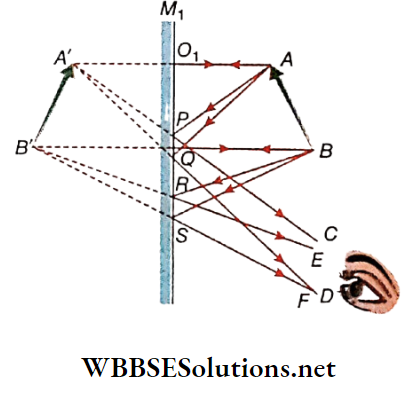
Let AB be an extended object in front of a plane mirror M1M2. Every point of the extended object may be regarded as a source of light. The complete image of the object will be obtained by locating the position of the images of all the point sources.

Class 12 Physics Unit 6 Optics Chapter 1 Reflection Of Light Image Of A Point Object

Reflection Of Light Physics Class 12 Drawing of the image of an extended object:

From the topmost point A of the extended object perpendicular A01 is drawn and it is extended up to A’ in such a way that A in the previous case, A’ is the image of A. The topmost point of AB.

Similarly, B’ is the image of the lowermost point of AB, For every intermediate point of AJB, a corresponding image will be formed between A’ and B’. So, A’B’ is the image of AB. Obviously AB and A’B’ will be of the same size.

So, a plane mirror forms a virtual image of the same size of an extended object.

Class 12 Physics Unit 6 Optics Chapter 1 Reflection Of Light Image Of An Extended Object

It is also obvious from the figure that the eye can catch the image within the portion PS of the mirror, as long as the relative positions of the eye and the mirror are not changed

Lateral insertion Definition:

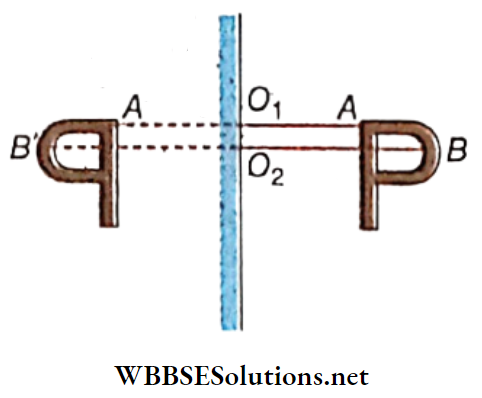
An image of an object formed in a plane mirror is inverted sideways. This effect of plane mirrors is called lateral inversion.

The letter P held in front of a plane mirror will be seen as laterally inverted. The lateral turning is due to the fact, that every point image is at the same distance behind the plane mirror B as the point object is in front of it,

Being the size of the image equal to the size of the object. If the mirror is held vertically, it does not. invert the image which means turning an image upside down. Conversely, if a point source is placed at the point / its virtual image is formed at the point O.

This is due to the principle of reversibility of light rays. Only the image is laterally inverted. If we move our’ right hand facing a mirror, we see the image moving its left hand.

Class 12 Physics Unit 6 Optics Chapter 1 Reflection Of Light Lateral Inversion

The perpendicular distance of every point of the object from the plane mirror = the perpendicular distance of every image point from the mirror.

i.e., AO1 =  A’O1; BO2 = B’O2.

So, the image is laterally inverted.

The images, due to bodies having symmetrical sides such as a sphere or letters like A, H, M, I, O, T, etc. are not affected by lateral inversion, but the images with non-symmetrical bodies like mug or letters like P, B, C, etc. are affected.

The characteristics of the image formed by a plane mirror:

  1. With respect to the mirror, object distance = image distance.
  2. The straight line joining the object and its image is perpendicular to the mirror.
  3. The image is virtual.
  4.  The image is formed behind the mirror and is the same size as that of the object.
  5. The image is laterally inverted.

Image in a Plane Mirror due to a Conver- gent Beam:

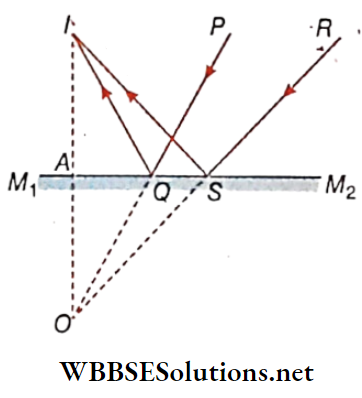
Suppose a converging beam of light is incident on a plane mirror M1M2. In the absence of the mirror, the rays would converge. Due to reflection, the rays PQ and RS meet at point I instead of O. It can be proved that the straight line joining I and O is perpendicular to the mirror and IA = OA. Point O is called the virtual object and point I is its real image. Thus a plane can form a real image of a virtual object

Class 12 Physics Unit 6 Optics Chapter 1 Reflection Of Light Real Image Of A Virutual Object

Conversely, if a point source is placed at point I its virtual image is formed at point O. This is due to the principle of reversibility of light rays.

For a given incident ray if the mirror is rotated through an angle, the reflected ray turns through an angle of 2θ.

The minimum length of the plane mirror required to have the full-length image of a person standing in front of it is equal to half the height h of the person i.e. \(\frac{h}{2}\)

If an object moves towards (or away from) a plane mirror with a speed v, the image of the object will move towards (or away from) the mirror with a speed 2v.

4. If two plane mirrors facing each other are inclined at an angle with each other, the number of images formed due to multiple reflections, is given by n = 360°-1. If (36-1) is not an integer, the next integer will indicate the number of images.
360°

5. Due to reflection, the frequency, wavelength and speed of light are not changed.

6. The intensity of light after reflection decreases.

7. For reflection of light from a denser medium a phase change of occurs.

Reflection of light physics class 12

Reflection Of Light – Curved Reflecting Surface

Mirrors used in torches, headlights, or viewfinders of vehicles are curved mirrors. Curved mirrors may be spherical, cylindrical, or parabolic. In this chapter, however, we shall restrict our discussion only to spherical mirrors.

The laws of regular reflection are equally applicable to curved surfaces as well. But in this case, the position of the image and its size differ widely, as we shall see later.

Reflection Of Light Spherical Mirror

A spherical mirror is a part of a hollow sphere or a spherical surface.

There are two types of spherical mirrors:

  1. Concave mirror and
  2. Convex mirror.

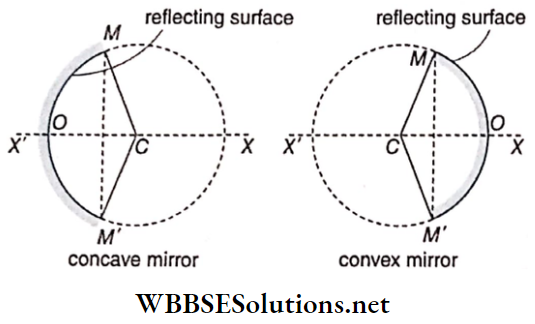
When the inner surface of a spherical mirror acts as a reflector, it is a concave mirror.  When the outer surface of a spherical mirror acts as a reflector, it is a convex mirror.

Some Related Terms:

Pole:

The center of the spherical reflecting surface is called the pole of the mirror. In  O is the pole.

Centre of curvature:

The center of the sphere of which the spherical mirror is a part is called the center of curvature of the mirror. C is the center of curvature of the mirror MOM’. Obviously, the center of curvature of the concave mirror is in front of the reflecting surface while in the case of the convex mirror it is behind the reflecting surface.

The radius of curvature:

It is the radius of that sphere of which the mirror is a part.  OC is the radius of curvature.

Class 12 Physics Unit 6 Optics Chapter 1 Reflection Of Light Radius Of Curvature

Principal axis:

The line passing through the center of curvature and the pole of the mirror is called the principal axis of the mirror.  XX’ is the principal axis.

Aperture:

The line joining the two extreme points on the periphery of a spherical mirror is called the aperture of the mirror. The angle subtended at the center of curvature by the line is called the angular aperture of the mirror. In the line MM’ is the aperture of the spherical mirror and ZMCM’ is its angular aperture.

The discussion in this chapter will be confined to spherical mirrors of small apertures not exceeding 10°, although, for the sake of clarity, illustrative diagrams will indicate larger apertures.

Paraxial and non-paraxial or marginal rays:

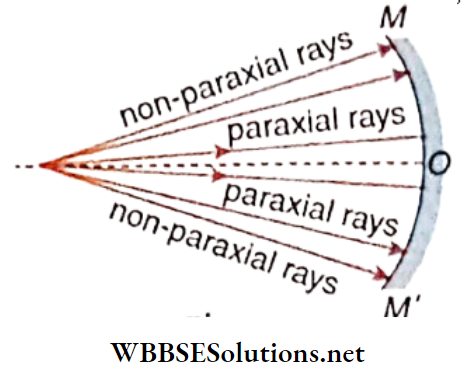
1. Paraxial rays:

Rays that are incident very close to the pole and form a very small angle with the principal axis of a spherical mirror are called paraxial rays.

Class 12 Physics Unit 6 Optics Chapter 1 Reflection Of Light Paraxial Rays

2. Non-paraxial or marginal rays:

Rays that are incident very far away from the pole or near the margin of a spherical mirror and form a comparatively large angle with the principal axis are called non-paraxial or marginal rays.

All rays incident on a spherical mirror whose aperture is negligibly small compared to its radius of curvature, are considered to be paraxial rays. For further discussions, we will assume all spherical mirrors to be of a small aperture and a comparatively large radius of curvature.

Principal focus:

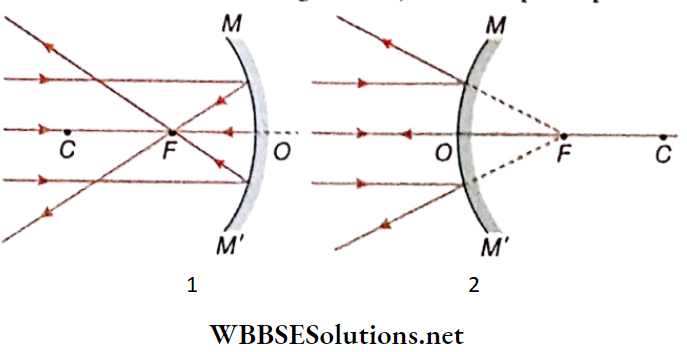
If rays of light parallel to the principal axis are incident on a spherical mirror, the rays after reflection from the mirror converge to a point on the principal axis in case of a concave mirror and appear to diverge from a point on the principal axis behind the mirror in the case of a convex mirror, this point is called the principal focus or simply focus of the mirror.

Class 12 Physics Unit 6 Optics Chapter 1 Reflection Of Light Principal Focus

F is the principal focus of M the concave mirror and convex mirror respectively.  So, the focus of the concave mirror is real and that of the convex mirror is virtual.

It can alternatively be defined as the point on the principal axis of a spherical mirror at which the image of an object placed at infinity is formed.

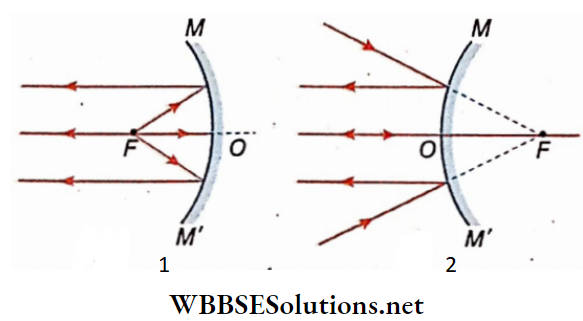
According to the principle of reversibility of light rays, it can be said:

The rays diverging from the principal focus of a concave mirror proceed parallel to the principal axis after reflection from the mirror

Class 12 Physics Unit 6 Optics Chapter 1 Reflection Of Light Principal Axis After Reflection From The Mirror

The rays appearing to converge to the principal focus of a convex mirror proceed parallel to the principal axis after reflection from the mirror.

Reflection of light physics class 12 Important Definitions Related to Reflection

Focal length:

The distance between the principal focus and the pole of the mirror is called the focal length of the mirror. OF is the focal length. The focal length of a spherical mirror does not depend on the color of the incident light.

Focal plane and secondary focus:

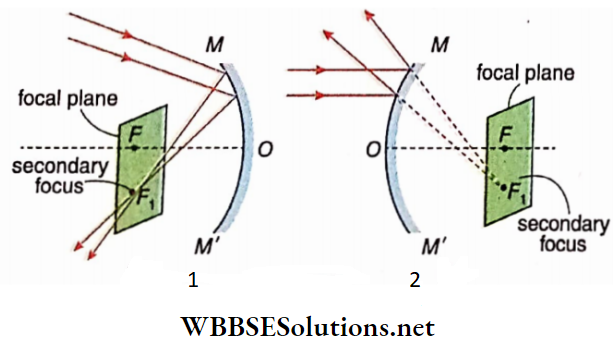
The focal plane of a spherical mirror is the imaginary plane passing through the principal focus at right angles to the principal axis of the mirror.

Class 12 Physics Unit 6 Optics Chapter 1 Reflection Of Light Focal Plane And Secondary Focus

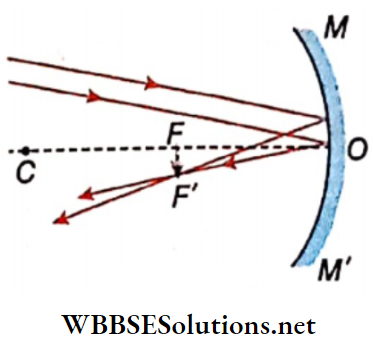
If a parallel beam of rays is incident on a spherical mirror such that it is inclined to the principal axis then, after reflection the reflected rays converge to the point. on the focal plane in the case of a concave mirror and appear to diverge from the point. On the focal plane in case of a convex mirror. The point F1 is called the secondary focus of the spherical

The principal focus is a fixed point on the principal axis. However, the secondary focus is not a fixed point. If the angle of inclination of the parallel rays with the principal axis is changed, the position of the secondary focus also changes. But a secondary focus always lies on the focal plane.

Relation between Focal Length and Radius of Curvature

1. In the case of the concave mirror:

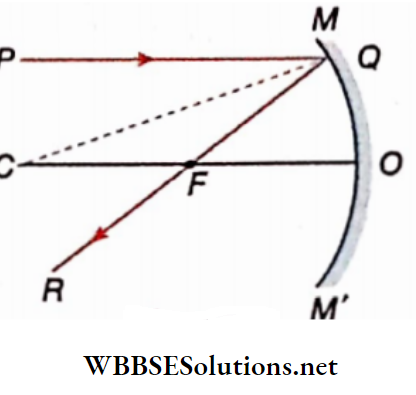
Let MOM’ be a concave mirror of a small aperture. C, F, and O are the center of curvature, focus, and pole of the mirror respectively. Ray PQ is parallel to the principal axis, hence passing through F after reflection, CQ being the radius of curvature is perpendicular to the mirror at Q.

Class 12 Physics Unit 6 Optics Chapter 1 Reflection Of Light Concave Mirror

∴ ∠PQC = ∠FQC

∴  ∠PQC = ∠QCF [alternate angles]

∠FQC = ∠QCF i.e., Δ QCF is an isosceles triangle.

Hence, FQ = FC

Since the aperture of the mirror is very small, Q and O are very close to each other. So, FQ = FO.

∴ FO = FC or, FO = \(\frac{1}{2}\) OC

i.e f= \(\frac{r}{c}\), where f is focal length and r the radius of curvature.

2. In case of convex mirror:

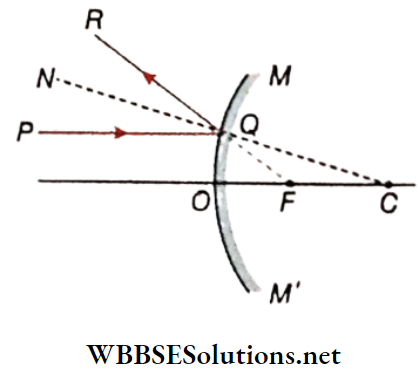
Let MOM1, be a convex mirror of a small aperture. C, F, and O are the center of curvature, focus, and pole of the mirror respectively. OC is the radius of curvature.

A ray PQ parallel to the principal axis is incident at Q of the mirror. After reflection, the ray QR appears to come from F. The points C and Q are joined and is extended to N. Since the CQ = CO radius of curvature of the mirror, QN is normal at incidence point Q on the mirror.

Class 12 Physics Unit 6 Optics Chapter 1 Reflection Of Light Convex Mirror

If a parallel beam of rays is incident on a spherical mirror such that it is inclined to the principal axis then, after reflection, the reflected rays converge to point F, on the focal plane in case of a concave mirror and appear to diverge from the point F,  on the focal plane in case of a convex mir- But r. The point F is called the secondary focus of the spherical

∠PQN = ∠RQN

∠RQN = ∠CQF [vertically opposite]

∴ ∠PQN = ∠CQF

∴  Since PQ and OC are parallel.

∴ ∠PQN = ∠FCQ [corresponding angles]

∴ ∠FCQ = ∠CQF

Hence , FQ = FC

Since the aperture of the mirror is small, Q and O are very 1. Object at infinity: If an object is at infinity, the rays are close to each other.

So, FQ = FO.

∴ FO = FC

Or, FO = \(\frac{1}{2}\) OC

I.e f = \(\frac{r}{2}\)

Hence the focal length of a spherical mirror is small Thus, the image of an object situ- aperture is equal to half of its radius of curvature.

Class 11 Physics Class 12 Maths Class 11 Chemistry
NEET Foundation Class 12 Physics NEET Physics

Reflecting power:

Reflecting the power of a spherical mirror, D = \(\frac{1}{f}\) =\(\frac{2}{r}\) = As both focal length and radius of curvature of a plane mirror are infinite, so power of a plane mirror is zero.

Reflection of light physics class 12

Reflection Of Light – Image Formation Of Extended Object By Spherical Mirror

Ray tracing method:

The position, nature, and size of the image of an extended object, formed by a spherical mirror can be determined geometrically. Any extended object can be considered as the sum of point objects and the images of the point objects constitute the image of the extended object.

Any two of the following rays intersecting at a point will indicate the portion of the image:

  1. A ray parallel to the principal axis: After reflection passes through the focus, or appears to diverge from the focus.
  2. A ray passes through the focus: After reflection emerges In the case of a concave mirror if the object is placed at the center parallel to the principal axis.
  3. A ray passing through the center of curvature: After reflection retraces its path in the opposite direction.

Because the ray passing through the center of curvature incidence on the mirror is the normal incidence in this case.

Image Formation by Convex Mirror:

Objectivity at infinity:

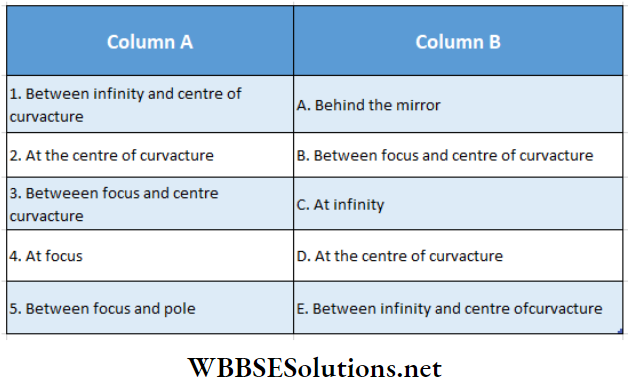
If an object is at infinity, the rays coming from it may be assumed to be parallel and hence after reflection will meet at the principal focus F. If the rays are A oblique after reflection they will meet at a secondary focus F’

Class 12 Physics Unit 6 Optics Chapter 1 Reflection Of Light Object At Infinity

Thus, the image of an object situated at infinity is formed on the focal plane. The image is real, inverted, and very much diminished in size

2. Object placed between focus and center of curvature:

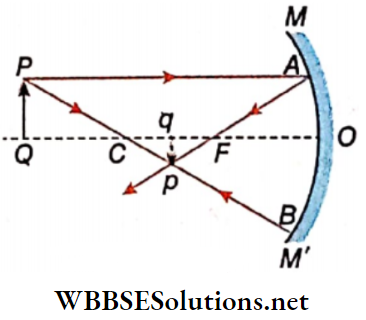
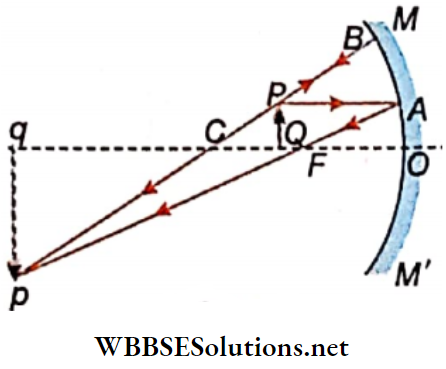
An object PQ is placed beyond C on the principal axis of the concave mirror MOM’. A ray PA starting Anotherray PB passing through C is reflected back along BP. The two reflected rays AF and BP meet at p.

Class 12 Physics Unit 6 Optics Chapter 1 Reflection Of Light Infinity And Centre Of Curvature

So, the real image of P is formed at p. Normal pq is drawn on the principal axis. PQ is the image of PQ. The image is situated between F and C. The image is real, inverted, and diminished relative to the object.

3. Object at the center of curvature :

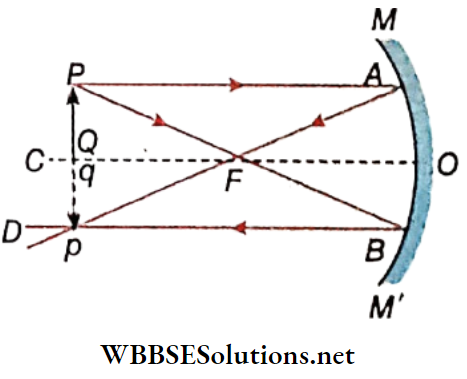
An object PQ stands at C A ray PA parallel to the principal axis is reflected through F along AF. Another ray PB through F is reflected along BD parallel to the principal axis. The two reflected rays AF and BD meet at p. So, the real image. of P is formed at p. pq is D drawn normally on the principal axis. pq is the image of PQ.

The image is real, inverted, and magnified, and of the same size as the object, and formed at the center of curvature itself.

Class 12 Physics Unit 6 Optics Chapter 1 Reflection Of Light Centre Of Curvacture

In case of a concave mirror if the object is placed at the center of curvature the image is also formed at the center of curvature. Hence only in this case, the intervening distance between the object and image is minimum and is equal to zero

4. Object placed between focus and centre of curvature

An object PQ stands between F and C. A ray PA parallel to the principal axis is reflected through F along AF. Another ray PB incident normally at B goes back along BC. These two reflected rays meet at p. So, the image of P is formed at p. pq is drawn normally on the principal axis. pq is the image of PQ.

Class 12 Physics Unit 6 Optics Chapter 1 Reflection Of Light Between Focus And Centre

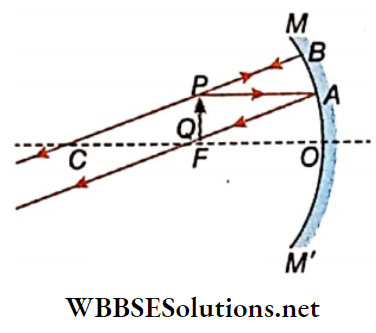
5. Object at focus:

An object PQ is placed at the focus F . A ray PA parallel to the principal axis is reflected through F along AF. Another ray PB incident normally at B goes back along BC. These two reflected rays being parallel to each other meet at infinity producing the image of P.

Class 12 Physics Unit 6 Optics Chapter 1 Reflection Of Light Object At Focus

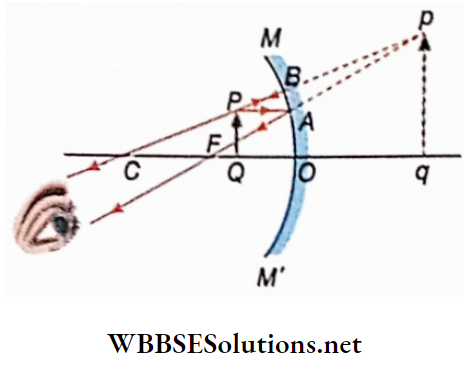
6. Object placed between focus and pole:

An object PQ is placed between the pole and focus. A ray PA parallel to the principal axis is reflected through F along AF. Another ray PB incident normally at B goes back along BC. These two reflected raj’s which are divergent would not meet anywhere. But when they are produced backwards they meet at p. Thus they appear to diverge from p. pq is drawn normally on the principal axis. Thus pq is the image of PQ

Class 12 Physics Unit 6 Optics Chapter 1 Reflection Of Light Object Placed Between Focus And Pole

The Image is virtual, erect, magnified, and situated behind the mirror

 Image Formation by Convex Mirror:

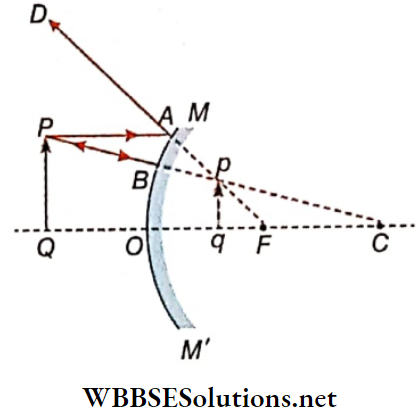
Consider an object PQ in front of a convex mirror MOM. A ray. PA parallel to the principal axis goes back along AD. Ray AD appears to come from the focus. Another ray PB incident normally at B is reflected along BP. Reflected rays AD and BP, produced backwards appear to come from p. So. p is the virtual image of P. pq is drawn normally on the principal axis. Thus pq is the image of PQ.

Class 12 Physics Unit 6 Optics Chapter 1 Reflection Of Light Formation By Convex Mirror

The image is virtual, erect, diminished in size, and situated behind the mirror.

For any portion of the object in front of a convex mirror, the image is real, inverted, and magnified infinitely, and situation the image will always be formed behind the mirror. This image is rated at infinity.

Comparative Study of Real and Virtual Images in the Case of Spherical Mirror

1. Characteristics of real image:

  • It is formed on the same side of the mirror as the object. It is always inverted.
  • Real image is not formed in a convex mirror

2. Characteristics of virtual image:

  • It is always formed on the opposite side of the mirror as the object.
  • It is always erect.
  • The size of the virtual image becomes larger than the object or equal to it in the case of a concave mirror. Whereas in the case of a convex mirror, it is smaller than the object or equal to it.

Sign Convention for Spherical Mirror

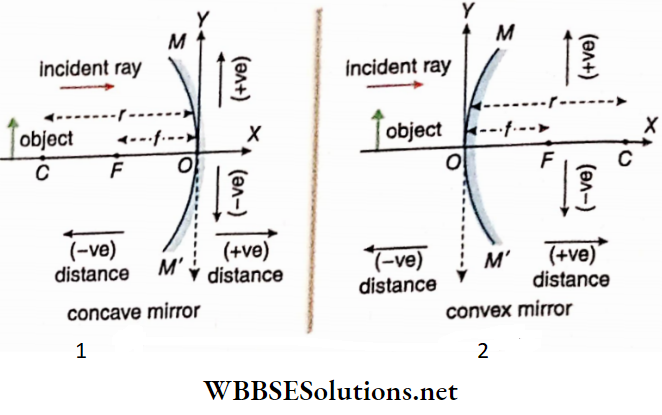
1.  Cartesian sign convention:

  • All distances are to be measured from the pole of the spherical mirror.
  • All distances measured in a direction opposite to that of the incident rays are to be taken as negative and all distances measured in the same direction as that of the incident rays are to be taken as positive.
  • If the principal axis of the mirror is taken as the x-axis, the upward distance along the positive y-axis is taken as positive while the downward distance along the negative y-axis is taken as negative.

See the concave and convex mirrors given in below to understand the above rules.

Class 12 Physics Unit 6 Optics Chapter 1 Reflection Of Light Cartesian Sign Convention

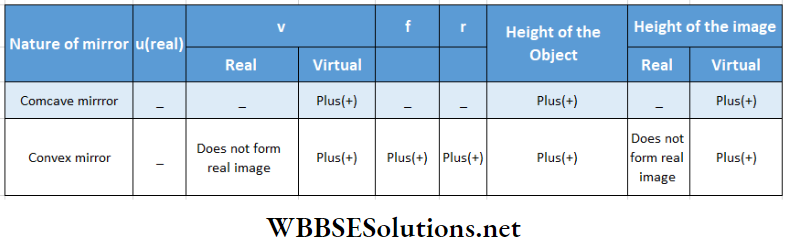
The nature sign of object distance(u), image distance(v) focal lengh(f), radius of curvature (r), and height of the image in case of the image formation of a real object by a spherical mirror is given in the following table.

Class 12 Physics Unit 6 Optics Chapter 1 Reflection Of Light Spherical Mirror

Reflection Of Light – Relation Among Object Distance, Image Distance, And Focal Length

1. In case of concave mirror:

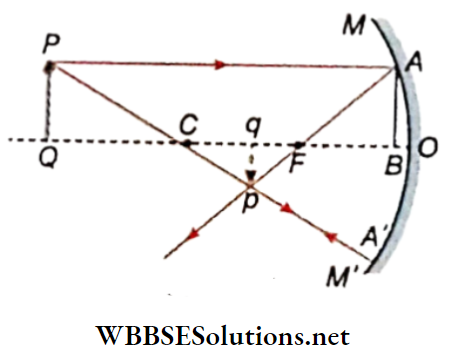
Let O, F, C, and OQ be the pole, focus, center of curvature, and principal axis of a concave mirror MOM’ respectively. PQ is an object placed perpendicularly on the principal axis in front of the mirror. A ray PA, parallel to the principal axis, after reflection, does not form a real image that passes through F.

Another ray PA’, passing through C, after reflection goes back following the same path. These two reflected rays cut each other at p. Hence p is the real image of P. pq is the image of PQ. AB is drawn perpendicular to the principal axis.

Triangles PCQ and pCq are similar

∴ \(\frac{P Q}{p q}=\frac{C Q}{C q}\)

Class 12 Physics Unit 6 Optics Chapter 1 Reflection Of Light Perpendicular On The Principal Axis Of Concave Mirror

Again,  Δ ABF and Δ  pqF are similar

∴ \(\frac{A B}{p q}=\frac{B F}{F q}\)

Or,  \(\frac{P Q}{p q}=\frac{B F}{F q}\)

[ AB = PQ]

From (1) and (2) we get \(\frac{C Q}{C q}=\frac{B F}{F q}\)

Since the mirror is of small aperture It can be assumed BF ≈ OF

∴ \(\frac{C Q}{C q}=\frac{O F}{F q}\)

Object distance, OQ = -u;

Image distance

Oq = -v; focal

Length, OF = -f

Radius of curvature, OC = -r = -2f

∴  CQ = OQ- OC  = -u+ 2f

Cq = OC- Oq = -2f+v

Fq = Oq- OF = -v+f

From (3) we get, \(\frac{-u+2 f}{-2 f+v}=\frac{-f}{-v+f}\)

or, uv- uf- 2fv² + 2f² = fv

or, uv = uf+ vf

Dividing both sides by uvf we get

⇒ \(\frac{1}{f}=\frac{1}{v}+\frac{1}{u}\)

Or, \(\frac{1}{v}+\frac{1}{u}=\frac{1}{f}=\frac{2}{r}\)

2. In the case of the convex mirror:

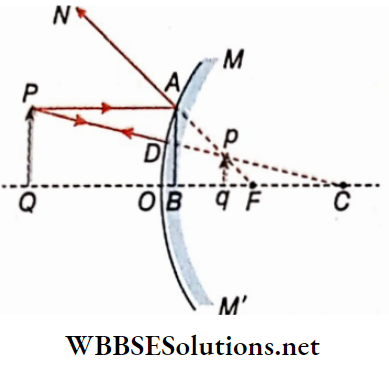
Let O, F, C, and CQ be the pole, focus, center of curvature, and principal axis of a convex mirror MOM’ respectively [Fig. 1.28]. PQ is an object placed perpendicularly on the principal axis in front of the mirror. A ray PA parallel to the principal axis and another ray PD proceeding to the center of curvature, form a virtual image p of P after reflection from the mirror. pq is the image of PQ. AB is drawn perpendicular to the principal axis.

Class 12 Physics Unit 6 Optics Chapter 1 Reflection Of Light Perpendicular On The Principal Axis Of Convex Mirror

Triangles PCQ and pCq are similar

∴ \(\frac{P Q}{p q}=\frac{C Q}{C q}\)

Again ΔABF and ΔpqF are similar

∴ \(\frac{A B}{p q}=\frac{B F}{F q}\)

Or  \(\frac{P Q}{p q}=\frac{B F}{F q}\)

From (5) and (6) we get,

∴ \(\frac{C Q}{C q}=\frac{B F}{F q}\)

Since the mirror is of small aperture It can be assumed BF ≈ OF

∴ \(\frac{C Q}{C q}=\frac{O F}{F q}\)

Object distance, OQ = -u;

Image distance, Oq = +v; focal

Length, OF = +f

Radius of curvature, OC = +r = +2f

∴  CQ = OQ +OC  = -u+ 2f

Cq = OC- Oq = +2f+v

Fq = OF- Oq = +f – v

From (7) we get,

⇒ \(\frac{-u+2 f}{+2 f+v}=\frac{+f}{+f-v}\)

or, 2f²- vf= – uf+2f²+uv-2vf

or, uv = uf+ vf

Dividing both sides by uvf we get

⇒ \(\frac{1}{f}=\frac{1}{v}+\frac{1}{u}\)

Or, \(\frac{1}{v}+\frac{1}{u}=\frac{1}{f}=\frac{2}{r}\)

It may be noticed that using the same sign convention, the relation between the various distances is the same for both concave mirror and convex mirror. This relation viz., += = 2 is called the mirror equation or spherical mirror equation.

In case of a concave mirror if u and v are the object distance and the image distance of a real object and its real image respectively, then the u-v graph is a rectangular hyperbola and the graph of their reciprocals ( \(\frac{1}{u}\) – \(\frac{1}{v}\) graph) is a straight line.

Reflection of light physics class 12 Equation of plane mirror from the equation of spherical mirror:

The mirror equation is

⇒ \(\frac{1}{v}\) + \(\frac{1}{u}\) = \(\frac{1}{f}\)= \(\frac{2}{r}\)

For a plane mirror, r→ ∞

∴ \(\frac{1}{v}\) +\(\frac{1}{u}\) = 0

Or, v= -u

This proves that in the case of a plane mirror, the image is as far behind the mirror as the object is in front of it (:: v negative).

Effect of medium on the focal length and image distance for spherical mirror:

The focal length of a spherical mirror is fixed, i.e., independent of the surrounding media. This is because the law of reflection is invariant even if the medium changes.

For a spherical mirror, if object distance u, image distance v, and focal length f, then the relation between them is  \(\frac{1}{v}\) + \(\frac{1}{u}\) = \(\frac{1}{f}\)= \(\frac{2}{r}\).

For a fixed object distance u, the image distance v is fixed, because f is fixed and independent of medium. So, if the position of the object and mirror are kept fixed and the surrounding medium is changed no change position of the image occur.

Conjugate Foci or Conjugate Points We have the mirror equation:

We have the mirror equation

⇒ \(\frac{1}{v}\) + \(\frac{1}{u}\) = \(\frac{1}{f}\)= \(\frac{2}{r}\).

If u and v are interchanged, the equation remains the same. This implies that if the object is placed at the position of the image, the image will be formed at the position of the object.

These two points are called conjugate foci and the above equation is alternatively called the conjugate foci relation.

In the case of the virtual image, conjugate foci are situated on two opposite sides of the mirror, and in the case of a real image, conjugate foci are situated on the same side of the mirror.

Newton’s Equation:

Relation among u, v, f with reference to the pole is

⇒ \(\frac{1}{v}\) + \(\frac{1}{u}\) = \(\frac{1}{f}\)= \(\frac{2}{r}\).

Or, \(\frac{u+v}{u v}=\frac{1}{f}\)

Or, uv-uf-vf+ = 0

Or, uv-uf-vf+f2 = 0

Or, u(v-f)-f(v-f) = f2

Or, (u-f)(v-f) = ƒ2

Now, if the object distance and the image distance are measured from the focus, and taken equal to x and y respectively, then we can write,

u-f = x and v-f = y

So, from equation (1) we get,

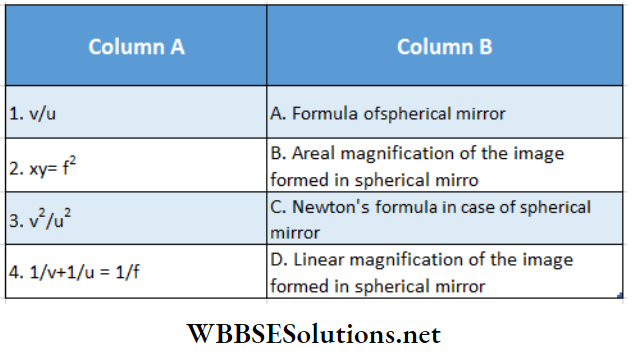
xy = f²

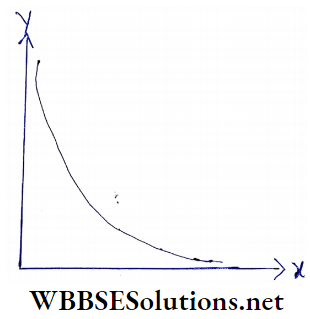
This equation is known as Newton’s equation. Since ƒ is constant, the graph of x versus y will be a rectangular hyper-bola

Since, f² is a positive quantity, x and y must have the same sign, i.e., the object and the image must be on the same side of the focus.

Class 12 Physics Unit 6 Optics Chapter 1 Reflection Of Light Newton Equation Of The Focus Graph

Magnification of an Image Formed by Spherical Mirrors

Linear or lateral magnification Definition:

The ratio of the height of the image to the height of the object measured in planes that are perpendicular to the principal axis is called the linear or lateral magnification of Linear the image

Linear or lateral magnification is denoted by m

The ratio of the height of the image to the height changed, with no change in the position of the image.

∴ m = \(\frac{\text { height of the image }}{\text { height of the object }}=\frac{I}{O}\) …………………….(1)

1. In the case of a real image formed by a concave mirror:

The ray diagram for the formation of a real image by a concave mirror is shown. Here object distance, RQ-u; image distance, Rq=v, height of the object, PQ = O and height of the image, pq = -I. The Δ PQR and ΔpqR are similar.

∴ \(\frac{p q}{P Q}=\frac{q R}{Q R}\)

Or, \(\frac{-I}{O}=\frac{-v}{-u}\)

Or, \(\frac{I}{O}=-\frac{v}{u}\) ………………(2)

Class 12 Physics Unit 6 Optics Chapter 1 Reflection Of Light Linear Or Lateral Magnification Real Image Of Concave Mirror

2. In case of a virtual image formed by a concave mirror:

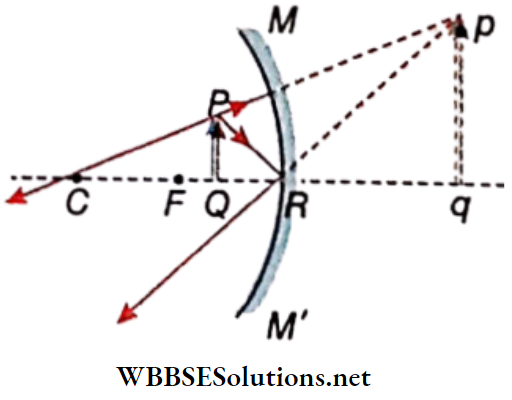
The ray diagram for the formation of a virtual image by a concave mirror is shown.

Here object distance, PQ = -u; image distance, Rq = v, height of the object, PQ =  O and height of the image, pq= I. From ΔPQR and ΔpqR are similar.

Class 12 Physics Unit 6 Optics Chapter 1 Reflection Of Light Linear Or Lateral Magnification Viritual Image Of Convex Miror

∴ \(\frac{p q}{P Q}=\frac{q R}{Q R}\)

Or, \(\frac{I}{O}=\frac{v}{-u}\)

Or, \(\frac{I}{O}=-\frac{v}{u}\) ………………(3)

3. In the case of a virtual image formed by a convex mirror:

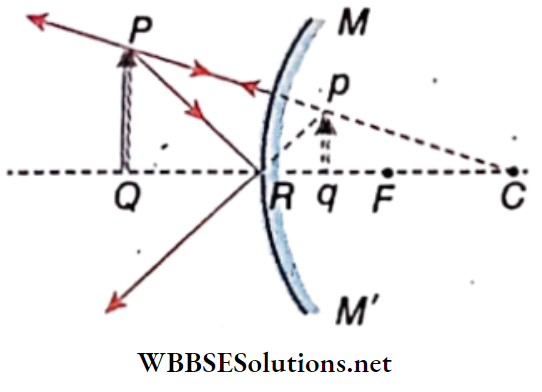
In Again the equation can be written as, the ray diagram for the formation of a virtual image by a convex mirror is shown. Here object distance, RQ-u; image distance Rq= y; height of the object, since, PQ = O and height of the image pq = I.

Class 12 Physics Unit 6 Optics Chapter 1 Reflection Of Light Linear Or Lateral Magnification Virtual Image Of Convex Mirror

According to the PQR and pqR are similar

∴ \(\frac{p q}{P Q}=\frac{q R}{Q R}\)

Or, \(\frac{I}{O}=\frac{v}{-u}\)

Or, \(\frac{I}{O}=-\frac{v}{u}\) ………………(4)

From equations (2), (3), and (4) it follows that the magnification produced by both kinds of mirror is given by

m= \(\frac{I}{O}=-\frac{v}{u}\) ………………(5)

Some useful hints:

  1. The relation m.= – \(\frac{v}{u}\)– is applicable both for concave and convex mirrors.
  2. In solving numerical problems, values of u, v, and f should be put with appropriate signs in the mirror equation. No sign for the unknown quantity should be used.
  3. Using the appropriate sign of u and v, if
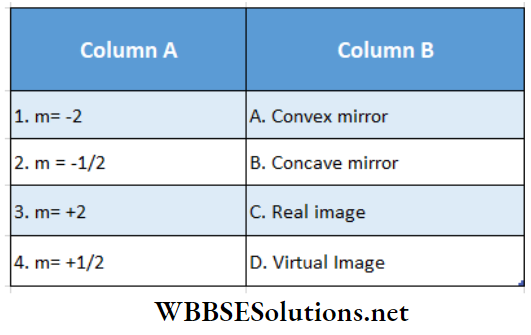
    • m becomes negative, the image will be inverted
    • m becomes positive, the image will be erect
  4.  If |m|>1; the size of the image> size of the object
    • If |m|<1; the size of the image< size of the object
    • If |m| = 1; the size of the image size of the object

Magnification in terms of focal length, object distance, and image distance:

From the mirror equation, we get,

⇒ \(\frac{1}{v}\) + \(\frac{1}{u}\) = \(\frac{1}{f}\)

Or, \(\frac{u}{v}\) + 1 = \(\frac{u}{v}\)

Or, \(\frac{u}{v}\) = \(\frac{u-f}{f}\)

Or, \(\frac{u}{v}\) = \(\frac{f}{u-f}\)

Since, m= – \(\frac{u}{v}\)

∴ m = ( \(\frac{f}{u-f}\) )

Or, ( \(\frac{f}{f-u}\) )

Again the equation can be written as,

1+ \(\frac{v}{u}\)  = \(\frac{v}{f}\)

Or, \(\frac{v}{u}\) = \(\frac{v-f}{f}\)

m= – \(\frac{v-f}{f}\) = \(\frac{f-v}{f}\)

Reflection Of Light Physics Class 12

Areal Magnification Definition

Areal magnification for spherical mirrors is the ratio between the image of an area of a plane, and the area of that plane placed perpendicular to the principal axis of the mirror.

Let us consider, that the length and breadth of a plane of a rectangular object are 1 and b respectively.

∴ Area of the plane, A = lb

If the linear magnification of the image of the object by spherical mirror be m, then

length of the image, l’ = m × 1

and breadth, b’ = m × b

∴ Area of the image, A’ = l’b’ = m²lb = m²A Therefore, areal magnification,

m’ = \(\frac{A^{\prime}}{A}\) = m²

Longitudinal or axial magnification of the image of an object kept along the principal axis Definition:

If any object is placed along the principal axis of a spherical mirror then the ratio of the image length and object length is the longitudinal or axial magnification of that image.

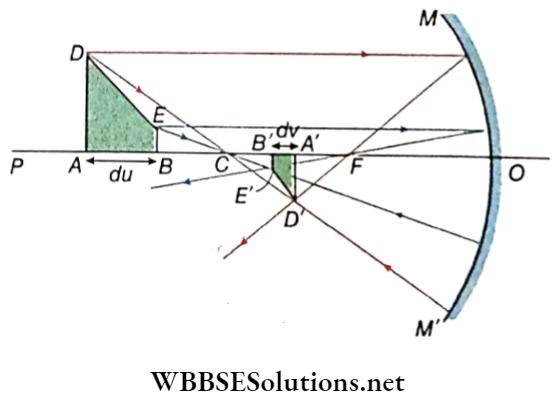
Let an object ADEB is placed in front of a spherical mirror MM’.

Class 12 Physics Unit 6 Optics Chapter 1 Reflection Of Light Longitudinal Or Axial Magnification Of Spherical Mirror

From the figure, the distance of farther point A of an object, OA = u1 and that of the nearer point B of the object, OB = u2

Now, the distance of the farther point of the image, OB’ =v1 that of the nearer point, OA’=v2

Longitudinal Magnification , m= \(\frac{v_1-v_2}{u_1-u_2}=\frac{\Delta v}{\Delta u}\)

Here, Δu and Δv are the lengths of the object and its image respectively, along the principal axis of the mirror. For very small magnitudes of Au and Av, these can be considered as du and du respectively.

So,  m” = \(\frac{d v}{d u}\)

Differentiating the equation \(\frac{1}{v}+\frac{1}{u}=\frac{1}{f}\)

\(-\frac{1}{v^2} \frac{d v}{d u}-\frac{1}{u^2}\) = 0

Where, [f is constant]

Or, \(\frac{d v}{d u}=-\frac{v^2}{u^2}\)

∴ m” = \(\frac{d v}{d u}\) = – m²

∴  Longitudinal magnification = -(linear magnification)²

Note that, if object length and image length are very small dv then,

∴ m” = \(\frac{d v}{d u}\)

Im may be positive or negative but m” is always negative. This implies that irrespective of whether the object is virtual or real, the image is formed along the principal axis, with opposite alignment. This pianomeonon is called axial inversion.

Formation of Image of a Virtual Object: 

Class 12 Physics Unit 6 Optics Chapter 1 Reflection Of Light Formation Of Image Of A Virtual Object 

In a beam of converging rays is incident on the mirror. In the absence of the mirror, in either case, the

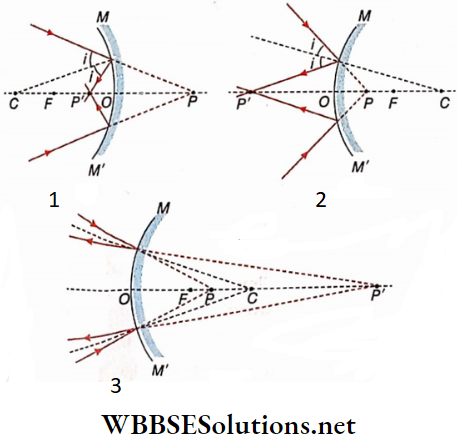
A converging beam of rays would meet at P behind the mirror. But the beam of rays meets at P’ after reflection. Here point P is the virtual object and P’ is the real image of point P. Obviously, object distance OP is positive.

Thus, a convex mirror can also form a real image, but only if the object is virtual. Now consider the case, where the virtual object distance OP is greater than the focal length OF of a convex mirror.

In this case, image P’ will be virtual. with respect to u, we get, In the case of the concave mirror, a real image always be formed for a virtual object and this image is situated between the pole and the focus of the mirror.

Class 12 physics reflection of light 

Reflection Of Light – Method Of Identifying Mirrors

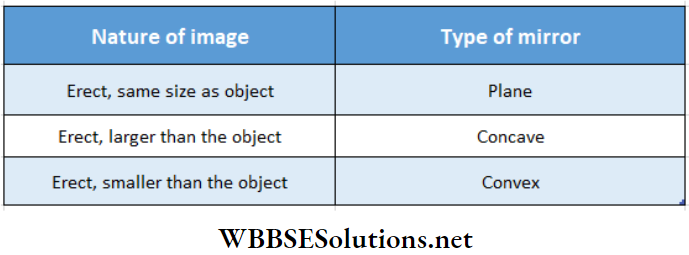
If an object is placed in front of a plane mirror, a virtual, erect image of the same size as the object is formed. If an object is placed very close to a concave mirror a virtual, erect, and magnified image is formed. A convex mirror forms a virtual, erect image smaller than the object.

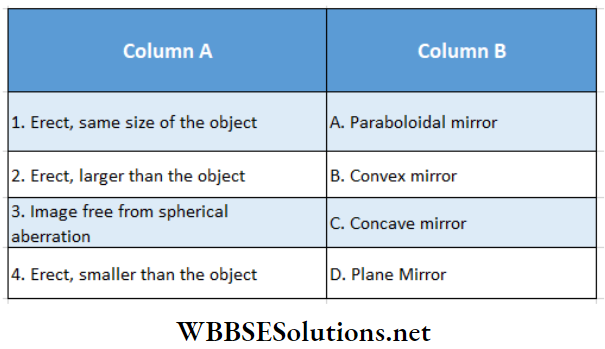
For identification, one can hold a pen or a finger very close to the mirror. If an erect image of the same size as the object is formed, then the mirror is a plane one. If an erect image larger than the object is formed, the mirror is concave. If it is smaller than the object the mirror is convex.

Class 12 Physics Unit 6 Optics Chapter 1 Reflection Of Light Nature Of Image And Type Of Mirror

Reflection Of Light – Spherical Aberration And Its Remedy

Spherical mirror:

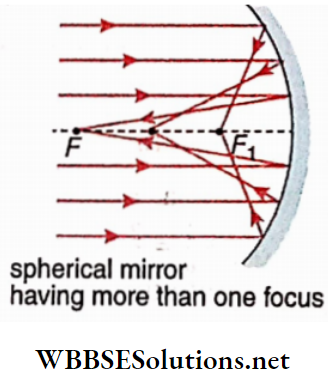
Spherical aberration: The mirror equation is applicable only for spherical mirrors of small aperture to increase the intensity of illumination of the reflected rays to get a brighter image, we often use spherical mirrors of large aperture.

If a beam of rays is incident parallel to the principal axis of a concave mirror of large aperture, not all the rays meet after reflection at a single point. Rather, the reflected rays meet at various points of the principal axis between F to F1.

So the image becomes indistinct. The larger the aperture of the mirror, the more indistinct the image. This defect of the image is called spherical aberration.

Class 12 Physics Unit 6 Optics Chapter 1 Reflection Of Light Spherical Mirror

Remedy for spherical aberration: 

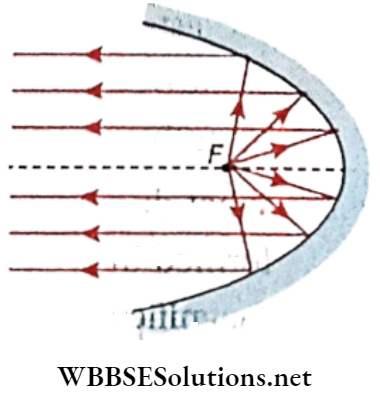
If the shape of the mirror is changed from spherical to parab- poloidal, it is possible to get an image free from spherical aberration. Because, according to the geometrical properties of the parabola, all the rays parallel to the principal axis of a paraboloidal mirror meet at its focus after reflection from it.

Class 12 Physics Unit 6 Optics Chapter 1 Reflection Of Light Paraboloidal Mirror

Reflection Of Light  – Uses Of Spherical Mirrors

Concave mirror:

  • Concave mirrors are often used as shaving glasses (mirrors) to see the magnified image of the face, its distance being less than the focal length of the mirrors.
  • Small concave mirrors are used by doctors to focus a parallel beam of light on the affected parts like the eye, ear, throat etc. to examine them.
  • A small electric lamp placed at the focus of a concave mirror produces a parallel beam of light. So concave mirrors are used as reflectors in torches and car headlights. For better results, paraboloidal mirrors can be used as car headlights. Concave mirrors are used in solar cookers.
  • The Palomar Observatory in California has the best reflecting telescope which uses a concave mirror for studying distant stars.

Convex mirror:

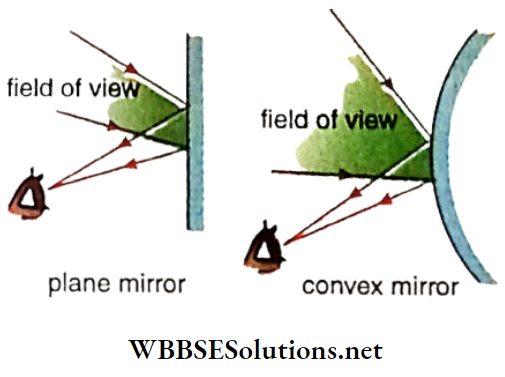
Convex mirrors are used as rear-view mirrors in automobiles and other vehicles, designed to allow the driver to see through the rear windshield. This is because a convex mirror forms erect and diminished images of objects and give a wider field of view compared to that of a plane mirror.

Class 12 Physics Unit 6 Optics Chapter 1 Reflection Of Light Plane Mirror ANd Convex Mirror

Paraboloidal mirror:

According to the geometrical properties of the parabola, the rays parallel to the principal axis of a paraboloidal mirror meet at its focus after reflection from the mirror.

So, if a source of light is placed at the focus F of a paraboloidal mirror, the reflected rays proceed ahead parallel to the principal axis.  For this reason, paraboloidal mirrors are used in car headlights and searchlights.

Sign rules that have been followed here:

To solve the numerical problems, a few sign conventions have been followed here.

  • The value of u, v, f, or r  is used with their proper sign-in in the mirror equation, viz \(\frac{1}{v}+\frac{1}{u}=\frac{1}{f}=\frac{2}{r}\)
  • The focal length for the concave mirror is considered negative and that for the convex mirror is positive.
  •  If the image distance is negative, it indicates that the image is formed on the same side as the object, and the image is real and inverted.
  • If the image distance is positive, it indicates that the image is formed behind the mirror, and the image is virtual and erect.
  • Though mis the standard formula for any type of spherical mirror, to find u or v from this equation, we only take the mod value of m.
  • For the determination of the nature of the image, to find the value of m, the associated formula is used following the proper sign convention of u and v. If m becomes positive, the image will be erect, and m becomes negative, the image will be inverted.

Reflection Of Light Numerical Examples

Example 1.  An object is placed 60 cm away from a convex mirror. The size of the image is rd the size of the object. Determine the radius of curvature of the mirror.
Solution:

We have from the mirror equation,

f = \(\frac{u v}{u+v}\)

According to the question

m = \(\left|-\frac{v}{u}\right|=+\frac{1}{3}\)

v = \(\left|-\frac{u}{3}\right|=\left|\frac{60}{3}\right|\)

U = 60 cm

v= 20 cm

Now, substituting the values of u and v with their proper sign in equation (1) we get,

f = \(\frac{-60 \times(+20)}{-60+20}\)

= + 30 cm

The radius of curvature of the spherical mirror,

r = 2f = 2 × (+30) = +60 cm cm

Example 2. An object of size 5 cm is placed on the principal axis of a convex mirror at a distance of 10 cm from it. The focal length of the convex mirror is 20 cm. Determine the nature, position, and size of the image formed.
Solution:

u=-10 cm; f = +20 cm

The focal length of the convex mirror is positive

Mirror equation:

⇒ \(\frac{1}{v}+\frac{1}{u}=\frac{1}{f}\)

Or, \(\frac{1}{v}=\frac{1}{f}-\frac{1}{u}\)

= \(\frac{1}{20}+\frac{1}{10}\)

= \(\frac{1+2}{20}\)

= \(\frac{3}{20}\)

Or, v=\(\frac{20}{3}\)

= 6.67 cm

From the positive sign, it can be inferred that the image is formed 6.67 cm behind the mirror. So the image is virtual.

Magnification, m = – \(\frac{v}{u}=-\frac{20 / 3}{-10}\)

= \(\frac{2}{3}\)

As magnification is positive, the image is erect.

The size of the image = \(\frac{2}{3}\)  × 5

= \(\frac{10}{3}\)

= 3.33 cm.

Examples of Applications of Reflection in Daily Life

Example 3. The image of an object placed 50 cm in front of a concave mirror is formed 2 m behind the mirror. Deter- mine its principal focus and radius of curvature.
Solution:

Here, u=-50 cm; v = +2 m = +200 cm [since the image is formed behind the mirror, v is positive]

We have,  \(\frac{1}{v}+\frac{1}{u}=\frac{1}{f}\)

Or, \(f=\frac{u v}{u+v}\)

= \(\frac{-50 \times(+200)}{-50+(+200)}\)

= \(\frac{-200}{3}\)

= – 66. 67 cm

∴ r = 2f

= 2 × \(\frac{-200}{3}\)

= – \(\frac{-400}{3}\)

= – 133.3 cm

So, the focal length of the concave mirror = 66.67cm and its radius of curvature = 135.3 cm

Example 4.  An object of length 5 cm is placed perpendicularly on the principal axis at a distance of 75 cm from a concave mirror. If the radius of curvature of the mirror is 60 cm, calculate the image distance and its height.
Solution:

Here, u=-75 cm; r = -60 cm;

∴ f =  \(\frac{r}{2}\)

= \(\frac{-60}{2}\)

=-30 cm

We know,    \(\frac{1}{v}+\frac{1}{u}=\frac{1}{f}\)

Or, \(\frac{1}{v}+\frac{1}{-75}=\frac{1}{30}\)

Or, \(\frac{1}{v}\)

= – \(\frac{1}{30}+\frac{1}{75}\)

= – \(\frac{1}{50}\)

Or, v= -50 cm

So, the image is formed at a distance of 50 cm in front of the
mirror. The image is real.

Again , m= \(\frac{\text { height of the image }(I)}{\text { height of the object }(O)}=\frac{v}{u}\)

here we take only the mod value of m as we no need to know the natire of image thus formed

Or, \(\frac{I}{5}=\frac{50}{75}\)

Or, I = 5 × \(\frac{2}{3}\)

= 3.33 cm

So, the height of the images = 3.33cm.

Class 12 physics reflection of light 

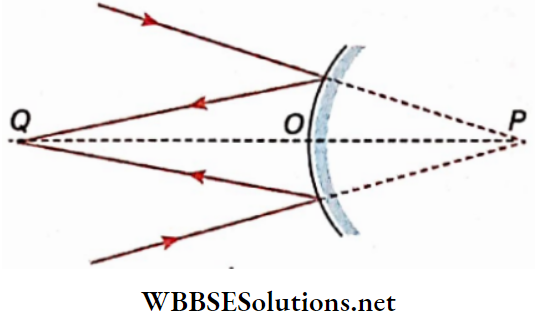
Example 5. A beam of converging rays is incident on a convex mirror of focal length 30 cm. In the absence of the mirror, the converging rays would meet at a distance of 20 cm from the pole of the mirror. If the mirror is situated at the said position where will the converging rays meet? Solution: In the absence of the mirror the converging rays would meet at P. So, P is the virtual object in the case of the mirror.
Solution:

In the absence of the mirror, the converging rays would meet at P. So, P is the virtual object in case of the mirror

Class 12 Physics Unit 6 Optics Chapter 1 Reflection Of Light Covering Rays

In the case of the virtual object, OP = u = +20 cm , f = +30 cm, image distance, v =?

We know, \(\frac{1}{v}+\frac{1}{u}=\frac{1}{f}\)

Or, \(\frac{1}{v}+\frac{1}{20}=\frac{1}{30}\),

Or, \(\frac{1}{v}\) = \(-\frac{1}{20}+\frac{1}{30}\),

= \(\frac{-1}{60}\)

Or, v= -60 cm

As v is negative, the converging rays will meet at Q at a distance
of 60 cm in front of the mirror

Example 6. An image of size \(\frac{1}{n}\) times that of the object is formed in 1 P a convex mirror. If r is the radius of curvature of the ‘HIJL 1 mirror, calculate the object distance.
Solution:

Considering the mod value only, magnification,

m = \(\frac{1}{n}\)

= \(\frac{v}{u}\)

Or, v = \(\frac{u}{n}\)

We know, \(\frac{1}{v}+\frac{1}{u}=\frac{1}{f}\)

Or, \(\)

[ Here object distance = -u]

Or, \(\frac{n}{u}-\frac{1}{u}=\frac{1}{f}\)

Or, \(\frac{(n-1)}{u}=\frac{1}{f}\)

= (n-1)f

Again, f= \(\frac{r}{2}\) , Then u= (n-1) \(\frac{r}{2}\)

∴ Object distance = (n-1)\(\frac{r}{2}\)

Example 7. An object of height 2.5 cm is placed perpendicularly on the principal axis of a concave mirror of focal length f at a distance off. What will be the nature of the image of the object and its height?
Solution:

Here, u = \(\frac{3}{4}\) f= Focal Length = -f

We know, \(\frac{1}{v}+\frac{1}{u}=\frac{1}{f}\)

Or, \(\frac{1}{v}-\frac{4}{3 f}=-\frac{1}{f}\)

Or, \(\frac{1}{v}=-\frac{1}{f}+\frac{4}{3 f}\)

= \(+\frac{1}{3 f}\)

Or, v= +3f

The positive sign of v indicates that the image formed by the concave mirror is virtual in nature and is situated behind the mirror at a distance of 3f.

Magnification, m = – \(\frac{v}{u}\)

= \(-\frac{3 f}{-\frac{3}{4} f}\)

= 4

Again, m= \(=\frac{\text { height of the image }}{\text { height of the object }}\)

Or, 4 = \(\frac{\text { height of the image }}{2.5}\)

∴ Height of the image = 10 cm

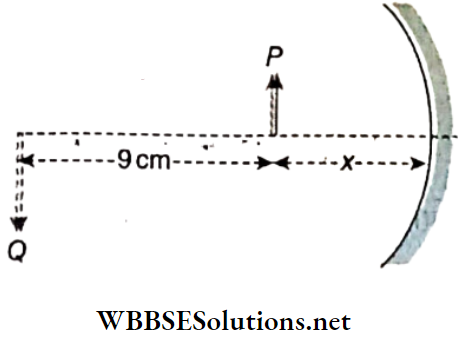
Example 8.  The image of the flame of a candle due to a mirror is formed on a screen at a distance of 9 cm from the candle. The image is magnified 4 times. Determine the nature, position, and focal length of the mirror.
Solution: 

As a magnified image image is formed on a screen, the image is real.

Class 12 Physics Unit 6 Optics Chapter 1 Reflection Of Light Focal Length Of Mirror On A Screen

Let u = – x cm and hence v = -(x+9) cm

Here, m = 4 or \(\frac{v}{u}\) = 4 [taking only the mod value of m]

Or, \(\frac{x+9}{x}\)  = 4

Or, 4x = x+9 or, x = 3

∴ u = -3 cm

So, the mirror is situated at a distance of 3 cm from the flame

Now, v= -(3+9) = -12 cm

We, know, \(\frac{1}{v}+\frac{1}{u}=\frac{1}{f}\)

Or, \(\) .

Or, \(\frac{1}{-12}+\frac{1}{-3}=\frac{1}{f}\) .

Or, \(-\left(\frac{1+4}{12}\right)=\frac{1}{f}\) .

or, f = \(-\frac{12}{5}\)

= -2.4 cm

So, the focal length of the mirror is 2.4 cm. Its negative sign indicates the nature of the mirror as a concave one [Fig. 1.40].

Practice Problems on Reflection Angles

Example 9. The focal length of a concave mirror is f. A point object is placed beyond the focal length at a distance from the focus. Prove that the image will be formed beyond the focal length at a distance  \(\frac{f}{x}\)from the focus and the magnification of the image will be (\(\frac{1}{x}\)
Solution:

Here, object distance, u = -(f+xf)

We, know, \(\frac{1}{v}+\frac{1}{u}=\frac{1}{f}\)

Or, \(\frac{1}{v}+\frac{1}{-(f+x f)}\)

Or, \(\frac{1}{v}=\frac{1}{f+x f}-\frac{1}{f}\)

= – \(\frac{1}{v}=\frac{1}{f}\left[\frac{1}{1+x}-1\right]\)

= \(\frac{-x}{f(1+x)}\)

∴ v =  \(\frac{f(1+x)}{-x}=-\left(f+\frac{f}{x}\right)\)

So, the image is formed beyond the focal length at a distance of be u. \(\frac{f}{x}\) from the focus

∴ Magnification , m= \(-\frac{v}{u}\)

=- \(\frac{f(1+x)}{x}{-f(1+x)}\)

=  \(\frac{1}{x}\)

⇒ \(-\frac{v}{u}=-\frac{-\frac{f(1+x)}{x}}{-f(1+x)}\)

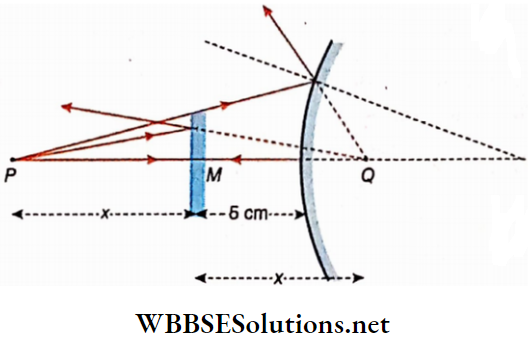
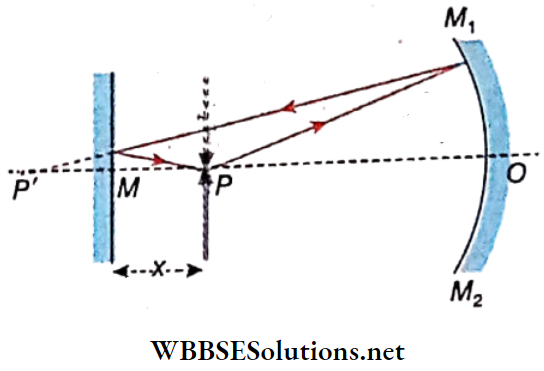
Example 10. A thin glass plate is placed in between a convex mirror of a length 20 cm and a point source. The distance between the glass plate and the mirror is 5 cm.  The image formed by the reflected rays from the front face of the glass plate and that due to the reflected rays by the convex mirror coincides at the same point. What is the distance of the glass plate from the source? Draw the ray diagram

The ray diagram has been shown. The distance between the glass plate M and the point source

P = x cm (say). Light rays starting from P form the image at Q by reflection at the convex mirror. The glass plate also forms the image of P at Q.

Class 12 Physics Unit 6 Optics Chapter 1 Reflection Of Light The Plane Glass Plate

∴ Distance of the image from the glass plate = x cm

∴ Distance of the image from the convex mirror = (x-5) cm glass plate also forms the image of P at Q.

∴ Distance of the object from the convex mirror=-(x+5) cm 

We know , \(\frac{1}{v}+\frac{1}{u}=\frac{1}{f}\)

Or, \(\frac{1}{x-5}+\frac{1}{-(x+5)}=+\frac{1}{20}\)

Or, \(\frac{+x+5-x+5}{(x-5)(x+5)}=+\frac{1}{20}\)

Or, \(\frac{10}{x^2-25}=+\frac{1}{20}\)

∴ The distance of the glass plate from the source = 15 cm

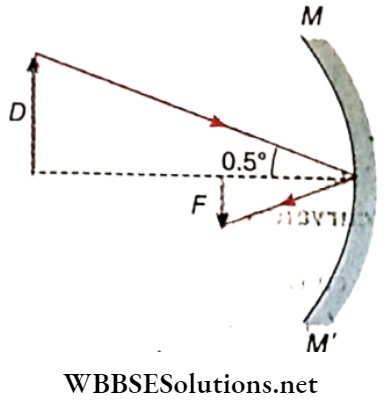
Example 11. The sun subtends an angle 0.5° at the center of a concave mirror having a radius of curvature 1 m. What will be the diameter of the image of the sun formed by the mirror?
Solution:

MM’ is a concave mirror Let the diameter of the sun be D and the distance of the sun from the mirror be u,

∴ \(\frac{D}{u}=\frac{\pi}{360}\)

0.5 ° = \(\frac{1}{2} \times \frac{\pi}{180}=\frac{\pi}{360}\) radian

Or, \(\frac{360 D}{\pi}\)

The sun is at a large distance from the mirror. So, the rays coming from the sun are assumed to be parallel and hence its image will be formed at the focal plane.

Class 12 Physics Unit 6 Optics Chapter 1 Reflection Of Light Focal Plane

∴ v= \(f\frac{r}{2}\)

= \(\frac{1}{2}\)

= 0.5 cm

Now magnification, m = \(-\frac{v}{u}=\frac{-0.5 \pi}{-360 D}\)

⇒ \(\frac{0.5 \pi}{360 D}\)  [since in this case both u and v are negative]

Again \(\frac{I}{O}=\frac{\text { diameter of the image of the sun }}{\text { diameter of the sun }(D)}\)

∴  Diameter of the image of the sun

= m × D = \(\frac{0.5 \pi}{360 D}\) × D= 0.004363

m = 0.4363 cm. [taking only the numerical of m]

Class 12 physics reflection of light 

Example 12. An object is placed at a distance of 25 cm from a con- cave mirror and a real image is formed by the mirror at a distance of 37.5 cm. What is the focal length of the mirror? Now if the object is moved 15 cm towards the mirror, what will be the image distance, its nature and magnification?
Solution:

Here, u = -25 cm, v = -37.5 cm

We know, \(\frac{1}{v}+\frac{1}{u}=\frac{1}{f}\)

Or, \(\frac{1}{-37.5}+\frac{1}{-25}=\frac{1}{f}\)

= \(-\frac{10}{375}-\frac{1}{25}\)

= \(-\frac{25}{375}=-\frac{1}{15}\)

Or, f= – 15cm

Now if the object is moved 15 cm towards the mirror, the object distance will be (25-15) = -10 cm

=  \(\frac{1}{v}+\frac{1}{-10}=-\frac{1}{15}\)

Or, \(-\frac{1}{15}+\frac{1}{10}\)

= \(\frac{-2+3}{30}=+\frac{1}{30}\)

= + \(\frac{1}{30}\)

Or, v= + 30 cm

The positive sign of v indicates that the image formed by the mirror is virtual and it is formed at a distance of 30 cm behind the mirror.

Magnification, m = \(-\frac{v}{u}\)

= \(-\frac{30}{-10}\)

= 3

∴ The image will be magnified 3 times. The positive sign of m indicates the image as erect.

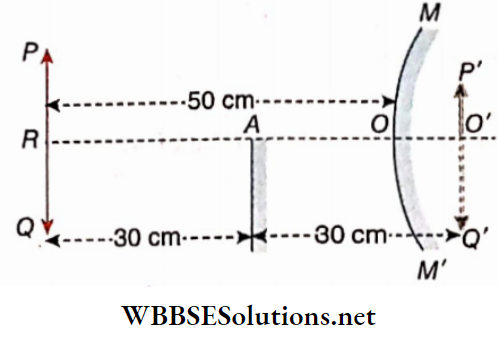
Example 13. An object is placed at a distance of 50 cm in front of a convex mirror. Now a plane mirror is placed in between the object and the convex mirror, covering the lower half of the convex mirror. If the distance of the plane mirror from the object is 30 cm, it is seen that there is no parallax of the images formed by the two mirrors. What is the radius of curvature of the convex mirror?
Solution:

MM’ is a convex mirror and A is a plane mirror. P’Q’ is the object and P’Q’ is the image formed at the same place by the two mirrors.

The radius of curvature,

Here OR = 50 cm , AR = 30 cm

Image distance from the plane mirror = O’A = 30 cm

Class 12 Physics Unit 6 Optics Chapter 1 Reflection Of Light Image Distance Of Plane Mirror

According to the figure,

OA = OR-AR

= 50-30

= 20 cm

∴ Image distance from the convex mirror,

O’O = O’A-OA = 30-20 = 10 cm

We have \(\frac{1}{v}+\frac{1}{u}=\frac{1}{f}\)

Here, v= +10 cm , u= -50 cm

∴ \(\frac{1}{10}+\frac{1}{-50}=\frac{1}{f}\)

Or,  \(\frac{4}{50}=\frac{1}{f}\)

Or,  \(f=+\frac{25}{2}\)

Radius of curvature,

r = 2f

\(\frac{25}{2}\)

=  25 cm

The radius of curvature of the convex mirror = 25 cm

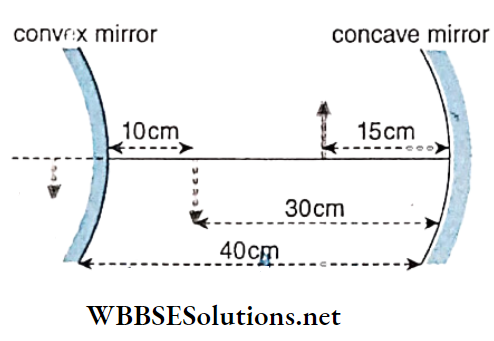
Example 14. A concave mirror of focal length 10 cm and a convex mirror of focal length 15 cm are held co-axially face to face at a distance 40 cm apart. An object of height 2 cm is placed perpendicularly on the common axis in between the two mirrors. The distance of the object from the concave mirror is 15 cm. Considering the first reflection occurs in the concave mirror and the second reflection in the convex mirror, calculate the position, nature, and height of the final image.
Solution:

In the case of the first reflection in the concave mirror: u = -15 cm; f = -10 cm

We know, \(\frac{1}{v}+\frac{1}{u}=\frac{1}{f}\)

Or, \(\frac{1}{y_1}+\frac{1}{-15}=\frac{1}{-10}\)

Or, \(\frac{1}{v}=-\frac{1}{10}+\frac{1}{15}\)

Or, \(\frac{3_1+2}{30}\)

Or, \(-\frac{1}{30}\)

v= -30 cm

So, the image formed by the concave mirror is real and formed at a distance of 30 cm from the mirror. This image acts as the object of the convex mirror.

In case of the second reflection in the convex mirror:

u = -(40- 30) = -10 cm , f = +15 cm

We know \(\frac{1}{v}+\frac{1}{u}=\frac{1}{f}\)

Or, \(\frac{1}{v}+\frac{1}{-10}=+\frac{1}{15}\)

Or, \(\frac{1}{v}=+\frac{1}{15}+\frac{1}{10}\)

= + \(\frac{1}{6}\)

Or, v= + 6cm

So the final image is virtual and is formed at a distance of 6 cm
behind the convex mirror.

Class 12 Physics Unit 6 Optics Chapter 1 Reflection Of Light Convex Mirror And Concave Mirror

Magnification by the concave mirror,

m1 = \(\frac{v}{u}\)

= \(\frac{-30}{-15}\)

= -2

Magnification by the convex mirror,

m2 = – \(\frac{v}{u}\)

= – \(\frac{6}{-10}\)

= \(\frac{3}{5}\)

∴ Total magnification.

m = m1 × m2

= -2 ×\(\frac{3}{5}\)

=  – \(\frac{6}{5}\)

As m is negative, so the final image is inverted with respect to the object.

∴ Height- of the final image (taking only the magnitude of m)

= \(\frac{6}{5}\) × height of the object

= \(\frac{6}{5}\) × 2

= \(\frac{12}{5}\)

= 2. 4 cm

Example 15. The focal length of a concave mirror is 30 cm. An object is placed at a distance of 45 cm in front of the mirror. A plane mirror is placed perpendicularly on the principal axis of the concave mirror in such a way that the object is situated in between the two mirrors. Light rays from the object at first are reflected from the concave mirror and then from the plane mirror. As a result the final image coincides with the object. What is the distance between the two mirrors?
Solution:

In case of the concave mirror M1 M2, P is the object and P’ is its image.

Here, u = -45 cm,  f= – 30 cm

We know \(\frac{1}{v}+\frac{1}{u}=\frac{1}{f}\)

Or, \(\frac{1}{v}-\frac{1}{45}\)

= \(-\frac{1}{30}\)

Or, \(\frac{1}{v}=-\frac{1}{30}+\frac{1}{45}\)

= \(\frac{-3+2}{90}\)

= \(\frac{1}{90}\)

Or, v= -90 cm

Op’ = 90 cm

Class 12 Physics Unit 6 Optics Chapter 1 Reflection Of Light Distance Between Two Mirrors

According to the question, the reflected rays from the concave mirror form the final image at P after reflection from the plane
mirror M.

∴ PM=  P’M = x (say)

Here, OP’ = OP+PM+P’M

Or, 90 = 45+x+x

Or, x = \(\frac{45}{2}\)

= 22.5 cm

∴ Distance between the mirrors = 45+22.5 67.5 cm.

Example 16. A concave mirror forms a real image magnified two times. If both the object and the screen are moved a real Image magnified three times that of the object is formed. If the screen is moved through a distance of 25cm, then determine the displacement of the object and focal length of the mirror.
Solution:

In the first case,

⇒ \(\frac{1}{v}+\frac{1}{u}=\frac{1}{f}\)

Or, \(\frac{1}{v}+\frac{1}{-u}=\frac{1}{-f}\)

Or, \(1-\frac{v}{u}=-\frac{v}{f}\)

∴ 1+m = –  \(-\frac{v}{u}\)…………………….(1)

Since m= – \(-\frac{v}{f}\)

In the first case, magnification = 2

∴ 1+2 = \(-\frac{v}{f}\)

Or,  – \(\frac{v}{f}\) = 3…………………….(2)

In the second case, magnification = 3

∴ 1+3 = – \(\frac{(v+25)}{f}\)

Or,  4 = – \(\frac{v}{f}-\frac{25}{f}\)

∴ 4= 3 – \(3\frac{25}{f}\)

Or, f= – 25 cm

The focal length of the concave mirror = 25cm

From equation (2) we have,

v =3f = -3 × (-25) = 75 cm

According to the equation of a spherical mirror,

⇒ \(\frac{1}{u}=\frac{1}{f}-\frac{1}{v}=\frac{1}{75}-\frac{1}{25}\)

[since the image is real, hence v is taken negative]

Or,

u = -37.5 cm

In the first case object distance 37.5 cm

In the second case image distance

v1= v+25= 75+25= 100 cm

Suppose, object distance = u1

Since in this case magnification =3

∴ \(u_1=-\frac{1}{3} v_1\)

= \(\frac{100}{3}\)

= – 33.33 cm

∴ Object distance in the second case =33.33cm

∴ Displacement of the object = 37.5-33.33

= 4.17cm

So, the displacement of the object = 4.17 cm, and the focal length of the mirror = 25 cm

Conceptual Questions on Image Formation by Mirrors

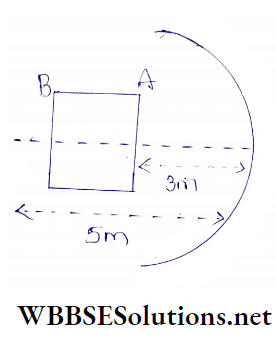
Example 17.  A cube of side 2 m is placed in front of a large concave mirror of focal length 1 m in such a way that the face A of the cube is at a distance of 3 m and the face B at a distance of 5 m from the mirror.

  1. Calculate the distance between the images of the faces A and B.
  2. Determine the height of the images of faces A and B. 
  3. Will the image of the cube be a cube

Solution:

1. Distance of the face A from the mirror, u1 = -3 m, focal length of the mirror, f= -1 m

Class 12 Physics Unit 6 Optics Chapter 1 Reflection Of Light Distance Of The Face A From The Mirror

Let the image distance of the face A from the mirror be v1 m

We know, \(\frac{1}{v}+\frac{1}{u}=\frac{1}{f}\)

Or,   \(\frac{1}{v_1}-\frac{1}{3}=-\frac{1}{1}\)

Or,= v1 = -1.5 m

Distance of the face B from the mirror, u=-5 m; the image distance of this face = v2 m

We know, \(\frac{1}{v}+\frac{1}{u}=\frac{1}{f}\)

Or, \(\frac{1}{v_2}-\frac{1}{5}=-\frac{1}{1}\)

Or,= v2 = -1.25 m

So, the distance between the images of the faces A and B

= v1– v2 = 1.5-1.25 = 0.25 m [Taking magnitude of v1 and v2 ]

2. Magnification in the first case

m1 = \(\frac{1}{v_1}-\frac{1}{u_1}\)

= \(\frac{-1.5}{-3}\)

= – 0.5

∴ \(\frac{\text { height of the image of the face } A\left(I_A\right)}{\text { length of the face } A\left(O_A\right)}\)

Or, IA= -5.5 × 2 = -1m

Again, magnification in the second case

⇒ \(\frac{1}{v_2}-\frac{1}{u_2}\)

m2 = \(\frac{1}{v_2}-\frac{1}{u_2}\)

= \(\frac{-1.25}{-5}\)

= – 0.25

∴ Height of the image of the face B,

Or, IB= -5.5 × 2 = -1m

IB =  m2 ×  height of the face B

= -0.25 × 2

= -0.5 m

3. So, it is seen that the height of the image of face A and that of the face B are not equal. So, the image of the cube will no longer be a cube.

Example 18. A is a point object in a circular track. A light ray starting from object A is reflected twice by the circular track and returns again to A. The angle of incidance is a. The distance of A from the center of the circular track is x and the diameter of the circular track from A intersects the path of the ray at a point D whose distance from the center of the circular track is y.
Show that, tan α = \(\sqrt{\frac{x-y}{x+y}}\)

Class 12 Physics Unit 6 Optics Chapter 1 Reflection Of Light Centre Of The Circular Track
Solution:

In Δ OBC, OB = OC; so, ∠OBC= ∠OCB = α

Also ∠ABC = ∠ACB= 2α; so, AB = AC

Since Δ ABC is isosceles, hence median AD ⊥ BC

∴ tan α =  \(\frac{y}{B D}\) and tan 2α = \(\frac{x+y}{B D}\)

Or, \(\frac{\tan 2 \alpha}{\tan \alpha}=\frac{x+y}{y}\)

Or, \(\frac{2 \tan \alpha}{\tan \alpha\left(1-\tan ^2 \alpha\right)}=\frac{x+y}{y}\)

Or, \(1-\tan ^2 \alpha=\frac{2 y}{x+y}\)

Or, \(\tan ^2 \alpha=1-\frac{2 y}{x+y}\)

= \(\frac{x-y}{x+y}\)

Or, tanα = \(\sqrt{\frac{x-y}{x+y}}\)

So, the distance between the images of the faces A and B

Example 19. A concave mirror and a convex mirror are placed co-axially face to face. The focal length of each of them is f and the distance between them is 4f. A point source is so placed on their common axis in between the two mirrors that if the first reflection is considered to take place on the convex mirror, the final image coincides with the point source. Determine the position of the source.
Solution:

Let the point source O be situated at a distance x from the convex mirror

Class 12 Physics Unit 6 Optics Chapter 1 Reflection Of Light Concave Mirror And Convex Mirror

If the image distance is v1 then

⇒ \(\frac{1}{v_1}+\frac{1}{-x}=\frac{1}{f}\)

Or, \(\frac{1}{v_1}=+\frac{1}{f}+\frac{1}{x}\)

= \(+\frac{1}{f}+\frac{1}{x}=\frac{(x+f)}{f x}\)

Or, \(v_1=\frac{f x}{x+f}\)

This image will be formed at Oj behind the convex mirror. Now u X this image will act as the object of the concave mirror.

∴ Object distance for the concave mirror,

u2= 4f+ v1

= \(4 f+\frac{f x}{x+f}\)

= \(\frac{5 f x+4 f^2}{x+f}\)

∴ Image distance v2 = 4f- x

Since the final image coincides with the object

∴ \(\frac{1}{v_2}+\frac{1}{u_2}=\frac{1}{f}\)

Or, \(\frac{1}{4 f-x}+\frac{x+f}{5 f x+4 f^2}=\frac{1}{f}\)

Or, \(\frac{1}{4 f-x}=\frac{1}{f}-\frac{x+f}{5 f x+4 f^2}\)

= \(\frac{4 x+3 f}{f(5 x+4 f)}\)

Or = x² – 2fx – 2f² = 0

Or, \(\frac{2 f \pm \sqrt{4 f^2+8 f^2}}{2}=f \pm f \sqrt{3}\)

∴ x = \(f(1+\sqrt{3})\)  [neglecting the negative value]

The distance of the source from convex mirror = \(f(1+\sqrt{3})\)

Class 12 Physics Reflection Of Light

Example 20.  The diameter of the moon is 3450 km and its distance from the earth is 3.8 x 10⁵ km, What will be the diameter of the image of the moon formed by a convex mirror of focal length 7.6 m? As the moon is very far away from the earth the image of the moon will be formed in the focal plane of the mirror
Solution:

Hence, v = f = 7.6 m

Now, u= 3.8 × 10⁵ km and magnification, m = \(\frac{v}{u}\)

[Taking the mod value of m]

∴ The diameter of the image

= m × diameter of the moon

= \(=\frac{7.6 \mathrm{~m}}{3.8 \times 10^5 \mathrm{~km}} \times 3450\)km

= 00.69m

= 6.9 cm

Example 21. Three times magnified image of an object is formed on a screen placed at a distance of 8 cm from the object with the help of the spherical mirror. Determine the nature of the mirror, focal length, and the distance of the mirror from the object.]
Solution:

Since the image is formed on a screen, the image is real and the mirror is concave.

Suppose, u= x cm and so v = (x+8)cm

Here,m = 3 or, \(\frac{v}{u}\) = 3 [taking the mod value of m]

Or, \(\frac{v}{u}\) = 3

Or, \(\frac{(x+8)}{x}\) = 3

Or,   x= 4cm

So the mirror is situated at a distance of 4 cm from the object

∴ v = (4+8) = 12 cm

We know , \(\frac{1}{v}+\frac{1}{u}=\frac{1}{f}\)

Or,  \(\frac{1}{-12}+\frac{1}{-4}=\frac{1}{f}\)

Or, f= -3 cm

∴  Focal length of the mirror

= 3 cm. A negative sign in the value of/ supports the mirror as concave in nature

Class 12 Physics Unit 6 Optics Chapter 1 Reflection Of Light Magnified Image

Example 22. An object is placed just at the middle point between a concave mirror of radius of curvature 40 cm and a convex mirror of radius of curvature 30 cm facing each other. The mirrors are situated 50 cm apart from each other. Considering the first reflection occurs in the concave mirror, determine the position and nature of the image formed by this mirror. Next, find the position and nature of the image formed by the convex mirror considering the first image of concave mirror as its object.
Solution:

Focal length of the concave mirror = \(\frac{40}{2}\) = 20 CM

Focal length of the convex mirror = \(\frac{30}{2}\)  = 15cm

In case of the concave mirror, u= – 25 cm: f= -20 cm.

We know, \(\frac{1}{v}+\frac{1}{u}=\frac{1}{f}\)

Or, \(\frac{1}{v}+\frac{1}{-25}=\frac{1}{-20}\)

Or, \(\frac{1}{v}=\frac{1}{25}-\frac{1}{20}=\frac{4-5}{100}\)

Or, \(\frac{1}{v}=-\frac{1}{100}\)

Or, v= – 100 cm

So, the image formed by the concave mirror in the

absence of the convex mirror would be real and inverted and situated at Q1 at a distance of 100 cm from the concave mirror. This image will act as a virtual object for the convex mirror.

Her O1Q1 = 100 cm

Now for the presence of the convex mirror M3M4 object distance, M3M4 = , object distance , u1= (100-50) cm = 50 cm;

Focal length, f1= 15 cm.

According to the equation of mirror,

⇒ \(\frac{1}{v_1}+\frac{1}{50}=\frac{1}{15}\)

Or, \(\frac{1}{v_1}=\frac{1}{15}-\frac{1}{50}\)

Or, \(\frac{10-3}{150}=\frac{7}{150}\)

Or,  v1= \(\frac{150}{7}\)

= 21.43cm

So, the final image will be formed at Q2 at a distance of 21.43 cm from the convex mirror. A positive value of v1 indicates that this image is virtual.

Class 12 Physics Unit 6 Optics Chapter 1 Reflection Of Light Virtual Object For The Convex Mirror

Real-Life Scenarios Involving Reflection Questions

Example 23. An arrow of height 2.5 cm is situated vertically at a distance of 10 cm from a convex mirror of a focal length 20 cm. Where will the image be formed? Determine its height. If the arrow is moved away from the mirror what will happen to its image?
Solution:

Here, u = -10 cm and f= 20 cm

We know,  \(\frac{1}{v}+\frac{1}{u}=\frac{1}{f}\)

Or, \(\frac{1}{v}+\frac{1}{-10}=\frac{1}{20}\)

Or, \(\frac{1}{v}=\frac{1}{10}+\frac{1}{20}\)

Or, \(\frac{2+1}{20}=\frac{3}{20}\)

or, v= \(\frac{20}{3}\)

= 6. 66cm

So, the image will be formed at a distance of 6.66 cm behind the convex mirror.

Magnification, m =\(\frac{I}{O}=-\frac{v}{u}\)

I = \(-O \times \frac{v}{u}\)

= \(-2.5 \times \frac{20}{3 \times(-10)}\)

= \(\frac{5}{3}\)

= 1.66cm

So, the height of the image = 1.66 cm. If the arrow is moved away from the convex mirror the image will move towards the focus of the mirror and will be diminished in size

Example 24. A rod of length 10 cm lies along the principal axis of a concave mirror of focal length 10 cm in such a way that its end closer to the pole is 20 cm away from the mirror. What is the length of the image?
Solution:

Here for the side A, f = -10 cm, u = -20 cm.

From the equation, \(\frac{1}{u}+\frac{1}{v}=\frac{1}{f}\) we get v = -20 cm

Class 12 Physics Unit 6 Optics Chapter 1 Reflection Of Light Length Of The Road

For the side B, u – -30 cm

Similarly, v = -15 cm

Length of the image = 20- 15 = 5 cm

WBCHSE Physics Class 12 Reflection Notes

Reflection Of Light Synopsis

Reflection of light:

  1. Coming through a medium when light incidents on the upper surface of another medium, then a part of that incident light returns to the first medium by changing its direction.
  2. This phenomenon is known as the reflection of light.

Laws of reflection:

  1. The incident ray, the reflected ray and the normal to the reflecting surface at the point of incidence lie in the same plane.
  2. The angle of incidence is equal to the angle of reflection.

Image:

When rays of light diverging from a point source after reflection or refraction converge to or appear to diverge from a second point, the second point is called the image of the first point.

Focus in case of reflection from a spherical surface:

When a beam of rays parallels to the principal axis is incident on a spherical mirror, it is seen that the reflected rays either converge to or appear to diverge from a fixed point on the principal axis. This point is called the principal focus or focal point or briefly the focus of the mirror.

Conjugate foci:

1. If a pair of points is such that when an object is placed at one of them, its image is formed at the other by a fixed mirror, then that pair of points are called conjugate foci of that mirror.

2. The focal length of a concave mirror is taken as positive and the focal length of a convex mirror is taken as negative.

3. The distance measured from the pole of the mirror and in ‘front of it is taken as positive but the distance measured in the back side of the mirror is taken as negative.

4. If the aperture is small then the focal length of a spherical mirror becomes half of its radius of curvature

Class 12 Physics Unit 6 Optics Chapter 1 Reflection Of Light The Nature Of The Mirror

5. Real image is formed in front of the mirror but virtual is formed at the back of the mirror.

6. The ratio of the length of the image to that of the object is called linear magnification of the image.

7. The ratio of the area of an image to that of the two-dimensional object is called areal magnification.

8. The ratio of the length of the image to that of the object along the principal axis is called longitudinal or axial mag- notification.. da

9. In the case of a spherical mirror longitudinal magnification is equal to the square of the linear magnification.

10. Angle of reflection (r) = angle of incidence (1)

11. Angle of deviation for a ray of light after reflection from a plane mirror,

δ = 180°-2i [i= angle of incidence]

12. In case of the image formed by a plane mirror, the distance of the image from the mirror

= distance of the object from the mirror.

13. In the case of a spherical mirror of a small aperture the relation between the focal length of the mirror () and its radius of curvature (r) is

f = \(\frac{r}{2}\)

14. In the case of a spherical mirror of a small aperture, the relation among the object distance (u), image distance (v), and focal length (f) is

⇒ \(\frac{1}{v}+\frac{1}{u}=\frac{1}{f}\)

15. Newton’s equation:

xy = f² [where, x = u-f and y = v-f]

16. Linear magnification:

m = \(\frac{\text { length or height of the image }(I)}{\text { length or height of the object }(O)}\)

= \(\frac{\text { image distance }(v)}{\text { object distance }(u)}\)

= \(\frac{f}{f-u}=\frac{f-\nu}{f}\)

17. Areal magnification for a two-dimensional object:

m’ = \(\frac{\text { area of image }}{\text { area of object }}\)

18. Longitudinal or axial magnification:

m” = \(\frac{\text { length of the image along the principal axis }}{\text { length of the object along the principal axis }}\)

Rules for solving numerical problems relating to spherical mirrors

To solve the numerical problems in connection with spherical mirrors the following rules are to be followed:

  • In the general equation of mirrors, put the numerical values of u, v, f etc. with their proper signs.
  • Then after solving the equation, draw inference about the distance from the sign.
  • A positive sign of the focal length will suggest that the mirror is convex while a negative sign will suggest that the mirror is concave.
  •  If the image distance is negative, we have to understand that the image has been formed in front of the mirror and it is real and inverted.
  • Again, if the image distance is positive, we have to understand that the image has been formed behind the mirror and it is virtual and erect.

WBCHSE physics class 12 reflection notes 

Reflection Of Light Very Short Question And Answers

Question 1. Can an image be formed due to diffused reflection? 
Answer: No

Question 2. Can a plane mirror form a real image?
Answer: Yes

Question 3. If a light ray is incident on a horizontal plane mirror making an angle 30° with the mirror, what angle will the reflected ray make with the mirror?
Answer: 30

Question 4. What type of reflection takes place on the screen of a cinema hall?
Answer: Diffuse

Question 5. What is the angle of deviation of a ray incident perpendicularly on a reflecting surface?
Answer:  180°

Question 6. Focus of which spherical mirror is virtual.
Answer:  Convex

Question 7. Two concave mirrors have same focal length but different apertures. Both the mirrors form an image of the sun on a screen. For which image formation will the temperature of the screen become higher?
Answer:  Concave

Question 8. The secondary focus of a concave mirror is a fixed point. Is this statement correct?
Answer: No

Question 9. The principal focus of a concave mirror is a fixed point. Is this statement correct?
Answer:  Yes

Question 10. Two concave mirrors have the same aperture but different focal lengths. Both form images of the sun on a screen. For which image formation will the temperature of the
Answer:  In both cases, hotness will be the same

Question 11. The radius of curvature of a concave mirror is 30 cm. What is its focal length?
Answer: 15 cm

Question 12. Which spherical mirror is called a divergent mirror-concave or convex?
Answer:  Convex

Question 13. The focal length of a spherical mirror is 40 cm. What is its radius of curvature?
Answer: 80 cm

Question 14. What is the value of the focal length of a plane mirror?
Answer: Infinite

15. What is the power of a plane mirror?
Answer: Zero

Question 16. What is the relation between the radius of curvature (r) and focal length (f) of a spherical mirror?
Answer: r = 2f

Question 17. Does the size of mirror affect the nature of the image?
Answer: No

Question 18. The focal length of a concave mirror is equal for all colors of light. Is the statement true or false? [true] [yes] 21. What type of mirror is to be used for getting parallel rays from a small source of light?
Answer: True

Question 19. What will happen to the focal length of the concave mirror when it is immersed in water? Will remain unchanged
Answer: Will remain unchanged

Question 20. Where should an object be placed in front of a concave mirror to get a magnified image?
Answer:  Between f and 2f 

Question 21. Why do we sometimes use a concave mirror instead of a plane mirror as a common mirror? [to get a magnified erect image]
Answer: To get a magnified erect image

Question 22. What is the magnification of the image of an object placed at the center of curvature of a concave mirror?
Answer: 1

Question 23. What is the magnification of an object placed at the focus Answer: Infinity

Question 24. Can a convex mirror ever form a real image of a real object? of a concave mirror?
Answer:  No

Question 25. What will the image of an object placed before a convex screen be higher? mirror-erect or inverted?
Answer: Erect

Question 26. Two concave mirrors are placed face to face and they have the same centre of curvature. A point source of light is placed at their common center of curvature. Where will the image be formed?
Answer: At their common center of curvature

Question 27. If an object is placed between the pôle and the focus of a concave mirror, will the size of the image be magnified with respect to the size of the objector?
Answer: Yes

Question 28. What is the minimum distance between an object and its image formed by a concave mirror?
Answer:  Zero

Question 29. If a concave mirror is immersed in water will its focal length change?
Answer: No

Question 30. In the case of a concave mirror, what is the shape of the uv graph?
Answer:  Rectangular hyperbola]

Question 31. In the case of a concave mirror, what is the shape of the graph?
Answer: Straight line

Question 32. The focal length of a concave mirror in vacuum is 2 m. What will be the focal length of the concave mirror in a medium of refractive index 2.76?
Answer: 2 m

Question 33. At what distance in front of a concave mirror (f = 10 m) an object is to be placed so that the size of the image will be halved of the size of the object?
Answer: 30 cm

Question 34. If the conjugate foci of a spherical mirror lie on the same side of the mirror then, what is the nature of the mirror?
Answer: Concave

Question 35. What is the magnification produced in a plane mirror? 40. A cube is placed in front of a large concave mirror. Will the image of the cube be a cube?
Answer: 1

Question 36. Can a convex mirror form a real image?
Answer: Can form real image of a virtual object

Question 37. For a spherical mirror if the linear magnification of the image be m what will be its lateral magnification?
Answer:

Question 38. The image of a candle formed by a concave mirror is cast on a screen. What will happen if the mirror is covered partly?
Answer: The brightness of the image will be reduced]

Question 39. Will the focal length of a spherical mirror be affected if the wavelength of the light used is increased?
Answer: No

Question 40. What type of mirror do car drivers use to view the traffic at the back of the car?
Answer:
Convex

Question 41. What type of mirror do dentists use?
Answer:
Concave

Question 42. What type of mirror is used in searchlights and headlights of vehicles?
Answer:
Paraboloidal

Reflection Of Light Fill In The Blanks

Question 1. The reflecting surface from which regular reflection of light takes place is called__________________  object 
Answer:  Smooth plane reflector

Question 2. A plane mirror can form a real image of a____________ object
Answer: Virtual

Question 3. A smaller virtual image is formed by the blank). mirror. [Fill in Answer: Convex

Question 4. An object is moving towards a convex mirror from a large distance. The image will move with _________________ velocity than  the object  ___________  the mirror 
Answer: 
Less, towards

Reflection Of Light Assertion Reason Type

Direction: These questions have statement I and statement II. the four choices given below, choose the one that best scribes the two statements.

  1. Statement 1 is true, statement 2 is true; statement 2 is a correct explanation for statement 1.
  2. Statement 2 is true, statement 2 is true; statement 2 is not a correct explanation for statement 1.
  3. Statement 3 is true, statement 2 is false.
  4. Statement 4 is false, and statement 2 is true.

Question 1.

Statement 1: The formula connecting u, v, and ƒ for a spherical mirror is valid only for mirrors whose sizes are very small compared to their radii of curvature.

Statement 2: Laws of reflection are strictly valid for plane surfaces but not for large spherical surfaces.

Answer:  3. Statement 3 is true, statement 2 is false.

Question 2.

Statement 1: A concave mirror is preferred to a plane mirror for shaving.

Statement 2: When a man keeps his face between the pole and the focus of the mirror, an erect and highly magnified virtual image is formed.

Answer:  1. Statement 1 is true, statement 2 is true; statement 2 is a correct explanation for statement 1.

Question 3. 

Statement 1: A virtual image can not be directly photographed.

Statement 2: A virtual image can be produced by using a convex mirror.

Answer: 2. Statement 2 is true, statement 2 is true; statement 2 is not a correct explanation for statement 1.

Question 4.

Statement 1: In the absence of diffuse reflection an object would appear either dazzlingly bright or quite dark.

Statement 2: The angle of incidence is not equal to the angle of reflection in this case.

Answer:   3. Statement 3 is true, statement 2 is false.

Question 5.

Statement 1: Convex mirror is used as driver’s mirror.

Statement 2: Convex mirror gives an index wider field of view of the traffic.

Answer:  1. Statement 1 is true, statement 2 is true; statement 2 is a correct explanation for statement 1.

WBCHSE physics class 12 reflection notes 

Reflection Of Light Match The Columns

Question 1. 

Class 12 Physics Unit 6 Optics Chapter 1 Reflection Of Light Regular Refraction

Answer: 1-B, 2- D, 3- A, 4. C

Question 2. The nature of the image and the type of mirror are given in column A and column B respectively. Match the column.

Class 12 Physics Unit 6 Optics Chapter 1 Reflection Of Light The Nature Of Image And The Type Of Mirror Are Given

Answer:  1-D, 2-C, 3 A, 4 – B

Question 3. Some relations related to spherical mirror and their field of application are given in column A and column B respectively (The symbols have their usual meanings). Match the column.


Class 12 Physics Unit 6 Optics Chapter 1 Reflection Of Light Some Relations Related To Spherical Mirror

Answer:  1- D, 2- C, 3- B, 4- A

Question 4. The position of an object with respect to a concave mirror and the position of the image are given in column 1 and column 2 respectively.

Class 12 Physics Unit 6 Optics Chapter 1 Reflection Of Light Position Of Object

Answer: 1- B, 2-D, 3- E, 4- C, 5-A

Question 5. Match the corresponding entries of column I with column [where m is the magnification produced by the mirror].

Class 12 Physics Unit 6 Optics Chapter 1 Reflection Of Light M Is The Magnification Produced By The Mirror

  1. 1. (A, C ) 2. (A, D)  3. ( A, B)  4. (C, D)
  2. 1. (A, D)  2. (B, C) 3. (B, D) 4. (C, D)
  3. 1. (C, D) 2. (B, D) 3. (B, C) 4. (A, D)
  4. 1. (B, C) 2. (B, C )3. (B, D) 4. (A, D)

Answer: 1. (B, C)  2. (B, C) 3. (B, D) 4. (A, D)

Magnification of image produced by a spherical mirror,

For real images, m<0, and m> 0 for virtual images.

The convex mirror always forms a virtual image, so m> 0 always and the size of the image is less or equal to the size of object 1.e., m≤1.

In the case of the concave mirror, if the real image is formed, then there can be |m|≥ 1 and |m | ≤1, and for a virtual image m>1. The option is correct.

WBCHSE Class 12 Physics Reflection Of Light Short Question And Answers

Reflection Of Light Short Question And Answers

Question 1. Use the mirror equation to deduce that:

  1. An object placed between ƒ and 2f of a concave mirror produces a real image beyond 2f
  2. The virtual image produced by a convex mirror is always diminished in size and is located between the focus and the pole
  3. A convex mirror always produces a virtual image independent of the location of the object
  4. An object placed between the pole and the focus of a concave mirror produces a virtual and enlarged image.

Answer:

1.  For a concave mirror, the mirror formula is given by:

⇒ \(\frac{1}{v}=\frac{1}{f}-\frac{1}{u}\)

The object lies between ƒ and 2f,

2f>u>f Or, \(\frac{1}{2 f}<\frac{1}{u}<\frac{1}{f}\)

Or, \(\frac{1}{2 f}-\frac{1}{f}<\frac{1}{u}-\frac{1}{f}<\frac{1}{f}-\frac{1}{f}\)

Or, \(-\frac{1}{2 f}<-\left(\frac{1}{f}-\frac{1}{w}\right)\)<0

∴ 0>v>2f

Since v is -ve, the image is real and lies beyond 2f.

Read And Learn More WBCHSE Class 12 Physics Short Question And Answers

2. In the case of a convex mirror:

⇒ \(\frac{1}{f}=\frac{1}{v}+\frac{1}{u}\)………………..(1)

Or, \(\frac{u}{v}=\frac{u}{f}-1\)

Or, \(-\frac{1}{m}=\frac{u-f}{f}\)

Or, – m\(=\frac{f}{u-f}\)

∴ – m = \(\frac{f}{f-u}\)

∴ In this case u is -ve and f is +ve ,f-u>f.

∴ m<1 i.e the image is diminished

From equation (1), v= \(\frac{u f}{u-f}\)

∴ When u= 0 , v= 0 and when  u = ∞, v= f [substituting equation (1)]

∴ The image lies between the pole and the focus

3. For a convex mirror, \(\frac{1}{v}=\frac{1}{f}-\frac{1}{u}\):

2. In this case ƒ is always +ve and u is always negative

∴ v is always +ve i.e., the image is virtual.

4. In case of a concave mirror, u and ƒ are both negative.

The general equation of mirror is

⇒ \(\frac{1}{v}=\frac{1}{f}-\frac{1}{u}\)

When the object lies between the pole and the focus,

f<u<0 or,> 0 \(\frac{1}{f}-\frac{1}{u}\)>0

∴ \(\frac{1}{v}>0\)  [using the mirror equation]

i.e., v is positive and lies to the right pole,

Since v > |u|, m is positive and greater than 1. So, the image is enlarged.

WBCHSE Class 12 Physics Reflection Of Light saqs

WBBSE Class 12 Reflection of Light Q&A

Question 2. You have learned that plane and convex mirrors produce virtual images of objects. Can they produce real images under some circumstances? Explain.
Answer:

When the incident beam is convergent, then the image formed by a plane or convex mirror produces a real image.

Class 12 Physics Unit 6 Optics Chapter 1 Reflection Of Light Beam Is Convergent Then The Image Formed By A Plane Or Convex Mirror

In both cases the convergent beam would meet at P in the absence of the mirrors i.e., P is the virtual object, and P’ is the real image of P.

Class 11 Physics Class 12 Maths Class 11 Chemistry
NEET Foundation Class 12 Physics NEET Physics

Question 3.  Light incident normally on a plane mirror attached to a galvanometer coil retraces backward as 1.55. A current in the coil produces a deflection of 3.5° of the
Answer:

For this reason, paraboloidal mirrors are used in car headlights and searchlights instead of spherical concave mirrors.

What is the displacement of the reflected spot of light on a screen placed 1.5 m away?

Class 12 Physics Unit 6 Optics Chapter 1 Reflection Of Light Reflected Spot Of Light On A Screen Placed

The reflected ray rotates through an angle 20 for a rotation of the mirror and the deviation of the spot of light on the scale is d (say).

∴ \(\frac{d}{A B}\) = tan2θ

∴ d = 1.5× tan 7°

= 1.5 × 0.122

= 0.183m

= 18.3 cm

v = f = 110 mm

For the secondary mirror,

Short Questions on Laws of Reflection

Question 4. A Cassegrain telescope is built with mirrors 20 mm apart. If the radius of curvature of the large mirror is 220 mm and the small mirror is 140 mm, then where will the final image of an object at infinity be?
Answer:

The image formed by the primary mirror is the virtual object for the secondary mirror.

For the primary mirror , u = ∞, f = \(\frac{220}{2}\)

= 110 mm

Class 12 Physics Unit 6 Optics Chapter 1 Reflection Of Light Eye Piece Of Primary And Secondary Mirror

∴ v= f = 110 mm

For the secondary mirror

f= \(\frac{140}{2}\)

= 70 mm

And u= 110- 20 = 90 mm

using mirror formula \(\frac{1}{v}=\frac{1}{f}-\frac{1}{u}\) we get

⇒ \(\frac{1}{v}=\frac{1}{70}-\frac{1}{90}\)

Or, v= 315mm

∴ The image will be formed at a distance of 315 mm on the right of the secondary mirror.

Question 5. At what position should an object be placed in front of a spherical mirror such that the size of the image is equal to that of the object?
Answer:

The spherical mirror has to be a concave mirror and the object should be placed at the center of curvature for the size of the image to be equal to that of the object.

Question 6.

1. Under what condition will the object and image always be on the same side of the focus of a concave mirror?
Answer:

Objects placed at focus or beyond the focus of a concave mirror, the image will always be formed at the same side of the focus.

Common Short Questions on Spherical Mirrors

2. An image of size = \(\frac{1}{n}\) times the object size is formed in a convex mirror. If r is the radius of curvature of the mirror, what would be the object distance?
Answer: 

⇒ \(\frac{1}{v}+\frac{1}{u}=\frac{1}{f}=\frac{2}{r}\)

Or, \(\frac{u}{\nu}+1=\frac{2 u}{r}\)

Or, \(\frac{u}{v}=\frac{2 u}{r}-1\)

= \(\frac{2 u-r}{r}\)

∴ Magnification, m= – \(\frac{v}{u}=\frac{r}{r-2 u}\)

According to the question , m= \(\frac{1}{n}\)

n= \(\frac{r-2 u}{r}\)

Or, nr= r- 2u

Or, 2u – r- nr

Or , u= \(\frac{(1-n) r}{2}\)

Thus, u = \(-\frac{(n-1) r}{2}\).

Practice Short Questions on Image Formation by Mirrors

Question 7. An object AB is kept in front of a concave mirror as shown in the 

1. Compare the ray diagram showing the image formation of the object.

Class 12 Physics Unit 6 Optics Chapter 1 Reflection Of Light Front Of A Concave Mirror

Answer:

The ray diagram and the Image formation are

Class 12 Physics Unit 6 Optics Chapter 1 Reflection Of Light The Ray Of AB

2. How will the position and intensity of the image be affected if the lower half of the mirror’s reflecting surface is painted black?
Answer:  The position will remain unchanged, but image intensity will reduce.

WBCHSE Class 12 Physics Reflection Of Light Question And Answers

WBCHSE Class 12 Physics  Reflection Of Light Long Questions And Answers

Question 1. What are the differences in reflection by

  1. A plane mirror,
  2. The wall of a building and 
  3. A clean glass plate?

Answer:

  1. Regular reflection of light takes place in a plane mirror and a bright and distinct image is formed.
  2. Diffuse reflection takes place from the wall of a building due to its rough surface and no image is formed. The wall itself is seen with equal brightness.
  3. If light is incident on a clean glass plate, a small portion of the incident light is reflected.
  4. A major portion of the light enters the glass plate and by refraction is transmitted to air through the other side. So, a dim but distinct image is formed.

Question 2. At night the objects situated outside a brightly illuminated room are not visible through the glass windows. But if the lights inside the room are off, external objects are visible. Explain the reason.
Answer:

  1. At nightlight, external objects enter a room through glass windows. If the bulb glows inside the room, reflected light from the glass window comes to the eyes of the observer.
  2. The intensity of this reflected light is much greater than that of the light coming from outside. So, the external objects are not visible.
  3. But if the room is made dark, the light coming from outside is sufficient to make the external objects visible.

Important Definitions Related to Reflection Q&A

Question 3. What type of mirror is used as a rear-view mirror in motor cars and other vehicles and why?
Answer:

Convex mirror is used as a rear-view mirror in motor cars and other vehicles. In a convex mirror, always erect and diminished virtual image is formed and the convex side of the mirror faces the object. As a result, the field of view is large. So, the driver can see a large number of vehicles approaching from behind.

Question 4. In the dial of a clock, lines are marked instead of numbers. Observing through a plane mirror the time appeared to be 7.25. What was the actual time?
Answer:

In the mirror, the image of the dial is laterally inverted. The hour hand actually between 4 and 5 appeared in the mirror between 7 and 8, and the minute hand actually at 7 appeared at 5. So, the actual time was 4.35.

Class 12 Physics Unit 6 Optics Chapter 1 Reflection Of Light Actual Time

WBBSE Class 12 Reflection of Light Q&A

Question 5. Can a plane mirror form a real image?
Answer:

A plane mirror can form a real image of a virtual object. As converging rays AB, CD, and PO would meet at P’ in the absence of the mirror P’ acts as the virtual object. But the rays after reflection meet at P and form a real image.

Class 12 Physics Unit 6 Optics Chapter 1 Reflection Of Light PLane Mirror Form A Real Image

Question 6. Why are paraboloidal mirrors used in car headlights and searchlights instead of using spherical concave mirrors?
Answer:

Parallel rays of high intensity even at a large distance are required for motor car headlights and searchlights. We know that if a source of light is placed at the focus of a concave mirror only paraxial rays travel parallel ahead after reflection in the mirror.

But the other rays do not travel parallel. So, the rays spread after traversing only a little distance, and the intensity at a large distance becomes very low.

But, if a source of light is placed at the focus of a paraboloidal mirror, all the reflected rays advance parallel to the principal axis. So, the intensity remains high even at a large distance.

For this reason, paraboloidal mirrors are used in car headlights and searchlights instead of spherical concave mirrors.

WBCHSE Class 12 Physics Reflection Of Light Long Questions And Answers

Question 7. Based on the relation among u, and f of a spherical mirror determine the nature, position, and size of the image of an object formed by a plane mirror.
Answer:

The radius of curvature of a plane mirror, r = ∞o; so, its focal length, f =\(\frac{r}{2}\)  = ∞

From the relation of a spherical mirror,

⇒ \(\frac{1}{v}+\frac{1}{u}=\frac{1}{f}=\frac{1}{\infty}\) = 0

Or, \(\) = \(\frac{1}{v}=-\frac{1}{u}\)

Or, v= -u

The negative sign indicates that the image is formed behind the mirror as the object is in front of the mirror and it is virtual.

Again the values of u and v are equal; so, object distance from the mirror = image distance.

Magnification of the image, m == 1, ie, the size of the object and image are equal.

Short Questions on Laws of Reflection

Question 8. Two persons of the same height are standing, one Inside a shop and another outside the shop, on either side of a glass window. The second man sees his image behind the glass window due to reflection in the glass and his image appears larger than the other person. What is the type of glass on the window?
Answer:

The outside of the glass window acts as a concave mirror. We know that if an object is placed within the focus of a concave mirror, a virtual, erect, and magnified image is formed behind the mirror.

In the case of a convex mirror, the image is diminished in size, and in the case of a plane mirror the image is of the same size as the object. So, for the man standing outside, the glass window behaves like a concave mirror.

Question 9. If an object of height I is placed perpendicularly on the principal axis of a spherical mirror at a distance u from it, prove that the height of Its image,
Answer:

We know, \(\frac{1}{v}+\frac{1}{u}=\frac{1}{f}\)

Or, \(\frac{1}{v}=\frac{1}{f}-\frac{1}{u}\)

Or, \(\frac{u-f}{f u}\)

Or,  \(\frac{v}{u}=\frac{f}{u-f}\)

Linear magnification, m= \(\frac{l^{\prime}}{l}=\frac{v}{u}=\frac{f}{u-f}\) [considering mod value of m only]

Or, l’ = \(l\left(\frac{f}{u-f}\right)\)

Question 10. Show that in a spherical mirror both the object and the image are situated on the same side of the focus. Answer:

In the case of a spherical mirror, if we take object distance and image distance from the focus as x and y respectively then, according to Newton’s equation,

xy = f² [f=focal length of the mirror]

f²  first always positive. Therefore xy is always positive. So, x and y must be of the same sign. Now x and y will be of the same sign if the object and the image are situated on the same side of the focus.

Question 11. Two concave mirrors are placed facing each other and have the same center of curvature. Where will the images of the point source kept at this common center of curvature be formed?
Answer:

The rays of light from a point source may fall on either of the concave mirrors and after reflection from the respective mirrors, all the reflected rays will meet at the common center of curvature. Therefore, the images will coincide at that point.

Class 11 Physics Class 12 Maths Class 11 Chemistry
NEET Foundation Class 12 Physics NEET Physics

Question 12. Show that a convex mirror always forms a virtual image of diminished size as compared to the object. Answer:

According to the equation of the spherical mirror,

⇒ \(\frac{1}{v}+\frac{1}{u}=\frac{1}{f}\)

Or, \(\frac{1}{v}=\frac{1}{f}-\frac{1}{u}\)

Or, \(v=\frac{u f}{u-f}\) ………………….. (1)

Now for a convex mirror ƒ is considered as positive. Again, as the object is real, u is taken as negative.

Following this sign convention, from equation (1) we get,

v= \(\frac{(-u) \times f}{-u-f}=\frac{u f}{u+f}\) ………………………(2)

As v is positive, so for any position of the object in front of a convex mirror, the image will be formed behind the mirror i.e., the image will always be virtual.

Again, magnification,

m =  \(\frac{v}{u}\) [considering the magnitude of m only]

= \(\frac{f}{u+f}\) [from equation:(2)]

U+f>f. So, m <1

i.e., the image formed by a convex mirror is diminished in size as compared to the object mirror.

Practice Questions on Image Formation by Mirrors

Question 13. Explain under what conditions a real image of a virtual object and a virtual image of a virtual object is formed in a convex mirror.
Answer:

According to the equation of a spherical mirror,

⇒ \(\frac{1}{v}+\frac{1}{u}=\frac{1}{f}\)

Or, \(\frac{1}{v}=\frac{1}{f}-\frac{1}{u}\)

Or, v=  \(\frac{u f}{u-f}\)

Now in the case of a convex mirror, f>0, and for a virtual object, u> 0.

Now, if f>u then v<0, i.e., if the virtual object is situated Now differentiating concerning u, between the pole and the focus, a real image will be formed.

And if f<u then v>0, i.e., if the virtual object is situated between the focus and infinity, a virtual image will be formed.

Question 14. An object is approaching a convex mirror from a long distance. Will the image move with the same velocity as the object? In which direction will the image move?
Answer:

In the case of a spherical mirror,

⇒ \(\frac{1}{v}+\frac{1}{u}=\frac{1}{f}\)

Differentiating concerning what we get,

⇒ \(-\frac{1}{v^2} \frac{d v}{d t}-\frac{1}{u^2} \frac{d u}{d t}\) = 0

Or, \(\frac{d v}{d t}=-\frac{v^2}{u^2} \frac{d u}{d t}\)

Here, \(\frac{d v}{d t}\)  – velocity of image \(\frac{d u}{d t}\) – velocity of object

The velocity of the image

= \(-\frac{v^2}{u^2} \times \text { velocity of the object }\)

= \(-\left(\frac{v}{u}\right)^2 \times \text { velocity of the object }\)

In the case of convex mirror, m = \(\left|\frac{v}{u}\right|\)  <1

So, the velocity of the image < velocity of the object. The negative sign of equation (1) indicates that the image is moving.  So, the image will move towards the mirror with less velocity than the object.

Question 15. The image of a candle formed by a concave mirror is cast on a screen. If some parts of the mirror are covered then how will the image be affected?
Answer:

The parts of the mirror that are covered do not take part in image formation. Therefore, the brightness of the image is diminished Still the full image will be formed no part of the image will be missing.

Conceptual Questions on Total Internal Reflection

Question 16. A small linear object of length I is placed along the principal axis of a concave mirror. The nearest point of the object is at a distance d from the mirror. If the focal length of the mirror is ƒ then, prove that the size (length) of the image will be l \(\left(\frac{f}{d-f}\right)^2\) 
Answer:

Equation of a concave mirror,

⇒ \(\frac{1}{v}+\frac{1}{u}=\frac{1}{f}\)

Now differentiating concerning u,

⇒ \(-\frac{1}{v^2} \frac{d v}{d u}-\frac{1}{u^2}\) = 0

Or, \(\frac{d v}{d u}=-\frac{v^2}{u^2}\)

Therefore, the magnitude of axial magnification of the image

m = \(=\left|\frac{d v}{d u}\right|=\left(\frac{v}{u}\right)^2\)

From the equation of mirror, we get,  \(\frac{u}{v}+1\) = \(\frac{u}{f}\)

Or, \(\frac{u}{v}=\frac{u-f}{f}=\frac{d-f}{f}\) [ given u = d]

∴ m = \(\left(\frac{v}{u}\right)^2=\left(\frac{f}{d-f}\right)^2\)

∴ Length of the image = l ×m = l\(\left(\frac{f}{d-f}\right)^2\)

Question 17. The focal length of a concave mirror is f. What will be the magnification of an object placed at a distance x from the principal focus (given, object distance>f)? For what value of x will the size of the object and the image be the same? 
Answer:

Object distance concerning the pole, u = f+x

⇒ \(\frac{1}{v}+\frac{1}{u}=\frac{1}{f}\)

Or, \(\frac{1}{v}=\frac{1}{f}-\frac{1}{u}\)

Or, \(\frac{u}{v}=\frac{u}{f}-1\)

=  \(\frac{f+x}{f}-1=\frac{x}{f}\)

Magnification of the image, m= \(=\frac{v}{u}=\frac{f}{x}\) [ take mod value of m].

If the size of the object and the image is the same then, m = 11
i.e., \(\frac{f}{x}=1\) = 1 or, x= f

Real-Life Scenarios Involving Reflection Questions

Question 18. What will be the magnification of the image of an object placed in the mid-point between the focus and the pole of a concave mirror?
Answer:

Equation of a concave mirror, \(\frac{1}{v}+\frac{1}{u}=\frac{1}{f}\)

∴ \(\frac{1}{v}+\frac{2}{f}=\frac{1}{f}\)

Since u = \(\frac{f}{2}\)

Or, \(\frac{1}{v}=\frac{1}{f}-\frac{2}{f}=-\frac{1}{f}\) Or, v = -f

∴  The image will be formed  at a distance of f behind the mirror

Magnificatiojn, m = \(m=\frac{v}{u}=\frac{f}{\frac{f}{2}}\)

= 2. [  considering the mod value of m]

Question 19. What is the minimum distance between the object and its real image formed by a concave mirror and when is it possible?
Answer:

The minimum distance between the object and its real image is zero when u = v = 2f; i.e., the object is placed at the
center of curvature of the concave mirror.

Question 20. What sort of a reflector is used with a street bulb to light up streets in a better way?
Answer:

A convex reflector is used. This is because the area of vision is larger for a convex mirror and this helps in illuminating a larger area.

Question 21. A cube is placed in front of a large concave mirror. Will the image of the cube be a cube?
Answer:

The height of the image of the front side of the cube facing the concave mirror will not be equal to that of the back side of it. the image of the cube will not be a cube.

Question 22. An object is placed at a distance of 20 cm in front of a concave mirror of a focal length of 10 cm. Determine the position of the image. What is the ratio of the size of the image to the size of the object?
Answer:

Here, u-20 cm, f = -10 cm according to the equation of spherical mirror,

⇒ \(\frac{1}{v}+\frac{1}{u}=\frac{1}{f}\)

⇒ \(\frac{1}{v}+\frac{1}{-20}=-\frac{1}{10}\)

⇒ \(\frac{1}{v}=\frac{1}{20}-\frac{1}{10}\)

⇒ \(\frac{1-2}{20}=-\frac{1}{20}\)

v= – 20 cm

∴ The image will be formed in front of the concave mirror at a distance of 20 cm.

Now, \(\text { Now, } \frac{\text { Size of the image }(I)}{\text { Size of the object }(O)}\)

= \(-\frac{v}{u}\)

= \(-\frac{-20}{-20}\)

= -1

The negative sign shows that the image is real. Hence the ratio of the size of the image to the size of the object is 1: 1.

Question 23. The inside of optical instruments like the camera and telescope are blackened. Explain.
Answer:

When light is incident on an object of black color, the light is not reflected and most of the light is absorbed by the object. If the inside of an optical instrument is not blackened, then the light will be reflected from the parts inside the instrument and it will overlap with the image.

Hence the image will become blurred. Thus if the inside of the optical instrument is blackened, then there is no unwanted reflection of light and the instrument can function properly.

Examples of Applications of Reflection in Daily Life

Question 24. Light from an object is incident on a concave mirror and forms a real image of the object. If both the object and the mirror are immersed in water, then does the position of the image change?
Answer:

The relation between object distance u, image distance v, and the radius of curvature of the mirror r for a concave mirror is,

⇒ \(\frac{1}{v}+\frac{1}{u}=\frac{2}{r}\)

According to this relation, the image distance remains constant if the object distance is constant. Since u and r are independent of the medium, the relation is the same for any medium. Thus if the object and the mirror are immersed in water, then the position of the image will not change.

Question 25. Can a plane mirror form an inverted image of an object?
Answer:

No, a plane mirror always forms a virtual and erect image of an object. So the image formed by a plane mirror is never inverted. It should be noted that the distance of the image from the mirror is the same as the object distance and the image is laterally inverted.

WBCHSE Class 12 Physics Kirchhoff’s Laws And Electrical Measurement Notes

WBCHSE Class 12 Physics Kirchhoff’s Laws Notes

Kirchhoff’s Laws And Electrical Measurement Kirchhoff’s Laws

Kirchhoff formulated the following two laws which enable us to find the distribution of current in complicated electrical circuits (or networks of conductors).

Kirchhoff’s First Law or Kirchhoff’s Current Law (KCL):

Statement: In an electrical circuit 9or network of wires) the algebraic sum of currents through the conductors as meeting at a point is zero, i.e., \(\Sigma i=0\)

Kirchhoff’s Current Law Explanation of the law: Let us consider the number of wires connected at point A. Currents i1, i2, i3, and i4 flow through these wires in the directions. Here currents i1 and i2 are approaching point A while currents i3 and i4 are leaving point A. Taking current entering point A as positive current while current leaving point A as negative current and applying the first law we can write,

i1 + i2 – i3 – i4 = 0…(1)

Class 12 Physics Unit 2 Current Electricity Chapter 2 Kirchhoff’s Laws And Electrical Measurement Explanation of the law

Kirchhoff’s Current Law Discussion:

Node analysis: Any connecting point in an electrical circuit is called a node. By applying the first law of Kirchhoff, the analysis of an electrical circuit is called node analysis.

Conservation of electric charge: If we write equation (1) in the form i.e., i1 + i2 = i3 + i4, we can say that the sum of the currents approaching a connecting point = the sum of the currents leaving the point. If the current flows for time t we have

Read and Learn More Class 12 Physics Notes

⇒ \(i_1 t+i_2 t=t_3 t+i_4 t \quad \text { or, } q_1=q_2=q_3+q_4\)

i.e., the sum of the charges approaching the connecting point = the sum of the charges leaving the point.

The significance of the above equation is discussed below:

There cannot be any accumulation of charge at any connecting point in an electrical circuit

The charge cannot be created or destroyed, i.e., the total charge will remain constant

Kirchhoff’s Second Law or Kirchhoff’s Voltage Law (KVL):

Statement: The algebraic sum of the product of the current and resistance in any closed loop of a circuit is equal to the algebraic sum of electromotive force acting in that loop, i.e.,

⇒ \(\Sigma i r=\Sigma e\)

Explanation of the law: A closed-loop ACBDA within an electrical circuitIn the loop, current i1 is in a clockwise direction while current- i2 is in an anticlockwise direction. Taking clockwise current as positive and anticlockwise current as negative, i1 becomes positive and i2 becomes negative.

Class-12-Physics-Unit-2-Current-Electricity-Chapter-2-Kirchhoffs-Laws-And-Electrical-Measurement-Kirchhoffs-Second-Law-or-Kirchhoffs-voltage-law

Again, the electromotive force of the sources that send currents in clockwise and anticlockwise directions in the closed loop are taken as positive and negative respectively.

So emf e1 becomes negative and emf e2 becomes positive. Hence, for the closed-loop ACBDA,

i1r1-i2r2 = -e1 + e2 ….(2)

We can write by applying Kirchhoff’s first law to the point A

i-i1-i2 = 0 on i2 = i – i1

So, equation (2) can be written as

i1r1 -(i-i1)r2

= –1+ e2

on i1(r1 + r2) = e2– e1 + ir2

or, \(i_1=\frac{\left(e_2-e_1\right)+i r_2}{r_1+r_2}\)….(3)

Knowing the values of die quantities of equation (3) we can determine i1 and i2.

WBCHSE Class 12 Physics Kirchhoff’s Laws And Electrical Measurement Notes

WBBSE Class 12 Kirchhoff’s Laws Notes

Kirchhoff’s Voltage Law Discussion:

Mesh analysis: A complicated circuit formed by a number of adjacent loops resembles a mesh which can be analyzed one by one by applying Kirchhoff’s second law.

S3 Conservation of energy: We know that inside a source of electricity, other forms of energy are converted into electrical energy, and in an external circuit, electrical energy is converted into other forms of energy.

The amount of electrical energy developed inside a source of electricity to send a one-coulomb charge in a circuit is the electromotive force of the source. Again the amount of electrical energy spent in an external circuit due to the flow of one coulomb charge is the potential difference of the external circuit According to the second law of Kirchhoff,

⇒ \(\Sigma i r=\Sigma e \text { i.e., } \Sigma e=\Sigma v\) [potential difference, v = ir]

i.e., electrical energy developed in any circuit due to unit charge = electrical energy spent in the circuit

So, Kirchhoff’s second law obeys the law of conservation of energy

Class 12 Physics Electrical Measurement Notes 

Kirchhoff’s Laws And Electrical Measurement Kirchhoff’s Laws Numerical Examples

Example 1. Two cells, one of emf 1.2 V and internal resistance 0.5Ω, the other of emf 2 V and internal resistance 0.1Ω are connected in parallel and the combination is connected in series with an external resistance of 5Ω. What is the current through this resistor?
Solution:

Applying Kirchhoff’s first law to point A we have,

I1 + I2 – I = 0

or, I2 = I-I1 …..(1)

Applying Kirchhoff’s second law to the loop ACBDA we have,

-I1 x 0.5 + 12 x 0.1 = -1.2 + 2

-I1 x 0.3 -5-(I-I1) x 0.1 = 0.8

or, 0.1 I – 0.6I1 = 0.8 …….(2)

For the loop ADBFA,

-I2 x 0.1 – I x 5 = -2

or, (I-I1) x 0.1 + 5I = 2….(3)

Class 12 Physics Unit 2 Current Electricity Chapter 2 Kirchhoff’s Laws And Electrical Measurement Example 1 internal and external resistance

Now, multiplying equation (3) by 6 and subtracting equation (2) from it we have,

⇒ \(30.5 I=11.2 \quad \text { or, } I=\frac{11.2}{30.5}=0.367 \mathrm{~A}\)

Example 2. Determine the current flowing through the resistor of resistance 200Ω and the potential difference across its ends.

Class 12 Physics Unit 2 Current Electricity Chapter 2 Kirchhoff’s Laws And Electrical Measurement Example 2 potential differences

Solution:

Applying Kirchhoff’s first law to point B we have,

I-I1-I2 = 0…..(1)

Applying Kirchhoff’s second law to the loop ABCA we have,

100I1 + 200I = 10

or, 10I1 + 20I = 1….(2)

For the loop ADBA,

-200I-150I2 = -30

200I+ 150(I-I1) = 30

350I- 150I1 = 30

or – 15I1 + 35I = 3….(3)

From the equations (2) and (3) we get,

⇒ \(130 I=9 \text { or, } I=\frac{9}{130} \mathrm{~A}=69.2 \mathrm{~mA}\)

⇒ \(V_{A B}=\frac{9}{130} \times 200=\frac{180}{13} V \cdot 13.84\) V

Key Concepts in Kirchhoff’s Laws

Example 3. Twelve equal wires, each of resistance r ohm, are connected so as to form the frame of a cube. An electric current enters this cube at one corner and leaves from the diagonally opposite corner. Calculate the total resistance between the two corners.
Solution:

Let ADGCHEFB be the frame of the cube formed by twelve equal wires each of resistance r. Let the total current entering at the comer A and leaving the diagonally opposite comer B be 6x.

Class 12 Physics Unit 2 Current Electricity Chapter 2 Kirchhoff’s Laws And Electrical Measurement Example 3 twelve equal wires

Therefore, the 12 wires of the cubic framework (mesh) will have equivalent resistance,

⇒ \(R=\frac{V}{I}=\frac{V}{6 x}\) …..(1)

As the resistance of each wire is the same, the current 6x is divided at A into three equal parts, one along AD, the other along AE and the third along AC.

At points D, E, and C the current is again divided into two equal parts. At points F, G, and H the currents combine so that the current in each of the arms FB, GB, and HB is 2x.

The currents at point B again combine. If V is the potential difference across A and B, then taking the path ACHBA and applying Kirchhoff’s second law we get,

2x.r + x.r + 2x.r = V

or, 5xr = V

From equations (1) and (2) we have,

6xR = 5xr

or, R = \(\frac{5}{6}\)r

Class 11 Physics Class 12 Maths Class 11 Chemistry
NEET Foundation Class 12 Physics NEET Physics

Node Voltage Loop Current:

Node voltage: During the analysis of any circular we can consider a potential for every connecting point i.e., node. This is called node voltage. For analysis circuit with the help of node voltage the following rules are adopted:

1. The potential of any connecting point of the circuit may be taken as zero, because for the calculation of current the potential difference between two points Is required whatever may be the Individual potential of the two points. In the potential of C Is taken ns zero.

Class 12 Physics Unit 2 Current Electricity Chapter 2 Kirchhoff’s Laws And Electrical Measurement node voltage

2. If there is no source, of electricity or resistance (or condenser or inductance) between any two points, the potential of the two points is equal.

3. The potential of the negative terminal of a source of electricity is less than that of the positive terminal by the amount equal to the emf of the source. For Example, in the potential of A = V; the potential of B = (V- 5) V.

4. Current through any resistance is determined by applying the formula \(\frac{V}{R}\) = I. For Example, in the current through BC

⇒ \(I=\frac{V_B-V_C}{10}=\frac{(V-5)-0}{10}=\frac{V-5}{10}\)

5. After calculating the currents, Kirchhoff’s first law can be applied at various connecting points.

Loop Current: During the analysis of any circuit a separate current for every closed loop may be considered. This is called loop current.

For analysis of a circuit with the help of loop current the following rules are adopted:

1. Loop current is to be shown with a definite direction. For Example, in current i1 for the loop, ABCD is shown in the clockwise direction

Class 12 Physics Unit 2 Current Electricity Chapter 2 Kirchhoff’s Laws And Electrical Measurement loop current

2. For the calculation of the current flowing in every branch of a loop the current in the adjacent loop is to be taken into account. For Example, in the current through AB, CD, and DA = i1, but current through BC = i1– i2.

3. Next Kirchhoff’s second law can be applied to the loop.

Class 12 Physics Electrical Measurement Notes 

Kirchhoff’s Laws And Electrical Measurement Numerical Examples

Example 1. Determine the current flowing through the resistance of 5Ω as shown In the circuit. 

Class 12 Physics Unit 2 Current Electricity Chapter 2 Kirchhoff’s Laws And Electrical Measurement Example 1 the current flowing through the resistance

Solution:

Potentials of different connecting points are taken in the following way:

VA = V; VB = V-1.2;

VC = V – 2 and VD = 0

Current along \(B D=\frac{(V-1.2)-0}{0.5}=\frac{V-1.2}{0.5} \mathrm{~A}\)

Current along \(C D=\frac{(V-2)-0}{0.1}=\frac{V-2}{0.1} \mathrm{~A}\)

Current along \(A D=\frac{V-0}{5}=\frac{V}{5} \mathrm{~A} .\)

Applying Kirchhoff’s first law to the connecting point D we have,

⇒ \(\frac{V-1.2}{0.5}+\frac{V-2}{0.1}+\frac{V}{5}=0\)

or, \(\frac{10(V-1.2)+50(V-2)+V}{5}=0\)

or, 10V- 12 + 50V- 100 + V = 0

or, \(61 V=112 \text { or, } V=\frac{112}{61} \mathrm{~V}\)

∴ Current through resistance of \(5 \Omega=\frac{V}{5}=\frac{112}{61 \times 5}=0.367 \mathrm{~A}\)

Short Notes on Electrical Measurements

Example 2. The resistances of the ammeter and the voltmeter are 10Ω and 900Ω respectively. What are the readings of the ammeter and the voltmeter?

Class 12 Physics Unit 2 Current Electricity Chapter 2 Kirchhoff’s Laws And Electrical Measurement Example 2 resistances of the ammeter and the volmeter

Solution:

In the circuit, currents flowing in the three loops have been shown as i1, i2, and i3 (clockwise).

From the second law of Kirchhoff’s, we get, for the first loop,

100i1 + 100(i1– i2) = 0

or, 2i1– i2 = 0 …..(1)

for the second loop,

100(i2-i1) + 10i2 + 100(i2– i3) = 12

or, – 100i1 + 210i2 – 100i3 = 12…(2)

fol the third loop,

100(i3 -i2) + 900 i3 = 0.

or, 10i3-i2 = 0 ….(3)

From (1) and (3),

i2 = 2i1 = 10i3

i1 = 5i3

Substituting these values in equation (2) we get,

-100 x 5i3 + 210 x 10i3 – 100i3 = 12

or, 1500i3 = 12

or, \(i_3=\frac{12}{1500}=\frac{4}{500} \mathrm{~A}\)

∴ Reading of voltmeter

= \(i_3 \times 900=\frac{4}{500} \times 900\)

= 7.2 V

and reading of ammeter

= \(i_2=10 i_3=10 \times \frac{4}{500}\)

= 0.08 A

Kirchhoff’s Laws And Electrical Measurements Class 12

Kirchhoff’s Laws And Electrical Measurement Potential Divider Or Potentiometer

Potential Divider Or Potentiometer Description: A wire of uniform resistance is connected to two binding screws A and B. A slider or jockey J can move along the wire, remaining in contact with it. J is connected with the binding screw C. This arrangement is generally called a potential divider or potentiometer

Class 12 Physics Unit 2 Current Electricity Chapter 2 Kirchhoff’s Laws And Electrical potential divider or potentiometer

Suppose, the length of the resistor AB = L; resistance = R, the

length of the portion AJ = l; its resistance = r.

Since the resistance of the resistor is uniform,

⇒ \(\frac{L}{l}=\frac{R}{r} \quad \text { or, } \quad r=\frac{l}{L} \cdot R\)….(1)

Uses:

Determination of the emf of a cell: Suppose, a source of emf E0 is connected between the two ends A and B of the potentiometer wire of resistance R. The cell whose emf E is to be measured is connected between the points A and C through a galvanometer G. It is to be noted that the positive pole of the cell is connected at A.

Now, suppose that the current in the circuit ACJA due to the effective emf VAC is ix and the current in that circuit due to the cell = i2. These two currents flow in opposite directions.

The slider J is shifted from point to point and placed at a position for which the current through the galvanometer is zero.

Clearly at that condition i1 = i2. If R0 is the total resistance of the circuit ACJA, then,

⇒ \(i_1=\frac{V_{A C}}{R_0} \quad \text { and } i_2=\frac{E}{R_0}\)

So for zero galvanometer current, \(\frac{V_{A C}}{R_0}=\frac{E}{R_0}\)

It is evident that the current l passes through AJ. So,

⇒ \(V_{A J}=\frac{E_0}{R} \cdot \frac{l}{L} \cdot R_i=\frac{l}{L} \cdot E_0 \quad \text { i.e., } V_{A C}=\frac{l}{L} E_0\)….(2) [length of 1 AB = L, length of AJ =l]

or, \(E=V_{A C}=\frac{l}{L} E_0\)…(3)

If we already know the values of E0 and L then by noting the value of l from the position of the slider, the emf E of the cell can be determined from the equation (3).

Important Definitions in Kirchhoff’s Laws

Comparison of the emfs of two cells: From equation (3) we can write, \(\frac{E}{E_0}=\frac{l}{L}\). So the ratio of the emfs of two cells can be determined with a potentiometer even though the emf of each cell may not be known.

Determination of the internal resistance of a cell: For the length of the potentiometer wire AJ1 = l1 (when the slider is placed at the point J1, if the galvanometer current is zero, according to the equation (3),

⇒ \(E=\frac{l_1}{L} E_0\)

Now, a known resistance R is to be connected parallel to the cell. Under this condition, the potentiometer circuit measures the potential difference V across R. If the galvanometer current is zero for the length of the potentiometer wire AJ2 = l2 (when the slider is placed at J2

⇒ \(V=\frac{l_2}{L} E_0\)…(4)

Class 12 Physics Unit 2 Current Electricity Chapter 2 Kirchhoff’s Laws And Electrical Measurement Determination of the internal resistance of a cell

Therefore, \(\frac{V}{E}=\frac{l_2}{l_1}\left[\text { since, } E=\frac{l_1}{L} E_0\right]\)

Again if r is the internal resistance of the cell, E is the emf and I is the current in the circuit due to the cell, then

E = I(R + r) and V = IR

⇒ \(\text { i.e., } \frac{V}{E}=\frac{R}{R+r}\)

So, \(\frac{l_2}{l_1}=\frac{R}{R+r} \quad \text { or, } R+r=\frac{l_1}{l_2} \cdot R \quad \text { or, } r=\left(\frac{l_1}{l_2}-1\right) R\)

Therefore, to determine the internal resistance r of the cell, we have no need to know the values of L, E0, or E.

Measurement of the potential difference between two points of an electric circuit: The potential difference between any two points of a circuit car i be measured by using a potentiometer in the same way as the emf of a cell is measured.

One of the two points (M and N) of an electrical circuit across which the potential difference is to be measured, is connected to the end A of the potentiometer wire, and the other point is connected to the jockey J through a galvanometer G.

The two poles of the battery of emf E0 are connected to the ends A and B of the potentiometer wire in such a tray that the current i1 in the part AM due to the batten’ of emf E0 and the cu rent i2 due to the external circuit are opposite to each other.

Now changing the position of the jockey J from point to point we observe the position of the jockey. for which the galvanometer current is zero. In this position i1 = i2. Let the total resistance of the circuit MNJA be R0

Class 12 Physics Unit 2 Current Electricity Chapter 2 Kirchhoff’s Laws And Electrical Measurement Measurement of the potential difference between two points of an electric circuit

Then \(\left.i_1=\frac{V_{A J}}{R_0} \text { [length of } A B=L \text {, length of } A J=l\right]\)

and \(i_2=\frac{V_{M N}}{R_0} \quad \text { So, } V_{M N}=V_{A J}=\frac{l}{L} E_0\)….(5)

If the values of E0 and L are known, then by knowing the value of I from the position of J, the value of VMN i.e., the potential difference between M and N can be determined from the equation (5).

Condition of effectiveness: In this arrangement, the potentiometer behaves as a voltmeter. So like any voltmeter, the resistance of the potentiometer should be very high.

So the condition of measurement of potential difference by a potentiometer is that the resistance of the potentiometer wire between the two points A and J must be many times greater than the resistance between the two points M and N of the experimental circuit If it is not so, then as soon as the potentiometer is connected, the equivalent resistance between the points M and N of the experimental circuit will be reduced to a large extent and much error will be found in the measured value of VMN.

Kirchhoff’s Laws And Electrical Measurements Class 12

Kirchhoff’s Laws And Electrical Measurement Potential Divider Or Potentiometer Numerical Examples

Example 1. The length of the wire of a potentiometer is 100 cm and the emf of a standard cell connected to it is E volt. While measuring the emf of a battery having an Internal resistance of 0.5Ω. the null point is obtained at a length of 30 cm. Determine the emf of the battery.
Solution:

When the annuli point is obtained, no .current flows through the battery. So there is no internal potential drop. In this case, the internal resistance of the battery has no influence. So if E’ is the emf of the battery, then

⇒ \(\frac{E}{100}=\frac{E^{\prime}}{30} \quad \text { or, } \frac{E}{E^{\prime}}=\frac{10}{3}\)

or, E’ = 0.3E

Example 2. A potential difference of 220 V is applied at the two ends of a rheostat of 12000Ω. A voltmeter of resistance 6000 fl is connected between points A and D. If point D divides AB in the ratio of 1:4 what will be the reading of the voltmeter?

Class 12 Physics Unit 2 Current Electricity Chapter 2 Kirchhoff’s Laws And Electrical Measurement Example 2 A potential difference

Solution:

⇒ \(\frac{A D}{B D}=\frac{1}{4} \quad \text { or, } \frac{A D+B D}{B D}=\frac{1+4}{4} \text { or, } \frac{A B}{B D}=\frac{5}{4}\)

or, \(B D=\frac{4}{5} A B=\frac{4}{5} \times 12000=9600 \Omega\)

∴ AD = AB – BD

= 12000-9600

= 2400Ω

If the voltmeter is connected between A and D, the equivalent resistance of the circuit

= \(9600+\frac{2400 \times 6000}{2400+6000}\)

= \(9600+\frac{24 \times 6000}{84}\)

⇒ \(\left(9600+\frac{2 \times 6000}{7}\right) \Omega\)

∴ Current \(I=\frac{220}{9600+\frac{2 \times 6000}{7}} \mathrm{~A}\)

∴ \(V_{B D}=I \times B D=\frac{220}{9600+\frac{2 \times 6000}{7}} \times 9600\)

⇒ \(\frac{220}{1+\frac{2 \times 6000}{7 \times 9600}}=\frac{220}{1+\frac{5}{28}}=\frac{220 \times 28}{33}=\frac{560}{3} \mathrm{~V}\)

⇒ \(V_{A D}=220-\frac{560}{3}=\frac{100}{3}\)

= 33.3V

Since the voltmeter is connected between points A and D, its reading will be 33.3 V.

Practice Problems on Kirchhoff’s Laws

Example 3. In a potentiometric arrangement, a cell is connected to the potentiometer wire of 60 cm in length to make the 1 deflection zero in the galvanometer. Now if the cell is shunted with a 6Ω resistor, a null point is found in the 50 cm length of the wire. What is the internal resistance of the cell?
Solution:

Here, shunt R = 6Ω, l1 = 60cm l2 = 50cm.

∴ Internal resistance of the cell

⇒ \(r=\left(\frac{l_1}{l_2}-1\right) R\)

= \(\left(\frac{60}{50}-1\right) \times 6\)

= \(0.2 \times 6\)

= \(1.2 \Omega\)

Example 4. A length of potentiometer wire of 188 cm balances the emf of a cell In the n circuit and its length of 135 cm when the cell tins a conductor of resistance 8Ω connected between Its terminals. Find the Internal resistance of
Solution:

Let the emf of the cell = E, and Its internal resistance =r. When a resistance R Is connected between Its terminals (here, R = 8Ω), the coll is subjected to an internal drop of potential Then, the terminal potential difference, the cell.

V=E-Ir

= \(E-\frac{E r}{R+r}\)

= \(E\left(1-\frac{r}{R+r}\right)\)

= \(E \frac{R}{R+r}\)

From the given data,

⇒ \(\frac{E}{V}=\frac{155}{135} \quad\)

or, \(\frac{R+r}{R}=\frac{155}{135} \quad\)

or, \(1+\frac{r}{R}=\frac{155}{135}\)

∴ \(r=R\left(\frac{155}{135}-1\right)=8 \times \frac{20}{135}\)

= 1.185Ω

Kirchhoff’s Current And Voltage Laws Class 12

Kirchhoff’s Laws And Electrical Measurement Wheatstone Bridge

Description: Four resistances P, Q, S, and R form the four arms AB, BC, CD, and DA respectively of a quadrilateral ARCD.

Class 12 Physics Unit 2 Current Electricity Chapter 2 Kirchhoff’s Laws And Electrical Measurement Wheatstone bridge

A battery B Is connected between A and C and a galvanometer of resistance G Is connected between B and D, This complete arrangement Is called a Wheatstone bridge circuit. In this circuit the first arm AB has resistance P, the second arm HC has resistance Q, the third arm AD has resistance it, and the fourth arm DC has resistance S.

Working principle: The resistances P, Q, R, and S for the four arms of the bridge are so selected that the galvanometer deflection is zero i.e., galvanometer current IG = 0. This Is called the null condition or balanced condition of the bridge.

In the null condition, the relation of the resistances is:

⇒ \(\frac{P}{Q}\) = \(\frac{R}{S}\) ….(1)

Of the four resistances, if three are known, the fourth resistance can be determined from the above relation. Usually, the unknown resistance is placed in the fourth arm i.e.,.in place of S.

Proof of the relation P/Q = R/S: In the null condition, IG = 0. So, the potential difference between the two ends of the galvanometer,

VB – VD = IG.G = 0 [G = resistance of galvanometer]

or, VB = VD

For IG = 0, suppose current in resistance P = current in resistance Q = I1 and current resistance R = current resistance S = I2.

∴ VA-VB = I1P; VA-VD = I2R

and VB-VC = I1Q; VD-VC = I2S

Now, Since VB = VD,

∴ I1P = I2R…(2)

and I1Q = I2S….(3)

Now, by dividing equation (2) by equation (3) we have,

⇒ \(\frac{P}{Q}\) = \(\frac{R}{S}\)

On the basis of this relation, the arms P and Q are called ratio arms.

Discussion:

1. Wheatstone bridge is used for measurement of ordinary resistances (from 1Ω to about 1000Ω).

2. If a low resistance (less than 1Ω) is placed in the position of S, the resistances of the connecting wires become nearly equal to S. So the value of S becomes erroneous due to the resistance of the connecting wires. Therefore, for measurements of low resistances Wheatstone bridge is not used.

3. Its high resistance (higher than 1000Ω) Is placed In the position of .S’, and a very small current will pass through it. So in the null condition, the value of I1 Is much greater than I2 he., almost the entire current passes through P and Q. In that case, even when the bridge Is unbalanced, no appreciable current flows through the galvanometer, and the galvanometer deflection stays at zero.

Then, It becomes difficult to Identify the actual null condition. In other words, the sensitivity of the bridge decreases. So, Wheatstone bridge Is not used for measurement of high resistances.

4. If the bridge Is sensitive enough, even In slightly off-balance conditions the galvanometer deflection is visible distinctly.
The conditions of sensitiveness of this bridge are:

  1. The galvanometer must be very sensitive. Even for the passage of a very feeble current through the galvanometer, the deflection of the pointer should be distinct.
  2. The four resistances P, Q, R, and S as well as the resistance of the galvanometer G should be of almost equal value i.e., P ≈ Q ≈ R ≈ S ≈ G.

It is to be noted that, the null condition does not depend on galvanometer resistance G, but the sensitivity of the bridge relies on G. Current can flow through the galvanometer easily if G has a lesser value.

On the other hand, if the number of turns of the coll of the galvanometer is increased, the pointer of the galvanometer deflects more, and G also increases. So a galvanometer is designed for optimum sensitivity.

Various types of galvanometers are available based on which circuit it is connected. In the Wheatstone bridge, if galvanometer resistances are nearly equal to the resistances of four arms i.e., P ≈ Q ≈ R ≈ S ≈ G bridge becomes most sensitive.

5. A galvanometer is a very sensitive instrument for the detection and measurement of current. While making adjustments for the balanced condition of the bridge, there is a possibility of high current passing through the galvanometer. Thus the galvanometer may get damaged. For this reason, in the beginning, it is judicious

  1. To connect a high resistance in series with the galvanometer, or
  2. To connect a shunt in parallel with the galvanometer.

Later when the bridge comes close to the balanced condition,

  1. The resistance can be removed or a shunt can be added to it, or
  2. The shunt which is connected with the galvanometer may be removed.

6. The balanced condition does not depend on the emf of the battery, its internal resistance, or any resistance connected with the battery. However, generally, a cell of low emf (e.g., Leclanche cell) Is used. Otherwise, due to the flow of large currents, the resistances of P, Q, R, and S may increase due to the heating effect.

7. If the position of the battery and the galvanometer interchanged, the battery exists between B and D and the galvanometer between A and C. Then Q, S, P, and R become the first, second, third, and fourth arms respectively of the bridge. So in this case the null condition is

⇒ \(\frac{Q}{S}=\frac{P}{R}\).

Obviously, this condition is identical to the condition \(\frac{P}{Q}=\frac{R}{S}\). So it can be said that the balanced condition of the Wheatstone bridge remains unchanged in spite of the interchange of the positions of the battery and the galvanometer. For this reason, the diagonals AC and BD of the bridge are called mutually conjugate.

8. The sensitivity of the bridge is not the same in the two mutually conjugate positions. The bridge becomes more sensitive if the galvanometer is connected between the junction of the two smaller resistances and the junction of the two larger resistances.

9. When the equivalent resistance of the bridge is calculated in a balanced condition, the resistance of the galvanometer i.e., the resistance of the arm BD should not be taken into consideration.

Practical applications of Wheatstone bridge: For measurement of various electrical quantities in the laboratory, the Wheatstone bridge and some of its modified forms are extensively used. Two familiar forms of Wheatstone bridge for measurement of resistances in the laboratory are

  1. Post office box and
  2. Metre bridge. (Discussion on post office box is beyond our present syllabus.)

Kirchhoff’s Current And Voltage Laws Class 12

Kirchhoff’s Laws And Electrical Measurement Wheatstone Bridge Numerical Examples

Example 1. Resistances of the ratio arms of a Wheatstone bridge are 100Ω and 10Ω respectively. An unknown resistance is placed in the fourth arm and the galvanometer current becomes zero when 153Ω resistance is placed in the third arm. What is the value of unknown resistance?
Solution:

Here, P = 100Ω, Q = 10Ω and R = 153Ω

Since, \(\frac{P}{Q}=\frac{R}{S} \quad\)

∴ \(S=\frac{R Q}{P}=\frac{153 \times 10}{100}, 15.3 \Omega\)

Example 2. Five resistances are connected. What is the effective resistance between points A and B?

Class 12 Physics Unit 2 Current Electricity Chapter 2 Kirchhoff’s Laws And Electrical Measurement Example 2 five resistances are connected

Solution:

⇒ \(\text { Here, } \frac{2 \Omega}{3 \Omega}=\frac{4 \Omega}{6 \Omega}\)

So, the circuit between points A and B is a balanced Wheatstone bridge. So no current flows through the resistance of 7Ω. In this condition to calculate the effective resistance, the resistance of 7Ω will be ignored.

Equivalent resistance of 2Ω and 3Ω = 2 + 3 = 5Ω

Equivalent resistance of 4Ω and 6Ω = 4 + 6 = 10Ω

Now at points A and B these 5Ω and 10Ω resistances are connected in parallel.

So, the effective resistance = \(\frac{5 \times 10}{5+10}=\frac{50}{15}=\frac{10}{3} \Omega\)

Examples of Kirchhoff’s Laws Applications

Example 3. In a Wheatstone bridge, a resistance and an unknown resistance are placed in the third arm and fourth arm respectively. Current through galvanometer becomes zero when the ratio of resistances of first and second arms is 3: 2. Find the value of unknown resistance.
Solution:

⇒ \(\text { Here, } R=15 \Omega \text { and } \frac{P}{Q}=\frac{3}{2}\)

since \(\frac{P}{Q}=\frac{R}{S} \quad\)

∴ \( S=R \cdot \frac{Q}{P}=15 \times \frac{2}{3}=10 \Omega\)

Example 4. The resistances of the four arms of a Wheatstone bridge are 100Ω, 10Ω, 300Ω, and 30Ω respectively. A battery of emf 1.5 V and negligible internal resistance is connected to the bridge. Calculate the current flowing through each resistance.
Solution:

Here, P = 100Ω,

Q = 10Ω, R = 300Ω, S = 30Ω and E = 1.5 V

Since, \(\frac{100}{10}=\frac{300}{30}\)

i.e., \(\frac{P}{Q}=\frac{R}{S}\), the bridge Is in a balanced condition.

∴ Current in the resistance P = current in the resistance Q

⇒ \(\frac{V_{A B}}{P+Q}=\frac{1.5}{100+10}=\frac{1.5}{110}\)

= 0.0136A

Again, current in the resistance R = current in the resistance S

⇒ \(\frac{V_{A B}}{R+S}=\frac{1.5}{300+30}=\frac{1.5}{330}\)

= 0.0045A

Class 12 Physics Unit 2 Current Electricity Chapter 2 Kirchhoff’s Laws And Electrical Measurement Example 4 the resistances of the four arms

Class 12 Physics Circuit Analysis Notes

Example 5. Every resistance is of magnitude r. What is the equivalent resistance between A and B?

Class 12 Physics Unit 2 Current Electricity Chapter 2 Kirchhoff’s Laws And Electrical Measurement Example 5 equivalent resistance between A and B

Solution:

The Wheatstone bridge circuit is the equivalent circuit.

Here, P = Q- R = S = r

∴ \(\frac{P}{Q}=\frac{R}{S}\)

i.e., the circuit is in a balanced condition. So for the calculation of equivalent resistance, the value of CD is of no use.

Now, resistance along the path ADB = r+ r = 2r and resistance along the path ACB = r+ r = 2r

Since ADB and ACB are connected in parallel, the equivalent resistance between the points A and B is

⇒ \(R^{\prime}=\frac{2 r \times 2 r}{2 r+2 r}=\frac{4 r^2}{4 r}=r\)

Class 12 Physics Unit 2 Current Electricity Chapter 2 Kirchhoff’s Laws And Electrical Measurement Example 5 equivalent resistance between A and B.

Real-Life Applications of Electrical Measurement

Example 6. Each resistance in the given circuit in is of value R. Calculate the equivalent resistance of the circuit with respect to the points A and JB.

Class 12 Physics Unit 2 Current Electricity Chapter 2 Kirchhoff’s Laws And Electrical Measurement Example 6 equivalent resistance of the circuit

Solution:

The equivalent circuit.

Now proceeding in the same way as done in Example 1, it can be shown that equivalent resistance =R.

Class 12 Physics Unit 2 Current Electricity Chapter 2 Kirchhoff’s Laws And Electrical Measurement Example 6 equivalent resistance of the circuit.

Example 7. A coil of wire is kept in melting ice. Its resistance measured by a Wheatstone bridge is 5Ω. If the coil is heated to I00°C and another wire of resistance 100Ω is connected in parallel to it, the balanced condition of the bridge remains unchanged. Determine the temperature coefficient of resistance of the coil wire.
Solution:

If the resistance of the coil at 100°C is R, then the equivalent resistance of the parallel combination of R and 100Ω is 5Ω

∴ \(\frac{R \times 100}{R+100}=5 \quad\)

or, 95 R=500

or, \(R=\frac{100}{19} \Omega\)

Again, if or be the temperature coefficient of resistance of the wire of the coil, then

R = R0(l + αt)

or, \(\alpha=\frac{\frac{R}{R_0}-1}{t}=\frac{\frac{100}{19 \times 5}-1}{100}=\frac{5}{9500}\)

= 5.26 x 10⁻⁴ °C-1

WBCHSE Class 12 Physics Chapter 4 Notes

Example 8. An electrical circuit. Calculate the potential difference across the resistance 400Ω as will be measured by the voltmeter V of resistance 400Ω.

Class 12 Physics Unit 2 Current Electricity Chapter 2 Kirchhoff’s Laws And Electrical Measurement Example 8 electrical circuit

Solution:

The equivalent circuit.

The equivalent resistance between B and C = \(\frac{400 \times 400}{400+400}\)

= 200Ω

This is a Wheatstone bridge circuit, where

⇒ \(\frac{\text { resistance of the side } A B(P)}{\text { resistance of the side } B C(Q)}=\frac{100}{200}\)

= \(\frac{\text { resistance of side } A D(R)}{\text { resistance of side } D C(S)}\)

Class 12 Physics Unit 2 Current Electricity Chapter 2 Kirchhoff’s Laws And Electrical Measurement Example 8 electrical circuit.

So, the bridge is in a balanced condition, i.e., no current flows in the arm BD. Under this condition the reading of the voltmeter, V is

⇒ \(V_B-V_C=I Q=\frac{V_A-V_C}{P+Q} \times Q\)

⇒ \(\frac{10}{100+200} \times 200=\frac{20}{3}\)

= 6.67V

Example 9. ABCD is a Wheatstone bridge in which the resistance of the arms AB, BC, CD, and DA are respectively 2Ω,4Ω,6Ω, and 8&&. Points A and C are connected to the terminals of a cell of emf 2 V and have negligible internal resistance. Points B and D are connected to a galvanometer of resistance 50Ω. Using KirchhofFs laws find the current flowing through the galvanometer
Solution:

In the circuit of let VC = 0; then VA = 2V;

again, if VB = V1 and VB-VD = V, then VD=V1-V

Now, applying Kirchhoff’s 1st law at junction B, we get

⇒ \(\frac{V_1-2}{2}+\frac{V_1}{4}+\frac{V}{50}=0\)

or, \(\frac{50 V_1-100+25 V_1+2 V}{100}=0\)

or, 75V1 + 2V = 100…..(1)

Again applying Kirchhoff’s 1st law at junction D, we get

⇒ \(\frac{V_1-V-2}{8}+\frac{V_1-V}{6}+\frac{-V}{50}=0\)

or, \(\frac{75 V_1-75 V-150+100 V_1-100 V-12 V}{600}=0\)

or, 175V1 – 187V = 150…(2)

Doing (1) x 7- (2) X 3 we get

575 V = 250

or, \(V=\frac{250}{575} \mathrm{~V}\)

∴ \(I_G=\frac{V}{50}=\frac{250}{575 \times 50}=\frac{1}{115}\)

= 0.0087A

= 8.7mA

Class 12 Physics Unit 2 Current Electricity Chapter 2 Kirchhoff’s Laws And Electrical Measurement Example 9 wheatstone bridge

Example 10. We determine the value of the fourth resistance to be 8Ω with the help of a Wheatstone bridge with three known resistances 100Ω, 10Ω, and 80Ω respectively. If the emf of the cell and its internal resistance are 2 V and 1.1Ω respectively, find the current passing through the cell.
Solution:

The bridge is in a balanced condition because \(\frac{100}{10}=\frac{80}{8}\) galvanometer current is zero. In this case, the effective circuit. Total resistance of the circuit

⇒ \(R=1.1+\frac{(100+10)(80+8)}{(100+10)+(80+8)}\)

= \(1.1+\frac{110 \times 88}{198}\)

= 50Ω

Class 12 Physics Unit 2 Current Electricity Chapter 2 Kirchhoff’s Laws And Electrical Measurement Example 10 wheatstone bridge with three known resistances

∴ Current through the cell, i.e., the main current of the circuit,

I = \(\frac{2}{50}\) = 0.04A

Metre Bridge:

It is another practical form of the Wheatstone Bridge. It also helps in measuring ordinary resistances very easily.

From the null condition of Wheatstone bridge, we have,

⇒ \(S=R \cdot \frac{Q}{P}\)…(1)

  1. In the meter bridge, the steps that are followed are mentioned below.
  2. The unknown resistance is placed in the fourth arm S.
  3. The magnitude of R, i.e., the resistance of the third arm is
    kept constant.
  4. By increasing or decreasing the ratio \(\frac{Q}{P}\), the bridge is brought to a balanced condition.
  5. Now by using equation (1) the unknown resistance S is calculated.

Description:

The meter bridge circuit. It consists of a one-metre-long thin uniform wire AB made of manganin or German silver. The wire is stretched and fixed to the two points a and f of two copper strips ab and fe and is placed along a meter scale M over a wooden board. There is another copper strip cd.

The gaps be and de is called the left gap and the right gap, respectively. A jockey J is connected to the midpoint of the copper strip cd through a galvanometer G and its sharp end touches the wire AB and can be moved along it when required.

A resistance box R is inserted in the left gap (third arm of the bridge). The resistance S to be determined is introduced in the right gap (fourth arm of the bridge). A cell E is connected to the bridge through a commutator C.

Working principle: An equivalent meter bridge circuit. Obviously, it is a Wheatstone bridge circuit.

Class 12 Physics Unit 2 Current Electricity Chapter 2 Kirchhoff’s Laws And Electrical Measurement Working principle

The direction of current through the wire AB can be reversed with the help of the commutator C. The left portion of the wire with respect to the position of the jockey is the first arm of the bridge and the right portion of the wire is the second arm, i.e., resistance of the portion AJ of the wire =P and resistance of the portion JB, of the wire = Q.

A suitable resistance R is introduced in ‘the resistance Now the moved along the wire till a null point is reached. At this balanced condition, let the length of AJ =l cm.

Length of JB = (100-l) cm [∵ AB = 1 m = 100 cm]

If ρ is the resistance per unit length of the wire then,

⇒ \(P=\rho l \text { and } Q=\rho(100-l)\)

∴ \(\frac{Q}{P}=\frac{100-l}{l} \text { and } S=R \cdot \frac{Q}{P}=R \cdot \frac{100-l}{l}\)…..(2)

Knowing l from the scale, S can be calculated from the equation (2). Taking different resistances from box R the experience is repeated.

Discussion:

Material of the wire: The wire of the meter bridge is generally made of alloys like manganin, German silver, etc. The resistance of a uniform manganin wire of length 1 m and diameter 0.5 mm is about 2Ω. The bridge becomes sensitive enough for this magnitude of resistance of the wire. On the other hand, the resistance of a copper wire of the same length and diameter is about 0.1Ω. The bridge is not at all sensitive if such a low resistance is used. For this reason, copper wire is never used in a meter bridge.

Thermoelectric effect:

The copper strips at the ends A and B of the wire come in contact with manganin or German silver. Now, if current passes through the junctions of two dissimilar metals, heat is evolved at one junction and is absorbed at the other due to the thermoelectric effect.

So, the wire AB does not remain in thermal equilibrium and hence its resistance per unit length, ρ is not uniform. Therefore, when we apply equation (2) to calculate the unknown resistance, an error occurs.

To remove this deficit is necessary to reverse the direction of the current through the wire AB. Then, heat will be absorbed at the end where it evolved originally and vice versa.

In this way, the thermal equilibrium of the wire AB will be maintained. To reverse the direction of current in the wire AB, a commutator C is used.

End error:

Though the resistance of the copper strips is very small, it is finitely non-zero.

The bridge wire is soldered at the two ends A and B with the copper strips. So some resistance exists in these two places.

The 0 and 100 cm marks of the meter stale (M) may not coincide accurately with the ends ll and B of the bridge wire. Hence it is assumed that some additional resistance exists at the two ends of the bridge wire.

This is called end resistance. So when we measure an unknown resistance, we face some end errors.

End correction: The end resistance may be assumed to be equivalent to the resistance of a certain length of the bridge wire. Suppose, the end resistance of end A = resistance of Ax cm of the bridge wire and end resistance of end B = resistance of Az cm of the bridge wire

i.e., resistance of l1 length of the bridge wire = resistance of (l1 + λ1) length and resistance of l2 length of the bridge wire = resistance of (l2 + λ2) length

In the position of the null point be l1 cm then we have from equation (2),

⇒ \(\frac{S}{R}=\frac{\left(100-l_1\right)+\lambda_2}{l_1+\lambda_1}\)…(3)

Now, by interchanging the position of R and S, if the null point is obtained at l2 cm, then we have

⇒ \(\frac{R}{S}=\frac{\left(100-l_2\right)+\lambda_2}{l_2+\lambda_1}\) …..(4)

If we use two known resistances R and S, we can find out λ1 and λ2 by solving equations (3) and (4). Next, using the values of λ1 and λ2, the unknown resistance can be measured accurately.

Position of the null point: The bridge becomes sensitive if the position of the null point lies between 40 cm and 60 cm of the bridge wire. But it is better to avoid the null point at 50 cm because in that case no change is observed in the reading of the null point on interchanging the positions of R and S.

Electrical Measurement Techniques Class 12 Notes

Kirchhoff’s Laws And Electrical Measurement Numerical Examples

Example 1. In a meter bridge experiment, a null point Is obtained at a length of 39.8 cm when a 2Ω resistance Is placed In the left gap and a 3Ω resistance in the right gap. If the two resistances are interchanged, the null point is obtained at 60.8 cm. Calculate the end errors of the bridge.
Solution:

Suppose, the resistance per unit length of the bridge wire = ρΩ.cm-1. End resistance of the left end of the bridge

= resistance λ1 of cm of the wire. End resistance of the right end of the bridge

= resistance of λ2 cm. of the wire. These two are the end errors of the bridge.

Therefore, iΩ be the position of the null point, then according to the relation \(\frac{P}{Q}=\frac{R}{S}\) we have,

⇒ \(\frac{R}{S}=\frac{\left(l+\lambda_1\right) \rho}{\left(100-l+\lambda_2\right) \rho}=\frac{l+\lambda_1}{100-l+\lambda_2}\)

In the first case,

R = 2Ω,S = 3Ω and l = 39.8 cm

∴ \(\frac{2}{3}=\frac{39.8+\lambda_1}{60.2+\lambda_2}\)

or, 3λ1 – 2λ2 = 1 ….(1)

Again, in the second case,

R = 3Ω,S = 2Ω and l = 60.8 cm

∴ \(\frac{3}{2}=\frac{60.8+\lambda_1}{39.2+\lambda_2}\)

or, 2λ1 – 3λ2 = -4 …(2)

Solving (1) and (2) we get,

λ1 = 2.2 and λ2 = 2.8

So, the left-end resistance and the right-end resistance of the bridge are equal to the resistances of 2.2 cm and 2.8 cm of the bridge wire respectively

Example 2. In the left gap of a meter bridge, there is a coil of copper and in the right gap, there is a fixed resistance. If the coil of copper is dipped in ice the balance point is obtained at 41.2 cm of the bridge wire. Next, the coil is taken off from ice and placed in a container of hot water. Now the balance point is shifted by a distance of 8.1 cm towards the right. What is the temperature of hot water? (Temperature coefficient of resistance of copper = 42.5 x 10⁻⁴ °C-1.)
Solution:

Suppose, fixed-resistance = R, the temperature coefficient of resistance of copper = aaa, the resistance of the coil at 0°C = R0, the position of the balance point = l0, the resistance of the coil at t°C = Rt, and the position of the balance point =l.

∴ Rt = R0(l + at)

According to the principle of the meter bridge,

In case of \(0^{\circ} \mathrm{C}, \frac{R_0}{R}=\frac{l_0}{100-l_0}\)….(1)

In case of \(t^{\circ} \mathrm{C}, \frac{R_0(1+\alpha t)}{R}=\frac{197}{100-l}\) …(2)

Dividing (2) by (1) we have,

⇒ \(1+\alpha t=\frac{l}{l_0} \times \frac{100-l_0}{100-l}\)

⇒ \(\frac{49.3}{41.2} \times \frac{100-41.2}{100-49.3} \cdot[l=41.2+8.1=49.3]\)

⇒ \(\frac{49.3}{41.2} \times \frac{58.8}{50.7}=1.388\)

∴ \(t^t=\frac{1.388-1}{\alpha}=\frac{0.388}{42.5 \times 10^{-4}}\)

= 91.3°C

Conceptual Overview of Circuit Analysis Using KCL and KVL

Example 3. In a meter bridge, the balance point is found to be at 40 cm from one end when the resistor at the end is 15Ω. Find the resistance on the other side.
Solution:

If p be the resistance per 1 cm length of the metre wire, then in the present case,

P = 40ρΩ, Q = (100-40)ρ = 60ρΩ, R = 15Ω,

S =?

In balance condition \(\frac{P}{Q}=\frac{R}{S}\)

or, \(S=R \frac{Q}{P}=15 \times \frac{60 \rho}{40 \rho}\)

= 22.5Ω

Example 4. In the circuit given, E1 = 6 V, E2 = 2 V, E3 = 3 V, C’ = 5μF, = 2R2 = 6Ω, R3 = 2R4 = 4Ω. Find the current in R3 and the energy stored in the capacitor

Class 12 Physics Unit 2 Current Electricity Chapter 2 Kirchhoff’s Laws And Electrical Measurement Example 4 energy stored in the capacitor

Solution:

Let the distribution of currents in the various branches be as shown below.

Class 12 Physics Unit 2 Current Electricity Chapter 2 Kirchhoff’s Laws And Electrical Measurement Example 4 energy stored in the capacitor.

Considering the closed loop CDEHC

⇒ \(I_2 R_3=E_1 \quad \text { or, } 4 I_2=6 \quad \text { or, } I_2=1.5 \mathrm{~A}\)

∴ Current through the resistance = 1.5 A

Considering the closed-loop AHEFGA,

⇒ \(\left(I_1-I_2\right) \times R_2-I_2 R_3+\left(I_1-I_2\right) R_4=-E_2-E_3\)

or, \(\left(I_1-1.5\right) \times 3-1.5 \times 4+\left(I_1-1.5\right) \times 2=-2-3\)

∴ I1 = 1.7A

Let VA and VC be the potentials at points A and C respectively, As the current flows from point A to C along the path AHC,

VA = VC + potential drop across R2 + E2

or, VA-VC= (I1-I2)R2+E2

= (1.7- 1.5) X 3+ 2

∴ VA-VC = 2.6 V

Through branch ABC current = 0. Hence the potential difference across the capacitor is equal to the potential difference between the points A and C.

∴ Potential differences across the capacitor,

VA-VC = 2.6V

∴ Energy storedin the capacitor,

⇒ \(U=\frac{1}{2} C V^2=\frac{1}{2} \times 5 \times 10^{-6} \times(2.6)^2\)

= 1.69 x 10⁻⁵ J

Example 5. If the resistance X and Y. (X < Y) are placed in the two gaps of a meter bridge, a null point is obtained at a length of 20 cm. Keeping Y unchanged if a resistance 4X is placed in place of X what will be the position of the null point?
Solution:

In the first case, \(\frac{X}{Y}=\frac{20}{100-20}\)

or, Y = 4X

So, if resistance 4X is placed in place of X, the resistances of the two gaps will be equal, since Y = 4X.

Therefore, the null point will be in the middle of the bridge wire i.e., at 50 cm

Electrical Measurement Techniques Class 12 Notes

Example 6. The distance between the positions of two null points obtained in a meter bridge wire of length 100 cm, by interchanging a known resistance of 2.5Ω and an unknown resistance in the two gaps, is 28.6 cm. Find the value of the unknown resistance.
Solution:

In the first case, if the unknown resistance r is kept at the

left gap and resistance of 2.5Ω at the right gap, the position of null point l1.

∴ \(\frac{r}{2.5}=\frac{l_1}{100-l_1}\)…(1)

In the second case, after interchanging the resistances, the position of the null point l2

∴ \(\frac{2.5}{r}=\frac{l_2}{100-l_2}\)…(2)

According to the question,

l1-l2 = 28.6…(3)

By (1) x (2) we get,

⇒ \(1=\frac{l_1 l_2}{\left(100-l_1\right)\left(100-l_2\right)}\)

or, 104 – 100l1 – 100l2 + l1l2 = l1l2

or, l1 + l2 = 100….(4)

Solving equation (3) and (4),

l1 = 643

and l2 = 100-l1 = 35.7

∴ The value of the unknown resistance

⇒ \(r=2.5 \times \frac{l_1}{100-l_1}=2.5 \times \frac{64.3}{100-64.3}=4.5 \Omega\)

Kirchhoff’s Laws And Electrical Measurement Very Short Questions and Answers

Question 1. In which part of an electrical circuit can Kirchhoff’s law of
Answer: At the meeting points

Question 2. In which part of an electrical circuit can Kirchhoff’s law of voltage be applied?
Answer: At The Closed Loops

Question 3. If the potential of point C be 12 V, what will be the potential of the point D?

Class 12 Physics Unit 2 Current Electricity Chapter 2 Kirchhoff’s Laws And Electrical Measurement potential of the point C and D (2)

Answer: 3V

Question 4. At a junction of three wires, the inward currents through two of the wires are 1 A and 2 A. What is the inward current through the third wire?
Answer: -3 A

Question 5. AB = 1 m. What will be the length of the part AC for the null condition of the galvanometer?

Class 12 Physics Unit 2 Current Electricity Chapter 2 Kirchhoff’s Laws And Electrical Measurement null condition of the galvanometer

Answer: 75cm

Question 6. Why do we prefer a potentiometer with a longer wire?
Answer: Proportional error in the recorded reading will be less

Question 7. What kind of cell should be used in a Wheatstone bridge circuit?
Answer: Leclanche cell

Question 8. Of battery and galvanometer segments which one should be closed first during the operation of a Wheatstone bridge circuit?
Answer: Battery

Question 9. The resistance of each of the four arms of a Wheatstone bridge is 10Ω and the resistance of the galvanometer is 500Ω. What is the equivalent resistance of the combination?
Answer: 10Ω

Question 10. The resistances in the left and the right gaps of a metre bridge circuit are 3Ω and 2Ω respectively. For what length of the bridge wire IN the null point found If there In no end error?
Answer: 60cm

Question 11. Keeping a resistance of 2Ω In the left gap of a metre bridge, an unknown resistance Is placed In the right gap and the null point is obtained at a distance of 40.0 cm. If no end error Is present, what will be the value of the unknown resistance?
Answer:

Electrical Measurement Techniques Class 12 Notes

Kirchhoff’s Laws And Electrical Measurement Fill In The Blanks

1. Kirchhoff’s law of current expresses the principle of conservation of charge

2. With the help of a potentiometer, the emf of a cell can be measured accurately, in this experiment lost volt of the cell becomes zero

3. A battery of steady emf 2.0 V is connected across the two ends of a potentiometer wire. With the help of this arrangement, the emf of more than 2V of a cell can not be determined.

Kirchhoff’s Laws And Electrical Measurement Assertion Reason Type

Direction: These questions have Statement 1 and Statement 2. Of the four choices given below, choose the one that best describes the two statements.

  1. Statement 1 is true, Statement 2 is true; Statement 2 is a correct explanation for Statement 1.
  2. Statement 1 is true, Statement 2 is true; Statement 2 is not a correct explanation for Statement 1.
  3. Statement 1 is true, Statement 2 is false.
  4. Statement 1 is false, and Statement 2 is true.

Question 1.

Statement 1: A balance is obtained at the position of 40 cm on the meter wire, when 2Ω and 3Ω resistances are put in the left and right gaps respectively, of a meter bridge.

Statement 2: The balanced condition of a Wheatstone bridge is P/Q = R/S.

Answer: 1. Statement 1 is true, Statement 2 is true; Statement 2 is a correct explanation for Statement 1.

Question 2.

Statement 1: An alloy like manganin or German silver is used, instead of copper, as the material of the wire of a meter bridge.

Statement 2: The temperature coefficient of resistance is very low for alloys.

Answer: 2. Statement 1 is true, Statement 2 is true; Statement 2 is not a correct explanation for Statement 1.

Question 3.

Statement 1: A potentiometer arrangement is more suitable than a voltmeter arrangement for the accurate measurement of the emf of an electric cell.

Statement 2: It is possible to connect an electric cell in a potentiometer circuit in such a way that no current passes through the cell.

Answer: 1. Statement 1 is true, Statement 2 is true; Statement 2 is a correct explanation for Statement 1.

Question 4.

Statement 1: If the resistances of the first two arms P and Q of a balanced Wheatstone bridge are exchanged, the balanced condition is not disturbed.

Statement 2: The balanced condition of a Wheatstone bridge is independent of the resistance of the galvanometer used.

Answer: 4. Statement 1 is false, Statement 2 is true.

Question 5.

Statement 1: Kirchhoff’s voltage law indicates that the static field is conservative.

Statement 2: The potential difference between two points in a circuit does not depend on the path.

Answer: 1. Statement 1 is true, Statement 2 is true; Statement 2 is a correct explanation for Statement 1.

Question 6.

Statement 1: In the balanced Wheatstone bridge,

⇒ \(R_{A C}=\frac{(P+Q)(R+S)}{(P+Q+R+S)}\)

Class 12 Physics Unit 2 Current Electricity Chapter 2 Kirchhoff’s Laws And Electrical Measurement balanced Wheatstone bridge

Statement 2: This is because B and D are at the same potential.

Answer: 2. Statement 1 is true, Statement 2 is true; Statement 2 is not a correct explanation for Statement 1.

Question 7.

Statement 1: In an electrical circuit the algebraic sum of currents meeting at a point is zero.

Statement 2: In the case of the flow of current in an electrical circuit total energy is conserved.

Answer: 2. Statement 1 is true, Statement 2 is true; Statement 2 is not a correct explanation for Statement 1.

Kirchhoff’s Laws And Electrical Measurement Match The Columns

Question 1. A balance is obtained at 25 cm of a meter bridge when resistances X and Y are placed in the left and the right gaps respectively. Then, during repetitions of the experiment, the left and the right gaps are filled respectively, with the resistances of column A. Column B shows the positions of, the balance points

Class 12 Physics Unit 2 Current Electricity Chapter 2 Kirchhoff’s Laws And Electrical Measurement Match the columns 1

Answer: 1-D, 2-B, 3-A, 4-C

Question 2. Match the following two columns to specify the instrument to be used for the given electrical purposes

Class 12 Physics Unit 2 Current Electricity Chapter 2 Kirchhoff’s Laws And Electrical Measurement Match the columns 2

Answer: 1-B, 2-D, 3-A, 4-C

WBCHSE Class 12 Physics Kirchhoff’s Laws And Electrical Measurement Multiple Choice Questions

WBCHSE Class 12 Physics MCQs

Kirchhoff’s Laws And Electrical Measurement Multiple Choice Question And Answers

Question 1. Kirchhoff’s laws are valid for

  1. Linear circuits only
  2. Non-linear circuits only
  3. Both linear and non-linear circuits
  4. None of the above

Answer: 3. Both linear and non-linear circuits

Question 2. For the following circuit, the voltage across AB is

Kirchhoff’s Laws And Electrical Measurement Multiple Choice Question And Answers Question 2

  1. 2V
  2. 46V
  3. 3V
  4. 0.2V

Answer: 1. 2V

Question 3. In the circuit, the current I2 exceeds the current I1, by a factor of

Read and Learn More Class 12 Physics Multiple Choice Questions

Kirchhoff’s Laws And Electrical Measurement Multiple Choice Question And Answers Question 3

  1. 12
  2. 20
  3. 100
  4. 120

Answer: 4. 120

WBBSE Class 12 Kirchhoff’s Laws MCQs

Question 4. When the switch S is closed the current passing through the 4Ω resistance is

Kirchhoff’s Laws And Electrical Measurement Multiple Choice Question And Answers Question 4

  1. 4.5A
  2. 6A
  3. 3A
  4. zero

Answer: 1. 4.5A

Question 5. In the circuit, if the potential at point A is taken to be zero, the potential at point B is

Class 12 Physics Unit 2 Current Electricity Chapter 2 Kirchhoff’s Laws And Electrical Measurement Multiple Choice Question And Answers Question 5

  1. +1V
  2. -IV
  3. +2V
  4. -2 V

Answer: 1. +1V

Question 6. In the given network, if the potential at point A is taken to be zero, the potential at point B is

Class 12 Physics Unit 2 Current Electricity Chapter 2 Kirchhoff’s Laws And Electrical Measurement Multiple Choice Question And Answers Question 6

  1. -IV
  2. 2V
  3. -2V
  4. IV

Answer: 4. IV

Question 7. In the given network the magnitude of currents is shown here. The current I will be

Class 12 Physics Unit 2 Current Electricity Chapter 2 Kirchhoff’s Laws And Electrical Measurement Multiple Choice Question And Answers Question 7

  1. -3 A
  2. 3A
  3. 13 A
  4. 23 A

Answer: 3. 13 A

WBCHSE class 12 physics MCQs

Question 8. Current through 2Ω resistance is

Kirchhoff’s Laws And Electrical Measurement Multiple Choice Question And Answers Question 8

  1. Zero
  2. 2 A
  3. 4A
  4. 5A

Answer: 1. Zero

Key Concepts in Kirchhoff’s Laws

Question 9. Current through 2Ω resistance is

  1. 0
  2. 2A
  3. 4A
  4. 5A

Answer: 1. 0

Class 12 Physics Unit 2 Current Electricity Chapter 2 Kirchhoff’s Laws And Electrical Measurement Multiple Choice Question And Answers Question 9

Question 10. In the circuit, the source of emf E has negligile internal resistance. C is the midpoint of the potentiometer wire AB. The resistance of the voltmeter V is not very high compared to that of the potentiometer wire. Then the voltmeter reading will be

Class 12 Physics Unit 2 Current Electricity Chapter 2 Kirchhoff’s Laws And Electrical Measurement Multiple Choice Question And Answers Question 10

  1. E
  2. \(\frac{E}{2}\)
  3. greater than \(\frac{E}{2}\)
  4. less than \(\frac{E}{2}\)

Answer: 4. less than \(\frac{E}{2}\)

Question 11. For a potentiometer wire of fixed length, the potential gradient can be decreased by

  1. Increasing the current by the potentiometer wire
  2. Reducing the current in the potentiometer wire
  3. Decreasing the value of attached resistances
  4. None of the above

Answer: 2. Reducing the current in the potentiometer wire

WBCHSE Class 12 Physics Kirchhoff’s Laws And Electrical Measurement mcqs

Question 12. In which case, will the null condition of a Wheatstone bridge change?

  1. If the resistances in different arms are changed
  2. If the positions of the battery and the galvanometer are
    interchanged
  3. If a battery of different emf is used
  4. If a galvanometer of different resistance is used

Answer: 1. If the resistances in different arms are changed

Question 13. The resistances of the four arms of a Wheatstone bridge are 1Ω, 3Ω, 2Ω and 6Ω respectively and the resistance of the galvanometer is 1000Ω. The equivalent resistance of the combination is

  1. 12Ω
  2. 1000Ω
  3. 2.67Ω
  4. 2.4Ω

Answer: 2.67Ω

Question 14. If the value of each resistance is R then what will be the equivalent resistance between the points A and B?

Class 12 Physics Unit 2 Current Electricity Chapter 2 Kirchhoff’s Laws And Electrical Measurement Multiple Choice Question And Answers Question 14

  1. \(\frac{R}{5}\)
  2. \(\frac{R}{2}\)
  3. R
  4. \(\frac{3R}{2}\)

Answer: 3. R

Question 15. The resistances in the first and the second arms of a Wheatstone bridge are P = 10Ω and Q = 20Ω. The third and the fourth arm resistances R and S are so chosen that the bridge is balanced. Now, R is kept fixed, but P and Q are interchanged. The new value of the fourth arm resistance at balance is x% of the old value of S. The value of x is

  1. 25
  2. 50
  3. 200
  4. 400

Answer: 1. 25

Short Answer Questions on Kirchhoff’s Current Law

Question 16. Five equal resistances, each of resistance R, are connected. A battery of V volt is connected between A and B. The current flowing in FC will be

Class 12 Physics Unit 2 Current Electricity Chapter 2 Kirchhoff’s Laws And Electrical Measurement Multiple Choice Question And Answers Question 16

  1. \(\frac{3V}{R}\)
  2. \(\frac{V}{R}\)
  3. \(\frac{V}{2R}\)
  4. \(\frac{2V}{R}\)

Answer: 3. \(\frac{V}{2R}\)

Question 17. It is observed that the current is independent of the value of the resistance R6. Then the resistance values must satisfy the relation

Class 12 Physics Unit 2 Current Electricity Chapter 2 Kirchhoff’s Laws And Electrical Measurement Multiple Choice Question And Answers Question 17

  1. R1R2R3 = R3R4R5
  2. R1R4 = R2R3
  3. \(\frac{1}{R_5}+\frac{1}{R_6}=\frac{1}{R_1+R_2}+\frac{1}{R_3+R_4}\)
  4. R1R3 = R2R4 = R5R6

Answer: 2. R1R4 = R2R3

Question 18. Copper wire is not used as the bridge wire in a meter bridge because

  1. Resistance of copper wire changes due to changes in temperature
  2. The resistance of a copper wire is very small
  3. In the case of copper, the error due to the thermoelectric effect is very great
  4. The thermoelectric effect sets in at the two ends of a copper

Answer: 2. Resistance of a copper wire is very small

Class 11 Physics Class 12 Maths Class 11 Chemistry
NEET Foundation Class 12 Physics NEET Physics

Question 19. The effective length of the wire of a metre bridge is, in general, more than 1 m because of

  1. Joule heating of the wire
  2. Thermoelectric effect at the two ends of the wire
  3. Junction defects at the two ends of the wire
  4. Elastic stress generated in the wire

Answer: 3. Junction defects at the two ends of the wire

Question 20. A resistance of 1Ω is kept in the left gap of a metre bridge and another resistance of 3Ω is kept in the right gap. The left and right end errors of the metre wire are 3 cm and 1 cm respectively. The null point would be at

  1. 22.0 cm
  2. 23.0 cm
  3. 25.0 cm
  4. 26.0 cm

Answer: 2. 23.0 cm

Question 21. Resistance in the two gaps of a meter bridge are 10Ω and 30Ω respectively. If the resistances are interchanged the balance point shifts by

  1. 33.3 cm
  2. 66.67 cm
  3. 25 cm
  4. 50 cm

Answer: 4. 50cm

Question 22. A student chooses the standard resistance S to be 100 XI while measuring a resistance R by using a metre bridge. He finds the null point at l1 = 2.9 cm. He is told to attempt to improve accuracy. Which of the following is a useful way?

  1. He should measure l1 more accurately
  2. He should change S to 1000Ω and repeat the experiment
  3. He should change S to 3Ω and repeat the experiment
  4. He should give up hope of a more accurate measurement with a metre bridge

Answer: 3. He should change S to 3Ω and repeat the experiment

⇒ \(R=S \times \frac{l_1}{100-l_1}=\frac{100 \times 2.9}{100-2.9}=3 \Omega\)

Question 23. Two cells of emf’s approximately 5 V and 10 V are to be accurately compared using a potentiometer of length 400 cm.

  1. The battery that runs the potentiometer should have a voltage of 8 V
  2. The battery of the potentiometer can have a voltage of 15 V and R adjusted so that the potential drop across the wire slightly exceeds 10 V
  3. The first 50 cm portion of the wire itself should have a potential drop of 10 V
  4. The potentiometer is usually used for comparing resistances and not voltages

Answer: 2. The battery of the potentiometer can have a voltage of 15 V and R adjusted so that the potential drop across the wire slightly exceeds 10 V

Question 24. Kirchhoff’s junction rule is a reflection of

  1. Conservation Of Current Density Vector
  2. Conservation Of Charge
  3. The fact that the momentum with which a charged particle approaches a junction is unchanged (as a vector) as the charged particle leaves the junction
  4. The fact there is no accumulation of charges at the junction

Answer:

2. Conservation Of Charge

4. The fact there is no accumulation of charges at the junction

WBCHSE class 12 physics MCQs

Question 25. The measurement of an unknown resistance R4 is to be carried out using outusingWheatstonebridge. Two students perform an experiment in two ways. The first student takes R2 = 10Ω and R1= 5Ω. The other student takes R2 = 1000Ω and R1 = 500Ω. In the standard arm, both take R3 = 5Ω. Both find \(R_4=\frac{R_2}{R_1} \times R_3=10 \Omega\) within errors.

Class 12 Physics Unit 2 Current Electricity Chapter 2 Kirchhoff’s Laws And Electrical Measurement Multiple Choice Question And Answers Question 25

  1. The errors of measurement of the two students are the same
  2. Errors of measurement do depend on the accuracy with which R2 and R1 can be measured
  3. If the student uses large values of R2 and R1, the currents through the arms will be feeble. This will make a determination of a null point more difficult
  4. Wheatstone bridge is a very accurate instrument and has no errors in measurement

Answer:

2. Errors of measurement do depend on the accuracy with which R2 and R1 can be measured

3. If the student uses large values of R2 and R1, the currents through the arms will be feeble. This will make a determination of a null point more difficult

Common MCQs on Kirchhoff’s Voltage Law

Question 26. Consider a simple circuit. JR’ is a variable resistance which can vary from R0 to infinity, r is the internal resistance of the battery (r<< R << R0)

Class 12 Physics Unit 2 Current Electricity Chapter 2 Kirchhoff’s Laws And Electrical Measurement Multiple Choice Question And Answers Question 26

  1. The potential drop across AB is nearly constant as R’ is varied
  2. Current through R’ is nearly a constant as R’ is varied
  3. CurrentI depends sensitively on R
  4. I >= \(\frac{V}{r+R}\)always

Answer:

1. Potential drop across AB is nearly constant as R’ is varied

2. Current through R’ is nearly a constant as R’ is varied

Question 27. In a metre bridge point D is a neutral point.

Class 12 Physics Unit 2 Current Electricity Chapter 2 Kirchhoff’s Laws And Electrical Measurement Multiple Choice Question And Answers Question 27

  1. The metre bridge can have no other neutral point for this set of resistances
  2. When the jockey contacts a point on the metre wire left of D, current flows to B from the wire
  3. When the jockey contacts a point on the metre wire to the right of D, current flows from B to the wire through the galvanometer
  4. When R is increased, the neutral point shifts to the left

Answer:

1. The metre bridge can have no other neutral point for this set of resistances

3. When the jockey contacts a point on the metre wire to the right of D, current flows from B to the wire through the galvanometer

Question 28. The wires of lengths 3L and 4l are uniform. Then,

Class 12 Physics Unit 2 Current Electricity Chapter 2 Kirchhoff’s Laws And Electrical Measurement Multiple Choice Question And Answers Question 28

  1. VAB = 6V
  2. VBC = 3V
  3. VAC = 8V
  4. VCD = 4V

Answer:

1. VAB = 6V

3. VAC = 8V

4. VCD = 4V

Question 29. If I = 5 A, then

Class 12 Physics Unit 2 Current Electricity Chapter 2 Kirchhoff’s Laws And Electrical Measurement Multiple Choice Question And Answers Question 29

  1. VAB = 30 V
  2. VCD = 8V
  3. I1 = 3 A
  4. I2 = 2A

Answer:

1. VAB = 30 V

3. I1 = 3 A

4. I2 = 2A

Question 30. If I1 = 3 A and I2 = 1 A, then

Class 12 Physics Unit 2 Current Electricity Chapter 2 Kirchhoff’s Laws And Electrical Measurement Multiple Choice Question And Answers Question 30

  1. I3 = 2 A
  2. VOA = 12V
  3. VOB = 2V
  4. VOC = 10V

Answer:

3. VOB = 2V

4. VOC = 10V

Kirchhoff’s laws class 12 MCQs 

Question 31. The null point of a meter bridge is at 40 cm when resistances X and Y are placed in the left and right gaps, respectively. The following observations show the resistances in the left and the right gaps and the null point respectively. Which of them is correct?

  1. \(2 X, \frac{Y}{3}, 80 \mathrm{~cm}\)
  2. 3X, 2Y, 50 cm
  3. \(\frac{X}{2}, Y+\frac{X}{2}, 20 \mathrm{~cm}\)
  4. \(X+\frac{Y}{2}, \frac{Y}{2}, 70 \mathrm{~cm}\)

Answer:

1. \(2 X, \frac{Y}{3}, 80 \mathrm{~cm}\)

2. 3X, 2Y, 50 cm

3. \(\frac{X}{2}, Y+\frac{X}{2}, 20 \mathrm{~cm}\)

4. \(X+\frac{Y}{2}, \frac{Y}{2}, 70 \mathrm{~cm}\)

Question 32. In the given circuit which options are correct?

Class 12 Physics Unit 2 Current Electricity Chapter 2 Kirchhoff’s Laws And Electrical Measurement Multiple Choice Question And Answers Question 32

  1. The points A and B are at the same potential
  2. The current through the battery is 5 A
  3. The potential of A is 2.5 V higher than B
  4. The potential of B is 2.5 V higher than A

Answer:

2. The current through the battery is 5 A

4. Potential of B is 2.5 V higher than A

Question 33. Considering the circuit mention the correct options.

Class 12 Physics Unit 2 Current Electricity Chapter 2 Kirchhoff’s Laws And Electrical Measurement Multiple Choice Question And Answers Question 33

  1. Current passing through 2Ω is 2A
  2. Current passing through 3Ω is 4 A
  3. Current in the wire DE is zero
  4. The potential of point A is 10 V

Answer:

1. Currentpassingthrough 2Ω is 2A

2. Current passing through 3Ω is 4 A

3. Potential of point A is 10 V

Question 34. In the network shown, choose the correct options.

Class 12 Physics Unit 2 Current Electricity Chapter 2 Kirchhoff’s Laws And Electrical Measurement Multiple Choice Question And Answers Question 34

  1. I1 = 3 A
  2. I2 = 2 A
  3. The current through PQ is zero
  4. The potential at S is less than at Q

Answer:

1. I1 = 3 A

2. I2 = 2 A

3. The current through PQ is zero

4. The potential at S is less than at Q

Kirchhoff’s laws class 12 MCQs 

Question 35. Between the Kirchhoff’s laws of electric circuits,

  1. The First Law Signifies Conservation Of Charge
  2. The First Law; Signifies Conservation Of Energy
  3. The Second Law Signifies Conservation Of Charge
  4. The second law signifies the conservation of energy

Answer:

1. The First Law Signifies Conservation Of Charge

4. The second law signifies conservation of energy

Question 35. A potentiometer is formed by applying a steady emf E0 across a uniform wire AB of length L. An electric cell has an emf E and an internal resistance r. The potential difference in an external circuit is V = E-Ir, where I is the current in that external circuit. The quantity E-V = Ir is called the internal drop of potential or the lost volt of the cell. If the cell is connected to the potentiometer wire through a galvanometer G, keeping the key K open, then for a certain point C, the galvanometer shows zero current; let CB = l. In this case, the lost volt of the cell would be zero as I = 0. Now, a shunt resistance R is connected in parallel to the cell and the key K is closed. Some current will then flow through the cell due to the shunt circuit and the lost volt will no longer be zero. Under this condition, the null point of the potentiometer circuit will shift from C to D,’ where DB = l'(l’ < l).

Class 12 Physics Unit 2 Current Electricity Chapter 2 Kirchhoff’s Laws And Electrical Measurement Multiple Choice Question And Answers Question 35

1. In the circuit, E0 = 6 V and AB = 100 cm. When the key K is open, the null point is at C, with CB = 75 cm. The emf E of the cell is

  1. 1.5V
  2. 3.0V
  3. 4.5V
  4. 6.0V

Answer: 3. 4.5V

Practice MCQs on Circuit Analysis Using KCL and KVL

2. Next, a 2Ω resistance is used as the shunt R, and the key K is closed. If the null point shifts to a length of 60 cm (BD = 60 cm ), the value of r is

  1. 0.5Ω
  2. 1.0Ω
  3. 1.5Ω
  4. 2.0Ω

Answer: 1. 0.5Ω

3. If the 2Ω shunt resistance is replaced by 1Ω in the same circuit. Where will be the null point of the potentiometer when the key K is closed?

  1. 42.5 cm
  2. 50.0 cm
  3. 57.5 cm
  4. 65.0cm

Answer: 2. 50.0 cm

Question 36. The condition for balance of a Wheatstone bridge circuit, is \(\frac{P}{Q}=\frac{R}{S}\). Under this condition, no current passes through the galvanometer G. In that case, the galvanometer has no contribution to the equivalent resistance between points A and B and accordingly to the current I flowing through the circuit. So the resistance of G need not be taken into account in the calculations. Besides, the positions of the electric source E and of the galvanometer G are symmetric in the balanced condition. This means that the bridge retains its balance when they are exchanged to connect E between C and D and G between A and B.

Class 12 Physics Unit 2 Current Electricity Chapter 2 Kirchhoff’s Laws And Electrical Measurement Multiple Choice Question And Answers Question 36

1. In the circuit of, E = 3 V, P = 4Ω, Q = R = 6Ω and S = 9Ω. The current through P is

  1. 0.20A
  2. 0.30 A
  3. 0.40A
  4. 0.50 A

Answer: 2. 0.30 A

2. Now, if P and Q. are replaced by resistances of 6 n and 9Ω respectively, the current through P is

  1. 0.20 A
  2. 0.30 A
  3. 0.40A
  4. 0.50A

Answer: 1. 0.20 A

WBCHSE class 12 physics MCQs 

3. The arrangement is to be used as a Wheatstone bridge by connecting an electric source between O and C. The galvanometer is to be connected to the arm

Class 12 Physics Unit 2 Current Electricity Chapter 2 Kirchhoff’s Laws And Electrical Measurement Multiple Choice Question And Answers Question 36.3

  1. OA
  2. OB
  3. AB
  4. AC

Answer: 3. AB

4. The value of every resistance is R. The equivalent resistance between points A and B is

Class 12 Physics Unit 2 Current Electricity Chapter 2 Kirchhoff’s Laws And Electrical Measurement Multiple Choice Question And Answers Question 36.4

  1. \(\frac{R}{2}\)
  2. R
  3. 2R
  4. 4R

Answer: 2. R

WBCHSE class 12 physics MCQs 

Question 37. A wire of length 12 cm, resistance 12Ω, and of uniform area of cross-section is cut into twelve equal parts, which are connected to form a skeleton cube. A cell of emf 2V is connected across the two diagonally opposite comers of the cube. Using both Kirchhoff’s laws answer the following questions.

1. The effective resistance of the circuit is

  1. \(\frac{4}{5} \Omega\)
  2. \(\frac{5}{6} \Omega\)
  3. \(\frac{6}{7} \Omega\)
  4. \(\frac{7}{12} \Omega\)

Answer: 2. \(\frac{5}{6} \Omega\)

2. The current drawn from the battery is

  1. 2.5 A
  2. 2.4 A
  3. 2.3 A
  4. 3.4A

Answer: 2. 2.4 A

3. The maximum current flowing in an arm network is

  1. 0.4 A
  2. 0.8 A
  3. 1.2 A
  4. 2.4 A

Answer: 2. 0.8 A

4. The minimum potential difference across an arm of the network is

  1. 0.4V
  2. 0.8V
  3. 1.2V
  4. 2.4V

Answer: 1. 0.4V

WBCHSE class 12 physics MCQs 

Question 38. The current I in the circuit shown is

Class 12 Physics Unit 2 Current Electricity Chapter 2 Kirchhoff’s Laws And Electrical Measurement Multiple Choice Question And Answers Question 38

  1. 1.33 A
  2. zero
  3. 2.00 A
  4. 1.00 A

Answer: 1. 1.33 A

In the given circuit diagram, the clockwise circuit currents in the left and right circuits are fj and i2 respectively. According to Klrchhoff’s second law, for the left circuit,

2i1 + 2(i1 – i2) = 4

or, 2i1– i2 = 2 …(1)

For the right circuit, 2(i2– i1) + 2i2

= -4

or, – 2i1 + 4i2 = -4…(2)

Adding equations (1) and (2),

⇒ \(3 i_2=-2 \quad \text { or, } i_2=-\frac{2}{3} \mathrm{~A}\)

From equation (1),

⇒ \(2 i_1-\left(-\frac{2}{3}\right)=2 \text { or, } 2 i_1=\frac{4}{3} \quad \text { or, } i_1=\frac{2}{3} \mathrm{~A}\)

Hence, \(I=i_1-i_2=\frac{2}{3}-\left(-\frac{2}{3}\right)=\frac{4}{3} \mathrm{~A}=1.33 \mathrm{~A}\)

The option 1 is correct

Kirchhoff’s rules multiple choice questions 

Question 39. Two cells A and B emf 2 V and 1.5 V respectively, are connected as shown in through an external resistance 10Ω. The internal resistance of each cell is 5Ω. The potential difference EA and EB across the terminals of cells A and B respectively are

Class 12 Physics Unit 2 Current Electricity Chapter 2 Kirchhoff’s Laws And Electrical Measurement Multiple Choice Question And Answers Question 39

  1. EA = 2.0 V, EB = 1.5 V
  2. EA = 2.125 V, EB = 1.375 V
  3. EA = 1.875 V, EB = 1.625 V
  4. EA = 1,875 V, EB= 1.375 V

Answer: 3. EA = 1.875 V, EB = 1.625 V

Let the current I in the circuit flow in the anticlockwise direction.

According to Kirchhoff’s second law,

10I+5I+5I = 2-1.5

or, 20I = 0.5

or, I = 0.025 A

EA = E-Ir = 2- 0.025 x 5

= 1.875 V

EB = E-Ir

= 1.5- (-0.025) x 5

= 1.625 V

The option 3 is correct

Question 40 Consider the circuit where all the resistances are of magnitude 1 kΩ. If the current in the extreme right resistance X is 1mA, the potential difference between A and B is

Kirchhoff’s Laws And Electrical Measurement Multiple Choice Question And Answers Question 40

  1. 34V
  2. 21V
  3. 68V
  4. 55V

Answer: 1. 34V

Here = 1 mA and X = 1Ω

The potential difference between 7 and 8

= i2 – lkΩ

= V78

= i1 x (l +l)

=1 mA x 2 kΩ

= 2 V

Kirchhoff’s Laws And Electrical Measurement Multiple Choice Question And Answers Question 40.

∴ \(i_2=\frac{2 \mathrm{~V}}{1 \mathrm{k} \Omega}=2 \mathrm{~mA}\)

and i3 = i1 + i2

= 1 +2

= 3 mA

Similarly, the potential difference between 5 and 6,

V56 = 5 V

∴ i4 = 5 mA and i5 = 8 mA

In the same way, the potential difference between 3 and 4,

V34 = 13 V

∴ i6 = 13 mA and i7 = 21 mA

The potential difference between 1 and 2,

V12 = 13 + 21 = 34 V

∴ V12 = VAB

hence, VAB = 34 V

The option 1 is correct

Kirchhoff’s rules multiple choice questions 

Question 41. Consider the circuit given here. The potential difference VBC between points B and C is

Class 12 Physics Unit 2 Current Electricity Chapter 2 Kirchhoff’s Laws And Electrical Measurement Multiple Choice Question And Answers Question 41

  1. IV
  2. 0.5V
  3. 0V
  4. -1V

Answer: 2. 0.5V

⇒ \(i=\frac{V}{R}=\frac{3}{6 \times 10^3}=0.5 \times 10^{-3} \mathrm{~A}\)

⇒ \(V_{A D}=i R=\left(0.5 \times 10^{-3}\right) \times(1+2) \times 10^3=1.5 \mathrm{~V}\)

Equivalent capacitance,

⇒ \(C=\frac{1}{1+\frac{1}{2}}=\frac{2}{3} \mu \mathrm{F}\)

∴ The charge stored in the combination of capacitors,

⇒ \(Q=C V=\frac{2 \times 1.5}{3}=1 \mu \mathrm{C}\)

Applying Kirchhoff’s second law to the loop BDCB,

⇒ \(V_B-V_C=i R-\frac{Q}{C}=\left(0.5 \times 10^{-3} \times 2 \times 10^3\right)-\frac{1}{2}=0.5 \mathrm{~V}\)

The option 2 is correct.

Important Definitions in Electrical Measurements

Question 42. A non-zero current passes through the galvanometer G shown in the circuit when the key K is closed and its value does not change when the key is opened. Then which of the following statement(s) is/are true?

Class 12 Physics Unit 2 Current Electricity Chapter 2 Kirchhoff’s Laws And Electrical Measurement Multiple Choice Question And Answers Question 42

  1. The galvanometer resistance is infinite.
  2. The current through the galvanometer is 40 mA.
  3. After the key is closed, the current through the 200Ω resistor is the same as the current through the 300Ω resistor.
  4. The galvanometer resistance is 150Ω

Answer: 2, 3 and 4

Since the same current flows through the galvanometer for both cases when switch K is closed or open, so the Wheatstone bridge.

⇒ \(\frac{200}{300}=\frac{100}{G}\) [G = resistance of galvanometer]

or, \(G=\frac{150 \times 300}{200}=150 \Omega\)

When the switch is open, the current through the galvanometer

= \(\frac{10}{100+150} A=40 \mathrm{~mA}\)

Again, when the switch K is closed, the equivalent circuit is shown in the figure below.

Kirchhoff’s Laws And Electrical Measurement Multiple Choice Question And Answers Question 42.

∴ Equivalent resistance

⇒ \(\frac{200 \times 100}{300}+\frac{300 \times 150}{450}=166 \frac{2}{3} \Omega\)

⇒ \(\text { Current, } I=\frac{10}{166 \frac{2}{3}} \mathrm{~A}\)

∴ Current through 200Ω resistor

⇒ \(\frac{10}{166 \frac{2}{3}} \times \frac{100}{300}=\frac{10}{166 \frac{2}{3} \times 3} \mathrm{~A}\)

and current through 300Ω resistor

⇒ \(\frac{10}{166 \frac{2}{3}} \times \frac{150}{450}=\frac{10}{166 \frac{2}{3} \times 3} \mathrm{~A}\)

The options 2, 3, and 4 are correct.

Kirchhoff’s rules multiple choice questions 

Question 43. In the circuit shown the current in the lΩ resistor is

Kirchhoff’s Laws And Electrical Measurement Multiple Choice Question And Answers Question 43

  1. 1.3 A, from P to Q
  2. 0A
  3. 0.13 A, from Q to P
  4. 0.13 A, from P to Q

Answer: 3. 0.13 A, from Q to P

Let the clockwise circuit currents in the left and right circuits be I1 and I2, respectively.

For the left circuit, 3I1 +l(I1– 12) = -6

or, 4I1 – I2 = -6….(1)

For the right circuit, 3I2 + 2I2 + I(I2-I1) = -9

or, I1– 6I2 = 9

Solving equations (1) and (2), we get

I1 = -1.96A A and I2 = -1.83 A

∴ I2-I1 = -1.83 -(-1.96)

= 0.13 A

= current in the lΩ resistance, from Q to P

The option 3 is correct.

Question 44. In the given circuit the current in each resistance is

Kirchhoff’s Laws And Electrical Measurement Multiple Choice Question And Answers Question 44

  1. 1A
  2. 0.25 A
  3. 0.5 A
  4. Zero

Answer: 4. Zero

Each loop contains two cells of equal and opposite emf. So the net emf in each loop is zero and hence the current in each resistance is zero.

The option 4 is correct.

Examples of Kirchhoff’s Laws Applications

Question 45. Which of the following statements is false?

  1. Wheat stone bridge is the most sensitive when all four resistances are of the same order of magnitude.
  2. In a balanced Wheatstone bridge, if the cell and the galvanometer are exchanged, the null point is disturbed.
  3. A rheostat can be used as a potential divider.
  4. Khchhoff’s second law represents energy conservation.

Answer: 2. In a balanced Wheatstone bridge if the cell and the galvanometer are exchanged, the nullpoint is disturbed.

If the positions of the cell and the galvanometer are exchanged in a Wheatstone bridge, the null condition remains unchanged.

The option 2 is correct.

Question 46. In a potentiometer experiment, it is found that no current passes through the galvanometer when the terminals of the cell are connected across 52 cm of the potentiometer wire. If the cell is shunted by a resistance of 5Ω, a balance is found when the cell is connected across 40 cm of the wire. Find the internal resistance of the cell

  1. 2.5Ω
  2. 1.5Ω

Answer: 4. 1.5Ω

When a potentiometer is used for the determination of the internal resistance of a cell,

⇒ \(r=\left(\frac{l_1}{l_2}-1\right) R\)

[r is the internal resistance of the cell, R is the known
resistance l1 and l2 are the positions of the null point in the
two cases]

∴ \(r=\left(\frac{52}{40}-1\right) \times 5=1.5 \Omega\)

The option 4 is correct.

Class 12 physics circuit analysis MCQs 

Question 47. Two batteries with emf 12 V and 13 V are connected in parallel across a load resistor of 10 Ω. The internal resistances of the two batteries are 1Ω and 2Ω respectively. The voltage across the load lies between

  1. 11.4 V and 11.5 V
  2. 11.7 V and 11.8 V
  3. 11.6 V and 11.7 V
  4. 11.5 V and 11.6 V

Answer: 4. 11.5 V and 11.6 V

Applying Kirchhoff’s second law,

12 – x × 1 – 10(x+ y) = 0 [x and y are currents]

or, 12 = 11x + 10y ….(1)

Similarly, 13 = 10x + 12y …(2)

From equation (1) and (2) we get,

⇒ \(x=\frac{7}{16} \mathrm{~A}, y=\frac{23}{32}\)

∴ \(V=10\left(\frac{7}{16}+\frac{23}{32}\right)\)

= 11.56V

The option 4 is correct

Kirchhoff’s Laws And Electrical Measurement Multiple Choice Question And Answers Question 47

Question 48. On interchanging the resistances, the balance point of a metre bridge shifts to the left by 10 cm. The resistance of their series combination is 1 kΩ. How much was the resistance on the left slot before interchanging the resistances?

  1. 550Ω
  2. 910Ω
  3. 990Ω
  4. 505Ω

Answer: 1. 550Ω

The balance condition in the first case,

⇒ \(\frac{R_1}{l}=\frac{R_2}{100-l}\)

or, \(\frac{R_1}{R_2}=\frac{l}{100-l}\)

Kirchhoff’s Laws And Electrical Measurement Multiple Choice Question And Answers Question 48

When the resistances Rt and R2 are interchanged in the second case,

⇒ \(\frac{R_2}{R_1}=\frac{l-10}{100-(l-10)}\)

or, \(\frac{R_1}{R_2}=\frac{110-l}{l-10}\)…(2)

From equation (1) and (2) we get,

⇒ \(\frac{l}{100-l}=\frac{110-l}{l-10}\)

or, l(l — 10) = (100-l)(110-l)

or, l = 55 cm

From equation (1) we get,

⇒ \(R_1=\frac{55}{45} R_2\)

Given, R1 + R2 = 1000

∴ \(R_1=\frac{55}{45}\left(1000-R_1\right) \quad \text { or, } R_1=550 \Omega\)

The option 1 is correct.

Real-Life Scenarios in Electrical Measurement

Question 49. A circuit has been set up to find the internal resistance of a given cell. The main battery used across the potentiometer wire has an emf of 2.0 V and negligible internal resistance. The potentiometer wire itself is 4m long. When the resistance R, connected across the given cell, has values of

  1. Infinity,
  2. 9.5Ω the balancing lengths on the potentiometer wire are found to be 3m and 2.85m respectively.

The value internal resistance of the cell is

  1. 0.25Ω
  2. 0.95Ω
  3. 0.Ω
  4. 0.75Ω

Answer: 3. 0.5Ω

The internal resistance of the cell,

⇒ \(r=\left(\frac{l_1}{l_2}-1\right) R=9.5\left(\frac{3}{2.85}-1\right)=0.5 \Omega\)

The option is correct

Question 50. In an ammeter, 0.2% of the main current passes through the galvanometer. If the resistance of the galvanometer is G, the resistance of the ammeter will be

  1. \(\frac{1}{499}\)G
  2. \(\frac{499}{500}\)G
  3. \(\frac{1}{500}\)G
  4. \(\frac{500}{499}\)G

Answer: 3. \(\frac{1}{500}\)G

⇒ \(S=\frac{I_G}{I_S} \cdot G=\frac{I_G}{I-I_G} \cdot G=\frac{\frac{0.2}{100}}{1-\frac{0.2}{100}} G\)

⇒ \(\frac{0.2}{100} \times \frac{100}{99.8} G=\frac{1}{499} G\)

∴ Resistance of the ammeter

⇒ \(=\frac{S G}{S+G}=\frac{\frac{1}{499} \cdot G \cdot G}{\frac{1}{499} G+G}=\frac{\frac{1}{499} G}{\frac{500}{499}}=\frac{1}{500} G\)

The option 3 is correct.

Question 51. The resistance in the two arms of the meter bridge is 5Ω and RΩ respectively. When the resistance R is shunted with an equal resistance, the new balance at 1.6Ω. The resistance R is

Kirchhoff’s Laws And Electrical Measurement Multiple Choice Question And Answers Question 51

  1. 10Ω
  2. 15Ω
  3. 20Ω
  4. 25Ω

Answer: 2. 15Ω

In first case, \(\frac{5}{l_1}=\frac{R}{100-l_1}\)

In second case, \(\frac{5}{1.6 l_1}=\frac{\frac{R}{2}}{100-1.6 l_1}\)

∴ \(\frac{R \times 1.6}{2\left(100-1.6 l_1\right)}=\frac{R}{\left(100-l_1\right)} \text { or, } l_1=25\)

So, \(R=\frac{5}{l_1} \times\left(100-l_1\right)=\frac{5}{25} \times 75=15 \Omega\)

Option 2 Is correct.

Question 52. A potentiometer wire has a length of 4 m and a resistance of 8Ω. The resistance that must be connected in series with the wire and an accumulator of emf 2 V, so as to get a potential gradient 1 mV per cm on the wire is

  1. 32Ω
  2. 40Ω
  3. 44Ω
  4. 48Ω

Answer: 1. 32Ω

Resistance of the potentiometer wire of length 1 cm

⇒ \(\frac{8 \Omega}{400 \mathrm{~cm}}=\frac{1}{50} \Omega / \mathrm{cm}\)

If the potential difference at the two ends of the 1 cm portion is 1 mV or 10-3V

then the current through the wire \(I=\frac{10^{-3}}{\frac{1}{50}}=\frac{1}{20} \mathrm{~A}\)

For the entire circuit, \(I=\frac{E}{R_P+R}\)

or, \(R=\frac{E}{I}-R_P=\frac{2}{\frac{1}{20}}-8=32 \Omega\)

The option 1 is correct

Class 12 physics circuit analysis MCQs 

Question 53. A potentiometer wire is 100 cm long and a constant potential difference is maintained across it Two cells are connected in series first to support one another and then in opposite directions. The balance points are obtained at 50 cm and 10 cm from the positive end of the wire in the two cases. The ratio of emf’s is

  1. 5:4
  2. 3:4
  3. 3:2
  4. 5:1

Answer: 3. 3:2

The emf of the two cells are E1 and E2 then,

E1 + E2 = 50k

and E1 – E2 = 10k [where k = constant]

∴ \(\frac{E_1+E_2}{E_1-E_2}=\frac{5}{1}\)

or, \(\frac{E_1}{E_2}=\frac{5+1}{5-1}=\frac{3}{2}\)

The option 3 is correct

Class 12 physics circuit analysis MCQs 

Unit 2 Current Electricity Chapter 2 Kirchhoff’s Laws And Electrical Measurement Synopsis

  • Kirchhoff’s current law: The algebraic sum of all currents through the conductors meeting at any point in a circuit is zero.
  • Kirchhoff’s voltage law: In a closed loop of an electrical circuit, the algebraic sum of the products of each resistance and the associated current through them is equal to the algebraic sum of the electromotive forces present in that loop.
  • Uses of potentiometer: A potentiometer is used
    • As a variable resistor,
    • As a source of variable emf,
    • For the determination of the emf of a cell
    • To measure the internal resistance of a cell
    • To measure the potential difference between any two points in an electrical circuit.
  • Conditions for sensitivity Wheatstone Bridge:
    • The galvanometer should be sensitive so that even for a minute current flowing through the galvanometer, its indicator shows deflection and
    • The resistances of the four arms of the bridge and that of the galvanometer should approximately be equal in magnitude.
  • For the measurement of very high resistance (< 1Ω) and also of very high resistance (> 100Ω), the Wheatstone bridge cannot be used.
  • In the null condition of Wheatstone bridge,

Kirchhoff’s Laws And Electrical Measurement In the null condition of Wheatstone bridge

  • \(\frac{P}{Q}\) = \(\frac{R}{S}\) and in this condition, IG = 0
  • The formula for determination of unknown resistance with the help of a metre bridge:

⇒ \(S=R\left(\frac{100-l}{l}\right)\)

  • When the unknown resistance S is connected in the right gap of the metre bridge and l is the position of the null point on the metre wire.
  • In the circuit given below if the potential of the points A, B and C are V1, V2 and V3 then the potential of point O will be

⇒ \(V_O=\left(\frac{V_1}{R_1}+\frac{V_2}{R_2}+\frac{V_3}{R_3}\right)\left(\frac{1}{R_1}+\frac{1}{R_2}+\frac{1}{R_3}\right)^{-1}\)

Class 12 Physics Unit 2 Current Electricity Chapter 2 Kirchhoff’s Laws And Electrical Measurement In the circuit given belowifthe potential ofthe points

  • If R be the value of each resistance and V is the potential difference between the points A and B in the circuit given below then,
    • Equivalent resistance between the points A and B is RAB = R
    • Current through AF (or EB), I = \(\frac{V}{R}\)
    • Current through AFCEB (or AFDEB), I = \(\frac{V}{2R}\)

Kirchhoff’s Laws And Electrical Measurement equivalent resistance between the points A and B

  • In the balanced condition, the equivalent resistance between the points A and C of the Wheatstone bridge,

⇒ \(R_{A C}=\frac{(P+Q)(R+S)}{P+Q+R+S}\)

Kirchhoff’s Laws And Electrical Measurement the equivalent resistance

WBCHSE Class 12 Physics Kirchhoff’s Laws And Electrical Measurement Short Question And Answers

Kirchhoff’s Laws And Electrical Measurement Short Question And Answers

Question 1. Determine the current in each branch of the network

Class 12 Physics Unit 2 Current Electricity Chapter 2 Kirchhoff’s Laws And Electrical Measurement the current in each branch of the network

Answer:

Applying Kirchhoff’s second law to the network ABDA, we get,

⇒ \(10 I_1+5 I_2-5\left(I-I_1\right)=0 \quad \text { or, } 3 I_1+I_2-I=0\)….(1)

For the loop BCDB,

⇒ \(5\left(I_1-I_2\right)-10\left(I-I_1+I_2\right)-5 I_2=0\)

or, 3I1-4I2-27 =0….(2)

For the loop ABCGHA,

⇒ \(10 I+10 I_1+5\left(I_1-I_2\right)=0\)

or, 2I+3I1-I2 = 2….(3)

Solving the equations we get,

⇒ \(I=\frac{10}{17} \mathrm{~A}, I_1=\frac{4}{17} \mathrm{~A}, I_2=-\frac{2}{17} \mathrm{~A}\)

∴ Current through \(A B=\frac{4}{17} A\)

Current through \(B C=\frac{4}{17}+\frac{2}{17}=\frac{6}{17} \mathrm{~A}\)

Current through \(D C=\left(I-I_1+I_2\right)\)

⇒ \(=\frac{10}{17}-\frac{4}{17}-\frac{2}{17}=\frac{4}{17} \mathrm{~A}\)

Current through \(B D=\frac{2}{17} A\)

Current through \(A D=\left(I-I_1\right)=\frac{10-4}{17}=\frac{6}{17} \mathrm{~A}\)

WBCHSE Class 12 Physics Kirchhoff’s Laws And Electrical Measurement Saqs

WBBSE Class 12 Kirchhoff’s Laws Short Q&A

Question 2. A potentiometer with a cell of 2.0 V internal resistance 0.40Ω maintains a potential drop across the resistor wire AB. A standard cell that maintains a constant emf of 1.02 V (for very moderate currents up to a few) gives a balance point at 67.3 cm length of the wire. To ensure very low currents drawn from the standard cell, a very high resistance of 600 kΩ is put in series with it, which is shorted close to the balance point. The standard cell is then replaced by a cell of unknown emf e and the balance point found similarly, turns out to be at 82.3 cm length of the wire.

Class 12 Physics Unit 2 Current Electricity Chapter 2 Kirchhoff’s Laws And Electrical Measurement potentiometer with a cell

1. What is the value of e?

2. What purpose does the high resistance of 600 kΩ serve?

3. Is the balance point affected by this high resistance?

4. Is the balance point affected by the internal resistance of the driver cell?

5. Would the method work in the above situation if the driver cell of the potentiometer had an emf of 1.0 V instead of 2.0 V?

6. Would the circuit work well for determining an extremely small emf, say of the order of a few mV? If not, how will you modify the circuit?

Answer:

1. Using \(E \propto l, \frac{E_2}{E_1}=\frac{l_2}{l_1}\)

or, \(E_2=\frac{l_2}{l_1} \cdot E_1=\frac{82.3}{67.3} \times 1.02=1.25 \mathrm{~V}\)

2. The high resistor allows a very small current to flow
through the galvanometer when the circuit is not
balanced.

3. The balance point is not affected by the high resistance.

4. The internal resistance of the driver cell has no influence on the balance point.

5. If the emf of the driver cell is IV instead of 2V, no balance point will be obtained. Hence the arrangement will not work.

6. For determining extremely small emf, the balance point will be almost on end and the measurement will not be accurate.

For effective measurement tlÿVemf of the driver cell should be very small.

Question 3. Two resistances are compared by a potentiometer. The balance point with a standard resistor R = 10.0Ω is found to be 58.3 cm, while that with the unknown resistance X is 68.5 cm.

Class 12 Physics Unit 2 Current Electricity Chapter 2 Kirchhoff’s Laws And Electrical Measurement Two resistances are compared by a potentiometer

  1. What is the value of X?
  2. What would you do if no balance point is obtained using the given cell of emf E?

Answer:

1. \(\frac{E_2}{E_1}=\frac{X}{R}\)

or, \(X=R \cdot \frac{E_2}{E_1}=R \cdot \frac{l_2}{l_1}\)

or, \(X=10 \times \frac{68.5}{58.3}=11.75 \Omega\)

2. In order to obtain a balance point, either a cell of emf (E’) less than E has to be used or a suitable resistor has to be put in series with R and X so as to reduce the potential drop across AB.

Short Answer Questions on KCL and KVL

Question 4. 2.0 V potentiometer used for the determination of internal resistance of a 1.5 V cell. The balance point of the cell in an open circuit is 76.3 cm. When a resistor of 9.5Ω is used in the external circuit of the cell, the balance point shifts to the 64.8 cm length of the potentiometer wire. Determine the internal resistance of the cell

Class 12 Physics Unit 2 Current Electricity Chapter 2 Kirchhoff’s Laws And Electrical Measurement the internal resistance of the cell

Answer:

⇒ \(\left(l_1-l_2\right) R=l_2 r\)

∴ \(r=\left(\frac{l_1}{l_2}-1\right) R\) [Here, l1 = 76.3 cm, l2 = 64.8 cin, R = 9.5Ω]

⇒ \(\left(\frac{76.3}{64.8}-1\right) \times 9.5=1.68 \Omega\)

Question 5. Establish the balanced condition of Wheatstone’s bridge by applying Klrchhoff’s laws,
Answer:

In balanced condition, IG = 0.

Therefore, by using Klrchhoff’s second law,

for the loop ABDA, l1P-l2R = 0

or, \(\frac{I_1}{I_2}=\frac{R}{P}\)

For the loop BCDB, \(I_1 Q-I_2 S=0 \quad \text { or, } \frac{I_1}{I_2}=\frac{S}{Q}\)

∴ \(\frac{R}{P}=\frac{S}{Q} \quad \text { or, } \frac{P}{Q}=\frac{R}{S}\)

This is the balanced condition of Wheatstone’s bridge.

WBCHSE Class 12 Physics Kirchhoff’s Laws And Electrical Measurement Short Question And Answers

Common Short Questions on Electrical Measurement

Question 6. How can the sensitivity of a potentiometer be increased?
Answer:

The sensitivity of a potentiometer is increased if the null point is formed near the midpoint of the potentiometer wire.

Question 7. A potentiometer has 10 wires each 1 meter in length and the total resistance is 20Ω. Find the resistance to be connected to the driving battery of emf 2 volts to produce a potential drop of 1μV per millimeter. (Graph sheet is not required).
Answer:

The total length of the 10 wires = 1 x 10

= 10 m

Potential drop = 1μV/mm = \(\frac{10^{-6}}{10^{-3}} \mathrm{~V} / \mathrm{m}\)

= 10-3V/m

So, the potential drop across the whole wire

= 10-3 x 10

= 10-2 V

The resistance of the whole wire = 20Ω

∴ Currently the potentiometer wire

⇒ \(\frac{10^{-2}}{20}=0.5 \times 10^{-3} \mathrm{~A}\)

∴ Net resistance of the circuit = \(\frac{2}{0.5 \times 10^{-3}}=4000 \Omega\)

∴ The resistance connected to the driving battery

= 4000-20

= 3980Ω

Class 11 Physics Class 12 Maths Class 11 Chemistry
NEET Foundation Class 12 Physics NEET Physics

Question 8. Determine the value of I in the circuit

Class 12 Physics Unit 2 Current Electricity Chapter 2 Kirchhoff’s Laws And Electrical Measurement the value of I in tbe circuit

Answer:

Let VA = VB = VC = 0 and VF = V

Hence, VD = VE = 2; VG = V+2

Class 12 Physics Unit 2 Current Electricity Chapter 2 Kirchhoff’s Laws And Electrical Measurement the value of I in tbe circuit.

Applying Kirchhoff’s first law at the point F,

⇒ \(\frac{V-2}{2}+\frac{V-2}{2}+I=0 \quad \text { or, } I=2-V\)…(1)

Again, along with GB,

⇒ \(I=\frac{(V+2)-0}{2} \text { or, } 2 I=V+2\)….(2)

From equations (1) and (2) we get

⇒ \(3 I=4 \quad \text { or, } I=\frac{4}{3} \mathrm{~A}\)

Practice Short Questions on Circuit Analysis

Question 9. Calculate the value of the resistance R in the circuit. So that the current in the circuit is 0.2 A. What would be the potential difference between points B and E?

Class 12 Physics Unit 2 Current Electricity Chapter 2 Kirchhoff’s Laws And Electrical Measurement potential difference between points B and E

Answer:

Resistanceinbranch BCD = 10 + 5 = 15Ω

Let r = equivalent resistance between B and E.

Then, \(\frac{1}{r}=\frac{1}{30}+\frac{1}{10}+\frac{1}{15}\)

= \(\frac{1+3+2}{30}\)

= \(\frac{6}{30}\)

= \(\frac{1}{5}\)

i.e., r = 5Ω

The potential difference between points B and E

=Ir = 0.2 x 5

= 1V

Effective emf of the circuit = 8-3

= 5 V

∴ \(0.2=\frac{5}{15+R+5}=\frac{5}{20+R}\)

or 4 + 0.2R = 5

or, \(R=\frac{5-4}{0.2}=5 \Omega\)

Question 10. Two identical cells, each of emf E, having negligible internal resistance, are connected in parallel with each other across an external resistance R. What is the current through this resistance?
Answer:

The cells are in parallel; so the voltage applied on R = E.

The current through R is I = \(\frac{E}{R}\)

Question 11. Two circuits each having a galvanometer and a battery of 3 V. When the galvanometers in each arrangement do not show any deflection, obtain the ratio R1/R2

Class 12 Physics Unit 2 Current Electricity Chapter 2 Kirchhoff’s Laws And Electrical Measurement galvanometers

Answer:

In the first arrangement

⇒ \(\frac{4}{R_1}=\frac{6}{9} \quad \text { or, } R_1=\frac{4 \times 9}{6}=6 \Omega\)

In the second arrangement, \(\frac{12}{8}=\frac{6}{R_2} \quad \text { or, } \frac{6 \times 8}{12}=4 \Omega\)

So, \(\frac{R_1}{R_2}=\frac{6}{4}=\frac{3}{2}\)

Important Definitions in Kirchhoff’s Laws

Question 12.

  1. Why are the connections between the resistors in a meter bridge made of thick copper strips?
  2. Why is it generally preferred to obtain the balance point
    in the middle of the meter bridge wire?
  3. Which material is used for the meter bridge wire and why?

Answer:

1. The connections between the resistors in a meter bridge are made of thick copper strips because of their negligible resistance.

2. It is generally preferred to obtain the balance point in the middle of the meter bridge wire because the meter bridge is most sensitive when all four resistances are of the same order.

3. Alloy, manganin, or constant are used for making meter bridge wire due to the low-temperature coefficient of resistance and high resistivity

Question 13. A resistance of RΩ draws current from a potentiometer. The potentiometer has a total resistance of R0Ω. A voltage V is supplied to the potentiometer. Derive an expression for the voltage across R when sliding contact is in the middle of the potentiometer.

Class 12 Physics Unit 2 Current Electricity Chapter 2 Kirchhoff’s Laws And Electrical Measurement A voltage V is supplied to the potentiometer

Answer:

Equivalent resistance,

⇒ \(r=\frac{R_0}{2}+\frac{\frac{R_0}{2} \cdot R}{\frac{R_0}{2}+R}\)

⇒ \(=\frac{R_0}{2}+\frac{R_0 R}{R_0+2 R}=\frac{R_0^2+2 R_0 R+2 R_0 R}{2\left(R_0+2 R\right)}\)

⇒ \(\frac{R_0\left(R_0+4 R\right)}{2\left(R_0+2 R\right)}\)

Currently this circuit, \(I=\frac{V}{r}=\frac{2 V\left(R_0+2 R\right)}{R_0\left(R_0+4 R\right)}\)

So, the voltage across R is

⇒ \(V_R=V-I \cdot \frac{R_0}{2}=V-V \cdot \frac{R_0+2 R}{R_0+4 R}\)

⇒ \(\left(1-\frac{R_0+2 R}{R_0+4 R}\right) V=\frac{2 R}{R_0+4 R} V\)

Question 14. In the potentiometer circuit shown, the null point is at X State with reason, where the balance point will be shifted when

  1. Resistance R is increased, keeping all other parameters unchanged;
  2. Resistance S is increased, keeping R constant.

Class 12 Physics Unit 2 Current Electricity Chapter 2 Kirchhoff’s Laws And Electrical Measurement the potentiometer circuit

Answer:

1. When the resistance R is increased, the potential gradient increases resulting in a decrease in the balancinglength.

2. When the resistance S is increased, the terminal potential difference across the cell increases resulting in an increase in the balancing length.

Examples of Applications of Kirchhoff’s Laws

Question 15. In a meter bridge, the balance point is found at a distance l1 with resistances R and S. An unknown resistance X is now connected in parallel to the resistance S, and the balance point is found at a distance l2. Obtain a formula for X in terms of l1, l2, and S.

Answer:

According to the problem,

⇒ \(\frac{R}{S}=\frac{l_1}{100-l_1}\)…(1)

When unknown resistance X is connected in parallel with resistance S, the effective resistance becomes \(\frac{S X}{S+X}\)

∴ we get \(\frac{R}{\left(\frac{S X}{S+X}\right)}=\frac{l_2}{100-l_2}\)…(2)

Dividing equation (1) by (2), we get

⇒ \(\frac{X}{S+X}=\frac{l_1}{l_2}\left(\frac{100-l_2}{100-l_1}\right)\)

or, \(l_2\left(100-l_1\right) X=l_1\left(100-l_2\right)(S+X)\)

or, \(\left\{l_2\left(100-l_1\right)-l_1\left(100-l_2\right)\right\} X=l_1\left(100-l_2\right) S\)

or, \(X=\frac{l_1\left(100-l_2\right)}{100\left(l_2-l_1\right)} S\)

where l1 and l2 are in cm

Question 16. The current is drawn from a cell of emf E and internal resistance r connected to the network of resistors each of resistance r. Obtain the expression for

  1. The Current Drawn From The Cell And
  2. The power consumed in the network.

Class 12 Physics Unit 2 Current Electricity Chapter 2 Kirchhoff’s Laws And Electrical Measurement the power consumed in the network

Answer:

The circuit can be redrawn as

Class 12 Physics Unit 2 Current Electricity Chapter 2 Kirchhoff’s Laws And Electrical Measurement Net resistance of the circuit

Between points A and B r, 2r, 2r, and r are in parallel.

So, \(\frac{1}{R_{A B}}=\frac{1}{r}+\frac{1}{r}+\frac{1}{2 r}+\frac{1}{2 r}\)

⇒ \(\frac{1}{R_{A B}}=\frac{3}{r} \quad \text { or, } R_{A B}=\frac{r}{3}\)

Netresistance of the circuit,

⇒ \(R=r+R_{A B}=r+\frac{r}{3}=\frac{4 r}{3}\)

1. Current drawn from the cell

⇒ \(I=\frac{E}{R}=\frac{E}{(4 r / 3)}=\frac{3 E}{4 r}\)

2. Power consumed in network,

⇒ \(P=I^2 R_{A B}\)

∴ \(P=\left(\frac{3 E}{4 r}\right)^2 \frac{r}{3}=\frac{3 E^2}{16 r}\)

Real-Life Scenarios in Electrical Measurement

Question 17. A resistance of R draws current from a potentiometer. The potentiometer wire AB, has a total resistance of R0. A voltage V is supplied to the potentiometer. Derive an expression for the voltage across R when the sliding contact is in the middle of the potentiometer wire.

Class 12 Physics Unit 2 Current Electricity Chapter 2 Kirchhoff’s Laws And Electrical Measurement potentiometer wire

Answer:

When the sliding contact is in the middle of the potentiometer, the total resistance between A and C is given by

Class 12 Physics Unit 2 Current Electricity Chapter 2 Kirchhoff’s Laws And Electrical Measurement middle of the potentiometer

⇒ \(\frac{1}{R_1}=\frac{1}{R}+\frac{1}{\left(R_0 / 2\right)} \quad \text { or, } R_1=\frac{R_0 R}{R_0+2 R}\)

The total resistance between A and B = Rl +R0/2

∴ The current flowing through the potentiometer,

⇒ \(I=\frac{V}{R_1+R_0 / 2}=\frac{2 V}{2 R_1+R_0}\)

The voltage V1 taken from the potentiometer is given by

⇒ \(V_1=I R_1=\left(\frac{2 V}{2 R_1+R_0}\right) \times R_1\)

⇒ \(\frac{2 V}{2\left(\frac{R_0 \times R}{R_0+2 R}\right)+R_0} \times \frac{R_0 \times R}{R_0+2 R}\)

= \(\frac{2 V R}{R_0+4 R}\)

Question 18. In a potentiometer arrangement for determining the emf of a cell, the balance point of the cell in an open circuit is 350 cm. When a resistance of 9Ω is used in the external circuit of the cell, the balance point shifts to 300 cm. Determine the internal resistance of the cell.
Answer:

Here, = 350 cm, l2 = 300 cm, R = 9Ω

The internal resistance of the cell,

⇒ \(r=\left(\frac{l_1}{l_2}-1\right) R=\left(\frac{350}{300}-1\right) \times 9=1.5 \Omega\)

WBCHSE Class 12 Physics Kirchhoff’s Laws And Electrical Measurement Question and Answers

Kirchhoff’s Laws And Electrical Measurement Long Questions And Answers

Question 1. What is the potential at point O of the circuit?

Kirchhoff’s Laws And Electrical Measurement Question 1 potential at the point of the circuit

Answer:

If V is the potential of the point 0, then flowing towards 0 through each 5Ω resistance = \(\frac{2-V}{5} \mathrm{~A}\).

Applying,

Kirchhoff’s current law at the point O we have,

⇒ \(\frac{2-V}{5}+\frac{2-V}{5}+\frac{2-V}{5}=0\)

or, \(\frac{6-3 V}{5}=0\)

or, V = 2V

So, no current will flow through any resistance.

Question 2. If the points B and C in the circuit are earthed, what is the current flowing through each 5Ω resistance?

Class 12 Physics Unit 2 Current Electricity Chapter 2 Kirchhoff’s Laws And Electrical Measurement Question 2 potential of the point

Answer:

The two points B and C are earthed. So potentials of these two points are zero. If V is the potential of the point 0, then

Current flowing along \(A O=\frac{2-V}{5} \mathrm{~A}\)

Current flowing along \(B O=\frac{0-V}{5} \mathrm{~A}=-\frac{V}{5} \mathrm{~A}\)

Current flowing along \(C O=\frac{0-V}{5} \mathrm{~A}=-\frac{V}{5} \mathrm{~A}\)

Applying Kirchhoff’s first law at point 0 we have,

⇒ \(\frac{2-V}{5}-\frac{V}{5}-\frac{V}{5}=0 \quad \text { or, } \frac{2-3 V}{5}=0\)

or, V = \(\frac{2}{3}[latex] V

∴ Current flowing along [latex]A O=\frac{2-\frac{2}{3}}{5}=\frac{4}{15} \mathrm{~A}\),

Current flowing along \(O B=\frac{\frac{2}{3}}{5}=\frac{2}{15} \wedge\)

Current flowing along \(O C=\frac{\frac{2}{3}}{5}=\frac{2}{15} \mathrm{~A}\)

WBCHSE Class 12 Physics Kirchhoff’s Laws And Electrical Measurement Question and Answers

WBBSE Class 12 Kirchhoff’s Laws Q&A

Question 3. On what principle does a potentiometer work?
Answer:

The main principle of a potentiometer is as follows: The resistance of any two portions of the potentiometer wire having equal lengths is equal. So, while current flows through the potentiometer wire, everywhere the potential drop for equal lengths is equal.

Question 4. The readings of the two ammeters A1 and A2 in the circuit are 1.5 A and 1.0 A respectively. What is the current through the resistance R?

Kirchhoff’s Laws And Electrical Measurement Question 4 two ammeters

Answer:

Currents of the two loops are taken as i1 and i2.

So, i1 = 1.5 A and i1– i2 = 1 A

∴ i2 = i1-l

= 1.5-1

= 0.5 A

= current through the resistance R

Question 5. The reading of the ammeter in the circuit is zero. What is the reading of the voltmeter?

Kirchhoff’s Laws And Electrical Measurement Question 5 ammeter in the circuit

Answer:

Since the reading is zero, obviously no current flows through the battery of emf e2. So for this battery, lost volt = 0. Therefore, the voltmeter indicates the emf of this battery i.e., reading of the voltmeter = e2.

Key Concepts in Kirchhoff’s Laws Questions

Question 6. Why is a potentiometer preferred to a voltmeter for the measurement of emf of a cell? Explain.
Answer:

Let the emf of tire cell =E and its internal resistance =r. When the cell provides current 7 in the closed circuit, the potential difference across the cell, V = E-Ir. When a voltmeter is connected across the cell, we get a reading for the potential difference V which is less than the actual emf, E of the cell. On the other hand, the circuit is set up in such a way for the potentiometer system so that no current flows through the cell, i.e., 7=0. Hence, V = E. Therefore, a potentiometer is preferred to a voltmeter for the measurement of emf of a cell.

Question 7. Can we apply Kirchhoff’s laws in the circuit having non-ohmic conductors?
Answer:

Both the laws of Kirchhoff are applicable to circuits having non-ohmic conductors. But in that case, for the determination of current or potential difference when we apply the relation V = IR, we should remember that the value of R is not constant. In each case, we shall have to know the correct relation between V and 7 and then with the help of Kirchhoff’s laws, the analysis of the circuit is possible.

Class 11 Physics Class 12 Maths Class 11 Chemistry
NEET Foundation Class 12 Physics NEET Physics

Question 8. What type of cell should be used in Wheatstone Bridge?
Answer:

The null condition of the Wheatstone bridge does not depend on the emf of the cell. In spite of that, the cell which can send high current should not be used. In that case, the resistance of each arm of the bridge may increase considerably due to the generation of heat by the Joule effect.

So, storage cells are not used in a Wheatstone bridge circuit. It is better to use a Leclanche cell because its emf is not very high and the current sends also remains sufficiently low

Question 9. Why is it not possible to measure the emf of a cell correctly by a voltmeter? Under what conditions correct measurement is possible?
Answer:

Suppose, the emf of a cell -E and its internal resistance =r. If the cell sends Current I in a closed circuit, then the terminal potential differential, of the cell is V = E-Ir. If a voltmeter is connected to the terminals of the cell, it reads the terminal potential difference, which is less than the emf, of the cell. The condition for obtaining the correct measurement of emf is

V = E i.e., lost volt Ir = 0. This condition may be fulfilled under any of the following two circumstances,

  1. The internal resistance of the cell r = 0
  2. The current through the cell, I = 0.

When the second condition is fulfilled, correct measurements of the emf of a cell is possible. Practically, it is not possible to fulfil the first condition.

Question 10. A cell of emf V volts and negligible internal resistance is connected across the potentiometer whose sliding contact is placed exactly in the middle. A voltmeter is connected between the sliding contact and one fixed end of the potentiometer. If It Is assumed that the resistance of the voltmeter is not very high compared with the resistance of the potentiometer, what voltage will the voltmeter show higher than or less than \(\frac{V}{2}\)?
Answer:

B is the midpoint of the potentiometer AC

Class 12 Physics Unit 2 Current Electricity Chapter 2 Kirchhoff’s Laws And Electrical Measurement Question 10 negligible internal resistance

So long as the voltmeter D is not connected,

VAB = VBC = \(\frac{V}{2}\).

But as soon as the voltmeter is connected between points B and C the resistance of the portion BC and the resistance of the voltmeter D form a parallel combination.

So, the equivalent resistance between the points B and C becomes less than the resistance of BC, i.e., in this condition the resistance of AB is greater than the resistance of BC.

So VAB > VBC i.e., the potential difference between A and B will be greater than \(\frac{V}{2}\) and that between B and C will be less than. So, the voltmeter will record a reading less than \(\frac{V}{2}\).

Short Answer Questions on Kirchhoff’s Current Law

Question 11. Will the position of the null point change if the galvanometer is replaced by another one of a different resistance in a Wheatstone bridge?
Answer:

The condition of balance i.e., \(\frac{P}{Q}\) = \(\frac{R}{S}\) does not depend on the resistance of the galvanometer. So, if a galvanometer of a different resistance is used, the position of the null point does not change. Of course, the sensitivity of the bridge depends on the resistance of the galvanometer.

Question 12. How will the position of the null point of a Wheatstone bridge change if we interchange the positions of the battery and the galvanometer in the circuit?
Answer:

Suppose, the battery is connected between points A and B of the Wheatstone bridge and the galvanometer is connected between points C and D, Then the null condition of the bridge is

⇒ \(\frac{P}{Q}\) = \(\frac{R}{S}\)

Next die battery is connected between points C and D and the galvanometer is connected between points A and B. In this case die resistances of the first, second, third and fourth arms of the bridge are. R, P, S and Q respectively. So the null condition of the bridge now is,

⇒ \(\frac{R}{P}\) = \(\frac{S}{Q}\)

or, \(\frac{P}{Q}\) = \(\frac{R}{S}\)

Obviously, in both cases, the null condition is exactly the same, i.e., due to the interchange of battery and the galvanometer the null condition of the bridge does not change.

Class 12 Physics Unit 2 Current Electricity Chapter 2 Kirchhoff’s Laws And Electrical Measurement Question 12 null condition of the bridge

Question 13. In the circuit given in the, P ≠ R. Irrespective of whether the switch S is open or closed, the reading of the galvanometer remains unaltered. Select the correct answer from the following statements

  1. IR = IQ
  2. IP = IQ
  3. IQ = IG
  4. IQ = IR

Kirchhoff’s Laws And Electrical Measurement Question 13 reading of the galvanometer

Answer:

The closing of switch S does not affect the current in the galvanometer, i.e., IS = 0. So, the current passing through G will be the same as that passing through the resistance R.

Hence, IR = IG, so the statement 1 is correct

Question 14. Can we compare the two resistances 1Ω and 100Ω accurately with the help of a metre bridge?
Answer:

Metre Bridge works on the principle of a Wheatstone bridge. We know that the bridge becomes very sensitive when the resistances of the four arms are nearly equal. Then the resistances can be compared accurately. Obviously, 1Ω and 100Ω cannot be’ compared accurately with the help of a metre bridge.

Question 15. Sometimes the balance point in the potentiometer may not be obtained on the wire of the potentiometer. Under what conditions does it happen?
Answer:

Let a cell of emf B be connected across the entire length L of a potentiometer wire. Now, if the balance point is obtained at a length l during the measurement of an unknown voltage V, then \(\frac{E}{V}=\frac{L}{l}\)

The balance point is not on the potentiometer wire – this statement means that l>L.

In that case, V> E

Common Questions on Kirchhoff’s Voltage Law

Question 16. Three resistances R1, R2 and R3 are connected in parallel. This combination is then connected to a cell of negligible internal resistance. Applying Kirchhoff’s law proves that the equivalent resistance of the whole combination is given by,

⇒ \(R=\frac{R_1 R_2 R_3}{R_1 R_2+R_2 R_3+R_1 R_3}\)

Answer:

Applying Kirchhoff’s second law in the closed loop AR1BEA,

i1R1 – E = 0 [where the cell is E and internal resistance is zero]

∴ \(i_1=\frac{E}{R_1}\)…(1)

Class 12 Physics Unit 2 Current Electricity Chapter 2 Kirchhoff’s Laws And Electrical Measurement Question 16 equivalent resistance

Again applying Kirchhoff’s second law in AR2BEA,

i2R2 – E = 0

∴ \(i_2=\frac{E}{R_2}\)…(2)

and similarly,

From equations (l), (2) and (3) we get,

⇒ \(i_1+i_2+i_3=E\left[\frac{1}{R_1}+\frac{1}{R_2}+\frac{1}{R_3}\right]=i[i=\text { total current }]\)

If R be the equivalent resistance then,

⇒ \(R=\frac{E}{i}=\frac{1}{\frac{1}{R_1}+\frac{1}{R_2}+\frac{1}{R_3}}=\frac{R_1 R_2 R_3}{R_1 R_2+R_2 R_3+R_1 R_3}\)

Question 17. The variation of potential difference V with length f In the case of two potentiometers X and Y. Which one of the two will you prefer for comparing emfs of the two cells and why?

Class 12 Physics Unit 2 Current Electricity Chapter 2 Kirchhoff’s Laws And Electrical Measurement Question 17 the vatiayion of potential difference

Answer:

A potentiometer is said to be sensitive if the potential drop per unit length, i.e., potential gradient \(\frac{dV}{dl}\) is small. From the given graph,

the slope of Y < slope of X

∴ \(\left(\frac{d V}{d l}\right)_Y<\left(\frac{d V}{d l}\right)_X\)

∴ Potentiometer Y will be preferred for comparing emfs of the two cells.

Conceptual Questions on Circuit Theory Using KCL and KVL

Question 18. Find the potential difference between the left and right plates of each capacitor in the circuit. (Assume, E2 > E1 )

Class 12 Physics Unit 2 Current Electricity Chapter 2 Kirchhoff’s Laws And Electrical Measurement Question 18 potential difference between the left and right plates

Answer:

The right plate of C1 has charge +q and the left plate of C1 has charge -q.

Similarly, the left plate of C2 has charge + q and the right plate of C2 has charge -q.

Applying Klrchhoff’s second Inw to the closed loop we get

⇒ \(\frac{q}{C_1}+B_1+\frac{q}{C_2}-B_2=0\)

or, \(q=\frac{\left(B_2-B_1\right) C_1 C_2}{C_1+C_2}\)

Hence, the potential differences across the left and right plates of C1

⇒ \(v_1=\frac{q}{C_1}=\frac{\left(E_2-E_1\right) C_2}{\left(C_1+C_2\right)}\)

Similarly, the potential difference across left and right plate of C2

⇒ \(V_2=\frac{q}{C_2}=\frac{\left(E_2-E_1\right) C_1}{\left(C_1+C_2\right)}\)

Question 19. In the given circuit, determine the condition for which VA-VB = 0.

Class 12 Physics Unit 2 Current Electricity Chapter 2 Kirchhoff’s Laws And Electrical Measurement Question 19 thae capacitor in series

Answer:

The capacitors In the series have die same charge. So applying Klrchhoff’s second law to the loop containing C1, C2 and E we get,

⇒ \(\frac{q}{C_1}+\frac{q}{C_2}-E=0\)

or, \(q=E\left[\frac{C_1 C_2}{C_1+C_2}\right]\)

Similarly, applying Klrchhoff’s second law to the loop containing C3, C4 and E we get,

⇒ \(\frac{q^{\prime}}{C_3}+\frac{q^{\prime}}{C_4}-E=0\)

or, \(q^{\prime}=E\left[\frac{C_3 C_4}{C_3+C_4}\right]\)

Now, \(V_A-V_B=\frac{q}{C_2}-\frac{q^{\prime}}{C_4}=E\left[\frac{C_1}{C_1+C_2}-\frac{C_3}{C_3+C_4}\right]\)

= \(E\left[\frac{C_1 C_4-C_3 C_2}{\left(C_1+C_2\right)\left(C_3+C_4\right)}\right]\)

For, \(V_A-V_B=0, C_1 C_1-C_2 C_3=0\)

or, \(\frac{C_1}{C_2}=\frac{C_3}{C_4}\)

WBCHSE Class 12 Physics Capacitance And Capacitor Notes

WBCHSE Class 12 Physics Capacitance Capacitance And Capacitor Capacitance

If a body is heated, its temperature rises. Similarly, the conductor is positively charged, and its potential increases if different materials are heated equally, their temperature rise is not equal because the thermal capacities of the bodies are different. Similarly, even if different conductors are charged equally, their increase in potential may not be equal. The potential of a conductor depends not only on the amount of charge possessed by it but also on its shape, surface area, nature of the surrounding medium, and presence of other conductors.

For a given conductor its potential is always proportional to its charge. If a conductor is charged with Q and as a result, its potential is raised by an amount V, then

Q ∝ V or, Q = CV

The proportionality constant C is known as the capacitance or capacity of the conductor. Its value depends on shape, surface area, nature of the surrounding medium, and presence of other conductors.

From equation (1) we have,

C = \(\frac{Q}{V}\)…(2)

i.e., capacitance = \(\frac{amount of charge}{rise of potential}\)

If V = 1, then C = Q.

Read and Learn More Class 12 Physics Notes

Definition: The capacitance or capacity of a conductor is defined as the charge required to raise its potential by unity.

Units of Capacitance:

In the CGS system:

In the CGS system, a unit of capacitance is esu of capacitance. In the above equation (2), if Q = 1 esu of charge and V = 1 esu of potential, then’ C = 1 esu of capacitance, i.e., if 1 esu of charge raises the potential of a conductorby1 esu, the capacitance of the conductor is defined as 1 esu. This unit is also known as statfarad (statF).

In SI: SI unit of capacitance is farad (F). It is the practical unit of capacitance. The capacitance of a conductor is said to be 1 farad if 1 coulomb of charge is required to raise the potential of the conductor by 1 volt.

Therefore, IF = \(\frac{1 \mathrm{C}}{1 \mathrm{~V}}\)

Since farad is a very large unit, smaller units like microfarad and picofarad are most frequently used as the unit of capacitance.

1 microfarad (μF) = 10-6 farad (F)

1 picofarad (pF) = 10-12 farad (F)

Relation between farad and esu of capacitance:

1C = 3 X 10⁹ esu of charge

IV = esu of potential

∴ \(1 \mathrm{~F}=\frac{1 \mathrm{C}}{1 \mathrm{~V}}=\frac{3 \times 10^9 \text { esu of charge }}{\frac{1}{300} \text { esu of potential }}\)

= 9 x 10¹¹ esu of capacitance or statF

1μF = 10-6F = 9 x 10 esu of capacitance

lpF = 10-12F = 0.9 esu of capacitance

Dimension of capacitance

⇒ \(C=\frac{Q}{V}=\frac{Q}{W / Q}=\frac{Q^2}{W}\)

∴ \([C]=\frac{\left.T^2\right|^2}{M L^2 T^{-2}}=M^{-1} L^{-2} T^4 I^2\)
WBCHSE Class 12 Physics Capacitance And Capacitor Notes

WBBSE Class 12 Capacitance Notes

Capacitance And Capacitor Capacitance Numerical Examples

Example 1. The capacitance of a spherical conductor is 1μF and the charge on it is -10C. What is its potential in the air?
Solution:

We know, V = 2;

here C = 1μF = 10-6F,

Q = -10C

∴ \(V=\frac{-10}{10^{-6}}=-10^7 \mathrm{~V}\)

Example 2. The potential of a conductor having 40 esu of capacitance is raised by 10 esu. What is the charge on the conductor? How much charge is to be given to another conductor, having capacitance three times that of the first conductor, to raise its potential three times that of the first one?
Solution:

Charge given to the first conductor,

Q1 = C1V1

= 40 x 10

= 400 esu of charge

The capacitance of the second conductor,

C2 = 3C1

= 3 x 40

= 120 esu of capacitance

The potential rise of the second conductor,

V2 = 3 x 10

= 30 esu of potential

Charge to be given to the second conductor,

Q2 = C2V2

= 120 x 30

= 3600 esu of charge

Factors Affecting Capacitance of a Conductor:

A conductor, at a potential V and having a charge Q, has a capacitance, C = \(\frac{Q}{V}\).

For constant Q, \(C \propto \frac{1}{V}\) Hence, the factors affecting V also affect the value of C of a conductor. The value of the capacitance of a conductor depends on the following factors.

  1. Surface area and shape of the conductor,
  2. Nature of the surrounding medium
  3. Presence of other conductors (especially earthed ones).

WBCHSE Class 12 Physics Capacitance Notes  Surface area and shape of the conductor:

A conductor of greater size, i.e., a larger surface area has larger capacitance. The potential of a conductor decreases with the increase of its surface area and hence its capacitance increases.

Experiment:

A thin tin sheet is suspended from a charged ebonite rod. At the bottom of the sheet, a heavy metal rod is attached. This rod keeps the sheet stretched.

The tin sheet Is connected to the disc of a gold-leaf electroscope by a metal wire. If the sheet Is given a definite amount of charge, the leaves of the gold-leaf electroscope spread apart.

The divergence of the leaves indicates the potential of the sheet. NowIf the tin sheet is rolled up to some extent with the help of the ebonite rod, the divergence of the leaves of the electroscope will Increase.

It indicates that the potential of the sheet has increased, So, the charge of the sheet remains constant, and its capacitance decreases.

If the of the tin sheet is increased, the divergence of the leaves decreases, i.e., the potential of the sheet decreases and its capacitance increases. So, the capacitance of a conductor depends on its surface area.
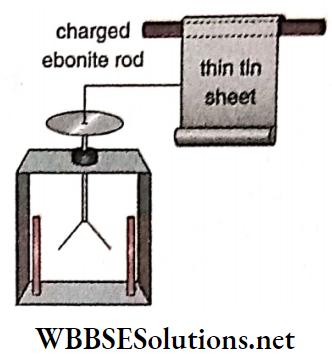
Class 12 Physics Unit 1 Electrostatics Chapter 4 Capacitance and Capacitor Surface area and shape of the conductor

If the experiment is performed with conductors of the same surface area but of different shapes, it will be found that the spreading of the leaves of the gold-leaf electroscope are different So capacitance of a conductor also depends on its shape.

Nature of the surrounding medium:

If the conductor is surrounded by some dielectric medium other than air, the capacitance of the conductor increases. The effect increases with the increase of the dielectric constant of the medium.

Experiment:

A charged metal sheet A placed on an insulating stand is connected to the disc of an uncharged gold-leaf electroscope. The divergence of the leaves of the electroscope is observed. The amount of deflection indicates the potential of the metal sheet.
Class 12 Physics Unit 1 Electrostatics Chapter 4 Capacitance and Capacitor Nature of the surrounding medium

Now a dielectric slab, say a thick glass slab, is brought slowly near sheet A. It is found that the spreading of the leaves diminishes. So, the potential of A has decreased, i.e., its capacitance has increased.

Again if the dielectric slab is removed from the vicinity of sheet A, the electroscope leaves will spread out to the same extent as earlier.

In this case, the dielectric medium is polarised from induction due to the metal sheet A. So opposite charges are developed on the two sides of the glass slab.

Induced negative charge reduces the potential of sheet A and positive charge raises the potential of A.

However, due to the close proximity of the negative charge, its effect on sheet A predominates. So as a whole, the potential of sheet A diminishes a little, and hence its capacitance increases.

WBCHSE Class 12 Physics Capacitance Notes 

Presence of other conductors:

The capacitance of a conductor depends on the presence of other conductors near it. If an uncharged conductor is present in the vicinity of the charged conductor under test, its capacitance increases. This effect becomes pronounced if the neighboring conductor is earthed.

Experiment:

If a positively charged conductor A placed on an insulating stand is connected to the disc of an uncharged gold-leaf electroscope, the leaves of the electroscope spread out. The amount of divergence indicates the potential of conductor A.

Now another uncharged conductor B placed on an insulating stand is brought near A, it will be found that the divergence of the leaves diminishes a little. So, the potential of A has decreased a little.

If conductor B is removed, the leaves spread to the same extent as earlier. From this, it is understood that if B is brought near A, the potential of A diminishes, and its capacitance increases.
Class 12 Physics Unit 1 Electrostatics Chapter 4 Capacitance and Capacitor Presence of other conductors

The reason is that an induced negative charge is developed at the nearer end and a positive charge at the far end of B due to the inducing charge of A.

The induced negative charge reduces the potential of A and the induced positive charge enhances its potential. But due to the proximity of the negative charge its effect on A predominates. So as a whole, the potential of conductor A diminishes a little, and hence its capacitance increases.

Now if conductor B is earthed, it will be found that the divergence of the leaves decreases considerably. This proves that the potential of conductor A is highly reduced.

If conductor B is removed from the vicinity of the coil now ductor A, the leaves of the electroscope will spread out to the same extent as earlier. So it is proved that if conductor B is earthed, the potential of conductor A diminishes a lot and hence its capacitance increases to a large extent.

The reason is that, if B is connected to the earth, the induced positive charge being free charge moves to the earth. Under this condition, due to the presence of only a negative charge in B, the potential of A diminishes a lot and hence its capacitance increases to a large extent.

The capacitance of a Spherical Conductor:

Let us consider a spherical conductor of radius R charged with Q’ amount of charge. The charge Q is uniformly distributed over the surface of the sphere. Potential at the surface of the sphere, as we know, is the same as that produced by an isolated point charge Q placed at the center of the sphere.

The potential of the sphere is given by,

⇒ \(V=\frac{1}{4 \pi \epsilon_0} \cdot \frac{Q}{R}\) [∈0 = permittivity of air or vacuum]

∴ The capacitance of the sphere,

⇒ \(C=\frac{Q}{V}=4 \pi \epsilon_0 R\)

We know, \(\frac{1}{4 \pi \epsilon_0}=9 \times 10^9 \mathrm{~N} \cdot \mathrm{m}^2 \cdot \mathrm{C}^{-2}\)

So, in vacuum or air, the capacitance of the sphere,

⇒ \(C=\frac{R}{9 \times 10^9} \text { farad }\)

In CGS system, replacing \(\epsilon_0 \text { by } \frac{1}{4 \pi}\), we have, C = R.

Hence the capacitance in the CGS unit of a spherical conductor placed in the air (or vacuum) is numerically equal to its radius in centimeters. For this reason, the capacitance CGSunit is sometimes expressed in centimeters.

Unit of ∈0: From the relation C = 4π∈0R,we have,

⇒ \(\epsilon_0=\frac{C}{4 \pi R}\)

So, the unit of ∈0

⇒ \(=\frac{\text { unit of } C}{\text { unit of } R}=\frac{\mathrm{F}}{\mathrm{m}}=\text { farad } / \text { metre }\left(\mathrm{F} \cdot \mathrm{m}^{-1}\right)\)

Using this simpler unit, we may write,

= 8.854 x 10⁻²¹ F.m-1

That this unit F m-1 is identical to the unit C².N-1.m-2 of ∈0, used earlier, is shown here

⇒ \(\mathrm{F} \cdot \mathrm{m}^{-1}=\frac{\mathrm{F}}{\mathrm{m}}=\frac{\mathrm{C}}{\mathrm{V} \cdot \mathrm{m}}=\frac{\mathrm{C}}{\frac{\mathrm{J}}{\mathrm{C}} \cdot \mathrm{m}}=\frac{\mathrm{C}^2}{\mathrm{~J} \cdot \mathrm{m}}\)

⇒ \(\frac{\mathrm{C}^2}{(\mathrm{~N} \cdot \mathrm{m}) \cdot \mathrm{m}}=\frac{\mathrm{C}^2}{\mathrm{~N} \cdot \mathrm{m}^2}=\mathrm{C}^2 \cdot \mathrm{N}^{-1} \cdot \mathrm{m}^{-2}\)

Class 12 Physics Capacitor Notes

Capacitance And Capacitor Factors Affecting Capacitance of a Conductor Numerical Examples

Example 1. The radius of the__earth is 6400km. Determine its capacitance in μF.
Solution:

The radius of the earth = 6400 km = 6400 x 10³ m.

Capacitance, \(C=4 \pi \epsilon_0 R=\frac{1}{9 \times 10^9} \times 6400 \times 10^3\)

⇒ \(=\frac{64}{9} \times 10^{-4}=\frac{6400}{9} \times 10^{-6} \mathrm{~F}\)

= 711.1μF

Example 2. A metal sphere has a diameter of 1 m. What will be the amount of charge required to raise its potential by 2.7 x 10⁶ V?
Solution:

Radius, R = \(\frac{1}{2}\) = 0.5 m;

⇒ \(C=4 \pi \epsilon_0 R=\frac{1}{9 \times 10^9} \times 0.5=\frac{0.5}{9 \times 10^9} \mathrm{~F}\)

∴ The amount of charge required,

⇒ \(Q=C V=\frac{0.5}{9 \times 10^9} \times\left(2.7 \times 10^6\right)\)

= 1.5 X 10-4

= 150 X 10-6 C

= 150μC

Example 3. Is it possible for a metal sphere with a radius of 1 cm to hold a charge of IC?
Solution:

Radius, r = 1 cm = 0.01 m

So, capacitance of the sphere

⇒ \(C=4 \pi \epsilon_0 r=\frac{1}{9 \times 10^9} \times 0.01=\frac{1}{9} \times 10^{-11} \mathrm{~F}\)

∴ The potential of the sphere,

⇒ \(V=\frac{Q}{C}=\frac{1}{\frac{1}{9} \times 10^{-11}}=9 \times 10^{11} \mathrm{~V}\)

At this very high potential, the sphere will discharge in the sureo rounding air, i.e., it will not be able to hold the charge of 1 C.

Practice Problems on Capacitance for Class 12

Example 4. SI The diameter of the spherical liquid drop is 2mm and its charge is 5 x 10⁻⁶ esu.

  1. What is the potential and its surface?
  2. If two such liquid drops coalesce to form a bigger drop, what will be the potential on its surface?

Solution:

1. In the CGS system, the radius of the spherical conductor = its capacitance (numerically).

∴  The capacitance of the spherical liquid drop,

C = 0.1 statF [∵ Radius = 1mm = 0.1 cm ]

∴  Potential on the surface of the liquid drop,

⇒ \(V=\frac{Q}{C}=\frac{5 \times 10^{-6}}{0.1}=5 \times 10^{-5} \mathrm{statV}\)

= 5 x 10-5 x 300 V

= 0.015 V

2. Let the radius of the bigger drop be R.

According to the question,

⇒\(\frac{4}{3} \pi R^3=2 \times \frac{4}{3} \pi(0.1)^3\)

or, \(R^3=2 \times(0.1)^3\)

or, \(R=0.1 \times 2^{\frac{1}{3}}\)

= 0.1 x 1.26

= 0.126 cm

Total charge,

Q = 2 x 5 x 10-6

= 10~5 esu of charge.

∴  Potential on the surface of the bigger liquid drop,

⇒ \(V=\frac{Q}{C}=\frac{10^{-5}}{0.126}\)

= 7.94 x 10-5 x 300 statV

= 7.94 x 10-5 x 300 V

= 0.0238 V

Class 12 Physics Capacitor Notes

Capacitance And Capacitor Potential Energy Of A Charged Conductor

A certain amount of work has to be done in order to charge a conductor. The energy spent for doing that work remains stored in the charged conductor as potential energy. Essentially, the electric field of the conductor stores this energy.

Calculation:

Let a conductor be charged with Q and let its capacitance be C. The potential of the conductor is V. During charging we assume that the whole amount of charge is not given to the conductor at a time, rather it is charged gradually.

At first, the charge of the conductor is zero so its potential is also zero. Gradually its potential increases due to the accumulation of charges. So at the time of charging the conductor has no particular potential. Its potential becomes V when its charge is Q.

Initial potential = 0; final potential = V

Average of these potentials = \(\frac{0+V}{2}=\frac{V}{2}\)

Therefore, work done = average potential x charge

⇒ \(\frac{V}{2} \times Q=\frac{1}{2} Q V=\frac{1}{2} C V \cdot V\) [∵ Q = CV]

⇒ \(\frac{1}{2} C V^2\)

= \(\frac{1}{2} C \times\left(\frac{Q}{C}\right)^2\)

= \(\frac{1}{2} \cdot \frac{Q^2}{C}\)

This work is stored in the charged conductor as potential energy.

∴ The potential energy of a charged conductor

⇒ \(\frac{1}{2} Q V\)

= \(\frac{1}{2} C V^2\)

= \(\frac{1}{2} \frac{Q^2}{C}\)

If C, V, and Q are expressed in esu, the unit of potential energy will be erg. Again C, V, and Q are expressed in farad, volt, and coulomb, respectively, the unit of potential energy will be joule.

Derivation using calculus: Let at any moment the charge on the conductor be q and its potential be v.

Evidently, q = Cv

When a charge dq is given to the conductor, the work done against the repulsive force due to potential v is given by,

⇒ \(d W=v d q=\frac{q}{C} d q\)

Hence the total work done to impart Q amount of charge is,

⇒ \(W=\int d W=\int_0^Q \frac{q}{C} d q=\frac{1}{2} \frac{Q^2}{C}=\frac{1}{2} C V^2=\frac{1}{2} Q V\)

This work is stored as potential energy in the charged conductor.


Capacitance And Capacitor Distribution Of Charge Between Two Conductors

Two conductors at the same potential:

Let us consider two insulated uncharged conductors A and B of capacitances C1 and C2, respectively. They are connected by a fine metal wire. Under this condition, if a charge Q is given to this combination, it will be distributed between the two conductors.
Class 12 Physics Unit 1 Electrostatics Chapter 4 Capacitance and Capacitor Two conductors at the same potential

Let us consider that conductor A has obtained a charge Q1 and conductor B a charge Q2 As the two conductors are connected to each other, they have the same potential. Let their common potential be V.

Q = Q1 + Q2

and \(V=\frac{Q_1}{C_1}\)

= \(\frac{Q_2}{C_2}\)

= \(\frac{Q_1+Q_2}{C_1+C_2}\)

= \(\frac{Q}{C_1+C_2}\)

⇒ \(\left.\begin{array}{ll}
∴ & Q_1=C_1 V=Q \cdot \frac{C_1}{C_1+C_2} \\
\text { and } & Q_2=C_2 V=Q \cdot \frac{C_2}{C_1+C_2}
\end{array}\right\}\)…(1)

Again, \(\frac{Q_1}{Q_2}=\frac{C_1}{C_2}\)….(2)

Therefore, a charge on each conductor is proportional to its capacitance. If the two conductors have the same capacitance, the given charge will be shared equally between them. If they have radii r1 cm and r2 cm, then C1 = r1 and C2 = r2 (in the CGS system).

Short Notes on Electrostatic Potential and Capacitance

In that case,

⇒ \(\left.\begin{array}{l}
Q_1=Q \cdot \frac{r_1}{r_1+r_2} \\
Q_2=Q \cdot \frac{r_2}{r_1+r_2}
\end{array}\right\}\)….(3)

∴ \(\frac{Q_1}{Q_2}=\frac{r_1}{r_2}\)…(4)

Therefore, the charge on each spherical conductor is proportional to its radius.

We know that the surface density of charge on the surface of a charge is the same everywhere.

If σ1 and σ2 be the surface densities of charge of the two conductors, then

⇒ \(\sigma_1=\frac{Q_1}{4 \pi r_1^2} \text { and } \sigma_2=\frac{Q_2}{4 \pi r_2^2}\)

∴  \(\frac{\sigma_1}{\sigma_2}=\frac{Q_1}{Q_2} \cdot \frac{r_2^2}{r_1^2}=\frac{r_1}{r_2} \times \frac{r_2^2}{r_1^2}=\frac{r_2}{r_1}\)…(5)

Therefore, the surface density of the charge of a spherical conductor is inversely proportional to its radius.

Two conductors initially at different potentials:

Let us consider two insulated conductors A and B. They have capacitances C1 and C2 and they are given charges Q1 and Q2 separately.

So under this condition,

potential of the conductor A, \(V_1=\frac{Q_1}{C_1} \text { or, } Q_1=C_1 V_1\)

and potential of the conductor B, \(V_2=\frac{Q_2}{C_2} \text { or, } Q_2=C_2 V_2\)

∴  The total charge of the conductors,

Q = Q1 + Q2

= C1V1 + C2V2…(6)

If the two conductors are connected by a thin metal wire, a positive charge will flow from the conductor at a higher potential to that at a lower potential and this flow of charge will continue till their potentials become equal.

Suppose, V1 > V2; then a charge will flow from A to B. Let V be the common potential after connection. During this flow of charge, the total charge of the system remains constant.

So, total charge before connection = total charge after connection

i.e„ Q = C1V1 + C2V2

= C1V + C2V

= (C1 + C2)V

or, \(V=\frac{C_1 V_1+C_2 V_2}{C_1+C_2}\)….(7)

After connection, if A and B contain charges q x and q2 respectively, then

⇒ \(\left.\begin{array}{l}
q_1=C_1 V=C_1 \cdot \frac{C_1 V_1+C_2 V_2}{C_1+C_2}=\frac{C_1}{C_1+C_2} \cdot Q \\
q_2=C_2 V=C_2 \cdot \frac{C_1 V_1+C_2 V_2}{C_1+C_2}=\frac{C_2}{C_1+C_2} \cdot Q
\end{array}\right\}\)….(8)

As V1 > V2, the charge lost by A,

q’1 =C1V1-C1V = C1(V1-V)

⇒ \(C_1\left(V_1-\frac{C_1 V_1+C_2 V_2}{C_1+C_2}\right)\)

or, \(q_1^{\prime}=\frac{C_1 C_2\left(V_1-V_2\right)}{C_1+C_2}\)….(9)

Again, the charge gained by B,

⇒ \(q_2^{\prime}=C_2 V-C_2 V_2=C_2\left(\frac{C_1 V_1+C_2 V_2}{C_1+C_2}-V_2\right)\)

or, \(q_2^{\prime}=\frac{C_1 C_2\left(V_1-V_2\right)}{C_1+C_2}\)…..(10)

From equations (9) and (10) we get, q1 = q2, i.e., the charge gained by conductor B is equal to that lost by conductor A.

Loss of energy due to sharing of charge:

Before connection, the total energy of the two conductors

⇒ \(\frac{1}{2} C_1 V_1^2+\frac{1}{2} C_2 V_2^2\)

After connection, the total energy of them

⇒ \(\frac{1}{2} C_1 V^2+\frac{1}{2} C_2 V^2=\frac{1}{2}\left(C_1+C_2\right) V^2\)

⇒ \(\frac{1}{2}\left(C_1+C_2\right) \cdot\left(\frac{C_1 V_1+C_2 V_2}{C_1+C_2}\right)^2\)

⇒ \(\frac{1}{2} \cdot \frac{\left(C_1 V_1+C_2 V_2\right)^2}{C_1+C_2}\)

Therefore, loss of energy due to the sharing of charge

⇒ \(\frac{1}{2} C_1 V_1^2+\frac{1}{2} C_2 V_2^2-\frac{1}{2} \cdot \frac{\left(C_1 V_1+C_2 V_2\right)^2}{C_1+C_2}\)

⇒ \(\frac{1}{2} C_1 V_1^2+\frac{1}{2} C_2 V_2^2-\frac{1}{2} \cdot \frac{\left(C_1 V_1+C_2 V_2\right)^2}{C_1+C_2}\)

⇒ \(\frac{1}{2} \cdot \frac{C_1 C_2}{C_1+C_2} \times\left(V_1-V_2\right)^2\)….(11)

Now, C1 and C2 are both positive quantities, and (V1 – V2)², being a perfect square, is also positive. So, the relation (11) is positive.

Hence, there is always a loss of energy in the electric field of the conductors due to the sharing of charges.

According to the law of conservation of energy, this loss of energy must be converted to some other form, usually as heat in the connecting wire. This Joss is partly converted into light and sound in addition to heat if sparkling occurs.

Capacitance And Capacitor Distribution Of Charge Between Two Conductor Numerical Examples

Example 1. A conductor of capacity 4 units, charged with 100 units of positive charge is connected to another conductor of capacity 2 units, charged with 20 units of negative charge. What is the change In the potential of each conductor? What will be the charges for each of them after the connection?
Solution:

Capacity of the first conductor; C1 = 4 units; charge, Q1 = 100 units.

∴ \(\text { Potential, } V_1=\frac{Q_1}{C_1}\)

= \(\frac{100}{4}\)

= 25units

Capacity of the second conductor C2 = 2 units; charge, Q2 = -20 units.

∴ \(\text { Potential, } V_2=\frac{Q_2}{C_2}\)

= \(\frac{-20}{2}\)

= -10 units

After connection, suppose, the common potential of the two conductors becomes equal to V.

∴ \(V=\frac{Q_1+Q_2}{C_1+C_2}\)

= \(\frac{100-20}{4+2}\)

= \(\frac{80}{6}\)

= \(\frac{40}{3}\)

= 13.33 units

So, the change of potential of the first conductor

= 25-13.33

= 11.67 units

The change of potential of the second conductor

= 13.33- (-10)

= 2333 units

Residual charge in the first conductor after connection,

q1 = C1V

= 4 x \(\frac{40}{3}\)

= 5333 units

Residual charge in the second conductor after connection,

q2 = C2V

= 2 x \(\frac{40}{3}\)

= 26.67 units

Real-Life Applications of Capacitors

Example 2. An insulated metallic vessel full of water Is charged with a potential of 3V. Drops of water are trickling from an orifice at the bottom of the vessel What is the amount of charge contained In each spherical drop of radius 1mm?
Solution:

Potential of the metal vessel full of water, V = 3 V Radius of a water drop, R = 1 mm = 10-3m

∴ The capacitance of the water drop,

⇒ \(C=4 \pi \epsilon_0 \mathrm{R}=\frac{10^{-3}}{9 \times 10^9}=\frac{1}{9} \times 10^{-12} \mathrm{~F}\)

∴ Charge of each water drop,

⇒ \(Q=C V=\frac{1}{9} \times 10^{-12} \times 3=3.3 \times 10^{-13} \mathrm{C}\)

Class 11 Physics Class 12 Maths Class 11 Chemistry
NEET Foundation Class 12 Physics NEET Physics

Example 3. The radii of two insulated metal spheres are 5 cm and 10 cm. They are charged up to potentials of 10 esu and 15 esu, respectively. If the two spheres are connected with one another, what will be the loss of energy?
Solution:

The radius of the first sphere = 5 cm

Capacitance, C1 = 5 statF

and potential, V1 = 10 statV

Charge, Q1 = C1V1

= 5 x 10

= 50 state

The radius of the second sphere = 10 cm

∴ Capacitance, C2 = 10 statF

and potential, V2 = 15 statV

Charge, Q2 = C2V2

= 10 x 15

= 150 statC

The total charge of the two spheres,

Q = Q1 + Q2

= 50 + 150

= 200 statC

Equivalent capacitance of the combination of two spheres,

C = C1 + C2

= 5 + 10

= 15 statF

If V is the common potential of the two spheres after connection, then

⇒ \(V=\frac{\text { total charge of the two spheres }}{\text { total capacitance of the two spheres }}\)

⇒ \(\frac{200}{15}\)

= \(\frac{40}{3} \mathrm{statV}\)

The total energy of the two spheres before connection,

⇒ \(E_1=\frac{1}{2} C_1 V_1^2+\frac{1}{2} C_2 V_2^2\)

⇒ \(\frac{1}{2}\left[5 \times(10)^2+10 \times(15)^2\right]\)

= 1375 erg.

The total energy of the two spheres after connection,

⇒ \(E_2=\frac{1}{2} C V^2=\frac{1}{2} \times 15 \times\left(\frac{40}{3}\right)^2\)

= 1333.33 erg

∴ Loss of energy due to connection

= 1375-1333.33

= 41.67 erg

Example 4. A metal sphere of radius 10 cm is charged up to a potential of 80 esu. After sharing its charge with another sphere, their common potential becomes 20 esu. What is the radius of the second sphere?
Solution:

The radius of the first sphere = 10 cm

∴ Capacitance C1 = 10 statF

and potential, = 80 statV

∴ Charge, Q1 = C1V1

= 10 x 80

= 800 state

After connection, the common potential, V = 20 statV

∴ \(V=\frac{\text { total charge of the two spheres }}{\text { equivalent capacitance of the two spheres }}\)

or, \(20=\frac{800}{10+C_2}\left[C_2=\text { capacitance of the second sphere }\right]\)

or, 10+ C2 = 40

or, C2 = 30 statF

Example 5. One thousand similar electrified raindrops merge into a single one so that their total charge remains unchanged. Find the change in the total electrostatic energy of the drops, assuming that all the drops are spherical and the small drops were initially at large distances from one another
Solution:

Suppose, each drop of radius r contains a charge Q.

∴ Capacitance, C = r

and energy, \(E_1=\frac{1}{2} \cdot \frac{Q^2}{C}=\frac{Q^2}{2 r}\)

The total energy of 1000 drops,

⇒ \(E=1000 E_1=\frac{500 Q^2}{r}\)

If R is the radius of the large drop then,

⇒ \(\frac{4}{3} \pi R^3=1000 \times \frac{4}{3} \pi r^3\)

or, R = 10r

Charge of the large drop = 1000 Q.

∴ The energy of the large drop,

⇒ \(E_2=\frac{1}{2} \cdot \frac{(1000 Q)^2}{R}\)

= \(\frac{5 \times 10^5 Q^2}{10 r}\)

= \(\frac{5 \times 10^4 Q^2}{r}\)

∴ \(\frac{E_2}{E}=\frac{5 \times 10^4}{500}=100\)

or, E2 = 100E

∴ Change in electrostatic energy of the drops

E2-E = 100E-E

= 99E

= 99 x initial energy

Example 6. Two equally charged soap bubbles of equal volume join together to form a large bubble. If each small bubble had a potential V, find the potential of the result
Solution:

Let the radius of each small bubble be r, the charge be Q, and the radius of the large bubble be R.

∴ \(\frac{4}{3} \pi R^3=2 \times \frac{4}{3} \pi r^3 \text { or, } R=2^{1 / 3} \cdot r\)

The potential of each small bubble,

V = \(\frac{Q}{r}\)

or, Q = Vr

∴ The potential of the large bubble

⇒ \(\frac{\text { total charge }}{\text { radius }}\)

⇒ \(\frac{2 Q}{R}\)

= \(\frac{2 V r}{2^{1 / 3} r}\)

= \(2^{2 / 3} V\)

Example 7. Eight spherical liquid drops join to form a large drop. The diameter of each drop is 2 mm and the charge 5μ statC. What is the potential on the surface of the large drop?
Solution:

Radius of a small drop, r = 1 mm =0.1 cm

Suppose, the radius of the large drop is R.

∴ \(\frac{4}{3} \pi R^3=8 \times \frac{4}{3} \pi r^3\)

or, R = 2r

= 2 x 0.1

= 0.2 cm

∴ The capacitance of large drop, C = R = 0.2 statF

The total charge of the small drops,

Q = 8 X 5

= 40μstatC

= 40 X 10-6 statC

∴ Potential on the surface of the large drop,

⇒ \(V=\frac{Q}{C}=\frac{40 \times 10^{-6}}{0.2} \text { statV }\)

= 2 X 10-4 x 300 V

= 0.06 V

Example 8. The ratio of the capacitances of two conductors A and B is 2: 3. The conductor A gains a certain amount of charge and shares it with B. Compare the initial energy of A with the total energy of A and B.
Solution:

Let the capacitance of the conductor A be 2C and that of the conductor B be 3C.

The amount of charge gained by A is Q.

Let the common potential of A and B after sharing of charge be V

∴ \(V=\frac{Q}{2 C+3 C}\)

= \(\frac{Q}{5 C}\)

The energy of the conductor A before sharing of charge,

⇒ \(E_A=\frac{1}{2} \cdot \frac{Q^2}{2 C}\)

= \(\frac{Q^2}{4 C}\)

Total energy of the conductors A and B after sharing the charge,

⇒ \(E_A=\frac{1}{2} \cdot \frac{Q^2}{2 C}\)

= \(\frac{Q^2}{4 C}\)

∴ The required ratio = \(\frac{E_A}{E}\)

= \(\frac{\frac{Q^2}{4 C}}{\frac{Q^2}{10 C}}\)

= \(\frac{5}{2}\)

Example 9. Each of the 27 identical mercury drops is charged to a potential of 10V. If the drops coalesce to form a big drop, what will be its potential? Calculate the ratio of the energy of the big drop to that of a small drop.
Solution:

Let the radius of each small drop be r.

∴ Capacitance, C1 = 4π∈0r

∴ Charge of each small drop, q = C1V1

= 10C1

∴ Total charge, Q = 27q = 27 x 10C1

= 270C1

If R is the radius of the big drop, then according to the question,

⇒ \(\frac{4}{3} \pi R^3=27 \times \frac{4}{3} \pi r^3 \text { or, } R=3 r\)

∴ The capacitance of the big drop,

C2 = 4π∈0.3r = 3C1

∴ The potential of the big drop,

⇒ \(V_2=\frac{Q}{C_2}=\frac{270 C_1}{3 C_1}=90 \mathrm{~V}\)

The energy of a small drop,

⇒ \(E_1=\frac{1}{2} C_1 V_1^2=\frac{1}{2} \times C_1 \times(10)^2\)

The energy of the big drop,

⇒ \(E_2=\frac{1}{2} C_2 V_2^2=\frac{1}{2} \times 3 C_1 \times(90)^2\)

∴ \(\frac{E_2}{E_1}=\frac{3 C_1}{C_1} \times \frac{(90)^2}{(10)^2}=\frac{243}{1}\)

∴ E2: E1 = 243: 1

Example 10. Charges of 10-2 C and 5 x 10-2.C are put on two metal spheres of radii 1 cm and 2 cm respectively. If they are connected with a metal wire, what will be the final charge on the smaller sphere?
Solution:

Here, the radius of the first sphere, R% = 1 cm = 0.01 m, and the radius of the second sphere, R2 = 2 cm = 0.02 m.

∴ The capacitance of the first sphere, C1 = 4π∈0R1

and capacitance of the second sphere, C2 = 4π∈0R2

The total amount of charge before and after connection,

Q1 + Q2 = Q

= (C1 + C2) V [V = common potential]

∴ \(\dot{V}=\frac{Q_1+Q_2}{C_1+C_2}\)

The final charge on the smaller (first) sphere,

⇒ \(q_1=C_1 V=C_1 \frac{Q_1+Q_2}{C_1+C_2}\) [Given, Q1 = 10-2C and Q2 = 5 x 10⁻²C]

⇒ \(4 \pi \epsilon_0 R_1 \times \frac{10^{-2}+5 \times 10^{-2}}{4 \pi \epsilon_0 R_1+4 \pi \epsilon_0 R_2}\)

⇒ \(R_1 \times \frac{6 \times 10^{-2}}{R_1+R_2}\)

= \(0.01 \times \frac{6 \times 10^{-2}}{0.01+0.02}\)

= 0.02C

Example 11. The capacitance and potential, respectively, of conductor A are 10 units and 50 units; those of conductor B are, respectively, 5 units and 65 units. Find out the charges on the two conductors after they
Solution:

Initially, the charge on conductor A,

Q2 = C1V1

= 10 x 50

= 500 unit

and charge on conductor B,

Q2 = C2V2

= 5 x 65

= 325 unit

The common potential after the two conductors are connected,

⇒ \(V=\frac{Q_1+Q_2}{C_1+C_2}=\frac{500+325}{10+5}=\frac{825}{15}\)

= 55 unit

Now, charge on conductor A,

q1 = C1V

= 10 X 55

= 550 unit

and charge on conductor B,

q2 = C2V

= 5 X 55

= 275 unit

Example 12. A spherical liquid drop of capacitance I/<F breaks Into drops of the same radius. What Is the capacitance of each of these smaller drops?
Solution:

Let R = radius of the Initial drop; r = radius of each of 8 smaller drops.

∴ \(\frac{4}{3} \pi R^3=8 \times \frac{4}{3} \pi r^3 \text { or, } r=\frac{R}{2}\)

The capacitance of the bigger drop = 4π∈0R

= 1μF

∴ The capacitance of each small drop

=4π∈0r

⇒ \(4 \pi \epsilon_0 r=4 \pi \epsilon_0 \frac{R}{2}=\frac{1}{2} \cdot 4 \pi \epsilon_0 R=\frac{1}{2} \times 1 \mu \mathrm{F}\)

= 0.5μF

Example 13. Two isolated metallic solid spheres of radii R and 2R are charged in such a way that both of these have the same charge density. The spheres are placed far away from each other and are connected by a thin conducting wire. Find the new charge density on the bigger sphere
Solution:

Let or be the charge density of the two spheres.

So, charge of the first sphere = q1 = 4πR2σ and charge of the second sphere = q2 = 4π(2R)²σ = 16πR²σ

When they are connected with a wire, let q1 and q2 be the new charges.

Then we may write

q’1 +q’2 = q1 + q2 ….(1)

Since the two spheres are at the same potential,

⇒ \(\frac{1}{4 \pi \epsilon_0} \frac{q_1^{\prime}}{R}=\frac{1}{4 \pi \epsilon_0} \frac{q_2^{\prime}}{2 R} \quad \text { or, } q_1^{\prime}=\frac{q_2^{\prime}}{2}\)

In the equation (1), by substituting q1, we have

⇒ \(\frac{q_2^{\prime}}{2}+q_2^{\prime}=q_1+q_2\)

or, \(q_2^{\prime}=\frac{2}{3}\left(q_1+q_2\right) \text { or, } q_2^{\prime}=\frac{2}{3}\left(4 \pi R^2 \sigma+16 \pi R^2 \sigma\right)\)

∴ \(q_2^{\prime}=\frac{40 \pi R^2 \sigma}{3}\)

Therefore, the new charge density of the bigger sphere,

⇒ \(\sigma^{\prime}=\frac{q_2}{4 \pi(2 R)^2}=\frac{40 \pi R^2 \sigma}{3 \times 16 \times \pi R^2}=\frac{5}{6} \sigma\)

Capacitance And Capacitor Capacitor And Its Principle

Capacitor:

A capacitor (originally known as con denser) is an arrangement by which the capacitance of a conductor can be increased.

It is used for storage of charge. Hence, a capacitor can alternatively be defined as an arrangement that can store a certain amount of charge.

Usually, a counselor uses the Ilia principle of artificially looking at Ilia capacitance of mi Insulnlod clinical conductor by bringing another method of conductor noor It.

Construction of capacitor:

A capacitor Is basically an arrangement of an Insulated conductor and an earthed conductor held close to each other and separated by air or a non-conducting (dielectric) medium. The shape of the two conductors Is usually the same, e.g.,

In the case of a parallel plate capacitor, parallel metal plates are placed close to each other. Again, a spherical capacitor consists of two concentric spheres and a cylindrical capacitor of two co-axial cylinders.

Working principle of capacitor: An insulated metal plate A is connected to an electrical machine, Suppose, the potential of the plate is +V when It Is fully charged, ff C be the capacitance of the plate, the charge on the plate will be,

Q = CV
Class 12 Physics Unit 1 Electrostatics Chapter 4 Capacitance and Capacitor Working principle of capacitor

Now if a similar plate B is placed in front of plate A, then due to induction, a negative charge is induced on the inner surface of B and a positive charge on its outer surface.

The induced negative charge, being nearer, lowers the positive potential of plate A. Thus, the capacitance of plate A increases a little (since C = \(\frac{Q}{V}\)). Hence plate A takes a slight additional charge from the electrical machine and raises its potential again to V.

Now if B is earthed, the positive charge on the far side of it moves to the earth and the influence of positive charges is absent, the potential of A falls further. So the capacitance of A increases further and consequently, it will now be able to receive a greater amount of charge from the machine.

So in this way, the capacitance of an insulated charged conductor can be increased with the help of another earthed conductor, placed in its vicinity.

Factors affecting the capacitance of a capacitor:

1. Overlapping nrcu of the plates: The Greater the surface area of the plates, the greater its capacitance. The capacitance decreases with the decrease of the overlapping area.

2. Distance between the two conducting plates: Capacitance increases with the decrease of this distance and vice versa.

3. Nature of the intervening medium between the two ducting plates: Instead of air, if the intervening space of the two plates is filled up with an insulator, e.g., paraffin, glass, paper, etc., the capacitance of a capacitor increases.

Uses of capacitors: Extensive uses of tire capacitors are found in different electrical circuits. In the case of different circuits in AC, the capacitor is almost an indispensable part. Capacitors are used in electronic instruments, radio, television, telephone, the flash circuit of a camera, etc.

Discussions:

1. Charge of a capacitor: Charge of a capacitor means die magnitude of charge on any one of its plates. If one plate possesses a charge + Q, then the other plate will contain a charge -Q. So total charge = +Q + (-Q) = 0. Here, Q is called the charge of a capacitor, it is not the total charge.

2. Ideal capacitor:

If a capacitor is connected to a source of high potential, it is charged to that potential. The capacitor is called an ideal one if it is not discharged automatically even if the source of potential is removed. It preserves its acquired charge without any leakage.

3. Maximum limit of the potential of a capacitor:

A capacitor cannot be charged to any high potential at will. If the value of the potential exceeds a certain maximum limit, the intervening medium loses its insulating properties. Consequently, electric discharge takes place between the capacitor and the intervening medium.

4. Any charged conductor is a capacitor:

Any charged conductor may be considered as a capacitor. The floor or the walls of the room act as the earthed conductor in this case.

5. Circuit symbol of capacitor:

Two parallel lines of the same size in an electrical circuit diagram, represent a capacitor Symbol of a variable capacitor.
Class 12 Physics Unit 1 Electrostatics Chapter 4 Capacitance and Capacitor Circuit symbol of capacitor

Charging and discharging of a capacitor:

When a battery Is connected to a series resistor and capacitor, charges begin to accumulate on the capacitor.

This Is called the charging of a capacitor. After removal of the battery, the capacitor loses Its accumulated charge through the resistor gradually. Tills Are called discharging of a capacitor.

The two plates A and B of a capacitor are connected to a buttery of electromotive force E through a resistor. Electrons from the negative pole of (lie battery move to plate H.

Simultaneously, a How of electrons starts from plate A to the positive pole of the battery. This produces a charging current.

As negative charges on plate B and positive charges on plate A keep on accumulating, (ho potential difference between die two plates increases.

So the plates act as a cell and consequently, a tendency of electron flow Is established In the direction opposite to that of the initial electron flow. As a result, the die charging current decreases.

Important Formulas in Capacitance

When the potential difference between the two plates A and II becomes equal to the end of the battery, the charging current ceases to flow.

Then it is said that the capacitor has become fully charged. So at the start, the charging current is maximum and afterward, It gradually decreases. When the capacitor is fully charged, the charging current becomes zero.
Class 12 Physics Unit 1 Electrostatics Chapter 4 Capacitance and Capacitor Charging and discharging of a capacitor

After removal of the battery from the circuit, l.e„ during discharging electrons from plate 2 flow to plate A and begin to neutralize the positive charge of plate A.

Thus again a current flows in the circuit. This is called discharging and its direction is opposite to that of the charging current- After a while all the electrons of plate B neutralize all the positive charges of plate A.

Then the discharging current becomes zero and the capacitor is said to be completely discharged. So at the start, discharging current is. maximum and It decreases gradually and becomes zero when the capacitor is completely discharged.

In fact, no capacitor is an ideal one. A fully charged capacitor loses its charge in the course of time even if the two plates of it are not connected by a conducting wire.

Finally, the tire capacitor becomes completely discharged. Of course, in this case, the discharging action continues for a long time.

Potential and Capacitance of a Capacitor:

Potential of a capacitor: The potential difference between the two conducting plates of a capacitor is called the potential of a capacitor. Generally, the potential of a capacitor means the potential attained by the insulated plate of the capacitor due to the charge given to it, the grounded plate of the capacitor being at zero potential.

The capacitance of a capacitor:

The capacitance of a capacitor means the capacitance of the insulated conducting plate of the capacitor. So it may be defined as the amount of charge that must be given to the insulated plate to raise its potential by unity. If a charge Q raises its potential by Vi its capacitance, C = \(\frac{Q}{V}\).

Therefore, the capacitance of a capacitor may be defined as the ratio of the magnitude of the charge on any one of the two plates to die difference of potential between them, i.e., the capacitance of a capacitor

= \(\frac{\text { charge on a conducting plate of the capacitor }}{\text { difference of potential between the two plates }}\)

The capacitance of a capacitor is assigned a value of 1 faradic 1 coulomb of charge is required to maintain a potential difference of 1 V between the two conductors or plates of the capacitor.

Here capacitance is always a positive quantity and it does not depend on the nature of charge and potential. The capacitance of a conductor and that of a capacitor are expressed in the same unit.

Usually, a capacitor is rated, bearing the mark of the magnitude of its capacitance and the maximum potential difference that can be applied safely between its two plates.

A capacitor rated 0.04μF 220V means that its capacitance is 0.04μF and the maximum potential difference to be applied between its two plates is 220 V. If it is used in a potential difference higher than 220 V, it may get damaged.

Capacitance And Capacitor Dielectrics

Now we discuss the materials that do not conduct electricity and can be inserted between the plates of a capacitor.

Substances that have no free electrons cannot conduct electricity. They are called insulators or dielectrics. When they are placed in an electric field, charges are induced on their surfaces.

Classification of Dielectrics:

Dielectrics are classified into two groups according to the position of charge within their molecules: O non-polar substance and 0 polar substance.

Non-polar substance: A substance in which the center of negative charges (electrons) coincides with that of positive charges (protons) in each of its molecules, is called a non-polar substance.

In the absence of an external electric field, these molecules do not possess any permanent electric dipole moment Thus they are called non-polar molecules.

In the presence of an external electric field, a relative displacement occurs between the centers of positive and negative charge distributions. Thus a non-polar molecule when subjected to an electric field, acquires an electric dipole moment These types of dipoles are called induced dipoles.
Class 12 Physics Unit 1 Electrostatics Chapter 4 Capacitance and Capacitor Non-polar substance

Polar substance: A substance in which the center of negative charges (electrons) does not coincide with that of positive charges (protons) in each of its molecules, is called a polar substance.

So, even in the absence of an external electric field, each of these molecules possesses a permanent electric dipole moment So They are called polar molecules.

Example: water (H2O), ammonia (NH3).

Generally, the dipole moments of different molecules of a polar substance are randomly directed. So the resultant dipole moment of a polar substance is zero.

But when subjected to an electric field, each molecule of a polar substance experiences a torque and tends to fall in line with the direction of field lines of the external electric field. As a result, the sample of the polar substance acquires a resultant electric dipole moment.
Class 12 Physics Unit 1 Electrostatics Chapter 4 Capacitance and Capacitor Polar substance

So polar and non-polar molecules behave in a similar manner when subjected to an external electric field.

Polarisation of a Dielectric:

A conductor In an external electric field: If a conductor is placed in an external electric field the free electrons of the conductor orient themselves in a direction opposite to the electric field. This transfer continues until finally, the induced electric field balances the external electric field. In that case, no further displacement of charges takes place i.e., an equilibrium has been reached. So the resultant electric field \(\vec{E}\) inside a conductor is zero.
Class 12 Physics Unit 1 Electrostatics Chapter 4 Capacitance and Capacitor A conductor In an external electric field

A dielectric in an electric field:

If a dielectric is placed in an external electric field \(\left(\vec{E}_0\right)\), the dipoles align themselves along the lines of force. So an electric field \(\left(\vec{E}_p\right)\) is generated inside the dielectric whose direction is opposite to that of the applied external field \(\left(\vec{E}_0\right) \cdot \vec{E}_P\) is less than \(\left(\vec{E}_0\right)\).

As a dielectric has no free electrons, the external field \(\left(\vec{E}_0\right)\) is not completely balanced by the internal field \(\left(\vec{E}_p\right)\) set up inside the dielectric. So at any point inside a dielectric the resultant intensity \((\vec{E})\) is less than the external field intensity \(\left(\vec{E}_0\right) \cdot \vec{E}_P\) but it does not become zero as in a conductor.

The alignment of the molecules of a dielectric, which behave like electric dipoles under the influence of an external field, is known as electric polarization.

It is observed that one face of the dielectric acquires a net positive charge and the other, a negative. This is because the charges between the two dotted lines neutralize each other’s effect, thus leaving an unbalanced negative charge on the left face and a positive charge on the right face of the dielectric,
Class 12 Physics Unit 1 Electrostatics Chapter 4 Capacitance and Capacitor A dielectric in an electric field

The random arrangement of the molecules of a dielectric has been shown in the absence of any external electric field. Alignment of the molecules along the field lines under the influence of the external field has been shown.

Shows that inside a dielectric, electric field intensity reduces due to electric polarization. The resultant intensity of the electric field inside the dielectric is given by

⇒ \(\vec{E}=\vec{E}_0-\vec{E}_p\)

The electric polarization is directly proportional to die resultant electric field In the dielectric

The capability of storing the charge of a capacitor, i.e., its capacitance can be increased by using a suitable dielectric substance between its two plates.

For Example, air, paraffin, glass, sulfur, mica, paper, etc. are the dielectric substances used as intervention medium in a parallel plate capacitor. The increase in the capacitance of a capacitor depends on a property of dielectric materials, termed as dielectric constant (k).

Definition: The dielectric constant of a material is the ratio of the capacitance of a capacitor filled with the given dielectric material to the capacitance of a similar capacitor without any medium.

So, dielectric constant,

k = \(\frac{capacitance of capacitor with the dielectric as the intervening medium}{capacitance of the same capacitor without anymedium}\)

The dielectric constant is also known as specific inductive capacity (SIC).

The capacitor without any medium between its two plates has only a vacuum between the plates.

By the statement that the dielectric constant of glass is 8.5, we mean that the capacitance of a capacitor will increase 8.5 times if glass is used as a dielectric instead of a vacuum. Naturally, the dielectric constant of a vacuum is 1. The dielectric constant of dry air is 1.000586(≈1).

Capacitance And Capacitor Capacitance Of Some Standard Capacitors

Parallel Plate Capacitor:

It consists of two similar metal plates held parallel to each other, separated by a certain distance. The space in between the two plates contains air or any dielectric, e.g., glass, mica, etc.

Consider two parallel plates A and B separated by a distance d. The area of each plate is a. Plate A is charged with a charge +Q while plate B is grounded. The dielectric constant of the medium between the plates is K.
Class 12 Physics Unit 1 Electrostatics Chapter 4 Capacitance and Capacitor Parallel Plate Capacitor

Now the surface density of charge on plate A will be

⇒ \(\sigma=\frac{Q}{\alpha}\)

The inner face of plate B is charged to -Q due to induction. If the area of the plates is large compared to the die distance between them, the electric lines of force between the plates are straight and parallel except near their ends.

Consequently, the intensity of the electric field between the plates may be taken to be uniform. The slight deviation from this uniformity near the edges may be neglected.

The plates A and B can be considered to be infinite plates with respect to any point in between the two plates. So, the electric field at that point due to the positive charge on plate A is,

⇒ \(E_1=\frac{\sigma}{2 \kappa \epsilon_0} \text {, along } A B\)

The electric field at that internal point will be in the same direction as AB, also due to the negative charge on plate B. Its magnitude is

⇒ \(E_2=\frac{\sigma}{2 \kappa \epsilon_0}\)

Therefore, at all points between the plates A and B, the electric field is

⇒ \(E=E_1+E_2=\frac{\sigma}{2 \kappa \epsilon_0}+\frac{\sigma}{2 \kappa \epsilon_0}=\frac{\sigma}{\kappa \epsilon_0}\)

If V is the potential difference between the plates, then

V = work done to bring a unit positive charge from plate B to plate A

= force acting on the unit charge x distance

= intensity of the electric field x distance

⇒ \(E \cdot d=\frac{\sigma}{\kappa \epsilon_0} \cdot d\)

If C is the capacitance of the capacitor, then

⇒ \(C=\frac{Q}{V}=\frac{\sigma \alpha}{\frac{\sigma}{\kappa \epsilon_0^V} \times d}=\frac{\kappa \epsilon_0 \alpha}{d}\)…(3)

⇒ \(\text { [In CGS units, } C=\frac{K \alpha}{4 \pi d} \text { ] }\)

For air, K = 1

Hence, \(C=\frac{\epsilon_0 \alpha}{d}=\frac{8.854 \times 10^{-12} \times \alpha}{d}\)…(4)

Dependence of the capacitance of a parallel plate capacitor on various factors:

Area of the plates: The capacitance is directly proportional to the area of the plates, i.e., C ∝ a.

1. Distance between the plates: The capacitance of a parallel plate capacitor is inversely proportional to the distance between the plates, i.e., C oc \(\frac{1}{d}\)

2. The nature of the medium between the plates: The capacitance is directly proportional to the permittivity or dielectric constant of the medium between the plates, i.e., C ∝ K.

3. The relation (3) clearly indicates that the capacitance does not depend on the charge Q or the potential V of the capacitor. Only the shape and the intervening medium determine its capacitance.

4. If the common overlapping area between the two plates can be changed by using a hinge arrangement, then changes, and as a result, the capacitance C changes. This technique may be used to design a capacitor, of variable capacitance.

Special case: If n number of parallel plates are alternately connected to form a multi-plate capacitor, the capacitance will be,

⇒ \(C=\frac{(n-1) \kappa \epsilon_0 \alpha}{d}\)
Class 12 Physics Unit 1 Electrostatics Chapter 4 Capacitance and Capacitor Special case

where a = area of each plate,

d = distance between two consecutive plates

The capacitance of a parallel plate capacitor with compound diet dice:

A and B are two parallel plates of which A is charged and B is grounded. Let a be the area of each plate, d the distance between them, and +Q the charge on plate A.

So the surface density of charge on each plate is \(\sigma=\frac{Q}{\alpha}\)
Class 12 Physics Unit 1 Electrostatics Chapter 4 Capacitance and Capacitor Capacitance of a parallel plate capacitor with compound dielectric

The space between the plates is now filled with two media of permittivites e1 and e2. The thickness of the two layers are (d-1) and t respectively. The intensity of the electric field between the plates may be taken as uniform. If the dielectric constants of the two media are k1 and k2, the intensity of the electric field will be given by,

⇒ \(E_1=\frac{\sigma}{\kappa_1 \epsilon_0}\)

and \(E_2=\frac{\sigma}{\kappa_2 \epsilon_0} ; \epsilon_0\) = permittivity of air or vacuum

∴ The potential difference between the plates Is,

V = E1(d-t) + E2t

⇒ \(\frac{\sigma}{\kappa_1 \epsilon_0}(d-t)+\frac{\sigma}{\kappa_2 \epsilon_0} t=\frac{\sigma}{\epsilon_0}\left[\frac{d-t}{\kappa_1}+\frac{t}{\kappa_2}\right]\)

So, the capacitance of the capacitor,

⇒ \(\frac{Q}{V}\)

⇒ \(\frac{\sigma \alpha}{\frac{\sigma}{\epsilon_0}\left[\frac{d-t}{\kappa_1}+\frac{t}{\kappa_2}\right]}=\frac{\epsilon_0 \alpha}{\left(\frac{d-t}{\kappa_1}+\frac{t}{\kappa_2}\right)}\)

If k1 = 1 (for air) and k2 = k (say),

⇒ \(C=\frac{\epsilon_0 \alpha}{d-t+\frac{t}{\kappa}}=\frac{\epsilon_0 \alpha}{d-\left(t-\frac{t}{\kappa}\right)}\)…(6)

1. Since \(\left(t-\frac{t}{K}\right)\) is a positive quantity, equation (6) shows that the capacitance of a parallel plate capacitor increases with the insertion of any dielectric medium between the plates.

2. If a dielectric of thickness t is inserted in between the two plates of a parallel plate air capacitor, the capacitance of the capacitor becomes equal to that of a capacitor having separation between the plates reduced by \(\left(t-\frac{t}{K}\right)\), i.e., the separation between the two plates effectively decreases by the amount \(\left(t-\frac{t}{K}\right)\).

If we want to get the previous value of the capacitance, the distance between the plates is to be increased. If this increase is x, then

⇒ \(x=t-\frac{t}{K}=t\left(1-\frac{1}{K}\right)\)

3. If n number of dielectric slabs of dielectric constants k1,k2,…,Kn of thicknesses t1, t2…., tn be inserted between the two parallel plates, the capacitance of the capacitor so formed is given by,

⇒ \(C=\frac{\epsilon_0 \alpha}{\frac{t_1}{\kappa_1}+\frac{t_2}{\kappa_2}+\cdots+\frac{t_n}{\kappa_n}}=\frac{\epsilon_0 \alpha}{\sum_1^n \frac{t}{\kappa}}\)

Energy Stored in a Charged Capacitor:

During the charging of an uncharged capacitor, electrons are removed from one plate and transferred to the other gradually. Initially, the charge of the capacitor is zero and so the potential difference between the plates is also zero. As soon as an electron is transferred from one plate to the other, an electric field builds up in the space between the capacitor plates.

This field opposes further transfer. Thus as the charge accumulates on the capacitor plates, increasingly larger amounts of work is to be done to transfer more electrons.

Hence the potential difference increases due to the accumulation of charges. The energy spent for doing that work remains stored as potential energy in the electric field between the two plates of the capacitor.

Calculation: Suppose, at any moment, the charge of a capacitor be q and the potential difference between the two plates is v.

The capacitance of the capacitor, C = \(\frac{q}{v}\)

Further, when some charge of amount dq is given to the capacitor, the work done against the repulsive force due to the existing charge on the capacitor plate,

⇒ \(d W=v d q=\frac{q}{C} d q\)

∴ To give Q the amount of charge, the total work done

⇒ \(W=\int d W\)

= \(\int_0^Q \frac{q}{C} \cdot d q\)

⇒ \(=\frac{1}{2} \cdot \frac{Q^2}{C}\)

= \(\frac{1}{2} C V^2\)

= \(\frac{1}{2} Q V\)

where V = final potential difference between the plates.

This work is stored as potential energy in the capacitor

Energy stored in a charged parallel plate capacitor:

Let us consider a charged parallel plate capacitor.

Here,

a = area of each plate,

d = separation between the plates,
Class 12 Physics Unit 1 Electrostatics Chapter 4 Capacitance and Capacitor Energy stored in a charged parallel plate capacitor

K = dielectric constant of the material between the plates,

σ = surface density of charge on each plate

So, volume between the plates = αd and amount of charge on each plate (Q) = σa.

The capacitance of this parallel plate capacitor,

⇒ \(C=\frac{K \epsilon_0 \alpha}{d}\)

where, ∈0 = permittivity of air or vacuum

Therefore, the energy stored in this charged capacitor,

⇒ \(U=\frac{1}{2} \frac{Q^2}{C}\)

= \(\frac{1}{2}\left(\sigma^2 \alpha^2\right) \frac{d}{\kappa \epsilon_0 \alpha}\)

= \(\frac{\sigma^2 \alpha d}{2 \kappa \epsilon_0}\)

The unit of U is joule (J). This energy is stored in the electric field between the plates of the capacitor.

[In the CGS system, the expression for U is obtained by replacing

⇒ \(\epsilon_0 \text { by } \frac{1}{4 \pi} . \text { So, } U=\frac{2 \pi \sigma^2 a d}{\kappa}\); its unit is erg.]

Energy stored per unit volume or energy density between the plates:

Energy stored per unit volume,

⇒ \(u=\frac{U}{\alpha d}=\frac{\sigma^2}{2 \kappa \epsilon_0}\)

This is called the energy density in the electric field of the
capacitor.

Now, the electric field is uniform, except at the ends, inside a parallel plate capacitor, provided the plate area is very large compared to the separation between the plates.

From Gauss’ theorem, we already know that the uniform electric field between the two plates of a parallel plate capacitor, neglecting end effects, is

⇒ \(E=\frac{\sigma}{\kappa \epsilon_0} ; \text { then } \sigma=\kappa \epsilon_0 E\)

So, the energy density between the two plates is,

⇒ \(u=\frac{\left(\kappa \epsilon_0 E\right)^2}{2 \kappa \epsilon_0}=\frac{1}{2} \kappa \epsilon_0 E^2\)…(1)

For vacuum or air, K = 1 . Then equation (1) becomes,

⇒ \(u=\frac{1}{2} \epsilon_0 E^2\)…(2)

[In the CGS system, the equation (1) and (2) become, due to the replacement of
\(\epsilon_0 \text { by } \frac{1}{4 \pi}, u=\frac{1}{8 \pi} \kappa E^2 \text { and } u=\frac{1}{8 \pi} E^2\)]

In SI, the unit of u is J.m-3 [In the CGS system, it is erg.cm-3 ]

Dimension of \(u=\frac{\text { dimension of energy }}{\text { dimension of volume }}\)

⇒ \(\frac{M L^2 T^{-2}}{L^3}\)

= \(M L^{-1} T^{-2}\)

The expressions (1) and (2) of energy density in an electric field have been derived by considering the special case of a parallel plate capacitor. However, it can be proved that these two expressions are quite general expressions – true not only for parallel plate capacitors but also for electric fields of any other type.

These expressions give the energy density, i.e. energy in a unit volume around any, point in an electric field of any type. The rigorous proofs of the expressions are beyond the scope of our present discussions.

Energy density around a point In an electric field.’ Suppose, a point charge q is placed at a point 0. Another point P in air, is at a distance r from 0. Then the electric field at P,

⇒ \(E=\frac{1}{4 \pi \epsilon_0} \frac{q}{r^2}\)

So, the energy density of the tire electric field around point P is,

⇒ \(u=\frac{1}{2} \epsilon_0 E^2=\frac{1}{2} \epsilon_0 \frac{q^2}{16 \pi^2 \epsilon_0^2 r^4}=\frac{q^2}{32 \pi^2 \epsilon_0 r^4}\)

Then, in a small volume v around the point P, the energy stored is,

⇒ \(U=u v=\frac{q^2 v}{32 \pi^2 \epsilon_0 r^4}\)
Class 12 Physics Unit 1 Electrostatics Chapter 4 Capacitance and Capacitor Energy density around a point In an electric field

Capacitance And Capacitor Capacitance Of Some Standard Capacitors Numerical Examples

Example 1. The area of each plate of a parallel plate glass capacitor is 314 cm2. Its plates are separated distance 1cm. What will be the radius of a sphere having a capacitance equal to that of this capacitor? [k of glass = 8 ].
Solution:

The capacitance of the sphere

⇒ \(C=\frac{\kappa \alpha}{4 \pi d}=\frac{8 \times 314}{4 \times \pi \times 1} \approx 200 \mathrm{statF}\)

So, the radius of the sphere = 200 cm.

Example 2. The area of each plate of a parallel plate capacitor is 22 cm² and the plates are kept separated by a paraffin paper of thickness 1 mm. The specific inductive capacity (SIC) of paraffin paper is 2. What are the capacitance of the capacitor and the surface density of charge under a potential difference of 330 V?
Solution:

The capacitance of the capacitor

⇒ \(C=\frac{\kappa \alpha}{4 \pi d} \quad\left[\text { Here, } \kappa=2 ; \alpha=22 \mathrm{~cm}^2 ; d=0.1 \mathrm{~cm}\right]\)

⇒ \(\frac{2 \times 22}{4 \pi \times 0.1}=35 \mathrm{statF}\)

∴ \(Q=C V=35 \times \frac{330}{300} {statC}\left[∵ V=330 \mathrm{~V}=\frac{330}{300} \text { statV }\right]\)

∴ Surface density of charge,

⇒ \(\sigma=\frac{Q}{\alpha}=\frac{35 \times 330}{300 \times 22}\)

= 1.75 statC.cm-2

Example 3. The distance between the two plates of a parallel plate air capacitor is d. A piece of metal of thickness \(\frac{d}{2}\) and of area equal to that of the plates is inserted between the plates. Compare the capacitances in the two cases.
Solution:

In the first case, the capacitance of the parallel plate capacitor,

⇒ \(C_1=\frac{\epsilon_0 \alpha}{d}\)

We know that the intensity of the electric field inside a metal is zero. So, if a piece of metal of thickness \(\frac{d}{2}\) is inserted between the plates now becomes \(\left(d-\frac{d}{2}\right)=\frac{d}{2}\). Therefore, the capacitance of the capacitor becomes

⇒ \(C_2=\frac{\epsilon_0 \alpha}{d / 2}=\frac{2 \epsilon_0 \alpha}{d}\)

∴ \(\frac{C_1}{C_2}=\frac{\left(\epsilon_0 \alpha\right) / d}{\left(2 \epsilon_0 \alpha\right) / d}\)

= \(\frac{1}{2}\)

Example 4. The conducting plates of a parallel plate capacitor are separated by 2 cm from each other. A dielectric slab (K = 5) of thickness 1 cm is inserted between the two plates. The distance between the plates is now so changed that the capacitance of the capacitor remains the same. What will be the new distance between the plates?
Solution:

Let the present distance between the plates be d. According to the question,

⇒ \(\frac{\epsilon_0 \alpha}{2}=\frac{\epsilon_0 \alpha}{\left[d-t+\frac{t}{\kappa}\right]}\) [t = thickness of the dielectric slab = 1 cm; K = 5 ]

or, \(\frac{1}{2}=\frac{1}{\left[d-1+\frac{1}{5}\right]}\)

or, \(2=\left[d-1+\frac{1}{5}\right]=d-\frac{4}{5}\)

or, d = \(\frac{14}{5}\)

= 2.8 cm

Example 5. The surface area of each plate of a parallel plate capacitor is 50 cm2. They are separated by 2mm in air. It is connected with a 100V power supply. Now a dielectric (K = 5) is inserted between its two plates. What will happen

  1. If the voltage source remains connected and
  2. If the voltage sources are absent during this insertion?

Solution:

We know, that the capacitance of a parallel plate capacitor is

⇒ \(C=\frac{k \epsilon_0 \alpha}{d}\)

For air, the capacitance,

⇒ \(C_1=\frac{\epsilon_0 \alpha}{d}\) [∈0 = 8.854 x 10⁻¹² F.m-1, a = 50cm2 = 5 X 10⁻²m2, d = 2 mm = 2 X 10⁻³ m]

⇒ \(\frac{8.854 \times 10^{-12} \times 5 \times 10^{-3}}{2 \times 10^{-3}}\)

= 2.21 x 10⁻¹¹ F

For the dielectric (k = 5), the capacitance,

⇒ \(C_2=\frac{\kappa \epsilon_0 \alpha}{d}\)

= 5 x 2.21 x 10-11

= 1.11 x 10⁻¹⁰ F

1. If a dielectric is inserted, the capacitance of a parallel plate capacitor increases. Since the capacitor is still connected to the power supply, its potential will remain constant.

When the intervening medium is air, charge on the capacitor,

Q0 = capacitance x potential

= 2.21 X 10-11 X 100

= 2.21 X 10⁻⁹ C

When the intervening medium is the dielectric (k = 5), charge on the capacitor,

Q = 1.11 x 10-10 x 100

= 1.11 x 10⁻⁸C

∴ Change in charge of the capacitor

= Q – Q0

= 1.11 x 10⁻⁸ – 2.21 x 10-9

= 8.89 x 10⁻⁹ C

Change in potential difference = 0.

2. If the battery is removed, the charge stored remains the same.

So change in charge of the capacitor = 0.

According to the question, the potential difference between the plates of the capacitor before the insertion of the dielectric = 100 V.

After the insertion of the dielectric, the potential difference between the plates is,

⇒ \(V=\frac{Q_0}{C_2}=\frac{2.21 \times 10^{-9}}{1.11 \times 10^{-10}}\)

= 19.91 V

So, the potential difference decreases.

Change in potential difference

= 100 – 19.91

= 80.09 V

Example 6. Each of the two square plates of a capacitor has sides of length l. The angle d between the two plates is very small, If the medium between the plates is air and the minimum distance between them is t, determine the capacitance of the capacitor
Class 12 Physics Unit 1 Electrostatics Chapter 4 Capacitance and Capacitor Example 6 two square plates

Solution:

The average distance between the plates,

⇒ \(d=\frac{t+(t+l \sin \theta)}{2}=t+\frac{l}{2} \theta\) [∵ θ is very small, sinθ ≈ 0]

∴ The capacitance of the capacitor,

⇒ \(C=\frac{\epsilon_0 \alpha}{d}=\frac{\epsilon_0 l^2}{t+\frac{l}{2} \theta}=\frac{\epsilon_0 l^2}{t\left(1+\frac{l \theta}{2 t}\right)}=\frac{\epsilon_0 l^2}{t}\left(1+\frac{l \theta}{2 t}\right)^{-1}\)

⇒ \(\approx \frac{\epsilon_0 l^2}{t}\left(1-\frac{l \theta}{2 t}\right)\)

Example 7. A parallel plate air capacitor has a capacitance of 2pF. Now, the separation between the plates is doubled, and the space is filled with wax. If the capacitance rises to 6 pF, what is the dielectric constant of wax?
Solution:

Initial separation between the plates = d; area of each plate = α.

∴ Capacitance in the 1st case,

⇒ \(C_1=\frac{\epsilon_0 \alpha}{d}\)

The final separation between the plates = 2d; dielectric constant of wax = k.

∴ Capacitance in the 2nd case,

⇒ \(C_2=\frac{\kappa \epsilon_0 \alpha}{2 d}\)

∴ \(\frac{C_1}{C_2}=\frac{2}{\kappa} \text { or, } \kappa=2 \times \frac{C_2}{C_1}=2 \times \frac{6 \mathrm{pF}}{2 \mathrm{pF}}=6\)

Example 8. The area of each plate of a parallel plate capacitor is A – 600 cm² and their separation is d = 2.0 mm. The capacitor is connected to a 200 V DC source. Find out

  1. The uniform electric field between the plates In the SI unit and
  2. The surface density, of charge on any plate. Given, ∈0 = 8.85 x 10⁻¹²F m-1

Solution:

Here, A = 600 cm2

= 600 x 10-4m2

= 6 x 10⁻²m2;

d = 2.0 mm

= 2 x 10⁻³ m.

1. The uniform electric field between the plates,

⇒ \(E=\frac{V}{d}=\frac{200}{2 \times 10^{-3}}=10^5 \mathrm{~V} \cdot \mathrm{m}^{-1}\)

2. If cr = surface density of charge on any plate, then

⇒ \(E=\frac{\sigma}{\epsilon_0}\)

∴ \(\sigma=\epsilon_0 E=\left(8.85 \times 10^{-12}\right) \times 10^5\)

= 8.85 x 10⁻⁷ C m-2

Example 9. The potential of a capacitor increases from zero to 150 V when a charge of 10 esu Is imparted to it. What will be the energy stored in the capacitor?
Solution:

Energy stored within the capacitor

⇒ \(\frac{1}{2} Q V=\frac{1}{2} \times 10 \times \frac{150}{300}\)

= 2.5 erg.

Example 10. Find out the energy content in a volume of 1 cm³ around a point, situated in the electric field of a point charge of 10 C, at a distance of 2 m in air from the position of the point charge. Given,∈0 = 8.85 x 10⁻¹² F.m-1
Solution:

The electric field at the referred point due to the point charge,

⇒ \(E=\frac{1}{4 \pi \epsilon_0} \frac{q}{r^2}[\text { Here, } q=10 \mathrm{C}, r=2 \mathrm{~m}]\)

∴ Energy density at the point

⇒ \(u=\frac{1}{2} \epsilon_0 E^2=\frac{1}{2} \epsilon_0 \cdot \frac{1}{16 \pi^2 \epsilon_0^2} \frac{q^2}{r^4}=\frac{q^2}{32 \pi^2 \epsilon_0 r^4}\)

∴ The energy content in a volume of 1 cm3, i.e., 10-6 m3,

U = u x 10-6

⇒ \(\frac{q^2}{32 \pi^2 \epsilon_0 r^4} \times 10^{-6}\)

⇒ \(\frac{10^2 \times 10^{-6}}{32 \times(3.14)^2 \times\left(8.85 \times 10^{-12}\right) \times 2^4} \approx 2240 \mathrm{~J}\)

Example 11. Estimate the percentage change of the energy stored in a parallel plate capacitor, if the separation between its plates is reduced by 10%, keeping the voltage of the charging source unchanged.
Solution:

Let d = initial separation between the plates.

∴ Final separation,

d’ = d – (10% of d)

= d – \(\frac{d}{10}\)

= 0.9d

The initial and final values of the energy stored in the capacitor are,

⇒ \(U=\frac{1}{2} C V^2=\frac{1}{2} \frac{\epsilon_0 \alpha}{d} V^2 \text { and } U^{\prime}=\frac{1}{2} \cdot \frac{\epsilon_0 \alpha}{0.9 d} V^2\)

∴ Percentage increase in energy

⇒ \(\frac{U^{\prime}-U}{U} \times 100=\left(\frac{U^{\prime}}{U}-1\right) \times 100=\left(\frac{1}{0.9}-1\right) \times 100\)

⇒ \(\frac{0.1}{0.9} \times 100=\frac{100}{9}\)

= 11.1 %

Example 12. A 900 pF capacitor is charged to 100 V by a battery. How much energy is stored in the capacitor?
Solution:

Here, C = 900 pF

= 900 x 10-12F

=9 x 10⁻¹⁰F;

Energy stored within the capacitor,

E = \(\frac{1}{2}\)CV2

= \(\frac{1}{2}\) x (9 X 1010) X (100)2

= 4.5 x 10⁻⁶J

Example 13. The capacitance of a parallel plate air capacitor is C. The capacitor is immersed halfway into an oil of dielectric constant 1.6 with the plates perpendicular to the surface of the oil. What will be the capacitance of this capacitor?
Solution:

The capacitance of the half of the capacitor immersed in oil,

⇒ \(C_1=\frac{\kappa \epsilon_0}{d} \cdot \frac{\alpha}{2}=\frac{1.6 \epsilon_0}{d} \cdot \frac{\alpha}{2}\)

The capacitance of the other half of the capacitor in air,

⇒ \(C_2=\frac{\epsilon_0}{d} \cdot \frac{\alpha}{2}\)

Net capacitance = \(C_1+C_2=\frac{1.6 \epsilon_0}{d} \cdot \frac{\alpha}{2}+\frac{\epsilon_0}{d} \cdot \frac{\alpha}{2}=\frac{2.6 \epsilon_0}{d} \cdot \frac{\alpha}{2}\)

⇒ \(\frac{1.3 \epsilon_0}{d} \cdot \alpha=1.3 C\left[∵C=\frac{\epsilon_0 \alpha^2}{d}\right]\)
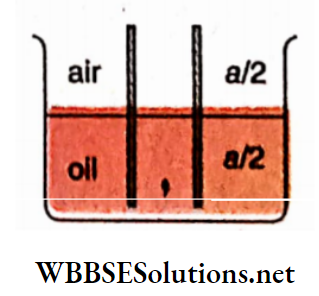
Class 12 Physics Unit 1 Electrostatics Chapter 4 Capacitance and Capacitor Example 13 The capacitance of a parallel plate air capacitor

Capacitance And Capacitor Notes For Class 12 WBCHSE 

Capacitance And Capacitor Combination Of Capacitors

Series combination: in this type of combination of capacitors, the first plate of the first capacitor is joined to the electric source, its second plate is joined to the first plate of the second capacitor, the second plate of the second capacitor is joined to tire first plate of tire third capacitor and so on. The second plate of the last capacitor is grounded, the rest of the system being kept insulated.
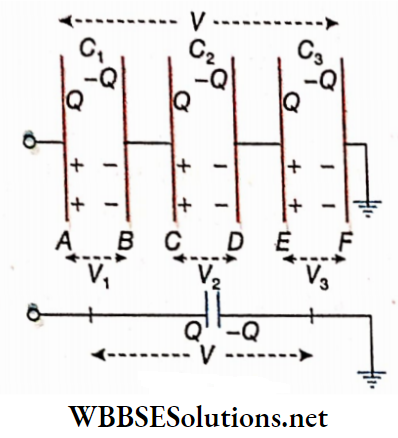
Class 12 Physics Unit 1 Electrostatics Chapter 4 Capacitance and Capacitor Series combination

Calculation of equivalent capacitance: Let three capacitors of capacitances C1, C2, and C3 be connected in series. Now a charge +Q be given from a source to the first plate A of the first capacitor, this will induce a charge -Q on the other plate B of this capacitor and a charge +Q on the first plate C of the second capacitor, and so on. All the capacitors will have the same charge Q. The final free positive charge from the last plate of the system moves to the earth.

If V1, V2, and V3 are the potential differences across the capacitors C3, C2, and C3 and V is the potential difference between the first plate A and the last plate F of the combination, then

V= V1+ V2 + V3 …(1)

For the first capacitor, \(V_1=\frac{Q}{C_1}\)

For the second capacitor, \(V_2=\frac{Q}{C_2}\)

For the third capacitor, \(V_3=\frac{Q}{C_3}\)

∴ From equation (1) we have,

⇒ \(V=\frac{Q}{C_1}+\frac{Q}{C_2}+\frac{Q}{C_3}\)

or, \(V=Q\left(\frac{1}{C_1}+\frac{1}{C_2}+\frac{1}{C_3}\right)\)…..(2)

Now suppose that instead of this combination, a single capacitor is used such that the same charge (Q) given to this new capacitor produces the same potential difference ( V) between its two plates. This single capacitor is known as the equivalent capacitor of the combination and its capacitance is known as the equivalent capacitance

If C is the equivalent capacitance of the series combination of the capacitors C1, C2, and C3, then

V = \(\frac{Q}{C}\)…(3)

From equations (2) and (3) we get,

⇒ \(\frac{Q}{C}=Q\left(\frac{1}{C_1}+\frac{1}{C_2}+\frac{1}{C_3}\right)\)

or, \(\frac{1}{C}=\frac{1}{C_1}+\frac{1}{C_2}+\frac{1}{C_3}\)…(4)

For n number of capacitors connected in series, the equivalent capacitance C is given by,

⇒ \(\frac{1}{C}=\frac{1}{C_1}+\frac{1}{C_2}+\cdots+\frac{1}{C_n}\)…(5)

Thus if several capacitors are connected in series, the reciprocal of the capacitance of the equivalent capacitor is equal to the sum of the reciprocals of the capacitances of the individual capacitors.

Now, \(\frac{1}{C}=\frac{1}{C_1}+\frac{1}{C_2}+\frac{1}{C_3}+\cdots+\frac{1}{C_n}\)

∴ \(\frac{1}{C}>\frac{1}{C_1}, \frac{1}{C_2}, \frac{1}{C_3}, \cdots, \frac{1}{C_n}\)

or, \(C<C_1, C_2, C_3, \cdots, C_n\)

Clearly, for series combinations, the equivalent capacitance is always less than any individual capacitance in the series.

Parallel combination:

In this type, of combination the first plates, i.e., the insulated plates of all the capacitors are connected to a common point A, and the second plates, i.e., the grounded plates to another common point B. Point A is connected to an electric source and point B is earthed
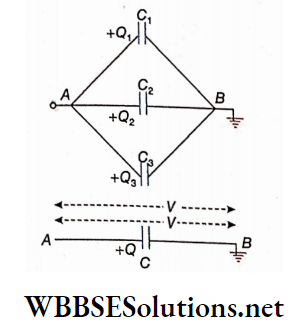
Class 12 Physics Unit 1 Electrostatics Chapter 4 Capacitance and Capacitor Series combination

Calculation of equivalent capacitance: Three capacitors of capacitances C1, C2, and C3 connected in parallel. The insulated plates of the three capacitors are connected to an electric source having potential V and other plates are earthed. So the potential difference between the two plates of each capacitor is V. A charge +Q drawn from the supply divides into Q1, Q2, and Q3 according to the capacity of the different capacitors. So,

Q = Q1 + Q2+ Q3….(6)

For the first capacitor,

Q1 = C1V

For the second capacitor,

Q2 = C2V

For the third capacitor,

Q3 = C3V

∴ From the equation (6) we get,

Q = C1V + C2V + C3V

or, Q = V(C1 + C2 + C3)….(7)

If the capacitors connected in parallel are replaced by a single capacitor so that the same potential difference V is produced if charge +Q is given to its insulated plate, the single capacitor is known as the equivalent capacitor of the combination and its capacitance is known as the equivalent capacitance. If C is the equivalent capacitance of the parallel combination of the capacitors C1, C2, and C3, then

Q = CV…..(8)

From equations (7) anil1(8) we have

CV = V(C1 + C2 + C3)

or, C = C1 + C2 + C3….(9)

For n number of capacitors connected in parallel, the equivalent capacitance C is

C = C1 + C2 + …. + Cn ,

Thus the equivalent capacitance of the capacitors joined in parallel is equal to the sum of their individual capacitances.

Clearly, the equivalent capacitance of a number of capacitors in parallel is greater than any individual capacitance in the combination.

Capacitors are connected in parallel when a large capacitance for a small potential is required.

Capacitance And Capacitor Notes For Class 12 WBCHSE

Unit 1 Electrostatics Chapter 4 Capacitance And Capacitor Combination Of Capacitors Numerical Examples

Example 1. H A condenser Is composed of 21 circular plates placed one after the other. The diameter of each plate is 10 cm. The consecutive plates are separated by 0.2 mm thick mica sheets of dielectric constant 6. If the alternate circular plates are connected, calculate the capacitance of the condenser μF.
Solution:

The condenser is composed of 21 circular plates and alternate plates are connected. So here we get 20 identical capacitors connected in parallel whose capacitance is

⇒ \(C=\frac{20 \kappa \epsilon_0 \alpha}{d}\)

⇒ \(\frac{20 \times 6 \times 8.854 \times 10^{-12} \times \pi \times 2.5 \times 10^{-3}}{2 \times 10^{-4}}\)

= 4.17 x 10⁻⁸

F = 0.0417μF

[Here, k = 6, a = n x (5)2 cm2 = n x 2.5 x 10⁻³ m2, d = 2 x 10⁻⁴m, ∈0 = 8.854 x 10⁻¹² C2.N-1.m2 ]

Example 2. A condenser is composed of 200 circular tin plates placed one after the other. The consecutive plates are separated by 0.5 mm thick mica sheets of dielectric constant 6. If the alternate tin plates are connected and the capacitance of the entire condenser is 0.4μF, what is the radius of each tin plate?
Solution:

The condenser is composed of 200 circular plates and alternate plates are connected. So, here we get 199 identical capacitors connected in parallel. Now capacitance of each capacitor is,

⇒ \(C=\frac{\kappa \alpha}{4 \pi d}=\frac{\kappa \pi r^2}{4 \pi d}=\frac{\kappa r^2}{4 d}\)

∴ \(\frac{\kappa r^2}{4 d} \times 199=0.4 \times 10^{-6} \times 9 \times 10^{11}\) [∵ 0.4μF =0.4 x 10⁻⁶F and IF = 9 x 10¹¹ statF]

or, \(\frac{6 r^2}{4 \times 0.05} \times 199=3.6 \times 10^5\)

or, \(r^2=\frac{3.6 \times 10^5 \times 4 \times 0.05}{6 \times 199}\)

or, r-2 = 60.3

or, r = 7.76

So, the radius of each tin plate = 7.76 cm.

Example 3. The equivalent capacitances of the parallel and the series combinations of two capacitors are 5μF and 1.2μF, respectively. Calculate the capacitances of each capacitor
Solution:

Let the capacitances of the two capacitors be C1μF and C2μF. According to the question,

C1 + C2 = 5…(1)

and \(\frac{C_1 C_2}{C_1+C_2}=1.2\)

or, C1C2 = 1.2 x 5

= 6 ….(2)

or, C1(5-C1)-6 = 0 [with the help of equation (1)]

or, \(C_1^2-5 C_1+6=0\)

or, (C1-3)(C1-2) = 0

∴ C1 = 3 or, 2

If C1 = 3;

C2 = 5-3

= 2

and if C1 = 2;

C2 = 5-2

= 3

So, the capacitances of the two capacitors are 3μF and 2μF.

Example 4. Two capacitors of capacitances 20μF and 60μF are connected in series. If the potential difference between the two ends of the combination is 40 V, calculate the terminal potential differences of each capacitor
Solution:

If C is the equivalent capacitance of the combination,
then

⇒ \(C=\frac{20 \times 60}{20+60}=15 \mu \mathrm{F}=15 \times 10^{-6} \mathrm{~F}\)

∴ The total charge of the combination,

Q = CV

= 15 x 10-6 x 40

= 6 x 10⁻⁴C

Since the two capacitors are connected in series, the charge on each capacitor is equal to the total charge of the combination, i.e., 6 x 10⁻⁴C.

∴ The potential difference between the two plates of the capacitor having capacitance C1 is,

⇒ \(V_1=\frac{Q}{C_1}=\frac{6 \times 10^{-4}}{20 \times 10^{-6}}\)

= 30 V

Again, the potential difference between the two plates of the capacitor having capacitance C2 is,

⇒ \(V_2=\frac{Q}{C_2}=\frac{6 \times 10^{-4}}{60 \times 10^{-6}}\)

= 10V

Example 5. A charged condenser is made to share its charge with an uncharged condenser of twice its capacitance. Find the sum of the energy of the two condensers.
Solution:

Let the capacitance of the charged condenser be C and let its charge be Q.

Before sharing of charge, the energy of the charged condenser is,

⇒ \(E_1=\frac{Q^2}{2 C}\)

The capacitance of the other condenser = 2C; since the charged condenser is made to share its charge with the second condenser, it is clear that the condensers are connected in parallel with each other.

∴ Equivalent capacitance of them

= C + 2C

= 3C

∴ Energy of the combination = \(=\frac{1}{2} \cdot \frac{Q^2}{3 C}=\frac{1}{3} \cdot \frac{1}{2} \frac{Q^2}{C}=\frac{1}{3} E_1\)

WBCHSE Class 12 Physics Chapter 4 Solutions

Example 6. A spherical drop of water carries a charge of 10 X 10-12 C and has a potential of 100 V at its surface.

  1. What is the radius of the drop?
  2. If eight such charged drops combine to form a single drop, what will be the potential at the surface of the new drop?

Solution:

1. Charge of a spherical water drop,

Q = 10 x 10-12C

= 10 x 10-12 x 3 x 109 esu of charge

= 3 x 10⁻² esu of charge

Potential of the drop, \(V=\frac{100}{300}=\frac{1}{3} \text { stat } \mathrm{V}\)

The capacitance of the drop,

⇒ \(C=\frac{Q}{V}=\frac{3 \times 10^{-2}}{\frac{1}{3}}\)

= 0.09 statF

In CGS units, the radius of a spherical conductor = its capacitance.

The radius of the drop, r = 0.09 cm.

2. If R is the i&dius of the large drop, then

⇒ \(\frac{4}{3} \pi R^3=8 \times \frac{4}{3} \pi r^3\)

or, R = 2r

= 2x 0.09

= 0.18 cm

Total charge, Q = 8 x 3 x 10-2

= 24 x 10-2 statC

∴ Potential at the surface of the new drop,

⇒ \(V=\frac{Q}{C}=\frac{Q}{R}=\frac{24 \times 10^{-2}}{0.18}=\frac{4}{3}\)

= 1.33 statV

= 1.33 X 300 V

= 400 V

Example 7. Three plates of the same size form a system of capacitors. Each plate has an area a. The intermediate differences between the plates are d1 and d2, respectively. The space between the first two plates is occupied by a dielectric of constant and that between the second and third plates by a dielectric of constant K2. Calculate the capacitance of the system.
Solution:

The three plates form two capacitors connected in series.

The capacitance of the first capacitor,

⇒ \(C_1=\frac{\kappa_1 \epsilon_0 \alpha}{d_1}\)

The capacitance of the second capacitor

⇒ \(C_2=\frac{\kappa_2 \epsilon_0 \alpha}{d_2}\)

If C is the equivalent capacitance of the whole system, then

⇒ \(\frac{1}{C}=\frac{1}{C_1}+\frac{1}{C_2}=\frac{d_1}{\kappa_1 \epsilon_0 \alpha}+\frac{d_2}{\kappa_2 \epsilon_0 \alpha}=\frac{1}{\epsilon_0 \alpha}\left(\frac{d_1}{\kappa_1}+\frac{d_2}{\kappa_2}\right)\)

∴ \(C=\epsilon_0 \alpha \cdot \frac{1}{\frac{d_1}{\kappa_1}+\frac{d_2}{\kappa_2}}\)
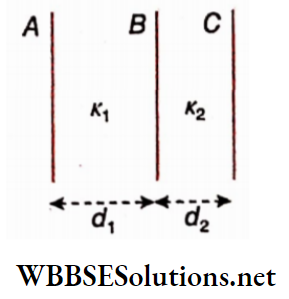
Class 12 Physics Unit 1 Electrostatics Chapter 4 Capacitance and Capacitor Example 7 Three plates of the same size form a system of capacitors

Example 8. The capacitance of a parallel plate air capacitor is 9 pF. The separation between the plates is d. The intermediate space is filled up by two dielectric media. The widths of them are,\(\frac{d}{3} \text { and } \frac{2 d}{3}\), and their dielectric constants are 3 and 6, respectively. Find the capacitance of the parallel plate capacitor.
Solution:

As the capacitors are connected in series the equivalent capacitance,

⇒ \(C_{\mathrm{eq}}=\frac{C_1 C_2}{C_1+C_2}\)

We know that,

⇒ \(C_1=\kappa_1 \frac{\epsilon_0 A}{\frac{d}{3}} \text { and } C_2=\kappa_2 \frac{\epsilon_0 A}{\frac{2 d}{3}}\) [where A = area of each plate]
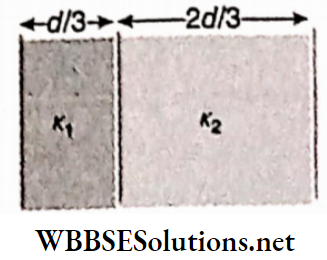
Class 12 Physics Unit 1 Electrostatics Chapter 4 Capacitance and Capacitor Example 8 The capacitance of a parallel plate air capacitor

Putting the values of C1 and C2 in equation (1),

⇒ \(C_{\mathrm{eq}}=\frac{\frac{\epsilon_0 A}{\frac{d}{3}} \times \frac{\epsilon_0 A}{\frac{2 d}{3}} \times \kappa_1 \kappa_2}{\frac{\epsilon_0 A}{\frac{d}{3}}\left(\kappa_1+\frac{\kappa_2}{2}\right)}\)

∵ \(\frac{\epsilon_0 A}{d}=9 \mathrm{pF} \text { and } \kappa_1=3, \kappa_2=6\)

So, \(C_{\text {eq }}=\frac{3 \times 9 \times 3 \times \frac{9}{2} \times 3 \times 6}{3 \times 9\left(3+\frac{6}{2}\right)}\)

= 40.5 pF

Example 9. Three capacitors having capacitances 1μF, 2μF, and 3μF are Joined in series. A potential difference of 1100 V is applied to the combination. Find the charge and potential difference across each capacitor.
Solution:

If C is the equivalent capacitance of the combination, then,

⇒ \(\frac{1}{C}=\frac{1}{1}+\frac{1}{2}+\frac{1}{3}=\frac{11}{6} \text { or, } C=\frac{6}{11} \mu \mathrm{F}=\frac{6}{11} \times 10^{-6} \mathrm{~F}\)

∴ The total charge of the combination,

Q = CV

= \(\frac{6}{11}\) x 10-6 x 1100

= 6 x 10⁻⁴ c

Since the capacitors are connected in series, the charge on each capacitor is equal to the total charge, i.e., 6 x 10⁻⁴ C. Potential difference across the plates of the first capacitor,

⇒ \(V_1=\frac{Q}{C_1}=\frac{6 \times 10^{-4}}{1 \times 10^{-6}}=600 \mathrm{~V}\)

Similarly, for the other two capacitors, respectively,

⇒ \(V_2=\frac{Q}{C_2}=\frac{6 \times 10^{-4}}{2 \times 10^{-6}}=300 \mathrm{~V}\)

and, \(V_3=\frac{Q}{C_3}=\frac{6 \times 10^{-4}}{3 \times 10^{-6}}=200 \mathrm{~V}\)

WBCHSE Class 12 Physics Chapter 4 Solutions

Example 10. Two capacitors having capacitances 0.1μV and 0.01μF are joined in series. A potential difference of 22 V is applied to the combination. If the capacitors are now joined in parallel, what will be the change in stored energy?
Solution:

If the capacitors are joined in series, their equivalent capacitance,

⇒ \(C_s=\frac{C_1 \times C_2}{C_1+C_2}=\frac{0.1 \times 0.01}{0.1+0.01}=\frac{1}{110} \mu \mathrm{F}=\frac{10^{-6}}{110} \mathrm{~F}\)

∴ Energy stored in the combination,

⇒ \(E_1=\frac{1}{2} C_s V^2=\frac{1}{2} \times \frac{10^{-6}}{110} \times(22)^2 \mathrm{~J}\)

= 22 erg

If the capacitors are joined in parallel, their equivalent capacitance,

Cp = C1 + C2

= 0.1 + 0.01

= 0.11μF

= 0,11 x 10⁻⁶F

∴ Energy stored in this combination,

⇒ \(E_2=\frac{1}{2} C_p V^2=\frac{1}{2} \times 0.11 \times 10^{-6} \times(22)^2 \mathrm{~J}\)

= 266.2 erg

The change in stored energy = E2-E1

= 266.2- 22

= 244.2 erg

∴ Stored energy increases by 244.2 erg.

Example 11. Five capacitors have been arranged in a circuit. The capacitance of each capacitor is C. Determine the effective capacitance between points A and B.
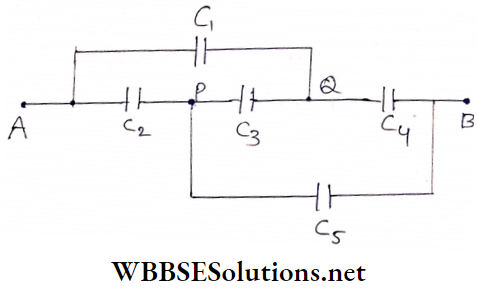
Class 12 Physics Unit 1 Electrostatics Chapter 4 Capacitance and Capacitor Example 11 Five capacitors have been arranged in a circuit

Solution:

The equivalent circuit is like that,
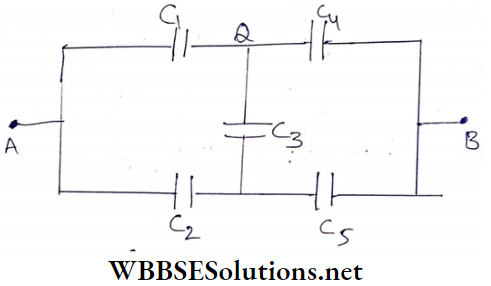
Class 12 Physics Unit 1 Electrostatics Chapter 4 Capacitance and Capacitor Example 11 Equivalent circuitc

From symmetries see that P and Q are equipotential points. So no current will pass through C3.

So, the effective capacitance between A and B \(=\frac{C}{2}+\frac{C}{2}=C\)

Example 12. Show that the equivalent capacitance of an infinite circuit formed by the repetition of a similar loop made of two similar capacitors, each of capacitance C = (√5 + l) μF, is 2μF.
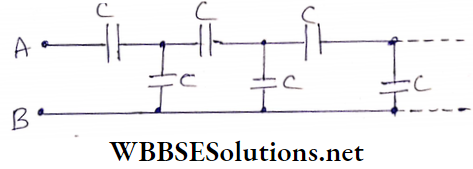
Class 12 Physics Unit 1 Electrostatics Chapter 4 Capacitance and Capacitor Example 12 the equivalent capacitance

Solution:

Let the capacitance of the infinite circuit be C’.

So the circuit on the right-hand side starting from the second loop is also infinite. Therefore, its capacitance will also be C’.

In this case, the equivalent circuit will be that
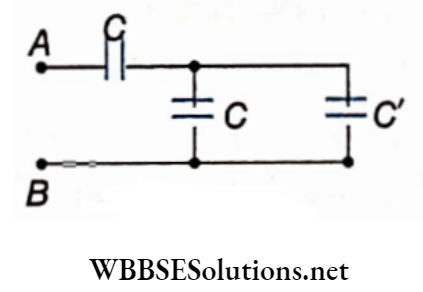
Class 12 Physics Unit 1 Electrostatics Chapter 4 Capacitance and Capacitor Example 12 the equivalent capacitance.

∴ \(\frac{1}{C^{\prime}}=\frac{1}{C}+\frac{1}{C^{\prime}+C}\)

or, \(\frac{1}{C^{\prime}}-\frac{1}{C^{\prime}+C}=\frac{1}{C}\)

or, \(\frac{C^{\prime}+C-C^{\prime}}{C^{\prime}\left(C^{\prime}+C\right)}=\frac{1}{C}\)

or, \(C^{\prime 2}+C^{\prime} C-C^2=0\)

or, \(C^{\prime}=\frac{-C \pm \sqrt{C^2+4 C^2}}{2}=\frac{(-1 \pm \sqrt{5}) C}{2}\)

Neglecting the negative value of C’ we have

⇒ \(C^{\prime}=\frac{(\sqrt{5}-1) C}{2}=\frac{(\sqrt{5}-1)}{2} \cdot(\sqrt{5}+1)\)

= 2μF

Example 13. Twelve capacitors, each of capacitance 10μF, are inserted at the sides of a cube made of conducting wires. Determine the equivalent capacitance between A and B.
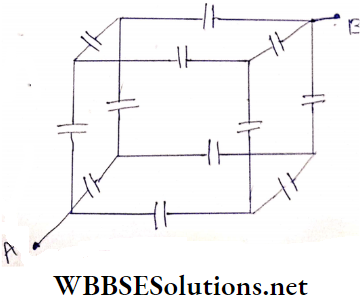
Twelve capacitors, each of capacitance

Solution:

Let a charge Q be given to the circuit from a source. The distribution of charge in the different capacitors has been shown

Let C’ be the equivalent capacitance between the points A and B.

Capacitance of each capacitor = C = 10μF

∴ \(V_{\text {A}}-V_B=\frac{Q}{C^{\prime}}\)….(1)

Again considering the path AMNB we have,

⇒ \(V_A-V_B=\frac{Q}{\frac{3}{C}}+\frac{Q}{C}+\frac{Q}{C}=\frac{Q}{3 C}+\frac{Q}{6 C}+\frac{Q}{3 C}=\frac{5}{6} \cdot \frac{Q}{C}\)…(2)
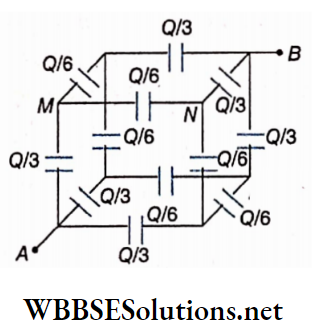
Class 12 Physics Unit 1 Electrostatics Chapter 4 Capacitance and Capacitor Example 13 Twelve capacitors, each of capacitance.

∴ From equations (1) and (2) we have,

⇒ \(\frac{Q}{C^{\prime}}=\frac{5}{6} \cdot \frac{Q}{C}\)

or, \(C^{\prime}=\frac{6 C}{5}=\frac{6}{5} \times 10\)

= 12μF

Example 14. Two identical parallel plate air capacitors are connected to a battery. At first, the key S is closed and then It is opened. The spaces between the two capacitors are now filled up with a dielectric trie, having dielectric constant 3. Determine the ratio of the energy stored in the two capacitors before and after insertion of the dielectric.
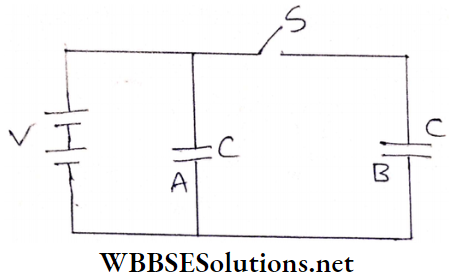
Capacitance and Capacitor two identical parallel plate air capacitors

Solution:

When the key was closed, the potential of each capacitor was equal.

Let this value ofpotential be V.

Energy of the capacitor A = \(\frac{1}{2}\) CV²

and energy of the capacitor B = \(\frac{1}{2}\) CV²

∴ Total energy = \(\frac{1}{2} C V^2+\frac{1}{2} C V^2=C V^2\)

When the key is opened and the intervening space is filled up with the dielectric, the capacitance of each capacitor becomes 3C. Since the capacitor A is still connected to the battery, its potential remains at V.

∴ The energy of the capacitor A

⇒ \(\frac{1}{2} \times 3 C \times V^2\)

= \(\frac{3}{2} C V^2\)

The total charge of the capacitor B, Q = CV

This charge of B remains unaltered even after opening the key and inserting the dielectric.

Energy of \(B=\frac{1}{2} \cdot \frac{Q^2}{3 C}\)

= \(\frac{1}{2} \frac{C^2 V^2}{3 C}\)

= \(\frac{C V^2}{6}\)

∴ Energy of the two capacitors \(\frac{3}{2} C V^2+\frac{1}{6} C V^2\)

= \(\frac{5}{3} C V^2\)

∴ The required ratio = \(\frac{C V^2}{\frac{5}{3} C V^2}\)

= \(\frac{3}{5}\)

WBCHSE Class 12 Physics Chapter 4 solutions

Example 15. Determine the capacitance A of the capacitor C when the equivalent capacitance between A and B is 1μF. The unit of all the capacitances is μF.
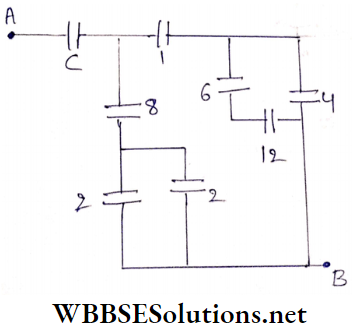
Capacitance and Capacitor equivalent capacitance

Solution:

The two capacitors of capacitance 6μF and 12μF are connected in series. If C1 is their equivalent capacitance, then

⇒ \(C_1=\frac{6 \times 12}{6+12}=4 \mu \mathrm{F}\)

This C1 and the capacitor of capacitance 4μF are connected in parallel. If C2 is their equivalent capacitance, then

C2 = 4 + 4

= 8μF

Again C2 and the capacitor of capacitance 1μF are connected in series. If C3 be their equivalent capacitance, then

⇒ \(C_3=\frac{8 \times 1}{8+1}=\frac{8}{9} \mu \mathrm{F}\)

On the other side, the capacitors of capacitance 2μF each arein parallel. If C4 is their equivalent capacitance, then

C4 = 2 + 2

= 4μF

Again C4 and the capacitor of capacitance 8mmF are in series.If C5 be their equivalent capacitance, then

⇒ \(C_5=\frac{4 \times 8}{4+8}=\frac{8}{3} \mu \mathrm{F}^{\prime}\)

Now C3 and C5 are in parallel combination. Their equivalent capacitance is given by,

⇒ \(C_6=\frac{8}{9}+\frac{8}{3}=\frac{32}{9} \mu \mathrm{F}\)

This C6 and C are in series and their equivalent capacitance = 1μF.

∴ \(\frac{\frac{32}{9} \times C}{\frac{32}{9}+C}=1\)

or, \(\frac{32}{9} \times C=\frac{32}{9}+C\)

or, \(\frac{23}{9} C=\frac{32}{9}\)

or, \(C=\frac{32}{23}=1.39 \mu \mathrm{F}\)

Example 16. Three capacitors A, B, and C are connected in such a way that their equivalent capacitance Is equal to the capacitance of B. The capacitances of A and B are 10μF and 30μF respectively and C ≠ 0. Determine three possible values of C and also show how the capacitors are to be connected in the three cases.
Solution:

The capacitor B cannot be joined in parallel to any combination of the capacitors A and C because in that case, the equivalent capacitance will be greater than the capacitance of B. The following three combinations are possible.
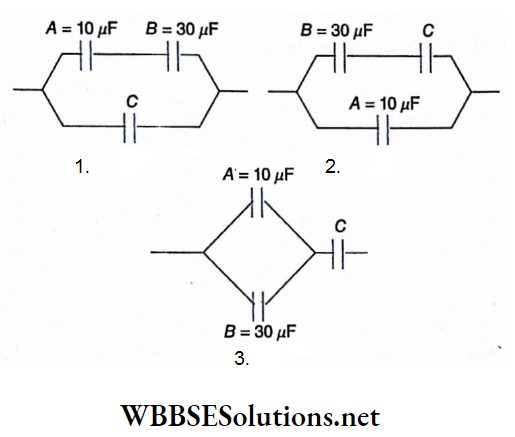
Class 12 Physics Unit 1 Electrostatics Chapter 4 Capacitance and Capacitor Example 16 equivalent capacitance

1. A and B are connected in series. Now C is connected in parallel with the series combination of A and B.

According to the question,

⇒ \(\frac{10 \times 30}{10+30}+C=30\)

or, \(\frac{300}{40}+C=30\)

or, C = 22.5μF

2. B and C are connected in series. Now A is connected in parallel with the series combination of B and C.

According to the question,

⇒ \(\frac{30 \times C}{30+C}+10=30\)

or, \(\frac{30 \times C}{30+C}=20\)

or, C = 60μF

3. A and B are connected in parallel. Now C is connected in series with the parallel combination of A and B.

According to the question,

⇒ \(\frac{40 \times C}{40+C}=30\)

or, 3(40 + C) = 4C

or, C = 120μF

Example 17. Two parallel plate capacitors of capacitances C and 2C are connected parallel and charged to a potential difference V. The battery then disconnected and the region between the plates of the capacitor C is completely filled with a material of dielectric constant k. What is the potential difference across the capacitors now?
Solution:

If charges Q1 and Q2 are given to the capacitors, then

Q1 = CV; Q2 = 2CV

∴ Total charge = Q1 + Q2

= CV+ 2CV

= 3CV

If the region between the plates of capacitor C is filled with a material of dielectric constant K, its capacitance will be kC.

∴ Total capacitance = kC+2C = (k + 2)C

∴ Potential difference across the capacitors = \(\frac{3 C V}{(\kappa+2) C}=\frac{3 V}{\kappa+2}\)

Class 12 WBCHSE Physics Capacitor Concepts

Example 18. A potential difference of 20 V is applied across a parallel combination of three Identical capacitors. If the total charge in the combination is 30 C, determine the capacitance of each capacitor. What will be the charge of the series combination of these three capacitors with the same potential difference?
Solution:

Let the capacitance of each capacitor be C.

The potential difference across each capacitor when they are connected in parallel combination, V = 20 V.

∴ Charge on the three capacitors,

Q1 = Q2 = Q3 = CV

∴ Q1 + Q2 + Q3 = 3CV

or, 30 = 3 X C X 20

= 60C

or, C = \(\frac{1}{2}\)

= 0.5F

∴ The capacitance of each capacitor = 0.5 F

In the second case when the capacitors are connected in series, let us suppose that the equivalent capacitance is C’

∴ \(\frac{1}{C^{\prime}}=\frac{1}{C}+\frac{1}{C}+\frac{1}{C}=\frac{3}{C}\)

or, \(C^{\prime}=\frac{C}{3}=\frac{0.5}{3}=\frac{1}{6} \mathrm{~F}\)

In this case, the total charge of the combination,

⇒ \(Q_i^{\prime}=C^{\prime} V\)

= \(\frac{1}{6} \times 20\)

= \(\frac{10}{3}\)

= 3.33 C

Example 19. The capacitance of a parallel plate air capacitor is C. Now, half the areas of its plates are vertically dipped in oil of dielectric constant 1.6. What would be Its capacitance?
Solution:

The upper half would still be an air capacitor. As the plate areas are halved, its capacitance, C1 = \(\frac{C}{2}\). The lower half, immersed in oil, would have a capacitance, C2 = \(\frac{kC}{2}\). C1 and C2 would form a parallel combination; the equivalent capacitance,

\(C^{\prime}=C_1+C_2=\frac{C}{2}+\frac{\kappa C}{2}=\frac{C}{2}(1+\kappa)\)

= \(\frac{C}{2}\)(1 + 1.6)

= 1.3C

Example 20. Each of the plates of a parallel plate capacitor is a circular disc of radius 5 cm. Find out its capacitance if the separation between the plates is 1 mm.
Solution:

The radius of each plate, r = 5 cm = 0.05 m.

Separation between the plates, d = 1 mm = 0.001 m.

∴ Capacitance, \(C=\frac{\epsilon_0 \alpha}{d}=\frac{\epsilon_0 \pi r^2}{d}\)

= \(\frac{\left(8.85 \times 10^{-12}\right) \times 3.14 \times(0.05)^2}{0.001}\)

= 6.95 X 100-11 F

= 69.5 pF

Example 21. A 2μF capacitor is charged to a potential of 20 V. Another 3μF uncharged capacitor is connected in parallel with the first capacitor. What would be the minimum potential difference of the combination? Find out the charges on the two capacitors
Solution:

Initially, the charge on the first capacitor,

Q1 = C1V1

= (2 x 10-6) x 20

= 40 x 10-6 C

and charge on the second capacitor, as it was uncharged, Q2 = 0.

∴ Net charge, Q = Q1 + Q2

= 40 x 10-6 C

Equivalent capacitance of the parallel combination,

C = C1 + C2

= (2 + 3)μF

= 5 X 10⁻⁶ F

∴ Terminal potential difference of the combination,

⇒ \(V=\frac{Q}{C}=\frac{40 \times 10^{-6}}{5 \times 10^6}=8 \mathrm{~V}\)

Charge on the first capacitor,

Q1 = C1V

= (2 x 10-6)x 8

= 16 x 10-6 C

= 16μC

and charge on the second capacitor,

Q2 = C2V

= (3 X 10-6) X 8

= 24 X 10-6 C

= 24pC

Class 12 WBCHSE Physics Capacitor Concepts

Example 22. A 20μF capacitor is charged to a potential of 20 V and is then connected to an uncharged 10μF capacitor. Find out the common potential and the ratio of the energies stored in the two capacitors.
Solution:

Here, the capacitance of the first capacitor,

C1 = 20μF

= 20 x 10-6 F

The capacitance of the second capacitor,

C2 = 10μF

= 10 x 10-6 F

Initially, the charge on the first capacitor,

Q1 = C1V1

= (20 X 10-6) X 20

= 400 X 10-6 C

and the charge on the second capacitor, as it was uncharged, Q2 = 0.

∴ Net charge, Q = Q1 + Q2

= 400 x 10-6 C

A parallel combination of the capacitors attains a common potential, say V.

Equivalent capacitance,

C = C1 + C2

= (20 + 10) x 10-6 F

= 30 x 10-6 F

⇒ \(V=\frac{Q}{C}=\frac{400 \times 10^{-6}}{30 \times 10^{-6}}=\frac{40}{3}\)

= 13.33V

The ratio of the energies stored in the two capacitors is,

⇒ \(\frac{E_1}{E_2}=\frac{\frac{1}{2} C_1 V^2}{\frac{1}{2} C_2 V^2}=\frac{C_1}{C_2}=\frac{20}{10}=\frac{2}{1}\)

Example 23. How should three capacitors of capacitances 3μF, 3μF and 6μF, be connected to get an equivalent capacitance of 5μF?
Solution:

For a parallel connection of all three capacitors, the 1 equivalent capacitance = 3 + 3 + 6

= 12μF; it is greater than 5μF.

Again, for a series connection, if the equivalent capacitance is C, then

⇒ \(\frac{1}{C_s}=\frac{1}{3}+\frac{1}{3}+\frac{1}{6}=\frac{5}{6}\)

or, \(C_s=\frac{6}{5}=1.2 \mu \mathrm{F}\) ; it is less than 5μF.

So, the above two connections are not applicable. Then, the following four arrangements are possible.
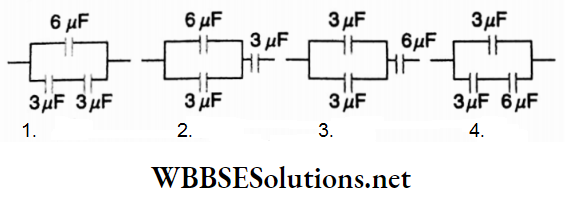
Class 12 Physics Unit 1 Electrostatics Chapter 4 Capacitance and Capacitor Example 23 three capacitors of capacitances

Now, for arrangement (1), the equivalent capacitance is clearly greater than 6μF; so it cannot be 5μF.

For the arrangement (2), equivalent capacitance

= \(\frac{(6+3) \times 3}{(6+3)+3}=2.25 \mu \mathrm{F}\)

For the arrangement (3), equivalent capacitance

= \(\frac{(3+3) \times 6}{(3+3)+6}=3 \mu \mathrm{F}\)

For the arrangement (4), equivalent capacitance

= \(3+\frac{3 \times 6}{3+6}=5 \mu \mathrm{F}\)

So, the arrangement (4) represents the desired connection.

Class 12 WBCHSE Physics Capacitor Concepts

Example 24. The capacitance of a parallel plate capacitor with plate area A and separation s is C. The space between the plates is filled with two wedges of dielectric constants k1 and k2 Find the capacitance of the resultant capacitor.
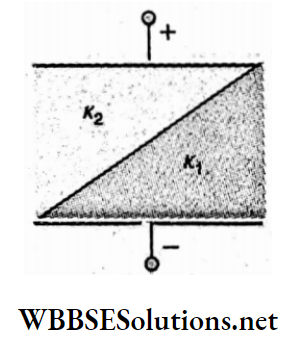
Class 12 Physics Unit 1 Electrostatics Chapter 4 Capacitance and Capacitor Example 24 The capacitance of a parallel plate capacitor

Solution:

Let the length of the capacitor plates be l and width b.

Area of each plate, A = lb

Now consider a small element of the capacitor of width dx at a distance x from the end. Its area, dA = bdx

The capacitance of this small element

⇒ \(d C=\frac{\epsilon_0 d A}{\frac{y}{\kappa_1}+\frac{s-y}{\kappa_2}}\)

According,

⇒ \(\frac{y}{x}=\frac{s}{l}=\tan \theta\)

∴ \(d C=\frac{\epsilon_0 b d x}{\frac{x \tan \theta}{\kappa_1}+\frac{s-x \tan \theta}{\kappa_2}}\)

∴ \(C=\int_0^l d C=\int_0^l \frac{\epsilon_0 b(d x) \kappa_1 \kappa_2}{\kappa_2 x \tan \theta+\kappa_1(s-x \tan \theta)}\)

Putting tanθ = \(\frac{s}{l}\)

⇒ \(C=\int_0^l \frac{\epsilon_0 A \kappa_1 \kappa_2 d x}{s \kappa_2 x+(l-x) s \kappa_1}=\frac{\epsilon_0 A \kappa_1 \kappa_2}{s\left(\kappa_2-\kappa_1\right)} \log _e \frac{\kappa_2}{\kappa_1}\)
Class 12 Physics Unit 1 Electrostatics Chapter 4 Capacitance and Capacitor Example 24 The capacitance of a parallel plate capacitor.

Examples of Capacitor Calculations

Example 25. Consider a parallel plate capacitor of plate separation d. Each plate has the length l and the width a. A dielectric slab of permittivity e and thickness d is partially inserted between the plates. The plates are kept at a constant potential difference V. If x is the length of the dielectric slab within the plates, determine the force exerted on the slab.
Class 12 Physics Unit 1 Electrostatics Chapter 4 Capacitance and Capacitor Example 25 parallel plate capacitor

Solution:

As per the diagram, the system may be regarded as the parallel combination of two capacitances C1 and C2. The part containing the dielectric of permittivity e has capacitance q and the other part (through free space) has capacitance C2.

Hence, \(C_1=\frac{\epsilon a x}{d}\)

and \(C_2=\frac{\epsilon_0 a(l-x)}{d}\)

∴ Equivalent capacitance is,

⇒ \(C=C_1+C_2\)

= \(\frac{a}{d}\left[\left(\epsilon-\epsilon_0\right) x+\epsilon_0 l\right]\)

Now electrostatic energy of the system is

⇒ \(U=\frac{1}{2} C V^2\)

= \(\frac{1}{2} \frac{a}{d}\left[\left(\epsilon-\epsilon_0\right) x+\epsilon_0 l\right] V^2\)

∴ V is constant, the force experienced by the slab is,

⇒ \(F_x=\frac{d U}{d x}\)

= \(\frac{a}{2 d}\left(\epsilon-\epsilon_0\right) V^2\)

Example 26. A parallel plate capacitor of capacitance C Is connected to a battery to charge to a potential V. Similarly, another capacitor of capacitance 2C is charged to a potential 2V. Now the batteries are removed, and the two capacitors are connected in parallel by joining the positive plate of one with the negative plate of the other. Find out the final energy of the system.
Solution:

Charge on the first capacitor of capacitance C and connected to the battery of voltage V is,

Q1 = CV

Similarly charge on the second capacitor,

Q2 = (2C) x (2 V)

= 4CV

Since the plates of opposite polarity are connected together, the common potential is,

⇒ \(V^{\prime}=\frac{Q_2-Q_1}{C_1+C_2}=\frac{4 C V-C V}{C+2 C}=V\)

Now equivalent capacitance,

C’ = C+2C

= 3C

So final energy of the configuration,

⇒ \(U_f=\frac{1}{2} C^{\prime}\left(V^{\prime}\right)^2\)

= \(\frac{1}{2} \times 3 C \times V^2\)

= \(\frac{3}{2} C V^2\)

Capacitance Derivations For Class 12 WBCHSE

Example 27.  In the circuit, the values of the capacitances of the four capacitors are C1 = C, C2 = 2C, C3 = 3C and C4 = 4C. Find out the ratio between the charges on C2 and C4
Class 12 Physics Unit 1 Electrostatics Chapter 4 Capacitance and Capacitor Example 27 values of the capacitances of the capacitors

Solution:

Here C1 = C, C2 = 2C, C3 = 3C and C4 = 4C.

C1, C2, and C3 are connected in series, so equivalent capacitance is,

⇒ \(\frac{1}{C_{123}}=\frac{1}{C}+\frac{1}{2 C}+\frac{1}{3 C}=\frac{11}{6 C}\)

∴ \(C_{123}=\frac{6 C}{11}\)

Let q1, q2, q3 and q4 be the charges of the capacitors C1, C2, C3 and C4 respectively.

As C1, C2, and C3 are in series, the charge on them is the same.

∴ \(q_1=q_2=q_3=C_{123} \times V=\frac{6 C V}{11}\)

Again charge on capacitor C4 is,

Q4 = C4 x V

= 4CV

So, \(\frac{\text { charge on } C_2}{\text { charge on } C_4}=\frac{\frac{6 C V}{11}}{4 C V}\)

∴ \(\frac{q_2}{q_4}=\frac{6}{4 \times 11}=\frac{3}{22}\)

∴ q2: q4 = 3: 22

Example 28. Five capacitors, capacitance 10μF, form a network. The network is connected to a 100 V dc supply. Calculate the equivalent capacitance between A and B, and the charge accumulated in the network.
Class 12 Physics Unit 1 Electrostatics Chapter 4 Capacitance and Capacitor Example 28 Calculate the equivalent capacitance

Solution:

The given network is a balanced bridge so the middle part (CD) does not play any role.

So equivalent capacitance of branch ACB is,

⇒ \(C_{A C B}=\frac{10 \times 10}{10+10}=5 \mu \mathrm{F}\) [∴ capacitors in branches AC and CB are in series]

Similarly equivalent capacitance of branch ADB is,

⇒ \(C_{A D B}=\frac{10 \times 10}{10+10}=5 \mu \mathrm{F}\)

∴ Equivalent capacitance for the whole network is,

Cwhole = (5 + 5)μF

= 10μF

Now charge accumulated in branch ACB is,

qACB = CACB x V

= 5 x 10-6 x 100C

and charge accumulated in branch ADB,

qADB = CADB x V

= 5 x 10-6 x 100 C

∴ Total charge accumulated in the whole network,

q = qACB + qADB

= 10 x 10-6 x 100 C

= 10-3 C

Example 29. In the network of the capacitance of each capacitor is 1μF. Determine the equivalent capacitance between P and Q.
Class 12 Physics Unit 1 Electrostatics Chapter 4 Capacitance and Capacitor Example 29 capacitance of each capacitor

Solution:

Let C1, C2, C3, C4, …∞ be the capacitances of the capacitors contained in the first row, second row, third row, fourth row, and so on.

Since the capacitors are in series in each row, the equivalent capacitances for the rows are given by,

C1 = 1μF

⇒ \(C_2=\frac{1 \times 1}{1+1}=\frac{1}{2} \mu \mathrm{F}\)

⇒ \(\frac{1}{C_3}=\frac{1}{1}+\frac{1}{1}+\frac{1}{1}+\frac{1}{1}=4\)

∴ \(C_3=\frac{1}{4} \mu \mathrm{F}\)

Similarly,

⇒ \(\frac{1}{C_4}=\frac{1}{1}+\frac{1}{1}+\frac{1}{1}+\frac{1}{1}+\frac{1}{1}+\frac{1}{1}+\frac{1}{1}+\frac{1}{1}=8\)

∴ \(C_4=\frac{1}{8} \mu \mathrm{F}\)

Hence, the equivalent capacitance of the infinite number of rows,

⇒ \(C_{\mathrm{eq}}=C_1+C_2+C_3+C_4+\cdots+\infty\) [∵ they are connected in parallel]

∴ \(C_{\mathrm{eq}}=1+\frac{1}{2}+\frac{1}{4}+\frac{1}{8}+\cdots \infty\)

∴ Sum of the infinite geometric progression is given by,

⇒ \(C_{\mathrm{eq}}=\frac{1}{1-\frac{1}{2}}\)

∴ \(C_{\mathrm{eq}}=2 \mu \mathrm{F}\)

This is equivalent capacitance.

Capacitance Derivations For Class 12 WBCHSE

Example 30. A 0.1 F capacitor is charged by a 10 V battery. After disconnecting the battery, this charged capacitor is connected with an uncharged capacitor. If the charge is equally shared between the two, then what will be the energy stored in the two capacitors? Compare this energy with the energy stored initially in the first capacitor.
Solution:

Let C1 and C2 be the capacitances of the capacitors and their voltages be V1 and V2 respectively.

Given C1 = 0.1 F,

initially V1 = 10 V

and V2 = 0.

∴ The initial energy stored in the two capacitors is,

⇒ \(U_i=\frac{1}{2} C_1 V_1^2+\frac{1}{2} C_2 V_2^2\)

= \(\frac{1}{2}\) x 0.1 x (10)² + 0

= 5J

It Q is the initial charge on capacitor C1, its initial energy is,

⇒ \(U_i=\frac{Q^2}{2 C_1}\)

When the two capacitors are connected together, the charge is distributed equally, so the charge on each capacitor is \(\frac{Q}{2}\). Since the potential difference (in a parallel connection) across the two capacitors is also the same, it follows that their capacitances are equal.

Thus, C1 = C2 = C (say)

Also, Q1 = Q2 = \(\frac{Q}{2}\)

∴ The final energy stored in the two capacitors is

⇒ \(U_f=\frac{Q_1^2}{2 C_1}+\frac{Q_2^2}{2 C_2}=\frac{\left(\frac{Q}{2}\right)^2}{2 C}+\frac{\left(\frac{Q}{2}\right)^2}{2 C}=\frac{Q^2}{4 C}\)

But, \(U_i=\frac{Q^2}{2 C}, \text { hence } U_f=\frac{U_i}{2}=2.5 \mathrm{~J}\)

Thus, \(\frac{U_f}{U_i}=\frac{2.5}{5}=\frac{1}{2}\)

Concepts of Dielectric Materials in Capacitors

Example 31. The equivalent capacitance of two capacitors connected in series and in parallel are Cs and Cp respectively. Determine the capacitance of each capacitor.
Solution:

Let C1 and C2 be the values of the two capacitances.

According to the question,

C1 + C2 = Cp…(1)

⇒ \(\frac{C_1 C_2}{C_1+C_2}=C_s\)…(2)

From equations (1) and (2),

\(\frac{C_1 C_2}{C_p}=C_s\)

∴ \(C_2=\frac{C_p C_s}{C_1}\)

Using this value in equation (1)

⇒ \(C_1+\frac{C_p C_s}{C_1}=C_p \quad\)

or, \(C_1^2-C_p C_1+C_p C_s=0\)

∴ \(C_1=\frac{C_p \pm \sqrt{C_p^2-4 C_p C_s}}{2}\)

Using the positive sign (+) for C1, we have,

So, the two capacitances are,

⇒ \(\frac{1}{2}\left[C_p+\sqrt{C_p^2-4 C_p C_s}\right] \text { and } \frac{1}{2}\left[C_p-\sqrt{C_p^2-4 C_p C_s}\right]\)

Capacitance Derivations For Class 12 WBCHSE

Unit 1 Electrostatics Chapter 4 Capacitance And Capacitor Different Types Of Capacitors

Nowadays, different types of capacitors are used for practical purposes. Some of them are discussed below.

Mica capacitor or block capacitor:

This is actually a parallel combination of a few parallel plate capacitors having a fixed capacitance. It consists of a number of metal sheets with mica as a dielectric between them. The alternate sheets are connected to A while the others are to B. If a potential difference is applied between A and B, the capacitor becomes charged.

If α be the area of each metal plate, d is the distance between two plates, K is the dielectric constant of mica and n is the number of metal plates, then the capacitance of such a capacitor in SI is given by
Class 12 Physics Unit 1 Electrostatics Chapter 4 Capacitance and Capacitor Mica capacitor or block capacitor

⇒ \(C=\frac{(n-1) \kappa \epsilon_0 \alpha}{d}\)

This capacitor looks like a block. So it is often called a block capacitor. This type of capacitor is mainly used in wireless receiving sets.

Paper capacitor: Paper coated with paraffin is a suitable dielectric. In between two aluminum or tin foils, paraffin-waxed paper sheets are inserted. The foils are then rolled into a cylindrical shape for the economy of space. This type is essentially a single parallel plate capacitor. It is cheaper than a mica capacitor. Of course one of its disadvantages is that it cannot work at high potential difference.
Class 12 Physics Unit 1 Electrostatics Chapter 4 Capacitance and Capacitor Paper capacitor

In low-voltage ac circuits, having semiconductor diodes and transistors in particular, paper capacitors are widely used.

Variable air capacitor: It is also one type of parallel plate capacitor whose capacitance can be varied at will. It consists of two sets (F and M) of parallel plates made of aluminum or brass. The set is fixed while the other set M can be turned with the help of a knob K.

As the knob turns, the set M either moves into the spacings of the set F or comes out of them, thereby changing the area of overlap of tire plates. Since the capacitance of a capacitor depends on the area of overlap of the plates, the capacitance also changes.
Class 12 Physics Unit 1 Electrostatics Chapter 4 Capacitance and Capacitor Variable air capacitor

It is used in radio sets or wireless receiving sets and other electronic instruments where variation of capacitance is required. Electrolytic capacitor: It consists of a pair of aluminum plates partly immersed into a solution of ammonium borate [NH4B5O6].

The two aluminum plates are connected to the positive and negative terminals of a source of steady current. Due to electrolysis, a fine layer (10-6 cm) of aluminum oxide [Al2O3] is formed on the positive plate.
Class 12 Physics Unit 1 Electrostatics Chapter 4 Capacitance and Capacitor Electrolytic capacitor

This layer acts as a dielectric medium. The solution of ammonium borate acts as an extension of the other plate. Since the capacitance of the capacitor is inversely proportional to the thickness of the dielectric and the thickness of the aluminum oxide layer is very small, the capacitor has a large capacitance, often a few thousand microfarads.

The plate on which aluminum oxide is deposited must be connected to the positive potential. Otherwise, the capacitor would be damaged. For this reason, the anode plate is marked with a + sign or a red dot.

Further, the maximum voltage applicable is restricted by the thickness of the oxide layer. This is also marked on the capacitor. Higher voltage would break the layer and destroy the device. Electrolytic capacitors are largely used as filters in rectifier circuits.

Electrostatic Machines

Classification of Electrostatic Machines:

Electrostatic machines can generate large quantities of electric charges rapidly. These machines are also used to set up high-potential differences. Electrostatic machines are of two types

  1. Frictional machine
  2. Induction machine.

Frictional machines were not very effective. So after the invention of induction machines, frictional machines became obsolete. The principle of action of induction machines depends on the principle of electrostatic induction. In this chapter, we shall discuss a familiar electrostatic machine known as the Van de Graaff generator.

Van de Graaff Generator:

In 1931, Van de Graaff invented this machine. With the help of this machine, very high potential difference (up to a few million volts) can be produced. The principle of action of this machine is based on the discharging action of points and on the property of a collection of charges of a hollow conductor. This machine is very useful at atomic research centers. At present, many changes and modifications of this machine have been introduced.

Description: The sketch of a Van de Graaff generator. A and B are two hollow spherical conductors.
Class 12 Physics Unit 1 Electrostatics Chapter 4 Capacitance and Capacitor Van de Graaff Generator

These are placed on two big insulating stands (X, X). P1 and P2 form two pairs of pulleys. The pulleys are situated at the centers of the spherical conductors and are connected by two electric motors.

Silk or rubber belt moves in the path shown by arrows along the body of each pair of pulleys. The belt enters the spherical conductor through the hole Sx and comes out through the hole S2. C, D, F, and G are four pointed conductors. The pointed ends are directed towards the belt.

The positive charge is supplied to the small sphere (N) placed in front of the pointed conductor D and the negative charge to the small sphere (M) placed in front of the pointed conductor C with the help of a dc generator. The pointed conductors F and G are connected with the spheres A and B respectively.

Working principle:

A positive charge on the small sphere (N) in front of the pointed conductor D induces a negative charge on D and the induced positive charge, being free, moves to the earth. The pointed conductor D discharges the negative charge to the belt in front of it.

The belt, being a non-conductor, does not distribute the charge all over its body; it remains connected to one place. The belt carries the charge upwards and when the charge comes near the pointed conductor G, it induces a positive charge on G and a negative charge on sphere B. Very soon the positive charge on G gets neutralised by the negative charge on the belt. So sphere B is charged with negative electricity.

Similarly, due to the negative charge on the small sphere (M) in front of the pointed conductor C, sphere A is charged with positive electricity.

Discharge of electricity and its remedy:

Due to the continuous movement of the belt by the electric motor, a large quantity of charge accumulates on the two spheres A and B and the potential difference between them increases quickly.

Due to continuous increases in the potential difference between the two spheres, an electric discharge may start in the neighboring air, as air cannot bear high potential differences under normal pressure.

To avoid pointed-end discharge, the spheres and the belts are made very smooth. The whole instrument is installed in a large metallic case connected to the earth and air inside the case is pumped out with the help of an exhaust pump.

Next, the entire case is filled up with nitrogen or freon gas under high pressure. Because, even under high potential difference, the tendency of nitrogen or freon molecules to be ionized, is low.

Uses:

1. Production of high energy charged particles, in nuclear research.

2. Production of hard X-rays. In Science City, Kolkata there is a Van de Graaff generator for display


Unit 1 Electrostatics Chapter 4 Capacitance And Capacitor Synopsis

The capacitance of a conductor is equal to the charge necessary to increase its potential by unity.

Units of capacitance:
Class 12 Physics Unit 1 Electrostatics Chapter 4 Capacitance and Capacitor Units ofcapacitance

  • If 1 esu of charge raises the potential of a conductor by 1 esu, the capacitance of the conductor is defined as 1 esu of capacitance or 1 stat farad (statF).
  • If 1 coulomb of charge is required to raise the potential of a conductor by 1 volt, the capacitance of the conductor is defined as 1 farad.
  • 1 C = 3 x 10⁹ esu of charge; 1 V = \(\frac{1}{300}\) esu ofpotential difference; so,
  • IF = \(\frac{1C}{1V}\) = 9 x 10¹¹ esu of capacitance or statF
  • An arrangement by which the capacitance of an insulated charged conductor placed in the vicinity of another conductor (usually earthed) is increased artificially, is called a capacitor.
  • When a capacitor is connected to a battery, charges begin to accumulate on it. This is called the charging of a capacitor. After disconnection of the battery, if any conduction occurs between the two plates of the capacitor, it begins to lose charge. This is called the discharging of a capacitor.
  • The potential difference between the two conducting plates of a capacitor is called the potential of a capacitor.
  • The capacitance of a capacitor is equal to the charge given to the insulated conductor of the capacitor to raise its potential by unity.
  • Dielectric is an insulator. Examples—are air, paraffin, glass, sulphur, mica, ebonite, etc.
  • The dielectric constant of an insulator,
  • k = \(\frac{capacitance of a capacitor with the dielectric ns the intervening medium}{capacitance of the same capacitor with vacuum ns the intervening medium}\)
  • Effectively, the dielectric constant of air or vacuum is 1.
  • To charge a capacitor, a certain amount of work is to be done. The energy spent for doing that work remains stored as potential energy in the electric field between the two plates of the capacitor.
  • For a series combination, the equivalent capacitance is always less than any of the capacitances in the series.
  • The equivalent capacitance of capacitors joined in parallel is greater than any of the capacitances in the combination.
  • Electrostatic machines can generate large quantities of electric charge rapidly. These machines are also used to set up high-potential differences.
  • Electrostatic machines arc of two types:
    • Frictional machine and
    • Induction machine.
  • The working principle of an induction machine is based on electrostatic induction. Van de Graaff generator is an electrostatic machine of this type.
  • With the help of a Van de Graaff generator, a very high potential difference (up to a few million volts) can be produced.
  • The working principle of a Van de Graaff generator depends on the discharging action of points and on the property of collection of charge by hollow conductors.
  • Van de Graaff generator is used
    • To produce high energy charged particles which are required for nuclear research
    • To produce hard X-rays.
  • If charge Q given to a conductor raises its potential by V,then Q ∝ For, Q = CVwhere C is the capacitance of the conductor.
  • The capacitance of a spherical conductor,
    C = 4π∈0kR (in SI)
  • [Here, R = radius of spherical conductor, K = dielectric constant of the surrounding medium]
  • The capacitance (in CGS) of a spherical conductor air or vacuum is numerically equal to its radius in centimetres.
  • The energy of a charged conductor,

⇒ \(U=\frac{1}{2} Q V\)

= \(\frac{1}{2} C V^2\)

= \(\frac{1}{2} \frac{Q^2}{C}\)

where Q = charge, V = potential.

  • If two conducting spheres of radii rx and r2, connected by a conducting wire, are given a charge Q, then charges on the spheres are,

⇒ \(Q_1=Q \cdot \frac{r_1}{r_1+r_2} ; Q_2=Q \cdot \frac{r_2}{r_1+r_2}\)

  • Two conductors having capacitances C1 and C2, are charged to potentials V1 and V2. If they are connected, the common potential becomes,

⇒ \(V=\frac{C_1 V_1+C_2 V_2}{C_1+C_2}\)

= \(\frac{Q_1+Q_2}{C_1+C_2}\)

Q1 and Q2 are their charges before connection. Loss of energy due to sharing of charge

⇒ \(\frac{1}{2} \frac{C_1 C_2}{C_1+C_2}\left(V_1-V_2\right)^2\)

  • The capacitance of a parallel plate capacitor,

⇒ \(\left.C=\frac{\kappa \epsilon_0 \alpha}{d} \text { (in } \mathrm{SI}\right)\)

⇒ \(C=\frac{\kappa \alpha}{4 \pi d} \text { (in CGS system) }\)

where α = area of each plate; d = distance between the plates.

If a combination is formed by connecting alternately n number of equispaced parallel plates, the capacitance of such a block capacitor

⇒ \(C=\frac{(n-1) \kappa \epsilon_0 \alpha}{d}(\text { in SI) }\)

⇒ \(C=\frac{(n-1) k \alpha}{4 \pi d} \text { (in CGS system) }\)

The capacitance of a parallel plate capacitor with compound dielectric,

⇒ \(C=\frac{\epsilon_0 \alpha}{\frac{d_1}{\kappa_1}+\frac{d_2}{\kappa_2}} \text { (in SI) }\)

where k1 and k2 are the dielectric constants of the dielectrics of thickness d1 and d2, respectively.

Energy stored in a charged capacitor,

⇒ \(U=\frac{1}{2} \cdot \frac{Q^2}{C}=\frac{1}{2} C V^2=\frac{1}{2} Q V\)

[where Q = charge of the capacitor and V = potential difference between the capacitorplates]

The potential energy of a parallel plate capacitor

⇒ \(U=\frac{1}{2} \cdot \frac{\alpha \sigma^2 d}{\kappa \epsilon_0} \text { (in SI); }\)

⇒ \(U=\frac{2 \pi \sigma^2 \alpha d}{\kappa} \text { (in CGS system) }\)

Energy density between the capacitor plates,

⇒ \(u=\frac{1}{2} \kappa \epsilon_0 E^2\)

[where E = electric field between the two plates of the capacitor, k = dielectric constant of the medium between the plates.]

For vacuum or air, K = 1.

Then u = \(\frac{1}{2} \epsilon_0 E^2\)

  • For a series combination of capacitors, the equivalent capacitance is given by the following equation:

⇒ \(\frac{1}{C}=\frac{1}{C_1}+\frac{1}{C_2}+\cdots+\frac{1}{C_n}=\sum_1^n \frac{1}{C_n}\) [n = number of capacitors in series]

  • The equivalent capacitance of the capacitors joined in parallel,

⇒ \(C=C_1+C_2+\cdots+C_n=\sum_1^n C_n\) [n = number of capacitors in parallel]

  • Charge in different quantities due to the Introduction of a dielectric slab of dielectric constant K between the plates of a parallel plate capacitor after the capacitor has been chanted with the help of a battery.
Class 12 Physics Unit 1 Electrostatics Chapter 4 Capacitance and Capacitor Change in different quantities and different cases

  • In n number of similar electrically charged drops coalesce to form a larger drop,
    • Charge of the large drop =nx charge of each small drop
    • Capacitance of eh large drop = n1/3 x capacitance of each small drop
    • The surface potential of the large drop = n2/3 x surface potential of each small drop
    • The energy of the large drop = n5/3 x energy of each small drop
    • Surface density of charge of the large drop = n1/3 x surface density of each small drop
  • A capacitor of capacitance C can be charged by connecting
    it is in series with a battery of emf E and a resistance R. The charge on the capacitor after a time t,
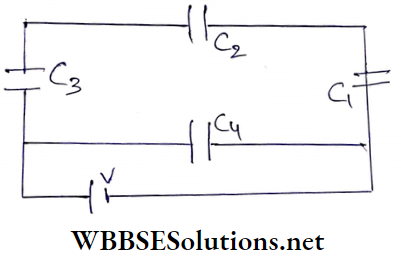
Class 12 Physics Unit 1 Electrostatics Chapter 4 Capacitance and Capacitor Example 27 values of the capacitances of the capacitors

⇒ \(q=C E\left(1-e^{-\frac{t}{R C}}\right)=q_0\left(1-e^{-t / \tau}\right)\)

Maximum charge on the capacitor, q0 = CE

The time constant of the charging circuit, \(\tau\) = RC

  • In the circuit, when the key Ky is pressed, the battery of emf E is connected in series with the capacitor C and resistor R, and the capacitor starts charging. After some time, the key Ky is switched off and the key K2 is pressed, then the capacitor starts discharging
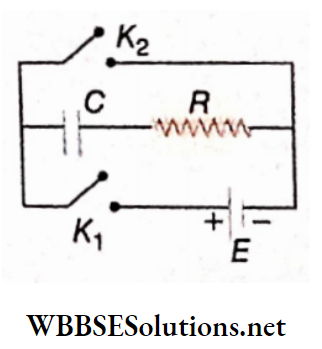
Class 12 Physics Unit 1 Electrostatics Chapter 4 Capacitance and Capacitor Time constant of the discharging circuit

The charge on the capacitor after a time t,

⇒ \(q=C E e^{-\frac{t}{C R}}=q_0 e^{-t / \tau}\)

The time constant of the discharging circuit, \(\tau\) = RC

Unit 1 Electrostatics Chapter 4 Capacitance And Capacitor Very Short Questions and Answers

Question 1. What is the name of the physical quantity whose unit is coulomb volt-1?
Answer: Capacitance

Question 2. What is the radius of a conducting sphere of capacitance 10μF?
Answer: 9 cm

Question 3. Two copper spheres of the same radius, one of them being hollow and the other solid, are charged to the same potential. Which of them does contain a greater amount of charge?
Answer: Both contain the same amount of charge

Question 4. If a charged soap bubble expands, what will be the change in its potential?
Answer: The potential will decrease

Question 5. What is the unit of dielectric constant?
Answer: No unit

Question 6. The surface area of a conducting sphere is 10.18 cm2. If it is placed in the air, what will be its capacitance in the picofarad?
Answer: 1

Question 7. n small drops of the same size are initially at the. same potential. They coalesce to form a big drop. What is the ratio of the capacitance of this big drop to that of any of these small drops?
Answer: n1/3

Question 8. Two conductors of capacitances C1 and C2 are connected by a conducting wire. Some amount of charge is given to the system. How is the ratio of charges acquired by the conductors related to their capacitances?
Answer: C1/C2

Question 9. Two conductors, of capacitances C1 and C2, initially have charges q1 and q2 at potentials V1 and V2, respectively. They are now connected by a thin conducting wire. What quantity the net energy loss of the system would be proportional to?
Answer: (V1-V2)2

Question 10. Two spheres of radii r and 2r have charges 2q and q on them, respectively. If they are connected by a copper wire, what will be the amount of charge flowing through the wire?
Answer: q

Question 11. A capacitor is marked as 0.05μF 200V. What is the maximum charge it can accumulate without being damaged?
Answer: 10-3C

Question 12. What is the dielectric constant of conducting materials?
Answer: Infinite

Question 13. What happens when the space between the two plates of a capacitor is filled with a conducting material?
Answer: It will be discharged completely

Question 14. What is the permittivity ofmica if its dielectric constant is 5.4?
Answer: 4.78 x 10⁻¹¹C2N-1m-2

Question 15. What is the unit of the permittivity of vacuum, ∈0?
Answer: C2.N-1 m-2

Question 16. Write down the dimensional formula of ∈0
Answer: M-1L-3T4l2

Question 17. s the permittivity of any medium greater or less than that of vacuum?
Answer: Greater

Question 18. If a dielectric is placed in an electric field, what change in the intensity of the electric field takes place inside the dielectric?
Answer: Electric field intensity decreases

Question 19. The space between the two plates of a parallel plate air capacitor is filled with an insulator. What will be the nature of the change in its capacitance?
Answer: Increase

Question 20. The space between the two plates of an isolated charged parallel plate air capacitor is filled with an insulator. What will be the nature of the change of the charge accumulation?
Answer: No change

Question 21. In a parallel plate capacitor, the capacitance increases from 4μF to 80μF when a dielectric medium is introduced between the plates. What is the dielectric constant of the medium?
Answer: 20

Question 22. What will be the effect on the capacity of a parallel plate capacitor when the area of each plate is doubled and the distance between them is also doubled?
Answer: No change

Question 23. The distance between the plates of a parallel plate capacitor is d. A metal plate of thickness d/2 is placed between the plates. What will be its effect on the capacitance of the system?
Answer: Capacitance Is Doubled

Question 24. Two protons A and B are placed between two parallel plates having a potential difference V. Will these protons experience equal or unequal forces?
Answer: Equal forces
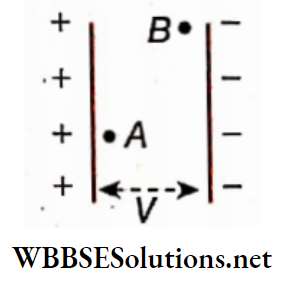
Class 12 Physics Unit 1 Electrostatics Chapter 4 Capacitance and Capacitor Two protons A and B are placed

Question 25. How can a capacitance of 10μF be designed from a few supplied 2μF capacitors?
Answer: Five of them are to be connected in parallel

Question 26. How can two capacitors be connected so that the charges on them are equal?
Answer: In series

Question 27. How can two capacitors be connected so that the potential differences between their plates are equal?
Answer: In parallel

Question 28. A combination is formed by connecting alternately n number of equidistant parallel plates. The capacitance between any two consecutive plates is C. What will be the equivalent capacitance of the combination?
Answer: (n-1)C

Question 29. Two charged conductors, each of which is effectively a capacitor, are connected by a conducting wire. Which type of combination of capacitors is this—series or parallel?
Answer: Parallel

Question 30. Three capacitors of equal capacitance, when connected in series, have a net capacitance C1. When connected parallel, they have a net capacitance of C2. What is the value of C1/C2?
Answer: 1/9

Question 31. Two plates of an isolated charged capacitor are connected by a copper wire. What will happen to the energy stored in the capacitor?
Answer: It will be zero

Question 32. The separation between the two plates of an isolated charged parallel plate air capacitor is d. The capacitor stores an energy U. Now a metal plate of thickness d/2 and of area equal to that of the capacitor plates is introduced in the intermediate space. What will be the energy stored in the capacitor?
Answer: U/2

Question 33. The separation between the two plates of an isolated charged parallel plate air capacitor is d. The capacitor stores an energy U. Now an insulating plate of thickness d/2, of dielectric constant K, and of area equal to that of the capacitor plates is introduced in the intermediate space. What will be energy stored in the capacitor?
Answer: \(\frac{K+1}{2 K} U\)

Question 34. n capacitors, each of capacity C, are connected in parallel and to a source of V volt. What will be the energy storedin the arrangement?
Answer: \(\frac{1}{2} n C V^2\)

Question 35. n capacitors, each of capacity C, are connected in series and to a source of V volt. What will be the energy storedin the arrangement?
Answer: \(\frac{1}{2 n} C V^2\)

Unit 1 Electrostatics Chapter 4 Capacitance And Capacitor Fill In The Blanks

1. The radius of the earth is 6400 km. Its capacitance in microfarad is 711.1

2. The intensity of the electric field in a dielectric decrease due to electric polarisation

3. A metal plate of negligible thickness is introduced between the two plates of a parallel plate air capacitor. The capacitance will remain the same

4. The distance between the two plates of an isolated charged parallel plate air capacitor is increased. The potential difference between the plates will increase

5. The space between the plates of a capacitor is filled up with a liquid of specific inductive capacity K. The capacitance will change by a factor of k

6. V a de Graaff generator is used to produce hard X-ray

Unit 1 Electrostatics Chapter 4 Capacitance And Capacitor Assertion Reason Type

Direction: These questions have Statement 1 and Statement 2. Of the four choices given below, choose the one that best describes the two statements.

  1. Statement 1 is true, statement 2 is true; Statement 2 is, a correct explanation for statement 1.
  2. Statement 1 is true, Statement 2 is true; Statement 2 is not a correct explanation for Statement 1.
  3. Statement 1 is true, statement is false.
  4. Statement 1 is false, and Statement 2 is true.

Question 1.

  1. Statement 1: Two capacitors of the same capacity are first connected in parallel and then in series. The ratio of equivalent capacitances in two cases is 2: 1.
  2. Statement 2: The equivalent capacitance is less than any of the capacitances in series.

Answer: 4. Statement 1 is false, Statement 2 is true.

Question 2.

  1. Statement 1: If the distance between the parallel plates of a capacitor is halved and the dielectric constant is made three times then the capacitance becomes 6 times.
  2. Statement 2: The capacitance of the capacitor does not depend on the nature of the material of the plates of the capacitor.

Answer: 2. Statement 1 is true, Statement 2 is true; Statement 2 is not a correct explanation for Statement 1.

Question 3.

  1. Statement 1: The larger the sphere, the larger is its capacity, and the smaller the sphere, the smaller is its capacity.
  2. Statement 2: The capacitance of a spherical conductor is directly proportional to its radius.

Answer: 1. Statement I is true, statement II is true; Statement 2 is, a correct explanation for statement I.

Question 4.

  1. Statement 1: Dielectric has no significance in a parallel plate capacitor.
  2. Statement 2: A Dielectric is an insulator that can be easily polarised on the application of an electric field.

Answer: 4. Statement 1 is false, Statement 2 is true.

Question 5.

  1. Statement 1: The force with which one plate of a parallel plate capacitor is attracted towards the other plate is equal to the square of surface charge density per e per unit area.
  2. Statement 2: The total amount of charge that resides, on the unit surface area is known as surface charge density.

Answer: 4. Statement 1 is false, Statement 2 is true.

Question 6.

  1. Statement 1: The capacity of a conductor, under given circumstances, remains constant irrespective of the charge present on it.
  2. Statement 2: Capacity depends on the size and shape of the conductor and also on the surrounding medium.

Answer: 1. Statement 1 is true, statement 2 is true; Statement 2 is, a correct explanation for statement 1.

Question 7.

  1. Statement 1: A dielectric slab is inserted between the ‘ plates of an isolated charged capacitor. The charge on the capacitor will remain the same.
  2. Statement 2: Charge on an isolated system is conserved.

Answer: 1. Statement 1 is true, statement 2 is true; Statement 2 is, a correct explanation for statement I.

Question 8.

  1. Statement 1: The potential energy of a capacitor is obtained at the cost of chemical energy from the battery used for charging the capacitor.
  2. Statement 2: In a battery potential energy is converted to chemical energy.

Answer: 3. Statement 1 is true, the statement is false.

Capacitance Derivations For Class 12 WBCHSE

Unit 1 Electrostatics Chapter 4 Capacitance And Capacitor Match The Columns

Question 1. A capacitor of capacitance C is charged to a potential V. Now, it is connected to a battery of emf E. Based on this information match the entries of column 1 with entries of column 2 in the following table.
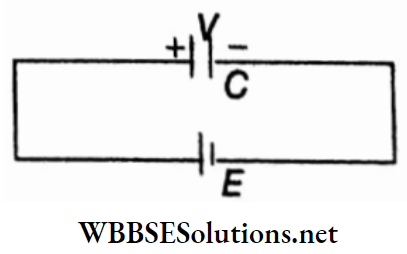
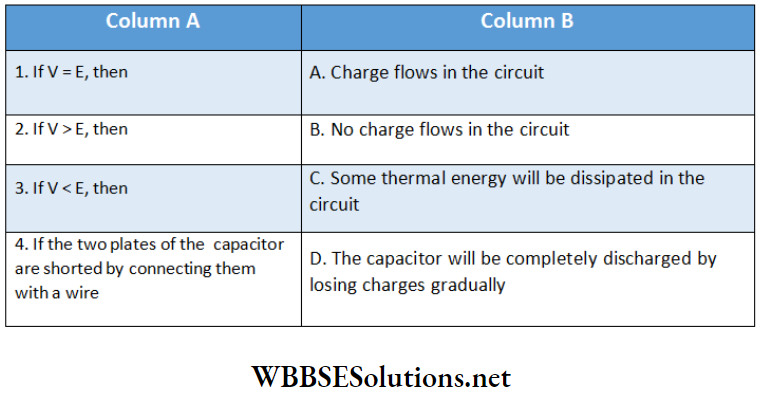
Class 12 Physics Unit 1 Electrostatics Chapter 4 Capacitance and Capacitor Match the columns 1

Class 12 Physics Unit 1 Electrostatics Chapter 4 Capacitance and Capacitor Match the columns 1.

Answer: 1-B, 2-C, 3-A, 4-D

Question 2. Mathematical expressions of some physical quantities and their corresponding units are given in column 1 and column 2 respectively.
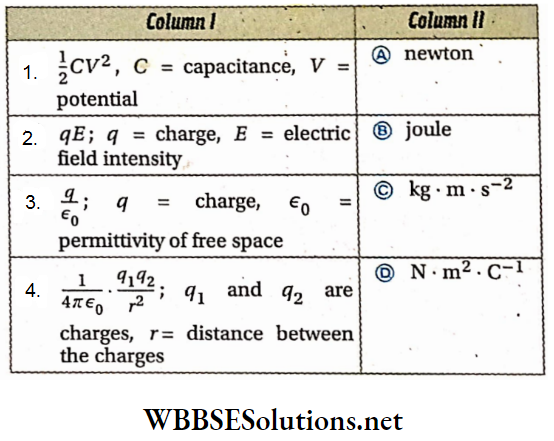
Class 12 Physics Unit 1 Electrostatics Chapter 4 Capacitance and Capacitor Match the columns 2

Answer: 1-B, 2-A,C, 3-D, 4-A,C

Question 3. 
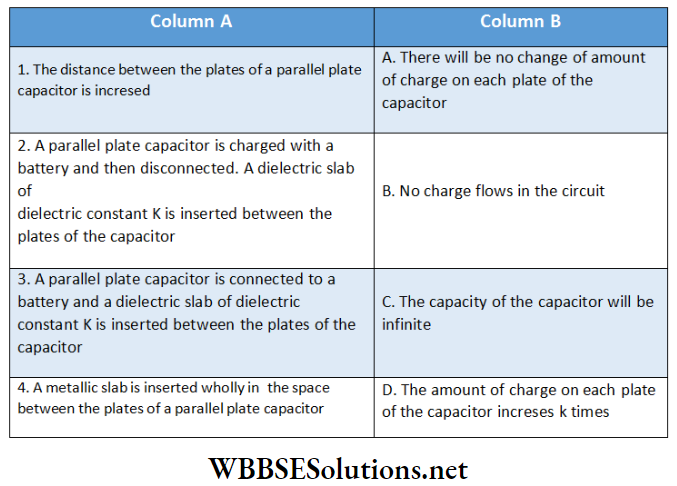
Class 12 Physics Unit 1 Electrostatics Chapter 4 Capacitance and Capacitor Match the columns 3

Answer: 1-A, 2-A,B, 3-D, 4-C

Question 4. 
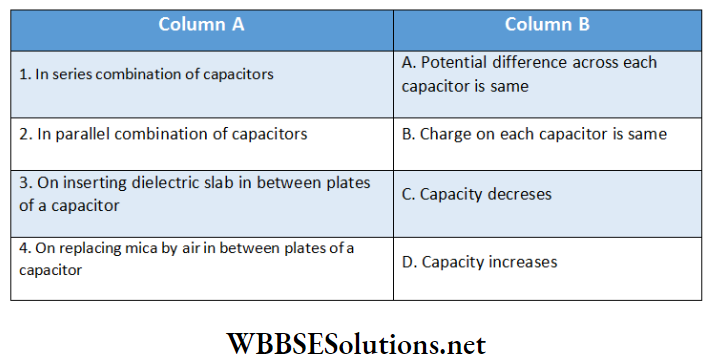
Class 12 Physics Unit 1 Electrostatics Chapter 4 Capacitance and Capacitor Match the columns 4

Answer: 1-B,C 2-A,D 3-D, 4-C

Question 5. In the area of each plate is A. Match the following.
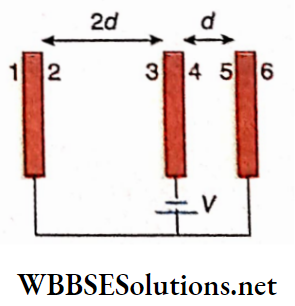
Class 12 Physics Unit 1 Electrostatics Chapter 4 Capacitance and Capacitor Match the columns 5.

Class 12 Physics Unit 1 Electrostatics Chapter 4 Capacitance and Capacitor Match the columns 5

Answer: 1-E, 2-D, 3-B, 4-A
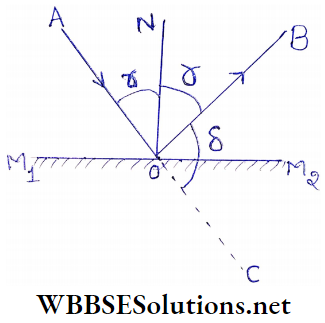
WBCHSE Class 12 Physics Capacitance And Capacitor Multiple Choice Questions

WBCHSE Class 12 Physics MCQs

Capacitance And Capacitor Multiple Choice Question And Answers

Question 1. A capacitor of 4μF connected as shown in the circuit. The internal resistance of the battery is 0.5 H. The amount of charge on the capacitor plates will be
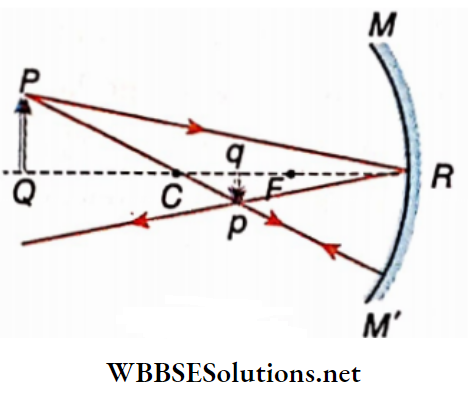
Class 12 Physics Unit 1 Electrostatics Chapter 4 Capacitance and Capacitor Multiple Choice Question And Answer 1

  1. 0
  2. 4μC
  3. 16μC
  4. 8μC

Answer: 4. 8μC

⇒ \(I=\frac{E}{R}=\frac{2.5}{2+0.5}=1 {\mathrm{A}}\)

V= E-IR

= 2.5- 1  x 10.5

= 2 V

∴ Q = CV

= 4 x 2μC

= 8μC

Question 2. In the circuit, initially, key K1 is closed and K2 is open. Then K1 is opened and K2 is closed(order is important). Take Q1 and Q2 as charges on C1 and C2 and V1 and V2 as voltage respectively. Then

Read and Learn More Class 12 Physics Multiple Choice Questions

Class 12 Physics Unit 1 Electrostatics Chapter 4 Capacitance and Capacitor Multiple Choice Question And Answer 2

  1. Charge on C1 gets redistributed such that V1 = V2
  2. Charge on C1 gets redistributed such that Q’1 = Q2
  3. Charge on C1 gets redistributed such that C1V1 + C2V2 = C1E
  4. Charge on C1 gets redistributed such that Q’2+Q’2 = Q

Answer:

1. Charge on C1 gets redistributed such that V1 = V2

4. Charge on C1 gets redistributed such that

When K1 is closed and K2 is open, Q (on C1) =EC1.

When K2 is closed and K1 is open, there being no battery in the circuit, C1 and C2 are connected in parallel and the charge on C1 will be redistributed between C1 and C2 in such a manner that V1 = V2.

Since there is no loss of charge, Q = Q’1 + Q’

WBBSE Class 12 Capacitance MCQs

Question 3. A parallel plate capacitor is connected to a battery.
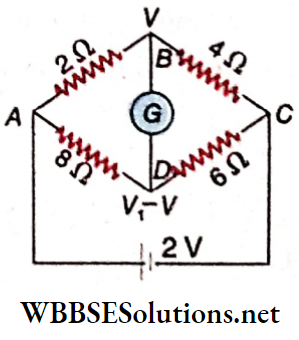
Consider two situations:

A. Key K is kept dosed and plates of capacitors are moved apart using insulating handles.

B. Key A’ is opened and plates of capacitors are moved apart using insulating handles.

Choose the correct option(s).

  1. In A: Q remains the same but C changes
  2. In B: V remains the same but C changes
  3. In A: V remains the same and hence Q changes
  4. In B: Q remains the same ami hence V changes

Answer:

3. In A: V remains the same and hence Q changes

4. In B: Q remains the same ami hence V changes

⇒ \(Q=C E=\frac{\epsilon_0 A}{d} \cdot B\)

Thus if d increases, Q will decrease.

⇒ \(V=\frac{Q}{C}=\frac{Q d}{\epsilon_0 A}\)

∴ If d decreases, Q remains the same, and V increases.

Question 4. A solid sphere and a hollow sphere of the same diameter are charged to the same potential. Then

  1. The charge on the hollow sphere will be greater
  2. Both spheres will have the same charge
  3. Only the hollow sphere will be charged
  4. The solid sphere will have a greater amount of charge

Answer: 2. Both the spheres will have the same charge

WBCHSE class 12 physics MCQs

Question 5. 64 water drops coalesce to form a big drop. If each small drop has capacity C, potential V and charge Q, the capacitance of the big drop will be

  1. C
  2. 4C
  3. 16C
  4. 64C

Answer: 2. 4C

WBCHSE Class 12 Physics Capacitance And Capacitor Multiple Choice Questions

Question 6. If the radius of a conducting sphere is 1m, its capacitance in farad will be

  1. 10-3
  2. 10-6
  3. 9 x 10⁻⁹
  4. 1.1 x 10⁻¹⁰

Answer: 4. 1.1 x 10⁻¹⁰

Question 7. n small drops of the same size are charged to Vvolt each. They coalesce to form a big drop. The potential of a big drop will be

  1. n1/3V
  2. n2/3V
  3. n3/2V
  4. n3V

Answer: 2. n2/3V

Question 8. A conducting sphere of radius 10 cm is kept in a medium of dielectric constant 8. Its capacitance is

  1. 80 esu
  2. 10 esu
  3. \(\frac{1}{9}\) x 10-10 F
  4. 80F

Answer: 1. 80 esu

Question 9. When two charged conductors are joined by a thin conducting wire, charge flows from one to the other, until

  1. Charges on them become equal
  2. Their capacitances become equal
  3. Their potential becomes equal
  4. Energy stored in them becomes equal

Answer: 3. Their potentials become equal

Question 10. Two conducting spheres of radii r1 and r2 are connected by a thin conducting wire. Some amount of charge is given to the system. The charge will be shared between them in such a way that the ratio between the surface densities of charge on the spheres is equal to

  1. \(\frac{r_1}{r_2}\)
  2. \(\frac{r_2}{r_1}\)
  3. \(\frac{r_1^2}{r_2^2}\)
  4. \(\frac{r_2^2}{r_1^2}\)

Answer: 2. \(\frac{r_2}{r_1}\)

Question 11. Two capacitors C1 and C2 (= 2C1) are connected in a circle with a switch. Initially, the switch is open and C1 holds charge Q. The switch is closed. At a steady state, the charge on each capacitor would be

Class 12 Physics Unit 1 Electrostatics Chapter 4 Capacitance and Capacitor Multiple Choice Question And Answer 11

  1. Q, 2Q
  2. \(\frac{Q}{3}, \frac{2 Q}{3}\)
  3. \(\frac{3 Q}{2}, 3 Q\)
  4. \(\frac{2 Q}{3}, \frac{4 Q}{3}\)

Answer: 2. \(\frac{Q}{3}, \frac{2 Q}{3}\)

Class 11 Physics Class 12 Maths Class 11 Chemistry
NEET Foundation Class 12 Physics NEET Physics

Common MCQs on Capacitor Types

Question 12. When a capacitor is connected to a dc battery,

  1. No current flows through the circuit
  2. Current flows through the circuit for some time, but eventually stops
  3. The current grows up and reaches a maximum value when the capacitor is fully charged
  4. The current reverses its direction alternately due to the charging and discharging of the capacitor

Answer: 2. Current flows through the circuit for some time, but eventually stops

Question 13. A few capacitors are equally charged. Which of the nature of variation of the potential difference V between their plates with their capacitances C?

Class 12 Physics Unit 1 Electrostatics Chapter 4 Capacitance and Capacitor Multiple Choice Question And Answer 13

Answer: 4.

Class 12 Physics Unit 1 Electrostatics Chapter 4 Capacitance and Capacitor Multiple Choice Question And Answer 13.

WBCHSE class 12 physics MCQs

Question 14. A parallel plate capacitor is charged and then disconnects the battery. If the plates of the capacitor are moved farther apart—

  1. The charge on the capacitor will increase
  2. The potential difference between the two plates will increase
  3. The capacitance will increase
  4. The electrostatic energy stored in the capacitor will decrease

Answer: 2. The potential difference between the two plates will increase

Question 15. The capacity of a parallel plate capacitor is proportional to the power n of the distance between the plates. The value of n is

  1. 1
  2. 2
  3. -1
  4. -2

Answer: 3. -1

Question 16. The capacitance of a parallel plate capacitor depends on

  1. The thickness of the plates
  2. The charge accumulated on the plates
  3. The potential difference between the two plates
  4. The distance between the two plates

Answer: 4. The distance between the two plates

Question 17. The separation between the two plates of a parallel plate capacitor is d. A metal plate of equal area and of thickness \(\frac{d}{2}\) is inserted between the two plates. The ratio of the capacitances after and before this insertion is

  1. 2: 1
  2. A√2:1
  3. 1:72
  4. 1:2

Answer: 1. 2: 1

Capacitance and capacitor class 12 MCQs

Question 18. A parallel plate air capacitor is connected to a battery and is then disconnected. Now the intermediate space is filled up with a medium of specific inductive capacity K. The potential difference between the plates will change by a factor of

  1. k2
  2. k
  3. \(\frac{1}{k}\)
  4. \(\frac{1}{\kappa^2}\)

Answer: 3. \(\frac{1}{k}\)

Question 19. A parallel plate capacitor with oil (dielectric constant K = 2) has a capacitance C. If the oil is removed, then the capacity of the capacitor becomes

  1. √2C
  2. 2C
  3. \(\frac{C}{\sqrt{2}}\)
  4. \(\frac{C}{2}\)

Answer: 4. \(\frac{C}{2}\)

Question 20. A parallel plate capacitor has a capacitance of 100μF. The plates are at a distance d apart. A slab of thickness t(t<d) and dielectric constant 5 is introduced between the parallel plates. Then capacitance can be,

  1. 50μF
  2. 100μF
  3. 200μF
  4. 500μF

Answer: 3. 200μF

Question 21. Two identical capacitors of C1 and C2 are connected to a battery. C1 is filled with air and C2 is filled with an insulator of dielectric constant ∈r then

Class 12 Physics Unit 1 Electrostatics Chapter 4 Capacitance and Capacitor Multiple Choice Question And Answer 21

  1. Q1 > Q2
  2. Q1 < Q2
  3. Q1 = Q2
  4. None

Answer: 2. Q1 < Q2

Practice Questions on Capacitance Formulas

Question 22. A capacitor of capacitance C is charged to a potential difference V from a cell and then disconnected from it. A charge +Q is now given to its positive plate. The potential difference across the capacitor is now

  1. V
  2. V + \(\frac{Q}{C}\)
  3. F + \(\frac{Q}{2C}\)
  4. None

Question 23. A combination is formed by connecting alternately n number of equidistant parallel plates. If C be the capacitance for any two consecutive plates, then the capacitance of the whole system will be

  1. C
  2. nC
  3. (n-1)C
  4. (n + 1)C

Answer: 3. (n-1)C

Question 24. Two capacitors of capacitances C1 and C2, are connected in parallel. A charge q given to the combination is distributed between the two. The ratio between these charges on the two capacitors is

  1. \(\frac{C_1}{C_2}\)
  2. \(\frac{C_2}{C_1}\)
  3. \(\frac{C_1 C_2}{1}\)
  4. \(\frac{1}{C_1 C_2}\)

Answer: 1. \(\frac{C_1}{C_2}\)

Capacitance and capacitor class 12 MCQs

Question 25. The equivalent capacitance of the combination is shown between A and B.

Class 12 Physics Unit 1 Electrostatics Chapter 4 Capacitance and Capacitor Multiple Choice Question And Answer 25

  1. \(\frac{C}{3}\)
  2. \(\frac{C}{2}\)
  3. \(\frac{2}{3}\)C
  4. C

Answer: 1. \(\frac{C}{3}\)

Question 26. Each of the four horizontal metal plates has a surface area a, and the separation between each pair of consecutive plates is d. The plates are connected to points A and B. The equivalent capacitance between A and B, when the system is kept in air, is

Class 12 Physics Unit 1 Electrostatics Chapter 4 Capacitance and Capacitor Multiple Choice Question And Answer 26

  1. \(\frac{\epsilon_0 \alpha}{d}\)
  2. \(\frac{2 \epsilon_0 \alpha}{d}\)
  3. \(\frac{3 \epsilon_0 \alpha}{d}\)
  4. \(\frac{4 \epsilon_0 \alpha}{d}\)

Answer: 2. \(\frac{2 \epsilon_0 \alpha}{d}\)

Question 27. In the connection the equivalent capacitance between A and B is

Class 12 Physics Unit 1 Electrostatics Chapter 4 Capacitance and Capacitor Multiple Choice Question And Answer 27

  1. 8μF
  2. 4μF
  3. 2μF
  4. 3μF

Answer: 2. 4μF

Capacitance and capacitor class 12 MCQs

Question 28. The charge on any of the two 2μF capacitors and that on the 1μF capacitor, in μC unit, are

Class 12 Physics Unit 1 Electrostatics Chapter 4 Capacitance and Capacitor Multiple Choice Question And Answer 28

  1. 1 and 2
  2. 2 and 1
  3. 1 and 1
  4. 2 and 2

Question 29. The equivalent capacitance is C1 when four capacitors of equal capacitance are connected in series. In their parallel connection, the equivalent capacitance becomes C2. The ratio C1/C2 will be

  1. \(\frac{1}{4}\)
  2. \(\frac{1}{16}\)
  3. \(\frac{1}{8}\)
  4. \(\frac{1}{12}\)

Answer: 2. \(\frac{1}{16}\)

Question 30. Three plates, each of area A, are connected. The effective capacitance will be

Class 12 Physics Unit 1 Electrostatics Chapter 4 Capacitance and Capacitor Multiple Choice Question And Answer 29

  1. \(\frac{\epsilon_0 A}{d}\)
  2. \(\frac{3 \epsilon_0 A}{d}\)
  3. \(\frac{3}{2} \frac{\epsilon_0 A}{d}\)
  4. \(\frac{2 \epsilon_0 A}{d}\)

Answer: 4. \(\frac{2 \epsilon_0 A}{d}\)

Class 12 physics capacitance questions 

Question 31. In the area of each of the four plates P, Q, R, and S is a, and the separation between consecutive plates is d. The equivalent capacitance between A and B is

Class 12 Physics Unit 1 Electrostatics Chapter 4 Capacitance and Capacitor Multiple Choice Question And Answer 31

  1. \(\frac{4 \epsilon_0 \alpha}{d}\)
  2. \(\frac{3 \epsilon_0 \alpha}{d}\)
  3. \(\frac{2 \epsilon_0 \alpha}{d}\)
  4. \(\frac{\epsilon_0 \alpha}{d}\)

Answer: 2. \(\frac{3 \epsilon_0 \alpha}{d}\)

Examples of Capacitor Circuit Questions

Question 32. Five capacitors, each of capacitance C, are connected. The ratio of the capacitance between P and R to that between P and Q is

Class 12 Physics Unit 1 Electrostatics Chapter 4 Capacitance and Capacitor Multiple Choice Question And Answer 31

  1. 3:1
  2. 5: 2
  3. 2: 3
  4. 1: 1

Answer: 3. 2: 3

Question 33. There are six capacitors in the given network. The capacitance of each is 4μF.

Class 12 Physics Unit 1 Electrostatics Chapter 4 Capacitance and Capacitor Multiple Choice Question And Answer 32

The effective capacitance between A and B is

  1. 24μF
  2. 12μF
  3. \(\frac{3}{2}\)μF
  4. \(\frac{2}{3}\)μF

Answer: 1. 24μF

Question 34. Find the equivalent capacitance between A and B.

Class 12 Physics Unit 1 Electrostatics Chapter 4 Capacitance and Capacitor Multiple Choice Question And Answer 33

  1. 5μF
  2. 4μF
  3. 3μF
  4. 2μF

Answer: 1. 5μF

Class 12 physics capacitance questions 

Question 35. A gang condenser is formed by interlocking a number of plates. The distance between the consecutive plates is 0.885 cm and the overlapping area of the plates is 5 cm². The capacity of the unit is

Class 12 Physics Unit 1 Electrostatics Chapter 4 Capacitance and Capacitor Multiple Choice Question And Answer 34

  1. 1.06 pF
  2. 4pF
  3. 6.36 pF
  4. 12.72 pF

Question 36. A number of condensers of equal capacity C are arranged in n columns. The equivalent capacity is given by

Class 12 Physics Unit 1 Electrostatics Chapter 4 Capacitance and Capacitor Multiple Choice Question And Answer 35

  1. nC
  2. n(n + 1)C
  3. \(\frac{n(n+1)}{2} C\)
  4. 2n(n + 1)C

Question 37. Three capacitors connected in series have an effective capacitance of 2μF. If one of the capacitors is removed, the effective capacitance becomes 3μF. The capacitance of the capacitor that is removed is

  1. 1μF
  2. \(\frac{3}{2}\)μF
  3. \(\frac{2}{3}\)μF
  4. 6μF

Answer: 4. 6μF

Question 38. In a charged capacitor, energy is

  1. Equally shared between the positive and the negative plates
  2. Stored in one plate when the other is grounded
  3. Stored in the electric field between the two plates
  4. Discharged if one of the plates is grounded

Answer: 3. Stored in the electric field between the two plates

Question 39. A parallel plate capacitor, with a slab of dielectric constant K between its plates, has a capacitance C. It is charged to a potential V. Now the dielectric slab is first brought out of the capacitor and is then introduced again. The work done in this process will be

  1. \((\kappa-1) \frac{C V^2}{2}\)
  2. \(\frac{C V^2(\kappa-1)}{\kappa}\)
  3. (k – 1)CV2
  4. 0

Answer: 4. 0

Question 40. The work done to charge a capacitor of capacitance 100μF with 8 x 10-18C will be

  1. 32 X 10-32J
  2. 16 X 10-32J
  3. 3.2 X 10⁻²⁶J
  4. 4 X 10⁻¹⁰J

Answer: 1. 32 X 10-32J

Question 41. A battery continues to charge a parallel plate capacitor until the potential difference between its plates becomes equal to the emf of the battery. The ratio of the energy stored in the tire capacitor to tire work done by the battery will be

  1. 1
  2. \(\frac{2}{1}\)
  3. \(\frac{1}{2}\)
  4. \(\frac{1}{4}\)

Answer: 3. \(\frac{1}{2}\)

Class 12 physics capacitance questions 

Question 42. The space between the plates of a parallel plate air capacitor is filled with a material of dielectric constant K, keeping the plates connected to a certain external battery. The energy stored in this capacitor will change by a factor of

  1. k2
  2. k
  3. \(\frac{1}{k}\)
  4. \(\frac{1}{\kappa^2}\)

Answer: 2. k

Question 43. A parallel plate capacitor is connected to a battery. The plates are pulled apart at a uniform speed. If x is the separation between the plates, the time rate of change of electrostatic energy of the capacitor is proportional to

  1. x-2
  2. x-2
  3. x-1
  4. x2

Answer: 1. x-2

Question 44. If the potential difference between the plates of a capacitor is increased by 20%, the energy stored in the capacitor increases by exactly

  1. 20%
  2. 22%
  3. 40%
  4. 44%

Answer: 4. 44%

Question 45. If the distance between the plates of a parallel plate capacity is doubled while the battery is kept connected, then

  1. The charge stored in the capacitor will be doubled
  2. The battery will absorb some amount of energy
  3. The electric field between the two plates will be halved
  4. Work will be done by an external agent on the two plates

Answer: 3. The electric field between the two plates will be halved

Question 46. Which of the following gas can be used in V a de Graaff generator?

  1. Methane
  2. Hydrogen
  3. Oxygen
  4. Chlorine

Answer: 1. Methane

Question 47. Van de graaff generator is used as

  1. External voltage source
  2. External current source
  3. Electrostatic accelarator
  4. None of these

Answer: 3. Electrostatic accelerator

Question 48. A parallel plate capacitor is charged and the charging battery is disconnected. If the plates of the capacitor are moved further apart by means of insulating handles. Then

  1. The charge on the capacitor increases
  2. The voltage across the plates increases
  3. The capacitance of the capacitor increases
  4. The electrostatic energy started in the capacitor increases

Answer:

2. The voltage across the plates increases

4. The electrostatic energy started in the capacitor increases

Class 12 physics capacitance questions 

Question 49. The same potential difference is applied between A and B. If C is joined to D,

Class 12 Physics Unit 1 Electrostatics Chapter 4 Capacitance and Capacitor Multiple Choice Question And Answer 47

  1. No charge will flow between C and D
  2. Some charge will flow between C and D
  3. The equivalent capacitance between C and D will not change
  4. The equivalent capacitance between C and D will change

Answer:

1. No charge will flow between C and D

3. The equivalent capacitance between C and D will not change

Question 50. A parallel plate capacitor of plate area A and plate separation d is charged to a potential difference V and then the battery is disconnected. A slab of dielectric constant K is then inserted between the plates of the capacitor so as to fill the space between the plates. If Q, E, and W denote respectively the charge on each plate, the electric field between the plates (after the slab is inserted), and the work done in the process of inserting the slab, then

  1. \(Q=\frac{\epsilon_0 A V}{d}\)
  2. \(Q=\frac{\epsilon_0 K A V}{d}\)
  3. \(E=\frac{V}{\kappa d}\)
  4. \(W=\frac{\epsilon_0 A V^2}{2 d}\left(1-\frac{1}{k}\right)\)

Answer:

1. \(Q=\frac{\epsilon_0 A V}{d}\)

3. \(E=\frac{V}{\kappa d}\)

4. \(W=\frac{\epsilon_0 A V^2}{2 d}\left(1-\frac{1}{k}\right)\)

Question 51. A dielectric slab of thickness d is inserted in a parallel plate capacitor whose negative plate is at x = 0 and positive plate is at x = 3d. The slab is equidistant from the plates. The capacitor is given some charge by connecting it to a battery. As x goes from 0 to 3d,

  1. The magnitude of the electric field remains the same
  2. The direction of the electric field remains the same
  3. The electric potential increases continuously
  4. The electric potential increases at first, then decreases, and again increases

Answer:

2. The direction of the electric field remains the same

3. The electric potential increases continuously

Question 52. In the circuit, the potential difference across the 3μF capacitor is V, and the equivalent capacitance between A and B is CAB. Correct relations are

Class 12 Physics Unit 1 Electrostatics Chapter 4 Capacitance and Capacitor Multiple Choice Question And Answer 50

  1. CAB = 4μF
  2. \(C_{A B}=\frac{18}{11} \mu \mathrm{F}\)
  3. V = 20 V
  4. V = 40 V

Answer:

1. CAB = 4μF

4. V = 40 V

Capacitor Multiple-Choice questions 

Question 53. In the given circuit C1 = C2 = 2μF. Then charge is stored in

Class 12 Physics Unit 1 Electrostatics Chapter 4 Capacitance and Capacitor Multiple Choice Question And Answer 51

  1. Capacitor C1 is zero
  2. Capacitor C2 is zero
  3. Both C1 and C2 is zero
  4. Capacitor C1 is 40μC

Answer:

2. Capacitor C2 is zero

4. Capacitor C1 is 40μC

Question 54. In the given network which one is correct?

Class 12 Physics Unit 1 Electrostatics Chapter 4 Capacitance and Capacitor Multiple Choice Question And Answer 52

  1. \(\left|q_2\right|=280 \mu \mathrm{C}\)
  2. \(\left|q_3\right|=160 \mu \mathrm{C}\)
  3. q2 = 120μC, q3 = 0
  4. Impossible to find q2 and q3 unless C1 and Q2 known

Answer:

1. \(\left|q_2\right|=280 \mu \mathrm{C}\)

2. \(\left|q_3\right|=160 \mu \mathrm{C}\)

Question 55. A parallel plate capacitor is connected to a battery. A metal sheet of negligible thickness is placed between the plates. The sheet remains parallel to the plates of the capacitor. Then

  1. The battery will supply the same charge
  2. The capacitance will increase
  3. The potential difference between the plates will increase
  4. Equal and opposite charges will appear on the two faces of the metal plate

Answer:

2. The capacitance will increase

4. Equal and opposite charges will appear on the two faces of the metal plate

Question 56. A capacitor of capacitance C1 is charged up to potential V and then connected in parallel to an uncharged capacitor capacitance C2. The final potential difference across each capacitor will be

  1. \(\frac{C_2 V}{C_1+C_2}\)
  2. \(\frac{C_1 V}{C_1+C_2}\)
  3. \(\left(1+\frac{C_2}{C_1}\right) V\)
  4. \(\left(1-\frac{C_2}{C_1}\right) V\)

Answer: 2. \(\frac{C_1 V}{C_1+C_2}\)

The charge storedin the first capacitor, Q = C1 V When the charged capacitor C1 is connected in parallel to the uncharged capacitor C2, then the equivalent capacitance of the combination, Ceq = C1 + C2. If Vf is the final potential difference across each capacitor,

then \(V_f=\frac{Q}{C_{\mathrm{eq}}}=\frac{C_1 V}{C_1+C_2}\)

The option 2 is correct.

Capacitor Multiple-Choice questions 

Question 57. 64 small water drops each of capacitance C and charge q coalesce to form a larger spherical drop. The charge and capacitance of the larger drop is

  1. 64q, C
  2. 16q, 4C
  3. 64q, 4C
  4. 16q, C

Answer: 3. 64q, 4C

Total charge = 64q

If the radius of each small water drop is r and that of the large water drop is R,

⇒ \(\frac{4}{3} \pi R^3=64 \times \frac{4}{3} \pi r^3\)

or, R³ = 64r³

or, R = 4r

The capacitance of a spherical drop or radius of the drop.

So,

capacitance of the large water drop = C x \(\frac{R}{r}\) = 4C

The option 3 is correct.

Question 58. Three capacitors, 3μF, 6μF, and 6μF series to a source of 120 V. The potential difference, in volts, across the 3μF capacitor will be

  1. 24
  2. 30
  3. 40
  4. 60

Answer: 4. 60

Equivalent capacitance of the combination,

⇒ \(C_{\mathrm{eq}}=\frac{1}{\frac{1}{3}+\frac{1}{6}+\frac{1}{6}}\)

= \(\frac{3}{2} \mu \mathrm{F}\)

= \(\frac{3}{2} \times 10^{-6} \mathrm{~F}\)

∴ The total charge of the combination,

⇒ \(Q=C_{\mathrm{eq}} \cdot V\)

= \(\frac{3}{2} \times 10^{-6} \times 120 \mathrm{C}\)

= \(180 \times 10^{-6} \mathrm{C}\)

∴ The potential difference across the capacitor of capacitance 3μF

⇒ \(\frac{180 \times 10^{-6}}{3 \times 10^{-6}}=60 \mathrm{~V}\)

The option 4 is correct.

Question 59. Consider two concentric spherical metal shells of radii r1 and r2 (r2 > r1). If the outer shell has a charge q and the inner one is grounded, the charge on the inner shell is

  1. \(-\frac{r_2}{r_1} q\)
  2. 0
  3. \(-\frac{r_1}{r_2} q\)
  4. -q

Answer: 3.

As the inner sphere is connected to the ground, its potential is zero.

∴ \(\frac{1}{4 \pi \epsilon} \frac{q_1}{r_1}+\frac{1}{4 \pi \epsilon} \frac{q_2}{r_2}=0\) [q1 = charge of the inner sphere, q2 = charge of the outer sphere]

i.e., \(q_1=-\left(\frac{r_1}{r_2}\right) q_2\)

The option 3 is correct.

Capacitor Multiple-Choice questions 

Question 60. Half of the space between the plates; of a parallel plate capacitor is filled with a dielectric material of dielectric constant Kl The remaining contains air. The capacitor is now given a charge Q. Then

Class 12 Physics Unit 1 Electrostatics Chapter 4 Capacitance and Capacitor Multiple Choice Question And Answer 58

  1. The electric field in the dielectric region is higher than that in the air-filled region
  2. On the two halves of the bottom plate, the charge densities are unequal
  3. Charge on the half of the top plate above the air-filled part is \(\frac{Q}{k+1}\)
  4. The capacitance of the capacitor shown above is \(\frac{(1+\kappa) C_0}{2}\) where C0 is the capacitance of the same capacitor with the dielectric removed

Answer:

1. The electric field in the dielectric region is higher than that in the air-filled region

2. On the two halves of the bottom plate, the charge densities are unequal

3. Charge on the half of the top plate above the air-filled part is \(\frac{Q}{k+1}\)

4. The capacitance of the capacitor shown above is \(\frac{(1+\kappa) C_0}{2}\) where C0 is the capacitance of the same capacitor with the dielectric removed

⇒ \(C_0=\frac{\epsilon_0 A}{d}\)

∴ The capacitance of the capacitor

\(C=\frac{\kappa \epsilon_0 \frac{A}{2}}{d}+\frac{\epsilon_0 \frac{A}{2}}{d}\)

= \(\frac{\epsilon_0 \frac{A}{2}}{d}(\kappa+1)\)

= \((1+\kappa) \frac{C_0}{2}\)

The option 4 is correct.

∴ \(V=\frac{\sigma_1}{\kappa \epsilon_0}=\frac{\sigma_2}{\epsilon_0}\) [Here dielectric and air medium is denoted by the
subscripts 1 and 2respectively.]

or, σ1 = k σ2

∴ σ1 ≠ σ2

The option 2 is correct.

Now, \(Q_1=\frac{\sigma_1 A}{2} ; Q_2=\frac{\sigma_2 A}{2}\)

∴ \(\frac{Q_1}{Q_2}=\frac{\sigma_1}{\sigma_2}=\frac{1}{\kappa}\)

or, \(\frac{Q_1}{Q}=\frac{Q_2}{Q_1+Q_2}=\frac{1}{\kappa+1}\)

or, \(Q_2=\frac{Q}{\kappa+1}\)

The option 3 is correct.

⇒ \(E_1=\frac{V}{d}=E_2\)

The option 1 is not correct.

Question 61. A parallel plate capacitor is charged and then disconnected from the charging battery. If the plates are now moved farther apart by pulling at them by means of insulating handles, then

  1. The Energy Stored In The Capacitor Decreases
  2. The Capacitance Of The Capacitor Increases
  3. The Charge In The Capacitor Decreases
  4. The voltage across the capacitor increases

Answer: 4. The voltage across the capacitor increases

The potential difference between the two plates,

⇒ \(V=\text { electric field }(E) \times \text { distance }(d)=\frac{\sigma}{\kappa \epsilon_0} \times d\)

∴ V ∝ d

i.e., the potential difference across the capacitor increases with an increase in distance between the plates.

The option 4 is correct.

Capacitor Multiple-Choice questions 

Question 62. A 5μF capacitor is connected in series with a 10μF capacitor. When a 300-volt potential difference is applied across this combination, the total energy stored in the capacitors is

  1. 15 J
  2. 1.5 J
  3. 0.15 J
  4. 0.10 J

Answer: 3. 0.15 J

Equivalent capacitance,

⇒ \(C=\frac{5 \times 10}{5+10}\)

= \(\frac{50}{15}=\frac{10}{3} \mu \mathrm{F}\)

= \(\frac{10}{3} \times 10^{-6} \mathrm{~F}\)

= \(\frac{1}{3} \times 10^{-5}\)

∴ Total energy stored = \(\frac{1}{2} C V^2=\frac{1}{2} \times\left(\frac{1}{3} \times 10^{-5}\right) \times 300^2\)

= 0.15 J

The option 3 is correct

Question 63. Equivalent capacitance between A and E

Class 12 Physics Unit 1 Electrostatics Chapter 4 Capacitance and Capacitor Multiple Choice Question And Answer 61

  1. 20μF
  2. 8μF
  3. 12μF
  4. 16μF

Answer: 2. 8μF

The equivalent circuit

Class 12 Physics Unit 1 Electrostatics Chapter 4 Capacitance and Capacitor The equivalentcircuit

Hence, the equivalent capacitance between A and B

Ceq = 2 + 4 + 2

= 8μF

The option 2 is correct.

WBCHSE Physics Capacitance MCQs 

Question 64. A 1μF capacitor C is connected to a battery of 10V through a resistance lMΩ. The voltage across C after 1 second is approximately

  1. 56 V
  2. 7.8 V
  3. 6.3 V
  4. 10 V

Answer: 3. 6.3 V

When a capacitor of capacitance C is charged by connecting it in series with a battery of emf E and a resistance R, charge on the capacitor after a time t,

⇒ \(q=C E\left(1-e^{-\frac{t}{R C}}\right)\)

Here, C = lμF, E = 10 V, R = lMΩ

∴ The charge stored on the capacitor after 1 s

\(q=1 \times 10^{-6} \times 10 \times\left(1-e^{\frac{1}{10^6 \times 10^{-6}}}\right)\)

= 10(-5)(1-e-1)

= 0.632 x 10⁻⁵ C

Hence the voltage across the capacitor after 1 s

⇒ \(\frac{q}{C}=\frac{0.632 \times 10^{-5}}{1 \times 10^{-6}}=6.32 \mathrm{~V} \approx 6.3 \mathrm{~V}\)

The option 3 is correct.

Question 65. Three capacitors of capacitance 1.0μF, 2.0μF, and 5.0μF are connected in series to a 10V source. The potential difference across the 2.0μF capacitors

  1. \(\frac{100}{17}\)V
  2. \(\frac{20}{17}\)V
  3. \(\frac{50}{17}\)V
  4. 10V

Answer: 3. \(\frac{50}{17}\)V

If the equivalent capacitance of the capacitors is Ceq then,

⇒ \(\frac{1}{C_{\text {eq }}}=\frac{1}{1}+\frac{1}{2}+\frac{1}{5}=\frac{17}{10} \quad\)

or, \(C_{\text {eq }}=\frac{10}{17} \mu \mathrm{F}\)

Class 12 Physics Unit 1 Electrostatics Chapter 4 Capacitance and Capacitor Multiple Choice Question And Answer 63

Charge storedin each capacitor, \(Q=C_{\mathrm{eq}} V=\frac{10}{17} \times 10 \mu \mathrm{C}\)

The potential difference between 2.0μF capacitor

⇒ \(\frac{10 \times 10}{17 \times 2}=\frac{50}{17} \mathrm{~V}\)

The option 3 is correct

Question 66. An electric bulb, a capacitor, a battery, and a switch are all in series in a circuit How does the intensity of light vary when the switch is turned on?

  1. Continues to increase gradually
  2. Gradually increases for some time and then becomes steady
  3. Sharply raises initially and then gradually decreases
  4. Gradually increases for some time and then gradually decreases

Answer: 3. Sharply rises initially and then gradually decreases

The given CR circuit with a battery as the voltage source.

If battery voltage = E, resistance ofbulb= R, capacitance= C, then the instantaneous current in the circuit when the switch is turned on,

⇒ \(I(t)=\frac{E}{R} e^{-\frac{t}{R C}}\)

Class 12 Physics Unit 1 Electrostatics Chapter 4 Capacitance and Capacitor Multiple Choice Question And Answer 64

Hence when the switch is turned on, the intensity of the light from the bulb sharply increases initially and then decreases gradually with time.

The option 3 is correct

Question 67. The insulated plates of a charged parallel plate capacitor (with a small separation between the plates) are approaching each other due to electrostatic attraction. Assuming no other force to be operative and no radiation taking place, which of the following graphs approximately shows the variation with time (t) of the potential difference (V) between the plates?

Class 12 Physics Unit 1 Electrostatics Chapter 4 Capacitance and Capacitor Multiple Choice Question And Answer 65

Answer: 1

When the plates approach each other, the electric field remains constant in the region between the plates, but the voltage between the plates changes.

∴ From E = \(\frac{dV}{dv}\) we get, E x d = V

[d = distance between the plates, V” = potential difference between the plates and £ = electric field in the region between the plates]

E will remain the same, so V ∝ d

The electric force on each plate

⇒ \(F_e=\frac{q \times q}{2 \epsilon_0 A}\)

[Let, A = area of each plate, q = amount of charge]

∴ Acceleration of the plates

⇒ \(a=\frac{q^2}{2 A \epsilon_0 m}\) [m = mass ofeach plate]

So, the distance-time graphic case of uniform acceleration is shown in the figure. As V ∝ d the graph of V vs t is also similar.

The option 1 is correct

WBCHSE physics capacitance MCQs 

Question 68. A parallel plate capacitor is made of two circular plates separated by a distance of 5 mm and with a dielectric of 2.2 between them. When the electric field in the dielectric is 3 x 10⁻⁴ V/m, the charge density of the positive plate will be close to

  1. 6 x 10⁴ C/m2
  2. 6 X 10⁻⁷ C/m2
  3. 3 x 10⁻⁷ C/m2
  4. 3 x 10⁻⁴ C/m2

Answer: 2. 6 x 10⁻⁷ C/m2

Electric field, \(E=\frac{\sigma}{\kappa \epsilon_0}\)

∴ Charge density of the plate,

σ =k∈0E = 2.2 x 8.85 x 10-12 x 3 x 104

= 5.48 x 10⁻⁷ ≈ 6 x 10⁻⁷C/m2

The option 2 is correct.

Question 69. In the given circuit, charge Q2 on the 2μF capacitor changes as C is varied from 1μF to 3μF. Q2 as a function of C is given properly by (Figures are drawn schematically and are not to scale)


Class 12 Physics Unit 1 Electrostatics Chapter 4 Capacitance and Capacitor Multiple Choice Question And Answer 67

Class 12 Physics Unit 1 Electrostatics Chapter 4 Capacitance and Capacitor Multiple Choice Question And Answer 67.

Answer: 2

Equivalent capacitance of the 1μF and 2μF capacitors

= (1+2)

= 3μF

Then, equivalent capacitance ofthe circuit = \(\frac{3 C}{3+C}\)

Charge stored, \(Q=E \cdot \frac{3 C}{3+C}\)

then \(Q_2=\frac{2}{2+1} Q=\frac{2 E C}{C+3}=\frac{2 E}{1+\frac{3}{C}}\)

When C = 1μF, Q2 = \(\frac{E}{2}\)

when C = 3μF, Q2 = E; the value of Q2 increases.

For the mean value (2μF) ofthe capacitors, Q2 = \(\frac{4E}{5}\)

Mean value of \(\frac{E}{2}\) and E = \(\frac{\frac{E}{2}+E}{2}=\frac{3 E}{4}<\frac{4 E}{5}\)

Hence, the increase of Q2 with C is not linear; there is comparatively greater of Q2 in the beginning.

The option 2 is correct

Question 70. A combination of capacitors is set up as shown in the figure. The magnitude of the electric field due to a point charge Q (having a charge equal to the sum of the charges on the 4μF and 9μF capacitors), at a point of distance 30 m from it, would equal

Class 12 Physics Unit 1 Electrostatics Chapter 4 Capacitance and Capacitor Multiple Choice Question And Answer 68

  1. 240 N/C
  2. 360 N/C
  3. 420 N/C
  4. 480 N/C

Answer: 3. 420 N/C

The circuit can be simplified

Class 12 Physics Unit 1 Electrostatics Chapter 4 Capacitance and Capacitor Multiple Choice Question And Answer 68.

The charge stored on the 3μF capacitor in the second circuit = 3 x 8

= 24μC

So the same charge (24μC) will be stored on the 4μF and 12μF capacitors in the first circuit. Again 12μF is the equivalent capacitance for the 3μF and 9μF capacitors in parallel. If the charge stored on the 9μF capacitor is q, then

⇒ \(\frac{q}{9}=\frac{24-q}{3} \text { or, } q=18 \mu \mathrm{C}\)

∴ Q = 24 + 18

= 42μC

Hence the electric field at a distance of 30 m from Q charge

⇒ \(\frac{1}{4 \pi \epsilon_0} \frac{Q}{r^2}, \text { where } r=30 \mathrm{~m}\)

⇒ \(9 \times 10^9 \times \frac{42 \times 10^{-6}}{30^2}=420 \mathrm{~N} / \mathrm{C}\)

The option 3 is correct.

WBCHSE physics capacitance MCQs 

Question 71. A capacitance of 2.0 pF is required in an electrical circuit across a potential difference of 1.0 kV. A large number of lpF capacitors are available that can withstand a potential difference of not more than 300 V. The minimum number of capacitors required to achieve this is

  1. 2
  2. 16
  3. 24
  4. 32

Answer: 4. 32

⇒ \(\frac{1.0 \mathrm{kV}}{300 \mathrm{~V}}=\frac{1000}{300}=3.33\)

∴ The minimum number of capacitor combinations that should be connected in series is 4.

Class 12 Physics Unit 1 Electrostatics Chapter 4 Capacitance and Capacitor Multiple Choice Question And Answer 69

If the capacitance of each combination is x, then

⇒ \(\frac{4}{x}=\frac{1}{2}\) [since equivalent capacitance is 2μF]

∴ x = 8μF

Hence each combination of capacitors must contain 8 1μF capacitors connected in parallel.

Class 12 Physics Unit 1 Electrostatics Chapter 4 Capacitance and Capacitor Multiple Choice Question And Answer 69.

∴ Minimum number of capacitors required

=8 x 4

= 32

The option 4. is correct

Question 72. A parallel plate capacitor of capacitance 90 pF is connected to a battery of emf 20 V. If a dielectric material of dielectric constant k = \(\frac{5}{3}\) is inserted between the plates, the magnitude of the induced charge will be

  1. 2.4 nC
  2. 0.9 nC
  3. 1.2 nC
  4. 0.3 nC

Answer: 3. 1.2 nC

⇒ \(Q_i=C V ; Q_f=k C V\)

∴ \(Q_{\text {induced }}=Q_f-Q_i\)

=(k-1)CV

⇒ \(\left(\frac{5}{3}-1\right) \times 90 \times 10^{-12} \times 20\)

= 1.2 x 10⁻⁹C

= 1.2 nC

The option 3 is correct.

Real-Life Applications of Capacitors

Question 73. Two thin dielectric slabs of dielectric constants k1 and k2 (K1 < K2) is inserted between plates of a parallel plate capacitor, as shown in the figure. The variation of electric field F. between the plates with distance d ns measured from plate P Is correctly shown by

Class 12 Physics Unit 1 Electrostatics Chapter 4 Capacitance and Capacitor Multiple Choice Question And Answer 71

Class 12 Physics Unit 1 Electrostatics Chapter 4 Capacitance and Capacitor Multiple Choice Question And Answer 71.

Answer: Option 3 is correct

Electric field, \(E \propto \frac{1}{K}\)(k = dielectric constant)

k1 < k2

∴ E1 > E2

The option 3 is correct

WBCHSE physics capacitance MCQs 

Question 74. A parallel plate air capacitor of capacitance C is connected to a cell of emf V and then disconnected from it. A dielectric slab of dielectric constant K, which can just fill the air gap of the capacitor, is now inserted in it. Which of the following is incorrect?

  1. The potential difference between the plates decreases K times
  2. The energy stored in the capacitor decreases K times
  3. The change in energy stored is \(\frac{1}{2} C V^2\left(\frac{1}{K}-1\right)\)
  4. The charge on the capacitor is not conserved

Answer: 4. The charge on the capacitor is not conserved

If Q is the charge on the plate,

potential difference \((V)=\frac{Q}{C} ;\)

stored energy \((U)=\frac{1}{2} C V^2=\frac{1}{2} \frac{Q^2}{C}\)

After the dielectric slab is inserted,

capacitance, C’ = KC;

potential difference = \(\frac{Q}{kC}\)

i.e., the potential difference would decrease K times.

Again, stored energy,

⇒ \(U^{\prime}=\frac{1}{2} \frac{Q^2}{C^{\prime}}=\frac{1}{2} \frac{Q^2}{k C}\)

i.e, the stored energy also decreases k times,

Now, change stored energy

⇒ \(=U^{\prime}-U=\frac{1}{2} \frac{Q^2}{C}\left(\frac{1}{K}-1\right)=\frac{1}{2} C V^2\left(\frac{1}{K}-1\right)\)

Hence, options 1, 2, and 3 are correct

But the charge on the capacitor remains conserved in isolating conditions.

The option 4 is correct

Question 75. A capacitor of 2μF Is charged as shown In the diagram. When the switch S Is turned to position 2, the percentage of Its stored energy dissipated is

Class 12 Physics Unit 1 Electrostatics Chapter 4 Capacitance and Capacitor Multiple Choice Question And Answer 73

  1. 20%
  2. 75%
  3. 80%
  4. 0%

Answer: 3. 80%

The energy stored in the 2μF capacitor initially,

⇒ \(U_i=\frac{1}{2} \times 2 \times V^2=V^2\)

When the switch is turned to position 2, let V’ be the
voltage across each capacitor.

Total charge is conserved, so \(2 V=2 V^{\prime}+8 V^{\prime} \text { or, } V^{\prime}=\frac{V}{5}\)

Hence, the final energy storedin the two capacitors,

⇒ \(U_f=\frac{1}{2} \times 2 \times \frac{V^2}{25}+\frac{1}{2} \times 8 \times \frac{V^2}{25}=\frac{V^2}{5}\)

∴ Percentage of stored energy dissipated

⇒ \(=\frac{U_i-U_f}{U_f} \times 100 \%=\frac{V^2-\frac{V^2}{5}}{V^2} \times 100 \%=80 \%\)

The option 3 is correct

Conceptual Questions on Energy Stored in Capacitors

Question 76. A parallel plate capacitor is to be designed, using a dielectric of dielectric constant 5, so as to have a dielectric strength of 109 V.m-1. If the voltage rating of the capacitor is 12 kV, the minimum area of each plate required to have a capacitance of 80 pF is,q

  1. 10.5 x 10⁻⁶ m2
  2. 21.7 x 10⁻⁶ m2
  3. 25.0 x 10⁻⁵ m2
  4. 12.5 x 10⁻⁵ m2

Answer: 2. 21.7 x 10⁻⁶ m2

Capacitance, \(C=\frac{\epsilon_0 k A}{d} \quad \text { or, } A=\frac{C d}{\epsilon_0 k}\)

Given, \(k=5 ; E=\frac{V}{d} \quad \text { or, } d=\frac{V}{E}\)

∴ \(A=\frac{C V}{\epsilon_0 k E}=\frac{\left(80 \times 10^{-12}\right) \times\left(12 \times 10^3\right)}{\left(8.85 \times 10^{-12}\right) \times 5 \times 10^9}\)

= 21.7 c 10-6m2

The option 2 is correct

WBCHSE physics capacitance MCQs 

Question 77. The electrostatic force between the metal plates of an isolated parallel plate capacitor C having a charge Q and area A, is

  1. Proportional to the square root of the distance between the plates
  2. Linearly proportional to the distance between the plates
  3. Independent of the distance between the plates
  4. Inversely proportional to the distance between the plates

Answer: 3. Independent of the distance between the plates

Let the distance between the two plates of the parallel plate capacitor = d

Class 12 Physics Unit 1 Electrostatics Chapter 4 Capacitance and Capacitor Multiple Choice Question And Answer 75

The electrostatic force between the metal plates

⇒ \(F=Q E=Q \cdot \frac{\sigma}{2 \epsilon_0}=Q \cdot\left(\frac{Q}{A}\right) \cdot \frac{1}{2 \epsilon_0}=\frac{Q^2}{2 A \epsilon_0}\)

Hence the electrostatic force does not depend on the distance between the plates.

The option 3 is correct.

Question 78. A capacitor C1 of capacitance 5μF Is charged to a potential of 100 V and another capacitor C2 of capacitance 8μF is charged to 50 V. The positive and negative plates are Mutually connected.

1. The final potential of the combination of the two capacitors will be

  1. \(\frac{500}{3}\)V
  2. \(\frac{900}{3}\)V
  3. 150V
  4. 50V

Answer: 2. \(\frac{900}{3}\)V

2. The amount of charge of the capacitor C1 after combination will be

  1. \(\frac{4500}{13} \mu \mathrm{C}\)
  2. \(\frac{7200}{13} \mu \mathrm{C}\)
  3. \(\frac{2700}{13} \mu \mathrm{C}\)
  4. \(\frac{11700}{13} \mu \mathrm{C}\)

Answer: 1. \(\frac{4500}{13} \mu \mathrm{C}\)

3. The amount of charge of the capacitor C2 after combination will be

  1. 4500μC
  2. 7200μC
  3. \(\frac{4500}{13} \mu \mathrm{C}\)
  4. \(\frac{7200}{13} \mu \mathrm{C}\)

Answer: 4. \(\frac{7200}{13} \mu \mathrm{C}\)

4. Energy loss will be

  1. 3.11 x 10⁻¹³ J
  2. 35 x 10-2 J
  3. 3.9 x 10⁻¹³ J
  4. 7.8 x 10⁻⁵ J

Answer: 3. 3.9 x 10⁻¹³ J

Question 79. A parallel plate capacitor of plate area 0.2 m2 and spacing 10-2 m is charged to 103 V and is then disconnected from the battery

1. If the plates are pulled apart to double the plate spacing capacitance of the capacitor will be

  1. 44.25 pF
  2. 88.5 pF
  3. 120.45 pF
  4. 22.12 pF

Answer: 2. 88.5 pF

2. The amount of work required to double the plate spacing is

  1. 8.85 x 10⁻⁵ J
  2. 17.7 x 10-51 J
  3. 4.42 x 10⁻⁵ J
  4. 26.55 x 10⁻⁷ J

Answer: 1. 8.85 x 10⁻⁵ J

3. The final voltage of the capacitor will be

  1. 103V
  2. 4 x 10³ V
  3. 2 x 10³ V
  4. 106V

Answer: 3. 2 x 10³ V

WBCHSE physics capacitance MCQs 

Question 80. A spherical drop of water carries a charge of 10 x 10-12 C and has a potential of 100V at its surface

1. The radius of the drop will be

  1. 9 x 10⁻³ m
  2. 9 x 10⁻⁵ m
  3. 9 x 10⁻² m
  4. 9 x 10⁻⁴ m

Answer: 4. 9 x 10⁻⁴ m

2. If eight such charged drops as mentioned above, combine to form a single drop, the potential at the surface of the new drop will be

  1. \(\frac{4}{3}\)
  2. 400 V
  3. 200 V
  4. 300 V

Answer: 2. 400 V

Question 81. Two capacitors of capacity 6μF and 3μF are charged to 100 V and 50 V separately and connected to a 200 V battery using three switches. Now all three switches S1, S2, and S3 are closed.

Class 12 Physics Unit 1 Electrostatics Chapter 4 Capacitance and Capacitor Multiple Choice Question And Answer 57

1. Which plates form an isolated system?

  1. Plates 1 and 4 separately
  2. Plates 2 and 3 separately
  3. Plates 1 and 4 jointly
  4. Plates 2 and 3 jointly

Answer: 4. Plates 2 and 3 jointly

2. Charges on 6μF and 3μF capacitors in steady state will be

  1. 400μC, 400μC
  2. 700μC, 250μC
  3. 800μC, 350μC
  4. 300μC, 450μC

Answer: 2. 700μC, 250μC

3. Suppose q1, q2, and q3 are the magnitudes of charges that flow through switches S1, S2 and S3 after they are closed. Then

  1. q1 = q3 and q2 = 0
  2. q1 = q3 = \(\frac{q_2}{2}\)
  3. q1 = q3 = 2q2
  4. q1 = q2 = q3

Answer: 4. q1 = q2 = q3