WBCHSE Class 11 Physics Calorimetry Notes

Calorimetry Introduction

An important characteristic of heat must be noted from the very beginning. Unlike the quantities volume, pressure, temperature, etc., heat is not related to any equilibrium state of a body. Heat manifests itself only when a body undergoes a transition from one state to another.

Statements like ‘heat of a body’, ‘initial heat’, and ‘final heat’ have no physical meaning. Physically significant are the quantities like ‘heat gained’, or ‘heat lost’ by a body during any process. In this sense, heat is regarded as an energy in transit.

The rise or fall in temperature of a body implies the addition or extraction of heat from it. If two objects are in contact with each other then there will be heat flow between them till both attain an equilibrium temperature.

In such situations a need arises to know the quantity of heat transferred from one body to another, or, from an object to its surroundings. The study of problems that involve heat exchange between different bodies is called calorimetry.

Calorimetry Notes

Calorimetry Factors Affecting Heat Transfer

We know that it takes longer to boil some water than to warm it. Also, boiling water takes longer to cool down than lukewarm water does. So for rise and fall of different amount of temperature, different amounts of heat are absorbed or released.

  • Again, increasing the amount of water to be boiled, increases the time taken to boil it too. From this we can conclude that the amounts cf heat absorbed (or released) by the bodies of same material but different mass for a fixed rise (or fall) in temperature depend on their masses.
  • When a piece of iron and some water of the same mass are heated, the piece of iron heats up faster than the water.
  • Clearly, the material of an object plays a role in determining the amount of heat absorbed (or released) by the object for a certain rise (or fall) in temperature.
  • From these observations, it can be inferred that, the amount of heat absorbed or released by a body depends on the change of temperature of the body, mass of the body, and material of the body, provided that the material does not undergo any phase change.

Temperature: Amount of heat gained or lost by a body of fixed mass is directly proportional to the rise or fall in its temperature.

Mass: Amount of heat gained or lost by a body, for a fixed rise or fall in temperature, is directly proportional to its mass.

Material: Amount of heat gained or lost by a body depends on the material of the body.

When a body of mass m receives heat H, the rise in temperature is t,
H ∝ mt or, H = smt……(1)

where s is specific heat whose value depends on the material of the body.

Therefore, H (the heat absorbed or released by a body) = m (mass of the body) x s (specific heat of the material of the body) x t (rise or fall in temperature)
It is to be noted that t in equation (1) is the change in temperature of the body.

So only the heat gained or lost can be measured by this equation.

Calorimetry Units Of Heat

Some useful useful units for the measurement of heat are defined as follows:

Calorie: It is the unit of heat in CGS system. The amount of heat required to raise the temperature of 1 g of water from 14.5 °C to 15.5 °C is called 1 calorie (1 cal).

  • Practically, the heat required to raise the temperature of 1 g of pure water from 0°C to PC is not the same as the heat required to raise Its temperature, for example, from 45T to 46°C though the rise in temperature is the same.
  • Hence, quantity of heat differs at the different ranges in the scale of temperature.
  • So, most acceptable definition of calorie is, 1 cal = 1/100 X heat required to raise the temperature of 1 g of pure water from 0°C to 100°C. It is often known as mean calorie.
  • Its value is equal to the amount of heat required to raise the temperature of 1 g of pure water from 14.5°C to 15.5°C. So it is sometimes called 15°C calorie.

Kilocalorie or kilogram calorie: The quantity of heat required to raise the temperature of 1 kg of pure water from 14.5°C to 15.5°C, is called 1 kilocalorie.

As 1 kg = 1000 g, 1 kilocalorie (kcal) = 1000 calorie (cal).

Joule: This is the unit of heat in SI. 1 cal = 4.2 J.

Calorimetry Notes for Class 11 WBCHSE

Calorimetry Specific Heat Or Specific Heat Capacity

It has been stated that heat gained (or lost) by a body depends on its mass, the rise (or fall) in temperature and the material of the body.

  • Let us take two bodies of same mass but made of different materials. If we try to change the temperature of both the bodies by the same amount, we will find that the heat required is different for them.
  • Therefore it is obvious, the quantity of heat required also depends on a special property. This property is known as specific heat or specific heat capacity of the body. It depends on the material of the body.
  • It is obvious that different materials possess different specific heat capacities.

Specific Heat Or Specific Heat Capacity Definition: Specific heat capacity is the quantity of heat required to raise the temperature of unit mass of a substance by unit amount.

Definition of specific heat capacity in CGS system: It is the quantity of heat required to raise the temperature of 1 g of a substance through 1 °C. In this system the unit of specific heat is cal · g-1 · °C-1.

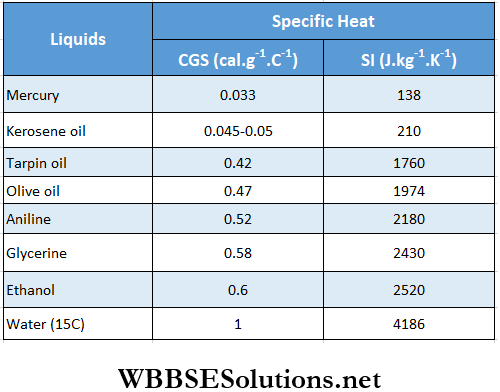
For example, ‘the specific heat capacity of copper is 0.093 cal · g-1 · °C-1 means that to raise the temperature of 1 g of copper by 1 °C, the heat required is 0.093 cal.

Definition of specific heat capacity in SI: The quantity of heat required to raise the temperature of 1 kg of a substance through 1 K is known as specific heat capacity of the substance.

The unit of specific heat in this system is J · kg-1 · K-1

In SI, the specific heat capacity of water is 4186 J · kg-1 · K-1.

Relation between CGS and SI unit of specific heat capacity: \(1 \mathrm{cal} \cdot \mathrm{g}^{-1} \cdot{ }^{\circ} \mathrm{C}^{-1}=\frac{4.186 \mathrm{~J}}{10^{-3} \mathrm{~kg} \times 1 \mathrm{~K}}=4186 \mathrm{~J} \cdot \mathrm{kg}^{-1} \cdot \mathrm{K}^{-1}\)

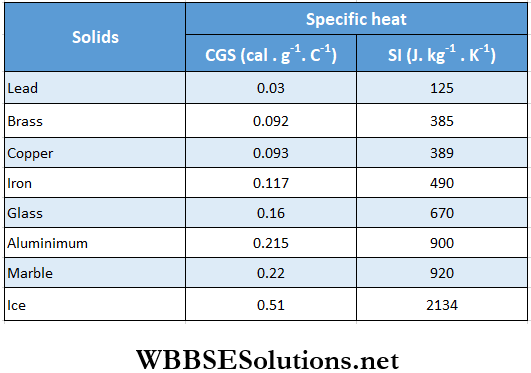
Specific heat capacities of a few solids and liquids

Class 11 Physics Unit 7 Properties Of Matter Chapter 7 Calorimetry Specific Heat Capacities Of A Few Liquids

Class 11 Physics Unit 7 Properties Of Matter Chapter 7 Calorimetry Specific Heat Capacities Of A Few Solids


Calorimetry Fundamentals Principal Of Calorimetry

When two bodies at different temperatures are brought in contact, heat is transferred from the body at higher temperature to that at lower temperature. So, the former starts to cool down whereas the latter starts to warm up.

The flow of heat continues till both reach the same temperature. The state where both the bodies are at the same temperature is called thermal equilibrium.

Now we know that heat is a form of energy. According to the law of conservation of energy, energy can neither be created nor be destroyed.

So during such heat transfers, if heat does not transform into another form of energy (or, if no other form of energy transforms into heat energy) then, heat released by a body = heat absorbed by another body

This is the fundamental principle of calorimetry. This is also true for any number of bodies brought in contact with one another. In that case, we can write down the principle of calorimetry as: heat released by the hot bodies = heat absorbed by the cold bodies.

Calorimetry Calorimeter

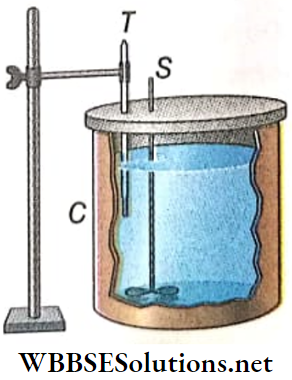
A calorimeter is a cylindrical metallic container mostly used in calorimetric experiments which is generally made of copper. The container is partly filled with a proper liquid called a calorimetric substance.

  • A stirrer (S) made of copper is used to stir the liquid and a thermometer (T) is used to measure the temperature of the liquid. Both are immersed in the liquid.
  • In a calorimetric experiment when an object is dipped into the liquid of the calorimeter there must be a difference in temperature between the object and the liquid. After some time the object, the calorimeter, and the liquid inside the calorimeter reach thermal equilibrium.

Calorimetry Experiments for Class 11

Class 11 Physics Unit 7 Properties Of Matter Chapter 7 Calorimetry Calorimeter

During this interval of time if

  1. No heat exchange occurs between the calorimeter and the surrounding,
  2. No exothermic or endothermic reaction (physical or chemical) happens inside the calorimeter and
  3. The object does not dissolve in the liquid, then according to the fundamental principle of calorimetry, heat released by the hot objects = heat absorbed by the cold objects.

There will be error in the experimental result if the above three conditions are not satisfied. Heat exchange may take place between the calorimeter and the environment by means of

  1. Conduction,
  2. Convection and
  3. Radiation.

A calorimeter is so constructed that heat exchange by any of the three processes can be minimised.

Calorimetric Substance

Water Advantages:

  1. For the same rise or fall in temperature, heat gained or lost by water is more than that gained or lost by the same mass of other solids or liquids of lower specific heat.
  2. Water is commonly used as a calorimetric substance because water is easily available.

Water Disadvantages:

  1. Again due to high specific heat of water, for absorption of same amount of heat, rise in the temperature of water is less than that of other liquids of lower specific heat. Now if the increase of temperature is low then there is high chance of error in reading.
  2. The boiling point of water is 100°C. If an object of temperature more than 100°C is mixed with water, a sudden vaporisation occurs. Due to these reasons water is not useful as a calorimetric substance.

Aniline: Recendy aniline has been recognized as the best calorimetric substance. Aniline is present in pure form. Its specific heat is low (0.62 cal · g-1 • °C-1) and boiling point is high (183.9°C).


Calorimetry Conclusion

If the state of a body remains unchanged, heat gained or lost by the body depends on

  1. Rise or fall in temperature of the body,
  2. Mass of the body and
  3. Nature of the material of the body.

Heat absorbed or released by a body only for a change in its temperature can be measured. Total heat contained in a body at a particular temperature cannot be measured.

  • The amount of heat required by lg of pure water for the rise of its temperature from 14.5°C tol5.5°C is called 1 cal.
  • The amount of heat required by lg of pure water for the rise in its temperature from 0° to 100°, divided by 100, gives the value of mean calorie.
  • The SI unit of heat is joule. 1 cal = 4.2 J.
  • Specific heat is the quantity of heat required to raise the temperature of unit mass of a substance through 1 degree.

According to this definition, units of specific heat: cal · g-1 · °C-1 (in CGS system) and J · kg-1 · K-1 (in SI).

Thermal capacity of a body is defined as the quantity of heat required to raise its temperature by unity.

Unit of thermal capacity: cal • °C-1 (in CGS system) and J · K-1 (in SI).

Water equivalent of a given body is the mass of water for which the rise in temperature is the same as that for the body, when the amount of heat supplied is the same for both.

Unit of water equivalent: g (in CGS system) and kg (in SI).

During heat transfer, if heat energy is not converted into any other form of energy (or no other form of energy is converted into heat energy), then
heat lost by one body = heat gained by another body.

This is the basic principle of calorimetry.

Calorimetry Useful Relations For Solving Numerical Problems

If no change of state occurs, then the heat gained or lost by a body, H = mst.

[where m = mass of the body, s = specific heat, t = change in temperature]

Thermal capacity of a body = ms = H/t

Thermal capacity per unit mass of a body = specific heat of the material of the body

Water equivalent of a body, W = \(\frac{m s}{s_w}\)

According to the basic principle of calorimetry, for more than two bodies at different temperatures in contact, heat lost by hot bodies = heat gained by cold bodies.

In CGS system, specific heat of water = 1 cal · g-1 · °C-1, and in SI, the specific heat of water = 4200 J · kg-1 · -1.

Class 11 Physics Class 12 Maths Class 11 Chemistry
NEET Foundation Class 12 Physics NEET Physics

Calorimetry Very Short Answer Type Questions

Examples of Calorimetry Problems

Question 1.Which substance, used in our everyday life, has the highest specific heat?
Answer: Water

Question 2. For a body of mass m and specific heat capacity s, how much heat is required to increase its temperature by t?
Answer: mst

Question 3. There are two spheres of the same radius. One is solid but the other is hollow. If both the spheres are heated to the same temperature and then allowed to cool down, which sphere will cool faster?
Answer: Hollow

Question 4. What is the CGS unit of thermal capacity?
Answer:

The CGS unit of thermal capacity

“cal • °C-1

Question 5. What is the CGS unit of water equivalent?
Answer:

The CGS unit of water equivalent

“g”

Question 6. Which substance is treated as the best calorimetric substance nowadays?
Answer: Aniline

Calorimetry Assertion Reason Type Questions And Answers

Direction: These questions have statement 1 and statement 2. Of the four choices given below, choose the one that best describes the two statements.

  1. Statement 1 is true, statement 2 is true; statement 2 is a correct explanation for statement 1.
  2. Statement 1 is true, statement 2 is true; statement 2 is not a correct explanation for statement 1.
  3. Statement 1 is true, statement 2 is false.
  4. Statement 1 is false, statement 2 is true.

Question 1.

Statement 1: A gas have a unique value of specific heat.

Statement 2: Specific heat is defined as the amount of heat required to raise the temperature of unit mass of the substance through unit degree.

Answer: 4. Statement 1 is false, statement 2 is true.

Question 2.

Statement 1: When a body of mass M loses heat, the time rate of fall of temperature for given amount of loss of heat is inversely proportional to mass.

Statement 2: ΔQ = MsΔT where, ΔQ = amount of heat, s = specific heat, andΔT = decrease in temperature.

Answer: 1. Statement 1 is true, statement 2 is true; statement 2 is a correct explanation for statement 1.

Question 3.

Statement 1: Specific heat capacity is the cause of formation of land and sea breeze.

Statement 2: The specific heat of water is more than land.

Answer: 1. Statement 1 is true, statement 2 is true; statement 2 is a correct explanation for statement 1.

Question 4.

Statement 1: Specific heat of a body is always greater than its thermal capacity.

Statement 2: Thermal capacity is the heat required for raising temperature of a body by unity.

Answer: 4. Statement 1 is false, statement 2 is true.

Question 5.

Statement 1: Two bodies at different temperatures, if brought in thermal contact do not necessarily settle to the mean temperature.

Statement 2: The two bodies may have different thermal capacities.

Answer: 1. Statement 1: Two bodies at different temperatures, if brought in thermal contact do not necessarily settle to the mean temperature.

 Calorimetry Match Column 1 And Column 2

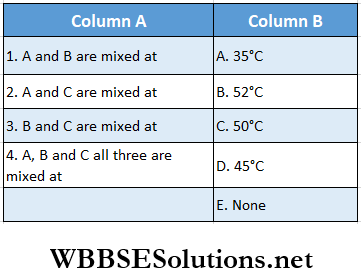
Question 1. Three liquids A, B, and C having the same specific heat and masses m, 2 m, and 3 m have temperatures 20°C, 40°C, and 60°C respectively. Temperature of the mixture when

Class 11 Physics Unit 7 Properties Of Matter Chapter 7 Calorimetry Match The Column Question 1

Answer: 1. E, 2. A, 3. D, 4. B

Calorimetry Comprehension Type Questions And Answers

Read the following passages carefully and answer the questions at the end of them.

Question 1. A vacuum flask contains 0.4 kg liquid paraffin whose temperature can be increased at the rate of 1°C per minute using an immersion heater of power 12.3 W. When a heater of 19.2 W is used to heat 0.5 kg of liquid paraffin, in the same flask, the rate of rise of temperature is 1.2°C per minute.

1. What is the specific heat of the paraffin?

  1. 0.529cal · g-1 · °C-1
  2. 0.429 cal · g-1 · °C-1
  3. 0.472cal · g-1 · °C-1
  4. 0.62.3 cal · g-1 °C-1

Answer: 1. 0.529 cal · g-1 · °C-1

2. What is the thermal capacity of the material of the flask?

  1. 17.67cal · °C-1
  2. 16.85 cal · °C-1
  3. 17.01cal · °C-1
  4. 16.63 cal · °C-1

Answer: 3. 17.01 cal · °C-1

Question 2. When a block of metal of specific heat 0.1 caI · g-1 · °C-1 and weighing 110 g is heated to 100°C and then quickly transferred to a calorimeter containing 200 g of a liquid at 10°C, the resulting temperature is 1°C. On repeating the experiment with 400 g of the same liquid in the same calorimeter at same initial temperature, the resulting temperature is 14.5°C.

1. Find the specific heat of the liquid.

  1. 0.42 cal · g-1 · °C-1
  2. 0.52 cal · g-1 · °C-1
  3. 0.48 cal · g-1 · °C-1
  4. 0.62 cal · g-1 · °C-1

Answer: 3. 0.48 cal · g-1 · °C-1

2. Find the water equivalent of calorimeter.

  1. 15.5 g
  2. 16.6 g
  3. 17.3 g
  4. 18.2 g

Answer: 2. 16.6 g

Calorimetry Integer Type Questions And Answers

In this type, the answer to each of the questions is a single-digit integer ranging from 0 to 9.

Question 1. 50 g of copper is heated to increase its temperature by 10°C. If the same quantity is given to 10 g of water, what will be the rise in its temperature (in °C)?
Answer: 5

Question 2. The water of volume 2 L in a container is heated with a coil of 1 kW at 27°C. The lid of the container is open and energy dissipates at rate of 160 J · s-1. In now much time (in minutes) temperature will rise from 27 °C to 75°C? [Given specific heat of water is 4.2 kJ • kg·-1 ]
Answer: 8

Question 3. If 0.5 kg of coal on burning raises the temperature of 50 L of water from 20 °C to 90 °C, then the heat of combustion of coal is n x 106 cal · kg-1. Find the value of n.
Answer: 7

Question 4. When x gram of steam is mixed with y grams of ice at 0°C, we obtain (x + y) grams of water at 100°C. Find the value of y/x
Answer: 3

Calorimetry Short Answer Type Questions

Question 1. A 10 Watt electric heater is used to heat a container filled with 0.5 kg of water. It is found that the tempera¬ture of water and the container rises by 3°K in 15 minutes. The container is then emptied, dried, and filled with 2 kg of oil. The same heater now raises the tem¬perature of the container-oil system by 2°K in 20 minutes. Assuming that there is no heat loss in the process and the specific heat of water as 4200 J • kg-1 • K-1, the specific heat of oil in the same unit is equal to

  1. 1.50 x 10³
  2. 2.55 x 10³
  3. 3.00 x 10³
  4. 5.10 x 10³

Answer:

Given

A 10 Watt electric heater is used to heat a container filled with 0.5 kg of water. It is found that the temperature of water and the container rises by 3°K in 15 minutes. The container is then emptied, dried, and filled with 2 kg of oil. The same heater now raises the tem¬perature of the container-oil system by 2°K in 20 minutes. Assuming that there is no heat loss in the process and the specific heat of water as 4200 J • kg-1 • K-1,

In first case the temperature of water and the container is increased by 3K in 15 min or (15 x 60)s by heating.

So, 10 x (15 x 60) = (0.5 x 4200 x 3) + (Wx 3)

[W = water equivalent]

or, \(W=\frac{9000-6300}{3}=900 \mathrm{~kg}\)

In second case, the heater increases the temperature of the oil and the container by 2K in 20 min or (20 x 60)s.

So, 10 x (20×60) = (2 x s x 2) + (W x 2)

[s = specific heat of oil]

or, s = \(\frac{12000-2 W}{4}=\frac{12000-1800}{4}=\frac{10200}{4}\)

= 2550 = 2.55 x 10³ J • kg-1 · K-1

The option 2 is correct.

Thermal Properties of Matter and Calorimetry

Question 2. Three bodies of the same material and having masses m, m, and 3m are at temperatures 40°C, 50°C, and 60°C respectively. If the bodies are brought in the thermal contact, the final temperature will be

  1. 45°C
  2. 54°C
  3. 52°C
  4. 48°C

Answer:

Given

Three bodies of the same material and having masses m, m, and 3m are at temperatures 40°C, 50°C, and 60°C respectively. If the bodies are brought in the thermal contact,

If the final temperature is t°C,

ms(t-40) + ms(t-50) + 3ms(t-60) = 0

or, (t-40) + (t-50) + 3(t-60) = 0

or, 5t-270 = 0

∴ t = 54°C

The option 2 is correct.

Question 3. A copper ball of mass 100 g is at a temperature T. It is dropped in a copper calorimeter of mass 100 g, filled with 170 g of water at room temperature. Subsequently, the temperature of the system is found to be 75°C. T is given by: (given- room temperature = 30°C, specific heat of copper= 0.1 cal/g °C)

  1. 800°C
  2. 885°C
  3. 1250°C
  4. 825°C

Answer:

Given

A copper ball of mass 100 g is at a temperature T. It is dropped in a copper calorimeter of mass 100 g, filled with 170 g of water at room temperature. Subsequently, the temperature of the system is found to be 75°C.

From the fundamental principle of calorimetry, heat released by copper ball = heat absorbed by calorimeter and water

or, 100 x0.1(t-75) = 100 x 0.1 x (75-30) + 170 x 1 x (75-30)

or, t = 885°C

The option 2 is correct.

Question 4. Explain why the coolant in a chemical or a nuclear plant (i.e., the liquid used to prevent the different parts of a plant from getting too hot) should have high specific heat.
Answer:

This is due to the fact that heat absorbed by a substance is directly proportional to the specific heat of the substance.

Question 5. Explain why two bodies at different temperatures T1 and T2 if brought in thermal contact do not necessarily settle to the mean temperature (T1 + T2)/2.
Answer:

If two bodies, at different temperatures, come in thermal contact, heat flows from the body at higher temperature to the body at lower temperature till the temperature becomes same. The final temperature can be mean temperature, i.e., (T1 + T2)/2, only when both the bodies have equal thermal capacities.


Class 11 Physics MCQs – Calorimetry

Class 11 Physics – Calorimetry Multiple Choice Questions And Answers

Calorimetry MCQs for Class 11

Question 1. The amount of heat required by 1 g of a substance for its 1 °C rise in temperature is called its

  1. Specific heat
  2. Thermal capacity
  3. Water equivalent
  4. Latent heat

Answer: 1. Specific heat

Question 2. SI unit of heat is

  1. cal
  2. kcal
  3. J
  4. W

Answer: 3. J

Question 3. Mean calorie means

  1. The amount of heat required to increase the temperature of 1 g water from 0°c to 1°c
  2. The amount of heat required to increase the temperature of 1 g water from 50°c to 51 °c
  3. The amount of heat required to increase the temperature of 1 g water from 14.5°c to 15.5°c
  4. 1/100 part of the amount of heat required to increase the temperature of 1 g water from 0°C to 100°C

Answer: 4. 1/100 part of the amount of heat required to increase the temperature of 1 g water from 0°C to 100°C

Question 4. If the amount of heat required by mass m of a substance for a rise t in temperature be H, then

  1. \(t \propto m H\)
  2. \(t \propto \frac{H}{m}\)
  3. \(t \propto \frac{m}{H}\)
  4. \(t \propto \frac{1}{m H}\)

Answer: 2. \(t \propto \frac{H}{m}\)

Question 5. cal · g-1 · °C-1 is the unit of

  1. Specific heat capacity
  2. Thermal capacity
  3. Water equivalent
  4. Latent heat

Answer: 1. Specific heat capacity

WBCHSE Class 11 Physics Calorimetry

Question 6. Which of the following substances has the highest specific heat?

  1. Mercury
  2. Water
  3. Iron
  4. Diamond

Answer: 2. Water

MCQ Practice on Thermal Properties of Matter

Question 7. Due to the higher specific heat of water compared to other solids and liquids

  1. Water warms up quickly but cools down slowly
  2. Water cools down quickly but warms up slowly
  3. Water warms up or cools down slowly
  4. Water warms up or cools down quickly

Answer: 3. Water warms up or cools down slowly

Question 8. To cool down the engine of a car, water is used in the radiator because

  1. Water is easily available
  2. Water does not cause any harm to the radiator
  3. The viscosity of water is much less
  4. The specific heat of water is high

Answer: 4. Specific heat of water is high

Question 9. During boiling of water at 100°C, what will be its specific heat?

  1. Zero
  2. 0.5
  3. 1
  4. Infinite

Answer: 4. Infinite

Question 10. If the temperature of 1 g of water is raised by 1°C for what initial temperature the heat gained is equal in magnitude to the mean calorie?

  1. 0°C
  2. 14.5°C
  3. 15°C
  4. 15.5°C

Answer: 2. 14.5°C

Question 11. An alternative name of ‘mean calorie’ is

  1. 0°- 100°C cal
  2. 14.5°C cal
  3. 15°C cal
  4. 15.5°C cal

Answer: 3. 15°C cal

Calorimetry Problems with Solutions

Class 11 Physics Class 12 Maths Class 11 Chemistry
NEET Foundation Class 12 Physics NEET Physics

Question 12. The temperature range and pressure, at which the heat required by 1 g water for 1° C rise in its temperature is called 1 cal, is

  1. 3.5°C to 4.5°C, 76 cm of Hg
  2. 13.5°C to 14.5°C, 76 mm of Hg
  3. 14.5°C to 15.5°C, 760 mm of Hg
  4. 98.5°C to 99.5°C, 760 mm of Hg

Answer: 3. 14.5°C to 15.5°C, 760 mm of Hg

Question 13. 10 g of water is supplied with 420 J of energy. The rise in temperature of water is

  1. 1°C
  2. 4.2°C
  3. 10°C
  4. 32°C

Answer: 3. 10°C

Question 14. If the specific heat of a substance is infinite, it means

  1. Heat is given out
  2. Heat is taken in
  3. No change in temperature takes place whether heat is taken in or given out
  4. All of the above

Answer: 3. No change in temperature takes place whether heat is taken in or given out

Question 15. Calorimeters are made of which of the following?

  1. Glass
  2. Metal
  3. Wood
  4. Either 1 or 3

Answer: 2. Metal

Interactive Calorimetry MCQ Tests

Question 16. Mass m of a substance requires an amount H ofheatfor a rise r in temperature. If the specific heat of the substance be s, then its water equivalent is

  1. \(H m s_w\)
  2. \(m s_w t\)
  3. \(\frac{m s}{s_w}\)
  4. \(\frac{s t}{s_w}\)

Answer: 3. \(\frac{m s}{s_w}\)

Question 17. Thermal capacity of a body of mass 10 g is 8 cal · °C-1. The specific heat of the material of the body is

  1. 0.8
  2. 1.25
  3. 0.4
  4. 0.1

Answer: 1. 0.8

Question 18. If the specific heat of copper is 0.1 cal · g-1 · °C-1, then water equivalent of a copper calorimeter of mass 0.4 kg is

  1. 40 g
  2. 4000 g
  3. 200 g
  4. 4g

Answer: 1. 40 g

Question 19. The ratio of the radii of two spheres made of the same material is 1:4. The ratio of their thermal capacities is

  1. 1/4
  2. 1/32
  3. 1/2
  4. 1/4

Answer: 1. 1/4

Heat Transfer and Calorimetry MCQs

Question 20. The ratio of the densities of two materials is 5 : 6 and of their specific heats is 3:5. The ratio of their thermal capacities per unit volume will be

  1. 1:2
  2. 2:1
  3. 3:2
  4. 2:3

Answer: 1. 1:2

Question 21. When two bodies at different temperatures are brought in contact, the basic principle of calorimetry (heat lost = heat gained) can not be applied if

  1. The two bodies do not mix well with each other
  2. Any of the bodies undergo a change of state
  3. Specific beats of the two bodies are widely different
  4. Chemical reaction occurs between the bodies

Answer: 4. Chemical reaction occurs between the bodies

Question 22. If no change of state occurs, which of the following quantities is not required for the calculation of heat lost or heat gained?

  1. Mass
  2. Density
  3. Specific Heat
  4. Change In Temperature

Answer: 2. Density

Question 23. The ratio of specific heats of two liquids is 1: 2. If the two liquids at different temperatures are mixed in the ratio 2 : 3 of their masses, then what will be the ratio of h changes in their temperatures?

  1. 1:3
  2. 1:6
  3. 3:1
  4. 6:1

Answer: 3. 3:1

Question 24. The specific heat of aluminium is more than that of copper. TWo spheres of equal masses made of these two metals are immersed in a hot liquid. In equilibrium

  1. The temperature of aluminium sphere will be greater.
  2. The temperature of both spheres will be equal
  3. The temperature of copper sphere will be greater
  4. None of the above

Answer: 2. The temperature of both the spheres will be equal

Question 25. A liquid of mass M and specific heat S is at a temperature 2t. If another liquid of thermal capacity 1.5 times, at a temperature of | is added to it, the resultant temperature will be

  1. 4/3 t
  2. t
  3. t/2
  4. 2/3 t

Answer: 2. t

In tills type of questions more than one options are correct.

Question 26. Thermal capacity of a body depends on

  1. The heat given
  2. The temperature raised
  3. The mass of the body
  4. The material of the body

Answer:

3. The mass of the body

4. The material of the body

Question 27. The specific heat of a substance can be

  1. Finite
  2. Infinite
  3. Zero
  4. Negative

Answer:

  1. Finite
  2. Infinite
  3. Zero

Question 28. When two samples at different temperatures are mixed, the temperature of the mixture can be

  1. Lesser than lower or greater than higher temperature
  2. Equal to lower or higher temperature
  3. Greater than lower but lesser than higher temperature
  4. Average of lower and higher temperature

Answer:

2. Equal to lower or higher temperature

3. Greater than lower but lesser than higher temperature

4. Average of lower and higher temperature

WBCHSE Class 11 Physics For Calorimetry Questions and Answers

Calorimetry Long Answer Type Questions And Answers

Calorimetry Questions and Answers for Class 11 WBCHSE

Question 1. Equal masses of milk and water are taken in two identical kettles and are heated by the same source. The rate of rise of the temperature of milk is found to be higher than that of water. Explain.
Answer:

Given

Equal masses of milk and water are taken in two identical kettles and are heated by the same source. The rate of rise of the temperature of milk is found to be higher than that of water.

Since both the kettles are heated by the same source, in the same interval of time amount of heat (H) absorbed is the same. Now if the rate of absorption of heat \(\left(\frac{H}{\text { time }}\right)\) and mass (m) are fixed, then from the equation H = mst we get,

st ∝ constant

∴ \(t \propto \frac{1}{s}\)

Now, since specific heat of milk is less than that of water, rate of increase in temperature of the milk is greater than that of water of the same mass.

WBCHSE Class 11 Physics For Calorimetry Questions and Answers

Question 2. Milk and water of equal mass are taken in two similar vessels at room temperature. Both of them are to be heated from room temperature to a certain higher temperature. Which will take less heat and why?
Answer:

Given

Milk and water of equal mass are taken in two similar vessels at room temperature. Both of them are to be heated from room temperature to a certain higher temperature.

Let mass of milk = m = mass of water

Increase in temperature of milk = t = increase in temperature of water

Let specific heats of milk and water be sm and sw.

Heat absorbed by milk, Hm = msmt

Heat absorbed by water, Hw = mswt

∴ \(s_m<s_w, \quad H_m<H_w\)

So, less heat is required to warm milk.

Question 3. 1 kg of iron at 100°C melts more Ice than 1 kg of lead at 100°C. Explain why.
Answer:

Given

1 kg of iron at 100°C melts more Ice than 1 kg of lead at 100°C.

Specific heat of iron is more than that of lead. Hence, for the same fall in temperature, iron supplies more heat to the ice than lead of the same mass does. Hence, iron melts relatively more ice.

Question 4. What is the advantage of taking water in hot water bottles?
Answer:

The advantage of taking water in hot water bottles are

Water has a specific heat higher than everything but ammonia. Hence, a fixed mass of water gains more heat than any other liquid of the same mass for the same rise in temperature.

Consequently, it loses more heat during cooling. This heat is used for fomentation. So a ot water bottle remains effective for a long period of time.

Key Questions on Calorimetry for Class 11

Question 5. Two copper spheres of the some external radius, one solid but the other hollow, are heated up to a certain temperature and then are allowed to cool under similar conditions. Which sphere will cool faster?
Answer:

Given

Two copper spheres of the some external radius, one solid but the other hollow, are heated up to a certain temperature and then are allowed to cool under similar conditions.

The hollow sphere will cool faster.

As both are made of copper, the specific heat s is the same.

Now, H = mst, or t = H/ms, where t = rate of fall of temperature. As the mass of the hollow sphere is less, t will be higher for it. So it will cool faster.

Question 6. State whether the fundamental law of calorimetry is applicable in the following cases:

  1. Sugar is added to water taken in a calorimeter,
  2. A chemical reaction occurs between a solid and a liquid in a calorimeter,
  3. Calorimeter is kept open in air.

Answer:

While dissolving in water, sugar will absorb the necessary heat of the solution. If it is not taken into consideration, the fundamental law of calorimetry cannot be applied.

  • During a chemical reaction, heat is evolved or absorbed. If this heat is not taken into consideration, the fundamental law of calorimetry cannot be applied.
  • If the calorimeter is kept open in air, heat exchange occurs with the surroundings. Hence, the fundamental law of calorimetry will not be applicable.

Question 7. Two small spherical balls of the same mass, made of copper and of lead are heated up to the same tern- perature and are placed on a thick wax slab. What will happen and what can we conclude from it?
Answer:

Given

Two small spherical balls of the same mass, made of copper and of lead are heated up to the same tern- perature and are placed on a thick wax slab.

The copper ball sinks in the wax slab more than the lead ball does, because the rate of melting of wax due to the copper ball is greater. From this we conclude that the heat loss of the copper ball is greater than that of the lead ball. But, the mass and the decrease in temperatures of both the balls are equal. Therefore, from the equation H = mst we conclude, the specific heat (s) of copper is higher.

Question 8. If two bodies of equal mass but of different materials are supplied equal amounts of heat, which one will have higher rise in temperature?
Answer:

Given, Heat H  = mst i.e,  temperature rise, t = H/ms

If two bodies of equal mass but of different materials are supplied equal amounts of heat,

Since for the two bodies, heat supplied H and mass m are equal, \(t \propto \frac{1}{s}\)

Hence, the body with comparatively less specific heat will have a higher rise in temperature.

Class 11 Physics Class 12 Maths Class 11 Chemistry
NEET Foundation Class 12 Physics NEET Physics

Question 9. 100 g of water and 100 g of iron are heated up to the same temperature and are separately added to 50 g of water at a lower temperature, kept in two identical vessels. Compare the temperature changes in the two vessels.
Answer:

Given

100 g of water and 100 g of iron are heated up to the same temperature and are separately added to 50 g of water at a lower temperature, kept in two identical vessels.

Temperatures of both the vessels will increase. The specific heat of iron is much less than that of water (swater = 1 and siron = 0.117). The initial temperatures of the given specimens of 100 g of water and 100 g of iron are equal.

But, due to its higher specific heat, water will lose more heat than iron will. Hence, the final temperature of the vessel in which 100 g of hot water is added will be higher.

Practice Questions on Calorimetry for Class 11

Question 10. When a hot body heats up a cold body, is the temperature change of both the bodies the same? Explain the answer.
Answer:

The change in temperature of the two bodies would differ. Heat lost by the hot body or gained by the cold body is equal to the product of

  1. Mass
  2. Specific heat and
  3. Change in temperature.

Hence, the body having higher mass and higher specific heat will have less change in temperature for the same amount of heat transfer.

Question 11. Why calorimeters are made of metal (mostly copper) instead of glass?
Answer:

Due to higher conductivity of metals, in a metallic calorimeter thermal equilibrium is achieved very fast. Also specific heat of metals is lower than that of glass.

  • That is why the water equivalent of a metallic calorimeter is lower than that of a glass calorimeter of the same mass. Therefore, for the same rise in temperature heat gained by metallic calorimeter is less than that gained by glass calorimeter.
  • As a result the final temperature of the mixture will be higher and will result less error in measurement.
  • Copper has the highest conductivity (other than silver) among all the metals, and copper is much cheaper than silver, that is why copper is mostly used as the material of a calorimeter.

Question 12. The temperature of a furnace is more than 500°C. Discuss a method of measuring the temperature of the furnace with the help of a thermometer graduated up to 100°C.
Answer:

Given

The temperature of a furnace is more than 500°C

Let the temperature of the furnace = t°C. A small metal piece of mass m and specific heat s is put into the furnace. Obviously, the melting point of the metal should be greater than the temperature of the furnace so that it does not melt.

Now, water of mass M is taken in a vessel of water equivalent W and its temperature is recorded. Let the temperature be  t1(< 100°C).

Now the hot metal piece is dropped in that water. As a result, a small quantity of water is vapourised which is negligible. After a while, when the metal piece and water reach thermal equilibrium, the final temperature is measured by the thermometer.

If that temperature is t2°C, heat lost by the metal piece = ms(t- t2) and heat gained by the vessel and water = (W+ M)sw(t2 – t1), where sw is the specific heat of water.

From calorimetric principle, ms(t-t2) = (W+ M)sw(t2 – t1)

Value of l can be calculated from this equation if values of all the other quantities are known. Thus, measuring temperatures t1 and t2 with the help of a thermometer graduated up to 100°C, a much greater temperature t can he determined.

Examples of Calorimetry Questions with Answers

Question 13. The diameter of an iron sphere and the length of the side of an iron cube are equal. Initially they are at the same temperature. If they take the same amount of heat, whose final temperature will be higher?
Answer:

Given

The diameter of an iron sphere and the length of the side of an iron cube are equal. Initially they are at the same temperature. If they take the same amount of heat,

If x be the diameter of the sphere, its volume is, \(V_1=\frac{4}{3} \pi\left(\frac{x}{2}\right)^3\)

The length of the side of the cube is x.

The volume of the cube is, V2 = x³

∴ \(\frac{V_1}{V_2}=\frac{\frac{4}{3} \pi \frac{x^3}{8}}{x^3}=\frac{\pi}{6}<1 \quad therefore V_1<V_2\)

Since the volume of the cube is greater than that of the sphere, the mass of the cube is also greater. So, if an equal amount of heat is taken by the cube, its rise in temperature will be smaller, i.e., the rise in temperature of the sphere will be higher.

WBCHSE Class 11 Physics On Elasticity Short Questions And Answers

WBCHSE Class 11 Physics On Elasticity Short Questions And Answers

Question 1. A spring is cut into two equal pieces. What is the spring the constant of each part if the spring constant of the original spring is k,
Solution:

Let us consider that the spring elongates by x when a force F is applied on it. So, the force constant of the spring, k = F/x.

Now, if the spring is cut into two equal parts, then on the application of the same force F, each part of the spring will elongate by x/2.

The force constant each part, \(k^{\prime}=\frac{F}{\frac{x}{2}}=\frac{2 F}{x}=2 k\)

Question 2. A spring having spring constant k is cut into two parts in the ratio 1:2. Find the spring constants of the two parts.
Solution:

Let the initial length of the spring be x.

The spring constant of a particular spring is inversely proportional to its length.

∴ kx = constant.

When the spring is cut into two parts in the ratio 1:2, the length of the two parts are x/3 and 2x/3 respectively.

⇒\(k_1 \frac{x}{3}=k x \text { or, } k_1=3 k\)

and \(k_2 \cdot \frac{2 x}{3}=k x \text { or, } k_2=\frac{3 k}{2}\)

WBCHSE Class 11 Physics On Elasticity Short Questions And Answers

Question 3. The length of a metal wire is L1. when the tension is T1 and L2 when the tension is T2 The unstretched length of the wire is

  1. \(\frac{L_1+L_2}{2}\)
  2. \(\sqrt{L_1 L_2}\)
  3. \(\frac{T_2 L_1-T_1 L_2}{T_2-T_1}\)
  4. \(\frac{T_2 L_1+T_1 L_2}{T_2+T_1}\)

Answer:

Young’s modulus, Y = \(\frac{\text { stress }}{\text { strain }}\)

or, strain = \(\frac{\text { stress }}{\text { strain }}\)

If the length of the wire is L0 when there is no tension in the string, then in the first case, stress = \(\frac{T_1}{\alpha}\) and strain = \(\frac{L_1-L_0}{L_0}\)

[a = area of cross-section = constant (approximately)]

So, \(\frac{L_1-L_0}{L_0}=\frac{T_1}{\alpha Y} \quad \text { or, } \frac{1}{\alpha Y}=\frac{1}{T_1}\left(\frac{L_1}{L_0}-1\right)\)

Similarly in the second case, \(\frac{1}{\alpha Y}=\frac{1}{T_2}\left(\frac{L_2}{L_0}-1\right)\)

So, \(\frac{1}{T_1}\left(\frac{L_1}{L_0}-1\right)=\frac{1}{T_2}\left(\frac{L_2}{L_0}-1\right)\)

or, \(\frac{1}{L_0}\left(\frac{L_1}{T_1}-\frac{L_2}{T_2}\right)=\frac{1}{T_1}-\frac{1}{T_2}\)

or, \(\frac{1}{L_0} \frac{T_2 L_1-T_1 L_2}{T_1 T_2}=\frac{T_2-T_1}{T_1 T_2}\)

∴ \(L_0=\frac{T_2 L_1-T_1 L_2}{T_2-T_1}\)

The option 3  is correct

Question 4. A liquid of bulk modulus k is compressed by applying an external pressure such that its density increases by 0.04%. The pressure applied to the liquid is

  1. k/10000
  2. k/10000
  3. 1000k
  4. 0.01k

Answer:

k = \(\frac{p}{\frac{\Delta V}{V}}\)

or, \(p=k \times \frac{\Delta V}{V}=k \times \frac{\Delta \rho}{\rho}=k \times 0.01 \%=\frac{k}{10000}\)

The option 1 is correct.

Question 5. The stress along the length of a rod (with a rectangular cross section) is 1% of the Young’s modulus of its material. What is the approximate percentage of change in its volume? (Poisson’s ratio of the material of the rod is 0.3)

  1. 3%
  2. 1%
  3. 0.7%
  4. 0.4%

Answer:

Let, the volume of the rod, V = xyz, and Young’s modulus of its material of the rod = Y

Now, \(\frac{F}{A}=Y \times 1 \%\)

or, \(Y \times \frac{\Delta x}{x}=\frac{Y}{100}\)

or, \(\frac{\Delta x}{x}=0.01\)

∴ \(\frac{\Delta V}{V}=\frac{\Delta x}{x}+\frac{\Delta y}{y}+\frac{\Delta z}{z}\)

Class 11 Physics Unit 7 Properties Of Matter Chapter 1 Elasticity Young's Modulus Of Its Material Of The Rod

= \(\frac{\Delta x}{x}-\sigma \frac{\Delta x}{x}-\sigma \frac{\Delta x}{x}\) ……..(1)

[Poisson’s ratio, \(\sigma=\frac{\text { lateral strain }}{\text { longitudinal strain }}=\frac{\frac{\Delta y}{y}}{\frac{\Delta x}{x}}=\frac{\frac{\Delta z}{z}}{\frac{\Delta x}{x}}\)]

The negative symbol in equation (1) implies that, as length increases due to stress, the value of y and z decreases simultaneously.

∴ From equation (1),

∴ \(\frac{\Delta V}{V}=0.01-2 \times 0.3 \times 0.01=0.004=0.4 \%\)

The option 4 is correct.

WBBSE Class 11 Elasticity Short Questions and Answers

Question 6. When a rubber band is stretched by a distance x, it exerts a restoring force of magnitude F = ax + bx2, where a and b are constants. The work done in stretching the unstretched rubber band by L isothermal

  1. \(a L^2+b L^3\)
  2. \(\frac{1}{2}\left(a L^2+b L^3\right)\)
  3. \(\frac{a L^2}{2}+\frac{b L^3}{3}\)
  4. \(\frac{1}{2}\left(\frac{a L^2}{2}+\frac{b L^3}{3}\right)\)

Answer:

⇒ \(\int d W=\int F d l\)

W = \(\int_0^L a x d x+\int_0^L b x^2 d x=\frac{a L^2}{2}+\frac{b L^3}{3}\)

The option 3 is correct.

Class 11 Physics Class 12 Maths Class 11 Chemistry
NEET Foundation Class 12 Physics NEET Physics

Question 7. A man grows into a giant such that his linear dimensions increase by a factor of 9. Assuming that his density remains the same, the stress in the leg will change by a factor of

  1. 9
  2. 1/9
  3. 81
  4. 1/81

Answer:

According to the question, \(\frac{V_f}{V_i}=(9)^3\)

So, \(\frac{m_f}{m_i}=(9)^3\)

Also, \(\frac{A_f}{A_i}=(9)^2\)

Stress = \(\frac{\text { force }}{\text { area }}=\frac{m \times g}{A}\)

∴ \(\frac{S_f}{S_i}=\frac{m_f}{m_i} \times \frac{A_i}{A_f}=(9)^3 \times \frac{1}{(9)^2}=9\)

The option 1 is correct.

Question 8. An external pressure P is applied on a cube at 0°C so that it is equally compressed from all sides. K is the bulk modulus of the material of the cube and α is its coefficient of linear expansion. Suppose we want to bring the cube to its original size by heating it. The temperature should be raised by

  1. \(\frac{P}{3 \alpha K}\)
  2. \(\frac{P}{\alpha K}\)
  3. \(\frac{3 \alpha}{P K}\)
  4. \(3 P K \alpha\)

Answer:

Bulk modulus, K= \(\frac{P}{\left(\frac{\Delta V}{V}\right)}\)

∴ \(\frac{\Delta V}{V}=\frac{P}{K}[\Delta V= change in volume]\)

If we bring back the cube to its original size by increasing the temperature Δt,

⇒ \(\Delta V=V \cdot \gamma \Delta t\)

or, \(\Delta t=\frac{\Delta V}{V} \cdot \frac{1}{\gamma}=\frac{\Delta V}{V} \cdot \frac{1}{3 \alpha}=\frac{P}{3 k \alpha}\)

The option (1) is correct.

Question 9. A solid sphere of radius r made of a soft material of bulk modulus K is surrounded by a liquid in a cylindrical container. A massless piston of area floats on the surface of the liquid, covering the entire cross-section of the cylindrical container. When a mass m is placed on the surface of the piston to compress the liquid, the fractional decrement in the radius of the sphere, (dr/r) is

  1. \(\frac{m g}{3 K a}\)
  2. \(\frac{m g}{K a}\)
  3. \(\frac{K a}{m g}\)
  4. \(\frac{K a}{3 m g}\)

Answer:

Bulk modulus,  K = \(-V \frac{d p}{d V}\)

or, \(-\frac{d V}{V}=\frac{d p}{K}\)

or, \(\frac{-3 d r}{r}=\frac{\frac{m g}{a}}{K}\left[because V=\frac{4}{3} \pi r^3\right]\)

or, \(\frac{d r}{r}=-\frac{m g}{3 K a} \quad therefore\left|\frac{d r}{r}\right|=\frac{m g}{3 K a}\)

The option 1 is correct

Question 10. The copper of fixed volume V is drawn into a wire of length l. When this wire is subjected to a constant force F, the extension produced in the wire is Δl. Which of the following graphs is a straight line?

  1. Δl versus 1/l
  2. Δl versus l2
  3. Δl versus 1/l2
  4. Δl versus l

Answer:

Y = \(\frac{F l}{A \Delta l} \text { or, } \Delta l=\frac{F l}{A Y}=\frac{F l^2}{V Y}\)

∴ \(\Delta l \propto l^2\)

The option 2 is correct.

Short Answer Questions on Stress and Strain

Question 11. The approximate depth of an ocean is 2700 m. The compressibility of water is 45.4 x 10⁻¹¹ Pal-1 and the density of water is 103kg/m3. What fractional compression of water will be obtained at the bottom of the ocean?

  1. 0.8 x 10⁻²
  2. 1.0 x 10⁻²
  3. 1.2 x 10⁻²
  4. 1.4×10⁻²

Answer:

Due to AP amount of increase in pressure, there is AV
amount of compression in volume V.

So, fractional compression = \(\frac{\Delta V}{V}\)

and compressibility, K = \(\frac{1}{V} \frac{\Delta V}{\Delta P}\)

Now consider the magnitude, \(\frac{\Delta V}{V}=K \Delta P\)

Here, ΔP = hρg = 2700 x 103 x 10 Pa [taking g = 10m/s2]

Hence, fractional compression, \(\frac{\Delta V}{V} =\left(45.4 \times 10^{-11}\right) \times\left(2700 \times 10^3 \times 10\right)\)

= \(1.226 \times 10^{-2}\)

The option 3 is correct.

Question 12. The density of a metal at normal pressure is p. Its density when it is subjected to an excess pressure p is p’. If B is the bulk modulus of the metal, the ratio of \(\frac{e^{\prime}}{\rho}\)

  1. \(1+\frac{B}{p}\)
  2. \(\frac{1}{1-\frac{p}{B}}\)
  3. \(1+\frac{p}{B}\)
  4. \(\frac{1}{1+\frac{P}{B}}\)

Answer:

Volume strain = change in pressure = p

Initial volume, V = \(\frac{M}{\rho}\)

Final volume, \(V^{\prime}=\frac{M}{\rho^{\prime}}\)

Change in volume, \(V^{\prime}-V=M\left(\frac{\rho-\rho^{\prime}}{\rho^{\prime} \rho}\right)\)

∴ Volume strain = \(=\frac{V^{\prime}-V}{V}=\frac{\rho-\rho^{\prime}}{\rho^{\prime}}\)

∴ \(B=-\frac{p V}{V^{\prime}-V}=-\frac{p \times \rho^{\prime}}{\rho-\rho^{\prime}}\)

or, \(\underset{B}{p}=-\frac{\rho-\rho^{\prime}}{\rho^{\prime}}=\frac{\rho^{\prime}-\rho}{\rho^{\prime}}\)

or, \(\frac{\rho}{\rho^{\prime}}=1-\frac{p}{B}\)

∴ \(\frac{\rho^{\prime}}{\rho}=\frac{1}{1-\frac{p}{B}}\)

The option 2 is correct.

Elasticity Problems and Solutions for Class 11

Question 12. Two wires are made of the same material and have the same volume. The first wire has cross-sectional area A and the second wire has cross-sectional area 3A. If the length of the first wire is increased by Δl. on applying a force F, how much force is needed to stretch the second wire by the same amount?

  1. 4F
  2. 6F
  3. 9F
  4. F

Answer:

In case of first wire, Y = \(\frac{F / A}{\Delta l / l_0}=\frac{F l_0}{A \Delta l}\)

or, \(F=\frac{Y A \Delta l}{l_0}\)

Class 11 Physics Unit 7 Properties Of Matter Chapter 1 Elasticity Two Wires Are Made Of Same Marterial And Have Same Volume

In the case of the second wire,

Y = \(\frac{F^{\prime} / 3 A}{\frac{\Delta l}{l_0 / 3}}=\frac{F^{\prime} l_0}{9 A \Delta l}\)

or, \(F^{\prime}=\frac{9 Y A \Delta l}{l_0}=9 F\)

The option 3 is correct.

Question 13. Which type of substances are called elastomers? Give one example.
Answer:

Elastomers are those materials for which stress-strain variation is not a straight line within the elastic limit. An elastomer is a polymer with viscoelasticity (colloquially elasticity), generally having low Young’s modulus and high failure strain compared with other materials.

Example: Rubber.

Question 14. Bridges are declared unsafe after long use. Why?
Answer:

A bridge undergoes alternating stress and strain a large number of times during its use. A bridge loses its elastic strength when it is used for a long time. Therefore, the amount of strain for a given stress will become large and ultimately the bridge will collapse. So, they are declared unsafe after long use.

Question 15. What are elastomers? Give two examples for the same.
Answer:

Elastomers (elastic polymers) are materials of low Young’s modulus but of very high elastic limits. Such a material can withstand high strain but can still develop sufficient stress to bring it back to its initial size and shape.

Examples: natural rubber, thermoplastics.

Question 16. What is the value of rigidity modulus of elasticity for an incompressible liquid?
Answer:

A liquid, compressible or incompressible, does not have any defined shape; it cannot withstand shear. So it can never generate any shearing stress. Hence the rigidity modulus of elasticity of a liquid is zero.

Question 17. Which type of energy is stored in the spring of wrist wristwatch?
Answer:

Potential energy is stored in the spring of wrist watch.

Real-Life Examples of Elastic Materials

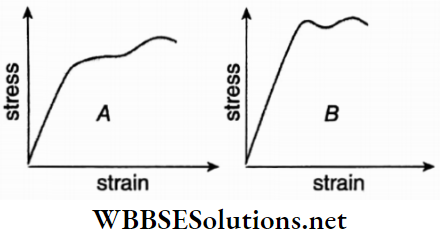
Question 18. The stress-strain graph for materials A and B are as shown in the graphs drawn to the same scale, which graph represents a property of ductile materials? Justify your answer.
Answer:

Class 11 Physics Unit 7 Properties Of Matter Chapter 1 Elasticity Stress Strain Graphs For Materials A And B

The graph for material A represents the property of ductile material because of its greater plastic range.

Question 19. Two wires A and B of length l, radius r, and length 21, radius 2 r having the same Young’s modulus Y are hung with a weight of mg as shown in the figure. What is the net elongation in the two wires?
Answer:

The length and radius of wire A are l and r and that of wire B are 2l and 2 r respectively.

If l1 and l2 are the individual elonga¬tion of wire A and wire B, then the net elongation,

∴ \(\Delta l =\Delta l_1+\Delta l_2=\frac{m g l}{\pi r^2 Y}+\frac{m g(2 l)}{\pi(2 r)^2 Y}\)

Class 11 Physics Unit 7 Chapter 1 Elasticity Young's Moduli Of Two Rods Of Equal Length And Equal Cross Sections

= \(\left(\frac{m g l}{\pi r^2 Y}+\frac{2 m g l}{4 \pi r^2 Y}\right)=\frac{4 m g l+2 m g l}{4 \pi r^2 Y}=\frac{3}{2} \frac{m g l}{\pi r^2 Y}\)

Question 20. Which of the two forces-deforming or restoring is responsible for the elastic behavior of a substance?
Answer: Restoring force is responsible for the elastic behavior of a substance.

2 Law Of Thermodynamics Notes

Thermodynamics

First And Second Law Of Thermodynamics Introduction

Position, displacement, velocity, acceleration, etc., are external properties of a body. From them, we get no information about the nature of the body. They are discussed in the subject of mechanics.

  • On the other hand, properties like mass (M), volume (V), pressure (p), temperature (T), density (ρ), etc., are internal properties of a body. These are bulk (macroscopic) properties and can be measured by simple experiments.
  • Any change in these properties generally involves the transfer of energy in the form of heat or work. All of these are studied in a branch of Physics, known as thermodynamics. The above-mentioned properties and similar others are called thermodynamic properties.
  • The subject is based only on experi¬mental data and every thermodynamic formula comes from the analysis of this data. For example, suppose a fixed mass of an ideal gas is studied at constant temperature.
  • Any change of pressure produces a change in volume and different sets of p and V are obtained. An analysis of these measured values shows that the product pV = constant. This is the well-known Boyle’s law. As it is experiment-based, it is a thermodynamic law.

2nd law of Thermodynamics Notes

Thermodynamic Systems: A body or, a part of a body, or a combination of a number of bodies that is being studied is usually called a thermodynamic system. In general, such a system interacts with its surroundings or, environment and exchanges energy and mass.

The environment or surroundings include all external objects that have some influence on the system. For example, if a room in a house is considered as a system and its thermal properties are to be studied, the sun at a distance of 1.5 x 10⁸ km is an important component of the environment, but another house only 100 m away need not be included as a component. Thermodynamic systems are of three types.

Isolated system: This system does not exchange any energy or mass with the surroundings.

Closed system: Energy is exchanged with the surroundings, but the mass remains fixed.

Open system: Both energy and mass are exchanged. We shall not discuss open systems in this chapter.

Properties like a number of molecules, molecular velocity, etc., are internal microscopic properties of a body. They are not directly measurable and experimental data is absent. Hence, the study of this subject is based on theoretical assumptions and is known as kinetic theory.

Thermodynamics – First And Second Law Of Thermodynamics Nature Of Heat

Heat is a form of energy which can be identified only when it is in transit. It can be converted into other forms of energy and vice versa. To measure the amount of heat energy, different units are used:

CGS System: calorie: (cal)

SI: Joule (J)

  • In SI, the unit of energy is directly used to measure some quantity of heat. So, Joule (J) is the unit of heat in SI, as it is the SI unit of energy. Similarly, other energy units like erg may also be used.
  • Immediately it becomes clear that the energy units must have definite relations with the conventional units of heat. This topic is discussed in the next section.
  • In thermodynamics, the definition of temperature comes earlier from the zeroth law of thermodynamics. The definition of heat is based on the concept of temperature.

Nature of heat Definition: Heat is a form of energy which is transmitted from one place to another due to their temperature differences only.

It is interesting to note the difference between this and the calorimetric definition of heat.

Thermodynamics – First And Second Law Of Thermodynamics Mechanical Equivalent Of Heat Joules Law

The widely used unit of heat is calorie (or cal, in CGS system). We know that heat is a form of energy; so energy units like erg (CGS system) and joule (J in SI) should somehow be related to the units of heat.

  • James Prescott Joule was the first experimentalist who accurately measured the mechanical energy equivalent to some amount of heat energy i.e., the mechanical equivalent of heat.
  • This measurement determines the amount of mechanical energy expressed in joule (or erg) which is equivalent to heat energy of 1 cal.
  • Mechanical energy may be used to do work and work produces heat. On the other hand, heat may be converted to work or mechanical energy. This indicates that there is a natural relationship between work and heat. This relation is known as Joule’s law.

Joule’s law: If some amount of work is entirely converted to heat, then the work done and the heat produced are proportional to each other.

If W=workdoneand H=heat produced,then from Joule’slaw,

W ∝ H or, W = JH…..(1)

Here, J is a constant. This constant is called the mechanical equivalent of heat or Joule’s equivalent.

Definition of J and Hs magnitudes in different systems: In equation (1), if H = 1, then W = J. So mechanical equivalent of heat is defined as the amount of work done to produce a unit amount of heat.

Clearly, the unit and the magnitude of J depends on the unit of heat and work in different systems of units.

CGS system: The unit of H is calorie and the unit of W is erg.

As J = \({W}{H}\) the unit of J is erg · cal-1 and the measured value of J = 4.2 x 10⁷ erg · cal-1.

As 1 J = 107 erg, the value of J = 4.2 J · cal-1.

The units like erg · cal-1 and J · cal-1 indicate that the mechanical equivalent of heat J actually denotes the conversion factor between two units. For example, J = 4.2 J · cal-1.

This means that 1 cal = 4.2 J, i.e., each calorie should be multiplied by 4.2 to express the energy in joule.

In SI: Here W and H are expressed in the same unit, which is joule (J). So, no conversion factor is necessary. The mechanical equivalent of heat is J = 1. This means that the concept of J is unnecessary in SI.

Relation of calories with erg and joule: 1 cal = 4.2 x 10⁷ erg = 4.2 J.

Thermodynamics – First And Second Law Of Thermodynamics Mechanical Equivalent Of Heat Numerical Examples

Second Law of Thermodynamics Explained

Example 1. 800 g lead balls are kept in a 1 m long, vertical tube which is a bad conductor and the tube is then closed at both ends. The tube is suddenly inverted so that the balls fall from one end to the other. The I temperature of the lead balls increases by 3.89°C after 50 such inversions. Find out the mechanical equivalent of heat assuming that the lead balls have retained the entire amount of heat produced.
Solution:

Given

800 g lead balls are kept in a 1 m long, vertical tube which is a bad conductor and the tube is then closed at both ends. The tube is suddenly inverted so that the balls fall from one end to the other. The I temperature of the lead balls increases by 3.89°C after 50 such inversions.

Work done, W= loss of potential energy of the balls = n x mgh

= 50 x 800 x 980 x 100 erg (1 m = 100 cm)

Heat produced, H = mst = 800 x 0.03 x 3.89 cal

∴ J = \(\frac{W}{H}=\frac{50 \times 800 \times 980 \times 100}{800 \times 0.03 \times 3.89}=4.2 \times 10^7 \mathrm{erg} \cdot \mathrm{cal}^{-1}\).

Example 2. Water drops from a height of 50 m in a waterfall. Find out the rise in temperature of water, if 75% of its energy is converted into heat and absorbed by water. (\(J=4.2 \times 10^7 \mathrm{erg} \cdot \mathrm{cal}^{-1} ; \mathrm{g}=9.8 \mathrm{~m} \cdot \mathrm{s}^{-2}\))
Solution:

Given

Water drops from a height of 50 m in a waterfall.

Here, W = mgh x 75/100 and H = mst

Now, W = JH

or, \(m g h \times \frac{75}{100}=J m s t\)

or, \(t=\frac{m g h \times \frac{75}{100}}{J m s}\)

[s = \(J \mathrm{cal} \cdot \mathrm{g}^{-1} \cdot{ }^{\circ} \mathrm{C}^{-1}\) for water, g = \(9.8 \mathrm{~m} \cdot \mathrm{s}^{-2}\)=980 \(\mathrm{~cm} \cdot \mathrm{s}^{-2}, h=50 \mathrm{~m}=50 \times 100 \mathrm{~cm}\))

= \(\frac{g h}{J s} \times \frac{75}{100}=\frac{980 \times 50 \times 100}{4.2 \times 10^7 \times 1} \times \frac{75}{100}=0.0875^{\circ} \mathrm{C}\)

Real-Life Applications of the Second Law of Thermodynamics

Example 3. The velocity of a 42 kg celestial body reduces from 20 km · min-1 to 5 km · min-1 due to its passage through the earth’s atmosphere. Find out the heat produced in calories. (J = 4.2 x 10⁷ erg · cal-1)
Solution:

Given

The velocity of a 42 kg celestial body reduces from 20 km · min-1 to 5 km · min-1 due to its passage through the earth’s atmosphere.

The initial velocity of the celestial body,

u = \(20 \mathrm{~km} \cdot \mathrm{min}^{-1}=\frac{20 \times 1000}{60} \mathrm{~m} \cdot \mathrm{s}^{-1}\)

Final velocity of the celestial body,

v = \(5 \mathrm{~km} \cdot \min ^{-1}=\frac{5 \times 1000}{60} \mathrm{~m} \cdot \mathrm{s}^{-1}\)

Work done, W = change in kinetic energy

= \(\frac{1}{2} m u^2-\frac{1}{2} m v^2=\frac{1}{2} m\left(u^2-v^2\right)\)

= \(\frac{1}{2} \times 42 \times\left(\frac{1000}{60}\right)^2\left(20^2-5^2\right)\)

= \(\frac{42 \times 10^4 \times 375}{2 \times 36} \text { joule }\)

∴ Heat produced,

H = \(\frac{W}{J}=\frac{42 \times 10^4 \times 375}{2 \times 36 \times 4.2} \)

(J = \(4.2 \times 10^7 \mathrm{erg} \cdot \mathrm{cal}^{-1}=4.2 \mathrm{~J} \cdot \mathrm{cal}^{-1}\))

= \(5.2 \times 10^5 \mathrm{cal}\).

Example 4. Find out the amount of work done to convert 100 g ice at 0°C to water at 100°C. (Latent heat of fusion of ice = 80 cal · g-1; the mechanical equivalent of heat = 4.2 J · cal-1).
Solution:

Total heat supplied,

H = 100 x 80 + 100 x 1 x (100-0)

= 8000 + 10000 = 18000 cal

∴ Work done, W = JH = 4.2 x 18000 = 75600 J.

Example 5. What will be the temperature difference between the top and the bottom of a 400 m high waterfall, assuming that 80% of the heat produced is retained by the water?
Solution:

Second Law of Thermodynamics and Entropy

Work done, W = loss in potential energy

= mg(h- 0) = mgh

∴ Heat produced, H = \(\frac{W}{J}=\frac{m g h}{J}\)

∴ Amount of heat retained by water = \(\frac{m g h}{J} \times \frac{80}{100}\)

If the increase in temperature of water is t, required heat = mst

According to the question,

mst = \(\frac{m g h}{J} \times \frac{80}{100}\)

or, t = \(\frac{g h}{J s} \times \frac{80}{100}=\frac{9.8 \times 400}{4.2 \times 1000} \times \frac{80}{100}\)

(specific heat of water in SI s = \(1000 \mathrm{cal} \cdot \mathrm{kg}^{-1} \cdot{ }^{\circ} \mathrm{C}^{-1}\))

or, t = 0.747 °C

Example 6. Find out the minimum height from which a piece of ice at 0°C should be dropped so that it melts completely due to its impact with the ground. Assume that half of the energy loss due to the fall is responsible for the fusion of ice. (Latent heat of fusion of ice = 80 cal · g-1, g = 980 cm · s-2, J = 4.2 J · cal-1)
Solution:

Let the piece of ice of mass m be allowed to fall from height h.

Now, energy loss due to the fall = loss in potential energy = mgh = work done, W.

Half of it, i.e., W/2 amount of energy is converted into heat and it is responsible for the fusion of ice.

∴ Heat produced, \(H=\frac{W / 2}{J}=\frac{m g h}{2 J}\)

As mg of ice melts into water, required latent heat = 80 m cal

So, \(\frac{m g h}{2 J}=80 \mathrm{~m}\)

or, \(h=\frac{80 \times 2 J}{g}=\frac{80 \times 2 \times 4.2 \times 10^7}{980}\)

(J = \(4.2 \mathrm{~J} \cdot \mathrm{cal}^{-1}=4.2 \times 10^7 \mathrm{erg} \cdot \mathrm{cal}^{-1}\))

= \(6.857 \times 10^6 \mathrm{~cm}=68.57 \mathrm{~km}\)

Class 11 Physics Class 12 Maths Class 11 Chemistry
NEET Foundation Class 12 Physics NEET Physics

Example 7. A piece of ice at 0°C is dropped to the ground from some height. The piece of ice melts completely due to its impact on the ground. Find the height from which the piece was dropped considering that 60% of its energy is converted into heat. (J = 4.2 J · cal-1)
Solution:

Given

A piece of ice at 0°C is dropped to the ground from some height. The piece of ice melts completely due to its impact on the ground.

The potential energy of the piece of ice of mass m at height h = mgh, kinetic energy = 0

So, total mechanical energy = mgh

This energy is conserved till it touches the ground. Due to the impact with the ground, 60% of this energy,

i.e., mgh x 60/100 or 0.6 mgh is converted into heat energy.

∴ Heat produced = \(\frac{0.6 \mathrm{mgh}}{J}\)

Again, heat required to melt m g of ice = mL

[L = latent heat of fusion of ice]

∴ \(\frac{0.6 m g h}{J}=m L\)

or, h = \(\frac{J L}{0.6 g}\left[L=80 \mathrm{cal} \cdot \mathrm{g}^{-1}=80 \times 1000 \mathrm{cal} \cdot \mathrm{kg}^{-1}\right]\)

= \(\frac{4.2 \times(80 \times 1000)}{0.6 \times 9.8}=5.71 \times 10^4 \mathrm{~m}=57.1 \mathrm{~km}\)

Example 8. A stirrer rotates in 1 l of water against a damping force of 0.1 N at 360 rpm in a circle of radius 5 cm. Calculate the rise in water temperature in 1 h, neglecting heat loss due to radiation. (J = 4.2 J · cal-1)
Solution:

Given

A stirrer rotates in 1 l of water against a damping force of 0.1 N at 360 rpm in a circle of radius 5 cm.

Mass of 1 l of water, m = 1 kg.

If t is the rise in temperature of water in 1 h, then heat produced, H = mst.

Now, circumference of the circle =2πr; number of rotations in 1 h = 360 x 60

∴ Displacement of the stirrer, d = 360 x 60 x 2πr

Work done, W = force x displacement = Fd

∴ W = JH or, Fd = Jmst

or, t = \(\frac{F d}{J m s}=\frac{0.1 \times(360 \times 60 \times 2 \times \pi \times 0.05)}{4.2 \times 1 \times 1000}\)

(F = \(0.1 \mathrm{~N} ; r=5 \mathrm{~cm}=0.05 \mathrm{~m}\))

s = \(1000 \mathrm{cal} \cdot \mathrm{kg}^{-1} \cdot{ }^{\circ} \mathrm{C}^{-1}\)

= 0.162°C.

Understanding Heat Transfer in Thermodynamics

Example 9. 10 l of water is dropped from a height of 250 m. How much heat (in calories) will be generated when the water reaches the bottom? Assuming that the entire heat will be retained by the mass of water, what will be the rise in temperature of the water? (Given J = 4.18 J · cal-1)
Solution:

Given

10 l of water is dropped from a height of 250 m.

Mass of 10 l of water, m = 10 kg.

Kinetic energy on impact with the ground

= initial potential energy = mgh = work done (W)

So, heat generated,

H = \(\frac{W}{J}=\frac{m g h}{J} \mathrm{cal}\)

The specific heat of water,

s = \(1000 \mathrm{cal} \cdot \mathrm{kg}^{-1} \cdot{ }^{\circ} \mathrm{C}^{-1}\)

If t is the rise in temperature, then

mst = H = \(\frac{m g h}{J}\)

or, t = \(\frac{g h}{J s}=\frac{9.8 \times 250}{4.18 \times 1000}=0.586^{\circ} \mathrm{C}\)

Example 10. What will be the time required to heat a 151 bucket full of water from 20°C to 40°C using a 1500W immersion heater?
Solution:

Mass of 15 1 of water, m = 15 kg specific heat of water, s = 1000 cal · kg-1 · °C-1

Now, W = JH or, Pt = Jmsθ

where P = power of the heater = 1500W; t = time required; θ = rise in temperature = 40 – 20 = 20°C.

So, t = \(\frac{J m s \theta}{P}=\frac{4.2 \times 15 \times 1000 \times 20}{1500}=840 \mathrm{~s}=14 \mathrm{~min} \text {. }\)

Example 11. The temperature of a piece of lead is 27°C. Find out the minimum velocity of its impact with a wall so that it melts completely. Suppose 58% of the heat generated is dissipated. Given, J = 4.2 J · cal-1; melting point, specific heat, and latent heat of fusion of lead are 327°C, 0.03 cal · g-1 · °C-1 and 5 cal · g-1, respectively.
Solution:

Given

The temperature of a piece of lead is 27°C.

⇒ \(H \times \frac{100-58}{100}=m s t+m l\)

or, \(H=(m s t+m l) \times \frac{100}{42}\)

Again, W = \(\frac{1}{2} m v^2\)

Now, W=J H

or, \(\frac{1}{2} m v^2=J(m s t+m l) \times \frac{100}{42}\)

or, \(v^2=2 J(s t+l) \times \frac{100}{42}\)

= \(2 \times\left(4.2 \times 10^7\right) \times[0.03 \times(327-27)+5] \times \frac{100}{42}\)

= \(28 \times 10^8\)

So, \(v=5.29 \times 10^4 \mathrm{~cm} \cdot \mathrm{s}^{-1}=529 \mathrm{~m} \cdot \mathrm{s}^{-1}\).

Example 12. A body of mass 2 kg is pulled with a velocity of 2 m · s-1 on a horizontal surface. What will be the heat produced in 5s, if the coefficient of friction between the body and the surface is 0.2? Given, J = 4.21 • cal-1; g = 9.8 m• s-2.
Solution:

Given

A body of mass 2 kg is pulled with a velocity of 2 m · s-1 on a horizontal surface.

Force of friction on the body, F = μmg

So the work done, W = Fs = μ mg · vt

∴ Heat produced, H = \(\frac{W}{J}=\frac{\mu \mathrm{mg \nu t}}{J}\)

= \(\frac{0.2 \times 2 \times 9.8 \times 2 \times 5}{4.2}\)

= 9.33 cal

Example 13. Two pieces of ice, of equal mass moving towards each other with the same velocity, collide head-on and are vaporized due to this collision. Find out the minimum initial velocity of the pieces of ice. Given, that the initial temperature, specific heat, and latent heat of fusion of ice are -12°C, 0.5 cal · g-1 · °C-1, and 80 cal · g-1 respectively latent heat of steam is 540 cal · g-1.
Solution:

Given

Two pieces of ice, of equal mass moving towards each other with the same velocity, collide head-on and are vaporized due to this collision.

The initial temperature, specific heat, and latent heat of fusion of ice are -12°C, 0.5 cal · g-1 · °C-1, and 80 cal · g-1 respectively latent heat of steam is 540 cal · g-1

Let m = mass of each piece of ice; v = minimum initial velocity.

Here, work done due to collision, W

= loss in kinetic energy = 2 x 1/2 mv² = mv²

Heat produced, H = 2[m x 0.5 x 12 + m x 80 + m x 1 x 100 + m x 540]

= 1452 m cal

∴ W = JH or, mv² = J x 1452m

or, v² = (4.2 x 107)x 1452 = 6.1 x 10¹⁰

So, v = 2.47 x 105 cm · s-1 = 2.47 km · s-1.

Example 14. The top of a waterfall is at a temperature 0.49°C below that of the bottom. The work done by water due to its fall is converted entirely into heat. Find the height of the waterfall. Given, g = 980 cm · s-2, J = 4.2 J · cal-1.
Solution:

Given

The top of a waterfall is at a temperature 0.49°C below that of the bottom. The work done by water due to its fall is converted entirely into heat.

Let m = mass of water falling from height h.

Work done, W = kinetic energy of impact

= initial potential energy = mgh.

Now, W = JH or, mgh = Jmst

or, h = \(\frac{J s t}{g}\)

= \(\frac{\left(4.2 \times 10^7\right) \times 1 \times 0.49}{980}\)

= 21000 cm =210 m.

Thermodynamics – First And Second Law Of Thermodynamics Intensive And Extensive Variables

Examples of the Second Law in Nature

Let us consider a wooden table and a wooden chair. The mass (m) and volume (V) of them are different because such properties depend on the whole body. These are the extrinsic thermodynamic properties.

On the other hand, the density (ρ) is the same for both the bodies. This property does not depend on the whole body, but only on the material (in this case, wood) of the body. This is an intrinsic thermodynamic property.

Generally, thermodynamic variables are of two types

  1. Intensive variable and
  2. Extensive variable.

The variables that do not depend on the amount of matter or mass in a thermodynamic system are called intensive variables. Pressure, temperature, density, surface tension, etc., are intensive variables.

  • The variables that are proportional to the amount of matter or mass in a thermodynamic system are called extensive variables. Volume, magnetic moment, internal energy, entropy, etc., are extensive variables.
  • As an illustration we may consider some amount of gas of mass m, volume V, pressure p, temperature T, and density ρ, enclosed in a container.
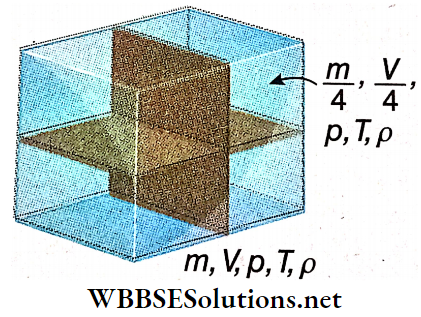
Class 11 Physics Unit 8 Thermodynamics Chapter 1 First And Second Law Of Thermodynamics Thermodynamic Variables

Now we divide the gas into 4 equal parts. Clearly, mass, volume, pressure, temperature, and density of each part arc \(\frac{m}{4}, \frac{V}{4}, p, T \text { and } \rho\), respectively.

  • It means that m and V depend on the whole amount of the gas; they are extensive variables. But ρ, p, T do not depend on the amount; they are intensive variables.
  • We consider a relation like mass = density x volume or, m = ρV. On the left-hand side, mass m changes proportionally with the amount of matter in a system. On the right-hand side, volume V changes similarly.
  • Thus, the two sides remain equal only if ρ remain the same. So, whereas m and V are extensive, ρ is intensive. In general, in a product of two or more thermodynamic properties, only one is an extensive variable and the others are intensive variables.

So we can have a product like ρV which is extensive (V is extensive, but ρ is intensive). But a product like mV is not allowed, as both m and V are extensive.

Intensive and extensive variable in thermodynamics systems
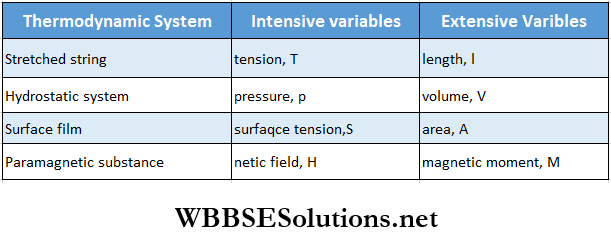
Class 11 Physics Unit 8 Thermodynamics Chapter 1 First And Second Law Of Thermodynamics Intensive And Extensive Variables In Thermodynamic System

State Function and Path Function: If a system is in equilibrium, the variables like its volume (V), pressure (p), temperature (T), etc. have definite values. So these values refer to the state of the system and do not depend on the path followed to reach that state. So variables like volume, pressure, temperature, etc. are called state functions or properties of the system.

  • On the other hand, the two functions—work (W) and heat (Q) are not related to any state of the system, rather they are relevant to any process of the system. A statement—WA is the amount of work done in the state A—has no meaning.
  • Rather the statement ‘WAB is the amount of work done in die process A → B’ is meaningful. There can be various paths from the state A to the state B. The values of WAB or QAB in each path are different, i.e., these values depend on the paths between the states A and B. So W and Q are called path functions.
  • They are not state functions. It is to be noted that if VA and VB are the volumes of the system in the states A and B respectively, then the change in volume in the process A → B = VB– VA.
  • Whatever may be the path taken from A to B the change in volume, VB-VA, remains the same. It does not depend on the path. So any change of a state function is independent of the path.

 Thermodynamics – First And Second Law Of Thermodynamics Thermodynamic Equilibrium And Process

Thermodynamic equilibrium: The macroscopic properties that are used to describe a system may change spontaneously or due to an external influence. During such a change, the system and its surroundings interact with each other.

  1. The absence of unbalanced force or torque in the interior of a system or between a system and its surroundings implies mechanical equilibrium has been established.
  2. For a system in mechanical equilibrium, when there is no spontaneous change of internal structure (by means of a chemical reaction) or transfer of matter from one part of the system to another (by means of diffusion) chemical equilibrium is said to be established.
  3. For a system in mechanical and chemical equilibrium, thermal equilibrium is set to be attained if no exchange of heat occurs between the system and its surroundings. Hence it is obvious that in thermal equilibrium, the temperature remains the same throughout the system and is identical with that of the surroundings.

When all the three types of equilibrium stated above an attained by a system, it is said to be in a thermodynami equilibrium in an equilibrium state, or simply, in state.

  • A closed thermodynamic system, i.e., a system having a fixed mass, can be described completely by three of its properties—volume (V), pressure (p), and temperature (T). All other properties of the system depend on these properties and therefore are functions of, V, p, and T.
  • In thermodynamic equilibrium none of the tires properties of a system— volume, pressure, or temperature—changes with time. In our study, we shall deal with equilibrium states, and V, p, and T will not be treated as functions of time. So, the quantity time will never appear in our formulation of thermodynamic relations.

Moreover, volume, pressure, and temperature are related among themselves by an equation of state. Thus, if two of them are known, the third can be calculated using that equation of state. Hence, there are only two independent properties for a closed thermodynamic system. For example, let a fixed mass of 1 mol of a gas be taken at STP. Then,

p = 1 atm = 76 cm of mercury

= 76 x 13.6 x 980 dyn · cm-2

T = 0 °C = 273K

If die gas is assumed to be ideal, then from the equation of state pV = RT, we have

V = \(\frac{R T}{p}=\frac{8.31 \times 10^7 \mathrm{erg} \cdot \mathrm{mol}^{-1} \cdot \mathrm{K}^{-1} \times 273 \mathrm{~K}}{76 \times 13.6 \times 980 \mathrm{dyn} \cdot \mathrm{cm}^{-2}}\)

= \(22400 \mathrm{~cm}^3 \cdot \mathrm{mol}^{-1}=22.4 \mathrm{l} \cdot \mathrm{mol}^{-1}\)

Here, p and T played the role of independent properties and V could be calculated from them.

Thermodynamic process: Let a system be initially at an equilibrium state A. Now, if the system exchanges energy, in the form of work or heat, with its surroundings, then the values of V, p, and T would change, in general. So, the system would deviate from the state A.

  • But eventually, when the energy exchange stops, the system would attain a new equilibrium state, say B. The transition of a system from an initial state A to a final state B is known as a thermodynamic process and is usually denoted as A → B.
  • It should be noted that the transition between two states may occur along different paths 1, 2, …. Each of these paths corresponds to a separate process.
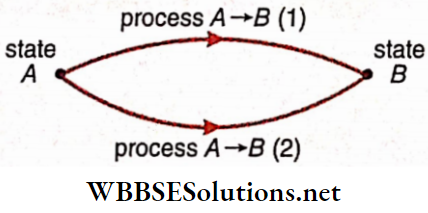
Class 11 Physics Unit 8 Thermodynamics Chapter 1 First And Second Law Of Thermodynamics Thermodynamic Process

A process, in general, involves simultaneous changes of all the three properties—volume (V), pressure (p), and temperature (T). However, for simplicity of analysis, some special processes are often considered:

  1. Isochoric process: The volume of a system remains constant in this process. But, both pressure and temperature undergo some changes.
  2. Isobaric process: Here, p remains constant and Vand T change their values.
  3. Isothermal process: T is a constant, whereas there are changes in V and p.
  4. Adiabatic process: The heat exchange between the system and its surroundings remains zero there are changes in all of V, p, and T.

Thermodynamics – First And Second Law Of Thermodynamics External Work

Hydrostatic system: A system that obeys Pascal’s law is called a hydrostatic system. Important characteristics of such a system are:

  1. The pressure is uniform throughout the system and acts normally outwards at every point on the walls.
  2. Any additional pressure applied at any point gets transmitted throughout the system in such a way that the pressure everywhere continues to remain uniform.

These conditions are obeyed by

  1. Small amounts of liquids for which the effect of gravity may be neglected and
  2. Gaseous systems.

However, all liquids are nearly incompressible, i.e., any change in pressure does not produce an appreciable change in volume. Due to this reason, for the thermodynamic analysis of a hydrostatic system, it is convenient to take a closed gaseous system.

Hydrostatic work: An amount of gas is enclosed by an airtight cylinder-piston arrangement. where the piston can move without friction along the inner walls of the cylinder.
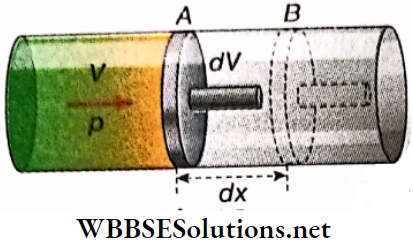
Class 11 Physics Unit 8 Thermodynamics Chapter 1 First And Second Law Of Thermodynamics Hydrostatic Process

These conditions are obeyed by

  1. Small amounts of liquids for which the effect of gravity may be neglected and
  2. Gaseous systems.

However, all liquids are nearly incompressible, i.e., any change in pressure does not produce an appreciable change in volume. Due to this reason, for the thermodynamic analysis of a hydrostatic system, it is convenient to take a closed gaseous system.

Hydrostatic work: An amount of gas is enclosed by an airtight cylinder-piston arrangement. where the piston can move without friction along the inner walls of the cylinder.

Let p = pressure of the enclosed gas,

a = area of cross-section of the piston.

So, the force acting on the piston = pa.

  • Now, suppose the piston goes through a very small displacement outwards from position A to position B; displacement AB = dx.
  • This displacement occurs when a slight difference develops between the pressures of this system and its surroundings. A small outwards pull on the piston, a gain of a small amount of heat from the surroundings, etc., may initiate such a displacement.
  • During this displacement, however small, the pressure p of the system may change. But at even instant, the pressure must be uniform throughout the system. A sufficiently slow motion of the piston is required to satisfy this hydrostatic condition.

Due to the small displacement dx, the gas expands from volume V to V+dV. Clearly, dV = adx. So, the small work done in this infinitesimal process is,

dW = force x displacement

= (pα)(dx) = p(αdx) = pdV

or concisely, dW = pdV …(1)

Work done in a finite process, for which the volume changes from V1 to V2, is

W = \(\int d W=\int_{V_1}^{V_2} p d V\)…(2)

The relation (1) can be interpreted as:

1. When there is no change in volume, V = constant and dV = 0. So, dW = 0 no work is done in such a process.

2. When the volume increases, i.e., for an expansion, dV is positive, i.e., dV> 0. So, dW>0; positive amount of work is done in this process. The system releases some energy to its surroundings it is termed as work done by the system.

3. When the volume decreases, i.e., for a contraction occurring due to an inward motion of the piston, dV is negative, i.e., dV<0.

So, dW< 0; a negative work is done in this process. The system receives some energy from its surroundings it is termed as work done on the system.

The integral in relation (2) can be evaluated for special processes:

1. Isochoric process: V = constant and dV = 0.

So, W = 0 …(3)

2. Isobaric process:

p = constant.

So, W = \(\int_{V_1}^{V_2} p d V=p \int_{V_1}^{V_2} d V=p\left(V_2-V_1\right)\)….(4)

But, when the pressure p of a system changes in a process, the integral cannot be evaluated unless p can be expressed as a function of volume V.

It is only possible if the equation of state of the system is known. Later in this chapter, the expressions for isothermal work and adiabatic work for an ideal gas will be evaluated, using the ideal gas equation of state, pV = R.

There are systems in thermodynamics that are not hydrostatic. For them, the work equations (1) and (2) would be different. However, in this chapter, we shall restrict ourselves mainly to hydrostatic systems.


Unit 8 Thermodynamics Chapter 1 First And Second Law Of Thermodynamics Reverse And Irreversible Process

Thermodynamics and Energy Efficiency

Let a thermodynamic system be in an initial state A. Owing to heat exchange and external work, the system attains its final state B. That is, the process is A → B. Now, we shall state the conditions under which the process may be called ‘reversible’. A Process A → B is reversible, if

  1. The process B → A occurs in nature and
  2. After the processes A →B →A, there is no net change in the surroundings.

The conditions 1 and 2 are called the conditions of reversibility. Process A → B is an irreversible process, if these conditions are not satisfied.

  • The concepts of reversibility and irreversibility are direct consequences of the second law of thermodynamics. The words ‘self-acting machine’ in Clausius or Kelvin-Planck statements are closely related to the words ‘no net change in the surroundings’ in the reversibility conditions.
  • For example, we consider the process of heat flow from higher to lower temperatures. The reverse process does occur in nature — a domestic refrigerator actually transfers heat from its cool container to comparatively hotter surroundings.
  • But it is not self-acting, because some work in the form of electrical energy must be supplied from the surroundings. As a result, the environment suffers a net change.

So we may say that heat transfer from higher to lower temperature is an irreversible process. This is because heat, on its own, cannot flow from lower to higher temperatures (Clausius statement).
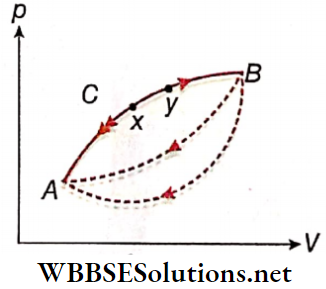
Class 11 Physics Unit 8 Thermodynamics Chapter 1 First And Second Law Of Thermodynamics Reversible And Irreversible Process

  • We now consider a process A →B on a p V diagram. Let the process occur along a particular path ACB.
  • The opposite process B → A can take different paths from B to A. However, for reversibility, only the path BCA is important.
  • Then for each elementary step (say, xy) the heat exchange and the work done in the forward process (x → y) are exactly equal and opposite to those in the reverse process (y → x) – This is essentially the condition for reversibility, equivalent to the conditions discussed earlier.

A process A→ B is reversible, if

  1. The process B → A occurs in nature and
  2. The heat exchange and the work done for each step in the forward process are exactly equal and opposite to those for the reverse process.

Conditions of reversibility:

1. A process is reversible if there is no dissipation of energy during this process. The origin of dissipative energy are friction, surface tension, resistance, etc. So, a process that occurs against friction, surface tension, etc., cannot be reversible.

2. A process is reversible if it occurs infinitesimally slowly. Every real process in nature is irreversible. A reversible process is only an ideal process, never occurring in nature. Still, the concept is very useful to formulate important thermodynamic relations.

Conditions of reversibility Example:

1. Let a gas be enclosed inside a cylinder-piston arrangement. Now the gas is allowed to get compressed very slowly through an isothermal process by applying force from its surroundings. So work is done on the gas by the piston.

  • Now after this process, if the gas by itself expands very slowly pushing the piston up, it returns to the initial state. So work is done on the piston by the gas.
  • This work done is nearly equal to the previous one. So apparently, the process is reversible. But actually, in each piston movement, some heat is generated due to friction.
  • This heat is absorbed by the surroundings which cannot be restored. So strictly speaking, the process is irreversible, but becomes nearly reversible only when the piston movements are very slow and heat generated due to friction becomes almost negligible.

2. Let us take a container having 10 g of ice floating on 100 g of water at 0°C. If 80 cal of heat is supplied from the surroundings, 1 g of ice melts into 1 g of water.

  • Now, if 80 cal of heat is taken away, we again get 10 g of ice on 100 g of water. Here, the surroundings also come to its initial state. So the process of fusion of ice is apparently reversible.
  • However, some heat exchange with the surroundings can never be avoided. That heat cannot be recovered in any manner.
  • So the surroundings suffer a permanent change. For this reason, processes like fusion and vaporisation are only approximately reversible.

3. Free fall of a body due to gravity from a height h to the ground is an irreversible process because the body on its own cannot move up to the height of h.

4. When containers with two different gases are connected, the gases mix with each other. The gases cannot separate themselves on their own and so the process is irreversible.


Unit 8 Thermodynamics Chapter 1 First And Second Law Of Thermodynamics Very Short Answer Type Questions

Question 1. Which branch of physics deals with the study of the relationship between heat and various forms of energy?
Answer: Thermodynamics

Question 2. How is the work done related to the heat produced when work is completely converted into heat?
Answer: Mutually proportional

Question 3. If some amount of work is completely converted into heat, what is the name of the ratio of work done and amount of heat?
Answer: Mechanical equivalent of heat

Question 4. What is the value of the mechanical equivalent of heat in a CGS system?
Answer: 4.2 x 10⁷ erg · cal-1

Question 5. What is the value of the mechanical equivalent of heat in SI?
Answer: 1

Question 6. What would be the amount of heat generated if 4.2 x 10⁷ erg of work is completely converted into heat?
Answer: 1 cal

Question 7. Give an example of intensive variable.
Answer: Temperature

Question 8. Give an example of an extensive variable.
Answer: Volume

Question 9. Which one of the four quantities does not indicate the thermodynamic state of a substance—volume, temperature, pressure, and work?
Answer: Work

Question 10. What is the change in temperature of water when it falls from the top to the bottom in a waterfall?
Answer: Increases

Question 11. Is pressure intensive or extensive variable?
Answer: Intensive

Question 12. Is magnetic moment intensive or extensive variable?
Answer: Extensive

Question 13. What would be the amount of heat required to increase the temperature of 1 g of water by 1°C?
Answer: 4.2

Question 14. What is the change in internal energy of a substance when it is heated?
Answer: Increases

Question 15. On which factor does the internal energy of a certain amount of an ideal gas depend?
Answer: On its temperature

Question 16. Will there be any change in the internal energy of a certain amount of gas, if its pressure or volume changes at constant temperature?
Answer: No

Question 17. In case of expansion of a gas, would the work done by the gas be positive or negative?
Answer: Positive

Question 18. What is the SI unit of molar-specific heat?
Answer: J · mol-1 · K-1

Question 19. The first law of thermodynamics is the mathematical form of a universal law. Name it.
Answer: Law of conservation of energy

Question 20. How many types of specific heat of a gas are used in practice?
Answer: Two

Question 21. How many types of molar-specific heat of a gas are used in practice?
Answer: Two

Question 22. Which is greater — specific heat at constant volume, cv, or specific heat at constant pressure, cp?
Answer: cp

Question 23. How is the heat supplied to a substance in an isothermal process used?
Answer: External work

Question 24. In which process does the heat accepted or rejected become zero?
Answer: Adiabatic

Question 25. Is the reversible process slow or fast?
Answer: Slow

Question 26. Which process does not suffer dissipative forces reversible or irreversible?
Answer: Reversible process

Question 27. Is the isothermal process slow of fast?
Answer: Very slow process

Question 28. Is the adiabatic process slow or fast?
Answer: Very fast process

Question 29. Is rusting of iron a reversible process?
Answer: No

Question 30. Hot milk is poured into a cup of tea a. d is mixed with a spoon. Is this an example of a reversible process?
Answer: No

Question 31. The sum of kinetic and potential energies of the molecules of a substance is equal to its ______
Answer: Internal energy

Question 32. In a process, if dU, dW, and dQ are changes in internal energy, work done, and heat accepted respectively for a system, what is the relation between dU, dQ, and dW?
Answer: dQ = dU+dW

Question 33. p and V are the pressure and volume respectively of a gas of a particular mass. If volume changes to V+ dV, what is the work done in the process?
Answer: pdV

Question 34. The molecular weight of a gas is M. If the specific heat and molar specific heat at constant volume of the gas is cv and Cv respectively. Write down the relation between cv > Cv and M.
Answer: Cv = Mcv

Question 35. A bicycle pump becomes hot when air is pumped into the tube. Why?
Answer: Due to adiabatic compression

Question 36. Air coming out from a burst bicycle or motorcar tube appears to be cold. Why?
Answer: Due to adiabatic expansion

Question 37. If γ of a gas is equal to 1.66 then what is the number of atoms in a molecule of the gas?
Answer: 1

Question 38. Adiabatic curves are comparatively _______ than isothermal curves.
Answer: Steeper

Question 39. If the pressure and the temperature of a gas changes at constant volume, what is the work done by the gas?
Answer: Zero

Question 40. What is the change in internal energy in an isothermal process?
Answer: Zero

Question 41. In which expansion the internal energy of a gas be decrease?
Answer: Adiabatic

Question 42. If M is the molecular weight of a gas, what is the difference between the two specific heats of 1 g of an ideal gas?
Answer: \(\frac{R}{M}\)

Question 43. In case of 1 mol of an ideal gas, write down the value of Cv -Cp
Answer: -R

Question 44. An ideal gas rejects 10 cal of heat at constant volume. Find the work done
Answer: Zero

Question 45. What is the relation between p and V in an adiabatic process?
Answer: pVγ = constant

Question 46. A process against frictional force cannot be ______
Answer: Reversible

Question 47. Two balls of the same mass, one of iron and the other of copper, are dropped from the same height. Which one would become hotter?
Answer: Copper

Question 48. In an isothermal process, the gas containers should be made of highly _____ materials.
Answer: Conducting

Question 49. In an adiabatic process, the gas containers should be made of highly _______ materials.
Answer: Non-conducting

Question 50. Is Joule’s heating process reversible or irreversible?
Answer: Irreversible

Question 51. Write down the coefficient of performance of an ideal refrigerator.
Answer: Infinite

Question 52. What is the value of the efficiency of an ideal heat engine?
Answer: 1

Question 53. Heat engine is a mechanical device that converts heat into _____
Answer: Work

Question 54. When heat is gained or lost by heat reservoir, its temperature ______
Answer: Remains constant

Unit 8 Thermodynamics Chapter 1 First And Second Law Of Thermodynamics Assertion Reason Type Question And Answers

Direction: These questions have statement 1 and statement 2. Of the four choices given below, choose the one that best describes the two statements.

  1. Statement 1 is true, statement 2 is true; statement 2 is a correct explanation for statement 1.
  2. Statement 1 is true, and statement 2 is true; statement 2 is not a correct explanation for statement 1.
  3. Statement 1 is true, statement 2 is false.
  4. Statement 1 is false, and statement 2 is true.

Question 1.

Statement 1: In an isothermal process the whole heat energy supplied to the body is converted into internal energy.

Statement 2: According to the first law of thermodynamics ΔQ = ΔU+pΔV.

Answer: 4. Statement 1 is false, statement 2 is true.

Question 2.

Statement 1: The specific heat of a gas in an adiabatic process is zero but it is infinite in an isothermal process.

Statement 2: Molar specific heat of a gas is directly proportional to heat exchanged with the system and inversely proportional to change in temperature.

Answer: 1. Statement 1 is true, statement 2 is true; statement 2 is a correct explanation for statement 1.

Question 3.

Statement 1: In an adiabatic process, the change in internal energy of a gas is equal to work done on or by the gas in the process.

Statement 2: The temperature of the gas remains constant in an adiabatic process.

Answer: 3. Statement 1 is true, statement 2 is true; statement 2 is not a correct explanation for statement 1.

Question 4.

Statement 1: The internal energy of an ideal gas does not depend on the volume of the gas.

Statement 2: This is because internal energy of an ideal gas depends on the temperature of the gas.

Answer: Statement 1 is true, and statement 2 is true; statement 2 is not a correct explanation for statement 1.

Unit 8 Thermodynamics Chapter 1 First And Second Law Of Thermodynamics Match Column 1 With Column 2

Question 1. For 1 mol of a monatomic gas match the following:
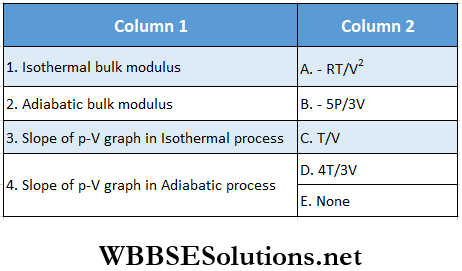
Class 11 Physics Unit 8 Thermodynamics Chapter 1 First And Second Law Of Thermodynamics Match The Column Question 1

Answer: 1. D, 2. A, D, 3. D, 4. B, C

Question 2. Heat given to it pi recess is taken to be positive. Then mutch two options in column l with the corresponding options in column 2 for the given cycle.
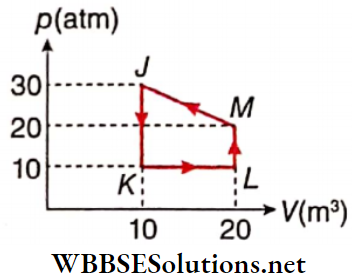
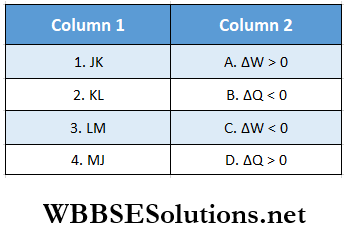
Class 11 Physics Unit 8 Thermodynamics Chapter 1 First And Second Law Of Thermodynamics Heat Given To A Process Is Taken To Be Positive

Class 11 Physics Unit 8 Thermodynamics Chapter 1 First And Second Law Of Thermodynamics Match The Column Question 2

Answer: 1. E, 2. E, 3. A, 4. B

Question 3. Column 1 contains a list of processes Involving the expansion of an ideal gas. Match this with column 2 describing the thermodynamic change during this process.
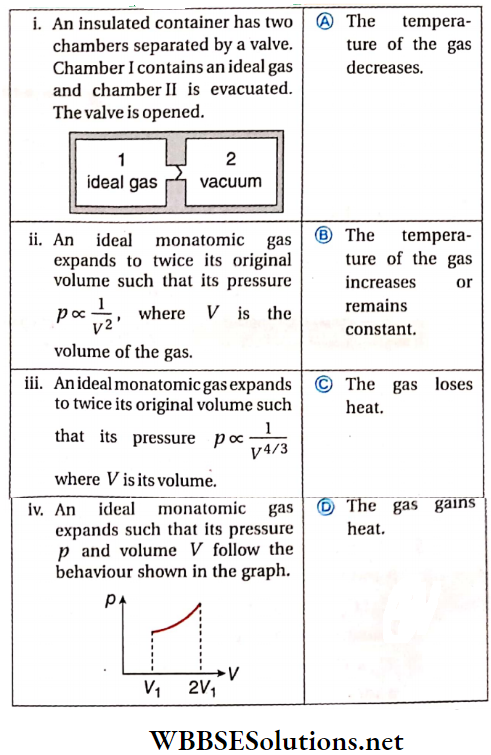
Class 11 Physics Unit 8 Thermodynamics Chapter 1 First And Second Law Of Thermodynamics Match The Column Question 3

Answer: 1. B, 2. A, C, 3. A, D, 4. B, D

Question 4. Volume versus pressure curves are given for four processes as shown. Match the entries of column 1 with the entries of column 2.
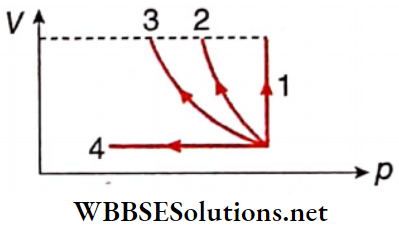
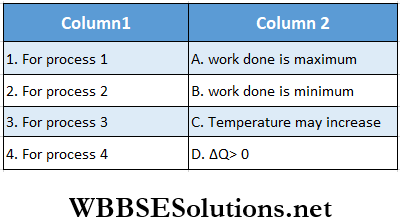
Class 11 Physics Unit 8 Thermodynamics Chapter 1 First And Second Law Of Thermodynamics Volume Versus Pressure Curves

Class 11 Physics Unit 8 Thermodynamics Chapter 1 First And Second Law Of Thermodynamics Match The Column Question 4

Answer: 1. A, C, D, 2. C, D 3. C, 4. B

Question 5. A sample of gas goes from state A to state B in four different manners, as shown by the graphs. Let W be the work done by the gas and ΔU be the change in internal energy along the path AB. Match the graphs with the statements provided correctly.
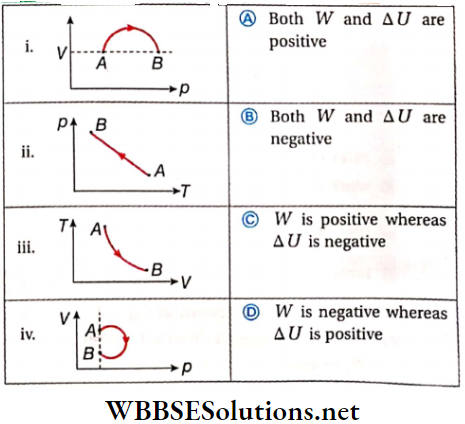
Answer: 1. D, 2. B, 3. C, 4. B

Question 6. One mole of a monatomic ideal gas is taken along two cyclic processes E → F → G → E and E → F → H → E.
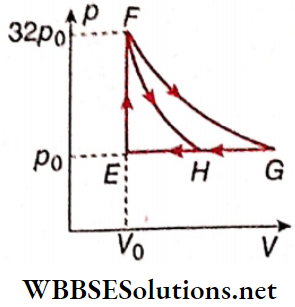
Class 11 Physics Unit 8 Thermodynamics Chapter 1 First And Second Law Of Thermodynamics One Mole Of A Monatomic Ideal gas Is Taken Along Two Cyclic Process

The processes involved are purely isochoric, isobaric, isothermal, or adiabatic. Match tire column 1 with the magnitudes of the work done in column 2.
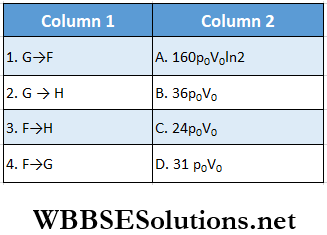
Class 11 Physics Unit 8 Thermodynamics Chapter 1 First And Second Law Of Thermodynamics Match The Column Question 6

Answer: 1. D, 2. C, 3. B, 4. A

Question 7. One mole of a monoatomic ideal gas is taken through a cycle ABCDA as shown in the p-V diagram. Column 2 gives the characteristics involved in the cycle. Match them with each of the processes given in column 1.
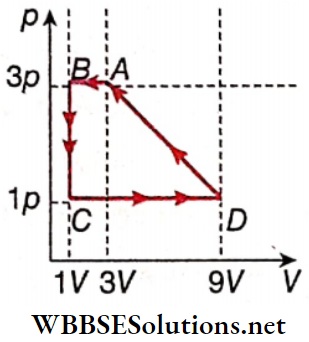
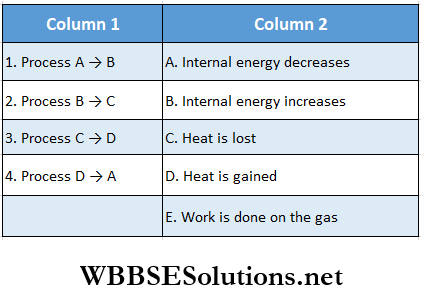
Class 11 Physics Unit 8 Thermodynamics Chapter 1 First And Second Law Of Thermodynamics One Mole Of A Monatomic Ideal gas Is Taken Through Cycle ABCDA In pV Diagram

Class 11 Physics Unit 8 Thermodynamics Chapter 1 First And Second Law Of Thermodynamics Match The Column Question 7

Answer: 1. A, C, E 2. A, C, 3. B, D 4. C, E

Unit 8 Thermodynamics Chapter 1 First And Second Law Of Thermodynamics Comprehension Type Questions And Answers

Read the following passages carefully and answer the questions at the end of them.

Question 1. A Fixed mass of gas is taken through a process A → B → C→ A. Here A→B is isobaric, B→ C is adiabatic and C→A is isothermal. (Take γ = 1.5)
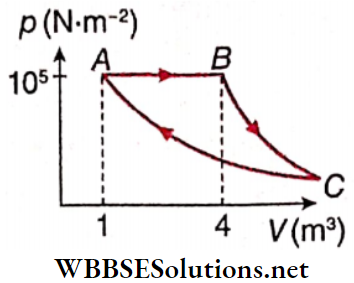
Class 11 Physics Unit 8 Thermodynamics Chapter 1 First And Second Law Of Thermodynamics Fixed Mass Of Gas Is Taken Through A Process Is Adiabtic And Isothermal

1. Find pressure at C.

  1. \(\frac{10^5}{64} \mathrm{~N} \cdot \mathrm{m}^{-2}\)
  2. \(\frac{10^5}{32} \mathrm{~N} \cdot \mathrm{m}^{-2}\)
  3. \(\frac{10^5}{12} \mathrm{~N} \cdot \mathrm{m}^{-2}\)
  4. \(\frac{10^5}{6} \mathrm{~N} \cdot \mathrm{m}^{-2}\)

Answer: 1. \(\frac{10^5}{64} \mathrm{~N} \cdot \mathrm{m}^{-2}\)

2. Find volume at C.

  1. 32 m³
  2. 100m³
  3. 64m³
  4. 25m³

Answer: 3. 64m³

3. Find work done in the process.

  1. 4.9 x 10⁵ J
  2. 3.2 x 10⁵ J
  3. 1.2 x 10⁵ J
  4. 7.2 x 10⁵ J

Answer: 1. 4.9 x 10⁵ J

Question 2. One mole of an ideal gas has an internal energy given by U = U0 + 2pV, where p is the pressure and V is the volume of the gas. U0 is a constant. This gas undergoes the quasistatic cyclic process ABCD as shown in the U-V diagram.
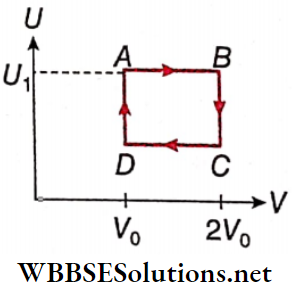
Class 11 Physics Unit 8 Thermodynamics Chapter 1 First And Second Law Of Thermodynamics One Mole Of An Idea Gas has An internal Energy

1. The molar heat capacity of the gas at constant pressure is

  1. 2R
  2. 3R
  3. 5/2R
  4. 4R

Answer: 2. 3R

2. The work done by the ideal gas in the process AB is

  1. Zero
  2. \(\frac{U_1-U_0}{2}\)
  3. \(\frac{U_0-U_1}{2}\)
  4. \(\frac{U_1-U_0}{2} \log _e 2\)

Answer: 4. \(\frac{U_1-U_0}{2} \log _e 2\)

3. Assuming that the gas consists of a mixture of two gases, the gas is

  1. Monatomic
  2. Diatomic
  3. A mixture of monatomic and diatomic gases
  4. A mixture of diatomic and triatomic gases

Answer: 3. A mixture of diatomic and triatomic gases

Question 3. A cylinder containing an ideal gas and closed by a movable piston is submerged in an ice-water mixture. The piston is quickly pushed down from position X to position Y (process AB). The piston is held at position Y until the gas is again at 0°C (process BC). Then the piston is slowly raised back to position X (process CA).
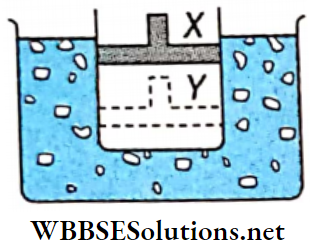
Class 11 Physics Unit 8 Thermodynamics Chapter 1 First And Second Law Of Thermodynamics A Cylinder Containing An Ideal gas

1. Which of the following p-V diagrams will correctly represent the processes AB, BC, and CA and the cycle ABCA?
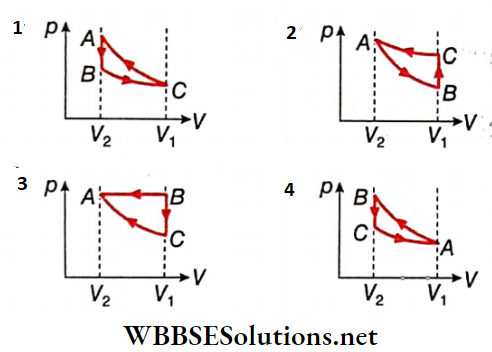
Class 11 Physics Unit 8 Thermodynamics Chapter 1 First And Second Law Of Thermodynamics pV Diagram Represents The Process AB BC And CA

Answer: 4.

2. If 100 g of ice is melted during the cycle ABCA, how much work is done on the gas?

  1. 8kcal
  2. 5kcal
  3. 2.1 kJ
  4. 4.2 kJ

Answer: 1. 8kcal

3. If p is the atmospheric pressure acting on the piston and change in the volume is (V1 – V2). the work done (in N · m-2) during the cycle is

  1. \(\frac{p V}{2} \mathrm{~J}\)
  2. \(\frac{2 p V}{3} J\)
  3. \(p V J\)
  4. None of these

Answer: 4. None of these

Question 4. 1 mol of an ideal monatomic gas undergoes thermodynamic cycle 1-2-3-1 as shown. The initial temperature of the gas is T0= 300 K.
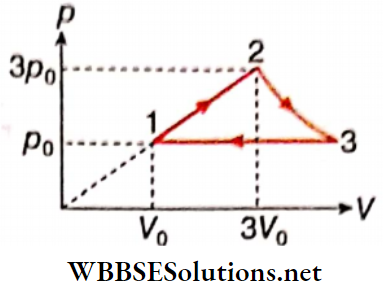
Class 11 Physics Unit 8 Thermodynamics Chapter 1 First And Second Law Of Thermodynamics 1 Mol Of Ideal Monatomic Gas

  • Process 1 → 2 : p = aV
  • Process 2 → 3 : pV = constant
  • Process 3 → 1 : p = constant (Take In|3| = 1.09)

1. Find the net work done in the cycle.

  1. 3.27 RT0
  2. 6.83 RT0
  3. 4.53 RT0
  4. 5.81 RT0

Answer: 4. 5.81 RT0

2. Determine the heat capacity of each process.

  1. 20.75 J · mol-1 -K-1
  2. 10.23 J · mol-1 · K-1
  3. 22.37 J · mol-1 · K-1
  4. 15.96 J · mol-1 · K-1

Answer: 1. 20.75 J · mol-1 K-1

Question 5. A container is shown to have a movable (without friction) piston on top. The container and the piston are all made of perfectly insulating material allowing no heat transfer between outside and inside the container. The container is divided into two compartments by a rigid partition made of a thermally conducting material that allows slow transfer of heat. The lower compartment of the container is filled with 2 moles of an ideal monatomic gas at 700 K and the upper compartment is filled with 2 moles of an ideal diatomic gas at 400 K. The heat capacities per mole of an ideal monatomic gas are \(C_V=\frac{3}{2} R, C_p=\frac{5}{2} R\), and those for an ideal diatomic gas are \(C_V=\frac{5}{2} R, C_p=\frac{7}{2} R\)

Class 11 Physics Unit 8 Thermodynamics Chapter 1 First And Second Law Of Thermodynamics Without Friction

1. Consider the partition to be rigidly fixed so that it does not move. When equilibrium is achieved, the final temperature of the gases will be

  1. 550 K
  2. 525 K
  3. 513 K
  4. 490 K

Answer: 4. 490 K

2. Now consider the partition to be free to move without friction so that the pressure of gases in both compartments is the same. Then total work done by the gases till the time they achieve equilibrium will be

  1. 250R
  2. 200R
  3. 100R
  4. -100R

Answer: 4. -100R

Unit 8 Thermodynamics Chapter 1 First And Second Law Of Thermodynamics Integer Type Questions And Answers

In this type, the answer to each of the questions Is a single-digit integer ranging from 0 to 9.

Question 1. A diatomic ideal gas is compressed adiabatically to 1/32 of its initial volume. If the initial temperature of the gas is T1 (in kelvin) and the final temperature is aT1 find the value of a.
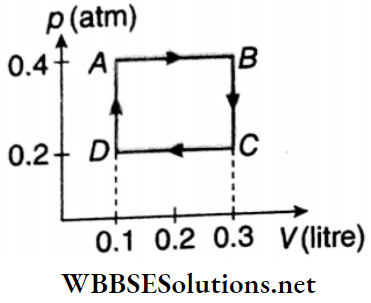
Class 11 Physics Unit 8 Thermodynamics Chapter 1 First And Second Law Of Thermodynamics A Diatomic Ideal gas IS Compressed Adiabatically To Initial Volume

Answer: 4

Question 2. 1 mol of an ideal gas p(atm) undergoes a cyclic change A ABCDA as shown. What is the net work done (in J) in the process? (Take. 1 atm = 105Pa)
Answer: 4

Question 3. During adiabatic expansion of 10 mol of a gas, internal energy decreases by 700 J.Work clone during (the process is x x 10² J. What Is the value of x?
Answer: 7

Question 4. Two Carnot engines A and U operate respectively between 500 K and 400 K and 400 K and 300 K. What is the difference in their efficiencies (in percentage)?
Answer: 5

Question 5. Calculate the pressure required to compress a gas adiabatically at atmospheric pressure to one-third of its volume. Given γ = 1.47.
Answer: 5

Question 6. A thermodynamic system is taken from an initial state I with internal energy Ui = 100 J to the final state f along two different paths iaf and ibf, as shown.
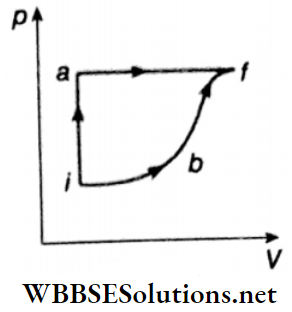
Class 11 Physics Unit 8 Thermodynamics Chapter 1 First And Second Law Of Thermodynamics A Thermodynamic System Is Taken From Initial State

The work done by the system along the paths af, ib, and bf is \(W_{af}=200 \mathrm{~J}, \quad W_{i b}=50 \mathrm{~J} \quad \text { and } \quad W_{b f}=100 \mathrm{~J}\) respectively. The heat supplied to the system along the path iaf, ib, and bf is Qiaf, Qib, and Qbf respectively. If the internal energy of the system in the state b is Ub = 200 J and Qiaf = 500 J then find out the ratio of Qbf/Qib.

Answer: 2



Second Law Of Thermodynamics

First And Second Law Of Thermodynamics The Secondary Of Thermodynamics

The 2nd Law Of Thermodynamics

Let us consider a man holding a glass of hot tea. From our experience, we know that in such a case the hand gradually becomes hotter and the glass cooler. This is because some heat (say, 10 calories per second) is absorbed by the hand from the glass.

Second Law of Thermodynamics Explained

  • Now, consider the opposite process. If 10 calories of heat is given by the cold hand to the hot glass per second, the energy would still be conserved, i.e., the first law of thermodynamics would still be obeyed. But, this opposite process never occurs in nature.
  • In general, there is a natural direction in every real process. The first law of thermodynamics cannot determine this natural direction. So it is important to formulate a new law—the second law of thermodynamics.
  • Scientists expressed the second law in different forms. However, all of the different forms are equivalent. They provide alternative statements of the same physical law.

Second Law Of Thermodynamics

Clausius and Kelvin Statements of the Second Law

Clausius’s statement: No self-acting machine can transfer heat from a lower to a higher temperature.

Kelvin-Flanck Statement: No self-acting machine can convert some amount of heat entirely into work.

Entropy: The glass and the hand together, is now regarded as a closed system. Energy can be transmitted from one part to another or can be transformed from one form to another in a closed system. But this type of process is irreversible. The direction of an irreversible process is determined by a change in a special property, called the entropy of the system.

The analysis of a reversible process, using the second law of thermodynamics, leads to the concept of entropy. Entropy, denoted by the letter S, is a property of all thermodynamic systems. It is defined by the relation

ds = \(\frac{dQ}{T}\)….(1)

where, dQ = heat exchange of a system in an infinitesimal reversible process at temperature T and dS = corresponding, change in entropy of the system.

From (1), dQ = TdS. Using this relation in the first law of thermodynamics, we get, dQ = dU+dW or, TdS = dU+pdV ….(2)

Now, we note that dQ and dW are quantities exchanged between the die system and the surroundings m a process, o thev depend on whether the process is reversible or irreversible.

But equation (2) does not contain any such exchange quarantine. So it is true for reversible as well as irreversible processes. Then, if we use equation (2) in thermodynamics, we need not worry about the nature of the process. This is the beauty of the ideal concept of reversibility.

The entropy principle: Thermodynamic analysis shows that in every real process in nature, the sum of the entropies of a system and its surroundings always increases. The opposite process, in which the sum of the entropies decreases, is not allowed in nature.

  • We may compare the situation with the law of conservation of energy (first law of thermodynamics). This law states that the total energy of the universe is a constant—it can never increase or decrease. In analogy, the second law of.thermo¬dynamics states that the total entropy of the universe increases in every process it can never decrease.
  • Every real process in nature occurs in such a direction that the total entropy of the universe increases. Alternatively, no process, in which the total entropy of the universe decreases, can occur in nature. This is known as the principle of increase of entropy.
  • For a reversible process the total entropy of the universe remains constant while for an irreversible process. the entropy of the universe increases. As all natural processes in general are irreversible, every natural process results in an increase in entropy of the universe.

Entropy

This principle of increase of entropy is the most general statement of the second law of thermodynamics. The Clausius and the Kelvin-Planck statements can easily be derived from this principle.

In an adiabatic process, dQ = 0 . Then equation (1) gives that dS = 0 or, S = constant. So the entropy of a system remains constant in a reversible adiabatic process (just like temperature in an isothermal process). For this reason, a reversible adiabatic process is called an isentropic process.

In essence, each of the three laws of thermodynamics defines one important property of all thermodynamic systems:

  1. Zeroth law: Temperature (T)
  2. First law: Internal energy (U)
  3. Second law: Entropy (S)

Unit 8 Thermodynamics Chapter 1 First And Second Law Of Thermodynamics Heat Engines And Refrigerators

Applications of the Second Law of Thermodynamics

Heat reservoir: A body whose temperature remains constant even when heat is gained or lost by it is called a heat reservoir. Every heat reservoir has its own characteristic temperature.

Class 11 Physics Unit 8 Thermodynamics Chapter 1 First And Second Law Of Thermodynamics Heat Reservoir

Generally, different heat reservoirs have different characteristic temperatures. They are drawn in the way as shown. The characteristic temperatures of the two reservoirs shown and T1 and T2 respectively.

  • For example, the atmosphere or sea water may be taken as heat reservoir. If a burning oven is placed in the air, it rejects heat to the atmosphere. Or if a large block of ice is placed in the air, it receives heat from the atmosphere.
  • From our daily experiences, it is known that we can ignore the change of temperature of the atmosphere in the above cases. Similarly, if a bucketful of boiling water is poured in the sea, sea water takes heat but its temperature does not change.
  • It is obvious that the atmosphere and sea, being very large in size, behave as heat reservoirs. However, comparatively smaller bodies also may show similar properties.
  • Suppose, the temperature of a coaloven when burning is 300°C. It continuously rejects heat to the surroundings. In spite of that, as long as coal burns, the temperature of the oven remains constant at 300°C. So in this case the oven acts as a heat reservoir.

We know, if dT is the change of temperature of a body due to a heat exchange of dQ, then the thermal capacity of the body, C = \(\frac{dQ}{dT}\).

In case of a heat reservoir, dT =0 so whatever the value of heat gain or heat loss (dQ) may be, C → ∞, i.e., the thermal capacity of any heat reservoir is infinite.

Conversely, it can be said that if the thermal capacity of a body is infinite, the body will behave as a heat reservoir.

Heat engine: It is a mechanical device that converts heat into work.

  • In general, a heat engine H takes heat from a source at a higher temperature converts a part of it into work, and gives out the rest to a body (sink) at lower temperature.
  • In most cases, the source at a higher temperature and the sink at a lower temperature are two heat reservoirs, i.e., in a complete cycle their temperatures are fixed at T1 and T2. Obviously, T1>T2.
  • Generally, a heat engine works in a cyclic process. It means that, after the completion of a cycle by converting heat into work, the working substance of the engine returns to its initial condition and becomes ready for the next cycle.
  • The action of each cycle is equivalent, i.e., in each cycle the same amount of heat is converted into the same amount of work.

Class 11 Physics Unit 8 Thermodynamics Chapter 1 First And Second Law Of Thermodynamics Heat Engine

Efficiency of a heat engine: The object of a heat engine is to convert heat taken from the source into useful work. So the heat taken from the source is called the input, and the transformed work is called the output.

The efficiency of a heat engine is defined as the fraction of total heat taken from the source which is converted into work. Suppose in each cycle,

the heat is taken by the engine from the source at temperature T1 = Q1;

transformed work = W;

heat rejected by the engine to its surroundings (sink) at temperature T2 = Q2.

From the principle of conservation of energy, we can write, Q1 = W+Q2 or, W = Q1-Q2

So, efficiency, \(\eta=\frac{\text { output }}{\text { input }}=\frac{W}{Q_1}=\frac{Q_1-Q_2}{Q_1}\)

i.e., \(\eta=1-\frac{Q_2}{Q_1}\)…(1)

From equation (1) we get η ≤ 1, i.e., the efficiency of a heat engine can never be greater than 1 or 100%.

Class 11 Physics Class 12 Maths Class 11 Chemistry
NEET Foundation Class 12 Physics NEET Physics

Second Law of Thermodynamics in Heat Engines

Ideal heat engine: it is easily understood that the more a heat engine converts heat into work the more its efficiency will be. If any engine converts the whole amount of heat taken from the source into work, then the engine is called an ideal heat engine.

Class 11 Physics Unit 8 Thermodynamics Chapter 1 First And Second Law Of Thermodynamics Ideal Heat Engine

It is evident that in case of this type of engine, the heat is rejected to its surroundings (Q2)zero. So the work obtained will be equal to the heat taken from the source (Q1). Therefore, the efficiency of an ideal heat engine,

⇒ \(\eta=\frac{W}{Q_1}=\frac{Q_1}{Q_1}=1=100 \%\)

Alternatively, \(\eta=1-\frac{Q_2}{Q_1}=1-\frac{0}{Q_1}=1=100 \%\)

Kelvin-Planck’s statement of the second law of thermodynamics: No self-acting machine can convert some amount of heat entirely into work. On the basis of the discussion about heat engines, this statement can be expressed in the form of an easy alternative: An ideal heat engine does not exist in nature.

Refrigerator: A mechanical device that transfers heat from a colder to a hotter place is called a refrigerator and the working substance of a refrigerator is called a refrigerant.

  • Suppose, a cold body, say an icebox is at a temperature of T2. The surrounding temperature T1 in most cases is greater than T2 So the temperature of the cold body begins to increase due to receiving heat from the surroundings.
  • Now if any mechanical device removes heat at the same rate at which the cold body receives heat, the temperature of the body will remain constant i.e., the body will remain in the same cold state. This mechanical arrangement is called a refrigerator, denoted by R in.
  • Generally, with the help of some external work, the refrigerator transfers heat from the lower temperature T2 to the higher temperature T1 of the surroundings. Our household refrigerator is a familial example of this machine.

Class 11 Physics Unit 8 Thermodynamics Chapter 1 First And Second Law Of Thermodynamics Refrigerator

Like a heat engine, a refrigerator also works in a cyclic process. At the end of each cycle, the working substance returns to its initial state, and then the next cycle starts.

Coefficient of performance of a refrigerator: The aim of a refrigerator is to extract heat from a cold body at the expense of some external mechanical work. The external supplied work is known as the input and the heat extracted from the cold body is called the output.

Suppose, in each complete cycle, heat received by the refrigerator from the colder body at temperature T2 = Q2;

heat delivered by the refrigerator to the surroundings at higher temperatures T1 = Q1;

external work done = W

From the principle of conservation of energy, we can write,

W + Q2 = Q1

or, W = Q1-Q2

From the definition of the coefficient of performance (e) of a refrigerator, we have,

∴ e = \(\frac{\text { output }}{\text { input }}=\frac{Q_2}{W}=\frac{Q_2}{Q_1-Q_2}\)….(2)

Ideal refrigerator: Obviously, the less the amount of external work supplied to a refrigerator to run it, the better is its performance. If any refrigerator can transfer heat from low temperature to a higher temperature without any help of external work, then it is called an ideal refrigerator. For example, if any household refrigerator could run without any assistance of electricity, then that would be an ideal refrigerator.

Class 11 Physics Unit 8 Thermodynamics Chapter 1 First And Second Law Of Thermodynamics Ideal Refrigerator

For this ideal refrigerator, W = 0, i.e., Q1 – Q2 = 0 or, Q1 = Q2

So, coeffieicient of performance of an ideal refrigerator, e = \(\frac{Q_2}{W}=\frac{Q_2}{0} \rightarrow \infty\)

i.e., the coefficient of performance of an ideal refrigerator is infinite.

Clausius’s statement of the second law of thermodynamics: No self-acting machine can transfer heat from a lower to a higher temperature. On the basis of the discussions about refrigerators, this statement can be expressed in the form of an easy alternative: An ideal refrigerator does not exist in nature.

Refrigerator Discussions:

  1. Comparing It is apparent that the working principles of a heat engine and a rein aerator are exactly opposite to each other. But it does not mean that these two machines are used for opposite purposes.
    • A heat engine is a machine for conversion of heat into work, but a refrigerator is not a machine for conversion of work into heat.
    • On the omer nana. I refrigerator is a machine that transfers heat from a low temperature to a higher temperature, but heat engines are never used to transfer heat from a higher to a lower temperature.
  2. Again, on comparing it is found that if it is possible to conduct the different operations of a heat engine (ie.. heat intake from higher temperature.  transformation of heat into work, and rejection or heat at low temperature) in the reverse direction, then it will act as a refrigerator.
    • The necessary condition for this is that each operation should have to be a reversible process. Le.. the engine should have to be a reversible heat engine. In that case, the refrigerator running in the opposite direction will be reversible.
  3. A reversible process is nothing but an ideal process. In nature this process does not exist—all real processes are irreversible. So, there is no opportunity to use a heat engine as a refrigerator, and vice versa.

First And Second Law Of Thermodynamics The Secondary Of Thermodynamics

First And Second Law Of Thermodynamics Useful Relations For Using Solving Problems

If W = work done and H = corresponding heat produced, then from Joule’s law, W ∝ H or, W = JH

where J = constant = mechanical equivalent of heat = 4.2 J · cal-1 = 4.2 x 10⁷ erg  · cal-1.

1 cal = 4.2 J = 4.2 x 10⁷ erg.

According to the first law of thermodynamics, heat taken by the system from the surroundings = change in internal energy + external work done

Q = (Uf – Ui) + W (integral form)

dQ = dU+ dW (differential form)

Infinitesimal work done by a system : dW = pdV

Work done in a finite process, W = ∫dW = ∫pdf

  • cv = specific heat of a substance at constant volume. The heat taken in a process is Q = \(m c_v t\), where m = mass of the substance and t = increase in temperature when the volume remains constant.
  • Molar specific heat at constant volume is Cv = \(m c_v\), where M = molecular weight of the substance.
  • cp = specific heat of a substance at constant pressure. The heat taken in a process is Q = mcpt, where m = mass of the substance and t = increase in temperature when the pressure remains constant.
  • Molar specific heat at constant pressure is \(C_p=M c_p\), where M molecular weight of the substance.
  • For an ideal gas, the difference between the molar specific heat is Cp – Cv = R
  • If 1g is taken instead of 1 mol, then \(c_p-c_v=\frac{R}{M}\) m = molecular weight.

The ratio between the two specific heats is \(\gamma=\frac{C_p}{C_y}\) Also, Cp > Cv, γ> 1

For an isothermal process of n mol of an ideal gas, Q = \(W=n R T \ln \frac{V_f}{V_i}=n R T \ln \frac{p_i}{p_f}\)

In an adiabatic process of an ideal gas, p, V, and T are related as \(p V^\gamma\)=constant, \(T V^{\gamma-1}\)=constant, \(T^\gamma p^{1-\gamma}=\text { constant } \text {. }\) = constant.

Adiabatic work done for n mol of an ideal gas is W = \(n C_v\left(T_i-T_f\right)=\frac{n R}{\gamma-1}\left(T_i-T_f\right)=\frac{p_i V_i-p_f V_f}{\gamma-1}\)

Efficiency of a heat engine, \(\eta=1-\frac{Q_2}{Q_1}\)

where Q1 =heat taken by the engine from the source at temperature T1

and Q2 =heat rejected by the engine to its surroundings (sink) at temperature T2

Coefficient of performance of a refrigerator, e = \(\frac{Q_2}{Q_1-Q_2}\)

where Q2 = heat received by the refrigerator from the colder body at temperature T2,

and Q1 = heat delivered by the refrigerator to the surroundings at higher temperatures T1

The efficiency of a Carnot engine using an ideal gas. \(\eta=1-\frac{T_2}{T_1}\)

where T1 = temperature of the source and T2 = temperature of the sink

In the case of a Carnot refrigerator, work done and heat exchange are equal and opposite to the corresponding quantities of a Carnot engine. So, in this case, the coefficient of performance of a refrigerator,

∴ e = \(\frac{T_2}{T_1-T_2}\)

WBCHSE Class 11 Physics For First And Second Law Of Thermodynamics Long Answer Type Questions

First And Second Law Of Thermodynamics Long Answer Type Questions

Long Answer Questions on First and Second Laws of Thermodynamics for Class 11

Question 1. Water falls from the top to the bottom of a waterfall. Why does the temperature at the bottom become slightly higher?
Answer:

Given

Water falls from the top to the bottom of a waterfall.

Water at the top has a potential energy due to its height. During free fall, the potential energy is converted into kinetic energy. On impact with the ground the kinetic energy of water is converted mainly into heat energy. The heat evolved increases the temperature of the water slightly.

Question 2. A bullet becomes hot on hitting a target. Why?
Answer:

Given

A bullet becomes hot on hitting a target.

A bullet is obstructed when it hits a target. As a result of the impact, the kinetic energy of the bullet is converted mainly into heat. This heat evolved increases the temperature of the bullet, as well as that of the target.

Read and Learn More Class 11 Physics Long Answer Questions

Question 3. Two balls of the same mass, one of iron and the other of copper, are dropped from the same height. Which one would become hotter?
Answer:

Given

Two balls of the same mass, one of iron and the other of copper, are dropped from the same height.

As the mass and the height of both balls are the same, the initial potential energy (= mgh) is the same for both balls. So the kinetic energy on impact with the ground will also be the same. Then, the same amount of heat will be produced.

We know that, increase in temperature = \(\frac{\text { heat produced }}{\text { mass } \times \text { specific heat }}\)

However, the specific heat of copper is lower than that of iron. So the copper ball will be hotter due to its higher rise in temperature.

Question 4. Show that the external work done by a gas in an isothermal expansion is equal to the heat supplied to the gas.
Answer:

For an ideal gas, the internal energy depends only on its temperature. For a real gas, the change in internal energy at constant temperature is negligible. So for an isothermal expansion (T = constant), Uf = Ui. Then, from the first law of thermodynamics,

Uf– Ui = Q-W or, 0 = Q-W or, W= Q

This means that the work done by the gas is equal to the heat supplied to it.

WBCHSE Class 11 Physics For First And Second Law Of Thermodynamics L A Qs

Question 5. ‘An isothermal process is essentially a very slow process’. Explain.
Answer:

‘An isothermal process is essentially a very slow process’.

The volume and the pressure of a system change in an isothermal process, but the temperature remains constant.

  • For example, during the expansion of a gas, as the internal energy of the gas is converted into work, the temperature of the gas tends to fall.
  • But if the expansion is very slow, the gas gets sufficient time to take heat from the surroundings. This heat does the work and the internal energy is not used up. Hence, the temperature remains constant.
  • Similarly, during compression, work is done on the gas. Hence, heat is generated in the gas. This heat increases the temperature of the gas.
  • But in a very slow compression, the gas gets sufficient time to lose this heat to the surroundings. As a result, the temperature remains constant.
  • So, an isothermal process is essentially a very slow process.

Second Law of Thermodynamics: Long Answer Format

Question 6. What is the source of the energy that does the work in an adiabatic expansion of a gas?
Answer:

From the first law of thermodynamics, Uf – Ui = Q-W, i.e., change of internal energy = heat gained – work done.

For an adiabatic expansion, Q= 0.

So, Uf -Ui = -W or, W = Ui – Uf

i.e., work done = decrease in internal energy. This means that internal energy is converted into external work in an adiabatic expansion and the temperature of the gas decreases.

Question 7. A gas is compressed to half its volume in two different ways:

  1. Very rapidly and
  2. Very slowly. In which process will the work done on the gas be higher?

Answer:

Let the initial state of the gas be represented by point A on a pV diagram.

1. When the gas is compressed very rapidly, it is an adiabatic process. This compression from volume V to volume \(\frac{V}{2}\) is represented by the curve AB. So the work done on the gas – area under the curve AB = area ABDFA.

Class 11 Physics Unit 8 Thermodynamics Chapter 1 First And Second Law Of Thermodynamics Work Done On The Gas Equal To Area Under The Curve AB

2. When the gas is compressed very’ slowly, it is an isothermal process. This compression is represented by the curve AC. So the work done = area ACDEA.

The adiabatic curve is always steeper than the isothermal curve at a point. So line AB is above the line AC in the diagram. Then clearly, area ABDEA > area ACDEA. This means that a higher amount of work will be done on the gas in the rapid process.

Question 8. A gas is compressed to half its volume

  1. Adiabatically,
  2. Isothermally. In which process will the final temperature be higher?

Answer:

The temperature does not change in an isothermal process.

  1. In adiabatic compression, work is done on the gas. This work increases its internal energy. As a result, the temperature of the gas also increases.
  2. So, the final temperature would be higher for adiabatic compression.

Examples of Long Answer Questions on Thermodynamic Laws

Question 9. A gas expands from state 1 to another state 2 of higher pressure in two different processes as shown. Which process would require a greater supply of heat from the surroundings?

Class 11 Physics Unit 8 Thermodynamics Chapter 1 First And Second Law Of Thermodynamics A Gas Exapnds From State 1 To Another State 2 Of Higher Pressure

Answer:

Work done in each constant volume part of the two processes is zero.

For the first process, the work done in the constant pressure part = p2 (V2 -V1).

From the first law of thermodynamics, the heat supplied from the surroundings during the first process, \(Q_1=\left(U_2-U_1\right)+W=\left(U_2-U_1\right)+p_2\left(V_2-V_1\right)\)

Similarly, the heat supplied from the surroundings in the second process, \(Q_2=\left(U_2-U_1\right)+p_1\left(V_2-V_1\right)\)

Now, (U2 – U1) is the same for the two processes as the initial and file final states are the same. As the final state is at a higher pressure, we have \(p_2>p_1 \text {. So, } Q_1>Q_2 \text {. }\).

So the first process would take a greater amount of heat from the surroundings.

Example 10. A screen divides a container of volume 1 m³ into two parts. One part is filled with an ideal gas at 300 K and the other part is empty. The system is isolated from the surroundings. Will there be any change in the temperature of the gas if the screen is suddenly removed?
Answer:

Given

A screen divides a container of volume 1 m³ into two parts. One part is filled with an ideal gas at 300 K and the other part is empty. The system is isolated from the surroundings.

The system is isolated; so heat exchange with the surroundings, Q = 0.

There is no change in the volume of the container; so work done, W = 0

From the first law of thermodynamics,

Uf – Ui = Q- W= 0 or, Uf = Ui

This means that the internal energy of the gas does not change. For an ideal gas, the internal energy depends only on its temperature. So the temperature of the gas remains unchanged at 300 K.

Class 11 Physics Class 12 Maths Class 11 Chemistry
NEET Foundation Class 12 Physics NEET Physics

Question 11. For an adiabatic process of an ideal monatomic gas, the pressure and the temperature are related as p ∝ Tc. Find out the value of C.
Answer:

Given

For an adiabatic process of an ideal monatomic gas, the pressure and the temperature are related as p ∝ Tc.

For an adiabatic process of an ideal gas, \(p^{1-\gamma} T^\gamma= constant =k\) (say).

or, \(p^{1-\gamma}=k T^{-\gamma} or, \quad p=\left(k T^{-\gamma}\right)^{\frac{1}{1-\gamma}}=k^{\frac{1}{1-\gamma}} T^{\frac{\gamma}{\gamma-1}}\)

∴ \(p \propto T^{\frac{\gamma}{\gamma-1}}\)

As \(p \propto T^C, C=\frac{\gamma}{\gamma-1}\).

For a monatomic gas, \(\gamma=\frac{5}{3}\).

So, C = \(\frac{\frac{5}{3}}{\frac{5}{3}-1}=\frac{5}{2}\).

Question 12. Is the solar system in thermal equilibrium?
Answer:

No, the solar system is not in thermal equilibrium. The sun continuously radiates heat energy in all directions. Every planet, satellite, or object in the solar system absorbs this radiated heat. If the solar system is in thermal equilibrium, no heat flow will occur. This will cause the thermal death of the solar system.

Question 13. The pressure and the temperature of an ideal gas in an adiabatic process are related as p ∝ T³. What is the value of the ratio  CP/Cv of the gas?
Answer:

Given

The pressure and the temperature of an ideal gas in an adiabatic process are related as p ∝ T³.

For 1 mol of an ideal gas,

pV= RT or, T = \(\frac{pV}{R}\)

Now, \(p \propto T^3\)

or, p = \(kT^3=k\left(\frac{p V}{R}\right)^3\)[k= constant]

∴ p = \(k \frac{p^3 V^3}{R^3} or, p^2 V^3=\frac{R^3}{k}\)

or, \(p V^{3 / 2}=\left(\frac{R^3}{k}\right)^{1 / 2}\)

or, \(p V^{3 / 2}\)= constant

For an adiabatic process, \(p V^\gamma=\) constant

So, \(\gamma=\frac{C p}{C}=\frac{3}{2}\).

Question 14. At constant pressure, the temperature coefficient of volume expansion of an ideal gas is \(\delta=\frac{1}{V} \frac{d V}{d T}.\). What will be the nature of the graph relating δ with the temperature T?
Answer:

Given

At constant pressure, the temperature coefficient of volume expansion of an ideal gas is \(\delta=\frac{1}{V} \frac{d V}{d T}.\).

For 1 mol of an ideal gas,

pV = \(R T \text { or, } V=\frac{R T}{p}\).

So at constant pressure, \(\frac{d V}{d T} =\frac{R}{p}\)

Class 11 Physics Unit 8 Thermodynamics Chapter 1 First And Second Law Of Thermodynamics At Constant Pressure By A Rectangular Hyperbola On Graph

∴ \(\delta =\frac{1}{V} \frac{d V}{d T}=\frac{1}{V} \frac{R}{p}=\frac{R}{p V}\)

= \(\frac{R}{R T}=\frac{1}{T}\)

or, δ T= constant

This equation is represented by a rectangular hyperbola on the δ-T graph.

Calculating Work and Heat Transfer: Long Answers

Question 15. A rapid compression heats a gas, but a rapid expansion cools it—why?
Answer:

Given

A rapid compression heats a gas, but a rapid expansion cools it

A rapid thermal process can be regarded as an adiabatic process because the gas does not get sufficient time to exchange heat with the surroundings.

So, Q = 0.

From the first law of thermodynamics, Uf – Ui = Q-W = 0 -W = -W.

∴ W= Ui – Uf

1. In adiabatic compression, W is negative. So \(U_i-U_f<0, \quad \text { or, } \quad U_i<U_f\). This means that the internal energy of the gas increases. The internal energy of a gas depends only on its temperature. So the temperature increases and the gas is heated.

2. Conversely, in an adiabatic expansion, W is positive. So, Uf < Ui i.e., the internal energy decreases. As a result, temperature decreases; so the gas is cooled.

Question 16. Why does a bicycle pump become hot when it pumps air in a bicycle tube?
Answer:

The pumping operation is very rapid. So, it is essentially an adiabatic compression. Then, Q = 0, and W is negative.

From the first law of thermodynamics, \(U_f-U_i=Q-W=0-W \text { or, } W=U_i-U_f\)

As W is negative, \(U_i-U_f<0 or, U_i<U_f\).

So, the internal energy of air increases.

As a result, the temperature also increases and the pump becomes hot.

Question 17. Adiabatic and isothermal processes of an ideal gas are represented on a pV diagram by two curves, A and B. Can we say that curve A represents the isothermal process?

Class 11 Physics Unit 8 Thermodynamics Chapter 1 First And Second Law Of Thermodynamics Adiabatic And Isothermal Process Of An Ideal Process Using Graph

Answer:

Given

Adiabatic and isothermal processes of an ideal gas are represented on a pV diagram by two curves, A and B.

The statement is correct. We know that at every point on a pV diagram, the adiabatic curve is steeper than the isothermal curve. Curve B is steeper than curve A. So B represents the adiabatic process and A represents the isothermal process.

Question 18. In the V-T diagram, two different points show pressures p1 and p2. Which pressure would be higher p1 or p2

Class 11 Physics Unit 8 Thermodynamics Chapter 1 First And Second Law Of Thermodynamics V T Graph

Answer:

In the V-T diagram, two different points show pressures p1 and p2.

The V- T graph is a straight line.

Let the equation of the straight line be V = aT+ b.

For 1 mol of an ideal gas, pV = RT.

So, \(p=\frac{R T}{V}=\frac{R T}{a T+b}=\frac{R}{a+\frac{b}{T}}\)

According to this relation, p increases when T increases.

T2 > T1.

So, p2 > p1.

Key Concepts in Thermodynamics: Long Answer Questions

Question 19. The volume of a gas is doubled

  1. Very rapidly, and
  2. Very slowly. In which one of the processes is the work done by gas higher?

Answer:

The rapid process is adiabatic and the slow process is isothermal. As the adiabatic curve is steeper than the isothermal curve, AB and AC represent the isothermal and adiabatic processes, respectively.

  • Now, work done is given by the area under the curve corresponding to a process.
  • As area ABDE > area ACDE, the work done in the isothermal process is greater than that in the adiabatic process.

Class 11 Physics Unit 8 Thermodynamics Chapter 1 First And Second Law Of Thermodynamics Adiabatic Curve Is Sleeper Than The Isothermal Curve

Question 20. How will the temperature of an ideal gas change in an adiabatic expansion?
Answer:

In an adiabatic process, Q = 0

For the expansion of a gas, W is positive.

∴ Q = (Uf – Ui)+ W

or, 0 = (Uf – Ui) + W

or, Uf – Ui = -W

So, Uf< Ui, i.e., internal energy decreases. As the internal energy of a gas depends only on its temperature, the temperature decreases.

WBCHSE Class 11 Physics For First And Second Law Of Thermodynamics Short Answer Type Questions

WBCHSE Class 11 Physics For First And Second Law Of Thermodynamics Short Answer  Type Questions

Short Answer Questions on First and Second Laws of Thermodynamics for Class 11

Question 1. An ideal gas undergoes a cyclic process (V, P) → (V, P) → (V, 4P) → (V, P) along straight lines in the P- V plane. Calculate the work done in the process.
Answer:

Given

An ideal gas undergoes a cyclic process (V, P) → (V, P) → (V, 4P) → (V, P) along straight lines in the P- V plane.

Area of the cycle = 1/2 x base x height

= 1/2(3V -V)(4P-P) = 3PV

Class 11 Physics Unit 8 Thermodynamics Chapter 1 First And Second Law Of Thermodynamics A Cycle Is Anticlockwise Then Work Is Done

Ad the cycle is anticlockwise, the work done = -3PV

Question 2. The temperature of a fixed mass of ideal gas is changed from T1K to T2K (T2 > T1). Calculate the work done if the change is brought about at

  1. Constant pressure,
  2. Constant volume.

Hence find from the first law of thermodynamics, in which case heat absorbed will be greater.

Answer:

1st law of thermodynamics: Q = (U2-U1)+ W

Work done at constant volume, W1 = 0, Q1 = Cv(T2-T1)

Change in internal energy = U2 – U1 = Cv(T2 -T1)

At constant pressure, Q2 = Cp(T2 – T1)

For the same change in temperature, there will be some change in internal energy.

So the work done in this case, \(W_2=Q_2-\left(U_2-U_1\right)=C_p\left(T_2-T_1\right)-C_v\left(T_2-T_1\right)\)

= \(\left(C_p-C_v\right)\left(T_2-T_1\right)\)

As, \(C_p>C_v, W_2>0\). So, in this case \(Q_2=W_2+C_v\left(T_2-T_1\right)\)

∴ \(Q_2>Q_1\)

So in case of constant pressure heat absorbed will be greater.

WBCHSE Class 11 Physics For First And Second Law Of Thermodynamics S A Qs

Question 3. 1 mol of an ideal gas is compressed to half of its initial volume

  1. Isothermallv and
  2. Adiabatically.

Draw the p-V diagram in each case and hence state with reason, in which case the work done is less.

Class 11 Physics Unit 8 Thermodynamics Chapter 1 First And Second Law Of Thermodynamics 1 Mol Of An IDeal Gas Is Compressed

Answer:

The slope of the adiabatic curve is more than the isothermal curve.

Work done in the isothermal process = -area of ABCD and

the work done in the adiabatic process =- area of ABCU.

Comparing the two areas the work done in isothermal compression will be less.

Question 4. The second law of thermodynamics

  1. Gives the definition of temperature.
  2. Determines the direction of flow of heat during heat exchange between bodies.
  3. Is another form of die principle of conservation of heat and other forms of energy.
  4. Helps in computing the efficiency of the Camot’s engine.

Answer:

The options 1, 2, and 4 are correct.

Understanding First Law of Thermodynamics: Short Answers

Question 5. A certain amount of an ideal gas (γ= 1.4) performs 80 I of work while undergoing isobaric expansion. Find the amount of heat absorbed by the gas in the process and the change in its internal energy.
Answer:

Given

A certain amount of an ideal gas (γ= 1.4) performs 80 I of work while undergoing isobaric expansion.

For nmol of a gas,

pV = nRT or, pdV = nRdT [p constant]

or, \(d W=n R d T \quad or, d T=\frac{d W}{n R}\)….(1)

Also, \(\frac{C_p}{C_v}=\gamma\) or, \(\frac{C_p-C_v}{C_v}=\frac{\gamma-1}{1}\)

or, \(C_v=\frac{n R}{\gamma-1} \quad\left[because C_p-C_v=n R\right]\)

We know, change in internal energy, \(d U=C_v d T\)

From (1), (2) and (3)

dU = \(\frac{n R}{\gamma-1} \times \frac{d W}{n R}=\frac{80}{1-1.4}=200 \mathrm{~J}\)

Question 6. The efficiency of a Carnot engine is 50%. The temperature of the heat sink is 27 C.  Find the temperature of the heat source.
Answer:

Given

The efficiency of a Carnot engine is 50%. The temperature of the heat sink is 27 C.

The temperature of the heat sink

T2 = 27 + 273 = 300K

Efficiency, \(\eta=50 \%=\frac{50}{100}=\frac{1}{2}\)

If the temperature of the heat source is T, \(\eta=1-\frac{T_2}{T_1}\)

i.e., \(T_1=\frac{T_2}{1-\eta}=\frac{300}{1-\frac{1}{2}}\)

= 600K = (600 – 273) °C =327 °C

Second Law of Thermodynamics: Short Answer Format

Question 7. During adiabatic expansion of 2 mol of a gas, the internal energy of the gas is found to decrease by 2J. The work done by the gas during the process is

  1. 1J
  2. -1J
  3. 2J
  4. -2J

Answer:

Given

During adiabatic expansion of 2 mol of a gas, the internal energy of the gas is found to decrease by 2J.

Work done in adiabatic process = decrease in internal energy

= 2J

The option 3 is correct.

Question 8. The slope of an isothermal curve is always

  1. The same as that of an adiabatic curve
  2. Greater than that of an adiabatic curve
  3. Less than that of an adiabatic curve
  4. None of these

Answer: 3. Less than that of an adiabatic curve

Then option 3 is correct.

Question 9. When 110 J of heat is supplied to a gaseous system, the internal energy of the system increases by 40 J. The amount of external work done (in f) is

  1. 150
  2. 70
  3. 110
  4. 40

Answer:

Given

When 110 J of heat is supplied to a gaseous system, the internal energy of the system increases by 40 J.

According to the first law of thermodynamics,

dQ = dU+ dW

or, dW= dQ-dU = 110-40 = 70

The option 2 is correct.

Examples of Short Answer Questions on Thermodynamic Laws

Question 10. One mole of an ideal monatomic gas is heated at a constant pressure from 0 °C to 100 °C. Then the change in the internal energy of the gas is (given R = 8.32 J · mol · k-1)

  1. 0.83 x 10³ J
  2. 4.6 x 10³ J
  3. 2.08 x 10³ J
  4. 1.25 x 10³ J

Answer:

Given

One mole of an ideal monatomic gas is heated at a constant pressure from 0 °C to 100 °C.

Change in internal energy, \(\Delta U =n C_v\left(T_f-T_i\right)=1 \times \frac{3}{2} R \times 100\)

= \(1 \times \frac{3}{2} \times 8.32 \times 100=1.25 \times 10^3 \mathrm{~J}\)

The option 4 is correct.

Question 11. One mole of a van der Waals gas obeying the equation \(\left(p+\frac{a}{V^2}\right)(V-b)=R T\), undergoes the quasistatic cyclic process which is shown in the p- V diagram. The net heat absorbed by the gas in this process is

Class 11 Physics Unit 8 Thermodynamics Chapter 1 First And Second Law Of Thermodynamics One Mol Of VanderWaals Gas

  1. \(\frac{1}{2}\left(p_1-p_2\right)\left(V_1-V_2\right)\)
  2. \(\frac{1}{2}\left(p_1+p_2\right)\left(V_1-V_2\right)\)
  3. \(\frac{1}{2}\left(p_1+\frac{a}{V_1^2}-p_2-\frac{a}{V_2^2}\right)\left(V_1-V_2\right)\)
  4. \(\frac{1}{2}\left(p_1+\frac{a}{V_1^2}+p_2+\frac{a}{V_2^2}\right)\left(V_1-V_2\right)\)

Answer:

Given

One mole of a van der Waals gas obeying the equation \(\left(p+\frac{a}{V^2}\right)(V-b)=R T\), undergoes the quasistatic cyclic process which is shown in the p- V diagram.

In the case of a cyclic process, the total heat absorbed by the gas

= work done in the total cycle

= area of the cycle

= \(\frac{1}{2}\left(p_1-p_2\right)\left(V_1-V_2\right)\)

The option 1 is correct.

Calculating Work and Heat Transfer: Short Answers

Question 12. A heating element of resistance r is fitted inside an adiabatic cylinder which carries a frictionless piston of mass m and cross-section A as shown in the diagram. The cylinder contains one mole of an ideal diatomic gas. The current flows through the element such that the temperature rises with time t as \(\Delta T=\alpha t+\frac{1}{2}\)βt² (α and β are constant), while the pressure remains constant. The atmospheric pressure above the piston is p0, Then

Class 11 Physics Unit 8 Thermodynamics Chapter 1 First And Second Law Of Thermodynamics Heating Element Of Resistance

  1. The rate of increase in internal energy is \(\frac{5}{2} r(\alpha+\beta t)\)
  2. The current flowing in the element is \(\sqrt{\frac{5}{2 r} r(\alpha+\beta t)}\)
  3. The piston moves upwards with constant acceleration
  4. The piston moves upwards at a constant speed

Answer:

Given

A heating element of resistance r is fitted inside an adiabatic cylinder which carries a frictionless piston of mass m and cross-section A as shown in the diagram. The cylinder contains one mole of an ideal diatomic gas. The current flows through the element such that the temperature rises with time t as \(\Delta T=\alpha t+\frac{1}{2}\)βt² (α and β are constant), while the pressure remains constant.

Increase in internal energy, \(\Delta U =n C_v \Delta T=1 \times \frac{5}{2} R \times\left(\alpha t+\frac{1}{2} \beta t^2\right)\)

= \(\frac{5}{2} R\left(\alpha t+\frac{1}{2} \beta t^2\right)\)

Rate of increase in internal energy, \(\frac{d(\Delta U)}{d t}=\frac{5}{2} R(\alpha+\beta t)\)

According to Charles’ law, \(\Delta V \propto \Delta T\) [when pressure constant]

∴ \(\Delta V=C\left(\alpha t+\frac{1}{2} \beta t^2\right)\) [C=constant]

So, displacement of the piston,

∴ \(\Delta x=\frac{\Delta V}{A}=C^{\prime}\left(\alpha t+\frac{1}{2} \beta t^2\right) \quad\left[C^{\prime}=\frac{C}{A}=\text { constant }\right]\)

Hence, the displacement of the piston obeys the equation of motion of a particle in constant acceleration.

The options 1 and 3 are correct.

Question 13. The pressure p, volume V, and temperature T for a certain gas are related \(p=\frac{A T-B T^2}{V}\), where A and B are constants. The work done by the gas when the temperature changes from T1 to T2 while the pressure remains constant is given by

  1. \(A\left(T_2-T_1\right)+B\left(T_2^2-T_1^2\right)\)
  2. \(\frac{A\left(T_2-T_1\right)}{V_2-V_1}-\frac{B\left(T_2^2-T_1^2\right)}{V_2-V_1}\)
  3. \(A\left(T_2-T_1\right)-B\left(T_2^2-T_1^2\right)\)
  4. \(\frac{A\left(T_2-T_2^2\right)}{V_2-V_1}\)

Answer:

Given

The pressure p, volume V, and temperature T for a certain gas are related \(p=\frac{A T-B T^2}{V}\), where A and B are constants.

Work done, \(W \int p d V=\int_{V_1}^{V_2} d V=p\left(V_2-V_1\right)\)

According to the given relation, \(V_1 =\frac{A T_1-B T_1^2}{p}, V_2=\frac{A T_2-B T_2^2}{p}\)

∴ W = \(p\left(\frac{A T_2-B T_2^2}{p}-\frac{A T_1-B T_1^2}{p}\right)\)

= \(A\left(T_2-T_1\right)-B\left(T_2^2-T_1^2\right)\)

The option 3 is correct.

Class 11 Physics Class 12 Maths Class 11 Chemistry
NEET Foundation Class 12 Physics NEET Physics

Question 14. 2 mol of an ideal monatomic gas is carried from a state (P0, V0) to a state (2P0, 2V0) along a straight line path in a P-V diagram. The amount of heat absorbed by the gas in the process is given by

  1. \(3 P_0 V_0\)
  2. \(\frac{9}{2} P_0 V_0\)
  3. \(6 P_0 V_0\)
  4. \(\frac{3}{2} P_0 V_0\)

Answer:

Given

2 mol of an ideal monatomic gas is carried from a state (P0, V0) to a state (2P0, 2V0) along a straight line path in a P-V diagram.

According to the graph, if temperatures of state A and state B of the gas are T1 and T2, then \(P_0 V_0=n R T_1 \text { and } 2 P_0 \times 2 V_0=n R T_2\)

∴ \(T_2-T_1=\frac{4 P_0 V_0}{n R}-\frac{P_0 V_0}{n R}=\frac{3 P_0 V_0}{n R}\)

From state A to B at the intermediate state, the pressure is changed from P0 to 2P0 by changing the temperature from T1 to T2 keeping the volume constant.

Class 11 Physics Unit 8 Thermodynamics Chapter 1 First And Second Law Of Thermodynamics According To Graph 2 Mol Of An Ideal Monatomic Gas Is Carried From A State

Then increase in internal energy of the gas,

ΔU = the amount of heat absorbed by n mol gas at constant volume

= n x Cv x(T2-T1)

= \(n \times \frac{3 R}{2} \times \frac{3 P_0 V_0}{n R}\) [for monatomic gas, \(C_\nu=\frac{3 R}{2}\)

= \(\frac{9 P_0 V_0}{2}\)

Work done by the gas absorbing the remaining heat, ΔW= area of ABDC

= \(\left(2 V_0+V_0\right) \frac{2 P_0-P_0}{2}=\frac{3 P_0 V_0}{2}\)

∴ \(\Delta Q =\Delta U+\Delta W\)

= \(\frac{9}{2} P_0 V_0+\frac{3}{2} P_0 V_0=6 P_0 V_0\)

The option 3 is correct.

Question 15. One mole of a monatomic ideal gas undergoes a quasistatic process, which is depicted by a straight line joining points (V0, T0) and (2V0, 3T0) in a V-T diagram. What is the value of the heat capacity of the gas at the point (V0, T0)?

  1. R
  2. 3/2 R
  3. 2R
  4. 0

Answer:

Class 11 Physics Unit 8 Thermodynamics Chapter 1 First And Second Law Of Thermodynamics One Mole Of A Monatomic Ideal gas Undergoes A Quasistatic Process

Given

One mole of a monatomic ideal gas undergoes a quasistatic process, which is depicted by a straight line joining points (V0, T0) and (2V0, 3T0) in a V-T diagram.

dQ = dU + pdV

or, \(d Q=n C_v d T+p d V\)

or, \(d Q=C_v d T+p d V\) [given n=1mol] ….(1)

For monatomic gas, \(\gamma=\frac{5}{3} \quad \text { or, } \frac{C_p}{C_v}=\frac{5}{3} \quad \text { or, } C_p=\frac{5}{3} C_v\)

Now, \(C_p-C_v=R\)

or, \(\frac{5}{3} C_v-C_v=R or, C_v=\frac{3}{2} R\)

∴ From (1) we get,

dQ = \(\frac{3}{2} R \times\left(3 T_0-T_0\right)+\frac{R T_0}{V_0} \times\left(2 V_0-V_0\right)\)

or, \(d Q=4 R T_0\)

or, \(C d T=4 R T_0\)[C is heat capacity]

or, \(C \times 2 T_0=4 R T_0\) or, C=2 R

The option 3 is correct.

Question 16. For an ideal gas with initial pressure and volume Pi and Vi respectively, a reversible isothermal expansion happens, when its volume becomes V0. Then it is compressed to its original volume Vi by a reversible adiabatic process. If the final pressure is Pf then which of the following statement is true?

  1. \(P_f=P_i\)
  2. \(P_f>P_i\)
  3. \(P_f<P_i\)
  4. \(\frac{P_f}{V_0}=\frac{P_i}{V_i}\)

Answer:

Given

For an ideal gas with initial pressure and volume Pi and Vi respectively, a reversible isothermal expansion happens, when its volume becomes V0. Then it is compressed to its original volume Vi by a reversible adiabatic process.

We know, the slope of the adiabatic curve > the slope of the isothermal curve.

Class 11 Physics Unit 8 Thermodynamics Chapter 1 First And Second Law Of Thermodynamics For An Ideal Gas With Initial Pressure And Volume

When the gas of volume V0 is compressed adiabatically to its initial volume Vi, the slope of the curve will be greater than an isothermal curve.

Here final pressure Pf at initial volume Vi will be greater than Pi.

∴ Pf > Pi

The option 2 is correct.

Practice Short Answer Questions on Thermodynamics for Class 11

Question 17. Which of the following statement(s) is/are true? “Internal energy of an ideal gas ______”

  1. Decreases in an isothermal process
  2. Remains constant in an isothermal process
  3. Increases in an isobaric process
  4. Decreases in an isobaric expansion

Answer:

The internal energy of an ideal gas depends only on the temperature of the gas.

The option 2 is correct.

Question 18. One mole of a diatomic ideal gas undergoes a cyclic process ABC as shown. The process BC is adiabatic. The temperatures at A, B, and C are 400 K, 800K, and 600K, respectively, Choose the correct answer

Class 11 Physics Unit 8 Thermodynamics Chapter 1 First And Second Law Of Thermodynamics One Mole Of Diatomic Ideal gas

  1. The change in internal energy in the whole cyclic process is 250 R
  2. The change in internal energy in the process CA is 700R
  3. The change in internal energy in the process AB is -350R
  4. The change in internal energy in the process BC is -500R

Answer:

Given

One mole of a diatomic ideal gas undergoes a cyclic process ABC as shown. The process BC is adiabatic. The temperatures at A, B, and C are 400 K, 800K, and 600K, respectively,

Change in internal energy in

1. Process CA is \(U_A-U_C =C_\nu(400-600)=-200 C_v\)

= \(-200 \times \frac{5}{2} R\)

=-500 R

2. Process AB is \(U_B-U_A =C_\nu(800-400)=400 \times \frac{5}{2} R\)

= 1000 R

3. process BC is \(U_C-U_B=C_v(600-800)=-200 \times \frac{5}{2} R\)

=-500 R

4. The cycle ABCA is \(U_A-U_A=0\).

We used the property of an ideal gas that U is a function of temperature only.

Then from the 1st law of the hemodynamics, Q= (U2 -U1)+ W

We get for a process at constant volume, \(C_v\left(T_2-T_1\right)=\left(U_2-U_1\right)+0\)

i.e., \(U_2-U_1=C_v\left(T_2-T_1\right)\)

For a diatomic ideal gas, \(C_\nu=\frac{5}{2} R\)

The option 4 is correct.

Question 19. A solid body of constant heat capability of 1 J/°C, Is being heated by keeping it In contact with reservoirs in two ways:

  1. Sequentially keeping in contact with 2 reservoirs such that each reservoir supplies the same amount of beat.
  2. Sequentially keeping In contact with 11 reservoirs such that each reservoir supplies the same amount of beat.

In both cases, body is brought from the initial temperature of 100°C to the final temperature of 200°C. Entropy change of the body in the two cases respectively Is

  1. In 2, 4ln 2
  2. In 2, In 2
  3. In 2, 2ln 2
  4. 21n 2, Bln 2

Answer:

100°C = 373K, 200°C = 473K

Increase in temperature 100°C= 100K

Heat capacity, C = 1 J/K

1. For each heat reservoir,

increase in temperature = 100/2 = 50 K

So, entropy change,

⇒ \(\Delta S_1=C\left[\int_{373}^{423} \frac{d T}{T}+\int_{423}^{473} \frac{d T}{T}\right]\)

= \(\ln \frac{423}{373}+\ln \frac{473}{423}\)

= \(\ln \frac{473}{373}\)

2. For each heat reservoir,

Increase in temperature = 100/8 = 12.5 K

So, entropy change,

⇒ \(\Delta S_2=C\left[\int_{373}^{385.5} \frac{d T}{T}+\cdots+\int_{460.5}^{473} \frac{d T}{T}\right]\)

= \(\ln \frac{473}{373}\)

(Note: The values of ΔS1, and ΔS2 do not match any of the given answers. If we take the temperatures to be 100 K and 200 K instead of 100°C and 200°C, then ΔS1 = ΔS2 = In2)

The option 2 is correct.

Question 20. An ideal gas undergoes a quasistatic, reversible process in which its molar heat capacity C remains constant. During tills process the relation of pressure p and volume V is given by pVn – constant, then n is given by (Here Cp and Cv are molar sped He heat at constant pressure and constant volume, respectively)

  1. \(n-\frac{C_p}{C_v}\)
  2. \(n=\frac{C \cdot C_p}{C \cdot C_\nu}\)
  3. \(n=\frac{C_p C}{C-C_v}\)
  4. \(n-\frac{C-C_y}{C C_p}\)

Answer:

Given

An ideal gas undergoes a quasistatic, reversible process in which its molar heat capacity C remains constant. During tills process the relation of pressure p and volume V is given by pVn – constant,

Here, pVn = k (constant)….(1)

For 1 mol of an ideal gas, pV = RT

By (1)+(2) we get, \(V^{n-1} T=\frac{k}{R}\)

∴ \(\left(\frac{d V}{d T}\right)=-\frac{V}{(n-1) T}=\frac{V}{(1-n) T}\)

According to the first law of thermodynamics,

dQ = \(C_\nu d T+p d V\)

∴ \(\frac{d Q}{d T} =C_\nu+p\left(\frac{d V}{d T}\right)=C_\nu+\frac{p V}{(1-n) T}=C_\nu+\frac{R}{1-n}\)

So, heat capacity, \(C=C_v+\frac{R}{1-n}\)

or, \(1-n=\frac{R}{C-C_v}\)

or, \(n=1-\frac{R}{C-C_v}=\frac{C-\left(C_\nu+R\right)}{C-C_v}=\frac{C-C_p}{C-C_v}\)

(because \(C_p-C_v=R\))

The option 2 is correct.

Question 21. n mol of an ideal gas undergoes a process A→B as shown. The maximum temperature of the gas during the process will be

Class 11 Physics Unit 8 Thermodynamics Chapter 1 First And Second Law Of Thermodynamics N Mol Of An Ideal Gas

  1. \(\frac{9 p_0 V_0}{4 n R}\)
  2. \(\frac{3 p_0 V_0}{2 n R}\)
  3. \(\frac{9 p_0 V_0}{2 n R}\)
  4. \(\frac{9 p_0 V_0}{n R}\)

Answer:

Equation of straight line AB,

⇒ \(p-p_0=\frac{2 p_0-p}{V_0-2 V_0}\left(V-2 V_0\right)=-\frac{p_0}{V_0}\left(V-2 V_0\right)\)

or, \(p-p_0=-\frac{p_0 V}{V_0}+2 p_0\)

or, p = \(-\frac{p_0 V}{V_0}+3 p_0\)

We know, for n mol of an ideal gas, p V=n R T

∴ \(\frac{n R T}{V}=-\frac{p_0 V}{V_0}+3 p_0\)

or, \(T=-\frac{1}{n R}\left(\frac{p_0 V^2}{V_0}-3 p_0 V\right)\)

At the maximum temperature of the gas \(\frac{d T}{d V}=0\)

∴ \(-\frac{1}{n R}\left(\frac{2 p_0 V}{V_0}-3 p_0\right)=0\)

or, \(\frac{2 p_0 V}{V_0}=3 p_0\)

or, \(V=\frac{3}{2} V_0\)

∴ Maximum temperature,

⇒ \(T_{\text {max }}=-\frac{1}{n R}\left(\frac{9}{4} p_0 V_0-\frac{9}{2} p_0 V_0\right)=\frac{9 p_0 V_0}{4 n R}\)

The option A is correct.

Question 21. Cp and Cv are specific heats at constant pressure and constant volume respectively. It is observed that Cp-Cv= a for hydrogen gas Cp– Cv= b for nitrogen gas The correct relation between a and b is

  1. a = 1/14 b
  2. a = b
  3. a = 14b
  4. a = 28b

Answer:

Given

Cp and Cv are specific heats at constant pressure and constant volume respectively. It is observed that Cp-Cv= a for hydrogen gas Cp– Cv= b for nitrogen ga

Molar specific heat of the gas at constant pressure, \(X_p=M C_p\)

Molar specific heat of the gas at constant volume, \(X_\nu=M C_\nu because X_p-X_\nu=R\)

∴ \(C_p-C_\nu=\frac{R}{M}\)

Then for hydrogen gas, a = R/2 [MH = 2]

and for nitrogen, b = \(\frac{R}{28}\) (\(M_{\mathrm{N}}=28\))

∴ \(\frac{a}{b}=\frac{28}{2}\) or, a=14 b

The option 3 is correct.

Question 22. A monatomic gas at a pressure p having a volume V expands isothermally to a volume 2 V and then adiabatically to a volume 16 V. The final pressure of the gas is (take γ = 5/3)

  1. 64p
  2. 32p
  3. p/64
  4. 16p

Answer:

Given

A monatomic gas at a pressure p having a volume V expands isothermally to a volume 2 V and then adiabatically to a volume 16 V.

1st part: p1V1 = p2V2

∴ pV = p2 x 2 V or, p2 = \(\frac{p}{2}\)

2nd part: for adiabatic process \(p V^\gamma=\text { constant } \quad \text { or, } p_1 V_1^\gamma=p_2{ }^{\prime} V_2^\gamma\)

Here, \(p_1=\frac{p}{2}, V_1=2 V, V_2=16 V, \gamma=\frac{5}{3}\)

∴ \(p_2{ }^{\prime}=p_1\left(\frac{V_1}{V_2}\right)^\gamma=\frac{p}{2}\left(\frac{2 V}{16 V}\right)^{5 / 3}=\frac{p}{64}\)

The option 3 is correct.

Question 23. A thermodynamic system undergoes the cyclic process ABCDA as shown. The work done by the system in the cycle is

Class 11 Physics Unit 8 Thermodynamics Chapter 1 First And Second Law Of Thermodynamics A Thermodynamic System Undergoes Cyclic Process

  1. P0V0
  2. 2p0V0
  3. \(\frac{p_0 V_0}{2}\)
  4. Zero

Answer:

Work done by the system in the cycle = area under the p- V curve and V-axis

= \(\frac{1}{2}\left(2 p_0-p_0\right)\left(2 V_0-V_0\right)+\left[-\left(\frac{1}{2}\right)\left(3 p_0-2 p_0\right)\left(2 V_0-V_0\right)\right]\)

= \(\frac{p_0 V_0}{2}-\frac{p_0 V_0}{2}=0\)

The option 4 is correct.

Question 24. On observing light from three different stars P, Q, and R, it was found that the intensity of the violet color is maximum in the spectrum of P, the intensity of the green color is maximum in the spectrum of R and the intensity of red color in maximum in the spectrum of Q. If TP, TQ, and TR are the respective absolute temperatures of P, Q, and R, then it can be concluded from the above observations that

  1. TP> TQ> TR
  2. TP>TR>TQ
  3. TP < TR< TQ
  4. TP<TQ<TR

Answer:

Light of violet color has the shortest wavelength, consequently, it has the highest frequency.

So the temperature of star P will be maximum. Similarly, the light red color has the longest length, and hence star Q has the minimum temperature.

The option 2 is correct.

Question 25. Shows two paths that may be taken by a gas to go from a state A to a state C.

Class 11 Physics Unit 8 Thermodynamics Chapter 1 First And Second Law Of Thermodynamics Two Paths Thay May Be taken By A Gas

In process, AB, 400 J of heat is added to the system, and in process BC, 100 J of heat is added to the system. The heat absorbed by the system in the process of AC will be

  1. 380 J
  2. 500 J
  3. 460 J
  4. 300 J

Answer:

Change in internal energy over the entire cycle = 0

∴ Q = W

In the case of cycle ABC, Q = W

or, QAB + QBC+ QAC = area of triangle ABC

or, 400 + 100 + QCA

= \(\frac{1}{2} \times\left\{(6-2) \times 10^4\right\} \times\left\{(4-2) \times 10^{-3}\right\}\)

= 40

or, \( Q_{C A}=40-400-100=-460 \mathrm{~J}\)

∴ \(Q_{A C}=+460 \mathrm{~J}\)

The option 3 is correct.

Applications of First and Second Laws of Thermodynamics: Short Answers

Question 26. A Carnot engine, having the efficiency of as heat engine, is used as a refrigerator. If the work done on the system is 10 J, the amount of energy absorbed from the reservoir at a lower temperature is

  1. 100 J
  2. 99 J
  3. 90 J
  4. 1J

Answer:

Given

A Carnot engine, having the efficiency of as heat engine, is used as a refrigerator. If the work done on the system is 10 J

For the heat engine, absorbed energy from the heat reservoir of higher temperature = Q1 and work obtained, W= 10 J.

Now, \(\eta=\frac{W}{Q_1}=\frac{10}{Q_1}\) given, \(\eta=\frac{1}{10}\) then \(\frac{10}{Q_1}=\frac{1}{10}\) or, \(Q_1=100 \mathrm{~J}\)

So, the energy released at a lower temperature, \(Q_2=Q_1-W=100-10=90 \mathrm{~J}\)

The reverse phenomenon happens in the case of the refrigerator.

So, when the work done on the system is 10 J, then the amount of energy absorbed from the reservoir at a lower temperature = 90 J

The option 3 is correct.

Question 27. One mole of an ideal diatomic gas undergoes n transition from A to H along a path AH as shown,

Class 11 Physics Unit 8 Thermodynamics Chapter 1 First And Second Law Of Thermodynamics One Mole Of An Ideal Diatomic Gas

The change in internal energy of the gas during the transition is

  1. 20 KJ
  2. -20 KJ
  3. 20 J
  4. -12KJ

Answer:

For an ideal diatomic gas, \(C_v=\frac{5}{2} R\)

So, change in internal energy,

⇒ \(\Delta U=C_U\left(T_B-T_A\right)=\frac{5}{2} R\left(\frac{p_B V_B}{R}-\frac{p_A V_A}{R}\right)\)

= \(\frac{5}{2}\left(p_B V_B-p_A V_A\right)\)

= \(\frac{5}{2}\left\{\left(2 \times 10^3\right) \times 6-\left(5 \times 10^3\right) \times 4\right\}\)

= \(-\frac{5}{2} \times 8 \times 10^3=-20 \times 10^3 \mathrm{~J}=-20 \mathrm{KJ}\)

The option 2 is correct.

Question 28. A gas is compressed isothermally to half its initial volume. The same gas is compressed separately through an adiabatic process until its volume is again reduced to half. Then

  1. Compressing the gas through an adiabatic process will require more work to be done
  2. Compressing the gas isothermally or dramatically will require the same amount of work
  3. Which of the cases (whether compression through isothermal or through an adiabatic process) requires more work will depend upon the atomicity of the gas
  4. Compressing the gas isothermally will require more work to be done

Answer:

Given

A gas is compressed isothermally to half its initial volume. The same gas is compressed separately through an adiabatic process until its volume is again reduced to half.

Here, the AB curve represents adiabatic compression and the AC curve represents for isothermal compression.

Class 11 Physics Unit 8 Thermodynamics Chapter 1 First And Second Law Of Thermodynamics Adiabatic Process

Work done for adiabatic compression = area ABDE

Work done for isothermal compression = area ACDE

As the adiabatic curve is always steeper than the isother¬mal curve, then area ABDE> area ACDE

This means that a higher amount of work will be done in an adiabatic process.

The option 1 is correct.

Question 29. A refrigerator works between 4°C and 30°C. It is required to remove 600 cal of heat every second in order to keep the temperature of the refrigerated space constant. The power required is (take 1 cal = 4,2 J)

  1. 23.05 W
  2. 236.5 W
  3. 2365 W
  4. 2.365 W

Answer:

Given

A refrigerator works between 4°C and 30°C. It is required to remove 600 cal of heat every second in order to keep the temperature of the refrigerated space constant.

The coefficient of performance of the refrigerator,

e = \(\frac{T_2}{T_1-T_2}=\frac{277}{303-277}=\frac{277}{26}\)

Here, \(T_2=273+4=277 \mathrm{~K}, T_1=273+30=303 \mathrm{~K}\)

Also, \(e=\frac{Q_2}{W}\) (where, \(Q_2=\) heat absorbed by the refrigerator from colder body

W= work done by refrigerator

or, W = \(\frac{Q_2}{e}=600 \times 4.2 \times \frac{26}{277}=236.53 \mathrm{~J}\)

As work done by the refrigerator is 236.53 ) per second, then the power required is 236.5)3 W.

The option 2 is correct.

Question 30. The volume 1 mol of an ideal gas with the adiabatic exponent y is changed according to the relation V = \(\frac{b}{T}\) where b = constant. The amount of heat absorbed by the gas in the process if the temperature is increased by ΔT will be

  1. \(\left(\frac{1-\gamma}{\gamma+1}\right)_{R \Delta T}\)
  2. \(\frac{R}{\gamma-1} \Delta T\)
  3. \(\left(\frac{2-\gamma}{\gamma-1}\right) R \Delta T\)
  4. \(\frac{R \Delta T}{\gamma-1}\)

Answer:

Given

The volume 1 mol of an ideal gas with the adiabatic exponent y is changed according to the relation V = \(\frac{b}{T}\) where b = constant.

V = \(\frac{b}{T}\)

∴ dV = \(-\frac{b}{T^2} d T\)

Work done, W = \(\int P d V=-\int \frac{R T}{V} \cdot \frac{b}{T^2} d T\)

= \(-\int \frac{R T}{V} \cdot \frac{V T}{T^2} d T=-R \int d T=-R \Delta T\)

Change in internal energy,

⇒ \(\Delta U=\int C_\nu d T=\frac{R}{\gamma-1} \int d T=\frac{R}{\gamma-1} \Delta T\)

(As \(\frac{R}{\gamma-1}=\frac{C_p-C_v}{\frac{C_p}{C_\nu}-1}=\frac{C_p-C_v}{\frac{C_p-C_\nu}{C_\nu}}=C_v\))

∴ Heat absorbed, Q = \(\Delta U+W=\left(\frac{R}{\gamma-1}-R\right) \Delta T\)

= \(R \times \frac{1-\gamma+1}{\gamma-1} \Delta T=\left(\frac{2-\gamma}{\gamma-1}\right) R \Delta T\)

The option 3 is correct.

Question 31. One mole of a gas obeying the equation of state P(V- b) = RT is made to expand from a state with coordinates (P1, V1) to a state with (P2, V2) along a process that is depicted by a straight line on a P-V diagram. Then, the work done is given by

  1. \(\frac{1}{2}\left(P_2-P_1\right)\left(V_2+V_1+2 b\right)\)
  2. \(\frac{1}{2}\left(P_1+P_2\right)\left(V_2-V_1\right)\)
  3. \(\frac{1}{2}\left(P_2-P_1\right)\left(V_2-V_1\right)\)
  4. \(\frac{1}{2}\left(P_1+P_2\right)\left(V_2-V_1+2 b\right)\)

Answer:

Given

One mole of a gas obeying the equation of state P(V- b) = RT is made to expand from a state with coordinates (P1, V1) to a state with (P2, V2) along a process that is depicted by a straight line on a P-V diagram

Work done = area below straight line 1 → 2

= \(\frac{1}{2}\left(P_1+P_2\right)\left(V_2-V_1\right)\)

Class 11 Physics Unit 8 Thermodynamics Chapter 1 First And Second Law Of Thermodynamics One Mole Of A Gas Obeying The Eqaution Of State

The option 2 is correct.

Question 32. The volume V of a monatomic gas varies with its temperature T, as shown in the graph. The ratio of work done by the gas, to the heat absorbed by it, when it undergoes a change from state A to state B, is

Class 11 Physics Unit 8 Thermodynamics Chapter 1 First And Second Law Of Thermodynamics Volume Of A Monatomic Gas

  1. 1/3
  2. 2/3
  3. 2/5
  4. 2/7

Answer:

Given

The volume V of a monatomic gas varies with its temperature T, as shown in the graph. The ratio of work done by the gas, to the heat absorbed by it,

Here the curve represents an isobaric process.

In an isobaric process, dQ = nCpdT….(1)

Degrees of freedom for monatomic gas, f = 3

∴ \(\frac{C_p}{C_v}=\gamma=1+\frac{2}{f}=\frac{5}{3} \text { or, } C_v=\frac{3 C_p}{5}\)

Also, we know, Cp – Cv = R

or, \(C_p-\frac{3 C_p}{5}=R \quad \text { or, } C_p=\frac{5 R}{2}\)

We get from equation (1), \(d Q=n\left(\frac{5}{2} R\right) d T\)

Work is done by gas in this process. dW = pdV = nRdT

∴ \(\frac{d W}{d Q}=\frac{n R d T}{n\left(\frac{5}{2} R\right) d T}=\frac{2}{5}\)

The option 3 is correct.

Question 33. The efficiency of an ideal heat engine working between the freezing point and boiling point of water is

  1. 6.25%
  2. 20%
  3. 26.8%
  4. 12.5%

Answer:

Efficiency of an ideal heat engine,

⇒ \(\eta=1-\frac{T_2}{T_1} \quad\left[\begin{array}{c}
T_2=\text { temperature of the sink } \\
T_1=\text { temperature of the source }
\end{array}]\right.\)

or, \(\eta =1-\frac{273}{373}=\frac{100}{373}\)

∴ \(\eta =\frac{100}{373} \times 100 \%\)

= 26.8%

The option 3 is correct

Question 34. A sample of 0.1 g of water at 100°C and normal pressure (1.013 x 10⁵ N · m-2) requires 54 cal of heat energy to convert to steam at 100°C. If the volume of the steam produced is 167.1 cc, the change in internal energy of the sample is

  1. 42.2J
  2. 208.7 J
  3. 104.3 J
  4. 84.5 J

Answer:

Given

A sample of 0.1 g of water at 100°C and normal pressure (1.013 x 10⁵ N · m-2) requires 54 cal of heat energy to convert to steam at 100°C. If the volume of the steam produced is 167.1 cc

Initial volume = 0.1 cm

Final volume = 167.1 cm³

ΔQ = ΔU+ΔW

or, ΔQ = ΔU+pΔV

or, 54×4.2 = AU+1.013 X 105 x (167.1 – 0.1) X 10-6

or, ΔU = 208.78J

The option 2 is correct

Question 35. Give anyone the difference between a refrigerator and a heat engine. and What type of thermodynamic process is associated with the sudden bursting of an inflated balloon?
Answer:

A refrigerator is a device that transfers heat from lower to higher temperatures, whereas a heat engine is used to convert work into heat.

  • In a sudden burst, the air inside the balloon expands to a much higher volume in a very short interval of time. The balloon air does not get sufficient time to exchange heat with its surroundings.
  • So the associated thermodynamic process is an adiabatic expansion.

Question 36. Define the isochoric process. What is the work done in such a process?
Answer:

Isochoric process

If a closed thermodynamic system does not change its volume when it exchanges some energy with its environment, the process is known as an isochoric process.

In this process, the volume V = constant; so, dV = 0.

Then, work done, W = ∫pdV = 0, i,e., no work is done in such a process.

Question 36. The molar specific heat capacity at the constant volume of a mono-atomic gas is (3/2)R, where R is the universal gas constant. Find the value of molar specific heat capacity of the gas at constant pressure.
Answer:

Given,

The molar specific heat capacity at the constant volume of a mono-atomic gas is (3/2)R, where R is the universal gas constant.

Cv = \(\frac{3}{2}R\)

From the relation Cp -Cv = R, we have,

∴ \(C_p=C_v+R=\frac{3}{2} R+R=\frac{5}{2} R\)

Question 37. How are these overcome in the second law of thermodynamics? Explain briefly.
Answer:

The 2nd law of thermodynamics overcomes these problems by the introduction of a new variable called entropy (S), which is a property of all thermodynamic systems.

  • There are techniques to measure the change in entropy (ΔS) of a system and its surroundings during a process if the entropy increases (ΔS > 0), the 2nd law asserts that the process occurs in nature.
  • In the reverse process, the entropy necessarily decreases (ΔS < 0), and that process is not allowed. Moreover, the amount of unavailable energy in a process is directly proportional to ΔS and can be calculated using a simple formula.

Question 38. A refrigerator is maintained (stabilizer kept inside) at 9°C. If room temperature is 36°C, calculate the coefficient of performance.
Answer:

Given

A refrigerator is maintained (stabilizer kept inside) at 9°C. If room temperature is 36°C,

Temperature inside the refrigerator, T1 = 9°C = (273 + 9)K = 282 K

Room temperature, T2 = 36°C = (273 + 36)K = 309 K

The coefficient of performance of a Carnot refrigerator is

p = \(\frac{T_1}{T_2-T_1}=\frac{282}{309-282}=\frac{282}{27}=10.44\)

This value corresponds to an ideal Carnot refrigerator. All refrigerators in practical use have a lower value of p.

Question 39. State the type of thermodynamic process when

  1. Temperature is constant,
  2. Volume is constant.

Answer:

  1. Isothermal process
  2. Isochoric process

Question 40. An ideal gas is compressed at a constant temperature; will its internal energy increase or decrease?
Answer:

As we know, internal energy depends on its temperature. Here temperature is constant, so (dT) = 0, this means that there is no change in internal energy.

WBCHSE Class 11 Physics For First And Second Law Of Thermodynamics Multiple Choice Questions

First And Second Law Of Thermodynamics Multiple Choice Questions And Answers

Thermodynamics MCQs for Class 11 WBCHSE

Question 1. When a bullet of 6 g mass hits a target at a speed of 400 m · s-1, 70% of its energy is converted into heat. The value of heat generated is

  1. 336 cal
  2. 80 cal
  3. 3.36 x 10⁵ cal
  4. 80000 cal

Answer: 2. 336 cal

Question 2. Water drops from a height of 40 m in a waterfall. If 75% of its energy is converted to heat and absorbed by the water, the rise in temperature of the water will be

  1. 0.035°C
  2. 0.07°C
  3. 0.35°C
  4. 0.7°C

Answer: 2. 0.07°C

Read And Learn More WBCHSE Class 11 Physics MCQs

Question 3. The amount of work done to convert 1 g of ice at 0°C into steam at 100 °C is

  1. 756 J
  2. 2688 J
  3. 3024 J
  4. 171.4 J

Answer: 3. 3024 J

Question 4. 169 J energy is required to transform 1g(1cm³) of water into steam at 1 atm pressure. If the latent heat of vaporization of water is 540 cal · g-1, the volume of that steam will be

  1. 1560 cm³
  2. 1671 cm³
  3. 1571cm³
  4. 1600 cm³

Answer: 2. 1671 cm³

Question 5. A man of mass 90 kg gains 105 cal of heat from his food intake. If his digestive ability is 28%, how much height can he climb up to?

  1. 1333 m
  2. 133.3 m
  3. 13.33 m
  4. 1.333 m

Answer: 2. 133.3 m

WBCHSE Class 11 Physics For First And Second Law Of Thermodynamics mcqs

Question 6. Which of the following quantities does not indicate any thermodynamic state of a substance?

  1. Volume
  2. Temperature
  3. Pressure
  4. Work

Answer: 4. Work

Question 7. The internal energy of a substance means

  1. The kinetic energy of the substance
  2. The kinetic energy of the molecules of the substance
  3. The sum of its kinetic and potential energies
  4. The sum of kinetic and potential energies of the molecules of the substance

Answer: 4. The sum of kinetic and potential energies of the molecules of the substance

First and Second Laws of Thermodynamics MCQs

Question 8. If the average kinetic energy of the molecules of a certain mass of a gas decreases, then

  1. The gas becomes hot
  2. The gas becomes cold
  3. The gas expands
  4. The gas contracts

Answer: 2. The gas becomes cold

Question 9. If the volume of a gas of a certain mass changes from 1 L to 0.5 L at a constant pressure of 105 N · m-2, work done by the gas will be

  1. 50000 J
  2. -50000 J
  3. 50 J
  4. -50 J

Answer: 4. -50 J

Question 10. The internal energy of a system is U1. In a process, work done by the system is W, and heat accepted by the system is Q. At the end of the process, the internal energy of the system is

  1. U1 + Q-W
  2. U1-Q+W
  3. U1 + Q+W
  4. U1 – Q-W

Answer: 1. U1 + Q-W

Practice MCQs on First Law of Thermodynamics

Question 11. The work done by an ideal gas at constant temperature is 10 J. The amount of heat gained in this process is

  1. 10Cal
  2. 2.38 cal
  3. Zero
  4. Data insufficient

Answer: 2. 2.38 cal

Question 12. The work done by an ideal gas at constant pressure is 10 J. The amount of heat gained in this process is

  1. 10cal
  2. 2.38 cal
  3. zero
  4. Data insufficient

Answer: 4. Data insufficient

Question 13. If the internal energy U and the work W are expressed in unit of J and the heat is expressed in unit of cal, the first law of thermodynamics will be [here J = Joule’s equivalent]

  1. dQ = dU+\(\frac{dW}{J}\)
  2. dQ = dU+JdW
  3. JdQ = dU+dW
  4. \(\frac{dQ}{J}\)

Answer: 3. JdQ = dU+dW

Question 14. Cv = 5/2, for 1 mol of any diatomic ideal ga  of the ratio of the two specific heats is \(\left[\frac{C_p}{C_v}=\gamma\right]\) of the gas is

  1. \(\frac{4}{3}\)
  2. \(\frac{5}{3}\)
  3. \(\frac{7}{3}\)
  4. \(\frac{7}{5}\)

Answer: 4. \(\frac{7}{5}\)

Question 15. If R = 2 cal · mol-1 · °C-1 and hydrogen is assumed to be an ideal gas, specific heat1 of that gas at constant pressure will be

  1. 7 cal g °C-1
  2. 5 cal g °C-1
  3. 3.5 cal · g-1 · °C-1
  4. 1.25 cal · g-1 · °C-1

Answer: 3. 3.5 cal · g-1 · °C-1

Class 11 Physics Class 12 Maths Class 11 Chemistry
NEET Foundation Class 12 Physics NEET Physics

Question 16. Work done becomes zero

  1. At constant pressure
  2. At constant volume
  3. In isothermal process
  4. In adiabatic process

Answer: 2. At constant volume

Question 17. The change in internal energy of an ideal gas becomes zero

  1. At constant pressure
  2. At constant volume
  3. In isothermal process
  4. In adiabatic process

Answer: 3. In isothermal process

Question 18. The process in which changes in pressure, volume and temperature occur simultaneously is

  1. Isobaric
  2. Isochoric
  3. Isothermal
  4. Adiabatic

Answer: 4. Adiabatic

Question 19. It is observed by comparing the specific heats of all solid, liquid, and gaseous substances that

  1. Specific heat of water is the highest
  2. Specific heats of hydrogen and helium are higher than that of water
  3. All gases have specific heat higher than that of water
  4. All liquid and gases have specific heats higher than that of water

Answer: 2. Specific heats of hydrogen and helium are higher than that of water

Question 20. In an adiabatic expansion, the change in internal energy of 10 mol of a gas is 100 J. What is the amount of work done by the gas?

  1. -100 J
  2. 100 J
  3. 1000 J
  4. -1000 J

Answer: 2. 100 J

Practice MCQs on Second Law of Thermodynamics

Question 21. Which of the following relations does an ideal gas follow in an adiabatic process?

  1. pV = RT
  2. pVγ = constant
  3. \(\left(p+\frac{a}{V^2}\right)(V-b)=R T\)
  4. \(p V^{\gamma-1}\)= constant

Answer: 2. pVγ = constant

Question 22. The slope of an isothermal curve is always

  1. Same as that of an adiabatic curve
  2. Greater than that of an adiabatic curve
  3. Less than that of an adiabatic curve
  4. Not derivable

Answer: 3. Less than that of an adiabatic curve

Question 23. ‘Heat cannot transmit from a body at lower temperature to a body at higher temperature on its own’— which law is this statement derived from?

  1. First law of thermodynamics
  2. Second law of thermodynamics
  3. Law of conservation of momentum
  4. Law of conservation of mass

Answer: 2. Second law of thermodynamics

Question 24. A system can go from state A to state B in two different processes 1 and 2. If the change in internal energy in the two cases are ΔU1 and ΔU2, respectively, then

  1. \(\Delta U_1<\Delta U_2\)
  2. \(\Delta U_1>\Delta U_2\)
  3. \(\Delta U_1=\Delta U_2\)
  4. The relation between \(\Delta U_1 and \Delta U_1\) is uncertain

Answer: 3. \(\Delta U_1=\Delta U_2\)

Question 25. In a given process of an ideal gas, dW = 0 and dQ < 0. Then for the gas

  1. The temperature will decrease
  2. The volume will increase
  3. The pressure will remain constant
  4. The temperature will increase

Answer: 1. The temperature will decrease

Question 26. 5.6 L of helium gas at STP is adiabatically compressed to 0.7 L. Taking the initial temperature to be T1, the work done in the process is

  1. \(\frac{9}{8} R T_1\)
  2. \(\frac{3}{2} R T_1\)
  3. \(\frac{15}{8} R T_1\)
  4. \(\frac{9}{2} R T_1\)

Answer: 1. \(\frac{9}{8} R T_1\)

Question 27. During the process, shown work done by the system

Class 11 Physics Unit 8 Thermodynamics Chapter 1 First And Second Law Of Thermodynamics Work Done By The System Continously Increases

  1. Continuously increases
  2. Continuously decreases
  3. First increases then decreases
  4. First decreases then increases

Answer: 1. Continuously increases

Question 28. When a system is taken from the state i to the state f along the path if, it is found that Q = 50 cal and w= 20 cal. Along the path ibf, Q = 36 cal. W along the path is

Class 11 Physics Unit 8 Thermodynamics Chapter 1 First And Second Law Of Thermodynamics A System Is Taken From The paths

  1. 6 cal
  2. 16 cal
  3. 66 cal
  4. 14 cal

Answer: 1. 6 cal

Question 29. A Carnot engine, having an efficiency of \(\eta=\frac{1}{10}\) as heat engine is used as a refrigerator. If the work done on the system is 10 J, the amount of energy absorbed from the reservoir at lower temperature is

  1. 99 J
  2. 90 J
  3. 1J
  4. 100 J

Answer: 2. 90 J

Question 30. The efficiency of a Carnot heat engine working between temperatures 127°C and 27°C is

  1. \(\frac{27}{127}\)
  2. \(\frac{100}{127}\)
  3. \(\frac{300}{400}\)
  4. \(\frac{100}{400}\)

Answer: 4. \(\frac{100}{400}\)

Sample MCQs on Heat Transfer and Work Done

Question 31. The efficiency of an ideal heat engine is

  1. 0%
  2. 50%
  3. 100%
  4. None

Answer: 3. 100%

Question 32. Coefficient of performance of a machine is

  1. \(\frac{\text { output }}{\text { input }}\)
  2. \(\frac{\text { input }}{\text { output }}\)
  3. \(\frac{0}{\text { input }}\)
  4. None

Answer: 1. \(\frac{\text { output }}{\text { input }}\)

Question 33. Even Carnot engine cannot give 100% efficiency, because we cannot

  1. Prevent radiation
  2. Find ideal sources
  3. Reach absolute zero temperature
  4. Eliminate friction

Answer: 3. Reach absolute zero temperature

In this type of question, more than one option are correct.

Question 34. Cv and Cp denote the molar-specific heat capacities of a gas at constant volume and constant pressure, respectively then,

  1. (Cp– Cv) larger for A diatomic ideal gas than for a monatomic ideal gas
  2. (Cp + Cv) is larger for a diatomic ideal gas than for a monatomic ideal gas
  3. Cp/Cv is a target for a diatomic ideal gas than for a monatomic ideal gas
  4. Cp x Cv is larger for a diatomic ideal gas than for a monatomic, ideal gas

Answer:

2. (Cp + Cv) is larger for a diatomic ideal gas than for a monatomic ideal gas

4. Cp x Cv is larger for a diatomic ideal gas than for a monatomic, ideal gas

Key Concepts in Thermodynamics: Multiple Choice Questions

Question 35. Shows the p- V plot of an ideal gas taken through a cycle ABCDA. Part ABC is a semicircle and CDA is half of an ellipse. Then

Class 11 Physics Unit 8 Thermodynamics Chapter 1 First And Second Law Of Thermodynamics The p V Plot An Ideal Gas taken Through A Cycle ABCDA

  1. The process during the path A → B is isothermal
  2. Heat flows out of the gas during the path B → C → D
  3. Work done during the path A → B → C in zero
  4. Positive work is done by the gas in the cycle ABCDA

Answer:

1. The process during the path A → B is isothermal

2. Heat flows out of the gas during the path B → C→ D

Question 36. 1 mol of an ideal gas in initial state A undergoes a cyclic process ABCA, as shown. Its pressure at A is p0. Choose the correct options from the following

Class 11 Physics Unit 8 Thermodynamics Chapter 1 First And Second Law Of Thermodynamics 1 Mol Of An IDeal Gas In Intial Stgate A Undergoes A Cyclic Process ABCA

  1. Internal energies at a and b are the same
  2. Work done by the gas in process ab is p0v0 ln 4
  3. Pressure at C is \(\frac{p_0}{4}\)
  4. Temperature at C is \(\frac{t_0}{4}\)

Answer:

1. Internal energies at a and b are the same

3. Pressure at c is \(\frac{p_0}{4}\)

Question 37. In the cyclic process shown, ΔU1 and ΔU2 represent the change in internal energy in processes A and B, respectively. If ΔQ is the net heat given to the system in the process and ΔW is the work done by the system in the process. then

Class 11 Physics Unit 8 Thermodynamics Chapter 1 First And Second Law Of Thermodynamics Cyclic Process Represents Internal Energy

  1. \(\Delta U_1+\Delta U_2=0\)
  2. \(\Delta U_1-\Delta U_2=0\)
  3. \(\Delta Q-\Delta W=0\)
  4. \(\Delta Q+\Delta W=0\)

Answer:

1. \(\Delta U_1+\Delta U_2=0\)

3. \(\Delta Q-\Delta W=0\)

Question 38. Shows the pV diagrams for a Carnot cycle. In this diagram

Class 11 Physics Unit 8 Thermodynamics Chapter 1 First And Second Law Of Thermodynamics pV Diagram Carnot Cycle

  1. Curve AB represents the isothermal process and BC adiabatic process
  2. Curve AB represents the adiabatic process and BC isothermal process
  3. Curve CD represents the isothermal process and DA adiabatic process
  4. Curve CD represents the adiabatic process and DA isothermal process

Answer:

2. Curve AB represents the adiabatic process and BC isothermal process

4. Curve CD represents the adiabatic process and DA isothermal process

WBCHSE Class 11 Physics Notes For Statics

Statics – Rigid Bodies

Rigid Bodies: Statics is a branch of mechanics where the equilibrium of bodies under the action of a number of forces and the conditions for equilibrium are studied.

The concept of rigid bodies has to be introduced in the discussions of rotation, in particular. The particle description of material bodies is not sufficient in that context.

Rigid Bodies Definition: A body that does not change its shape or size under the action of forces is called a rigid body.

No substance is perfectly rigid. However, most material bodies may be assumed to be rigid when the forces acting on them do not exceed a certain limit.

Read and Learn More: Class 11 Physics Notes

Statics – Resultant Of Parallel Forces

Forces acting in the same direction are called parallel forces. \(\vec{F}_1, \vec{F}_2 \text { and } \vec{F}_3\) are examples of like parallel forces. When two forces act in opposite directions, they constitute a pair of, unlike parallel forces. \(\vec{F}_4\) and \(\vec{F}_5\) are two unlike parallel forces.

Statics Resultant Of Parallel Forces

The straight line along which a force acts is called the line of action of that force. For example, AB is the line of action of forces \(\vec{F}_1\) and \(\vec{F}_2\), CD is the line of action of force \(\vec{F}_3\).

Statics Resultant Of Unlike Parallel Forces

Resultant Of Two Like Parallel Forces: Let \(\vec{F}_1\) and \(\vec{F}_2\) be a pair of like parallel forces acting at points A and B. Their resultant has to be calculated. O is a point on the plane of the forces.

Line OX is drawn perpendicular to the lines of action of \(\vec{F}_1\) and \(\vec{F}_2\). OX is taken as the x-axis. OY is the y-axis on the same plane.

Statics Resultant Two Like Parallel Forces

Since \(\vec{F}_1\) and \(\vec{F}_2\) do not have any components along the x-axis, the resultant \(\vec{R}\)(say) will also have no component along the x-axis and its line of action will be perpendicular to the line OX, i.e., parallel to the lines of action of \(\vec{F}_1\) and \(\vec{F}_2\). Hence, component of \(\vec{R}\) along y-axis is, R = F1 + F2….(1)

Hence, the magnitude of the resultant is the sum of the magnitudes of the forces and its direction will be the same as the direction of the parallel forces.

WBCHSE Class 11 Physics Notes For Statics

To find the line of action of R, let us assume that \(\vec{R}\) acts at point C. \(\vec{R}\) is the resultant of \(\vec{F}_1\) and \(\vec{F}_2\). It implies that the effect of forces \(\vec{F}_1\) and \(\vec{F}_2\) together, should be the same as that of R acting alone.

Hence, the algebraic sum of moments due to \(\vec{F}_1\) and \(\vec{F}_2\) about the point O should be equal to the moment of \(\vec{R}\) about O,

or, F1 x OA + F2 x OB = R x OC

or, F1(OC-AC) + F2(OC+CB) = (F1 + F2) x OC

or, F1 x AC = F2 x BC

or, \(\frac{F_1}{F_2}=\frac{B C}{A C}\)….(2)

Hence, the line of action of the resultant divides the distance AB into two parts in the inverse ratio of the magnitudes of the forces.

Suppose the line A’B’ is obtained by joining any two points on the lines of action of F1 and F2. Obviously, the line of action of the resultant divides it into two parts in the inverse ratio of the magnitude of the forces \(\vec{F}_1\) and \(\vec{F}_2\).

Position of the point C can also be determined in terms of points A and B. If OA = x1, OB = x2 and OC = x, then, taking moments about the point O of the forces \(\vec{F}_1\), \(\vec{F}_2\) and resultant \(\vec{R}\) we get,

∴ \(F_1 x_1+F_2 x_2=R \times x=\left(F_1+F_2\right) x\)

∴ x = \(\frac{F_1 x_1+F_2 x_2}{F_1+F_2}\)…(1)

WBBSE Class 11 Statics Notes

Resultant of Two Unlike Parallel Forces: Let \(\vec{F}_1\) and \(\vec{F}_2\) be two unlike parallel forces acting at points A and B as shown. Let \(F_1\) > \(F_2\). Suppose \(\vec{R}\) is the resultant of these two forces. Then, R = \(F_1\) – \(F_2\)

The resultant acts along the direction of the greater force.

Statics Resultant Of two Unlike Parallel Forces

Taking moments about point O and from the definition of resultant we get, F1 x OA – F2 x OB = R x OC

or, F1(OC+ CA) – F2(OC+ CB) = (F1 – F2) x OC

or, \(\frac{F_1}{F_2}=\frac{B C}{A C}\)

and x = \(\frac{F_1 x_1-F_2 x_2}{F_1-F_2}\)…(2)

Hence, the line of action of the resultant divides externally the distance of separation of the two forces in the inverse ratio of their magnitudes.

Resultant Of Three Or More Parallel Forces: When a body is acted upon by the parallel forces \(\vec{F}_1\), \(\vec{F}_2\), \(\vec{F}_3\),…… simultaneously, the resultant force \(\vec{R}\) can be obtained by framing an equation similar to equation (1).

R = \(F_1+F_2+F_3+\cdots=\sum_i F_i\)….(5)

Any one of the forces may be taken as positive. Correspondingly, forces in the same direction as this force are positive and those in the opposite direction are negative. If the forces are coplanar. the distance of the line of action of the resultant from any point O on that plane is,

x = \(\frac{F_1 x_1+F_2 x_2+F_3 x_3 \cdots}{R} \text { or, } x=\frac{\sum_i F_i x_i}{\sum_i F_i}\)…(6)

where x1, x2, x3,…are the perpendicular distances of the point O from the lines of action of the forces, \(\vec{F}_1\), \(\vec{F}_2\), \(\vec{F}_3\)… etc.

Statics Resultant Of Three Or More Parallel Forces

The moment of the resultant about the point O can be positive or negative. The direction of rotation caused by the resultant about the point O is determined by this positive or negative sign.

Understanding Equilibrium in Statics

Statics- Centre Of Gravity

It is known that an extended object is an aggregation of a large number of particles. If the masses of these constituents are m1, m2, m3, …., the earth pulls these particles with respective forces m1g, m2g, m3g,…. towards its centre.

  • The resultant of these parallel forces acting on the particles is the weight W of the object. This weight W, acts vertically downward through a definite point.
  • This point is called the centre of gravity (G) of the body. Like the centre of mass, the centre of gravity may be located inside or outside the body.
  • The respective distances between the particles remain fixed. Hence, the resultant of the weights also remains the same both in magnitude and in direction and acts through the same point.
  • Thus, it can be stated that the position of the centre of gravity of a body does not depend on the orientation of the body.

Statics Cebtre Of Gravity

Centre Of Gravity Definition: The force of gravity that is exerted on an extended object always acts through a unique point. This point; is the centre of gravity of the object.

Class 11 Physics Class 12 Maths Class 11 Chemistry
NEET Foundation Class 12 Physics NEET Physics

To Find The Position Of The Centre Of Gravity: The position of the centre of gravity (G) can be determined using the rules for finding the resultant of parallel forces. The magnitude of the resultant is equal to the weight of the body:

W = m1g + m2g + m3g + …. = Mg

[Here, M=m1 + m2 + m3 + = total mass of the object]

Let the coordinates of \(m_1, \quad m_2, \ldots\) be \(\left(x_1, y_1, z_1\right)\), \(\left(x_2, y_2, z_2\right)\), …respectively and the point of action of the resultant W, i.e., the coordinates of the centre of gravity be (x, y,z).

∴ \(\left.\begin{array}{l}
\begin{array}{rl}
therefore \quad x & =\frac{m_1 g x_1+m_2 g x_2+\cdots}{m_1 g+m_2 g+\cdots} \\
& =\frac{m_1 x_1+m_2 x_2+\cdots}{m_1+m_2+\cdots} \\
& =\frac{\sum_i m_i x_i}{\sum_i m_i}
\end{array} \\
\text { Similarly, } y=\frac{\sum_i m_i y_i}{\sum_i m_i} \text { and } z=\frac{\sum_i m_i z_i}{\sum_i m_i}
\end{array}\right\}\)

Some Important Information About The Centre Of Gravity: To establish equation (1), the magnitude of g is assumed to be the same for all particles constituting the body. This assumption is acceptable for small objects only, where the variation of g is negligible. But if the body is very large, the magnitude of g varies from point to point and equation (1) is not applicable.

Equation (1) of this section and equation (2) are identical. Hence, if the magnitudes of acceleration due to gravity at all points within a body are the same, the centre of mass and the centre of gravity become identical.

Uniqueness Of Centre Of Gravity: A body cannot have more than one centre of gravity. This is called the uniqueness of the centre of gravity. Let us assume a body has two centres of gravity G and G’. From the definition of centre of gravity, irrespective of the orientation of the body, its weight should act through G and G’.

Statics Uniqueness Of Centre Of Gravity

But the weight of a body always acts vertically downwards. Therefore, GG’ must always be a vertical line. But for aflPoftlntations of the body, GG’ cannot be vertical. Hence a body having two centres of gravity is not a possibility.

Force Diagrams in Statics

Statics – Difference Between Centre Of Mass And Centre Of Gravity

The Centre of mass of a body is such a point that a force applied at this point produces linear motion only and does not produce any rotational motion.

  1. The Centre of gravity is the point through which the weight of a body acts vertically downwards.
  2. As the mass of a body remains constant anywhere in the universe, a body always has a definite centre of mass. But at places where the weight of the body becomes zero, there is no centre of gravity, for example, a body inside an artificial satellite rotating around the earth or a free-falling body is weightless. So in these cases, the body has no centre of gravity.
  3. If the magnitude of acceleration due to gravity remains the same at all points of a body, the centre of mass and the centre of gravity will be identical.
    • But if the magnitude of gravitational acceleration is different at different points of a body, then the centre of mass will not coincide with the centre of gravity, For example, for very large mountains like the Himalayas acceleration due to gravity is greater at the bottom of the mountain, that’s why even for an object of uniform density earth’s attraction is greater at the bottom.
    • Again position of the centre of mass depends only on the density and not on the weight of the body. That is why for massive and tall objects like these centre of gravity remains below the centre of mass.

Statics – Centre Of Mass And Centre Of Gravity Numerical Examples

Short Answer Questions on Static Equilibrium

Example 1. A rod of weight W is kept horizontally on two knife edges with a distance d between them. The Centre of gravity of the rod is at a distance x from A. Find the normal reactions at points A and B.

Statics A Rod Of Weight Is Kept Horizontally On Two Knife Edges

Solution:

Let the centre of gravity of the rod be C. Normal reactions at A and B are R1 and R2. Weight W through C acting downwards, and R1 and R2 are the three coplanar forces that keep the rod in equilibrium.

Hence, W- R1 – R2 = 0 or, W = R1 + R2

Taking the moment of the forces about C, \(-R_1 \cdot x+R_2(d-x)=0 \text { or, } R_1 x=R_2(d-x)\)

or, \(x\left(R_1+R_2\right)=R_2 d \text { or, } W x=R_2 d\)

∴ \(R_2=\frac{x}{d} W\)

and \(R_1=W-R_2=W-\frac{W x}{d}=W\left(1-\frac{x}{d}\right)\)

Example 2. Show that the centre of gravity of three equal weights suspended from three vertices of a triangle coincides with the centre of mass of the triangle.
Solution:

Let the median of the triangle ABC be AD. Identical weights W are hung from each of the vertices A, B and C. Resultant of the weights suspended from B and C = 2W and it acts from the point D.

Statics Centre Of Gravity Of Three Equal Weights IS Suspended From Three Verticles Of Traingle

The resultant of the forces 2 W at D and W at A is 3 W. Suppose this resultant acts at G.

Hence, W x AG = 2 W x DG

or, AG = 2 DG

Thus, G is the point of intersection of the medians of the triangle, which is the centre of mass.

Calculating Moments and Torques in Statics

Example 3. A person of mass 80 kg is standing on the top of an 18 kg ladder of length 6 m. The upper end of the ladder rests on a smooth vertical wall and the lower end is on the ground 3 m away from the vertical wall. What should be the minimum coefficient of friction between the floor and the ladder so that the system remains in equilibrium?
Solution:

Given that, for the ladder weight W acts through the centre of gravity, C (mid-point of AB) of the ladder.

Statics A Person Of Mass Is Standing On The Top Of A Ladder Of length

Weight W’ of the man acts at B downwards.

Normal reaction R’ by the wall acts at B.

Normal reaction R by the ground acts at A.

Limiting friction that acts along the floor at A, f = μR where, n is the coefficient of friction, required for equilibrium.

At equilibrium, the sum of all horizontal forces and the sum of all vertical forces will be zero separately.

⇒ \(\mu R-R^{\prime}=0 \text { or, } \mu R=R^{\prime}\)…(1)

⇒ \(R-W-W^{\prime}=0 \text { or, } R=W+W^{\prime}\)…(2)

Again the sum of the moments of all forces taken about A will be zero.

∴ \(R^{\prime} \times B D-W \times A E-W^{\prime} \times A D=0\)

or, \(\mu\left(W+W^{\prime}\right) \times B D=W \times A E+W^{\prime} \times A D\)

∴ \(\mu=\frac{W \times A E+W^{\prime} \times A D}{\left(W+W^{\prime}\right) \times B D}\)

Here, AB = \(6 \mathrm{~m}, A D=3 \mathrm{~m}\).

∴ AE = \(\frac{A D}{2}=\frac{3}{2} \mathrm{~m} ; B D=\sqrt{A B^2-A D^2}=5.2 \mathrm{~m}\)

W = \(18 \mathrm{~kg} \times g ; W^{\prime}=80 \mathrm{~kg} \times \mathrm{g}\)

∴ \(\mu=\frac{18 \times \frac{3}{2}+80 \times 3}{(18+80) \times 5.2}=0.52\).

Example 4. A uniform cylinder of diameter 8 cm is kept on a rough inclined plane, whose angle of inclination with the ground is 30°. What should be the maximum height of the cylinder so that it does not topple?
Solution:

The cylinder ABCD is kept on the plane of inclination 30°. Suppose the cylinder is on the verge of toppling over when its height is 2h. At this stage, the line of action of gravity must pass vertically through the endpoint A at the base of the cylinder.

Statics A Uniform Cylinder Of DiameterIs Kept On A Rough Inclined Plane

From \(tan 30^{\circ}=\frac{A E}{E G}\)

or, \(\frac{1}{\sqrt{3}}=\frac{r}{h} or, h=\sqrt{3} r=4 \sqrt{3} \mathrm{~cm}\)

Hence, maximum permissible height = 2h = x 4√3 = 8√3 cm.

Example 5. A hollow cylinder of height 100 cm and diameter 8 cm has its top end open. It contains water up to a height of 50 cm. The mass per square centimetre of the hollow cylinder is 9 g. Find the height of the centre of gravity of the water cylinder system from the base of the cylinder.
Solution:

The Centre of gravity of the curved surface of the empty cylinder is 50 cm above its base at P.

Statics A Hollow Cylinder Of Height And Diameter Is Top End Open

The weight of the base of the empty cylinder

= π(4)² x 9 x g dyn [g = acceleration due to gravity]

Weight of curved surface of the cylinder = 2π x 4 x 100 x 9 x g dyn. Its centre of gravity is at G1, where PG1 = 50 cm.

Weight of water in the cylinder =π(4)² x 50 x 1 x g dyn and the centre of gravity of this water is at G2 which is 25 cm above the base of the cylinder.

Suppose the centre of mass of the cylinder filled with water is at G, which is h cm above its base. The centre of gravity coincides with this centre of mass.

Taking moments of all the weights about P, \(2 \pi \times 4 \times 100 \times 9 \times G_1 P+\pi \times 16 \times 50 \times 1 \times G_2 P\)

= \((\pi \times 16 \times 9+2 \pi \times 4 \times 100 \times 9+\pi \times 16 \times 50 \times 1) \times G P\)

or, \(2 \pi \times 4 \times 100 \times 9 \times 50+\pi \times 16 \times 50 \times 1 \times 25\)

= \((\pi \times 16 \times 9+2 \pi \times 4 \times 100 \times 9 +\pi \times 16 \times 50 \times 1) \times h\)

or, h = 46.7 cm.

Example 6. A uniform narrow rod of mass M and length 2 L is kept vertically, along the y-axis, on a smooth horizontal plane. The lower end of the rod coincides with the origin (0,0). Due to a slight disturbance at time t = 0, the rod slides along the positive x-axis and begins to fall. Determine

  1. The shift in the centre of gravity during the fall,
  2. The equation of the locus of a point at a distance r from the lower end of the rod also mentions the shape of the locus.

Solution:

Initially (0, L) was the coordinates of the centre of gravity of the rod. Let B be the point at a distance r, from point O (0, 0), on the rod. So, (0, r) denotes the point B.

At t = 0, the rod is disturbed and it falls. During this fall there is no other force acting on it except the downward gravitational force.

  1. We know that the centre of gravity is influenced only by an external force which is gravity in this case. So the centre of gravity will be shifted vertically downwards from (0, L) to (0, 0).
  2. Let (x, y) be the position of B’ at any moment dining the fall of the rod, where B’ is the point at a distance r, from the lower end O’ of the rod.

Statics A uniform Narrow Rod Of Mass And Length Is Kept Vertically Along Y Axis

From, \(\frac{O G^{\prime}}{O^{\prime} G^{\prime}}=\frac{C B^{\prime}}{O^{\prime} B^{\prime}}\)

or, \(\frac{a}{L}=\frac{y}{r}\)

Again, \(\frac{O^{\prime} O}{O C}=\frac{O^{\prime} G^{\prime}}{G^{\prime} B^{\prime}}\)

or, \(\frac{O C}{G^{\prime} B^{\prime}}=\frac{O^{\prime} O}{O^{\prime} G^{\prime}} or, \frac{x}{r-L}=\frac{b}{L}\)

∴ \(\frac{x^2}{(r-L)^2}=\frac{b^2}{L^2}=\frac{L^2-a^2}{L^2}=1-\frac{a^2}{L^2}=1-\frac{y^2}{r^2}\)

or, \(\frac{x^2}{(r-L)^2}+\frac{y^2}{r^2}=1\)

This is the equation of the locus of a point (x, y) and it is elliptical with its centre at the origin.

Example 7. A circular metal plate of uniform thickness has a radius of 10 cm. A hole of radius 4 cm is punched on the plate a little away from its centre. The centres of the plate and of the hole are 5 cm apart. Find the centre of gravity of the plate with the hole.
Solution:

The Centre of gravity of the plate before the hole was punched was at its centre G. The centre of gravity of the circular part before the punching was at its centre G1. Suppose the centre of gravity of the plate with the hole is at G2, on the line GG1.

Statics A Circular Metal Plate Of Uniform Thickness Has A

Let W1 = weight of the plate with a hole, W2 = weight of the disc that is cut off

∴ \(W_1 \times G G_2=W_2 \times G G_1 \text { or, } G G_2=\frac{W_2}{W_1} \times G G_1\)

But \(G G_1=5 \mathrm{~cm}, W_1=\pi\left(10^2-4^2\right) \times \rho\)(ρ= weight per unit area) and \(W_2=\pi \times 4^2 \times \rho\)

∴ \(G G_2=\frac{4^2}{10^2-4^2} \times 5=\frac{20}{21} \mathrm{~cm}\)

Hence, the centre of gravity of the system will be \(\frac{20}{21}\) cm to the left of the centre of the plate.

Real-Life Examples of Statics in Daily Life

Example 8. A mass of 10 kg is suspended using two strings. One string makes an angle of 60° with the vertical. What should be the angle made by the other string so that the tension in the string will be minimum? Find the tension in each wire.
Solution:

As the mass is in equilibrium, from the force diagram we get \(T_1 \cos \theta_1+T_2 \cos \theta_2=m g\)

or, \(T_1 \cos \theta_1=m g-T_2 \cos \theta_2\)….(1)

Also \(T_1 \sin \theta_1=T_2 \sin \theta_2\)…(2)

From (2) and (1) we get, \(\frac{\sin \theta_1}{\cos \theta_1}=\frac{T_2 \sin \theta_2}{m g-T_2 \cos \theta_2}\)

or, \( m g \sin \theta_1=T_2\left(\sin \theta_1 \cos \theta_2+\cos \theta_1 \sin \theta_2\right)\)

∴ \(T_2=\frac{m g \sin \theta_1}{\sin \left(\theta_1+\theta_2\right)}\)….(3)

Statics A Mass Is Suspended Using Two Strings

As m, g and θ are constants, the minimum value of T2 corresponds to the maximum value of sin(θ1 + θ2) i.e., sin(θ1 + θ2) = 1 = sin90°

∴ θ1+ θ2 = 90° or, θ2 = 90° – θ1 = 90° -60° = 30°

From equation (3) we get, \(T_2=\frac{10 \times g \sin 60^{\circ}}{1}=84.87 \mathrm{~N}\)

From equation (2) we get, \(T_1=\frac{T_2 \sin \theta_2}{\sin \theta_1}=\frac{5 \sqrt{3} \times 9.8 \times \sin 30^{\circ}}{\sin 60^{\circ}}=49 \mathrm{~N} \text {. }\)

Example 9. A chain of mass m and length l is kept on a horizontal frictionless table, such that \(\frac{1}{4}\) th of the length of chain is the hanging part of the chain onto the table.
Solution:

Mass per unit length of the chain = \(\frac{m}{l}\)

∴ Mass of hanging part of the chain = \(\frac{m}{l}\) x  \(\frac{l}{4}\) =  \(\frac{m}{4}\)

∴ The Centre of gravity of this portion is at \(\frac{l}{4 \times 2}=\frac{l}{8}\) below the top of the table.

∴ Work to be done to lift the hanging part of the chain = \(\frac{m}{4} \times g \times \frac{l}{8}=\frac{m g l}{32}\)

Statics – Equilibrium Of A Body Under Gravity

Applications of Statics in Engineering

Suppose a chair is at rest with its legs resting on the floor. This stationary state of the chair is its equilibrium position. If the chair is tilted a little, it has to be held in that position to prevent it from falling.

  • This shows that this position is not the equilibrium position of the chair. On tilting it further the chair falls to the ground on its side and comes to rest again.
  • This is another equilibrium position of the chair. In general, under the influence of gravity, a body may have one or more equilibrium states.

Under The Influence Of Gravity, A Body May Stay In Three Types Of Equilibrium States:

  1. Stable Equilibrium: If a substance is disturbed from its equilibrium state, and if on release it gets back to the same equilibrium state, then the body is initially in a stable equilibrium.
    • If a book, placed on a table with its largest surface resting on the table, is lifted a little by any one of the edges and then released, it falls back and returns to its initial state of equilibrium.
  2. Unstable Equilibrium: If a body, when displaced a little from its equilibrium position, tends to move away further, then the body was in an unstable equilibrium.
    • Unstable Equilibrium Examples:
      • A pencil made to balance on its pointed end
      • An egg is made to stand on its narrow end (it is almost impossible to keep a pencil or an egg in this position by hand). If a slight push is given these fall over.
  3. Neutral Equilibrium: Let a body be displaced a little from its state of equilibrium and then released. If it still remains in equilibrium in its new position, then it is said to be in a neutral equilibrium. Let a sphere be placed on a smooth horizontal plane.
    • On being pushed, it rolls a bit and comes to rest in a new position. Hence the sphere is said to be in a neutral equilibrium state. Different equilibrium states of a body can be ascertained by either of the following two methods.

Statics Unstable Equilibrium

Extension Of The Base: A chair on a floor rests with all four legs in contact with the floor. The quadrilateral obtained by joining the contact points of its legs with the floor is called the base of the chair. A body that has a larger base area compared to the area of its upper regions is always in stable equilibrium if the vertical line through its centre of gravity passes through its base.

From everyday experience, we know that, for an object of a given height, stability increases with the extent of the base area. For a stable object, the line of action of its weight always lies within its base.

Extension Of The Base Stable Equilibrium: Consider two possible ways of placing a brick on a horizontal surface. In the brick is placed on its largest face AB. This is a position of stable equilibrium and the lines of action of the weight W and the normal reaction R coincide. If we tilt the brick to stand it on the edge through point A, as shown, the lines of action of W and R do not lie on the same straight line.

Statics Stable Equilibrium

  • Consequently, when we release the brick, the couple created by W and R brings it back on the original base AB. Note that the line of action of the weight W still passes through the base AB when the brick is tilted. So the initial state of the brick is a state of stable equilibrium.
  • To topple the brick, it needs to be tilted further about the edge through A so that the line of action of W goes outside the base AB. The brick is on the verge of toppling.
  • The same brick is shown to be standing on one of its smaller faces like BC. In this case, it will be easier to topple the brick because the line of action of W goes outside the base BC on turning the brick through a smellier angle. But this initial state is also a stable equilibrium state. Thus, we can say that stability increases with the extent of the base area.

Unstable Equilibrium: A cone is shown balanced on its tip. Since the lines of action of W and R coincide, we can say that the cone is in equilibrium.

  • However, a minute displacement from this position is enough to make it lose its balance and topple over. Thus, the cone standing on its tip is an example of unstable equilibrium.
  • In this state, if the object is disturbed and then released, it does not return to its initial position but seeks a position of stable equilibrium.
  • Note that when the cone is displaced slightly, the lines of action of W and R do not lie on the same straight line and the line of action of W does not pass through the base A. The bricks are at state of unstable equilibrium.

Neutral Equilibrium: Consider a ball resting on a horizontal surface as shown. In this situation, the lines of action of W and R coincide. We conclude that the ball is in equilibrium. If we roll the ball to a new position, we find that it is in a similar kind of equilibrium as before.

  • As a matter of fact, the lines of action of W and R coincide in any orientation. Such an equilibrium is called a neutral equilibrium. When a body is displaced from a position of neutral equilibrium does not tend to return to its initial position; rather it settles into a new position of neutral equilibrium.
  • Thus, if the line of action of its weight does not pass through the base of the body, it cannot remain in equilibrium. Once displaced from its equilibrium position, a body comes to a new equilibrium either by returning to the old base or on a new base.
  • A chair is not stable when it stands on two legs, as the line of action of its weight does not pass through the baseline defined by the two legs. Quadrupeds are more stable than animals who walk on two legs.
  • Hence, in the latter case, the technique of standing on two legs has to be learned. When a bucket full of water is carried in the right hand, the body is leaned towards the left in order to keep the line of action of the weight of the body and the bucket together within our feet.

Position Of Centre Of Gravity: Objects tend to move towards the centre of the earth due to the gravitational pull of the earth. Since the point of action of this attractive force (i.e., weight) is the centre of gravity of the body, the natural tendency of the centre of gravity is to attain the least height. Therefore, the lower the position of the centre of gravity of a body, the more stable its equilibrium.

If on displacing a body, it’s centre of gravity

  1. Goes up, then the body was at a stable equilibrium initially,
  2. Goes down, the body attains a more stable equilibrium than before,
  3. Remains at the same height, and then the body is said to be in neutral equilibrium.

Position Of Centre Of Gravity Example:

  1. A person standing with his feet apart is more stable than when his feet are together. By placing his feet apart, the person increases the base area so he can stand more comfortably.
    • When a person lies down, along with the increase in the base area, there is a considerable lowering of the centre of gravity. Hence, the lying-down position is the most stable equilibrium for a person.
  2. Boxes and books, when placed on the floor, are usually kept with their largest surfaces in contact with the ground. This lowers the centre of gravity and the equilibrium becomes most stable.
  3. Passengers are not allowed to stand on the upper deck of a double-decker bus in order to keep the centre of gravity low.
  4. Hydrometers, lactometers, special types of toys, etc. are loaded with lead in their lower part (base) so that the centre of gravity of the system remains very low. Hence, the vertical position is the most stable equilibrium position in these cases.
    • The toys can be tilted about their bases through large angles, but they will come back to their vertical positions as soon as they are released. Hence, each of these toys has only one state of equilibrium.

Relationship Of The Centre Of Gravity And Gravitational Potential With Different Types Of Equilibrium: Gravitational potential energy is related to the position of the centre of gravity of a body. Potential energy depends on the height of the centre of gravity from the ground.

  • Lower the position of the centre of gravity, lower the potential energy and higher the stability of the body.
  • Thus, when the centre of gravity of a body or a system attains the lowest possible height and hence has the lowest possible gravitational potential energy, the body achieves stable equilibrium. When the centre of gravity is at its maximum height, potential energy is also the maximum and therefore, the equilibrium becomes unstable.
  • The body tends to deviate from that position to a state of lower potential energy.
  • For a body in neutral equilibrium, the height of the centre of gravity does not change when it is displaced and the potential energy remains the same. Hence, the body remains in equilibrium even in the displaced state.

Statics Conclusion

Centre Of Mass is a unique point for an extended object or a system of particles such that, any force applied through that point produces only translational motion of the body, but no rotational motion.

  1. No object can have more than one centre of mass,
  2. The centre of mass of an object can be outside the material of the object.
  3. The position of the centre of mass changes as the shape of an object changes.

The vector quantity which tends to rotate a body by the combination of the force acting on the body and the perpendicular distance of the line of action of that force from the axis of rotation is called the moment of the applied force with respect to that axis of rotation.

The magnitude of the moment of force is expressed by the product of the magnitude of the force and the perpendicular distance of the force from the axis of rotation.

The vector form of the relation between the moment of force and the applied force is \(\vec{G}=\vec{r} \times \vec{F}\).

  • A number of forces acting in the same direction are called parallel forces. Two forces acting in mutually opposite directions are called unlike parallel forces.
  • The straight line along which a force acts is called the line of action of that force.
  • The line of action of the resultant of two like parallel forces acting at two different points on a body divides the distance between the like parallel forces in inverse ratio of the magnitudes of the two forces.
  • The line of action of the resultant of two unlike parallel forces acting at two different points on a body divides externally the distance between the unlike parallel forces in inverse ratio of the magnitudes of the forces.
  • A body is said to be in equilibrium when it is at rest moving with uniform linear velocity moving with a uniform angular speed or moving with both uniform linear and angular velocities.

Conditions of equilibrium of a body under the action of a number of coplanar forces:

  1. 1st Condition: The resultant of all coplanar forces acting on the body should be zero. If this condition is fulfilled, the linear acceleration of the body will be zero.
  2. 2nd Condition: The algebraic sum of the moments of coplanar forces acting on the body, taken about any point on the plane, should be zero. If this condition is fulfilled, the angular acceleration of the body will be zero.

Both conditions, satisfied simultaneously, keep a body in equilibrium.

  • Conditions of equilibrium under the action of two forces: Two forces acting on a body should be equal, collinear and opposite to each other.
  • Conditions of equilibrium under the action of three non-parallel forces:
  • Three forces must be on the same plane and the resultant of any two should be equal and opposite to the third force and the lines of action of all three forces must pass through the same point.
  • The single force that cancels the action of all other forces acting on a body is called an equilibrant.

Centre of gravity is a fixed point of an object through which the weight of the body acts. Its position is independent of the orientation of an object of fixed shape and volume.

  1. No object can have more than one centre of gravity.
  2. When acceleration due to gravity at all points of an object becomes the same, the centre of mass coincides with the centre of gravity.

At zero gravity, the centre of mass exists but the centre of gravity has no significance.

Under the action of gravity, objects may have three types of equilibrium:

  1. Stable,
  2. Unstable and
  3. Neutral.

A body with a wider base compared to its upper regions, becomes stable. Also if the line drawn vertically through the centre of gravity of the object passes through its base, the object remains in a stable equilibrium.

Statics Useful Relations For Solving Numerical Problems

Let \(\vec{F}_1\) and \(\vec{F}_2\) be two like parallel forces. They act on two different points on x-axis with coordinates x1 and x2 respectively. The resultant (\(\vec{R}\)) of the above forces act through a point with coordinate x. Here,

R = \(F_1+F_2 \text { and } x=\frac{F_1 x_1+F_2 x_2}{F_1+F_2}\)

If \(\vec{F}_1\) and \(\vec{F}_2\) are unlike parallel forces then,

R = \(\left|F_1-F_2\right| \text { and } x=\frac{F_1 x_1-F_2 x_2}{F_1-F_2}\)

For n number of parallel forces

R = \(\sum_{i=1}^n F_i \text { and } x=\frac{\sum_{i=1}^n F_i x_i}{\sum_{i=1}^n F_i}\)

For n number of parallel forces \(R=\sum_{i=1}^n F_i \text { and } x=\frac{\sum_{i=1}^n F_i x_i}{\sum_{i=1}^n F_i}\)

For equilibrium og n number of coplanar forces, according to the 1st condition, \(R_x=\sum_{i=1}^n F_{i x}=0 \text { and } R_y=\sum_{i=1}^n F_{i y}=0\)

and according to the 2nd condition, \(\tau=\sum_{i=1}^n F_i x_i=0\)

Mathematical expressions for Lami’s theorem, \(\frac{P}{\sin (Q, R)}=\frac{Q}{\sin (R, P)}=\frac{R}{\sin (P, Q)}\)

Suppose particles of masses m1, m2,…..mn constitute an extended object or a system of particles. The positional coordinates of the particles are (x1, y1, z1, (x2, y2, z2),…..(xn, yn, zn) and that of the centre of mass are (xcm, ycm, zcm), Then

∴ \(x_{\mathrm{cm}}=\frac{\sum_{i=1}^n m_i x_i}{\sum_{i=1}^n m_i}, y_{\mathrm{cm}}=\frac{\sum_{i=1}^n m_i y_i}{\sum_{i=1}^n m_i}, z_{\mathrm{cm}}=\frac{\sum_{i=1}^n m_i z_i}{\sum_{i=1}^n m_i}\)

Statics Assertion Reason Type Questions And Answers

Direction: These questions have statement 1 and statement 2. Of the four choices given below, choose the one that best describes the two statements.

  1. Statement 1 is true, statement 2 is true; statement 2 is a correct explanation for statement 1.
  2. Statement 1 is true, and statement 2 is true; statement 1 is not a correct explanation for statement 1.
  3. Statement 1 is true, statement 2 is false.
  4. Statement 1 is false, and statement 2 is true.

Question 1.

Statement 1: The centre of mass of the system will not alter in any direction if the external force is not exerted on it.

Statement 2: If net external force is zero then the linear momentum of the system remains constant.

Answer: 4. Statement 1 is false, statement 2 is true.

Question 2.

Statement 1: The position of the centre of mass of a body is independent of the shape and size of the body.

Statement 2: The centre of mass of a body may be in a position where there is no mass.

Answer: 4. Statement 1 is false, statement 2 is true.

Question 3.

Statement 1: Centre of mass of a rigid body always lies inside the body.

Statement 2: Centre of mass and centre of gravity coincide if gravity is uniform.

Answer: 4. Statement 1 is false, statement 2 is true.

Question 4.

Statement 1: The centre of mass of an electron-proton system, when released, moves faster towards the proton.

Statement 2: Proton is heavier than an electron.

Answer: 4. Statement 1 is false, statement 2 is true.

Question 5.

Statement 1: When a body dropped from a height explodes in mid-air, its centre of mass keeps moving in a vertically downward direction.

Statement 2: Explosion occurs under internal forces only External force is zero.

Answer: 3. Statement 1 is true, statement 2 is false.

Statics Match The Columns

Question 1.

Statics Match The Column Question 1

Answer: 1. A, 2. C, 3. D, 4. B

Question 2. The two-block systems shown, match the following.

Statics Match The Column Question 2

Answer: 1. C, D, 2. C, D, 3. B, 4. B

Question 3.  If the net force on a system of particles is zero, then match the following columns

Statics Match The Column Question 3

Answer: 1. B, 2. C, 3. C, 4. D

Question 4. The arrangement is shown to match the following.

Statics Veocity Of Centre Of Mass

Statics Match The Column Question 4

Answer: 1. B, 2. B, 3. B, 4. A

Statics Comprehension Type Questions And Answers

Read the following passages carefully and answer the questions at the end of them.

Question 1. A solid cylinder rolls up an inclined plane with an angle of inclination of 30°. At the bottom of the inclined plane, the centre of mass of the cylinder has a speed of 5 m · s-1.

1. The distance up to which the cylinder goes up the plane is

  1. 4m
  2. 3.8m
  3. 3.6m
  4. 3m

Answer: 2. 3.8m

2. The time taken for the cylinder to return to the bottom is

  1. 3.5 s
  2. 3.7 s
  3. 3.0 s
  4. 3.8 s

Answer: 3. 3.0 s

Question 2. Four particles of masses 1 kg, 2 kg, 3 kg and 4 kg are placed at the four vertices A, B, C and D of a square of side 1 m.

Statics Four particles Of Masses

1. Taking D as origin, x -coordinates of centre of mass is

  1. 0.7 m
  2. 0.8 m
  3. 0.5 m
  4. 0.6 m

Answer: 3. 0.5 m

2. Taking D as origin, y -coordinates of the centre of mass is

  1. 0.5 m
  2. 0.6 m
  3. 0.3 m
  4. 0.4 m

Answer: 3. 0.3 m

3. Taking C as the origin, the position of the centre of mass of the particles is

  1. (0.7 m, 0.6 m)
  2. (-0.5 m, 0.3 m)
  3. (0.6 m, 0.4 m)
  4. (-0.5 m, 0.6 m)

Answer: 2. (-0.5 m, 0.3 m)

Question 3. Two balls having masses m1 = 4 kg and m2 = 5 kg have initial velocities of 5m • s-1 in the directions shown. They collide at the origin. (Take all integer values)

Statics two Balls Having Masses Have Initial Velocities

1. Velocity of the centre of mass 3 s before the collision is

  1. \((-2 \hat{i}+1 \hat{j}) \mathrm{m} \cdot \mathrm{s}^{-1}\)
  2. \((-2 \hat{i}-1 \hat{j}) \mathrm{m} \cdot \mathrm{s}^{-1}\)
  3. \((2 \hat{i}+1 \hat{j}) \mathrm{m} \cdot \mathrm{s}^{-1}\)
  4. \((2 \hat{i}+1 \hat{j}) \mathrm{m} \cdot \mathrm{s}^{-1}\)

Answer: 1. \((-2 \hat{i}+1 \hat{j}) \mathrm{m} \cdot \mathrm{s}^{-1}\)

2. The position of the centre of mass 2 s after the collision is

  1. \(-4 \hat{i}-2 \hat{j}\)
  2. \(4 \hat{i}-2 \hat{j}\)
  3. \(-4 \hat{i}+2 \hat{j}\)
  4. \(4 \hat{i}+2 \hat{j}\)

Answer: 3. \(-4 \hat{i}+2 \hat{j}\)

Question 4. A particle of mass 1 kg has velocity \(\overrightarrow{v_1}=(2 t) \hat{i}\) and another particle of mass 2 kg has velocity \(\overrightarrow{v_2}=\left(t^2\right) \hat{j}\)

1. Net force on the centre of mass at 2 s

  1. \(\frac{20}{9}\) unit
  2. \(\sqrt{68}\) unit
  3. \(\frac{\sqrt{80}}{3}\) unit
  4. None of these

Answer: 2. \(\sqrt{68}\) unit

2. Velocity of the centre of mass at 2 s

  1. \(\frac{20}{9}\) unit
  2. \(\sqrt{68}\) unit
  3. \(\frac{\sqrt{80}}{3}\) unit
  4. None of these

Answer: 3. \(\frac{\sqrt{80}}{3}\) unit

3. Displacement of the centre of mass in 2 s

  1. \(\frac{20}{9}\) unit
  2. \(\sqrt{68}\) unit
  3. \(\frac{\sqrt{80}}{3}\) unit
  4. None of these

Answer: 1. \(\frac{20}{9}\) unit

Statics Integer Answer Type Questions And Answers

In this type, the answer to each of the questions is a single-digit integer ranging from 0 to 9.

Question 1. Two ice skaters A and B approach each other at right angles. Skater A has a mass of 30 kg and a velocity 1 m · s-1, and skater B has a mass 20 kg and a velocity 2m · s-1. They meet and cling together. Find the final velocity (in m · s-1) of the couple.
Answer: 1

Question 2. Both the blocks as shown in the given arrangement are given a horizontal velocity towards the right together. If acm is the subsequent acceleration of the centre of mass of the system of blocks then find the value of acm (in m · s-2).
Answer: 2

Statics Both Blocks As The Arrangement Are Horizontal Vertical

Question 3. Blocks A and B shown have equal masses m. The system is released from rest with the spring unstretched. The string between A and the ground is cut when there is a maximum extension in the spring. Find the acceleration of the centre of mass (in terms of how many times of g) of the two blocks.
Answer: 2