WBBSE Solutions For Class 10 Maths Solid Geometry Chapter 9 Determination Of Mean Proportional

WBBSE Solutions For Class 10 Maths Solid Geometry Chapter 9 Determination Of Mean Proportional

WBBSE Class 10 Mean Proportional Overview

Mean Proportional

Definition of Mean Proportional: If three homogeneous quantities a, b, c be such that \(\frac{a}{b}=\frac{b}{c}\) or, b2 = ac

or, b = ± √ac, then b is said to be the mean-proportional of a and c.

For example, the mean-proportional of 1 and 4 is \(\sqrt{1 \times 4}\) = 2.

Similarly, if x, y and z be in continued proportion, then \(\sqrt{1 \times 4}\) or, y = zx or, y2 = ± √zx, i.e., y is the mean-proportional of x and z.

Application of mean-proportional:

Since \(\frac{a}{b}=\frac{b}{c}\) or, b2 = ac, ∴ the area of a rectangle of sides a and c is equal to the area of a square of side b.

So, by applying the principle of mean-proportional we can construct a square of area equal to the area of a rectangle.

Applications of Mean Proportional in Geometry

In the following, we have discussed how the mean-proportional of two given line segments is drawn in the geometric method by applying the principle of mean-proportional.

Read and Learn More WBBSE Solutions for Class 10 Maths

Construction of mean-proportional of two given line segments.

Let AB and BC be two given line segments, where AB = a cm and BC = b cm. We have to draw the mean-proportional of them.

WBBSE Solutions For Class 10 Maths Solid Geometry Chapter 9 Determination Of Mean Proportional

Method of construction:

  1. Let us draw a ray AX of a length greater than (a + b) cm.
  2. Let us cut off the part AB from AX equal to a cm and the part BC from BX equal to b cm.
  3. Let us draw the perpendicular bisector PQ of AC. Let PQ intersects AC at O.
  4. Let us draw a semi-circle by taking centre at O and radius equal to OA or OC.
  5. Let us now draw a perpendicular on OC at B, which intersects the semi-circle at the point D.
  6. Let us join B and D.

Hence BD is the required mean-proportional.

WBBSE Solutions For Class 10 Maths Solid Geometry Chapter 9 Determination Of Mean Proportional Mean Proportional Of Two Given Line Segments

Proof: Let us join A, D and C, D.

∵ ∠ADC is a semi-circular angle, ∴ ∠ADC = 1 right-angle.

BD is the perpendicular drawn on the hypotenuse AC from the right-angular point D.

∴ ΔABD ~ ΔBCD.

∴ \(\frac{A B}{B D}=\frac{B D}{B C}\) [by Thales’ theorem]

or, BD2 = AB x BC = a x b or, BD = √ab

‍ ∴ BD = √ab

Hence BD is the required mean-proportional. [Proved]

From the definition of mean-proportional, we have seen that if the length and breadth of a rectangle be a cm and c cm respectively, then the side of the square of equal area of the rectangle will be b cm, where b2 = ac.

We shall now draw the following construction in the geometric method according to this principle.

WBBSE Solutions for Class 10 History WBBSE Solutions for Class 10 Geography and Environment
WBBSE Class 10 History Long Answer Questions WBBSE Solutions for Class 10 Life Science And Environment
WBBSE Class 10 History Short Answer Questions WBBSE Solutions for Class 10 Maths
WBBSE Class 10 History Very Short Answer Questions WBBSE Solutions for Class 10 Physical Science and Environment
WBBSE Class 10 History Multiple Choice Questions


Mean Proportional Examples with Solutions

Construction of a square of area equal to the area of a given rectangle.

Let the length of the given rectangle = a cm and breadth = b cm.

We have to construct a square of area equal to the area of this rectangle.

Since the length of the rectangle = a cm and breadth = b cm.

∴ the area of the rectangle = ab sq-cm.

WBBSE Solutions For Class 10 Maths Solid Geometry Chapter 9 Determination Of Mean Proportional Square Of Area equal To the Area Of A Given Rectangle

Rule of construction:

  1. Let us draw a rectangle ABCD at first, the length of which is AB = a cm and the breadth BC = b cm.
  2. DC is extended to Y. The part CR is cut off from CY equal to b cm such that CR – b cm.
  3. Let us draw the perpendicular bisector PQ of DE. Let PQ intersects DC at M.
  4. Let us now draw a semicircle with centre at M and radius equal to DM or MR.
  5. Let us draw a perpendicular CG on CR at the point C. Let CG intersects the semi-circle at G.
  6. Let us now draw two arcs simultaneously in the same side of GC by taking centres at C and G respectively and with radius equal to CG.
  7. Let us draw another arc with centre at E and radius equal to CG, which intersects the previous arc at the point F.
  8. Let us join E, F and G, F.

Hence CEFG is the required square to be drawn.

Proof: In the rectangle AB = a cm and BC = b cm.

Again by construction, DC = AB = a cm and AD = BC = b cm and ∠BAD = 90°.

∴ ABCD is the required rectangle to be drawn.

Now, area of ABCD = ab sq-cm.

Again, in the quadrilateral CEFG, CE = EF = FG = CG [ by construction ] and ∠ECG = 90° [ by construction ]

∴ CEFG is a square.

Area of the square CEFG = (side)2 = (CG)2 sq-cm.

But by construction, CG is the mean-proportional of a cm and b cm.

∴ CG2 = ab sq-cm.

∴ ab sq-cm = CG2 = Area of the square.

or, area of the rectangle = area of the square.

Hence CEFG is the required square to be drawn. [Proved]

We shall now discuss about whether it is possible or not to construct a square of area equal to the area of a given triangle.

Construction of a square of area equal to the area of a given triangle.

Let ΔABC be a given triangle. We have to construct a square of area equal to the area of the given triangle ΔABC.

WBBSE Solutions For Class 10 Maths Solid Geometry Chapter 9 Determination Of Mean Proportional Square Of Area equal To the Area Of A Given Triangle

Rule of construction:

  1. Let us draw a rectangle CDEF of area equal to the area of ΔABC.
  2. Let us extend EF to N. Let us cut-off the part FG from extended FN equal to CF.
  3. Let us draw perpendicular bisector of EG which intersects EG at the point O.
  4. Let us now draw a semi-circle with centre at O and radius equal to OE or OG.
  5. Let us extend CF in the upward direction, which intersects the semi-circle at R.
  6. Now, let us draw an arc with centre F and radius equal to FR along FN, which intersects FN at R
  7. Let us now draw two arcs, one with centre at R and radius equal to RF and another with centre at P and radius equal to RF. Let these two arcs intersect each other at the point Q.
  8. Let us join P, Q and R, Q.

Hence FPQR is the required square to be drawn.

Proof: Let us join A, D.

∵ D is the mid-point of BC, ∵ AD is the median.

∴ area of ΔACD = \(\frac{1}{2}\) ΔABC …..(1)

∵ the median of a triangle bisects the triangle into two parts of equal areas.

Again, ΔACD and rectangle CDEF stand up on the same base CD and within the same parallels BC and MN,

∴ ΔACD = \(\frac{1}{2}\) (rectangle CDEF)

or, \(\frac{1}{2}\) ΔABC = \(\frac{1}{2}\)(rectangle CDEF)

or, ΔABC = rectangle CDEF……..(2)

Again, ∠CFE = 1 right angle [ by construction ]

∴ CF ⊥ EG.

By construction, RF is the mean-proportional of EF and CF.

∴ RF2 = EF x CF = area of the rectangle CDEF…….(3)

Again, in quadrilateral PQRF

PQ = QR = RF = FP [ by construction ]

and ∠PFR = ∠CFE = 1 right angle, i.e., each and every angle is a right angle.

∴ PQRF is a square.

∴ the area of the square PQRF = PF2 ……..(4)

Now from (3) and (4) we get,

area of the rectangle CDEF = area of the square PQRF……..(5)

Again, from (2) and (5) we get,

area of ΔABC = area of the square PQRF. [Proved]

In the following examples different applications of the above constructions are discussed thoroughly.

Solid Geometry Chapter 9 Determination Of Mean Proportional Examples

Example 1. Construct the mean-proportional of each of the following cases and also find the value of the mean-proportional:

  1. 5 cm, 2.5 cm
  2. 4 cm, 3 cm
  3. 7.5 cm, 4 cm
  4. 10 cm, 4 cm
  5. 9 cm, 5 cm
  6. 12 cm, 3 cm.

Solution:

WBBSE Solutions For Class 10 Maths Solid Geometry Chapter 9 Determination Of Mean Proportional Example 1-1

Here BD is the required mean-proportional and by scale, BD = 3.53 cm (approx.)

2.

WBBSE Solutions For Class 10 Maths Solid Geometry Chapter 9 Determination Of Mean Proportional Example 1-2

Here BD is the required mean-proportional and by scale, BD = 3.46 cm (approx.)

3.

WBBSE Solutions For Class 10 Maths Solid Geometry Chapter 9 Determination Of Mean Proportional Example 1-3

Here, BD is the required mean-proportional, the length of which is by scale 5.47 cm (approx.)

4.

WBBSE Solutions For Class 10 Maths Solid Geometry Chapter 9 Determination Of Mean Proportional Example 1-4

Here, the required mean-proportional = BD and by scale, BD = 6.22 cm (approx.)

5.

WBBSE Solutions For Class 10 Maths Solid Geometry Chapter 9 Determination Of Mean Proportional Example 1-5

Here, the required mean-proportion = BD and by scale, BD = 6.7 cm (approx.)

Visual Representation of Mean Proportional

6.

WBBSE Solutions For Class 10 Maths Solid Geometry Chapter 9 Determination Of Mean Proportional Example 1-6

Here, the required mean-proportional * BD and by scale, BD = 6 cm (approx.)

Example 2. Determine the square root of the following numbers in geometric method.

  1. 7
  2. 28
  3. 13
  4. 29

Solution:

1. We know that 7 = 7×1.

So, we can construct the mean-proportional of two line segments of length 7 cm and 1 cm, which will be the required square root of 7.

WBBSE Solutions For Class 10 Maths Solid Geometry Chapter 9 Determination Of Mean Proportional Example 2-1

Here AB = 7 cm and BC = 1 cm and BD is the required mean-proportional of AB and BC. By scale, BD = 2.64 cm (approx.)

∴ √7 = 2.64 (approx.)

2. We know that 28 = 7 x 4

So, the required square root of 28 will be the mean-proportional of two line segments of length 7 cm and 4 cm.


WBBSE Solutions For Class 10 Maths Solid Geometry Chapter 9 Determination Of Mean Proportional Example 2-2

Here, the required mean-proportional = BD and by scale, BD = 5.3 cm (approx.)

∴ √28 =5.3 (approx.)

3. We know that 13 = 13 x 1

WBBSE Solutions For Class 10 Maths Solid Geometry Chapter 9 Determination Of Mean Proportional Example 2-3

Geometric Mean vs. Arithmetic Mean

Here, AB = 13 cm, BC = 1 cm and the required mean-proportional = BD and BD = 3.6 cm (approx.)

∴ √13 = 3.6 (approx.)

4. We know that 29 = 5.8 x 5

WBBSE Solutions For Class 10 Maths Solid Geometry Chapter 9 Determination Of Mean Proportional Example 2-4

Here, AB = 5.8 cm, BC = 5 cm,

The required mean-proportional = BD and by scale

BD = 5.39 cm (approx.)

Hence √29=5.39 (approx.)

Construction Steps for Mean Proportional

Example 3. Construct a rectangle of each of the following cases by taking the given lengths as its two sides and also construct a square of area equal to this constructed rectangles.

  1. 6 cm, 4 cm
  2. 7.25 cm, 3.75 cm

Solution:

1.

WBBSE Solutions For Class 10 Maths Solid Geometry Chapter 9 Determination Of Mean Proportional Example 3-1

Here, BPQR is the required square and ABCD is the required rectangle.

By construction, area of rectangle ABCD = area of the square BPQR.

2.

WBBSE Solutions For Class 10 Maths Solid Geometry Chapter 9 Determination Of Mean Proportional Example 3-2

Here, ABEF is the required rectangle and BPQR is the required square.

Example 4. Construct a triangle at first by taking the given lengths as the sides of the triangle, then construct a square of area equal to the area of this drawn triangle.

  1. The lengths of the three sides are 8.4 cm, 6.15 cm and 3.75 cm respectively.
  2. An isosceles triangle, the base of which is 7 cm and the length of each of the equal sides is 5 cm.
  3. An equilateral triangle the sides of which is 4.7 cm.

Solution:

1.

WBBSE Solutions For Class 10 Maths Solid Geometry Chapter 9 Determination Of Mean Proportional Example 4-1

Here PQRF is the required square.

2.

WBBSE Solutions For Class 10 Maths Solid Geometry Chapter 9 Determination Of Mean Proportional Example 4-2

3.

WBBSE Solutions For Class 10 Maths Solid Geometry Chapter 9 Determination Of Mean Proportional Example 4-3

Here PQRF is the required square.

4.

WBBSE Solutions For Class 10 Maths Solid Geometry Chapter 9 Determination Of Mean Proportional Example 4-3

Here PQRF is the required square.

WBBSE Solutions For Class 10 Maths Mensuration Chapter 2 Right Circular Cylinder

WBBSE Solutions For Class 10 Maths Mensuration Chapter 2 Right Circular Cylinder

Right circular cylinders:

A right circular cylinder is a solid generated by the revolution of a rectangle round one of its side as its axis.

In our daily life we see several objects like right circular cylinders, such as, a drum, a lead pencil, a heap of round coins placed one upon another, pipe of water, etc are right circular cylinders.

WBBSE Solutions For Class 10 Maths Mensuration Chapter 2 Right Circular Cylinder Right Circular Cylinders

Let ABCD be a rectangle, it is made to turn round the side AB, it generates a right circular cylinder.

So, AB is the axis of the cylinder.

The positions of C and D always remain equidistant from B and A respectively.

Thus two circles of equal areas are generated by the rotation of C and D respectively, one with centre at B and the other with the centre, at A, AB is called the height of the cylinder.

Obviously, AB = CD = C’D’ = h.

WBBSE Solutions for Class 10 Maths

The circle on the lower side, i.e., the circle with centre at A, is called the base of the cylinder since the cylinder stands on this plane surface.

The constant distance between A and D is called the radius (r) of the base of the cylinder, which is also known as the radius of the cylinder.

The distance between A and B, i..e, the length of the axis AB is called the height (h) of the cylinder.

We may also assume the lengths of CD or C’D’ as the height of the cylinder since AB = CD = C’D’ = h

Curved and plane surface:

The round surface of the cylinder is called the curved surface of the cylinder and the planes on the upper and lower sides of the cylinder are known as the plane surfaces of the cylinder.

If we draw a vertical straight line along the curved surface of a cylinder and cut it along that line, the curved surface of the cylinder will turn into a plane surface.

Evidently, this plane surface will be a rectangle whose length and breadth are equal to the circumference of the base circle and height of the cylinder respectively.

WBBSE Solutions For Class 10 Maths Mensuration Chapter 2 Right Circular Cylinder

Thus, the area of the curved surface is equal to the area of the rectangle whose length is the circumference of the circle denoted as the base and whose breadth is the height of the cylinder.

Hence the area of the curved surface of the right circular cylinder = circumference of the base circle x height of the cylinder.

The cylinders as shown in the following images are not right circular cylinders since their lateral surface of them are not orthogonal to their bases

WBBSE Solutions For Class 10 Maths Mensuration Chapter 2 Right Circular Cylinder Curved And Plane Surface Not cylinders

Formulas related to right circular cylinder:

Let the radius of the base, i.,e., of the cylinder be r and the height of the cylinder be h.

Then 1. The area of the base of the cylinder = πr2 sq-units. Since the base is a circle with radius r units.

2. The area of the curved surface of the cylinder = (circumference of the base of the cylinder) X (height of the cylinder) = 2πr x h sq-units = 2πrh sq-units.

3. The area of the two plane surfaces of the cylinder = 2πr2, since there are two such plane surfaces, the areas of which are equal and both are circles with radii r units.

4. The total surface area of the cylinder = area of the curved surface + area of the two ends, i.e., the two plane surfaces.

= (2πrh + 2πr2) sq-units = 2πr (h + r) sq-units

5. The volume of the solid cylinder = (area of the base) X (height of the cylinder)

= πr2 x h cubic- units = πr2h cubic-units.

WBBSE Solutions for Class 10 History WBBSE Solutions for Class 10 Geography and Environment
WBBSE Class 10 History Long Answer Questions WBBSE Solutions for Class 10 Life Science And Environment
WBBSE Class 10 History Short Answer Questions WBBSE Solutions for Class 10 Maths
WBBSE Class 10 History Very Short Answer Questions WBBSE Solutions for Class 10 Physical Science and Environment
WBBSE Class 10 History Multiple Choice Questions


6. The total surface area of a hollow cylinder:

Let the external radius of a hollow cylinder be R units and the internal radius of it be r units.

Also let the height of the cylinder be h units.

Then the area of the external curved surface = 2πRh and the area of the internal curved surface = 2πrh.

Hence, the total area of the curved surfaces = area of the external curved surface + area of the internal curved surface + area of the two ends…..(1)

Now, area of the two ends = 2 (πR2 – πr2) sq-units

From (1) we get,

The total surface area of the curved surfaces of a hollow cylinder

= {2πRh + 2πrh + 2 (πR2 – πr2)} sq-units = 2π (Rh + rh + R2 – r2) sq-units.

7. The volume of a hollow cylinder:

The volume of the hollow cylinder

= (Volume of the external cylinder) – (the volume of the internal cylinder)

= (πR2h – πr2h) cubic-units = πh (R2 – r2) cubic-units = πh (R + r) (R – r) cubic-units.

8. The area of the two ends of a hollow cylinder:

The area of the two ends of a hollow cylinder

= 2 x (area of the outer circle – area of the inner circle)

= 2 x (πR2 – πr2) sq-units = 2π (R2 – r2) sq-units = 2 π (R + r) (R – r) sq-units.

WBBSE Solutions For Class 10 Maths Mensuration Chapter 2 Right Circular Cylinder Formulas Related To Right Circular Cylinder

Frustum of a cone:

Let us given a cone, if we cut through it with a plane parallel to its base and remove the cone that is formed on one side of that plane, the part which is left over on the other side of the plane is known as a frustum of the cone.

For example, a glass, used for drinking water, a pail (Balti) etc are frustums.

Let the height of the frustum be h, the slant height of it be l and R and r (R > r) be the two radii of the frustum of a cone.

Then,

  1. The curved surface area of the frustum of the cone = π(R + r) l sq-units, where l= \(\sqrt{h^2+(\mathrm{R}-r)^2}\)
  2. the total surface area of the frustum of the cone = {πl (R + r) + πR2 + πr2} sq-units, where l= \(\sqrt{h^2+(\mathrm{R}-r)^2}\)
  3. Volume of the frustum of the cone = \(\frac{1}{3}\) πh (r2 +r2 + Rr) cubic-units.

WBBSE Solutions For Class 10 Maths Mensuration Chapter 2 Right Circular Cylinder Frustum Of A Cone

Mensuration Chapter 2 Right Circular Cylinder Multiple Choice Questions

“WBBSE Class 10 right circular cylinder solved examples”

Example 1. If the length of the radii of two solid right circular cylinders are in the ratio 2 : 3 and their heights are in the ratio 5:3, then the ratio of their lateral surfaces is

  1. 2: 5
  2. 8: 7
  3. 10:9
  4. 16: 9

Solution:

Given

If the length of the radii of two solid right circular cylinders are in the ratio 2 : 3 and their heights are in the ratio 5:3,

Let the radii of two solid right circular cylinders are 2x units and 3x emits, such that their ratio is 2x: 3x = 2 : 3, which satisfies the given condition.

Also, let their heights be 5 h units and 3 h units respectively.

∴ the area of the lateral surface of the first = 2π X 2x X 5h sq-units = 20πxh sq-units.

and the area of the lateral surface of the second = 2π X 3x X 3h sq-units = 18πxh sq-units.

Hence the required ratio = 20πxh : 18πxh =10:9

∴ 3. 10:9 is correct.

The ratio of their lateral surfaces is 10:9.

Example 2. If the length of the radii of two solid right circular cylinders are in the ratio 2 : 3 and their height are in the ratio 5:3, then the ratio of their volumes is

  1. 27: 20
  2. 20: 27
  3. 4: 9
  4. 9: 4

Solution:

Given

If the length of the radii of two solid right circular cylinders are in the ratio 2 : 3 and their height are in the ratio 5:3

Let the radii are 2r units and 3r units and their heights are 5h units and 3h units respectively.

Then the volume of the first = π (2r)2 x 5h cubic-units = 20 πr2h cubic-units

and the volume of the second = π (3r)2 x 3h cubic-units = 27πr2h cubic-units.

Hence the required ratio = 20πr2h : 27πr2h = 20 : 27

∴ 2. 20: 27 is correct.

The ratio of their volumes is 20: 27

Example 3. If volumes of two solid right circular cylinder are same and their heights are in the ratio 1: 2, then the ratio of lengths of their radii is

  1. 1: √2
  2. √2 : 1
  3. 1: 2
  4. 2: 1

Solution:

Given

If volumes of two solid right circular cylinder are same and their heights are in the ratio 1: 2,

Let the heights of the cylinders arc h units and 2h units (since the ratio is 1: 2) and let the radii of the cylinders arc R and r units respectively.

Since the volume of the cylinders are same,

∴ πR2h = πr2.2h

⇒ R2 = 2r2

⇒ \(\sqrt{\mathrm{R}^2}=\sqrt{2 r^2}\) [Taking square root of both the sides]

⇒ R = √2r

⇒ \(\frac{R}{r}\) = √2

⇒ R : r = √2 : 1

Hence the required ratio = √2 : 1

∴ 2. is correct.

The ratio of lengths of their radii is √2 : 1

“Mensuration problems on right circular cylinder for Class 10”

Example 4. In a right circular cylinder, if the length of radius is halved and height is doubled, then the volume of the cylinder will be

  1. Equal
  2. Double
  3. Half
  4. 4 times

Solution:

Given

In a right circular cylinder, if the length of radius is halved and height is doubled

Let the radius of the cylinder be r units and height of it be h units.

Then the volume of the cylinder = πr2h cubic-units when the radius is halved,

i.e., \(\frac{r}{2}\) units and the height is doubled,

i.e., 2h units, then the volume becomes  π \(\left(\frac{r}{2}\right)^2\) x 2h cubic – units

= \(\pi \times \frac{r^2}{4}\) x 2h cubic – units

= \(\frac{\pi r^2 h}{2}\) cubic – units

So, the volume will be half.

∴ 3. Half is correct.

The volume of the cylinder will be Half

Example 5. If the length of radius of a right circular cylinder is doubled and height is halved, then its lateral surface area will be

  1. Equal
  2. Double
  3. Half
  4. 3 times

Solution:

Given

If the length of radius of a right circular cylinder is doubled and height is halved

Let the radius of the cylinder be r units and height of it be h units,

∴ the lateral surface area = 2πrh sq-units

If the radius is doubled, i.e., 2r units and the height is halved, i.e., \(\frac{h}{2}\) units, then the lateral surface area becomes 2π x 2r x \(\frac{h}{2}\) sq-units = 2πrh sq-units.

The lateral surface area remains the same, i.e., in both the cases the lateral surface areas are equal.

∴ 1. Equal is correct.

Lateral surface area will be

Mensuration Chapter 2 Right Circular Cylinder True Or False

“Chapter 2 right circular cylinder exercises WBBSE solutions”

Example 1. The length of right circular drum is r cm and height is h cm. If half part of the drum is filled with water, then the volume of water will be πr2 h cubic cm.

Solution: False

Since the volume of water will be \(\frac{1}{2}\) πr2h cu – cm = \(\frac{\pi r^2 h}{2} \mathrm{cc}\) cc.

Example 2. If the length of radius of a right circular cylinder is 2 units, then the numerical value of volume and surface area of cylinder will be equal for any height.

Solution: True

since volume = π22h, h = height of the cylinder; surface area = 2π.2h = 4πh sq-cm.

But the numerical value of π.22h cc = 4πh and of 2.π.2.h sq-cm = 4πh are equal.

Hence the statement is true.

Mensuration Chapter 2 Right Circular Cylinder Fill In The Blanks

Example 1. The length of a rectangular paper is l units and the breadth is b units. The rectangular paper is rolled and a cylinder is formed of which perimeter is equal to the length of the paper. The lateral surface area of the cylinder is ______ sq-unit.

Solution: lb

since we know that lateral surface area = circumference of the base x height = l x b sq-units = lb sq-units.

Example 2. The longest rod that can be kept in a right circular cylinder having a diameter of 3 cm and height of 4 cm, then the length of rod is _______ cm.

Solution: 5

since the length of rod = \(\sqrt{3^2+4^2}\) cm = √25 cm = 5cm.


WBBSE Solutions For Class 10 Maths Mensuration Chapter 2 Right Circular Cylinder Height Of The Cylinder


Example 3. If the numerical values of volume and lateral surface area of a right circular cylinder are equal, then the length of diameter of cylinder is _______ unit.

Solution: 4

since let the diameter be d units and height of the cylinder is h units.

As per question, π x \(\left(\frac{d}{2}\right)^2\) x h = 2π x \(\frac{d}{2}\) x h ⇒ d = 4.

Mensuration Chapter 2 Right Circular Cylinder Short Answer Type Questions

“Class 10 Maths volume of right circular cylinder problems”

Example 1. If the lateral surface area of a right circular cylindrical pillar is 264 sq-metres and volume is 924 cubic-metres. Find the length of radius of the base of the cylinder.

Solution:

Given:

If the lateral surface area of a right circular cylindrical pillar is 264 sq-metres and volume is 924 cubic-metres.

Let the radius of the base of the cylinder be r metres and height be h metres.

∴ Its lateral surface = 2 πrh sq-metres and volume = πr2h cubic-metres.

As per questions, 2πrh = 264 or, πrh =132……(1)

and πr2h = 924 or, πrh x r = 924 or, 132 x r = 924 by (1) or, r = \(\frac{924}{132}\) = 7

Hence the required radius = 7 metres.

Example 2. If the lateral surface area of a right circular cylinder is c square unit, length of radius of base is r unit and volume is V cubic-unit. Find the value of \(\frac{cr}{V}\)

Solution:

Given:

If the lateral surface area of a right circular cylinder is c square unit, length of radius of base is r unit and volume is V cubic-unit.

Let the height of the cylinder be h units.

As per question, c = 2πrh……(1)

V = πr2h……(2)

∴ \(\frac{cr}{V}\) =\(\frac{2 \pi r h \times r}{\pi r^2 h}\) =\(\frac{2 \pi r^2 h}{\pi r^2 h}=2\)

Hence the required value of \(\frac{cr}{V}\)  = 2.

Example 3. If the height of a right circular cylinder is 14 cm and lateral surface area is 264 sq-cm, find the volume of the cylinder.

Solution:

Given:

If the height of a right circular cylinder is 14 cm and lateral surface area is 264 sq-cm

Let the radius of the base of the cylinder be r cm.

As per question, 2πr x 14 = 264 or, 2 x \(\frac{22}{7}\) x r x l4 = 264 or, r = \(=\frac{264}{2 \times 22 \times 2}\) = 3

∴ the volume of the cylinder = \(\frac{22}{7}\) x (3)2 x 14 cc = 22 x 9 x 2 cc = 396 cc

Hence the required volume = 396 cc.

“Understanding right circular cylinder in Class 10 Maths”

Example 4. If the height of two right circular cylinder are in the ratio of 1 : 2 and perimeters are in the ratio of 3 : 4. Find the ratio of their volumes.

Solution:

Given:

If the height of two right circular cylinder are in the ratio of 1 : 2 and perimeters are in the ratio of 3 : 4.

Let the heights of the two cylinders be h unit and 2h units [ratio =1:2]

Also, let the radii of the cylinders be r1 units and r2 units.

As per questions, 2πr1h : 2πr2.2h = 3:4

Now, ratio of volumes = \(=\frac{\pi r_1^2 h}{\pi r_2^2 \cdot 2 h}=\left(\frac{r_1}{r_2}\right)^2\) x \(\frac{1}{2}\)

Hence the required ratio = 9 : 16.

Example 5. The length of radius of a right circular cylinder is decreased by 50% and height is increased by 50%. Calculate how much percent of the volume will be changed.

Solution:

Given:

The length of radius of a right circular cylinder is decreased by 50% and height is increased by 50%

Let the radius of the cylinder be r units and height be h units,

∴  the volume of the cylinder = πr2h cubic-units

If radius is decreased by 50% the radius becomes \(\left(r-r \times \frac{50}{100}\right)\) units = \(\left(r-\frac{r}{2}\right)\) units = \(\frac{r}{2}\) units.

Also, if height is increased by 50%, then it becomes \(\left(h+h \times \frac{50}{100}\right)\) units = \(\left(h+\frac{h}{2}\right)\) units = \(\frac{3h}{2}\) units.

Then the volume of the cylinder = π x \(\left(\frac{r}{2}\right)^2\) x \(\frac{3h}{2}\) cubic-units = \(\frac{3 \pi r^2 h}{8}\) cubic units.

So, the volume decreases by \(\left(\pi r^2 h-\frac{3 \pi r^2 h}{8}\right)\) cubic-units.

= \(\frac{8 \pi r^2 h-3 \pi r^2 h}{8}\) cubic-units = \(=\frac{5 \pi r^2 h}{8}\) cubic-units

So, the required percentage = \(\frac{\frac{5 \pi r^2 h}{8}}{\pi r^2 h} \times 100 \%=\frac{5}{8} \times 100 \%=\frac{125}{2} \%=62 \frac{1}{2} \%\)

Hence the volume will be decreased by 62 \(\frac{1}{2}\) %

Mensuration Chapter 2 Right Circular Cylinder Long Answer Type Questions

“Step-by-step solutions for right circular cylinder Class 10”

Example 1. Calculate how many cubic decimetre of concrete materials will be needed to construct two cylindrical pillars each of whose diameter is 5.6 decimetres and height is 2.5 metres. Calculate the cost of plastering the curved surface area of the two pillars at ₹125 per sq-metres.

Solution:

The radius of the pillar = \(\frac{5 \cdot 6}{2}\) dcm = 2.8 dcm = 0.28 m

and height = 2.5 metres = 2.5 x 10 dcm = 25 dcm

Total volume of the two pillars = 2 x \(\frac{22}{7}\) x(2.8)2 x 25 cubic-dcm

= 2 x \(\frac{22}{7}\) x 2.8 x 2.8 x 25 cubic – dcm = 1232 cubic – decm

Again, the total curved surface area of two pillars = 2 x 2 x \(\frac{22}{7}\) x 0.28 x 2.5 sq- metres = 8.8 sq-metres.

Hence the required cost = ₹ 8.8 x 125 = ₹1100.

Example 2. Out of three jars of equal diameter and height, 2/3 part of the first, 5/6 part of the second and 7/9 part of the third were filled with dilute sulphuric acid. Whole of acid in the three jars were poured into a large jar of 2.1 dcm diameter, as a result the height of acid in the jar becomes 4.1 dcm. If the length of diameter of each of the three equal jars is 1.4 dem. Calculate the height of three jars.

Solution:

Given:

Out of three jars of equal diameter and height, 2/3 part of the first, 5/6 part of the second and 7/9 part of the third were filled with dilute sulphuric acid. Whole of acid in the three jars were poured into a large jar of 2.1 dcm diameter, as a result the height of acid in the jar becomes 4.1 dcm. If the length of diameter of each of the three equal jars is 1.4 dem.

Let the height of three jars be h dcm.

So the volume of the acid in the large jar

= \(\frac{22}{7}\) x \(\left(\frac{2 \cdot 1}{2}\right)^2\) 4 . 1 cubic.dcm = \(\frac{22}{7}\) x 1.05 x 1.05 x 4.1 cubic – dccm = 14.2065 cubic – dcm

As per question,

\(\frac{2}{3} \times \frac{22}{7} \times\left(\frac{1 \cdot 4}{2}\right)^2 \times h+\frac{5}{6} \times \frac{22}{7} \times\left(\frac{1 \cdot 4}{2}\right)^2 h+\frac{7}{9} \times \frac{22}{7} \times\left(\frac{1 \cdot 4}{2}\right)^2 \times h=14 \cdot 2065\)

or, \(\frac{22}{7} \times(0 \cdot 7)^2 \times h\left(\frac{2}{3}+\frac{5}{6}+\frac{7}{9}\right)\) = 14.2065

or, 22 x 0.1 x 0.7 x h x \(\frac{12+15+14}{18}\) = 14.2065

or, 1.54 h x \(\frac{41}{18}\) = 14.2065

or, h = \(\frac{14 \cdot 2065 \times 18}{1 \cdot 54 \times 41}\)

Hence the required height of the jar = 4 05 dcm.

Example 3. If a pump set with a pipe of 14 cm diameter can drain 2500 metres water per minute, then calculate how much kilolitres water will that pump drain per hour. [1 litre = 1 cubic.dcm]

Solution:

Given:

If a pump set with a pipe of 14 cm diameter can drain 2500 metres water per minute

14cm = \(\frac{14}{10}\) dcm = 1.4 dcm

2500 metres = 2500 x 10 dcm = 25000 dcm

So, the volume of water poured by the pipe per minute

= \(\frac{22}{7} \times\left(\frac{1 \cdot 4}{2}\right)^2\) x 2500 cubic.dcm = 38500 cubic.dcm = 38500 litres

= \(\frac{38500}{1000}\) kilolitres = 38.5 kilolitres

∴ the volume of water poured by the pipe per hour = 38.5 x 60 kilolitres = 2310 kilolitres.

Hence the required water = 2310 kilolitres.

Example 4. There are some water in a long gas jar of 7 cm diameter. If a solid right circular cylindrical pipe of iron having 5 cm length and 5.6 cm diameter be immersed completely in that water, calculate how much the level of water will rise.

Solution:

Given:

There are some water in a long gas jar of 7 cm diameter. If a solid right circular cylindrical pipe of iron having 5 cm length and 5.6 cm diameter be immersed completely in that water

The volume of the solid cylindrical iron pipe

= \(\frac{22}{7} \times\left(\frac{5 \cdot 6}{2}\right)^2\) x 5cc = 123.2cc

Let the level of water in the gas jar be h cm.

Then the volume of water raised in the jar = \(\frac{22}{7} \times\left(\frac{7}{2}\right)^2\) x hcc = 38.5 hcc

As per question, 38.5 h = 123.2

or, h = \(\frac{123 \cdot 2}{38 \cdot 5}\) = 3.2

Hence the level of water will rise 3.2 cm.

Example 5. If the surface area of a right circular cylindrical pillar is 264 sq-metres and volume is 396 cubic-metres, then calculate height and length of diameter of this pillar.

Solution:

Given:

If the surface area of a right circular cylindrical pillar is 264 sq-metres and volume is 396 cubic-metres

Let the height and radius of the pillar be h metres and r metres respectively.

∴ the surface area of the pillar = 2 x \(\frac{22}{7}\) x r x h sq.metres = \(\frac{44}{7}\) rh sq.metres

As per question, \(\frac{44}{7}\) rh = 264 or, rh = \(\frac{264 \times 7}{44}\) = 42……..(1)

Again, volume of the pillar = \(\frac{22}{7}\) x r2 x h cubic.metres

As per question, \(\frac{22}{7}\) r2h = 396

or, \(\frac{22}{7}\) x rh x r = 396 or, \(\frac{22}{7}\) x 42 x r = 396 [from (1)]

or, r = \(=\frac{396}{22 \times 6}\) = 3

∴ 2r = 2 x 3 = 6

∴ h = \(\frac{42}{3}\) = 14

Hence the required height = 14 cm and length of diameter = 6 cm.

Example 6. A right circular cylindrical tank of 9 metres height is filled with water. Water comes out from there through a pipe having length of 6 cm diameter with a speed of 225 metre per minute and the tank becomes empty after 2 hours 24 minutes. Calculate the length of radius of the tank.

Solution:

Given:

A right circular cylindrical tank of 9 metres height is filled with water. Water comes out from there through a pipe having length of 6 cm diameter with a speed of 225 metre per minute and the tank becomes empty after 2 hours 24 minutes.

Let the radius of the base of the tank be r metres,

∴ the volume of the tank (i.e., of the water)

= \(\frac{22}{7}\) x r2 x 9 cubic.metres = \(=\frac{198 r^2}{7}\) cubic metres.

Again, 6 cm = \(\frac{6}{100}\) m = 0.06 metre.

∴ the volume of water comes out per minute

= \(\frac{22}{7}\) x \(\left(\frac{0.06}{2}\right)^2\) x 225 cubic.metres

= \(\frac{22}{7}\) x 0.03 x 0.03 x 225 cubic.metres = \(\frac{4 \cdot 455}{7}\) cubic.metres

2 hours 24 minutes = (2 x 60 + 24) minutes = 144 minutes

∴ the volume of water comes out in 2 hours 24 minutes = \(\frac{4 \cdot 455}{7}\) x l44 cubic. metres

As per condition given, \(\frac{198 r^2}{7}\) = \(\frac{4 \cdot 455}{7}\) x 144

or, r2 = \(\frac{4 \cdot 455}{198}\) x 144 or, r2 = 0.0225 x 144

or, r = V0.0225x 144 = 0.15×12 = 1.8

Hence the length of radius = 1.8 m = 1.8 x 100 cm = 180 cm.

Example 7. Curved surface area of a right circular cylindrical log of wood of uniform density is 440 sq-dcm. If 1 cubic dcm of wood weighs 1.5 kg and weight of the log is 9.24 quintals, then calculate the length of diameter of log and its height.

Solution:

Given:

Curved surface area of a right circular cylindrical log of wood of uniform density is 440 sq-dcm. If 1 cubic dcm of wood weighs 1.5 kg and weight of the log is 9.24 quintals

1 quintal = 100 kg

9.24 quintal = 100 x 9.24 kg = 924 kg

Also 1.5 kg is the weight of 1 cu.dcm wood

∴ 1 kg is the weight of \(\frac{1}{1 \cdot 5}\) cu.dcm wood

∴ 924 kg is the weight of \(\frac{1 \times 924}{1 \cdot 5}\) cu.dcm wood = 616 cubic.dcm

Let the radius of the log of wood be r dcm and its height be h dcm.

∴ curved surface area =2 x \(\frac{22}{7}\) x r x h sq.dcm

As per question, 2 x \(\frac{22}{7}\) x rh = 440

⇒ rh= \(\frac{440 \times 7}{2 \times 22}\) ⇒ rh = 70…….(1)

Also, volume of the log = \(\frac{22}{7}\) x r x h cu – dcm.

As per question, \(\frac{22}{7}\) x r2 x h = 616

⇒ r x rh = \(=\frac{616 \times 7}{22}\)

⇒ r x 70 = 19l [rh = 70]

⇒ r = \(\frac{196}{20}\) = 2.8

∴ 2r = 2 x 2.8 = 5.6. From (1) we get, h = \(\frac{70}{2 \cdot 8}\) = 25

Hence the required diameter = 56 dcm and height = 25 dcm.

“WBBSE Mensuration Chapter 2 practice questions on cylinders”

Example 8. The length of inner and outer diameter of a right circular cylindrical pipe open at two ends are 30 cm and 26 cm respectively and length of pipe is 14.7 metres. Calculate the cost of painting its all surfaces with coaltar at ₹ 2.25 per sq-dcm.

Solution:

Given:

The length of inner and outer diameter of a right circular cylindrical pipe open at two ends are 30 cm and 26 cm respectively and length of pipe is 14.7 metres.

Inner diameter of the cylinder = 30 cm 30

∴ Inner radius = \(\frac{30}{2}\) cm = 15cm = 1.5dcm

∴ Inner curved surface =2 x \(\frac{22}{7}\) x l.5 x l47 sq.dcm [v 14.7 m = 147 dcm] = 1386 sq.dcm.

Outer diameter of the cyclinder = 26 cm

∴ Outer radius = \(\frac{26}{2}\) cm = 13cm = 1.3 dcm

∴ Outer curved surface area =2 x \(\frac{22}{7}\) x 1.3 x 147 sq. dcm = 1201.2 sq. dcm

∴ Total curved surface of the pipe = (1386 + 1201.2) sq. dcm = 2587.2 sq. dcm

∴ the cost of painting = ₹ 2587.2 x 2.25 = ₹ 5821.2

Hence the required cost of painting = ₹ 5821.2.

Example 9. The height of a hollow right circular cylinder, open at both ends, is 2.8 metres. If length of inner diameter of the cylinder is 4.6 dcm and the cylinder is made up of 84.48 cubic-dcm of iron, then calculate the length of outer diameter of the cylinder.

Solution:

Given:

The height of a hollow right circular cylinder, open at both ends, is 2.8 metres. If length of inner diameter of the cylinder is 4.6 dcm and the cylinder is made up of 84.48 cubic-dcm of iron,

Let the outer diameter be d dcm.

∴ outer radius = \(\frac{d}{2}\) dcm.

As per question, π \(\pi\left\{\left(\frac{d}{2}\right)^2-\left(\frac{4 \cdot 6}{2}\right)^2\right\}\) x 28

= 84.48 [2.8 m = 28 dcm]

or, \(\frac{22}{7}\left\{\left(\frac{d}{2}\right)^2-(2 \cdot 3)^2\right\}\) x 28 = 84.48

or, \(\left\{\left(\frac{d}{2}\right)^2-5 \cdot 29\right\}\) x 28 = 84.48 x \(\frac{7}{22}\)

or, \(\left(\frac{d}{2}\right)^2\) – 5.29 = \(\frac{84 \cdot 48 \times 7}{28 \times 22}\)

or, \(\left(\frac{d}{2}\right)^2\) -5.29 = 0.96

or, \(\left(\frac{d}{2}\right)^2\) =0.96+5.29

or, \(\left(\frac{d}{2}\right)^2\) = 6.25= (2.5)^2

\(\frac{d}{2}\) =2.5

or, d = 2.5 x 2 = 5

Hence the length of the diameter of the cylinder = 5 dcm.

Example 10. The height of a right circular cylinder is twice of its radius. If the height would be 6 times of its radius, then the volume of the cylinder would be greater by 4312 cubic. dcm. Calculate the radius of the cylinder.

Solution:

Given:

The height of a right circular cylinder is twice of its radius. If the height would be 6 times of its radius, then the volume of the cylinder would be greater by 4312 cubic. dcm

Let the radius of the cylinder be r dcm.

∴ height = 2r dcm

∴ volume = \(\frac{22}{7}\) x r2 x 2r cubic.dcm = \(\frac{44}{7}\) r3 cubic.dcm.

If the height be 6 times of its radius, i.e if h = 6r, then volume

= \(\frac{22}{7}\) x r2 = 6r cubic.dcm

= \(\frac{132 r^3}{7}\) cubic.dcm

As per question, \(\frac{132 r^3}{7}\) – \(\frac{44}{7} r^3\) = 4312

or, \(\frac{88 r^3}{7}\) = 4312

or, r3 = \(\frac{4312 \times 7}{88}\)

or, r3 = 49 x 7 = 73 or, r = 7

Hence the required radius = 7 dcm.

Example 11. A group of fire brigade personnel carried a right circular cylindrical tank filled with water and pumped out water at a speed of 420 metres per minute to put out the fire in 40 minutes by three pipes of 2 cm diameter each. If the diameter of the tank is 2.8 metres and its length is 6 metre, then calculate (1) what volume of water has been spent in putting out the fire and (2) the volume of water that still remains in the tank.

Solution:

Given:

A group of fire brigade personnel carried a right circular cylindrical tank filled with water and pumped out water at a speed of 420 metres per minute to put out the fire in 40 minutes by three pipes of 2 cm diameter each. If the diameter of the tank is 2.8 metres and its length is 6 metre

2 cm = \(\frac{2}{100}\) metre = 0.02 metre.

The volume of water pumped out in 40 minutes by one pipe

= \(\frac{22}{7} \times\left(\frac{0 \cdot 02}{2}\right)^2\) x 420 x 40 cubic.metres

= \(=\frac{22 \times 0.01 \times 0.01 \times 420 \times 40}{7}\) cubic.metres.

= 22 x 0.01 x 0.01 x 60 x 40 cubic.metres.

∴ The volume of water pumped out in 40 minutes by three pipes = 3 x 22 x 0.01 x 0.01 x 60 x 40 cubic.metres

= 3 x 22 x 0.01 x 0.01 x 60 x 40 x 1000 cubic.dcm = 15840 cubic.dcm = 15840 litres

The volume of the tank = \(\frac{22}{7} \times\left(\frac{2.8}{2}\right)^2\) x 6 cubic.metres

= \(\frac{22 \times 1 \cdot 4 \times 1 \cdot 4 \times 6}{7}\) = 36960 cubic.dcm = 36960 litres

∴ the water still remains = (36960 – 15840) litres = 21120 litres.

Example 12. It is required to make a plastering of sand and cement with 3.5 cm thick, surrounding four cylindrical pillars, each of whose diameter is 17.5 cm.

  1. If each pillar is of 3 metre height, calculate how many cubic dcm of plaster materials will be needed?
  2. If the ratio of sand and cement in the plaster material be 4 : 1, then how many cubic- dcm of cement will be needed?

Solution: Diameter = 17.5 cm = 1.75 dcm

∴ Radius = \(\frac{1 \cdot 75}{2}\) dcm = 0.875 dcm

Thickness of each pillar = 3.5 cm = 0.35 dcm

∴ Outer radius of the pillars after plastering will be (0.875 + 0.35) dcm = 1.225 dcm

∴ Volume of materials = \(\frac{22}{7}\){(1.225)2 -(0.875)2} x 30 cubic.dcm [3m = 30dcm]

= \(\frac{22}{7}\) x (1.225 + 0.875)(1.225-0.875) x 30 cubic -dcm

= \(\frac{22}{7}\) x 2.1 x 0.35 x 30 cubic-dcm= 69.3 cubic.dcm

∴ Volume of materials needed for 4 pillars = 69.3 x 4 cubic.dcm = 277.2 cubic,dcm

  1. 277.2 cubic.dcm plaster materials will be needed.
  2. The ratio of sand and cement is 4 : 1

∴ part of cement = \(\frac{1}{4+1}=\frac{1}{5}\)

Hence the required cement =277.2 x \(\frac{1}{5}\) cubic.dcm = 55.44 cubic.dcm.

Example 13. The length of outer and inner diameter of a hollow right circular cylinder are 16 cm and 12 cm respectively. Height of cylinder is 36 cin. Calculate how many solid cylinders of 2 cm radius and 6 cm length may be obtained by melting this cylinder.

Solution:

Given:

The length of outer and inner diameter of a hollow right circular cylinder are 16 cm and 12 cm respectively. Height of cylinder is 36 cin.

The outer diameter =16 cm

∴ the outer radius = \(\frac{16}{2}\) cm = 8 cm.

The inner diameter = 12 cm

∴ the inner radius = \(\frac{12}{2}\) cm = 6 cm.

Height of the cylinder = 36 cm.

So, the volume of the materials of the hollow cylinder

= \(\frac{22}{7}\){(8)2-(6)2} x 36cc = \(\frac{22}{7}\) x 28 x 36 cc = 3168 cc.

The radius of small cylinders to be made = 2 cm and their lengths = 6 cm each.

∴ The volume of each small cylinders to be made = \(\frac{22}{7}\) X (2)2 x 6cc = \(\frac{22}{7}\) x 4 x 6cc

So the required number of small cylinders

= \(\frac{\frac{22}{7} \times 28 \times 36}{\frac{22}{7} \times 4 \times 6}\) = 42.

Hence the required number of cylinders to be made is equal to 42.

[If the outer and inner radius (not diameter) be 16 cm and 12 cm respectively, then the number of cylinders is 168.]

Example 14. 11 cubic centimetres of iron is drawn into a wire of 56 cm long. Find the radius of the end of the wire.

Solution:

Given:

11 cubic centimetres of iron is drawn into a wire of 56 cm long.

Let the radius of the end of the wire be r cm.

∴ Volume of the wire = \(\frac{22}{7}\) x r2 x 56 cc

Also, the volume of iron = 11 cc

∴ \(\frac{22}{7}\) x r2 x 56= 11 or r2 = \(\frac{11 \times 7}{22 \times 56}\)=\(\frac{1}{2 \times 8}\)=\(\frac{1}{16}\)

or, r = \(\sqrt{\frac{1}{16}}=\frac{1}{4}\) = 0.25

Hence the radius of the end of the wire is 0.25 cm.

Example 15. The upper portion of a cylindrical pillar is a hemisphere. If the radius of its base is 2 metres and its total length is 10 metres. Find out the volume of the pillar.

Solution:

Given:

The upper portion of a cylindrical pillar is a hemisphere. If the radius of its base is 2 metres and its total length is 10 metres.

WBBSE Solutions For Class 10 Maths Mensuration Chapter 2 Right Circular Cylinder Upper Portion Of A Cylindrical pillar Is A Hemisphere

Since the radius of the base is 2 metres, the height of the hemisphere on top of the pillar will be 2 metres.

∴ the height of the cylindrical portion = (10 – 2) metres = 8 metres

Now the volume of the hemisphere = \(\frac{1}{2}.\frac{4}{3}\) π. (2)3 cu.m = \(\frac{16}{3}\) π cu.m,

and the volume of the cylindrical portion = π.22.8 = 32π cu.m.

∴ The total volume of the pillar = \(\left(\frac{16}{3} \pi+32 \pi\right)\) cu-m. = \(\pi\left(\frac{16}{3}+32\right)\) cu-m

= \(\frac{22}{7} \times \frac{112}{3}\) cu-m.

= \(\frac{352}{3}\) cu-m.

= 117 \(\frac{1}{3}\) cu-m.

Hence the required volume = 117 \(\frac{1}{3}\) cu-m.

WBBSE Solutions For Class 10 Maths Mensuration Chapter 1 Rectangular Parallelopiped Or Cuboid

WBBSE Solutions For Class 10 Maths Mensuration Chapter 1 Rectangular Parallelopiped Or Cuboid

What is solid object?

Solid object

If any space be surrounded by different planes or curved surfaces, then the space is said to be solids. For examples

Bricks, spheres, cones, cylinders, etc are solid objects. Every solid object covers some space.

If the object is surrounded by planes only, then the objects are known as polyhedrons.

We know that to cover any space at least 4 planes are required.

These planes are called the surface of the solid object and the straight line at which two surfaces intersect each other is known as the edges of the solid object.

WBBSE Solutions for Class 10 Maths

What is rectangular parallelopiped and cuboid?

Rectangular parallelopiped:

WBBSE Solutions For Class 10 Maths Mensuration Chapter 1 Rectangular Parallelopiped Or Cuboid

The solid objects of which each surface is rectangular and the lengths and breadths of any two opposite surfaces are equal and adjacent surfaces are perpendicular to each other, are called rectangular parallelopiped.

ABCD, AEHD, and BCGF are the surfaces of the parallelopiped, AB, CD, AE, DH, AD, BC,………, etc are the different edges of the parallelopiped.

The surface ABCD is the base of this solid, AB = DC = HG = EF is said to be the length of the rectangular parallelopiped and AD = BC = EH = FG is called the breadth of this solid.

Also, AE = DH = BF = CG is called the height of the rectangular parallelopiped.

The number of surfaces of a rectangular parallelopiped is 6, the number of edges is 12 and the numbers of angular points or vertices is 8.

WBBSE Solutions For Class 10 Maths Mensuration Chapter 1 Rectangular Parallelopiped Or Cuboid

What is dimensions of a rectangular parallelopiped?

Dimensions of a rectangular parallelopiped

The length, breadth and height of a rectangular parallelopiped are called the dimensions of it.

So, a rectangular parallelopiped has 3 dimensions.

Books, Bricks, etc are the most prominent examples of a rectangular parallelopiped.

Cuboid and Cube:

The rectangular parallelopiped whose length, breadth and height are equal is called a cube.

A cube has also 3 dimensions. Also, it has a number of surfaces 6, the number of edges is 12 and a number of angular points or vertices is 8.

In the given cube beside, ABCD, EFGH, ADHE, BCGF, CDHG, and ABFE are the 6 surfaces of the cube, AB = CD = AD = BC = EF = HG = EH = FG = AE = DH = BF = CG are the 12 edges and A, B, C, D, E, F, G, H are the 8 vertices of the given cube.

Thus we can say that cube is a special kind of rectangular parallelopiped.

Diagonals of a rectangular parallelopiped and a cube:

The straight lines AG, BH, CE and DF are the 4 diagonals of the given rectangular parallelopiped.

Similarly, The straight lines AG, BH, CE and DF are the 4 diagonals of the given cube.

WBBSE Solutions for Class 10 History WBBSE Solutions for Class 10 Geography and Environment
WBBSE Class 10 History Long Answer Questions WBBSE Solutions for Class 10 Life Science And Environment
WBBSE Class 10 History Short Answer Questions WBBSE Solutions for Class 10 Maths
WBBSE Class 10 History Very Short Answer Questions WBBSE Solutions for Class 10 Physical Science and Environment
WBBSE Class 10 History Multiple Choice Questions


Necessary formulas related to rectangular parallelopiped and cube:

Rectangular parallelopiped:

1. The total surface area of a rectangular parallelopiped = 2 x (Length x breadth + breadth x height + height x length)

Thus, the total surface area of the parallelopiped.

= 2 x (AB x BC + BC x CG + CG x AB), when AB = length, BC = breadth and CG = height.

2. Volume of a rectangular parallelopiped = length x breadth x height.

Thus, the volume of the rectangular parallelopiped.

= AB x BC x CG, when AB = length, BC = breadth and CG = height.

3. Length of the diagonals of a rectangular parallelopiped

=\(\sqrt{(\text { length })^2+(\text { breadth })^2+(\text { height })^2}\)

Thus, the length of the diagonals of the parallelopiped = \(\sqrt{(\mathrm{AB})^2+(\mathrm{BC})^2+(\mathrm{CG})^2},\)

where AB = length, BC = breadth and CG = height.

The total surface area of a cube:

1. Total surface area = 6 x (length of equal sides)2

Thus, the total surface area of the cube = 6 x (AB)2, where AB = length of the equal sides.

2. Volume of a cube = (length of the equal sides)3.

Thus, the volume of the cube = (AB)3, where AB = length of equal sides.

3. Length of the diagonals of a cube = √3 x (length of equal sides)

Thus, the length of the diagonals of the cube = √3 x AB, where AB = length of equal sides.

Mensuration Chapter 1 Rectangular Parallelopiped Or Cuboid Multiple Choice Questions

“WBBSE Class 10 cuboid solved examples”

Example 1. The length, breadth and height of a cuboidal hole are 30 m, 10 m and 14 m respectively. The number of planks having a height of 3 m, a breadth of 5 m and the thickness of 7 m can be kept in that hole is

  1. 20
  2. 30
  3. 40
  4. 50

Solution:

Given:

The length, breadth and height of a cuboidal hole are 30 m, 10 m and 14 m respectively. The number of planks having a height of 3 m, a breadth of 5 m and the thickness of 7 m

The volume of the hole = 30 x 10 x 14 cubic-m.

The volume of each of the planks = (3 x 5 x 7) cubic-m.

Hence the planks can be kept = \(\frac{30 \times 10 \times 14}{3 \times 5 \times 7}\) = 40.

∴ 3. 40 is correct.

The planks can be kept in that hole is 40

Example 2. The inner volume of a cuboidal box is 540 cc and the area of inner base is 108 sq.cm, the inner height of the box is

  1. 3 cm
  2. 4 cm
  3. 5 cm
  4. 6 cm

Solution:

Given:

The inner volume of a cuboidal box is 540 cc and the area of inner base is 108 sq.cm

Let the inner height of the box be h cm.

∴ the inner volume of the box = area of inner base x h cubic cm. = 108 x h cc.

As per question, 108 x h = 540

⇒ h = \(\frac{540}{108}\) = 5.

Hence the inner height of the box is 5 cm.

∴ 3. 5 cm is correct.

The inner height of the box is 3. 5

“Mensuration problems on rectangular parallelepiped for Class 10”

Example 3. The lateral surface area of a cube is 324 sq-m, the volume of the cube is

  1. 216 m3
  2. 343 m3
  3. 512 m3
  4. 729 m3

Solution:

Given:

The lateral surface area of a cube is 324 sq-m,

Let the length of equal sides of the cube be a m.

∴ the surface area of the cube = 4a2 sq-m. [∵ the number of lateral surface is 4]

As per question, 4a2 = 324 or, a2 = \(\frac{324}{4}\) or, a2 = 81 or, a = ± 9.

But the value of a can never be negative. ∴ a = 9.

Hence the volume of the cube = 93 cubic-metre = 729 m3.

∴ 4. 729 m3 is correct.

The volume of the cube is 4. 729 m3

Example 4. The ratio of the volumes of two cubes is 1 : 8; the ratio of total surface areas of two cubes is

  1. 1: 3
  2. 1: 4
  3. 1: 6
  4. 1: 8

Solution:

Given:

The ratio of the volumes of two cubes is 1 : 8

Let the lengths of equal sides of the two cubes be a and b units respectively.

So, their volumes of them are a3 and b3 cubic-units respectively.

As per question, a3 : b3 = 1:8

\(\Rightarrow \frac{a^3}{b^3}=\frac{1}{8} \Rightarrow\left(\frac{a}{b}\right)^3=\left(\frac{1}{2}\right)^3 \Rightarrow \frac{a}{b}=\frac{1}{2}\) [by taking cube roots]

\(\Rightarrow\left(\frac{a}{b}\right)^2=\left(\frac{1}{2}\right)^2 \Rightarrow \frac{a^2}{b^2}=\frac{1}{4}\)

⇒ a2: b2 = 1:4

Hence the ratio of total surface areas of two cubes =6a2: 6b2 = a2: b2 = 1: 4.

∴ 2. 1: 4 is correct.

The ratio of total surface areas of two cubes is 1: 4

Example 5. If total surface area of a cube is s sq.unit and the length of its diagonal is d unit, then the relation between s and d is

  1. s = 6d2
  2. 3s = 7d
  3. s3 = d2
  4. d2 = \(\frac{s}{2}\)

Solution: If the length of equal sides of the cube be q units, then s = 6a2 and d = √3a

⇒ \(\dot{a}=\frac{d}{\sqrt{3}} \Rightarrow a^2=\frac{d^2}{3}\)

⇒ \(s=6 \times \frac{d^2}{3} \Rightarrow s=2 d^2 \Rightarrow d^2=\frac{s}{2}\)

∴ 4. d2 = \(\frac{s}{2}\) is correct.

The relation between s and d is d2 = \(\frac{s}{2}\).

Mensuration Chapter 1 Rectangular Parallelopiped Or Cuboid True Or False

“Chapter 1 cuboid exercises WBBSE solutions”

Example 1. If the length of each edge of a cube is twice of that 1st cube, then the volume of this cube is 4 times more than that of the 1st cube.

Solution:

Given:

If the length of each edge of a cube is twice of that 1st cube, then the volume of this cube is 4 times more than that of the 1st cube

Let the length of each edge of the 1st cube be a cm.

Then the volume of this cube = a3 cc.

If the edge be twice, then the edge becomes 2a cm.

Then the volume of the cube = (2a)3cc. = 8a3cc.

So, the volume is \(\frac{8 a^3}{a^3}\) = 8 times more.

Hence the statement is false.

Example 2. The height of rainfall in 2 hectare land is 5 cm, the volume, of rainwater is 1000 cubic metres.

Solution:

Given:

The height of rainfall in 2 hectare land is 5 cm, the volume, of rainwater is 1000 cubic metres.

1 hectre = 100 arc = 100 x 100 sq-m. = 10000 sq-m.

2 hectre = 2 x 10000 sq-m = 20000 sq-m.

Height of rainfall = 5 cm = 0.05 m

volume of rainwater = 0 05 x 20000 cubic-metre = 1000 cubic-metres

So the required volume of rainwater = 1000 cubic-metre

Hence the statement is true.

Mensuration Chapter 1 Rectangular Parallelopiped Or Cuboid Fill In The Blanks

Example 1. Area of a rectangular cardboard = _______ x breadth.

Solution: length.

Example 2. If the length = a unit, breadth = b unit and height = c unit of a room, then the length of the diagonal of the room = _______ unit.

Solution: \(\sqrt{a^2+b^2+c^2}\)

Example 3. The length of the diagonal of a cube = _______ x length of one side.

Solution: 3.

Example 4. If the length, breadth and height of a rectangular parallelopiped are equal then the name of this solid is ________.

Solution: Cube.

Mensuration Chapter 1 Rectangular Parallelopiped Or Cuboid Short Answer Type Questions

“Class 10 Maths cuboid volume and surface area problems”

Example 1. A tank can contain 384 litres of water. The length of the tank is 3 times of its depthness and the breadth is 2 times of its depths. Find the depthness of the tank.

Solution:

Given:

A tank can contain 384 litres of water. The length of the tank is 3 times of its depthness and the breadth is 2 times of its depths.

384 litres = 384 cubic dcm.

Let the depthness of the tank = x dcm.

As per question, the length of the tank = 3x dcm. and the breadth = 2x dcm.

∴ the volume of the tank = x X 3x X 2x cubic-dcm = 6x3 cubic-dcm

As per the question, 6x3 = 384

⇒ x3 = \(\frac{384}{6}\) = 64 = 43

⇒ x = 4.

Hence the depthness of the tank = 4 dcm = 0.4 metres.

Example 2. If the number of surfaces of a cuboid is x, the number of edges is y, the number of vertices is z and the number of diagonals is p, find the value of (x – y + z + p).

Solution:

Given:

If the number of surfaces of a cuboid is x, the number of edges is y, the number of vertices is z and the number of diagonals is p

The number of surfaces of a cuboid is 6. ∴ x = 6

The number of edges of a cuboid is 12. ∴ y = 12.

The number of vertices of a cuboid is 8. ∴ z = 8.

The number of diagonals of a cuboid is 4. ∴ p = 4

So, x – y + z+ p = 6-12 + 8 + 4 = 6.

Example 3. The lengths of the dimensions of two cuboids are 4, 6, 4 units and 8, (2h – 1), 2 units respectively. If the volumes of two cuboids are equal, then find the value of h.

Solution:

Given:

The lengths of the dimensions of two cuboids are 4, 6, 4 units and 8, (2h – 1), 2 units respectively.

The volume of the 1st cube = 4x6x4 cubic units, and the volume of the 2nd cube = 8 x (2h – 1) x 2 cubic units.

As per question, 8 x (2h – 1) x 2 = 4 x 6 x 4

or, 2h- 1 = \(\frac{4 \times 6 \times 4}{8 \times 2}\) or, 2h – 1 = 6

or, 2h= 6+1 or, 2h = 7 or, h = \(\frac{7}{5}\) = 3.5

Hence the value of h = 3.5 units.

Example 4. If each edge of a cube is increased by 50%, then how much the total surface area of the cube will be increased in per cent?

Solution:

Given:

If each edge of a cube is increased by 50%,

Let the side of the cube be a units.

∴ the area of the total surface area = 6a2 sq-units.

The side becomes when it is increased by 50% = \(\left(a+a \times \frac{50}{100}\right)\) units = \(\frac{3a}{2}\) units.

Then the area of the total surface = 6 x \(\left(\frac{3 a}{2}\right)^2\) sq-units = \(\frac{27 a^2}{2}\) sq-units

So, the increase in total surface area = \(=\left(\frac{27 a^2}{2}-6 a^2\right)\) sq-units = \(\frac{15 a^2}{2}\) sq-units.

∴ the total surface area of the cube will be increased in per cent = \(\frac{\frac{15 a^2}{2}}{6 a^2}\) x l00% = 125%

Hence the required increment = 125%.

Example 5. If a river of depthless 2 metres and breadth 45 metres, flows at a speed of 3 km per hour, then find the quantity of water that will fall from the river to the sea in 1 minute.

Solution:

Given:

If a river of depthless 2 metres and breadth 45 metres, flows at a speed of 3 km per hour

Speed of the river = 3 km per hour = \(\frac{3 \times 1000}{60}\) metres/minute = 50 metres/minute.

So, in 1 minute the quantity of water that will fall from the river to the sea = 2 x 45 x 50 cubic metres = 4500 cubic metres.

Hence the required quantity of water = 4500 m3.

“Understanding rectangular parallelepiped in Class 10 Maths”

Example 6. Find the volume of the water deposited in a land of a surface area of 2 hectres if in a day there rains 5 cm.

Solution:

The surface area of the land = 2 hectares = 2 x 10000 sq-metres

The height of the rain-fall = 5 cm = 0.05 metres.

So, the volume of the water deposited in the land = (2 x 10000 x 0.05) m3 = 1000 m3.

Hence the required volume of water = 1000 cubic-metres.

Example 7. If the areas of three consecutive surfaces of a parallelopiped-shape box be 50 sq-cm, 40 sq-cm and 20 sq-cm respectively. Find the volume of the box.

Solution:

Given:

If the areas of three consecutive surfaces of a parallelopiped-shape box be 50 sq-cm, 40 sq-cm and 20 sq-cm respectively.

Let the length, breadth and height of the box be x cm, y cm and z cm respectively.

As per question, xy = 50, yz = 40 and zx = 20.

∴ xy X yz X zx = 50 x 40 x 20

or, (xyz)2 = 50 x 2 x 20 x 20

or, (xyz)2 = 100 x 20 x 20

or, (xyz)2 = (10 x 20)2

⇒ xyz = 10 x 20 = 200.

Hence the volume of the box = 200 cc.

Example 8. The length, breadth and height of a rectangular parallelopiped type piece of wood are 15 cm, 12 cm and 20 cm respectively. To make a cube at least how many piece of such wood will be required?

Solution:

Given:

The length, breadth and height of a rectangular parallelopiped type piece of wood are 15 cm, 12 cm and 20 cm respectively.

The length of the least side of the cube = L.C.M. of (20 cm, 15 cm and 12 cm) = 60 cm.

Then the volume of the cube = 60 x 60 x 60 cc.

Again, the volume of each piece of wood = (20 x 15 x 12) cc

∴ the required piece of wood = \(\frac{60 \times 60 \times 60 c c}{20 \times 15 \times 12 c c}\) 60.

Hence at least 60 pieces of wood will be required to make a cube.

Example 9. By melting a large metal cube of side 4 cm each, some smaller metal cube of side 2 cm each are made. Find the total surface area of each smaller cube.

Solution:

Given:

By melting a large metal cube of side 4 cm each, some smaller metal cube of side 2 cm each are made

The volume of the large cube = 43 cc = 64 cc.

The volume of the smaller cube = 23 cc = 8 cc.

Hence the number of smaller cube = \(\frac{64 \mathrm{cc}}{8 \mathrm{cc}}\) = 8.

The total surface area of each smaller cube = 6 x 22 sq-cm = 24 sq-cm.

So, the total surface area of 8 cube = 24 x 8 sq-cm = 192 sq-cm.

Hence the required total surface area of each smaller cube =192 sq. cm.

Mensuration Chapter 1 Rectangular Parallelopiped Or Cuboid Long Answer Type Questions

“WBBSE Mensuration Chapter 1 cuboid practice questions”

Example 1. The inner length, breadth and height of a tea box are 7 dcm, 6 dcm and 5 dcm respectively. The weight of the box filled with tea is 42 kg 750 gms, but the weight of the empty box is 3.75 kg. Then what will be the weight of tea of volume 1 cu-dcm?

Solution:

Given:

The inner length, breadth and height of a tea box are 7 dcm, 6 dcm and 5 dcm respectively. The weight of the box filled with tea is 42 kg 750 gms, but the weight of the empty box is 3.75 kg.

Length of the tea-box = 7 dcm,

Breadth = 6 dcm and height = 5 dcm

∴ Volume of the tea-box = 7x6x5 cu-dcm = 210 cu-dcm.

The weight of the box full with tea = 45.750 kg and the weight of the empty box = 3.750 kg.

∴ the weight of only tea = (45.750 – 3.750) kg = 42 kg

∴ The weight of tea of volume 210 cu-dcm = 42 kg

∴ The weigth of tea of volume 1 cu-dcm = \(\frac{42}{210}\) kg = 0.2 kg = 200 gms.

Hence the required weight = 200 gms.

Example 2. The length of brass-plate of a square-shaped base is x cm, thickness 1 mm and weight 2100 gms. If the weight of 1 cu-cm brass is 8.4 gms, then what will be the value of x?

Solution:

Given:

The length of brass-plate of a square-shaped base is x cm, thickness 1 mm and weight 2100 gms. If the weight of 1 cu-cm brass is 8.4 gms

The area of the base of the brass-plate = x2 sq-cm.

Thickness = 1 mm = 0.1 cm.

∴ the volume of the plate = x2 x 0.1 cc = \(=\frac{x^2}{10}\) cc.

∴ the weight of 1 cc brass = 8.4 gms.

∴ the weight of \(=\frac{x^2}{10}\) cc brass = \(\frac{8 \cdot 4 \times x^2}{10}\) gms = \(\frac{84 \times x^2}{10 \times 10}\) gms = \(\frac{84 x^2}{100}\) gms.

As per question, \(\frac{84 \times x^2}{10 \times 10}\) = 2100 or, 84x2 = 210000

or, x2 = \(\frac{210000}{84}\) or, x2 = 2500 or, x = √2500 = 50.

Hence the value of x is 50.

Example 3. The height of a expressway is to be raised, so, 20 cuboidal holes with equal depth and of equal measure are dug out on both sides of the way and with this soil the way is elevated. If the length and breadth of each hole are 14 m and 8 m respectively and if the total quantity of soil required to make the way be 1680 cubic metre, then calculate the depth of each hole.

Solution:

Given:

The height of a expressway is to be raised, so, 20 cuboidal holes with equal depth and of equal measure are dug out on both sides of the way and with this soil the way is elevated. If the length and breadth of each hole are 14 m and 8 m respectively and if the total quantity of soil required to make the way be 1680 cubic metre

The length and breadth of each hole is 14 metres and 8 metres respectively.

Let the depth of each whole be x metres.

∴ the volume of each hole = 14 X 8 X x cubic-metres = 112 x cu-metres.

∴ the volume of 20 holes = 112x X 20 cu-metres.

As per question, 112x X 20 = 1680 or, x = \(\frac{1680}{112 \times 20}\) =0.75

Hence the depth of each-hole = 0.75 metres.

Example 4. If 32 water filled buckets of equal measure are taken out from a cubical water filled tank, then 1/3rd of water remains in the tank. If the length of one edge of the tank is 2.4 m, then calculate the quantity of water that can be hold in each bucket?

Solution:

Given:

If 32 water filled buckets of equal measure are taken out from a cubical water filled tank, then 1/3rd of water remains in the tank. If the length of one edge of the tank is 2.4 m

The length of one edge of the tank = 2.4 metres = 24 dcm.

∴ the volume of the whole tank = (24 x 24 x 24) cu-dcm = 13824 cu-dcm.

The tank remains full of water 1/3 rd part of it.

∴ the part from which water has been taken out is \(\left(1-\frac{1}{3}\right)\) part = \(\frac{2}{3}\)

So, the volume of the water drawn = \(\left(13824 \times \frac{2}{3}\right)\) cu-dcm = 9216 cu-dcm = 9216 litres.

So, 9216 litres water can be hold in 32 buckets.

∴ 1 bucket can be hold \(\frac{9216}{32}\) litres of water = 288 litres of water.

Hence 288 litres of water can be hold in each bucket.

Example 5. The length, breadth and height of a rectangular parallelopiped room are 5 m, 4 m and 3 m respectively. Find the length of the longest rod that can be put into that room.

Solution:

Given:

The length, breadth and height of a rectangular parallelopiped room are 5 m, 4 m and 3 m respectively.

The length breadth and height of the room are 5 m, 4 m and 3 m respectively.

So, the length of the diagonals of the room

= \(\sqrt{5^2+4^2+3^2}\) metres = \(\sqrt{25+16+9}\) metres = 50 metres = 25 √2 metres

Hence the required length of the longest rod = 5√2 metres.

Example 6. A canal of breadth 2 m and depth 8 dcm have been drugged in our village. If the volume of the soil extrated be 288 cubic-metres, then find the length of the canal.

Solution:

Given:

A canal of breadth 2 m and depth 8 dcm have been drugged in our village. If the volume of the soil extrated be 288 cubic-metres

Let the length of the canal be x metres.

The breadth of the canal = 2 metres and the depth of the canal = 8 dcm = 0.8 metre

∴ the volume of the canal = x x 2 x 0.8 cubic-metres = 1.6x cubic-metres.

Hence the length of the canal = 180 metres.

Example 7. The sum of the areas of six surfaces of a cube is 216 sq-cm, find the volume of the cube.

Solution:

Given:

The sum of the areas of six surfaces of a cube is 216 sq-cm

Let the length of each side of the cube be a cm.

∴ the total surface areas of the cube = 6a2 sq-cm

As per question, 6a2 = 216 or, a2 = \(\frac{216}{6}\) = 36

⇒ a = √36 = 6

∴ the volume of the cube = 63 cc. = 216 cc.

Hence the volume of the cube = 216 cc.

Example 8. The volume of a rectangular parallelopiped is 432 cc. If it is divided into two cubes of equal volume, then find the length of each side of the cubes.

Solution:

Given:

The volume of a rectangular parallelopiped is 432 cc. If it is divided into two cubes of equal volume

Since the volumes of the two cubes are equal, so their length of sides will also be equal.

Let the length of each side of the cubes be a cm.

∴ the volume of each cdbe = a3 cc.

As per question, 2a3 = 432 or, a3 = 216 = 63 ⇒  a = 6.

Hence the length of each side of the two equal cubes is 6 cm.

Example 9. Each side of a cube is decreased by 50%. Then what will be the ratio of volumes of the original cube and the decreased cube?

Solution:

Given:

Each side of a cube is decreased by 50%.

Let the length of each side of the cube be a units, the volume of the cube = a3 cubic-units

After decreasing the length of each side by 50%, the length of each sides becomes \(\left(a-a \times \frac{50}{100}\right)\) units = \(\frac{a}{2}\) units.

∴ the volume of the decreased cube = \(\left(\frac{a}{2}\right)^3\) cubic-units = \(\frac{a^3}{8}\) cubic-units.

∴ (volume of the original cube) : (volume of the decreased cube)

= a3 : \(\frac{a^3}{8}\) = 1 : \(\frac{1}{8}\) = 8 : 1.

Hence the required ratio = 8:1.

“Step-by-step solutions for cuboid problems Class 10”

Example 10. If the length, breadth and height of one packet of one gross match-box are 2.4 dem, 1.2 dem and 0.9 dem respectively, then calculate the volume of one match-box. [one gross = 12 dozen]. But if the length and breadth of one match box be 3 cm and 2.5 cm, then also calculate the height of it.

Solution:

Given:

If the length, breadth and height of one packet of one gross match-box are 2.4 dem, 1.2 dem and 0.9 dem respectively, then calculate the volume of one match-box. [one gross = 12 dozen]. But if the length and breadth of one match box be 3 cm and 2.5 cm

1 gross =12 dozen = 144 match-box.

The length of one gross of match-box = 2.4 dcm = 24 cm.

breadth = 1-2 dem = 12 cm and height = 0.9 dcm = 9 cm.

∴ volume of one gross match-box = 24 x 12×9 cu-cm. = 2592 cc.

∴ volume of one match-box = \(\frac{2592}{144}\) cc = 18 cc.

Length of each matchbox = 3 cm, breadth = 2.5 cm.

Let the height of each matchbox be x cm.

So, the volume of each matchbox = 3 X 2.5 x x cc = 7.5x cc.

∴ volume of 144 match-boxes = 7.5x X 144 cc.

∴ 7.5x X 144 = 3780 or, x = \(\frac{2592}{7.5 \times 144}\) = 2.4

Hence the volume of one match-box is 18 cc and the height of each match-box is 2.4 cm.

Example 11. Half of a cuboidal water tank with length of 2.2 m and breadth of 1.1 m is filled with water. If 484 litres water is poured more into the tank, then calculate the depth of water that will be increased by.

Solution:

Given:

Half of a cuboidal water tank with length of 2.2 m and breadth of 1.1 m is filled with water. If 484 litres water is poured more into the tank

The length of the tank = 2.2 m = 22 dcm.

breadth =11 metres = 11 dcm.

Water poured into the tank = 484 litres = 484 cubic-dcm.

Let the depth of water of the tank after pouring water to it be increased by x dcm.

∴ 22 x 11 x x = 484 or, x = \(\frac{484}{22 \times 11}\) = 2.

Hence the depth of water of the tank will be increased by 2 dcm.

Example 12. There were 800 litres, 725 litres and 575 litres kerosine oil in three drums in a house. The oil of these three drums is poured into a cuboidal pot and for this, the depth of oil in drums becomes 7 dcm. If the ratio of the length and breadth of the cuboidal pot is 4 : 3, then calculate the length and breadth of the pot. If the depth of the cuboidal pot would be 5 dcm, calculate whether 1620 litre oil can be kept pr not in that pot.

Solution:

Given:

There were 800 litres, 725 litres and 575 litres kerosine oil in three drums in a house. The oil of these three drums is poured into a cuboidal pot and for this, the depth of oil in drums becomes 7 dcm. If the ratio of the length and breadth of the cuboidal pot is 4 : 3, then calculate the length and breadth of the pot. If the depth of the cuboidal pot would be 5 dcm,

The total quantity of oil in the three drums = (800 + 725 + 575) litres = 2100 litres = 2100 cu-dcm.

Let the length of the cuboidal pot be 4x dcm and its breadth be 3x dcm.

The depth of oil = 7 dcm.

∴ the volume of oil in the cuboidal pot = 4x X 3x X 7 cu-dcm

As per question, 4x X 3x X 7 = 2100 or, x2 = \(=\frac{2100}{4 \times 3 \times 7}\) or, x2 = 25 or, x = 5

∴ the length of the pot = 4×5 dcm = 20 dcm and breadth of the pot = 3 x 5 dcm =15 dcm.

Now, the volume of the cuboidal pot = 20 x 15 x 5 cu-dcm = 1500 cu-dcm = 1500 litres.

Hence if the depth of the cuboidal pot be 5 dcm, then 1620 litres oil can not be kept in that pot.

Example 13. The length and breadth of a rectangular field are 22 m and 18 m respectively. For construction of pillars in the 4 corners of that field 5 cubic holes having length of 4 m are dug out and the soils removed are dispersed on the remaining land. Calculate the height of the surfaces of the field that is increased by it.

Solution:

Given :

The length and breadth of a rectangular field are 22 m and 18 m respectively. For construction of pillars in the 4 corners of that field 5 cubic holes having length of 4 m are dug out and the soils removed are dispersed on the remaining land.

The volume of soil of one hole = 53 cu-m. = 125 cu-m.

∴ the volume of soil of 4 holes = 125 x 4 cu-m = 500 cu-m.

Let the height of the surface of the field be increased by h metres.

∴ the volume- of the soil thus increased = 22 X 18 X h cu-metres

As per condition, 22 X 18 X h = 500 or, h = \(\frac{500}{22 \times 18}\) = 1.26 (approx.)

Hence the height of the surface of the field is increased by 1.26 metre (approx.).

Example 14. The daily requirements of water of three families in our three-storyed flat are 1200 litres, 1050 litres and 950 litres respectively. After fulfilling these requirements in order to put up a tank again and to deposit to store 25% of the required water, only a land having the length of 2.5 m and breadth of 1.6 m has been procured. Calculate the depth of the tank in metre that should be made. If the breadth of the land would be more by 4 dcm, then calculate the depth of the tank to be made.

Solution:

Given:

The daily requirements of water of three families in our three-storyed flat are 1200 litres, 1050 litres and 950 litres respectively. After fulfilling these requirements in order to put up a tank again and to deposit to store 25% of the required water, only a land having the length of 2.5 m and breadth of 1.6 m has been procured.

The total requirements of water of three families = (1200 + 1050 + 950) litres = 3200 litres.

As per question, the quantity of water to be stored

= \(\left(3200+3200 \times \frac{25}{100}\right)\)litres = (3200 + 800) litres = 4000 litres = 4000 cu-dcm.

The length of the tank = 2.5 m = 25 dcm

Breadth = 1.6 m = 16 dcm

Let the depth of the tank = x m = 10 x dcm.

the volume of the tank = 10x X 25 x 16 cu-dcm = 4000x cu-dcm

As per condition, 4000 x = 4000

or, x = \(\frac{4000}{4000}\) = 1.

∴ the depth of the tank = 1 m.

If the breadth be 4 dcm more then let the depth of it be y dcm.

∴ 25 X (16 + 4) X v = 4000 or, 25 X 20 X y = 4000 or, y = \(=\frac{4000}{25 \times 20}\) = 8

Hence in the first case, the depth of the tank will be 1 metre and in the second case the depth of the tank will be 8 dcm

Example 15. The weight of a wooden box made of wooden planks with the thickness of 5 cm along with its covering is 115.5 kg. But the weight of the box filled with rice is 880.5 kg. The length and breadth of inner side of the box are 12 dcm and 8.5 dcm respectively and the weight of 1 cubic dcm rice is 1.5 kg. Determine the inner height of the box. Also determine the total expenditure to colour the outside of the box, if the rate is ₹ 1.50 per sq-dcm.

Solution:

Given:

The weight of a wooden box made of wooden planks with the thickness of 5 cm along with its covering is 115.5 kg. But the weight of the box filled with rice is 880.5 kg. The length and breadth of inner side of the box are 12 dcm and 8.5 dcm respectively and the weight of 1 cubic dcm rice is 1.5 kg.

The weight of the box filled with rice = 880.5 kg

The weight of the empty box = 115.5 kg.

∴ the weight of rice = (880.5 – 115.5) kg = 765 kg

The volume of rice of 1.5 kg = 1 cu-dcm

∴ The volume of rice of 1 kg = \(\frac{1}{1 \cdot 5}\) cu-dcm

The volume of rice of 765 kg = \(\frac{1}{1 \cdot 5}\) x 765 cu-dcm = 510 cu-dcm

Let the inner height of the box be x dcm.

∴ the inner volume of the box = 12 X 8.5 X x cu-dcm

∴ 12 X 8.5 X x = 510 ⇒ \(x=\frac{510}{12 \times 8 \cdot 5}\) = 5

∴ the inner height of the box = 5 dcm.

The thickness of the wooden plank = 5 cm = 0.5 dcm

⇔ The outer length of the box = (12 + 2 x 0.5) dcm = 13 dcm

Breadth = (8.5 + 2 x 0.5) dcm = 9.5 dcm

Height = (5 + 2 x 0.5) dcm = 6 dcm

So, the total surface area of the outside of the box = 2 (13 x 9.5 + 9.5 x 6 + 13 x 6) sq-dcm = 2 (123.5 + 57 + 78) sq-dcm.

= 2 x 258.5 sq-dcm = 517 sq-dcm.

So, the required expenditure = ₹ 517 x 1.50 = ₹ 775.50

Hence the inner height of the box is 5 dcm and the required expenditure = ₹ 775.50

Example 16. The depth of a cuboidal pond with length of 20 m and breadth of 18.5 m is 3.2 m, determine the time required to irrigate whole water of the pond with a pump having the capacity to irrigate 160 kilolitres water per hour. If that quantity of water is poured on a paddy field with a ridge having the length of 59.2 m and breadth of 40 m, then what is the depth of water in that land? [Let 1 cubic metre = 1 kilolitre]

Solution:

Given:

The depth of a cuboidal pond with length of 20 m and breadth of 18.5 m is 3.2 m, determine the time required to irrigate whole water of the pond with a pump having the capacity to irrigate 160 kilolitres water per hour. If that quantity of water is poured on a paddy field with a ridge having the length of 59.2 m and breadth of 40 m

1 kilolitre = 1 cubic metre

∴ 160 kilolitre = 160 cubic metre

The length of the pond = 20 metres, breadth = 18.5 metres and depth of water in the pond = 3.2 metres.

∴ the volume of water = (20 x 18.5 x 3.2) cu-metres – 1184 cu-metres.

The pump irrigate 160 cu-metres in 60 minutes

∴ The pump irrigate 1 cu-metres in \(\frac{60}{160}\) minutes

The pump irrigate 1184 cu-metres in \(\frac{60 \times 1184}{160}\) minutes

= 444 minutes = 7 hours 24 minutes.

Again, let the depth of water after pouring water in the paddy field be x metre.

Then, the volume of water in the field = 59.2 X 40 X x cubic-metres.

As per question 59.2 X 40 X x = 1184

or, x = \(x=\frac{1184}{59 \cdot 2 \times 40}=0 \cdot 5\) = 0.5

Hence the required time to irrigate the water of the pond is 7 hours and 24 minutes and the depth of water in the paddy field after pouring the water of the pond in it will be 0.5 metre = 5 dcm.

Example 17. 8 wooden rectangular parallelopiped of same shape when arranged one over another, the volume becomes 128 cc. If the base of each rectangular parallelopiped be square and of height 1 cm, then find the length, breadth and height of each wooden rectangular parallelopiped.

Solution:

Given:

8 wooden rectangular parallelopiped of same shape when arranged one over another, the volume becomes 128 cc. If the base of each rectangular parallelopiped be square and of height 1 cm

Let the length and breadth of each wooden rectangular parallelopiped be x cm.

Since there are 8 such parallelopipeds of height 1 cm each have been arranged one over another, the total height of this soild object is 8 cm.

So, the volume of whole solid object = x X x X 8 cc = 8x2 cc.

As per the question, 8x2 = 128

or, x2 = \(\frac{128}{8}\) = 16 or, x = √16 or, x = 4

Hence the length, breadth and height of each of the cuboidal solid are 4 cm, 4 cm and 1 cm respectively.

Example 18. The length and breadth of a rectangular field are 154 m and 121 m respectively. If by digging a hole of length 14 m and breadth 11 m in the middle of the field, the soil thus obtained is dispersed in the remaining land, then the height of the field is increased by 25 cm. Determine the depth of the hole.

Solution:

Given:

The length and breadth of a rectangular field are 154 m and 121 m respectively. If by digging a hole of length 14 m and breadth 11 m in the middle of the field, the soil thus obtained is dispersed in the remaining land, then the height of the field is increased by 25 cm.

The total surface area of the field = 154 x 121 sq-metres = 18634 sq-metres.

Again, the surface area of the hole = (14 x 11) sq-cm =154 sq-cm.

So, the surface area of the remaining field = (18634 – 154) sq-cm = 18480 sq-cm.

The height of the field is raised by 25 cm. = \(\frac{25}{100}\) m = \(\frac{1}{4}\) m.

So, the volume of the dispersed soil = \(\left(18480 \times \frac{1}{4}\right)\) cu-m = 4620 cu-m

Let the depth of the hole be x m.

∴ 14 X 11 X x = 4620 or, x = \(\frac{4620}{14 \times 11}\) = 30

Hence the depth of the hole was 30 m.

Example 19. If two cubes of sides 10 cm each be joined side by side, then what will be the total surface area of the produced cuboid?

Solution:

Given:

If two cubes of sides 10 cm each be joined side by side,

The length of the produced cuboid = (10 + 10) cm = 20 cm and the breadth of it remains 10 cm.

Obviously, height of the cuboid = 10 cm.

So, the total surface area of the cuboid = 2 (20 X 10 + 10 X 10 + 10 X 20) sq-cm

= 2 X (200 + 100 + 200) sq-cm = 2 X 500 sq-cm = 1000 sq-cm

Hence the required total surface area = 1000 sq-cm

Example 20. If the sum of length, breadth and height of a cuboid be 19 cm and the length of its diagonal be 11 cm, then what will be the total surface area of the cuboid?

Solution:

Given:

If the sum of length, breadth and height of a cuboid be 19 cm and the length of its diagonal be 11 cm

Let the length, breadth and height of the cuboid be a cm, b cm and c cm respectively.

As per question, a + b + c = 19 and \(\sqrt{a^2+b^2+c^2}\) = 11 or, a2 + b2 + c2 = 121

Now, (a + b + c)2 = 192 = 361

⇒ a2 + b2 + c2 + 2 (ab + bc + ca) = 361

⇒ 121 +2 (ab + bc + ca) = 361 [a2 + b2 + c2 = 121]

⇒ 2 (ab + bc + ca) = 381 – 121 = 240.

Hence the required total surface area of the cuboid is 240 sq-cm.

Example 21. To make a wall of length 6 metres, of height 5 metres and of thickness 0-5 metre, how many bricks of size 25 cm x 12.5 x 7.5 cm will be required when 1/20 part of the wall will be made of a mixture of sand and cement?

Solution:

Given:

To make a wall of length 6 metres, of height 5 metres and of thickness 0-5 metre,

The volume of the wall = 6 X 5 X 0.5 cubic-metres = 15 cu-metres.

Also, volume of each brick = 25 X 12.5 X 7.5 cc. = 0.25 X 0.125 X 0.075 cu-metres

= \(\frac{25}{100} \times \frac{125}{1000} \times \frac{75}{1000}\) cu-metres = \(\frac{3}{1280}\) cu-metres

Let number of bricks to be required is x.

As per question, x X \(\frac{3}{1280}\) = (1- \(\frac{1}{20}\)) X 15

or, x X \(\frac{3}{1280}\) = \(\frac{19}{20}\) X 15

or, x = \(\frac{19}{20}\) X 15 x \(\frac{3}{1280}\) or, x = 6080

Hence 6080 bricks will be required.

Example 22. The length and breadth of a cuboid-shaped piece of wood are 2.3 metres and 0.75 metres respectively. If the volume of the wooden piece be 1.104 cubic-metres, then how many piece of wood of size 2.3 m x 0.75 m x 0.04 m can be cut off from this piece of wood?

Solution:

Given:

The length and breadth of a cuboid-shaped piece of wood are 2.3 metres and 0.75 metres respectively. If the volume of the wooden piece be 1.104 cubic-metres,

Let the thickness of the wooden piece by x metres.

Its volume = 1.104 cu-metres.

As per question, 2.3 x 0.75 X x = 1.104

⇒ x = \(\frac{1.104}{2.3 \times 0.75}=\frac{10 \times 1104 \times 100}{23 \times 75 \times 1000}\) = 0.64

∴ the thickness of the wooden piece = 0.64 m.

Let the number of such piece of wood be y.

∴ 2.3 x 0.75 x 0.04 x y = 2.3 x 0.75 x 0.64

⇒ y = \(\frac{2.3 \times 0.75 \times 0.64}{2.3 \times 0.75 \times 0.04}\) = 16

Hence the required number of piece of wood = 16.

Example 23. The length of a cuboidal tank is 20 metres. The height of the water-level in the tank decreases by 15 cm when 18 kilolitres water is taken out from the tank. Then find the breadth of the tank.

Solution:

Given:

The length of a cuboidal tank is 20 metres. The height of the water-level in the tank decreases by 15 cm when 18 kilolitres water is taken out from the tank.

18 kilolitres = 18 cubic-metres.

The height of water level in the tank decreases by 15 cm = 0.15 metre.

Let the breadth of the tank be x metres,

∴ 20 X x X 0.15 =18 or, x = \(\frac{18}{20 \times 0 \cdot 15}\) = 6

Hence the breadth of the tank = 6 metres.

Example 24. A solid cube is divided into two cuboidal objects of equal volumes, then what will be the ratio of the total surface area of the cube and the surface area of each cuboidal object?

Solution:

Given:

A solid cube is divided into two cuboidal objects of equal volumes

Let the length of each side of the cube be a unit.

Since the cube is divided into two cuboidal object, so the length of the cuboidal object will be a unit, breadth a unit and height \(\frac{a}{2}\) unit.

Now, the total surface area of the cube = 6a2 sq-units and the total surface area of each cuboidal object

= \(\) sq-units = \(\) sq-units

= \(\) sq-units = \(\) sq-units = 4a2 sq-units

So, (the total surface area of the cube) : (the total surface area of each cuboidal object) = 6a2: 4a2 = 3:2

Hence the required ratio = 3:2.

WBBSE Solutions For Class 10 Maths Solid Geometry Chapter 8 Construction Of Tangent To A Circle

WBBSE Solutions For Class 10 Maths Solid Geometry Chapter 8 Construction Of Tangent To A Circle

What is tangent to a circle?

Definition of Tangent to a circle: If a straight line intersects any circle on a plane at only one point, i.e. if there exists only one common point of the straight line and the circle, then the straight line is called the tangent to the circle.

For example, in the adjoining figure the straight line AB intersects the circle with the centre at O at only one point P.

So, AB is tangent to the circle with the centre at O.

WBBSE Solutions For Class 10 Maths Solid Geometry Chapter 8 Construction Of Tangent To A Circle

Number of tangents

Only one tangent can be drawn on a point of any circle, i.e:, the number of tangent = 1.

Common tangent

If a straight line touches two or more than two circles, then the straight line is called the common tangent of the circles.

Types of common tangents: Common tangents can be of three types. Such as,

WBBSE Solutions for Class 10 Maths

Common tangents drawn at the point of intersection:

If two circles intersect each other internally or externally, then we can draw a common tangent at the point of intersection.

Here the tangent passes through the common point of intersection of the two circles.

WBBSE Solutions For Class 10 Maths Solid Geometry Chapter 8 Construction Of Tangent To A Circle Common Tangents Drawn At The Point Of Intersection

Direct common tangent:

If a straight line touches both of the disjoint circles, then the straight line is called the common tangent to the circles.

Such as, in the figure above, PQ and RS are both common tangents to the two circles with centres at A and B.

WBBSE Solutions for Class 10 History WBBSE Solutions for Class 10 Geography and Environment
WBBSE Class 10 History Long Answer Questions WBBSE Solutions for Class 10 Life Science And Environment
WBBSE Class 10 History Short Answer Questions WBBSE Solutions for Class 10 Maths
WBBSE Class 10 History Very Short Answer Questions WBBSE Solutions for Class 10 Physical Science and Environment
WBBSE Class 10 History Multiple Choice Questions


The important characteristic of a direct common tangent is that here the two point of intersection of the two circles lie on the same side of the line segment obtained by joining the centres of the two circles.

The number of direct common tangents is almost 3.

WBBSE Solutions For Class 10 Maths Solid Geometry Chapter 8 Construction Of Tangent To A Circle Direct Common Tangent

Transverse common tangent:

If a straight line touches transversely both of the disjoint circles, then the straight line is called the transverse common tangent of the two circles.

Such as in the adjoining PQ and RS are both the transverse common tangents to the two circles with centres at A and B.

The important characteristic of transverse common tangent is, here the points of contact of the two circles lie on the opposite sides of the line segment obtained by joining the two centres of the circles.

The number of the transverse common tangents of two disjoint circles is 2.

WBBSE Solutions For Class 10 Maths Solid Geometry Chapter 8 Construction Of Tangent To A Circle Transverse Common Tangent

Point of contact and Radius through the point of contact:

The point at which any straight line touches a circle is called the point of contact and the line segment joining the point of contact and the centre of the circle is called the radius through the point of contact.

In the image beside, the tangent PT touches the circle with the centre at O at the point P.

So, here P is D the point of contact and OP is the radius through point of contact P.

WBBSE Solutions For Class 10 Maths Solid Geometry Chapter 8 Construction Of Tangent To A Circle

One important characteristic of radius through point of contact is that it is always perpendicular to the tangent at the point of contact.

A theorem related to this you have proved earlier.

WBBSE Solutions For Class 10 Maths Solid Geometry Chapter 8 Construction Of Tangent To A Circle Point Of Contact And Radius Through Point Of A Contact

∴ OP ⊥ PT, i.e., ∠OPT = 1 right angle or 90°.

The number of transverse common tangents is at most 2.

We shall now discuss different types of construction of tangents to a circle.

Construction of a tangent to the circle on any point of its circumference.

Let P be any point on the circumference of the circle with centre at O.

We have to construct a tangent to this circle at P.

WBBSE Solutions For Class 10 Maths Solid Geometry Chapter 8 Construction Of Tangent To A Circle Tangent To The Circle On Any Point Og Its Circumference

Method of construction:

Let us join O, P. Let us also draw a perpendicular PT on OP at P. Then PT is the required tangent.

Proof: OP is a radius of the circle with the centre at O which intersects the circle at P and OP ⊥ PT.

∴ PT has required tangent to the circle with centre O at point P.

Construction of a tangent to a circle from any external point of the circle.

Let P be an external point of the circle with the centre at O. We have to construct a tangent to the circle from point P.

WBBSE Solutions For Class 10 Maths Solid Geometry Chapter 8 Construction Of Tangent To A Circle Tangent To A Circle From Any External Point Of The Circle

Method of construction:

Let us join O, P. Let us construct the perpendicular bisector CD of OP.

Let CD intersects OP at B. Let us then draw a semi-circle with centre at B and a radius equal to BO or BP.

Let the semicircle intersects the circle with centre at O at the point A. Let us join P, A and PA is extended to T.

Then PT is the required tangent drawn from the external point P to the circle with centre at O.

Proof: Let us join O, A.

Since ∠OAP is a semicircular angle of the semicircle with diameter OP,

∴ ∠OAP = 90°, i.e., OA ⊥ PT.

But OA is a radius passing through point of contact A.

∴ PT is a tangent to the circle with centre at O. (Proved)

Construction of two tangents to a circle from an external point of the circle.

Let P be any point of the circle with centre at C. the point P.

WBBSE Solutions For Class 10 Maths Solid Geometry Chapter 8 Construction Of Tangent To A Circle Two Tangent To A Circle From An External Point Of The Circle

Method of construction:

  1. Let us draw a circle with centre at C and with any radius.
  2. Let us take any external point P of the circle.
  3. Let us join C and P.
  4. Let us bisect CP so that D is the mid-point of CP.
  5. Let us draw another circle with centre at D and with radius equal to CD. Let this circle intersects the circle with centre at C at two points A and B.
  6. Then, let us join P, A and P, B.

Hence PA and PB are two required tangents to the circle with centre at C.

Proof: Let us join C, A.

In the circle with centre at D, ∠PAC is a semicircular angle. ∴ ∠PAC = 90°.

Again, CA is the radius through point of contact. ∴ CA ⊥ PA,

∴ PA is a tangent to the circle with centre at C.

Similarly, it can be proved that PB is another tangent to the circle with centre at C.

Hence PA and PB are the required two tangents to the circle with centre at C from an external point P of the circle. (Proved)

In the following examples various applications of the above constructions are discussed.

Solid Geometry Chapter 8 Construction Of Tangent To A Circle Examples

WBBSE Class 10 Tangent Construction Overview

Example 1. Draw a circle of radius 3.2 cm. Then construct a tangent to that circle on any point of that circle.

Solution:

Given:

Radius 3.2 cm

Let r = 3.2 cm and O is the centre of the circle.

Let us draw a circle with centre at O and radius = 3.2 cm.

Let P be a point on the circle. We have to construct a tangent at the point P.

WBBSE Solutions For Class 10 Maths Solid Geometry Chapter 8 Construction Of Tangent To A Circle Example 1

Method of construction:

  1. Let us join O, P.
  2. Let us draw PT ⊥ OP.
  3. TP is extended to Q.

Then QPT is the required tangent.

Example 2. Draw a line segment AB, the length of which is 3 cm. Draw a circle with centre at A and with radius equal to AB. Then construct a tangent to that circle at the point B.

Solution:

Given:

length is 3 cm.

PT is the required tangent to the circle with centre at A.

WBBSE Solutions For Class 10 Maths Solid Geometry Chapter 8 Construction Of Tangent To A Circle Example 2

Steps to Construct Tangents from an External Point

Example 3. Construct a circle of radius 2.5 cm. Take a point at a distance of 6.5 cm from the centre of that circle. Then draw a tangent to that circle from that external point and find the length of the tangent by a scale.

Solution:

Given:

Radius 2.5 cm

Here PT is the required tangent and PT = 6 cm.

WBBSE Solutions For Class 10 Maths Solid Geometry Chapter 8 Construction Of Tangent To A Circle Example 3

Example 4. Construct a circle of radius 2.8 cm. Take a point at a distance of 7.5 cm from the centre of the circle. Draw two tangents to that circle from that external point.

Solution:

Given:

Radius 2.8 cm.

Take a point at a distance of 7.5 cm from the centre of the circle.

Here PQ and PR are the two tangents to the circle with centre at O from the external point P at u distance of 2.8 cm from the centre O.

WBBSE Solutions For Class 10 Maths Solid Geometry Chapter 8 Construction Of Tangent To A Circle Example 4

Example 5. PQ is a chord of the circle with centre at O. Draw two tangents at P and Q respectively.

Solution:

Given

PQ is a chord of the circle with centre at O.

Here, PT and QS are the two required tangents at P and Q respectively.

WBBSE Solutions For Class 10 Maths Solid Geometry Chapter 8 Construction Of Tangent To A Circle Example 5

Construction of Two Tangents from a Point Outside the Circle

Example 6. Draw a line segment XY of length 8 cm and taking XY as the diameter, draw a circle. Then construct two tangents to that circle at the points X and Y. Also find the relation between the two tangents.

Solution: Here, PQ and RS are the two required tangents at the points Y and X respectively.

WBBSE Solutions For Class 10 Maths Solid Geometry Chapter 8 Construction Of Tangent To A Circle Example 6

Relation between PQ and RS:

We see that PQ and RS are parallel to each other.

Example 7. Draw an equilateral triangle of sides 5 cm and then draw a circumcircle of that triangle. Also draw three tangents at A, B and C respectively.

Solution:

Given:

Equilateral triangle of sides 5 cm.

The circle with centre at O is the required circumcircle of the equilateral triangle ABC.

The three tangents at A, B and C are PQ, RS and UV respectively.

WBBSE Solutions For Class 10 Maths Solid Geometry Chapter 8 Construction Of Tangent To A Circle Example 7

Example 8. Construct an equilateral triangle ABC of sides 5 cm each and then construct its circumcircle. Draw a tangent at A of the circle and then take a point P on it such that AP = 5 cm. Draw another tangent to the circle from the point P and observe minutely at what point of the circle this tangent intersects.

Solution: We see that another tangent from P touches the circle at the point C.

WBBSE Solutions For Class 10 Maths Solid Geometry Chapter 8 Construction Of Tangent To A Circle Example 8


Example 9. p is any point on the line segment AB. Draw a perpendicular PQ at O on AB. Draw two circles with centres at A and B and radius equal to AO and BO. Also write what PQ is called with respect to these circles.

Solution:

Given

P is any point on the line segment AB.

Here PQ is said to be a direct common tangent with respect to the circles with centres at A and B.

WBBSE Solutions For Class 10 Maths Solid Geometry Chapter 8 Construction Of Tangent To A Circle Example 9

Real-Life Applications of Tangents in Geometry

Example 10. P is any point on the circle with centre at O. Draw a tangent to that circle at P and cut off the part PQ equal to the radius of the circle from that tangent. From the point Q, draw another tangent QR to that circle and find the value of ∠PQR.

Solution:

Given

P is any point on the circle with centre at O.

Here QR is the required another tangent to the circle with centre at O and ∠PQR = 90°.

WBBSE Solutions For Class 10 Maths Solid Geometry Chapter 8 Construction Of Tangent To A Circle Example 10

Example 11. Construct a circle of radius 2.5 cm. Take any point on the circle and draw a tangent to the circle at that point.

Solution: Here PQ is the required tangent to the circle with centre at O.

WBBSE Solutions For Class 10 Maths Solid Geometry Chapter 8 Construction Of Tangent To A Circle Example 11

Example 12. Draw a circle of radius 2 cm. Draw any triangle inside the circle so that the drawn circle be the circumcircle of the triangle. Now, draw three tangents to the circle with centre at O at the three vertices of that triangle.

Solution:

Given:

Radius 2 cm.

Here O is the centre of the circumcircle of ΔABC.

PQ, RS and UV are the three tangents to the circle at the vertices A, B and C respectively.

WBBSE Solutions For Class 10 Maths Solid Geometry Chapter 8 Construction Of Tangent To A Circle Example 12

Example 13. Draw a circle of radius 3 cm. Take any point at a distance of 5 cm from the centre of that circle and then construct a tangent to the circle from that point.

Solution:

Given:

Radius 3 cm.

Here PT is the required tangent to the circle with centre at O.

WBBSE Solutions For Class 10 Maths Solid Geometry Chapter 8 Construction Of Tangent To A Circle Example 13

Example 14. Construct the circumcircle by drawing an equilateral triangle of sides 5 cm each. Also draw two tangents to that circle at A and C which intersect each other at Write what type of the quadrilateral ABCP is.

Solution: Here, O is the centre of the circumcircle of ΔABC.

WBBSE Solutions For Class 10 Maths Solid Geometry Chapter 8 Construction Of Tangent To A Circle Example 14

The tangent EAP at A and the tangent TCP at C intersect each other at P.

∵ AB II PC and AP II BC, ∴ the quadrilateral ABCP is a parallelogram.

Solid Geometry Chapter 8 Construction Of Tangent To A Circle Construction Of Common Tangents

Visual Guide to Tangent Construction Steps

You have already studied about the common tangents of two circles. You have also known that common tangents are of two types—direct common tangents and transverse common tangents.

We shall now discuss how common tangents (direct and transverse) of two circles are drawn.

Construction of direct common tangents to two circles of unequal radii.

Let the radii of the circles with centres at O and O’ be r and r’, where r > r’, i.e., the radii are unequal.

We have to construct a direct common tangent to these circles.

WBBSE Solutions For Class 10 Maths Solid Geometry Chapter 8 Construction Of Tangent To A Circle Direct Common Tangent To Two Circles Of Unequal Radii

Method of construction:

  1. Let us draw two circles with centres at O and O’, the radii of which are r and r’ respectively, where r > r’.
  2. Let us join O and O’. Let OO’ = R, where R > r + r’.
  3. Let us now draw a third circle with centre at O and radius equal to (r – r’).
  4. Let us draw a tangent OA from O’ to this thiai circle.
  5. Let us join O and A and let us extend OA. Let extended OA intersects the greater circle with centre O at B.
  6. Let us draw the radius O’C on the same side of O’A and parallel to OB.
  7. Let us join B and C to get the line segment BC which is further extended to both the sides. Let the extended BC is PQ.

Hence PQ is the required direct common tangent to the circles with centres at O and O’ respectively.

Proof: O’A is a tangent to the circle with centre at O’ [as per construction] and OA is the radius through point of contact,

∴ OA ⊥ O’A, ∴ ∠O’AO = 90°.

Again, O’C || OB and BC is their transversal.

∴ ∠OBC = ∠O’CQ [∵ similar angles]

Again, ABCO’ is a parallelogram.

Since AB = OB – OA = r – (r — r’) = r – r + r’ = r’ = O’C and AB || O’C

∵ BC || AO’ and OB is their transversal.

∴ ∠OAO’ = ∠OBC [∵ similar angles]

∴ ∠OBC = 90°, [∵  ∠OAO’ = 90°]

∴ BC is a tangent to the circle with centre at O at the point B and BC is also a tangent to the circle with centre at O’ at the point C.

If BC is extended to both the sides, we get a line segment PQ (let).

Hence PQ is a direct common tangent to the circles. [Proved]

How constructions of a direct common tangent of two- circles of equal radii are made is discussed in the following construction.

Construction of a direct common tangent to two circles of equal radii.

Let two circles with centres at A and B are of equal radii. We have to construct a direct common tangent to the circles.

WBBSE Solutions For Class 10 Maths Solid Geometry Chapter 8 Construction Of Tangent To A Circle Direct Common Tangent To Two Circles Of Equal Radii

  1. Let us join A and B.
  2. Let us draw a perpendicular AC at A of the line segment AB. Let AC intersects the circle with centre at A at the point P.
  3. Let us draw an arc with centre at P and radius equal to AB. Let this arc intersects the circle with centre at B at a point Q.
  4. Let us join P and Q and let PQ is extended to both the sides.

Hence PQ is the required direct common tangent to the two circles.

Construction of transverse common tangent to two circles:

In the following construction the method of construction of drawing a transverse common tangent to two unequal circles is discussed.

Construction of a transverse common tangent of two circles of unequal radii.

Let the radii of two circles with centres at A and B be R and r (R > r) respectively.

We have to construct a transverse common tangent to both circles.

WBBSE Solutions For Class 10 Maths Solid Geometry Chapter 8 Construction Of Tangent To A Circle Transverse Common Tangent Of Two Circles Of Unequal Radii

Method of construction:

  1. Let us draw two circles with centres at A and B, the radii of which are R and r respectively.
  2. Let us draw a third circle with centre at A and radius equal to the sum of the radii of the two given circles, i.e, equal to (R + r).
  3. Let us draw a tangent BP to this third circle from the point B which intersects the third circle at the point P.
  4. Let us join A and P. Let AP intersects the circle with centre at A at the point Q.
  5. Let us draw a line segment BD from the point B parallel to AQ and in its opposite direction. Let this line segment intersects the circle with centre at B at a point R.
  6. Let us join Q and R and let QR be extended to both sides.

Word Problems Involving Tangents to Circles

Hence QR is the required transverse common tangent to two circles of unequal radii.

In the following construction, the method of construction of a transverse common tangent to two circles when the circles are of equal radii, have discussed.

Construction of a transverse common tangent Of two circles of equal radii.

Let the radii of two circles with centres at A and B arc equal (here r unit).

We have to construct a transverse common tangent to these two circles.

WBBSE Solutions For Class 10 Maths Solid Geometry Chapter 8 Construction Of Tangent To A Circle Transverse Common Tangent Of Two Circles Of Equal Radii

Method of construction:

  1. Let us construct two circles with centres at A and B with radius r.
  2. Let us join A and B.
  3. Let us draw the perpendicular bisector GH of AB, which intersects AB at a point P.
  4. Let us again draw the perpendicular bisector MN of AP. Let MN intersects AP at a point R.
  5. Let us draw an arc with centre at R and radius equal to RA. Let the arc intersect the circle with centre at A at a point C.
  6. Let us join C and P and let CP is extended to both sides upto E and F to get a line segment EPF which touches the circle with centre B at a point D.

Hence EPF is the required transverse common tangent to the circles of equal radii.

Solid Geometry Chapter 8 Construction Of Tangent To A Circle Construction Of Common Tangents Examples

Understanding the Properties of Tangents to Circles

Example 1. Construct two circles of radii 2 cm and 4 cm, the distance of whose centres is 8 cm. Construct a direct common tangent to these two circles

Solution:

Given:

Two circles of radii 2 cm and 4 cm the distance of whose centres is 8 cm

Here, BC is the required direct common tangent to the circles with centres at O and O’ respectively.

WBBSE Solutions For Class 10 Maths Solid Geometry Chapter 8 Construction Of Tangent To A Circle Construction Of Common Tangents Example 1

Example 2. Construct two circles of radii 2 cm each, the distance of whose centres is 10 cm. Then construct a direct common tangent to two circles.

Solution:

Given:

Two circles of radii 2 cm each, the distance of whose centres is 10 cm

Here PQ is the required direct common tangent to two circles with centres at O and O’.

WBBSE Solutions For Class 10 Maths Solid Geometry Chapter 8 Construction Of Tangent To A Circle Construction Of Common Tangents Example 2

Example 3. Construct two circles of radii 2.5 cm each, the distance of whose centres is 8 cm. Then construct a transverse common tangent to these two circles.

Solution:

Given:

Two circles of radii 2.5 cm each, the distance of whose centres is 8 cm.

Here CD is the required transverse common tangent to the circles with centres O and O’.

WBBSE Solutions For Class 10 Maths Solid Geometry Chapter 8 Construction Of Tangent To A Circle Construction Of Common Tangents Example 3

Example 4. Construct two circles of radii 2 cm and 3 cm, the distance between whose centres is 8.7 cm. Then draw a transverse common tangent to these two circles.

Solution:

Two circles of radii 2 cm and 3 cm, the distance between whose centres is 8.7 cm.

Here, PQ is the required transverse common tangent to the circles with centres at O’ and O.

WBBSE Solutions For Class 10 Maths Solid Geometry Chapter 8 Construction Of Tangent To A Circle Construction Of Common Tangents Example 4

WBBSE Solutions For Class 10 Maths Solid Geometry Chapter 5 Similarity

WBBSE Solutions For Class 10 Maths Solid Geometry Chapter 5 Similarity

Similar Objects

We see infinite number of objects in our daily life. There exists many similarities among these objects.

Again, sometimes there exists no similarity between them. The size and shape of some objects are likely to be the same. These objects are said similar objects.

Definition of similar objects

If two objects be of same shape though their sizes may or may not be the same, then the objects are called similar objects.

 WBBSE Solutions for Class 10 Maths

For example, all squares (whatever their sizes may be ) are similar, all circles are similar, all equilateral triangles are similar.

WBBSE Solutions For Class 10 Maths Solid Geometry Chapter 5 Similarity Similar Objects Square Shape Same Shapes But Not Their Sizes

WBBSE Solutions For Class 10 Maths Solid Geometry Chapter 5 Similarity Similar Objects Circle Same Shapes But Not Their Sizes

WBBSE Solutions For Class 10 Maths Solid Geometry Chapter 5 Similarity Similar Objects Triangle Same Shapes But Not Their Sizes

The squares ABCD and PQRS are similar, The circles with centres A and B are similar and the equilateral triangles ΔABC and ΔPQR are also similar.

Thus, if the shapes of two or more than two objects, although their sizes may or may not be the same, then they can be said to be similar objects.

Equiangular triangles 

Three angles of two or more than two triangles may or may not be equal.

If they are equal, then we call them equiangular triangles. For example, the three angles of the triangles ABC and PQR are equal, i,e., ∠A = ∠P, ∠B = ∠Q and ∠C = ∠R.

So the triangles are equiangular.

WBBSE Solutions For Class 10 Maths Solid Geometry Chapter 5 Similarity Equiangular Triangles

Definition

If the three angles of a triangle are equal to the three angles of another triangle, then the two triangles are called equiangular triangles.

Obviously in other words we can say that if any two amgles of a triangles be equal to any two angles A of another triangle, then the two triangles are called equiangular triangles.

Since in this case, the rest third angle of the two triangles are always equal.

The sizes of equiangular triangles may be different even though the shapes of them are similar.

WBBSE Solutions for Class 10 History WBBSE Solutions for Class 10 Geography and Environment
WBBSE Class 10 History Long Answer Questions WBBSE Solutions for Class 10 Life Science And Environment
WBBSE Class 10 History Short Answer Questions WBBSE Solutions for Class 10 Maths
WBBSE Class 10 History Very Short Answer Questions WBBSE Solutions for Class 10 Physical Science and Environment
WBBSE Class 10 History Multiple Choice Questions


So, one of the two equiangular triangles may be called increased or decreased form of the another triangle, i.e, if a triangle is increased or decreased by its size, then it will be always equiangular to the previous triangle.

For example, ΔABC is the increased form, of ΔPQR and conversely ΔPQR is the decreased form of ΔABC.

In both the cases, the triangles are equiangular.

WBBSE Solutions For Class 10 Maths Solid Geometry Chapter 5 Similarity

Solid Geometry Chapter 5 Similarity

Similar Triangles

Definition

If two or more than two triangles be equiangular and the ratios of their corresponding sides be equal, then the triangles are called similar triangles.

WBBSE Solutions For Class 10 Maths Solid Geometry Chapter 5 Similarity Similar Triangles

i,e., if ΔABC and ΔDEF be similar triangles, then ∠A = ∠D, ∠B = ∠E and ∠C = ∠F and \(\frac{\mathrm{AB}}{\mathrm{DE}}=\frac{\mathrm{BC}}{\mathrm{EF}}=\frac{\mathrm{CA}}{\mathrm{DF}}\)

Axioms of similarity of triangles

Axiom 1: If the ratios of the three pair of corresponding sides are equal, then the two triangles are similar to each other.

It is called S-S-S similarities of two triangles.

Axiom 2: If two angles of a triangle are equal to two angles of another triangle, then the triangles are similar to each other.

It is called angle-angle (A – A) similarity.

Axiom 3: If one pair of angles of two triangles are equal and their adjacent sides arc proportionate, then the triangles are similar to each other.

It is called S-A-S similarity.

The shape of two similar triangles are same, even though their sizes may or may not be the same.

Congruent triangles

WBBSE Solutions For Class 10 Maths Solid Geometry Chapter 5 Similarity Congruent Triangles

If two or more than two triangles are equal in all respects, then the triangles are called congruent triangles.

For example, both the shapes and sizes of two triangles ΔABC and ΔPQR are equal.

So, they are congruent triangles.

Definition

If the shapes and sizes of two or more than two triangles be the same, then they are called congruent triangles.

For example, the shapes and sizes of ΔABC and ΔPQR are equal.

Hence they are congruent triangles.

Sign of similarity and congruency

The sign “∼” is known as the sign of similarity.

WBBSE Solutions For Class 10 Maths Solid Geometry Chapter 5 Similarity Triangle ABC Is Similar To Triangle PQR

Such as, if the triangles ΔABC and ΔPQR are similar, then we write ΔABC ∼ ΔPQR which means that ΔABC and ΔPQR are similar.

ΔABC ∼ ΔPQR, i.e., ΔABC and ΔPQR are similar to each other.

WBBSE Solutions For Class 10 Maths Solid Geometry Chapter 5 Similarity Triangle ABC And Triangle PQR Are Congruent To Each Other

Because, ∠A = ∠P, ∠B = ∠Q, and ∠C = ∠R, But AB ≠ PQ, BC ≠ QR, and AC ≠ PR, even though \(\frac{\mathrm{AB}}{\mathrm{PQ}}=\frac{\mathrm{BC}}{\mathrm{QR}}=\frac{\mathrm{AC}}{\mathrm{PR}}\).

In ΔABC = ΔPQR i.e., ΔABC and ΔPQR are congruent to each other; since, ∠A = ∠P, ∠B = ∠Q, and ∠C = ∠R and the corresponding sides AB = PQ, BC = QR, and AC = PR.

[Note: The areas of two similar triangles may or may not be equal. But the areas of two bcongruent triangles are always equal.

Solid Geometry Chapter 5 Similarity

Conditions Of Congruency

Condition 1. If three sides of any triangle be equal to the corresponding three sides of another triangle, then the triangles are congruent. It is called the S-S-S condition of congruency.

Condition 2. If any two sides of a triangle and their included angle be equal to two sides of another, triangle, then the two triangles are congruent to each other.

Condition 3. If two angles and one Side of a triangle be equal to the two angles and the corresponding side of another triangle, then the triangles are congruent to each other. It is called the A-A-S condition of congruency.

Condition 4. If the hypotenuse and any other side of a right-angled traiangle be equal to the hypotenuse and the corresponding side of another right-angled triangle, then the triangles are congruent to each other.

It is called the R-H-S condition of congruency.

If two triangles satisfies and obey any one ot the above four conditions, then the triangles are called congruent triangles.

Solid Geometry Chapter 5 Similarity

Thales Theorems

Thales was a famous mathematician and philosopher of ancient Greece.

He used an important theorem regarding equiangular mangles’. The theorem was :“The corresponding sides of two equiangular triangles are proportionate.”

We shall now state and prove Thale’s theorem.

Thales’ Theorem:

Statement: A straight line parallel to any side of any triangle divides other two sides (or the extended two sides) proportionally.

Proof: Let in ΔABC, the straight line DE parallel to BC intersects the sides AB and AC at the points D and E respectively and extended AB and AC in the points D and E respectively.

WBBSE Solutions For Class 10 Maths Solid Geometry Chapter 5 Similarity Thales Theorem

To prove: AD: BD = AE; CE

Construction: Let us join B, E and C, D.

Proof: ΔBED and ΔCED lie on the same base DE and between same parallels DE and BC.

∴ areas of the triangles of ΔBED and ΔCED are equal, i.e, area of ΔBED = area of ΔCED.

or, \(\frac{1}{\text { area of } \Delta \mathrm{BED}}=\frac{1}{\text { area of } \Delta \mathrm{CED}}\)

or, \(\frac{\text { area of } \Delta \mathrm{ADE}}{\text { area of } \Delta \mathrm{BED}}=\frac{\text { area of } \Delta \mathrm{ADE}}{\text { area of } \Delta \mathrm{CED}}\)

But AD and BD are the bases of ΔADE and ΔBED and lie on the same straight line and their vertices are the same point E.

So, the heights of the triangles are equal.

We know that the ratio of the areas of triangles having same heights is equal to the ratio of their bases.

∴ \(\frac{\text { area of } \Delta \mathrm{ADE}}{\text { area of } \triangle \mathrm{BED}}=\frac{\mathrm{AD}}{\mathrm{BD}}\)…..(1)

Similarly, it can be proved that

\(\frac{\text { area of } \Delta \mathrm{ADE}}{\text { area of } \triangle \mathrm{BED}}=\frac{\mathrm{AE}}{\mathrm{CE}}\)….(2)

So, from (1) and (2) we get, \(\frac{\mathrm{AD}}{\mathrm{BD}}=\frac{\mathrm{AE}}{\mathrm{CE}}\)

or, AD : BD = AE : CE

Hence AD : BD = AE : CE (Proved)

[Note: This theorem is also known as theorem of basic proportionality.]

We shall now prove logically the converse theorem of Thales’ theorem by the method of geometry.

Converse Of Thales’ Theorem

Statement: If a straight line divides any two sides (or their extended sides) in the same ratio, it will be parallel to the third side.

WBBSE Solutions For Class 10 Maths Solid Geometry Chapter 5 Similarity Converse Theorem Of Thales Theorem


Given: Let the straight line DE divides two sides AB and AC of ΔABC (or the extended AB and AC) in equal proportion, i.e.,

\(\frac{\mathrm{AD}}{\mathrm{BD}}=\frac{\mathrm{AE}}{\mathrm{CE}}\)

To prove DE || BC.

Construction: Let us join B, E and C, D.

Proof: The bases AD and BD of ΔADE and ΔBDE lie on the same straight line and their common vertex is E.

∴ the heights of the triangles are equal.

∴ the ratio of the areas of the triangles is equal to the ratio of their bases.

\(\quad \frac{\text { area of } \triangle \mathrm{ADE}}{\text { area of } \triangle \mathrm{BED}}=\frac{\mathrm{AD}}{\mathrm{BD}}\)…..(1)

Similarly, it can be proved that

\(\frac{\text { area of } \triangle \mathrm{ADE}}{\text { area of } \triangle \mathrm{CED}}=\frac{\mathrm{AE}}{\mathrm{CE}}\)….(2)

But given that \(\frac{\mathrm{AD}}{\mathrm{BD}}=\frac{\mathrm{AE}}{\mathrm{CE}}\)

∴ \(\quad \frac{\text { area of } \triangle \mathrm{ADE}}{\text { area of } \triangle \mathrm{BED}}=\frac{\text { area of } \triangle \mathrm{ADE}}{\text { area of } \triangle \mathrm{CED}}\)

or, area of ΔBED = area of ΔCED.

But the two ΔBED and ΔCED of equal areas lie on the same base DE and on the same side of DE.

So, the triangles lie between the same pair of parallel straight lines DE and BC.

Hence DE || BC. (Proved) .

“WBBSE Class 10 similarity solved examples”

Corollary 1. The straight line parallel to side BC of ΔABC intersects the sides AB and AC at points D and E respectively. Prove that 

WBBSE Solutions For Class 10 Maths Solid Geometry Chapter 5 Similarity Corollary 1

1. \(\frac{A B}{B D}=\frac{A C}{C E}\)

Proof: From Thale’s theorem we get, \(\frac{\mathrm{A D}}{\mathbf{B D}}=\frac{\mathrm{A E}}{\mathrm{C E}}\)

or, \(\frac{\mathrm{AD}}{\mathrm{BD}}+1=\frac{\mathrm{AE}}{\mathrm{CE}}+1\)

or, \(\frac{\mathrm{AD}+\mathrm{BD}}{\mathrm{BD}}=\frac{\mathrm{AE}+\mathrm{CE}}{\mathrm{CE}}\)

or, \(\frac{\mathrm{AB}}{\mathrm{BD}}=\frac{\mathrm{AC}}{\mathrm{CE}}\)

∴ \(\frac{\mathrm{AB}}{\mathrm{BD}}=\frac{\mathrm{AC}}{\mathrm{CE}}\) (proved)

2. \(\frac{\mathrm{A D}}{\mathrm{A B}}=\frac{\mathrm{A E}}{\mathrm{A C}}\)

Proof: From Thale’s theorem we get, \(\frac{\mathrm{A D}}{\mathbf{B D}}=\frac{\mathrm{A E}}{\mathrm{C E}}\)

or, \(\frac{\mathrm{BD}}{\mathrm{AD}}=\frac{\mathrm{CE}}{\mathrm{AE}}\)

or, \(\frac{\mathrm{BD}}{\mathrm{AD}}+1=\frac{\mathrm{CE}}{\mathrm{AE}}+1\)

or, \(\frac{\mathrm{BD}+\mathrm{AD}}{\mathrm{AD}}=\frac{\mathrm{CE}+\mathrm{AE}}{\mathrm{AE}}\)

or, \(\frac{\mathrm{AB}}{\mathrm{AD}}=\frac{\mathrm{AC}}{\mathrm{AE}}\)

∴ \(\frac{\mathrm{AB}}{\mathrm{AD}}=\frac{\mathrm{AC}}{\mathrm{AE}}\)

or, \(\frac{\mathrm{AD}}{\mathrm{AB}}=\frac{\mathrm{AE}}{\mathrm{AC}}\)(Proved)

Corollary 2. The line segment joining the mid-points of any two sides of a triangle is parallel to the third side of the triangle.

Solution: Let D and E be the mid-points of the sides AB and AC of a ΔABC.

WBBSE Solutions For Class 10 Maths Solid Geometry Chapter 5 Similarity Corollary 2


To prove DE || BC.

Construction: Let us join B, E and C, D.

Proof: ΔADE = \(\frac{1}{2}\) x AD x h…….(1), where h = distance of AD from E = height of ΔADE.

Again, ΔBED = \(\frac{1}{2}\) x BD x h= \(\frac{1}{2}\) x AD x h…….(2), [AD = BD]

[Here the value of h in both cases will be the same.]

∴ from (1) and (2) we get, ΔADE = ΔBED ……..(3)

Similarly, it can be proved that ΔADE = ΔCED ……… (4)

From (3) and (4) we get, ΔBED = ΔCED.

But these are on the same base DE and on the same side of DE.

So, the triangles will lie between the same parallels.

∴ DE || BC. (Proved)

“Similarity theorems for Class 10 Maths”

Corollary 3. Prove that the internal or external bisector of any angle of a triangle divides its opposite side in the ratio of the lengths of the adjacent sides of the angle internally or externally.

Solution: AD is the internal bisector of ∠BAC or external bisector which intersects BC or extended BC of ΔABC at the point D.

WBBSE Solutions For Class 10 Maths Solid Geometry Chapter 5 Similarity Corollary 3

To prove: BD: DC = AB: AC

Construction: Let us draw a straight line through C parallel to DA which intersects BA and extended BA at a point E.

Proof: DA || CE [by construction], ∴ ∠DAC = alternate ∠ACE.

Again, DA || CE, ∴ ∠BAD (or, ∠FAD) = similar ∠AEC.

But  ∠BAD (or ∠FAD) = ∠DAC.

∴ ∠ACE = ∠AEC. ∴ AC = AE

Now, in ΔBEC or in ΔBDA

DA || CE; So, \(\frac{\mathrm{BD}}{\mathrm{DC}}=\frac{\mathrm{BA}}{\mathrm{AE}}\) [by Thales’ theorem]

i.e., BD : DC = AB : AE

or, BD : DC = AB : AC [AE = AC]

∴ BD: DC = AB: AC (Proved)

In the following examples how the above theorems are applied to solve the real problems is discussed thoroughly.

Solid Geometry Chapter 5 Similarity Multiple Choice Questions

“Chapter 5 similarity exercises WBBSE solutions”

Example 1. A line parallel to the side BC of ΔABC intersects the sides AB and AC at the points X and Y respectively. If AX = 2.4 cm, AY = 3.2 cm, and YC = 4.8 cm, then the length of AB is 

  1. 3.6 cm
  2. 6 cm
  3. 6.4 cm
  4. 7.2 cm


WBBSE Solutions For Class 10 Maths Solid Geometry Chapter 5 Similarity Multiple Choice Question Example 1


Solution:

Given

A line parallel to the side BC of ΔABC intersects the sides AB and AC at the points X and Y respectively. If AX = 2.4 cm, AY = 3.2 cm, and YC = 4.8 cm

The side BC of ΔABC is parallel to XY and XY intersects AB and AC at X and Y respectively.

∴ by Thales’ theorem,

\(\frac{A X}{B X}=\frac{A Y}{C Y}\)

or, \(\frac{B X}{A X}=\frac{C Y}{A Y}\)

or, \(\frac{B X+A X}{A X}=\frac{C Y+A Y}{A Y}\)

or, \(\frac{A B}{2 \cdot 4}=\frac{4 \cdot 8+3 \cdot 2}{3 \cdot 2}\)

[AX = 2.4 cm, AY = 3.2 cm and CY = 4.8 cm]

or, \(\frac{\mathrm{AB}}{2 \cdot 4}=\frac{8}{3 \cdot 2}\)

or, AB=\(\frac{8 \times 2 \cdot 4}{3 \cdot 2}=6\)

∴ AB = 6 cm

∴ 2. 6 cm is correct

Example 2. The point D and E are situated on the sides AB and AC of ΔABC in such a way that DE || BC and AD : DB = 3 : 1; If EA = 3.3 cm, then the length of AC is 

  1. 1.1 cm
  2. 4 cm
  3. 4.4 cm
  4. 5.5 cm

WBBSE Solutions For Class 10 Maths Solid Geometry Chapter 5 Similarity Multiple Choice Question Example 2

Solution:

Given

The point D and E are situated on the sides AB and AC of ΔABC in such a way that DE || BC and AD : DB = 3 : 1; If EA = 3.3 cm

In ΔABC, DE || BC,

∴ by Thales’ theorem, we get, \(\frac{\mathrm{AD}}{\mathrm{BD}}=\frac{\mathrm{AE}}{\mathrm{CE}}\)

or, \(\frac{\mathrm{BD}}{\mathrm{AD}}=\frac{\mathrm{CE}}{\mathrm{AE}}\)

or, \(\frac{\mathrm{BD}+\mathrm{AD}}{\mathrm{AD}}=\frac{\mathrm{CE}+\mathrm{AE}}{\mathrm{AE}}\)

or, \(\frac{4}{3}=\frac{\mathrm{AC}}{3 \cdot 3}\)

[AD: DB=3 :1 or, \(\frac{\mathrm{BD}}{\mathrm{AD}}=\frac{1}{3}\)

or, 3AC=4 x 3.3

or, \(\frac{\mathrm{AD}+\mathrm{BD}}{\mathrm{AD}}=\frac{3+1}{3}=\frac{4}{3}\)]

or, AC =\(\frac{4 \times 3 \cdot 3}{3}\)

or, AC = 4. 4

∴ AC = 4.4 cm

∴ 3. 4.4 cm is correct

“Class 10 Maths properties of similar triangles”

Example 3. If DE || BC, then the value of x is

  1. 4
  2. 1
  3. 3
  4. 2

WBBSE Solutions For Class 10 Maths Solid Geometry Chapter 5 Similarity Multiple Choice Question Example 3

Solution: In ΔABC, DE || BC

∴ by Thales’ theorem, we get, \(\frac{\mathrm{AD}+\mathrm{BD}}\) = \(\frac{\mathrm{AE}+\mathrm{CE}}\)

or, \(\frac{x+3}{3 x+19}\) = \(\frac{x}{3 x+4}\)

or, 3x2 + + 4x + 9x+ 12 = 3x2 + 19x

or, 3x2 + 13x – 3x2 -19x + 12 = 0

or, -6x + 12 = 0 or, 6x = 12 or, x = \(\frac{12}{6}\)

Hence the required value of x  is 2

∴ 4. 2 is correct

Example 4. In the trapezium ABCD, AB || DC and the two points P and Q are situated on the sides AD and BC in such a way that PQ || DC; if PD = 18 cm, BQ = 35 cm, QC = 15 cm, then the length of AD is 

  1. 60 cm
  2. 30 cm
  3. 12 cm
  4. 15 cm

WBBSE Solutions For Class 10 Maths Solid Geometry Chapter 5 Similarity Multiple Choice Question Example 4


Solution:

Given

In the trapezium ABCD, AB || DC and the two points P and Q are situated on the sides AD and BC in such a way that PQ || DC; if PD = 18 cm, BQ = 35 cm, QC = 15 cm,

In trapezium ABCD, AB || DC.

Construction: The sides DA and CB of the trapezium are extended.

Let extended DA and extended CB intersect at the point x.

Now, in ΔXPQ, AB || PQ [PQ || DC and AB || DC

∴ by Thales Theorem, \(\frac{X A}{A P}=\frac{X B}{B Q}\)

or, \(\frac{X A}{X B}=\frac{A P}{B Q}\)……(1)

Again, in ΔXCD, AB || DC

∴ by Thales’ theorem, \(\frac{X A}{A D}=\frac{X B}{B C}\)

or, \(\frac{X A}{X B}=\frac{A D}{B C}\) ……(2)

From (1) and (2) we get, \(\frac{A P}{B Q}=\frac{A D}{B C}\)

or, \(\frac{A D-P D}{B Q}=\frac{A D}{B Q+C Q} \text { or. } \frac{A D-18}{35}=\frac{A D}{35+15}\)

[PD = 18 cm, BQ = 35 cm and CQ = 15 cm]

or, \(\frac{A D-18}{35}=\frac{A D}{50}\)

or, 50 AD – 900 = 35 AD

or, 15 AD = 900 or, AD = \(\frac{900}{15}\) = 60

∴ AD = 60

∴ 1. 60 cm  is correct

Example 5. If DP = 5 cm, DE = 15 cm, DQ = 6 cm and QF = 18 cm, then

  1. PQ = EF
  2. PQ || EF
  3. PQ ≠ EF
  4. PQ ∦ EF.

WBBSE Solutions For Class 10 Maths Solid Geometry Chapter 5 Similarity Multiple Choice Question Example 5

Solution:

Given

If DP = 5 cm, DE = 15 cm, DQ = 6 cm and QF = 18 cm

We know, 15 cm = \(\frac{5 \mathrm{~cm}}{15 \mathrm{~cm}}\) = \(\frac{1}{3}\)

and \(\frac{6 \mathrm{~cm}}{18 \mathrm{~cm}}\) = \(\frac{1}{3}\)

∴ \(\frac{5 \mathrm{~cm}}{15 \mathrm{~cm}}=\frac{6 \mathrm{~cm}}{18 \mathrm{~cm}}\)

or, \(\frac{\mathrm{DP}}{\mathrm{DE}}=\frac{\mathrm{DQ}}{\mathrm{QF}}\),

i.e.. in ΔDEF, \(\frac{\mathrm{DP}}{\mathrm{DE}}=\frac{\mathrm{DQ}}{\mathrm{QF}}\)

⇒ \(\frac{\mathrm{DP}}{\mathrm{PE}} \neq \frac{\mathrm{DQ}}{\mathrm{QF}}\)

∴ by the converse of Thales’ theorem,

∴ PQ ∦EF

∴ 4. PQ ∦EF is correct.

Solid Geometry Chapter 5 Similarity True Or False

Example 1. Two similar triangles are always congruent.

Solution: False, since the angles of two similar triangles are equal, even though their sides are not equal, but proportionate.

Example 2. In the adjoining If  DE || BC, then \(\frac{\mathrm{AB}}{\mathrm{BD}}=\frac{\mathrm{AC}}{\mathrm{CE}}\)

Solution: True, since DE || BC

∴ by Thales theorem \(\frac{\mathrm{AB}}{\mathrm{BD}}=\frac{\mathrm{AE}}{\mathrm{CE}}\)

or, \(\frac{A D+B D}{B D}=\frac{A E+C E}{C E}\) or, \(\frac{A B}{B D}=\frac{A C}{C E}\)

Solid Geometry Chapter 5 Similarity Fill In The Blanks

Example 1. The line segment parallel to any side of a triangle divides other two sides or the extended two sides ______

Solution: Proportional

Example 2. If the bases of two triangles are situated on a same line and other vertex of the two triangles are common, then the ratio of the areas of two triangles are ______ to the ratio of their baes.

Solution: Equal

Example 3. The straight line parallel to the parallel sides of a trapezium divides ______ others two sides.

Solution: Proportional

Solid Geometry Chapter 5 Similarity Short Answer Type Questions

“Understanding similarity in geometry for Class 10”

Example 1. If in ΔABC, \(\frac{\mathrm{AD}}{\mathrm{DB}}=\frac{\mathrm{AE}}{\mathrm{EC}}\) and if ∠ADE = ∠ACB, then write what type of triangle according to side ΔABC is? 

Solution:

Given:

If in ΔABC, \(\frac{\mathrm{AD}}{\mathrm{DB}}=\frac{\mathrm{AE}}{\mathrm{EC}}\) and if ∠ADE = ∠ACB

WBBSE Solutions For Class 10 Maths Solid Geometry Chapter 5 Similarity Short Answer Question Example 1

In ΔABC, \(\frac{\mathrm{AD}}{\mathrm{DB}}=\frac{\mathrm{AE}}{\mathrm{EC}}\)

∴ by the converse of Thales’ theorem DE || DC.

∴ ∠ADE = similar ∠ABC

or, ∠ACB = ∠ABC [Given that ∠ADE = ∠ACB]

∴ AB = AC, ∴ ΔABC is an isosceles triangle.

Example 2. In DE || and if AD : BD = 3: 5, then find  (area of ΔADE) : (area of ΔCDE).

Solution:

Given:

In DE || and if AD : BD = 3: 5

WBBSE Solutions For Class 10 Maths Solid Geometry Chapter 5 Similarity Short Answer Question Example 2

In ΔABC, DE || BC,

∴ by Thales’ theorem,

\(\frac{A D}{B D}=\frac{A E}{C E}\) …….(1)

Also given that AD : BD = 3 : 5 or, \(\frac{A D}{B D}=\frac{A E}{C E}\) = \(\frac{3}{5}\)

∴ \(\frac{\mathrm{AE}}{\mathrm{CE}}=\frac{3}{5}\)

Now, AE and CE lie on the same straight line and D is the common vertex of ΔADE and ΔCDE,

∴ the heights of both triangles are the same. Let the equal heights be h.

∴ \(\frac{\text { area of } \Delta \mathrm{ADE}}{\text { area of } \Delta \mathrm{CDE}}=\frac{\frac{1}{2} \times \mathrm{AE} \times h}{\frac{1}{2} \times \mathrm{CE} \times h}=\frac{\mathrm{AE}}{\mathrm{CE}}=\frac{3}{5}\) [from{2}]

Hence the required ratio is 3: 5.

Example 3. The LM || AB and if AL = (x – 3) unit, AC = 2x unit, BM = (x-2) unit and BC = (2x + 3) unit, then find the value of x.

Solution:

Given:

The LM || AB and if AL = (x – 3) unit, AC = 2x unit, BM = (x-2) unit and BC = (2x + 3) unit

WBBSE Solutions For Class 10 Maths Solid Geometry Chapter 5 Similarity Short Answer Question Example 3

In ΔABC, LM || AB.

∴ by Thales theorem, \(\frac{C L}{A L}=\frac{C M}{B M}\)

or, \(\frac{\mathrm{CL}+\mathrm{AL}}{\mathrm{AL}}=\frac{\mathrm{CM}+\mathrm{BM}}{\mathrm{BM}}\)

or, \(\frac{\mathrm{AC}}{\mathrm{AL}}=\frac{\mathrm{BC}}{\mathrm{BM}}\)

or, 2x2 – 4x = 2x2 – 6x + 3x – 9 or, – 4x = – 3x – 9

or, – x = – 9 or, x = 9

Hence the required value of x = 9

Example 4. If in ΔABC, DE || PQ || BC and AD = 3 cm, DP = x cm, PB = 4 cm, AE = 4 cm, EQ = 5 cm, QC = y cm, then determine the value of x and y

Solution:

Given:

If in ΔABC, DE || PQ || BC and AD = 3 cm, DP = x cm, PB = 4 cm, AE = 4 cm, EQ = 5 cm, QC = y cm

WBBSE Solutions For Class 10 Maths Solid Geometry Chapter 5 Similarity Short Answer Question Example 4

In ΔAPQ, DE || PQ,

∴ by Thales’ theorem, \(\frac{\mathrm{AD}}{\mathrm{DP}}=\frac{\mathrm{AE}}{\mathrm{EQ}}\)

or, \(\frac{3 \mathrm{~cm}}{x \mathrm{~cm}}=\frac{4 \mathrm{~cm}}{5 \mathrm{~cm}}\)

[AD =3 cm, DP = x cm, AE = 4 cm and EQ = 5 cm]

or, \(\frac{3}{x}=\frac{4}{5}\) or, 4 x=15 or, \(x=\frac{15}{4}\)

Again, in ΔABC, PQ || BC, ∴ by Thales’ theorem

\(\frac{\mathrm{AP}}{\mathrm{PB}}=\frac{\mathrm{AQ}}{\mathrm{QC}}\)

or, \(\frac{\mathrm{AD}+\mathrm{DP}}{\mathrm{PB}}=\frac{\mathrm{AE}+\mathrm{EQ}}{\mathrm{QC}}\)

or, \(\frac{3 \mathrm{~cm}+x \mathrm{~cm}}{4 \mathrm{~cm}}=\frac{4 \mathrm{~cm}+5 \mathrm{~cm}}{y \mathrm{~cm}}\)

or, \(\frac{3+x}{4}=\frac{9}{y}\)

or, \(\frac{3+\frac{15}{4}}{4}=\frac{9}{y}\)

[because x = \(\frac{15}{4}\)]

or, \(\frac{27}{16}=\frac{9}{y}\) or, 3 y=16

or, y = \(\frac{16}{3}\)

Hence the required value of x = \(\frac{15}{4}\) and y= \(\frac{16}{3}\)

Example 5. In the adjoining, if DE || BC, BE || XC and \(\frac{\mathrm{AD}}{\mathrm{DB}}=\frac{2}{1}\) then value of \(\frac{\mathrm{AD}}{\mathrm{DB}}\) 

Solution:

Given:

In the adjoining, if DE || BC, BE || XC and \(\frac{\mathrm{AD}}{\mathrm{DB}}=\frac{2}{1}\)

WBBSE Solutions For Class 10 Maths Solid Geometry Chapter 5 Similarity Short Answer Question Example 5

In ΔABC, DE || BC,

∴ by Thales’ theorem,

\(\frac{\mathrm{AD}}{\mathrm{DB}}=\frac{\mathrm{AE}}{\mathrm{EC}}\)

or, \(\frac{\mathrm{AE}}{\mathrm{EC}}=\frac{2}{1}\) [because \(\frac{\mathrm{AD}}{\mathrm{DB}}=\frac{2}{1}\)]

or, AE = 2EC …..(1)

Again, in ΔAXC, BE || XC,

∴ by Thales’ Theorem,

\(\frac{\mathrm{AB}}{\mathrm{BX}}=\frac{\mathrm{AE}}{\mathrm{EC}}\)

or, \(\frac{\mathrm{AB}}{\mathrm{XB}}=\frac{2 \mathrm{EC}}{\mathrm{EC}}\)[from (1)]

or, \(\frac{\mathrm{AB}}{\mathrm{XB}}=2\)

or, \(\frac{\mathrm{AB}}{\mathrm{XB}}=\frac{2}{1}\)

or, \(\frac{\mathrm{AB}+\mathrm{XB}}{\mathrm{XB}}=\frac{2+1}{1}\)

or, \(\frac{\mathrm{AX}}{\mathrm{XB}}=\frac{3}{1}\),

∴ the value of \(\frac{\mathrm{AX}}{\mathrm{XB}}\) is \(\frac{3}{1}\).

Example 6. Write the correct answer 

1. All squares are WBBSE Solutions For Class 10 Maths Solid Geometry Chapter 5 Similarity Rectangle (congruent/similar)

Solution: Similar

2. All squares are WBBSE Solutions For Class 10 Maths Solid Geometry Chapter 5 Similarity Rectangle (congruent/similar)

Solution: Similar

3. All WBBSE Solutions For Class 10 Maths Solid Geometry Chapter 5 Similarity Rectangle (equilateral/isosceles) triangles are always similar.

Solution: Equilateral

4. Two quadrilaterals will be similar if their similar angles are WBBSE Solutions For Class 10 Maths Solid Geometry Chapter 5 Similarity Rectangle (equal/proportional) and similar sides are WBBSE Solutions For Class 10 Maths Solid Geometry Chapter 5 Similarity Rectangle (unequal/proportional)

Solution: Equal, Proportional

Example 7. Write whether the following statements are true or false 

1. Any two congruent are similar.

Solution: True

2. Any two similar are always congruent.

Solution: False

3. The corresponding angles of any two polygonal are equal.

Solution: True

4. The corresponding sides of any two polygonal are proportional.

Solution: True

5. The square and rhombus are always similar.

Solution: False

Example 8. Write an example of a pair of similar images.

Solution: A pair of similar figures is two circles of unequal diameter as shown.


WBBSE Solutions For Class 10 Maths Solid Geometry Chapter 5 Similarity Short Answer Question Example 8

Example 9. Construct a pair of dissimilar images.

Solution: The Images are not similar.


WBBSE Solutions For Class 10 Maths Solid Geometry Chapter 5 Similarity Short Answer Question Example 9

Solid Geometry Chapter 5 Similarity Long Answer Type Questions

Example 1. A line parallel to the side BC of AABC intersects the sides AB and AC at points P and Q respectively.

1. If PB = AQ, AP = 9 units, QC = 4 units, then calculate the length of PB.

2. The length of PB is twice of AP and the length of QC is 3 units more than the length of AQ, then calculate the length of AC. 

3. If AP = QC, the length of AB is 12 units and the length of AQ is 2 units, then calculate the length of CQ. 

Solution:

WBBSE Solutions For Class 10 Maths Solid Geometry Chapter 5 Similarity Long Answer Question Example 1

1. In ΔABC, PQ || BC.

∴ by Thales’ theorem \(\frac{A P}{B P}=\frac{A Q}{C Q}\) …….(1)

or, \(\frac{9}{\mathrm{AQ}}=\frac{\mathrm{AQ}}{4}\)

[ because AP = 9 units, QC = 4 units]

or, AQ2 = 36 or, AQ = √36 or, AQ = 6

∴ from (1) we get, \(\frac{9}{P B}=\frac{6}{4}\)

∴ the length of PB = 6 units.

2. From (1) of ΔABC, PQ || BC we get, \(\frac{A P}{B P}=\frac{A Q}{C Q}\)

or, \(\frac{A P}{2 A P}=\frac{A Q}{A Q+3}\) [as per question]

or, \(\frac{1}{2}\) = \(\frac{A P}{2 A P}=\frac{A Q}{A Q+3}\)

or, 2AQ = AQ + 3

or, AQ = 3

∴ QC = AQ + 3 = (3 + 3) units = 6 units.
∴ AC = AQ + QC = (3 + 6) units = 9 units.

∴ the length of AC = 9 units.

3. From (1) of ΔABC, PQ || BC we get, \(\frac{A P}{B P}=\frac{A Q}{C Q}\)

or, \(\frac{\mathrm{AP}+\mathrm{BP}}{\mathrm{BP}}=\frac{\mathrm{AQ}+\mathrm{CQ}}{\mathrm{CQ}}\)

or, \(\frac{\mathrm{AB}}{\mathrm{PB}}=\frac{2+\mathrm{CQ}}{\mathrm{CQ}}\)

or, \(\frac{12}{\mathrm{~PB}}=\frac{2+\mathrm{CQ}}{\mathrm{CQ}}\)………(2)

Again, \(\frac{\mathrm{AP}}{\mathrm{BP}}=\frac{\mathrm{AQ}}{\mathrm{CQ}}\)

or, \(\frac{\mathrm{CQ}}{\mathrm{BP}}=\frac{2}{\mathrm{CQ}}\)

or, 2 PB= CQ2

or, PB= \(\frac{\mathrm{CQ}^2}{2}\)

From (2) we get, \(\frac{12}{\frac{\mathrm{CQ}^2}{2}}=\frac{2+\mathrm{CQ}}{\mathrm{CQ}}\)

or, \(\frac{24}{\mathrm{CQ}^2}=\frac{2+\mathrm{CQ}}{\mathrm{CQ}}\)

or, \(\frac{24}{\mathrm{CQ}}=2+\mathrm{CQ}\) [because \(\mathrm{CQ} \neq 0\)]

or, 2CQ + CQ2 = 24 or, CQ2 + 2CQ – 24 = 0 or, CQ2 + 6CQ – 4CQ – 24 = 0

or, CQ (CQ + 6) – 4 (CQ + 6) = 0 or, (CQ + 6) (CQ – 4) = 0

either CQ + 6 = 0 or, CQ – 4 = 0

⇒ CQ = – 6 ⇒ CQ = 4

But the value of CQ cannot be negative.

∴ CQ = 4 units.

∴ the required length of CQ = 4 units

Example 2. X and Y are two points on the sides PQ and PR respectively of the ΔPQR.

1. If PX = 2 units, XQ = 3.5 units, YR = 7 units, and PY = 4.25 units, then find whether XY and QR are parallel or not. 

2. If PQ = 8 units, YR =12 units, PY = 4 units and the length of PY is 2 units less than that of XQ, then find whether XY and QR are parallel or not.

Solution:

WBBSE Solutions For Class 10 Maths Solid Geometry Chapter 5 Similarity Long Answer Question Example 2-1


1. In ΔPQR, XY and QR will be parallel if \(\frac{\mathrm{PX}}{\mathrm{QX}}=\frac{\mathrm{PY}}{\mathrm{RY}}\)

Now, \(\frac{P X}{Q X}=\frac{2 \text { units }}{3: 5 \text { units }}=\frac{2}{\frac{35}{10}}=\frac{4}{7}\)

Again, \(\frac{P Y}{R Y}=\frac{4 \cdot 25 \text { units }}{7 \text { units }}=\frac{17}{28}\)

∴ \(\frac{\mathrm{PX}}{\mathrm{QX}} \neq \frac{\mathrm{PY}}{\mathrm{RY}}\)

∴ \(\mathrm{XY}||\mathrm{QR}\)


WBBSE Solutions For Class 10 Maths Solid Geometry Chapter 5 Similarity Long Answer Question Example 2-2

2. In ΔPQR, XY and QR will be parallel if \(\frac{\mathrm{PX}}{\mathrm{QX}}=\frac{\mathrm{PY}}{\mathrm{RY}}\) …….(1)

or, \(\frac{\mathrm{PX}+\mathrm{QX}}{\mathrm{QX}}=\frac{\mathrm{PY}+\mathrm{RY}}{\mathrm{RY}}\)

or, \(\frac{\mathrm{PQ}}{\mathrm{QX}}=\frac{4+12}{12}\)

or, \(\frac{8}{6}=\frac{16}{12}\) [because QX = PY + 2 = 4 + 2 = 6]

or, \(\frac{4}{3}=\frac{4}{3}\)

∴ \( \frac{\mathrm{PX}}{\mathrm{QX}}=\frac{\mathrm{PY}}{\mathrm{RY}}\)

∴ XY || QR.

Hence according to the given conditions XY and QR are parallel.

Example 3. With the help of Thales’ theorem prove that the line drawn through the mid-point of one side of a triangle parallel to another side bisects the third side.

Solution:

WBBSE Solutions For Class 10 Maths Solid Geometry Chapter 5 Similarity Long Answer Question Example 3


Let the mid-point of AB of the ΔABC be E and a straight line EF passing through E and parallel to BC which intersects AC at point F.

To prove: F is the mid-point of AC, i.e., AF = CF.

Proof: In ΔABC, EF || BC. (Given).

∴ by Thales’ theorem we get, \(\frac{\mathrm{AE}}{\mathrm{BE}}=\frac{\mathrm{AF}}{\mathrm{CF}}\)

or, \(\frac{\mathrm{AE}}{\mathrm{AE}}=\frac{\mathrm{AF}}{\mathrm{CF}}\)

or, \(1=\frac{\mathrm{AF}}{\mathrm{CF}}\)

or, AF = CF

Hence F is the mid-point of AC, i.e., EF has bisected AC (Proved)

Example 4. In ΔABC, P is a point on the median AD. Extended BP and CP intersect AC and AB at Q and R respectively. Prove that RQ || BC.

Solution:

Given:

In ΔABC, P is a point on the median AD. Extended BP and CP intersect AC and AB at Q and R respectively.

WBBSE Solutions For Class 10 Maths Solid Geometry Chapter 5 Similarity Long Answer Question Example 4

Let P be a point on the median AD of the ΔABC.

Extended BP and CP intersect AC and AB at the points Q and R respectively.

To prove RQ || BC.

Construction: Let us extend PD to T in such a way that PD = DT.

Let us join B, T, and C, T.

Proof: In the quadrilateral BPCT, BC and PT are two diagonals. Also, BD = CD.

[because AD is the median] and PD = DT [by construction]

i..e, the diagonals of the quadrilateral BPCT bisect each other.

∴ BPCT is a parallelogram.

∴ BP || TC and TB || CP.

Now, in ΔABT, RP || BT  [because TB || CP]

∴ by Thales’ theorem, \(\frac{\mathrm{AR}}{\mathrm{BR}}=\frac{\mathrm{AP}}{\mathrm{TP}}\) ……(1)

Again, in ΔACT, QP || CT  [because BP || TC]

∴ by Thales’theorem, \(\frac{\mathrm{AQ}}{\mathrm{CQ}}=\frac{\mathrm{AP}}{\mathrm{TP}}\)…….(2)

Then from (1) and (2) we get, \(\frac{\mathrm{AR}}{\mathrm{BR}}=\frac{\mathrm{AQ}}{\mathrm{CQ}}\)

∴ in ΔABC, \(\frac{\mathrm{AR}}{\mathrm{BR}}=\frac{\mathrm{AQ}}{\mathrm{CQ}}\)

∴ by the converse of Thales’ theorem, RQ || BC.

Hence RQ || BC (proved)

“Step-by-step solutions for similarity problems Class 10”

Example 5. The two medians BE and CF of AABC intersect each other at the point G and if the line segment FE intersects the line segment AG at the point O, then prove that AO = 30G. 

Solution:

WBBSE Solutions For Class 10 Maths Solid Geometry Chapter 5 Similarity Long Answer Question Example 5

Given:

The two medians BE and CF of AABC intersect each other at the point G and if the line segment FE intersects the line segment AG at the point O

In ΔABC, BE and CF medians of ΔABC intersect each other at G.

FE intersects AG at point O.

To prove: AO = 3OG.

Construction: Let us extend AG.

Also, let extended AG intersects BC at D.

Then G is centroid of ΔABC and AD is its median [because the medians of any triangle are concurrent.]

Proof: G is the centroid of ΔABC and AD is its median.

AG: GD = 2:1 [since the centroid of the triangle divides the medians in the ratio 2:1]

or, \(\frac{\mathrm{AG}}{\mathrm{GD}}=\frac{2}{1}\)

or, \(\frac{\mathrm{AO}+\mathrm{OG}}{\mathrm{OD}-\mathrm{OG}}=\frac{2}{1}\)

or, 2OD – 2OG = AO + OG

or, 2OD – AO = OG + 2OG

or, 2 AO – AO = 3OG

Hence AO = 3OG (proved)

[because in ΔABD, FO || BD, line segment joining the midpoints of any two sides of a traiangle is parallel to its third side.

∴ \(\frac{\mathrm{AF}}{\mathrm{BF}}=\frac{\mathrm{AO}}{\mathrm{OD}}\) or, \(\frac{\mathrm{AF}}{\mathrm{AF}}\)=\(\frac{\mathrm{AO}}{\mathrm{OD}}\) (because AF = BF)

or, 1 = \(\frac{\mathrm{AO}}{\mathrm{OD}}\) or, OD = AO.]

AO = 30G

Example 6. Prove that the line segment joining the mid-point of two transverse sides of a trapezium is parallel to its parallel sides.

Solution:

WBBSE Solutions For Class 10 Maths Solid Geometry Chapter 5 Similarity Long Answer Question Example 6

Let ABCD be a trapezium of which AD || BC.

AB and DC are two of its transverse sides, the midpoints of which are E and F respectively.

To prove EF || AD and EF || BC.

Construction: Let us extend BA and CD.

Also, let extended BA and CD intersect each other at point P.

Proof: In ΔPCB, AD || BC,

∴ by Thales’ theorem.

\(\frac{P A}{A B}=\frac{P D}{D C} \text { or, } \frac{P A}{2 A E}=\frac{P D}{2 D F}\)

[because E and F are the midpoints of AB and DC respectively.]

or, \(\frac{P A}{A E}=\frac{P D}{D F}\)

∴ in ΔPEF, \(\frac{P A}{A E}=\frac{P D}{D F}\)

∴ by the converse of Thales’ theorem, AD || EF.

Again, AD || BC, ∴AD || EF || BC. (Proved)

Example 7. D is any point on the side BC of ΔABC. P and Q are centroids of ΔABD and ΔADC respectively. Prove that PQ || BC. 

Solution:

Given:

D is any point on the side BC of ΔABC. P and Q are centroids of ΔABD and ΔADC respectively.

WBBSE Solutions For Class 10 Maths Solid Geometry Chapter 5 Similarity Long Answer Question Example 7

Let D is any point on the side BC of ΔABC.

The medians BE and DF of ΔABD intersect each other at P and two medians CE and DS of ΔACD intersect each other at Q.

∴ P and Q are two centroids of ΔABD and ΔADC respectively.

Let us join P and Q.

To prove: PQ || BC

Proof: P is the centroid of ΔABD.

∴ \(\frac{\mathrm{BP}}{\mathrm{PE}}=\frac{2}{1}\) [centroid divides internally each median in the ratio 2:1]

or, BP = 2PE………..(1)

Similarly, CQ = 2QE……….(2)

Now, in ΔEBC, \(\frac{\mathrm{EP}}{\mathrm{BP}}=\frac{\mathrm{EP}}{2 \mathrm{EP}}=\frac{1}{2}\) [from(1)]…….(3)

Again, in ΔEBC, \(\frac{\mathrm{EQ}}{\mathrm{CQ}}=\frac{\mathrm{EQ}}{2 \mathrm{EQ}}=\frac{1}{2}\) [from(2)]…….(4)

∴ from (3) and (4) we get, \(\frac{E P}{B P}=\frac{E Q}{C Q}\)

i.e., in ΔEBC the straight line segment PQ has divided both BE and CE in such a way that \(\frac{E P}{B P}=\frac{E Q}{C Q}\)

∴ by the converse of Thales’ theorem we get, PQ || BC.

Hence PQ || BC. (Proved)

“WBBSE Mensuration Chapter 5 practice questions on similarity”

Example 8. Two triangles ΔPQR and ΔSQR are drawn on the same base QR and on the same side of QR and their areas are equal. If F and G are two centroids of two triangles, then prove that FG || QR.

Solution:

Given:

Two triangles ΔPQR and ΔSQR are drawn on the same base QR and on the same side of QR and their areas are equal. If F and G are two centroids of two triangles,

WBBSE Solutions For Class 10 Maths Solid Geometry Chapter 5 Similarity Long Answer Question Example 8


Let ΔPQR and ΔSQR have the same base QR and lie on the same side of QR so that the areas are equal.

F and G are the centroids of ΔPQR and ΔSQR respectively.

Let us join F, G.

To prove FG || QR.

Construction: Let T is the midpoint of QR.

∴ F must lie on the median PT of ΔPQR. Let us join P, T.

Similarly, G must lie on the median ST of ΔSQR. Let us join S, T.

Proof: F is the centroid of ΔPQR and PT is one of its medians,

∴ PF : FT = 2: 1 [the centroid ofa triangle divides its median at the ratio 2:1]

or, \(\frac{\mathrm{PF}}{\mathrm{FT}}=\frac{2}{1}\) = or, PF = 2 FT …….(1)

Similarly, SG = 2GT…….(2)

Now, in ΔPST, the line segment FG intersects PT at F and intersect ST at G,

when \(\frac{P F}{F T}=\frac{2 F T}{F T}=2 \text { and } \frac{S G}{G T}=\frac{2 G T}{G T}=2 \text {, i.e., } \frac{P F}{F T}=\frac{S G}{G T}\)

∴ FG || PS……(3)

Again, ΔPQR and ΔSQR lie on the same base QR and they lie on the same side of QR, the areas of the triangles being equal.

∴ they must lie between same parallel couples.

∴ PS || QR ………(4).

Then from (3) and (4) we get, FG || PS || QR.

Hence FG || QR (Proved)

Example 9. Prove that two adjacent angles of any parallel side of an isosceles trapezium are equal.

Solution:

WBBSE Solutions For Class 10 Maths Solid Geometry Chapter 5 Similarity Long Answer Question Example 9


Given: Let ABCD be an isosceles trapezium of which AD = BC, AB || DC, and ∠ADC and ∠BCD are two adjacent angles of its parallel side DC.

To prove ∠ADC = ∠BCD.

Construction: Let us extend BA and CB and let extend DA and extended CB intersect each other at O.

Proof: In AODC, AB || DC (given),

∴ by Thales’ theorem, \(\frac{\mathrm{OA}}{\mathrm{AD}}=\frac{\mathrm{OB}}{\mathrm{BC}}\)

or, \(\frac{\mathrm{OA}}{\mathrm{BC}}=\frac{\mathrm{OB}}{\mathrm{BC}}\) [because AD = BC] or, OA = OB

Now, OD = OA + AD = OB + BC [because OA = OB and AD = BC]

∴ OD = OC, ∴ ∠ODC = ∠OCD or, ∠ADC = ∠BCD.

Hence ∠ADC =∠BCD. (Proved)

Example 10. ΔABC and ΔDBC are situated on the same base BC and on the same side of BC. E is any point on the side of BC. Two line through the point E and parallel to AB and BD intersects the sides AC and DC at the points F and G respectively. Prove that AD || FG.

Solution:

Given:

ΔABC and ΔDBC are situated on the same base BC and on the same side of BC. E is any point on the side of BC. Two line through the point E and parallel to AB and BD intersects the sides AC and DC at the points F and G respectively.

WBBSE Solutions For Class 10 Maths Solid Geometry Chapter 5 Similarity Long Answer Question Example 10


Given: Let ΔABC and ΔDBC have the same base BC and lie on the same side of BC.

E is any point on the side BC.

Two straight line passing through E and parallel to AB and BD intersect AC and DC at the points F and G respectively.

To prove AD || FG.

Proof: In ΔABC, FE || AB.

∴ by Thales’ theorem,

\(\frac{\mathrm{CF}}{\mathrm{FA}}=\frac{\mathrm{CE}}{\mathrm{EB}}\)……. (1)

Similarly in ΔBCD, GE || DB,

∴ By Thales’ theorem, \(\frac{\mathrm{CG}}{\mathrm{GD}}=\frac{\mathrm{CE}}{\mathrm{EB}}\)……(2)

From (1) and (2) we get, \(\frac{\mathrm{CF}}{\mathrm{FA}}=\frac{\mathrm{CG}}{\mathrm{GD}}\).

∴ in ΔACD, FG divides AC and DC in such a way that \(\frac{\mathrm{CF}}{\mathrm{FA}}=\frac{\mathrm{CG}}{\mathrm{GD}}\).

∴ By the converse of Thales’ theorem, FG || AD.

Hence AD || FG. (Proved)

Example 11. In a right-angled triangle ∠A is a right-angle and AO is perpendicular to BC at the point O. Prove that AO2 = BO x CO.

Solution:

Given:

In a right-angled triangle ∠A is a right-angle and AO is perpendicular to BC at the point O.

WBBSE Solutions For Class 10 Maths Solid Geometry Chapter 5 Similarity Long Answer Question Example 11

Let in ΔABC, ∠A is a right angle, AO is perpendicular to BC at O.

∴ ∠AOC = 1 right angle.

Now, in ΔAOB and ΔAOC, ΔAOB = ΔAOC [∵ right angle]

∵ ∠BAO = ∠ACO [∵ ∠BAO = ∠BAC – ∠CAO = 90° – ∠CAO = ∠ACO ∵∠AOC = 90°]

∴ ΔAOB and ΔAOC are equiangular.

∴ by Thales’ theorem, \(\frac{\mathrm{AO}}{\mathrm{CO}}=\frac{\mathrm{BO}}{\mathrm{AO}}\)

or, AO2 = BO x CO

Hence AO2 = BO x CO. (proved)

“Examples of similar figures for WBBSE Class 10 Maths”

Example 12. A straight line drawn through D of the parallelogram ABCD intersects AB and the extended part of CB at points E and F respectively. Prove that AD: AE = CF: CD.

Solution:

Given:

A straight line drawn through D of the parallelogram ABCD intersects AB and the extended part of CB at points E and F respectively.

WBBSE Solutions For Class 10 Maths Solid Geometry Chapter 5 Similarity Long Answer Question Example 12

Let the straight line DF drawn through D of the parallelogram ABCD intersect AB and the extended CB at points E and F respectively.

To prove: AD: AE = CF: CD

Proof: In ΔADE and ΔDCF,

∠DAE = ∠DCF [opposite angles of a parallelogram are equal.]

∠ADE = ∠CFD [AD || FC and DF is their transversal, ∠ADE = alternate ∠CFD.]

∴ ΔADE and ΔDCF are equiangular.

∴ by Thales’ theorem,

\(\frac{\mathrm{AD}}{\mathrm{CF}}=\frac{\mathrm{AE}}{\mathrm{CD}}\)

or, \(\frac{\mathrm{AD}}{\mathrm{AE}}=\frac{\mathrm{CF}}{\mathrm{CD}}\)

Hence AD: AE = CF: CD (Proved)

Example 13. Two chords AB and CD of a circle intersect at a internal point P of the circle. Prove that AP x BP = CP x DP.

Solution:

Given:

Two chords AB and CD of a circle intersect at a internal point P of the circle.
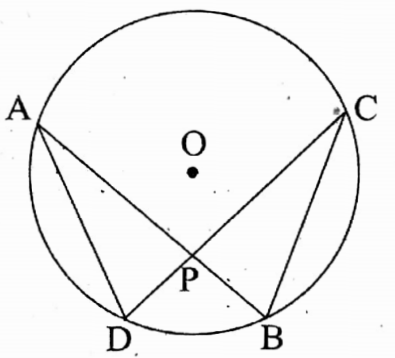
WBBSE Solutions For Class 10 Maths Solid Geometry Chapter 5 Similarity Long Answer Question Example 13

Let AB and CD be two chords of a circle with centre at O and they intersect each other at an internal point P of the circle.

To prove: AP x BP = CP x DP.

Construction: Let us join A, D and B, C.

Proof: In ΔAPD and ΔBPC, ∠APD = ∠BPC, [opposite angles]

∠PAD = ∠PCB [two angles in circle produced by the arc BD.]

∴ ΔAPD and ΔBPC are equiangular.

∴ by Thales’ theorem we get, \(\frac{\mathrm{AP}}{\mathrm{CP}}=\frac{\mathrm{DP}}{\mathrm{BP}}\)

∴ AP x BP = CP x DP. (Proved)

Example 14. AB is a diameter of a circle. BP is a tangent to the circle at B. A straight line passing through A intersects BP at C and the circle at D. Prove that BC2 = AC x CD.

Solution:

Given:

AB is a diameter of a circle. BP is a tangent to the circle at B. A straight line passing through A intersects BP at C and the circle at D.

WBBSE Solutions For Class 10 Maths Solid Geometry Chapter 5 Similarity Long Answer Question Example 14

Let AB is a diameter of the circle with centre at O.

BP is tangent to the circle at B.

The straight line AC passing through A intersects BP at C and the circle at D.

To prove BC2 = AC x CD.

Construction: Let us join B and D.

Proof: In ΔABD, ∠BAD = 90° – ∠ABD [∵ ∠ADB = semicircular angle = 90°]

= ∠ABC – ∠ABD [∵ BP is a tangent and OB is a radius through point of contact, ∴ ∠ABC = 90°] = ∠DBC

Then in ΔABC and ΔBCD,

∠ABC = ∠BDC [∵ each is a right angle]

∠BAC = ∠BAD = ∠DBC [∵ Proved]

∴ ΔABC and ΔBCD are equiangular

∴ by Thales’theorem we get, \(\frac{\mathrm{BC}}{\mathrm{CD}}=\frac{\mathrm{AC}}{\mathrm{BC}}\)

or, BC2 = AC x CD .

Hence BC2 = AC x CD (Proved)

Example 15. In the cyclic quadrilateral ABCD, the diagonal BD bisects the diagonal AC. prove that AB x AD = CB x CD

Solution:

Given:

In the cyclic quadrilateral ABCD, the diagonal BD bisects the diagonal AC.

WBBSE Solutions For Class 10 Maths Solid Geometry Chapter 5 Similarity Long Answer Question Example 15

Let ABCD be a cyclic quadrilateral in the circle with centre at O.

The diagonal BD of ABCD intersects the diagonal AC of ABCD at P in such a way that AP = CP.

To prove AB x AD = CB x CD.

Proof: Since diagonal BD bisects the diagonal AC at P, ∴ AP = CP.

Now, in ΔAPB and ΔCPD, ∠APB = ∠CPD [∵ opposite angles]

and ∠BAP = ∠CDP [∵ these are two angles in the circle produced by the chord BC.]

∴ ΔAPB and ΔCPD are equiangular.

∴ by Thales’ theorem we get, \(\frac{\mathrm{AB}}{\mathrm{AP}}=\frac{\mathrm{CD}}{\mathrm{DP}}\)…..(1)

Again, ΔAOD and ΔBOC are equiangular

[∵ ∠APD = opposite ∠BPC and ∠PAD = ∠PBC (same angles in circle)]

∴ by Thales’ theorem, \(\frac{\mathrm{AD}}{\mathrm{DP}}=\frac{\mathrm{BC}}{\mathrm{CP}}\)

Now, multiplying (1) by (2) we get,

\(\frac{\mathrm{AB}}{\mathrm{AP}} \times \frac{\mathrm{AD}}{\mathrm{DP}}=\frac{\mathrm{CD}}{\mathrm{DP}} \times \frac{\mathrm{BC}}{\mathrm{CP}}\)

or, \(\frac{\mathrm{AB} \times \mathrm{AD}}{\mathrm{CD} \times \mathrm{BC}}=\frac{\mathrm{AP} \times \mathrm{DP}}{\mathrm{DP} \times \mathrm{CP}}=1\)

[∵ AP = CP] or, AB x AD = CD x BC

Hence AB x AD = CB x CD (proved)

Example 16. AD is a diameter of the circumcircle of ΔABC. AE is perpendicular to BC. Prove that AB x AC – AD x AE.

Solution:

Given:

AD is a diameter of the circumcircle of ΔABC. AE is perpendicular to BC.

WBBSE Solutions For Class 10 Maths Solid Geometry Chapter 5 Similarity Long Answer Question Example 16

Let the circle with centre O be the circumcircle of ΔABC.

AD is its diameter. AE ⊥ BC.

To prove AB x AC = AD x AE.

Construction: Let us join C and D.

Proof: in ΔABE and ΔACD,

∠AEB = ∠ACD [∵ AE ⊥ BC and ∠ACD = semicircular angle = 1 right angle]

∠ABE = ∠ADC [∵ ∠ABE and ∠ADC are two angles in circle produced by the arc \(\overparen{A C}\)]

∴ ΔABE and ΔACD are equiangular.

∴ by Thales’ theorem, \(\frac{\mathrm{AB}}{\mathrm{AE}}=\frac{\mathrm{AD}}{\mathrm{AC}}\)

∴ AB x AC = AD x AE (proved)

Example 17. XY is a straight line parallel to the side MT of the parallelogram MNOT, which intersects the side MN at X and the side TO at Y. E and F are two points on XY. If ME and TF are extended, they intersect at P and the extended NE and OF intersect each other at Q. Prove that PQ || MN || TO. 

Solution:

Given:

XY is a straight line parallel to the side MT of the parallelogram MNOT, which intersects the side MN at X and the side TO at Y. E and F are two points on XY. If ME and TF are extended, they intersect at P and the extended NE and OF intersect each other at Q.

WBBSE Solutions For Class 10 Maths Solid Geometry Chapter 5 Similarity Long Answer Question Example 17

Given: XY is a straight line parallel to the side MT of the parallelogram MNOT, which intersects the side MN at X and the side TO at Y.

E and F are two points on XY.

If ME and TF are extended, they intersect at P and the extended NE and OF intersect each other at Q.

To prove PQ || MN || TO.

Proof: In ΔPMT, EF || MT [∵ XY || MT]

by Thales’ theorem, \(\frac{\mathrm{PE}}{\mathrm{ME}}=\frac{\mathrm{PF}}{\mathrm{TF}}=\frac{\mathrm{EF}}{\mathrm{MT}}\)…….(1)

Again, in ΔQON, EF || NO [XY || MT || NO]

∴ by Thales’ theorem, \(\frac{\mathrm{QE}}{\mathrm{EN}}=\frac{\mathrm{QF}}{F O}=\frac{\mathrm{EF}}{\mathrm{NO}}\)

From (1) and (2) we get,

\(\frac{\mathrm{PE}}{\mathrm{ME}}=\frac{\mathrm{EF}}{\mathrm{MT}}\) and \(\frac{\mathrm{QE}}{\mathrm{EN}}=\frac{\mathrm{EF}}{\mathrm{NO}}\)……..(3)

But ∵ MNOT is a parallelogram, ∴ MT = NO

[∵ Opposite sides of any parallelogram are equal]

From (3) we get, \(\frac{P E}{M E}=\frac{\mathrm{QE}}{\mathrm{EN}}\)

∴ ΔMEN – ΔPEQ, i.e., ∠MNE = ∠PQE,

∠NME = ∠QPM and ∠MNQ = ∠PQN.

But these are alternate angles when PQ and MN are intersected by the transversal NQ.

∴ PQ || MN ………(4)

Again, since MNOT is a parallelogram, ∴MN || TO……(5)

Then from (4) and (5) we get, PQ || MN || TO.

Hence PQ || MN || TO. (Proved)

Example 18. In ΔPQR, ∠Q = 2∠R; The bisector of ∠PQR intersects PR at the point D. Prove that PQ.QR = QD.PR.

Solution:

Given:

In ΔPQR, ∠Q = 2∠R; The bisector of ∠PQR intersects PR at the point D.

WBBSE Solutions For Class 10 Maths Solid Geometry Chapter 5 Similarity Long Answer Question Example 18

In ΔPQR, ∠Q = 2∠R; Bisector QD of ∠PQR intersects PR at D.

To prove: PQ.QR = QD.PR ∠Q = 2∠R (given)

Proof: Since

Again, ∠PQD = ∠DQR [∵ QD is the bisector of ∠PQR]

∴ ∠PQD = ∠DRQ.

Then in ΔPQR and ΔPQD, ∠PRQ = ∠PQD, ∠QPR =∠QPD

∴ ΔPQR and ΔPQD are equiangular.

∴ by Thales’ theorem, \(\frac{\mathrm{PQ}}{\mathrm{QD}}=\frac{\mathrm{PR}}{\mathrm{QR}}\)

∴ PQ.QR = QD.PR. (Proved)

“WBBSE Class 10 Maths solved problems on similarity”

Example 19. PQ is a diameter of a circle and AB is such a chord of it that it is perpendicular to PQ. If C be the point of intersection of PQ and AB, then prove that PC.QC = AC.BC.

Solution:

Given:

PQ is a diameter of a circle and AB is such a chord of it that it is perpendicular to PQ. If C be the point of intersection of PQ and AB

WBBSE Solutions For Class 10 Maths Solid Geometry Chapter 5 Similarity Long Answer Question Example 19

Let PQ is a diameter of the circle with centre at O.

The chord AB is perpendicular to PQ and has intersected PQ at C.

To prove: PC.QC = AC.BC.

Construction: Let us join B, Q and A, P.

In ΔACP and ΔBCQ, ∠ACP = ∠BCQ [∵ AB ⊥ PQ, each is right-angled.]

and ∠APC = ∠QBC [∵ these are two angles in circle produced by the arc \(\overparen{A Q}\)]

∴ ΔACP ~ ΔBCQ.

∴ by Thales’ theorem, \(\frac{\mathrm{PC}}{\mathrm{BC}}=\frac{\mathrm{AC}}{\mathrm{QC}}\)

or, PC.QC = AC.BC

Hence PC. QC = AC. BC (Proved)

Example 20. PQRS is a cyclic quadrilateral. Extended PQ and SR intersect each other at A. Prove that AP.AQ = AR.AS.

Solution:

Given:

PQRS is a cyclic quadrilateral. Extended PQ and SR intersect each other at A.

WBBSE Solutions For Class 10 Maths Solid Geometry Chapter 5 Similarity Long Answer Question Example 20

Let PQRS is a cyclic quadrilateral in the circle with centre at O.

Extended PQ and RS intersect each other at A.

To prove: AP.AQ = AR.AS.

Proof: In ΔAPS and ΔAQR, ∠APS = ∠ARQ and

[∵ ∠QPS + ∠QRS = 180° or, ∠QPS + 180° – ∠QRA = 180° or, ∠QPS = ∠QRA]

∠ASP – ∠AQR [for similar reason]

∴ ΔAPS and ΔAQR are equiangular.

∴ by Thales’ theorem, \(\frac{\mathrm{AP}}{\mathrm{AR}}=\frac{\mathrm{AS}}{\mathrm{AQ}}\)

or, AP.AQ = AR.AS.

Hence AP AQ = AR.AS (Proved)

Solid Geometry Chapter 5 Similarity

Relation Between The Sides Of Two Similar Triangles

In the previous part of this chapter, you have studied about similar triangles, congruent triangles and about their properties and conditions.

In the present part we shall discuss about the relations between the sides of two similar triangles and the theorems related to them.

If we measure the lengths of the sides of two similar triangles and determine their ratios, then we shall see that the corresponding sides of two similar triangles are proportional, i.e., the corresponding sides of two similar triangles are proportional.

We shall now prove this theorem logically with the help of the geometric method.

Solid Geometry Chapter 5 Similarity

Relation Between The Sides Of Two Similar Triangles Theorems

Theorem 1. If two triangles are similar then prove that their corresponding sides are in same ratio, i.e., their corresponding sides are proportional.

WBBSE Solutions For Class 10 Maths Solid Geometry Chapter 5 Similarity Relation Between The Sides Of Two Similar Triangles Theorem 1

Given: Let ΔABC and ΔDEF are two similar triangles, i.e., ∠A = ∠D, ∠B = ∠E and ∠C = ∠F.

To prove \(\frac{\mathrm{AB}}{\mathrm{DE}}=\frac{\mathrm{BC}}{\mathrm{EF}}=\frac{\mathrm{AC}}{\mathrm{DF}}\)

Construction: Let us cut off AP and AQ from AB and AC of the ΔABC equal to DE and DF respectively. Let us join P and Q.

Proof: In ΔAPQ and ΔDEF, AP = DE, AQ = DF [by construction] and ∠PAQ = ∠EDF.

∴ ΔAPQ ≅ ΔDEF [by the S-A-S condition of congruency]

∴ ∠APQ = ∠DEF [∵ corresponding angles of congruent triangles.]

or, ∠APQ = ∠ABC [∵ ∠DEF = ∠ABC (given)] ,

But these are similar angles.

∴ PQ || BC.

∴ \(\quad \frac{\mathrm{AP}}{\mathrm{BP}}=\frac{\mathrm{AQ}}{\mathrm{CQ}}\) [by Thales’ theorem]

or, \(\frac{\mathrm{BP}}{\mathrm{AP}}=\frac{\mathrm{CQ}}{\mathrm{AQ}}\)

or, \(\frac{\mathrm{BP}+\mathrm{AP}}{\mathrm{AP}}=\frac{\mathrm{CQ}+\mathrm{AQ}}{\mathrm{AQ}}\)

or, \(\frac{\mathrm{AB}}{\mathrm{AP}}=\frac{\mathrm{AC}}{\mathrm{AQ}}\)

or, \(\frac{\mathrm{AB}}{\mathrm{DE}}=\frac{\mathrm{AC}}{\mathrm{DF}}\)……(1)

[∵ AP = DE and AQ = DF.]

Similarly, cutting parts from BA and BC respectively equal to DE and EF, it can be prove that

\(\frac{\mathrm{AB}}{\mathrm{DE}}=\frac{\mathrm{BC}}{\mathrm{EF}}\)……(2)

∴ from (1) and (2) we get, \(\frac{\mathrm{AB}}{\mathrm{DE}}=\frac{\mathrm{BC}}{\mathrm{EF}}\)= \(\frac{\mathrm{AC}}{\mathrm{DF}}\)

Hence \(\frac{\mathrm{AB}}{\mathrm{DE}}=\frac{\mathrm{BC}}{\mathrm{EF}}\)= \(\frac{\mathrm{AC}}{\mathrm{DF}}\), i.e.,

The corresponding sides of two similar triangles are proportional. (Proved)

Theorem 2. If the sides of two triangles are in same ratio, then their corresponding angles are equal, i.e., two triangles are similar.

WBBSE Solutions For Class 10 Maths Solid Geometry Chapter 5 Similarity Relation Between The Sides Of Two Similar Triangles Theorem 2


Given: Let the sides of the ΔABC and ΔDEF are in same ratio,

i.e., \(\frac{\mathrm{AB}}{\mathrm{DE}}=\frac{\mathrm{BC}}{\mathrm{EF}}\)= \(\frac{\mathrm{CA}}{\mathrm{DF}}\),

To prove ΔABC ~ ΔDEF, i.e., ∠A =∠D, ∠B – ∠E and ∠C = ∠F.

Construction: Let the parts AP and AQ are cut offfrom AB and AC in such a way that the two parts are equal to DE and DF respectively.

Let us join P and Q.

Proof: Given that \(\frac{\mathrm{AB}}{\mathrm{DE}}=\frac{\mathrm{AC}}{\mathrm{DF}}\)

or, \(\frac{\mathrm{AB}}{\mathrm{AP}}=\frac{\mathrm{AC}}{\mathrm{AQ}}\)[∵ DE = AP and DF = AQ by construction]

∴ by the converse of Thales’ theorem, PQ || BC.

∴ ∠B = ∠APQ [∵ similar angles] and ∠C = ∠AQP [∵ similar angles]

∴ ΔABC and ΔAPQ are similar.

∴ \(\frac{\mathrm{AB}}{\mathrm{AP}}=\frac{\mathrm{BC}}{\mathrm{PQ}}\)…….. (1),

But \(\frac{\mathrm{AB}}{\mathrm{AP}}=\frac{\mathrm{AB}}{\mathrm{DE}}\) [∵ AP = DE] = \(\frac{\mathrm{BC}}{\mathrm{EF}}\)…….(2)

From (1) and (2) we get, \(\frac{\mathrm{BC}}{\mathrm{PQ}}=\frac{\mathrm{BC}}{\mathrm{EF}}\), ∴ PQ = EF.

Then in ΔAPQ and ΔDEF, AP = DE, AQ = DF and PQ = EF.

∴ ΔAPQ = ΔDEF [by the S-S-S condition of congruency]

∴ ∠APQ = ∠DEF = ∠E corresponding angles of similar triangles]

But ∠APQ = ∠B, ∴ ∠B = ∠E

Again, ∠AQP = ∠DFE = ∠F [for similar reason]

But ∠AQP =∠C, ∴ ∠C = ∠F

It is then obvious that ∠A = ∠D.

i.e, in ΔABC and ΔDEF, ∠A – ∠D, ∠B = ∠E and ∠C = ∠F.

∴ ΔABC ~ ΔDEF. (Proved)

From above discussion we can say that two triangles will be similar if

  1. Their sides are proportional; or
  2. Their corresponding angles are equal.

Similarly, if the sides of two polygons be proportional and the corresponding angles are equal, then the polygons are similar.

Again, if any one angle of a triangle be equal to one angle of another triangle and their sides adjacent to that angle be proportional, then the triangles will be similar.

We shall now prove this theorem logically by the method of geometry.

Theorem 3. If in two triangles, an angle of one triangle is equal to the angle of another triangle and the adjacent sides of the angle are proportional, then two triangles are similar.


WBBSE Solutions For Class 10 Maths Solid Geometry Chapter 5 Similarity Relation Between The Sides Of Two Similar Triangles Theorem 3


Given: Let in ΔABC and ΔDEF, ∠A = ∠D and \(\frac{\mathrm{AB}}{\mathrm{DE}}=\frac{\mathrm{AC}}{\mathrm{DF}}\)

To prove ΔABC ~ ΔDEF.

Construction: Two parts DP and DQ equal to AB and AC are cut off respectively from DE and DF.

Let us join P and Q.

Proof: Given that \(\frac{\mathrm{AB}}{\mathrm{DE}}=\frac{\mathrm{AC}}{\mathrm{DF}}\)

or, \(\frac{\mathrm{DP}}{\mathrm{DE}}=\frac{\mathrm{DQ}}{\mathrm{DF}}\) [∵ AB = DP, AC = DQ]

∴ PQ || EF [by the converse of Thales’ theorem]

∴ ∠DPQ = ∠DEF …..(1) [∵ similar angles]

∴ ∠DQP = ∠DFE ……(2) [ similar angles]

Again, ΔDPQ = ΔABC [∴ ∠D = ∠A, DP = AB and DQ = AC]

∴ ∠DPQ = similar ∠B, from (1) we get ∠B = ∠DEF, i.e. ∠B = ∠E.

Again, ∠DQP = similar ∠C, from (2) we get, ∠C = ∠DQP, i.e., ∠C = ∠F.

in ΔABC and ΔDEF, ∠A = ∠D, ∠B = ∠E and ∠C = ∠F.

∴ ΔABC ~ ΔDEF. (Proved)

We know that if a perpendicular is drawn from the right angular point of any right-angled triangle to its hypotenuse, then the triangle is divided into two right-angled triangles.

We shall now prove logically that the two right-angled triangle thus produced are similar to each other and each of them is also similar to the original right-angled triangle.

Theorem 4. If any right-angled triangle if a perpendicular is drawn from right angular point on the hypotenuse then prove that the two triangles on both sides of this perpendicular are similar and each of them is similar to original triangle.

WBBSE Solutions For Class 10 Maths Solid Geometry Chapter 5 Similarity Relation Between The Sides Of Two Similar Triangles Theorem 4

Given: Let ΔBC be a right-angled triangle of which A = 90°.

So, the hypotenuse is BC. AD is perpendicular to the hypotenuse BC from the right-angular point A.

Then two right-angled triangles ΔABD and ΔACD have been produced.

To prove

  1. ΔABD ~ ΔABC
  2. ΔACD ~ ΔABC; and
  3. ΔABD ~ ΔACD

Construction: Let us draw a perpendicular AD from the right angular point A to the hypotenuse BC which intersects BC at the point D.

Proof:

1. In ΔABD and ΔABC, ∠ADB = ∠BAC each is right-angle] ∠ABD is common to both the triangles.

Obviously, ∠BAD = ∠ACB [∵ sum of three angles of any triangle is 2 right angles or 180°]

So, in ΔABD and ΔABC, ∠ADB = ∠A, ∠ABD = ∠B and ∠BAD = ∠C.

Hence ΔABD ~ ΔABC [(1)Proved]

2. In ΔACD and ΔABC, ∠ADC = ∠BAC, [∵ each is a right angle.]∠ACD is common to both the triangles.

Obviously, ∠CAD = ∠ABC [∵ sum of three angles of any triangle is 2 right angles or 180°]

So in ΔACD and ΔABC, ∠ADC = ∠A, ∠ACD = ∠C and ∠CAD = ∠B.

Hence ΔACD ~ ΔABC. [(2) Proved]

3. Now, ΔABD and ΔACD, ∠ADB = ∠ADC [∵ each is a right angle]

∴ ∠ABD + ∠BAD = 90° and ∠CAD + ∠ACD = 90°

∴ ∠ABD = 90° – ∠BADor, ∠ABD = ∠CAD [∵ ∠A = 90°]

i.e., in ΔABD and ΔACD, ∠ADB – ∠ADC, ∠ABD = ∠CAD and ∠BAD = ∠ACD, i.e., three angles of each of the triangles are equal.

Hence ΔABD ~ ΔACD [(3) Proved]

Corollary 1. According to theorem 4, ΔABC ~ ΔABD.

∴ \(\frac{B C}{B A}=\frac{B A}{B D}\) = or, BA2 = BC. BD.

∴ BA is the mean-proportional of BC and BD.

Corollary 2. According to the theorem 4, ΔABD ~ ΔACD,

∴ \(\frac{D B}{D A}=\frac{D A}{D C}\) or, DA2 = DB.DC

∴ DA is the mean proportional of DB and DC.

Corollary 3. According to the theorem 4, ΔABC ~ ΔACD,

∴ \(\frac{C B}{C A}=\frac{C A}{C D}\) or.CA2 = CB.CD.

∴ CA is the mean-proportional of CB and CD

Solid Geometry Chapter 5 Similarity

Some Essential Theorems

Theorem 1. (1) Prove that the ratio of the areas of two similar triangles is equal to the ratio of the square of the corresponding sides.

WBBSE Solutions For Class 10 Maths Solid Geometry Chapter 5 Similarity Relation Between The Sides Of Two Similar Triangles Essential Theorem1

Given: Let ΔABC and ΔPQR are two similar triangles.

To prove 

\(\frac{\text { Area of } \triangle \mathrm{ABC}}{\text { Area of } \Delta \mathrm{PQR}}=\frac{\mathrm{AB}^2}{\mathrm{PQ}^2}=\frac{\mathrm{BC}^2}{\mathrm{QR}^2}=\frac{\mathrm{AC}^2}{\mathrm{PR}^2}\)

Construction: Let us draw a perpendicular AD from A to BC and a perpendicular PM from P to QR.

Proof: ∵ ΔABC ~ ΔPQR,

∴ \(\frac{\mathrm{AB}}{\mathrm{PQ}}=\frac{\mathrm{BC}}{\mathrm{QR}}\)……(1)

Again, ΔABD ~ΔPQM [∵ ∠ADB = ∠PMQ and ∠B = ∠Q]

∴ \(\frac{\mathrm{AB}}{\mathrm{PQ}}=\frac{\mathrm{AD}}{\mathrm{PM}}\)…….(2)

Now, from (1) and (2) we get, \(\frac{\mathrm{BC}}{\mathrm{QR}}=\frac{\mathrm{AD}}{\mathrm{PM}}\)…….(3)

Then, \(\frac{\text { Area of } \Delta \mathrm{ABC}}{\text { Area of } \Delta \mathrm{PQR}}=\frac{\frac{1}{2} \times \mathrm{BC} \times \mathrm{AD}}{\frac{1}{2} \times \mathrm{QR} \times \mathrm{PM}}\)

[∵ Base = BC and height = AD]

[∵ Base = QR and height = PM]

= \(\frac{\mathrm{BC} \times \mathrm{AD}}{\mathrm{QR} \times \mathrm{PM}}=\frac{\mathrm{BC}}{\mathrm{QR}} \times \frac{\mathrm{AD}}{\mathrm{PM}}\)

= \(\frac{\mathrm{BC}}{\mathrm{QR}} \times \frac{\mathrm{BC}}{\mathrm{QR}}\)[from (3)]

= \(\frac{\mathrm{BC}^2}{\mathrm{QR}^2}\)…..(4)

Again, since ΔABC and ΔPQR are similar to each other,

∴ \(\frac{\mathrm{BC}}{\mathrm{QR}}=\frac{\mathrm{AB}}{\mathrm{PQ}}=\frac{\mathrm{AC}}{\mathrm{PR}}\)

or,\(\frac{\mathrm{BC}^2}{\mathrm{QR}^2}=\frac{\mathrm{AB}^2}{\mathrm{PQ}^2}=\frac{\mathrm{AC}^2}{\mathrm{PR}^2}\)

Hence from (4) we get,

\(\frac{\text { Area of } \triangle \mathrm{ABC}}{\text { Area of } \triangle \mathrm{PQR}}=\frac{\mathrm{AB}^2}{\mathrm{PQ}^2}=\frac{\mathrm{BC}^2}{\mathrm{QR}^2}=\frac{\mathrm{AC}^2}{\mathrm{PR}^2}\) (Proved)

2. The ratio of the areas of two similar triangles is equal to the ratio of the squares of their corresponding heights.

WBBSE Solutions For Class 10 Maths Solid Geometry Chapter 5 Similarity Relation Between The Sides Of Two Similar Triangles Essential Theorem

Given: Let ΔABC and ΔDEF are two similar triangles, the heights of them are AM and DN respectively.

To prove

\(\frac{\text { Area of } \Delta \mathrm{ABC}}{\text { Area of } \Delta \mathrm{DEF}}=\frac{\mathrm{AM}^2}{\mathrm{DN}^2}\)

Proof: ΔABC ~ ΔDEF, by theorem 1(1) we get,

\(\frac{\text { Area of } \Delta \mathrm{ABC}}{\text { Area of } \Delta \mathrm{DEF}}=\frac{\mathrm{AB}^2}{\mathrm{DE}^2}\)……(1)

Again, in ΔABM and ΔDEN, ∠AMB = ∠DNE [∵ each is a right angle] and ∠ABM = ∠DEN (given)

∴ ΔABM ~ ΔDEN

∴ \(\frac{\mathrm{AB}}{\mathrm{DE}}=\frac{\mathrm{AM}}{\mathrm{DN}}\)

or, \(\frac{\mathrm{AB}^2}{\mathrm{DE}^2}=\frac{\mathrm{AM}^2}{\mathrm{DN}^2}\)

From (1) we get,

\(\frac{\text { Area of } \triangle \mathrm{ABC}}{\text { Area of } \Delta \mathrm{DEF}}=\frac{\mathrm{AM}^2}{\mathrm{DN}^2}\) (Proved)

3. Prove that the ratio of the areas of two similar triangles is equal to the ratio of the squares of their corresponding medians.


Given: Let ΔABC and ΔPQR be two similar triangles of which AD and PM are two corresponding medians.

To prove 

\(\frac{\text { Area of } \Delta \mathrm{ABC}}{\text { Area of } \Delta \mathrm{PQR}}=\frac{\mathrm{AD}^2}{\mathrm{PM}^2}\)

Proof: ΔABC ~ ΔPQR,

∴ by theorem 4 (1), \(\frac{\text { Area of } \Delta \mathrm{ABC}}{\text { Area of } \Delta \mathrm{PQR}}=\frac{\mathrm{AB}^2}{\mathrm{PQ}^2}\)….(1)

Again, ∵ ΔABC ∼ ΔPQR,

∴ \(\frac{A B}{P Q}=\frac{B C}{Q R}=\frac{A C}{P R}\)….(2)

From (2) we get, \(\frac{A B}{P Q}=\frac{B C}{Q R}\)

or, \(\frac{\mathrm{AB}}{\mathrm{PQ}}=\frac{2 \mathrm{BD}}{2 \mathrm{QM}}=\frac{\mathrm{BD}}{\mathrm{QM}}\)…….(3)

Again in ΔABD and ΔPQM, ∠ABD = ∠PQM [∵ ΔABC ~ ΔPQR.]

and \(\frac{\mathrm{AB}}{\mathrm{PQ}}=\frac{2 \mathrm{BD}}{2 \mathrm{QM}}\) [from (3)]

∴ ΔABD ∼ ΔPQM

∴ \(\frac{A B}{P Q}=\frac{B D}{Q M}=\frac{A D}{P M}\)  [by Thales’ theorem]

∴ from (1) we get,

\(\frac{\text { Area of } \Delta \mathrm{ABC}}{\text { Area of } \Delta \mathrm{PQR}}=\frac{\mathrm{AD}^2}{\mathrm{PM}^2}\)(proved)

4. The ratio of the areas of two triangles having same heights will be equal to the ratio of their corresponding bases.

WBBSE Solutions For Class 10 Maths Solid Geometry Chapter 5 Similarity Relation Between The Sides Of Two Similar Triangles Essential Theorem 1-4

Given: Let the heights of ΔABC and ΔDEF be each h units.

BC and EF are the two corresponding bases of them.

To prove 

\(\frac{\text { Area of } \Delta \mathrm{ABC}}{\text { Area of } \Delta \mathrm{DEF}}=\frac{\mathrm{BC}}{\mathrm{EF}}\)

Proof: We know, area of a triangle = \(\frac{1}{2}\) x Base x Height

∴ area of ΔABC = \(\frac{1}{2}\) x BC x h…..(1)

area of ΔDEF =\(\frac{1}{2}\) x  EF x h……. (2)

Now, dividing (1) by (2) we get

\(\frac{\text { Area of } \Delta \mathrm{ABC}}{\text { Area of } \Delta \mathrm{DEF}}=\frac{\frac{1}{2} \times \mathrm{BC} \times h}{\frac{1}{2} \times \mathrm{EF} \times h}=\frac{\mathrm{BC}}{\mathrm{EF}}\)

Hence \(\frac{\text { Area of } \triangle \mathrm{ABC}}{\text { Area of } \triangle \mathrm{DEF}}=\frac{\mathrm{BC}}{\mathrm{EF}}\) (Proved)

In the following examples how the above theorems are applied in real problems have been discussed thoroughly.

Solid Geometry Chapter 5 Similarity

Relation Between The Sides Of Two Similar Triangles Multiple Choice Questions

Example 1. In ΔABC and ΔDEF if \(\frac{A B}{D E}=\frac{B C}{D F}=\frac{A C}{E F}\) then

  1. ∠B = ∠E
  2. ∠A = ∠D
  3. ∠B = ∠D
  4. ∠A = ∠F

WBBSE Solutions For Class 10 Maths Solid Geometry Chapter 5 Similarity Relation Between The Sides Of Two Similar Triangles Multiple Choice Question Example 1

Solution: ∵ in ΔABC and ΔDEF, \(\frac{A B}{D E}=\frac{B C}{D F}=\frac{A C}{E F}\)

ΔABC ~ ΔDEF and the corresponding sides of the sides AB, BC and AG are respectively DE, FD and EF.

∴ ∠B = ∠D

∴ 3. ∠B = ∠D is correct.

Example 2. If in ΔDEF and ΔPQR, ∠D = ∠Q and ∠E = ∠R , then which one of the following is not correct?

  1. \(\frac{E F}{P R}=\frac{D F}{P Q}\)
  2. \(\frac{Q R}{P Q}=\frac{E F}{D F}\)
  3. \(\frac{D E}{Q R}=\frac{D F}{P Q}\)
  4. \(\frac{E F}{R P}=\frac{D E}{Q R}\)

WBBSE Solutions For Class 10 Maths Solid Geometry Chapter 5 Similarity Relation Between The Sides Of Two Similar Triangles Multiple Choice Question Example 2

Solution: ∵ in ΔDEF and ΔPQR, ∠D = ∠Q and ∠E = ∠R, ∴ ΔDEF ~ ΔPQR.

∴ by Thales’ theorem, the ratios of the corresponding sides of ΔDEF and ΔPQR are equal.

∴ \(\frac{E F}{P R}=\frac{D F}{P Q}=\frac{D E}{Q R}\)

∴ 2. \(\frac{Q R}{P Q}=\frac{E F}{D F}\) is not correct

Example 3. In ΔABC and ΔDEF, ∠A = ∠E = 40°, AB: ED = AC: EF and∠F = 65°, then the value of ∠B is 

  1. 35°
  2. 65°
  3. 75°
  4. 85°

WBBSE Solutions For Class 10 Maths Solid Geometry Chapter 5 Similarity Relation Between The Sides Of Two Similar Triangles Multiple Choice Question Example 3

Solution: In ΔABC and ΔDEF, ∠A = ∠E, AB : ED = AC : EF

∴ ΔABC ~ ΔDEF

∴ ∠A = ∠E, ∠B = ∠D, ∠C = ∠F

∴ in ΔABC, ∠A = 40° [∵ ∠A = ∠E = 40°] and ∠C = 65° [∵ ∠C = ∠F = 65°]

∴ ∠B =180° – (∠A + ∠C) = 180° – (40° + 65°) = 180° – 105° = 75°

∴ 3. 75° is correct.

Example 4.  In ΔABC and ΔPQR, if \(\frac{A B}{Q R}=\frac{B C}{P R}=\frac{C A}{P Q}\) then

  1. ∠A = ∠Q
  2. ∠A = ∠P
  3. ∠A = ∠R
  4. ∠B = ∠Q


WBBSE Solutions For Class 10 Maths Solid Geometry Chapter 5 Similarity Relation Between The Sides Of Two Similar Triangles Multiple Choice Question Example 4

Solution: ∵ in ΔABC and ΔPQR,

\(\frac{\mathrm{AB}}{\mathrm{QR}}=\frac{\mathrm{BC}}{\mathrm{PR}}=\frac{\mathrm{CA}}{\mathrm{PQ}}\),

∴ ΔABC ∼ ΔPQR

∴ ∠A = ∠Q; ∠B = ∠R, ∠C = ∠P

∴ 1. ∠A = ∠Q is correct.

Example 5. In ΔABC, AB = 9 cm, BC = 6 cm and CA = 7.5 cm. In ΔDEF, the corresponding side of BC is EF; EF = 8 cm and if ΔDEF ~ ΔABC, then the perimeter of ΔDEF will be 

  1. 22.5 cm
  2. 25 cm
  3. 27 cm
  4. 30 cm

WBBSE Solutions For Class 10 Maths Solid Geometry Chapter 5 Similarity Relation Between The Sides Of Two Similar Triangles Multiple Choice Question Example 5

Solution:

Given

In ΔABC, AB = 9 cm, BC = 6 cm and CA = 7.5 cm. In ΔDEF, the corresponding side of BC is EF; EF = 8 cm and if ΔDEF ~ ΔAB

ΔADEF ~ ΔABC and the corresponding side of BC is EF,

∴ \(\frac{\mathrm{AB}}{\mathrm{DE}}\) = \(\frac{\mathrm{BC}}{\mathrm{EF}}\) = \(\frac{\mathrm{AC}}{\mathrm{DF}}\)

Now, \(\frac{\mathrm{AB}}{\mathrm{DE}}=\frac{\mathrm{BC}}{\mathrm{EF}}\)

or, \(\frac{9 \mathrm{~cm}}{\mathrm{DE}}\) = \(\frac{6 \mathrm{~cm}}{8 \mathrm{~cm}}\)

[∵ AB = 9 cm, BC = 6 cm and EF = 8 cm]

or, DE = 12 cm

Again, \(\frac{\mathrm{BC}}{\mathrm{EF}}=\frac{\mathrm{AC}}{\mathrm{DF}}\)

or, \(\frac{6 \mathrm{~cm}}{8 \mathrm{~cm}}=\frac{7 \cdot 5 \mathrm{~cm}}{\mathrm{DF}}\)

[∵ AC = 7.5 cm] or, DF = 10 cm

∴ Perimeter of ΔDEF = DE + EF + FD = (12 + 8 + 10) cm = 30 cm

Hence the required perimeter of ΔDEF = 30 cm

∴ 4. 30 cm is correct.

Solid Geometry Chapter 5 Similarity

Relation Between The Sides Of Two Similar Triangles True Or False

Example 1. If the corresponding angles of two quadrilaterals are equal, then they are similar.

Solution: False

WBBSE Solutions For Class 10 Maths Solid Geometry Chapter 5 Similarity Relation Between The Sides Of Two Similar Triangles True Or False Example 1

Since here though the angles are equal, their shapes may not be equal, such as four angles of a rectangle and of a square are equal (each is a right angle), but their shapes are not the same.

Example 2. In the adjoining, if ∠ADE = ∠ACB, then ΔADE ~ ΔACB.

Solution: True

WBBSE Solutions For Class 10 Maths Solid Geometry Chapter 5 Similarity Relation Between The Sides Of Two Similar Triangles True Or False Example 2

Since in ΔADE and ΔABC, ∠ADE = ∠ACB (given) and ∠DAE = ∠BAC, i.e. ∠A is common to both.

∴ ΔADE ~ ΔABC.

Example 3. In ΔPQR, D is a point on the side QR so that PD ⊥ QR; So ΔPQD ~ ΔRPD.

Solution: False

WBBSE Solutions For Class 10 Maths Solid Geometry Chapter 5 Similarity Relation Between The Sides Of Two Similar Triangles True Or False Example 3

Since here in ΔPQD and ΔRPD, only ∠PDQ = ∠PDR (each is. a right angle),

The other two angles are not equal.

Solid Geometry Chapter 5 Similarity

Relation Between The Sides Of Two Similar Triangles Fill In The Blanks

Example 1. Two triangles are similar if their _________ sides are proportional.

Solution: corresponding

Example 2.  The perimeters of ΔABC and ΔDEF are 30 cm and 18 cm respectively. ΔABC ~ ΔDEF; BC and EF are corresponding sides. If BC = 9 cm, the EF = ______ cm.

Solution: 5-4 cm since ΔABC ~ ΔDEF,

\(\frac{\mathrm{AB}}{\mathrm{DE}}=\frac{\mathrm{BC}}{\mathrm{EF}}=\frac{\mathrm{AC}}{\mathrm{DF}}=\frac{\mathrm{AB}+\mathrm{BC}+\mathrm{CA}}{\mathrm{DE}+\mathrm{EF}+\mathrm{FD}}=\frac{30 \mathrm{~cm}}{18 \mathrm{~cm}}=\frac{15}{9}\) \(\frac{\mathrm{BC}}{\mathrm{EF}}=\frac{15}{9} \text { or }, \frac{9 \mathrm{~cm}}{\mathrm{EF}}=\frac{15}{9}\)

or, 15 EF =9 x 9 cm

or, EF = \(\frac{9 \times 9}{15} \mathrm{~cm}\)

EF= \(\frac{81}{15}\) =5.4 cm

Solid Geometry Chapter 5 Similarity

Relation Between The Sides Of Two Similar Triangles Short Answer Type Questions

Example 1. In the following if ∠ACB = ∠BAD, AC = 8 cm, AB = 16 cm and AD = 3 cm, then find the length of BD.

Solution:

Given:

In the following if ∠ACB = ∠BAD, AC = 8 cm, AB = 16 cm and AD = 3 cm

WBBSE Solutions For Class 10 Maths Solid Geometry Chapter 5 Similarity Relation Between The Sides Of Two Similar Triangles Short Answer Question Example 1

In ΔABC and ΔABD, ∠ACB = ∠BAD, ∠ABC = ∠ABD,

∴ ΔABC ~ ΔABD.

∴ by Thales’ theorem, \(\frac{\mathrm{AB}}{\mathrm{BD}}=\frac{\mathrm{BC}}{\mathrm{AB}}=\frac{\mathrm{CA}}{\mathrm{AD}}\)

∴ \(\frac{\mathrm{AB}}{\mathrm{BD}}=\frac{\mathrm{CA}}{\mathrm{AD}}\) or, \(\frac{16 \mathrm{~cm}}{\mathrm{BD}}=\frac{8 \mathrm{~cm}}{3 \mathrm{~cm}}\)

[∵ AB = 16cm, AC = 8 cm, AD = 3 cm]

or, 8BD = 48 or, BD = \(\frac{48}{8}\) = 6.

Hence the length of BD = 6 cm.

Example 2. In the adjoining, ∠ABC = 90° and BD ⊥ AC. If AB = 5.7 cm, BD = 3.8 cm, CD =5.4 cm, then find the length of BC.

Solution:

Given:

In the adjoining, ∠ABC = 90° and BD ⊥ AC. If AB = 5.7 cm, BD = 3.8 cm, CD =5.4 cm

WBBSE Solutions For Class 10 Maths Solid Geometry Chapter 5 Similarity Relation Between The Sides Of Two Similar Triangles Short Answer Question Example 2

∵ ∠ABC = 90° and BD ⊥ AC,

∴ ΔABD ~ ΔBCD and ΔABD ~ ΔABC, ΔBCD ~ ΔABC.

Then ΔABC ~ ΔBCD implies = \(\frac{A B}{B D}=\frac{B C}{C D}\)

or, \(\frac{5 \cdot 7 \mathrm{~cm}}{3 \cdot 8 \mathrm{~cm}}\) = \(\frac{\mathrm{BC}}{5.4 \mathrm{~cm}}\)

[∵ AB = 57 cm, BD = 38 cm, CD = 54 cm.]

or, 38 BC = 5.7 x 5.4 or, BC = \(\frac{5.7 \times 5.4}{3.8}\) = 8.1.

Hence the length of BC = 8.1 cm.

Example 3. In beside, ∠ABC = 90° and BD ⊥ AC. If BD = 8 cm and AD = 4 cm, then find the length of CD.

Solution:

Given:

In beside, ∠ABC = 90° and BD ⊥ AC. If BD = 8 cm and AD = 4 cm,

WBBSE Solutions For Class 10 Maths Solid Geometry Chapter 5 Similarity Relation Between The Sides Of Two Similar Triangles Short Answer Question Example 3

∵ ∠ABC = 90° and BD ⊥ AC,

∴ ΔABD ∼ ΔBCD

∴ by Thales’ theorem, \(\frac{A D}{B D}=\frac{B D}{C D}\)

∴ from (1) we get, BD2 = AD x CD or, (8)2 = 4 x CD

or, 64 = 4CD or CD = \(\frac{64}{4}\) = 16.

Hence the length of CD = 16 cm.

“Applications of similarity in Class 10 Maths”

Example 4. In trapezium ABCD, BC || AD and AD = 4 cm. The two diagonals AC and BD intersect at the point O in such a way that \(\frac{A O}{O C}=\frac{D O}{O B}=\frac{1}{2}\) Find the length of BC.

Solution:

Given:

In trapezium ABCD, BC || AD and AD = 4 cm. The two diagonals AC and BD intersect at the point O in such a way that \(\frac{A O}{O C}=\frac{D O}{O B}=\frac{1}{2}\)

WBBSE Solutions For Class 10 Maths Solid Geometry Chapter 5 Similarity Relation Between The Sides Of Two Similar Triangles Short Answer Question Example 4

ΔAOD ∼ ΔBOC,

∴ \(\frac{A O}{O C}=\frac{D O}{O B}=\frac{A D}{B C}\)

or, \(\frac{A D}{B C}=\frac{1}{2}\) [∵\(\frac{A O}{O C}=\frac{D O}{O B}=\frac{1}{2}\)]

or, \(\frac{4}{B C}=\frac{1}{2}\) or, BC = 8

Hence the length of BC = 8 cm.

Example 5. ΔABC ∼ ΔDEF and in ΔABC and ΔDEF, the corresponding sides of AB, BC and CA are DE, EF and DF respectively. If ∠A = 47° and ∠E = 83°, then find the value of ∠C.

Solution:

WBBSE Solutions For Class 10 Maths Solid Geometry Chapter 5 Similarity Relation Between The Sides Of Two Similar Triangles Short Answer Question Example 5

Given

ΔABC ∼ ΔDEF and in ΔABC and ΔDEF, the corresponding sides of AB, BC and CA are DE, EF and DF respectively. If ∠A = 47° and ∠E = 83°

ΔABC ~ ΔDEF,

∴ ∠A = ∠D, ∠B = ∠E, ∠C = ∠F

∴ ∠D = 47°, ∠E = 83° (given)

∴ ∠F = 180° – (∠D + ∠E)

= 180° – (47° + 83°) = 180° – 130° = 50°

∴ ∠C = 50° [∵ ∠F = ∠C]

Hence the value of ∠C = 50°.

Solid Geometry Chapter 5 Similarity

Relation Between The Sides Of Two Similar Triangles Long Answer Type Questions

Example 1. ABC is a right angled triangle whose ∠B is right angle and BD ⊥ AC; if AD = 4 cm and CD = 16 cm, then calculate the length of BD and AB. 

WBBSE Solutions For Class 10 Maths Solid Geometry Chapter 5 Similarity Relation Between The Sides Of Two Similar Triangles Long Answer Question Example 1

Solution:

Given:

ABC is a right angled triangle whose ∠B is right angle and BD ⊥ AC; if AD = 4 cm and CD = 16 cm,

∵ in ΔABC, ∠B = right angle and BD ⊥ AC.

∴ ΔABC ~ ΔABD

ΔABC ~ ΔBCD

ΔABD ~ ΔBCD

Now, ΔABD ~ ΔBCD implies \(\frac{A D}{B D}=\frac{B D}{C D}\)…..(1)

or, AD x CD = BD2 or BD2 = AD x CD = 4 x 16 = 64

∴ BD = √64 = 8. ∴ BD = 8 cm

Now, AB = vAD2 +BD2 = v42 +82 cm = √80cm \(\sqrt{\mathrm{AD}^2+\mathrm{BD}^2}=\sqrt{4^2+8^2}\)=4√5cm

Hence the length of BD = 8 cm and AB = 4√5 cm

Example 2. AB is a diameter of a circle with centre O, P is any point on the circle, the tangent drawn through the point P intersects the two tangents drawn through the points A and B at the points Q and R respectively. If the radius of the circle be r, then prove that PQ.PR = r2.

WBBSE Solutions For Class 10 Maths Solid Geometry Chapter 5 Similarity Relation Between The Sides Of Two Similar Triangles Long Answer Question Example 2

Solution:

Given:

AB is a diameter of a circle with centre O, P is any point on the circle, the tangent drawn through the point P intersects the two tangents drawn through the points A and B at the points Q and R respectively.

Let AB is a diameter of the circle with centre at O.

P is any point on the circle. AE and BF are two tangents drawn through A and B which intersect the tangent ST drawn at P at the points Q and R respectively.

To prove PQ.PR = r2 (where r = radius of the circle)

Construction: Let us join O, Q and O, R.

Proof: ∵ the lengths of the tangents to a circle drawn from an external point of the circle are equal and they subtend equal angles at the centre,

∴ QA = QP, PR = BR and ∠AOQ = ∠POQ, ∠BOR = ∠POR

∴ ∠AOQ = ∠POQ = \(\frac{1}{2}\) ∠AOP and ∠BOR = ∠POR = \(\frac{1}{2}\) ∠BOP.

∴ ∠QOR = ∠POQ + ∠POR = \(\frac{1}{2}\) ∠AOP + \(\frac{1}{2}\) ∠BOP = \(\frac{1}{2}\) (∠AOP + ∠BOP)

= \(\frac{1}{2}\) x ∠AOB = \(\frac{1}{2}\) x 180° =90° [∵ ∠AOB = 1 straight angle = 180°]

Again, OP ⊥ QR [∵ OP is a radius passing through the point of contact.]

∴ ΔPOQ ~ ΔPOR. PQ OP

∴ by Thales’ theorem, \(\frac{P Q}{O P}=\frac{O P}{P R}\) or, PQ.PR = OP2

or, PQ.PR = r2 [∵ OP = r = radius of the circle]

Hence PQ.PR = r2 (Proved)

Example 3. Modhurima have drawn a semicircle with a diameter AB. A perpendicular is drawn on AB from any point C on AB which intersects the semicircle at the point D. Prove that CD is a mean- proportion of AC and BC.


WBBSE Solutions For Class 10 Maths Solid Geometry Chapter 5 Similarity Relation Between The Sides Of Two Similar Triangles Long Answer Question Example 3

Solution:

Given:

Modhurima have drawn a semicircle with a diameter AB. A perpendicular is drawn on AB from any point C on AB which intersects the semicircle at the point D.

Let ADB is a semicircle with centre at O, of which AB is a diameter. A perpendicular CD is drawn at C on AB which intersects the semicircle at D.

To prove: CD is a mean-proportion of AC and BC, i.e., AC x BC = CD2.

Construction: Let us join A, D and B, D.

Proof: ∵ ADB is a semicircle, ∠ADB is a semicircular angle.

∴ ∠ADB = 1 right angle.

Again, CD is the perpendicular drawn from the right angular point D on the hypotenuse AB.

\(\frac{AC}{CD}=\frac{CD}{BC}\) = or AC x BC = CD2.

Hence CD is a mean proportion of AC and BC. (Proved).

Example 4.In right angled triangle ABC, ∠A is a right angle. AD is perpendicular on the hypotenuse BC. prove that \(\frac{\triangle A B C}{\triangle A C D}=\frac{B C^2}{A C^2}\)

WBBSE Solutions For Class 10 Maths Solid Geometry Chapter 5 Similarity Relation Between The Sides Of Two Similar Triangles Long Answer Question Example 4

Solution:

Given:

In right angled triangle ABC, ∠A is a right angle. AD is perpendicular on the hypotenuse BC.

In ΔABC, ∠A = right angle.

AD is the perpendicular drawn from the right angular point A to the hypotenuse BC.

∴ ΔABC ~ ΔACD.

\(\frac{\text { Area of } \triangle \mathrm{ABC}}{\text { Area of } \Delta \mathrm{ACD}}=\frac{\mathrm{BC}^2}{\mathrm{AC}^2}\)

[∵ BC and AC are corresponding sides]

Hence \(\frac{\Delta \mathrm{ABC}}{\Delta \mathrm{ACD}}=\frac{\mathrm{BC}^2}{\mathrm{AC}^2}\) (proved)

Example 5. AB is a diameter of a circle with centre O. A line drawn through the point A intersects the circle at the point C and the tangent through B at the point D. Prove that

  1. BD2 = AD.DC
  2. The area of the rectangle formed by AC and AD for any straight line is always equal. 

WBBSE Solutions For Class 10 Maths Solid Geometry Chapter 5 Similarity Relation Between The Sides Of Two Similar Triangles Long Answer Question Example 5

Solution:

Given:

AB is a diameter of a circle with centre O. A line drawn through the point A intersects the circle at the point C and the tangent through B at the point D.

Let AB be a diameter of the circle with centre at O. A straight line drawn through A y intersects the circle at C and the tangent BT drawn at B at the point D.

To prove  TBD2 = AD

  1. DC.
  2. The area of the rectangle formed by. AC and AD for any straight line is always equal.

Construction: Let us join B, C

Proof:

1. In ΔABD and ΔBCD, ∠ABD = ∠BCD [∵ BT is a tangent at B and AB is a radius through point of contact,

∴ ∠ABD = 1 right angle; Again, ∠ACB is a semicircular angle. ∴ ∠ACB = 1 right angle.]

Now, ∠BDC = 90° – ∠DBC [∵  ∠BCD =1 right angle]

= ∠ABC [∵ ∠ABD = 1 right angle]

∴ ΔABD ~ ΔBCD.

∴ by Thales’ theorem \(\frac{\mathrm{BD}}{\mathrm{DC}}=\frac{\mathrm{AD}}{\mathrm{BD}}\)

∴ BD2 = AD x DC. (Proved).

2. Again, in ΔABD and ΔABC, ∠ABD = ∠ACB [∵ each is a right angle]

∠ADB = 90° – ∠DBC = ∠ABC

∴ ΔABD-ΔABC

∴ \(\frac{\mathrm{AB}}{\mathrm{AC}}=\frac{\mathrm{AD}}{\mathrm{AB}}\)  [by Thals’s theorem] or, AB2 =  AC x AD

or, (constant)2 = AC x AD [∵ the value of diameter AB is constant]

∴ AC x AD = constant

∴ The area of the rectangle formed by AC and AD for any straight line is always equal. (Proved)

Example 6. The length of the shadow of a stick of length 6 cm is 4 cm. At the same time, if the length of the shadow of a tower be 28 metres, then find the height of the tower.

WBBSE Solutions For Class 10 Maths Solid Geometry Chapter 5 Similarity Relation Between The Sides Of Two Similar Triangles Long Answer Question Example 6

Solution:

Given:

The length of the shadow of a stick of length 6 cm is 4 cm. At the same time, if the length of the shadow of a tower be 28 metres,

Let CP be the length of the shadow of the stick CD of length 6 cm. CP = 4 cm.

At the same time, AP is the length of the shadow of the tower AB.

As per question, AP = 28 cm

We have to find the height of the tower AB.

Now, in ΔAPB and ΔCPD, ∠PAB = ∠PCD [each is perpendicular to the base, right angles.]

∠P is common to both the triangles,

∴ ΔAPB ~ ΔPCD

Hence by Thales theorem, \(\frac{\mathrm{AB}}{\mathrm{CD}}\) = \(\frac{\mathrm{AP}}{\mathrm{CP}}\)

or, \(\frac{\mathrm{AB}}{6 \mathrm{~cm}}=\frac{28 \mathrm{metres}}{4 \mathrm{~cm}}\)

or, AB= \(\frac{2800 \mathrm{~cm} \times 6 \mathrm{~cm}}{4 \mathrm{~cm}}\) =4200 cm=42

Hence the height of the tower is 42 metres.

Example 7. Prove by the theorem of Thales that the third side of a triangle is parallel to the line segment obtained by joining the mid-points of any two sides of the triangle and is half in length of its third side.

WBBSE Solutions For Class 10 Maths Solid Geometry Chapter 5 Similarity Relation Between The Sides Of Two Similar Triangles Long Answer Question Example 7

Solution: Let P and Q be the mid-points of the two sides AB and AC of the ΔABC.

Let us join P and Q.

Proof: P and Q are the mid-points of AB and AC respectively.

∴ AP = BP and AQ = CQ.

\(\frac{\mathrm{AP}}{\mathrm{BP}}=\frac{\mathrm{BP}}{\mathrm{BP}}=1\) and \(\frac{\mathrm{AQ}}{\mathrm{CQ}}=\frac{\mathrm{CQ}}{\mathrm{CQ}}=1\)

Then, \(\frac{\mathrm{AP}}{\mathrm{BP}}\) = \(\frac{\mathrm{AQ}}{\mathrm{CQ}}\)

∴ by the conversed theorem of Thales’ theorem, PQ || BC. (Proved)

Again in ΔAPQ and ΔABC,

∠APQ = ∠ABC [∵ similar angles]

∠AQP = ∠ACB [∵ similar angles]

and ∠A is common to both the triangles ΔAPQ ~ ΔABC.

∴ by Thales’ theorem, \(\frac{\mathrm{PQ}}{\mathrm{BC}}=\frac{\mathrm{AP}}{\mathrm{AB}}=\frac{\mathrm{AQ}}{\mathrm{AC}}\)

∴ \(\frac{\mathrm{PQ}}{\mathrm{BC}}=\frac{\mathrm{AP}}{\mathrm{AB}}=\frac{\mathrm{AP}}{\mathrm{2AP}}\)

[∵ P is the mid-point of AB, ∴ AB = 2AP.]

or, \(\frac{\mathrm{PQ}}{\mathrm{BC}}=\frac{\mathrm{AP}}{\mathrm{2 AP}}=\frac{1}{2}\)

or, PQ = \(\frac{1}{2}\) BC

Hence PQ || BC and PQ = \(\frac{1}{2}\) BC (proved)

Example 8. Two parallel straight lines intersect three concurrent straight lines at the points A, B, C and X, Y, Z respectively. Prove that AB : BC = XY : YZ.

WBBSE Solutions For Class 10 Maths Solid Geometry Chapter 5 Similarity Relation Between The Sides Of Two Similar Triangles Long Answer Question Example 8

Solution:

Given:

Two parallel straight lines intersect three concurrent straight lines at the points A, B, C and X, Y, Z respectively.

Let two parallel straight lines CD and EF intersects three straight lines P1Q1, P2Q2, P3Q3concurrent at O at the points A, B, C and X, Y, Z respectively.

To prove AB : BC = XY : YZ.

Proof: In ΔAOB and ΔXOY, ∠OAB = alternate ∠OXY, [CD || EF and P1Q1 is their transversal]

∠OBA = ∠OYX (for similar reason)

∴ ΔAOB ~ ΔXOY

∴ by Thales’ theorem, \(\frac{A B}{X Y}=\frac{O B}{O Y}\)……..(1)

Again, in ΔBOC and ΔYOZ, ∠OBC = alternate ∠OYZ,

[∵ CD || EF and P2O2, is their transversal]

∠BOC = ∠YOZ [∵ opposite angles] ΔBOC ~ ΔYOZ

∴ by Thales’ theorem \(\frac{\mathrm{BC}}{\mathrm{YZ}}=\frac{\mathrm{OB}}{\mathrm{OY}}\)……..(2)

∴ From (1) and (2) we get, \(\frac{A B}{X Y}\)=\(\frac{B C}{Y Z}\)

or, \(\frac{A B}{B C}=\frac{X Y}{Y Z}\)

Hence AB : BC = XY : YZ. (Proved)

Example 9. Kamala have drawn a trapezium PQRS of which PQ || SR. If the diagonals PR and QS intersect each other at O, then prove that OP : OR = OQ : OS; If SR = 2PQ, then prove that O is a point of trisection of both the diagonals.

WBBSE Solutions For Class 10 Maths Solid Geometry Chapter 5 Similarity Relation Between The Sides Of Two Similar Triangles Long Answer Question Example 9

Solution:

Given:

Kamala have drawn a trapezium PQRS of which PQ || SR. If the diagonals PR and QS intersect each other at O, then prove that OP : OR = OQ : OS; If SR = 2PQ,

In the trapezium PQRS, PQ || SR.

The diagonals PR and QS intersect each other at O.

To prove 1. OP : OR = OQ : OS.
2. If SR = 2PQ, then O is a point of trisection of both the diagonals, i.e., OP : OR = 1:2 and OQ : OS = 1 : 2.

Proof: In ΔPOQ and ΔSOR, ∠OPQ = alternate ∠ORS, ∠OQP = alternate ∠OSR.

∴ ΔPOQ ~ ΔSOR.

∴ by Thales’ theorem, \(\frac{\mathrm{OP}}{\mathrm{OR}}=\frac{\mathrm{OQ}}{\mathrm{OS}}=\frac{\mathrm{PQ}}{\mathrm{SR}}\)…….(1)

From (1) we get, \(\frac{\mathrm{OP}}{\mathrm{OR}}=\frac{\mathrm{OQ}}{\mathrm{OS}}\)

or, \(\frac{\mathrm{OP}}{\mathrm{OR}}=\frac{\mathrm{PQ}}{2 \mathrm{PQ}}\) [∵ SR = 2PQ]

or, \(\frac{\mathrm{OP}}{\mathrm{OR}}\) = \(\frac{1}{2}\)

or, OP: OPR = 1: 2

Similarly, \(\frac{\mathrm{OQ}}{\mathrm{OS}}=\frac{\mathrm{PQ}}{\mathrm{SR}}\)

or, \(\frac{\mathrm{OQ}}{\mathrm{OS}}=\frac{\mathrm{PQ}}{2 \mathrm{PQ}}\)

or, \(\frac{\mathrm{OQ}}{\mathrm{OS}}=\frac{1}{2}\)

or, OQ: OS = 1: 2

Hence O is a point of trisection of both the diagonals PR and QS. (Proved) .

Example10. PQRS is a parallelogram. If a straight line EF through S intersects PQ and extended RQ at the points X and Y respectively, then prove that PS : PX = QY : QX = RY : RS


WBBSE Solutions For Class 10 Maths Solid Geometry Chapter 5 Similarity Relation Between The Sides Of Two Similar Triangles Long Answer Question Example 10

Solution:

Given:

PQRS is a parallelogram. If a straight line EF through S intersects PQ and extended RQ at the points X and Y respectively,

Let PQRS is a parallelogram.

Class 10 Maths Wbbse Solutions

The straight line EF drawn through S intersects PQ and extended RQ at the points X and Y respectively.

To prove PS : PX = QY : QX = RY : RS.

Proof: In ΔPXS and ΔQXY, ∠PSX = ∠QYX.

[∵ SP || RY and SY is their transversal, ∠PSX = alternate ∠QYX] and ∠PXS = ∠QXY, [opposite angles]

∴ ΔAPXS ~ ΔQXY

∴ by Thales’ theorem,

\(\frac{P S}{Q Y}=\frac{P X}{Q X}=\frac{S X}{X Y}\)…….(1)

∴ \(\frac{P S}{Q Y}=\frac{P X}{Q X}\)

or, \(\frac{P S}{P X}=\frac{Q Y}{Q X}\)

or, PS : PX = QY: QX…….(2)

Again, in ΔRSY, XQ || SR [∵ PQ || SR]

∴ ∠YXQ = similar ∠YSR, ∠YQX = ∠YRS [similar angles]

∴ in ΕXYQ and ΔYSR, ∠YXQ = ∠YSR and ∠YQX

= ∠YRS, ΔXYQ ~ ΔYSR.

∴ by Thales’ theorem,\(\frac{\mathrm{QY}}{\mathrm{RY}}=\frac{\mathrm{QX}}{\mathrm{RS}}=\frac{\mathrm{XY}}{\mathrm{SY}}\)

∴ \(\frac{S R}{Y R}=\frac{Q X}{Q Y}\)…….(3)

From (2) and (3) we get, \(\frac{\mathrm{PS}}{\mathrm{PX}}=\frac{\mathrm{QY}}{\mathrm{QX}}=\frac{\mathrm{RY}}{\mathrm{RS}}\)

PS : PX = QY : QX = RY : RS. (Proved)

Example 11. ΔABC and ΔPQR are two similar acute triangles. Their circumcentres are X and Y respectively. If BC and QR be two corresponding sides, then prove that BX : QY = BC : QR.

WBBSE Solutions For Class 10 Maths Solid Geometry Chapter 5 Similarity Relation Between The Sides Of Two Similar Triangles Long Answer Question Example 11

Solution:

Given:

ΔABC and ΔPQR are two similar acute triangles. Their circumcentres are X and Y respectively. If BC and QR be two corresponding sides,

ΔABC and ΔPQR are two similar acute triangles.

The circumcentre of ΔABC is X and the circumcentre of ΔPQR is Y.

To prove BX : QY = BC : QR.

Proof: ΔABC – ΔPQR, ∠A = ∠P, ∠B = ∠Q, ∠C = ∠R.

Now, X and Y are the circumcentres of ΔABC and ΔPQR respectively.

∴ ∠BXC = 2 ∠A and ∠QYR = 2∠P, [angles in central is twice the angles in circle.]

But ∠A = ∠P, ∴ ∠BXC = ∠QYR

Again, BX = CX [∵ radii of same circle]

∴ ∠XBC = ∠XCB

Now, in ΔBXC, ∠XBC + ∠BXC + ∠XCB = 180°

[∵ sum of three angles of a traingle is 180°]

or, ∠XBC + ∠XBC + ∠BXC = 180° [∠XCB = ∠XBC]

or, 2∠XBC + ∠BXC = 180° or, 2 ∠XBC = 180° – ∠BXC

or, ∠XBC = \(\frac{1}{2}\) (180°-∠BXC)…….(1)

= \(\frac{1}{2}\) (180° – ∠QYR) [∠BXC = ∠QYR]

= \(\frac{1}{2}\) (∠QYR + ∠YQR + ∠YRQ – ∠QYR]

= \(\frac{1}{2}\) (∠YQR + ∠YRQ)

= \(\frac{1}{2}\) (∠YQR + ∠YQR) [∠Q = YR, ∴ ∠YRQ = ∠YQR]

= \(\frac{1}{2}\) X 2 ∠YQR = ∠YQR

∴ ∠XBC = ∠YQR

Similarly, ∠XCB = ∠YRQ

∴ in ΔXBC and ΔYQR, ∠BXC = ∠QYR, ∠XBC = ∠YQR and ∠XCB and ∠YRQ

∴ ΔXBC ~ ΔYQR

Bby Thales’ theorem, \(\frac{\mathrm{XB}}{\mathrm{YQ}}=\frac{\mathrm{BC}}{\mathrm{QR}}\)

or, BX : QY = BC : QR

Hence BX : QY = BC : QR. (Proved)

Example 12. The two chords PQ and RS of a circle intersects each other at the point X within the circle. By joining P, S and R, Q prove that ΔPXS and ΔRSQ are similar. From this also prove thatPX : XQ = RX : XS. 

or,

If two chords of a circle intersect internally, then the rectangle of two parts of one is equal to the rectangle of two parts of other.

WBBSE Solutions For Class 10 Maths Solid Geometry Chapter 5 Similarity Relation Between The Sides Of Two Similar Triangles Long Answer Question Example 12

Solution:

Given:

The two chords PQ and RS of a circle intersects each other at the point X within the circle. By joining P, S and R, Q

Let two chords PQ and RS of a circle with centre at 0 intersect internally at the point X.

Let us join P, S, R, Q and S, Q.

To prove ΔPXS ∼ ΔRSQ and hence PX : XQ = RX : XS

Construction: Let us join R, Q.

Proof: In ΔPXS and ΔRXQ, ∠PXS = ∠RXQ Opposite angles] and ∠SPQ = ∠SRQ [each is angles in circle produced by the chord SQ]

∴ ΔPXS ∼ ΔRXQ.

∴ by Thales’ theorem, \(\frac{P X}{X Q}=\frac{R X}{X S}\)

∴ PX : XQ = RX : XS. (Proved)

Example 13. The two points P and Q are on a straight line. At the points P and Q, PR and QS are perpendicular on the straight line. PS and QR intersect each other at the point O. OT is perpendicular on PQ. Prove that \(\frac{1}{O T}=\frac{1}{P R}+\frac{1}{Q S}\)

WBBSE Solutions For Class 10 Maths Solid Geometry Chapter 5 Similarity Relation Between The Sides Of Two Similar Triangles Long Answer Question Example 13

Solution:

Given:

The two points P and Q are on a straight line. At the points P and Q, PR and QS are perpendicular on the straight line. PS and QR intersect each other at the point O. OT is perpendicular on PQ.

Let P and Q be two points on the straight line EF.

PR and QS are two perpendiculars on EF drawn at P and Q respectively.

PS and QR intersect each other at the point O. OT ⊥ PQ.

To prove \(\frac{1}{\mathrm{OT}}=\frac{1}{\mathrm{PR}}+\frac{1}{\mathrm{QS}}\)

Proof: PR, QS and OT are each perpendiculars to the straight line EF at the points P, Q and T respectively.

∴ PR || TO || QS.

Now, in ΔPQR, TO || PR.

∴ by Thales’ theorem, \(\frac{\mathrm{OT}}{\mathrm{PR}}=\frac{\mathrm{TQ}}{\mathrm{PQ}}\)……(1)

Similarly, in ΔPQS, TO || QS,

∴ by Thales’ theorem, \(\frac{\mathrm{OT}}{\mathrm{QS}}=\frac{\mathrm{PT}}{\mathrm{PQ}}\)……(2)

Then from (1) and (2) we get, \(\frac{\mathrm{OT}}{\mathrm{PR}}+\frac{\mathrm{OT}}{\mathrm{QS}}=\frac{\mathrm{TQ}}{\mathrm{PQ}}+\frac{\mathrm{PT}}{\mathrm{PQ}}\)

or, \(\mathrm{OT}\left(\frac{1}{\mathrm{PR}}+\frac{1}{\mathrm{QS}}\right)=\frac{\mathrm{TQ}+\mathrm{PT}}{\mathrm{PQ}}\)

or, \(\mathrm{OT}\left(\frac{1}{\mathrm{PR}}+\frac{1}{\mathrm{QS}}\right)=\frac{\mathrm{PQ}}{\mathrm{PQ}\)

or, \(\mathrm{OT}\left(\frac{1}{\mathrm{PR}}+\frac{1}{\mathrm{QS}}\right)=1\)

or, \(\frac{1}{\mathrm{PR}}+\frac{1}{\mathrm{QS}}=\frac{1}{\mathrm{OT}}\)

Hence \(\frac{1}{\mathrm{OT}}=\frac{1}{\mathrm{PR}}+\frac{1}{\mathrm{QS}}\) (proved)

Example 14. ΔABC is inscribed in a circle; AD is a diameter of the circle and AE is perpendicular on the side BC, which intersects the side BC at the point E. Prove that ΔAEB and ΔACD are similar. From this also prove that AB x AC = AE x AD.

WBBSE Solutions For Class 10 Maths Solid Geometry Chapter 5 Similarity Relation Between The Sides Of Two Similar Triangles Long Answer Question Example 14

Solution:

Given:

ΔABC is inscribed in a circle; AD is a diameter of the circle and AE is perpendicular on the side BC, which intersects the side BC at the point E.

ΔABC is inscribed in a circle; AD is a diameter of the circle and AE is perpendicular on the side BC, which intersects the side BC at the point E.

Let ΔABC is inscribed in a circle with centre O, AD is the diameter of that circle. AE ⊥ BC.

To prove ΔAEB ~ ΔACD and AB x AC = AE x AD.

Construction: Let us join C,D.

Proof: AE ⊥ BC, ∴ ∠AEB = 90° ……..(1)

Again, AD is a diameter of the circle and ∠ACD is a semicircular angle.

∴ ∠ACD = 1 right angle or 90°……. (2)

Two angles in circle ∠ABC and ∠ADC are produced by the chord AC.

∴ ∠ABC = ∠ADC or ∠ABE = ∠ADC……..(3)

Then in ΔAEB and ΔACD, ∠AEB = ∠ACD [from (1) and (2)] and ∠ABE = ∠ADC [from (3)]

ΔAEB ~ ΔACD (Proved)

Now, since ΔAEB ~ ΔACD,

∴ by Thales’ theorem, \(\frac{\mathrm{AB}}{\mathrm{AE}}=\frac{\mathrm{AD}}{\mathrm{AC}}\)

or, AB x AC = AE x AD

Hence ΔAEB ~ ΔACD and AB x AC = AE x AD. (Proved)

WBBSE Solutions For Class 10 Maths Solid Geometry Chapter 7 Construction Of Circumcircle And Incircle Of A Triangle

WBBSE Solutions For Class 10 Maths Solid Geometry Chapter 7 Construction Of Circumcircle And Incircle Of A Triangle

Circumcircle, circumcentre And Circumradius Of A Triangle

Circumcircle of a triangle

Definition: The circle passing through the three vertices of a triangle, is called the circumcircle of the triangle.

The circle having O as the centre and passing through the vertices A, B and C is the circumcircle of the triangle ΔABC.

WBBSE Solutions For Class 10 Maths Solid Geometry Chapter 7 Construction Of Circumcircle And Incircle Of A Triangle Circumcircle Of A Triangle

Circumcentre of a triangle

Definition: The centre of the circumcircle of a triangle is called the circumcentre of the triangle.

∴ O is the circumcentre of the ΔABC. Again, ∵ O is the circumcentre of Δ ABC,

∴ the distances of all the points on the circumcircle, from O are equal. ∵ OA = OB = OC

Read and Learn More WBBSE Solutions for Class 10 Maths

i.e., ΔBOC, ΔCOA and ΔAOB are all isosceles triangles.

We know that the perpendicular drawn from any vertex of an isosceles triangle to its base bisects the base.

WBBSE Solutions for Class 10 History WBBSE Solutions for Class 10 Geography and Environment
WBBSE Class 10 History Long Answer Questions WBBSE Solutions for Class 10 Life Science And Environment
WBBSE Class 10 History Short Answer Questions WBBSE Solutions for Class 10 Maths
WBBSE Class 10 History Very Short Answer Questions WBBSE Solutions for Class 10 Physical Science and Environment
WBBSE Class 10 History Multiple Choice Questions


∴ The perpendiculars OD, OE and OF from O to the sides BC, CA and AB respectively of the ΔABC have bisected the corresponding bases and these perpendicular bisectors intersect each other at a point O.

WBBSE Solutions For Class 10 Maths Solid Geometry Chapter 7 Construction Of Circumcircle And Incircle Of A Triangle

Therefore, we can say that the perpendicular bisectors of the sides of a triangle are concurrent and the point at which the perpendicular bisectors intersect each other, is the circumcentre of the triangle.

Thus, we take the point at which any two perpendicular bisectors meet one another as the circumcentre of the triangle.

If the triangle be

1. an acute-angled triangle, then the circumcentre of the triangle lie inside the triangle.

WBBSE Solutions For Class 10 Maths Solid Geometry Chapter 7 Construction Of Circumcircle And Incircle Of A Triangle Circumcentre Of Acute Angled Triangle

2. a right-angled triangle, then the circumcentre of the triangle lie on the hypotenuse of the triangle and it bisects the hypotenuse, i.e., the mid-point of the hypotenuse of a right-angled triangle is its circumcentre and circumradius = \(\frac{1}{2}\) x length of the hypotenuse.

WBBSE Solutions For Class 10 Maths Solid Geometry Chapter 7 Construction Of Circumcircle And Incircle Of A Triangle Circumcentre Of Right Angled Triangle

3. an obtuse-angled triangle, then the circumcentre of its circum- circle lie on the outside of the triangle.

WBBSE Solutions For Class 10 Maths Solid Geometry Chapter 7 Construction Of Circumcircle And Incircle Of A Triangle Circumcentre Of Obtuse Angled Triangle

Circumradius of a triangle

Definition: The radius of the circumcircle of a triangle is called the circumradius of the triangle.

i.e. the distance of any vertex of a triangle from the point at which the perpendicular bisectors of the sides of a triangle meet each other is called the circumradius of the triangle.

OA or OB or OC is called the circumradius of the ΔABC.

Construction of the circumcircle of a given acute triangle.

Let ΔABC be an acute triangle. We have to construct a circumcircle of this triangle.

Principle: To construct the circumcircle we have to take the point of intersection of the two perpendicular bisectors of any two sides of ΔABC as the centre and the distance of any vertex of the triangle from that centre has to be taken as the radius and then the circumcircle is drawn.

Method of construction:

  1. Let us draw the perpendicular bisector PQ of the side BC of ΔABC.
  2. Let us draw the perpendicular bisector RS of the side AB of ΔABC.
  3. Let PQ and RS intersect each other at O.
  4. Let us draw the circle with centre at O and radius equal to OA or OB or OC.

Then the circle with centre at O and radius OA or OB or OC is the required circumcircle of ΔABC.

Proof:

WBBSE Solutions For Class 10 Maths Solid Geometry Chapter 7 Construction Of Circumcircle And Incircle Of A Triangle Circumcircle Of A Given Acute Triangle

Let us join the points O, A; O, B and O, C.

Now, O lie on the perpendicular bisector of AB.

∴ the point O is equidistant from points A and B.

∴ OA = OB

Similarly, it can be proved that OB = OC.

∴ OA = OB = OC.

∴ the circle with a centre at O and radius O A must pass through the vertices A, B and C of ΔABC.

Hence that very circle is the required circumcircle of ΔABC.

From the above construction, we see that the circumcircle of any acute triangle lie within the triangle.

We shall now consider the case when the triangle is an obtuse angle.

“WBBSE Class 10 circumcircle and incircle solved examples”

Construction of the circumcircle of a given obtuse triangle.

Let ΔABC be an obtuse angle of which ∠A = obtuse. We have to construct the circumcircle of ΔABC.

Principle: The circle, drawn with centre at the point of intersection of two perpendicular bisectors of any two sides of ΔABC and the distance of any one of the vertices of ΔABC from that centre being taken as the radius, is the required circumcircle of the obtuse triangle.

Method of construction:

  1. Let us draw the perpendicular bisector PQ of the side AC of ΔABC.
  2. Let us draw the perpendicular bisector RS of the side AB of ΔABC.
  3. Let PQ and RS intersect at point O.
  4. Let us draw the circle with the centre at O and a radius equal to OA or OB or OC.

Then that very circle is the required circumcircle of the obtuse triangle.

Proof:

WBBSE Solutions For Class 10 Maths Solid Geometry Chapter 7 Construction Of Circumcircle And Incircle Of A Triangle Circumcircle Of A Given Obtuse Triangle

Let us join O, A; O, B and O, C.

Since O lie on the perpendicular bisector of AB, ∴ O is equidistant from the points A and B.

∴ OA = OB.

Similarly, it can be proved that OB = OC.

∴ OA = OB = OC.

∴ each of A, B and C is equidistant from the point O and the circle passes through A, B and C.

Hence the circle with a centre at O and radius equal to OA or OB or OC is the required circumcircle of ΔABC.

From the above construction, we see that the circumcentre of the ΔABC lie outside the triangle.

Hence we can say that the circumcentre of any obtuse triangle lie outside the triangle.

Now, if the triangle be a right-angled triangle, then where the circumcentre of the triangle lie we shall examine that in the following construction.

Construction of the circumcircle of a given right-angled triangle.

Let ΔABC be a right-angled triangle of which ∠A = right angle. We have to construct a circumcircle of ΔABC.

Method of construction:

  1. Let us draw the perpendicular bisector EF of the side AB of ΔABC.
  2. Let us draw the perpendicular bisector PQ of the side AC.
  3. Let EF and PQ intersect each other at point O on the Side BC.
  4. Let us draw a circle with a centre at O and radius equal to OA or OB or OC.

Then the circle with centre at O and a radius to OA or OB or OC is the required circumcircle of ΔABC.

Proof:

WBBSE Solutions For Class 10 Maths Solid Geometry Chapter 7 Construction Of Circumcircle And Incircle Of A Triangle Circumcircle Of A Given Right Angled Triangle

Let us join O, A.

O lies on the perpendicular bisector of AB.

the points A and B are equidistant from point O. ∴ OA = OB.

Similarly, it can be proved that OB = OC.

OA = OB = OC.

“Construction of circumcircle of a triangle for Class 10 Maths”

∴ the three vertices A, B and C of the AABC are equidistant from the point O, i.e. the circle passes through the vertices A, B and C of ΔABC.

Hence the circle with centre at O and a radius equal to OA or OB or OC is the required circumcircle of the ΔABC.

From the above construction, we see that the circumcentre of the right-angled triangle AABC lies on the hypotenuse BC of ΔABC, Again, since OB = OC,

∴ O is the mid-point of BC.

∴ We can say that the circumcentre of any right-angled triangle lie on the mid-point of its hypotenuse.

In the following examples we have discussed how to construct circumcircles of different types of triangles using the above constructions.

Solid Geometry Chapter 7 Construction Of Circumcircle And Incircle Of A Triangle Examples

“Chapter 7 circumcircle and incircle exercises WBBSE solutions”

Example 1. Construct the following triangles as directed and then construct the circumcircle in each case stating the location of the circumcentres. Also determine the length of the circumradius in each case.

Solution:

1. An equilateral triangle of sides 6 cm each.

WBBSE Solutions For Class 10 Maths Solid Geometry Chapter 7 Construction Of Circumcircle And Incircle Of A Triangle Example 1-1

we see that the circum-centre of the triangle lies inside the triangle and the length of the circumradius = 3.4 cm.

2. An isosceles triangle, the base of which is 5.2 cm and the length of each of the equal sides is 7cm.

WBBSE Solutions For Class 10 Maths Solid Geometry Chapter 7 Construction Of Circumcircle And Incircle Of A Triangle Example 1-2

It is clearly seen that the circumcentre of the triangle lies inside the triangle and the length of its circumradius = 3.75 cm (approx.).

3. An right-angled triangle, the lengths of whose two adjacent sides of right angle are 4 cm and 8 cm respectively.

WBBSE Solutions For Class 10 Maths Solid Geometry Chapter 7 Construction Of Circumcircle And Incircle Of A Triangle Example 1-3

We see that the circumcentre of the triangle lie on the mid-point of the hypotenuse and the circumradius = 4.5 cm (approx.)

4. A right-angled triangle, the hypotenuse of which is 12 cm and the length of any other side is 5 cm.

WBBSE Solutions For Class 10 Maths Solid Geometry Chapter 7 Construction Of Circumcircle And Incircle Of A Triangle Example 1-4

We see that the circumcentre of the right-angled triangle lies on the mid-point of its hypotenuse and the length of its circumradius = 6 cm.

“Class 10 Maths steps to draw circumcircle and incircle”

5. A triangle, the length of one of whose sides is 6.7 cm and the magnitudes of its two adjacent angles are 75° and 55° respectively.

WBBSE Solutions For Class 10 Maths Solid Geometry Chapter 7 Construction Of Circumcircle And Incircle Of A Triangle Example 1-5

We see that the circumcentre of the triangle lies inside the triangle and the length of its circumradius = 3.7 cm (approx.)

6. A triangle ABC of which BC = 5 cm, ∠ABC = 100° and AB = 4 cm.

WBBSE Solutions For Class 10 Maths Solid Geometry Chapter 7 Construction Of Circumcircle And Incircle Of A Triangle Example 1-6

We see that the circumcentre of the triangle lies outside the triangle and the length of the circumradius = 3.6 cm (approx.).

“Understanding circumcircle and incircle in triangles for Class 10”

Example 2. Given that PQ = 7.5 cm, ∠QPR = 45°, ∠PQR = 75°, ∠QPS = 60°, ∠PQS = 60°. Construct the triangle PQR and PQS in such a way that the points R and S lie on the same side of PQ. Then by drawing the circumcircle ofΕPQR, write the position of the point S within, on and outside the circumcircle. Also, explain your answer.

Solution:

Given:

PQ = 7.5 cm, ∠QPR = 45°, ∠PQR = 75°, ∠QPS = 60°, ∠PQS = 60°.

WBBSE Solutions For Class 10 Maths Solid Geometry Chapter 7 Construction Of Circumcircle And Incircle Of A Triangle Example 2

It is seen that the position of point S is on the circumcircle of ΔPQR, i.e., the points S and R are concyclic.

Explanation:

∠S = 180° – (∠SPQ + ∠QPS) = 180° – (60° + 60°)
= 180° – 120° = 60°

and ∠R = 180° – (∠RPQ + ∠RQP) = 180° – (45° + 75°)
= 180° – 120° = 60°.

∴ ∠S = ∠R.

i.e. ∠S and ∠R are the same angles in circle produced by the same arc PQ.

Hence S and R are concyclic.

Example 3.Given that AB = 5 cm, ∠BAC = 30°, ∠ABC = 60°, ∠BAD = 45°, ∠ABD = 45°. Construct two triangles ΔABC and ΔABD in such a way that point C and D lie on opposite sides of AB. By drawing the circumcircle of ΔABC write the position of the point D with respect to the circumcircle. Also state what other characteristics you are observing here.

Solution:

Given:

AB = 5 cm, ∠BAC = 30°, ∠ABC = 60°, ∠BAD = 45°, ∠ABD = 45°.

WBBSE Solutions For Class 10 Maths Solid Geometry Chapter 7 Construction Of Circumcircle And Incircle Of A Triangle Example 3

We see that the position of the point D is on the circumcircle of ΔABC. i.e., points C and D are concyclic.

Because, here ∠BAC = 30°, ∠ABC = 60°.

∠ACB =180° – (∠BAC + ∠ABC)

= 180° – (30° + 60°) = 180° – 90° = 90°.

∴ in ΔABC, ∠C = 90°, i.e., ∠C is a semicircular angle.

Similarly, ∠ABD = 45°, ∠BAD = 45°

∴ ∠ADB = 180° – (∠ABD + ∠BAD)

= 180° – (45° + 45°) = 180° – 90° = 90°

∴ ∠D = 90°, i.e., ∠D is a semicircular angle.

∴ ∠C + ∠D = 90° + 90° = 180°,

i.e., the sum of two opposite angles of the quadrilateral ABCD is 180°.

Hence the points C and D are concyclic.

“Step-by-step solutions for circumcircle and incircle Class 10”

Example 4. Given that AB = 4 cm, BC = 7 cm, CD = 4 cm, ∠ABC = 60°, ∠BCD = 60°. Construct the quadrilateral ABCD. Then construct the circumcircle of ΔABC and also state what other characteristics you observe.

Solution:

Given:

AB = 4 cm, BC = 7 cm, CD = 4 cm, ∠ABC = 60°, ∠BCD = 60°.

WBBSE Solutions For Class 10 Maths Solid Geometry Chapter 7 Construction Of Circumcircle And Incircle Of A Triangle Example 4

We see that point D lie on the circumcircle of ΔABC.

Also the quadrilateral ABCD is an isosceles trapezium of which AD II BC and AB = CD = 4 cm.

Example 5. Given that PQ = 4 cm, QR = 6 cm. Construct the rectangle PQRS. Also draw the diagonals of the rectangle and without drawing the circumcircle write the position of the centre of the circumcircle of ΔPQR and find the length of circumradius. After all by drawing the circumcircle of ΔPQR verify your answer.

Solution:

Given:

PQ = 4 cm, QR = 6 cm.

WBBSE Solutions For Class 10 Maths Solid Geometry Chapter 7 Construction Of Circumcircle And Incircle Of A Triangle Example 5

The centre of the circumcircle of APQR will be the point of intersection of the diagonals of the rectangle PQRS.

The length of the circumradius = \(\frac{\sqrt{4^2+6^2}}{2}\) cm = \(\frac{\sqrt{52}}{2}\) cm = \(\frac{\sqrt{4 \times 13}}{2}\) cm = \(\frac{2 \sqrt{13}}{2}\) cm = √13 cm

Example 6. If any circular picture is given, then how shall you find its centre? Find the centre of the circle in the adjoining figure.

WBBSE Solutions For Class 10 Maths Solid Geometry Chapter 7 Construction Of Circumcircle And Incircle Of A Triangle Example 6

Solution: We can find the centre of any given circular figure in the following manner:

  1. At first let us draw any two chords of any length of the given circle. Let PQ and RS be two such chords of the circle.
  2. Let us then draw the perpendicular bisectors of the two chords PQ and RS. Let the bisectors are AB and CD respectively.
  3. The point of intersection at which the two perpendicular bisectors AB ad CD of the chords PQ and RS respectively intersect will be the required centre of the circle. Let the perpendicular bisectors AB and CD intersect each other at the point O.

WBBSE Solutions For Class 10 Maths Solid Geometry Chapter 7 Construction Of Circumcircle And Incircle Of A Triangle Example 6

Hence O is the centre of the circle.

Example 7. By drawing the following triangles construct their circumcircles

Solution:

1. The lengths of any two sides of the triangle are 5 cm and 6 cm and their internal angle is 60°.

WBBSE Solutions For Class 10 Maths Solid Geometry Chapter 7 Construction Of Circumcircle And Incircle Of A Triangle Example 7-1

2. The length of one of the sides of the triangle is 5.4 cm and the two adjacent angles of that side are 60° and 45°.

WBBSE Solutions For Class 10 Maths Solid Geometry Chapter 7 Construction Of Circumcircle And Incircle Of A Triangle Example 7-2

3. The length of one of the sides of a right-angled triangle is 8 cm and the length of its hypotnuse is 10 cm.

WBBSE Solutions For Class 10 Maths Solid Geometry Chapter 7 Construction Of Circumcircle And Incircle Of A Triangle Example 7-3

4. The lengths of three sides of the triangle are 5.5 cm, 6.6 cm and 7.7 cm.

WBBSE Solutions For Class 10 Maths Solid Geometry Chapter 7 Construction Of Circumcircle And Incircle Of A Triangle Example 7-4

“WBBSE Mensuration Chapter 7 practice questions on circles”

Example 8. By constructing the circumcircle of an equilateral triangle of sides 6 cm each, determine the position of the circumcentre and the length of circumradius.

Solution:

WBBSE Solutions For Class 10 Maths Solid Geometry Chapter 7 Construction Of Circumcircle And Incircle Of A Triangle Example 8

We see that the circumcentre of the ΔABC entirely lies inside the triangle and the circumradius = 3.5 cm.

Example 9. Construct an angle of measure 120° without any help of the protractor. Then draw the triangle PQR, where ∠P = 120°. PQ = 4 cm and PR = 3 cm. Also construct the circumcircle of ΔPQR.

Solution: ∠ABC = 120° which has been drawn without any help of a protractor.

WBBSE Solutions For Class 10 Maths Solid Geometry Chapter 7 Construction Of Circumcircle And Incircle Of A Triangle Example 9

We see that the circumcentre of the triangle lies outside the triangle and the circumradius = 3.5 cm.

Example 10. Construct a triangle of sides 5 cm, 7.5 cm and 4 cm. By constructing the circumcircle of the triangle determine the circumradius of the triangle.

Solution: we see that the circumradius = 4 cm.

WBBSE Solutions For Class 10 Maths Solid Geometry Chapter 7 Construction Of Circumcircle And Incircle Of A Triangle Example 10

Example 11. Construct a right-angled triangle of which the two adjacent sides of the right angle are 11 cm and 4.5 cm respectively. Also by drawing the circumcircle of this triangle determine the circumradius.

Solution:

WBBSE Solutions For Class 10 Maths Solid Geometry Chapter 7 Construction Of Circumcircle And Incircle Of A Triangle Example 11

We see that the circumcentre of the ΔABC lies on the mid-point of its hypotenuse AC and the circumradius.

= \(\frac{\sqrt{4.5^2+11^2}}{2}\) cm = 5.94 cm (approx)

Solid Geometry Chapter 7 Construction Of Circumcircle And Incircle Of A Triangle Incircle, Incentre And Inradius Of A Triangle

“Examples of triangle circumcircle and incircle constructions for Class 10”

Incircle

WBBSE Solutions For Class 10 Maths Solid Geometry Chapter 7 Construction Of Circumcircle And Incircle Of A Triangle Incircle

Definition: The circle which completely lie inside any triangle and its circumference just touches all three sides of the triangle is called the incircle of the triangle.

The incentre of the incircle of any triangle is usually denoted by I. In the given figure beside, the circle with the centre I.

  1. lie completely inside the ΔABC and
  2. its circumference have just touched the sides BC, CA and AB at points D, E and F respectively.

∴ the circle DEFD with centre at I is a incircle of the ΔABC.

Incentre

Definition: The centre of the incircle of any triangle is called the incentre of the triangle.

I is the incentre of the ΔABC.

Now, the circle have touched BC at D, ∴ ID ⊥ BC.

Similarly, IE ⊥ CA and IF ⊥ AB.

Since the distances of any point on the circumference of a circle from its centre are all equal, we have, ID = IE = IF ……(1)

Then, in the triangles ΔAEI and ΔAFI, IE = IF  [∵ by (1)]

∠AEI = ∠AFI [∵ each is a right angle] and AI is common to both.]

∴ ΔAEI ≅ ΔAFI [∵ by the condition of R-H-S congruency ]

∴ ∠ IAE = ∠LAF [∵ they are the similar angles of congruent triangles ]

∴ AI, is the bisector of ∠A.

Similarly, it can be proved that BI and Cl are the bisectors of ∠B and ∠C. respectively.

Therefore, the incentre of the incircle of any ΔABC lie on the bisectors of its angles and they are concurrent.

Hence, the point at which the bisectors of the angles of a triangle intersect is called the incentre of the triangle.

The incentre of any type of triangle lie inside it.

Since the incentre of any triangle lie on the bisectors of its angles,

∴ To find the incentre of any triangle we take the point as incentre at which any two bisectors of its angles intersect and to draw the incircle we take the perpendicular distance of any of its side from this incentre as its radius.

Inradius

Definition: The radius of the incircle of any triangle is called its inradius, i.e., the perpendicular distance of any of the three sides of a triangle from the point at which the bisectors of its angles intersect is called the incentre of the triangle.

ID, IE and IF are all the inradii of ΔABC. Clearly, ID = IE = IF and ID ⊥BC, IE ⊥ CA and IF ⊥ AB.

Ex-circle, Ex-centre and Ex-radius of a triangle

WBBSE Solutions For Class 10 Maths Solid Geometry Chapter 7 Construction Of Circumcircle And Incircle Of A Triangle Excirlce Excentre Exradius Of A Triangle

1. Ex-circle: Taking the point of intersection of the bisectors of any two exterior angles of any triangle and the bisector of the third interior angle, as centre and the perpendicular distance of any of its sides from that point as the radius we can draw a circle, which is called the ex-circle of the triangle.

Given beside,the circle DHGD with centre E is a excircle of the ΔABC.

2. Ex-centre: The centre of the ex-circle of any triangle is called its ex-centre.

In besides, E is the ex-centre of the ΔABC.

The perpendicular distance of any side of a triangle from the point of intersection at which the external bisectors of any two angles of the triangle and the internal bisector of the third angle intersect is called the ex-radius of the triangle.

Besides, ED or EG or EH are the ex-radius of the ΔABC. Clearly, ED = EG = EH.

From the above discussion, we see that the incircle and incentre of any type of triangle always lie inside the triangle.

We shall now discuss how the incircle of a triangle is constructed.

Construction of incircle of a given acute triangle.

WBBSE Solutions For Class 10 Maths Solid Geometry Chapter 7 Construction Of Circumcircle And Incircle Of A Triangle Incircle Of A Given Acute Triangle

Let ΔABC be an acute triangle. We have to construct the incircle of this triangle.

Principle: The circle with centre at the point of intersection of the two internal bisectors of any two angles of the triangle and radius as the perpendicular distance a of any side from that centre will be the incircle of the triangle.

Method of construction:

  1. Let us draw the triangle as per the given measurement.
  2. Now, let us draw the internal bisectors of the angles of ΔABC. Let the bisectors of the angles intersect each other at the point I.
  3. A perpendicular ID is drawn from point I to the side BC which intersects BC at point D.
  4. Now, let us draw a circle with centre at I and a radius equal to ID, which touches the sides BC, CA and AB of the ΔABC at the points D, E and F respectively.

Hence the circle with centre I and radius ID will be required to incircle of the triangle.

∴ If the triangle be an obtuse or a right-angled triangle.

Construction of incircle of a given obtuse triangle.

WBBSE Solutions For Class 10 Maths Solid Geometry Chapter 7 Construction Of Circumcircle And Incircle Of A Triangle Incircle Of A Given Obtuse Triangle

Let ΔABC be an obtuse angle of which ∠B is obtuse. We have to construct the incircle of this triangle.

Method of construction:

  1. Let us construct the triangle as per the given measurement.
  2. Let us draw the internal bisectors of ∠BAC and ∠ACB. Let the bisectors intersect each other at the point I.
  3. Let us draw ID perpendicular to BC from the point I, which intersects the side BC at D.
  4. Now, let us draw a circle with the centre at I and with radius equal to ID.

Hence that very circle is the required incircle of the ΔABC.

Now we shall discuss how the incircle of a given right-angled triangle is constructed.

Construction of incircle of a given right-angled triangle.

WBBSE Solutions For Class 10 Maths Solid Geometry Chapter 7 Construction Of Circumcircle And Incircle Of A Triangle Incircle Of A Given Right Angles Triangle

Let ΔABC be a right-angled triangle of which ∠B = right angle. We have to construct an incircle of the ΔABC.

Method of construction:

  1. Let us construct the triangle ABC of which ∠B = right angle.
  2. Let us draw the internal bisectors of ∠BAC and ∠ACB which intersect each other at the point I.
  3. Now, let us draw a perpendicular ID on the side AC from the point I, which intersects AC at point D.
  4. Let us then draw a circle with centre at I and with radius equal to ID.

Hence that very circle is the required incircle of the ΔABC.

In the following examples how incircles of different triangles are constructed is discussed.

Solid Geometry Chapter 7 Construction Of Circumcircle And Incircle Of A Triangle Incircle, Incentre And Inradius Of A Triangle Examples

“WBBSE Class 10 Maths solved problems on circumcircle and incircle”

Example 1. The lengths of three sides of a triangle are 7 cm, 6 cm and 5.5 cm. Construct the triangle and determine the length of the inradius of that triangle.

Solution:

Given:

The lengths of three sides of a triangle are 7 cm, 6 cm and 5.5 cm.

Let the lengths of the sides AB, BC and CA of ΔABC are 7 cm, 6 cm and 5.5 cm respectively. We have to construct the triangle.


WBBSE Solutions For Class 10 Maths Solid Geometry Chapter 7 Construction Of Circumcircle And Incircle Of A Triangle Length Of The Inradius Of That Triangle

The circle with centre at I is the required incircle of ΔABC and the length of its inradius = 1.7 cm.

Example 2. The length of two sides of a triangle are 7.6 cm and 6 cm and the internal angle between these two sides is 75°. Construct the triangle and then by drawing the incircle of this triangle, determine its inradius of it.

Solution:

Given:

The length of two sides of a triangle are 7.6 cm and 6 cm and the internal angle between these two sides is 75°.

The circle with centre I is the required incircle of the ΔABC and the inradius of this triangle = 2 cm.

WBBSE Solutions For Class 10 Maths Solid Geometry Chapter 7 Construction Of Circumcircle And Incircle Of A Triangle Length Of Two Sides Of A Triangle

The inradius of this triangle = 2 cm.

Example 3. The lengths of two adjacent sides of the right angle of a right-angled triangle are 7 cm and 9 cm. Construct the right-angled triangle. Also construct the incircle of this triangle.

Solution:

Given:

The lengths of two adjacent sides of the right angle of a right-angled triangle are 7 cm and 9 cm.

The circle with centre at I is the required incircle of the ΔABC and the inradius of it = 2.3 cm (approx.)

WBBSE Solutions For Class 10 Maths Solid Geometry Chapter 7 Construction Of Circumcircle And Incircle Of A Triangle Length Of Two Adjacents Sides Of A Triangle

Example 4. Construct a right-angled triangle, the hypotenuse of which is 11.4 cm and the length of another side is 9 cm. Then by constructing the incircle of this triangle find its inradius of it.

Solution:

Let ΔABC be a right-angled triangle of which ∠A = right angle, hypotenuse BC = 11.4 cm and another side AC = 9 cm.

We have to construct the triangle.

WBBSE Solutions For Class 10 Maths Solid Geometry Chapter 7 Construction Of Circumcircle And Incircle Of A Triangle Right Angled Triangle

The circle with centre I is the required incircle of the ΔABC and the inradius = 2.35 cm (approx.)

Example 5. The base of an isosceles triangle is 10 cm and each of the equal angles is 45°. By drawing this triangle, construct the incircle of it and hence determine its inradius.

Solution:

Given:

The base of an isosceles triangle is 10 cm and each of the equal angles is 45°.

The circle with centre at I is the required incircle of the ΔABC and the inradius of it = 2 cm (approx.)

WBBSE Solutions For Class 10 Maths Solid Geometry Chapter 7 Construction Of Circumcircle And Incircle Of A Triangle Isosceles Triangle

Example 6. Construct an equilateral triangle of sides 7 cm each. By constructing its circumcircle and incircle, determine whether there is any relation between their circumradius and inradius or not.

Solution:

The circle with centre at O and passing through the vertices A, B and C of ΔABC is the required circumcircle of the ΔABC and its circumradius = 4 cm.

WBBSE Solutions For Class 10 Maths Solid Geometry Chapter 7 Construction Of Circumcircle And Incircle Of A Triangle Equilateral Triangle

Again, the circle with centre at O and passing through the points D, E and F is the required incircle of the ΔABC and its inradius = 2 cm.

Hence the circumradius of ΔABC is double of its inradius, which is the required relation.

Example 7. The base of an isosceles triangle is 8.4 cm and the length of each of its equal sides is 9 cm. Construct this triangle and then by drawing its incircle, determine its inradius.

Solution:

Given:

The base of an isosceles triangle is 8.4 cm and the length of each of its equal sides is 9 cm.

The circle with centre I is the required incircle of ΔABC and its inradius = 2.5 cm

WBBSE Solutions For Class 10 Maths Solid Geometry Chapter 7 Construction Of Circumcircle And Incircle Of A Triangle Base Of Isosceles Triangle

Example 8. The two adjacent sides of the right angle of a right-angled triangle are 3 cm and 4 cm. Construct the triangle and then by drawing its incircle, determine the inradius of this triangle.

Solution:

Given:

The two adjacent sides of the right angle of a right-angled triangle are 3 cm and 4 cm.

WBBSE Solutions For Class 10 Maths Solid Geometry Chapter 7 Construction Of Circumcircle And Incircle Of A Triangle Inradius Of A Triangle

Let ΔABC be a right-angled triangle of which ∠A = right angle. AB and AC are two adjacent sides of its right angle ∠A, the lengths of which one 3 cm and 4 cm respectively. We have to construct this triangle.

The circle with centre I is the required incircle of the ΔABC and its inradius = 1 cm (approx.)

Example 9. The length of the hypotenuse of a right-angled triangle is 13 cm and its another side is 5 cm. Construct the triangle and then by drawing the incircle of this triangle determine its in radius.

Solution:

Given:

The length of the hypotenuse of a right-angled triangle is 13 cm and its another side is 5 cm.

WBBSE Solutions For Class 10 Maths Solid Geometry Chapter 7 Construction Of Circumcircle And Incircle Of A Triangle Incirlce Of A Triangle And Its Inradius

Let the hypotenuse AC = 13 cm of the ΔABC and the other side BC = 5 cm. We have to construct this triangle.

The circle with centre I is the required incircle of the ΔABC and its inradius = 2 cm (approx.)

“Circumradius and inradius calculations for triangles in Class 10 Maths”

Example 10. Three sides of a triangle are 5 cm, 6 cm and 9 cm respectively. Construct the triangle and then by drawing its incircle, determine the inradius of this triangle.

Solution:

Given:

Three sides of a triangle are 5 cm, 6 cm and 9 cm respectively.

Let in the ΔABC, AB = 5 cm, AC = 6 cm and BC = 9 cm. We have to construct the triangle.

WBBSE Solutions For Class 10 Maths Solid Geometry Chapter 7 Construction Of Circumcircle And Incircle Of A Triangle Three Sides Of A Triangle

The circle with the centre at I is the required incircle of the ΔABC and its radius = 1.5 cm

WBBSE Solutions For Class 10 Maths Solid Geometry Chapter 6 Pythagoras Theorem

WBBSE Solutions For Class 10 Maths Solid Geometry Chapter 6 Pythagoras Theorem

You have studied about what a right angle is, which are hypotenuse, perpendicular and base of a right angle, even about Pythagoras’ theorem and its proof and applications.

In the present chapter, we shall discuss Pythagoras’ theorem and its various applications in real problems more detail according to that earlier studies.

WBBSE Solutions For Class 10 Maths Solid Geometry Chapter 6 Pythagoras Theorem

Let ABC be a triangle of which ∠A = right angle.

Then the opposite side of ∠A is BC. That very BC is called the hypotenuse.

The triangle ΔABC have more two sides except BC. such as AB and AC.

Then anyone of AB and AC can be taken as perpendicular and the rest other as the base.

In particular, AC is the base and AB is assumed to be perpendicular.

We are eager to know whether there is any relation between AB, BC and CA or not.

Read and Learn More WBBSE Solutions for Class 10 Maths

You have already known that there is a relation among hypotenuse, perpendicular and base, which is true for all right-angled triangles.

The relation is The square drawn on the hypotenuse of a right-angled triangle is equal to the sum of the squares drawn on its perpendicular and base.

It is known as Pythagoras’ theorem. A question may arise now to you who is Pythagoras?

Pythagoras was a famous philosopher and mathematician in ancient Greece. He was born in Saos, a colony of Greece.

His duration of life was from 580 B.C.- 495 B.C.

WBBSE Solutions for Class 10 History WBBSE Solutions for Class 10 Geography and Environment
WBBSE Class 10 History Long Answer Questions WBBSE Solutions for Class 10 Life Science And Environment
WBBSE Class 10 History Short Answer Questions WBBSE Solutions for Class 10 Maths
WBBSE Class 10 History Very Short Answer Questions WBBSE Solutions for Class 10 Physical Science and Environment
WBBSE Class 10 History Multiple Choice Questions


Another famous mathematician Thales was his teacher. He invented many mathematical hypothesis except the theorem regarding the right-angled triangle.

The hypothesis regarding the sum of the angles of a triangle is also a pythagorian type.

He was fond of songs and had earned a vast knowledge by travelling Egypt and Bharat.

He had to take his livelihood in a colony of south Italy and so many men recognise him as an Italian mathematician.

However, we shall now discuss Pythagoras’ theorem and how it is proved.

WBBSE Solutions For Class 10 Maths Solid Geometry Chapter 6 Pythagoras Theorem.

WBBSE Solutions For Class 10 Maths Solid Geometry Chapter 6 Pythagoras Theorem Theorems

Pythagoras Theorem: In any right-angled triangle the area of the square drawn on the hypotenuse is equal to the sum of the squares drawn on other two sides.

WBBSE Solutions For Class 10 Maths Solid Geometry Chapter 6 Pythagoras Theorem Pythagoras Theorem

Given: ABC is a right-angled triangle of which ∠A is a right angle.

To prove BC2 = AB2 + AC2.

Construction: AD is drawn perpendicular on the hypotenuse BC from the right angular point A, which intersects BC at D.

Proof: In the right-angled ΔABC, AD is perpendicular on the hypotenuse BC.

∴ ΔABC ~ΔABD

∴ \(\frac{\mathrm{AB}}{\mathrm{BC}}=\frac{\mathrm{BD}}{\mathrm{AB}}\) or AB2 = BC.BD …….(1)

Again, ΔABC ~ ΔACD

∴ \(\frac{\mathrm{AC}}{\mathrm{BC}}=\frac{\mathrm{DC}}{\mathrm{AC}}\) or AB2 = BC.BD …….(2)

Now adding (1) and (2) we get,

AB2 + AC2 = BC.BD + BC.CD = BC (BD + CD) = BC.BC = BC2.

∴ BC2 = AB2 + AC2. (Proved)

We shall now prove this theorem by other two methods.

Method 1. Let in ΔABC, ∠C = 90°, BC = a, AC = b and AB = c

To prove c2 = a2 + b2.

WBBSE Solutions For Class 10 Maths Solid Geometry Chapter 6 Pythagoras Theorem Pythagoras Theorem Method 1

Construction: Let us drawn a square PQRS, the side of which is equal to the sum of (a + b).

The parts PD = QE = RF = SG = a are cut off from the sides PQ, QR, RS and SP respectively.

∴ QD = RE = SF = PG = b.

Let us now join points D, E, F, and G.

Proof: The triangles ΔDQE, ΔREF, ΔSFG and ΔPDG are all right-angled triangles and they are congruent to each other.

Since two side of each of these triangles are equal to the corresponding sides of any other and the internal angles of these two sides of each are right angles, i.e., equal.

Again, these triangles and ΔABC are congruent.

∴ DE = EF = FG = GD = AB = c.

Now, since ΔPDG and ΔDQE are congruent, ∴ PDG = DEQ.

∴ ∠PDG + ∠QDE = ∠DEQ + ∠QDE = 1 right angle. [∠Q = right angle]….. (1)

∴ ∠PDG + ∠GDE + ∠QDE = straight angle = 2 right angle

or, 1 right angle + ∠GDE = 2 right angles [from (1)]

or, ∠GDE = 2 right angle – 1 right angle = 1 right angle.

Similarly, it can be proved that each of the angled ∠DEF, ∠EFG and ∠FGD is a right angle.

∴ the sides of the quadrilateral DEFG are all equal and each of its angles is a right angle.

∴ □DEFG is a square and its area = c2.

Now, ΔDQE = \(\frac{1}{2}\) x a x b = \(\frac{1}{2}\)ab.

∴ ΔDQE + ΔREF + ΔSGF + ΔPDG = \(\frac{1}{2}\) ab x 4 = 2ab

Then according to (Square DEFG) = (Square PQRS) – (ΔDQE – ΔREF + ΔSGF + ΔPDG)

= (a + b)2 – 2ab = a2 + b2 + 2ab – 2ab – a2 + b2

∴ c2 = a2 + b2. (Proved)

Method 2. Let ABC be a right-angled triangle in which ∠A is a right angle.

To prove BC2 = AB2 + AC2.

WBBSE Solutions For Class 10 Maths Solid Geometry Chapter 6 Pythagoras Theorem Pythagoras Theorem Method 2

Construction: Let us draw squares ABDE, ACFG and BCHK on the sides AB. AC and BC respectively.

A straight line AL is drawn from A parallel to BK such that it intersects BC at O and KH at L.

Let us join C, D and A, K.

Proof: Each of the ∠BAC and ∠BAE is right angle and these are adjacent angles.

∴ AC and AE lie on the same straight line.

Now, ∠ABD = ∠CBK [∵ each is right angle]

∴ ∠ABD + ∠ABC = ∠ABC + ∠CBK

or, ∠DBC = ∠ABK.

Now, in ΔDBC and ΔABK.,BD = AB, BC = BK and internal ∠DBC = internal ∠ABK.

∴ ΔDBC ≅ ΔABK

Now, square ABDE and ΔDBC are on the same base BD and lie between the same pair of parallels is BD and CE.

∴ Square ABDE = 2 ΔDBC…….(1)

Again, the rectangle BKLO and ΔABK lie on the same base BK and between the same pair of parallels BK and AL.

∴ rectangle BKLO = 2 ΔABK…….(2)

But ΔDBC ≅ ΔABK.

∴ rectangle BKLO = square ABDE

Similarly, it can be proved that rectangle CHLO = square ACFG

∴ rectangle BKLO + rectangle CHLO = square ABDE + square CFGA.

∴ square BCHK = square ABDE + square CFGA.

∴ BC2 = AB2 + AC2. (Proved)

A question now obviously arises whether the converse of Pythagoras’ theorem is always true or not. We shall now prove this theorem logically by the method of geometry.

Converse of Pythagoras’ Theorem: If in a triangle, the area of a square drawn on one side is equal to the sum of the areas of squares drawn on the other two sides, then the angle opposite to the first side will be right angle.

Given: Let in ΔABC, the area of the square drawn on the side AB is equal to the sum of the areas of the squares drawn on the sides BC and AC, i.e., AB2 = BC2+ AC2.

To prove ∠ACB = 1 right angle.

WBBSE Solutions For Class 10 Maths Solid Geometry Chapter 6 Pythagoras Theorem Converse Of Pythagoras Theorem

Construction: Let us draw the A line segment FF which is equal to CM.

A perpendicular on the side FE at the point F is drawn and cut off FD from that perpendicular which is equal to the side CA and let us join the points D and E.

Proof: Given that AB2 = BC2 + AC2.

= EF2 + DF2 [∵ by construction BC = EF and AC = DF.]

= DE2 [by Pythagoras theorem]

∴ AB2 = DE2 or AB = DE.

Now, in ΔABC and ΔDEF, AB = DE, BC = EF and AC = DF.

∴ ΔABC ≅ ΔDEF [by the S-S-S condition of congruency]

∴ ∠ACB = ∠DEE = 1 right angle [∵ by construction DF ⊥ EF]

∴ ∠ACB = 1 right angle. (Proved)

By the application of Pythagoras’ theorem, we shall now prove an important theorem. The theorem is the Apollonius theorem.

Apollonius Theorem: The sum of the areas of two squares drawn on any two sides of a triangle is equal to the twice of the sum of the areas of the squares drawn on half of the third side and on the median to this third side.

Or,

ABC is a triangle. D is the mid-point on its side BC. Prove that AB2 + AC2 = 2 (BD2 + AD2)

WBBSE Solutions For Class 10 Maths Solid Geometry Chapter 6 Pythagoras Theorem Appollonius Theorem

“WBBSE Class 10 Pythagoras theorem solved examples”

Given: Let in ΔABC, D is a mid-point of BC, i.e., BD = CD.

To prove AB2 + AC2 = 2 (BD2 + AD2)

Construction: Let us draw a perpendicular AE from A on BC, which intersects BC at point E.

Proof: From the right-angled triangle ABE we get,

AB2 = AE2 + BE2 [by Pythagoras’ theorem]

= AE2 + (BD – DE)2

= AE2 + BD2 – 2 BD.DE + DE2

= AE2 + DE2+ BD2 – 2BD.DE

= AD2 + BD2 – BC.DE [∵ in ΔAED, ∠E = right angle

∴ by Pythagoras’ therorem, AE2 + DE2 = AD2 and  ∵ 2BD = BC],

∴ AB2 – AD2 + BD2 – BC.DE…….(1)

Again, from the right-angled triangle AEC we get,

AC2 = AE2 + CE2

= AE2+ (CD + DE)2

= AE2 + CD2 + 2CD.DE + DE2

= AE2 + DE2 + CD2 + 2CD.DE

= AD2 + CD2 + 2CD.DE  [∵ AE2+ DE2 = AD2]

= AD2 + CD2 + BC.DE  [∵ 2CD = BC]

∴ AC2 = AD2 + CD2 + BC.DE ……(2)

Now, adding (1) and (2) we get,

AB2 + AC2 = AD2 + BD2 – BC.DE + AD2 + CD2 + BC.DE

= 2AD2 + BD2 + CD2

= 2AD2 + BD2 + BD[∵ CD = BD]

= 2 AD2 + 2BD2

= 2 (AD2 + BD2)

∴ AB2 + AC2 = 2 (BD2 + AD2) (Proved)

We shall now discuss about the application of the above theorems.

WBBSE Solutions For Class 10 Maths Solid Geometry Chapter 6 Pythagoras Theorem Multiple Choice Questions

“Pythagorean theorem problems for Class 10 Maths”

Example 1. A person travels from a place firstly 24 m west and then 10 m north. Then the distance of the person from the starting point will be

  1. 34 m
  2. 17 m
  3. 26 m
  4. 25 m

WBBSE Solutions For Class 10 Maths Solid Geometry Chapter 6 Pythagoras Theorem Multiple Choice Question Example 1

Solution:

Given

A person travels from a place firstly 24 m west and then 10 m north.

Let the person firstly travels 24 m West upto a point A from the starting point O.

He then goes to the ultimate point B which is at 10 m north of A.

Then we shall have to find the distance of OB.

Now, since the north is always at a right angle to the west, so ΔOAB is a right-angled triangle, of which ∠A = right angle.

by Pythagoras’ theorem, OB2 = OA2 + AB2.

or, OB2 = (242 + 102) sq-m

= (576 + 100) sq-m.

= 676 sq-m.

∴ OB = 676 m = 26 m

∴ The required distance of the person from the starting point is 26 m.

∴ 3. 26 m is correct.

Example 2. If ΔABC be an equilateral triangle and AD ⊥ BC, then AD2 =

  1. \(\frac{3}{2}\) DC2
  2. 2DC2
  3. 3DC2
  4. 4DC2

WBBSE Solutions For Class 10 Maths Solid Geometry Chapter 6 Pythagoras Theorem Multiple Choice Question Example 2

Solution:

Given

If ΔABC be an equilateral triangle and AD ⊥ BC

Let ΔABC be an equilateral triangle, i.e., AB = BC = CA. AD ⊥ BC.

∴ ΔABD and ΔACD are both right-angled triangles.

∴ by Pythagoras’ theorem we get, AB2 = AD2 + BD2……(1)

or, BC2 = AD2 + DC2  [∵ ΔABC is equilateral and AD ⊥ BC, D is the mid-point of BC.]

or, (2DC)2 = AD2 + DC2 or, 4DC2= AD2+ DC2

or, AD = 3DC2

∴ 3. 3DC2 is correct

“Chapter 6 Pythagoras theorem exercises WBBSE solutions”

Example 3. ABC is an isosceles triangle of which AC = BC and AB2 = 2AC2. Then value of ∠C will be

  1. 30°
  2. 90°
  3. 45°
  4. 60°

WBBSE Solutions For Class 10 Maths Solid Geometry Chapter 6 Pythagoras Theorem Multiple Choice Question Example 3

Solution:

Given

ABC is an isosceles triangle of which AC = BC and AB2 = 2AC2.

∵ AB2 = 2AC2,  ∴ AB2 = AC2 + AC2 = AC2 + BC2  [∵ AC = BC (given)]

∴ by the converse of Pythagoras’ theorem,

ABC is a right-angled triangle, the hypotenuse of which is AB.

∴ the opposite angle of the hypotenuse ZC = a right angle.

∴ ∠C = 90°

∴ 2. 90° is correct.

Example 4. Two rods of 13m length and 7 m length are situated perpendicularly on the ground and the distance between their foots is 8 m. The distance between their top parts is

  1. 9 m
  2. 10 m
  3. 11 m
  4. 12 m

WBBSE Solutions For Class 10 Maths Solid Geometry Chapter 6 Pythagoras Theorem Multiple Choice Question Example 4

Solution:

Given

Two rods of 13m length and 7 m length are situated perpendicularly on the ground and the distance between their foots is 8 m.

Let the lengths of the two rods AB and CD are 13 m and 7 m respectively.

As per question, AC = 8 m, DE ⊥ AB, ∴ AC = DE = 8 m

Now, from the right-angled triangle BDE we get,

BD2 = BE2 + DE2

= (AB – AE)2 + DE2

= (13 – DC)2 + DE[∵ AE = DC]

= (13 – 7)2 + AC2 [∵ DC = 7m and DE = AC]

= 62 + AC2 = 36 + (8)2 = 36 + 64 = 100

∴ BD = √100 = 10.

∴ the required distance between their top parts = 10 m.

∴ 2. 10m is correct.

Example 5. The lengths of two diagonals of a rhombus are 24 cm and 10 cm respectively. Then the perimeter of the rhombus is

  1. 13 cm
  2. 26 cm
  3. 52 cm
  4. 25 cm

WBBSE Solutions For Class 10 Maths Solid Geometry Chapter 6 Pythagoras Theorem Multiple Choice Question Example 5

Solution:

Given

The lengths of two diagonals of a rhombus are 24 cm and 10 cm respectively.

AC and BD are the two diagonals of the rhombus AC and BD, where AC = 10 cm, and BD = 24 cm.

O is the point of intersection of AC and BD.

We know that the diagonals of a rhombus bisect each other at right angles.

∴ AO = CO = \(\frac{10}{2}\) cm = 5cm

BO = DO = \(\frac{24}{2}\) cm = 12 cm

and ∠AOB = ∠BOC = ∠COD = ∠DOA = 1 right angle.

Now, from the right-angled triangle AOB we get,

AB2 = AO2 + BO2

or, AB2 = {(5)2 + (12)2} sq-cm = 169 sq-cm.

∴ AB = 13 cm.

∴ the perimeter of the rhombus ABCD = 4 x 13 cm = 52 cm.

∴ the required perimeter = 52 cm.

∴ 3. 52 cm is correct.

WBBSE Solutions For Class 10 Maths Solid Geometry Chapter 6 Pythagoras Theorem True Or False

“Class 10 Maths applications of Pythagoras theorem”

Example 1. If the ratio of the lengths of three sides of a triangle is 3: 4: 5, then the triangle will always be a right-angled triangle.

Solution:

Given:

If the ratio of the lengths of three sides of a triangle is 3: 4: 5

The statement is true since let the sides be 3x cm, 4x cm and 5x cm.

Then (5x)2 = (3x)2 + (4x)2

or, 25x2 = 9x2 + 16x2

∴ by the converse of Pythagoras’ theorem, the triangle is always a right-angled triangle.

Example 2. If in a circle of radius 10 cm in length, a chord subtends right-angle at the centre, then the length of the chord will be 5 cm.

Solution:

Given:

If in a circle of radius 10 cm in length, a chord subtends right-angle at the centr

WBBSE Solutions For Class 10 Maths Solid Geometry Chapter 6 Pythagoras Theorem True Or False Example 2

Let the chord AB of the circle with centre O subtend a right angle at the centre i.e, ∠AOB = right angle.

As per the question, OA = OB = 10 cm.

Now, in the right-angled triangle AOB, by Pythagoras’ theorem, we get, AB2 = AO2 + BO2 = (10)2 + (10)2= 100 + 100 = 200.

∴ AB = √200 = 10√2

∴ The required length of the chord = 10 √2 cm.

∴ the statement is False.

WBBSE Solutions For Class 10 Maths Solid Geometry Chapter 6 Pythagoras Theorem Fill In The Blanks

“Understanding Pythagorean theorem in Class 10 Maths”

Example 1. In a right-angled triangle, the area of a square drawn on the hypotenuse is equal to the _______ of the areas of the squares drawn on other two sides.

Solution: Sum

Example 2. In an isosceles right-angled triangle if the length of each of two equal sides is 4 √2 cm, then the length of the hypotenuse will be ______ cm

Solution: 8

WBBSE Solutions For Class 10 Maths Solid Geometry Chapter 6 Pythagoras Theorem Fill In The Blanks Example 2

since in the right-angled isosceles triangle AB = AC and ∠A = right angle.

As per the question,

AB = AC =4 √2 cm

By Pythagoras’ theorem,

BC2 = AB + AC2 = (4 √2)2+(4 √2)2 = 32 + 32 = 64

∴ BC = √64 = 8.

Hence the length of the hypotenuse = 8 cm.

Example 3. In a rectangular figure ABCD, the two diagonals AC and BD intersect each other ait the point O, if AB = 12 cm, AO = 6-5 cm, then the length of BC is _____ cm

Solutions: 5

WBBSE Solutions For Class 10 Maths Solid Geometry Chapter 6 Pythagoras Theorem Fill In The Blanks Example 3

We know that the diagonals of a rectangle bisects each other.

∴ AO = CO

∴ AC = 2AO = 2 x 6.5 cm  [∵ AO = 6.5 cm] = 13 cm

Now, from the right-angled triangle ABC by Pythagoras theorem we get,

AC2 = AB2 + BC2

or, (13)2 = (12)2 + BC[∵ AB = 12 cm]

or, 169 = 144 + BC2

or, BC2  = 169 – 144 = 25

or, BC = √25 = 5

∴ the length of BC = 5 cm.

WBBSE Solutions For Class 10 Maths Solid Geometry Chapter 6 Pythagoras Theorem Short Answer Type Questions

“Step-by-step solutions for Pythagorean theorem Class 10”

Example 1. In ΔABC, if AB = (2a – 1) cm, AC = 2√2a cm and BC = (2a + 1) cm, then find the value of ∠BAC.

Solution:

Given:

In ΔABC, if AB = (2a – 1) cm, AC = 2√2a cm and BC = (2a + 1) cm,

Here, BC2 = (2a + 1)2 sq-cm = 4a- + 4a + 1 sq-cm.

AB= (2a – 1)sq-cm = 4a2 – 4a + 1 sq-cm

AC= (2 √2a)sq-cm = 8 a sq-cm.

Now, AB2 + AC2 = (4a2 – 4a + 1 + 8a) sq-cm = (4a2 + 4a + 1) sq-cm = BC2

∴ BC2 = AB2 + AC2 .

∴ by the converse of Pythagoras’ theorem we get, ΔABC is a right-angled triangle of which BC is the hypotenuse.

ΔABC is a right-angled triangle of which BC is the hypotenuse ∠BAC = 90°.

Example 2. In the point O is situated within the triangle PQR in such a way that, ∠POQ = 90°, OP = 6 cm and OQ = 8 cm. If PR = 24 cm and ∠QPR = 90Q, then find the length of QR.

Solution:

Given:

In the point O is situated within the triangle PQR in such a way that, ∠POQ = 90°, OP = 6 cm and OQ = 8 cm. If PR = 24 cm and ∠QPR = 90Q,

WBBSE Solutions For Class 10 Maths Solid Geometry Chapter 6 Pythagoras Theorem Short Answer Question Example 2

From the right-angled triangle POQ, by Pythagoras’theorem we get,

PQ2 = PO2 + OQ2

= {(6)2 + (8)2} sq-cm  [∵ OP = 6 cm, OQ = 8 cm]

= (36 + 64) sq-cm = 100 sq-cm.

∴ PQ = 100 cm = 10cm.

Again, from the right-angled triangle PQR by Pythagoras’ theorem we get,

RQ2 = PR2 + PQ2

= {(24)2 + (10)2} sq-cm  [∵ PR = 24 cm, PQ = 10 cm]

= (576 + 100) sq-cm = 676 sq-cm.

∴ RQ = √676 cm = 26 cm

Hence the required length of RQ = 26 cm.

Example 3. The point O is situated within the rectangular figure ABCD in such a way that OB = 6 cm, OD = 8 cm and OA = 5 cm. Determine the length of OC.

Solution:

Given:

The point O is situated within the rectangular figure ABCD in such a way that OB = 6 cm, OD = 8 cm and OA = 5 cm.

WBBSE Solutions For Class 10 Maths Solid Geometry Chapter 6 Pythagoras Theorem Short Answer Question Example 3

Let O be any point within the rectangle ABCD. Then OA2 + OC2 = OB2 + OD2

or, 52 + OC2 = 62 + 82 [∵OA = 5 cm, OB = 6 cm, OD = 8 cm]

or, 25 + OC2 = 36 + 64 or, OC2 = 100 – 25

or, OC2 = 75 or, OC = √75 or, OC = \(\sqrt{25 \times 3}\) or, OC = 5√3.

∴ the length of OC = 5 √3 cm.

Example 4. In the triangle ABC, the perpendicular AD, from the point A on the side BC meets the side BC at the point D. If BD = 8 cm, DC = 2 cm and AD = 4 cm, then find the measure of ∠BAC.

Solution:

Given:

In the triangle ABC, the perpendicular AD, from the point A on the side BC meets the side BC at the point D. If BD = 8 cm, DC = 2 cm and AD = 4 cm,

WBBSE Solutions For Class 10 Maths Solid Geometry Chapter 6 Pythagoras Theorem Short Answer Question Example 4

In the right-angled triangle ACD we get, AC2 = AD2 + CD2

= (42 + 22) sq-cm  [∵ AD = 4 cm, DC = 2 cm] = 20 sq-cm.

Now, from the right-angled ΔABD we get,

AB2 = AD2 + BD2 = (42 + 82) sq-cm  [∵ AD = 4 cm, BD = 8 cm] = 80 sq-cm.

Again, BC = BD + CD = 8 cm + 2 cm = 10 cm

∴ BC2 = (10)2 sq-cm =100 sq-cm

∴ BC2 = 100 sq-cm = 20 sq-cm + 80 sq-cm

= AC2 + AB2, BC2 = AC2 + AB2

By the converse of Pythagoras theorem, ΔABC is a right -angled triangle of which ∠A = right angle and BC is the hypotenuse.

∴ the value of ∠BAC = 90°.

Example 5. In a right-angled triangle ABC, ∠ABC = 90°, AB = 3 cm, BC = 4 cm and the perpendicular BD on the side AC from the point B which meets the side AC B at the point D. Determine the length of BD.

Solution:

Given:

In a right-angled triangle ABC, ∠ABC = 90°, AB = 3 cm, BC = 4 cm and the perpendicular BD on the side AC from the point B which meets the side AC B at the point D.

WBBSE Solutions For Class 10 Maths Solid Geometry Chapter 6 Pythagoras Theorem Short Answer Question Example 5

From the right-angled triangle ABC, we get,

AC2 = AB2 + BC2 = (3)2 + (4)2 sq-cm = 25 sq-cm.

∴ AC = √25 cm = 5 cm.

Now, from the right-angled triangle ABD we get,

AB2 = BD2 + AD2…… (1)

Again, from the right-angled triangle BCD we get,

BC2 = BD2 + CD2……(2)

From (1) we get, BD2 = AB2 – AD2 = (3)2 – AD2  [∵ AB = 3 cm] = 9 – AD2 …..(3)

From (2) we get, BD2 = (BC)2 – (CD)2

= (4)2 – CD2  [∵ BC = 4 cm]

= 16 – CD2 ………(4)

Comparing (3) and (4) we get,

9 – AD2 = 16 – CD2

or, CD2 – AD2 =16-9

or, (CD + AD)(CD – AD) = 7

or, AC (AC – AD – AD) = 7

or, 5 (5- 2 AD) = 7

or, 25 – 10 AD = 7 or, 10 AD = 18

or, AD = \(\frac{18}{10}\) or, AD = \(\frac{9}{5}\) = 1.8

∴ from (3) we get, BD2 = 9 – (1.8)2 = 9 – 3.24 = 5.76

∴ BD = √5.76 =2.4

Hence the length of BD = 2.4 cm.

WBBSE Solutions For Class 10 Maths Solid Geometry Chapter 6 Pythagoras Theorem Long Answer Type Question

“WBBSE Mensuration Chapter 6 practice questions on Pythagoras”

Example 1. If the followings are the lengths of the three sides of a triangle, then write the cases where the triangles are right-angled triangles :

  1. 8 cm, 15 cm, 17 cm
  2. 9cm, 11 cm, 6 cm

Solution:

1.  ∵ 82 + 152 = 64 + 225 = 289 = 172, i.e., 82 + 152 = 172,

∴ The triangle constructed by the given three sides will be a right-angled triangle.

2. ∵ 92 + 62 = 81 + 36 = 117, which is not a perfect square, and not equal to (11)2 = 121,

hence the triangle constructed by the given three sides does not form a right-angled triangle.

Example 2. In the road of Laxmi’s locality there is a ladder of 15 m length kept in such a way that it has touched Pujas’ window at a height of 9 m above the ground. Now keeping the foot of the ladder at the same point of that road, the ladder is rotated in such a way that it touched Laxmi’s window situated on the other side of the road. If Laxmi’s window is 12 m above the ground, then determine the breadth of that road.

Solution:

Given:

In the road of Laxmi’s locality there is a ladder of 15 m length kept in such a way that it has touched Pujas’ window at a height of 9 m above the ground. Now keeping the foot of the ladder at the same point of that road, the ladder is rotated in such a way that it touched Laxmi’s window situated on the other side of the road. If Laxmi’s window is 12 m above the ground,

WBBSE Solutions For Class 10 Maths Solid Geometry Chapter 6 Pythagoras Theorem Long Answer Question Example 2

Let the ladder is situated at the point 0 on the road in such a way that it touches the window of Puja situated at the point B.

Also, keeping the foot of the ladder at O, the ladder is rotated in such a way that it touches the window of Laxmi situated at the point A.

We have to determine the breadth of the road, i.e., the value of DC.

Now, from the right-angled triangle BOD we get, OB2 = BD2 + OD2……(1)

Again, from the right-angled triangle AOC we get, OA2 = AC2 + OC2

or, OB2 = AC2 + OC2….. (2) [∵ OA = OB = length of the ladder]

Then from (1) and (2) we get BD2 + OD2 = AC2 + OC2

or, 92 + OD2 = (12)2 + OC2 or, OD2 – OC2 = 144 – 81

or, (OD + OC) (OD – OC) = 63 or, DC (OD OC) = 63

or, DC = \(\frac{63}{OD – OC}\)…..(3)

Now, from (1) we get OB2 = 92 + OD2  [∵ BD = 9 m]

or, (15)2 = 92 + OD2  [∵ length of the ladder OB = 15 m]

or, 225 = 81 + OD2 or, OD2 = 225 – 81

or, OD2 = 144 or, OD = √144 = 12.

From (2) we get, OB2 = AC2 + OC2 or, (15)2 = (12)2 + OC2

or, 225 = 144 + OC2 or, OC2 = 225 – 144 or, OC2 = 81

or, OC = 81 or, OC = 9

∴ from (3) we get, DC = \(\frac{63}{12 – 9}\) = 21  [∵ OD = 12, OC = 9]

Hence the breadth of the road = 21 m.

Example 3. If the length of one diagonal of a rhombus having the side 10 cm length be 12 cm, then calculate the length of other diagonal.

Solution:

Given:

PQR is a triangle whose ∠Q is right angle. If S is any point on QR,

WBBSE Solutions For Class 10 Maths Solid Geometry Chapter 6 Pythagoras Theorem Long Answer Question Example 3

Let the diagonals AC and BD of the rhombus ABCD intersect each other at the point O and let the length of AC be 12 cm.

We know that the diagonals of a rhombus bisects each other at rightangles.

∴ AO = \(\frac{1}{2}\) AC = \(\frac{1}{2}\) x 12cm = 6cm

As per question, AB = 10 cm

Now, from right-angled triangle AOB we get,

AB2 = AO2 + BO2 or, (10)2 = 62 + BO2

or, 100 = 36 + BO2 or, BO2 = 100 – 36 = 64

or, BO = √64 = 8

∴ BD = 2 BO = 2 x 8 cm = 16 cm.

Hence the length of other diagonal = 16 cm.

Example 4. PQR is a triangle whose ∠Q is right angle. If S is any point on QR, then prove that PS2 + QR2 = PR2 + QS2.

Solution:

Given:

PQR is a triangle whose ∠Q is right angle. If S is any point on QR,

WBBSE Solutions For Class 10 Maths Solid Geometry Chapter 6 Pythagoras Theorem Long Answer Question Example 4

∵ in ΔPQR, ∠Q = right angle,

∴ from right-angled triangle PQS by Pythagoras’ theorem we get, PS2 = PQ2 + QS2….. (1)

Again, PR2 = PQ2 + QR2

or, QR2 = PR2 – PQ2……..(2)

Now adding (1) and (2) we get,

PS2 + QR2 = PQ2 + QS2+ PR2 – PQ2

or, PS2 + QR2 = PR2 + QS2

Hence PS2 + QR2 = PR2 + QS2. (Proved)

Example 5. Prove that the sum of squares drawn on the sides of a rhombus is equal to the sum of squares drawn on two diagonals.

Solution:

WBBSE Solutions For Class 10 Maths Solid Geometry Chapter 6 Pythagoras Theorem Long Answer Question Example 5

Let ABCD be a rhombus the diagonals AC and BD of which intersect each other at O.

To prove 4AB2 = AC2 + BD2

Proof: We know that the diagonals of a rhombus bisects each other at right angles.

∴ ∠AOB = ∠BOC = ∠COD = ∠DOA = 1 right angle.

Then from right-angled triangl∴ e AOB we get, AB2 = OA2 + OB2

or, \(\mathrm{AB}^2=\left(\frac{1}{2} \mathrm{AC}\right)^2+\left(\frac{1}{2} \mathrm{BD}\right)^2=\frac{1}{4} \mathrm{AC}^2+\frac{1}{4} \mathrm{BD}^2\)

or, \(\mathrm{AB}^2=\frac{1}{4}\left(\mathrm{AC}^2+\mathrm{BD}^2\right) \text { or, } 4 \mathrm{AB}^2=\mathrm{AC}^2+\mathrm{BD}^2\)

or, 4AB2 = AC2 + BD2

Hence 4AB2 = AC2 + BD2. (Proved)

Example 6. ABC is an equilateral triangle. AD is perpendicular to BC. Prove that AB2 + BC2+ CA2 = 4AD2.

Solution:

Given:

ABC is an equilateral triangle. AD is perpendicular to BC.

WBBSE Solutions For Class 10 Maths Solid Geometry Chapter 6 Pythagoras Theorem Long Answer Question Example 6

∵ ΔABC is an equilateral triangle and AD ⊥ BC,

∴ D is the mid-point of BC.

∴ BD = CD

A Now, from the right-angled triangle ABD we get, AB2 = AD2 + BD2…….(1)

Again, from the right-angled triangle ACD we get,

AC2 = AD2+ CD2…… (2)

Then adding (1) and (2) we get,

AB2 + AC2 = 2AD2 + BD2 + CD2

or, AB2 + AC2 = 2AD2+ \(\left(\frac{1}{2} B C\right)^2+\left(\frac{1}{2} B C\right)^2\) [∵ D is the midpoint of BC.]

or, AB2 +AC2 = 2AD2 + \(\frac{1}{2}\) BC2

or, AB2 +AC2 = \(\frac{1}{2}\)(4AD2 + BC2)

or, 2AB2 + 2AC2 = 4AD2 + BC2

or, 2AB2 + AC2 + AC2 = 4AD2 + AB2  [∵ BC2 = AB2]

or, 2AB2 – AB2 + BC2 + AC2 = 4AD2 [∵ AC = BC]

or, AB2 + BC2 + CA2 = 4AD2

Hence AB2 + BC2 + CA2 – 4AD2 (Proved)

“Examples of right-angled triangle problems for Class 10”

Example 7. ABC is a right-angled triangle of which ∠A = right angle. P and Q are two points on AB and AC respectively. By joining P, Q; B, Q and C, P prove that BQ2 + PC2 = BC2+ PQ2

Solution:

Given:

ABC is a right-angled triangle of which ∠A = right angle. P and Q are two points on AB and AC respectively.

WBBSE Solutions For Class 10 Maths Solid Geometry Chapter 6 Pythagoras Theorem Long Answer Question Example 7

∵ In ΔABC, ∠A is right-angled,

∴ ΔPAQ is a right-angled triangle.

∴ AP2 + AQ2 = PQ2……(1)

Again, from the right-angled triangle APC

we get, AP2 + AC2 = PC2….. (2)

Again, from the right-angled triangle ABC we get, AB2 + AC2 = BC2…….(3)

Also from right-angled triangle ABQ we get, AB2 + AQ2= BQ2….. (4)

Now, adding (2) and (4) we get,

PC2 + BQ2 = AP2 + AC2 + AB2 + AQ2

= (AB2 + AC2) + (AP2 + AQ2)

= BC2 + PQ2 [from (3) and (1)]

Hence BQ2 + PC2 = BC2 + PQ2 (Proved)

Example 8. If the diagonals of the quadrilateral ABCD intersect each other orthogonally, then prove that AB2 + CD2 = BC2 + DA2.

Solution:

Given:

If the diagonals of the quadrilateral ABCD intersect each other orthogonally

WBBSE Solutions For Class 10 Maths Solid Geometry Chapter 6 Pythagoras Theorem Long Answer Question Example 8

Let the diagonals AC and BD intersect each other orthogonally at the point O.

∴ ∠AOB = ∠BQC = ∠COD = ∠DQA = 1 right angle.

Now, from the right-angled triangle AOB, we get,

AB2 = AO2 + BO2 …….(1)

From the right-angled triangle COD, we get, CD2 = CO2 + DO2 ……(2)

Similarly, BC2 = BO2 + CO2 ……(3) [from the right-angled triangle BOC]

and DA2 = AO2 + DO2 …….(4) [from the right-angled triangle AOD]

Now, adding (1) and (2) we get,

AB2 + CD2 = AO2 + BO2 + CO2 + DO2

= (AO2 + DO2) + (BO2 + CO2)

= DA2 + BC2 [from (4) and (3)].

Hence AB2 + CD2 = BC2 + DA2. (Proved)

Example 9. AD is the height of the triangle ABC. If AB > AC, then prove that AB2– AC2 = BD2– CD2.

Solution:

Given:

AD is the height of the triangle ABC. If AB > AC

WBBSE Solutions For Class 10 Maths Solid Geometry Chapter 6 Pythagoras Theorem Long Answer Question Example 9

Let in ΔABC, AB > AC and AD ⊥ BC, then AD is the height of ΔABC.

∴ from right-angled ΔABD we get, AB2 = AD2 + BD2

Again, from the right-angled triangle ACD we get, AC2 = AD2 + CD2……(1)

Now, subtracting (2) from (1) we get,

AB2 – AC2 = AD2 + BD2 – AD2 – CD2

or, AB2 – AC2 = BD2 – CD2

Hence AB2 – AC2 = BD2– CD2. (Proved)

Example 10. Two perpendicular BD and CE are drawn from the vertices B and C respectively on the sides AC and AB of the ΔABC, which intersect each other at the point P. Prove that AC2 + BP2 = AB2 + CP2.

Solution:

Given:

Two perpendicular BD and CE are drawn from the vertices B and C respectively on the sides AC and AB of the ΔABC, which intersect each other at the point P.

WBBSE Solutions For Class 10 Maths Solid Geometry Chapter 6 Pythagoras Theorem Long Answer Question Example 10

Let two perpendiculars BD and CE are drawn on the sides AC and AB respectively of the ΔABC from its vertices B and C, where BD and CE intersect each other at the point P.

To prove AC2 + BP2 = AB2 + CP2.

Construction: Let us join A, P.

Proof: AC2 + BP2 = AE2 + CE2 + BE2 + PE2

[From right-angled triangles AEC and BEP respectively by Pythagoras’ theorem.]

∴ AC2 + BP2 = (AE2 + PE2) + (CE2 + BE2)

= AP2 + BC2 [From the right-angled triangles ΔAEP and ΔBEC by Pythagoras’ theorem]

= (AD2 + PD2) + (BD2 + CD2) [From the right-angled triangles ΔAPD and ΔBCD by Pythagoras’ theorem]

= (AD2 + BD2) + (PD2 + CD2)

= AB2 + CP2 [From right-angled triangles ΔABD and ΔCPD by Pythagoras theorem]

Hence AC2 + BP2 = AB2 + CP2 (Proved)

Example 11. ABC is a right-angled isosceles triangle of which ∠C is a right angle. If D is any point on AB. Then prove that AD2 + BD2 = 2CD2

Solution:

Given:

ABC is a right-angled isosceles triangle of which ∠C is a right angle. If D is any point on AB.

WBBSE Solutions For Class 10 Maths Solid Geometry Chapter 6 Pythagoras Theorem Long Answer Question Example 11

Let in the right-angled isosceles triangle, ∠C = right angle of which AC = BC.

D is any point on AB.

To prove AD2 + BD2 = 2CD2.

Construction: Let us draw CE ⊥ AB, where CE intersects AB at E.

Proof: From the right-angled triangle ABC we get,

AB2 = AC2 + BC2 = AC2 + AC2  [∵ BC = AC] = 2 AC∵

or, (AD + BD)2 – 2 AC2 or, AD2 + BD2 + 2AD.BD = 2 AC2

or, AD2 + BD2 = 2AC2 – 2AD.BD

= 2AC2 – 2(AE – DE) (BE + DE)

= 2 AC2– 2(AE- DE)(AE + DE)

[∵ BE = AE, since the perpendicular drawn form the right angular vertex of a right-angled isosceles triangle on its hypotenuse bisects the hypotenuse.]

= 2AC2 – 2 (AE2– DE2)

= 2AC2 – 2 AE2 + 2 DE2

= 2 (AC2 – AE2) + 2 DE2

= CE2 + 2DE2 [AC2 = AE2 + CE2]

= 2 (CE2 + DE2) = 2CD2 [from the right-angled triangle CED by Pythagoras’ theorem]

Hence AD2 + BD2 = 2 CD2 (Proved)

“WBBSE Class 10 Maths solved problems on Pythagorean theorem”

Example 12. In ΔABC, ∠A = right angle. If CD is a median, then prove that BC2 = CD2 + 3AD2.

Solution:

Given:

In ΔABC, ∠A = right angle. If CD is a median,

WBBSE Solutions For Class 10 Maths Solid Geometry Chapter 6 Pythagoras Theorem Long Answer Question Example 12

Let in ΔABC, ∠A = 90° and CD is a median.

∴ AD = \(\frac{1}{2}\)AB or AB = 2AD.

To prove BC2 = CD2 + 3AD2.

Proof: From the right-angled triangle ABC by Pythagoras’ theorem we get

BC2 = AC2 + AB2 …..(1)

= AC2 + (2AD)2  [∵ AB = 2AD]

= AC2 + 4AD2

= (AC2 + AD2) + 3AD2

= CD2 + 3AD2  [Since from the right-angled triangle ΔACD we get, AC2 + AD2 = CD2]

Hence BC2 = CD2 + 3AD2 (Proved)

Example 13. OX, OY and OZ are the perpendiculars drawn from an internal point O of the AABC on its sides BC, CA and AB respectively. Prove that AZ2 + BX2 + CY2 = AY2 + CX2 + BZ2

Solution:

Given:

OX, OY and OZ are the perpendiculars drawn from an internal point O of the AABC on its sides BC, CA and AB respectively.

WBBSE Solutions For Class 10 Maths Solid Geometry Chapter 6 Pythagoras Theorem Long Answer Question Example 13

Let O be any internal point in ΔABC, OX, OY and OZ are the perpendiculars drawn from O on the sides BC, CA and AB respectively.

To prove AZ2 + BX2 + CY2 = AY2 + CX2 + BZ2.

Proof: From the right-angled triangle AOZ by Pythagoras’ theorem

we get, OA2 = AZ2 + OZ2.

or, AZ2 = OA2– OZ2 ….(1)

Similarly, BX2– OB2– OX2….(2)

and CY2 = OC2 – OY2…. (3)

Now adding (1), (2) and (3) we get,

AZ2 + BX2 + CY2 = (OA2 + OB2 + OC2) – (OZ2 + OX2 + OY2)

= (OA2 – OY2) + (OC2 – OX2) + (OB2 – OZ2)

= AY2 + CX2 + BZ2

[From the right-angled triangles ΔAOY, ΔCOX and ΔBOZ by Pythagoras’ theorem.]

∴ AZ2 + BX2 + CY2 = AY2 + CX2 + BZ2. (Proved)

Example 14. In the ΔRST, ∠S = right angle. X and Y are the midpoints of RS and ST respectively. Prove that RY2 + XT2 = 5 XY2.

Solution:

Given:

In the ΔRST, ∠S = right angle. X and Y are the midpoints of RS and ST respectively.

WBBSE Solutions For Class 10 Maths Solid Geometry Chapter 6 Pythagoras Theorem Long Answer Question Example 14

Let in ΔRST, ∠S = right angle.

X and Y are the midpoints of RS and ST respectively.

To prove RY2 + XT2 = 5 XY2.

Construction: Let us join the points R, Y; X, T; and X, Y.

Proof: ∵ ∠S = right angle,

∴ from the right-angled triangle ΔSXY by Pythagoras’ theorem we get, XY2 = SX2 + SY2…..(2)

Similarly, from the right-angled triangle ΔRSY by Pythagoras’ theorem we that RY2 = RS2 + SY2…….(2)

Now, RY2 + XT2 = RS2 + SY2 + SX2 + ST2 [from (2) and XT2 = SX2 + ST2]

= (2SX)2 + SY2 + SX2 + (2SY)2  [∵ RS = 2SX and ST = 2SY]

= 4SX2 + SY2 + SX2 + 4SY2

= 5 SX2 + 5SY2 = 5 (SX2 + SY2)

= 5 XY2 [from (1)]

Hence RY2 + XT2 = 5XY2. (Proved)

Example 15. If in ΔABC, AD ⊥ BC, then prove that AB2 + CD2 = AC2 + BD2.

Solution:

Given:

If in ΔABC, AD ⊥ BC,

WBBSE Solutions For Class 10 Maths Solid Geometry Chapter 6 Pythagoras Theorem Long Answer Question Example 15

In ΔABC, AD ⊥ BC,

∴ from the right-angled triangle ΔABD by Pythagoras’ theorem we get, AB2 = AD2 + BD2 = AC2= CD2 + BD2

[∵ in right-angled triangle ACD, AC2 = AD2 + CD2]

or, AB2 + CD2 = AC2 + BD2

Hence AB2 + CD2 = AC2 + BD2 (Proved)

Example 16. Prove that the area of the square drawn on the diagonal of a square is twice the area of the given square.

Solution:

WBBSE Solutions For Class 10 Maths Solid Geometry Chapter 6 Pythagoras Theorem Long Answer Question Example 16

Let ABCD be a square and AC is one of its diagonals.

To prove AC2 = 2AB2.

Proof: ABC is a right-angled triangle of which ∠B = right angle.

∴ by Pythagoras’ theorem we get, AC2 = AB2 + BC2

= AB2 + AB2 [∵ in the square ABCD, AB = BC = CD = DA]

∴ AC2 = 2AB2 (Proved)

[Instead of AC if we take BD as the diagonal, then the statement will also be true, since the diagonals of a square are equal.]

Example 17. O is any point inside a rectangle ABCD. Prove that OA2 + OC2 = OB2 + OD2

Solution:

Given:

O is any point inside a rectangle ABCD.

WBBSE Solutions For Class 10 Maths Solid Geometry Chapter 6 Pythagoras Theorem Long Answer Question Example 17

Let O be any point inside the rectangle ABCD.

To prove OA2 + OC2 = OB2 + OD2

Construction: Let us draw a straight line PQ parallel to AB through point O which intersects AD at P and BC at Q.

Let us join O, A; O, B; O, C and O, D.

Proof: ∵ AB | | PQ, ∴ ∠P = right angle and ∠Q = right angle

[∵ PQ ⊥ AD and PQ ⊥ BC.]

∴ by Pythagoras’ theorem, in the right-angled triangle AOP we get, OA2 = OP2 + AP2……(1)

Similarly, OC2 = OQ2 + CQ2…..(2) [in ΔCOQ]

Then adding (1) and (2) we get,

OA2 + OC2 = OP2 + AP2 + OQ2 + CQ2 = AP2 + OQ2 + CQ2 + OP2

= BQ2 + OQ2 + PD2 + OP2 [∵ AB || PQ || DC, ∴ AP = BQ and PD = CQ.]

= OB2 + OD2

[∵ in right-angled triangle ΔBOQ, BQ2 + OQ2 = OB2 and in right-angled ΔDOP, PD2 + OP2 = OD2]

Hence OA2 + OC2 = OB2 + OD2 (Proved)

“Pythagorean theorem proofs and applications for Class 10”

Example 18. ABCD is a rhombus. Prove that AB2 + BC2 + CD2+ DA2 = AC2+ BD2.

Solution:

Given:

ABCD is a rhombus.

WBBSE Solutions For Class 10 Maths Solid Geometry Chapter 6 Pythagoras Theorem Long Answer Question Example 18

Let the diagonals AC and BD of the rhombus ABCD intersect each other at O.

We know that the diagonals of any rhombus bisects each other at right angles.

Then ∠AOB = ∠BOC = ∠COD = ∠DOA – 1 right angle.

To prove AB2 + BC2 + CD2 + DA2 = AC2 + BD2.

Proof: From the right-angled triangle AOB by Pythagoras’ theorem, we get,

AB2 = OA2 + OB2….(1)

Similarly, BC2 = OB2 + OC2…..(2)

CD2 = OC2 + OD2……(3)

DA2 = OD2 + OA2……..(4)(

Then adding (1), (2), (3) and (4) we get,

AB2 + BC2 + CD2 + DA2 = 2 (OA2 + OB2 + OC2 + OD2)

= 2 (OA2 + OB2 + OA2 + OB2)

[∵ O is the midpoint, ∴ OC = OA and OD = OB.]

= 2 (2OA2 + 2OB2)

= 4OA2 + 4OB2 = (2OA)2 + (2OB)2

= AC2 + BD2  [∵ 2OA = AC and 2OB = BD]

Hence AB2 + BC2 + CD2 + DA2 = AC2 + BD2 (Proved)

Example 19. In ΔABC, AD ⊥ BC. Prove that AB2 – BD2 = AC2 – CD2.

Solution:

Given:

In ΔABC, AD ⊥ BC.

WBBSE Solutions For Class 10 Maths Solid Geometry Chapter 6 Pythagoras Theorem Long Answer Question Example 19

Given that AD ⊥ BC.

∴ from the right-angled triangle ABD by Pythagoras’ theorem we get, AB2 = AD2 + BD2…..(1)

Again, in right-angled triangle ACD, we get, AC2 = AD2 + CD2….(2)

Now, subtracting (2) from (1) we get,

AB2 – AC2 = BD2 – CD2

Hence AB2 – BD2 = AC2 – CD2. (Proved)

Example 20. In ΔABC, AD ⊥ BC which intersects BC at D. If BD = 3 CD, then prove that 2AB2 = 2AC2

Solution:

Given:

In ΔABC, AD ⊥ BC which intersects BC at D. If BD = 3 CD

WBBSE Solutions For Class 10 Maths Solid Geometry Chapter 6 Pythagoras Theorem Long Answer Question Example 20

∵ AD ⊥ BC, from right-angled triangle ABD by Pythagoras’ theorem we get,

AB2 = AD2 + BD2…..(1)

Again, in right-angled triangle ACD we get,

AC2 = AD2 + CD2 ……..(2)

Now, subtracting (2) from (1) we get, AB2 – AC2 = BD2 – CD2

= (3CD)2 – CD2 = 9CD2 – CD2 = 8CD2

or, 2AB2 – 2AC2 = 16 CD2

or, 2AB2 – 2AC2 = BC2 [∵ BC2 = (BD + CD)2 = (3CD + CD)2 = (4CD)2 = 16 CD2.]

or, 2AB2 = 2AC2 + BC2.

Hence 2AB2 = 2AC2 + BC2. (Proved)

Example 21. In the isosceles triangle ABC, AB = AC and BE is perpendicular to AC from B. Prove that BC2 = 2AC x CE.

Solution:

Given:

In the isosceles triangle ABC, AB = AC and BE is perpendicular to AC from B.

Let in the isosceles triangle ABC, AB = AC and BE ⊥ AC.

Then, from the right-angled triangle ABE we get, AB2 = BE2 + AE2

= BE2 + (AC – CE)2

= BE2+ AC2 – 2AC x CE + CE2

= BE2 + CE2 + AC2 – 2AC x CE

= BC2 + AB2 – 2AC x CE

or, 0 = BC2 – 2AC x CE

or, BC2 = 2AC x CE

Hence BC2 = 2AC x CE (Proved)

Example 22. In an isosceles right-angled triangle ABC, ∠B = 90°. The bisector of ∠BAC intersects the side BC at the point D. Prove that CD2 = 2BD2.

Solution:

Given:

In an isosceles right-angled triangle ABC, ∠B = 90°. The bisector of ∠BAC intersects the side BC at the point D.

WBBSE Solutions For Class 10 Maths Solid Geometry Chapter 6 Pythagoras Theorem Long Answer Question Example 22

In ΔABC, ∠B = 90° and AB = BC.

AD is the bisector of BAC and it intersects the side BC at point D

To prove CD2 = 2BD2.

Construction: Let us draw perpendicular DE on AC from D which intersects AC at E.

Proof: ∵ ∠B = 90° and AB = BC, ∠ACB = 45°.

∴ in ΔDEC, ∠E = 90° [by construction] ∠DCE = 45°

∴ ∠CDE = 90° – ∠DCE = 90°- 45° = 45°

∴ DE = CE

Again, in ΔABD and ΔAED, ∠BAD = ∠DAE [AD is the bisector of ∠BAC], ∠ABD = ∠AED [∵ each is right angle] and AD is common to both.

∴ ΔABD ≅ ΔAED [by R-H-S condition of congruency]

∴ BD = DE [∵ corresponding sides of two congruent triangles.]

Now in the right-angled triangle CED by Pythagoras’ theorem, we get,

CD2 = DE2 + CE2 = DE2 + DE2  [∵ CE = DE]

= 2DE2 = 2BD2  [∵ DE = BD.]

Hence CD2 = 2BD2. (Proved)

Example 23. P is an external point of the square ABCD. If PA > PB, then prove that PA2 – PB2 = PD2 – PC2.

Solution:

Given:

P is an external point of the square ABCD. If PA > PB,

WBBSE Solutions For Class 10 Maths Solid Geometry Chapter 6 Pythagoras Theorem Long Answer Question Example 23

Let P is any point outside the square ABCD.

Given that PA > PB.

Prove that PA2 – PB2 = PD2 – PC2.

Construction: Let us draw AE ⊥ PD and BF ⊥ CP. AE intersects PD at E and BF intersects CP at F.

Proof: From the right-angled triangle PEA by Pythagoras’ theorem we get,

PA2 = AE2 + PE2…..(1)

Similarly, PB2 = BF2 + PF2 …..(2)

Now, subtracting (2) from (l) we get,

PA2 – PB2 = AE2 + PE2 – BF2 – PF2

= AE2 + (PD – DE)2 – BF2 – (CP – CF)2

= AE2 + PD2 + DE2 – 2PD.DE – BF2 – CP2 – CF2+ 2CP.CF.

= AE2 + DE2 + PD2 – CP2 – (BF2 + CF2) – 2PD.DE + 2CP.CF

= AD2 + PD2 – CP2 – BC2 – 2PD.DE + 2CP.CF

= BC2 + PD2 – CP2 – BC2 – 2PD.DE + 2CP.CF

= AD2 – 2PD.DE + 2CP.CF – BC2 + PD2 – PC2

= AD2 – AD2 + BC2 – BC2 + PD2 – PC2

[∵ 2PD.DE = AD2 and 2CP.CF = BC2 ]

= PD2 – PC2

Hence PA2– PB2 = PD2 – PC2. (Proved)

Example 24. In the right-angled triangle ABC, ∠A = 1 right angle. BE and CF are two medians of ΔABC. Prove that 4 (BE2 + CF2) = 5BC2.

Solution:

Given:

In the right-angled triangle ABC, ∠A = 1 right angle. BE and CF are two medians of ΔABC.

WBBSE Solutions For Class 10 Maths Solid Geometry Chapter 6 Pythagoras Theorem Long Answer Question Example 24

In ΔABC, ∠A = 1 right angle.

From the right-angled triangle ΔABE we get, BE2 = AB2 + AE2…..(1)

Similarly, CF2 = AC2 + AF2 ……(2)

∴ adding (1) and (2) we get, BE2 + CF2 = AB2 + AC2 + AE2 + AF2

= AB2 + AC2 + \(\left(\frac{1}{2} \mathrm{AC}\right)^2+\left(\frac{1}{2} \mathrm{AB}\right)^2\)

= AB2 + AC2 + \(\frac{1}{4}\) AC2 + \(\frac{1}{4}\) AB2

= \(\frac{5}{4}\) AB2+ \(\frac{5}{4}\) AC2 = \(\frac{5}{4}\)(AB + AC)2

= \(\frac{5}{4}\) BC2 [ ∵ in the right-angled triangle ABC, AB2 + AC2 = BC2]

or, 4 (BE2 + CF2) = 5 BC2.

Hence 4 (BE2 + CF2) = 5 BC2. (Proved)

Example 25. A perpendicular AD is drawn on BC from the vertex A of the acute ΔABC. Prove that AC2 = AB2 + BC2 – 2BC.BD.

OR,

Prove that the square drawn on the opposite side of the acute angle of an acute triangle is equal to the areas of the sum of the squares drawn on its other two sides being subtracted by twice the area of the rectangle formed by one of its sides and the projection of the other side to this side.

Solution:

WBBSE Solutions For Class 10 Maths Solid Geometry Chapter 6 Pythagoras Theorem Long Answer Question Example 25

Let ABC be an acute angle. AD ⊥ BC.

To prove AC2 = AB2 + BC2 – 2BC.BD.

Proof: AD ⊥ BC, ΔACD is a right-angled triangle and hence by Pythagoras’ theorem we get,

AC2 = AD2 + DC2

= AD2 + (BC – BD)2

= AD2 + BC2 + BD2 – 2BC.BD

= AD2 + BD2 + BC2 – 2BC.BD

= AB2 + BC2 – 2BC.BD [∵ in right-angled triangle ΔABD, AD2 + BD2 = AB2]

Hence AC2 = AB2 + BC2 – 2BC.BD. (Proved)

Example 26. Prove that if equilateral triangles are drawn on the sides of a right-angled triangle then the area of the equilateral triangle, drawn on the hypotenuse is equal to the sum of the areas of the other two equilateral triangles drawn on its other two sides.

Solution:

WBBSE Solutions For Class 10 Maths Solid Geometry Chapter 6 Pythagoras Theorem Long Answer Question Example 26


Let ΔABC be a right-angled triangle of which ∠A = right angle.

ΔPAB, ΔQBC and ΔCRA are three equilateral triangles drawn on the sides AB, hypotenuse Q BC and CA respectively.

To prove ΔQBC = ΔPAB + ΔCRA.

Proof: We know that if the length of the sides of an equilateral triangle be a units, then its area = \(\frac{\sqrt{3}}{4}\) a2 sq-units…..(1)

∴ Δ QBC = \(\frac{\sqrt{3}}{4}\) x BC2 sq- units [side = BC]……(2)

Similarly, Δ PAB = \(\frac{\sqrt{3}}{4}\) x AB2 sq- units……(3)

Now, ∵ ΔABC is a right-angled triangle,

∴ by Pythagoras’ theorem, we get, BC2 = AB2+ AC2

or, \(\frac{\sqrt{3}}{4}\) BC2 = AB2 + \(\frac{\sqrt{3}}{4}\) AC2  [multiplying by \(\frac{\sqrt{3}}{4}\)]

or, ΔQBC = ΔPAB + ΔCRA [from (1), (2) and (3)]

Hence ΔQBC = ΔPAB + ΔCRA (Proved)

WBBSE Solutions For Class 10 Maths Solid Geometry Chapter 4 Theorems Related To Tangent In A Circle

WBBSE Solutions For Class 10 Maths Solid Geometry Chapter 4 Theorems Related To Tangent In A Circle Secant To A Circle

A straight line may or may not intersect a circle.

If the straight line does not intersect the circle, then we say that there is no common point between the straight line and the circle.

AB is a straight line and PQRS is a circle which have no common point.

So here the straight line AB does not intersect the circle with centre at O.

WBBSE Solutions For Class 10 Maths Solid Geometry Chapter 4 Theorems Related To Tangent In A Circle AB Is A Straight Line And PQRS Is A Circle

Again, if the straight line intersect the circle then we shall see that the straight line can intersect the circle atmost two points.

For example the straight line AB intersects the circle with centre.

O in two points P and Q. In this case, we call the line AB a secant of the circle and PQ is a chord of the secant AB.

It is very clear that the secant AB has intersected the circle with centre O atmost two points P and Q.

WBBSE Solutions For Class 10 Maths Solid Geometry Chapter 4 Theorems Related To Tangent In A Circle Straight Line The Circle Almost Two Points

So, any secant can intersect a circle atmost two points.

Now, let the straight line AB is rotated anti-clockwise fixing it at the point A.

 WBBSE Solutions for Class 10 Maths

Where B1 and B2 are the new positions of B and in both the positions of B1 and B2, the straight line intersects the circle at two points.

Clearly, the new position of P are P1 and P2. But in position B3, P coincides entirely on the point Q.

In this position, the straight line intersects at one point In such cases, P coincides entirely with Q.

WBBSE Solutions for Class 10 History WBBSE Solutions for Class 10 Geography and Environment
WBBSE Class 10 History Long Answer Questions WBBSE Solutions for Class 10 Life Science And Environment
WBBSE Class 10 History Short Answer Questions WBBSE Solutions for Class 10 Maths
WBBSE Class 10 History Very Short Answer Questions WBBSE Solutions for Class 10 Physical Science and Environment
WBBSE Class 10 History Multiple Choice Questions


In this position the straight line intersect the circle with centre at O only at one point Q,

i.e., there is only one common point between straight line and the circle, which is nothing but Q.

In such a case, we say that the straight line touches the circle with centre at O.

AB is the tangent and Q is the point of contact.

WBBSE Solutions For Class 10 Maths Solid Geometry Chapter 4 Theorems Related To Tangent In A Circle

Tangent and point of contact 

Definition: If a straight line intersects a circle in two coincident points, then the straight line is called the tangent to the circle and the point at which they coincide is called the point of contact.

AB is the secant, B3Q is the tangent and Q is the point of contact. PQ is the corresponding chord of the secant AB.

WBBSE Solutions For Class 10 Maths Solid Geometry Chapter 4 Theorems Related To Tangent In A Circle

What do we mean by the term, “Two circles touch each other ?”

Two circles touch each other means

Just before we have seen that two circles can intersect each other atmost in two points.

By joining these two points of intersection, we may get a straight line which is the common chord of two intersecting circles.

Now, if the two centres of the circles be taken away continuously from each other, the length of the common chord gradually decreases and in a certain time two end-points of the common chord coincide at a point on both the circles.

In this position, we say that the two circles touch each other.

For example, PQ is the common chord of the two circles with centres at A and B, when two circles are taken away from each other, then after some time P and Q coincide.

In this position, we say that the two circle touch each other.


WBBSE Solutions For Class 10 Maths Solid Geometry Chapter 4 Theorems Related To Tangent In A Circle Two Circles Touch Each Other Type 1

WBBSE Solutions For Class 10 Maths Solid Geometry Chapter 4 Theorems Related To Tangent In A Circle Two Circles Touch Each Other Type 2

WBBSE Solutions For Class 10 Maths Solid Geometry Chapter 4 Theorems Related To Tangent In A Circle Two Circles Touch Each Other Type 3

WBBSE Solutions For Class 10 Maths Solid Geometry Chapter 4 Theorems Related To Tangent In A Circle Two Circles Touch Each Other Type 4

The two endpoints P and Q of the common chord coincide at point P. In this position, we say that the two circles touch each other externally.

WBBSE Solutions For Class 10 Maths Solid Geometry Chapter 4 Theorems Related To Tangent In A Circle One Circle Will Pentrarte Completely Into Another Circle

However, if the two circles are derived in one another continuously, then at a certain time, one circle will penetrate completely into another circle, but they remain in contact into an endpoint which is common to both circles.

In this situation we say that the two circles touch each other internally. The two circles with centres at A and B intersect other internally at point C.

Characteristics and properties of two circles touching internally or externally each other 

  1. If two circles touch externally, then the distance between centres of the circles is equal to the sum of the radii of the circles.
  2. If two circles touch internally, then the distance between the centres of the circles is equal to the difference of their radii.
  3. In both cases, the number of point of contact is always 1 and it lie on the same line joining the two centres of the circle.
  4. All other points except the point of contact on the tangent to the circle will always lie outside the circle.

Condition for two circles to touch each other 

Let two circles with centres at O and O’ are of radii R1 and R2 (R1 > R2) respectively and the distance between the centres OO’ = d. Then

1. The two circles will touch each other externally, if R1 + R2= d.

WBBSE Solutions For Class 10 Maths Solid Geometry Chapter 4 Theorems Related To Tangent In A Circle Two Circles Will Touch Each Other Externally

2. The two circles will touch each other internally if R1 – R2 = d (when R1 > R2) and R2 – R1 = d when (R2 > R1).

WBBSE Solutions For Class 10 Maths Solid Geometry Chapter 4 Theorems Related To Tangent In A Circle Two Circles Will Touch Each Other Internally

3. The-two circles will not touch each other if R1 – R2 < d.


WBBSE Solutions For Class 10 Maths Solid Geometry Chapter 4 Theorems Related To Tangent In A Circle Two Circles Will Not Touch Each Other

Common tangent 

Definition: If a straight line touches two given circles at one or two points, then the straight line is called the common tangent to the circles.

For example, the straight line PQ touches two circles with centres at A and B at the point C.

So, here PQ is a common tangent to the circles. Notice that here the common tangent touches the circles at only one point.

Again, the common tangent PQ touches the circle with centre A at C1 and the circle with centre B at C2. Notice that here the common tangent PQ touches two circles at two different points.

WBBSE Solutions For Class 10 Maths Solid Geometry Chapter 4 Theorems Related To Tangent In A Circle Common Tangent Touches The Circle At Only One Point

WBBSE Solutions For Class 10 Maths Solid Geometry Chapter 4 Theorems Related To Tangent In A Circle Common Tangent Touches Two Circles At Two Different Point

Types of common tangent

Common tangents are of two types. Such as –

  1. Direct common tangent ;
  2. Transversed common tangent ;

1. Direct common tangent If the points of contact of the common tangent to two given circles lie on the line segment joining the two centres of the circles or lie on the same side of that line, then the common tangent is called direct common tangent. PQ is a direct common tangent to the circles with centres at A and B.

2. Transversed common tangent If the points of contact of the common tangent of two given circles lie on the opposite sides of the line segment joining the centres of the circles, then the common tangent is called the transverse common tangent.

Both PQ and CD are transversed common tangents to the two given circles with centres at A and B.

WBBSE Solutions For Class 10 Maths Solid Geometry Chapter 4 Theorems Related To Tangent In A Circle Tranversed Common Tangens

Relation between tangent at any point of a circle and the radius passing through that point of contact 

Let PT is a tangent to the circle with centre O at the point P and OP is a radius of the circle passing through P.

We shall now try to find out the relation between PT and OP.

Let OP1, OP2, OP3, OP4, OP, etc. are the distances from O to some points P1, P2, P3, P4, P on the tangent PT to the circle with centre O.

If we take measures of OP3, OP2, OP3, OP4, OP etc with the help of a scale, we shall see that among these distances OP is the smallest. So, OP is perpendicular to PT.

WBBSE Solutions For Class 10 Maths Solid Geometry Chapter 4 Theorems Related To Tangent In A Circle Tangent And Radius Are Perpendicular To Each Other

Therefore, tangent to a circle and the radius through the point of contact of the tangent are perpendicular to each other. We shall now prove this theorem logically by the method of geometry.

Solid Geometry Chapter 4 Theorems Related To Tangent In A Circle

Secant To A Circle Theorems

“Theorems related to tangents in a circle for Class 10 Maths”

Theorem 1. The tangent to a circle at any point on it is perpendicular to the radius passing through the point of contact.


WBBSE Solutions For Class 10 Maths Solid Geometry Chapter 4 Theorems Related To Tangent In A Circle Theorem 1

Given: AB is a tangent at P to the circle with the centre at O and OP is a radius of the circle through P.

To prove: OP and AB are perpendicular to each other, i.e., OP ⊥ AB.

Construction: Let us take another point Q on the tangent AB and join the points O, Q.

Proof: Any point on the tangent AB except P lie on the outside of the circle. So, OQ must intersects the circle at any point. Let the point of intersection be T.

∴ OT < OQ [T lies between O and Q]

Again, OT = OP.[radii of same circle] OP < OQ.

∴ OP < OQ

Q is a point on the tangent AB, so OP is the smallest among all the straight lines that can be drawn from O, the centre of the circle, to the tangent AB.

We know that the smallest distance is the perpendicular distance.

∴ OP ⊥ AB. (Proved)

Obviously, there arises a question that whether the converse of this theorem is true or not. We shall verify this logically.

Converse Of Theorem 2. The perpendicular drawn on the radius at the endpoint of the radius of a circle will be a tangent to the circle at the endpoint of the radius. 

WBBSE Solutions For Class 10 Maths Solid Geometry Chapter 4 Theorems Related To Tangent In A Circle Theorem 2

Given: CD is a radius of the circle with centre at C and AB is perpendicular to CD at the point D.

To prove: The straight line AB is a tangent to the circle with the centre at C at the point D.

Proof: Let AB is not a tangent to the circle with centre at C at the  point D. Then let us construct another tangent RS at the point D to the R circle with centre at C.

Now, since RS is a tangent at the point D of the circle with the centre at C.

∴ CD ⊥ RS

∴ ∠CDS = 90°, but ∠CDB = 90° (Given) [CD ⊥ AB]

∴ ∠CDS = ∠CDB.

i.e., RS will coincide with the straight line AB.

RS is not a tangent at D on the circle with centre C.

Hence AB is a tangent at the point D of the circle with centre C. (Proved)

Corollary: 1. The point at which any radius of a circle intersects the circumference of the circle, if a perpendicular is drawn on the radius at that point, then the perpendicular is a tangent to the circle at that point.

Corollary: 2. Only one tangent can be drawn at any point on the circumference of a circle.

Corollary: 3. The perpendicular drawn to a tangent at the point of contact passes through the centre of the circle.

In the following examples, applications of the above theorem are discussed thoroughly.

Solid Geometry Chapter 4 Theorems Related To Tangent In A Circle

Secant To A Circle Examples

“Chapter 4 tangents and circles exercises WBBSE solutions”

Example 1. Prove that the two tangents at the extremities of a diameter of any circle are parallel to each other.

Solution:

WBBSE Solutions For Class 10 Maths Solid Geometry Chapter 4 Theorems Related To Tangent In A Circle Example 1

Given: Let AB be the diameter of the circle with the centre at O. AC and BD are two tangents at the end-points A and B of AB.

To prove AC | | BD.

Proof: In the circle with the centre at O, AC is a tangent at A and OA is a radius through the point of contact.

∴ OA is perpendicular to AC.

∴ ∠OAC = 1 right angle……… (1)

Again, in the circle with centre at O, BD is a tangent at the point B and OB is a radius through point of contact.

∴ OB ⊥ BD

∴ ∠OBD = 1 right angle……(2)

Now AB has intersected two line segments AC and BD and two adjacent angles on the same side of the transversal AB are ∠BAC and ∠ABD.

Now, ∠BAC + ∠ABD = ∠OAC + ∠OBD

= 1 right angle + 1 right angle [from (1) and (2)]

= 2 right angles

∴ AC and BD are paralled to each other, i.e., AC | | BD. (Proved)

Example 2.  Manas has drawn a circle with centre O of which AB is a chord. A tangent is drawn at the point B which intersects extended AO at the point T. If ∠BAT = 21°, find the value of ∠BTA.

Solution:

WBBSE Solutions For Class 10 Maths Solid Geometry Chapter 4 Theorems Related To Tangent In A Circle Example 2

Given that

Manas has drawn a circle with centre O of which AB is a chord. A tangent is drawn at the point B which intersects extended AO at the point T. If ∠BAT = 21°

∠BAT = 21°

∴ ∠OBA = 21° [OA = OB, radii of same circle]

Again, BT is a tangent at B of the circle with centre O and OB is a radius passing through B.

∴ OB ⊥ BT, ∠OBT = 90°

Now, ∠ABT = ∠ABO + ∠OBT

= 21° + 90° [∠ABO= ∠OBA – 21° and ∠OBT =90°] = 111°

Then, ∠BTA = 180° – (∠BAT + ∠ABT) [sum of three angles of a triangle is 180°]

= 180° – (21° + 111°) = 180° – 132° – 48°

Hence ∠BTA = 48°.

Example 3. XY is a diameter of a circle. PAQ is a tangent to the circle at the point A lying on the circumference. The perpendicular drawn on the tangent to the circle from X intersects PAQ at Z. Prove that XA is a bisector of ∠YXZ.

Solution:

Given:

XY is a diameter of a circle. PAQ is a tangent to the circle at the point A lying on the circumference. The perpendicular drawn on the tangent to the circle from X intersects PAQ at Z.

WBBSE Solutions For Class 10 Maths Solid Geometry Chapter 4 Theorems Related To Tangent In A Circle Example 3

Let XY be a diameter of the circle with centre at O. PAQ is a tangent to the circle at point A. The perpendicular XZ drawn from X to PAQ intersects
PAQ at Z.

To prove: XA is a bisector of ∠YXZ, i.e., ∠YXA = ∠ZXA

Construction: Let us join O, A.

Proof: PAQ is a tangent to the circle with centre O at the point A and OA is a radius passing through point of contact A.

∴ OA ⊥ PAQ

∴ ∠OAP = 90° or, ∠OAZ = 90°…….. (1)

Again, given that XZ ∠ PAQ,

∴ ∠XZA = 90° …. (2)

From (1) and (2) we get, XZ | | OA and XA is their transversal.

∴ ∠OAX = ∠ZXA…….(3)

or, ∠ZXA = ∠AXO [OX = OA = radii of same circle]

or, ∠ZXA = ∠YXA

Hence XA is the bisector of ∠YXZ(proved)

“Class 10 Maths properties of tangents to a circle”

Example 4. PR is a diameter of a circle. A tangent is drawn at the point P and a point S is taken on the tangent of the circle in such a way that PR = PS. If RS intersects the circle at the point T., prove that ST = PT. 

Solution:

Given:

PR is a diameter of a circle. A tangent is drawn at the point P and a point S is taken on the tangent of the circle in such a way that PR = PS. If RS intersects the circle at the point T.,

WBBSE Solutions For Class 10 Maths Solid Geometry Chapter 4 Theorems Related To Tangent In A Circle Example 4

Let PR be a diameter of the circle with centre at O. A tangent AB is drawn at P.

The part PS from.AB is cut equal to PR. RS intersects the circle at the point T.

To prove: ST = PT

Proof: AB is a tangent at P on the circle with centre at O and OP is a radius passing through P.

∴ OP ⊥ AB.

∴ ∠OPS = 90° or, ∠RPT + ∠TPS = 90° ……… (1)

Again, ∠PTR is a semicircular angle, ∠PTR = 90°

∴ ∠TPR + ∠TRP = 90°…….(2)

From (1) and (2) we get, ∠RPT + ∠TPS = ∠TPR + ∠TRP

or, ∠TPS = ∠TRP

∠RPT = ∠TPR or, ∠TPS = ∠TSP [PS = PR, ∴ ∠TRP = ∠TSP]

∴ ST = PT [opposite sides of equal angles are equal.]

Hence ST = PT (Proved).

Example 5. Two radii OA and OB of a circle with centre O are perpendicular to each other. If two tangents are drawn at the points A and B intersect each other at the point T, prove that AB = OT and they bisect each other at a right angle. 

Solution:

Given:

Two radii OA and OB of a circle with centre O are perpendicular to each other. If two tangents are drawn at the points A and B intersect each other at the point T

WBBSE Solutions For Class 10 Maths Solid Geometry Chapter 4 Theorems Related To Tangent In A Circle Example 5

Two radii OA and OB of a circle with centre at O are perpendicular to each other.

Two tangents ST and RT at the points A and B respectively intersect each other at T.

Let us join the points A, B and O, T. Let AB and OT intersect each other at C.

To prove: AB = OT and AB and OT bisect each other at a right angle.

Proof: In the quadrilateral OATB, OA ⊥ OB (given), ∠AOB = 90°, OA ⊥ TS, ∠OAT = 90° and OB ⊥ TR.

∴ ∠OBT = 90°, i.e., three of the angles of OATB are right-angles. So, the fourth angle is also a right angle,

∴ each of the angles of OATB is a right angle.

Again, OA = OB [radii of same circle]

∴ OA = OB = BT = TA.

∴ each of the sides of the quadrilateral OATB are equal and each of the angles is a right angle.

∴ OATB is a square and AB and OT are two of its diagonals.

We know that diagonals of a square are equal and the diagonals bisect each other at right-angles.

∴ AB = OT and AB and OT bisect each other at a right angle. [Proved]

“Understanding tangent theorems in Class 10 Maths”

Example 6. X is a point on the tangent at the point A lies on a circle with centre O. A secant drawn from a point X intersects the circle at the points Y and Z. If P is the mid-point of YZ, prove that XAPO or XAOP is a cyclic quadrilateral.

Solution:

Given:

X is a point on the tangent at the point A lies on a circle with centre O. A secant drawn from a point X intersects the circle at the points Y and Z. If P is the mid-point of YZ

WBBSE Solutions For Class 10 Maths Solid Geometry Chapter 4 Theorems Related To Tangent In A Circle Example 6

XT is a tangent at A of the circle with centre at O. A secant XZ through X intersects the circle at the point Y and Z. P is the mid-point of YZ.

To prove: XAPO or XAOP is a cyclic quadrilateral.

Proof: YZ is a chord of the circle with centre at O and P is the mid-point of YZ.

∴ OP ⊥ YZ.

∴ ∠OPX = 90°

Again XT is a tangent at A of the circle with centre at O.

∴ OA ⊥ XT, ∠OAX = 90°……. (2)

Now. from (1) and (2) we get,

∠OPX + ∠OAX = 90° + 90° = 180°

∴ Two opposite angles of the quadrilateral XAOP are supplementary.

∴ XAOP is a cyclic quadrilateral. (Proved)

Example 7. P is any point on diameter of a circle with centre O. A perpendicular drawn on diameter at the point O intersects the circle at the point Q. Extended QP intersects the circle at the point R. A tangent drawn at the point R intersects extended OP at the point S. Prove that SP = SR.

Solution:

Given:

P is any point on diameter of a circle with centre O. A perpendicular drawn on diameter at the point O intersects the circle at the point Q. Extended QP intersects the circle at the point R. A tangent drawn at the point R intersects extended OP at the point S.

WBBSE Solutions For Class 10 Maths Solid Geometry Chapter 4 Theorems Related To Tangent In A Circle Example 7

P is any point on a diameter EF of the circle with .centre O.

OQ ⊥ EF and OQ intersects the circle at the point Q.

Extended QP intersects the circle at the point R.

The tangent TS of the circle at R intersects extended OP at the point S.

To prove: SP = SR.

Construction: Let us join O, R.

Proof : OR is a radius of the circle passing through the point of contact of the tangent SRT. ∴ OR ⊥ ST.

∴ ∠ORS = 90° or, ∠ORQ + ∠QRS = 90°…….(1)

Again, OQ ⊥ ES, ∠QOS = 90°, ∠OQP + ∠OPQ = 90°……..(2)

from (1) and (2) we get, ∠ORQ + ∠QRS = ∠OQP + ∠OPQ….. (3)

Now, OQ = OR [radii of same circle] ∴ ∠ORQ = ∠OQR

∴ from (3) we get, ∠OQR + ∠QRS = ∠OQP + ∠OPQ [∠ORQ = ∠OQR]

or, ∠OQR + ∠QRS = ∠OQR + ∠SPR [∠OPQ = opposite ∠SPR]

or, ∠QRS = ∠SPR or, ∠PRS = ∠SPR

∴ SP = SR [ in ΔSPR, sides opposite of equal angles are equal] .

∴ SP = SR (Proved)

“Step-by-step solutions for tangents in circles Class 10”

Example 8. QR is a chord of the circle with centre O. Two tangents drawn at the points Q and R intersect each other at point P. If QM is a diameter, prove that ∠QPR = 2 ∠RQM

Solution:

Given:

QR is a chord of the circle with centre O. Two tangents drawn at the points Q and R intersect each other at point P.

WBBSE Solutions For Class 10 Maths Solid Geometry Chapter 4 Theorems Related To Tangent In A Circle Example 8

QR is a chord of the circle with centre O. Two tangents drawn at the point Q and R intersect each other at the point P. QM is a diameter.

To prove: ∠QPR = 2 ∠RQM

Construction: Let us join O, R.

Proof: OQ1 PS,  ∴ ∠OQP = 90°

Again OR ⊥ PT, ∴ ∠ORP = 90°

In quadrilateral OQPR, ∠QOR + ∠ORP + ∠RPQ + ∠PQO = 360°

or, ∠QOR + 90° + ∠RPQ + 90° = 360°

or, ∠QOR + ∠RPQ = 180° or, ∠RPQ = 180° – ∠QOR

or, ∠RPQ = ∠ROM……. (1) [∠QOR + ∠ROM = 180°]

Now, ∠RQM is the angle in circle and ∠ROM is the central angle produced by the chord RM.

∴ ∠ROM = 2 ∠RQM

or, ∠QPR = 2 ∠RQM [by (1)]

Hence ∠QPR – 2 ∠RQM. (Proved)
Example 9. Two chords AC and BD of a circle intersect each other at point O. If two tangents drawn at the points A and B intersect each other at the point P and two tangents drawn at the points C and D intersect at the point Q, prove that ZP + ZQ = 2

Solution:

Given:

Two chords AC and BD of a circle intersect each other at point O. If two tangents drawn at the points A and B intersect each other at the point P and two tangents drawn at the points C and D intersect at the point Q

WBBSE Solutions For Class 10 Maths Solid Geometry Chapter 4 Theorems Related To Tangent In A Circle Example 9

In the circle with centre O’, two chords AC and BD intersect each other at O.

Two tangents PAS and PBT drawn at the points A and B respectively intersect each other at P.

Again, the tangents QCN and QDM drawn at C and D respectively intersect each other at Q.

To prove: ∠P + ∠Q = 2 ∠BOC

Construction: Let us join O’, A; O’, D; A, B and C, D.

Proof: From example 8 above, we get P = 2 ∠BAO’ and Q = 2 ∠DCO’

∴ ∠P + ∠Q = 2 (∠BAO’ + 2 ∠DCO’)

= 2 (∠BAO’ + ∠DCO’)

= 2 (∠BAC + ∠CAO’ + ∠DCO’) [∠BAO’ = ∠BAC = ∠CAO’]

= 2 (∠BDC + ∠ACO’ + ∠DCO’)

= 2 (∠BDC + ∠ACD) [∠ACO’ + ∠DCO’ = ∠ACD]

= 2 (∠ODC + ∠OCD) [∠BDC = ∠ODC, ∠ACD = ∠OCD]

= 2 ∠BOC [in ΔCOD external ∠BOC = internally opposite (∠ODC + ∠OCD]

Hence ∠P +∠Q = 2 ∠BOC (Proved)

Example 10. Prove that if a quadrilateral is circumscribed about a circle, then the angles subtended at the centre by any two opposite sides are supplementary. 

Solution:

WBBSE Solutions For Class 10 Maths Solid Geometry Chapter 4 Theorems Related To Tangent In A Circle Example 10

Let the quadrilateral ABCD is circumscribed about the circle with centre O.

Two of its opposite sides AB and CD have subtended the angles ∠AOB and ∠COD at the centre.

To prove: ∠AOB and ∠COD are supplementary to ∠AOB + ∠COD = 180°

Construction: Let the sides AB, BC, CD and DA of the quadrilateral ABCD touch the circle at the points P, Q, R and S respectively.

Let us join the points O, A; O, P; O, B; O, Q; O, C; O, R; O, D and O, S.

Proof: AB is a tangent to the circle with centre O and OP is a radius passing through the point of contact P.

OP ⊥ AB. ∠OPA = ∠OPB = 90°

Similarly, OQ ⊥ BC, OR ⊥ CD, OS ⊥ AD.

∴ ∠OQB = ∠OQC = 90°, ∠ORC = ∠ORD = 90°, ∠OSD = ∠OSA = 90°.

Again, PA || OS, [∠OPA = ∠OSA = 90°] and OA is their transversal,

∴ ∠OAP = alternate ∠AOS.

Similarly, ∠OBP = alternate ∠BOQ; ∠COR = alternate ∠OCQ.

∠DOR = alternate ∠ODS; ∠DOS = alternate ∠ODR.

Now, ∠AOB + ∠COD = ∠AOP + ∠BOP + ∠COR + ∠DOR

= ∠AOS + ∠BOQ + ∠COQ + ∠DOS

= ∠AOS + ∠DOS + ∠BOQ + ∠COQ = ∠AOD + ∠BOC

= 360° – (∠AOB + ∠COD)

or, 2 (∠AOB + ∠COD) = 360°.

or, ∠AOB +∠COD = 180°

Hence ∠AOB + ∠COD = 180° (Proved)

Example 11. PQ is the diameter of the circle with centre O. The tangent drawn at any point R on the circle intersects the tangents drawn at P and Q at two points A and B respectively. Prove that ∠AOB = 1 right angle.

Solution:

Given:

PQ is the diameter of the circle with centre O. The tangent drawn at any point R on the circle intersects the tangents drawn at P and Q at two points A and B respectively.

WBBSE Solutions For Class 10 Maths Solid Geometry Chapter 4 Theorems Related To Tangent In A Circle Example 11

Let PQ.is a diameter of the circle with centre O.

EF and CD are two of its tangents drawn at P and Q respectively.

R lies on the circle and the tangent AB drawn at R intersects the previous tangents at A and B respectively. Let us join O, A; O, B.

To prove ∠AOB = 1 right angle.

Proof: In ΔAOP and ΔAOR,

∠APO =  ∠ARO [each is right angle]

OR = OP [radii of same circle] and hypotenuse OA is common to both.

∴ ΔAOP ≅ ΔAOR [by the RHS condition of congruency]

∴ ∠OAP = ∠OAR ……(1) [similar angles of two congruent triangles]

Similarly, it can be proved that ∠OBR = ∠OBQ…….(2)

Then, ∠AOB = ∠AOR + ∠BOR

= 90° – ∠OAR + 90° – ∠OBR

= 90° – ∠OAP + 90° – ∠OBQ

= ∠AOP + ∠BOQ

= 180° – ∠AOB [∠AOB + ∠AOP + ∠BOQ = 180°] or, 2 ∠AOB = 180° or, ∠AOB = 90°

Hence ∠AOB = 1 right angle. (Proved)

Example 12. The length of radii of two circles are r1 unit and r2 unit respectively where r1 > r2. If the distance between the centres of the circles be p unit, then prove that the length of the direct common tangent to -the two circles, PQ = \(P Q=\sqrt{p^2-\left(r_1-r_2\right)^2} \text { unit. }\) unit.

WBBSE Solutions For Class 10 Maths Solid Geometry Chapter 4 Theorems Related To Tangent In A Circle Example 12

Solution:

Given:

The length of radii of two circles are r1 unit and r2 unit respectively where r1 > r2. If the distance between the centres of the circles be p unit

Let the length of the radius of the circle with centre C1 be r1 unit and the length of the radius of the circle with centre C2 be r2 unit. (r1 > r2).

RS is a direct common tangent to both the circles which intersects the circle with centre C1 at P and the circle with centre C2 at Q respectively.

To prove PQ = \(P Q=\sqrt{p^2-\left(r_1-r_2\right)^2} \text { unit. }\)unit,, where p = distance between the centres of the circles;

Construction: Let us draw a perpendicular C2M from C2 to PC1. Let us join P, C2.

Then PM = QC2 = r2

∴ MC1 = PC1 – PM

= r1 – QC2

= r1 – r2

Again, PQ = MC2

Proof: In the right-angled ΔMC1C2 [∠C1MC2 = 90°],

MC12 + MC22 = C1C22 [by Pythagoras’ theorem]

or, (r1 – >2)2 + PQ2 = p2 [MC1 = 1- r1 – r2, MC2 = PQ and C1C2 = p]

or, PQ2 = p2 – (r1 – r2)2 or, PQ = \(P Q=\sqrt{p^2-\left(r_1-r_2\right)^2} \text { unit. }\)

Hence PQ = \(P Q=\sqrt{p^2-\left(r_1-r_2\right)^2} \text { unit. }\)  unit. (Proved)

Solid Geometry Chapter 4 Theorems Related To Tangent In A Circle

Tangent To A Circle

The number of tangents to a circle from an external point

In the definition of tangent, we have said earlier that if any straight line intersect a circle at only one point, then the straight line is called a tangent of the circle.

Now, from an external point of a circle, two tangents can be drawn at two points, one point lying above the centre and the other point lying below the centre of the circle.

Such as, let T be an external point of a circle with centre at O. TP and TQ are two tangents drawn from T at the points P and Q respectively on the circle.

Later on, we shall prove it logically.

Number of direct common tangents to a circle 

There can be drawn at most three direct common tangents to two given circles.

WBBSE Solutions For Class 10 Maths Solid Geometry Chapter 4 Theorems Related To Tangent In A Circle Three Common Tangents In Two Circles

Number of transverse common tangents to a circle 

There can be atmost two transverse common tangents to two given circles.

Now, let T be an external point of a circle with centre at O.

Two tangents TP and TQ are drawn from T on the points P and Q on the circle. ∠POT and ∠QOT are two front central angles produced by the tangents TP and TQ.

If we take measures of TP and TQ and the angles ∠POT and ∠QOT with the help of a scale and a protractor, then we shall see that TP and TQ are equal in length and ∠POT = ∠QOT,

i.e., the lengths of the tangents are equal and they produce equal front angles at the centre.

We shall now prove this theorem logically by the method of geometry.

WBBSE Solutions For Class 10 Maths Solid Geometry Chapter 4 Theorems Related To Tangent In A Circle Two Transverse Common Tangents In Two Circles


Solid Geometry Chapter 4 Theorems Related To Tangent In A Circle

Tangent To A Circle Theorems

“WBBSE Mensuration Chapter 4 practice questions on tangents”

Theorem 1. If two tangents are drawn to a circle from a point outside it, then the line segments joining the point of contact and the exterior point are equal and they subtend equal angles at the centre.

WBBSE Solutions For Class 10 Maths Solid Geometry Chapter 4 Theorems Related To Tangent In A Circle Tangent To A Circle Theorem 1

Given: Let PA and PB be two tangents drawn from an external point P of the circle with centre at O and let A and B be their points of contact.

After joining O, A; O, B and O, P, the two line segments PA and PB subtends two angles ∠POA and ∠POB at the centre.

To prove (1) PA = PB and (2) ∠POA = ∠POB.

Proof: PA and PB are two tangents and OA and OB are two radii passing through points of contact.

∴ OA ⊥ PA and OB ⊥ PB .

∠OAP = 90° and ∠OBP = 90°

Now, in the right-angled triangles ΔAOP and ΔBOP, ∠OAP = ∠OBP, [each is a right angle]

OA = OB [radii of same circle] and hypotenuse OP is common to both.

∴ ΔAOP ≅ ΔBOP [by the RHS condition of congruency]

∴  PA = PB [similar sides of congruent triangles] and ∠POA = ∠POB [similar sides of congruent triangles]

Hence PA = PB [(1) is proved]

and ∠POA = ∠POB [(2) is proved]

we have seen that two circles can touch each other in two ways-internally or externally.

In either cases, the point of contact of the two circles always lie on the line segment joining the two centres of the two circles.

We shall now prove this theorem logically by the method of geometry.

Theorem 2. If two circles touch each other, then the point of contact will lie on the line segment joining the two centres.


WBBSE Solutions For Class 10 Maths Solid Geometry Chapter 4 Theorems Related To Tangent In A Circle Tangent In A Circle Theorem 2

Given: Let two circles with centres A and B touch each other at point P.

To prove: A, P and B are collinear.

Construction: Let us join A, P and B, P.

WBBSE Solutions For Class 10 Maths Solid Geometry Chapter 4 Theorems Related To Tangent In A Circle Tangent In A Circle Theorem 2-2

Proof: Two circles with centres at A and B touch each other at point P.

∴ the two circles have a common tangent at P. Let ST be the common tangent which has touched both the circles at P.

Now,since in the circle with centre A, ST is a tangent to the circle and AP is its radius passing through point of contact P. ∴ AP ⊥ BP.

Again, in the circle with centre at B, ST is a tangent and BP is a radius passing through point of contact P, ∴ BP ⊥ ST.

∴ AP and BP are both perpendicular to ST at the same point P.

AP and BP lie on the same straight line, i.e., the points A, P and B are collinear. (Proved)

In the following examples various applications of the above theorems in practical problems have been discussed throughly.

Solid Geometry Chapter 4 Theorems Related To Tangent In A Circle

Tangent To A Circle Multiple Choice Questions

Example 1. In a circle with centre O, a tangent is drawn from an external point A to the circle which touches the circle at B. If OB = 5 cm, OA = 13 cm, then the length of AB 

  1. 1. 12 cm
  2. 13 cm
  3. 6.5 cm
  4. 6 cm


WBBSE Solutions For Class 10 Maths Solid Geometry Chapter 4 Theorems Related To Tangent In A Circle Tangent To A Circle Multiple Choice Question Example 1

Solution: In the circle with centre O, AB is a tangent and OB is a radius passing through point of contact.

∴ OB ⊥ AB, ∠OBA = 90°

∴ ΔAOB is a right-angled triangle* of which OA is the hypotenuse.

∴ OB2 + AB2 = OA2 [by Pythagoras theorem] or, 52 + AB2 =132 [OB = 5 cm, OA = 13 cm]

or, 25 + AB2 = 169 or, AB2 = 169 – 25

or, AB2 = 144 or, AB = √144 or, AB = 12

Hence the length of AB = 12 cm

∴ 1. 12 cm is correct.

Example 2. Two circles touch each other externally at the point C. AB is a common tangent to both the circles and touches the circle at the points A and B. Then the value of ∠ACB is

  1. 60°
  2. 45°
  3. 30°
  4. 90°

WBBSE Solutions For Class 10 Maths Solid Geometry Chapter 4 Theorems Related To Tangent In A Circle Tangent To A Circle Multiple Choice Question Example 2

Solution: Let two circles with centres O and O’ touch each other externally at point C.

Let us join OCO’, O,A; O’,B; A, C and B, C.

Now, ∠OCO’ = 1 straight angle =180°

or, ∠OCA + ∠ACB + ∠O’CB = 180°

or, ∠OCA + ∠ACB + ∠O’BC =180°

[∠OAC = ∠OAC, ∠O’CB = ∠O’BC]

or, 90° – ∠BAC + 90° – ∠ABC + ∠ACB = 180°

[∠OAC = 90° – ∠BAC,- ∠O’BC = 90° – ∠ABC]

or, 180° – ∠BAC – ∠ABC + ∠ACB = 180°

or, ∠BAC + ∠ACB + ∠ABC – ∠BAC – ∠ABC + ∠ACB = 180°

[sum of three angles of a triangle is 180°.]

or, 2 ∠ACB = 180° or, ∠ACB = \(\frac{180^{\circ}}{2}\)

or, ∠ACB = 90°

∴ 4. 90° is correct.

Example 3. The length of radius of a circle with centre O is 5 cm. P is a point at a distance of 13 cm from the point O. PQ and PR are two tangents from the point P to the circles: the area of the quadrilaterals PQOR is

  1. 60 sq-cm
  2. 30 sq-cm
  3. 120 sq-cm
  4. 150 sq-cm


WBBSE Solutions For Class 10 Maths Solid Geometry Chapter 4 Theorems Related To Tangent In A Circle Tangent To A Circle Multiple Choice Question Example 3

Solution: The length of the radius of a circle with centre O. ∴OQ = OR = 5 cm.

P is a point at a distance of 13 cm from the point O. ∴ OP = 13. cm

Now, PQ and PR are two tangents from P and OP and OR are radii passing through the point of contact.

∴ OQ ⊥ PQ and OR ⊥ PR

∴ ∠OQP = 90° and ∠ORP = 90° i.e., ΔPOQ and ΔPOR are both right-angled triangles.

∴ ΔPOQ = \(\frac{1}{2}\) x PQ x OQ [PQ = base and OQ = height]

= \(\frac{1}{2}\) x 12 x 5 sq-cm PQ \(=\sqrt{\mathrm{OP}^2-\mathrm{OQ}^2}=\sqrt{13^2-5^2} \mathrm{~cm}\)

= 30 sq.cm \(\sqrt{169-25} \mathrm{~cm}=\sqrt{144} \mathrm{~cm}=12 \mathrm{~cm}\)

Similarly ΔPOR = \(\frac{1}{2}\) x PR x OR [PR = base and height = OR]

= \(\frac{1}{2}\) x 12 x 5 sq-cm [ PR = PQ = 12 cm] = 30 sq-cm

∴ Area of the quadrilateral PQOR = ΔPOQ + ΔPOR = 30 sq-cm + 30 sq-cm = 60 sq-cm.

∴ 1. 60 sq-cm is correct.

Example 4. The lengths of radii of two circles are 5 cm and 3 cm. The two circles touch externally. Then the distance between the centres of the circles is 

  1. 2 cm
  2. 2.5 cm
  3. 1.5 cm
  4. 8 cm

WBBSE Solutions For Class 10 Maths Solid Geometry Chapter 4 Theorems Related To Tangent In A Circle Tangent To A Circle Multiple Choice Question Example 4


Solution: Let two circles with centres O and O’ touch each other externally at the point C.

The radius of the. first circle is 5 cm ∴ OC =5cm, and the radius of the second circle is 3 cm,

∴ O’C = 3cm.

Now, the distance between the centres, of the circles = OO’ = OC + CO’ = 5 cm + 3 cm = 8 cm

∴ 4. 8 cm is correct.

Example 5. The lengths of radii of two circles are 3.5 cm and 2 cm. They touch each other internally. the distance between the centres of the circle is

  1. 5.5 cm
  2. 1 cm
  3. 1.5 cm
  4. None of thsese


WBBSE Solutions For Class 10 Maths Solid Geometry Chapter 4 Theorems Related To Tangent In A Circle Tangent To A Circle Multiple Choice Question Example 5

Solution: Let two circles with centres O and O’ touch each other internally at the point C

The radii of the circles are 3.5 cm and 2 cm ∴ OC = 3.5 cm, O’C = 2cm.

Now, the distance between the centres of the circles = OO’ = OC – O’C = 3.5 cm – 2 cm = 1.5 cm

∴ 3. 1.5 cm is correct.

Solid Geometry Chapter 4 Theorems Related To Tangent In A Circle

Tangent To A Circle True Or False

Example 1. P is a point inside a circle; No tangent of the circle will pass through P.

Solution: True

Example 2. In a circle more than two tangents can he drawn which are parallel to a fixed straight line.

Solution: False

Solid Geometry Chapter 4 Theorems Related To Tangent In A Circle

Tangent To A Circle Fill In The Blanks

Example 1. If a straight line intersects the circle at two points, then the straight line is called a ________ to the circle. 

Solution: Secant

Example 2. If two circles do not intersect or touch each other, then the maximum number of common tangents can be drawn is _______

Solution: 4

Example 3. Two circles touch each other externally at point A. A common tangent drawn to two circles at the point A is a ________ common tangent, (direct/transverse).

Solution: Transverse

Solid Geometry Chapter 4 Theorems Related To Tangent In A Circle

Tangent To A Circle Short Answer Type Questions

Example 1.  In the adjoining O is the centre and BOA is the diameter of the circle. A tangent drawn to the circle at the point P intersects the extended BA at point T. If ∠PBO = 30°, find the value of ∠PTA.

WBBSE Solutions For Class 10 Maths Solid Geometry Chapter 4 Theorems Related To Tangent In A Circle Tangent To A Circle Short Answer Question Example 1

Solution:

Given:

In the adjoining O is the centre and BOA is the diameter of the circle. A tangent drawn to the circle at the point P intersects the extended BA at point T. If ∠PBO = 30°,

Let us join O, P and A. P.

PT is tangent to the circle at P and OP is a radius through the point of contact P.

∴ OP ⊥ PT

∴ ∠OPT = 90°, ∠OPB – ∠OBP = 30° ∠BPT = ∠OPB + ∠OPT

= 30° + 90° [∠OPB = 30° and ∠OPT = 90°] = 120°

Now, in ΔBPT, ∠BTP + ∠TPB + ∠PBT = 180° or, ∠BTP + 120° + 30° = 180°

or, ∠PTA + 150° = 180° or, ∠PTA = 180° – 150° or, ∠PTA = 30°

∴ The value of ∠PTA = 30°.

Example 2. In the adjoining ΔABC circumscribes a circle and touches the circle at the points P. Q, R. If AP = 4 cm, BP = 6cm, AC = 12 cm and BC = x cm, then determine the value of x. 

WBBSE Solutions For Class 10 Maths Solid Geometry Chapter 4 Theorems Related To Tangent In A Circle Tangent To A Circle Short Answer Question Example 2

Solution:

Given:

In the adjoining ΔABC circumscribes a circle and touches the circle at the points P. Q, R. If AP = 4 cm, BP = 6cm, AC = 12 cm and BC = x cm

Let us join O, P; O, Q; O,A, O,B and O,C.

Now ΔAOP = ΔAOR [OP = OR, ∠OPA = ∠ORA = 90° and hypotenuse OA is common to both.]

∴ AP = AR [similar sides of congruent triangles]

Then CR = AC – AR

= 12 cm – AP [AR = AP]

= 12 cm – 4 cm [AC = 12 cm and AP = 4 cm] = 8 cm

Again, ΔCOQ ≅ ΔCOR [by the R-H-S condition of congruency]

CQ = CR [similar sides of congruent triangles]

= 8 cm [CR = 8 cm]…….(1)

Again, ΔBOQ ≅ ΔBOP. [by the R-H-S condition of congruency]

∴ BQ = BP [similar sides of congruent triangles]

= 6 cm [BP = 6 cm]……… (2)

Then, BC = BQ + CQ = 6 cm + 8 cm [from (1) and (2)]

∴ BC = x cm = 14 cm;

The value of x = 14 cm.

“Examples of tangent problems for WBBSE Class 10 Maths”

Example 3. In the adjoining three circles with centres A, B, and C touch one another externally. If AB =  5 cm, BC = 7 cm and CA = 6 cm, then find the length of radius of a circle with centre A. 

WBBSE Solutions For Class 10 Maths Solid Geometry Chapter 4 Theorems Related To Tangent In A Circle Tangent To A Circle Short Answer Question Example 3

Solution:

Given:

In the adjoining three circles with centres A, B, and C touch one another externally. If AB =  5 cm, BC = 7 cm and CA = 6 cm

As per the question, AB = 5 cm.

∴ AP + BP = 5 [two circles with centres A and B touch each other externally at P]………(1)

Similarly, BC = 7 cm

∴ CR + BR = 7 cm ……….. (2)

and CA = 6 cm, ∴ AQ + CQ = 6cm

or, AQ + CR = 6 cm…..(3)

[CQ = CR, radii of same circle.]

Then from (2) and (3) we get,

BR – AQ = 1 cm.

or, BP – AP = 1 cm [BR = BP and AQ = AP] ….. (4)

Now, subtracting (4) from (1) we get,

2 AP = 4 cm or, AP = \(\frac{4}{2}\) cm = 2 cm

∴ the length of the radius of the circle with centre A = 2 cm.

Example 4. In the adjoining two tangents drawn from external point C to a circle with centre O touches the circle at the points P and Q respectively. A tangent drawn at another point R of the circle intersects CP and CQ at the points A and B respectively. If CP = 11 cm and BC = 7 cm, then determine the length of BR.


WBBSE Solutions For Class 10 Maths Solid Geometry Chapter 4 Theorems Related To Tangent In A Circle Tangent To A Circle Short Answer Question Example 4

Solution:

Given:

In the adjoining two tangents drawn from external point C to a circle with centre O touches the circle at the points P and Q respectively. A tangent drawn at another point R of the circle intersects CP and CQ at the points A and B respectively. If CP = 11 cm and BC = 7 cm,

Let us join O, P ; O, Q ; O, R and O, B.

Now, in the circle with centre O, CP and CQ are two tangents from an external point C.

∴ CP = CQ

∴ CQ = 11cm [CP = 11 cm (given)]

Again, given that BC = 7 cm

∴ BQ = CQ – BC

= 11 cm – 7cm = 4 cm

Now, in ΔBOQ and ΔBOR, OQ = OR, [radii of same circle]

∴ ∠OQB = ∠ORB [each is right angles] and hypotenuse OB is common to both.

∴ ΔBOQ = ΔBOR [by the R-H-S condition of congruency]

∴ BQ = BR [similar sides of congruent triangles]

But BQ = 4 cm, ∴ BR = 4 cm.

The length of BR = 4 cm

Example 5. The length of radii of two circles are 8 cm and 3 cm and distance between two centres is 13 cm. Find the length of a direct common tangent of two circles.

Solution:

Given:

The length of radii of two circles are 8 cm and 3 cm and distance between two centres is 13 cm.

WBBSE Solutions For Class 10 Maths Solid Geometry Chapter 4 Theorems Related To Tangent In A Circle Tangent To A Circle Short Answer Question Example 5

Let the radii of the circles with centres A and B are 8 cm and 3 cm respectively and . the distance PQ is the direct common tangent of both the circles.

We have to find the length of PQ. Let us join A, P and B, Q and let us draw BM perpendicular to AP from B.

Then PQBM is a rectangle. [∠APQ  – ∠BQP = 90°]

∴ PQ = BM and PM = BQ.

As per question, AP = 8 cm, BQ = 3 cm.

Then AM = AP – PM = 8 cm – BQ = 8 cm – 3 cm = 5 cm

Now, in the right-angled triangle ABM we get by Pythagoras theorem,

BM2 + AM2 = AB2 [∴ AB = hypotenuse] .

or, BM2 + 52 = 132 or, BM2 = 132 – 52 = 169 – 25 = 144

∴ BM = √144 = 12

∴ PQ = 12 cm [BM = PQ]

∴ the required length of the direct common tangent of two circles is 12 cm.

Solid Geometry Chapter 4 Theorems Related To Tangent In A Circle

Tangent To A Circle Long Answer Type Questions

“WBBSE Class 10 Maths solved problems on circle tangents”

Example 1. An external point is situated at a distance of 17 cm from the centre of a circle having 16 cm diameter. Determine the length of the tangent drawn to the circle from the external point.

Solution:

Given:

An external point is situated at a distance of 17 cm from the centre of a circle having 16 cm diameter.

WBBSE Solutions For Class 10 Maths Solid Geometry Chapter 4 Theorems Related To Tangent In A Circle Tangent To A Circle Long Answer Question Example 1

Since the diameter of the circle with centre O is 16 cm.

∴ radius = \(\frac{16}{2}\) cm = 8 cm.

PT is a tangent to the circle from an external point P which is situated at a distance .of 17 cm from the centre of the circle ∴ OP = 17 cm.

We have to determine the length of PT.

Now, PT is a tangent at T to the circle with centre O and OT is the radius passing through point of contact.

∴ OT ⊥ PT, ∴ ∠PTO = 1 right angle.

So, from the right-angled triangle POT by Pythagoras theorem,

OP2 = OT2 + PT2

or, 172 = 82 + PT2 [OP = 17 cm, OT = 8 cm]

or, 289 = 64 + PT2 or, PT2 = 289 – 64 .

or, PT2 = 225 or, PT = V225 = 15.

∴ the required length of the tangent = 15 cm.

Example 2. The tangent drawn at points P and Q on the circumference of a circle intersect at A. If ∠PAQ = 60°, find the value of ∠APQ. 

Solution:

Given:

The tangent drawn at points P and Q on the circumference of a circle intersect at A. If ∠PAQ = 60°,

WBBSE Solutions For Class 10 Maths Solid Geometry Chapter 4 Theorems Related To Tangent In A Circle Tangent To A Circle Long Answer Question Example 2

Let P and Q be any two points on the circle with centre O. Two tangents AP and AQ drawn at the points P and Q intersect each other at point A.

Let us join P, Q and O, A.

Given that ∠PAQ = 60°.

Now, AP is a tangent to the circle with centre O and OP is the radius passing through the point of contact P.

∴ OP ⊥ AP, ∴  ∠OPA = 90°.

Similarly, ∠OQA = 90°

In Δ’s POA and ΔQOA,

∠OPA = ∠OQA [each is a right-angle]

OP = OQ [radius of same circle] and hypotenuse OA is common to both A POA = AQOA [by the R-H-S condition of congruency]

∴ ∠OAP = ∠OAQ [similar angles of congruent triangles]

Given that ∠PAQ = 60° or, ∠PAO + ∠QAO = 60° or, ∠PAO + ∠PAO = 60° [∠QAO = ∠PAO] = 60°

or, 2 ∠PAO = 60° or, ∠PAO = \(\frac{60^{\circ}}{2}\) = 30°

Then, ∠POA = 90° – ∠OAP = 90° – 30° = 60° [∠OAP = ∠PAO = 30°]

∴ ∠POQ = 2 ∠POA [∠POA = ∠QOA] = 2 x 60° = 120°

∴ ∠OPQ + ∠OPQ – 180° – 120° [∠OQP = ∠OPQ and∠POQ = 120°]

or, 2 ∠OPQ = 60° or, ∠OPQ = \(\frac{60^{\circ}}{2}\)= 30°

∴ ∠APQ = ∠APO – ∠OPQ = 90° – 30° – 60°

∴ value of ∠APQ = 60°.

Example 3. AP and AQ are two tangents drawn from an external point A to a circle with centre O, P and Q are points of contact. If PR is a diameter, prove that OA | | RQ. 

Solution:

Given:

AP and AQ are two tangents drawn from an external point A to a circle with centre O, P and Q are points of contact. If PR is a diameter

WBBSE Solutions For Class 10 Maths Solid Geometry Chapter 4 Theorems Related To Tangent In A Circle Tangent To A Circle Long Answer Question Example 3

AP and AQ are two tangents to the circle with centre O and OP and OQ are two radii of the circle passing through points of contact P and Q respectively.

∴ OP ⊥ AP and OQ ⊥ AQ

∴ ∠OPA = ∠OQA = 90°

Now, ΔAOP = ΔAOQ, [since ∠APO = ∠AQO, OP = OQ and hypotenuse OA is common to both.]

∴ ∠AOP = ∠AOQ

[similar angles of congruent triangles]……… (1)

∴ ∠POQ = ∠AOP + ∠AOQ

= ∠AOQ + ∠AOQ [from (1)] = 2 ∠AOQ ……..(2)

Again, ∠POQ is the central angle and ∠PRQ is the angle in circle produced by the arc PQ,

∴ ∠POQ = 2 ∠PRQ

or, 2 ∠AOQ = 2 ∠PRQ [from (2)] .

or, ∠AOQ = ∠PRQ = ∠OQR [OQ = OR, ∴ ∠ORQ = ∠OQR]

∴ ∠AOQ = ∠OQR.

But these are two alternate angles when OQ intersects the line segments OA and RQ, and they are also equal.

∴ OA | | RQ. (Proved)

Example 4. Prove that a parallelogram circumscribing by a circle is always a rhombus. 

Solution:

WBBSE Solutions For Class 10 Maths Solid Geometry Chapter 4 Theorems Related To Tangent In A Circle Tangent To A Circle Long Answer Question Example 4

Let ABCD is a parallelogram circumscribed by a circle with a centre at O.

We have to prove that ABCD is a rhombus.

Proof: Let the circle touches the parallelogram ABCD at the points P, Q, R and S.

Then AP and AS are two tangents to the circle from the external point A.

∴ AP = AS…… (1)

Similarly, BP = BQ …….(2)

CQ = CR ……… (3) and

DR = DS ……. (4)

Now, ABCD is a parallelogram, AB = DC and AD = BC.

Now, AB + DC = AP + BP + DR + CR

= AS + BQ + DS + CQ

= AS + DS + BQ + CQ

= AD + BC

or, AB + AB = BC + BC [DC = AB and AD = BC]

or, 2AB = 2BC or, AB = BC

Similarly, AD = DC, AB = BC = CD = DA

∴ four sides of the parallelogram ABCD are equal and ABCD is also a parallelogram

∴ ABCD is a rhombus. (Proved)

Example 5. Two circles drawn with centres A and B touch each other externally at C, O is a point on the ṭangents drawn at C, OD and OE are tangents drawn to the circles of centres A and B respectively. If ∠COD = 56°, ∠COE = 40°, ∠ACD = x°, and ∠BCE = y°, then prove that Oc = Od = OE and x-y = 8

Solution:

Given:

Two circles drawn with centres A and B touch each other externally at C, O is a point on the ṭangents drawn at C, OD and OE are tangents drawn to the circles of centres A and B respectively. If ∠COD = 56°, ∠COE = 40°, ∠ACD = x°, and ∠BCE = y°,

WBBSE Solutions For Class 10 Maths Solid Geometry Chapter 4 Theorems Related To Tangent In A Circle Tangent To A Circle Long Answer Question Example 5

OC and OD are two tangents at the points C and D on the circle with centre at A from an external point O.

∴ OC = OD …….(1)

Again, OC and OE are two tangents at the points C and E to the circle with centre B from an external point O.

∴ OC = OE……..(2)

Then from (1) and (2) we get, OC = OD = OE

Now in ΔACD, ∠ADC = ∠ACD = x° [AC = AD]

∴ ∠ODC = ∠OCD = 90° – x° [∠ADO = ∠ACO – 90°]

We know that ∠OCD + ∠ODC + ∠COD = 180°

or, 90° – x° + 90° – x° +56° = 180° [∠COD = 56°] or, 2x° = 56° or, x° = \(\frac{56^{\circ}}{2}\) =28°.

∴ x = 28 ……… (3)

Similarly, ∠BEC = ∠BCE = y° [BC = BE]

∴ ∠OCE = ∠OEC = 90° – y° [∠BCO – ∠BEO = 90°]

We know that in ΔOCE, ∠OCE + ∠OEC + ∠COE = 180°

or, 90° -y°+ 90° – y° + 40° = 180° [∠COE = 40°]

or, 2y° = 40° or, y° = \(\frac{40^{\circ}}{2}\) = 20° .

∴ y = 20 …(4)

Then x – y = 28 – 20 = 8 [from (3) and (4)]

Hence OC = OD = OE and x – y = 8 (Proved)

Example 6. Two circles with centres A and B touch each other internally. Another circle touches the larger circle internally at point X and the smaller circle externally at the point Y. If O be the centre of that circle, prove that (AO + BO) is constant.

Solution:

Given:

Two circles with centres A and B touch each other internally. Another circle touches the larger circle internally at point X and the smaller circle externally at the point Y. If O be the centre of that circle,

WBBSE Solutions For Class 10 Maths Solid Geometry Chapter 4 Theorems Related To Tangent In A Circle Tangent To A Circle Long Answer Question Example 6

Let the circle with centre A touches the circle with centre B internally at the point C.

We know that if two circles touches each other either externally or internally, then the centres of the circles and the point of contact lie on the same straight line.

∴ the points A, O, X; A, B, C and B, Y, O lie on the same straight line each.

Now, AO + BO = AO + BY + OY

= AO + OY + BY

= AO + OX + BY [ OY = OX = radii of same circle]

= AX + BY [AO + OX = AX]

= Radius of the larger circle + Radius of the smaller circle.

= Constant [both the circles are fixed]

Hence (AO + BO) = constant (Proved)

“WBBSE Class 10 tangents to a circle solved examples”

Example 7.  Two circles have been drawn with centres A and B which touch each other externally at the point O. A straight line is drawn passing through the point O and intersects the two circles at P and Q respectively. Prove that AP | | BQ.

Solution:

Given:

Two circles have been drawn with centres A and B which touch each other externally at the point O. A straight line is drawn passing through the point O and intersects the two circles at P and Q respectively.

WBBSE Solutions For Class 10 Maths Solid Geometry Chapter 4 Theorems Related To Tangent In A Circle Tangent To A Circle Long Answer Question Example 7

Let two circles with centres A and B touch each other externally at the point O.

∴ A, O, B will lie on the same straight line

Now, in ΔAOP and ΔBOQ, ∠AOP = ∠BOQ [Opposite angles]

Again, in circle with centre at A, AO = AP [radii of same circle]…..(1)

Also, in circle with, the centre at B,

BO = BQ [Radii of same circle]

∠BOQ = ∠BQO …….. (2)

Since ∠AOP = ∠BOQ, from (1) and (2) we get, ∠APO = ∠BQO

But these are the alternate angles produced when two line segments AP and BQ are intersected by the transversal PQ and also they are equal.

∴ AP | | BQ (Proved)

Example 8. Three equal circles touch one another externally. Prove that the centres of the three circles form an equilateral triangle. 

Solution:

Given:

Three equal circles touch one another externally.

WBBSE Solutions For Class 10 Maths Solid Geometry Chapter 4 Theorems Related To Tangent In A Circle Tangent To A Circle Long Answer Question Example 8

Let three equal circles with centres A, B and C touch one another externally at the points P, Q and R.

To prove: ΔABC is an equilateral triangle.

Proof: In the circle with centre A,

AP = AR [radii of same circle]

Similarly, BP = BQ and CQ = CR.

Again, the circles are equal, so the radii of them are all equal, i.e., AP = BP = BQ = CQ = CR = RA…… (1)

Now, AB = AP + BP = BQ + CQ = BC ……(2)

[AP = BQ and BP = CQ, from (1)]

Again, BC = BQ + CQ = CR + AR [BQ = CR and CQ = AR] = CA… (3)

∴ from (2) and (3) we get, AB = BC = CA.

∴ ΔABC is an equilateral triangle. (Proved)

“Tangent properties and theorems for Class 10 students”

Example 9. Two tangents AB and AC drawn from an external point A of a circle touch the circle at the point B and C. A tangent, drawn to a point X lies on minor arc BC intersects AB and AC at the points D and E respectively. Prove that perimeter of ΔADE = 2AB.

Solution:

Given:

Two tangents AB and AC drawn from an external point A of a circle touch the circle at the point B and C. A tangent, drawn to a point X lies on minor arc BC intersects AB and AC at the points D and E respectively.

WBBSE Solutions For Class 10 Maths Solid Geometry Chapter 4 Theorems Related To Tangent In A Circle Tangent To A Circle Long Answer Question Example 9

Let AB and AC are two tangents drawn from an external point A to the circle with centre O at the points B and C respectively.

Similarly, DB = DX and EX = EC……. (2)

Now, perimeter of ΔADE = AD + DE + EA

= AD + (DX + EX) + EA

= AD + (DB + EC) + EA [from (2)]

= (AD + DB) + (AE + EC)

= AB + AC

= AB + AB [AC = AB] = 2AB.

Hence perimeter of ΔADE = 2AB.(Proved)

Example 10. PQ is a diameter. The tangent drawn at the point R, intersects the two tangents drawn at the points P and Q at the points A and B respectively. Prove that ∠AOB is a right angle.

Solution:

Given:

PQ is a diameter. The tangent drawn at the point R, intersects the two tangents drawn at the points P and Q at the points A and B respectively.

WBBSE Solutions For Class 10 Maths Solid Geometry Chapter 4 Theorems Related To Tangent In A Circle Tangent To A Circle Long Answer Question Example 10

Let us join O, R. Also, let OA intersects the arc PR at E and OB intersects the arc RQ at F.

AP = AR, ∴ arc PE = arc RE

The central angles subtended by them are equal, i.e., ∠POE = ∠ROE or, ∠AOP = ∠AOR

Similarly, ∠BOR = ∠BOQ.

Then ∠AOP + ∠AOR + ∠BOR + ∠BOQ = 180° [straight angle]

or, ∠AOR + ∠AOR + ∠BOR + ∠BOR = 180°

[∠AOP = ∠AOR, ∠BOQ = ∠BOR]

or, 2 ∠AOR + 2 ∠BOR = 180° or, 2 (∠AOR + ∠BOR) = 180°

or, 2 ∠AOB = 180° or, ∠AOB = \(\frac{180^{\circ}}{2}\)= 90°

Hence ∠AOB is a right angle. (Proved)

WBBSE Solutions For Class 10 Maths Arithmetic Chapter 3 Partnership Business Solved Example Problems

Chapter 3 Partnership Business Solved Example Problems

What is a simple partnership business? 

Simple partnership business

If two or more than two persons investing their own capitals start a business together, then this type of business is called partnership business. The amount of money invested in the business by each of the partners are called their own capital of the individual partners.

There are two types of partnership business—

  1. Simple Partnership Business; And
  2. Compound Partnership Business.

WBBSE Solutions for Class 10 Maths

1. Simple Partnership Business

If in a partnership business, the capital of each partner is invested for the same period of time, then the profit or loss is distributed according to their invested capital. This type of business is called the simple partnership business.

WBBSE Solutions For Class 10 Maths Arithmetic Chapter 3 Partnership Business Solved Example Problems

2. Compound Partnership Business

If in a partnership business, the capitals of different partners are invested for different periods of time, then the profit and loss is distributed amongst the partners according to the capitals invested by each of them, considering the period of time for which their capitals were invested.

In this case, the proportion of the profit or less of the partners will be the product of their capitals by their respective period of times. This type of business is called compound partnership business.

Partnership Business Is Based Upon The Following Principles

  1. Capital The total amount of capital is either collected equally from the partners or at a definite proportion decided unanimously on the before.
  2. Profit Or Loss Distribution

    (a) May be distributed equally;
    (b) May be distributed according to their corresponding proportion of capitals, or
    (c) May be distributed according to any other contact taken unanimously earlier. If their is no mention of any definite type of contact taken by the partners, then it will be let that the profit or loss will be distributed according to the proportion of capitals invested by the partners in the business.
  3. Yearly Or Half-Yearly Allowance If to manage the business each or anyone of the partners give their efforts to the business, then an yearly or half-yearly allowance is paid to the partner concern as per contract taken by the partners unenimously. After paying this allowance, the rest of the profit is distributed among the partners.
WBBSE Solutions for Class 10 History WBBSE Solutions for Class 10 Geography and Environment
WBBSE Class 10 History Long Answer Questions WBBSE Solutions for Class 10 Life Science And Environment
WBBSE Class 10 History Short Answer Questions WBBSE Solutions for Class 10 Maths
WBBSE Class 10 History Very Short Answer Questions WBBSE Solutions for Class 10 Physical Science and Environment
WBBSE Class 10 History Multiple Choice Questions

Chapter 3 Partnership Business Solved Example Problems Ex. 1. Very Short-Answer Type Questions

Multiple Choice Questions (MCQ)

“WBBSE Class 10 Partnership Business solved examples”

Question 1. Sumita, Shreya and Smita started a business by investing total ₹ 6000. After a year Sumita, Shreya and Smita get profit share of ₹ 50, ₹ 100 and ₹ 150 respectively. Smita invested in this business.

  1. 1000
  2. 2000
  3. 3000
  4. 4000.

Solution

Given

Sumita, Shreya and Smita started a business by investing total ₹ 6000. After a year Sumita, Shreya and Smita get profit share of ₹ 50, ₹ 100 and ₹ 150 respectively.

Sumita’s profit Shreya’s profit Smita’s profit

= 50: 100: 150

= 1: 2: 3

Hence, Smita’s investment = ₹ \(\left(6000 \times \frac{3}{1+2+3}\right)\)

= ₹ \(6000 \times \frac{3}{6}=₹ 3000 .\)

(c) is correct.

Smita invested in this business is 3000

Question 2. Amal and Bimal started a business. Amal invested some money for 6 months. If they make a profit of share of 46, the capital of Bimal in the business is

  1. 1500
  2. 3000
  3. 4500
  4. 6000.

Solution: 

Given

Amal and Bimal started a business. Amal invested some money for 6 months. If they make a profit of share of 46,

Total profit ₹69

Profit of Bimal is ₹ 46

∴ Profit of Amal = ₹(69 – 46) = ₹ 23

∴ Profit of Amal : Profit of Bimal = 23 : 46 = 1 : 2

∴ Capital of Amal : Capital of Bimal = 1 : 2

∴ Capital of Amal with respect of 1 month = ₹ 500 x 9 = ₹4500

∴ Capital of Bimal with respect of 1 month = ₹ \(4500 \times \frac{3}{1} \times \frac{2}{1+2}=₹ 9000\)

Since Bimal invested his capital for 6 months,

∴ Capital of Bimal = ₹(9000 ÷ 6) = ₹1500.

(a) is correct.

The capital of Bimal in the business is 1500.

“Partnership problems with solutions for Class 10 Maths”

Question 3. In a business capital of A is double the capital of B and capital of B is 4 times the capital of C. Then the ratio of their profit is—

(a) 148

(b) 248

(c) 8 24

(d) 84 1.

Solution

Given

In a business capital of A is double the capital of B and capital of B is 4 times the capital of C.

Let the capital of C be x.

∴ The capital of B is ₹ 4x and the capital of A is ₹ 8x.

The ratio of capital of A, B, C = 8x: 4x : x

= 8: 4: 1

Hence, the ratio of profit is 8 : 4: 1.

Question 4. In a partnership business, Amal invested capital double the capital of Palash. The ratio of  the period of investment is 1/2 1/3  Then the ratio of their profit is—

(a) 13

(b) 31

(c) 61

(d) 2 3.

(d) is correct.

Solution

Given

In a partnership business, Amal invested capital double the capital of Palash. The ratio of  the period of investment is 1/2 1/3

(Amal’s investment period) (Palash’s investment period)=1/2 :1/3= 3:2

Let Amal invested for 3x months and Palash, invested for 2x months.

Also, let capital of Palash is y

Capital of Amal is ₹ 2y

∴ Amal’s profit Bimal’s profit = 3x × 2y  2x × y = 6xy : 2xy
= 3:1

∴ (b) is correct.

The ratio of their profit is 3:1

Question 5. The total capital in a business is 50000. If A 5000 more than C, then the profit becomes

(a) 8400

(b) 4900

(c) 13600

(d) 14700.

Solution

Given

The total capital in a business is 50000. If A 5000 more than C

Let capital of C be  x.

∴ Capital of B is (x + 5000) and capital of A is (x + 9000)

∴ x + x + 5000 + x + 9000 = 50000

⇒ 3x+14000 = 50000

⇒ 3x= 36000 ⇒ x = 36000 /3 = 12000

The capitals of A, B and C are (12000 + 9000) = 21000, (12000 + 5000) = 17000 and 12000 respectively.

Ratio of the capitals of A, B and C In 35000, the profit of

= 21000: 17000: 12000

= 21:17 : 12

A = 35000 × (21 /(21+17+12))

= 35000  X ( 21/50)

=14700.

(d) is correct.

The profit becomes 14700.

Chapter 3 Partnership Business Solved Example Problems Ex. 2. Short Answer Type Questions

“Chapter 3 Partnership Business exercises WBBSE”

Question 1. The total profit is ₹1500 in a partnership business of Rajib and Rahul. If the capital of Rajib is 6000 and profit is ₹900. Calculate the capital of Rahul.

Solution

Given :

The total profit is ₹1500 in a partnership business of Rajib and Rahul. If the capital of Rajib is 6000 and profit is ₹900.

Total profit = ₹ 1500

Rajib’s profit = ₹ 900

∴ Rahul’s profit = ₹ (1500 – 900) = ₹ 600

∴ If the profit be ₹ 900, then capital = ₹ 6000

∴ If the profit be 1, then capital =₹ (6000/900)

∴ If the profit be 600, then capital = ₹· (6000 × 600)/900

= 4000.

∴ Hence, the capital of Rahul = 4000.

Question 2. The ratio of capitals of three persons is 3: 8: 5 and the profit of 1st person is 60 less of the 3rd person, calculate the total profit in this business.

Solution:

Given:

The ratio of capitals of three persons is 3: 8: 5 and the profit of 1st person is 60 less of the 3rd person

The ratio of the capitals of three persons

∴ The ratio of their profit is 3: 8:5

Let the profit of 1st and 3rd persons be ₹ 3x and ₹ 5x As per question, 5x – 3x = 60

⇒ 2x = 60

⇒ x = 30

∴ Profit of the first friend = ₹3x = ₹ 3 x 30 = ₹ 90

Profit of the second friend = ₹ 8x = ₹ 8 x 30 = ₹ 240

Profit of the third friend = ₹ 5x = ₹ 5 x 30 = ₹ 150

Hence, the total profit = (90+240 + 150) = 480.

“Understanding partnership business in Class 10 Maths”

Question 3. Jayanta, Ajit and Kunal started a partnership business investing₹15000. At the end of the year, Jayanta, Ajit and Kunal received ₹800, ₹1000 and 1200 respectively as profit share. Calculate the amount of Jayanta’s capital that was invested in the business.

Solution

Given:

Jayanta, Ajit and Kunal started a partnership business investing₹15000. At the end of the year, Jayanta, Ajit and Kunal received ₹800, ₹1000 and 1200 respectively as profit share.

Ratio of Jayanta, Ajit and Kunal’s profit Ratio of their capitals 800: 1000: 1200 =  4: 5: 6.

∴ Ratio of their capitals = 4 : 5 : 6

So, the part of Jayanta’s capital = \(\frac{4}{4+5+6}=\frac{4}{15}\)

∴ In ₹ 15000, Jayanta’s capital = ₹ \(15000 \times \frac{4}{5}=₹ 12000\)

Hence, in the business Jayanta invested ₹ 12000.

Question 4. If in partnership business the ratio of capitals of Rahul and Amit is 4: 5. Keeping 10% of the total profit in the business as the capital, the rest of the profit is distributed between Rahul and Amit. If thus the profit of Rahul be₹ 16000, then find the total profit of the business.

Solution:

Given:

If in partnership business the ratio of capitals of Rahul and Amit is 4: 5. Keeping 10% of the total profit in the business as the capital, the rest of the profit is distributed between Rahul and Amit. If thus the profit of Rahul be₹ 16000

Let the total profit be x

As per question, kept capital = ₹ x x(10/100)

₹( x/10)

∴ The distributed profit = \(₹\left(x-\frac{x}{10}\right)=₹ \frac{9 x}{10}\)

Now, ratio of the capitals of Rahul and Amit = 4:5

∴ The profit of Rahul = ₹ \(\frac{9 x}{10} \times \frac{4}{4+5}=₹ \frac{4 x}{10}\)

As per question, \(\text { (4) } 16000 \Rightarrow x=\frac{16000 \times 10}{4} \Rightarrow x=40000 .\)

Hence, the total profit = ₹ 40000.

“Class 10 Maths solved problems on partnership”

Question 5. In a partnership business the ratio of the capitals of three friends is 3 4 5. In the next year, if their capitals be increased by 10%, 15% and 20% respectively, then at the end of the second year at what ratio should their profits be distributed?

Solution

Given:

In a partnership business the ratio of the capitals of three friends is 3 4 5. In the next year, if their capitals be increased by 10%, 15% and 20% respectively,

Let the capitals of three friends be 3x, 4x and ₹ 5x.

So, at the end of the second year, the ratio of their capitals will be

\(\left(3 x+3 x \times \frac{10}{100}\right):\left(4 x+4 x \times \frac{15}{100}\right):\left(5 x+5 x \times \frac{20}{100}\right)\)

= \(\frac{33 x}{10}: \frac{23 x}{5}: 6 x=33: 46: 60\)

Hence, the required ratio of the profit = 33 46 60.

Question 6. In a partnership business the ratio of capitals of Sujoy and Palash is 4  5 and the ratio of their profits is 2  3. If Sujoy has invested for 10 months then for how many months did Palash invest his capital?

Solution

Given:

In a partnership business the ratio of capitals of Sujoy and Palash is 4  5 and the ratio of their profits is 2  3.

Let the capitals of Sujoy and Palash be 4x and 5x

Also, let Palash invested for y months.

As per question, (4x × 10) (5x × y) =2 : 3

(40x / 5xy ) = 2/3 2y = 24 = y = 12

Hence, Palash invested for 12 months or 1 year.

Question 7. In a business, A invested 2 times capital than B and for a period of time which is also 3 times than B. If B gets 12000 from the profit, then what is the total profit ?

Solution

Given:

In a business, A invested 2 times capital than B and for a period of time which is also 3 times than B. If B gets 12000 from the profit

Let B invested x for y years.

So, the capital of A = ₹2x and time = 3y years.

∴ The ratio of their profit is (2x x 3y) : xy

= \(\frac{6 x y}{x y}=\frac{6}{1}\)

= 6 : 1.

Let the total profit = ₹ P

∴ The profit of B = \(₹ P \times \frac{1}{6+1}=₹ \frac{P}{7}\)

As per question, =12000 ⇒ P = 84000

Hence, the required total profit = 84000.

“WBBSE Class 10 Maths partnership example problems”

Question 8. In the year 2015, A invested ₹ 800 on 1st January, B invested ₹ 600 on 1st May and C invested 500 on 1st July. If the total profit of that year be ₹ 3480, find the profit of each of them.

Solution

Given:

In the year 2015, A invested ₹ 800 on 1st January, B invested ₹ 600 on 1st May and C invested 500 on 1st July.

Here, the capital of A was invested for 12 months, the capital of B was invested for 8 months and the capital of C was invested for 6 months.

∴ The ratio of (the capital of A)  (the capital of B) (the capital of C)

= 800 x 12 : 600 x 8 : 500 x 6

= 16 : 8 : 5

So, from ₹3480, A will let profit ₹ \(3480 \times \frac{16}{16+8+5}\)

= ₹ \(3480 \times \frac{16}{29}=₹ 1\)

From ₹3480, B will get profit ₹ \(3480 \times \frac{8}{29}=₹ 960\)

From ₹3480, C will get profit ₹ \(3480 \times \frac{5}{29}=₹ 600\)

Hence, the profit of A, B and C will be ₹ 1920, ₹ 960, and ₹ 600, respectively.

Question 9. In a partnership business, Arpan invested ₹ 10000 for 6 months and Pulak invested some money for 8 months. If Pulak gets  4/9 part of the total profit, then find the capital of Pulak.

Solution: The part of profit of Pulak = \(\frac{4}{9}\)

∴ Part of profit of Arpan = \(\left(1-\frac{4}{9}\right)=\frac{5}{9}\)

Now, (Profit of Arpan) : (Profit of Pulak) = \(\frac{5}{9}: \frac{4}{9}=5: 4\)

Let the investment of Pulak be ₹ x

∴ 10000 x 6 : x : 8 = 5 : 4

⇒ \(\frac{10000 \times 6}{(x \times 8)}=\frac{5}{4}\)

⇒ 5 x x x 8 = 10000 x 6 x 4

⇒ \(x=\frac{10000 \times 6 \times 4}{5 \times 8}\)

⇒ x = 6000

Hence, Pulak invested ₹6000, for 8 months.

Question 10.  In a partnership business, 6 times of the capital of A, 8 times of the capital of B and 10 times of the capital of C are equal. Then find the ratio of the capitals of A, B and C.

Solution

Given:

In a partnership business, 6 times of the capital of A, 8 times of the capital of B and 10 times of the capital of C are equal.

As per the question,6 × capital of A

= 8 capital of B

= 10 capital of C = x (let)

⇒ capital of A = \(\frac{x}{6}\)

capital of B = \(\frac{x}{8}\); and

capital of C = \(\frac{x}{10}\)

∴ The ratio of the capitals of A, B and C

= \(\frac{x}{6}: \frac{x}{8} \in \frac{1}{10}=\frac{1}{6}: \frac{1}{8}: \frac{1}{10}=20: 15: 12\)

Hence, the required ratio = 20 : 15 : 12.

Chapter 3 Partnership Business Solved Example Problems Long-Answer Type Question

“Step-by-step solutions for partnership business Class 10”

Example. 1. In a partnership business, A and B have invested 600 and 750 respectively. If the loss after 1 year be 72, then find the loss of each of them.

Solution:

Given:

In a partnership business, A and B have invested 600 and 750 respectively.

The proportion of capitals of A and B is 600: 750 = 4: 5.

∴ part of A’s loss = \(\frac{4}{4+5}=\frac{4}{9}\)

and part of B’s loss = \(\frac{5}{4+5}=\frac{5}{9}\)

So that A’s share of loss = ₹ \(72 \times \frac{4}{9}=₹ 32\)

and B’s share of loss = ₹ \(72 \times \frac{5}{9}=₹ 40\)

Hence, share of A’s and B’s loss are ₹32 and ₹40 respectively.

Example. 2. A started a business investing 1400. After 5 months, B joined the business and after 2 months more, C had joined the business. If their proportion of profits after one year be 43 2, then what amount of capitals had B and C invested in the business?

Solution: The proportion of profits of A, B and C = 4 : 3 : 2

∴ The proportion of their capital = 4 : 3 : 2

∴ part of A’s profit = \(\frac{4}{4+3+2}=\frac{4}{9}\)

part of B’s profit = \(\frac{3}{4+3+2}=\frac{3}{9}=\frac{1}{3}\)

part of C’s profit = \(\frac{2}{4+3+2}=\frac{2}{9}\)

Now, A’s capital in respect of 1 month = ₹(1400 x 12) = ₹ 16800

∴ \(\frac{4}{9}\) part of the capital = ₹ 16800

∴ \(\frac{1}{3},,,,,=₹ 16800 \times \frac{9}{4} \times \frac{1}{3}=12600 .\)

∴ \(\frac{2}{9},,,,=₹ 16800 \times \frac{9}{4} \times \frac{2}{9}=₹ 8400 .\)

But B and C had invested capitals for 7 months and 5 months respectively.

∴ Capital of B = ₹ 12600 ÷ 7 = ₹ 1800.

Capital of C = ₹ 8400 ÷ 5 = ₹ 1680.

B and C had invested =1800 and 1680 respectively in the business.

Example. 3. Sova and Sujit together after buying a car for 250000, sold it at ₹262500. If while buying the car, Sova gave money times of the money of Sujit, then find the part of the profit of each of them.

Solution: Let the capital of Sujit be ₹ x.

∴ The capital of Sova is \(₹ \mathrm{x} \times 1 \frac{1}{2}=₹ \frac{3 x}{2}\)

∴ Capital of Sova : Capital of Sujit = ₹ \(\frac{3 x}{2}\): ₹ x=3: 2

The S.P. (selling price) of the car = ₹ 262500

and the C.P. (cost price) of the car = ₹ 250000

∴ Net profit = ₹ (262500 – 250000) = ₹ 12500

∴ Sova’s profit = \(₹ 12500 \times \frac{3}{3+2}=₹ 12500 \times \frac{3}{5}=₹ 7500\)

Sujit’s profit = \(₹ 12500 \times \frac{2}{3+2}=₹ 12500 \times \frac{2}{5}=₹ 5000 .\)

Hence, Sova will get profit ₹ 7500 and Sujit will get profit ₹ 5000.

Example 4. Three friends, collecting ₹8000, 10000 and from the bank, started a business. At the end of the year, their profit is 13400. From that profit, they repaid the bank instalment of 5000 and then the rest of the profit was distributed amongst themselves according to the ratio of their capitals. Find the amount of profit of each of them.

Solution:

Given:

Three friends, collecting ₹8000, 10000 and from the bank, started a business. At the end of the year, their profit is 13400. From that profit, they repaid the bank instalment of 5000 and then the rest of the profit was distributed amongst themselves according to the ratio of their capitals.

The ratio of the capitals of three friends = 8000: 10000:12000 = 4:5:6.

∴ Part of the profit of the first friend = \(\frac{4}{4+5+6}=\frac{4}{15}\)

Part of the profit of the second friend = \(\frac{5}{4+5+6}=\frac{5}{15}=\frac{1}{3}\)

Part of the profit of the third friend = \(\frac{6}{4+5+6}=\frac{6}{15}\)

The gross profit of the business = ₹13400.

Instalment of the bank = ₹5000.

∴ Rest of the profit = ₹(13400 – 5000) = ₹ 8400.

∴ The first friend will get profit = \(₹ 8400 \times \frac{4}{15}=₹ 2240 .\)

The second friend will get profit = \(₹ 8400 \times \frac{1}{3}=₹ 2800 .\)

The third friend will get profit = \(₹ 8400 \times \frac{6}{15}=₹ 3360 .\)

Hence, the profits of the three friends are ₹ 2240, ₹  2800 and  ₹ 3360 respectively.

Example 5. At the beginning of a year, Pradipbabu and Pramiladebi started jointly a business investing 24000 and 30000 respectively. After 5 months Pradipbabu invested 4000 more in the business. If after the end of the year, the profit of the business be 27716, then find the amount of profit got by each of them.

Solution:

Given:

At the beginning of a year, Pradipbabu and Pramiladebi started jointly a business investing 24000 and 30000 respectively. After 5 months Pradipbabu invested 4000 more in the business. If after the end of the year, the profit of the business be 27716,

The capital of Pradipbabu with respect of 1 month

= ₹ {24000×5+ (24000 + 4000) × (12− 5)}

= ₹ 316000.

=The capital of Pramiladebi with respect of 1 month ₹ 30000 × 12 = ₹ 360000

Therefore, (capital of Pradipbabu) (capital of Pramiladebi) = 316000: 360000 = 79: 90

∴ Part of the capital of Pradipbabu = \(\frac{79}{79+90}=\frac{79}{169}\)

and part of the capital of Pramiladebi = \(\frac{90}{79+90}=\frac{90}{169}\)

∴ In ₹27716, Pradipbabu will get profit \(₹ 27716 \times \frac{79}{169}=₹ 12956\)

In ₹27716, Pramiladebi will get profit \(₹ 27716 \times \frac{90}{169}=₹ 14760\)

Hence, Pradipbabu and Pramiladebi will get profits of ₹ 12956 and ₹ 14760 respectively.

Example 6. At the beginning of a year, Arun and Ajoy jointly started a business investing 24000 and 30000 respectively. But after few months Arun invested 12000 more in the business. If the profit of the business be 14030 at the end of the year and Arun got7130 as the profit, then find the number of month after which Arun had invested more in the business.

Solution:

Given:

At the beginning of a year, Arun and Ajoy jointly started a business investing 24000 and 30000 respectively. But after few months Arun invested 12000 more in the business. If the profit of the business be 14030 at the end of the year and Arun got7130 as the profit,

Let Arun invested 12000 more after x months.

So, the capital of Arun with respect of 1 month

= ₹{24000 x x + (24000 + 12000)(12 – x)}

= ₹(24000x + 432000 – 36000x)

= ₹(432000 – 12000x)

= ₹{12000(36 – x)}.

Also, the capital of Ajoy with respect of 1 month = ₹30000 x 12 = ₹360000.

Total profit = ₹14030

Arun’s = ₹7130

∴ Ajoy’s = ₹(14030 – 7130) = ₹6900.

Now, (Arun’s profit) : (Ajoy’s profit) = 7130 : 6900 = 31 : 30.

We know that ratio of capital = ratio of profit

so, 12000(36 – x) : 360000 = 31 : 30

⇒ \(\frac{12000(36-x)}{360000}=\frac{31}{30}\)

⇒ \(\frac{36-x}{30}=\frac{31}{30}\)

⇒ 36 – x = 31

⇒ x = 36 – 31

⇒ x = 5.

Hence, Arun had invested ₹ 12000 more after 5 months of the starting of the business.

Example 7. Three friends A, B and C profited 1000. The ratio of capital of A and B is 2  3 and that of B and C is 2 5. Calculate the profit of each of them.

Solution:

(Capital of A) : (Capital of B) = 2 : 3 = 4 : 6

Also, (capital of B) : (capital of C) = 2 : 5 = 6 : 15

∴ Capital of A : Capital of B : Capital of C = 4 : 6 : 15

∴ Part of capital of A = \(\frac{4}{4+6+15}=\frac{4}{25}\)

Part of capital of B = \(\frac{6}{25}\)

Part of capital of C = \(\frac{15}{25}\)

So, from ₹ 1000, A will get \(₹ 1000 \times \frac{4}{25}=₹ 160\)

from ₹ 1000, B will get

\(₹ 1000 \times \frac{6}{25}=₹ 240\) and from ₹1000, C will get \(₹ 1000 \times \frac{15}{25}=₹ 600\)

Hence, the profit of A, B and  C are ₹ 160 ₹ 240 and ₹ 600 respectively.

Example 8. At the beginning of a year, A, B and C jointly started a business. A invested 1/3 part of the capital and B invested an amount equal to the total capital of A and C. If the profit be at the end of the year, then find the profits of each of them.

Solution: 

Let the capital be ₹ x

So, A invested ₹ \(\frac{x}{3}\) and the investment of B and C is \(₹\left(x-\frac{x}{3}\right)=₹ \frac{2 x}{3}\)

As per question, the investment of B = ₹\(\frac{x}{3}\) + investment of C

⇒ (Capital of B) – (Capital of C) = \(₹\frac{x}{3}\)

Now, adding (1) and (2) we get, 2 x (Capital of B) = \(₹\left(\frac{2 x}{3}+\frac{x}{3}\right)=₹ x\)

∴ Capital of B = ₹\frac{x}{2}

∴ From (1) we get capital of C = \(₹\left(\frac{2 x}{3}-\frac{x}{2}\right)=₹ \frac{x}{6}\)

So, (capital of A) : (capital of B) : (capital of C)

= \(\frac{x}{3}: \frac{x}{2}: \frac{x}{6}=\frac{1}{3}: \frac{1}{2}: \frac{1}{6}=2: 3: 1\)

∴ The part of the capital of A = \(\frac{2}{2+3+1}=\frac{2}{6}\)

The part of the capital of B = \(\frac{3}{6}\) and the part of the capital of C = \(\frac{1}{6}\) So, form ₹840, A will get ₹ 840 x \(\frac{2}{6}\) = ₹280

B will get ₹840 x \(\frac{3}{6}\) = ₹420 and C will get \(₹ 840 \times \frac{1}{6}=₹ 140\)

Hence, the profits of A, B and C are ₹280, ₹420 and ₹140 respectively.

Example 9. The ratio of the capitals of A, B and C is(1/2):(1/3):(1/4) in a partnership business. After 4 months, A have withdrawn half of his capital and after 8 months more, the profit of the business is 2024. Find the profit of A.

Solution: 

The ratio of the capital of A, B and C = \(\frac{1}{2}: \frac{1}{3}: \frac{1}{4}=6: 4: 3\)

Let the capitals of A, B and C be₹6x, ₹4x and ₹3x respectively.

∴ With respect of 1 month, the capital of

A = \(₹\left(6 x \times 4+\frac{6 x}{2} \times 8\right)=₹(24 x+24 x)=₹ 48 x\)

With respect of 1 month, the capital of B = ₹4x x 12 = ₹48x

and with respect of 1 month, the capital of C = ₹3x x 12 = ₹36x

So, the ratio of the capitals of A, B and C = 48x : 48x : 36x = 4 : 4 : 3

∴ Part of the profit of A = \(\frac{4}{4+4+3}=\frac{4}{11}\)

∴ From ₹ 2024, A will get the profit of \(₹ 2024 \times \frac{4}{11}=₹ 736\)

Hence, A will get the profit ₹736.

Example 10. In a partnership business of Avoy and Pradip, the capital of Avoy is ₹ 23250. After 4 months, Avoy invested 3750 more and after 7 months, Pradip have withdrawn ₹ 3000 from the business. After one year, if the profits obtained by each of them be equal, then what amount of money had pradip invested at first in the business?

Solution: 

Capital of Avoy with respect of 1 month

= ₹{23250 x 4 + (23250 + 3750) x 8} = ₹ 309000

Since the profits of both Avoy and Pradip are equal, so with respect of 1 month Avoy’s capital is equal to Pradip’s capital.

If Pradip would not withdraw ₹ 3000 after 7 months the capital of him would be ₹ 3000 x 5 = ₹ 14000

Then the capital of Pradip in 1 year would be ₹(309000 + 15000) = ₹324000.

∴ Capital of Pradip in 1 month = \(₹ \frac{32400}{12}=₹ 27000\)

Hence, Pradip had invested ₹27000 at first.

WBBSE Solutions For Class 10 Maths Solid Geometry Chapter 3 Theorems Related To Cyclic Quadrilateral

WBBSE Solutions For Class 10 Maths Solid Geometry Chapter 3 Theorems Related To Cyclic Quadrilateral

Cyclic quadrilateral

If the four vertices of a quadrilateral entirely lie on the circumference of a circle, then it is called a cyclic quadrilateral.

For example, all four vertices of the following quadrilaterals ABCD. PQRS. DEFG. etc. entirely lie on the circumference of a circle. So these are arc all cyclic quadrilaterals.

WBBSE Solutions For Class 10 Maths Solid Geometry Chapter 3 Theorems Related To Cyclic Quadrilateral Cyclic Quadrilateral

Characteristics of cyclic quadrilateral 

  1.  All the vertices of a cyclic quadrilateral always lie on the circumference of any circle.
  2. The centre of the circle may be inside or outside the quadrilateral. Such as besides, the centre of the circle is inside the quadrilateral in the first and outside the quadrilateral in the second.
  3. The opposite angles of any cyclic quadrilateral are supplementary.
  4. Conversely, if two opposite angles of a quadrilateral arc are supplementary, i.e. if sum of the two opposite angles be 180°, then it is a cyclic quadrilateral.

WBBSE Solutions For Class 10 Maths Solid Geometry Chapter 3 Theorems Related To Cyclic Quadrilateral Characteristics Of Cyclic Quadrilateral

The most important characteristic of a cyclic quadrilateral is that two of its opposite angles are supplementary to each other.

We shall now prove logically this theorem by the method of geometry.

Solid Geometry Chapter 3 Theorems Related To Cyclic Quadrilateral

Cyclic Quadrilateral Theorem

Theorem 1. The opposite angles of a cyclic quadrilateral are supplementary.

WBBSE Solutions For Class 10 Maths Solid Geometry Chapter 3 Theorems Related To Cyclic Quadrilateral Theorem 1


Given: Let ABCD is a cyclic quadrilateral in the circle with centre at O.

To prove:

  1. ∠ABC + ∠ADC = 2 right-angles
  2. ∠BAD + ∠BCD = 2 right-angles

Construction: Let us join A, O and C, O.

Proof: The central angle produced by the circular arc \(\overparen{A B C}\) is ∠AOC and the angle in circle is ∠ADC.

∴ ∠AOC = 2 ∠ADC……. (1)

 WBBSE Solutions for Class 10 Maths

Again, the central angle produced by the arc \(\overparen{A D C}\) is reflex ∠AOC and angle in circle is ∠ABC.

∴ reflex ∠AOC = 2 ∠ABC …..(2)

Now, adding (1) and (2) we get,

∠AOC + reflex ∠AOC = 2 ∠ADC + 2 ∠ABC

or, 4 right angles = 2 (∠ADC + ∠ABC)

or, ∠ADC + ∠ABC = \(\frac{4}{2}\) right angles = 2 right angles.

∴ ∠ABC + ∠ADC = 2 right angles ((1) proved)

WBBSE Solutions for Class 10 History WBBSE Solutions for Class 10 Geography and Environment
WBBSE Class 10 History Long Answer Questions WBBSE Solutions for Class 10 Life Science And Environment
WBBSE Class 10 History Short Answer Questions WBBSE Solutions for Class 10 Maths
WBBSE Class 10 History Very Short Answer Questions WBBSE Solutions for Class 10 Physical Science and Environment
WBBSE Class 10 History Multiple Choice Questions


Similarly, by joining O, B and O, D we can prove that ∠BAD + ∠BCD = 2 right angles.

Hence, 1. ∠ABC + ∠ADC = 2 right angles

2. ∠BAD + ∠BCD = 2 right angles (Proved)

From the above theorem, we can say conversely that if any two opposite angles of a quadrilateral be supplementary to each other, then it is a cyclic quadrilateral.

The question now arises whether this theorem is always true.

We shall now prove it logically by the method of geometry.

WBBSE Solutions For Class 10 Maths Solid Geometry Chapter 3 Theorems Related To Cyclic Quadrilateral

Theorem 2. If the opposite angles of any quadrilateral be supplementary, then the vertices of the quadrilateral are concyclic.

WBBSE Solutions For Class 10 Maths Solid Geometry Chapter 3 Theorems Related To Cyclic Quadrilateral Theorem 2-1

WBBSE Solutions For Class 10 Maths Solid Geometry Chapter 3 Theorems Related To Cyclic Quadrilateral Theorem 2-2

Given: Let PQRS be a quadrilateral in which two opposite angles ∠PQR and ∠PSR are supplementary

i.e., ∠PQR + ∠PSR = 2 right angles.

To prove: The vertices P, Q, R, and S of the quadrilateral are concyclic.

Construction: We know that through three non-collinear points P, Q, and R only one circle can be drawn.

Let us draw the circle. Also, let the constructed circle does not pass through S. The circle intersects PS or extended PS at the point T. Let us join T and R.

Proof: Given that ∠PQR + ∠PSR = 2 right angles.

But by construction, ∠PQR + ∠PTR = 2 right angles.

∴ ∠PQR + ∠PSR = ∠PQR + ∠PTR or, ∠PSR = ∠PTR.

But it is impossible since any external angle of any triangle can never be equal to its internally opposite angle.

∴ ∠PSR = ∠PTR is possible only if the points S and T coincide, i.e., if the circle is drawn through three points P, Q, and R passes through point S.

∴ the circle through the points P, Q, and R also passes through S.

Hence the points P, Q, R, and S are concyclic. (Proved)

Corollary Theorem: If one side of a cyclic quadrilateral is produced then the external angle thus obtained is equal to its internally opposite angle.

WBBSE Solutions For Class 10 Maths Solid Geometry Chapter 3 Theorems Related To Cyclic Quadrilateral Corollary Theorem

Given: Let ABCD be a cyclic quadrilateral. Side BC of it is extended to E so that an external angle ∠DCE is produced.

To prove ∠DCE = internally opposite ∠BAD.

Proof: ABCD is a cyclic quadrilateral,

∴ ∠BAD + ∠BCD = 180°……. (1)

Again, ∠BCD + ∠DCE = 1 straight angle =180°.

∴ ∠BAD + ∠BCD = ∠BCD + ∠DCE [from (1) and (2)] or, ∠BAD = ∠DCE

Hence ∠DCE = internally opposite ∠BAD (proved)

Solid Geometry Chapter 3 Theorems Related To Cyclic Quadrilateral

Cyclic Quadrilateral Multiple Choice Questions

“WBBSE Class 10 cyclic quadrilateral solved examples”

Example 1. In the adjoining, O is the centre of the circle and AB is one of its diameters. If ∠ADC = 120°, then the value of ∠BAC is

  1. 50°
  2. 60°
  3. 30°
  4. 40°

WBBSE Solutions For Class 10 Maths Solid Geometry Chapter 3 Theorems Related To Cyclic Quadrilateral Multiple Choice Question Example 1

Solution:

Given:

In the adjoining, O is the centre of the circle and AB is one of its diameters. If ∠ADC = 120°,

ABCD is a cyclic quadrilateral ∠ABC + ∠ADC = 180° or, ∠ABC + 120° = 180° or, ∠ABC = 180° – 120° = 60°

Again, AOB is a diameter. ∠ACB is a semicircular angle, ∠ACB = 90°

Then in ΔABC, ∠BAC + ∠ABC + ∠ACB = 180°

or, ∠BAC + 60° + 90° = 180° [30°ABC = 60° and ∠ACB = 90°]

or, ∠BAC = 180° – 150° = 30°

∴ 3. 30° is correct.

The value of∠BAC is 3. 30°

Example 2. In the adjoining, O is the centre of the circle and AB is the diameter. ABCD is a cyclic quadrilateral. If ∠ABC = 65°, ∠DAC = 40°, then the value of ∠BCD is 

  1. 75°
  2. 105°
  3. 115°
  4. 80°

WBBSE Solutions For Class 10 Maths Solid Geometry Chapter 3 Theorems Related To Cyclic Quadrilateral Multiple Choice Question Example 2

Solution:

Given:

In the adjoining, O is the centre of the circle and AB is the diameter. ABCD is a cyclic quadrilateral. If ∠ABC = 65°, ∠DAC = 40°

AB is the diameter of the circle with centre at O.

∴ ∠ACB is a semicircular angle. ∴ ∠ACB = 90°.

Now, ABCD is a cyclic quadrilateral,

∴ ∠ADC + ∠ABC = 180°

or, ∠ADC + 65° = 180° or, ∠ADC = 180° – 65° or, ∠ADC =115°

∴ in ΔACD, ∠ACD + ∠ADC + ∠CAD = 180°

or ∠ACD + 115° + 40° = 180° or, ∠ACD =180° – 155° or, ∠ACD = 25°

∴ ∠BCD = ∠ACB + ∠ACD = 90° + 25° = 115°

∴ 3. 115°  is correct.

The value of ∠BCD is  3. 115°

Example 3. In the adjoining, O is the centre of the circle and AB is one of its diameters. ABCD is a cyclic quadrilateral in which AB || DC and if ∠BAC = 25°, then the value of ∠DAC is

  1. 50°
  2. 25°
  3. 130°
  4. 40°

WBBSE Solutions For Class 10 Maths Solid Geometry Chapter 3 Theorems Related To Cyclic Quadrilateral Multiple Choice Question Example 3

Solution:

Given:

In the adjoining, O is the centre of the circle and AB is one of its diameters. ABCD is a cyclic quadrilateral in which AB || DC and if ∠BAC = 25°,

AOB is a diameter of the circle,

∴ ACB is a semicircular angle. ∴ ∠ACB = 90°

Now, ∠ABC =180°- (∠BAC + ∠ACB) =180°- (25° + 90°) = 180° – 115° = 65°

Again, ABCD is a cyclic quadrilateral,

∴ ∠ADC + ∠ABC =180°

or, ∠ADC + 65° = 180° or, ∠ADC = 180° -65° =115°

Also, AB || DC and AC is their transversal,

∴ ∠ACD = alternate ∠BAC = 25°

∴ ∠DAC = 180° – (∠ADC + ∠ACD)

= 180° – (115° + 25°) = 180° – 140° = 40°

∴ 4. 40°  is correct.

“Theorems related to cyclic quadrilateral for Class 10 Maths”

Example 4. In the adjoining, ABCD is a cyclic quadrilateral. BA is produced to F. If AE || CD, ∠ABC = 92° and ∠FAE = 20°, then the value of ∠BCD is

  1. 20°
  2. 88°
  3. 108°
  4. 72°

WBBSE Solutions For Class 10 Maths Solid Geometry Chapter 3 Theorems Related To Cyclic Quadrilateral Multiple Choice Question Example 4

Solution:

Given:

In the adjoining, ABCD is a cyclic quadrilateral. BA is produced to F. If AE || CD, ∠ABC = 92° and ∠FAE = 20°

ABCD is a cyclic quadrilateral.

∴ ∠ABC + ∠ADC = 180°

or, 92° + ∠ADC = 180° [∠ABC = 92°]

or, ∠ADC = 180° – 92° = 88°

Also given that AE || CD and AD is their transversal.

∴ ∠CDA = alternate ∠DAE

or, 88° = ∠DAE [∠CDA = 88°] ∴ ∠DAE = 88°

∴ ∠DAF = ∠DAE + ∠EAF = 88° + 20° [∠DAE = 88°] = 108°

∴ 3. 108° is correct.

Solid Geometry Chapter 3 Theorems Related To Cyclic Quadrilateral

Cyclic Quadrilateral True Or False

“Chapter 3 cyclic quadrilateral exercises WBBSE solutions”

Example 1. In the adjoining, AD and BE arc the perpendiculars on side BC and CA respectively of the ΔABC, Then, A, B, D, E are concyclic.

Solution:

Given:

In the adjoining, AD and BE arc the perpendiculars on side BC and CA respectively of the ΔABC

True; since the angles ∠ADB and ∠AEB on the same side of AB are equal for being right angles each.

Hence the four points A, B, D, E are concyclic.

WBBSE Solutions For Class 10 Maths Solid Geometry Chapter 3 Theorems Related To Cyclic Quadrilateral True Or False Example 1

Example 2. In ΔABC, AB = AC, BE and CF are the bisectors of the angles ∠ABC and ∠ACB and they intersect AC and AB at the points E and F respectively. Then four points B, C, E, and F are not concyclic.

Solution:

Given:

In ΔABC, AB = AC, BE and CF are the bisectors of the angles ∠ABC and ∠ACB and they intersect AC and AB at the points E and F respectively.

False; since in ΔABC, AB = AC,

∴ ∠ABC = ∠ACB ⇒ \(\frac{1}{2}\) ∠ABC = \(\frac{1}{2}\)∠ACB

⇒ ∠CBE = ∠BCF [BE and CF are the bisectors of ∠ABC and ∠ACB respectively]

⇒ ∠BEC = ∠BFC [∠ABC = ∠ACB]

Thus, the angles ∠BEC and ∠BFC on the same side of BC are equal, so the four points B, C, E, and F are concyclic.

But given that B, C, E, and F are not concyclic. Hence the statement is false.

WBBSE Solutions For Class 10 Maths Solid Geometry Chapter 3 Theorems Related To Cyclic Quadrilateral True Or False Example 2

Solid Geometry Chapter 3 Theorems Related To Cyclic Quadrilateral

Cyclic Quadrilateral Fill In The Blanks

Example 1. All angles in the same segment are ______

Solution: Equal

Example 2. If the line segment joining two points subtends equal angles at two other points on the same side, then the four points are _______

Solution: Concyclic

Example 3. If two angles on the circle formed by two arcs are equal, then the lengths of arcs are ______

Solution: Equal.

Solid Geometry Chapter 3 Theorems Related To Cyclic Quadrilateral

Cyclic Quadrilateral Short Answer Type Questions

Example 1. In the adjoining figure, if ∠BAD = 60°, ∠ABC = 80°, then find the values of ∠DPC and ∠BQC.

Solution:

Given:

In the adjoining figure, if ∠BAD = 60°, ∠ABC = 80°

WBBSE Solutions For Class 10 Maths Solid Geometry Chapter 3 Theorems Related To Cyclic Quadrilateral Short Answer Question Example 1

∠DPC = ∠APB

= 180° – (∠PAB + ∠PBA)

= 180° – (60° + 80°) = 180° – 140° = 40°

Again, ABCD is a cyclic quadrilateral.

∴ ∠ADC + ∠ABC =180°

or, ∠ADC + 80° = 180° or, ∠ADC = 180° – 80° = 100°

∴ ∠QDA =100°

∴ ∠BQC = ∠AQD

= 180° – (∠QAD + ∠QDA) = 180° – (60° + 100°) [∠QAD = 60° (given), ∠QDA = 100°]

= 180° – 160° = 20°

∴ ∠DPC = 40° and ∠BQC = 20°

“Class 10 Maths properties of cyclic quadrilaterals”

Example 2. In the adjoining, two circles with centres P and Q intersect each other at points B and C, ACD is a line segment. If ∠ARB = 150°, ∠BQD =x°, then find the value of x.

Solution:

Given:

In the adjoining, two circles with centres P and Q intersect each other at points B and C, ACD is a line segment. If ∠ARB = 150°, ∠BQD =x°

WBBSE Solutions For Class 10 Maths Solid Geometry Chapter 3 Theorems Related To Cyclic Quadrilateral Short Answer Question Example 2

ARBC is a cyclic quadrilateral,

∴ ∠ARB + ∠ACB = 180°

or, 150° + ∠ACB = 180° or, ∠ACB = 180° – 150° = 30°

Again, ∠ACD = ∠ACB + ∠BCD = 1 straight angle = 180°

or, 30° + ∠BCD = 180° or, ∠BCD = 180° – 30° = 150°

Now, in the circle with centre Q, ∠BCD is an angle in circle and reflex ∠BQD is its central angle both produced by the circular arc \(\overparen{B D}\)

∴ reflex ∠BQD = 2 ∠BCD

or, 360° – ∠BQD = 2 ∠BCD or, 360° – x° = 2 x 150° or, x° = 360° – 300° or, x° = 60°

Hence the value of x is 60.

Example 3. In the adjoining, two circles intersect each other at the points P and Q. If ∠QAD = 80° and ∠PDA = 84°, then find the value of ∠QBC and ∠BCP.

Solution:

Given:

In the adjoining, two circles intersect each other at the points P and Q. If ∠QAD = 80° and ∠PDA = 84°,

WBBSE Solutions For Class 10 Maths Solid Geometry Chapter 3 Theorems Related To Cyclic Quadrilateral Short Answer Question Example 3

In the circle with centre at O, ADPQ is a cyclic quadrilateral.

∴ ∠ADP + ∠AQP = 180° or, 84° + ∠AQP = 180° [∠ADP = 84°]

or, ∠AQP – 180° – 84° = 96°

Now, ∠BQP + ∠AQP = 1 straight angle or, ∠BQP + 96° = 180° [∠AQP = 96°] or, ∠BQP = 180° – 96° = 84°

Again, BQPC is a cyclic quadrilateral.

∴ ∠BCP + ∠BQP = 180° or, ∠BCP + 84° = 180°

or, ∠BCP = 180° – 84° = 96°

Now, ∠DPQ + ∠DAQ = 180° or, ∠DPQ + 80° =180° or, ∠DPQ = 180° – 80° = 100°

∴ ∠DPQ + ∠QPC = 1 straight angle = 180°

or, 100° + ∠QPC = 180° or, ∠QPC = 180° – 100° = 80°

Again, ∠QPC + ∠QBC = 180° [BQPC is a cyclic quadrilateral]

or, 80° + ∠QBC = 180° or, ∠QBC = 180° – 80° = 100°.

Hence ∠QBC = 100° and ∠BCP = 96°.

Example 4. In the adjoining, O is the centre of the circle and AC is its diameter of it. If DC || EB, ∠AOB = 80° and ∠ACE = 10°, then find the value of ∠BED.

Solution:

Given:

In the adjoining, O is the centre of the circle and AC is its diameter of it. If DC || EB, ∠AOB = 80° and ∠ACE = 10°,

WBBSE Solutions For Class 10 Maths Solid Geometry Chapter 3 Theorems Related To Cyclic Quadrilateral Short Answer Question Example 4

Given that DC || EB and CE is their transversal.

∴ ∠DCE = ∠BEC [alternate angle]……. (1)

Now, ∠AOB = 2 ∠ACB [central angle is twice of angle in circle]

or, 80° = 2 ∠ACB [∠AOB = 80° given]

or, ∠ACB = \(\frac{80^{\circ}}{2}\) = 40°

Also, ∠BOC = 180° – ∠AOB = 180° – 80° = 100°

Again, the central angle produced by the chord \(\overparen{\mathrm{BC}}\) is ∠BOC and angle in circle is ∠BEC.

∴ ∠BEC= \(\frac{1}{2}\) ∠BOC = 100° =50° [∠BOC = 100°]

∴ ∠ECD = 50° [by (1)]

Also, ∠BED + ∠BCD =180° [BCDE is a cyclic quadrilateral]

or, ∠BED = 180° – ∠BCD =180° – 100° = 80°

[∠BCD = ∠ACB + ∠ACE + ∠ECD= 40° + 10° + 50° = 100°] ∴ ∠BED = 80°.

“Understanding cyclic quadrilaterals in Class 10 Maths”

Example 5. In the adjoining, O is the centre of the circle and AB is a diameter. If ∠AOD = 140° and ∠CAB = 50°, then find the value of ∠BED.

Solution:

Given:

In the adjoining, O is the centre of the circle and AB is a diameter. If ∠AOD = 140° and ∠CAB = 50°,

WBBSE Solutions For Class 10 Maths Solid Geometry Chapter 3 Theorems Related To Cyclic Quadrilateral Short Answer Question Example 5

Given that ∠AOD = 140°

∴ reflex ∠AOD = 360° – 140° = 220°

Again, the central angle produced by the arc \(\overparen{\mathrm{ABD}}\) is reflex ∠AOD and angle in circle = ∠ACD.

∴ reflex ∠AOD = 2 ∠ACD

or, 220° = 2 ∠ACD or, ∠ACD = \(\frac{220^{\circ}}{2}\) = 110°

Given that ∠CAB = 50°

Now, in ΔACE, ∠AEC + ∠EAC + ∠ACE = 180° or, ∠AEC = 180° – 50° – 110° = 20°

Hence ∠BED = 20°

Solid Geometry Chapter 3 Theorems Related To Cyclic Quadrilateral

Cyclic Quadrilateral Long Answer Type Questions

Example 1. In the adjoining the diagonals of the cyclic quadrilateral PQRS intersect each other at the point X in such a way that ∠PRS = 65° and ∠RQS = 45°. Find the values of ∠SQP and ∠RSP

Solution:

Given:

In the adjoining the diagonals of the cyclic quadrilateral PQRS intersect each other at the point X in such a way that ∠PRS = 65° and ∠RQS = 45°.

WBBSE Solutions For Class 10 Maths Solid Geometry Chapter 3 Theorems Related To Cyclic Quadrilateral Long Answer Question Example 1

Two angles in circle produced by the arc PS are ∠PRS and ∠PQS.

∴ ∠PQS = ∠PRS – 65° ∴ ∠SQP = 65°

Again, two angles in circle produced by the arc RS are ∠RQS and ∠RPS.

∴ ∠RQS = ∠RPS ⇒∠RPS = 45° [ ∠RQS = 45°]

Then in ΔPRS, ∠RSP + ∠PRS + ∠RPS = 180° or, ∠RSP + 65° + 45° = 180° [ ∠RPS = 45°] or, ∠RSP = 180° – 110° = 70°

∴ ∠SQP = 65° and ∠RSP = 70°

“Step-by-step solutions for cyclic quadrilateral problems Class 10”

Example 2. The side AB of the cyclic-quadrilateral ABCD is extended to X. If ∠XBC = 82° and ∠ADB = 47°. Find the value of ∠BAC.

Solution:

Given:

The side AB of the cyclic-quadrilateral ABCD is extended to X. If ∠XBC = 82° and ∠ADB = 47°.

WBBSE Solutions For Class 10 Maths Solid Geometry Chapter 3 Theorems Related To Cyclic Quadrilateral Long Answer Question Example 2

Given that ∠XBC = 82°

∴ ∠ABC = 180° – ∠XBC = 180° – 82° = 98°

Again, two angles in circle produced by the arc AB are ∠ADB and ∠ACB, ∠ADB = ∠ACB, ∠ACB = 47°.

Now in ΔABC, ∠BAC + ∠ACB + ∠ABC = 180°

or, ∠BAC + 47° + 98° = 180° or, ∠BAC = 180° – 145° = 35°

Hence ∠BAC = 35°

Example 3. Two sides PQ and SR of the cyclic quadrilateral when produced meet at the point T. O is the centre of the circle; If ∠POQ = 110°, ∠QOR = 60°, ∠ROS = 80°, then find the value of ∠RQS and ∠QTR.

Solution:

Given:

Two sides PQ and SR of the cyclic quadrilateral when produced meet at the point T. O is the centre of the circle; If ∠POQ = 110°, ∠QOR = 60°, ∠ROS = 80°,

WBBSE Solutions For Class 10 Maths Solid Geometry Chapter 3 Theorems Related To Cyclic Quadrilateral Long Answer Question Example 3

The angle in circle produced by the arc RS is ∠RQS and the corresponding central angle is ∠ROS = 80° (Given).

∴ ∠RQS = \(\frac{1}{2}\) ∠ROS = \(\frac{1}{2}\) x 80° = 40°.

Now, ∠ROP = ∠ROQ + ∠POQ = 60° + 110° [∠QOR = 60° and ∠POQ =110°] ∠ROP =170° .

Then, ∠RSP = \(\frac{1}{2}\)∠ROP [the angle in circle is ∠RSP and central angle is ∠ROP produced by the arc \(\overparen{\mathrm{RQP}}\)

= \(\frac{1}{2}\) x 170° = 85°

Again, ∠SOQ = ∠QOR + ∠SOR = 60° + 80° = 140°

Then ∠SPQ = \(\frac{1}{2}\)∠SOQ [angle in circle is ∠SPQ and central angle is ∠SOQ produced by the arc \(\overparen{\mathrm{SRQ}}\).

= \(\frac{1}{2}\) x 140° = 70°

∴ in Δ PTS, ∠PTS + ∠SPT + ∠PST = 180° .

or, ∠PTS + 70° + 85° = 180° [∠SPQ = 70° and ∠RSP = 85°] or, ∠PTS = 180° – 70° – 85° = 25° ∴ ∠QTR = 25°

∴ ∠RQS = 40° and ∠QTR = 25°

Example 4. Two circles intersect each other at the points P and Q. Two straight lines through P and Q intersect one circle at the points A and C and the other circle at B and D. Prove that AC 11 BD.

Solution:

Given:

Two circles intersect each other at the points P and Q. Two straight lines through P and Q intersect one circle at the points A and C and the other circle at B and D.

WBBSE Solutions For Class 10 Maths Solid Geometry Chapter 3 Theorems Related To Cyclic Quadrilateral Long Answer Question Example 4

We know that two opposite angles of a cyclic quadrilateral are supplementary.

∴ for the quadrilateral ACQP,

∠CAP + ∠PQC = 180°……(1) and for the quadrilateral BPQD

∠PBD +∠PQD =180°…… (2)

Now adding (1) and (2), we get, ∠CAP + ∠PBD + ∠PQC + ∠PQD = 360°

or, ∠CAP + ∠PBD + ∠CQD = 360° [∠PQC + ∠PQD = ∠CQD = 1 straight angle = 180°]

or, ∠CAP + ∠PBD +180° = 360° or, ∠CAP + ∠PBD = 360° – 180° or, ∠CAP + ∠PBD =180°

But the common transversal of the straight lines AC and BD is AB and two adjacent angles on the same side of AB are ∠CAB and ∠DBA, the sum of which is 180°.

AC || BD [the sum of two adjacent angles on the same side of the common transversal of two straight lines is 180°]

Hence AC || BD. (Proved)

“WBBSE Mensuration Chapter 3 practice questions on cyclic quadrilaterals”

Example 5. Two straight lines are drawn through any point X exterior to a circle to intersect the circle at points A, B and points C, D respectively. Prove that ΔXAC and ΔXBD are equiangular.

Solution:

Given:

Two straight lines are drawn through any point X exterior to a circle to intersect the circle at points A, B and points C, D respectively.

WBBSE Solutions For Class 10 Maths Solid Geometry Chapter 3 Theorems Related To Cyclic Quadrilateral Long Answer Question Example 5


ABCD is a cyclic quadrilateral.

∴ ∠ABD + ∠ACD =180° …… (1)

Again, ∠XCA + ∠ACD = 1 straight angle = 180°…..(2)

Then, by subtracting (1) from (2) we get,

∠XCA – ∠ABD = 0 or, ∠XCA = ∠ABD.

Again in cyclic quadrilateral ABDC, ∠BAC + ∠BDC = 180°……(3)

and ∠XAC + ∠BAC = 1 straight angle =180°……(4)

Then subtracting (3) from (4) we get,

∠XAC – ∠BDC = 0 or, ∠XAC = ∠BDC

∴ in triangles ΔXAC and ΔXBD,

∠XCA = ∠XBD [∠ABD = ∠XBD] and ∠XAC = ∠XDB

∴ two angles of each of ΔXAC and ΔXBD are equal.

Hence ΔXAC and ΔXBD are equiangular. (Proved)

Example 6. Two circles intersect each other at the points G and H. A straight line is drawn through the point G which intersect two circles at points P and Q and the straight line through the point H parallel to PQ intersects the two circles at the points R and S. Prove that PQ = RS. 

Solution:

Given:

Two circles intersect each other at the points G and H. A straight line is drawn through the point G which intersect two circles at points P and Q and the straight line through the point H parallel to PQ intersects the two circles at the points R and S.

WBBSE Solutions For Class 10 Maths Solid Geometry Chapter 3 Theorems Related To Cyclic Quadrilateral Long Answer Question Example 6

Let us join P, R and Q, S.

As per the question, PQ || RS and PS is their transversal.

∴ ∠SPQ = ∠RSP…… (1) [alternate angles]

Similarly, PQ || RS and GH is their transversal.

∴ ∠PGH = ∠SHG ……(2) [alternate angles]

Again, PRHG is a cyclic quadrilateral

∴ ∠PGH + ∠PRH = 180° ….(3)

Similarly, QSHG is a cyclic quadrilateral.

∴ ∠SQG + ∠SHG =180°……(4)

From (3) and (4) we get, ∠PGH + ∠PRH = ∠SQG + ∠SHG or, ∠PRH = ∠SQG [from (2)] or, ∠PRS = ∠SQP…..(5)

Now, in ΔPRS and ΔPQS, ∠PSR = ∠QPS [from (1)] ∠PRS = ∠SQP [from (5)] and PS is common to both.

∴ ΔPRS = ΔPQS [by the A-A-S condition of congruency]

∴ RS = PQ [similar sides of congruent triangles]

Hence PQ = RS (proved)

Example 7. In triangle ABC, AB = AC and E is any point on the extended BC. If the circumcircle of ΔABC intersect AE at the point D, then prove that ∠ACD = ∠AEC.

Solution:

Given:

In triangle ABC, AB = AC and E is any point on the extended BC. If the circumcircle of ΔABC intersect AE at the point D,

WBBSE Solutions For Class 10 Maths Solid Geometry Chapter 3 Theorems Related To Cyclic Quadrilateral Long Answer Question Example 7

In ΔABC, AB = AC,

∴ ∠ABC = ∠ACB………..(1)

Now, ABCD is a cyclic quadrilateral,

∴ ∠ABC + ∠ADC = 180°

or, ∠ACB + ∠ADC = 180° …… (2) [from (1)]

Again, ∠ACB + ∠ACE = 1 straight angle = 180°…….(3)

From (2) and (3) we get, ∠ACB + ∠ADC = ∠ACB + ∠ACE

or, ∠ADC = ∠ACE or, ∠DCE + ∠DEC = ∠ACD + ∠DCE or, ∠DEC = ∠ACD

∴ ∠ACD = ∠DEC.

Hence ∠ACD = ∠AEC (Proved)

Example 8. ABCD is a cyclic quadrilateral. The chord DE is the external bisector of ZBDC. Prove that AE (or extended AE), is the external bisector of ∠BAC.

Solution:

Given:

ABCD is a cyclic quadrilateral. The chord DE is the external bisector of ZBDC.

WBBSE Solutions For Class 10 Maths Solid Geometry Chapter 3 Theorems Related To Cyclic Quadrilateral Long Answer Question Example 8

Two angles in circle produced by the arc BC are ∠BAC and ∠BDC.

∴ ∠BAC = ∠BDC……(1)

Again, two angles in circle produced by the are CF arc ∠CAE and ∠CDE.

∴ ∠CAE = ∠CDE….(2)

Now, ∠FDE + ∠CDE + ∠BDC = 1 straight angle = 180°.

or, ∠CDE + ∠CDE + ∠BDC = 180° [DE is bisector of ∠FDC  ∴ ∠FDE = ∠CDE]

or, 2 ∠CDE + ∠BDC = 180°…… (3)

Again, ∠GAE + ∠CAE + ∠BAC = 1 straight angle = 180°…… (4) .

From (3) and (4) we get, 2 ∠CDE + ∠BDC = ∠GAE + ∠CAE + ∠BAC

or, 2 ∠CDE = ∠GAE + ∠CAE [from (1)]

or, 2 ∠CAE = ∠GAC

or, ∠CAE = \(\frac{1}{2}\) ∠GAC

∴ AE is the bisector of ∠GAC.

Hence AE is the external bisector of ∠BAC. (Proved)

“Examples of cyclic quadrilateral calculations for Class 10”

Example 9. BE and CF are perpendicular on sides AC and AB of triangle ABC respectively. Prove that four points B, C, E, F are concyclic. Also prove that two angles of each of ΔAEF and ΔABC are equal.

Solution:

Given:

BE and CF are perpendicular on sides AC and AB of triangle ABC respectively.

WBBSE Solutions For Class 10 Maths Solid Geometry Chapter 3 Theorems Related To Cyclic Quadrilateral Long Answer Question Example 9

BE ⊥ AC, ∠BEC = 90°

Also, CF ⊥ AB, ∠BFC = 90°, i.e., at two points E and F on the same side of BC, the two produced angles are equal.

∴ B, C, E, F are concyclic. (Proved)

Now, in ΔAEF, ∠AEF = ∠AEB – ∠BEF

= 90° – ∠BEF [∠AEB = 90°]

= 90° – ∠BCF [∠BEF = ∠BCF same angles in circle produced by the arc BF]

= ∠CBF [∠BFC = 90°]

Again, ∠AFE = ∠AFC – ∠CFE = 90° – ∠CFE [∠AFC = 90°]

= 90° – ∠CBE [∠CFE = ∠CBE, same angle in circle produced by the arc CE] = ∠BCE [∠BEC = 90°]

∴ in Δ’s AEF and ΔABC, ∠AEF = ∠ABC [∠CBF = ∠ABC] and ∠AFE = ∠ACB [∠BCE = ∠ACB]

Hence two angles of each of ΔAEF and ΔABC are equal. (Proved).

Example 10. ABCD is a parallelogram. A circle passing through points A and B intersect the sides AD and BC at points E and F respectively. Prove that the four points E, F, C, and D are concyclic.

Solution:

Given:

ABCD is a parallelogram. A circle passing through points A and B intersect the sides AD and BC at points E and F respectively.

WBBSE Solutions For Class 10 Maths Solid Geometry Chapter 3 Theorems Related To Cyclic Quadrilateral Long Answer Question Example 10

Given: ABCD is a parallelogram. A circle with centre at O passing through the points A and B intersect the sides AD and BC at the points E and F respectively.

To prove: E, F, C, and D are concyclic.

Proof: As per ∠AEF + ∠DEF = 1 straight angle = 180°…..(1)

Again, ∠ABC + ∠BCD = 180° adjacent angles of a parallelogram]

[ABFE is a cyclic quadrilateral, ∴ ∠ABf + ∠AEF = 180° or, ∠ABF = 180° – ∠AEF or, ∠ABC – 180° – ∠AEF]

or, 180° – ∠AEF + ∠BCD = 180° or, ∠DEF + ∠BCD = 180° [180° – ∠AEF = ∠DEF] or, ∠DEF + ∠FCD = 180°

i.e.., two opposite angles of the quadrilateral EFCD are supplementary to each other.

Hence E, F, C, and D are concyclic. (Proved)

Example 11. ABCD is a cyclic quadrilateral. The two sides AB and DC are produced to meet in the point P and other two sides AD and BC are produced to meet in the point R. The two circumcircles of ABCP and ACDR intersect at the point T. Prove that the points P, T, and R are collinear.

Solution:

Given:

ABCD is a cyclic quadrilateral. The two sides AB and DC are produced to meet in the point P and other two sides AD and BC are produced to meet in the point R. The two circumcircles of ABCP and ACDR intersect at the point T.

WBBSE Solutions For Class 10 Maths Solid Geometry Chapter 3 Theorems Related To Cyclic Quadrilateral Long Answer Question Example 11

ABCD is a cyclic quadrilateral. The two sides AB and DC are produced to meet in the point P and other two sides AD and BC are produced to meet in the point R.

The two circumcircles of ΔBCP and ΔCDR intersect at point T.

Proof: Two angles in circle produced by the arc CP are ∠CBP and ∠CTP,

∴ ∠CBP = ∠CTP…..(1)

Again, ∠CDR and ∠CTR are two angles in circle produced by the chord CR.

∴ ∠CDR = ∠CTR ….(2)

Now, ABCD is a cyclic quadrilateral,

∴ ∠ABC + ∠ADC = 180°

or, 180°- ∠CBP + 180°- ∠CDR = 180° [∠ABC + ZCBP = 180° and ∠ADC + ∠CDR =. 180°]

or, ∠CTP + ∠CTR = 180° [from (1) and (2)]

∴ ∠PTR = 1 straight angle

Hence the three points P, T, R are collinear (Proved).

“WBBSE Class 10 Maths solved problems on cyclic quadrilaterals”

Example 12. O is the orthocentre of the AABC. Prove that O is also the incentre of its pedal triangle.

Solution:

Given:

O is the orthocentre of the AABC.

WBBSE Solutions For Class 10 Maths Solid Geometry Chapter 3 Theorems Related To Cyclic Quadrilateral Long Answer Question Example 12

Let AD, BE and CF be three perpendiculars drawn from the vertices A, B and C of the ΔABC to their opposite sides BC, CA and AB respectively which intersect each other at O.

Then O is the orthocentre of the ΔABC. Let us join D, E; E, F and F, D.

Then ΔDEF is the pedal triangle of ΔABC.

To prove: O is the incentre of ΔDEF.

Proof: The four points A, C, D, and F are concyclic,

[since the two angles ∠DCF and ∠DAF on the same side of FD are equal.

∴ ∠DCF = 90° – ∠ABD = ∠BAD = ∠FAD]

Now, the two angles in circle produced by the arc AF are ∠ADF and ∠ACF,

∴ ∠ADF = ∠ACF

= 90° – ∠EAF [∠AFC = 90°, ∴ ∠ACF + ∠CAF = 90°]

= ∠ABE [∠AEB = 90°, ∴ ∠ABE + ∠EAB = 90°]

= ∠ADE [A, B, D, E are concyclic and ∠ABE and ∠ADE are two angles in circle produced by arc AE.]

i.e., ∠ODF = ∠ODE ∴ OD is the bisector of ∠EDF.

Similarly, it can be proved that OE and OF are the bisectors of ∠DEF and ∠DFE.

So, O lies on the bisectors of the angles of ADEF, i.e., O is the point of intersection of the bisectors of the angles of the ΔDEF.

Hence O is the incentre of ADEF. (Proved)

Example 13. ABCD is a cyclic quadrilateral such that AC bisects ∠BAD. AD is produced to E in such a way that DE = AB. Prove that CE = CA.

Solution:

Given:

ABCD is a cyclic quadrilateral such that AC bisects ∠BAD. AD is produced to E in such a way that DE = AB.

WBBSE Solutions For Class 10 Maths Solid Geometry Chapter 3 Theorems Related To Cyclic Quadrilateral Long Answer Question Example 13

Given: ABCD is a cyclic quadrilateral. AC bisects ∠BAD. AD is produced to E in such a way that DE = AB.

To prove: CE = CA

Proof: ABCD is a cyclic quadrilateral.

∴ ∠ABC + ∠ADC = 180° . . . (1)

Again, ∠ADC + ∠CDE = 1 straight angle = 180° ……. (2)

From (1) and (2) we get, ∠ABC + ∠ADC – ∠ADC + ∠CDE

⇒ ∠ABC = ∠CDE……(3)

Now, in ΔABC and ΔCDE, DE = AB (given),

BC = CD [the angle in circle ∠BAC produced by the chord BC and the angle in circle ∠CAD produced by the chord CD are equal, ∴BC = CD.]

and included ∠ABC = included ∠CDE [from (3)]

∴ ΔABC ≅ ΔCDE [by the S-A-S condition of congruency]

∴ CA = CE [similar sides of congruent triangles]

Hence CA = CE. (Proved)

Example 14. In two circles, one circle passes through the centre O of the other circle and they intersect each other at the points A and B. A straight line passing through A intersect the circle passing through O at the point P and the circle with centre at O at the point R. By joining P, B and R. B prove that PR = PB.

Solution:

Given:

In two circles, one circle passes through the centre O of the other circle and they intersect each other at the points A and B. A straight line passing through A intersect the circle passing through O at the point P and the circle with centre at O at the point R.

WBBSE Solutions For Class 10 Maths Solid Geometry Chapter 3 Theorems Related To Cyclic Quadrilateral Long Answer Question Example 14

Given: Let the circle with centre at C passes through the centre of other circle with centre at O.

The two circles intersect each other at the points A and B. A straight line PAR intersects the circle passing through O at the point P and also intersect the circle with centre at O at the point R.

The points P, B and B, R are joined.

To prove: PR = PB.

Construction: Let us join O, A; O, B and O, R

Proof: In the circle with centre at O, OB = OR [radii of same circle]

∴ ∠OBR = ∠ORB…… (1)

Again, PAOB is a cyclic quadrilateral,

∴ ∠PAO + ∠PBO = 180°  ……… (2)

Now, ∠PAO + ∠OAR = 1 straight angle =180°….(3)

Then from (2) and (3) we get, ∠PAO + ∠PBO = ∠PAO + ∠OAR

or, ∠PBO = ∠OAR or, ∠PBO = ∠ORA [OA = OR, ∠OAR = ∠ORA]……(4)

Now, ∠PBR = ∠PBO + ∠OBR  = ∠ORA + ∠ORB [from (4) and (1)] = ∠PRB.

∴ in ΔPBR , ∠PBR = ∠PRB, PR = PB. (Proved)

Example 15. Prove that cyclic parallelogram must be a rectangle.

Solution:

WBBSE Solutions For Class 10 Maths Solid Geometry Chapter 3 Theorems Related To Cyclic Quadrilateral Long Answer Question Example 15

Let ABCD be a parallelogram inscribed in the circle with centre at O.

To prove: ABCD is a rectangle.

Proof: ABCD is a cyclic quadrilateral,

∴ ∠ABC + ∠ADC = 180° …….(1)

Again, ABCD is a parallelogram.

∴ ∠ABC = ∠ADC [opposite angles of a parallelogram are equal.]

∴  from (1) we get, ∠ADC + ∠ADC = 180° or, 2 ∠ADC = 180° or, ∠ADC = 90°

Similarly, it can be proved that ∠ABC = ∠BCD = ∠CDA = ∠DAB = 90°

Also, since ABCD is a parallelogram,

∴ AB = DC and AD = BC.

Hence ABCD is a rectangle. (Proved)

“Cyclic quadrilateral angle relationships for Class 10 students”

Example 16. Prove that any four vertices of a regular pentagon are concyclic.

Solution:

WBBSE Solutions For Class 10 Maths Solid Geometry Chapter 3 Theorems Related To Cyclic Quadrilateral Long Answer Question Example 16

Let ABCDE he a regular pentagon.

∴ AB = BC = CD = DE = EA.

To prove: Any four let A, B, C, E points are concyclic.

Construction: Let us join A, C and B, E.

Proof: In triangles ABC and ABE, BC = AE, AB is common to both and ∠ABC = ∠BAE [angles of a regular pentagon are equal.]

∴ ΔABC = ΔABE [by the S-A-S condition of congruency]

∴ ∠ACB = ∠AEB,

i.e. the angles produced at two points C and E on the same side of AB are equal.

A, B, C, E are concyclic.

Similarly, by selecting any other four points, it can be proved that the selected four points are concyclic.

Hence any four vertices of a regular pentagon are concyclic. (Proved)

Example 17. ABCD is a cyclic quadrilateral. The side BC of it is extended to E. Prove that the two bisectors of ∠BAD and ∠DCE meet on the circumference of the circle.

Solution:

Given:

ABCD is a cyclic quadrilateral. The side BC of it is extended to E.

WBBSE Solutions For Class 10 Maths Solid Geometry Chapter 3 Theorems Related To Cyclic Quadrilateral Long Answer Question Example 17

Let ABCD is a cyclic quadrilateral in the circle with centre at O. The side BC of it is extended to E.

To prove: The two bisectors of ∠BAD and ∠DCE meet on the circumference of the circle.

Construction: Let us construct the bisector AP of ∠BAD, in which A, intersect the circle at P.

Let us join P, C and PC is extended to Q.

Proof: ∠BCP = ∠QCE [opposite angles] ……….. (1)

Now, ADCP is a cyclic quadrilateral.

∴ ∠PAD + ∠PCD = 180°……(2)

But ∠PCD + ∠DCQ =180°…… (3)

∴ from (2) and (3) we get, ∠PAD + ∠PCD = ∠PCD + ∠DCQ or, ∠PAD = ∠DCQ

or, ∠PAB = ∠DCQ…….. (4) [AP is the bisector of ∠BAD]

or, ∠PCB = ∠DCQ [both ∠PAB and ∠PCB are angles in circle produced by the arc BP.]

or, ∠QCE = ∠DCQ [from (1)] or, ∠ECQ = ∠DCQ

∴ CQ is the bisector of ∠DCE.

i.e…., PQ is the bisector of ∠DCE and intersects the circle at P.

Hence the two bisectors of ∠BAD and ∠DCE meet on the circumference of the circle. (Proved)

Example 18. AB is a diameter of a circle. PQ is such a chord of the circle that it is neither a diameter of the circle nor an interceptor of AB. By joining the points A, P and B, Q it is found that ΔBQP is a quadrilateral of which ∠BAP = ∠ABQ. Prove that ΔBQP is a cyclic trapezium.

Solution:

Given:

AB is a diameter of a circle. PQ is such a chord of the circle that it is neither a diameter of the circle nor an interceptor of AB. By joining the points A, P and B, Q it is found that ΔBQP is a quadrilateral of which ∠BAP = ∠ABQ.

WBBSE Solutions For Class 10 Maths Solid Geometry Chapter 3 Theorems Related To Cyclic Quadrilateral Long Answer Question Example 18

Let AB be the diameter of the circle with centre at O and PQ is such a chord of the circle that is neither a diameter of the circle nor an interceptor of AB.

ABQP is a quadrilateral of which ∠ZBAP = ∠ABQ.

To prove: ABQP is a cyclic trapezium.

Proof: ABQP is a cyclic quadrilateral.

∴ ∠BAP + ∠BQP = 180°……..(1)

and ∠ABQ + ∠APQ =180°…….(2)

From (1) and (2) we get, ∠BAP + ∠BQP = ∠ABQ + ∠APQ

or, ∠BAP + ∠BQP = ∠BAP + ∠APQ [∠ABQ = ∠BAP]

or, ∠BQP = ∠APQ

from (1) we get, ∠BAP + ∠APQ = 180° [∠BQP = ∠APQ]

Thus, the sum of two adjacent angles on the same side of the transversal AP of two line segments AB and PQ is 180°.

∴ AB and PQ are parallel to each other, i.e., two opposite sides AB and PQ of the cyclic quadrilateral ABQP are parallel to each other.

Hence ABQP is a cyclic trapezium. (Proved)

Example 19. ABCD is a cyclic quadrilateral; The bisectors of ∠A and ∠C intersect the circle at points E and F respectively. Prove that EF is the diameter of the circle.

Solution:

Given:

ABCD is a cyclic quadrilateral; The bisectors of ∠A and ∠C intersect the circle at points E and F respectively.

WBBSE Solutions For Class 10 Maths Solid Geometry Chapter 3 Theorems Related To Cyclic Quadrilateral Long Answer Question Example 19

Let ABCD is a cyclic quadrilateral in the circle with centre at O.

The bisector AE of the ∠A intersects the circle at E and the bisector of the ∠C intersects the circle at F. Let us join E, F.

To prove: EF is a diameter of the circle.

Construction: Let us join C, E.

Proof: ABCD is a cyclic quadrilateral.

∴ ∠BAD + ∠BCD = 180°

or, \(\frac{1}{2}\) ∠BAD + \(\frac{1}{2}\) ∠BCD = 90° [dividing by 2]

or, ∠DAE + ∠DCF = 90° [BE and CF are the bisectors of ∠A and ∠C respectively]

But two angles in circle produced by the arc DE are ∠DAE and ∠DCE.

∴ ∠DAE = ∠DCE.

∴ from (1) we get, ∠DCE + ∠DCF = 90° or, ∠ECF = 90°

∴ ∠ECF is a semicircular angle.

Hence EF is the diameter of the circle. [Proved]

Example 20. ΔABC is an acute angled triangle inscribed in a circle. AD is a diameter of the circle. Two perpendiculars BE and CF are drawn from B and C to AC and AB respectively, which intersect each other at the point G. Prove that BDCG is a parallelogram.

Solution:

Given:

ΔABC is an acute angled triangle inscribed in a circle. AD is a diameter of the circle. Two perpendiculars BE and CF are drawn from B and C to AC and AB respectively, which intersect each other at the point G.

WBBSE Solutions For Class 10 Maths Solid Geometry Chapter 3 Theorems Related To Cyclic Quadrilateral Long Answer Question Example 20

Let ΔABC is an acute angled triangle, inscribed in a circle with centre at O.

Two perpendiculars BE and CF are drawn from B and C to the sides AC and AB which intersect each other at the point G.

AD is a diameter of the circle.

To prove: BDCG is a parallelogram.

Proof: AD is a diameter, ∴ ∠ABD = 90° [semicircular angle]

Again two angles in circle produced by the chord BD are ∠BCD and ∠BAD.

∴ ∠BCD = ∠BAD [angles in the same segment of circle are equal.]

= 90° – ∠BDA [∠ABD = 90°, ∠BAD + ∠BDA = 90°]

= 90° – ∠ACB [∠BDA and ∠ACB are angles in circle produced by the arc AB.]

= ∠CBE [∠BEC = 90°, ∴ ∠CBE + ∠BCE = 90°] = ∠CBG .

i.e., ∠BCD = ∠CBG.

But these are alternate angles, BG || DC.

Similarly, it can be proved that BD || GC. So, two opposite sides of the quadrilateral BDCG are parallel.

Hence BDCG is a parallelogram. (Proved)