WBBSE Chapter 4 Geomorphic Process And Landforms Of The Earth Long Answer Questions
Question 1. Describe the different types of geomorphic movements.
Answer:
Classification of geomorphic movement: The different physical phenomena and processes giving rise to various landforms and their continuous evolution and change are known as geotectonic movements or processes. They may be categorized as
- Terrestrial movement and
- Extraterrestrial movement.

Terrestrial movement: The land-building processes that take place on the Earth’s surface and in the Earth’s crust are known as terrestrial movements.
Terrestrial movements are of two types-
Endogenic process Exogenic process.
Endogenic process: The slow as well as sudden changes occurring on the Earth’s surface as a result of the force or pressure created in the Earth’s interior is known as the endogenic process. It has been derived from the Greek word ‘Rendon’ meaning interior or inside.
Read and Learn Also WBBSE Solutions for Class 9 Geography And Environment
These processes may again be divided into two categories-
- Slow movement or diastrophic movement, and
- Sudden movement. Slow movement or diastrophic movement
The movements in the Earth’s interior, giving rise to slow movements or processes in sculpting and changing the landform features on the Earth’s surface, are slow movements or processes. There are three types-
- Geotectonic movement,
- Isostatic movement, and
- Eustatic movement.
Geotectonic movement: Due to excessive pressure of the Earth’s crust several changes take place on the Earth’s surface. These activities are known as geotectonic movements. Geotectonic movements build various landforms on the Earth. These movements are of two types-

Epeirogenic movement: The movements which are responsible for the formation of continents and oceans are called epeirogenic movements. It has been derived from the Greek word ‘repairs’ meaning continent. These movements or processes act vertically and give rise to faults on the Earth’s surface.

Orogenic movement: The movements that cause the folding of rocks and the formation of fold mountains are called orogenic movements. It has been derived from the Greek word ‘eros’ meaning mountain. The force or pressure acts horizontally or laterally in this case.
Isostatic movement: The tectonic process or movement that helps to maintain elevational balance among various landforms is called isostatic movement.

Eustatic movement: The process of worldwide simultaneous change of water-holding capacity of the ocean
The major exogenic processes are basin due to the rise or fall of the sea level is called eustatic movement.
Sudden movement: The movements take place very rapidly and all of a sudden. Earthquakes and volcanicity are caused due to such types of movements.
2. Exogenic process: The different physical features aiding in weathering erosion and deposition, resulting in the evolution of landforms, form the exogenic process. It has been derived from the Greek word ‘Exo’ meaning exterior or outside. Exogenic processes are of two types-
Degradation, and Aggregation.
- Degradation: The process that decreases the elevation of landforms by erosion is known as degradation.
- Aggradation: The process that is involved with the upliftment or increase of the elevation of the landform by deposition is called aggradation.
Extraterrestrial movement: When extraterrestrial materials like comets or meteors strike the Earth’s surface, it causes a change in the shape of the Earth’s surface. This process is known as the Extraterrestrial process.
Question 2. Define mountains. What are the classifications of mountains?
Answer:
Mountains:
Rocky regions extending over vast areas, with an average height of over 1,000 meters above sea level, and having peaks are called mountains. For example, the Himalayas, Vindhyas, and Satpura mountain ranges in India.

Fold mountains: When the sediments on the ocean floor are subjected to lateral pressure due to tectonic movements, they are compressed, folded, and forced to rise and form fold mountains. The higher convex parts of these mountains are called anticlines and the lower concave parts are called synclines. Based on origin, fold mountains are mainly of two types-
- Old fold mountains: Examples of such mountains are the Aravallis in India, the Appalachian mountain ranges of the United States of America, etc.
- Young fold mountains: Examples of such mountains are the Himalayas in India, the Alps in Europe, and the Rocky Mountains in North America.

2. Volcanic mountains: When molten magma comes out from the Earth’s interior through cracks and fissures, and after cooling down accumulates to great heights, it forms volcanic mountains. They are also called depositional mountains.
For example, Fujiyama in Japan and Mt. Vesuvius in Italy, etc. Based on their appearance and structure, different types of volcanic mountains, like conical, dome-shaped, etc., have formed all over the world. Again, based on the kind and frequency of volcanic activity, such mountains can be classified as extinct, dormant, or active volcanoes.

3. Block mountains: When any part of the Earth’s surface is forced upwards between two faults on either side of it, they form flat-topped block mountains or horsts. For example, the Black Forest and Vosges rise much above their adjacent Rhine valley. The Satpuras in India are another example of a block mountain.

4. Erosional or residual mountain: When any fold mountain, block mountain, or upland area is reduced in elevation due to weathering and erosion by various agents such as rivers, wind, and glaciers over a long time, it forms erosional or residual mountains. For example, the Aravallis in India and the Henry Mountains in North America.
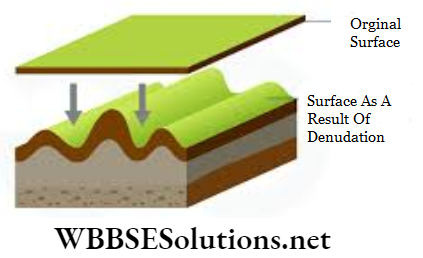
Question 3. Discuss the formation of fold mountains in Plate Tectonic Theory.
Answer:
- Formation of fold mountains: The Plate Tectonic Theory was first propagated by French scientist Xavier Le Pichon in 1968. The main idea behind this theory is that the Earth’s crust is made up of several large plates which are on average about 100 km in depth and each of them extends over lakhs of kilometers. The plates comprising the continents Collision of two plates Sliding of two plates in opposite directions upward movement of magma Diverging plate margin Eruption of magma from the interior of the Earth Downward movement of plate Transform plate margin
- Continental-Oceanic plate margin: When the continental and oceanic plates approach each other, the heavier oceanic plate subsides below the lighter continental plate in a downward bend (like a bow) along the plate margin. This zone is called the subduction zone or Benioff Zone. Consequently, as the two plates come nearer to each other, the lateral or horizontal pressure exerted is so much that the sediments deposited in the plate margin are crumpled up and they rise upwards, resulting in the formation of fold mountains. For example, the Rocky Mountains have been formed as a result of the folding of the sediments along the margin of the American Plate (continental plate) and Pacific Plate (oceanic plate).
Question 4. Describe the different stages of the formation of fold mountains.
Answer: Different stages of formation of fold mountains: According to geologists, many fold mountains were formed throughout the world, known as ancient or old fold mountains, before the formation of the young fold mountains of recent geological age like the Himalayas and the Alps. The fold mountains were formed basically in three stages and there was an intervening break or inactive period between two such stages. These stages were-
Silurian and Devonian Period: According to the geological time scale, it was some time in the mid-Paleozoic era, i.e., between the Silurian and Devonian sub-periods (37.2 million to 44.5 million years ago) that the Atlantic Ocean was compressed as a result of the two converging plates of America and Europe. The mountain created as a result of folding is known as the Caledonian Fold Mountains.
It is as a result of this that fold mountains have also developed in Northern Ireland, Scotland, and the Scandinavian islands. After this, there was a period of a lull when no activity took place.
Carboniferous Period: At the end of the Paleozoic era in the sub-period of Carboniferous and Permian (29 to 35 million years ago), the Altyde (Hercynian) fold mountains were developed as a result of crumpling up of sediments. The American and Hercynian mountains located in the southern part of the Caledonian Fold Mountains in Europe and the Appalachian Mountains in North America were formed during this period. The Ural Mountains are called continental plates and those of the ocean floors are called oceanic plates.
These solid crustal plates are floating on the mantle which is in a viscous state. Due to the convection currents circulating in the mantle and other tectonic movements, these plates move continuously. As a result, in the plate margin areas, various landforms have formed. Usually, there are 3 types of plate margins-
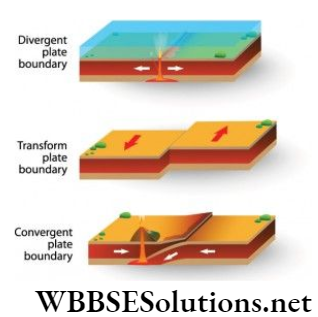
- Converging plate margin: The plates move towards each other along this plate margin. This plate margin is also known as the destructive plate margin.
- Diverging plate margin: The plates move away from each other along this plate margin. This plate margin is also known as constructive plate margin.
- Transform plate margin: The adjacent plates move along each other in a parallel manner (but in opposite directions) along this plate margin.
Formation of fold mountain in converging plate boundary: Converging plate margins are mainly of 3 types-
- Continental-Continental plate margin: When two continental plates move towards each other, it is called the continental-continental plate margin.
- Continental-Oceanic plate margin: When one continental and one oceanic plate move towards each other, it is called a continental-oceanic plate margin.
- Oceanic-Oceanic plate margin: When two oceanic plates move towards each other. other, it is called the oceanic-oceanic plate margin. Out of these three types, the first two plate margin movements are responsible for the formation of fold mountains. The process of formation of fold mountains is as follows-
1. Continental-Continental plate margin: A narrow and shallow seabed lying between two continental plates is called a geosyncline. Rivers and streams from both the adjoining continents deposit their silt on this seabed and gradually fill it up.
As the converging continental plates come closer, the geosyncline narrows down and the intervening sediments come under great pressure resulting in the crumpling up and folding of these sediments in the geosyncline. This is how fold mountains are formed.
For example, when the Indian Plate and the Eurasian Plate moved towards each other, the sediment of the Tethys Sea lying in between was subjected to pressure from both sides and was forced to crumple and rise to form folds, resulting in the formation of the Himalayan mountain ranges. Formation of fold mountain due to collision of two plates.
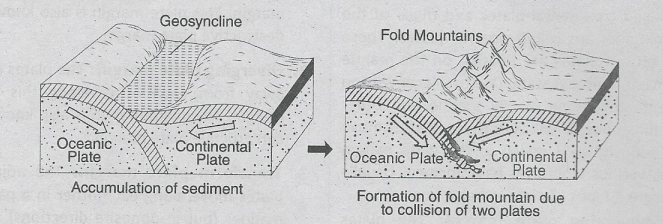
Continental-Oceanic plate margin: When the continental and oceanic plates approach each other, the heavier oceanic plate subsides below the lighter continental plate in a downward bend (like a bow) along the plate margin. This zone is called the subduction zone or Benioff Zone.
Consequently, as the two plates come nearer to each other, the lateral or horizontal pressure exerted is so much that the sediments deposited in the plate margin are crumpled up and they rise upwards, resulting in the formation of fold mountains.
For example, the Rocky Mountains have been formed as a result of the folding of the sediments along the margin of the American Plate (continental plate) and Pacific Plate (oceanic plate).
Question 5. Describe the different stages of the formation of fold mountains.
Answer: Different stages of formation of fold mountains: According to geologists, many fold mountains were formed throughout the world, known as ancient or old fold mountains, before the formation of the young fold mountains of recent geological age like the Himalayas and the Alps.
The fold mountains were formed basically in three stages and there was an intervening break or inactive period between two such stages. These stages were-
Silurian and Devonian Period: According to the geological time scale, it was some time in the mid-Paleozoic era, i.e., between the Silurian and Devonian sub-periods (37.2 million to 44.5 million years ago) that the Atlantic Ocean was compressed as a result of the two converging plates of America and Europe. The mountain created as a result of folding is known as the Caledonian Fold Mountains.
It is as a result of this that fold mountains have also developed in Northern Ireland, Scotland, and the Scandinavian islands. After this, there was a period of a lull when no activity took place.
Carboniferous Period: At the end of the Paleozoic era in the sub-period of Carboniferous and Permian (29 to 35 million years ago), the Altyde (Hercynian) fold mountains were developed as a result of crumpling up of sediments. The American and Hercynian mountains located in the southern part of the Caledonian Fold Mountains in Europe and the Appalachian Mountains in North America were formed during this period. The Ural Mountains in Russia and the Tien Shan and Nan Shan Mountains in Asia were also formed during this time.
Tertiary Period: Folds also developed during the Tertiary period (2 million to 6.6 million years ago) after the Altyde orogeny (mountain-building era). As a result, new mountain ranges were formed in the southern part of the Altyde mountain ranges
WBBSE Class 9 Geography And Environment Chapter 4 Geomorphic Processes And Landforms Of The Earth
Question 6. What is the mountain? Describe the characteristics of fold mountains.
Answer: Mountain: When the sediments on the ocean floor are subjected to lateral pressure due to tectonic movements, they are compressed, folded, and forced to rise and form fold mountains.
Characteristics of fold mountains: Characteristics of fold mountains are as follows:
- Significance of nomenclature: Since the mountains form as a result of the folding and rising of sedimentary rocks, they are called fold mountains.
- Required force: Fold mountains form as a result of tectonic force (orogeny or mountain-building movements).
- Main components: The two main parts of fold mountains are anticlines and synclines.
- Predominant rocks: Though the major components of fold mountains are sedimentary rocks, igneous and metamorphic rocks are also found locally.
- Area of extension: Fold mountains are lofty and extend over wide areas. For example, the Himalayas are 8,848 m above sea level and extend over the whole of the northern part of India (from west to east).
- Presence of fossils: Being formed of sedimentary rocks (usually in an oceanic environment), they have remains of plants and animals embedded in the rock layers known as fossils.
- Multiple peaks: Fold mountains have multiple peaks. For example, Mt. Everest, Makalu, Phalut, Kangchenjunga, etc., are the famous peaks of the Himalayas.
- Other characteristics: Fold mountain areas are prone to earthquakes. The plate movements, being a continuous activity, gradually lead to the increase in height of these mountains. They have steep slopes. They are conical in shape. They are distinguished by the undulations (ups and downs) in their relief features and are sometimes inaccessible.
Question 7. Classify volcanic mountains based on their shape and structure.
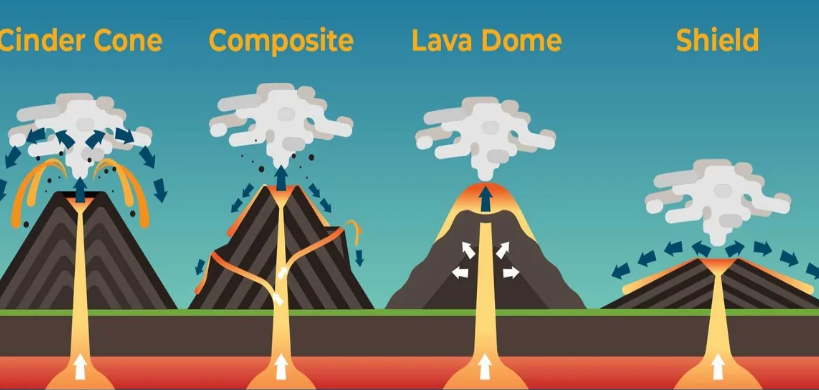
Answer: Classification of volcanic mountains: Based on shape and structure, volcanic mountains can be divided into 4 categories. They are as follows-
| Category |
Structure/Process of formation |
Characteristics |
Examples |
| 1. Cone-shaped volcanic mountain |
This type of volcanic mountain is formed when magma, ashes, rock fragments (pyroclasts), etc., are forced up through the crater and settle around it. They are also called pyroclast cones. |
1. They usually have convex slopes. 2. The slopes made of larger fragments are steeper than those formed of smaller particles. 3. They have low altitudes. |
Paricutin in Mexico |
| 2. Dome-shaped volcanic mountain |
This type of volcanic mountain is formed when hot molten magma comes out to the Earth’s surface slowly through cracks and fissures (in the absence of volcanic eruption) and gets deposited around a volcanic crater in a dome-shaped manner. |
1. These have slopes that are not so steep. 2. They are formed by acidic or alkaline lava. |
Mauna Loa in Hawaii Islands |
| 3. Volcano with a crater (created by an explosion during a volcanic eruption) |
When the hot molten magma comes out to the Earth’s surface in the form of an explosion and creates a crater, the lava, and rock fragments subsequently get deposited around it. |
1. Only one big crater lies on top of the mountain. 2. Molten lava settles down around the crater after the eruption. |
Krafla in Iceland |
| 4. Composite volcano with multiple craters |
These are formed when many big and small volcanic eruptions occur over a long period. Due to multiple volcanic activities, the mountain gains height gradually and many layers of lava are formed. |
1. New cones are formed replacing the older ones over time. 2. The slopes are generally steep and uniform. |
Mt. Fujiyama in Japan |
Question 8. Explain the formation of volcanic mountains. Mention the characteristics of volcanic mountains.
Answer:
Origin of volcanic mountains: When the hot molten magma comes out to the Earth’s surface through cracks and fissures in the Earth’s crust, it cools down and accumulates, thereby gaining height and forming mountains, they are called volcanic mountains. Mt. Fujiyama in Japan, Mt. Vesuvius in Italy, etc., are examples of such mountains. Their formation can easily be related to the Plate Tectonic theory.
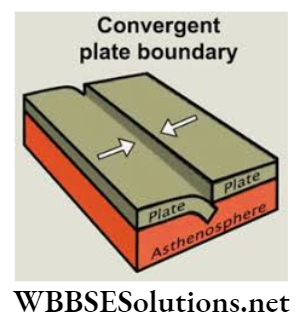
Converging plate margins: When two converging plates approach each other, the margin between them is called the converging plate margin. When they collide, the relatively heavier plate sinks below the lighter plate. When it reaches the mantle, it becomes hot and melts. Subsequently, this hot molten magma is forced up through the cracks and fissures and it comes out to the Earth’s surface (through volcanic activity). In due course of time, this lava cools down, accumulates, and rises to form volcanic mountains.
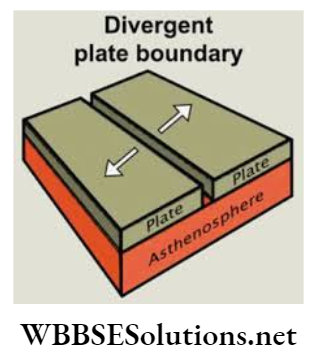
Diverging plate margins: When two plates move away from each other in opposite directions, they are called diverging plates. From the gap created as a result of this movement, hot molten magma comes out and eventually fills it up, forming volcanic mountains here.
Hotspot: In some cases, magma comes out through the hotspots (i.e., centers of radioactivity). The upward movement of this magma is facilitated by the upward-moving convection currents generated in the mantle below the Earth’s crust. Examples of such volcanic mountains are- Mt. Fujiyama in Japan, Mt. Vesuvius in Italy, and Barren Islands in India. These mountains become increasingly high as a result of further volcanic activity and the accumulation of lava in those regions.
Characteristics of volcanic mountains: The characteristics of volcanic mountains are-
- Shape: Volcanic mountains are usually triangular or conical in shape.
- Presence of crater: A volcanic mountain has one or more than one crater at its top.
- Connected to the magma chamber: The volcanic mountain is connected to the magma chamber in the Earth’s interior through a tube-like structure (called the ‘vent’).
- Slope: Volcanic mountains usually have steep slopes.
- Altitude: They are moderate in altitude. However, their altitude increases with subsequent volcanic activity and accumulation of more lava on its top.
- Structure: Volcanic mountains usually form in unstable parts of the Earth, for example, along the moving plate margins.
- Rocks: Volcanic mountains are usually formed of acidic and alkaline igneous rocks.
- Settlements: Being usually inaccessible, with a cold climate due to high altitude and lack of fertile soil, volcanic mountain areas are usually devoid of or have scattered settlements.
Question 9. Explain the formation of block mountains. Mention some of their characteristics.
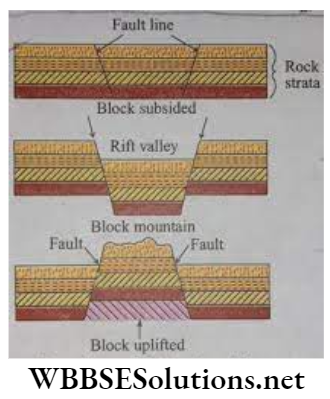
Answer: Formation of block mountains: When any part of the Earth’s surface is uplifted along fault lines due to epeirogenic movements, they assume the appearance of a mountain known as a block mountain. They are flat-topped and rise above the surrounding areas. For example, the Satpura mountains in India. Block mountains are formed mainly due to the following three reasons-
The intervening land between two fault lines is forced to rise upwards to form a block mountain. When the two blocks along two fault lines subside below the Earth’s surface, the intervening block takes the shape of a block mountain. When the land between two fault lines subsides, the areas on its two sides stand out as two-block mountains.
Characteristics of block mountains: Some important characteristics of block mountains are-
- Time taken for formation: The formation of a block mountain takes place all of a sudden.
- Altitude: Block mountains are lower in height compared to fold mountains.
- Summit: The top portion or summit of block mountains is flat.
- Slope of the land: They have steep slopes on all sides.
- Rift Valley/Graben: Block mountains or horsts have rift valleys or grabens lying adjacent to them.
- Extent: Block mountains are not as widespread as the fold mountains.
- Rocks: Block mountains are made up of sedimentary and metamorphic rocks.
- Tectonic movement: Block mountains are formed as a result of epeirogenic movement.
Question 10. Explain the formation of erosional mountains. Mention their characteristics.
Answer: Formation of erosional mountains: When one or more of the characteristic features of a mountain is seen in an eroded mountain or upland (being eroded by rivers, glaciers, winds, sea waves, etc.), they are called erosional or residual mountains. For example, the Aravalli Hills in India (actually it is an ancient fold mountain). This type of mountain is formed in two ways-
Differential texture (hardness) of rocks: Any high mountain, hill, or upland is made up of both hard and soft rocks. The soft rocks, being weaker and more prone to erosion, are easily eroded and reduced in altitude, while the hard and resistant rocks stand out as mountains and hills. The Aravalli Hills in India are examples of this type.
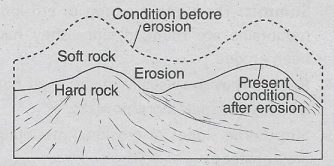
Volcanic activity or intrusion in the sedimentary rocks: When, due to volcanic activity or diastrophism, igneous rocks are intruded upon especially vertically (as dykes), this molten magma gradually cools down to form igneous rocks within the sedimentary rock layers. In due course of time, when the upper sedimentary rock layers are eroded, these igneous rocks are exposed to the surface. Since they are hard and resistant rocks, they form residual mountains. For example, Henry Mountain in North America.
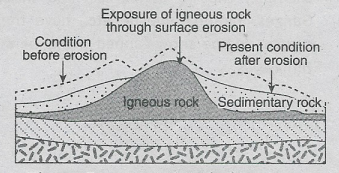
Characteristics of erosional mountains: The main characteristics of erosional mountains are-
- Origin: Forms as a result of an erosional process over a long time by different agents of erosion like rivers, glaciers, winds, etc.
- Altitude: Erosional mountains are usually low in height and since they are in a continuous process of erosion, they gradually decrease in elevation.
- Summit: The summit or top of erosional mountains is rounded since they have been eroded.
- Rocks: They are usually made up of hard igneous and metamorphic rocks.
- Slope: The slopes of erosional mountains are not steep.
- Ruggedness: The ruggedness of these mountains is quite high.
- Age: Erosional mountains are geologically quite old.
Question 11. Discuss the importance of mountains with examples.
Answer: Importance of mountains: The importance of mountains is as follows-
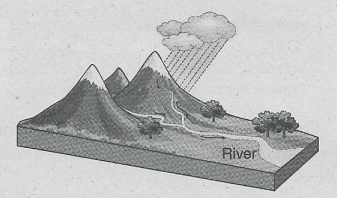
Source of rivers and streams: Many small streams and big rivers have their origin in the meltwaters of the snow-capped mountains. These rivers have a great influence on human life and civilization. For example, the big rivers like the Indus, Ganges, Yamuna, Teesta, etc., have their sources in the snow-capped peaks of the Himalayas.
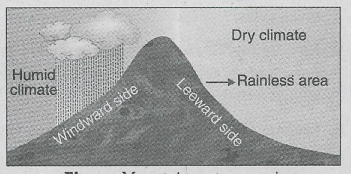
Controls climate: Being very high, the upper reaches of the mountains have cold climates and snowfall is common here. The windward side of the mountain act as a climatic barrier to the moisture-bearing winds and orographic or relief rainfall occurs here, while on the opposite side, there is no rainfall.
A mountain controls the direction of winds too: For example, the Himalayas prevent the cold Siberian winds from entering India.
Source of hydroelectric power: The snow-fed rivers of the mountainous regions are perennial and have water throughout the year. The streams having strong water currents are also ideal for producing hydroelectricity.
Source of forest products: The dense forests in the mountainous regions are sources of valuable timber, honey, medicinal plants, fruits, etc. Due to the ruggedness of the terrain, the mountainous regions are sparsely populated. A huge amount of forest products come from forests growing in mountains
Centre of tourist attraction: Snowfields, waterfalls, springs, swift-flowing streams and rivers, valleys, ridges, and gardens with beautiful fruits, flowers, and orchids appeal to the eyes of many tourists who love to visit these mountainous areas, making them areas of major tourist attraction. For example, Simla, Kashmir (valley), Darjeeling, Gangtok, etc., in the Himalayas are popular tourist spots.
Grazing fields for animals: Grazing animals on the green pastures of mountain slopes is the major activity of nomadic tribes of mountainous regions. For example, the Gujjars and Goddi tribes of Kashmir.
Act as natural boundaries: The lofty mountains act as barriers to intruders from neighboring countries who try to enter illegally.
Other importance: Mountains are ideal places for mountain climbers and trekkers. Fossils that are found embedded in the sedimentary rocks of mountains provide important clues to ancient life. The origin of mountains is quite significant to geologists and geographers who are involved in researching ideal places for mountain climbers and trekkers.
Fossils that are found embedded in the sedimentary rocks of mountains provide important clues to ancient life. The origin of mountains is quite significant to geologists and geographers who are involved in research work. The different environments associated with varying landforms, climate, soil, and natural vegetation of mountains have greatly influenced man’s adaptation to nature. Civilization and culture are also influenced by different environments in mountainous areas.
Question 12. What is meant by a plateau? Classify plateaus.
Answer: Plateau: A table-like landform that is usually more than 300 meters above sea level, almost flat on the top with steep slopes, is called a plateau. This is also called tableland. Sometimes low hills are found on these flat-topped plateaus. For example, Chota Nagpur Plateau, Deccan Plateau, and Ladakh Plateau in India.
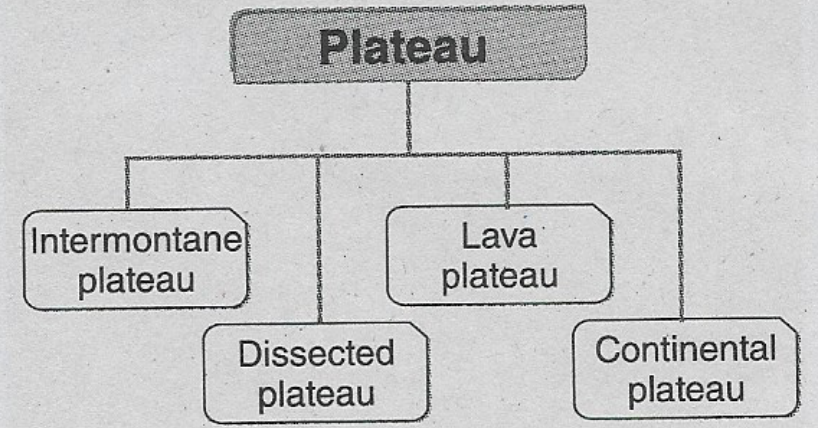
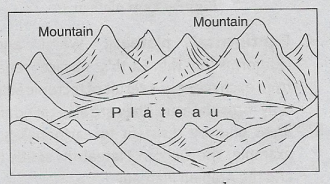
1. Intermontane plateau: During the process of building fold mountains (due to tectonic movements), the intervening area between two mountains comes under pressure and is forced to rise and form plateaus. Since these plateaus are encircled by mountains, they are called intermontane plateaus. For example, the Plateau of Tibet, the Plateau of Anatolia in Turkey, the Plateau of Iran, etc. The Plateau of Tibet is enclosed by a Dissected plateau.
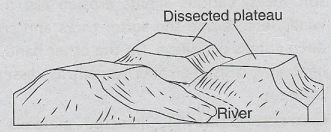
2. Dissected plateau: Ancient plateaus are continuously eroded by the various agents of erosion like rivers, glaciers, winds, etc., and subsequently get reduced in height. The numerous rivers and their tributaries and branches further divide the area into smaller blocks. Such a landform that is broken down by rivers is called a dissected plateau or erosional plateau. For example, Chota Nagpur Plateau and Malnad Plateau (part of Karnataka Plateau) in India.
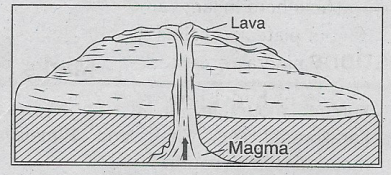
3. Lava plateau: Molten magma from the Earth’s interior comes up to the surface through cracks and fissures in the weaker zones of the crust and gets deposited there. This lava slowly cools down and solidifies to form lava plateaus. For example, the Lava Plateau or Deccan Trap region in the northwestern part of south India, Colombia Snake Plateau in the United States of America, etc.
4. Continental plateau: When ancient landforms on the Earth’s surface separate from each other as a result of tectonic activity, they form plateaus. They are also called shield areas and are resistant to earthquakes. For example, the Deccan Plateau in southern India and the Arabian Plateau.
Question 13. Give a detailed account of the dissected plateau and intermontane plateau.
Answer:
Dissected plateau: A detailed account of the dissected plateau is given below-
Definition: When any large and ancient plateau undergoes erosion by various physical factors like rivers, winds, etc., for a long time, and is divided into smaller parts or is dissected, it is called a dissected plateau.
Origin: Plateaus are usually made up of hard and soft rocks. Various agents of erosion like rivers, winds, etc., erode the softer rocks and create deep gorges or valleys. On the other hand, the hard and resistant rocks remain as dissected plateaus.
Characteristics: Dissected plateaus are usually formed as a result of erosion. They are moderate in height. After erosion, dissected plateaus form ‘mesas’ and ‘buttes’. Examples: Chota Nagpur Plateau, Karnataka Plateau, Malnad region, Bundelkhand, and Bagelkhand in Madhya Pradesh.
Definition: When a plateau is located between two or more mountains, it is called an intermontane plateau.
Origin: When a mountain rises due to plate movements, its middle portion rises above its surrounding parts to form a plateau.
Characteristics: Intermontane plateaus reach up to great heights. The formation of these plateaus is associated with the formation of fold mountains. These plateaus are extensive.
Examples: the Plateau of Tibet, the Plateau of Iran, the Pamir Plateau, etc. The Tibetan Plateau is encircled by Kunlun Mountain in the north, the Karakoram Mountains in the southwest, and the Himalayas in the south.
Question 14. Describe the continental plateau and lava plateau.
Answer:
Continental plateau: A brief description of the Continental plateau is as follows- Definition: When parts of an ancient plateau separate from each other as a result of tectonic activity and form plateaus, they are called continental plateaus.
Origin: As a result of tectonic activity, parts of ancient plateaus get separated from each other. After erosion by various agents like rivers, glaciers, winds, etc., for a long time, these turn into plateaus. Since they cover extensive areas over continents, they are called continental plateaus. They are also known as ancient plateaus or shields.
Characteristics: They are quite old according to geological age (more than 100 million years). They have formed as a result of erosion over a long period. The land is stable in continental plateau regions. These plateaus are rich in mineral resources.
Examples: Brazilian Plateau, Deccan Shield in India, Canadian Shield, etc. South Africa, Antarctica, Greenland, etc., also have widespread areas of such plateaus.
Lava plateau: A brief description of lava plateau is-
Definition: During volcanic eruptions, the molten magma comes out to the Earth’s surface and accumulates there to form lava plateaus. Origin: When magma comes out through cracks and fissures and accumulates on the Earth’s surface, the plateau that starts forming is called a lava plateau. When this happens on several occasions, the entire area gains height and a lava plateau is thus formed.
Characteristics:
1. This is a type of depositional plateau.
2 It is formed as a result of volcanic activity. Basalt is a common rock here. The hills located on such plateaus also have flattened tops.
Examples: Deccan Plateau in south India, Malwa Plateau in northwestern India, Columbia Snake Plateau in the United States of America, etc.
Question 15. Discuss the importance of plateau with examples.
Answer:
Importance of plateau: Importances of the plateau are as follows-
1. Storehouse of mineral resources: Many types of mineral resources like iron ore, coal, copper ore, limestone, etc., are available here in large amounts. The Chota Nagpur plateau is called the ‘Storehouse of India’s mineral resources’.
2. Source of hydel power: Since the rivers flowing over plateaus are swift-flowing (due to the undulating topography), these rivers can easily be used for generating hydroelectricity. This is prevalent, especially in the Deccan Plateau in southern India.
3. Supply raw materials for industries: The abundance of raw materials (mineral resources), electricity (hydro and thermal), and availability of cheap labor, make these areas ideal for the development of industries.
4. Source of forest resources: Settlements in plateau areas are usually very sparse. As a result, most parts of the plateaus are covered with dense forests. These forests provide timber, honey, wax, flowers, fruits, etc., in large amounts.
5. Grazing lands for animals: Since most of the large plateau regions of the world have a dry climate, there are vast expanses of green pastures, which are ideal for grazing animals. This provides the chief livelihood to the people living in plateaus.
6. Centre of tourist attraction: Springs, waterfalls, mining areas, industrial areas, forest-based livelihood, and the scenic beauty of these regions attract both domestic and international tourists.
7. Other importance: The rocks, mineral resources, landforms, etc., of plateau regions, are important areas of research for geologists. The livelihood, culture, and socio-economic condition of the tribal people residing in the plateaus are significant for the study of Geography. These are some of the significant roles of a plateau.
Landforms Of The Earth And Geomorphic Processes Class 9 Geography WBBSE
Question 16. What is plain? Classify plains and analyze the origin and development of each of them.
Answer: Plain: A large expanse of land, having gentle undulations, at sea level or a slightly higher altitude (less than 300 m), is called a plain.
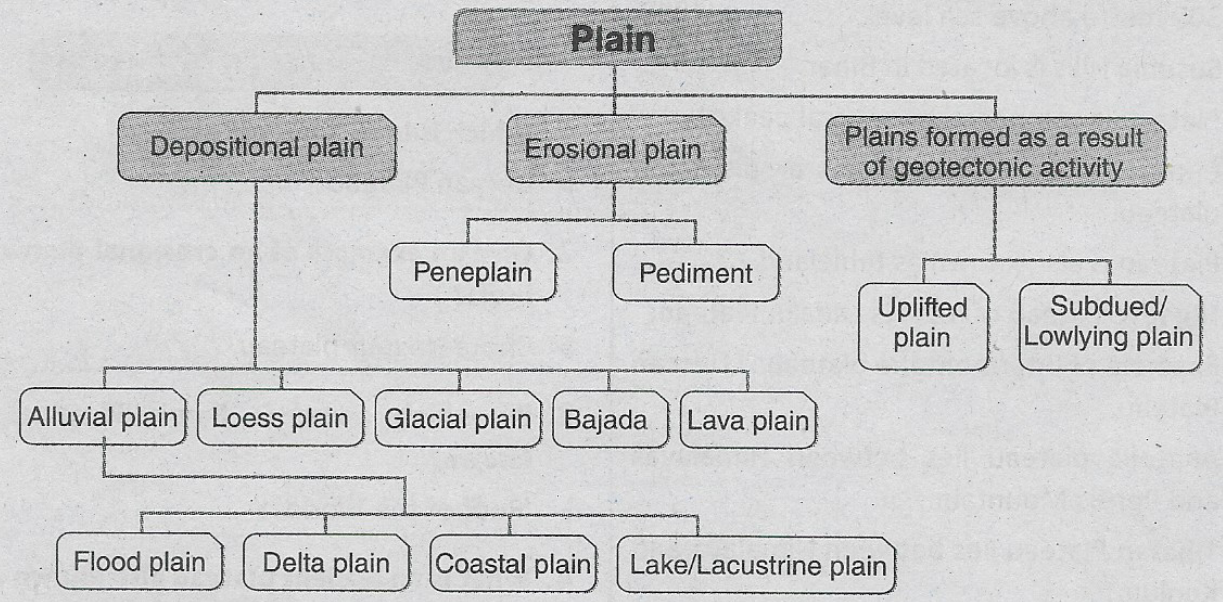
Classification of Plains: Plains can broadly be divided into three categories-
1. Depositional plain: Of the three types of plains based on origin, this type is the most important. Depositional Plain is of five types, namely-
1. Alluvial plain or flood plain: When silt is deposited on the two sides of an overflowing river (during floods) or in a delta region, it forms alluvial plains or flood plains—for example, the Ganges Plain in India, the Hwang Ho Plain in China, etc.
2. Loess plain: When sand is blown away to distant places from another region and deposited in some low-lying area, a loess plain is formed. For example, the loess plain of the Hwang Ho basin has been formed by the sand of the Gobi Desert.
3. Glacial plain: During the Glacial Age, continental ice sheets eroded the uneven topography over which it moved and eventually flattened the relief and formed glacial plains—for example, the Prairie region of North America and the glacial plain of northern Europe.
4. Bajada or desert plain: The sand, pebbles, and small rock fragments are. carried down the slopes of mountains and deposited in the foothill zone forming Bajadas. For example, Bajada is in the foothill zone of Atlas Mountain adjoining the Sahara Desert of North Africa.
5. Lava plain: Molten magma comes out of the Earth’s interior through cracks and fissures on the Earth’s surface. Here, it cools down and solidifies to form plains. These plains are called lava plains. For example, the lava plain is located in the northern part of the Deccan Plateau.
2. Erosional plain: Plains are formed in two ways as a result of erosion caused by agents like rivers, glaciers, wind, etc. They are- Openeplain and pediment.
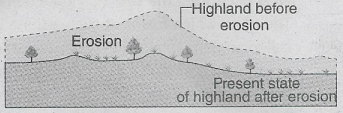
1. Peneplain: When a landmass is reduced in elevation as a result of erosion over a “long time, it is called a peneplain, which means ‘almost a plain’. For example, parts of the Chota Nagpur Plateau in India. Highland before erosion
2. Pediment: Due to the action of strong winds in arid regions, sand is deposited in the foothill zone of mountains and hills, forming a plain. This is called pediment—for example, the foothill zone of Atlas Mountain of the Sahara region in Africa.
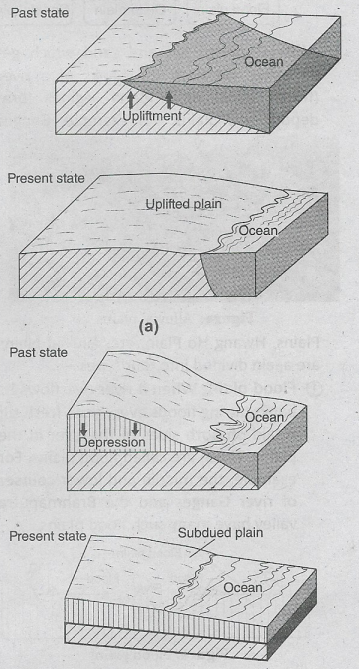
3. Plains formed as a result of geotectonic activity: Some plains have formed as a result of geotectonic activity. For example, the Duplifted plain, and the subdued or low-lying plain. The sea floor is uplifted due to diastrophism or tectonic activity and is exposed to the surface. These are called uplifted plains and when the uplands subside, they form subdued plains. The coastal plain of the Mexico Sea in North America (uplifted plain) and the Turan Lowland (subdued plain) are some examples.
Question 17. Give an account of different types of depositional plains.
Answer:
Classification of the depositional plain: Depositional plains are of three types. They are as follows-
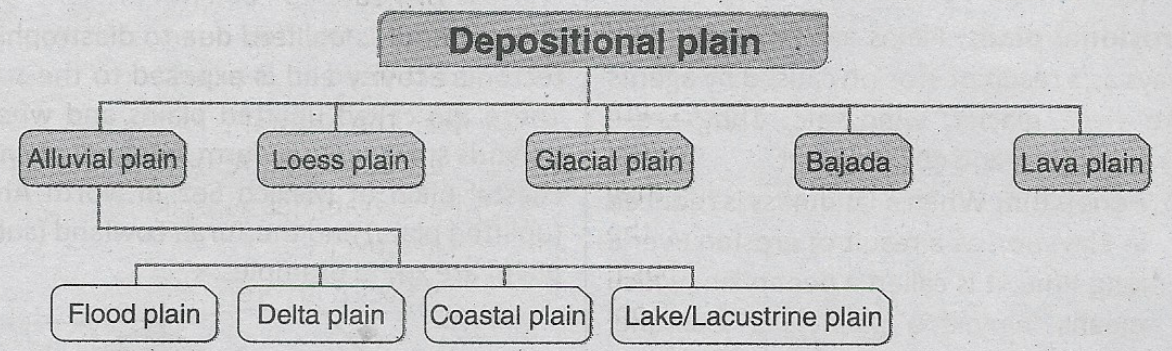
1. Alluvial plain: Silt and sand which get deposited on both the banks of a river (flood plains) or in delta regions form depositional plains. For example, Ganges Plains, Hwang Ho Plain, etc. Alluvial plains are again divided into four types-
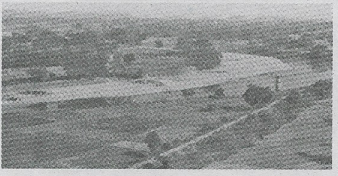
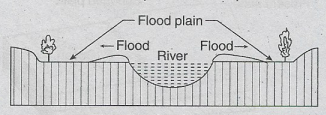
1. Flood plain: When a river overflows its banks during floods every year, fresh silt is laid on both sides of the river in the plains. These are called flood plains. For example, the middle and lower courses of the Ganges River and the Brahmaputra Valley have many flood plains.
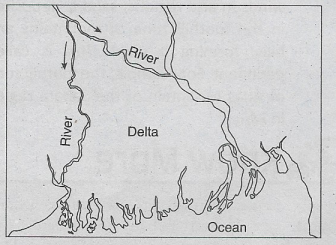
2. Delta plain: A triangle-shaped landform formed in the lower course of a river where it enters the sea is called a delta. The plain which forms at such a delta is called a delta plain. For example, the world’s biggest delta has developed in the lower part of the Ganga- Brahmaputra river where it meets the sea (Bay of Bengal).
3. Coastal plain: When silt, sand, and pebbles, washed away by sea waves, winds, and rivers get deposited in the shallow sea, a coastal plain is formed. For example, the Palestine Plain has formed by the action of waves and oceanic deposits and the Western and Eastern Coastal Plains of India have formed by the action of rivers, winds, etc.
4. Lake or Lacustrine Plain: These are formed by the deposition of silt, sand, pebbles, etc., on any lake bed. They are also called lacustrine plains. For example, the Great Basin in the United States of America and the lake plains of the Red River basin in Canada.
2. Loess plain: When sand particles are blown away from one place and deposited in low-lying areas at a great distance, they are called loess plains. For example, the loess plain of China’s Hwang Ho river basin has been formed by the sand of the Gobi Desert.
3. Glacial plain: The continental ice sheets of the Glacial Age have eroded the Earth’s surface on which it moved and created glacial plains. The Prairie region of North America and the Glacial Plain of northern Europe are examples.
4. Bajada or desert plain: When sand, pebbles, etc., are deposited in the foothill areas of any hill or mountain, they form desert plains. For example, Bajadas have formed in the foothills of the Atlas Mountain adjoining the Sahara Desert.
5. Lava plain: Hot molten magma comes out through cracks and fissures of the Earth’s surface and gets deposited to form lava plains. For example, the lava plains in the northern part of the Deccan Plateau.
Question 18. Give an account of the structural plain and erosional plain.
Answer:
Structural plain: A brief description of structural plain is as follows-
Definition: When any landmass gets either uplifted or subsides due to geotectonic activity (epeirogeny), it forms a structural plain.
Types: Structural plains are of two types- Duplifted plain and subdued or low-lying plain.
Origin: When any shallow seabed is uplifted near the coast due to tectonic activity, it forms an uplifted plain. When any elevated landmass subsides as a result of tectonic activity, it forms a subdued plain.
Characteristics: These plains are formed as Such plains are a result of geotectonic activity and are generally formed near coasts. plains are formed all of a sudden.
Examples: The coastal plain of the Mexico Sea in the United States of America and the Turan lowlands are examples of uplifted and subdued plains respectively.
Erosional plain: An erosional plain is explained below-
Definition: When any ancient highland is affected by erosion by various agents like rivers, glaciers, winds, etc., over a long period, they lose their elevation gradually and form erosional plains.
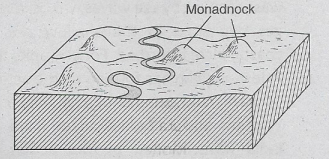
Origin: Any upland or plateau is formed of hard and soft rocks. In due course of time, due to continuous erosion over long periods, the landform is modified into a gently sloping plain. Characteristics: Such plains are formed due to the erosion of uplands. Some isolated rounded hills of hard and resistant rocks called monadnocks lie here and there. Erosional plains are not fertile.
Examples: Some parts of the Chota Nagpur Plateau are erosional plains.
Question 19. Discuss the importance of plains with examples.
Answer: Importance of plains: Importances of plains are as follows-
1. Benefits of agricultural activity: The fertile silt-laden plains formed by river deposition are ideal for practicing agriculture and that is why the main livelihood of the people residing here is agriculture. For example, large amounts of paddy, sugarcane, etc., are cultivated in the Ganga Plain.
2. Improved transport and communication system: Being a level or flat land, plains are ideal for constructing roads and railways. Waterways (rivers) can also be used as a mode of transport, thereby leading to a developed transport and communication system.
3. Conducive climate: Compared to mountains and plateaus, the climate is quite pleasant in the plains. Temperature is not extreme here and rainfall is also high due to the presence of rivers, canals, creeks, lakes, ponds, etc.
4. Settlements: The flat land, fertile soil, developed transport and communication system, conducive climate, opportunities for employment, etc., have all led to the Human population growth of settlements here. For example, the Ganges Plain of north India.
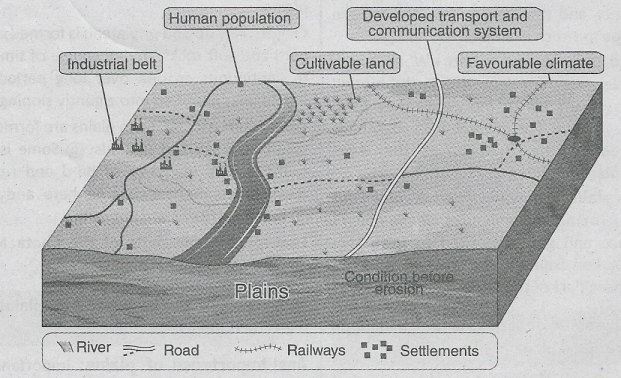
5. Development of industries: Flat land, pleasant climate, developed transport and communication system, availability of labor (the plains being a densely populated area), availability of raw materials, etc., have all contributed to the development of industries in the plains.
6. Advantage of urbanization: Due to the advantages mentioned above, the plains are the places of urban development and culture. The transformation of rural to urban ways of life is called urbanization. Major cities like Delhi, Kolkata, Mumbai, Chennai, etc., have all developed in the plains.
7. Other importance :
- It is advantageous to develop grazing lands where animals are reared in uncultivable parts of the plains.
- Fisheries have a great scope of development here, due to numerous rivers, wetlands, and proximity to the sea (in the case of coastal plains).
- The culture of the area is enhanced because it is a densely populated area where education, healthcare facilities, etc., have much scope for development.
- Business, trade, and commerce also flourish in the plains because they are developed areas from the point of view of agriculture and industries.
WBBSE Chapter 4 Geomorphic Process And Landforms Of The Earth Short Answer Questions
Question 1. What is meant by landform? What is the classification of landforms according to order?
Answer: Landform:
Landforms are the outer appearances on the Earth’s surface with typical geometric shapes and physical features resulting from weathering and erosion carried out by different agents like rivers (fluvial), glaciers, winds, and waves.
Classification of landforms according to order: The landforms of the Earth are classified into three divisions according to order.
These are as follows-
- First order of relief: It is mainly of two types continent and ocean.
- Second order of relief: It is mainly of three types- mountain, plateau, and plain.
- Third order of relief: It is mainly of two types- Erosional landforms: Gorge, waterfalls, yardang, cirque, Depositional landforms: Delta, floodplain, etc.
Question 2. What do you mean by slow endogenetic processes?
Answer: Slow Endogenetic Processes: Slow endogenetic processes act very slowly and their effect becomes visible after thousands of years. These processes are mainly of three types-
Geotectonic movement: New landforms are formed through the changes in different parts of the Earth’s surface by various endogenetic activities. These activities are known as a geotectonic movement. They are divided into two categories- epeirogenic movement, and orogenic movement.
1. Epeirogenic movement: The movement that acts along the radius of the Earth or vertically is known as epeirogenic movement. An extensive part of the Earth’s surface either rises or sinks because of the influence of these forces. The movement that occurs across the continent is called the epeirogenic movement.
2. Orogenic movement: In this type of movement endogenetic force acts almost horizontally or tangentially with the Earth’s surface. For this movement, there is a compressional or tensional force created on the crust. Fold mountain is formed due to orogenic movement, as it is formed by the folding of rocks on the Earth’s surface.
Isostatic movement: The tectonic process or movement that helps to maintain elevational balance among various landforms is called isostatic movement.
3. Eustatic movement: The process of worldwide simultaneous change of water-holding capacity of the ocean basin due to the rise or fall of the sea level is called eustatic movement.
Question 3. Why does the orogenic and the epeirogenic movement simultaneously? Occur
Answer: Orogenic And The Epeirogenic Movement occur simultaneously:
The orogenic and epeirogenic movements are two different endogenetic processes but they both occur simultaneously. The compressional force that originates because of orogenic movement, causes folds in the sedimentary rock strata.
As a result of this, fold mountains are formed. After this due to excessive compressional force, a fracture or fault occurs in the fold.
Along this fault line, an extensive part of the surface may rise or subside. Such vertical upliftment or subsidence of the surface is called epeirogenic movement. If a fracture or fault originates in the rock strata due to epeirogenic movement, lateral pressure causes folds on the adjacent rock strata i.e., orogenic movement occurs. In this way, orogenic and epeirogenic movements occur simultaneously.
Example: Himalaya is a fold mountain; both folds and faults are seen in this mountain.
Question 4. Find out the interrelation among degradation, aggradation, and gradation.
Answer: Interrelation Among Degradation, Aggradation, And Gradation:
Degradation, aggradation, and gradation are different types of exogenetic processes. The degradation process is mainly related to erosion. Several exogenetic forces like rivers, winds, glaciers, sea waves, etc. cause erosion and reduce the elevation of the land. This process is known as the degradation process.
The material eroded by various external forces is deposited in the depression or lowlands and that causes a rise in elevation. This process is called aggradation. Gradation is the process of attaining equilibrium by removing unevenness of land through the combination of degradation and aggradation processes. The gradation process is the result of simultaneous degradation and aggradation processes.
Question 5. ‘Degradation and aggradation are opposite processes.’ Explain the causes.
Answer: Degradation And Aggradation Are Opposite Processes:
Degradation is related to the reduction of the elevation of the landform. Elevation of the land surface gradually decreases due to the process of erosion and denudation. This process is also called the deductive process. On the other hand, eroded materials are transported by several natural agents and deposited in the lowlands. Thus, the elevation of these lowlands gradually increases. This process of upliftment of the landform is called the inductive process. So, degradation is the process of lowering the land surface by erosion and aggradation is the process of upliftment of the land surface by deposition. Therefore, degradation and aggradation are opposite processes.
Question 6. Write the differences between the endogenic process and the exogenic process.
Answer:
The differences between the endogenic process and the exogenic process are as follows-
| Point of difference |
Endogenic process |
Exogenic process |
| 1. Concept |
Internal forces originating in the Earth’s interior which influence the primary relief features on the Earth’s surface are called endogenic processes. |
Physical forces on the surface (like water, wind, glaciers, sea waves, etc.) that modify the landform features on the Earth’s surface are called exogenic processes. |
| 2. Time taken |
These processes act slowly or suddenly. For example, plate movement (slow) and volcanicity (sudden). |
These processes act slowly and continuously. For example, landforms are produced as a result of weathering and erosion. |
| 3. Landform |
Major landforms on the Earth’s crust are formed (original or initial landforms) by this process. |
Major changes occur in the main landforms of the Earth (modified landforms) through this process. |
Question 7. Write the differences between epeirogenic movement and orogenic movement.
Answer:
The differences between epeirogenic and orogenic movements are as follows-
| Point of difference |
Epeirogenic movement |
Orogenic movement |
| 1. Definition |
The movements which result in the formation of continents are known as epeirogenic movements. |
The movements that result in the formation of fold mountains (by folding of sediments or rock layers) are known as orogenic movements. |
| 2. Nature |
It is a type of vertical movement. |
It is a type of horizontal movement. |
| 3. Change in rock layers |
Vertical upliftment or subsidence of rock layers takes place in this case. |
Rock layers are displaced horizontally in this case. |
| 4. Contraction and expansion |
Rocks are not subject to contraction or expansion in this case. |
Rocks are subject to contraction and expansion in this case. |
| 5. Effect |
Faults, cracks, and fissures are formed. |
Different types of folds are formed. |
| 6. Resultant landforms |
Block mountains, rift valleys, seas, plateaus, etc., are formed. |
Mainly fold mountains are formed. |
Question 8. Classify the different types of landforms. formation of fold mountains (by folding of sediments or rock layers) is known as orogenic movements. It is a type of horizontal movement. Rock layers are displaced horizontally in this case. Rocks are subject to contraction and expansion in this case. Different types of folds are formed. Mainly fold mountains are formed.
Answer:
Different Types Of Landforms:-
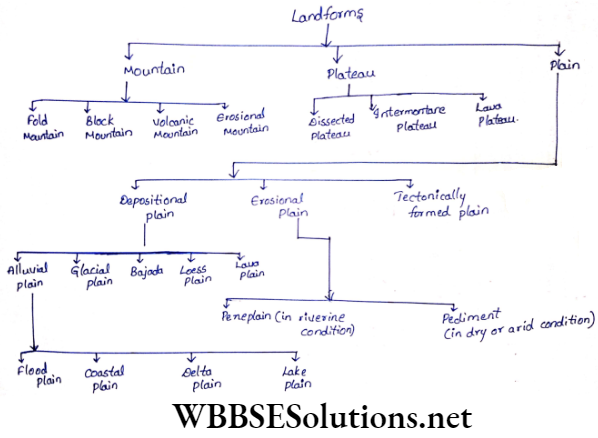
Landforms are the outer appearances on the Earth’s surface with typical geometric shapes and physical features resulting from weathering and erosion carried out by different agents like rivers (fluvial), glaciers, winds, waves, etc. Usually, based on the height, shape, structure, slope, and undulations of the land, landforms can be classified into 3 major divisions- mountains, plateaus, and plains. These can again be subdivided into further classes as shown in the chart.
Question 9. Write the differences between mountain, plateau, and plain.
Answer:
The differences between mountains, plateaus, and plains are as follows-
| Point of difference |
Mountain |
Plateau |
Plain |
| 1. Average elevation |
The elevation of mountains is more than 1,000 meters above sea level. |
The elevation of the plateau is more than 300 meters and less than 1000 meters above sea level. |
The elevation of the plains is less than 300 meters above sea level. |
| 2. Presence of undulations |
Mountains have peaks in the upper portion. |
Plateaus have undulating or almost plain tops. |
A plan is almost a level land. |
| 3. Slope |
Mountains have steep slopes. |
Plateaus are of moderate slope. |
Plains are gently sloping. |
Question 10. What are the influences of mountains and the Himalayas influencing the climate of India? on human life?
Answer: Mountains play a vital role in human life. Some of these are-
- Dense forests provide rich resources in high mountainous regions.
- Hydroelectricity is generated from swift-flowing mountain rivers.
- High mountains act as a climatic barrier and play a major role in controlling the climate of any region, including temperature (by preventing cold winds from entering the country) and rainfall (by causing relief or orographic rainfall on the windward side of a mountain). A glaring example of this is the Himalayas influencing the climate of India.
- Lumbering, animal husbandry, livestock rearing, tourism, etc., flourish in mountainous regions though agriculture is not possible here due to the rough terrain (except in the case of terrace farming on mountain slopes).
- The population is sparse in these areas as steep slopes and rocky terrain make the construction of roads difficult. Lack of accessibility hampers the growth of big settlements in these mountainous regions.
Question 11. Classify volcanic mountains based on the nature of the volcanic activity. Give examples.
Answer: Classification Of Volcanic Mountains Based On The Nature Of The Volcanic Activity:-
Volcanic mountains can be classified into three major categories based on the nature of the volcanic activity. It is shown in the following table-
| Types |
Characteristics |
Sub-Types |
Example |
| 1. Active |
These are volcanic mountains that exhibit frequent eruptions. |
1. Constant or uninterrupted volcano (where there is continuous volcanic activity). 2. Interrupted volcano (where volcanic eruptions take place at intervals). |
1. Mt. Vesuvius in Italy 2. Mt. Stromboli in Italy and Barren Island in India |
| 2. Dormant |
These are volcanic mountains that have not erupted over a long period but can erupt in the future. |
– |
Mt. Fujiyama in Japan, Mt. Popocatepetl in Mexico, Mt. Narcondam in Andaman and Nicobar. |
| 3. Extinct |
These are volcanic mountains that erupted long ago and there is no chance of eruption in the future. |
– |
Mt. Popa in Myanmar |
Question 12. Why are fossils found in fold mountains?
Answer: Fossils Found In Fold Mountains:-
The sediments deposited under the sea have remains of dead plants and animals embedded within their layers. When these sediments are pressurized, they eventually transform into rocks. Later on, these sedimentary rocks are prone to horizontal pressure from either side and they crumble up and form fold mountains. Thus the fold mountains composed of such sedimentary rocks have fossils embedded in them.
Question 13. Why is volcanic or igneous matter found in fold mountain regions?
Answer: Volcanic Or Igneous Matter Found In Fold Mountain Regions:-
The front portion of the heavier oceanic plate slides under the lighter continental plate at about 30°-80 angular plane. As a result, the sediments in this colliding zone buckle up under pressure and form fold mountains. At the same time, the portion of the solid oceanic plate that goes beneath to reach the mantle is heated up and melts. This molten magma comes up to the Earth’s crust in this subduction zone, where fold mountains are in the process of formation. This is the reason why the volcanic or igneous matter is found here.
Question 14. What are the features of erosional or residual mountains?
Answer: The following are the features of erosional/ residual mountains-
- The extent of this type of mountain is limited, they are low in height,
- They have gentle slopes since erosion takes place over a long period, the mountain tops are rounded or dome-shaped,
- These mountains are made up of all three types of rocks,
- They are made up of hard and resistant ancient rocks.
Question 15. What is Benioff Zone?
Answer: Benioff Zone:-
As a result of the horizontal movement of two plates, when the heavier plate subsides or goes under the lighter plate, that area or zone is called the subduction zone or Benioff Zone. This zone has been named after the scientist Benioff.
Characteristics: Melting down of solid plates (comprising the Earth’s crust), convection currents in the magma (present in the mantle), earthquakes, and volcanicity are all common features of this zone.
Example: As a result of the horizontal movement of the Eurasian plate towards the Pacific Oceanic Plate, the heavier Pacific Oceanic Plate has gone under the Eurasian continental plate and formed a Benioff Zone here.
Question 16. What is the ‘Pacific Ring of Fire’?
Answer: Pacific Ring Of Fire:-
The majority of the world’s volcanoes are situated around the Pacific Ocean. Out of these, about 500 active volcanoes (about 70 percent of the world’s volcanoes) are situated all around the Pacific Ocean like a ring.
When these volcanoes erupt (quite frequently) it seems to resemble a ring of fire. This circular belt of volcanoes. extends from South America’s Cape Horn to the Andes mountains, via the Rocky Mountains of North America, and then extends to the west through the Aleutian Islands, Kamchatka Peninsula, Japan, and the Philippines.
Question 17. Why are volcanic mountain regions prone to earthquakes?
Answer: Earthquakes are common in volcanic mountainous regions because-
- When volcanic mountains are formed along the margins of converging or destructive plates, two plates collide and this results in the occurrence of earthquakes.
- When hot and molten magma comes out from the asthenosphere or mantle in the gap created by two diverging plates, earthquakes may occur due to its pressure.
- When volcanic mountains are formed in the hotspot zones, magma, gases, etc., come out from the interior of the Earth towards the Earth’s surface. The resulting upward force and pressure make these areas prone to earthquakes.
Question 18. Why are erosional mountains also known as residual mountains?
Answer: Erosional Mountains Also Known As Residual Mountains:
The landforms are sculpted and altered. over a long period under the influence of different physical factors weathering and erosion. Due to this, the higher mountainous areas formed of relatively weaker and softer rocks are eroded and reduced to mountains with lower altitudes. On the other hand, the harder resistant rocks of the mountains are less eroded and stand out as smaller mountains or uplands.
The mountains that are reduced by erosion to lower levels or heights are therefore known as erosional or residual mountains or hills. Ancient mountains like the Aravallis in India, and the Appalachians in North America are the type of mountains that have been reduced in height due to erosion over the ages.
Simplified WBBSE Geography Class 9 Chapter 4 Solutions For Students
Question 19. Write the characteristics of the fold mountain.
Answer: The characteristics of fold mountains are as follows-
- Fold: Fold mountains have been formed due to the folding of sedimentary rock strata over an extensive area.
- Anticline and syncline: The folds are formed as a result of the combination of anticline and syncline.
- Fault: Besides the presence of folds, there are also many faults in fold mountains.
- Rock: Fold mountains are mainly composed of sedimentary rocks. But in many places, sedimentary rocks are transformed into metamorphic rocks due to intense heat and pressure. Also, in some places, igneous rocks are found due to the intrusion of magma through the fault or cracks.
- Fossils: Fossils are found inside the rock strata of a fold mountain.
- Other characteristics:
- Young fold mountains are generally earthquake-prone.
- The Elevation of fold mountains gradually increases due to plate movement.
- Most of the mountains are very high with deep gorges and steep slopes. Most peaks of fold mountains are conical. Fold mountains occupy extensive areas.
Question 20. What is meant by fissure eruption?
Answer: Fissure Eruption: When, magma comes out slowly along one or more fractures, faults, and fissures of different lengths and spreads over an extensive area on the Earth’s surface, it is called fissure eruption. Characteristics of fissure eruption are as follows-
- Absence of crater: The magma ejects through cracks and fissures which are. parallel to the Earth’s surface. So volcanic eruption in this case does not occur through a crater.
- Presence of long cracks: In this type of eruption lava comes out from cracks and faults, which are quite long.
- Silent eruption: In this type of eruption, lava oozes out silently through the fissures without any explosive activity.
- Nature of the lava: In fissure eruption, lava spreads over an extensive area because of its alkalinity and fluidity.
- Landform: Due to this type of eruption, lava fields, lava plains, etc. are formed. The Deccan Trap of the Deccan Plateau in India is an example of a lava plateau.
Question 21. Write the differences between hills and mountains.
Answer: The differences between hills and mountains are as follows-
| Point of difference |
Hills |
Mountains |
| 1. Height |
Hills are usually 300-1,000 meters above sea level. |
Mountains are usually more than 1,000 meters above sea level. |
| 2. Slope |
The slopes of hills are relatively moderate (less steep). |
The slopes of mountains are relatively high (steep to very steep). |
| 3. Extent |
Hills are lesser in extent, for example, Susunia Hills in West Bengal, India. |
Mountains are larger in extent, for example, the Himalayan Mountains in India. |
Question 22. Write the differences between fold mountain and block mountain.
Answer: The differences between fold mountain and block mountain are as follows-
| Point of difference |
Fold mountain |
Block mountain |
| 1. Origin |
Due to orogenic movement, the sediments in the ocean floor come under lateral pressure and are crumpled, thus giving rise to fold mountains. |
Due to epeirogenic movement, landmasses move vertically upwards between two fault lines and form block mountains. |
| 2. Upper part |
These are rugged and conical in shape. |
it is almost a flat or slightly undulating landform. |
| 3. Altitude |
Fold mountains are relatively high, for example, the Himalayan mountains in India. |
Block mountains are relatively low, for example, the Satpura Range in India. |
| 4. Extension |
It covers a wide area. |
Block mountains are relatively low, for example, the Satpura Range in India. |
Question 23. What are the differences between the depositional and erosional mountains? Or, Write the differences between aggradational and degradational mountains.
Answer: The differences between depositional or aggradational mountains and erosional or degradational mountains are as follows-
| Point of difference |
Depositional or Aggradational mountain |
Erosional or Degradational mountain |
| 1. Origin |
Molten magma comes up from beneath the Earth’s surface and gets accumulates as lava deposits on the Earth’s surface after cooling and solidifying, forming this type of mountain. |
An ancient mountainous region is subjected to weathering and erosion by various agents like rivers, wind, etc., and its altitude is reduced. These are erosional mountains. |
| 2. Appearance |
These are usually conical in shape. |
These are usually dome-shaped. |
| 3. Change in altitude |
With further volcanic eruptions, such mountains gain in height, for example, Mt. Vesuvius of Italy. |
These mountains gradually decrease in height, for example, the Aravalli Hills of India. |
Question 24. Write the differences between volcanic mountains and erosional mountains.
Answer: The differences between volcanic mountains and erosional mountains are as follows-
| Point of difference |
Volcanic mountain |
Erosional mountain |
| 1. Causes of formation |
When hot molten magma comes out from beneath the Earth’s surface through a vent cools down and solidifies on the surface, this type of mountain is formed. |
As a result of weathering and erosion carried out by different agents like rivers, glaciers, wind, etc., the original mountains are reduced in height, and these are called erosional mountains. |
| 2. Type of rocks |
These mountains are made up of igneous rocks only. |
These mountains are usually made up of igneous and metamorphic rocks, and also sedimentary rocks. |
| 3. Age |
The age of these mountains ranges from young to old. |
These mountains are usually ancient |
| 4. Altitude |
Their altitude gradually increases with further volcanic activity and subsequent deposits. |
Their altitude gradually decreases as a result of continuous weathering and erosion. |
Question 25. What are the differences between fold mountain and residual mountain?
Answer:
The differences between fold mountain and residual mountain are as follows-
| Point of difference |
Fold mountain |
Residual mountain |
| 1. Concept |
Fold mountain is developed due to lateral pressure on the rock strata. |
The residual mountain is developed due to the reduction of elevation of an old mountain or upland by various exogenic processes. |
| 2. Areal extent |
Fold mountains occupy extensive areas. |
Residual mountain occupies a small area and sometimes it is isolated from the rest of the part. |
| 3. Elevation |
The elevation of a fold mountain is very high. |
The elevation of a residual mountain is less and gradually decreases due to erosion over a long period of time. |
| 4. Mountain top |
The top of the fold mountain is usually very sharp and covered with many peaks. |
The top of the residual mountain is round in shape and the number of peaks decreases due to erosion over time. |
| 5. Process of origin |
Fold mountains have been formed by geotectonic (orogeny) movements. |
The residual mountain has been formed by erosion through exogenic processes. |
Question 26. Settlements do not come up near volcanic mountains. Give reasons.
Answer:
The reasons why settlements do not come up near volcanic mountains are as follows-
1. Possibility of volcanic eruptions: Volcanic eruptions can occur at any time from active and dormant volcanoes, leading to a huge loss of life and property.
2. Prone to earthquakes: Since these areas are tectonically unstable, plate movements happening here lead to Earthquakes which cause disasters.
3. Infertile soil: As a result of the accumulation of lava and ash, the soil is rendered infertile and hence not conducive for cultivation and as such, the growth of settlements.
Question 27. Why heavy industries cannot develop in mountainous areas?
Answer: The reasons why heavy industries cannot develop in mountainous areas are as follows-
- Rugged topography: Transport and communication lines are difficult to construct on such landforms.
- Sparse settlements: Due to the rugged topography, cold climate, infertile soil, etc.,
very few settlements come up in such areas. As a result, industry-based products have a very low demand here.
- Other obstacles: Lack of sufficient funds, lack of advanced technology, etc., have hindered the growth of industries here.
Question 28. Why are fold mountain regions prone to earthquakes?
Answer:
The reasons that explain why fold mountain regions are prone to Earthquakes are as follows-
- Plate movements: When two convergent tectonic plates collide, fold mountains are formed in the plate margin area and the area is thus prone to Earthquakes.
- Upliftment: When the plates move, the folded mountains that are formed rise gradually and these areas are prone to frequent Earthquakes.
- Landslides: When landslides occur in high-fold mountains, Earthquakes may occur under their influence.
Question 29. Delineate the causes of the formation of plateaus.
Answer: The following three major causes lead to the formation of plateaus-
- Geotectonic activity: The ancient landmasses on the Earth’s crust separate and move away from each other and gain in height as a result of plate movements. These higher land masses form plateaus. For example, the Arabian Plateau, the Deccan Plateau in southern India, etc.
- Weathering and erosion (due to various agents): Landmasses of higher altitudes are worn down and reduced in height due to the combined effect of weathering and erosion by water, wind, solar insolation, glaciers, etc. As a result, plateaus are formed which are usually flat (tableland) in nature with scattered hills and low peaks here and there. For example, the Chota Nagpur plateau in eastern India.
- Deposition of lava: Magma or lava from beneath the Earth’s crust comes out through cracks ‘or fissures present in the crust. On coming in contact with the atmosphere, they cool down and solidify as horizontal layers of rocks and form lava plateaus. For example, the lava plateau of the northwestern Deccan Plateau.
Question 30. What is the influence of plateaus on human life?
Answer: Influence Of Plateaus On Human Life:-
Plateaus have various influences on human life. Some of these are- Most of the ancient plateaus are rich in mineral resources, e.g., Chota Nagpur Plateau in India, the Canadian Shield, etc.
Hydroelectricity can be generated from swift-flowing rivers that flow along the steep slopes of plateaus, viz., most of the big rivers flowing through the Deccan Plateau are utilized for generating hydroelectricity. Due to the uneven and rocky nature of the plateaus, agricultural activity is hampered.
Question 31. Why are plateaus rich in mineral resources?
Answer: Plateaus Rich In Mineral Resources:-
The plateaus which are formed by igneous or metamorphic rocks, are usually rich in mineral resources. When the molten magma comes out and spreads horizontally on the Earth’s surface in layers and begins to cool, minerals like iron ore, aluminum, etc., constitute- ting these solidified rocks are formed here. Again, minerals like gold, silver, and copper are formed in the plateau regions constituted by metamorphic rocks. The Chota Nagpur Plateau in India is rich in such mineral resources and thus this region is known as the ‘Mineral Reserve of India’.
Question 32. Mention any three types of plateaus with examples.
Answer: Three types of plateaus and their respective examples are as follows-
| Name of Plateau |
Example |
| 1. Intermontane plateau |
Tibetan Plateau, Iranian Plateau |
| 2. Dissected or erosional or residual plateau |
Chota Nagpur Plateau, parts of Karnataka Plateau (Malnad) of India |
| 3. Lava plateau |
Deccan Trap in south India, Columbia Snake Plateau in USA |
Question 33. What are the characteristics of intermontane plateaus?
Answer: Characteristics Of Intermontane Plateaus:-
Intermontane plateaus formed as a result of tectonic movements have the following characteristics-This type of plateau is usually surrounded by fold mountains. These plateaus attain great heights. They are usually formed by sedimentary rocks. These plateaus are high and structurally complex. For example, the Plateau of Tibet, the Plateau of Anatolia, etc.
Question 34. Why is the intermontane plateau always surrounded by fold mountains?
Answer:
Intermontane Plateau Always Surrounded By Fold Mountains:-
At the time of orogenic movement, when two continental plates collide with each other, the sedimentary deposit between those two plates gets suppressed due to excessive lateral pressure. As a result, fold mountains originate along the border of the geosyncline and the middle part of the geosyncline forms an intermontane plateau.
For this reason, an intermontane plateau is also known as a median mass. Young fold mountains and intermontane plateaus are always formed simultaneously. So, an intermontane plateau is always surrounded by a fold of mountains. The Tibetan plateau, which is an intermontane plateau, is the largest in the world. It is surrounded by two-fold mountains-the Kunlun in the north and the Himalayas in the south.
Question 35. ‘Waterfalls can be seen at the edge of plateaus.’ Explain.
Answer:
Waterfalls Can Be Seen At The Edge Of Plateaus:-
The elevation of plateaus is at least 300 meters above sea level. Generally, a plateau is formed by hard rocks. The top of a plateau is either flat or undulating and its sides are marked by steep slopes. Plateaus appear like a table and therefore, are often termed ‘tableland’.
After flowing over the surface of a plateau, a river falls from a higher point to a lower point through the steep slope at the edge of the plateau and forms a waterfall. Hence, waterfalls can be seen at the edge of plateaus. For example, Dassam Falls on the Subarnarekha River has formed at the edge of the Chota Nagpur Plateau.
Question 36. ‘Despite being higher in altitude than a mountain, Pamir is considered as a plateau.’ Explain.
Answer: Despite Being Higher In Altitude Than A Mountain, Pamir Is Considered As A Plateau:
The elevation of the Pamir Plateau is higher than other plateaus of the world. So it is known as the ‘Roof of the World’. The average height of the Pamir Plateau is greater than 4800 meters. So, the altitude of the Pamir Plateau is higher than many mountain ranges but it is considered a plateau. The reasons are as follows-
Shape: The shape of the Pamir Plateau is like a large table. The landforms of plateaus appear like a table. For this reason, a plateau is also termed ‘tableland’.
Topography of the surface: The surface of the Pamir Plateau is undulating so its relative altitude is less than a mountain.
Absence of conical hills: No peaks are visible in the Pamir Plateau, like mountains. However, there are some flat-topped mountains like Leo Kargil.
Steep-sided: Although the Pamir is an intermontane plateau, its sides are very steep, which is a typical characteristic feature of plateaus.
Question 37. Write the differences between the intermontane plateau and the dissected plateau.
Answer: The differences between the intermontane plateau and the dissected plateau are as follows-
| Point of difference |
Intermontane plateau |
Dissected plateau |
| 1. Origin |
During the process of formation of fold mountains (due to tectonic movements), the intervening area between two mountains comes under immense pressure and is uplifted to form plateaus. Since these plateaus are surrounded by mountains, they are called intermontane plateaus. For example—the Tibetan Plateau lies between the Kunlun and the Himalayas. |
Ancient plateaus or highlands get continuously eroded by the various agents of erosion, mostly by rivers and consequently, the height of these landforms reduces to form dissected plateaus or erosional plateaus. For example—the Chota Nagpur Plateau of India. |
| 2. Elevation |
The elevation of intermontane plateaus is high. |
The elevation of dissected plateaus is low and gradually reduces with time. |
| 3. Originating force |
This plateau is formed by endogenetic forces. |
This plateau is formed by external natural agents. |
| 4. Nature of rocks |
Intermontane plateaus are generally formed by sedimentary and metamorphic rocks. |
Dissected plateaus are formed by any type of rock but there is a predominance of igneous and metamorphic rocks. |
| 5. Age |
These plateaus are young. |
These plateaus are comparatively old. |
Question 38. How do loess plains and glacial plains form?
Answer: Formation Loess Plains And Glacial Plains:
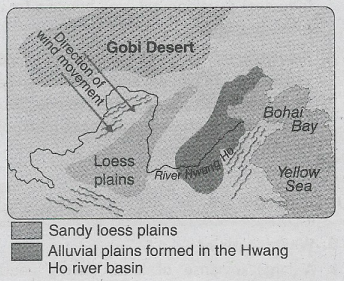
Formation of loess plains: Fine particles brought down by moving glaciers and deposits of sand and silt, blown by winds, are transported to distant places and deposited in low-lying places, thereby forming loess plains. The fine sand particles from the Gobi Desert of Central Asia, being blown away by winds and carried away to the distant Hwang Ho basin of China, get deposited and form loess plains there.
Formation of glacial plains: The sediments. called moraines consisting of gravels, pebbles, cobbles, and rock fragments, which have been at the foothills, form a glacial plain. The Prairies of North America and the European Plains have been formed in this manner.
Question 39. Why are natural levees formed on the sides of a floodplain?
Answer: Natural Levees Formed On The Sides Of A Floodplain:
The slope of the land becomes gentle and the velocity of the river decreases when a river enters its middle and lower courses. During monsoons, the capacity of the river exceeds due to the presence of a huge volume of water. The river cannot hold this excess water and thus causes overbank flooding. Sand, silt clay which is carried by the river got deposited on both the sides of river bank during floods.
After the flood water recedes, sand, silt, and clay get deposited on the river banks. The deposition of such sediments every year gradually increases along the banks of the river bed. Such raised banks or embankments like ridges are known as a natural levee. So, floodplain and natural levees are simultaneously formed and so natural levees can be seen on both sides of a floodplain.
Question 40. Write the differences between erosional plain and depositional plain.
Answer: The differences between erosional plain and depositional plain are as follows-
| Points of difference |
Erosional plain |
Depositional plain |
| 1. Origin |
Height and relief of highlands are reduced gradually due to erosion by various natural agents like rivers, wind, glaciers, etc. In this way, erosional plains are formed. |
Depositional plains are developed through the deposition of eroded materials in the lowland or depression by natural agents like rivers, wind, glaciers, etc. |
| 2. Elevation |
The elevation of the erosional plains decreases gradually. |
The elevation of the depositional plains gradually increases. Even, the area of the plains increased with time. |
| 3. Topographical conditions |
Some parts of the erosional plain are rocky and one or two rock mounds can also be found. |
The topography of the depositional plain is almost even except natural levee. |
| 4. Fertility |
This plain is generally unfertile. |
This plain is generally fertile. |
Question 41. ‘Most of the world’s population resides in plains.’ Explain
Answer: The reasons why most of the world’s population resides in plains are as follows-
Favourable opportunities for agricultural activities: Most plain lands all over the world have very fertile soil which is suitable for different agricultural activities.
Availability of water: Since the major perennial rivers flow over the plains, there is a constant supply of drinking water, water for domestic purposes, water to be used for irrigation and industrial purposes, etc.
Job opportunities: Due to the easy availability of fertile soil, flat land, developed transport system, etc., there is ample scope for agricultural pursuit and industrial development, and hence a lot of job opportunities.
Advantages of infrastructure: Since settlements have developed on flat land, infrastructural facilities like education and health facilities, and a proper transport system have developed.
Question 42. What are landforms? What are the major landforms on the Earth’s surface?
Answer: Landforms And Major Landforms On The Earth’s Surface:
Landforms are the outer appearances on the Earth’s surface with typical geometric shapes and physical features resulting from weathering and erosion carried out by different agents like rivers (fluvial), glaciers, wind, and waves. The major landforms on the Earth’s surface are mountains, plateaus, and plains. Notable examples in India are the Himalayas, the Deccan Plateau, and the Indo-Gangetic Plain respectively.
Question 43. What are geotectonic activities?
Answer: Geotectonic Activities: The tectonic disturbances/activities originating under the Earth’s crust (in the interior) that lead to the formation of primary relief features or landforms on the Earth’s surface are known as geotectonic activities. These are of two types- epeirogenic and 2 orogenic movements.
Question 44. What is meant by the geocentric or endogenic process?
Answer: Geocentric Or Endogenic Process:
The initial process whereby the landforms are formed (relief of the 1st order) is known as the geocentric or endogenic process. For example, geotectonic activity, volcanicity, and plate movement occur suddenly in the Earth’s interior and influence the landforms of the Earth’s crust.
Question 45. What is the exogenic or exterior process?
Answer: Exogenic Or Exterior Process:
The different forces of nature or agents of erosion that act on the Earth’s outer surface are called exogenic or exterior processes. For example, weathering and erosion. Since they are acting continuously over a long period, they play a major role in forming different types of landforms on the Earth’s crust.
Question 46. What is meant by geotectonic disturbance or diastrophism?
Answer: Geotectonic Disturbance Or Diastrophism:-
When any part of the Earth’s surface is uplifted or subsides as a result of tectonic activity, it is called a geotectonic disturbance. This happens as a result of tectonic disturbance and isostatic or eustatic disturbance. Epeirogenic and orogenic (mountain-building movement) movements cause changes in the landforms on the Earth’s surface.
Question 47. What are epeirogenic movements?
Answer: Epeirogenic Movements:-
Geomorphic Processes and Landforms of the Earth The vertical movements on the Earth’s crust due to tectonic activities in the Earth’s interior are known as epeirogenic movement. Faults are created on the Earth’s crust and certain parts of it either move up or down as a result of such movements.
Question 48. What are orogenic movements?
Answer: Orogenic Movements:-
The horizontal movements on the Earth’s crust due to tectonic activities in the Earth’s interior are known as orogenic movements. They are also called mountain-building movements. Fold mountains are formed and the crust is deformed due to such movements. The Himalayan-Alpine orogeny is a classic example of this.
Question 49. What is meant by isostatic imbalance?
Answer: Isostatic Imbalance:-
The different landforms (like mountains, plateaus, and plains) exist on the Earth’s surface while maintaining a certain balance among each other, known as isostatic balance (since the Earth’s solid crust floats on the viscous mantle below it). If this balance is disturbed due to some reason, the movement that follows is known as an isostatic imbalance.
Question 9 What is the eustatic movement?
Answer: Eustatic Movement:
The process of worldwide simultaneous change of water-holding capacity of the ocean basin due to the rise or fall of the seal level is called eustatic movement.
WBBSE Chapter 4 Geomorphic Process And Landforms Of The Earth Very Short Answer Questions
Question 1. What is asthenosphere?
Answer: Asthenosphere:-
The denser, weaker layer beneath the lithospheric mantle is known as the asthenosphere. The plates float over this layer. This zone lies up to a depth of 200 km beneath the Earth’s surface. The temperature and pressure of the asthenosphere are very high. So the rocks melt partly and become molten.
Question 2. What is the mountain?
Answer: Mountain:-
An extensive area of the Earth’s surface that rises over 1000m above sea level with rocky terrain is called a mountain. E.g. the Himalayas.
Question 3. What is a mountain peak?
Answer: Mountain Peak:-
The high conical top of a mountain is called its peak. For example, Mt. Everest (8,848 m above sea level) is the highest peak in the Himalayas. A mountain may have several peaks.
Question 4. What are fold mountains?
Answer:
Fold Mountains:-
When the sediments of the ocean floor come under pressure and are crumpled up due to orogenic movement, they are uplifted to form fold mountains (having peaks). For example, the Himalayas, the Rockies, the Andes, the Alps, etc.
Question 5. What are anticlines and synclines?
Answer:
Anticlines And Synclines:-
The upper parts of a fold mountain are called anticlines and the lower parts (valleys) are called synclines.
Question 6. What are ancient/old and young fold mountains?
Answer:
Ancient/Old And Young Fold Mountains:-
The fold mountains which are very old according to geological age have been affected by erosion over millennia and, as a result, their heights have decreased. For example, the Aravalli in India. On the other hand, the young fold mountains formed much later according to geological age and they are higher than the old fold mountains. For example, the lofty Himalayas.
Question 7. What is plate margin?
Answer:
Plate Margin:-
Large parts of the Earth’s crust which are constantly moving and constitute the continent and ocean floors are called plates. The margin or border of two such plates is called the plate margin.
Question 8. What are the different types of plate margins?
Answer:
There are mainly 3 types of plate margins-
- Converging or destructive plate margins (plates moving towards each other.
- Diverging or constructive plate margins (plates moving away from each other)
- Transform or conservative or parallel plate margins (plates moving or sliding along each other but in opposite directions) are neither destructive nor constructive.
Question 9. What are suture lines?
Answer:
Suture Lines:
The margin where two continental plates meet and join each other is known as a suture line. Fold mountains are formed along such lines and the mountains gradually increase in height with further lateral pressure exerted by the plate. movements (moving towards each other).
Question 10. What is a geosyncline?
Answer:
Geosyncline:
The long and narrow portions of the sea floor where there is the continuous deposition of sediments (such as silt, sand, and pebbles) are called geosynclines. Due to lateral/ horizontal pressure coming from both sides, the sediments are crumpled up and form fold mountains. For example, the young fold mountains of the Himalayas have formed in such a geosyncline (called the Tethys Sea).
Question 11. Why is a convergent plate margin known as a destructive plate margin?
Answer:
Convergent Plate Margin Known As A Destructive Plate Margin:-
When two tectonic plates move towards each other, the margin or margin is called convergent plate margin. If a heavier plate (viz., an oceanic plate made up of sima) slides under a lighter plate (viz., a continental plate made up of sial), the sediments on its margins get crumpled up and give rise to fold mountains. Parts of the heavier plate may subside and enter the semi-molten magma below where the solid part of the plate (crust) is melted down and lost. These areas are also prone to earthquakes. This is the reason why they are known as destructive plates.
Question 12. What is the Tethys Sea?
Answer:
Tethys Sea:-
According to geologists, from the later part of the Carboniferous Period till the early part of the Cretaceous Period, the Tethys Sea was located between Gondwanaland to the south and Laurasia or Angaraland to the north. Later on, the sediments deposited in the bed of the sea gave rise to the formation of the Himalayas (a young fold mountain range) as a result of plate movements.
Question 13. What is a crater?
Answer:
Crater:-
A crater is a bow-shaped depression or hole at the top of a volcanic mountain from which lava, gases, ash, and solid materials come out at the time of the volcanic eruption.
For example, there are multiple craters in the Fujiyama Volcano of Japan.
Question 14. What is a plume?
Answer:
Plume:-
In certain places in the mantle, the temperature remains quite high due to the presence of radioactive materials and convectional currents. These are called hotspots. Due to excessive heat, an upwelling current of magma originates from this hotspot which is known as a plume. Sometimes, over these plumes, volcanoes are located on the Earth’s surface. For example Mountain of Central Sahara is located as a volcano over such a plume.
Question 15. What is a caldera?
Answer:
Caldera:-
The opening through which volcanic ash, lava, and gases gush out during a volcanic eruption is called a crater. A large-sized opening is called a caldera. Sometimes a crater may collapse and subside to form a caldera.
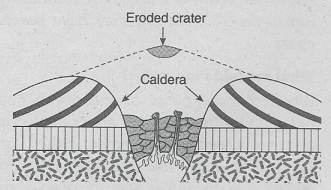
Question 16. What is meant by a hotspot?
Answer:
Hotspot:-
Parts of some weak or thin plates lying in the central part of the plates become very hot as a result of radioactivity taking place there. Later on, as a result of uprising convection currents, magma may force its way upwards and this lava may form volcanic mountains. There are about 25 such hotspots all over the Earth’s surface.
Question 17. What are erosional mountains?
Answer:
Erosional Mountains:-
When high and extensive rocky landmasses are subjected to erosion by various forces of nature (like weathering, river, wind), the residual/remaining part of such mountains is called erosional or residual mountains. They are much lower in height but retain the features of a mountain. For example, the Aravalli Hills in India.
Question 18. What is a depositional or aggradational hill?
Answer:
Depositional Or Aggradational Hill:-
Molten magma comes out from beneath the Earth’s surface through cracks and fissures, as a result of tectonic movement. Over time, layers of magma accumulate over each other, forming a hill. For example, Mt. Fujiyama in Japan.
Question 19. What is the fault?
Answer:
Fault:-
Due to the alternative processes of expansion and contraction occurring during epeirogenic movements, cracks are formed on the rock layers of the Earth. If the adjacent rock layers separate along these almost vertically. cracks and get displaced, they give rise to faults.
Question 20. What are block mountains or horst?
Answer:
Block Mountains Or Horst:-
When a block of the landmass is uplifted along a fault as a result of epeirogenic movement, it forms a flat-topped hill called block mountain. For example, the Satpura Hill of India, the Vosges of France, and the Black Forest of Germany.
Question 21. What is a rift valley or graben?
Answer:
Rift Valley Or Graben:-
When a block of landmass subsides along two faults as a result of epeirogenic movements, this subsided block is called a rift valley or graben. For example, the Narmada River of India, lying adjacent to the Satpura hills, and the Rhine River valley of Germany, which lies between the Vosges and Black Forest block mountains.
Question 22. What are the ‘Pillars of Light’, located in the Mediterranean Sea?
Answer:
Pillars Of Light:-
In the Lipari Island of Italy in the Mediterranean Sea, frequent volcanic eruptions occur from the volcanic mountain known as Stromboli. This light can be seen from great distances during the night. The sailors of the ships during ancient times plying on the Mediterranean Sea used to determine their direction concerning these lights. Thus, they are known as ‘Pillars of Light’.
Question 23. What is a plateau?
Answer:
Plateau:-
A landform with a height of more than 300 m and almost flat on the top with a steep slope is called a plateau.
Question 24. Why is a plateau called tableland?
Answer:
Plateau Is Called Tableland:-
A plateau is a vast extensive highland with an undulating surface or flat top and steep sides. So, a plateau looks like a table. Thus a plateau is termed table land is called tableland.
Question 25. What is an intermontane plateau?
Answer:
Intermontane Plateau:-
When fold mountains are formed as a result of tectonic activity, the intervening low land, lying between high fold mountains is
known as an intermontane plateau. For example, the Plateau of Tibet lies between the Himalayas and Kunlun Mountains.
Question 26. Where do you find dissected plateaus in India?
Answer:
Finding Dissected Plateaus In India:-
Parts of the Chota Nagpur Plateau, Deccan Plateau, and Meghalaya Plateau dissected plateaus.
Question 26. What is the Deccan Trap?
Answer: Deccan Trap:-
The step-like landform seen in the Deccan Plateau is known as Deccan Trap. The Swedish term ‘trap’ means ‘step’. Such a landform has developed as a result of erosion for a long time on the basaltic rocks (formed due to lava accumulation through fissure eruption).
Question 27. What is a shield?
Answer: Shield:-
An ancient plateau (created about 100 crore years ago) that has formed due to age-long weathering and erosional processes acting upon the initial landmass is known as a shield. They are geologically stable. For example, the Canadian and Brazilian Shields.
Question 28. Why is Pamir called the ‘Roof of the World’?
Answer: Pamir Is Called The Roof Of The World:-
Pamir is the world’s highest plateau with an average altitude of 4,800 m above sea level. This plateau has an almost flat top with steep slopes on all sides resembling a roof. This is why Pamir is called the ‘Roof of the World’.
Question 29. Where are depositional plateaus found in India?
Answer: The depositional or lava plateau lies at Maharastra plateau which is the northwestern part of the Deccan Plateau. This plateau and the extensive area of south India are composed of basalt rock.
Question 30. Where are depositional or aggradational plains found in India?
Answer: Depositional Or Aggradational Plains Found In India:-
In the northwestern part of the Deccan Plateau (including Maharashtra Plateau) and covering a large part of south India, we find depositional plains formed as a result of the accumulation of lava (due to fissure eruption from beneath the Earth’s surface) and basically formed of basaltic rocks.
Question 31. Where are flood plains found in India?
Answer: Flood Plains Found In India Is Given Below:-
In the lower reaches and also in the middle courses of the main rivers of North India, we find flood plains. For example, on both sides of river Ganges, viz., near Patna and Munger in Bihar.
Question 32. What is plain?
Answer:
Plain:-
A large expanse of land, having gentle undulations, at sea level or at a slightly higher altitude (less than 300 m), is called a plain. For example, the Ganga Plains.
Question 34. Where would you find the world’s largest delta?
Answer: Location Of the World’s Largest Delta:-
The world’s largest delta is found between the lower reaches of rivers Ganges and Brahmaputra.
Question 25. What is meant by uplifted plain?
Answer: Uplifted Plain:-
When a plain is formed as a result of the upliftment of any existing plain, as a result of tectonic activity, it is known as an uplifted plain.
Question 26. What is meant by subdued plain?
Answer: Subdued Plain:-
When any highland (having the characteristics of a plain) subsides to a lower level due to tectonic activity, it forms a subdued plain.
Question 27. What is a pediment?
Answer: Pediment:-
In the arid (dry) or desert area, we find a gently sloping foothill zone formed by the accumulation of sediments consisting of boulders and pebbles. This region is known as a pediment. ‘Pedi’ means foothill and ‘mont’ means hill or mountain. For example, pediments are formed in the foothill region of the Atlas Mountains in North Africa.
Question 28. What are flood plains?
Answer: Flood Plains:-
When there is a sudden flood in a river, the water overflows its banks on either side and the low-lying tracts of land get flooded. Later on, when the water recedes, the silt carried by this water settles down on these plains, giving rise to fertile flood plains on either side of the river. For example, the Ganges Plains (in the middle and lower courses of the river).
Question 29. Write a note on the importance of plains.
Answer: Importance Of Plains:-
Agriculture is extensively carried out in the plains. Transport lines can easily be constructed on the plains because of the flat land and soft soil. 3 Since agriculture and transport are developed here, industries can be developed on the plains. About 90% of the world’s population lives in the plains.
Question 30. Why is ‘peneplain’ named so?
Answer: Peneplain:-
When an ancient plateau is subjected to age-long weathering and erosion by various agents like rivers, and winds, it is reduced to a lower level and looks almost like a plain. Such landforms are called ‘peneplains’ Most of the area is flat, level land, with low hills called monadnocks scattered here and there. For example, parts of the Chota Nagpur Plateau are a peneplain.
Question 31. Give examples of one uplifted plain and one subdued plain.
Answer: An example of an uplifted plain is the coastal plain of the Gulf of Mexico. An example of a subdued plain is the plain of Turan.
Question 32. What is a monadnock?
Answer: Monadnock:-
Some low-altitude conical hills are. scattered in a peneplain and stand out because they are made up of hard resistant rocks, are called monadnocks. For example, Susunia Hill, and Tagore Hill of Chota Nagpur Plateau.
Question 33. What is an inselberg?
Answer: Inselberg:-
Sometimes, some isolated hills lie sporadically in desert plains. These residual hills are composed of hard resistant rocks and their elevations are not very high. These types of isolated hills or residual mountains are called inselbergs. These low-lying hillocks are formed by erosional activities of wind and flowing water. Inselberg is a German word that means ‘island mountain’. Inselbergs can be seen in the Sahara desert of Africa.
Question 34. What is bajada?
Answer: Bajada:-
Bajada is a type of depositional plain. When sand, pebbles, etc. are deposited in the foothill areas of any hill or mountain of a desert region, a depositional plain is formed. This plan is known as bajada. This plan is mainly formed by the depositional work of wind and water. Bajada can be seen at the foothill of Atlas Mountain in Africa.
WBBSE Chapter 4 Geomorphic Process And Landforms Of The Earth Fill In The Blanks
1. The term ‘geotectonic’ has been derived from the Greek word Tecton which means building up.
2. Epeirogenic movement is a type of Vertical movement.
3. A folded mountain is formed due to the effect of orogenic movement.
4. Degradation processes are involved in the decrease
5. Aggradation processes are involved with the increases in height due to deposition
6. The asthenosphere is the viscous layer of magma formed in the upper mantle of the Earth.
7. Fault which is created along a line on the Earth’s crust is called a Fault line
8. Mt. Vesuvius is a(n) Live or Active volcano.
9. Plains have a High population density.
10. Fujiyama is a Multiple crater type of volcano.
11. Most of the world’s volcanoes are located in the Pacific Ring of Fire.
12. Fossils are mostly found in the rocks of Fold mountains.
13. An erosional mountain in India is Aravalli.
14. The Himalayas have been formed in the Tethys geosyncline.
15. Folds are seen only in Fold mountains.
16. The Eastern Ghats are Erosional an example of the mountain range.
17. Paricutin in Mexico is a Conical type of volcano.
18. Krafla in Iceland is a Cracker type of volcano.
19. The density of an oceanic plate is 2.90 gm/cubic cm.
20. The world’s most ancient erosional fold mountain is the Appalachian mountain
21. Fossils are found only in Sedimentary rocks.
22. The Himalayas were formed Tertiary in age.
23. Two continental plates join together along Suture lines.
24. Earth’s crust is made of 7 major plates.
25. Folded mountain is mainly formed of Sedimentary rock.
26. The world’s largest rift valley is the Great Rift Valley
27. The highest mountain peak in the world is Mt.Everest
28. An example of a rift valley in India is the Rift Valley of Narmada Valley
29. The third highest peak in the world is Kangchenjunga
30. Two volcanoes of India are located at Andaman and Nicobar island
31. Barren and Narcondam are two volcanoes of India.
32. Limbs of a fold that incline at the same angle is called Symmetrical fold.
33. Limbs of a fold that incline at a different angle are called asymmetrical fold
34. A junction of several mountain ranges is called a Mountain knot
35. A dissected plateau is formed as a result of Erosion
37. Another name for the plateau is Tableland
38. The highest plateau in India is Ladakh
39. The Siberian Shield of Russia is a Continental plateau.
40. The largest intermontane plateau in the world is the Tibetan plateau
41. The altitude of the Tibetan Plateau is 4,500
42. The Deccan Plateau in southern India igneous is made up of rocks.
43. The Pamir Plateau is also known as the Roof of the Earth.
44. The Tibetan Plateau is located in China
45. The Columbia Plateau is an example of a Lava Plateau
46. The Altiplano Plateau between Peru and Bolivia is an example of a Lava plateau.
47. The term ‘geotectonic’ has been derived from the Greek word Tecton which means building up.
48. Epeirogenic movement is a type of Vertical movement.
49. A folded mountain is formed due to the effect of orogenic movement.
50. Degradation processes are involved in the decrease
51. Aggradation processes are involved with the increases in height due to deposition
52. The asthenosphere is the viscous layer of magma formed in the upper mantle of the Earth.
53. Fault which is created along a line on the Earth’s crust is called a Fault line
54. Mt. Vesuvius is a(n) Live or Active volcano.
55. Plains have a High population density.
56. Fujiyama is a Multiple crater type of volcano.
57. Most of the world’s volcanoes are located in the Pacific Ring of Fire.
58. Fossils are mostly found in the rocks of Fold mountains.
59. An erosional mountain in India is Aravalli.
60. The Himalayas have been formed in the Tethys geosyncline.
61. Folds are seen only in Fold mountains.
62. The Eastern Ghats are Erosional an example of the mountain range.
63. Paricutin in Mexico is a Conical type of volcano.
64. Krafla in Iceland is a Cracker type of volcano.
65. The density of an oceanic plate is 2.90 gm/cubic cm.
66. The world’s most ancient erosional fold mountain is the Appalachian mountain
67. Fossils are found only in Sedimentary rocks.
68. The Himalayas was formed Tertiary in age.
69. Two continental plates join together along Suture lines.
70. Earth’s crust is made of 7 major plates.
71. Folded mountain is mainly formed of Sedimentary rock.
72. The world’s largest rift valley is the Great Rift Valley
73. The highest mountain peak in the world is Mt.Everest
74. An example of a rift valley in India is the Rift Valley of Narmada Valley
75. The third highest peak in the world is Kangchenjunga
76. Two volcanoes of India are located at Andaman and Nicobar island
77. Barren and Narcondam are two volcanoes of India.
78. Limbs of a fold that incline at the same angle are called Symmetrical folds.
79. Limbs of a fold that incline at a different angle are called asymmetrical fold
80. A junction of several mountain ranges is called a Mountain knot
82. A dissected plateau is formed as a result of Erosion
82. Another name for the plateau is Tableland
83. The highest plateau in India is Ladakh
84. The Siberian Shield of Russia is a Continental plateau.
85. The largest intermontane plateau in the world is the Tibetan plateau
86. The altitude of the Tibetan Plateau is 4,500
87. The Deccan Plateau in southern India igneous is made up of rocks.
8. The Pamir Plateau is also known as the Roof of the Earth.
89. The Tibetan Plateau is located in China
90. The Columbia Plateau is an example of a Lava Plateau
91. A hill formed of hard rock in a peneplain is called a monadnock
92. Plains occupy the maximum part of the Earth’s total area of land.
93. Turan Lowland is an example of a subdued plain.
94. The Nile basin is an example of a silt plain.
95. Population density is higher in the plain regions.
96. Small elevated hills on the plain of the dry regions are called inselberg
97. The Altiplano Plateau between Peru and Bolivia is an example of a Lava plateau.
WBBSE Chapter 4 Geomorphic Process And Landforms Of The Earth Write True Or False
1. Orogenic activity occurs parallel to the tangential point of the Earth. True
2. Epeirogenic movement takes place parallel to the tangential point of the Earth. False
3. Endogenetic processes mainly occur slowly. True
4. The word ‘orogeny’ is derived from the Latin word ‘oros’. False
5. The Appalachians in the United States of America are a range of fold mountains. True
6. The Rhine valley is an example of a rift valley. True
7. The Alps in Europe are a range of ancient fold mountains. False
8. Fossils are found in fold mountains. True
9. The Andes is a volcanic mountain range. False
10. Rift valleys are formed as a result of faults. True
11. Folded regions are prone to Earthquakes. True
12. The cavity through which volcanic eruption occurs is called a crater. True
13. The lower part of a fold mountain is called the syncline. True
14. Block mountains are more prone to volcanicity. True
15. The Vesuvius mountain is in Japan. False
16. The Black Forest in Germany is a block mountain. True
17. The Barren Island in India is an active volcano. True
18. Plate tectonic activity plays a major role in the formation of flood plains. False
19. The Eastern Ghats is a block mountain. False
20. The Himalayan mountains have their origin: in the Armenian mountain knot. False
21. The Great Rift Valley is located in the Pacific Ocean. False
22. The Alps have been formed as a result of a collision between Eurasian and African plates. True
23. The Hercynian mountains of North America are a part of an ancient fold mountain. True
24. The plates in the Earth’s crust are in a stable/stationary position.
25. Rift valleys are formed in all mountainous regions. False
26. Population density is less in the mountainous region. True
27. Igneous rocks are found in volcanic mountainous regions. True
28. In 2010, volcanic eruption was seen at the Barren Islands. False
29. Volcanic mountains are earthquake-prone. True
30. Plates move away from each other in a converging plate margin. False
31. Satpura is a block mountain. True
32. The destructive plate boundaries are responsible for the formation of fold mountains. True
Geomorphic Processes And Landforms Of The Earth Class 9 WBBSE Geography
33. The highest peak in India is Mt. Everest. False
34. Narcondam is an active volcano. False
35. The term ‘plate’ was first used by J. T. Wilson. True
36. The Deccan plateau is an example of an intermontane plateau. False
37. Hills are lower in altitude than mountains. True
38. Rajmahal is an example of a mountain. True
39. Ladakh plateau is an intermontane plateau. True
40. The plateau of Tibet is a lava plateau. True
41. The Tibetan Plateau is dissected. True
42. The plateaus have an average elevation of 300 meters above sea level. True
43. Susunia Hills is located in Bihar. False
44. The plateau is composed of several peaks. False
45. The Chota Nagpur Plateau is dissected. True
46. Plateau is also known as tableland. True
47. The highest plateau of India is the Ladakh Plateau. True
48. An example of an intermontane plateau is Deccan Plateau. False
49. The Anatolia plateau lies between the Himalayas and the Pontic Mountains. False
50. The Tibetan Plateau lies between Himalaya and Kunlun. True
51. Loess plain is found along the Hwang Ho River basin in China. True
52. Pediments are formed in arid regions. True
53. A delta plain is formed by the deposition of fine silt. True
54. The old plain is known as a shield. False
55. The formation of the floodplain is responsible for plate movement. False
WBBSE Chapter 4 Geomorphic Process And Landforms Of The Earth Match The Left Column With The Right Column
1.
| Left column |
Right Column |
| 1. Exogenic force |
A.Meteoroid |
| 2. Orogenic movement |
B.Fold |
| 3. Epeirogenic movement |
C. Fault |
| 4. Extra-terrestrial force |
D.Mass wasting |
Answer: 1-D, 2-B,3-C, 4-A
2.
| Left column |
Right Column |
| 1. Aggradation |
A.Exogenetic processes |
| 2. Slow endogenetic process |
B. Epeirogenic movement |
| 3. Active geotectonic process along the radius of the Earth |
C. Continent |
| 4. First order landform |
D. Eustatic movement |
Answer: 1-A, 2-D,3-B, 4-C
3.
| Left column |
Right column |
| 1. Fold mountain |
A. Vesuvius |
| 2. Block mountain |
B. Rocky |
| 3. Volcanic mountain |
C. Aravalli |
| 4. Erosional/Residual |
D. Satpura |
Answer: 1-B, 2-D, 3-A, 4-C
4.
| Left column |
Right column |
| 1. Fold mountain |
A. By natural erosional agents |
| 2. Block mountain |
B. Uplifted land between two adjacent faults |
| 3. Volcanic mountain |
C. Located on the hotspot and plume |
| 4. Erosional/Residual |
D. Formed in convergence plate boundary |
Answer: 1-D, 2-C, 3-B, 4-A
5.
| Left column |
Right column |
| 1. Continental Plateau |
A. Plateau of Tibet |
| 2. Intermontane plateau |
B. Plateau of Brazil |
| 3. Erosional Plateau |
C. Deccan plateau |
| 4. Lava Plateau |
D. chota Nagapur Plateau |
Answer: 1-B, 2-A, 3-D, 4-C
6.
| Left column |
Right column |
| 1. Dissected Plateau |
A. Shield region |
| 2. Lava plateau |
B. Work of erosion |
| 3. Continental Plateau |
C. Merdian mass |
| 4. Intermontane Plateau |
D. Work of deposition |
Answer : 1-B, 2-D, 3-A, 4-C
7.
| Left Column |
Right Column |
| 1. Emerged plain |
A. Alluvial plain |
| 2. Piedmont plain |
B. Drift plain |
| 3. Bajada plain |
C. Emerged plain by geotectonic movement |
| 4. Outwash plain |
D. Depositional plain at the foothills of the mountain in the desert region |
Answer: 1-D, 2-A, 3-B, 4-C
8.
| Left Column |
Right Column |
| 1. Floodplain |
A. Turan Lowland |
| 2. Subdued plain |
B. Parts of Chota Nagpur: Plateau |
| 3. Peneplain |
C. Hwang Ho river basin |
| 4. Loess plain |
D. Ganga Plains |
Answer: 1-C, 2-A, 3-D, 4-B
WBBSE Chapter 4 Geomorphic Process And Landforms Of The Earth Answer In One Or Two Words
Question 1. Which type of Earth movement forms a fold mountain?
Answer: Orogenic movement.
Question 2. Give an example of the third order of relief.
Answer: Depositional landform.
Question 3. From which word does epeirogenic originate?
Answer: Greek word’epeiros’.
Question 4. Which Earth movement helps to attain the elevational balance of the landform?
Answer: Isostatic movement
Question 5. Which is the second-highest peak in India?
Answer: Mt. Kangchenjunga.
Question 6. What is the topmost part of a mountain called?
Answer: Peak.
Question 7. The Himalayan mountains have originated from which geosyncline?
Answer: Tethys.
Question 8. Give an example of an active volcano in India.
Answer: Barren Island.
Question 9. What is the average altitude of a mountain?
Answer: 1,000 meters.
Question 10. What is block mountain called in German?
Answer: Horst.
Question 11. What is the upper part of a fold mountain called?
Answer: Anticline.
Question 12. Which is the largest mountain chain in the world?
Answer: The Andes.
Question 13. Which activity/movement leads to the formation of fold mountains?
Answer: Orogeny.
Question 13. Which is the highest peak of the Aravallis?
Answer: Guru Shikhar.
Question 14. Which activity/movement leads to the formation of rift valleys?
Answer: Epeirogeny.
Question 15. What is the intervening valley between two block mountains called?
Answer: Rift Valley.
Question 16. Give an example of a block mountain in India.
Answer: Satpura.
Question 17. Where are grabens seen?
Answer: In the low-lying basin between two faults.
Question 18. What is Pangaea?
Answer: The only landmass that existed in the ancient world.
Question 19. Give examples of two mountain knots in Asia.
Answer: Pamir Knot and Armenian Knot.
Question 20. Give an example of an ancient fold mountain.
Answer: Caledonian mountains of North America.
Question 21. In which geological period were the Himalayas formed?
Answer: Tertiary.
Question 22. Write the name of an old folded mountain.
Answer: Aravalli of India.
Question 23. Name the joining line between the Tibetan and Indian plates.
Answer: Indus Suture line.
Question 24. Which type of mountain included the Mahakal and Mahadev mountains?
Answer: Residual mountain.
Question 25. Give two examples of block mountains. Vosges of France and Black Forest of Germany.
Answer: 125
Question 26. Which volcano is known as the lighthouse of the Mediterranean Sea?
Answer: Stromboli of Italy.
Question 27. Which mountain is located at the divergent plate boundary?
Answer: Volcanic mountain.
Question 28. Which is India’s largest plateau?
Answer: Deccan Plateau.
Question 29. Give an example of an erosional plateau in India.
Answer: Chota Nagpur plateau.
Question 30. By which name is Pamir Plateau also known?
Answer: ‘Roof of the World’.
Question 31. What is an ancient plateau also known as?
Answer: Shield.
Question 32. What is the meaning of ‘Deccan Trap’?
Answer: Steps of the Deccan.
Question 33. Which is the largest plateau that lies between two mountains?
Answer: Tibetan Plateau.
Question 35. Give an example of the intermontane mountain that lies between the Himalayas and Kunlun in Asia.
Answer: Tibetan Plateau.
Question 36. What kind of plateau is Ladakh Plateau?
Answer: Intermontane plateau.
Question 37. Which is the largest delta in the world?
Answer: Ganga-Brahmaputra Delta.
Question 38. What is the main reason for the formation of an uplifted plain?
Answer: Geotectonic activity.
Question 39. Which is the largest plain in the world?
Answer: Siberian Plain.
Question 40. Give an example of an exogenic force/agent of erosion.
Answer: Work of a river/fluvial action.
Question 41. Give an example of a structural plain.
Answer: Turan Lowland.
Question 42. Give an example of karst topography in India.
Answer: Borra Caves in Andhra Pradesh.
Question 43. What is the residual hill in a peneplain called?
Answer: Monadnock.
Question 44. Give an example of the lacustrine plain of India.
Answer: Kashmir Valley.