WBCHSE Class 12 Physics Kirchhoff’s Laws And Electrical Measurement Question and Answers

Kirchhoff’s Laws And Electrical Measurement Long Questions And Answers

Question 1. What is the potential at point O of the circuit?

Kirchhoff’s Laws And Electrical Measurement Question 1 potential at the point of the circuit

Answer:

If V is the potential of the point 0, then flowing towards 0 through each 5Ω resistance = \(\frac{2-V}{5} \mathrm{~A}\).

Applying,

Kirchhoff’s current law at the point O we have,

⇒ \(\frac{2-V}{5}+\frac{2-V}{5}+\frac{2-V}{5}=0\)

or, \(\frac{6-3 V}{5}=0\)

or, V = 2V

So, no current will flow through any resistance.

Question 2. If the points B and C in the circuit are earthed, what is the current flowing through each 5Ω resistance?

Class 12 Physics Unit 2 Current Electricity Chapter 2 Kirchhoff’s Laws And Electrical Measurement Question 2 potential of the point

Answer:

The two points B and C are earthed. So potentials of these two points are zero. If V is the potential of the point 0, then

Current flowing along \(A O=\frac{2-V}{5} \mathrm{~A}\)

Current flowing along \(B O=\frac{0-V}{5} \mathrm{~A}=-\frac{V}{5} \mathrm{~A}\)

Current flowing along \(C O=\frac{0-V}{5} \mathrm{~A}=-\frac{V}{5} \mathrm{~A}\)

Applying Kirchhoff’s first law at point 0 we have,

⇒ \(\frac{2-V}{5}-\frac{V}{5}-\frac{V}{5}=0 \quad \text { or, } \frac{2-3 V}{5}=0\)

or, V = \(\frac{2}{3}[latex] V

∴ Current flowing along [latex]A O=\frac{2-\frac{2}{3}}{5}=\frac{4}{15} \mathrm{~A}\),

Current flowing along \(O B=\frac{\frac{2}{3}}{5}=\frac{2}{15} \wedge\)

Current flowing along \(O C=\frac{\frac{2}{3}}{5}=\frac{2}{15} \mathrm{~A}\)

WBCHSE Class 12 Physics Kirchhoff’s Laws And Electrical Measurement Question and Answers

WBBSE Class 12 Kirchhoff’s Laws Q&A

Question 3. On what principle does a potentiometer work?
Answer:

The main principle of a potentiometer is as follows: The resistance of any two portions of the potentiometer wire having equal lengths is equal. So, while current flows through the potentiometer wire, everywhere the potential drop for equal lengths is equal.

Question 4. The readings of the two ammeters A1 and A2 in the circuit are 1.5 A and 1.0 A respectively. What is the current through the resistance R?

Kirchhoff’s Laws And Electrical Measurement Question 4 two ammeters

Answer:

Currents of the two loops are taken as i1 and i2.

So, i1 = 1.5 A and i1– i2 = 1 A

∴ i2 = i1-l

= 1.5-1

= 0.5 A

= current through the resistance R

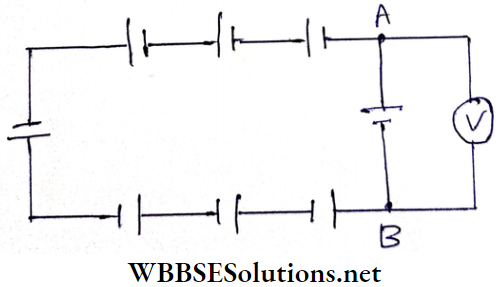
Question 5. The reading of the ammeter in the circuit is zero. What is the reading of the voltmeter?

Kirchhoff’s Laws And Electrical Measurement Question 5 ammeter in the circuit

Answer:

Since the reading is zero, obviously no current flows through the battery of emf e2. So for this battery, lost volt = 0. Therefore, the voltmeter indicates the emf of this battery i.e., reading of the voltmeter = e2.

Key Concepts in Kirchhoff’s Laws Questions

Question 6. Why is a potentiometer preferred to a voltmeter for the measurement of emf of a cell? Explain.
Answer:

Let the emf of tire cell =E and its internal resistance =r. When the cell provides current 7 in the closed circuit, the potential difference across the cell, V = E-Ir. When a voltmeter is connected across the cell, we get a reading for the potential difference V which is less than the actual emf, E of the cell. On the other hand, the circuit is set up in such a way for the potentiometer system so that no current flows through the cell, i.e., 7=0. Hence, V = E. Therefore, a potentiometer is preferred to a voltmeter for the measurement of emf of a cell.

Question 7. Can we apply Kirchhoff’s laws in the circuit having non-ohmic conductors?
Answer:

Both the laws of Kirchhoff are applicable to circuits having non-ohmic conductors. But in that case, for the determination of current or potential difference when we apply the relation V = IR, we should remember that the value of R is not constant. In each case, we shall have to know the correct relation between V and 7 and then with the help of Kirchhoff’s laws, the analysis of the circuit is possible.

Class 11 Physics Class 12 Maths Class 11 Chemistry
NEET Foundation Class 12 Physics NEET Physics

Question 8. What type of cell should be used in Wheatstone Bridge?
Answer:

The null condition of the Wheatstone bridge does not depend on the emf of the cell. In spite of that, the cell which can send high current should not be used. In that case, the resistance of each arm of the bridge may increase considerably due to the generation of heat by the Joule effect.

So, storage cells are not used in a Wheatstone bridge circuit. It is better to use a Leclanche cell because its emf is not very high and the current sends also remains sufficiently low

Question 9. Why is it not possible to measure the emf of a cell correctly by a voltmeter? Under what conditions correct measurement is possible?
Answer:

Suppose, the emf of a cell -E and its internal resistance =r. If the cell sends Current I in a closed circuit, then the terminal potential differential, of the cell is V = E-Ir. If a voltmeter is connected to the terminals of the cell, it reads the terminal potential difference, which is less than the emf, of the cell. The condition for obtaining the correct measurement of emf is

V = E i.e., lost volt Ir = 0. This condition may be fulfilled under any of the following two circumstances,

  1. The internal resistance of the cell r = 0
  2. The current through the cell, I = 0.

When the second condition is fulfilled, correct measurements of the emf of a cell is possible. Practically, it is not possible to fulfil the first condition.

Question 10. A cell of emf V volts and negligible internal resistance is connected across the potentiometer whose sliding contact is placed exactly in the middle. A voltmeter is connected between the sliding contact and one fixed end of the potentiometer. If It Is assumed that the resistance of the voltmeter is not very high compared with the resistance of the potentiometer, what voltage will the voltmeter show higher than or less than \(\frac{V}{2}\)?
Answer:

B is the midpoint of the potentiometer AC

Class 12 Physics Unit 2 Current Electricity Chapter 2 Kirchhoff’s Laws And Electrical Measurement Question 10 negligible internal resistance

So long as the voltmeter D is not connected,

VAB = VBC = \(\frac{V}{2}\).

But as soon as the voltmeter is connected between points B and C the resistance of the portion BC and the resistance of the voltmeter D form a parallel combination.

So, the equivalent resistance between the points B and C becomes less than the resistance of BC, i.e., in this condition the resistance of AB is greater than the resistance of BC.

So VAB > VBC i.e., the potential difference between A and B will be greater than \(\frac{V}{2}\) and that between B and C will be less than. So, the voltmeter will record a reading less than \(\frac{V}{2}\).

Short Answer Questions on Kirchhoff’s Current Law

Question 11. Will the position of the null point change if the galvanometer is replaced by another one of a different resistance in a Wheatstone bridge?
Answer:

The condition of balance i.e., \(\frac{P}{Q}\) = \(\frac{R}{S}\) does not depend on the resistance of the galvanometer. So, if a galvanometer of a different resistance is used, the position of the null point does not change. Of course, the sensitivity of the bridge depends on the resistance of the galvanometer.

Question 12. How will the position of the null point of a Wheatstone bridge change if we interchange the positions of the battery and the galvanometer in the circuit?
Answer:

Suppose, the battery is connected between points A and B of the Wheatstone bridge and the galvanometer is connected between points C and D, Then the null condition of the bridge is

⇒ \(\frac{P}{Q}\) = \(\frac{R}{S}\)

Next die battery is connected between points C and D and the galvanometer is connected between points A and B. In this case die resistances of the first, second, third and fourth arms of the bridge are. R, P, S and Q respectively. So the null condition of the bridge now is,

⇒ \(\frac{R}{P}\) = \(\frac{S}{Q}\)

or, \(\frac{P}{Q}\) = \(\frac{R}{S}\)

Obviously, in both cases, the null condition is exactly the same, i.e., due to the interchange of battery and the galvanometer the null condition of the bridge does not change.

Class 12 Physics Unit 2 Current Electricity Chapter 2 Kirchhoff’s Laws And Electrical Measurement Question 12 null condition of the bridge

Question 13. In the circuit given in the, P ≠ R. Irrespective of whether the switch S is open or closed, the reading of the galvanometer remains unaltered. Select the correct answer from the following statements

  1. IR = IQ
  2. IP = IQ
  3. IQ = IG
  4. IQ = IR

Kirchhoff’s Laws And Electrical Measurement Question 13 reading of the galvanometer

Answer:

The closing of switch S does not affect the current in the galvanometer, i.e., IS = 0. So, the current passing through G will be the same as that passing through the resistance R.

Hence, IR = IG, so the statement 1 is correct

Question 14. Can we compare the two resistances 1Ω and 100Ω accurately with the help of a metre bridge?
Answer:

Metre Bridge works on the principle of a Wheatstone bridge. We know that the bridge becomes very sensitive when the resistances of the four arms are nearly equal. Then the resistances can be compared accurately. Obviously, 1Ω and 100Ω cannot be’ compared accurately with the help of a metre bridge.

Question 15. Sometimes the balance point in the potentiometer may not be obtained on the wire of the potentiometer. Under what conditions does it happen?
Answer:

Let a cell of emf B be connected across the entire length L of a potentiometer wire. Now, if the balance point is obtained at a length l during the measurement of an unknown voltage V, then \(\frac{E}{V}=\frac{L}{l}\)

The balance point is not on the potentiometer wire – this statement means that l>L.

In that case, V> E

Common Questions on Kirchhoff’s Voltage Law

Question 16. Three resistances R1, R2 and R3 are connected in parallel. This combination is then connected to a cell of negligible internal resistance. Applying Kirchhoff’s law proves that the equivalent resistance of the whole combination is given by,

⇒ \(R=\frac{R_1 R_2 R_3}{R_1 R_2+R_2 R_3+R_1 R_3}\)

Answer:

Applying Kirchhoff’s second law in the closed loop AR1BEA,

i1R1 – E = 0 [where the cell is E and internal resistance is zero]

∴ \(i_1=\frac{E}{R_1}\)…(1)

Class 12 Physics Unit 2 Current Electricity Chapter 2 Kirchhoff’s Laws And Electrical Measurement Question 16 equivalent resistance

Again applying Kirchhoff’s second law in AR2BEA,

i2R2 – E = 0

∴ \(i_2=\frac{E}{R_2}\)…(2)

and similarly,

From equations (l), (2) and (3) we get,

⇒ \(i_1+i_2+i_3=E\left[\frac{1}{R_1}+\frac{1}{R_2}+\frac{1}{R_3}\right]=i[i=\text { total current }]\)

If R be the equivalent resistance then,

⇒ \(R=\frac{E}{i}=\frac{1}{\frac{1}{R_1}+\frac{1}{R_2}+\frac{1}{R_3}}=\frac{R_1 R_2 R_3}{R_1 R_2+R_2 R_3+R_1 R_3}\)

Question 17. The variation of potential difference V with length f In the case of two potentiometers X and Y. Which one of the two will you prefer for comparing emfs of the two cells and why?

Class 12 Physics Unit 2 Current Electricity Chapter 2 Kirchhoff’s Laws And Electrical Measurement Question 17 the vatiayion of potential difference

Answer:

A potentiometer is said to be sensitive if the potential drop per unit length, i.e., potential gradient \(\frac{dV}{dl}\) is small. From the given graph,

the slope of Y < slope of X

∴ \(\left(\frac{d V}{d l}\right)_Y<\left(\frac{d V}{d l}\right)_X\)

∴ Potentiometer Y will be preferred for comparing emfs of the two cells.

Conceptual Questions on Circuit Theory Using KCL and KVL

Question 18. Find the potential difference between the left and right plates of each capacitor in the circuit. (Assume, E2 > E1 )

Class 12 Physics Unit 2 Current Electricity Chapter 2 Kirchhoff’s Laws And Electrical Measurement Question 18 potential difference between the left and right plates

Answer:

The right plate of C1 has charge +q and the left plate of C1 has charge -q.

Similarly, the left plate of C2 has charge + q and the right plate of C2 has charge -q.

Applying Klrchhoff’s second Inw to the closed loop we get

⇒ \(\frac{q}{C_1}+B_1+\frac{q}{C_2}-B_2=0\)

or, \(q=\frac{\left(B_2-B_1\right) C_1 C_2}{C_1+C_2}\)

Hence, the potential differences across the left and right plates of C1

⇒ \(v_1=\frac{q}{C_1}=\frac{\left(E_2-E_1\right) C_2}{\left(C_1+C_2\right)}\)

Similarly, the potential difference across left and right plate of C2

⇒ \(V_2=\frac{q}{C_2}=\frac{\left(E_2-E_1\right) C_1}{\left(C_1+C_2\right)}\)

Question 19. In the given circuit, determine the condition for which VA-VB = 0.

Class 12 Physics Unit 2 Current Electricity Chapter 2 Kirchhoff’s Laws And Electrical Measurement Question 19 thae capacitor in series

Answer:

The capacitors In the series have die same charge. So applying Klrchhoff’s second law to the loop containing C1, C2 and E we get,

⇒ \(\frac{q}{C_1}+\frac{q}{C_2}-E=0\)

or, \(q=E\left[\frac{C_1 C_2}{C_1+C_2}\right]\)

Similarly, applying Klrchhoff’s second law to the loop containing C3, C4 and E we get,

⇒ \(\frac{q^{\prime}}{C_3}+\frac{q^{\prime}}{C_4}-E=0\)

or, \(q^{\prime}=E\left[\frac{C_3 C_4}{C_3+C_4}\right]\)

Now, \(V_A-V_B=\frac{q}{C_2}-\frac{q^{\prime}}{C_4}=E\left[\frac{C_1}{C_1+C_2}-\frac{C_3}{C_3+C_4}\right]\)

= \(E\left[\frac{C_1 C_4-C_3 C_2}{\left(C_1+C_2\right)\left(C_3+C_4\right)}\right]\)

For, \(V_A-V_B=0, C_1 C_1-C_2 C_3=0\)

or, \(\frac{C_1}{C_2}=\frac{C_3}{C_4}\)

WBCHSE Class 12 Physics Capacitance And Capacitor Multiple Choice Questions

WBCHSE Class 12 Physics MCQs

Capacitance And Capacitor Multiple Choice Question And Answers

Question 1. A capacitor of 4μF connected as shown in the circuit. The internal resistance of the battery is 0.5 H. The amount of charge on the capacitor plates will be

Class 12 Physics Unit 1 Electrostatics Chapter 4 Capacitance and Capacitor Multiple Choice Question And Answer 1

  1. 0
  2. 4μC
  3. 16μC
  4. 8μC

Answer: 4. 8μC

⇒ \(I=\frac{E}{R}=\frac{2.5}{2+0.5}=1 {\mathrm{A}}\)

V= E-IR

= 2.5- 1  x 10.5

= 2 V

∴ Q = CV

= 4 x 2μC

= 8μC

Question 2. In the circuit, initially, key K1 is closed and K2 is open. Then K1 is opened and K2 is closed(order is important). Take Q1 and Q2 as charges on C1 and C2 and V1 and V2 as voltage respectively. Then

Read and Learn More Class 12 Physics Multiple Choice Questions

Class 12 Physics Unit 1 Electrostatics Chapter 4 Capacitance and Capacitor Multiple Choice Question And Answer 2

  1. Charge on C1 gets redistributed such that V1 = V2
  2. Charge on C1 gets redistributed such that Q’1 = Q2
  3. Charge on C1 gets redistributed such that C1V1 + C2V2 = C1E
  4. Charge on C1 gets redistributed such that Q’2+Q’2 = Q

Answer:

1. Charge on C1 gets redistributed such that V1 = V2

4. Charge on C1 gets redistributed such that

When K1 is closed and K2 is open, Q (on C1) =EC1.

When K2 is closed and K1 is open, there being no battery in the circuit, C1 and C2 are connected in parallel and the charge on C1 will be redistributed between C1 and C2 in such a manner that V1 = V2.

Since there is no loss of charge, Q = Q’1 + Q’

WBBSE Class 12 Capacitance MCQs

Question 3. A parallel plate capacitor is connected to a battery.

Consider two situations:

A. Key K is kept dosed and plates of capacitors are moved apart using insulating handles.

B. Key A’ is opened and plates of capacitors are moved apart using insulating handles.

Choose the correct option(s).

  1. In A: Q remains the same but C changes
  2. In B: V remains the same but C changes
  3. In A: V remains the same and hence Q changes
  4. In B: Q remains the same ami hence V changes

Answer:

3. In A: V remains the same and hence Q changes

4. In B: Q remains the same ami hence V changes

⇒ \(Q=C E=\frac{\epsilon_0 A}{d} \cdot B\)

Thus if d increases, Q will decrease.

⇒ \(V=\frac{Q}{C}=\frac{Q d}{\epsilon_0 A}\)

∴ If d decreases, Q remains the same, and V increases.

Question 4. A solid sphere and a hollow sphere of the same diameter are charged to the same potential. Then

  1. The charge on the hollow sphere will be greater
  2. Both spheres will have the same charge
  3. Only the hollow sphere will be charged
  4. The solid sphere will have a greater amount of charge

Answer: 2. Both the spheres will have the same charge

WBCHSE class 12 physics MCQs

Question 5. 64 water drops coalesce to form a big drop. If each small drop has capacity C, potential V and charge Q, the capacitance of the big drop will be

  1. C
  2. 4C
  3. 16C
  4. 64C

Answer: 2. 4C

WBCHSE Class 12 Physics Capacitance And Capacitor Multiple Choice Questions

Question 6. If the radius of a conducting sphere is 1m, its capacitance in farad will be

  1. 10-3
  2. 10-6
  3. 9 x 10⁻⁹
  4. 1.1 x 10⁻¹⁰

Answer: 4. 1.1 x 10⁻¹⁰

Question 7. n small drops of the same size are charged to Vvolt each. They coalesce to form a big drop. The potential of a big drop will be

  1. n1/3V
  2. n2/3V
  3. n3/2V
  4. n3V

Answer: 2. n2/3V

Question 8. A conducting sphere of radius 10 cm is kept in a medium of dielectric constant 8. Its capacitance is

  1. 80 esu
  2. 10 esu
  3. \(\frac{1}{9}\) x 10-10 F
  4. 80F

Answer: 1. 80 esu

Question 9. When two charged conductors are joined by a thin conducting wire, charge flows from one to the other, until

  1. Charges on them become equal
  2. Their capacitances become equal
  3. Their potential becomes equal
  4. Energy stored in them becomes equal

Answer: 3. Their potentials become equal

Question 10. Two conducting spheres of radii r1 and r2 are connected by a thin conducting wire. Some amount of charge is given to the system. The charge will be shared between them in such a way that the ratio between the surface densities of charge on the spheres is equal to

  1. \(\frac{r_1}{r_2}\)
  2. \(\frac{r_2}{r_1}\)
  3. \(\frac{r_1^2}{r_2^2}\)
  4. \(\frac{r_2^2}{r_1^2}\)

Answer: 2. \(\frac{r_2}{r_1}\)

Question 11. Two capacitors C1 and C2 (= 2C1) are connected in a circle with a switch. Initially, the switch is open and C1 holds charge Q. The switch is closed. At a steady state, the charge on each capacitor would be

Class 12 Physics Unit 1 Electrostatics Chapter 4 Capacitance and Capacitor Multiple Choice Question And Answer 11

  1. Q, 2Q
  2. \(\frac{Q}{3}, \frac{2 Q}{3}\)
  3. \(\frac{3 Q}{2}, 3 Q\)
  4. \(\frac{2 Q}{3}, \frac{4 Q}{3}\)

Answer: 2. \(\frac{Q}{3}, \frac{2 Q}{3}\)

Class 11 Physics Class 12 Maths Class 11 Chemistry
NEET Foundation Class 12 Physics NEET Physics

Common MCQs on Capacitor Types

Question 12. When a capacitor is connected to a dc battery,

  1. No current flows through the circuit
  2. Current flows through the circuit for some time, but eventually stops
  3. The current grows up and reaches a maximum value when the capacitor is fully charged
  4. The current reverses its direction alternately due to the charging and discharging of the capacitor

Answer: 2. Current flows through the circuit for some time, but eventually stops

Question 13. A few capacitors are equally charged. Which of the nature of variation of the potential difference V between their plates with their capacitances C?

Class 12 Physics Unit 1 Electrostatics Chapter 4 Capacitance and Capacitor Multiple Choice Question And Answer 13

Answer: 4.

Class 12 Physics Unit 1 Electrostatics Chapter 4 Capacitance and Capacitor Multiple Choice Question And Answer 13.

WBCHSE class 12 physics MCQs

Question 14. A parallel plate capacitor is charged and then disconnects the battery. If the plates of the capacitor are moved farther apart—

  1. The charge on the capacitor will increase
  2. The potential difference between the two plates will increase
  3. The capacitance will increase
  4. The electrostatic energy stored in the capacitor will decrease

Answer: 2. The potential difference between the two plates will increase

Question 15. The capacity of a parallel plate capacitor is proportional to the power n of the distance between the plates. The value of n is

  1. 1
  2. 2
  3. -1
  4. -2

Answer: 3. -1

Question 16. The capacitance of a parallel plate capacitor depends on

  1. The thickness of the plates
  2. The charge accumulated on the plates
  3. The potential difference between the two plates
  4. The distance between the two plates

Answer: 4. The distance between the two plates

Question 17. The separation between the two plates of a parallel plate capacitor is d. A metal plate of equal area and of thickness \(\frac{d}{2}\) is inserted between the two plates. The ratio of the capacitances after and before this insertion is

  1. 2: 1
  2. A√2:1
  3. 1:72
  4. 1:2

Answer: 1. 2: 1

Capacitance and capacitor class 12 MCQs

Question 18. A parallel plate air capacitor is connected to a battery and is then disconnected. Now the intermediate space is filled up with a medium of specific inductive capacity K. The potential difference between the plates will change by a factor of

  1. k2
  2. k
  3. \(\frac{1}{k}\)
  4. \(\frac{1}{\kappa^2}\)

Answer: 3. \(\frac{1}{k}\)

Question 19. A parallel plate capacitor with oil (dielectric constant K = 2) has a capacitance C. If the oil is removed, then the capacity of the capacitor becomes

  1. √2C
  2. 2C
  3. \(\frac{C}{\sqrt{2}}\)
  4. \(\frac{C}{2}\)

Answer: 4. \(\frac{C}{2}\)

Question 20. A parallel plate capacitor has a capacitance of 100μF. The plates are at a distance d apart. A slab of thickness t(t<d) and dielectric constant 5 is introduced between the parallel plates. Then capacitance can be,

  1. 50μF
  2. 100μF
  3. 200μF
  4. 500μF

Answer: 3. 200μF

Question 21. Two identical capacitors of C1 and C2 are connected to a battery. C1 is filled with air and C2 is filled with an insulator of dielectric constant ∈r then

Class 12 Physics Unit 1 Electrostatics Chapter 4 Capacitance and Capacitor Multiple Choice Question And Answer 21

  1. Q1 > Q2
  2. Q1 < Q2
  3. Q1 = Q2
  4. None

Answer: 2. Q1 < Q2

Practice Questions on Capacitance Formulas

Question 22. A capacitor of capacitance C is charged to a potential difference V from a cell and then disconnected from it. A charge +Q is now given to its positive plate. The potential difference across the capacitor is now

  1. V
  2. V + \(\frac{Q}{C}\)
  3. F + \(\frac{Q}{2C}\)
  4. None

Question 23. A combination is formed by connecting alternately n number of equidistant parallel plates. If C be the capacitance for any two consecutive plates, then the capacitance of the whole system will be

  1. C
  2. nC
  3. (n-1)C
  4. (n + 1)C

Answer: 3. (n-1)C

Question 24. Two capacitors of capacitances C1 and C2, are connected in parallel. A charge q given to the combination is distributed between the two. The ratio between these charges on the two capacitors is

  1. \(\frac{C_1}{C_2}\)
  2. \(\frac{C_2}{C_1}\)
  3. \(\frac{C_1 C_2}{1}\)
  4. \(\frac{1}{C_1 C_2}\)

Answer: 1. \(\frac{C_1}{C_2}\)

Capacitance and capacitor class 12 MCQs

Question 25. The equivalent capacitance of the combination is shown between A and B.

Class 12 Physics Unit 1 Electrostatics Chapter 4 Capacitance and Capacitor Multiple Choice Question And Answer 25

  1. \(\frac{C}{3}\)
  2. \(\frac{C}{2}\)
  3. \(\frac{2}{3}\)C
  4. C

Answer: 1. \(\frac{C}{3}\)

Question 26. Each of the four horizontal metal plates has a surface area a, and the separation between each pair of consecutive plates is d. The plates are connected to points A and B. The equivalent capacitance between A and B, when the system is kept in air, is

Class 12 Physics Unit 1 Electrostatics Chapter 4 Capacitance and Capacitor Multiple Choice Question And Answer 26

  1. \(\frac{\epsilon_0 \alpha}{d}\)
  2. \(\frac{2 \epsilon_0 \alpha}{d}\)
  3. \(\frac{3 \epsilon_0 \alpha}{d}\)
  4. \(\frac{4 \epsilon_0 \alpha}{d}\)

Answer: 2. \(\frac{2 \epsilon_0 \alpha}{d}\)

Question 27. In the connection the equivalent capacitance between A and B is

Class 12 Physics Unit 1 Electrostatics Chapter 4 Capacitance and Capacitor Multiple Choice Question And Answer 27

  1. 8μF
  2. 4μF
  3. 2μF
  4. 3μF

Answer: 2. 4μF

Capacitance and capacitor class 12 MCQs

Question 28. The charge on any of the two 2μF capacitors and that on the 1μF capacitor, in μC unit, are

Class 12 Physics Unit 1 Electrostatics Chapter 4 Capacitance and Capacitor Multiple Choice Question And Answer 28

  1. 1 and 2
  2. 2 and 1
  3. 1 and 1
  4. 2 and 2

Question 29. The equivalent capacitance is C1 when four capacitors of equal capacitance are connected in series. In their parallel connection, the equivalent capacitance becomes C2. The ratio C1/C2 will be

  1. \(\frac{1}{4}\)
  2. \(\frac{1}{16}\)
  3. \(\frac{1}{8}\)
  4. \(\frac{1}{12}\)

Answer: 2. \(\frac{1}{16}\)

Question 30. Three plates, each of area A, are connected. The effective capacitance will be

Class 12 Physics Unit 1 Electrostatics Chapter 4 Capacitance and Capacitor Multiple Choice Question And Answer 29

  1. \(\frac{\epsilon_0 A}{d}\)
  2. \(\frac{3 \epsilon_0 A}{d}\)
  3. \(\frac{3}{2} \frac{\epsilon_0 A}{d}\)
  4. \(\frac{2 \epsilon_0 A}{d}\)

Answer: 4. \(\frac{2 \epsilon_0 A}{d}\)

Class 12 physics capacitance questions 

Question 31. In the area of each of the four plates P, Q, R, and S is a, and the separation between consecutive plates is d. The equivalent capacitance between A and B is

Class 12 Physics Unit 1 Electrostatics Chapter 4 Capacitance and Capacitor Multiple Choice Question And Answer 31

  1. \(\frac{4 \epsilon_0 \alpha}{d}\)
  2. \(\frac{3 \epsilon_0 \alpha}{d}\)
  3. \(\frac{2 \epsilon_0 \alpha}{d}\)
  4. \(\frac{\epsilon_0 \alpha}{d}\)

Answer: 2. \(\frac{3 \epsilon_0 \alpha}{d}\)

Examples of Capacitor Circuit Questions

Question 32. Five capacitors, each of capacitance C, are connected. The ratio of the capacitance between P and R to that between P and Q is

Class 12 Physics Unit 1 Electrostatics Chapter 4 Capacitance and Capacitor Multiple Choice Question And Answer 31

  1. 3:1
  2. 5: 2
  3. 2: 3
  4. 1: 1

Answer: 3. 2: 3

Question 33. There are six capacitors in the given network. The capacitance of each is 4μF.

Class 12 Physics Unit 1 Electrostatics Chapter 4 Capacitance and Capacitor Multiple Choice Question And Answer 32

The effective capacitance between A and B is

  1. 24μF
  2. 12μF
  3. \(\frac{3}{2}\)μF
  4. \(\frac{2}{3}\)μF

Answer: 1. 24μF

Question 34. Find the equivalent capacitance between A and B.

Class 12 Physics Unit 1 Electrostatics Chapter 4 Capacitance and Capacitor Multiple Choice Question And Answer 33

  1. 5μF
  2. 4μF
  3. 3μF
  4. 2μF

Answer: 1. 5μF

Class 12 physics capacitance questions 

Question 35. A gang condenser is formed by interlocking a number of plates. The distance between the consecutive plates is 0.885 cm and the overlapping area of the plates is 5 cm². The capacity of the unit is

Class 12 Physics Unit 1 Electrostatics Chapter 4 Capacitance and Capacitor Multiple Choice Question And Answer 34

  1. 1.06 pF
  2. 4pF
  3. 6.36 pF
  4. 12.72 pF

Question 36. A number of condensers of equal capacity C are arranged in n columns. The equivalent capacity is given by

Class 12 Physics Unit 1 Electrostatics Chapter 4 Capacitance and Capacitor Multiple Choice Question And Answer 35

  1. nC
  2. n(n + 1)C
  3. \(\frac{n(n+1)}{2} C\)
  4. 2n(n + 1)C

Question 37. Three capacitors connected in series have an effective capacitance of 2μF. If one of the capacitors is removed, the effective capacitance becomes 3μF. The capacitance of the capacitor that is removed is

  1. 1μF
  2. \(\frac{3}{2}\)μF
  3. \(\frac{2}{3}\)μF
  4. 6μF

Answer: 4. 6μF

Question 38. In a charged capacitor, energy is

  1. Equally shared between the positive and the negative plates
  2. Stored in one plate when the other is grounded
  3. Stored in the electric field between the two plates
  4. Discharged if one of the plates is grounded

Answer: 3. Stored in the electric field between the two plates

Question 39. A parallel plate capacitor, with a slab of dielectric constant K between its plates, has a capacitance C. It is charged to a potential V. Now the dielectric slab is first brought out of the capacitor and is then introduced again. The work done in this process will be

  1. \((\kappa-1) \frac{C V^2}{2}\)
  2. \(\frac{C V^2(\kappa-1)}{\kappa}\)
  3. (k – 1)CV2
  4. 0

Answer: 4. 0

Question 40. The work done to charge a capacitor of capacitance 100μF with 8 x 10-18C will be

  1. 32 X 10-32J
  2. 16 X 10-32J
  3. 3.2 X 10⁻²⁶J
  4. 4 X 10⁻¹⁰J

Answer: 1. 32 X 10-32J

Question 41. A battery continues to charge a parallel plate capacitor until the potential difference between its plates becomes equal to the emf of the battery. The ratio of the energy stored in the tire capacitor to tire work done by the battery will be

  1. 1
  2. \(\frac{2}{1}\)
  3. \(\frac{1}{2}\)
  4. \(\frac{1}{4}\)

Answer: 3. \(\frac{1}{2}\)

Class 12 physics capacitance questions 

Question 42. The space between the plates of a parallel plate air capacitor is filled with a material of dielectric constant K, keeping the plates connected to a certain external battery. The energy stored in this capacitor will change by a factor of

  1. k2
  2. k
  3. \(\frac{1}{k}\)
  4. \(\frac{1}{\kappa^2}\)

Answer: 2. k

Question 43. A parallel plate capacitor is connected to a battery. The plates are pulled apart at a uniform speed. If x is the separation between the plates, the time rate of change of electrostatic energy of the capacitor is proportional to

  1. x-2
  2. x-2
  3. x-1
  4. x2

Answer: 1. x-2

Question 44. If the potential difference between the plates of a capacitor is increased by 20%, the energy stored in the capacitor increases by exactly

  1. 20%
  2. 22%
  3. 40%
  4. 44%

Answer: 4. 44%

Question 45. If the distance between the plates of a parallel plate capacity is doubled while the battery is kept connected, then

  1. The charge stored in the capacitor will be doubled
  2. The battery will absorb some amount of energy
  3. The electric field between the two plates will be halved
  4. Work will be done by an external agent on the two plates

Answer: 3. The electric field between the two plates will be halved

Question 46. Which of the following gas can be used in V a de Graaff generator?

  1. Methane
  2. Hydrogen
  3. Oxygen
  4. Chlorine

Answer: 1. Methane

Question 47. Van de graaff generator is used as

  1. External voltage source
  2. External current source
  3. Electrostatic accelarator
  4. None of these

Answer: 3. Electrostatic accelerator

Question 48. A parallel plate capacitor is charged and the charging battery is disconnected. If the plates of the capacitor are moved further apart by means of insulating handles. Then

  1. The charge on the capacitor increases
  2. The voltage across the plates increases
  3. The capacitance of the capacitor increases
  4. The electrostatic energy started in the capacitor increases

Answer:

2. The voltage across the plates increases

4. The electrostatic energy started in the capacitor increases

Class 12 physics capacitance questions 

Question 49. The same potential difference is applied between A and B. If C is joined to D,

Class 12 Physics Unit 1 Electrostatics Chapter 4 Capacitance and Capacitor Multiple Choice Question And Answer 47

  1. No charge will flow between C and D
  2. Some charge will flow between C and D
  3. The equivalent capacitance between C and D will not change
  4. The equivalent capacitance between C and D will change

Answer:

1. No charge will flow between C and D

3. The equivalent capacitance between C and D will not change

Question 50. A parallel plate capacitor of plate area A and plate separation d is charged to a potential difference V and then the battery is disconnected. A slab of dielectric constant K is then inserted between the plates of the capacitor so as to fill the space between the plates. If Q, E, and W denote respectively the charge on each plate, the electric field between the plates (after the slab is inserted), and the work done in the process of inserting the slab, then

  1. \(Q=\frac{\epsilon_0 A V}{d}\)
  2. \(Q=\frac{\epsilon_0 K A V}{d}\)
  3. \(E=\frac{V}{\kappa d}\)
  4. \(W=\frac{\epsilon_0 A V^2}{2 d}\left(1-\frac{1}{k}\right)\)

Answer:

1. \(Q=\frac{\epsilon_0 A V}{d}\)

3. \(E=\frac{V}{\kappa d}\)

4. \(W=\frac{\epsilon_0 A V^2}{2 d}\left(1-\frac{1}{k}\right)\)

Question 51. A dielectric slab of thickness d is inserted in a parallel plate capacitor whose negative plate is at x = 0 and positive plate is at x = 3d. The slab is equidistant from the plates. The capacitor is given some charge by connecting it to a battery. As x goes from 0 to 3d,

  1. The magnitude of the electric field remains the same
  2. The direction of the electric field remains the same
  3. The electric potential increases continuously
  4. The electric potential increases at first, then decreases, and again increases

Answer:

2. The direction of the electric field remains the same

3. The electric potential increases continuously

Question 52. In the circuit, the potential difference across the 3μF capacitor is V, and the equivalent capacitance between A and B is CAB. Correct relations are

Class 12 Physics Unit 1 Electrostatics Chapter 4 Capacitance and Capacitor Multiple Choice Question And Answer 50

  1. CAB = 4μF
  2. \(C_{A B}=\frac{18}{11} \mu \mathrm{F}\)
  3. V = 20 V
  4. V = 40 V

Answer:

1. CAB = 4μF

4. V = 40 V

Capacitor Multiple-Choice questions 

Question 53. In the given circuit C1 = C2 = 2μF. Then charge is stored in

Class 12 Physics Unit 1 Electrostatics Chapter 4 Capacitance and Capacitor Multiple Choice Question And Answer 51

  1. Capacitor C1 is zero
  2. Capacitor C2 is zero
  3. Both C1 and C2 is zero
  4. Capacitor C1 is 40μC

Answer:

2. Capacitor C2 is zero

4. Capacitor C1 is 40μC

Question 54. In the given network which one is correct?

Class 12 Physics Unit 1 Electrostatics Chapter 4 Capacitance and Capacitor Multiple Choice Question And Answer 52

  1. \(\left|q_2\right|=280 \mu \mathrm{C}\)
  2. \(\left|q_3\right|=160 \mu \mathrm{C}\)
  3. q2 = 120μC, q3 = 0
  4. Impossible to find q2 and q3 unless C1 and Q2 known

Answer:

1. \(\left|q_2\right|=280 \mu \mathrm{C}\)

2. \(\left|q_3\right|=160 \mu \mathrm{C}\)

Question 55. A parallel plate capacitor is connected to a battery. A metal sheet of negligible thickness is placed between the plates. The sheet remains parallel to the plates of the capacitor. Then

  1. The battery will supply the same charge
  2. The capacitance will increase
  3. The potential difference between the plates will increase
  4. Equal and opposite charges will appear on the two faces of the metal plate

Answer:

2. The capacitance will increase

4. Equal and opposite charges will appear on the two faces of the metal plate

Question 56. A capacitor of capacitance C1 is charged up to potential V and then connected in parallel to an uncharged capacitor capacitance C2. The final potential difference across each capacitor will be

  1. \(\frac{C_2 V}{C_1+C_2}\)
  2. \(\frac{C_1 V}{C_1+C_2}\)
  3. \(\left(1+\frac{C_2}{C_1}\right) V\)
  4. \(\left(1-\frac{C_2}{C_1}\right) V\)

Answer: 2. \(\frac{C_1 V}{C_1+C_2}\)

The charge storedin the first capacitor, Q = C1 V When the charged capacitor C1 is connected in parallel to the uncharged capacitor C2, then the equivalent capacitance of the combination, Ceq = C1 + C2. If Vf is the final potential difference across each capacitor,

then \(V_f=\frac{Q}{C_{\mathrm{eq}}}=\frac{C_1 V}{C_1+C_2}\)

The option 2 is correct.

Capacitor Multiple-Choice questions 

Question 57. 64 small water drops each of capacitance C and charge q coalesce to form a larger spherical drop. The charge and capacitance of the larger drop is

  1. 64q, C
  2. 16q, 4C
  3. 64q, 4C
  4. 16q, C

Answer: 3. 64q, 4C

Total charge = 64q

If the radius of each small water drop is r and that of the large water drop is R,

⇒ \(\frac{4}{3} \pi R^3=64 \times \frac{4}{3} \pi r^3\)

or, R³ = 64r³

or, R = 4r

The capacitance of a spherical drop or radius of the drop.

So,

capacitance of the large water drop = C x \(\frac{R}{r}\) = 4C

The option 3 is correct.

Question 58. Three capacitors, 3μF, 6μF, and 6μF series to a source of 120 V. The potential difference, in volts, across the 3μF capacitor will be

  1. 24
  2. 30
  3. 40
  4. 60

Answer: 4. 60

Equivalent capacitance of the combination,

⇒ \(C_{\mathrm{eq}}=\frac{1}{\frac{1}{3}+\frac{1}{6}+\frac{1}{6}}\)

= \(\frac{3}{2} \mu \mathrm{F}\)

= \(\frac{3}{2} \times 10^{-6} \mathrm{~F}\)

∴ The total charge of the combination,

⇒ \(Q=C_{\mathrm{eq}} \cdot V\)

= \(\frac{3}{2} \times 10^{-6} \times 120 \mathrm{C}\)

= \(180 \times 10^{-6} \mathrm{C}\)

∴ The potential difference across the capacitor of capacitance 3μF

⇒ \(\frac{180 \times 10^{-6}}{3 \times 10^{-6}}=60 \mathrm{~V}\)

The option 4 is correct.

Question 59. Consider two concentric spherical metal shells of radii r1 and r2 (r2 > r1). If the outer shell has a charge q and the inner one is grounded, the charge on the inner shell is

  1. \(-\frac{r_2}{r_1} q\)
  2. 0
  3. \(-\frac{r_1}{r_2} q\)
  4. -q

Answer: 3.

As the inner sphere is connected to the ground, its potential is zero.

∴ \(\frac{1}{4 \pi \epsilon} \frac{q_1}{r_1}+\frac{1}{4 \pi \epsilon} \frac{q_2}{r_2}=0\) [q1 = charge of the inner sphere, q2 = charge of the outer sphere]

i.e., \(q_1=-\left(\frac{r_1}{r_2}\right) q_2\)

The option 3 is correct.

Capacitor Multiple-Choice questions 

Question 60. Half of the space between the plates; of a parallel plate capacitor is filled with a dielectric material of dielectric constant Kl The remaining contains air. The capacitor is now given a charge Q. Then

Class 12 Physics Unit 1 Electrostatics Chapter 4 Capacitance and Capacitor Multiple Choice Question And Answer 58

  1. The electric field in the dielectric region is higher than that in the air-filled region
  2. On the two halves of the bottom plate, the charge densities are unequal
  3. Charge on the half of the top plate above the air-filled part is \(\frac{Q}{k+1}\)
  4. The capacitance of the capacitor shown above is \(\frac{(1+\kappa) C_0}{2}\) where C0 is the capacitance of the same capacitor with the dielectric removed

Answer:

1. The electric field in the dielectric region is higher than that in the air-filled region

2. On the two halves of the bottom plate, the charge densities are unequal

3. Charge on the half of the top plate above the air-filled part is \(\frac{Q}{k+1}\)

4. The capacitance of the capacitor shown above is \(\frac{(1+\kappa) C_0}{2}\) where C0 is the capacitance of the same capacitor with the dielectric removed

⇒ \(C_0=\frac{\epsilon_0 A}{d}\)

∴ The capacitance of the capacitor

\(C=\frac{\kappa \epsilon_0 \frac{A}{2}}{d}+\frac{\epsilon_0 \frac{A}{2}}{d}\)

= \(\frac{\epsilon_0 \frac{A}{2}}{d}(\kappa+1)\)

= \((1+\kappa) \frac{C_0}{2}\)

The option 4 is correct.

∴ \(V=\frac{\sigma_1}{\kappa \epsilon_0}=\frac{\sigma_2}{\epsilon_0}\) [Here dielectric and air medium is denoted by the
subscripts 1 and 2respectively.]

or, σ1 = k σ2

∴ σ1 ≠ σ2

The option 2 is correct.

Now, \(Q_1=\frac{\sigma_1 A}{2} ; Q_2=\frac{\sigma_2 A}{2}\)

∴ \(\frac{Q_1}{Q_2}=\frac{\sigma_1}{\sigma_2}=\frac{1}{\kappa}\)

or, \(\frac{Q_1}{Q}=\frac{Q_2}{Q_1+Q_2}=\frac{1}{\kappa+1}\)

or, \(Q_2=\frac{Q}{\kappa+1}\)

The option 3 is correct.

⇒ \(E_1=\frac{V}{d}=E_2\)

The option 1 is not correct.

Question 61. A parallel plate capacitor is charged and then disconnected from the charging battery. If the plates are now moved farther apart by pulling at them by means of insulating handles, then

  1. The Energy Stored In The Capacitor Decreases
  2. The Capacitance Of The Capacitor Increases
  3. The Charge In The Capacitor Decreases
  4. The voltage across the capacitor increases

Answer: 4. The voltage across the capacitor increases

The potential difference between the two plates,

⇒ \(V=\text { electric field }(E) \times \text { distance }(d)=\frac{\sigma}{\kappa \epsilon_0} \times d\)

∴ V ∝ d

i.e., the potential difference across the capacitor increases with an increase in distance between the plates.

The option 4 is correct.

Capacitor Multiple-Choice questions 

Question 62. A 5μF capacitor is connected in series with a 10μF capacitor. When a 300-volt potential difference is applied across this combination, the total energy stored in the capacitors is

  1. 15 J
  2. 1.5 J
  3. 0.15 J
  4. 0.10 J

Answer: 3. 0.15 J

Equivalent capacitance,

⇒ \(C=\frac{5 \times 10}{5+10}\)

= \(\frac{50}{15}=\frac{10}{3} \mu \mathrm{F}\)

= \(\frac{10}{3} \times 10^{-6} \mathrm{~F}\)

= \(\frac{1}{3} \times 10^{-5}\)

∴ Total energy stored = \(\frac{1}{2} C V^2=\frac{1}{2} \times\left(\frac{1}{3} \times 10^{-5}\right) \times 300^2\)

= 0.15 J

The option 3 is correct

Question 63. Equivalent capacitance between A and E

Class 12 Physics Unit 1 Electrostatics Chapter 4 Capacitance and Capacitor Multiple Choice Question And Answer 61

  1. 20μF
  2. 8μF
  3. 12μF
  4. 16μF

Answer: 2. 8μF

The equivalent circuit

Class 12 Physics Unit 1 Electrostatics Chapter 4 Capacitance and Capacitor The equivalentcircuit

Hence, the equivalent capacitance between A and B

Ceq = 2 + 4 + 2

= 8μF

The option 2 is correct.

WBCHSE Physics Capacitance MCQs 

Question 64. A 1μF capacitor C is connected to a battery of 10V through a resistance lMΩ. The voltage across C after 1 second is approximately

  1. 56 V
  2. 7.8 V
  3. 6.3 V
  4. 10 V

Answer: 3. 6.3 V

When a capacitor of capacitance C is charged by connecting it in series with a battery of emf E and a resistance R, charge on the capacitor after a time t,

⇒ \(q=C E\left(1-e^{-\frac{t}{R C}}\right)\)

Here, C = lμF, E = 10 V, R = lMΩ

∴ The charge stored on the capacitor after 1 s

\(q=1 \times 10^{-6} \times 10 \times\left(1-e^{\frac{1}{10^6 \times 10^{-6}}}\right)\)

= 10(-5)(1-e-1)

= 0.632 x 10⁻⁵ C

Hence the voltage across the capacitor after 1 s

⇒ \(\frac{q}{C}=\frac{0.632 \times 10^{-5}}{1 \times 10^{-6}}=6.32 \mathrm{~V} \approx 6.3 \mathrm{~V}\)

The option 3 is correct.

Question 65. Three capacitors of capacitance 1.0μF, 2.0μF, and 5.0μF are connected in series to a 10V source. The potential difference across the 2.0μF capacitors

  1. \(\frac{100}{17}\)V
  2. \(\frac{20}{17}\)V
  3. \(\frac{50}{17}\)V
  4. 10V

Answer: 3. \(\frac{50}{17}\)V

If the equivalent capacitance of the capacitors is Ceq then,

⇒ \(\frac{1}{C_{\text {eq }}}=\frac{1}{1}+\frac{1}{2}+\frac{1}{5}=\frac{17}{10} \quad\)

or, \(C_{\text {eq }}=\frac{10}{17} \mu \mathrm{F}\)

Class 12 Physics Unit 1 Electrostatics Chapter 4 Capacitance and Capacitor Multiple Choice Question And Answer 63

Charge storedin each capacitor, \(Q=C_{\mathrm{eq}} V=\frac{10}{17} \times 10 \mu \mathrm{C}\)

The potential difference between 2.0μF capacitor

⇒ \(\frac{10 \times 10}{17 \times 2}=\frac{50}{17} \mathrm{~V}\)

The option 3 is correct

Question 66. An electric bulb, a capacitor, a battery, and a switch are all in series in a circuit How does the intensity of light vary when the switch is turned on?

  1. Continues to increase gradually
  2. Gradually increases for some time and then becomes steady
  3. Sharply raises initially and then gradually decreases
  4. Gradually increases for some time and then gradually decreases

Answer: 3. Sharply rises initially and then gradually decreases

The given CR circuit with a battery as the voltage source.

If battery voltage = E, resistance ofbulb= R, capacitance= C, then the instantaneous current in the circuit when the switch is turned on,

⇒ \(I(t)=\frac{E}{R} e^{-\frac{t}{R C}}\)
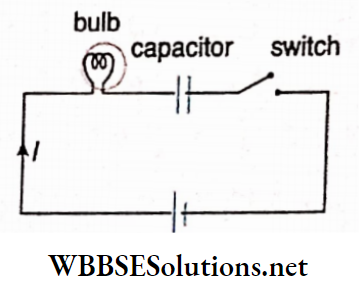
Class 12 Physics Unit 1 Electrostatics Chapter 4 Capacitance and Capacitor Multiple Choice Question And Answer 64

Hence when the switch is turned on, the intensity of the light from the bulb sharply increases initially and then decreases gradually with time.

The option 3 is correct

Question 67. The insulated plates of a charged parallel plate capacitor (with a small separation between the plates) are approaching each other due to electrostatic attraction. Assuming no other force to be operative and no radiation taking place, which of the following graphs approximately shows the variation with time (t) of the potential difference (V) between the plates?

Class 12 Physics Unit 1 Electrostatics Chapter 4 Capacitance and Capacitor Multiple Choice Question And Answer 65

Answer: 1

When the plates approach each other, the electric field remains constant in the region between the plates, but the voltage between the plates changes.

∴ From E = \(\frac{dV}{dv}\) we get, E x d = V

[d = distance between the plates, V” = potential difference between the plates and £ = electric field in the region between the plates]

E will remain the same, so V ∝ d

The electric force on each plate

⇒ \(F_e=\frac{q \times q}{2 \epsilon_0 A}\)

[Let, A = area of each plate, q = amount of charge]

∴ Acceleration of the plates

⇒ \(a=\frac{q^2}{2 A \epsilon_0 m}\) [m = mass ofeach plate]

So, the distance-time graphic case of uniform acceleration is shown in the figure. As V ∝ d the graph of V vs t is also similar.

The option 1 is correct

WBCHSE physics capacitance MCQs 

Question 68. A parallel plate capacitor is made of two circular plates separated by a distance of 5 mm and with a dielectric of 2.2 between them. When the electric field in the dielectric is 3 x 10⁻⁴ V/m, the charge density of the positive plate will be close to

  1. 6 x 10⁴ C/m2
  2. 6 X 10⁻⁷ C/m2
  3. 3 x 10⁻⁷ C/m2
  4. 3 x 10⁻⁴ C/m2

Answer: 2. 6 x 10⁻⁷ C/m2

Electric field, \(E=\frac{\sigma}{\kappa \epsilon_0}\)

∴ Charge density of the plate,

σ =k∈0E = 2.2 x 8.85 x 10-12 x 3 x 104

= 5.48 x 10⁻⁷ ≈ 6 x 10⁻⁷C/m2

The option 2 is correct.

Question 69. In the given circuit, charge Q2 on the 2μF capacitor changes as C is varied from 1μF to 3μF. Q2 as a function of C is given properly by (Figures are drawn schematically and are not to scale)


Class 12 Physics Unit 1 Electrostatics Chapter 4 Capacitance and Capacitor Multiple Choice Question And Answer 67

Class 12 Physics Unit 1 Electrostatics Chapter 4 Capacitance and Capacitor Multiple Choice Question And Answer 67.

Answer: 2

Equivalent capacitance of the 1μF and 2μF capacitors

= (1+2)

= 3μF

Then, equivalent capacitance ofthe circuit = \(\frac{3 C}{3+C}\)

Charge stored, \(Q=E \cdot \frac{3 C}{3+C}\)

then \(Q_2=\frac{2}{2+1} Q=\frac{2 E C}{C+3}=\frac{2 E}{1+\frac{3}{C}}\)

When C = 1μF, Q2 = \(\frac{E}{2}\)

when C = 3μF, Q2 = E; the value of Q2 increases.

For the mean value (2μF) ofthe capacitors, Q2 = \(\frac{4E}{5}\)

Mean value of \(\frac{E}{2}\) and E = \(\frac{\frac{E}{2}+E}{2}=\frac{3 E}{4}<\frac{4 E}{5}\)

Hence, the increase of Q2 with C is not linear; there is comparatively greater of Q2 in the beginning.

The option 2 is correct

Question 70. A combination of capacitors is set up as shown in the figure. The magnitude of the electric field due to a point charge Q (having a charge equal to the sum of the charges on the 4μF and 9μF capacitors), at a point of distance 30 m from it, would equal

Class 12 Physics Unit 1 Electrostatics Chapter 4 Capacitance and Capacitor Multiple Choice Question And Answer 68

  1. 240 N/C
  2. 360 N/C
  3. 420 N/C
  4. 480 N/C

Answer: 3. 420 N/C

The circuit can be simplified

Class 12 Physics Unit 1 Electrostatics Chapter 4 Capacitance and Capacitor Multiple Choice Question And Answer 68.

The charge stored on the 3μF capacitor in the second circuit = 3 x 8

= 24μC

So the same charge (24μC) will be stored on the 4μF and 12μF capacitors in the first circuit. Again 12μF is the equivalent capacitance for the 3μF and 9μF capacitors in parallel. If the charge stored on the 9μF capacitor is q, then

⇒ \(\frac{q}{9}=\frac{24-q}{3} \text { or, } q=18 \mu \mathrm{C}\)

∴ Q = 24 + 18

= 42μC

Hence the electric field at a distance of 30 m from Q charge

⇒ \(\frac{1}{4 \pi \epsilon_0} \frac{Q}{r^2}, \text { where } r=30 \mathrm{~m}\)

⇒ \(9 \times 10^9 \times \frac{42 \times 10^{-6}}{30^2}=420 \mathrm{~N} / \mathrm{C}\)

The option 3 is correct.

WBCHSE physics capacitance MCQs 

Question 71. A capacitance of 2.0 pF is required in an electrical circuit across a potential difference of 1.0 kV. A large number of lpF capacitors are available that can withstand a potential difference of not more than 300 V. The minimum number of capacitors required to achieve this is

  1. 2
  2. 16
  3. 24
  4. 32

Answer: 4. 32

⇒ \(\frac{1.0 \mathrm{kV}}{300 \mathrm{~V}}=\frac{1000}{300}=3.33\)

∴ The minimum number of capacitor combinations that should be connected in series is 4.

Class 12 Physics Unit 1 Electrostatics Chapter 4 Capacitance and Capacitor Multiple Choice Question And Answer 69

If the capacitance of each combination is x, then

⇒ \(\frac{4}{x}=\frac{1}{2}\) [since equivalent capacitance is 2μF]

∴ x = 8μF

Hence each combination of capacitors must contain 8 1μF capacitors connected in parallel.

Class 12 Physics Unit 1 Electrostatics Chapter 4 Capacitance and Capacitor Multiple Choice Question And Answer 69.

∴ Minimum number of capacitors required

=8 x 4

= 32

The option 4. is correct

Question 72. A parallel plate capacitor of capacitance 90 pF is connected to a battery of emf 20 V. If a dielectric material of dielectric constant k = \(\frac{5}{3}\) is inserted between the plates, the magnitude of the induced charge will be

  1. 2.4 nC
  2. 0.9 nC
  3. 1.2 nC
  4. 0.3 nC

Answer: 3. 1.2 nC

⇒ \(Q_i=C V ; Q_f=k C V\)

∴ \(Q_{\text {induced }}=Q_f-Q_i\)

=(k-1)CV

⇒ \(\left(\frac{5}{3}-1\right) \times 90 \times 10^{-12} \times 20\)

= 1.2 x 10⁻⁹C

= 1.2 nC

The option 3 is correct.

Real-Life Applications of Capacitors

Question 73. Two thin dielectric slabs of dielectric constants k1 and k2 (K1 < K2) is inserted between plates of a parallel plate capacitor, as shown in the figure. The variation of electric field F. between the plates with distance d ns measured from plate P Is correctly shown by

Class 12 Physics Unit 1 Electrostatics Chapter 4 Capacitance and Capacitor Multiple Choice Question And Answer 71

Class 12 Physics Unit 1 Electrostatics Chapter 4 Capacitance and Capacitor Multiple Choice Question And Answer 71.

Answer: Option 3 is correct

Electric field, \(E \propto \frac{1}{K}\)(k = dielectric constant)

k1 < k2

∴ E1 > E2

The option 3 is correct

WBCHSE physics capacitance MCQs 

Question 74. A parallel plate air capacitor of capacitance C is connected to a cell of emf V and then disconnected from it. A dielectric slab of dielectric constant K, which can just fill the air gap of the capacitor, is now inserted in it. Which of the following is incorrect?

  1. The potential difference between the plates decreases K times
  2. The energy stored in the capacitor decreases K times
  3. The change in energy stored is \(\frac{1}{2} C V^2\left(\frac{1}{K}-1\right)\)
  4. The charge on the capacitor is not conserved

Answer: 4. The charge on the capacitor is not conserved

If Q is the charge on the plate,

potential difference \((V)=\frac{Q}{C} ;\)

stored energy \((U)=\frac{1}{2} C V^2=\frac{1}{2} \frac{Q^2}{C}\)

After the dielectric slab is inserted,

capacitance, C’ = KC;

potential difference = \(\frac{Q}{kC}\)

i.e., the potential difference would decrease K times.

Again, stored energy,

⇒ \(U^{\prime}=\frac{1}{2} \frac{Q^2}{C^{\prime}}=\frac{1}{2} \frac{Q^2}{k C}\)

i.e, the stored energy also decreases k times,

Now, change stored energy

⇒ \(=U^{\prime}-U=\frac{1}{2} \frac{Q^2}{C}\left(\frac{1}{K}-1\right)=\frac{1}{2} C V^2\left(\frac{1}{K}-1\right)\)

Hence, options 1, 2, and 3 are correct

But the charge on the capacitor remains conserved in isolating conditions.

The option 4 is correct

Question 75. A capacitor of 2μF Is charged as shown In the diagram. When the switch S Is turned to position 2, the percentage of Its stored energy dissipated is

Class 12 Physics Unit 1 Electrostatics Chapter 4 Capacitance and Capacitor Multiple Choice Question And Answer 73

  1. 20%
  2. 75%
  3. 80%
  4. 0%

Answer: 3. 80%

The energy stored in the 2μF capacitor initially,

⇒ \(U_i=\frac{1}{2} \times 2 \times V^2=V^2\)

When the switch is turned to position 2, let V’ be the
voltage across each capacitor.

Total charge is conserved, so \(2 V=2 V^{\prime}+8 V^{\prime} \text { or, } V^{\prime}=\frac{V}{5}\)

Hence, the final energy storedin the two capacitors,

⇒ \(U_f=\frac{1}{2} \times 2 \times \frac{V^2}{25}+\frac{1}{2} \times 8 \times \frac{V^2}{25}=\frac{V^2}{5}\)

∴ Percentage of stored energy dissipated

⇒ \(=\frac{U_i-U_f}{U_f} \times 100 \%=\frac{V^2-\frac{V^2}{5}}{V^2} \times 100 \%=80 \%\)

The option 3 is correct

Conceptual Questions on Energy Stored in Capacitors

Question 76. A parallel plate capacitor is to be designed, using a dielectric of dielectric constant 5, so as to have a dielectric strength of 109 V.m-1. If the voltage rating of the capacitor is 12 kV, the minimum area of each plate required to have a capacitance of 80 pF is,q

  1. 10.5 x 10⁻⁶ m2
  2. 21.7 x 10⁻⁶ m2
  3. 25.0 x 10⁻⁵ m2
  4. 12.5 x 10⁻⁵ m2

Answer: 2. 21.7 x 10⁻⁶ m2

Capacitance, \(C=\frac{\epsilon_0 k A}{d} \quad \text { or, } A=\frac{C d}{\epsilon_0 k}\)

Given, \(k=5 ; E=\frac{V}{d} \quad \text { or, } d=\frac{V}{E}\)

∴ \(A=\frac{C V}{\epsilon_0 k E}=\frac{\left(80 \times 10^{-12}\right) \times\left(12 \times 10^3\right)}{\left(8.85 \times 10^{-12}\right) \times 5 \times 10^9}\)

= 21.7 c 10-6m2

The option 2 is correct

WBCHSE physics capacitance MCQs 

Question 77. The electrostatic force between the metal plates of an isolated parallel plate capacitor C having a charge Q and area A, is

  1. Proportional to the square root of the distance between the plates
  2. Linearly proportional to the distance between the plates
  3. Independent of the distance between the plates
  4. Inversely proportional to the distance between the plates

Answer: 3. Independent of the distance between the plates

Let the distance between the two plates of the parallel plate capacitor = d

Class 12 Physics Unit 1 Electrostatics Chapter 4 Capacitance and Capacitor Multiple Choice Question And Answer 75

The electrostatic force between the metal plates

⇒ \(F=Q E=Q \cdot \frac{\sigma}{2 \epsilon_0}=Q \cdot\left(\frac{Q}{A}\right) \cdot \frac{1}{2 \epsilon_0}=\frac{Q^2}{2 A \epsilon_0}\)

Hence the electrostatic force does not depend on the distance between the plates.

The option 3 is correct.

Question 78. A capacitor C1 of capacitance 5μF Is charged to a potential of 100 V and another capacitor C2 of capacitance 8μF is charged to 50 V. The positive and negative plates are Mutually connected.

1. The final potential of the combination of the two capacitors will be

  1. \(\frac{500}{3}\)V
  2. \(\frac{900}{3}\)V
  3. 150V
  4. 50V

Answer: 2. \(\frac{900}{3}\)V

2. The amount of charge of the capacitor C1 after combination will be

  1. \(\frac{4500}{13} \mu \mathrm{C}\)
  2. \(\frac{7200}{13} \mu \mathrm{C}\)
  3. \(\frac{2700}{13} \mu \mathrm{C}\)
  4. \(\frac{11700}{13} \mu \mathrm{C}\)

Answer: 1. \(\frac{4500}{13} \mu \mathrm{C}\)

3. The amount of charge of the capacitor C2 after combination will be

  1. 4500μC
  2. 7200μC
  3. \(\frac{4500}{13} \mu \mathrm{C}\)
  4. \(\frac{7200}{13} \mu \mathrm{C}\)

Answer: 4. \(\frac{7200}{13} \mu \mathrm{C}\)

4. Energy loss will be

  1. 3.11 x 10⁻¹³ J
  2. 35 x 10-2 J
  3. 3.9 x 10⁻¹³ J
  4. 7.8 x 10⁻⁵ J

Answer: 3. 3.9 x 10⁻¹³ J

Question 79. A parallel plate capacitor of plate area 0.2 m2 and spacing 10-2 m is charged to 103 V and is then disconnected from the battery

1. If the plates are pulled apart to double the plate spacing capacitance of the capacitor will be

  1. 44.25 pF
  2. 88.5 pF
  3. 120.45 pF
  4. 22.12 pF

Answer: 2. 88.5 pF

2. The amount of work required to double the plate spacing is

  1. 8.85 x 10⁻⁵ J
  2. 17.7 x 10-51 J
  3. 4.42 x 10⁻⁵ J
  4. 26.55 x 10⁻⁷ J

Answer: 1. 8.85 x 10⁻⁵ J

3. The final voltage of the capacitor will be

  1. 103V
  2. 4 x 10³ V
  3. 2 x 10³ V
  4. 106V

Answer: 3. 2 x 10³ V

WBCHSE physics capacitance MCQs 

Question 80. A spherical drop of water carries a charge of 10 x 10-12 C and has a potential of 100V at its surface

1. The radius of the drop will be

  1. 9 x 10⁻³ m
  2. 9 x 10⁻⁵ m
  3. 9 x 10⁻² m
  4. 9 x 10⁻⁴ m

Answer: 4. 9 x 10⁻⁴ m

2. If eight such charged drops as mentioned above, combine to form a single drop, the potential at the surface of the new drop will be

  1. \(\frac{4}{3}\)
  2. 400 V
  3. 200 V
  4. 300 V

Answer: 2. 400 V

Question 81. Two capacitors of capacity 6μF and 3μF are charged to 100 V and 50 V separately and connected to a 200 V battery using three switches. Now all three switches S1, S2, and S3 are closed.

Class 12 Physics Unit 1 Electrostatics Chapter 4 Capacitance and Capacitor Multiple Choice Question And Answer 57

1. Which plates form an isolated system?

  1. Plates 1 and 4 separately
  2. Plates 2 and 3 separately
  3. Plates 1 and 4 jointly
  4. Plates 2 and 3 jointly

Answer: 4. Plates 2 and 3 jointly

2. Charges on 6μF and 3μF capacitors in steady state will be

  1. 400μC, 400μC
  2. 700μC, 250μC
  3. 800μC, 350μC
  4. 300μC, 450μC

Answer: 2. 700μC, 250μC

3. Suppose q1, q2, and q3 are the magnitudes of charges that flow through switches S1, S2 and S3 after they are closed. Then

  1. q1 = q3 and q2 = 0
  2. q1 = q3 = \(\frac{q_2}{2}\)
  3. q1 = q3 = 2q2
  4. q1 = q2 = q3

Answer: 4. q1 = q2 = q3

WBCHSE Class 12 Physics Capacitance And Capacitor Short Answer Questions

WBCHSE Class 12 Physics Capacitance

WBCHSE Class 12 Physics Capacitance And Capacitor Short Question And Answers

Question 1. In a parallel plate capacitor with air between the plates, each plate has an area of 6 x 10⁻³ m2 and the distance between the plates is 3mm. Calculate the capacitance of the capacitor. If this capacitor is connected to a 100 V supply, what is the charge on each plate of the capacitor?
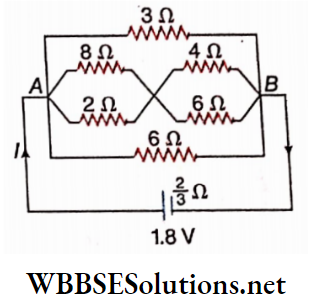
Answer:

α = 6 x 10⁻³ m2, d = 3 mm = 3 x 10⁻³ m, V = 100 V

⇒ \(C_0=\frac{\epsilon_0 \alpha}{d}=\frac{\left(8.85 \times 10^{-12}\right)\left(6 \times 10^{-3}\right)}{3 \times 10^{-3}}\)

= 177 x 10-11 F

q = 10 V

= 1.77 x 10-11 x 100

= 1.77 x 10⁻⁹ C

Read And Learn More WBCHSE Class 12 Physics Short Question And Answers

Question 2. Explain what would happen if the capacitor in Q.1, a 3 mm thick mica sheet (dielectric constant= 6) were inserted between the plates while the voltage supply remained connected.
Answer:

While the voltage supply remained connected, the voltage remained constant.

Capacity increases to

C’ = kC0

= 6 x 1.77 x 10-11F

= 1.062 x 10⁻¹⁰ F

Charge increases to

q’ = C’V

= 1.062 x 10-10 x 102C

= 1.062 x 10⁻⁸C

Class 12 Physics Capacitor Questions 

Question 3. A 600 pF capacitor is charged by a 200 V supply.It is then disconnected from the supply and is connected to another uncharged 600 pF capacitor. How much electrostatic energy is lost in the process?
Answer:

Here, C = 600 pF and V = 200 V.

∴ E = \(\frac{1}{2}\) CV²

= \(\frac{1}{2}\) x 600 x 10-12 x (200)²

= 12 X 10-6 J

When this capacitor is connected with another capacitor of the same capacity, the potential will be shared equally and the capacitance will be added.

∴ V’ = \(\frac{V}{2}\) 100 V and C’ = 2C = 1200 x 10-12F

∴ \(E^{\prime}=\frac{1}{2} C^{\prime} V^{\prime 2}\)

= \(\frac{1}{2} \times 1200 \times 10^{-12} \times(100)^2\)

= 6 x 10⁻⁶ J

Loss of electrostatic energy

= E- Ef

= (12-6) x 10-6 J

= 6 x 10⁻⁶ J

Class 12 Physics Capacitor Questions 

Question 4. An electric technician requires a capacitance of 2μF in a circuit across a potential difference of 1 kV. A large number of 1μF capacitors are available to him each of which can withstand a potential difference of not more than 400 V. Suggest a possible arrangement that requires the minimum number of capacitors.
Answer:

Let a combination of capacitors be arranged in which m rows with n capacitors each are connected in parallel.

∴ 400n = 1000 [∴ lkV = 1000 V]

or, n = \(\frac{1000}{400}=2.5 \approx 3\)

The equivalent capacity of each row

⇒ \(C=\frac{1}{\frac{1}{1}+\frac{1}{1}+\frac{1}{1}} \mu \mathrm{F}=\frac{1}{3} \mu \mathrm{F}\)

The equivalent capacitance of m such connected in parallel should be 2μF.

But Ceq= mC

∴ \(m=\frac{C_{\mathrm{eq}}}{C}=\frac{2}{1 / 3}=6\)

Total number of capacitors

= 3 x 6

= 18

They should be arranged in 6 rows having 3in each row and connected in parallel.

Question 5. The plates of a parallel plate capacitor have an area of 90 cm2 each and are separated by 2.5 mm. The capacitor is charged by connecting it to a 400 V supply.

  1. How much electrostatic energy is stored by the capacitor?
  2. View this energy as stored in the electrostatic field between the plates and obtain the energy per unit volume(u).
  3. Arrive at a relation between u and the magnitude of the electric field between the two plates.

Answer:

Capacitance,

⇒ \(C=\frac{\epsilon_0 \alpha}{d}\)

= \(\frac{8.854 \times 10^{-12} 90 \times 10^{-4}}{2.5 \times 10^{-3}}\)

= \(3.187 \times 10^{-11} \mathrm{~F}\)

1. Stored energy = \(\frac{1}{2} C V^2=\frac{1}{2} \times 3.187 \times 10^{-11} \times 400^2\)

= 2.55 X 10⁻⁶ J

2. Energy per unit volume,

⇒ \(u=\frac{2.55 \times 10^{-6}}{90 \times 10^{-4} \times 2.5 \times 10^{-3}}=0.113 \mathrm{~J} \cdot \mathrm{m}^{-3}\)

3. \(=\frac{\frac{1}{2} C V^2}{\alpha d}=\frac{1}{2} \frac{C}{\alpha d} \cdot(E d)^2\left[∵ E=\frac{V}{d}\right]\)

⇒ \(\frac{1}{2} \cdot \frac{\epsilon_0 \alpha}{d} \cdot \frac{E^2 d^2}{\alpha d}=\frac{1}{2} \epsilon_0 E^2\)

WBCHSE Class 12 Physics Capacitance And Capacitor Short Answer Questions

Class 12 Physics Capacitor Questions 

Key Concepts in Capacitors Short Answers

Question 6. Show that the force on each plate of a parallel plate capacitor has a magnitude equal to \(\frac{1}{2}\)QE, where Q is the charge on the capacitor and E is the magnitude of the electric field between the plates. Explain the origin of the factor\(\frac{1}{2}\).
Answer:

Let the application of force F increase the distance between the plates by Δx.

∴ Work done by the external force =F.Δx

This increases the energy.

∵ Energy density = u

So, increase in energy = u(αΔx) [α = area of the plate]

F- Δx = uα Δx

or, F = uα

∴ \(F=\frac{1}{2} \epsilon_0 E^2 \cdot \alpha \quad\left[∵ u=\frac{1}{2} \epsilon_0 E^2\right]\)

∴ \(F=\frac{1}{2} \epsilon_0 \alpha E \cdot E=\frac{1}{2} Q E\)

The factor \(\frac{1}{2}\) arises in this relation due to the fact that average \(\frac{E}{2}\) of 0 (field inside the conductor) and E (field outside the conductor) is taken.

Question 7.

1. What meaning would you give to the capacitance of a single conductor?

2. Guess a possible reason why water has a much greater dielectric constant (= 80) than say, mica (= 6).

Answer:

1. A single conductor may be considered as a capacitor whose second plate is situated at infinity.

2. Water molecules are polar molecules. Hence these molecules have their own dipole moments which contributes to the high value of its dielectric constant. But the molecules of mica are not polar

Question 8. In a Van de Graaff generator a spherical metal shellin to be a 15 x 106 V electrode. The dielectric strength of the gas surrounding the electrode is 5 x 10⁷ V.m-1. What is the minimum radius of the spherical shell required?
Answer:

Minimum radius of the shell,

⇒ \(=\frac{V}{E} \doteq \frac{15 \times 10^6}{5 \times 10^7}\)

= 3 x 10⁻¹ m

=30 cm

This result shows why an electrostatic generator which requires a small charge to acquire a high potential cannot be built with a very small shell.

Question 9. One evening a man fixes a two-metre high insulating slab carrying on its top a large aluminium sheet of area 1 m2 outside his house. Will he get an electric shock if he touches the metal sheet the next morning?
Answer:

Yes, the earth, the aluminum sheet with the dielectric slab in between will form a capacitor. The potential of the aluminum sheet will rise due to the downpour of atmospheric charge during the night. When a person touches the sheet, the accumulated charge will flow through his body to Earth. This will constitute an electric current and the person will experience an electric shock.

Short Answer Questions on Capacitor Functions

Question 10. Two capacitors of capacitances 5μF and 10 juF are charged to 16 V and 10 V respectively. Find what will be the common potential when they are connected in parallel to each other.
Answer:

Initially, the charge on the first capacitor,

Q1 = C1V1

= (5 x 10-6) x 16

= 80 x 10-6 C

and charge on the second capacitor,

Q2 = C2V2

= (10 x 10-6) x 10

= 100 x 10-6 C

∴ Net charge, Q = Q1 + Q2

= 180 x 10-6 C

Equivalent capacitance of the parallel combination,

C = C1 + C2

= (5 + 10)μF

= 15 x 10-6 F

∴ The common potential of the combination,

⇒ \(V=\frac{Q}{C}=\frac{180 \times 10^{-6}}{15 \times 10^{-6}}=12 \mathrm{~V}\)

Capacitance and Capacitor Class 12 Notes 

Question 11. What is understood by the capacitance of a capacitor? A 900 pF capacitor is charged to 100 V by a battery. How much energy is storedin the capacitor?
Answer:

C = 900 pF

=900 x 10-12F

=9 X 10⁻¹⁰F

∴ Stored energy \(\frac{1}{2} C V^2=\frac{1}{2} \times\left(9 \times 10^{-10}\right) \times 100^2\)

= 4.5 x 10⁻⁶J

Question 12. A glass slab is introduced between the plates of a parallel plate capacitor. Does the capacitance of the capacitor increase, decrease, or remain unchanged? Two capacitors of capacitance 5μF and 10μF are charged to 16 V and 10 V respectively. Find the common potential when they are connected in parallel.
Answer:

Due to the insertion of a glass slab between the plates of a parallel plate capacitor, the capacitance will increase. If K is the dielectric constant of a glass slab, its capacitance will be K times its previous value.

Question 13. 64 identical water drops coalesce to form a larger drop. If the nature and amount of charge are the same for all the drops, calculate the potential, capacitance, and stored energy of the larger drop.
Answer:

Let the radii of small and large drops be r and R respectively and the charge of each small drop be Q.

According to the question,

⇒ \(\frac{4}{3} \pi R^3=64 \times \frac{4}{3} \pi r^3\)

or, R = 4r

Potential ofsmall drop, V = \(\frac{Q}{r}\)

or, Q = Vr

Potential of large drop, \(V^{\prime}=\frac{64 Q}{R}=\frac{64 V r}{4 r}\)

= 16V

i.e., the potential of a large drop will be 16 times the potential of a small drop.

As the radius of the large drop is 4r, its capacitance, C = 4r.

The energy storedin the large drop,

⇒ \(E=\frac{1}{2} C V^{\prime 2}=\frac{1}{2} \times 4 r \times(16 V)^2\)

= 512rV²

Common Questions on Capacitance Explained

Question 14. Deduce the expression for the electrostatic energy storedin a capacitor of capacitance C and having charge Q. How will the electric field inside the capacitor be affected when it is completely filled with a dielectric material of dielectric constant K?
Answer:

When the capacitor is filled completely with a dielectric material of dielectric constant K, then capacitance becomes, C’ = kC.

∴ Changed potential difference,

⇒ \(V^{\prime}=\frac{Q}{C^{\prime}} \quad[… Q=\text { constant }]\)

⇒ \(\frac{Q}{K C}=\frac{V}{K}\)

∴ Changed electric field,

⇒ \(E^{\prime}=\frac{V^{\prime}}{d}=\frac{V}{\kappa d}=\frac{E}{K}\)

∴ The final electric field will be \(\frac{1}{k}\) times of its previous value.

Class 11 Physics Class 12 Maths Class 11 Chemistry
NEET Foundation Class 12 Physics NEET Physics

Capacitance and Capacitor Class 12 Notes 

Question 15. A slab of material of dielectric constant K has the same area as that of the plates of a parallel plate capacitor but has the thickness d/2, where d is the separation between the plates. Find out the expression for its capacitance when the slab is inserted between the plates of the capacitor
Answer:

Before insertion of the dielectric slab,

⇒ \(C_1=\frac{\epsilon_0 \alpha}{d}[\alpha=\text { area of each plate }]\)

After insertion of a dielectric slab of thickness t,

⇒ \(C_2=\frac{\epsilon_0 \alpha}{d-t\left(1-\frac{1}{k}\right)}\)

= \(\frac{\epsilon_0 \alpha}{d-\frac{d}{2}\left(1-\frac{1}{k}\right)}\left[∵ t=\frac{d}{2}\right]\)

⇒ \(=\frac{\epsilon_0 \alpha}{d\left(\frac{1}{2}+\frac{1}{k}\right)}\)

= \(\frac{C_1}{(\frac{1}{2}+\frac{1}{k})}[∵ C_1]\)

= \(\frac{\epsilon_0 \alpha}{d}\)

Question 16. A parallel plate capacitor of capacitance C is charged to a potential V. It is then connected to another uncharged capacitor having the same capacitance. Find out the ratio of the energy stored in the combined system to that stored initially in the single capacitor.
Answer:

Let the charge on the charged capacitor be Q.

∴ Energy stored,

⇒ \(U_1=\frac{Q^2}{2 C}\)

when another uncharged similar is connected with the first capacitor, the charge on the system remains

constant and the capacitance becomes C1 = 2C.

∴ The energy stored in the system

⇒ \(U_2=\frac{Q^2}{4 C}\)

∴ \(U_2: U_1=\frac{Q^2}{4 C}: \frac{Q^2}{2 C}=1: 2\)

WBCHSE Physics Chapter 2 Solutions 

Question 17. Two capacitors of capacitance 10μF and 20μF are connected in series with a 6 V battery. After the capacitors are fully charged, a slab of dielectric constant (AT) is inserted between the plates of the two capacitors. How will the following be affected after the slab is introduced?

  1. The potential difference between the plates of the capacitors
  2. The charges on the two capacitors
  3. The electric field energy storedin the capacitors

Answer:

Here, equivalent capacitance,

⇒ \(C_{\text {eq }}=\frac{C_1 C_2}{C_1+C_2}\)

= \(\frac{10 \times 10^{-6} \times 20 \times 10^{-6}}{(10+20) \times 10^{-6}}\)

= 6.67 x 10⁻⁶F

Hence, the charge becomes

∴ Q = CeqV

= 6.67 x 10-6 x 6

= 4 x 10⁻⁵C

Now, \(V_1=\frac{Q}{C_1}=\frac{4 \times 10^{-5}}{10 \times 10^{-6}}=4 \mathrm{~V}\)

⇒ \(V_2=\frac{Q}{C_2}=\frac{4 \times 10^{-5}}{10 \times 10^{-6}}=2 \mathrm{~V}\)

1. The potential difference between the plates of the capacitors would not change since the plates would attain the same potential as long as the battery is connected.

∴ V’1 = 4V and V’2 = 2V

2. After the dielectric slab is introduced, the capacitance becomes,

C’ = kC

Now, Q = CV

∴ Q’ = C’V = kCV = KQ

Hence, Q’1 = QkC

= (4 x 10⁻⁵)k C

Q’2 = (4 x 10⁻⁵)kC

3. The electric field energy stored in the capacitors,

⇒ \(U=\frac{1}{2} C V^2\)

∴ \(U_1=\frac{1}{2} C_1 V_1^2=\frac{1}{2} \times\left(10 \times 10^{-6}\right) \times(4)^2\)

= 8 x 10⁻⁵J

⇒ \(U_2=\frac{1}{2} C_2 V_2^2=\frac{1}{2} \times\left(20 \times 10^{-6}\right) \times(2)^2\)

= 4 x 10⁻⁵J

After the introduction of the dielectric slab,

⇒ \(U_1^{\prime}=\kappa U_1=\left(8 \times 10^{-5}\right) \kappa \mathrm{J}

and U_2^{\prime}=\kappa U_2=\left(4 \times 10^{-5}\right) \kappa \mathrm{J}\)

WBCHSE Physics Chapter 2 Solutions 

Practice Short Questions on Energy Stored in Capacitors

Question 18. A capacitor of capacitance C is charged fully by connecting it to a battery of emf E. It is then disconnected from the battery. If the separation between the plates of the capacitor is now doubled, how will the following change?

  1. Charge stored by the capacitor
  2. Field strength between the plates
  3. Energy stored by the capacitor

Answer:

For the capacitor:

1. The charge stored on the capacitor does not change because of the law of conservation of charges.

2. The field strength between the plates is,

⇒ \(E=\frac{\sigma}{\epsilon_0}=\frac{Q}{A \epsilon_0}\)

Hence, we see that the field strength is independent of the distance between the plates. So, the field strength also remains the same.

3. The energy storedin the capacitor is,

⇒ \(U=\frac{Q^2}{2 C}\)

Now, when the distance between the plates is doubled, the capacitance becomes half. Hence, the energy stored will also double.

Question 19. 

1. Find the equivalent capacitance between A and the combination given below. Each capacitor is of 2μF capacitance.

Class 12 Physics Unit 1 Electrostatics Chapter 4 Capacitance and Capacitor equivalent capacitance

Capacitance and Capacitor Short Questions 

2. If a source of 7 V is connected across AB, how much charge is drawn from the source and what is the energy storedin the network?

Answer:

1. In the circuit C2, C3 and C4 are in parallel combination.

Cp = C2 + C3 + C4

= 2 + 2 + 2

= 6μF

Class 12 Physics Unit 1 Electrostatics Chapter 4 Capacitance and Capacitor equivalent capacitance.

∴ Equivalent capacitance between A and B,

\(\frac{1}{C_{\text {eq }}}=\frac{1}{C_1}+\frac{1}{C_P}+\frac{1}{C_5}=\frac{1}{2}+\frac{1}{6}+\frac{1}{2}=\frac{7}{6}\)

or, \(C_{\mathrm{eq}}=\frac{6}{7}=0.86 \mu \mathrm{F}\)

2. \(Q=C_{\mathrm{eq}} V=0.86 \times 7=6 \mu \mathrm{C}\)

Energy \(E=\frac{1}{2} Q V=\frac{1}{2} \times 6 \times 7=21 \mu \mathrm{J}\)

Conceptual Questions on Dielectrics and Capacitance

Question 20. A 12 pF capacitor is connected to a 50 V battery. How much electrostatic energy is stored in the capacitor? If another capacitor of 6 pF is connected in series with it with the same battery connected across the combination, find the charge stored and the potential difference across each capacitor.
Answer:

Electrostatic energy storedin the capacitor,

⇒ \(U=\frac{1}{2} C V^2=\frac{1}{2} \times 12 \times 10^{-12} \times(50)^2=1.5 \times 10^{-8} \mathrm{~J}\)

When 6 pF is connected in series with 12 pF, the charge is stored across each capacitor,

⇒ \(Q=\frac{C_1 C_2}{C_1+C_2} V=\frac{12 \times 6 \times 10^{-24}}{(12+6) \times 10^{-12}} \times 50=200 \mathrm{pC}\)

The potential difference across 12 pF is,

⇒ \(\frac{Q}{C_1}=\frac{200 \times 10^{-12}}{12 \times 10^{-12}}=16.67 \mathrm{~V}\)

The potential difference across 6 pF is,

⇒ \(\frac{Q}{C_2}=\frac{200 \times 10^{-12}}{6 \times 10^{-12}}=33.33 \mathrm{~V}\)

Capacitance and Capacitor Short Questions 

Question 21. Two identical capacitors of 12 pF each are connected in series across a battery of 50 V. How much electrostatic energy is stored in the combination? If these were connected in parallel across the same battery, how much energy would be stored in the combination now? Also, find the charge drawn from the battery in each case.
Answer:

For two identical capacitors connected in series, electrostatic energy is stored,

⇒ \(U_s=\frac{1}{2} C_s V^2\)

⇒ \(C_s=\frac{C_1 C_2}{C_1+C_2}=\frac{12 \times 12}{12+12}=6 \mathrm{pF} ; V=50 \mathrm{~V}\)

∴ \(U_s=\frac{1}{2} \times 6 \times 10^{-12} \times(50)^2=7.5 \mathrm{~nJ}\)

For two identical capacitors connected in parallel, electrostatic energy stored,

⇒ \(U_p=\frac{1}{2} C_p V^2\)

∴ \(U_p=\frac{1}{2} \times 24 \times 10^{-12} \times(50)^2=30 \mathrm{~nJ}\)

Charge drawn from the battery for a series combination of two identical capacitors,

Qs = CsV

= 6 x 10-12 x 50

= 300 pc

Charge drawn from the battery for a parallel combination of two capacitors,

Qp = CpV

= 24 X 10-12 x 50

= 1200 pC

Capacitance and Capacitor Short Questions 

Question 22. Two identical parallel plate capacitors A and B are connected to a battery of V volt with switch S closed. The switch is now opened and the free space between the plates of the capacitors is filled with a dielectric of dielectric constant K. Find the ratio of the total electrostatic energy stored in both capacitors before and after the introduction of the dielectric


Capacitance and Capacitor Two identical parallel plate capacitors

Answer:

Initially, when the switch is closed, both the capacitors A and B are in parallel, and the energy storedin the capacitors is,

⇒ \(U_i=2 \times \frac{1}{2} C V^2=C V^2\)…(1)

When switch S is opened, B gets disconnected from the battery. Then capacitor B is isolated, and the charge on an isolated capacitor remains constant.

On the other hand, A remains connected to the battery and so the potential V remains constant.

When the capacitors are filled with dielectric, their capacitance increases to KC. Therefore, energy storedin B changes to \(\frac{Q^2}{2 \kappa C}\), where Q = CV is the charge on B. Energy storedin A changes to \(\frac{1}{2} \kappa C V^2\). Thus, the final total energy storedin the capacitor is,

⇒ \(U_f=\frac{1}{2} \frac{(C V)^2}{\kappa C}+\frac{1}{2} \kappa C V^2=\frac{1}{2} C V^2\left(\kappa+\frac{1}{k}\right)\)….(2)

From equations (1) and (2), we find

⇒ \(\frac{U_i}{U_f}=\frac{2 \kappa}{\kappa^2+1}\)

WBCHSE Class 12 Physics Capacitance And Capacitor Question and Answers

Class 12 Physics Capacitance And Capacitor  Long Questions and Answers

Question 1. What is meant by the 1μF capacitance of a capacitor?
Answer:

By the statement, we mean that, to build up a potential difference of 1 volt between the two plates of the capacitor, 1μC = 10-6 coulomb of charge is to be given to its insulated plate.

Question 2. What is meant by the statement that the dielectric constant of water is 80?
Answer:

By this statement, we mean that the capacitance of a capacitor will become 80 times if water is used as a dielectric instead of air between its plates.

Question 3. Two conductors have equal amounts of the same type
of charge. Can there be a difference of potential between them?
Answer:

Potential of a conductor \(=\frac{\text { charge }}{\text { capacitance }}\)

So, in spite of the fact that the two conductors have equal charge, their potentials may not be equal if they have different capacitances. There may exist a potential difference between them.

Question 4. Two copper spheres have the same radius. One of them is hollow and the other is solid. If they are charged to same potential, which sphere will hold a greater amount of charge?
Answer:

The capacitance of a hollow or of a solid sphere placed in air is proportional to its radius. In this example, the capacitances of both spheres are equal. Again amount of charge = capacitance x potential. So, if the two spheres are charged to the same potential, they will hold the same amount of charge.

WBCHSE Class 12 Physics Capacitance And Capacitor Question and Answers

WBBSE Class 12 Capacitor Q&A

Question 5. What are the advantages of using a solid insulator as a dielectric of a capacitor?
Answer:

1. The value of the dielectric constant (x) of a solid dielectric is large. So, the capacitance increases many times.

2. The two plates of the capacitor cannot come in contact with each other.

3. The capacitor can be charged to a higher potential.

Question 6. Is it possible to charge a capacitor to any high potential at will?
Answer:

It is not possible to charge a capacitor to any high potential at will. Because, as the potential applied to it becomes high enough, the insulation of the intervening medium breaks down. So, the electric discharge takes place between the capacitor and the intervening medium and also between the two plates.

Question 7. The potential of plate A of a parallel plate capacitor is zero and its other plate B is maintained at a potential +V. How does the potential vary from point to point between these plates? Neglect the end effect.
Answer:

Let the potential of a point at a distance x from the plate A be V’ and the intensity of the electric field be E, then

⇒ \(E=\frac{V^{\prime}}{x} \quad \text { or, } V^{\prime}=E x\)

The intensity of the electric field (E) in the space between the two plates is a constant.

∴ \(V^{\prime} \propto x\)

i.e., the potential V’ increases uniformly with x. So, the graph of variation of potential with distance from A to B is a straight line passing through the origin.

Class 12 Physics Unit 1 Electrostatics Chapter 4 Capacitance and Capacitor Question 7 parallel plate capacitor

Question 8. The dielectric constant of water is very high. Yet why is water not used as a dielectric in a capacitor?
Answer:

Only pure water is a good insulator. But, impure water acts as an electrolytic conductor. So, water is not suitable as a dielectric in a capacitor. Also, water is a liquid and so it is inconvenient to use it as a dielectric in a capacitor as it can spill.

Question 9. Two protons A and B are placed in between the two plates of a parallel plate capacitor charged to a potential difference V. Are the forces on the two protons equal?

Class 12 Physics Unit 1 Electrostatics Chapter 4 Capacitance and Capacitor Question 9 two plates of a parallel
Answer:

The electric field in between the two plates of a parallel plate capacitor charged to a potential difference V is uniform everywhere. So equal forces will act on the two protons.

Short Answer Questions on Capacitance

Question 10. If a soap bubble is electrified, will its shape be changed? If so, how will the potential of the bubble change?
Answer:

A soap bubble is considered a spherical conductor. When it is electrified, the charge distribution on its surface will have a repelling effect. Hence, the radius of the bubble increases. The capacitance of a spherical conductor varies with its radius, but it still remains spherical. So, the capacitance of the charged bubble increases.

The potential, \(V=\frac{\text { charge }}{\text { capacitance }}\); if the charge remains constant, the potential of the bubble will decrease the potential of the bubble will decrease.

Question 11. A capacitor is charged with a battery and then disconnected. A dielectric slab Is then inserted between the plates. How are the

  1. Charge
  2. Capacitance
  3. Potential difference
  4. The stored energy related to the capacitor affected?

Answer:

1. Since the capacitor remains disconnected from the battery, t the amount of charge on the capacitor will not change.

2. Due to the insertion of the dielectric slab between the plates, the capacitance will Increase. If K be the dielectric constant of the slab, its capacitance will be K times its previous value.

3. As V = \(\frac{Q}{C}\) and Q = constant,

we have \(V \propto \frac{1}{C}\).

So the potential difference is reduced.

The final potential difference will be \(\frac{1}{k}\) times of its previous value.

4. Energy stored in the capacitor,

⇒ \(U=\frac{1}{2} \frac{Q^2}{C} ; \text { so, } U \propto \frac{1}{C} \text { as } Q=\text { constant. }\)

Due to the insertion of the dielectric slab, the amount of energy stored is reduced. The final energy stored in the capacitor will be \(\frac{1}{k}\) times of its previous value.

Common Questions on Capacitance with Answers

Question 12. A capacitor is charged by a battery and then disconnected. How are the capacitance, potential difference and stored energy related to the capacitor affected if

  1. The distance between the plates is decreased or
  2. The plates are connected by a metallic wire.

Answer:

The capacitance of a parallel plate capacitor,

⇒ \(C=\frac{\kappa \epsilon_0 \alpha}{d}\)

1. If the distance between the plates is decreased, the capacitance C of the capacitor will increase. Since the charge remains constant, due to the increase of capacitance, the potential difference between the plates ( V = \(\frac{Q}{C}\)) and the energy stored in the capacitor \(\left(U=\frac{1}{2} \frac{Q^2}{C}\right)\) will decrease.

2. If the plates of the charged capacitor are connected by a metallic wire, the capacitor will be discharged immediately. It will not act as a capacitor any more. The potential difference between the plates of the capacitor as well as the energy stored will be zero.

Question 13. A mica slab of thickness equal to the distance between the two plates of a parallel plate air capacitor is Inserted in the space between the plates. Explain the changes in capacitance in the following cases:

  1. When the mica slab is Inserted partially;
  2. When the space between the plates of the capacitor is totally filled by the mica slab.

Answer:

1. The partial insertion of the mica slab in the space between the plates of the parallel plate air capacitor. Let the area of the plates of the capacitor be a; the area of the mica slab inside the capacitor be < a); the distance between the plates of the capacitor be d and the dielectric constant of mica be K.

Class 12 Physics Unit 1 Electrostatics Chapter 4 Capacitance and Capacitor Question 13 A mica slab of thickness equal

Therefore, total capacitance of the capacitor, C = capacitance of parallel plate capacitor of area α1 with mica as dielectric + capacitance of parallel plate air capacitor of area (α – α1)

⇒ \(\frac{\epsilon_0 \kappa \alpha_1}{d}+\frac{\epsilon_0\left(\alpha-\alpha_1\right)}{d}=\frac{\epsilon_0 \alpha}{d}+\frac{\epsilon_0 \alpha_1(\kappa-1)}{d}\)

So due to the partial insertion of the mica slab, the capacitance increases by

⇒ \(\frac{\epsilon_0 \alpha_1(k-1)}{d}\)

2. The capacitance will be \(\frac{\epsilon_0 \kappa \alpha}{d}\)

Class 11 Physics Class 12 Maths Class 11 Chemistry
NEET Foundation Class 12 Physics NEET Physics

Question 14. A parallel plate air capacitor is connected to a battery. Its charge, potential difference, electric field and the stored energy between the plates are Q0, V0, E0 and U0 respectively. Keeping the battery connection unchanged, the capacitor is completely filled with a dielectric material. The charge, potential difference, electric field and energy stored become Q, V, E and U respectively. Which of the following is correct?

  1. Q > Q0
  2. V> V0,
  3. E > E0
  4. U > U0

Answer:

1. When the dielectric material is inserted in the capacitor, its capacitance increases. As the capacitor is still connected to the battery, so its voltage will remain constant.

Since, charge = capacitance x voltage, so Q > Q0.

2. Since the capacitor remains connected to the battery its voltage remains constant.

Hence, V > V0 is not correct.

3. Since voltage and distance between the plates remain consistent, so electric field remains constant.

Hence, E > E0 is not correct.

4. Energy stored in a capacitor

= \(\frac{1}{2}\) x capacitance x (voltage)²

Since the voltage of the capacitor remains constant but its capacitance increases, so the energy storedin the capacitor will increase.

Hence, U > U0 is correct.

Question 15. If an uncharged capacitor is connected to a battery, then show that half of the energy supplied by the battery to charge the capacitor is dissipated as heat.
Answer:

Let a capacitor of capacitance C be connected to a battery of emf V.

The final charge on the capacitor, Q = CV

The work done by the battery to fully charge the capacitor, W = VQ

So energy supplied by the battery = VQ

The energy storedin the fully charged capacitor = \(\frac{1}{2} C V^2=\frac{1}{2} Q V\)

∴ The remaining amount of energy dissipated as heat

⇒ \(V Q-\frac{1}{2} Q V=\frac{1}{2} Q V\)

Hence half of the energy supplied by the battery is dissipated as heat.

Question 16. What is the force of attraction between the two plates of a parallel plate capacitor? Assume that, the area of each plate of the capacitor is A and one plate is charged with +Q and the other with -Q.
Answer:

The intensity of the electric field at a point near a charged plate having a surface density of charge cr is,

⇒ \(E=\frac{\sigma}{2 \epsilon_0}\)

Now, \(\sigma=\frac{Q}{A}\)

∴ \(E=\frac{Q}{2 A \epsilon_0}\)

The magnitude of the charge on the other plate of the capacitor = Q.

So, the force experienced by the other plate is,

⇒ \(F=Q E=Q \cdot \frac{Q}{2 A \epsilon_0}=\frac{Q^2}{2 A \epsilon_0}\)

Practice Questions on Capacitor Circuits

Question 17. What will be the change in the capacitance of a parallel plate air capacitor if

  1. A dielectric slab
  2. A conducting slab fills the space between the plates of the capacitor.

Answer:

1. If the dielectric constant of the slab be K, the capacitance will be K times the capacitance of an air capacitor.

2. Due to the insertion of the conducting slab, the capacitor will be totally discharged and it will no more act as a capacitor.

Question 18. Can a single conductor be treated as a capacitor? Which is the second plate in that case?
Answer:

A single conductor can be treated as a capacitor. Earth is taken to be its second plate in that case.

Question 19. In the circuit, the ammeter shows a deflection as soon as the circuit is closed. But after a while, the pointer returns to zero. Explain it.

Class 12 Physics Unit 1 Electrostatics Chapter 4 Capacitance and Capacitor Question 19 the ammeter

Answer:

As soon as the circuit is closed, the capacitor begins to accumulate charge. The initial current through the circuit is high as the battery transports charge from one plate to the other of the capacitor. The charging current asymptotically approaches to zero with time.

Finally the sum of potential differences across R and that between the plates of the capacitor becomes equal to the voltage source. Hence current ceases to flow through the ciiÿ cuit and so the pointer of the ammeter returns to zero.

Question 20. Why is the spherical surface of a Van de Graaff generation made very smooth?
Answer:

Electric discharge takes place from rough edges if the spherical surface of V a de Graaff generator is even slightly rough and the potential of the sphere diminishes. To avoid discharge, the outside surface of the sphere is made very smooth.

Question 21. Why is the case of a Van de Graaff generator filled with some gas at a high pressure?
Answer:

At a high potential difference between the two spheres of a Van de Graaff generator, electric discharge may start in the neighboring air medium, because air cannot bear high potential difference under normal pressure. The case of the Van de Graaff generator is thus filled with nitrogen or freon at high pressure. Even under high potential difference, nitrogen or freon molecules hardly ionize. The gas under high pressure, hence, decreases the amount of discharge.

Question 22. Why is It difficult to construct a conductor of capacitance 1F?
Answer:

If the conductor is assumed to be spherical, then its capacitance is C = 4π∈0r

∴ \(r=\frac{C}{4 \pi \epsilon_0}\)

= \(\frac{1}{\frac{1}{9 \times 10^9}}\)

= \(9 \times 10^9 \mathrm{~m}\)

So the radius of the spherical conductor of capacitance 1 F is very large and even greater than the radius of the earth (6.4 x 10⁶ m). Hence it is difficult to construct a conductor of capacitance 1 F.

Question 23. The graph shown here shows the variation of the total energy (E) stored in a capacitor against the value of the capacitance(C) itself. Which of the two—the charge on the capacitor or the potential used to charge it is kept constant for this graph?
Answer:

Energy stored in a capacitor,

⇒ \(E=\frac{Q^2}{2 C}=\frac{1}{2} C V^2\)

The nature of the graph suggests that it is a plot of the equation,

⇒ \(E=\frac{Q^2}{2 C}\)

Class 12 Physics Unit 1 Electrostatics Chapter 4 Capacitance and Capacitor Question 23 the variation of the total energy

Hence in this graph, the charge on the capacitor (Q) is kept consistent.

Important Definitions in Capacitance

Question 24. A, B, C, and D arc four similar metallic parallel plates, equally separated by distance d and connected to cell of emf V.

1. Write the potentials of the plates A, B, C and D.

2.

  1. If plates B and C are connected by a wire then what will be the potential of the plates?
  2. How will the electric field change in the spacing between the plates?
  3. Will the charges on the plates A and D change?

Class 12 Physics Unit 1 Electrostatics Chapter 4 Capacitance and Capacitor Question 24 four similar metallic parallel plates

Answer:

1. The potential of plate A is V and the potential of plate D (earthed) is zero. Since the plates are equidistant, the potentials of B and C are \(\frac{2V}{3}\) and \(\frac{V}{3}\) respectively.

2.

1. On connecting plates B and C with a wire, they will come to the same potential. Plates B and C will each have a potential = \(\frac{1}{2}\left(\frac{2 V}{3}+\frac{V}{3}\right)=\frac{V}{2}\)

Plates A and D will still remain at V and zero potential tial respectively.

2. The electric field between plates A and B will increase from \(\frac{2V}{3d}\) to \(\frac{V}{2d}\) and become zero between plates B and C. It will increase from to between plates C and D.

3. Initially the capacitance of the system was \(\frac{\epsilon_0 \alpha}{3 d}\), where α = area of each plate.

Now it has increased to \(\frac{\epsilon_0 \alpha}{2 d}\). Hence charges on plates A and D will increase.

Question 25. The plate A of a parallel plate capacitor is connected to a spring of force constant k and can move, while the plate B is fixed. The arrangement is held between two rigid supports. If a charge +q is placed on plate A and -q on plate B, how much does the spring elongate?

Class 12 Physics Unit 1 Electrostatics Chapter 4 Capacitance and Capacitor Question 25 The plate A of a parallel plate capacitor

Answer:

The force of attraction between the two plates of the capacitor,

F = -kl (l = elongation of the Spring, k = force constant)…..(1)

If a is the area of the two plates and the distance between the plates is x, then the capacitance of the capacitor,

⇒ \(C=\frac{\epsilon_0 \alpha}{x}\)….(2)

We know energy stored in the capacitor

⇒ \(U=\frac{1}{2} \frac{q^2}{C}\)

From equation (2) we may write,

⇒ \(U=\frac{1}{2} \frac{q^2}{C}\)

As the electrostatic force (F) is a conservative force, it is equal to the negative gradient of the corresponding potential.

∴ \(F=-\frac{d U}{d x}=-\frac{d}{d x}\left(\frac{q^2 x}{2 \epsilon_0 \dot{\alpha}}\right)\)

or, \(F=-\frac{q^2}{2 \epsilon_0 \alpha}\) [negative sign implies that the force is attractive in nature] ….(3)

So from equations (1) and (3) we have,

⇒ \(-k l=-\frac{q^2}{2 \epsilon_0 \alpha}\)

∴ \(l=\frac{q^2}{2 \epsilon_0 \alpha k}\)

Examples of Capacitor Calculation Questions

Question 26. A parallel plate capacitor of area A, plate separation d and capacitance C is filled with three different dielectric materials having dielectric constants, k2 and k3. If a single dielectric material is to be used to have the same capacitance C in this capacitor, then what will be its dielectric constant?

Answer:

Capacitance due to first dielectric,

⇒ \(C_1=\frac{\kappa_1 \epsilon_0\left(\frac{A}{2}\right)}{\left(\frac{d}{2}\right)}=\frac{\kappa_1 \epsilon_0 A}{d}\)

Capacitance due to the second dielectric,

⇒ \(C_2=\frac{\kappa_2 \epsilon_0\left(\frac{A}{2}\right)}{\left(\frac{d}{2}\right)}\)

= \(\frac{\kappa_2 \epsilon_0 A}{d}\)

Capacitance due to the third dielectric,

⇒ \(C_3=\frac{\kappa_3 \epsilon_0 A}{\left(\frac{d}{2}\right)}\)

= \(\frac{2 \kappa_3 \epsilon_0 A}{d}\)

The capacitors C1 and C2 are in parallel and their equivalent capacitance is,

⇒ \(C^{\prime}=C_1+C_2=\frac{\epsilon_0 A}{d}\left(\kappa_1+\kappa_2\right)\)

This combination is in series with C3. Hence the equivalent capacitance is,

⇒ \(\frac{1}{C^{\prime \prime}}=\frac{1}{C^{\prime}}+\frac{1}{C_3}\)

= \(\frac{d}{\epsilon_0 A\left(\kappa_1+\kappa_2\right)}+\frac{d}{2 \kappa_3 \epsilon_0 A}\)

⇒ \(\frac{d}{\epsilon_0 A}\left[\frac{1}{\left(\kappa_1+\kappa_2\right)}+\frac{1}{2 \kappa_3}\right]\)….(1)

When a single dielectric of dielectric constant K is used

⇒ \(\frac{1}{C^{\prime \prime}}=\frac{d}{\epsilon_0 K A}\)….(2)

Comparing equations (1) and (2) we get,

⇒ \(\frac{1}{K}=\frac{1}{\left(K_1+K_2\right)}+\frac{1}{2 \kappa_3}\)

∴ \(\kappa=\frac{2 \kappa_3\left(\kappa_1+\kappa_2\right)}{\kappa_1+\kappa_2+2 \kappa_3}\)

Question 27. Two identical metal plates are positively charged to Q1 and Q2 (Q2 < Q1). If they are brought near each other to form a parallel plate capacitor of capacitance C, then what will be the potential difference between the plates?
Answer:

Let the area of the metal plates be A and the intensity of the electric fields at any point between the plates due to the first and second metal plates being E1 and E2 respectively.

The electric field at any point between the plates due to the first plate,

⇒ \(E_1=\frac{Q_1}{2 A \epsilon_0}\)

The electric field at any point between the plates due to the second plate,

⇒ \(E_2=\frac{Q_2}{2 A \epsilon_0}\)

So-net electric field,

⇒ \(E=E_1-E_2\)

= \(\left(\frac{Q_1-Q_2}{2 A \epsilon_0}\right)\) [where ∈0 = permittivity of free space]

Again capacitance of parallel plate capacitor

⇒ \(C=\frac{\epsilon_0 A}{d}\) [d = distance between the two plates]

We know, that potential difference = net electric field x distance

∴ \(V=\left(E_1-E_2\right) d\)

= \(\left(\frac{Q_1-Q_2}{2 A \epsilon_0}\right) d\)

= \(\left(\frac{Q_1-Q_2}{2}\right) \frac{d}{A \epsilon_0}\)

Hence potential differences,

⇒ \(V=\frac{Q_1-Q_2}{2 C}\left[∵ C=\frac{\epsilon_0 A}{d}\right]\)

WBCHSE Class 12 Physics Atom Short Question And Answers

Atom Short Question And Answers

Question 1. The Electron of a hydrogen atom revolves In the 3rd Bohr orbit. Find the angular momentum of the electron. (h = 6.6 × 10 -27 erg .s)
Answer:

Principal quantum number of 3rd Bohr orbit, n = 3. So according to Bohr’s postulate, the angular momentum of an electron in that orbit,

L3 = \(3 \times \frac{h}{2 \pi}=\frac{3 \times 6.6 \times 10^{-27}}{2 \times \pi}\)

3.15 × 10 -27erg . s

Question 2. In a hydrogen atom, how many times is the radius of the fourth orbit compared to that in the second orbit?

If the principal quantum number of an orbit is n, then radius rn ∝= n²

∴  \(\frac{\text { radius of fourth orbit }}{\text { radius of second orbit }}=\frac{(4)^2}{(2)^2}\)

= \(\frac{16}{4}\)

= 4

Therefore, the radius of the fourth orbit is 4 times the radius of the second orbit

Read And Learn More WBCHSE Class 12 Physics Short Question And Answers

Question 3. In a hydrogen atom, how many times is the speed of the electron in the fourth orbit compared to that in the second orbit?
Answer:

If the principal quantum number of an orbit is n, then the speed ν ∝ 1/n

So \(\frac{\text { speed of electron in the fourth orbit }}{\text { speed of electron in the second orbit }}=\frac{1 / 4}{1 / 2}\)

= \(\frac{1}{2}\)

Therefore, the speed of an electron in the fourth orbit is half of that in the second orbit

Question 4. The electron in a hydrogen atom is excited to the n-th © excited state. How many possible spectral lines can it emit In transition to the ground state?
Answer:

There are n number of states from the n-th quantum

State to the ground state (n = 1 ). The transition may occur between any pair of these states.

Since for each transition, a spectral line is formed, the number of possible spectral lines = \({ }^n C_2=\frac{n(n-1)}{1 \times 2}=\frac{1}{2} n(n-1)\)

Question 5. explain why the spectrum of hydrogen contains several lines although a hydrogen atom has only one electron
Answer:

In hydrogen gas, there are innumerable hydrogen atoms, i.e., in a hydrogen discharge tube, there are innumerable electrons. Different electrons absorb different amounts of energy and get excited In different states. As a result, when they radiate energy, transitions occur between different pairs of states; for each transition, a spectral line Is obtained. Thus, the spectrum of hydrogen contains several lines

WBCHSE Class 12 Physics Atoms Short Questions And Answers

WBBSE Class 12 Atom Short Q&A

Question 6. Write two important limitations of Rutherford’s nuclear
Answer:

Two important limitations of Rutherford’s nuclear model of the atom are

  1. This model cannot explain the stability of matter.
  2. It cannot explain the characteristic line spectra of atoms of different elements
Class 11 Physics Class 12 Maths Class 11 Chemistry
NEET Foundation Class 12 Physics NEET Physics

Question 7. What is the significance of the negative energy of an electron in its orbit?
Answer:

The energy of an electron in its atomic orbit is negative. Due to the nuclear attraction on it. It may come out of an the atom to become a zero-energy free electron only if an equal amount of = -13.6 eV positive energy is supplied to it from outside

Question 8. What is meant by excitation potential and ionization Potential
Answer:

The excitation potential is the potential to be applied to an electron in the outermost shell of an atom to lift it to an excited energy state. On the other hand, the ionization potential is the minimum potential to be applied to that electron to bring it outside the atom so that the atom is ionized. For example, the excitation potential of the ground state electron of a hydrogen atom is 10.2 V for transition to the first excited state, whereas the ionization potential of that electron is 13.6 V

Question 9. Find the wavelength of electromagnetic waves of frequency 5 × 10-19Hz in free space. Where is this type of wave used?
Answer:

λ = \(\left(\frac{c}{v}=\frac{3 \times 10^8}{5 \times 10^{19}}=6 \times 10^{-12} \mathrm{~m}\right)\)

= 6 ×10 -12× 10-10

= 0.06 Å

It is hard X-ray-used in the treatment of cancer-affected cells, or the detection of internal defects of metals.

Question 10. Show that the energy of the first excited state of He+ is equal to the speed of the electron In the first orbit of the hydrogen atom
Answer:

En = \(-\frac{m Z^2 e^4}{2 n^2 \hbar^2}\)

∴ \(\left(\frac{Z_1}{Z_2}\right)^2 \cdot\left(\frac{n_2}{n_1}\right)^2\)

= \(\left(\frac{2}{1}\right)^2 \times\left(\frac{1}{2}\right)^2\)

Or , E1 = E2

Short Answer Questions on Hydrogen Atom

Question 11. Show that the speed of an electron in the second orbit of the He+ atom is equal to the speed of an electron in the first orbit of the hydrogen atom.
Answer:

We have \(\frac{1}{4 \pi \epsilon_0} \frac{Z e^2}{n \hbar}\)

⇒ \(\frac{v_1}{v_2}=\frac{Z_1}{Z_2} \cdot \frac{n_2}{n_1}\)

= \(\frac{2}{1} \times \frac{1}{2}\)

= 1

Or, v1 = v2

Question 12. A 12.5 eV electron beam is used to bombard gaseous hydrogen at room temperature. What series of wavelengths will be emitted?
Answer: 

Ground state energy of hydrogen at room temperature = 13.66 eV. The energy obtained after bombardment by the 12.5 eV electron beam is (-13.6+12.5) =-1.1 eV which lies between the third (-1.51 eV) and fourth (-0.85 eV) energy levels of the hydrogen atom. Thus the wavelength ofthe emitted radiations may lie in the Lyman ( 103 nm and 122 nm) or Balmer (656 nm ) series.

Question 13. Obtain an expression for the frequency of radiation emitted when a hydrogen atom de-excites from level n to level (n- 1 ). For large n, show that this frequency equals the classical frequency of revolution ofthe electron in the orbit.

The energy of an electron in the n-th energy level of the hydrogen atom

⇒ \(E_n=\frac{-2 \pi^2 m e^4}{\left(4 \pi \epsilon_0\right)^2 \cdot n^2 h^2}\)

⇒  \(E_n-E_{n-1}=\frac{2 \pi^2 m e^4}{\left(4 \pi \epsilon_0\right)^2 \cdot h^2} \cdot \frac{2 n-1}{n^2(n-1)^2}\)

⇒  \(f=\frac{E_n-E_{n-1}}{h}\)

= \(\frac{2 \pi^2 m e^4}{\left(4 \pi \epsilon_0\right)^2 h^3} \cdot \frac{2 n-1}{n^2(n-1)^2}\)

Common Questions on Atomic Structure with Answers

Question 14. The total energy of an electron in the first excited state ofthe hydrogen atom is about -3.4 eV. In this state

  1. What is the kinetic energy ofthe electron?
  2. What is the potential energy of the electron?

Answer: 

According to Bohr’s theory

1. The kinetic energy of the electron

= – Total energy ofthe electron

= 3.4 eV

2. Potential energy = -2K.E.

= -6.8 eV

Question 15. If Bohr’s quantization postulate (angular momentum = nh/2π ) is a basic law of nature, it should be equally valid for the case of planetary motion also. Why then do we never speak ofquantisation of planets around the sun?

In the case of planetary motion, the value of angular momentum is much larger than the value of h (In the case of Earth its value is 1070h ). As a result, the value of n becomes nearly 1070h, making the difference between the successive energy levels infinitesimally small and the levels may be considered continuous.

WBCHSE Class 12 Physics Atom Question And Answers

Atom Long Question And Answers

Question 1. How many times does the electron— revolve in the first Bohr orbit of a hydrogen atom per second?
Answer:

The radius of the first Bohr orbit,

r1 = 0.53 Å = 0.53 × 10⁻⁸ cm

Again, the velocity of the electron in the first Bohr orbit

ν = \(\frac{c}{137}=\frac{3 \times 10^{10}}{137} \mathrm{~cm} \cdot \mathrm{s}^{-1}\)

c = velocity of light in vacuum

So the electron revolutions of the electron in the first Bohr orbit in 1 second i.e the orbital frequency of the electron

f 1 = \(\frac{{v}_1}{2 \pi r_1}=\frac{3 \times 10^{10}}{1.37 \times 2 \times \pi \times 0.53 \times 10^{-13}}\)

= 6.67 × 10 -27 s -1

Question 2. In a hydrogen atom, how many limes Is the energy of the electron In the fourth orbit compared to that In the second orbit?
Answer:

If the principal quantum of an orbit is n, the total energy

Hence, the ratio of light energies of electrons In the orbits is \(1: \frac{1}{4}: \frac{1}{9}: \frac{1}{16}\)

So, \(\frac{\text { energy of electron In the fourth orbit }}{\text { energy of electron In the second orbit }}=\frac{\frac{1}{16}}{\frac{1}{4}}\)

= \(\frac{1}{4}\)

Therefore, the energy of the electron In the fourth orbit is part of the energy of the electron In the second orbit

Question 3. The electron In a hydrogen atom makes a transition n1 →n2 -, where n1 and n2 are the principal quantum numbers of the two states. According to the Bohr model, the period of the electron In the initial stale Is eight times that In the final state. Which are possible values of n1 and n2?

  1. 4,2
  2. 8,2
  3. 8,1
  4. 6,3

Answer:

If the orbital frequency of the electron in the n-th orbit is fn, then

fn ∝ 1/n³

So, time period is (1/f) = \(T_n \propto n^3 \quad \text { or, } n \propto\left(T_n\right)^{1 / 3}\)

In the given question,

T1  =  8T2 = T1 / T2

= 8

∴ \(\frac{n_1}{n_2}=\left(\frac{T_1}{T_2}\right)^{1 / 3}\)

= (8)1/3

= 2

n1 = 2n2

So, for the given values of n1 and n2, either (1) Or (4) are (4,2) Or ( 6,3)  is possible.

WBCHSE Class 12 Physics Atom Question And Answers

WBBSE Class 12 Atom Q&A

Question 4. An electron, in a hydrogen-like atom, is in an excited state. It has a total energy of -3.4 eV. Calculate the kinetic energy of the electron
Answer:

According to the Bohr model of the atom, when the total energy of an electron is -E, its kinetic energy = +E. So, in this case, the kinetic energy of the electron = 3.4 eV.

Question 4. As per the Bohr model, the minimum energy (In eV) required to remove an electron from the ground state of Li2+ Ion (Z = 3) Is:

  1. 1.51
  2. 13.6
  3. 40.8
  4. 122.4 which one is correct?

Answer:

In a hydrogen atom, the force of attraction (in CGS sys¬ tem) between the nucleus having charge +e and electron of charge -e at a distance r is e²/r²

Again, the ground state energy of the hydrogen atom,

E1 = \(-\frac{2 \pi^2 m e^4}{h^2}\)

= -13.6 eV

In Li2+ ion, there is also one electron; the force of attraction between the nucleus having charge +Ze and the electron having charge’-e is  \(\frac{Z e^2}{r^2}\)

So, by putting Ze² in place of e² in the expression for the ground-state energy of the hydrogen atom, the ground-state energy of Li2+ can be obtained. This energy is

⇒ \(E_1^{\prime}=-\frac{2 \pi^2 m\left(Z e^2\right)^2}{h^2}=-\frac{2 \pi^2 m e^4}{h^2} \cdot Z^2\)

– 136 × 3² = -1224 eV

Question 5. The spectrum of sodium atoms resembles the spectrum of hydrogen atoms. In which way is this statement correct?
Answer:

The charge of sodium (Z = 11) nucleus =+lle. There are 2 and 8 electrons, respectively in its K and L shells and there is only one electron in the outermost M shell. The nucleus, the K-orbit, and the L -orbit in this atom, all together form an effective core, and the electron in the Af-orbit revolves around this core. Moreover, the charge of the core = lie- (2 + 8)e = +e = charge of H-nucleus

So, this electron in the M-orbit resembles the electron revolving around the nucleus in a hydrogen atom. Thus, the spectrum of sodium atoms resembles the spectrum of hydrogen atoms.

Atom Hydrogen Atom

Question 6. Determine the ratios of

  1.  Time Periods and
  2. Orbital frequencies of an electron in Bohr orbits of a hydrogen atom

Answer:

1.  Time Period:

Tn = \(=\frac{\text { circumference of the orbit }}{\text { velocity of electron }}\)

= \(\frac{2 \pi r_n}{v_n}\)

If the principal quantum number be n(- 1, 2, 3, ……………….. ) then

= \(r_n \propto n^2 \text { and } v_n \propto \frac{1}{n}\)

So, \(T_n \propto n^3 \text {, i.e., } T_1: T_2: T_3: \cdots=1: 8: 27\)

2. Orbital frequency, \(f_n=\frac{1}{T_n}\)

So, \(f_1: f_2: f_3: \cdots=1: \frac{1}{8}: \frac{1}{27}\)

Question 7. The wavelength of the Kα line of the X-ray of an element having atomic number Z = 11 is λ. For which atomic number will the wavelength of that line be 4 λ?
Answer:

Frequency f = \(\frac{c}{\lambda}\)

Or, \(\frac{f_1}{f_2}=\frac{\lambda_2}{\lambda_1}=\frac{4 \lambda}{\lambda}\)

= 4

According to Moseley’s law, (Z- 1)

∴ \(\frac{f_1}{f_2}=\left(\frac{Z_1-1}{Z_2-1}\right)^2\)

Or, \(\left(\frac{Z_1-1}{Z_2-1}\right)^2\) = 4

Here Z = 11

So, \(\left(Z_2-1\right)^2=\frac{1}{4} \times(11-1)^2=\frac{1}{4} \times 100\)

= 25

Z2-1 = 5

Or, Z2 = 6

Long Answer Questions on Atoms

Question 8. On which power of the principal quantum number (n) of the orbit, will the magnetic moment (μ) of an electron revolving in the Bohr orbit of an atom be directly proportional
Answer:

Due to the rotation of electrons in the n-th orbit, effective current, \(I_n=\frac{e}{T_n}\)

Now, time period, Tn∝ n³ ; hence \(I_n \propto \frac{1}{n^3}\)

Again, the area of the n-th orbit, An = π

Since, rn ∝ n²  , An « ∝ n4

The magnetic moment of an electron in the n-th orbit,

So, \(\mu_n=I_n A_n\)

⇒ \(\mu_n \propto \frac{1}{n^3} \cdot n^4\)

Question 9. The three ascending energy states of an atom are A, B, and C. The wavelengths of emitted radiations due to transitions from C to B and from B to λ1 are λ2, respectively. What will be the wavelength of emitted radiation due to the transition from C to A?
Answer:

⇒ \(E_C-E_B=\frac{h c}{\lambda_1}\)

⇒ \(E_B-E_A=\frac{h c}{\lambda_2}\)

Now, if the wavelength of the radiation due to transition from C to A is λ, then

⇒ \(E_C-E_A=\frac{h c}{\lambda}\)

Or, \(\left(E_C-E_B\right)+\left(E_B-E_A\right)=\frac{h c}{\lambda}\)

⇒  \(\frac{h c}{\lambda} \text { or, } \frac{h c}{\lambda_1}+\frac{h c}{\lambda_2}=\frac{h c}{\lambda}\)

⇒  \(\frac{1}{\lambda}=\frac{1}{\lambda_1}+\frac{1}{\lambda_2}\)

Or, \(\frac{\lambda_1 \lambda_2}{\lambda_1+\lambda_2}\)

Question 10. Obtain the first Bohr radius and the ground state energy of a muonic hydrogen atom (i.e., an atom in which negatively charged muon (μ) of mass about 207me orbits around a proton).
Answer:

According to the question, the mass of muon.

mm = 207 me

When all other quantities remain unchanged

⇒ \(r \propto \frac{n^2}{m} \text { and } E \propto \frac{m}{n^2}\)

⇒ \(r_m=\frac{r_e m_e}{m_m}=\frac{0.53 \times 10^3}{207}\)

= 2.56 × 10⁻¹³ m

And \(E_m=\frac{E_e m_m}{m_e}\)

= -(13.6 ×  207)

= -3.8 keV

Question 11. The energy of a hydrogen atom In n given orbit In -3.4 cV. bind the radius of the orbit. (Given,e =  -1.610-19 C, me = 9.1110-31 kg , \(\frac{h}{2 \pi}=1.055 \times 10^{-34}\), \(\frac{1}{4 \pi c_0}=9 \times 10^9 \mathrm{~N} \cdot \mathrm{m}^2 \cdot \mathrm{C}^{-2} \mathrm{~J}\)
Answer:

We know, \(E_n \propto \frac{1}{n^2}\)

⇒ \(\frac{E_1}{E_2}=\frac{n_2^2}{n_1^2}\)

⇒  \(\frac{-13.6}{-3.4}=\frac{n_2^2}{1}\)

n2 = 2

Again ,  \(r_n=\frac{\epsilon_0 n^2 h^2}{\pi m e^2}\)

= \(\frac{8.85 \times 10^{-12} \times 4 \times\left(6.63 \times 10^{-34}\right)^2}{\pi \times 9.11 \times 10^{-31} \times\left(1.6 \times 10^{-19}\right)^2}\)

= \(\frac{1.56 \times 10^{-77}}{7.33 \times 10^{-68}}\)

= 2.13

Class 11 Physics Class 12 Maths Class 11 Chemistry
NEET Foundation Class 12 Physics NEET Physics

Question 12. The energy of an excited hydrogen atom is -1.51 eV. Determine the angular momentum of the electron according to Bohr’s hypothesis.
Answer: 

Energy In n = 1 state, E1 = -13.6 eV

Let the required energy state be n and energy in that state

En = -1.51 eV

∴ \(E_n=\frac{E_1}{n^2}\)

Or, -1.51 = \(-\frac{13.6}{n^2}\)

or , n = 3

Now angular momentum according to postulates of Bohr’s theory,

⇒ \(\frac{n h}{2 \pi}=\frac{3 \times 6.63 \times 10^{-34}}{2 \times 3.14}\)

= 3.17 × 10⁻³⁴ J.s

Question 13. The voltage applied across the cathode and anode of an X-ray generating machine is 50000V. Determine the shortest wavelength of the X-ray emitted. Given h = 6.62 × 10⁻³⁴ J.s 
Answer:

ev = \(h \nu_{\max }=\frac{h c}{\lambda_{\min }}\)

νmax  and νmin  are respectively maximum frequency and minimum wavelength of X-ray photon]

∴ \(\frac{h c}{e V}=\frac{\left(6.62 \times 10^{-34}\right) \times\left(3 \times 10^8\right)}{\left(1.6 \times 10^{-19}\right) \times 50000}\)

= 2.48 × 10⁻¹¹ m

= 0.248 Å

Common Questions on Atomic Structure

Question 14. What will be the wavelength of die light emitted due to a transition of election from n = 3 orbit to n = 2 orbit in a hydrogen atom? Given: the Rydberg constant for the hydrogen atom is Rn = 1.09 × 10⁷ m-1
Answer:

⇒ \(\frac{1}{\lambda}=R\left(\frac{1}{2^2}-\frac{1}{3^2}\right)\)

⇒  \(1.09 \times 10^7 \times \frac{5}{36}\)

λ =  \(\frac{36 \times 10^{-7}}{1.09 \times 5}\)

= 6.606 m × 107 m

= 6606 Å

Question 15. The ground state energy of the hydrogen atom is -13.6 eV. What are the kinetic and potential energies of the electron in this state?
Answer:

If Ek and Ep are the kinetic and potential energies respectively, total energy, E = Ek + Ep

For any state of a hydrogen atom,

Ep = -2Ek and E =  Ek-2Ek = -Ek

or, Ek = -E

∴ For the ground state

Ek = -E = +13.6 eV

Ep = -2Ek

= -2 × 13.6

= 27.2 ev

Question 16. The ground state energy of the hydrogen atom is -13.6 eV. If an electron makes a transition from an energy level -0.85 eV to -3.4 eV, calculate the wavelength of the spectral line emitted. To which series of hydrogen spectrum does this wavelength belong?
Answer:

Given, E1= -13.6 eV

Now \(\frac{-13.6}{-0.85}\)

And \(\frac{-13.6}{-3.4}\)

= 4

As , \(E \propto \frac{1}{n^2}\) the two given levels correspond to n = 4 and n = 2 , respectively.

The spectral line emitted due to 4 → 2 transition belongs to the Balmer series.

Photon energy due to this transition is,

hf = hc/λ = -0.85 – (-3.4)

= 2.55 eV

λ = \(\frac{h c}{2.55 \mathrm{eV}}=\frac{\left(6.626 \times 10^{-34}\right) \times\left(3 \times 10^8\right)}{2.55 \times 1.6 \times 10^{-9}} \mathrm{n}\)

= \(\frac{\left(6.626 \times 10^{-34}\right) \times\left(3 \times 10^8\right)}{2.55 \times 1.6 \times 10^{-19}} \times 10^{10}\) Å

= 4872 Å

Question 17. Using Bohr’s postulates, derive the expression for the frequency of radiation emitted when an electron in a hydrogen atom undergoes a transition from a higher energy state (quantum number ni) to a lower state (nf). When an electron in a hydrogen atom jumps from energy state ni = 4 to nf =  3, 2,1, identify the spectral series to which the emission lines belong.
Answer:

4 → 1 transition: The emission line belongs to the Lyman series.

4 → 2 transition: The emission line belongs to the Balmer series.

4 → 3 transition: The emission line belongs to the Paschen series.

Question 18. Using Rutherford’s model of the atom, derive the expression for the total energy of the electron in the hydrogen atom. What is the significance of total negative energy possessed by the
Answer:

Coulomb attractive force between the nucleus (proton) of charge +e and the electron of charge -e is

⇒ \(\frac{1}{4 \pi \epsilon_0} \cdot \frac{e^2}{r^2}=\frac{k}{r^2}\)

We assume the proton to be too heavy compared to the electron. Then the proton remains stationary when the electron revolves in a circular orbit of radius r with velocity v

Atom Coulomb Attractive Force

The force F provides the centripetal force \(\frac{m v^2}{r}\) for this revolution (m = electron mass)

∴ \(\frac{m v^2}{r}=\frac{k}{r^2}\)

The kinetic energy

⇒ \(E_k=\frac{1}{2} m v^2=\frac{k}{2 r}\)

The potential energy = work done to bring the electron from an infinite distance, L

⇒  \(E_p=\int_{\infty}^r \frac{k}{r^2} d r=k\left[-\frac{1}{r}\right]_{\infty}^r=-\frac{k}{r}\)

Total Energy

E = Ek + Ep

= \(=\frac{k}{2 r}-\frac{k}{r}=-\frac{k}{2 r}\)

= \(-\frac{1}{4 \pi \epsilon_0} \cdot \frac{e^2}{2 r}\)

This negative value of E suggests that the electron is bound in the hydrogen atom. An equal amount of positive energy is to be supplied from outside to make the total energy of the electron to be zero. Then the electron will be free from the atom.

Practice Questions on Atomic Models

Question 19. Given the value ofthe groundstate energy of hydrogen atom as -13.6 eV, find out its kinetic and potential energy in the ground and second excited states
Answer:

We know , energy E = \(\frac{k e^2}{2 r}\)

Now , kinetic energy Ek = \(\frac{k e^2}{2 r}\)

And potential energy, \(E_p=-\frac{k e^2}{r}\)

Ek = -E and Ep = 2E

Given that E = -13.6 eV

Ek = -(-13.6) eV = 13.6 eV

Ep = 2(-13.6) eV = -27.2 eV

Question 20. When is Hα line in the emission spectrum of hydrogen atoms obtained? Calculate the frequency of the photon
Answer:

The Hα line in the emission spectrum ofthe hydrogen atom is obtained when the electron transition takes place between n = 2 to n = 1.

We know that the energy in the nth level is

= \(E_n=\frac{-13.6}{n^2}\)

= \(E_2-E_1=\frac{-13.6}{2^2}-\frac{-13.6}{1^2}\)

= \(\frac{-13.6}{2^2}+13.6=10.2 \mathrm{eV}\)

= \(10.2 \times 1.6 \times 10^{-19} \mathrm{~J}=16.32 \times 10^{-19} \mathrm{~J}\)

Now, this difference in energy gives the energy of the photon emitted

∴ E2 – E1 = hν

∴ \(\frac{E_2-E_1}{h}=\frac{16.32 \times 10^{-19}}{6.63 \times 10^{-34}}\)

= 2.46 10 15 Hz

Question 21. Calculate the wavelength of radiation emitted when an electron in a hydrogen atom jumps from n = co to n = 1
Answer:

⇒ \(\frac{1}{\lambda}=R\left(\frac{1}{n_1^2}-\frac{1}{n_2^2}\right)\)

Or, \(\frac{1}{\lambda}=1.097 \times 10^7\left(\frac{1}{1}-\frac{1}{\infty}\right)\)

= 1.097 ×107

= \(\lambda=\frac{1}{1.097 \times 10^7}\)

= 911.6 Å

Question 22. Define the distance of the closest approach. An a -particle of kinetic energy K is bombarded on a thin gold foil. The distance of the closest approach is r. What will be the die distance of the closed approach for an a -particle of double the kinetic energy?
Answer:

The distance of the closest approach is the distance from the nucleus where the total kinetic energy of a -particles is completely converted into potential energy.

The distance approach , r = \(\frac{2 Z e^2}{4 \pi \epsilon_0 K}\)

= \(r \propto \frac{1}{K}\)

If the kinetic energy of the α -particle is doubled, then the distance of the closest approach becomes half

Question 23. Find out the wavelength of the electron orbiting in the ground state of the hydrogen atom.
Answer:

The wavelength ofthe electron orbiting in the ground state of the hydrogen atom

= \(\frac{h c}{E}=\frac{6.62 \times 10^{-34} \times 3 \times 10^8}{13.6 \mathrm{eV}}\)

Ground state energy of hydrogen atom = 13.6 eV

= \(=\frac{6.62 \times 10^{-34} \times 3 \times 10^8}{13.6 \times 1.6 \times 10^{-19}}\)

= \(9.126 \times 10^{-8} \mathrm{~m}\)

= 912.6 Å

Question 24. A 12.75 eV electron beam Is used to excite a gaseous hydrogen atom at room temperature. Determine the wavelengths and the corresponding series of the lines emitted.
Answer:

We know that energy in the n-th orbit of the hydrogen atom,

= \(-\frac{13.6}{n^2} \mathrm{eV}\)

The energy of an electron in the excited state after absorbing energy 12.75 eV becomes- 13.6 + 12.75 = -0.85 eV

⇒ \(n^2=-\frac{13.6}{E_n}=\frac{-13.6}{-0.85}\)

= 16

Or, n = 4

Therefore, the electron gets excited to the ti = 4 state.

Total number of wavelengths in the spectrum

= \(\frac{n(n-1)}{2}=\frac{4 \times 3}{2}\)

= 6

During the transition from the fourth Bohr orbit to the ground state, the decrease in energy of the atom may occur in 6 different ways.

The possible emission lines are:

Atom Transition From The Fourth Bohr Orbit

The emitted wavelength, for the jump from initial energy level Ei to final energy level Ef

⇒ \(\lambda_{i f}=\frac{h c}{E_i-E_f}\)

= \(\frac{6.6 \times 10^{-34} \times 3 \times 10^8}{E_i-E_f}\)

= \(\frac{19.8 \times 10^{-26}}{E_i-E_f} \mathrm{~m}\)

= \(\frac{19.8 \times 10^{-26}}{\left(E_i-E_f\right) \times 10^{-10}}\) Å

Wavelength emitted for the transition from n = 3 to n = 2, λ32 = 6547.6 Å

Wavelength emitted for the transition from n = 3 to n = 1 , λ31 = 1023.6 Å

Wavelength emitted for the transition from n = 2 to For energy -3.4 eV,

n = 1, λ21 = 1213.2 Å

Wavelength emitted for the transition from n = 4 to

n = 3, λ43 = 19110 Å

Lyman series → λ21 (1213 A) and A)

Balmer series →  λ32 (6548 A)

Paschen series →   λ43(19110 A)

Examples of Atomic Theory Questions

Question 25. The short wavelength limit for the Lyman series of the hydrogen spectrum is 913.4 A. Calculate the short wavelength limit for the Balmer series of the hydrogen
Answer:

Short wavelength limit for the Lyman series ofthe hydrogen atom,

⇒ \(\frac{1}{\lambda_L}=R\left(\frac{1}{1^2}-\frac{1}{\infty^2}\right)\)

∴ R = \(\frac{1}{\lambda_L}=\frac{1}{913.4 \times 10^{-10}}\)

Now, short wavelength limit for the Balmer series of the hydrogen atom,

⇒ \(\frac{1}{\lambda_B}=R\left(\frac{1}{2^2}-\frac{1}{\infty^2}\right)=\frac{1}{913.4 \times 10^{-10}}\left(\frac{1}{4}\right)\)

= \(\lambda_B=4 \times 913.4 \times 10^{-10}\)

= 3653.6

Question 26. The ground state energy of the hydrogen atom is -13.6 eV. If an electron makes a transition from an energy level of -1.51 eV to -3.4 eV, calculate the wavelength of the spectral line emitted and name the series of hydrogen spectrum to which it belongs. The energy in the n-th level of the hydrogen atom
Answer:

= \(-\frac{13.6}{n^2}\)

For energy -1.51 eV,

⇒ \(-1.51=-\frac{13.6}{n^2}\)

Or, \(n^2=\frac{13.6}{1.51} \approx 9\)

Or, n = 3

For energy -3.4 eV

⇒ \(-3.4=-\frac{13.6}{n^2}\)

Or, \(n^2=-\frac{13.6}{-3.4} \approx 4\)

Or n = 2

Thus, an electron makes a transition from energy level n = 3 to n = 2

⇒ \(\frac{h c}{\lambda_{32}}=\frac{m e^4}{8 \epsilon_0^2 h^2}\left(\frac{1}{n_2^2}-\frac{1}{n_3^2}\right)\)

Or, \(\frac{h c}{\lambda_{32}}=21.76 \times 10^{-19}\left(\frac{1}{2^2}-\frac{1}{3^2}\right)\)

Or, \(\lambda_{32}=\frac{h c}{21.76 \times 10^{-19}\left(\frac{1}{4}-\frac{1}{9}\right)}\)

= \(\frac{6.62 \times 10^{-34} \times 3 \times 10^8}{21.76 \times 10^{-19}} \times \frac{36}{5}\)

= 6.57 m-1

This wavelength belongs to the Balmer series.

Question 27. A hydrogen atom initially in the ground state absorbs a photon which excites it to the n = 4 level. Estimate the frequency ofthe photon
Answer:

Energy of hydrogen atom in n -th state, \(E_n=\frac{-13.6 \mathrm{eV}}{n^2}\)

According to the question, E4– E1 = hν

Or, \(-13.6\left(\frac{1}{4^2}-1\right) \mathrm{eV}=13.6 \times \frac{15}{16} \mathrm{eV}\)

Or, \(=13.6 \times \frac{15}{16} \times \frac{1.6 \times 10^{-19}}{6.62 \times 10^{-34}}\)

= 3 × 10¹⁵ Hz

WBCHSE Class 12 Physics Ohm’s Law Flow Of Free Electrons In Metallic Conductors Notes

Class 12 Physics Ohm’s Law Ohm’s Law Flow Of Free Electrons In Metallic Conductors

Celestron: The attractive force of the nucleus on the electrons of the outermost orbit is negligibly small in atoms of metals like silver, copper, aluminum etc.

So, these electrons can be detached very easily from the atom. For Example, at room temperature, these electrons can be detached very easily from the atoms.

These electrons are called free electrons. They are called ‘free’ because they can move freely within the lattice sites of the metals. Of course, they cannot move out of the atom on their own.

Drift: If a potential difference is applied between the two ends of a piece of metal, the free electrons of die metal are attracted towards die positive potential. So the motion is unidirectional.

This unidirectional motion from lower potential to higher potential is called die drift of the free electrons. Due to this drift, a current flows through die metal; diese-free electrons are then called die charge carriers.

Metals contain a large number of free electrons. So, current flows through them. Hence, metals are generally good conductors of electricity.

On the other hand, at ordinary temperatures, there are no free electrons in wood, paper, rubber, etc.; so they are insulators.

Origin of resistance:

The conductivity of metals is due to the drift of free electrons but no such drift occurs to atoms or ions which are comparatively heavy.

They vibrate about their equilibrium positions. Free electrons, in the course of their motion, collide with the vibrating atoms and ions and are retarded.

Read and Learn More Class 12 Physics Notes

So their drift is hindered. This gives rise to the resistance. Widi increase of temperature vibrations of the ions increases. So the free electrons encounter greater resistance during their drift i.e., the resistance of the conductors increases.

WBBSE Class 12 Ohm’s Law and Electron Flow Notes

On the other hand, when the temperature reaches absolute zero, the ions come almost to a standstill.

Then the free electrons can move through the empty space surrounding the ions almost without any resistance. Under this condition, some metals exhibit the property of superconductivity.

Other than metals, gas under low pressure, electrolytes, and semiconductors also conduct current. The charge carriers in these cases are different in nature. So electric conductivity for these substances cannot be explained with the free electron theory

Drift Velocity of Free Electrons and Electric Current Density:

Drift velocity of free electrons: The average velocity with which the free electrons move in a current-carrying metallic wire is called the drift velocity of the free electrons.

Calculation: Consider a metallic wire,

n = number of electrons per unit volume = number density of free electrons

e = charge of an electron = 1.6 x 10⁻¹⁹C = 4.8 x 10⁻¹ esu of charge

A = cross-sectional area of the wire

I = electric current through the wire

vd = drift velocity of the free electrons

The number of free electrons passing through a definite cross-section of die wire per second is confined within a cylinder of length vd.

The volume of that cylinder = Avd

Number of electrons in die cylinder = nAvd

So, the amount of electric charge in die cylinder = neAvd i.e., neAvd is the amount of charge diat crosses any section of the wire per second. By definition, electric current is the die rate of flow of electric charge across any section of a wire.

Class 12 Physics Unit 2 Current Electricity Chapter 1 Electric Current and Ohm's Law Drift velocity of free electrons

∴ \(I=n e A v_d \quad \text { or, } v_d=\frac{I}{n e A}\)…(1)

Again, the electric current flowing through unit cross-sectional area is called electric current density, expressed as

⇒ \(j=\frac{I}{A}=n e v_d\)…(2)

It is a vector quantity.

Class 12 Physics Ohm’s Law notes Short Notes on Free Electron Theory

Definition: The electric current per cross-sectional area at a given point in space is termed as electric current density. It is directed along the motion of the charges.

The velocity of electric current: The velocity with which an electric field propagates through a conductor is called the velocity of electric current. This is also the velocity of propagation of electrical energy.

We intuitively know that this velocity is very high. If a switch is on in a power generating station, almost instantaneously a large area is flooded with light. Actually, the die velocity of electric current is equal to the velocity of light i.e., 186000 m.s-1 or 300000 km s-1.

Comparison Of the two velocities: Remember that electric current flows due to the drift of die-free electrons.

But drift velocity and the velocity of electric current are vastly different ideas. Suppose, for a wire, A = 1 mm2 = 10-6 m2, n = 5 x 1028 m-3 and I = 1 A.

So from equation (1), die drift velocity \(v_d=\frac{1}{8000} \mathrm{~m} \cdot \mathrm{s}^{-1}=\frac{1}{80} \cdot \mathrm{cm} \cdot \mathrm{s}^{-1}\) i.e.,- the electrons move through a distance of only 1cm 80 s.

This shows, how negligibly small the drift velocity is compared with the velocity of electric current.

WBCHSE Class 12 Physics Ohm’s Law Flow Of Free Electrons In Metallic Conductors Notes

Important Definitions Related to Electron Flow

Mobility of Free Electrons:

Equilibrium of drift velocity: Suppose a potential difference of V is applied at the two ends of a homogeneous conductor of length,l. The magnitude of the uniform electric field produced inside the conductor is,

E = \(\frac{V}{l}\)….(1)

So, the force acting on a free electron inside the conductor,

⇒ \(e E=\frac{e V}{l}\)….(3)

Acceleration of a free electron = \(\frac{eV}{ml}\); (where m is the mass of the electron = 9.1 x 10⁻³¹ kg)

Due to this acceleration, the velocity of the electron will continuously increase. But practically does not happen. The motion of ‘ the electron is thwarted by its collision with the atoms and the ions inside the conductor.

If this opposing force is considered to be equivalent to viscous force then the force acting against the. motion of the electron inside the metallic conductor is proportional to the velocity of the electron i.e., opposing force =kv [v = velocity of the electron; k = constant].

Class 11 Physics Class 12 Maths Class 11 Chemistry
NEET Foundation Class 12 Physics NEET Physics

This opposing force increases with the increase of the velocity of the electron. At one time this force will be equal to the force due ‘ to the electric field. Since these two forces are- opposite to each other the resultant force becomes zero. Then the electron has no acceleration and it moves with uniform velofcitÿ inside the ’metallic conductor. This uniform velocity of the electron is the drift velocity vd of the free electrons. So the condition of equilibrium is

eE = kvd

or, \(v_d=\frac{e E}{k}=\mu E\)…..(3)

This constant \(\mu\left(=\frac{e}{k} \text { or } \frac{v_d}{E}\right)\) is called the mobility of the free electron. Clearly, if E = 1 then μ = vd.

Definition: Mobility of a free electron is the uniform drift velocity attained by it due to the application of a unit uniform electric field inside the metallic conductor.

Unit of μ: \(\text { As } \mu=\frac{v_d}{E}\)

So, unit of \(\mu=\frac{\text { unit of } v_d}{\text { unit of } E}=\frac{\mathrm{m} \cdot \mathrm{s}^{-1}}{\mathrm{~V} \cdot \mathrm{m}^{-1}}=\mathrm{m}^2 \cdot \mathrm{V}^{-1} \cdot \mathrm{s}^{-1}\)

Flow Of Free Electrons In Metallic Conductors Drift of Free Electrons and Ohm’s Law:

We have, \(v_d=\frac{I}{n e A}\)

But according to equations (1) and (3)

⇒ \(v_d=\frac{e E}{k}=\frac{e V}{k l}\)

So, \(\frac{e V}{k l}=\frac{I}{n e A}\)

So, \(∵ =\frac{k}{n e^2} \cdot \frac{l}{A} \cdot I\)…(1)

For a fixed conductor l sand A are constants. So V ∝ I; this is Ohm’s law.

If p is the resistivity of a metal, its resistance \(R=\rho \frac{l}{A}\)

So, \(V=R I=\rho \frac{l}{A} \cdot I\)….(2)

Comparing equations (1) and (2) we get,

resistivity, \(\rho=\frac{k}{n e^2}\)

i.e., conductivity of the metal, \(\sigma=\frac{1}{\rho}=\frac{n e^2}{k}\)

So, the conductivity of a metal depends on the number density of free electrons. Since the value of n differs from metal to metal, conductivity (i.e., resistivity) also differs from metal to metal.

Vector form Of Ohm’s low:

Let us consider a conductor of length =l, cross-sectional area =A, resistivity of the material = \(\rho\)

Then the resistance of the conductor,

⇒ \(R=\rho \cdot \frac{l}{A}=\frac{l}{\sigma A}\left[\sigma=\text { conductivity }=\frac{1}{\rho}\right]\)

If the potential difference between the two ends of the conductor be V, then the electric field generated,

⇒ \(E=\frac{V}{l} \text { i.e., } V=E l\)

On the other hand, if the current in the conductor is I, then current density, \(j=\frac{I}{A} \text { i.e., } I=j A\)

Following Ohm’s law,

V = IR

or, \(E l=j A \cdot \frac{l}{\sigma A}\)

or, E = \(E=\frac{1}{\sigma} \cdot j\)

or, j = \(\rho\)E

Here j and E are vectors.

So, \(\vec{j}=\sigma \vec{E}\) – this equation is the vector form of Ohm’s law.

Ohm’s Law In metallic Conductors Class 12

Electric Current and Ohm’s Law Flow Of Free Electrons In Metallic Conductors Numerical Examples

Example 1. A 100 V battery has an internal resistance 3Ω. What is the reading of a voltmeter having resistance 20011, when placed across the terminals of the battery? What should be the minimum value of the voltmeter resistance so that the error in finding the emf of the battery may not be more than 1%?
Solution:

Main current, \(I=\frac{E}{R+r}=\frac{100}{200+3}\)

= \(\frac{100}{203} \mathrm{~A}\)

So, lost volt = \(I r=\frac{100}{203} \times 3\)

= \(\frac{300}{203}=1.48 \mathrm{~V}\)

Therefore, the reading of the voltmeter

V = E-Ir

= 100 – 1.48

= 98.52 V

In the second case, error = 1% = \(\frac{1}{100}\)

Reading of the voltmeter,

V = E – \(\frac{E}{100}\)

= 100-1

= 99V

So, lost volt =100-99 = IV

i.e.,\(I r=1 \quad \text { or, } I=\frac{1}{r}=\frac{1}{3} \mathrm{~A}\)

This current passes through the voltmeter. So resistance of the
voltmeter

⇒ \(\frac{V}{I}=\frac{99}{\frac{1}{3}}=297 \Omega\)

Practice Problems on Current and Resistance

Example 2. A wire of resistance 10Ω is used to form a circular ring of circumference 10 cm. If two current-carrying conductors are connected at any two points, the subcircuit so formed has a resistance of 1Ω. Find the positions of the two points.
Solution:

Current carrying conductors are connected at the two points A and B of the circular ring. According to the question,

R1 + R2 = 10Ω….(1)

The two parts having resistances Rx and R2 form a parallel

combination at A and B whose equivalent resistance is 1Ω.

Class 12 Physics Unit 2 Current Electricity Chapter 1 Electric Current and Ohm's Law Example 2 a wire of resistance

So, \(\frac{R_1 R_2}{R_1+R_2}=1 \text { or, } \frac{R_1 R_2}{10}=1 \text { or, } R_2=\frac{10}{R_1}\)

Substituting this value of R2 in equation (1) we have,

⇒ \(R_1+\frac{10}{R_1}=10\)

or, \(R_1^2-10 R_1+10=0\)

or, \(R_1=\frac{10 \pm \sqrt{10^2-4 \cdot 1 \cdot 10}}{2}=5 \pm \sqrt{15}=5 \pm 3.873\)

So, R1 = 8.873Ω (or 1.127Ω)

and R2 = (10 – R1)

= 1.127Ω (or 8.873Ω)

Since the resistance of the wire of length, 10 cm is 10Ω, the resistance of the wire of length 1 cm is 1Ω.

Therefore, the lengths of the two portions of the wire having resistances R1 and R2 are 8.873 cm and 1.127 cm.

Ohm’s Law In Metallic Conductors Class 12

Example 3. 12 cells each having the same emf are connected in series and are kept in a closed box. Some of the cells Reading of the voltmeter, are wrongly connected. This battery is connected in series with an ammeter and two other similar cells. The current is 3 A when the two cells aid the battery and is 2 A when the cells and the battery oppose each other. How many cells in the battery are wrong-connected?
Solution:

If n number of cells are wrongly connected, then the number of cells correctly connected in the battery =12-n; emf of each cell = E.

∴ Emf of the battery =(12-n)E-nE

= (12-2n)E

Again, the emf of the additional two cells = 2E.

Let R be the resistance of the whole circuit.

In the first case,

⇒ \(3=\frac{(12-2 n) E+2 E}{R}\)

or, \(\frac{3}{14-2 n}=\frac{E}{R}\)

In the second case,

⇒ \(2=\frac{(12-2 n) E-2 E}{R} \quad\)

or, \(\frac{2}{10-2 n}=\frac{E}{R}\)

∴ \(\frac{3}{14-2 n}=\frac{2}{10-2 n}\)

or, 28-4n = 30-6n

or, 2n = 2

or, n = 1

So, only one cell was wrongly connected.

Examples of Applications of Ohm’s Law in Circuits

Example 4. A cell of emf 1,4 V mid Internal resistance 2Ω Is connected In scries with a resistance of 100Ω and an ammeter. The resistance of the ammeter Is \(\frac{4}{3}\)Ω. To measure the potential difference between the two ends of the resistance a voltmeter is connected.

  1. Draw the circuit
  2. If the reading of the ammeter is 0.02 A, what Is the resistance of the voltmeter?
  3. If the reading of the voltmeter is 1.10 V, what will be its error?

Solution:

1. the circuit diagram

2. Lost volt of the cell = Ir = 0.02 x 2

= 0.04V

The potential difference between the two ends of the ammeter

⇒ \(0.02 \times \frac{4}{3}=\frac{0.08}{3} \mathrm{~V}\)

So, \(V_{C D}=1.4-0.04-\frac{0.08}{3}\)

= \(\frac{4.2-0.12-0.08}{3}\)

= \(\frac{4}{3} V\)

Class 12 Physics Unit 2 Current Electricity Chapter 1 Electric Current and Ohm's Law example 4 a cell of emf

Therefore, current through 100Ω resistance

⇒ \(\frac{V_{C D}}{100}=\frac{4}{300} \mathrm{~A}\)

So, current through the voltmeter

⇒ \(0.02-\frac{4}{300}=\frac{2}{300} \mathrm{~A}\)

Therefore, the resistance of the voltmeter

⇒ \(\frac{V_{C D}}{\frac{2}{300}}=\frac{4}{3} \times \frac{300}{2}=200 \Omega\)

3. Voltmeter should record \(V_{C D}=\frac{4}{3}=1.33 \mathrm{~V}\)

∴ Error in the reading of the voltmeter

= 1.33 – 1.10

= 0.23 V

Example 5. What is the equivalent resistance between the two points A and B?

Class 12 Physics Unit 2 Current Electricity Chapter 1 Electric Current and Ohm's Law example 5 equivalent resistance

Solution:

The two points A and C are connected by connecting wires having no resistance. So their potentials are equal, i.e., the two points A and C are identical. Similarly, the two points B and D are Identical. So the circuit is the equivalent circuit.

Therefore, If r be the equivalent resistance between the two points A and B, then

Class 12 Physics Unit 2 Current Electricity Chapter 1 Electric Current and Ohm's Law example 5 equivalent resistance.

⇒ \(\frac{1}{r}=\frac{1}{R}+\frac{1}{2 R}+\frac{1}{R}=\frac{5}{2 R}\)

or, r = \(\frac{2R}{5}\)

= 0.4R

Example 6. The cmf of battery 1 is 1.8 V and internal resistance is \(\frac{2}{3}\)Ω. Calculate the current through the 3Ω resistance. What is the amount of dissipated energy in the whole circuit?

Class 12 Physics Unit 2 Current Electricity Chapter 1 Electric Current and Ohm's Law example 6 the emf of the battery

Solution:

The potentials of the two points C and D are equal to that of the point A. Again, the potential of the two points C’ and D’ are equal to that of the point B. So the circuit is the equivalent circuit of the resistance of the middle branch between A and B is

Class 12 Physics Unit 2 Current Electricity Chapter 1 Electric Current and Ohm's Law example 6 the emf of the battery.

⇒ \(R_1=\frac{8 \times 2}{8+2}+\frac{4 \times 6}{4+6}=\frac{16}{10}+\frac{24}{10}=4 \Omega\)

Now if the equivalent resistance of 3Ω, R1 and 6Ω be R, then,

⇒ \(\frac{1}{R}=\frac{1}{3}+\frac{1}{R_1}+\frac{1}{6}\)

= \(\frac{1}{3}+\frac{1}{4}+\frac{1}{6}\)

= \(\frac{9}{12}\)

= \(\frac{3}{4}\)

or, R = \(\frac{4}{3}\)Ω

∴ Main current,

⇒ \(I=\frac{1.8}{\frac{4}{3}+\frac{2}{3}}=\frac{1.8}{2}=0.9 \mathrm{~A}\)

∴ \(V_{A B}=I R=0.9 \times \frac{4}{3}=1.2 \mathrm{~V}\)

So the current through the resistance of 3Ω

⇒ \(\frac{V_{A B}}{3}=\frac{1.2}{3}=0.4 \mathrm{~A}\)

The amount of dissipated energy in the whole circuit = emf of the battery x main current

[See the chapter ‘Electrical Energy and Power’]

= 1.8 x 0.9

= 1.62 W

Conceptual Questions on Ohm’s Law and Conductive Materials

Example 7. An infinite ladder network of resistances is constructed with 1Ω and 2Ω resistances as shown. 1.36. The 6V battery’ between A and B has a negligible internal resistance,

  1. Show that the effective resistance between A and B is 2Ω.
  2. What is the current that passes through the 2Ω resistance nearest to the battery?

Class 12 Physics Unit 2 Current Electricity Chapter 1 Electric Current and Ohm's Law example 7 An infinite ladder network

Solution:

Suppose, effective resistance between A and B = R. From this it is clear that on the right side of CD, the infinite network is equivalent to that on the right side of AB, because deleting one chain does not affect the equivalent resistance R. So, the circuit is the equivalent circuit.

Class 12 Physics Unit 2 Current Electricity Chapter 1 Electric Current and Ohm's Law example 7 An infinite ladder network.

1. Effective resistance between A and B is

⇒ \(R=1+\frac{2 R}{2+R} \text { or, } R=\frac{2+3 R}{2+R}\)

or, R²-R-2 = 0

or, (R + 1)(R – 2) = 0

Obviously, R ≠ -1

Hence, R = 2Ω

2. Main current, \(I=\frac{6}{R}=\frac{6}{2}=3 \mathrm{~A}\)

∴ VAC = I x 1

= 3 x l

= 3V

∴ VCD = 6-3

= 3V

So, current through the 2Ω resistance nearest to the battery

⇒ \(\frac{V_{C D}}{2}=\frac{3}{2}=1.5 \mathrm{~A}\)

Example 8. ln the circle shown in the calculate the direct current (dc) through the 2Ω resistance. The Internal resistance of the battery is negligible and C = 0.2μF

Class 12 Physics Unit 2 Current Electricity Chapter 1 Electric Current and Ohm's Law example 8 the internal resistance

Solution:

Direct current cannot pass through any capacitor.

So, no current flows through the 4Ω resistance.

Now, equivalent resistance between A and B

⇒ \(=\frac{2 \times 3}{2+3}=\frac{6}{5}=1.2 \mathrm{~A}\)

So, main current, \(I=\frac{6}{1.2+2.8} \cdot=\frac{6}{4}=1.5\)A

Since no current passes through a capacitor In the steady state, tire branch containing C and 4Ω has been treated as deleted.

∴ VAB = I x 1.2

= 1.5 x 1.2

= l.8 V

∴ Current through 2Ω resistance = \(\frac{V_{A B}}{2}=\frac{1.8}{2}=0.9 \mathrm{~A}\)

WBCHSE Class 12 Physics Ohm’s Law

Example 9. Three resistances A, B, and C are connected in such a way that their combined equivalent resistance is equal to that of B. If A and B arc 10Ω and 30Ω respectively, find the three possible values of C and draw the corresponding circuits.
Solution:

In this case, there are only three possible arrangements. If the three resistances are arranged in any other alternative way the equivalent resistance will be greater than B or less than B.

Class 12 Physics Unit 2 Current Electricity Chapter 1 Electric Current and Ohm's Law example 9 three resistances

In each arrangement, the equivalent resistance is equal to B (given).

So, in ±e arrangement (a),

⇒ \(A+\frac{B C}{B+C}=B \quad \text { or, } 10+\frac{30 C}{30+C}=30\)

or, 30C = 600 + 20C

or, 10C = 600

or, C = 60 11

In the arrangement (b),

⇒ \(\frac{A B}{A+B}+C=B \quad \text { or, } \frac{10 \times 30}{10+30}+C=30\)

or, \(C=30-\frac{30}{4}=30-7.5=22.5 \Omega\)

In the arrangement (c),

⇒ \(\frac{(A+B) C}{(A+B)+C}=B \quad \text { or, } \frac{(10+30) \times C}{(10+30)+C}=30\)

or, \(\frac{40 C}{40+C}=30\)

or, 40C = 1200 + 30C

or, 10C = 1200

or, C = 120Ω

Example 10. Two cells, one of emf 1.4 V and internal resistance 0.6Ω, the other of emf 2.5 V and internal resistance 0.3Ω are connected in parallel and the combination is connected in series with an external resistance of 4Ω. What is the current through this resistance?
Solution:

Suppose the potential difference between

A and B, VA-VB = V

Class 12 Physics Unit 2 Current Electricity Chapter 1 Electric Current and Ohm's Law example 10 internal resistance and external resistance

So, for the first cell \(V=E_1-I_1 r_1 \text { or, } I_1=\frac{E_1-V}{r_1}\)

Similarly, for the second cell \(I_2=\frac{E_2-V}{r_2}\)

For the resistance R of the external circuit I = \(\frac{V}{R}\)

Clearly, \(I=I_1+I_2 \quad \text { or, } \frac{V}{R}=\frac{E_1-V}{r_1}+\frac{E_2-V}{r_2}\)

or, \(V\left(\frac{1}{R}+\frac{1}{r_1}+\frac{1}{r_2}\right)=\frac{E_1}{r_1}+\frac{E_2}{r_2}\)

or, \(V\left(\frac{1}{4}+\frac{1}{0.6}+\frac{1}{0.3}\right)=\frac{1.4}{0.6}+\frac{2.5}{0.3}\)

or,V (0.25 + 1.66 + 3.33) = 2.33 + 8.33

or, \(V \cdot=\frac{10.66}{5.24} \mathrm{~V}\)

∴ Current through R,

⇒ \(I=\frac{V}{R}=\frac{10.66}{5.24 \times 4}=0.508 \mathrm{~A}\)

WBCHSE Class 12 Physics Ohm’s Law

Example 11. In the circuit, each battery is 5 V and has an internal resistance of 0.2Ω the voltmeter is an ideal one, what is its reading?

Class 12 Physics Unit 2 Current Electricity Chapter 1 Electric Current and Ohm's Law example 11 the circuit each battery has an internal resistance

Solution:

The resistance of an ideal voltmeter is infinite. So the magnitude of current passing through it is negligible. It only gives the reading of the potential difference between A and B. Herein the circuit of 8 batteries there is no external resistance, only internal resistances of the batteries exist.

So current in the circuit, \(I=\frac{8 E}{8 r}=\frac{E}{r}\)

∴ Lost volts the battery connected between A and B

⇒ \(=I r=\frac{E}{r} \cdot r=E\)

∴ The potential difference between A and B,

V = E-Ir

= E-E

= 0

So the voltmeter gives zero reading.

Example 12. A few storage cells in series are to be charged from a 200 V dc supply. The emf of each cell is 2.5 V, internal resistance 0.1Ω and the charging current is 8 A. In this arrangement how many cells can be charged and what extra resistance is required to be connected in the circuit?
Solution:

Suppose, the maximum no. of cells =x and extra resistance = R.

Here, E = 2.5 V, r = 0.1Ω, I = 8 A

∴ By the condition, Ex + Ir . x + IR = 200

or, (2.5 + 8 x 0.1)x + 8R = 200

or, 3.3x + 8R = 200

Now, if we divide 200 by 3.3 the quotient is 60 and the remainder is 2.

So, the required number of cells = 60, and 2 V is the potential difference across the extra resistance R.

i.e., 8R = 2 or, R = \(\frac{2}{8}\) = 0.25Ω

Ohm’s Law Derivation Class 12

Example 13. A copper wire of crow sectional area 1 mm2 carries a current of 0.21 A. Find the drift velocity of free electrons. Given: density of free electrons in copper = 8.4 x 1028 m-3 and electronic charge e = 1.6 x 10⁻¹⁹ C.
Solution:

Current in copper wire I = 0.21 A, electronic charge

e = 1.6 x 10⁻¹⁹C, density of free electrons in copper

n = 8.4 x 1028 m-3, cross-sectional area of copper wire

A = 1 mm2 = 10-6 m2

∴ Drift velocity

⇒ \(v_d=\frac{I}{n e A}=\frac{0.21}{\left(8.4 \times 10^{28}\right) \times\left(1.6 \times 10^{-19}\right) \times 10^{-6}}\)

= 1.56 m.s-1

Real-Life Scenarios Involving Free Electrons in Metals

Example 14. A copper wire of diameter \(\frac{2}{3 \sqrt{\pi}} \mathrm{mm}\) is carrying a current of 1 amp. Calculate the number of free electrons that flow past any cross-section of the wire peT sec. Also, find the average speed with which free electrons are flowing in the copper wire assuming that there Is one free electron per atom of copper. Number of atoms per cm3 of copper = 9 x 10²², electronic charge = 1.6 x 10⁻¹⁹ coulomb.
Solution:

Diameter, \(d=\frac{2}{3 \sqrt{\pi}} \mathrm{mm}=\frac{2}{3 \sqrt{\pi}} \times 10^{-3} \mathrm{~m}\)

Area of cross-section

⇒ \(A=\frac{1}{4} \pi d^2=\frac{1}{4} \times \pi \times \frac{4}{9 \pi} \times 10^{-6} \mathrm{~m}^2=\frac{1}{9} \times 10^{-6} \mathrm{~m}\)

The number density of free electrons (n)

= number of copper atoms in unit volume

= 9 x 1022 cm-3

= 9 x 1028 m-3

The average speed of free electrons through the copper wire,

⇒ \(v=\frac{I}{n e A}=\frac{1}{\left(9 \times 10^{28}\right) \times\left(1.6 \times 10^{-19}\right) \times\left(\frac{1}{9} \times 10^{-6}\right)}\)

= 6.25 x 10⁻⁴ m.s-1

Number of free electrons flowing past any cross-section of the wire per unit time

⇒ \(n A v=\frac{I}{e}=\frac{1}{1.6 \times 10^{-19}}=6.25 \times 10^{18} \mathrm{~s}^{-1}\)

Example 15.

  1. Estimate the average drift speed of conduction electrons in a copper wire of cross-sectional area 1 x 10⁻⁷ m2 carrying a current of 1.5 A. Assume that each copper atom contributes one conduction electron. The density of copper is 9 x 10³ kg.m3, and its atomic mass Is 63.5 u.
  2. Compare the drift speed obtained above With
    1. Thermal speed of electrons carrying the current at room temperature
    2. Speed of propagation of electricity Held along the conductor which causes the drift motion. Avogadro’s number =6.0 x 1025 per kg atom. Boltzmann constant, k = 1.38 X 10⁻²³ J.K’1, mass of electron =9.1 x 1031 kg,

Solution:

1. We know drift velocity,

⇒ \(v_d=\frac{I}{n e A}\)…(1)

Here, 7= 1.5A,e = 1.6 x 10⁻¹⁹ C, A = 1 x 10⁻⁷m2, and n = number of electrons per unit volume.

Now, the number of atoms per unit volume of copper,

⇒ \(n^{\prime}=\frac{N}{M} \rho=\frac{6 \times 10^{26} \times 9 \times 10^3}{63.5}=8.5 \times 10^{28} \mathrm{~m}^{-3}\)

∴ One atom of copper contributes one conduction electron, therefore number density of electrons

n = n’ = 8.5 x 1028 m-3

Using the values of n, e, and A in equation (1), we get

⇒ \(v_d=\frac{1.5}{8.5 \times 10^{28} \times 1.6 \times 10^{-19} \times 1 \times 10^{-7}}\)

=1.1 x 10⁻³ m.s-1

2.

1. Thermal kinetic energy of electrons at room temperature T is given by,

⇒ \(\frac{1}{2} m v^2=\frac{3}{2} k T\)

∴ Thermal speed of electrons,

⇒ \(v=\sqrt{\frac{3 k T}{m}}\)

Here, k = 1.38 x 10⁻²³ J.K-1; T = 273 + 27 = 300 K;

m = 9.1 x 10⁻³¹ kg.

∴ \(v=\sqrt{\frac{3 \times 1.38 \times 10^{-23} \times 300}{9.1 \times 10^{-31}}}=1.17 \times 10^5 \mathrm{~m} \cdot \mathrm{s}^{-1}\)

⇒ \(\frac{v_d}{v}=\frac{1.1 \times 10^{-3}}{1.17 \times 10^5}=0.9 \times 10^{-8} \approx 10^{-8}\)

2. The electric field propagates with the speed of the electromagnetic wave (c = 3 x 10⁸ m.s_1) through the conductor.

∴ \(\frac{v_d}{c}=\frac{1.1 \times 10^{-3}}{3 \times 10^8}=3.6 \times 10^{-12}\)

Ohm’s Law Derivation Class 12

Example 16. When an Iron wire of diameter 1 cm is copper plated uniformly, the resistance of iron reduces to \(\frac{1}{3}\) of its original value. Calculate the thickness of copper plating. The resistivities of copper and iron are 1.8 x 10⁻⁶Ω. cm and 1.98 x 10-1.cm respectively.
Solution:

Let the resistance of iron wire be r and that of copper plating x.

As they are in parallel, so equivalent resistance,

⇒ \(R_{\mathrm{eq}}=\frac{r x}{r+x}\)

∴ \(\frac{r x}{r+x}=\frac{r}{3} \quad \text { or, } 3 r x=r^2+r x \quad \text { or, } 2 r x=r^2\)

∴ x = \(\frac{r}{2}\)

Now, \(r=\rho \frac{l}{A}=\frac{1.98 \times 10^{-5} \times l}{\pi(0.5)^2}\)

Similarly, \(x=\frac{1.8 \times 10^{-6} \times l}{2 \pi(0.5) d}\)

Solving for r and x, it is observed that d = 0.045 cm (approx.)

Example 17. In an aluminum (Al) bar of square cross-section, a J square hole is drilled and is filled with iron (Fe). The electrical resistivities of Al and Fe are 2.7 x 10⁻⁸Ω.m and 10 x 10-8Ω.m respectively. Calculate the electrical resistance between the two faces P and Q of the composite bar

Class 12 Physics Unit 2 Current Electricity Chapter 1 Electric Current and Ohm's Law example 17 aluminium bar

Solution:

The barswill bein parallel’.

∴ \(\frac{1}{R}=\frac{1}{R_{\mathrm{Al}}}+\frac{1}{R_{\mathrm{Fe}}}\)

We know, \(R=\rho \frac{l}{A}\)

∴ \(\frac{1}{R}=\left[\frac{A_{\mathrm{Al}}}{\rho_{\mathrm{Al}}}+\frac{A_{\mathrm{Fe}}}{\rho_{\mathrm{Fe}}}\right] \frac{1}{l}\)

= \(\left[\frac{7^2-2^2}{2.7}+\frac{2^2}{10}\right] \times \frac{10^{-6}}{10^{-8}} \times \frac{1}{50 \times 10^{-3}}\)

= \(\frac{4608}{270 \times 5} \times 10^4\)

∴ \(R=\frac{1350}{4608} \times \frac{1}{10^4}=0.29 \times 10^{-4} \Omega=29.29 \mu \Omega\)

∴ The required resistance is 29.29 μΩ.

Class 12 Physics Electron Flow In Conductors

Example 18. A conductor of resistance 20Ω having a uniform cross-sectional area is bent in the form of a closed ring. A cell of emf 1.5V and of negligible internal resistance is joined to the ring between two points dividing the circumference of the ring in the ratio 3:1. Find the currents flowing through the two parts of the ring.
Solution:

Resistance of the part ACB = 20 x \(\frac{3}{4}\)Ω

Resistance of the part ADB = 20 x \(\frac{3}{4}\) = 5Ω

∴ Equivalent resistance of the circuit,

⇒ \(R=\frac{15 \times 5}{15+5}=\frac{75}{20}=3.75 \Omega\)

Class 12 Physics Unit 2 Current Electricity Chapter 1 Electric Current and Ohm's Law example 18 negligible internal resistance

Emf of the cell (E) = 1.5V

Main current in the circuit (l) = \(\frac{1.5}{3.75}\) = 0.4 A

∴ Current through ACB (I1) = \(\frac{5}{20}\) x 0.4

= 0.1 A

Current through ADB(I2) = \(\frac{15}{20}\) x 0.4

= 0.3A

WBCHSE Class 12 Physics Ohm’s Law Units Of Different Electrical Quantities Notes

Class 12 Physics Ohm’s Law Notes

Electric Current And Ohm’s Law Units Of Different Electrical Quantities

Unit of electric charge: The si unit of charge is coulomb (C). The amount of charge that deposits 0.001118 g of silver on the cathode by electrolyzing silver nitrate solution is called 1 coulomb.

CGS or Gaussian unit of electric charge is esu of charge or statcoulomb (statC).

1 C = 3 x 10⁹ esu charge or simply, esu

By the way, the charge of an electron,

e = 1.6 X 10⁻¹⁹ C = 4.8 x 10⁻¹⁰ esu

Units of electrical quantities Class 12 notes

Short Notes on SI Units in Ohm’s Law

Unit of current: The unit of current in SI is ampere (A).

A current of 1 A is fairly large. So smaller units are generally used milliampere (1 mA = 10-3 A) and microampere (1ΩA = 10-6A).

CGS unit of current is esu of current or statampere (stat A).

1 A = 3 X 10⁹ esu current or simply, esu

Read and Learn More Class 12 Physics Notes

Another unit of current is emu of current or abamp.

1 abamp = 1 emu current = c x 1 esu current

= 3 x 10¹⁰ esu current = 10 A

Here, velocity of light in vacuum = c = 3 x 1010 cm.s-1

WBBSE Class 12 Ohm’s Law Units Notes

Unit of potential difference:

The unit of electrical potential or potential difference in SI is volt (V). For very low and very high potential differences millivolt (1 mV = 10-3V) and kilovolt (lkV = 103V) are used respectively.

CGS unit ofpotential is esu ofpotential or statvolt (statV).

1 V = \(\frac{1}{300}\) esupotential

Another unit of potential difference is the emu of potential or a bvolt.

1 abvolt = 1 emu potential = \(\frac{1}{3 \times 10^{10}}\) potential

= 10-8V

WBCHSE Class 12 Physics Ohms Law Units

Ohm’s Law And Electrical Units Class 12 Important Definitions of Electrical Quantities and Units

Unit Of resistance: The unit of resistance in SI is ohm (Ω). As 1 n resistance is considerably low, comparatively bigger units are often required. The units commonly used are kiloohm (\(1 \mathrm{k} \Omega=10^3 \Omega\)) and megaohm (\(1 \mathrm{M} \Omega=10^6 \Omega\)).

The CGS or Gaussian unit of resistance is esu of resistance or statohm (statΩ).

⇒ \(1 \Omega=\frac{1 \mathrm{~V}}{1 \mathrm{~A}}=\frac{\frac{1}{300}}{3 \times 10^9} \text { esu resistance }\)

⇒ \(\frac{1}{9} \times 10^{-11} \text { esu resistance }\)

= 1.1 x 10⁻¹² esuresistance

Another unit of resistance is emu of resistance or abohm.

1 abohm = 1 emu resistance = \(\frac{ 1 emu potential}{1 emu current}\)

⇒ \(\frac{10^{-8} \mathrm{~V}}{10 \mathrm{~A}}\)

= \(10^{-9} \Omega\)

or, 1 Ω = 109 emu resistance

Class 11 Physics Class 12 Maths Class 11 Chemistry
NEET Foundation Class 12 Physics NEET Physics

WBCHSE Class 12 Physics Ohm’s Law International Definitions of Coulomb, Ampere, Volt and Ohm:

International coulomb: The coulomb is the quantity of electricity carried in 1 s by a current of 1 A.

International ampere: 1 A is defined as the constant current that will produce an attractive force of 2 x 10⁻⁷ N per meter of length between two straight, parallel conductors of infinite length and negligible circular cross-section placed 1 m apart in a vacuum.

International volt: 1 V is \(\frac{1}{1.01830}\) of the emf of a standard Weston cadmium cell at 20°C.

International ohm: It is the resistance of a column of mercury of length 106.3 cm, cross-sectional area 1 mm2, and mass 14.4521 g kept at the melting point of ice (0°C).

In SI, an ampere Is a fundamental unit. All other units of electricity are derived units. Other units can be derived if the definition of ampere is known.

For Example,

coulomb = ampere x second volt = \(\frac{\text { Joule }}{\text { coulomb }}\)

ohm = \(\frac{\text { volt }}{\text { ampere }}\)

WBCHSE Class 12 Physics Ohm’s Law Electric Current Notes

Class 12 Physics Ohm’s Law Electric Current And Ohm’s Law Electric Current

Electric current can be compared with the flow of water or the flow of heat. If there is a difference in the level of water in two vessels connected by a pipe, water moves from the higher level to the lower one. Similarly, if there is a difference in temperature between two bodies connected by a thermal conductor, heat flows from the body having a higher temperature to the body having a lower temperature. Similarly, if there is a potential difference between two charged bodies and if they are connected by an electrical conductor, positive charge moves from the body at higher potential to the body at lower potential until equilibrium is reached

Class 12 Physics Unit 2 Current Electricity Chapter 1 Electric Current and Ohm's Law Electric current

The two vessels A and B are connected by pipe C. If there is a difference in water levels in the two vessels, water flows through the pipe C. The two bodies A and B are connected by tire rod C. If there is any difference in temperature between the two bodies, heat flows through rod C, until the temperature difference is reduced to zero.

Similarly, two charged bodies A and B are connected by a conducting wire C. If there is a difference of potential between the two bodies, electric charge flows through the connecting wire C, until a common potential is attained.

Read and Learn More Class 12 Physics Notes

Definition: The flow of electric charge through a conductor is called electric current. Current strength or simply current in a conductor is defined as the net flow of charge in unit time through any cross-section of the conductor

Therefore, current (I) = \(\frac{{charge}(Q)}{\text { time }(t)}\)

∴ I = \(frac{Q}{t}\)

or, Q = It

When the rate of flow of charges through any cross-section of a conductor is not uniform then the current varies with time. In this case, current will be a function of time, i.e., I The instantaneous current (i) is defined as,

i = \(\frac{dQ}{dt}\)

WBBSE Class 12 Ohm’s Law Notes

We can find the net charge that passes through a cross-section in a time interval extending from 0 to t, by integration. Thus,

⇒ \(Q=\int d Q=\int_0^t i d t\)

Unit of electric current: According to the above definition of current,

unit of current = \(\frac{unit of charge}{unit of time}\)

i.e., \(1 \text { ampere }=\frac{1 \text { coulomb }}{1 \text { second }}\)

or, coulomb = ampere x second

So, the current flowing through a conductor is said to be 1 ampere (A) if 1 coulomb (C) of charge flows through its cross section 1 second (s).

Class 12 Physics Ohm’s Law notes

Electric Current and Ohm’s Law Electric Current Numerical Examples

Example 1. Current flows through a wire depend on time as follows: I = 3t²+ 2t+5. How much charge flows through the cross-section of the wire from t = 0 to t = 2 s?
Solution:

The charge flowing through the cross-section of the wire is

⇒ \(Q=\int_0^2 I d t=3 \int_0^2 t^2 d t+2 \int_0^2 t d t+5 \int_0^2 d t\)

⇒ \(3\left[\frac{t^3}{3}\right]_0^2+2\left[\frac{t^2}{2}\right]_0^2+5[t]_0^2\)

= 22C

Example 2. If a current I = 4πsinπt ampere flows through a wire, then find the amount of charge that flows through the wire in

  1. t = 0 to t = Is
  2. t = 1s to t = 2s.

Solution:

⇒ \(Q=\int_{t_1}^{t_2} I d t=4 \pi \int_{t_1}^{t_2} \sin \pi t d t=4 \pi\left[-\frac{\cos \pi t}{\pi}\right]_{t_1}^{t_2}\)

= 4(cosπt1– cosπt2)

1. In this case, t1 = 0 and t2 = 1s

Therefore, Q1 = 4(cos0- cosπ)

= 4[1 – (-1)]

= 8C

2. In this case, t1 = 1s and t2 = 2s

Therefore, Q2 = 4(cos1π- cosπ)

= 4(-1- 1)

= -8 C

Here the current I- Ansinnt denotes an alternating current (see chapter ‘Alternating Current7 for details). Its time period is 2 seconds. The above example indicates that in the first half cycle i.e., in the first 1 second, the amount of charge flowing through any cross-section is equal to the charge flowing in the second half cycle i.e., in the next 1 second but in the opposite direction. So, that net charge flowing through any particular cross-section inside a conductor in a total cycle is zero. It is a property of an ac.

WBCHSE Class 12 Physics Ohm’s Law Electric Current Notes

Short Notes on Electric Current and Resistance

Conventional Direction of Electric Current:

Of two bodies, the body at a higher potential is called a positively charged body and the body at a lower potential is called a negatively charged body. Similar is the die case for Two points on a conductor.

Now, from the properties of electric potential we know that ‘See Chapter ‘Electric Potential’]

If free positive charges are in a conductor the flow from the highs- to the lower parentis] and

If free negative charges exist in a conductor, the Sow from the lower to the higher potential La, the directions of Sow of positive and negative charges are opposite to each other We take, the direction of flow of free positive charge as the direction of flow of electric current La, conventionally, the direction of flow of current is from higher potential to lower potential

It is to be noted that water flows from a higher level to a lower level. Similarly, heat flows from a higher temperature to a lower temperature. So conventional direction of current from higher potential to lower potential is analogous to the flow of water or flow of heat.

In a metallic conductor current flows due to the movement of free electrons. Since the electrons are negatively charged, they flow from lower potential to higher potential. So this direction is obviously opposite to the conventional direction of current.

Class 12 Physics Unit 2 Current Electricity Chapter 1 Electric Current and Ohm's Law Conventional Direction of Electric Current

Direct current or dc: If a current flows continuously in the same direction through a conductor, it is called direct current or dc.

Alternating current or ac: if a current flowing through a conductor periodically reverses its direction, it is called an alternating current or ac.

Source of Electric Current:

The flow of water and electric current are two similar phenomena. It is easily understood that the flow of water through pipe C will not continue for a long period because the levels of water in vessels A and B will become equal within a short time.

But if the difference of water level is maintained with the help of the pump ‘By sending water continuously from vessel B to vessel A, water will continue to flow through pipe C.

It is to be noted that to operate the pump P energy must be supplied by an external source. This external energy acts as the source of the flow of water in the pipe C.

Class 12 Physics Unit 2 Current Electricity Chapter 1 Electric Current and Ohm's Law Source of Electric Current

Class 12 Physics Ohm’s Law notes Important Definitions in Electric Current and Resistance

Similarly to get a continuous flow of currentin the conductor C by maintaining constant potential difference between the bodies A and B, an arrangement similar to the pump P is required. This arrangement continuously sends positive charges from body B to body A.

To do this work the arrangement takes the help of some external source of energy. As a result, a constant potential difference is maintained between the two bodies.

So this arrangement P is the source of continuous flow of current in the conducting wire C. This is called the source of electricity in short.

On observing and considering the similarity between flow of water and electric current some relevant information is are obtained

1. Electric circuit: The path ACBPA is a continuous path i.e., there is no break in the path of flow of free charges. This type of continuous path is called an electric circuit.

2. Closed circuit and open circuit: By using a stopcock in a pipe through which water flows we can maintain the flow or stop it according to our will. Similarly by using a switch in an electrical circuit, current may be allowed to flow or it may be stopped. If the switch is on, there is no break in the circuit. This is called a closed circuit. Againif the switch is off, the circuit becomes discontinuous. It is called an open circuit. The current does not flow in an open circuit.

3. Uniformity of electric current: Obviously the rate of flow of free charges through every point of a closed circuit is the same i.e., current flow uniformly in every part of a closed circuit. It fol]pws an important principle, which states that charges do not accumulate at any point in a conductor carrying a current, In other words, there is no source or sink for electric charges, in a conductor.

4. Internal circuit: In the part BPA of the circuit, any form of external energy is converted to electrical energy. This part of the circuit is included in the source of electricity and is called the internal circuit.

5. External circuit: In the part ACB of the circuit, electrical energy is converted to any other form of energy; e.g., by lighting an electric lamp, heat energy and light energy are obtained, and from an electrical fan mechanical energy is obtained. This part ACB of the circuit is called an external circuit.

6. Direction of electric current: The potential of the body A (VA) is higher than that of the body B ( VB). So in the external circuit i.e., in the part ACB current flows from higher potential to lower potential. But in the source of electricity i.e., in the internal circuit (in the part BPA) current flows from lower potential to higher potential.

WBCHSE Class 12 Physics Ohm’s Law Short Question And Answers

Current Electricity Electric Current and Ohm’s Law Short Question And Answers

Question 1. A heating element using nichrome connected to a 230 V supply draws an initial current of 3.2 A which settles after a few seconds to a steady value of 2.8 A. What is the steady temperature of the heating element if the room temperature is 27 °C? The temperature coefficient of resistance of nichrome averages over the temperature range involved is 1.70 x 10⁻⁴ºCT1.
Answer:

The temperature coefficient of resistance is given by

⇒ \(\alpha=\frac{R_2-R_1}{R_1\left(t_2-t_1\right)}\)

∴ \(t_2-t_1=\frac{R_2-R_1}{R_1 \alpha}=\frac{\frac{230}{2.8}-\frac{230}{\angle 3.2}}{\frac{230}{3.2} \times 1.8^{\top} \times 10^{-4}}\)

= 840

∴ t2 = (840 + 27) °C

= 867 ºC

Read And Learn More WBCHSE Class 12 Physics Short Question And Answers

Question 2. A storage battery of emf 8.0 V and internal resistance 0.5 XI is being charged by a 120 V dc supply using a series resistor of 15.5Ω. What is the terminal voltage of the battery during charging? What is the purpose of using the series resistor in the charging circuit?
Answer:

During charging,

V =E-I(R+ r)

⇒ \(I=\frac{E-V}{R+r}\)

= \(\frac{120-8}{15.5+0.5}\)

= 7A

∴ Terminal voltage of the battery

= V + Ir

= 8 + 7 x 0.5

= 11.5 V

The series resistor prevents the charging current from attaining a very value

Class 12 Physics Unit 2 Current Electricity Chapter 1 Electric Current and Ohm's Law A storage battery ofemf

WBBSE Class 12 Ohm’s Law Short Q&A

WBCHSE Class 12 Physics Ohm’s Law saqs

Question 3. The earth’s surface has a negative surface.qhafge density of 10-9 C.m-2. The potential difference of 400kV between the top of the atmosphere and the surface results (due to the low conductivity of the lower atmosphere) in only 1800 A over the entire globe. If ‘there were no mechanism for sustaining an atmospheric electric field, how much time (roughly) would be required to neutralize the earth’s surface? [Radius of earth = 6.37 x 10⁶ m]
Answer:

Surface area of earth = 47T x (6.37 x 106)2 m2

The total charge on the surface of the earth

= area x surface density of charge

= 4π x (6.37 x 10-6)2 x 10⁻⁹ C

∴ Time taken for discharge, t = \(\frac{Q}{I}\)

∴ \(t=\frac{4 \pi \times 6.37 \times 6.37 \times 10^3}{1800}\)

= 283 s

Question 4. Two wires of equal length, one of aluminum and the other of copper have the same resistance. Which of the two wires is lighter? Hence explain why aluminium wires are preferred for overhead power cables. [\(\rho_{\mathrm{Al}}=2.63 \times 1 \mathrm{Q}^{-8} \Omega \cdot \mathrm{m}, \quad \rho_{\mathrm{Cu}}=1.72 \times 10^{-8} \Omega \cdot \mathrm{m}\) relative density of A1 = 2.7, of Cu = 8.9 ]
Answer:

Mass of the wire, M = A.l.d

[where A = area of cross-section of the wire, l = length of the
wire, d = density of the material of the wire]

∴ A = \(\frac{M}{ld}\)

Resistance of the wire, \(R=\rho \cdot \frac{l}{A}=\rho \cdot \frac{l^2}{M} d\)

∵ \(R_{\mathrm{Al}}=R_{\mathrm{Cu}}\) and l is same for both the wires,

⇒ \(\frac{\rho_{\mathrm{Al}} \cdot d_{\mathrm{Al}}}{M_{\mathrm{Al}}}=\frac{\rho_{\mathrm{Cu}} \cdot d_{\mathrm{Cu}}}{M_{\mathrm{Al}}}\)

∴ \(\frac{M_{\mathrm{Cu}}}{M_{\mathrm{Al}}}=\frac{\rho_{\mathrm{Cu}}}{\rho_{\mathrm{Al}}} \times \frac{d_{\mathrm{Cu}}}{d_{\mathrm{Al}}}=\frac{1.72 \times 10^{-8}}{2.63 \times 10^{-8}} \times \frac{8.9}{2.7}\)

∴ The copper wire is 2.16 times heavier than the aluminum wire i.e., aluminium wire is lighter. This is the reason for using aluminum wire in overhead power cables.

WBCHSE Class 12 Physics Ohm’s Law Short Question And Answers

Short Answer Questions on Electric Current

Question 5. The length, diameter, and specific resistance of two wires of different materials are each in the ratio 2:1. One of the wires has a resistance of 10 ohms. Find the resistance of the other wire
Answer:

⇒ \(R=\rho \frac{l}{A}=\rho \frac{l}{\pi d^2 / 4}\)

Now, for the two wires

⇒ \(\frac{R_1}{R_2}=\frac{\rho_1}{\rho_2} \cdot \frac{l_1}{l_2}\left(\frac{d_2}{d_1}\right)^2=\frac{2}{1} \times \frac{2}{1} \times\left(\frac{1}{2}\right)^2\)

= 1

Hence, if one of the wires has a resistance of 10Ω, the resistance of the other wire must be 10Ω.

Class 11 Physics Class 12 Maths Class 11 Chemistry
NEET Foundation Class 12 Physics NEET Physics

Question 6. Draw a graph representing the change in specific resistance with temperature.
Answer:

Let a’ be the coefficient of linear expansion and a be the temperature coefficient of resistance of the material of the conductor.

If the resistivity of the material of the conductor at 0°C and t°C are ρ0 and p respectively then,

ρ = ρ0[1 + (α + α’)f]

or, ρ = ρ0(α + α’)t + ρ0

It is similar to the general equation of a straight line i.e.,

y = mx + c

Class 12 Physics Unit 2 Current Electricity Chapter 1 Electric Current and Ohm's Law the change in specific resistance with temperature

Question 7. Find the equivalent resistance between the two ends A and B of the following circuit

Class 12 Physics Unit 2 Current Electricity Chapter 1 Electric Current and Ohm's Law the equivalent resistance between the two ends A and B

The equivalent circuit of the given circuit.

The resistance of each resistor = R

Equivalent resistance between A and C = \(\frac{R}{3}\)

Equivalent resistance between C and B = \(\frac{R}{3}\)

Class 12 Physics Unit 2 Current Electricity Chapter 1 Electric Current and Ohm's Law the equivalent resistance between the two ends A and B.

∴ The equivalent resistance between A and B \(=\frac{R}{3}+\frac{R}{3}=\frac{2 R}{3}\)

Common Short Questions on Resistance and Voltage

Question 8. Define lost volt. State the factors on which the internal resistance of a cell depends
Answer:

If E is the emf of a given cell and V is the potential difference across a given circuit then, V = E-Ir, i.e., the whole emf of the cell is not obtained as a potential difference in the external circuit.

A potential of magnitude IT is lost inside the cell for an internal resistance of r. Thisis called thelostvoltofthe cell.

The internal resistance of a cell depends on the size of two electrodes, the distance between two electrodes, and the nature of the electrolyte.

Question 9. Of ammeter and voltmeter whose resistance is greater and why?
Answer:

The resistance of the voltmeter is greater than that of the ammeter. A voltmeter is connected in parallel with the main circuit and has higher resistance so that it does not change the current in the main circuit.

Question 10. 

1. What will be the charge on the capacitor in the circuit given below?

Class 12 Physics Unit 2 Current Electricity Chapter 1 Electric Current and Ohm's Law the charge on the capacitorin the circuit

2. Find the energy storedin the capacitor

Answer:

1. In a dc circuit, the current through a capacitor is zero. The voltage across the capacitor= voltage across the 5Ω

resistor = \(3 \times \frac{5}{5+10}=1 \mathrm{~V}\)

∴ Charge of the capacitor,

Q = CV

= 10μF X 1V

= 10μC

= 1 X 10⁻⁵C

2. Energy storedin the capacitor

⇒ \(\frac{1}{2} C V^2=\frac{1}{2} \times 10 \mu \mathrm{F} \times(1 \mathrm{~V})^2\)

= 5μJ

= 5 X 10⁻⁶ J

Question 11. Two cells of emf E1, E2, and internal resistances r1, r2 respectively are connected in parallel combination. Determine the equivalent of the combination.
Answer:

If the equivalent emf of the combination is E0 and its equivalent internal resistance is r0, then

⇒ \(r_0=\frac{r_1 r_2}{r_1+r_2}, i_1=\frac{E_1}{r_1}, i_2=\frac{E_2}{r_2} \text { and } i=\frac{E_0}{r_0}\)

Class 12 Physics Unit 2 Current Electricity Chapter 1 Electric Current and Ohm's Law connected in parallel combination

∵ \(i=i_1+i_2, \frac{E_0}{r_0}=\frac{E_1}{r_1}+\frac{E_2}{r_2}\)

or, \(E_0=E_1 \frac{r_0}{r_1}+E_2 \frac{r_0}{r_2}=E_1 \frac{r_2}{r_1+r_2}+E_2 \frac{r_1}{r_1+r_2}\)

⇒ \(\frac{1}{r_1+r_2}\left(E_1 r_2+E_2 r_1\right)\)

Practice Short Questions on Voltage and Current Relationships

Question 12. Estimate the average drift velocity of conduction electrons in a copper wire of cross section 2.0 x 10⁻³cm2 carrying a current of 2.0A. Assume the density of conduction electrons to be 9 x 1028m-3
Answer:

⇒ \(v_d=\frac{I}{n e A}\)

= \(\frac{2.0}{\left(9 \times 10^{28}\right) \times\left(1.6 \times 10^{-19}\right) \times\left(2.0 \times 10^{-7}\right)}\)

= 6.94 X 10⁻⁴m.s-1 (approx.)

Question 13. Under what condition will the terminal potential difference be more than the emf of a cell?
Answer:

V = E-Ir, if I is negative, then V > E, i.e., the terminal potential difference of the cell is more than its emf. This occurs if other cells in the circuit cause current to flow through the given cell from its positive electrode to the negative electrode, which is opposite to the direction in which current flows in a cell.

Question 14. Two wires of equal length, one of copper and the other of manganin have the same resistance. Which wire is thicker?
Answer:

⇒ \(R=\rho \frac{l}{A}\)

Here, R and l are both equal for the copper and manganin wires.

∴ \(R=\rho_1 \frac{l}{A_1}\)

= \(\rho_2 \frac{l}{A_2} \quad\)

or, \(\frac{A_1}{A_2}=\frac{\rho_1}{\rho_2}\)

The resistivity of copper (Pj) is less than that (p2) of manganin.

∴ A1 < A2 i.e., the area of cross section of the manganin wire (A2) is greater. So the manganin wire is thicker.

Question 15. Define the relaxation time of the free electrons drifting in the conductor. How is it related to the drift velocity of free electrons? Use tills relation to deduce the expression for the electrical resistivity of the material.
Answer:

The relaxation time or mean free time (t0) of a free electron Inside a conductor is defined as the average time spent by the electron between two successive collisions.

It is assumed that just after a collision, the electron velocity is reduced to zero. Then the force on it due to the applied electric field E is eE.

So the acceleration of the electron is \(\frac{eE}{m}\) and the velocity attained by it just before the next collision = \(\frac{eE}{m}\)t0. Therefore, the average or drift velocity of free electrons inside a conductor is

⇒ \(v=\frac{0+\frac{e E}{m} t_0}{2} \quad \text { or, } v=\frac{e E}{2 m} t_0\)

or, \(t_0=\frac{2 m}{e E} v\)…..(1)

We also know, \(v=\frac{I}{n e A}\)

So, \(\frac{I}{n e A}=\frac{e E}{2 m} t_0 \quad \text { or, } E=\frac{2 m}{n e^2 A t_0} I\)

Now, if the potential difference is applied between the ends of a conductor of length 1, then E = \(\frac{V}{l}\)

Then, its resistance, \(\mathrm{R}=\frac{V}{I}=\frac{E l}{I}=\frac{2 m l}{n e^2 A t_0}=\rho \frac{l}{A}\)

So, the electrical resistivity of the material is

⇒ \(\rho=\frac{2 m}{n e^2 t_0}\)…..(2)

Also, by substituting t0 from (1), we have

⇒ \(\rho=\frac{e E}{n e^2 v}=\frac{E}{n e v}\)….(3)

Important Definitions Related to Ohm’s Law Q&A

Question 16. A cell of emf E and internal resistance r is connected across a variable resistor R. Plot a graph showing variation terminal voltage V of the of the cell versus the current. Using the plot, show how the emf of the cell and its internal resistance can be determined.
Answer:

Here,emf= terminal voltage + internal potential drop

So, E = V + Ir,

or, V = -Ir + E

This equation is of the form y = mx + c.

So the I-V graph is a straight line of slope -r and of intercept E on the V-axis

The emf E is known from this intercept and the internal resistance r from the slope i.e., r = – \(\frac{AB}{BC}\).

Class 12 Physics Unit 2 Current Electricity Chapter 1 Electric Current and Ohm's Law the emf of the cell and its internal resistance

Question 17. Estimate the average drift speed of conduction electrons in a copper wire of cross-sectional area 1.0 x 10⁻⁷ m2 carrying a current of 1.5 A. Assume the density of conduction electrons to be 9 x 1028 m-3.
Answer:

Average drift speed,

⇒ \(\nu=\frac{I}{n e A}=\frac{1.5}{\left(9 \times 10^{28}\right) \times\left(1.6 \times 10^{-19}\right) \times\left(1.0 \times 10^{-7}\right)}\)

= 1.04 X 10³ m.s-1

Question 18. Two metallic resistors are connected first in series and then in parallel across a dc supply. The plot of I – V graph is shown for the two cases. Which one represents a parallel combination of the resistors and why?

Class 12 Physics Unit 2 Current Electricity Chapter 1 Electric Current and Ohm's Law Two metallic resistors

Graph A represents a parallel combination of resistors since

⇒ \(\frac{d V}{d I}=R \quad \text { or, } \frac{d I}{d V}=\frac{1}{R}\)

A parallel combination has low resistance, and hence the
graph will have a greater slope.

Question 19. Two identical cells of emf 1.5 Veach joined in parallel supply energy to an external circuit consisting of two resistances of 7Ω each joined in parallel. A very high resistance voltmeter reads the terminal voltage of cells to be 1.4 V. Calculate the internal resistance of each cell.
Answer:

The two cells are connected in parallel. So, the equivalent emf is 1.5 V.

Now, the two resistors are connected in parallel. So, the equivalent resistance is

⇒ \(\frac{1}{R_{\mathrm{eq}}}=\frac{1}{R}+\frac{1}{R}=\frac{2}{R}\)

∴ \(R_{\mathrm{eq}}=\frac{R}{2}=\frac{7}{2}=3.5 \Omega\)

The terminal voltage of the cells measured by the voltmeter is 1.4 V.

The equivalent internal resistance of the combination of cells is,

⇒ \(r_{\mathrm{eq}}=\left(\frac{E-V}{V}\right) R\)

∴ \(r_{\text {eq }}=\frac{1.5-1.4}{1.4} \times 3.5=\frac{0.1}{1.4} \times 3.5=0.25 \Omega\)

As the cells are connected in parallel,

So, \(r_{\text {eq }}=\frac{r^{\prime}}{2} \quad\left[r^{\prime}=\text { internal resistance of each cell }\right]\)

∴ r’ = 2req

= 2 x 0.25

= 0.50

Question 20. A wire whose cross-sectional area is increasing linearly from one end to the other, is connected across a battery of V volts. Which of the following quantities remain constant in the wire?

  1. Drift speed
  2. Current density
  3. Electric current
  4. Electric field

Answer:

The electric current remains constant in the wire so that no charge accumulates in the wire. The drift speed and current density depend on the area of cross, section and hence they do not remain constant. From the relation, j = σE, it can be deduced that the electric field does not remain constant.

Question 21. An ammeter A and a resistor of 4Ω are connected to the terminals of the source. The emf of the source is 12V having an internal resistance of 2Ω. Calculate the voltmeter and ammeter readings.
Answer:

Class 12 Physics Unit 2 Current Electricity Chapter 1 Electric Current and Ohm's Law voltmeter and ammeter readings

The ammeter reading is, \(I=\frac{E}{R+r}\)

= \(\frac{12}{4+2}\)

= \(2 \mathrm{~A}\)

= 2A

The voltmeter reading is V = E-Ir

= 12 – 2 x 2

= 8V

Examples of Short Answer Questions on Circuit Applications

Question 22. 

1. Define the term ‘conductivity’ of an electric wire. Write its SI unit.

2. Using the concept of free electrons In A conductor, derive thcrmAnpislon for the conductivity of a wire in terms of number density timer. Ifence obtains the ratio between current density and the applied electric field E.

Answer:

1. The conductivity of a mental wins lu the ratio of the electrical current density to the applied electric field,

Electrical conductivity, \(\sigma=\frac{l}{D}\)

The unit of conductivity is Ω-1.m-1

2. The electric field E exerts an electric force on an electron, \(\vec{F}\) = – \(\vec{E}\)e

Class 12 Physics Unit 2 Current Electricity Chapter 1 Electric Current and Ohm's Law the electric field E exerts an electric force

Acceleration of each electron, \(\vec{a}=\frac{-e \vec{E}}{m}\)…(1)

where m = mass of an electron and e = charge on an electron.

Drift velocity,

⇒ \(\vec{v}_d=\frac{\vec{v}_1+\vec{v}_2+\cdots+\vec{v}_n^{\prime}}{n}\)

⇒ \(\frac{\left(\vec{u}_1+\vec{a} \tau_1\right)+\left(\vec{u}_2^{\prime}+\vec{a} \tau_2\right)+\cdots \cdot+\left(\vec{u}_n+\vec{a} \tau_n\right)}{n}\)

Now, \(\vec{u}_1, \vec{u}_2, \cdots, \vec{u}_n\) are the thermal Velocities of the
electrons,

⇒ \(\vec{a} \tau_1, \vec{a} \tau_2, \cdots, \vec{a} \tau_n\) are the velocities acquired by electrons,

⇒ \(\tau_1, \tau_2, \cdots, \tau_n\) are the time elapsed after the collision

∴ \(v_d=\frac{\left(\vec{u}_1+\vec{u}_2+\cdots+\vec{u}_n\right)}{n}+\frac{\vec{a}\left(\tau_1+\tau_2+\cdots+\tau_n\right)}{n}\)

Since \(\frac{\vec{u}_1+\vec{u}_2+\cdots+\vec{u}_n}{n}\) average thermal velocity = 0, we get

⇒ \(\vec{v}_d=\vec{a} \tau\)….(2)

where \(\tau=\frac{\tau_1+\tau_2+\tau_3+\cdots+\tau_n}{n}\) is the average time elapsed between two successive collisions of electrons which is known as relaxation time of electron

From equations (1) and (2), we have

⇒ \(\vec{v}_a=\frac{-e \vec{E}}{m} \tau\)….(3)

Let N number of free electrons pass through the cross-section (A) of the wire In time t, Is confined within a cylinder of length l. Then electric current flows through the conductor,

⇒ \(I=\frac{-N e}{t}=\frac{-n A l e}{\frac{l}{v_d}}\) [n = number density of free electrons)

or, \(I=-n e A v_d=\frac{n e^2 A \tau}{m} E\)

or, \(J=\frac{I}{A}=\left(\frac{n e^2 \tau}{m}\right) E=\sigma R\)

Conceptual Short Questions on Conductivity and Resistance

Question 23. A 10 V cell of negligible internal resistance Is connected In parallel across a battery of emf 200 V and internal resistance 38Ω and the value of current In the circuit.

Class 12 Physics Unit 2 Current Electricity Chapter 1 Electric Current and Ohm's Law negligible internal resistance

Answer:

The current in the circuit,

⇒ \(I=\frac{\text { effective emf }}{\text { resistance }}=\frac{200-10}{38}=5 \mathrm{~A}\)