Modulus of Elasticity – Elasticity Types, Elastic Stress and Strain

Properties Of Matter – Elasticity Different Kinds Of Strain And Moduli Of Elasticity

Modulus of Elasticity Explained and Types of Elasticity in Materials

  • Longitudinal Strain
  • Longitudinal Stress
  • Young’s Modulus

If force is applied along the length of a body usually whose length is much greater than all of its other dimensions (like breadth, height, etc., as in the case of a long thin wire or other rod-like bodies), then the body undergoes longitudinal strain.

Modulus of Elasticity Elasticity Types, Elastic Stress and Strain

Read and Learn More: Class 11 Physics Notes

  • In other words, if, under the influence of an external force, a body undergoes an increase or decrease primarily in length, then this body is associated with a longitudinal strain. The ratio of the change in length (increase or decrease) to the original length of the body is the measure of its longitudinal strain.
  • Longitudinal strain is possible only in the case of a solid substance. The stress developed inside the body, i.e., the reaction force developed per unit cross-sectional area while it undergoes longitudinal strain is called on gitudinal stress.

Young’s modulus: Within the elastic limit, longitudinal stress divided by longitudinal strain is called Young’s modulus.

Yound’s modulus (Y) =\(\frac{\text { longitudinal stress }}{\text { longitudinal strain }}\)

  • If longitudinal stress tends to infinity and longitudinal strain tends to zero, Young’s modulus tends to infinity. This is the case for a perfectly rigid body, for which Young’s modulus Y is infinite. On the other hand, if any external force is applied on a plastic body, its longitudinal stress is zero and Young’s modulus (Y) becomes zero.
  • Liquids and gases cannot produce longitudinal stress at all, i.e., on the application of even a very small longitudinal force, they begin to flow. Therefore, Young’s modulus (Y) is a characteristic only of solids and not of liquids and gases.
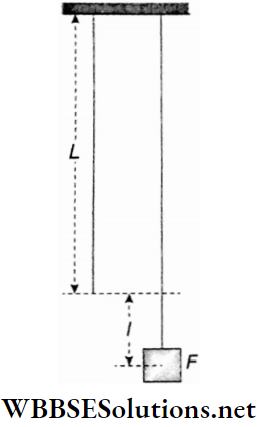
  • Let us consider a wire of length L and cross-sectional area A suspended from a rigid support. Now a force of magnitude F is applied perpendicularly to the cross-sectional area A on the wire i.e., the force will act downwards along the length of the wire. As a result, the wire will show a slight increase in length.

Class 11 Physics Unit 7 Properties Of Matter Chapter 1 Elasticity Youn's Modulus

Let the increase in the length of the wire = l.

Longitudinal strain = \(\frac{\text { increase in length }}{\text { original length }}=\frac{l}{L}\)

Longitudinal stress = \(\frac{\text { applied force }}{\text { area of cross-section }}=\frac{F}{A}\)

∴ Young’s modulus, Y= \(\frac{\text { longitudinal stress }}{\text { longitudinal strain }}\)

= \(\frac{F}{\frac{F}{L}}=\frac{F L}{A l}\)….(1)

If the wire is of circular cross-section of radius r and a mass m is hung from its lower end, then, A = πr², F = mg

So, Y =\(\frac{m g L}{\pi r^2 l}\) …….(2)

Units of Young’s modulus:

  • dyn · cm-2 CGs
  • N · m-2 or p

Young’s modulus for copper is 1.26 x 10¹² dyn · cm-2 — which means that a force of 1.26 x 10¹² dyn must be applied per cm2 area of cross-section of a copper wire to produce unit longitudinal strain in it.

Sagging of an elastic body due to its own weight: In our daily life, we observe many bodies sag due to their own weights when they are suspended from a rigid support.

Examples: a wet towel suspended across a horizontal rope, a cloth bag containing a few kilograms of rice suspended from a hook, etc. However, these are not perfectly elastic bodies, and no theoretical expression for their sagging can be obtained.

Now, we turn our attention to elastic bodies. Suppose a cylindrical rod made of an elastic metal (say, steel) is hung vertically from a rigid support. It definitely sags due to its own weight, although the sagging is relatively small. But using elastic properties of the material, a clear expression for the sagging can be found out.

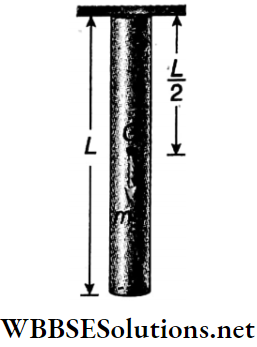
Class 11 Physics Unit 7 Properties Of Matter Chapter 1 Elasticity Sagging Of An Elastic Body Due To Its Own Weigth

Let m be the mass of body B made of an elastic material. One of its ends is hung from a rigid support.

Then mg = weight of B, L = its length, and A = area of its cross-section.

If B is a body of uniform density and its cross section is also uniform throughout its height, the centre of gravity G is situated at the midpoint at a depth 1/2 from the rigid support.

A force due to the weight mg acts downwards at the centre of mass (G). It may be assumed that this force stretches the body above the point G. So the effective initial length that is strained is L/2. If the body B sags downwards through a length l, then,

longitudinal strain = \(\frac{\text { elongation }}{\text { initial length }}=\frac{l}{\frac{L}{2}}=\frac{2 l}{L}\)

Also, longitudinal stress = \(\frac{\text { applied force }}{\text { area of cross-section }}=\frac{m g}{A}\)

Again the mass of the body B is,

m = volume x density = LAρ [ρ = density of the material]

So Young’s modulus,

Y = \(\frac{\text { stress }}{\text { strain }}=\frac{\frac{m g}{A}}{\frac{2 l}{L}}=\frac{m g L}{2 A l}=\frac{L A \rho g L}{2 A l}=\frac{\rho g L^2}{2 l}\)

Hence the sagging of the body is,

l = \(\frac{\rho g L^2}{2 Y}\) ……….(3)

It is important to note that this expression is independent of A.

So the sagging of a thin wire is the same as that of a thick rod if their initial lengths are equal and they are made of the same elastic material.

  • Bulk or Volume Strain
  • Bulk or Volume Stress
  • Bulk Modulus

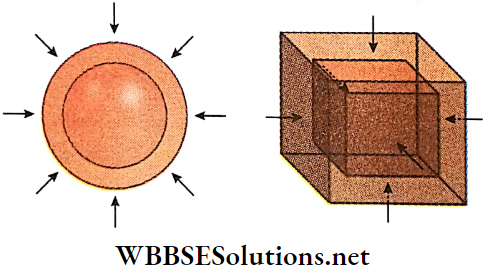
When a body is subjected to uniform pressure acting normally at every point on its surface, then it undergoes a change in volume, without any change in its shape.

  • For example, when a cube or a sphere is subjected to a uniform normal pressure, their shape remains unchanged, but they undergoes a volume strain.
  • Under the influence of external forces, when a body undergoes an increase or decrease in volume without any change in its shape, then the strain of the body is called bulk or volume strain.
  • The ratio of the change in volume (increase or decrease) of the body to its initial volume gives the measure of the volume strain of the body.
  • The stress, developed in the body, i.e., the reaction force developed per unit surface area due to its volume strain is called bulk or volume stress.

Class 11 Physics Unit 7 Properties Of Matter Chapter 1 Elasticity Bulk And Volume Stress

Bulk modulus: Within the elastic limit, volume stress divided by volume strain is called the bulk modulus of elasticity.

Bulk modulus (K) = \(\frac{\text { volume stress }}{\text { volume strain }}\)

Every substance—solid, liquid, or gas—has some volume, and hence the bulk modulus is meaningful for all substances.

The bulk moduli of a perfectly rigid body and a perfectly plastic body are infinite and zero respectively.

Since liquid and gaseous substances undergo only volume strain, the bulk modulus is the only elastic modulus for them. Among the different bulk moduli of a gas, very useful are its isothermal and adiabatic bulk moduli [for details see the chapter First and Second Law of Thermodynamics].

The isothermal bulk modulus of air = 1.01 x 10⁵ Pa and the adiabatic bulk modulus of air = 1.42 x 10⁵ Pa.

Let V = initial volume of a body,

p = applied force per unit surface area of the body = applied pressure,

ν = corresponding decrease in volume,

so, -ν = change in volume.

∴ Volume strain = \(\frac{\text { change in volume }}{\text { initial volume }}=-\frac{\nu}{V}\),

and volume stress = \(\frac{\text { reaction force developed }}{\text { surface area }}\)

= \(\frac{\text { applied force }}{\text { surface area }}\)

= applied pressure = p.

Therefore, the bulk modulus of elasticity of the material of the body is,

K = \(\frac{\text { volume stress }}{\text { volume strain }}=\frac{p}{-\frac{v}{V}}=-\frac{p V}{v}\) …..(4)

On application of pressure, the change in volume of all gases, and of a few materials like rubber, cotton, etc., is fairly large. This means that ν is large even for a relatively small applied pressure p.

So, the bulk moduli of all gases, and of the said materials, are fairly low. On the other hand, almost all solids and liquids show very small changes in volume on application of external forces. As a result, their bulk moduli are much higher.

For more mathematical rigor, the applied pressure is denoted by Δp (instead of p) and the corresponding decrease in volume by Δν (instead of ν). Then, equation (4) becomes,

If Δν is very low, which is usually observed in practice, we can put the limit Δν → 0. Then, from the definition of a derivative, we can replace \(\frac{\Delta p}{\Delta \nu}\) by the differential coefficient \(\frac{d p}{d v} .\).

Then we get, K = \(-V \frac{d p}{d v}\) ….(5)

This equation (5) is treated as the defining equation of the bulk modulus of elasticity.

For magnitudes only, the negative sign on the right-hand side of equations (4) and (5) is ignored.

Units of bulk modulus:

  • dym · cm-2
  • N · m-2

Compressibility: It is defined as the change in volume due to a unit change in pressure if a unit volume of a substance is taken initially. Like bulk modulus, compressibility is also a characteristic property of all substances—solids, liquids, and gases.

Again, let V = initial volume, Δp = applied pressure, and -ΔV = corresponding change in volume.

Then, from definition,

compressibility = \(\text { compressibility }=\frac{\text { change in volume }}{\text { initial volume } \times \text { change in pressure }}\)

= \(\frac{-\Delta V}{V \Delta p}=-\frac{1}{V} \frac{\Delta V}{\Delta p} .\)

In the limit Δp → 0, we have

compressibility = \(-\frac{1}{V} \frac{d V}{d p}\) …….(6)

Comparing equations (5) and (6), we observe that

compressibility = \(\frac{1}{\text { bulk modulus }} \text {. }\)

So, bulk modulus and compressibility are not independent properties. If one is known, the other can be calculated.

The compressibility of a solid or a liquid is very small, compared to that of a gas due to lack of space between molecules and larger intermolecular forces.

The compressibility of a perfectly rigid body is zero. The compressibility of water is 44 x 10-6 atm-1, meaning that the volume strain of water becomes 44 x 10-6 on the application of 1 standard atmosphere pressure.

Units of compressibility:

  • cm2.dyn-1
  • m2.N-1

Another useful unit of compressibility is atmosphere-1.

  • Shearing Strain
  • Shearing Stress
  • Modulus of Rigidity or Shear Modulus

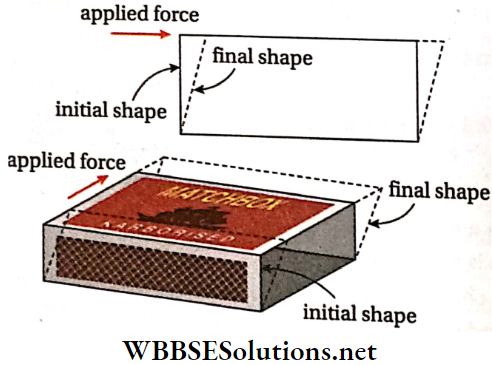
If the matchbox is held firmly on a table and a tangential force is applied on the upper surface of the box with the help of a finger, the shape of the box changes. This is known as shearing strain. In this condition, however, the change in the volume of the box is negligible as well as irrelevant.

Class 11 Physics Unit 7 Properties Of Matter Chapter 1 Elasticity Shearing Strain

Under the influence of an external force, if a body undergoes a change in its shape, then the strain of the body is called shearing strain or shear. The corresponding stress developed inside the body is called shearing stress.

Modulus of rigidity: Within the elastic limit, shearing stress divided by shearing strain is called the modulus of rigidity or shear modulus.

Modulus of rigidity (n) = \(\frac{\text { shearing stress }}{\text { shearing strain }}\)

The modulus of rigidity is a characteristic property of solids because only solids have definite shapes.

Class 11 Physics Unit 7 Properties Of Matter Chapter 1 Elasticity Modulus Of Rigidity

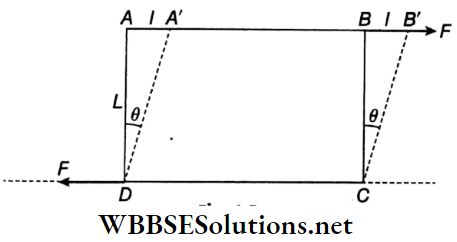
  • Let us consider a rectangular parallelepiped ABCD. ABCD is only the front surface of the parallelepiped for convenience, the depth has not been shown in the figure.
  • AD and BC denote the vertical side faces, whereas AB and CD are the top and the bottom faces respectively. The lower face CD is kept fixed to the horizontal surface.
  • A tangential force F is applied on its upper face AB. An equal but opposite reaction force F will act tangentially on the lower surface DC of the block.

These two forces constitute a couple and due to its action, each layer parallel to the surface DC will be displaced in the direction of the applied force. The layers that are farther from the surface DC will have larger relative displacements during deformation.

  • As a result, the block will undergo a change in its shape. It will be seen that each vertical surface parallel to F takes the form of a parallelogram from the original rectangular shape, i.e., the surface ABCD will become a parallelogram A’B’CD.
  • This kind of strain is called a shearing strain. It should be noted that, if the displacement AA’ is large, the surface A’B’ will come down a bit, and its position will be lower relative to the original position AB.
  • As a result, the area of the parallelogram and the volume of the parallelepiped will decrease. However, in most cases, particularly for metals, AA’ is so small that the change in volume may safely be ignored.

Elastic Limit and Its Importance

The angle formed between the initial and the final positions of any vertical line drawn perpendicular to the direction of the applied force is called shearing strain or the angle of shear. Usually, this angle is small, as the displacement AA’ is small.

Let ∠ADA’ = ∠BCB’ = θ; AD = L; AA’ = l;

Since θ is very small, tanθ ≈ θ. [where θ is expressed in radian]

∴ Shearing strain = θ = tanθ = l/L

= \(\frac{\begin{array}{c}
\text { relative displacement between two } \\
\text { parallel layers of the body }
\end{array}}{\text { distance between the layers }}\)

Now, if L = 1, then θ=1, which means that the relative displacement between two layers situated at a unit distance apart is the measure of shearing strain.

Shearing stress is measured by the applied tangential force per unit area. If the area of the surface AB is a, then shearing stress = \(=\frac{F}{a}\).

∴ Modulus of rigidity,

n = \(\frac{\text { shearing stress }}{\text { shearing strain }}=\frac{\frac{F}{a}}{\theta}=\frac{F}{a \theta}=\frac{F}{a} \cdot \frac{L}{l}\)

Class 11 Physics Class 12 Maths Class 11 Chemistry
NEET Foundation Class 12 Physics NEET Physics

Units of the modulus of rigidity:

  • dyn.cm-2
  • N.m-2 or pa

Poisson’s Ratio: Under the influence of an external force, when a body elongates in any direction, it also undergoes contraction in a perpendicular direction.

  • Conversely, when a body contracts in any direction under the influence of an external force, it also elongates at the same time in perpendicular directions.
  • So, longitudinal strain and lateral strain occur simultaneously in a body. If the lateral strain is low, then it is proportional to its longitudinal strain. The ratio of lateral strain to longitudinal strain is called the Poisson’s ratio.

Poissons ratio \((\sigma)=\frac{\text { lateral strain }}{\text { longitudinal strain }}\)

Let us consider a wire of initial length L and initial diameter D. If the increase in the length of the wire under the influence of the external force is l and the decrease in its diameter is d, then lateral strain = \(\frac{d}{D}\), longitudinal strain = \(\frac{l}{L}\)

∴ Poisson’s ratio, \(\sigma=\frac{\frac{d}{D}}{\frac{l}{L}}=\frac{d}{D} \cdot \frac{L}{l}\)

Poisson’s ratio depends only on the nature of the material of a body. It is a pure number and has no unit since it is a ratio between two strains. It is applicable only to solids. In the case of liquids and gases, Poisson’s ratio is meaningless.

Poisson’s ratio is not an elastic modulus because it is not the ratio of stress to strain. It is an elastic constant.

Limiting values of Poisson’s ratio: Theoretically, it can be shown that the maximum value of Poisson’s ratio is +1/2 and its minimum value is -1.

But Poisson’s ratio becomes negative only when a body undergoes lateral expansion along with its longitudinal expansion. It cannot be realized in practice. For this reason, the practical values of Poisson’s ratio lie between 0 and +1/2.

Poisson’s ratio—when the volume does not change due to elongation: Let l and r be the length and the radius of circular cross-section of a wire. Then, the volume of the wire, V = πr²l.

Differentiating both sides, we get, dV = πr²dl + πl · 2rdr.

Here, dV = change in volume

dl = change in length, dr = change in radius.

Since, the volume remains unchanged, dV = 0.

∴ 0 = πr² dl+ π l2r dr

or, 0 = πrdl+ π2ldr

or, rdl = -2 ldr or, \(-\frac{d r}{r}=\frac{d l}{2 l}\)

or, \(-\frac{d r / r}{d l / l}=\frac{1}{2}\) = 1/2 [negative sign indicates that if l increases, then r decreases].

Poisson’s ratio: \(\sigma=\frac{\text { lateral strain }}{\text { longitudinal strain }}=\frac{-d r / r}{d l / l}=\frac{1}{2}=0.5\)

Properties Of Matter – Elasticity Poisson’s Ration Numerical Examples

Calculating Modulus of Elasticity Examples

Example 1. An 8 kg mass is suspended from one end of an iron wire of length 2 m and diameter 1 mm. If Young’s modulus of iron is 2 x 10¹² dyn · cm-2, then what is the increase in length of the wire? [g = 980 cm · s-2]
Solution:

Given

An 8 kg mass is suspended from one end of an iron wire of length 2 m and diameter 1 mm. If Young’s modulus of iron is 2 x 10¹² dyn · cm-2

Young’s modulus, Y = \(\frac{m g L}{\pi r^2 l} \quad \text { or, } l=\frac{m g L}{Y \pi r^2}\)

Here, m = 8 kg = 8000 g , g = 980 cm • s-2 .

L = 2 m = 200 cm , r = 1/2 mm = 0.05 cm,

Y = 2 x 10¹² dyn.cm-2

∴ l =\(\frac{8000 \times 980 \times 200}{2 \times 10^{12} \times 3.14 \times(0.05)^2}\) = 0.1 cm = 1 mm

Example 2. The volume of 1 litre of glycerine decreases by, 0.42 cm3 on application of a pressure of 20 kg.cm-2.  Calculate the bulk modulus of glycerine.
Solution:

Given

The volume of 1 litre of glycerine decreases by, 0.42 cm3 on application of a pressure of 20 kg.cm-2.

Bulk modulus, K= \(\frac{p V}{v}\)

Here, p = 20 kg • cm-2 = 20 x 1000 x 980 dyn • cm-2

V = 1 litre = 1000 cm3 , v = 0.42 cm3

∴ Bulk modulus, K =\(K=\frac{20 \times 1000 \times 980 \times 1000}{0.42}\)

= 4.67 x 10¹⁰ dyn · cm-2

= 4.67 x 10⁹ N · m-2

The bulk modulus of glycerine = 4.67 x 10⁹ N · m-2

Example 3. The upper surface of an aluminium cube of side 10 cm is displaced by 0.03 cm with respect to its firmly held lower surface by a tangential force of 7.5 x 10¹⁰ dyn. Calculate the modulus of rigidity of aluminium.
Solution:

Given

The upper surface of an aluminium cube of side 10 cm is displaced by 0.03 cm with respect to its firmly held lower surface by a tangential force of 7.5 x 10¹⁰ dyn.

Modulus of rigidity, n = \(\frac{F}{A \theta}\)

Here, F= 7.5 x 10¹⁰ dyn , A = 10 x 10 = 100 cm2

θ = \(\frac{0.03}{10}=0.003\)

∴ Modulus of rigidity,

n = \(\frac{7.5 \times 10^{10}}{100 \times 0.003}\)

= 2.5 x 10¹¹ dyn · cm-2

= 2.5 x 10¹⁰ N · m-2

The modulus of rigidity of aluminium = 2.5 x 10¹⁰ N · m-2

Example 4. A metallic wire of length 3 m Is stretched to producean elongation of 2 nun. If the diameter of the wire is l mm, then find the decrease In its diameter due to this elongation. Poisson’s ratio for the material of the wire is 0.24.
Solution:

Given

A metallic wire of length 3 m Is stretched to producean elongation of 2 nun. If the diameter of the wire is l mm

Poisson’s ratio, \(\sigma=\frac{d}{D} \cdot \frac{L}{l} \quad \text { or, } d=\frac{\sigma D l}{L}\)

Here. σ = 0.24 , D = 1 mm = 10-3 m . L = 3 m .

l = 2 mm = 2 x 10⁻³ m

∴ d = \(\frac{0.24 \times 10^{-3} \times 2 \times 10^{-3}}{3}=1.6 \times 10^{-7} \mathrm{~m}\)

Example 5. When a body of mass 5 kg is hung from a wire of length 1 m and radius 2 mm, the length increases by 0.1 mm. If the Poisson’s ratio is 0.4, what will be the change in the radius of the wire? If the load is reduced to 2 kg, how will the radius change?
∴ Solution:

Given

When a body of mass 5 kg is hung from a wire of length 1 m and radius 2 mm, the length increases by 0.1 mm. If the Poisson’s ratio is 0.4, what will be the change in the radius of the wire? If the load is reduced to 2 kg

Poisson’s ratio, \(\sigma=\frac{d}{D} \cdot \frac{L}{l}\)

[where D, L are the initial diameter and the length of the wire and d, l are the changes in tire diameter and in the length of the wire respectively]

∴ d = \(\frac{\sigma D l}{L}=\frac{0.4 \times 0.004 \times 0.0001}{1} \mathrm{~m}\)

[σ = 0.4 , D = 2 x 2 = 4 mm = 0.004 m , 7 = 0.1 mm = 0.0001 m, I = 1 m]

or, d = 16 x 10-8 m

∴ Change in radius = \(=\frac{16 \times 10^{-8}}{2}=8 \times 10^{-8} \mathrm{~m}\)

Now, Y = \(\frac{m g L}{\pi r^2 l} \quad \text { or, } l=\frac{m g L}{Y \pi r^2}\)

So, for the same wire, l ∝ m. Then we get,

⇒ \(\frac{m_1}{m_2}=\frac{l_1}{l_2} \text { or, } \frac{5}{2}=\frac{0.0001}{l_2} \text { or, } l_2=4 \times 10^{-5} \mathrm{~m}\)

∴ Change in diameter, \(d_2=\frac{\sigma D l_2}{L}=\frac{0.4 \times 0.004 \times 4 \times 10^{-5}}{1}=64 \times 10^{-9} \mathrm{~m}\)

∴ Change in radius = \(\frac{64 \times 10^{-9}}{2}=3.2 \times 10^{-8} \mathrm{~m}\)

Real-Life Examples of Elastic Stress

Example 6. The change in length of a wire of a circular cross section is found to be 0.01% due to longitudinal stress. If the Poisson’s ratio for the material is 0.2, what is the percentage change in volume?
Solution:

Given

The change in length of a wire of a circular cross section is found to be 0.01% due to longitudinal stress. If the Poisson’s ratio for the material is 0.2

Let the length of the wire be 7, its radius be r and
volume be V.

So, V = \(\pi r^2 l\)

∴ dV = \(\pi r^2 d l+2 \pi l r d r\) [because \(\sigma=\frac{-d r / r}{d L / l}\), dr = -rσ \(\frac{d l}{l}\)]

= \(\pi r^2 d l-2 \pi r^2 \sigma d l\)

= \(\pi r^2 d l(1-2 \sigma)\)

∴ Volume strain

= \(\frac{d V}{V}=\frac{\pi r^2 d l(1-2 \sigma)}{\pi r^2 l}\)

= \(\frac{d l}{l}(1-2 \sigma)\left[\text { Here, } \frac{d l}{l}=0.01 \%=0.0001\right.\)]

= \(0.0001(1-2 \times 0.2)=6 \times 10^{-5}\)

∴ Percentage change in volume

= \(\frac{d V}{V} \times 100=6 \times 10^{-5} \times 100=0.006 \%\)

Example 7. A metallic wire of length and diameter 3 m and 0.001 m respectively is stretched by a load of 10 kg. Young’s modulus and Poisson’s ratio of the material of the wire are respectively 20 x 1010 N • m-2 and 0.26. Calculate the decrease In the diameter of the wire, (g = 9.8 m • s-2)
Solution:

Given

A metallic wire of length and diameter 3 m and 0.001 m respectively is stretched by a load of 10 kg. Young’s modulus and Poisson’s ratio of the material of the wire are respectively 20 x 1010 N • m-2 and 0.26.

Young’s modulus Y = \(\frac{F \cdot L}{A \cdot l}\)

or, \(\quad \frac{l}{L}=\frac{F}{Y A}=\frac{10^6 \times 9.8 \times 4}{20 \times 10^{10} \times 3.14 \times(0.001)^2}\)

Again, \(\sigma=\frac{d}{D} \cdot \frac{L}{l}\)

[F = \(10 \times 9.8 \mathrm{~N}\)]

or, \(d=\frac{\sigma D l}{L}=0.26 \times 0.001 \times \frac{10 \times 9.8 \times 4}{20 \times 10^{10} \times 3.14 \times(0.001)^2}\) = 16.23 x 10⁻⁸ m

Decrease in the diameter of the wire = 16.23 x 10⁻⁸ m

Example 8. A wire of length 2 m and diameter 2 cm is suspended vertically with its top end fixed. Its Poisson’s ratio and Young’s modulus are 0.2 and 1.8 x 10¹¹ N • m-2 respectively. What will be its lateral strain if a load of 1000 kg is suspended at its lower end?
Solution:

Given

A wire of length 2 m and diameter 2 cm is suspended vertically with its top end fixed. Its Poisson’s ratio and Young’s modulus are 0.2 and 1.8 x 10¹¹ N • m-2 respectively.

Young’s modulus, Y = \(\frac{m g}{\pi r^2} \cdot \frac{L}{l}\)

∴ Longitudinal strain, \(\frac{l}{L}=\frac{m g}{\pi r^2 \cdot Y}=\frac{1000 \times 9.8 \times 7}{22 \times(0.01)^2 \times 1.8 \times 10^{11}}\)

[Here, r = D/2= 2/2 cm = 1 cm = 0.01 nr]

Again, Poisson’s ratio, \(\sigma=\frac{d / D}{l / L}\)

∴ Lateral strain, \(\frac{d}{D}=c \cdot \frac{l}{L}=\frac{0.2 \times 1000 \times 9.8 \times 7}{22 \times(0.01)^2 \times 1.8 \times 10^{11}}\) = 3.46 x 10⁻⁵

Example 9. A rubber cord of length 10 m is suspended vertically. How much does It stretch under its own weight? Density of rubber = 1.5 x 10³ kg · m-3 Young’s modulus of rubber =6 x 10⁶ gf • cm-2; g = 9.8 m • s-2
Solution:

Given

A rubber cord of length 10 m is suspended vertically.

Given, L = 10m; ρ = 1.5 x 10³ kg • m-3

Y = 6x 10⁶ gf • cm-2 = 6 x 106 x 980 dyn • cm-2

= 5.88 x 10⁸ N • m-2

Let a be the area of cross-section of the rubber cord. Then

F = weight of the rubber cord

= L x a x ρ x g

The weight of the rubber cord acts at its centre of gravity and hence the weight of the rubber cord will produce an extension in the length L/2 of the cord.

Now, Y = \(\frac{F\left(\frac{L}{2}\right)}{a l} \quad \text { or, } l=\frac{F \times L}{2 a \times Y}\)

l = \(\frac{L a \rho g \times L}{2 a \times Y}=\frac{L^2 \rho g}{2 Y}=\frac{10^2 \times 1.5 \times 10^3 \times 9.8}{2 \times 5.88 \times 10^8}\)

= \(1.25 \times 10^{-3} \mathrm{~m}=1.25 \mathrm{~mm}\)

Example 10. A force of 108 N • m-2 is required for breaking a material. If the density of the material is 3 x 10³ kg • m-3, then what should be the length of the wire made of this material, so that it breaks due its own weight? [g = 9.8 m • s-2]
Solution:

Given

A force of 108 N • m-2 is required for breaking a material. If the density of the material is 3 x 10³ kg • m-3

Let L be the length of the wire which will break under its own weight.

If a is the cross section and ρ is the density of the material of the wire, then, breaking weight = a x L x ρ x g

= a x L x 3 x 103 x 9.8 ………(1)

(Here ρ = 3 x 10³ kg • m-3 ; g = 9.8m•s-2]

Also, breaking stress = 106 N • m-2

Therefore, breaking weight = 106 x a ……(2)

From equations (1) and (2) we have,

a x L x 3 x 103 x 9.8 = 106 x a

or, L = \(\frac{10^6}{3 \times 10^3 \times 9.8} \approx 34 \mathrm{~m}\)

Example 11. A cupper wire of negligible mass of length 1 m and cross sectional area 10-6 m2 is kept on a smooth horizontal table with one end fixed. A ball of mass 1 kg is attached to the other end. The wire and the ball are revolving with an angular velocity of 20 rad • s-1. If the elongation in the length of the wire is 10-3 m, obtain the Young’s modulus. If on increasing the angular velocity to 100 rad • s-1 the wire breaks down, obtain the breaking stress.
Solution:

Given

A cupper wire of negligible mass of length 1 m and cross sectional area 10-6 m2 is kept on a smooth horizontal table with one end fixed. A ball of mass 1 kg is attached to the other end. The wire and the ball are revolving with an angular velocity of 20 rad • s-1. If the elongation in the length of the wire is 10-3 m

The stretching force developed in the wire due to the revolution of the ball is,

F = \(\frac{m v^2}{r}=m r \omega^2=1 \times 1 \times(20)^2=400 \mathrm{~N}\)

Stress in the wire = \(\frac{F}{A}=\frac{400}{10^{-6}}=4 \times 10^8 \mathrm{~N} \cdot \mathrm{m}^{-2}\)

Strain in the wire = \(\frac{10^{-3}}{1}=10^{-3}\)

∴ Young’s modulus = \(\frac{\text { stress }}{\text { strain }}=\frac{4 \times 10^8}{10^{-3}}=4 \times 10^{11} \mathrm{~N} \cdot \mathrm{m}^{-2}\)

If the breaking angular velocity be \(\omega_0\) then breaking stress

= \(\frac{m r \omega_0^2}{A}=\frac{1 \times 1 \times(100)^2}{10^{-6}}=1 \times 10^{10} \mathrm{~N} \cdot \mathrm{m}^{-2}\)

Example 12. A steel cable with a radius of 1.5 cm supports a chair-lift at a ski area. If the maximum stress does not exceed 108 N • m-2, what is the maximum load that the cable can support?
Solution:

Given

A steel cable with a radius of 1.5 cm supports a chair-lift at a ski area. If the maximum stress does not exceed 108 N • m-2

The breaking stress is 108 N • m-2.

Therefore, the breaking load = breaking stress x cross-sectional area

= 108 x [3.14 x (1.5 x 10-2)2] = 7.065 x 10⁴ N

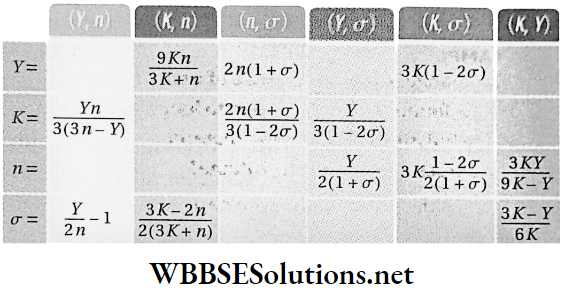
Relations among the Elastic Constants: Relations among Young’s modulus (Y), bulk modulus (K) , modulus of rigidity (n), and Poisson’s ratio (σ) are shown below.

Class 11 Physics Unit 7 Properties Of Matter Chapter 1 Elasticity Relations Among The Elastic Constants

These relations show that any two of the four quantities are independent. If the values of any two quantities are known, then the other two can be found out.

WBBSE Solutions For Class 10 Geography Chapter 5 India Physical Environment Topic 1 Location And Administrative Divisions Of India

Chapter 5 India Physical Environment Topic 1 Location And Administrative Divisions Of India Long Answer Type Questions

Question 1. Discuss the state reorganisation in India from 1947-50. OR, Discuss the political structure of India during the period of 1947-50.
Answer:

The state reorganisation in India from 1947-50

The former country of India was divided into two separate countries—India and Pakistan on 15 August 1947. At that time, independent India possessed 9 Governor ruled states, 4 chief commissioners ruled states and 562 independent native states.

During 1948-49, the native states were included within the state of India under the leadership of Sardar Vallabbhai Patel. Some of them were added to the Governor ruled states while some were converted to princely states. On 26 January 1950, India was declared as a sovereign, socialist, secular, democratic republic.  The Constitution of India was formed.

WBBSE Class 10 Geography Chapter 5 Question Answer

Read and Learn Also WBBSE Solutions for Class 10 Geography and Environment

During this time the states of India were divided into four categories—

Part A (Governor Ruled States] West Bengal, Assam, Bihar, Orissa, Uttar Pradesh, Madhya Pradesh, Bombay, Madras and Punjab (Total 9 states)
Part B [Former Princely States] Hyderabad, Madhya Bharat, Mysore, Patiala and East Punjab State Union (PEPSU), Jammu and Kashmir, Rajasthan, Saurashtra and Travancore (Cochin) (Total 8 states)
Part C [Chief Commissioner Ruled States] Ajmer, Bhopal, Bilaspur, Himachal Pradesh, Kachchh, Coorg, Delhi, Manipur, Tripura and Vindhya Pradesh (a Total of 10 states)
Part D [Central Ruled State] Andaman and Nicobar Islands


Question 2. Discuss the reorganisation of states from 1956 till date.
Answer:

State reorganisation in 1956: The State Reorganisation Commission (SRC) was formed in 1953, under whose recommendations India was reorganised into 14 states and 6 Union Territories on 1 November 1956 The main basis of this reorganisation was language.

States: Pradesh, Kerala, Jammu and Kashmir, West Bengal, Punjab, Bihar, Bombay, Madhya Pradesh, Mysore, Madras and Rajasthan.

Union Territories: Tripura, Andaman and Nicobar Islands, Delhi, Lakshadweep, Manipur and Himachal Pradesh.

State reorganisation during other periods: After the reorganisation of the states in 1956, many

States were further reorganised during different periods. In this course, several states were renamed, e.g.—Madras was renamed as Tamil Nadu, Orissa as Odisha, Mysore as Karnataka, Rajputana as Rajasthan, etc. State reorganisation during other periods is listed below—

Date State Reorganisation
19 August 1947 The formation of the state of Orissa (now Odisha) was completed,
1 May 1960 The former state of Bombay was divided to form the states of Maharashtra and Gujarat.
1 December 1963 Nagaland was given the status of an independent state.
1 November 1966 The former state of Punjab was divided to form the states of Punjab and Haryana and the Union Territory of Chandigarh.
20 February 1970 The former NEFA (North-East Frontier Agency) was renamed Arunachal Pradesh.
25 January 1971 Himachal Pradesh was converted from a Union Territory to a State.
1 November 1973 The former state of Mysore came to be known as Karnataka.
26 April 1975 Sikkim was included as the 22nd state of India (Formerly it was ruled by Chogyal monarchs).
20 February 1987 The Union Territories of Mi Oram and Arunachal Pradesh were included as the 23rd and 24th states of India
30 May 1987 Goa was included as the 25th state of India.
1993 The capital of India, Delhi, was declared as the ‘National Capital Region.
1 November 2000 The state of Madhya Pradesh was divided to form the 26th state of India, Chhattisgarh.
9 November 2000 The state of Uttar Pradesh was divided to form Uttarakhand, the 27th state of India
15 November 2000 Jharkhand was formed from the former state of Bihar, forming the 28th state of India.
2 June 2014 The 29th state of India, Telangana was formed from the former state of Andhra Pradesh.
31 October 2019 The state of Jammu and Kashmir was divided into two Union Territories, Ladakh and Jammu and Kashmir.
26 January 2020 Dadra and Nagar Haveli and Daman and Diu were formed after the merger of the former Union Territories of Dadra and Nagar Haveli and Daman and Diu.


“WBBSE Class 10 Geography Chapter 5 notes”

Chapter 5 India Physical Environment Topic 1 Location And Administrative Divisions Of India Short Explanatory Answer Type Questions

WBBSE Class 10 Geography Chapter 5 Question Answer

Question 1. Why is India regarded as a ‘miniature world’?
Answer:

India is a peninsular country in south Asia. It is bordered by oceans on three sides and the lofty Himalayan mountains on the northern side. It lies in the northeastern hemisphere and the Tropic of Cancer passes almost through the middle of the country.

Different kinds of physio-graphic features like mountains, plateaus, and plains are present here. Deserts, different types of soils, vegetation, climatic conditions and availability of mineral resources make the country a land of variety. Different species of animals and plants are present here.

Apart from these, different types of languages, cultures, religions, castes and creeds are found here. All these make India a representation of a miniature world.

WBBSE Solutions for Class 10 History WBBSE Solutions for Class 10 Geography and Environment
WBBSE Class 10 History Long Answer Questions WBBSE Solutions for Class 10 Life Science And Environment
WBBSE Class 10 History Short Answer Questions WBBSE Solutions for Class 10 Maths
WBBSE Class 10 History Very Short Answer Questions WBBSE Solutions for Class 10 Physical Science and Environment
WBBSE Class 10 History Multiple Choice Questions


Question 2. State the location of India according to – ciX latitudinal and longitudinal extent.
Answer:

Latitudinal extent: Latitudinally India lies in the northern hemisphere. The mainland of India extends from 8°4’N in the south (Kerala) to 37°6’N in the north (Jammu and Kashmir).

The southernmost point of India including the islands lies at 6°45’N (Indira Point or Pygmalion point of Great Nicobar Island).

Longitudinal extent: India lies between 68°7’E (Gujarat) and 97°25’E (Arunachal Pradesh) longitudes.

Question 3. State the boundary of India.
Answer:

The boundary of India on all sides are as follows—

1. North: The northern side of India is marked by the Himalayan mountains, China, Nepal and Bhutan.

2. West: India is bounded by Pakistan and the Arabian Sea on the west.

3. East: The eastern side of India is bounded by Myanmar, Bangladesh and the Bay of Bengal.

4. South: The peninsular region of India in the south is bounded by the Indian Ocean, the Arabian Sea and the Bay of Bengal. The island country of Sri Lanka lies south of India, separated by the Palk Strait and the Gulf of Mannar. The Maldives lie to the southwest of India.

“Location of India in geography Class 10”

Question 4. Mention the location of India with respect to the distance from the sea.
Answer:

Location of India with respect to the distance from the sea

India lies in south Asia. It is bounded by the Bay of Bengal in the east, the Arabian Sea in the west and the Indian Ocean in the south. Hence, it is called a peninsula. Being surrounded by the seas on three sides, no place in India is farther than 1700 km from the coast.

WBBSE Class 10 Geography Chapter 5 Question Answer

Question 5. Name the neighbouring countries of India.
Answer:

The neighbouring countries of India

The neighbouring countries of India are— China, Nepal and Bhutan in the north, Pakistan in the west, Afghanistan in the north-west, Myanmar and Bangladesh in the east and Sri Lanka in the south (separated from India by the Palk Strait and the Gulf of Mannar). The island of Maldives lies to the southwest of India.

Question 6. Discuss the importance of the geographical location of India.
Answer:

The importance of the geographical location of India

India lies in south Asia. The geographical location of the country influences its economy, security and livelihood of people.

1. The presence of seas on three sides of India provides access to international waterways and promotes foreign trade. The seas also act as a natural barrier and safeguard the security of the
mainland.

2. The mighty Himalayas in the north and the desert in the west also act as natural barriers and protect the country from foreign invasions. The mountain passes help in foreign trade.

3. The presence of seas on three sides of the country promotes fishing and related activities. It also influences the social life, food habits and economic status of the people.

4. The Himalayan region in the north encourages tourism and supplies raw materials for several industries like fruit processing, furniture making, paper, tea and construction.

WBBSE Class 10 Geography Chapter 5 Question Answer

Question 7. Mention the extent and population of India.
Answer:

Extent: The north-south extent of India is 3214 km and the east-west extent of India is 2933 km.

Area: Total area of India is about 32 lacks 87 thousand 263 sq. km. Of this, about 43 thousand sq. km. of area is occupied by China and Pakistan. According to size, India is the seventh largest country in the world (after Russia, Canada, China, USA, Brazil and Australia).

Population: India is the second most populated country in the world (after China). According to the 2011 census, the total population of India was 121 crores 1 lakh 93 thousand 422.

Question 8. Mention the importance of the peninsular location of India on the livelihood of people
Answer:

The importance of the peninsular location of India on the livelihood of people is—

  1. The peninsular location of India promotes international trade through waterways from all three directions (east, west, and south).
  2. The presence of seas on three sides of the country promotes activities like navigation and fishing.
  3. The seas act as a natural barrier and protect the country from foreign invasions.
  4. The northern part of India is connected to mainland of Asia. This helps in maintaining trade

“Administrative divisions of India WBBSE Class 10”

Question 9. Name the administrative divisions presently found in India.
Answer:

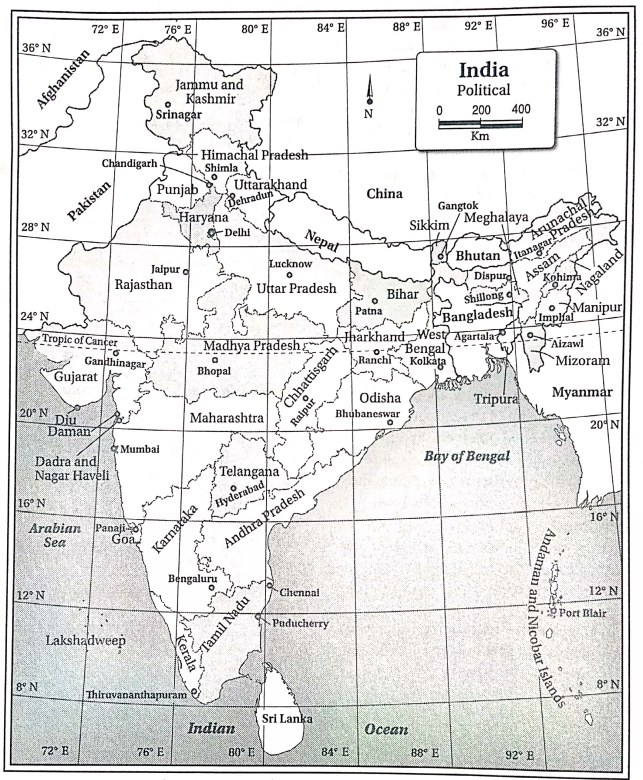
Presently, India is divided into types of administrative divisions- states and union territories. There are 28 states and 8 union territories in India.

State Capital
1. Andhra Pradesh Hyderabad
2. Arunachal Pradesh Itanagar
3. Assam Dispur
4. Bihar Patna
5. Chhattisgarh Raipur
6. Goa Panaji
7. Gujarat Gandhinagar
8. Haryana Chandigarh
9. Himachal Pradesh Shimla
10. Jharkhand Ranchi
11. Karnataka Bengaluru
12. Kerala Thiruvananthapuram
13. Madhya Pradesh Bhopal
14. Maharashtra Mumbai
15. Manipur Imphal
16. Meghalaya Shillong
17. Mizoram Aizawl
18. Nagaland Kohima
19.0disha Bhubaneswar
20. Punjab Chandigarh
21. Rajasthan Jaipur
22. Sikkim Gangtok
23. Tamil Nadu Chennai
24. Tripura Agartala
25. Uttar Pradesh Lucknow
26. Uttarakhand Dehradun
27. West Bengal Kolkata
28. Telangana Hyderabad


WBBSE Solutions Class 10 geography and environment chapter Chapter 5 India Physical Environment map-


Union Territories Capital
1. Andaman and Nicobar Islands Port Blair
2. Chandigarh Chandigarh
3. Dadra and Nagar Haveli and Daman and Diu Daman
4. Delhi Delhi
 5. Lakshadweep  Kavaratti
6. Puducherry (formerly known as Pondicherry) Puducherry
7. Ladakh Leh-Kargil
8. Jammu and Kashmir Srinagar (May-October) Jammu (November-April)


Question 10. Discuss the standard meridian and standard time of India. OR, How does the longitudinal extent of India influence the standard time of the country?
Answer:

The standard meridian and standard time of India

India lies between the longitudes 68°7’E and 97°25’E. Therefore, the longitudinal extent is 97°25’E – 68°7’E = 29°18′ Each longitude or meridian has a different local time.

So, for ease of administration and time calculation, the meridian that passes through the centre of the country is chosen as the standard meridian, whose local time is considered the standard time of the country.

The 82°86’E meridian passes exactly through the centre of India. But for ease of calculation, the 82°30’E meridian is chosen as the standard meridian of India (passes through Allahabad). The local time of this standard meridian is considered as the standard time all over India.

Question 11. Why are Arunachal Pradesh and Meghalaya called so?
Answer:

The easternmost state of India was formerly known as the NEFA (North-East Frontier Agency). Being located at the eastern border, the first rays of sunlight could be seen from this region first in India as a whole. Hence, it was renamed Arunachal Pradesh.

The hilly regions of Khasi, Jaintia and Garo hills were included in the Union Territory of Meghalaya on 2 April 1970. The geographical location of the place influenced the weather conditions and generally kept the sky overcast with clouds.

Hence, it was named ‘Meghalaya'(the abode of clouds) by the famous geographer Dr S.P. Chatterjee. Later, on 21 January 1972, Meghalaya was given the status of a state.

“India’s physical environment Class 10 geography guide”

Question 12. What do you mean by ‘India subcontinent’?
Answer:

‘India subcontinent’:

The countries of India, Pakistan, Bangladesh, Maldives, Nepal, Bhutan and Sri Lanka together are known as the ‘Indian subcontinent’. These neighbouring countries have physical, geographical and cultural similarities. India is the largest country among them with respect to size and population.

It lies in the centre surrounded by the other five countries. Due to its size and location, India is the most influential country among them. Hence, the whole region is called the ‘Indian subcontinent’. Name the newly formed states of India and their capitals

authenticated by the Indian Constitution, more than 160 languages are spoken in the country. Language is a very important factor that influences the administration.

Thus, it plays an important role in state reorganisation. India was reorganised into 14 states and 6 Union Territories in 1956 based on the language popularly spoken over a large region.

Chapter 5 India Physical Environment Topic 1 Location And Administrative Divisions Of India Short Answer Type Questions

WBBSE Class 10 Geography Chapter 5 Question Answer

Question 1. Name the most and least populated states of India.
Answer:

According to the 2011 census, the most populated state of India is Uttar Pradesh (19.98 crores) and the least populated state of India is Sikkim (6.12 lakh).

Question 2. Presently, how many states and Union Territories are there in India?
Answer:

Presently, there are 29 states (including the newly formed states of Uttarakhand, Jharkhand and Telangana) and 7 Union Territories in India.

Question 3. Name the largest state and smallest state of India.
Answer:

The largest state of India is Rajasthan and the smallest state of India is Goa.

Question 4. Mention the latitudinal extent of the Indian mainland.
Answer:

The Indian mainland extends from 8°4’N in the south to 37°6’N in the north.

Question 5. Mention the longitudinal extent of India.
Answer:

The longitudinal extent of India is from 68°7’E in the west to 97°25’E in the east.

Question 6. From which erstwhile states the newly formed states of Uttarakhand and Chhattisgarh have been separated?
Answer:

Uttarakhand has been separated from the former state of Uttar Pradesh and Chhattisgarh has been separated from the former state of Madhya Pradesh.

Question 7. Mention the east-west and north-south extent of India.
Answer:

The east-west extent of India is 2933 km and the north-south extent of India is 3214 km.

Question 8. What are the length of India’s border and its coastline?
Answer:

The length of the border of India along all sides is about 15107 km. The length of the coastline of India including the mainland, Lakshadweep and Andaman and Nicobar Islands is about 7517 km.

Question 9. Name the largest and smallest Union Territory of India.
Answer:

The largest Union Territory of India in Jammu and Kashmir and the smallest one is Lakshadweep.

Question 10. Name the Union Territories of India.
Answer:

The Union Territories of India

The Union Territories of India are Andaman and Nicobar Islands, Chandigarh, Puducherry, Delhi, Lakshadweep and Dadra and Nagar Haveli and Daman, and Diu.

Question 11. Name the largest and smallest neighboring countries of India.
Answer:

The largest neighboring country of India is China and the smallest one is the Maldives.

Question 12. Which factors were given importance while state reorganization in India? OR, Mention two main bases of state reorganization of India?
Answer:

Different bases have been given importance during the time of state reorganization. Although the main basis of reorganization in 1956 was language, the other bases considered at different times are— culture, administrative advantage and skill, physical and geographical similarity, and economic stability.

Question 13. What are ‘The McMahon line’ and ‘Raddiffe line’?
Answer:

  1. McMahon Line: The Indo-China border running from the eastern side of Bhutan to Arunachal Pradesh is known as the McMahon line.
  2. Radcliffe Line: The Indo-Pakistan border in the northwestern part of India is known as the Radcliffe line.

“Geography chapter on India’s location and divisions WBBSE”

Question 14. Name two neighboring countries of India lying on the western side.
Answer:

Pakistan and Afghanistan are the two neighboring countries of India lying on the western side.

Question 15. Which Union Territory is recognized as the capital of two states of India?
Answer:

The Union Territory of Chandigarh is the capital of the states of Punjab and Haryana.

Question 16. What do you mean by SAARC?
Answer:

SAARC:

SAARC (South Asian Association for Regional Cooperation) is an organization formed for the political, economic, educational, cultural, scientific and technological, and recreational welfare of the member countries.

It was formed on 8 December 1985. Its headquarters is in Kathmandu, Nepal. The member countries are—India, Pakistan, Bangladesh, Nepal, Bhutan, Sri Lanka, Maldives, and Afghanistan.

Chapter 5 India Physical Environment Topic 1 Location And Administrative Divisions Of India If The Statement Is True,

Write True And If False Write False Against The Following

WBBSE Class 10 Geography Chapter 5 Question Answer

Question 1. The state reorganization in India occurred in the year 1950, on the basis of language.
Answer: False

Question 2. Rajasthan is the largest state in India.
Answer: True

Question 3. Jharkhand is the newest state in India.
Answer: False

Question 4. The Amindivi island lies within the Lakshadweep islands.
Answer: True

Question 5. The east-west extent of India is 2933 km.
Answer: True

Question 6. The north-south extent of India is lesser than the east-west extent.
Answer: False

Question 7. The Minicoy island is situated in the Manas Sarovar.
Answer: False

Question 8. The difference between the easternmost and westernmost longitudes of India is almost 29°18
Answer: True

Question 9. The local time of Allahabad is considered the standard time of India.
Answer: True

Question 10. The southernmost point of India is Kanyakumari.
Answer: False

Question 11. India was declared a sovereign, socialist, secular, democratic republic on 15 August 1947.
Answer: False

Question 12. The Tropic of Cancer passes through Bihar.
Answer: False

Question 13. NEFA has been renamed Mizoram.
Answer: False

Question 14. Jharkhand was given the status of a different state on the basis of regional cultural differences.
Answer: True

Question 15. India is the largest peninsular country in the world.
Answer: True

Question16. Goa is the smallest state in India.
Answer: True

Question 17. Sikkim was included as an Indian state in 1975.
Answer: False

Question 18. Goa was given the status of a state in 1989.
Answer: False

Question 19. ‘Meghalaya’ was named by Dr. S. P. Chatterjee.
Answer: True

Question 20. The newest state of India is Telangana.
Answer: True


Chapter 5 India Physical Environment Topic 1 Location And Administrative Divisions Of India Fill In The Blanks With Suitable Words

WBBSE Class 10 Geography Chapter 5 Question Answer

Question 1. India was declared a sovereign democratic republic in the year_______
Answer: 1950

Question 2. The State Reorganisation Commission was formed in_______
Answer: 1953

Question 3. The the_______islands lie on the Bay of Bengal.
Answer: Andaman and Nicobar Islands

Question 4. India is separated from Sri Lanka by the_______
Answer: Palk Strait

Question 5. The local time of_______ is considered the standard time of India.
Answer: Allahabad

Question 6. Presently, there are _______ Union Territories in India.
Answer: 8

Question 7. Rajasthan was previously known as _______
Answer: Rajputana

Question 8. Chennai was previously known as _______
Answer: Madras

Question 9. India is surrounded by oceans on _______ sides.
Answer: Three

Question 10. The Darjeeling Gorkhaland Territorial Administration is an _______body that looks after the administration of the hills of the Darjeeling district.
Answer: Autonomous

Question 11. The capital of Tripura is _______
Answer: Agartala

Question 12. The chief language spoken in Karnataka is_______
Answer: Kannada

Question 13. Indira point is also known as the _______
Answer: Pygmalion point

Question 14. _______ is considered the standard meridian of India.
Answer: 82°30’E

Question 15. _______ is the capital of both Andhra Pradesh and Telangana.
Answer: Hyderabad

Question 16. Kerala was given the status of a state in _______
Answer: 1956

Question 17. Delhi was declared as a Union Territory of India in _______
Answer: 1956

Question 18. The chief languages spoken in Telangana are_______ and _______
Answer: Telugu and Urdu

Geography Class 10 West Bengal Board

Chapter 5 India Physical Environment Topic 1 Location And Administrative Divisions Of India Answer In One Or Two Words

Question 1. When has India declared a sovereign, socialistic, secular democratic republic?
Answer: 26 January 1950.

Question 2. Which state’s capital is Bengaluru?
Answer: Karnataka.

Question 3. Which is the largest neighbouring country of India?
Answer: China.

Question 4. Name the capital of Dadra and Nagar Haveli and Daman and Diu.
Answer: Daman.

Question 5. Name the capital of Chattisgarh.
Answer: Raipur.

Question 6. Where is the headquarters of SAARt located?
Answer: Kathmandu in Nepal.

Question 7. Name the smallest neighbouring country of India.
Answer: Maldives.

Question 8. When was Telangana given the status of a separate state?
Answer: 2 June 2014.

Question 9. What was Karnataka previously known as?
Answer: Mysore.

Geography Class 10 West Bengal Board

Question 10. Which former state was broken into Gujarat and Maharashtra?
Answer: Bombay (presently known as Mumbai).

Question 11. Which languages are popularly used in Tripura apart from Bengali?
Answer: Kokborok and Manipuri.

Question 12. What is the India-Pakistan border popularly known as?
Answer: Radcliffe Line.

Question 13. Name the smallest Union Territory of India.
Answer: Lakshadweep.

Question 14. Which state was broken to form Uttarakhand?
Answer: Uttar Pradesh.

Question 15. How many languages have been accepted by the Constitution of India, to be spoken here?
Answer: 22.

Question 16. Name the capital of Uttarakhand.
Answer: Dehradun.

Geography Class 10 West Bengal Board

Chapter 5 India Physical Environment Topic 1 Location And Administrative Divisions Of India Match The Left column With The Right Column

1.

LeftColumn Right Column
1. Andhra Pradesh A.  Malayalam
2. Tamil Nadu B. Kannada
3. Goa C.  Tamil
4.  Karnataka D.  Telugu
5.  Kerala E.  Konkani

Answer: 1-D,2-C,3-E,4-B,5-A

2.

Left Column Right Column
1. Telangana A. Kohima
2. Jharkhand B. Ranchi
3. Tripura C. Dehradun
4. Uttarakhand D Hyderabad
5. Nagaland E. Agartala

Answer: 1-D,2-B,3-E,4-C,5-A

3.

Left Column Right Column
1. Himachal Pradesh A.  2000
2.  Chhattisgarh B.  2014
3. Goa C. 1971
4.  Telangana D. 1963
5.  Nagaland E. 1987

Answer: 1-C,2-E,3-E,4-B,5-D


WBBSE Solutions For Class 10 Geography Chapter 5 India-Physical Environment Topic 4 Climate Of India

Chapter 5 India-Physical Environment Topic 4 Climate Of India Long Answer Type Questions

Question 1. Discuss the climatic conditions in different seasons in India.
Answer:

The climatic conditions in different seasons in India

The climate of India can be classified into four seasons depending on the temperature, rainfall, atmospheric pressure, and wind direction prevailing over a time period,

1. Winter season (December-February):

1. During this time the sun’s rays fall at a high angle in the southern hemisphere. The northern hemisphere receives slanting rays from the sun, whose angle of incidence is low.

2. The dry and cold winds generated from the high-pressure regions of Central Asia blow over India are northeast monsoon winds. These winds move towards the low-pressure regions over the Indian Ocean.

3. The average temperature in northern India remains about 10°-15°C. The temperature gradually increases towards the south and reaches about 25°C in Tamil Nadu.

Read and Learn Also WBBSE Solutions for Class 10 Geography and Environment

4. Rainfall is caused in the northern and north-western regions due to Western disturbances.
The coastal regions of Tamil Nadu also receive rainfall due to the northeast monsoon winds. The rest of the country generally remains dry.

2. Summer season (March-May):

1. During this season with the gradual movement of the sun towards the north the sun’s rays fall at a high angle in the northern hemisphere. As a result from March onwards, the temperature of India starts rising.

2. By the month of May, the sun’s rays fall almost vertically over the Tropic of Cancer. Thus, the temperature of the northern hemisphere rises considerably. The average temperature of Madhya Pradesh and Gujarat rises to 38°-40 °C. The temperature in the desert region of Rajasthan reaches about 48 °C.

3. The hot dry wind called ‘Loo’ is experienced in the northwestern part of India due to very high temperatures.

4. Low-pressure cells develop over many regions, which leads to the generation of tropical storms. These storms are locally known as ‘Kalbaisakhi’ in West Bengal, ‘Aandhi’ in Uttar Pradesh, ‘Bordoichila’ in Assam, ‘Mango showers’ in Kerala and ‘Cherry Blossoms’ in Karnataka.

5. These storms and associated rainfall may suddenly reduce the temperature by 7-8 °C.

WBBSE Solutions for Class 10 History WBBSE Solutions for Class 10 Geography and Environment
WBBSE Class 10 History Long Answer Questions WBBSE Solutions for Class 10 Life Science And Environment
WBBSE Class 10 History Short Answer Questions WBBSE Solutions for Class 10 Maths
WBBSE Class 10 History Very Short Answer Questions WBBSE Solutions for Class 10 Physical Science and Environment
WBBSE Class 10 History Multiple Choice Questions


3. Rainy season or the monsoon season (June-September): The deep low-pressure cells created over the landmass of India during summer, attract the moist southwest monsoon winds from the Indian Ocean. These winds bifurcate into two branches before entering India—

1. The Arabian Sea branch: This branch of the southwest monsoon, collects a huge amount of moisture from the Arabian Sea and moves towards the Indian landmass.

They are obstructed by the Western Ghats, where they provide profuse rainfall on the western slopes. The eastern slopes lie on the leeward side of the Western Ghats and hence receive less rainfall. This turns the western part of the Deccan plateau into a rain shadow area.


WBBSE Solutions Class 10 geography and environment chapter Chapter 5 India Physical Environment Retreat of south-west monsoon winds

2. The Bay of Bengal branch: This branch of the southwest monsoon winds collects large amounts of moisture from the Bay of Bengal and enters India from the eastern side.

They are obstructed by the Eastern Himalayas and the hilly region of the northeast. There they provide huge amounts of rainfall.

Mawsynram situated on the southern slope of the Khasi hills of Meghalaya receive the highest rainfall in the world (1187 cm). These winds gradually move westward and provide rainfall in Manipur, Meghalaya, Assam, West Bengal, Bihar, Uttar Pradesh, and other states of northwestern India.

4. Autumn season or the season of retreating monsoon (October- November): During this time the sum apparently starts shifting southwards beyond the equator. Thus, the high-pressure condition develops over landmass in the northern hemisphere and the low-pressure condition develops over the Indian Ocean.

The retreat of the monsoon winds sometimes causes tropical cyclones and sudden rainfall in the eastern coastal regions of India. In West Bengal, the cyclonic storm is locally known as ‘Ashwiner Jhor’.

WBBSE Solutions Class 10 geography and environment chapter Chapter 5 India Physical Environment onset of south west monsoon winds

“WBBSE Class 10 Geography Chapter 5 Climate notes”

Question 2. Explain the influence of monsoons on the climate of India.OR, Discuss the characteristics of the seasons of India as influenced by the monsoon winds.
Answer:

The influence of monsoons on the climate of India

The climate of India is strongly influenced by the monsoon winds. The southwest monsoon winds blow during the summer and the northeast monsoon winds blow during the winter.

1. Influence of the southwest monsoon:

1. During summer, the southwest monsoon winds originate over the Indian Ocean and blow towards the low-pressure cell developed over the northwestern region of India.

2. These moisture-laden winds help to set in the rainy season in the country.

3. India receives about 67-72% of its total annual rainfall due to the southwest monsoon. Rainfall occurs in profuse amounts in Assam, Mizoram, Meghalaya, Eastern Himalayan region, Terai region, and Andaman and Nicobar Islands.

2. Influence of the north-east monsoon:

1. During winter, the cold dry winds blow from the high-pressure regions of Central Asia towards the low-pressure cell developed over the Indian Ocean.

2. These winds lower the air temperatures to a great extent. Temperatures in Jammu and Kashmir, Himachal Pradesh, Uttar Pradesh and other northern states fall as low as -10° to -40 °C. 0 The winds being very cold, have very less capable of holding moisture. Thus, they cause no rainfall.

Power in India to a great extent dependent on monsoon rains. If there is insufficient rainfall the reservoirs remain full of water, which helps in hydroelectric power generation.

WBBSE Solutions Class 10 geography and environment chapter Chapter 5 India Physical Environment Summer and winter

3. Unpredictable onset and retreat of monsoon: The before-time arrival or late retreat of the southwest monsoon results in a longer rainy season. This may lead to floods. On the other hand, late arrival or early retreat of the monsoons leads to a shorter rainy season. This may cause the soil to dry up and bead to droughts.

4. Seasons according to the monsoon winds: The climate of India can be classified into four seasons depending on the arrival and retreat of the monsoon winds.

They are-

1. Pre-arrival period of southwest monsoon or the summer season.
2. Season of southwest monsoon or the rainy season.
3. Retreat of the southwest monsoon, or the autumn season.
4. Onset of north-east monsoon, or the winter season.

Question 3. Discuss the influence of the southwest monsoons on India.
Answer:

The influence of the southwest monsoons on India

1. The positive influences of the southwest monsoon winds on India are-

1. Influence on climate: India mostly lies in the tropical-subtropical region, which is very hot. But the southwest monsoon winds provide sufficient rainfall to the landmass, which helps to reduce the general temperature conditions. Hence, India enjoys a hot and humid climate.

2. Influence on irrigation: Water for irrigation also depends upon the availability of water from the dams and reservoirs. In years of sufficient rainfall the area covered by irrigation increases or vice versa. In years of insufficient rainfall, the height of the underground water table falls leading to a shortage of water in the wells, tanks, and tube wells.

3. Influence on hydroelectric power generation: Generation of hydroelectric monsoon rains. If there is insufficient rainfall the reservoirs remain full of water, which helps in hydroelectric power generation.

3. Influence on agriculture: India is an agro-based country. About 70% of India’s population is directly or indirectly dependent on agriculture. The southwest monsoon winds provide sufficient rainfall for agriculture to be conducted properly. The crop calendar of India is dependent on the monsoon rainfall.

4. Influence on agro-based industries: The agro-based industries of India, like cotton textile, sugar, jute textile, tea and coffee, etc. are influenced by the southwest monsoon. The raw materials of these industries are dependent on the rainfall provided by the southwest monsoon.

5. Influence on forests: The forests or natural vegetation are directly related to the climate of a place. The distribution of rainfall in India decides the types of forests found in different regions of India.

6. Influence on the economy: Agriculture, industrial development, the lifestyle of the people, etc. are dependent on the southwest monsoon winds and the rainfall they provide. In general, the whole economy of the country is influenced by the monsoon winds.

2. The negative influences of the south-west monsoon winds are-

1. Floods and droughts: The whimsical and unpredictable nature of the southwest monsoon winds often bring hazards in India. Early onset and late retreat of the monsoon winds bring in too much rainfall and may cause floods. On the other hand, late arrival and early retreat of monsoon winds may cause droughts due to less rainfall.

2. Expensive irrigation system: Agriculture is dependent on the rainfall provided by the southwest monsoon. But the whimsical nature of the monsoon winds may lead to crop failures. Hence, irrigation facilities have to be arranged to assure the yield of crops. This is very expensive and needs a lot of maintenance.

3. Crop failures and loss of life and property: Frequent floods and droughts in India often cause crop failures and result in loss of life and property. Often food grains, pulses, oilseeds, and other crops have to be imported to meet the demands of the country. This imposes a negative effect on the economy of the country.

Question 4. Discuss any three factors that control the climate of India. OR, Discuss the factors that control the climate of India.
Answer:

The factors that control the climate of India are as follows-

1. Monsoon winds: The climate of India is influenced by two opposite monsoon winds—The hot wet southwest monsoon in summer and the dry cold northeast monsoon in the winter.

2. South-west monsoon winds:

1. During summer a deep low-pressure cell develops over central and north India. This draws the moist southwest monsoon winds from the Indian Ocean into the country. The rainy season commences, providing rainfall almost over the whole of India, except in a few places,

2. About 67-72% of rainfall in India occurs due to the southwest monsoon.

3. North-east monsoon winds:

1. During winter, a high-pressure cell develops over Central Asia, from where cold and dry winds rush towards the Indian Ocean, passing over the landmass of India,

2. The general temperature of the country decreases,

3. Generally the winds are dry. But before leaving the country, the winds collect some moisture from the Bay of Bengal and cause rainfall on the Coromandel coast of Tamil Nadu.

Depending on the monsoon winds, the climate of India can be classified into four seasons—

1. The pre-monsoon or the summer season,
2. The onset of the southwest monsoon or the rainy season,
3. The retreat of the south-west monsoon or the autumn season,
4. The onset of the northeast monsoon or the winter season.

2. Latitudinal extent: The Tropic of Cancer divides the country into almost two equal halves. The southern part lies in the tropical region while the northern part lies in the sub-tropical region. The Himalayan region lies in the temperate region. Hence, the temperature of the northern region is lower than that of the southern region.

3. Location of the Himalayas and the Western Ghats: The mighty Himalayas prevent the moisture-laden southwest monsoon winds from escaping northwards. They help to cause rainfall in the country. Similarly, the Western Ghats lie across the direction of the Arabian Sea branch of the southwest monsoon and cause rainfall on its western slope. The Himalayas also prevent cold Siberian winds from entering India in winter.

4. Altitude: Temperature decreases by 6.4 °C for every 1 km or 1000 m rise in altitude (lapse rate). Thus, the peaks of the Himalayan mountains remain snow-covered throughout the year due to the high altitude. For this reason, Ooty is a cooler place in spite of lying closer to the equator than New Delhi.

5. Distance from the sea: The long coastline of India brings a huge area in the west, south, and east under the influence of the sea.

“Climate zones of India Class 10 Geography”

Question 5. Differentiate between ‘Loo’ and ‘Aandhi’.
Answer:

The differences between ‘Loo’ and ‘Aandhi’ are as follows-

Point of difference    LOO    Aandhi    
Region influenced Loo blows predominantly in the desert region of north-western Rajasthan, the adjacent areas of the desert, and in the drier states of north-western India. Aandhi blows in the north-western region of the Sutlej-Ganga plains.
Nature Loo is a strong, hot, dry wind. Aandhi is a strong stormy dusty wind.
Time Loo blows during summer. Aandhi blows during the end of spring.
Temperature The temperature of the wind varies between 45° and 50 °C. The temperature of the wind varies between 32° and 35 °C.
Period Loo blows during noon in the hot desert or semi-desert regions. Aandhi blows for a small period in the afternoon.
Sky condition Loo does not cause the sky to become dark. Aandhi causes the sky to become dark and reduces visibility.
Effects The hot and dry loo causes the leaves of plants to dry up and turn brownish. Aandhi deposits layers of dust on the leaves of plants and hampers photosynthesis.


WBBSE Solutions For Class 10 Geography Chapter 5

Question 6. Discuss the influence of monsoon winds on the livelihood of people in India.
Answer:

The influence of monsoon winds on the livelihood of people in India

The monsoons impose a lot of influences on the livelihood of the people in India.

1. Cultivation of crops: More than 70% of the people of India are dependent on agriculture directly or indirectly. Agriculture is dependent on monsoon rains. Hence, people who depend on agriculture are dependent on monsoon.

2. Agro-based industries: The agro-based industries acquire their raw materials from agricultural products. They are indirectly dependent on monsoons for their production and economic growth.

3. Forest: The monsoon rains have helped in the growth of dense evergreen forests in the foothills of the Himalayas and the Western slopes of the Western Ghats. Deciduous forests grow in regions of moderate to high rainfall. These forests yield valuable timber and other forest products.

4. Economic development: The economic development of the country is much dependent on the monsoons. Sufficient rainfall helps in agricultural and industrial development, while droughts and floods cause crop failures and loss of life and property.

5. Foreign exchange: Crops like tea, Jute, sugarcane, etc. are dependent on monsoons. The export of tea, jute products, sugar, etc. helps India to earn a lot of foreign exchange. Thus, it is indirectly dependent on the monsoons.

Question 7. What are the characteristics of the climate of India?
Answer:

The characteristics of the climate of India are-

1. Seasons: The climate of India is influenced by the two oppositely blowing monsoon winds, i.e., the south-west monsoon winds help in the classification of Indian climate into four seasons—Winter (December- February), Summer (March-May), Monsoon or Rainy season (June-September) and Autumn (October-November).

2. Oppositely blowing winds: The direction from which the winds blow in the summer season (southwest) is reversed in the winter season (northeast).

3. Hot wet summers and cool dry winters: The moist southwest monsoon winds provide sufficient rainfall during late summer and the rainy season. The northwest monsoon winds are generally dry and do not provide rainfall except for the Coromandel coast of Tamil Nadu. Thus, the summers are hot and wet while the winters are cool and dry.

4. Orographic rainfall: The southwest monsoon winds collide with the mighty Himalayas on the north and the Western Ghats along the western coast. Thus, they provide orographic rainfall in the foothills of the Himalayas and the western slopes of the Western Ghats.

5. Unpredictable rainfall: The whimsical nature of the monsoon winds make the occurrence of rainfall unpredictable. In some years rains come early and retreat late, while in some years the rains arrive late and retreat early. Thus, the monsoon winds sometimes cause floods and sometimes lead to droughts.

6. Diverse climate: The northern part of India is surrounded by landmasses. Hence, it experiences extreme and continental climates. The southern part is surrounded by oceans on three sides (west, south, and east). Hence, it experiences a moderate climate.

7. Cyclones: During the autumn season, the eastern and the western coastal regions experience cyclonic storms and rainfall. During the winter season, the Western disturbances cause cyclonic rainfall in the northwestern part of India. The temperature drops to a great extent and the hilly regions experience snowfall.

Question 8. Discuss the climatic regions of India. Or, Classify India according to climatic regions and discuss any three of them.
Answer:

The climatic regions of India

A region having similar conditions of temperature, pressure, humidity, rainfall, wind, etc. is known as a climatic region. Following the climatic classification of Koppen, India has been classified-

Climatic region Amongst influenced                           Characterise features
1. Tropical very wet monsoon region Coastal areas of Maharashtra, Karnataka, Goa, and Kerala, western slopes of the Western Ghats, Meghalaya, Mizoram, Manipur, Cachar district of Assam, Lakshadweep, Andaman, and Nicobar Islands. 1. Average annual temperature 18°-29 °C.

2. Average annual rainfall 300 cm.

2. Tropical Savanna region Gujarat, Maharashtra, Chhattisgarh, Jharkhand, Andhra Pradesh, Odisha. 1. Average Annual temperature 15″-30 °C.
2. Average annual rainfall 50-100 cm.3. Very hot summers and cool winters.
3. Tropical dry summer and wet winter region Coromandel coast of south-eastern India. 1. Average annual temperature 20°-30 °C.

2. Average annual rainfall 100-150 cm.

3. Dry summer (Eastern Tamil Nadu) and wet winter.

4. Tropical semi-desert and sub-tropical steppe region Rain shadow areas of the Western Ghats, eastern Rajasthan, and southwest Pujnab. 1. Average annual temperature 10°-40  °C
2. Average annual rainfall 50-75 cm.
5. Hot desert region Western Rajasthan. 1. Average annual temperature 5°-48  °C.

2. Average annual rainfall 12.5 cm-30 cm.

3.  Extreme continental climate. The diurnal and annual range of temperature is very large.

6. Temperate mild summer and wet winter region Sikkim, Arunachal Pradesh, northeastern Assam. 1. Average annual temperature 20″-35 °C. 2. Average annual rainfall above 300 cm.
7. Wet sub-tropical monsoon region (dry winter) Plains of northern India. 1.  Average annual temperature 5 °-30  °C.

2. Average annual rainfall is 200 cm in the east and 50 cm in the west. 3. Rainfall occurs mostly in summer.

8. Cold mountainous region High mountains of the Western Himalayas. 1. Average annual temperature is 15 ‘C in summer to less than 0 °C in winter.

2. Average annual rainfall 50-75 cm.

3. Very cold throughout the year and snowfall in winter.


WBBSE Solutions Class 10 geography and environment chapter Chapter 5 India Physical Environment climatic zones of india

“Impact of monsoon on Indian climate WBBSE”

Question 9. Discuss the influences of the Himalayas on the climate of India.
Answer:

The influences of the Himalayas on the climate of India

The Himalayas stand on the northern margin of India like a huge and mighty wall. It influences the climate of India in the following ways-

1. Protects from the severe cold: The Himalayan mountains prevent the chilling polar winds coming from Siberia from entering the country and making the climate very cold and chilling.

2. Helps in causing rainfall: The Himalayas stand like a barrier against the southwest monsoon winds. The moisture-laden winds strike against the mountains and cause orographic rainfall. India receives about 67 72% of its total annual rainfall from the southwest monsoon.

3. Creates desert climate: The Himalayas prevent the moisture-laden southwest monsoon winds from escaping the country. Thus, it plays a vital role in the creation of deserts in Gobi and Taklamakan in Central Asia.

4. Reduces the effects of the Western disturbances: The Himalayas keep the effects of the Western disturbances limited to the northwestern part of the country.

It may be mentioned that, during the winter season, the northeast monsoon winds pass through the gap between the Eastern Himalayas and the Purvanchal mountains and decreases the temperature of the Brahmaputra Valley in Assam considerably.

5. Moderate climate: The places lying at high altitudes in the lap of the Himalayas enjoy cool climates throughout the year. Snowfall in the winter makes the place more attractive for tourism.

WBBSE Solutions Class 10 geography and environment chapter Chapter 5 India Physical Environment Location of the himalays

Question 10. What are the causes of the diversity in the climate of India?
Answer:

The causes of the diversity in the climate of India

The climate of India is diverse and different in different parts of the land at different times of the year. The causes of diversities are-

1. Latitudinal extent:

The main landmass of India extends from 8° N in the south to 37° N in the north. Thus, it spreads for about 29° of latitude. The southern part of India experiences a hot wet equatorial climate, the central part experiences a tropical climate, and the northern part experiences a subtropical and temperate climate.

2. Presence of mountains:

1. The Himalayan mountains in the north play a vital role in influencing the climate of India. During summer, they stop the moist southwest monsoon winds from escaping to Central Asia and cause rainfall in India.

During winter, they prevent the chilling polar winds coming from Siberia from entering India, thus keeping the climate of the country comparatively warmer and more comfortable.

2. The Western Ghats and the Eastern Ghats along the western and eastern coasts of India cause rainfall on their windward sides. Being higher the Western Ghats stop more amounts of moisture-laden winds and receive sufficient rainfall. The leeward side of these mountains lying in the Deccan plateau makes the region comparatively drier. This is a rain shadow region.

3. The Aravalli range lying parallel to the direction of the Arabian Sea branch of the southwest monsoons fails to stop the moisture-laden winds. Thus, the vast region of Rajasthan remains devoid of rainfall and makes Thar a desert.

3. Altitude: India is a country of diverse landforms. Hence, even though Agra and Darjeeling lie almost on the same latitude, Darjeeling is much cooler than Agra due to altitude [Temperature falls by 6.4 °C for every 1000 m rise in altitude]. Different places in the country have different temperature conditions for similar reasons.

4. Peninsular shape: The peninsula of India is triangular in shape (southern part). This makes the land narrow towards the south and brings the land under the influence of the Bay of Bengal in the east, the Indian Ocean in the south, and the Arabia Sea in the west. Thus, the southern part of India experiences a moderate maritime climate while the northern part experiences an extreme continental climate.

5. Distance from the sea: The places in southern India are not too far away from the coast. Hence, they enjoy moderate or maritime climates. But the places in northern India (e.g. Delhi, Jaipur, Lucknow, etc.) are far away from the coastal region. Hence, they have no influence on the sea and experience extreme or continental climates.

6. Oppositely blowing monsoon winds: India experiences two oppositely blowing monsoon winds at different times of the year. During summer, the monsoon winds blow from the southwest and during winter they reverse their direction and blow from the northeast. This causes the formation of seasons.

7. Temporary shift of the pressure belts: The sun’s apparent northward and southward movement cause temporary shifting of the pressure belts northwards and southwards by 5°-10°. This leads to temporary changes in climate conditions.

Question 11. Discuss the influence of topography, jet stream, tropical cyclones, Western disturbances, El Nino and La Nina on the climate of India.
Answer:

The climate of India is influenced by several factors. Some of them are—

1. Topography or relief: The topography of India is different in different regions. This influences the climate to a great extent.

1. The mighty Himalayas standing at the northern margin of the country stop the southwest monsoon winds from escaping northwards and helps to cause rainfall. Also, they stop the cold Siberian polar winds from entering the country and help to keep the climate warm and comfortable.

2. The Western Ghats stand against the Arabian Sea branch of the southwest monsoon and help to cause heavy rainfall on its western slopes. The presence of these mountains makes the eastern slopes or the Deccan plateau region a rain shadow area.

3. The north-south alignment of the Aravalli range fails to stop the moisture-laden monsoon winds.

4. In southern India, the region should have been hot due to the latitudinal position. But, high altitude in many places makes them mildly cold. E.g. Ooty being located at an altitude of 2240 m, remains cold throughout the year.

5. The Garo, Khasi and Jaintia hills in north-east India receive immense rainfall on their windward sides. This makes Cherrapunji in Meghalaya the rainiest place in the world.

2. Jet stream: The very speedy winds generated in the upper atmosphere is known as the jet stream. It influences the climate of India in two ways—

1. Westerly jet: The westerly jet blows over the sub-tropical region during the winter season. This creates high-pressure conditions over the northwestern part of India.

This condition causes the northeast monsoon winds to blow from the landmass toward the Indian Ocean. The westerly jet is responsible for Western disturbances, winter rainfall in certain regions, and snowfall in the hilly regions.

2. Easterly jet: The easterly jet blowing from the tropical region causes low-pressure conditions over the Indian landmass. This helps to attract the moisture-laden southwest monsoon winds and marks the onset of the rainy season in the country.

3. Tropical cyclones: During the autumn, when the temperature of the sea surface rises too high, low-pressure conditions are created. This leads to the formation of cyclones in the Bay of Bengal, the Indian Ocean, and the Arabian Sea.

These are called tropical cyclones, which influence the climate of the coastal regions of India. The cyclones cause profuse rainfall and stormy conditions in India.

4. Western disturbances: Although the Western disturbances develop over the Mediterranean Sea, they are drawn eastwards by the westerly jet stream. These disturbances cause rainfall in the northwestern part of India and snowfall in the Western Himalayas.

5. El Nino and La Nina: El Nino is a southward moving warm current that develops along the coasts of Ecuador and Peru in the eastern Pacific Ocean in December-January.

El Nino causes floods or droughts in the tropical region. The countries of south-east Asia receive very less rainfall due to El Nino and droughts are created. After the effects of El Nino recedes, calm weather conditions prevail. This is known as La Nina. This causes enough rainfall in India. The effects of La Nina may last for 1-3 years.

Question 12. Discuss the effects of monsoon winds natural vegetation and agriculture in India.
Answer:

Effects of monsoon winds on soil, natural vegetation, and agriculture are discussed below—

1. Effects of monsoon winds on soil: The amount of rainfall regulates the level of fertility of the soil. In areas receiving heavy or very heavy rainfall, the minerals and soil nutrients are washed down. Thus, infertile soils like laterite and red soil are formed.

In regions receiving moderate to heavy rainfall, the soil is sandy. In regions of medium rainfall, the amount of vegetation growth is maximum. This makes the soil rich in nitrogen and humus content.

2. Effect of monsoon winds on natural vegetation: The amount of rainfall received in an area is the deciding factor of the type of natural vegetation to be found there.

Wet deciduous forests are found in regions of heavy rainfall while dry deciduous forests are found in regions of low rainfall. In regions of scanty or no rainfall, there is thorny, bushy, or no vegetation cover at all.

3. Effects of monsoon winds on agriculture: Agriculture in India is highly dependent on monsoons. Depending on the amount of rainfall received, methods of dry farming or wet farming are implemented.

In regions of scanty rainfall, agriculture is practiced with the help of irrigation. The crop calendar of India is also determined by the monsoons. E.g. Depending on the amount of rainfall received, some regions grow rice, some grow wheat, some grow tea and coffee while some grow millet crops like Jowar, Bajra, and ragi.

Chapter 5 India-Physical Environment Topic 4 Climate Of India Short Explanatory Answer Type Questions

Question 1. Why Is the climate of India called a ‘monsoonal climate’? Slstiat’ OR, Why is India called the country of monsoonal climate?
Answer:

India is called the country of monsoonal climate for the following reasons-

1. Monsoon comes from the Arabic Word ‘mausinV, meaning season. In India, seasonal reversals of winds are seen.

2. The southwest monsoon winds cause wet summers and the northeast monsoon winds cause dry winters in India.

3. All the seasons found in India are related to the coming or retreating of the monsoon winds. Eg. Pre-arrival of south-west monsoon winds-Summer, the arrival of south-west monsoon winds-Rainy season, reversal and retreat of south-west monsoon winds- Autumn, the arrival of north-east monsoon winds-winter.

4. About 72% of the total annual rainfall occurring in India comes from the monsoon winds.

5. The rainy season is included in the summer season, thus broadly there are four seasons.

Question 2. Classify the main seasons of India.
Answer:

The main seasons of India are classified as follows

The climate of India can be classified into four main seasons based on the temperature, atmospheric pressure, rainfall, winds, etc. prevailing over a period of time.


Seasons Months
1. Winter or northeast monsoon December to February
2. Summer March to May
3. South-west monsoon or rainy season June to September
4. Autumn or retreating south-west monsoon October to November


“Climate change effects in India Class 10 Geography”

Question 3. Why does rainfall occur In northwest India during winter?
Answer:

During winter, the dry and cold northeast monsoon winds blow over India. As it originates over cold land so this season is generally dry.

However, in some years temperate cyclones generated over the Mediterranean sea reach the north-western part of India with prevailing winds. These cyclonic winds gather moisture from the Arabian Sea and cause rainfall in that region.As these winds come from the western direction, they are called Western disturbances. The amount of rainfall gradually decreases eastwards.

Question 4. Why are floods and drought prevalent in India?
Answer: In India, the monsoon winds are responsible for both drought and flood.

The causes behind the prevalence of floods and drought in India are as follows—

Causes of drought:

1. Lesser rainfall than normal.
2. Late arrival of monsoon winds.
3. Early retreat of monsoon winds.
4. A number of dry days in the rainy season.
5. Excessive heat due to El Nino.

Causes of the flood:

1. Heavy rainfall due to the southwest monsoon winds.
2. Late retreat of the monsoon winds.
3. Early arrival of the monsoon winds.
4. Continuous heavy rainfall for many days.
5. Overflowing of rivers and dams.

Question 5. Why does the Coromandel coast of ‘ Tamil Nadu receive rainfall twice a year? OR, What is the cause of rainfall in the Coromandel coast in winter?
Answer:

The Coromandel coast of Tamil Nadu receives rainfall twice a year.

1. During summer, the region receives rainfall from the southwest monsoon winds along with the whole country.

2. During winter, cold and dry winds blow from the northeast and generally cause no rainfall. But while leaving the eastern coast, the winds gather sufficient moisture from the Bay of Bengal and re-enter the landmass near the Coromandel coast.

These moisture-laden winds provide heavy rainfall on the Coromance coast of Tamil Nadu before they finally leave the landmass. Example-Chennai in Tamil Nadu receives 43 cm of rainfall from June-September but about 87 cm of rainfall from October- December.

Question 6. Classify the regions of India according to the amount of rainfall received
Answer:

A rainfall region refers to a region that receives more or less the same amount of rainfall on average.

Based on this, India can be sub-divided into five rainfall regions—


WBBSE Solutions Class 10 geography and environment chapter Chapter 5 India Physical Environment indian oceAN

WBBSE Solutions For Class 10 Geography Chapter 5

Rainfall    Area     Average annual rainfall
Very heavy rainfall region Western slopes of the Western Ghats, Eastern Himalayas, Mizoram, northern West Bengal, Andaman, and Nicobar Islands. > 200 cm
Heavy rainfall region Bihar, eastern Uttar Pradesh, Uttarakhand, Jharkhand, Chhattisgarh, hilly region of Himachal Pradesh, Odisha, the southern part of West Bengal. 100-200 cm
Medium rainfall region Punjab, Haryana, eastern Rajasthan, Karnataka, Tamil Nadu, Maharashtra. 60-100 cm
Low rainfall region Rain shadow area of the Western Ghats, western parts of Punjab and Haryana, central Rajasthan. 20-60 cm
Scanty rainfall region Desert region of Rajasthan, Ladakh, north-western Gujarat. < 20 cm


Question 7. Which regions of India receive excessive rainfall and why?
Answer:

About 72% of the total annual rainfall of India comes from the monsoon winds. But, rainfall is not evenly distributed over India. There are two regions in the country that receive excessive rainfall.

They are-

1. The western slopes of the Western Ghats: The Arabian Sea branch of the southwest monsoon is obstructed by the western slopes of the Western Ghats. Hence, this region receives a huge amount of orographic rainfall.

2. Eastern and northeastern India: The Bay of Bengal branch of the southwest monsoon enters India along the east and moves northward. They hit the Eastern Himalayas and the Purvanchal mountains and cause heavy rainfall in the northeastern and eastern regions.

The regions receiving heavy rainfall are—Assam, Arunachal Pradesh, Meghalaya, Manipur, Nagaland, Mizoram, Tripura, and the northern part of West Bengal.

Question 8. Why do some regions in India receive scanty rainfall?
Answer:

India receives most of its rainfall due to the southwest monsoon winds, but the distribution of rainfall is not even all over the country. There are three regions in India that receive scanty rainfall-

1. Western Rajasthan and Northwestern Gujarat.
2. Ladakh plateau of Ladakh.

Western Ghats and Eastern Ghats.

1. Western Rajasthan and north-western Gujarat:

1. Some winds from the Arabian Sea branch of the southwest monsoon blow over Kathiawar in Gujarat and escape to the northwest, as there are no maintains to stop them.

2. The Aravalli range of Rajasthan lies parallel to the wind direction and fails to stop the monsoon winds from escaping northward. Thus, these regions receive scanty rainfall.

2. Ladakh plateau Ladakh: The Ladakh plateau is an intermontane plateau surrounded by high mountains on all sides. Thus, moisture-laden winds cannot cross the mountains to provide rainfall to the region. As a result, the plateau remains dry.

3. The rain shadow area lying between the Western Ghats and the Eastern Ghats:
The southwest monsoon winds give heavy rainfall on the windward slope of the western ghats. When the winds reach the leeward side, they don’t have enough moisture to provide rainfall. Hence, the leeward side of the Western Ghats is a rain shadow area and receives scanty rainfall.

“Understanding Indian monsoon patterns Class 10”

Question 9. Why are winters dry in India?
Answer:

The retreating monsoon or the northeast monsoon prevails in India before the onset of the winter.

1. These winds blow from land towards the sea, and cannot collect moisture in their course of movement. Thus, they are dry.
2. These winds are very cold and the water-holding capacity of these winds is very low. Thus, they fail to cause rainfall.
3. high pressure exists over the landmass and low pressure exists over the surrounding water bodies. Thus, winds blow offshore.

All these causes make the winters dry in India. As an exception, a small branch of the retreating monsoon collects moisture from the Bay of Bengal and provides heavy rainfall to the Coromandel coast of Tamil Nadu before finally leaving the landmass.

Question 10. What are the causes of the formation of the Thar desert?
Answer:

The causes of the formation of the Thar desert

India receives most of its rainfall from the southwest monsoon winds. But the distribution of rainfall is not even all over the country. The amount of rainfall decreases from east to west. The western part of Rajasthan receives very scanty or almost no rainfall.

This is due to the following reasons—

1. The Arabian Sea branch of the southwest monsoon blows over the Kathiawar region of Gujarat and escapes towards the northwest. There are no high mountains to obstruct these winds.

2. The Aravalli range of Rajasthan lies parallel to the direction of the monsoon winds and cannot stop them from escaping northwards.

3. The high temperature of the region increases the water-holding capacity of the winds and reduces the chances of rainfall. All these cause extreme scarcity of rainfall and lead to the formation of the Thar desert.

Question 11. Why do desert regions have extreme summers and winters?
Answer:

The desert regions have extreme summers and winters due to the following reasons—

1. The desert regions are covered with sand and rocks, which can absorb and release heat very quickly. Thus, they become very hot during the daytime, especially in summer, and very cold during the night, especially in winter.

2. The sky remains clear throughout the year in the desert remains. This helps in the fast escape of terrestrial radiation.

3. The desert atmosphere lacks the presence of water vapor. Water vapor helps to absorb heat and keeps the atmosphere warm. The absence of this helps the desert to cool down very fast during the night. The difference in the average temperature of summers and winters in deserts may be as large as 30-40°C.

Question 12. What is a rain shadow region? Give examples. OR, Where does the rain shadow area lie in India?
Answer:

Rain shadow region:

The moisture-laden winds being obstructed by a highland shed heavy rains on the windward slope. In this way, they become lighter and rise to cross the mountains.

As the winds reach the other side of the mountains, they do not have enough moisture to provide rainfall to the leeward slope. Also, as the winds move downward, the winds get warmer, and the water-holding capacity increases. Hence, this slope remains comparatively drier than the windward slope.

This is called the rain shadow region.

1. The windward side or the western slope of the Western Ghats receives heavy, rainfall from the Arabian Sea branch of the southwest monsoons. But the eastern slope receives no or scanty rainfall and turns into a rain shadow region.

2. The southern slope of the Garo and Khasi hills in Meghalaya receives extremely heavy rainfall. Mawsynram near Cherrapunji on that slope receives the highest rainfall in the world (1187 cm). But, the Shillong plateau lying on the northern slope or the leeward side of the mountains receives only 159 cm of rainfall annually. Hence, Shillong is a rain shadow area.

Question 13. Why does the southwest monsoon cause rainfall in India?
Answer:

The south-west monsoon causes rainfall in India for the following reasons—

1. During summer, especially during May, a deep low-pressure cell is developed over the Northern plains. This is a main driving force that draws the moisture-laden southwest monsoon winds from the Indian Ocean into the Indian landmass.

2. The winds are onshore winds, which collect a lot of moisture while crossing the surrounding seas. In the extreme north, the Himalayas act as a climatic barrier preventing these winds from crossing over to the other side. Thus, the southwest monsoon winds shed all their moisture over the Indian landmass and in turn lower the temperature.

Question 14. How can floods and drought be controlled in India?
Answer:

Flood controlling measures:

1. Construct strong dams along the banks of the rivers.

2. Monitoring the amount of rainfall and volume of water in the river channel regularly.

3. Maintaining the depth of the river channels by dredging out silt.

4. Construction of houses in high places if the region is flood prove.

5. Proper system to forecast flood conditions.

6. Construction of reservoirs in the upper course of the rivers, so that excessive water flowing through the rivers in the rainy season can be stopped from causing floods.

7. Prevention of soil erosion so that soil does not run off into river channels and decreases the depth.

Drought-controlling measures:

1. Proper use and utilization of rainwater, flowing water, and groundwater without any misuse.

2. Rainwater harvesting to provide water in the dry seasons.

3. Cultivation of drought-resistant crops.

4. Spread irrigation for agriculture, especially through pipelines in dry regions to prevent evaporation.

Question 15. Discuss the causes of floods in India.
Answer:

The causes of floods in India are—

1. The whimsical and unpredictable nature of southwest monsoons-

1. Torrential showers for a few hours continuously may cause floods.

2. Medium to heavy showers for a long time continuously may also cause floods.

3. Early onset and late retreat of monsoon increase the volume of rainfall received. Thus, also leads to floods.

2. Too much siltation in the river bed reduces the depth of the channel. This reduces the water-holding capacity of the rivers. Hence, floods may occur even due to medium rainfall.

3. Release of excess water from dams behind rivers leads to a sudden increase of water level in the rivers and leads to floods.

4. Cyclones developed in coastal areas lead to floods due to sudden rises in the water level of the seas and the devastating action of the waves.

5. In mountainous areas, landslides may block the path of rivers, thus flooding adjacent areas.

6. In desert regions, the dry channels of rivers and streams get filled up with sand and get blocked. Hence, even a small shower of rainfall can cause floods.

7. Some rivers tend to change their courses, leading to floods.

Question 16. causes of drought in
Answer:

The issues of drought in India can be broadly classified into two types—

1. The whimsical and unpredictable nature of southwest monsoon.
2. Deforestation.

1. The whimsical and unpredictable nature of the southwest monsoon: India receives 67-72% of its total annual rainfall from the southwest monsoon. But-

1. Late-onset and early retreat of the monsoon winds cause less amount of rainfall and may result in drought.

2. Rainfall may not occur every day during the rainy season. The sudden interval of rainfall for a long period during the rainy season is known as the ‘break of monsoon’. This may cause a shortage of water, drying up of the soil, lowering of the underground water table, and failure of crops. Thus, droughts may occur.

2. Deforestation:

1. Cutting down trees expose the soils to the scorching heat of the sun in summer. The soil moisture gradually dries up and the underground water table goes down. This may lead to conditions of drought.

2. Absence of trees reduces the level of transpiration considerably. This makes the air dry. Thus, it tends to draw out underground water in the form of vapor and lowers the water table. If such a situation prevails for a long time, droughts may result.

Question 17. Discuss the role of forests in the climate of India.
Answer:

The role of forests in the climate of India

The forests of India play a vital role in influencing the climate of the country.

1. Forests lead to a huge amount of transpiration and recharge the air with water vapor. Hence, the atmospheric condition near forest areas is humid.

2. A dense canopy of leaves of trees in a forest prevents sunlight from reaching the forest floor directly and drying up the soil moisture.

3. The transpired water increases the moisture content of the atmosphere and aids in rainfall.

4. The forest cover helps to reduce the temperature of the place considerably. The north-western region and the Deccan plateau region of India have less tree cover, hence they are comparatively warmer than the forested regions.

Question 18. Why Is India known as the land of a variety of climates?
Answer:

India is a country with a variety of landforms, which influences the climate of various regions of the country.

1. Difference in temperature: Different temperatures prevail in different parts of the country in different seasons. Example— The summer temperature of the Thar desert reaches as high as 5CTC, while the winter temperature of Ladakh drops to as low as-40°C.

2. Range of temperature: The average annual range of temperature in northern India is about 20-25°C, while that in the south is only 4-6°C.

3. Difference in rainfall: Heavy rainfall in the southern slopes of the Garo and Khasi hills makes Mawsynram near Cherrapunji the rainiest place in the world. On the other hand, the lack of rainfall in north-western regions makes Thar in Rajasthan a desert.

4. Wind: India’s climate is mostly influenced by the southwest monsoon winds in the summer and northeast monsoon winds in the winter. Apart from these, some local winds also influence the climate. E.g. Loo, Aandhi, and Nor’westers in summer. ‘Ashwiner Jhor’ in autumn and Western disturbances in winter make India’s climate full of varieties.

Question 19. Discuss the characteristic features monsoon climate in India.
Answer:

The monsoon climate prevails in India due to the influence of the monsoon winds.

The characteristic features of the climate are-

1. The most significant characteristic feature of India’s climate is the reversal of wind direction. The monsoon winds blow from just opposite directions in the summer and winter seasons

2. The cold dry north-east monsoon winds blowing in the winter drop the average temperature prevailing in the country.

3. The southwest monsoon winds blow from the sea to the land and hence are moisture-laden. They provide about 72% of the total annual rainfall that India receives.

4. The monsoon winds are unpredictable in nature. Hence, sometimes the rainy season sets in fast and stays for a long time, and sometimes it sets in late and leaves early. This whimsical nature of the winds influences the climate and agriculture of the country.

Question 20. Discuss the nature of rainfall in India.
Answer:

The nature or characteristics of rainfall in India are-

1. Uneven distribution of rainfall: Rainfall is not evenly distributed all over India. The Eastern Himalayas, western slopes of Western Ghats, and Andaman and Nicobar Islands receive ample rainfall, whereas, Rajasthan, Jammu and Kashmir, Punjab, and Gujarat receive scanty rainfall.

2. Seasonal rainfall: India does not receive rainfall evenly throughout the year. 72% of the total annual rainfall occurs in the monsoon or rainy season, 10% in summer, 15% in autumn, and 3% in winter.

3. Uncertain rainfall: The amount of rainfall provided by the monsoon winds is uncertain. In some years, excessive rainfall may lead to floods, while in some years droughts may result due to scanty rainfall.

4. Break of monsoon: Long intervals may occur in the rainfall during the monsoon season due to the shift of the monsoon trough.

Question 21. How do the monsoon winds influence the economy of the country?
Answer:

The economy of India is largely influenced by the monsoon winds-

1. Influence on agriculture: The Indian economy is basically an agro-based economy. Agriculture is largely dependent on monsoon winds. The timely onset of monsoons and sufficient rainfall help in the production of crops. But late arrival of the monsoons or insufficient rainfall may lead to crop failures and droughts.

2. Influence on irrigation: Water for irrigation also depends upon the availability of water from the dams and reservoirs. In years of sufficient rainfall the area covered by irrigation increases or vice versa. In years of insufficient rainfall, the height of the underground water table falls leading to a shortage of water in the wells, tanks, and tube wells.

3. Influence on hydroelectric power generation: Generation of hydroelectric power in India to a great extent dependent on monsoon rains. If there is sufficient rainfall the reservoirs remain full of water, which helps in hydroelectric power generation.

4. Influence on industries: The agro-based industries are largely dependent on the monsoon winds for acquiring their raw materials. For example—The growth of jute, sugar cane, and cotton requires ample rainfall. Timely and sufficient rainfall will lead to a huge production of crops. Thus, the required amounts of raw materials can be supplied to the related industries. But delay in rainfall or a lesser amount of rainfall may lead to less production of crops. Hence, the industries will suffer.

5. Influence on economic development: Excessive rainfall from the southwest monsoons may result in floods and lack of rainfall may lead to droughts. Both situations may lead to loss of life and property, crop failures, food shortages, and hamper livelihood. Thus, the economy may suffer as a whole.

WBBSE Solutions For Class 10 Geography Chapter 5

Question 22. Classify the climate of India into seasons.
Answer:

The climate of India is influenced by the onset and retreat of the monsoon winds.

Based on this, the climate of India can be classified into our seasons—

1. The pro-arrival time of the southwest monsoon in the summer season,

2. The arrival of the monsoon winds or the rainy season.

3. The reversal of the southwest monsoon winds, or the autumn season.

4. The onset of the northeast monsoon winds or the winter season.

“Seasonal variations in Indian climate WBBSE”

Question 23. Why do we find a desert west of the Aravaili range? OR, How has a desert been formed on the western side of the Aravaili range?
Answer:

The Bay of Bengal branch of the southwest monsoon provides huge amounts of rainfall in the eastern part of the country, which goes on reducing towards the west.

By the time the winds reach Rajasthan, they become dry and cannot provide rainfall any further. Moreover, the Arabian Sea branch of the monsoon winds blows parallel to the Aravaili range in Rajasthan. They are not obstructed by the Aravaili range and hence provide no rainfall. Thus, a desert has been formed on the western side of the Aravaili range.

Question 24. Why do the western slopes of the Western Ghats receive orographic rainfall?
Answer:

The Arabian Sea branch of the southwest monsoon collides with the western slopes of the Western Ghats. These moisture-laden winds cause heavy rainfall in this region. The main cause of this rainfall is a collision of the moisture-laden winds with the western slopes of the high mountains. Thus, it is said that the Western Ghats receive orographic rainfall.

Question 25. How do the Himalayan mountains influence the climate of India?
Answer:

The Himalayan mountains influence the climate of India in the following ways-

1. The mountains stand across in the path of the southwest monsoon winds and prevent escaping towards the north. The moisture-laden winds collide with the southern slopes of the mountains and cause orographic rainfall. This rainfall is responsible for helping India to grow a large number of crops.

2. The mountains stop the chilling winds coming from Central Asia from entering the Indian landmass. This keeps the temperature of the northern part of the country less cold and more comfortable in the winter season.

Question 26. Why are the monsoon winds also called seasonal winds?
Answer:

The word monsoon derives from the Arabic word ‘Muslim’ meaning season. The monsoon winds blow from different directions in different seasons.

During summer, the winds blow from the southwest direction, while during winter they blow from the northeast direction. Due to this seasonal reversal of the direction of winds, the monsoon winds are also known as seasonal winds.

Question 27. Why are the southwest monsoon winds moist?
Answer:

The southwest monsoon winds generate over the Indian Ocean. While blowing towards India, they cross the Arabian Sea and the Bay of Bengal before entering the landmass. They collect enough moisture while blowing over these water bodies. Thus, the southwest monsoon winds become moist.

Question 28. Why are ‘Kalbaisakhi’ storms also called ‘Nor’westers’?
Answer:

During the summer season, the landmass of India, especially the north-western region becomes very hot. This creates a deep low-pressure cell over the Chotanagpur plateau.

This low pressure induces the formation of cyclones. As a result coastal regions of West Bengal experience thunderstorms and heavy rainfall. Locally, these thunderstorms are known as ‘Kalbaisakhi’, but since they are caused by winds coming from the north-western direction, they are also called ‘Nor’westers’.

Question 29. Describe the influence of jet stream on monsoon winds.
Answer:

The influence of jet stream on monsoon winds are-

1. The generation of monsoon winds is influenced by the jet stream.
2. The jet stream is responsible for the arrival of etc. remains uniform and is called a climatic region.

Chapter 5 India Physical Environment Topic 4 Climate Of India

Short Answer Type Questions

Question 1. Which regions receive rainfall in winter in India?
Answer:

The regions receiving rainfall in winter in India are—

1. North-west India and
2. The southern part of the eastern coastal plain or the Coromandel coast of Tamil Nadu.

Question 2. Which regions in India receive more than 200 cm of rainfall on average?
Answer:

Western slopes of the Western Ghats, Eastern Himalayas, Mizoram, North Bengal, Andaman, and Nicobar Islands.

Question 3. Name two storms occurring in two different seasons.
Answer:

1. Thunderstorms called Kalbaisakhi or Nor’westers, bring rainfall to regions of West Bengal in summer.
2. Thunderstorms called Ashwiner Jhor, occur in West Bengal in autumn.

Question 4. What do you mean by ‘Ashwiner Jhor’?
Answer:

Ashwiner Jhor

During autumn in India, tropical cyclones cause storms and rainfall in coastal parts of West Bengal due to lower air pressure over the Bay of Bengal. These storms are devastating and cause loss of life and property. They are called ‘Ashwiner Jhor’.

Question 5. What do you mean by climatic region?
Answer:

Climatic region

1. The region in which various elements of weather and climate, like temperature, rainfall, humidity, etc. remain uniform is called a climatic region. monsoon winds in India.

2. Sometimes the winds reach the Indian landmass before time while sometimes they are delayed.

3. The northward movement of the southwest monsoon is influenced by the jet stream. Unless the jet stream moves away from the plains of northern India, the southwest monsoon winds cannot blow over land.

Question 6. What are monsoon winds?
Answer:

Monsoon winds

The monsoon winds are the most important seasonal winds that flow over the earth, especially over the countries of Southeast Asia. The word monsoon comes from the Arabic word ‘Muslim’, meaning ‘season’.

These winds blow in particular seasons, hence are called monsoon winds. India experiences two opposite monsoon winds in different seasons. The southwest monsoon winds in the summer and the northeast monsoon winds in the winter.

Question 7. Name some regions receiving scanty rainfall in India.
Answer:

The regions receiving scanty rainfall in India are-

1. Desert and semi-desert regions of Rajasthan and Gujarat.
2. Ladakh plateau of Kashmir.
3. Eastern slopes of the Western Ghats, Karnataka plateau.
4. Shillong in the northern part of the Meghalaya plateau.

Question 8. What are the causes of heavy rainfall in Meghalaya?
Answer:

The causes of heavy rainfall in Meghalaya

The Bay of Bengal branch of the southwest monsoon winds enters Bangladesh and moves northwards. Before reaching the Himalayas in the north and the mountainous region in north-east India, these winds are being obstructed by the Garo, Khasi, and Jaintia hills of the Meghalaya plateau. This causes heavy rainfall in Meghalaya.

Question 9. Name the region receiving the heaviest rainfall in the world.
Answer:

The southern slopes of the Meghalaya plateau is the region receiving the heaviest rainfall in the world. Mawsynram, situated south of the Meghalaya plateau near Cherrapunji is the wettest place in the world. This place receives an average annual rainfall of more than 1187 cm.

WBBSE Solutions For Class 10 Geography Chapter 5

Question 10. What do you mean by drought?
Answer:

Drought

The environmental condition created due to scanty or lack of rainfall is called drought. According to the Indian Meteorological Department (IMD), meteorological drought occurs when the seasonal rainfall received in a region is less than 25% of its long-term average rainfall. The drought is classified as moderate if the rainfall deficit is 26-50% and severe drought when the deficit exceeds 50% of the normal long-term average rainfall. Drought results in severe scarcity of water for agriculture, irrigation, and drinking.

Question 11. Name the place of the highest and lowest rainfall in India.
Answer:

1. Highest rainfall: Mawsynram near Cherrapunji on the southern slope of the Khasi hills is the region with the highest rainfall in India. Also, the western slopes of the Western Ghats and the foothills of the Eastern Himalayas receive heavy rainfall.

Lowest rainfall: Marusthali or the desert region of Rajasthan receives the lowest rainfall in India. The Ladakh plateau of Jammu and Kashmir is also a region of scanty rainfall.

Question 12. Name two states receiving snowfall in winter.
Answer:

The states of India receiving snowfall in winter are-

1. Jammu and Kashmir and
2. Himachal Pradesh.

Question 13. What are Nor’westers or Kalbaisakhi?
Answer:

Nor’westers or Kalbaisakhi

In coastal regions of West Bengal, a severe thunderstorm generates in the afternoon during the summer season. This may bring heavy rainfall. This is called Kalbaisakhi. As the winds come from the north-western direction, they are also called Nor’westers.

Question 14. What are Mango showers?
Answer:

Mango showers

The thunderstorms that occur in the states of Kerala, Karnataka, and also some parts of Tamil Nadu and Puducherry are called Mango showers. These showers arrive in late April and May and bring rainfall. The showers aid in ripening mangoes, hence the name.

Question 15. What do you mean by the ‘burst of monsoon’?
Answer:

Burst of monsoon

In India, during late summer, a deep low-pressure cell or a depression develops over the northwestern part of India. This depression draws winds from the high-pressure region over the Indian Ocean. The winds are divided into two branches-the Arabian Sea branch and the Bay of Bengal branch and enter India from the southwest as the southwest monsoon. These moisture-laden winds suddenly cause thunderstorms and bring heavy rainfall. This onset of the monsoon is known as the ‘burst of monsoon.

Question 16. Why is the monsoon wind unpredictable in nature?
Answer:

India receives about 72% of its total annual rainfall from the southwest monsoon. But these winds in some years come before time, causing heavy rainfall and sometimes retreating too early leaving a deficit of rainfall. Sometimes they are the cause of floods while sometimes they cause drought. Thus, the monsoon winds are highly unpredictable in nature.\

Question 17. Write a short note on Western disturbances.
Answer:

Western disturbances

The cyclonic winds that originate over the Mediterranean Sea and reach the north-western part of India with the prevailing wind during the winter are known as Western disturbances.

They are influenced by the westerly winds in the temperate region. The Western disturbances cause rainfall and snowfall in Jammu and Kashmir, Himachal Pradesh, Punjab, Uttarakhand, and Uttar Pradesh.

Question 18. Why is the western part of Rajasthan Known as Marusthali?
Answer:

The western part of Rajasthan receives very little rainfall. Here, rainfall is highly variable in nature. The region is so arid that it is difficult to support plant or animal life over there. Hence, it is called ‘Marusthali’, the land of the dead.

Question 19. Which regions of India receive rainfall in winter?
Answer:

1. Coromandel or Tamil Nadu coast receives winter rainfall due to the northeast monsoon.
2. North-western parts of India receive winter rainfall due to Western disturbances.

Question 20. What is a ‘Jet stream’?
Answer:

Jet stream

The jet stream is a fast-flowing, narrow meandering air current blowing from west to east in the upper part of the Troposphere. The speed of the winds in a jet stream usually ranges from 190-400 km/hr. The jet stream influences the climate of India.

Question 21. What is Loo’?
Answer:

Loo

The hot, dusty, and dry summer wind called Loo blows over the western Indo-Gangetic Plain particularly in Punjab, Haryana, Rajasthan, Uttar Pradesh, Delhi, and North Gujarat during the day. It is especially strong in May and June. The Loo blows at a speed of 30-35 km/hr and due to its very high temperatures of 45-50° C often leads to fatal heatstrokes.

Question 22. Name some regions in India that come under the influence of Loo.
Answer:

The western Indo-Gangetic Plain particularly Punjab, Haryana, Rajasthan, Uttar Pradesh, Delhi, and North Gujarat come under the influence of Loo. The eastern part of Bihar, Jharkhand, and the Purulia district of West Bengal also experience Loo.

Question 23. What is Aandhi?
Answer:

Aandhi

The violent dust squalls that occur in the afternoon during summers in the northwestern part of India, especially in the states of Rajasthan, southern Punjab, western UP, and Delhi are called Aandhi. The speed of these winds is about 50-60 km/hr.

Question 24. Why does the Malabar coast receive heavy rainfall?
Answer:

The Arabian Sea branch of the southwest monsoon reaches the Malabar coast on 1st day of June. It hits the western slopes of the Western Ghats. This causes heavy rainfall (above 200 cm) along the Malabar coast.

Question 25. Why does the coastal region of Tamil Nadu receive rainfall twice a year?
Answer:

1. The southwest monsoon gives heavy rainfall to the coastal region of Tamil Nadu in summer.
2. In autumn, while the southwest monsoon winds retreat, they collect a lot of moisture from the Bay of Bengal. These moisture-laden winds re-enter the land near the Coromandel coast of Tamil Nadu and provide sufficient rainfall before finally leaving the land.

Question 26. List the causes of floods in India.
Answer:

The causes of floods in India

1. Onset of monsoons before time.
2. Continuation of rainfall for a long period.
3. Heavy rainfall over a region at a stretch.
4. Sudden cloud bursts.

Question 27. What are the causes of drought in India?
Answer:

The causes of drought in India

1. Late coming of the southwest monsoon.
2. Before time retreat of the monsoon winds.
3. Lack of sufficient moisture in the air.

Question 28. What do you mean by ‘break of monsoon’?
Answer:

Break of monsoon

During the southwest monsoon season there are periods when the monsoon trough shifts from the Gangetic plains towards the foothills of the Himalayas. This leads to a sharp decrease in rainfall over a large part of the country. Such a situation is known as the ‘break of monsoon’.

Chapter 5 India Physical Environment Topic 4 Climate Of India

Multiple Choice Type Questions

Question 1. The main characteristic feature of the climate of India is—

  1. Change of seasons
  2. High temperature
  3. Heavy rainfall
  4. Severe cold

Answer: 1. Change of seasons

Question 2. Which of the following is a local wind in India?

  1. Monsoon winds
  2. Loo
  3. AshwinerJhor
  4. Cyclone

Answer: 2. Loo

Question 3. The ‘burst of monsoon’ occurs in—

  1. Rainy season
  2. Summer
  3. Autumn
  4. Winter

Answer: 2. Summer

Question 4. ‘AshwinerJhor’ occurs in—

  1. Autumn
  2. Monsoon
  3. Winter
  4. Summer

Answer: 1. Autumn

Question 5. Rainfall occurs twice a year in—

  1. North-eastern India
  2. Southern Himalayas
  3. Coastal regions of Tamil Nadu
  4. Western Ghats

Answer: 3. Coastal regions of Tamil Nadu

Question 6. Western disturbances occur in—

  1. Winter
  2. Summer
  3. Monsoon
  4. Spring

Answer: 1. Winter

Question 7. The word ‘Muslim’ means—

  1. Season
  2. Rainfall
  3. Wind
  4. Snowfall

Answer: 1. Season

Question 8. The type of rainfall that mostly occurs in India is—

  1. Convectional rainfall
  2. Orographic rainfall
  3. Cyclonic rainfall
  4. None of these

Answer: 3. Orographic rainfall

Question 9. The ‘burst of monsoon’ brings the onset of—

  1. Summer
  2. Rainy season
  3. Winter
  4. Autumn

Answer: 2. Winter

Question 10. The general climate of southern India is—

  1. Hot and dry
  2. Wet and cold
  3. Moderate
  4. Temperate

Answer: 3. Moderate

Question 11.’Mango showers’ occur in—

  1. North India
  2. East India
  3. South India
  4. West India

Answer: 3. South India

Question 12. Which of the following is a rainshadow area in India?

  1. Chotanagpur plateau
  2. The western slope of the Western Ghats
  3. Shillong plateau
  4. The south-eastern coast of Tamil Nadu

Answer: 3. Shillong plateau

Question 13. A city in India experiencing extreme climate is—

  1. Cuttack
  2. Kolkata
  3. Mumbai
  4. Amritsar

Answer: 4. Amritsar

Question 14. The climate of India is influenced by the—

  1. North-east monsoon
  2. South-east monsoon
  3. North-west monsoon
  4. South-west monsoon

Answer: 4. South-west monsoon

Question 15. In India, the least amount of rainfall is received by—

  1. Thar desert in Rajasthan
  2. Plains of Gujarat
  3. Ladakh
  4. Coastal plains

Answer: 1. Thar desert in Rajasthan

Question 16. The storms that occur in the afternoon during the summer season in West Bengal are called—

  1. ‘AshwinerJhor’
  2. Loo
  3. Mango showers
  4. Kal Baishakhi

Answer: 4. ‘AshwinerJhor’

Question 17. In India, the cool mountainous climate is found in the—

  1. North
  2. South
  3. North-west
  4. East

Answer: 1. North

Question 18. In West Bengal, the cyclonic storms generated in the Bay of Bengal in October- November are known as—

  1. Nor’westers
  2. Western disturbances
  3. Loo
  4. ‘AshwinerJhor’

Answer: 4. ‘AshwinerJhor’

Question 19. A rainshadow area in South India is—

  1. Ladakh
  2. Shillong
  3. Eastern slope of the Sahyadri
  4. Shimla

Answer: 3. Eastern slope of the Sahyadri

Question 20. In India, the highest average rainfall is received in the—

  1. North-west
  2. South
  3. North-east
  4. West

Answer: 3. North-east

Question 21. The mountains that influence the climate of India are—

  1. Aravalli range
  2. Himalayan range
  3. Western Ghats
  4. Garo hills

Answer: 2. Himalayan range

Question 22. The monsoon winds enter the mainland of India in—

  1. May
  2. June
  3. July
  4. August

Answer: 2. June

Question 23. The Western disturbances cause snowfall in—

  1. Delhi
  2. Jammu and Kashmir
  3. Punjab
  4. Haryana

Answer: 3. Jammu and Kashmir

Question 24. The monsoon winds prevail for the least duration in—

  1. North-east India
  2. North-west India
  3. West India
  4. South India

Answer: 2. North-west India

Question 25. In India, the cyclones that occur in the autumn season are generated in the—

  1. Arabian Sea
  2. Gulf of Khambat
  3. Bay of Bengal
  4. Indian Ocean

Answer: 3. Bay of Bengal

Question 26. Western disturbances arise in the—

  1. Arabian sea
  2. Red sea
  3. Mediterranean sea
  4. Bay of Bengal

Answer: 3. Mediterranean sea

Question 27. Which of the following districts of West Bengal receives the lowest amount of rainfall?

  1. Darjeeling
  2. Nadia
  3. Purulia
  4. Bankura

Answer: 3. Purulia

Question 28. The local name for the first storm and rainfall of the monsoon season in Assam is—

  1. Bordoichila
  2. Nor’westers
  3. Loo
  4. Mango showers

Answer: 1. Nor’westers

Question 29. In India, the steppe climate is found in—

  1. Southern Bengal
  2. Eastern Tamil Nadu
  3. Eastern Rajasthan
  4. Western Karnataka

Answer: 3. Eastern Rajasthan

Question 30. Western disturbances help in—

  1. Cultivation of rabi crops
  2. Cultivation of plantation crops
  3. Cultivation of Kharif crops
  4. None of these

Answer: 1. Cultivation of rabi crops

Question 31. According to the latitudinal extent, the northern part of India lies in the—

  1. Frigid zone
  2. Hot Temperate zone
  3. Torrid zone
  4. Cool temperate zone

Answer: 2. Hot Temperate zone

Question 32.’Aandhi’ is a—

  1. Dust storm
  2. Hot wind
  3. Cyclonic rainfall
  4. Cold wind

Answer: 1. Dust storm

Question 33. In India, El Nino leads to—

  1. Flood
  2. Drought
  3. Heat waves
  4. Cold waves

Answer: 2. Drought

Question 34. The drought of 2014 in India was the result of—

  1. El Nino
  2. La Nina
  3. Western disturbances
  4. None of these

Answer: 1. El Nino

Question 35. The south-west monsoon winds are a result of—

  1. Westerly jet stream
  2. Easterly jet stream
  3. El Nino
  4. Ocean currents

Answer: 2. Easterly jet stream

Question 36. Change of seasons does not occur in the

  1. Tropical monsoon climate region
  2. Equatorial climate region
  3. Hot desert climate region
  4. China’s type of climate region

Answer: 2. Equatorial climate region

Chapter 5 India Physical Environment Topic 4 Climate Of India

If The Statement Is True, Write True And If False Write False Against The Following

Question 1. The general climate of India is Temperate Monsoon type.
Answer: False

Question 2. The Arabic word ‘Muslim’ means season.
Answer: True

Question 3. Mango showers occur in West Bengal.
Answer: False

Question 4. Loo is a wet cold wind.
Answer: False

Question 5. The southeast monsoon winds influence rainfall in India.
Answer: False

Question 6. Rainfall occurs twice a year on the Coromandel coast.
Answer: True

Question 7. Western disturbances cause rainfall and snowfall during winter.
Answer: True

Question 8. Temperature is low at the poles because the angle of incidence of sun’s rays is very low.
Answer: True

Question 9. The thunderstorms occurring in West Bengal during autumn are called ‘Kalbaisakhi’.
Answer: False

Question 10. Shillong is a rain shadow area.
Answer: True

Question 11. If rainfall occurs less than 75% of the normal rainfall in a particular region, the condition is said to be a drought.
Answer: True

Question 12. The presence of seas on three sides of peninsular India gives the long coastline of the country a moderate climate.
Answer: True

Question 13. The dust storm occurring in April-May in northwest India is called Loo.
Answer: False

Question 14. Mediterranean sea in winter is called The thunderstorms that occur at the coastal plains during autumn are called Kalbaisakhi.
Answer: False

Question 15. The monsoon winds are a larger edition of land breeze and sea breeze.
Answer: True

Question 16. The Shillong plateau and the northern part of the Meghalaya plateau is a rain shadow areas.
Answer: True

Question 17. The central region of the plateau of southern India represents the rain shadow area of the Western Ghats.
Answer: True

Question 18. The wind that blows according to the seasons is called ‘Kalbaishakhi’.
Answer: False

Question 19. A severe low pressure develops over the northwestern part of India during summer.
Answer: True

Question 20. Loo is a hot dry wind.
Answer: True

Question 21. The rain shadow area of India is known as the ‘famine-prone region of India’.
Answer: True

Question 22. The average annual rainfall is very low in Uttar Pradesh.
Answer: False

Question 23. Kerala and Goa receive moderate rainfall.
Answer: False

Question 24. During October-November, a low pressure develops over the Indian Ocean due to vertical rays of the sun on the Tropic of Cancer.
Answer: False

Question 25. Maximum rainfall in India occurs from May-June.
Answer: False

Question 26. The Thunderstorms occur as a result of the influence of the westerly winds over the ‘Ashwine Jhor’.
Answer: False

Chapter 5 Indian-Physical Environment Topic 4 Climate Of India Fill In The Blanks With Suitable Words

Question 1. India is a country of______ climate.
Answer: Monsoons

Question 2. In India, the maximum rainfall occurs in the ______
Answer: Mawsynram

Question 3. Rainfall occurs twice a year in the coastal regions of ______
Answer: Tamil Nadu

Question 4. The climate of India is influenced by the ______ winds.
Answer: Monsoon

Question 5. The thunderstorms occurring in southern India during the summer season are called ______
Answer: Mango showers

Question 6. ‘Monsoon’ comes from the Arabic word ______
Answer: Mausim

Question 7. The ______ monsoon winds are cold and dry.
Answer: North-east

Question 8. ______ is a cold desert in India.
Answer: Ladakh

Question 9. ______ are periodic winds that blow over India.
Answer: Monsoon

Question 10. ______ winds influence the weather of a small region.
Answer: Local

Question 11. The Mango showers are known as in______ Karnataka.
Answer: Cherry blossoms

Question 12. In India, the ______ monsoon winds blow from October-December.
Answer: North-east

Question 13. The ______ season prevails over India during October-November.
Answer: Autumn

Question 14. The Western disturbances cause ______ in north India.
Answer: Precipitation

Question 15. The Kalbaisakhi comes from the northwest, hence it is called the ______
Answer: Nor’westers

Question 16. The cyclonic winds prevailing in autumn are called ______
Answer: Ashwiner Jhor

Question 17. ______ is a flood prove region in India.
Answer: Assam valley

Question 18. The ______ jet streams help in the generation of the southwest monsoon winds.
Answer: Easterly

Question 19. In India, steppe climate prevails in ______
Answer: Eastern Rajasthan

Question 20. The dust storms occurring in Rajasthan are known as______
Answer: Aandhi

Question 21. The______ winds are a larger edition of the land breeze and sea breeze.
Answer: Monsoon

Question 22. The first rainfall occurring at the beginning of the rainy season is called the ______
Answer: Burst of monsoon

Question 23. The hot winds blowing over Uttar Pradesh, Bihar, and Rajasthan during summer are called ______
Answer: Loo

Question 24. The monsoon winds are ______
Answer: Seasonal

Question 25. About______ % of total rainfall in India occurs in the rainy season.
Answer: 72

Question 26. The temperature of North India is ______ than that of South India in summer, keeping the weather calm.
Answer: Lower

Question 27. The ______ generating in the Pacific Ocean
Answer: La Nina

Chapter 5 Indian-Physical Environment Topic 4 Climate Of India Answer In One Or Two Words

Question 1. Which place in India receives the highest rainfall?
Answer: Mawsynram.

Question 2. Which is the main controlling factor of India’s climate?
Answer: Monsoon winds.

Question 3. Name a rain shadow area in India.
Answer: Shillong.

Question 4. Which wind blows over India in winter?
Answer: North-east monsoon winds.

Question 5. What is the pre-monsoon wild wind known as in Assam?
Answer: Bordoichila.

Question 6. When do Western disturbances occur?
Answer: Winter.

Question 7. What kind of climate prevails in the Ladakh plateau?
Answer: Cold desert climate.

Question 8. What is Aandhi?
Answer: A dust storm occurs in summer in Rajasthan.

Question 9. Name the thunderstorm that occurs in West Bengal in summer.
Answer: Kalbaisakhi.

Question 10. What kind of climate prevails in India?
Answer: Tropical monsoon climate.

Question 11. What does the term monsoon mean?
Answer: Season.

Question 12. Which region in India receives rainfall twice a year?
Answer: Coromandel coast in Tamil Nadu.

Question 13. Which region in India receives very less rainfall?
Answer: Thar desert in Rajasthan/Dras in Ladakh.

Question 14. What are thunderstorms that occur in autumn called?
Answer: Ashwiner Jhor.

Question 15. Which mountains help to cause rainfall from the southwest monsoon winds?
Answer: Himalayas.

Question 16. Where does El Nino originate?
Answer: Over the South Pacific Ocean.

Question 17. Which slope of the Himalayas is comparatively warmer?
Answer: Southern slope.

Question 18. Which season is mostly influenced by Western disturbances?
Answer: Winter season.

Question 19. Which season is mostly influenced by the Easterly jet?
Answer: Rainy season.

Question 20. Over which sea of India originates more cyclones?
Answer: Bay of Bengal.

Question 21. Which winds cause maximum rainfall in India?
Answer: South-west monsoon winds.

Question 22. Which is the hottest month in India?
Answer: May.

Question 23. When does Ashwiner Jhor occur?
Answer: October-November.


Chapter 5 Indian-Physical Environment Match The Left Column With The Right Column


1.

Left Column Right Column
1.  Kalbaisakhi A.  North-west India
2. Aandhi B. Brahmaputra Valley
3. Bordoichila C. Odisha and the coastal region of West Bengal
4. Mango showers D. Lower Ganga plains
5. Ashwiner Jhor E. Kerala

Answer: 1-C,2-D,3-E,4-A,5-B

2.

Left Column Right Column
1.  India A.  Hot dry wind
2.  Mawsynram B. Highest rainfall in the world
3.  Autumn C.  Identified climate regions of India
4. Loo D. Monsoon climate
5. Koppen ‘ E. Retreat of south-west monsoon monsoon

Answer: 1-B,2-C,3-A,4-D,5-E

3.

Left Column Right Column 
 1.  Easterly jet A. North-east monsoon
2.  Westerly jet B.  Thar desert
3. Burst of monsoon C.  South-west monsoon
4. Western disturbances D. Rainfall and snowfall in winter
5. Desert climate E. Onset of the rainy season

Answer: 1-D,2-A,3-E,4-C,5-B

4.

Left Column Right Column
1. Heavy rainfall A.  Sandy soil
2. Hot and less rainfall B.  Clayey soil
3. Wet climate C. Drought in India
4. Seasonal rainfall D.  Red soil
5. El Nino E. Deciduous trees

Answer: 1-D,2-A,3-E,4-B,5-C


WBBSE Solutions For Class 10 Geography Chapter 5 India-Physical Environment Topic 5 Soils In India

Chapter 5 India-Physical Environment Topic 5 Soils In India Long Answer Type Questions

Question 1. Discuss the various causes of soil erosion.
Answer:

The causes of soil erosion can be broadly classified into two types-

  1. Natural causes
  2. Manmades causes

WBBSE Solutions Class 10 geography and environment chapter Chapter 5 India Physical Environment soil in india causes of soil erosion

1. Natural causes:

1. Landform: The rate of soil erosion is greater in hilly regions than on plains due to the slope. The soil is not very deep and mature on hills and plateaus. Hence, it is easily washed down by rainwater or slips along the slope by gravitational force.

2. Storm: Strong winds and storms may uproot big trees and make the soil loose and easily eroded. Also, open or exposed lands are prone to soil erosion by the action of wind.

Read and Learn Also WBBSE Solutions for Class 10 Geography and Environment

3. Nature of rainfall: Rainfall is directly related to soil erosion. If rainfall occurs with small drops and a short period, the level of soil erosion is less. But if there is heavy rainfall with big drops for a long period of time, the level of soil erosion is greater. Open land is more prone to erosion by splashing of rainwater than land covered with vegetation.

4. Wind: In deserts and arid regions where there is no or very less vegetation, the wind causes erosion over huge areas.

5. Flowing water: In hilly regions, the rainwater from higher altitudes comes down along the slopes of hills in numerous thin streams. These streams cause erosion of the slopes as they flow down, e.g. gully erosion, rill erosion, ravine erosion, etc.

WBBSE Solutions for Class 10 History WBBSE Solutions for Class 10 Geography and Environment
WBBSE Class 10 History Long Answer Questions WBBSE Solutions for Class 10 Life Science And Environment
WBBSE Class 10 History Short Answer Questions WBBSE Solutions for Class 10 Maths
WBBSE Class 10 History Very Short Answer Questions WBBSE Solutions for Class 10 Physical Science and Environment
WBBSE Class 10 History Multiple Choice Questions


2. Man-made Causes:

1. Deforestation: Deforestation of land causes the soil to become loose and easily erodible. Thus, wind and rainwater cause soil erosion when the land is exposed after cutting down trees.


WBBSE Solutions Class 10 geography and environment chapter Chapter 5 India Physical Environment soil in india causes of deforestation


2. Unscientific methods of cultivation: Methods of shifting cultivation (e.g. Jhum) damage the soil and lead to high levels of erosion.

3. Overgrazing: Overgrazing of animals on the same fields remove the grass cover of the land. The soil is exposed to natural forces and becomes prone to erosion.


WBBSE Solutions Class 10 geography and environment chapter Chapter 5 India Physical Environment soil in india causes of overgrazing


4. Population: The increasing population is a cause of soil erosion, an increase in population leads to an increase in the construction of roads, railways, houses, drainage lines, deforestation, increased agricultural activities, etc. All these lead to soil erosion.

5. Unscientific mining: Unscientific mining activities may damage the topmost layer of soil and cause erosion. If the excavated mines are not filled up properly, the roofs may collapse and cause disasters. Thus, unscientific mining increases the level of soil erosion.

6. Conventional method of farming: Traditional systems of agriculture may also cause soil erosion. Excessive application of chemical fertilisers and pesticides, and the use of tractors and harvesters tend to loosen the soil. Over-irrigation also makes the soil saline and infertile.


WBBSE Solutions Class 10 geography and environment chapter Chapter 5 India Physical Environment soil in india causes of usages of chemical fertilizers in agriculture


7. Landslide: Unauthorised construction, unplanned agriculture and deforestation tend to loosen the soil of mountain slopes and cause landslides. Falling of stones, pebbles, rocks and boulders along the hill slopes causes heavy soil erosion.


WBBSE Solutions Class 10 geography and environment chapter Chapter 5 India Physical Environment soil in india soli erosion

“WBBSE Class 10 Geography Chapter 5 Soil notes”

Question 2. Discuss the effects of soil erosion in India.
Answer:

The effects of soil erosion in India are as follows—

1. Decrease in the underground water level and soil humidity: The topsoil is generally more porous and softer than the lower layers. It helps in the absorption of rainwater and percolation in order to recharge the groundwater.

If this layer is removed, the relatively harder and less porous layer is exposed, which allows less percolation of the water. Thus, the level of underground waterfalls and the soil tends to dry up.

2. Removal of fertile topsoil: The essential minerals present in the topsoil are removed due to erosion. This reduces the fertility of the soil and hence reduces its productivity.

3. Deposition of silt in rivers and canals: The eroded soil particles are washed away by surface runoff and are deposited in rivers, lakes, canals, ponds and other water bodies. This reduces the depth of the water bodies. It may also lead to a flood.

4. Spreading of deserts: In arid and desert regions, the wind is the active agent of soil erosion. The wind blows away the topsoil and the sand particles from desert regions and drops them elsewhere.

This covers fertile lands with sand particles. Thus, the fertility of the land is reduced and the desert is extended. E.g. The area of the Thar desert is increasing in this way.

5. Floods and droughts: The deposition of eroded soil in rivers, lakes and other water bodies reduces their depth and cause floods in the rainy season.

On the other hand, erosion of the fertile and fine textured topsoil exposes the granular lower layers, which have less water-holding capacities. The Spread of sand particles makes fertile lands infertile and unproductive, which may result in droughts.

6. Landslides: Deforestation or unscientific construction in hilly regions loosens the soil, which easily falls off along the slopes due to gravitational forces. Thus landslides occur frequently, which increase soil erosion.

7. Hindrance in economic and cultural development: Soil erosion hampers agricultural production and affects the economy. Life of people becomes more and more difficult in regions which are severely prone to erosion, e.g. deserts, hilly regions, and flood-prone regions.

The Spread of deserts and the reduction of the productivity of land hampers the cultural development of that place.

Question 3. Discuss the characteristics of the soils of India along with their distribution.
Answer:

The main types of soil found in India are—

  1. Alluvial soil
  2. Black or regur soil
  3. Red soil
  4. Laterite soil
  5. Desert soil
  6. Mountain soil.

The characteristics and distribution of the different types of soils in India are as follows—

Soil Distribution Characteristic features
1. Alluvial soil of river basins River basins and deltas of rivers Indus, Ganga, Brahmaputra, etc. 1. Alluvium is deposited when the river floods its basin areas.

2.  Presence of silt makes the soil very fertile.

3. The soil is rich in potash and calcium compounds.

4.  The soil is suitable for growing rice, wheat, jowar, bajra, pulses, oilseeds, cotton, sugarcane, jute and vegetables.

2. Alluvial soil of coastal regions Eastern and Western Coastal Plains, delta regions, Sundarban region of West Bengal. 1.  Formed mainly due to the deposition of oceanic silt.

2.  Presence of sand and salts make the soil moderately fertile.

3.  Suitable for growing coconut and betelnut.

4.  Mangrove forests grow in the saline soil of lowlands in deltas.

Black soil Deccan trap region of northwestern Deccan plateau, the plateau of Maharashtra, Bharuch, Vadodara, and Surat of Gujarat, Western Madhya Pradesh, northern Karnataka. 1.  Formed by weathering of basalt.

2. The soil is black in colour.

3. The soil has a high percentage of clay particles, hence water holding capacity is high.

4.  Suitable for growing cotton. Hence, also known as black cotton soil.

5. The soil is very fertile.

6. Other crops grown are—food grains, oilseeds, citrus fruits, vegetables, etc.

Red soil Tamil Nadu, Karnataka and Andhra Pradesh of Deccan plateau, plateau of Maharashtra, Chotanagpur plateau of Jharkhand, hilly region north-eastern India, plateau of Meghalaya. 1. Formed by weathering of igneous and metamorphic rocks like granite and gneiss.

2.  Presence of ferric oxides in the soil makes it red in colour. 3. Water holding capacity low.

4.  Rich in potash and phosphate minerals.

5.  Suitable for growing ragi, rice, tobacco, groundnuts, potatoes, vegetables, etc.

Laterite soil Western Ghats, Nilgiri hills, hilly region of Odisha, Chotanagpur plateau of Jharkhand 1.  Rich is oxides of iron and aluminium.

2. The soil is reddish in colour and hard like brick.

3.  The soil lacks nitrogen, phosphoric acid, potash, lime and magnesium.

4. The soil is less fertile.

5. Crops like rice, sugarcane and ragi are grown with the help of irrigation.

Desert soil Desert region of Rajasthan, Kachchh and Kathiawar region of Gujarat. Characteristic features
1. The soil is sandy, rich in salts and lacks organic matter.2. The soil is rich in phosphates but lacks nitrogen.3. Crops grown (with the help of irrigation) are—jowar, bajra, wheat and cotton.
Mountain soil Western and eastern Himalayas, Western Ghats, Eastern Ghats, Cardamom hills. 1. The soil is not deep due to the steep slope of the mountainous regions and has a young immature profile.

2.  The soil lacks potash, phosphorus and lime, but is rich in organic matter.

3.  Podzol soil is found on the higher slopes of the mountains and chestnut soil is found on the lower slopes of the mountains.

4. Crops grown are—rubber, tea, coffee, spices, fruits, etc.


WBBSE Solutions Class 10 geography and environment chapter Chapter 5 India Physical Environment soil in india map

“Types of soils in India Class 10”

Question 4. How can soil erosion be recorded and soil be conserved?
Answer:

Prevention of erosion and conservation of soil is very important in order to retain the fertility and quality of the soil.

The steps that can be taken for the conservation of soil are as follows—

1. Afforestation: The roots of plants help to hold the soil tightly and the canopy of leaves overhead help to prevent the rainwater from splashing directly on the soil. These help to prevent soil erosion. Thus, barren and open lands must be afforested in order to conserve the soil.

2. Contour Farming: In hilly regions, agriculture can be done by the method of contour farming. This helps to break the slope of the land by cutting down the slopes into flattened stretches or steps so that the speed of running water can be reduced. This in turn helps to reduce soil erosion.


WBBSE Solutions Class 10 geography and environment chapter Chapter 5 India Physical Environment soil in india Countour farming


3. Gully Farming: In regions where gully erosion is predominant due to heavy rainfall, cultivation is done in narrow strips across the direction of the flow of water. This reduces the speed of flowing water as well as reduces the level of erosion.

4. Prevention of Jhum Cultivation: In jhum cultivation and other methods of shifting cultivation, forested land is cleared for agriculture. After three or four years, this land is discarded when fertility reduces and affects crop production.

Once again another stretch of forested land is cleared and cultivated in the same way. This process is very harmful for the environment as biomass is destroyed considerably and soil is exposed to erosion. Therefore soil can be conserved if jhum cultivation or other shifting cultivation is prevented.

5. Step Farming: The hill slopes are cut into steps or stairs for practising agriculture. The flat lands thus formed help in holding the running water. This helps in agriculture as well as reduces soil erosion.


WBBSE Solutions Class 10 geography and environment chapter Chapter 5 India Physical Environment soil in india step farming


6. Strip Farming: In hilly regions with steep slopes, agriculture can be practised in narrow strips of land across the direction of the slope. This helps to hold the soil tightly and reduces erosion. Erosion-preventive crops like pulses, soybean, nuts, etc. can be grown. The vegetative cover helps to hold the rainwater and increases the humidity of the soil.

Chapter 5 India-Physical Environment Topic 5 Soils In India Short Explanatory Answer Type Questions

Question 1. What do you understand by ‘Khadar and Bahangar’?
Answer:

Khadar and Bahangar

Two types of alluvial soil are found in the Gangetic Plains of northern India. These are— khadar and bhangar.

1. Khadar:

  1. The new alluvial soil found on the banks of the rivers is called Khadar.
  2. Khadar is very fertile as the alluvium brought down by the rivers is renewed every year.
  3. The soil is loamy and porous.
  4. The soil is light brown in colour.

2. Bhangar:

  1. The old alluvial soil is known as a hangar.
  2. This lies higher up in the flood plains, on the river terraces at a distance from the rivers.
  3.  This soil is rich in calcium carbonate.
  4. The soil is clayey and non-porous.
  5. This soil is dark in colour and is less fertile than the new alluvium.

Question 2. Write a short note on laterite soil.
Answer:

Laterite soil

The word ‘laterite’ comes from the Latin word ‘later’, meaning ‘brick’.

Laterite soil regions in India: In India, laterite soil is found in the high temperature and heavy rainfall regions of the Western Ghats, Nilgiri hills and Cardamom hills of the Peninsular plateau, Hilly regions of Odisha, the Chotanagpur plateau of Jharkhand, etc.

Characteristic features:

  1. Due to heavy rainfall, the salts and other soluble minerals are washed down into the bottom layers from the surface of the soil.
  2. The soil texture is coarse with big air spaces in between. Hence, it has very less water holding capacity.
  3. This soil is less fertile and not very suitable for agriculture.
  4. The upper layers of laterite soil become very hard like bricks when dry.
  5. The soil is reddish or brownish in colour.

Question 3. Mention the characteristic features of black soil. OR, Where is black soil found in India? Discuss its characteristics. OR, Write a short note on the black soil of India.

Answer:

Black soil regions in India:

  1. Maximum availability of black soil is seen in the Deccan Trap region of Maharastra in the northwestern part of the Deccan plateau.
  2. Black soil is also found in Bharuch, Vadodara and Surat of Gujarat, western parts of Madhya Pradesh and northern parts of Karnataka.

Characteristic features:

  1. Black soil is formed by the weathering of basalt.
  2. This soil is also called Regur, derived from the Telegu word ‘Regada’.
  3. The soil is rich in iron oxides. The blackish colour comes from black crystalline schists and basic gneisses.
  4. The soil is fine textured with a high amount of clay and silt present in the soil.
  5. Although the soil is deficient in nitrogen, the calcium, potassium, lime, aluminium and magnesium carbonate present in the soil make it very fertile.
  6. The water-holding capacity of black soil is high.
  7. Cotton grows best in this soil. Thus, the soil is also known as black cotton soil.
  8. Other crops growing well in this soil are—sugarcane (Vidarbha, Marathwada), groundnuts (northern Karnataka), jowar, oranges (Nagpur), onion (Nasik), etc.

“Soil formation process in India WBBSE”

Question 4. What are the effects of regur soil on agriculture?
Answer:

The effects of regur soil on agriculture

The black soil is also known as ‘regur’, the term derived from the Telegu word ‘Regada’. The soil is formed due to weathering of basalt of the Deccan plateau region. The soil is rich in iron, lime, magnesium, potassium and aluminium,
which makes it very fertile. However, it is poor in phosphates, nitrogen and organic matter.

The high water holding capacity due to fine soil particles is another important factor for the high fertility of the soil. Cotton grows best in black soil. Hence, the soil is also known as black, cotton soil. Other crops grown in this soil are sugarcane, groundnuts, tobacco, onion, orange, etc. The black soil or regur soil regions are one of the best agricultural regions in India.

Question 5. Write a short note on the red soil region of India.
Answer:

The red soil region of India

Red soil regions in India: Red soil is found in India in the states of Andhra Pradesh, Karnataka and Tamil Nadu, the plateau region of Maharashtra, the Chotanagpur plateau of Jharkhand, hilly regions of northeastern India and the Meghalaya plateau.

Characteristic features:

  1. Red soil is formed from the weathering of igneous and metamorphic rocks like granite and gneiss.
  2. High amounts of ferric compounds make the soil appear red in colour.
  3. The water-holding capacity of red soil is very low
  4. The soil is rich in potash.
  5. The crops grown in this soil are— ragi, rice, tobacco, groundnuts, pulses and vegetables.

Question 6. Name three important soil regions of India.
Answer:

The three important soil regions of India, according to the level of fertility and productivity

 soil region Geographical area
1. Alluvial  The Indus-Ganga-Brahmaputra plains of northern India, the delta region of the Ganga, and the coastal regions on the eastern and western margins of India.
2. Black soil region Plateau region of Maharashtra, the south-eastern part of Gujarat, the southern part of Madhya Pradesh, the northern part of Karnataka, etc.
3. Red soil region The plateau regions of Tamil Nadu, Karnataka, Andhra Pradesh, Odisha, etc.


Question 7. What is the alluvial soil of the river basins known in different parts of India?
Answer:

Alluvial soil is known by different names in different parts of India. They are as follows—

Name of alluvial soil  Geographical location 
1. Bhangar Old alluvium deposits on the river terraces.
2. Khadar Newer alluvium deposits on the river banks.
3. Bet Sutlej plains in Punjab.
4. Bhabar Lies along the foothills of the Shiwalikhs formed due to the merging of alluvial fans.
5. Reh/Usar/ Kallar Saline and alkaline soils of the drier areas of Haryana.
6. Terai Lies to the south of the baby belt. Mostly found in the eastern parts than in the western parts.
7. Karewa Alluvial soil formed from deposits brought down by the glaciers in Kashmir valley.
8. Loess Found in Madhya Pradesh.


“Importance of soil resources in India Class 10”

Question 8. Differentiate between red soil and laterite soil.
Answer:

The differences between red soil and laterite soil are as follows—

Point of difference Red soil     Laterite soil
Formation Formed due to weathering of old granite and gneiss rocks. Formed by the accumulation of oxides of iron and aluminium on the surface while the other soluble minerals get washed down to the lower layers during heavy rain.
Location Tamil Nadu, Karnataka, Andhra Pradesh, plateau regions of Maharashtra, Chotanagpur plateau of Jharkhand, hilly region of north-eastern India, plateau region of Meghalaya. Western Ghats, Nilgiri and Cardamom hills, hilly region of Odisha, Chotanagpur plateau of Jharkhand.
Crops grown Rice, wheat, jowar, bajra, etc. (with the help of irrigation) Maize, jowar, bajra, coffee, cashew nuts, etc.


Question 9. Differentiate between Khadar and bhangra soil.
Answer:

The differences between Khadar and bhangra soil are as follows—

Point of difference Khadar  Bangor 
 Location On the flood plains on either side of the river, lying close to the banks. On the river terraces on either side of the river a little far away from the banks.
Kankar deposits Calcareous concentrations or kankar are not found. Calcareous concentrations or kankar are found.
Fertility This is very fertile as alluvium deposits are renewed every year due to the flooding of river banks. This is less fertile as alluvium deposits are not renewed every year. Renewal of alluvium may occur only if the flood water spreads for a long distance from the river banks.


Question 10. Differentiate between alluvial soil.
Answer:

The differences between alluvial soil and black soil are as follows—

Point of difference  Alluvial soil Black soil
Formation  Formed by deposition of silt, sand, clay brought by rivers and organic materials.
Colour Varies from light brown to dark grey. Varies from black to dark brown.
Location  Found in the river valleys of India, especially along the middle and lower courses Found in the plateau region of Maharastra, parts of Gujarat and Madhya Pradesh, parts of Andhra Pradesh, Karnataka and Tamil Nadu
Crops grown  Rice, wheat, sugarcane, jute, etc Cotton, tobacco, Wheat etc.


Question 11. Where is jhum cultivation practised in India, and how?
Answer:

Jhum is a kind of shifting cultivation practised in India mostly by the tribal and native people. The areas where jhum cultivation can be seen in India are—the north-eastern states of India, especially in Arunachal Pradesh, Mizoram, Tripura, Meghalaya and Nagaland.

Method of Jhum Cultivation: In jhum cultivation, first a portion of a forest on the hill slopes are chosen and burnt. The ash thus produced is mixed with soil and used as a fertiliser.

Then the seeds of various crops are sown in the soil. The soil can produce sufficient crops for three to four years, after which the fertility starts decreasing.

Hence, a new portion of the forest is chosen and burnt and cultivated in the same way. Jhum cultivation results in the massive destruction of forests and biomass and causes the destruction of ecosystems. This in turn results in environmental degradation.

“Characteristics of black soil in India WBBSE”

Question 12. Mention the causes of soil erosion in India and their possible solutions.
Answer:

Soil erosion refers to the removal of the topmost layer of soil by various natural agents like wind, rainfall, rivers, etc. and man-made causes like deforestation, unscientific cultivation, overgrazing, etc.

Solution: Soil erosion can be prevented or controlled by the following actions—

  1. Afforestation or planting more trees.
  2. Prevention of shifting cultivation, e.g. Jhum.
  3. Controlled grazing of animals.
  4. Scientific and planned methods of agriculture.

Question 13. How do unscientific mining landslides and deforestation cause soil erosion?
Answer:

Unscientific Mining: Mineral resources and ores of various kinds are excavated from mines by unscientific methods. This leaves the land exposed and prone to erosion. It may also lead to landslides if the mines are not filled up properly after excavation.

Landslides: The sudden fall of rocks and soil along the slope or topography due to man-made or natural reasons are known as landslides. The main causes of landslides are the construction of roadways and railways in hilly regions, the construction of dams and reservoirs on rivers, unscientific cultivation along hill slopes, etc.

Heavy rainfall, earthquakes, and unscientific construction of buildings in hilly regions increase the frequency and intensity of landslides.

Deforestation: The roots of the trees help to hold the soil tightly and prevent erosion. Cutting down trees loosens this bond and the exposed soil becomes easily erodible by wind and surface runoff coming from rainfall.

WBBSE Solutions Class 10 geography and environment chapter Chapter 5 India Physical Environment soil in india causes of deforestation.

Question 14. Describe the regions facing problems of soil erosion in India.
Answer:

Soil erosion is a common problem faced in India.

The various regions of India facing soil erosion are—

  1. Himalayan region, Western Ghats and Eastern Ghats due to erosion by running water.
  2. Rajasthan and Gujarat due to wind.
  3. Himachal Pradesh, Jammu and Kashmir, parts of Rajasthan and Madhya Pradesh due to excessive grazing of animals on pastures.
  4. Rajasthan, Uttar Pradesh and Punjab due to excessive deforestation.
  5. Uttarakhand, Himachal Pradesh, Darjeeling, Sikkim and other hilly regions due to landslides.
  6. North-eastern states of India and parts of Odisha due to shifting cultivation.

Question 15. Discuss the role of afforestation, step farming and strip farming in the prevention of soil erosion.
Answer:

Afforestation: The roots of the trees help to hold the soil tightly and the canopy of leaves overhead prevents the rainwater from directly falling on the soil. Both of this help to prevent soil erosion. Hence, open lands must be covered with vegetation to prevent the top layer of soil from being removed fast.

WBBSE Solutions Class 10 geography and environment chapter Chapter 5 India Physical Environment soil in india affforestation

Step farming: The steep slope of the land in hilly regions increases the speed of soil erosion. If the slope is cut into steps or stairs, the general slope of the land can be reduced and flat stretches of land can be created along the hills. This helps to reduce the speed of running water, thus reducing soil erosion. Hence, step farming is an important method of preventing soil erosion.

Strip farming: Gullies are formed in regions where the soil is washed away by running water. Formation of gullies and washing away of soil can be reduced or prevented by planting fast-growing trees in strips across the direction of the flow of the running water. If the speed of the running water is reduced, its erosive capacity is also reduced.

“Soil erosion and conservation in India Class 10”

Question 16. How does the grazing of animals cause soil erosion?
Answer:

While grazing, the animals tend to pull out the roots of the grass and the small plants that they eat. This loosens up the topsoil. Also, the bonding of the soil is lost by the continuous stepping of the animals with hooves on the ground. As a result, the top layer of soil is easily removed by running water.

The process of formation of ravines is called ravine erosion. Such ravines are found in Garhbeta in Medinipur, West Bengal.

Question 17. How does jhum cultivation cause soil erosion?
Answer:

In jhum cultivation, the forests are burnt, which removes the vegetative cover and exposes the soil. This exposed soil is prone to erosion by the splashing of rainwater. Thus, jhum cultivation leads to soil erosion.

Question 18. How does flowing water cause soil erosion?
Answer:

The different types of soil erosion caused by running water are—

1. Sheet erosion: When rainwater splashes on the open ground, loosens the soil particles and washes them away like a sheet from the top, it is called sheet erosion.

2. Rill erosion: In sloping lands, the surface runoff creates thin and shallow channels on the ground while flowing downwards. These thin channels are called rills and the method of removal of soil by the water running through these rills is called rill erosion.

3. Cully erosion: When rill erosion continues for many years, the narrow channels become wider and deeper. These come to be known as gullies and the method of erosion is called gully erosion.

4. Ravine erosion: The rills and gullies that have very steep sides are known as ravines The process of formation of ravines is called ravine erosion. Such ravines are found in Garhbeta in Medinipur, West Bengal.

WBBSE Solutions Class 10 geography and environment chapter Chapter 5 India Physical Environment soil in india soil erosion caused by flowing water

Question 19. How does landform or topography influence soil erosion?
Answer:

Soil erosion is higher in hilly regions and plateaus compared to plain lands. In plateaus and hills, the soil is not thick and deep due to the slope. Thus, they are easily washed away by rainwater. The slope of the land speeds up the process of erosion, and the gravitational force enhances it.

Question 20. How does an increase in population influence soil erosion?
Answer:

An increase in population leads to more construction of roadways, railways, houses, drainage systems, etc. All these lead to the cutting down of natural vegetation and exposure of soil. Thus, an increase in population leads to soil erosion.

Question 21. What is contour ploughing?
Answer:

Contour ploughing

A contour is an imaginary line that joins all places having the same height above mean sea level. In hilly regions, if the land is flattened by cutting down the slope into steps or stretches and cultivation is carried out on these steps along the contours, the method of cultivation is known as contour ploughing. This method of cultivation reduces soil erosion by reducing the speed of running water.

Question 22. How does the traditional method agriculture cause of soil erosion?
Answer:

In the traditional methods of agriculture, chemical fertilisers and pesticides are used to make the soil fertile, without even judging the requirement of a particular component.

Tractors and harvesters which are used in traditional methods tend to loosen the soil and cause erosion. An increase in soil erosion results in the destruction of soil fertility. Thus, the traditional method of agriculture causes soil erosion.

Question 23. Differentiate between step farming and stip farming.
Answer:

The differences between step farming and strip farming are—

Point of difference  Step forming Strip forming
Concept Cultivation of crops on steps or stairs cut along the slope of the hills. Cultivation of crops in narrow strips of land across the direction of the slope.
Type of Land The slope of the mountain is cut into a series of steps in order to reduce the slope and control soil erosion. Crops are grown on each step. Agriculture is practised in strips of land on the hills across the direction of the slope in order to check soil erosion and landslide.
Crops grown Here erosion resistant crops are not required to be grown. Crops like rice, wheat, maize, etc. are grown. Here erosion resistant crops are required to be grown, e.g. groundnuts, soybean, etc.

Chapter 5 India-Physical Environment Topic 5 Soils In India

Short Answer Type Questions

Question 1. What is soil?
Answer:

Soil:

Soil is the thin layer present on the surface of the earth composed of disintegrated rocks and decayed organic matter. It sustains the vegetation cover and stores groundwater for the use of both plants and humans.

The minerals present in the parent rocks, the texture of the grains, the structure of the soil, the porosity and the humus content decide the level of fertility of the soil. E.g. Alluvial soil, laterite soil, red soil, etc.

Question 2. Name the major types of soils found in India.
Answer:

Different types of soils are found in different parts of India due to differences in the type of parent rocks, topography vegetative cover and climatic conditions.

The major types of soils found in India are—

  1. Alluvial soil
  2. Black or Regur soil
  3. Red soil
  4. Laterite soil
  5. Desert soil
  6. Mountain soil.

Question 3. Which soils of India are important for agriculture?
Answer:

Agriculture is dependent on the type of soil found in a region.

The soils that are the most suited for agriculture in India are—

  1. Alluvial soil
  2. Black or regur soil
  3. Red soil.

Question 4. Classify alluvial soil according to texture.
Answer:

Alluvial soil can be classified into three types according to the ratio of silt, sand and clay present in the soil.

They are—

  1. Sandy soil (percentage of sand is high)
  2. Loamy soil (percentage of sand, silt and clay is almost equal)
  3. Clayey soil (percentage of clay is high).

Question 5. Name some crops grown in alluvial soil.
Answer:

Some crops grown in alluvial soil are—rice, wheat, jute, cotton, sugarcane, etc.

Question 6. What is podzol soil?
Answer:

Podzol soil

The acidic soil rich in humus, found in the coniferous forest regions on the mountain slopes is known as podzol soil. Example—In India, podzol soil is found in the mountainous region of Himachal Pradesh and Jammu and Kashmir, where coniferous forests have grown.

“Soil fertility factors in India Class 10 Geography”

Question 7. Name some regions where black soil is found in India.
Answer:

In India, black soil is found in the plateau regions of Maharashtra, Bharuch, Vadodara and Surat in Gujarat, the western region of Madhya Pradesh, and the northern region of Karnataka.

Question 8. In which regions of India saline soil is found?
Answer:

In India, saline soil is found in the coastal regions. Example—Sundarbans. It is also found in the arid and semi-arid regions of Rajasthan, Haryana, Uttar Pradesh and Bihar.

Question 9. Where is laterite soil found in India?
Answer:

Laterite soil is found in India in the Western Ghats, Nilgiri hills and Cardamom hills of the Deccan plateau, hilly region of Odisha and Chotanagpur plateau.

Question 10. What are ‘Bhur’ and ‘Regur’?
Answer:

‘Bhur’ and ‘Regur’

‘Bhur’: Bhur is the slightly undulating highlands made up of very fine soil, lying in the upper doab region of the Ganga plains in western Uttar Pradesh. These plains are less fertile.

‘Regur’: The black-coloured soil formed due to the weathering of basalt rocks in the Deccan plateau region is called regur. The term regur comes from the Telegu word ‘Regada’. This is very fertile soil and best suited for the cultivation of cotton.

Question 11. What is ‘Khadar’?
Answer:

Khadar

The new alluvial soil found in the flood plains of the Ganga in northern India, is known as ‘Khadar’. The fertility of khadar is more than bhangra as the soil is replenished by the layer of fresh deposits of alluvium every year.

Question 12. Why has black soil been formed in the Deccan Trap region?
Answer:

The Deccan Trap is a region in the northwestern part of the Deccan plateau formed of lava deposits. The rocks found in this region are of volcanic origin. E.g.—Basalt. The black soil has formed due to the weathering of this basalt.

Question 13. Why is alluvial soil very fertile?
Answer:

The alluvial soil is rich in plant nutrients such as potash and potassium. The ratio of sand, clay and loam present in the soil is almost equal. All these factors make the soil very fertile and most suited for agriculture.

Question 14. Why does the regur soil appear black in colour?
Answer:

Regur soil is formed from the weathering of the basalt that makes up the surface of the Deccan plateau region. The black colour of the parent rock makes the regur soil black in colour. The black colour is also due to the presence of black crystalline schists and black gneisses.

Question 15. Why does the laterite soil appear red in colour?
Answer:

In regions receiving heavy rainfall, the soluble minerals present in the soil, e.g.— potassium, calcium and magnesium are washed downwards from the surface into the lower layers by rainwater.

The iron and aluminium oxides remain in the upper layers of the soil. Thus, laterite soil present in these regions appears red in colour.

Question 16. Why is black soil or regur soil of India so fertile?
Answer:

Although the black soil or regur soil lacks nitrogen, phosphate and organic matter, it is rich in calcium, lime, magnesium, potassium, etc.

Besides this, it is also rich in clay and silt particles, which increases its water-holding capacity. Thus, all these factors make the black soil or regur soil of India very fertile.

Question 17. Why is the laterite soil called so?
Answer:

The word ‘laterite’ comes from the Latin word ‘later’ meaning brick. As the soil appears to be reddish like the colour of a brick, it is called laterite soil.

Question 18. Name some crops grown in black soil.
Answer:

Some crops grown in black soil are—cotton, groundnut, wheat, onion, oilseeds, tobacco, etc.

Question 19. Name some crops grown in red soil.
Answer:

Some crops grown in this soil are—maize, soya bean, groundnuts, coffee, millet, grapes, etc.

Question 20. Mention two characteristics of soil found in the coastal areas.
Answer:

The two characteristics of the soil found in coastal areas are—

  1. The soil found in coastal regions is saline due to the influence of the sea.
  2. The presence of sand particles in coastal soils is high. But in regions where the rivers meet the sea, the soil is more clayey than sandy.

Question 21. Which crops grow well in mountain soil?
Answer:

Mountain soil is suitable for various plantation crops. The crops grown in this soil are—tea, coffee, spices, wheat, barley, etc. Fruits like apples, oranges, cherries and different kinds of berries are grown in orchards in mountainous regions.

Question 22. Name some crops grown in desert soil.
Answer:

Some crops grown in desert soil

Desert soil is very dry and not suitable for agriculture. If irrigation facilities are provided, some crops like cotton, wheat, barley, pulses and millets can be grown in desert soil.

Question 23. Mention some methods of reducing or controlling soil erosion.
Answer:

The methods by which soil erosion can be reduced or controlled are—

  1. Planting trees or afforestation.
  2. Scientific methods of agriculture.
  3. Prevention of jhum and other methods of shifting cultivation.
  4. Controlled grazing of animals.
  5. Contour farming and step farming along the mountain slopes in hilly regions.
  6. Covering open lands with vegetation covers.
  7. Crop rotation, etc.

Question 24. What are the various causes of soil erosion?
Answer:

The various causes of soil erosion are—

Natural causes:

  1. Storms and strong winds
  2. Rainfall,
  3. Rivers, etc.

Man-made causes:

  1. Deforestation,
  2. Unscientific agricultural practices,
  3. Overgrazing of animals, etc.

Question 25. What do you understand by soil erosion?
Answer:

Soil erosion

The removal of the topmost layer of soil by natural forces (e.g., wind, river, rainfall, etc.) or man-made causes (e.g., deforestation, unscientific agriculture, overgrazing, etc.) is known as soil erosion. Erosion of the top layer of soil reduces the fertility of the soil considerably.

Question 26. Which regions of India are prone to soil erosion?
Answer:

The regions of India that are prone to soil erosion are—Meghalaya, Nagaland and Manipur of north-eastern India, Chotanagpur plateau of Jharkhand, Eastern Ghats, Western Ghats, the desert in Rajasthan, parts of Punjab, Gujarat, Madhya Pradesh, etc.

Chapter 5 India Physical Environment Topic 5 Soils In India Multiple Choice Type Questions

Write The Correct Answer From The Given Alternatives

Question 1. The old alluvium soil of the Northern Plains of India is called—

  1. Bhangar
  2. Khadar
  3. Terai
  4. Bhur

Answer: 1. Bhangar

Question 2. The most important soil for agriculture in India is—

  1. Alluvial soil
  2. Red soil
  3. Black soil
  4. Sandy soil

Answer: 1. Alluvial soil

Question 3. ‘Bhur’ is found in—

  1. Desert
  2. Plateau
  3. Gangetic Plains
  4. Deccan region

Answer: 3. Gangetic Plains

Question 4. Laterite soil is found in—

  1. Desert of Rajasthan
  2. Chotanagpur plateau
  3. Gangetic Plains
  4. Himalayan mountains

Answer: Chotanagpur plateau

Question 5. Podzol soil is found in—

  1. Coniferous forest region
  2. Plateau region
  3. Plains
  4. Desert regions

Answer: Coniferous forest region

Question 6. Weathering of granite and gneiss give rise to—

  1. Laterite soil
  2. Black soil
  3. Red soil
  4. Alluvial soil

Answer: 3. Red soil

Question 7. Soil is found at the mouth of the rivers—

  1. Alluvial soil
  2. Mountain soil
  3. Saline alluvial soil
  4. Red soil

Answer: 3. Saline alluvial soil

Question 8. Meghalaya plateau is mostly composed of—

  1. Laterite soil
  2. Alluvial soil
  3. Desert soil
  4. Black soil

Answer: 1. Laterite soil

Question 9. The new alluvial soil of the Gangetic plains is known as—

  1. Bhabar
  2. Khadar
  3. Terai
  4. Bhangar

Answer: Bhangar

Question 10. The water holding capacity of black soil is—

  1. Very high
  2. Very low
  3. Medium
  4. Low

Answer: 1. Very high

Question 11. The soil mixed with sand, pebbles, gravel and silt found in the foothill regions of the Himalayas is called—

  1. Bhangar
  2. Khadar
  3. Terai
  4. Bhabar

Answer: Bhangar

Question 12. Sandy soil is good for cultivating—

  1. Cucumber
  2. Rice
  3. Wheat
  4. Tea

Answer: 1. Cucumber

Question 13. Water holding capacity of laterite soil is less because it is—

  1. Sandy
  2. Gravelly
  3. Clayey
  4. Highly porous

Answer: 2. Gravelly

Question 14. Mountain soil is—

  1. Acidic
  2. Alkaline
  3. Saline
  4. Highly alkaline

Answer: 1. Acidic

Question 15. The soil found in the desert region of Rajasthan is called—

  1. Alluvial soil
  2. Red soil
  3. Desert soil
  4. Laterite soil

Answer: 3. Desert soil

Question 16. The desert soil is—

  1. Alkaline
  2. Acidic
  3. Neutral pH
  4. None of these

Answer: 1. Alkaline

Question 17. In West Bengal, laterite soil is found in the district of—

  1. Darjeeling
  2. Nadia
  3. Purulia
  4. Howrah

Answer: 3. Purulia

Question 18. Desert soil is good for growing—

  1. Millets
  2. Rice
  3. Wheat
  4. Oilseeds

Answer: 1. Millets

Question 19. The soil research centre of India is located in—

  1. Kolkata
  2. Jaipur
  3. Kochi
  4. Dehradun

Answer: 2. Jaipur

Question 20. The main cause of gully erosion is—

  1. Surface runoff
  2. Wind
  3. Ocean currents
  4. Agriculture

Answer: 1. Surface runoff

Question 21. A man-made cause of soil erosion in India is—

  1. Weathering
  2. Erosion by surface runoff
  3. Unscientific agricultural practices
  4. Wind

Answer: 3. Unscientific agricultural practices

Question 22. The practice of agriculture in hilly regions by cutting the slopes into thin stretches of flat land is called—

  1. Gully cultivation
  2. Strip cultivation
  3. Afforestation
  4. Step cultivation

Answer: 3. Afforestation

Question 23. Soil conservation in hilly regions can be done by the process of—

  1. Planting trees
  2. Step cultivation
  3. Constructing roads
  4. Constructing dams across rivers

Answer: 2. Step cultivation

Question 24. The method of soil erosion by layers due to surface runoff created by rainfall is called—

  1. Rill erosion
  2. Valley erosion
  3. Gully erosion
  4. Sheet erosion

Answer: 4. Sheet erosion

Question 25. Soil erosion increases due to—

  1. Shifting cultivation
  2. Step cultivation
  3. Contour farming
  4. Strip farming

Answer: 1. Shifting cultivation

Question 26. The laterite soil is found in the region of—

  1. Ganga plain
  2. The western slope of western ghat
  3. Sundarban
  4. Desert region

Answer: 2. Western slope of western ghat


Chapter 5 India Physical Environment Topic 5 Soils In India If The Statement Is True

Write True And If False Write False Against The Following

Question 1. The new soil of the river valleys is called regur.
Answer: False

Question 2. Cotton grows best in laterite soil.
Answer: False

Question 3. The presence of ferric oxide makes the soil red in colour.
Answer: True

Question 4. Desert and semi-desert regions have sandy soil.
Answer: True

Question 5. Red soil is commonly found in the Thar desert.
Answer: False

Question 6. Laterite soil is reddish or brownish in colour.
Answer: True

Question 7. Desert soil is acidic in nature.
Answer: False

Question 8. Laterite soil is found in the Gangetic Plains.
Answer: False

Question 9. Cotton is grown in saline soil.
Answer: False

Question 10. Desert soil is also known as podzol soil.
Answer: False

Question 11. Mountain soil comprises very thin layers.
Answer: True

Question 12. Black soil needs a lot of fertilisers for agriculture.
Answer: False

Question 13. The red soil has a low water-holding capacity.
Answer: True

Question 14. Black soil contains high percentages of silt and clay.
Answer: True

Question 15. The laterite soil becomes very hard when dry.
Answer: True

Question 16. ‘JhunV is a type of shifting cultivation.
Answer: True

Question 17. Soil erosion can be prevented by afforestation.
Answer: True

Question 18. Jhum cultivation helps to increase soil fertility.
Answer: False

Question 19. Gullies are created in lateritic soil regions due to sheet erosion.
Answer: False

Question 20. The wind is an agent of soil erosion.
Answer: True

Question 21. Soil erosion occurs at the same level all over India.
Answer: False

Question 22. Excessive irrigation makes soil saline.
Answer: True

Question 23. Crop rotation does not help in increasing soil fertility.
Answer: False

Question 24. Step cultivation helps to reduce soil erosion in hilly regions.
Answer: True

Question 25. Strip cultivation increases soil erosion.
Answer: False

Chapter 5 Indian-Physical Environment Topic 5 Soils In India Fill In The Blanks With Suitable Words

Question 1. ______soil is found in the Northern Plains of India.
Answer: Alluvial

Question 2. Desert soil lacks ______ content.
Answer: Humus

Question 3. ______ soil is famous for cotton cultivation.
Answer: Black/regur

Question 4. The new alluvial soil of northern India is called ______
Answer: khadar

Question 5. The Indian Council of Agricultural Research (ICAR) classifies Indian soil into ______ types.
Answer: Eight

Question 6. ______ crops are grown in desert soil.
Answer: Millet

Question 7. Mountain soil is ______ in colour.
Answer: Grey

Question 8. Bhangar soil has high concentrations of calcium carbonate (lime) called ______
Answer: Kankar

Question 9. The soil of coastal regions is ______ in nature.
Answer: Sailine

Question 10. Alluvial soil is ______ in humus and nitrogen.
Answer: Deficient

Question 11. Black soil is formed due to weathering of ______
Answer: Basalt

Question 12. Weathering of granite and gneiss rocks forms ______ soil.
Answer: Red

Question 13. The red soil appears red due to the presence of ______
Answer: Ferric oxide

Question 14. Laterite soil is rich in iron and ______
Answer: Aluminum oxide

Question 15. ______ soil is found in the Bankura and Birbhum districts of West Bengal.
Answer: Red

Question 16. Desert soil has a very low water-holding ______ capacity as it is highly
Answer: Porous

Question 17. Mountain soil is rich in ______
Answer: Humus

Question 18. The Deccan plateau is covered with ______ soil.
Answer: Black/Regular

Question 19. The soil of the Sundarban region is ______ in nature.
Answer: Saline

Question 20. The soils of mountain regions are ______ than the soils of plains.
Answer: Immature

Question 21. Soil erosion not only refers to the removal of the top layer of soil but also the decrease of______
Answer: Fertility

Question 22. Rill erosion is a form of______ erosion.
Answer: Gully

Question 23. One of the man-made causes of soil erosion is ______
Answer: Deforestation

Question 24. Jhum cultivation is practised in the hilly region of______ India.
Answer: Northeastern

Chapter 5 Indian-Physical Environment Topic 5 Soils In India

Answer In One Or Two Words

Question 1. Name two states of India where laterite soil is found.
Answer: Meghalaya, Assam.

Question 2. In which soil does tea grow well?
Answer: Mountain soil.

Question 3. Which soil is deficient in humus, but is rich in potash, iron, calcium, and aluminium?
Answer: Black soil or regur.

Question 4. Which soil contains the least amount of hummus?
Answer: Desert soil.

Question 5. Which soil is best suited for cultivating rice?
Answer: Alluvial soil.

Question 6. Name the source of the word ‘regur’.
Answer: Telegu word ‘Regada’.

Question 7. What is alluvial soil known as in Kashmir Valley?
Answer: Karewa.

Question 8. Which kind of soil has a pH value of less than 7?
Answer: Acidic soils.

Question 9. Which is the most fertile soil in India?
Answer: Alluvial soil.

Question 10. Which soil has an equal ratio of clay and sand?
Answer: Loamy soil.

Question 11. Which soil has high contents of sand?
Answer: Sandy soil.

Question12. Where is loess soil found in India?
Answer: Madhya Pradesh.

Question 13. Which soil becomes very hard when dry?
Answer: Laterite soil.

Question 14. What is the hard layer formed at the top of laterite soil called?
Answer: Duricrust.

Question 15. What are the deposits of new alluvium in the river basins of Punjab known as?
Answer: Bet.

Question 16. Which minerals are present in high amounts in pedalfer soils?
Answer: Aluminium and iron.

Question 17. What is the sandy soil of the desert region known as?
Answer: Sierozem.

Question 18. Which mineral is present in high amounts in the pedal soils?
Answer: Calcium carbonate.

Question 19. What is the main cause of soil erosion in Rajasthan?
Answer: Wind.

Question 20. How can soil be conserved in regions of gully erosion?
Answer: Cultivation or planting trees along the gullies.

Question 21. Name a method of cultivation practised in hilly regions to prevent soil erosion.
Answer: Contour farming.

Question 22. Where is Jhum cultivation seen in India?
Answer: North-eastern India.

Question 23. Mention two natural causes of soil erosion.
Answer: Wind and surface runoff (rainwater).

Question 24. Mention two man-made causes of soil erosion.
Answer: Deforestation and traditional or primitive methods of cultivation

Chapter 5 Indian-Physical Environment Topic 5 Soils In India

Match The Left Column With The Right Column

1.

Left Column Right Column
1.  Pedalfer A.  Chernozem
2.  Pedocal B.  Mountain soil
3.  Rendzina C.  Podzol
4. Slerozem D.  Black soil
5.  Regur  E. Desert soil


Answer: 1-C,2-A,3-B,4-E,5-D

2.

Left Column  Right Column
1.  Alluvial soil  A. Comes from basalt
2.  Black soil B. Good for agriculture
3.  Red soil C.  Comes from granite
4.  New alluvium D.  Kashmir valley
5.  Karewa E.  Khadar


Answer: 1-B,2-A,3-C,4e,5-D

3.

Left Column  Right Column
1.  Jhum cultivation  A. Preventing soil erosion
2.  Step cultivation B. North-east India
3. Desertification C.  Rainwater
4. Sheet erosion D. Mountain Slope
5.  Landslide E.  Increases slope erosion


Answer: 1-B,2-A,3-E,4-C,5-D

WBBSE Solutions For Class 10 Geography Chapter 5 India-Physical Environment Topic 6 Natural Vegetation Of India

Chapter 5 India-Physical Environment Topic 6 Natural Vegetation Of India Long Answer Type Questions

Question 1. Classify the natural vegetation of India. OR, Discuss the distribution and characteristics of any two types of natural vegetation region of India.
Answer:

Natural vegetation of India is broadly classified into five categories—

Type of vegetation Distribution Characteristics Species  Uses
Tropical evergreen forest Andaman and Nicobar islands, the western slope of the Western Ghats,

hilly regions of the north-east, Dooars region of West Bengal.

1.  Trees do not shed their leaves together due to the presence of sufficient moisture in the air.

2.  Trees grow close to each other.

3.  The forest soil remains moist throughout the year.

4. The thick canopy of leaves prevents sunlight from reaching the forest floor.

5. The trees are very tall and branched.

6. The trunks are very strong and the leaves are broad.

Garjan, mahogany, rosewood, ironwood, rubber, etc. The trees of these forests are not used much for economic purposes. The hard timber is used to make railway sleepers, and also in construction works.
Tropical deciduous forest Plains of Assam, plains and plateaus of West Bengal, Chota-Nagpur plateau, Odisha, foothills of Himalayas, Bihar,

eastern slope of Western Ghats, Uttar Pradesh, Chattisgarh, Maharashtra, Tamil Nadu, Karnataka, and Andhra Pradesh.

1. The trees shed their leaves together in the dry winter season.

2. The trees of the same species exist together in the forests.

3. The forests are less dense than evergreen forests.

4.  The timber is hard and economically valuable.

5. The trees are not too long and are heavily branched at the top.

6. The annual growth rings can be prominently seen in the trees.

7. Collecting timber from these forests is the most viable.

Sal, teak, mahua, mango, jackfruit, banyan, peepal, Palash, etc. The timber is used for making types of furniture, doors, windows, boats, ships, bridges, and other constructional works.

The thin branches and twigs are used for firewood and fuel.

Tropical desert vegetation Rajasthan, Kachchh and Kathiawar are peninsular of Gujarat, a rain shadow area of the Deccan plateau. 1. The vegetation is very sparsely spread.

2. The leaves are modified into thorns due to a lack of water.

3. The roots are very long so as to absorb water from deep underground.

4. The plants are thorny and bushy.

5. Some plants have fleshy stems covered with a waxy material.

Cactus, acacia, babool, date palm, etc. There is no economic use for these plants, except that they are used as fuel.
Mountain forest 1. Central and South India-Western Ghats, Eastern Ghats, Nilgiri, Vindhya, Satpura, Mahadeo and Mahakal ranges.

2. Himalayan region-The eastern region has more forest cover than the western region.

The trees are evergreen and found at an altitude of 1000-1500m. Above it, there are wet temperate forests. Magnolia, laurel, elm, cinchona, etc. Used for building houses, making furniture, firewood, medicines, etc.
2. In Eastern Himalayas, evergreen trees grow up to an altitude of 2000m. The forest is mostly of mixed type from 1000-2500 m. Coniferous forests are seen from 2500-4000m. Beyond this, Alpine vegetation is found.

1. Pine forests are found in Western Himalayas at 1000-2000 m.

Deodar, oak, maple, birch, fir, spruce, willow, etc. Pulp for making paper, matchstick, cardboard, boats, houses, furniture, etc.
Mangrove forest Delta regions of the rivers Ganga, Mahanadi, 3odavari, (Krishna, and Kaveri. 1. The trees are low in height.

2. The leaves are thick.

3. They have breathing roots.

4. The leaves are covered with a waxy coating.

Sundari, garan, gewa, hetal, hogla, etc. Sundari trees are used to make boats. Hogla and Kolkata are used for thatching huts. These forests also yield products like wax, honey, firewood, etc.


WBBSE Solutions Class 10 geography and environment chapter Chapter 5 India Physical Environment natural vegetation of india regional distibution of natural vegetation of india

“WBBSE Class 10 Geography Chapter 5 Natural Vegetation notes”

Question 2.  Why is the conservation of forests necessary in India?
Answer:

According to environmentalists, about l/3rd of the land must be covered with forests or natural vegetation.

The necessity of conservation of forests in India is as follows—

Read and Learn Also WBBSE Solutions for Class 10 Geography and Environment

1. Maintain ecological balance: The levels of pollution and environmental degradation are increasing rapidly. It is essential to conserve forests in order to maintain the ecological balance.

2. Prevent global warming: The forest cover adds up a lot of humidity to the atmosphere, which causes rainfall. This keeps the climate of forest regions moderate. However, deforestation and pollutants in the atmosphere increase the temperature of the atmosphere considerably. More trees must be planted and forests must be created to control this situation in order to reduce global warming.

3. Prevent drought and soil erosion: Lack of forests leads to a lack of humidity and reduces the chances of rainfall. This induces the occurrence of droughts. The soil left open and exposed due to deforestation is prone to high levels of erosion.

4. Prevent desertification: Regular droughts and continuous felling of trees may lead to the spread of deserts in arid, semi-arid and adjacent areas. Planting trees and creating forests help to prevent desertification.

5. Maintain a supply of forest products: Forests provide valuable resources like wood, honey, medicinal plants, wax, etc. Hence, forests must be conserved in order to maintain the regular supply of these forest products.

WBBSE Solutions for Class 10 History WBBSE Solutions for Class 10 Geography and Environment
WBBSE Class 10 History Long Answer Questions WBBSE Solutions for Class 10 Life Science And Environment
WBBSE Class 10 History Short Answer Questions WBBSE Solutions for Class 10 Maths
WBBSE Class 10 History Very Short Answer Questions WBBSE Solutions for Class 10 Physical Science and Environment
WBBSE Class 10 History Multiple Choice Questions


Question 3. Discuss the uses of forests in India.
Answer:

The uses of forests in India are as follows—

1. Fuel and firewood: Most of the wood collected from forests is used as firewood and fuel for cooking.

2. Saw wood: The hard and strong timber is sawn in mills in order to make furniture, doors, windows, houses, boats, ships, railway sleepers, train compartments, parts of buses and trucks, etc. Sports equipment like bats, wickets, bells, etc. are also manufactured from wood.

3. Other forest resources: Coniferous trees like pine yield resins. Forests also yield several medicinal plants, perfumed flowers, spices like cardamom, cinnamon, clove, bay leaves, etc., as well as several fruits and berries. About 275 million people in India are dependent on forests. About 2% of the country’s national income is derived from forests.

4. Indirect uses: Forests help to prevent soil erosion, increase soil fertility and prevent the spread of deserts. They help to maintain the balance of oxygen and carbon dioxide in the atmosphere. They help to reduce environmental pollution and maintain ecological balance. They also promote tourism and contribute to the economic development of the country.

Natural Vegetation Of India

Question 4. How is the distribution of natural vegetation in India influenced by the climate? Or, Discuss the distribution of evergreen and deciduous monsoon forests in India.

Answer: The distribution of natural vegetation in India is influenced by the temperature, rainfall, humidity, wind direction, sunlight, etc. of the region.

Depending on these factors, natural vegetation in India is classified into five types—

  1. Tropical evergreen forests
  2. Tropical deciduous forests
  3. Tropical desert vegetation
  4. Mountain forests and
  5. Mangrove forests.

1. Tropical evergreen forests:

  1. The tropical evergreen forests or rainforests grow in regions having an average annual temperature of 27 C and annual rainfall of over 200cm.
  2. The trees are 30-35 m tall and are highly branched at the top. The broad leaves create a canopy that prevents sunlight from reaching the forest floor.
  3. Trees shed their leaves turn by turn, so the forest never looks bare.
  4. The timber is heavy, strong and hard.
  5. Trees transpire a lot of water leading to too much humidity and the formation of clouds
  6. The forest floor is always moist and full of bushes, shrubs and weeds due to heavy rainfall.

2. Tropical deciduous forests:

  1. These forests grow in regions where the annual rainfall is 100-150 cm.
  2. Rainfall is seasonal, and the trees shed their leaves in the dry season. Hence, they are called deciduous trees.
  3. The timber is hard and heavy.
  4. Trees are of medium height and the forests are not as dense as evergreen forests.

3. Tropical desert vegetation:

  1. This type of vegetation is found in regions receiving 50-75 cm annual rainfall.
  2. The trees are short and bushy and scattered here and there.
  3. The leaves are modified into thorns to reduce transpiration.
  4. The roots are very deep so as to reach the deep underground water table.
  5. The stems are often modified into fleshy green parts which are protected with a waxy coating.
  6. These plants are also known as xerophytes.

4. Mountain forests:

  1. Different types of vegetation are seen on mountains at different altitudes. The foothills usually have evergreen forests up to about 1000m altitude. Deciduous and mixed forests are found at 1000-1500m altitudes.
  2. Coniferous forests are found at about 2000-4000m altitudes. Above this altitude, Alpine vegetation is found. Beyond this level, the vegetative cover gradually disappears
  3. The wood of these trees is generally soft and used for the construction of houses, furniture, doors, windows, etc.
  4. The leaves of coniferous trees are thin and needle-shaped so that snow can slip down and not cover up the tree.
  5. The trees are usually very tall and have very thin and small branches.

5. Mangrove forests:

  1. The mangrove forests are found in the delta regions of rivers Ganga, Mahanadi, Godavari, Krishna and Kaveri.
  2. The trees are short and have breathing roots, and stilt roots to help them survive in the saline and wet soil of the coastal region.
  3. The leaves are coated with a waxy material.


Chapter 5 India-Physical Environment Topic 6 Natural Vegetation Of India Short Explanatory Anser Type Questions

Question 1. Discuss the influence of climate, relief and soil on the natural vegetation of a region.
Answer:

The influence of climate, relief and soil on the natural vegetation of a region are as follows—

  1. Evergreen forests grow in regions which receive sufficient rainfall and have hot and humid climates throughout the year.
  2. Deciduous forests grow in regions where the summers are hot and wet and the winters are
    cool and dry.
  3. Thorny vegetation is seen in desert or arid regions.
  4. Grasslands are found in regions of low rainfall.
  5. Coniferous forests are found in mountainous and cold regions.
  6. Hydrophytes grow in wetlands.
  7. Mangrove trees are found in the coastal regions where the soil is saline.
  8. Podzol soil is suitable for coniferous trees to grow.
  9. Grasslands grow best in chernozem soil.
  10. Tropical deciduous forests grow best in red soil and lateritic soil.

Question 2. Classify the natural vegetation of India
Answer:

The natural vegetation of India can be classified into five regions, based on the temperature, rainfall and altitude of the region.

  1. Evergreen forests: Example—Arjun, garjan, sishu, etc.
  2. Tropical deciduous forests: Example- Sal, teak, mahua, etc.
  3. Desert vegetation: Example—Cactus, babool, date palm, etc.
  4.  Mountainous forests: Example— Pine, fir, cedar, etc.
  5. Mangrove forests: Example—Sundari, Garan, news, etc.

“Types of natural vegetation in India Class 10”

Question 3. Write a short note on the mangrove forests found in the coastal regions of India. OR, What are the characteristics of mangrove trees?
Answer:

The mangrove forests found in the coastal regions of India

The forests that grow in the lower deltaic region of rivers, where the soil is saline, are called mangrove forests. The Sundarbans located in the southern part of the Ganga delta is the largest mangrove forest in India as well as in the world.

Mangroves are also found in the deltas of rivers Mahanadi, Godavari, Krishna, Kaveri and the Andaman and Nicobar islands.

Characteristics:

  1. Mangrove trees have breathing roots that help them to breathe from the atmosphere.
  2. The trees have supporting roots called stilt roots, buttress roots, etc., that help them to stand erect in the soft, wet soil of the coastal region.
  3. The constant influence of tides keeps the soil of the mangrove forests wet and saline.
  4. The trees are evergreen due to the availability of water in the soil throughout the year
  5. The trunks of the trees are strong and hard to bear the climatic and soil conditions.
  6.  Viviparous germination is common in mangrove forests i.e. the new plants germinate from the buds of the trees, while they are still attached to the tree.

WBBSE Solutions Class 10 geography and environment chapter Chapter 5 India Physical Environment soil in india causes of Mangrove forest


Species: Sundari, Garan, gewa, holla, Kolkata, etc. are common mangrove trees.

Use:

  1. The timber of mangrove trees is very strong. They are used in making cartwheels, boats, ploughs, pillars of thatched houses, etc.
  2. The forests are a source of products like honey, wax, medicines, etc.

Question 4. Discuss the coniferous forests in India.
Answer:

The coniferous forests in India

Location: The coniferous forests in India are located in snow-covered or cold climatic regions. In the Eastern Himalayas, coniferous forests lie at an altitude of 2500-4000 m while in the Western Himalayas, they are found at an altitude of 2000-3200m.

Characteristics:

  1. The trees of coniferous forests are of medium height.
  2. The trees are conical in shape with thin and small branches.
  3. The leaves are needle-shaped, which helps the snow roll down, thus not covering up the tree.
  4. The trees yield softwood.

Species: Pine, fir, spruce, birch, silver pine, laurel, etc., are common coniferous trees.

Use: The coniferous trees are a very important raw material for the paper industry. But they are less utilised in India, as they are difficult to be acquired from the rugged Himalayan region.

Question 5. Classify the natural vegetation of the Himalayan region.
Answer:

The type of natural vegetation found in the Himalayan region keeps on changing with the increase in altitude.

They can be classified as follows-


Type of vegetation Regional distribution  Main species Causes of formation
1. Evergreen forests Foothills of Eastern Himalayas at an altitude of 1000-2000m. Shishu, chaplas, garjan, etc. Temperatures around 30°C and rainfall above 200cm induce the formation of such forests.
2. Mixed forests 1000-2500m in Eastern Himalayas, 500-2000m in Western Himalayas. Poplar, oak, maple, birch, laurel, etc. Temperature reduces with the rise in altitude. Hence, mixed forests of temperate evergreen and temperate deciduous trees are found.
3. Coniferous forests 2500-4000m in Eastern Himalayas, 2000-3000m in Western Himalayas. Pine, fir, spruce, laurel, etc. Snowfall and severe cold have caused modifications in the trees. Trees with conical shapes and thin needle-shaped leaves have grown here.
4. Alpine forest Above 3000 m up to 4500m in the Western Himalayas. Also found in Eastern Himalayas. Juniper, larch, rhododendron, etc. These trees grow in the spring season when the snow melts and the soil is exposed for a few months.


“Importance of natural vegetation in India WBBSE”

Question 6. Why are mangrove forests found in delta regions?
Answer:

The reasons for which mangrove forests are found in delta regions are—

1. The soft saline soil makes it difficult for plants to breathe. Mangrove trees have separate breathing roots that help them to survive in saline and wet soil.

2. The constant tidal effects make it difficult for the trees to stand erect in the soft soil. Mangrove trees have stilt and buttress roots that help them to stand erect.

3. The water-logged conditions may spoil or damage the seeds of plants and hamper germination. But the mangrove trees undergo viviparous germination, where new plants germinate from seeds and buds of the mother tree before they fall in the water or get damaged or float away.

Question 7. Where wet evergreen forests are found in India? State its characteristics.
Answer:

In India, wet evergreen forests are found in the western slope of the Western Ghats, the foothills of the Eastern Himalayas, and hilly regions of the northeast in the Garo, Khasi and Jaintia hills.

Characteristics:

  1. Evergreen trees grow in India in regions having an average annual temperature of 27°C and annual rainfall of above 200 cm.
  2. The trees remain evergreen due to adequate water available from the heavy rainfall.
  3. The hot and humid climate leads to the fast and dense growth of the forest.
  4. The trees are very tall and highly branched at the top.
  5.  The forest floor is covered with bushes, creepers and weeds. 6. Orchids and other symbiotic plants grow on the trunks of large trees.

Question 8. What do you understand by social forestry?
Answer:

Social forestry

The afforestation of barren lands and deforested areas in order to bring about environmental, rural and social development is known as ‘Social forestry’.

The term ‘Social forestry’ was first used in India in the year 1977 by the National Commission on Agriculture, Government of India.

Regions are suitable for practising social forestry—

  1. Broken banks of rivers and canals.
  2. Barren lands along railway lines or highways.
  3. Banks of ponds and lakes.
  4. Barren lands beside mining areas.
  5. Wastelands in the outskirts of towns and cities.
  6. Vacant land behind schools, temples, mosques, etc.

Aim:

  1. Using barren and fallow lands to increase the production of timber.
  2. Maintaining the ecological balance of the environment.
  3. Prevent soil erosion.
  4. Increase in production of fruits and vegetables and other plants that are economically important.
  5. Increase the supply of fuel wood and other forest products.
  6. Create job opportunities for unskilled workers.

Species:

Neem, eucalyptus, bamboo, babool, acacia, etc., are mainly grown on barren and fallow lands.

Question 9. Discuss the characteristic features of the tropical desert vegetation.
Answer:

The trees that grow in hot desert regions are called xerophytes.

The characteristic features of tropical desert vegetation are—

Characteristics:

  1. The xerophytes have very long roots that help to absorb water from deep underground.
  2. The plants have modified leaves called thorns.
  3. Some plants have small leaves, so minimal moisture is lost from the leaf’s surfaces.
  4. The stems are modified into green fleshy structures that are covered with a layer of waxy material.
  5. The stems of the plants are often hairy.
  6. The plants lie far away from one another i.e., they are scattered here and there.
  7. The flowers of these plants are of bright colours and emit a strong smell in order to attract insects and animals to help in pollination.

Question 10. Why do different types of forests lie in different parts of the Himalayan mountains?
Answer:

Natural vegetation is dependent on the climatic conditions, soil and relief of a region.

The causes of the growth of different types of forests in different parts of the Himalayan mountains are as follows—

1. Altitude: The climatic conditions of the Himalayan region are different at different altitudes. With the rise in altitude, the temperature reduces. Rainfall patterns also change. Hence, the type of vegetation goes on changing with the increase in altitude.

2. Rainfall and humidity: Rainfall is not evenly distributed along the mountainous region of the Himalayas. The southwest monsoon winds hit the eastern Himalayas first and provide much more rainfall there compared to the western Himalayas. Thus, different types of trees are found at the same altitude in the Eastern and Western Himalayas.

3. Latitude: The Western Himalayas lie at a higher latitude than the Eastern Himalayas. Hence, the western region is colder than the eastern region and has different types of forests.

Vegetation In Geography

Question 12. What are evergreen forests? Where are they found in India?
Answer:

Evergreen forests

The forests where all the trees do not shed their leaves together in any particular season, are called evergreen forests. The forests appear green throughout the year because the trees shed their leaves turn by turn and do not make the forest bare at any time of the year. These forests grow in regions having rainfall above 200 cm.

The soil always remains wet, and hence trees do not need to shed leaves in a season to prevent loss of water through transpiration. The trees found in these forests are Shishu, garden, rosewood, ironwood, etc.

Location: In India, evergreen forests are found in the Terai region at the foothills of the Eastern Himalayas, hilly regions of Assam, the western slope of Western Ghats, Andaman and Nicobar island, the southern slope of Garo, Khasi and Jaintia hills, etc.

“Characteristics of tropical forests in India Class 10”

Question 13. Why are deciduous trees called so?
Answer:

The trees that grow in regions where rainfall occurs in a particular season, are called deciduous trees. As water is not available in all seasons, the trees shed their leaves in the dry season in order to minimise transpiration and loss of water. Thus, they are called deciduous trees (trees that shed their leaves in dry seasons).

Question 14. Write three characteristics of tropical evergreen forests.
Answer:

Three characteristics of tropical evergreen forests are—

  1. The tropical evergreen forests grow where the average annual temperature is around 27°C and rainfall is more than 200 cm.
  2. The trees grow as tall as 30-35m. They are heavily branched at the top and the leaves interweave to form a canopy.
  3. The trees shed some amount of leaves throughout the year and also transpire huge amounts of water that help to form clouds and cause rainfall.

Question 15. Why do evergreen forests grow in the Andaman and Nicobar islands and the western slope of the Western Ghats?
Answer:

Both the Andaman and Nicobar islands and the western slope of the Western Ghats receive an annual average rainfall of over 200 cm, and the average temperature is 25°-27°C. Hot and wet climate prevails in both regions. Thus, evergreen forests are found in these regions.

Question 16. Why are thorny bushes found on the eastern slope of the Western Ghats?
Answer:

Although the western slope of the Western Ghats receives heavy rainfall the eastern slope lies in the rainshadow area and receives only about 20-25 cm of annual rainfall. Thus, the natural vegetation found here is thorny, bushy and not at all dense.

Question 17. Why are breathing roots seen in mangrove trees?
Answer:

The mangrove trees grow in the wet saline soil of the delta regions. The soil of this region is clayey and the pore spaces between the soil particles are very small.

Thus, they always remain clogged with water due to the influence of tides. Very little air is present in the soil, which is insufficient for the trees to survive. Thus, modified roots called breathing roots to develop in mangrove trees, which help the trees to breathe directly from the atmosphere and survive.

Question 18. What is the importance of natural vegetation in the environment?
Answer:

Natural vegetation is important for the environment because of the following reasons—

  1. Natural vegetation helps to maintain a balance between the oxygen and carbon dioxide present in the atmosphere.
  2. The vegetative cover helps to control soil erosion.
  3. The natural vegetation influences the climate of the region to a great extent. The level of humidity, the possibility of rainfall and the temperature of the region is influenced by the vegetative cover.
  4. The vegetative cover helps to prevent desertification.
  5. Natural vegetation helps to maintain the ecological balance of the environment.
  6. We get products like wood, honey, wax, medicines, etc., from the forests.
  7. The diversity of species of plants as well as animals is maintained by forests.

“Natural vegetation and wildlife relationship in India”

Question 18. Mention the factors that have posed a threat to the forest cover of India.
Answer:

The total forest and tree cover in India is about 24.16% of the total land surface. Thus, it is necessary to conserve forests.

The factors posing a threat to the forest cover of India are—

1. Illegal felling of trees, exploitation of forest resources and poaching of animals: In India, every year huge number of trees are cut illegally. Also, the poaching of wild animals has reduced their numbers considerably.

2. Conversion of forest lands into agricultural plots: Due to the rapid increase in population and high demand for food grains, the forests are being cut off and converted to agricultural plots. Thus, forest cover is gradually reducing.

3. Forest fires and pest attacks: Large tracts of vegetal cover are destroyed every year due to forest fires and pest attacks on the trees. The Forest Department of India has not found an effective solution to this problem.

Question 19. Why has the timber industry not developed much in India?
Answer:

Although India has forest covers in many regions, the timber industry is not yet developed here due to the following reasons—

1. Dense forest: The predominant type of forest found in India is tropical deciduous forests. These forests are very dense and difficult to exploit. Choosing trees of a particular species is also difficult. Hence, the yield of timber is quite low.

2. Hardwood: The major portion of the forests in India are evergreen and tropical deciduous forests. These forests yield hardwood, which is difficult to cut and too heavy to be brought out of the forests. The amount of coniferous forests is very less in India. Thus, the economic exploitation of softwood for various purposes is very low.

3. Number of species: In tropical deciduous forests various species of trees grow together. So, it is difficult to identify any one species of tree and cut them down and carry them out of the forest.

4. Humid climate: The climate of India mostly remains hot and wet. Such a climate is not suitable for cutting down trees. The forest floor mostly remains wet and covered with weeds, which makes the felling and dragging of trees out of the forests quite difficult.

5. Lack of facilities: Lack of proper transportation facilities, technology for scientific exploitation and infrastructure of trade and commerce intensifies the above-mentioned problems.

Question 20. How should forests be conserved in India?
Answer:

In the year 2013, the total vegetative cover of the Indian landmass was about 24.16% of the total land surface. However, it is necessary to have at least 33% of forest cover over the total land surface. So, the conservation of forests is very necessary for India.

The steps taken up for the conservation of forests in India are—

1. Prevention of uncontrolled and unscientific deforestation: Uncontrolled and unnecessary felling of trees must be stopped. Felling of trees must be done keeping in mind the ecological balance of the environment.

2. Prevention of felling of immature trees: It must be made sure that immature trees are not cut off. This reduces the longevity of the trees. Only old and mature trees should be felled.

3. Substitute of firewood: In India, deforestation is carried out mainly for the collection of firewood. The use of substitute fuels like biogas, dung cake, solar energy, electric oven, etc., will reduce the use of firewood. Thus, the felling of trees can be reduced.

4. Controlling forest fires: A huge amount of forests are destroyed every year due to forest fires. Preventive measures must be taken to control forest fires so that forests do not get destroyed in this manner.

5. Preventing uncontrolled grazing of animals: Forests and grasslands may get permanently destroyed due to uncontrolled grazing of animals. The animals may damage or eat away the newly planted saplings, thus destroying forests indirectly.

6. Afforestation and reforestation: The regions where forests have been felled can be reforested and new forests can be created. Afforestation of fallow and barren land with the help of irrigation, advanced farming techniques and organic fertilisers helps to increase total forest cover.

7. Human participation: Man is responsible directly or indirectly for deforestation and the felling of trees. Thus, it is very essential to change his outlook and act responsibly. The ‘Joint Forest Management’ programme has been adopted; in order to keep an eye on the forest development programmes.

8. Treating diseased plants: The trees of a forest may be attacked by pests and harmful bacteria. This may decay the trees or reduce their longevity. Thus, the diseased trees must be treated in time.

9. Awareness programmes: The people of India must be made aware of the idea of afforestation. 5th June is celebrated annually as World Environment Day. Van Mahotsav and other programmes have been adopted with the aim of increasing the vegetative cover of India.

“Climate impact on natural vegetation in India Class 10”

Question 21. Mention the steps taken for forest conservation in India,
Answer:

Forests are an important natural resource. However, they are being destroyed and damaged by reckless, unplanned and unscientific use. It is necessary to stop this destruction in order to prevent environmental degradation.

The steps taken for the conservation of forests in India are—

  1. Planting of trees: Every year during the rainy season, a huge number of saplings are planted under various programmes of ‘Van Mahotsav’.
  2. Forest Conservation Act: Several rules and regulations have been made for the conservation of forests and the Forest Conservation Act has been implemented since 1980.
  3. Pesticides: Pesticides are used at regular intervals to save the forests from pest attacks and the decay of plants.
  4. Preventing deforestation: Many steps have been taken to prevent unnecessary deforestation and the felling of immature trees.
  5. Animal grazing: The grazing of animals has been prohibited in reserved forests and protected forests.
  6. Research centres: The Forest Research Institute has been established at Dehradun to conduct various research regarding the betterment of forests.
  7. Social and agricultural forestry: These programmes have been taken up to convert fallow and barren lands into forest lands.
  8. Prohibiting jhum cultivation: Practices like jhum cultivation that severely destroy forests, have been prohibited.


Chapter 5 India-Physical Environment Topic 6 Natural Vegetation Of India Short Answer Type Questions


Question 1. What do you mean by natural vegetation?
Answer:

Natural vegetation

The vegetation growing naturally in a region under the influence of temperature, rainfall, humidity, soil type, and terrain prevalent in that region and without any human interference is called natural vegetation. The naturally growing vegetation is responsible for creating forests and grasslands.

Question 2. Where are evergreen trees found in India?
Answer:

Evergreen trees are found in those regions of India where annual rainfall is above 200 cm. E.g.—the Terai region of the Eastern Himalayas, hilly regions of Assam, the western slope of the Western Ghats, Andaman and Nicobar islands, etc.

Question 3. Where are wet deciduous forests found in India?
Answer:

The wet deciduous forests are found in India in the plains of Assam, the plateau region of Jharkhand, the eastern part of
Gangetic plains, plateau and plain region of West Bengal, plateau and coastal region of Odisha, parts of the Deccan plateau except the rainshadow area of the eastern slope of Western Ghats. The wet deciduous forests are also known as monsoon forests.

Question 4. Name some evergreen trees and mention their uses.
Answer:

Some evergreen trees are Shishu, Marjan, rubber, ironwood, etc.

Uses: The evergreen trees are very tall and produce very hard timber. So, they are used in making railway sleepers, furniture and also in construction works.

Question 5. Name a region in India where there is a high concentration of evergreen trees. What kind of climate prevails there?
Answer:

A high concentration of evergreen trees is found on the western slope of the Western Ghats. The climate prevailing there is a tropical monsoon climate.

Question 6. Where are temperate deciduous forests found in India?
Answer:

The temperate deciduous forests are found in the eastern Himalayas at an altitude of 1000-2500 m and in the Western Himalayas at an altitude of 500-2000 m. Some of the main trees found in these forests are—oak, maple, cedar, walnut, etc.

Question 7. In which region of India are coniferous trees found?
Answer:

In India, coniferous trees are found in the Eastern Himalayas at an altitude of 25004000m and in the Western Himalayas at an altitude of 2000-3200m.

Question 8. Name some deciduous trees and mention their uses.
Answer:

Some common deciduous trees are—sal, teak, simul, jarul, mahua, mango, banyan, peepal, neem, etc.

Uses:

  1. The timber of these trees is used for making types of furniture, doors, windows and vehicle parts.
  2. The branches and twigs are used as firewood in rural areas.
  3. Lac insects are cultured on Palash and mahua trees for obtaining lac.

Question 9. Name the plants which are found in the desert region of India.
Answer:

The plants which are found in the desert region of India are—cacti, babool, thorny bushes, date palms and some grass.

Question 10. What is Alpine vegetation?
Answer:

Alpine vegetation

The vegetation found above 4000m in the Eastern Himalayas and 3200m in the Western Himalayas is known as Alpine vegetation. These plants have low height and their forest is not dense. Such plants are common in the Alpine region of Europe. Hence they are popularly known as Alpine vegetation. Examples—Juniper, hidden dragon, larch, some bushes and grass.

“Endemic plant species in India Class 10 Geography”

Question 11. Name two regions in India where mangrove forest is found.
Answer:

Mangrove forests in India are found in the Sundarbans lying in the southern part of the Ganga delta and the Bhitarkanika forest of Odisha.

Question 12. What do you mean by mangrove vegetation? OR, What kind of forest is found in the saline soil of the delta region?
Answer:

Mangrove vegetation

The special type of vegetation growing in the saline soil of the delta regions is called mangrove vegetation. The trees of the mangrove vegetation have breathing roots that help them to survive in the saline and soft moist soil. Some important species of mangrove vegetation are—Sundari, Garan, gewa, Hetal, etc.

The Sundarbans of the southern part of the Ganga delta is the largest mangrove forest in India. The Bhitarkanika forest of Odisha is the second-largest mangrove forest.

Question 13. Where mangrove forests are found in India?
Answer:

Mangrove forests are found in India in the delta regions of the Ganga, Mahanadi, Godavari, Kaveri and Krishna rivers. The Sundarbans located in the southern part of the Ganga delta is the largest mangrove forest in India.

Bhitarkanika forest in the delta of river Mahanadi in Odisha is the second largest mangrove forest in India.

Question 14. Where wet temperate forests are found in India?
Answer:

Wet temperate forests are found in the hilly regions of central and southern India at an altitude of 1500 m. Cinchona, elm, birch and laurel are common species of trees found in these forests.

Question 15. Name the places in India where forest research institutes are present.
Answer:

The main Forest Research Institute of India is located at Dehradun in Uttarakhand. The other institutes are located at Jodhpur in Rajasthan, Jabalpur in Madhya Pradesh, Bengaluru in Karnataka, Coimbatore in Tamil Nadu, etc.

Question 16. What do you mean by agroforestry?
Answer:

Agroforestry

The practice of planting trees on or around agricultural fields on fallow or barren lands to create forests is called agroforestry. The trees are planted and maintained by the farmers in order to obtain wood, fruits, medicines, biotic fertilisers, etc.

Question 17. Why are the people of India encouraged to practice afforestation?
Answer:

The people of India are encouraged to practice afforestation because—

  1. Forests help in causing rainfall.
  2. Forests help to maintain the ecological balance of the environment. Felling trees in huge numbers may cause problems like floods, droughts, soil erosion, etc.
  3. The minimum amount of forest cover needed on a land surface to maintain ecological balance is about 33%. India has a forest cover of only 24.16%. Hence, afforestation is necessary. Otherwise, the country will gradually turn into a desert.
  4. Forests provide us with various useful products like timber, firewood, medicinal plants, lac, honey, etc.

Question 18. How does Jhum cultivation destroy forest cover?
Answer:

In Jhum cultivation, the forest land is burnt and cleared for agricultural purposes. Agriculture is carried out for 3-4 years on the plot, after which the fertility of the soil reduces considerably.

The plot fails to produce the expected amount of crops. Hence, a new forest is cut off and land is cleared for agriculture. This way Jhum cultivation destroys the forest cover.

Chapter 5 India Physical Environment Topic 6 Natural Vegetation Of India Multiple Choice Type Questions

Write the correct answer from the given, alternatives

Question 1. Which of the following is an evergreen tree?

  1. Garan
  2. Teak
  3. Kendu
  4. Ironwood

Answer: 4. Ironwood

Question 2. Which type of vegetation is found in the Chotanagpur plateau?

  1. Deciduous
  2. Evergreen
  3. Coniferous
  4. Mangrove

Answer: 1. Deciduous

Question 3. Maximum forest area is found in the state of—

  1. West Bengal
  2. Madhya Pradesh
  3. Sikkim
  4. Assam

Answer: 2. Madhya Pradesh

Question 4. Mangrove forests are seen in—

  1. Delta regions
  2. Deserts
  3. Mountains
  4. Plains

Answer: 1. Delta regions

Question 5. Which type of vegetation is mostly found in India?

  1. Evergreen
  2. Mangrove
  3. Deciduous
  4. Coniferous

Answer: 3. Deciduous

Question 6. A common species of desert vegetation is—

  1. Rhododendron
  2. Cactus
  3. Shishu
  4. Mango

Answer: 2. Cactus

Question 7. Which type of vegetation is found in the rainshadow area of the Western Ghats?

  1. Bushes and grass
  2. Coniferous
  3. Mangrove
  4. Evergreen

Answer: 1. Bushes and grass

Question 8. Which of the following national parks lies in the southern region of West Bengal?

  1. Jaldapara
  2. Kanha
  3. Kaziranga
  4. Sundarban

Answer: 4. Sundarban

Question 9. A tree commonly found in the Indian desert is—

  1. Shishu
  2. Cactus
  3. Popular
  4. Mahogany

Answer: 2. Cactus

Question 10. Mangrove forests grow in—

  1. Black soil
  2. CD Saline soil
  3. Laterite soil
  4. Alluvial soil

Answer: 2. CD Saline soil

Question 11. The soil of evergreen forests always remains—

  1. Dry
  2. Moist
  3. Sandy
  4. Saline

Answer: 2. Moist

Question 12. Tall and conical trees are found in—

  1. Sundarban
  2. Deserts
  3. Mountainous regions
  4. Plateau regions

Answer: 3. Mountainous regions

Question 13. Natural vegetation is mostly influenced by—

  1. Landform
  2. Soil
  3. Climate
  4. Man

Answer: 3. Climate

Question 14. The largest mangrove forest in India lies in the—

  1. Gangetic delta
  2. Mahanadi delta
  3. Godavari delta
  4. Krishna delta

Answer: 1. Gangetic delta

Question 15. The vegetation found at the foothills of the Himalayas is—

  1. Deciduous
  2. Evergreen
  3. Thorny bushes
  4. Coniferous

Answer: 2. Evergreen

Question 16. The forests found over an altitude of 3000 4000m in the Himalayan range are—

  1. Mixed forests
  2. Deciduous forests
  3. Alpine forests
  4. Coniferous forests

Answer: 3. Alpine forests

Question 17. An important mangrove forest of India is—

  1. Gorumara
  2. Jaldapara
  3. Bhitarkanika
  4. Gir

Answer: 3. Bhitarkanika

Question 18. Presently, the total forest cover of India is about—

  1. 6.40 lakh sq. km.
  2. 6.98 lakh sq. km.
  3. 640 lakh sq. km.
  4. 2.60 lakh sq. km.

Answer: 2. 6.98 lacks sq. km.

Question 19. The predominant type of vegetation found in West Bengal is—

  1. Evergreen
  2. Coniferous
  3. Wet Deciduous
  4. Mangrove

Answer: 3. Wet Deciduous

Question 20. Xerophytic trees are mostly found in—

  1. Deserts
  2. Himalayan mountains
  3. Deccan plateau
  4. Coastal areas

Answer: 1. Deserts

Question 21. Sandalwood grows in—

  1. Evergreen forests
  2. Coniferous forests
  3. Deciduous forests
  4. Mangrove forests

Answer: 3. Deciduous forests

Question 22. The Forest Research Institute of India is located in—

  1. Dehradun
  2. Kolkata
  3. Delhi
  4. Cuttack

Answer: 1. Dehradun

Question 23. The term ‘Social forestry’ was first used in—

  1. 1976
  2. 1970
  3. 1990
  4. 2011

Answer: 1. 1976

Question 24. The friction of dry leaves and branches of trees in forests causes—

  1. Rainfall
  2. Forest fires
  3. Landslides
  4. Soil erosion

Answer: 2. Forest fires

Question 25. It is necessary to have at least forest cover on land.

  1. 23%
  2. 28%
  3. 33%
  4. 38%

Answer: 3. 33%

Question 26. Growing trees along with agricultural crops in barren or fallow lands is known as—

  1. Social forestry
  2. Agroforestry
  3. Agriculture
  4. Economic forestry

Answer: 2. Agroforestry


Chapter 5 India Physical Environment Topic 6 Natural Vegetation Of India If The Statement Is True.

Write True And If False Write False Against The Following

Question 1. ‘Babool’ is a xerophytic plant.
Answer: True

Question 2. Wood is the main source of fuel used in India for cooking.
Answer: True

Question 3. The eastern slope of the Western Ghats is covered with evergreen forests.
Answer: False

Question 4. The deciduous forests of India are also known as monsoon forests.
Answer: True

Question 5. The mangrove forest in the Ganga- Brahmaputra delta region is called Sundarban.
Answer: True

Question 6. Thorny bushes are found in desert regions.
Answer: True

Question 7. Mango, banyan, peepal, etc., are wet deciduous trees.
Answer: True

Question 8. The second largest mangrove forest of India is Bhitarkanika.
Answer: True

Question 9. Rosewood and ironwood are evergreen trees.
Answer: True

Question 10. The evergreen trees grow far from one another in the forest.
Answer: False

Question 11. Cactus and other thorny plants are seen in eastern Rajasthan.
Answer: False

Question 12. The deciduous trees shed their leaves in the rainy season.
Answer: True

Question 13. The tidal effects of the sea make the mangrove forests evergreen.
Answer: True

Question 14. Coniferous forests grow at the foothills of the Himalayas.
Answer: False

Question 15. Breathing roots are seen in desert vegetation.
Answer: False

Question 16. The soil in the desert region remains moist throughout the year.
Answer: False

Question 17. Evergreen forests grow in regions receiving an average annual rainfall of above 200 cm.
Answer: True

Question 18. The eastern Himalayas have more forest cover than the Western Himalayas.
Answer: True

Question 19. Evergreen trees are present in Shillong in Meghalaya.
Answer: False

Question 20. Rhododendron is an Alpine vegetation.
Answer: True

Question 21. Sundari is a coniferous tree.
Answer: False

Question 22. The natural vegetation of desert regions is called xerophytic vegetation.
Answer: True

Question 23. Forests help to control desertification.
Answer: True

Question 24. Lac is collected from teak trees.
Answer: False

Question 25. ‘Kash’ is a grass type of vegetation.
Answer: True

Question 26. The largest coniferous forest in India is found in Madhya Pradesh.
Answer: False

Question 27. The coniferous forests are found at a higher altitude than Alpine forests.
Answer: False

Question 28. Lush green bushes are found in desert regions.
Answer: False

Question 29. Deforestation helps to conserve forests.
Answer: False

Question 30. Trees and agricultural crops are grown together in agroforestry.
Answer: True

Question 31. The Forest Conservation Act was implemented in India in the year 1980.
Answer: True

Question 32. Forest fires may start due to friction between dry leaves and branches.
Answer: True

Question 33. Forests can be protected by practising social forestry.
Answer: True

Question 34. The use of sawn timber and wood is highest in India.
Answer: True

Question 35. ‘Van Mahotsav’ is celebrated all, over the world on 5th June.
Answer: False

Question 36. Forests do not encourage the growth of tourism.
Answer: False

Question 37. Agroforestry is another form of social forestry.
Answer: True

Question 38. The development of vegetative cover on barren and fallow lands help to reduce soil erosion.
Answer: True

Question 39. Tropical Evergreen forests are found in the states of Bihar and Chhattisgarh.
Answer: False


Chapter 5 Indian-Physical Environment Topic 6 Natural Vegetation Of India Fill In The Blanks With Suitable Words

Question 1. ______ Lac comes from that feed on the Indian plum and Kusum trees.
Answer: Lac in insects

Question 2. Silkworms are cultured on ______ trees.
Answer: Mulberry

Question 3. The western slope of Westen Ghats has ______ forests.
Answer: Evergreen

Question 4. The Sundarbans have been named after the ______ trees.
Answer: Sundari

Question 5. Breathing roots are found in the trees of ______ forests in India.
Answer: Mangrove

Question 6. The thorny plants of the desert region are called ______
Answer: Xerogrove

Question 7. Vegetation growing in a region depending on the climatic characteristics and landform of the region is called ______
Answer: Natural vegetation

Question 8. Coniferous trees grow best in ______ regions.
Answer: Mountainous

Question 9. Sabai grass grows in ______ forests.
Answer: Dry deciduous

Question 10. The mangrove vegetation in West Bengal is popularly known as ______
Answer: Sundarbans

Question 11. The largest mangrove forest in India is in the ______
Answer: Sundarbans

Question 12. The tropical deciduous forests of India are also known as ______
Answer: Monsoon Forests

Question 13. Pine and fir are examples of ______ trees.
Answer: Coniferous

Question 14. ______ type of vegetation is found in the rainshadow area of India.
Answer: Savannah

Question 15. Forest is a ______ resource.
Answer: Renewable

Question 16. Dates and palms are trees of ______ vegetation.
Answer: Desert

Question 17. The Dooars region of West Bengal comprises ______ forests.
Answer: Tropical evergreen

Question 18. The tropical evergreen trees can be as tall as ______ metre.
Answer: 60

Question 19. The ______ forests of India are maximum utilised economically.
Answer: Tropical deciduous

Question 20. About 80% of the Indian landmass was covered with forests in ______ B.C.
Answer: 3000

Question 21. The only floating forest in India is ______ in Manipur.
Answer: keibul lamjao National park

Chapter 5 Indian-Physical Environment Topic 6 Natural Vegetation Of India Answer In One Or Two Words

Question 1. What percentage of vegetative cover is needed to designate a place as a forest?
Answer: 5% per hectare.

Question 2. Who was the first to classify the forests of India?
Answer: k H. G. Champion in 1936.

Question 3. Which type of forest is found in Andaman and Nicobar islands?
Answer: Tropical evergreen forest.

Question 4. Which kind of tree is the rubber tree?
Answer: Tropical evergreen tree.

Question 5. Which type of forests grows in regions receiving rainfall higher than 200 cm?
Answer: Evergreen forests.

Question 6. Which type of trees exhibits well-defined annual growth rings?
Answer: Tropical deciduous trees.

Question 7. Mention one characteristic feature of desert vegetation.
Answer: The plants are thorny.

Question 8. Which type of vegetation does cactus belong to?
Answer: Desert vegetation.

Question 9. Which type of forest is commonly seen in the Himalayas at an altitude of 1000-3000 m?
Answer: Temperate broadleaf and mixed forest.

Question 10. What is the imaginary line beyond which vegetation does not grow called?
Answer: Treeline.

Question 11. Which trees have breathing roots?
Answer: Mangrove trees.

Question 12. Which is the largest mangrove forest in India?
Answer: Sundarbans.

Question 13. What per cent of land is occupied by India among the total land surface of the world?
Answer: About 1%.

Question 14. What per cent of land is occupied by forests in India?
Answer: 24.16%.

Question 15. What population of India is forest-dependent?
Answer: About 275 million people.

Question 16. What share of the national revenue of India comes from forests?
Answer: About 2%.

Question 17. How much area of the land surface of India was covered with forests in 3000 B.C.?
Answer: About 80%.

Question 18. Name the type of vegetation found in arid and semi-arid regions.
Answer: Xerophytic vegetation.

Question 19. At what altitude are Alpine forests found in the Himalayas?
Answer: Above 4000 m.

Question 20. Name an evergreen forest region of India.
Answer: Western slope of Western Ghats.

Question 21. Name a xerophytic tree.
Answer: Babool.

Question 22. Which forests in India are economically utilised the most?
Answer: Tropical deciduous forests.

Question 23. Which trees are used to manufacture matchsticks?
Answer: Coniferous trees.

Question 24. Mention an indirect use of forests.
Answer: Prevention of soil erosion.

Question 25. The Forest Research Institute of India is located in which city?
Answer: Dehradun.

Question 26. What are agriculture and forestry known as?
Answer: Agroforestry.

Question 27. Mention two direct uses of forests.
Answer: Manufacturing furniture and as raw material for the paper industry.

Question 28. Name the forest situated at the mouth of river Kaveri in Tamil Nadu.
Answer: Point Calimere Wildlife and Bird Sanctuary.

Question 29. When was the first National Forest Policy of India adopted?
Answer: 1952.

Question 30. which forest of Indian lions is found?
Answer: Gir Forest in Gujarat.

Chapter 5 Indian-Physical Environment Topic 6 Natural Vegetation Of India Match The Left Column With The Right Column

1.

Left column  Right column 
1.  Tropical evergreen forest A. Roots grow deep into the ground in search of water
2. Tropical wet Deciduous forests B. Breathing roots
3. Desert vegetation C. The trees are conical in shape
4. Coniferous forest D. Dense Forest
5. Mangrove forest E. Shed their leaves in dry seasons

Answer: 1-D,2-E,3-A,4-C,5-B

2.

Left column  Right column 
1. Sundari A. Example of coniferous tree
2. Babool B. Example of wet deciduous tree
3. Teak C. Grows in the semi-arid region
4. Bamboo D. Example mangrove tree
5. Pine E. Example of an evergreen tree

Answer: 1-D,2-C,3-B,4-E,5-A

WBBSE Solutions For Class 10 Geography Chapter 5 India-Physical Environment Topic 3 Water Resources Of India

Chapter 5 India-Physical Environment Topic 3 Water Resources Of India Long Answer Type Questions

Question 1. Describe the courses of the three major rivers of northern India.
Answer:

The three major rivers of northern India are—the Ganga, Indus, and Brahmaputra.

1. The Ganga: The total length of the river Ganga is 2525 km, of which 2017 km lies in India. This is the most important river in India. The course of the Ganga can be divided into three parts—

1. Upper Course: The river Ganga rises from the Gomukh cave of the Gangotri glacier in the Garhwal Himalayas. Here the river is known as the river Bhagirathi. The river Alaknanda meets the river Bhagirathi at Devaprayag, and the combined flow is known as the river Ganga. The stretch of the river from its source up to Haridwar is known as its upper course.

2. Middle course: The middle course of the river Ganga stretches from Haridwar to the Rajmahal hills. The right bank tributaries Yamuna and Son and the left bank tributaries Gomti, Ghaghara, Ramganga, Gandak, Kosi, etc. meet the river Ganga in this course and multiply both its load and volume of water. The most important tributary of the river Ganga is the river, Yamuna.

3. Lower course: The lower course of the river Ganga extends from south of Rajmahal hills to the mouth in the Bay of Bengal. The Ganga after entering West Bengal bifurcates into two branches near Dhulian of Murshidabad. One of the branches enters Bangladesh as Padma and later drains into the Bay of Bengal as the river Meghna.

Read and Learn Also WBBSE Solutions for Class 10 Geography and Environment

The other branch flows through West Bengal as the Bhagirathi-Hooghly river before meeting the Bay of Bengal. The right bank tributaries in this course are—Ajay, Damodar, Kangsabati, and Rupnarayan. The left bank’s tributaries are— Jalangi,
Mathabhanga, Churni, etc. The river Ganga together with the river Brahmaputra forms the largest delta in the world.

2. The Indus: The Indus is the longest and the most important river in northwestern India. It stretches for 2900 km, of which 1114 km lies in India. It rises from the Senge Khabab glacier near the Manas Sarovar in the Greater Himalayas. It flows through Jammu and Kashmir and then turns southwards near Nanga Parbat, entering Pakistan. From there it flows southwards and meets the Arabian Sea (southeast of Karachi).
WBBSE Solutions Class 10 geography and environment chapter Chapter 5 India Physical Environment courses of river ganga

The most important left-bank tributaries of the river Indus are— Jhelum, Chenab, Ravi, Beas, and Sutlej. These tributaries flow over Jammu and Kashmir, Himachal Pradesh, and Punjab. The right bank tributaries are— Shyok, Gilgit, Shigar, etc. The river Indus forms deep gorges near the Nanga Parbat massif. It forms a small delta at its mouth.

3. The Brahmaputra: The river Brahmaputra is the most important river in north-eastern India. It flows for 2900 km, of which 916 km lies in India. The river rises from the Chemayungdung glacier in Tibet. Here it flows as river Tsangpo over the Tibetan plateau for about 1500 km.

WBBSE Solutions for Class 10 History WBBSE Solutions for Class 10 Geography and Environment
WBBSE Class 10 History Long Answer Questions WBBSE Solutions for Class 10 Life Science And Environment
WBBSE Class 10 History Short Answer Questions WBBSE Solutions for Class 10 Maths
WBBSE Class 10 History Very Short Answer Questions WBBSE Solutions for Class 10 Physical Science and Environment
WBBSE Class 10 History Multiple Choice Questions


Near the Namcha Barwa peak, it takes a sharp turn towards the southwest and enters Arunachal Pradesh as river Dihang. The Dihang meets the rivers Dibang and Lohit near Sadiya in Assam. The combined flow of these three rivers flows as the river Brahmaputra westwards over Assam till Dhubri.

From Dhubri it turns southwards and enters Bangladesh as the river Jamuna. It meets the river Padma near Goalondo and enters the Bay of Bengal. The course of the river Brahmaputra in Assam is highly braided, forming several islands. The island of Majuli near Jorhat in Assam is the largest riverine island in India.

Some important right-bank tributaries of the river Brahmaputra are— Subansiri, Kameng or Jiya Bharali, Manas, and Sankosh. Some left-bank tributaries of the river Brahmaputra are- Dhansiri, Kopili, and Buri Dihing.
WBBSE Solutions Class 10 geography and environment chapter Chapter 5 India Physical Environment courses of river indus

WBBSE Solutions Class 10 geography and environment chapter Chapter 5 India Physical Environment courses of river Brahmaputa

“WBBSE Class 10 Geography Chapter 5 Water Resources notes”

Question 2. Compare the characteristic features of the rivers of North and South India.
Answer:

The comparison of the characteristic features of the rivers of North and South India are as follows—

Point of comparison North Indian rivers South Indian rivers
Nature of flow The rivers of North India are both rainfed and snow-fed. Hence, they are perennial. These rivers are mostly rainfed. They tend to dry up in the dry season. Hence, they are non-perennial.
Course of rivers The rivers exhibit their upper, middle, and lower courses prominently. The rivers do not exhibit the upper, middle, and lower courses prominently. In many cases, these three courses are not at all present.
Nature of the course Most of the rivers tend to deviate from their original courses in the lower stretch. Hence, oxbow lakes and meanders are formed. Most of the rivers flow through hard rocky regions. They do not change their courses. Hence, meanders and oxbow lakes are absent.
Valleys They form deep V-shaped and 1-shaped valleys in their upper courses. Gorges are very common. They form very few deep valleys.
Length These rivers are very long. These rivers are comparatively short.
Silt deposition These rivers erode and bring down huge volumes of detritus materials from the mountains and deposit them in their lower courses. These rivers flow over hard resistant rock surfaces. Hence, the level of erosion is low, and so results in a lesser amount of silt deposition.
Hydel power generation Hydel power can be generated only in the upper course of the rivers, where they flow with great speed. The middle and lower courses are not suitable for power generation. The rivers have formed numerous waterfalls flowing over the plateau region. Hence, they are suitable for hydel power generation almost throughout their courses.
Irrigation The rivers being perennial are suitable for irrigation throughout the year. The rivers can be used for irrigation only if water is stored behind dams.
Navigability The rivers are perennial. The middle and lower courses are navigable as they have a very gentle slope. The rivers are non-perennial. They flow over rugged terrain. Hence, they are not navigable.
Tributaries and distributaries The rivers flow for a very long distance and have numerous tributaries. The lower courses of the rivers are divided into several distributaries due to the deposition of silt in the channel. The rivers flow through the plateau region and have fewer tributaries. The number of distributaries is fewer as well because the amount of silt deposition is less.
Delta The North Indian rivers deposit huge quantities of silt at their mouths and hence form large deltas. The South Indian rivers deposit small quantities of silt at their mouths and hence form small and narrow deltas. In some cases, the rivers do not form deltas at all.


Question 3 Give a short description of the main rivers of India
Answer:

The main river of India and their different features are listed below-

 River Length Source Mouth States/UTs covered Tributaries Main cities on banks
Ganga 5525 km of which 2517 km is India. Gomukh cave of the Gangotri glacier. Bay of Bengal Uttarakhand, Uttar Pradesh, Bihar, West Bengal Left bank: Ghaghara, Kosi Ramganga, Gandak Right bank: Yamuna, Son Haridwar, Kanpur. Allahabad, Varanasi, Patna, Kolkata
Indus 2880 km of Senge Arabian Jammu and Left bank: Skardu,
which 1114 km lies in India Khabab near Manas Sarovar Sea Kashmir Jhelum, Chenab, Ravi, Beas, Sutlej Right bank: Shyok, Gilgit Bunji, Chilas
Brahma- 2900 km of Chemung- Bay of Arunachal Left bank: Kopili Dibrugarh,
Putra which 916 km lies in India dang glacier near Manas Sarovar Bengal Pradesh, Assam Dhansiri Right bank: Subansiri, Sankosh, Manas Tezpur, Guwahati, Goalpara, Dhubri
Mahanadi 851km Sihawar highlands in Chhattisgarh Bay of Bengal Chhattisgarh, Odisha, Maharashtra, Jharkhand Shivnath, Hasdeo, Brahmani, Baitarini Sambalpur, Tikarpara, Cuttack
Godavari 1465 km Trimba-Peshawar hills of the Western Ghats Bay of Bengal Maharashtra, Telangana, Chhattisgarh, Andhra Pradesh Indravati, Pranhita, Manjira Nashik, Bhadra- chalam, Rajah- mundry
Krishna 1400 km Mahabaleshwar of the Western Ghats Bay of Bengal Maharashtra, Karnataka, Telangana, Andhra Pradesh Bhima, Koyna, Malaprabha, Tungabhadra, Ghataprabha, Tulsi Sangli, Vijayawada, Amaravathi
Kaveri 800 km Brahmagiri hills of the Western Ghats Bay of Bengal Karnataka, Tamil Nadu, Kerala Hemavathi, Arkavati, Bhavani, Amaravati Sriranga-Patna, Tiruchirapalli. Erode
1312 km Amarkantak plateau Gulf of Khambat Madhya Pradesh, Maharashtra, Gujarat Tawa, Orsang Omkare- shwar, |Bharuch
Tapti 724 km Mulatai in the Satpura hills Gulf of Muhammad Madhya Pradesh, Maharashtra Girna, purna, bori, Panzara Burhanpur, Buswell, surat


WBBSE Solutions Class 10 geography and environment chapter Chapter 5 India Physical Environment important of river of inda

“Water resources management in India Class 10”

Question 4. Describe the lakes of India.
Answer:

The lakes of India

A huge number of lakes are found in both North and South India. The lakes of India are classified according to the taste of the water.

1. Freshwater lakes: The lakes of northern India are generally freshwater lakes. They mostly lie in the Himalayan region. They are mostly fed by rainwater or by rivers. Some lakes are also fed by snowmelt water.

The level of salinity is low because the climatic condition of the region is cool and the level of evaporation is low. Some famous lakes of the Himalayan region are—Wular, Dal, Nainital, Bhimtal, Sattal, Punatal, Roopkund, Gurudongmar, etc.

The Wular lake of Jammu and Kashmir is the largest freshwater lake in India. The Gurudongmar and Tso Lamo lakes are two important high-altitude lakes. The Loktak lake of Manipur is considered sacred.

2. Saltwater lakes: Saltwater lakes are mostly found in Rajasthan and the coastal regions of India. Sambhar, Didwana, Pushkar, Degana, Pachpadra, and Kuchman are important saltwater lakes of Rajasthan.

Pangong and Tsomoriri of Jammu and Kashmir, Kolleru of Andhra Pradesh, and Pulicat of Tamil Nadu are important saltwater lakes. The Chilka of Odisha is a lagoon in India. The Vembanad and Ashtamudi are famous kayaks.

Question 5. Describe the course of the river Ganga.
Answer:

The course of the river Ganga

1. The Ganga: The total length of the river Ganga is 2525 km, of which 2017 km lies in India. This is the most important river in India. The course of the Ganga can be divided into three parts—

1. Upper Course: The river Ganga rises from the Gomukh cave of the Gangotri glacier in the Garhwal Himalayas. Here the river is known as the river Bhagirathi. The river Alaknanda meets the river Bhagirathi at Devaprayag, and the combined flow is known as the river Ganga. The stretch of the river from its source up to Haridwar is known as its upper course.

2. Middle course: The middle course of the river Ganga stretches from Haridwar to the Rajmahal hills. The right bank tributaries Yamuna and Son and the left bank tributaries Gomti, Ghaghara, Ramganga, Gandak, Kosi, etc. meet the river Ganga in this course and multiply both its load and volume of water. The most important tributary of the river Ganga is the river, Yamuna.

3. Lower course: The lower course of the river Ganga extends from south of Rajmahal hills to the mouth in the Bay of Bengal. The Ganga after entering West Bengal bifurcates into two branches near Dhulian of Murshidabad. One of the branches enters Bangladesh as Padma and later drains into the Bay of Bengal as the river Meghna.

The other branch flows through West Bengal as the Bhagirathi-Hooghly river before meeting the Bay of Bengal. The right bank tributaries in this course are—Ajay, Damodar, Kangsabati, and Rupnarayan. The left bank’s tributaries are— Jalangi,
Mathabhanga, Churni, etc. The river Ganga together with the river Brahmaputra forms the largest delta in the world.

2. The Indus: The Indus is the longest and the most important river in northwestern India. It stretches for 2900 km, of which 1114 km lies in India. It rises from the Senge Khabab glacier near the Manas Sarovar in the Greater Himalayas. It flows through Jammu and Kashmir and then turns southwards near Nanga Parbat, entering Pakistan. From there it flows southwards and meets the Arabian Sea (southeast of Karachi).
WBBSE Solutions Class 10 geography and environment chapter Chapter 5 India Physical Environment courses of river ganga

The most important left-bank tributaries of the river Indus are— Jhelum, Chenab, Ravi, Beas, and Sutlej. These tributaries flow over Jammu and Kashmir, Himachal Pradesh, and Punjab. The right bank tributaries are— Shyok, Gilgit, Shigar, etc. The river Indus forms deep gorges near the Nanga Parbat massif. It forms a small delta at its mouth.

3. The Brahmaputra: The river Brahmaputra is the most important river in north-eastern India. It flows for 2900 km, of which 916 km lies in India. The river rises from the Chemayungdung glacier in Tibet. Here it flows as river Tsangpo over the Tibetan plateau for about 1500 km.

Near the Namcha Barwa peak, it takes a sharp turn towards the southwest and enters Arunachal Pradesh as river Dihang. The Dihang meets the rivers Dibang and Lohit near Sadiya in Assam. The combined flow of these three rivers flows as the river Brahmaputra westwards over Assam till Dhubri.

From Dhubri it turns southwards and enters Bangladesh as the river Jamuna. It meets the river Padma near Goalondo and enters the Bay of Bengal. The course of the river Brahmaputra in Assam is highly braided, forming several islands. The island of Majuli near Jorhat in Assam is the largest riverine island in India.

Some important right-bank tributaries of the river Brahmaputra are— Subansiri, Kameng or Jiya Bharali, Manas, and Sankosh. Some left-bank tributaries of the river Brahmaputra are- Dhansiri, Kopili, and Buri Dihing.

“Importance of water resources in India WBBSE”

Question 6 Describe the course of the river Ganga. Why is the river Ganga known as an ideal river?
Answer:

The course of the river Ganga

1. The Ganga: The total length of the river Ganga is 2525 km, of which 2017 km lies in India. This is the most important river in India. The course of the Ganga can be divided into three parts—

1. Upper Course: The river Ganga rises from the Gomukh cave of the Gangotri glacier in the Garhwal Himalayas. Here the river is known as the river Bhagirathi. The river Alaknanda meets the river Bhagirathi at Devaprayag, and the combined flow is known as the river Ganga. The stretch of the river from its source up to Haridwar is known as its upper course.

2. Middle course: The middle course of the river Ganga stretches from Haridwar to the Rajmahal hills. The right bank tributaries Yamuna and Son and the left bank tributaries Gomti, Ghaghara, Ramganga, Gandak, Kosi, etc. meet the river Ganga in this course and multiply both its load and volume of water. The most important tributary of the river Ganga is the river, Yamuna.

3. Lower course: The lower course of the river Ganga extends from south of Rajmahal hills to the mouth in the Bay of Bengal. The Ganga after entering West Bengal bifurcates into two branches near Dhulian of Murshidabad. One of the branches enters Bangladesh as Padma and later drains into the Bay of Bengal as the river Meghna.

The other branch flows through West Bengal as the Bhagirathi-Hooghly river before meeting the Bay of Bengal. The right bank tributaries in this course are—Ajay, Damodar, Kangsabati, and Rupnarayan. The left bank’s tributaries are— Jalangi,
Mathabhanga, Churni, etc. The river Ganga together with the river Brahmaputra forms the largest delta in the world.

2. The Indus: The Indus is the longest and the most important river in northwestern India. It stretches for 2900 km, of which 1114 km lies in India. It rises from the Senge Khabab glacier near the Manas Sarovar in the Greater Himalayas. It flows through Jammu and Kashmir and then turns southwards near Nanga Parbat, entering Pakistan. From there it flows southwards and meets the Arabian Sea (southeast of Karachi).

WBBSE Solutions Class 10 geography and environment chapter Chapter 5 India Physical Environment courses of river ganga

The most important left-bank tributaries of the river Indus are— Jhelum, Chenab, Ravi, Beas, and Sutlej. These tributaries flow over Jammu and Kashmir, Himachal Pradesh, and Punjab. The right bank tributaries are— Shyok, Gilgit, Shigar, etc. The river Indus forms deep gorges near the Nanga Parbat massif. It forms a small delta at its mouth.

3. The Brahmaputra: The river Brahmaputra is the most important river in north-eastern India. It flows for 2900 km, of which 916 km lies in India. The river rises from the Chemayungdung glacier in Tibet. Here it flows as river Tsangpo over the Tibetan plateau for about 1500 km.

Near the Namcha Barwa peak, it takes a sharp turn towards the southwest and enters Arunachal Pradesh as river Dihang. The Dihang meets the rivers Dibang and Lohit near Sadiya in Assam. The combined flow of these three rivers flows as the river Brahmaputra westwards over Assam till Dhubri.

From Dhubri it turns southwards and enters Bangladesh as the river Jamuna. It meets the river Padma near Goalondo and enters the Bay of Bengal. The course of the river Brahmaputra in Assam is highly braided, forming several islands. The island of Majuli near Jorhat in Assam is the largest riverine island in India.

Some important right-bank tributaries of the river Brahmaputra are— Subansiri, Kameng or Jiya Bharali, Manas, and Sankosh. Some left-bank tributaries of the river Brahmaputra are- Dhansiri, Kopili, and Buri Dihing.

An ideal river is one which exhibits the upper, middle, and lower courses prominently. It performs the works of erosion in the upper course, transportation in the middle course, and deposition in the lower course. The river Ganga exhibits all three courses prominently and performs all the actions accordingly. Hence, it is known as an ideal river.

Question 7. Describe the rivers of South India in brief. OR, Describe the east-flowing and west-flowing rivers of South India in brief.
Answer:

The rivers of South India

The rivers of South India can be classified into east-flowing rivers (Subarnarekha, Mahanadi, Godavari, Krishna, and Kavery) and west-flowing rivers (Narmada, Tapti, Sabarmati, and Mahi) according to their directions of flow.


River  cources  Tributaries
Subar-narekha (395 km) This river rises in the Chotonagpur plateau of Jharkhand.

Then it flows through West Bengal and Odisha before meeting the Bay of Bengal. The Hundru falls is a famous waterfall in this river.

Kharkai, Damra
(851 km) This never rises in the Sihawar highlands of Chhattisgarh, then flows through Odisha and meets the Bay of Bengal.

It forms a delta at its mouth.

Shivnath, lb, Brahmani, Baitarini
Godavari (1465 km) The longest river in South India rises from the Trimbakeshwar hills of Maharashtra.

Then it flows through Chhattisgarh, Madhya Pradesh, Telangana, and Andhra Pradesh before meeting the Bay of Bengal.

It forms a large delta at its mouth.

Manjira, Indravati, Purna, Pranhita, Sabari
River Krishna (1400 km) This river rises in Mahabaleshwar in the Western Ghats in Maharashtra.

Then, it flows through Karnataka, Telangana, and Andhra Pradesh before meeting the Bay of Bengal.

It forms a delta at its mouth.

Tributaries  Bhima, Tungabhadra, Ghatprabha, Tulsi.
Kaveri (800 km) This river rises from the Brahmagiri hills of Karnataka.

Then, it flows through Tamil Nadu, and Kerala before meeting the Bay of Bengal.

Shivanasamudra is a famous waterfall in this river. It forms a delta at its mouth.

Hemavati, Arkavati, Bhavani
Narmada (1312 km) This river rises from the Amarkantak peak of Madhya Pradesh.

Then it flows through Maharashtra and Gujarat and meets the Gulf of Khambat.

The river Narmada forms the Dhuandhar falls near Jabalpur in Madhya Pradesh.

Barna, Kolar, Hiran
Tapti (724 km) Tapti rises from Multai in the Betul district of Madhya Pradesh and flows through Maharashtra, Gujarat before meeting the Gulf of Khambat near Surat. Purna. Girna, Panjara
Sabarmati (371 km) This river rises from the Aravalli ranges in Rajasthan.

It flows through Gujarat and meets the Gulf of Khambat.

Wakal. Sei. Hatmati
Mahi (583 km) This river rises in the Vindhya range of Madhya Pradesh.

Then, it flows through Rajasthan and Gujarat before meeting the Gulf of Khambat.

Anas, Som, Panam


Question 8. Write the importance of rivers in the livelihood of the people of India.
Answer:

The importance and role of rivers in the livelihood of the people of India are—

1. Agriculture: The rivers have deposited fertile alluvial soils and provide sufficient water for agriculture in the catchment areas.

2. Transport: Rivers help in the inland transport of goods and passengers at cheap rates. This helps in trade and commerce within the places located along the river banks.

3. Pisciculture: Pisciculture is practiced in rivers to produce huge quantities of fish. This is used to meet the protein demand of the people as well as for trade.

4. Hydroelectricity: The mountainous rivers are harnessed for generating hydroelectricity. Also, multi-purpose projects are built on large rivers for generating electricity, irrigation, pisciculture, flood control, tourism, etc.

5. Industrial growth: The demand for water in industries is met by river water. In many cases, the produced goods are also traded through waterways within the country.

6. Drinking water: River water is purified and supplied as drinking water, especially in urban areas.

7. Others: Riversides are famous for tourism due to their scenic beauty. E.g.—Diamond Harbour, Taki, Ghatsila. They also play an important role in the conservation of aquatic ecosystems.

“Water scarcity solutions India Class 10 Geography”

Question 9. Discuss the necessity of irrigation in India.
Answer:

Irrigation is very important for agriculture in India for the following reasons—

1. Uncertain monsoon rainfall: Indian agriculture is highly dependent on monsoon rainfall. About 67-72% of the total annual rainfall in India occurs from June- September. However, the onset and retreat of the monsoon winds are highly uncertain. This may lead to crop failure. Hence, irrigation is absolutely necessary.

2. Uneven distribution of rainfall: Rainfall is not evenly distributed all over the country. The north-eastern states receive more than 200 cm of rainfall, whereas the northwestern states receive as low as 75 cm of rainfall on average. Hence, irrigation is essential for agriculture in Rajasthan, Punjab, Haryana, Gujarat, and parts of the Deccan plateau.

3. Dry winters: The winters are generally dry in India. Only a few regions in the northwestern part and the Coromandel coast in the south-eastern coastal region receive some rainfall in winter. Hence, irrigation is necessary for the cultivation of rabi crops like wheat, pulses, barley, oilseeds, and boro rice.

4. Different water-holding capacities of soils: Soils like laterite and red soil have very low water-holding capacity. Thus, irrigation is needed in order to conduct agriculture on those soils.

5. HYV seeds: The High Yielding Variety seeds are now increasingly used in the country to raise the yield of crops. However, they need huge amounts of water for the best results. Hence, irrigation is necessary.

6. Agriculture round the year: Each agricultural plot is cultivated 3-4 times a year in order to increase total crop production in the country. This cannot be done unless irrigation water is available.

Question 10. What do you understand by watershed development? Discuss its importance and processes of development.
Answer:

Watershed development

The general development of any river catchment area and the water divide for the overall development of the ecosystem, environment, and water resources is known as watershed development.

Importance:

1. Identification of the water divides helps to identify the catchment area of a river system.
2. The methods of watershed management and its development depend upon the nature of the rivers and the characteristics of the catchment area.
3. The amount of water found on the surface and underground in a catchment area depends upon the area covered by the rivers, the availability of rainfall, the porosity of the rocks, etc.

Processes of development:

1. Management of slope: The steep slopes of mountainous regions are prone to heavy soil erosion. To control this, afforestation, weaving grass on open lands, building guard walls for controlling landslides, or changing the path of the mountainous course of the rivers may be done. Bad practices of agriculture like Jhum cultivation must be stopped.

2. Afforestation along contour lines: Planting trees along the contours in step farming help to reduce soil erosion, and increases the recharge of underground water by percolation.

3. Check-dams across the river: Small and low check-dams built across small rivers in the catchment area helps to conserve water locally and reduce soil erosion.

4. Flood control: In the case of flood-prone rivers, several wetlands, ponds, and canals may be dug and the silt of the rivers may be removed in order to increase the water-holding capacity of the rivers. The excess water may flow into the canals and reservoirs dug for the purpose and help in controlling floods.

5. Multi-purpose river valley projects: Multi-purpose river valley projects are taken up in river catchment areas for the purpose of flood control, prevention of soil erosion, irrigation, navigation, generation of hydroelectric power, pisciculture, etc.

Question 11. Discuss the factors which help in irrigation in India.
Answer:

The factors which help in irrigation in India

India is the land of many snow-covered mountains and numerous rivers. It also receives huge amounts of rainfall from the southwest monsoon winds. Hence, there are a number of factors that assist irrigation in the country in order to carry out agriculture.

Thus, the factors which help in irrigation are discussed below—

1. Snow-fed rivers: The rivers of northern India are snow-fed, and have water throughout the year. Thus, canals can be dug from the rivers to the agricultural fields to carry out cultivation throughout the year.

2. Vast plain land: The soft soils of the vast plains of North India allow easy construction of canals for irrigation.

3. High water table: The northern part of India receives heavy amounts of rainfall, which percolates down gradually through the soft alluvial soils and recharges underground water. Thus, the water table lies only a little below the surface of the land. This water can easily be utilized by digging wells and tube wells.

4. Rainfall: Sufficient rainfall during the rainy season fills up the rivers, canals, ponds, lakes, reservoirs, and tanks. This water can be stored for use in the dry season.

5. Construction of dams: The rivers of south India flow through the undulating terrain of the plateau. The rivers make waterfalls and are suitable for generating hydroelectric power. Thus, they are dammed at places and the water is stored in natural reservoirs in the plateau. This is used for irrigation and other purposes during the dry season.

Question 12. Describe different methods of irrigation practiced in different parts of India. OR, What are the methods of irrigation practiced in India?
Answer:

Different methods of irrigation are used in climatic conditions and the production of crops.

The different parts of India depending upon the main methods of irrigation are—

1. Canals, availability of water, nature of soil, terrain,
2. Wells and tube wells,
3. Tanks and reservoirs.
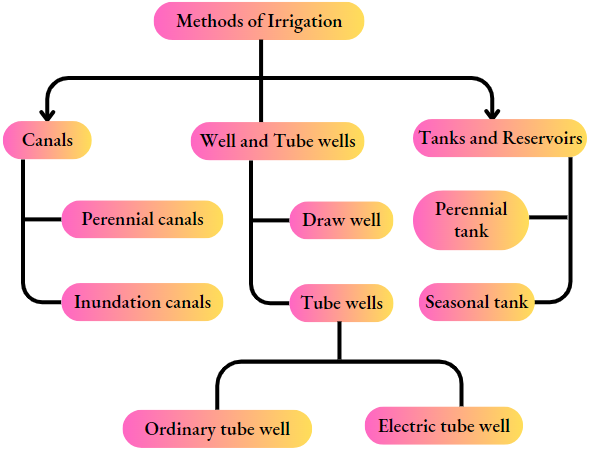
 

WBBSE Solutions Class 10 geography and environment chapter Chapter 5 India Physical Environment flow chart


1. Canals: Two types of canals are seen in India—

perennial canals and
inundation canals.

1. Perennial canals:

  1. The canals drawn from perennial rivers are called perennial canals, The main rivers being perennial, the canals can transport water to the agricultural fields throughout the year,
  2. Such canals are seen in northern India, as the North Indian rivers are snow-fed and are perennial. E.g.-Upper Ganga canal in Uttar Pradesh, the Western Yamuna canal and the Upper Bari Doab canal in Punjab; the Medinipur canal, Eden canal, and Tidal canal in West Bengal; the Bargarh canal of Odisha, etc.
  3. This method of irrigation is mostly used in Uttar Pradesh.

2. Inundation canals: The canals which receive water only when the rivers are flooded are called inundation canals. Such canals can be used for irrigation only in the rainy season. E.g.—Canals drawn from the rivers Krishna, Kaveri, and Godavari.

2. Well sand tube wells:

  1. The wells and tube wells are dug to bring out underground water and use it for agriculture. Wells and tube wells are common in the soft alluvial soils of the northern plains.
  2. The depth of the wells and tube wells depends upon the depth of the water table. If the water table is only a little below the surface of the land, the wells and tube wells need not be very deep.
  3. Tube wells can be manually operated or attached to electric pump sets in order to draw out water.
  4. Wells and tube wells are commonly seen in the plains of northern India in Punjab, Uttar Pradesh, Bihar, West Bengal, Assam, etc.
  5. Uttar Pradesh ranks first in India in using wells and tube wells for irrigation.
  6. Presently, deep tube wells are being dug to draw out water from the arid regions of western India.
  7. Such a method of irrigation is also seen in the southern region of Tamil Nadu and Kerala.

3. Tanks and reservoirs:

  1. The plateau region of southern India is made up of non-porous layers of rocks. Thus, water cannot percolate down to recharge groundwater.
  2. The terrain is undulating. Hence, rainwater can easily be stored in reservoirs and tanks created naturally on the surface.
  3. The water can be used for irrigation and other purposes in the dry season.
  4. Tank irrigation is mostly practiced in Andhra Pradesh, Tamil Nadu, and Karnataka. It is also seen in West Bengal, Odisha, Assam, Bihar, and Jharkhand.
  5. Andhra Pradesh leads in tank irrigation in India.

4. Slope of land: The general slope of the land in India is from west to east. The canals can thus carry water easily from the rivers to the fields along the gently rolling plains.

5. Reservoirs: In southern India, the undulating topography provides natural depressions on land that can be used as reservoirs or tanks. Water is stored in these reservoirs in the rainy season. Canals can be dug from these reservoirs to meet the demand for water in the dry season.

6. Underground water: In many regions in India, the underground water level has gone down so low, that it is difficult to draw out water through the wells and tube wells. Thus, dependence on surface water has increased. Canals are the easiest way to divert river water to the fields.
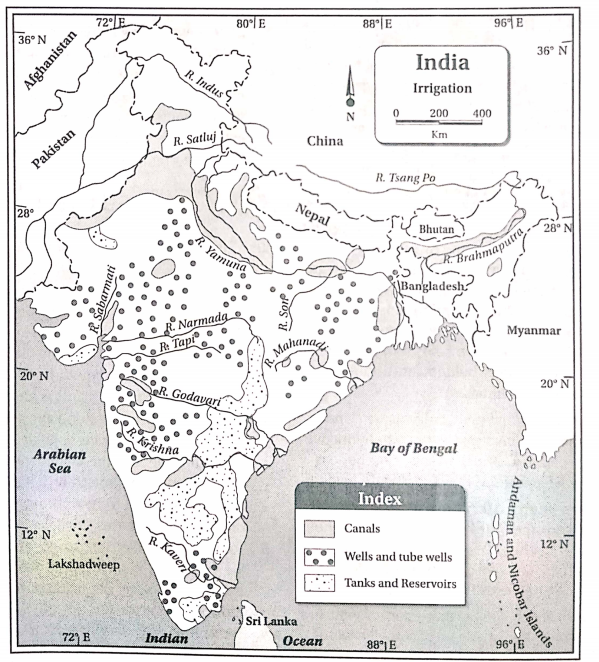
WBBSE Solutions Class 10 geography and environment chapter Chapter 5 India Physical Environment irragation system of india

“Rainwater harvesting techniques in India WBBSE”

Question 13. Discuss the reasons behind the usefulness of canal irrigation in India.
Answer:

Canals are a common means of irrigation in India.

Canals are of two types—

  1. The perennial canals are those that have water throughout the year and can irrigate fields in all seasons.
  2. inundation canals are those that have water only when the rivers are flooded, and can irrigate fields only in the rainy season. The reasons behind the usefulness of canal irrigation in India are—

1. Numerous rivers: India is a land of numerous rivers spread like a network over the country. Thus, canals can be easily drawn from these rivers to irrigate fields.

2. Snow-melt water: The rivers of North India are snowed. They have water throughout the year. Thus, canals drawn from them are also perennial and are used to irrigate agricultural fields throughout the year.

3. Landforms: The northern part of India is a vast plain land made up of soft alluvial soils. Thus, it is easy to draw canals from the rivers through the plains according to the need

4. Slope of land: The general slope of the land in India is from west to east. The canals can thus carry water easily from the rivers to the fields along the gently rolling plains.

5. Reservoirs: In southern India, the undulating topography provides natural depressions on land that can be used as reservoirs or tanks. Water is stored in these reservoirs in the rainy season. Canals can be dug from these reservoirs to meet the demand of water in the dry season.

6. Underground water: In many regions in India, the underground water level has gone down so low, that it is difficult to draw out water through the wells and tube wells. Thus, dependence on surface water has increased. Canals are the easiest way to divert river water to the fields. In India, presently about 26% of agricultural fields are irrigated by canals.

Question 14. Discuss the effects of excessive irrigation.
Answer:

The effects of excessive irrigation are as follows—

1. Deficiency of oxygen: Too much irrigation tend to fill up the air spaces within the soil with water. This drives out the air from the soil. The roots of the plants fail to absorb sufficient oxygen from the soil. Hence, the growth of plants is hampered.

2. Disease of plants: Bacteria and germs tend to multiply fast in waterlogged soil. They attack the roots of the plants and result in their decay. Also, the growth of fungus on the stems, leaves, and fruits of the plants causes various plant diseases.

3. Toxic chemicals: The stagnation of water in the soil for a long time causes the accumulation of toxic chemicals like hydrogen sulfide and volatile fatty acids.

4. Reduction of fertility: Agriculture is carried out in the fields throughout the year using irrigation and growing the same crop.

This constantly reduces the fertility of the soil. After a few years, the fertility may reduce to such an extent that the soil fails to grow any more crops at all.

5. Increase of salinity: Excessive irrigation causes the salts deposited in the lower layers of the soil to dissolve in the water and rise up to the top layers. This gradually makes the soil more saline.

6. Lowering of water table: Supply of irrigation water in one area may result in lowering of the water table in the area from where the water has been drawn out through wells and tube wells.

7. Others:

1. Excessive irrigation may result in changes in the ecosystem and affect the environment. Excess irrigated water mixed with fertilizers and pesticides when drains into the nearby water body cause water pollution.

2. Chances of water-borne diseases may increase.

3. Arsenic pollution and contamination of water may occur.

Question 15. discuss the methods of Watershed development
Answer:

The methods of Watershed development

The proper and judicious use of water is known as the conservation of water. In other words, conservation of water refers to the optimum and logical use of water, control of wastage, reduce unscientific and reckless use of water, water resource management, and storage for future use.

Importance: Shortage of fresh and potable water is a burning problem all over the world. More than 50% of the world’s population suffers from a scarcity of water.

This accounts for about 40% of the population in about 80 countries. Although nearly three-fourths of the earth’s surface is filled with water, 97% of it is saline and unusable.

Only about 3% of the total water is fresh, but only 0.3% is easily available in rivers, ponds, or lakes. With the increase in population, demand for water also increases, and per capita availability of water gradually decreases.

Unplanned extraction of groundwater to meet the rising demand for water has lowered the water table in some areas to such an extent that acute scarcity of water has resulted in those areas.

In India, 15% of the total block of the country suffers from an acute crisis of water. Unless the available water is used carefully, logically, and playfully, more areas will face water crises in the future. Hence, the conservation of water is very important and necessary in India.

Question 16. Discuss the methods of watershed development.
Answer:

Definition of watershed development: The overall scientific development of the watershed of a river is known as watershed development. This includes the conservation of the ecosystem, development and proper management of resources, and overall development of the region.

Methods: Several steps have been taken up in the process of watershed development—

1. Slope management: The high and steep slopes of the upper course of the rivers are prone to landslides and soil erosion. These slopes are taken care of by planting trees, covering the open soil with grasses, prohibiting hum cultivation, building guard walls along the tree beds and even diverting the course of the rivers from where the slope is very steep and dangerous.

2. Flood control: The depth of ponds, canals, wetlands, and even rivers is increased by digging out silt and mud. This increases the water-holding capacity of the water bodies and helps to control floods.

3. Badlands: The formation of badlands may be controlled by building check dams at several places, which will stop the flow of rainwater as surface runoff and control soil erosion.

4. Contour plowing: Trees are planted along contour lines or particular heights, in order to prevent soil erosion. The forests thus created reduce the speed of the surface runoff water and help in recharge of groundwater by percolation of rainwater.

5. Small dams: Small dams are constructed on rivers to control soil erosion and conserve water locally.

6. Multi-purpose projects: Multi-purpose projects are undertaken for the purposes of flood control, generation of hydroelectric power, irrigation, pisciculture, navigation, controlling soil erosion, promotion of tourism, and overall conservation of water.

Question 17. Discuss rainwater harvesting in India.
Answer:

Rainwater harvesting in India

The method of collecting and conserving rainwater from the roofs or open ground to meet the demand for water is known as rainwater harvesting. The water thus collected is used all year round for various purposes, especially in the dry season.

Methods of rainwater harvesting: Rainwater may be collected by different methods—

1. Collection of surface runoff: Construction of reservoirs: Large reservoirs, tanks, ponds, etc. are constructed to hold rainwater and excess river water so that it can be used in the dry season. Accordingly, a pilot scheme was launched in 2005 to restore and augment the storage capacity of water bodies. This scheme was approved in 26 districts across 15 states covering 1098 water bodies.

2. Check-dams: Large dams are expensive to build, and often displace a large number of people living along the rivers or in the catchment area. Check-dams or smaller dams are less expensive and helpful in holding river water in lesser amounts. This is a successful method of flood control as well.

3. Collecting rainwater: India receives ample rain from the southwest monsoon winds. If this water can be held back properly, the crisis of water in the dry season can be met.

It is very essential to hold rainwater in West Bengal, Bihar, Jharkhand, Odisha, Chhattisgarh, Madhya Pradesh, Andhra Pradesh, and Karnataka in order to recharge the reserves of the water resource. Tamil Nadu has excelled in this regard by harvesting rainwater on rooftops since 2001.

4. Proper use of surface water: The surface water stored in reservoirs, ponds, and lakes is used for irrigation. Efforts can be made to increase the efficiency of using this water from 35-40% to 60%.

2. Conservation of groundwater:

1. Implementation of rules and regulations: Implementation of rules and regulations will help to prevent the unplanned use of groundwater, its misuse, and waste. This will help in the conservation of groundwater.

2. Increase the level of water percolation: In places where the land surface is open, the rainwater passes by very fast and does not percolate underground to recharge the groundwater table. In such cases, pipelines and other arrangements may be made so that rainwater reaches deep down and the underground water table is recharged.

3. National policies: The ‘Swajaldhara’ project has been started in 2002 and the ‘Bharat Nirman’ project has been started in 2005-06 for distributing water in rural areas.

Chapter 5 India-Physical Environment  Topic 3 Water Resources Of India Short Explanatory Anser Type Questions

Question 1. Why is the river Brahmaputra flood-prone? OR, Why do floods occur in Assam every year?
Answer:

The main river of Assam is Brahmaputra. Every year during the monsoon season, the river overflows its channel and flooding occurs in the lower Assam valley.

The causes of flood in Assam are—

1. Gentle slope of the land: The slope of the land in Assam valley through which the river Brahmaputra flows, is very gentle. Hence, the river loses its speed and load-carrying capacity. Thus, the heavy amounts of load brought down by the river and its tributaries from the upper course get deposited in the river bed in this region. This reduces the depth and water-holding capacity of the river and makes it flood-prone.

2. Heavy rainfall: The Assam valley receives heavy rainfall during the southwest monsoon season, which supplies huge quantities of water ‘ to the river Brahmaputra. Also, the snow melt water brought down from the upper course of the river (where it is known as Tsangpo, in Tibet) is added on. This increases the volume of water to such an extent that the river channel overflows. The result is severe flooding in the lower course of the river.

Question 2. What is an ideal river? Why is the river Ganga called an ideal river?
Answer:

Ideal river: A river that exhibits the upper, middle, and lowers courses from its source in the mountains or highlands to its mouth in the sea or ocean is called an ideal river. An ideal river generally erodes in the upper course, carries the load in the middle course, and deposits the load in the lower course.

Ganga as an ideal river: The river Ganga rises in the Gomukh cave of the Gangotri glacier in the Greater Himalayas. The upper course of the river stretches from Gomukh to Haridwar. The middle course of the river extends from Haridwar to Rajmahal hills. From south of the Rajmahal hills to the mouth of the river in the Bay of Bengal through the vast delta region lies its lower course. As the river Ganga exhibits all three courses prominently, it is called an ideal river.

Question 3. Describe the course of the river Ganga.
Answer:

The three major rivers of northern India are—the Ganga, Indus, and Brahmaputra.

1. The Ganga: The total length of the river Ganga is 2525 km, of which 2017 km lies in India. This is the most important river in India. The course of the Ganga can be divided into three parts—

1. Upper Course: The river Ganga rises from the Gomukh cave of the Gangotri glacier in the Garhwal Himalayas. Here the river is known as the river Bhagirathi. The river Alaknanda meets the river Bhagirathi at Devaprayag, and the combined flow is known as the river Ganga. The stretch of the river from its source up to Haridwar is known as its upper course.

2. Middle course: The middle course of the river Ganga stretches from Haridwar to the Rajmahal hills. The right bank tributaries Yamuna and Son and the left bank tributaries Gomti, Ghaghara, Ramganga, Gandak, Kosi, etc. meet the river Ganga in this course and multiply both its load and volume of water. The most important tributary of the river Ganga is the river, Yamuna.

3. Lower course: The lower course of the river Ganga extends from south of Rajmahal hills to the mouth in the Bay of Bengal. The Ganga after entering West Bengal bifurcates into two branches near Dhulian of Murshidabad. One of the branches enters Bangladesh as Padma and later drains into the Bay of Bengal as the river Meghna.

The other branch flows through West Bengal as the Bhagirathi-Hooghly river before meeting the Bay of Bengal. The right bank tributaries in this course are—Ajay, Damodar, Kangsabati, and Rupnarayan. The left bank’s tributaries are— Jalangi,
Mathabhanga, Churni, etc. The river Ganga together with the river Brahmaputra forms the largest delta in the world.

2. The Indus: The Indus is the longest and the most important river of northwestern India. It stretches for 2900 km, of which 1114 km lies in India. It rises from the Senge Khabab glacier near the Manas Sarovar in the Greater Himalayas. It flows through Jammu and Kashmir and then turns southwards near Nanga Parbat, entering Pakistan. From there it flows southwards and meets the Arabian Sea (southeast of Karachi).

The most important left-bank tributaries of the river Indus are— Jhelum, Chenab, Ravi, Beas, and Sutlej. These tributaries flow over Jammu and Kashmir, Himachal Pradesh, and Punjab. The right bank tributaries are— Shyok, Gilgit, Shigar, etc. The river Indus forms deep gorges near the Nanga Parbat massif. It forms a small delta at its mouth.

3. The Brahmaputra: The river Brahmaputra is the most important river in north-eastern India. It flows for 2900 km, of which 916 km lies in India. The river rises from the Chemayungdung glacier in Tibet. Here it flows as river Tsangpo over the Tibetan plateau for about 1500 km.

Near the Namcha Barwa peak, it takes a sharp turn towards the southwest and enters Arunachal Pradesh as river Dihang. The Dihang meets the rivers Dibang and Lohit near Sadiya in Assam. The combined flow of these three rivers flows as the river Brahmaputra westwards over Assam till Dhubri.

From Dhubri it turns southwards and enters Bangladesh as the river Jamuna. It meets the river Padma near Goalondo and enters the Bay of Bengal. The course of the river Brahmaputra in Assam is highly braided, forming several islands. The island of Majuli near Jorhat in Assam is the largest riverine island in India.

Some important right-bank tributaries of the river Brahmaputra are— Subansiri, Kameng or Jiya Bharali, Manas, and Sankosh. Some left-bank tributaries of the river Brahmaputra are- Dhansiri, Kopili, and Buri Dihing.

Question 4. Why deltas have not been formed on the mouth of west-flowing rivers in India? OR, Why do the rivers meeting the Arabian Sea not form deltas near their mouths? OR, Why do the rivers Narmada and Tapti not form deltas near their mouths? OR, Why deltas have not been formed at the mouth of west flowing rivers of India?

Answer:

The west-flowing rivers of India generally do not form deltas because—

1. Short length of the rivers: The rivers flow for a short distance, and hence collect a very little amount of eroded materials.

2. Speed: The rivers (E.g.—Narmada and Tapti) flow through steep slopes of rift valleys. Hence, the water flows at high speed and removes whatever eroded materials are collected. Hence, the chances of the formation of deltas in their mouths are less.

3. Less erosion: The rivers flow through a region made up of hard and resistant igneous and metamorphic rocks. Hence, the rate of erosion is very less, which accounts for a very less generation of silt.

4. Lesser number of tributaries: The west-flowing rivers have a lesser number of tributaries. Thus, the total load of eroded materials collected by the rivers is very less.

5. Slope near the mouths of the rivers: The slope of the continental shelf near the mouths of the rivers is steep, which does not allow any deposition of silt. Hence, this repels the formation of a delta.

Question 5. What are the main causes of pollution in the rivers of India? What steps have been taken up for controlling pollution of the river Ganga?
Answer:

Causes of pollution of the rivers of India:

1. Disposal of wastes from household factories and sewage lines into the rivers.

2. Disposal of dead animals into the rivers.

3. Washing down of pesticides and chemical fertilizers by rainwater into the rivers.

4. Bathing domestic animals, washing utensils and clothes in rivers.

5. Lack of consciousness regarding environmental pollution and degradation.

Steps taken for controlling pollution of the river Ganga: The ‘Central Ganga Authority’ was formed in 1985 by the government of India.

The ‘Ganga Action Plan’ has been taken up by this organization for controlling pollution of the river Ganga. Presently, various plans are being executed in many places.

Once the plans are fully executed, it is expected that pollution of the river Ganga will be controlled to a large extent. Organizations like ‘National Ganga River Basin Authority’ have been formed and programs like ‘Namo Gange’ have been taken up to conserve the water of the river Ganga.

Question 6. Describe the course of a river flowing through a rift valley in India.
Answer:

The course of a river flowing through a rift valley in India

The river Narmada is a river flowing through a rift valley in India. The course of the river: The river Narmada rises in the Amarkantak plateau (1057 m high) in Madhya Pradesh. Itflowsfora a stretch of 1312 km towards the west through Chhattisgarh, Madhya Pradesh, Maharashtra, and Gujarat before draining into the Gulf of Khambat.

In the first 300 km stretch of its flow, the river has the famous waterfalls of Kapil Dhara and Dhuandhar. The river flows through a plain land from Bharuch in Gujarat to the mouth in the Gulf of Khambat. Here the river widens and covers an area of about 20 km.

“Water quality issues in India Class 10 Geography”

Question 7. Although most of the rivers of South India are east flowing, Why are the rivers Narmada and Tapti west flowing?
Answer:

Rivers flow in the direction of the slope of the land. The general slope of the southern part of India is from west to east. Hence, most of the South Indian rivers (e.g.—Godavari, Krishna, Kaveri) are east flowing. But the rivers Narmada and Tapti flow through rift valleys formed between the Vindhya and Satpura ranges. The slope of these rift valleys, formed due to faulting, is from east to west. Hence, these rivers are west flowing.

Question 8. What is the river Brahmaputra known as in the different parts of its course?
Answer:

River Brahmaputra known as in the different parts of its course

The river Brahmaputra rises from the Chemayugdung glacier near Rakshastal and Manas Sarovar in Tibet. The river is known by different names in different parts of its course.

1. The river is known as Tsangpo from its source to Namcha Barwa in the east.

2. The southward flow of the river from there to Sadiya of Assam through Arunachal Pradesh is known as Dihang.

3. The Dihang meets with the rivers Dibang and Lohit near Sadiya. The combined flow of these rivers towards the west is known as the river Brahmaputra till Dhubri in Assam.

4. The river Brahmaputra enters Bangladesh after this and meets the branch of the river Ganga. Here it is known as river Jamuna, which flows southwards till Aricha in Bangladesh.

5. Beyond Aricha, the south-eastward flow of the river (Ganga and Jamuna) is known as the river Padma. After this stretch, the river Padma meets the river Meghna and finally drains into the Bay of Bengal.

Question 9. Describe the upper course of the river Ganga.
Answer:

The three major rivers of northern India are—the Ganga, Indus, and Brahmaputra.

1. The Ganga: The total length of the river Ganga is 2525 km, of which 2017 km lies in India. This is the most important river in India. The course of the Ganga can be divided into three parts—

1. Upper Course: The river Ganga rises from the Gomukh cave of the Gangotri glacier in the Garhwal Himalayas. Here the river is known as the river Bhagirathi. The river Alaknanda meets the river Bhagirathi at Devaprayag, and the combined flow is known as the river Ganga. The stretch of the river from its source up to Haridwar is known as its upper course.

2. Middle course: The middle course of the river Ganga stretches from Haridwar to the Rajmahal hills. The right bank tributaries Yamuna and Son and the left bank tributaries Gomti, Ghaghara, Ramganga, Gandak, Kosi, etc. meet the river Ganga in this course and multiply both its load and volume of water. The most important tributary of the river Ganga is the river, Yamuna.

3. Lower course: The lower course of the river Ganga extends from south of Rajmahal hills to the mouth in the Bay of Bengal. The Ganga after entering West Bengal bifurcates into two branches near Dhulian of Murshidabad. One of the branches enters Bangladesh as Padma and later drains into the Bay of Bengal as the river Meghna.

The other branch flows through West Bengal as the Bhagirathi-Hooghly river before meeting the Bay of Bengal. The right bank tributaries in this course are—Ajay, Damodar, Kangsabati, and Rupnarayan. The left bank’s tributaries are— Jalangi,
Mathabhanga, Churni, etc. The river Ganga together with the river Brahmaputra forms the largest delta in the world.

2. The Indus: The Indus is the longest and the most important river of northwestern India. It stretches for 2900 km, of which 1114 km lies in India. It rises from the Senge Khabab glacier near the Manas Sarovar in the Greater Himalayas. It flows through Jammu and Kashmir and then turns southwards near Nanga Parbat, entering Pakistan. From there it flows southwards and meets the Arabian Sea (southeast of Karachi).

The most important left-bank tributaries of the river Indus are— Jhelum, Chenab, Ravi, Beas, and Sutlej. These tributaries flow over Jammu and Kashmir, Himachal Pradesh, and Punjab. The right bank tributaries are— Shyok, Gilgit, Shigar, etc. The river Indus forms deep gorges near the Nanga Parbat massif. It forms a small delta at its mouth.

3. The Brahmaputra: The river Brahmaputra is the most important river in north-eastern India. It flows for 2900 km, of which 916 km lies in India. The river rises from the Chemayungdung glacier in Tibet. Here it flows as river Tsangpo over the Tibetan plateau for about 1500 km.

Near the Namcha Barwa peak, it takes a sharp turn towards the southwest and enters Arunachal Pradesh as river Dihang. The Dihang meets the rivers Dibang and Lohit near Sadiya in Assam. The combined flow of these three rivers flows as the river Brahmaputra westwards over Assam till Dhubri.

From Dhubri it turns southwards and enters Bangladesh as the river Jamuna. It meets the river Padma near Goalondo and enters the Bay of Bengal. The course of the river Brahmaputra in Assam is highly braided, forming several islands. The island of Majuli near Jorhat in Assam is the largest riverine island in India.

Some important right-bank tributaries of the river Brahmaputra are— Subansiri, Kameng or Jiya Bharali, Manas, and Sankosh. Some left-bank tributaries of the river Brahmaputra are- Dhansiri, Kopili, and Buri Dihing.

Question 10. Describe the course of the river Brahmaputra. What is the river known as in different parts of its course?
Answer:

The three major rivers of northern India are—the Ganga, Indus, and Brahmaputra.

1. The Ganga: The total length of the river Ganga is 2525 km, of which 2017 km lies in India. This is the most important river in India. The course of the Ganga can be divided into three parts—

1. Upper Course: The river Ganga rises from the Gomukh cave of the Gangotri glacier in the Garhwal Himalayas. Here the river is known as the river Bhagirathi. The river Alaknanda meets the river Bhagirathi at Devaprayag, and the combined flow is known as the river Ganga. The stretch of the river from its source up to Haridwar is known as its upper course.

2. Middle course: The middle course of the river Ganga stretches from Haridwar to the Rajmahal hills. The right bank tributaries Yamuna and Son and the left bank tributaries Gomti, Ghaghara, Ramganga, Gandak, Kosi, etc. meet the river Ganga in this course and multiply both its load and volume of water. The most important tributary of the river Ganga is the river, Yamuna.

3. Lower course: The lower course of the river Ganga extends from south of Rajmahal hills to the mouth in the Bay of Bengal. The Ganga after entering West Bengal bifurcates into two branches near Dhulian of Murshidabad. One of the branches enters Bangladesh as Padma and later drains into the Bay of Bengal as the river Meghna.

The other branch flows through West Bengal as the Bhagirathi-Hooghly river before meeting the Bay of Bengal. The right bank tributaries in this course are—Ajay, Damodar, Kangsabati, and Rupnarayan. The left bank’s tributaries are— Jalangi,
Mathabhanga, Churni, etc. The river Ganga together with the river Brahmaputra forms the largest delta in the world.

2. The Indus: The Indus is the longest and the most important river in northwestern India. It stretches for 2900 km, of which 1114 km lies in India. It rises from the Senge Khabab glacier near the Manas Sarovar in the Greater Himalayas. It flows through Jammu and Kashmir and then turns southwards near Nanga Parbat, entering Pakistan. From there it flows southwards and meets the Arabian Sea (southeast of Karachi).

The most important left-bank tributaries of the river Indus are— Jhelum, Chenab, Ravi, Beas, and Sutlej. These tributaries flow over Jammu and Kashmir, Himachal Pradesh, and Punjab. The right bank tributaries are— Shyok, Gilgit, Shigar, etc. The river Indus forms deep gorges near the Nanga Parbat massif. It forms a small delta at its mouth.

3. The Brahmaputra: The river Brahmaputra is the most important river in north-eastern India. It flows for 2900 km, of which 916 km lies in India. The river rises from the Chemayungdung glacier in Tibet. Here it flows as river Tsangpo over the Tibetan plateau for about 1500 km.

Near the Namcha Barwa peak, it takes a sharp turn towards the southwest and enters Arunachal Pradesh as river Dihang. The Dihang meets the rivers Dibang and Lohit near Sadiya in Assam. The combined flow of these three rivers flows as the river Brahmaputra westwards over Assam till Dhubri.

From Dhubri it turns southwards and enters Bangladesh as the river Jamuna. It meets the river Padma near Goalondo and enters the Bay of Bengal. The course of the river Brahmaputra in Assam is highly braided, forming several islands. The island of Majuli near Jorhat in Assam is the largest riverine island in India.

Some important right-bank tributaries of the river Brahmaputra are— Subansiri, Kameng or Jiya Bharali, Manas, and Sankosh. Some left-bank tributaries of the river Brahmaputra are- Dhansiri, Kopili, and Buri Dihing.

Question 11. Describe the course of the river Indus.
Answer:

The three major rivers of northern India are—the Ganga, Indus, and Brahmaputra.

1. The Ganga: The total length of the river Ganga is 2525 km, of which 2017 km lies in India. This is the most important river in India. The course of the Ganga can be divided into three parts—

1. Upper Course: The river Ganga rises from the Gomukh cave of the Gangotri glacier in the Garhwal Himalayas. Here the river is known as the river Bhagirathi. The river Alaknanda meets the river Bhagirathi at Devaprayag, and the combined flow is known as the river Ganga. The stretch of the river from its source up to Haridwar is known as its upper course.

2. Middle course: The middle course of the river Ganga stretches from Haridwar to the Rajmahal hills. The right bank tributaries Yamuna and Son and the left bank tributaries Gomti, Ghaghara, Ramganga, Gandak, Kosi, etc. meet the river Ganga in this course and multiply both its load and volume of water. The most important tributary of the river Ganga is the river, Yamuna.

3. Lower course: The lower course of the river Ganga extends from south of Rajmahal hills to the mouth in the Bay of Bengal. The Ganga after entering West Bengal bifurcates into two branches near Dhulian of Murshidabad. One of the branches enters Bangladesh as Padma and later drains into the Bay of Bengal as the river Meghna.

The other branch flows through West Bengal as the Bhagirathi-Hooghly river before meeting the Bay of Bengal. The right bank tributaries in this course are—Ajay, Damodar, Kangsabati, and Rupnarayan. The left bank’s tributaries are— Jalangi,
Mathabhanga, Churni, etc. The river Ganga together with the river Brahmaputra forms the largest delta in the world.

2. The Indus: The Indus is the longest and the most important river in northwestern India. It stretches for 2900 km, of which 1114 km lies in India. It rises from the Senge Khabab glacier near the Manas Sarovar in the Greater Himalayas. It flows through Jammu and Kashmir and then turns southwards near Nanga Parbat, entering Pakistan. From there it flows southwards and meets the Arabian Sea (southeast of Karachi).

The most important left-bank tributaries of the river Indus are— Jhelum, Chenab, Ravi, Beas, and Sutlej. These tributaries flow over Jammu and Kashmir, Himachal Pradesh, and Punjab. The right bank tributaries are— Shyok, Gilgit, Shigar, etc. The river Indus forms deep gorges near the Nanga Parbat massif. It forms a small delta at its mouth.

3. The Brahmaputra: The river Brahmaputra is the most important river in north-eastern India. It flows for 2900 km, of which 916 km lies in India. The river rises from the Chemayungdung glacier in Tibet. Here it flows as river Tsangpo over the Tibetan plateau for about 1500 km.

Near the Namcha Barwa peak, it takes a sharp turn towards the southwest and enters Arunachal Pradesh as river Dihang. The Dihang meets the rivers Dibang and Lohit near Sadiya in Assam. The combined flow of these three rivers flows as the river Brahmaputra westwards over Assam till Dhubri.

From Dhubri it turns southwards and enters Bangladesh as the river Jamuna. It meets the river Padma near Goalondo and enters the Bay of Bengal. The course of the river Brahmaputra in Assam is highly braided, forming several islands. The island of Majuli near Jorhat in Assam is the largest riverine island in India.

Some important right-bank tributaries of the river Brahmaputra are— Subansiri, Kameng or Jiya Bharali, Manas, and Sankosh. Some left-bank tributaries of the river Brahmaputra are- Dhansiri, Kopili, and Buri Dihing.

Question 12. Classify the rivers of India according to the size of their basins.
Answer:

The rivers of India can be classified into three types according to the size of their basins.

1. Main rivers: The rivers that have a total basin area of more than 20000 sq. km are known as main rivers. There are 12 such rivers namely—the Ganga, Indus, Brahmaputra, Narmada, Tapti, Mahanadi, Godavari, Sabarmati, Krishna, Kaveri, Mahi, Brahmani, Subarnarekha, and Pennar.

2. Medium rivers: About 46 rivers in India have a basin size of 2000-20000 sq. km. Such rivers are known as medium rivers. E.g.—Rivers Sharavathi Vaigai, Periyar, Palar, and Baitarini.

3. Small rivers: More than 55 rivers in India have a basin smaller than 2000 sq. km. Such rivers are called small rivers. E.g.—Rivers Luni, Banas, Rachol and Damon Ganga.

Question 13. Why is India called the land of rivers?
Answer:

India is called the ‘land of rivers’ because—

1. The rivers of India carry about 186900 crore cubic meters of water (about 85% by the main rivers, 7% by the medium ri rivers, 4% by the small rivers, and the remaining 4% by other streams).

2. The ancient civilization of the Indus, the old cities of Allahabad, Varanasi, and Kanpur, and modern cities and towns have grown on river banks in different phases of time.

3. Agriculture in India is largely dependent on the rivers, especially for the alluvial soil and water.

4. Important industries like cotton textile, jute textile, sugar, etc. have come up near riverbanks

5. The rivers of India are important for irrigation, hydel power generation, navigation, trade and commerce through waterways, and many other uses. Hence, India is called the ‘land of rivers’.

Question 14. Name some flood-prone regions of India.
Answer:

According to the ‘Rashtriya Barh Ayog’, the most flood-prone regions of India are—

1. The river basins of Ganga, Yamuna, Ghaghara, and Gandak in Uttar Pradesh.
2. The river basins of Kosi and Son in Bihar.
3. Western Punjab
4. South-eastern Haryana
5. Eastern Rajasthan
6. North-eastern and southern parts of Gujarat
7. Coastal regions of Andhra Pradesh.
8. Coastal regions of Odisha.
9. The Brahmaputra basin of Assam.
10. The Ganga river basin and coastal regions of West Bengal.

Question 15. Discuss the role of lakes and reservoirs as sources of water resources.
Answer:

The lakes and other water bodies are considered to be important sources of water resources for the following reasons—

1. Lakes serve as sources of drinking water.
2. Lakes and reservoirs help to hold water and control floods.
3. The lakes and reservoirs supply water for irrigation in the dry season.
4. They help to recharge groundwater through percolation.
5. They help to maintain the aquatic ecosystems.
6. Pisciculture can be practiced in lakes and reservoirs, which gives rise to a new economic activity.
7. They are also used for water sports which, in turn, promotes tourism.

Question 16. Why are the rivers of South India not navigable?
Answer:

The rivers of South India are not navigable because—

1. Most of the rivers are rainfed. They either dry up or have scanty water in dry seasons, which is not suitable for navigation.

2. The rivers flow through the rough and undulating terrain of the plateau. They have immense speed in some regions and form waterfalls. Hence, they are not navigable.

Question 17. Why are the rivers of South India non-perennial?
Answer:

The rivers of South India rise in the plateau region that is not snow-covered. Thus, they receive water only from rainfall and not from the melting of snow. Hence, they have sufficient water only in the rainy season and tend to dry up during the dry season. This makes them non-perennial.

Question 18. Discuss the importance of irrigation in
Answer:

The importance of irrigation in India is as follows—

1. Irrigation helps in carrying out agriculture throughout the year.
2. Irrigation helps to grow HYV seeds, which yield more crops.
3. Irrigation helps to carry out agriculture in dry regions or regions of scanty rainfall.
4. Crops like Boro rice need large quantities of water but can be grown in the dry winter season with the help of irrigation.
5. Indian agriculture is dependent on monsoons. Crop failures due to the erratic nature of the monsoons can be controlled with the help of irrigation.

Question 19. Mention the advantages of multipurpose river valley projects.
Answer:

The advantages of multi-purpose river valley projects are—

1. Flood control.
2. Irrigation with the help of water stored in the reservoirs behind dams.
3. Generation of hydroelectric power.
4. Supply of drinking water.
5. Control of soil erosion.
6. Dams constructed on the rivers serve as bridges.
7. Pisciculture in the reservoirs behind the dams.
8. Promotes tourism due to scenic beauty.

Question 20. List the advantages and disadvantages of well and tube well irrigation.
Answer:

Advantages of well and tube well irrigation:

1. Wells and tube wells are easy to operate.
2. The cost of construction, as well as maintenance of wells and tube wells, is low. So, it can be afforded by most farmers.
3. Wells and tube wells can be dug near the agricultural fields according to necessity.

Disadvantages of well and tube well irrigation:

1. Wells and tube wells cannot be used to draw huge quantities of water.
2. Wells and tube wells become useless if the groundwater level goes down considerably.
3. Excessive drawing of groundwater through wells and tube wells may cause arsenic and fluoride pollution of water.

Question 21. Why is tank irrigation commonly practiced in south India?
Answer:

Tank irrigation is popular in South India because of the following reasons—

1. There are numerous natural reservoirs and artificial tanks in the plateau region of Tamil Nadu, Karnataka, and Andhra Pradesh.

2. The surface of this region is mostly non-porous and hence, rainwater cannot percolate down and recharge the groundwater.

3. The hard rocky surface of the land is not suitable for digging canals.

4. The region mostly lies in the rainshadow area. The rivers are non-perennial, and cannot be depended upon for irrigation throughout the year.

Question 22. What is the Damodar Valley multipurpose river valley project?
Answer:

Damodar Valley multipurpose river valley project

The Damodar Valley Project is the first multi-purpose river valley project taken up in India in 1948. The main objectives of the project are flood control, power generation, and irrigation along with several secondary objectives, such as controlling soil erosion and environmental pollution, pisciculture, etc.

For flood control, dams have been constructed at Tilaiya, Maithon, Panchet, Konar, and Tenughat. Thermal and hydel power stations have been set up at Mejia, Durgapur, Chandrapura, Maithon, Koderma, Bokaro (thermal), Maithon, Tilaiya, and Panchet (hydel power). Extensive irrigation canals provide water to the West and East Bardhaman and Howrah districts of West Bengal. For this purpose, a barrage has been constructed at Durgapur.
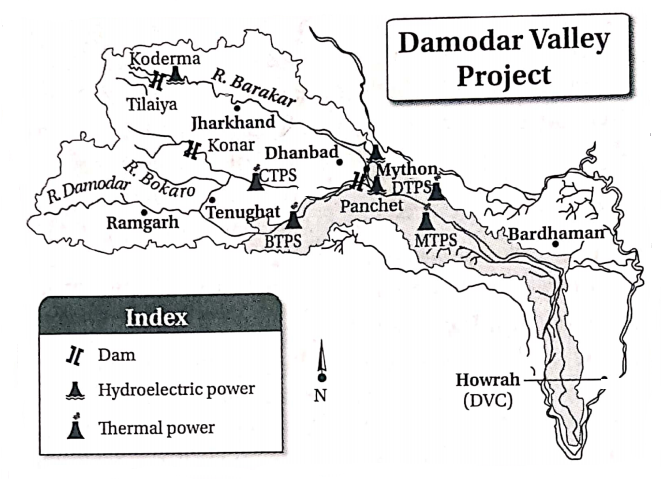


WBBSE Solutions Class 10 geography and environment chapter Chapter 5 India Physical Environment damodar valley projects


Question 23. Mention the advantages and disadvantages of canal irrigation.
Answer:

Advantages of canal irrigation:

1. Perennial canals help in agriculture throughout the year.
2. The initial cost of the construction of canals is high, but the cost of maintenance is low.
3. The alluvial soils brought down by the rivers flow into the canals along with the water and spreads on the agricultural fields. This makes the soil more fertile.
4. It irrigates a vast area.

Disadvantage of canal irrigation:

1. Canals can be used for irrigation only in the plains.
2. Soils tend to become saline due to too much irrigation through canals.
3. Canals may lead to floods in the rainy season.
4. Initial cost of construction is high.

Question 24. Name some of the multi-purpose river valley projects in India.
Answer:

Some of the important multi-purpose river valley projects in India are—

1. Bhakra-Nangal Project: This is the largest multi-purpose river valley project in India, built on the river Sutlej in Himachal Pradesh and Punjab.

2. Hirakud Project: This has been built on the river Mahanadi in Odisha for irrigation and other purposes.

3. Mayurakshi Project: This project has been built on the river Mayurakshi, West Bengal. Dams and barrages have been built at Massanjore and Tilpara for supplying irrigation water to the nearby areas of the Birbhum district.

4. Kosi Project: This project has been built on the river Kosi in Bihar.

5. Gandak Project: This project has been built on the river Gandak for providing irrigation to Nepal, Uttar Pradesh, and Bihar.

6. Nagarjuna Sagar Project: This project on the river Krishna is an important multi-purpose project in Telangana.

Question 25. What do you mean by a multi-purpose river valley project?
Answer:

Multi-purpose river valley project

A project where a river is dammed at one or more places and the water is used for several purposes, is called a multi-purpose river valley project. The river is dammed for flood control, Irrigation, generation of hydroelectric power,

navigation, pisciculture, control of soil erosion, afforestation, supply of drinking water, construction of roads, and promoting tourism. In India, several multi-purpose river valley projects have been built on the rivers Damodar, Sutlej, Mahanadi, Krishna, Godavari, etc.

Question 26. What purposes are served by the multi-purpose river valley projects?
Answer:

In multi-purpose river valley projects, the rivers are dammed and the water is stored in huge reservoirs behind the dams.

The different purposes served by the multi-purpose river valley projects are as follows—

1. Canals are dug from the reservoirs to the agricultural fields to provide irrigation water throughout the year.

2. The water stored in the reservoirs may be used for hydel power generation.

3. Flooding of the river basins during monsoon season may be controlled by storing the excess water behind dams.

4. The rivers as well as the canals may be used for navigation.

5. Pisciculture is practiced in the reservoirs.

6. The stored water is purified to supply drinking water.

7. Soil erosion is controlled by reducing the speed of the rivers. Further, trees are planted in the river basin and around the reservoirs for soil and environmental conservation.

8. The scenic beauty of the dams and reservoirs attracts tourists.

9. The dams act as bridges over the rivers. In India, multi-purpose river valley projects have been built on several rivers like Damodar, Sutlej, Mayurakshi, Mahanadi, Krishna, and Godavari.

Question 27. Discuss the main purposes of the Damodar Valley Project.
Answer:

The main purposes of the Damodar Valley Project are—

1. Generation of hydroelectricity to be supplied to the mineral-rich areas of the Damodar Valley for the development of industries.
2. Controlling flood in the lower course of the river Damodar.
3. Irrigation of agricultural land and reclamation of fallow infertile land for agriculture.
4. Reduction of soil erosion, conservation of soil, and controlling environmental degradation.
5. Development of other economic activities like pisciculture.
6. Development of tourism.

Question 28. Differentiate between irrigation dams and multi-purpose dams.
Answer:

The difference between irrigation dams and multi-purpose dams


Point of difference Irrigation dams Multi-purpose dams
Purpose Mainly constructed to provide irrigation to agricultural fields. Mainly constructed for the generation of hydel power, flood control, navigation, pisciculture, along with irrigation of agricultural fields.
Water storage Usually, the excess water during the monsoon season is stored behind the dams.

Once the agricultural season is over, there is no problem if the water behind the dams dries up.

Usually, water is stored throughout the year for several purposes like pisciculture, navigation, and hydel power generation apart from irrigation.
Examples Irrigation dam on the river Kangsabati in West Bengal. Multi-purpose dams on the rivers Damodar and Mayurakshi in West Bengal.


Question 29. Why there are more perennial canals In North India than In South India?
Answer:

The canals constructed from perennial rivers are called perennial canals. These canals have water throughout the year. In India, the rivers of South India are only rainfed. Most of them tend to dry up or have very little water during the dry season. On the other hand, the rivers of North India are both rainfed and snowed i.e., they are perennial. Hence, more perennial canals are present in North India than in South India.

Question 30. Why is irrigation necessary for agriculture in India?
Answer:

Irrigation is necessary for agriculture in India because—

1. Indian agriculture is dependent on monsoons. The irregularity of the monsoon rains may lead to crop failures. Thus, irrigation is necessary.

2. Distribution of rainfall is not even over the whole country. The north-eastern and eastern states receive heavy rainfall, but the north-western and western states of Rajasthan, Gujarat, Punjab, and Haryana are comparatively dry. Irrigation helps in producing crops in regions of scanty rainfall.

3. In India, winters are dry, Hence, irrigation is indispensable for growing wheat, pulses, oilseeds, and other rabi crops during the winter season.

4. Rainfall occurs mainly in India during the southwest monsoon season (June-September). So irrigation helps to grow multiple crops on the same land throughout the year.

5. Some soils like laterite and red soil cannot hold water for long. Irrigation is necessary to grow crops in such soils.

6. Recently, HYV seeds are used in agriculture to increase crop production. These seeds need a sufficient amount of water to grow. Hence, irrigation is needed for getting the best results from these seeds.

Question 31. Which methods of Irrigation are popular in the plateau region of southern India?
Answer:

The plateau region of southern India is hard and rocky. The terrain is undulating and the rock beds are mostly non-permeable.

This helps in the formation of natural reservoirs that hold rainwater. Thus, tank irrigation is popular in this region. Also, the hard rocky surface is difficult for digging canals for canal irrigation. The non-permeable rocks do not permit the recharge of groundwater as well. Thus, irrigation by wells and tube wells is also not suitable here.

Question 32. Which method of irrigation is popular in the plains of India?
Answer:

The plains of India mostly constitute soft alluvial soils which makes digging the ground easy. The groundwater level is high in this region due to heavy rainfall and percolation through permeable rocks.

Hence, wells and tube wells are the best and the most popular methods of irrigation in the plains. Canals are also drawn from the rivers to the agricultural fields for irrigation.

Question 33. Why are canals mostly used for irrigation in the northern plains of India?
Answer:

Canals are mostly used for irrigation in the northern plains because of the following reasons—

1. Perennial rivers: The rivers of North India are both rain and snow-fed and hence perennial in nature. The canals dug from these rivers are also perennial and provide water for irrigation throughout the year.

2. Plain land: The northern plains are gently sloping and have very few undulations. This makes it easier for digging canals.

3. Soft soils: The northern plains constitute soft alluvial soils. This helps in digging canals for irrigation.

4. Multi-purpose projects: Many multi-purpose river valley projects have been undertaken in North India. Under those projects, many canals have been built.

Question 34. How does canal irrigation help in agriculture in India?
Answer:

Canals are very important in irrigating agricultural fields in India because of the following reasons—

1. Large area: Canals are drawn over long distances. Hence, large areas can be irrigated by them.

2. Flood control: The excessive water received from monsoon rains can be channelized with the help of the canals. This helps to control floods and puts the water to proper use.

3. Increase soil fertility: Canals carry sufficient amounts of silt brought down by the rivers and spread them over the fields they irrigate. This helps to increase the soil fertility of the region.

4. Recharge groundwater: Canals run on the surface and mostly carry river water. Thus, groundwater is not utilized, rather water percolates down from canals and helps to recharge groundwater.

Question 35. What do you mean by conservation of water? What is its importance?
Answer:

Conservation of water

Although the earth is covered with 3 parts of water, the amount of potable water is limited. Conservation of water refers to the methods taken up to save potable water and purify and reuse water without wasting it.

The importance of the conservation of water is—

1. Conservation of drinking water: The increasing population of the country poses a high demand for drinking water. So, it is necessary to maintain the supply of drinking water through the conservation of water.

2. Agriculture: Conservation of water is very important for providing irrigation water to agricultural fields.

3. Industries: Water is needed in huge amounts in industries and for other economic activities. So, the conservation of water is necessary.

Question 36. What are the advantages of rainwater harvesting?
Answer:

The advantages of rainwater harvesting are—

1. Rainwater can be purified and used as drinking water.
2. Rainwater percolates underground and helps to recharge the groundwater.
3. The stored rainwater can meet the demand for water during the dry season.

Question 37. How can rainwater be harvested?
Answer:

The method of holding rainwater and using it to meet the different demands of water is known as rainwater harvesting.

Rainwater can be harvested in two ways—

1. Arresting the run-off on the ground: The rainwater flowing on the surface as runoff can Use of conserved water. This water can be used for irrigation, generation of hydroelectric power and purification to be supplied as drinking water. This also helps in the recharge of the groundwater.

2. Collecting rainwater from the roof: Rainwater can be collected from the roofs and stored in underground reservoirs. Water collected in a number of such reservoirs will be sufficient for meeting household demands throughout the year. This water can also be purified for drinking. The excess water can be sent deep down to recharge the groundwater.
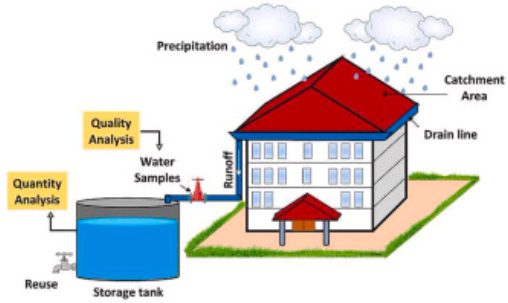
 

WBBSE Solutions Class 10 geography and environment chapter Chapter 5 India Physical Environment Rain water harvesting


Question 38. Discuss the role of rainwater harvesting in Tamil Nadu.
Answer:

The role of rainwater harvesting in Tamil Nadu

Tamil Nadu plays a very important role in rainwater harvesting in India. It is mandatory to accumulate and store rainwater for every household in the state. The project has been taken up in 2001, and since then it has been found that the groundwater level in Tamil Nadu has risen considerably. Different systems of rainwater collection are implemented in different categories of houses.

The government plays an active role in executing this project and provides the necessary infrastructure—

1. Campaigns regarding the necessity and importance of rainwater harvesting are conducted regularly to increase awareness among the people.

2. Hoardings, banners, festoons, and posters are used to send messages to all corners of the state.

3. Door-to-door surveys and campaigns are conducted regularly.

4. Government aid is provided to set up machinery for harvesting rainwater.

5. The wetlands and brackish lands (about 1821) have been reclaimed and about 6286.84 acres of wetlands have been provided for collecting rainwater.

Chapter 5 India Physical Environment Topic 3 Water Resources Of India Short Answer Type Questions

Question 1. Name three rivers of north and south India each.
Answer:

Rivers of north India—Ganga, Brahmaputra, and Indus. Rivers of south India—Godavari, Krishna, and Kaveri.

Question 2. Where do the sources and mouths of rivers Godavari and Narmada lie?
Answer:

Godavari: The river Godavari rises in the Trimbakeshwar highlands of Western Ghats in the Nashik district of Maharashtra. It meets the Bay of Bengal near Rajahmundry.

Narmada: The river Narmada rises from the Amarkantak plateau lying at the border of Madhya Pradesh and Chhattisgarh. It meets the Gulf of Khambat near Bharuch.

Question 3. Name three west-flowing rivers of India.
Answer:

The west-flowing rivers of India are Narmada, Tapti, and Mahi.

Question 4. Name two tributaries and distributaries each of the river Ganga
Answer:

Tributaries: Rivers Yamuna and Ramganga.

Distributaries: Rivers Bhagirathi-Hooghly and Jalangi.

Question 5. Which rivers of South India make deltas at their mouths?
Answer:

Rivers Godavari, Mahanadi, Krishna, and Kaveri have formed deltas at their mouths.

Question 6. From where does the river Brahmaputra rise? Name its two tributaries.
Answer:

The fiver Brahmaputra rises from the Chemayungdung glacier, 90 km away from the Rakshastal-Manas Sarovar region. Two tributaries of the river Brahmaputra are— Subansiri and Lohit.

Question 7. What is an inland river?
Answer:

Inland river

The rivers that rise in some highlands or mountains and flow into any lake or water body within the land or dry up in the desert region, are called inland rivers. They do not meet any ocean or sea near the boundary of the landmass. Example—The river Luni of Rajasthan rises from the Aravalli hills and ends near the Rann of Kachchh.

Question 8. What are disappearing or influent rivers?
Answer:

Disappearing:

Some rivers may suddenly disappear from the surface and flow through the underground for a certain distance an then once again emerge on the surface in the course of their flow. This may happen if the rivers flow through a limestone region, where the water dissolves the limestone and penetrates deep down. Once the rivers cross the limestone region, they reappear on the surface. These are called disappearing or influent rivers.

Question 9. Name two water divides of India.
Answer:

The two main water divides of India are the Vindhya range and the Western Ghats.

Question 10. Name the right and left bank tributaries of the river Ganga. OR, Name the right bank tributaries of the river Ganga. OR, Name the left bank tributaries of the river Ganga.
Answer:

Right bank tributaries of the river Ganga: Ramganga, Gomti, Ghaghara, Gandak, Kosi. Left bank, tributaries of the river Ganga: Yamuna, Son, Punpun.

Question 11. Which two rivers meet to form the river Ganga and where do they meet?
Answer:

The rivers Bhagirathi and Alaknanda meet at Devaprayag in Uttarakhand to form the river, Ganga.

Question 12. Which rivers meet to form the river Brahmaputra?
Answer:

The rivers Dihang, Dibang, and Lohit meet together to form the river Brahmaputra.

Question 13. Name the only river of Marusthali and mention its source.
Answer:

The only river of Marusthali is the river Luni. It rises from the Aravalli range.

Question 14. Name the most important river of Rajasthan. Where does it meet?
Answer:

The most important river in Rajasthan is Luni. It meets the Rann of Kachchh.

Question 15. Name a few east-flowing rivers of India.
Answer:

Some east-flowing rivers of India are— Mahanadi, Godavari, Krishna, and Kaveri.

Question 16. Name a few tributaries and distributaries of the river Godavari.
Answer:

Tributaries: Rivers Purna, Pranhita, Indravati, Manjira, Pravara, Manair.

Distributaries: Rivers Gautami, Vashishta.

Question 17. Name the main tributary of the river Ganga. Where does it rise?
Answer:

The main tributary of the river Ganga is the river, Yamuna. It rises from the Yamunotri glacier of the Garhwal Himalayas.

Question 18. Name a few cities located on the banks of the river Ganga.
Answer:

Few cities located on the banks of the river Ganga are—Kolkata, Patna, Allahabad, and Kanpur.

Question 19. Name the five tributaries of the river Indus.
Answer:

The five tributaries of the river Indus are— Jhelum, Chenab, Ravi, Beas, and Sutlej.

Question 20. Name two rivers of India that have waterfalls in their courses.
Answer:

The rivers Kaveri (Shivanasamudra falls) and Sharavathi (Gerosoppa falls) have waterfalls in their courses of flow.

Question 21. Name two saltwater lakes in India.
Answer:

Two saltwater lakes of India are— Sambhar lake (Rajasthan) and Pangong lake (Jammu and Kashmir).

Question 22. Where is the source of the river Ganga?
Answer:

The river Ganga rises from the Gomukh cave of the Gangotri glacier, at about an altitude of 4023 m in the Greater Himalayas.

Question 23. Name the highest single-drop waterfall in India. On which river’s course does it lie
Answer:

The highest single-drop waterfall in India is the Gerosoppa waterfall. It lies on the course of the river Sharavathi on the western slope of the Western Ghats.

Question 24. Name two rivers that fall into the Gulf of Khambat.
Answer:

The rivers Narmada and Tapti fall into the Gulf of Khambat.

Question 25. Mention the course of the river Luni.
Answer:

The course of the river Luni

The river Luni is an important river in the desert region of Rajasthan. It starts from the Anasagar lake near Ajmer and ends at the Rann of Kachchh. The length of the river is about 530 km. The river Luni derives its name from the Sanskrit word lavonavari meaning ‘salt river’.

Question 26. Name a few rivers rising from the Western Ghats.
Answer:

The rivers rising from the Western Ghats are—Sharavathi, Ulhas, Netravati, and Savitri.

Question 27. Where do the Indian rivers mainly rise?
Answer:

Most of the rivers of North India rise in the Himalayan mountains. Most of the rivers of South India rise in the Western Ghats.

Question 28. Name the largest riverine island in India and mention its location.
Answer:

The largest riverine island of India is Majuli in the river Brahmaputra. It is located in the Majuli district near Jorhat town of Assam.

Question 29. Name an east-flowing and a west-flowing river in India.
Answer:

An east-flowing river of India is the river Mahanadi. A west-flowing river of India is the river, Narmada.

Question 30. Name some lakes in the Himalayan region.
Answer:

The freshwater lakes present in the Himalayan region are—Nainital, Bhimtal, Sattal, Dal, Wular, etc. Pangong lake is a saltwater lake of the Himalayan region, located in Ladakh.

Question 31. List a few characteristics of the rivers of North India.
Answer:

1. Most of the rivers of north India rise in the Himalayan region.
2. The rivers are perennial, as they are both rainfed as well as snow-fed.
3. The rivers have large basins.
4. The rivers are long and flood-prone in their lower courses.

Question 32. List a few characteristics of the rivers of South India.
Answer:

1. Most of the rivers of South India rise in the Western Ghats and the highlands of Central India.

2. The rivers are nonperennial as they are only rainfed.

3. The rivers are ideal for the generation of hydroelectricity.

Question 33. Name a few rights and left bank tributaries of the river Brahmaputra.
Answer:

Right bank tributaries: Subansiri, Manas, Jia Bharali, Tista, etc.
Left bank tributaries: Kopili, Buri Dihing, Disang, Dikhu, Dhansiri, etc.

Question 34. What is an antecedent river?
Answer:

Antecedent river

The river that maintains its original course with the upheaval of the landmass and building of the mountain chains is called an antecedent river. It maintains its original course despite the upliftment of the land. Some antecedent rivers of India are—Indus, Brahmaputra, Sutlej, Kosi, Subansiri, etc.

Question 35. Why are the Himalayan rivers perennial?
Answer:

The Himalayan rivers are fed with snow melt water as well as rainwater. There is no shortage of water in the channels throughout the year. Hence, they are called perennial rivers.

Question 36. Why do the rivers Narmada and Tapti flow parallel to each other?
Answer:

The rivers Narmada and Tapti flow through the rift valleys between the parallel ranges of the Vindhya and Satpura ranges. Hence, the rivers flow parallel to each other.

Question 37. Why are the rivers of south India more swift flowing than the rivers of North India?
Answer:

The rivers of South India rise from the peninsular ranges and they traverse almost their whole courses over the peninsular plateau region of India. The peninsular plateau region is highly undulating and is made up of hard igneous and metamorphic rocks. Due to the steep slope, the rivers flow more swiftly than the rivers of North India.

Question 38. Why are most of the rivers of India east flowing?
Answer:

The general slope of the landmass in India is from west to east. Hence, the rivers follow the slope and flow eastwards. But the rivers Narmada and Tapti flow through the rift valleys that slope from east to west. Hence, these rivers are west flowing.

Question 39. Why are most of the rivers of South India east flowing?
Answer:

The rivers Mahanadi, Godavari, Krishna, Kaveri, Vaigai, Pennar, etc. rise in the peninsular plateau of South India. The general slope of the land is from west to east. Hence, these rivers flow towards the east and drain into the Bay of Bengal.

Question 40. What is a perennial canal?
Answer:

Perennial canal

A canal dug from a perennial river is called a perennial canal. Such rivers have water throughout the year. Hence, the canals also receive water throughout the year and can be used for irrigating agricultural fields. Example- Western Yamuna canal in Punjab.

Question 41. What is an inundation canal?
Answer:

Inundation canal

The canal which receives water only when the connected river is flooded, is called an inundation canal. In southern India, the rivers are rainfed and tend to dry up during the dry season. At that time the inundation canals also dry up. When the rivers receive rainwater and tend to flood, the canals also receive sufficient water. Example—The delta canal of the river Krishna.

Question 42. Mention the purposes of multipurpose river valley projects.
Answer:

The various purposes of multi-purpose river valley projects are—

1. Flood control,
2. Irrigation,
3. Generation of hydroelectric power,
4. Navigation,
5. Pisciculture,
6. Drinking water,
7. Tourism and others.

Question 43. Which methods of irrigation are seen in India?
Answer:

The methods of irrigation depend upon the topography, soil, climate, rainfall, and groundwater level of a region.

The common methods of irrigation seen in India are—

1. Wells and tube wells,
2. Tanks and
3. Canals

Question 44. Name a few irrigation canals in India.
Answer:

The irrigation canals in India are—The upper Ganga canal, Lower Ganga canal, Sarda canal, Indira Gandhi canal, Medinipur canal, Buckingham canal, etc.

Question 45. What is the Indian Rivers Inter-link Project?
Answer:

The Indian Rivers Inter-link Project

The Indian Rivers Inter-link Project is a proposed large-scale project that aims at linking Indian rivers by a network of reservoirs and canals so as to reduce persistent floods in some parts and water shortages in other parts of India. The project is managed by India’s National Water Development Agency (NWDA) under the aegis of the Ministry of Water Resources.

Question 46. What is the relation between the water-holding capacity of soil and irrigation?
Answer:

The type of soil present in a region is one of the factors determining the irrigation requirement of the region. Sandy and loamy soils have less water-holding capacities.

Hence, they require more irrigation water for agriculture. Alluvial soils have moderate to high water-holding capacity and require irrigation according to the crop cultivated. On the other hand, black soil and clayey soils can hold water for a long time. Hence, they require less irrigation water for agriculture.

Question 47. What are the sources of irrigation in India?
Answer:

The sources of irrigation in India

The main sources of water for irrigation in India are—flowing water, stored water, and groundwater. Canals are dug from flowing as well as stored water. Groundwater is utilized by pumping out through wells and tube wells. Then, water is spread onto the agricultural fields as and when needed.

Question 48. Name the states of India where well and tube well irrigation is popular.
Answer:

Well and tube well irrigation is popular in India in Uttar Pradesh, Punjab, Rajasthan, Bihar, Gujarat, Maharashtra, Andhra Pradesh, and West Bengal.

Question 49. Name two irrigation projects taken up in West Bengal.
Answer:

The two irrigation projects taken up in West Bengal are Damodar Valley Project on the river Damodar and the Mayurakshi project on the river Mayurakshi.

Question 50. What are the effects of excessive use of groundwater?
Answer:

Excessive use of groundwater tends to increase the amount of arsenic in the groundwater. It increases the salinity of the soil, lowers the water table, and may even lead to the subsidence of land.

Question 51. Mention the various methods of conservation of water.
Answer:

The various methods of conservation of water are—

1. Use of modern and scientific technologies in the conservation of water.
2. Reduce water pollution.
3. Development of watershed management.
4. Rainwater harvesting and conservation of rainwater.
5. Purification and reuse of water.

Question 52. How can rainwater be harvested or collected?
Answer:

Rainwater can be harvested or collected by two methods—

1. Store the flowing water or runoff in reservoirs.
2. Collect rainwater on the roof of houses and buildings.

Question 53. Mention two purposes of rainwater harvesting.
Answer:

Two purposes of rainwater harvesting are—

1. To increase groundwater reserves.
2. To increase the water reserve for irrigation by storing the rainwater during the rainy season.

Chapter 5 India Physical Environment Topic 3 Water Resources Of India Multiple Choice Type Questions

Write The Correct Answer From The Given Alternatives

Question 1. The water divide between the rivers of North and South India is the—

  1. Himalayan range
  2. Vindhya range
  3. Western Ghats
  4. Eastern Ghats

Answer: 2. Vindhya range

Question 2. The river Alaknanda meets the river Bhagirathi at—

  1. Allahabad
  2. Devaprayag
  3. Patna
  4. Kolkata

Answer: 2. Devaprayag

Question 3. The main tributary of the river Ganga is—

  1. Alaknanda
  2. Bhagirathi
  3. Yamuna
  4. Sabarmati

Answer: 3. Yamuna

Question 4. The river Indus rises from the glacier.

  1. Senge Khabab
  2. Manas Sarovar
  3. Chemayungdung
  4. Zemu

Answer: 1. Senge Khabab

Question 5. The river Brahmaputra is known as the Tsangpo in—

  1. Tibet
  2. India
  3. Nepal
  4. Bhutan

Answer: 1. Tibet

Question 6. The main river of Rajasthan is—

  1. Luni
  2. Sabarmati
  3. Mahi
  4. Saraswati

Answer: 1. Luni

Question 7. The river Luni meets the—

  1. Gulf of Kachchh
  2. Rann of Kachchh
  3. Gulf of Khambat
  4. Gulf of Mannar

Answer: 2. Rann of Kachchh

Question 8. The Hundru falls lies on the course of the river—

  1. Subarnarekha
  2. Damodar
  3. Mahanadi
  4. Tapi

Answer: 1. Subarnarekha

Question 9. The Shivasamudram falls is on the course of a river—

  1. Sabarmati
  2. Krishna
  3. Kaveri
  4. Mahanadi

Answer: 3. Kaveri

Question 10. Which of the following is a freshwater lake?

  1. Pushkar
  2. Wular
  3. Sambhar
  4. Chilka

Answer: Wular

Question 11. is a lake in the Himalayan region.

  1. Chilka
  2. Roopkund
  3. Loktak
  4. Kolleru

Answer: Roopkund

Question 12. Which of the following river rises in the Trimbakeshawar highland?

  1. Godavari
  2. Krishna
  3. Kaveri
  4. Vaigai

Answer: 1. Godavari

Question 13. The river rises in the Aravalli range.

  1. Mahi
  2. Kaveri
  3. Luni
  4. Krishna

Answer: 3. Luni

Question 14. The river Yamuna meets the river Ganga near—

  1. Allahabad
  2. Patna
  3. Haridwar
  4. Lucknow

Answer: 1. Allahabad

Question 15. Gerosoppa falls or Jog falls is on the course of the river—

  1. Sharavathi
  2. Sabarmati
  3. Netravati
  4. Narmada

Answer: 1. Sharavathi

Question 16. The combined flow of the rivers Dihang, Dibang, and Lohit is known as—

  1. Brahmaputra
  2. Yamuna
  3. Tsangpo
  4. Dhansiri

Answer: 1. Brahmaputra

Question 17. The largest river basin in India is the basin of the river—

  1. Ganga
  2. Brahmaputra
  3. Indus
  4. Godavari

Answer: 1. Ganga

Question 18. Which of the following river is a tributary of the Indus?

  1. Chambal
  2. Tista
  3. Yamuna
  4. Chenab

Answer: 4. Chenab

Question 19. The river Alaknanda rises from the glacier.

  1. Gangotri
  2. Yamunotri
  3. Satopanth
  4. Zemu

Answer: 3. Satopanth

Question 20. The longest tributary of river Yamuna is a river—

  1. Chambal
  2. Tons
  3. Beas
  4. Son

Answer: 2. Tons

Question 21. The city of Goalpara lies on the bank of the river—

  1. Ganga
  2. Brahmaputra
  3. Indus
  4. Mahanadi

Answer: 2. Brahmaputra

Question 22. The Indian lake has a floating market.

  1. Wular
  2. Dal
  3. Loktak
  4. Sambhar

Answer: 2. Dal

Question 23. An example of a crater lake in India is —

  1. Lonar in Maharashtra
  2. Sambhar in Rajasthan
  3. Pulicat in Tamil Nadu
  4. Dal in Jammu and Kashmir

Answer: 1. Lonar in Maharashtra

Question 24. A saltwater lake in north India is—

  1. Dal lake
  2. Wular lake
  3. Pangong lake
  4. Nainital

Answer: 3. Pangong lake

Question 25. The river Godavari is known as the ‘Ganga of South India’ because—

  1. It is the longest river in South India
  2. It is an important river in South India
  3. It is a holy river
  4. All of the above

Answer: 4. All of the above

Question 26. The city of Lucknow lies on the banks of the river—

  1. Sabarmati
  2. Gomti
  3. Kosi
  4. Ghaghara

Answer: 4. Ghaghara

Question 27. The river Narmada is also known as—

  1. Lohit
  2. Tsangpo
  3. Rewa
  4. Hiran

Answer: 3. Rewa

Question 28. The river Brahmaputra enters India as river Dihang in—

  1. Assam
  2. Meghalaya
  3. Arunachal Pradesh
  4. Nagaland

Answer: 3. Arunachal Pradesh

Question 29. The largest lagoon in Asia is—

  1. Vembanad
  2. Pulicat
  3. Chilka
  4. Dal

Answer: 3. Chilka

Question 30. The river is a west-flowing river in India.

  1. Son
  2. Godavari
  3. Krishna
  4. Tapi

Answer: 4. Tapi

Question 31. The most popular means of irrigation practiced in India is—

  1. Well and tube well
  2. Tank
  3. Canal
  4. Sprinkler

Answer: 3. Canal

Question 32. Irrigation facilities are most developed in—

  1. Punjab
  2. West Bengal
  3. Uttar Pradesh
  4. Rajasthan

Answer: 3. Uttar Pradesh

Question 33. A river on which a multi-purpose project has been built is—

  1. Rupnarayan
  2. Mahananda
  3. Damodar
  4. Tista

Answer: 3. Damodar

Question 34. The dam constructed only for the purpose of irrigation is called—

  1. Irrigation dam
  2. Natural lake
  3. Multi-purpose dam
  4. Natural dam

Answer: 1. Irrigation dam

Question 35. The country possessing the maximum amount of irrigated land is—

  1. India
  2. China
  3. Russia
  4. USA

Answer: 1. India

Question 36. Excessive irrigation—

  1. Increases soil fertility
  2. Increases humification
  3. Increases salinity of soil
  4. Soothes the soil

Answer: 3. Increases salinity of soil

Question 37. The irrigation dams constructed in the Mayurakshi Project are at Massanjore and—

  1. Bhakra
  2. Nangal
  3. Kangsabati
  4. Tilpara

Answer: 4. Tilpara

Question 38. The first multi-purpose river valley project of India is the—

  1. Bhakra-Nangal project
  2. Damodar Valley project
  3. Tista Project
  4. Nagarjuna project

Answer: 2. Damodar Valley project

Question 39. The second largest irrigation canal in India is the—

  1. East Yamuna canal
  2. West Yamuna canal
  3. Sarda canal
  4. Indira Gandhi canal

Answer: 3. Sarda canal

Question 40. The source of water for well or tube well irrigation is—

  1. Flowing water
  2. Stored water
  3. Groundwater
  4. Ocean water

Answer: 2. Stored water

Question 41. The maximum number of inundation canals are found in—

  1. Northern India
  2. Eastern India
  3. Southern India
  4. Western India

Answer: 3. Southern India

Question 42. The Bhakra dam has been constructed on the river—

  1. Sutlej
  2. Beas
  3. Chenab
  4. Indus

Answer: 1. Sutlej

Question 43. An important irrigation canal in Rajasthan is the—

  1. Indira Gandhi canal
  2. Betwa canal
  3. Chausa canal
  4. Bishnupur canal

Answer: 2. Betwa canal

Question 44. Draining out excessive water through tube wells may cause—

  1. Soil pollution
  2. Arsenic pollution
  3. Air pollution
  4. Sound pollution

Answer: 2. Arsenic pollution

Question 45. An important method of conservation of water is—

  1. Watershed management
  2. Not using water
  3. Re-use of water
  4. Cultivation in wetlands

Answer: 1. Watershed management

Question 46. Rainwater harvesting in India is mandatory in the state of—

  1. West Bengal
  2. Tamil Nadu
  3. Kerala
  4. Andhra Pradesh

Answer: 2. Tamil Nadu

Question 47. Which of the following is necessary for meeting the excessive demand for water?

  1. Watershed management
  2. Rainwater harvesting
  3. Constructing canals
  4. Storing snow-melt water

Answer: 2. Rainwater harvesting

Question 48. Rainwater harvesting helps to—

  1. Attract rainfall
  2. Reduce soil erosion
  3. Conserve the Ecosystem
  4. Recharge groundwater

Answer: 4. Recharge groundwater

Chapter 5 India Physical Environment Topic 3 Water Resources Of India If The Statement Is True, Write True And If False Write False Against The Following

Question 1. Subansiri is a tributary of the river Brahmaputra
Answer: True

Question 2. River Luni of India is an east-flowing river.
Answer: True

Question 3. Luni is an inland river in India.
Answer: True

Question 4. Chilka is a lagoon on the eastern coast of India.
Answer: True

Question 5. Jog falls lies on the course of river Luni.
Answer: False

Question 6. The river Indus rises from the Manas Sarovar.
Answer: False

Question 7. The river Brahmaputra flows into the Arabian Sea.
Answer: False

Question 8. The main branch of the river Ganga flows through Bangladesh as river Bhagirathi- Hooghly.
Answer: False

Question 9. The west-flowing river Godavari creates a waterfall at its mouth.
Answer: False

Question 10. The rivers of south India are mostly rainfed.
Answer: True

Question 11. The Vindhya range acts as a water divide between the rivers of North and South India.
Answer: True

Question 12. The river Shyok is a tributary of the river Indus.
Answer: True

Question 13. The middle course the of river Ganga extends between Haridwar and the Rajmahal hills.
Answer: True

Question 14. The river Brahmaputra rises from the Yangtse glacier in Tibet and flows into the Arabian Sea.
Answer: False

Question 15. The river Sankosh is a distributary of the river Brahmaputra.
Answer: False

Question 16. The Gangetic delta is the largest delta in the world.
Answer: True

Question 17. Vembanad is the largest lagoon in India.
Answer: False

Question 18. Mahanadi river rises in the highlands of Odisha.
Answer: False

Question 19. The river Chambal is a tributary of the river Yamuna.
Answer: False

Question 20. The rivers of South India are perennial.
Answer: False

Question 21. The River Tennessee is a tributary of the river Ganga
Answer: False

Question 22. The rivers of South India are navigable.
Answer: False

Question 23. Hyderabad is located on the banks of the river Musi, a tributary of the river Krishna.
Answer: True

Question 24. The river Kaveri is an inland river in India.
Answer: False

Question 25. The rivers Kaveri and Godavari are west-flowing rivers of India.
Answer: False

Question 26. The rivers Koyna and Ghataprabha meet with the river Krishna.
Answer: True

Question 27. The river Brahmaputra of Assam is flood-prone in nature.
Answer: True

Question 28. The rivers of South India often change their courses.
Answer: False

Question 29. The Medinipur canal is a perennial canal of West Bengal.
Answer: True

Question 30. The river Indus has been dammed in the Hirakud project.
Answer: False

Question 31. The Maithon dam and reservoir have been constructed on the Damodar river.
Answer: False

Question 32. The Bhakra dam has been constructed on the river Sutlej.
Answer: True

Question 33. The Indira Gandhi canal is a famous irrigation canal in India.
Answer: True

Chapter 5 Indian-Physical Environment Topic 3 Water Resources Of India Fill In The Blanks With Suitable Words

Question 1. The river_______flows through the Kashmir Valley.
Answer: Jhelum

Question 2. The_______ is the main river flowing through north-west India.
Answer: Indus

Question 3. The main river of north-east India is_______
Answer: Brahmaputra

Question 4. The _______Indus civilization grew on the banks of the river
Answer: Indus

Question 5. The river Sabarmati rises in the_______ hills.
Answer: Aravalli

Question 6. The Narmada is a_______ river.
Answer: West flowing

Question 7. _______is an important tributary of the river Kaveri.
Answer: Bhavani

Question 8. One tributary of the river Indus flowing through Punjab is _______
Answer: Sutlej

Question 9. The river Brahmaputra is known as_______ in Arunachal Pradesh.
Answer: Dihang

Question 10. The river_______ is the chief tributary of the river Tapti.
Answer: Purna

Question 11. The river _______ rises near Multai in the Satpura hills.
Answer: Tapti

Question 12. The _______ is the longest west-flowing river in India.
Answer: Narmada

Question 13. The river Narmada rises from _______ plateau.
Answer: Amarkantak

Question 14. The river Brahmaputra is known as Tsangpo in _______
Answer: Amarkantak Id. Tlhot

Question 15. _______ is the highest single-drop waterfall in India.
Answer: Jon calls

Question 16. The river Tungabhadra is a tributary of the river _______
Answer: Krishna

Question 17. The island of Srirangapatna lies at the mouth of the river _______
Answer: Kavti

Question 18. Ahmedabad lies on the banks of the river_______
Answer: Sabarmatl

Question 19. _______ is a tributary of the river Brahmaputra which runs through Bhutan.
Answer: Manas

Question 20. The river Narmada meets the _______
Answer: Gulf of Khambal

Question 21. The river Mahanadi rises in the _______ range of Chhattisgarh.
Answer: Slhawa

Question 22. The river _______ is a large river in northeast India.
Answer: Brahmaputra

Question 23. The lakes in Uttarakhand are called _______
Answer: Tnl

Question 24. The _______ lake lies in between the delta of the rivers Krishna and Godavari.
Answer: Kolloru

Question 25. The lagoons on the Malabar coast are known as _______
Answer: Kayals

Question 26. The river Sabari is a tributary of the river_______
Answer: Godavari

Question 27. The Loktak lake is located in _______
Answer: Manipur

Question 28. Bhagirathi and _______ river meet at Devaprayag to form the river Ganga.
Answer: Alaknanda

Question 29. The _______ multipurpose river valley project is a famous river valley project in the northwestern part of India.
Answer: Bhnkra-Nangnl

Question 30. _______ irrigation is more popular in southern India.
Answer: Tank

Question 31. The canals which can be used for irrigation only when the rivers are flooded are called _______ canals.
Answer: Inundation

Question 32. The Damodar Valley Project has been built following the _______ project.
Answer: Tennessee Valley

Question 33. Water is collected from the _______ of the mountains in the development and management of the watershed.
Answer: Pool hills

Chapter 5 Indian-Physical Environment Topic 3 Water Resources Of India Answer In One Or Two Words

Question 1. Name the longest tributary of the river Ganga
Answer: Kivor Yamuna.

Question 2. What is the combined flow of the rivers Bhagirathi and Alaknanda known as?
Answer: River Ganga.

Question 3. Name two east-flowing rivers of India.
Answer: Rivers Godavari and Krishna.

Question 4. What is the combined flow of the rivers Dwarakcshwar and Silabati (Silai) known as?
Answer: River Rupnarayan.

Question 5. On which river have the Bhakra and Nangal dams been constructed?
Answer: River Sutlej.

Question 6. Name a left-bank tributary of the river Ganga.
Answer: River Gomtl

Question 7. Name one of the holy rivers of South India.
Answer: River Koverl.

Question 8. Which is the highest single-drop waterfall in India?
Answer: Jog or Gerosoppa falls.

Question 9. Where is the river Brahmaputra known as Tsangpo?
Answer: Tibet.

Question 10. Name a waterfall on the river Kaveri.
Answer: Shlvasnmudram.

Question 11. Which river is known as the ‘Ganga of South India’?
Answer: River Godavari.

Question 12. Name a city located on the banks of the river Tapti.
Answer: Surat.

Question 13. What is the river Brahmaputra known as in Bangladesh?
Answer: River Jamuna.

Question 14. Where does the river Ganga enter West Bengal?
Answer: South of Rajmahal hills.

Question 15. Name a tributary of the river Yamuna.
Answer: River Tons.

Question 16. From which place onward is the river Brahmaputra known as the river Jamuna?
Answer: Dhubri in Assam.

Question 17. From where does the river Narmada rise?
Answer: Amarkantak plateau.

Question 18. Between which mountains does the river Narmada flow?
Answer: Through the rift valley between the Vindhya and the Satpura ranges.

Question 19. Name a freshwater lake in India.
Answer: Dal lake.

Question 20. Name the holy lake in Manipur.
Answer: Loktak lake.

Question 21. Name the famous waterfall on the river Narmada.
Answer: Dhuandhar.

Question 22. Where is irrigation through perennial canals practiced in India?
Answer: Northern India.

Question 23. Where is the Eden canal located?
Answer: West Bengal.

Question 24. Name an important irrigation dam in eastern India.
Answer: Hlrakud darn.

Question 25. What are the canals that are used for irrigation throughout the year called?
Answer: Perennial canals.

26. Which state of India has the maximum amount of irrigated agricultural land?
Answer: Punjab.

27. Name the multi-purpose river valley project built on the river Krishna.
Answer: Nagarjuna Sagar.

28. Which one is the longest river in South India?
Answer: Godavari.

29. Name the common multipurpose river valley project of the states of Jharkhand and West Bengal.
Answer: Damodar Valley Project.

Chapter 5 Indian-Physical Environment Topic 3 Water Resources Of India Match The Left Column With The Right Column

1.

Left Column Right Column
1. Narmada A. Shivasamudram waterfall
2. Sharavathi B. Dhuandhar falls
3. Kaveri C. Jog falls
4. Subarnarekha D. Hundru falls
5. Tapti E. Multai Hills

Answer: 1-C,2-D,3-E,4-A,5-B

2.

Left Column Right Column
1.  Vembanad A.  Playa
2.  Sambhar B. Tamil Nadu
3.  Chilka C. Between Krishna and Godavari deltas
4. Kolleru D. Malabar coast
5. Pulicat E. Odisha coast

Answer: 1-B,2-C,3-A,4-D,5-E

3.

Left Column Right Column
1.  Yamuna A.  Indus
2.  Beas B.  Dwarka
3.  Manas C.  Kaveri
4.  Brahmani D.  Ganga
5.  Amaravati E. Brahmaputra

Answer: 1-D,2-A,3-E,4-C,5-B

4.

Left Column Right Column
1.  Ganga A. South Indian river
2.  Brahmaputra B.  Inland river
3.  Sharavathi C. Bhagirathi-Hooghly
4. Godavari D. Chemayungdung glacier
5.  Luni E. Gerosoppa falls

Answer: 1-D,2-A,3-E,4-B,5-C 

WBBSE Solutions For Class 10 Life Science And Environment Chapter 5 Environment And Human Population

Chapter 5 Environment And Human Population Summary

WBBSE Class 10 Human Population Overview

  • The human population, at present, is growing at a rate of 2% a year and to meet the demands of a rapidly growing population tremendous progress has been made by means of technological innovations in the fields of agriculture and industry.
  • This has resulted in the unlimited exploitation of natural resources, degradation of the environment, global warming, etc. Also increased uses of fossil fuels resulted in irregular rainfall, acid rains, and ozone depletion.
  • The disorders of the respiratory system are mainly caused due to degradation of the air quality or the presence of air pollutants. One such disease is asthma. Particles of dried excreta, pollen, animal dander, dust particles, and fungus cause allergic asthma.

Read and Learn More WBBSE Solutions for Class 10 Life Science And Environment

  • Breathing trouble is the main symptom of this disease. Asthma can also occur due to bacterial infection of the bronchi, bronchioles and lungs.
  • Bronchitis is mainly an infectious disease caused by viruses and bacteria but small chemical particles, acid fumes, and smoke increase its intensity. It causes inflammation of the bronchus and bronchioles. This disease is seen more in the workers involved in the fire brigade, metal-moulding, coal mining, grain handling, etc.
  • Uncontrolled cell division causes cancer. Smoking, herbicides, radioactive agents, intake of tobacco, and insecticides act as carcinogens and induce cancer. Oncogenes play vital roles in cancer formation.

Environment And Human Population

Chapter 5 Environment And Human Population Long Answer Type Questions

Question 1. Describe the effects of population explosion on the environment. What environmental problems may arise in a locality due to the ever-increasing human population?

Answer:

Effects of population explosion on the environment:

Life Science Class 10 Wbbse

The effects of the population explosion on the environment are described below.

1. Squeezing of forest area:

To provide food for a large population, portions of forestlands are encroached upon and converted into agricultural lands or residential areas. This practice is directly affecting the environmental balance.

2. Occurrence of natural calamity:

Deforestation increases the concentration of CO, in the atmosphere resulting in the greenhouse effect. The increased heat may cause excess cloud formation and heavy rainfall in one area and drought in another place.

Surface soil is blown away in dry climates and during rain, the runoff water carries huge amounts of soil from the deforested land. The rivers hold this extra soil and lose their depth. During rain, such rivers swell up and the surrounding areas become flooded.

WBBSE Solutions for Class 10 History WBBSE Solutions for Class 10 Geography and Environment
WBBSE Class 10 History Long Answer Questions WBBSE Solutions for Class 10 Life Science And Environment
WBBSE Class 10 History Short Answer Questions WBBSE Solutions for Class 10 Maths
WBBSE Class 10 History Very Short Answer Questions WBBSE Solutions for Class 10 Physical Science and Environment
WBBSE Class 10 History Multiple Choice Questions


3. Loss of soil fertility:

To meet the need of extra food grains, land is ploughed several times in a year for the cultivation of crops. This practice reduces the fertility of the soil. To get better yields, these fields are applied with different chemical fertilisers, which results in to the acidification of soil.

WBBSE Solutions For Class 10 Life Science And Environment Chapter 5 Environment And Human Population

4. Effect on the aquatic ecosystem:

To provide animal protein to an extra large population, indiscriminate fishing is done. As a result, the fish population decreases abruptly and the ecological balance of water bodies is hampered.

5. Effect on mineral resources:

To fulfil the need for energy, overpopulated countries extract more coal, petroleum, and natural gases from underground reserves. Due to the indiscriminate extraction of these fossil fuels, it has been predicted that the reserve will be finished within a few decades.

6. Increase in the pollution level:

Overpopulated countries produce proportionately higher quantities of garbage and sewage. These matters increase environmental pollution. Extraction of water by deep tube-wells pulls up the harmful salts from the underground layers of rocks.

These salts contain deadly elements like arsenic, fluoride, etc. which cause water pollution.

Life Science Class 10 Wbbse

7. Effect on society:

In densely populated countries, all children do not get the chance to get educated. As a result, many individuals remain illiterate. Illiteracy is the main cause of poverty, joblessness, and criminal activities within a society.

Question 2. What is a population explosion? How does population explosion affect human health?

Answer:

Population explosion:

Due to uncontrolled natality and less mortality rate, the size of a population may increase beyond the carrying capacity of an area. This leads to a situation which is known as population explosion.

Effects of population explosion on human health:

The effects of increased population on human health are mentioned below.

1. Scarcity of food and malnutrition:

The rapid increase in human population results into the conversion of agricultural lands into residential areas. As a result, the production of crops decreases significantly.

That is why, people of any densely populated developing country do not get an adequate quantity of food and suffer from malnutrition.

WBBSE Solutions For Class 10 Life Science And Environment Chapter 5 Environment And Human Population Food Scarcity

Effects of Population Growth on the Environment

2. Industrial pollution and community health:

To satisfy the various needs of living, populous countries give importance to establishing industries. Industrial smoke and sewages released from these factories contain various toxic pollutants.

These chemical pollutants pollute the air, water and soil. As a result, an adverse effect is noticed in community health.

3. Sewage and garbage-related diseases:

In populous countries, more garbage are dumped and more sewages are released. These materials increase the number of various disease-causing germs, which are then carried by vectors like flies, rats, and cockroaches. etc. and cause many diseases like cholera, plague, malaria, etc.

Sewages disposed of in water pollute it. By this process, sewage and garbage pollute the environment and show a harmful impact on human health.

Life Science Class 10 Wbbse

4. Decrease in medical facilities:

A developing country with a high population does not have proportionate medical facilities. The patients have to wait long to get beds in hospitals.

Similarly, they face a shortage of medicines also. This deprives thousands of people of populous countries from medical treatment.

Question 3. What is asthma? Explain the environmental causes of asthma.

Answer:

Asthma:

Due to inflammation of the inner mucosal layer of the trachea and bronchioles, the lumen becomes narrow to restrict the passage of respiratory air into the lungs. The distressed breathing caused due to this abnormality is known as asthma. It is a chronic respiratory disease.

Environmental causes of asthma:

Asthma can be either allergic or non-allergic. The environmental causes for both types are described below.

1. Allergic asthma:

Air pollution is the main cause of allergic asthma. Different allergens like dust particles, pollen grains and several other suspended particles enter in to the respiratory tract.

These matters stimulate the immune system and increase the count of eosinophils in the blood. Eosinophils and mast cells release chemical substances like histamine and leukotrienes in the blood.

In response to these chemicals, the inner mucosa of respiratory tubes becomes inflamed to make the lumens narrow. As a result, the person suffers from acute breathing distress.

2. Non-allergic asthma:

Viral infection mainly causes this type of asthma. In this case, the inner mucosa of bronchioles becomes inflamed to narrow the lumen of the air tubes. The formation of polyps in the nasal passages may be caused due to environmental factors and causes asthma.

WBBSE Solutions For Class 10 Life Science And Environment Chapter 5 Environment And Human Population Narrowing of bronchioles due to asthma

Question 4. “Change of climate and global warming is a problem resulting from the increasing human population.”-Summarise what impacts it might exert on the environment. “Children and adults both suffer with different respiratory problems during winter.”-Write two names of such problems and state one symptom of each of them.

Answer:

Effect of change of climate and global warming on the environment:

Change of climate and global warming is a problem resulting from the increasing human population.

Their effects on the environment are as follows-

  1. Due to the increased level of greenhouse gases in the environment, the number of atmospheric components are being changed. These gases increase global temperature, as a result, polar ice is melting. Polar bears, polar foxes, etc. are becoming endangered as they are losing their habitats.
  2. Due to global warming, sea water level is increasing, as a result, land areas near the sea are getting submerged.
  3. The ecosystem is being destroyed due to global warming, biodiversity is also being decreased. The example-Great barrier reef of Australia is depleting gradually.
  4. Climate change is causing harm to agriculture which in turn causing scarcity of food.
  5. In altered temperatures, harmful germs are getting more active and causing diseases.

Life Science Class 10 Wbbse

Two respiratory problems during winter were found in children and adults

WBBSE Solutions For Class 10 Life Science And Environment Chapter 5 Environment And Human Population respiratory problems during winter

Human Activities Impacting Biodiversity

Question 5. The ever-increasing population in the different cities of India is creating a crisis of groundwater’-Support the statement with reasons on the basis of your experiences. Write four effects of deforestation.

Answer:

Reasons for the crisis of groundwater:

  1. The underground water level is decreasing due to the excessive use of fresh water. Daily use of water by humans is the reason behind the excess need of water.
  2. A water crisis has been developed because of wastage of water example continuous running of taps at households and municipal or rural water connections of a locality.
  3. In urban areas construction works are taking place, filling ponds, due to which water can not be stored underground. This is also a reason of freshwater scarcity.

Thus based on above mentioned points it can be clearly understood that the ever-increasing population in the different cities of India is creating the crisis of groundwater.

Effects of deforestation:

Four effects of deforestation are-

  1. Soil erosion and desertification,
  2. Global warming,
  3. Loss of biodiversity,
  4. Changes in climatic conditions and changes in the pattern of rainfall.

Question 6. Explain the role of environmental factors or toxins in causing cancer. Part question, What environmental factors may cause cancer in humans?

Answer:

Role of environmental factors in causing cancer:

Cancer is caused due to a combination of genetic and environmental factors. The role of environmental factors in causing cancer is mentioned below.

1. Pesticides and herbicides:

Different pesticides, herbicides and radioactive substances enter in to the human body by different means and may cause cancer.

2. Environmental toxins:

Scientists have revealed that different toxins have a direct relation with cancer. These materials are known as carcinogens, which include nicotine, tar, carbon monoxide, hydrogen cyanide, etc.

Certain carcinogens can cause stable changes to the DNA structure. By this process, inactive proto-oncogenes are transformed into active oncogenes. Finally, these oncogenes change the cell character and trigger cancer.

Life Science Class 10 Wbbse

3. Tobacco:

Chewing tobacco is harmful for the body as it causes cancer. Tobacco contains nicotine, which acts as a carcinogen and initiates cancer in the mouth, throat and tongue.

Cigarette smoke contains a potent carcinogen, called benzopyrene. This chemical, along with tobacco tar settles in alveoli and causes lung cancer.

4. Radioactive materials:

The scientists working with radioactive matters remain exposed to a, B, and y particles. They are often attacked by cancer. Radon is a radioactive gas emitted from some mines. If any miner inhales it for a prolonged period, this gas may cause lung cancer.

5. Chemical pollutants:

Dust of chromium and asbestos may cause lung cancer. Building construction workers are frequently exposed to asbestos dust. On the other hand, welders inhale fumes of chromium. Both of these materials promote lung cancer.

6. Effect of plastic:

The workers of plastic factories inhale the fume of burnt plastic materials, which may cause cancer of the liver and urinary bladder.

Chapter 5 Environment And Human Population Short Answer Type Questions

Question 1. What is a census?
Answer:

Census:

Counting of population and collecting a number data about the lifestyle, health, the educational, professional and financial status of all individuals of the national population is called a census.

In India, a census is done after every ten years. The last census was done in 2011.

Question 2. Mention two causes of population explosion in India.
Answer:

Two causes of the population explosion in India are as follows-

  1. Illiteracy, poverty, superstition, early marriage, etc. cause a population explosion in Indian society.
  2. The development of communication systems and the advancement of medical science have reduced mortality.

Question 3. Which are the environmental barriers against population increase?
Answer:

The environmental barriers against population increase are-

  1. Scarcity of food,
  2. Deficiency of water and habitat,
  3. Occurrence of different diseases,
  4. Epidemic and famine.

Sustainable Practices for Population Management

Question 4. In ecology, what does carrying capacity mean?
Answer:

Carrying capacity:

The maximum number of living organisms, which a specific area can accommodate without any degradation of the ecosystem, is called carrying capacity. A population, growing beyond carrying capacity, disturbs the ecological balance of an ecosystem.

Question 5. Mention two disadvantages of population explosion.
Answer:

Two disadvantages of population explosion are as follows-

  1. Excessive utilisation of natural resources-Due to the population explosion, the demand for water, food, shelter and clothing have increased to a great extent leading to scarcity of these resources.
  2. The environmental pollution-Excessive population is the main cause of environmental pollution. By different human actions air, water, and soil are being polluted.


WBBSE Solutions For Class 10 Life Science And Environment Chapter 5 Environment And Human Population Water Scarcity

Question 6. What is migration?
Answer:

Migration:

The movement of the members of a population from one place to another in search of favourable living conditions is known as migration. Migration directly affects the population density of a region.

Question 7. What would be the environmental consequences as a result of recurrent destruction of wetlands and depletion of the quantity of agricultural lands?
Answer:

Wetlands are full of biodiversity. These help in removing pollutants from water and also control the local Due environment. overpopulation, civilisation and industrialisation these wetlands are getting destroyed.

As a result, water pollution is increasing and local bio-diversity is decreasing. Due to urbanisation, the quantity of urban land is being depleted. As a result, worldwide food Due to urbanisation, the quantity of urban land is production is decreasing compared to the increasing human population.

Urbanization and Environmental Challenges

Question 8. Why does asthma occur?
Answer:

Asthma:

Certain allergens like pollen grains, and viruses bacteria, when enter into the respiratory tract or blood cause allergic stimulation. As a result, the inflamed and the lumen of the respiratory tract’s inner lining of tracheal, bronchial tubes become narrower.

This obstructs the flow of air into the lungs. Therefore, an individual suffers from breathlessness and the condition is known as asthma.

Wbbse Class 10 Life Science Solutions

Question 9. Mention the environmental factors which cause asthma.
Or,
What are the causes of asthma?
Answer:

The causes of asthma:

Certain environmental factors cause asthma. These are air-borne asbestos fibres, smoke from burnt coal and oil, pollen grains, excreta of mattress mites, spores of fungi, dust, etc.

Question 10. Mention the symptoms of asthma.
Answer:

The symptoms of asthma are-

  1. Coughing especially during night,
  2. Chest congestion and wheezing,
  3. Breathing trouble.

Question 11. Mention the causes of chronic bronchitis.
Answer:

The causes of chronic bronchitis:

Smoke is the main cause of chronic bronchitis. The welders, and firemen, who are regularly exposed to smoke, often suffer from this disease. The smoke evolved from industrial factories, automobiles, motor or diesel and petrol engines are also responsible for this.

Question 12. Write down the symptoms of bronchitis.
Answer:

The symptoms of bronchitis are-

  1. Fatigue,
  2. Mild fever,
  3. Chest congestion and pain.

Question 13. Why wetlands are called kidneys of nature?
Answer:

Wetlands are called kidneys of nature:

Wetlands have been called the ‘Kidney of nature’ because of their ability to store, assimilate and transform harmful materials or contaminants lost from the land before they reach rivers or lakes.

Like a giant kidney, wetlands help to dilute and filter materials that could otherwise harm our lakes, river or other water bodies.

Wbbse Class 10 Life Science Solutions

Question 14. What are carcinogens?
Answer:

Carcinogens:

Carcinogens are those chemicals or radiations, which have the ability to cause cancer. Carcinogen exposure by inhalation, ingestion or absorption can result in the synthesis of abnormal DNA.

As carcinogens change DNA structure permanently, these are treated as special mutagens.

Question 15. What is the difference between malignant and benign tumours?
Answer:

The difference between malignant and benign tumours:

Both benign and malignant tumours are formed by uncontrolled cell division. A benign tumour does not cause harm to the body and can be cured by operation.

But a malignant tumour is harmful to the body, as the cells can undergo metastasis by spreading to other organs or tissues to develop more tumours there.

Question 16. Mention the characteristic features of a malignant tumour.
Answer:

The characteristic features of a malignant tumour:

The malignant tumour which causes cancer is characterised by cells that may spread through blood or lymph to different organs and tissues of the body and may develop other malignant tumours there.

This event is known as metastasis. By this process, malignant tumours spread cancer to different organs of the body.

Question 17. Mention two characteristic features of cancer cells.
Answer:

Two characteristic features of cancer cells are as follows-

  1. A cancer cell has a nucleus comparatively larger than normal.
  2. The cancer cells lose the ability of intercellular contact. This is called contact inhibition.

Resource Depletion Due to Population Increase

Question 18. Mention the cancer-causing agents produced by human activity.
Answer:

The cancer-causing agents produced by human activity.

Different human activities may produce several cancer-causing agents. These materials include asbestos fibres, silica powder, formaldehyde, acetaldehyde, benzopyrene, monosodium glutamate, etc.

Question 19. Name three carcinogens present in the smoke of cigarettes and bidis.
Answer:

Three carcinogens present in the smoke of cigarettes and bidis

The smoke of cigarettes and bidis contain many potent carcinogens. Three of these are acetaldehyde, vinyl chloride and formaldehyde.

Question 20. What are the causes of lung cancer?
Answer:

The causes of lung cancer:

Generally, lung cancer occurs due to environmental or genetic factors. In this case, uncontrolled cell division takes place in the epithelial cells of the pleural membrane or in the alveolar epithelium.

Besides tobacco smoking, some environmental pollutants like asbestos fibres, chromium and smoke produced during the burning of plastics and fumes from various factories may also cause lung cancer.

Question 21. How does radon gas affect human health?
Answer:

Radon gas affect human health:

Radon is a harmful radioactive gas. It is emitted from mines. If miners inhale this gas for a prolonged period, they would develop lung cancer.

Question 22. What is asbestosis?
Answer:

Asbestosis:

Asbestosis is a long-term inflammation and scarring of the lungs due to asbestos fibre. Shortness of breath, persistent dry cough and chest tightness are some of the symptoms of asbestosis. It may lead to cancer.

Chapter 5 Environment And Human Population MCQs

Question 1. The annual rate of population is about—

  1. 1.2%
  2. 2.2%
  3. 3.2%
  4. 4.2%

Answer: 1. 1.2%

Question 2. The number of neonates born (UNFPA) globally in a year is approximately—

  1. 100 million
  2. 130 million
  3. 150 million
  4. 180 million

Answer: 2. 130 million

Question 3. According to a survey of the United Nations, in 2025 the global population will reach—

  1. 5.8 billion
  2. 6.8 billion
  3. 8.2 billion
  4. 9.8 billion

Answer: 3. 8.2 billion

Question 4. Excessive rate of increase in population is called—

  1. Population expansion
  2. Population development
  3. Population explosion
  4. Population contraction

Answer: 3. Population explosion

Question 5. The main cause of the environmental problem in India is—

  1. Shortage of resources
  2. Scarcity of food
  3. Lack of education
  4. Population explosion

Answer: 4. Population explosion

Question 6. The present full form of UNFPA is—

  1. United Nations Fund for Population Activities
  2. United Nations Fund Population Authority
  3. United Nations Financial Property Activities
  4. United Nations Fund for Personal Activities

Answer: 1. United Nations Fund for Population Activities

Question 7. By dividing the total number of individuals of a population of a country or any particular region by its total area, we get—

  1. population volume
  2. Rate of population increase
  3. Carrying capacity
  4. Population density

Answer: 4. Population density

Wbbse Class 10 Life Science Solutions

Question 8. The rate of conversion of agricultural land to a residential area in India between 2001 to 2010 is about—

  1. 4%
  2. 3%
  3. 2%
  4. 1%

Answer: 4. 1%

Question 9. Uncontrolled growth of population is seen during—

  1. Absence of biological power
  2. A steady carrying capacity
  3. Absence of environmental barriers
  4. Presence barriers

Answer: 3. Absence of environmental barriers

Question 10. The factor that acts against population growth is—

  1. Saturation point
  2. Carrying capacity
  3. Population pressure
  4. Environmental pressure

Answer: 4. Environmental pressure

Question 11. 11th July is celebrated as—

  1. World Environment Day
  2. World AIDS Day
  3. World Population Day
  4. World Wetland Day

Answer: 3. World Population Day

Question 12. The population of an area declines due to—

  1. Increase in natality
  2. Increase in mortality
  3. Immigration
  4. All of these

Answer: 2. Increase in mortality

Question 13. The primary phase of a sigmoid growth curve is—

  1. Log phase
  2. Plateau phase
  3. Lag phase
  4. Exponential phase

Answer: 3. Lag phase

Question 14. The exponential growth of a population is represented by—

  1. T shaped graph
  2. ‘S’ shaped graph
  3. Hyperbolic graph
  4. T shaped graph

Answer: 1. T shaped graph

Question 15. The percentage ratio of natality toj mortality is known as—

  1. Population density
  2. Vital index
  3. Total count
  4. Population rate

Answer: 2. Vital index

Question 16. Carcinogens can cause cancer because—

  1. They can destroy the immune system
  2. They can transform DNA
  3. They stop cell division
  4. They enhance the microbial infection

Answer: 2. They can transform DNA

Wbbse Class 10 Life Science Solutions

Question 17. The gas responsible for lung cancer is—

  1. Radon
  2. Carbon dioxide
  3. Hydrogen
  4. Nitrogen

Answer: 1. Radon

Question 18. Main cause of lung cancer is-

  1. Weedicide
  2. Asbestos
  3. Smoking
  4. Pesticide

Answer: 3. Smoking

Question 19. The breathing distress caused by squeezing of the trachea and bronchus is known as—

  1. Emphysema
  2. Asthma
  3. Pneumonia
  4. Atelectasis

Answer: 2. Asthma

Question 20. If the amount of pollen grains, fungal spores and dust particles increase suddenly in the air, decide which of the following problems may increase-—

  1. Tuberculosis
  2. Asthma
  3. Malaria
  4. Dengue

Answer: 2. Asthma

Question 21. The bacterium responsible for pulmonary tuberculosis is—

  1. Mycobacterium
  2. Streptococcus
  3. E. coli
  4. Staphylococcus

Answer: 1. Mycobacterium

Question 22. Uncontrolled cell division of the cells in the lung causing abnormality in lung function indicates—

  1. Pulmonary tuberculosis
  2. Lung cancer
  3. Emphysema
  4. Cystic fibrosis

Answer: 2. Lung cancer

Question 23. Chronic lung disease is—

  1. Pneumonia
  2. Asthma
  3. Cancer
  4. Flu

Answer: 2. Asthma

Question 24. The lung disease, in which lung tissue cells  are damaged weakening its expandability, is known as—

  1. Cyanosis
  2. Cystic fibrosis
  3. Asthma
  4. Emphysema

Answer: 4. Emphysema

Question 25. Cancer-causing gene is called

  1. Transgene
  2. Oncogene
  3. Split gene
  4. Jumping gene

Answer: 2. Oncogene

Question 26. The spreading of tumour cells to different parts of the body is known as—

  1. Apoptosis
  2. Metastasis
  3. Hypostasis
  4. Homeostasis

Answer: 2. Metastasis

Question 27. Which of the following is a cancer-causing material?

  1. Formaldehyde
  2. Pollen grain
  3. Arsenic
  4. All of these

Answer: 1. Formaldehyde

Question 28. Active and passive smoking may cause—

  1. Liver cancer
  2. Lung cancer
  3. Kidney cancer
  4. Both 1 and 2

Answer: 2. Lung cancer

Question 29. Which of the following is not a cancer-causing material or carcinogen?

  1. Acetaldehyde
  2. Radon gas
  3. Formaldehyde
  4. Pollen grain

Answer: 4. Pollen grain

Question 30. Which of the following is known as nature’s kidney?

  1. Wetland
  2. Water spring
  3. Sea
  4. Hill

Answer: 1. Wetland

Question 31. Biopsy of a tumour is done—

  1. To treat cancer
  2. To diagnose cancer
  3. To develop cancer
  4. To prevent cancer

Answer: 2. To diagnose cancer

Question 32. Inflammation of the mucous membrane of bronchi and bronchioles is known as—

  1. Bronchitis
  2. Tuberculosis
  3. Asbestosis
  4. Hypoxia

Answer: 1. Bronchitis


Chapter 5 Environment And Human Population Answer In A Single Word Or Sentence

Question 1. What does population mean?
Answer:

Population

Population means the total number of all individuals inhabiting a particular geographical area at a particular time.

Question 2. How much increase in population has taken place in India in between 2001-2011?
Answer: In between 2001-2011, the Indian population has increased by about 18.15 crores

Question 3. What is the population of India as per cent of 2011?
Answer:

Population of India as per cent of 2011

121.02 crores (apps)

Common Misconceptions About Population Growth

Question 4. What is the current (2015) population of the Earth?
Answer:

Current (2015) population of the Earth

7.4 billion (approx)

Question 5. In which year dit parietal population reach 1 billion?
Answer: In the year 1800, the global population reached 1 billion.

Question 6. What is the annual rate of increase in the Indian population?
Answer:

The annual rate of increase in the Indian population

1.26% (approx)

Question 7. What is meant by population density?
Answer:

Population density  

The measurement of population per unit area is called population density.

Question 8. What is meant by the normal growth of a population?
Answer:

Normal growth of a population

The difference between natural natality and natural mortality of the individuals of a population of a specific area means natural growth of a population

Wbbse Class 10 Life Science Solutions

Question 9. What would be the global population in the year 2050?
Answer: According to the prediction by United Nations, the global population may reach 8.9 billion in 2050.

Question 10. What is the scientific study of the human population known as?
Answer: Demography

Question 11. How do you denote the highest rate of reproduction within a population, in the presence of all limiting factors?
Answer: Biological potential

Question 12. Nama a factor which prevents a population to reach the highest possible growth.
Answer: Environmental barriers (diseases, natural calamities) prevent a population to reach the highest possible growth.

Question 13. Which is the second most populous country in the world?
Answer: India

Question 14. which tissue of the lungs is affected by cancer?
Answer: Epithelial tissue of bronchioles in the lungs is affected by lung cancer

Question 15. Name the disease in which pleural membrane is inflamed.
Answer: Pleurisy

Question 16. What are the allergy-causing matters known as?
Answer: Allergens

Population Density and Environmental Stress

Question 17. Which type of white blood cell count is elevated in an asthma patient?
Answer: Eosinophil

Question 18. What is a tumour?
Answer:

Tumour

The cluster of cells that form a lump due to uncontrolled cell division, is called a tumour.

Question 19. How many types of bronchitis are there?
Answer:

There are two types of bronchitis-

  1. Acute bronchitis and
  2. Chronic bronchitis.

Question 20. Mention the two types of tumours.
Answer:

Two types of tumours

Benign tumour and malignant tumour

Question 21. Name two cancer-causing agents.
Answer:

Two cancer-causing agents

Benzopyrine and ethyl methane sulphate

Question 22. Give one example of a benign tumour.
Answer:

One example of a benign tumour

A wart on the body surface is an example of a benign tumour.

Question 23. Which type of tumour is harmful?
Answer: Malignant tumour

Question 24. Mention two environmental causes of allergy.
Answer:

Two environmental causes of allergy

Dust and pollen grains

Question 25. Which type of cancer is instigated by asbestos and chromium?
Answer: Lung cancer

Chapter 5 Environment And Human Population Fill In The Blanks

Question 1. An effect of the ever-increasing population is _______ erosion.
Answer: Soil

Question 2. Only _______ % of earth’s water reserve is fresh water.
Answer: 3

Question 3. The drinkable water on earth is just _______ % of the total water reserve.
Answer: 1

Question 4. The rate of shrinkage of agricultural land is the highest in economically _______ areas.
Answer: Developing

Question 5. _______ is a chronic breathing-related disease.
Answer: Asthma

Question 6. The fine droplets of smoke, ashes, dust, pollen grains, etc. suspended in air collectively called _______, which cause various lung diseases.
Answer: SPM or Suspended Particulate Matter

Question 7. The main cause of lung cancer is _______.
Answer: Smoking

Question 8. _______ of certain plants are responsible for breathing distress.
Answer: Pollens

Question 9. One of the main causes of oral cancer is _______ chewing.
Answer: Tobacco

Question 10. The major cause of chronic bronchitis is _______.
Answer: Smoke

Question 11. Uncontrolled cell division leads to the fatal disease called _______.
Answer: Cancer

Question 12. The spreading of cancer cells in different organs and tissues of the body is known as _______.
Answer: Metastasis

Question 13. The cancer-causing agents are called _______.
Answer: Carcinogens

Question 14. _______ is a carcinogenic radioactive gas.
Answer: Radon

Question 15. World Cancer Day is _______.
Answer: 4th February

Question 16. Inflammation of the bronchus is called _______.
Answer: Bronchitis

Question 17. _______ gases cause global warming.
Answer: Greenhouse

Chapter 5 Environment And Human Population State True Or False

Question 1. Environmental pollution has no role in causing cancer.
Answer: False

Question 2. Presently, the global population is less than 7.4 billion.
Answer: False

Question 3. Every year, about 3-6 billion trees are chopped down.
Answer: True

Question 4. Only 1% of the total water reserve of the earth is drinkable.
Answer: True

Question 5. PAN causes damage to respiratory organs.
Answer: True

Question 6. PAN is a type of allergen.
Answer: True

Question 7. Leukaemia is a lung disease.
Answer: False

Question 8. Bronchitis is caused due to damage of ciliary cells of tracheal lining.
Answer: False

Question 9. In the case of asthma, the bronchioles become narrow.
Answer: True

Question 10. The uncontrolled cell division in the body is called metastasis.
Answer: False

Question 11. Vinyl chloride is a carcinogen present in the smoke of cigarettes.
Answer: True

Question 12. Carcinogens can transform normal human genes into oncogenes.
Answer: True

Wbbse Class 10 Life Science Solutions

Question 13. The smoke produced during the burning of coal and oil is one of the causes of asthma.
Answer: True

Question 14. Formaldehyde is a primary pollutant.
Answer: False

Question 15. The fine dust of asbestos is a chemical pollutant that causes bronchitis and asbestosis.
Answer: True


Chapter 5 Environment And Human Population Match The Columns

Question 1.

WBBSE Solutions For Class 10 Life Science And Environment Chapter 5 Environment And Human Population Match The columns 1

Answer: 1-E; 2-C; 3-D; 4-B; 5-A; 6-G

Question 2.

WBBSE Solutions For Class 10 Life Science And Environment Chapter 5 Environment And Human Population Match The columns 2

Answer: 1-E; 2-C; 3-D; 4-A; 5-B; 6-F


Chapter 5 Environment And Human Population Find The Odd One Out

Question 1. Asthma, Bronchitis, Lung cancer, Colon cancer
Answer: Colon cancer

Question 2. Cancer, Oncogene, Carcinogen, Cholera
Answer: Cholera

Case Studies on Human Population Impact in India

Question 3. Climate change, Wetland destruction, Decreasing agricultural land, Plantation
Answer: Plantation

Question 4. Asthma, Bronchitis, Cancer, Diarrhoea
Answer: Diarrhoea

Chapter 5 Environment And Human Population Fill In The Blanks By Looking At The First Pair

Question 1. Chewing tobacco: Oral cancer:: Smoking:
Answer: Lung cancer

Question 2. Black lung disease: Coal dust:: Chronic bronchitis :
Answer: Smoke

Question 3. Pollen grains: Asthma:: Carcinogens:
Answer: Cancer

Question 4. Deforestation: Dissertation: Greenhouse gas
Answer: Global warming

Question 5. UV ray: Skin Cancer:: Nicotine :
Answer: Lung cancer

Chapter 5 Environment And Human Population Among The Four Concepts Given Three Of Them Belong To One Find That

Question 1. Malignant tumour, Cancer, Irregular cell division, Metastasis
Answer: Cancer

Question 2. Asthma, Bronchitis, Lung disease, Lung cancer
Answer: Lung disease

Question 3. PAN, Smoke of industry, Pollen, Reasons of asthma
Answer: Reason of asthma

Question 4. Weather control, Importance of wetlands, Conservation of the ecosystem, Decrease of water pollution
Answer: Importance of wetland

Question 5. SPM, Air pollution, Greenhouse gas, Lung disease
Answer: Air pollution

Question 6. Decrease of agricultural land, Exhaustion of natural resources, Climate change, Problem of overpopulation
Answer: The problem of overpopulation

WBBSE Solutions For Class 6 School Science Chapter 12 Waste Products MCQs

Chapter 12 Waste Products Review Questions Environment Review Questions MCQs

Question 1. The following waste is not from households.

  1. Plastic
  2. Glass
  3. Methane
  4. Paper

Answer: 3. Methane

Question 2. The following waste is not biodegradable in nature.

  1. Paper
  2. Plastic
  3. Vegetable Waste
  4. Animal hide

Answer: 2. Plastic

Read And Learn More: WBBSE Solutions For Class 6 School Science

Question 3. The E-waste from a television set contains

  1. Lead
  2. Mercury
  3. Cadmium
  4. All of them

Answer: 4. All of them

Question 4. Leather industry waste includes

  1. Cadmium
  2. Nickel
  3. Chromium
  4. Cobalt

Answer: 3. Chromium

Question 5. Building waste may contain

  1. Sand
  2. Cement
  3. Both
  4. Plastic

Answer: 3. Both

WBBSE Solutions For Class 6 Geography WBBSE Solutions For Class 6 History WBBSE Solutions For Class 6 Maths
WBBSE Class 6 Geography Notes WBBSE Class 6 History Notes
WBBSE Class 6 Geography Multiple Choice Questions WBBSE Class 6 History MCQs WBBSE Notes For Class 6 School Science


Question 6. Solid waste includes

  1. Metal
  2. Glass
  3. Paper
  4. All Of Them

Answer: 4. All Of Them

WBBSE Class 6 Waste Products MCQs

Question 7. The bio-plastic is so-called because

  1. It Is Produced By Biological Organism
  2. It Is Biodegradable
  3. Both
  4. None

Answer: 3. Both

WBBSE Solutions For Class 6 School Science Chapter 12 Waste Products mcqs

Question 8. Organic solvent includes

  1. Water
  2. Benzene
  3. Both
  4. None

Answer: 2. Benzene

Question 9. Pulper is the other name of

  1. Glass grinder
  2. Stone grinder
  3. Paper grinder
  4. Stone crusher

Answer: 3. Paper grinder

Question 10. Cullet is the other name for small pieces of

  1. Glass
  2. Metal
  3. Pebbles
  4. Cardboard

Answer: 1. Glass

Question 11. An ingot is the other name for molten

  1. Iron
  2. Cadmium
  3. Aluminium
  4. Calcium

Answer: 3. Aluminium

Common MCQs on Waste Disposal Methods

Question 12. The common ingredients of cement is

  1. Chromium
  2. Calcium
  3. Iron
  4. Aluminium

Answer: 2. Calcium

Question 13. Recycling of metals involves

  1. Collection
  2. Melting
  3. Rolling
  4. All Of Them

Answer: 4. All Of Them

Question 14. The approximate time required for recycling aluminium is

  1. 15 days
  2. 30 days
  3. 45 days
  4. 60 days

Answer: 4. 60 days

Question 15. Recycling plastic makes it

  1. Black
  2. Blue
  3. Both
  4. White

Answer: 3. Both

Question 16. If one refuses a plastic carry bag from the shop, indicate which of the 4R system does it belong to?

  1. Reduce
  2. Reuse
  3. Recycle
  4. Refuse

Answer: 4. Refuse

Question 17. DDT is released into nature from

  1. Households
  2. Factories
  3. Agricultural fields
  4. Ponds

Answer: 3. Agricultural fields

Question 18. Which one is not possible to be recycled?

  1. Iron
  2. Aluminium
  3. Computer
  4. Rotten vegetables

Answer: 4. Rotten vegetables

Chapter 12 Waste Products Fill In The Blanks

Question 1. Biodegradable waste is degraded by __________ and __________.
Answer: Bacteria, Fungi

Question 2. The commercial cans are made of __________.
Answer: Aluminium

Question 3. Cement mostly includes salts of __________.
Answer: Calcium

Question 4. Loss of resources can be prevented by __________.
Answer: Recycling

Question 5. Pulping is carried out for recycling of __________.
Answer: Paper

Question 6. Solid waste may be used in __________.
Answer: Landfill

Question 7. Recycling of metal involves a cycle of __________.
Answer: 60 days

Question 8. Rolling of metal will make them into __________.
Answer: Sheet

Question 9. Benzene is an __________ waste.
Answer: Organic

Question 10. Metals are drawn into a sheet by __________.
Answer: Rolling

Question 11. The paper grinding machine is also called __________.
Answer: Vat or pulper

Question 12. Television sets may release high amounts of __________ metals.
Answer: Heavy

Question 13. Long organic plant materials are also called __________.
Answer: Fibres

Question 14. Biodegradable plastics are degraded by __________ enzymes.
Answer: Bacterial

Question 15. Liquid aluminium is also called __________.
Answer: Ingots

Chapter 12 Waste Products Identify As True Or False

Question 1. WEEE is organic waste.
Answer: False

Question 2. Methane is a greenhouse gas.
Answer: True

Question 3. Metals are recycled after rolling.
Answer: True

Question 4. Bio-plastics are generated by fungi.
Answer: False

Question 5. Paper is biodegradable waste.
Answer: True

Question 6. Pulper is used for plastic recycling.
Answer: False

Question 7. Virgin plastic is white in colour.
Answer: True

Question 8. Municipal waste is mostly mixed in nature.
Answer: True

Question 9. Plastic pollution can kill soil-borne microbes.
Answer: True

Question 10. Liquid iron is called an ingot.
Answer: False

Question 11. Calcium is used in the making of cement.
Answer: True

Question 12. Recycling results in the loss of resources.
Answer: False

Question 13. DVD players may have heavy metals.
Answer: False

Question 14. Benzene is an organic solvent.
Answer: True

Question 15. Building material waste is organic in nature.
Answer: False

Chapter 12 Waste Products Match The Columns

Question 1.

WBBSE Solutions for class 6 school science chapter 12 waste products match the columns table 1
Answer: A-5, B-4, C-1,D-2

Question 2.

WBBSE Solutions for class 6 school science chapter 12 waste products match the columns table 2
Answer: A-4, B-3, C-1, D-5

Chapter 12 Waste Products Answer In Words Or A Sentence

Question 1. What is the term given to the accumulation of excess waste?
Answer: Pollution.

Question 2. Name two greenhouse gases.
Answer: Carbon dioxide and methane.

Question 3. Name the organism producing bio-plastic.
Answer: Bacteria.

Question 4. Which waste is used in the landfill?
Answer: Solid waste

Question 5. Name two heavy metals.
Answer: Mercury and cadmium.

Question 6. Name the heavy metal released from the tannery.
Answer: Chromium.

Question 7. Name two building wastes.
Answer: Sand and cement chunks.

Question 8. State the duration of the metal recycling cycle.
Answer: 60 days.

Question 9. Name the metal that is mostly recycled globally.
Answer: Aluminium.

Question 10. State the colour of the virgin plastic.
Answer: White.

Question 11. What type of waste is a gunny bag?
Answer: It is a biodegradable waste.

Question 12. Give an example of waste that is generated by the hospitals.
Answer: Used syringes/blood-stained gloves.

Chapter 12 Waste Products Short Answer Type Questions

Question 1. What is pollution?
Answer: Accumulation of waste products in excess in nature is called pollution.

Question 2. What is municipal waste?
Answer: Municipal waste is a mixture of biodegradable and non-biodegradable waste which is generated from households, schools, colleges, offices, marketplaces, restaurants etc.

Question 3. What is meant by automobile end-of-life waste?
Answer: It is the waste product generated from used cars.

After the car has been used to its fullest extent, it is sent to a scrapyard, the recyclable materials are recycled, but the products which are not suitable for recycling are crushed and may be sent to a landfill.

Though in India, the materials are always recycled.

Question 4. What do you mean by the 4R process of waste management?
Answer: The 4R process (Reduce, Reuse, Recycle, Refuse) is a systematic waste management process that consists of the collection, transportation and proper disposal of garbage, sewage and other waste products including offering various solutions for recycling the items and putting the waste to productive use for sustainability.

Question 5. What is meant by repulping?
Answer: The waste papers are shredded into small pieces, taken in a vat and heated at high temperature to melt the organic compound and they are removed from the pulp.

Question 6. What is meant by drinking?
Answer: The ink glue or any other sticky substance adhering to the paper pulp is removed by thorough washing, as a result of which the pulp is ideal for the manufacturing of recycled paper.

Question 7. What is meant by virgin pulp?
Answer: The virgin pulp in the fresh pulp is made from soft plant material, it is used in the making of fresh paper and also sometimes mixed with the used paper pulp after bleaching to brighten up its colour.

Question 8. What is meant by bio-plastic?
Answer: The biodegradable plastic produced within bacterial cells is called bio-plastic. It is degraded completely in the long run with the help of bacterial enzymes.

Question 9. What is meant by cullet?
Answer: The glass is purified from impurities like plastic, cork etc., and it is then crushed into small pieces with the help of a crusher, to be reused again for the manufacturing of glass.

Small pieces of clear glass are called cullet.

Important Definitions Related to Waste Products

Question 10. How aluminium cans are prepared for recycling?
Answer: The cans are cleared of impurities, the associated iron or steel pieces are removed with the help of a big magnet and thus it is ready for getting melted and rolled.

Question 11. What are the main benefits of resource recycling?
Answer: The resources are saved by recycling, hence it is good for the economy of the country.

The pollution from the waste material is prevented, hence it is good for the environment. Finally, it saves the energy involved in the processing of the waste.

Chapter 12 Waste Products Long Answer Type Questions

Question 1. How are waste products classified on the basis of the waste generated?
Answer:

On the Basis of the Source

On the basis of source, waste materials can be classified into 7 different types as detailed below:

1. Municipal waste:

This includes trash or garbage from households, schools, offices, marketplaces, restaurants and other public places.

They include everyday items like food debris, used plastic bags, soda & soft drink cans and plastic water bottles, broken furniture, grass clippings, product packaging, broken home appliances and clothing.

WBBSE Solutions for class 6 school science chapter 12 waste products waste products

2. Medical/Clinical waste:

Medical/clinical waste normally refers to waste produced by healthcare facilities, such as hospitals, clinics, surgical theatres, veterinary hospitals and laboratories.

They tend to be classified as hazardous waste rather than general waste. Items in this group include surgical items, pharmaceuticals, blood, body parts, wound dressing materials, needles and syringes.

WBBSE Solutions for class 6 school science chapter 12 waste products warning biohazard

3. Agricultural waste:

Typically, this is waste generated by agricultural activities. These vegetable peels, old blades, rotten food items, old electronic items etc.

These include horticulture, fruit growing, seed growing, livestock breeding, markets, gardens and seedling nurseries.

Waste items in this group include empty pesticide containers, old silage wrap, out-of-date medicines and wormers, used tyres, surplus milk, cocoa pods and corn husks.

WBBSE Solutions for class 6 school science chapter 12 waste products medical waste

WBBSE Solutions for class 6 school science chapter 12 waste products agricultural waste

4. End-of-life Automobiles:

When cars stop working, where do they end up? Many people just leave them to rust in the fields, but there is a better way to deal with them.

In many cities, these vehicles are sent to the plant, where all the removable parts are taken out for recycling.

The rest is flattened up and shredded into pieces for recycling. The last bits that cannot be used again are sent to a landfill.

WBBSE Solutions for class 6 school science chapter 12 waste products end of life automobiles

Understanding Waste Management

5. Industrial waste:

Since the Industrial Revolution, the rise in the number of industries manufacturing glass, leather, textile, food, electronics, plastic and metal products has significantly contributed to waste production.

Take a look at the things in your home, every item was manufactured and one day it will be of no use, and waste will be produced as a result.

WBBSE Solutions for class 6 school science chapter 12 waste products industrial waste

6. Construction/demolition waste:

Construction waste is that resulting from the construction of roads and buildings. Sometimes old buildings and structures are pulled down (demolished) to make space for new ones.

This is particularly common in old cities, that are undergoing modernization. This is called demolition waste.

Waste items include concrete debris, wood, earth, huge package boxes and plastics from the building materials etc.

WBBSE Solutions for class 6 school science chapter 12 waste products construction demolition waste

7. Electronic or e-waste:

This is waste from electronic and electrical devices. Think of DVD and music players, TV, telephones, computers, vacuum cleaners and all the other electrical stuff in your home.

These are also called e-waste, e-scrap, or waste electrical and electronic equipment (WEEE). Some e-waste (like TV) contains lead, mercury, cadmium, and brominated flame retardants.

These are TIS harmful to humans and the environment. It is therefore important that the right authorities ensure the proper disposal of such waste.

WBBSE Solutions for class 6 school science chapter 12 waste products electronic or e waste

Short Answers on Types of Waste

Question 2. How is waste classified on the basis of physical properties?
Answer:

On the Basis of Physical Nature

On this basis, the waste material can be classified as solid waste, liquid waste and gaseous waste.

1. Solid waste:

Solid wastes include metallic and non-metallic waste including plastic, glass, and paper, which are disposed of in a landfill or maybe incinerated at high temperatures.

WBBSE Solutions for class 6 school science chapter 12 waste products solid waste

2. Liquid waste:

They include water-soluble compounds, or simply organic solvents. If these are added to a water body, it causes water pollution and reduces the oxygen level of the water body.

3. Gaseous wastes:

These are oxides of carbon, sulphur, nitrogen, several toxic hydrocarbons, aerosols, methane and green. house gases like CFC (chlorofluorocarbon). These are largely emitted from factories, chemical plants, vehicles etc.
WBBSE Solutions for class 6 school science chapter 12 waste products liquid waste

Question 3. How is waste classified on the basis of degradable properties?
Answer:

On the Basis of Degradational Ability

On this basis, the waste products can be classified as non-biodegradable and biodegradable.

1. Non-biodegradable waste:

This waste product cannot be recycled by the normal microbial degradational process, it includes plastic, heavy metals etc.

WBBSE Solutions for class 6 school science chapter 12 waste products non biodegradable waste

2. Biodegradable waste:

These materials. include household products which may be vegetables or cooked food materials that are easily degraded by microbes. It also includes agricultural waste.

WBBSE Solutions for class 6 school science chapter 12 waste products biodegradable waste

Examples of Real-Life Applications in Waste Management

Question 4. What is waste management? State the principles of waste reduction.
Answer:

Waste Management

It is the collection, transport and disposal of garbage, sewage and other waste products.

Waste management encompasses the management of all processes and resources for proper handling of waste materials, maintenance of waste, and transportation by trucks and dumping facilities in compliance with health codes and environmental regulations.

The four principles (4R process) of waste reduction are Reduce, Reuse, Recycle, and Refuse.

WBBSE Solutions for class 6 school science chapter 12 waste products 4r process of waste reduction

1. Reduce:

Those waste products which increase garbage in our environment should be reduced on day to day basis, for example, plastic bags, thermal, plastic bottles etc.

2. Reuse:

Reusing the waste materials instead of discarding them, for example, vegetable peels, rechargeable batteries, etc.

3. Recycle:

This involves making new useful products from waste products, for example, plastic toys, old iron, glass materials, papers, aluminium, etc.

4. Refuse:

People should learn to refuse to accept such materials which would eventually produce non-biodegradable

Question 5. How is waste paper recycled?
Answer:

Paper waste:

Paper waste items include books, newspapers, magazines, cardboard boxes and envelopes.


WBBSE Solutions for class 6 school science chapter 12 waste products recycling of paper waste

Recycling of Paper Waste:

1. Collection, transportation and storage:

The biggest task for paper recycling companies probably includes the collection, transporting and sorting of waste paper.

This is because we always add paper to other waste items and get them contaminated with food, plastic and metals.

Sometimes collected paper is sent back to the landfills because they are too contaminated to use.

Waste paper should be kept in separate grades at home or in the office, for example, newspapers and corrugated boxes should not be mixed.

All paper recovered is sent to the recycling centre, where it is packed, graded, put into bales and sent to the paper mill. At the mill, all the paper is stored in a warehouse until it is needed.

2. Repulping and Screening:

From the storage shelves, they are moved into a big paper grinding machine called a vat (pulper).

Here the paper is chopped into tiny pieces, mixed with water and chemicals and heated up to break it down into organic plant material called fibre.

After that, it is screened to remove contaminants such as bits of plastic and globes of glue.

3. Deinking:

This involves ‘washing’ the pulp with chemicals to remove printing ink and glue residue. Sometimes, a process called floatation is applied to further remove got stubborn stains and sticky substances.

Floatation involves the use of chemicals not and air to create bubbles, which absorb the art stickies in the pulp.

4. Refining, Bleaching and Colour Stripping:

Refining involves beating the recycled pulp to make them ideal for paper-making.

After refining, additional chemicals are added to the bay to remove any dyes from the paper. It is then bleached to whiten and brighten it up.

5. Papermaking:

At this stage, the pulp is ready to be used for manufacturing paper. Sometimes new pulp (virgin pulp) is added to give it extra strength and smoothness.

Water is added to the pulp and sprayed onto a large metal screen in continuous mode. The water is drained on the screen and the fibres begin to bond with each other.

As it moves through the paper-making machines, press rollers squeeze out more water, heat them dry and coat them up. They are then finished into rolls.

Conceptual Questions on the 3Rs of Waste Management

Question 6. How is the recycling of glass carried out?
Answer:

Glass waste:

All glass products like broken bottles, beer and wine bottles can be recycled.

1. Recycling of Glass:

Recycling glass starts in your home. There is a reason why many 916 local councils provide different containers for green, brown, plain glass and even glass hot from broken windows.

The reason is that they are all made very differently and mixing them can create huge problems at the recycling centre.

WBBSE Solutions for class 6 school science chapter 12 waste products recycling glass

2. Collection:

Many cities have collection spots. Trucks may also pick them up from your home, or you may be required to drop them off at a point in your town.

In all cases, try to do what the authorities have suggested. So, be sure you know the various glass types that are collected from your home.

They are washed and separated into the required grades for collection.

3. Cleaning and Crushing:

The glass is transported to the processing plant, where contaminants such as metal caps and plastic sleeves are removed.

Different grades are treated separately. Clean glass is then crushed into small pieces called cullet. Cullet is in high demand from glass manufacturers.

It melts at a lower temperature and it is cheaper than raw glass materials.

4. Ready for use:

The cullet is then transported to glass-making factories. Here, it is mixed with sand, soda ash and limestone.

It is heated at a very high temperature and melted into liquid glass. This liquid is then poured into moulds that give glass its shape.

Glass is used for many things, depending on what grade they were recycled from. A few items made of recycled glass include fibre-glass, countertops, bottles and jars.

Question 7. How is the recycling of aluminium carried out?
Answer:

4. Aluminium waste:

Cans from soda drinks, tomatoes, fruit cans and all other cans can be recycled.

When these are collected, they are sent to the recycling unit, where all the waste from each type is combined, crushed, melted and processed into new materials.

WBBSE Solutions for class 6 school science chapter 12 waste products recycling aluminium

Real-Life Scenarios Involving Landfills and Recycling

1. Aluminium recycling:

In recent times, there has been a massive improvement in recycling aluminium cans. Those cans, hoil-placed end-to-end, could make 171 circles around the earth.

Every minute, an average of 105,800 aluminium cans are recycled. It is clear that can recycling is very important in the present life.

2. Collection:

People may use special cans. recycling containers (bins) that are clearly marked. This helps people to know what to place in them.

Can include soda, fruit and vegetable cans. Trucks come for these at pick-up spots at the recycling centres. Cans may also be metallic or steel, but usually, common people do not know the difference.

3. Preparation:

At the collection centre, a huge magnet is rolled over them as they move on the conveyor belt to pull out all the metal and steel cans.

Only the aluminium cans are washed, crushed, and condensed into 30 pounds. briquettes for other companies for further processing. The rest is also sorted and sent to their appropriate recycling centres.

4. Melting:

The crushed cans are loaded into a burning furnace, where all printing and designs on the cans are removed, melted and blended with new (virgin) aluminium.

The molten (liquid) aluminium is poured into moulds and made into bars called ingots.

5. Sheets:

The ingots are then fed into powerful rollers, which flatten them into. thin sheets of aluminium. These thin sheets are rolled into coils and sold or sent to can-making factories.

They use aluminium coils to prepare cans and containers for other food and drink manufacturers.

It is estimated that cans collected at collection points take up to 60 days to reappear in the shops again as new cans containing your favourite soda, juice or food.

Question 8. Give examples to show how the 4R process can be followed in households to minimize pollution of surrounding localities.
Answer: Every citizen should implement the 4R process of waste management in his/her household for a sustainable environment.

Reduce:

Vegetable peels may be fed to cows. Leftover kitchen waste or semi-rotten cooked fish/meat may be fed to crows.

Reuse:

Carry bags (plastic or jute or cloth) may be used time and again when somebody goes to the market or local shop for buying products. Gift wrappers may be reused instead of discarding them after one time use.

Recycle:

Kitchen waste, vegetable peels, leaves etc may be dumped in a pit in the garden to prepare good quality compost fertiliser.

Refuse:

Everyone should be conscious enough to refuse plastic carry bags from local shops or supermarkets to minimize their accumulation and associated pollution.

WBBSE Solutions For Class 6 School Science Chapter 11 Habits and Habitats Of Some Important Animals MCQs

Chapter 11 Habits And Habitats Of Some Important Animals MCQs

Behavioural Science And Behavioural Scientists Review Questions Environment Review Questions 

Question 1. Behavioural science deals with the behaviour of

  1. Animals
  2. Human and animals
  3. Human only
  4. Living organisms.

Answer: 2. Human and animals

Question 2. The study of animal behaviour is known as

  1. Ecology
  2. Psychology
  3. Aetiology
  4. Biology

Answer: 3. Ethology

Read And Learn More: WBBSE Solutions For Class 6 School Science

Question 3. Tinbergen, Lorenz, and Frisch were awarded the Nobel Prize in

  1. 1973
  2. 1790
  3. 2010
  4. Not awarded Nobel prize

Answer: 1. 1973

Question 4. The founder of modern ethology is

  1. Hess
  2. Darwin
  3. Lorenz
  4. Spalding

Answer: 3. Lorenz

WBBSE Solutions For Class 6 Geography WBBSE Solutions For Class 6 History WBBSE Solutions For Class 6 Maths
WBBSE Class 6 Geography Notes WBBSE Class 6 History Notes
WBBSE Class 6 Geography Multiple Choice Questions WBBSE Class 6 History MCQs WBBSE Notes For Class 6 School Science


Question 5. Ethology came to be considered an independent branch of zoology around

  1. 1947
  2. 1900
  3. 2000
  4. 1910

Answer: 4. 1910

WBBSE Solutions For Class 6 School Science Chapter 11 Habits and Habitats Of Some Important Animals mcqs

WBBSE Class 6 Habitats MCQs

Question 6. Darwin proposed the theory of

  1. Behaviour
  2. Evolution
  3. Psychology
  4. Aetiology

Answer: 2. Evolution

Question 7. Niko Tinbergen was an

  1. Ethologist
  2. Ornithologist
  3. Zoologist
  4. All the above are correct

Answer: 4. All the above are correct

Question 8. Konrad Lorenz worked on

  1. Goose
  2. Dogs
  3. Cats
  4. Seals

Answer: 1. Goose

Question 9. Bee dance language was interpreted by

  1. Darwin
  2. Tinbergen
  3. Frisch
  4. Lorenz

Answer: 3. Frisch

Question 10. Jane Goodall studied the behaviour of

  1. Wild dogs
  2. Tigers
  3. Ducks
  4. Chimpanzees

Answer: 4. Chimpanzees

Question 11. Ornithologist Salim Ali was a/an

  1. Pakistani
  2. Indian
  3. Bangladeshi
  4. European

Answer: 2. Indian

Practice MCQs on Animal Habitats

Question 12. Raghavendra Gadagkar is associated with

  1. Bose Institute
  2. Saha Institute
  3. Indian Institute of Science
  4. British Museum

Answer: 3. Indian Institute of Science

Question 13. Gopal Chandra Bhattacharya got

  1. Rabindra Purashkar
  2. Bankim Purashkar
  3. Nobel Prize
  4. None of the above

Answer: 1. Rabindra Purashkar

Question 14. R.L. Brahmachari was a recipient of

  1. Rabindra Purashkar
  2. Bankim Purashkar
  3. Nobel Prize
  4. None of the above

Answer: 4. Rabindra Purashkar

Chapter 11 Habits And Habitats Of Some Important Animals Behavioural Science And Behavioural Scientists Fill In The Blanks

Question 1. Behavioural science is the systematic analysis and investigation of __________ and animal behaviour.
Answer: Human

Question 2. The study of animal behaviour is known as __________.
Answer: Ethology

Question 3. Darwin’s famous book is On the Origin of Species by Means of __________ Selection.
Answer: Natural

Question 4. Jean Henri Fabre was a __________ entomologist.
Answer: French

Question 5. Tinbergen shared Nobel Prize with Frisch and __________.
Answer: Lorenz

Question 6. Karl von Frisch was a zoologist who studied communication among __________.
Answer: Bees

Question 7. Jane Goodall set out to Tanzania to study wild __________.
Answer: Chimpanzees

Question 8. __________ was an Indian ornithologist and naturalist.
Answer: Salim Ali

Question 9. __________ is a professor at the Centre for Ecological Sciences, Indian Institute of Science in Bangalore.
Answer: Gadagkar

Question 10. R.L. Brahmachary is a pioneer in __________ pheromone research.
Answer: Tiger

Question 11. Gopal Chandra Bhattacharya was an Indian __________ and naturalist.
Answer: Entomologist

Chapter 11 Habits And Habitats Of Some Important Animals Behavioural Science And Behavioural Scientists Identify As True Or False

Question 1. Behavioural science is the systematic analysis and investigation of human and animal behaviour.
Answer: True

Question 2. Ethology has existed as a concept since 1762 when it was defined in France as the study of animal behaviour.
Answer: True

Question 3. The modern discipline of ethology is generally considered to have begun during the 1830s.
Answer: False

Question 4. The founder of modern ethology is Darwin.
Answer: False

Question 5. Tinbergen embarked on a five-year survey voyage around the world on the HMS Beagle.
Answer: False

Question 6. Darwin proposed that instincts were behavioural adaptations that had evolved by natural selection.
Answer: True

Question 7. Fabre did important research on the behaviour of chimpanzees.
Answer: False

Question 8. Tinbergen established European ethology as the study of the behavioural patterns of animals.
Answer: True

Question 9. Konrad Lorenz was an Indian zoologist and founder of modern ethology.
Answer: False

Question 10. Karl von Frisch was a zoologist who studied communication among birds.
Answer: False

Question 11. Goodall noted that chimps have a complex social system.
Answer: True

Question 12. Salim Ali is referred to as the “birdman of India”.
Answer: True

Chapter 11 Habits And Habitats Of Some Important Animals Behavioural Science And Behavioural Scientists Match the Column

Question 1.

WBBSE Solutions for class 6 school science chapter 11 habits and habitats of some important animals behavioural science and behavioural scientists match the column table 1
Answer: A-4, B-3, C-5, D-1

Question 2.

WBBSE Solutions for class 6 school science chapter 11 habits and habitats of some important animals behavioural science and behavioural scientists match the column table 2
Answer: A-2, B-5, C-1, D-4

Chapter 11 Habits And Habitats Of Some Important Animals Behavioural Science And Behavioural Scientists Answer In Words Or A Sentence

Question 1. Which science is the systematic analysis and investigation of human and animal behaviour? Answer: Answer: Behavioural science.

Question 2. What is ethology?
Answer: Ethology is the study of animal behaviour.

Question 3. In which year Tinbergen was awarded the Nobel prize?
Answer: 1973.

Question 4. In which year Darwin’s famous book was published?
Answer: 1859.

Question 5. Karl von Frisch decoded the language of which insects?
Answer: Honey bees.

Question 6. Who is considered as ‘birdman of India’?
Answer: Salim Ali.

Question 7. Who has written the book “Survival Strategies”?
Answer: Raghavendra Gadagkar.

Question 8. Who wrote the book “Banglar Kitpatanga”?
Answer: Gopal Chandra Bhattacharya.

Question 9. Identify the odd man out:
Answer: Salim Ali, Gopal Chandra Bhattacharya, Bernoulli, Konrad Lorenz.
Bernoulli: He was a physicist while other people were behavioural scientists.

Question 10. Name the first woman behavioural scientist.
Answer: Valerie Jane Goodall.

Chapter 11 Habits And Habitats Of Some Important Animals Behavioural Science And Behavioural Scientists Short Answer Type Questions

Question 1. What is behavioural science?
Answer: Behavioural science is the systematic analysis and investigation of human and animal behaviour through controlled and naturalistic observation and disciplined scientific experimentation.

Examples of behavioural sciences include psychology, psychobiology, criminology and cognitive science.

Question 2. State the origin and development of ethology.
Answer: Ethology has its scientific roots in the work of Charles Darwin and of American and German ornithologists of the late 19th and early 20th century, including Charles O.

Whitman, Oskar Heinroth, and Wallace Craig. The modern discipline of ethology is generally considered to have begun during the 1930s with the work of Dutch biologist Nikolaas Tinbergen and Austrian biologist Konrad Lorenz and Karl Von Frisch, joint awardees of the 1973 Nobel Prize in Physiology or Medicine.

Question 3. Write about Darwin’s contribution to ethology.
Answer: Darwin proposed that instincts were behavioural adaptations that had evolved by natural selection.

Darwin provided many examples of instinctive behaviours in animals and suggested how such behaviours could have evolved.

He explained the roles that emotions play in the biology of animals and extended those explanations to humans.

Question 4. Write about Tinbergen’s contribution to behavioural science.
Answer: Tinbergen emphasized the importance of both instinctive and learned behaviour to survival and used animal behaviour as a basis for speculations about the nature of human violence and aggression.

He is especially well known for his long-term observations of seagulls, which led to important generalizations on courtship and mating behaviour.

Short Answers on Animal Adaptations

Question 5. Write about Karl von Frisch’s study of bee behaviour.
Answer: Frisch established that bees, through their perception of polarized light, use the Sun as a compass.

He also found that they are capable of using this method of orientation when the Sun is not visible, apparently remembering patterns of polarization presented by the sky at different times of the day and the location of previously encountered landmarks.

Question 6. Write about an Indian ornithologist.
Answer: Abdul Ali was an Indian ornithologist and naturalist.

Sometimes referred to as the “birdman of India”, Salim Ali was among the first Indians to conduct systematic bird surveys across India and several bird books that he wrote helped popularize ornithology in India.

Question 7. Write about a natural biologist of Bengal.
Answer: Gopal Chandra Bhattacharya (1 August 1895- 8 April 1981) was an Indian entomologist and naturalist. One of his monumental works was the book “Banglar Kitpatanga”.

Credited with popularizing science in Bengal, he is best known for his studies in insects and metamorphosis.

Chapter 11 Habits And Habitats Of Some Important Animals Behavioural Science And Behavioural Scientists Short Long Answer Type Questions

Question 1. Write briefly about the history of behavioural science
Answer:

History of Behavioural Science

Ethology has existed as a concept since 1762 when it was defined in France as the study of animal behaviour.

In this sense, it carries the same meaning as the Greek word “ethos”, from which the modern term ethology is derived.

Many naturalists have studied aspects of animal behaviour throughout history.

Ethology has its scientific roots in the work of Charles Darwin and of American and German ornithologists of the late 19th and early 20th century, including Charles O.

Whitman, Oskar Heinroth and Wallace Craig.

The modern discipline of ethology is generally considered to have begun during the 1930s with the work of Dutch biologist Nikolaas Tinbergen and Austrian biologists Konrad Lorenz and Karl von Frisch, joint awardees of the 1973 Nobel Prize in Physiology or Medicine.

Ethology is a combination of laboratory and field science with a strong relation to some other disciplines such as neuroanatomy, ecology, and evolutionary biology.

Ethologists are typically interested in a behavioural process rather than in a particular animal group, and often study one type of behaviour, such as aggression, in a number of unrelated animals.

Ethology is a rapidly growing field. Since the dawn of the 21st century, many aspects of animal communication, emotions, culture, learning and sexuality that the scientific community long thought it understood have been re-examined, and new conclusions reached.

New fields, such as neuroethology, have developed. Understanding ethology or animal behaviour can be important in animal training.

Considering the natural behaviours of different species or breeds enables the trainer to select the individuals best suited to perform the required task.

It also enables the trainer to encourage the performance of naturally occurring behaviours and also the discontinuance of undesirable behaviours.

The founder of modern ethology is Konrad Z. Lorenz, a physician, zoologist, and comparative anatomist. By systematic application of biological research methods to the analysis of animal behaviour, he provided the initial.

impetus in the 1930s. The first modern ethology textbook, The Study of Instinct, was written by Nikolaas Tinbergen in 1951. E. H. Hess (1962) and Eibl-Eibesfeldt (1966) produced summaries of the modern concepts of behaviour.

The observations of a number of pioneers, including Spalding (1873), Darwin (1872), Whitman (1898), Altum (1868), Heinroth (1911), and Craig (1918), awakened scientific interest in animal behaviour, and ethology came to be considered an independent branch of zoology around 1910.

Question 2. Write about any two behavioural biologists.
Answer:

Some Notable Behavioural Scientists

1. Charles Robert Darwin:

Naturalist Charles Darwin was born in Shrewsbury, England, on February 12, 1809. In 1831, he embarked on a five-year survey voyage around the world on the HMS Beagle.

His studies of specimens around the globe led him to formulate his theory of evolution and his views on the process of natural selection.

On November 24, 1859, he published a detailed explanation of his theory in his best-known work, On the Origin of Species by Means of Natural Selection. He died on April 19, 1882, in London.

Darwin proposed that instincts were behavioural adaptations that had evolved by natural selection.

Darwin provided many examples of instinctive behaviours in animals and suggested how such behaviours could have evolved.

He explained the roles that emotions play in the biology of animals and extended those explanations to humans.

WBBSE Solutions for class 6 school science chapter 11 habits and habitats of some important animals charles robert darwin

2. Jean Henri Fabre:

Jean Henri Fabre (December 22, 1823- October 11, 1915) was a French entomologist, famous for his study of the anatomy and behaviour of insects.

Largely self-taught, Fabre began his career as a Physics teacher at Carpentras (France). From his youth, he was attracted by the beauty of butterflies and grasshoppers.

Fabre did important research on the insect of bees, wasps, beetles, grasshoppers and crickets.

Based on his observations of the paralyzing actions of wasps in response to stimulating zones in their prey, he described the importance of inherited instinct as a behaviour pattern in insects.

Although Fabre never accepted the theory of evolution, his work was respected by Darwin.

WBBSE Solutions for class 6 school science chapter 11 habits and habitats of some important animals jean henri fabre

Chapter 11 Habits And Habitats Of Some Important Animals The Habits And Behaviour Of Some Animals Review Questions Environment Review Questions MCQ

Question 1. In ethology, habit usually refers to the behaviour of

  1. Animals
  2. Birds
  3. Human
  4. Plants

Answer: 1. Animals

Question 2. The drones of ants are

  1. Insects
  2. Females
  3. Males
  4. Workers

Answer: 3. Males

Question 3. Black ants are fairly

  1. Docile
  2. Aggressive
  3. Harmful
  4. Dangerous

Answer: 1. Docile

Question 4. Ants, termites and honey bees are

  1. Very useful
  2. Very harmful
  3. Eusocial
  4. None of the above

Answer: 3. Eusocial

Question 5. The process of worker termites feeding other nestmates is known as

  1. Prophylaxis
  2. Nutrition
  3. Test maker
  4. Trophallaxis

Answer: 4. Trophallaxis

Question 6. The scientific name of the Indian honey bee is Apis

  1. Dorsata
  2. Indica
  3. bengalensis
  4. Florea

Answer: 2. Indica

Question 7. Worker bees are

  1. Males
  2. Females
  3. Queens
  4. Drones

Answer: 2. Females

Common MCQs on Terrestrial and Aquatic Habitats

Question 8. Honey bees live in a nest called a

  1. Dormitory
  2. House
  3. Den
  4. Hive

Answer: 4. Hive

Question 9. Honey bees eat nectar and pollen from

  1. Flowers
  2. Plants
  3. Trees
  4. Basket

Answer: 1. Flowers

Question 10. Bees communicate by a mode of

  1. Language
  2. Pheromone
  3. Dance
  4. Sound

Answer: 3. Dance

Question 11. Worker bees have a stinger which is sharp

  1. Hook like
  2. Rodlike
  3. Tail like
  4. Needle-like

Answer: 1. Hook like

Question 12. The Asian elephant is

  1. Loxodonta africana
  2. Elephas maximus
  3. Apis indica
  4. Pan paniscus

Answer: 2. Elephas maximus

Question 13. Elephant feed on plants and hence are

  1. Omnivorous
  2. Vegivorous
  3. Carnivorous
  4. Herbivorous

Answer: 4. Herbivorous

Question 14. Elephants are considered to be

  1. Endangered species.
  2. Endemic species
  3. Keystone species
  4. They are not species

Answer: 3. Keystone species

Question 15. The homeland of chimpanzees is

  1. India
  2. Africa
  3. Europe
  4. America

Answer: 2. Africa

Question 16. Bonobos are a type of

  1. Elephants
  2. Cats
  3. Chimpanzee
  4. Lions

Answer: 3. Chimpanzee

Question 17. Young chimps stay with their mothers for up to

  1. 2 years
  2. 10 years
  3. 1 year
  4. 20 years

Answer: 2. 10 years

Question 18. Santragachhi Jheel in West Bengal is famous for

  1. Migratory birds
  2. Tiger
  3. Swimming pool
  4. All the above

Answer: 1. Migratory birds

Question 19. Crows belong to the genus

  1. Kaw
  2. Croooaaak
  3. Raven
  4. Corvus

Answer: 4. Corvus

Question 20. The word ‘Mosquito’ is derived from

  1. English
  2. Greek
  3. Spanish
  4. Hindi

Answer: 3. Spanish

Question 21. Malaria is spread by

  1. Air
  2. Water
  3. Food
  4. Mosquito

Answer: 4. Mosquito

Question 22. The mosquitos which suck blood are

  1. Females
  2. Males
  3. Anopheles
  4. Culex

Answer: 1. Females

Question 23. Fishes are

  1. Vertebrates
  2. Aquatic
  3. Lung bearing
  4. ‘1’ and ‘2’ correct

Answer: 4. ‘1’ and ‘2’ correct

Question 24. In sea horses, parental care is performed by

  1. Females
  2. Males
  3. ‘a’ and ‘b’ correct
  4. None

Answer: 2. Males

Question 25. Snakes are

  1. Reptiles
  2. Insects
  3. Mammals
  4. Invertebrates

Answer: 1. Reptiles

Question 26. The largest cat species is

  1. Wild cat
  2. Lion
  3. Tiger
  4. Elephant

Answer: 3. Tiger

Question 27. Tigers are

  1. Solitary
  2. Colonial
  3. Gregarious
  4. Parasites

Answer: 1. Solitary

Question 28. Whales are

  1. Fishes
  2. Sharks
  3. Dolphins
  4. Mammals

Answer: 4. Mammals

Question 29. Baleen whales have no

  1. Teeth
  2. Lungs
  3. Gills
  4. ‘1’ and ‘3’ correct

Answer: 4. ‘1’ and ‘3’ correct

Question 30. Termites feed on

  1. Rice
  2. Cellulose
  3. Other insects
  4. None of these

Answer: 2. Cellulose

Question 31. The most intelligent and is

  1. Red ants
  2. Black ants
  3. Peasant ants
  4. Nomadic ants

Answer: 2. Black ants

Question 32. Which of the following diseases is not spread through mosquitoes?

  1. Malaria
  2. Dengu
  3. Filariasis
  4. Typhoid

Answer: 4. Typhoid

Question 33. Which of the following snakes directly give birth to young ones?

  1. Cobra
  2. Krait
  3. Viper
  4. Chandra bora

Answer: 3. Viper

Question 34. Which fish guard their babies till the eggs hatch and grow into adults?

  1. Rahu
  2. Bhetki
  3. Gojal
  4. Pomphret

Answer: 3. Gojal

Question 35. The largest creatures on Earth are

  1. Blue whales
  2. Sperm whales
  3. Elephants
  4. Humpback whales.

Answer: 1. Blue whales

Chapter 11 Habits And Habitats Of Some Important Animals The Habits And Behaviour Of Some Animals Fill In The Blanks

Question 1. Ants are truly social or __________ insects.
Answer: Eusocial

Question 2. The queen ant emits a __________ that workers behave in the way they do.
Answer: Scent

Question 3. Termites are closely related to __________.
Answer: Cockroaches

Question 4. ________ termites undertake the most labour within the colony.
Answer: Worker

Question 5. Termites are __________ at any level of decomposition.
Answer: Detritivores

Question 6. Trophallaxis is found in __________.
Answer: Termites

Question 7. The scientific name of the Indian honey bee is __________ indicia.
Answer: Apis

Question 8. Honey bees live in a nest called __________.
Answer: Hive

Question 9. Most bees in a hive are __________.
Answer: Workers

Question 10. Male bees are produced by __________.
Answer: Parthenogenesis

Question 11. The African elephant is __________ africana.
Answer: Loxodonta

Question 12. Elephants are considered to be __________ species due to their impact on their environments.
Answer: Keystone

Question 13. Elephants can live up to __________ to years in the wild.
Answer: 70

Question 14. Wild chimpanzees are found exclusively in __________.
Answer: Africa

Question 15. __________ is the most important component of a chimpanzee’s diet.
Answer: Fruit

Question 16. Field studies of common chimpanzees were pioneered by primatologist __________.
Answer: Jane Goodall

Question 17. Chimpanzees make __________ and use them to acquire food.
Answer: Tools

Question 18. __________ birds fly hundreds and thousands of kilometres.
Answer: Migratory

Question 19. Birds can get compass information from the __________, the stars, and by sensing the earth’s magnetic field.
Answer: Sun

Question 20. __________ whales communicate with each other with the help of musical songs.
Answer: Humpback

Question 21. The genus __________ comprises crows, ravens and rooks.
Answer: Corvus

Question 22. Crows are __________ which means they eat nearly anything.
Answer: Omnivores

Question 23. The word __________ is derived from Spanish for “little fly”.
Answer: Mosquito

Question 24. Anopheles larvae lie __________ of the water.
Answer: Parallel

Question 25. All fish have __________ that allow them to breathe water.
Answer: Gills

Question 26. Male sea horses have __________ to receive fertilized eggs.
Answer: Brood pouches

Question 27. Snakes belong to the animal class __________.
Answer: Reptilia

Question 28. Living snakes are found on every continent except __________.
Answer: Antarctica

Question 29. The snake __________ is modified saliva, delivered through fangs.
Answer: Venom

Question 30. The tiger is the largest __________ species.
Answer: Cat

Question 31. To identify his territory, the male tiger marks trees by spraying __________
Answer: Urine

Question 32. Baleen whales have no __________
Answer: Teeth

Question 33. Whales have a layer of fat known as __________ under the skin.
Answer: Blubber

Question 34. Killer whales can live a maximum of __________ years.
Answer: 35

Chapter 11 Habits And Habitats Of Some Important Animals The Habits And Behaviour Of Some Animals Identify As True Or False

Question 1. Many scientists study animal behaviour because it sheds light on human beings.
Answer: True

Question 2. Ants are truly social or eusocial insects.
Answer: True

Question 3. Worker ants are males.
Answer: False

Question 4. Termites are a type of ant.
Answer: False

Question 5. Termite workers and soldiers are sterile.
Answer: True

Question 6. The process of worker termites feeding other nestmates is known are trophallaxis.
Answer: True

Question 7. The termite queen of the colony is responsible for egg production for the colony.
Answer: True

Question 8. Some species of termite practice agriculture.
Answer: False

Question 9. Termites have very hard cuticles.
Answer: False

Question 10. Apis India is an Indian honey bee.
Answer: True

Question 11. A single hive can have up to 80,000 bees, mostly males.
Answer: False

Question 12. A honeycomb is a layer of wax cells made into a hexagonal shape.
Answer: True

Question 13. Male Indian elephants are the largest extant terrestrial animals.
Answer: False

Question 14. Elephants are carnivorous animals.
Answer: False

Question 15. Chimpanzees are native to Africa.
Answer: True

Question 16. Fruit is the most important component of chimpanzees’ diet.
Answer: True

Question 17. Chimpanzees engage in apparently altruistic behaviour within groups.
Answer: True

Question 18. Birds migrate to move from areas of high or increasing resources to areas of low or decreasing resources.
Answer: False

Question 19. All black birds are crows.
Answer: False

Question 20. Crows are omnivores, which means they eat nearly anything.
Answer: True

Question 21. Many species of mosquitoes act as vectors of diseases.
Answer: True

Question 22. Aedes mosquitoes spread malaria.
Answer: False

Question 23. Stagnant water act as the breeding ground of mosquito.
Answer: True

Question 24. Fishes are mammals.
Answer: False

Question 25. All fish have gills that allow them to breathe water.
Answer: True

Question 26. Sea horses are fishes.
Answer: True

Question 27. Snakes are herbivorous.
Answer: False

Question 28. Snakes use smell to track their prey.
Answer: True

Question 29. Tigers are colonial animals.
Answer: False

Question 30. Tigers are good swimmers.
Answer: True

Question 31. The population of tigers has been estimated using plaster casts of their pugmarks.
Answer: True

Question 32. The tiger is an endangered species.
Answer: True

Question 33. Whales are large fishes.
Answer: False

Question 34. Whales have evolved from land-living mammals.
Answer: True

Chapter 11 Habits And Habitats Of Some Important Animals The Habits And Behaviour Of Some Animals Match The Columns

Question 1.

WBBSE Solutions for class 6 school science chapter 11 habits and habitats of some important animals the habits and behaviour of some animals match the column table 1
Answer: A-4, B-1, C-5, D-3

Question 2.

WBBSE Solutions for class 6 school science chapter 11 habits and habitats of some important animals the habits and behaviour of some animals match the column table 2
Answer: A-5,B-1,C-4,D-2

Question 3.

WBBSE Solutions for class 6 school science chapter 11 habits and habitats of some important animals the habits and behaviour of some animals match the column table 3
Answer: A-3, B-4, C-1, D-2

Chapter 11 Habits And Habitats Of Some Important Animals The Habits And Behaviour Of Some Animals Answer In Words Or A Sentence

Question 1. Give two examples of eusocial insects.
Answer: Ants and termites.

Question 2. How do ants communicate with each other?
Answer: Through tapping with the antennae and smell.

Question 3. What are white ants?
Answer: Termites are called white ants.

Question 4. Name the process of worker termites feeding other nest mates.
Answer: Trophallaxis.

Question 5. Which protozoan species is found in the gut of termites?
Answer: Trichonympha.

Question 6. Write the scientific name of the Indian honey bee.
Answer: Apis indica.

Question 7. What is a hive?
Answer: Nest of honey bees.

Question 8. What is the shape of a honeycomb?
Answer: Hexagonal.

Question 9. What is the scientific name of the African elephant?
Answer: Loxodonta africana

Question 10. Name a primatologist.
Answer: Jane Goodall.

Question 11. Name a non-human mammal capable of making tools.
Answer: Chimpanzees.

Question 12. Name a migratory bird found in Kolkata.
Answer: Brown Shrikes.

Question 13. What is the common name of Corvus spleens?
Answer: House crow.

Question 14. What is a raven?
Answer: A type of crow.

Question 15. Name the mouth part of a mosquito associated with biting.
Answer: Proboscis.

Question 16. Which mosquitoes spread yellow fever?
Answer: Aedes.

Question 17. Name a gill-breathing vertebrate.
Answer: Fish.

Question 18. Is a sea horse a mammal?
Answer: No, it is a fish.

Question 19. Do snakes respond to the sound of flutes?
Answer: No.

Question 20. Which snake directly gives birth to young?
Answer: Chandrabora.

Question 21. Which is the largest cat?
Answer: Tiger.

Question 22. Write the scientific name of the Royal Bengal Tiger.
Answer: Panthera tigris.

Question 23. Give an example of an endangered mammal.
Answer: Tiger.

Question 24. Name an aquatic mammal.
Answer: Whale.

Question 25. Name a fish which builds a nest in long furrows on the underwater soft floor of the earth.
Answer: Tilapia.

Chapter 11 Habits And Habitats Of Some Important Animals The Habits And Behaviour Of Some Animals Short Answer Type Questions

Question 1. What is trophallaxis?
Answer: The process of worker termites feeding other nest-mates is known as trophallaxis. Trophallaxis is an effective nutritional tactic to convert and recycle nitrogenous components.

Question 2. What is a detritivore?
Answer: It is an organism that feeds on dead decomposing organic matter. Example-
termite.

Question 3. What is a pheromone?
Answer: A pheromone is a secreted or excreted chemical factor that triggers a social response in members of the same species.

Pheromones are chemicals capable of acting outside the body of the secreting individual to impact the behaviour of the receiving individual.

Question 4. What is eusociality?
Answer: Eusociality is a form of social organization. It is an extensively studied social system displayed by some insects like ants, bees, termites, etc.

Question 5. What is a bee hive?
Answer: A bee hive is an enclosed structure in which honey bee species live and raise their young.

Natural bee hives are naturally occurring structures occupied by honey bee colonies, such as hollowed-out trees, while domesticated honey bees live in man-made bee hives, often in an apiary.

Question 6. What is bee dance?
Answer: It is a pattern of movement exhibited by worker honey bees to communicate about the distance and direction of food sources. It is performed in the front of the hive to instruct fellow workers.

Question 7. What are keystone species?
Answer: A keystone species is a species that has a disproportionately large effect on its environment relative to its abundance.

Such species are described as playing a critical role in maintaining the structure of an ecological community, affecting many other organisms in an ecosystem. Example-elephant.

Question 8. What is bird migration?
Answer: Bird migration refers to the regular (and often seasonal) journeys to and from a given area undertaken by all or part of a bird population. Not all bird species are migratory.

Important Definitions Related to Animal Habitats

Question 9. Write about the role of mosquitoes in spreading diseases.
Answer: Mosquitoes are known to carry many infectious diseases from several different classes of microorganisms, including viruses and parasites.

Mosquito-borne illnesses include malaria, elephantiasis, dengue fever, yellow fever, etc.

Question 10. What is mosquito control?
Answer: Mosquito control manages the population of mosquitoes to reduce their damage to human health, economies, and enjoyment.

Mosquito control is a vital public-health practice throughout the world and especially in the tropics because mosquitoes spread many diseases, such as malaria.

Question 11. What is a fish shoal?
Answer: Any group of fish that stays together for social reasons is said to be shoaling, and if the shoal is swimming in the same direction together, it is schooling.

Question 12. What is snake charming?
Answer: Snake charming is the practice of pretending to hypnotize a snake by playing an instrument called bansuri.

A typical performance may also include handling the snakes or performing other seemingly dangerous acts, as well as other street performance staples, like juggling and sleight of hand.

Question 13. What are baleen whales?
Answer: Baleen whales are some of the largest animals on Earth. Characteristic baleen plates and paired blowholes help distinguish baleen whales from toothed whales.

Question 14. Mention two differences between a common crow and a Raven.
Answer:

  1.  A Raven is bigger in size than a common crow.
  2.  Common crows have wings, tails, necks, heads and beaks jet black in colour but the nape (back of the neck) and belly are grey in colour. The entire body of the raven is jet-black in colour.

Question 15. Name four venomous snakes.
Answer: Cobra, Common Krait, Russell’s Viper and Banded Krait.

Question 16. What is the cause of migration for migratory birds?
Answer: Migratory birds fly to find the best ecological conditions and habitats for feeding, breeding and raising their young.

Birds migrate from areas of decreasing resources to areas of increasing or high resources. The two primary resources being sought are food and nesting locations.

Question 17. Why is the number of chimpanzees becoming less?
Answer: Due to the disturbance of the poachers and due to the decrease of the natural habitat (forest land), the number of chimpanzees is gradually decreasing.

Question 18. Which body systems are affected by snake venoms?
Answer: Some snake venoms affect the nervous system while some affect the blood circulatory system.

Question 19. The termites do not usually come out of their holes – Why?
Answer: Termites do not have a hard shell on them. So, if they are too exposed to sunlight, the water in their bodies dries up. That is the reason why they usually do not come out of their holes.

Question 20. What are the functions of blubber in a whale?
Answer: The functions of the blubber or the thick layer of fat under the skin are

  1. It insulates the whale from a harsh and cold climate and helps to maintain the body temperature.
  2. This provides energy for movement.
  3. It also helps with buoyancy and protection from predators.

Chapter 11 Habits And Habitats Of Some Important Animals The Habits And Behaviour Of Some Animals Long Answer Type Questions

Question 1. Ants are not seen much during winter months – Why? How do red ants make black ants their slaves?
Answer: During winter months ants build nests under the earth and feed on stored food. Hence they are not seen much during winter.

Red ants are good at fighting. When they feel the urgency to store food, they start fighting with the black ants. As a consequence, the black ants are defeated and they die.

The red ants carry away the eggs from their nest in their mouths to their own nest. When the eggs hatch, these black ants that come out spend their entire life serving those red ants.

Question 2. Write about the behaviour of chimpanzees.
Answer:

Chimpanzees

Chimpanzees (sometimes called chimps) are one of two exclusively African species of great ape that are currently extant. Native to Sub- Saharan Africa, both are currently found in the Congo jungle.

Classified in the genus Pan, they were once considered to be one species.

However, since 1928, they have been recognized as two distinct species the common chimpanzee (Pan troglodytes) live in the north of the Congo River and the bonobo (Pan paniscus) which live in the south.

The most obvious differences are that chimpanzees are somewhat larger, more aggressive and male-dominated, while the bonobos are more gracile, peaceful, and female-dominated.

Their hair is typically black or brown. Males and females differ in size and appearance. Standing approximately 4 feet high, males weigh about 45-55 kg, while females weigh between 30-50 kg.

Both chimps and bonobos are some of the most social great apes, with social bonds occurring among individuals in large communities.

Fruit is the most important component of a chimpanzee’s diet; however, they will also eat vegetation, bark, honey, insects and even other chimps or monkeys.

Chimpanzees rarely live past the age of 50 in the wild but have been known to reach the age of 60 in captivity. Chimpanzees and bonobos are equally the closest living relatives.

As such, they are among the largest-brained, and most intelligent of primates; they use a variety of sophisticated tools and construct elaborate sleeping nests each night from branches and foliage.

They have both been extensively studied for their learning abilities.

There may even be distinctive cultures within populations. Field studies of common chimpanzees were pioneered by primatologist Jane Goodall.

Both Pan species are considered to be endangered as human activities have caused severe declines in the populations and ranges of both species.

Several conservation and rehabilitation organisations are dedicated to the survival of Pan species in the wild.

Anatomical differences between the common chimpanzee and the bonobo are slight, but sexual and social behaviours are markedly different.

The common chimpanzee has an omnivorous diet. Chimps occasionally hunt and eat meat. The bonobo, on the other hand, has a mostly frugivorous diet and non-violent, matriarchal behaviour.

Different groups of chimpanzees also have different cultural behaviour with preferences for types of tools.

The common chimpanzee tends to display greater aggression than the bonobo. The average, captive chimpanzee sleeps 9.7 hours a day.

Studies have shown chimpanzees engage in apparently altruistic behaviour within groups. Chimpanzees live in large multi-male and multi-female social groups, which are called communities.

Within a community, the position of an individual and the influence the individual has on others dictates a definite social hierarchy.

WBBSE Solutions for class 6 school science chapter 11 habits and habitats of some important animals chipanzees

Examples of Real-Life Animal Habitats

Chimpanzees live in a leaner hierarchy wherein more than one individual may be dominant enough to dominate other members of lower rank.

Typically, a dominant male is referred to as the alpha male. The alpha male is the highest-ranking male that controls the group and maintains order during disputes.

In chimpanzee society, the ‘dominant male’ sometimes is not the largest or strongest male but rather the most manipulative and political male that can influence the goings on within a group.

Male chimpanzees typically attain dominance by cultivating allies who will support that individual during future ambitions for power.

Lower-ranking chimpanzees will show respect by submissively gesturing in body language or reaching out their hands while grunting.

Female chimpanzees will show deference to the alpha male by presenting their hindquarters.

Chimps live in communities. These communities are composed of family groups of three to six individuals, totalling about 50 animals.

Most mothers give birth to one young an average of every five to six years in the wild. Young chimps stay with their mothers for up to 10 years.

WBBSE Solutions for class 6 school science chapter 11 habits and habitats of some important animals chimps stay with mothers up to 10 years

Chimpanzees make tools and use them to acquire food and for social displays; they have sophisticated hunting strategies requiring cooperation, influence and rank; they are status.

Conscious, manipulative and capable of deception; they can learn to use symbols and understand aspects of human language including some relational syntax, concepts of numbers and numerical sequence; and they are capable of spontaneous planning for a future state or event.

Recent research indicates that chimpanzees’ use of stone tools dates back at least 4,300 years (about 2,300 BC).

One example of chimpanzee tool usage behaviour includes the use of a large stick as a tool to dig into termite mounds and the subsequent use of a small stick altered into a tool that is used to “fish” the termites out of the mound.

Chimpanzees are also known to use smaller stones as hammers and a large one as an anvil in order to break open nuts.

WBBSE Solutions for class 6 school science chapter 11 habits and habitats of some important animals chipanzee tool usage behaviour

Question 3. What are the harmful effects of mosquitoes and how to control them?
Answer:

Mosquitoes

Mosquitoes are small insects. The word “mosquito” is derived from Spanish for “little fly”.

Thousands of species feed on the blood of various kinds of hosts, mainly vertebrates, including mammals, birds, reptiles, amphibians, and even some kinds of fish.

WBBSE Solutions for class 6 school science chapter 11 habits and habitats of some important animals mosquitoes

Both males and females feed mainly on fruit and plant nectar, but the female also needs the protein in her blood to help her eggs develop.

Once she’s had her fill of blood, she’ll rest for a couple of days before laying her eggs. The females “bite” with a long, pointed mouthpart called a proboscis.

They use the serrated proboscis to pierce the skin and locate a capillary, then draw blood through one of two tubes.

They also have a head, thorax and abdomen. On the head, there are two large compound eyes, two ocelli (simple eyes), two antennae and a proboscis.

Two large, scaled wings sprout from the thorax. twigs, hair, twine, bark, plant fibres, mosses, cloth and other materials.

Crows and ravens are important in mythology, fables and native cultures. They are often identified as clever tricksters.

In some cultures, they are symbols of good luck; in others, they bring bad luck. A group of crows is called a “murder”.

There are several different explanations for the origin of this term, mostly based on old folk tales and superstitions.

Many view the appearance of crows as an omen of death because ravens and crows are scavengers and are generally associated with dead bodies, battlefields, and cemeteries and they are thought to circle in large numbers above sites where animals or people are expected to die soon.

According to the International Union for Conservation of Nature (IUCN), most crows are not endangered.

Though the loss of blood is seldom of any importance to the victim, the saliva of the mosquito often causes an irritating rash that is a serious nuisance.

Much more serious though, are the roles of many species of mosquitoes as vectors of diseases.

In passing from host to host, some transmit extremely harmful infections such as malaria, yellow fever, Chikungunya, dengue fever, filariasis, Zika virus, etc. rendering it the deadliest animal family in the world.

Females can beat their wings up to 500 times per second, and the males pick out the higher frequency of those beats when seeking a mate.

Most mosquitoes can fly no more than about one to three miles and often stay within several hundred feet of where they were hatched.

They have receptors on their antennae that detect the carbon dioxide released when we exhale. Those plumes of CO, rise into the air, acting as trails that the mosquitoes follow to find the source.

Our skin produces several chemical odours, and some of them are like dinner to mosquitoes. There are more than 2,700 species of mosquitoes in the world. Of these genera, most mosquitoes belong to three

1. Aedes:

Aedes mosquitoes have abdomens with pointed tips. They include such species as the yellow-fever mosquito and the Asian tiger mosquito.

Adults of this mosquito have black bodies with conspicuous white stripes. They Coopersistently bite mammals (especially humans), mainly at dawn and in the early evening.

Their bites are painful. They b spread “Yellow fever”, Encephalitis, Si Dengue fever, etc.

WBBSE Solutions for class 6 school science chapter 11 habits and habitats of some important animals mosquitoes belong to three

Real-Life Scenarios Involving Habitat Conservation

2. Anopheles:

These tend to breed in bodies of permanent fresh water. Anopheles mosquitoes also have abdomens with no pointed tips.

They include several species, such as the common malaria mosquito that can spread malaria to humans.

3. Culex:

These tend to breed in quiet, standing water. Culex mosquitoes have an abdomen with blunt tips. They are weak fliers and tend to live for only a few weeks during the summer months.

They persistently bite (preferring birds over humans) and attack at dawn or after dusk. Their bite is painful. Culex causes filariasis, bird malaria, encephalitis, and dengue.

Sound is produced due to the flapping of the wings of mosquitoes. Smaller mosquitoes produce more sound.

Like all insects, mosquitoes hatch from eggs and go through several stages in their life cycle before becoming adults.

The female lay their eggs in water, and the larva and pupa stages live entirely in water. When the pupa change into adults, they leave the water and The adult mosquitoes become free-flying land insects.

Egg:

All mosquitoes lay eggs in water, which can include large bodies of water, standing water (like swimming pools) or areas of collected standing water (like tree holes or gutters).

Females lay their eggs on the surface of the water, except for Aedes mosquitoes, which lay their eggs above water in protected areas that eventually.

flood. The eggs can be laid singly or as a group that forms a floating raft of mosquito eggs.

WBBSE Solutions for class 6 school science chapter 11 habits and habitats of some important animals mosquitoes hatch from eggs through several stages in life cycle

Larva:

The mosquito eggs hatch into larvae or “wigglers”, which live at the surface of the water and breathe through an air tube or siphon.

As they grow, they shed their skin (moult) several times. Mosquito larvae can swim and dive down from the surface when disturbed.

Pupae:

After the fourth moult, mosquito larvae change into pupae, or “tumblers”, which live in the water anywhere from one to four days depending on the water temperature and species.

The pupae float at the surface and breathe through two small tubes (trumpets). At the end of the pupal stage, the pupae encase themselves and transform into adult mosquitoes.

Adult:

Inside the pupal case, the pupae transform into an adult.

The adult uses air pressure to break the pupal case open, crawls to a protected area and rests while its external skeleton hardens, spreading its wings out to dry. Once this is complete, it can fly away and live on the land.

Identifying larvae:

We can distinguish the larvae of various species of mosquito. Anopheles larvae lie parallel to the surface. of the water, while larvae of Aedes and Culex extend down into the water.

Mosquito Control Methods:

Insecticides can be used to help control mosquitoes. Some products are designed to be applied directly to water to control mosquito larvae, while others are used more broadly to control adult mosquitoes.

  1. There are steps you can take to reduce mosquito populations without using insecticides. Here are some tips to consider when trying to avoid mosquito bites:
  2. Empty water from containers such as flower pots, birdbaths, pet water dishes, cans, gutters, tires and buckets regularly to disrupt the mosquito breeding cycle.
  3. Keep windows and door screens in good working order to prevent mosquitoes from entering your home.
  4. If possible, wear long-sleeved shirts and long pants while outdoors, consider staying indoors early in the morning and evening when mosquitoes are most active. Consider using an insect repellent.

Question 4. Write about the parental care of fish.
Answer: A fish is an animal which lives and breathes in water. All fishes are vertebrates (have a backbone) and most breathe through gills and have scales.

Fish make up about half of all known vertebrate species. Fish have been on the earth for more than 500 million years.

WBBSE Solutions for class 6 school science chapter 11 habits and habitats of some important animals fish

Fish were well established long before dinosaurs roamed the earth. There are three classes of fish: jawless, cartilaginous, and bony.

Fish are cold blooded, which means their internal body temperature changes as the surrounding temperature changes. 40% of all fish species inhabit fresh water.

Some fish like sharks don’t possess an air bladder to help keep them afloat and must either swim continually or rest on the bottom.

Some species of fish can fly (glide), others can skip along the surface and others can even climb rock.

Fish have a specialized sense organ called the lateral line which works much like radar and helps them navigate in dark or murky water.

Fish have excellent senses of sight, touch, and taste and many possess a good sense of smell and ‘hearing’. Fish feel pain and suffer stress just like mammals and birds.

Fish eat other fish, fish eggs, molluscs, aquatic plants, algae, zooplankton, terrestrial insects, water birds, turtles, frogs, etc.

In some species the males and females have different shaped bodies or different colouring; in other species, there is no visible difference. A person who studies fish is called an ichthyologist.

All fish have gills that allow them to breathe underwater. Just like we use our lungs to exchange oxygen for carbon dioxide from the air, the gills of a fish perform a similar function to water.

So fish still need oxygen to live, they just get it from the water instead of the air. Fish live in nearly every large body of water in the world including streams, rivers, ponds, lakes, and oceans.

Some fish live on the surface of the water and some live in the very depths of the ocean. There are fish that live in fresh water and others that live in salt water.

The reproduction of a species has to assure the survival of the species. Spawning occurs when the moment is the best for the survival of the fry, abundant food, shelter etc.

After spawning occurs, the eggs may be left or abandoned, or there may be some degree of parental care provided for by the male and/or female.

Parental care is not the rule in fish. Most species are quite content to abandon their offspring to the vagaries of a world populated by organisms that are fond of eating nutritious little snakes such as eggs and fry.

Though they may form a minority, parental species are nevertheless very diverse. They belong to many different families, marine as well as freshwater.

About 80% of these families are represented by species that care only for eggs.

These fishes prepare or build nests, sometimes nothing more than a cleaned rock, sometimes an amalgamation of vegetal matter, empty shells, pebbles, sand, or even air bubbles.

WBBSE Solutions for class 6 school science chapter 11 habits and habitats of some important animals fish eggs

Parents also tirelessly fan the eggs-moving water over the brood with movements of their fins to provide them with a good supply of oxygen.

In addition, they clean the eggs by brushing them with their fins. With their mouth, they remove dead or diseased eggs. Some transfer mucus onto their eggs which has anti-microbial properties.

If the nest is in the intertidal zone, parents cover the egg batch with algae just before low tide, preventing desiccation.

Many species carry eggs with them so that if a big predator makes an entry onto the scene, the parents can flee and bring the brood with them.

The eggs are carried outside or inside the body.

Examples of outside carriers include medakas (eggs stuck to the female’s vent for a few hours), bagrid and banjo catfishes (eggs embedded on the surface of the belly) and sucker-mouth armoured catfishes (eggs attached to the male’s lower lip).

Inside- carriers include the numerous species of mouth-brooding cichlids (Cichlids are popular freshwater fish kept in the home aquarium), sea catfishes, lumpfishes, cardinalfishes and gouramis (eggs carried inside the mouth, and regularly churned in there for proper cleaning and oxygenation), many seahorses and pipefishes (eggs developing inside a special ventral pouch on the male).

Seahorses are monogamous. The males incubate the eggs that are received from the female. Females do not play any parental care after mating.

Fertilization and incubation of oocytes received from females take place in a sac-like brood pouch located under the tail.

WBBSE Solutions for class 6 school science chapter 11 habits and habitats of some important animals eggs developing inside a special ventral pouch on the male

In most mouthbrooders (those species that carry eggs and fry within their mouth), only one parent provides care.

When all bony fishes are considered as a group, female-only care is the rarest form of parental involvement. The most common form is male-only care.

In such species, males aggressively stake out territories, prepare a spawning site, and court passing females.

Conceptual Questions on Ecosystem Interactions

Question 5. The nighttime vision of tigers is excellent – explain.
Answer: The Tiger (Panthera tigris) is the largest cat species, most recognisable for its pattern of dark vertical stripes on reddish-orange fur with a lighter underside.

Tigers have muscular bodies with powerful forelimbs, large heads and long tails.

The fur is dense and heavy; colouration varies between shades of orange and brown with white ventral areas and distinctive vertical black stripes, whose patterns are unique to each individual.

Their function is likely for camouflage in vegetation such as long grass with strong vertical patterns of light and shade.

They have a mane-like heavy growth of fur around the neck and jaws and long whiskers, especially in males. The pupils are circular with yellow irises.

The small, rounded ears have a prominent white spot on the back, surrounded by black.

A Tiger’s canine teeth can grow up to three inches long and are easily capable of crunching through the spine of any creature on Earth.

White tigers, this recessive colour variant is found only in the Bengal subspecies and with regular stripes and blue eyes. It is not albinism.

They appear on many flags, and coats of arms, and as mascots for sporting teams. The tiger is the national animal of India, Bangladesh, Vietnam, Malaysia and South Korea.

Adult tigers lead largely solitary lives. They establish and maintain territories but have much wider home ranges within which they roam.

Resident adults of either sex generally confine their movements to their home ranges, within which they satisfy their needs and those of their growing cubs.

WBBSE Solutions for class 6 school science chapter 11 habits and habitats of some important animals tiger

WBBSE Solutions for class 6 school science chapter 11 habits and habitats of some important animals tiger canine teeth

Individuals sharing the same area are aware of each other’s movements and activities. The size of the home range mainly depends on prey abundance, and in the case of males, on access to females.

Tigers are strong swimmers and often deliberately bathe in ponds, lakes and rivers as a means of keeping cool in the heat of the day. They are able to carry prey through or capture it in the water.

To identify his territory, the male marks trees by spraying urine and anal gland secretions, as well as marking trails with faeces and marking to typically absent, they have been observed via remote-controlled hidden cameras.

They generally hunt alone and ambush their prey as most other cats do, overpowering them from any angle, using their body size and strength to knock the prey off balance.

After killing their prey, tigers sometimes drag it to conceal it in vegetative cover, usually pulling it by grasping with their mouths at the site of the killing bite.

This too, can require great physical strength. zieminA transom trees or the ground with their claws. Females also use these “scrapes”, as well as urine and scat markings.

Scent markings of this type allow an individual to pick up information on another’s identity, sex and reproductive status.

Roar is produced in a variety of situations such as taking down large prey, signalling sexual receptivity and females calling to their young. These roars may be heard from distances over 3 km.

Male tigers are generally more important to other males within their territories than females are of other females.

Territory disputes are usually solved by displays of intimidation rather than outright aggression.

WBBSE Solutions for class 6 school science chapter 11 habits and habitats of some important animals tiger body parts


In the wild, tigers mostly feed on large and medium-sized animals, preferring native ungulates weighing at least 90 kg. They typically have little or no deleterious effect on their prey populations.

Sambar deer, chital, barasingha, wild boar, gaur, nilgai and both water buffalo and domestic buffalo, etc. are the tiger’s favoured prey in India.

They also prey on other predators, including dogs, leopards, pythons, sloth bears and crocodiles.

Tigers generally do not prey on fully grown adult Asian elephants and Indian rhinoceros but incidents have been reported.

Old or wounded tigers, unable to catch wild prey, can become man-eaters; this pattern has recurred frequently across India.

An exception is in the Sundarbans, where healthy tigers prey upon fishermen and villagers in search of forest produce, humans thereby forming a minor part of the tiger’s diet.

Tigers are thought to be mainly nocturnal predators, but in areas where humans are Tigers make extensive use of their vision for everyday functions and applications (in much the same way as human beings), particularly for hunting during the darkness of night or the limited visibility of dusk or storms.

Tigers hunt mainly during the evening and night times when the vision of their prey is compromised. For this reason, their nighttime vision is excellent; about six times better than that of humans.

There are several adaptations within the actual eye that allow for this. It has a wide, rounded pupil that allows maximum light to enter into the eye, when necessary.

The tiger’s retinas comprise mainly rod receptors, which are cells that are sensitive to low light levels and can perceive very slight movements.

There are some cone cells (colour receptors) in each eye, but these are used more for day vision, and not to perceive a range of different colours.

In fact, it is thought that some tigers only see dull greens, blues and reds, while others see in black and white.

The tapetum lucidum is a layered, mirror-like structure behind the retina that reflects light back into the eyes for a second time so that the eye and brain can form a brighter image of it.

The eyes of the tiger are situated on the front of its head, and not on the sides. This helps with three-dimensional perception and depth perception since both eyes look ahead.

Mating can occur all year round but is more common between November and April. A female is only receptive for three to six days. Mating is frequent and noisy during that time.

The litter is usually two or three cubs, occasionally as few as one or as many as six. Cubs are born blind and helpless.

The females rear them alone, with the birth site and maternal den in a sheltered location such as a thicket, cave or rocky crevice. The male generally takes no part in rearing them.

WBBSE Solutions for class 6 school science chapter 11 habits and habitats of some important animals tigers family

First tigress hunts and gives pieces of meat to the cubs. The tigers teach them to eat the meat by showing them how to tear it with their teeth.

She also teaches them to swim. After training from the mother for six or seven months, the tigers finally become adults.

The tiger is an endangered species. Poaching for fur and body parts and the destruction of habitat have simultaneously greatly reduced tiger populations in the wild.

At the start of the 20th century, it is estimated there were over 100,000 tigers in the wild, but the population has dwindled outside of captivity to between 1,500 and 3,500.

India is home to the world’s largest population of wild tigers. In 1973, India’s Project Tiger established over 25 tiger reserves in reclaimed land, where human development was forbidden.

Tigers occupy a variety of habitats from tropical forests, evergreen forests, woodlands and mangrove swamps to grasslands, savannah and rocky country.

Tigers do not actually live in Africa; they live in Asia. Tigers are seated at the top of the food chain predators maintaining the ecological balance of populations by keeping prey populations in check.

When a tiger has eaten its prey, the abandoned prey becomes the food for a variety of mammals, birds and reptiles.

Some cultures believe that powdered tiger bones have medicinal value. Unfortunately, tigers are highly in demand to supply this damaging market.

Question 6. Write about the rules of elephant society.
Answer:

Elephants

Elephants are large mammals. Two species are traditionally recognised, the African elephant (Loxodonta africana) and the Asian elephant (Elephas maximus).

Male African elephants are the largest extant terrestrial animals and can reach a height of 4 m (13 ft) and weigh 7,000 kg.

All elephants have several distinctive features, the most notable of which is a long trunk or proboscis, used for many purposes, particularly breathing, lifting water and grasping objects.

Their incisors grow into tusks, which can serve as weapons and as tools for moving objects and digging. Elephants’ large ear flaps help to control their body temperature.

Their pillar-like legs can carry their great weight. African elephants have larger ears and concave backs while Asian elephants have smaller ears and convex or level backs.

As they are huge in size, elephants eat a lot. Each elephant can eat up to one hundred and fifty kg of grass-branches leaves in a day.

Elephants are herbivorous and can be found in different habitats including savannahs, forests, deserts and marshes. They prefer to stay near water.

They are considered to be keystone species due to their impact on their environments.

Other animals tend to keep their distance whereas predators such as lions, tigers, hyenas, and wild dogs usually target only young elephants.

Females tend to live in family groups, which consist of one female with her calves or several related females with offspring.

The groups are led by an individual known as the matriarch, often the oldest female. Males leave their family groups when they reach puberty (between the ages of 12-15), and may live alone or with other males.

Adult males mostly interact with family groups when looking for a mate and enter a state of aggression known as musth, which helps them gain dominance and reproductive success.

Calves are the centre of attention in their family groups and rely on their mothers for as long as three years. The rules in an elephant society are rather strict.

If an elephant calf gets lost while walking in the forest, the herd tries to search it out. But if they see that the lost calf has found a human shelter, they never accept it back.

Elephants can live up to 70 years in the wild. They communicate by touch, sight, smell and sound; elephants use infrasound, and seismic communication over long distances.

Elephant intelligence has been compared with that of primates and cetaceans. They appear to have self-awareness and show empathy for dying or dead individuals of their kind.

Elephants are not territorial. The home range is between 10-70 km and possibly larger, depending on herd size and seasonality.

Elephants sleep about approximately four hours a night. Elephants are crepuscular in nature, primarily active at dawn and dusk (twilight hours) when the environment is cooler.

WBBSE Solutions for class 6 school science chapter 11 habits and habitats of some important animals elephants family

Understanding Animal Habits

Question 7. What is the trunk of an elephant made of? What are its functions?
Answer: The trunk or proboscis of an elephant is formed by the joining of the nose with the upper lip.

The trunk is used to smell the air, to break branches of trees, to suck and pour water into the mouth and to uproot grass from the ground and to put it in the mouth. It is also used to grasp any other object in the elephant’s way.

Question 8. How is a tiger’s body adapted to catch its prey?
Answer: A tiger’s body is superbly adapted for predation.

  1. They have extremely strong jaws with sharp and long canine teeth for crunching.
  2. The long retractable claws help to grab and hold the prey.
  3. Longer back legs help in jumping and a massive, muscular body is perfectly suitable to easily hunt animals even bigger than its own size.
  4. They have very sharp vision and hearing senses. The Tapetum Lucidum of the retina helps it to see six times better than humans in the dark.
  5.  The eyes allow better depth perception when hunting and body stripes make it harder for prey to see the tiger.

WBBSE Solutions For Class 6 School Science Chapter 10 Biodiversity And Its Classification MCQs

Chapter 10 Biodiversity And Its Classification Review Questions Environment Review Questions MCQs

Question 1. Five kingdom classification was introduced by

  1. Darwin
  2. Hutchinson
  3. Lamarck
  4. Whitaker

Answer: 4. Whitaker

Question 2. The bacteria that can utilize methane usually belong to

  1. Archea
  2. Mycoplasma
  3. Eubacteria
  4. Actinomycetes

Answer: 1. Archea

Read And Learn More: WBBSE Solutions For Class 6 School Science

Question 3. The following group of organisms is without flagella

  1. Eubacteria
  2. Protozoa
  3. Fungi
  4. Cyanobacteria

Answer: 4. Cyanobacteria

Question 4. The free-living nitrogen-fixing bacterial include

  1. Rhizobium
  2. Nostoc
  3. Clostridium
  4. Frankia

Answer: 3. Clostridium

Question 5. The organism that is in between virus and monera is

  1. Chlamydia
  2. Mycoplasma
  3. Actinomycetes
  4. Fungi

Answer: 1. Chlamydia

WBBSE Solutions For Class 6 Geography WBBSE Solutions For Class 6 History WBBSE Solutions For Class 6 Maths
WBBSE Class 6 Geography Notes WBBSE Class 6 History Notes
WBBSE Class 6 Geography Multiple Choice Questions WBBSE Class 6 History MCQs WBBSE Notes For Class 6 School Science


Question 6. The group having unicellular eukaryotes is

  1. Monera
  2. Protista
  3. Fungi
  4. Plantae

Answer: 2. Protista

Question 7. The group that is intermediate between

  1. Mycoplasma
  2. Cyanobacteria
  3. Chlamydia
  4. Actinomycetes

Answer: 4. Actinomycetes

Question 8. The diatoms have the following character

  1. Valves
  2. Silica wall
  3. Both
  4. Cilia

Answer: 3. Both

Question 9. Red tide is caused by

  1. Diatoms
  2. Dinoflagellates
  3. Protozoa
  4. Red algae

Answer: 2. Dinoflagellates

WBBSE Class 6 Biodiversity MCQs

Question 10. Yeast belongs to

  1. Zygomycetes
  2. Oomycetes
  3. Ascomycetes
  4. Basidiomycetes.

Answer: 3. Ascomycetes

Question 11. Sexual reproduction is not found in

  1. Ascomycetes
  2. Oomycetes
  3. Basidiomycetes
  4. Deuteromycetes

Answer: 4. Deuteromycetes

Question 12. The amphibious plant is

  1. Algae
  2. Bryophyte
  3. Pteridophyte
  4. Gymnosperm

Answer: 2. Bryophyte

Question 13. The most developed gymnosperm is

  1. Cycas
  2. Pinus
  3. Ginkgo
  4. Gnetum

Answer: 4. Gnetum

Question 14. The naked-seeded plant is

  1. Pinus
  2. Riccia
  3. Ferns
  4. Chinarose

Answer: 1. Pinus

Question 15. The algae with xanthophyll belong to

  1. Green algae
  2. Yellow-green algae
  3. Brown algae
  4. Red algae

Answer: 2. Yellow-green algae

Common MCQs on Ecosystem Diversity

Question 16. The plant which belongs to vascular cryptogam is

  1. Algae
  2. Mosses
  3. Ferns
  4. Gymnosperm

Answer: 3. Ferns

Question 17. The animal with a flat body is

  1. Flatworms
  2. Roundworms
  3. Annelida
  4. Mollusca

Answer: 1. Flatworms

Question 18. The animal with a water vascular system is

  1. Snail
  2. Starfish
  3. Cockroach
  4. Earthworm

Answer: 2. Starfish

Question 19. The shark is

  1. Bony fish
  2. Cartilaginous fish
  3. Lungfish
  4. Amphibia

Answer: 2. Cartilaginous fish

Question 20. Platypus is a

  1. Hemichordate
  2. Cephalochordate
  3. Urochordate
  4. Vertebrate

Answer: 4. Vertebrate

Question 21. ‘Water Silk’ belongs to

  1. Bryophyta
  2. Algae
  3. Pteridophyta
  4. Fungi

Answer: 2. Algae

Question 22. Which among the following does not possess the notochord?

  1. Vertebrata
  2. Cephalochordata
  3. Urochordata
  4. Hemichordata

Answer: 4. Hemichordata

Question 23. The vertebrate which is terrestrial throughout life, which lays eggs on land and moves around with the help of abdominal scales is

  1. Pisces
  2. Amphibians
  3. Reptiles
  4. Birds

Answer: 3. Reptiles

Chapter 10 Biodiversity And Its Classification Fill in the Blanks

Question 1. The bacteria belongs to ___________.
Answer: Monera

Question 2. Methanogen belongs to ___________.
Answer: Archea

Question 3. The cyanobacteria are ___________ in color.
Answer: Blue-green

Question 4. Yeast belongs to ___________.
Answer: Ascomycetes

Question 5. Amphioxus belongs to ___________.
Answer: Cephalochordata

Question 6. Balanoglossus belongs to ___________.
Answer: Hemichordata

Question 7. ___________ are amphibious plants.
Answer: Bryophytes

Question 8. ___________ root is present in Cycas.
Answer: Corallid

Question 9. Chondricthyes belong to ___________ fish.
Answer: Cartilaginous

Question 10. The frog has fish ___________ chambered heart.
Answer: Three

Question 11. The unicellular animal is ___________.
Answer: Protozoa

Question 12. The largest animal group is ___________.
Answer: Arthropoda

Question 13. The flowering plants are called ___________
Answer: ASngiosperms

Question 14. The external pinna is a character of ___________
Answer: Mammals

Question 15. The reproductive structure of the fern is called ___________
Answer: Sorus

Question 16. The fungus without sexual reproduction is ___________.
Answer: Deuteroycetes

Question 17. The locomotory organ of algae is ___________.
Answer: Flagella

Question 18. The oomycetes produce the reproductive spore called ___________.
Answer: Oospore

Question 19. Retrogressive evolution is observed in ___________.
Answer: Urochordata

Question 20. Red tide is brought about by ___________.
Answer: Dinoflagellates

Chapter 10 Biodiversity And Its Classification Identify As True Or False

Question 1. Archebacteria can survive in extreme environmental conditions.
Answer: True

Question 2. Bacteria belong to the kingdom Protista.
Answer: False

Question 3. Mycoplasma is devoid of cell walls.
Answer: True

Question 4. The diatom cell wall is made of calcium.
Answer: False

Question 5. Riccia is a leafy bryophyte.
Answer: False

Question 6. Pteridophytes are vascular cryptogams.
Answer: True

Question 7. Gnetum is the most advanced gymnosperm.
Answer: True

Question 8. Angiosperms are subdivided into 3 major groups.
Answer: False

Question 9. Protozoa belong to the group of Protista.
Answer: True

Question 10. Fungi are non-chlorophyllous organisms.
Answer: True

Question 11. Zygospore is observed in Oomycetes.
Answer: False

Question 12. Hydra belongs to Ctenophora.
Answer: False

Question 13. Frogs belong to a group of amphibious organisms.
Answer: True

Question 14. Earthworm exhibits open circulation.
Answer: False

Question 15. Cephalochordata has notochord extended up to the head region.
Answer: True

Question 16. Insects belong to the group Arthropoda.
Answer: True

Question 17. Sponges do not have any structural organization.
Answer: True

Question 18. Tapeworms are bisexual animals.
Answer: True

Question 19. Hair is a characteristic feature of Amphibia.
Answer: False

Question 20. Mammals have external ears.
Answer: True

Chapter 10 Biodiversity And Its Classification Match The Columns

Question 1.

WBBSE Solutions for class 6 school science chapter 10 biodiversity and its classification match the columns table 1
Answer: A-D, B-C, C-E, D-A

Question 2.

WBBSE Solutions for class 6 school science chapter 10 biodiversity and its classification match the columns table 2
Answer: A-D, B-A, C-E, D-B

Question .3.

WBBSE Solutions for class 6 school science chapter 10 biodiversity and its classification match the columns table 3
Answer: A-D, B-C, C-B, D-A

Question 4.

WBBSE Solutions for class 6 school science chapter 10 biodiversity and its classification match the columns table 4
Answer: A-E, B-A, C-B, D-D

Question 5.

WBBSE Solutions for class 6 school science chapter 10 biodiversity and its classification match the columns table 5
Answer: A-C, B-D, C-E, D-A

Chapter 10 Biodiversity And Its Classification Answer In Words Or A Sentence

Question 1. Name the component of the cell wall of bacteria.
Answer: Peptidoglycan.

Question 2. What is the color of cyanobacteria?
Answer: Blue-green.

Question 3. What is meant by PPLO?
Answer: Pleuro Pneumonia Like Organisms.

Question 4. What are the five major kingdoms?
Answer: Monera, Protista, fungi, Plantae, Animalia.

Question 5. What are the different types of diatoms?
Answer: Centric and Pinnate.

Question 6. What are the different types of bryophytes?
Answer: Hepaticae, anthracene, moss.

Question 7. Why bryophytes are called amphibious plants?
Answer: The bryophytes are called amphibious plants because they grow on land but reproduce with the help of water.

Question 8. Why pteridophytes are called vascular cryptogams?
Answer: They are lower plants with true xylem and phloem.

Question 9. Why is Gnetum advanced?
Answer: They have true xylem vessels and perianth.

Question 10. What are the two layers of tissue in Hydra?
Answer: Ectoderm and Endoderm.

Question 11. How can you identify monocot and dicot plants by their leaves?
Answer: Leaves of monocot plants have parallel venation while those of dicot plants have reticulate venation.

Question 12. Why are arthropods so-called?
Answer: They have jointed appendages.

Question 13. Why is Chordata so-called?
Answer: They are so-called because of the presence of notochord.

Question 14. Name the group under invertebrate chordate.
Answer: Urochordata and Cephalochordata.

Question 15. Write one difference between Gymnosperms and Angiosperms.
Answer: Gymnosperms do not bear fruits and the seeds remain exposed. Angiosperms bear fruits inside which seeds remain enclosed.

Chapter 10 Biodiversity And Its Classification Short Answer Type Questions

Question 1. Why are prokaryotes so-called?
Answer: The prokaryotes are without true nuclear membranes.

Question 2. What are the two types of bacteria?
Answer: The bacteria that retain Gram stain are called Gram-positive and the one which does not retain Gram stain are called Gram-negative.

Question 3. What are the major pigments present in cyanobacteria?
Answer: The blue-green c-phycocyanin, red-colored c-phycoerythrin, and chlorophyll-a.

Question 4. Why is Protista a mixed group?
Answer: The protista is a mixed group because it has all the unicellular eukaryotes including plant, animal, and fungal members.

Question 5. Why are myxomycetes close to protozoa?
Answer: These organisms have pseudopodia or false feet.

Understanding Biodiversity and Its Classification

Question 6. What is a zygospore?
Answer: Zygospore is a thick-walled spore produced by the union of 2 gametangia, which act as resting spores and germinate to produce new plant bodies.

Question 7. What is meant by basidiospore?
Answer: It is the sexual reproductive spore found in basidiomycetes fungi. It is borne on an oval structure called basidia, on finger-like projections called sterigmata.

Question 8. What is Hepaticae?
Answer: It is a thalloid structure with an apical notch, growing in a round tier-like configuration, the individual thallus looks like a liver and that is why the name Hepaticae is given, for example, Riccia.

Question 9. What is meant by ferns?
Answer: They represent the advanced group of pteridophytes, having compound leaves, soft rhizomatous stems, and root-like rhizoids. The reproductive structure is borne on the ventral surface of the leaves and they are called sorus.

Question 10. What are coralloid roots?
Answer: The root of Cycas gets coiled after getting infected with cyanobacteria or blue-green algae, it helps in better absorption of nutrients.

Question 11. How male and female cones of Pinus can be identified?
Answer: The male cones are borne in the upper branches, they are small non-woody, and borne in clusters, while the female cones are borne in the lower branches, they are large, woody, 2- 3 arising from each branch.

Short Answers on Biodiversity Concepts

Question 12. What is the reproductive structure of Angiosperms?
Answer: The reproductive structure of the angiosperm is called a flower. It consists of 4 whorls, 2 accessory whorls in the form of calyx and corolla, and 2 essential whorls, the male androecium and female gynoecium.

Question 13. What is metagenesis?
Answer: Metagenesis is the unique alternation of generation observed in cnidaria; the asexual reproductive stage is called a polyp, while the sexual reproductive stage is called medusae.

Question 14. Why tapeworms are an ideal parasite?
Answer: The tapeworms have a dorsoventrally flattened body, they have hooks and suckers for attachment, they absorb all along their body, they can regenerate their body, and they have multiple larval stages.

Question 15. What is the venous heart?
Answer: The heart of fish is a 2-chambered heart, so deoxygenated venous blood always flows through it, hence it is called a venous heart.

Question 16. How birds are adapted to fly?
Answer: The birds have a boat-shaped body, the anterior pair of limbs is modified to produce wings supported by long feathers, and the bones are made light because of the presence of air spaces within.

Question 17. How many cotyledons are present in the following plants
Answer: Betel nut, Pea, Cardamom, Pumpkin
Hence identify them as monocotyledonous or
dicotyledonous.
Monocotyledonous (seeds containing one cotyledon): Betel nut, Cardamom Dicotyledonous (seeds containing two cotyledons): Pea, Pumpkin

Question 18. List out two features that are not found in starfish but are present in rohu fish.
Answer:

Two features:

1. Presence of vertebral column.
2. Presence of bony endoskeleton.

Question 19. List out two major differences between vertebrates and invertebrates.
Answer:

WBBSE Solutions for class 6 school science chapter 10 biodiversity and its classification invertetbrates and vertabrates

Question 20. List two major differences between algae and fungi.
Answer:

WBBSE Solutions for class 6 school science chapter 10 biodiversity and its classification algae and fungi

Chapter 10 Biodiversity And Its Classification Long Answer Type Questions

Question 1. What are the major characteristics of cyanobacteria?
Answer:

Archebacteria:

  1. They are the oldest organisms in this world.
  2. They survive in extreme environmental conditions.
  3. They are anaerobic and are the ancestor of present-day organisms, for example, Methanogenic bacteria.

WBBSE Solutions for class 6 school science chapter 10 biodiversity and its classification archebacteria

Eubacteria:

  1. These bacteria represent the largest group of prokaryotic organisms.
  2. They are classified on the basis of cell wall structure example Gram positive and Gram negative in nature.
  3. They are both aerobic and anaerobic in nature and can also be classified on the basis of nutrition, the presence or absence of flagella, for example, Mycobacterium, and Vibrio.


WBBSE Solutions for class 6 school science chapter 10 biodiversity and its classification eubacteria

Cyanobacteria:

  1. They are blue-green in color due to the stun presence of unique pigments called chlorophyll-a and c-phycocyanin.
  2. They are without flagella, grow in water, and do not have true sexual reproduction.
  3. They have nitrogen-fixing ability and may be used as biofertilizers, for example Nostoc, and Anabaena.


WBBSE Solutions for class 6 school science chapter 10 biodiversity and its classification cyanobacteria

Mycoplasma :

1. They are bacteria-like organisms without any cell wall and so they are capable of slime changing their shape, also called Pleuronsdm Pneumonia Like Organisms (PPLO), for example, Mycoplasma.

WBBSE Solutions for class 6 school science chapter 10 biodiversity and its classification mycoplasma

Important Definitions Related to Biodiversity

Chlamydia:

  1. This organism is an intermediate between viruses and living organisms.
  2. It does not have true cells and causes parrot fever, for example, Chlamydia.

WBBSE Solutions for class 6 school science chapter 10 biodiversity and its classification actinomycetes

Actinomycetes:

  1. They are intermediate between fungi and bacteria.
  2. They are filamentous in nature and cut off thin-walled spores in chains.
  3. They are mostly soil-borne, and produce yes, antibiotics, for example, Streptomyces.

Question 2. What are the structural peculiarities of PPLO?
Answer:

Monera

  1. The unicellular prokaryotic organisms. which do not have true nuclei bound by a nuclear membrane.
  2. These organisms are the oldest organisms in this world.
  3. They can survive in extreme environmental conditions. Monera includes the following organisms.

Archebacteria:

  1. They are the oldest organisms in this world.
  2. They survive in extreme environmental conditions.
  3. They are anaerobic and are the ancestor of present-day organisms, for example, Methanogenic bacteria.


WBBSE Solutions for class 6 school science chapter 10 biodiversity and its classification archebacteria

Eubacteria:

  1. These bacteria represent the largest group of prokaryotic organisms.
  2. They are classified on the basis of cell wall structure example Gram positive and Gram negative in nature.
  3. They are both aerobic and anaerobic in nature and can also be classified on the basis of nutrition, the presence or absence of flagella, for example, Mycobacterium, and Vibrio.


WBBSE Solutions for class 6 school science chapter 10 biodiversity and its classification eubacteria

Cyanobacteria:

  1. They are blue-green in color due to the stun presence of unique pigments called chlorophyll-a and c-phycocyanin.
  2. They are without flagella, grow in water, and do not have true sexual reproduction.
  3. They have nitrogen-fixing ability and may be used as biofertilizers, for example Nostoc, and Anabaena.

WBBSE Solutions for class 6 school science chapter 10 biodiversity and its classification cyanobacteria

Mycoplasma :

1. They are bacteria-like organisms without any cell wall and so they are capable of slime changing their shape, also called Pleuronsdm Pneumonia Like Organisms (PPLO), for example, Mycoplasma.

WBBSE Solutions for class 6 school science chapter 10 biodiversity and its classification mycoplasma

Chlamydia:

  1. This organism is an intermediate between viruses and living organisms.
  2. It does not have true cells and causes parrot fever, for example, Chlamydia.

WBBSE Solutions for class 6 school science chapter 10 biodiversity and its classification actinomycetes

Actinomycetes:

  1. They are intermediate between fungi and bacteria.
  2. They are filamentous in nature and cut off thin-walled spores in chains.
  3. They are mostly soil-borne, and produce yes, antibiotics, for example, Streptomyces.

Question 3. What is the intermediate between bacteria and fungi? State its structural features.
Answer:

Monera

  1. The unicellular prokaryotic organisms. which do not have true nuclei bound by a nuclear membrane.
  2. These organisms are the oldest organisms in this world.
  3. They can survive in extreme environmental conditions. Monera includes the following organisms.

Archebacteria:

  1. They are the oldest organisms in this world.
  2. They survive in extreme environmental conditions.
  3. They are anaerobic and are the ancestor of present-day organisms, for example, Methanogenic bacteria.

WBBSE Solutions for class 6 school science chapter 10 biodiversity and its classification archebacteria

Eubacteria:

  1. These bacteria represent the largest group of prokaryotic organisms.
  2. They are classified on the basis of cell wall structure example Gram positive and Gram negative in nature.
  3. They are both aerobic and anaerobic in nature and can also be classified on the basis of nutrition, the presence or absence of flagella, for example, Mycobacterium, and Vibrio.

WBBSE Solutions for class 6 school science chapter 10 biodiversity and its classification eubacteria

Cyanobacteria:

  1. They are blue-green in color due to the stun presence of unique pigments called chlorophyll-a and c-phycocyanin.
  2. They are without flagella, grow in water, and do not have true sexual reproduction.
  3. They have nitrogen-fixing ability and may be used as biofertilizers, for example Nostoc, and Anabaena.

WBBSE Solutions for class 6 school science chapter 10 biodiversity and its classification cyanobacteria

Mycoplasma :

1. They are bacteria-like organisms without any cell wall and so they are capable of slime changing their shape, also called Pleuronsdm Pneumonia Like Organisms (PPLO), for example, Mycoplasma.

WBBSE Solutions for class 6 school science chapter 10 biodiversity and its classification mycoplasma

Chlamydia:

  1. This organism is an intermediate between viruses and living organisms.
  2. It does not have true cells and causes parrot fever, for example, Chlamydia.


WBBSE Solutions for class 6 school science chapter 10 biodiversity and its classification actinomycetes

Actinomycetes:

  1. They are intermediate between fungi and bacteria.
  2. They are filamentous in nature and cut off thin-walled spores in chains.
  3. They are mostly soil-borne, and produce yes, antibiotics, for example, Streptomyces.

Question 4. Why are protozoa important? State its features.
Answer:

Protista

This group of organisms includes unicellular eukaryotes. It may include plants, animals, and fungi. It is a mixed group and includes the following organisms:

Unicellular green algae :

  1. The unicellular green algae has a cellular wall and chloroplast and food remains stored in the pyrenoid.
  2. They may be with or without flagella, for example, Chlamydomonas.

Diatoms:

  1. They are unicellular algae, having two mo valves formed of silica.
  2. They may be round or spindle-shaped, for example, Pennularia.


WBBSE Solutions for class 6 school science chapter 10 biodiversity and its classification diatoms

Myxomycetes:

  1. They are intermediate between fungi and protozoa.
  2. They have thread-like multi-nucleate structures and may be saprophytic or parasitic in nature, e.g. Plasmodiophora.

WBBSE Solutions for class 6 school science chapter 10 biodiversity and its classification myxomycetes

Dinoflagellates:

  1. They are unicellular, formed of 2 valves with a central groove, and the two flagella are arranged in such a way that they are oriented at right angles.
  2. They cause red tide in the sea, for example, Dinoclonium.

WBBSE Solutions for class 6 school science chapter 10 biodiversity and its classification dinoflagellates

Protozoa :

  1. They are unicellular organisms similar to animal cells, having cell membranes, and moving with the help of cilia or pseudopodia.
  2. They may be saprophytic or parasitic in nature, for example, Entamoeba, and Paramoecium.

WBBSE Solutions for class 6 school science chapter 10 biodiversity and its classification protozoa

Question 5. What are the features of Conifer?
Answer:

Gymnosperms

These plants are big woody trees that usually bear cones containing naked seeds. They include the following:

Cycas :

  1. The plant looks like a dwarf coconut tree, with a monopodial stem and apical crown of leaves.
  2. The roots are coralloid in nature heavily infected with blue-green algae, for example, Cycas.

WBBSE Solutions for class 6 school science chapter 10 biodiversity and its classification cycas

Conifer :

1. The trees are very large, the stem is woody, the leaves are spiny in nature, roots are infected with vesicular-arbuscular mycorrhizae, for example, Pinus.

WBBSE Solutions for class 6 school science chapter 10 biodiversity and its classification pinus

Ginkgo:

The plants are endemic to Korea and Japan, small and shrub-like, with male cones and female megasporophyll having a pair of ovules, for example, Ginkgo.

WBBSE Solutions for class 6 school science chapter 10 biodiversity and its classification ginkgo

Gnetum:

  1. The plant is a small tree.
  2. It is the most developed gymnosperm, having large leaves, male and female. reproductive cupules containing stamens and ovules protected by perianth.
  3. They are considered intermediate. between gymnosperm and angiosperm, for example, Gnetum.

WBBSE Solutions for class 6 school science chapter 10 biodiversity and its classification gnetum

Question 6. Why is moss considered a higher plant?
Answer:

Bryophytes

These plants are intermediate between terrestrial and aquatic conditions and that is why they are called amphibious plants.

Hepatics:

  1. These plants are thalloid in nature, growing along the surface of the soil.
  2. They are differentiated into basal storage zone and upper photosynthetic zone.
  3. They reproduce in the presence of water.
  4. They are so-called because the plant body looks like a liver, for example, Riccia).

WBBSE Solutions for class 6 school science chapter 10 biodiversity and its classification riccia

Anthocerotae :

  1. These plants are intermediate between sad villa thalloid and leafy structures.
  2. The plant body has a multi-tier and long horn-shaped spore-bearing structure called a capsule and so these plants are also called hornworts, for example, Anthoceros.

WBBSE Solutions for class 6 school science chapter 10 biodiversity and its classification anthoceros

Moss :

  1. These plants are leafy bryophytes.
  2.  They have well-differentiated root, stem, and leaves and a well-differentiated spore-bearing structure called a capsule.
  3. The spores have a specific mechanism of dispersal, for example, Pogonatum.

WBBSE Solutions for class 6 school science chapter 10 biodiversity and its classification pogonatum

Question 7. Distinguish between monocot and dicot.
Answer:

Angiosperms

  1. They are flowering plants mainly divided into two major groups, Monocotyledonae having a single cotyledon and Dicotyledonae having 2 cotyledons.
  2. These plants are the largest at present in the world.

Monocotyledonous plants:

  1. These plants have mostly non-woody stems, sheathing leaf bases, parallel venation, and trimerous flowers.
  2. Single cotyledon in the seed.
  3. Seeds with endosperm, for example, Paddy

WBBSE Solutions for class 6 school science chapter 10 biodiversity and its classification paddy

Dicotyledonous plants: These plants have:

  1. Woody stem with massive secondary unglad n wood.
  2. Distinct stalked leaves with reticulate venation.
  3. Pentamerous flowers.
  4. Seeds non-endospermic.
  5. Seeds with two cotyledons example Mango, Bengal gram.


WBBSE Solutions for class 6 school science chapter 10 biodiversity and its classification mango tree


Leaf venation:

Leaf venation is the arrangement pattern of the veins on the leaf blade. Leaf venation is basically of two types.

1. Reticulate venation:

1. In this type, the veins branch and unite forming a complicated network. All the veins are interconnected, like the strands of the net. Leaves of Dicot plants generally have reticulate venation, e.g. Hibiscus.

WBBSE Solutions for class 6 school science chapter 10 biodiversity and its classification hibiscus

2. Parallel venation:

In this type, the veins run parallel or nearly parallel to each other and are connected by smaller veins. Leaves of Monocot plants generally have parallel venation, for example, banana, and wheat.

On the basis of nature and the size of stems, plants may be classified as Herbs, Shrubs, and Trees.

WBBSE Solutions for class 6 school science chapter 10 biodiversity and its classification banana life

Herbs:

  1. The plants are short with almost no branches and soft stems.
  2. They are either creepers or climbers.
  3. They are short in height. e.g. marigold.

Shrubs :

  1. The plants are woody but not too tall and have many branches and leaves.
  2. They look like bushes.
  3. They are of medium height, for example, china rose.

Trees:

  1. The plants are tall with strong stems.
  2. They have many branches and leaves, for example, mango.

Question 8. What are groups of protostomes? State their features.
Answer:

Animalia

The animal kingdom is very large with different multicellular organisms. Before going into classification, let us define and understand some terms connected with it.

1. Metazoa :

A group that comprises all animals having the body composed of cells differentiated into tissues and organs.

2. Eumetazoa :

It comprises all major animal groups except sponges and has truly organized tissues.

3. Acoelomata:

Animals have no coelom or body cavity.

4. Pseudocoelomata:

Animals have no true coelom but have a cavity in between the cuticle and visceral organs filled up with fluid.

5. Coelomata:

Animals have true coelom or body cavities lying in between the body wall and the alimentary canal.

6. Diploblastica:

Animals whose body is formed of ectoderm and endoderm cells only.

7. Triploblastica:

Animals whose body is formed of ectoderm, mesoderm, and endoderm cells.

These groups are discussed below:


WBBSE Solutions for class 6 school science chapter 10 biodiversity and its classification animalia

Conceptual Questions on Conservation of Biodiversity

1. Invertebrate :

1. The animal has 2 layers.

Sponge:

  1. The animal is without the definite organization of tissues.
  2. They are sedentary in nature.
  3. The body is formed of a calcareous shell having multiple pores called ostia and an apical pore called osculum, for example, Sycon assumes.

Cnidaria:

  1. The animal is cylindrical in nature.
  2. It has two layers, ectoderm, and endoderm.
  3. The mouth is guarded by tentacles.
  4. They exhibit extracellular and intracellular digestion.
  5. The body consists of nematocysts, used for traping pray, for example, Hydra


WBBSE Solutions for class 6 school science chapter 10 biodiversity and its classification sycon


Ctenophora:

  1. The animal has 2 layers.
  2. It is marine.
  3. It has a locomotory organ in the form of comb plates and specialized cells for trapping prey called Suzaid business caul oblast cells, for example, Beroe.

WBBSE Solutions for class 6 school science chapter 10 biodiversity and its classification beroe

Platyhelminthes :

  1. The animal has a flattened body, the body is segmented.
  2. The animal is bisexual showing self-autumn fertilization, and survives as an endoparasite, for example, cedes to Taenia.


WBBSE Solutions for class 6 school science chapter 10 biodiversity and its classification taenia


Aschelminthes :

  1. The animal is unisexual, having a pseudocolor.
  2. The female is larger than the male.
  3. They have a thick cuticle and survive as endoparasite, for example, Ascaris


WBBSE Solutions for class 6 school science chapter 10 biodiversity and its classification ascaris


Annelida :

  1. The animal is cylindrical in nature, with metameric segmentation.
  2. The animal may have red pigment haemoglobin but it is in the plasma.
  3. The blood circulation is closed.
  4. The animal is bisexual but is not capable of showing self-fertilization, for example, Pheretima posthuma (earthworm)


WBBSE Solutions for class 6 school science chapter 10 biodiversity and its classification pheretima


Arthropoda :

  1. This animal group is the largest having 4 sub-groups.
  2. They have open circulation with multi-chambered) sm heart.
  3. The sexes are different and fertilization is internal, example Periplaneta americana (cockroach)


WBBSE Solutions for class 6 school science chapter 10 biodiversity and its classification cockroach


Mollusca:

  1. The animal has a soft body covered by the mantle and well protected calcareous shell.
  2. The sexes are different and are intermediate between open and closed circulation, for example, Pila


WBBSE Solutions for class 6 school science chapter 10 biodiversity and its classification pila


Echinodermata:

  1. The animal has a calcareous endoskeleton with projections.
  2. They have blood circulation and a water vascular system.
  3. They are marine and feed from the sea bed i.e. benthonic inhabit, for example, Asterias (Starfish).

WBBSE Solutions for class 6 school science chapter 10 biodiversity and its classification starfish

Hemichordata:

The animal is not under chordates, because they do not have notochord in the matured stage, e.g. Balanoglossus.

WBBSE Solutions for class 6 school science chapter 10 biodiversity and its classification balanoglossus

Urochordate:

  1. The notochord (an elastic rod-like structure situated immediately above the alimentary canal and covered by a sheath.) is limited to the tail region.
  2. The animal retains larval character in the adult stage and this phenomenon is called retrogressive metamorphosis example Ascidia

WBBSE Solutions for class 6 school science chapter 10 biodiversity and its classification ascidia

Cephalochordata:

  1. The animal has a notochord extended up to the head region.
  2. The animal has a tail fin and many characteristics as fish, for example, Amphioxus.


WBBSE Solutions for class 6 school science chapter 10 biodiversity and its classification amphioxus

Real-Life Scenarios Involving Endemic Species

Question 9. What are chordates? Mention its characters.
Answer:

Animalia

The animal kingdom is very large with different multicellular organisms. Before going into classification, let us define and understand some terms connected with it.

1. Metazoa :

A group that comprises all animals having the body composed of cells differentiated into tissues and organs.

2. Eumetazoa :

It comprises all major animal groups except sponges and has truly organized tissues.

3. Acoelomata:

Animals have no coelom or body cavity.

4. Pseudocoelomata:

Animals have no true coelom but have a cavity in between the cuticle and visceral organs filled up with fluid.

5. Coelomata:

Animals have true coelom or body cavities lying in between the body wall and the alimentary canal.

6. Diploblastica:

Animals whose body is formed of ectoderm and endoderm cells only.

7. Triploblastica:

Animals whose body is formed of ectoderm, mesoderm, and endoderm cells.

These groups are discussed below:


WBBSE Solutions for class 6 school science chapter 10 biodiversity and its classification animalia


1. Invertebrate :

1. The animal has 2 layers.

Sponge:

  1. The animal is without the definite organization of tissues.
  2. They are sedentary in nature.
  3. The body is formed of a calcareous shell having multiple pores called ostia and an apical pore called osculum, for example, Sycon assumes.

Cnidaria:

  1. The animal is cylindrical in nature.
  2. It has two layers, ectoderm, and endoderm.
  3. The mouth is guarded by tentacles.
  4. They exhibit extracellular and intracellular digestion.
  5. The body consists of nematocysts, used for traping pray, for example, Hydra


WBBSE Solutions for class 6 school science chapter 10 biodiversity and its classification sycon


Ctenophora:

  1. The animal has 2 layers.
  2. It is marine.
  3. It has a locomotory organ in the form of comb plates and specialized cells for trapping prey called Suzaid business caul oblast cells, for example, Beroe.

WBBSE Solutions for class 6 school science chapter 10 biodiversity and its classification beroe

Platyhelminthes :

  1. The animal has a flattened body, the body is segmented.
  2. The animal is bisexual showing self-autumn fertilization, and survives as an endoparasite, for example, cedes to Taenia.


WBBSE Solutions for class 6 school science chapter 10 biodiversity and its classification taenia


Aschelminthes :

  1. The animal is unisexual, having a pseudocolor.
  2. The female is larger than the male.
  3. They have a thick cuticle and survive as endoparasite, for example, Ascaris


WBBSE Solutions for class 6 school science chapter 10 biodiversity and its classification ascaris


Annelida :

  1. The animal is cylindrical in nature, with metameric segmentation.
  2. The animal may have red pigment haemoglobin but it is in the plasma.
  3. The blood circulation is closed.
  4. The animal is bisexual but is not capable of showing self-fertilization, for example, Pheretima posthuma (earthworm)


WBBSE Solutions for class 6 school science chapter 10 biodiversity and its classification pheretima


Arthropoda :

  1. This animal group is the largest having 4 sub-groups.
  2. They have open circulation with multi-chambered) sm heart.
  3. The sexes are different and fertilization is internal, example Periplaneta americana (cockroach)


WBBSE Solutions for class 6 school science chapter 10 biodiversity and its classification cockroach


Mollusca:

  1. The animal has a soft body covered by the mantle and well protected calcareous shell.
  2. The sexes are different and are intermediate between open and closed circulation, for example, Pila


WBBSE Solutions for class 6 school science chapter 10 biodiversity and its classification pila


Echinodermata:

  1. The animal has a calcareous endoskeleton with projections.
  2. They have blood circulation and a water vascular system.
  3. They are marine and feed from the sea bed i.e. benthonic inhabit, for example, Asterias (Starfish).

WBBSE Solutions for class 6 school science chapter 10 biodiversity and its classification starfish

Hemichordata:

The animal is not under chordates, because they do not have notochord in the matured stage, e.g. Balanoglossus.

WBBSE Solutions for class 6 school science chapter 10 biodiversity and its classification balanoglossus

Urochordate:

  1. The notochord (an elastic rod-like structure situated immediately above the alimentary canal and covered by a sheath.) is limited to the tail region.
  2. The animal retains larval character in the adult stage and this phenomenon is called retrogressive metamorphosis example Ascidia

WBBSE Solutions for class 6 school science chapter 10 biodiversity and its classification ascidia

Cephalochordata:

  1. The animal has a notochord extended up to the head region.
  2. The animal has a tail fin and many characteristics as fish, for example, Amphioxus.


WBBSE Solutions for class 6 school science chapter 10 biodiversity and its classification amphioxus


Vertebrate:

These animals have a backbone called a vertebral column enclosing and protecting the spinal cord.

Cyclostomes:

The animal has a circular mouth with sharp teeth, for example, Myxine.


WBBSE Solutions for class 6 school science chapter 10 biodiversity and its classification myxine


Pisces:

  1. The group includes all the fish.mat
  2. The fishes can be cartilaginous (chondrichthyans) or osteichthyan (bony fish), for example., Shark and Rohu.


WBBSE Solutions for class 6 school science chapter 10 biodiversity and its classification shark

WBBSE Solutions for class 6 school science chapter 10 biodiversity and its classification rohu

Amphibia:

  1. This group of animals survives both on land and water.
  2. They have 3 chambered hearts.
  3. They go into hibernation or winter sleep, for example, Frogs.

WBBSE Solutions for class 6 school science chapter 10 biodiversity and its classification frog

Examples of Real-Life Applications of Biodiversity

Reptiles:

  1. The animal has an external epidermis.
  2. The animal is terrestrial.
  3.  The limbs have digited claws.
  4. The animal is cold-blooded
  5. The ventricle is partially segmented except in crocodiles, which have 4 chambered hearts, for example, Snakes.

WBBSE Solutions for class 6 school science chapter 10 biodiversity and its classification snake

Aves:

  1. This group is represented by birds, which can be of 2 types, the running bird and the flying bird.
  2. They are warm-blooded.
  3. The heart is four-chambered.
  4. The body is covered with feathers, anterior pair of limbs are modified to produce wings.
  5. The lips are modified to produce toothless beaks, for example, Ostrich

WBBSE Solutions for class 6 school science chapter 10 biodiversity and its classification ostrich


WBBSE Solutions for class 6 school science chapter 10 biodiversity and its classification eagle


Mammals:

  1. The animal group is most advanced with the presence of external hairs, pair of external pinna (ear).
  2. The brain is developed that controls all the major functions, the two lobes of the forebrain function in a well-coordinated manner because they are joined by the Corpus callosum.
  3. The mammary gland is functional in females for providing nourishment to the developing ones.
  4. The most primitive mammals are egg-laying Platypi and myg but the intermediate forms have a pouch, which stores the developing babies called marsupium example Kangaroo.
    While the most developed mammals are placental mammals, where the last developing fetus is provided with nourishment from the mother’s body through the placenta, for example, Human, Ape.

WBBSE Solutions for class 6 school science chapter 10 biodiversity and its classification platypus


WBBSE Solutions for class 6 school science chapter 10 biodiversity and its classification kangaroo


WBBSE Solutions for class 6 school science chapter 10 biodiversity and its classification human,ape

Question 10. Why is mammal advanced over other animals?
Answer: Mammals have mammary glands, external ears, a diaphragm, a four-chambered heart, and a well-developed brain. They are warm-blooded animals and give birth to young ones.

Hence mammals are the highest group in the animal kingdom.