WBCHSE Class 12 Physics Digital Electronics & Logic Gates Long Answer Questions

Digital Electronics & Logic Gates Long Question And Answers

Question 1. What are the differences between analog circuits and digital circuits?
Answer:
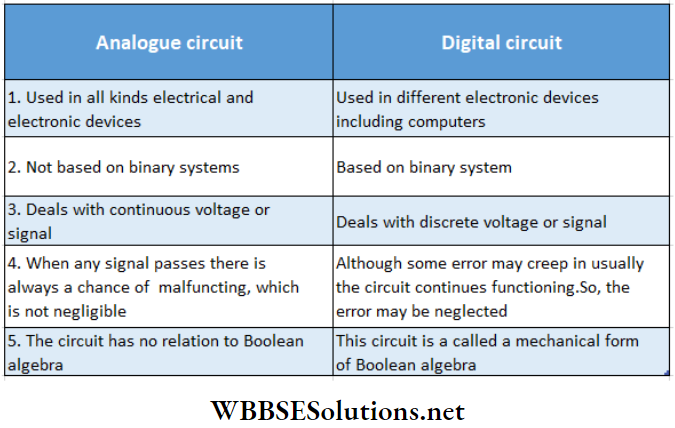
Digital Circuit Difference Between Analogue Circuit And Digital Circuit

Read And Learn More WBCHSE Class 12 Physics Long Question And Answers

Question 2. Given a battery, two switches, and an electric bulb, how can

  1. An OR gate and
  2. An AND gate be constructed?

Answer:

If the switch is made on or off, the bulb glows or extinguishes. Hence, the two switches are the inputs, and the d bulb is the output
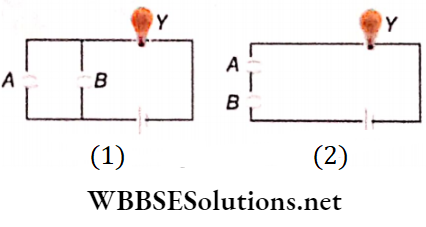
Digital Circuit Given A Battery Two Switches And An Electric Bulb

  1. The circuit is an OR gate circuit because when any one or both the switches, A and B are on, bulb Y will glow.
  2. The circuit is an AND gate circuit because only when both switches A and B are on, are the bulb Y glows.

WBCHSE Class 12 Physics Digital Electronics And Logic Gates Short Answer Questions

Question 3. Given a battery, a switch, and an electric lamp, how can a NOT gate be constructed?
Answer:

In this case, the switch is the input, and the electric bulb is the output, because when the switch is made ‘on’ or ‘off’ then the lamp goes ‘off’ or ‘on’ respectively. The circuit is a NOT gate circuit. When switch A is off, current flows through the lamp Y and it glows. When the switch is on, the entire current passes through the arm of the switch. As a result, the bulb extinguishes.(To avoid short circuits a low value resistance may be concentrated with switch A.
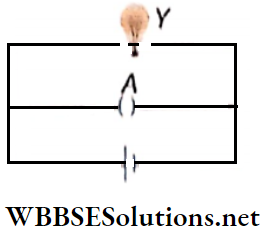
Digital Circuit Given Battery A Switch And An Electric Lamp

WBBSE Class 12 Digital Electronics Long Answer Questions

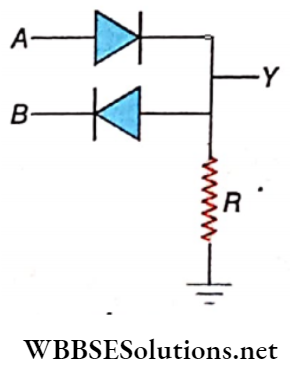
Question 4. Write down the truth table of the following circuit.
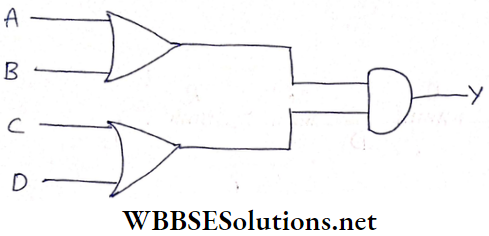
Digital Circuit Truth Table Of The Circuit

Answer:

Digital Circuit Truth Table Of Circuit

Digital Circuit Truth Table Of Circuit.

Practice Long Answer Questions on Combinational Circuits

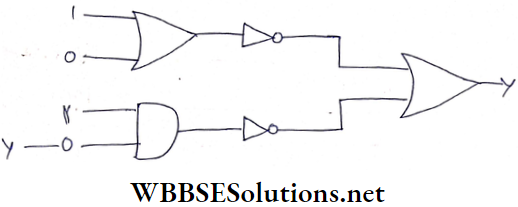
Question 5. What is the value of Y shown in the circuit given below?
Digital Circuit Value Of Y Circuit

Answer:

The output of the OR gate at the left-hand top is 1 and the output of the AND gate at the bottom is 0. These values change to 0 and 1, respectively after they pass through the two NOT gates.

Lastly, when it passes through the OR gate at the extreme right, the final output becomes, Y = 0 + 1 = 1

Y = \(\overline{1+0}+\overline{1 \cdot 0}\)

= \(\overline{1}+\overline{0}=0+1\)

= 1

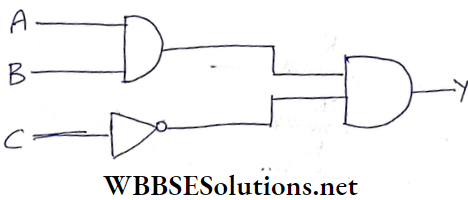
Question 6. In the given circuit diagram, If the output Y = I, what are the three inputs A, B, and C?
Digital Circuit Given Circuit Are The Three Inputs

Answer:

For Y = 1, the two inputs of the AND gate on the right-hand side must be 1. Of them, the input at the top will be 1 if both A and B are 1; the input at the bottom will be 1 if C = 0. So, A = 1,B = 1,C = 0.

Alternative Answer:
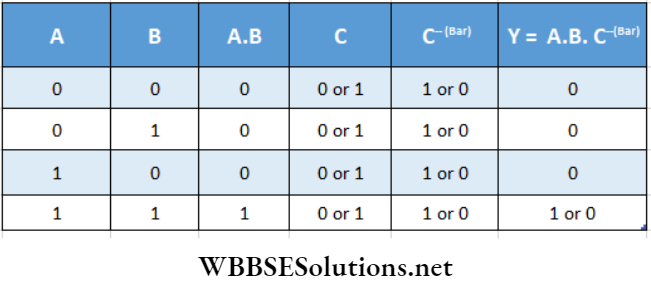
Digital Circuit Decimal Alternative Table

From truth table, it can be inferred that if A = 1 , B = 1 and C = 0 , then Y = 1

Question 7. An OR gate is operated by using positive logic. What role will the OR gate play if we use negative logic? Or, Show that the truth table of an OR gate in negative logic is similar to that of an AND gate in positive logic.
Answer:

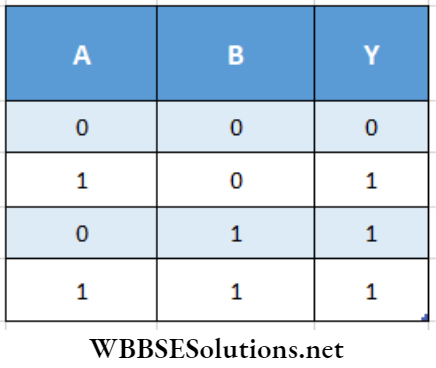
In positive logic, lower and higher states are denoted by 0 and 1 respectively. According to this, the truth table of the OR gate is

  1. On the other hand, in negative logic, lower and higher states become 1 and 0 respectively. For this, 0 and 1 interchange their positions in the truth table. So, the new truth table
  2. Will be the same as the truth table of an AND gate in positive logic.

1. 
Digital Circuit OR Gate is Operated By Using Positive Logic

2. 

Digital Circuit AND Gate Positive Logic

Important Definitions in Digital Electronics

Question 8. How would you construct a NOT gate by using a NOR gate?
Answer:

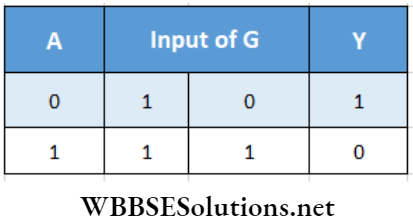
Signal A has been divided into parts and applied simultaneously and the two Inputs of the NOR gate G. Out¬ put Y is shown In the truth table. It may be noticed that this table is the same as the truth table of NOT gate. So, it is possible to make a NOT gate by using a single NOR gate.
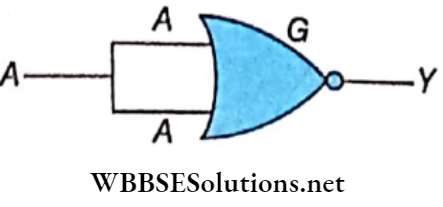
Digital Circuit NOT Gate By Using A Single NOR Gate

Digital Circuit Single NOR Gate

Class 11 Physics Class 12 Maths Class 11 Chemistry
NEET Foundation Class 12 Physics NEET Physics

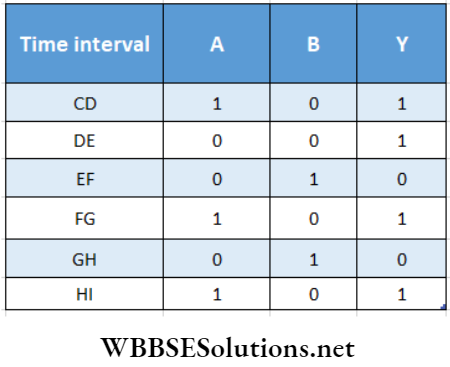
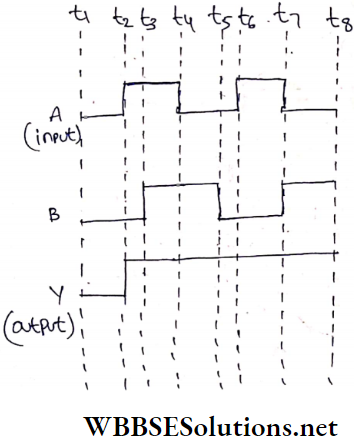
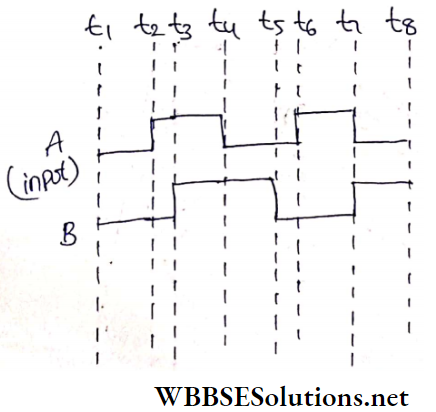
Question 9. The waveforms of two digital signals A and B are.  If we apply these two signals A and B to an OR gate as inputs, then what will be the output waveform
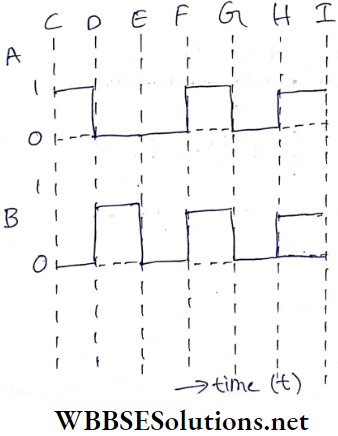
Digital Circuit Wave From Two Digital Signals A And B

Answer:

Digital Circuit Decimal Time intervals

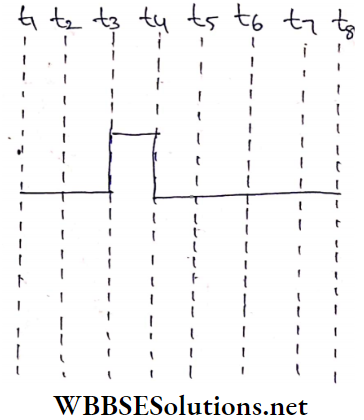
In different intervals of time, possible combinations of values 0 or 1 of A and B are shown in the truth table. From the truth table, the waveform of the output Y is
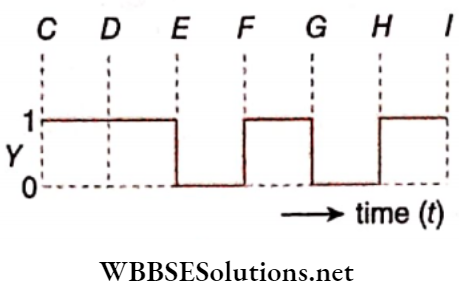
Digital Circuit Wave From Of The Out Put Y

Question 10. Waveforms of two inputs A and B and output Y are. Find the Boolean algebraic equation of the associated logic gate and draw the circuit diagram of it.
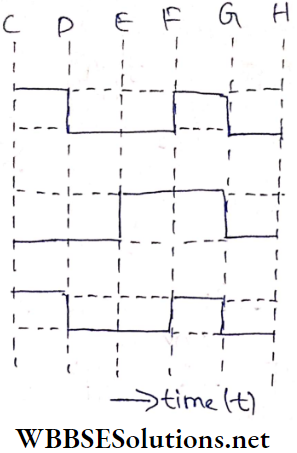
Digital Circuit Waveforms Of Two Inputs A And B And Out put

Answer:

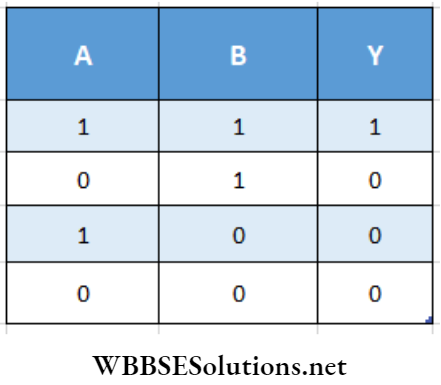
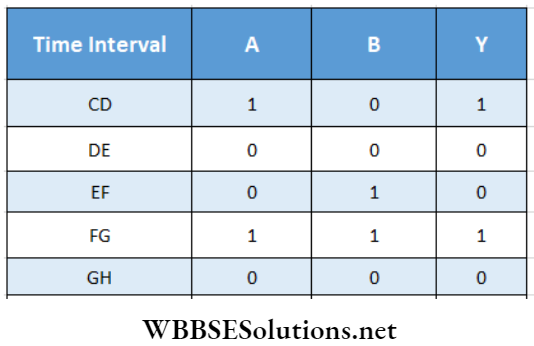
From the given waveforms, we get the following truth table.
Digital Circuit Waves From Two Inputs A And B And Output Y

Digital Circuit The Circuit Diagram Of Logic

For this truth table, the Boolean algebraic equation of the associated gate is Y = A. The circuit diagram of associated logic

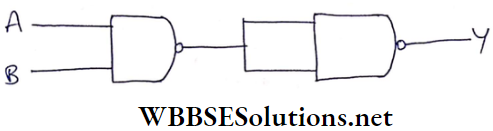
Question 11. Write the Boolean expression and the truth table for the logic circuit which is given
Digital Circuit Boolean Expression For The Logic Circuit

Answer:

In this, we see that a NAND gate is followed by another NAND gate. Signals A and B are applied to the first NAND gate as inputs. Then the output of the first NAND gate AB is fed simultaneously to both inputs of the second NAND gate.

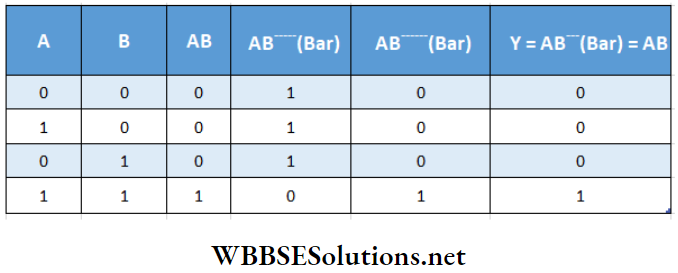
The output of the second NAND gate is AB i.e., AB. So, this logic circuit will act as an AND gate.

Hence, the Boolean algebraic equation is Y = AB.

The truth table of the given logic circuit is as follows:
Digital Circuit Boolean And The Truth Table The Logic Circuit

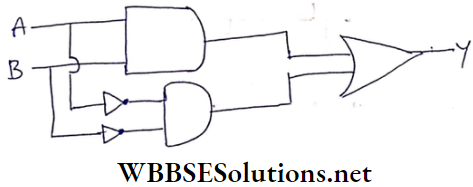
Question 12. Write the Boolean expression and truth table for the logic circuit which is 
Digital Circuit Boolean Expression And Truth Table

Answer:

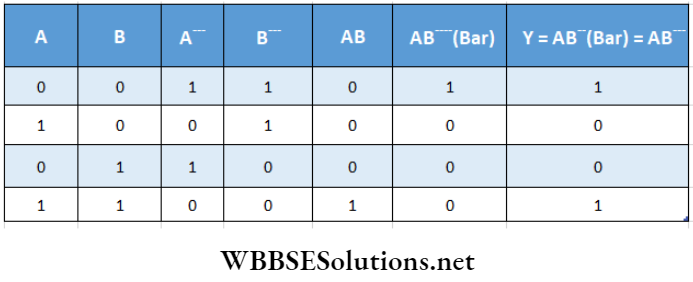
The Boolean expression for the given logic circuit is

Y= AB +\(\overline{A B}\)

The truth table of the given logic circuit is as follows:
Digital Circuit Boolean Expression For Logic Circuit

Examples of Logic Circuit Design Questions

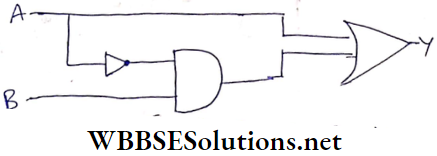
Question 13. Find the Boolean expression of the given logic circuit. Draw the simplest logic circuit equivalent to this given logic circuit.
Digital Circuit Simplest Logic Circuit Equivalent

Answer:

The Boolean expression for the given logic circuit is

Y= A+\(\bar{A B}\)

Now, Y = A + \(\overline{A}\) B = A . 1+\(\overline{A}\) B = A(1+ B) +\(\overline{A}\) B

= A+ AB + \(\overline{A}\) B

= A + (A +\(\overline{A}\)  )B = A + 1 .B

∴ Y = A + B

Hence, the equivalent circuit is an OR gate

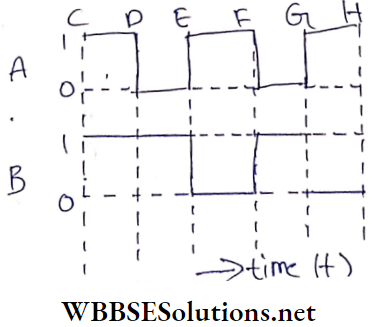
Question 14. Two digital signals A and B shown in Fig. 2.46 are used as the two Inputs of 

  1. OR 
  2. AND
  3. NOR and
  4. NAND gate.

Obtain the output waveforms in each of the four cases
Digital Circuit Two Digital Signals A And B Output Waveforms

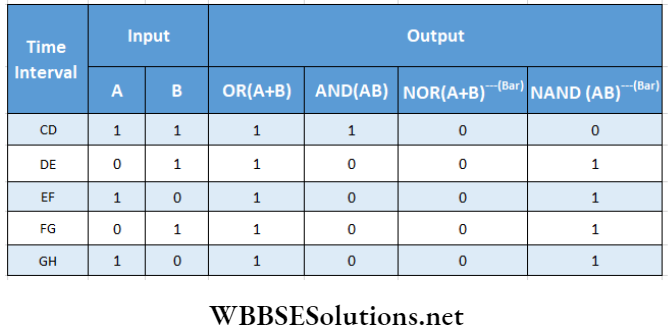
Answer: From the given waveforms, we get the following truth table
Digital Circuit Time Interval Of Input And Output

From this truth table, the output waveforms in each of the four cases are
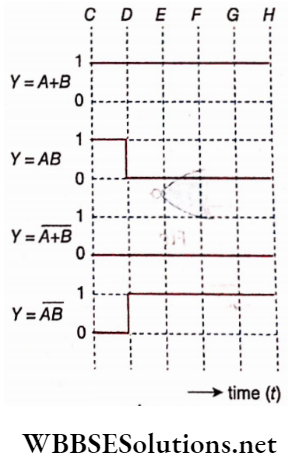
Digital Circuit The Output Waveforms In Each Of The Four Cases

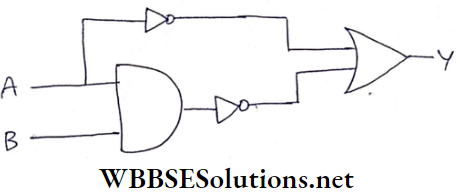
Question 15. The required AND gate ( Y = AB).  Find the Boolean expression of the given logic circuit. Draw the simplest logic circuit equivalent to this given circuit.
Digital Circuit Draw The Simplest Logic Ciecuit Eqivalent Given The Circuit

Answer: The Boolean expression for the given logic circuit is

Y = \(\bar{A}+\overline{A B}\)

Now, Y = \(\bar{A}+\overline{A B}\)

= \(\bar{A}+\bar{A}+\bar{B}\)

[∴  From De Morgan’s theorem, AB = A + B]

= \((\bar{A}+\bar{A})+\bar{B}=\bar{A}+\bar{B}\)

Y =\(\bar{A}+\bar{B}=\overline{A B}\)

Hence, the equivalent circuit is a NAND gate

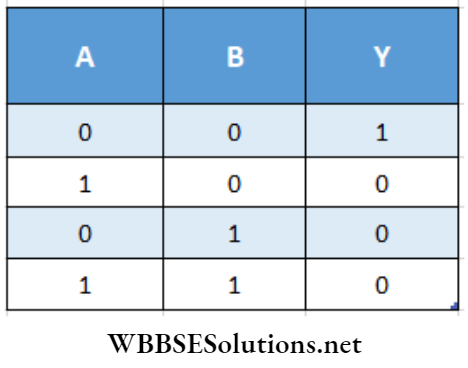
Question 16. Find the Boolean expression from the given truth table and draw its simplest logic circuit
Digital Circuit Boolean Expression Simpest Logic Circuit

Answer:

Here, Y = 1 in only the first row of the truth table. Thus rest of the rows are not taken into consideration. In the first row, for A = 0 AND B = 0, write AB. Therefore, the Boolean expression is Y = \(\).

According to De Morgan’s theorem,

⇒ \(\overline{A+B}=\bar{A} \bar{B}\).

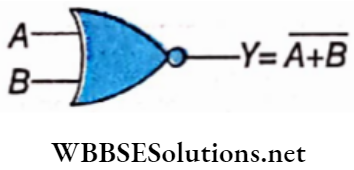
So, Y = \(\overline{A+B}\). It is the Boolean expression of the NOR gate. Hence, ‘ the simplest logic circuit is a NOR gate
Digital Circuit Simplest Logic Circuit Is A NOR Gate

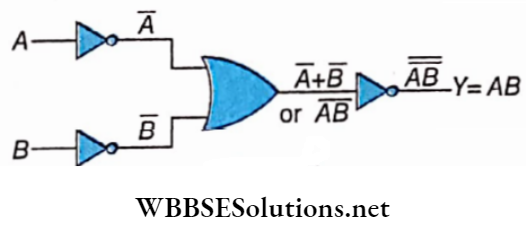
Question 17. How would you construct an AND gate by using mini¬ mum number of OR and NOT gates?
Answer:

Here, we have to use the following relations.

⇒ \(\bar{A}+\bar{B}=\overline{A B} \text { and } \overline{\overline{A B}}\)

The required AND gate ( Y = AB) is
Digital Circuit The Required The AND Gate

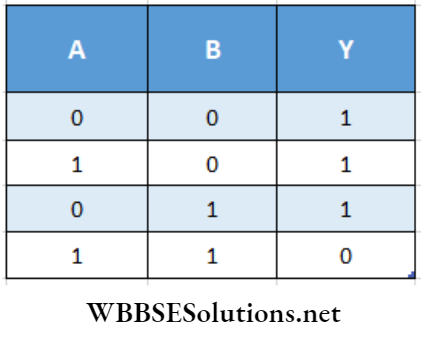
Question 18. Find the Boolean expression from the given truth table and draw its simplest logic circuit.
Digital Circuit Boolean Expression Of The Truth Table
Answer:

Here, Y = 1 in the first, second, and third rows of the truth table. Thus these three rows are to be taken into consideration.

For the first row, the Boolean expression is \(\bar{A} \bar{B}\). (∴  A = 0, B = 0 ),

For the second row, the Boolean expression is  \(A \bar{B}\) (∴A = 1, B = 0) and

For the third row, the Boolean expression is \(\bar{A} B\) ( ∴ A = 0, B = 1 ).

So, the complete Boolean expression is Y = \(\bar{A} \bar{B}+A \bar{B}+\bar{A} B\)

By simplifying, we get,

Y = \(\bar{A} \bar{B}+A \bar{B}+\bar{A} B=(\bar{A}+A) \bar{B}+\bar{A} B\)

= \(1 \cdot \bar{B}+\bar{A} B\)

Since  \(\bar{A}\) + A = 1

= \(\bar{B}+\bar{A} B=(1+\bar{A}) \bar{B}+\bar{A} B\)

Since 1  + \(\bar{A}\) = 1

= \(\bar{B}+\bar{A} \bar{B}+\bar{A} B\)

= \(\bar{B}+(\bar{B}+B) \bar{A}=\bar{B}+\bar{A}\)

i.e Y  = \(\bar{A}+\bar{B}=\overline{A B}\) According to De Morgans theorem

It is the Boolean expression of the NAND gate. Hence, the simplest logic circuit is a NAND gate

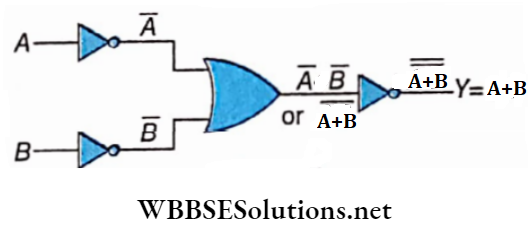
Question 19. How would you construct an OR gate by using a minimum number of AND and NOT gates?
Answer:

Here, we have to use the following relations.

⇒ \(\bar{A} \bar{B}=\overline{A+B} \text { and }\overline{\overline{A+B}}=A+B\)

The required OR gate ( Y = A + B) is
Digital Circuit The Required OR Gate

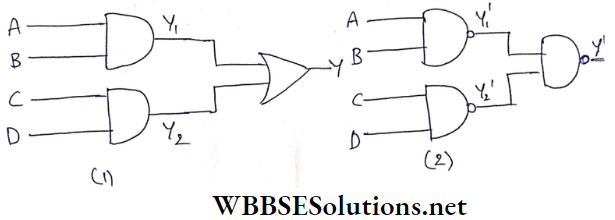
Question 20. Show that the two circuits 1, and 2 are equivalent to each other.
Digital Circuit Equivalent Two Circuits AND And OR Combination To NAND And NAND Combination

Answer:

Y1 = AB, Y2= CD

So, Y = AB + CD

Again

Y1 ‘= \(\overline{A B}\)

Y2 ‘= \(\overline{C D}\)

So, Y ‘  = \(\overline{Y_1^{\prime} Y_2^{\prime}}\)

= \(\bar{Y}_1^{\prime}+\bar{Y}_2^{\prime}\)

= \(\overline{\overline{A B}}+\overline{\overline{C D}}\)

= AB+ CD

Hence, Y’ = Y i.e., two circuits are equivalent to each other.

[Therefore, AND-OR combination is equivalent to NAND-NAND combination]

Question 21. Show that the two circuits 1,2 are equivalent to each other.
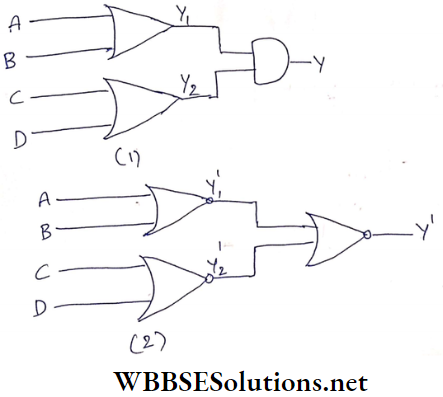
Digital Circuit Equivalent Two Circuits OR And AND Combination To NOR And NOR

Answer:

Y1 = A +B, Y2 = C+D

So, Y = (A +B) + (C+D)

Again

Y’1=  \(\overline{A+B}\)

Y’2=  \(\overline{C+D}\)

So, \(\overline{Y_1^{\prime}+Y_2^{\prime}}=\left(\overline{Y_1^{\prime}} \cdot \overline{Y_2^{\prime}}\right)\)

= \((\overline{\overline{A+B}}) \cdot(\overline{\overline{C+D}})\)

= (A+B)(C+D)

Therefore, Y’ = Y i.e., two circuits are equivalent to each other. [Hence, OR-AND combination is equivalent to NOR-NOR combination]

Question 22. Two digital signals A and B are represented by two binary numbers 110011 and 100110 respectively. These two signals A and B are applied as inputs of 

  1. OR
  2. AND
  3. NOR
  4. NAND gates.

Find the binary numbers to represent the outputs In each of the four cases.
Answer:

Two inputs A and B and outputs of

  1. OR (A + B),
  2. AND (AB),
  3. NOR (A + B), and
  4. NAND (AB)

Are shown in the truth table below:
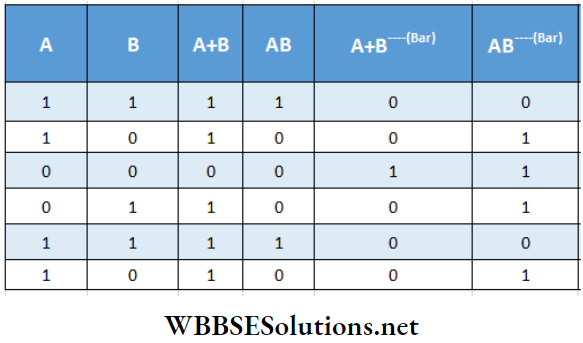
Digital Circuit Binary Numbers To Represent The Outputs

So, the binary numbers representing the outputs are

  1. 110111
  2. 100010
  3. 001000 and
  4. 011101 respectively

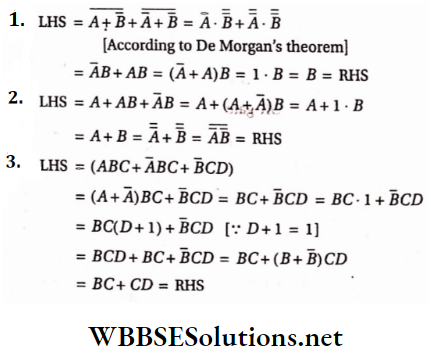
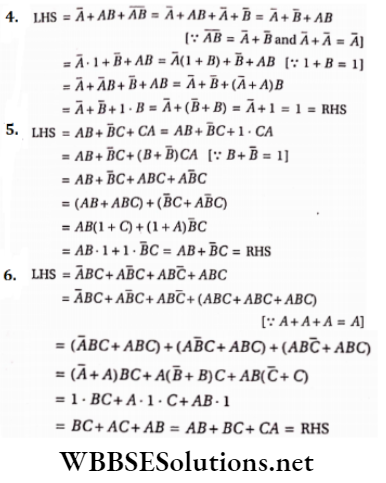
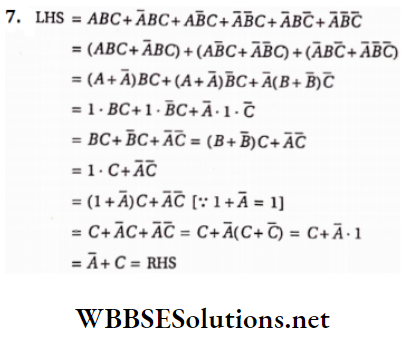
Question 23. Prove the following Boolean relations:
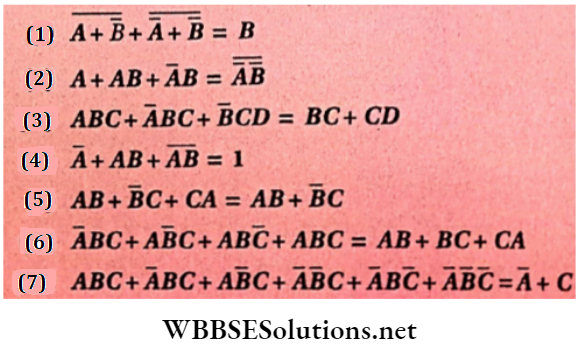
Digital Circuit Boolean Reactions

Answer:

Digital Circuit Boolean Reactions.

Digital Circuit Boolean Reactions..

Digital Circuit Boolean Reactions....

Real-Life Applications of Digital Electronics

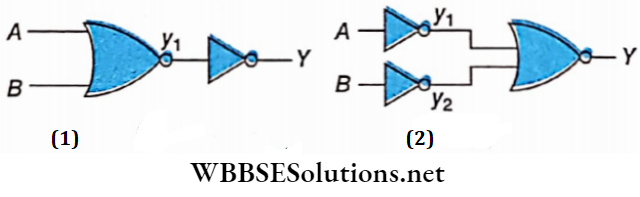
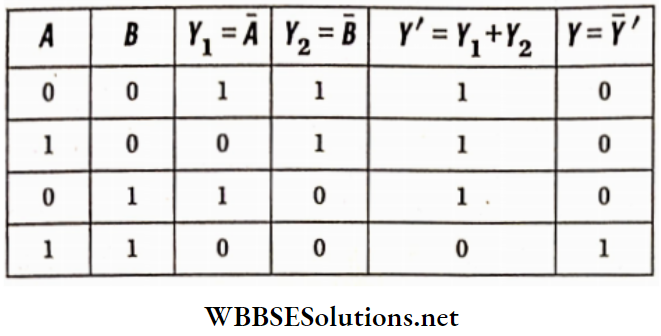
Question 24. You are given two circuits. which consists of a NAND gate. Identify the logic operations carried out by the two circuits 
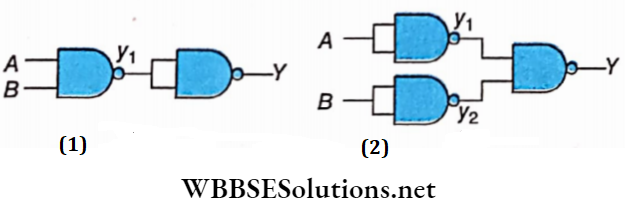
Digital Circuit Consists Of NAND Gates

Answer:

In Y = \(\overline{y_1 \cdot y_1}=\bar{y}_1\)

∴ y1.y1 = y1

But y1 = \(\overline{A \cdot B}\)

Y = \(\overline{\overline{A \cdot B}}\)

(1) = Represents an AND operation.

In (2) Y = \(\overline{y_1 \cdot y_2}\)

But, Y1 = \(\overline{A \cdot A}\) = \(\overline{A}\)

Y = \(\overline{B \cdot B}\) = \(\overline{B}\)

Y = \(\overline{y_1 \cdot y_2}=\overline{\bar{A} \cdot \bar{B}}=\overline{\bar{A}}+\overline{\bar{B}}\)

= A+B

This represents an OR gate.

Question 25. You are given two circuits. Show that the circuit 

  1. Acts as OR gate while the circuit
  2. Acts as AND gate

Digital Circuit Acts A OR And AND Gates

Answer:

In Y1 = \(\overline{A+B}\)

And Y = \(\overline{\overline{A+B}}\)

Y = \(\overline{\overline{A+B}}\) (Boolean algebra)

In, Y = \(\overline{y_1+y_2}=\bar{y}_1 \cdot \bar{y}_2\) (Using de Morgans theorem)

But y1= \(\bar{A}\)

y2 = \(\bar{B}\)

∴ Y = \(\bar{y}_1 \cdot \bar{y}_2\)

= \(\overline{\bar{A}} \cdot \overline{\bar{B}}\)

= A.B

Question 26. In the circuit identify the equivalent gate of the circuit
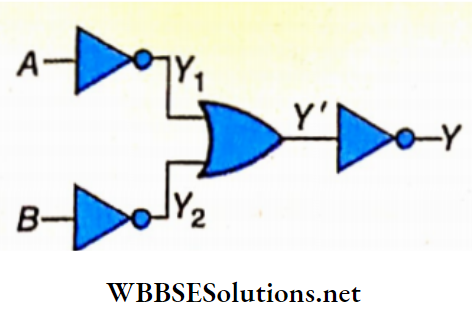
Digital Circuit equivalent Gate Of The Circuit

Digital Circuit Identify The Equivalent Gate Of The Circuit

This is equivalent to an AND gate: Y = AB
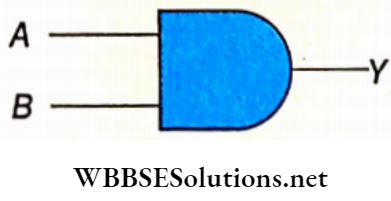
Digital Circuit This Equivalent To An AND Gate Y

Question 27. Identify the gates P and Q shown in the figure. Write the truth table for the combination of the gates shown.
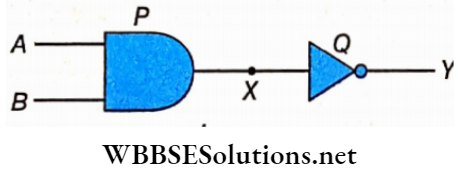
Digital Circuit Identify The Gates P And Q

Name the equivalent gate representing this circuit and draw its logic symbol

Here P is a 2-input AND gate and Q is a NOT gate.

Truth Table:
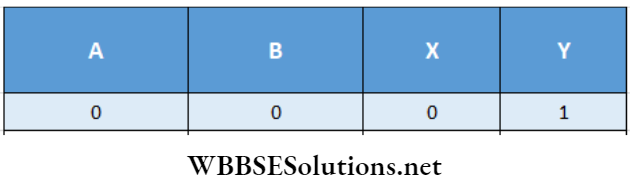
Digital Circuit Truth Table For The Combination Of The Gates.

Now the equivalent gate of the given circuit represents the circuit action of a NAND gate. The logic symbol of the NAND gate. The logic symbol of the NAND gate is

Conceptual Questions on Sequential Circuits

Question 28. The following figure shows the input waveforms (A, B) and the output waveform (T) of a gate. Identify the gate, write its truth table, and draw its logical symbol
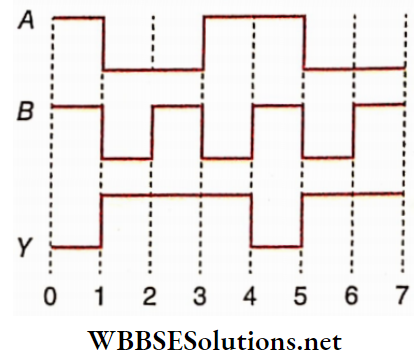
Digital Circuit Logic Symbol

The truth table for the gate can be obtained from the waveform given
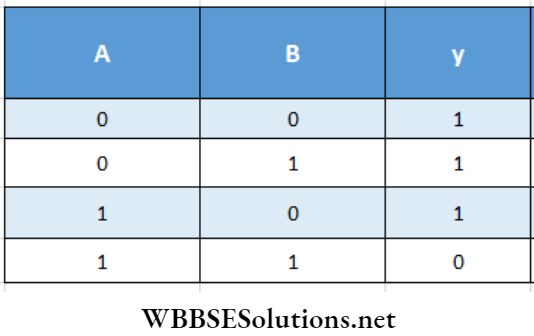
Digital Circuit Truth Table Obtained From The Waveforms

Therefore, from the above truth table, we can say that the gate is a NAND gate.

The logic symbol for the NAND gate is given below.
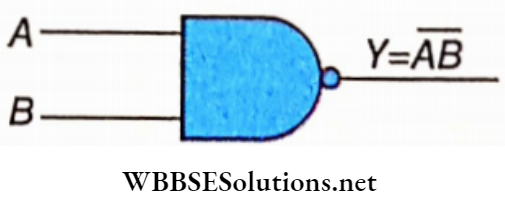
Digital Circuit The Logic Symbol Of The NAND Gate

Question 29.  The figure shows the Input waveforms A and B to a logic gate. 
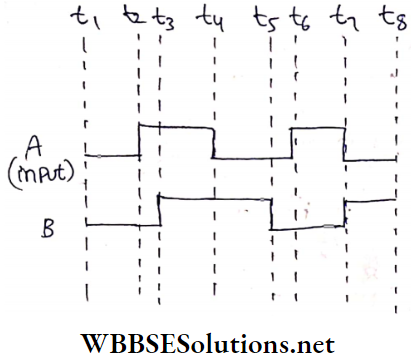
Digital Circuit Logic Gate And Logic Symbol

Answer:

Digital Circuit Logic Gate And Logic Symbol.

Question 30. The figure shows the Input waveforms A and B for the AND gate. 
Digital Circuit Output Waveforms

Output waveform will be as follows:

Digital Circuit Output Waveforms.

WBCHSE Class 12 Physics Digital Electronics & Logic Gates Multiple Choice Questions

Digital Electronics & Logic Gates Multiple Choice Questions

Question 1. The most significant digit of the number 6789 is

  1. 6
  2. 7
  3. 8
  4. 9

Answer: 1. 6

Question 2. The most significant digit of the number, 0.6789 is

  1. 6
  2. 7
  3. 8
  4. 9

Answer: 1. 6

Question 3. The least significant digit of the number, 0.6789 is

  1. 6
  2. 7
  3. 8
  4. 9

Answer:  4. 9

WBCHSE Class 12 Physics Digital Electronics And Logic Gates Multiple Choice Questions

Question 4.  In the Binary number system, the number 100 represents 

  1. One
  2. Three
  3. Four
  4. Hundred

Answer: 3. Four

Question 5. The gate is equivalent to

Digital Circuit The Gate Equivalent To NOT Gate

  1. NAND gate
  2. NOT gate
  3. AND gate
  4. NOR gate

Answer: 2. NOT gate

WBBSE Class 12 Digital Electronics MCQs

Question 6. In the case of the given circuit, the values of Y1, Y2, and K, are, respectively

Digital Circuit The Values Of Y1 And Y2 And Y3

  1. 1, 1 and 0
  2. 1,1 and 1
  3. 1,0 and 0
  4. 0,1 and 1

Answer: 1. 1, 1 and 0

Question 7. The following truth table is for which gate?

Digital Circuit Which Gate Of Truth Table

  1. AND gate
  2. NOR gate
  3. NAND gate
  4. OR gate

Answer: 4. OR gate

Question 8. The output of an OR gate will be 1, if

  1. Both the inputs are 0
  2. One or both of the inputs be 1
  3. Both the inputs are 1
  4. One or both of the input be 0

Question 9. For which gate is the truth table valid?

Digital Circuit Which Gate Of Truth Table Valid

  1. AND gate
  2. NOR gate
  3. NAND gate
  4. OR gate

Answer: 2. NOR gate

Class 11 Physics Class 12 Maths Class 11 Chemistry
NEET Foundation Class 12 Physics NEET Physics

Real-Life Applications of Digital Logic

Question 10. According, to the given table, which gate?

Digital Circuit Acts Gate Number 1 And 2

Digital Circuit Table According To Which Gate

  1. Gate no. 1
  2. Gate nos. 1 and 2
  3. Gate no. 2
  4. Gate no. 3

Answer: 3. Gate no. 2

Class 11 Physics Class 12 Maths Class 11 Chemistry
NEET Foundation Class 12 Physics NEET Physics

Question 11. Digital signals

  1. Represent values as discrete steps
  2. Do not represent values as discrete steps
  3. Represent vague steps
  4. represent random steps

Answer: 1. Represent values as discrete steps

Question 12. In Boolean algebra, A + B = Y implies that:

  1. The Sum of A and B is Y
  2. Y exists when A exists or B exists or both A and B exist
  3. Y exists only when A and B both exist
  4. Y exists when A or B exists, but not when both A and B exist

Answer: 3. Y exists only when A and B both exist

Practice MCQs on Combinational Logic Circuits

Question 13. In Boolean algebra, A – B = Y implies that:

  1. Product of A and B is Y
  2. Y exists when A exists or B exists
  3. Y exists when both A and B exist, but not when only A or B exists
  4. Y exists when A or B exists, but not both A and B exist

Answer: 3. Y exists when both A and B exist but not when only A or B exists

Question 14. In a three-input logic gate, the first two inputs are in state 1 and the third is 0. For which of the following gates, does the out become 1?

  1. OR gate
  2. And gate
  3. NOR gate
  4. NAND gate

Answer: 1 And 4

Question 15. A correct Boolean algebraic equation is

  1. A + 0 = 0
  2. A + 0 = A
  3. A + 1 = 1
  4. A + 1 = A

Answer: 2 And 3

Question 16. The product of (110)2 and (100)2 is

  1. (1100)2
  2. (11000)2
  3. (20)210
  4. (24)10

Answer: 2 And 4

Question 17. If A and H are the two inputs of a NAND) gate, then the output will be

  1. \(\overline{A B}\)
  2. \(\bar{A} \cdot \bar{B}\)
  3. \(\overline{A+B}\)
  4. \(\bar{A}+\bar{B}\)

Answer: 1 And 4

Question 18. The outputs of a three-input OR gate and a three-input NAND gate will be the same if all t

  1. Three inputs become 0
  2. One input becomes 1
  3. Two inputs become 1
  4. All three inputs become 1

Answer: 2 And 3

Important Mcqs in Digital Electronics

Question 19. If a, b, c, d are input to a gate and r is its output, then, as per the following time graph, the gate is

Digital Circuit Following The Graph Of The Gate

  1. NOT
  2. AND
  3. OR
  4. NAND

Answer: 3. OR

Question 20. Which logic gate is represented by the following combination of logic gates

Digital Circuit Following The Combination Of Logic Gates

  1. OR
  2. NAND
  3. AND
  4. NOR

Answer: 3. OR

Y = \(\overline{Y_1+Y_2}\)

= \(\overline{\bar{A}+\bar{B}}=\overline{\bar{A}} \cdot \overline{\bar{B}}\)

= A.B

The given combination of logic gates represents the AND gate.

Question 21. To get output 1 for the following circuit, the correct choice for the input is

Digital Circuit Output Circuit

  1. A =1, B = 0, C = 0
  2. A = 1, B = 1, C = 0
  3. A = 1, B = 0, C = 1
  4. A = 0, B = 1, C = 0

Answer: 3. A = 1, B = 0, C = 1

The Boolean expression for the given logic circuit is

Y = (A + R). C

If A = 1, B = 0 and C = 1, then the output, Y = 1

Question 22. From the circuit of the following logic gates, the basic logic gate obtained Is

Digital Circuit Basic Logic Gates

  1. NAND gate
  2. AND gate
  3. OR gate
  4. NOT gate

Answer: 1. NAND gate

Digital Circuit Basic Logic Gates Obtained

Y = \(\overline{\bar{A}+\bar{B}}\) = AB

Y = \(\overline{A B \cdot B}=\overline{A B}\) ,NAND gate

Examples of Logic Gate Applications

Question 23. In the combination of the following gates, the output Y can be written In terms of inputs A and B as

Digital Circuit Combination Of The Following Gates The Output Y

  1. \(\overline{A \cdot B}+A \cdot B\)
  2. \(A \cdot \bar{B}+\bar{A} \cdot B\)
  3. \(\overline{A \cdot B}\)
  4. \(\overline{A+B}\)

Answer: 2. \(A \cdot \bar{B}+\bar{A} \cdot B\)

Digital Circuit Combination Of The following Gates The Output Y In Terms

Y = \(A \cdot \bar{B}+\bar{A} \cdot B\)

Question 24. The output Y of the logic circuit Is given below

Digital Circuit Y Of The Logic Circuit.

  1. \(\bar{A}+B\)
  2. \(\bar{A}\)
  3. \((\overline{\bar{A}+B}) \cdot \bar{A}\)
  4. \((\overline{\bar{A}+B}) \cdot A\)

Answer: 2. \(\bar{A}\)

Y = \(\bar{A}+\bar{A} B=\bar{A}(1+B)=\bar{A}\)

Since 1+ B = 1

Digital Circuit Y Of The Logic Circuit

Question 25. The inputs to the digital circuit are shown below the output Y is

  1. A+B+\(\bar{C}\)
  2. (A+B)\(\bar{C}\)
  3. \(\bar{A}+\bar{B}+\bar{C}\)
  4. \(\bar{A}+\bar{B}+C\)

Answer: 3. \(\bar{A}+\bar{B}+\bar{C}\)

If the Input is the rightmost OR gate is M and N,

Y = M+n = \(\overline{A B}+\bar{C}=\vec{A}+\vec{B}+\vec{C}\)

Conceptual Questions on Sequential Circuits

Question 26. In the given circuit, the binary Inputs at A and B are both I In one case and both 0 In the next case. The respective outputs at Y In these two cases will be

Digital Circuit Binary Inputs

  1. 1,1
  2. 0,1
  3. 0,1
  4. 1,0

Answer: 2. 0,0

Y= \(\overline{A \cdot B+\bar{A} \cdot \bar{B}}\)

Digital Circuit Binary Inputs

Question 27. In the circuit shown, inputs A and B are in states 1 and 0 respectively. What is the only possible stable state of the outputs X and Y?

Digital Circuit Acts A OR And AND Gates Output X And Y

  1. X = 1, Y = 1
  2. X = 1, Y = 0
  3. X = 0, Y = 1
  4. X = 0, Y = 0

Answer: 3. X = 0, Y = 0

Given, A = 1 and B = 0,

If X = 1, then Y will be 1. At that instant, the state of X should be 0

But it is given that X = 1.

The option is not correct.

Only they correctly describe the circuit.

Hence, if X = 0, then Y will be 1. At that Instant, X = 0.

WBCHSE Class 11 Physics Transmission Of Heat Short Answer Questions

WBCHSE Class 11 Physics Transmission Of Heat

Unit 7 Properties Of Bulk Matter Chapter 9 Transmission Of Heat Short Answer Type Questions

Question 1. At what temperature does a body stop radiating?
Answer:

A body stop radiating at absolute zero or 0 K temperature.

Question 2. The ratio of thermal conductivity of two rods is 4:3. The radii and thermal resistances of the two rods are equal. Calculate the ratio of their length.
Answer:

The ratio of thermal conductivity of two rods is 4:3. The radii and thermal resistances of the two rods are equal.

Thermal resistance = \(\frac{1}{k A} \frac{l}{k}=\frac{1}{\pi r^2}\)

The radii and thermal resistance of the two rods are equal.

∴ \(\frac{1}{k_1} \frac{l_1}{\pi r^2}=\frac{1}{k_2} \frac{l_2}{\pi r^2} \quad \text { or, } \frac{l_1}{l_2}=\frac{k_1}{k_2}=\frac{4}{3}\)

Hence, ratio of their lengths is 4 : 3.

Question 3. The thermal conductivity of aluminum is 0.5 cal • s-1 • cm-1 • °C-1. Express it in SI system.
Answer:

The thermal conductivity of aluminum is 0.5 cal • s-1 • cm-1 • °C-1.

Thermal conductivity of aluminium, k = 0.5 cal • s-1 • cm-1 • °C-1 [In CGS system]

In SI, k = 0.5 x 4.2 x 102 J • m-1 • K-1 • s-1

= 210 J • m-1 • K-1 • s-1

WBCHSE Physics Chapter 9 Solutions 

Question 4. Consider a blackbody radiation In a cubical box at absolute temperature T. If the length of each side of the box is doubled and the temperature of the walls of the box and that of the radiation is halved, then the total energy

  1. Halves
  2. Doubles
  3. Quadruples
  4. Remains the same

Answer:

According to Stefan’s law, \(E \propto A \sigma T^4\)

∴ \(\frac{E_1}{E_2}=\frac{A_1 T_1^4}{A_2 T_2^4}=\frac{A_1 T_1^4}{\left(4 A_1\right)\left(\frac{1}{2} T_1^4\right)}\)

because \(A_2=4 A_1 \text { and } T_2=\frac{1}{2} T_1\)

or, \(\frac{E_1}{E_2}=4: 1\)

The option 3 is correct.

WBCHSE Class 11 Physics Transmission Of Heat Short Answer Questions

WBBSE Class 11 Transmission of Heat Short Answer Questions

Question 5. The same quantity of ice is filled in each of the two metal containers P and Q having the same size, shape, and wall thickness but made of different materials. The containers are kept in identical surroundings. The ice in P melts completely in time t1 whereas that in Q takes a time t2. The ratio of thermal conductivities of the materials of P and Q is

  1. \(t_2: t_1\)
  2. \(t_1: t_2\)
  3. \(t_1^2: t_2^2\)
  4. \(t_2^2: t_1^2\)

Answer:

⇒ \(\left(k A \frac{d T}{d x}\right) t=m L\),

so, \(k \propto \frac{1}{t}\).

Hence, \(\frac{k_1}{k_2}=\frac{t_2}{t_1}\)

The option 1 is correct.

WBCHSE Class 11 Physics Transmission of Heat 

Question 6. A solid maintained at t1°C Is kept In an evacuated chamber at temperature t°C(t2>>t1). The rate of boat absorbed by the body is proportional to

  1. \(t_2^4-t_1^4\)
  2. \(\left(t_2^4+273\right)-\left(t_1^4+273\right)\)
  3. \(t_2-t_1\)
  4. \(t_2^2-t_1^2\)

Answer:

None of the options Is correct.

Class 11 Physics Class 12 Maths Class 11 Chemistry
NEET Foundation Class 12 Physics NEET Physics

Question 7. If the temperature of the sun gets doubled, the rate of energy received on the earth will increase by a factor of

  1. 2
  2. 4
  3. 8
  4. 16

Answer:

The rate of energy received on the earth,

E ∝ T4 [T = temperature of the sun]

∴ Now, if the temperature of the sun gets doubled, then the rate of energy received on the earth will increase 24 = 16 times.

The option 4 is correct.

Question 8. The temperature of the water of a pond is 0°C while that of the surrounding atmosphere is -20 °C. If the density of ice is ρ, coefficient of thermal conductivity is k and the latent heat of melting is L then the thickness Z of the ice layer formed increases as a function of time as,

  1. \(Z^2=\frac{60 k}{\rho L} t\)
  2. \(Z=\sqrt{\frac{40 k}{\rho L}} t\)
  3. \(Z^2=\frac{40 k}{\rho L} \sqrt{t}\)
  4. \(Z^2=\frac{40 k}{\rho L} t\)

Answer:

If the thickness of the ice layer increases by Z in time t, then

t = \(\frac{\rho L}{2 k \theta} Z^2\)

Now, \(\theta =[0-(-20)]=20^{\circ} \mathrm{C}\)

∴ t = \(\frac{\rho L}{2 k \cdot 20} Z^2 \quad \text { or, } Z^2=\frac{40 k t}{\rho L}\)

The option D is correct.

Understanding Heat Transfer Short Answer Questions

Question 9. The temperature of a blackbody radiation enclosed in a container of volume V in increased from 100°C to 1000°C. The heat required in the process is

  1. 4.79 x 10⁻⁴ cal
  2. 9.21 x 10⁻⁵ cal
  3. 2.17 x 10⁻⁴ cal
  4. 7.54 x 10⁻⁴ cal

Answer: Data insufficient.

WBCHSE Class 11 Physics Transmission of Heat 

Question 10. Three rods of copper, brass, and steel are welded together to form a Y -shaped structure. Aren of a cross-section of each rod Is 4 cm². The end of the copper rod Is maintained at 100 °C whereas ends of brass and stool are kept at 0 °C. Lengths of the copper, brass, and steel rods are 46,13 and 12 cm respectively. The rods are thermally Insulated from surroundings except at the ends. Thermal conductivities of copper, brass, and steel are 0.92, 0.26, and 0.12 in CGS units, respectively. Rate of heat flow through copper rod is

  1. 1.2 cal/s
  2. 2.4 calls
  3. 4.0 cal/s
  4. 6.0 cal/s

Answer:

⇒ \(Q=Q_1+Q_2\)

or, \(\frac{0.92 \times 4(100-T)}{46}\)

= \(\frac{0.26 \times 4 \times(T-0)}{13}+\frac{0.12 \times 4 \times T}{12} \)

Class 11 Physics Unit 7 Properties Of Matter Chapter 9 Transmission Of Heat Three Rods Of Copper Brass And Steel Are Welded Together From Y Shaped

or, \(200-2 T=2 T+T\)

or, \(T=40^{\circ} \mathrm{C}\)

Q = \(\frac{0.92 \times 4 \times 60}{46}=4.8 \mathrm{cal} / \mathrm{s}\)

The option 3 is correct.

WBCHSE Physics Chapter 9 Solutions 

Question 11. Consider a spherical shell of radius R at temperature 7. The black body radiation inside it can be considered as an ideal gas of photons with internal energy per unit volume u = \(\frac{U}{V} \propto T^4\) and pressure \(P=\frac{1}{3}\left(\frac{U}{V}\right)\). If the shell now undergoes an adiabatic expansion the relationship between T and R is

  1. \(T \propto e^{-R}\)
  2. \(T \propto e^{-3 R}\)
  3. \(T \propto \frac{1}{R}\)
  4. \(T \propto \frac{1}{R^3}\)

Answer:

For 1 mol ideal gas, \(P V=R_0 T\) [where R0 is the universal gas constant]

or, \(P=\frac{R_0 T}{V}=\frac{1}{3}\left(\frac{U}{V}\right) \propto T^4\)

So, \(\frac{1}{V} \propto T^3\)

or, \(\frac{1}{\frac{4}{3} \pi R^3} \propto T^3\)

or, \(T^3 \propto \frac{1}{R^3}\)

∴ \(T \propto \frac{1}{R}\)

The option 3 is correct.

Key Concepts in Heat Transfer Short Answers

Question 12. A certain quantity of water cools from 70 °C to 60 °C in the first 5 minutes and to 54 °C in the next 5 minutes. The temperature of the surroundings is

  1. 45°C
  2. 20°C
  3. 42°C
  4. 10°C

Answer:

From Newton’s law of cooling, \(\frac{(70+273)-\theta_0}{(60+273)-\theta_0}=\frac{(60+273)-\theta_0}{(54+273)-\theta_0}\)

0 = temperature of the surrounding]

or, θ0 = 318 K = 45°C

The option 1 is correct

Question 13. The two ends of a metal rod are maintained at temperatures 100 °C and 110 °C. The rate of heat flow in the rod is found to be 4.0 J/s. If the ends are maintained at temperatures 200 °C and 210 °C, the rate of heat flow will be

  1. 44.0 J/s
  2. 16.8 J/s
  3. 8.0 J/s
  4. 4.0 J/s

Answer:

Rate of heat flow is proportional to the difference in temperatures of the two ends.

∴ \(\frac{\left(\frac{d \theta}{d t}\right)_{1 \text { st case }}}{\left(\frac{d \theta}{d t}\right)_{2 \mathrm{nd} \text { case }}}=\frac{\left(\theta_1-\theta_2\right)_{1 \text { st case }}}{\left(\theta_1-\theta_2\right)_{2 \mathrm{nd} \text { case }}}\)

or, \(\left(\frac{d \theta}{d t}\right)_{2 \text { nd case }}=\left(\frac{d \theta}{d t}\right)_{1 \text { st case }} \times \frac{\left(\theta_1-\theta_2\right)_{2 \text { nd case }}}{\left(\theta_1-\theta_2\right){ }_{1 \text { st case }}}\)

= \(4 \times \frac{10}{10}=4 \mathrm{~J} / \mathrm{s}\)

= 4 x 10/10 = 4 J/s

The option 4 is correct.

WBCHSE Physics Chapter 9 Solutions 

Question 14. A black body is at a temperature of 5760 K. The energy of radiation emitted by the body at wavelength 250 nm is U1, at wavelength 500 nm is U2, and that at 1000 nm is U3. Wien’s constant b = 2.88 x 10⁶ nm • K. Which of the following is correct?

  1. U3 = 0
  2. U1 >U2
  3. U2>U1
  4. U1 = 0

Answer:

According to the Wien’s displacement law, \(\lambda_m T =b\)

or, \(\lambda_m=\frac{b}{T}=\frac{2.88 \times 10^6}{5760}=500 \mathrm{~nm}\)

Class 11 Physics Unit 7 Properties Of Matter Chapter 9 Transmission Of Heat Wien's Displacement Law Graph Maximum Amount Of Emitted Radiation

Now, the maximum amount of emitted radiation corresponding to λm is U2.

From graph, U1 < U2 > U3

∴ U2 > U1

The option 3 is correct.

Fourier’s Law of Heat Conduction Short Answers

Class 11 Physics Heat Transfer Questions 

Question 15. In a certain planetary system, it is observed that one of the celestial bodies having a surface temperature of 200 K, emits radiation of maximum intensity near the wavelength 12μm. The surface temperature of a nearby star which emits light of maximum intensity at a wavelength λ = 4800Å, is

  1. 7500 K
  2. 5000 K
  3. 2500 K
  4. 10000 K

Answer:

According to the Wien’s displacement law, \(\lambda_m T=\text { constant }\)

∴ \(\lambda_{m_1} T_1=\lambda_{m_2} T_2\)

or, \(T_2=T_1 \frac{\lambda_{m_1}}{\lambda_{m_2}}=200 \times \frac{12 \times 10^{-6}}{4800 \times 10^{-10}}=5000 \mathrm{~K}\)

The option 2 is correct.

Transmission of Heat Class 11 Notes 

Question 16. A wall consists of alternating blocks of length ‘ d ’ and coefficient of thermal conductivity K1 and K2 respectively as shown. The cross-sectional area of the blocks are the same. The equivalent coefficient of thermal conductivity of the wall between left and right is

  1. \(\frac{K_1+K_2}{2}\)
  2. \(\frac{2 K_1 K_2}{K_1+K_2}\)
  3. \(\frac{K_1+K_2}{3}\)
  4. \(\frac{3 K_1 K_2}{K_1+K_2}\)

Answer:

Class 11 Physics Unit 7 Properties Of Matter Chapter 9 Transmission Of Heat A Wall Consists Of Alternating Blocks

Thermal resistance of the blocks, \(R_1=R_3=R_5=\frac{1}{K_1} \frac{d}{A} \text { and } R_2=R_4=R_6=\frac{1}{K_2} \frac{d}{A}\)

If R be the equivalent thermal resistance of the parallel combination, then

⇒ \(\frac{1}{R}=\frac{1}{R_1}+\frac{1}{R_2}+\cdots=3 \frac{K_1 A}{d}+3 \frac{K_2 A}{d}=\frac{3 A}{d}\left(K_1+K_2\right)\)

If K be the equivalent thermal conductivity of the wall, then

⇒ \(\frac{1}{R}=\frac{6 A}{d} K\)

∴ \(\frac{6 A}{d} K=\frac{3 A}{d}\left(K_1+K_2\right)\)

or, \(K=\frac{K_1+K_2}{2}\)

The option 1 is correct

Question 17. The power radiated by a black body is P and it radiates maximum energy at wavelength, \(\lambda_0\). If the temperature of the black body is now changed so that it radiates maximum energy at wavelength \(\frac{3}{4} \lambda_0\), the power radiated by it becomes nP. The value of n is

  1. \(\frac{256}{81}\)
  2. \(\frac{4}{3}\)
  3. \(\frac{3}{4}\)
  4. \(\frac{81}{256}\)

Answer:

From Wien’s displacement law

∴ \(\lambda_{\max } \cdot T=\text { constant }\)

∴ \(\lambda_1 T_1=\lambda_2 T_2 \quad \text { or, } \lambda_0 T_1=\frac{3}{4} \lambda_0 T_2 \quad \text { or, } \frac{T_2}{T_1}=\frac{4}{3}\)

∴ \(\frac{P_2}{P_1}=\left(\frac{T_2}{T_1}\right)^4 \quad \text { or, } \frac{n P}{P}=\left(\frac{4}{3}\right)^4\)

or, \(n=\frac{256}{81}\)

The option 1 is correct.

Heat Transfer MCQs for Class 11 

Real-Life Examples of Heat Transmission

Question 18. Using it find the time taken by a hot food in a pan to cool from 71 °C to 69°C If the room temperature is 20°C. The food cools from 94°C to 86°C in 2 minutes.
Answer:

The time taken by a hot food in a pan to cool from 71 °C to 69°C If the room temperature is 20°C. The food cools from 94°C to 86°C in 2 minutes

Let θ0 = room temperature; t = time taken by the hot food to cool from θ1 °C to θ2 °C Then, from

Newton’s law of cooling, \(k t=\log \frac{\theta_1-\theta_0}{\theta_2-\theta_0}, where k=\mathrm{a} constant\)

In this problem, \(\theta_0=20^{\circ} \mathrm{C}\).

In the hotter region, \(\theta_1=94^{\circ} \mathrm{C}, \theta_2=86^{\circ} \mathrm{C} and t=2 \mathrm{~min}=120 \mathrm{~s}\).

In the colder region, \(\theta_1=71^{\circ} \mathrm{C} and \theta_2=69^{\circ} \mathrm{C}\)

So, \(120 k=\log \frac{94-20}{86-20}=\log \frac{74}{66}=0.0497\)

and \(k t=\log \frac{71-20}{69-20}=\log \frac{51}{49}=0.0174\)

Then, \(\frac{120}{t}=\frac{0.0497}{0.0174}, \quad or, t=\frac{120 \times 0.0174}{0.0497}=42 \mathrm{~s}\)

WBCHSE Physics Chapter 9 Solutions 

Question 19. Show graphically the temperature variation with time associated with a cooling hot body. Why burns from steam are more serious than those from boiling water?
Answer:

Shows the exponentially decreasing nature of temperature with the passage of time.

Every 1 g of steam at 100 °C contains a latent heat excess of about 540 cal, compared to 1 g of water at 100°C.

Class 11 Physics Unit 7 Properties Of Matter Chapter 9 Transmission Of Heat Newtons law Of Cooling Graph

So, steam releases a greater amount of energy, than that released by boiling water, to a cold body brought to its contact. That is why steam burns are more serious.

Heat Transfer MCQs for Class 11 

Question 20. What is thermal conductivity of perfect heat conductors?
Answer:

Thermal conductivity of perfect heat conductors

Thermal conductivity of a perfect heat conductor is infinity.

WBCHSE Class 11 Physics Transmission Of Heat Long Answer Questions

Unit 7 Properties Of Bulk Matter Chapter 9 Transmission Of Heat Long Answer Type Questions

Question 1. Two rods A and B are of equal length. Each rod has the ends at temperature T1 and T2 respectively, what is the condition that will ensure equal rates of flow of heat through the rods A and B?
Answer:

Given:

Two rods A and B are of equal length. Each rod has the ends at temperature T1 and T2 respectively

Let the cross-section and conductivity of rod A be α1 and k1 and those of rod B be α2 and k2 respectively.

Also, let the length of each rod be l.

Since, heat current in both rods are the same, \(\frac{Q}{t}=\frac{k_1 \alpha_1\left(T_1-T_2\right)}{l}\)

= \(\frac{k_2 \alpha_2\left(T_1-T_2\right)}{l}\)

or, \(k_1\alpha_1=k_2 \alpha_2\)

This is a required condition.

Read and Learn More Class 11 Physics Long Answer Questions

Question 2. At what temperature will a wooden and a metal block appear to be equally Hot or cold upon touching them?
Answer:

If the temperatures of the wooden block and of the metal block are the same as our body temperature, then they would appear to be equally hot or cold on touch.

Question 3. If a piece of paper Is wrapped around a wooden rod and held over a lighted candle the paper burns to ashes almost immediately. On the other hand, If the piece of paper Is wrapped on a metal rod and similarly held over the lighted candle then the paper takes some time to burn. Explain.
Answer:

Given:

If a piece of paper Is wrapped around a wooden rod and held over a lighted candle the paper burns to ashes almost immediately. On the other hand, If the piece of paper Is wrapped on a metal rod and similarly held over the lighted candle then the paper takes some time to burn.

Wood is a bad conductor of heat Obviously, the heat the wood receives from the candle is not conducted through it. So, the region that is heated retains the heat, as a result of which the paper reaches its ignition temperature and burns to ashes almost immediately.

If the wood is replaced by a metal rod, the heat is conducted through the latter, as the metal is a good conductor of heat. So, it takes some time for the paper to reach its ignition point and to start burning.

WBCHSE Class 11 Physics Transmission Of Heat Long Answer Questions

Question 4. Thermal conductivity of air is less than that of felt, still felt is more widely used as heat insulator. Why?
Answer:

Given:

Thermal conductivity of air is less than that of felt, still felt is more widely used as heat insulator.

Air has a thermal conductivity less than felt. Yet when a hot body is kept in air, a convection current develops. So the body starts losing heat. On the other hand, this is not the case if the body is covered with felt.

  • This is because felt itself is a bad conductor of heat and the narrow perforations within the felt fibres are filled up with air. Air being a bad conductor of heat, no heat loss takes place due to conduction.
  • Again, the body being covered with felt, it is not open to air. Hence, no heat loss takes place due to convec¬tion as well. So, the hot body can retain the heat. This is why felt is more widely used as a heat insulator.

Question 5. Why snow is a better insulator than ice?
Answer:

Snow is a better insulator than ice:

Ice being solid and having no pores do not enclose air. Snow being porous encloses air in it. Air is a bad conductor of heat hence snow is a better insulator.

Class 11 Physics Class 12 Maths Class 11 Chemistry
NEET Foundation Class 12 Physics NEET Physics

Question 6. We feel wanner when the sky is cloudy—explain.
Answer:

Given:

We feel wanner when the sky is cloudy

Heat waves cannot penetrate cloud. Earth’s surface receives heat during daytime and radiates that out during night hours, thereby cooling the surface, Cloud acta m a reflector of this radiated float and sends It back to earth, So the cooling effect Is less and the nights are warm.

Question 7. A metal piece cooled In liquid air (temperature -180°C) produces a burning sensation when It is touched, why?
Answer:

Given:

A metal piece cooled In liquid air (temperature -180°C) produces a burning sensation when It is touched

The temperature of liquid air is -180°C l.e., much less than our body temperature. Hence, the temperature difference between the metal piece and our body is very large.

Metal Is a good conductor of heat, So, when the metal piece Is touched, heat conducts very quickly from the body to the metal piece. This very rapid loss of heat will produce a burning sensation, as our body cannot withstand It.

Question 8. Three specimens made of the same material are kept at 200°C In a room. They arc respectively a sphere, a cube, and a circular lamina of the same mass. Compare the rates of their cooling.
Answer:

Given:

Three specimens made of the same material are kept at 200°C In a room. They arc respectively a sphere, a cube, and a circular lamina of the same mass.

The mass, the temperature, and the material of the three specimens being the same, the rate of radiation from the surfaces is directly proportional to the surface areas. Hence, the circular lamina, having the largest surface area among the three, cools the fastest. The sphere, being of the smallest surface area, will have the slowest rate of cooling.

Fourier’s Law of Heat Conduction Long Answer Questions

Question 9. How does a heater coll attain a steady temperature when current is on, after an Initial steady rise In temperature?
Answer:

Given:

Current through the coil of the heater produces heat and the coil shows a steady rise in temperature initially. With the increase in temperature rate of radiation from the coil also increases.

At a certain temperature, the rate of heating due to current equals the rate of radiation, i.e., the heater cannot retain any heat for a further rise in temperature. So, the coil maintains its constant temperature.

Question 10. Explain why the climate of a harbor town is more temperate than that of a town in a desert at the same latitude.
Answer:

Sea water has a high specific beat So the temperature of a harbour town does not increase very much due to heat absorption in the daytime, also if does not decrease very much due to the radiation of heat in bight time.

On the other hand desert sand has a low specific heat so due to heat absorption and radiation the temperature variation is much Higher, That is why (he climate of a harbor town is more temperate.

Question 11. A solid copper sphere of radius ft and a hollow sphere of the same material of external and internal radii R and r are raised to the same temperature and are allowed to cool under similar conditions. Which one of the two will have a faster rate of cooling?
Answer:

Given:

A solid copper sphere of radius ft and a hollow sphere of the same material of external and internal radii R and r are raised to the same temperature and are allowed to cool under similar conditions.

The external radius of the hollow sphere and the radius pf the solid sphere being the same, the outer surface areas of the two spheres are equal. If they are heated to the same temperature and are exposed in the same surroundings, the rate of loss of heat will be the same as their outer surface areas and Initial temperatures are equal.

But, for the same rate of heat loss, the temperature of the hollow sphere will drop at a faster rate as Its mass is less. So the hollow sphere will have a faster rate of cooling.

Question 12. Bulbs of two thermometers are coated with lampblack and sliver. Compare their readings when they are

  1. Kept immersed In water inside a dark room,
  2. In open daylight and
  3. In a clear night.

Answer:

1. insulation is produced because of air being trapped between the bulb and the coating of lampblack. This will delay the thermometer to attain the temperature of water, Silver being a good conductor, the thermometer with the silver-coated bulb will attain thermal equilibrium with water instantaneously.

2. Lamp black is a good absorber and a bad reflector of heat. On the other hand silver is a good reflector and a bad absorber of heat. Hence the bulb coated with lamp black will absorb larger amount of heat in the sun¬light. On the other hand, the bulb coated with silver will reflect most of the heat. So, the first thermometer will show a higher reading.

3. In a clear cloudless night, the bulb coated with lamp black will radiate faster as it is a good absorber and hence a good radiator of heat. Hence, its temperature reading will be lower.

Real-Life Examples of Heat Transmission

Question 13. Two spheres of the same material and of radii 1 m and 4 m are kept at 4000 K and 2000 K respectively, Showing that the heat radiated from them per second Is the same.
Answer:

We know that the relations among the rate of radiation (E), surface area (A), and absolute temperature (T) are \(E \propto A \text { and } E \propto T^4 \quad \text { or, } E \propto A T^4\)

∴ In case of the two spheres in question, \(\frac{E_1}{E_2}=\frac{A_1 T_1^4}{A_2 T_2^4}=\left(\frac{1}{4}\right)^2 \times\left(\frac{4000}{2000}\right)^4=\frac{1}{16} \times 16=1 \text { or, } E_1=E_2\)

Question 14. Water boils faster in a metal vessel with a rough and black bottom than in a metal vessel with a smooth bottom. Explain.
Answer:

Given:

Water boils faster in a metal vessel with a rough and black bottom than in a metal vessel with a smooth bottom.

The rough and dark-bottomed surface has a greater ability to absorb heat than the smooth-bottomed metal vessel. The smooth surface of the metal vessel reflects a reasonable part of the incident heat. Obviously, the water in the metal vessel with a rough and black bottom will boil faster.

Question 15. The bottom surface of a cooking utensil is made j rough and black, whereas a calorimeter surface is kept smooth and shiny. Explain.
Answer:

Given:

The bottom surface of a cooking utensil is made j rough and black, whereas a calorimeter surface is kept smooth and shiny.

The basic calorimetric principle (heat lost = heat gained) is easily applicable when no heat is exchanged between the calorimeter and its surroundings. The calorimeter surface is made bright and shiny to reduce heat exchange by radiation. But a rough and black-bottomed surface of a cooking utensil absorbs heat faster from the source.

Question 16. When we cover the bulb of a thermometer with a piece of quilt why is the reading of the instrument comparatively less? What changes in the reading will be recorded if the quilt is soaked?

  1. In either or
  2. In water?

Answer:

A quilt is a bad conductor of heat because of the wool and the air trapped within it. So the temperature of the surroundings cannot be attained by the bulb covered with a piece of quilt. Therefore, the reading of the thermometer is comparatively less.

1. If the quilt is soaked in ether, which is a highly volatile substance, the ether will evaporate quickly and take its latent heat of vaporization from the bulb of the thermometer. So, the reading in the thermometer will fall quickly.

2. If water is used instead of ether, it is less volatile, the reading in the thermometer will fall slowly.

Question 17. Two friends, waiting for their third companion in a restaurant, ordered two cups of tea. While one of them poured milk into his cup of tea, the other waited till their friend arrived and then mfwH the cold milk with the tea. Whose cup of tea would be comparatively warmer?
Answer:

Given:

Two friends, waiting for their third companion in a restaurant, ordered two cups of tea. While one of them poured milk into his cup of tea, the other waited till their friend arrived and then mfwH the cold milk with the tea.

The friend who mixed milk with the tea earlier would enjoy a warmer cup of tea. We know from Newton’s law of cooling, the more the difference in the temperature of the substance with its surroundings, more is the rate of heat radiation from it.

Since the first friend’s cup of tea became comparatively cooler on mixing the colder milk, the rate of heat radiation diminished in this case. Again, the second friend poured the cold milk afterward so, the rate of heat radiation from his tea was faster and hence it became colder

Thermal Conductivity and Its Importance

Question 18. What will be the nature of vm T graph for a per fleetly black body?
Answer:

We know that for a perfectly black body

⇒ \(\lambda_m T=\text { constant }\)

or, \(\frac{T}{\nu_m}=\text { constant }\)

∴ \(\nu_m \propto T\)

Class 11 Physics Unit 7 Properties Of Matter Chapter 9 Transmission Of Heat V T Graph For Perfectly Black Body

So, vm -T graph will be a straight line passing through the origin.

Question 19. Five rods of the same dimensions are arranged as shown. They have thermal conductivities k1, k2, k3, k4 and k5. When points A and B are maintained at different temperatures, under what condition no heat flow through the central rod?

Class 11 Physics Unit 7 Properties Of Matter Chapter 9 Transmission Of Heat Five Rods Of The Same Dimensions Are Arranged

Answer:

The arrangement of the rods is similar to a bal¬anced Wheatstone Bridge.

No heat flows through the central rod if we have,

∴ \(\frac{k_1}{k_2}=\frac{k_3}{k_4} \text { or, } k_1 k_4=k_2 k_3\)

Question 20. The plots of intensity (I) versus wavelength (λ) for three black bodies at temperatures T1, T2, and T3 respectively are as shown. What will be the relation of these temperatures?
Answer:

Given:

The plots of intensity (I) versus wavelength (λ) for three black bodies at temperatures T1, T2, and T3 respectively are as shown.

According to Wein’s displacement law for blackbody radiation,

λm = constant

Therefore, we can conclude that the higher the value of λm, the smaller is the value of temperature.

Class 11 Physics Unit 7 Properties Of Matter Chapter 9 Transmission Of Heat Plots Of Intensity Verus Wavelength For Three Block Bodies

According to the figure, λ2 > λ3 > λ1

Therefore, T1 > T3 > T2.

Factors Affecting Heat Transfer Rates

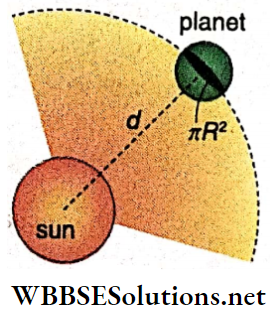
Question 21. A planet is situated at a mean distance d from the sun and its average surface temperature is T. Suppose that the planet receives energy only from the sun and loses energy from its surface by the process of radiation. Ignore all atmospheric actions. If \(T \propto d^{-n}\) then show that n = \(\frac{1}{2} \text {. }\)
Answer:

Given:

A planet is situated at a mean distance d from the sun and its average surface temperature is T. Suppose that the planet receives energy only from the sun and loses energy from its surface by the process of radiation.

Suppose, the power of radiation by the sun = P, radius of the planet = R

So, energy received by the planet = \(\frac{P}{4 \pi d^2} \times \pi R^2\)

Energy radiated by the planet = 4πR² • σT4

Class 11 Physics Unit 7 Properties Of Matter Chapter 9 Transmission Of Heat Plant With Atmospheric Actions

Therefore, for thermal equilibrium, \(\frac{P}{4 \pi d^2} \times \pi R^2=4 \pi R^2 \sigma T^4\)

or, \(T^4=\frac{P}{16 \pi \sigma d^2}\)

∴ \(T^4 \propto \frac{1}{d^2} \quad \text { or, } T \propto \frac{1}{d^{1 / 2}}\)

or, \(T \propto d^{-1 / 2}\)

Comparing with the given equation \(T \propto d^n \text {, we get } n=\frac{1}{2}\)

WBCHSE Class 11 Physics Transmission Of Heat Multiple Choice Questions And Answers

Unit 7 Properties Of Bulk Matter Chapter 9 Transmission Of Heat Multiple Choice Questions And Answers

Question 1. Through a solid medium heat

  1. Cannot be conducted but convection occurs
  2. Cannot be transmitted by convection
  3. Cannot be transmitted by conduction
  4. Can be transmitted by both conduction and convection

Answer: 2. Cannot be transmitted by convection

Question 2. Through a solid or a liquid medium heat

  1. Cannot be conducted but convection occurs
  2. Cannot be transmitted by convection
  3. Cannot be transmitted by conduction
  4. Can be transmitted by both conduction and convection

Answer: 4. Can be transmitted by both conduction and convection

Read And Learn More WBCHSE Class 11 Physics MCQs

Question 3. During the conduction of heat

  1. The molecules of the substance remain static
  2. The molecules of the substance move in the direction of heat conduction
  3. The molecules of the substance move randomly in different directions
  4. The molecules vibrate around their equilibrium positions

Answer: 4. The molecules vibrate around their equilibrium positions

Question 4. An example of a liquid which is a good conductor of heat is

  1. Water
  2. Alcohol
  3. Mercury
  4. Aqueous solution of an acid or a base or a salt

Answer: 3. Aqueous solution of an acid or a base or a salt

Question 5. If the thickness of a plate is d, the cross-sectional area is A and the difference in temperature of its two ends is T then the amount of heat conducted through it in unit time is

  1. \(Q \propto d A T\)
  2. \(Q \propto \frac{d T}{A}\)
  3. \(Q \propto \frac{A T}{d}\)
  4. \(Q \propto \frac{T}{d A}\)

Answer: 3. \(Q \propto \frac{T}{d A}\)

WBCHSE Class 11 Physics Transmission Of Heat Multiple Choice Questions And Answers

WBBSE Class 11 Heat Transfer MCQs

Question 6. The SI unit of the coefficient of thermal conductivity is

  1. J · m-1 K-1
  2. W · m-1 · K-1
  3. J · m-2 · K-1
  4. J · m-2 · K-2

Answer: 2. W · m-1 · K-1

Question 7. The coefficient of thermal conductivity of copper is nine times that of steel in the composite cylindrical bar shown in the figure. What will be the temperature at the 18cm 6cm junction of copper and steel?

  1. 33°C
  2. 90°C
  3. 75°C
  4. 65°C

Answer: 3. 75°C

Class 11 Physics Unit 7 Properties Of Matter Chapter 9 Transmission Of Heat Copper Is Nine Times That Of Steel In Composite Cylindrical Bar

Question 8. The area of the cross-section of a conductor of thickness d is A, the coefficient of thermal conductivity of its material is k and the difference in temperature of its two ends is T. If Q amount of heat is conducted through it in time t then the thermal resistance of the conductor is

  1. \(\frac{Q}{t}\)
  2. \(\frac{A T}{d}\)
  3. \(\frac{k A}{d}\)
  4. \(\frac{d}{k A}\)

Answer: 4. \(\frac{d}{k A}\)

Question 9. The ratio of the lengths, cross-sectional areas and the differences in temperature of the two ends of two conducting rods are 2:3 each. If the rate of heat conduction through them be equal, then the ratio of the coefficients of thermal conductivity of their materials is

  1. 2:3
  2. 3:2
  3. 4:9
  4. 9:4

Answer: 2. 3:2

Class 11 Physics Class 12 Maths Class 11 Chemistry
NEET Foundation Class 12 Physics NEET Physics

Question 10. Thermal resistance of a substance denotes

  1. The coefficient of thermal conductivity
  2. The rate of heat conduction
  3. The reciprocal of the coefficient of thermal conductivity
  4. The reciprocal of the rate of heat conduction

Answer: 3. The reciprocal of the coefficient of thermal conductivity

Question 11. The rate of heat conduction through the window of a room is 273 J • s-1 when the difference in temperatures of air inside and outside the room is 20°C. If this difference in temperature be 20 K, then the rate of heat conduction will be

  1. 293 J · s-1
  2. 273 J · s-1
  3. 253 J · s-1
  4. 263 J · s-1

Answer: 2. 273 J · s-1

Thermal Properties and Heat Transfer MCQs

Question 12. The thicknesses of two metallic plates of a combined strip are equal. The coefficients of their thermal conductivities are k1 and k2 and the temperatures of their hot and cold ends are T1 and T2 respectively. The temperature of the junction of the combined strip will be

  1. \(\frac{k_1 T_1+k_2 T_2}{k_1+k_2}\)
  2. \(\frac{k_1 T_1-k_2 T_2}{k_1-k_2}\)
  3. \(\frac{k_2 T_1+k_1 T_2}{k_1+k_2}\)
  4. \(\frac{k_2 T_1-k_1 T_2}{k_2-k_1}\)

Answer: 1. \(\frac{k_1 T_1+k_2 T_2}{k_1+k_2}\)

Question 13. The areas of a cross-section of two metallic rods of equal lengths, having coefficients of thermal conductivity k1 and k2, are A1 and A2 respectively. The rate of heat conduction in them will be the same if

  1. \(k_1 A_1^2=k_2 A_2^2\)
  2. \(k_1 A_2=k_2 A_1\)
  3. \(k_1 A_1=k_2 A_2\)
  4. \(k_1^2 A_1=k_2^2 A_2\)

Answer: 3. \(k_1 A_2=k_2 A_1\)

Question 14. The temperatures of the two ends A and B of a rod AB of length 20 cm are 100°C and 0°C respectively. In thermal equilibrium the temperature of the rod at a distance 6 cm from the end A will be

  1. 50°C
  2. 80°C
  3. 70°C
  4. 60°C

Answer: 3. 70°C

Question 15. Three rods made of the same material and having the same cross-section have been joined as shown. Each rod is of the same length. The left and right ends are kept at 0°C and 90°C respectively. The temperature of the junction of the three rods will be

  1. 45°C
  2. 60°C
  3. 30°C
  4. 20°C

Answer: 2. 60°C

Class 11 Physics Unit 7 Properties Of Matter Chapter 9 Transmission Of Heat Three Rods Made Of Same Material Having Same Cross Section Has Joined

Question 16. Two metallic rods of lengths x1 and x2 have equal cross-sectional area. Their thermal conductivities are k1 and k2 respectively. If they are connected in series, then the equivalent thermal conductivity of the combination will be

  1. \(\frac{\frac{x_1}{k_1}+\frac{x_2}{k_2}}{k_1+k_2}\)
  2. \(\frac{x_1+x_2}{\frac{x_1}{k_1}+\frac{x_2}{k_2}}\)
  3. \(\frac{k_1+k_2}{\frac{x_1}{k_1}+\frac{x_2}{k_2}}\)
  4. \(\frac{\frac{x_1}{k_1}+\frac{x_2}{k_2}}{x_1+x_2}\)

Answer: 2. \(\frac{x_1+x_2}{\frac{x_1}{k_1}+\frac{x_2}{k_2}}\)

Question 17. The dimension of thermal resistance is

  1. \(\mathrm{ML}^2 \mathrm{~T}^{-2} \Theta\)
  2. \(\mathrm{M}^{-2} \mathrm{~L}^{-2} \mathrm{~T}^2 \Theta^3\)
  3. \(\mathrm{ML}^2 \mathrm{~T}^{-3} \Theta\)
  4. \(\mathrm{M}^{-1} \mathrm{~L}^{-2} \mathrm{~T}^3 \Theta\)

Answer: 4. \(\mathrm{M}^{-1} \mathrm{~L}^{-2} \mathrm{~T}^3 \Theta\)

Short Notes on Modes of Heat Transfer with MCQs

Question 18. The process by virtue of which water in a pond gets heated at noon in summer up to a certain depth is

  1. Conduction
  2. Convection
  3. Conduction as well as convection
  4. Convection as well as radiation

Answer: 1. Conduction

Question 19. If the velocity of light in a vacuum be c then the velocity of radiant heat in any other medium is

  1. Always equal to c
  2. Always greater than c
  3. Always less than c
  4. Equal to or less than c

Answer: 3. Always less than c

Question 20. We can protect our body from the heat of the sun by means of an umbrella. From this, it can be said that

  1. Radiant heat travels in a straight line
  2. Velocity of radiant heat is equal to that of light
  3. Radiant heat does not warm the medium
  4. Radiant heat spreads in the form of waves

Answer: 1. Radiant heat travels in a straight line

Question 21. With the increase in temperature of a radiator

  1. Intensity of radiant heat increases
  2. The wavelength of radiant heat increases
  3. The absorptive power of the radiator increases
  4. The emissive power of the radiator increases.

Answer: 1. Intensity of radiant heat increases

Question 22. The specific design, for which heat lost by radiation from a thermos flask is the least, is

  1. Glass vessel with stopper made of cork
  2. Shiny wall of the glass vessel
  3. Vacuous space in between two walls of the glass vessel
  4. Both the characteristics 1 and 3

Answer: 2. Shiny wall of the glass vessel

Question 23. Felt is widely used as an insulator of heat instead of air, because

  1. The coefficient of thermal conductivity of air is more than that of felt
  2. Convection of heat occurs in air but not in felt
  3. No air remains trapped inside the fibres of felt
  4. Felt is a better insulator of heat than air

Answer: 2. Convection of heat occurs in air but not in felt

Step-by-Step Solutions to Heat Transfer MCQs

Question 24. If the temperature of the sun gets doubled, the rate of energy received on earth will be

  1. Doubled
  2. Quadrupled
  3. 16 times
  4. 8 times

Answer: 3. 16 times

Question 25. The coefficients of radiation of two bodies of equal shapes and volumes are 0.2 and 0.8 respectively. If they radiate heat at the same rate then the ratio of their temperatures will be

  1. √3:1
  2. √2:1
  3. 1:√5
  4. 1:√5

Answer: 2. √2:1

Question 26. If the temperature of a black body rises from T to 2 T, how many times will its rate of radiation be?

  1. 4
  2. 2
  3. 16
  4. 8

Answer: 3. 16

Question 27. The radii of two spheres made of the same material are 1 m and 4 m respectively. If their temperatures are 4000 K and 2000 K respectively, then the ratio of the amount of heat radiated per second is

  1. 1:1
  2. 16:1
  3. 4:1
  4. 1:9

Answer: 1. 16:1

Question 28. Which law is used to determine the temperature of stars?

  1. Stefan’s law
  2. Wien’s law
  3. Kirchhoff’s law
  4. Planck’s law

Answer: 1. Stefan’s law

Question 29. When the body has the same temperature as that of its surroundings, it

  1. Does not radiate heat
  2. Radiates same quantity of heat as it absorbs
  3. Radiates less quantity of heat as it receives from surroundings
  4. Radiates more quantity of heat as it receives from surroundings

Answer: 2. Radiates same quantity of heat as it absorbs

Question 30. A piece of iron appears colder in winter than a piece of wood when touched because

  1. The temperature of iron is less than that of wood
  2. The temperature of iron is less than our body temperature but that of wood is higher on
  3. Wood being an insulator of heat, no heat from it can be transmitted to our body
  4. Iron being a good conductor, heat can be transmitted from our body to the piece of iron

Answer: 4. The temperature of iron is less than that of wood

Question 31. The specific property that a cooking utensil must possess, is

  1. High absorptive power
  2. High thermal conductivity
  3. Low specific heat
  4. All of the above three characteristics

Answer: 4. All of the above three characteristics

Question 32. Woolen clothes are used in winter because wool is

  1. An insulator of heat
  2. A material having higher specific heat.
  3. A material haring lower specific heat
  4. A good conductor of heat

Answer: 1. An insulator of heat

Question 33. The mode in which a cup of hot tea placed on a metallic table loses heat is

  1. Conduction
  2. Convection
  3. Radiation
  4. All of them

Answer: 4. All of them

Real-Life Examples of Heat Transfer Applications

Question 34. Which mode of transmission of heat depends on the force of gravity?

  1. Conduction
  2. Convection
  3. Radiation
  4. None of 1, 2 and 3

Answer: 2. Convection

Question 35. The depletion in the ozone layer is mainly caused by

  1. Nitrous oxide
  2. Methane
  3. Sulphur dioxide
  4. Clilorofluro carbon

Answer: 4. Clilorofluro carbon

In this type of question, more than one options are correct.

Question 36. A hollow and a solid sphere of same material and identical outer surface are heated to the same temperature.

  1. In the beginning, both will emit equal amount of radiation per unit of time
  2. In the beginning, both will absorb an equal amount of radiation per unit of time
  3. Both spheres will have the same rate of fall of temperature \(\left(\frac{d t}{d t}\right)\)
  4. Both spheres will have equal temperatures at any moment

Answer:

  1. In the beginning, both will emit equal amount of radiation per unit of time
  2. In the beginning, both will absorb equal amount of radiation per unit time
  3. Both spheres will have same rate of fall of temperature \(\left(\frac{d t}{d t}\right)\)

Question 37. A composite block is made of slabs A, B, C, D, and E of different thermal conductivities (given in terms of a constant k) and size (given in terms of length, L) as shown. All slabs are of same width. Heat Q flows only from left to right through the blocks. Then in a steady state

Class 11 Physics Unit 7 Properties Of Matter Chapter 9 Transmission Of Heat Composite Block Is Made Of Slabs A BC D E Of Different Thermal Conductivities

  1. Heat flow through slabs A and E are same
  2. Heat flow through slab E is maximum
  3. The temperature difference across slab E is the smallest
  4. Heat flow through C = heat flow through B + heat flowthrough D

Answer:

1. Heat flow through slabs A and E are the same

4. Heat flow through C = heat flow through B + heat flowthrough D

Question 38. The two ends of a uniform rod of thermal conductivity k are maintained at different but constant temperatures. The temperature gradient at any point on the rod is \(\frac{d \theta}{d l}\) (equal to the difference in temperature per unit length). The heat flow per unit time per unit cross-section of the rod is l.

  1. \(\frac{d \theta}{d l}\) is the same for all points on rod
  2. l will decrease as we move from higher to lower temperature
  3. q = \(k \cdot \frac{d \theta}{d l}\)
  4. None of these

Answer:

1. \(\frac{d \theta}{d l}\) is the same for all points on rod

3. q = \(k \cdot \frac{d \theta}{d l}\)

Question 39. A heated body emits radiation which has maximum intensity at frequency vm. If the temperature of the body is doubled

  1. The maximum intensity of radiation will be at frequency 2vm
  2. The maximum intensity of radiation will be at frequency
  3. The total emitted energy will increase by a factor 16
  4. The total emitted energy will increase by a factor 2

Answer:

1. The maximum intensity of radiation will be at frequency 2vm

3. The total emitted energy will increase by a factor 16

Question 40. The energy radiated by a body depends on

  1. Area of body
  2. Nature of surface
  3. Mass of body
  4. Temperature of body

Answer:

1. Area of body

2. Nature of surface

4. Temperature of body

WBCHSE Class 11 Physics Newton Law Of Motion Short Answer Questions

Unit 3 Laws Of Motion Chapter 1 Newton Law Of Motion Short Answer Type Questions

WBBSE Class 11 Short Answer Questions on Newton’s Laws

Question 1. A block of mass M is pulled along a frictionless horizontal surface by a rope of mass m by applying a horizontal force F at the other end of the rope. The force exerted by the rope on the block is

  1. \(\frac{m F}{m+M}\)
  2. \(\frac{m F}{M-m}\)
  3. \(\frac{M F}{M-m}\)
  4. \(\frac{M F}{m+M}\)

Answer:

Given

A block of mass M is pulled along a frictionless horizontal surface by a rope of mass m by applying a horizontal force F at the other end of the rope. The force exerted by the rope on the block is

Acceleration of the system, a \(=\frac{\text { total force }}{\text { total mass }}=\frac{F}{m+M}\)

The force exerted by the rope on the block, \(M a=\frac{M F}{m+M}\)

The option 4 is correct.

WBCHSE Class 11 Physics Newton Law Of Motion Short Answer Questions

Question 2. Two blocks A and B are standing side-by-side touching each other, on a smooth horizontal table. The masses of the blocks are 3 kg and 2 kg respectively. Block A is pushed towards block B with 10 N horizontal force.

  1. How much force does block A apply on block B?
  2. If the 10 N horizontal force were applied on block B towards block A, how much force would block B have applied on block A

Answer:

Given

Two blocks A and B are standing side-by-side touching each other, on a smooth horizontal table. The masses of the blocks are 3 kg and 2 kg respectively.

1. Let force applied on B by A is FAN.

Here, acceleration of the system due to force 10 N = acceleration of B due to force FA

Newtons Law Of Motion Two Blocks A And B Are Standing Side By Side Touching Each Other

So, \(\frac{10}{3+2}=\frac{F_A}{2} \quad therefore F_A=4 \mathrm{~N}\)

2. Force applied on A by B, \(F_B=\frac{10 \times 3}{3+2}=6 \mathrm{~N}\)

Question 3. A gun is mounted on a platform fitted with frictionless wheels. The mass of the platform with the gun, shells, and the operator is M. The gun fires shells one after another with a velocity of v in the horizontal direction. If another with a velocity v in the horizontal direction. If the mass of each shell is m, show that the velocity of recoil of the platform after N shells are fired is \(V_N=\frac{N m v}{(M-m N)}\)
Answer:

Given

A gun is mounted on a platform fitted with frictionless wheels. The mass of the platform with the gun, shells, and the operator is M. The gun fires shells one after another with a velocity of v in the horizontal direction. If another with a velocity v in the horizontal direction. If the mass of each shell is m

Let the velocity of the recoil of the platform after 1st shell is fired = v1.

Therefore, from the law of conservation of momentum, \((M-m) v_1=m v\) or, \(v_1=\frac{m v}{M-m}\)

Again from the law of conservation of momentum, after 2nd shell is fired, we get mv-(M-2m)v2 = -(M- m)v1

[v2 = The velocity of recoil of the platform after 2nd shell is fired]

or, \(v_2=\frac{2m v}{M-2m}\)

Similarly the velocity of recoil of the platform after 3rd shell is fired, is \(v_3=\frac{3m v}{M-3m}\)

Therefore, the velocity of recoil of the platform after N shells are fired is \(v_N=\frac{N m v}{M-Nm}\)

Key Concepts in Newton’s Laws: Short Answers

Question 4. Which is easier to lift in the air, 1 kg of steel or 1 kg of wool?
Answer:

The volume of 1 kg of wool is much greater than that of 1 kg of steel. Hence, wool faces more resistance while moving through air. Therefore, it is easier to lift 1 kg of steel.

Question 5. A batsman deflects a ball by an angle of 45° without changing its initial speed which is equal to 36 km/h. What is the impulse imparted to the ball? Given, the mass of the ball is 0.157 kg.
Answer:

Given

A batsman deflects a ball by an angle of 45° without changing its initial speed which is equal to 36 km/h.

Let initial velocity of the ball is \(\vec{v}_1\) and final velocity is \(\vec{v}_2\).

Impulse, \(\vec{I}\)= m(\(\vec{v}_2\) – \(\vec{v}_1\)) [m = mass of the ball]

Newtons Law Of Motion A Batsman Deflects A Ball By An Angle 45 Degress

The magnitude of initial and final velocities are the same,

i.e., \(\left|\vec{v}_1\right|=\left|\vec{v}_2\right|=36 \mathrm{~km} \cdot \mathrm{h}^{-1}\)

= \(\frac{36 \times 10^3}{3600} \mathrm{~m} \cdot \mathrm{s}^{-1}\)

= \(10 \mathrm{~m} \cdot \mathrm{s}^{-1}\)

From figure, \(\left|\vec{v}_2-\vec{v}_1\right|=\sqrt{v_1^2+v_2^2+2 v_1 v_2 \cos 45^{\circ}}\)

= \(\sqrt{10^2+10^2+2 \times 10 \times 10 \times \frac{1}{\sqrt{2}}}\)

∴ \(18.5 \mathrm{~m} \cdot \mathrm{s}^{-1}\)

∴ \(|\vec{I}|=m\left|\vec{v}_2-\vec{v}_1\right|=0.157 \times 18.5 \mathrm{~kg} \cdot \mathrm{m} \cdot \mathrm{s}^{-1}=2.9 \mathrm{~kg} \cdot \mathrm{m} \cdot \mathrm{s}^{-1}\)

The direction of imparted impulse is along the bisector of the angle between \(\vec{v}_2\) and \(\vec{-v}_1\)

Applications of Newton’s First Law: Short Answer Questions

Question 6. In which frame of reference Newton’s first law of motion is applicable?
Answer:

Newton’s first law of motion is applicable in an inertial frame of reference.

Question 7. A mass of 1 kg is suspended by a thread. It is

  1. Lifted up with an acceleration of 4.9m · s-2,
  2. Lowered with an acceleration of 4.9m · s-2. The ratio of the tensions or the thread is
  1. 3:1
  2. 1:2
  3. 1:3
  4. 2:1

Answer:

1. Weight of the body = mg (downwards)

Tension on the thread = T (upwards)

∴ Resultant force acting on the body = T- mg (upwards)

If a is the upward acceleration then from F = ma we get, T- mg = ma or, T = m(g+ a)

2. In case of downward acceleration a, resultant force acting on the body = mg- T

∴ mg- T = ma or, T = m(g- a)

∴ The ratio of tensions on the thread in the two cases

= \(\frac{m(g+a)}{m(g-a)}=\frac{g+a}{g-a}=\frac{9.8+4.9}{9.8-4.9}=\frac{14.7}{4.9}=\frac{3}{1}\)

The option 1 is correct.

Question 8. A bullet is fired from a gun. Which one will possess greater momentum—gun or bullet?
Answer:

A bullet is fired from a gun

Before firing the bullet, both the gun and the bullet were at rest. Hence, initially, the total linear momentum was zero. After firing the bullet, the gun will have an equal but opposite momentum to that of the bullet so as to conserve the total linear momentum of the system.

Understanding Newton’s Second Law: Short Answers

Question 9. A smooth massless string passes over a smooth fixed pulley. Two masses m1 and m2 (m1> m2) are tied at the two ends of the string. The masses are allowed to move under gravity starting from rest. The total external force acting on the two masses is

  1. \(\left(m_1+m_2\right) g\)
  2. \(\frac{\left(m_1-m_2\right)^2}{m_1+m_2} g\)
  3. \(\left(m_1-m_2\right) g\)
  4. \(\frac{\left(m_1+m_2\right)^2}{m_1-m_2} g\)

Answer:

Given

A smooth massless string passes over a smooth fixed pulley. Two masses m1 and m2 (m1> m2) are tied at the two ends of the string. The masses are allowed to move under gravity starting from rest.

If a is the acceleration of the two masses and T is the tension in the two sides of the strings, then m1g-T=m1a….(1)

and T- m2g = m2a…(2)

Newtons Law Of Motion Vertical Motion With The Help Of A Smooth Pulley

Now from equations (1) and (2), we get, a = \(\frac{\left(m_1-m_2\right) g}{m_1+m_2}\)

Therefore, total external force = \(\left(m_1+m_2\right) a=\left(m_1-m_2\right) g\)

The option 3 is correct.

Class 11 Physics Class 12 Maths Class 11 Chemistry
NEET Foundation Class 12 Physics NEET Physics

Question 10. A mass of 1 kg is suspended by means of a thread. The system is

  1. Lifted up with an acceleration of 4.9 m/s²
  2. Lowered with an acceleration of 4.9 m/s². The ratio of tension in the first and second case is
  1. 3:1
  2. 1:2
  3. 1:3
  4. 2:1

Answer:

  1. Tension while lifting the mass, \(T_1=g+a=g+\frac{g}{2}=\frac{3 g}{2}\left[because a=\frac{g}{2}\right]\)
  2. Tension while lowering the mass, \(T_2=g-a=g-\frac{g}{2}=\frac{g}{2}\)

∴ \(T_1: T_2=\frac{3 g}{2}: \frac{g}{2}=3: 1\)

The option 1 is correct.

Question 11. A block of mass 1 kg starts from rest at x = 0 and moves along the x-axis under the action of a force F = kt, where t is time and k = 1 N/s. The distance the block will travel in 6 seconds is

  1. 36m
  2. 72m
  3. 108m
  4. 18m

Answer:

Given

A block of mass 1 kg starts from rest at x = 0 and moves along the x-axis under the action of a force F = kt, where t is time and k = 1 N/s.

F = kt or, \(m \frac{d v}{d t}=k t \text { or, } \frac{d v}{d t}=\frac{k}{m} t\)

or, \(\int_0^v d v=\frac{k}{m} \int_0^t t d t\)

or, \(v=\frac{1}{2} \frac{k}{m} \cdot t^2 or, \frac{d x}{d t}=\frac{1}{2} \frac{k}{m} t^2\)

or, \(\int_0^x d x=\frac{1}{2} \frac{k}{m} \int_0^6 t^2 d t\)

or, x = \(\frac{1}{2} \frac{k}{m} \frac{6^3}{3}=\frac{1}{2} \times \frac{1}{1} \times \frac{216}{3}[because k=1 \mathrm{~N} / \mathrm{s}, m=1 \mathrm{~kg} \mid\)

= 36 m

The option 1 is correct.

Question 12. The velocity v of a particle (under a force F) depends on its distance (x) from the origin (with x > 0) \(v \propto \frac{1}{\sqrt{x}}\). Find how the magnitude of the force (F) on the particle depends on x.

  1. \(F \propto \frac{1}{x^{3 / 2}}\)
  2. \(F \propto \frac{1}{x}\)
  3. \(F \propto \frac{1}{x^2}\)
  4. \(F \propto x \mid 1]\)

Answer:

Given

The velocity v of a particle (under a force F) depends on its distance (x) from the origin (with x > 0) \(v \propto \frac{1}{\sqrt{x}}\).

⇒ \(\quad v \propto \frac{1}{\sqrt{x}} \text { or, } v=\frac{k}{\sqrt{x}}\)

∴ \(\frac{d \nu}{d t}=\frac{d}{d x}\left(k x^{-\frac{1}{2}}\right) \frac{d x}{d t}=\nu \frac{d}{d x}\left(k x^{-\frac{1}{2}}\right)\)

= \(k^{\prime} \times \frac{1}{x^2}\left[\text { where } k^{\prime}=-\frac{k^2}{2}\right]\)

∴ \(\propto \frac{1}{x^2}\)

So, \(F \propto \frac{1}{x^2}\)

The option 3 is correct.

Short Answer Questions on Action and Reaction Forces

Question 13. The force F acting on a particle of mass ni is indicated by the force-time graph shown below. The change in momentum of the particle over the time interval from zero to 8 s is

  1. 24 N • s
  2. 20 N • s
  3. 12 N • s
  4. 6 N •s

Newtons Law Of Motion Force Is Acting On A Particle

Answer:

Given

The force F acting on a particle of mass ni is indicated by the force-time graph shown above.

F = ma = \(m \frac{d v}{d t}\)

∴ P = \(\int m d v=\int F d t\)

So, momentum is the total area of the forcetime graph.

Therefore, change in momentum,

ΔP =(1/2 x 6 x 2)-(3 x 2) + (3 x 4)

= (6-6+12) = 12N · s

The option 3 is correct.

Question 14. A balloon with mass m is descending down with an acceleration a (where a < g). How much mass should be removed from it so that it starts moving up with an acceleration a?

  1. \(\frac{2 m a}{g+a}\)
  2. \(\frac{2 m a}{g-a}\)
  3. \(\frac{m a}{g+a}\)
  4. \(\frac{m a}{g-a}\)

Answer:

Given

A balloon with mass m is descending down with an acceleration a (where a < g).

Let upthrust of air be \(F_a\), then for downward motion \(m g-F_a=m a \text { or, } F_a=m(g-a)\)

For upward motion, \(F_a-(m-\Delta m) g=(m-\Delta m) a\) or, \(\Delta m(g+a)=m a+m g-F_a=2 m a\)

∴ \(\Delta m=\frac{2 m a}{g+a}\)

The option 1 is correct.

Question 15. Three blocks A, B, and C, of masses 4 kg, 2 kg, and 1 kg respectively, are in contact on a frictionless surface, as shown. If a force of 14 N is applied on the 4 kg block, then the contact force between A and B is

  1. 2N
  2. 6N
  3. 8N
  4. 18N

Newtons Law Of Motion Three Blocks ABC Of Masses

Answer:

Given

Three blocks A, B, and C, of masses 4 kg, 2 kg, and 1 kg respectively, are in contact on a frictionless surface, as shown.

Acceleration of the whole system, a = \(\frac{14}{4+2+1}=2 \mathrm{~m} / \mathrm{s}^2\)

Hence, the required force for blocks B and C to have this acceleration =(2 + l)x2 = 6N.

So, the A block will apply 6 N force in the plane of contact of A and B.

Therefore, the contact force between A and B = 6 N.

The option 2 is correct.

Question 16. A girl jumps down from a moving bus, along the direction of motion of the bus, tilting slightly forward. She falls on

  1. A sheet of ice
  2. A patch of glue.
  1. In case (1) she falls backward and in case (2) she falls forward
  2. In both cases (1) and (2) she falls forward
  3. In both cases (1) and (2) she falls backward
  4. In case (1) she falls forward and in case (2) she falls backward

Answer:

  1. Due to super smoothness of the sheet of ice, her leg cannot move forward while her head moves forward due to inertia of motion. Hence, she falls forward.
  2. Her leg becomes still at the patch of glue but her leg cannot move forward while her head moves forward due to inertia of motion. Hence, she falls forward.

The option 2 is correct

Short Answer Questions on Force and Mass Relationship

Question 17. A block of mass m is placed on a smooth inclined wedge ABC of inclination 9 as shown in the figure. The wedge is given an acceleration towards the right. The relation between a and 9 for the block to remain stationary on the wedge is

Newtons Law Of Motion Block Of Mass m Is Placed On Smooth Inclined Wedge

  1. a = \(g \cos \theta\)
  2. \(a=\frac{g}{\sin \theta}\)
  3. a = \(\frac{g}{{cosec} \theta}\)
  4. a = \(g \tan \theta\)

Answer:

For the mass m to remain still in the non-inertial reference frame,

Rsinθ = ma…(1)

Rcosθ = mg…(2)

Newtons Law Of Motion Mass m To Reamin Still In The Non Internal Surface

(1) + (2) \(\tan \theta=\frac{a}{g} \quad \text { or, } a=g \tan \theta\)

The option 4 is correct

Question 18. Two masses 8 kg and 12 kg are connected to the two ends of a light inextensible string that goes over a frictionless pulley. Find the acceleration of the masses and the tension in the string when the masses are released.
Solution:

Given

Two masses 8 kg and 12 kg are connected to the two ends of a light inextensible string that goes over a frictionless pulley.

Let m1 = 12 kg and m2 = 8 kg

Then, a = downward acceleration of m1 = upward acceleration of m2

So, the force equations are, for mass m1: m1g-T= m1a….(1)

and for mass m2: T- m2g = m2a…(2)

Now adding equations (1) and (2), we get, \(g\left(m_1-m_2\right)=a\left(m_1+m_2\right)\)

Newtons Law Of Motion Two Masses Are Connected To The Two Ends Of a Ligth Inextensible String

or, \(a =\frac{m_1-m_2}{m_1+m_2} g=\frac{12-8}{12+8} \times 9.8\)

= \(1.96 \mathrm{~m} \cdot \mathrm{s}^{-2}\)

Then from (2), \(T=m_2 g+m_2 \frac{m_1-m_2}{m_1+m_2} g\)

= \(m_2 g \cdot \frac{2 m_1}{m_1+m_2}=\frac{2 m_1 m_2}{m_1+m_2} g\)

= \(\frac{2 \times 12 \times 8}{12+8} \times 9.8=94.08 \mathrm{~N}\)

Question 19. Define acceleration. When does a body possess uniform acceleration?
Answer:

The acceleration of a body is its rate of change of velocity with time.

From Newton’s 2nd law, the acceleration \(\vec{a}\) of a body of mass m is related to an applied force \(\vec{F}\) as, \(\vec{F}\) = m\(\vec{a}\). So, when the body is acted upon by a constant force \(\vec{F}\), we get \(\vec{a}\) = constant. Thus, the body moves with a uniform acceleration.

Real-Life Examples of Newton’s Laws: Short Answer Questions

Question 20. A monkey of mass 40 kg climbs on a rope that can stand a maximum of 600 N. In which case the rope will break: the monkey

  1. Climbs up with an acceleration of 6 m · s-2
  2. Climbs down with an acceleration of 4 m · s-2
  3. Climbs up with a uniform speed of 5 m · s-1
  4. Falls down the rope nearly under gravity

[Ignore the mass of the rope. Take g = 10 m · s-2]

Answer:

Real weight of the monkey = 40 kg · wt = 40 x 10 N = 400 N; So the rope can withstand his real weight.

Here g = 10 m · s-2 = actual acceleration due to gravity, acting downwards.

1. Acceleration, a = -6 m s-2; the negative sign comes as the acceleration is upwards.

Thus, relative downward acceleration, g’ = g- a = 10- (-6) = 16 m · s-2

Hence, apparent weight = mg’ = 40 x 16 = 640 N

As it is greater than 600 N, the rope will break.

2. Here, acceleration a = + 4 m · s-2

Thus, relative downward acceleration, g’ = g- a = 10- 4 = 6 m · s-2

Hence, apparent weight = mg’ = 40 x 6 = 240 N

This force does not break the rope.

3. The speed is uniform, i.e., there is no acceleration.

Hence, Apparent weight = real weight = 40 kg · wt = 400 N

Clearly, the rope does not break due to this force.

4. When the monkey falls freely under gravity, then a = g

Thus relative downward acceleration, g’ = g – g= 0

Hence, apparent weight = mg’ = 0 In this case, the rope does not break.

Question 21. A cricket ball of mass 150 g moving with a speed 12 m · s-1 is hit by a bat so that the ball is turned back with a velocity of 20 m · s-1. Calculate the impulse received by the ball.
Answer:

Given

A cricket ball of mass 150 g moving with a speed 12 m · s-1 is hit by a bat so that the ball is turned back with a velocity of 20 m · s-1.

The force on the ball acts in the backward direction; this direction is taken to be positive.

So, initial velocity, v1 = -12 m • s-1 and final velocity, v2 = + 20 m • s-1

From Newton’s second law of motion, with proper choice of the unit of force,

force = \(\frac{\text { change of momentum }}{\text { time interval }}\)

So, impulse  = force x time interval

= change of momentum

= \(m v_2-m v_1=m\left(\nu_2-v_1\right)\)

= \(\frac{150}{1000} \mathrm{~kg} \times\{20-(-12)\} \mathrm{m} \cdot \mathrm{s}^{-1}\)

= \(4.8 \mathrm{~kg} \cdot \mathrm{m} \cdot \mathrm{s}^{-1}\)

Question 22. Show that Newton’s second law of motion is the real law of motion.
Answer:

From Newton’s 2nd law, the force \(\vec{F}=\frac{d}{d t}(m \vec{v})\) with proper choice of the unit of force.

1. If the external force \(\vec{F}\)=0; we have, \(\frac{d}{d t}(m \vec{v})\)= 0

∴ m\(\vec{v}\) = constant, so, \(\vec{v}\) = constant This means that a body at rest would remain at rest and a body in motion would continue to maintain its uniform velocity. This is Newton’s 1st law of motion.

2. We consider a system of two bodies, 1 and 2.

∴ \(\vec{F}_21\) = force on body 1, exerted by body 2;

and \(\vec{F}_12\) = force on body 2, exerted by body 1.

In the absence of any other external forces, Newton’s 2nd law gives,

For body 1: \(\vec{F}_{21}=\frac{d}{d t}\left(m_1 \vec{v}_1\right)\)

For body 2: \(\vec{F}_{12}=\frac{d}{d t}\left(m_2 \vec{v}_2\right)\)

Now, if the combination of the two bodies is considered, \(\vec{F}_21\) and \(\vec{F}_12\) are internal forces only and do not contribute to any external force. If the external force is zero, we have from the 2nd law,

0 = \(\frac{d}{d t}\left(m_1 \vec{v}_1+m_2 \vec{v}_2\right)=\frac{d}{d t}\left(m_1 \vec{v}_1\right)+\frac{d}{d t}\left(m_2 \vec{v}_2\right)\)

0 = \(\vec{F}_{21}+\vec{F}_{12}\)

∴ \(\vec{F}_{21}=-\vec{F}_{12}\) This is Newton’s 3rd law.

Thus, Newton’s 2nd law of motion is sometimes called the “real” law of motion—it encompasses both the 1st and the 3rd laws.

However, Newton’s wisdom dictated him to propose the 1st and the 3rd laws separately in order to introduce, respectively,

  1. The Notion Of The Inertial Frames Of Reference, And
  2. The Concept Of Action-Reaction Pair Of Forces.

Question 23. A batsman hits back a ball straight in the direction of the bowler without changing its initial speed of 12 m · s-1. If the mass of the ball is 0.15 kg, determine the impulse imparted to the ball. (Assume linear motion of the ball)
Answer:

Given

A batsman hits back a ball straight in the direction of the bowler without changing its initial speed of 12 m · s-1. If the mass of the ball is 0.15 kg

The impulse is imparted towards the bowler from the position of the batsman. If that direction is taken to be positive, then

The initial velocity of the ball = -12 m · s-1

The final velocity of the ball = +12 m · s-1

So, the impulse = change in momentum

= mass x change in velocity

= 0.15 x{12-(-12)} = 0.15×24

= 3.6 kg m · s-1

Question 24. A bullet of mass 0.04 kg moving with a speed of 90 m · s-1 enters a heavy wooden block and is stopped after a distance of 60 cm. What is the average resistive force exerted by the block on the bullet?
Answer:

Given

A bullet of mass 0.04 kg moving with a speed of 90 m · s-1 enters a heavy wooden block and is stopped after a distance of 60 cm.

Let mass of the bullet, m = 0.04 kg

The initial velocity of the bullet, u = 90 m · s-1

The final velocity of the bullet, v = 0

Distance traversed by the bullet, s = 60 cm = 0.6 m

If a be the retardation of the bullet, v² = u²-2as or, 0 = (90)² – 2a x 0.6

∴ a = \(\frac{(90)^2}{2 \times 0.6}=6750 \mathrm{~m} \cdot \mathrm{s}^{-2}\)

So the resistive force, F = ma = 0.04 x 6750 = 270 N

The actual resistive force, and therefore, the retardation of the bullet may not be uniform. The answer, therefore, only indicates the average resistive force.

Question 25. A car and a truck are moving on a level road so that their linear momenta are equal. Which one is moving faster?
Answer:

A car and a truck are moving on a level road so that their linear momenta are equal.

The car is moving faster as its mass is less than that of the truck.

Question 26. Why a cricket player lowers his hands while catching a cricket ball? Explain
Answer:

We know, impulse = force x time

= change in linear momentum.

Force not only depends on the change in momentum but also on how fast the change is brought about. The same change in momentum brought about in a shorter time needs greater force.

By lowering his hands while catching the cricket ball, the player allows a longer time for the momentum to change, thereby preventing his hands from getting injured.

Question 27. Calculate the net force acting on a body of mass 10 kg moving with a uniform velocity of 2 m/s.
Answer:

Since, velocity is uniform, so, acceleration, a = 0.

Hence, net force, F = ma = 0

Question 28. A lift of mass 400 kg is hung by a wire. Calculate the tension in the wire when the lift is

  1. At rest,
  2. Moving upward with a constant velocity of 2.0 m/s,
  3. Moving upward with an acceleration of 2.0 m/s² and
  4. Moving downward with an acceleration of 2.0 m/s².

Answer:

  1. Lift at rest T – W = mg = 4000 N
  2. Moving up with 2m/s, a = 0; T = W = mg = 4000 N
  3. Moving up with a – 2m/s²; T = mg+ ma – 4000 + 400 x 2 = 4800 N
  4. Moving down with a = -2m/s²; T = mg- ma = 4000 – 400 x 2 = 3200N

Question 29. Write its two applications. The linear momentum of a body can change in the direction of applied force. Comment.
Answer:

  • While firing a gun, the gun must be held tightly to the shoulder.
  • When a man jumps out of a boat, the boat is pushed away, which pushes the man forward.
  • The statement is correct. It is in accordance with Newton’s second law of motion.


WBCHSE Class 11 Physics Newton’s Third Law of Motion Notes

Newton Law Of Motion – Discussions On The Third Law

WBBSE Class 11 Newton’s Third Law Notes

Newton’s Laws 3rd Law

Newton’s third law of motion states that, for every action, there is an equal and opposite reaction. Consider two bodies A and B. They may be in contact with each other, or separated by a distance.

Suppose A exerts a force on B, denoted by \(\vec{F}_{A B}\). According to Newton’s third law, B will exert a force on A simultaneously, that is equal in magnitude but opposite in direction. This force is denoted by \(\vec{F}_{A B}\).

Thus, we have \(\vec{F}_{A B}=-\vec{F}_{B A} \quad therefore\left|\vec{F}_{A B}\right|=\left|\vec{F}_{B A}\right|\)

If \(\vec{F}_{A B}\) is called the action, \(\vec{F}_{B A}\) is the reaction. Action and reaction always coexist in pairs and one exists as long as the other one is present.

Read and Learn More: Class 11 Physics Notes

Examples Of Action-Reaction Pairs:

  1. Thrust: A wooden block is resting on a table surface. The block exerts a downward force \((\vec{W})\) on the table surface due to its weight. At the same time, the table also exerts an equal upward force \((\vec{R})\), on the block.
    • The downward force of the block on the tabletop is the action and the upward force of the table on the block, is the reaction. A pair of action and reaction forces of this type is called thrust.
  2. Tension: A body, suspended by a wire whose upper end is fixed to a rigid support, exerts a downward force on the wire, due to its weight. The wire, at the same time, exerts an equal upward force on the suspended body.
    • This force or reaction is called the tension of the wire. If the weight of the suspended body is termed as action, the tension in the wire is the reaction.
    • When a cord (rope, cable, etc.) is attached to a body and tightly pulled (action), the cord pulls on the body with a force (reaction) directed away from the body and along the cord. This force is also called tension force.
  3. Push: When a person applies a force on a large piece of stone lying on a road, the stone also exerts a force on the person which is equal in magnitude but opposite in direction. Such a pair of actions and reactions constitute a push.
  4. Impact or Collision: When a moving car runs into a wall, as the collision car exerts a force on the wall, the wall also exerts an equal and opposite force on the car. The force on the wall is the action and that on the car is the reaction. Such pairs of forces are called impact or collision.
  5. Attraction: When a pole of a magnet is brought near an iron piece, they attract each other. Such an attraction is called mutual attraction. Another example of attraction is the pull of the earth on a body which causes a downward motion and it is an action.
    • The body also pulls the earth towards it as a reaction. However, since the mass of the earth is very large, the reaction force cannot cause any noticeable acceleration of the earth, and it appears to be at rest.
  6. Repulsion: The action-reaction pair that causes bodies to move away from each other is called repulsion. The north poles of two magnets, when brought close together, repel each other due to action and reaction forces.
  7. Friction: When a body moves or tries to move on a surface, the surface exerts an opposing force on the body. This force resists the motion, or the attempt of motion, and is called friction. The force exerted by the body on the surface is the action while the force of friction on the body is the reaction.

Newtons Law Of Motion Thrust

Key Concepts of Newton’s Third Law for Class 11

There are numerous examples in nature, where action and reaction take place simultaneously.

Contact Force And Field Force: Thrust, tension, impact, etc. come into play when two bodies are in contact. These forces are called contact forces.

  • On the other hand, the attraction of the earth on a body, and the attraction or repulsion between two magnetic poles show the existence of another type of force where the bodies need not be in contact.
  • A magnet produces a magnetic field around it, and whenever a magnetic substance is placed in the field, it experiences a force. The forces due to fields are called field forces.
Class 11 Physics Class 12 Maths Class 11 Chemistry
NEET Foundation Class 12 Physics NEET Physics


A Few General Experiences Related to Action-Reaction:

  • When a gun is fired, the forward-moving bullet exerts a backward reaction on the gun, and the shooter feels a backward thrust.
  • When a man jumps off a boat, the boat moves back slightly. In this case, the man exerts a backward force on the boat (action), whereas the boat exerts a reaction force on the man which enables him to reach the bank.
  • When the fuel in a rocket is ignited, gas is ejected from the rocket with great force in the downward direction. Therefore an upward reaction force is generated which helps the rocket to shoot upwards with great speed.
  • Shows an arrangement for sprinkling water in a garden. There are a few narrow jets fitted to the spherical water reservoir which is pivoted such that it can rotate about an axis.
    • When the reservoir is filled with water, water flows out in the form of fountains from the jets. A reaction force is generated in the opposite direction which sets the reservoir in a spinning motion

WBCHSE Class 11 Physics Newton's Third Law of Motion Notes

In order to bowl bouncers, a fast bowler has to pitch the ball very hard on the ground (action). The ground exerts an equal and opposite force on the ball (reaction) and this bounces the ball at a desired height.

Newtons Law Of Motion Arrangement Of Sprinkle Water

Real-Life Examples Illustrating Newton’s Third Law

Experiments Frustrating The Action-Reaction Forces: The hooks of two spring balances are attached, as shown. The free end of one spring balance is fixed to a rigid support on the wall and the free end of the other is pulled in the opposite direction, both the balances show the same reading. On increasing or decreasing the pull, the readings change by the same amount. This is because the action is equal to the reaction of the wall.

Newtons Law Of Motion Experiment Of The Action Reaction Forced Of Hooks Of Two Spring Balances

Examples Of Newton’s Third Law

A circular toy railway tracks A is set on a table so that the track can turn smoothly about an axis passing perpendicularly through its center. When a toy train B is placed on the track and set into motion, the track will also start rotating in the opposite direction. This shows the generation of an action-reaction pair of forces.

Action And Reaction Cannot Cancel Each Other: An action-reaction pair of forces cannot exist without the presence of two bodies. If the force on the second body by the first one is action, the force on the first body exerted by the second is reaction.

Newton’s Third Law Explained with Examples

Newtons Law Of Motion A Circyular Toy Railway Track

Though action and reaction forces are equal and oppositely directed, they do not act, at the same time on the same body. Hence, they do not cancel each other, and no question of equilibrium arises.

WBCHSE Class 11 Physics Impulse Of Force And Impulsive Force Notes

Newton Law Of Motion – Impulse Of Force And Impulsive Force

WBBSE Class 11 Impulse of Force Overview

Impulse Of Force: When a cricket ball is hit by a bat or a nail is struck into wood with a hammer, the force of impact

  1. Acts for a short time, and
  2. Is usually not constant throughout the duration of impact i.e., It varies with time.

It is not easy to measure the varying force of impact. Let \(\vec{F}_{a v}\) be the average force acting during the small time of impact \(\vec{F}_{a v}\) t. The quantity \(\vec{F}_{a v}\)t is called the impulse of a force.

Impulse Of Force And Impulsive Force Definition: For a force acting on a body for an interval of time, the product of the force and the time interval is called the impulse of the force or simply impulse.

Read and Learn More: Class 11 Physics Notes

Let a force \(\vec{F}\) act for small time dt. The impulse of the force is given by d\(\vec{I}\) = \(\vec{F}\)dt

If we consider a finite interval of time from t1 to t2, then the impulse will be, \(\vec{I}=\int d \vec{I}=\int_{t_1}^{t_2} \vec{F} d t\)

If \(\vec{F}_{a v}\) is the average force, then, \(\vec{I}=\vec{F}_{a v}\left(t_2-t_1\right)\)

or, \(\vec{I}=\vec{F}_{a v} \Delta t \text {, where } \Delta t=t_2-t_1 \text {. }\)

Impulse-Momentum Theorem: According to Newton’s second law of motion, applied force = rate of change in momentum

∴ \(\vec{F}=\frac{d \vec{p}}{d t} \quad \text { or, } \vec{F} d t=d \vec{p}\)

If in time 0 to t, the momentum of the body changes from p1 to p2, then integrating within proper limits, we get, \(\int_0^t \vec{F} d t=\int_{\vec{p}_1}^{\vec{p}_2} d \vec{p}=d \vec{p}=\left(\vec{p}_2-\vec{p}_1\right)\)

But \(\int_0^t \vec{F} d t=\vec{I} \quad therefore \vec{I}=\left(\vec{p}_2-\vec{p}_1\right)\)

Thus, the impulse of a force is equal to the total change in momentum produced by the force. This relationship between impulse and momentum is known as the impulse-momentum theorem.

Unit And Dimension Of Impulse: impulse has the unit and dimension of momentum:

  • CGS System: g · cm · s-1  or dyn · s
  • SI: kg · m · s-1 or N · s

The dimension of impulse is MLT-1.

Measurement Of Impulse By Graphical Method:

1. When A Constant Force Force Acts On A Body: Let a constant force F act on a body from time t1 to t2. The force-time graph is a straight line AB parallel to the time axis, as shown.

Newtons Law Of Motion Measurment Of Impulse By Graphical Method

Impulse of the constant force,

l = area of rectangle ABCD

= ADxAB = F(t2 – t1)

Definition of Impulsive Force in Physics

2. When A Variable Force Acts On The Body: Suppose a force varying in magnitude acts on a body for time t2 – t1 = t

The force-time graph is a curve ABC as shown.

Newtons Law Of Motion Variable Force Acts On A Body

Impulse of force F in time interval t, I = \(\int_0^t F d t\) = area under the curve ABC

Thus, the area under the force-time graph gives the magnitude of the impulse of the given force in the given time interval.

Practical Applications Of Impulse: If two forces \(\vec{F}_1\) and \(\vec{F}_2\) act on a body to produce the same impulse (or change in momentum), then their time durations t1 and t2 should be such that, \(\vec{F}_1\)t1 = \(\vec{F}_2\)t2

Newtons Law Of Motion Practical Applications Of Impulse

In other words, if the time duration of an impulse is large, the force exerted will be small, or vice-versa. The Curves (1) and (2) indicate forces applied and the time intervals for which they act are different but the area under the F-t curve is the same implying that the same impulse is produced in both cases.

WBCHSE Class 11 Physics Impulse Of Force And Impulsive Force Notes

The following examples will make the concept clear.

  1. While catching a ball, a cricket player lowers his hands to save himself from getting hurt: By lowering his hands, the cricket player increases the time interval in which the catch is completed. As the total change in momentum takes place in a large time interval, the time rate of change of momentum of the ball decreases. So, according to Newton’s second law of motion, a lesser force acts on the hands of the player which saves him from getting hurt.
  2. A person falling from a certain height receives more injuries if he lands on a cemented floor than on soft ground (or loose earth, soft snow, cotton, or net). On the cemented floor, the momentum is reduced to zero in comparatively less time. Due to this, the rate of change of momentum is large. So, greater force acts on the person resulting in more injuries.
  3. Automobiles (buses, cars, etc) are provided with shockers. When a vehicle moves on an uneven road, it experiences jerks. The shocker increases the time of jerk and hence reduces the force.
  4. Chinawares are wrapped in straw or paper before packing. The straw (or, paper) between the chinawares increases the time of experiencing the jerk during transportation. Hence, they strike against each other with a lesser force and are less likely to be damaged.

Impulse-Momentum Theorem Explained

Newton Law Of Motion – Impulse Of Force Numerical Examples

Example 1. The graph ABCD represents the change in force (N) against time (μs). Find the impulse on the body between 4 μs to 16 μs.

Newtons Law Of Motion A Graph ABCD Represents Impulse Of Body

Solution:

Given

The graph ABCD represents the change in force (N) against time (μs).

The impulse of the external force during 4 μs to 16 μs

= the area of the quadrilateral BCDE

= sum of the areas of the trapezium BCFE and triangle CDF

= 1/2(BE+ CF) x EF+ x CF = 1/2(200 + 800) x (6 – 4) + 1/2(16 – 6) x 800

= 5000 N · μs = 0.005 N · s [1 μs = 10-6 s]

The impulse on the body between 4 μs to 16 μs = 5000 N · μs = 0.005 N · s

Class 11 Physics Class 12 Maths Class 11 Chemistry
NEET Foundation Class 12 Physics NEET Physics

Example 2. The initial speed of a body of mass 2.0 kg is 5.0 m/s. A force acts for 4 s in the direction of motion of the body. The force-time graph is shown. Calculate the impulse of the force and the final speed of the body.

Newtons Law Of Motion Intial Speed Of Body Of Mass Graph Representation

Solution:

Given

The initial speed of a body of mass 2.0 kg is 5.0 m/s. A force acts for 4 s in the direction of motion of the body. The force-time graph is shown.

Impulse of the force

= area between the force-time graph and the time axis

= area of triangle OAA’ + area of rectangle

AA’B’B + area of trapezium BB’C’C+ area of rectangle CC’D’D

= 1/2 = x 1.5 x 3 + 1 x 3 + 1/2(3 + 2)(3- 2.5) + 2 x 1

= 2.25 + 3 + 1.25 + 2 = 8.5 N · s

∴ Impulse = change in momentum = mΔv

∴ Change in velocity, \(\Delta v=\frac{\text { impulse }}{\text { mass }}\)

= \(\frac{8.5}{2}=4.25 \mathrm{~m} \cdot \mathrm{s}^{-1}\)

Final speed of the body= initial speed + Δv

= (5.0 + 4.25) = 9.25 m · s-1

Mathematical Formulas for Impulse and Impulsive Forces

Impulsive Force Definition: If a large force acts on a body for a very short interval of time, it is called an impulsive force.

Impulsive Force Example:

  1. When a nail is hammered, the applied force, though large, acts for a very short period of time. Hence it is an impulsive force. This force sets up an impulse on the nail and the nail penetrates the wall.
  2. A football is kicked with a large force, but the ball and the foot remain in contact for a very short time. This is an impulsive force acting on tKfe ball.
  3. In cricket, an impulsive force is applied on the ball by the bat when a batsman strikes the ball and the ball gets an impulse.
  4. In a game of carrom, the player applies an impulsive force on the striker and the striker also exerts an impulsive force on the pieces.
  5. When a man jumps from a height onto the ground, the ground exerts an impulsive force on the man and he quickly comes to rest.

Differences Between Impulse Of A Force And Impulsive Force:

Newtons Law Of Motion Differences Between Impulse Force And Impulsive Force

Newton Law Of Motion – Impulsive Force Numerical Examples

Example 1. A hammer of mass 1 kg hits a nail at a speed of 10 m s-1. For this, the nail penetrates 2 cm through a wooden plank. Calculate

  1. Impulse due to the hammer,
  2. The applied force and
  3. The time of contact between the hammer and the nail.

Solution:

Given

A hammer of mass 1 kg hits a nail at a speed of 10 m s-1. For this, the nail penetrates 2 cm through a wooden plank.

Impulse due to the hammer

= change in momentum of the hammer

= m(v-u) = 1 x (10-0) = 10 kg · m · s-1

The nail penetrates 2 cm through the wooden plank. Let the time for which the hammer is in contact with the nail be t s.

∴ Distance moved = average velocity x time

or, \(\frac{2}{100}=\frac{10+0}{2}\) x t (average velocity = \(\frac{u+v}{2}=\frac{10+0}{2}\))

or, \(t=4 \times 10^{-3} \mathrm{~s}\)

If the applied force is F, then F · t=10

or, F = \(\frac{10}{4 \times 10^{-3}}=\frac{10000}{4}=2500 \mathrm{~N}\).

Examples of Impulsive Forces in Real Life

Example 2. Water, ejected from the jet of a firefighting engine, hits a wall perpendicularly at the rate of 12.2 m · s-1. Assuming that the water does not recoil from the wall, calculate the pressure developed on the wall. Mass of 1 m3 of water 103 kg.
Solution:

Given

Water, ejected from the jet of a firefighting engine, hits a wall perpendicularly at the rate of 12.2 m · s-1. Assuming that the water does not recoil from the

Water, ejected from the jet of a firefighting engine, hits a wall perpendicularly at the rate of 12.2 m · s-1.

Let the area of the cross-section of the jet be A.

Hence, the volume of water ejected per second = Axv and mass of water hitting the wall per second =A x v x d; d = density of water = 103 kg · m-3.

Change of momentum, per second, of the water jet hitting the wall

= Avdx (v – 0) = Av²d = A x 12.2 x 12.2 x 103 which is the force on the wall.

Hence, pressure on the wall = \(\frac{\text { force }}{\text { area }}=\frac{A \times 12.2 \times 12.2 \times 10^3}{A}\)

= 1.49 x 10⁵ N · m-2.

Example 3. Two bodies of equal mass are at rest, side by side. A constant force F is applied on the first body while at the same instant an impulsive force, producing an impulse I is applied in the same direction on the second body. Determine the time taken by them, in terms of F and I, to be side by side again.
Solution:

Given

Two bodies of equal mass are at rest, side by side. A constant force F is applied on the first body while at the same instant an impulsive force, producing an impulse I is applied in the same direction on the second body.

Let the mass of each body be m, and the times when they are side by side be 0 and t s.

Acceleration of the first body due to F, a = \(\frac{F}{m}\).

∴ Displacement of the first body in time t, starting from rest, \(s_1=\frac{1}{2} \cdot \frac{F}{m} \cdot t^2=\frac{F t^2}{2 m}\)…(1)

The change in momentum of the second body due to impulse,

I = change in momentum = mv- mu = mv-mx 0 = mv

or, v = \(\frac{I}{m}\)

As no other force acts on the second body, it moves with this constant velocity (v) for t s, and covers a distance s2

∴ \(s_2=v t=\frac{I t}{m}\)…(2)

According to the problem s1 = s2.

∴ \(\frac{F t^2}{2 m}=\frac{I t}{m}\) (from (1) and (2))

∴ t = \(\frac{2 I}{F}\).

Example 4. A cricket ball of mass 150 g, moving at 12 m · s-1, is hit by a cricket bat. The ball recoils with a velocity of 20 m · s-1. If the bat was in contact with the ball for 0.01 s, find the average force imparted on the ball by the bat.
Solution:

Given

A cricket ball of mass 150 g, moving at 12 m · s-1, is hit by a cricket bat. The ball recoils with a velocity of 20 m · s-1. If the bat was in contact with the ball for 0.01 s

The change in velocity of the ball = {12-(-20)} = 32 m · s-1.

Hence, impulse or change in momentum

= \(\frac{150}{1000} \times 32 \mathrm{~kg} \cdot \mathrm{m} \cdot \mathrm{s}^{-1}\)

Average force x time of impact = impulse

If F is the average force, \(F \cdot t=\frac{150 \times 32}{1000}\)

or, \(F=\frac{150 \times 32}{1000 \times 0.01} \mathrm{~kg} \cdot \mathrm{m} \cdot \mathrm{s}^{-2}=480 \mathrm{~N} .\)

Short Answer Questions on Impulse for Class 11

Example 5. A person of mass 60 kg jumps from a height of 5 m, onto the ground. If he does not bend his knees on touching the ground, he comes to rest in 1/10s. But if he bends his knees, he takes 1 s to come to rest. Find the force exerted by the ground on him in the two cases, [g = 10 m · s-2]
Solution:

Given

A person of mass 60 kg jumps from a height of 5 m, onto the ground. If he does not bend his knees on touching the ground, he comes to rest in 1/10s. But if he bends his knees, he takes 1 s to come to rest.

Let v = velocity acquired during the free fall through 5 m.

∴ v2² = 0 + 2 x 10 x 5 or, v= 10 m· s-1

This velocity becomes zero due to the impact with the ground.

Then, change in momentum = mv- mu = 60 x 10 – 0 = 600 N · s-1

The force applied by the earth for this change,

In 1st case, \(F_1=\frac{600}{\frac{1}{10}}=6000 \mathrm{~N}\)

In 2nd case, \(F_2=\frac{600}{1}=600 \mathrm{~N}\)

Hence, the impact on the case is more severe than in the 2nd case, where the momentum changed at a slower rate.

WBCHSE Class 11 Physics Newton’s Second Law Of Motion Notes

Newton Law Of Motion – Discussions On The Second Law

Newton’s Second Law of Motion Notes for Class 11

Momentum Definition: The dynamical property arising from the combined effect of mass and velocity of a moving body, is called its momentum.

  • Newton described momentum as the quantity of motion. The momentum of a body is the product of its mass and velocity. So, if the mass and the velocity of a body are m and v respectively, then its momentum = mv. Thus a body’s momentum depends on both its mass and velocity.
  • Mass is a scalar while velocity is a vector quantity. So momentum is also a vector quantity. It has both magnitude and direction. The direction of momentum is the same as the direction of velocity.

Concept Of Momentum: Suppose, two identical trucks, one loaded and the other empty, are moving with the same velocity. In this case, the momentum of the loaded truck is greater than that of the other because of its greater mass. To stop within the same interval of time, the loaded truck requires more force than the empty one.

Read and Learn More: Class 11 Physics Notes

  • Alternatively, let us consider two trucks of the same mass and the first one is moving with a higher velocity—so its momentum is also higher. Here, again the same principle will apply.
  • To stop the two trucks within the same interval of time, a greater force has to be applied against the first one. Thus, the motion of a body is not described by its velocity only—it is described by the combination of mass and velocity i.e., the momentum of the body.

Newton's Second Law Of Motion Notes

Unit And Dimension Of Momentum: The unit of momentum = unit of mass x unit of velocity

  • CGS System: g · m · s-1
  • SI kg · m · s-1

Dimension of momentum = dimension of mass x dimension of velocity = M x LT-1 = MLT-1

Mathematical Expressions For The Second Law: Let, m = mass of a body; \(\vec{v}\) = its velocity; then momentum, \(\vec{p}=m \vec{v}\).

And, \(\vec{F}\) = net external force acting on the body.

Newton’s second law of motion states that, \(F \propto \frac{d \vec{p}}{d t} \text {, i.e., } \vec{F} \propto \frac{d}{d t}(m \vec{v})\)

Here, Two Different Situations May Arise:

1. The mass of the body is a constant, i.e., m = constant. Then the rate of change of momentum is,

⇒ \(\frac{d \vec{p}}{d t}=\frac{d}{d t}(m \vec{v})=m \frac{d \vec{v}}{d t} ; \text { hence, } \vec{F} \propto m \frac{d \vec{v}}{d t}\)

This is the most common situation in nature. In our daily life, most of the moving bodies we observe do not change their masses with time; external forces produce changes in their velocities only.

2. The mass of the body changes with time, i.e., m ≠ constant. Jet planes, rockets, etc. are familiar examples. Due to combustion and release of fuel, these objects change their velocities as well as their masses with time.

Here, \(\frac{d \vec{p}}{d t}=\frac{d}{d t}(m \vec{\nu})=\frac{d m}{d t} \vec{\nu}+m \frac{d \vec{\nu}}{d t}\)

The second law should be expressed as \(\vec{F} \propto\left(\frac{d m}{d t} \vec{v}+m \frac{d \vec{v}}{d t}\right)\)

Derivation of Newton’s Second Law of Motion

Derivation Of The Equation F = ma: suppose,

u = initial velocity of a moving body

F= an external net force acting on this body for a time t

v = final velocity attained due to the action of the force \(\vec{F}\).

Using the relation v = u + at, we get the acceleration of the body, a = \(\frac{v-u}{t}\).

Here, the rate of change of momentum of the body = \(\frac{m v-m u}{t}=m \frac{v-u}{t}=m a\)

From Newton’s second law, F ∝ ma, or F =kma [k = constant]

This is a situation where we are free to define a unit of force. By convention, it is defined as a way that the proportionality constant becomes unity, i.e., k = 1. For m = 1 and a = 1, if we put F = 1, then k = 1.

Then we get the equation, F = ma ….(1)

This, essentially, is a vector equation; \(\vec{F}=m \vec{a}\)

i.e., force = mass x acceleration

The equation (1) is called the law of motion of a body of constant mass; this is the very basis of the study of mechanics.

∴ \(\vec{F}=m \vec{a}\) can be broken to three component equations, one for each axis of xyz cartesian coordinate system:

Fx = max, Fy = may, Fz = maz

This means that if a force is not parallel to the velocity of the body, i.e., makes an angle with it, it changes only the component of velocity along the direction of force. The component of velocity normal to the force remains unchanged.

Key Concepts of Newton’s Second Law

Definition Of Unit Force: The force, acting on a unit mass and producing a unit acceleration, is called a unit force.

Once this definition of the unit of force is standardized, Newton’s second law can be stated as: the rate of change of momentum of a body is equal to the impressed force.

The Form Of \(\vec{F}=m \vec{a}\) According To Calculus: Suppose the external constant force \(\vec{F}\) is applied on a body of constant mass m.

The acceleration of the body is, \(\vec{a}=\frac{d \vec{v}}{d t}\)

Therefore, according to Newton’s second law of motion, \(\vec{F}=m \frac{d \vec{v}}{d t}\)…(2)

Units Of Force In Different Systems: Using equation (1), units of force in different systems can be defined as:

Newtons Law Of Motion Units Of Force In Different Systems

Dimension Of Force: [m] = M, [a] = LT-2;

so, [F] = [ma] = MLT-2

Newton’s Second Law in Different Reference Frames

Relationship Between The Units Of Force: Relation between N and dyn 1 N = 1 kg x 1 m · s-2

= 1000 g x 100 cm · s-2

= 105 x 1g x 1 cm · s-2 = 105 dyn

Alternative Units Of Momentum: Force = \(\frac{\text { change in momentum }}{\text { time }}\)

So, momentum has the unit of force x time Units:

  • CGS: dyn · s
  • SI: N · s

Direction Of Force: Newton’s second law of motion not only helps to find the magnitude of a force but also provides its direction.

According to the law, the direction of force = direction of acceleration

[mass is a scalar quantity]

In the equation F = ma, both the sides represent vectors and hence it is a vector equation, \(\vec{F}=m \vec{a}\)

Any decrease in momentum in a particular direction signifies that a force is acting and the acceleration is taking place in the opposite direction. This is a case of retardation.

It is to be noted that a body of constant mass will accelerate only as long as a force acts on it. i.e., from the equation F = ma, a = 0 when F = 0. As soon as F becomes 0, the velocity of the body ceases to change any further.

Conversely, the acceleration of a body is always associated with a force acting on it. That is, if a ≠ 0, F ≠ 0.

To Establish The First Law From The Second Law Of Motion: According to the second law, F = ma or, F = \(\frac{m(v-u)}{t}\)

When there is no external force, F = 0.

∴ 0 = m(v-u)

As m ≠ 0, v- u = 0 or, v = u

This is the state of uniform motion in the absence of an external force.

Also if u = 0, then v = u = 0, i.e., the body remains in its state of rest in the absence of an external force.

  • Thus, the second law includes the first law. Yet, Newton mentioned the first law separately to establish the idea of inertial frames of reference—all these three laws are valid only in these frames.
  • When we speak of jet planes, rockets, etc., there are no doubts that objects of variable mass and the second law should be applied on them accordingly. However, there is a more fundamental nature of variation of mass, namely, the relativistic increase of mass of a body with its velocity.
  • Einstein’s special theory of relativity establishes that, even if a body does not gain or lose any amount of matter contained in it, it shows a significant increase of mass when its velocity reaches very near to that of light.

As per this theory, the mass of a body moving with velocity v is m = \(\frac{m_0}{\sqrt{1-\frac{v^2}{c^2}}}\)

Where, m0 = mass of the body at rest, and c = velocity of light in vacuum.

Calculations, with this formula, show that when v = 99% of c, m ≈ 7m0; when v = 99.5% of c, m ≈ 10m0, and so on. Newton’s second law is also valid in this range—we have only to be careful about the variation of mass of a body.

However, in the low-velocity range, say for v < 0.1 c, the mass of a body may safely be assumed to be a constant.

Class 11 Physics Class 12 Maths Class 11 Chemistry
NEET Foundation Class 12 Physics NEET Physics

Unit 3 Laws Of Motion Chapter 1 Newton Law Of Motion Second Law Numerical Examples


Example 1. A force of 100 dyn acts on a mass of 25 g for 5 s. Find the velocity attained.
Solution:

Given

A force of 100 dyn acts on a mass of 25 g for 5 s.

Given, u = 0, F = 100 dyn, t = 5 s and m = 25 g.

Now we know, that F = ma.

∴ 100 = 25 x <2 or, a = 4 cm · s-2

Therefore, v = u+at = 0 + 4×5 = 20cm · s-1

Example 2. A force acts on a mass of 16g for 3s and then ceases to act. In the next 3 seconds, the mass travels 81 cm. What was the magnitude of the force?
Solution:

Given

A force acts on a mass of 16g for 3s and then ceases to act. In the next 3 seconds, the mass travels 81 cm.

While covering the distance of 81 cm, there was no external force on the body and therefore it must have covered this distance with a uniform velocity u, generated when the force was acting on the body.

s = vt or, v = \(\frac{s}{t}\) = \(\frac{81}{3}\) = 27 cm · s-1

If the acceleration on the body due to the force was a then v = u + at or, 27 = 0 + a x 3 or, a = 9 cm · s-2

∴ Applied force, F = ma – 16 x 9 = 144 dyn.

Example 3. A bullet of mass 50 g moving at 400 m s-1 penetrates a wall with an average force of 4 x 10⁴ N. It comes out of the Other Side of the wall at 50 m · s-1. Find the thickness of the wall. Another bullet of comparatively lower mass, moving with the same velocity cannot penetrate the same wall. What can be the maximum mass of the bullet?
Solution:

Given

A bullet of mass 50 g moving at 400 m s-1 penetrates a wall with an average force of 4 x 10⁴ N. It comes out of the Other Side of the wall at 50 m · s-1.

In the case of the 1st bullet, m = 50 g = 5 x 10⁻³ kg

As the average force = 4 x 10⁴ N,

a = average retardation = \(\frac{4 \times 10^4}{50 \times 10^{-3}} \mathrm{~m} \cdot \mathrm{s}^{-2}\)

u = initial velocity = 400 m · s-1

v = final velocity = 50 m · s-1

Let the thickness of the wall = s.

From v² = u²-2as, s = \(\frac{u^2-v^2}{2 a}=\frac{\left(400^2-50^2\right) \times 50 \times 10^{-3}}{2 \times 4 \times 10^4}=0.0984 \mathrm{~m}\)

The second bullet cannot penetrate the wall; hence its final velocity should be 0, i.e., v = 0.

As it cannot cover the distance s, the maximum possible mass m0 corresponds to s = 0.0984 m.

Average retardation, a = \(\frac{F}{m_0}=\frac{u^2-v^2}{2 s}=\frac{u^2}{2 s}\)

or, \(m_0=\frac{2 F s}{u^2}=\frac{2 \times 4 \times 10^4 \times 0.0984}{400^2}=0.0492 \mathrm{~kg}\)

Newton Law Of Motion Second Law Problems Examples 

Example 4. The force on a particle of mass 10g is (\(10 \hat{i}+5 \hat{j}\))N. If it starts from rest what would be its position at time t = 5s?
Solution:

Given

The force on a particle of mass 10g is (\(10 \hat{i}+5 \hat{j}\))N.

We have, Fx = 10N (given) [x component of force is 10]

∴ \(a_x=\frac{F_x}{m}=\frac{10}{0.01}=1000 \mathrm{~m} / \mathrm{s}^2\)

As this is a case of constant acceleration in x -direction,

x = \(u_x t+\frac{1}{2} a_x t^2=0+\frac{1}{2} \times 1000 \times(5)^2=12500 \mathrm{~m}\)

Similarly, \(a_y=\frac{F_y}{m}=\frac{5}{0.01}=500 \mathrm{~m} / \mathrm{s}^2\) and \(y=\frac{1}{2} a_y t^2=\frac{1}{2} \times 500 \times(5)^2=6250 \mathrm{~m}\)

Thus, the position of the particle at \(t=5 \mathrm{~s}\) is, \(\vec{r}=(12500 \hat{i}+6250 \hat{j}) \mathrm{m}\).

Example 5. Raindrops of radius I mm and mass 4 mg are falling with a speed of 30 m/s on the head of a bald person. The drops splash on the head and come to rest. Assuming equivalently that the drops cover a distance equal to their radii on the head, estimate the force exerted by each drop on the head.
Solution:

Given

Raindrops of radius I mm and mass 4 mg are falling with a speed of 30 m/s on the head of a bald person. The drops splash on the head and come to rest.

Here, r = 1 mm = 0.001 m = 10-3m

m = 4 mg = 4 x 10⁻⁶kg

s = 10-3m, v = 0, u = 30 m/s

∴ a = \(\frac{v^2-u^2}{2 s}=\frac{-30 \times 30}{2 \times 10^{-3}} \mathrm{~m} / \mathrm{s}^2\)

= -4.5 x 10⁵ m/s2 (decelerating)

Taking the magnitude only, deceleration is 4.5 x 10⁵ m/s²

∴ Force, F = 4 x 10-6 x 4.5 x 105 = 1.8 N.

WBCHSE Class 11 Physics Newton’s First Law Of Motion Notes

Newton Law Of Motion – Discussions On The First Law

WBBSE Class 11 Newton’s First Law Notes

From the first law, we come to know about

  1. The inertia of a body and
  2. Definition of force.

Inertia Of A Body: The first law leads to the idea that the natural tendency of a body at rest, is to remain at rest; or, the natural tendency of a moving body is to continue to be in its state of uniform motion.

In both cases, the body cannot change its state by itself. The natural tendency of a body to resist any change in its state of rest or of motion is called the inertia of the body.

Inertia Of A Body Definition: The property of a body that enables it to continue in its state of rest or of uniform motion is called inertia. Inertia can be either

Read and Learn More: Class 11 Physics Notes

  1. The inertia of rest or
  2. Inertia of motion.

The Inertia Of Rest: The tendency of a stationary body to remain at rest forever, is called the inertia of rest.

A Few Examples Of Inertia Of Rest:

  1. When a vehicle suddenly starts moving, a passenger sitting or standing inside it leans backward. The passenger’s body was at rest when the vehicle was at rest.
    • But when the vehicle starts moving, the feet being in contact with the vehicle are set into motion. However, the upper part of the body tries to maintain its state of rest and hence moves in the direction opposite to the direction of motion of the vehicle.
  2. From a vertical stack of books, if any book from the middle is rapidly pulled out, the remaining books of the stack do not topple over due to inertia.
  3. If we make a pile of carrom pieces and hit the bottom piece hard enough with a striker, it will move away, but the rest of the pile will remain at the original position.
    • The lowest piece moves because of the force exerted by the striker on it. However, the rest of the pile remains at its place due to the inertia of rest.
  4. When a tree is vigorously shaken, the branches of the tree are in motion but the leaves tend to continue in their state of rest due to inertia of rest. As a result, leaves get separated from the branches of the tree and fall down.

WBCHSE Class 11 Physics Newton's First Law Of Motion Notes

Experimental Demonstration Of Inertia Of Rest: A postcard is kept on top of a glass. A coin is placed on the postcard, just above the mouth of the glass. When the postcard is given a sudden horizontal flick of a finger, it flies off sideways and the coin, due to its inertia of rest, drops into the glass.

Newtons Law Of Motion Experimental Demonstration Of Interia Of Rest

Key Concepts of Newton’s First Law for Class 11

Inertia Of Motion: The tendency of a moving body to maintain its motion in a straight line at a constant velocity is called inertia of motion.

A Few Examples Of Inertia Of Motion:

  1. When a moving vehicle suddenly applies brakes, passengers lean forward or fall. They were in motion with the vehicle; but when it suddenly decelerated, their lower limbs being in contact with the vehicle slowed down, but the upper parts of their bodies continued to move forward.
  2. The blades of an electrical fan continue to rotate for some time due to its inertia of motion even after the fan is switched off. Blades slow down and finally stop because of air resistance and other damping forces.
  3. A bicycle continues its motion, even after the cyclist ceases pedaling.
  4. Athletes run some distance before taking a long jump. The inertia of motion helps them to cover a longer distance.
  5. A stone, tied to the end of a string, is rotated in a circular path. If the string snaps suddenly, due to inertia of motion the stone flies off tangentially with the velocity at that instant.
    • Since, the direction of velocity in a circular motion, at any point, is along the tangent at that point, the stone follows that tangential path.
  6. For a simple pendulum, the lowest position of the bob at A is the equilibrium position. When the bob is taken to B and released, the earth’s pull makes the bob move toward A.
    • Due to the inertia of motion it does not stop at A, and continues up to C. Again, due to the pull of the earth it starts moving towards A. Thus, the pendulum oscillates about its mean position till air resistance brings it to rest.

Newtons Law Of Motion Interia Of Motion Rotated In A Circular Path

Newtons Law Of Motion Interia Of Motion Simple Pendulum

Newton’s Laws Of Motion

Class 11 Physics Class 12 Maths Class 11 Chemistry
NEET Foundation Class 12 Physics NEET Physics

Experimental Demonstration Of Inertia Of Motion: A heavy metallic sphere A is placed on a plank B fitted with wheels. The ball and the plank together, are set in motion. If the plank stops colliding with obstruction C, sphere A, due to its inertia of motion, cannot stop and topples across obstruction C.

Newtons Law Of Motion Experimental Demonstration Of Interia Of Motion

Newton’s First Law Explained with Examples

Force: Newton’s first law of motion states that the state of rest or of uniform motion of a body cannot be altered without the application of a force. In certain cases, there exists opposing forces like friction.

Then, the applied force should be greater than the opposing forces to bring about a change in the state of motion of the body. For example, a heavy boulder cannot be moved, or a moving train cannot be stopped by the force applied by a single man. This discussion leads to the definition of force.

Force Definition: Force is an external influence that changes or tends to change the state of rest or of uniform motion of a body.

Force Is A Vector Quantity: It has both magnitude and direction. In addition, the line of action of the force is also important. For example, we consider the sphere R on a horizontal floor having its center at O. Let force F1 along BC or force F2 along OA, act on R. While the force F2 will cause a rectilinear motion of R, F1 will set up a rotation.

Newtons Law Of Motion Force Is Vector Quantity

Inertia and Newton’s First Law: Class 11 Notes

Inertial And Non-Inertial Frames Of Reference: When the motion of a body is considered on or near the surface of the earth, the earth’s surface is taken as the fixed frame of reference.

  • A stone lying on the surface of the earth remains in that state of rest unless an external force is applied to it. Also, a spherical object, lying on the floor of a train moving with a uniform velocity, remains at rest in the absence of an external force.
  • Hence, for a frame of reference, stationary or in uniform motion, Newton’s first law of motion holds good. Such stationary or uniformly moving frames are called inertial frames of reference. In an inertial frame of reference, all three laws of Newton are valid.

On the other hand, suppose the train, with the spherical object on its floor, accelerates suddenly. The object will also move with acceleration but in the direction opposite to that of the train. Though no external force is applied to the spherical object, it will change its state of rest.

Newton Theory Of Motion

  • Hence, the first law of motion is not applicable in a train moving with acceleration. A frame of reference undergoing acceleration is called a non-inertial frame of reference. Newton’s laws of motion are not applicable in non-inertial frames of reference.
  • The fact that acceleration is produced even in the absence of an external force in a non-inertial frame of reference, can be explained by considering a fictitious or pseudo force.
  • It implies that in a non-inertial frame when any real external force is absent, a fictitious force changes the object’s state of rest or of uniform motion. Centrifugal force, in circular motion, is one of the most common pseudo forces, encountered in our daily lives.

In context, it may be mentioned that the force-acceleration relation, i.e., F = ma may be applicable even in a non-inerial frame of reference if the pseudo forces are properly taken into account.