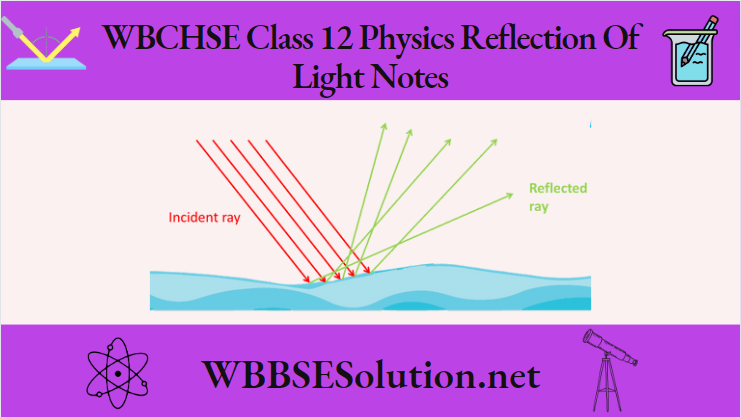
WBCHSE Class 12 Physics Reflection Of Light Notes

WBCHSE Class 12 Physics Notes

Reflection Of Light Light Introduction

Any luminous body is a source of light. The sources of light ‘ may be of two kinds

  1. Self-luminous source and
  2. Nonluminous source.

The sun, the stars, electric bulbs, burning candles, etc. are lumi¬ nous sources. Non-luminous sources themselves become visible when light from a luminous body falls on them.

The moon and the planets are non-luminous bodies. These are visible as light from the sun falls on them and is reflected.

Reflection of light:

When a ray of light passing through a medium is incident on the interface with another medium then, a portion of light returns to the first medium. This phenomenon Is called the Reflection of light

 Reflection, absorption, and refraction of light:

Light travels in a straight line in a homogeneous medium.

When it is traveling in one homogeneous medium and meets the surface of another homogeneous medium.

Read and Learn More Class 12 Physics Notes

The following effects may occur:

  1. A portion of the light falling on the surface of separation returns to the first medium. This phenomenon is called the reflection of light.
  2. A part of the incident light is absorbed by the second medium.
  3.  If the second medium is transparent or translucent then a portion of the incident light penetrates into the second medium and undergoes a change of direction at the surface separating the two media and continues to travel along a straight line.
  4. This phenomenon is called refraction of light

The surface from which the reflection of light takes place is called the reflector.

The amount of reflected light depends on the following two factors:

  1. Direction of Incident light:  The more obliquely the Inol dent light falls on the reflector, the more the amount of reflected light.
  2. Nature of the first and second medium: It Is found from the experiment that if light Is Incident from air to glass nor¬ mally, about 4% of incident light Is reflected, hot If light from air is incident on u plane mirror normally, about W0% of incident light is reflected.

Again if light Is incident from air to glass the amount of light reflected Is more than the amount of light reflected when light Is Incident from air to water. On the other hand, If the reflector is black, most part of the incident light is absorbed by the reflector. As a result, there is negligible reflection from a black body or surface

WBBSE Class 12 Reflection of Light Notes

Reflection Of Light Some Definitions

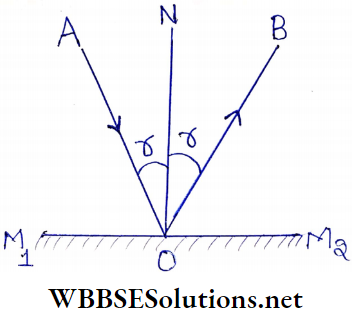
In M1, M2 is a reflector. A ray AO is incident on the reflector at point 0 and is reflected along OB. AO is the incident ray and OB is the reflected ray. 0 is the point of incidence.

Class 12 Physics Unit 6 Optics Chapter 1 Reflection Of Light Reflected Ray

The angle of incidence: The angle that the incident ray makes with the normal to the reflector at the point of incidence is called the angle of incidence. ON is the normal drawn on M1 M2 at O . Hence, ∠AON is the angle of incidence.

The angle of reflection:

The angle that the reflected ray makes with the normal to the reflector at the point of incidence is called the angle of reflection. ∠BON is the angle of reflection.

Reflection Of Light – Laws Of Reflection

Reflection of light obeys the following two laws:

  1. The Incident ray the reflected ray and the normal to the reflecting surface at the point of incidence, are all He on the same plane.
  2. The angle of incidence is equal to the angle of reflection.
    ∠AON = ∠BON.

Normal Incidence:

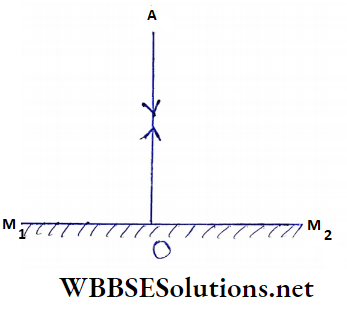
The ray of light AO is incident normally on M1 M2 So the angle of incidence is zero. According to the law of reflection, the angle of reflection is also zero. Thus die ray retraces its path into the first medium.

Class 12 Physics Unit 6 Optics Chapter 1 Reflection Of Light Normal Incidence

 Reflection Of Light – Types Of Reflection

Reflection can be of two types depending on the nature of the surface of the reflector. O regular reflection and 0 diffused reflection

1. Regular Reflection:

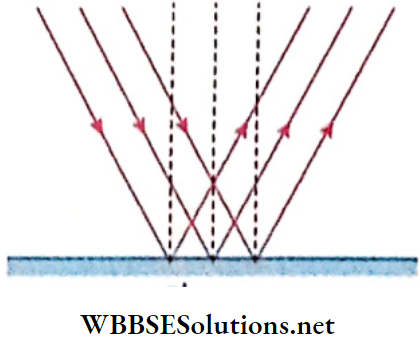
If a parallel beam of rays is incident on a smooth plane reflector, then it is reflected wholly as a parallel beam This type of reflection is called regular reflection. Such reflectors are plane mirrors, upper surfaces of undisturbed water, polished metal surfaces, etc.

In the case of a smooth plane surface, the normals drawn at the points of incidence of the beam of rays are parallel to each other. So in the case of regular reflection, if the incident rays are parallel, the reflected rays are also parallel to each other.

Class 12 Physics Unit 6 Optics Chapter 1 Reflection Of Light Regular Reflection

WBCHSE class 12 Physics Notes Short Notes on Laws of Reflection

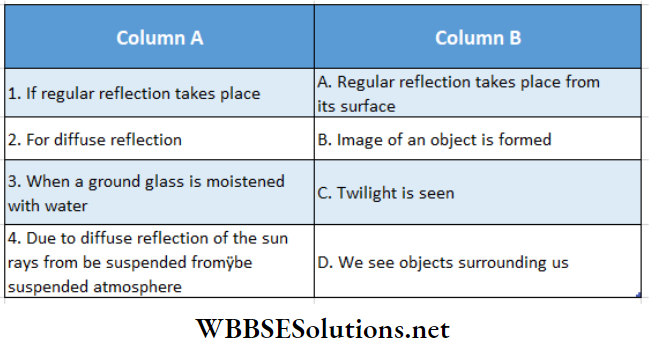
The image of an object is formed due to regular reflection [vide section So, we see our image In a plane mirror

It will be interesting to note that only the part of the reflector that reflects parallel rays into the observer’s eyes appears brighter to the observer than the other part of the reflector.

2. Diffuse Reflection:

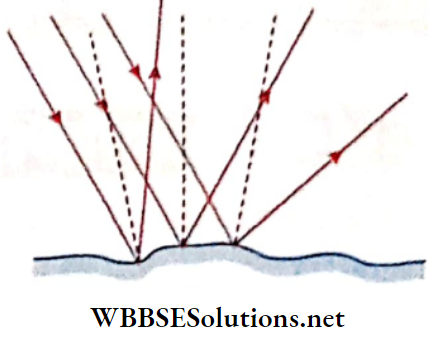
A parallel beam of rays after reflection from a rough surface does the Reflection of light obey the following two laws. not remain parallel. Such type of reflection of light is called diffused reflection, of reflection, reflection.

Inoccurs this type on the surface of every visible object, each ray of the incident parallel beam is reflected in its own way without being parallel to one another. This is because

Class 12 Physics Unit 6 Optics Chapter 1 Reflection Of Light Diffuse Reflection

The normals at the points of incidence are not parallel to each other. Hence no image is obtained.

However, it is because of diffuse reflection the objects in our surroundings are visible. When a beam of rays falls on the rough sur¬ faces of those objects, it is scattered in all directions.

So, whatever may be the position of the observer, quite a few rays will invariably enter the eyes. As a result, the observer sees the object more or less destined. In this case the reflector looks almost equally bright from all directions but no image of a source is seen.

Reflection from any plane, curved or rough surface, follows the two laws of reflection.

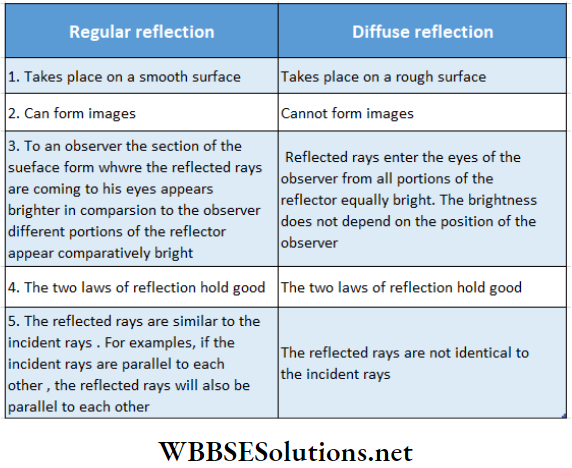
3. Comparison between Regular and Diffuse Reflections

Class 12 Physics Unit 6 Optics Chapter 1 Reflection Of Light Comparision Between Regular And Diffuse Reflection

Reflection Of Light – Deviation Of A Ray Due To Reflection

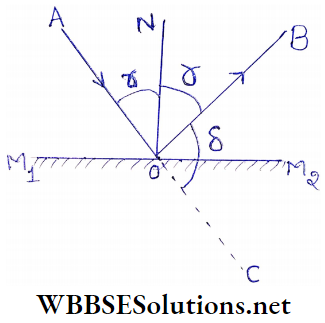
When a ray of light changes its original course due to reflection. the angle between the original and the final directions of the ray is a measure of the magnitude of deviation of the ray.

It is obvious from the figure that in the absence of the reflector M1M2, the M ray AO would have traveled straight in the direction AOC, but has instead been deviated due to reflection. The magnitude of this deviation,

δ = ∠BOC = 180° – ∠AOB = 180°- 2i

Class 12 Physics Unit 6 Optics Chapter 1 Reflection Of Light Deviation Of The Ray

Reflection Of Light Class 12 Notes

Reflection Of Light – Some Phenomena Of Reflection

When light falls on a black body, practically no reflection takes place. The black body absorbs almost all the light from the incident. Hence, optical instruments like cameras, tele¬ scopes, etc.

Are painted black on the insides to avoid unwanted reflection. On the other hand, white objects do not absorb any light but rather reflect it. Hence to stop the absorption of light and to increase the brightness, white surface air is used.

This is the reason why white screens are used for projection In the cinema.

Twilight: 

Twilight Is the time between dawn and surface and the time between sunset and dusk. The sun itself is not actually visible from this ground level because It is below the horizon. However, the suspended dust particles in all upper atmospheres still receive direct fuse reflection, this light spreads In all directions and pat daily illuminates the ground daily.

When light falls on a glass slab only a negligible portion Is reflected: most of the rays pass through It. Hence the glass slab Is coated with aluminium1, to make a mirror. As the coating is opaque the Incident rays are almost completely reflected from the silvered surface, with only a small portion of the incident is reflected from the front surface.

WBCHSE Class 12 Physics Reflection Of Light Notes

Reflection Of Light Image

 Image Definition:

When rays of light diverging from a point source after reflection or refraction converge to or appear to diverge from a second point, the second point Is called the Image of the first point.

When light rays from an see the object at the place whore it Is actually situated. Hut If the rays come after reflection or refraction we see the object elsewhere. What we see In the new position Is actually Its Image

There are two kinds of images:

  1. Real linage and
  2. Virtual image.

1. Real image:

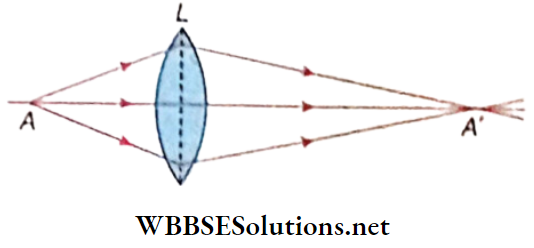
When rays of light diverging from a point source after reflection or refraction converge to a second point, the second point is called the real Image of the first point.

A real image can be formed on a screen, as evident from, where a convex lens has formed a real image A’ of a point source A.

Class 12 Physics Unit 6 Optics Chapter 1 Reflection Of Light Real Image

Some examples of real image:

  1. The image formed on the cinema screen
  2. The image formed by a camera, etc

2. Virtual image:

When rays of light diverging from a point source after reflection or refraction appear to diverge from a second point, the second point is called the virtual image of the first point.

Class 12 Physics Unit 6 Optics Chapter 1 Reflection Of Light Virtual Image

A virtual image cannot be formed on a screen as illustrated, where a plane mirror has formed a virtual image A’ of the point source A

The image of a tree standing by the side of a pond, on the surface of water is a virtual image. A mirage is also a virtual image.

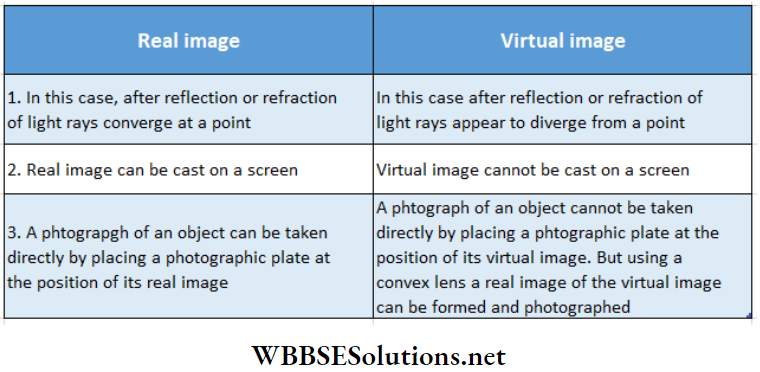
Reflection of light Class 12 Notes Differences between real image and virtual image:

Class 12 Physics Unit 6 Optics Chapter 1 Reflection Of Light Difference Between Real Image And Virtual Image

Image in a Plane Mirror:

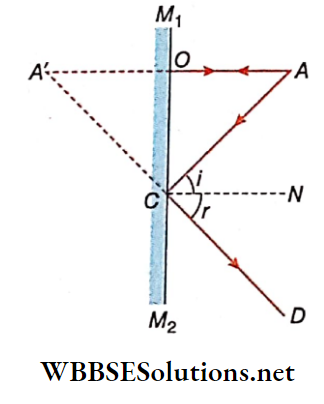
Imags of a point object: Let A be a point source A ray of light AO is incident at O normally and retraces its path along OA.

Another ray AC follows the path CD after reflection. The reflected rays when produced backwards, meet at A’. It appears that the two reflected rays are coming from A’. So, A’ is the virtual image of A. The line AOA’ joins the object and the image is normal to the mirror.

CN is normal at the point of incidence. Since OA and CN
are parallel,

∠OAC = ∠ACN = i (Alternate angles)

and ∠OA’C = ∠NCD = r (Corresponding angles)

But ∠ACN = ∠NCD (i = r)

∠OAC = ∠OA’C

Hence the two right-angled triangles AOC and A’OC are congruent.

∴ OA = OA’

Thus, object distance from the mirror = image distance from the mirror

Hence, the image formed by a plane mirror lies on the perpendicular from the object to the mirror as far behind the mirror as the object is in front of it.

Image of an extended object:

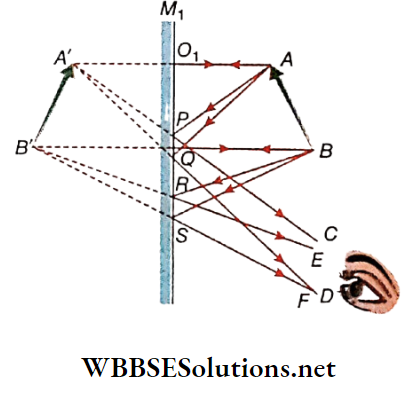
Let AB be an extended object in front of a plane mirror M1M2. Every point of the extended object may be regarded as a source of light. The complete image of the object will be obtained by locating the position of the images of all the point sources.

Class 12 Physics Unit 6 Optics Chapter 1 Reflection Of Light Image Of A Point Object

Reflection Of Light Physics Class 12 Drawing of the image of an extended object:

From the topmost point A of the extended object perpendicular A01 is drawn and it is extended up to A’ in such a way that A in the previous case, A’ is the image of A. The topmost point of AB.

Similarly, B’ is the image of the lowermost point of AB, For every intermediate point of AJB, a corresponding image will be formed between A’ and B’. So, A’B’ is the image of AB. Obviously AB and A’B’ will be of the same size.

So, a plane mirror forms a virtual image of the same size of an extended object.

Class 12 Physics Unit 6 Optics Chapter 1 Reflection Of Light Image Of An Extended Object

It is also obvious from the figure that the eye can catch the image within the portion PS of the mirror, as long as the relative positions of the eye and the mirror are not changed

Lateral insertion Definition:

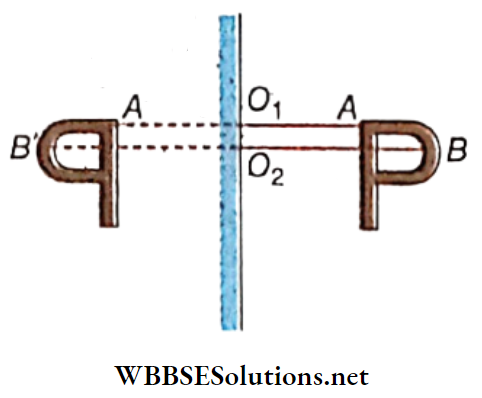
An image of an object formed in a plane mirror is inverted sideways. This effect of plane mirrors is called lateral inversion.

The letter P held in front of a plane mirror will be seen as laterally inverted. The lateral turning is due to the fact, that every point image is at the same distance behind the plane mirror B as the point object is in front of it,

Being the size of the image equal to the size of the object. If the mirror is held vertically, it does not. invert the image which means turning an image upside down. Conversely, if a point source is placed at the point / its virtual image is formed at the point O.

This is due to the principle of reversibility of light rays. Only the image is laterally inverted. If we move our’ right hand facing a mirror, we see the image moving its left hand.

Class 12 Physics Unit 6 Optics Chapter 1 Reflection Of Light Lateral Inversion

The perpendicular distance of every point of the object from the plane mirror = the perpendicular distance of every image point from the mirror.

i.e., AO1 =  A’O1; BO2 = B’O2.

So, the image is laterally inverted.

The images, due to bodies having symmetrical sides such as a sphere or letters like A, H, M, I, O, T, etc. are not affected by lateral inversion, but the images with non-symmetrical bodies like mug or letters like P, B, C, etc. are affected.

The characteristics of the image formed by a plane mirror:

  1. With respect to the mirror, object distance = image distance.
  2. The straight line joining the object and its image is perpendicular to the mirror.
  3. The image is virtual.
  4.  The image is formed behind the mirror and is the same size as that of the object.
  5. The image is laterally inverted.

Image in a Plane Mirror due to a Conver- gent Beam:

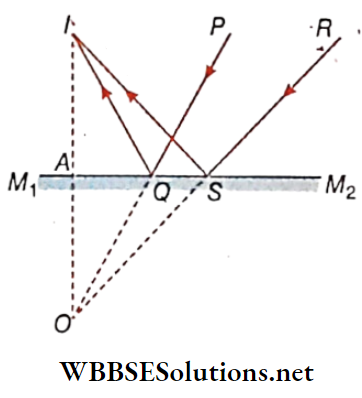
Suppose a converging beam of light is incident on a plane mirror M1M2. In the absence of the mirror, the rays would converge. Due to reflection, the rays PQ and RS meet at point I instead of O. It can be proved that the straight line joining I and O is perpendicular to the mirror and IA = OA. Point O is called the virtual object and point I is its real image. Thus a plane can form a real image of a virtual object

Class 12 Physics Unit 6 Optics Chapter 1 Reflection Of Light Real Image Of A Virutual Object

Conversely, if a point source is placed at point I its virtual image is formed at point O. This is due to the principle of reversibility of light rays.

For a given incident ray if the mirror is rotated through an angle, the reflected ray turns through an angle of 2θ.

The minimum length of the plane mirror required to have the full-length image of a person standing in front of it is equal to half the height h of the person i.e. \(\frac{h}{2}\)

If an object moves towards (or away from) a plane mirror with a speed v, the image of the object will move towards (or away from) the mirror with a speed 2v.

4. If two plane mirrors facing each other are inclined at an angle with each other, the number of images formed due to multiple reflections, is given by n = 360°-1. If (36-1) is not an integer, the next integer will indicate the number of images.
360°

5. Due to reflection, the frequency, wavelength and speed of light are not changed.

6. The intensity of light after reflection decreases.

7. For reflection of light from a denser medium a phase change of occurs.

Reflection of light physics class 12

Reflection Of Light – Curved Reflecting Surface

Mirrors used in torches, headlights, or viewfinders of vehicles are curved mirrors. Curved mirrors may be spherical, cylindrical, or parabolic. In this chapter, however, we shall restrict our discussion only to spherical mirrors.

The laws of regular reflection are equally applicable to curved surfaces as well. But in this case, the position of the image and its size differ widely, as we shall see later.

Reflection Of Light Spherical Mirror

A spherical mirror is a part of a hollow sphere or a spherical surface.

There are two types of spherical mirrors:

  1. Concave mirror and
  2. Convex mirror.

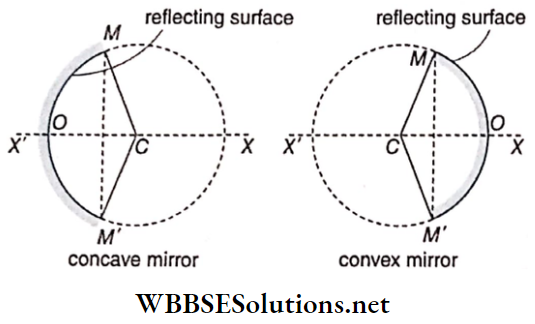
When the inner surface of a spherical mirror acts as a reflector, it is a concave mirror.  When the outer surface of a spherical mirror acts as a reflector, it is a convex mirror.

Some Related Terms:

Pole:

The center of the spherical reflecting surface is called the pole of the mirror. In  O is the pole.

Centre of curvature:

The center of the sphere of which the spherical mirror is a part is called the center of curvature of the mirror. C is the center of curvature of the mirror MOM’. Obviously, the center of curvature of the concave mirror is in front of the reflecting surface while in the case of the convex mirror it is behind the reflecting surface.

The radius of curvature:

It is the radius of that sphere of which the mirror is a part.  OC is the radius of curvature.

Class 12 Physics Unit 6 Optics Chapter 1 Reflection Of Light Radius Of Curvature

Principal axis:

The line passing through the center of curvature and the pole of the mirror is called the principal axis of the mirror.  XX’ is the principal axis.

Aperture:

The line joining the two extreme points on the periphery of a spherical mirror is called the aperture of the mirror. The angle subtended at the center of curvature by the line is called the angular aperture of the mirror. In the line MM’ is the aperture of the spherical mirror and ZMCM’ is its angular aperture.

The discussion in this chapter will be confined to spherical mirrors of small apertures not exceeding 10°, although, for the sake of clarity, illustrative diagrams will indicate larger apertures.

Paraxial and non-paraxial or marginal rays:

1. Paraxial rays:

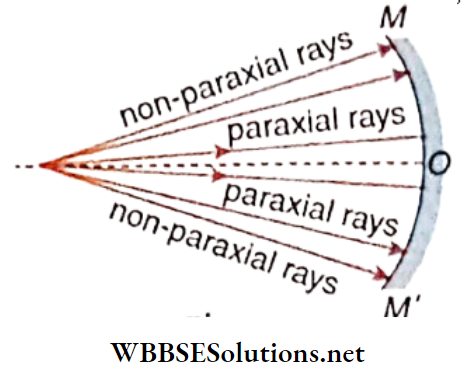
Rays that are incident very close to the pole and form a very small angle with the principal axis of a spherical mirror are called paraxial rays.

Class 12 Physics Unit 6 Optics Chapter 1 Reflection Of Light Paraxial Rays

2. Non-paraxial or marginal rays:

Rays that are incident very far away from the pole or near the margin of a spherical mirror and form a comparatively large angle with the principal axis are called non-paraxial or marginal rays.

All rays incident on a spherical mirror whose aperture is negligibly small compared to its radius of curvature, are considered to be paraxial rays. For further discussions, we will assume all spherical mirrors to be of a small aperture and a comparatively large radius of curvature.

Principal focus:

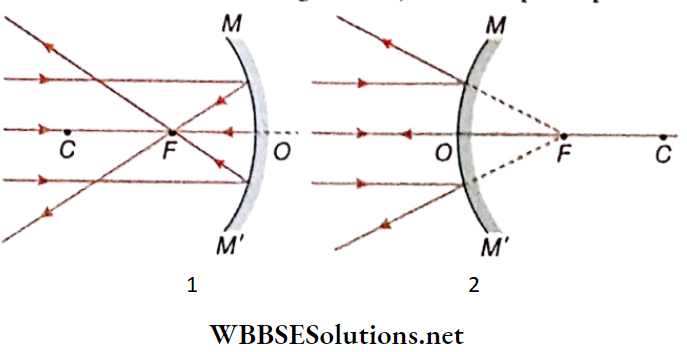
If rays of light parallel to the principal axis are incident on a spherical mirror, the rays after reflection from the mirror converge to a point on the principal axis in case of a concave mirror and appear to diverge from a point on the principal axis behind the mirror in the case of a convex mirror, this point is called the principal focus or simply focus of the mirror.

Class 12 Physics Unit 6 Optics Chapter 1 Reflection Of Light Principal Focus

F is the principal focus of M the concave mirror and convex mirror respectively.  So, the focus of the concave mirror is real and that of the convex mirror is virtual.

It can alternatively be defined as the point on the principal axis of a spherical mirror at which the image of an object placed at infinity is formed.

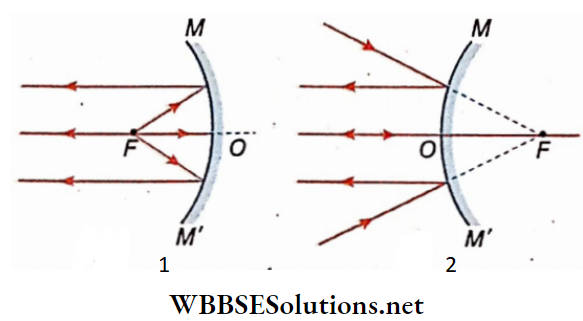
According to the principle of reversibility of light rays, it can be said:

The rays diverging from the principal focus of a concave mirror proceed parallel to the principal axis after reflection from the mirror

Class 12 Physics Unit 6 Optics Chapter 1 Reflection Of Light Principal Axis After Reflection From The Mirror

The rays appearing to converge to the principal focus of a convex mirror proceed parallel to the principal axis after reflection from the mirror.

Reflection of light physics class 12 Important Definitions Related to Reflection

Focal length:

The distance between the principal focus and the pole of the mirror is called the focal length of the mirror. OF is the focal length. The focal length of a spherical mirror does not depend on the color of the incident light.

Focal plane and secondary focus:

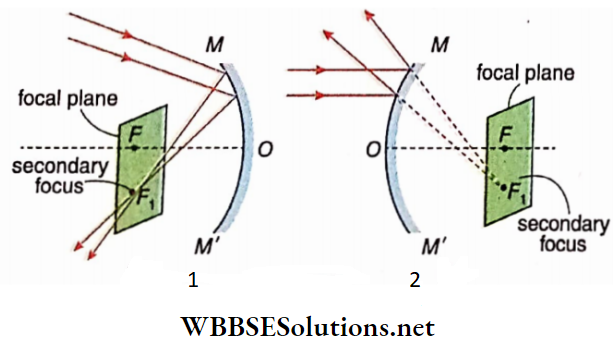
The focal plane of a spherical mirror is the imaginary plane passing through the principal focus at right angles to the principal axis of the mirror.

Class 12 Physics Unit 6 Optics Chapter 1 Reflection Of Light Focal Plane And Secondary Focus

If a parallel beam of rays is incident on a spherical mirror such that it is inclined to the principal axis then, after reflection the reflected rays converge to the point. on the focal plane in the case of a concave mirror and appear to diverge from the point. On the focal plane in case of a convex mirror. The point F1 is called the secondary focus of the spherical

The principal focus is a fixed point on the principal axis. However, the secondary focus is not a fixed point. If the angle of inclination of the parallel rays with the principal axis is changed, the position of the secondary focus also changes. But a secondary focus always lies on the focal plane.

Relation between Focal Length and Radius of Curvature

1. In the case of the concave mirror:

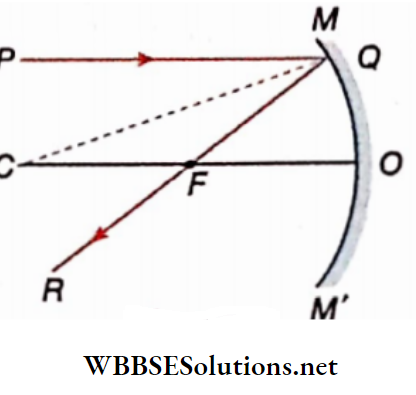
Let MOM’ be a concave mirror of a small aperture. C, F, and O are the center of curvature, focus, and pole of the mirror respectively. Ray PQ is parallel to the principal axis, hence passing through F after reflection, CQ being the radius of curvature is perpendicular to the mirror at Q.

Class 12 Physics Unit 6 Optics Chapter 1 Reflection Of Light Concave Mirror

∴ ∠PQC = ∠FQC

∴  ∠PQC = ∠QCF [alternate angles]

∠FQC = ∠QCF i.e., Δ QCF is an isosceles triangle.

Hence, FQ = FC

Since the aperture of the mirror is very small, Q and O are very close to each other. So, FQ = FO.

∴ FO = FC or, FO = \(\frac{1}{2}\) OC

i.e f= \(\frac{r}{c}\), where f is focal length and r the radius of curvature.

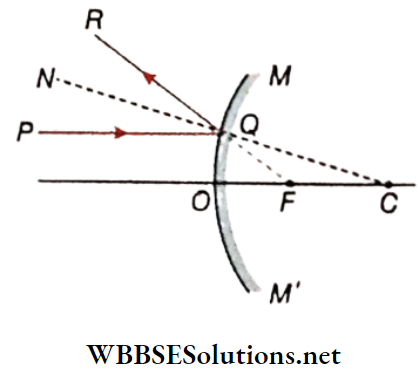
2. In case of convex mirror:

Let MOM1, be a convex mirror of a small aperture. C, F, and O are the center of curvature, focus, and pole of the mirror respectively. OC is the radius of curvature.

A ray PQ parallel to the principal axis is incident at Q of the mirror. After reflection, the ray QR appears to come from F. The points C and Q are joined and is extended to N. Since the CQ = CO radius of curvature of the mirror, QN is normal at incidence point Q on the mirror.

Class 12 Physics Unit 6 Optics Chapter 1 Reflection Of Light Convex Mirror

If a parallel beam of rays is incident on a spherical mirror such that it is inclined to the principal axis then, after reflection, the reflected rays converge to point F, on the focal plane in case of a concave mirror and appear to diverge from the point F,  on the focal plane in case of a convex mir- But r. The point F is called the secondary focus of the spherical

∠PQN = ∠RQN

∠RQN = ∠CQF [vertically opposite]

∴ ∠PQN = ∠CQF

∴  Since PQ and OC are parallel.

∴ ∠PQN = ∠FCQ [corresponding angles]

∴ ∠FCQ = ∠CQF

Hence , FQ = FC

Since the aperture of the mirror is small, Q and O are very 1. Object at infinity: If an object is at infinity, the rays are close to each other.

So, FQ = FO.

∴ FO = FC

Or, FO = \(\frac{1}{2}\) OC

I.e f = \(\frac{r}{2}\)

Hence the focal length of a spherical mirror is small Thus, the image of an object situ- aperture is equal to half of its radius of curvature.

Class 11 Physics Class 12 Maths Class 11 Chemistry
NEET Foundation Class 12 Physics NEET Physics

Reflecting power:

Reflecting the power of a spherical mirror, D = \(\frac{1}{f}\) =\(\frac{2}{r}\) = As both focal length and radius of curvature of a plane mirror are infinite, so power of a plane mirror is zero.

Reflection of light physics class 12

Reflection Of Light – Image Formation Of Extended Object By Spherical Mirror

Ray tracing method:

The position, nature, and size of the image of an extended object, formed by a spherical mirror can be determined geometrically. Any extended object can be considered as the sum of point objects and the images of the point objects constitute the image of the extended object.

Any two of the following rays intersecting at a point will indicate the portion of the image:

  1. A ray parallel to the principal axis: After reflection passes through the focus, or appears to diverge from the focus.
  2. A ray passes through the focus: After reflection emerges In the case of a concave mirror if the object is placed at the center parallel to the principal axis.
  3. A ray passing through the center of curvature: After reflection retraces its path in the opposite direction.

Because the ray passing through the center of curvature incidence on the mirror is the normal incidence in this case.

Image Formation by Convex Mirror:

Objectivity at infinity:

If an object is at infinity, the rays coming from it may be assumed to be parallel and hence after reflection will meet at the principal focus F. If the rays are A oblique after reflection they will meet at a secondary focus F’

Class 12 Physics Unit 6 Optics Chapter 1 Reflection Of Light Object At Infinity

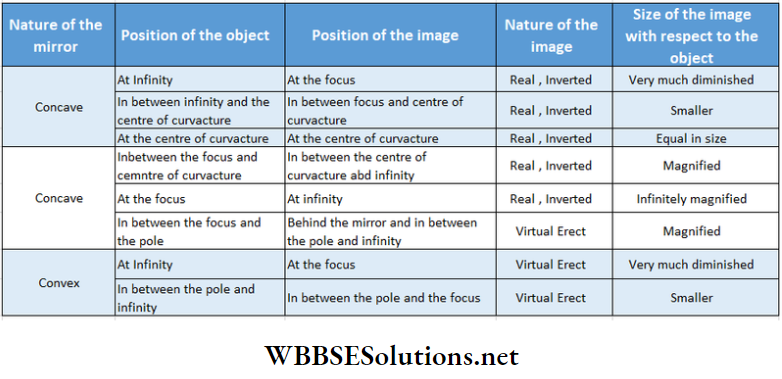
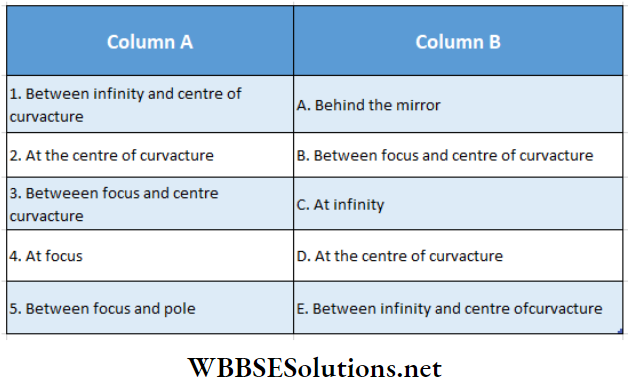
Thus, the image of an object situated at infinity is formed on the focal plane. The image is real, inverted, and very much diminished in size

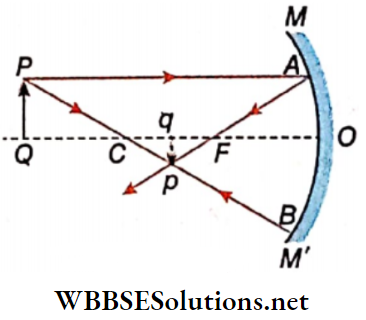
2. Object placed between focus and center of curvature:

An object PQ is placed beyond C on the principal axis of the concave mirror MOM’. A ray PA starting Anotherray PB passing through C is reflected back along BP. The two reflected rays AF and BP meet at p.

Class 12 Physics Unit 6 Optics Chapter 1 Reflection Of Light Infinity And Centre Of Curvature

So, the real image of P is formed at p. Normal pq is drawn on the principal axis. PQ is the image of PQ. The image is situated between F and C. The image is real, inverted, and diminished relative to the object.

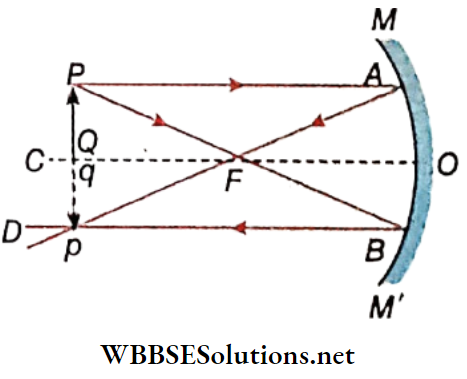
3. Object at the center of curvature :

An object PQ stands at C A ray PA parallel to the principal axis is reflected through F along AF. Another ray PB through F is reflected along BD parallel to the principal axis. The two reflected rays AF and BD meet at p. So, the real image. of P is formed at p. pq is D drawn normally on the principal axis. pq is the image of PQ.

The image is real, inverted, and magnified, and of the same size as the object, and formed at the center of curvature itself.

Class 12 Physics Unit 6 Optics Chapter 1 Reflection Of Light Centre Of Curvacture

In case of a concave mirror if the object is placed at the center of curvature the image is also formed at the center of curvature. Hence only in this case, the intervening distance between the object and image is minimum and is equal to zero

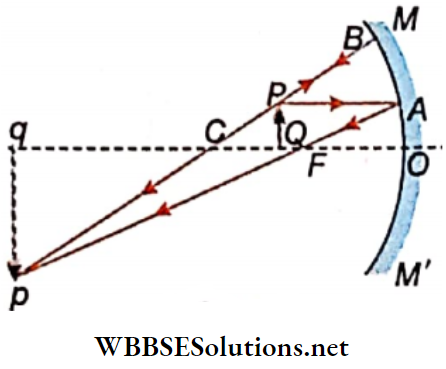
4. Object placed between focus and centre of curvature

An object PQ stands between F and C. A ray PA parallel to the principal axis is reflected through F along AF. Another ray PB incident normally at B goes back along BC. These two reflected rays meet at p. So, the image of P is formed at p. pq is drawn normally on the principal axis. pq is the image of PQ.

Class 12 Physics Unit 6 Optics Chapter 1 Reflection Of Light Between Focus And Centre

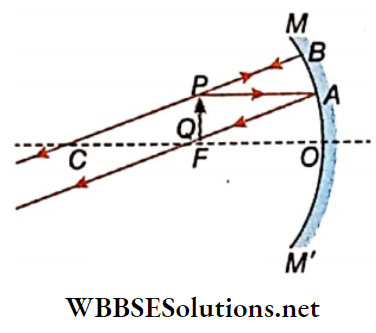
5. Object at focus:

An object PQ is placed at the focus F . A ray PA parallel to the principal axis is reflected through F along AF. Another ray PB incident normally at B goes back along BC. These two reflected rays being parallel to each other meet at infinity producing the image of P.

Class 12 Physics Unit 6 Optics Chapter 1 Reflection Of Light Object At Focus

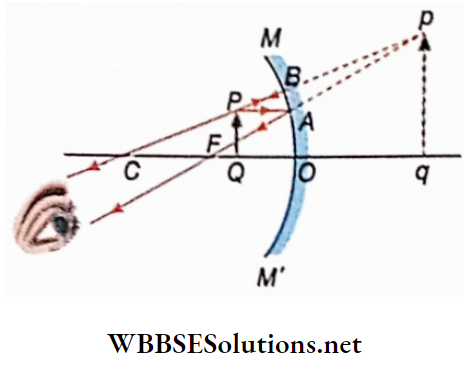
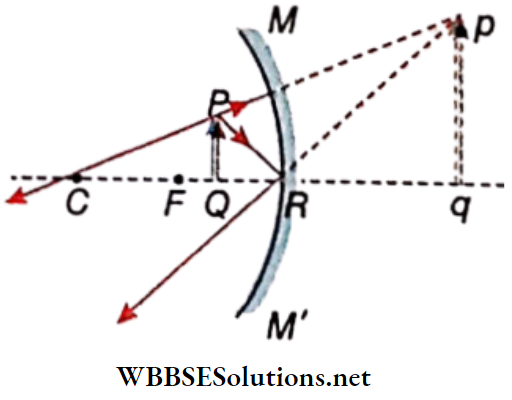
6. Object placed between focus and pole:

An object PQ is placed between the pole and focus. A ray PA parallel to the principal axis is reflected through F along AF. Another ray PB incident normally at B goes back along BC. These two reflected raj’s which are divergent would not meet anywhere. But when they are produced backwards they meet at p. Thus they appear to diverge from p. pq is drawn normally on the principal axis. Thus pq is the image of PQ

Class 12 Physics Unit 6 Optics Chapter 1 Reflection Of Light Object Placed Between Focus And Pole

The Image is virtual, erect, magnified, and situated behind the mirror

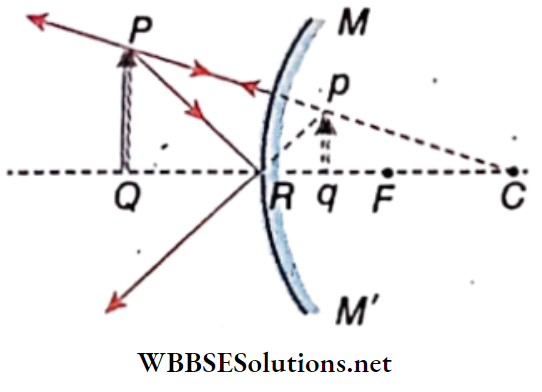
 Image Formation by Convex Mirror:

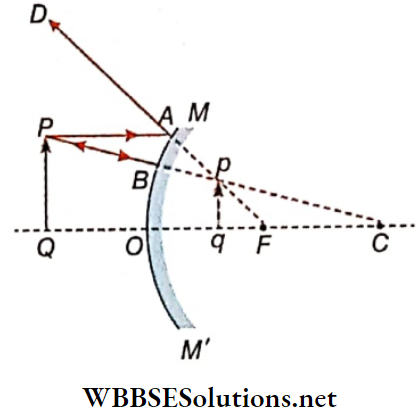
Consider an object PQ in front of a convex mirror MOM. A ray. PA parallel to the principal axis goes back along AD. Ray AD appears to come from the focus. Another ray PB incident normally at B is reflected along BP. Reflected rays AD and BP, produced backwards appear to come from p. So. p is the virtual image of P. pq is drawn normally on the principal axis. Thus pq is the image of PQ.

Class 12 Physics Unit 6 Optics Chapter 1 Reflection Of Light Formation By Convex Mirror

The image is virtual, erect, diminished in size, and situated behind the mirror.

For any portion of the object in front of a convex mirror, the image is real, inverted, and magnified infinitely, and situation the image will always be formed behind the mirror. This image is rated at infinity.

Comparative Study of Real and Virtual Images in the Case of Spherical Mirror

1. Characteristics of real image:

  • It is formed on the same side of the mirror as the object. It is always inverted.
  • Real image is not formed in a convex mirror

2. Characteristics of virtual image:

  • It is always formed on the opposite side of the mirror as the object.
  • It is always erect.
  • The size of the virtual image becomes larger than the object or equal to it in the case of a concave mirror. Whereas in the case of a convex mirror, it is smaller than the object or equal to it.

Sign Convention for Spherical Mirror

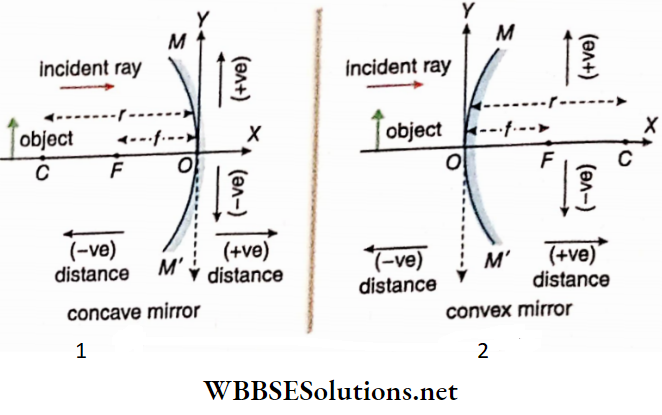
1.  Cartesian sign convention:

  • All distances are to be measured from the pole of the spherical mirror.
  • All distances measured in a direction opposite to that of the incident rays are to be taken as negative and all distances measured in the same direction as that of the incident rays are to be taken as positive.
  • If the principal axis of the mirror is taken as the x-axis, the upward distance along the positive y-axis is taken as positive while the downward distance along the negative y-axis is taken as negative.

See the concave and convex mirrors given in below to understand the above rules.

Class 12 Physics Unit 6 Optics Chapter 1 Reflection Of Light Cartesian Sign Convention

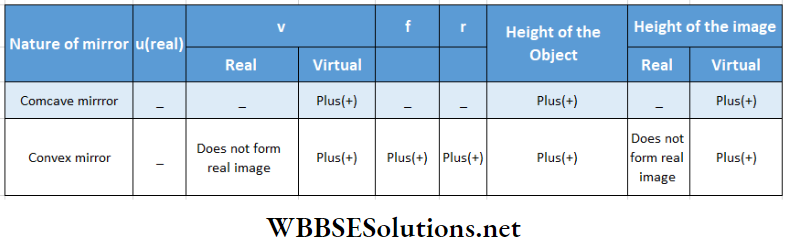
The nature sign of object distance(u), image distance(v) focal lengh(f), radius of curvature (r), and height of the image in case of the image formation of a real object by a spherical mirror is given in the following table.

Class 12 Physics Unit 6 Optics Chapter 1 Reflection Of Light Spherical Mirror

Reflection Of Light – Relation Among Object Distance, Image Distance, And Focal Length

1. In case of concave mirror:

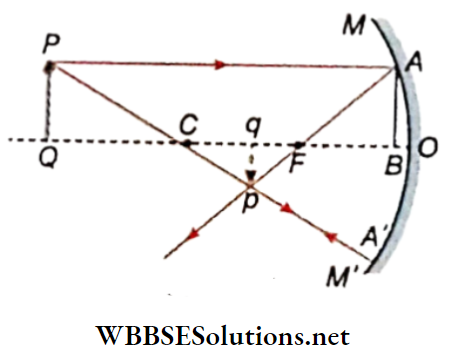
Let O, F, C, and OQ be the pole, focus, center of curvature, and principal axis of a concave mirror MOM’ respectively. PQ is an object placed perpendicularly on the principal axis in front of the mirror. A ray PA, parallel to the principal axis, after reflection, does not form a real image that passes through F.

Another ray PA’, passing through C, after reflection goes back following the same path. These two reflected rays cut each other at p. Hence p is the real image of P. pq is the image of PQ. AB is drawn perpendicular to the principal axis.

Triangles PCQ and pCq are similar

∴ \(\frac{P Q}{p q}=\frac{C Q}{C q}\)

Class 12 Physics Unit 6 Optics Chapter 1 Reflection Of Light Perpendicular On The Principal Axis Of Concave Mirror

Again,  Δ ABF and Δ  pqF are similar

∴ \(\frac{A B}{p q}=\frac{B F}{F q}\)

Or,  \(\frac{P Q}{p q}=\frac{B F}{F q}\)

[ AB = PQ]

From (1) and (2) we get \(\frac{C Q}{C q}=\frac{B F}{F q}\)

Since the mirror is of small aperture It can be assumed BF ≈ OF

∴ \(\frac{C Q}{C q}=\frac{O F}{F q}\)

Object distance, OQ = -u;

Image distance

Oq = -v; focal

Length, OF = -f

Radius of curvature, OC = -r = -2f

∴  CQ = OQ- OC  = -u+ 2f

Cq = OC- Oq = -2f+v

Fq = Oq- OF = -v+f

From (3) we get, \(\frac{-u+2 f}{-2 f+v}=\frac{-f}{-v+f}\)

or, uv- uf- 2fv² + 2f² = fv

or, uv = uf+ vf

Dividing both sides by uvf we get

⇒ \(\frac{1}{f}=\frac{1}{v}+\frac{1}{u}\)

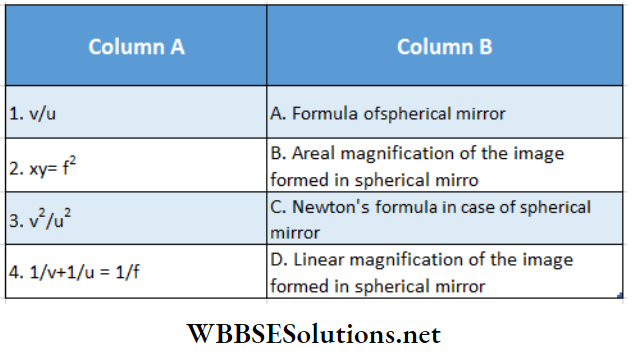
Or, \(\frac{1}{v}+\frac{1}{u}=\frac{1}{f}=\frac{2}{r}\)

2. In the case of the convex mirror:

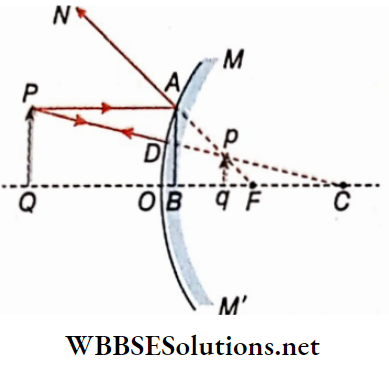
Let O, F, C, and CQ be the pole, focus, center of curvature, and principal axis of a convex mirror MOM’ respectively [Fig. 1.28]. PQ is an object placed perpendicularly on the principal axis in front of the mirror. A ray PA parallel to the principal axis and another ray PD proceeding to the center of curvature, form a virtual image p of P after reflection from the mirror. pq is the image of PQ. AB is drawn perpendicular to the principal axis.

Class 12 Physics Unit 6 Optics Chapter 1 Reflection Of Light Perpendicular On The Principal Axis Of Convex Mirror

Triangles PCQ and pCq are similar

∴ \(\frac{P Q}{p q}=\frac{C Q}{C q}\)

Again ΔABF and ΔpqF are similar

∴ \(\frac{A B}{p q}=\frac{B F}{F q}\)

Or  \(\frac{P Q}{p q}=\frac{B F}{F q}\)

From (5) and (6) we get,

∴ \(\frac{C Q}{C q}=\frac{B F}{F q}\)

Since the mirror is of small aperture It can be assumed BF ≈ OF

∴ \(\frac{C Q}{C q}=\frac{O F}{F q}\)

Object distance, OQ = -u;

Image distance, Oq = +v; focal

Length, OF = +f

Radius of curvature, OC = +r = +2f

∴  CQ = OQ +OC  = -u+ 2f

Cq = OC- Oq = +2f+v

Fq = OF- Oq = +f – v

From (7) we get,

⇒ \(\frac{-u+2 f}{+2 f+v}=\frac{+f}{+f-v}\)

or, 2f²- vf= – uf+2f²+uv-2vf

or, uv = uf+ vf

Dividing both sides by uvf we get

⇒ \(\frac{1}{f}=\frac{1}{v}+\frac{1}{u}\)

Or, \(\frac{1}{v}+\frac{1}{u}=\frac{1}{f}=\frac{2}{r}\)

It may be noticed that using the same sign convention, the relation between the various distances is the same for both concave mirror and convex mirror. This relation viz., += = 2 is called the mirror equation or spherical mirror equation.

In case of a concave mirror if u and v are the object distance and the image distance of a real object and its real image respectively, then the u-v graph is a rectangular hyperbola and the graph of their reciprocals ( \(\frac{1}{u}\) – \(\frac{1}{v}\) graph) is a straight line.

Reflection of light physics class 12 Equation of plane mirror from the equation of spherical mirror:

The mirror equation is

⇒ \(\frac{1}{v}\) + \(\frac{1}{u}\) = \(\frac{1}{f}\)= \(\frac{2}{r}\)

For a plane mirror, r→ ∞

∴ \(\frac{1}{v}\) +\(\frac{1}{u}\) = 0

Or, v= -u

This proves that in the case of a plane mirror, the image is as far behind the mirror as the object is in front of it (:: v negative).

Effect of medium on the focal length and image distance for spherical mirror:

The focal length of a spherical mirror is fixed, i.e., independent of the surrounding media. This is because the law of reflection is invariant even if the medium changes.

For a spherical mirror, if object distance u, image distance v, and focal length f, then the relation between them is  \(\frac{1}{v}\) + \(\frac{1}{u}\) = \(\frac{1}{f}\)= \(\frac{2}{r}\).

For a fixed object distance u, the image distance v is fixed, because f is fixed and independent of medium. So, if the position of the object and mirror are kept fixed and the surrounding medium is changed no change position of the image occur.

Conjugate Foci or Conjugate Points We have the mirror equation:

We have the mirror equation

⇒ \(\frac{1}{v}\) + \(\frac{1}{u}\) = \(\frac{1}{f}\)= \(\frac{2}{r}\).

If u and v are interchanged, the equation remains the same. This implies that if the object is placed at the position of the image, the image will be formed at the position of the object.

These two points are called conjugate foci and the above equation is alternatively called the conjugate foci relation.

In the case of the virtual image, conjugate foci are situated on two opposite sides of the mirror, and in the case of a real image, conjugate foci are situated on the same side of the mirror.

Newton’s Equation:

Relation among u, v, f with reference to the pole is

⇒ \(\frac{1}{v}\) + \(\frac{1}{u}\) = \(\frac{1}{f}\)= \(\frac{2}{r}\).

Or, \(\frac{u+v}{u v}=\frac{1}{f}\)

Or, uv-uf-vf+ = 0

Or, uv-uf-vf+f2 = 0

Or, u(v-f)-f(v-f) = f2

Or, (u-f)(v-f) = ƒ2

Now, if the object distance and the image distance are measured from the focus, and taken equal to x and y respectively, then we can write,

u-f = x and v-f = y

So, from equation (1) we get,

xy = f²

This equation is known as Newton’s equation. Since ƒ is constant, the graph of x versus y will be a rectangular hyper-bola

Since, f² is a positive quantity, x and y must have the same sign, i.e., the object and the image must be on the same side of the focus.

Class 12 Physics Unit 6 Optics Chapter 1 Reflection Of Light Newton Equation Of The Focus Graph

Magnification of an Image Formed by Spherical Mirrors

Linear or lateral magnification Definition:

The ratio of the height of the image to the height of the object measured in planes that are perpendicular to the principal axis is called the linear or lateral magnification of Linear the image

Linear or lateral magnification is denoted by m

The ratio of the height of the image to the height changed, with no change in the position of the image.

∴ m = \(\frac{\text { height of the image }}{\text { height of the object }}=\frac{I}{O}\) …………………….(1)

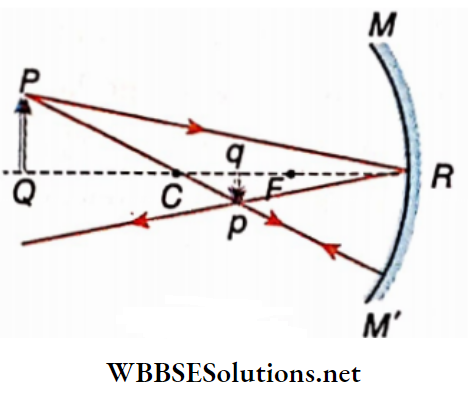
1. In the case of a real image formed by a concave mirror:

The ray diagram for the formation of a real image by a concave mirror is shown. Here object distance, RQ-u; image distance, Rq=v, height of the object, PQ = O and height of the image, pq = -I. The Δ PQR and ΔpqR are similar.

∴ \(\frac{p q}{P Q}=\frac{q R}{Q R}\)

Or, \(\frac{-I}{O}=\frac{-v}{-u}\)

Or, \(\frac{I}{O}=-\frac{v}{u}\) ………………(2)

Class 12 Physics Unit 6 Optics Chapter 1 Reflection Of Light Linear Or Lateral Magnification Real Image Of Concave Mirror

2. In case of a virtual image formed by a concave mirror:

The ray diagram for the formation of a virtual image by a concave mirror is shown.

Here object distance, PQ = -u; image distance, Rq = v, height of the object, PQ =  O and height of the image, pq= I. From ΔPQR and ΔpqR are similar.

Class 12 Physics Unit 6 Optics Chapter 1 Reflection Of Light Linear Or Lateral Magnification Viritual Image Of Convex Miror

∴ \(\frac{p q}{P Q}=\frac{q R}{Q R}\)

Or, \(\frac{I}{O}=\frac{v}{-u}\)

Or, \(\frac{I}{O}=-\frac{v}{u}\) ………………(3)

3. In the case of a virtual image formed by a convex mirror:

In Again the equation can be written as, the ray diagram for the formation of a virtual image by a convex mirror is shown. Here object distance, RQ-u; image distance Rq= y; height of the object, since, PQ = O and height of the image pq = I.

Class 12 Physics Unit 6 Optics Chapter 1 Reflection Of Light Linear Or Lateral Magnification Virtual Image Of Convex Mirror

According to the PQR and pqR are similar

∴ \(\frac{p q}{P Q}=\frac{q R}{Q R}\)

Or, \(\frac{I}{O}=\frac{v}{-u}\)

Or, \(\frac{I}{O}=-\frac{v}{u}\) ………………(4)

From equations (2), (3), and (4) it follows that the magnification produced by both kinds of mirror is given by

m= \(\frac{I}{O}=-\frac{v}{u}\) ………………(5)

Some useful hints:

  1. The relation m.= – \(\frac{v}{u}\)– is applicable both for concave and convex mirrors.
  2. In solving numerical problems, values of u, v, and f should be put with appropriate signs in the mirror equation. No sign for the unknown quantity should be used.
  3. Using the appropriate sign of u and v, if
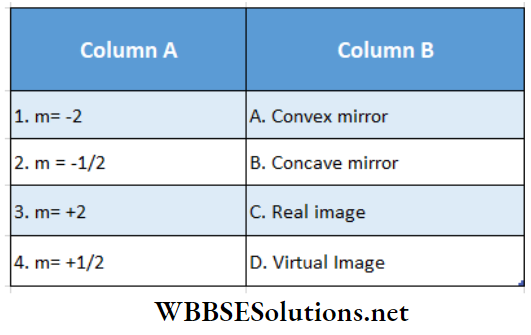
    • m becomes negative, the image will be inverted
    • m becomes positive, the image will be erect
  4.  If |m|>1; the size of the image> size of the object
    • If |m|<1; the size of the image< size of the object
    • If |m| = 1; the size of the image size of the object

Magnification in terms of focal length, object distance, and image distance:

From the mirror equation, we get,

⇒ \(\frac{1}{v}\) + \(\frac{1}{u}\) = \(\frac{1}{f}\)

Or, \(\frac{u}{v}\) + 1 = \(\frac{u}{v}\)

Or, \(\frac{u}{v}\) = \(\frac{u-f}{f}\)

Or, \(\frac{u}{v}\) = \(\frac{f}{u-f}\)

Since, m= – \(\frac{u}{v}\)

∴ m = ( \(\frac{f}{u-f}\) )

Or, ( \(\frac{f}{f-u}\) )

Again the equation can be written as,

1+ \(\frac{v}{u}\)  = \(\frac{v}{f}\)

Or, \(\frac{v}{u}\) = \(\frac{v-f}{f}\)

m= – \(\frac{v-f}{f}\) = \(\frac{f-v}{f}\)

Reflection Of Light Physics Class 12

Areal Magnification Definition

Areal magnification for spherical mirrors is the ratio between the image of an area of a plane, and the area of that plane placed perpendicular to the principal axis of the mirror.

Let us consider, that the length and breadth of a plane of a rectangular object are 1 and b respectively.

∴ Area of the plane, A = lb

If the linear magnification of the image of the object by spherical mirror be m, then

length of the image, l’ = m × 1

and breadth, b’ = m × b

∴ Area of the image, A’ = l’b’ = m²lb = m²A Therefore, areal magnification,

m’ = \(\frac{A^{\prime}}{A}\) = m²

Longitudinal or axial magnification of the image of an object kept along the principal axis Definition:

If any object is placed along the principal axis of a spherical mirror then the ratio of the image length and object length is the longitudinal or axial magnification of that image.

Let an object ADEB is placed in front of a spherical mirror MM’.

Class 12 Physics Unit 6 Optics Chapter 1 Reflection Of Light Longitudinal Or Axial Magnification Of Spherical Mirror

From the figure, the distance of farther point A of an object, OA = u1 and that of the nearer point B of the object, OB = u2

Now, the distance of the farther point of the image, OB’ =v1 that of the nearer point, OA’=v2

Longitudinal Magnification , m= \(\frac{v_1-v_2}{u_1-u_2}=\frac{\Delta v}{\Delta u}\)

Here, Δu and Δv are the lengths of the object and its image respectively, along the principal axis of the mirror. For very small magnitudes of Au and Av, these can be considered as du and du respectively.

So,  m” = \(\frac{d v}{d u}\)

Differentiating the equation \(\frac{1}{v}+\frac{1}{u}=\frac{1}{f}\)

\(-\frac{1}{v^2} \frac{d v}{d u}-\frac{1}{u^2}\) = 0

Where, [f is constant]

Or, \(\frac{d v}{d u}=-\frac{v^2}{u^2}\)

∴ m” = \(\frac{d v}{d u}\) = – m²

∴  Longitudinal magnification = -(linear magnification)²

Note that, if object length and image length are very small dv then,

∴ m” = \(\frac{d v}{d u}\)

Im may be positive or negative but m” is always negative. This implies that irrespective of whether the object is virtual or real, the image is formed along the principal axis, with opposite alignment. This pianomeonon is called axial inversion.

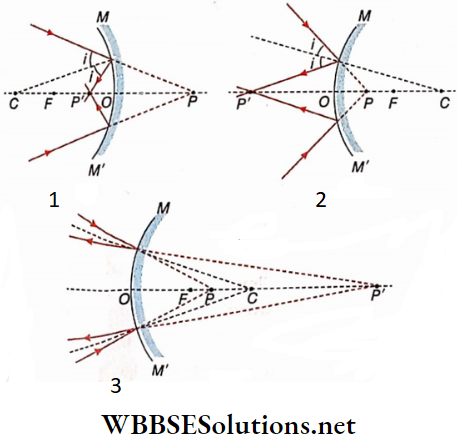
Formation of Image of a Virtual Object: 

Class 12 Physics Unit 6 Optics Chapter 1 Reflection Of Light Formation Of Image Of A Virtual Object 

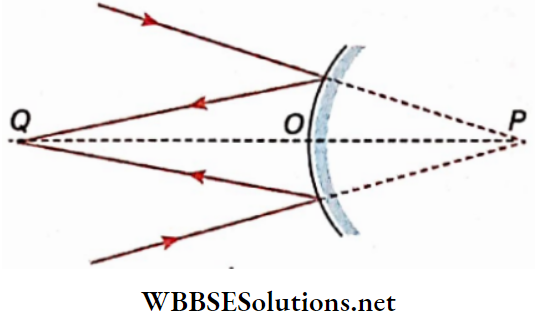
In a beam of converging rays is incident on the mirror. In the absence of the mirror, in either case, the

A converging beam of rays would meet at P behind the mirror. But the beam of rays meets at P’ after reflection. Here point P is the virtual object and P’ is the real image of point P. Obviously, object distance OP is positive.

Thus, a convex mirror can also form a real image, but only if the object is virtual. Now consider the case, where the virtual object distance OP is greater than the focal length OF of a convex mirror.

In this case, image P’ will be virtual. with respect to u, we get, In the case of the concave mirror, a real image always be formed for a virtual object and this image is situated between the pole and the focus of the mirror.

Class 12 physics reflection of light 

Reflection Of Light – Method Of Identifying Mirrors

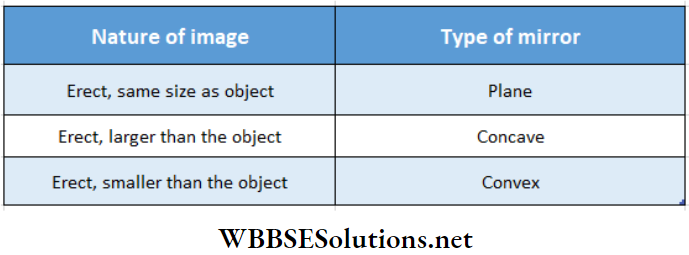
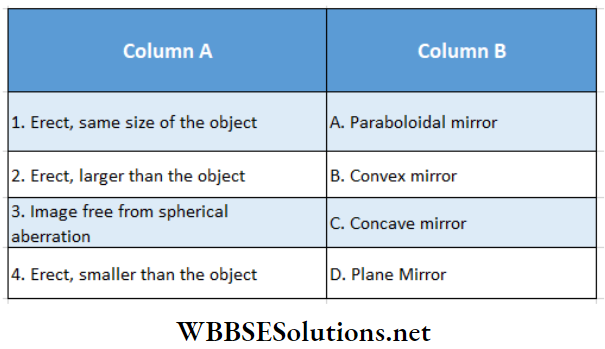
If an object is placed in front of a plane mirror, a virtual, erect image of the same size as the object is formed. If an object is placed very close to a concave mirror a virtual, erect, and magnified image is formed. A convex mirror forms a virtual, erect image smaller than the object.

For identification, one can hold a pen or a finger very close to the mirror. If an erect image of the same size as the object is formed, then the mirror is a plane one. If an erect image larger than the object is formed, the mirror is concave. If it is smaller than the object the mirror is convex.

Class 12 Physics Unit 6 Optics Chapter 1 Reflection Of Light Nature Of Image And Type Of Mirror

Reflection Of Light – Spherical Aberration And Its Remedy

Spherical mirror:

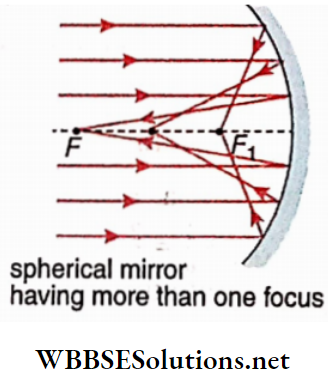
Spherical aberration: The mirror equation is applicable only for spherical mirrors of small aperture to increase the intensity of illumination of the reflected rays to get a brighter image, we often use spherical mirrors of large aperture.

If a beam of rays is incident parallel to the principal axis of a concave mirror of large aperture, not all the rays meet after reflection at a single point. Rather, the reflected rays meet at various points of the principal axis between F to F1.

So the image becomes indistinct. The larger the aperture of the mirror, the more indistinct the image. This defect of the image is called spherical aberration.

Class 12 Physics Unit 6 Optics Chapter 1 Reflection Of Light Spherical Mirror

Remedy for spherical aberration: 

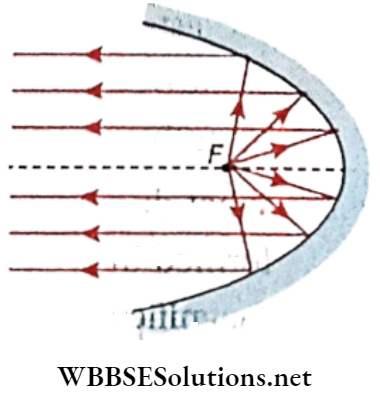
If the shape of the mirror is changed from spherical to parab- poloidal, it is possible to get an image free from spherical aberration. Because, according to the geometrical properties of the parabola, all the rays parallel to the principal axis of a paraboloidal mirror meet at its focus after reflection from it.

Class 12 Physics Unit 6 Optics Chapter 1 Reflection Of Light Paraboloidal Mirror

Reflection Of Light  – Uses Of Spherical Mirrors

Concave mirror:

  • Concave mirrors are often used as shaving glasses (mirrors) to see the magnified image of the face, its distance being less than the focal length of the mirrors.
  • Small concave mirrors are used by doctors to focus a parallel beam of light on the affected parts like the eye, ear, throat etc. to examine them.
  • A small electric lamp placed at the focus of a concave mirror produces a parallel beam of light. So concave mirrors are used as reflectors in torches and car headlights. For better results, paraboloidal mirrors can be used as car headlights. Concave mirrors are used in solar cookers.
  • The Palomar Observatory in California has the best reflecting telescope which uses a concave mirror for studying distant stars.

Convex mirror:

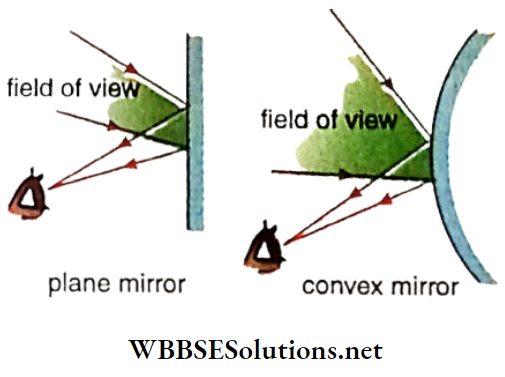
Convex mirrors are used as rear-view mirrors in automobiles and other vehicles, designed to allow the driver to see through the rear windshield. This is because a convex mirror forms erect and diminished images of objects and give a wider field of view compared to that of a plane mirror.

Class 12 Physics Unit 6 Optics Chapter 1 Reflection Of Light Plane Mirror ANd Convex Mirror

Paraboloidal mirror:

According to the geometrical properties of the parabola, the rays parallel to the principal axis of a paraboloidal mirror meet at its focus after reflection from the mirror.

So, if a source of light is placed at the focus F of a paraboloidal mirror, the reflected rays proceed ahead parallel to the principal axis.  For this reason, paraboloidal mirrors are used in car headlights and searchlights.

Sign rules that have been followed here:

To solve the numerical problems, a few sign conventions have been followed here.

  • The value of u, v, f, or r  is used with their proper sign-in in the mirror equation, viz \(\frac{1}{v}+\frac{1}{u}=\frac{1}{f}=\frac{2}{r}\)
  • The focal length for the concave mirror is considered negative and that for the convex mirror is positive.
  •  If the image distance is negative, it indicates that the image is formed on the same side as the object, and the image is real and inverted.
  • If the image distance is positive, it indicates that the image is formed behind the mirror, and the image is virtual and erect.
  • Though mis the standard formula for any type of spherical mirror, to find u or v from this equation, we only take the mod value of m.
  • For the determination of the nature of the image, to find the value of m, the associated formula is used following the proper sign convention of u and v. If m becomes positive, the image will be erect, and m becomes negative, the image will be inverted.

Reflection Of Light Numerical Examples

Example 1.  An object is placed 60 cm away from a convex mirror. The size of the image is rd the size of the object. Determine the radius of curvature of the mirror.
Solution:

We have from the mirror equation,

f = \(\frac{u v}{u+v}\)

According to the question

m = \(\left|-\frac{v}{u}\right|=+\frac{1}{3}\)

v = \(\left|-\frac{u}{3}\right|=\left|\frac{60}{3}\right|\)

U = 60 cm

v= 20 cm

Now, substituting the values of u and v with their proper sign in equation (1) we get,

f = \(\frac{-60 \times(+20)}{-60+20}\)

= + 30 cm

The radius of curvature of the spherical mirror,

r = 2f = 2 × (+30) = +60 cm cm

Example 2. An object of size 5 cm is placed on the principal axis of a convex mirror at a distance of 10 cm from it. The focal length of the convex mirror is 20 cm. Determine the nature, position, and size of the image formed.
Solution:

u=-10 cm; f = +20 cm

The focal length of the convex mirror is positive

Mirror equation:

⇒ \(\frac{1}{v}+\frac{1}{u}=\frac{1}{f}\)

Or, \(\frac{1}{v}=\frac{1}{f}-\frac{1}{u}\)

= \(\frac{1}{20}+\frac{1}{10}\)

= \(\frac{1+2}{20}\)

= \(\frac{3}{20}\)

Or, v=\(\frac{20}{3}\)

= 6.67 cm

From the positive sign, it can be inferred that the image is formed 6.67 cm behind the mirror. So the image is virtual.

Magnification, m = – \(\frac{v}{u}=-\frac{20 / 3}{-10}\)

= \(\frac{2}{3}\)

As magnification is positive, the image is erect.

The size of the image = \(\frac{2}{3}\)  × 5

= \(\frac{10}{3}\)

= 3.33 cm.

Examples of Applications of Reflection in Daily Life

Example 3. The image of an object placed 50 cm in front of a concave mirror is formed 2 m behind the mirror. Deter- mine its principal focus and radius of curvature.
Solution:

Here, u=-50 cm; v = +2 m = +200 cm [since the image is formed behind the mirror, v is positive]

We have,  \(\frac{1}{v}+\frac{1}{u}=\frac{1}{f}\)

Or, \(f=\frac{u v}{u+v}\)

= \(\frac{-50 \times(+200)}{-50+(+200)}\)

= \(\frac{-200}{3}\)

= – 66. 67 cm

∴ r = 2f

= 2 × \(\frac{-200}{3}\)

= – \(\frac{-400}{3}\)

= – 133.3 cm

So, the focal length of the concave mirror = 66.67cm and its radius of curvature = 135.3 cm

Example 4.  An object of length 5 cm is placed perpendicularly on the principal axis at a distance of 75 cm from a concave mirror. If the radius of curvature of the mirror is 60 cm, calculate the image distance and its height.
Solution:

Here, u=-75 cm; r = -60 cm;

∴ f =  \(\frac{r}{2}\)

= \(\frac{-60}{2}\)

=-30 cm

We know,    \(\frac{1}{v}+\frac{1}{u}=\frac{1}{f}\)

Or, \(\frac{1}{v}+\frac{1}{-75}=\frac{1}{30}\)

Or, \(\frac{1}{v}\)

= – \(\frac{1}{30}+\frac{1}{75}\)

= – \(\frac{1}{50}\)

Or, v= -50 cm

So, the image is formed at a distance of 50 cm in front of the
mirror. The image is real.

Again , m= \(\frac{\text { height of the image }(I)}{\text { height of the object }(O)}=\frac{v}{u}\)

here we take only the mod value of m as we no need to know the natire of image thus formed

Or, \(\frac{I}{5}=\frac{50}{75}\)

Or, I = 5 × \(\frac{2}{3}\)

= 3.33 cm

So, the height of the images = 3.33cm.

Class 12 physics reflection of light 

Example 5. A beam of converging rays is incident on a convex mirror of focal length 30 cm. In the absence of the mirror, the converging rays would meet at a distance of 20 cm from the pole of the mirror. If the mirror is situated at the said position where will the converging rays meet? Solution: In the absence of the mirror the converging rays would meet at P. So, P is the virtual object in the case of the mirror.
Solution:

In the absence of the mirror, the converging rays would meet at P. So, P is the virtual object in case of the mirror

Class 12 Physics Unit 6 Optics Chapter 1 Reflection Of Light Covering Rays

In the case of the virtual object, OP = u = +20 cm , f = +30 cm, image distance, v =?

We know, \(\frac{1}{v}+\frac{1}{u}=\frac{1}{f}\)

Or, \(\frac{1}{v}+\frac{1}{20}=\frac{1}{30}\),

Or, \(\frac{1}{v}\) = \(-\frac{1}{20}+\frac{1}{30}\),

= \(\frac{-1}{60}\)

Or, v= -60 cm

As v is negative, the converging rays will meet at Q at a distance
of 60 cm in front of the mirror

Example 6. An image of size \(\frac{1}{n}\) times that of the object is formed in 1 P a convex mirror. If r is the radius of curvature of the ‘HIJL 1 mirror, calculate the object distance.
Solution:

Considering the mod value only, magnification,

m = \(\frac{1}{n}\)

= \(\frac{v}{u}\)

Or, v = \(\frac{u}{n}\)

We know, \(\frac{1}{v}+\frac{1}{u}=\frac{1}{f}\)

Or, \(\)

[ Here object distance = -u]

Or, \(\frac{n}{u}-\frac{1}{u}=\frac{1}{f}\)

Or, \(\frac{(n-1)}{u}=\frac{1}{f}\)

= (n-1)f

Again, f= \(\frac{r}{2}\) , Then u= (n-1) \(\frac{r}{2}\)

∴ Object distance = (n-1)\(\frac{r}{2}\)

Example 7. An object of height 2.5 cm is placed perpendicularly on the principal axis of a concave mirror of focal length f at a distance off. What will be the nature of the image of the object and its height?
Solution:

Here, u = \(\frac{3}{4}\) f= Focal Length = -f

We know, \(\frac{1}{v}+\frac{1}{u}=\frac{1}{f}\)

Or, \(\frac{1}{v}-\frac{4}{3 f}=-\frac{1}{f}\)

Or, \(\frac{1}{v}=-\frac{1}{f}+\frac{4}{3 f}\)

= \(+\frac{1}{3 f}\)

Or, v= +3f

The positive sign of v indicates that the image formed by the concave mirror is virtual in nature and is situated behind the mirror at a distance of 3f.

Magnification, m = – \(\frac{v}{u}\)

= \(-\frac{3 f}{-\frac{3}{4} f}\)

= 4

Again, m= \(=\frac{\text { height of the image }}{\text { height of the object }}\)

Or, 4 = \(\frac{\text { height of the image }}{2.5}\)

∴ Height of the image = 10 cm

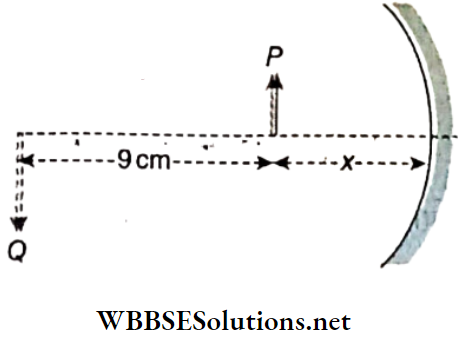
Example 8.  The image of the flame of a candle due to a mirror is formed on a screen at a distance of 9 cm from the candle. The image is magnified 4 times. Determine the nature, position, and focal length of the mirror.
Solution: 

As a magnified image image is formed on a screen, the image is real.

Class 12 Physics Unit 6 Optics Chapter 1 Reflection Of Light Focal Length Of Mirror On A Screen

Let u = – x cm and hence v = -(x+9) cm

Here, m = 4 or \(\frac{v}{u}\) = 4 [taking only the mod value of m]

Or, \(\frac{x+9}{x}\)  = 4

Or, 4x = x+9 or, x = 3

∴ u = -3 cm

So, the mirror is situated at a distance of 3 cm from the flame

Now, v= -(3+9) = -12 cm

We, know, \(\frac{1}{v}+\frac{1}{u}=\frac{1}{f}\)

Or, \(\) .

Or, \(\frac{1}{-12}+\frac{1}{-3}=\frac{1}{f}\) .

Or, \(-\left(\frac{1+4}{12}\right)=\frac{1}{f}\) .

or, f = \(-\frac{12}{5}\)

= -2.4 cm

So, the focal length of the mirror is 2.4 cm. Its negative sign indicates the nature of the mirror as a concave one [Fig. 1.40].

Practice Problems on Reflection Angles

Example 9. The focal length of a concave mirror is f. A point object is placed beyond the focal length at a distance from the focus. Prove that the image will be formed beyond the focal length at a distance  \(\frac{f}{x}\)from the focus and the magnification of the image will be (\(\frac{1}{x}\)
Solution:

Here, object distance, u = -(f+xf)

We, know, \(\frac{1}{v}+\frac{1}{u}=\frac{1}{f}\)

Or, \(\frac{1}{v}+\frac{1}{-(f+x f)}\)

Or, \(\frac{1}{v}=\frac{1}{f+x f}-\frac{1}{f}\)

= – \(\frac{1}{v}=\frac{1}{f}\left[\frac{1}{1+x}-1\right]\)

= \(\frac{-x}{f(1+x)}\)

∴ v =  \(\frac{f(1+x)}{-x}=-\left(f+\frac{f}{x}\right)\)

So, the image is formed beyond the focal length at a distance of be u. \(\frac{f}{x}\) from the focus

∴ Magnification , m= \(-\frac{v}{u}\)

=- \(\frac{f(1+x)}{x}{-f(1+x)}\)

=  \(\frac{1}{x}\)

⇒ \(-\frac{v}{u}=-\frac{-\frac{f(1+x)}{x}}{-f(1+x)}\)

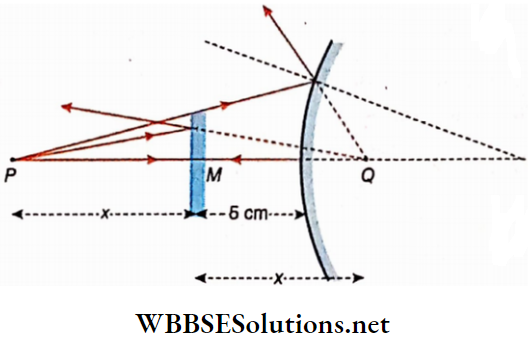
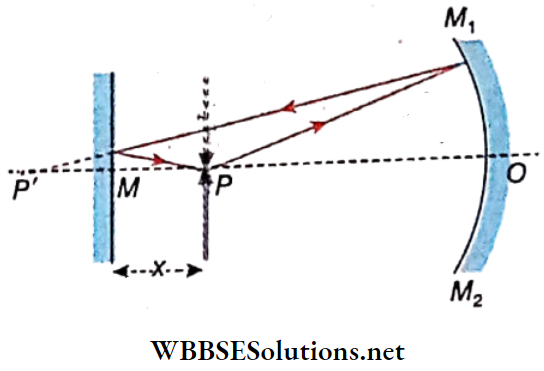
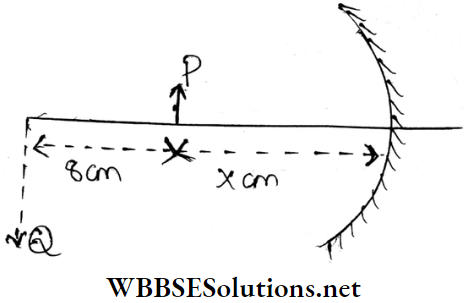
Example 10. A thin glass plate is placed in between a convex mirror of a length 20 cm and a point source. The distance between the glass plate and the mirror is 5 cm.  The image formed by the reflected rays from the front face of the glass plate and that due to the reflected rays by the convex mirror coincides at the same point. What is the distance of the glass plate from the source? Draw the ray diagram

The ray diagram has been shown. The distance between the glass plate M and the point source

P = x cm (say). Light rays starting from P form the image at Q by reflection at the convex mirror. The glass plate also forms the image of P at Q.

Class 12 Physics Unit 6 Optics Chapter 1 Reflection Of Light The Plane Glass Plate

∴ Distance of the image from the glass plate = x cm

∴ Distance of the image from the convex mirror = (x-5) cm glass plate also forms the image of P at Q.

∴ Distance of the object from the convex mirror=-(x+5) cm 

We know , \(\frac{1}{v}+\frac{1}{u}=\frac{1}{f}\)

Or, \(\frac{1}{x-5}+\frac{1}{-(x+5)}=+\frac{1}{20}\)

Or, \(\frac{+x+5-x+5}{(x-5)(x+5)}=+\frac{1}{20}\)

Or, \(\frac{10}{x^2-25}=+\frac{1}{20}\)

∴ The distance of the glass plate from the source = 15 cm

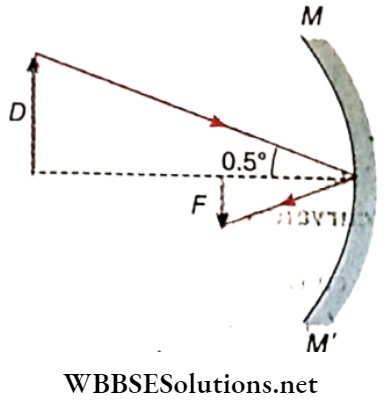
Example 11. The sun subtends an angle 0.5° at the center of a concave mirror having a radius of curvature 1 m. What will be the diameter of the image of the sun formed by the mirror?
Solution:

MM’ is a concave mirror Let the diameter of the sun be D and the distance of the sun from the mirror be u,

∴ \(\frac{D}{u}=\frac{\pi}{360}\)

0.5 ° = \(\frac{1}{2} \times \frac{\pi}{180}=\frac{\pi}{360}\) radian

Or, \(\frac{360 D}{\pi}\)

The sun is at a large distance from the mirror. So, the rays coming from the sun are assumed to be parallel and hence its image will be formed at the focal plane.

Class 12 Physics Unit 6 Optics Chapter 1 Reflection Of Light Focal Plane

∴ v= \(f\frac{r}{2}\)

= \(\frac{1}{2}\)

= 0.5 cm

Now magnification, m = \(-\frac{v}{u}=\frac{-0.5 \pi}{-360 D}\)

⇒ \(\frac{0.5 \pi}{360 D}\)  [since in this case both u and v are negative]

Again \(\frac{I}{O}=\frac{\text { diameter of the image of the sun }}{\text { diameter of the sun }(D)}\)

∴  Diameter of the image of the sun

= m × D = \(\frac{0.5 \pi}{360 D}\) × D= 0.004363

m = 0.4363 cm. [taking only the numerical of m]

Class 12 physics reflection of light 

Example 12. An object is placed at a distance of 25 cm from a con- cave mirror and a real image is formed by the mirror at a distance of 37.5 cm. What is the focal length of the mirror? Now if the object is moved 15 cm towards the mirror, what will be the image distance, its nature and magnification?
Solution:

Here, u = -25 cm, v = -37.5 cm

We know, \(\frac{1}{v}+\frac{1}{u}=\frac{1}{f}\)

Or, \(\frac{1}{-37.5}+\frac{1}{-25}=\frac{1}{f}\)

= \(-\frac{10}{375}-\frac{1}{25}\)

= \(-\frac{25}{375}=-\frac{1}{15}\)

Or, f= – 15cm

Now if the object is moved 15 cm towards the mirror, the object distance will be (25-15) = -10 cm

=  \(\frac{1}{v}+\frac{1}{-10}=-\frac{1}{15}\)

Or, \(-\frac{1}{15}+\frac{1}{10}\)

= \(\frac{-2+3}{30}=+\frac{1}{30}\)

= + \(\frac{1}{30}\)

Or, v= + 30 cm

The positive sign of v indicates that the image formed by the mirror is virtual and it is formed at a distance of 30 cm behind the mirror.

Magnification, m = \(-\frac{v}{u}\)

= \(-\frac{30}{-10}\)

= 3

∴ The image will be magnified 3 times. The positive sign of m indicates the image as erect.

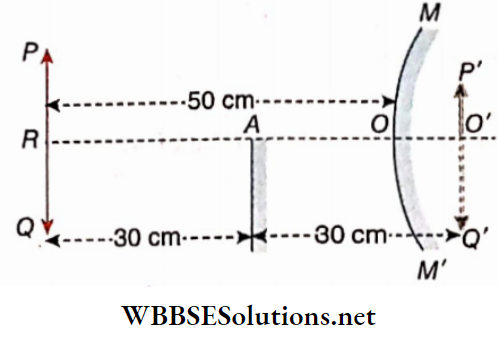
Example 13. An object is placed at a distance of 50 cm in front of a convex mirror. Now a plane mirror is placed in between the object and the convex mirror, covering the lower half of the convex mirror. If the distance of the plane mirror from the object is 30 cm, it is seen that there is no parallax of the images formed by the two mirrors. What is the radius of curvature of the convex mirror?
Solution:

MM’ is a convex mirror and A is a plane mirror. P’Q’ is the object and P’Q’ is the image formed at the same place by the two mirrors.

The radius of curvature,

Here OR = 50 cm , AR = 30 cm

Image distance from the plane mirror = O’A = 30 cm

Class 12 Physics Unit 6 Optics Chapter 1 Reflection Of Light Image Distance Of Plane Mirror

According to the figure,

OA = OR-AR

= 50-30

= 20 cm

∴ Image distance from the convex mirror,

O’O = O’A-OA = 30-20 = 10 cm

We have \(\frac{1}{v}+\frac{1}{u}=\frac{1}{f}\)

Here, v= +10 cm , u= -50 cm

∴ \(\frac{1}{10}+\frac{1}{-50}=\frac{1}{f}\)

Or,  \(\frac{4}{50}=\frac{1}{f}\)

Or,  \(f=+\frac{25}{2}\)

Radius of curvature,

r = 2f

\(\frac{25}{2}\)

=  25 cm

The radius of curvature of the convex mirror = 25 cm

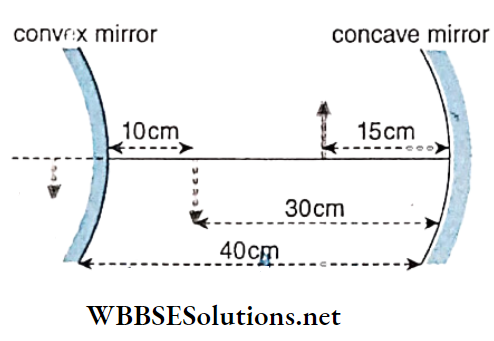
Example 14. A concave mirror of focal length 10 cm and a convex mirror of focal length 15 cm are held co-axially face to face at a distance 40 cm apart. An object of height 2 cm is placed perpendicularly on the common axis in between the two mirrors. The distance of the object from the concave mirror is 15 cm. Considering the first reflection occurs in the concave mirror and the second reflection in the convex mirror, calculate the position, nature, and height of the final image.
Solution:

In the case of the first reflection in the concave mirror: u = -15 cm; f = -10 cm

We know, \(\frac{1}{v}+\frac{1}{u}=\frac{1}{f}\)

Or, \(\frac{1}{y_1}+\frac{1}{-15}=\frac{1}{-10}\)

Or, \(\frac{1}{v}=-\frac{1}{10}+\frac{1}{15}\)

Or, \(\frac{3_1+2}{30}\)

Or, \(-\frac{1}{30}\)

v= -30 cm

So, the image formed by the concave mirror is real and formed at a distance of 30 cm from the mirror. This image acts as the object of the convex mirror.

In case of the second reflection in the convex mirror:

u = -(40- 30) = -10 cm , f = +15 cm

We know \(\frac{1}{v}+\frac{1}{u}=\frac{1}{f}\)

Or, \(\frac{1}{v}+\frac{1}{-10}=+\frac{1}{15}\)

Or, \(\frac{1}{v}=+\frac{1}{15}+\frac{1}{10}\)

= + \(\frac{1}{6}\)

Or, v= + 6cm

So the final image is virtual and is formed at a distance of 6 cm
behind the convex mirror.

Class 12 Physics Unit 6 Optics Chapter 1 Reflection Of Light Convex Mirror And Concave Mirror

Magnification by the concave mirror,

m1 = \(\frac{v}{u}\)

= \(\frac{-30}{-15}\)

= -2

Magnification by the convex mirror,

m2 = – \(\frac{v}{u}\)

= – \(\frac{6}{-10}\)

= \(\frac{3}{5}\)

∴ Total magnification.

m = m1 × m2

= -2 ×\(\frac{3}{5}\)

=  – \(\frac{6}{5}\)

As m is negative, so the final image is inverted with respect to the object.

∴ Height- of the final image (taking only the magnitude of m)

= \(\frac{6}{5}\) × height of the object

= \(\frac{6}{5}\) × 2

= \(\frac{12}{5}\)

= 2. 4 cm

Example 15. The focal length of a concave mirror is 30 cm. An object is placed at a distance of 45 cm in front of the mirror. A plane mirror is placed perpendicularly on the principal axis of the concave mirror in such a way that the object is situated in between the two mirrors. Light rays from the object at first are reflected from the concave mirror and then from the plane mirror. As a result the final image coincides with the object. What is the distance between the two mirrors?
Solution:

In case of the concave mirror M1 M2, P is the object and P’ is its image.

Here, u = -45 cm,  f= – 30 cm

We know \(\frac{1}{v}+\frac{1}{u}=\frac{1}{f}\)

Or, \(\frac{1}{v}-\frac{1}{45}\)

= \(-\frac{1}{30}\)

Or, \(\frac{1}{v}=-\frac{1}{30}+\frac{1}{45}\)

= \(\frac{-3+2}{90}\)

= \(\frac{1}{90}\)

Or, v= -90 cm

Op’ = 90 cm

Class 12 Physics Unit 6 Optics Chapter 1 Reflection Of Light Distance Between Two Mirrors

According to the question, the reflected rays from the concave mirror form the final image at P after reflection from the plane
mirror M.

∴ PM=  P’M = x (say)

Here, OP’ = OP+PM+P’M

Or, 90 = 45+x+x

Or, x = \(\frac{45}{2}\)

= 22.5 cm

∴ Distance between the mirrors = 45+22.5 67.5 cm.

Example 16. A concave mirror forms a real image magnified two times. If both the object and the screen are moved a real Image magnified three times that of the object is formed. If the screen is moved through a distance of 25cm, then determine the displacement of the object and focal length of the mirror.
Solution:

In the first case,

⇒ \(\frac{1}{v}+\frac{1}{u}=\frac{1}{f}\)

Or, \(\frac{1}{v}+\frac{1}{-u}=\frac{1}{-f}\)

Or, \(1-\frac{v}{u}=-\frac{v}{f}\)

∴ 1+m = –  \(-\frac{v}{u}\)…………………….(1)

Since m= – \(-\frac{v}{f}\)

In the first case, magnification = 2

∴ 1+2 = \(-\frac{v}{f}\)

Or,  – \(\frac{v}{f}\) = 3…………………….(2)

In the second case, magnification = 3

∴ 1+3 = – \(\frac{(v+25)}{f}\)

Or,  4 = – \(\frac{v}{f}-\frac{25}{f}\)

∴ 4= 3 – \(3\frac{25}{f}\)

Or, f= – 25 cm

The focal length of the concave mirror = 25cm

From equation (2) we have,

v =3f = -3 × (-25) = 75 cm

According to the equation of a spherical mirror,

⇒ \(\frac{1}{u}=\frac{1}{f}-\frac{1}{v}=\frac{1}{75}-\frac{1}{25}\)

[since the image is real, hence v is taken negative]

Or,

u = -37.5 cm

In the first case object distance 37.5 cm

In the second case image distance

v1= v+25= 75+25= 100 cm

Suppose, object distance = u1

Since in this case magnification =3

∴ \(u_1=-\frac{1}{3} v_1\)

= \(\frac{100}{3}\)

= – 33.33 cm

∴ Object distance in the second case =33.33cm

∴ Displacement of the object = 37.5-33.33

= 4.17cm

So, the displacement of the object = 4.17 cm, and the focal length of the mirror = 25 cm

Conceptual Questions on Image Formation by Mirrors

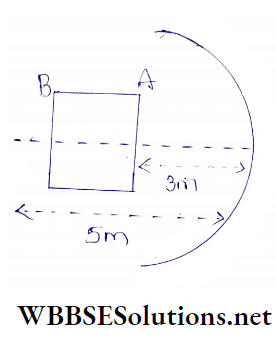
Example 17.  A cube of side 2 m is placed in front of a large concave mirror of focal length 1 m in such a way that the face A of the cube is at a distance of 3 m and the face B at a distance of 5 m from the mirror.

  1. Calculate the distance between the images of the faces A and B.
  2. Determine the height of the images of faces A and B. 
  3. Will the image of the cube be a cube

Solution:

1. Distance of the face A from the mirror, u1 = -3 m, focal length of the mirror, f= -1 m

Class 12 Physics Unit 6 Optics Chapter 1 Reflection Of Light Distance Of The Face A From The Mirror

Let the image distance of the face A from the mirror be v1 m

We know, \(\frac{1}{v}+\frac{1}{u}=\frac{1}{f}\)

Or,   \(\frac{1}{v_1}-\frac{1}{3}=-\frac{1}{1}\)

Or,= v1 = -1.5 m

Distance of the face B from the mirror, u=-5 m; the image distance of this face = v2 m

We know, \(\frac{1}{v}+\frac{1}{u}=\frac{1}{f}\)

Or, \(\frac{1}{v_2}-\frac{1}{5}=-\frac{1}{1}\)

Or,= v2 = -1.25 m

So, the distance between the images of the faces A and B

= v1– v2 = 1.5-1.25 = 0.25 m [Taking magnitude of v1 and v2 ]

2. Magnification in the first case

m1 = \(\frac{1}{v_1}-\frac{1}{u_1}\)

= \(\frac{-1.5}{-3}\)

= – 0.5

∴ \(\frac{\text { height of the image of the face } A\left(I_A\right)}{\text { length of the face } A\left(O_A\right)}\)

Or, IA= -5.5 × 2 = -1m

Again, magnification in the second case

⇒ \(\frac{1}{v_2}-\frac{1}{u_2}\)

m2 = \(\frac{1}{v_2}-\frac{1}{u_2}\)

= \(\frac{-1.25}{-5}\)

= – 0.25

∴ Height of the image of the face B,

Or, IB= -5.5 × 2 = -1m

IB =  m2 ×  height of the face B

= -0.25 × 2

= -0.5 m

3. So, it is seen that the height of the image of face A and that of the face B are not equal. So, the image of the cube will no longer be a cube.

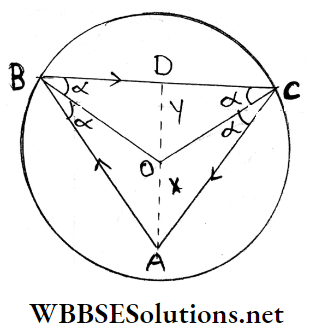
Example 18. A is a point object in a circular track. A light ray starting from object A is reflected twice by the circular track and returns again to A. The angle of incidance is a. The distance of A from the center of the circular track is x and the diameter of the circular track from A intersects the path of the ray at a point D whose distance from the center of the circular track is y.
Show that, tan α = \(\sqrt{\frac{x-y}{x+y}}\)

Class 12 Physics Unit 6 Optics Chapter 1 Reflection Of Light Centre Of The Circular Track
Solution:

In Δ OBC, OB = OC; so, ∠OBC= ∠OCB = α

Also ∠ABC = ∠ACB= 2α; so, AB = AC

Since Δ ABC is isosceles, hence median AD ⊥ BC

∴ tan α =  \(\frac{y}{B D}\) and tan 2α = \(\frac{x+y}{B D}\)

Or, \(\frac{\tan 2 \alpha}{\tan \alpha}=\frac{x+y}{y}\)

Or, \(\frac{2 \tan \alpha}{\tan \alpha\left(1-\tan ^2 \alpha\right)}=\frac{x+y}{y}\)

Or, \(1-\tan ^2 \alpha=\frac{2 y}{x+y}\)

Or, \(\tan ^2 \alpha=1-\frac{2 y}{x+y}\)

= \(\frac{x-y}{x+y}\)

Or, tanα = \(\sqrt{\frac{x-y}{x+y}}\)

So, the distance between the images of the faces A and B

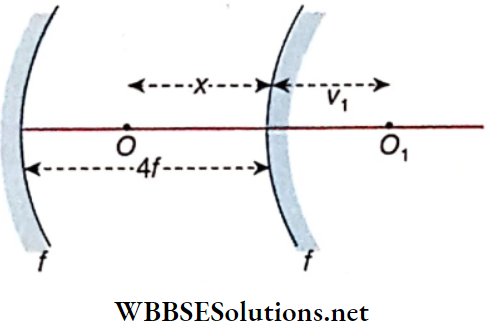
Example 19. A concave mirror and a convex mirror are placed co-axially face to face. The focal length of each of them is f and the distance between them is 4f. A point source is so placed on their common axis in between the two mirrors that if the first reflection is considered to take place on the convex mirror, the final image coincides with the point source. Determine the position of the source.
Solution:

Let the point source O be situated at a distance x from the convex mirror

Class 12 Physics Unit 6 Optics Chapter 1 Reflection Of Light Concave Mirror And Convex Mirror

If the image distance is v1 then

⇒ \(\frac{1}{v_1}+\frac{1}{-x}=\frac{1}{f}\)

Or, \(\frac{1}{v_1}=+\frac{1}{f}+\frac{1}{x}\)

= \(+\frac{1}{f}+\frac{1}{x}=\frac{(x+f)}{f x}\)

Or, \(v_1=\frac{f x}{x+f}\)

This image will be formed at Oj behind the convex mirror. Now u X this image will act as the object of the concave mirror.

∴ Object distance for the concave mirror,

u2= 4f+ v1

= \(4 f+\frac{f x}{x+f}\)

= \(\frac{5 f x+4 f^2}{x+f}\)

∴ Image distance v2 = 4f- x

Since the final image coincides with the object

∴ \(\frac{1}{v_2}+\frac{1}{u_2}=\frac{1}{f}\)

Or, \(\frac{1}{4 f-x}+\frac{x+f}{5 f x+4 f^2}=\frac{1}{f}\)

Or, \(\frac{1}{4 f-x}=\frac{1}{f}-\frac{x+f}{5 f x+4 f^2}\)

= \(\frac{4 x+3 f}{f(5 x+4 f)}\)

Or = x² – 2fx – 2f² = 0

Or, \(\frac{2 f \pm \sqrt{4 f^2+8 f^2}}{2}=f \pm f \sqrt{3}\)

∴ x = \(f(1+\sqrt{3})\)  [neglecting the negative value]

The distance of the source from convex mirror = \(f(1+\sqrt{3})\)

Class 12 Physics Reflection Of Light

Example 20.  The diameter of the moon is 3450 km and its distance from the earth is 3.8 x 10⁵ km, What will be the diameter of the image of the moon formed by a convex mirror of focal length 7.6 m? As the moon is very far away from the earth the image of the moon will be formed in the focal plane of the mirror
Solution:

Hence, v = f = 7.6 m

Now, u= 3.8 × 10⁵ km and magnification, m = \(\frac{v}{u}\)

[Taking the mod value of m]

∴ The diameter of the image

= m × diameter of the moon

= \(=\frac{7.6 \mathrm{~m}}{3.8 \times 10^5 \mathrm{~km}} \times 3450\)km

= 00.69m

= 6.9 cm

Example 21. Three times magnified image of an object is formed on a screen placed at a distance of 8 cm from the object with the help of the spherical mirror. Determine the nature of the mirror, focal length, and the distance of the mirror from the object.]
Solution:

Since the image is formed on a screen, the image is real and the mirror is concave.

Suppose, u= x cm and so v = (x+8)cm

Here,m = 3 or, \(\frac{v}{u}\) = 3 [taking the mod value of m]

Or, \(\frac{v}{u}\) = 3

Or, \(\frac{(x+8)}{x}\) = 3

Or,   x= 4cm

So the mirror is situated at a distance of 4 cm from the object

∴ v = (4+8) = 12 cm

We know , \(\frac{1}{v}+\frac{1}{u}=\frac{1}{f}\)

Or,  \(\frac{1}{-12}+\frac{1}{-4}=\frac{1}{f}\)

Or, f= -3 cm

∴  Focal length of the mirror

= 3 cm. A negative sign in the value of/ supports the mirror as concave in nature

Class 12 Physics Unit 6 Optics Chapter 1 Reflection Of Light Magnified Image

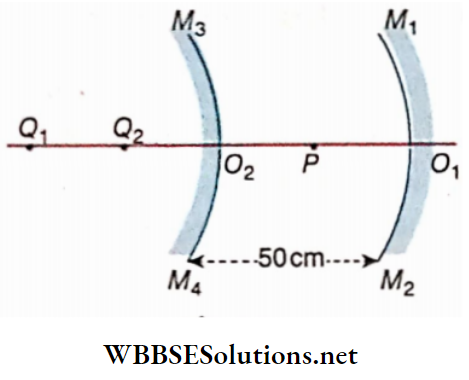
Example 22. An object is placed just at the middle point between a concave mirror of radius of curvature 40 cm and a convex mirror of radius of curvature 30 cm facing each other. The mirrors are situated 50 cm apart from each other. Considering the first reflection occurs in the concave mirror, determine the position and nature of the image formed by this mirror. Next, find the position and nature of the image formed by the convex mirror considering the first image of concave mirror as its object.
Solution:

Focal length of the concave mirror = \(\frac{40}{2}\) = 20 CM

Focal length of the convex mirror = \(\frac{30}{2}\)  = 15cm

In case of the concave mirror, u= – 25 cm: f= -20 cm.

We know, \(\frac{1}{v}+\frac{1}{u}=\frac{1}{f}\)

Or, \(\frac{1}{v}+\frac{1}{-25}=\frac{1}{-20}\)

Or, \(\frac{1}{v}=\frac{1}{25}-\frac{1}{20}=\frac{4-5}{100}\)

Or, \(\frac{1}{v}=-\frac{1}{100}\)

Or, v= – 100 cm

So, the image formed by the concave mirror in the

absence of the convex mirror would be real and inverted and situated at Q1 at a distance of 100 cm from the concave mirror. This image will act as a virtual object for the convex mirror.

Her O1Q1 = 100 cm

Now for the presence of the convex mirror M3M4 object distance, M3M4 = , object distance , u1= (100-50) cm = 50 cm;

Focal length, f1= 15 cm.

According to the equation of mirror,

⇒ \(\frac{1}{v_1}+\frac{1}{50}=\frac{1}{15}\)

Or, \(\frac{1}{v_1}=\frac{1}{15}-\frac{1}{50}\)

Or, \(\frac{10-3}{150}=\frac{7}{150}\)

Or,  v1= \(\frac{150}{7}\)

= 21.43cm

So, the final image will be formed at Q2 at a distance of 21.43 cm from the convex mirror. A positive value of v1 indicates that this image is virtual.

Class 12 Physics Unit 6 Optics Chapter 1 Reflection Of Light Virtual Object For The Convex Mirror

Real-Life Scenarios Involving Reflection Questions

Example 23. An arrow of height 2.5 cm is situated vertically at a distance of 10 cm from a convex mirror of a focal length 20 cm. Where will the image be formed? Determine its height. If the arrow is moved away from the mirror what will happen to its image?
Solution:

Here, u = -10 cm and f= 20 cm

We know,  \(\frac{1}{v}+\frac{1}{u}=\frac{1}{f}\)

Or, \(\frac{1}{v}+\frac{1}{-10}=\frac{1}{20}\)

Or, \(\frac{1}{v}=\frac{1}{10}+\frac{1}{20}\)

Or, \(\frac{2+1}{20}=\frac{3}{20}\)

or, v= \(\frac{20}{3}\)

= 6. 66cm

So, the image will be formed at a distance of 6.66 cm behind the convex mirror.

Magnification, m =\(\frac{I}{O}=-\frac{v}{u}\)

I = \(-O \times \frac{v}{u}\)

= \(-2.5 \times \frac{20}{3 \times(-10)}\)

= \(\frac{5}{3}\)

= 1.66cm

So, the height of the image = 1.66 cm. If the arrow is moved away from the convex mirror the image will move towards the focus of the mirror and will be diminished in size

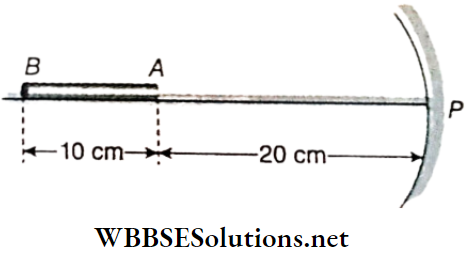
Example 24. A rod of length 10 cm lies along the principal axis of a concave mirror of focal length 10 cm in such a way that its end closer to the pole is 20 cm away from the mirror. What is the length of the image?
Solution:

Here for the side A, f = -10 cm, u = -20 cm.

From the equation, \(\frac{1}{u}+\frac{1}{v}=\frac{1}{f}\) we get v = -20 cm

Class 12 Physics Unit 6 Optics Chapter 1 Reflection Of Light Length Of The Road

For the side B, u – -30 cm

Similarly, v = -15 cm

Length of the image = 20- 15 = 5 cm

WBCHSE Physics Class 12 Reflection Notes

Reflection Of Light Synopsis

Reflection of light:

  1. Coming through a medium when light incidents on the upper surface of another medium, then a part of that incident light returns to the first medium by changing its direction.
  2. This phenomenon is known as the reflection of light.

Laws of reflection:

  1. The incident ray, the reflected ray and the normal to the reflecting surface at the point of incidence lie in the same plane.
  2. The angle of incidence is equal to the angle of reflection.

Image:

When rays of light diverging from a point source after reflection or refraction converge to or appear to diverge from a second point, the second point is called the image of the first point.

Focus in case of reflection from a spherical surface:

When a beam of rays parallels to the principal axis is incident on a spherical mirror, it is seen that the reflected rays either converge to or appear to diverge from a fixed point on the principal axis. This point is called the principal focus or focal point or briefly the focus of the mirror.

Conjugate foci:

1. If a pair of points is such that when an object is placed at one of them, its image is formed at the other by a fixed mirror, then that pair of points are called conjugate foci of that mirror.

2. The focal length of a concave mirror is taken as positive and the focal length of a convex mirror is taken as negative.

3. The distance measured from the pole of the mirror and in ‘front of it is taken as positive but the distance measured in the back side of the mirror is taken as negative.

4. If the aperture is small then the focal length of a spherical mirror becomes half of its radius of curvature

Class 12 Physics Unit 6 Optics Chapter 1 Reflection Of Light The Nature Of The Mirror

5. Real image is formed in front of the mirror but virtual is formed at the back of the mirror.

6. The ratio of the length of the image to that of the object is called linear magnification of the image.

7. The ratio of the area of an image to that of the two-dimensional object is called areal magnification.

8. The ratio of the length of the image to that of the object along the principal axis is called longitudinal or axial mag- notification.. da

9. In the case of a spherical mirror longitudinal magnification is equal to the square of the linear magnification.

10. Angle of reflection (r) = angle of incidence (1)

11. Angle of deviation for a ray of light after reflection from a plane mirror,

δ = 180°-2i [i= angle of incidence]

12. In case of the image formed by a plane mirror, the distance of the image from the mirror

= distance of the object from the mirror.

13. In the case of a spherical mirror of a small aperture the relation between the focal length of the mirror () and its radius of curvature (r) is

f = \(\frac{r}{2}\)

14. In the case of a spherical mirror of a small aperture, the relation among the object distance (u), image distance (v), and focal length (f) is

⇒ \(\frac{1}{v}+\frac{1}{u}=\frac{1}{f}\)

15. Newton’s equation:

xy = f² [where, x = u-f and y = v-f]

16. Linear magnification:

m = \(\frac{\text { length or height of the image }(I)}{\text { length or height of the object }(O)}\)

= \(\frac{\text { image distance }(v)}{\text { object distance }(u)}\)

= \(\frac{f}{f-u}=\frac{f-\nu}{f}\)

17. Areal magnification for a two-dimensional object:

m’ = \(\frac{\text { area of image }}{\text { area of object }}\)

18. Longitudinal or axial magnification:

m” = \(\frac{\text { length of the image along the principal axis }}{\text { length of the object along the principal axis }}\)

Rules for solving numerical problems relating to spherical mirrors

To solve the numerical problems in connection with spherical mirrors the following rules are to be followed:

  • In the general equation of mirrors, put the numerical values of u, v, f etc. with their proper signs.
  • Then after solving the equation, draw inference about the distance from the sign.
  • A positive sign of the focal length will suggest that the mirror is convex while a negative sign will suggest that the mirror is concave.
  •  If the image distance is negative, we have to understand that the image has been formed in front of the mirror and it is real and inverted.
  • Again, if the image distance is positive, we have to understand that the image has been formed behind the mirror and it is virtual and erect.

WBCHSE physics class 12 reflection notes 

Reflection Of Light Very Short Question And Answers

Question 1. Can an image be formed due to diffused reflection? 
Answer: No

Question 2. Can a plane mirror form a real image?
Answer: Yes

Question 3. If a light ray is incident on a horizontal plane mirror making an angle 30° with the mirror, what angle will the reflected ray make with the mirror?
Answer: 30

Question 4. What type of reflection takes place on the screen of a cinema hall?
Answer: Diffuse

Question 5. What is the angle of deviation of a ray incident perpendicularly on a reflecting surface?
Answer:  180°

Question 6. Focus of which spherical mirror is virtual.
Answer:  Convex

Question 7. Two concave mirrors have same focal length but different apertures. Both the mirrors form an image of the sun on a screen. For which image formation will the temperature of the screen become higher?
Answer:  Concave

Question 8. The secondary focus of a concave mirror is a fixed point. Is this statement correct?
Answer: No

Question 9. The principal focus of a concave mirror is a fixed point. Is this statement correct?
Answer:  Yes

Question 10. Two concave mirrors have the same aperture but different focal lengths. Both form images of the sun on a screen. For which image formation will the temperature of the
Answer:  In both cases, hotness will be the same

Question 11. The radius of curvature of a concave mirror is 30 cm. What is its focal length?
Answer: 15 cm

Question 12. Which spherical mirror is called a divergent mirror-concave or convex?
Answer:  Convex

Question 13. The focal length of a spherical mirror is 40 cm. What is its radius of curvature?
Answer: 80 cm

Question 14. What is the value of the focal length of a plane mirror?
Answer: Infinite

15. What is the power of a plane mirror?
Answer: Zero

Question 16. What is the relation between the radius of curvature (r) and focal length (f) of a spherical mirror?
Answer: r = 2f

Question 17. Does the size of mirror affect the nature of the image?
Answer: No

Question 18. The focal length of a concave mirror is equal for all colors of light. Is the statement true or false? [true] [yes] 21. What type of mirror is to be used for getting parallel rays from a small source of light?
Answer: True

Question 19. What will happen to the focal length of the concave mirror when it is immersed in water? Will remain unchanged
Answer: Will remain unchanged

Question 20. Where should an object be placed in front of a concave mirror to get a magnified image?
Answer:  Between f and 2f 

Question 21. Why do we sometimes use a concave mirror instead of a plane mirror as a common mirror? [to get a magnified erect image]
Answer: To get a magnified erect image

Question 22. What is the magnification of the image of an object placed at the center of curvature of a concave mirror?
Answer: 1

Question 23. What is the magnification of an object placed at the focus Answer: Infinity

Question 24. Can a convex mirror ever form a real image of a real object? of a concave mirror?
Answer:  No

Question 25. What will the image of an object placed before a convex screen be higher? mirror-erect or inverted?
Answer: Erect

Question 26. Two concave mirrors are placed face to face and they have the same centre of curvature. A point source of light is placed at their common center of curvature. Where will the image be formed?
Answer: At their common center of curvature

Question 27. If an object is placed between the pôle and the focus of a concave mirror, will the size of the image be magnified with respect to the size of the objector?
Answer: Yes

Question 28. What is the minimum distance between an object and its image formed by a concave mirror?
Answer:  Zero

Question 29. If a concave mirror is immersed in water will its focal length change?
Answer: No

Question 30. In the case of a concave mirror, what is the shape of the uv graph?
Answer:  Rectangular hyperbola]

Question 31. In the case of a concave mirror, what is the shape of the graph?
Answer: Straight line

Question 32. The focal length of a concave mirror in vacuum is 2 m. What will be the focal length of the concave mirror in a medium of refractive index 2.76?
Answer: 2 m

Question 33. At what distance in front of a concave mirror (f = 10 m) an object is to be placed so that the size of the image will be halved of the size of the object?
Answer: 30 cm

Question 34. If the conjugate foci of a spherical mirror lie on the same side of the mirror then, what is the nature of the mirror?
Answer: Concave

Question 35. What is the magnification produced in a plane mirror? 40. A cube is placed in front of a large concave mirror. Will the image of the cube be a cube?
Answer: 1

Question 36. Can a convex mirror form a real image?
Answer: Can form real image of a virtual object

Question 37. For a spherical mirror if the linear magnification of the image be m what will be its lateral magnification?
Answer:

Question 38. The image of a candle formed by a concave mirror is cast on a screen. What will happen if the mirror is covered partly?
Answer: The brightness of the image will be reduced]

Question 39. Will the focal length of a spherical mirror be affected if the wavelength of the light used is increased?
Answer: No

Question 40. What type of mirror do car drivers use to view the traffic at the back of the car?
Answer:
Convex

Question 41. What type of mirror do dentists use?
Answer:
Concave

Question 42. What type of mirror is used in searchlights and headlights of vehicles?
Answer:
Paraboloidal

Reflection Of Light Fill In The Blanks

Question 1. The reflecting surface from which regular reflection of light takes place is called__________________  object 
Answer:  Smooth plane reflector

Question 2. A plane mirror can form a real image of a____________ object
Answer: Virtual

Question 3. A smaller virtual image is formed by the blank). mirror. [Fill in Answer: Convex

Question 4. An object is moving towards a convex mirror from a large distance. The image will move with _________________ velocity than  the object  ___________  the mirror 
Answer: 
Less, towards

Reflection Of Light Assertion Reason Type

Direction: These questions have statement I and statement II. the four choices given below, choose the one that best scribes the two statements.

  1. Statement 1 is true, statement 2 is true; statement 2 is a correct explanation for statement 1.
  2. Statement 2 is true, statement 2 is true; statement 2 is not a correct explanation for statement 1.
  3. Statement 3 is true, statement 2 is false.
  4. Statement 4 is false, and statement 2 is true.

Question 1.

Statement 1: The formula connecting u, v, and ƒ for a spherical mirror is valid only for mirrors whose sizes are very small compared to their radii of curvature.

Statement 2: Laws of reflection are strictly valid for plane surfaces but not for large spherical surfaces.

Answer:  3. Statement 3 is true, statement 2 is false.

Question 2.

Statement 1: A concave mirror is preferred to a plane mirror for shaving.

Statement 2: When a man keeps his face between the pole and the focus of the mirror, an erect and highly magnified virtual image is formed.

Answer:  1. Statement 1 is true, statement 2 is true; statement 2 is a correct explanation for statement 1.

Question 3. 

Statement 1: A virtual image can not be directly photographed.

Statement 2: A virtual image can be produced by using a convex mirror.

Answer: 2. Statement 2 is true, statement 2 is true; statement 2 is not a correct explanation for statement 1.

Question 4.

Statement 1: In the absence of diffuse reflection an object would appear either dazzlingly bright or quite dark.

Statement 2: The angle of incidence is not equal to the angle of reflection in this case.

Answer:   3. Statement 3 is true, statement 2 is false.

Question 5.

Statement 1: Convex mirror is used as driver’s mirror.

Statement 2: Convex mirror gives an index wider field of view of the traffic.

Answer:  1. Statement 1 is true, statement 2 is true; statement 2 is a correct explanation for statement 1.

WBCHSE physics class 12 reflection notes 

Reflection Of Light Match The Columns

Question 1. 

Class 12 Physics Unit 6 Optics Chapter 1 Reflection Of Light Regular Refraction

Answer: 1-B, 2- D, 3- A, 4. C

Question 2. The nature of the image and the type of mirror are given in column A and column B respectively. Match the column.

Class 12 Physics Unit 6 Optics Chapter 1 Reflection Of Light The Nature Of Image And The Type Of Mirror Are Given

Answer:  1-D, 2-C, 3 A, 4 – B

Question 3. Some relations related to spherical mirror and their field of application are given in column A and column B respectively (The symbols have their usual meanings). Match the column.


Class 12 Physics Unit 6 Optics Chapter 1 Reflection Of Light Some Relations Related To Spherical Mirror

Answer:  1- D, 2- C, 3- B, 4- A

Question 4. The position of an object with respect to a concave mirror and the position of the image are given in column 1 and column 2 respectively.

Class 12 Physics Unit 6 Optics Chapter 1 Reflection Of Light Position Of Object

Answer: 1- B, 2-D, 3- E, 4- C, 5-A

Question 5. Match the corresponding entries of column I with column [where m is the magnification produced by the mirror].

Class 12 Physics Unit 6 Optics Chapter 1 Reflection Of Light M Is The Magnification Produced By The Mirror

  1. 1. (A, C ) 2. (A, D)  3. ( A, B)  4. (C, D)
  2. 1. (A, D)  2. (B, C) 3. (B, D) 4. (C, D)
  3. 1. (C, D) 2. (B, D) 3. (B, C) 4. (A, D)
  4. 1. (B, C) 2. (B, C )3. (B, D) 4. (A, D)

Answer: 1. (B, C)  2. (B, C) 3. (B, D) 4. (A, D)

Magnification of image produced by a spherical mirror,

For real images, m<0, and m> 0 for virtual images.

The convex mirror always forms a virtual image, so m> 0 always and the size of the image is less or equal to the size of object 1.e., m≤1.

In the case of the concave mirror, if the real image is formed, then there can be |m|≥ 1 and |m | ≤1, and for a virtual image m>1. The option is correct.

WBCHSE Class 12 Physics Atom Notes

WBCHSE class 12 physics atom notes

Constituents Of An Atom

Early nineteenth century, John Dalton proposed that all matter is made up of tiny, indivisible particles called ‘atoms! This statement along with other similar statements was later proved to be wrong and discarded

Towards the end of the nineteenth century, William Crookes, Joseph John Thomson, Philipp Lenard, and others, while studying the silent electric discharge in gases at low pressure paved the way for the discovery ofelectrons. Among them, J J Thomson is credited with the discovery of the electron, a subatomic particle. After the discovery of electrons, the myth of the indivisibility of ‘atom’ was dispelled

Electron:

It has been possible to show the emission of electrons from almost all matters through suitable experimental arrangements. Electrons are negatively charged particles carrying a charge which is denoted by e or e-1

Millikan determined the amount of charge of an electron, e = 1.6 × 10⁻¹⁹ coulomb = 4.8 × 10⁻¹⁰ esu J. J Thomson determined the specific charge of an electron, i.e., charge to mass ratio for an electron 1.76 × 10¹¹ C . kg-1.

Therefore, the mass of the electron

Read and Learn More Class 12 Physics Notes

me = \(\frac{\text { amount of charge of an electron }(e)}{\text { specific charge of an electron }\left(\frac{e}{m_e}\right)}\)

9.1 × 10⁻³¹ kg-1

= 9.1×10⁻²⁸ g

Positive charge:

Most materials are electrically neutral.  From various electron emission experiments, it was proved that (since matter is neutral) there must be some positive charge also in the atom. Later experiments confirmed the presence of a positive charge on an atom.

WBCHSE Class 12 Physics Atom Notes

WBCHSE class 12 physics atom notes Rutherford’s Atomic Model

Alpha parties scattering experiment:

Rutherford and his co-workers performed the famous alpha par¬ ticle scattering experiment. Alpha particles are emitted from a radioactive source with considerable energy. These a -particles were collimated into a narrow parallel beam which was made incident on a thin foil of a heavy metal like gold (Z = 79), silver (Z = 47), etc.

These metals being ductile, can be easily drawn into a thin foil of width about 107 m. The thinness ensured that eadi a -particle could interact with a single atom in each collision.

Due to collision with the foil, die a -particles were scattered in different directions which were detected by a fluorescent detection screen. Very few a -particles were scattered in a backward direction without penetrating the foil, but being deflected through angles greater than 90°.

Atom Alpha Particles Scattering

Observation and inference:

  • Most of the a -particles passed straight through the metal foil without suffering any deflection. This observa¬ tion leads to the conclusion that most of the space inside the atom is empty.
  • Low angle scattering: Some of the alpha particles were scattered through small angles i.e., the scattering angle Here, it is assumed that this scattering
  • This takes place due to coulomb attraction between an alpha particle of charge +2e and an electron of charge -e. The deflections of α -particles are so small that an α -particle is about 7000 times heavier than an electron. From this, it is concluded that electrons are embedded discretely inside the atom
  • Large angle scattering: Some a -particles, though very few suffered deflection by 90° or larger angles. Some of these a -particles were even deflected through 180° Rutherford quantitatively analyzed the

Atom Large Angle Scattering

WBBSE Class 12 Atom Notes

A number of these large angle deflections. He argued that, to deflect the a -particle backward, it must experience a large repulsive force which was possible if the entire positive charge and almost total mass of the atom were concentrated in a small space. This confirmed the presence of the nucleus.

Thus the strong electrostatic repulsion between an a -particle of charge +2e and a nucleus of charge +Ze was the cause of these large deflections.

By quantitative analysis, it was also concluded that the diameter ofthe nucleus is about 10-14 m which is about \(\frac{1}{1000}\) times the atomic diameter of 10-10 m. Hence the volume of the nucleus is only about 1 in 1012 parts of the atom

Rutherford’s atomic model is often compared with the solar system, but there are more dissimilarities than resemblances. Similarities are only marginal.

Similarities:

Atom Similarities Of Solar And Rutherfords Atomic Model

Dissimilarities:

Atom Dissimilarities Of Solar And Rutherfords Atomic Model

From the observations, Rutherford proposed his atomic model.

The salient features of the model are:

  • The nucleus exists at the center of an atom and electrons orbit around the nucleus in circular paths.
  • The necessary centripetal force for the orbital motion is provided by the electrostatic attraction between the opposite charges of the nucleus and the electron

Atom Centrepetal Force

Atoms class 12 notes Drawbacks of the Rutherford model:

InstabilHy of the atom: An orbiting electron in an atom is subjected to centripetal acceleration. According to Max¬ Well’s classical electromagnetic theory, any accelerated charged particle emits electromagnetic radiation.

Since orbiting electrons are accelerated, they should also emit radiation. If this were to happen, the energy of the orbiting electron would keep on decreasing. It would follow a spiral path and ultimately collide with the nucleus.

Theoretical calculations show that under this condition no atom would survive for more than 10-8 s. However, matter is stable implying that atoms too cannot be unstable.

Atom Alpha Instability Of The Atom

Continuous atomic spectrum: If electron energy in an atom had converted into radiant energy, we would get a con¬ continuous spectrum. Interestingly, atoms of hydrogen, helium, etc. produce a line spectrum instead of a continuous spectrum

Atoms Class 12 Notes 

WBCHSE Class 12 Physics Atom Bohr’s Atomic Model

Rutherford’s atomic model was modified by Niels Bohr. The postulates Rutherford model which has no technical difficulties remain intact in the Bohr model of the atom. They are  ISM Positively charged nucleus occupies a negligible space at the center of the atom.

Negatively charged electrons revolve around the nucleus in circular orbits. If the mass, speed, and radius of the orbit of an electron are m, v, and r, respectively, the Centripetal force necessary to revolve electrons in a circular orbit,

F = \(\frac{m v^2}{r}\) ……………..(1)

The electrostatic force of attraction acts between the nucleus and electrons. Now, if the atomic number of an atom is Z and the charge of an electron is, the total charge of the nucleus is Ze. So, the electrostatic force of attraction between the nucleus and an electron

F2 = \(\frac{1}{4 \pi \epsilon_0} \cdot \frac{Z e \cdot e}{r^2}=\frac{1}{4 \pi \epsilon_0} \cdot \frac{Z e^2}{r^2}\)

On the other hand, resolving the drawbacks of Rutherford’s model related to the

  • Stability of atoms and
  • Atomic line spectrum, Bohr introduced some revolutionary ideas that are not consistent with classical physics.

From this, Bohr’s theory of the atom was  established and the consequent structure of the atom “is called Bohr’s atomic model

Understanding Atomic Structure for Class 12

Postulates of Bohr’s Theory

Bohr’s model is based on three postulates. These are a[so known as Bohr’s quantum postulates.

  • Electrons inside an atom can only revolve in some allowed orbits. When an electron revolves in an allowed orbit, it does not radiate energy.
  • Note that, according to classical electromagnetic theory, a rotating (i.e., accelerated) charge radiates energy.
  • According to this postulate, the energy of an electron in any allowed orbit remains constant; hence these orbits are called stationary orbits or stable orbits.
  • Transition of electrons from one stable orbit to another is possible.
  • During the transition, an emission or an absorp¬ tion of radiation occurs.

Its frequency f is determined from the relation, hf = E1~ E2 where h is Planck’s constant and (E1 ~E2) is the energy difference of the electron in the two stable orbits.

When the energy (E1) of an electron in its initial orbit is more than its energy (E2) in its final orbit, i.e., when E1> E2, the difference in energy is converted into the energy of an emitted photon. As a result, the atom radiates energy. In this case,

E1– E2 = hf ……………………………..(1)

Again, if E1 < E2, an external photon should supply the difference in energy. So, in this case, the atom absorbs energy.

E2– E2 = hf ……………………………..(2)

Equations (1) and (2) are called Bohr’s frequency conditions

The orbit. where the angular momentum of the electron Is an integral multiple of \(\frac{k}{2 \pi}\) , is known as a stationary or stable orbit

Now, if the radius of any stable orbit is rn, the speed of
electron in drat orbit be vn, angular momentum,

Ln = momentum x radius of the circular path

So, according to this postulate,

⇒ \(m v_n r_n=\frac{n h}{2 \pi}\)

where, n = 1.2.3,…… This equation is called Bohr’s quantum condition, n is called the principal quantum number of an electron or its orbit. These stable orbits are called Bohr orbits.

It is dear that, none of Bohr’s postulates is consistent with classical physics.

  • Yet, the success of Bohr’s theory is borne out by die analysis of the atomic spectrum of hydrogen and some other elements.
  • Moreover, a dear qualitative picture related to the atomic structure of any element can be obtained from Bohr’s theory.
  • Hence, in spite, of some inconsistency relating to some classical experiments, the Bohr model is considered the basis of the atomic structure of all elements.

Atoms class 12 notes Bohr’s Quantum Condition from de Broglie’s Hypothesis

  • According to de Broglie’s hypothesis, a stream of any parties can be considered to be matter waves
  • If the stream of particles advances freely, the corresponding matter wave behaves as a progressive wave
  • On the other hand, if the stream of particles is confined within a definite region, then naturally the corresponding matter wave behaves as a stationary wave
  • From these considerations, de Broglie assumed that,
  • A matter wave of electrons confined within an atom is a stationary wave.
  • The electronic orbits in an atom should be such that, an integral number of electron waves is present in a complete orbit.
  • Otherwise, after a complete revolution, the
  • Wave will reach n different point mul It once a Stationary wave will not be formed.

Atom Broglies Hypothesis

If the radius of the die circular path is r, circumference = 2πr. So, if the wavelength of the electron wave is λ, then

2πr = nλ [n = 1,2,3, ……… ]

Here,  four complete waves arc shown In n complete
orbit i.e., n = 4.

Again, according to de Broglie’s hypothesis, if the mass of electron = m and its speed = vn, then

= \(\lambda=\frac{h}{m v}\)

h = planks constant

So, 2πr = \(n \frac{h}{m v}\)

Where n = 1,2,3…….

Or mvr = \(n \frac{h}{2 \pi}\)

For different values of n, the values of r and v will be different; if these values are taken as rn and vn for the definite value of n, then

⇒ \(m v_n r_n=n \frac{h}{2 \pi}\)

Where n = 1,2,3 ……………

This is Bohr’s quantum condition. So the quantum condition is consistent with the idea of de Broglie’s matter wave. But it should be kept in mind that, as an explanation of unstable orbits of an atom, the above-mentioned discussion is a kind of oversimplification. A true explanation can only be made with quantum mechanics.

Common Questions on Atomic Structure

Application of Bohr’s Theory

According to this condition, the radii of different Bohr orbits and orbital speeds of electrons are different. In the case of n -th orbit

⇒ \(m v_n r_n=\frac{n h}{2 \pi} ; \text { where } n=1,2,3 \ldots\)

Accroding \(v_n^2=\frac{n^2 h^2}{4 \pi^2 m^2 r_n^2}\) …………………….(1)

The radius of the n-th Bohr orbit (r„): Electrostatic force of attraction between electron and nucleus of nth orbit

⇒ \(\frac{1}{4 \pi \epsilon_0} \cdot \frac{Z e^2}{r_n^2}\)

This force of attraction supplies the necessary centripetal force \(\frac{m v_n^2}{r_n}\)

So, \(\frac{m v_n^2}{r_n}=\frac{1}{4 \pi \epsilon_0} \cdot \frac{Z e^2}{r_n^2}\)

Or, \(v_n^2=\frac{1}{4 \pi \epsilon_0} \cdot \frac{Z e^2}{m r_n}\) …………………….(2)

Comparing equation (1) and (2), we get

⇒ \(\frac{n^2 h^2}{4 \pi^2 m^2 r_n^2}=\frac{1}{4 \pi \epsilon_0} \cdot \frac{Z e^2}{m r_n}\)

Or, \(r_n=\frac{\epsilon_0 n^2 h^2}{\pi m Z e^2}\) ……………………………… (3)

This is the expression of the radius of n -th Bohr orbit

Total energy of the electron in n-th orbit (En):

The kinetic energy of the electron in n -th orbit,

⇒ \(E_k=\frac{1}{2} m \nu_n^2=\frac{1}{2} \cdot \frac{1}{4 \pi \epsilon_0} \cdot \frac{Z e^2}{r_n}=\frac{1}{4 \pi \epsilon_0} \cdot \frac{Z e^2}{2 r_n}\)

Now, we know that the potential energy of an electron in n -th orbit due to the electrostatic force of attraction

⇒ \(E_p=-\frac{1}{4 \pi \epsilon_0} \cdot \frac{Z e^2}{r_n}\)

So, the total energy of the electron in n -th orbit

⇒ \(E_n=E_k+E_p=\frac{1}{4 \pi \epsilon_0} \cdot \frac{Z e^2}{r_n}\left(\frac{1}{2}-1\right)\)

⇒ \(-\frac{1}{4 \pi \epsilon_0} \cdot \frac{Z e^2}{2 r_n}\) ………………………. (4)

Hence, En= -En and Ep = 2En

Substituting the value of rn from equation (3) into equation (4), we get

⇒ \(-\frac{1}{4 \pi \epsilon_0} \cdot \frac{Z e^2 \cdot \pi m Z e^2}{2 \cdot \epsilon_0 n^2 h^2}=-\frac{m e^4 Z^2}{8 \epsilon_0^2 n^2 h^2}\) …………………….(5)

Hydrogen atom:

The structure of the hydrogen atom is the simplest of all. For hydrogen Z = 1, i.e., the electric charge of its nucleus is +e, and only one electron having charge -e revolves around it.

All the information obtained from Bohr’s theory for this atom is given below

The radius of n – th Bhor orbit:

Substituting Z = 1 in the equation (3) we get,

rn = \(\frac{\epsilon_0 n^2 h^2}{\pi m e^2}\) ……………………………… (6)

Here, ∈0 = permittivity of vacuum

= 8.854 × 10⁻¹²C2 . N-1 . m-2

h = Planck’s constant = 6.63 × 10⁻³⁴ J.s

m = mass of electron = 9.1 × 10⁻³¹ kg

e = charge of an electron = 1.6 × 10⁻¹⁹ C

Hence, rn α n²

The information obtained about Bohr orbits from equation (6) is:

1. For n = 1, r becomes minimum, i.e., the orbit lies closest to the nucleus. This is known as the first Bohr orbit or K – shell of the atom. The radius of this orbit is called the first

Bohr radius is denoted by the sign a0, i.e., r1 = a0.

Putting n = 1 in equation (6), we get,

a0 = \(\frac{\epsilon_0 h^2}{\pi m e^2}\)………………..(7)

Substituting the values of the constants in this expression we get

a0 = 0.53 × 10⁻¹⁰ m

= 0.53Å

= 0.053 nm

Angstrom and nanometre units:

1 angstrom (Å) = 10-10m; 1 nanometre (nm) = 10-9m

So, 1nm = 10Å  or, 1Å = 0.1 nm. Nowadays nm unit Is more commonly used instead of Å in SI.

2. Using the value of aQ in equation (6), we get, rn = n²a0

Substituting n = 2, 3, 4, in this equation, the radii of the orbits, L, M, N,….. are obtained, respectively.

Since rn the ratio of the radii of the orbits K, L, M, N…. is 1: 4:9:16………………………….

For example,

The radius of the L -orbit, rn = 2². a0 = 4 × 0.53 = 2.12Å;

The radius of the M -orbit, r3 = 3² . a0 = 9 × 0.53 = 4.77Å ; etc.

3. The orbits having radii a0, 4a0, 9a0, ……………………….are permissible and no orbit exists in between them.

For example, the radii of the first and the second Bohr orbits are 0.53 Å and 2.12 Å, respectively. So, no electron can revolve along any circular path having a radius >0.53 A but <2.12 Å. So, the Bohr orbits are discrete, due to integral values of n. Thus n is called the principal quantum number

The energy of the electron to the n-th orbit (En):

Substituting the value of rn from equation (8) in equation (4), we get for hydrogen Z = 1

(En) = \(E_n=-\frac{1}{4 \pi \epsilon_0} \frac{e^2}{2 n^2 a_0}\) ………………. (9)

This is the expression for the total energy of the electron revolving in the n-th orbit of a hydrogen atom.

The inferences made from equation (9) are:

The value of En is negative; hence higher the value of n, i.e., the greater the distance greater the energy of the electron. So in the first Bohr orbit or the K-orbit, the energy of the electron is the least This is called the ground state of the hydrogen atom. Putting n = 1 in equation (9), we get

⇒ \(E_1=-\frac{1}{4 \pi \epsilon_0} \cdot \frac{e^2}{2 a_0}\) ………………………(10)

Using the values of the constants we get, E1 = -13.6eV; hence, the ground state energy of the hydrogen atom = -13.6eV.

Again, putting the value of a0 from equation (7) into equation (10), we get,

E1 = \(-\frac{1}{4 \pi \epsilon_0} \cdot \frac{e^2 \pi m e^2}{2 \epsilon_0 h^2}\)

= \(-\frac{m e^4}{8 \epsilon_0^2 h^2}\)

Where c is the speed of light in a vacuum

Where, r = \(\frac{m e^4}{8 \epsilon_0^2 c h^3}\) = constant

Here, R is a constant called the Rydberg constant Substituting the accepted values of the physical constants, the value of

R comes out to be 1.09737 × 10⁷m

From equations (9) (10) and (11), we get

⇒ \(E_n=-\frac{R c h}{n^2}=-\frac{13.6 \mathrm{eV}}{n^2}\)

Or, \(E_n \propto \frac{1}{n^2}\)

Thus the energies in the orbits K, L, M, N.. are as \(1: \frac{1}{4}: \frac{1}{9}: \frac{1}{16}\)

So, in the orbits, of hydrogen atoms, the energies are E1 = -13.6eV, E2 = -3.4eV, E3 = -1.51eV, and E4 = -0.85eV, respectively.

Hence, these energy levels are discrete, i.e., the electron cannot exist in any intermediate energy state.

Clearly, as n increases, En becomes less negative i.e., the energy increases. The energy levels of the hydrogen atoms are represented in the energy level diagram the highest energy state corresponds to n = and has energy

⇒ \(E_{\infty}=\frac{13.6}{\infty^2}=0 \mathrm{eV}\)

Note that an electron can have any total energy above QeV. In such a situation, the electron is free and there is a continuum of energy state above

E = \(\frac{13.6}{\infty^2}\)

= 0eV

Atom Energy Of The Electron In nth Orbit

Class 12 Physics Atoms Chapter Notes

Speed of the electron in n th orbit (v):

In the case of the hydrogen atom, putting Z = 1, we get from equation (2)

⇒ \(v_n^2 \propto \frac{1}{r_n} \text { or, } v_n \propto \frac{1}{\sqrt{r_n}}\)

Again from equation (3), we get

⇒  \(r_n \propto n^2 \text { so, } v_n \propto \frac{1}{n}\)

Hence, the ratio of the speeds of electrons in K, L, M, N … orbit is

rn  ∝ n²

So, rn  ∝ 1/ n

Hence speed of the electron is highest in the first Bohr orbit

In the case of the hydrogen atom, putting Z = 1 in equation (2), we get

⇒ \(v_n^2=\frac{1}{4 \pi \epsilon_0} \cdot \frac{e^2}{m r_n}\)

Or, \(\frac{1}{4 \pi \epsilon_0} \cdot \frac{e^2}{m v_n r_n}=\frac{1}{4 \pi \epsilon_0} \cdot \frac{e^2}{n \cdot\left(\frac{h}{2 \pi}\right)}\)

= \(=\frac{c}{n}\left[\frac{e^2}{4 \pi \epsilon_0 c\left(\frac{h}{2 \pi}\right)}\right]=\frac{c}{n} \alpha\)

c is the speed of light in a vacuum

Where = \(\alpha\left(=\frac{e^2}{4 \pi \epsilon_0 c\left(\frac{h}{2 \pi}\right)}\right)\) is a dimensionless constant

a is called Sommerfeld’s fine structure constant. Substituting the accepted values of the physical constants, the value of a comes out to be a

⇒ \(\frac{1}{137}\) approximately.

For the first Bohr orbit n = 1, the speed of an electron,

⇒  \(v_1=\frac{c}{137}\) = 2.18 × 10⁶ m.s-1

This speed is approximately part of the speed of light (c) in a vacuum.

So, the speed of an electron in the next orbit is:

⇒  \(v_2=\frac{1}{2} v_1=\frac{c}{274}\)

= \(v_3=\frac{1}{3} v_1=\frac{c}{411}\)

Orbital angular momentum of the electron in n-th orbit (Ln):

From Bohr’s quantum condition, we directly obtain

Ln= nh/2π

Naturally, Ln oc n, i.e., L1: L2: L3: …………….. = 1: 2: 3: ………………….

So, the greater the distance of the orbits, the greater will be the value of

For example,

L1= \(\frac{h}{2 \pi}=\frac{6.63 \times 10^{-34}}{2 \pi}\)

= 1.06 × 10⁻³⁴m. s-1

L1= 2 L1= 2.12 ×10⁻³⁴ J.s :  etc

Hydrogen Spectrum

1. Atomic spectrum:

Line spectrum:

If electric discharge occurs inside any elementary gas or vapor kept in a discharge tube at a few mm of mercury pressure, the tube acts as a bright source of light. It is generally called a discharge lamp. Discharge lamps of neon, sodium, mercury, and halogen gases are used in our daily lives.

With the help of a prism or other instruments, different fundamental colors of different wavelengths are obtained in the dispersion of light emitted from a discharge lamp. This is known as the atomic spectrum. In this spectrum, there are ultraviolet rays and infrared rays along with visible light.

With the help of a special experimental arrangement, the wavelength of each fundamental ray can be determined. Atomic spectra for different elements are different

The characteristics of the atomic spectra are that these are usually a combination of some thin, bright and discrete lines; i.e., in between two bright lines there is a dark space. This spectrum is known as line spectrum

Atom Line Spectrum

On the other hand, the spectrum obtained from a heated solid (e.g., an incandescent tungsten lamp) is a continuous spectrum; the different colored lights present in it form continuous illumination on the screen and there is no dark space in between them

Again, the molecular spectrum is usually a band spectrum. Instead of discrete lines, closely spaced groups of lines are so formed that each group appears to be a band. Between two consecutive bands, there is a dark space

2. Balmer series of hydrogen spectrum:

In the visible region of the atomic spectrum of hydrogen, there are four bright lines. The experimental values of their wavelengths are 6563A, 4861 Å, 4341 Å, and 4102 Å. These four lines constitute the Balmer series of the hydrogen spectrum. A Swiss mathematics teacher, Balmer tried to express these wavelengths by a simple relation in 1884, many years before the proposal of the Bohr model, which is

⇒ \(\frac{1}{\lambda}=A\left(\frac{1}{2^2}-\frac{1}{n^2}\right)\) …………………… (1)

Here, λ = wavelength of spectral line,

A = constant and n = 3, 4, 5, …………………………..

The number of complete waves present in unit length is denoted by the reciprocal of wavelength, I; hence j is called the number and is sometimes expressed by the symbol.

Substituting A = 1.09678 × 10⁷ m-1 in equation (1), the experimental values of the wavelength of the spectral lines can be found.

For example,

For n = 3 , λ = 6563 Å; for n = 4,  λ = 4861 Å

For n = 5, λ = 4341 Å ; for n = 6, λ = 4102 Å

Moreover, substituting n = 7, 8, 9, different values of /I are obtained and these also belong to the Balmer series. But these wavelengths lie in the ultraviolet region, not in the visible region

Balmer could arrange the spectral lines of hydrogen in a definite pattern, but could not determine relation (1) theoretically

Important Formulas in Atomic Physics

3. Other series of hydrogen spectrum:

Lyman series:

The relation denoting this series is

⇒ \(\frac{1}{\lambda}=A\left(\frac{1}{1^2}-\frac{1}{n^2}\right) ; n=2,3,4, \cdot \cdot\)

Using the same value of A, the values of A obtained from this relation, resemble that of the lines obtained in the ultraviolet region of the hydrogen spectrum. For example, if n

If n = 2, then λ = 1216 Å; if n = 3, then  λ = 1026Å

Paschen series:

The relation denoting this series is

⇒ \(\frac{1}{\lambda}=A\left(\frac{1}{3^2}-\frac{1}{n^2}\right) ; n=4,5,6, \cdots\)

From this relation, the wavelength of some spectral lines of the infrared region of the hydrogen spectrum is obtained. For example,

If n = 4 then λ = then 18751 Å

Class 12 physics atoms chapter notes

Brackett series and Pfund series:

In the infrared region of the hydrogen spectrum, some more series are present except the Paschen series; these are the Brackett series and the Pfund series. But in this case, the brightness (or intensity) ofthe corresponding spectral lines is negligibly small.

The relation denoting the Brackett series is,

⇒ \(\frac{1}{\lambda}=A\left(\frac{1}{4^2}-\frac{1}{n^2}\right)\) : n = 5,6,7 ………………..

The relation denoting the Pfund series is

⇒ \(\frac{1}{\lambda}=A\left(\frac{1}{5^2}-\frac{1}{n^2}\right)\) : n = 6,7,8 ………………..

4. Rydberg formula:

Just after the discovery of the Balmer series, Rydberg expressed the following general equation related to the series of spectrums. This is known as the Rydberg formula

⇒ \(\frac{1}{\lambda}=\frac{R}{(m+a)^2}-\frac{R}{(n+b)^2}\) …………………… (2)

Where, R is constant (Rydberg constant) for a particular element, a and b are the characteristic constants for a particular series, m is a whole number that is constant for a given series and n is a varying whole number whose different values indicate the different lines of the series. With the help of equation (2), the series of spectra of most of the elements can be expressed accurately.

Explanation of Hydrogen Spectrum from Bohr’s Theory

Rydberg constant:

The discrete energy levels of the hydrogen atom

En = \(-\frac{R c h}{n^2}\) ……………………. (1)

Here, R = \(\frac{m e^4}{8 \epsilon_0^2 c h^3}\) ……………………. (2)

Where, c = speed of light in vacuum = 3 × 10⁸ m .s-1 and
n = 1,2,3………………..

∴ Ground state energy, E1 = -Rch

Substituting the values of different constants in equation (2), we get, R ≈ 1.09737 × 10⁷m-1

Note that, in the analysis of the Balmer series of the hydrogen spectrum, the value of the constant A obtained (1.09678 × 10⁷ m -1 ) is slightly less than the above value of R.

This difference becomes negligible if the mass of the hydrogen nucleus is corrected. So, we can say that, the constant A is the Rydberg constant, and equation (2) denotes its expression

Calculation of Rydberg constant in the CGS system:

The expression for the Rydberg constant in the CGS system can be obtained by substituting in place of e0 in equation (2). Using the CGS values of the constants, we get

R = \(\frac{2 \pi^2 m e^4}{c h^3}\)

= 109737 cm -1

The wavelength of the emitted radiation:

Let the electron in a hydrogen atom make a transition from a higher energy state Eni to a lower energy state Eni According to Bohr’s postulate, a photon will be emitted from the hydrogen atom due to this transition.

If the frequency of this photon is f (wavelength \(\) ) then

⇒ \(E_{n_i}-E_{n_f}=h f=\frac{h c}{\lambda}\) …………….(3)

Substituting n = ni and n = nf respectively in equation (1), we get

⇒ \(E_{n_i}=-\frac{R c h}{n_i^2} \text { and } E_{n_f}=-\frac{R c h}{n_f^2}\)

So, from equation (3), we get,

⇒ \(\frac{h c}{\lambda}=-\frac{R c h}{n_i^2}+\frac{R c h}{n_f^2}\)

= \({Rch}\left(\frac{1}{n_f^2}-\frac{1}{n_i^2}\right)\)

Or \(\frac{1}{\lambda}=R\left(\frac{1}{n_f^2}-\frac{1}{n_i^2}\right)\) ……………………….. (4)

Atom Wavelength Of The Emitted Radiation

1. Balmer series:

If the electron in a hydrogen atom jumps from any one of the energy states E3, E4, E5,……………. etc. to the energy state ,E2 then putting ni = 3,4, 5, …………… and nf= 2 in equation (4), we get

⇒ \(\frac{1}{\lambda}=R\left(\frac{1}{2^2}-\frac{1}{n^2}\right) ; n=3,4,5, \cdots\) …………. (5)

This relation indicates the Balmer series of the atomic spectrum of hydrogen

2. Other series:

Similarly, substituting ni = 2, 3, 4, and nf = 1 in equation (4), we get the Lyman series :

⇒\(\frac{1}{\lambda}=R\left(\frac{1}{1^2}-\frac{1}{n^2}\right)\): n =2,3,4 ………………. (6)

Again, substituting nt = 4, 5, 6— and nÿ= 3 , we get Paschen series

⇒\(\frac{1}{\lambda}=R\left(\frac{1}{3^2}-\frac{1}{n^2}\right)\): n = 4,5,6 ………………. (7)

Substituting ni = 5, 6, 7, ………..  and nf= 4, we get Brackett series

⇒\(\frac{1}{\lambda}=R\left(\frac{1}{4^2}-\frac{1}{n^2}\right)\): n = 5,6,7  ………………. (8)

Substituting ni = 6,7,8,……..  and nf= 5, Pfund series is obtained:

⇒\(\frac{1}{\lambda}=R\left(\frac{1}{5^2}-\frac{1}{n^2}\right)\): n = 6,7,8 ……………… (9)

Atom Balmer And Other Series

So the relations, shown by Balmer and other scientists for different wavelengths of the atomic spectrum of hydrogen, can be established accurately from Bohr’s theory. The basis of the success of Bohr’s theory lies in the accurate explanation of the hydrogen spectrum, although it has deviations from classical physics Different series of the atomic spectrum of hydrogen are

Class 11 Physics Class 12 Maths Class 11 Chemistry
NEET Foundation Class 12 Physics NEET Physics

Absorption and emission spectrum of hydrogen:

We have seen that if an electron jumps from a higher energy state to a lower one, energy equal to the difference between the states is emitted where AE = hc/ λ. So the reverse process, if the atom absorbs a photon of wavelength A, the electron will jump from the lower energy state to the higher energy state. Since the difference in energy states is fixed, the wavelength of the absorbed photon and that of the emitted photon are exactly equal.

Thus, if the light coming from a source (e.g., an incandes¬ cent tungsten lamp) passes through hydrogen gas, due to absorption, some dark lines are formed in its spectrum. These dark or black lines form an absorption spectrum The bright lines present in the emission spectrum obtained from the hydrogen gas discharge tube, become dark in the continuous spectrum of other sources while absorbed by hydrogen

Atom Absorption And Emission Spectrum Of Hydrogen

Class 12 physics atoms chapter notes 

WBCHSE Class 12 Physics Atom Bohr’s Atomic Model Numerical Examples

Example 1.  If the value of the Rydberg constant of hydrogen is 109737 cm-1, determine the longest and the shortest Paschen wavelength of the Balmer series.
Solution:

If the wavelength of the Balmer series is λ, then

⇒ \(\frac{1}{\lambda}=R\left(\frac{1}{2^2}-\frac{1}{n^2}\right)\) n = 3,4,5 ………….

R = Rydberg constant

Substituting the minimum value of n, i.e., n = 3, we get

⇒  \(\frac{1}{\lambda}=R\left(\frac{1}{2^2}-\frac{1}{3^2}\right)=R \times \frac{5}{36}\)

Or, \(\lambda=\frac{36}{5 R}=\frac{36}{5 \times 109737}\)

= \(\frac{36 \times 10^8}{5 \times 109737}\)

= 6561 Å

This is the longest wavelength.

Again, by substituting the maximum value of n, i.e n = we get

⇒  \(\frac{1}{\lambda}=R\left(\frac{1}{2^2}-\frac{1}{\infty}\right)=R \times \frac{1}{4}\)

Or, \(\) cm-1

= \(\lambda=\frac{4}{R}=\frac{4}{109737} \mathrm{~cm}\)

= \(\frac{4 \times 10^8}{109737}\)

= 3645 Å

This is the shortest wavelength

Example 2. As a result of a collision with a 20 eV energy, a hydrogen atom is excited to the higher energy state, and the electron is scattered with a reduced velocity. Subsequently, a photon with a length of 1216 Å is emitted from the hydrogen wave atom Determine the velocity of the electron after collision
Solution:

The wavelength of the emitted photon,

λ = 1216 Å = 121 6 × 10⁻⁸ cm

∴ The amount of energy gained by the hydrogen atom from the electron

E1 – E2 = hf

= \(\frac{h c}{\lambda}=\frac{6.625 \times 10^{-27} \times 3 \times 10^{10}}{1216 \times 10^{-8}}\)

= 1.634 × 10⁻¹¹  erg

According to the questions, the initial kinetic energy of the electron

= 20 eV = 20 × 1.6  × 10-12  erg

= 3.2 × 10⁻¹¹erg.

∴ The remaining kinetic energy of the electron after its collision with a hydrogen atom

⇒ \(\frac{1}{2} m v^2=(3.2-1.634) \times 10^{-11}\) = (3.2 – 1.634)

= 1.566  × 10-11  erg

Or, v = \(\sqrt{\frac{2 \times 1.566 \times 10^{-11}}{9.1 \times 10^{-28}}}\)

= 1.855 × 10 cm .s-1

Real-Life Applications of Atomic Models

Example 3. Light from a discharge tube containing hydrogen atoms is incident on the surface of a piece of sodium. The maximum kinetic energy of the photoelectrons emitted from sodium is 0.73 eV. The work function of sodium is 1.82 eV. Find

  1. The energy of photons responsible for the photoelectric emission 
  2. The quantum numbers of the two orbits in the hydrogen atom involved in the emission of photons and
  3. The change in angular momentum ofthe electron of a hydrogen atom in the two orbits

Solution:

1. According to the photoelectric equation, energy of the photon, hf = Emax + W0 = 0.73 + 1.82 = 2.55 eV

2. The energy difference between the two orbits is 2. 55 eV. Now in case of the hydrogen atom

Energy in the ground state (n= 1) , E1 = -13.6 eV

Energy in n = 2 state E2 = \(\frac{E_1}{2^2}=-\frac{13.6}{4}\)

= -3.4 eV

Energy in n = 3 state  E3 = \(\frac{E_1}{3^2}=-\frac{13.6}{9}\)

= 1.51 eV

Energy in n = 4 state E3 = \(\frac{E_1}{2^2}=-\frac{13.6}{16}\)

E4– E2 = 2.55 eV

So, the quantum numbers of the two orbits are 4 and 2.

3. According to Bohr’s postulate, change in angular momentum

= \(4 \cdot \frac{h}{2 \pi}-2 \cdot \frac{h}{2 \pi}=\frac{h}{\pi}\)

= \(\frac{6.625 \times 10^{-27}}{\pi}\)

= 2.11 × 10⁻²⁷ erg. s

Atomic Structure Class 12 Notes

Example 4. When ultraviolet light of wavelengths 800Å and 700Å are incident on the hydrogen atom at ground state, electrons are emitted with energies 1.8 eV and 4 eV, respectively. Determine the value of Planck’s constant
Solution:

Let the ground state energy of the hydrogen atom = -E0. Hence, the minimum amount of energy E0 is required to liberate its electron, i.e., the work function of the hydrogen atom, W0 = E0.

So, if the incident photon can provide E amount of kinetic energy to the electron, then

hf = E + E or, hc/λ = E + E0

In the first case,

λ1 = 800 Å = 800 × 10-8  cm ,

E1 = 1.8 eV = 1.8 × 1.6 × 10-12 erg

In the second case,

λ2  = 700 A = 700 × 10-8   cm ,

E2 = 4.0 eV = 4.0 × 1.6 × 10-12   erg

From equation (1), we get,

⇒ \(\frac{h c}{\lambda_1}-\frac{h c}{\lambda_2}=E_1-E_2\)

Or, \(h c\left(\frac{1}{\lambda_1}-\frac{1}{\lambda_2}\right)=E_1-E_2\)

= E1 – E2

Or, \(h=\frac{E_2-E_1}{c} \cdot \frac{\lambda_1 \lambda_2}{\lambda_1-\lambda_2}\)

∴ h = \(\frac{(4.0-1.8) \times 1.6 \times 10^{-12}}{3 \times 10^{10}} \times \frac{800 \times 700 \times 10^{-16}}{(800-700) \times 10^{-8}}\)

= 6.57 × 10⁻²⁷  erg.s

Examples of Electron Configuration

Example 5. In absorbing 10.2 eV energy, the electron of a hydrogen atom Jumps from Its Initial orbit to the next higher energy orbit. As the electron returns to the former orbit, a photon Is emitted. What Is the wavelength of this photon?
Solution:

According to Bohr’s postulate,

hν = Ei – Ef

Or, \(\frac{h c}{\lambda}=E_l-B_f\)

Or,\(\lambda=\frac{h c}{E_l-E_f}\)

The difference between the two energy levels,

Ei – Ef = 10.2 eV = 10.2 ×  1.6 × 10-12 erg

λ = \(\frac{6.55 \times 10^{-27} \times 3 \times 10^{10}}{102 \times 16 \times 10^{-12}}\)

= 1204 × 108cm

= 1204 Å

Atomic structure class 12 notes 

WBCHSE Class 12 Physics Atom Ionisation Energy And Ionisation Potential

Ionization energy:

The minimum amount of energy required to ionize an atom of an element at its ground state is called the ionization energy of that element.

Example:

The ground state energy of hydrogen atoms = -13.6 eV. In a H+ ion, the only electron of the corresponding hydrogen atom has been removed. In this state, the electron is no longer attracted by the atom, i.e., its potential energy becomes zero.

Again, the condition for minimum energy to be possessed by the electron is that its kinetic energy is zero; as a result its total energy = kinetic energy + potential energy = 0. Naturally, if the electron is brought from a -13.6 eV energy state to a zero energy state, the atom can be converted into an ion. So, the minimum amount of energy supplied = 0- (-13.6) = 13.6 eV

Hence, the ionization energy of hydrogen = 13.6 eV.

Ionization potential:

The minimum potential to be applied to an atom of an element in its ground state to convert it into a positive ion is called the ionization potential of that element.

Example:

According to the definition, if 1 V potential is applied to an electron having charge -e, the gain in energy of the elec¬ tron = 1 eV.

Ionization energy of hydrogen = 13.6 eV; so, to supply this 13.6 eV energy to the electron of the hydrogen atom, a minimum 13.6V potential should be applied to it.

Hence, the ionization potential of hydrogen = 13.6 V

Atomic Structure Class 12 Notes 

Atom Ionisation Energy And Ionisation Potential Numerical Examples

Example 1. A hydrogen atom in its ground state, is excited using monochromatic radiation of wavelength 975 Å. How many different lines are possible in the resulting spectrum? Calculate the longest wavelength amongst them. Given, ionization energy of the hydrogen atom is 13.6 eV
Solution:

Wavelength of incident radiation,

A = 975 Å = 975 × 10-8cm

∴ Energy of this photon

hf = \(\frac{6.625 \times 10^{-27} \times 3 \times 10^{10}}{975 \times 10^{-8}}\)

= \(\frac{6.625 \times 10^{-27} \times 3 \times 10^{10}}{975 \times 10^{-8}} \mathrm{erg}\)

= \(\frac{6.625 \times 10^{-27} \times 3 \times 10^{10}}{975 \times 10^{-8} \times 1.6 \times 10^{-12}} \mathrm{eV}\)

= 12.47 eV

The ionization energy of the hydrogen atom = 13.6 eV, i.e., the ground state energy of this atom = -13.6 eV. So, the energy ofthe excited state in which the atom is raised under the influence of incident radiation = – 13.6 + 12.74 = -0.86 eV.

The quantum number in the ground state = 1. So, if the quantum number in the excited state be n, then

– 0.86 = \(-\frac{13.6}{n^2}\)

Or = \(\frac{13.6}{0.86}\)

= 16 (approx)

So, n = 4, i.e., the excited state is the fourth Bohr orbit. During the transition from the fourth Bohr orbit to the ground state, the decrease in energy ofthe atom may occur in 6 different ways. As a result, 6 lines will be obtained in the spectrum

Atom Bohr Orbit To The Ground State The Decrease In Energy

Of them, during the transition from n = 4 to n = 3, the energy difference is the least and hence in this case, the wavelength of the emitted spectral line will be the maximum

Energy of the third Bohr orbit = – \(\frac{13.6}{3^2}\)

= -1.51 eV

∴ Decrease in energy due to transition from n = 4 to n = 3

=-0.86 -(-1.51) = 0.65 eV

Hence, the relation hf = hc/ λ

= E4 – E3 gives

= \(\frac{h c}{E_4-E_3}\)

= \(\frac{6.625 \times 10^{-27} \times 3 \times 10^{10}}{0.65 \times 1.6 \times 10^{-12}}\)

= 19110 × 10-8  cm

= 19110 Å

The relation between the energy of photon E and wavelength A after substituting the values of different constants is E

eV =12400/λ (in Å)

In any calculation, this relation can be used directly.

Success and Failure of the Bohr’s Theory

1. With the help of Bohr’s theory, the spectrum of hydrogen or a hydrogen-like atom can be explained almost accurately. QQ With the help of Bohr’s theory, the main characteristics of the atomic spectrum of alkali metals can be explained.

2. Bohr’s theory cannot analyze the energy of atoms having more than one electron, nor can it explain the wavelengths of spectral lines of such atoms quantitatively. Still Bohr model is the most suitable model supporting the electronic configuration of any atom.

3. Actually, every spectral line of the spectrum of hydrogen or other atoms consists of several spectral lines; they remain so close to each other that with the help of an ordinary prism disperser, they cannot be identified separately.

4. This fine structure of every primary spectral line cannot be explained with the help of Bohr’s theory. This can be called the limitation of Bohr’s theory instead of its failure.

5. If a charged particle possesses acceleration, it radiates electromagnetic radiation. This theory of classical physics has been proved by different experiments. However, Bohr’s theory fails to explain why no electromagnetic radiation is emitted from the electron having centripetal acceleration while revolving in a Bohr orbit.

WBCHSE Class 12 Physics Atom X-rays

Roentgen’s discovery:

In 1895, German physicist Wil helm Roentgen observed that, when high-velocity cathode rays were obstructed by any solid target, an invisible ray came out from that target.

The characteristics of this ray that he observed are. The rays:

  • Can produce fluorescence,
  • Can affect photographic plates,
  • Can penetrate thin sheets of light materials like paper, glass, wood, aluminum, etc.
  • Cannot penetrate heavy metals like iron, lead, etc. Rather. it casts a shadow behind them

At that time, the nature of this ray was unknown, and hence eV = hfx Amin Roentgen called this ray X-ray

Nature of X-rays

X-rays are not deflected by electric or magnetic fields; from this, we can conclude that X-rays are not streams of charged particles.

So, an X-ray is either a stream of high-velocity uncharged particles or a kind of wave

If an X-ray is considered to be a kind of wave, it should show properties like interference, diffraction, etc. But in any traditional experimental setup, these properties were not observed, until finally Max von Laue and others after him observed the diffraction of X-ray by passing it through three-dimensional crystals: Thus it was proved that X-ray is a kind of wave. The wavelength of this ray is so small that its diffraction is possible only by crystals of regular intermolecular space (10-8 cm approximately).

Later on, it was possible to observe the wave properties of X-rays like reflection, refraction, interference, and polarisation.

So, it has been observed, that an X-ray is not a stream of any high-velocity uncharged particles, but an electromagnetic wave like visible light. Though compared to visible light, the wavelength of X-ray is very small, almost \(\frac{1}{1000}\) parts or even less than that of the former. It was not until 1923 when A. H. Compton, using his X-ray scattering experiment, established the particle nature of photons, and hence of X-rays

Frequency and Wavelength of X-ray

According to quantum theory, electromagnetic radiation is a stream of massless and chargeless photons which travels

With the speed of light (c = 3 × 10⁸ m . s-1). The energy of each photon,

E = hf = hc/λ ………………(1)

Here, h = Planck’s constant =6.63 × 10⁻³⁴J . s;

f = frequency and λ = wavelength of the electromagnetic wave

When an electron (charge = e ) overcomes a potential difference V, energy gained by it = eV. If this energy is spent entirely to eject an X-ray photon, the energy and frequency of the photon become maximum. If the corresponding wavelength is taken as λmin, then

eV = \(h f_{\max }\) = \(h \frac{c^{\circ}}{\lambda_{\min }}\)

Or, \(\lambda_{\min }=\frac{h c}{e V}\) ………………(2)

In Sl, e = 1.6 × 10⁻¹⁹ C, c = 3 × 10⁻⁸ m.s-1 and

h = 6.63 × 10⁻³⁴J . s

If the potential difference between the anode and the cathode is V, putting these values in equation (2) we get

= \(\frac{1.243 \times 10^{-6}}{V} \mathrm{~m}\)

= \(\frac{12430}{V}\) Å

= \(\frac{1243}{V}\) ……………(3)

For example,

If V = 50 kV = 50000V, then λmin = 0.2486 Å

If V = 10 kV = 10000 V, then λmin = 1.243 Å

Discussions:

1. When the whole energy of an electron (eV) belonging to cathode rays is utilized to bombard the target to produce a photon, only then the wavelength of the X-ray becomes equal to λmin as given in equation (2). Generally, the whole energy is not converted into the energy of an X-ray photon; hence the wavelength becomes more than λminin For this, is called the minimum wavelength of X-ray.

2. The higher the value of the potential difference Vi smaller the wavelength of X-rays and hence greater its penetrating power. From equation (3), we see that V should be more than 106 volts to produce hard X-rays equivalent to the wavelength 0.01 Å

3. The wavelength of X-ray \(\frac{1}{1000}\) Is part of the wavelength of visible light. Hence, from the equation, E = \(\frac{h c}{\lambda}\), we can say that, the energy of an X-ray photon is about 1000 times greater.

4. Soft and hard X-rays:

The wavelength range of X-rays is from 0.01 Å to 10Å. If λ ≈ 10 A, according to the relation E = hc/λ, the energy of the X-ray photon becomes 1240 eV or 1.24 keV (approx.); this kind of X-ray has less penetrating power and is called soft X-ray. On the other hand, if λ  =; 0.01 Å, the energy of the X-ray photon becomes 1.24 MeV (approx.). Due to this high energy, the penetrating power of X-ray becomes very high. It is known as a hard X-ray

Uses of X-rays:

  1. Important uses of X-rays in medical science:
    • Radiography: X-rays are used for the detection of fractured bones and kidney stones.
    • Radiotherapy: Hard X-rays are used in radiotherapy to destroy the cancer-affected cells.
    • Fluoroscopy: Fluoroscopy is an imaging technique in which X-rays are used to take real-time moving images of the internal structures of a living body.

Important uses of x rays in other fields:

  • X-rays are used to analyze the structures of different crystals.
  • In metallurgy, X-rays are used to determine the defects in metallic castings

WBCHSE Class 12 Physics X-rays And Atomic Numbers

When a solid target (made of solid copper or tungsten) is bombarded with a stream of high-velocity electrons having a kinetic energy of some keV or higher X-rays are emitted from the target. Sometimes, this kind of material absorbs X-rays. Analyzing the emitted or absorbed X-rays, we come to know many aspects of the atomic structure of these elements

Atom Moseleys Law

Consider a molybdenum (Mo) target being bombarded by a stream of electrons having a kinetic energy of 35 keV. The spectrum of the wavelengths of X-rays is thus produced.

This spectrum is formed due to the superposition of two kinds of spectra: O continuous spectrum, characteristic or line spectrum. A continuous X-ray spectrum superimposed with some brighter lines is formed on the photographic plate. The origins of the two spectra are different and explained in the next article.

Continuous X-ray Spectrum

During the discussion of continuous spectrum, the characteristic spectrum consisting of two sharp peaks will be overlooked.

Suppose an electron traveling with kinetic energy K0 undergoes collision with an atom of molybdenum  Assume that the electron loses Δk amount of energy by this collision. This energy is converted into the energy of an X-ray photon. It should be mentioned here that, the atom being much heavier than an electron, the amount of energy transferred to the atom is neglected.

The electron may collide again with another atom after its colli¬ sion with the first atom. In this case, the electron collides with (K0-ΔK) amount of energy. The X-ray photon thus emitted, generally possesses less energy than that of the previous photon.

In this way, the electron may suffer successive collisions with different atoms until it comes to rest. The photons thus emitted during these collisions having different energies, form a part of the continuous spectrum of X-rays. But in actual practice, a tar

Get is hit with innumerable electrons. Hence, the entire X-ray spectrum looks like that. This kind of spectrum has an important characteristic. It has a definite cut-off wavelength (say, λmin). Below this cut-off

Atom Cut Off Wavelength

Wavelength, there is no existence ofthe spectrum. If the electron loses its whole kinetic energy (XQ) in the first impact, an X-ray of wavelength is emitted. If/ be the frequency ofthe emitted X-ray photon, then

⇒ \(K_0=h f=\frac{h c}{\lambda_{\min }}\)

⇒  \(\lambda_{\min }=\frac{h c}{K_0}\)………………(1)

So, the die value does not depend on the nature ofthe solid used as the target. So, if copper is used instead of molybdenum as the die target material, the continuous X-ray spectrum changes but the die value of Am;n remains the same

WBCHSE Class 12 Physics Atom X-rays And Atomic Numbers Numerical Examples

Example 1. If a stream of electrons of kinetic energy 36 keV is bombarded on a molybdenum target, what will be the cut-off wavelength of the emitted X-ray? nucleus
Solution:

We know that,  \(\lambda_{\min }=\frac{h c}{K_0}\)

Where h = 4.14 × 10⁻¹⁵ eV. s, c = 3 ×  108 m .s1

Given. K0 = 36 keV= 3.6 × 10⁻⁴ eV

∴  λmin  = \(\frac{4.14 \times 10^{-15} \times 3 \times 10^8}{3.6 \times 10^4}\)

= 3.45  × 10-11  m

= 0.0345 nm

Example 2. What minimi terminal potential difference of a Coolidge tube should be maintained to produce an X-ray of wavelength 0.8 Å? [h = 6.62 × 10⁻³⁴ J.s, e = 1.60 × 10⁻¹⁹  r= C = 3 × 10⁸ m. s -1]
Solution:

The energy of X-ray photons,

E = hc/λ

[here,  λ = 0.8 Å = 0.8 × 10⁻¹⁰ m]

If electrons are accelerated in an X-ray tube by a potential difference V, the energy of an electron = eV; if this energy is completely converted into the energy of an X-ray photon, the value of V will be the minimum

So, eVmin = \(\frac{h c}{\lambda}\)

Vmin = \(\frac{h c}{e \lambda}=\frac{6.62 \times 10^{-34} \times 3 \times 10^8}{1.60 \times 10^{-19} \times 0.8 \times 10^{-10}}\)

= 15516 V

WBCHSE physics class 12 atomic notes Characteristic X-ray Spectrum

The two sharp peaks in the spectrum of characteristic X-rays are named as Kα and Kβ  These two peaks mainly form the spectrum of the characteristic X-rays of molybdenum.

In an X-ray tube (Coolidge tube), the target is bombarded by high-energy cathode rays. The electrons present in the rays are of very high energy, their effect is not limited to the outer electron levels; the levels adjacent to the nucleus are also affected.

If an electron from any of these levels comes out of the atom, a deficit of electrons occurs in that orbit. If this deficit occurs in the X-orbit (the orbit closest to the nucleus), an elec¬ tron from a higher energy state will transit to this X-orbit.

Atom X Ray Spectrum

Now, during the transition of an electron from L -orbit to Korbit, it radiates energy as a photon. This radiation forms the Kα -peak of the characteristic X-ray spectrum of molybdenum. The energy level diagram of molybdenum is  How different peaks of the spectrum are formed has been shown in this diagram. Again, during the transition of the electron from M orbit to K-orbit, the radiation thus emitted forms the Kβ-peak of the spectrum.

This spectrum contains several smaller peaks and the brightness of these lines in the spectrum is very low. Formation of Lα and Lβ peaks among the small peaks is als

Moseley’s Law

In 1913, British physicist H. G. I. Moseley analyzed the spectrum of characteristic X-rays of all the elements he knew as targets. He observed that the spectra of different elements, particularly the Kα -peaks follow a particular rule. According to the position of different elements in the periodic table, he drew a graph of the square root of the frequency of Kα and obtained a straight line.

A part of the graph based on which, Moseley concluded that “there was a fundamental quantity which increases by regular steps as we pass from one element to the next”. In 1920 Rutherford identified this quantity as the atomic number Z of the element which denotes the number of positive charges present in the nucleus. So, only from the atomic number of an element can its identity be known, not from its atomic weight.

Atom Moseleys Law

Statement of Moseley’s law:

The square root of the frequency of a peak of the characteristic X-ray spectrum of

Any element is directly proportional to the atomic number of that element.

If the frequency of Kα -line of any element having atomic num¬ ber Z be f. Then according to Moseley’s law,

√f ∝ Z

Explanation of Moseley’s plot from Bohr’s theory:

With the help of the equation of the n-th energy state of an atom obtained from Bohr’s theory, this plot can be explained.

Equation (13)

⇒ \(E_n=-\frac{R c h}{n^2}=-\frac{13.6}{n^2} \mathrm{eV}\)………………(1)

Where, n = 1,2,3,

We know that in an atom containing two or more electrons, only two are in the K-orbit Let any of these come out of the atom. Then the electrons present in other orbits like L, and M, would experience not only the effect of the positive charge of the nucleus but also the influence of the negative charges of the remaining electron in the kT-orbit.

This is because the radius of the kT-orbit in an atom is the least compared to that of other orbits. So, we can assume that, relative to the surface of the sphere on which the electron of the K-orbit lies, the other electrons lie outside.

So, the effective amount of positive charge that attracts an electron of L, M, orbits is (Z- 1)e, where Z is the atomic number. The above equation (1) is applicable for hydrogen atoms. In the case of an atom having atomic number Z, its changed form is applicable. The equation for the n-th energy of the atom is

En = \(E_n=-\frac{13.6(Z-1)^2}{n^2}(\text { in } \mathrm{eV})\) ……………. (2)

The earlier discussion shows that Ka of the spectrum is produced due to the transition of an electron from the L(n =2) orbit to the K(n = 1) orbit. Due to this transition, if the frequency of the emitted X-ray is f, then

⇒ \(h f=\left(E_n\right)_{n=2}-\left(E_n\right)_{n=1}=E_2-E_1\)

= \(-\frac{13.6(Z-1)^2}{2^2}+\frac{13.6(Z-1)^2}{1^2}\) (in eV)

∴ hf = 10.2(Z- 1)²

√f ∝  (Z – 1)…………………………………. (3)

Equation (3) is the equation of a straight line. Hence, the graph of the square root of the frequency of the peak Kα concerning the atomic number of the atom is a straight line. In this way, the theoretical basis of Moseley’s plot is established in the light of Bohr’s theory.

Importance of Moseley’s work:

1. According to Moseley’s law, the characteristic X-ray spectrum is regarded as the identifying character of an element.

2. Before 1913, the elements were arranged in the periodic table according to the increasing order of their atomic weights.

3. Despite that, according to the basis of chemical tests, some elements were placed before the elements hav¬ ing comparatively lower atomic weights in the periodic table. The reason for this exception was not understood before Moseley’s analysis.

4. Moseley showed that there would not be any exception to the arrangements of the periodic table if we arranged the elements according to their increasing atomic numbers.

5. There were many vacant places in the periodic table in 1913. After the discovery of Mosley’s law, it has been possible to fill those gaps accurately.

6. Lanthanide elements are more or less identical in respect of their chemical properties. Thus, it was difficult to identify

WBCHSE Class 12 Physics Atom Conclusion

Bhor model of an atom is based on three postulates

1. For the revolutions of electrons inside an atom, there are some allowed orbits. When an electron revolves in an allowed orbit, it does not radiate energy. Since the energy of an electron in any allowed orbit is constant, die orbits are called stable orbits.

2. An electron can transit from one stable orbit to another. During this transition, homogeneous absorp¬ tion or emission of radiation occurs whose frequency is determined from the relation, hf = E1~ E2. [h = Planck’s constant, E1~ E2 energy difference of the electron in the two stable orbits]

3. The orbits, where the angular momentum of the electron is an integral multiple of h/2λ are the only allowed orbits and are called Bohr orbits.

4. In the visible region of the atomic spectrum of hydrogen, four bright lines can be observed. Their wavelengths, as obtained from the experiment are 6563 Å, 4861 Å, 4341 Å, and 4102 Å. These four lines are known to form the Balmer series of hydrogen spectra.

5. The number of complete waves of radiation present in unit length is 1/λ, and hence 1/λ (=f) is called wave number.

6. In the first Bohr orbit, Le., in K-orbit, the energy electron becomes minimum. This is known as the ground state energy or the lowest energy level of the atom.

7. The minimum amount of energy required to ionize an atom of an element in its ground state, is called the ionization energy of that element.

The ionization energy of hydrogen = 13.6 eV

8. The minimum potential applied to an atom of an element at its ground state to convert it into a positive ion, is called the ionization potential of that element Ionisation potential of hydrogen = 13.6 V

9. X-ray is not a stream of fast-moving charged or uncharged particles, rather it is an electromagnetic wave like light

10. The energy of X-ray is more than that oflight Spectrum of X-rays is formed due to die superposition of two spectra

  1. Continuous spectrum and
  2. Characteristic tic spectrum.

A continuous X-ray spectrum has a definite cut-off wavelength below which no radiation exists.

Applications of Atomic Concepts in Real Life

11. Moseley’s law: The square root of the frequency of a peak of the characteristic X-ray spectrum of an element is directly proportional to the atomic number of that element

12. Energy difference of an electron in two stable orbits,

E1~ E2 = hf

13. According to Bohr’s quantum condition, if rn = radius of n -th orbit and vn = velocity of the electron in n -th orbit, then

Atom Radius Of Orbit

Here, the principal quantum number, n = 1, 2, 3,…………

14. First Bohr radius of ground state (rt = 1)

⇒ \(a_0=\frac{\epsilon_0 h^2}{\pi m e^2}\)

= 0.53 Å

= 0.053 nm

And \(E_1=\frac{m e^4}{8 \epsilon_0^2 c h^3}\) . ch = -Rch

Where , R = \(\frac{m e^4}{8 \epsilon_0^2 c h^3}\)

Rydberg constant = 1.09737 × 10⁷ m-1

15. Ground state energy of hydrogen atom =-13.6 eV

16. For the hydrogen spectrum, if A is the wavelength of the spectral line then

⇒ \(\frac{1}{\lambda}=R\left[\frac{1}{\left(n^{\prime}\right)^2}-\frac{1}{n^2}\right]\)

Atom Series

17. According to Bohr’s postulate, when the electron in a hydrogen atom transits from a higher energy state lower energy state Enÿ, a photon is emitted from the hydrogen atom. If the frequency of this photon is (wavelength, λ = then

⇒ \(E_{n_i}-E_{n_f}=h f=\frac{h c}{\lambda}\)

The minimum wavelength of X-ray

⇒ \(\lambda_{\min }=\frac{h c}{e V} .\)

In SI, e = 1.6C, c = 3× 10⁸m. s-1 , and

h = 6.63 × 10⁻³⁴  J.s-1

⇒ \(\frac{1.243 \times 10^{-6}}{V} \mathrm{~m}\)

= 12340/v Å

18. If h, f, and c are Planck’s constant, the frequency of the emitted X-ray photon, and the speed of the X-ray respectively, then the kinetic energy of the incident electron

⇒ \(K_0=h f=\frac{h c}{\lambda_{\min }}\)

Or,\(\lambda_{\min }=\frac{h c}{K_0}\)

λmin = cut-off wavelength

19. If the electron in a hydrogen atom is excited to the n -th state, then the number of possible spectral lines it can emit in transition to the ground state is

⇒  \({ }^n C_2=\frac{1}{2} n(n-1)\)

20. Speed of electron in the n -th orbit of the hydrogen atom

⇒  \(v_n=\frac{c}{137 n}\)

WBCHSE physics class 12 atomic notes 

WBCHSE Class 12 Physics Atom Very Short Question And Answers

Question 1. In the Bohr model of the hydrogen atom, what Is the ratio of the kinetic energy to the total energy of the electron in any quantum state
Answer:

According to the Bohr model, if the kinetic energy of the electron in any quantum state is E, total energy becomes -II. So, the ratio of these two energies is

Question 2. How are X-rays produced?
Answer:

When a stream ofelectrons, having a kinetic energy of a few keV or more, hits a solid target (like copper, tungsten, molybdenum, etc.), X-rays are emitted from that target

Question 3. In which part of the electromagnetic do the spectral lines of a hydrogen atom given by the Balmer series occur?
Answer: Visible range.

Question 4. What is Bohr’s quantum condition for the angular momentum of an electron in a hydrogen atom?
Answer:

Angular momentum = nh/ 2: n = 1,2,3,……………..

Question 5. Name the different types of X-ray spectrum
Answer:  Continuous spectrum and characteristics spectrum

Question 6. The nucleus contains the entire ____________ charge and nearly the entire
_______ of an atom
Answer: Positive And Mass

Question 7. In Rutherford’s experiment, which particle is responsible for the low-angle scattering of a -particles?
Answer: Electron

Question 8. The total energy of the electron in the first Bohr orbit of a hydrogen atom is -13.6 eV. What are the kinetic and potential energies of the electron?
Answer: 13.6 eV, -27.2 eV

Question 9. The wavelength of a spectral line found in the atomic spectrum of hydrogen is 4861 Å. Between which two quantum states does the transition of electrons occur to generate this line? Rydberg constant = 1.097 × 10⁸. m-1
Answer: From the fourth to the second

Question 10. What is the order of magnitude of the ratio between the volume of? an atom and that of its nucleus?
Answer: 
1012: 1

Question 11. The energy of an electron in the first excited state of a hydrogen atom is -3.4 eV what is the kinetic energy of this electron
Answer: + 3.4 eV

Question 12. What is the ratio of the areas of the first and the second orbits of a hydrogen atom?
Answer: 1:16

Question 13. What is the approximate diameter of a hydrogen atom
Answer: 1.06A

Question 14. If the radius of the first Bohr orbit is r, what would be the radius of the second?
Answer: 4r

Question 15. The radius of the first electron orbit of a hydrogen atom is 5.3 × 10⁻¹¹m. What is the radius of its second orbit?
Answer: 21.2 m

Question 16. An electron beam hits a target to produce a continuous X-ray spectrum. If E is the kinetic energy of each electron in the beam, what would be the lowest wavelength of the emitted X-rays?
Answer: hc/E

WBCHSE Class 12 Physics Atom Assertion Type

Direction: These questions have statement 1 and statement 2 Of the four choices given below, choose the one that best describes the two statements.

  1. Statement 1 is true, statement 2 is true, and statement II is a correct explanation for statement 1.
  2. Statement 1 is true, and statement 2 is true; statement 2 is not a correct explanation for statement 1.
  3. Statement 1 is true, and statement 2 is false.
  4. Statement 1 is false, and statement 2 is true.

Question 1.

Statement 1: The total positive charge and almost all the mass of an atom are confined in the nucleus.

Statement 2: In Rutherford’s a -particle scattering experiment, the majority of the a -particles penetrate the target without any deflection.

Answer:   2. Statement 1 is true, and statement 2 is true; statement 2 is not a correct explanation for statement 1.

Question 2.

Statement 1: The circular orbit of the electron as stated in Rutherford’s atomic model can never be a stable orbit

Statement 2: Any accelerated charged particle radiates energy

Answer: 1. Statement 1 is true, statement 2 is true, and statement II is a correct explanation for statement 1.

Question 3. 

Statement 1: The distance of the electron from the nucleus is minimal when a hydrogen atom is in the ground state.

Statement 2: According to Bohr’s theory the radius of circular motion of an electron in n -th energy state, rn oc n.

Answer: 3. Statement 1 is true, and statement 2 is false.

Question 4.

Statement 1: The kinetic energy of an electron in the first excited state of a hydrogen atom is 6.8 eV.

Statement 2: The total energy of the first excited state of a hydrogen atom is -3.4 eV.

Answer:  4. Statement 1 is false, and statement 2 is true.

Question 5.

Statement 1: All lines in the Balmer series of the hydrogen spectrum are in the visible region.

Statement 2: Balmer series is formed due to the transition of electrons from 2, 3, 4- – permitted energy levels to the ground level.

Answer: 3. Statement 1 is true, and statement 2 is false.

Question 6.

Statement 1: The ionization potential of a hydrogen atom is 13.6 eV.

Statement 2: The Ground state energy of the hydrogen atom is 13.6 eV.

Answer: 3. Statement 1 is true, and statement 2 is false.

Question 7.

Statement 1: Magnetic moment of election In the n-th orbit of the hydrogen atom

Statement 2: The magnetic moment of a particle of charge  rotating in an orbit of radius r with velocity v is given by \(\mu=\frac{1}{2} e v r\)

Answer: 1. Statement 1 is true, statement 2 is true, and statement II is a correct explanation for statement 1.

WBCHSE Class 12 Physics Atom Match The Columns

Question 1. Match the columns for the hydrogen atom.

Atom Hydrogen Atom

Answer: 1- C, 2-D, 3- C, 4- A

Question 2. Match the columns for an electron rotating in the n-th orbit of an atom

Atom N th Orbit Of An Atom

Answer: 1- A, 2 – C, 3 – D, 4 – B

Question 3. 

Atom Ratio Of Kinetic Energy

Answer: 1- D, 2 – C, 3 – A, 4- B

Question 4. Match Column A (fundamental experiment) with Column B (its 1 conclusion) and select the correct option from the choices given below the list:

Atom Fundamental Experiments

  1. 1- A, 2- D, 3 – C
  2. 1- B, 2- D, 3 – C
  3. 1- B, 2- A, 3 – C
  4. 1- D, 2- C, 3 – B

Answer: 3. 1- B, 2- A, 3 – C

WBCHSE Class 12 Physics Notes For Atomic Nucleus

WBCHSE Class 12 Physics Atomic Nucleus

Atomic Nucleus Introduction

Physicist Ernest Rutherford was able to reach two important conclusions from his famous alpha particle scattering experiment, regarding the distribution of charge carriers and mass in an atom:

  1. The entire positive charge and most of the mass of an atom is concentrated in a very small space of the atom called the nucleus. The volume of the nucleus is only about 1 in 10-12 part of the atom (atomic diameter is about 10-8cm and the diameter of the nucleus is estimated as 10-12 cm).
  2. The remaining part of the atom contains negatively charged electrons. These electrons are distributed in a regular pattern outside the nucleus, and a large part of the atom is in space. The total mass of the electrons is negligible in comparison to the mass of the atom.

WBCHSE class 12 physics atomic nucleus 

Atomic Nucleus Mass-Energy Equivalence

Matter can be viewed as concentrated energy. Max Planck and others had realized the importance of the concept, early in the twentieth century but it was Albert Einstein who first proposed an equivalence of mass and energy. He suggested c² (c = velocity of light) as the conversion factor from mass to energy. The principle of mass-energy equivalence can be stated thus: If the mass m of a body is completely converted to energy, the amount of the energy is

Read and Learn More Class 12 Physics Notes

E = mc² [c = speed of light in vacuum = constant] The relation suggests that the energy E is equivalent to mass m or that the mass m is equivalent to energy E.

Example:

1. In the CGS system

c = \(2.998 \times 10^{10} \mathrm{~cm} \cdot \mathrm{s}^{-1} \simeq 3 \times 10^{10} \mathrm{~cm} \cdot \mathrm{s}^{-1}\)

∴ Equivalent energy contained in 1 g,

E = 1 × (3  ×1010)2 = 9 ×10²⁰ erg = 9 ×10¹³ J

Again in SI, c = 3×10⁸ m. s-1

∴ Equivalent energy contained in 1 kg,

E =1 kg × (3 × 108 m. s-1)2 = 9 × 10¹⁶ J

2. Mass of electron, me = 9.109 × 10⁻²⁸ g

∴ Equivalent energy of mass of an electron

= 9.109 × 10-28  × (3 × 1010  )2 erg

= \(\frac{9.109 \times 10^{-28} \times 9 \times 10^{20}}{1.602 \times 10^{-12}}\) eV

= 0.511 × 10⁶ eV

= 0.511 MeV

WBBSE Class 12 Atomic Nucleus Notes

Rest mass:

Einstein’s theory of relativity also suggests that the mass of a body is not a constant but depends on the velocity of the body. Especially when speed is comparable to the speed of light in a vacuum, the mass of a body increases considerably. Hence, when mentioning the mass as an innate property of matter, the body should be considered to be at rest. This is called rest mass. For example rest mass of an electron = 9.109 × 10⁻²⁸ g. Lorentz derived the relation between rest mass ( mQ) and the mass at velocity v close to c as

m = \(\frac{m_0}{\sqrt{1-\frac{v^2}{c^2}}}\)

Unit of mass and energy: As mass and energy are equivalent to each other, their units too are equivalent. Hence, the energy unit is also used to represent mass and vice versa. For example, 1 g energy denotes 9 × 10²⁰ erg of energy or a mass of 9 × 10¹⁶ J indicates 1 kg mass. Using this equivalence of mass and energy we can say, the rest mass of an electron, me = 0.511 MeV

Atomic nucleus class 12 notes Law of conservation of mass energy:

When there occurs an interconversion between mass and energy, the law of conservation of mass and the law of conservation of energy cannot be applied separately. Instead, these laws combine to form the law of conservation of mass energy.

In nature, the sum of mass and energy of a system is a con¬ stant. While there may be various changes in the form, energy cannot be destroyed or created.

Atomic energy:

Conversion of mass into energy can take place only in nuclear phenomena within atoms. Energy from this conversion is the source of atomic energy. Atomic energy is used in making nuclear weapons like atomic bombs, and hydrogen bombs, in generating electricity in nuclear power stations, etc

WBCHSE Class 12 Physics Notes For Atomic Nucleus

Short Notes on Nuclear Structure

Atomic Nucleus Mass-Energy Equivalence Numerical Examples

Example 1. In any nuclear reaction  \(\frac{1}{1000}\) part ofthe mass of a particular substance is converted into energy. If 1 g of that substance takes part in a nuclear reaction then determine the energy evolved in kilowatt-hour
Solution:

Energy converted = \(\frac{1}{1000}\) × 1

= 0.001 g

∴ Energy involved

E = mc² = 0.001 × (3 × 1010)2

= 9 × 10¹⁷erg

= 9 × 10¹⁰  J

=   9 × 10¹⁰ kW

= \(\frac{9 \times 10^{10}}{1000 \times 3600}\) kW. h.

h = 25000 kW.h

Example 2. If a metal is completely converted into energy, calculate how much of this metal would be required as fuel for a power plant in a year. The power plant, let us suppose, generates 200 MW on average.
Solution:

200 MW = 200 × 1016  W = 2 × 10⁸ W,

1 year = 365 × 24 × 60 × 60 J

In 1 year the energy generated,

E= 2 × 108 × 365 × 24 × 60 × 60 J

Equivalent mass m = \(\frac{E}{c^2}=\frac{2 \times 10^8 \times 365 \times 24 \times 60 \times 60}{\left(3 \times 10^8\right)^2}\)

= 0.070 kg

= 70 kg

Atomic nucleus class 12 notes 

Atomic Nucleus Nuclear Structure

Constituents of the Nudeus

Proton:

It is an elementary particle that carries a charge equal to the charge of an electron. Unlike an electron, a proton is positively charged. Its rest mass is about 1836 times that of an electron. Thus rest mass of a proton,

mp = 1836 × (9.109 × 10-28 ) =1.672 × × 10-24 g

And equivalent energy of mp = 938.8 MeV (approx.)

Neutron:

An uncharged or electrically neutral elementary particle of mass slightly greater than that of a proton and equal to 1839 times the rest mass of an electron.

∴  mn = 1839 × (9.109 × 10-28 ) = 1.675× 10⁻²⁴ g

And equivalent energy of mn = 939.6 MeV (approx.)

Protons and neutrons occupy the space in the nucleus and hence are commonly called nucleons.

Atoms have two parts, a nucleus at the center and electrons that revolve in orbits surrounding the nucleus

  1. Electron,
  2. Proton and
  3. Neutron

Are the constituents of the atom of any element though relative abundance differs from element to element shows the constituents of neutral atoms of few elements

Atomic Nucleus Proton And Neutron Are Collectively

Common Questions on Atomic Nucleus

The following points must be remembered:

  • There is no neutron in the hydrogen nucleus.
  • Only one proton forms its nudes. As electrons and protons have equal and opposite charges so for a neutral atom, several protons in nudes is equal to the number of electrons outside the nucleus.
  • Only neutrons cannot form a nucleus.

Nuclear force

A strong force of attraction keeps the neutrons and the protons bound together within the nucleus. This interaction is called strong interaction and the force thus produced and acting between the neutrons is called nuclear force. Neither the law of gravitation nor Coulomb’s law can explain the intensity or properties of this nuclear force.

Characteristics of nuclear force:

  • The nuclear force is stronger than gravitational or coulombia force.
  • It Is only an attractive force
  • Nuclear force Is Independent of charge.
  • So the magnitude of the nuclear force of proton and neutron Is the same l.e., neutron-proton, proton-proton, and neutron-neutron pairs experience die same force.
  • It Is a very short-range force limited to a distance of about 10 -12 cm. So only closer nucleons are bound together by this force, not the distant ones.
  • Protons, neutrons, and some other fundamental particles take part in nuclear interaction.

Atomic Nucleus Atomic Mass And Numar Mass

Atomic mass unit Definition:

\(\frac{1}{12}\) th of the mass of a C¹² atom is called 1 atomic mass unit(u)

Unified atomic mass unit

The mass of an atom is so small that It is not expressed In kilogram or grams. Instead, a special unit called imified atomic mass unit has been designed for this and is expressed as u. This unit is often called Dalton or Da. Earlier the atomic mass was represented by amu or atomic mass unit, it was expressed in terms of the mass of hydrogen or oxygen atom. Presently, carbon Is taken as the standard as C¹² atoms can be obtained free from its Isotopes, in nature.

1 mol of carbon-12 has a mass of 12 g and contains 6.023× 10 23 (Avogadro’s number) of atoms

Hence, mass of 1 atom of C¹² = \(\frac{12}{6.023 \times 10^{23}} \mathrm{~g}\)

∴ As per definition.

1 u = \(\frac{1}{12} \times \frac{12}{6.023 \times 10^{23}}\)g

= 1.66 × 10 -24 g

= 1.66 × 10 -27  kg

Equivalent energy of the unified atomic mass:

According to E = mc². equivalent energy of

1 u of mass = \(1.66 \times 10^{-24} \times\left(2.998 \times 10^{10}\right)^2\) erg

= \(=\frac{1.66 \times 10^{-24} \times\left(2.998 \times 10^{10}\right)^2}{1.6022 \times 10^{-12}} \mathrm{eV}\)

= \(931.2 \times 10^6 \mathrm{eV}=931.2 \mathrm{MeV}\)

It is important to remember the value 931.2 MeV for several mathematical calculations. In nuclear physics.

Atomic moss: Relative atomic men

The atomic mass of an element Is the mass of an Isotope of that element (discussed later).

Depending upon the abundance of Isotopes of an element present on the earth’s surface or in the atmosphere, an average mass of the button of an element Is calculated. This average atomic mass is called the relative atomic mass of that element. It is sometimes referred to as atomic weight though it expresses the mass and not the weight.

It has been possible to measure precisely the atomic mass or relative atomic mass of elements using mass spectroscopes.

Represents the values In u of a few elements. Data sources are

Atomic Nucleus Atomic Mass

Nuclear mass

Nuclear mass = atomic mass- a mass of electrons in the atom ofthe element Mass of one electron I is taken as 0.00055 u . Except for very precise measurements, mass of a the nucleus and the atomic mass are taken to be the same

Mass number

Mass number Definition:

The whole number nearest to the atomic mass of an element expressed in atomic mass unit, is the mass number of the element Mass number is equal to the number of protons and neutrons in the nucleus of that atom.

Example: The mass number of hydrogen (H¹) is 1 and that of uranium (U238) is 238.

A mass number is simply a number and has no unit It is usually expressed by the letter A.

The number of protons present in the nucleus of an element is called the atomic number ofthe element and is represented by Z. The difference (A-Z) represents the number of neutrons in the nucleus. The mass number, atomic number, and neutron number of some elements are listed in

Atomic Nucleus Mass Number

Important Definitions in Nuclear Physics

Notation for mass number

To denote or express the mass number (A) of any element the symbol of the element is used then the mass number is written as a superscript either to the left or to the right side of the symbol

Example: H1, C12, N14,- or, 1H, 4He, 12C, 14N

Isotopes

Atoms having the same atomic number but different mass numbers are called isotopes.

Isotopes have identical chemical properties because they are the same element, but differ in physical properties because they differ in mass. All the isotopes of an element should in principle occupy the same place as the parent element in the periodic table. The name has originated from this property. Isotopes are formed due to the difference in number of neutrons in the nucleus of an element.  lists some important isotopes of a few elements.

Atomic Isotopes

Carbon has three isotopes C12, C13, and C14. Therefore, when defining relative atomic mass one should write carbon- 12 atom and not carbon atom.

Heavy water

The isotope of hydrogen having mass number 2 is called deuterium. Its symbol is H2. Often it is also expressed as D . Deuterium has one proton and one neutron in its nucleus.

In water (H2O) hydrogen chemically combines with oxygen. Deuterium too, can form a similar molecule, D20 in combination with oxygen and is called deuterium oxide or heavy. Natural water and heavy water have the same chemical properties but they differ in physical properties as shown

Atomic Nucleus Physical Properties

In any sample of common water, the abundance of heavy water is 1 in 5000 parts. Heavy water is used in nuclear reactors as ‘moderators’ that slow down the fast-moving neutrons formed.

Isobars

The atoms having the same mass number are called isobars. However, isobars differ in their neutron and pro¬ ton numbers.

Example:

C14 and N14  are isobars but the neutron number and proton number in C14 are 8 and 6 while those in N14 are 7 and 7 respectively.

Isotones

Atoms having the same number of neutrons in their nucleus are isotones. They differ in mass number and proton number.

Example: C14 and O16 are mutual isotones. In C14, neutron number = 8, proton number = 6, mass number = 14. In O16 the corresponding numbers are 8, 8, and 16 respectively.

Atomic number

Atomic nucleus class 12 notes Definition:

Taking hydrogen as the first element, the serial number of an element, arranged according to gradual changes in chemical properties in the periodic table is called the atomic number of that element

1.  Importance of atomic number in an atom:

The number of protons in the nucleus of an atom of an element determines the characteristics of that element. For instance, if there are 6 protons it is a carbon atom, if there are 8 protons it is an oxygen atom. Neutrons inside the nucleus and electrons outside the nucleus cannot be used to identify the element

If the number of neutrons in an atom changes an isotope is formed and when there is a change in the number of electrons an ion is formed. Interestingly, if the proton number is altered, the element itself changes into another element For example, all atoms of oxygen invariably have 8 protons in their nucleus. While the proton number remains constant, the electron and neutron numbers may vary in an atom.

We know, that elements are arranged in the periodic table according to the change in their chemical properties, taking hydrogen as the first element. In the periodic table, we observe that a change in chemical property results in a corresponding change in its atomic number (or number of protons). This observation led to the definition of atomic number.

Modem definition of atomic number is as follows:

Definition:

The atomic number or proton number (Z) of an element is the number of protons present in the nucleus of an atom of that element.

From the position of the element in the periodic table its atomic number can be determined.

Since, an atom is electrically neutral and the number of electrons is equal to the number of protons so, the number of electrons in a neutral atom can also be taken as the atomic number of that element.

2. Representation of atomic number:

An atomic number of an element is represented by Z. The Electric charge in the nucleus of an atom is +Ze where e is died magnitude of the charge of an electron. Similar to the method of denoting the mass number of an atom, we can express the atomic number of an element

In this case, we write the symbol of the element, and then either on the left or on the right side of the symbol we write the atomic num¬ ber as a subscript. When writing the symbol of an element we don’t need to write the atomic number But the mass number needs to be mentioned.

For example, we can write H¹ instead of 1H1 but not H as it could mean either H¹ or H² and we will not be able to differentiate between the two.

Atomic Nucleus Binding Energy Of A Nucleus

Binding Energy Definition:

The energy that keeps protons and neutrons confined to the nucleus, is called nuclear binding energy. If an amount of energy equal to the nuclear binding energy is supplied from outside then the nucleus disintegrates and the protons and neutrons exist as free particles. Hence, the binding energy of a nucleus is also defined as the external energy required to separate the constituents of the nucleus.

Relation between binding energy and mass defect:

The binding energy of a nucleus can be explained using mass-energy equivalence. When protons and neutrons exist freely, the sum of their masses gives the ‘mass energy of the system. But when these very protons and neutrons form a nucleus, both nuclear binding energy and a nuclear mass exist. Hence, from the law of conservation of mass energy,

(Sum of masses of protons and neutrons) × c² = mass of nucleus × c² + nuclear binding energy

If Z = atomic number and A = mass number of the nucleus and mp and mn, mass of proton and mass of neutron independently, the conservation condition can be mathematically expressed as

Zmpc² + (A- Z)mnc²= MzA c² > AC² + ΔE

Where Mz A = mass of the nucleus and AE = binding energy

Hence, AE = {Zmz + (A-Z)mn MZ,A}c² ………………………………………………. (1)

This can be written as

ΔE = Am c²………………………………………………. (2)

The expression within the second bracket in equation (1) represents Δm. When a nucleus is formed from its nucleons, the mass of the nucleus is less than the masses of the nucleons taken together. This means that {Zmp + (A-Z)mn} is greater than MZ, A. This difference is called mass defect, Am. In fact, this reduced mass is transformed into binding energy to form the nucleus

Class 11 Physics Class 12 Maths Class 11 Chemistry
NEET Foundation Class 12 Physics NEET Physics

Example: Mass of proton mp = 1.0073 u and that of neutron

mn = 1.0087 u. Since the nucleus of He4 consists of 2 protons and 2 neutrons, their total mass

The experimental value of the mass of He nucleus, M2 > 4 = 4.0015.

Hence, mass defect in the He4 nucleus

Δm =[2mp + 2mn]-M2,4  = 4.0320-4.0015 = 0.0305 u

The binding energy of the He4 nucleus

ΔE = 0.0305 × 931.2 MeV = 28.4016 MeV

Hence, the binding energy per nucleon or the average binding energy of the He4 nucleus

⇒ \(\frac{\Delta E}{4}=\frac{28.4016}{4}\)= 7.1004 MeV

Stability of a nucleus:

The more the binding energy of a nucleus, more is the energy required to separate its nucleons and hence the nucleus is more stable. In this respect, a nucleus can be compared with a liquid drop. A very large liquid drop tends to break up into smaller drops whereas a large number of small drops tend to join to form a large drop. Similarly, a large nucleus (like that of U238 ) and a small nucleus (like H² ) both are unstable.

Atomic Nucleus Stability Of A Nucleus

The stability of a nucleus depends upon the binding energy per nucleon. The graph of binding energy per nucleon of different elements vs mass number is.

Significance of the binding energy curve:

The nearly constant value of the binding energy per nucleon for nuclei of about A

= 25 to A = 170 shows a

  1. Saturation, since no further increase occurs if extra nucleons are added.
  2. The saturation means that nuclear force is a short-range force—any extra nucleon, when added, resides on the surface, not affect the nucleons deep inside the pre¬ existing nucleus.
  3. The binding energy per nucleon for A higher than about 220 is less than that at the middle region of the periodic table.
  4. So a heavy nucleus tends to break up into two mid-range nuclei to attain higher stability this is nuclear fission. A significant amount of energy is released in this process.
  5. Nuclei with say, A < 4 to 6 have a relatively low value of binding energy per nucleon. So two or more of them tend to unite into one nucleus with a higher value of binding energy per nucleon, to attain stability. This is nuclear fusion. In this pro¬ cess also, a significant amount of energy is released.

Atomic nucleus class 12 notes Mass excess

Mass excess Definition:

If mass number = A and atomic mass = M of a nuclide then mass excess of that nucleus, ΔM = M- A.

For the C12 atom, A = 12, and in this case, | according to the definition of atomic mass the actual mass of the C12 atom, M = 12 u. However, for all other elements, the values of A and M are different. For example, for He4, A = 4 but Af

= 4.002603 u, for O16, A = 16 but M = 15.994915 u. This difference in the value A and the experimental value of M is called mass excess. Mass excess can be either positive or negative for different nuclei

From the above examples, the mass excess ofthe elements is listed below

Atomic Nucleus Mass Excess

Atomic Nucleus Volume And Density Of A Nucleus

Different nuclei are similar to a drop of liquid of constant density. The volume of a liquid drop is proportional to its mass, which is proportional to the number of molecules contained in it. Similarly, the nuclear density is also a constant quantity. So the nuclear volume is directly proportional to the mass number and is independent of the separate values of the proton number and the neutron number.

Radius of the nucleus

Experimentally it has been found that a proton or a neutron has a radius,

r0 = 1.2 × 10 -13 cm

= 1.2 × 10 -15 m

So the volume of each proton or neutron, V’ = \(\frac{4}{3} \pi r_0^3 A\)

Let the total number of protons and neutrons in the nucleus = mass number =A

Then the volume of the nucleus V = \(\frac{4}{3} \pi R^3\)

Let the total number of protons and neutrons in the nucleus = mass number =A

Hence, R³ = r ³0 A or, R = r0 A1/3

For A = 216 , we get R = 6r0 = 7.2 × 10 -13  cm
.
Hence even the radius of a heavy nucleus is less than 10-12cm.

Calculation of nuclear density:

Estimated mass M of a nucleus of mass number A,

M = A u = A × 1.66 × 10 -24 g

Also, volume of this nucleus, V = \(\frac{4}{3} \pi r_0^3 \times\) × A

Hence, nuclear density

V = \(\frac{M}{V}=\frac{A \times 1.66 \times 10^{-24}}{\frac{4}{3} \pi r_0^3 \cdot A}\)

= \(\frac{3 \times 1.66 \times 10^{-24}}{4 \pi \times\left(1.2 \times 10^{-13}\right)^3}\)

= 2.3 × 10 -14 g. cm-3

Generally, nuclear density Is taken as 2 × 10 14  g.cm-3 or 2 × 10 17 kg. m-3, which is very high and represents the presence of a lot of mass concentrated within a very small space. So, nuclear density is more than 1014 times the density of water

Class 12 physics nucleus chapter notes 

Atomic Nucleus Volume And Density Of A Nucleus Numerical Examples

Example 1. For a nearly spherical nucleus-, r =r0 A1/3, where r is the radius A is the mass number and rQ is a constant of value 1.2 × 10 -15 m. If the mass of the neutrons and protons are equal and equal to 1.67 × 10 -27 kg, prove that the density of the nucleus is  10 14 times the density of water.
Solution:

Mass of A -number of neutrons and protons « mass of nucleus (M) = 1.67 × 10 -27 A kg

Again, the volume of the nucleus

V = \(\frac{4}{3} \pi r^3=\frac{4}{3} \pi r_0^3 A\)

= \(\frac{4}{3} \times 3.14 \times\left(1.2 \times 10^{-15}\right)^3\)

Density of nucleus = \(\frac{M}{V}=\frac{1.67 \times 10^{-27} \times A}{\frac{4}{3} \times 3.14 \times\left(1.2 \times 10^{-15}\right)^3 \cdot A}\)

= 2.3 × 10¹⁷ kg.m-3

∴ \(\frac{\text { density of nucleus }}{\text { density of water }}=\frac{2.3 \times 10^{17}}{1000}\)

= 2.3 × 10¹⁴

∴ The density of the nucleus is more than 1014  times the density of water.

Practice Problems on Atomic Mass and Number

Atomic Nucleus Discovery Of Radioactivity

Uranium and thorium

Henry Becquerel first observed in 1896 that photographic plates preserved in opaque black paper get affected, when kept close to a compound, uraniumpotassium sulphate, and also found that no external energy source was required to initiate the chemical reaction. Becquerel also observed similar properties in other compounds of uranium and named it radioactivity. Scientist Madam Marie Curie of Poland, discovered radioactivity in the element thorium too.

Polonium and radium:

Marie Curie and Pierre Curie extracted radioactive elements polonium and radium from the uranium ore ‘pitchblend’. Polonium and radium exhibit radioactivity 103 and 10® times more than that exhibited by uranium.

Characteristics of radioactivity:

  • Elements of mass number 210 or more, generally exhibit radioactivity.
  • All radioactive substances emit highly penetrating radiations (rays) that can easily penetrate thin metal sheets and similar substances.
  • Radioactivity is a continuous and spontaneous activity.
  • Radioactive rays affect photographic plates.
  • Radioactivity is not affected by physical changes brought about by light, heat, electric or magnetic fields.
  • Chemical changes of radioactive elements cannot influence the amount of radioactivity. Hence, the radioactivity of an ele¬ ment and that of its compound is the same.
  • A chemical change cannot influence the radioactivity of an element and that chemical change involves electrons outside the nucleus. It led to the conclusion that radioactivity is entirely a nuclear phenomenon that happens due to internal changes in the nucleus.
  • Radioactivity brings about the transmutation of elements 1000 where one element changes into another.

Some useful definitions

1. Radioactivity or radioactive decay or radioactive disintegration:

The phenomenon of spontaneous emission of rays from an unstable nucleus or due to a nuclear reaction is called radioactivity radioactive decay or radioactive disintegration. Radioactive rays are highly penetrating and originate due to changes in nuclear structure.

Radioactive elements: Elements that exhibit radioactivity spontaneously are called radioactive elements. Generally, the nucleus of a radioactive element is unstable. The nature of stability varies from element to element.

Examples: Uranium, Radium, Thorium.

Parent and daughter atom:

A radioactive element or atom that exhibits radioactivity is called a parent atom. The atom that is left behind after the emission of radioactive radiation is called a daughter atom, which may or may not be radioactive. If it is radioactive then it will be the parent atom for the next decay.

Radioactive sample:

A radioactive sample is a specimen of the material that emits radioactive radiation. From medicine making to paper manufacture, radioactive samples are in wide use. The entire mass of any naturally occurring radioactive substance is not radioactive. Because radioactive decay starts from its beginning, some part of the radioactive substance transforms into stable non-radioactive parts For example, any radioactive sample of uranium also contains some non-radioactive lead.

Radioactive isotopes or radioisotopes:

Radioactivity is not a characteristic of an element One isotope of an element may be radioactive like C14 whereas the other isotope C12 is non-radioactive. Hence, radioisotopes are radioactive isotopes of elements.

Example: The radioactive nature of two uranium isotopes U238  and U235 are different. Again, Pb206, and Pb208 are non-radioactive but Pb210 called RaD is radioactive.

Class 12 physics nucleus chapter notes 

Atomic Nucleus Classification Of Radioactive Emissions

Rutherford’s experiment

The radioactive emissions from radioisotopes when subjected to a strong magnetic field at right angles to the plane of the radiations, show different deflections. The experimental arrangement.

Atomic Nucleus Ruthrefords Experiment

Experimental arrangement

G  – A container, nearly evacuated and placed In a dark room.

L –  A small, deep, and thick-walled lead container.

R –  A mixture of different radioisotopes.

S –  Slit on the lid of the lead container that allows radiation to come out upwards.

P – A photographic plate.

B0 –  A strong magnetic field perpendicular to the plane of the paper and directed downwards.

1. Observation:

When the photographic plate is examined after a considerable length of time,

Three distinct lines are seen on the plate:

  1. Line A: It shows a small deviation of some emissions to the left.
  2. Line B: This shows a significant deviation of some emissions to the right.
  3. Line C: It shows a part of the radiation not affected by the magnetic field.

2. Inference:

The inferences from the observations are that a mixture of radioactive samples can emit three types of radiation.

  1. α -rays (alpha rays): Applying Fleming’s left-hand rule it is seen that line A Is produced by the comparatively heavy, positively charged stream of high-speed particles called α – rays or α -particles
  2. β –  (beta rays): By similar analysis, the Une made by light, negatively charged stream of high-speed particles called β -rays or β  – particles.
  3. γ -rays (gamma rays): The emission, that is not deflected by the magnetic field and produces line C, consists of y rays or γ -radiations.  γ -radiation is not a stream of charged particles.

3. Discussions:

  1.  Identical results will be obtained when instead of a netic field an electrical field is applied from the right to the left along the plane of the paper.
  2. No radioactive Isotope can emit all three regulations α, β, and γ simultaneously. Hence, a mixture of different types of radioisotopes needs to be kept in R to obtain the results described. Generally, any radioactive sample contains parent Isotopes us well as a daughter isotope.
  3. If this daughter Isotope is also radioactive then we can get three types of rays.
  4. For example: This event may happen parent isotope emits α -rays and the daughter isotope  emits β – rays

Alpha (α) rays

1. Nature of α -rays:

Measurements of charge q and specific q/m  charge establish that α -rays are high-speed, streams of particles.

  • α -particles are positively charged and their charge q – + 2e, that is it contains two units of elementary” charge (e = +1.6 × 10 -12 C  ) as that of a proton or electron.
  • The mass of an a -particle is four times the mass of a proton.

Experimentally it is found that an a -particle is comparable to a helium-4 nucleus. As the helium-4 nucleus consists of two protons and two neutrons, so alpha particle is denoted by the symbol 2He4.

Properties of  α – rays:

Α -rays are not rays, they are a stream of high-speed particles. Each of the particles is known as α -particle.

  • Each α -particle is positively charged and it contains two units of elementary charge as that of the electron.
  • The mass of each α -particle is equal to the mass of 4 protons.
  • From its mass and charge, it is concluded that α -particles are structurally identical to a helium nucleus.
  • As α -particles are positively charged they can be deflected by the electric or magnetic field
  •  The initial velocity and kinetic energy of α -particles depend on radioisotopes from which a -particles are emitted. In most cases, the initial velocity is nearly 109cm s -1 and initial kinetic energy is within the limit of 5 MeV to 10 MeV.
  • 1C1 From its high initial kinetic energy it can be concluded that α-particles are emitted from the nucleus of an atom. CD  α -particles have low penetrating power in comparison to β  and γ -rays and can be completely absorbed in mm thick aluminum plate.
  • As penetrating power is less, or -particles have high ionization power in comparison to β  and γ -rays. In a gaseous medium a -particles dislodge orbiting electrons and ionize the gas.
  • Affects the photographic plate. When it strikes fluorescent material (like zinc sulfide) it produces scintillation (flashes of light).
  • In a gaseous medium α -rays cannot travel beyond a certain range. This range is determined by the nature ofthe the emission source. α -rays are used in nuclear reactions and in artificial transmutation of one element into another:

Beta(β)rays 

1. Nature Of β -rays:

From the experiment, we know that like α -rays, β -rays are also a stream of fast-moving particles.

From the measurement of charge q and the specific q/m charge of β-rays, it is proved that each β-particle is an electron, i.e.,

  1. Charge of β -particle e = -1.6 × 10⁻¹⁹  C and
  2. Mass of β  -particle =9.1 × 10– 31 1 kg

Since the mass of an electron is negligible compared to the mass of the proton, therefore the mass number of β -particle is taken as zero. Due to its unit negative charge fi -particle is sometimes expressed as -1β2 or  -1e2

Class 12 physics nucleus chapter notes Properties of β -rays:

β  -rays are not rays rather they are a stream of high-speed particles known as β – particles.

Each β -particle is an electron

  • As β -particles are light and negatively charged they are significantly deflected by the electric or magnetic field.
  • Initial velocity, as well as the kinetic energy of each particle, depends on the radioisotopes from which the particle is emitted. Initial velocity may take any value from zero to the velocity of light.
  • Similarly, kinetic energy ranges from zero to a certain upper limit Generally this value ranges from 5 MeV to 10 MeV.
  • From its high initial kinetic energy, it can be concluded that they are emitted from the nucleus of an atom.
  • Inside a nucleus when a neutron transforms into a proton, an electron is generated. As nuclear force does not influence electrons, it cannot confine the electron in the nucleus and so it comes out. This electron is β – particle and not orbital.
  • The penetration power of β -rays is 100 times greater than that of β -rays but \(\frac{1}{100}\)  part of that of γ -rays. It is completely absorbed by a 1 cm thick aluminum plate.
  • β-rays can ionize gas but its ionizing power is \(\frac{1}{100}\)  of that of a -rays.
  • It affects photographic plates and produces weak scintillation on falling on a fluorescent screen. -β rays are used in the nuclear reaction and artificial trans¬ mutation.
  • Whenever a β -particle is emitted from the nucleus of a radioactive element a massless, chargeless particle called neutrino is formed, the existence of which was originally suggested by Wolfgang Pauli in the year 1930. The name was given by Fermi (in 1934) while giving his neutrino theory of β -decay. It was detected in 1956 by Reines and Cowan.

Comparison between cathode rays and  β – rays:

1. Similarities:

  • Both are streams of moving electrons.
  • Both possess penetrating and ionizing properties.
  • Both affect photographic plates and exhibit fluorescence when falling on compounds like zinc sulfide etc.
  • Both are deflected by an electric or a magnetic field.

2. Dissimilarities:

Atomic Nucleus Dissimilarities Of Cathode And Beta Rays

Gamma rays

Nature of γ-rays:

  • γ-rays are electromagnetic rays like light rays and with the same speed as that of light in a vacuum.
  • According to Planck’s quantum theory, γ-ray is constituted of a stream of photons. As frequency is high, so energy of each photon is also high. Its wavelength is shorter than that of X-rays, ranging from 0.005 Å to 0.5 Å.

Example: The energy of γ -ray photon of wavelength 0.01Å is 1.24 MeV.

Properties of γ -rays:

Like light, γ-rays are electromagnetic waves and travel at the same speed as that of light in any medium.

The wavelength of γ -rays is in the range from 0.005Å to 0.5Å γ -rays are neutral and therefore they are not deflected by an electric or a magnetic field.

According to quantum theory, γ -rays comprise high-energy photons. The energy of each photon is considerably high and can measure up to a few MeV

The high energy of γ-ray photons implies that γ-rays are emitted from the nucleus. When a and β -particles are emitted from a nucleus the nucleus acquires an excited energy state. To return to the ground state γ -rays are emitted

The penetrating power of γ -rays is high in comparison with a or ft -rays. It can penetrate a few centimeters of lead plate. The ratio of the penetrating power of α, β, and γ- rays is 1 : 102: 104.

The ionizing power of 7 -rays is comparatively less than that of α and β  -rays.

γ  -ray, like X-rays, undergoes diffraction.

γ  -rays, can affect photographic plates and adversely affect the cells of the human body. Therefore, for the treatment of cancer and tumor γ -rays are used. Powerful γ -ray bursts are used to probe star formation.

γ -rays are used in nuclear reactions and artificial trans¬ mutation operations.

γ -ray photon of energy of a few MeV or more, when pass¬ ing close to a heavy nucleus changes into an electron and a positron (particle identical to an electron but with positive charge). This is called “pair production’’ which is an example of energy changing to mass hence the energy associated with a γ -ray photon can be taken as E = 2me × c² J.

Comparison between X-rays and γ  -rays:

1. Similarities:

  • Both X-rays and γ-rays are electromagnetic waves. ElSl Both can create fluorescence and affect photographic plates.
  • Both have ionizing and penetrating power. Crystals can diffract both X -rays and γ -rays. ‘Both X -rays and γ -rays remain unaffected by an electric or a magnetic field.
  • x -rays and 7 -rays travel with the speed of light in a vacuum.

2. Dissimilarities:

Atomic Nucleus Dissimilarities Of X Rays And Gama Rays

Nuclear Physics Class 12 Notes

Atomic Nucleus Activity

Activity Definition:

The rate of radioactive disintegration with time is called the activity of the sample.

Mathematically, activity (A) \(\frac{d N}{d t}=\lambda N\) = the numerical value

There fore activity A∝ N and \(A \propto \lambda \propto \frac{1}{T} .\)

From this, we can say, a radioactive sample has greater activity if

  • The sample contains a large number of radioactive atoms [N)
  • Decay constant is high or half-life is low.

Also if A0 and A are the activities initially and after a time t, then

⇒ \(A_0=\lambda N_0, \text { and } A=\lambda N\)

∴ \(\frac{A}{A_0}=\frac{N}{N_0}=e^{-\lambda t}\)

Or, A =  \(A_0 e^{-\lambda t}\)

∴ Activity also decreases exponentially with time

Units to measure activity

The activity of a radioactive substance is measured in terms of the number of disintegrations per unit of time. In SI, the unit is becquerel or Bq and 1 Bq = 1 dis¬ integration per second or 1 dps.

Other practical units are:

Curie 1 Ci= 3.70 × 10¹⁰ dps

Rutherford = 1 Rd = 106 dps

Atomic Nucleus Activity Numerical Examples

Example 1. Po210 has a half-life of 140 d. In lg Po210 how many disintegrations will take place every second? (Avogadro’s number = 6.023 × 10²³ )
Solution:

Disintegration constant,

λ = \(\frac{0.693}{T}=\frac{0.693}{140 \times 24 \times 60 \times 60} \mathrm{~s}^{-1}\)

Number of atoms in 210 g Po210

= Avogadro’s number = 6.023 × 10²³

Number of atoms in 1 g  Po210, N = \(\frac{6.023 \times 10^{23}}{210}\)

Disintegration per second

= Activity = λN

= \(\frac{0.693}{140 \times 24 \times 60 \times 60} \times \frac{6.023 \times 10^{23}}{210}\)

= 1.64 × 10¹⁴ dps

Example 2. A radioactive sample of half-life 30 d contains 1012 particles at an instant of time. Find the activity of the 1 sample
Solution:

Decay constant

λ = \(\frac{0.693}{T}\)

= \(\frac{0.693}{30 \times 24 \times 60 \times 60} \mathrm{~s}^{-1}\) and N = 1012

∴ Activity , λN = \(\lambda N=\frac{0.693 \times 10^{12}}{30 \times 24 \times 60 \times 60}\)

= 2.67 × 10⁵ dps

Examples of Nuclear Reactions

Example 3. How much  84Po210 of a half-life of 138 days is required to produce a source of α -radiation of intensity 5 (millicurie)?
Solution:

Decay constant, \(\frac{0.693}{T}=\frac{0.693}{138 \times 24 \times 60 \times 60} \mathrm{~s}^{-1}\)

Activity, A =5 mCi = 5 × 3.70 × 107 dps

Now, A = λN

N = \(\frac{A}{\lambda}=\frac{5 \times 3.7 \times 10^7 \times 138 \times 24 \times 60 \times 60}{0.693}\)

Again, the number of atoms contained in 210 g Po210

= Avogadro’s number = 6.023 × 10²³

Hence, the mass of N such particles

= \(\frac{210 \times 5 \times 3.7 \times 10^7}{6.023 \times 10^{23}} \times \frac{138 \times 24 \times 60 \times 60}{0.693}\)

1.11 × 10⁻⁶ (approx)

Nuclear physics class 12 notes 

Example 4. A 280-day-old radioactive substance shows an activity of 6000 dps, 140 days later its activity becomes 3000 dps. What was its initial activity?
Solution:

Atomic Nucleus Time And Activity

In the table, the last two values of activity are given. These are used to calculate the first two values.

Hence, initial activity =24000 dps

Nuclear physics class 12 notes 

Atomic Nucleus Nuclear Fission

Nuclear Fission Definition:

Breaking up of a heavy nucleus into two nuclei of almost equal masses is called Nuclear Fission

Peripheral reactions: In most nuclear reactions, the emitted particle is not heavier than a projectile particle. This indicates that there is a small change in the atomic number and mass number ofthe target nucleus. These are termed peripheral reactions because the core of the nucleus is practically unaffected. For example,

⇒ \({ }_7 \mathrm{~N}^{14}+{ }_2 \mathrm{He}^4 \rightarrow{ }_8 \mathrm{O}^{17}+{ }_1 \mathrm{H}^1 ;{ }_7 \mathrm{~N}^{14}+{ }_0 \mathrm{n}^1 \rightarrow{ }_6 \mathrm{C}^{14}+{ }_1 \mathrm{H}^1\)

Collision of thermal neutron with U-235: This results in the formation of almost two equally heavy nuclei, due to the disintegration of the heavier U-235 nucleus. For example

⇒ \({ }_0 \mathrm{n}^1+{ }_{92} \mathrm{U}^{235} \rightarrow{ }_{35} \mathrm{Br}^{85}+{ }_{57} \mathrm{La}^{148}+3{ }_0 \mathrm{n}^1\) …………………….. (1)

⇒ \({ }_0 \mathrm{n}^1+{ }_{92} \mathrm{U}^{235} \rightarrow{ }_{36} \mathrm{Kr}^{92}+{ }_{56} \mathrm{Ba}^{141}+3{ }_0 \mathrm{n}^1\) …………………….. (2)

Such splitting up of the nucleus cannot be termed a peripheral reaction. Generally, it is called nuclear fission. This was invented in 1939 by Otto Han and Strassman

The energy released In nuclear fission:

Mass lost during nuclear fission changes to energy as per mass-energy equivalence. In the equation (1),

Initial mass = total mass of U-235 and neutron

= 235.1 + 1.009 = 236.1 u (approx.) J

Final mass = total mass of Br-85 , La-148 and 3 neutrons

= 84.9 + 148.0 + 3 × 1.009 = 235.9 u (approx.)

∴ Mass loss =236.1- 235.9 = 0.2 u

∴ Energy released =0.2 × 931MeV = 186 MeV (approx.) (as- 1 u ≈ 931 MeV ). This energy is available from only one nucleusÿ of U-235

Considering the number of atoms of U-235 in 1 g of.U-235, the energy released during nuclear fission is of the order of 7.6 x 10¹⁰ J per g. This energy is equivalent to the energy that can be obtained by burning 3000 tons of coal.

Moderator

The three neutrons released in nuclear fission practically absorb the released energy (approximately 186 . MeV) and change to high-speed neutrons as kinetic energy increases. For further use of these neutrons for fission reaction, these are to be slowed down as thermal neutrons. Substances like heavy water (D2O), and graphite can slow down the high-speed neutrons when neutrons pass through them. These are called moderators

Chain reaction

Nuclear reactions sustained by the product of the initial reaction leading from one reaction to the other consecutively is called chain reactions. In equation (1), one neutron is bombarded on the U-235 target and 3. neutrons are released. They are slowed down to thermal neutrons.

Now they are used to set up further fission of 3 U-235 nuclei, releasing 9 new neutrons and so on. The number of fissions, like 1, 3, 9, 27, 81, is increasing in the form of multiple progression. Hence, in a short time, a large number of fissions take place, t releasing a huge amount of thermal energy. This is the principle’ i of an atomic bomb

Critical Size

Neutrons formed during fission tend to escape without hitting the target nucleus. This decreases the number of available neutrons to sustain the chain reaction, ultimately resulting in the cessation of the chain tion.

To prevent this, the following two methods are applied:

  1. The radioactive sample Uiat is taken in the shape of a sphere, which has less surface area compared to its volume.
  2. Mass of the sample taken is a little more than the calculated value. To continue nuclear fission sustaining its chain reaction the minimum size of the sample required is called critical size.

Controlled fission: Nuclear reactor

The energy released during nuclear fission should not be misused. Rather it should be used for useful and necessary purposes like the tion of electricity.

But for that, the following precautions should be taken: 

  1. The huge energy produced should not go out of control causing immense destruction and
  2. Energy supply should continue almost at the same rate for a long time. Fission brought about conforming to the above two conditions is called controlled chain reaction or controlled fission.

The device where controlled fission and subsequent generation of electricity is conducted is called a nuclear reactor.

The effective number of fission neutrons produced per absorp¬ tion in the fuel in each successive step of a chain reaction is the balled neutron reproduction factor. In case of an uncontrolled chain reaction in an atomic bomb, the ratio is 2.5 or above.

In a nuclear reactor, the factor is kept close to 1 or slightly more to attain the condition stated above. This Is the guiding principle of an atomic reactor.

Out of different types of reactors, a Pressurised Water Reactor or PWR is most widely used.

A schematic diagram of a PWR is shown in Fig. 2.7. The reactor consists of:

Core:

Inside the core the nuclear reaction takes place. Core contains

  • Fuel rod,
  • Control rod
  • Moderator and
  • Coolant.

1. U-235 ’is used as a fuel rod. Heat is generated when U-235 is bombarded with neutrons.

2. A steel rod with a coating of boron is used as a control rod. Boron absorbs surplus thermal neutrons

3. Heavy water is usually used as a moderator. Moderator slows down the high energy neutrons produced1 =, due to the nuclear reaction in the core to thermal neutrons to sustain the chain reaction.

4. Generally water is used as a coolant. The heat generated due to fission is absorbed by coolant water maintained at high 1 pressure to avoid boiling

WBCHSE physics class 12 nucleus notes Heat exchanger:

In this part, heat from coolant which is radioactive is transferred to non-radioactive water for further use. Radioactive water from coolant is kept confined within the core area by protective concrete shielding.

Turbine:

Non-radioactive water, at high temperature, is piped out of the shielding and converted to steam to rotate the turbine to produce electricity in the same manner as in a Thermal Power Station.

Atomic Nucleus Nuclear Reactor

WBCHSE physics class 12 nucleus notes 

Atomic Nucleus Nuclear Fission Numerical Examples

Example 1. The kinetic energy of a slow-moving neutron is 0.04 eV. What fraction of the speed of light is the speed of this neutron? At what temperature will the average kinetic energy of a gas molecule be equal to the energy of this neutron? [mass of neutron : 1.675 ×  10-27 kg, Boltzmann constant, kB = 1.38 × 10⁻²³ J. K-1
Solution:

The kinetic energy of the slow neutron

= 0.04 eV = 0.04 ×  (1.6 ×  10-19)J

Kinetic Energy, \(E_k=\frac{1}{2} m v^2\)

v = \(\sqrt{\frac{2 E_k}{m}}=\sqrt{\frac{2 \times 0.04 \times 1.6 \times 10^{-19}}{1.675 \times 10^{-27}}}\)

= 2764 m.s1

⇒ \(\frac{v}{c}=\frac{2764}{3 \times 10^8} \times 100 \%\)

= 0.00092%

Average kinetic energy at temperature T

= \(\frac{3}{2} k_B T=0.04 \times\left(1.6 \times 10^{-19}\right) \mathrm{J}\)

T = \(\frac{2 \times 0.04 \times\left(1.6 \times 10^{-19}\right)}{3 \times\left(1.38 \times 10^{-23}\right)}\)

= 309 K

= 36° C

Conceptual Questions on Radioactive Decay

2. Example In a typical nuclear fission reaction, it was found that there was a loss of mass of 0.2150 u. How much energy in MeV will be released from this reaction?  (c = 3× 10⁸ms-1).
Solution:

Loss of mass

Δm = 0.2150 u = 0.2150 × (1.66  × 10-27) kg

Associated release of energy,

ΔE = Δm c²

= \(0.2150 \times\left(1.66 \times 10^{-27}\right) \times\left(3 \times 10^8\right)^2\)

= \(3.2121 \times 10^{-11} \mathrm{~J}=\frac{3.2121 \times 10^{-11}}{1.6 \times 10^{-19}}\)

200 × 106  eV

= 200 MeV

WBCHSE Physics Class 12 Nucleus Notes

Atomic Nucleus Nuclear Fusion

Nuclear fusion Definition:

The phenomenon in which two or more light nuclei combine to form a comparatively heavy nucleus is called nuclear fusion

Fusion is the reverse phenomenon of fission.

Example:

The probability of fusion of two hydrogen nuclei is very low. A good example of nuclear fusion is the fusion between two deuterons i,e.f two heavy hydrogen nuclei (jH2)

⇒ \({ }_1 \mathrm{H}^2+{ }_1 \mathrm{H}^2 \rightarrow{ }_2 \mathrm{He}^3+{ }_0 \mathrm{n}^1\) …………… (1)

The probability of fusion of another hydrogen isotope, tritium (jH3) with deuteron is also high

⇒ \({ }_1 \mathrm{H}^3+{ }_1 \mathrm{H}^2 \rightarrow{ }_2 \mathrm{He}^4+{ }_0 \mathrm{n}^1\) …………… (1)

The energy released In nuclear fusion: Mass lost during nuclear fusion changes to energy as per mass-energy equivalence. In the equation (1) :

Initial mass = total mass of 2 deuterons = 2 × 2.015 = 4.030 u

Final mass = total mass of He3 and neutron

= 3.017 + 1.009 = 4.026 u

Mass loss = 2 × 2.015 -(3.017 + 1.009)

= 0.004 u

The energy released =0.004 × 931 MeV

= 3.7 MeV (approx.)

Hence, the energy released from 1 g of deuterium will be about

“For fusion of tritium with deuteron, the released per gram will be more and is about 30 × 1010 J.

Thus, the energy released from comparatively easily available deuterium or tritium fusion is greater than tÿat obtained from the fission of U-235

In addition, in a fusion reaction, a greater percentage of the nucleus takes part than the participant in fission nuclei in a fission reaction. A hydrogen bomb is made, based on this fusion reaction.

Conditions of Nuclear Fusion:

1. light dement:

For bringing about (Vision of two post* tively charged nuclei. the electrostatic force of repulsion needs to be overcome. Hydrogen-like lighter elements arc convenient because of die low positive charge contained in them and thereby there is less force of repulsion.

2. High temperature:

To bring about nuclear (Vision, hydrogen isotopes are to be raised to a few awe degrees Celsius temperature. That is why fusion reaction Is a thermonuclear reaction. To reach a high temperature, the most effective way is to set up an uncontrolled fission reaction. Therefore, to get nuclear energy from fusion, nuclear fission has to take place first.

The energy of the sun and the stars:

In the sun and other stars, the energy at the center is produced by the thermonuclear reaction. The core of stars being at a very high temperature, favours the process. According to the presently accepted theory, the thermonuclear reaction cycle in the sun is completed in steps. In ever)’ Cycle, primarily due to nudear fusion of four protons, one helium nudes, and two positrons are formed.

1H1 + 1H1 + 1H1 + 1H1 2He4 + +1e0 + +1e0

The mass defect = mass of 4 protons- combined mass of 2He4 and 2 positrons = 4 × 1.008 – (4.003 + 2  0×.00055) = 0.0279 u Corresponding energy =0.0279 × 931 = 26MeV (approx.)

Sun has a huge hydrogen stored, but per year only 1 part in 1011 of the hydrogen stored in the sun is used. Also, the energy released due to thermonuclear reaction is about 4 × 1026 W. It is estimated that the sun will continue producing energy for another 5 billion years before the total store of energy fuels is exhausted

Atomic Nucleus Uses Of Radioactive Isotopes

Medical science:

  • Studying blood circulation patterns and investigating of
    ailments, radioactive sodium (Na-24) and radioactive
    phosphorus (P-32) are used.
  • Radioactive radium or strontium are used to destroy
    cancer cells. Presently radioactive cobalt (Co-GO) is extensively used for this purpose.
  • Radioactive phosphorus (P-32) is very effective in treating blood cancer and brain tumors. S3 Radioactive iodine (1-131) is used in the treatment of the thyroid gland.

Radioactive tracer or indicator:

For various investigation purposes, P-32 and Na-24 are used as tracers or indicators. Examples: Different chemical reactions in plants and animals, the reaction of phosphorus-containing manure for agriculture, and detecting cracks in dams and reservoirs.

Radioactive pigments:

A paint in which traces of radium and a fluorescent ZnS are mixed glows even in the darkness. This pigment is used in watch dials, electrical switches, roads, etc.

Radiocarbon dating:

Cosmic rays bring about a nuclear reaction with atmospheric nitrogen producing some C-14 of half-life about 5600 years. C-14, in the atmosphere, changes to CO (carbon dioxide) and during the process of photosynthesis enters into the plant body. In living plant and animal bodies, a definite ratio is maintained between radioactive C-14 and normal C-12.

Assume this ratio is 1: x. The quantity of radiocarbon C-14 decreases exponentially after the death of a carbon-enriched sample, but the quantity of C-12 remains constant. So, at the time T, 2T, 3T, ……….., the ratio of C-14 and C-12 will be 1/2 :x, 1/4 :x, 1/8 :x, respectively. Hence, by estimating this ratio in an archaeological sample, the age of the sample can be estimated. Thus, radiocarbon C-14 acts as a radioactive clock.

Geological time determination:

The half-life of c-14 is only 5600 years while Earth and other geological specimens are more ancient. Therefore C-14 clock cannot be used for determine their age. Here uranium clock is used by noting the ratio of lead and uranium (half-life = 450 crores of years) in the sample. Q Production of energy: Radioactive uranium or plutonium is used as fuel in nuclear power stations.

WBCHSE physics class 12 nucleus notes 

Atomic Nucleus Uses Of Radioactive Isotopes Numerical Examples

1. In a piece of ancient wood, C and C-12 are present. The ratio of C-14 and C-12 in this wood at present is part of their ratio in the ancient wood. The half-life of C14 is 5570 y. What is the age of the wood?
Solution: 

Half-life C14 , T = 5570 y

Atomic Nucleus Ratio Of C12 And C14

From the table, in time 3T ratio of C and C is \(\frac{r}{8}\) i.e., \(\frac{1}{8}\) of that ratio when T = 0

∴ The age of the piece of wood

3T = 3 × 5570

= 16710 y

Real-Life Applications of Nuclear Energy

Atomic Nucleus Very Short Questions And Answers

Question 1. What is the relation between a unified atomic mass unit (u) and an electron volt?
Answer: [lu = 931.2 MeV]

Question 2. The mass of a proton or 1.67 × 10⁻²⁴ g. What is its equivalent energy in MeV?
Answer: [939.4 MeV]

Question 3. What is the order of magnitude of the density of nuclear matter? 
Answer: [1017kg. m-3]

Question 4. What is the difference in the structure’s nuclei?
Answer: Cl37 has 2 extra neutrons

Question 5. What is the relation between the atomic number (Z) and the mass number (A) of two isobars?
Answer: [Z is different, but A is the same]

Question 6. What is the difference in the properties of the two carbon isotopes C12 and C14, in the context of radioactivity?
Answer: C14 is radioactive, but C12 is not

Question 7. What is the approximate ratio of the penetrating power of rays α, β and ϒ
Answer: 1: 102:104

Question 8. What is the relation between the half-life and decay constant of a radioactive isotope?
Answer: \(\lambda=\frac{\ln 2}{T}\)

Question 9. When a β -particle is emitted from the radioactive isotope 15P32, it is converted into 16S32. Write down the required transformation equation.
Answer:  \({ }_{15} \mathrm{P}^{32} \rightarrow{ }_{16} \mathrm{~S}^{32}+{ }_{-1} \beta^0\)

Question 10. When an α -particle is emitted from a uranium nucleus (atomic no, 92, mass number 238), a new nucleus is formed. From this nucleus β -particle is also emitted What will be the atomic number and mass number of the final nucleus?
Answer: 91, 234

Question 11. What are the atomic number and the mass number of the plutonium isotope produced due to two successive  β – decays of the isotope 92PU239 of uranium
Answer:  94, 239

Question 12. Which fundamental particle was first discovered from artificial transmutation?
Answer: Neutron

Question 13. \({ }_1 \mathrm{H}^2+{ }_1 \mathrm{H}^3 \rightarrow{ }_2 \mathrm{He}^4+\) __________
Answer: 0n1

Question 14. Write down the decay scheme of a free neutron.
Answer: n→  p+e

Question 15. \({ }_1 \mathrm{H}^1+{ }_1 \mathrm{H}^1+{ }_1 \mathrm{H}^1+{ }_1 \mathrm{H}^1 \rightarrow{ }_2 \mathrm{He}^4+2\) ______________
Answer:
+1β0

Question 16. Four nuclei of an element undergo fusion to form a heavier nucleus, with a release of energy. Which of the two the parent or the daughter nucleus would have higher binding energy per nucleon? The d
Answer:

Daughter nucleus in nuclear fusion would have higher binding energy per nucleon

Atomic Nucleus Assertion Type

Direction: These questions have statement 1 and statement 2. Of the four choices given below, choose the one that best describes the two statements.

  1. Statement 1 Is true, statement 2 Is true; statement 2 Is a correct explanation for statement 1
  2. Statement 1 Is true, statement 2 Is true; statement 2 Is not a correct explanation for statement 1
  3. Statement 1 Is true, and statement 2 Is false
  4. Statement I is false, statement 2 Is true

Question 1.

Statement 1: Negative charges are never emitted from the nucleus of an atom.

Statement 2: Nucleus of an atom is constituted only of protons and neutrons.

Answer: 4. Statement I is false, statement 2 Is true

Question 2.

Statement 1: The Mass of the O16 nucleus is less than the sum of masses of 8 protons and 8 neutrons.

Statement 2: Some internal energy is needed to keep the protons and neutrons bound in the nucleus.

Answer: 1.  Statement 1 Is true, statement 2 Is true; statement 2 Is a correct explanation for statement 1

Question 3.

Statement 1:  At any specific instant, if the number of atoms in two radioactive samples of radium-226 and polonium-210 is equal, then the activity of the radium sample will be less because the half-life of radium and that of polonium are 1600 y and 140 d respectively.

Statement 2: The activity of a radioactive sample is proportional to its decay constant.

Answer: 1.  Statement 1 Is true, statement 2 Is true; statement 2 Is a correct explanation for statement 1

Question 4.

Statement 1: Some energy is released when a heavy nucleus disintegrates into two nuclei of moderate size

Statement 2: The more the mass number of the nucleus, the more is the binding energy for each proton of the neutron.

Answer: 3. Statement 1 Is true, statement 2 Is false

Question 5.

Statement 1: No natural radioisotope can emit positron.

Statement 2: Some artificially transmuted isotopes show radioactivity some of these may emit positrons.

Answer: 3. Statement 1 Is true, statement 2 Is false

Question 6.

Statement 1: The greater the decay constant of a radioactive element, the smaller its half-life.

Statement 2: An element, although radioactive, can last longer, if its decay with time is slow.

Answer:  2.  Statement 1 Is true, and statement 2 Is true; statement 2 Is not a correct explanation for statement 1

WBCHSE physics class 12 nucleus notes 

Atomic Nucleus Match The Columns

Question 1.  Match column A with column B.

Atomic Nucleus Particles

Answer: 1 – B, 2 – A, 3 – D, 4 -C

Question 2. The half-life of radium-226 is about 1600y. Match the columns for a sample rich in radium

Atomic Nucleus Half Life Of Radium

Answer: 1 – C, 2 – D, 3 – A, 4 – B

WBCHSE Class 12 Physics Refraction Of Light At Spherical Surface Lens Notes

WBCHSE Class 12 Physics Lens Notes

Refraction Of Light At Spherical Surface Lens Introduction

We have discussed in the previous chapter the refraction of light at a plane surface separating two transparent media and the formation of Image due to It. If the surface of separation be spherical (concave and convex), how light will be refracted and how the image will be formed will be discussed in the present chapter. The refraction of light in a lens and its principle of action can easily be understood from the refraction oflight at a spherical surface.

Refraction Of Light At Spherical Surface Lens Spherical Refracting Surfaces

A spherical refracting surface is the part of a sphere separating two transparent media

The spherical refracting surfaces are of two types :

  1. Concave spherical refracting surface which is concave towards the rarer medium
  2. Convex spherical refracting surface which is convex towards the rarer medium
Class 12 Physics Unit 6 Optics Chapter 3 Refraction Of Light At Spherical Surface Lens Convex Spherical Refracting Surface

WBBSE Class 12 Refraction at Spherical Surfaces Notes

Refraction Of Light At Spherical Surface Lens A Few Terms Related To Spherical Refracting Surfaces

Pole: The midpoint P of the spherical refracting surface called the pole of the surface

Centre of curvature: The centre of the sphere C, of which the curved refracting surface forms a part is called the centre of curvature of the surface.

Read and Learn More Class 12 Physics Notes

The radius of curvature: The radius of the sphere of which the refracting surface is a part is called the radius of curvature of the surface.  PC is the radius of curvature (R) of each surface. It is equal to the distance of the centre of curvature from the pole of the surface.

Principal axis: The straight line joining the pole and the centre of curvature of the spherical refracting surface is called the principal axis of the surface. In the line PC extended both ways is the principal axis.

Aperture: The effective diameter of the refracting spheri¬ cal surface exposed to the incident light is called the aperture of the surface. In the line joining M end M’ i.e., the line MM’ is the aperture of the spherical refracting surface.

Refraction Of Light At Spherical Surface Lens Sign Convention

  1. All distances are measured from the pole of the spherical surface.
  2. The distances measured from the pole in the direction opposite to the direction of the incident ray are taken as negative and those measured in the direction of the incident ray are taken as positive
  3. If the principal axis of the spherical refracting surface is taken as x -the x-axis, distances along the y – y-axis above the principal axis are taken as positive and distances along y -axis below the principal axis are taken as negative.

Assumptions

While studying refraction through spherical surfaces following assumptions are made:

  1. The aperture of the spherical refracting surface is small.
  2. Refraction of only paraxial rays will be considered

The object will be a point object and will lie on the principal axis.
WBCHSE Class 12 Physics Refraction Of Light At Spherical Surface Lens Notes

Refraction Of Light At Spherical Surface Lens Refraction At Spherical Surfaces

Refraction at Concave Surface

1. When the object is real and lies in a rarer medium and the image formed is virtual:

Let MPM’ be a concave surface separating two media of refractive indices μ1 and μ2  ( μ1 2) . Let P be the pole and C be the centre of curvature of the concave surface. A point object O is placed in the rarer medium on the principal axis OP.

An incident ray OA, after refraction at point A on the surface bends towards the normal CAN and goes along AB in the denser medium. Another ray OP moving along the principal axis is incident on the surface normally and hence gets undeviated into the denser medium. The two refracted rays AB and PQ being divergent meet at / when produced backwards. I is the virtual image of O.

Let angle of incidence, ∠OAC – i; angle of refraction, ∠BAN = opposite angle ∠IAC = r; ∠ACO = θ; object distance, PO = -u; image distance, PI = -v; radius of curvature, PC = -R
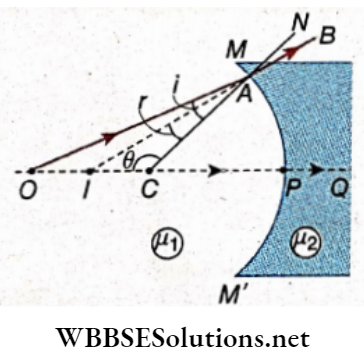
Class 12 Physics Unit 6 Optics Chapter 3 Refraction Of Light At Spherical Surface Lens Refraction At Concave Surface

Now from the triangle AOC have

⇒ \(\frac{\sin i}{C O}=\frac{\sin \theta}{A O} \text { or, } \frac{\sin i}{\sin \theta}=\frac{C O}{A O}\)

From the triangle AIC we have

⇒ \(\frac{\sin r}{C I}=\frac{\sin \theta}{A I}, \text { or, } \frac{\sin r}{\sin \theta}=\frac{C I}{A I}\)

Again considering refraction at point A, according to Snell’s law we have

μ1 sin i = μ2 sin

Or, \(\mu_1 \frac{\sin t}{\sin \theta}=\mu_2 \frac{\sin r}{\sin \theta}\)…………. (3)

From equations (1), 2) and(3) we have,

For the small aperture of the spherical surface

AO ≈ PO; and AI ≈ PI

Or, \(\mu_1\left(\frac{P O-P C}{P O}\right)=\mu_2\left(\frac{P I-P C}{P I}\right)\)

Or, \(\mu_1\left(1-\frac{P C}{P O}\right)=\mu_2\left(1-\frac{P C}{P I}\right)\)

Or, \(\mu_1\left(1-\frac{-R}{-u}\right)=\mu_2\left(1-\frac{-R}{-v}\right)\)

Or, \(\mu_1\left(1-\frac{R}{u}\right)=\mu_2\left(1-\frac{R}{v}\right) \text { or, }\left(\frac{\mu_2}{v}-\frac{\mu_1}{u}\right) R=\mu_2-\mu_1\)

Or, \(\frac{\mu_2}{v}-\frac{\mu_1}{u}=\frac{\mu_2-\mu_1}{R}\) …………….. (4)

Equation (4) is called Gauss’ equation for refraction at a concave spherical surface.

If the object O is in air, μ1 = 1 and μ2 = μ (say), then equation (4) becomes

⇒ \(\frac{\mu}{v}-\frac{1}{u}=\frac{\mu-1}{R}\)…………………….. (5)

Short Notes on Spherical Lenses and Refraction

2. When the object is virtual and the Image formed is real:

Let MPM’ be a concave surface separating two media of refracting indices μ1 and μ2 ( μ2 > μ1 ) the pole and C be the centre of curvature of the concave surface.

O is the virtual point object on the principal axis of the concave surface and I is its real image.

Let angle of incidence ∠DAC = opposite angle ∠NAO = i; angle of refraction, ∠NAI = r; ∠ACP = Q ; virtual object distance, PO = u; real image distance, PI = v; radius of curvature,
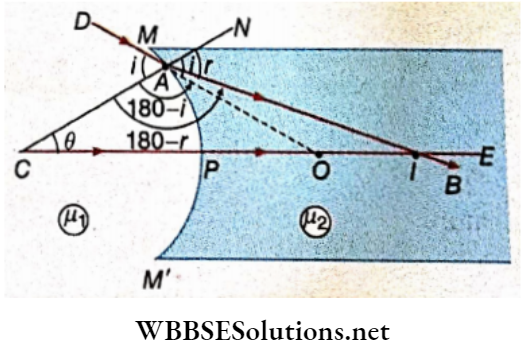
Class 12 Physics Unit 6 Optics Chapter 3 Refraction Of Light At Spherical Surface Lens Virtual And The In Image Formed Is Real

Now, from ΔAOC we have

⇒ \(\frac{\sin \left(180^{\circ}-i\right)}{C O}=\frac{\sin \theta}{A O}\)

Or, \(\frac{\sin i}{C O}=\frac{\sin \theta}{A O}\)

Or, \(\frac{\sin i}{\sin \theta}=\frac{C O}{A O}\) ……………………… (6)

From ΔACI we have,

⇒ \(\frac{\sin \left(180^{\circ}-r\right)}{C I}=\frac{\sin \theta}{A I}\)

Or, \(\frac{\sin r}{\sin \theta}=\frac{C I}{A I}\) ……………………… (7)

Again considering refraction at point A, according to Snell’s law we have,

⇒ \(\mu_1 \sin i=\mu_2 \sin r\)

Or, \(\mu_1 \cdot \frac{\sin i}{\sin \theta}=\mu_2 \cdot \frac{\sin r}{\sin \theta}\) ………………………  (8)

From equations (6), (7) and (8) we have

⇒ \(\mu_1 \cdot \frac{C O}{A O}=\mu_2 \cdot \frac{C I}{A I}\)

Or, \(\mu_1 \frac{C O}{P O}=\mu_2 \frac{C I}{P I}\) [ Small aperture approximation]

Or, \(\mu_1\left(\frac{C P+P O}{P O}\right)=\mu_2\left(\frac{C P+P I}{P I}\right)\)

Or, \(\mu_1\left(1+\frac{C P}{P O}\right)=\mu_2\left(1+\frac{C P}{P I}\right)\)

Or, \(\mu_1\left(1+\frac{-R}{u}\right)=\mu_2\left(1+\frac{-R}{v}\right)\)

Or, \(\mu_1\left(1-\frac{R}{w}\right)=\mu_2\left(1=\frac{R}{v}\right)\)

Or, \(\left(\frac{\mu_2}{v}-\frac{\mu_1}{u}\right) R=\mu_2-\mu_1\)

Or, \(\frac{\mu_2}{v}-\frac{\mu_1}{u}=\frac{\mu_2-\mu_1}{R}\) …………………………….. (9)

If μ1 = 1 and μ2= 2 equation (9) takes the form

⇒ \(\frac{\mu}{v}-\frac{1}{u}=\frac{\mu-1}{R}\)…………….. (10)

When the object is real and lies in a denser medium and the image formed is virtual:

In MPM’ is a spherical surface which is concave towards the rarer medium.

Object O is placed in the denser medium. The virtual image of the object is I.

Here μ1 2

Let angle of incidence, ∠DAO = i;

Angle of refraction, ∠BAC = r;  ∠ACP =  θ

Object distance, PO = -u;

Image distance, PI = -v;

The radius of curvature, PC = R
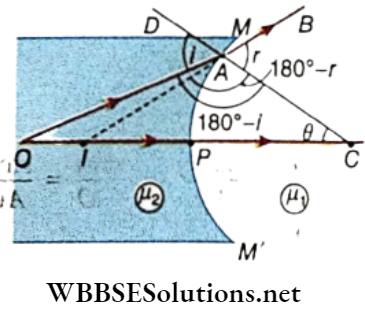
Class 12 Physics Unit 6 Optics Chapter 3 Refraction Of Light At Spherical Surface Lens Real Image And Lies In Denser Medium

Now, from the triangle ACO, we have,

⇒ \(\frac{\sin \left(180^{\circ}-i\right)}{O C}=\frac{\sin \theta}{O A}\)

Or, \(\frac{\sin i}{O C}=\frac{\sin \theta}{O A}\) ……………….. (11)

And we have from AACI

⇒  \(\frac{\sin \left(180^{\circ}-r\right)}{I C}=\frac{\sin \theta}{I A}\)

Or, \(\frac{\sin r}{\sin \theta}=\frac{I C}{I A}\) …………… (12)

Again considering refraction at point A, according to Snell’s law we have,

μ1 sin i = μ2 sin r

⇒ \(\mu_2 \frac{\sin i}{\sin \theta}=\mu_1 \frac{\sin r}{\sin \theta}\)

From the equations (11), (12) and (13) we have

⇒ \(\mu_2 \cdot \frac{O C}{O A}=\mu_1 \cdot \frac{I C}{I A}\)

Or, \(\mu_2\left(\frac{O P+P C}{O P}\right)=\mu_1\left(\frac{I P+P C}{I P}\right)\)

∴ For small aperture of the spherical surface OA≈OP; IA≈IP

Or, \(\mu_2\left(1+\frac{P C}{O P}\right)=\mu_1\left(1+\frac{P C}{I P}\right)\)

Or, \(\mu_2\left(1+\frac{R}{-w}\right)=\mu_1\left(1+\frac{R}{-v}\right) \text { or, } \mu_2\left(1-\frac{R}{w}\right)=\mu_1\left(1-\frac{R}{v}\right)\)

Or, \(\mu_2-\mu_1=\mu_2 \cdot \frac{R}{u}-\mu_1 \cdot \frac{R}{v}\)

Or, \(\mu_2-\mu_1=R\left(\frac{\mu_2}{u}-\frac{\mu_1}{v}\right) \text { or, } \frac{\mu_2}{u}-\frac{\mu_1}{v}=\frac{\mu_2-\mu_1}{R}\)

Or, \(\frac{\mu_1}{v}-\frac{\mu_2}{u}=\frac{\mu_1-\mu_2}{R}\) ……………………. (14)

If μ2 = μ  and μ1 = 1, the equation (14) takes the form

⇒ \(\frac{1}{v}-\frac{\mu}{u}=\frac{1-\mu}{R}\)

Or, \(\frac{\mu}{u}-\frac{1}{v}=\frac{\mu-1}{R}\)…………………. (15)

Refraction at Convex Surface

1. When the object is real and lies in a rarer medium and the image formed is virtual:

Let MPM’ be a convex surface separating two media of refractive indices and μ221)

An incident ray of OA after refraction at point A on the surface goes along AB in the denser medium
Class 12 Physics Unit 6 Optics Chapter 3 Refraction Of Light At Spherical Surface Lens An Incident Of Ray

Another ray of tight OP moving along the principal axis Is incident on the surface normally and hence gets undeviated into the denser medium. The two refracted rays AB and PQ when produced back meet on the principle axis at point I which is the virtual image Of O

Let the angle of incidence ∠OAN = r

∴ ∠CAO = 180°- i

Angle of refraction, ∠BAC = ∠IAN = r

∴ ∠CAI = 180°-r

Let, ∠ACO = θ

Object distance a PO = -u

Image distance, PI = -v

radius of curvature, PC = R

From tire ΔACO we have

⇒ \(\frac{\sin \left(180^{\circ}-i\right)}{C O}=\frac{\sin \theta}{A O}\)

Or, \(\frac{\sin i}{C O}=\frac{\sin \theta}{A O}\)

Or, \(\frac{\sin i}{\sin \theta}=\frac{C O}{A O}\)

From the ΔACI we have

⇒ \(\frac{\sin \left(180^{\circ}-r\right)}{C I}=\frac{\sin \theta}{A I}\)

Or, \(\frac{\sin r}{C I}=\frac{\sin \theta}{A I}\)

Or, \(\frac{\sin r}{\sin \theta}=\frac{C l}{A l}\)

Again, considering ing refraction at point A, according to Snell’s law we have

μ1 sin = μ2 sin r

⇒ \(\mu_1 \cdot \frac{\sin i}{\sin \theta}=\mu_2 \cdot \frac{\sin r}{\sin \theta}\). ………………………………. (3)

From equations (1), (2) and (3) we have

⇒  \(\mu_1 \cdot \frac{C O}{A O}=\mu_2 \cdot \frac{C I}{A I}\)

⇒  \(\mu_1 \cdot \frac{C O}{A O}=\mu_2 \cdot \frac{C I}{A I}\)

∴ For small aperture of the spherical surface AO ≈ PO, AI≈pI

⇒  \(\mu_1\left(\frac{P C+P O}{P O}\right)=\mu_2\left(\frac{P C+P I}{P I}\right)\)

⇒  \(\mu_1\left(\frac{P C}{P O}+1\right)=\mu_2\left(\frac{P C}{P I}+1\right)\)

⇒  \(\mu_1\left(\frac{P C}{P O}+1\right)=\mu_2\left(\frac{P C}{P I}+1\right)\)

Or, \(\mu_1\left(\frac{R}{-u}+1\right)=\mu_2\left(\frac{R}{-\nu}+1\right)\)

⇒  \(\mu_1\left(1-\frac{R}{u}\right)=\mu_2\left(1-\frac{R}{\nu}\right) \text { or, }\left(\frac{\mu_2}{\nu}\right)\)

Or, \(\frac{\mu_2}{\nu}-\frac{\mu_1}{u}=\frac{\mu_2-\mu_1}{R}\) …………………….(4)

Equation (4)  is called Gauss’ equation for refraction for refraction at a convex spherical surface.It is similar to the equation (4)

If object O Is situated In the air,  μ1 = 1  and μ= μ  (say)

Convex spherical surface. It Is similar to the equation (4)  of the equation (4) becomes

⇒ \(\frac{\mu}{\nu}-\frac{1}{u}=\frac{\mu-1}{R}\) ……………………… (5)

2. When the object is real and lies In a rarer medium and the Image formed Is also real:

Let MPM’ be a convex surface separating two media of refractive Indices μ1 and μ2 ( μ2 > μ1 ). Let P be the pole and C be the centre of curvature of the convex surface. O is the point object on the principal axis of the convex surface and I is its real Image.

Let the angle of Incidence, ∠NAO = i

The angle of refraction,∠ IAC = r;

∠ACO = θ

Object distance, PO = -u

Image distance, PI = v

The radius of curvature, PC = R
Class 12 Physics Unit 6 Optics Chapter 3 Refraction Of Light At Spherical Surface Lens Real Image And Lies In Rarer Medium

Now, from ΔACO we have

⇒ \(\frac{\sin \left(180^{\circ}-i\right)}{C O}=\frac{\sin \theta}{A O}\)

Or,  \(\frac{\sin i}{C O}=\frac{\sin \theta}{A O}\)

Or, \(\frac{\sin l}{\sin \theta}=\frac{C O}{A C}\) …………………………………….. (6)

From ΔAIC we have

⇒  \(\frac{\sin r}{C I}=\frac{\sin \left(180^{\circ}-\theta\right)}{A I}\)

Or, \(\frac{\sin r}{\sin \theta}=\frac{C I}{A I}\) ……………………………………….. (7)

Again, considering refraction at point A, according to Snell’s law we have,

μ1 Sini = μ2 Sini r

Or, \(\mu_1 \cdot \frac{\sin i}{\sin \theta}=\mu_2 \cdot \frac{\sin r}{\sin \theta}\)  ………………………………. (8)

From equations (6), (7) and (8) we have,

⇒  \(\mu_1 \cdot \frac{C O}{A O}=\mu_2 \cdot \frac{C I}{A I}\)

Or, \(\mu_1 \cdot \frac{C O}{P O}=\mu_2 \cdot \frac{C I}{P I}\)

For the small aperture of the spherical surface AO ≈  PO, AI ≈ PI

Or, \(\mu_1\left(\frac{P O+P C}{P O}\right)=\mu_2\left(\frac{P I-P C}{P I}\right)\)

Or, \(\mu_1\left(1+\frac{P C}{P O}\right)=\mu_2\left(1-\frac{P C}{P I}\right)\)

Or, \(\mu_1\left(1+\frac{R}{-u}\right)=\mu_2\left(1-\frac{R}{v}\right)\)

Or, \(\mu_1\left(1-\frac{R}{w}\right)=\mu_2\left(1-\frac{R}{v}\right)\)

Or, \(\frac{\mu_2}{v}-\frac{\mu_1}{u}=\frac{\mu_2-\mu_1}{R}\) ……………………………………….  (9)

If the object O is situated in air, μ1 = 1  and μ= μ (say) the equation (9) becomes

Or, \(\frac{\mu}{v}-\frac{1}{u}=\frac{\mu-1}{R}\)……………………………………….. (10)

WBCHSE class 12 physics lens notes

2. When the object is real and lies in a denser medium and the image formed is real:

In  MPM’ is a spherical surface which is convex towards the rarer medium. The object O is placed in the denser medium. The real image formed is I.
Class 12 Physics Unit 6 Optics Chapter 3 Refraction Of Light At Spherical Surface Lens Real Image And Lies In Denser Medium Image Formed Is Real

Let the angle of incidence, ∠CAO = i

The angle of refraction, ∠NAI = r;

∠ACP = θ;

Object distance, PO = -u

Image distance, PI = + v

The radius of curvature, PC = -R

Now, from the triangle ACO we have

⇒ \(\frac{\sin i}{O C}=\frac{\sin (180-\theta)}{O A}\)

Or, \(\frac{\sin i}{O C}=\frac{\sin \theta}{O A}\)

Or, \(\frac{\sin i}{\sin \theta}=\frac{O C}{O A}\)…………………………………… (11)

From the triangle AIC, We have,

⇒ \(\frac{\sin \left(180^{\circ}-r\right)}{C I}=\frac{\sin \theta}{A I}\)

Or, \(\frac{\sin r}{\sin \theta}=\frac{C I}{A I}\) ………………………… (12)

Again considering refraction at point A, according to Snell’s law we have,

μ1 sini =  μ2 sin r

Or, \(\mu_2 \cdot \frac{\sin i}{\sin \theta}=\mu_1 \cdot \frac{\sin r}{\sin \theta}\) ……………………………. (13)

From equations (11), (12) and (13) we have,

⇒ \(\mu_2 \cdot \frac{O C}{O A}=\mu_1 \cdot \frac{C I}{A I}\)

Or, \(\mu_2 \cdot \frac{O C}{O P}=\mu_1 \cdot \frac{C I}{P I}\)

For small aperture of the spherical surface OA ≈ OP; IA ≈ IP

Or, \(\mu_2\left(\frac{O P-P C}{O P}\right)=\mu_1\left(\frac{P I+P C}{P I}\right)\)

Or, \(\mu_2\left(1-\frac{P C}{O P}\right)=\mu_1\left(1+\frac{P C}{P I}\right)\)

Or, \(\mu_2\left(1-\frac{-R}{-w}\right)=\mu_1\left(1+\frac{-R}{v}\right)\)

Or, \(\left(\frac{\mu_1}{v}-\frac{\mu_2}{u}\right) R=\mu_1-\mu_2\)

Or, \(\frac{\mu_1}{v}-\frac{\mu_2}{u}=\frac{\mu_1-\mu_2}{R}\) ……………………. (14)

If  μ2 = μ and μ1= 1 the equation (14) takes the form

⇒ \(\frac{1}{v}-\frac{\mu}{u}=\frac{1-\mu}{R}\)

Or, \(\frac{\mu}{u}-\frac{1}{v}=\frac{\mu-1}{R}\) ………………………………………. (15)

If the object is a mat and lies In a rarer medium, then relation \(\frac{\mu_2}{v}-\frac{\mu_1}{u}=\frac{\mu_2-\mu_1}{R}\) is valid irrespective of the type of the spherical refracting surface

If the object is real and lies in the denser medium, then relation \(\frac{\mu_1}{v}-\frac{\mu_2}{u}=\frac{\mu_1-\mu_2}{R}\)  is valid irrespective of the type of the spherical refracting surface

Here  u =  object distance, v = image distance, r = radius of Air Venture of spherical refracting surface, μ1 = refractive index of rarer medium and μ2  =  refractive index of denser medium

Refraction At Spherical Surfaces Class 12 Notes

Refraction Of Light At Spherical Surface Lens Refraction At Spherical Surfaces Numerical Examples

Example 1.  There is a small air bubble inside a glass sphere; (μ = 1.5) of radius 10 cm. The bubble is 4 cm below the surface and is viewed nearly normal from the out side. Find the apparent depth of the bubble
Solution: 

Here, u = -4 cm; r =  -10 cm; μ2 = 1.5, μ1= 1

O is the position of the bubble and I is the position of the image of the bubble
Class 12 Physics Unit 6 Optics Chapter 3 Refraction Of Light At Spherical Surface Lens Small Air Bubble Inside A Glass Sphere

We know, \(\frac{\mu_1}{v}-\frac{\mu_2}{u}=\frac{\mu_1-\mu_2}{r}\)

Or, \(\frac{1}{v}-\frac{1.5}{-4}=\frac{1-1.5}{-10}\)

Or, \(\frac{1}{v}=\frac{0.5}{10}-\frac{1.5}{4}\)

Or,  v = -3 cm

Thus the bubble will appear 3 cm below the top point of the sphere.

Example 2. A point of red mark on the surface of a glass sphere Is observed straight, nearly along the diameter from the opposite surface of the sphere. If the diameter of the sphere is 20 cm and the refractive index of the glass is 1.5, find the position of the image. Sftlutlan: Let P be a point of red mark on the glass sphere being observed from point A
Solution:

According to the question, object distance = AP = u = -20:  radius of curvature = r = -10 cm
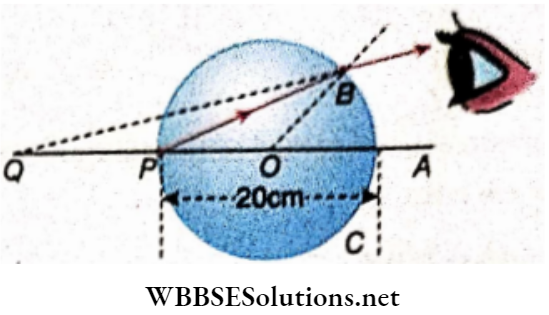
Class 12 Physics Unit 6 Optics Chapter 3 Refraction Of Light At Spherical Surface Lens Red Mark On The Surface Of A Glass Sphere

In this case, the object lies in the denser medium μ2=  1.5

The observer is situated in the rarer medium (μ1= 1)

So, in case of refraction in the spherical surface BAC

⇒ \(\frac{\mu_1}{v}-\frac{\mu_2}{u}=\frac{\mu_1-\mu_2}{r}\)

Or, \(\frac{1}{v}-\frac{1.5}{-20}=\frac{1-1.5}{-10}\)

Or, \(\frac{1}{v}+\frac{15}{200}=\frac{-0.5}{-10}\)

Or, \(\frac{1}{v}=\frac{5}{100}-\frac{15}{200}\)

Or, \(\frac{1}{v}=\frac{10-15}{200}=\frac{-5}{200}\)

or, v = -40 cm

So, a virtual image will be formed on Q on the extended line AOP at a distance of 40 cm from point A. So the virtual position of the red spot will be found (40- 20) or 20 cm behind its real position while looking through the sphere

Common Questions on Refraction at Lenses

Example 3. A mark exists at a distance of 3 cm on the axis from the plane surface of a hemisphere of glass. If the mark Is observed from above the curved surface determine the apparent position of the mark. The radius of the hemisphere = 10 cm; the refractive index of glass = 1.5.
Solution: 

A is the position of the mark  A’ is the position of its image.

u = -OA = -(OC- AC) = -(10 – 3) = -7 cm

r = -10 cm; μ2 = 1.5 and μ1= 1

We know \(\frac{\mu_1}{v}-\frac{\mu_2}{u}=\frac{\mu_1-\mu_2}{r}\)

Or, \(\frac{1}{v}-\frac{1.5}{-7}=\frac{1-1.5}{-10}\)

Or, \(\frac{1}{v}+\frac{1.5}{7}=\frac{0.5}{10}\)

Or, \(\frac{1}{v}=\frac{0.5}{10}-\frac{1.5}{7}\)

Or, \(\frac{1}{v}=\frac{-11.5}{70}\)

Or,  v = – 6.09 cm

∴ Position of±e ima8e from the plane surface is at a distance of (10 – 6.09) or 3.91 cm
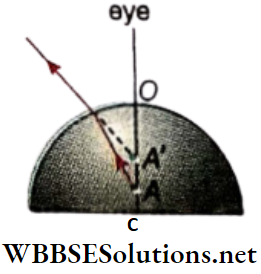
Class 12 Physics Unit 6 Optics Chapter 3 Refraction Of Light At Spherical Surface Lens Radius Of The Hemisphere

Example 4. A parallel beam of light travelling In the water is refracted a by a spherical air bubble of radius 2 mm situated In the water. Find the position of the Image due to refraction at the first surface and the position of the final Image. Refractive Index of water = 1.33. Draw a ray diagram showing the positions of both the Images.
Solution:

Let C be the centre of the spherical air bubble. P1 and P2 are the poles of the spherical surfaces. A beam of light parallel to the diameter of the sphere, after refraction at the first surface, forms a virtual Image I1 After that it forms another virtual image I2 due to refraction at the second surface.
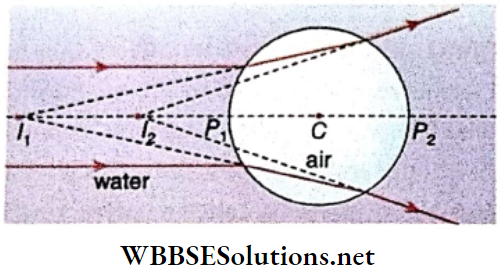
Class 12 Physics Unit 6 Optics Chapter 3 Refraction Of Light At Spherical Surface Lens A Parallel Beam Of Light Travelling In Water

We know \(\frac{\mu_1}{v}-\frac{\mu_2}{u}=\frac{\mu_1-\mu_2}{r}\)

For refraction at the first surface of the bubble (from water to air)

μ1 = 1 ,μ = 1.33 ; u = ∞ and r = 2 mm

⇒ \(\frac{1}{v}=\frac{1.33}{\infty}=\frac{1-1.33}{2}\)

Or, \(\frac{1}{v}=\frac{-1}{6}\)

v = -6 mm

The negative sign indicates that the image Ix is virtual and forms at 6 mm from the surface of the bubble on the waterside. The refracted rays (which seem to come from I1 ) are incident on the farther surface of the bubble. For this refraction, μ1 = 1, μ =  1. 33 , r = 2 mm and u = -(6 + 4) = -10 mm

∴ \(\frac{\mu_2}{v}-\frac{\mu_1}{u}=\frac{\mu_2-\mu_1}{r}\)

Or, \(\frac{1.33}{\nu}+\frac{1}{10}=\frac{1.33-1}{-2}\)

Or, \(\frac{1.33}{v}=\frac{-0.33}{2}-\frac{1}{10}\)

Or, v = – 5mm

The negative sign shows that the image is formed on the air side at 5 mm from the second refracting surface.

Measuring from the centre of the bubble the first image is formed at (6+2) or 8 mm from the centre and the second image is formed at (5- 2). or 3 mm from the centre. Both images are formed on the side from which the incident rays are coming.

Practice Problems on Lens and Spherical Surface Refraction

Example 5. A spherical surface of radius of curvature R separates air (refractive Index 1.0) from glass (refractive Index = 1.5). The centre of curvature Is In the glass A point object P placed In the air is found to have a real Image Q In the glass. The line PQ cut the surface at a point O and PO = OQ. Find the distance of the object from the spherical surface.
Solution:

Let PO = OQ = x. Suppose object and image distances are u and v respectively.

We, know ,\(\frac{\mu_2}{v}-\frac{\mu_1}{u}=\frac{\mu_2-\mu_1}{R}\)

Here,  μ2 = 1.5 , μ1 = 1, v = +x, u = -x

From equation (1),

⇒ \(\frac{1.5}{x}-\frac{1}{-x}=\frac{1.5-1}{+R}\)

Or, \(\frac{2.5}{x}=\frac{0.5}{R}\)

Or, x = 5R

Hence distance of the object from the spherical surface is 5R.
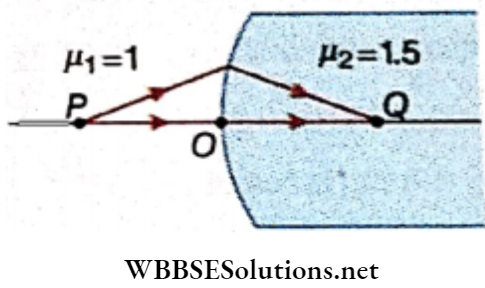
Class 12 Physics Unit 6 Optics Chapter 3 Refraction Of Light At Spherical Surface Lens A Spherical Surface Of Radius Of Curvacture R Separates Air

Refraction Of Light At Spherical Surface Lens Application Of Refraction In A Spherical Surface Lens

Spherical surface  Definition:  A lens Is a portion of a transparent refracting medium bounded by two spherical surfaces or a spherical surface and a plane surface.

The lens is generally of two types:

  1. Convex or converging lens and
  2. Concave or diverging lens.

Class 12 Physics Unit 6 Optics Chapter 3 Refraction Of Light At Spherical Surface Lens Convex Or Conver ging Lens And Concave Or Diverging Lens

A lens which is thicker in the middle than towards its edges is called a convex lens. A lens which is thinner in the middle than towards the  edges is called a concave lens

Refraction at spherical surfaces class 12 notes

Refraction Of Light At Spherical Surface Lens Different Types Of Lenses

Convex lens

Convex lenses may be of three types according to the shape of two surfaces forming it.
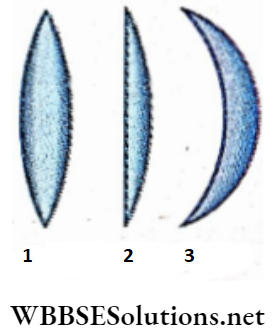
Class 12 Physics Unit 6 Optics Chapter 3 Refraction Of Light At Spherical Surface Lens Convex Bi Convex Or Double Convex Lens

  1.  Bi-convex or double convex lens: It is one in which both the surfaces are convex   The radii of curvature of both the surfaces may or may not be equal. If the radii of curvature are equal, the convex lens is called the equi-convex lens.
  2.  Plano-convex lens: It is a lens with one surface plane and the other convex.
  3.  Concavo-convex lens: Here one surface is concave and the other is convex  In this type of lens the radius of curvature of the convex surface is smaller than that of the concave surface.

Concave lens

Similarly, the concave lens may be of three types according to the shape of two surfaces forming it
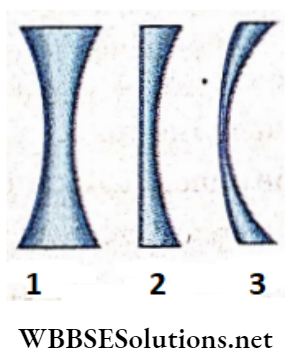
Class 12 Physics Unit 6 Optics Chapter 3 Refraction Of Light At Spherical Surface Lens Concave Bi Concave Or Double Concave Lens

  1. Bi-concave or double-concave Lens: This type of lens has both surfaces concave. The radii of curvature of both surfaces may or may not be equal. If the radii of curvature are equal, the. concave lens is called the equiconcave lens.
  2. Plano-concave lens: This type of lens has one surface, plane and the other concave.
  3. Convexo-concave lens: Here one surface Is convex and the other is concave. The radius of curvature of the concave surface Is smaller than that of the convex surface,

Refraction at spherical surfaces class 12 notes 

Refraction Of Light At Spherical Surface Lens Action Of A Lens

Principal axis

The line passing through the centres of curvature of the two bounding surfaces of a lens Is called the principal axis of the lens. If one surface of the lens is spherical and the other plane, then the perpendicular drawn from the curvature of the spherical surface to the plane surface is the principal axis of the lens. [The definition of centre of curvature is given in the section 3.9

Converging and diverging lenses

If the surrounding medium of a lens is rarer compared to the medium of the lens, then the parallel beam of rays after refraction through a convex or a concave lens appears to be converging or diverging respectively. Therefore, a convex lens is called a converging lens and a concave lens is called a diverging lens.

1. Convergence by the convex lens:

A convex lens may be imagined as being formed of two sets of truncated prisms arranged symmetrically on the opposite sides of a central paral¬ lel-faced rectangular slab. the prisms in each set being placed one above another with their bases turned towards the principal axis of the lens
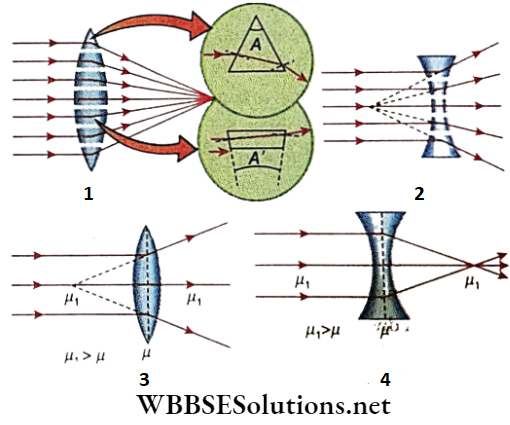
Class 12 Physics Unit 6 Optics Chapter 3 Refraction Of Light At Spherical Surface Lens Convergence By Convex Lens

As we move further away from the principal axis the angle of refraction consequently keeps on increasing. Any parallel ray incident on a prism will bend by refractippÿthrough the prism towards its base. Since the refracting angles of.the various prisms.

Increase successively with their distance from the principal axis, the raj’s which fall on a prism at a distance from the axis is bent more than those which pass nearer to the axis. So a pencil of parallel rays is refracted by the combination of prisms i.e, by the convex lens to converge to a particular point on the princi¬ pal axis. Hence, a convex lens is called a converging lens,

2. Divergence by concave lens:

Let us refer to the concave lens may also be imagined as being formed of two sets of truncated prisms arranged symmetrically on the opposite sides of a central parallel-faced slab. The pile of prisms on each side of the principal axis have their refracting angles turned towards the axis. So their bases are turned towards the edge of the lens.

Therefore in this case a pencil of parallel rays after refraction through the prism will bend away from the axis being tinned towards foe bases of foe prisms. So for emergent light will behave as a divergent beam. Hence, a concave lens is called a diverging lens.

Divergence by the convex lens and convergence by the concave lens

It is to be noted that usually, a convex lens acts as a converging lens and a concave lens as a diverging one. These types of behaviour offoe lenses are seen when foe refractive indices offoe material of foe lenses are greater than that of the surrounding medium. But if the refractive index of the material of for lens is less than that of the surrounding medium i.e., the medium surrounding the lens is denser, the convex lens will diverge and a concave lens will converge for incoming parallel rays

Refraction at spherical surfaces class 12 notes 

Refraction Of Light At Spherical Surface Lens A Few Definitions

Centre of curvature: Generally the two surfaces of a lens are spherical. The two spherical surfaces are each a part of two spheres. The centres of the spheres are called the centres of curvature of the Idris.

If for two surfaces of a lens are spherical, the centres of the nature of the lens are at a finite distance. C1 and C2 are the centres of curvature of the lenses. If the surface of the lens is plane, the centre of curvature of that surface is at infinity
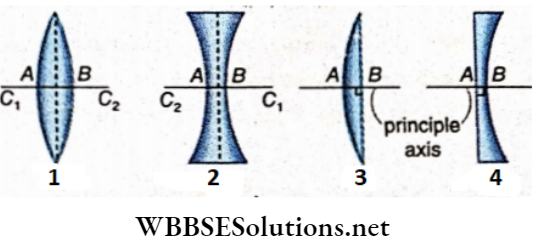
Class 12 Physics Unit 6 Optics Chapter 3 Refraction Of Light At Spherical Surface Lens Centre Of Curvacture

Radius Of curvature

The two spherical surfaces are each a part of two spheres. The radii of the spheres are called the radii of curvature of the lens.

If the two surfaces of a lens are spherical, each radius of curvature is finite. AC2 and BC1 are the radii of curvature of the lens. If one of the surfaces is plane, its radius of curvature is infinite

Principal axis

For a lens having two spherical surfaces, the line passing through the centres of curvatures of the two bounding surfaces of a lens is called the principal axis of the lens for the principal axis of the ~ lens.

If one surface of the lens is spherical and the other is a plane, then the perpendicular drawn from the centre of curvature of the spherical surface to the plane surface is the principal axis of the lens

Optical centre

If a ray of light passes through a lens in such a way that the direction of emergence is parallel to the direction of incidence, the path of the ray inside the lens intersects the principal axis at a fixed point. This fixed point for a lens is called its optical centre

The incident ray AB and the emergent ray CD are parallel to each other. The refracted ray BC intersects the principal axis at O . So point 0 is the optical centre of the lens.

It is to be noted that the incident ray AB and the emergent  CD do not lie on the same straight line. The emergent ray CL is laterally displaced from the incident ray AB. The displacement will be small if the lens is a thin one. If the lens is very thin
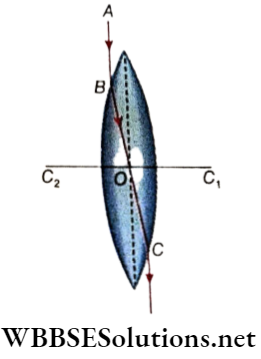
Class 12 Physics Unit 6 Optics Chapter 3 Refraction Of Light At Spherical Surface Lens Optical Centre

The displacement is so negligible that AB, BC and CD may be taken as the same straight line. So we can say that the optical centre of a thin lens Is such n point on Its principal axis that a ray passing through it passes out straight without any displacement or deviation.

The optical centre is a fixed point:

The optical centre of a lens Is a fixed point on Its principal axis. But the position of the point depends oil its shape. It can be proved in die following way.

C1 and C2 are the centres of curvature of the spherical surfaces LBL’ and LAL’ respectively. Q and R are two points on the spherical surfaces. If r1 and r2 are the radii of curvature of the surfaces LBL’ and LAL’ then C1Q = C1B = r1 and C2R = C2A = r1
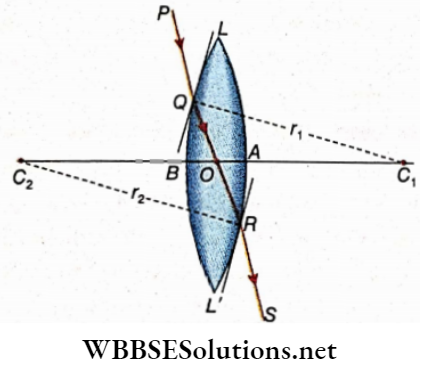
Class 12 Physics Unit 6 Optics Chapter 3 Refraction Of Light At Spherical Surface Lens Optical Centre Is A Fixed Point

Let us join Q and R and let the line QR intersect the principal axis at O . Therefore, O is the optical centre of the lens. Thus the rays PQ and RS are parallel to each other. Suppose, the thickness of the lens =AB = t.

Two tangent planes are drawn at Q and R of the two surfaces of the lens. We know that when a ray is refracted through a parallel glass slab the incident ray and the emergent ray are parallel.

In this case, the rays PQ and RS being parallel we can assume that the ray PQ is refracted through a parallel glass slab. So the tan¬ gent planes at Q and R will be parallel to each other.

The radius of curvature C1Q is perpendicular to the tangent plane at Q and the radius of curvature C2R is perpendicular to the tangent plane at R. Since the two tangent planes are parallel, therefore C1Q  and C2 R are parallel, to each other.

So the triangles C1OQ and C2OR are similar.

∴  \(\frac{O C_1}{O C_2}=\frac{C_1 Q}{C_2 R}=\frac{r_1}{r_2}\)

∴  \(\frac{O C_1}{O C_2}=\frac{C_1 n}{C_2 A}\)

= \(\frac{C_1 B-O C_1}{C_2 A-O C_2}=\frac{O B}{O A}\)

⇒ \(\frac{r_1}{r_3}=\frac{O B}{O A}\)

So, the point O divides the thickness of the lens AB In a fixed ratio i.e., in ratio of the radii of curvature of the two surfaces

Again \(\frac{r_1}{r_1+r_2}=\frac{O B}{O B+O A}=\frac{O B}{A B}=\frac{O B}{t}\)

∴ OB = \(\frac{t r_1}{r_1+r_2}\), OA = \(\frac{t r_2}{r_1+r_2}\) …………………………………………. (2)

Since t, r1 and r2 are constants, the position of O is constant. i.e., the optical centre O of a lens is a fixed point.

  1. In the case of equi-convex and equi-concave lenses:  In this case since r1 = r2 therefore from equation (1), we get OB = OA. i.e., in this case, the optical centre is situated on the principal axis within the lens and equidistant from both surfaces.
  2. In the case of plano-convex and plano-concave lenses: In this case, one surface of the lens is the plane. Therefore when  r1→∞ , then OA →0. Again when r2→ ∞ , then OB →0. So, in this case, the optical centre lies at the intersecting point of the spherical surface with the principal axis
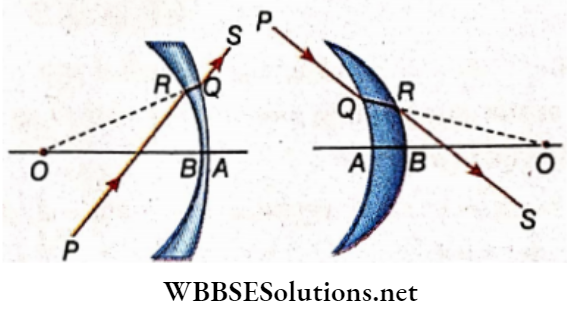
Class 12 Physics Unit 6 Optics Chapter 3 Refraction Of Light At Spherical Surface Lens Spherical Surface With The Principle Axis

It is to be noted that the optical centre may be within the lem or outside, depending on the nature of the two surfaces, the case of the concavo-convex and convexo-concave optic centre lies outside the lens, Wherever the position of the optical centre, its distance from any surface of lens is proportional to the radius of curvature of the surface because

⇒ \(\frac{O B}{O A}=\frac{r_1}{r_2}\)

Refraction through spherical surfaces physics notes Principle focuses

Suppose, a narrow beam of rays parallel to the principal axis is incident on a lens’

  1.  If the lens is convex, the beam of rays after refraction verges to a point on the principal axis. This point is called the principal focus of the lens.
  2. If the lens is concave, the beam of rays after refraction appears to diverge from a point on the principal axis. This point is called the principal focus of the lens.
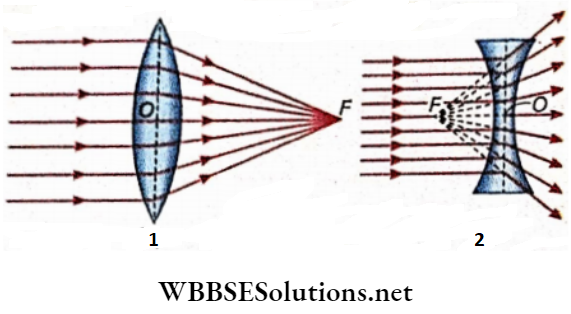
Class 12 Physics Unit 6 Optics Chapter 3 Refraction Of Light At Spherical Surface Lens Principle Focus

The point F is the principal focus of the lens. A lens has two principal foci. Here in either case point F is the second principal focus of the lens. In addition to this principal focus a lens has another principal focus which is called the first principal focus.

1. First principal focus:

  • In the case of a convex lens: The first principal focus is a point on its principal axis such that the rays diverging from it emerge parallel to the axis after refraction through the lens.
  • In the case of a concave lens: The first principal focus is a point on its principal axis such that the rays directed towards it emerge parallel to the axis after refraction through the lens. The point F’ is the first principal focus.

2. The second principal focus is conventionally called the principal focus of a lens:
Class 12 Physics Unit 6 Optics Chapter 3 Refraction Of Light At Spherical Surface Lens The Second Principle Focus Is Conventionally

Focal Length

The distance of the principal, focus from the optical centre of a lens is the focal length F of that lens.

1. The first principal focal length: 

Is the distance of the first principal focus from the oj$cal centre. The second principal focal length is the distance of the second principal focus from the optical centre.

The point O Is the optical centre.

OF’ = First principal focal length of the lens

OF = Second principal focal length of the lens

2. The second principal focal length Is conventionally taken as the focal length of a lens:

The value of the focal length of the lens depends on the colour of light, the lens medium and also on the surrounding medium. If the media on both sides of the lens are the same, then it can be proved that the first principal focal length (f1) and the second principal focal length (f2) are equal. But if the media are different on both sides, then these two lengths would be different.

Focal plane

A plane perpendicular to the principal axis of a lens drawn through the principal focus is known as the focal plane of a lens.

A lens has two focal planes corresponding to its two focal points. The focal plane through the first principal focus is called the first principal focal plane and the plane through the second principal focus is called the second principal focal plane.

Secondary focus

Suppose a beam of parallel rays inclined at a small angle with the principal axis of a lens is incident on it. The point on the focal plane to which the beam converges (in the case of the convex lens) and from which the beam appears to diverge (in the case of the concave lens) after refraction is called the secondary focus of the lens.

The point F’ is the secondary focus of the lens. It Is to be noted that the principal focus of a convex or concave lens Is a fixed point, but the secondary focus is not a fixed point. With the change of the angle of inclination of the incident rays with the principal axis of the lens, the position of the secondary focus changes. However the secondary focus always remains on the focal plane.
Class 12 Physics Unit 6 Optics Chapter 3 Refraction Of Light At Spherical Surface Lens Secondary focus

  1. Aperture: The boundary line of the planes of a lens is circular and the diameter of the circle is ordinarily called the aperture of the lens. In the diameter CD Is the aperture of the lens.
  2. Thin lens: A thin lens Is one in which the thickness at the principal axis Is small compared with the radii of curvature of the two surfaces

Refraction through spherical surfaces physics notes

Refraction Of Light At Spherical Surface Lens Determination of the Position Of An Image By Geometrical Method

In all the following discussions the lenses we shall deal with are thin lenses with small aperture.

To find the position of the image of an extended object placed on the principal axis of a lens

By the geometrical method, we should remember the following facts:

  1. A ray falling on a convex lens in a direction parallel to the principal axis converges to the second principal focus after refraction by the lens and a ray falling on a concave lens in a direction parallel to the principal axis appears to diverge from the second principal focus after refraction by the lens.
  2. A ray passing through the first principal focus of a convex lens or proceeding to the first principal focus of a concave lens will emerge parallel to the principal axis after refraction through it.
  3. A ray passing through the optical centre of a convex or a concave lens emerges out from the lens undeviated and undisplaced with respect to the direction of incidence as the concerned lens is a thin lens.

Using any two rays of the above-mentioned three rays, the image Q of an object can be drawn,  images have been drawn in different cases applying this method. These diagrams are called ‘Ray diagrams’

Refraction Of Light At Spherical Surface Lens Position Size And Nature Of The Image For Different Positions Of An Object

For any particular surrounding media (here, air), the position, size and nature of the image of an object formed by refraction in a lens depend on the position of the object with respect to the lens. How the position and nature of the Image change when the object is brought from infinity up to a position dose to the lens is shown below. For the convenience of discussion, we shall consider the object PQ to be placed perpendicular to the principal axis of the lens LL’ .{f is taken as the focal length of the lens).

In the case of convex lens

1. Object is placed at infinity:

If the object is at infinity, the rays of light from a point on the object may be considered parallel. The beam of parallel rays inclined at a small angle with the principal axis of the convex lens converges at this point p on the second principal focal plane after refraction the lens. So, the image is formed in the focal plane and it is real, inverted and infinitely diminished.
Class 12 Physics Unit 6 Optics Chapter 3 Refraction Of Light At Spherical Surface Lens Object Is Placed At Infinity Diminished

Use: The objective of a telescope is made by using this prop of the convex lens.

2. Object is placed between infinity and 2 f: 

The  object PQ is placed perpendicular to the principle axis of the convex lens LL’ and at a  distance greater than 2f from the lens
Class 12 Physics Unit 6 Optics Chapter 3 Refraction Of Light At Spherical Surface Lens Object Is Placed At Infinity And 2f

A ray travelling parallel to the principal axis the refraction through the lens passes through the focus F’ Another ray from p goes straight through the Optical centre O . These two refracted rays meet at the point p which is the image of p, from p, pq is drawn perpendicular to the principle axis Obviously, q is the image of the foot Q of the object. So, pq is the image of PQ.

3. Object is placed at 2f:   

The object PQ Is placed per appendicular to the principal axis of the convex lens I, If and is a distance 2f from the Leon A ray from travelling parallel to the principal axis air refraction through the lens passes through the focus P, Another ray from P goes straight through the optical centre Q, These two refracted rays meet at the point p which is the image of P from p, pq IN drawn perpendicular to the principal axis. Q Is the Image of the foot Q of the object. So, pq Is the image of PQ.
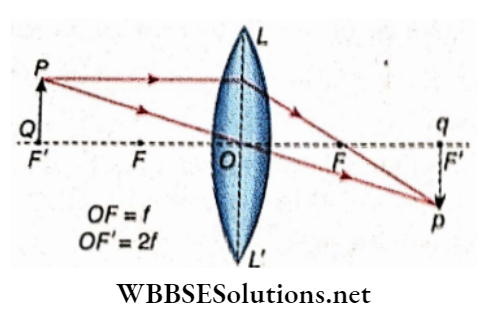
Class 12 Physics Unit 6 Optics Chapter 3 Refraction Of Light At Spherical Surface Lens Object Is Placed At 2f

Therefore, the image is formed on the side of the lens opposite to that of the object at a distance of 2f from the lens. The Image Is real, inverted and equal In size to the object

Use: In terrestrial telescope, this property of the convex lens Is utilised to convert the inverted Image Into an erect image of the same size.

4. Object is placed between f and 2f:

The object PQ is placed perpendicular to the principal axis of the convex lens LL’ and is placed between f and 2f, A ray from P travelling parallel to the principal axis after refraction through the lens passes through the focus P. Another ray from P goes straight through the optical centre 0. These two refracted rays meet at the point p which is the Image of P. From p, pq Is drawn perpendicular to the principle axis q is the image of the foot Q of the object. So pq is the images of PQ.
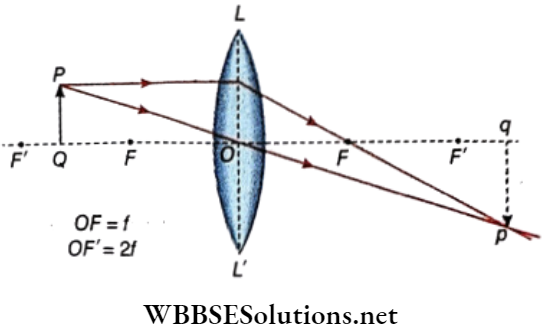
Class 12 Physics Unit 6 Optics Chapter 3 Refraction Of Light At Spherical Surface Lens Object Placed f And 2f

Therefore, die Image In formed on the side of the lens opposite to that of the object and at a distance greater than 2f. The image is real, inverted and magnified i size with respect to the object

Use:  The objective of a microscope Is made by utilising this property of the convex lens.

5. Object Is placed at:

The Object PQ is placed perpendicular to the principal axis of the convex lens LL’ and Is placed at focus. A ray from fi travelling parallel to the principal axis after refraction through the lens passes through DM focus V. Another ray from fi moves straight through Ilia optical centre O, these two refracted rays being parallel, the I Image of PQ Is assumed to be formed at infinity
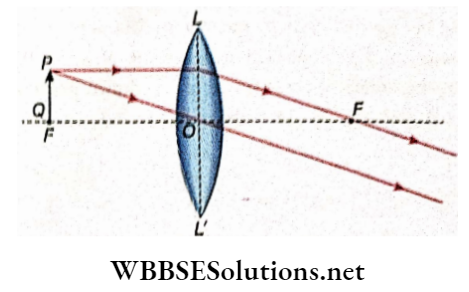
Class 12 Physics Unit 6 Optics Chapter 3 Refraction Of Light At Spherical Surface Lens Object Is Placed At f

Therefore, the linage Is formed at infinity on the side of the lens opposite to that of the object. The Image Is real, inverter and Infinitely magnified.

Use: The convex lens is utilised in the above way in such instruments whore the production of a parallel beam of rays is required. spectrometer parallel rays are produced in this way

Class 11 Physics Class 12 Maths Class 11 Chemistry
NEET Foundation Class 12 Physics NEET Physics

6. Object is placed between f and lens:

Is placed perpendicular to the principal axis of the convex le LL’ and Is placed between f and the lens. A ray free P travelling parallel to the principal axis after refraction through the lens passes through the focus F, Another ray horn I” moves straight through the optical centre 0. These two refracted rays are divergent. So when the two rays are produced backwards they meet at; which is the virtual Image of F. l; from p, pq is drawn perpendicular to the principal axis. So, pq Is the image of PQ.
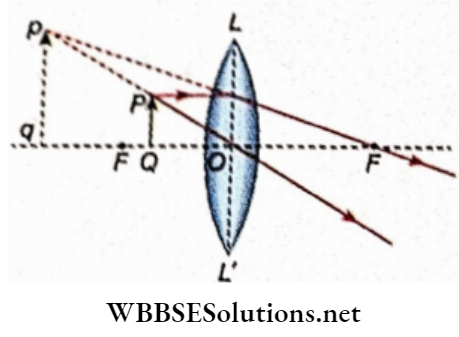
Class 12 Physics Unit 6 Optics Chapter 3 Refraction Of Light At Spherical Surface Lens Object Is Placed between f And Lens

Therefore, the image Is formed on the same side of the lens as the object Is situated. The image is virtual, erect and magnified.

Use: Magnifying glass, eyepieces of microscope and telescope are made utilising this principle of the convex lens

In the case of a concave lens

The object PQ is placed perpendicular to the principal axis of the concave lens LL’. A ray from P travelling parallel to the principal axis after refraction through the lens appears to diverge from the focus F. Another ray from P moves straight through the optical centre O.

The two refracted rays being divergent, when produced backwards, virtually meet at p. The point p from where the emergent rays appear to diverge after refraction through the lens is the image of P. From p, pq is drawn perpendicular to the principal axis. So, pq is the image of PQ
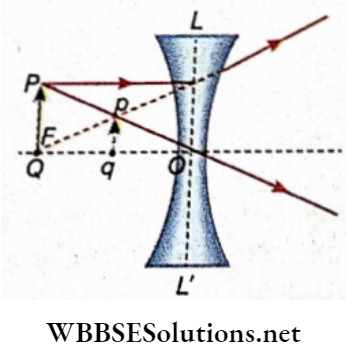
Class 12 Physics Unit 6 Optics Chapter 3 Refraction Of Light At Spherical Surface Lens In Case Of Concave Lens

Therefore, the image is formed on the same side of the lens as the object is situated. The image is virtual, erect and diminished in size concerning the object.

The image moves from F to the lens and increases in size as the object is brought from infinity up to the lens. But the size of the page will always be less than the object

Inference: The following Inferences can be drawn from the above discussion.

  1. The virtual InutHo la formed on the Maine (tide of the lens as the object but the real Image IN formed on the aide of the lens opposite to that of the object.
  2. Virtual Image Is always erect and real Image Is always Inverted.

If half of a lens Is palmed black, the brightness of the Image produced by the lens reduces to half as the Image will be produced due to refraction through half portion of the lens. However, the size of the Image remains the same, because every half part of a lens forms a complete image of an object.

Method of Identifying Lenses

We know that if an object is placed very near to a convex lens l.o., within the focal length, then a virtual, erect and magnified Imago Is formed. On the other hand, when an object Is placed very near to a concaveÿ Ions a virtual, correct and diminished Imago Is formed. So, to Identify a lens easily will hold a linger In front of the lens and look at It from the other side of the lens. If the Image Is erect and magnified concerning the object the lens Is convex. But If the image Is erect but diminished In size, the lens Is concave

Refraction Of Light At Spherical Surface Lens Sign Convention

  1. Distances along the principal axis are to be measured from the optical centre of the lens.
  2. Distance from the  optical centre) to be measured opposite to the direction of the incident ray are taken as negative and those to be measured in the direction of the incident ray are taken as positive. According to the above convention, the focal length of a convex lens is positive and that of a concave lens is negative.
  3. If the principal axis of the lens is taken as the x-axis, distances along the y-axis above the principal axis are taken as positive and distances along the y-axis below the principal axis are taken as negative

Assumptions are made during a discussion of refraction through the lens :

  1. The lens will be thin and its aperture will be small.
  2. Direction of incident ray will be shown from left to right i.e., the object should be considered to be placed on the left side of the lens.
  3. The optical centre O of the lens will be the origin of the cartesian frame of reference and the principal axis of the lens will be the x-axis

Refraction Of Light At Spherical Surface Lens General Formula Of Lens

The relation among object distance, image distance and focal length of a lens is known as the general formula of the lens.

Convex lens and real image

LL’ is a convex lens. An object PQ is placed perpendicular to the principal axis of the A ray from P travelling parallel to the; principal axis after refraction through the. leap passes through the second principal focus F. Another ray from P moves straight through the optical centre O. These two refracted rays meet at the point p which is the image of P. From p, pq is drawn per

Pendicular to the principal axis. So, pq is the image of PQ. This image is real and inverted
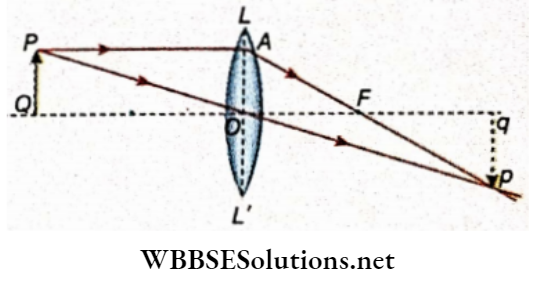
Class 12 Physics Unit 6 Optics Chapter 3 Refraction Of Light At Spherical Surface Lens Convex Lens And Real Image

As the triangles POQ and pOq are similar

∴ \(\frac{P Q}{p q}=\frac{O Q}{O q}\) ……………………………….(1)

On the other hand, as the triangles AFO and pFq are similar,

∴ \(\frac{A O}{p q}=\frac{F O}{F q}\)

Or,\(\frac{P Q}{p q}=\frac{F O}{F q}\)  ……………………………… (2)

AO = PQ

From equations (1) and (2) we, get

∴ \(\frac{O Q}{O q}=\frac{F O}{F q}\)

Or, \(\frac{O Q}{O q}=\frac{F O}{O q-O F}\) …………………… (3)

Now, according to sign convention, object distance = OQ = -u,

Image distance = Oq = +v, focal length = OF = +

Putting these values in equation (3) we get

Or , \(\frac{-u}{v}=\frac{f}{v-f}\)

Or, -uv+uf= vf

Or, -uf-vf = uv

Or, \(\frac{u f}{u v f}-\frac{v f}{u v f}=\frac{u v}{u v f}\)

Or, \(\frac{1}{v}-\frac{1}{u}=\frac{1}{f}\) ………………………(4)

Convex lens and virtual image

The object PQ is placed perpendicular, to the principal axis of the convex lens LL’ and is placed between the focus and the lens. So, the virtual image pq has been formed

As the triangles POQ and pOq are similar,

⇒ \(\frac{P Q}{p q}=\frac{O Q}{O q}\)
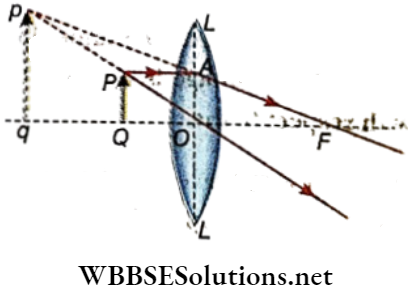
Class 12 Physics Unit 6 Optics Chapter 3 Refraction Of Light At Spherical Surface Lens Convex Lens And Virtual Image

On the other hand, as the triangles AFO and pFq, they are similar

⇒  \(\frac{A O}{p q}=\frac{O F}{q F}\)

Or, \(\frac{P Q}{p q}=\frac{O F}{q F}\) …………………….. (6)

[AO = PQ]

From equations (5) and (6) we get

⇒  \(\frac{O Q}{O q}=\frac{O F}{q F} \text { or, } \frac{O Q}{O q}=\frac{O F}{O q+O F}\) …………………. (7)

Now, according to sign convention, object distance =OQ -~u , image distance – Oq = -v, focal length = OF = +f

Putting these values in equation (7) we get

⇒  \(\frac{-u}{-v}=\frac{f}{-v+f}\)

or, uv-uf= -vf Or, uf- vf = uv

Or, \(\frac{u f}{u v f}-\frac{v f}{u v f}=\frac{u v}{u v f}\)

Or, \(\frac{1}{v}-\frac{1}{u}=\frac{1}{f}\) ……………………. (8)

The focal length of a convex is taken as positive, In the formation of a real image of a real object, u is negative but v is positive. So the formation of a real image of a real objective by a convex lens the modified form of the general formula is as follows.

⇒  \(\frac{1}{v}-\frac{1}{-u}=\frac{1}{f} \text { or, } \frac{1}{v}+\frac{1}{u}=\frac{1}{f}\)

Concave lens and virtual image

LL’ is a concave lens, An object PQ is placed perpendicular to the principal axis of the lens. A ray from P travelling parallel to the principal axis after refraction through the lens appears to diverge from the focus F. Another ray from P moves straight through the optical centre O. The two refracted rays virtually meet at p, The point p from where the emergent rays appear to diverge after refraction through the lens is the image of P. From p, pq is drawn perpendicular to the principal axis. So, pq is the Image of PQ. The image is virtual and erect
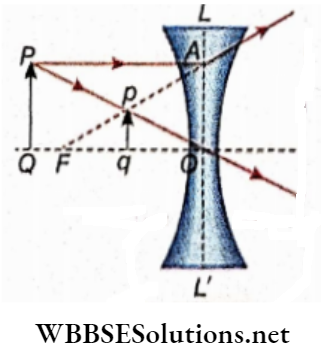
Class 12 Physics Unit 6 Optics Chapter 3 Refraction Of Light At Spherical Surface Lens Concave Lens And Virtual Image

As the triangles POQ and pOq are similar,

⇒ \(\frac{P Q}{p q}=\frac{O Q}{O q}\)

On the other hand, as the triangle APQ and ppq are similar

⇒  \(\frac{A O}{p q}=\frac{O F}{q F}\)

Or, \(\frac{P Q}{p q}=\frac{O F}{q F}\) ………………………………….. (10)

[AO = PQ]

From equations (9)and (10) we get,

⇒ \(\frac{O Q}{O q}\)

= \(\frac{O F}{q F} \text { or, } \frac{O Q}{O q}=\frac{O F}{O q+O F}\) ………………………… (11)

Now, according to sign convention , object distance = OQ = -u , image distance = Oq = -v, focal length = OF = -f

Putting these values in equation (11) we get,

⇒ \(\frac{-u}{-v}\)  = \(\frac{-f}{-f+v}\)

Or, uf – uv= vf

Or, uf- vf= uv

Or, \(\frac{u f}{u v f}-\frac{v f}{u v f}=\frac{u v}{u v f}\)

Or, \(\frac{1}{v}-\frac{1}{u}=\frac{1}{f}\) ………………………….. (12)

This is the conjugate foci relation of the lens, also known as the general formula of the lens.

The term conjugate means that the two points are Interchangeable, This follows from the principle of reversibility of light path. For these lenses the distance of conjugate foci l.e., u and v are given by the relation \(\frac{1}{v}-\frac{1}{u} \equiv \frac{1}{f}\) So this relation Is often called conjugate foci relation.

Refraction Of Light At Spherical Surface Lens Magnification Of The Image Formed By Lens

Linear or Transverse or Lateral Magnification of the Image of an Object Kept Perpendicular to the Principal Axis

Linear Magnification Definition:

Linear magnification of an image formed by a lens is defined as the ratio of the size of the image to the size of the object

Denoting linear magnification by m we have, from and

m = \(\frac{\text { size of image }(I)}{\text { size of object }(O)}=\frac{p q}{P Q}\)

= \(\frac{v}{u}=\frac{\text { image distance }}{\text { object distance }}\)

According to sign convention:

  1. For the formation of a real image in a convex lens u is negative and v is positive. So linear magnification m is negative. The image is inverted
  2. For the formation of a virtual image in a convex lens both u and v are negative. So linear magnification m is positive. The image is erect.
  3.  In the case of a concave lens both u and v are negative, So linear magnification m is positive. So the image is erect.

So we can say that if magnification is negative, the image is inverted and if magnification is positive, the image is erect

We can determine the expression for the magnification of an image formed by a lens by the same process as adopted for the determination of the magnification of an image formed by the reflection oflight on a curved surface.

It is to be noted that the real image formed by reflection is formed in front of the mirror i.e. on the same side of the mirror as the object. But in the case of a lens, the real image formed by a lens due to refraction is formed on the opposite side of the real object.

The general expression for magnification of the image formed by refraction in the lens is given by

m = \(\frac{I}{O}=\frac{v^2}{u}\)

Magnification produced by a combination of lenses:

The magnification of the final image produced by a combination of lenses is given by m = m1 × m2  × m3; where m1,m2,m3,…… etc..are respectively the magnifications produced by each lens.

Areal Magnification of the image is kept perpendicular to the principal axis

Areal Magnification Definition:

Linear magnification of an image formed by a lens is defined as the ratio of the size of the image to the size of the object.

Let the length and breadth of a two-dimensional object be l and b respectively. Hence, the area of object A = lb

If the linear magnification of the image is m, the length of the image l’ = mx l and the breadth of the image b’ = m × b

Area of the image, A’ = l’b’ = m²lb = m²A

Therefore areal magnification

m’ = \(\frac{A^{\prime}}{A}=m^2\) …………………. (1)

Longitudinal or Axial Magnification of the Image of an Object Kept Along the Principal Axis

Axial Magnification  Definition:

Longitudinal or Axial magnification of the image formed by a lens of an object kept along the principal axis is defined as the ratio of the length of the image to that of the object.

Let an extended object is kept along the principal axis of a vex lens.

Let u1 and u2 be the distances of the nearest and the furthest points respectively of the object along the principal axis and v1 and v2 the respective image distances

Longitudinal magnification m” = \(\frac{v_2-v_1}{u_2-u_1}=\frac{\Delta v}{\Delta u}\)

For infinitesimal values of Δv and Δu, magnification should be noted a \(\frac{d v}{d u}\)
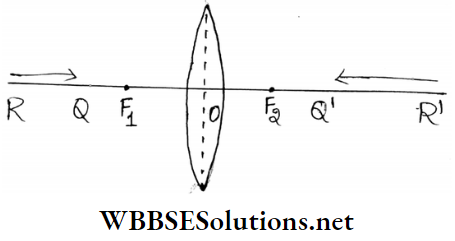
Class 12 Physics Unit 6 Optics Chapter 3 Refraction Of Light At Spherical Surface Lens Infinitesimal Values

Differentiating the lens equation, \(\frac{1}{v}+\frac{1}{u}=\frac{1}{f}\) , with respect to u we get,

⇒ \(-\frac{1}{v^2} \frac{d v}{d u}-\frac{1}{u^2}\) = 0 [ f is constant]

Or, \(\frac{d v}{d u}=\frac{-v^2}{u^2}\)

m” = \(\frac{d v}{d u}=-m^2\) …………………………..(1)

Longitudinal magnification =- (linear magnification)²

Hence, longitudinal magnification in the case of the lens is numerically equal to the square of linear magnification.

It is dear from equation (1) that m” is always negative irrespective of the sign of m. This implies that object and image always lie in opposite directions along the principal axis, whatever may be the nature of the image real or virtual, in a convex or concave lens. This matter is called axial change

Relation of f and v or f and u with m

The lens formula is

⇒ \(\frac{1}{\nu}-\frac{1}{u}=\frac{1}{f}\) …………………………………… (1)

Or, \(1-\frac{\nu}{u}=\frac{p^{\prime}}{f} \text { or, } 1-m=\frac{\nu}{f}\)

Or, m = \(1-\frac{\nu}{f} \text { or, } m=\frac{f-\nu}{f}\)

Again, from equation (1) we get,

⇒ \(\frac{u}{\nu}-1=\frac{u}{f} \text { or, } \frac{1}{m}-1=\frac{u}{f}\)

Or,  \(\frac{1}{m}=1+\frac{u}{f} \text { or }, \frac{1}{m}=\frac{f+u}{f}\)

m = \(\frac{f}{u+f}\)

u-v And \(\frac{1}{u} \frac{1}{v}\) Graphs For Convex Lens

The focal length of convex lens f is positive. The real image formed by this lens is always situated on the side opposite to the object So image distance v is also positive. According to the sign convention object distance u is negative. Hence if a real image is formed by a convex lens the equation of the lens is as follows

⇒ \(\frac{1}{v}-\frac{1}{-u}=\frac{1}{f} \text { or, } \frac{1}{v}+\frac{1}{u}=\frac{1}{f}\)

1. u – v graph: In the case of a convex lens if different values of object distances and the corresponding image distances are recorded and plotted on a graph, It will be a rectangular hyperbola
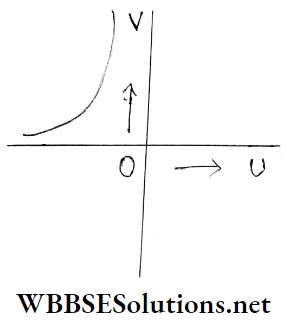
Class 12 Physics Unit 6 Optics Chapter 3 Refraction Of Light At Spherical Surface Lens Rectangular Hyperbola

2. \(\frac{f}{u+f}\) graph:

In case a convex lens if \(\frac{1}{u} \sim \frac{1}{v}\)graph Is drawn taking different values of u and v, It will be a straight line The intercept cut by the straight line AB from the axes are each equal to \(\frac{1}{f}\)

i.e OA = OB = \(\frac{1}{f}\)
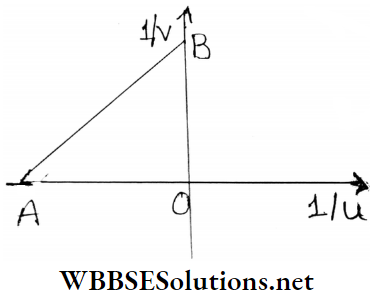
Class 12 Physics Unit 6 Optics Chapter 3 Refraction Of Light At Spherical Surface Lens The Intercept Cut By The Straight Line

Numerical Examples

Example 1. The distance of an object from a convex lens is 20 cm. If the focal length of the lens is 15 cm determines the position of the image and its nature.
Solution:

Here, u = -20 cm ; as the lens is convex,f = +15 cm

We know, \(\frac{1}{v}-\frac{1}{u}=\frac{1}{f}\)

Or, \(\frac{1}{v}=\frac{1}{u}+\frac{1}{f}=\frac{1}{-20}+\frac{1}{15}\)

= \(\frac{4-3}{60}=\frac{1}{60}\)

Or, v = 60 cm

As v  is positive, the image will be formed on the side opposite to the object at a distance of 60 cm i.e., the image is real.

Magnification, m = \(\frac{v}{u}\frac{60}{-20}\) = -3

So, an image magnified three times as the size of the object is formed. As magnification is negative, the image is inverted

Example 2. If an object is placed at a distance of 30 cm from a lens, a virtual image is formed. If the magnification of the image Is, find the position of the image and the focal length of the lens. Also, find the nature of the lens
Solution:

Here, object distance, u = -30 cm ; magnification

m = \(\frac{1}{v}-\frac{1}{u}=\frac{1}{f}\)

Or, \(\frac{u}{v}-1=\frac{u}{f}\)

Or, \(\frac{1}{m}-1=\frac{u}{f}\)
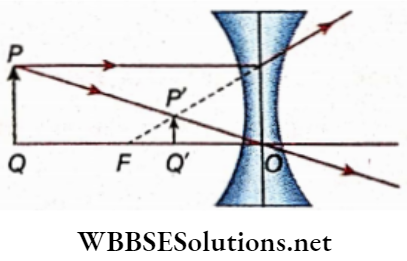
Class 12 Physics Unit 6 Optics Chapter 3 Refraction Of Light At Spherical Surface Lens Focal Lenght Of The Lens

Substituting m = \(\frac{2}{3}\) u = -30 we get,

⇒ \(\frac{3}{2}\)– 1 = \(\frac{3}{2}-1=\frac{-30}{f}\), or, f = -30 × 2 = -60 cm

The focal length of the lens is 60 cm.

Further, the negative sign of f implies that the lens is a concave one

Important Definitions Related to Lens Refraction

Example 3. A convex lens forms a real image of an object magni¬ fied n times. Prove that the object distance =(n+ 1) \(\frac{f}{n}\) , f = focal length of the lens
Solution:

Here, magnification =n

i.e, \(\frac{v}{u}\) = n or, v = nu

For a real object, is negative and v is positive. For a convex lens f is positive. Following this sign convention, we get from the lens formula

⇒ \(\frac{1}{v}-\frac{1}{u}=\frac{1}{f}\)

Or, \(\frac{1}{n u}+\frac{1}{u}=\frac{1}{f}\)

or, u = \(\frac{1+n}{n u}=\frac{1}{f}\)

u = (n+1)\(\frac{f}{n}\)

i. e the object distance is (n+1)\(\frac{f}{n}\)

Example 4.

1. A luminous object and a screen are placed 90 cm apart. To cast an image magnified twice the size of the object on the screen, what type of lens is required and what will be its focal length?

2. An object Is situated at a distance of 10 in from the convex lens. A magnified Image Is cast on a screen by the lens. Its magnification Is 19  what is the focal length of the lens
Solution:

Since The image is formed on a screen, it Is real. Hence lire lens to be used should be convex.

In this case, u + v = 90 cm

And \(\frac{v}{u}\) = 2 or, v = 2u

∴ 3u = 90 cm

or, u = 30 cm

∴  v= 90- 30 = 60 cm

Substituting in lens formula, \(\frac{1}{v}-\frac{1}{u}=\frac{1}{f}\)

Or, \(\frac{1}{60}-\frac{1}{-30}=\frac{1}{f}\)  [

u = – 30, as the object is real

Or, f = 20 cm

The focal length of the lens is 20 cm.

Magnification , m = \(\frac{v}{u}\) = 19

v = 19 u = 19 × 10 = 190m

Substituting v = 190 and u – 10 in \(\frac{1}{v}-\frac{1}{u}=\frac{1}{f}\)

We get, \(\frac{1}{190}+\frac{1}{10}=\frac{1}{f}\) Or, f = \(\frac{190}{1+19}\) = 9.5 m1

∴ The focal length of the lens is 9.5 m.

Example 5.  A convex lens is placed just above an empty vessel. Ait object is placed at the bottom of the vessel and at u distance of 45 cm below the lens. An image of the object is formed above the vessel at a distance of 36 cm front die lens. A liquid is poured up to a height of 40 and cut lit the vessel. Now the image is formed above the vessel at ! a distance of 48 cm from the lens. Calculate the refractive index of the liquid
Solution: 

When the vessel is empty, u = (-45) cm , v = 36 cm From the equation of the lens we get

⇒ \(\frac{1}{v}-\frac{1}{u}=\frac{1}{f}\)

Or, \(\frac{1}{+36}-\frac{1}{-45}=\frac{1}{f}\)

Or, \(\frac{+9}{180}=\frac{1}{f}\)

Or,  f = + 20 cm

On pouring the liquid into the vessel the apparent position of the object will be raised.

Real depth of the liquid = 40 cm and apparent depth = cm (say)

If the refractive index of the liquid is fi, then

μ = \(\frac{\text { real depth }}{\text { apparent depth }}=\frac{40}{x}\)

⇒ \(\frac{40}{\mu}\)

Or, x =  \(\frac{40}{\mu}\)

Now, distance of the lens from the liquid surface = 45-40 = 5 cm

Object distance from the lens = (5 + x) = 5 + \(\frac{40}{\mu}\)

In this case, v = +48 cm and f = +20 cm

From the equation of the lens

⇒ \(\frac{1}{v}-\frac{1}{u}=\frac{1}{f}\)

⇒  \(\frac{1}{48}-\frac{1}{-\left[5+\frac{40}{\mu}\right]}=\frac{1}{20}\)

Or, \(\frac{1}{48}+\frac{1}{5+\frac{40}{\mu}}=\frac{1}{20}\)

Or, \(\frac{1}{5+\frac{40}{\mu}}=\frac{1}{20}-\frac{1}{48}=\frac{7}{240}\)

⇒ \(5+\frac{40}{\mu}=\frac{240}{7}\)

⇒  \(\frac{40}{\mu}=\frac{240}{7}-5\)

⇒ \(\frac{40}{\mu}=\frac{205}{7}\)

⇒ \(\frac{280}{205}\)

= 1.366

Example 6. Two convex lenses of focal lengths 15 cm and 10 cm are placed coaxially. A ray of light parallel to the principal axis of a lens is incident on it and emerges from the other lens parallel to the same axis. Draw a neat ray – diagram. What is the distance of separation between the lenses?
Solution: 

The ray incident on the lens Ly passes through the second principal focus of this lens after refraction. Since the ray after refraction through the second lens moves parallel to the principal axis of this lens, F is the first principal focus of lens L2
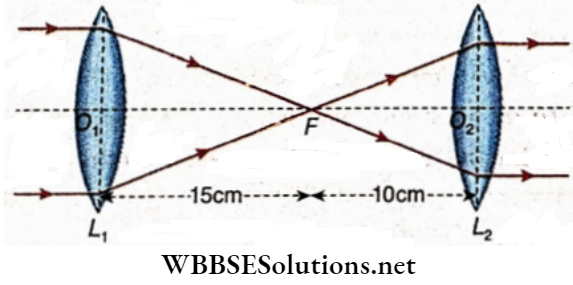
Class 12 Physics Unit 6 Optics Chapter 3 Refraction Of Light At Spherical Surface Lens Two convex Lenses Of Focal Lenghts

O2F = 15 cm , O2 F = 10 cm

Distance of separation between the lenses

= 15 + 10 = 25 cm

Example 7. If an object is placed at a distance of 20 cm in front of a convex lens, three times magnified and an Inverted Image is formed. In which direction and how far Is the lens to be moved to obtain an erect Image of equal magnification [m = 3] T
Solution:

Here, m = 3 and u = 20 cm

Here, m = 3 and u = 20 cm

⇒ \(\frac{v}{u}\)= 3

Or, v = 3u = 3 × 20 = 60 cm

Now \(\frac{1}{v}-\frac{1}{u}=\frac{1}{f}\)

⇒ \(\frac{1}{60}-\frac{1}{-20}=\frac{1}{f}\)

Following sign convention, u = -20 cm and v = 60 cm

Or, f = 15 cm

To obtain an erect image, the lens is to be moved towards the object, so that the object distance now becomes less than the focal distance of the lens

Let the lens is moved x cm towards the object

So, the object distance becomes, u1 = (20 -x) cm

Let the image distance be v1 cm

⇒ \(\frac{v_1}{u_1}\)  = m = 3

Or, v1 = 3u1 = 3(20- x) cm

From the lens equation following the sign convention we have,

⇒ \(\frac{1}{v_1}-\frac{1}{u_1}=\frac{1}{f} \text { or, } \frac{1}{-3(20-x)}-\frac{1}{-(20-x)}\)

= \(\frac{1}{15}\) [as the image is virtual and so v1 is taken as negative]

Or, \(\frac{2}{3(20-x)}=\frac{1}{15}\)

Or,  x = 10 cm

∴ The lens is to be moved by a distance of 10 cm towards the lens

Example 8. If a magnifying lens of focal length 10 cm is held in front of very small writing, It is magnified five times. How far was the magnifying lens held?
Solution:

Here, focal length, f = 10 cm

Let object distance = u

Now, magnification, m = \(\frac{v}{u}\) – = 5, or, v = 5u

Now \(\frac{1}{v}-\frac{1}{u}=\frac{1}{f}\)

⇒ \(\frac{1}{-5 u}-\frac{1}{-u}=\frac{1}{10}\)

[For magnifying lens, u and v both are negative]

Or, \(-\frac{1}{5 u}+\frac{1}{u}=\frac{1}{10}\)

Or, \(\frac{4}{5 u}=\frac{1}{10}\)

Or , u = 8 cm

So, the lens was held at a distance of 8 cm from the writing

Example 9. An object is placed at a distance of 150 cm from a screen. A convex lens is placed between the object and the screen so that an image magnified 4 times the object is formed on the screen. Determine the position of the lens and its focal length
Solution:

Here, u + v – 150 cm

And magnification, m = 4 or, – = 4 or, v = 4h

From equation (1) we have,

u + 4u = 150

Or,  5u = 150 or, u = 30 cm

∴ v = 4 × 30 = 120 cm

Hence, the distance of the lens from the screen = 120 cm

Now, \(\frac{1}{v}-\frac{1}{u}=\frac{1}{f}\)

Or, \(\frac{1}{120}-\frac{1}{-30}=\frac{1}{f}\)

Since the object and the image are situated on mutually opposite sides of the lens, u = -30 cm, v = 120 cm

⇒ \(\frac{1}{120}+\frac{1}{30}=\frac{1}{f}\)

Or, \(\frac{1}{f}=\frac{1+4}{120}\)

= \(\frac{5}{120}\)

or, f = 24 cm

The focal length of the lens is 24 cm.

Example 10. A convex lens of focal length f forms an image which is m times magnified on a screen.If the distance of the object and the screen is x, prove that f = \(\frac{m x}{(1+m)^2}\)
Solution:

Since the image is formed on a screen, it is real. So the image distance is positive. The focal length is also positive. Object distance is negativeMagnification, m = “ or; v

Magnification, m = \(\frac{v}{u}\)  or; v  = mu

Here u+v = x Or, U+ mu = x Or, u= \(\)

v =  \(\frac{m x}{1+m}\)

The equation of lens \(\frac{1}{v}-\frac{1}{u}=\frac{1}{f}\)

⇒ \(\frac{1}{m u}+\frac{1}{u}=\frac{1}{f}\) Or, \(\)

Or, f = \(\frac{m u}{1+m}=\frac{m x}{(1+m)^2}\)

Since u = \(\frac{x}{1+m}\)

Example 11.  An object is placed on the left side of a convex lens A of focal length 20 cm at a distance of 10 cm from the lens. Another convex lens of focal length 10 cm is placed co-axially on the right side of lens A at a distance of 5 cm from it Determine magnification and position of the final image by the lens combination. Solution; In case of image formation by the first lens, u cm; f = 20 cm, v =?
Solution:

Now, \(\frac{1}{v}-\frac{1}{u}=\frac{1}{f}\)

⇒ \(\frac{1}{v}-\frac{1}{-10}=+\frac{1}{20}\)

⇒  \(\frac{1}{v}=\frac{-1}{10}+\frac{1}{20}=\frac{-1}{20}\)

v = -20cm

Since v is negative, a virtual image would form on the same side of the object at a distance of 20 cm from the lens.

This image will act as the object for the second lens.

In the case of image formation by the second lens,

u= -(20+5) = -25 cm,

f= 10 cm,

v =?

From the equation of lens,

⇒  \(\frac{1}{v}-\frac{1}{u}=\frac{1}{f}\)

⇒  \(\frac{1}{v}-\frac{1}{-25}=\frac{1}{10}\)

⇒  \(\frac{1}{v}=\frac{-1}{25}+\frac{1}{10}=\frac{3}{50}\)

Or, v = \(\frac{50}{3}\)

= 16.66

So, finally, a real image is formed on the right side of the second lens (on the opposite side of the object) at a distance of 16.66 cm from this lens.

Magnification by the first lens

m1 = \(\frac{v}{u}=\frac{20}{10}\)

= 2

And magnification by the second lens

m2 = \(\frac{v}{u}=\frac{50}{3 \times 25}\)

= \(\frac{2}{3}\)

Magnification by the lens combination

m = m1 × m2

= 2 × \(\frac{2}{3}\)

= \(\frac{4}{3}\)

= 1.33

Example 12. A convex lens forms a real image of an object magnified 10 times. If the focal length of the lens is 20cm, determine the distance of the object from the lens
Solution:

Let object distance = x

Here, m= 10

∴ \(\frac{v}{x}=10\)

Or, v = 10 x

In this case, v is positive and f = 20 cm

From The Equation of the Lens

⇒ \(\frac{1}{v}-\frac{1}{u}=\frac{1}{f}\)

Or, \(\frac{1}{10 x}-\frac{1}{-x}=\frac{1}{20}\)

Or, \(\frac{11}{10 x}=\frac{1}{20}\)

Or, x =  22cm

Object distance = 22cm

Examples of Applications of Spherical Lenses in Optics

Example 13. Two convex lenses of focal lengths 3cm and 4cm are placed 8cm apart from each other. An object of height Icm Is placed In front of a lens of smaller focal length at a distance 4cm. Determine the magnification and size of the final image by the lens combination.
Solution:

In the case of image formation by the first lens, u = -4cm,f = 3cm

Now, \(\frac{1}{\nu}-\frac{1}{u}=\frac{1}{f}\)

Or, \(\frac{1}{v}+\frac{1}{4}=\frac{1}{3}\)

Or, \(\frac{1}{\nu}=\frac{1}{3}-\frac{1}{4}=\frac{1}{12}\)

Or, v = 12 cm

Since v is positive, an image would form on the side of the first lens opposite that of the object. This image acts as a virtual image for the second lens.

In the case of image formation by this lens

u = (12-8) = 4cm , f = 4 cm , v= ?

From the equation of lens

⇒ \(\frac{1}{v}-\frac{1}{u}=\frac{1}{f}\)

⇒ \(\frac{1}{v}-\frac{1}{4}=\frac{1}{4}\)

Or, \(\frac{1}{v}=\frac{1}{4}+\frac{1}{4}\)

⇒ \(\frac{1}{2}\)

Or v = 2cm

So, the final image is real and it will be formed at a distance 2cm from the second lens.

Magnification by the first lens

m1 = \(\frac{v}{u}=\frac{12}{4}\)

m1 = 3

Magnification by the second lens

m2 = \(\frac{v}{u}=\frac{2}{4}\)

m2 = \(\frac{1}{2}\)

So, magnification by the lens combination

m = m1 × m2 = \(3 \times \frac{1}{2}=\frac{3}{2}\)

Again m = \(\frac{\text { size of image }}{\text { size of object }}\)

Or, \(\frac{3}{2}=\frac{\text { size of image }}{1}\)

Or, size of image = \(\frac{3}{2}\)

= 1.5 cm

Image Of A Virtual Object

We have so far discussed the image formation of real objects. But objects may be virtual as well and images of the virtual objects can be formed by using lenses.

A converging beam of rays is incident on a convex lens and a concave lens respectively. In the absence of the lenses, the converging beam of rays would meet at Q on the other side of the lenses but due to the presence of the lenses the beam meets at Q’. So, Q is a virtual object here and its image Q’ is a real
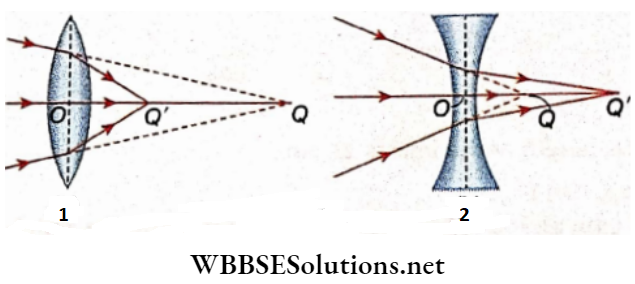
Class 12 Physics Unit 6 Optics Chapter 3 Refraction Of Light At Spherical Surface Lens Image Of A Virtual Object

After refraction in the convex lens, a convergent beam of rays becomes more convergent i.e., the convergent beam meets nearer to the lens. In the case of the convex lens, Q’ is nearer to the lens than Q . Obviously in this case image distance, OQ’ is less than object distance, OQ. In a convex lens, the real image of a virtual object is formed and the image lies within the focus

After refraction in the concave lens, a convergent beam of rays becomes less convergent i.e., the convergent beam meets further away from the lens. In the case of a concave lens Q’ is more distant from the lens than Q . Obviously in this case image distance, OQ’ is greater than object distance, OQ.

But if the virtual object distance, OQ is greater than the focal length of the concave lens, the image formed by the concave lens becomes virtual.

Remember that virtual object distance is positive.

Example 1. If a convex lens of focal length 20 cm is placed in the path of a convergent beam of rays, the beam meets at Q. In the absence of the lens, the beam would meet at P.If the distance of P from the lens- is 30 cm, determine the distance of Q from the lens
Solution:

The converging beam of rays meets at Q after refraction in the lens LL’. In the absence of the lens the beam would meet at P In this case concerning the lens, P is the virtual object and Q is its real image

Here, u = 30 cm , f= 20 cm , v = OQ = ?
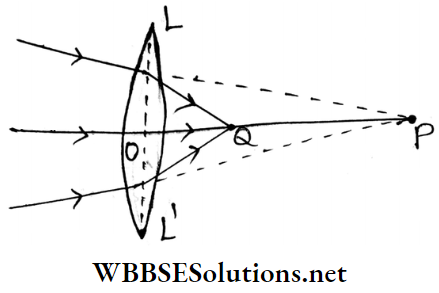
Class 12 Physics Unit 6 Optics Chapter 3 Refraction Of Light At Spherical Surface Lens The Coverging Beam Of Rays Meets

The equaton of lens is = \(\frac{1}{v}-\frac{1}{u}=\frac{1}{f}\)

⇒ \(\frac{1}{v}-\frac{1}{30}=\frac{1}{20}\)

Or, \(\frac{1}{v}=\frac{1}{30}+\frac{1}{20}=\frac{1}{12}\)

Or, v =12cm

Required distance OQ = 12cm

Example 2. A converging beam of frays after refraction in a concave lens of focal length 20 cm meets at a distance of 15 cm from the lens. In the absence of the lens, where would the beam meet?
Solution:

In the absence of the lens, the converging beam would meet at P. So, concerning this lens P is the virtual object and Q is its real image
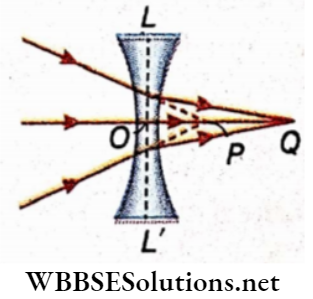
Class 12 Physics Unit 6 Optics Chapter 3 Refraction Of Light At Spherical Surface Lens A Convergining Beam Of Rays After Refraction

In this case, v = OQ – 15 cm; f= -20 cm

The equation of lens is \(\)

⇒ \(\frac{1}{15}-\frac{1}{u}=-\frac{1}{20}\)

Or, \(\frac{1}{u}=\frac{1}{20}+\frac{1}{15}\)

u = \(\frac{60}{7}\) = 8.57 cm

Therefore, in the absence of the lens, the beam of rays would meet at a distance of 8.57 cm from the lens.

Refraction Of Light At Spherical Surface Lens Newton’s Equation

Let II’ be a convex lens. F, F’ and O are the second principal focus, the first principal focus and the optical centre of the lens respectively. P and Q are the point object and point image respectively
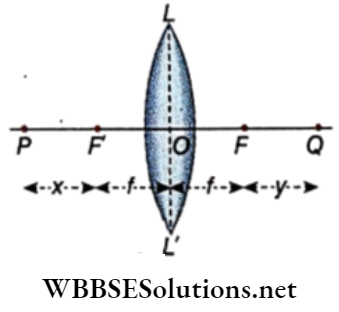
Class 12 Physics Unit 6 Optics Chapter 3 Refraction Of Light At Spherical Surface Lens Newtons Equation

Here, OF = OF’ = f; PF’ = x and QF = y; object distance, OP = -u = and image distance,
OQ – v = y+f

The equation of the lens is

⇒ \(\frac{1}{v}-\frac{1}{u}=\frac{1}{f}\)

⇒ \(\frac{1}{y+f}+\frac{1}{x+f}=\frac{1}{f}\)

Or, \(\frac{x+f+y+f}{(y+f)(x+f)}=\frac{1}{f}\)

or, (y +f)(x +f) = f(x + y + 2f)

or, xy + xf+ yf+f² = xf+ yf+ 2f² or, xy = f²

This is Newton’s equation in the case of lens.

For any lens, f is a constant quantity. Hence, an x- y graph supporting Newton’s equation will be a rectangular hyperbola.

Refraction Of Light At Spherical Surface Lens Lens Makers Formula For Thin Lens

The lens maker’s formula involves the focal length, the refractive index of the material of the lens, and the radius of curvature of the two surfaces of the lens. This formula is derived from the refraction of light on the two spherical surfaces of a lens.
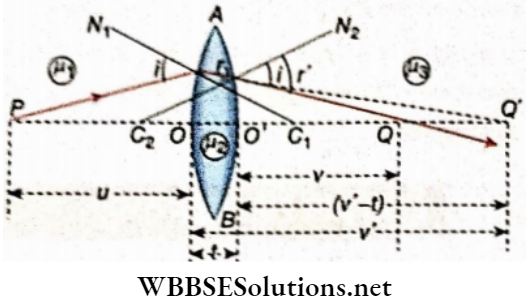
Class 12 Physics Unit 6 Optics Chapter 3 Refraction Of Light At Spherical Surface Lens lens MArkers Formula For Thin Lens

In refraction of light at the two spherical surfaces of a biconvex lens has been shown. P is the point object on the principal axis of the lens; Q’ is the image formed due to the refraction of light at die first surface of the lens and Q is the final image

Let μ1 = Refractive index of the medium in which the object is placed

μ2  = Refractive index of the material of the lens

μ3   = Refractive index of the medium into which the final ray emerges

In the Gaussian system, the object distance is measured from the pole O of the first spherical surface, and the final image distance is measured from the pole O of the second spherical surface. Accordingly,

object distance, OP = -u

Image distance, OQ’ = v’

Final image distance, O’Q = v

Thickness of lens on the axis, OO’ = t

The radius of curvature of the first surface of the lens = r1

The radius of curvature of the second surface of the lens = -r2

Considering refraction at the first surface AOB of the lens we have,

⇒ \(\frac{\mu_2}{v^{\prime}}-\frac{\mu_1}{u}=\frac{\mu_2-\mu_1}{r_1}\) ……………. (1)

Both object and image are real

Considering refraction at the second surface AO’B of the lens we have,

⇒ \(\frac{\mu_3}{v}-\frac{\mu_2}{v^{\prime}-t}=\frac{\mu_3-\mu_2}{r_2}\) …………….(2)

The object is virtual and the image is real

If the lens is very thin i.e…… v’, then it can be neglected.

In that case, equation (2) becomes

⇒ \(\frac{\mu_3}{v}-\frac{\mu_2}{v^{\prime}-t}=\frac{\mu_3-\mu_2}{r_2}\) …………….(3)

Adding equations (1) and (3) we have,

⇒ \(\frac{\mu_3}{v}-\frac{\mu_1}{u}=\frac{\mu_2-\mu_1}{r_1}+\frac{\mu_3-\mu_2}{r_2}\) ……………. (4)

This is the general equation of the lens:

This formula has been obtained for the formation of real images by a convex lens. But this formula is equally applicable for the formation of virtual image by a convex lens or for the concave lens

If the surrounding medium is by air, then μ1 = μ3  = 1

Taking  μ2  = μ for the r of the material, we have

⇒ \(\frac{1}{v}-\frac{1}{u}=(\mu-1)\left(\frac{1}{r_1}-\frac{1}{r_2}\right)\) ………… (5)

If the object is at infinity, the image will be formed at the principal focus

i. e if u = ∞, v= f

∴ \(\frac{1}{f}=(\mu-1)\left(\frac{1}{r_1}-\frac{1}{r_2}\right)\) ……………………. (6)

This is the lens maker’s formula.

Lens in the air

If the refractive index of a glass lens relative to air is Jig and the radii of curvature of the first and the second refracting surfaces are r1 and r2 respectively, the focal length  of the lens is obtained from the following relation,

\(\frac{1}{v}-\frac{1}{u}=(\mu-1)\left(\frac{1}{r_1}-\frac{1}{r_2}\right)\) ………………… (7)

1. In the case of the biconvex lens:  r1 is positive and r2 is negative,

So for this lens from equation (7) we have,

⇒ \(\frac{1}{f}=\left({ }_a \mu_g-1\right)\left(\frac{1}{r_1}+\frac{1}{r_2}\right)\) ……………………. (8)

If the lens is equi-convex, then r1 = r2 = r and in that case,

⇒ \(\frac{1}{f}=\left(a_g{ }_g-1\right)^{\frac{2}{r}}\) ……………….. (9)

2. In the case of the biconcave lens: r1 is native and r2 is positive.

So for this lens from equation (7) we have

⇒ \(\frac{1}{f}=-\left(a_a \mu_g-1\right)\left(\frac{1}{r_1}+\frac{1}{r_2}\right)\) ……………….. (10)

If the lens Is equt-concnvo, then r1 = r2 = r. In this case

⇒ \(\frac{1}{f}=-\left({ }_a \mu_g-1\right) \cdot \frac{2}{r}\) …………………………… (11)

Dependence of focal length on surrounding medium:

Let us suppose that a lens Is situated In a medium denser titan air. Suppose, the denser medium is water.

Now, If the focal lengths of the lens In air and water are fa and fa respectively, then

⇒ \(\frac{1}{f_a}=\left({ }_a \mu_g-1\right)\left(\frac{1}{r_1}-\frac{1}{r_2}\right) \text { and } \frac{1}{f_w}=\left({ }_w \mu_g-1\right)\left(\frac{1}{r_1}-\frac{1}{r_2}\right)\)

∴ r1 and r2 are the radii of curvature of the first and the second refracting surfaces respectively

⇒ \(\frac{\frac{1}{f_a}}{\frac{1}{f_w}}=\frac{\left({ }_a \mu_g-1\right)}{\left({ }_w \mu_g-1\right)}\)

Or,  \(\frac{f_w}{f_a}=\frac{\left({ }_a \mu_g-1\right)}{\left({ }_w \mu_g-1\right)}\) ……………… (12)

Now , \(\frac{w^{\mu_g}}{1}=\frac{a^{\mu_g}}{a^{\mu_w}}\)

Or, \(\frac{a^\mu g}{w^\mu g}=a^\mu w>1\)

∴ \(w^{\mu_g}<{ }_a \mu_g\)

Or, \(w^{\mu_g-1}<_a \mu_g-1\)

From equations (12) and (13) we get,

⇒\(\frac{f_w}{f_a}\) >1 Or, fw >fa

So, the focal length of a lens increases with the Increase of optical density of the surrounding medium.

If a convex lens of focal length f is cut horizontally along its principal axis into two halves, each half will have a focal 1 length equal to/ because the radii of curvature of the two surfaces of the new parts have the same values as the original

Refraction Of Light At Spherical Surface Lens Lens Makers Formula For Thin Lens Numerical Examples

Example 1. Focal length The focal length of a glass lens in air is 5 cm. What will be its focal length In water? The refractive index of glass =1.51 and the refractive index of water =1.33.
Solution:

Let the focal length of the lens in air =fa radii of curvature of the two surfaces = r1 and r2

\(\frac{1}{f_a}\) = ( aμg– 1) \(\left(\frac{1}{r_1}-\frac{1}{r_2}\right)\)

Or, \(\frac{1}{5}=(1.51-1)\left(\frac{1}{r_1}-\frac{1}{r_2}\right)\)

Or, \(\frac{1}{r_1}-\frac{1}{r_2}=\frac{1}{5 \times 0.51}\)

= \(\frac{1}{2.55}\)

If the focal length of the lens In water Is fw, then

⇒ \(\frac{1}{f_w}=\left({ }_w \mu_g-1\right)\left(\frac{1}{r_1}-\frac{1}{r_2}\right)\)

Or, \(\frac{1}{r_1}-\frac{1}{r_2}=\frac{1}{5 \times 0.51}=\frac{1}{2.55}\)

⇒ \(\left(\frac{1.51}{1.33}-1\right) \times \frac{1}{2.55}\)

= \(\frac{0.18}{1.33} \times \frac{1}{2.55}\)

= \(\frac{1.33 \times 2.55}{0.18}\)

= 18.84 cm

Example 2.  A convex lens(μ =1.5) Is Immersed. In water (μ = 1.33). Will the focal length of the lens change In water? If so, how?
Solution:

If the focal length of the convex lens In air Is fa, the refractive index of the material of the lens is and the radii of curvature of the two surfaces are r1 and r2, then following sign convention

\(\frac{1}{f_a}=+\left(a_a \mu_g-1\right)\left(\frac{1}{r_1}+\frac{1}{r_2}\right)\) ………………………… (1)

If the lens is immersed in water, the focal length of the lens will be changed. If the focal length of the lens when immersed in water is fw, then

\(\frac{1}{f_w}=+\left({ }_w \mu_g-1\right)\left(\frac{1}{r_1}+\frac{1}{r_2}\right)\) ……………………… (2)

Dividing equation (1) by equation (2)

⇒ \(\frac{\frac{1}{f_a}}{\frac{1}{f_w}}=\frac{a^{\mu_g-1}}{w^{\mu_g-1}}\)

Or, \(\frac{f_w}{f_a}=\frac{1.5-1}{1.1278-1}\)

wμg = \(\frac{a^{\mu_g}}{a^\mu}=\frac{1.5}{1.33}\)

= 1.1278

⇒ \(w^{\mu_{\mathrm{g}}}=\frac{a^{\mu_{\mathrm{g}}}}{a^{\mu_w}}=\frac{1.5}{1.33}=1.1278\)

⇒ \(\frac{0.5}{0.1278}\)

= 3.9 Or , fw = 3.9 fa

So, if the lens is immersed in water Its focal length will be about 4 times its focal length in air.

Example 3. The radii of curvature of two surfaces of a biconvex glass lens are 20 cm and 30 cm. What is its focal length in air and water Refraction index of glass = \(\frac{3}{2}\) refractive index of water = \(\frac{4}{3}\)
Solution:

If the focal length of the lens in air is fa and following sign convention, we have

⇒ \(\frac{1}{f_a}=\left({ }_a \mu_g-1\right)\left(\frac{1}{r_1}+\frac{1}{r_2}\right)\)

= \(\left(\frac{3}{2}-1\right)\left(\frac{1}{20}+\frac{1}{30}\right)\)

= \(\frac{1}{2} \times \frac{5}{60}=\frac{1}{24}\)

fa = 24 cm

Therefore, the focal length of the biconvex lens in air is 24 cm. If the focal length of the lens in water is fw, we have

⇒ \(\frac{1}{f_w}=\left({ }_w \mu_g-1\right)\left(\frac{1}{r_1}+\frac{1}{r_2}\right)\)

⇒ \(\left(\frac{9}{8}-1\right)\left(\frac{1}{20}+\frac{1}{30}\right)\)

⇒ \(\frac{1}{8} \times \frac{5}{60}=\frac{1}{96}\)

wμg= \(\frac{a^{\mu_g}}{a^{\mu_w}}=\frac{\frac{3}{2}}{\frac{4}{3}}=\frac{9}{8}\)

fw= 96 cm

So, the focal length of the lens in water is 96 cm

Example 4. A plano-convex lens has a radius of curvature 10. It focal length is 80 cm in water. Calculate the refractive index ofthe material ofthe lens. Given refractive index of water \(\frac{4}{3}\)
Solution:

Let the absolute refractive index of the material of the lens = n of the material concerning water = n1: absolute r. i of water = n’

Given, r1 = ∞ and r2 = -10 cm. The focal length of the planoconvex lens when immersed in water = 80 cm.

∴ \(\frac{1}{f}=\left(n_1-1\right)\left(\frac{1}{r_1}-\frac{1}{r_2}\right)\)

Or , \(\frac{1}{80}=\left(n_1-1\right)\left(\frac{1}{\infty}+\frac{1}{10}\right)\)

Or , n1– 1= \(\frac{10}{80}=\frac{1}{8}\)

i.e n1 = \(\frac{9}{8}\)

n = n1 n’ = \(\frac{9}{8} \times \frac{4}{3}\)

= \(\frac{3}{2}\)

= 1.5

Example 5. The refractive index of the material of an equal convex lens is 1.5 and the radius of curvature of each spherical surface is 20 cm. Calculate the focal length of the lens
Solution:

Let the focal length of the lens he f and ratlins of curvature of each spherical surface be r

⇒ \(\frac{1}{f}=(\mu-1) \cdot \frac{2}{r}\)

(1.5 – 1) \(\frac{2}{20}=\frac{1}{20}\)

f = 20 cm

Refraction Of Light At Spherical Surface Lens Combination Of Lenses And Equivalent Focal Length

Equivalent lens

Suppose, the image of an object Is produced by the combination of more than one co-axial lens. Now, without changing the position of the object and the Image, a single lens is used in place of the combination. If this single lens produces the image of the same magnification of the object and in the same position, this single lens Is called the equivalent lens of the combination. The focal length of this lens Is called the equivalent focal length

The equivalent focal length of the combination of two thin co-axial lenses In contact:

Let two thin lenses and L2 having focal lengths f1 and f2 respectively be placed In contact so as to have a common axis. Since the lenses

Are thin, we may assume that the optical centers of the two lenses coincide at a single point the point O is their common optical center.

P is a point object on the principal axis. Rays of light starting from P form an image at point Q1 due to refraction in the lens.
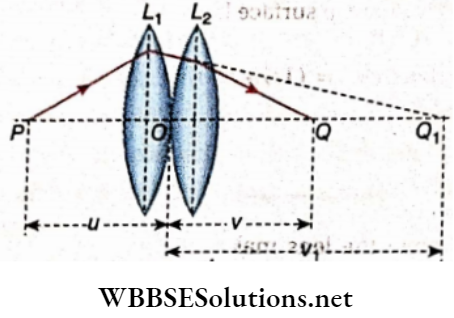
Class 12 Physics Unit 6 Optics Chapter 3 Refraction Of Light At Spherical Surface Lens Equivalent Focal Lengths

In this case, object distance = OP =  -u, image distance

= OQ1 = v1 , focal length =+f1.

⇒ \(\frac{1}{v_1}-\frac{1}{u}=\frac{1}{f_1} \text { or, } \frac{1}{v_1}+\frac{1}{u}=\frac{1}{f_1}\)………………. (1)

Q1 acts as a virtual object concerning the second lens and forms the final real image at Q due to refraction in the second lens L2. So, in this case, object distance = OQ1 = +v1, image distance = OQ = +v, focal length =f1.

⇒ \(\frac{1}{v_1}-\frac{1}{u}=\frac{1}{f_1} \text { or, } \frac{1}{v_1}+\frac{1}{u}=\frac{1}{f_1}\)………………. (2)

Adding equations (1) and (2) we get

⇒  \(\frac{1}{v}+\frac{1}{u}=\frac{1}{f_1}+\frac{1}{f_2}\) ………………. (3)

Now, if the equivalent focal length is F, according to the definition, the equivalent lens will form the image of the equivalent lens will be converging. So we can write

⇒ \(\frac{1}{v}-\frac{1}{-u}=\frac{1}{F} \quad \text { or, } \frac{1}{v}+\frac{1}{u}=\frac{1}{F}\) ………………. (4)

From equations (3) and (4), we get

⇒ \(\frac{1}{F}=\frac{1}{f_1}+\frac{1}{f_2}\) ………………. (5)

If several thin lenses are placed in contact, it can be proved similarly that

⇒  \(\frac{1}{F}=\frac{1}{f_1}+\frac{1}{f_2}+\frac{1}{f_3}\) ………………. (6)

It is to be noted that instead of the combination of convex lenses, a combination of concave lenses or a mixed combination of convex and concave lenses may be used. In each case, equivalent focal length is obtained from equation (6), with proper signs of focal lengths of the lenses used

If an equi-convex lens focal length f is cut vertically into two equal haves, each half will have a focal length equal to 2f.

One of the lenses of the combination is convex and the other is concave:

Let the focal length of the convex lens be /t and that of the concave lens be f2 , If F be the focal length of the combination, then

⇒ \(\frac{1}{F}=\frac{1}{f_1}+\frac{1}{-f_2}=\frac{1}{f_1}-\frac{1}{f_2}\)

∴ \( \frac{f_1 f_2}{f_2-f_1}\)

If f1>f2, then F will be negative and the combination will act as a concave lens. I If f1 < f2  then F will be positive and the combination will act as a convex lens.

[H If f1 = f2, then F will be infinite and the combination will act as a plane laminar plate

The general formula of equivalent focal length:

In all practical purposes, no lens-combination is formed by keeping the lenses in contact. Rather, in different optical Instruments the lenses are necessarily placed separated by a distance. Again, f even when the two lenses are placed in contact, an effective distance due to their thickness is introduced. This distance cannot be ignored in all cases.

Let the focal length of two lenses placed co-axially be f1 and f2 and the distance between their optical centres be a.

Then the expression of the equivalent focal length of the combination of lenses is given by

⇒ \(\frac{1}{F}=\frac{1}{f_1}+\frac{1}{f_2}-\frac{a}{f_1 f_2}\) ………………… (7)

When the two lenses are in contact, a = 0; then equation (7) becomes equation (5).

Refraction Of Light At Spherical Surface Lens Combination Of Lenses And Equivalent Focal Length Numerical Examples

Example 1. A combination of a convex lens of focal length 20 and a concave lens of focal length 10 cm Is formed by keeping In contact with each other. Determine the equivalent focal length of the combination
Solution:

Here, f1 = 20 cm and f2= -10 cm

We know \(\frac{1}{F}=\frac{1}{f_1}+\frac{1}{f_2}\)

⇒ \(\frac{1}{F}=\frac{1}{20}+\frac{1}{-10}=\frac{-1}{20}\)

F = – 20 cm

Since the sign of equivalent focal length is negative, the equivalent lens is concave

Example 2. A lens combination is formed by keeping a lens in contact with a concave lens of a focal length 25 cm. This Icnscomblnatlon produces a real Image magnified 5 tim* of an object placed at a distance of 20 cm from the combination. Calculate the focal length and the nature of the lens placed In contact with the concave lens.
Solution:

Final magnification, m = \(\frac{v}{u}\)

= 5

v = 5u = 100 cm (as u = 20 cm )

From lens formula = \(\frac{1}{v}-\frac{1}{u}=\frac{1}{F}\)

We get, for the combination

⇒ \(\frac{1}{100}-\frac{1}{-20}=\frac{1}{F}\)

∴ u is negative

Or \(\frac{100}{6}\)

= 16.66 cm

For the combination, let the focal length of the unknown lens be f. Then

⇒\(\frac{1}{f}-\frac{1}{25}=\frac{1}{16.66}\)

Or, \(\frac{1}{f}=\frac{1}{16: 66}+\frac{1}{25}\)

The unknown lens is a convex lens with a focal length 10 cm

Refraction Through Spherical Surfaces Physics Notes

Combination Of Lenses And Mirror

Combination of a convex lens and a plane mirror determination of the focal length of a convex lens:

A lane mirror MM’ is placed behind a convex lens LL’

A pin AB is placed in front of the combination of lens and mirror in such a way that the tip of pin A just tousches the principal axis of the lens, The pin is moved until its real Image Ao’ coincides with the pin Itself without parallax, lids Is possible only If the rays from A are Incident normally on the plane mirror after refraction from the lens and these rays retrace the same path.

Then the real Image A’B’ IS formed at the position of All. The tip A of the pin All Indicates the position of the focus of the Ions. So If the lens Is thin, the distance of the tip of the pin from the surface of the lens Is the focal length of the lens. If the lens Is thick, half of the thickness of the lens is to be added to the previous distance to get the focal length of the convex lens.
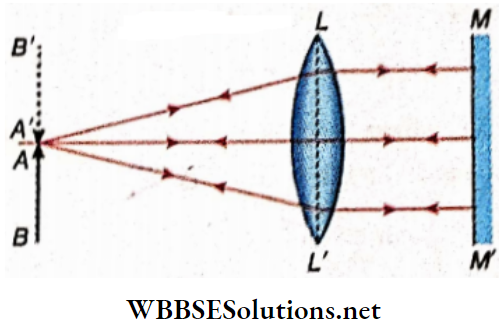
Class 12 Physics Unit 6 Optics Chapter 3 Refraction Of Light At Spherical Surface Lens Combination Of Lenses And Mirror

Combination of a convex lens and a convex mirror: Determination of the focal length of a convex mirror: 

In  LL’ Is a convex lens. The convex mirror MM’ IS placed a little behind the convex lens. Now the point object P is to be placed in front of the combination of lenses and mirror at such a distance that the image of the object coincides with the point object.

It Is possible only if the rays from P are incident normally on the convex mirror after refraction by the lens. These rays if produced further, must converge to the center of curvature C of the mirror. Hence the rays after being reflected from the convex mirror return along the same path and form the image at P.

Now on applying the lens formula for the formation of a real image by a convex lens, the image distance OC is determined. Measuring the distance of the mirror from the lens i.e., OO1, the distance O1C is determined. This distance O1C  is the radius of curvature of the convex mirror.

Half of this distance is the focal length of the convex mirror
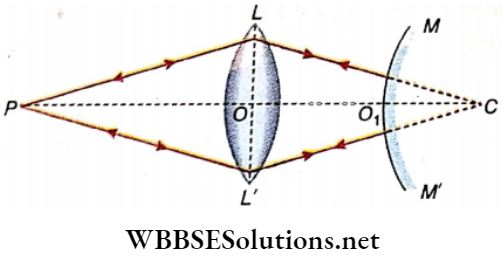
Class 12 Physics Unit 6 Optics Chapter 3 Refraction Of Light At Spherical Surface Lens Focal Length Of The Mirror

Combination of a convex tens and a concave mirror: Determination of focal; length of a concave mirror:

In LL’ is a convex lens. P is a point object Placed on the principal axis of the lens. MM’ is a concave mirror placed at a certain distance on die other side of the lens. The point object P is placed on the axis; at such a distance that its image coincides with the object at the same point P.

Since the final image coincides with the object at the same point, it can be said that the ray of light after passing through the convex lens is incident on the mirror perpendicularly. So point Q in the figure is the centre of curvature of the concave mirror. On applying the lens formula for the formation of a real image by a convex lens the image distance OQ is determined
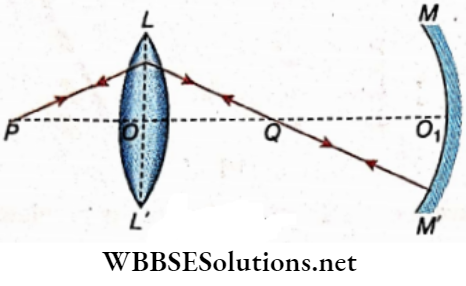
Class 12 Physics Unit 6 Optics Chapter 3 Refraction Of Light At Spherical Surface Lens Cobination Of A Convex lens And A Concave Mirror

So the radius of curvature of the concave mirror, QO1 = OO1– OQ

If OO1 is known, QO1 can be determined.

Therefore focal length of the concave mirror = \(\frac{1}{2}\) QO1

Combination of a concave lens and a concave mirror: Determination of focal length of a concave lens:

In LL’ is a concave lens. P is a pin. It is taken as a point object placed on the principal axis of the lens. MM’ is a concave mirror placed at a certain distance on the other side of the lens. Now the pin is placed in front of the lens at such a distance that the image formed by the combination of the lens and the mirror will be formed at the position of the pin.

It is possible only if the light rays from the object after refraction by the lens are incident perpendicularly on the concave mirror and after reflection from the mirror return along the same path. In that case, if the lens is absent, the reflected rays would meet at Q, the centre of curvature of the mirror. So concerning the concave mirror, the real image of the virtual object at Q is formed at P.
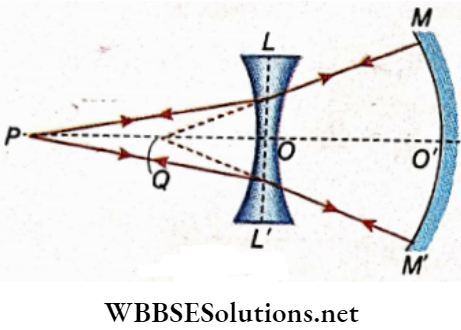
Class 12 Physics Unit 6 Optics Chapter 3 Refraction Of Light At Spherical Surface Lens Combination Of A Concave Lens And A Concave Mirror

If the radius of curvature of the concave mirror is known, QO’ will be known. Again If the distance between the lens and the mirror i.e., OO’ is known, QO will be known since QO = QO’-OO’ .

This QO is the virtual object distance with respect to the concave Knowing the distance PO and using the general lens for the focal length of the concave lens can be determined.

Refraction through spherical surfaces physics notes

Refraction Of Light At Spherical Surface Lens A Few Problems On Formation Of Real Image By A Convex Lens

Prove that by keeping the object and the screen fixed, a convex lens can be placed in two such positions that in each position, a distinct image of the object is formed on the the screen. Suppose, PQ is an object and S1S2 is a screen In between them a convex lens LL” is placed.

The lens forms a real image pq on the screen. Let the distance between the object and the screen =D, object distance = u, image distance = v. Here, D ‘ = u + v For the formation of a real image by a convex lens the equation of the lens is

⇒ \(\frac{1}{v}+\frac{1}{u}\)=\(\frac{1}{f}\)
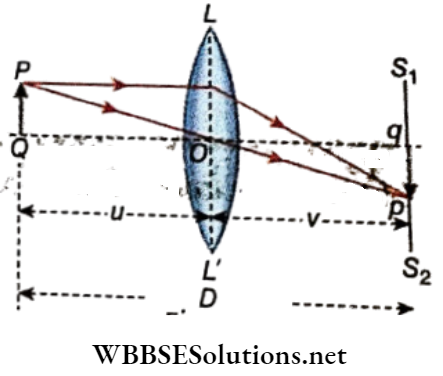
Class 12 Physics Unit 6 Optics Chapter 3 Refraction Of Light At Spherical Surface Lens Real Image By A Convex Lens

∴ \(\frac{1}{D-u}+\frac{1}{u}=\frac{1}{f}\)

Or, \(\frac{D}{(D-u) u}=\frac{1}{f}\)

Or, u² – Du +Df = 0……………(1)

In solving this equation, the following two values of u are obtained

⇒ \(\begin{aligned}
& u_1=\frac{D+\sqrt{D^2-4 D f}}{2} \\
& u_2=\frac{D-\sqrt{D^2-4 D f}}{2}
\end{aligned}\) Taking u1 > u2 ……………….(2)

For the different values of (D2– 4Df) three cases may arise:

1. When D² > 4Df i.e., D > 4f, the values of u1 and u2 are real and different.

So, if the distance between the object and the screen is greater than 4 times the focal length of the lens, then for two different positions of the lens, two real images of the object are formed on the screen.

2. When D2 = 4Df i.e., D = 4f, the values of u1 and u2 real and equal u1 = u2 = \(\frac{D}{2}\)

So, if the distance between the object and the screen is equal to 4 times the focal length of the lens, then for a single position of the lens, real images of the object are formed on the screen.

In this case, the lens is to be placed in the middle of the object and the screen, because

Object distance = u = u1 = u2 = \(\frac{D}{2}\)

= \(\frac{D}{2}\)

= 2f

And image distance =v = D-u = 4f- 2f = 2f.

3. When D² < 4Df i.e., D < 4f, the values of uy and u2 are imaginary. So in this case, wherever the lens is placed, no image is formed on the screen.

So it is clear from the above discussion that to obtain a real image on a screen with the help of a convex lens, the minimum distance between the object and the screen should be 4 times the focal length of the lens. If the distance between the object and the screen is greater than

4 times the focal of the lens two images will be obtained on-.the screen for two positions of the lens

An object and a screen are placed at a fixed distance D apart from each other. There are two positions for a convex lens in between them for a sharp image to be cast on the screen.

If the separation between positions shows that the focal length of the lens is given by f = \(\frac{D^2-x^2}{4 D}\)

Suppose, OO is the position of the object and SS{ is the position of the screen. L1 and L2 are two different positions of the lens. these two positions of the lens, the image of the object is  obtained on the screen,
Class 12 Physics Unit 6 Optics Chapter 3 Refraction Of Light At Spherical Surface Lens Object Obtained On The Screen

We have seen in the discussion of the problem

u1 = \(\frac{D+\sqrt{D^2-4 D f}}{2}\)

u1 = \(\frac{D-\sqrt{D^2-4 D f}}{2}\)

u1 and u2 have been chosen arbitrarily

u1– u1 = \(\frac{1}{2}\left[\left(D+\sqrt{D^2-4 D f}\right)-\left(D-\sqrt{D^2-4 D f}\right)\right]\)

Or, \(\sqrt{D^2-4 D f}\)

u1– u2 = x = distance between the two positions of the lens]

Or, x2 = D2 – 4Df

or, f = \(\frac{D^2-x^2}{4 D}\)

If two images of the object are obtained on the screen for two different positions of the lens, prove that ux = v2 and Vy = u2.

Suppose, the distance between the object and the screen is D.

For the first position of the lens at L1, object distance = u1 and image distance = v1

For the second position of the lens at L2 the corresponding values are u2 and v2 respectively

u1+ v1 = D and u2+ v2 = D

Taking u1 = \(\frac{D+\sqrt{D^2-4 D f}}{2}\)

And So , u2 = \(\frac{D-\sqrt{D^2-4 D f}}{2}\)

∴ v1 = D – \(D-\frac{D+\sqrt{D^2-4 b f}}{2}=\frac{D-\sqrt{D^2-4 D f}}{2}\) = u2

And v1 = D – \(\frac{D-\sqrt{D^2-4 D f}}{2}=\frac{D+\sqrt{D^2-4 D f}}{2}\) = u1

4. A convex lens is placed between an object and a screen. If dj and d2 be the lengths, of the two real images formed for taro positions of. the lens and d be the length of the object, prove that d = \(\sqrt{d_1 d_2}\)

Suppose, for the first position of the lens the length of the image = d1, and for the second position of the lens the length of the image = d2

If u1 and v1 are the object distance and the Image distance respectively for the first position of the lens, then

Magnification m1 = \(\frac{d_1}{d}=\frac{v_1}{u_1}=\frac{D-u_1}{u_1}\)

[∴ D = u1 +v1 ]

If u2 and v2 are the object distance and the Image distance respectively for the first position of the lens, then

Magnification m2 = \(\frac{d_2}{d}=\frac{v_2}{u_2}=\frac{D-u_2}{u_2}\)

∴ m1 ×  m2 =  \(\frac{d_1}{d} \times \frac{d_2}{d}=\frac{\left(D-u_1\right)\left(D-u_2\right)}{u_1 u_2}\)

∴ \(\frac{d_1 d_2}{d^2}=\frac{D^2-\left(u_1+u_2\right) D+u_1 u_2}{u_1 u_2}\)

= \(\frac{D^2-\left(u_1+v_1\right) D+u_1 u_2}{u_1 u_2}\)

Since u2 = v1

= \(\frac{D^2-D^2+u_1 u_2}{u_1 u_2}\)

Since = u1 +v1 = D

= \(\frac{u_1 u_2}{u_1 u_2}\) = 1

d1 d2 = d² or, d = \(\sqrt{d_1 d_2}\)

i.e., the size or length of the object the geometrical mean of the sizes or lengths of the images formed on screen for two different positions of the lens

5. A convex lens is placed between an object and a screen. A real image of the object is formed for two positions of the lens. If m1 and m2 are the magnifications of the Image for the two positions of the lens respectively, prove that the focal length of the lens is given by f =
\(\frac{x}{m_2-m_1}\) Where x = Distance between the two positions of the lens

According to the position of the lens at L1 object distance = u and image distance = v1. For the

Formation of real image by the convex lens at lens the equation of the lens is

⇒ \(\frac{1}{v_1}+\frac{1}{u_1}=\frac{1}{f}\)

Or, \(1+\frac{v_1}{u_1}=\frac{v_1}{f}\)

Or, \(1+m_1=\frac{v_1}{f}\)

Since  m1 = \(\frac{v_1}{u_l}\) ……………… (3)

Similarly, for the position of the lens at L, object distance = u2 and image distance – v2 For the formation of a real image by the lens, the equation of the lens is

⇒ \(\frac{1}{v_2}+\frac{1}{u_2}=\frac{1}{f}\)

Or, \(1+\frac{v_2}{u_2}=\frac{v_1}{f}\)

Or, \(1+m_1=\frac{v_1}{f}\)

Since  m1 = \(\frac{v_1}{u_l}\) ……………… (4)

Subtracting equation (3) from equation (4) we get,

1 +\(m_2-1-m_1=\frac{v_2}{f}-\frac{v_1}{f}\)

Or, \(m_2-m_1=\frac{v_2-v_1}{f}\)

Or, \(m_2-m_1=\frac{x}{f}\)

Since [v2– v1= u1-u2= x]

Or, f = \(\frac{x}{m_2-m_1}\)

Class 12 physics spherical lens refraction notes

Refraction Of Light At Spherical Surface Lens Displacement Method To Find The Focal Length Of A Convex Lens By Finding Position Of Images

A Convex Lens By Finding Position Of Images Procedure

Two pins N1 And N2 are mounted on the optical bench such that the separation such that the separation between them is greater

then four times the focal length of the convex lens. Now the lens is placed in between the pins N1 and N2 Two positions of the lens are found in such a way that in each position of the lens the image of one pin if formed at the position occupied by the other
Class 12 Physics Unit 6 Optics Chapter 3 Refraction Of Light At Spherical Surface Lens Lens The Image Of One Pin Is Formed At The Position Occupied

A Convex Lens By Finding Position Of Images Calculation

Let the distance between the two pins be D distance between the two positions of the lens be x. For the first position L1 of the lens,’

u = N1L1 = \(\frac{1}{2}\left(N_1 N_2-L_1 \dot{L}_2\right)=\frac{1}{2}(D-x)\)

v = L1N2 = \(N_1 N_2-N_1 L_1=D-\frac{1}{2}(D-x)=\frac{1}{2}(D+x)\)

The general formula of a convex lens forming a real image is

⇒ \(\frac{1}{v}+\frac{1}{u}=\frac{1}{f}\)

⇒ \(\frac{2}{D+x}+\frac{2}{D-x}=\frac{1}{f}\)

Or, \(\frac{1}{f}=\frac{4 D}{D^2-x^2}\)

Or, f = \(\frac{D^2-x^2}{4 D}\)

Measuring D and x from the optical bench, the focal length of a convex lens can be determined from equation (1)

Refraction Of Light At Spherical Surface Lens Power Of A Lens

The function of a lens is to converge a beam of light in the case of a convex lens or to diverge it in the case of a concave lens

Power of a Lens Definition

The power of a lens is the degree of convergence in the case of the convex lens or the degree of divergence in the case of a concave lens.

Since a convex lens of shorter focal length produces a greater convergence and a concave lens of shorter focal length produces

Hence, the reciprocal of the focal length of a lens is called its power. Representing the fatal length of a lens by f and power by P we can write, P = \(\frac{1}{f}\)

Unit of power of lens

The unit of power of the lens is dioptre (dpt or, D).

1 dioptre is defined as the power of a lens of focal length one meter. So unit of power oflens in SI is m-1

i. e P = \(\frac{1}{\text { focal length in meter }} \text { dioptre or } \mathrm{m}^{-1}\)

= \(\frac{100}{\text { focal length in centimeter }} \text { dioptre or } \mathrm{m}^{-1}\)

or, p (diopter) = \(\frac{1}{f(\text { metre })}=\frac{100}{f(\text { centimetre })}\)

The power of a convex lens is considered positive and that of a concave lens is considered negative.

The convex lens having a focal length of 20 cm has power

= \(\frac{100}{20}\)

= 5 dpt

The lens having power 4 dpt has a focal length

= \(\frac{1}{4}\) m = 25 cm

Again, the nature of the lens having power -4 dioptre is concave, and its focal length

f = \(\frac{1}{4}\) = – 0.25m

Power of a combination of lenses

The power of; a combination of lenses is equal to the algebraic sum of the powers of the constituent lenses.

The power of the combination of two lenses with powers Px and P2 kept in contact with one another is

p = P1+P2

Relation of the radius of curvature of a lens with the power

We know that the equation of focal length of a given by,

⇒ \(\frac{1}{f}=(\mu-1)\left(\frac{1}{r_1}-\frac{1}{r_2}\right)\)

If the radii of curvature of the two surfaces of the lens be equation then in the case of biconvex and biconcave lenses we have,

⇒ \(\frac{1}{f}=(\mu-1) \cdot \frac{2}{r}\) and

⇒ \(\frac{1}{f}=-(\mu-1) \frac{2}{r}\) respectively

So, the corresponding power of (these lenses are,

P = (mu-1).\(\frac{2}{r}\) and p = -(mu-1)

I. e \(P \propto \frac{1}{r}\)

Therefore, if the radius of curvature of a biconvex or a biconcave lens increases, the power of the lens decreases, and if the radius of curvature decreases power of the lens increases.

1. When two thin lenses haying equal and opposite focal lengths (one convex and one concave) are placed in contact with each other and if F be their equivalent focal length then

⇒ \(\frac{1}{F}=\frac{1}{f}+\frac{1}{-f}\) = 0

F = \(\frac{1}{0}\)

So, power P = \(\frac{1}{F}\) = 0

This type of combination of lenses acts as a plane glass plate.

2. If the refractive index of the medium surrounding the lens is greater than that of the material of the lens, the convex lens shows diverging power and the concave lens shows converging power

3. Suppose that the refractive index of the surrounding medium is μm and the refractive index of the material of the lens is μg. If μm increases, the power of the lens decreases i.e, its focal length increases

Change of the focal length and the power of a lens with the wavelength of the incident light:

According to Scientist Cauchy, the relation of wavelength (λ) with refractive index (μ) is given by

μ = A + \(\frac{B}{\lambda^2}\) [ where A and B are constants]

Now, if be the focal length of a lens then,

⇒ \(\frac{1}{f}=(\mu-1)\left(\frac{1}{r_1}-\frac{1}{r_2}\right)\)

So, for any particular lens,

⇒  \(f \propto \frac{1}{(\mu-1)}\)

In comparison to any other wavelength of light, the wavelength of red light is greater i.e., for red light, the refractive index of the lens is minimal. So the focal length of a lens is greater for red light is comparison to other colours.

The power of a lens is given by

⇒ \(P\frac{1}{f}=(\mu-1)\left(\frac{1}{r_1}-\frac{1}{r_2}\right)\)

Or, P ∝(μ-1)

So, the power of a lens will be less in the case of red light in comparison to any other colour.

f-number of lens:

The focal length of a lens is generally expressed as a multiple of the diameters of its aperture. This multiple is called the f-number of lenses. If F is the focal length and D is the diameter of the aperture, Then D = \(\frac{F}{f}\) or, f = \(\frac{F}{D}\). For example, if the f-number of a lens is (\(\frac{1}{15}\)), it means that the diameter of the aperture of the lens is its focal length.

Depth of field:

In optics, depth of field (DOF) is the distance between the nearest and farthest objects in a scene that appear acceptably sharp in an image. The term mainly relates to film and photography. For a particular lens greater the value of f-number, the greater is the depth of field.

Class 12 physics spherical lens refraction notes

Refraction Of Light At Spherical Surface Lens Power Of A Lens Numerical Examples

Example 1. The power of a lens- of a pair of spectacles is -2.5 dioptre. What is the nature and focal length of the lens used?
Solution:

We know, P= + \(\frac{100}{f}\)

⇒ \(\frac{100}{f}\) dioptre

[If f is expressed in cm]

= – 2.5 = + \(\frac{100}{f}\) Or, f = -40 cm

Since the focal length is negative, the lens is concave and its focal length is 40 cm.

Example 2. A lens of power 0.5 dioptre is placed In front of a lens of power 2.0 dioptre. Assume that the distance between the two lenses is zero, 

  1. What will be the power of the lenses in dioptre
  2. What will be their focal lengths?

Solution:

Power of the combination of lenses

P = P1 + p2

Here P1 = 0.5 dpt

P2 = 2 dpt

= 0. 5 + 2 = 2.5 dpt = 2.5 m1

The focal length of the lens of power is 0.5 dioptre

f1 = \(\frac{+100}{0.5}\) = 200 cm (convex lens)

And focal length of the lens of power 2.0 dpt

f2 = \(\frac{100}{2}\)

= + 50 cm (convex lens)

Example 3. A convex lens of focal length 40cm Is placed In contact with a concave lens of focal length 25cm. What Is the power of the lens combination?
Solution:

Power of the convex lens, P2 = \(\frac{100}{f_1}\)

⇒ \(\frac{100}{40}\) ‘

Power of the concave Mirror lens P2 = \(\frac{100}{f_2}=\frac{100}{-25}\) = -4.0 m1

= 2.5 m1

The Power of the combination of lenses

P = P1+P2 = 2.5 – 4.0 = -1.5 m1

Example 4.   An object is placed at a distance of 12 cm from a lens and a virtual image, four times magnified is formed. Calculate the focal length of the lens. Draw the ray diagram for the formation of linage. What Is the power of the lens?
Solution:

Magnification , m= \(\frac{v}{u}\) = 4 or, v = 4u

From diagram u = OQ = -12 cm, v = OQ’ = -48 cm
Class 12 Physics Unit 6 Optics Chapter 3 Refraction Of Light At Spherical Surface Lens Convex Lens And Virtual Image

From the lens equation

⇒ \(\frac{1}{f}=\frac{1}{v}-\frac{1}{u}=\frac{1}{-48}-\frac{1}{-12}\)

Or, \(\frac{1}{f}=\frac{1}{12}-\frac{1}{48}\)

Or, f = 16

The focal length of the lens is 16 cm.

The lens is convex i.e.,f is positive.

Power of the lens P = \(\frac{100}{f}\) D = \(\frac{100}{16}\) D

= + 6.25 D

Example 5. A real image of an object Is formed by a convex. lens on. a screen at a distance of 20 cm from the lens. When a concave lens is placed at a distance of 5 cm from the convex lens towards the screen the Image Is shifted through 10 cm. Calculate the focal length and the power of the concave lens.
Solution:

The role of the convex lens is just to form the first image on the screen

For the concave lens, this image acts as the virtual object, and another real image is formed at a distance of 10 cm away from The virtual object.
Class 12 Physics Unit 6 Optics Chapter 3 Refraction Of Light At Spherical Surface Lens Focal Lenght And The Power Of The Concave Lens

Let P is the position of the object. L1 and L2 are the convex and concave lenses respectively separated by O1O2= 5 cm

P’ is the real image formed by L1 and O1P’ = 20 cm

P’ acts as the virtual object for the second lens L2 and a real

Image of P’ is formed at P1, the distance P’P1 = 10 cm

∴ For the concave lens:

u = O2P’ = O1P’-  O1O2 = 20 – 5 = 15 cm

And v = O2P1 = O2P’ + P’P1 = 15 + 10 = 25 cm

Putting in \(\frac{1}{v}-\frac{1}{u}=\frac{1}{f}\), we get

⇒ \(\frac{1}{25}-\frac{1}{15}=\frac{1}{f}\),Or, f = – 37. 5 cm

So, the focal length of the concave lens is 37.5 cm

Power of the lens = \(\frac{100}{f}=\frac{100}{-37.5}\)D

= – 2.67 D

Class 12 Physics Spherical Lens Refraction Notes

Example 6. The distance between a lamp and a screen is 90 cm. Where should a convex lens of focal length 20 cm be placed between the lamp and the screen so that a real Image of the lamp Is formed on the screen?
Solution:

Let the distance of the lamp from the lens be x cm.

So, image distance =(90-x) cm I.e., u = -x and v = (90-x)

For the formation of a real image by the convex lens we have

⇒ \(\frac{1}{v}-\frac{1}{u}=\frac{1}{f}\)

Or, \(\frac{1}{90-x}+\frac{1}{x}=\frac{1}{20}\)

Or, \(\frac{90}{x(90-x)}=\frac{1}{20}\)

Or, x² – 90x +1800 = 0

Or, (x – 30)(x – 60)= 0

Or, x = 30 cm or, 60 cm

So, the lens is to be placed at a distance of 30 cm or 60 cm concerning the lamp.

Example 7. The size of the image of an object that is at infinity, as formed by a convex lens of focal length 30 cm, is 2 cm. If a concave lens of focal length 20 cm is placed between the convex lens and the image at a distance of 26 cm from the convex lens what will be the size of the final image?
Solution:

For the convex lens, since the object is at Infinity

Image is formed at the focus (P’)

∴ v = f = 30 cm
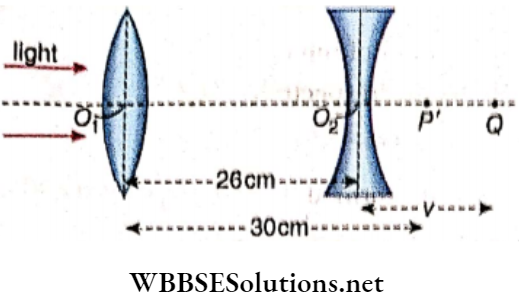
Class 12 Physics Unit 6 Optics Chapter 3 Refraction Of Light At Spherical Surface Lens Size Of The Image Of An Object Is Infinity Formed By A Convex Lens

This is the virtual object for the second lens which Is at a distance Oj02 = 26 cm from the first lens.

In this case object distance

u = (O1P’-O1O1) = 30 -26 = 4cm and f = -20 cm

⇒ \(\frac{1}{v}-\frac{1}{4}=\frac{1}{-20}\) Or, + = 5 cm

Magnification by the second lens = \(\frac{5}{4}\)

Size of the final image = size of the 1st image x \(\frac{5}{4}\)

= 2 × \(\frac{5}{4}\)

= 2.5 cm

Example 8. The image of an Illuminated pin placed at a distance of 20 cm from a convex lens is formed on a screen placed at a distance of 30 cm from the lens. Between the screen and the convex lens, a concave lens is placed at a distance of 10 cm from the convex lens. If the screen Is shifted through a distance of 10 cm more, a distinct image is formed on the screen. Find the ratio of the power of the two lenses. If the power of the concave lens Is -4 m-1, how far should the screen is to be shifted?
Solution:

For the convex lens

u = O1 P = -20 cm

v = O1P = 30 cm , f= ?

From \(\frac{1}{v}-\frac{1}{u}=\frac{1}{f}\) we ,get

⇒ \(\frac{1}{30}-\frac{2}{-20}=\frac{1}{f_1}\)

Let the focal length be f1

∴ f1 = 12cm

Example 9. The radii of the curvature of (lie two surfaces of a convexoconcave lens made of glass are 20 cm and 60 cm. An object Is situated on the left side of the lens at a distance of 80 cm along the principal axis.

  1. Determine the position of the Image
  2. A similar type of lens Is placed at a u distance of 100 cm on the right side of the first lens co-axially  Determine the position of the image. [Given mu of glass a l.5 ]

Solution: The focal length of an Ions Is given the lens maker’s formula

⇒ \(\frac{1}{f}=(\mu-1)\left(\frac{1}{r_1}-\frac{1}{r_2}\right)\)

In this case mu = 1.5 r1 = + 20 cm

r1 = + 60 cm

⇒ \(\frac{1}{f}=(1.5-1)\left(\frac{1}{20}-\frac{1}{60}\right)\)

Or, f = 60 cm

Here, u = -80 cm , f = 60 cm

From \(\frac{1}{v}-\frac{1}{u}=\frac{1}{f}\) we get

⇒ \(\frac{1}{v}+\frac{1}{80}=\frac{1}{60}\) or, v = 240 cm

So, the Image Is at a distance of 240 cm on the other side of the lens.
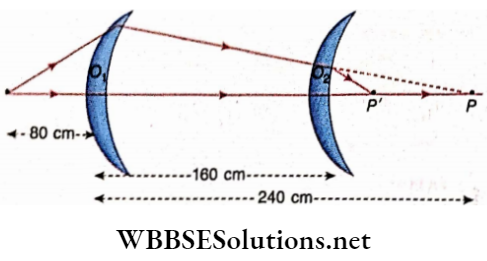
Class 12 Physics Unit 6 Optics Chapter 3 Refraction Of Light At Spherical Surface Lens The Radii Of Curvacture Of The Two Surfaces Of A Convexoconcave

The image P formed by the 1st lens will act as the virtual

Image of the second lens

∴ Object distance, u’ = O2P = 240-160 = 80 cm

Distance is measured along the direction of the ray

And f’ = 60 cm

∴ From \(\frac{1}{v}-\frac{1}{u}=\frac{1}{f}\)

We get,  \(\frac{1}{v}-\frac{1}{80}=\frac{1}{60}\)

Or, v =  \(\frac{240}{7}\)

= 34.28

So, the final image is formed at a distance of 34.28 cm from the second lens and on the other side of the first lens

Example 10. An illuminated object is placed at a distance 15cm in front of a convex lens of a focal length of 12cm. If a plain mirror is placed behind the lens at a distance 45cm, a distinct image is formed in front of the lens (on the object side) on the screen. Find the distance of the screen from the lens.
Solution:
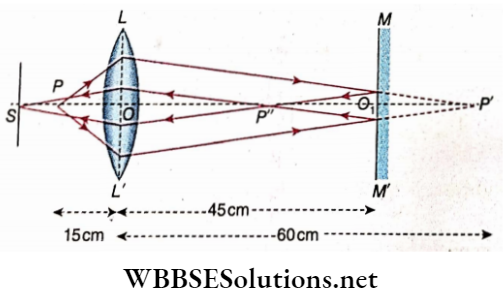
Class 12 Physics Unit 6 Optics Chapter 3 Refraction Of Light At Spherical Surface Lens Distance Of The Screen From The Lens

LL’ is a convex lens and MM’ is a plain mirror placed at a distance of 45cm from the lens. P is an illuminated object at a distance 15cm in front of the convex lens.

In the case of image formation by the lens,

u = -15 cm , f= 12 cm, v= ?

From the lens equation,

⇒ \(\frac{1}{v}-\frac{1}{u}=\frac{1}{f}\)

Or, \(\frac{1}{v}+\frac{1}{15}=\frac{1}{12}\)

Or, \(\frac{1}{12}-\frac{1}{15}=\frac{1}{60}\)

∴ v = 60 cm

If the plain mirror is absent a real image will be formed at P’. This P’ will act as a virtual object for the plain mirror.

For plain mirror,

object distance = O1 P’ = 60 – 45 = 15cm

Mirror MM’ will form a real image of P’ at P”.

Now, image P” acts as an object for the formation of the image in a second time

So, object distance – OP”= OO1– O1P”

= (45 – 15) = 30 cm

Since [ O1p’ = O1 P” = 15 cm]

Thus, u = -30cm, f = 12cm, v = ?

From lens equation, \(\frac{1}{v} \cdot \frac{1}{u}=\frac{1}{f}\)

Or, \(\frac{1}{v}+\frac{1}{30}=\frac{1}{12}\) Or, \(\frac{1}{v}=\frac{1}{12}-\frac{1}{30}=\frac{1}{20}\)

Or, v = 20 cm

Therefore an image will be formed on screen S at a distance of 20cm in front of the lens (on the object side).

Example 11. If an object is placed at a distance from a convex lens, the magnification of the real image so formed is m1. If the object is shifted through a distance x, the magnification of the real image now formed is m2. Prove that the focal length of the lens,  f = \(\frac{x}{\frac{1}{m_2}-\frac{1}{m_1}}\)
Solution:

Let the object distance and image distance in the first and second cases be u1, v1 and u2, v2 respectively

∴ m1 = \(\frac{v_1}{u_1}\)

And m2 = \(\frac{v_2}{u_2}\)

From the general lens formula, we get

⇒ \(\frac{1}{v}-\frac{1}{u}=\frac{1}{f}\)

Or, \(\frac{u}{v}-1=\frac{u}{f}\)

So in the 1st case, for the formation of a real image in the convex lens

⇒ \(\frac{1}{v_1}+\frac{1}{u_1}=\frac{1}{f} \text { or, } \frac{u_1}{v_1}+1=\frac{u_1}{f}\)

Or, \(\frac{1}{m_1}+1=\frac{u_1}{f}\) ………………… (1)

And the second case, the relationship will be

⇒ \(\frac{1}{v_2}+\frac{1}{u_2}=\frac{1}{f} \text { or } \frac{u_2}{v_2}+1=\frac{u_2}{f}\)

From equations (1) and (2) we get

⇒ \(\frac{u_2}{f}-\frac{u_1}{f}=\frac{1}{m_2}-\frac{1}{m_1}\)…………. (2)

Or, \(\frac{u_2-u_1}{\frac{1}{m_2}-\frac{1}{m_1}}=\frac{x}{\frac{1}{m_2}-\frac{1}{m_1}}\)

Since [ u2 – u2= x]

Class 12 physics spherical lens refraction notes

Example 12. An Object Is Placed At A Distance D From A Screen. A Convex Lens Forms A Distinct Image of Object On The Screen. When The Lens Is Shifted Through A Distance X Towards The Screen, Another Distinct Image Is Formed Cm The Screen. Prove That The Ratio Of The Lizes Of The first and the second images are equal to \(\left(\frac{D+x}{D-x}\right)\)
Solution: 

Suppose, in the first case, object distance -u, image distance =D

For the formation of a real image in a convex lens, the lens equation is

⇒ \(\frac{1}{v}+\frac{1}{u}=\frac{1}{f} \text { or, } \frac{1}{D-u}+\frac{1}{u}=\frac{1}{f}\)

Or, \(\frac{D}{(D-u) u}=\frac{1}{f}\)

or, u²- Du+Df = 0

The two roots of u are

u1 = \(\frac{D-\sqrt{D^2-4 D f}}{2}\)

And u2 = \(\frac{D+\sqrt{D^2-4 D f}}{2}\) …………….. (1)

According to the

x = u2– u1

⇒ \(\frac{D+\sqrt{D^2-4 D f}}{2}-\frac{D-\sqrt{D^2-4 D f}}{2}\)

⇒ \(\sqrt{D^2-4 D f}\)

Putting the value of x in equation (1) we get

u1 = \(\frac{D-x}{2}\) and

u2 = \(\frac{D+x}{2}\)

Let v1 and v2 be the image distances corresponding to the object distances Uj and u2 respectively.

v = D-u = \(-\frac{D-x}{2}=\frac{D+x}{2}\) and

v = D-u =  \(-\frac{D+x}{2}=\frac{D-x}{2}\)

⇒ If f be the size of the object and I1 had I2 be the size of the images for the two positions of the lens, then

⇒ \(\frac{I_1}{I}=\frac{v_1}{u_1}=\frac{D+x}{D-x}\)

And \(\frac{I_2}{I}=\frac{v_2}{u_2}=\frac{D-x}{D+x}\)

⇒  \(\frac{I_1}{I_2}=\frac{\frac{1}{I}}{I_2}=\frac{\frac{D+x}{D-x}}{\frac{D-x}{D+x}}\)
= \(\left(\frac{D+x}{D-x}\right)^2\)

Example 13. The focal length of a lens is inversely proportional to, (n-1) where n is the refractive index. Forviolet light if the focal length of the lens is 50 mm, what will be the focal length of the lens for red light? Given for violet light, n = 1.532 andforred light, n = 1.512.
Solution:

If f is the focal, the length of the lens

⇒ \(f \propto \frac{1}{n-1}\)

or, f = \(\frac{k}{n-1}\)

⇒ \(-\frac{f_r}{f_\nu}=\frac{n_\nu-1}{n_r-1}\)

⇒  \(f_r=\frac{n_\nu-1}{n_r-1} \times f_\nu\)

= \(\frac{1.532-1}{1.512-1} \times 50\)mm

= 51.95mm

So, the focal length of the lens for red light is 51.95 mm.

Example 14. The focal length–of the lens of a camera is 1.25 times its I diameter. Calculate the angle of deviation of a ray parallel to the axis of the lens incident at the edge of the lens.
Solution:

Suppose, the diameter of the lens is D and the focal length of the lens is f.
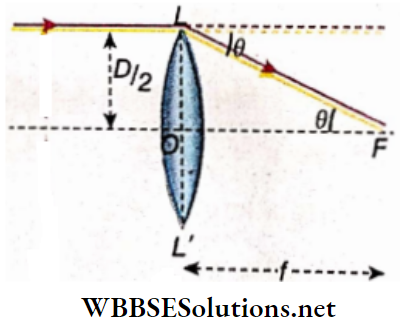
Class 12 Physics Unit 6 Optics Chapter 3 Refraction Of Light At Spherical Surface Lens Angle Of A Deviation Of A Ray Parallel To The Axis Of The Lens

According to the question, f = 1.25D.

According to suppose that the ray has deviated through an angle θ

⇒ \(\tan \theta=\frac{O L}{O F}=\frac{\frac{D}{2}}{f}\)

⇒ \(\frac{D}{2 f}=\frac{D}{2 \times 1.25 D}\)

Or, tan θ \(\frac{1}{2.5}\)

= 0.40

= tan 22°

or, θ = 22°

Example 15. Two lenses one convex and another, concave, both of equal focal length are placed In contact What is the focal length of the lens combination?
Solution:

If F is the equivalent focal length of the lens combination, then

⇒ \(\frac{1}{F}=\frac{1}{f_1}+\frac{1}{f_2}\)

For convex lens, f1 = f and for concave lens, f2 =  -f

Thus \(\frac{1}{F}=\frac{1}{f}-\frac{1}{f}\) = 0 Or, F = ∞

Therefore, the focal length of the lens combination will be infinite,

Example 16. A convex lens of focal length 15 cm is placed coaxially at a distance of 5 cm in front of a convex mirror. When an object is placed on the axis at a distance of 20 cm from the lens, it is found that the image coincides with the object. Find the focal length of the mirror.
Solution:

Here, the object at P is supposed to be a point object. LL’ is the convex lens and MM’ is a convex mirror. If the image of the object is to coincide with the point object, the light rays after being refracted from the lens must be incident normally on the convex mirror i.e., the light rays should be directed along the radius of curvature, C of the convex mirror as a result of which after being reflected on the mirror the rays of light return along the same path and form image at P.

According to the problem, u = -20 cm, f = 15, v =?

According to the equation of lens,

⇒ \(\frac{1}{v}-\frac{1}{u}=\frac{1}{f} \text { or, } \frac{1}{v}=\frac{1}{u}+\frac{1}{f}\)

Or, \(\frac{1}{v}=\frac{1}{-20}+\frac{1}{+15}=+\frac{1}{60}\)

Or, v = + 60 cm

OC = 60 cm

Or, OO1+O1C = 60

Or, 5 +  O1 C = 60 Or, O1C = 55

∴ The radius of curvature of the convex mirror = 55 cm

∴ Focal length = \(\frac{55}{2}\) = 27.5 cm

Class 12 physics spherical lens refraction notes 

Example 17. if an object is placed at position A in front of a convex of vex lens of focal length f, the Image produced by the lens becomes erect But If the object Is placed at position B, an Inverted image of the same size is produced. If the amount of magnification is m, prove that AB = \(\frac{2 f}{m}\)
Solution:

In the 1st case, let the object distance, OA = u1 and image distance, OA1 = v1

From the lens equation, we get,

⇒\(\frac{1}{-\nu_1}-\frac{1}{-u_1}=\frac{1}{f}\)

Or, \(-\frac{u_1}{v_1}+1=\frac{u_1}{f}\) ……………………. (1)

In this case, magnification, m = \(\frac{\nu_1}{u_1}\)
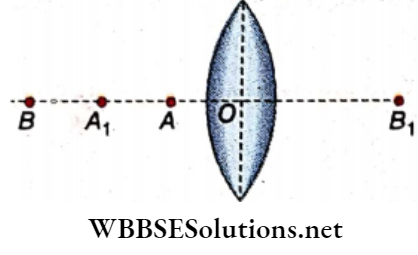
Class 12 Physics Unit 6 Optics Chapter 3 Refraction Of Light At Spherical Surface Lens Inverted Image Of The Same Size

Putting in equation (1) we get

⇒ \(-\frac{1}{m}+1=\frac{u_1}{f}\)

Or, \(\frac{1}{m}-1=-\frac{u_1}{f}\) …………………………….. (2)

Similarly, in the second case, let the object distance, OB1 = u2, and image distance, OB1 = v2

In this case, magnification

⇒ \(\frac{1}{v_2}-\frac{1}{-u_2}=\frac{1}{f}\)

Or, \(\frac{u_2}{v_2}+1=\frac{u_2}{f}\)

Or, \(\frac{1}{m}+1=\frac{u_2}{f}\)

Or, \(\frac{1}{m}+1=\frac{u_2}{f}\) ………………………… (3)

From Equations (2) we get

⇒ \(\frac{2}{m}=\frac{u_2-u_1}{f}\)

Or, \(\frac{A B}{f}=\frac{2}{m} \text { or, } A B=\frac{2 f}{m}\)

Example 18. A convex lens of focal length 10cm is placed In front of a concave mirror. The principal axes of both coincide and the lens is at a distance 40cm from the pole of the mirror. If an object is placed on the axis at a distance15 of cm from the lens on another side of the lens, then image point coincides with the object point. Find the focal length of the mirror.
Solution:
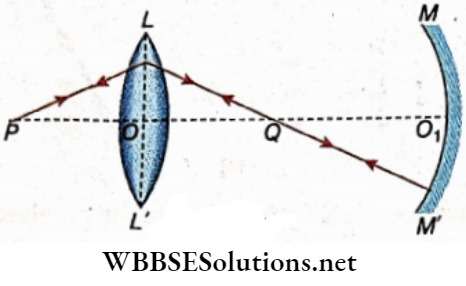
Class 12 Physics Unit 6 Optics Chapter 3 Refraction Of Light At Spherical Surface Lens Cobination Of A Convex lens And A Concave Mirror

LL’ is a convex lens and MM’ is a concave mirror. P is an

object and Q is the image of P formed by the lens.

Here, object distance = PO = u = -15cm

And image distance – OQ = v

From the lens equation, \(\)

⇒ \(\frac{1}{v}-\frac{1}{u}=\frac{1}{f}\)

Or, \(\frac{1}{v}+\frac{1}{15}=\frac{1}{10}\)

Or, v = 30 cm

v is positive Le., the image is formed on another side at a distance of 30cm from the lens. This image acts as a real object for the concave mirror. In this case object distance = O1Q = 40- 30 = 10cm.

Since the final image is formed at the same point where the object is situated it can be concluded that light ray is incident on the mirror normally.

Therefore, Q is the centre of curvature of the concave mirror.

∴ The radius of curvature of the mirror, r = O1Q = 10cm

∴ Focal length of the mirror f = \(\frac{r}{2}=\frac{10}{2}\)

= 5cm

Example 19. The focal length of a convex lens is/ and the distance of the object from the lens is u. A plane mirror is placed perpendicular to the principal axis of the lens at a distance f from the lens on the opposite side of the object. If the final Image is formed at a distance v in front of the lens, prove that u + v= 2f
Solution:

Let P be the object in front of the lens L

Object distance, OP = -u

In the absence of the mirror, P’ would be the image formed by the lens.

Let OP’ = v’

But the rays before forming the image P’ are incident on the mirror M and are reflected by it to form a real image at P” for the virtual object P’.

MP’ = OP’- OM and MP” = MP’
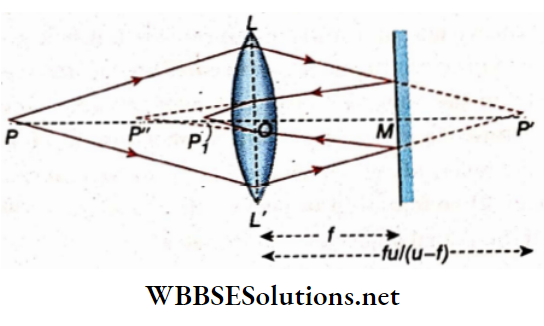
Class 12 Physics Unit 6 Optics Chapter 3 Refraction Of Light At Spherical Surface Lens Perpendicular To The Principle Axis

Again the rays before reaching P” are refracted by the lens for the second time and converge at P to form a real image.

Now, OPl = v; OP” = us = MP”-MO

[ u’ is positive as the distance is taken along the direction of the ray.]

Now, for the 1st refraction, we have

⇒ \(\frac{1}{v^{\prime}}+\frac{1}{u}=\frac{1}{f}\)

Or, \(v^{\prime}=\frac{u f}{u-f}\)…………………….. (1)

For reflection in the mirror,

MP’ = \(v^{\prime}-f=\frac{u f}{u-f}-f=\frac{f^2}{u-f}\) ………………………………………… (2)

And MP’ = \(M P^{\prime}=\frac{f^2}{u-f}\)

[Positive, since the distance is taken along the ray]

For the second refraction in the lens

u’ = OP” = MP”- MO

⇒ \(\frac{f^2}{u-f}-f=\frac{2 f^2-u f}{u-f}=\frac{f(2 f-u)}{u-f}\)

From the lens equation; we can write

⇒ \(\frac{1}{v}-\frac{1}{u^{\prime}}=\frac{1}{f}\)

Or, \(\frac{1}{v}-\frac{u-f}{f(2 f-u)}=\frac{1}{f}\)

Or, \(\frac{1}{v}=\frac{1}{f}+\frac{u-f u}{f(2 f-u)}\)

Or, \(\frac{1}{v}=\frac{1}{2 f-u}\)

v = 2f- u

Or, u+v = 2f

Example 20. A Concave of focal length 20 cm Is placed at a distance of 25 cm behind a concave lens. If a pin is u = distance 68.6 cm, placed In front of the lens at an Image formed by the combination of lens and mirror will be formed at the position of the pin. What Is the focal length of the lens?
Solution:

In P is a pin. It is taken as a point object. LL’ is the concave lens and MM’ is the concave mirror. Light rays from the object after refraction in the lens are incident perpendicularly on the concave mirror and after reflection from the mirror return, along the same path. In that case, if the lens is absent the. reflected rays would meet at Q, the optical center of the mirror. Therefore, with respect to the concave lens, the real image of the virtual object at Q is formed at P.
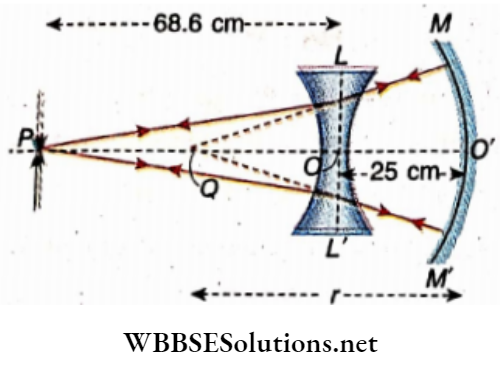
Class 12 Physics Unit 6 Optics Chapter 3 Refraction Of Light At Spherical Surface Lens Concave lens The Real Image Of The Virtual Object

The radius of curvature of the concave mirror,

r = 2f = 2 × 20 = 40 cm

Therefore, concerning the concave lens,

u = OQ =(40-25) = 15 cm

[Along the direction of the ray]

v = 68.6 cm ; f = ?

According to the equation of the lens

⇒ \(\frac{1}{v}-\frac{1}{u}=\frac{1}{f}\)

⇒  \(\frac{1}{68.6}-\frac{1}{15}=\frac{1}{f}\)

Or, \(\frac{15-68.6}{68.6 \times 15}=\frac{1}{f}\)

Or, \(\frac{-53.6}{68.6 \times 15}=\frac{1}{f}\)

Or, f = \(-\frac{68.6 \times 15}{53.6}\)

= 19.2 cm

Therefore, the focal length of the concave lens is 19,2 cm

Example 21. A convex lens of power 5 D is placed on a plane mirror. A pin is placed above 30 cm straight from the lens. Determine the position of the Image. Where should the pin be placed The image will coincide with the pin
Solution:

We know,

P = \(\frac{100}{f}\)

Or, 5 = \(\frac{100}{f}\)

Or, 20 cm

In the case of the formation of an image by the convex lens,

u = -30 cm , f = +20 cm; v = ?

According to the equation of lens

⇒ \(\frac{1}{v}-\frac{1}{u}=\frac{1}{f}\)

⇒ \(\frac{1}{v}-\frac{1}{-30}=+\frac{1}{20}\)

Or, \(\frac{1}{v}=\frac{-1}{30}+\frac{1}{20}=\frac{+1}{60}\)

Or, + 60 cm

So the image is real and is formed at a distance of 60 the lens. This image will act as a virtual object for the plane mirror. The image of this virtual object will be formed above at a distance of 60 cm. This image will again act as a virtual object for the convex lens.

In the case of the formation of an image again by the convex lens,

u = + 60 cm [distance taken along the direction of ray]

f = +20 cm; v = ?

According to the equation of lens,

⇒ \(\frac{1}{v}-\frac{1}{u}=\frac{1}{f}\)

⇒ \(\frac{1}{v}-\frac{1}{60}=\frac{1}{20}\)

Or, \(\frac{1}{v}=\frac{1}{60}+\frac{1}{20}=\frac{1}{15}\)

Or, v = 15 cm

So, the image will be formed above the lens at a distance of

Radius of curvature of the concave mirror, If the pin is placed at the focus of the convex lens, its image will coincide with the pin. In that case the distance of the pin from the lens = 20 cm.

WBCHSE Physics Class 12 Refraction Lens Notes

Example 22. The diameter of the sun makes an angle of 0.5° at the pole of the convex lens. If the focal length of the lens be 1 m, what will be the Image of the sun?
Solution:

Suppose, the diameter of the sun = D m and the distance of the sun from the lens = u m

Angle made by the sun at the pole of the lens, θ = \(\frac{D}{u}\)

Given = 0.5 = \(\frac{0.5 \times \pi}{180}\)rad

As the sun is stated at a long distance, its image is formed at the focus.

v = f

Suppose, the diameter of the image of the sun = d

m = \(\frac{v}{u}=\frac{d}{D}\)

Or, d = \(\frac{v D}{u}\)

fθ =  \(\frac{1 \times 0.5 \pi}{180}\)

= 0.00872 m

= 0.872cm

Example 23. There is a square hole In the screen. The hole is Illuminated and its Image is formed on another screen with the help of a convex lens. The distance of the hole from the lens is 40 cm. If the area of the Image is 9 times the area of the hole, determine the position’ of the image and the focal length of the lens.
Solution:

Suppose, the length of each side of the hole = x and the length of each side of the image = y

The area of the hole = x² and the area of the image = y².

⇒ \(\frac{y^2}{x^2}\) = 9

Or, \(\frac{y}{x}\) = 3

m = 3

Or, \(\frac{v}{u}\) = 3 or, 3u = 3 × 40= 120 cm

u = 40 cm

So, the image is formed at a distance of 120 cm from the lens

v = +120 cm and given , u= – 40 cm

According to the equation of lens

⇒ \(\frac{1}{v}-\frac{1}{u}=\frac{1}{f}\)

Or, \(\frac{1}{+120}-\frac{1}{-40}=\frac{1}{f}\)

Or, \(\frac{1}{f}=+\frac{1}{30}\)

f = 30 cm

Therefore, the focal length of the lens is 30 cm

Example 24. The focal—length of a camera lens is 45 cm msmmand the measurement of the photographic plate Is 30 cm x 30 cm. What is the measure of square area of the earth that can be photographed from a plane at a height 1500 m above the earth
Solution:

Here, u = 1500 m = 150000 cm . The image of a very distant object is formed at the focus of the convex lens.

v = f = 45 cm

Now m = \(\frac{45}{150000}\)

Or, \(\frac{\text { length of the image }}{\text { length of the object }}=\frac{45}{150000}\)

Or, length of the object = \(\frac{150000}{45}\) × length of the image

The length of the photographic plate is 30 cm. So, the length of a side of the image of a square area of the earth to be photo-‘ graphed is 30 cm

Length of the square area of the earth

= \(\frac{150000}{45} \times 30\)

= 10000 cm = 1000 m = 1 km

So, the area of the earth to be photographed = 1 km ×1 km = 1 km²

Example 25. The distance of a source of light from a screen Is 1 m. By placing a convex lens between them an image Is cast on the screen. The lens Is shifted through a distance of 40 cm along the line joining the source and the screen and again an Image Is formed on the screen. What is the focal length of the lens? If the length of the images are 0.428 cm and 2.328 cm respectively, what is the length of the object?
Solution:

Distance between the object and the screen, D = lm = 100 cm, and distance between the two positions of the lens, x = 40 cm

If the focal length of the lens

f = \(\frac{D^2-x^2}{4 D}=\frac{(100)^2-(40)^2}{4 \times 100}\)

= \(\frac{140 \times 60}{4 \times 100}\)

= 21 cm

The length of the two images

I = 0.428 cm and J2 = 2.328 cm

Length of the object = \(\sqrt{I_1 I_2}=\sqrt{0.428 \times 2.328}\)

= 0.998 cm

Example 26.  Two equal-convex lenses are so placed inside the two curved faces of a thin box of glass that they are well set in the box. The focal lengths of the two lenses are 10 cm and 20 cm respectively. If the box Is used as a lens by filling it with water, how far should the object be placed to get an image double its size? \(\frac{3}{2}\) and uw = \(\frac{3}{2}\)
Solution:

The lens combination has been shown. If the radii of curvature of the two lenses be and r2 , then
Class 12 Physics Unit 6 Optics Chapter 3 Refraction Of Light At Spherical Surface Lens A Bi Concave Lens

⇒ \(\frac{1}{f_1}=(\mu-1) \cdot \frac{2}{r_1}\)

And \(\frac{1}{f_2}=(\mu-1) \cdot \frac{2}{r_2}\)

⇒ \(\frac{1}{10}=\left(\frac{3}{2}-1\right) \cdot \frac{2}{r_1}\)

And \(\frac{1}{20}=\left(\frac{3}{2}-1\right) \cdot \frac{2}{r_2}\)

Or, = r1 = 10 cm and r = 20 cm

If f3 be the focal length of the biconcave lens’ made of water, then

⇒ \(\frac{1}{f_3}=-\left(\mu^{\prime}-1\right)\left(\frac{1}{r_1}+\frac{1}{1+m_2}\right)^{\prime}\)

⇒ \(-\left(\frac{4}{3}-1\right)\left(\frac{1}{10}+\frac{1}{20}\right)=\frac{-1}{3} \times \frac{3}{20}=\frac{-1}{20}\)

Or,  f3  = – 20 cm

If F be the equivalent focal length of the Icns-combination, then

⇒ \(\frac{1}{F}=\frac{1}{f_1}+\frac{1}{f_2}+\frac{1}{f_3}\)

= + \(\frac{1}{10}+\frac{1}{20}-\frac{1}{20}\)

= + \(\frac{1}{10}\)

Or, F = + 10 cm

Since the Image Is double the size of the object, so magnification,

m = 2 or, \(\frac{v}{u}\) = 2 Or, v = 2u

So, for the formation of real Images,

⇒ \(\frac{1}{2 u}-\frac{1}{(-u)}=\frac{1}{10}\)

Or, \(\frac{3}{2 u}=\frac{1}{10}\)

u = 15 cm

For the formation of a virtual Image,

⇒ \(\frac{1}{-2 u}-\frac{1}{(-u)}=\frac{1}{F}\)

or, \(\frac{1}{-2 u}+\frac{1}{u}=+\frac{1}{10}\)

or, \(\frac{-1+2}{2 u}=\frac{1}{10}\)

Or, u = 5 cm

Therefore, the object distance Is 15 cm (In the formation of a real image) and 5 cm (information of a virtual Image)

Example 27. An object Is placed at a distance of 36 cm in front of a convex lens of focal length 30 cm. A plane mirror is placed behind the lens at a distance of 100 cm In such a way that the mirror Is inclined at an angle of 45° with the axis of the lens. A vessel containing water of a height 20 cm Is placed below the mirror In such a way that the image formed by the above combination is situated at the bottom of the vessel. What is the distance of the bottom of the vessel from the axis of the lens? The refractive index of water \(\frac{4}{3}\) =. Draw the ray diagram.
Solution:

Ray-diagram has been shown.

For convex lens, u = -36 cm ; f = + 30 cm ; v = ?
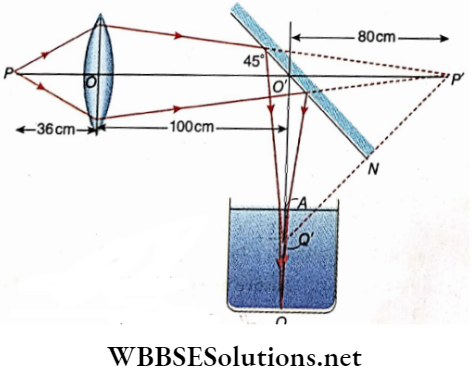
Class 12 Physics Unit 6 Optics Chapter 3 Refraction Of Light At Spherical Surface Lens Bottom vessel of The Axis And Refractive Index Of Water

According to the equation of lens

⇒ \(\frac{1}{v}-\frac{1}{u}=\frac{1}{f}\)

⇒ \(\frac{1}{v}+\frac{1}{36}=\frac{1}{30}\)

Or, \(\frac{1}{v}=\frac{-1}{36}+\frac{1}{30}=\frac{1}{180}\)

v = 180 cm

So, If the piano mirror was absent, the Imoge would be formed at a P’ nt n distance of 180 cm behind the lens .

But due to the reflection In the plane mirror, the Image should be formed at Q below the principal axis at a distance, BO cm P’N=Q’N (P’N IS normal to mirror),’ Therefore in bP’O’Q’, O’Q’ = O’P’ = 80 cm]. However, due to refraction in the water of the vessel, the final image Is formed at Q, situated at the bottom of the vessel.

According to the formula

⇒ \(\frac{A Q}{A Q}\)

Or, \(\frac{4}{3}=\frac{20}{A Q^{\prime}}\)

Or, AQ’ = 15 cm

QQ’ = AQ-AQ’ = 20-15 = 5 cm

Distance of the bottom of the vessel from the axis of the lens

= 80 + 5 = 85 cm

Conceptual Questions on Image Formation by Spherical Lenses

Example 28. A convex lens of focal length 20 cm Is placed on a plane mirror. An object, If placed centrally along the axis of the lens at a distance of 20 cm above the lens, where will the image be formed?
Solution:

Here, u = -20 cm , f = 20 cm , v = ?
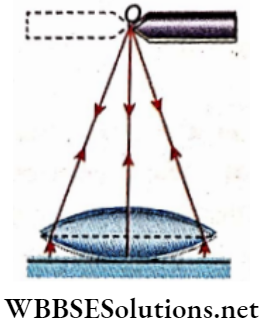
Class 12 Physics Unit 6 Optics Chapter 3 Refraction Of Light At Spherical Surface Lens If Placed Centrally Along The Axis Of The Lens

According to the equation of lens

⇒ \(\frac{1}{v}-\frac{1}{u}=\frac{1}{f}\)

⇒  \(\frac{1}{v}-\frac{1}{-20}=\frac{1}{20}\)

Or, \(\frac{1}{v}\) = 0, v = ∞

Therefore, the refracted rays proceeding parallel to the axis of the lens will be incident perpendicularly on the plane mirror. Hence, the reflected rays will retrace the same path and will form an image which will coincide with the object at O

Example 29. A point object is placed at a distance of 15 cm from a convex lens and its image is formed at a distance of 30 cm on the opposite side of the lens. If a concave lens, the image shifts 30 cm more away from the combination of lenses find the focal lengths of the lenses
Solution:

For the image formation by the convex by lens only u = -15cm, v= 30 cm, f=?

According to the lens equation

⇒ \(\frac{1}{v}-\frac{1}{u}=+\frac{1}{f}\)

⇒  \(\frac{1}{30}-\frac{1}{-15}=\frac{1}{f}\)

Or, \(\frac{1+2}{30}=\frac{1}{f}\)

Or, f = 10 cm

The focal length of the convex lens = 10 cm

An image formed by the convex lens will act as the virtual object for the concave lens and its real image will be formed at a distance of 60 cm from the concave lens
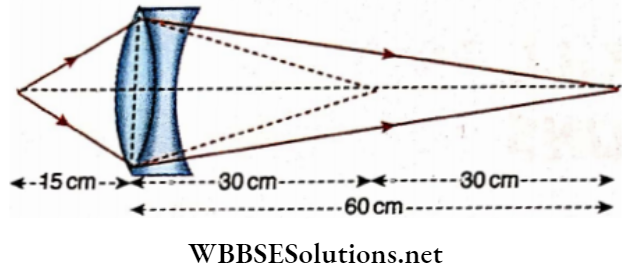
Class 12 Physics Unit 6 Optics Chapter 3 Refraction Of Light At Spherical Surface Lens Distance Of The Concave Lens

For the image formation by the concave lens

u = +30 cm, v = +60 cm, f- ?

From the equation, \(\frac{1}{v}-\frac{1}{u}=\frac{1}{f}\) we get

⇒ \(\frac{1}{60}-\frac{1}{30}=\frac{1}{f}\)

Or, \(\frac{1-2}{60}=\frac{1}{f}\)

Or, f = -60 cm

The focal length of the concave lens =-60 cm

Example 30. r A converging beam of rays converges to the point P. A lens is placed at a distance of 12 cm from point P in the path of the rays. Where will the converging beam of rays meet if

  1. The lens is a convex one of focal length 20 cm or
  2. The lens is a concave one with a focal length of 6 cm

Solution:

The converging beam of rays after refraction in the convex lens LL’ meets at the point Q. In the absence of the lens, the beam of rays would meet at P [Fig. 3.67]. In this case, P is the virtual object and Q is its real image with respect to the lens.
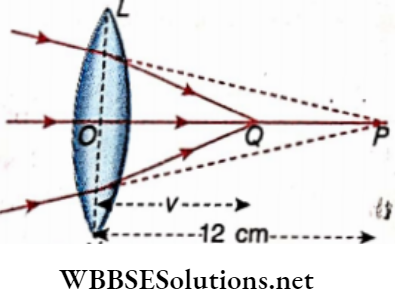
Class 12 Physics Unit 6 Optics Chapter 3 Refraction Of Light At Spherical Surface Lens Covering Beam Of Rays After In The Convex Lens

Here, u = 12 cm; f= 20 cm; v = ?

From to the equation of lens

⇒ \(\frac{1}{v}-\frac{1}{u}=\frac{9}{f}\)

Or, \(\frac{1}{v}-\frac{1}{12}=\frac{1}{20}\)

Or, \(\frac{1}{v}=\frac{1}{20}+\frac{1}{12}=\frac{2}{15}\)

Or, \(\frac{15}{2}\)cm = 7.5

So, the beam of rays will meet at Q at a distance of 73 cm from the lens.

The converging beam of rays after refraction in the concave lens LLf appears to diverge from point Q. So in this case the object is virtual and its image is also virtual
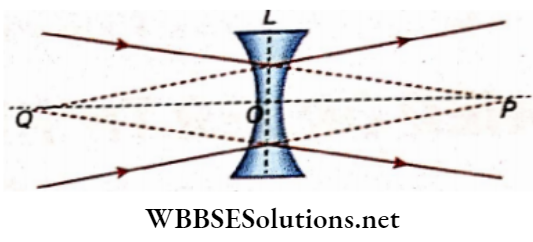
Class 12 Physics Unit 6 Optics Chapter 3 Refraction Of Light At Spherical Surface Lens Covering Beam Of Rays After Refraction In The Concave

Here, u = 12 cm,f = -6 cm, v = ?

According to the equation of lens,

⇒\(\frac{1}{v}-\frac{1}{u}=\frac{1}{f} \quad \text { or, } \quad \frac{1}{v}-\frac{1}{12}=\frac{1}{-6}\)

Or, \(\frac{1}{v}=\frac{1}{12}-\frac{1}{6}=\frac{1-2}{12}\)

= \(\frac{-1}{12}\)

Or, v = -12 cm

The negative sign of v indicates that after refraction the beam of rays appears to diverge from Q

Example 31. A convex lens of glass has power- 10.0 D. When this lens is completely immersed in a liquid, it behaves as a concave lens of focal length 50 cm. Determine the refractive index of the liquid. Given that – 1.5
Solution:

Power, P= \(\frac{100}{f(\mathrm{~cm})}\)

Or, f = \(\frac{100}{10}\)

= 10 cm

Now, \(\frac{1}{f}=\left({ }_a \mu_g-1\right) \times\left(\frac{1}{r_1}-\frac{1}{r_2}\right)\)

Or, \(\frac{1}{r_1}-\frac{1}{r_2}=\frac{1}{5}\)

When the lens is immersed in the liquid the focal length of the lens (J) becomes -50 cm

⇒ \(\frac{1}{-50}=\left({ }_l \mu_g-1\right)\left(\frac{1}{r_1}-\frac{1}{r_2}\right)\)

Or, \(\frac{1}{-50}=\left(\frac{a^\mu}{a^\mu}-1\right) \times \frac{1}{5}\)

= Re&active index of the liquid relative to air

Or, \(\frac{a^{\mu_g}}{a_l}-1=-\frac{1}{10}\)

Or, \(\frac{a^\mu}{a^{\mu_l}}-1=-\frac{1}{10}\)

Or, \(\frac{a^\mu g}{a_l \mu_l}=1-\frac{1}{10}=\frac{9}{10}\)

Or, \(\frac{1.5}{a^\mu}=\frac{9}{10}\)

⇒  \(_a \mu_l=\frac{15}{9}\)

= 1.67

The refractive index of the liquid is 1.67

WBCHSE physics class 12 refraction lens notes 

Refraction Of Light At Spherical Surface Lens Long Questions And Answers

Question 1. A swimmer underwater sees the objects indistinct inside the water with his uncovered eyes. But if he wears a mask, why does he see them distinctly?
Answer:

The refractive index of water is greater relative to air and the refractive index of water is slightly smaller than that of the ingredient of the human eye. So, the focal length of the uncovered eye increases inside water. Due to the increase in focal length, the power of the eye lens decreases. For this, the images of the objects inside water are formed much behind the retina instead of on it. So the objects appear to be indistinct.

On the other hand, if the swimmer wears a mask, his eyes are in contact with air. So, the rays of light enter the eyes from the air and the focal length of the eye lens does not change. The power of eye-lens remains the same. So, due to the presence of a mask, the swimmer sees the objects inside the water distinctly

Question 2. Shows that a concave lens always produces a diminished and virtual image.
Answer:

According to the equation of lens \(\frac{1}{v}-\frac{1}{u}=\frac{1}{f}\)

For a concave lens, both u and f are negative.

∴ \(\frac{1}{v}-\frac{1}{u}=\frac{1}{f}\)

= \(\frac{-(f+u)}{u f} \text { or, } v=\frac{-u f}{u+f}\)

Now, for any value of u, v is negative.

So, the image is formed on the same side as the object and is virtual

From the equation of lens , \(\frac{1}{v}-\frac{1}{u}=\frac{1}{f}\), we get

Or, \(\frac{u}{v}-1=\frac{u}{f}\)

[ m = \(\frac{1}{m}-1=\frac{u}{f}\) [m = \(\frac{v}{u}\) Linear magnification]

Or, \(\frac{1}{m}=1+\frac{u}{f}\)

Or, \(m=\frac{f}{f+u}\)

Now, since both u and f are negative, m < 1

Again, m = \(\frac{\text { length of the image }}{\text { length of the object }}\)

∴ \(\frac{\text { length of the image }}{\text { length of the object }}<1\)

∴ Length of the image < length of the object

Real-Life Scenarios Involving Refraction through Lenses

Question 3. Can a concave lens form a real image?
Answer:

A concave lens can form a real image if the object is virtual or if the lens is placed in a medium whose refractive index is greater than the refractive index of the material of the lens.

Question 4. A concave lens of refractive index μ is immersed in a medium whose refractive index

  1. Is smaller than μ,
  2. Is equal to μ,
  3. Is greater than μ.

When a parallel beam of rays is incident on the lens, show with the help of a diagram in each case the path of the rays.
Answer:

Suppose, the refractive index of the medium = μ’

1.  If μ’ < μ, i.e., if the refractive index of the material of the lens is greater than that of the medium, the concave lens behaves as a diverging lens. So, in this case, a beam of rays paraÿel to the axis of the lens, after in the lens, appears to diverge from a point on the principal axis

2. If μ’ = μ, i-e., if the refractive index of the material of the lens and that of the medium are equal, ho refraction oflight

Takes place inside the lens. So, in this case a beam of rays, parallel to the axis of the lens, after refraction in the lens, emerges as a parallel beam. So, on observation of the behaviour of the light rays, it can be said that there is no existence of the lens.
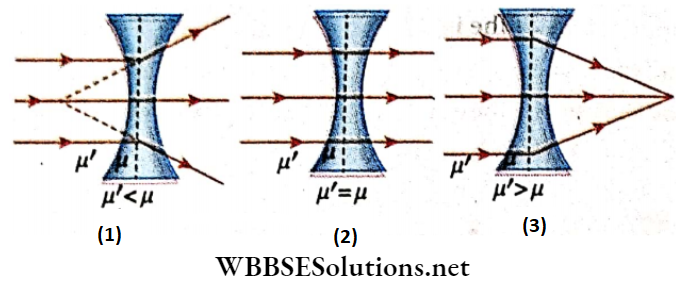
Class 12 Physics Unit 6 Optics Chapter 3 Refraction Of Light At Spherical Surface Lens Beam Of Rays Parallel To The Axis

3. If μ’ > μ, i.e., if the refractive index of the material of the lens is less than that of the medium, the concave lens behaves as a convex lens i.e., a converging lens. So, in this case a beam of rays parallel to the axis of the lens, after refraction in the lens, converges to a point on the principal axis of the lens.

Question 5. Show that the minimum distance between an object and its real image formed by a convex lens is four times the focal length of the lens.
Answer:

In the case of the formation of a real image by the convex lens we have,

⇒ \(\frac{1}{v}+\frac{1}{u}=\frac{1}{f}\) ………………….. (1)

If D be the distance between the object and the screen i.e., the image, then

u + v = D

Or, D \((\sqrt{u})^2+(\sqrt{v})^2\)

Or, D \((\sqrt{u}-\sqrt{v})^2+2 \sqrt{u v}\)

Now, D will be the minimum, if \(\sqrt{u}=\sqrt{v}\)= 0

i.e if \(\sqrt{u}=\sqrt{v}\)

Or, u = v

So from equation (1), we get

⇒  \(\frac{1}{u}+\frac{1}{u}=\frac{1}{f}\)

Or,\(\frac{2}{u}=\frac{1}{f}\)

u = 2f

v = 2f

Dmin  = 2f+2f = 4f

Question 6. How does the focal length of a lens depend on The colour of the incident light and The Medium surrounding the lens
Answer:

Suppose, the refractive index of the lens relative to the surrounding medium is ft; the radii of curvature of the first and the

The second refracting surfaces of the lens are r1, and r2 respectively. 1ff be the focal length of the lens, then

⇒ \(\frac{1}{f}=(\mu-1)\left(\frac{1}{r_1}-\frac{1}{r_2}\right)\) ……………………… (1)

1. We know that if the wavelength of the incident light ~ increases, the refractive index of any medium (suppose, the material of the lens) decreases according to Cauchy’s relation, μ = A +\(\frac{B}{\lambda^2}\)  can be said from the equation

⇒ \(f \propto \frac{1}{(\mu-1)}\) ………………….. (2)

So, if the refractive index of the material of the lens ft decreases, the focal length of the lens increases. Similarly, if the wavelength of light decreases, the refractive index of a medium increases and the focal length of the lens decreases.

In comparison to the wavelength oflight of other colours, the wavelength of red light is greater. So, the focal length of a lens is greater for red light in comparison to other colours.

2. In equation (1), it is the refractive index of the lens relative to the surrounding medium. Now, if the refractive index of the surrounding medium increases, ft decreases. So from equation (2), it can be said that the focal length of a lens increases if ft decreases.

Similarly, if the refractive index of the surrounding medium decreases, μ increases. With the increase of μ, the focal length of the lens decreases

Question 7. The lens is made of two different materials. A point object is placed on the axis of the lens. How many images of the object will be formed?
Answer:

The lens is made of two different materials i.e., it is made up of two materials of different refractive indices. So, the portions of the lens coloured in different will behave as two lenses of two different focal lengths. So, two images of the object will be formed
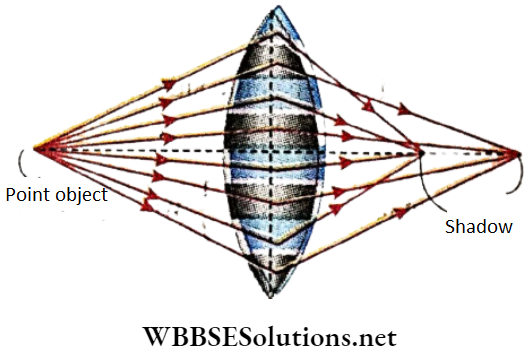
Class 12 Physics Unit 6 Optics Chapter 3 Refraction Of Light At Spherical Surface Lens Two Different Focal Lengths

Question 8. Prove that the area of the image of the moon formed by a convex lens is proportional to the square of the focal length of the lens. What change of the image will be observed if a portion of the lens is covered by black paper?
Answer:

Suppose, the angular radius of the moon = θ As the moon is situated from the lens at infinite distance, the image of the moon is formed in the focal plane of the lens. The Image of the centre of the moon is formed at F, the focus of the lens. The rays of light coming from the circumference of the moon are inclined at angle θ with the principal axis of the lens
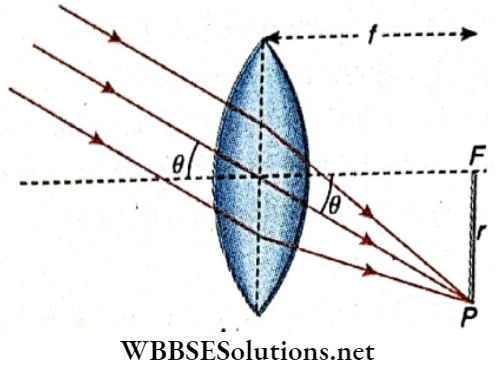
Class 12 Physics Unit 6 Optics Chapter 3 Refraction Of Light At Spherical Surface Lens Principle Axis Of The Lens

Radius of the image = r = FP = fθ [∴ θ is small]

Area of the image of the moon, A = μr² =μf² θ²

An ∝ f² [ ∴  μ and  θ are constants]

If a portion of the lens is covered by black paper, the nature of the image does not change. Only the brightness of the image decreases because comparatively a few light rays take part in the formation of the image.

Question 9. How should the two convex lenses be placed so that a parallel beam of rays emerges out parallel after refraction through the lenses?
Answer:

If the axes of the two lenses are along the same straight line and the distance between the two lenses is equal to the sum of the focal lengths of the lenses, a beam of parallel rays will emerge as a parallel beam after refraction through the lenses
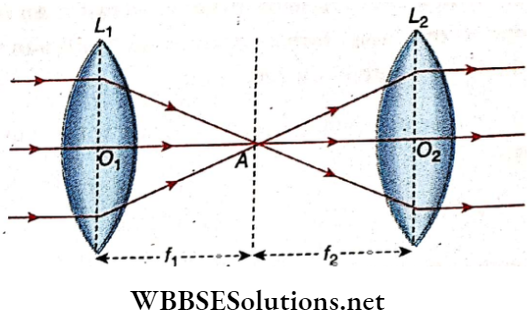
Class 12 Physics Unit 6 Optics Chapter 3 Refraction Of Light At Spherical Surface Lens Parallel after Refraction Through The Lenses

Suppose, the focal lengths of the two lenses L1 and L2 are f1 and f2 respectively. A beam of parallel rays parallel to the principal axis, after refraction on the lens L1, forms the image at A, the focus of the. Lens L1. So, O1A = f1. This image acts as the object for the lens L2. If point A is at a distance of f2 from the second lens, L2 i.e., if AO2 = f2, the rays emitted from A, after refraction in lens L2, emerge as a parallel beam

O1O2 = O1A+AO2= f1+f2

Question 10. A lens is immersed in a liquid so that it vanishes. State the optical nature of the liquid. Find the value of the focal length of the lens from the lens maker’s formula under the above condition
Answer:

The lens will vanish while immersing in a liquid if it has a refractive index equal to that of the material of the lens, i.e., no deviation or lateral displacement of light is observed. 1ff be the focal length of a lens, we get from the lens maker’s for¬ mula

⇒ \(\frac{1}{f}\) = (1μ2-1) \(\left(\frac{1}{r_1}-\frac{1}{r_2}\right)\)

1μ2= Refractive index of the material of the lens relative to the surrounding medium

If the refractive index of the material of the lens and that of the surrounding medium are equal, then 1μ2 = 1.

So, from the above equation, we get

⇒ \(\frac{1}{f}\) = 0

Or, f = ∞

Question 11. An object is moving with velocity Vo along the axis of a convex lens. If m be the magnification at any moment, then what will be the. velocity of the image?
Answer:

The equation of lens is \(\frac{1}{v}-\frac{1}{u}=\frac{1}{f}\)

Differentiating this equation concerning t we get

⇒ \(-\frac{1}{v^2} \frac{d v}{d t}+\frac{1}{u^2} \frac{d t}{d t}\)

Or, \(\frac{v^2}{u^2}\) × Vo

∴  Velocity of the image = \(\frac{v^2}{u^2} \times \text { velocity of the object }\)

V1= Velocity of the image

Vo = Velocity of the object

Or, \(v_1=m^2 \times v_0\)

∴ m= \(\frac{v}{u}\) = Linear magnification

Velocity of the image = \(\)

Or, \(\)

The velocity of the image, V= a velocity of the object

m = linear magnification

Question 12. Explain briefly with a diagram how it is possible to determine the focal length of a concave lens by using a convex lens.
Answer:

In general, a concave lens cannot form a real image. So by casting on a screen the location of the image cannot be measured. A convex lens L1 is taken in contact with a concave lens L2 If the focal length of the convex lens is smaller than that of the concave lens, the combination will act as a convex lens.
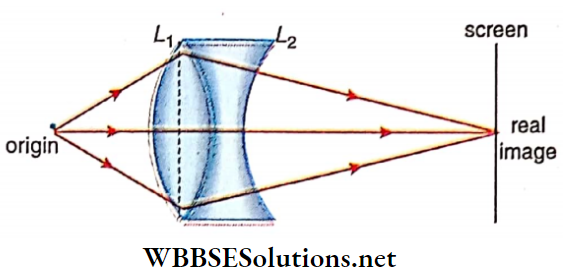
Class 12 Physics Unit 6 Optics Chapter 3 Refraction Of Light Origin And Screen

Under this condition, the real image of an object can be formed on a screen. By measuring object distance u and image distance v and using the relation \(\frac{1}{v}-\frac{1}{u}=\frac{1}{F}\) the equivalent focal length, F of the lens-combination can be calculated.

Now, if the focal length of the convex lens and the concave lens are f1 and f2 respectively, then

⇒ \(\frac{1}{F}=\frac{1}{f_1}+\frac{1}{f_2} \text { or, } \frac{1}{f_2}=\frac{1}{F}-\frac{1}{f_1}\)

Or, \(f_2=\frac{F f_1}{f_1-F}\)

So, if the focal length of the convex lens f1 is known, the focal length of the concave lens f2 can be calculated. Here, f1 and F are both positive. So, for the calculation of f2 these positive values are to be put in the above equation and f2 will be negative

Question 13. Show that for any convex lens, the general equation of \(\frac{1}{v}+\frac{1}{u}=\frac{1}{f}\) represents a rectangular hyperbola.
Answer:

For a convex lens, the general equation of a lens can be written as

⇒ \(\frac{1}{v}-\frac{1}{u}=\frac{1}{f}\)

uv- f(u+v) = 0 Or, uv- f(u+v)+f² = f²

⇒ \(f^2-f(u+v)+\left(\frac{u+v}{2}\right)^2-\left(\frac{u-v}{2}\right)^2\) = f²

⇒  \(\left(f-\frac{u+v}{2}\right)^2-\left(\frac{u-v}{2}\right)^2=f^2\)

Or, x² – y² = f²

Where x= \(f-\frac{u+v}{2}\) and y= \(y=\frac{u-v}{2}\)

The above equation represents a rectangular hyperbole

Question 14. The radius of curvature of a plano-convex lens made of a material of refractive index 1.5 is 30 cm. Its concave surface is silvered. At what distance from the plane surface .of the lens is an object to be placed so that a real image equal to the size of the object is formed?
Answer:

This is an optical system with two elements: a convex lens and a concave mirror in contact with each other. For focal length / of the convex lens

∴ \(\frac{1}{f}=(\mu-1)\left(\frac{1}{r_1}-\frac{1}{r_2}\right)\)

⇒ \((1.5-1)\left(\frac{1}{\infty}-\frac{1}{-30}\right)\)

= 0.5 \(\frac{1}{30}\)

∴ f = \(\frac{3.0}{0.5}\)

= 60 cm

Focal length of the concave minor,

F = \(\frac{r_2}{2}=-\frac{30}{2}\)

= -15 cm

Let, u = object distance from the optical system [Fig. 3.75].

Then, for the convex lens

⇒ \(\frac{1}{v}+\frac{1}{u}=\frac{1}{f}, \text { or, } \frac{1}{v}=\frac{1}{f}+\frac{1}{u}\)

⇒  \(\frac{u+f}{u f}, \text { or } v=\frac{u f}{u+f}\)

∴ Magnification in the lens m = \(\frac{v}{u}=\frac{f}{u+f}\)

Now, v = U = object distance for the concave mirror. So

⇒ \(\frac{1}{V}+\frac{1}{U}=\frac{1}{F}\)

Or, \(\frac{1}{V}=\frac{1}{F}-\frac{1}{U}=\frac{U-F}{U F}\)

Or, V = \(\frac{U F}{U-F}\)

Magnification in the mirror M =  \(\frac{V}{U}=\frac{F}{U-F}\)

Then, overall magnification,

Mo = mM =  \(\frac{f}{u+f} \cdot \frac{F}{U-F}\)

= \(\frac{f}{u+f} \cdot \frac{F}{\frac{u f}{u+f}-F}\)

= \(\frac{f}{u+f} \cdot \frac{F(u+f)}{u f-u F-f F}\)

= \(\frac{f F}{u(f-F)-f F}\)

Given, object and image sizes are equal, i.e., MQ =i

fF = u(f- F) -fP or, u(f-F) = 2fF

Or, \(\frac{2 f F}{f-F}\)

Putting these values off and F, to have

u = \(\frac{2 \times 60 \times(-15)}{60-(-15)}\)

= \(-\frac{2 \times 60 \times 15}{75}\)

= -24 cm

Question 15. The focal length of the equi-convex lens is if the lens is cut into two pieces h along AB, what will be the focal length of each half
Class 12 Physics Unit 6 Optics Chapter 3 Refraction Of Light At Spherical Surface Lens Equi Convex Lens

Answer:

Let the radius of curvature of each surface of the biconvex lens be r and the refractive index of its material be, From the lens maker’s formula We have

⇒ \(\frac{1}{f}=(\mu-1)\left(\frac{1}{r_1}+\frac{1}{r_2}\right)\)

= \((\mu-1)\left(\frac{1}{r}+\frac{1}{r}\right)=\frac{2}{r}(\mu-1)\) ……………. (1)

For each half, the radius of curvature of the curved surface r1 = r and that for the plain surface, r2 = ∞

Let us suppose that the focal length of each of the cut pieces be x.

⇒ \(\frac{1}{x}=(\mu-1) \frac{1}{r}=\frac{1}{2 f}\)

From Equation

x = 2f
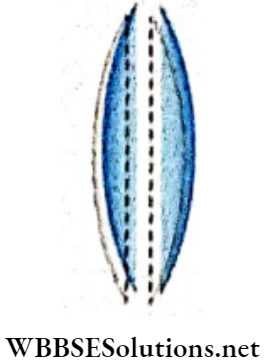
Class 12 Physics Unit 6 Optics Chapter 3 Refraction Of Light At Spherical Surface Lens Half Radius Of Curvacture

Question 16. If the light rays behave, what will be the relation among μ1, μ and μ2?
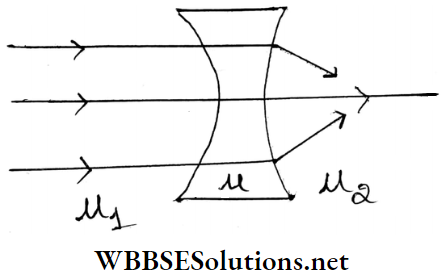
Class 12 Physics Unit 6 Optics Chapter 3 Refraction Of Light At Spherical Surface Lens Light Rays

Answer:

Since the light fays after entering the lens proceed undefeated, the refractive index of the left-hand medium of the lens and that of the material of the lens are the same, i.e., μ1 = μ.

Again, as the rays after emerging out from the second surface of the concave lens become convergent instead of divergent rays, it may be concluded that the refractive index of the right-hand medium is greater than that of the material of the lens i.e., μ1 > μ.

Question 17. An object behaves like a convex lens in air but like a concave lens in water. What is the type of refractive index of its material concerning air and water
Answer:

For a convex lens,

⇒ \(\frac{1}{f}=\left(\frac{\mu_2}{\mu_1}-1\right)\left(\frac{1}{r_1}+\frac{1}{r_2}\right)\) ……………… (1)

Here, μ2 is the refractive index of the material and μ1 is that of the surrounding medium. f is positive for a convex lens. From, equation (1), it can be said that f will be positive if μ21  i.e., if the refractive index of the material of the object is greater than that of air.

For a concave lens. f is negative. From equation (1), it can be said that f will be negative if μ2 < μ1 i.e. if the refractive index of the material of the object is less than that of water. So, the refractive index of the material of the object is greater than air but less than water.

Question 18. A convex lens and a concave lens of equal focal length are placed in contact. What are the focal length and power of the lens combination?
Answer:

If focal length of convex lens, f1 = f, then focal length of concave lens, f2 = -f

If F be the focal length of the lens combination, then

⇒ \(\frac{1}{F}=\frac{1}{f_1}+\frac{1}{f_2}=\frac{1}{f}+\frac{1}{-f}\)

Or, F = ∞

Power of the lens combination = \(\frac{1}{F}\) = 0

Question 19. If the plane surface of a plano-convex lens is silvered, what will be the effective (or equivalent) focal length of the lens
Answer:

If an object is placed in front of such a lens, light rays are at first refracted through the convex surface. Next, by reflect¬ ing from the silvered plane surface, the light rays are refracted through the convex surface for the second time.if the equivalent focal length of the lens is F, then

⇒ \(\frac{1}{F}=\frac{1}{f}+\frac{1}{f_m}+\frac{1}{f}\)

[Where f is the focal length of the convex surface and fm focal length of the silvered plane surface]

Or, \(\frac{1}{F}=\frac{2}{f}+\frac{1}{f_m}\)

Or, \(\frac{1}{F}=\frac{2}{f}\)

Since the focal length of the silvered plane

Surface fm = ∞,  So \(\frac{1}{f_m}\) = 0

∴ F = \(\frac{f}{2}\)

Question 20. The focal length f of an equi-convex lens is related to the radius of curvature r of the surface by f = r, find out the refractive index of the material of the lens.
Answer:

From the lens maker’s formula,

⇒ \(\frac{1}{f}=(\mu-1)\left(\frac{1}{r_1}-\frac{1}{r_2}\right)\)

For a equi-convex lens, r1 = r ; r2 = -r

∴  \(\frac{1}{f}=(\mu-1) \cdot \frac{2}{r}\)

Or, \(\frac{1}{r}=(\mu-1) \frac{2}{r}\)

Since by the question f = +r

Or, \(\mu-1=\frac{1}{2}\)

Or, μ = \(\frac{3}{2}\)

= 1.5

Question 21. Sunglasses (Goggles) have two curved surfaces yet their power is zero, Why?
Answer:

The two radii of curvature of the two surfaces of the lens used in sunglasses are equal and of the same sign (curved in the same direction) and also thickness of the glass is very small
Class 12 Physics Unit 6 Optics Chapter 3 Refraction Of Light At Spherical Surface Lens Sunglasses

Power = \(\frac{1}{f}=\left(a_g \mu_g-1\right)\left(\frac{1}{r_1}-\frac{1}{r_2}\right)\) = 0

∴ r1 = r2

Question 22. What is the relation between the refractive indices μ, μ1 and μ2 if the behaviour of light rays. 
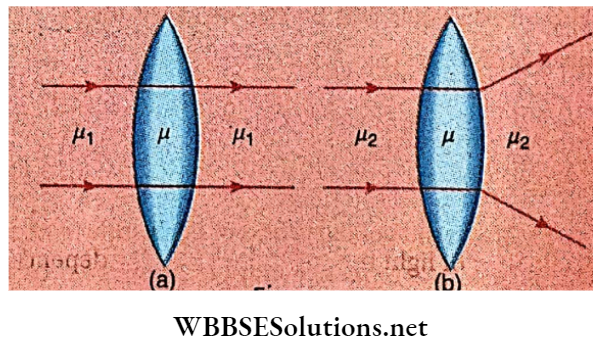
Class 12 Physics Unit 6 Optics Chapter 3 Refraction Of Light At Spherical Surface Lens Relation Between The Refrcative Indices

Answer:

Let a lens of material of refractive index μ is placed in a medium of refractive index

The focal length is given by,

⇒ \(\frac{\mu}{\mu_1}-1\) = 0

⇒ \(\left(\frac{1}{r_1}-\frac{1}{r_2}\right)\) = 0

According to the = oo [because the lens behaves as a plane a glass plate

∴ \(\frac{\mu}{\mu_1}-1\)

Since \(\left(\frac{1}{r_1}-\frac{1}{r_2}\right)\) ≠ 0

Or, μ = μ1

According to the the lens acts as a concave lens. Sof is negative.

The focal length of the lens is given by,

∴ \(\frac{1}{f}=\left(\frac{\mu}{\mu_2}-1\right)\left(\frac{1}{r_1}-\frac{1}{r_2}\right)\) = 0

Since in case of a convex lens \(\) >0

Therefore \(\left(\frac{\mu}{\mu_2}-1\right)\) < 0

Or μ < μ2

Question 23. The f-number of a lens is given by \(\frac{F}{D}\) where F is its focal length and D is aperture diameter. If the f-number is 1.6 instead of 2, determine the amount of excess light that will fail on the film.
Answer:

We know, f-number \(=\frac{F}{D}\)

Or, D = \(=\frac{F}{f \text {-number }}\)

Suppose, when f-number = f1; D = D1 and when f-number

So from equation (1) we get

⇒ \(\frac{D_2}{D_1}=\frac{f_1}{f_2}\)

Now the amount of light that will reach the film depends on the area of the aperture Le., on D²

So, \(\frac{\text { the amount of tight in the second case }}{\text { the amount of light in the first case }}=\frac{D_2^2}{D_2^2}\)

⇒ \(\frac{2^2}{16^2}=\frac{1}{64}\)

Therefore, if the f-number of the lens, changes from 2 to 1. 6 the amount of light falling on the film will be \(\frac{1}{64}\) of the first case

Question 24. The aperture of the camera lens is changed from \(\frac{f}{8}\) to  \(\frac{f}{11}\)  to, How are

  1. The size of the image
  2. The intensity of illumination of the
  3. Exposure time and
  4. The distinctness of the image influenced

Answer:

When the f-number of the lens is changed from f-8 to tof-11 the effective aperture of the lens decreases.
So,

  1. The size of the image will not be changed,
  2. The intensity of illumination of the image will be diminished as less amount of light passes through the lens.
  3. Exposure time will be lengthened.
  4. Distinctness of the image will increase

Question 25. The radius of curvature of both sides of the given lens is R. The Refractive index of the fV medium in which the source is present is μ1, and the refractive indices of the lens and the medium in which the image is formed are μ2 and μ3 respectively. Find the focal length of the system.
Class 12 Physics Unit 6 Optics Chapter 3 Refraction Of Light At Spherical Surface Lens Focal Length Of The System

Answer: In case of refraction at the first curved surface,

⇒ \(\frac{\mu_2}{v_1}+\frac{\mu_1}{\infty}=\frac{\mu_2-\mu_1}{+R}\) ………………………. (1)

Again, for refraction at the second curved surface object distance is equal to the distance of the image formed by the first refracting surface since the lens is a thin lens

⇒ \(\frac{\mu_3}{v_2}-\frac{\mu_2}{v_1}=\frac{\mu_3-\mu_2}{+R}\) …………. (2)

Adding equations (1) and (2), we get

⇒ \(\frac{\mu_3}{v_2}=\frac{\mu_3-\mu_1}{R}\)

Hence the focal length of the system,f \(\frac{\mu_3 R}{\mu_3-\mu_1}\)

Question 26. An equl convex lens with radii of curvature each of magnitude r is kept over a liquid layer poured on top of a plane mirror. A small needle with its tip on the principal axis of the lens is moved along the axis until its inverted real image coincides with the needle itself.  The distance of the needle from the lens is measured to be x On removing the liquid layer and repeating the experiment, the design 3.82 stance is found to be y. Prove that the refractive index of the liquid.
Class 12 Physics Unit 6 Optics Chapter 3 Refraction Of Light At Spherical Surface Lens An Equiconves Lens With Radii Of Curvacture

Answer:

From the given conditions, we get the equivalent focal length of the combination of glass lens and liquid lens, F = x and the focal length of convex lens, f1 = y.

If f2 is the focal length of the liquid lens then

⇒ \(\frac{1}{f_1}+\frac{1}{f_2}=\frac{1}{F} \text { or, } \frac{1}{f_2}=\left(\frac{1}{x}-\frac{1}{y}\right)\)

The liquid lens is a plano-concave lens for which

R1 = -r and R2 =∞

From the lens maker’s formula,

⇒ \(\frac{1}{f_2}=(\mu-1)\left(\frac{1}{R_1}-\frac{1}{R_2}\right)\)

⇒ \(\left(\frac{1}{x}-\frac{1}{y}\right)=(\mu-1)\left(\frac{1}{-r}-\frac{1}{\infty}\right)\)

Or, \((\mu-1)=r\left(\frac{1}{y}-\frac{\mathrm{i}}{x}\right)\)

⇒ \(1+\frac{r}{y}-\frac{r}{x}\)

Question 27.

  1. Determine the effective focal length of the combination of two lenses, one a convex lens of focal length 30 cm and the other a concave lens of focal length 20 cm placed 8.0 cm apart with their principle axis coincident. Does the answer depend on which side of the combination a beam of parallel light is incident?is the notion of effective focal length of this system useful at all?
  2. An object 1. 5 cm in size is placed on the side of the convex lens. The distance between the object and the

Answer:

Convex lens s 40an. Detersirs* the oagrtifkation produced by the two-knows system. and she sze os she image.

1. When a beam of a parallel beam of light is incident on the convex lens then.

u1 =∞

f1 = 30 cm

This image is the virtual o&jecrssrthesecondfens

u2= 30-8 = 22 cm, f2= – 20 cm

∴ \(\frac{1}{v_2}=\frac{1}{f_2}+\frac{1}{u_2} \text { or, } u_2=\frac{-20 \times 22}{+22-20}\)

= -220 cm

The focal length of the combination is (220-4) = 216 cm from the midpoint of the line joining the lenses when the light falls on the convex lens first

When the beam of light is incident on the concave lens first then f1 = -20 cm, u = ∞

∴ v1 = -20 cm

This image Is the virtual object for the convex lens

∴  f2 = 30 cm, u2  = (20 + 8) cm

= -28 cm

∴ \(v_2=\frac{u_2 f_2}{u_2+f_2}=\frac{-28 \times 30}{30-28}v_2=\frac{u_2 f_2}{u_2+f_2}=\frac{-28 \times 30}{30-28}+\)

So in this case the focus of the combination is at a distance (420-4) = 416 cm to the right from the mid¬ point of the line joining the two lenses.

Thus the answer depends on the lens nn which the length is first incident as there is no definite formula based on which the focal length of the combination can he calculated, the notion of effective focal length is not useful at all

2. For the first lens, u1= -40 cm, f1 = 30 cm

∴ \(\frac{1}{v_1}=\frac{1}{f_1}+\frac{1}{u_1} \quad \text { or } \quad v_1=\frac{u_1 f_1}{u_1+f_1}\)

∴  v1= \(\frac{-40 \times 30}{-40+30}\)

= 120 cm

∴ Magnification by the convex lens,

m1 = \(\frac{v_1}{u_1}=\frac{120}{40}\)

= 3

Forthesecondlens, u2 = +120 – 8

= 112 cm

∴ Virtual object, f2 = -20 cm

∴ \(\frac{1}{v_2}=\frac{1}{u_2}+\frac{1}{f_2}\quad \text { or, } v_2=\frac{1}{u_2+f_2}\)

v= \(\frac{+112 \times 20}{+112-20}=-\frac{112 \times 20}{92}\) cm

Magnification \(m_2=\frac{v_2}{n_2}=\frac{112 \times 20}{92 \times 112}=\frac{20}{92}\)

∴ Total magnification,

m = m1× m2= 3 × \(\frac{20}{92}\)

= 0.652

∴ Size of the image = 1.5 × 0.652

= 0.98 cm

Question 28. Acaid-sheet divided into squares each of size 1 mm² is being viewed at a distance of 9 cm through a magnifying glass (a {YipvpT’PTnglens of focal length 10 cm ) held close to the eye.

What is the magnification produced by the lens? How much is the area of each square in the virtual image ?

  1. What is the angular magnification (magnifying power) of the lens? ‘
  2. Is the magnification in (a) equal to the magnifying powerin (b)? Explain. *
  3. At what distance should the lens be held from the cardboard in order to view the squares distinctly with the maximum possible magnifying power
  4. What is thelinear magnification in this case?
  5. Is the linear magnification equal to the magnifying power in this case? Explain.
  6. What should be the distance between the object and the magnifying glass if the virtual image of each square is to have an area 6.25 mm2?
  7. Would you be able to see the squares distinctly with your eyes very close to the magnifier?

Answer:

1. In the case of a convex lens,

⇒ \(\frac{1}{v}=\frac{1}{f}+\frac{1}{u}\)

Here , f= 10 cm , u= -9 cm

= \(\frac{1}{10}-\frac{1}{9}\)

Or, v = 90 cm

∴ Linear magnification

m = \(\frac{v}{u}=\frac{-90}{-9}\)

= 10

Length of each side of the square

= 1 × 10 mm = 1 cm

∴ Area of each square in the virtual image = 1 cm²

2.  Angular magnification

= \(\frac{\text { distance of near point }}{\text { object distance }}=\frac{25}{9}\)

= 2.8

3. The magnification in (a) = 10 and magnifying power in (b) =2.8 , So the two are not equal. But when the object is placed at the nearpoint, then only the two would become equal.

4. When the image is formed at the near point, the magnification is maximum:

1n that case, v = -25 cm and f = 10 cm

⇒ \(\frac{1}{u}=\frac{1}{v}-\frac{1}{f}=-\frac{1}{25}-\frac{1}{10}\)

Or, u = \(-\frac{25 \times 10}{10+25}\)

= – 7.14 cm

5. Linear magnification:

m = \(\frac{v}{u}=\frac{25}{7.14}\)

= 3.5

6. Angular magnification:

= \(\frac{D}{u}=\frac{25}{7.14}\)

= 3.5 = Linear magnification

The image distance and least distance of distinct vision Are equal in this case. Thus the linear magnification and angular magnification are equal

7. Area of enlarged square = 6.25 mm²

Length of each side of the enlarged square

= \(\sqrt{6.25}\)

= 2.5mm

Magnification \(\frac{v}{u}=\frac{2.5}{1.0}\)

= 2.5

v = 2.5 u

From lens equation

⇒ \(\frac{1}{u}=\frac{1}{v}-\frac{1}{f}\)

Or \(\frac{1}{u}=\frac{1}{2.5 u}-\frac{1}{10}\)

u = – 6cm

The object should be placed at a distance of 6 cm from the lens.

8. When the eye is kept very near the lens the image formed will be within the least distance of distinct vision and it can not be observed distinctly.

Question 29. An equi-convex lens (of refractive indexi.50 ) in contact with a liquid layer on top of a plane mirror A small needle with its tip on the principal axis moves along the axis until an inverted image is found at the position of the needle. The distance of the needle from the lens is measured to be 45.0 cm. The liquid is removed and the experiment is repeated. The new distance is measured to be 30.0 cm. What is the refractive index of the liquid?
Answer:

The rays oflight from the pin are first refracted from the lens liquid combination and then reflected by the mirror at the bottom of the combination. Since the image coincides with the object, the beam incident on the mirror is a parallel beam oflight. Thus it is obvious that the pin is situated at the focal length of the lens-liquid combination, i.e.,f = 45 cm

In the absence of the liquid, the position of the pin is the focal point of the equi-convex lens i.e., f1 = 30 cm. Let the focal length of the liquid plano-concave lens be f2
Class 12 Physics Unit 6 Optics Chapter 3 Refraction Of Light At Spherical Surface Lens Liquid Plano Concave Lens

Then \(\frac{1}{f_1}+\frac{1}{f_2}=\frac{1}{f}\)

∴ f = -90 cm

From lens maker’s formula

⇒ \(\frac{1}{f}=(\mu-1)\left(\frac{1}{R_1}-\frac{1}{R_2}\right)\)

For the equi-convex lens,

f1 = 30, μ = 1.5, R1 = R and R = -R

⇒ \(\frac{1}{30}=(1.5-1) \times \frac{2}{R}\)

R = 30 cm

For the liquid plano-concave lens

f = -90 cm, μ = μ’ (say), R1 = -30 cm, R2 = ∞

⇒ \(-\frac{1}{90}=\left(\mu^{\prime}-1\right)\left(-\frac{1}{30}-\frac{1}{\infty}\right)\)

μ’ = 1.33
Class 12 Physics Unit 6 Optics Chapter 3 Refraction Of Light At Spherical Surface Lens Liquid Plano Concave Lens

Question 30. A beam of light converges at a point P. Now a lens is placed in the path of the convergent beami2cm from P. At what point does the beam converge if the lens is

  1. A convex lens of focal length 20cm or
  2. A concave lens of focal length 16cm?

Answer:

u = 12cm,f = 20cm , v = ?

⇒ \(\frac{1}{v}-\frac{1}{u}=\frac{1}{f}\)

Or, \(\frac{1}{v}=\frac{1}{12}+\frac{1}{20}\)

Or, \(=\frac{12 \times (20)}{12+20}\)

= 7.5 cm
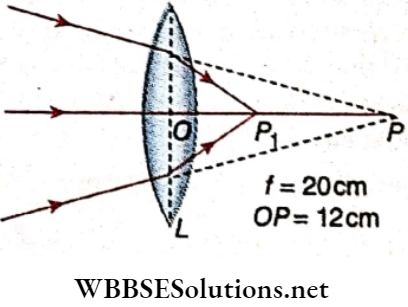
Class 12 Physics Unit 6 Optics Chapter 3 Refraction Of Light At Spherical Surface Lens A Beam Of Light Converges At A Point

Beam of rays will meet at point P1 at a distance of 7.5cm from the lens

u = 1. 2cm, f= -16cm, v = ?

⇒ \(\frac{1}{v}-\frac{1}{u}=\frac{1}{f}\)

Or, \(\frac{1}{v}=\frac{1}{12}-\frac{1}{16}\)

Or, v = \(\frac{16 \times(12)}{16-12}\)

= 48 cm
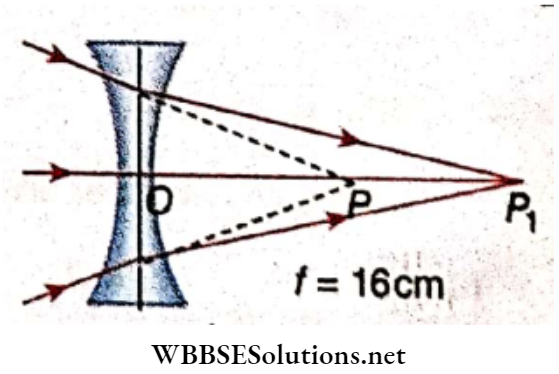
Class 12 Physics Unit 6 Optics Chapter 3 Refraction Of Light At Spherical Surface Lens Concave Lens Of Focal Length

∴ The beam of rays will meet at point Pr at a distance 48cm from the lens.

Question 31. Two lenses, one convex and the other concave are kept in contact. The focal length of a convex lens is 30cm and that of a concave lens is 20cm. What will be the equivalent focal length of the combination? What will be the nature of the combination?
Answer:

For the convex lens, f1 = +30 cm;

For the concave lens, f2 = -20 cm

If the equivalent focal length is F then

⇒ \(\frac{1}{F}=\frac{1}{f_1}+\frac{1}{f_2}\)

Or, \(\frac{f_1 f_2}{f_1+f_2}=\frac{30 \times(-20)}{30+(-20)}\)

⇒  \(\frac{-600}{10}\)

= – 60 cm

Since the equivalent focal length is negative, the combination will act as a concave lens

Refraction Of Light At Spherical Surface Lens Assertion Reason type

Direction: These questions have statement 1 and statement 2. Of the four choices given below, choose the one that best describes the two statements.

  1. Statement 1 is true, statement 2 is true; statement 2 is a correct explanation for statement 1.
  2. Statement 1 is true, and statement 2 is true; statement 2 is not a correct explanation for statement 1.
  3. Statement 1 is true, statement 2 is false.
  4. Statement 1 is false, and statement 2 is true.

Question 1.

Statement 1: The lens formula \(\) indicates that the focal length of a lens depends on the distances of the object and image from the lens.

Statement 2: The formula does indicate that when u is changed v also changes, so that f of a particular lens remains constant

Answer: 4. Statement 1 is false, and statement 2 is true.

Question 2.

Statement 1: A lens has two principal focal lengths which may differ.

Statement 2: Light can fall on either surface of the lens. The two principal focal lengths differ when the medium on the two sides has different refractive indices

Answer: 1. Statement 1 is true, statement 2 is true; statement 2 is a correct explanation for statement 1.

Question 3.

Statement 1: A convex Jens of glass (mu = 1,5) behave as a diverging lens when 1mmersed 1n carbon disulphide of higher refractive index mu = 1.65

Statement 2: A diverging lens in air is thinner in the middle and thicker at the edges

Answer: 3. Statement 1 is true, statement 2 is false.

Question 4.

Statement-1: The power of a lens depends on the nature of the material of the lens, the medium in which it is placed, and the radii of curvature of its surfaces

Statement-2: It follows from the relation p = \(\frac{1}{f}\) = \((\mu-1)\left(\frac{1}{r_1}-\frac{1}{r_2}\right)\), where the symbol have standard meaning

Answer: 1. Statement 1 is true, statement 2 is true; statement 2 is a correct explanation for statement 1.

Question 5.

Statement 1: If a portion of a Jens is broken then we can gel a complete 1mage of an object with the broken lens,

Statement 2: With his broken lens the intensity of the 1mage format! will he lesser

Answer: 2. Statement 1 is true, and statement 2 is true; statement 2 is not a correct explanation for statement 1.

Question 6.

Statement 1: If a convex lens of focal length f and a concave lens of power \(\frac{1}{f}\) are put 1n contact, then the focal length of the combination Is zero,

Statement 2 : P = \(p_1+p_2=\frac{1}{f_1}+\frac{1}{f_2}\)

Answer: 4. Statement 1 is false, and statement 2 is true.

Refraction Of Light At Spherical Surface Lens Match The Columns

Question 1. Match the position of an object concerning a convex lens in column 1 with the corresponding position of the image in column 2.
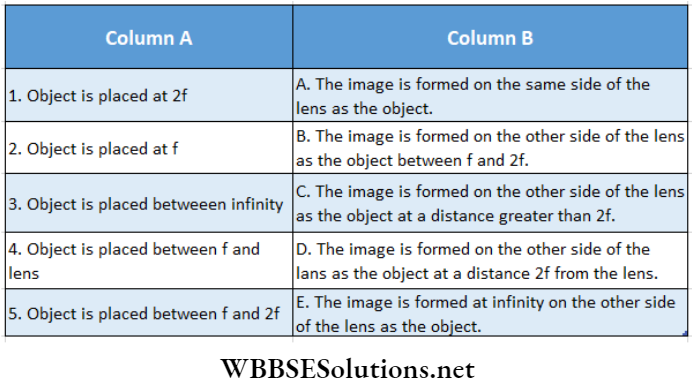
Class 12 Physics Unit 6 Optics Chapter 3 Refraction Of Light At Spherical Surface Lens Respect To A Convex Lens

Answer: 1- D, 2-E, 3-B, 4-A, 5-C

Question 2. The nature and size of the image formed by the convex mirror is given in column 1 and the position of the object is given in column 2.
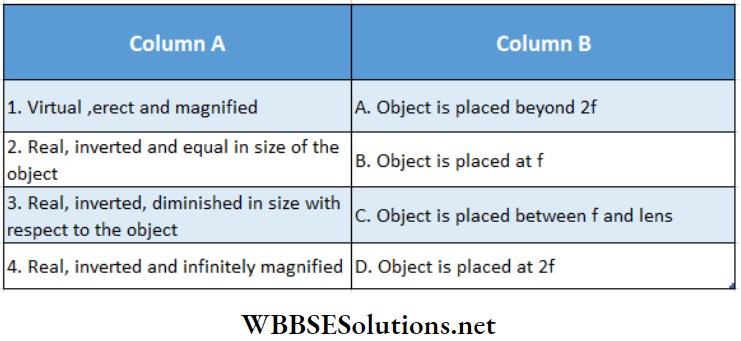
Class 12 Physics Unit 6 Optics Chapter 3 Refraction Of Light At Spherical Surface Lens Nature Size Of The Image

Answer: 1-C, 2-D, 3-A, 4-B

Question 3. Two transparent media of refractive indices μ1 and μ2 have a solid lens-shaped transparent material of refractive index between them as shown in figures in column 2. A ray traversing these media is also shown in the figures. In column 1 different relationships between, μ1, μ2, and μ3 are given. Match them to the ray diagram shown in column 2
Class 12 Physics Unit 6 Optics Chapter 3 Refraction Of Light At Spherical Surface Lens Two Transparent Media Of Refractive Indices

Answer: 1- A, C, 2-B, D, E, 3- A, C, E, 4-B, D

Question 4. Four combinations of two thin lenses are given in column 1. The radius of curvature of all curved surfaces is R and the refractive index of all the lenses is 1.5. Match lens combinations in column 1 with their focal length is column 2
Class 12 Physics Unit 6 Optics Chapter 3 Refraction Of Light At Spherical Surface Lens Four Combination Of two Thin Lenses

Answer: 1- B, 2-D, 3-C, 4-A
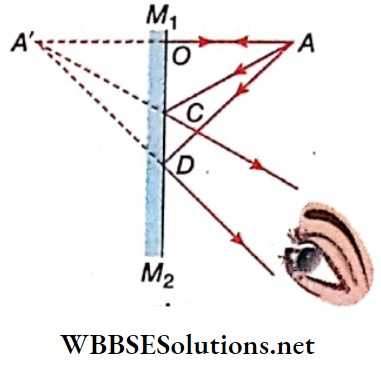
WBCHSE Class 12 Physics Semiconductor Electronics Notes

WBCHSE Class 12 Physics Notes

Semiconductors And Electronics Conduction Of Electricity In Solids

A solid can in general be divided Into two classes:

  1. Crystalline and
  2. Amorphous.

We shall concern ourselves In this chapter only with crystalline solids. A lattice in such a solid is an ordered sequence of points describing the arrangement of y atoms that form a crystal.

A unit cell is defined as the smallest part of a crystal that repeats itself regularly through translation in three dimensions to form the entire crystal. Innumerable unit cells are arranged in a regular pattern to form a piece of a crystal.

Read and Learn More Class 12 Physics Notes

Semiconductors And Electrons Crystalline Solids

Based on electrical conductivity, solids can be divided Into three groups:

  1. Conductor
  2. Insulator and
  3. Semiconductor

1. Conductor:

Electricity can easily pass through the conductors. Solid conductors are mainly metals. In metals free elec¬ trons act as charge carriers; the magnitude of current through metals may be equal to or greater than 1 A. With an Increase In temperature, the resistance of metallic conductors increases. Silver (Ag), copper (Cu), aluminum (Al), iron (Pc), etc. are some examples of conductors.

2. Insulator:

The substances through which electricity cannot pass are known as insulators. Free electrons do not exist In this kind of substance. Most of the non-metals are insulators. The insulators which are widely used in electrical machines are mica, diamond, quartz, etc.

3. Semiconductor:

Semiconductors are substances that possess electrical conductivity that falls between that of metals and insulators. Conduction Conduction in semiconductors occurs through the movement of free electrons and holes. The electric current flowing through this substance

The current never exceeds a few milliamperes. Semiconductors such as silicon (Si) and germanium (Ge) exemplify this category. The distinguishing characteristic of silicon and germanium Both of them belong to the fourth group (carbon group) in the periodic table and have -1 electrons in their outermost orbit, which are crucial for the formation of covalent bonds. During the process of electrical conduction, silicon or germanium crystals utilise free electrons and holes as charge carriers, as previously explained.

As the temperature rises, their resistance diminishes. The upcoming part will provide a comprehensive analysis of this subject matter. Out of the several types of semiconductors, silicon is favoured due to its low production cost in the manufacturing of electronic devices. Nevertheless, silicon-germanium (SiGe) is employed as a substitute for silicon (Si) in high-speed networking.

There are two types of semiconductors:

  1. Pure or intrinsic semiconductors and
  2. Impure or extrinsic semiconductors

WBCHSE Class 12 Physics Semiconductor Electronics Notes

WBBSE Class 12 Semiconductor Electronics Notes

Pure Or Intrinsic Semiconductor

1. Valcnco electron:

5 atoms of silicon (Si) crystal. There are 4 electrons in the outermost shell of a silicon atom. Each electron forms a single covalent bond with an electron of the adjacent silicon atom. So, the four covalent bonds.

Semiconductors And Electrons Pure Or Intrinsic Semiconductor

In this scenario, the effective number of electrons in the outermost shell of the central atom becomes 8. These electrons enclosed in the bonding are called valence electrons, thus Each atom in the crystal gets stability by fulfilling an octet in the outermost shell and keeps the crystal In uniform bonding.

At absolute zero temperature (i.e., 0 K), each electron remains confined to the bond. Due to the absence of any free electron or hole, conduction of electricity does not take place through the crystal, i.e., the crystal behaves as an insulator.

2. Conduction electron:

Now if the temperature of the crystal is increased, i.e., if the crystal absorbs heat, the energy of the valence electrons increases. Due to this, some valence electrons gain sufficient kinetic energy to break the covalent bond and come out from the valence shell. These electrons are known as free electrons and they act as charge carriers in the crystal. If the suitable potential difference is applied, current flows through sil¬ icon or germanium crystals due to these electrons. These charge-carrying free electrons are called conduction electrons or thermal electrons.

Note that, the conductivity of a substance is directly proportional to its concentration of free electrons, n. in the case of a good conductor, n ≈ 1023 electrons per m3, and for an insulator, n ≈ 107 electrons per m3. In the case of semiconductors, the value of n lies between these two. For example, at room temperature (i.e., at 300K), the values of n for germanium and silicon are n ≈1019 per m3 and n ≈1016 per m3 respectively.

3. The magnitude of current:

The value of electric current through pure germanium crystal is not more than a few microamperes (μA) and in the case of silicon, it is even less, only a few nanoamperes (nA). This small current is of no use for practical purposes and hence pure semiconductor has no use as an electrical element.

4. Resistance Of semiconductor:

As the temperature of a silicon or germanium crystal rises, the quantity of unbound electrons within it also rises. Consequently, the electric current likewise rises, meaning that the resistance of the crystal reduces. Conversely, the temperature of a metallic conductor directly affects its resistance, causing it to grow. The relationship between temperature and resistance in metallic conductors and semiconductors

Semiconductors And Electrons Resistance Of Semiconductor

5. Hole:

WBCHSE class 12 physics notes Hole Definition:

If any electron is released from a bond in an atom, the deficit of the electron at that position is regarded as a hole. Its effective charge is +e, although it is not a real particle.

Generation of holes:

Assuming a pure silicon crystal, the electron originally located at position A in bond 1 is relocated to place X upon the bond’s rupture. Therefore, a valence electron undergoes a transformation and becomes a conduction electron. Simultaneously, there is an electron deficiency at location A. An effective positive charge is generated at the specified place.

A pertains to its adjacent electrons. A deficiency of electrons within a bond is referred to as a hole. The charge of an electron is -e, while the effective charge of a hole is +e. In an intrinsic semiconductor, the number of holes generated is precisely equivalent to the number of electrons released, denoted as n = p, where n and p represent the concentrations of electrons and holes, respectively.

Semiconductors And Electrons Generations Of Holes

Short Notes on p-n Junctions

The motion of holes:

Apply a potential difference across the two ends of the crystal. The bond at location B in bond 2 is disrupted as a result of thermal vibration of the electron. Now, this electron will undergo directed motion as a result of the applied potential difference and eventually occupy the vacancy at position A of bond 1. Simultaneously, the aperture at point A will disappear and a fresh aperture will materialise at location B. It can be inferred that the hole at location A gets moved to location B. The electrons in a crystalline material move in the opposite direction to the holes.

It is important to note that the concept of a ‘hole’ is not an actual particle like an electron. Instead, it refers to the absence or lack of an electron. It is simply a theoretical framework created to develop a model for elucidating conduction in semiconductors. Inside. Describing electric current in terms of hole motion is often beneficial. Electrons are the primary negative charge carriers in silicon and germanium crystals, whereas holes are regarded as the primary positive charge carriers.

WBCHSE class 12 physics notes Energy Bands in Solids

We shall begin by considering a sodium atom as an example. An isolated Na atom has been. Its electronic configuration is ls22s22p63s1.

Semiconductors And Electrons Energy Bands In Solids

The nucleus of an atom creates an attractive force that forms a potential well (shown by a solid line). Electrons are then placed in this potential well by occupying various discrete energy levels with negative potential energies. Pauli’s Exclusion Principle states that each energy level can accommodate a maximum of two electrons with opposite spins.

Therefore, in the Sodium atom, two electrons occupy each of the energy levels Is and 2s, while the 2p level is divided into 3 sublevels and contains 6 electrons. The valence electron occupies the 3s orbital. This electron is the outermost electron of the sodium atom.

Within the sodium crystal lattice, numerous atoms are in close proximity to one another, resulting in a modification of the potential well’s form, as seen by the solid line. Typically, with the exception of the valence electron, the remaining electrons in the Na atom are located within their respective potential well. Therefore, these electrons are not affected by adjacent atoms.

Semiconductors And Electrons Nucleus An Atom

But, in the case of valence electrons, the situation is completely different. The valence1, electrons cannot ^be accommodated within the potential well. Therefore each of the valence electrons is influenced by all the other atoms surrounding it.

  • So, it is not possible to recognize the valence electrons of individual Na atoms in the 3s energy level.
  • However, according to Pauli’s exclusion principle, the maximum number of electrons that can be accommodated in a definite energy level is two.
  • Due to this, the 3s energy level splits into a large number of substrates Each substate contains 2 electrons. As inside a crystal, large numbers of atoms (~ 1020) are packed closely in a very small space, the number of substrates is very high.
  • So the variation of the potential energy of the energy levels may be assumed to be continuous. Thus these closely spaced energy levels will form an energy band at the position of 3s.
  • This energy band in a solid crystal is called the valence band.
  • Generally, each electron in the valence band escapes from’ its atom, but due to attraction by the rest of the ionized atoms i.e., a group of atoms in a crystal, the valence electrons cannot behave as free electrons.
  • So no free electrons are available as charge carriers.
  • In the crystal, if the valence electrons gain sufficient energy from an external source to overcome the potential barrier of the group of atoms, then the electrons become free.
  • These electrons are called conduction electrons. Now, if a potential difference is applied at both ends of a solid sodium bar, then the conduction electrons start drifting.

For this current will be introduced in the solid. When a large number of valence electrons are transformed Into conduction electrons by acquiring enough energy, they form an energy residing In a certain discrete energy level. This energy band is j called the conduction band.

Semiconductors And Electrons Conduction Bond

Common Questions on Semiconductor Materials

Naturally, the energy of electrons in the conduction band is more than that in the valence band. The gap between these two consecutive energy bands is known as the forbidden zone.

No electron can stay in the forbidden zone. The energy gap between these two bands is known as the forbidden energy gap. For different substances, the energy gaps (between these two bands are different, and depending on the energy gap, the electrical conductivities of different substances are also different.

Semiconductor electronics class 12 notes  Insulator:

In an insulator, the energy gap between the valence band and the conduction band is such that, electrons in the valence band can never gain sufficient energy for transition into conduction electrons As a result, no charge carriers are produced and the substance behaves as an insulator.

Conductor:

Overlap occurs between the higher region of the valence band and the lower region of the conduction band in certain compounds. The movement of electrons from the valence band to the conduction band does not require any energy.

Consequently, valence electrons have the ability to readily convert into conduction electrons. Therefore, a vast number of charge carriers are generated, causing the substance to exhibit excellent conductivity.

Class 11 Physics Class 12 Maths Class 11 Chemistry
NEET Foundation Class 12 Physics NEET Physics

Semiconductor:

The substances in which the energy gap between the valence band and conduction band is smaller than insulators behave as semiconductors.

  • The energy required for the transition of valence electrons into conduction electrons is greater than that for conducting substances.
  • However, the energy gap between the valence band and conduction band in these sub¬stances is not too large like that in insulators. This energy gap  (Eg) is 0.67 eV for germanium and 1.11 eV for silicon

Semiconductors And Electrons Insulator And Conductor And Semiconductor

Electrons and holes in the two bonds:

At low temperatures, the valence band of an intrinsic semiconductor remains saturated and the conduction band remains fully vacant. Now, at a higher temperature, when an electron reaches the conduction band from the valence band, a vacancy of electron is created in the valence band, i.e., a hole is generated.

Semiconductors And Electrons Electrons And Holes In The Two Bands

Naturally, the number of electrons in the conduction band and the number of holes in the valence bond of an intrinsic semiconductor are equal

Semiconductor Electronics Class 12 Notes

Ranges of resistivity and conductivity:

The following table provides an overall knowledge of the resistivities and conductivities of the three types of materials

Semiconductors And Electrons Range Of Resistivity And Conductivity

Comparison of Semiconductors with Conductors and Insulators

Semiconductors And Electrons Comparision Of Semiconductors And Conductors Insulators

Semiconductor electronics class 12 notes 

Semiconductors And Electronics Impure Or Extrinsic Semiconductor

Important Definitions Related to Semiconductor Electronics

Impure Or Extrinsic Semiconductor Definition:

If some special kinds of impurities are mixed with an intrinsic semiconductor in a controlled manner, the conductivity of the semiconductor increases drastically. The semiconductor thus developed is known conductor. The method of mixing of impurities is called doping and the mixed impurities are called dopants.

A few milliamperes (103 A) current can be passed through silicon or germanium crystals by doping with impurities. The current increases to a high value because the energy gap between the valence band and the conduction band decreases considerably due to doping. As a result, the concentration of charge carriers in the crystal increases manyfold.

Extrinsic semiconductors are of two types 

  1. n-type and
  2. p – type.

1. n-type semiconductors

n-type  Definition:

If pentavalent elements (like arsenic or phosphorus) are doped as Impurities In the crystal of an Intrinsic semiconductor In a controlled manner, the crystal thus formed is called an n-type semiconductor.

n-type  Structure:

A small amount of pentavalent impurity [of group V (nitrogen group) elements,] like arsenic (As) or phosphorus (P), is doped in a controlled way in pure silicon (Si) or germanium (Ge) crystals to produce this kind of semiconduc¬ tors. Each dopant atom contains 5 electrons in its outermost orbit.

n-type  Working principle: 

A silicon crystal doped with arsenic is shown. Inside the crystal, an arsenic atom finds itself surrounded by silicon atoms. It forms four covalent bonds with 4 neighboring silicon atoms. The extra electron in its outermost orbit finds no place to occupy in any bond and hence acts as a free electron or conduction electron. These electrons are known as donor impurities. If only 1 phosphorus or arsenic atom is doped per 106 germanium or silicon atoms, a sufficient number of conduction electrons are released, thereby raising the electrical conductivity of the crystal by a factor of 106.

Semiconductors And Electrons Working Principle Of Conduction band And Valence Band

The energy band of an n-type semiconductor has been shown. The dotted line indicates the energy level of the excess electrons generated by the doping of the pentavalent element. These electrons can easily be excited to the conduction band. This line is known as donor level.

n-type Discussions:

  •  The n-type crystal, as a whole, is chargeless. Electrons don’t need to remain actively charged because although free, the arsenic or phosphorus atoms present inside the crystal are electrically neutral.
  • The energy gap between the Fermi level and the conduction band is approximately 0.05 eV.  In n-type semiconductors, the majority carriers are electrons, and the minority carriers are holes.
  • Only a single impurity atom on average is to be doped in approximately 106 atoms of the original crystal. Hence the host silicon or germanium crystal should be an absolute purc. The cost of a semiconducting crystal is almost entirely due to its purification.
  • But still, the crystal is very cheap. | y| Phosphorus or arsenic atoms donate free electrons to the pure semiconducting crystal and hence they are called donor elements.

Since the negatively charged electrons act as majority charge carriers, this type of crystal is called r;-type

Class 12 Physics Semiconductor Notes

2. P-type semiconductors

P-type Definition:

If trivalent elements (like boron or aluminum) are doped as impurities in the crystal of an intrinsic semiconductor in a controlled manner, the crystal thus obtained is called a p-type semiconductor

p-type Structure:

A small amount of trivalent impurity (of group III elements,) like boron (B), and aluminum (Al). is doped in a controlled manner in pure silicon (Si) or germanium (Gi) crystals to produce this kind of semiconductor. Each dopant atom contains 3 electrons In Its outermost orbit.

P-type Working principle:

A silicon crystal doped with boron. Inside the crystal, a boron atom finds itself surrounded by four silicon atoms of which the boron atom completes 3 covalent bonds with 3 neighboring silicon atoms.

Due to the deficit of one electron in the outermost orbit of boron. the fourth bonding cannot be completed and hence a hole appears there. If a suitable potential difference is applied, the holes having effective positive charges can drift inside the crystal. The holes act as charge carriers. As a result, it Is possible to bring the electrical conductivity of the crystal up to its desired value.

Semiconductors And Electrons Working Principle Of Conduction band And Valence Band.

The energy band of the p-type semiconductor is shown. The dotted line denotes an electron-accepting level. The electron of the valence band can easily be exited to the acceptor level. Thus carrier holes are created in the valence band.

Its majority carriers are holes and its electrical conductivity is many times greater than that of an intrinsic semiconductor.

P-type Discussions:

  • The p-type crystal as a whole is electrically neutral
  • The energy gap between the valence band and the fermi level is approximately 0.05 eV.
  • In p-type semiconductors, the majority carriers are holes and the minority carriers are electrons.
  • Only a single atom on average is to be doped in approximately 106 atoms of the original crystal
  • When boron or aluminum atoms are doped in the semi¬ conducting crystal, holes are generated which can accept electrons. Thus, boron or aluminum are called acceptor elements.

Since positively charged holes act as majority charge carriers in this type of crystal, it is called p-type.

Difference between n-type and p-type Semiconductors

Difference between n-type and p-type Semiconductors:

Semiconductors And Electrons n And p Type Semiconductors

Drift of Charge Carriers in Semiconductors

In the case of current conduction through a metal wire, the current through the wire is

I = nevA

Where e = charge of an electron, v = drift velocity of free electrons through the metallic wire n = number density or concentration of free electrons = number of free electrons in unit volume of metal, and A = area of cross-section.

Class 12 physics semiconductor notes Intrinsic semiconductors:

Consider a cylindrical block of Intrinsic semiconductor of length I and area of cross-section A. Here, electron-hole pairs act as charge carriers. Let potential difference V be applied across two ends of the semiconductor block. As a result, both electrons and holes start drifting in opposite directions. As electrons are negatively charged and holes are positively charged, so current will flow in the same direction for both the charges. Conventionally, this direction is along the drifting of holes. i.e opposite to the drifting of electrons

Semiconductors And Electrons Intrinsic Semiconductors

So, the current passing through the semiconductor
.
I = neveA+ pevhA = Ae(nve+pvh) ……………………………………… (1)

Here, n = number density of electrons

p = Number density of holes

ve = Drift velocity of electrons

vh = Drift velocity of holes

For intrinsic semiconductors; the number of thermal electrons and thermal holes as charge carriers are the same.

Therefore, n = p = ni, where ni is the number density of electron-hole pairs in intrinsic semiconductors.

So, from the equation (1), we get

I = Aeni(ve+ vh) ………………………………………… (2)

The current through unit area i.e current density for equation(1)

J = \(\frac{I}{A}\) =   e(nve+pvh) ………………………………………. (3)

For intrinsic semiconductor

J = eni(ve + vh)

The effective electric field in the semiconductor is E = \(\frac{V}{l}\)

So, J = \(\frac{I}{A}=\frac{1}{A} \frac{V}{R}\)

I = \(\frac{V}{R}\)

Or, J = \(\frac{1}{A} \cdot \frac{V}{\rho \frac{l}{A}}=\frac{1}{\rho} \frac{V}{l}\)

= \(\frac{1}{\rho} \frac{V}{l}=\frac{1}{\rho} E\)

= σE

Here , R = \(\frac{\rho l}{A}\) = Resistance of the block of semiconductor

ρ = Restivity

And \(\sigma=\frac{1}{\rho}\) = conductivity

hence σ E= e(nve+pvh) from equation (3)

Or, σ =  \(e\left(n \frac{v_e}{E}+p \frac{v_h}{E}\right)=e\left(n \mu_e+p \mu_h\right)\) ………………………………… (4)

Here  μe = \(\frac{v_e}{E}\) = Mobility of electrons

And = \(\mu_h=\frac{v_h}{E}\)  = Mobility of holes

This is the equation of conductivity of the semiconductor crystal

In the case of intrinsic semiconductors

σ = \(e n_i\left(\mu_e+\mu_h\right)\) ……………………………..(5)

It should be borne in mind that in an intrinsic semiconductor, charge carrier electrons reside outside atomic bonds, whereas charge carrier holes remain inside atomic bonds. Therefore the holes cannot move as easily as electrons.

So, it can be said that the effective mass of each hole is larger than that of each electron. Hence, at the time of current flow through the semiconductor, drift velocity and mobility of electrons are larger than those of holes i.e.,

νeh and μeh

It is important to note that each equation depends on the temperature T of the semiconductor. So, the number densities, drift velocities, and mobilities of electrons and holes are changed with temperature change.

Extrinsic semiconductor:

We have seen how in an n-type semiconductor, electrons act as majority carriers, and in a p-type semiconductor, holes in the host crystal act as the majority carriers.  Hence, in an extrinsic semiconductor, the number densities of electrons and holes are not the same i.e., n ± p

In an n-type semiconductor, as the number of majority charge carriers increases by doping, the holes get annihilated due to recombination with newly generated electrons.  Hence, with an increase in electron concentration (n), the hole concentration (p) gradually decreases. On the other hand, for p-type semiconductors, n decreases with the increase of p. In either case, the condition of equilibrium is

np =  n²i ……………………….. (6)

The equation (6) is known as the law of mass action.

Law of mass action:

Under thermal equilibrium, the product of free electron concentration (n) and freehold concentration (p) is constant. This constant is equal to the square of carrier concentration (n) in intrinsic semiconductor

Incidentally in SI, the charge of an electron or hole is 1.6 × 10⁻¹⁹ C

Unit number density is m-3, a unit of drift velocity is m.s-1 V unit of mobility is m² V-1.s-1 and the unit of conductivity is mho m-1 i.e., Ʊ  .m-1 or, S .m-1

Semiconductor devices class 12 notes 

Semiconductors And Electronics Impure Or Extrinsic Semiconductor Numerical Examples

Example 1.  An intrinsic semiconductor has 5 × 1028 atoms and a carrier concentration of 1.5 × 10¹⁶ m-3. If it is doped by a pentavalent impurity in the ratio 1: 10-6, then calculate the number density of holes as charge carriers  
Solution:

On doping by pentavalent Impurity, the n-type semiconductor is formed. Here we neglect the number density of the thermal electrons lu respect to (ho number density of electrons as majority carriers. Nonce the number density of electrons in n-type semiconductors,

n = \(\frac{5 \times 10^{28}}{10^5}\)

= 1.5 × 10¹⁶ m-3

Given, ni = 1.5 × 10¹⁶ m-3 holes,

p = \(\frac{n_i^2}{n}=\frac{\left(1.5 \times 10^{16}\right)^2}{5 \times 10^{22}}\)

= 4.5 × 10⁹ m-3

Practice Questions on Semiconductor Electronics

Example 2. A semiconductor has equal electron and hole concentrations of 6 ×10⁸ m-3. On doping with a certain Impurity, the electron concentration of the semiconductor Increases to 8×10¹² m-3.

  1. What type of semiconductor is obtained from doing?
  2. Calculate the new hole concentration of the semiconductor.

Solution:

Here, n = p = ni = 6 ×10⁸ m-3 i.e., in its initial state, it is an intrinsic semiconductor.

As the concentration of electrons as majority carriers increases on doping, so n-type semiconductor is formed in n-type semiconductor, and the electron concentration

In n-type semiconductor, the electron concentration

n = 8 × 10¹² m-3

Her, np= n²i

Therefore, the new hole concentration

p = \(\frac{n_i^2}{n}=\frac{\left(6 \times 10^8\right)^2}{8 \times 10^{12}}\)

= 4.5 × 10⁴m-3

Example 3. A semiconductor has an electron concentration of 0.45× 10¹²m3 and a hole concentration of 5 × 10²⁰m3. Calculate the conductivity of the material of this semiconductor. Given, Electron mobility = 0.135 m2.V-1.s-1
Solution:

Here, n = 0.45 × 10¹²m3

p = 5 × 10²⁰m3

μ = 0.135 m2.V-1.s-1

μ = 0.048 m2.V-1.s-1

So, the conductivity of the material of this semiconductor

σ = e(nμe+ pμh)

= 1.6 × 10⁻¹⁹(0.45× 1012)× 0.135 +(5×1020) ×0.048

= 3.84 mho.m-1

Semiconductors And Electronics p- n junction

p-n junction Definition

By the opposite kind of doping, if one part of a semiconducting crystal is made n-type p-type, then that crystal is called a p-n junction. end me ot

A p-n junction is shown- There is a jnncaoc in between the p-type and n-type parts. Remember that, by jor-ing two different p-type and n-type crystals, a p-n junction is not formed because in that case, the crystals would not be joined uniformly and so the junction would not act properly.

To construct a p-n junction diode, a single crystal is doped with p -Type in one half and n type in the other half The junction thus developed is not so perfect though impossible to make the junction thin up to the order of lOÿm so far. Here we will take the junction as an ideal one to avoid complexity. It means we consider a perfect junction between p and. n -parts

Semiconductors And Electrons Junction Plane

Circuit symbol

The symbol by which a p-n junction a denoted in an electrical circuit. The base of the triangle indicates p-end and the line drawn at the vertex parallel to the base indicates n-end.

Semiconductors And Electrons Curcuit Sympol pn Juction

Depletion region or depletion layer

As soon as the p-n junction is formed, electrons and holes start to diffuse through the junction.

First, we take a look at the condition of the junction beer. diffusion starts. During that time, the free electrons in the n-pan move disorderly, whereas the donor ions remain fixed in their positions. As the free electrons remain confined within the n-part, the net charge of this part is zero. On the other hand, the free holes in the p -part move disorderly, whereas the acceptor ions remain fixed. Just like the n -part, the net charge of the p – part is also zero.

Semiconductors And Electrons Depletion Region Or Depletion Layer

Due to the lack of free electrons in the p -part, the free electrons scan to move from n to the p -part- Similarly, due to the lack of free boles in n pan, the free holes start to move from p to n -pan, Le., diffusion starts. In this tray, the electrons just entering the p-part neutralize the holes of the acceptor ions near the junction.

This makes the acceptor ions negative in charge, i.e., the net charge in the p pan becomes negative. Similarly, the holes just entering the n-pan neutralize the electrons of the donor ions near the junction. This makes the donor ions positive in charge, i.e., the net charge in n-pan becomes positive.

Semiconductors And Electrons Depletion Region Or Depletion Layer Of n Part Charge

Because of diffusion, the amount of positive and negative charges in n -part, and p -part respectively increases rapidly. At a certain moment, the amount of these charges becomes so high that no electron or hole can cross the junction anymore. In other words, net dif¬fusion in this state comes to zero.

In this condition up to a certain distance from either side of the plane no free charge depletion region. electron whole P S n depletion region it does exist. The region on either side of the junction plane containing no free charge is known as the depletion region (or depletion layer).

Semiconductors And Electrons Depletion Region

Inevitably, the depletion region contains negative and positive ions in the p -part and the n -part respectively. Hence due to higher potential in n -type and lower potential in p -type, a potential barrier develops at the p-n junction plane. Neither the majority carriers nor the electron and hole can overcome this barrier.

However, the movement of minority carriers continues even after the development of the depletion region. Since the depletion layer in the n -n-region is at a positive potential, the minority carrier electrons of the depletion layer in the p -p-region get attracted toward that direction. Again, the minority carrier holes of the depletion layer in the n -n-region get attracted toward the depletion layer in the -region having a negative potential.

Semiconductor Devices Class 12 Notes

Application of forward and reverse bias to the p-n junction

Biassing refers to the process of establishing a connection between electrical components. An electron behaves similarly to electronic components such as a diode or transistor when an external source of electricity, such as a battery, is applied. Prior to the application of any external voltage across a p-n junction, it has been previously discussed that there is no biassing or influence present.

The N-end acquires a positive potential, while the P-end acquires a negative potential. The phenomenon being described here is the application of a reverse bias to the junction, sometimes referred to as the natural reverse bias. Consequently, a depletion layer is spontaneously created around the location of the n and p areas. The working principle of a p-n junction is determined by the transition of the depletion layer when an external bias is applied, namely the actual external voltages applied to the junction.

1. Application of reverse bias:

Reverse bias is applied p-n junction by connecting the n-end of the p-n junction with the positive terminal of the external source and the p-end with the negative terminal.

If reverse bias is applied using an external battery B to a p-n junction, the thickness of the depletion region increases. The majority carriers cannot cross the junction and hence no current is obtained in the external circuit But due to the motion of minority carriers, a small current is obtained whose value in the case of germanium is approximately 10-6 A’ and in base of silicon, it is only about 10-6 A. The current is called. the reverse saturation current of a diode. in most cases, this current is neglected

Semiconductors And Electrons Application Of Forward Bias

2. Application of forward bias:

To apply forward bias to a p-n junction, its p -end is connected with the positive terminal of the external source of electricity, and n -ends with the negative terminal. A part of the forward bias applied using an external battery B, is used to decrease the value of the potential barrier. To do so applied voltage is to be increased. Very soon, the voltage thus applied reaches a particular value, when the depletion region vanishes.

If the forward bias is increased more the holes present in the p -region and electrons in the n -region can cross the junction easily. This is due to the applied positive potential at the end and negative potential at the n -end which help the holes and electrons, respectively to pass through the junction. As a result, a current flows through the external circuit According to the conventional rule, the direction of current flow in the external circuit is just opposite to the direction of flow of electrons, i.e., the direction along which the holes flow.

Semiconductors And Electrons Application Of Forward Bias

3. Semiconductor diode:

If forward bias is applied to a p-n junction current flows through it; but when a reverse bias is applied current flow is negligible. So, the p-n junction acts as a valve, i.e., the current through it is unidirectional. p-n junction is also called a semiconductor diode. It can be used as a rectifier just like a vacuum diode, although their properties are not identical

Semiconductors And Electrons Semiconductor Diode

Characteristics of p-n junction diode: The variation of current with potential difference applied to a p-n junction diode in its forward and reverse biased condition, is shown in

Semiconductors And Electrons Characteristics Of pn Juction Diode

It is known as I-V characteristics or simply the characteristic curve of a p-n junction.

Some properties of the characteristic curve:

  • Due to the presence of minority carriers, a reverse saturation current exists in reverse bias.
  • To neutralize the reverse saturation current, a minimum forward biasing is essential
  • With the increase in the potential difference in forward bias, the current increases rapidly (AB part in that curve).

The characteristic curve of the p-n junction is not linear, i.e., V and I are not proportional to each other. Hence it is a non-ohmic electrical component. Since ΔI is the change of current due to a change of potential difference  ΔV, the ratio ΔV/ΔI is called the dynamic resistance of the junction. The value of the dynamic resistance Rp is different in the different portions of the characteristic curve.

Semiconductor devices class 12 notes p-n junction rectifier

The arrangements convert an alternating waveform into unidirectional wav.-f.mn an alternating current into the unidirectional current. It called. rectifier. A p-n junction diode is used for the rectification of alternating current

Half-wave rectification

Tire required a circuit diagram for half-wave reeducation, the input as well as the output forms. For the positive half-cycle of alternating current, the p-n junction gets forward biased, and for the biased. So, only for the positive half cycle of the input alternating voltage output voltage and current are obtained which is unidirectional. Since only one half-cycle of the input wave can be rectified by this arrangement, it is called half-wave rectification.

Semiconductors And Electrons Half Wave Rectification

Each wave-crest in the DC output is called a ripple. In a half¬ wave rectifier, the number of wave crests in the alternating input becomes equal to the number of ripples in the DC output. Hence, if the frequency of alternating Input is 50 Hz, the frequency of the ripples will also be 50 Hz.

Full-wave rectification:

The full-wave rectification and the input-output waveforms shown A full wave can be rectified by using two p-n junctions.

Semiconductors And Electrons Full Wave Rectification

For one half-cycle of the alternating current, the diode D1 gets forward bia&d but tire diode D2 gets reverse biased. As a result, current flows only through the diode D1, in this case. For the text half-cycle, the diode D2 gets forward biased but the diode D1 gets reverse biased. As a result, current flows only through tile diode D2. Note that, for both the half-cycles of a complete cycle, tire current through the load resistance is unidirectional.

Since, both the half-cycles of the input wave can be rectified by this arrangement, so it is called full-wave rectification. In this case, the tire number of ripples becomes double the number of wave-crests of tire alternating input. Hence, if the frequency of tire alternating input is 50 Hz, the frequency of the ripples will be 100 Hz.

Advantage of silicon over germanium for use as rectifiers: Due to tire presence’ of minority carriers, a very small current passes through the junction in the reverse bias. Hence, a p-n junction is not completely free from error as a rectifier. The value of this reverse current is approximately 10-6 A for germanium and only 10~9 A for silicon. This reverse current can easily be neglected for silicon. Hence, silicon is more useful than germanium as a rectifier

Semiconductors And Electronics p- n junction Numerical Examples

Example 1. The potential barrier of a p-n junction diode is 0.4 V. If the thickness of the depletion region is 4.0 × 10⁻⁷ m, what will be the electric field intensity in this region? An electron from the n-region moves towards the p-n junction with a velocity of 6 × 10s m s-1. What will be the velocity of that electron with which it enters the p -p-region?

Electric field intensity, E = \(\frac{V}{d}\)

Here, V = value ofpotential barrier = 0.4 V

And d = thickness of depletion region = 4 × 10⁻⁷ m.

∴ E = \(\frac{0.4}{4 \times 10^{-7}}\)

E = 106 V.m-1

Let an electron enter to the depletion region from the n -n-region with velocity v1 and come out from the depletion region with velocity v2. Due to this, the increase in potential energy is eV. According to the principle of conservation of energy

½mv²1 = eV+ ½mv²2

Or,  ½ (9.2 ×10-31)× (6×105)2

= 1.6 ×10-19×  0.4 + ½ ×(9.1×10⁻³¹)

Or, 1.64 ×10-19 = 0.64 ×10⁻¹⁹  +4.55×10⁻³¹. v²2

2 = \(\frac{1 \times 10^{-19}}{4.55 \times 10^{-31}}\)

= 22 × 1010

v2 = 4.7 × ×105 m.s-1

Semiconductors And Electronics Some Special Semiconductor Diodes

Zener Diode

When an ordinary semiconductor diode is reverse-biased, a very small saturated reverse current flows across the junction due to the flow of a few thermally-generated minority carriers (electrons in p -region and holes in n -region). This current is not at all dependent on the applied reverse bias voltage. But, if this reverse bias voltage exceeds a definite value, the reverse current increases abruptly. This situation is known as the breakdown of the semiconductor diode.

As n result, power consumed by the diode U. The rate of production of heat increases rapidly which can damage the diode. The tolerance of some specially prepared semiconductor diodes is Increased in such a way that at reverse bias, even due to the flow of high reverse current, the diode is not damaged. This type of diode has important use for practical purposes and is generally known as Zener diode

Explanation of Zener effect:

1. If the reverse bias voltage across a p -n junction diode is very high, the minority charge carriers are accelerated.

  • Due to their high speed, they knock out more electrons from the covalent bonds. Such collisions produce electron-hole pairs.
  • Newly generated carriers, in turn, may gain sufficient energy to disrupt more covalent bonds and produce more electron-hole pairs.
  • This phenomenon is cumulative and soon an avalanche of charge carriers is produced causing a flow of large currents.
  • Breakdown occuring in this manner is called avalanche breakdown and the diode is called avalanche diode.

2. If both regions of a semiconductor diode i.e., a p-n junction diode are heavily doped, the thickness of the depletion layer decreases to a large extent.

  • Then a very small reverse bias is applied, and a very strong electric field is created between the two ends of the depletion layer.
  • This electric field breaks up the covalent bonds of the semiconductor. crystal directly and a huge number of charge carriers are set free within the crystal.
  • Tints, due to a comparatively small reverse bias, diode-breakdown occurs i.e., at a constant breakdown voltage of small magnitude, the diode reaches a state when a large reverse current flows.
  • Thus breakdown that occurs in this manner is called Zener breakdown and the diode is called Zener diode
  • In the case of any semiconductor diode of this type, the avalanche effect and Zener effect occur simultaneously at reverse bias.
  • Generally, for a near 6 V breakdown voltage, the avalanche effect and Zener effect become equivalent to each other, and concerning temperature no special change of breakdown voltage takes place.
  • So, diodes having breakdown voltage around 6 V, are very suitable to use at different temperatures.

Avalanche effect or Zener effect whichever may be die principal effect, these types of diodes are simply called Zener diodes in practical cases.

Characteristic curve:

The ampere-volt (I- V) characteristic curve of a forward-biased Zener diode is similar to that of an ordinary semiconductor diode. But, when the reverse bias voltage reaches a particular value Vz, the reverse current suddenly increases to a large value. This part of the characteristic curve is represented by AB, almost a verticle line. In an ideal Zener diode, the increase of voltage with the increase of current is zero. In practical cases, this increase is within 1 % to 5%.

Semiconductors And Electrons Curve

Semiconductor devices class 12 notes Rating of a Zener diode:

In every Zener diode, a reference voltage and a reference power are mentioned. This voltage rating Vz indicates the reverse-bias voltage, at which the reverse current increases abruptly, but no change of the terminal voltage of the Zener diode takes place. The meaning of power rating or watt rating Pz is that, due to the increase of the current drought the diode, if the value of power consumed exceeds the j value of Pz, the diode will.be damaged

So, the maximum safe reverse current through the diode

Imax = \(\frac{P_Z}{V_Z}\) the point indicates the value.

For example, in the case of the rating 4.7 -1W of a Zener diode,

Imax = \(\frac{1 \mathrm{~W}}{4.7 \mathrm{~V}}\) = 0.21 A

= 210 mA

In the circuit for a Zener diode, a regulative resistance is so selected that the value of the reverse diode current never exceeds Imax

Circuit symbol: The circuit symbol of a Zener diode is shown below

Semiconductors And Electrons Zenor Dipode Circuit Symbol

Zener diode as a voltage regulator:

A Zener diode is used to obtain constant voltage across a load resistance connected to a fluctuating DC voltage source. The Zener diode and load resistance are to be connected in parallel.

Zener diode Working principle:

A fluctuating DC voltage source (unregulated voltage source) is connected to a Zener diode through a resistance Rs in series such that the Zener diode is reverse biased.

If the input voltage increases current through Rs and Zener diode also increases. Due to this, the voltage drop across Rs increases, but the voltage drop across the Zener diode remains constant as it operates in the breakdown region. The breakdown voltage of the Zener diode does not change by

Changing current through it. On the other hand, if the Input Voltage Is decreased, the current through Rs and Zener also decreases, but the voltage drop across Zener remains the same.

As soon as the reverse bias voltage of a Zener diode reaches VZ despite increasing the current through it indefinitely, the terminal voltage of the diode remains constant at VZ. Hence, the terminal voltage of a load resistance RL connected parallel to the Zener diode also remains at VZ, despite any change of current through it.

Conversely, it may be said that to maintain a constant potential difference across a load resistance, a Zener diode of equal voltage rating is to be connected in reverse bias parallel to the load resistance. This is called voltage regulation across a load resistance

The voltage across a Zener diode thus serves as a reference so the diode is referred to as a reference diode

Semiconductors And Electrons Reference Diode

Selection Of RS:

If (V RZ-PZ) is the rating of the Zener diode, then the maximum safe current through it is IZmax  = PZ/ VZ. The resistance RS is so chosen in the circuit that it restricts the Zener current below /max even for the maximum value of the unsteady input voltage.

Load regulation:

It is the capability to maintain a constant voltage (or current) level on the output channel of a power supply despite changes in the load resistance. More simply, load regulation is a measure of the ability of an output channel to remain constant for given changes in the load. In the circuit, a millimeter is connected to measure current (IL) flowing through load resistance RL, and a voltmeter to measure the potential difference across RL.

The changed circuit Keeping the supply voltage Vi constant, Rj is changed step by step and in ea-and VL are recorded. Now a graph of VL -IL is drawn. Part AB indicates the regulated voltage. If the Zener diode behaves ideally, the line AB would become horizontal. Point B exists a bit lower. From the portion BC, it is understood that, if the magnitude of IL is very high, i.e., the Zener current IZ is very low, VL becomes uncontrollable. As the current IL is maximum at the point B of the regulated zone

So, the ratio \(\frac{V_L}{I_L}\) at B indicates the minimum value of the load resistance RL Despite fluctuation of load resistance above that minimum value through a long-range, the potential difference across the load resistance VL remains almost constant.

Semiconductors And Electrons Load Regulation

If voltage at the point A is VNL (NL means no load or zero current) and voltage at the point B is VL,

Then percentage regulation \(\frac{V_{N L}-V_L}{V_{N L}} \times 100 \%\)

In an ideal Zener diode, this percentage regulation is zero and in actual practice, this value lies within 1% to 5%.

Light Emitting Diode or LED

If a specially made semiconductor diode or p-n junction forward bias emits light spontaneously, it is known as light-emitting, diode, or LED.

Silicon; (Si) or Germanium (Ge) diode is unsuitable as LED. For LED, semiconductor crystals of Gallium arsenide (GaAs), Gallium Phosphide (GaP), Silicon Carbide (SiC) etc. are used. The color of the light emitted from LED depends on the band gap of the semiconductor crystal and the strength of doping.

LED Working principle:

When a p-n junction diode is forward-biased, both the electrons and the holes move towards the f junction. As they cross the junction, recombination of a few electrons and holes takes place and energy is released at the junction in the form of light. Photons are emitted from the p-n junction. The color of the emitted light depends on the energy of the photons.

From the principle of conservation of momen¬ tum, it is found that a photon can be emitted only when an elec¬ tron and a hole combine with equal and opposite momentum. This condition is fulfilled in some crystals like GaP or SiC but not in Ge or Si. In the latter, the released energy of the electron-hole pair is converted to heat energy which only makes the crystal heated. For this, GaP or SiC-like crystals rather than Ge or Si are generally used to construct LED.

LED Circuit Symbol:

With the symbol bf ordinary semi ductor diode two arrows directed outwards1′ are drawn. This indicates the circuit symbol of the LED

Semiconductors And Electrons Circuit Symbol Arrows Direct Out Ward

LED Characteristic curve:

The volt-ampere characteristic curve of LED is identical to that of an ordinary semiconductor diode. But when it is forward biased, due to emission of light, a few electron-hole pairs are current (/in mA) destroyed. So, the magnitude of the current is less than that of an -ordinary diode.

But, by the low current, the action of LED is not hampered because forward bias never exceeds 2.5V or 3V and the maximum value of .current in forward bias does not exceed 50mA. If the magnitude of the forward current is increased slowly from 10mA to 50mA, the intensity of light emitted from LED continuously increases

Semiconductors And Electrons LED Characteristics Curve

LED Uses:

The power consumed by an LED is very small. In a well-planned circuit, these are not easily damaged and can be used uniformly for a long time. Moreover, LEDs are cheap. Hence, LEDs are extensively used in electrical and electronic circuits at present. It is extensively used for fast on-off switching. Besides these, LEDs are used in various electronic circuits, like torchlights, low-power household electric lamps, calculator digital watches, etc. These diodes are also used in signal lamps

WBCHSE physics semiconductor electronics Photodiode

A photodiode is a special type of reverse-biased semiconductor diode. If the light is made to fall on its p-n junction, the reverse saturated r current increases almost linearly | with the intensity of the incident I light. The circuit diagram of a photodiode.

Semiconductors And Electrons Photodiode

The reverse bias of the junction diode, naturally a small reverse current flows in the circuit. This is called dark current Now light is made to fall on p -n junction through a lens. New electron-hole pairs are created in exchange for the energy: of the incident photons and hence the reverse current increases. It is found that, the

Semiconductors And Electrons Photodiode Reverse Bias Voltage

The magnitude of the reverse current is proportional to the Intensity of the incident light. But. if the energy of the photon of the incident light is not sufficient to create additional electron-hole pairs, the photodiode will not function

The volt-ampere characteristics of a photodiode Are Shown In

Photodiodes are used for the identification of sound from sound or sound-track of cinema, determination of the Intensity of light, light-operated switches, electronic counters, CD players, smoke detectors, etc

Photodiode Circuit symbol:

With the symbol of an ordinary semicon¬ductor diode, two arrows directed inward are drawn. This indicates the circuit symbol of the photodiode.

Semiconductors And Electrons Circuit Symbol Of Ordinary Semiconductor

WBCHSE physics semiconductor electronics 

Semiconductors And Electronics Solar Cell

A special and very important practical application of photodiode is solar cells. In a photodiode, incident solar energy Is so converted into electrical energy that, it behaves as a battery. In the daytime In the presence of sunlight, this solar battery is used as a charger. Afterward, this storage battery is used to operate various electrical appliances. Solar cells are used in artificial satellites or space vehicles to operate various electrical instruments kept Inside the satellite or space vehicles. Also, solar cells are used in calculators

Earth’s surface gets an average of 1000 W of solar power per square meter on a sunny day. Only 10% of the incident photons can produce an electron-hole pair and make a photodiode active. So, approximately 100 W of solar power per square meter is available for transformation to electrical energy. This available energy is too small compared to approximate generally the available solar energy is focused on a small area with the help of a concave mirror. But due to this process, the temperature of the photodiode increases so much that even the much

Semiconductors And Electrons Solar Cell

Effective silicon crystal loses its efficiency. So in this case, the use of semiconductor crystals like Gallium Arsenide (GaAs) is suitable. reverse bias voltage more

The characteristic curve of the photodiode lying in the 4th quadrant is very relevant to, the action of a solar cell. In this case, a potential difference is positive i.e., p-n

Junction is in forward bias. But current is negative i.e. reverse current flows through the junction. It is to be noted that, current flows through the pn junction from the negative end to the positive end and this flow Is Identical to the flow of current through a battery, So the photodiode l.e„ the solar diode behaves like a cell or battery. The forward bias voltage of a cell does not exceed

1 V and the magnitude of reverse current Is very small, hence to increase output power, the internal resistance of a cell Is made very small. The output voltage is increased by connecting a large number of cells connected in series and the output current Is also increased by a large number of such series combinations in parallel. The details of technology regarding the construction of a solar cell are beyond our present discussion.

Semiconductors And Electrons Application Of Forward Bias, pn Juction From Negative

WBCHSE physics semiconductor electronics 

Semiconductors And Electronics Junction Transistor

In 1947, John Bardeen, William Shockley, and Walter Brattain Invented the transistor Out of different forms of translators, the most widely used form Is the bipolar Junction transistor (BJT), It Is a semiconductor device In which the current How between the two end terminals (called the collector and the emitter), Is controlled by an amount of current following through an Intermediate third terminal (called the base).

Transistors are used In almost all modern technologies. Thus, the Importance of semiconductors Is Immense In the modern age, hence, the modern age Is also known as ‘the silicon age Like a diode, a transistor Is also made from a crystal. It Is very small In size and Is kept sealed Inside a metallic or plastic covering In such a way that It cannot come in contact with air or moisture

Transistors are of two types:

  1. p-n-p transistor and
  2. n-p-n transistor

Structure of a p-n-p transistor:

1. A thin n-type layer Is introduced by doping between two p-type regions at the two ends of a semiconducting crystal. The n-type layer at the middle is very small in thickness in comparison with the two p-type regions at the two ends, This layer at the middle is known as the base (B) of the transistor

Semiconductors And Electrons Structure Of pnp Transistor

2. The two p-type regions at the two ends of the transistor are called emitter (E) and collector (C). Although these two regions are identical, the rates of doping them are different. The emitter region is heavily doped compared to the collector region. Hence, in a circuit, if the connection of the emitter and collector is interchanged, the working of a transistor gets disturbed.

3. The rate of doping of the base of a transistor is much less than that of its emitter and collector. CID The majority of charge carriers of this kind of transistor are holes. Usually, holes are emitted from the emitter and after crossing the thin layer of the base, they are collected by the collector. The thin layer of the base controls this flow of holes.

Structure of an n-p-n transistor:

The structure of an n-p-n transistor Is almost identical to that of a p-n-p transistor, as discussed above. For the n-p-n transistor, the failure of doping of the different parts of the die semiconducting crystal Is Just the opposite of the p-n-p transistor. In this case,

  • The thin base layer at the middle is of p-type
  • The emitter and collector regions at the two ends are of n-type
  • For this kind of doping, the. majority charge carriers electrons.

The speed of electrons Is more than that of holes as charge carriers. Mdnce In high-frequency circuits and computer circuits, n-p-n transistors are used. Actually, during the transmission of signals through these circuits, the greater the speed of the effective charge carriers, the greater will be the rate of work done.

p-n-p transistor and n-p-n transistor Circuit symbol:

The circuit symbols of p-n-p and n-p-n transistors are. The arrow sign indicates the? direction of conventional current flow between the emitter and the base. So, electrons flow in the direction opposite to the arrow sign

Semiconductors And Electrons pnp And npn Transistor

Transistor In an open circuit:

Let us assume that a transistor Is a combination of two diodes. So, diffusion of electrons and holes takes place through the junctions just like that of a p-n junction diode, As a result, each p-n junction becomes reverse-biased without the presence of any external source depletion region

Semiconductors And Electrons Transistor In An Open Circuit

Just as In a p-n junction diode, depletion regions are formed around the Junctions in a p-n-p transistor

Common-Emitter or CE Configuration of a Transistor

Three, kinds of circuit carts be constructed using transistors:

  1. Common-base (CB)
  2. Common-emitter (CE) and
  3. Common-collector, (CC)

Among these, a common emitter or CE circuit is widely used as an amplifier circuit

The flow of charge carriers In a CE-cIrcuit:

We take a n-p-n transistor and consider the flow of conduction electrons

Semiconductors And Electrons Flow Of Charge Carriers In A CE Circuit

It is to be noted that, by convention, the direction of currents is opposite to that of the moving electrons.

Semiconductors And Electrons Flow Of Charge Carriers In A CE Circuit Of Moving Electrons

Real-Life Scenarios Involving Semiconductor Devices

A CE circuit is shown using an n-p-n transistor. In this case:

  1. The circuit connecting the base and the emitter (left side circuit in the figure) is used as the input circuit and
  2. The circuit connecting the collector and the emitter (right side circuit in the figure) is used as the output circuit. Hence, in both circuits, the emitter is common. In an alternating current (AC) circuit this emitter is grounded. So it is also called a grounded emitter circuit

Biasing of a CE circuit:

  1. Keeping the emitter grounded, the base is kept at forward bias in the input circuit, i.e., the p-type base of the n-p-n transistor is connected with the positive pole of the source battery VBB
  2. Keeping the emitter grounded, the collector is kept at reverse bias in the output circuit, i.e., the n-type collector of the n-p-n transistor is connected with the positive pole of the I source battery VCC

Current in a CE circuit: 

In a tile input circuit, the emitter is at the negative potential concerning the base. Hence, a large number of majority carriers, i.e., electrons are emitted from the tire emitter which is then attracted by the positive base. Since the base layer is very thin, most of these moving electrons enter the collector after crossing the thin base layer. Then they are attracted by the positive potential of the collector.

The small number of electrons that fail to cross the base are attracted by the positive potential of the base. In this way,

The flow of electrons from the emitter produces two currents:

  1. The base current of the input circuit and
  2. The collector current of the output circuit.

The conventional direction of electric current is opposite to the direction of electron flow. According to that, the emitter current IE base current IC and collector current 

Clearly, IE = IB+ IC

The value of IB is much less than IE or IC

For example IB = 10μA , IC = 2mA = 2000μA

Then, IE = 2000 + 10 = 2010 μA

Discussions:

  • Keeping IE at a fixed value, if IB is increased, then from the relation IC = IEIB, we see that the value of IC decreases. Hence in the CE circuit, the phase difference between the output signal and the input signal is 180°.
  • Usually, the power expended in the output circuit of a transistor is much greater than that of the input circuit. Hence for commercial purposes the area of the base-collector junc¬ tion of a transistor is made much greater than the emitter-base junction
  • As the emitter-base is forward-biased, the input resistance, i.e., the resistance of the emitter-base junction becomes very small. Again, as the collector-base junction is reverse biased, the output resistance, i.e., the resistance of the emitter-collector junction becomes very high. The circuit with IowTinput resistance and high output resistance acts as the best current amplifier

CE characteristics:

  • Source voltage of the input circuit= VBB
  • Source voltage of the output circuit = VCC
  • Base current, IB = input current
  • Base-emitter voltage, VBE = input voltage
  • Collector current, IC = output current
  • Collector-emitter voltage, VCE = output voltage

Among the input and output currents and voltages, only the input current IB and output voltage VCE can be changed easily according to need, i.e., in a CE circuit IB and VCE should be taken as independent variables, and VBE as well as IC as the two dependent functions of them. Out of these, VBE has less importance in the analysis of the circuit

So, IC = f(IB,VCE) ………………………………………. (1)

Using the mathematical relation (1), two characteristic curves of the CE circuit can be drawn:

WBCHSE physics semiconductor electronics 

Transfer characteristics:

Keeping VCE the graph of Ic drawn concerning IC is known as transfer characteristics. In this case, IB and IC are the input and output quantities respectively.

Generally, IC changes linearly with IB

The ratio Δ IC /Δ IB is called current transfer ratio current amplification factor or current gain it is expressed by the symbol β Usually, the range of β is 100 to 500, approximately

Semiconductors And Electrons Transfer Characteristics

Output characteristics:

Keeping IB at different fixed values, the graphs drawn concerning VCE are called output characteristics. In this case, both VCE and Ic are output quantities. For different values of IB, a series of different output characteristics is obtained.

Semiconductors And Electrons Output Characteristics

This series is divided into three clear regions:

  1. Active region: In this region, the base-emitter junction is forward-biased and the collector-emitter junction is reverse-biased. As a result, IB> 0 and VCE> 0; but in actual practice, the value of VCE should be more than 0.2V (approximately) to keep the collector junction in the actual reverse bias. If a transistor is to be used as a good amplifier without much distortion, it has to be operated in the active region.
  2. Cut-off region: In this region, both the base-emitter and the collector-emitter junctions are reverse-biased.
  3. Saturation region: In this region, both the base-emitter and the base-collector junctions are forward-biased. Remember that, if the value of VCE is less than 0.2 V (approximately), the collector is forward-based effectively.

Use of transistor as a switch:

An Ideal switch, when It is made ‘on: makes a circuit closed, On the other hand, when It is made ‘off,’ the circuit becomes an open one. Moreover, all these are done by an Ideal switch momentarily, No transistor can satisfy these conditions of an Ideal switch properly. Despite that, on the whole, the use of a transistor as a switch in different electronic circuits Is very wide.

If a transistor is employed in common-emitter mode, In the cutoff region the base-emitter junction Is reverse-biased. Under this condition, base current lB Is negative and the magnitude of the collector current is very small. This Is called the ‘off’ condition of the transistor.

On the other hand, if the base current attains a high positive value, the collector-emitter junction is forward-biased and the transistor is placed In the saturation region. In this case, the collector-emitter voltage Is nearly zero. So, almost the whole external bias Vcc acts as the terminal potential difference of the load resistance RL.

So, the collector current Ic reaches a sufficiently high value. This condition is treated as the ‘on’ condition of the transistor. In a switch system, the arrangement is to be made to turn the base current of the transistor from a positive to a negative value or from a negative to a positive value very rapidly. As a result, the transistor can turn from ‘on’ to ‘off’ or from ‘off’ to ‘on’ respectively.

But when it is ‘on,’ the collector current Ic takes some time to reach a high value and when it is ‘off; the charge collected at the base takes some time to decay. Hence, a transistor as a switch can never act with the rapidity of an ideal switch. Only its efficiency can be increased by using some specially designed transistors.

Accordingly, since a transistor can be in either ‘on’ mode or ‘off’ mode, it has considerable use in digital circuits. The application of transistors to make NOT logic gates has been discussed in the chapter ‘Digital Circuits!

Use of transistor as a current amplifier:

In the circuit, DC biases, VBB, and Vcc have been applied

Semiconductors And Electrons Use of Transistors As A Current Amplifier

At the base-emitter junction and collector-emitter junction of an n- p-n transistor respectively, R1 is the load resistance, In the collector-emitter circuit

VCC = VCR + ICRL

[VCR is de voltage and IC is DC]

In the cut-off region, I≈0, So, VCR ≈ VCC The point A indicates this condition.

Semiconductors And Electrons Load Line

Again In the saturation region, VCE ≈  0, So, VCC≈ ICRL Or, \(\frac{v_{C C}}{n_L}\). Point B In, indicates this condition.

The line AB is called the load line of the referred circuit. If a transistor Is used as a current amplifier in common-emitter mode, DC bias voltage VBB and VCC and load resistance RL are so selected that, the action of the transistor is confined in the active region.

Under this condition, if the output characteristics for the constant base current IB intersect the load line at point Q.

  • This point is called the DC operating point or, Q -point of the circuit. In the case of an amplifier circuit, generally, a weak AC signal is supplied across the base-emitter circuit as input.
  • For example: If a sound is made in front of a microphone, a weak AC signal is obtained. To apply this AC signal to a DC circuit, a condenser Cx is used.
  • Direct current (dc) cannot pass through the condenser C, the input signal is free from the influence of the battery VBB. The input AC signal is added to the constant dc base-cur¬ rent IB. So, the base current oscillates between IB1 and IB2
  • The point Q oscillates between P and R. It is understood easily from the output characteristics that, the collector current Ic oscillates between IC1 and IC2.
  • So, the AC signal obtained is the output signal. the values of IB are generally expressed in the microampere {μA) scale and the values of IC are expressed in the milliampere (mA) scale.
  • So, the amplitude of the output signal is greater than that of the input signal by 100 to 500 times. This is the current amplification by the transistor. Only the ac part of the amplified output signal is taken out from the two ends of the load resistance RL with the help of the Condensor C2 .’
  • The two parts of the circuit containing C1 and C2 are called filter circuits. From the mixture of AC and DC, the condensers filter outin’ AC stopping the DC. The output AC signal can be applied again as an input signal in the amplifier circuit of another transistor. Hence, the signal is again amplified.
  • Thus, using successive amplifier circuits, input AC signals of small amplitude can be amplified many times.

But this type of magnification has a limit. If the magnification is very large, the waveform of the output ac is distorted. The output waveform does not resemble the input waveform. In that case, the output signal becomes useless. For example, if a man speaks out in a low voice in front of a microphone, the outcoming speech from the loudspeaker becomes distorted and hard to understand

Current amplification factor or current gain:

In the CE circuit, the current amplification factor of current gain is defined as the ratio of a component of the output collector current to a component of the input base current. It is denoted by the symbol 0. In different types of. transistors, the value of 0 is in the range 20 to 200.

If ib = input ac base current and is = output ac collector current, then

β = \(\frac{i_c}{i_b}\) ……………………(1)

Initially, a stable DC biasing is applied in each transistor circuit. Now an input AC signal is applied at the base of the transistor. If Jg and IQ are dc base current and dc collector current respectively, then at any instant, total base current =IB + ib and total collector current = IC+ic

Both AC currents ib and ic are considered instantaneous changes in constant DC currents IB and Ic respectively. Hence we can write, ib = ΔIB and ic = ΔIC. Therefore current amplification can also be written as

β = \(\left(\frac{\Delta I_C}{\Delta I_B}\right)_{V_{C E}}\) ……………..(2)

On the other hand, the ratio of change in collector current to the change in emitter current IE is known as the current transfer ratio of the transistor and it is denoted by the symbol a.

α – \(\left(\frac{\Delta I_C}{\Delta I_E}\right)_{Y_{O B}}\) constant) ……………..(3)

Here, IC< IE Since in general, the value of ΔIC< ΔIE   Since in general, the value of IEB is very small, so the value .of α is less than unity but still very nearly equal to 1, α≈ 1 (In most of the transistors, a is in the range 0.95 to 0.995 approximately). In a CB circuit, this parameter is of great importance, but almost irrelevant to a CE circuit.

Relation between α and β: Now from equation (2) we have,

β =  \(\frac{\Delta L_C}{\Delta I_B}=\frac{\Delta I_C}{\Delta I_E-\Delta I_C}\)

β =  \(\frac{\Delta I_C / \Delta I_E}{1-\Delta I_C^* \cdot \Delta I_E}\)

Or,  β =  \(\frac{\alpha}{1-\alpha}\)

∴ α = \(\frac{\Delta I_C}{\Delta I_E}\)

For example, if = 0.995

β = \(\frac{0.995}{1-0.995}=\frac{0.995}{0.005}\) ≈200

And if. α  = 0.995

β  = \(\frac{0.95}{\mathrm{I}-0.95}=\frac{0.95}{0.05}\)≈ 20

Voltage gain and Power gain:

For the CE circuit, if ΔVi is the change in input voltage” and  ΔV0 is the corresponding  output voltage, then

Voltage again   = \(\frac{\Delta V_o}{\Delta V_i}=\frac{\Delta V_{C E}}{\Delta V_{B E}^*}\)

= \(\frac{\Delta I_C R_L}{\Delta I_B R_B}=\beta \frac{R_L}{R_B}\)

Here, RL = Load resistance

And RB = Base resistance or input resistance

Power again = \(\frac{\Delta P_o}{\Delta P_i}=\frac{\Delta V_{C E} \cdot \Delta I_C}{\Delta V_{B E} \cdot \Delta I_B}\)

= \(\beta \frac{R_L}{R_B} \cdot \beta=\beta^2 \frac{R_L}{R_B}\)

Power gain =’ current gain ×  voltage gain

Another parameter, called transfer conductance or transconductance gm is defined as gm  = \(\frac{\Delta I_C}{\Delta V_{B E}}\)

Semiconductors And Electronics Junction Transistor Numerical Examples

Example 1. In a common-emitter circuit, the collector-emitter voltage is fixed at 5V. For base currents 30 μA and 40 μA, the collector currents are 8.2 mA and 9.4 mA respectively. Calculate the current gain of the circuit
Solution:

The change in base current

ΔIB  =(40- 30)μA = 10 μA

The change in the collector’s current

ΔIC = (9.4-8.2) = 1.2 mA = 1.2 × 10³ μA = 1200 μA

∴ β = \(\frac{\Delta I_C}{\Delta I_B}\)

= \(\frac{1200 \mu \mathrm{A}}{10 \mu \mathrm{A}}\)

= 120

Examples of Applications of Semiconductors in Technology

Example 2. The collector current of an n-p-n transistor is 10 mA. If 99.5% of the emitted electrons reach the collector, determine the emitter current, base current, and amplification factor of the transistor.
Answer:

In an n-p-n transistor,  we know collector current =IC= 10 mA, emitter current = IE, base current = IB  and

Amplification factor, β =  \(\frac{I_C}{I_B}\)

According to the problem, IC = 99.5% of IE

∴ IC  = \(\frac{995}{1000} I_E\)

Or,  IE = \(\frac{1000}{995} \times 10\)

= 10.05 mA

IB = IE – IC= (10.05 -10) mA

= 0.05 mA

β = \(\frac{I_C}{I_B}=\frac{10}{0.05}\)

= \(\frac{10}{0.05}\)

= 200

Example 3.  An n-p-n transistor is kept in a common-emitter configuration. The amplification factor of the transistor is 100. If the collector current is changed by 1 mA, what will be the corresponding change in the emitter’s current?
Solution:

Amplification factor, β = \(\frac{\Delta I_C}{\Delta I_B}\)

ΔIB = \(\frac{\Delta I_C}{\beta}\)

= \(\frac{1}{100}\)

= 0.01 mA

So, change in emitter current,

ΔIE= ΔIC+ΔIB = 1+0.01

= 1.01 mA

Conceptual Questions on Intrinsic and Extrinsic Semiconductors

Example 4. The input resistance of a silicon transistor is 100 Ω. Base current is changed by 40 μA which results in a change in collector current by 2mA. This transistor is used as a common emitter amplifier with a load resistance of 4kΩ. What is the voltage gain of the amplifier?
Solution:

Voltage gain \(=\frac{\Delta V_o}{\Delta V_i}=\frac{\Delta I_C R_L}{\Delta I_B R_B}=\beta \frac{R_i}{R_1}\)

Load resistance RL= 4 kΩ = 4000Ω

Input resistance RB = 100Ω

∴ Current gain = \(\frac{\Delta I_C}{\Delta I_R}=\frac{2 \mathrm{~mA}}{40 \mu \mathrm{A}}\)

= \(\frac{2 \times 10^3}{40}\)

= 5

∴ Voltage gain = \(50 \times \frac{4000}{100}\)

= 2000

Semiconductors And Electronics Oscillators

Oscillator Definition:

The system that can convert a DC or unregulated AC signal to an AC signal of a certain frequency is called an oscillator

Feedback: Let A be the amplification of a voltage amplifier. If the input and output voltages are V and VQ respectively, then

A = \(\frac{V_o}{V_s}\)

i.e  V0 = AVs …………………………………………….(1)

Semiconductors And Electrons Oscillator Feedback

Now a feedback circuit is connected between the points P and Q in this amplifier circuit. The voltage between P and Q is so controlled that a part of the output voltage V0 (say, βV0) is again fed back to the input through the feedback circuit.

This phenomenon is known as feedback. β is known as the feedback ratio, where 0 < 1.

Semiconductors And Electrons Feed Back

In this case, the effective input voltage of the amplifier circuit

Vi= Vs= βV0

So, the output voltage,

V0= AVi = A(Vs+βV0) = AVs+βV0

Or, V0-AβV0 = AVs

Or, V0{1-Aβ) = AVs

So, the effective amplification of the amplifier circuit

As = \(\frac{V_o}{V_s}=\frac{A}{1-A \beta}\) ……………..(2)

In general, the self-amplification A of the amplifier is called open loop gain and the effective amplification Af due to feedback is called closed loop gain. Gain Af is known as loop gain.

Negative feedback:

If loop gain Aβ is real and negative, then according to equation (2) (1-Aβ) > 1 and Af< A.

Due to such feedback, the effective amplification Aj becomes less compared to self-amplification A. This is called negative feedback.

Despite the lowering of amplification, negative feedback has great utility due to some special advantages:

  • The amplification can be kept at a stable value.
  • The distortion in the output signal concerning the & put signal can be removed.
  • The internal noises of the. the amplifier can be minimized.
  • The effective bandwidth [see the chapter ‘Communication System’] increases and so on.

Positive feedback:

Barkhausen criterion: if the loop gain A0 is real, positive, and less than 1, then (1-Aβ) <1 and Af>A. Consequently, the effective amplification Af becomes greater concerning self-amplification A of the amplifier. It is called positive feedback.

Generally, the reactive components, like inductors or capacitors are used in feedback and amplifier circuits. As a result, A and 0 both become complex, instead of being real, which means that | an addition to the numerical values, ‘these quantities include a phase factor

Let us assume that the components of an amplifier and positive feedback circuit are so chosen that the following condition Is satisfied

Then from equation (2), Af = ∞, i.e., the effective amplification of the amplifier becomes infinity.

  • Hence, the amplifier produces an output signal without any externally applied Input signal. Thus, the amplifier becomes an oscillator
  • This condition is called the Barkhausen criterion of oscillation. This condition means that |Aβ| = 1 and the phase difference for a complete feedback cycle is zero or an integral multiple of 2n.
  • If the components used in the feedback circuit remain unchanged, then it is observed that for a certain frequency (say f0 ), the condition (3) is satisfied. Only for this specific frequency (say f0), the magnitude and phase of the feedback voltage become equal to those of the input voltage.
  • So, the feedback voltage itself itself effectively an input signal. Hence, no external input signal is required to obtain an output signal.
  • Thus, an oscillator can generate an output signal of a particular frequency without any externally applied input signal.
  • Due to this, an oscillator may also be called a self-sustaining device. Output can be generated without input this is true for the signal only.
  • Given the law of conservation of energy, to get a stable alternating voltage or alternating current of a specific frequency as an output, we should connect an energy source to the input.
  • Generally, any DC source or AC source of unregulated frequency is used for this purpose

Oscillators Classification 

Depending on the active arrangements of components to generate oscillation,

Oscillators can be classified as:

  1. Feedback oscillators and
  2. Negative resistance oscillators.

On the other hand, according to the range of frequencies generated by an oscillator,

It can also be classified as an:

  1. Audio frequency oscillator or AF oscillator,
  2. Radiofrequency oscillator or RF oscillator etc.

In the case of sinusoidal oscillators, depending on the particular circuit used as the frequency-determining circuit, oscillators are named as LC oscillators, RC oscillators, crystal oscillators, etc.

LC Feedback oscillator:

In the feedback amplifier, an LC circuit has been used as a feedback circuit.

Semiconductors And Electrons Feedback Oscillator

From AC analysis, it will be observed that such a type of circuit will generate alternating voltage or alternating current of a constant frequency. The frequency is given by

f0 = \(\frac{1}{2 \pi \sqrt{L C}}\)  ……………………………………. (4)

Now, if a DC source is applied at the input, it can be observed that such type of DC source, whatever may be its stability in magnitude, always contains some amount of distortions or ripples mixed with it. These are called noise. Ripples of each noise can also be analyzed as a combination of many sinusoidal waves. Each of such sinusoidal waves reaches the output point Q after getting amplified by the amplifier A.

Then the LC feedback circuit brings back the wave of frequency fQ [as shown in equation (4) ] to the point P. For all other frequencies except fQ, LC circuits act as rejector circuits. Hence, no feedback of the frequencies other than f0 takes place to the input.

  • Thus the wave of frequency f0 undergoes repeated feedback and amplification and ultimately attains stability at the output. Outputs for all other frequencies become negligible.
  • So, it can be said that the LC feedback oscillator generates an alternating wave of a constant frequency f0. This frequency-determining LC circuit is called a tank circuit.
  • It may be noted that the noise at the input is the source of the output wave of a constant frequency.
  • If the magnitude of the components of the LC circuit is changed, then according to equation (4), the magnitude of fQ will also be changed. Thus by changing the magnitudes of the components of the LC circuit, alternating waves of other frequencies can also be generated.
  • Particularly, if it is so arranged that the magnitude of capacitor C can be changed continuously, then the LC feedback oscillator is converted to a variable frequency oscillator.

Besides generating sinusoidal waves, if an oscillator is used to generate square waves, triangular waves, and other types of complex waves, then this oscillator is termed a multivibrator

Designing of an oscillator using a transistor amplifier:

How an n-p-n transistor can be used as an oscillator (Resistors which are used for biasing of the transistor have not been shown here)

Semiconductors And Electrons Designing Of An Oscillator Using Transistor Amplifier

In this oscillator, a frequency-determining tank circuit has been used. This tank circuit is a combination of a capacitor C and a mutual inductor M (L and L’ are constituent selfinductors of this mutual inductor). This combination of C and M acts as the feedback circuit across collector output and base input. We know, that in the case of the common-emitter (CE) configuration of the transistor, there is a phase difference of 180° between input and output.

The components of the tank circuit are so selected that due to feedback, it again generates a phase shift of 180°, which means the feedback voltage is in the same phase as the input volt¬ age. Such an oscillator is called a tuned collector oscillator. Generally, this type of oscillator is used for generating alternating output of high frequency of the order of 1 MHz. There are some other varieties of oscillators made of transistors which find different applications.

In the case of reverse biasing, the net flow of holes is from n -region to p -region. Because, in this case, the majority carrier holes in the p -p-region cannot enter the n -n-region, but the minority carrier holes can move easily from the n -n-region to the p -p-region


Semiconductors And Electronics Synopsis

1. The substances having electrical conductivity intermediate between conductors and insulators are called semiconduc¬ tors. Examples: silicon, germanium, etc.

2. If any electron is released from the bond of an atom, the deficit of electrons appears at that position is known as a hole. Its effective charge is +e, although it is not a real particle.

3. Innumerable energy levels which remain very close to each other, form an energy band.

4. The separation between two consecutive energy bands in a solid is called the forbidden band or forbidden zone. No electrons can stay in the forbidden zone.

5. Electrons residing at the highest energy band in an atom are called valence electrons. The energy band that is formed by the energy levels in which the valence electrons of a substance can reside, is called the valence band. The energy levels possessed by the free electrons or conduction electrons of a substance constitute the band known as the conduction band.

6. The energy difference between the conduction band and the valence band is called the energy gap or band gap. If the energy of the conduction band is Ec, the energy of the valence band is Ev and the band gap is Eg, then, Eg = Ec-Ev.

7. In the case of insulators, the energy gap between the valence band and conduction band is very large

8. In the case of conductors, the upper portion of the valence band overlaps with the lower portion of the conduction band.

9. In the case of semiconductors, the energy gap between the valence band and the conduction band is small.

10. In the case of an intrinsic semiconductor, the number of electrons in the conduction band and the number of holes in the valence band are equal.

11. If some special type of impurities are mixed with the intrinsic semiconductor in a controlled manner, the conduction of the semiconductor increases manyfold.

This type of semi¬ conductor is known as an extrinsic semiconductor. The method of mixing impurities is called doping. The impurities thus mixed are called dopants.

12. If pentavalent (group V) elements (like arsenic or phosphorus) are doped as impurities in the crystal of an intrinsic semiconductor (like Si or Ge) in a controlled manner, the crystal thus formed is called an n-type semiconductor. Its majority carriers are electrons.

13. Phosphorus or arsenic supplies free electrons to the intrinsic semiconductor crystal and hence they are called donors.

14. If trivalent (group III) elements (like boron or aluminum) are doped as impurities in the crystal of an intrinsic semi¬ conductor in a proper well-controlled manner, the crystal thus formed is called a p-type semiconductor. Its majority of carriers are holes

15. Boron or aluminium when mixed the pure crystal, produces holes in their bonding and can accept electrons. Hence, they are called acceptors.

16. By the opposite kind of doping, if one part of a semiconductor crystal is made of p-type and the other part of n-type, then that crystal is called a p-n junction or semiconduc¬ tor diode.

17. The connection of the electrical components like a diode, transistor, etc., with an external source of electricity

For example:  A battery), is called biasing.

18. To apply forward bias to a p-n junction, its p-end and n-end are connected with the positive and negative terminal of the external electric source respectively.

19. Reverse bias is applied to a p-n junction by connecting the n-end of the junction with the positive terminal of the external source and the end with the negative terminal.

20. The variation of current with potential difference applied to a p-n junction diode in its forward or reverse biased condition is known as I- V characteristics or simply the characteristic curve of a p-n junction.

21. The arrangement that converts an alternating waveform into a unidirectional waveform,

For example: An alternating current into a unidirectional current is called a rectifier.  For the rectification of an alternating current, p-n junc¬ tion diodes are widely used.

22. The most used form of a transistor is a bipolar junction transistor (BIT). It is a semiconductor device containing

23. Three terminals or connecting points (base, emitter, and collector)

24. In a p-n-p and an n-p-n transistor, the majority of charge carriers are holes and electrons respectively.

Three kinds of circuits can be made by using transistors:

  1. Common-base (CB),
  2. (U) Common-emitter (CE) and
  3. Common-collector (CC)

As an amplifier circuit, CE configuration is widely used.

25. In using a transistor In the CE mode,

The circuit connecting the base and the emitter is the input circuit

The circuit connecting the collector and the emitter is the output circuit.

Emitter is common and in an AC circuit, the emitter is grounded.

26. In the CE mode, By keeping the emitter grounded, the base is forward-biased in the input circuit.

By keeping the emitter grounded, the collector is = reverse-biased in the output circuit.

27. The output characteristic curves of a transistor have three regions:

Active region,

Cut-offregionand

Saturation region.

28. The system that can convert a DC or unregulated AC signal to a signal of a certain frequency Is called an oscillator.

29. The circuit of the feedback amplifier is designed in such a way that the effective amplification of the amplifier reaches infinity.

30. In a semiconductor,

  • Current density, J = e(nve +pvh)
  • And conductivity, cr = e(nμe+ pμe)
  • where,n = number density of electrons
  • p = number density of holes;
  • ve = drift velocity of electrons;
  • ve = drift velocity of holes;
  • μe= mobility of electrons;
  • μh = mobility of holes.

31. For n-type semiconductor, n > p, and for p-type But in all cases, np = n²i

32.Energy of the forbidden gap, Eg = hc/ λmax   [where λmax = the corresponding maximum wavelength of the forbidden gap]

33. If V (volt)- P (watt) Is the rating of a Zener diode, then the maximum safe current through the Zener diode as a voltage

34. If the emitter current is lp, the base current be, and the collector current is lC, then in the case of the VCE mode of a transistor

IE= IB +IC

IC= f(IB,VCE)

Current transfer ratio, α = \(\frac{\Delta I_C}{\Delta I_E}\)

current amplification factor β = \(\frac{\Delta I_C}{\Delta I_B}=\frac{a}{1-a}\)

In A feedback oscillator, if an LC circuit is used as a back circuit, then

Output frequency of the oscillator = \(\frac{1}{2 \pi \sqrt{L C}}\)

Semiconductors And Electronics Very Short Questions And Answers

Question 1. What type of impurity is required to prepare an n-type semiconductor?
Answer: Pentavalent element

Question 2. What type of impurity is required to prepare a p-type semiconductor?
Answer: Trivalent Element

Question 3. What kind of semiconductor will be produced if it is doped with a donor element?
Answer: n – Type

Question 4. What is the effective electric charge of a hole?
Answer: +e

Question 5. The total number of negative charge carriers in an intrinsic semiconductor is n. What is the total number of positive charge carriers in this semiconductor?
Answer: n, because the total number of positive and negative charge carriers are equal]

Question 6. What change in the energy band gap of a pure semicon¬ ductor occurs due to an increase in temperature?
Answer: Remains the same

Question 7. What change in the energy band gap of a semiconductor occurs due to an increase in doping?
Answer: Decrease

Question 8. At which temperature is a semiconductor completely transformed into an insulator?
Answer: 0K

Question 9. What kind of semiconductor will be produced if a silicon crystal is doped with arsenic?
Answer: n-type

Question 10. If a frill-wave rectifier draws input from a 50 Hz main, what will be the ripple frequency of the output?
Answer: 100 Hz

Question 11. What will be the change in the thickness of the depletion region, if a p-n junction is forward-biased?
Answer: Thickness will decrease]

Question 12. In which condition, does a semiconductor diode behave like an open switch?
Answer: In reverse biasing

Question 13. What kind of biasing is required to use a Zener diode as a
Answer: Reverse biasing

Question 14. What type of biasing gives a semiconductor diode very high resistance?
Answer: Reverse biasing

Question 15. Mention the practical importance of a Zener diode in the laboratory.
Answer: As a voltage regulator

Question 16. Under what condition does a p-n junction diode work as 1 an open switch?
Answer: At reverse bias

Question 17. Write the two processes that take place in the formation of a p-n junction.
Answer: The two processes that take place In the formation of a p-n junction are diffusion and drift

Question 18. Name two important processes that occur during the formation of aap-n junction.
Answer: The two important processes that occur during the formation of a p-n junction are diffusion and drift

Question 19. What are the majority carriers in ap-type semiconductors?
Answer: Holes are the majority carriers in p-type semiconductor

Question 20. What type of semiconductor is produced If germanium crystal is doped with arsenic?
Answer: An n-type semiconductor is produced if germanium crystal Is doped with arsenic.

Question 21. Name the junction diode whose 1-V characteristics are drawn below
Answer: The junction diode is a solar cell

Semiconductors And Electronics Assertion Type

Direction: These questions have statement 1 and statement 2 Of the four choices given below, choose the one that best describes the two statements.

  1. Statement 1 is true, statement 2 is true; statement 2 is a correct explanation for statement 1.
  2. Statement 1 is true, and statement is true; statement 2 is not a correct explanation for statement 1.
  3. Statement 1 is true, and statement 2 is false.
  4. Statement 1 is false, and statement 2 is true

Question 1.

Statement 1: The depletion layer is also generated at the junction of ap-n a junction diode without any applied biasing.

Statement 2: The diffusion of thermal electrons and holes takes place from one region to another.

Answer: 2. Statement 1 is true, and the statement is true; statement 2 is not a correct explanation for statement 1.

Question 2.

Statement 1: The holes are created in the valence band only if the electrons from the valence band transit to the conduction band.

Statement 2: Due to the applied electric field, the hole in a semiconductor gains velocity which is less than that of a free electron.

Answer: 2. Statement 1 is true, and the statement is true; statement 2 is not a correct explanation for statement 1.

Question 3.

Statement 1: In p-type semiconductors, the drift velocity of charge carrier holes is higher than that of electrons,

Statement 2: In p-type semiconductors, the majority of charge carriers are holes.

Answer: 4. Statement 1 is false, and statement 2 is true

Question 4.

Statement 1: In the CE mode of a transistor, if the input signal is applied at the base, then the output signal is obtained at the collector.

Statement 2: In a transistor, most of the emitter current is transformed into the collector current.

Answer: 2. Statement 1 is true, and the statement is true; statement 2 is not a correct explanation for statement 1.

Question 5.

Statement 1: The frequency of the output signal from a feedback oscillator depends on its feedback ratio.

Statement 2: A feedback oscillator circuit is made in such a way that the closed-loop gain of the amplifier reaches an infinite value.

Answer: 4. Statement 1 is false, and statement 2 is true

Question 6.

Statement 1: Despite the increase in doping level, the conductivity of the semiconductor does not change.

Statement 2: By increasing the doping level in the semiconductor, the concentration of one type of charge carrier (electrons or holes) is increased and at the same time, the concentration of other charge carriers decreases.

Answer: 4. Statement 1 is false, and statement 2 is true

Question 7.

Statement 1: If the frequency of light below a certain minimum value is made incident on a photodiode, then current will flow through it.

Statement 2: If the energy of incident photon is less than a minimum value, then in a photodiode there is a possibility of recombination of electron-hole pairs.

Answer: 3. Statement 1 is true, and statement 2 is false

Semiconductors And Electronics Match The Columns

Question 1.

Semiconductors And Electrons Semiconductors

Answer: 1-B, 2-D, 3-A, 4-C

Question 2. Match the following two columns in case of different uses of a transistor

Semiconductors And Electrons Different Uses Of A Transistor

Answer: 1-B, 2-D, 3-C, 4-A
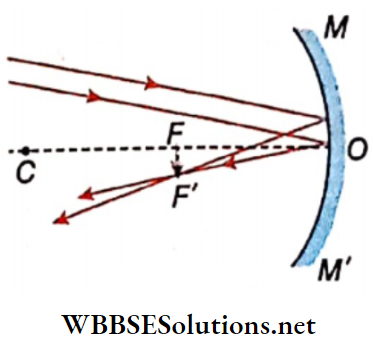
Question 3. In an extrinsic semiconductor, n, p are the concentration of electrons and holes, ve, vh are drift velocities and e μh are mobilities of electrons and holes respectively, e = charge of an electron

Semiconductors And Electrons Extrinsic Semiconductor

Answer: 1-D, 2-A, 3-B, 4-C

Question 4. A voltage regulator circuit is formed by a Zener diode of the rating 5V-0.25W. The maximum unregulated voltage of an external battery is 8V.To keep the Zener current at a safe limit, a resistance R is connected to the circuit. The terminal voltage of the load resistance in voltage-regulated conditions is 4.9V. Some quantities and their corresponding values are given in the following two columns.

Semiconductors And Electrons A Voltage Regulator Circuit

Answer: 1-C, 2-B, 3-D, 4-A
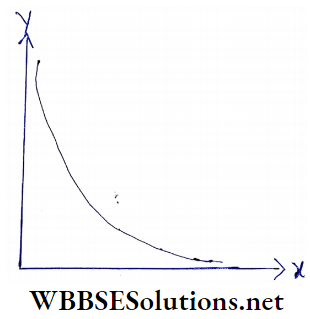
WBCHSE Class 12 Physics Communication System Notes

WBCHSE Class 12 Physics Notes

Communication System Introduction

The term ‘communication’ has a broad and pervasive significance in our everyday lives, particularly due to the advancements in modern technology. Communication refers to the conveyance of information or ideas by many channels such as verbal and non-verbal language, written materials like books and magazines, electronic media like radio, television, and video, as well as modern technologies like mobile phones, telephones, and the internet. The significance of the communication system, as seen above, cannot be overstated. In any communication system, there are two distinct points known as the transmitter and the receiver. The content conveyed is sometimes referred to as a message, data, or information. Any form of communication, whether it is audio-visual or sent through any medium, is considered a message or data in its own right.

The communication system can be classified into three categories:

Read and Learn More Class 12 Physics Notes

One-way communication 

Here the transmitter only communicates message or information to the receiver, but the receiver, in exchange, cannot communicate anything

Communication System One Way Of Comminication

Example: Books, music, radio, and TV one-way intercom are examples of this kind

Both-way or full-duplex or interactive communication

In this type of communication, the receiver receives information from the sender, and at the same time, it communi¬ cates counter-message or information to the sender. In this way-there goes on a mutual message-transfer transmitted between the sender and the receiver.

Communication System Interactive Comminication

WBCHSE class 12 physics notes Half-duplex communication

In between these two categories, there is a system where there is a scope of exchanging me$sage£both ways, but which never happens at the same time

Example: SMS or e-mail, through which only after the completion of sending a message from one end, the counter-message can be communicated from the other end. There is no scope for simultaneous message transfer between the sender and the receiver

Timetable of communication system:

Communication System Time Table Of Communication System

WBBSE Class 12 Communication System Notes

In this chapter, we will concern ourselves with distant communication. For communication, within our audible and visible range, no technology is necessary. On the other hand, by applying electromagnetic waves through various technological processes, distant communication has made an incredible development in the last 20/30 years. A list of development of communication science
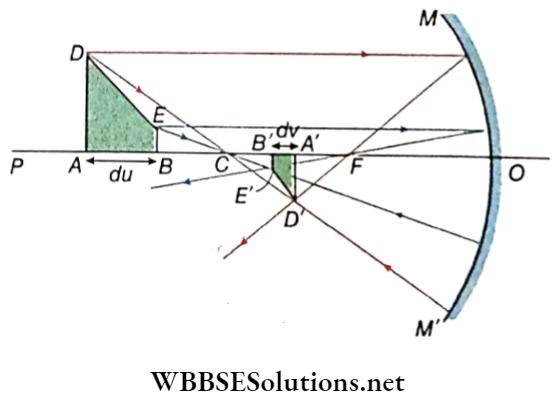
WBCHSE class 12 physics notes 

Elements Of Communication System.

Message signal or data signal:

  • The data or message to be transmitted is converted into a similar electrical wave at the transmitter end. As an audio wave is converted into a similar electrical wave by a microphone.
  • The next step is to transmit this electrical wave through a transmitting antenna, as a similar electromagnetic wave (i.e., as a message signal or data signal) to distant places.
  • In reality, however, the direct transmission of this data signal is practically impossible. Hence, the help of electromagnetic carrier waves is taken.

Carrier wave and transmission band:

Carrier waves are used for carrying the data signal effectively from the transmitter end to the receiver end. The frequency of the carrier wave is much higher than the frequency ofthe data signal i.e., its wavelength is small.

Thus the antennas of transmitters and receivers can function properly. Moreover, the distortion created by the superposition of different data signals at the receiver end is eliminated. Electromagnetic waves of any frequency chosen from a wide range of frequencies can be used as a carrier wave.

But first, the main objective of transmission has to be determined. Then the frequency of the carrier wave is chosen accordingly. For example, for radio transmission up to 200 km, a medium wave (with frequency ≈ 3 × 10⁶ Hz-3 × 10⁶ Hz ) would be adequate. For a particular transmission, the range of frequency used is called the transmission band.

Communication System Class 12 Notes

Communication medium or transmission medium:

To reach the receiver end, the carrier wave essentially requires a medium. A medium is selected in such a way that the wave pattern of data signal is received in an undistorted condition.
Generally the media used are:

  1. Atmosphere for wireless communication
  2. Coaxial cable and
  3. O(ptical fiber for wired communication.

Communication channel:

Th transmission medium and the transmission band together form a communication chanel.

‘A short wave is being transmitted through the atmosphere statement indicates a particular communication channel with frequencies between 3 × 10⁶ Hz-3 × 10⁶ Hz. Different zones of atmosphere are chosen for the transmission of different frequencies. The technological means to be adopted for this are also predetermined. Hence, in communication science, the concept of communication channel is of paramount importance

WBCHSE Class 12 Physics Communication System Notes

Terminologies used in communication system

Modulation:

As the frequency of the original message or data signal is very low, it cannot travel a very long distance on its own. So, for transmitting it through a long distance, it is super¬ imposed on a high-frequency carrier wÿve. The process of imposing data signal on a carrier wave of specific amplitude and frequency is called modulation. Some important modulations are >0 Amplitude Modulation .. (AM),0 Frequency Modulation (FM), and Phase Modulation (PM).

Demodulation:

The modulated wave being transmitted from the transmitter end is collected at the receiver end. Once again the data signal is separated from the wave. This is called demodulation. Arrangements are made to convert the separated data signal 1 again into the original message or data. As, to con¬ vert demodulated audio signal into sound, the loudspeaker is used.

Communication System Class 12 Notes 

Noise:

Noise refers to the disruption or alteration of the original waveform of the transmitted signal. However, in reality, when a signal is transferred from the transmitting station to the receiving station, or from an intermediate receiving station to the next receiving station in increments, some interference is introduced into the original signal at each step. Consequently, the data that is received cannot be identical to the data that was transmitted. It is possible to distinguish the speaker’s original voice from the sound produced by the speakers.

Short Notes on Modulation Techniques

Generally, the noise is classified into two categories:

  1. Controllable noise: Defects in the equipment or their components give rise to this type of ‘noise which can be largely eliminated by using improved instruments. Hence, this defect is most often not treated as noise at all. Obviously, by using high-quality loudspeakers, the degree of noise can be reduced substantially.
  2. Random noise: These noises are not at all within our control. Hence these types of noises can never be eliminated

Block diagram of a communication system

In the main components of a standard communication system is shown in the form of a block diagram

Communication System Black Diagram Of Communication System

Community System Types Of Transmission Data

In distant communication, the transmitted data or messages are basically of three types. Those are described below.

Audio data

Transmissible dialogue or any other sound can be referred to as audio data. Every piece of information is produced as a sound wave with a frequency ranging from 20 Hz to 20,000 Hz, also known as Audio Frequency (AF). The complete spectrum of frequencies within this range is referred to as the auditory frequency range. Using a microphone or similar setups, these sound waves are transformed into corresponding alternating voltages.

In order to convey it to the receiving location, a transmitting antenna is utilized to emit the alternating voltage as electromagnetic waves. In order for the electromagnetic waves to accurately represent the original sound, it is necessary for the frequency of the original sound wave and the electromagnetic wave to be identical.

The changes in the amplitude of these two waves also have to be identical. This electromagnetic wave Is the audio signal. As the audio message is a sound wave, its speed in the air at 20°C is approximately 330 m. s-1 . But the audio signal is an electromagnetic wave, its speed in air is 3 × 10⁸ m. s-1

Let the frequency of an audio message be 3 kHz. As the frequency of the generated audio signal has to be the same, the wavelength of the signal is

λ = \(\frac{\text { velocity }}{\text { frequency }}\)

= \(\frac{3 \times 10^8 \mathrm{~m} \cdot \mathrm{s}^{-1}}{3 \times 10^3 \mathrm{~s}^{-1}}\)

= 105 m

= 100 km

To transmit this signal directly through a transmitting antenna an antenna of the same size as the wavelength is required, which is practically impossible. For this reason, no audio signal can be transmitted directly from the transmitter end to the receiver end. This constraint applies not only to audio signal but to the following two messages (data) signals also

Important Definitions in Communication Systems

Audio-Visual or video data

Video data refers to any form of visual content, including pictures, handwritten or printed documents, still or video images, that is transmitted electronically. Audio data is overlaid upon video data in television and other comparable transmissions, resulting in what is known as audio-visual data. However, in general, the phrase ‘video data’ encompasses the combination of both audio and visual data.

A microphone is employed to transform audio data into an audio signal, while a camera scanner serves the same purpose for video data by turning it into video signals. This camera utilises a specialised method to scan an image and simultaneously produces corresponding electromagnetic video signals that accurately represent the brightness and colour of the image.

Digital data

Digital data comprises a sequence of lay¬ ers of low and high potentials, where the magnitudes of the potentials are not Important. Bather, the duration of the alternat¬ ing voltages in different layers plays the decisive part In digital transmission, the original audio and visual data are not converted into analogue alternating voltage.

With the advancement of digital electronics, today many types of data, including computer data, are generated as digital data. By applying a special process to this digital data, electromagnetic digital signals are generated. In practice, however, no data signal Is suitable for direct distant communication.

Communication System Digital Data

There are two reasons for this:

  1. From a technical point of view, it needs a huge-sized transmitter and receiver antenna and that is impossible to manufacture.
  2. Voluminous transmitted data from many transmitting cenÿ could crowd the receiving station % at the & same time. Their superposition may generate a fuzzy and unrecognizable signal.

If the data signal contains a single frequency, then the waveform is sinusoidal. But in reality, no waveform of a signal is purely sinusoidal. Hence whatever form it may have, it is treated as a wave generated from the superposition of many sinusoidal waves.

Communication System – Carrier Wave

The carrier wave is employed to mitigate the aforementioned challenges in long-distance transmission of data streams. The term “wave” is used to describe the transmission of the data signal from the transmitter to the receiver. Carrier waves are characterised by a significantly greater frequency compared to any data transmission.

Put simply, its wavelength is far smaller than that of data signals. It is important to note that the frequency range of the audio signal, which serves as the data signal, spans from 20 Hz to 20 kHz. This range is commonly referred to as the Audio Frequency range or AF range.

Every carrier wave is an electromagnetic wave. Typically, carrier waves in the electromagnetic spectrum consist of waves with lower frequencies. Typically, electromagnetic waves in the frequency range of 3 kHz to 300 GHz consist of radio waves and microwaves. In the realm of communication, the utilisation of the remaining portion of the spectrum is virtually nonexistent. The carrier waves are categorised into many groups based on their distinct objectives and applications in long-distance communication.

Communication System Carrier Wave

When a data signal is to be transmitted from one place to another, the suitable carrier wave is selected at the very beginning. From the table, it is clear that the frequency which is suitable for radio transmission is not suitable for TV transmission

Communication System Class 12 Notes Bandwidth

An ideal carrier wave is a purely sinusoidal electromagnetic wave with a definite frequency. However, any attempt to generate a wave invariably results in the main frequency being superimposed with several other higher or lower frequencies. The intensity of the carrier wave is maximum for only its main frequency f0. However, the intensities of other frequencies on either side of f0 diminish gradually

Communication System Band Width

Suppose that the intensity of each of the frequencies f1 and f2 on either side of f is half of the maximum intensity, which means that the rate of energy or power carried is also equal to half of the maximum value. These two frequencies a f1nd f2 are called half-power frequency.

Only when the frequency gets lower than f1 or higher than f2, the intensity of the wave becomes negligible. So, though the main frequency of the carrier wave is f0, the intensity or amount of energy carried by the waves between the frequencies f1 and f2 cannot be ignored. This difference of frequencies (f2-,f1) is called the bandwidth of the carrier wave. As data signal is superimposed on carrier waves, it is also called signal bandwidth.

As a frequency-intensity graph becomes sharper, the bandwidth gets reduced. Hence the problem due to the mixing of different carrier waves is also reduced. As per international norms for radio transmission, it is desirable that the band¬ width should not exceed 5 Hz, and the difference between two main frequencies (JQ) of carrier waves, transmitted from two transmitting stations, should be at least 10 kHz.

Each carrier wave of every transmitting station carries its own data signal. The carrier waves are recognized at the receiving stations, only due to the difference of their frequencies. Hence the data signals do not become fuzzy or unrecognisable by intermixing i.e., remain distinct from each other.

Class 11 Physics Class 12 Maths Class 11 Chemistry
NEET Foundation Class 12 Physics NEET Physics

Communication System – Modulation And Demodulation

It has been mentioned that the process of superimposing the low-frequency data signal on a high-frequency carrier wave at the transmitting end is called modulation. On the other hand, the process of separating the superimposed data signal from the carrier wave at the receiving end is called demodulation.

Let the equation of carrier wave be,

V= V0 sin(Ωt + θ)

[Where, V0 = amplitude of the wave, Ω = Angular frequency, Ωt + θ = phase of the wave = Φ(say), θ = initial phase or epoch

Linear frequency or simply the wave frequency

n =  \(\frac{\Omega}{2 \pi}, \text { where } \Omega=\frac{d \phi}{d t}\)

For convenience, the initial phase 6 can be taken as zero.

In that case,

The carrier wave: V = V0 sin Ω t ……………………………………… (1)

Similarly, the equation of the data signal,

v0 = v0  sinωt  ………………………………………… (2)

[where, v0 = amplitude of the wave and co = angular frequency]

The instantaneous voltage v is called the modulating voltage

The condition of effective modulation of the carrier wave of equation (1) by modulating the data signal of equation (2) is,

ω<<Ω

The frequency of the carrier wave should be much higher than the frequency of the data signal. In practice, this frequency is 1000 times or even more than that of the data signal. The modulating voltage generally fluctuates very slowly with time and hence the wave indicating data signal is frequently called slow wave.

Class 12 Physics Communication System

Amplitude Modulation (Am) And Amplitude Demodulation

Amplitude Modulation or AM Definition:

In the case of distant communication, after the imposition of a data signal on a carrier wave, if the frequency remains unchanged and only the amplitude changes in a slow, periodic way, then the process is called Amplitude Modulation or AM.

Let, on the carrier wave of equation (1)  the data signal of equation (2) be superimposed in such a way, that the value of amplitude V0 changes with time. With the stationary value of amplitude V0 of the carrier wave, a sinusoidal alternating voltage kv0 sincot gets added, i.e.,

Vm0(t) = V0 +kv0sinωt ……………………… (1)

Where k is a dimensionless constant. Vm0 is the amplitude of generated modulated voltage due to modulation of a carrier wave by data signal.

As ω<<Ω, so the change of voltage is very slow.

Modulated voltage, Vm = Vm0 sinΩt

= (V0 +kv0 sinωt )sin Ωt

∴ V= V0 (1+β+sin ωt ) ……………………..(2)

Where β = \(k \frac{v_0}{V_0}[/atex] = modulation index

The significance of equation (2):

  1. The existence of sinΩt indicates that, due to modulation, the frequency of carrier wave (Ω) does not change with time.
  2. sin ωt can be both negative and positive. As the value of co is very low, the multiplier (1 + βsinωt) of the amplitude V0 indicates that the amplitude of the modulated wave fluctuates very slowly on either side of V0.

The carrier wave is shown as a sinusoidal curve of a particular frequency and also a data signal is shown as a sinusoidal curve of another particular frequency. In both cases, with the two waves, their corresponding alternating sine voltages are taken as the vertical axis

Communication System Alternating Sine Voltages As The Vertical Axis

Communication System Alternating Sine Voltages As The Vertical Axis.

A carrier wave, when modulated by a data signal, is the nature of the AM wave thus produced.

Communication System Modulated By A Data Signal

Sideband

From equation (2),

V = V0 sin Ωt +βV0 sinΩt sin ωt

= V0 sin Ωt + [latex]\frac{\beta V_0}{2}\) cos (Ω – ω)t – \(\frac{\beta V_0}{2}\) cos (Ω + ω)t ……………… (3)

Equation (3) reveals that AM wave consists of sinusoidal components of three frequencies Ω, Ω- ω, and Ω+ ω. Though the frequency of the carrier wave does not change with time, the other two frequencies overlap with the main frequency f (both cosine and sine functions are sinusoidal).

In this discussion, the data signal has been taken as composed of a single frequency co. In audio signal, can be considered to be a signal generated from a pure tone, and in video signal, is a monochromatic signal. In most practical cases, however, quite a of sinusoidal frequencies lie superimposed on the original data signal.

Let us suppose, in a data signal, frequencies of range ω to ω ±Δω are mixed up. In that case, if the (ω → ω ±Δω) range is considered in place of co in equation (3), then the frequencies present in the amplitude-modulated wave are

Ω: Point O

The frequencies of (Ω + ω) to (fl + (Ω + ω +Δω ) range:

Part BD

The frequencies of(Ω – ω – Δω) to (Ω – ω ) range:

Part CA

Communication System Sideband Of Range

Here, the frequency range CA and BD are called the sidebands of the amplitude-modulated wave. The maximum and minimum frequencies of the full wave are (Ω + ω +Δω) (point D) and (Ω – ω -Δω) (point C). The CD stretch of the frequency is called the bandwidth of the AM wave. The magnitude of the bandwidth is,

d = CD = (Ω + ω +Δω)- (Ω – ω -Δω) = 2(ω + Δω)

= 2 × maximum frequency on the data signal

To transmit the AM wave properly, a communication channel is to be selected, the transmission band of which should be extended at least from (Ω + ω +Δω) to (Ω – ω -Δω) i.e., from point C to D . However, instead of both the sidebands, transmission by using only one sideband is also in practice. In that case, transmission can be done with half bandwidth. This is called single-sideband communication.

Demodulotion principle of AM wave

A well-selected circuit performs the function of amplitude modulation. Now the modulated wave is applied to a transmitting antenna. The waveform of the electromagnetic wave thus generated and spread all over is exactly similar to the modulated waveform.

Transmitted through the communication medium, the electromagnetic wave reaches the receiving antenna (one or more than one), and in each antenna, an exactly similar potential wave is generated from the electromagnetic wave. Naturally, the intensity of the wave at the receiving end is much less than that at the transmitting end.

In the next step, keeping the waveform intact, the intensity ofthe wave is multiplied several times by using a suitable amplifier. Then, with suitably selected circuitry, the carrier wave and the data signal are separated from the mixed wave. This is the process of demodulation its other popular name is detection. Demodulation of the amplitude-modulated wave is also called Peak Detection.

Radio receiver:

At last, the demodulated data signal is amplified again, and with the right procedure(as in audio signal, through loudspeaker) the data generated from the transmitting end, is traced. In audio signal, the entire machinery set up is called a radio receiver.

Communication System Radio Receiver

It can be mentioned here that, the process of demodulation of frequency-modulated wave Is also exactly similar to this though the circuitry Is different.

Production of an AM wave

An n-p-n transistor T. At the very beginning, a dc circuit of the transistor Is constructed by using the necessary bias voltage and different resistances. An operating point Is also fixed. These dc components of the circuit have not been

Communication System Production Of An AM Wave

Now by using the appropriate DC filter, the alternating voltage of the carrier wave is applied to base B of the transistor, and the alternating voltage of the data signal is applied to collector C. Depending on the fluctuation of the voltage of the data signal, the collector current changes and thus, at output of transistor, an identical replica of data signal gets mixed on the amplified carrier wave and an amplitude modulated wave is generated. Necessary filter arrangements are made so that no DC component of the current can mix with it.

Amplitude modulators are basically of two types:

  1. Linear modulator, used in radio transmission
  2. Square-law modulator, used in a telephone conversation

Defection of an AM wave

The circuit is commonly employed as an AM wave demodulator. The device is commonly referred to as an envelope detector. The circuit consists of a semiconductor diode D, which is specifically designed to function as a half-wave rectifier, together with an RC filter.

At the peak of the positive half cycle of the carrier wave in an AM wave, the capacitor C reaches its maximum charge. As the carrier voltage lowers gradually, the charge of capacitor C diminishes due to dissipation through resistor R.

The time constant of the RC circuit, denoted as CR, is set to a value somewhat larger than the duration of the carrier wave and slightly smaller than the period of the data signal. Consequently, the charge of C does not exhibit the same rate of increase or drop as the phases of a carrier wave. Instead, the waveform of the data stream is represented by the fluctuation in the charge of capacitor C.

At output, the waveform of the carrier is not available, the output wave mainly indicates the waveform of the data signal. This envelope detector is a linear detector, because, here the output voltage becomes proportional to the input voltage. To ensure that no component of DC can pass to output, capacitor C’ is used as a filter in the circuit, as

Communication System Detection Of An AM Wave

Frequency Modulation And frequency Demodulation

Frequency Modulation Definition:

In distant communication, after superimposing a data signal on a carrier wave, if the amplitude remains unchanged and only the frequency changes in a slow periodic way, then the phenomenon is called Frequency Modulation or FM.

Equation of carrier wave,

V = V0sinΩt = V sin Φ ………………………………….. (1)

Where phase angle, Φ = Ωt

i.e  \(\frac{d \phi}{d t}=\Omega\)  = Ω …………………………………. (2)

And, The equation of data signal

v = v0 sincωt …………………………………. (3)

Keeping the amplitude V0 of the carrier wave unchanged, the time-dependent data signal is superimposed on it.

Due to modulation, the instantaneous value of frequency Ω is,

Ωm (t) = Ω + kv0 sinωt …………………………………. (4)

Here, k is a coupling constant that converts v0 sinωt into a frequency-dependent term.

In this case, the unit of k will be V-1. s-1

( kv0 sinωt) will be s-1 , i.e., Hz. Applying equation (2) for this time-dependent frequency we get,

m =  Ωm (t)dt

Or, Φm = ∫ Ωm (t)dt= Ω ∫ dt + kv0 ∫ sinωt dt

Or, Φm = Ωt – \(\frac{k v_0}{\omega} \cos \omega t+\delta\) cosωt + δ …………………………. (5)

Writing time-dependent phase angle Φm in place of Φ in equation (1) of carrier wave we get

Vm = V sin ( Ωt – β cosωt + δ) …………………………… (6)

Where,  β = \(\frac{k v_0}{\omega}\)

This is the equation of frequency modulated wave or FM wave. In this equation

β = \(\frac{k v_0}{\omega}\)

In this case:

The amplitude V0 of the carrier wave does not change.

For the term (β cosωt), the frequency of carrier wave fluctuates with time.

As ω<<Ω, this change of frequency is slow. This phenomenon is called frequency modulation.

A carrier wave, a data signal, and a form of FM wave, generated due to the superimposition of these two waves, are shown respectively.

Communication System Frequency Modulation And Frequency Demodulation

It is observed that in the AM wave, besides the frequency Ω of the carrier wave, two more sine components of frequencies (Ω – ω) and (Ω + ω) are present. But on mathematical analysis of frequency modulated wave, it is found that the number of sine components is infinite. The frequency of the components are Ω ±ω, Ω ±2ω, Ω ±3ω, ………………. etc.

These frequencies lie symmetrically on either side of the frequency of the carrier wave Ω.

In transmission through Low Frequency (LF) or Medium Frequency (MF) carrier wave, amplitude modulation is generally employed while in transmission through High Frequency (HF) or Very High Frequency (VHF) carrier wave, frequency modula¬ tion is employed. The range of frequencies of HF or VHF is very high, so the differences in frequency of the carrier waves, transmitted from different transmitting centers, are also very high.

Hence, despite the presence of sideband frequencies in FM waves, the possibility of overlapping of different waves and noise and distortion of data signal due to this becomes very low. For this reason, the sound of FM radio is very clear and in TV, the chance of mixing pictures transmitted from two stations is almost nil.

Demodulation principle of FM wave

Typically, the recipient produces a frequency-modulated waveform, and the gradual variation in amplitude is linked to the gradual variation in frequency. The wave is subsequently applied to an appropriate detector circuit and, using a similar manner to demodulating amplitude-modulated waves, the data signal is extracted.

Currently, the superheterodyne receiver is widely used in the demodulation of FM waves. An oscillator is housed within the receiver, where it combines a wave of carefully chosen frequency with the FM wave. The procedure is quite beneficial for accurately identifying the frequency of the data signal.

Communication system physics notes Power Dissipated due to Modulation

If the potential difference across the two ends of a transmitting antenna is time-dependent and the potential difference is expressed as V(t), then the dissipated power of the antenna is

P = \(\frac{\overline{V^2(t)}}{R}\) ………………………….(1)

Here, the symbol \(\overline{V^2(t)}\) indicates the mean of the quantity Vt concerning time. R is the effective resistance of the antenna. In the case of of time-dependent voltage, due to the metallic elements of the antenna and electromagnetic radiation from it, the effective resistance R is not equal to the DC resistance of the antenna

Now, according to equation (1)

Carrier wave: V = V0 sin Ωt …………………………. (2)

Again, from equation (2), we get,

AM wave: VAM = V0(1 + β sinωt)sinΩt ………………………….. (3)

Similarly from equation (6) we get
,
FM wave: VFM = V0sin(Ωt – β cosωt) ……………………………. (4)

In both equations (3) and (4), the term is modulation index which is sometimes expressed by the symbol ‘m’ also. Each of V, VAM, and VFM indicated by the above three equations is time time-dependent potential difference. Hence, in each case, the power dissipated in the antenna is to be evaluated by using equation (1)

The power dissipated In the transmission of carrier wave:

From equation (’2)

V2 = V02 sin2 Ωt

= \(\overline{V^2}=V_0^2 \overline{\sin ^2 \Omega t}\)

We know that functions like sin Ωt If or cos Ωt are time-dependent sinusoidal functions, lit each complete cycle, the average of sin²-function or cos²-function is zero, but the average ol sin or cos-function is ½.

∴ \(\overline{\sin ^2 \Omega t}\)  = ½

Hence, the power dissipated hr antenna for transmitting carrier wave only:

PC = \(\frac{\overline{V^2}}{R}=\frac{V_0^2 \cdot \frac{1}{2}}{R}=\frac{V_0^2}{2 R}\)  ……………………………… (5)

The power dissipated In the transmission of amplitude-modulated wave:

From equation (3) we get,

AM =  V²0( 1+β sinωt)² sin²Ωt

= V²0( 1+2β sinωt +β² sin² ωt)  sin²Ωt

So,  \(\overline{V_{A M}^2}=V_0^2\left(1+2 \beta \overline{\sin \omega t}+\beta^2 \overline{\sin ^2 \omega t}\right) \overline{\sin ^2 \Omega t}\)

= (1+ 2β.0+β .½). .½ = \(\frac{V_0^2}{2}\left(1+\frac{\beta^2}{2}\right)\)

Hence power dissipated in the antenna,

PAM =  \(\overline{\frac{V_{A M}^2}{R}}=\frac{V_0^2}{2 R}\left(1+\frac{\beta^2}{2}\right)\)

Or, PAM =  \(P_C\left(1+\frac{\beta^2}{2}\right)\) ……………………………………… (6)

The significance of this equation is that the power dissipated in the antenna increases in transmitting amplitude modulated wave compared to that in transmitting only the carrier wave. The amount of increase is

P’= PAM – PC = \(P_C\left(1+\frac{\beta^2}{2}\right)-P_C=P_C \cdot \frac{\beta^2}{2}\)  ……………………………… (7)

i.e., the rate of dissipation of additional power or energy is proportional to the square of the modulation index. As, for 100% modulation, β = 100% = 1

So, PAM =   \(P_C\left(1+\frac{1^2}{2}\right)\) = \(\frac{3}{2}\) PC

In this case Increase In dissipated power

P’ = \(\frac{3}{2}\) PC  – PC = \(\frac{1}{2}\) PC

i. e amount of Increase Is 50%.

It may the noted that dial tho additional dissipated power duo to amplitude modulation Is equally divided between die two side hands. I,e„ dissipated power for each sideband

= \(\frac{p^{\prime}}{2}\)

= PC. \(\cdot \frac{\beta^2}{4}\)

Communication System Physics Notes

The power dissipated In the transmission of frequency-modulated wave:

Prom equation (4),

⇒ \(v_{l M}^2=v_0^2 \sin ^2(\Omega-\beta \cos \omega t)=V_0^2 \sin ^2 \phi_{l_M}\)

Where ΦFM = Ωt – β cosωtCommunication system physics notes

So, \(\overline{v_{P M}^2}=v_0^2 \overline{\sin ^2 \phi_{I M}}=v_0^2 \cdot \frac{1}{2}\)‘

Hence, energy dissipated in the antenna

PFM = \(\frac{\overline{V_{I M}^2}}{R}=\frac{V_0^2}{2 R}\)  = PC ……………………….. (8)

The significance of this equation Is that, the power dissipated in the antenna remains unchanged In transmitting frequency-modulated waves compared to that In transmitting only the carrier wave. That is, for frequency modulation, there is no change in dissipated power. This power is not at all dependent on the modulation Index, β.

Modulator-Demodulator or Modem

It is a device that converts digital data to analog data and analog data to digital data. Modern computers function on a digital scale. All the data available from it is digital. In a localized area (as in an office), where the local area network or LAN is formed by connecting the computers of the office, direct exchange of digital data takes place. In such cases, the data need not be converted to analog data, hence there is no need to use the modem. In this type of direct exchange of digital data, mainly coaxial cable is used as the medium.

On the other hand, in distant communication, the computer is connected to a telephone line through a modem. The digital data of the computer is converted into amplitude-modulated or frequency-modulated analog data by a modem. Then this analogue data reaches the computers of the worldwide network through the telephone system. The modern connection with the receiving computer on its part separates the primary digital from the modulated analog data.

Communication System – Propagation Of Carriers Waves Through Atmosphere

When electromagnetic carrier waves of range from Very Low Frequency (VLF) to microwave (as stated in table 1) propagate through the atmosphere.

Mainly three types of waves are produced

  1. Ground wave
  2. Space wave
  3. Skywave

Suitable waves for transmission and its corresponding range of frequency of carrier wave are to be selected first and their technological set-ups are to be arranged accordingly.

1. Ground wave: This wave propagates from one point to another, along the surface of the earth following the earth’s curvature. For the propagation of this wave, the earth’s surface at one side and the lowest layer of the ionosphere (which is nearly 80 km above the earth’s surface) at the other both act as reflectors. The wave progresses through successive reflections which it suffers from these two surfaces.

Communication System Ground Wave Transmitting Antenna

Another special feature of the wave is the polarisation of the transmitting antenna is placed vertically, so the wave gets polarised at a vertical plane at the start i.e., its electrical field has no horizontal component and initial wavefront is a vertical wavefront.

Now, as the wave progresses along the earth’s surface, the wavefront gradually gets tilted from the vertical line, which means that the magnitude of the horizontal component of its electrical field starts Increasing. The horizontal component of the transmitted energy gets absorbed on the earth’s surface. As the tilt of the wavefront towards the horizontal plane increases, the rate of absorption of energy continues to Increase. Therefore ground wave is not suited for long-range communication.

Communication System Tilting Of Groung Wave With The Time

Ground wave plays a very important role in transmission through carrier waves of Very low Frequency (VLF) and Low Frequency (LF). In the case of higher frequencies, the energy carried by ground waves gets absorbed very fast. This is why FM radio or television signals can be transmitted only up to a short distance.

2. Space wave:

This type of wave can propagate through the atmosphere in a straight fine almost without any deviation. Due to the curvature of the earth’s surface, we can communicate through rectilinear space wave up to a distance of a certain limit. It Is called the radio horizon of the corresponding antenna

The space wave can propagate up to a maximum point O from the transmitting antenna. The distance PO of the earth’s surface is the radio horizon of the antenna.

Communication System Space Wave

Let R = radius of earth

H = Height of transmitting antenna A

From we get

cosθ = \(\frac{O C}{A C}=\frac{R}{R+H}=\frac{1}{1+\frac{H}{R}}\)

= \(\left(1+\frac{H}{R}\right)^{-1}\)

cos²θ = \(\left(1+\frac{H}{R}\right)^{-2}\) ≈ 1 – \(\frac{2 H}{R}\)

(As H<<R)

Now sin²θ  = \(\frac{2 H}{R}\)

Or, sin= \(=\sqrt{\frac{2 H}{R}}\)

As θ is very small, sin θ ≈ θ

So,  θ = \(=\sqrt{\frac{2 H}{R}}\)

Hence, radio small, horizon,

PO = Rθ

= R \(\sqrt{\frac{2 H}{R}}\)

= \(\sqrt{2 H R}\) ……………………………….. (1)

Similarly in the radio horizon of receiving antenna B, QO= \(\sqrt{2 R h}\)

When both transmitting and receiving antennas are used at the same time, the magnitude of the radio horizon is,

PQ = PO+QO = \(\sqrt{2 H R}+\sqrt{2 h R}\)

= \(\sqrt{2 R}(\sqrt{H}+\sqrt{h})\)  ………………………………………….. (2)

For example, if a space wave, transmitted from a transmitting antenna, 300 m high, is to be received by a receiving antenna 30 m high, the radio horizon will be.

= \(\sqrt{2 \times(6400 \times 1000)}(\sqrt{300}+\sqrt{30})\)

≈  81.6 ×10³ m = 81.6 km

[The radius of the earth has been taken as 6400 km ]

If carrier wave of High Frequency (HF) or of even higher frequency Is transmitted as a space wave, then a little energy is absorbed. So, despite the limitations of radio horizon, space waves are most suitable for very long-distance transmission.

In this process, the application of one or more Intermediate is most prevalent. Each intermediate antenna receives the transmitted signal and transmits the signal to the next antenna. In this way, the radio horizon can be enlarged to a great extent.

As a high-quality communication technique, wave communication Is Increasing day by day. The frequencies 8 of these microwaves arc very high, 300 MHz to 300 GHz.

These waves are transmitted mainly as space waves. For long-distance communication, instead of using a series of antennas, artificial earth satellites are employed. Space waves transmitted from earth surface after getting reflected from the artificial satellites, Let R = radius of the earth, reach distant places on the earth’s surface. This arrangement is called satellite communication

Communication system physics notes Communication system physics notes Skywave

Carrier waves in the Medium Frequency (MF) or Lower High Frequency (LHF) range are mostly transmitted as sky waves. The ionosphere, which spans from a height of BO km to around 400 km above the Earth’s surface, is crucial in sky wave propagation. The ionisation of air in the ionosphere is mostly caused by solar radiation during the day and cosmic rays of lower strength at night.

Therefore, the rate of ionisation The diurnal variation is far higher than the nocturnal variation. Within the ionosphere, the process of ionisation results in the creation of electrons and ions, which coexist with neutral molecules and atoms. The rate of ionisation is quantified by the quantity of unbound electrons. By considering the number of electrons per unit volume.

Her two factors are Important:

  1. Since solar radiation or cosmic radiation falls on the upper surface of the ionosphere first, the rate of ionization is higher in the upper surface. Depending on the difference of rate of ionization, the ionosphere Is divided into three lay upper layer, middle layer, and lower layer. The rate of ionization is maximum at the upper layer. The middle and the lower layer almost do not exist at night.
  2. With the change of Ionisation rate in air, the velocity of two magnetic waves through it also changes. As a result, the ionosphere acts as a refractive medium. I higher the ion-isolation rate in a layer, higher is the velocity of electromagnetic waves through It. That Is, the refractive index of this layer decreases. In the layers of the Ionosphere, , the rate of ionization of a higher layer A  Is maximum and Its refractive index is minimum. It can be proved that for. an incident electromagnetic wave of frequency f, the refractive index of a layer of Ionosphere

Communication System Velocity Of Electromegnetic Waves

μ = \(\left(1-\frac{81 n}{f^2}\right)^{1 / 2}\)…………………………. (3)

Where, n = electron number density of that layer of the medium. Whenever a sky wave propagates through the ionosphere, to a higher layer, it advances from a higher refractive index layer to a lower refractive index layer.

When the angle of inclination of a sky wave with respect to the vertical axis decreases significantly, it is bent away from the ionisation layer with the highest altitude and lowest refractive index, and exits the ionosphere (referred to as ray ‘a’). Conversely, if a wave with a steeper incline approaches the ionosphere from below, it will experience complete internal reflection from either layer and be redirected back to the Earth’s surface.

Put simply, the transmission of the sky wave from one place on the Earth’s surface to another is a result of reflection in the ionosphere. Since the values of f are relatively low for Medium Frequency (MF) waves, the refractive indices of the ionospheric layers are also low, as indicated by equation (3). Consequently, the sky wave is reflected even from the bottom layer of the medium. This is the reason why sky waves with frequencies of this magnitude have a rather limited range while travelling across the Earth’s surface.

In contrast, High Frequency (HF) sky waves, also known as short waves, are reflected by the top layers of the ionosphere. Therefore, the waves that bounce back can travel to faraway locations on the Earth’s surface. In this scenario, these waves are partially absorbed in the medium and lower layers, resulting in a decrease in wave intensity.

During nighttime, the absorption of light is extremely little due to the near absence of the middle and lower layers. Therefore, the signal transmitted by sky waves is more potent and distinct during nighttime. Skywave is the primary factor in radio transmission. Typically, medium wave transmission is used for short distances and short wave transmission is used for greater distances via sky waves.

Other media for the propagation of earner waves

It has already been mentioned that apart from air medium, two other media are used for communication. These are:

  1. Coaxial cable: For short-distance communication, this medium is most effective.. As, in a telephone communication system or a computer network limited to a ‘ small area, the coaxial cable is widely used.
  2. Optical fiber: Unimaginable success has been achieved in worldwide telephone communication systems by using optical fiber. Through optical fiber, it is possible to transmit electromagnetic waves in the range of almost infinite frequency, very effectively.

[The detailed discussion regarding these media is not included in the present syllabus.]

Communication System  – Communication Channel

Two factors are to be ascertained first to decide how to transmit a data signal from one place to another.

  1. Medium: Atmosphere, coaxial cable, or optical fiber are used as a medium.  Sometimes combination of different types of media is also used.
  2. Range of frequency: What part of the electromagnetic spectrum would be used as a carrier wave, is also to be trained. The corresponding range of the frequency is called the transmission band.

The arrangement for transmission of data signal from one point to another with a combination of an appropriate medium and a carrier wave of appropriate frequency is called a communication channel.

As, the carrier waves, of frequency in the range of approximately 300 kHz to 10 MHz, can propagate as sky waves through the atmosphere from one place to another. Hence it is an effective communication channel. The efficiency of a communication channel is determined by the total number| of discrete data signals that can be transmitted through it, without distortion.

A carrier wave with a frequency of 1 MHz is used to transmit an audio signal. The audio signal’s frequency naturally falls within the range of 20 Hz to 20000 Hz. The bandwidth of the amplitude-modulated wave can be calculated by multiplying the carrier wave’s amplitude by the audio signal’s frequency, resulting in a bandwidth of 40000 Hz. The band is positioned symmetrically around the primary frequency, spanning from 106 Hz to 20000 Hz on one side and from 930000 Hz to 1020000 Hz on the other side. If an audio signal is transmitted from another transmitting station using a carrier wave with a frequency of 1.05 MHz, the frequency range would be located between 1030000 Hz and 1070000 Hz.

There is a clear distinction between the previous band and the current band, and they will not blend together. As a result, the receiver can easily differentiate between the two audio streams. It is evident from this example that if the difference in frequencies between two carrier waves is more than 40 kHz, the receiving machine can accurately receive the audio signals, supposing that the bandwidth of the audio signal is 40 kHz.

Now we may examine the transmission of skywave through the atmosphere. The effective frequency propagates in a range from 100 kHz to 10 MHz. This means that the width of the transmission band is approximately 10 MHz, calculated as 107 – 105 107 Hz. In order to provide a transmission that is clear and easily distinguishable, the frequency difference between the carrier waves must be a minimum of 0.04 MHz. For instance, if we consider the difference to be 0.05 MHz, then within the 10 MHz bandwidth, 200 carrier waves can be accommodated, allowing for the unique transmission of 200 audio signals across the sky wave band.

Indeed, audio transmissions typically lack frequencies beyond 4000 Hz, resulting in a significantly restricted bandwidth for amplitude-modulated waves. Therefore, a difference in frequencies of 0.01 MHz (or 10 kHz) between the carrier waves is enough. Consequently, the sky wave communication channel has the capacity to transfer a greater number of audio messages through the atmosphere.

In the context of the modern progress of telecommunication and internet, the use of some super-efficient communication channels has become essential. Microwave communication, use of artificial satellites, application of optical fiber as a medium all these steps develop a channel communication system of infinite range, through which an extremely large number of data signals can pass. This is called a broadband communication system

Communication System Communication Channel Numerical Examples

Example 1. U if the height of a television tower is 300 m would the TV transmission be possible? (Given, the radius of earth = 6400 km) , how far
Solution:

Given the height of the tower, h = 300 m

Radius of earth, R = 6400 km = 6.4 × 10⁶ m

The required distance,

d = \(\sqrt{2 R h}\)

= \(=\sqrt{2 \times 6.4 \times 10^6 \times 300}\)≈ 6.4 ×10⁴ m

= 62 km

Example 2. At what height is the transmitting antenna to be placed to make a TV transmission up to a distance of 32 km? The radius of the earth = 6.4 × 10⁶ m.
Solution:

Given the radio horizon,

d = 32 km = 32 × 106 m

Let the transmitting antenna be placed at a height h

We know, d = \(\sqrt{2 R h}\)

Or, h = \(\frac{d^2}{2 R}=\frac{\left(32 \times 10^3\right)^2}{2 \times 6.4 \times 10^6}\)

= 80 cm

Example 3. Equation of a wave: V = 10sin(106 t + 0.4sin 1000t). What is its index of modulation? or, 80 m
Solution:

The given wave is frequency-modulated. General equation of the wave, V0 = V0 sin(Ωt + βsin ωt) Comparing this with the given equation we get, modulation index, β = 0.4

Practice Questions on Communication Systems

Example 4.  Electron number density in a layer of ionosphere is 4 × 105 cm-3. For an electromagnetic wave of frequency 40 MHz, what would be the refractive index of ; that layer?
Solution:

Frequency f = 40 MHz = 40 × 106 Hz

n = 4 × 105cm-3 

=  4 × 105 × 106 m-3  =  4× 10¹¹ m-3

∴ Refractive index

π = \(\left(1-\frac{81 n}{f^2}\right)^{1 / 2}=\left[1-\frac{81 \times 4 \times 10^{11}}{\left(40 \times 10^6\right)^2}\right]^{1 / 2}\)

= (1- 0.02025)½

= \(\sqrt{0.97975}\)

= 0.99

Examples of Communication System Applications

Example 5.  Modulation Index of an amplitude modulated wave β = 50% and power dissipated In transmission 18 kW. What is the rate of energy dissipation for each sideband?
Solution:

Modulation index, β = 50% = \(\frac{1}{2}\)

We, know PAM = PC \(\left(1+\frac{\beta^2}{2}\right)\)

Or, 18 = PC \(\left[1+\frac{\left(\frac{1}{2}\right)^2}{2}\right]\) = \(\frac{9}{8}\) PC

i.e. Power of carrier wave,

PC = 18 × \(\frac{18}{9}\)

= 16 kW

Increase in power , due to modulation = 18- 16 = 2kW

This power is distributed equally in the two sidebands

Rate of energy dissipation for each sideband

= \(\frac{2}{2}\)

= 1 Kw

Unit 10 Communication System Synopsis


Communication System Elements Of Communication System

1. At first, the message or data to be communicated, is to be converted into a similar electrical wave at the transmitting end.

2. The electrical wave is transmitted by a transmitting antenna as a similar electromagnetic wave, i.e., a data signal, to distant places.

Communication System Transmitted Data

4. Electromagnetic carrier wave is used to carry the data signal from the transmitting end to the receiving end. The frequency of the carrier wave is much higher than the data signal.

5. For a particular transmission, the range of frequency used as carrier wave is called the transmission band

6. As per internationally accepted rule, it is desirable that for radio transmission the bandwidth should not exceed 5 kHz. Based on it, the difference between the two main frequencies of the carrier waves transmitted from two transmitting stations should be at least 10 kHz.

7. The process of superimposing data signal on carrier wave at the transmitting end is called modulation. On the other hand, the process of separating the imposed data signal from the carrier wave at the receiving end is called demodulation.

Communication System Physics Notes

Conceptual Overview of Signal Types

8. In long-distance communication, after the superimposition of a data signal on a carrier wave, if the frequency remains unchanged and only the amplitude changes slowly and periodically, then the process is called Amplitude Modulation (or AM in brief).

10. In long-distance communication, after the superimposition of a data signal on a carrier wave, if the amplitude remains unchanged and only frequency changes slowly and periodically, then the process is called Frequency Modulation (or FM in brief).

11. Generally, amplitude modulation is employed in transmis¬ sion through carrier waves of I-ow Frequency (LP) or Medium Frequency (MF). On the other hand, frequency modulation is employed In transmission through carrier waves of High Frequency (HF) or very High Frequency (VHP).

12. Due to amplitude modulation, additional dissipated power is proportional to the square of the modulation Index. 4 Due to frequency modulation, there is no change In dissi¬ pated power. The power does not depend on the modulation index at all.

13. A modem is a device that converts digital data to analog data and analog data to digital one.

Communication System Carrier Waves Through Atmosphere

14. Ground wave advances along the earth’s surface, through successive reflections between the earth’s surface and the lowest layer of the Ionosphere.

15. Ground wave lakes have an effective role In the communication of carrier waves of very to frequency (VLF) or Low Frequency (LP). f or frequencies more than that, (he carried energy by ground wave gets absorbed at a very rapid rate. It is the reason, why PM radio or TV signals can be transmitted only up to a short distance.

16. Due to the curvature of the earth, transmission through straight-line space waves has a limit. The limit of the concerned antenna is called the radio horizon.

17. Using successive antennas, the radio horizon can be enlarged effectively to a great extent.

18. In long-distance communication, in place of sales of antennas, a satellite communication system Is employed.

19. Carrier waves of Medium Frequency (MF) and Lower High Frequency (LHF) are transmitted mainly as sky waves.

20. The wavelength of a wave in a vacuum or In air-medium

λ = \(\frac{c}{f}\)

Where, c = velocity of the water

f = Frequency of the wave

21. Bandwidth of amplitude modulated wave (AM wave) :

d = 2 × highest frequency present In dam signal.

22. Equation of carrier wave: V = V0 sin (Ωt + θ)

And, the equation of dam signal, v = v0sinωt

Where, V0 = Amplitude of the wave,

Ω= Angular frequency of Ute wave,

ω = Frequency of modulating voltage,

v0 = Amplitude of modulating voltage.

23. Equation of amplitude modulated wave,

VAM = V0 (1+β sinωt) sinΩt

Here, β = k \(k \frac{v_0}{v_0}\) = Modulation index

Equation of frequency modulated wave,

VFM = V0 sin(Ωt – β cosωt)

Here, β = \(k \frac{v_0}{\omega}\) = modulation index

24. Dissipated power in the transmission of the carrier wave,

P1 = \(\frac{V_0^2}{2 R}\)

(where R It the effective resistance of the antenna)’

Dissipated power in the transmission of amplitude-modulated wave,

PAM = PC \(\left(1+\frac{\beta^2}{2}\right)\)

Dissipated power for each sideband PC = \(P_C \cdot \frac{\beta^2}{4}\)

25. Dissipated power in the transmission of the frequency-modulated wave. PFM =  PC.

26. Radio horizon = \(\sqrt{2 R h}\)

Where, R = radius of the earth, H = height of transmitting antenna.

Refractive Index of a layer in the Ionosphere, for an electromagnetic wave of frequency f,

μ  = \(\left(1-\frac{81 n}{f^2}\right)^{1 / 2}\)

Where, n = electron number density in that layer of the medium

Community System Very Short Question And Answers

Question 1. What quantity remains unchanged in the FM wave?
Answer: Amplitude of wave

Question 2. What quantity remains unchanged in the AM wave?
Answer: Frequency of wave

Question 3. What is the name ofthe device which converts analog data to digital data and vice versa
Answer: Modem

Question 4. How does the dissipated power change, if a transmitted carrier wave is frequency modulated?
Answer: Remains the same]

Real-Life Scenarios in Communication Systems

Question 5. Which mode of propagation is used by short-wave road cast services?
Answer: Sky wave propagation is used by short-wave broadcast services

Question 6. How does the refractive index of a layer of ionosphere change for the propagation of a radio wave, if the rate of one-
Answer: Refractive index decreases

Question 7. In transmission through the layers of the ionosphere, if the frequency of a radio wave increases, how does the refractive
Answer: Increases

Question 8. Which one between space waves and sky waves, used in distant communication through the atmosphere, has a higher frequency?
Answer: Space Waves

WBCHSE Physics Communication System Notes

Community System Fill In The Blanks

Question 1. Concerning any data signal, the frequency of a carrier wave is much _________________
Answer: Higher

Question 2. Data signal, communicated through internet is a _________________signal
Answer: Digital

Question 3. The process of superimposing any data signal on a carrier wave is called _________________
Answer: Modulation

Question 4. Separation of a data signal from a carrier wave is called_____________
Answer: Demodulation

Question 5. The refractive indices of the layers of the ionosphere are _____________
Answer: Less

Community System Assertion Types

Direction: These questions have statement 1 and statement 2. Of the four choices given below, choose the one that best describes die two statements.

  1. Statement 1 is true, statement 2 is true; statement 2 is a correct explanation for statement 1.
  2. Statement 1 is true, and statement 2 is true; statement 2 is not a correct explanation for statement 1.
  3. Statement 1 is true, statement 2 is false.
  4. Statement 1 is false, statement 2 is true,

Question 1.

Statement 1: Sky wave suffers total internal reflection in the ionosphere, whereas space wave directly penetrates the ionosphere and advance toward higher altitudes.

Statement 2: The frequency of sky waves is less than that of space waves. As frequency decreases, the refractive indices of the layers of the ionosphere also go down below the refractive index of air.

Answer: 1. Statement 1 is true, statement 2 is true; statement 2 is a correct explanation for statement 1.

Question 2.

Statement 1: If a carrier wave is amplitude modulated, the amplitude of its wave changes very slowly.

Statement 2: Generally, the amplitude of the wave of a data signal is much less than that of a carrier wave.

Answer: 2. Statement 1 is true, statement 2 is true; statement 2 is not a correct explanation for statement 1.

Question 3.

Statement 1: Space wave is rarely employed in long-distance communication.

Statement 2: A space wave propagates in a straight line. Due to the curvature of the earth, it can not advance to a long distance.

Answer: 4. Statement 1 is false, statement 2 is true,

Question 4.

Statement 1: For distant communication of audio signal, a microphone, and loudspeaker are used at the transmitting end and receiving end respectively.

Statement 2: In the communication of an audio signal, the sound wave is to be converted to a similar electromagnetic wave.

Answer: 1. Statement 1 is true, statement 2 is true; statement 2 is a correct explanation for statement 1

Question 5.

Statement 1: If a carrier wave is frequency-modulated for transmission, the rate of dissipated energy remains unchanged at the transmitting antenna.

Statement 2: If a carrier wave is frequency modulated, there is no change in its amplitude only its frequency undergoes a slow, periodic change.

Answer: 1. Statement 1 is true, statement 2 is true; statement 2 is a correct explanation for statement 1

WBCHSE physics communication system notes 

Communication System Match The Columns

Question 1. Frequencies of a data signal lie between ω and ω’ (where (ω’ > ω) and the amplitude of the corresponding data signal is, v0 The data signal is superimposed on a carrier wave.

Communication System Signal Is Superimposed On Carrier Wave

Answer: 1-D, 2-C, 3- A, 4 – B

Question 2. For the communication system, the two columns (shown below) are to be matched

Communication System For Communication System

Answer: 1-C, 2-B, 3- A, 4 – D

WBCHSE Class 12 Physics Digital Electronics And Logic Gates Notes

WBCHSE Class 12 Physics Notes

Digital Electronics Introduction Analogue Signal And Digital Signal

The voltage or current signals passed through some traditional electronic circuits like a rectifier made of p- n junction diode or an amplifier made of the transistor can be varied continuously j within a definite range. For example. In the CE mode of a j transistor circuit, the input voltage can be varied continuously from j 0 V’ up to 6 Vor 10 V. This kind of signal is called an analog signal and (the corresponding electronic circuit is called analog circuit

On the other hand, In the case of ultra-modern electronic equipment like calculators, computers, etc., there are two discrete states of the Input or output signal low and high In this caw. the correct value of the voltage or current signal is not important at all. For example, If the magnitude of an input or output voltage lies in the range of 0 V to 0.5 V, it can be considered as j low voltage and if it lies between  V and 5 V, it can be j considered as high voltage. In this case, the circuit is so designed that the value of the voltage never lies in the range of 0.5 V to 4 V

WBCHSE Class 12 Physics Digital Electronics And Logic Gates Long Answer Questions

Read and Learn More Class 12 Physics Notes

If an electrical circuit exhibits input and output signals that can be categorised into two separate states, these states can be denoted by two symbols, usually in the form of two digits. This signal is classified as a digital signal, and the resulting circuit is called a digital circuit. A digital circuit is commonly known by this name. The utilisation of the circuit is less complex in contrast to that of an analogue circuit. The accuracy of the input and output signals is rather negligible. The latency between the input application and output acquisition is negligible, and the efficiency of this circuit is remarkably good. Given these factors, digital circuits are widely employed in the current period. In the realm of digital signals, the two discrete states are symbolised by two binary digits: 0 and 1. The numeral 0 represents a value that is considered to be low, whereas the numeral 1 represents a number that is considered to be high. Positive logic is the term used to describe the utilisation of digits.

In the above example, 0 is used as the symbol of voltage the voltage from 4 V to 0 5 V. On the other hand, in the case of less-used negative logic, l Is used to denote a low value and 0 Is used to denote a high value In different types of analog and digital signals, typical analog and digital signals respectively.

Here for analog signal, formation of wave i.e.. the actual form of time-varying voltage is most Important. On the other hand. In the case of digital signals, waveforms are always rectangular, i.e.. The interval of time In which the voltage is in a lower or higher state is Important. Thus the accuracy of the digital signal does not depend on the range or two discrete values of voltage In higher <uul lower state.

Digital Circuit Higher And Lower Gates

WBCHSE class 12 physics notes

Digital Electronics Number System

Binary system Definition: The system of expressing all the real numbers by the two digits 0 and 1 is called the binary system-

By a number, we usually mean a number in the decimal system. 10 digits—0, 1, 2, 3, 4, 5, 6, 7, 8, and 9 are used in the decimal system. Although in daily life decimal system is widely used. Computer circuits are fabricated by using a new system called binary number system which consists of two digits 0 and 1.

Let us consider a four-digit integral number 1101 in the binary system.

In this case, the places of the digits are given in the following table:

The value of any number depends on two factors:

  1. The magnitude and position of tire digits by which any number is formed and
  2. The base or radix ofthe number system. The base or radix of a number system refers to the number of digits used in the system.

For example, the bases of the decimal and binary systems are 10 and 2 respectively.

A number formed in a system is expressed by the symbol (number)base. For example, the number (257) formed in the decimal system is written as (257)10.  Similarly, the number (1101)2 formed in the binary system is written as (1101)2. The two numbers (11)10 and (11)2 are not the same; the first number is eleven and the second one is three.

WBCHSE class 12 physics notes Integers in Decimal and Binary Systems 

Decimal system:

Let us consider a four-digit integer 2795 in the decimal system. The number is expressed in words as two thousand seven hundred ninety-five. In this case, the places of the digits are given in the following table

Digital Circuit Decimal System Of Places

We can determine the value of this number from these places and from the base of the number system in the following way.

Or,

Digital Circuit From Base Of The Number System

= 2795

Digital Circuit Decimal System Of Number Places

The place of a digit indicates the significance of the digit. The digit lying at the extreme left- side of a number has the greatest significance and the digit at the extreme right has the least significance. In this case, the digit 2 has the greatest significance and hence 2 is the most significant digit. The digit 5 has the least significance and hence 5 is the least significant digit

Binary system:

Let us consider a four-digit integral number 1101 in the binary system. In this case, the places of the digits are given in the following table:

Digital Circuit Binary System Of Places Of The Digits

We can determine the value of this number in the following way:

Or,

Digital Circuit Determine The Value Of Number

= 13 ( decimal value)

WBBSE Class 12 Digital Electronics Notes

For a better understanding see the following table:

Digital Circuit Binary System Better Understanding Place Values

In the given number, the digit 1 in the place of 8 is the most significant digit and the digit 1 in the place of 1 is the least significant digit

Fractions In Decimal And Binary Systems

Decimal system:

A fraction in a decimal system is written by a decimal sign (.) and placed some digits right side of this sign. Such as .417. In this case, the places of the digits are given in the following table

Digital Circuit Binary System Places Of The Digits

The method of determining the value of the number is illustrated below with 0. 417 as an example

Or,

Digital Circuit Determining The Value Of The Number

= 0.417(decimal value)

For a better understanding see the following table:

Digital Circuit Decimal System Better Understanding

In the case of a fraction, the digit next to the decimal point is the most significant digit and the digit at the extreme right is the least significant digit. In this case, the digit 4 lying in the one-tenths place is the most significant digit and the digit 7 lying in the one-thousandth place is the least significant digit.

Logic Gates Class 12 Notes

Binary system:

Let us consider a fraction of 0.1011 in the binary system.

In this case, the positions of the digits are:

Digital Circuit Binary System Consider Fraction

The value of the number can be determined with the help of these places

The base of the number system is shown below:

Or,

Digital Circuit Binary System Place And BAse Of The Number System

= 0.6875 (Decimal value)

For a better understanding see the following table:

Digital Circuit Binary System Better Understanding See The Places

In the given fraction, the digit 1 in the place of \(\frac{1}{2}\) is the most significant digit and the digit 1 in the place \(\frac{1}{16}\) of is the least significant digit

Class 11 Physics Class 12 Maths Class 11 Chemistry
NEET Foundation Class 12 Physics NEET Physics

Binary to Decimal Conversion

The determination of the decimal value of any binary number was discussed in the previous section. Some examples of the conversion of binary to decimal numbers are given below:

1. (10111)2

= (1 × 24) + (0×23) + (1 ×22) + (1 ×21) + (1×20)

2. (10.111)2

= (1  × 21) + (0 ×20) + (1× 2-1) + (l ×2-12) + (1 × 2-3)

= 2 + 0 + 0.5 + 0.25 + 0.125 = (2.875)10

3.  (0.001)2 = (0 × 20) + (0 ×2-1) + (0 ×  2-2) + (1 × 2-3)

= 0 + 0 + 0 + 0.125 = (0.125)10

3.  (1.001 )2 = (1 × 20) + (0 × 2-1) + (0× 2-2) + (1× 2-3)

= 1 +0 + 0 + 0.125 = (1.125)10

Decimal to Binary Conversion

For better understanding, in the case of conversion of decimal to binary, it is necessary to discuss integers and fractions separately.

Conversion of integers:

Starting from 2°, the ascending powers of 2 are 20, 21, 22, 23, ………… Multiplying 0 or 1

With these numbers (i..e., 20,21 ……..) and then adding the \ products, any Integer can be expressed.

For example:

44 = (25 × 1) + (24 × 0) + (23 × 1) + (22 × 1) + (21 × 0) + (20 × 0)

45 = (25 × 1) + (24 × 0) + (23 × 1) + (22 × 1) + (21 × 0) + (20 × 1)

46 = (25 × 1) + (24 × 0) + (23 × 1) + (22 × 1) + (21 × 1) + (20 × 0)

47 = (25 × 1) + (24 × 0) + (23 × 1) + (22 × 1) + (21 × 1) + (20 × 1)

If we place those 0s and Is in order of their multiplication with the power of 2 to express the decimal number, the binary form of that decimal number can be easily expressed

So,

(44)10 = (101100)2

(45)10 = (101100)2

(46)10 = (101100)2

(47)10 = (101100)2

The process in which decimal numbers are converted into their respective binary numbers as discussed above, is not a correct mathematical process, because these calculations are done orally.

The proper method for conversion is to go on dividing the number and the successive quotients by 2 continuously, writing the remainder in each division till the quotient is zero. Arranging the remainders from bottom to top, i.e., from left side to right side, we get the given number in a binary system. Two examples are given below

1. Determination of the binary form of (44)10:

Digital Circuit Determination Of The Binay Form Of 44

2. Determination of the binary form of (45)10 :

Digital Circuit Determination Of 45

(45)10 = (101101)1

Logic gates class 12 notes Conversion of fraction:

Starting from 2-1, the descending powers of 2 are 2-1, 2-2, 2-3, ……… All fractions can not be expressed by multiplying 0 or 1 with these numbers (i.e. 2-1 2-2, ……. ) and then adding the products. For example, 0.125 = (2-1 × 0) + (2-2 × 0) + (2-3 × 1), but 0.12 cannot be expressed in this way.

Initially, it is necessary to multiply any decimal fraction by 2. If the product of the fraction is less than 1, write 0. If it is larger than 1, write 1. Place a binary point to the left of either 0 or 1. If the value of the fraction is less than 1, it must be multiplied by 2. If the value of the fraction is more than 1, just the non-integer part should be multiplied by 2. Similarly, if the value of this product is less than 1, assign it a value of 0; otherwise, assign it a value of 1.

The digit 0 or 1 must be placed immediately to the right of the preceding digit 0 or 1. Consequently, the decimal portion of the product value must be repeatedly multiplied by 2. Based on this criterion, input either 0 or 1 repeatedly until the product value reaches 1. However, in the majority of circumstances, the product value is not equivalent to 1. Therefore, it is not possible to represent the decimal fraction as an equivalent binary fraction. The process of converting a fraction from decimal to binary can be best comprehended through the following examples:

1. Determination of the binary form of 0.5625:

Digital Circuit Determination Of The Binay Form Of 0.5625

2. Determination of the binary form of 0.3:

Digital Circuit Determination Of The Binay Form Of 0.3

Short Notes on Digital Circuits

In this case, we see that the product can never be equal to 1 and part 1001 repeats again and again. So, 0.3 cannot be expressed in a binary fraction of the exact value. Since the part 1001 repeats itself in the fraction 0.010011001 …, it can be written as (0.0)(1001)2

∴ (0.3)10 = (0.0)(1001)2

It should be mentioned here that in case of any calculation, only those significant digits after the point are considered, which are required for the calculation. For example, if you require eight significant digits after the point for a calcula¬ tion, you should write,

(0.3)10 = (0.01001100)2

The integral and the fractional parts of any decimal number are converted separately into their corresponding binary values to express the number.

For examples:

(44)10 = (101100)2 and (0.5625)10 = (0.1001)2

∴ (44.5625)10 = (101100.1001)2

Addition, Subtraction, Multiplication, and Division of Binary Numbers:

The process of addition, subtraction, 1 multiplication, and division are similar for both decimal and binary systems. The only difference between binary and decimal.

The number is, in the decimal system, the numbers of digits are 10 (0, 1, 2, 9) whereas in a binary system, the number of digits 2(0 and 1).

Binary Addition:

Rule of Addition

0 + 0 = 0, 0 + 1 = 1 + 0 = 1,1 + 1 = 10

The last equation, 1 + 1 = 10 shows that, in a column, the sum of two binary’ 1 gives 0 in that column with a carry of1 in left

Example 1:

Digital Circuit Binay Addition Example 1

  1. In the first column (from right), the binary sum of 1 and 1 gives 0 in that column with a carry of in the left column (second column from right).
  2. In the second column (from right), the carry of1 from the first column is added to the sum of 1 and 0, giving 0 in that column with a carry of1 in the third column (from right).
  3. In the third column, the carry of 1 from the second column is added to the stun of 1 and 1, giving 11 in that column as there is no column in left

Example 2:

Digital Circuit Binary Addition Example 2

  1. In the first column (from right), the binary sum of 1, 1, 0, 1, and 0 gives 1 in that column with a carry of 1 in the left column (second column from right).
  2. In the second column, the carry of 1 from the first column is added to the sum of 0, 1, 1, and 1, giving 0 in that column with a carry of 10 in the third column from the right.
  3. HD In the third column, the carry of 10 from the second column is added to the sum of 1 and 1, giving 100 in that column as there is no column in the left.

Binary Subtraction:

Rule of subtraction

0 – 0 = 0, 1 – 0 = 1, 1 – 1 = 0, 10 -1 =

The tat three are the same as in decimal. The fourth rule is the only new one. It applies In the borrowing case when the top digit in

A column Is 0 and the bottom digit Is 1. (Remember: In binary, 10 Is pronounced as ‘one-zero’ or ‘two).

The procedure of binary subtraction is shown with an example in the table below : (Alter alignment of the numbers, subtraction proceeds from right to left)

Digital Circuit Binary Subtractions And Rules

Red marks indicate borrowing:

To subtract a large number from a small number,’ we subtract the small number from the large number and put a minus (-). sign before the result. Thus to subtract 11111 from 111001, we ‘ subtract the second number from the first number

Digital Circuit Substract Large Number From Small Number

As  11001 < 11111

So, 11001 – 11111 = -110

Important Definitions in Digital Electronics

Binary multiplication and division:

Rule of multiplication

0 × 0 = 0, 1 × 0 = 0 × 1= 0, 1×1 = 1

The process of binary multiplication is the same as decimal multiplication.

It should be mentioned here that in calculators and computers, multiplication and division are the same as repeated binary addition and subtraction. Hence in application, binary multiplication and division have no importance

Digital Electronics Number System Numerical Examples

Example 1. Write the decimal equivalent of (101101)2

(101101)2 = .1 × 25 + 0 × 24 + 1 × 23 + 1 × 22 + 0 × 21 + 1 × 20

= 32 + 0 + 0 + 4 + 0+1 =  (45)10

Example 2 Addition:

  1. (11001.101)2  + (1001.11)2 + (11.01)2
  2. (10000001)2 + (1111)2

Solution:

Digital Circuit Examples Of Additions

Example 3. Subtraction:

  1. (11001.101)2  –  (1001.11)
  2. (10000001)– (1111)2

Solution:

Digital Circuit Examples Of Subtraction

Logic gates class 12 notes 

Logic Gates

A gate is a special kind of digital circuit which possesses one or more input voltages but only one output voltage. OR, AND and

NOT gates are three basic gates. By joining these gates in different ways we can construct different kinds of circuits. These circuits perform arithmetic calculations and can conclude logical inferences like that performed by a human brain. This kind of mathematics was discovered by George Boole of England in 1854 AD. This form of mathematics is known as Boolean algebra.

Actual mathematical analysis of gates can be done with the help of Boolean algebra. Different gates can perform different algebraic processes and in this way, they can arrive at logical inferences. Thus, these gates are called logic gates or logic circuits

Boolean algebra:

To appreciate the importance of binary logic, let us consider, for example,

  1. Answer to a mathematical problem: is it ‘right’ or ‘wrong’?
  2. A physical statement: is it ‘true’ or ‘false’?
  3. Full a switch in a circuit: is it ‘on’ or ‘off’?
  4. The voltage across a circuit element: is it ‘low’ or ‘high’?
  5. A particle in a 2-level system: is it ‘up’ or ‘down’?

There are many situations in the physical world where only two such states are available. The method of explaining the truth by finding the answers of some two-valued questions related to a subject was first invented by the Greek philosopher Aristotle. Then some mathematicians understood that it is possible to express the method of finding the truth by the logic step by step by an algebraic method.

Notably, the British mathematician Augustus De Morgan discovered the interconnectedness between logic and mathematics. Subsequently, Bool carried out the remaining tasks. Nearly a century later, in 1938, the American applied mathematician employed this algebra for the first time in the telephone switching circuit.

Typically, the most practical method for representing these two states is by use a pair of numerical symbols, commonly 0 and 1. The decision of whether to employ 0 or 1 is referred to as binary logic. Boolean algebra is used to mathematically analyse a sequence of binary logical systems. The states of the input or output of a digital gate circuit are represented by the binary values of 0 or 1. Furthermore, a gate circuit can serve as a component of a sequence.

The output of a gate can serve as an input for the subsequent gate. Essentially, a digital gate circuit is a system that operates based on binary logic. Boolean algebra is the most suitable mathematical tool for analysing any circuit, regardless of its complexity, that is composed of digital gates.

An OR gate receives two or more input voltages or signals and produces a single output voltage or signal, similar to other types of gates. The gate is named OR gate because when any of the input voltages, whether it is the first, second, third, or any subsequent one, is high, the output voltage will also be high. For instance, if at least one of the input voltages of a two-input OR gate is in a high state, the output voltage of the gate will likewise be in a high state.

Working principle of OR gate: From the electrical analogy shown in Fig. 2.2, it becomes clear how an OR gate works. In this circuit, two switches A and B are connected in parallel. Obviously,

Digital Circuit Working Principle Of OR Gate

  • When both switches remain ‘off the bulb does not glow, i.e., the output becomes zero—no output is obtained.
  • One of the two switches, A or B, is ‘on’ but the other is ‘off; the bulb glows, i.e., a non-zero output is obtained.
  • If both switches are ‘on; the bulb glows and hence an output j is obtained.

So, this circuit works like an OR gate

OR gate in the electronic circuit:

An actual electronic two-input OR gate is the simplified form of this circuit. Two input voltages are denoted by A and, B and the output voltage is denoted by Y. Let the two possible states of the two input voltages below (say, 0 V) and high (say, 5V). The resistance RL is permanently connected to the circuit.

Digital Circuit OR Gate In Electronic Circuit

The gate may exist in any of the following four states:

  • Both A and B are low: In this case, the output voltage remains low. According to Fig. 2.3, if both A and B are low, the two diodes remain non-conducting. As a result, Y also remains low.
  • When A is low and B is high: In this case, the output voltage remains high.  If A is low, the diode attached to A remains in the non-conducting state. But if B is high, the diode attached to B is forward-biased, and hence Y remains high.
  • When A is high and B is low: In this case, the output voltage remains high. According to if B is low, the diode connected with B remains non-conducting. But if A is high, the diode connected with A is forward-biased, and hence Y remains high.
  • Both A and B are high: In this case, the output voltage remains high. According to if both A and B are high, the diodes connected with them are forward biased, and hence Y remains high.

OR gate Truth table:

A table can be prepared by taking the possible inputs and outputs of a gate. This table is called the truth table of that gate.

The truth table of a two-input OR gate is given here:

Digital Circuit Truth Table Of A Two Input OR Gate

As one of the inputs or the output of a gate can remain only in the two states low or high, this state can be easily expressed by binary digits. Expressing the lower state by 0 and the higher state by 1, the above truth table is prepared. By observing the truth table minutely, we understand that, if the state of any one of the two inputs is 1, the output state becomes 1. So, the state of Y becomes 1, if the state of either A or B or both A and B is 1.

In another way, we can regard an OR gate as an ‘any-or-all’ gate, i.e., the output state will be 1 if the states of any one or all inputs are I.

OR gate Positive and negative logic:

In the case of digital signal, if lower and higher states are represented by 0 and 1 respectively, it is called positive logic. On the other hand, If lower and higher states are represented by 1 and 0 respectively, it is called negative logic. Naturally, both positive and negative logic cannot be used simultaneously.

OR gate  Symbol: The symbol of an OR gate is Digital circuits can be drawn using this symbol

Digital Circuit OR Gate Symbol

Digital electronics class 12 notes 

Boolean algebra related to OR gate:

In Boolean algebra, the ‘OR’ operation is denoted by the symbol ‘+’ The Boolean algebraic equation related to the OR gate, shown in Fig. 2.5 is,

Y = A+B

This equation is read as: ” Y equals A OR B”.

When A = 0 = B, then Y = 0 + 0 = 0 .

When A = 0 and B = 1 , then Y = 0 + 1 = 1 .

When A = 1 and B = 0 , then Y = 1 + 0 = 1 .

When A = 1 = B, then Y = 1 + 1 = 1.

The equation 1 + 1 = 1 may appear to be absurd. But in Boolean algebra, the ‘+’ sign does not indicate addition. So, the equation 1 + 1 = 1 is read as “1 or 1 equals 1” For an OR gate circuit containing three inputs, the truth table, symbol, and Boolean algebraic equation are given below.

Digital Circuit Boolen Algebric Related Equation

Digital Circuit Boolean Algebra Related To OR Gate

AND Gate

In an AND gate, there are two or more input voltages or signals, and like any other gate, there is one output voltage or signal.

This gate is called AND gate because, If all the input voltages, i.e., the first the second, and the third und input voltages are high, only then will the output voltage be high. For example, if Both the input voltages of a two-input AND gate are high, then only its output voltage will be high.

Digital electronics class 12 notes Working principle of AND gate:

From the electrical analog) it becomes clear how an AND gate works.

Digital Circuit Working Principal Of AND Gates

  1. In this circuit, two switches A and B are connected in series. Obviously,
  2. When both the switches remain ‘off; the bulb does not glow, i.e., output becomes zero — no output is obtained.
  3. One of the two switches, A or B, is ‘on’ but the other is ‘off,’ even then the bulb does not glow, i.e., output becomes zero no output is obtained.
  4. Sial only when both the switches arc ‘on,’ the bulb glows, i.e., the output is obtained.

So, this circuit works like an AND gate

AND gate In the electronic circuit:

An actual electronic j two input AND gate Is The simplified form of j earthing. This circuit. The two input voltages are denoted by A and B, and the output voltage by Y. Let the two possible states of the two Input voltages below (say, 0 V) and high (say, 5 V). The resistance Rj and the battery VCC (= 5 V); are permanently connected with the circuit.

Digital Circuit AND Gate In The Electronic Circuit

Digital electronics class 12 notes 

The gate may exist in any of the following four states:

  1. Both A and II arc low: In this case, the output voltage remains low. According to if both A and R are low, due lo VCC the two diodes are forward biased, i.e., two diodes are Conducting. As a result, the voltages of A, B, and Y are the same, I.e., Y Is also low.
  2. If A low and B it high: In this case, the output voltage is low. According to if R Is high, the diode connected with R is reverse biased, l.e„ this diode Is Non-conducting. Rut If A Is low, due to the diode connected with A Is forward biased, I.e., this diode is Conducting. As a result, the voltages of A and Y are the same, i.e., Y is low.
  3. If A is high and B is low:
  4. In this case, the output Is low The reason for this Is similar to that described In 2 above.
  5. Both A and B are high: In this case, the output Is high. According to if both A and B are high, the two diodes are reverse biased, I.e., the diodes arc in the non-conducting state. As a result, no current flows through RL, and hence due to VCC, the output Y Is high.

By comparing, we can see that an Or gate easily becomes an AND gate if we alter the ends of the diodes and achieve a proper voltage (Vcc) at one end of RL instead of earthing

AND gate Truth table:

Observing the truth table carefully, we understand that. If the states of both the Inputs be l. the state of the output will be I. So, the state of V’ will be 1 If states of both A and R arc I. lit another way, we can regard an AND gate as an all or none gate i.e the out state will be 1 if the states of all input be 1 otherwise output state will be 0.

Digital Circuit AND Truth Table

AND gate Symbol: The symbol of an AND gate Is shown in the Digital circuits that can be drawn using this symbol.

Digital Circuit This Equivalent To An AND Gate Y

Boolean algebra rotated to AND gate:

In Boolean algebra, ‘AND’ operation Is denoted by the symbol the Boolean algebraic equation related to AND gate, shown in

Y= A.B = AB

This equation is read as: ” Y equals A AND B”.

When A = 0 = B, then 7= 0.0 = 0

When A = 0 and B = 1 , then 7= 0 .1 = 0

When A = 1 and 5 = 0, then 7=1.0 = 0

When A = 1 = 5, then 7=11 = 1.

A three-input AND gate circuit, its truth table, symbol and

Boolean algebraic equations are given below:

Digital Circuit Boolean Algebra Related AND Gate

Digital Circuit Boolean Algebra Related To AND Gate

Logic gates physics class 12 

AND gate Digital Signal: The waveforms of two digital signals A and B are

  • For OR gate – A + B= Y: In time intervals EF and GH, both signals A and 5 are in a lower state i.e., 0. So, for these time intervals, output 7 of the OR gate will be 0. For all other intervals, A or 5 or both A and 5 are in a higher state, i.e., 1. Hence, output state 7 will be 1. This output waveform

Digital Circuit Digital Signal For OR Gate

  • For AND gate – AB = Y: In this case, signals A and B are in a higher state i.e., 1 for the time intervals CD, FG, and IJ So, for these time intervals, the output of the AND gate will be in a higher state i.e., 1. For all other intervals, A or 5 or both A and 5 are in a lower state i.e., 0. Thus output 7 will be in a lower state ) i.e., 0. This output waveform.

NOT Gate

In a NOT gate, there is one input and one output voltage or signal. This gate is called NOT gate because the states of the output voltage and input voltage can never be the same. So, if the input voltage in a NOT gate is low, the output voltage will be high and vice versa. This gate is also known as an inverter.

Working principle Of NOT gate:

From the electrical analogy it becomes clear how a NOT gate works. In this circuit, a switch A and a bulb are connected in parallel.

Clearly,

  1. When the switch remains off, the bulb glows, i.e., an output is obtained.
  2. When the switch remains on, the bulb does not glow, i.e., output becomes zero — no output is obtained. So, this circuit works like a NOT gate

Digital Circuit Working Principle Of NOT Gate

NOT gate in the electronic circuit:

An actual electronic NOT gate. The simplified form of this gate. Note that, diodes cannot form a NOT gate; at least one transistor is necessary.

Digital Circuit NOT Gate In Electronic Circuit

Here, the input and the output voltages are denoted by A and 7 respectively. Let the two possible states of the input and output

Voltages are low (say, 0 V) and high (say, 5 V). Two resistances RB and RC and the battery Vcc (= 5V) are connected permanently to the circuit.

Digital Circuit NOT Gate In Electronic Circuit Exist States

Logic gates physics class 12 

The gate can exist in any of the two states given below:

  1. A is low: In this case, the output voltage is high. According to, Fig. 2.14, if A is low, the values of Rg and Rc are so chosen that the transistor is in the cut-off region, i.e., almost no current passes through the transistor. As a result, Y remains high due to Vcc.
  2. A high: In this case, the output voltage is low. According to Fig. 2.14, if A is high, due to Rg and Rc, the transistor is in the saturation region, i.e., maximum current flows through Rc. As a result, the point P is in a low state, i.e., Y is low

NOT gate Truth table:

Digital Circuit Truth Table Of The NOT Gate

NOT gate Symbol:

The symbol of a NOT gate. Digital circuits can be drawn by using this symbol.

Digital Circuit NOT Gate Symbol

Boolean algebra related to NOT gate:

In Boolean algebra, the ‘NOT’ operation Is denoted by giving a ’ sign above A. The Boolean algebraic equation related to NOT gate, shown

Y = \(\bar{A}\)

This equation is read as: “ Y equals NOT A ”

When A = 0 , then Y = \(\bar{0}\) = 1.

When A = 1 , then Y = \(\bar{1}\)  = 0.

NOT output of a digital Input:

According to each lower state I.e., 0 of the input signal A (in time intervals DF and GH), the output Y remains in the higher state the other hand, for higher state of A i.e., 1 (in time Intervals CD, FG, and HJ), the output Y remains in lower state i.e., 0

Digital Circuit NOT Output Of A Digital Input

  • OR, AND, and NOT gates are called basic logic gates because, any other logic gate is the combination of these three basic gates, In any manner.
  • A logic gate cannot be formed by using any one of the basic gates repeatedly. For example, combining a large number of OR gates, no AND gate or NOT gate can be constructed.
  •  The NOR gate and the NAND gate, discussed in the next section have some special advantages. A logic gate of any kind can be constmcted by a combination of any number of NOR gates or NAND gates only. Thus, NOR and NAND gates are called universal logic gates, although none of them are basic gates.
  • To construct different logic gates by using more than one basic gate, DC Morgan’s theorem can hr applied.
  • Dc Morgan’s theorem:
    1. \(\overline{A+B}=\bar{A} \cdot \bar{B}\)
    2. \(\overline{A \cdot B}=\bar{A}+\bar{B}\)

Logic gates physics class 12 NOR Gate

Joining the Input of a NOT gate with the output of an OR gate, a NOT-OR, i.e., a NOR gate is constructed So, the voltage or signal that comes at the output of an OR gate, goes to die input of a NOT gate. NOT gate Inverts this voltage and sends it to the output.

NOR Gate Truth table:

In the case of a NOR gate, only if the states of all of the Inputs are 0, the output state becomes 1.

Digital Circuit NOR Gate Truth Table

Digital Circuit NOR Gate Truth Table Y

NOR gate Symbol:

Two symbols of a NOR gate are. Digital circuits can be drawn by using any one. The second symbol is more commonly used

Boolean algebra related to NOR gate:

The Boolean algebraic equation related to the NOR gate

This equation is read as Y equals A NOR B”

When.A = 0 r: B, then V = \(\overline{0+0}\) = 1.

When A = 0 and B = 1 , then , Y = \(\) = 0.

When A = 1 and B = 0 . then Y = \(\overline{1+0}\) = 0.

When A – 1  and B = 1 . then Y = \(\overline{1+1}\) = 0.

Design of basic gates using one or more NOR gates:

1. From NOR gate to OR gate:

Digital Circuit NOR Gate To OR Gate

2. From NOR gate to AND gate:

Digital Circuit NOR Gate To AND Gate

3. From NOR gate to NOT gate:

Digital Circuit Design Of Basic Gates Using NOR Gate To NOT Gate

NAND Gate

Joining the input of a NOT gate with the output of an AND gate, a NOT-AND, i.e., a NAND gate is constructed. So, the voltage or signal that comes at the output of an AND gate, goes to the input of a NOT gate. NOT gate inverts this voltage and sends it to the output.

NAND Gate truth table:

In case of a NAND gate, if the state of any of the inputs be 0, the output state becomes 1.

Digital Circuit NAND Truth Table

Digital Circuit NAND Gate Truth Table Y

NAND Gate Symbol:

Two symbols of a NANI) gate arc shown In Rig. 2.22. Digital circuits can ho drawn using any one. The second symbol Is more commonly used

Boolean algebra related to NAND gate:

The Boolean algebraic equation related to the NAND gate,

This equation is read as: ” Y equals A NAND It”.

When A = 0 = B,  then Y = \(\overline{0.0}\)  = 1 .

When A = 0 and B = 1 , then Y = \(\overline{0.1}\) = 1
.
When A = 1 and B = 0 , then Y = \(\overline{1.0}\) = 1.

When A = 1 and B = 1 , then Y = \(\overline{1.1}\) = 0

Design of basic gates using one or more NAND gates:

1. From NAND gate to OR gate:

Digital Circuit Design Of Basic Gates Using NAND Gate To OR Gate

2. From NAND gate to AND gate:

Digital Circuit Design Of Basic Gates Using NAND Gate To AND Gate

3. From NAND gate to NOT gate:

Digital Circuit NAND Gate To NOT Gate

Digital electronics and logic gates notes 

NOR and NAND outputs of two digital inputs:

The waveforms of two digital signals A and B are as an example.

Digital Circuit NOR And NAND Outputs Of Two Digital Inputs

  • For NOR gate \(\overline{A+B}\)  = Y: In time intervals EF and GH, both the signals A and B are in a lower state i.e., 0. So, for these two-time intervals, the output Y of the NOR gate will be in a higher state i.e., 1. For all other intervals, A or B or both A and B are in a higher state i.e., 1. Hence, the output state Y will be 0. This output waveform.
  • For NAND gate \(\overline{A \cdot B}\) = Y: Here, for the time intervals CD, FG, and IJ, both the signals A and B are in a higher state i.e., 1. So, for these intervals, output Y of the NAND gate will be in a lower state i.e.„ 0. On the other hand, for all other intervals, A or B or both A and B are in a lower state i.e., 0. Hence output state Y will be 1. This output waveform

Some Relations of Boolean Algebra

Verification of the following relations of logic signal A, by putting A = 0 and A = 1 in each of these relations

Digital Circuit Some Relations Of Boolean Algebra

Some other useful theorems:

A + AB = A

A + \(\bar{A}\) = A + B

A(A + B) = A

A + (\(\bar{A}\)) = A + B

A(A + B) – AB

Three Laws of Boolean Algebra

Commutative law: A + B = B+A; AB = BA

Associative law: A + (B+ C = (A+B) + C

A . (B. C) = (A . B). C

Distributive law: A.(B+C) = A. B + A.C

Digital electronics and logic gates notes 

Determination of Boolean Algebraic Relation and Design of Logic Circuit from Truth Table

To understand the process of determination of Boolean algebraic relation, first, we shall discuss a truth table as an example is given below:

Digital Circuit Determination Of Bolean Algebraic Relation And Design Of Logic Circuit From Truth Table

Here, we consider the rows in which Y = 1. So, the second and third rows of the table are taken into consideration. The first and fourth rows are ignored.

In second row, for A = 1, write A, and for B = 0, write B. The Combined relation of these two will be AB. Again in the third row, for A = 0, write \(\bar{A}\), and for B  = 1, write B.

The combined relation of these two will be \(\bar{A}\) B. As Y = 1 for A\(\bar{B}\) OR \(\bar{A}\)B, so, the Boolean algebraic relation will be Y = A\(\bar{B}\) + \(\bar{A}\)B.

The logic circuit associated with this Boolean relation is. Here, by using the NOT gate, input A is converted to \(\bar{A}\). In the same way, input B is converted to \(\bar{B}\).

Now, A and B are applied as inputs to an AND gate. Similarly, \(\bar{A}\) and B are applied as inputs to another AND gate The outputs of these two AND gates are A\(\bar{B}\) and \(\bar{A}\) B respectively. These outputs are applied to an OH gate as inputs. Then, the final output will be V =  \(A \vec{B}+\overline{A B}\)

Digital Circuit Exclusive OR Gate Or XOR Gate

In the Practice field, this gate is known as an Exclusive- OR or XOR. For example, two-way switching in which two switches are used to control a bulb or a fan in a house.

In this system, a bulb or a fan is connected in such a way that if any one of these two switches is in an ‘on’ state, the current will flow through the bulb or the fan. But if both of these two switches are in the ‘on’ or ‘off’ state, then no current will flow i.e., the die bulb or the fan will be in the ‘off state. This type of circuit system is an XOR gate.

Examples of Digital Circuit Applications

Example 1: Truth table of AND gate:

The given truth table shows that Y = 1 in only die fourth row of the table. Hence the rest of the rows need not be taken into consideration.

In the fourth row, for A = 1 , write A, and for B = 1, write B. As A = 1 AND 5=1, so, final Boolean algebraic relation is Y= AB

Digital Circuit Truth Table Of And Gate

From above, it is clear that this is well known Boolean algebraic relation of AND gate. Hence the corresponding logic circuit is an AND gate.

Digital Circuit AND Gate

Conceptual Overview of Boolean Algebra

Example 2: The truth table of OR gate:

The given truth table shows that Y = 0 in only the first row of the table. Hence excluding the first row, we see that for the second row, the relation is AB; for the third row, the relation is A\(\bar{B}\) and the relation for the fourth row is AB.

Digital Circuit Truth Table Of OR Gate

Digital Circuit Truth Table Of OR Gate

So, for Y = 1, the relation will be A \(\bar{B}\) OR  \(\bar{A}\) B OR AB. Hence the Boolean algebraic relation for the given truth table is Y =  \(A \bar{B}+\bar{A} B+A B\)  + AB. The corresponding logic circuit is shown below.

By simplifying the relation:

Y = \(A \bar{B}+\bar{A} B+A B\)

= \(A \bar{B}+(\bar{A}+A) B=A \bar{B}+B\)

= \(A \bar{B}+(A+1) B \quad\{ A+1=1 \mid\)

= \(A \bar{B}+A B+B=A(\bar{B}+B)+B\) =

= A+B \(A+B \quad \bar{B}+B=1]\)

This is the well-known Boolean relation of the OR gate. Hence the corresponding logic circuit is an OR gate. So, the circuit is equivalent to a two-input OR gate.

Digital Electronics And Logic Gates Integrated Circuit Or IC

Until recently, it was customary to construct electronic circuits with passive components such as resistors, capacitors, and inductors and active components such as diodes and transistors connected by conducting wires. In practice, however, such circuits have two major disadvantages.

1. Connection problem:

The connection between the various components has to be done necessarily by soldering the wire to the element. Naturally, there are chances of solving leading to the entire circuit being rendered useless. This defect is also very difficult to remove because itis practically impossible to locate the defective soldering joints.

Digital Circuit Connection Problem Of Soldering Joints

2. Size of the circuit:

Most often complex electronic circuits comprising of a large number of elements are necessary. This causes an unusual increase in the size and production cost of the electronic instrument.

In later years, an integrated circuit(IC), was invented by physicist JG Kilby played a remarkable role in removing these disadvantages in manufacturing electronic circuits, As IC is just a small bit of silicon crystal or chip.

The relative advantages and disadvantages of an IC , over discrete electronic circuits are brief or chip.

Tim relative advantage and disadvantages of an IC over (discrete l electronic circuits arc briefly stated below

IC Advantages:

  1. No soldering Is necessary, The entire connection Is built up inside the IC. Hence It Is very reliable,
  2. In possible to build up a large number of electronic components within a single chip, 10 used In INTEL PENTIUM microprocessor consists of more than ten lakh electronic components,
  3. Due to Its small size, the cost Is very low, Hence replacement Is better than repairing a defective element
  4. Due to small size and Jow costing, sufficiently complex circuits are possible to construct using IC which also increases the efficiency of the circuits.

IC Disadvantages:

  1. It is impossible to fabricate transformers or any other kind of inductor onto the integrated circuits. (~in Power rating of IC is sufficiently low; besides this, it cannot withstand high fluctuation of voltage or temperature.
  2. If hulk production is not done instead of small-scale production, it is not commercially viable. Moreover, advanced technology is essential for the production of perfect ICs.
  3. Still, it can be safely remarked that the advantages of IC far outweigh the disadvantages which are being brought under effective control with the help of superior technology.

IC Classification:

Based on their working principle and uses, ICs are classified into two types.

  1. Linear or analog IC: Here the relation between input and output is linear. Also, the input and output voltages and curpioTJoyi rents change continually within a certain range. Linear IC is used in amplifiers, oscillators, and especially in operational amplifiers (OPAMP).
  2. Digital IC: In this type, input and output voltages can have only two states either high or low. No continuous change occurs in this voltage or current. Digital IC is used in simple digital circuits, microprocessors, etc.

Digital Electronics And Logic Gates Synopsis

1. If the input and the output signals of an electronic circuit have two discrete states, they can be denoted by two digits. These kinds of signals are called digital signals and the circuits are called digital circuits.

2. The system of expressing all the real numbers by the two digits 0 and 1 only, is called a binary system.

3. With the help of Boolean algebra, mathematical analysis of gate circuits can be done and the different gates can perform different algebraic processes. In this way, they can arrive at logical Inferences. These gates are known as logic gales or logic circuits.

The fundamental logic gates are OR, AND, and NOT gates.

4. The Boolean algebraic equation of a 2-Input OR gate is,

Y = A+B

5. The Boolean algebraic equation of a 2-input AND gate is,

Y = A.B

6. The Boolean algebraic equation of a NOT gate is,

Y = \(\bar{A}\)

7. The Boolean algebraic equation of a 2-input NOR gate is

Y = \(\overline{A+B}\)

8. The Boolean algebraic equation of a 2-input NAND gate is

Y = \(\overline{A \cdot B}\)

9. NOR and NAND gates are called universal logic gates.

10. De Morgan’s theorem related to Boolean algebraic relations:

  1. Y = \(\overline{A+B}=\bar{A} \cdot \bar{B}\)
  2. Y = \(\overline{A B}=\bar{A}+\bar{B}\)

11. Each IC is a very small single block or chip of silicon crystal in which several electronic circuit components (e.g. transistors, diodes, resistors, etc.)

12. Are electrically interconnected and their interconnections form a complete electronic circuit Hence, an IC performs a complete electronic function

Digital electronics and logic gates notes 

Digital Electronics And Logic Gates Very Short Question And Answers

Question 1. Of the two binary numbers, 10010111 and 10011001, which one is the greater?
Answer: 100111001

Question 2. Of the two numbers (10)10 and (11)2, which one is the greater
Answer: (10)10

Question 3. What is radix in decimal and binary systems respectively?
Answer: 10, 2

Question 4. (33)10 = (____________)2 . =
Answer: 100001

Question 5. Is it possible to convert an analog circuit into a digital circuit
Answer: Yes

Question 6. Is it possible to convert a digital circuit into an analog circuit?
Answer: Yes

Question 7. If A and B are the two inputs of an AND gate, what will be the value of the output?
Answer: A.B

Question 8. What role will an AND gate play if negative logic is used instead of positive logic
Answer: OR gate

Question 9. When in Input signal 1 Is applied to a NOT gate. What will be its output?
Answer: 0

Question 10. If the output of a NOR gate Is fed to the Input of a NOT gate then this combination will be called what
Answer: 1

Digital Electronics and Logic Gates Assertive Type

  1. Statement 1 is true, statement 2 Is true; statement 2 Is a correct explanation for statement 1.
  2. Statement 1 is true, and statement 2 Is true; statement 2 is not a correct explanation for statement 1.
  3. Statement 1 Is true, and statement 2 Is false.
  4. Statement 1 Is false, and statement 2 Is true.

Question 1.

Statement 1: The conversion of binary number 1101 to decimal number can be written as 24+ 23 +  0+ 21 = 26

Statement 2: In a binary system, the base is 2, and the digits used are 0 and 1

Answer: 4. Statement 1 Is false, statement 2 Is true.

Question 2.

Statement 1: The conversion of binary fraction 0 101 to decimal fraction can IK* written as 2-1 + 0 + 2-3 = 0.625

Statement 2: In a binary system, the base is 2, and the digits used are 0 and 1.

Answer:  1. Statement 1 is true, statement 2 Is true; statement 2 Is a correct explanation for statement 1.

Question 3.

Statement 1: OH gate is a basic logic gate

Statement 2: Any logic gate can be made  by using more than one OK gate in an appropriate combination

Answer: 3. Statement 1 Is true, and statement 2 Is false.

Question 4.

Statement 1:  NOR gate is a basic logit: gate.

Statement 2: Any logic gale tan he made by using more than one NOR gate In appropriate combination.

Answer: 4. Statement 1 Is false, statement 2 Is true.

Question 5.

Statement 1: Boolean algebraic equation oI NOT gate Is
Y = \(\bar{A}\)

Statement 2: NOT gate is used to Invert the state of a digital signal between Its two states.

Answer:  1. Statement 1 is true, statement 2 Is true; statement 2 Is a correct explanation for statement 1.

Question 6.

Statement 1: According to Boolean algebra,2

Statement 2: The output of an AND gate becomes ‘on’ only if all the Inputs remain In the ‘on’ state.

Answer: 2. Statement 1 is true, and statement 2 Is true; statement 2 is not a correct explanation for statement 1.

Question 7.

Statement 1: The decimal value of  the binary number 111 is 7 therefore (0.11) = (7/2³)10

Statement 2: Decimal fraction 0.1 1 1 can be written as (111/10³)

Answer: 1. Statement 1 is true, statement 2 Is true; statement 2 Is a correct explanation for statement 1.

Digital electronics and logic gates notes 

Digital Electronics and Logic Gates Match The Columns

Question 1. Some decimal numbers and their corresponding binary values are given column 1 and column 2 respectively
Answer:

Digital Circuit Decimal Numbers And Its Corresponding Binary Values

Answer: 1-D, 2-B, 3-A, 4-C,

Question 2. Match the logic gates in column 1 with truth tables in column 2

Digital Circuit Logic Gates

Answer: 1-B, 2-C, 3-D, 4-A,

Question 3. Some logic gates and their corresponding Boolean algebraic equations are given in column 1 and column 2 respectively

Digital Circuit Some Logic Gates And Its Corresponding Boolean Algebraic Equations

Answer: 1-C, 2-A, 3-D, 4-B,

WBCHSE Class 12 Physics Notes For Dispersion Of Light

WBCHSE Class 12 Physics Notes

Dispersion Of Light

Dispersion Of Light Definition

The phenomenon of splitting up polychromatic light into different colours is called dispersion of light.

Sir Isaac Newton observed for the first time that white rays such as sunlight is a mixture of different colours. He had observed that when a ray of white light is refracted through a prism it is separated into seven colours forming a band.

Experiment of Dispersion of Light:

It can be shown by an experiment that white light consists of seven colours i.e., it is polychromatic. A ray of white light passing through a narrow slit S is incident on a refracting face of a glass prism P. On passing through the prism the constituent colours are separated and emerge as a band of seven colours on the white screen placed on the other side of the prism.

This band of colours on the screen is called spectrum. From the bottom upwards, the colours of the band are violet, indigo, blue, green, yellow, orange, and red. This band of seven colours is commonly called VIBGYOR, the word being formed by the initial letters of the colours in the spectrum arranged in the order in which they have been written

Class 12 Physics Unit 6 Optics Chapter 4 Dispersion And Scattering Of Light Experiment Of VIBGYOR

If we observe the spectrum, we see that the deviation of different rays is different. The deviation of the violet ray is maximum and that of the red ray is minimum. For this, it is said that the refractivity of light for different colours is different.

Read and Learn More Class 12 Physics Notes

The magnitude of deviation of yellow rays is almost an average of those for red and violet rays. So yellow light is called the mean ray. Again deviation also depends on the refractive index of the material The more the refractive index of the prism, the more is the devi¬ ation. The refractive index of a medium is minimum for red light and maximum for violet light

The order of refractive indices of a medium for red, orange, yellow, green, blue, indigo and violet light is,

⇒ μroygbiv

WBCHSE class 12 physics notes Cause of dispersion of light:

  1. In a vacuum or in air, all the different coloured rays travel at the same speed. But through any other medium, they travel at different speeds.
  2. According to wave theory of light refractive index of a medium is given by the ratio of the speed of light in a vacuum to the speed of light in that medium.
  3. The velocity of the red ray, through glass, is greater than violet ray.
  4. So a medium has different refractive indices for different colours.
  5. The refractive index of a red ray for a medium is less than other rays for the same medium.
  6. We know that, if the refractive index of a medium decreases then the deviation of the ray also decreases.
  7. That’s why violet ray is deviated most and red ray is least deviated

So, in short, it can be said that dispersion of polychromatic light takes place due to differences in the velocities of the components of the light in a medium. The medium in which the dispersion of light takes place is called a dispersive medium. Dispersion of white light takes place in glass. So glass is a dispersive medium. But vacuum or air is not a dispersive medium.

WBCHSE Class 12 Physics Notes For Dispersion Of Light

WBBSE Class 12 Dispersion of Light Notes

Dispersion Of Light Experiments Related To Dispersion Of Light

A prism does not create colour; it just splits white light into different colours:

Through the narrow slit S, white light is incident on the prism P1 and after dispersion, it creates a VR spectrum on-screen C1

There is a narrow slit S1 on C1. Displacing the screen up and down, a particular light(let yellow light) of the spectrum is sent through the slit and incident on prism P2. The ray emerging from the second prism is incident on a screen C2. It is observed that the ray is deviated towards the base, it means that the ray has suffered deviation but the ray is not splitting into different colours i.e., no spectrum is visible. The same incident happens for other colours.

So if colour has been created by a prism then the spectrum would be observed after refraction from the second prism. From this experiment it is further proved that the colours present in white light are pure, hence no dispersion is possible for these colours.

Class 12 Physics Unit 6 Optics Chapter 4 Dispersion And Scattering Of Light A Prism Does Not Create Colour

As we get seven different colours by the dispersion of white light, so we can get white light by the recombination of the seven colours because white light is just a mixture of the different constituents.

By two similar prisms:

Two exactly similar prisms of the same material P1 and P2 are placed side by side. Similar refracting surfaces of the two prisms are parallel (A1 B1  || A2B2 and A1 C1 || A2 C2) and their bases are on opposite sides. Through the narrow slit S white light is incident on the prism P1 and after dispersion it forms a spectrum/

Class 12 Physics Unit 6 Optics Chapter 4 Dispersion And Scattering Of Light Two Similar Prism

The different colours of die spectrum after passing through the prism P2 recombine and the emergent beam received on a screen appears white.

By Newton’s colour disc:

Newton’s colour disc is a circular cardboard disc. It is divided usually into four quadrants. Each quadrant is painted with the VIBGYOR colours in the proportion in which they are present in white light. The disc is now rotated quickly it appears white. Visual impression persists for about \(\frac{1}{10}\) th of a second even after the stimulus is removed. The phenomenon is called the persistence of vision. So when the disc is rotated quickly the disc appears white.

Class 12 Physics Unit 6 Optics Chapter 4 Dispersion And Scattering Of Light Newtons Colour Disc

Dispersion Of Light Sensation Of Colour

Colour may be defined as the visual sensation produced by a particular wavelength. Radiations of numerous -wavelengths are emitted from white light. Visible radiations are limited within a definite range of wavelength, from 4000A° to 8000A°. This range is called the visible range of spectrum or visible spectrum. The approximate wavelengths of seven elementary colours of the visible spectrum are given below in angstrom(A) unit.[1 A = 10-10] m

Sensation of colours:

Violet ≈ 4000 A°

Green ≈ 5300 A°

Red ≈ 8000 A°

Indigo ≈ 4800 A°

Yellow ≈ 5800 A°

Blue ≈ 5050 A°

Orange ≈ 6300 A°

The sensitivity of the eye is different for different colours. A nor¬ mal human eye is most sensitive to the yellow region in a visible spectrum. Sensitivity to other colours situated on either side of the yellow region gradually diminishes.

Dispersion of light class 12 notes 

Dispersion Of Light Angular Dispersion And Dispersive Power

Deviation in a thin prism of refracting angle A is given by

δ = (μ- 1)A

When a ray of white light passes through the prism, it splits up into its constituent colours. The deviation of the mean ray,

δ  = (μ- 1)A ……………………………….(1)

Let μr and μv be the refractive indices of the prism for red and violet rays and δr and δv be the corresponding deviation.

So,

δr = (μ- 1)A ……………………………….(2)

δv = (μ- 1)A ……………………………….(3)

δr – δv = (μrv) A ……………………………….(4)

equation

This difference ( δv – δr) is called angular dispersion for the
two colours

Now, δv – δr= (μrv) A

= \(\frac{\mu_v-\mu_r}{\mu-1} \times(\mu-1) A\)

= \(\frac{\mu_v-\mu_t}{\mu-1} \times \delta\) [using equation (1)] ……………………………….(5)

So, \(\frac{\delta_v-\delta_1}{\delta}=\frac{\mu_v-\mu_t}{\mu-1}\) ……………………………….(6)

= ω

ω = [Disperative power of the refracting medium]

Thus,  δv – δr =  ω δ

Dispersive power Definition:

The dispersive power of a medium is defined as the angular dispersion for violet and red rays per unit deviation of the mean ray in the medium.

Dispersive power depends on the nature of the medium. It is a unitless dimensionless quantity.

From equation(6) we get,

ω = \(\frac{\mu_v-\mu_r}{\mu-1}=\frac{d \mu}{\mu-1}\)

Angular dispersion

δv – δr =  ω × δ

= Dispersive power × Deviation of middle ray

Desperation power of flint glass is greater than that of crown glass

Desperation power of any material medium is always positive (since μv r and μ>1)

Dispersion of light class 12 notes 

Dispersion Of Light Prism Combination

We have already seen that polychromatic light gets dispersed as well as deviated while refracted through a prism.

Two prisms are used to get deviation without dispersion or dispersion without deviation. The prisms are placed side by side with their refracting angles in opposite directions.

Deviation without dispersion:

The materials and the refractive angles of two prisms are so chosen that the dispersion due to one of the prisms can be cancelled by the other. It means the white ray after passing through the prism gets refracted without any dispersion. But deviation may happen. Such type of combination of prisms is called achromatic combination

Class 12 Physics Unit 6 Optics Chapter 4 Dispersion And Scattering Of Light Dispersion Without Dispersion

Let the refractive indices of the prisms be μ and μ’ and their retractive angles are A and A‘ respectively Vertices of prisms are opposite and placed back to back.

If the  combination is  not to produce a net dispersion, then the angular dispersion of one prism I* equal ami opposite to another prism

δv – δr =δ’v – δ’r……………………….. (1)

Or, \(\left(\mu_v-\mu_r\right) A=\left(\mu_v^{\prime}-\mu_r^{\prime}\right) A^{\prime}\)

Or, \(\frac{\left(\mu_v-\mu_r\right)(\mu-1) A}{(\mu-1)}=\frac{\left(\mu_v^{\prime}-\mu_r^{\prime}\right)\left(\mu^{\prime}-1\right) A^{\prime}}{\left(\mu^{\prime}-1\right)}\)

Or, ωδ= ω’δ’ ……………………….. (2)

This is the condition for no dispersion:

Here  ω and ω’  are the dispersive powers of die prisms and δ and δ’ are die mean deviations Iry die prisms respectively

Total deviation: As the two deviations are each other, the total deviation,

δ – δ’ = (μ – 1)A – (μ’ – 1)A’

Now considering

⇒ \((\mu-1) A-\left(\mu^{\prime}-1\right) \cdot \frac{d \mu}{d \mu^{\prime}} \cdot A\)

= \((\mu-1) A\left[1-\frac{\left(\mu^{\prime}-1\right) d \mu}{(\mu-1) d \mu^{\prime}}\right]\)

= \((\mu-1) A\left[1-\frac{d \mu /(\mu-1)}{d \mu^{\prime} /\left(\mu^{\prime}-1\right)}\right]\)

= \(\delta\left(1-\frac{\omega}{\omega^{\prime}}\right)\) ……………………..(3)

Although the dispersion of white light is acceptable during the experiment with the spectrum of light, it is a real problem in different optical instruments.

The dispersion may cause the images formed by such instruments coloured and blurred which is unwanted. It is therefore necessary to deviate the light without dispersing it and prisms(as well as lenses) that do this are called achromatic(Without colour’).

Class 11 Physics Class 12 Maths Class 11 Chemistry
NEET Foundation Class 12 Physics NEET Physics

Short Notes on Prism and Dispersion

Dispersion without mean deviation:

In this case, the polychromatic ray gets dispersed in different colours. Only the mean ray (i.e., yellow-ray) remains parallel to the incident ray. Let the refractive indices of the prisms for yellow rays be μ and for and their refracting μ’ angles are A and A’ respectively.

The prisms are placed, Here μ’>μ.

Let the deviations of the mean ray for two different prisms used to be δ and δ’ respectively. For no mean deviation by this combination

δ-δ’ = 0

Or, (μ-1)A = ((μ’-1)A’

Or, \(\frac{A}{A^{\prime}}=\frac{\mu^{\prime}-1}{\mu-1}\) …………………………. (4)

Class 12 Physics Unit 6 Optics Chapter 4 Dispersion And Scattering Of Light Dispersion Without Mean Deviation

This is the condition for no mean deviation. In this case, though no deviation occurs for the yellow ray, all the other rays deviate and hence a spectrum is formed.

Not dispersion:

As angular dispersion due to one prism takes place in the opposite direction of the angular dispersion due to the other prism, so net dispersion:

= (δv– δr) –  δ’v– δ’r = (μvr)A – (μ’v-μ’r)A’

= dμ.A-dμ’.A’

Since

= μvr = dμ, μ’v-μ’r= d’μ,

= \(\frac{d \mu}{\mu-1} \cdot(\mu-1) A-\frac{d \mu^{\prime}}{\mu^{\prime}-1}\)

= ωδ- ω’δ’

Dispersion of light class 12 notes 

Dispersion Of Light Numerical Examples

Examples of Applications of Light Dispersion

Example 1: Aprism of 6° angle is made of crown glass. The material of the prism for red and blue light are 1.514 and 1.532 respectively. Find the angular dispersion produced by the prism. Also, calculate the dispersive power of the material of the prism
Solution:

Angular dispersion

δb – δr= (μbr ) × A

= (1.532- 1.514) × 6°

= 0.018 × 6°= 0.108°

Mean refractive index = \(\frac{\mu_b+\mu_r}{2}=\frac{1.532+1.514}{2}\)

= 1.523

∴ Dispersive power of the material of the prism,

= \(\omega\frac{\mu_b-\mu_r}{\mu-1}=\frac{1.532-1.514}{1.523-1}\)

= \(\frac{0.018}{0.523}\)

= 0.034(approx).

Example 2. The- refractive indices of quartz relative to air in the wavelengths 4500 A° and 4600 A° are 1.4725 and 1.4650, respectively. What is the angular dispersion in degree angstrom‾¹ unit? Suppose, the angle of incidence =45°.
Solution:

μ1 = 1.4725, μ2 and= 1.4650.

Suppose, the angle of refraction in case of light of wavelength 4500  A°  (= λ1) = r1 and angle of refraction in case of light of wavelength 4600 A° (= λ2) = r2

Therefore angular dispersion between the given wavelength range,  δ = r1-r2

So, angular dispersion for the unit difference of wavelength

⇒ \(\frac{\delta}{\Delta \lambda}=\frac{r_2-r_1}{\lambda_2-\lambda_1}\)

Class 12 Physics Unit 6 Optics Chapter 4 Dispersion And Scattering Of Light Angular Dispersion

According to the

sin i =  μ1 sin r1

Or, sin r1 = \(\frac{\sin 45^{\circ}}{1.4725}\)

= 0.4802

∴ r1 = sin-1(0.4802)

= 28.7°

Similarly in sin r2 = \(\frac{\sin 45^{\circ}}{1.4650}\) = 0.4827

r2 = sin-1 (0.4827)= 28.86°

∴ δ = r2-r1 = 28.86°- 28.7° = 0.16°

∴ \(\frac{\delta}{\Delta \lambda}=\frac{0.16}{4600-4500}\)

= 0.0016°  A-1

Example 3. The refractive Indices of crown glass for red and blue light are 1.517 and 1.523 respectively. Calculate the dispersive power of crown glass with respect to the two colours.
Solution:

Dispersive power of crown glass, ω = \(\frac{\mu_b-\mu_r}{\mu-1}\)

= \(\frac{\mu_b+\mu_r}{2}\)

Here,μb = 1.523, μr = 1.517

∴ \(\frac{\mu_b+\mu_r}{2}\)

= \(\frac{1.523+1.517}{2}\)

= 1.520

ω =  \(\frac{1.523-1.517}{1.520-1}\)

= \(\frac{0.006}{0.520}\)

= 0.0115

Practice Problems on Dispersion and Refraction

Example 4. The refractive indices of crown and flint glass for red light are 1.515 and 1.644. Again, the refractive indices of crown and flint glass for violet light are 1.532 and 1.685 respectively. For making the lens of spectacles, which glass would be more suitable and why?
Solution:

Dispersive power of crown glass

ωC = \(\omega_C=\frac{1.532-1.515}{\left(\frac{1.532+1.515}{2}\right)-1}\)

= \(\frac{0.017}{0.523}\)

= 0.0325

Dispersive power of flint glass,

ωF= \(\frac{1.685-1.644}{\left(\frac{1.685+1.644}{2}\right)-1}\)

= \(\frac{0.041}{0.6645}\)

= 0.0617

For spectacles, the material of the lens should have minimum dispersive power so as to minimise chromatic aberration. Hence crown glass is more suitable than flint glass as the material for spectacles.

Second method:

Angular dispersion for crown glass,

r – μv )A = (1.532 -1.515)A = 0.017A

Angular dispersion for flint glass,

v – μr )A = (1.685- 1.644)A = 0.041A

If It Is considered that the lens of a spectacle is the combination of prisms then A will be the refracting angle of any such prism. Angular dispersion should be minimal for the spectacle lens. As crown glass has less angular dispersion than flint glass, for the preparation of spectacle lens crown glass is more preferable.

Example 5. Write down the expression- for dispersive power.— The itcfractivc index of crown glass for violet and red colour is 1.523 and 1,513 respectively. Calculate the dispersive power of crown glass
Solution:

The refractive index of crown glass for violet light,

Hv = 1.523; refractive index of crown glass for red light

Hr = 1.513

So, average refractive index, μ= \(\frac{1.523+1.513}{2}\)

= 1.518

Dispersive power, ω= \(\frac{\mu_v-\mu_r}{\mu-1}\)

= \(\frac{1.523-1.513}{1.518-1}\)

= 0.0193

Class 12 Physics Dispersion Notes

Dispersion Of Light Impure And Pure Spectrum Definition

Impure spectrum:

An impure spectrum Is a spectrum In which the constituent colours overlap each other and hence cannot he distinctly separated from one another.

Pure Spectrum:

Pure Spectrum Is a spectrum in which all the constituent colours occupy different and distinct positions and do not overlap one another

Impure And Pure Spectrum:

If it was possible to isolate a single ray of white light and pass it through a glass prism it would split up into seven distinct and separate single colours producing what could be called a pure spectrum. In actual practice, it is not possible to isolate a single ray. Even if a narrow pencil is taken, it will contain a large number of rays and if the pencil is divergent, each ray in the pencil

Passing through a prism will produce a spectrum of Its own on the screen and these different spectra will partially overlap. No colour can he separately Identified, As a result, the spectrum becomes Impure, as Illustrated.

Class 12 Physics Unit 6 Optics Chapter 4 Dispersion And Scattering Of Light Prism Will Produce A Spectrum

The spectra produced by the rays between SA and SB lie In the region if R1V2. So the colours overlap each other producing an impure spectrum,

Class 12 physics dispersion notes 

Dispersion Of Light Method of Producing Pure Spectrum

A source of white light Illuminates the narrow vertical slit S.  The slit is placed at the principal. the focus of a convergent lens L1.

Which renders the emergent rays parallel. The emergent rays are received by the prism P placed In (be the position of minimum deviation for yellow rays. The dispersed rays come out of the prism and proceed In parallel directions.

A second convergent lens .L2 placed beyond the prism brings the different groups of parallel rays to different foci, violet at V and red at R on-screen M, the foci of other colours lying In between them. Thus a real pure spectrum is formed on the screen M which is placed at the focal plane of the lens L2

Class 12 Physics Unit 6 Optics Chapter 4 Dispersion And Scattering Of Light Focal Plane Of The Lens

Conditions for the formation of pure spectrum:

For producing pure spectrum the following conditions should be
satisfied

  1. The slit should be narrow. Otherwise, many light rays being
    incident on the prism will produce an impure spectrum
  2. A convex lens should ho placed between the silt to find the prim so that  the slit In at the principal focus of the lend and a parallel emergent heart) may fall on the prism.
  3. The prism should be placed In the position of minimum deviation for the mean rays (l.e. yellow light) so that all other rays emerge with minimum deviation.
  4. The refracting edge of the prism should be parallel to the length of the slit.
  5. A convex lens with a suitable focal length should be placed beyond the prism so as to converge all the parallel rays of Identical colour emerging from the prism to a single point on the screen.
  6. The screen M is to be placed at the focal plane of the lens l
  7. All the lenses used must be achromatic

Important Definitions in Dispersion of Light

Dispersion Of Light Rainbow

An Interesting natural phenomenon of the dispersion of light is the rainbow. It is formed by the splitting of sunlight Into different colours . The formation of a rainbow is due to the refraction and reflection of sunlight by water droplets. After rain, huge droplets of water remain suspended in the sky. An observer standing with his back towards the sun can see the rainbow.

Class 12 Physics Unit 6 Optics Chapter 4 Dispersion And Scattering Of Light Rainbow

Sometimes a little above the primary rainbow, another rainbow called the secondary rainbow of lesser brightness can be seen The rainbow can be seen in the form of a circular arc spread across the sky the primary rainbow has a red colour on the outside of the arc and violet colour at the inside. In the secondary rainbow, the colour spectrum is arranged in reverse order.

Formation of the Primary (First Order) Rainbow:

Let a sun ray AB be incident on a suspended water droplet at the point B. The refracted ray, inside the water droplet is BC. From point C, the droplet to D and then refracted to air through DE to reach the eyes of the observer.

Generally at point C, inside the water droplet, partial reflection of the ray takes place and a part of it gets refracted into the air. So, the brightness of emerging ray DE becomes less than that of the incident ray AB. shows only one reflection of the refracted ray, inside the water droplet at, point C. For different angles of incidence, more than one reflection inside the curved surface of the water droplet is possible.

More the reflection less is the brightness of the rays reaching the eyes

Class 12 Physics Unit 6 Optics Chapter 4 Dispersion And Scattering Of Light Formation Of The Primary Rainbow

The  deviation of the Lightray:

According to the angle of incidence at B = i

The angle of refraction = r

Deviation of the ray =(i-r)

Angle of Incidence at C = Angle of reflection r

Deviation of the ray =- 180° – 2r

The angle of Incidence at D= r

The angle of refraction = i

The deviation of the ray = i-r

So. the total deviation of the Incident ray with respect to the observer,

δ =(i-r) +(180°-2r)+(i-r)

δ =  2i-4r+180°……………………………. (1)

Condition of deviation angle to be minimum:

Differentiating equation(1) with respect to i,

⇒ \(\frac{d \delta}{d i}=2-4 \frac{d r}{d i}\)

Or, \(\frac{d r}{d i}=\frac{1}{2}\) ……………………………. (2)

For, the deviation angle ti to be minimum

⇒ \(\frac{d \delta}{d i}=0\)

So, \(2-4 \frac{d r}{d i}=0\)

Or,

⇒ \(\frac{d r}{d i}=\frac{1}{2}\)

Again, the refractive index of water,

μ = \(\frac{\sin i}{\sin r}\) ‘

Or, \(\frac{1}{\mu} \sin i\)

In this case, differentiating w.r.t. l, wo get

Or, \(\cos r \frac{d r}{d l}=\frac{1}{\mu} \cos 1\)

= \(\frac{\cos l}{\mu \cos r}\) ………………….. (3)

Comparing equations (2)and (3) , we get

½ = \(\frac{\cos i}{\mu \cos r}\)

Or, 2 cos i = cos r

4 cos²t= μ²cos²r = μ²(1-sin²r)

= μ² – μ² sin²r

=μ² –

4 cos² i+ sin² i = 3 cos² i+ 1

μ² = 4cos² i + sin² i=3cos² i+1

⇒ \(\sqrt{\frac{\mu^2-1}{3}}\)

So, If the value of μ  is known, the value of i can be calculated from equation (4).

Then, putting the values of i and μ In the equation \(\mu=\frac{\sin l}{\sin r}\) = the value of r can ho calculated.

From equation(1), with the help of values, μ and i, the value of the minimum angle of deviation can be obtained.

Now, the refractive Index of the colour red in water is 1.331. Minimum angle of deviation of colour red, due to one-time reflection. Inside the water droplet = 138°. When parallel red rays coming from the sun reach the eyes of the observer with minimum devia¬ tion, the inclination angle of these rays with respect to sun rays, becomes (180°- 138°) = 42°.

Class 12 Physics Unit 6 Optics Chapter 4 Dispersion And Scattering Of Light Deviation The Inclination Angle Of These Rays

An Important point to note Is that only in minimum deviation, many light rays remain In overlapping conditions which increases the brightness considerably.

As the angle of minimum deviation of other colours is not 138°, hence with an inclination angle 42°, the tire red colour appears to be most prominent, whereas other colours remain almost obscure. One can find a rainbow’s bright spectrum of red colour along an arc-subtending angle 42° at the eye,.making eye as the centre.

Similarly, the minimum angle of deviation for a violet ray is 140°. So, the colour seen by an observer with an inclination angle (180°- 140°) or 40° is deep violet.

Clearly, the other colours are seen as a bright spectrum between red and violet. In this way, by one reflection inside the water droplet, a first-order rainbow is formed with red colour at the top (outside) and violet colour at the bottom(inside).

Formation of Second Order Rainbow

Sunrays can also reach the eyes of the observer after having two reflections on the inside surface of the water droplet.

Calculations show that the inclination angle of the red ray at the eye of observation is due to reflection at a minimum deviation angle is 52°. For violet ray, this inclination angle is 55°. Hence the other rain-white bow, which forms at an angular interval of 3° (from 52° to 55°) is called the second-order rainbow

The inclination of the rainbow can easily be shown

Class 12 Physics Unit 6 Optics Chapter 4 Dispersion And Scattering Of Light Second Order Rainbow

The inclination of the rainbow can easily be shown with the help of a figure like. At an inclination angle of 40° to 42°, the rainbow seen in the direction of R1 V1 is the first-order rainbow. A little above it, the second-order rainbow is seen at an inclination angle of 52°-55°

Class 12 Physics Unit 6 Optics Chapter 4 Dispersion And Scattering Of Light The Inclination Of Rainbow

Points to note:

1. At each reflection, inside the planes of the water droplet, a portion of the light ray is absorbed or refracted. Hence, its brightness also gets reduced.

For this reason, the second-order rainbow is of much lesser brightness than the first one. For more reflections, the higher order rainbows can be formed, but their brightness would be so low that they are almost invisible.

2. Rainbow is an example of an almost pure spectrum. Due to the dispersion of sunrays, its seven colours can be seen almost distinctly. But some impurity still creeps in. Due to the finite size of the sun, the rays do not remain perfectly parallel.

As a result the inclination angles for minimum deviation also vary. So there is bound to be some overlapping1 bf; colours in the rainbow, and consequently the specfruriT must incur some

3. Two observers, standing near each other, do not see them! same rainbow because the circular arcs drawn, taking their eyes as the centre, are always different. This is why the two of them see two different rainbows at the same time. More finely, it can be said, one single observer sees two different rainbows in his two eyes.

4. Sometimes, an observer, looking straight sees a rainbow in the sky and at the same time a reflection of the rainbowin a pond or in a reflector on the earth’s surface.

It is very clear from the that, this image is not the image of the one seen by the observer. Looking straight, the observer sees the rainbow at P1 position in the sky, on the other hand, the image seen through the reflector is the image of the rainbow which is at position P2 in the sky.

A comparatively darker zone lying in between the primary and secondary rainbow is called Alexander’s dark band. In 200AD, the Greek philosopher Alexander explained the phenomenon. The dark band is formed due to differences in the angles of deviation of the primary and secondary rainbows.

The appearance of this dark band to a person standing at a particular place means that no light is being dispersed to his eyes from the region of the dark band. Just like the rainbow, the position of the dark band is not fixed. Light dispersed from this region may reach the eyes of another person standing at a different position. So, he may see a rainbow in the same region and a dark band at some other region

Atomic therapy helps to explain the formation of various spectra. [Discussion of this topic Indetail will be discussed later].

In spectroscopy, the different kinds of spectra obtained  from different sources of light are mainly of two types

  1. Emission spectrum and
  2.  Absorption spectrum

Emission Spectrum:

Anybody can be excited in such a way that It emits light. The nature of this light depends on the temperature and material of the body. The spectrum produced by Ibis light In the spectro¬ scope Is called the emission spectrum.

A Spectroscope Is an optical Instrument used for creating and analysing a spectrum. An object can In, excited In many ways; for example, by Increasing Its temperature, transforming it to a gaseous state, then by passing electric discharge through It at a low pressure, etc. A Spectrometer Is an optical Instrument with the help of which a spectrum Is created and analysed.

Dispersion Of Light Physics Class 12

Emission spectra may be divided Into three classes according to their formation:

  1. Continuous spectrum,
  2. Line spectrum and
  3. Band spectrum

1. Continuous spectrum:

It is an unbroken band of light in which all the spectral colours from red to violet are present. There is no gap in this band from red to violet. In other words, this spectrum is not fragmented into various parts by black bands or lines.  That is why it is called a continuous spectrum.

Source of Continuous spectrum:

Solids or liquids, when heated to very high temperatures become incandescent and give rise to a continuous spectrum; for example filament of an electric bulb, white hot molten metal etc. When an iron rod is heated to a high temperature it becomes red hot. On further heating, the rod turns white hot.

White hot substances may exist in the solid or in the liquid state. The filament of an electric bulb is white hot, whereas the fila¬ ment of an electric heater is red hot. Incandescent gaseous substances at extremely high pressure also show this type of spectrum, an example being the solar spectrum.

Characteristics of Continuous spectrum:

The intensity of the yellow portion of the continuous spectrum is maximum and intensity diminishes gradually as we move towards the red and the violet extremities of the spectrum.

From a continuous spectrum, we can more or less predict the temperature of the source. However, the chemical composition of the source cannot be known from this spectrum because different materials of varying compositions produce similar continuous spectra

2. Line Spectrum :

If consists usually of a number of bright lines separated by dark spaces. Hence, ItU called line spectrum. Obviously, the light of all wavelength are not present m this spectrum.

Source of Line Spectrum :

Atoms of vap[ours or generous elementary substances, in their incandescent states produce line spectra. A bit of metallic salts such as NaCl when introduced in to a colourless bunsen flame gives rise to this kind of spectrum.

A vacuum tube containing a gas and made luminous by an electric discharge with an induction coil also gives rise to a number of isolated bright lines. Vapour – lamps also give line spectra colour as well the position of these lines differs with different gases.

Characteristics of Line Spectrum :

Line spectrum is the characteristic of an of element Any element can be identified by observing its line spectrum. The colour and position of the lines of the line spectrum of every element are definite and fixed. In the sodium line spectrum, two yellow lines occur very close to each other.

These are called the line of wavelength 5896 A° and the D2 line of wavelength 5890 A°. It has been proved experi¬ mentally that no other element except sodium, produces a spectrum with such yellow lines. In the hydrogen line spectrum, red, blue and two violet lines are present On analysing and studying the line spectra, therefore, we can identify the substances and also gather various information regarding the atomic structures of elements.

By analyzing the spectra of a star we can know what elements are present there. Often, by observing the brightness of the lines, we can even guess the quantity of the elements.

Real-Life Scenarios in Dispersion Experiments

3. Band Spectrum:

It is a spectrum comprising a number of bands of colours, arranged one after the other with some dark gaps in between. As this spectrum consists of bands of light it is called band spectrum. It is obvious that light of all wavelengths is not present in this spectrum.

Source of Band Spectrum:

The light emitted from the molecule of descent gaseous substance produces a band spectrum that can be obtained by sending electric discharge into a discharge tube containing oxygen or nitrogen gas at low pressure. Chemical compounds such as cyanogen, and nitric oxide also give rise to band spectra.

Characteristics of Band Spectrum:

The bands in this spectrum are sharply defined on one side and get diffused on the other side. The portion of the band which is bright is distinctly demarcated. This is called the band head. However, as we move in the other direction.

On analysing these bands with a high-resolving power instrument, it is observed that each band is a collection of some discrete lines packed very close to each other. Towards the band head, the lines occur very close to each other. But, as we move towards the band tail the space between the lines goes on increasing.

A band spectrum is a light spectrum emitted from the atom of an element or compound. By analysing the band spectrum, considerable information regarding the structure of molecules can be obtained

Absorption Spectrum

When white light passes through a transparent material, light of one or more colours present in white light may be absorbed by that transparent material.

The spectrum produced in the spectrometer by the light of other remaining colours emitted from the transparent material is called the absorption spectrum. Dark bands are seen in the spectrum due to the absorption of some colours(or wavelengths).

The absorption spectrum may be divided into two types according to their formation:

  1. The line absorption spectrum and
  2. Band absorption spectrum

1. Line absorption spectrum:

It is a spectrum in which a number of dark lines separated by some distance are seen.

Source Line absorption spectrum:

It is the result of selective absorption of some colours (or wavelengths) by. some substances(monoatomic gas or vapour).

A substance which is capable of emitting some wavelengths absorbs the same wavelengths when light from an external source at a higher temperature is made to pass through it.

Sodium flame(about 900°C) gives a line spectrum. When light from a source (electric arc at 3500°C) at a higher temperature “is passed through it, the flame absorbs the same wavelengths, thereby producing dark lines in their place.

Characteristics of Line absorption spectrum:

The dark lines are parallel to each other and coloured region exists between two consecutive lines. Like the line emission spectrum, the positions of the dark lines in line absorption spectrum depend on the nature of the gas.

So by observing the position of dark lines in the line absorption spectrum, absorbent substances can be identified i.e., line absorption spectrum expresses the characteristics of the atoms of the absorbent substance

2. Band absorption spectrum:

It is a spectrum in which a large number of dark lines (due to absorbed wavelengths) group together and are so close to each other that it appears as though a number of dark bands cross the spectrum. The black bands are called absorption bands.

Source of Band absorption spectrum:

This is obtained when light giving a continuous spectrum, coming from a source at a higher temperature passes through polyatomic gases O2, N2( CO2, etc.) at a lower temperature and pressure.

Characteristics of Band absorption spectrum:

In the absorption spectrum a large number of dark lines group together. In this spectrum, dark bands are formed at those places where colour bands are seen in the emission spectrum.

Because the colour bands, emitted (radiated) by the gas molecules in their incandescent state, are absorbed by them from the white light, this spectrum expresses the characteristics of the molecules of the absorbent substance.

Dispersion of light physics class 12 

Dispersion Of Light Solar Spectrum

The spectrum formed in the spectrometer by the light coming from the sun is called the solar spectrum In the solar spectrum generally seven colours from red to violet are found in a continuous fashion. So solar spectrum is a continuous emission spectrum.

1. Fraunhofer lines:

If we carefully study the continuous spectrum of sunlight we will notice that a large number of dark lines cross the whole length of the spectrum. So, the solar spectrum is actually a line absorption spectrum. The existence of these dark lines was first observed by Wollaston in 1802.

In 1814 German scientist Fraunhofer made a systematic study of these lines. These lines are known as Fraunhofer lines. He designated the major Fraunhofer lines by several letters from A to 1C. The lines A, B, and C are in the red, D in the yellow, E and F in the green, G in the indigo, and H and K in the violet part of the spectrum. The positions of these dark lines are fixed and definite

Origin of Fraunhofer lines:

The explanation of the dark lines was first given by Kiivhhoffwho. from several experiments, came to the conclusion that the vapour of an element absorbs those wavelengths at a particular temperature which it would emit if it was incandescent at a drat temperature.

From this theory, the existence of dark lines is easily explained. The layer which we see when we look at the sun is called the photosphere. This is generally considered the surface of the tired sun. The average temperature of the photosphere is 5700 K. The substances are in a gaseous state in this layer. The temperature of the core is 15 × 10s K. The radiation from the core passes through the photosphere which is at a comparatively low temperature. So different wavelengths of light are absorbed here.

According to Kirehhbffs law. White light emitted by the sun is robbed while passing through the enveloping lavor. of diose waves which correspond to the waves that die element would emit if they wore incandescent. As a consequence of the absorption of these waves, dark lines are observed.

Conceptual Questions on Spectrum Formation

 Significance of Fraunhofer lines:

From the study of Fraunhofer lines, it has been found that many elements are present on eartii exist in the photosphere. Similarities have been found between Fraunhofer lines and some of our known elements spectra. So it can be inferred that these elements are present in sun’s photosphere. By analysing the solar spectrum the presence of about 70 elements (H2 , Fe, Ca etc.) in the sim’s atmosphere has been confirmed. Before the existence of helium gas on the earth was discovered, its presence was predicted from the line absorption spectra.

Telluric lines: It is interesting to note that not all the dark lines across the continuous solar spectrum have been formed due to absorption by various vapours present in the enveloping layer of the sun. When sunlight passes through the atmo¬ sphere of the earth, oxygen, and water vapour eta the atmosphere absorb light of different wavelengths. This causes a few more dark lines in the solar spectrum. These dark lines are called Telluric lines. Telluric lines are not visible if the solar spectrum is observed from a place at a height of 3 km or more from the surface of die the earth, from an artificial satellite or from the moon

Dispersion Of Light Different Parts Of Electromagnetic Spectrum

It has been found on analysing the solar spectrum and the spectra of different objects that there are wavelengths of light which are greater or less than the wavelengths of visible light The properties of these radiations are similar to those of visible light

These are called electromagnetic waves. They move with the velocity of light. They also exhibit properties like reflection, refraction, interference, diffraction, polarisation etc. Different parts of an electromagnetic spectrum are discussed elaborately in the chapter‘Electromagnetic wave!

Dispersion Of Light Application Of Spectral Analysis

We can get lots of information about an element by spectral analysis. Spectral analysis is used in the following areas:

1. Identification of an element:

We can detect an element by its own characteristic spectrum even if it is present in very small quantities. Each elementary substance either in gaseous or in a vapour state under suitable stimulus produces its own peculiar spectrum. As for example, lithium gives a red line, sodium gives only two yellow lines.

2. Determination of temperature of a substance:

The nature of the continuous spectrum of a substance depends on its temperature. So by the analysis, of the continuous spectrum, we can get approximately the temperature of a substance. By studying the spectrum of light of distant star we can get an idea of its temperature.In this context, the Saha equation on thermal ionisation of elements deduced by Dr. Megnad Saha is immensely useful.

3. Determination of the chemical composition of a substance:

The atoms of gaseous elements give rise to line spectra. This line spectrum indicates the nature of an element, i.e., it can be said that line spectra are different for atoms of different elements.

So by studying the spectrum obtained from a substance, we can know what elements are present in it, the atomic and molecular structure of matter, the temperature of matter, elements present in the sun and other stars and planets and their quantities, the presence of any unknown element can be found with the help of spectral analysis.

Dispersion of light physics class 12

Dispersion Of Light Colour Of Different Bodies

Coloured objects whether opaque or transparent do not really possess any colour of their own.  The colour emitted by them depends on

  • The colour of the Incident light and
  • The proportion of light absorbed by them.

1. Colour of opaque body:

An opaque body appears in that colour, which is reflected by the body. A red rose appears red in white light since it absorbs all colours of white fight except red which Is reflected to the observer’s eye.

The red rose will appear bright red in red light but black in all other Jights-blue, green, yellow, and so on, because it absorbs all the colours of light except red,

It should be noted that black or white is not any special colour. A body appears black if no light is reflected from it and a body appears white in white light if it reflects all the components of white light.

The black cloth of an umbrella looks black because when white light is incident on it, all the components of it are absorbed by it i.e., no colour is reflected from the cloth of the umbrella. Again a white cloth looks white since it reflects all components of white light and absorbs none.

It may be noted as a warning that costly coloured clothes should not be purchased at night. To identify the actual colour of clothes it is to be viewed in sunlight. ‘Ifre artificial light used in shops is not perfectly white. One of the other of the components of white light remains absent.

For example, in the light of a gas lamp blue colour is generally absent. So the dress which looks blue in sunlight looks black in the light of a gas lamp.

2. Colour of a transparent body:

When white light falls on a transparent body, it absorbs certain components and transmits the remaining portions which account for its colour. Thus, a transparent plate of red glass appears red, since it. absorbs almost all the colours of white light except red which is transmitted by it and this transmitted colour falling on the eye gives the impression of the colour of the glass plate. Hence, objects like these emit that colour of white fight which they do not absorb.

If white is allowed to fall on a red glass a red glass plate, and if a blue
plate held In the path of red Jighr, it follows as no red light
can through the blue glass, the two plate? together cut off all the light. So the combination of the two glass plates looks dark back”

The colour of some transparent objects is not pure. For instance, a piece of yellow transparent glass transmits not just yellow but red and green colour light to pass through it as well. Consequently, a red or green object does not appear black when it Is seen through a yellow coloured glass,

Again, when we grounds a piece of coloured transparent body, its colour fades. In other words, In Its powdered/ground state, It appears almost white, because, the incident light Is repeatedly reflected by the different layers of minutely ground particles.

But light can be absorbed only if it penetrates the object to some extent In a ground or powdered state, the thickness of the particles Is less so light enters from one side of the particle and exits through the other. Obviously, the more finely you ground the coloured transparent body the more white It will appear in its powdered form due to diffused reflection.

From our everyday experience, we know that ordinary deep water appears greenish but it may appear dark when the depth is comparatively large. A very thin plate of metal appears to be of different colours in reflected and transmitted light This is because of selective reflection. For e.g., an extremely thin gold plate reflects red, orange or yellow colour.

So, the fight that emerges from this plate contains a greater number of green, blue and violet light rays. Suppose, a thin gold plate is illuminated by a white fight light reflected from the plate reaches the eye it will appear orangish-yellow in colour. Again, if a fight ray that emerges from the file plate reaches the eye, then it will appear greenish-blue in colour

Primary and Complementary Colours

We know that white light is made of the seven colours of the spectrum in the right proportion. These seven colours are called pure colours. But in fact, other colours can be obtained by combining three special colours from among the seven colours of the spectrum. But these three colours cannot be prepared from any other colours.

These three colours are red, green and blue. So, these three colours are called primary colours, e.g. by mixing red and green we can obtain yellow colour. Magenta is obtained by mixing red and blue. It is to be noted that the colour obtained by mixing primary colours is not a pure colour. For example, the yellow obtained by mixing red and green is not a pure colour, because if this yellow colour is incident on a prism, red and green colour will be obtained, due to dispersion.

Physicists Maxwell, Helmholtz, Konig, et all performed various experiments to prove that more primary colours a new colour could be a white red absorbed light in nil and air molecules d light propagates In obtained. They set up and then allowed three beams of light rays with the prizes to be incident on it i.e., each beam partially overlapped the other two on incidence

Class 12 Physics Unit 6 Optics Chapter 4 Dispersion And Scattering Of Light Primary Colours

The colour obtained by mixing the primary colours is: 

Red + green = yellow

Red + blue = magenta

Blue + green = peacock blue

Red + peacock blue = red + blue + green = white

Green + magenta = green + red + blue = white

Blue + yellow = blue + red + green = white

Again for the preparation of white colour, all three primary colours are not always required. By mixing any two colours white colour can be prepared. Any two spectral colours which on mixing together give the sensation of white are known as complementary colours. For example, white colour is obtained by mixing yellow and blue or green and magenta. So yellow-blue and green-magenta are complementary colours.

After washing of white clothes often blue dye is used because white clothes appear a bit yellow after many wash. Since blue and yellow are complementary colours, the clothes turn white if it is dyed in blue.

WBCHSE physics class 12 dispersion notes

Dispersion Of Light Scattering Of Light

When light wave is incident on a particle of small size in comparison to the wavelength of the incident light, the particle absorbs energy from the incident light without changing its state and radiates this energy as the wave forms in different directions. Actually, the particle here acts as a secondary source.

When Sunlight passes through the earth’s atmosphere. light isa absorbed by fine dust particles and air molecules in the atmosphere which radiates light in different directions. This phenomenon is called the scattering of light. It is illustracted A dust particle or air molecule when struck by a light wave is set into vibration.

Immediately afterwards it radiates the absorbed light in all directions Since the number of dust particles and air molecules in the atmosphere is very large , the scattered light propagates in alll directions.

Class 12 Physics Unit 6 Optics Chapter 4 Dispersion And Scattering Of Light Scattering Of Sun Rays On Dust Particles

Rayleigh’s taw of scattering:

The intensity of scattered light (1) varies inversely as the fourth power of Its wavelength, i.e.,\(I \propto \frac{1}{\lambda^4}\)

According to this law, the light of shorter wavelengths violet, blue, etc. is scattered much more than the light of longer lengths red, orange etc.

According to Rayleigh scattering, the intensity(I) of of scattered light is proportional to the sixth power of diameter(d) of suspended dust particles in the atmosphere. wave

The Blue of the sky

The phenomenon is due to the scattering of sunlight by the sus¬ pended dust particles, air molecules and gas molecules in the atmosphere. When rays of the sun are scattered, the intensity of the blue and violet colour is high, following Rayleigh’s inverse fourth power law. Again our eyes are more sensitive to blue light compared to violet light. So the sky appears blue.

in the absence of the atmosphere, light rays would not be tired. so the sky would appear black even during the day. moon has no atmosphere. Consequently, the moon’s sky appears black

Redness Of the Rising And The Setting Sun

During sunrise and sunset, the sun appears red. This is also due to the scattering of light. When the sun is directly overhead, sun Rays have to transverse less distance through the earth’s atmosphere than when the sun is situated near the horizon

.As the wavelength of other colours are less than that of red, they suffer more scattering and spread over a larger expanse before reaching the observed red colour suffers least scattering and so this colour reaches to us more in comparison to other colours So the sun appears red at sunrise and sunset The is also why red signals without being scattered much.

Class 12 Physics Unit 6 Optics Chapter 4 Dispersion And Scattering Of Light Scattering And Spread Over

Dispersion Of Light Raman Effect

In 1928 Indian scientist Sir C V Raman observed that when a beam of monochromatic light was passed through organic liquids such as benzene and toluene, the scattered light contained other frequencies in addition to that of the incident light This phenomenon is known as Raman effect. In addition to liquids, gases and transparent solids exhibit this effect

Raman observed die scattered light by spectrometer placed at right angle to the incident light and found that in addition to the unmodified original spectral line(main line), a number of new lines were present on both sides of the main line. These lines are known as Raman lines and the spectrum produced is called Raman spectrum.

1. Features of Raman Spectra:

1.  In the Raman spectrum, some weak spectral lines of lower and higher frequencies are observed on both sides of the main line.

Spectral lines of lower frequency (or longer wavelength) higher frequency ( shorter. wavelength}are called Stokes line Stokes of lines anti-stokes lines are observed in fluorescence spectrum lines around.  anti-Stokes lines are observed only in the Raman spectrum.

Class 12 Physics Unit 6 Optics Chapter 4 Dispersion And Scattering Of Light Roman Spectra

The frequency of the incident radiation and scattered nidi ation is the same in the region of the original spectral lines of the Raman spectrum. This scattering of light by molecules. without change in frequency is known as Rayleigh scatter¬ ing and the spectral line is called Rayleigh line. Anti-Stokes line, Rayleigh line and Stokes line altogether are called Raman lines

2. Stokes lines and anti-Stokes lines are situated on both sides of the Rayleigh line at equal frequency intervals. The frequencies of the lines are directly related to that of the incident light.

3.  The frequency difference (Δf) of the Stokes and the anti-Stokes lines from the Rayleigh line does not depend on the frequency of the main line. But it depends on the nature of the scatterer. The frequency difference (Δf) is called the Raman shift. If f0 be the frequency of the Rayleigh time, the frequencies of the Stokes line and that of the anti-Stokes line are given by.

f’ = f0 – Δf (Stokes line)

f’ = f0 + Δf (Anti – Stokes line)

4. The intensity of a Raman line when expressed as a fraction of the Rayleigh line is usually a few hundredths In liquids and a few thousandths in gases. No accurate data are available as regards the absolute intensities of Raman lines in liquids and gases. The Stokes lines are always more intense than the corresponding anti-Stokes lines. GD Raman lines are generally polarised

Explanation of Raman Effect on the Basis of Quantum Theory:

According to quantum theory, any radiation Is considered as the flow of photon particles, each of energy hf. When such a light photon falls on the molecules ofa solid, liquid or gas, the photon undergoes due types of collisions with the molecule.

The molecule may merely deviate the photon without absorbing its energy which will result in the appearance of an unmodified line in the scattered beam.

The Molecule may absorb part of the energy of the incident photon, giving rise to the modified Stokes Line whose frequencies will evidently be less than that of the incident radiation.

Class 12 Physics Unit 6 Optics Chapter 4 Dispersion And Scattering Of Light Incident Radiation And Virtual State And Energy

It may also happen that, the molecule itself being in an excited state, imparts some of its intrinsic energy to the incident photon and this will produce the anti-Stokes line of frequency greater than that of the incident radiation.

In the first case, an elastic collision takes place between the photon and the molecule. So the frequency of the scattered photon becomes equal to its initial frequency. It proves the existence of the Rayleigh line in the Raman spectra.

In the second and third cases be study of certain aspects of nuclear physics, such as the spin stainelastic collision takes place between them. As a result, two cases are tistics as well as the isotopic constitution of the nucleus. may arise. The frequency of the scattered photon may decrease (origin of Stokes line) or increase(origin of anti-Stokes line)

Let intrinsic energy of the molecule before collision = Ep intrinsic

The energy of it after collision = Eq

Mass of molecule = m

The velocity of the molecule before collision = v

Velocity after collision = v’

The energy of the incident photon = hf

Energy of the incident photon = hf’

From the principle of conservation of energy, we have

⇒ \(E_p+\frac{1}{2} m v^2+h f=E_q+\frac{1}{2} m v^{\prime 2}+h f^{\prime}\)…………………(1)

As the collision does not appreciably change the temperature of the surroundings, we may assume that the kinetic energy of the molecule remains practically unaltered in the process

Hence from equation( 1) we have,

⇒ \(E_n+h f=E_a+h f^{\prime} \quad \text { or, } h\left(f^{\prime}-f\right)=E_p-E_q\)

Or, \(f^{\prime}=f+\frac{E_p-E_q}{h}\)

Now, remains

If Ep – Eq . then f’ = f i.e., frequency light of So its scattered light remains identical with the incident light. So it denotes Rayleighline.

2. If Ep<Eq, then <f i.e., the frequency of the scattered light decreases. So this represents Stokes’s line.

3. If Ep>Eq, then f >f i.e., the frequency of the scattered light increases. So this represents the anti-Stokes line.

2. Applications of Raman Effect:

This effect has many applications.

  1. It has been put to use in the study of the structure of molecules and crystals.
  2. This effect has also been applied in the study of certain aspects of nuclear physics,such as the spin-statistics as well as the isotopic constitution of the nucleus

WBCHSE physics class 12 dispersion notes

Dispersion Of Light Conclusion

1.  White light Is composed of seven colours. These seven colours are:

  1. Violet
  2. Indigo.
  3. Blue.
  4. Green.
  5. yellow,
  6. Orange and
  7. Red.

2. Splitting up of polychromatic (or mixed) light into its funda¬ mental colours is known as dispersion of light.

3. Dispersion of light only occurs if the speed of the different colours of light are different in a medium and that medium is called dispersive medium. Light rays of all colours travel with equal velocity In vacuum and air.

4. Prism cannot produce colour; it can only separate different colours present in white light. The visible range of the spectrum is 4000A° to 8000A°.

Class 12 Physics Unit 6 Optics Chapter 4 Dispersion And Scattering Of Light Visible Range Of Spectrum

5. The difference of the deviations suffered by lights of two different colours due to refraction is called angular disper¬ sion with respect to those two colours.

6. The ratio of the differences of the deviations between violet and red coloured lights deviation of light mean colour Is called the dispersive power of the refractive medium.

7. The spectrum In which different coloured lights are distinctly visible as they do not overlap with each other is called spectrum.

8. Due to the scattering of sunlight sky looks blue and the sun appears rod during sunrise or sun sot.

9. If sun ray Incidents on water droplets are suspended In air, then due to dispersion, the ray splits Into several colours. Due to reflection and refraction Inside the water droplet, the dispersed rays of different colours emerge from It with u deviation. These rays form a rainbow.

10. When a beam of visible monochromatic light, passes through a transparent medium(solid/liquid/gaseous), then the scattered radiation, which takes place along the direction of the normal of the incident light, contains other radiations of lower and higher wavelengths, In addition to the radiation of original wavelength. This phenomenon Is called the Raman Effect.

11. If the refracting angle of a thin prism be A, then for refrac¬ tion of light through this prism,

The difference in the deviations of the violet and red coloured ray

δv– δr = (μv– μr)A

2. Dispersive power of the prism,

ω = \(\frac{\delta_v-\delta_r}{\delta}=\frac{\mu_v-\mu_r}{\mu^t-1}\)

[ μv= Refractive index for violet ray,  μr = Refractive  index for red ray, μ = Refractive index for yellow ray]

Dispersion Of Light Assertion-Reason Type

Direction: These questions have statement 1 and statement 2 four choices are given below, choose the one that describes the two statements.

  1. Statement 1  Is true, statement 2 Is true; statement 2 Is the correct explanation for statement 1.
  2. Statement 2 Is true, statement 2 In true; statement 2 Is not a correct explanation. it for statement 1.
  3. Statement 1 is True, and statement 2 Is false.
  4. Statement 1 False, statement 2 is true.

Question 1.

Statement 1: The blue colour of the sky Is on account of a Mattering of sun light.

Statement 2:  lit The Intensity of scattered light varies inversely as the fourth power of wavelength of light,

Answer: 1. Statement 1  Is true, statement 2 Is true, and statement 2 Is the correct explanation for statement 1.

Question 2.

Statement 1: The visible spectrum consists of all colours from violet to red.

Statement 2: Visible spectrum is nothing but wave length splitting

Answer: 2. Statement 2 Is true, statement 2 In true; statement 2 Is not a correct explanation. it for statement 1.

Question 3.

Statement 1: Yellow light Is used as a danger signal.

Statement 2: It Is because eye Is most sensitive to yellow colour.

Answer: 4. Statement 1 is False, and statement 2 is true.

Question 4.

Statement 1: A rainbow Is formed In the sky on a rainy day,

Statement 2:  Halnbowls formed due to the dispersion of sun rays when they fall on the suspended tiny droplets of water,

Answer: 3. Statement 1 is True, and statement 2 Is false.

Question 5.

Statement 1:  A prism Is not the source of colours of light,

Statement 2: A prism has different refractive Indices for different colours of light.

Answer: 4. Statement 1 is False, and statement 2 is true.

Dispersion Of Light Match The Columns

Question 1. The different types of spectrum and their sources are given in column a1 and column 2 respectively, matching the column

Class 12 Physics Unit 6 Optics Chapter 4 Dispersion And Scattering Of Light Different Types Of Spectrum

Answer:  1- B, 2-D, 3- A, 4- C

Question 2. 

Class 12 Physics Unit 6 Optics Chapter 4 Dispersion And Scattering Of Light Different Types Of Spectrum Lines

Answer:  1 – C, 2-A, 3- D, 4- B