WBBSE Solutions For Class 10 Physical Science And Environment Chapter 5 Light

Light Topic A Reflection Of light At Spherical Mirror Synopsis

WBBSE Class 10 Light Overview

1. If any reflecting surface is a part of a hollow sphere, then it is called a spherical mirror. A spherical mirror is of two types:

  1. Concave mirror and
  2. Convex mirror

2. A spherical mirror is called a concave mirror when its concave surface acts as its reflecting surface.

3. A spherical mirror is called a convex mirror when its convex surface gets as its reflecting surface.

4. The centre of curvature of a spherical mirror is the centre of the sphere of which the mirror is a part.

5. The radius of the sphere of which this mirror is a part, is called the radius of curvature of the spherical mirror.

6. The straight line passing through the pole of the spherical mirror and the centre of curvature of the mirror is called the principal axis of the mirror.

Read and Learn Also WBBSE Solutions for Class 10 Physical Science and Environment

7. In a spherical mirror, those rays which fall near the pole and make a small angle with the principal axis are called paraxial rays,

8. A beam of rays parallel to the principal axis of a concave mirror with a small aperture after reflection from the mirror converges to a definite point on the principal axis which is called the principal focus of the concave mirror.

9. A beam of rays parallel to the principal axis of a convex mirror with a small aperture after reflection from it appears to diverge from a fixed point on the principal axis, which is called the principal focus of the convex mirror.

10. A plane surface perpendicular to the principal axis and passing through the principal focus of a spherical mirror is called its focal plane.

11. If the focal length and radius of curvature of a spherical mirror are / and r respectively, then \(\).

12. Ray tracing method: The position, nature and size of the image of an extended object, formed by a spherical mirror can be determined geometrically. Any two of the following rays intersecting at a point will indicate the portion of the image—

  1. A ray parallel to the principal axis, after reflection passes through the focus or appears to diverge from the focus.
  2. A ray passing through the focus, after reflection emerges parallel to the principal axis.
  3. A ray passing through the centre of curvature after reflection retraces its path in the opposite direction.

12. Characteristic of real image:

It is formed on the same side of the mirror as the object.

It is always inverted.

The size of the real image can be smaller or equal or larger than that of the object.

WBBSE Solutions for Class 10 History WBBSE Solutions for Class 10 Geography and Environment
WBBSE Class 10 History Long Answer Questions WBBSE Solutions for Class 10 Life Science And Environment
WBBSE Class 10 History Short Answer Questions WBBSE Solutions for Class 10 Maths
WBBSE Class 10 History Very Short Answer Questions WBBSE Solutions for Class 10 Physical Science and Environment
WBBSE Class 10 History Multiple Choice Questions


13. Characteristics of virtual image:

It is always formed on the opposite side of the mirror as the object.

It is always erect,

The size of the virtual image becomes larger than the object or equal to it is in the case of a concave mirror. Whereas in case of a convex mirror, it is smaller than the object or equal to it.

14. Sign convention for a spherical mirror: Cartesian sign convention:

All distances are to be measured from the pole of the spherical mirror.

All distances measured in the same direction as that of incident rays are to be taken as positive and all distances measured in a direction opposite to that of the incident rays are to be taken as negative.

If the principal axis of the mirror is taken as X-axis, the upward distance along +ve Y- axis is taken as positive while the downward distance along the -ve Y-axis is taken as negative.

WBBSE Solutions For Class 10 Physical Science And Environment Chapter 5 Light

Light Topic A Reflection Of Light At Spherical Mirror Short And Long Answer Type Questions

Understanding Reflection and Refraction of Light

Question 1. What are the focal length and focal plane of a spherical mirror? Show them with appropriate figures.

Answer:

The focal length and focal plane of a spherical mirror

Focal length

h: The distance between the pole and the principal focus of a spherical mirror is called its focal length.
Focal plane: A plane surface perpendicular to the principal axis and passing through the principal focus of a spherical mirror is called its focal plane.


WBBSE Solutions For Class 10 Physical Science And Environment Chapter 5 Light Focal Length

WBBSE Solutions For Class 10 Physical Science And Environment Chapter 5 Light Focal Plane

MPM1 is the principal section of both the concave and the convex mirrors, where P is the pole and F is the principal focus. PF is the focal length and ABCD is the focal plane.

Wbbse Class 10 Physical Science Solutions

Question 2. Establish a relationship between focal distance and radius of curvature of a concave mirror for paraxial rays.

Answer:

A relationship between focal distance and radius of curvature of a concave mirror for paraxial rays

MPM1 is the principal section of a concave mirror with a small aperture. P, F and C are pole, principal focus and centre of curvature respectively of this concave mirror.

Focal length, PF = ƒ and radius of curvature, PC = r. A ray of light AB parallel to the principal axis of the concave mirror falls at point B and passes through the focus (F) after reflection. C and B are joined by a straight line. CB is normal on the mirror at point B.

According to the figure, angle of incidence, ∠ABC = angle of reflection, ∠FBC.
Again, AB || CP and BC is a transversal.

∴ ∠ABC = ∠BCF [alternate angles]
∴ ∠BCF = ∠FBC
∴ CF=FB of the ΔBCF

As the incident ray is paraxial, B and P are very close to each other.
In that case, FB ≈ PF, i.e., PF = CF PC  or, PF = PC/2    or, ƒ = r/2 [∵ pf = ƒ and PC = r]


WBBSE Solutions For Class 10 Physical Science And Environment Chapter 5 Light Image 19

Laws of Reflection Explained

Question 3. Establish a relationship between focal distance and radius of curvature of a convex mirror for paraxial rays.

Answer:

A relationship between focal distance and radius of curvature of a convex mirror for paraxial ray

MPM1 is the principal section of a convex mirror with a small aperture. P, F and C are the poles, principal focus and centre of curvature respectively of this convex mirror.

∴ focal length, PF = ƒ and radius of curvature, PC = r.

A ray AB, parallel to the principal axis of the convex mirror, falls at point B and is reflected along the path BD. If BD is extended backwards, it intersects principal focus at points F, C and B are joined by a straight line and extended up to E. CF is normal on the mirror at point B.

From the angle of incidence, ∠ABE = angle of reflection, ∠DBE

Again, AB || PC and EC are the transversal.
∴ ∠ABE = ∠FCB [corresponding angle]

Again, ∠FBC =  ∠DBE [vertically opposite angles]
∴ ∠FBC = ∠FCB
∴ FB = FC of the ΔBCF

If the incident rays are paraxial, points B and P are very close to each other.

In that case, FB ≈ PF or, PF = FC or, PF = PC/2 or, PF = FC


WBBSE Solutions For Class 10 Physical Science And Environment Chapter 5 Light Image 20


Question 4. what can you see if you place your face in front of the concave and convex sides of a shining spoon?

Answer: If one keeps his face near the concave side of the shining spoon, a magnified erect image can be seen in the spoon. If the face is now placed at a large distance from the spoon, the image becomes inverted and diminished. On the other hand, if one places his face in front of the convex side of the spoon, an erect and diminished image will be seen for all distances of the face from the spoon.


WBBSE Solutions For Class 10 Physical Science And Environment Chapter 5 Light Concave And Convex Sides Of Shining Spoon


Question 5. What is a spherical mirror? How many types of spherical mirrors are there? Mention them.

Answer:

A spherical mirror:

A spherical mirror is a reflecting surface which is a part of a hollow sphere.

There are two types of spherical mirrors:
(1) Concave spherical mirror
(2) Convex spherical mirror

Wbbse Class 10 Physical Science Solutions

Question 6. Define a convex mirror and a concave mirror.

Answer:
Convex mirror: A spherical mirror, whose bulging or convex surface is used for reflection is called a convex mirror.
Concave mirror: A spherical mirror whose concave surface is used for reflection is called a concave mirror.

WBBSE Solutions For Class 10 Physical Science And Environment Chapter 5 Light Convex Mirror

WBBSE Solutions For Class 10 Physical Science And Environment Chapter 5 Light Concave Mirror

Question 7. Define the pole and principal axis of a spherical mirror; Show them with appropriate figures.

Answer:
Pole: The central point P of the aperture of the spherical mirror is called its pole.

WBBSE Solutions For Class 10 Physical Science And Environment Chapter 5 Light Spherical Mirror

WBBSE Solutions For Class 10 Physical Science And Environment Chapter 5 Light Spherical Mirror.

Applications of Light in Daily Life

Principal axis: The principal axis of a spherical mirror is a straight line XP obtained by connecting the centre of curvature and the pole of the spherical mirror.

Question 8. Define the centre of curvature and radius of curvature of a spherical mirror. Show them with the appropriate Image.

Answer:
Center of curvature: The centre of curvature of a spherical mirror is the centre of the hollow sphere of which the mirror is a part. In Image, C is the centre of curvature.

The radius of curvature: The radius of the hollow sphere of which this spherical mirror is a part, is called the radius of curvature of the spherical mirror. In the Image, PC is the radius of curvature.

Question 9. What are paraxial rays?

Answer:

Paraxial rays

Paraxial rays are those rays which fall very close to the pole of the spherical mirror and make very small inclination with the principal axis.

Wbbse Class 10 Physical Science Solutions

MPM1 is the principal section of a concave mirror whose pole is P. The two rays AB and CD fall near the pole and the inclination of these two rays with the principal axis is small. So AB and CD are called paraxial rays.

WBBSE Solutions For Class 10 Physical Science And Environment Chapter 5 Light Paraxial Rays


Question 10. What is the principal focus of a concave mirror and a convex mirror?

Answer:

The principal focus of a convex mirror: A beam of rays parallel to the principal axis of a convex mirror with a small aperture, after reflection from it, appears to diverge from a fixed point on it principal axis. This fixed point is called the principal focus of the convex mirror. In image, F is the principal focus of the convex mirror.


WBBSE Solutions For Class 10 Physical Science And Environment Chapter 5 Light Principal Focus Of A Concave Mirror


The principal focus of a convex mirror: A beam of rays parallel to the principal axis of a convex mirror with a small aperture, after reflection from its, appears to diverge from a fixed point on it principal axis. This fixed point is called the principal focus of the convex mirror. In image, F is the principal focus of convex mirror.


WBBSE Solutions For Class 10 Physical Science And Environment Chapter 5 Light Principal Focus Of A Convex Mirror


Question 11. What is the secondary: focus of a spherical mirror?

Answer:

The secondary: focus of a spherical mirror:

A parallel beam of rays inclined with the principal axis, is incident on a spherical mirror. In case of a concave mirror, the reflected rays meet at a point on its focal plane. On the other hand, if the mirror is a convex one, the reflected rays appear to diverge from a point on the focal plane. In each case the said point on the focal plane is called the secondary focus of the mirror used.

MPM1 is the principal section of both the concave as well as the convex mirror, where P is the pole, F is the principal focus, ABCD is the focal plane and F’ is the secondary focus.


WBBSE Solutions For Class 10 Physical Science And Environment Chapter 5 Light Concave As Well As The Convex Mirror


Question 12. Draw a clear sketch of the formation of images of a point object in a concave mirror under the given conditions. Mention the position of the image and its nature in each of the cases.
(1)The distance of the object from the mirror is more than the radius of curvature
(2)The object is placed at the centre of curvature.

Answer:

WBBSE Solutions For Class 10 Physical Science And Environment Chapter 5 Light Concave Mirror Radius Of Curvature


WBBSE Solutions For Class 10 Physical Science And Environment Chapter 5 Light Concave Mirror Under Center Of Curvature


Location of object Location of image Nature of image
1. The distance of the object from the mirror (PR) is more than the radius of curvature (PC) Between focus (P) and centre of curvature (C) [in the position R’] Real image
2. The object is placed at the centre of curvature (C) Image is formed at the centre of curvature (C) Real image


Wbbse Class 10 Physical Science Solutions

Question 13. Draw a clear sketch of the formation of images of a point object in a concave mirror under the given conditions. Mention the position of image and its nature in each of the following cases,
(1)The object is placed between the centre of curvature (C) and the focus (F)
(2)The object is placed between the focus and the pole

Answer:

WBBSE Solutions For Class 10 Physical Science And Environment Chapter 5 Light Concave Mirror Under The object Is Placed Between The Center Of curvature And The Focus


Location of object Location of image Nature of image
1. The object is placed between the centre of curvature (C) and the focus (F) The image distance (PR ) from the mirror is greater than the radius of curvature (PC) Real image
2. The object is placed between the focus (F) and the pole (F) It is located at a point R’ behind the mirror Virtual image


Question 14. Draw the ray diagram on the reflection of convergent rays by a concave mirror.

Answer: Here convergent rays are incident on a concave mirror. In absence of the mirror, the rays would have met at point O. After reflection from the mirror, the reflected rays meet at a point I on the principal axis. Here, O is the virtual object and I is its real image. The convergent rays remain convergent even after reflection.


WBBSE Solutions For Class 10 Physical Science And Environment Chapter 5 Light Reflection Of Convergent Rays By A Concave Mirror


Question 15. Show the image formation of a point object in a convex mirror with a suitable figure.

Answer: Diverging light rays coming from a point object O, placed on the principal axis of a convex mirror become more diverging after reflection by the mirror and appear to diverge from a point I behind the mirror. I is the virtual image of point object O.


WBBSE Solutions For Class 10 Physical Science And Environment Chapter 5 Light Image Formation Of A Point Obvject In A Convex Mirror


Question 16. Draw the ray diagram for each of a doncave mirror and a convex mirror under the following condition: The incident ray is parallel to the principal axis.

Answer: Charactaristic of incident ray: It is parallel to the principal axis.


WBBSE Solutions For Class 10 Physical Science And Environment Chapter 5 Light Concave Mirror And Convex Mirror Under the Incident Ray is Parallel To The Principle Axis


Characteristic of reflected ray:
In case of a concave mirror: Reflected ray is directed towards the focal point.
In case of a convex mirror: If the reflected ray is extended backwards, it passes through the focal point.

Question 17. Draw the ray diagram for each of the concave and a convex mirrors under the following condition: The incident ray is directed towards the focal point.

Answer:
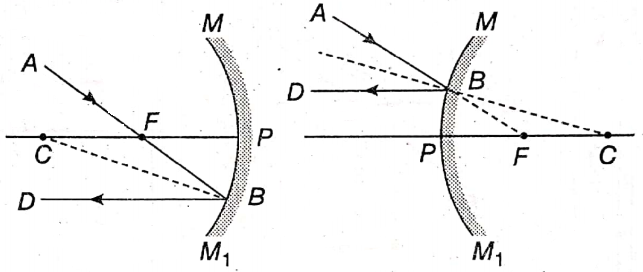
WBBSE Solutions For Class 10 Physical Science And Environment Chapter 5 Light Convex And Concave Mirror The Incident Ray Is Directed Towards The Focal Point

Characteristic of incident ray: It is directed towards the focal point (F).
Characteristic of reflected ray: It is parallel to the principal axis for both mirrors.

Wb Class 10 Physical Science Question and Answers

Question 18. Draw the ray diagram for each of a concave mirror and a convex mirror under the following condition: The incident ray is directed towards the centre of curvature of the mirror.

Answer:

WBBSE Solutions For Class 10 Physical Science And Environment Chapter 5 Light Concave And Convex Mirror Incident Ray IS Directed Towards The Center of Curvature Of The Mirror

Characteristic of incident ray: It is directed towards the centre of curvature (C) of the mirror.
Characteristic of reflected ray: It retraces the path of the incident ray in both the cases.

Question 19. Draw clear sketches of the formation of images of an extended object in a concave mirror under the following conditions. Mention the position of image, its size and also its nature in each case.

(1)Object is placed at infinity
(2)Object is not at infinity but beyond the centre of curvature
(3)Object is placed at the centre of curvature
(4)Object is placed between centre of curvature and focus
(5)Object is placed at the focus
(6)Object is placed between focus and pole

Answer:

Location of object Location of image Size of image Nature of image
1. At infinity Focus Very small compared to the object, almost like a point Real, inverted
2. Between  infinity and centre of curvature C Between focus F and centre of curvature C Small compared to the object Real, inverted
3. Centre of curvature C Centre of curvature C Equal to the object Real, inverted
4. Between the centre of curvature C and focus F Between the centre of curvature C and infinity Large compared to the object (magnified) Real, inverted
5. At focus F Infinity Very large compared to the object, nearly infinite Real, inverted
6. Between focus F and pole D Behind the mirror between pole P and infinity Larger than the object Virtual, erect


WBBSE Solutions For Class 10 Physical Science And Environment Chapter 5 Light Concave Mirror Object Is Placed At Infinity

WBBSE Solutions For Class 10 Physical Science And Environment Chapter 5 Light Concave Mirror Object Is Not At Infinity But Beyond The Center Of curvature

WBBSE Solutions For Class 10 Physical Science And Environment Chapter 5 Light Concave Mirror Under The object Is Placed At The Center Of curvature

WBBSE Solutions For Class 10 Physical Science And Environment Chapter 5 Light Concave Mirror Object Is Placed Between Center Of Curvature And The Focus

WBBSE Solutions For Class 10 Physical Science And Environment Chapter 5 Light Concave Mirror Under The Object Is Placed At Focus


WBBSE Solutions For Class 10 Physical Science And Environment Chapter 5 Light Concave Mirror Under The Object Is Between Focus And Pole


Question 20. Draw the ray diagram for each of a concave and a convex mirror under the following condition: The incident ray is directed towards the pole of the mirror.

Answer:

WBBSE Solutions For Class 10 Physical Science And Environment Chapter 5 Light A Concave And A Convex Mirror Incident Ray Is Directed Towards Pole Of The Mirror


Characteristic of incident ray: It is directed towards the pole of the mirror.
Characteristic of reflected ray: Both the incident ray and the reflected ray are inclined to the principal axis at the same angle.

Question 21. Write down some applications of a convex mirror.

Answer:

Some applications of a convex mirror

(1)Convex mirrors are used in street lamps as reflectors. This mirror diverges the light of a street lamp over a very large area.
(2)Convex mirrors are used in motorcycles, buses, lorries etc. as viewfinders. A convex mirror forms a virtual, erect but diminished image of an object kept in front of it. As a result, the driver of a vehicle can see the diminished, virtual image of another vehicle, object or individual far away from him and can drive his vehicle without causing any accident.

Question 22. Write down some applications of a concave mirror.

Answer:

Some applications of a concave mirror

1. A polished metal surface which works like a concave mirror is used in torches, searchlights or headlights of cars. In these three, the bulb is placed at the focus of the mirror so that the rays emitted from the bulb are reflected by the concave reflector and become parallel. This is very convenient for the driver as he can see up to a large distance.


WBBSE Solutions For Class 10 Physical Science And Environment Chapter 5 Light Applications Of A Concave Mirror


WBBSE Solutions For Class 10 Physical Science And Environment Chapter 5 Light Applications Of A Concave Mirror


2. Concave mirrors are used by dentists This mirror forms a magnified and erect image of teeth so that any cavity or crack in the teeth can be seen very clearly.
3. If any object is placed within the focus (i.e., between the pole and the focus) of a concave mirror, a magnified virtual image is formed. This property is utilised while using a concave mirror as a shaving mirror or in a beauty parlour.

Question 23. You are given three mirrors—one plane, one convex and the last one concave. How would you identify them without touching them?

Answer: A plane mirror always produces a virtual image of the same size as that of the object. A convex mirror always produces a diminished virtual image of the object and for a concave mirror, a magnified virtual image is produced if the object is placed at a distance less than the focal length.

Suppose, a pencil is held very close to a mirror. If we get an image of the same size as that of the object, then the mirror is a plane mirror.
If a diminished image is formed, then the mirror is convex and if a magnified image is formed, then the mirror is concave.

Question 24. What Is the change in its focal length if a spherical mirror is immersed in water?

Answer:

Change in its focal length if a spherical mirror is immersed in water

Light is reflected from a spherical mirror and the laws related to the reflection of light do not depend on the nature of the medium surrounding the mirror. So if a spherical mirror is immersed in water, there is no change in focal length.


Light Topic A Reflection Of Light At Spherical Mirror Very Short Answer Type Questions Choose The Correct Answer


Question 1. What is the radius of curvature of a spherical mirror whose focal lenght is ƒ?

  1. ƒ
  2. 3
  3. ƒ/2

Answer: 1. 2ƒ

Question 2. What is the focal length of a concave mirror whose radius of curvature is 20 cm?

  1. 20cm
  2. 15cm
  3. 10 cm
  4. 40 cm

Answer: 2. 15cm

Question 3. If an object is placed between the pole and the principal focus of a concave mirror, the image will be

  1. Real/magnified
  2. Virtual, diminished
  3. Real, diminished
  4. Virtual, magnified

Answer: 4. Virtual, magnified

Question 4. If an object is placed beyond the centre of curvature of a concave mirror, the image will be

  1. Real, magnified
  2. Virtual, diminished
  3. Real, diminished
  4. Virtual, diminished

Answer: 3. Real, diminished

Question 5. If an object is kept at the centre of curvature of a concave mirror, the image will be

  1. Real, of the same size
  2. Virtual, diminished
  3. Real, diminished
  4. Virtual, magnified

Answer: 1. Real, of the same size

Question 6. If an object is kept between the focus and the centre of curvature of a concave mirror, the image will be

  1. Real, magnified
  2. Virtual, diminished
  3. Real, diminished
  4. Virtual, magnified

Answer: 1. Real, magnified

Question 7. If an object is kept in front of a convex mirror, the image will be

  1. Virtual, magnified
  2. Virtual, diminished
  3. Virtual, of the same size
  4. Real, diminished

Answer: 2. Virtual, diminished

Question 8. The following is used as the viewfinder of an automobile

  1. Concave mirror
  2. Plane mirror
  3. Convex mirror
  4. None of the above

Answer: 3. Convex mirror

Question 9. A small aperture for a spherical mirror means an aperture of

  1. Less than 10°
  2. Less than 5°
  3. Less than 15°
  4. Less than 20°

Answer: 1. Less than 10°

Question 10. A ray, parallel to the principal axis of a concave mirror, after reflection

  1. Passes through the centre of curvature
  2. Retraces its path
  3. Passes through the principal focus
  4. Passes through the pole of the mirror

Answer: 3. Passes through the principal focus

Question 11. In the Image Paraxial rays are

WBBSE Solutions For Class 10 Physical Science And Environment Chapter 5 Light Paraxial Rays


  1. AB
  2. CD
  3. EF
  4. AB, CD, EF

Answer: 1. AB

Question 12. A ray, parallel to the principal axis of a convex mirror, after reflection—

  1. Passes through the centre of curvature
  2. Appears to come from the centre of curvature
  3. Passes through the principal focus
  4. Appears to come from the principal focus

Answer: 4. Appears to come from the principal focus

Question 13. A ray, directed toward principal focus of a concave mirror, after reflection

  1. Returns back following the same path
  2. Passes parallel to the principal axis
  3. Passes through the centre of curvature
  4. Passes along the principal axis

Answer: 2. Passes parallel to the principal axis

Question 14. A ray, directed towards the principal focus of a convex mirror, after reflection

  1. Returns back following the same path
  2. Passes parallel to the principal axis
  3. Passes through the centre of curvature
  4. Appears to come from the centre of curvature

Answer: 2. Passes parallel to the principal axis

Question 15. A ray, directed towards the centre of curvature of a concave mirror, after reflection

  1. Returns back following the same path
  2. Passes parallel to the principal axis
  3. Passes through the principal focus
  4. Passes along the principal axis

Answer: 1. Returns back following the same path

Question 16. A ray, directed towards the centre of curvature of a convex mirror, after reflection

  1. Returns back following the same path
  2. Passes parallel to the principal axis
  3. Appears to come from the principal focus
  4. Passes through the principal focus

Answer: 1. Returns back following the same path

Question 17. Number of principal focus of a spherical mirror

  1. One
  2. Two
  3. Three
  4. Four

Answer: 1. One

Question 18. While using an electric bulb, the type of mirror used as the reflector is

  1. Concave
  2. Convex
  3. Plane
  4. Parabolic

Answer: 2. Convex

Question 19. The type of mirror used by dentists for examination of the teeth of a person is

  1. Concave
  2. Convex
  3. Plane
  4. Parabolic

Answer: 1. Concave

Question 20. The type of mirror used as a saving mirror is

  1. Convex
  2. Concave
  3. Plane
  4. Parabolic

Answer: 2. Concave

Question 21. The angle of incidence for a ray of light passing through the centre of curvature of a concave mirror is

  1. 45°
  2. 90°
  3. 180°

Answer: 1. 0°

Question 22. The angle of deviation of a ray of light incident on a concave mirror along the principal axis is

  1. 90°
  2. 180°
  3. 360°

Answer: 3. 180°

Light Topic A Reflection Of Light At Spherical Mirror Answer In Brief


Question 1. When does a concave mirror form a virtual image of an object?
Answer: If an object is placed between the pole and the focus of a concave mirror, a virtual image of the object is formed.

Question 2. When does a concave mirror form a real image of an object?
Answer: If an object is placed away from the focus of the concave mirror or the object distance is more than the focal length, a real image of the object is formed.

Question 3. If an object is placed at a distance of more than 2ƒ in front of a concave mirror, where is the image formed?
Answer: The image is formed in front of the mirror, between the focus and the centre of curvature.

Question 4. If an object is placed at the centre of curvature of a concave mirror, where is the Image formed?
Answer: The image is formed too at the centre of curvature.

Question 5. If an object is placed between the focus and the centre of curvature, in front of a concave mirror, where is the image formed?
Answer: The image is formed in front of the mirror at a distance more than 2ƒ from the mirror.

Question 6. State whether the virtual image of an object formed by a concave mirror is magnified or diminished.
Answer: The virtual image of an object formed by a concave mirror is magnified.

Question 7. State whether the image of an object formed by a convex mirror is real or virtual.
Answer: The image of an object formed by a convex mirror is always virtual.

Question 8. State whether the virtual image of an object formed by a convex mirror is magnified or diminished.
Answer: The virtual image of an object formed by a convex mirror is diminished.

Question 9. State whether the centre of curvature of a concave mirror is situated in front of the reflecting surface or behind it.
Answer: The centre of curvature of a concave mirror is situated in front of it.

Question 10. State whether the centre of curvature of a convex mirror is located in front of the reflecting surface or behind it.
Answer: The centre of curvature of a convex mirror is located behind the reflecting surface.

Question 11. State whether the principal focus of a concave mirror is located in front of the reflecting surface or behind if.
Answer: The principal focus of a concave mirror is located in front of the reflecting surface.

Question 12. State whether the principal focus of a convex mirror is located in front of the reflecting surface or behind it.
Answer: The principal focus of a convex mirror is located behind the reflecting surface.

Question 13. How many principal focus points are there for a spherical mirror?
Answer: There is only one principal focus point for a spherical mirror.

Question 14. How many secondary focus points are there for a spherical mirror?
Answer: There are innumerable secondary focus points for a spherical mirror.

Question 15. What is the path of the reflected ray if the incident ray is directed towards the centre of curvature of a spherical mirror?
Answer: If the incident ray is directed towards the centre of curvature of a spherical mirror, the reflected ray retraces back the path of the incident ray.

Question 16. What is the focal length of a spherical mirror with a small aperture, which has a radius of curvature of 40 cm?
Answer: The focal length of a spherical mirror with a small aperture, which has a radius of curvature of 40 cm is 40/2 or 20 cm.

Question 17. What is the nature of a spherical mirror if it always produces virtual images?
Answer: If the spherical mirror always produces a virtual image, the mirror is convex in nature.

Question 18. What is the focal length of a spherical mirror with a small aperture, when the distance between the focus and the centre of curvature of the mirror is 20 cm?
Answer: The focal length of a spherical mirror is 20cm when the distance between the focus and the centre of curvature of the mirror is 20cm.

Question 19. A spherical mirror forms an image of the same size as that of the object for a particular position of the object. What is the nature of the mirror?
Answer: The spherical mirror is concave in nature.

Question 20. Is it possible for a mirror to form a virtual image which is smaller than the object?
Answer: Yes, a virtual image of an object formed by a convex mirror is smaller than the object.

Question 21. What is the nature of the reflected beam of light when a parallel beam of light is incident on a concave mirror?
Answer: When a parallel beam of light is incident on a concave mirror, the reflected beam of light is converging in nature.

Question 22. What is the nature of the reflected beam of light when a parallel beam of light is incident on a convex mirror?
Answer: When a beam of parallel light is incident on a convex mirror, the beam of reflected light is diverging in nature.

Question 23. What type of mirror is used as the reflector in a street lamp?
Answer: A convex mirror is used as the reflector in a street lamp.

Question 24. State whether the image of an object placed at the centre of curvature of a concave mirror is diminished or magnified.
Answer: The image of the object is neither diminished nor magnified it is of the same size as that of the object.

Question 25. What is the value of the focal length of a plane mirror?
Answer: The focal length of a plane mirror is infinite.

Question 26. Is the virtual image of an object formed by a concave mirror, laterally inverted?
Answer: Yes, the virtual image of an object formed by a concave mirror is laterally inverted.

Question 27. Keeping the relative position of an object with respect to a spherical mirror unchanged, the entire arrangement is immersed in water. Will there be any change in the position of the image?
Answer: No, the position of the image with respect to the mirror will remain unchanged.

Question 28. What type of mirror is used In a reflecting telescope?
Answer: A concave mirror is used in a reflecting telescope.

Question 29. Among a plane, a concave and a convex mirror, which one has the largest field of view?
Answer: Among the three mirrors, a convex mirror has the largest field of view.

Question 30. What is the value of the radius of curvature of a plane mirror?
Answer: The radius of curvature of a plane mirror is infinitely large.

Question 31. The focal length of a concave mirror is 10 cm. What is its focal length when it is immersed in water?
Answer: When the concave mirror is immersed in water, its focal length remains unchanged. So, the focal length of the mirror remains 10 cm.

Question 32. What is the nature of the mirror of a dentist?
Answer: The mirror of a dentist is concave in nature.

Question 33. Which type of mirror is used in the headlight of an automobile?
Answer: A concave mirror is used in the headlight of an automobile.

Question 34. Which type of mirror is used in a solar cooker?
Answer: A concave mirror is used in a solar cooker.

Light Topic A Reflection Of Light At Spherical Mirror Fill In The Blanks

Question 1. The concave side of a shining spoon behaves like a _____ mirror.
Answer: Concave

Question 2. The convex side of a shining spoon behaves like a _______ mirror.
Answer: Convex

Question 3. The _____ focus of a spherical mirror is a fixed point.
Answer: Principal

Question 4. The radius of curvature of a spherical mirror is ______ of that of the focal length.
Answer: Double

Question 5. Between a concave mirror and a convex mirror, a ______ mirror is converging.
Answer: Concave

Question 6. Between a concave mirror and a convex mirror, a mirror ______ is diverging.
Answer: Convex

Question 7. The middle point of a spherical mirror is known as ______
Answer: Pole

Question 8. When an object is placed at the centre of curvature of a concave mirror, magnification of the image formed by the mirror is _____
Answer: Unity

Question 9. Only rays inclined at an angle less than about 10° to the principal axis is considered as ____ rays.
Answer: Paraxial

Question 10. _____ mirror is used as a rear-view mirror in vehicles.
Answer: Convex

Light Topic A Reflection Of Light At Spherical Mirror State Whether True Or False


Question 1. There is no deviation of the light rays of reflection in a glass slab.
Answer: True

Question 2. The image of an object placed at the centre of curvature of a concave mirror is formed at the centre of curvature itself.
Answer: True

Question 3. The distance between the pole and the focus of a spherical mirror is known as the- focal length.
Answer: True

Question 4. The image formed by a concave mirror is always magnified in comparison to the object.
Answer: False

Question 5. The image formed by a convex mirror is always diminished in comparison to the object.
Answer: True

Question 6. Paraxial rays make a small angle with the principal axis of a mirror.
Answer: True

Question 7. A beam of light parallel to the principal axis of a concave mirror converges to a fixed point.
Answer: True

Question 8. A beam of light parallel to the principal axis of a convex mirror converges to a fixed point.
Answer: False

Question 9. Image formed by a concave mirror is always diminished in size.
Answer: False

Question 10. Image of an object placed between pole and focus of a concave mirror is always inverted.
Answer: False


Light Topic A Reflection Of Light At Spherical Mirror Numerical Examples


1. Angle of incidence (i) = angle of reflection (r)
2. For spherical mirror of a small aperture the relation between the focal length of the mirror (ƒ) and it’s the radius of curvature (r) is ƒ = r/2

Question 1. The focal length of a concave mirror is 15 cm. At which places in front of the mirror/an object should be placed/ so that
(1)A magnified real image and
(2)A magnified virtual image are formed?

Answer:

Given

The focal length of a concave mirror, / = 15 cm
∴ r= 2ƒ = 2 x 15 = 30 cm

Suppose, the object distance from the mirror = u

(1)In order to get a magnified real image, ƒ < u < 2ƒ or, 15 cm < u < 30 cm is the condition.
(2)In order to get a magnified virtual image, u<ƒ or, u < 15 cm is the condition.

Characteristics of Light Waves

Question 2. What is the focal length of a convex mirror having radius of curvature of 20 m?

Answer: Radius of curvature of the convex mirror (r) = 20 m
∴ Focal length of the convex mirror is
(f) = r/2= 20/2 = 10 m

Question 3. When a concave mirror is placed in sunlight, the image of the sun is formed at a distance 15 cm in front of the mirror. Find the radius of curvature of the mirror.

Answer: The rays of light coming from the sun are considered to be parallel. So the image of the sun is produced at the focus of the concave mirror.
∴ The focal length of the concave mirror (ƒ) = 15 cm
∴ Radius of curvature of the mirror (r) = 2ƒ= 2 x 15 = 30 cm


Topic B Refraction of Light Synopsis


1. In a homogeneous medium, ray of light travels in a straight line.
2. When a ray of light traveling in one medium is incident obliquely on the surface of another medium, a part of light is reflected back Into the same medium and rest of the light is transmitted into the other medium in a direction different from its initial path.

3. When light passes from one transparent homogeneous medium to another transparent homogeneous medium the phenomenon of change in the direction of path of light is called refraction.
(1)When a ray of light travels from a rarer medium to a denser medium, it bends towards the normal, i.e., ∠i > ∠r and deviation of the ray δ = i- r.

WBBSE Solutions For Class 10 Physical Science And Environment Chapter 5 Light Image 1

(2)When the ray of light travels from a denser medium to rarer medium, it bends away from the normal, i.e„  i < r.
The derivation of the ray, = r -i

WBBSE Solutions For Class 10 Physical Science And Environment Chapter 5 Light Image 2

(3)If the ray is incident normally on the surface separating two media, it goes undeviated, i.e., i = r = 0.
The deviation of the ray, 8 – 7 – r = 0
Light travels with different speeds in different media. In vacuum speed of light is 3 x 10⁸ m/s.

4. Cause of refraction of light: When a ray of light passes from one medium to another medium, its direction (or path) changes (except normal incident i.e., i = 0) because of change in speed of light from one medium to another.

5. Laws of refraction:
(1)First law of refraction: The incident ray, the refracted ray and normal to the point of incident on the surface of separation of the two media lie in the same plane.

(2)Second law of refraction: The ratio of the sine of the angle of incident i to the sine of the angle of refraction r is constant for the pair of given medium and for a particular colour of light.

The constant is called the refractive index of the second medium with respect to the first medium, it is generally represented by µ or n.

\(\frac{\sin i}{\sin r}={ }_1 \mu_2\)


The above law is known as Snell’s Law.

(3)The refractive index of a medium defined with respect to vacuum is called the absolute refractive index of the medium.
(4)The absolute refractive index of a medium is defined as the ratio of the speed of light in vacuum to the speed of light in that medium.

i.e…, \(\mu=\frac{\text { speed of light in vacuum or air }(c)}{\text { speed of light in that medium }(v)}\)


If v1 is the speed of light in medium 1 and v2 is the speed of light in medium 2 then, \({ }_1 \mu_2=\frac{v_1}{v_2}=\frac{c / v_2}{c / v_1}=\frac{\mu_2}{\mu_1}\)

According to the principle of reversibility \({ }_1 \mu_2=\frac{1}{{ }_2 \mu_1}\)

6. Change in speed, direction and wavelength of light due to refraction:
(1)Due to change in speed of light in passing from one medium to other the direction of ray of light changes’except for ∠i = 0.
(2)When a ray of light passes from a rarer to a denser medium, the speed of light decreases while if it passes from a denser to a rarer medium the speed of light increases.
(3) Since the frequency of light depends on the source of light, so it does not change on refraction.
(4)In refraction of light from one medium to another medium, due to change in the speed of light, the wavelength of light also changes because its frequency remains unchanged.

7. Refraction of light through a rectangular glass slab: When a ray of light is incident obliquely on the surface of a rectangular glass slab it emerges from the opposite surface after passing through the slab. Then both the incident ray and the emergent ray are parallel to each other. The separation between the incident ray and the emergent ray is called lateral displacement.

The lateral displacement depends on—
1. The thickness of the slab,
2. The angle of incidence (For normal incidence i.e., ∠i= 0; ∠r = 0 and the lateral displacement is zero).
3. The refractive index of glass.

8. Refraction of light through a prism: A prism is a portion of transparent refracting medium bounded by three rectangular and two triangular faces.

The angle between the refracting faces is called the angle of the prism (A).
The two rectangular plane inclined surface through which the light passes are called the refracting surfaces.
The section of the prism perpendicular to the refracting edge is called principal section of prism. shows the principal section ABC of a prism.

∠BAG = A —The angle of the prism.
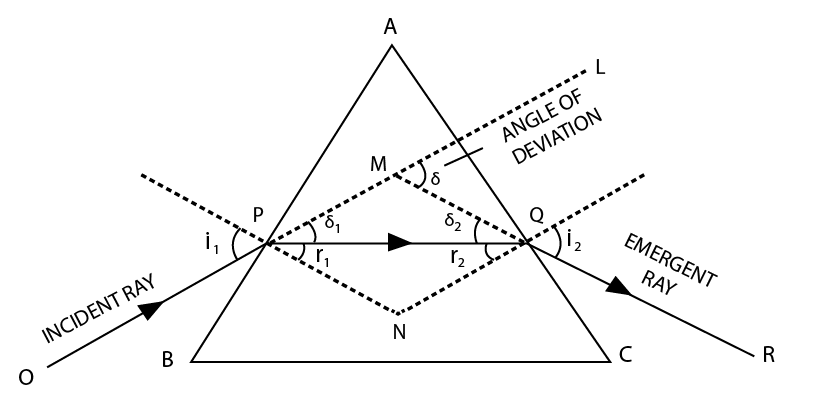
 

WBBSE Solutions For Class 10 Physical Science And Environment Chapter 5 Light Refraction Of Light Through A Prism


If i1 be the angle of incident, r1 be the angle of refraction, i2 be the angle of emergence, r2 be the angle of incident at the AC surface and δ be the angle of deviation, then, r1 + r2 = A,  i1 + i2 – A

Shows the variation of angle of deviation (δ) with the angle of incedence (i1).

In the position of minimum deviation i1 = i2 = i (say) and  δ=δm. Then, δm = 2i = – A.

9. For a given prism and a given colour of light/ 6m is unique.

Angle of deviation depends on the—
(1)The angle of incidence
(2) the angle of the prism
(3)The material of the prism
(4)The wavelength of the light used.

At minimum deviation position:
(1)Angle of incidence (i1) = angle of emergence (i2)
(2)Angle of refraction (r1) = angle of incident at AC surface (r2)
(3) The refracted ray inside a prism is parallel to the base of the prism.


Topic B Refraction of Light Short And Long Answer Type Questions


Question 1. Show the refraction of light in a prism with a ray diagram. What is the assumption made while drawing this diagram, regarding optical densities of the material of the prism and the surrounding medium?

Answer:

WBBSE Solutions For Class 10 Physical Science And Environment Chapter 5 Light Refraction Of Light In A Prism

Description of figure:
ABC → Principal section of the prism
PQ → Incident ray
RS → Emergent ray
MQT → Normal drawn on the line AB at point
NRT → Normal drawn on the line AC at point

Here, it has been assumed that the material of the prism is denser than the surrounding medium.

Question 2. What is the condition for an emergent ray to be directed away from the base of a prism? Show that in this condition net deviation is negative.

Answer: If the optical density of the material of the prism is less than the optical density of the surrounding medium, then the emergent ray will be directed away from the base.

According to the given condition, a ray diagram showing refraction in the prism is drawn.

According to image, r1 >  i1 and i2 < r2 Thus, ( r1 + r2) > (i1+ i2)
Therefore deviation, δ = (i1 + i2) ~ ( r1+ r2) <0
i.e., net deviation is negative.

Question 3. Show that during refraction of light along the principal section of a prism, angle of deviation, δ = i1 + i2 – A, where i1 is the angle of incidence, i2 is the angle of emergence and A is the refracting angle of the prism.

Answer: ABC is the principal section of a prism. PQRS is the path of light in refraction through.

For refraction on the plane AB, the angle of incidence, ∠PQM =  i1 and the angle of refraction, ∠RQT = r1

∴ the angle of deviation in refraction on the plane AB is δ1 = ∠EUR = i1 – r1

For the refraction on the plane AC, the angle of incidence, ∠QRT = r2 and the angle of refraction, ∠NRS = i2

∴ the angle of deviation in refraction on the plane AC, δ2 = ∠FRS = i2 – r2

If SR is extended backwards, it intersects PE at the point U. Therefore, due to refraction of a ray of light at two surfaces AB and AC, angle of deviation,
δ = ∠EUR [It is the external angle of ΔUQR ] = ∠UQR + ∠QRU = ∠UQR + ∠FRS [ ∵ ∠QRU= vertically opposite ∠FRS] =  δ1 + δ2
= (i1 r1) + (i2  – r2) = i1 +  i2 -( r1 + r2) …..(1)

We get from ΔQTR, r1 + r2 + ∠QTR = 180° •••(2)
Again, for quadrilateral AQTR,
∠AQT + ∠ART = 90° + 90° = 180°
∴ ∠QAR + ∠QTR = 180° ……..(3)

By comparing equations (2) and (3), we get ∠QAR =  r1 + r2 or, A =r1 + r2
∴ we get from equation (1), the angle of deviation δ = i1 + i2 -A

Question 4. No deviation occurs in refraction through a rectangular glass slab—-prove it.

Answer: A light ray AB is incident obliquely on the side PQ of a rectangular slab PQRS.


WBBSE Solutions For Class 10 Physical Science And Environment Chapter 5 Light No Deviation Occurs In Refraction Through A Rectangular Glass Slab


In case of refraction of light at point B, angle of incidence, i1= ∠ABN1 and angle of refraction, r1 = ∠N2 BC

Ray BC passes through this glass and falls obliquely at the point C on the surface of separation of glass and air and is again refracted in air. Here CD is the emergent ray. In case of refraction of light at point C, angle of incidence, r2 = ∠BCN3 and angle of refraction, i2= ∠DCN4 

Here, N1N2 is parallel to N3N4 and BC is a transversal.
∴ ∠N2BC = ∠BCN3 [Alternate angles] or, r1 = r2

Again, it can be shown from Snell’s law, If r1 = r2, then  i1 =i2  

Therefore total deviation, δ = ( i1  r1) + (r2—i2) = (i2  – i2 ) + (r2 – r2 ) =0

i.e., no deviation occurs in refraction through a rectangular glass slab.

Question 5. What is the refraction of light?

Answer: The passage of light ray from one medium to another medium through the surface of separation of the two media is called refraction of light.

Alternate definition: During passage of light from a transparent homogeneous medium to another transparent homogeneous medium, light suffers a change in speed at the surface of separation of the two media. This phenomenon of change in light of light at the surface of separation of the two media is called refraction of light.

Common Mistakes in Light Calculations

Question 6. Write down the laws of refraction of light.

Answer:

The laws of refraction of light are:

(1)The incident ray, the refracted ray and the normal to the surface of separation of the two media at the point of incidence lie on the same plane.
(2)The ratio of the sine of the angle of incidence to the sine of the angle of refraction is constant. This constant depends on the nature of the associated media and colour of incident light.

Question 7. What do you mean by the optical density of a medium? Is it related to the physical density of the medium?

Answer:

Optical density of a medium

1. Optical density is the property of a medium on which the speed of light depends. More the optical density of a medium, slower the ray moves through it.

2. The optical density of a medium is not the same as its physical density. The physical density (ρ) of any substance is denoted by the ratio of its mass (M) and volume (V), i.e.., \(\rho=\frac{m}{V}\)

But the optical density of a medium is indicated by its refractive index (µ) which is calculated as µ = c/v (c = speed of light in vacuum, v = speed of light in the said medium).

Question 8. What do you mean by refractive index of a medium?

Answer:

Refractive index of a medium

The ratio of the sine of the angle of incidence (i) to the sine of the angle of refraction (r) at the time of refraction, in case of oblique incidence is called the refractive index of the second medium (µ2) with respect to the first medium (µ1), i.e., \(\frac{\sin i}{\sin r}={ }_1 \mu_2\)

Question 9. When is the formula \(\frac{\sin i}{\sin r}=\mu_2\) not applicable?

Answer; If a ray of light is incident normally at the surface of separation of two media, then the formula \(\frac{\sin i}{\sin r}=\mu_2\) is not applicable. In this case, there is no change in the direction of the ray of light in the second medium but speed of light change in the second medium.

Question 10. Refraction takes place from medium a to medium b. Explain which one is optically denser or rarer under the following conditions:
(1)Positive deviation occurs in medium b.
(2)Negative deviation occurs in medium b.

Answer: If angle of incidence = i and angle of refraction = r, then deviation, δ = (i – r).

(1)As deviation in medium b is positive, So, i – r > 0 or, i > r i.e., r < i.

In this case, the value of angle of refraction in medium b is less than the value of angle of incidence in medium a. Therefore, medium b is denser than medium a.

(2)As deviation in medium b is negative, So, δ < 0 or, i – r < 0  or, i<r, i.e.,r>i

In this case, the value of angle of refraction in medium b is greater than the value of angle of incidence in medium a. Therefore, medium b is rarer than medium a.

Question 11. Show the refraction of light
(1)From a rarer medium to medium and from a denser medium to a rarer medium
(2)From a denser medium to a rarer medium.

Answer:
(1)When a ray of light enters a denser medium from a rarer medium, the refracted ray bends towards the normal.
(2)When a ray of light enters a rarer medium from a denser medium, the refracted ray bends away from the normal.

Chapter 5 Light Refraction Of Light From A Denser Medium To A Rarer Medium

WBBSE Solutions For Class 10 Physical Science And Environment Chapter 5 Light Refraction Of Light From A Denser Medium To A Rarer Medium


In Image,
AO → incident ray
OB → refracted ray
O → point of incidence
MON→ normal drawn on the point of incidence at the surface of separation of two media
i → angle of incidence
r → angle of refraction

In case of (1), r < i
In case of (2), r > i

Question 12. Determine the angle of deviation Sn each of the following cases:
(1)Refraction from rarer to denser medium
(2)Refraction from denser to rarer medium

Answer: The refraction of light from a rarer medium to a denser medium and from a denser medium to a rarer medium respectively. Here AOC is the undeviated path of light in absence of any second medium.
So, ∠BOC = the angle of deviation (δ).

(1)In refraction of light from a rarer medium to a denser medium, r < i.
We get δ = ∠BOC = ∠CON – ∠BON = ∠AOM – ∠BON [∵ ∠AOM – vertically opposite ∠CON] or, δ = i-r

(2)In refraction of light from a denser medium to a rarer medium, r > i.
δ = ∠BOC = ∠BON -∠CON = ∠BON-∠AOM [ ∵∠AOM = vertically opposite ∠CON]
∴ δ = r-i

Question 13. Explain which medium is rarer and which one is denser between the two media a and & in the phenomenon of refraction Under the following conditions:

  1. Angle of incidence is 30° in medium a, angle of refraction is 40q in medium b .
  2. Angle of incidence is 50° in medium a , angle of refraction is 40° in medium b.
  3. Incident ray in medium o is inclined at an angle of 30° with the surface of separation and refracted ray in medium b is inclined at an angle of 40° with the surface of separation.
  4. Incident ray in medium a is inclined at an angle of 50° with the surface of separation and refracted ray in medium b is inclined at an angle of 40° with the surface of separation.
  5. Incident ray falls perpendicularly at the surface of separation in medium a.

Answer:
(1)In this case, angle of refraction (40°) > angle of incidence (30°).
Thus, the refracted ray bends away from the normal in medium b. Therefore, medium b is rarer compared to medium a.

WBBSE Solutions For Class 10 Physical Science And Environment Chapter 5 Light Angle Of Incidence at 30 degrees

(2)In the case, angle of refraction (40°) < angle of incidence (50°)
Thus the refracted ray bends towards the normal inmedium b. Therefore, medium b is denser than the medium a.

WBBSE Solutions For Class 10 Physical Science And Environment Chapter 5 Light Angle Of Incidence 40 degrees

(3)In this case, angle of incidence (i) = 90°-30° = 60° and angle of refraction (r) = 90° – 40° – 50° So; r < /’, i.e., the refracted ray bends towards the normal in medium b.

Therefore, medium b is a denser medium than medium a.

WBBSE Solutions For Class 10 Physical Science And Environment Chapter 5 Light Image 60

WBBSE Solutions For Class 10 Physical Science And Environment Chapter 5 Light Image 61

WBBSE Solutions For Class 10 Physical Science And Environment Chapter 5 Light Image 62


(4)In this case, angle of incidence(i) = 90°-50° = 40° and angle of refraction (r) = 90° – 40° = 50° r>i, i.e., the refracted ray bends away from the normal in medium b.

Therefore, medium b is rarer in comparison to medium a.

(5)In this case, angle of incidence (i) = angle of refraction (r) = 0

As a result, from given data it is not possible to know which medium is optically rarer or denser.

Question 14. If a ray of light incidents on a parallel glass slab at an angle i, the angle between the reflected ray and the refracted ray is 90°. Show that refractive index of glass, µ = tani.

Answer:

Given

If a ray of light incidents on a parallel glass slab at an angle i, the angle between the reflected ray and the refracted ray is 90°.

Suppose, angle of refraction = r
AB is the incident ray, BC is the reflected ray and BD is the refracted ray.
∴∠CBD = 90°

NN1 is the normal at point B on the surface of separation between the two media.

WBBSE Solutions For Class 10 Physical Science And Environment Chapter 5 Light Image 63

∴ ∠NBC+ ∠CBD + ∠N1BD = 180° or, i + 90 + r = 180° or, r = 90° – i

In case of refraction of light ray at point B, \(\frac{\sin i}{\sin r}=\mu \quad \text { or, } \frac{\sin i}{\sin \left(90^{\circ}-i\right)}=\mu \quad \text { or }, \frac{\sin i}{\cos i}=\mu\)

Question 15. Why is a glass rod immersed in glycerine invisible?

Answer: We see an object due to the irregular reflection of light from its surface. The lesser the amount of this reflection, lesser will be the visibility of the object to us. Again, the lesser the difference between the refractive indices of two media greater will be the amount of refracted rays.

This means diffuse reflection from the surface of separation is reduced. Here, the refractive indices of glycerine and glass are almost equal. So, when a glass rod is immersed in glycerine, practically no reflection of light occurs at the surface of the separation. Maximum amount of light is refracted from glycerine to glass. So, the glass rod is not visible from the outside.
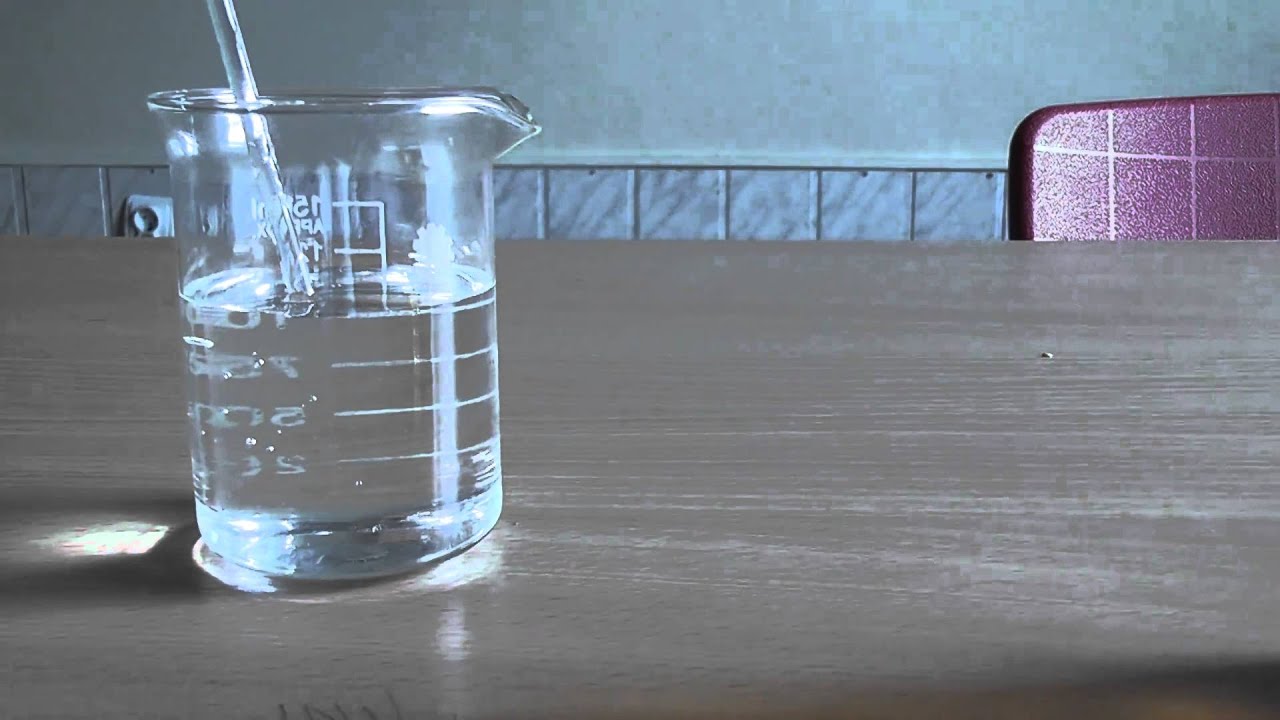
 

WBBSE Solutions For Class 10 Physical Science And Environment Chapter 5 Light Image 64


Question 16. Explain the following parts for a prism:

  1. Refracting surface,
  2. Edge,
  3. Base,
  4. Principal section,
  5. Refracting angle or angle of the prism.

Answer:
(1)Refracting surface: The two rectangular surfaces DEHG and DFIG are called refracting surfaces of this prism.


WBBSE Solutions For Class 10 Physical Science And Environment Chapter 5 Light Image 65


(2) Edge: The edge of the prism is the straight line along which the two refracting surfaces of the prism meet. Here DG is the edge of the prism.
(3)Base: The rectangular plane opposite to the edge is called the base. Here, EFIH is the base.
(4)Principal section: It is an imaginary triangular plane surface right-angled to the edge of the prism. This is called the principal section of the prism. Here, ABC is the principal section of the prism.

(5)Refracting angle: The angle between the two refracting surfaces of the prism is called the refracting angle or simply the angle of the prism. Here, ∠BAC is the refracting angle of the prism.

Question 17. If the value of angle of incidence of a ray on one surface of a prism (i1) increases, what is the change in the angle of emergence (i2) at the other surface?

Answre: If the value of angle of incidence of a ray on one surface of a prism ( i1) increases, the value of angle of refraction (r1) on the same surface also increases according to Snell’s law.

Now, as the refracting angle of the prism A = r1 + r2 is constant, the value of r2 decreases with the increase in the value of r1.

Again, for the refraction at the second surface, as the value of r2 decreases, the value of i2 also decreases according to Snell’s law.
So, if the value of i1 increases, the value of i2 decreases.


Topic B Refraction of Light Very Short Answer Type Questions Choose The Correct Answer


Question 1. The following remains unchanged during refraction of light

  1. Speed of light
  2. Wavelength
  3. Frequency
  4. None of these

Answer: 3. Frequency

Question 2. If the angle of incidence for a prism is increased, angle of deviation

  1. Increases
  2. Decreases
  3. Increases at first, then decreases
  4. Decrease at first, then increases

Answer: 3. Increases at first, then decreases

Question 3. For which colour of light among red, blue, green and yellow does a medium possess highest refractive index?

  1. Red
  2. Blue
  3. Green
  4. Yellow

Answer: 2. Blue

Question 4. For which colour of light among red, blue, green and yellow does a medium possess lowest refractive index?

  1. Red
  2. Blue
  3. Green
  4. Yellow

Answer: 1. Red

Question 5. For which value of the angle of incidence in refraction of light, the equation \(\frac{\sin i}{\sin r}={ }_1 \mu_2\) is not valid?

  1. 90°
  2. 60°
  3. 45°
  4. Zero

Answer: 4. Zero

Question 6. Refraction of light occurs from denser to a rarer medium. Angle of incidence is 30° and angle of refraction is 45°. What is the angle of deviation?

  1. 10°
  2. 15°
  3. 20°
  4. 30°

Answer: 2. 15°

Question 7. A ray of light is incident from air to the upper surface of a liquid at an angle 45° and is refracted at an angle of 30°. What is the refractive index of that liquid?

  1. 2
  2. √2
  3. 1 + √2
  4. √2 -1

Answer: 3. 1 + √2

Question 8. The angle of deviation of a prism with refracting angle A is δ, when the angle of incidence is i1 and the angle of emergence is i2. What is the angle of deviation, for the angle of incidence i2 in the same prism?

  1. δ/2
  2. δ/3
  3. δ

Answer: 3. δ

Question 9. What will be the angle of incidence at the second refracting surface of a. prism of refracting angle 60° for angle of refraction 25° at the first refracting surface?

  1. 35°
  2. 40°
  3. 25°
  4. 15°

Answer: 1. 35°

Question 10. A ray of light incident on an equilateral glass prism, if incident angle on first face is 30° and emergent angle is 50° then angle of deviation is

  1. 10°
  2. 20°
  3. 30°
  4. 40°

Answer: 2. 20°

Question 11. The absolute refractive index of water is |. What is the refractive index of air with respect to that of water?

  1. 3/4
  2. 4/3
  3. 3/5
  4. 1

Answer: 1. 3/4

Question 12. Angle of deviation in case of refraction with a normal incidence is

  1. 90°
  2. 60°
  3. 30°
  4. Zero

Answer: 4. Zero

Question 13. When light wave goes from air into water, the quality that remains unchanged is its

  1. Speed
  2. Amplitude
  3. Wavelength
  4. Frequency

Answer: 4. Frequency

Question 14. When light travels from a denser to a rarer medium, its speed

  1. Remains same
  2. Decreases
  3. Increases
  4. Can’t be said

Answer: 3. Increases

Question 15. If the frequency of light in vacuum be v, then the frequency of light in a medium of refractive index n will be

  1. µν
  2. 0
  3. µ/ν
  4. ν

Answer: 4. ν

Question 16. Which one of the following alternative is not true for a prism placed in a position of minimum deviation

  1. i1 = i2
  2. r1 = r2
  3. i1 = r1
  4. None of these

Answer: 3. i1 = r1

Question 17. During refraction of light from air to a transparent liquid, angle of incidence is 60° and angle of refraction is 45°. What is the angle of deviation?

  1. 10°
  2. 30°
  3. 15°
  4. 20°

Answer: 3. 15°


Topic B Refraction of Light Answer In Brief


Question 1. A ray of light, while entering from one medium into another, bends towards the normal. What conclusion can be drawn about the optical density of the media?
Answer: One can conclude that the first medium is the rarer medium and the second medium is the denser medium.

Question 2. A ray of light, while entering from one medium into another medium, bends away from the normal. What conclusion about the optical density of the media can be drawn from this?
Answer: One can conclude that the first medium is the denser medium and the second medium is the rarer medium.

Question 3. What is the angle of deviation when the angle of incidence and the angle of refraction are 60° and 45° respectively?
Answer: Angle of deviation = 60° – 45° = 15

Question 4. The refractive indices of two particular media for red light and blue light are µr and µb respectively. Which is greater in magnitude?
Answer: Here, µb > µr.

Question 5. What is the value of angle of refraction if the angle of incidence is zero?
Answer: If the angle of incidence is zero, then the angle of refraction is also zero.

Question 6. What is the angle of deviation between the incident ray and the emergent ray when a ray of light fails on a rectangular glass slab?
Answer: The angle of deviation is zero in this case.

Question 7. Do the incident ray and the emergent ray remain in the same straight line when an incident ray falls obliquely on a rectangular glass slab?
Answer: No, the emergent ray gets displaced laterally.

Question 8. In which direction does a ray of Sight incident on a prism parallel to its base bend after it emerges—towards the base of the prism or towards the refracting angle?
Answer: A ray of light incident on a prism parallel to its base, bends towards its base after it emerges.

Question 9. A ray of light is incident on a prism parallel to its base where the refractive index of the surrounding medium is greater than the refractive index of the material of the prism. In which direction does the emergent ray bend—towards the base or towards the refracting angle?
Answer: In this case, the emergent ray bends towards the refracting angle.


Topic B Refraction of Light Fill In The Blanks

Question 1. If one looks from above at a pencil immersed obliquely in water, it looks bent due to ____ of light.
Answer: Refraction

Question 2. The speed of light ______ when it travels from water to glass medium.
Answer: Decreases

Question 3. The angle of incidence is ______ than the angle of refraction when light travels from a rarer to a denser medium.
Answer: More

Question 4. The angle of incidence is ____ than the angle of refraction when light travels from a denser to a rarer medium.
Answer: Less

Question 5. Absolute refractive index of a medium (except air or vacuum) is always greater than ______
Answer: One

Question 6. When light travels from a rarer to a denser medium, its speed _____
Answer: Decreases

Question 7. The position of prism with respect to the incident ray at which the incident ray suffers minimum deviation is called the position of ______
Answer: Minimum Deviation


Topic B Refraction of Light State Whether True Or False


Question 1. When light is normally incident on a glass slab, only lateral displacement of light takes place.
Answer: False

Question 2. Incident ray and refracted ray may not always lie on the same plane.
Answer: False

Question 3. Snell’s law is not applicable for normal incidence of light.
Answer: True

Question 4. Glass is a rarer optical medium than diamond.
Answer: True

Question 5. The frequency of light decreases when it enters into glass from water.
Answer: False

Question 6. If angle of incident be 45° and the angle of refraction be 30°, then the refractive index be √2.
Answer: True

Question 7. For refraction of light through a rectangular glass slab angular deviation of light beam is zero.
Answer: True

Question 8. For an isosceles prism, when the deviation is minimum the path of the ray through the prismbecomes parallel to the base of the prism.
Answer: True


Topic B Refraction of Light Numerical Examples


1. For refraction of light, if angle of incidence = i, angle of refraction =r, then

(1)For refraction of light from rarer medium to denser medium, angle of deviation, δ = i – r
(2)For refraction of light from denser medium to rarer medium, angle of deviation,  δ  = r-i
(3)Refractive index of the second (2) medium with respect to the first (1) medium, \({ }_1 \mu_2=\frac{\sin i}{\sin r}\)

2. If refractive index of a medium with respect to air be µ. Then refractive index of air with respect to the medium = 1/µ
3. If absolute refractive index of 1st medium be µ1 absolute refractive index of 2nd medium be µ2 then, refractive index of the 2nd medium with respective to the 1st medium be \({ }_1 \mu_2=\frac{\mu_2}{\mu_1}\)

4. For refraction of light through a prism, if angle of the prism —A, angle of incidence at the first refracting surface = i1, angle of refraction at the first refracting surface = r1 and at the second refracting surface, angle of incidence =r1, angle of refraction = i2, then
(1)A =  r1 + r2
(2) Angle of deviation 8 = i1 + i2 – A
(3)For minimum deviation, i1 = i2 – i (say) and r1 = r2 and µm = 2i- A or, \(i=\frac{\delta_m+A}{2}\)

Question 1. An Incident ray of Tight travelling through air falls on the upper surface of a liquid at an angle of 45° – It is deviated by 15° after refraction in that liquid. What is the refractive index of the liquid?

Answer:

Given

An Incident ray of Tight travelling through air falls on the upper surface of a liquid at an angle of 45° – It is deviated by 15° after refraction in that liquid.

Angle of refraction, r = i-δ or, r = 45° – 15° or, r = 30°

∴ refractive index of the liquid, \(\mu=\frac{\sin i}{\sin r}\)

or, \(\mu=\frac{\sin 45^{\circ}}{\sin 30^{\circ}}\)  or, \(\mu=\frac{\frac{1}{\sqrt{2}}}{\frac{1}{2}}=\sqrt{2}=1.414\)

Question 2. What is the value of the angle of deviation if the angle of incidence on one surface of an equilateral prism is 30° and the angle of refraction on the other surface is 50°?

Answer: Refracting angle of an equilateral prism, A = 60°
According to this question, angle of incidence on one surface,  i1= 30°

Angle of refraction at the other surface, i2 = 50° a
∴ angle of deviation, δ = i1 + i2 — A = 30° + 50° – 60° = 20°

WBBSE Class 10 Revision Notes on Light

Question 3. The angle of deviation of a ray of light, due to refraction in an equilateral prism is 40°. If the ray of light travels in a path parallel to the base of the prism, what Is the value of the angle of incidence on the first surface?

Answer:

Given

The angle of deviation of a ray of light, due to refraction in an equilateral prism is 40°. If the ray of light travels in a path parallel to the base of the prism,

The path of ray, in the equilateral prism ABC.

∵ QR || BC
∴ ∠AQR =∠ABC = 60°
∴ ∠RQO = 90° – 60° = 30°

Hence angle of refraction on the first surface,  r1 = 30°
∵A = r1 + r2
∴ 60° = 30° +r or, r2 = 30°
∵ r1=  r2
 i1 = i2 = i (say)
∴ δ = i1 + i2 – A

∴\(i=\frac{\delta+A}{2}=\frac{40^{\circ}+60^{\circ}}{2}=50^{\circ}\)

Therefore, the value of angle of incidence = 50°.


WBBSE Solutions For Class 10 Physical Science And Environment Chapter 5 Light Image 66


Question 4. What is the value of angle of emergence (or angle of refraction) at the second surface of a prism with a refracting angle of 30° for the normal incidence of the ray on the first surface of the prism? [Given, the refractive index of the material of the prism, µ = 1.5 and sin 48.59° = 1.5/2]

Answer: The refracting angle of the prism, A = 30°
The angle of incidence on the first surface, i1 = 0 [ ∵ the ray is incident normally]
Therefore, angle of refraction, r1 = 0
Again, since A = r1+ r2
∴ 30° = 0 + r2 or, r2 = 30°

If i2 be the angle of emergence (angle of refraction) in the second surface, then according to Snell’s law, \(\frac{\sin r_2}{\sin i_2}=\frac{1}{\mu}\)

[∵ here refraction is from prism (refractive index = µ) to air (refractive index = 1)]

or, sini2 = µ sinr2 = 1.5sin30° = 1.5/2
∵ sin 48.59° = 1.5/2(given)
∴ i2 = 48.59°

Word Problems on Reflection and Refraction

Question 5. The refracting angle of a prism is 30°. If a ray of light falls at an angle of 60° on a refracting surface, what is the angle of emergence? [Given, angle of deviation = 30° ]

Answer:

Given

The refracting angle of a prism is 30°. If a ray of light falls at an angle of 60° on a refracting surface,

Refracting angle of the prism, A = 30°
Angle of incidence, i1 = 60°
Angle of deviation, δ = 30°
Suppose, the angle of emergence = i2

∴ δ = i1 + i2 -A  or, i2 = δ – i1  + A = 30°- 60° + 30° = 0
∴ The angle of emergence = 0

Question 6. The refractive index of glass is 3/2 and that of water is 4/3. What is the refractive index of glass with respect to water?

Answer:

Given

The refractive index of glass is 3/2 and that of water is 4/3.

Refractive index of glass \(\mu_g=\frac{3}{2}\)

Refractive index of water \(\mu_w=\frac{4}{3}\)

∴ Refractive index of glass with respect to water \(\mu_g=\frac{\mu_g}{\mu_w}=\frac{\frac{3}{2}}{\frac{4}{3}}=\frac{9}{8}\)

Question 7. The refracting angle of a prism is 60°. If a ray is incident on any refracting surface of the prism, angle of refraction for that surface is 35°. What is the incident angle on the other refracting surface?

Answer:

Given

The refracting angle of a prism is 60°. If a ray is incident on any refracting surface of the prism, angle of refraction for that surface is 35°.

Refracting angle of the prism, A = 60°, angle of refraction on the first refracting surface r1 = 35°

If r2 is the angle of incidence on the other refracting surface,
A =  r1+ r2   or, r2 = A-ror, r2 = 60°-35° = 25°

Light Topic C Lenses Synopsis

1. Lens is a portion of a transparent refracting medium bounded by one or two spherical surfaces or one spherical surface and one plane surface.


WBBSE Solutions For Class 10 Physical Science And Environment Chapter 5 Light Bioconvex lenses


2. A lens whose both the refracting surfaces are spherical in shape that it is thick at the middle and thin at the edge is called a convex lens. It converges the parallel beam of light incident on the lens after refraction. It is also known as converging lens.

3. A lens whose both the refracting surfaces are spherical in shape such that it is thin at the middle and thick at the edge is called a concave lens.
It diverges the parallel beam of light incident on the lens after refraction. It is also known as diverging lens.

4. Converging/diverging action of convex/ concave lens: Converging or diverging action of lens can be shown by considering action of lens to be made up of large number of prism.


WBBSE Solutions For Class 10 Physical Science And Environment Chapter 5 Light Converging Action Of A Convex Lens


WBBSE Solutions For Class 10 Physical Science And Environment Chapter 5 Light Diverging Action Of A Concave Lens


5. Technical terms related to lenses:
(1)The centre of the sphere whose part is the lens surface, is called the centre of curvature of that surface of the lens.
(2)Since some lens has two spherical surfaces, so there are two centres of curvature of a lens.
(3)The radius of the sphere whose part is the lens surface, is called the radius of curvature of that surface of lens.
(4)The line joining the centres of curvature of the two surfaces of the lens is called principal axis of the lens.
(5)Optical centre is a point on the principal axis of the lens such that a ray of light passing through this point emerges parallel to its direction of incidence.
(6)A light ray can pass through a lens from either direction, therefore, a lens has two principal foci which are situated at equal distance (when the medium on both sides of the lens is same) from the optical centre, one on either side of the lens. These are known as the first principal focus and the second principal focus.

First principal focus is a point on the principal axis such that rays coming from it (convex lens) or appear to meet at it (concave lens) become parallel to the principal axis after refraction.


WBBSE Solutions For Class 10 Physical Science And Environment Chapter 5 Light First Principle Focus Of Convex Lens


WBBSE Solutions For Class 10 Physical Science And Environment Chapter 5 Light First Principle Focus Of Concave Lens


Second principal focus is a point on the principal axis at which the rays incident on the lens parallel to the principal axis after refracting converges (in convex lens) or appear to diverge (in concave lens).


6. The distance between the focal point ( F1 or  F2) and the optical centre of the lens is called the focal length of the lens.
7. Usually, when we say focus, we mean the second focal point. Hence the focal length of a lens implies the second focal length of the lens.

8. Rules for obtaining images formed by lenses (concave or convex):
(1) An incident ray diverging through the first principal focus or appearing to converge at first principal focus emerges parallel to the principal axis after refraction.
(2)An incident ray passing through the optical centre passes through the lens without deviation after refraction.
(3)An incident ray parallel to the principal axis after refraction converges (in a convex lens) or appears to diverge (in a concave lens) through the second focus.

9. A Conlens can form a real as well as a virtual image but concave lens always form a virtual, erect and diminished image.

Cartesian sign convention:
(1) Light is incident on the lens from the left-hand side. a direction opposite to the incident light
(2)All distances are measured from the and normal to the principal axis are taken as the optical centre of the lens which is taken as the origin and the principal axis as X-axis.
(3)The distances taken in the direction of the incident light from the optical centre are taken as negative.
(4)Heights and distances measured upward And normal to the principal axis are taken as positive while downward distances are taken
as negative.

Position and nature of image formed by a convex lens at different positions of object:

10. Magnification (m) produced by a lens is defined as the ratio of the size of the image to that of the object. The size of the object h0 is always taken to be positive, but image size hi is taken as positive for an erect image and negative for an Inverted image, \((m)=\frac{h_i}{h_0}=\frac{v}{u}\)

11. The human eye is one of the most Important biological instrument which consists of— cornia, iris, pupil, ciliary muscles, eye tens, retina and optic nerve.
12. Defects of the human eye: Two main defects of human eye are—
(1)Myopia or short sight
(2)Hypermetropia or long sight.

(1)Myopia is that defect in vision in which a person can see nearby objects clearly but can not see the distant object clearly.
(2)Hypermetropia is that defect in vision in which a person can see the distant objects clearly but cannot see the nearby objects clearly.

12. Least distance of distinct vision: The nearest point at which an object can be seen distinctly is called near point of the eye. The shortest distance at which an object can be seen distinctly is called the least distance of distinct vision. It is 25 cm for normal human eye.

13. Far Point is the farthest point upto which an object can be distinctly seen without accommodation.

For a normal eye the far point is at infinity. The distance between the near point and the far point is called range of vision.

14. Persistence of vision: The retina of the eye continues to bear the effect of light after the stimulus has been taken away. This phenomenon is called the persistence of vision. Persistence of vision is about 1/10 s.


Light Topic C Lenses Short And Long Answer Type Questions


Question 1. Write down the definition of the second principal focus, focal length and focal plane of a convex lens with Images.

Answer:
Second principal focus: A beam of light incident parallel to the principal axis of a convex lens converges at a point on the principal axis after refraction through the lens. This point is called the second principal focus F2 of the convex lens.

Focal length: The distance between the optical centre and the principal focus of a lens is called its focal length. In The Image OF2 is the second principal focus of a convex lens.

Focal plane: An imaginary plane perpendicular to the principal axis of the lens and passing through its principal focus, is called the focal plane of the Jens.
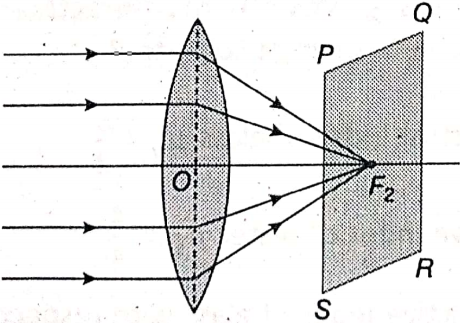


WBBSE Solutions For Class 10 Physical Science And Environment Chapter 5 Light Image 67

PQRS is the focal plane of the convex lens.

Question 2. Define the optical centre of a lens with a figure. What is the deviation of the ray passing through the optical centre of a lens.

Answer:

The optical centre of a lens with a figure:

1. If an emergent ray of light from a lens becomes parallel to the incident ray on it, then the point of intersection of the ray with the principal axis is called the optical centre of the lens.

WBBSE Solutions For Class 10 Physical Science And Environment Chapter 5 Light Image 68

AB is the incident ray on a convex lens and CD is the emergent ray. Further, AB is parallel to CD. In this case, the ray BC intersects the principal axis at a point O. O is the optical centre of the lens.

2. The ray passing through the optical centre of a lens makes no deviation.

Question 3. What is a thin lens? Define its optical cenmter with a figure.

Answer:

Thin lens:

1. A lens is called a thin lens when its thickness is negligible compared to the radii of curvature of the two spherical surfaces.
2. Optical centre of a thin lens is a special point on its principal axis so that any ray of light passing through it in passing through the lens suffers neither later displacement nor a net deviation.
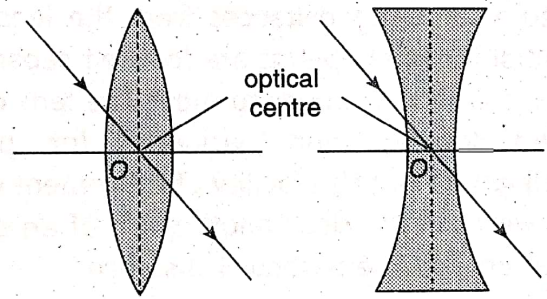


E:\websites-Haritha\west bengal.net\physical science\images\chapter 5\WBBSE Solutions For Class 10 Physical Science And Environment Chapter 5 Light Image 69.png


Question 4. An image of a candle is formed on the wall with the help of a lens. The size of the image is equal to the size of the candle. Here the distance between the candle and the wall is 80 cm. What is the nature of this lens? What is its focal length?

Answer:

Given:

An image of a candle is formed on the wall with the help of a lens. The size of the image is equal to the size of the candle. Here the distance between the candle and the wall is 80 cm.

1. In this case, a real image of the same size as that of the object has been formed with the help of the lens. Only a convex lens can form a real image. So, the lens is definitely a convex lens.

2. If an object is placed in front of the lens at a distance of twice the focal length (2ƒ), a real image of the same size as the object is formed.
2ƒ + 2ƒ= 80 or, ƒ= 20
i.e., the focal length of the lens is 20 cm.

Question 5. If a lens is kept at a distance of 12 cm in front of a wall, an inverted, diminished image of a distant tree is formed on the wall. What is the nature of the lens? What Is the value of the focal length of the lens?

Answer:

1. The lens is convex in nature because only a convex lens can form the real image of an object placed in front of it.
2. A beam of light rays from a distant tree may be regarded as a beam of parallel rays. A beam of parallel rays form a real image at the focal plane after refraction through the lens. As the distance of the wall on which the image is formed is 12 cm from the lens, the focal length of the lens is 12 cm (approx).

Question 6. What type of lens Is used in a simple camera? What is the characteristic of an image taken by a camera on its photographic plate?

Answer:

1. A convex lens is used in a simple camera.
2. A real image is formed on the photographic plate in a camera. So, it is inverted with respect to the object. The size of the image compared to the size of the object depends on the distance of the object from the lens.

Question 7. Show that, linear magnification of a lens can be expressed by the ratio of image distance and object distance.

Answer: O1O2 is an extended object kept perpendicularly on the principal axis of a convex lens and a concave lens respectively and I1I2 is its image.

Let us suppose that object distance, OO2=u and image distance, OI2 = ν.

We get from the images that in ΔOO1O2 and ΔOI1I2, ∠O1OO2 = ∠I1OI2(opposite angle),
and ∠O1O = ∠I1I2O(both are right angles)
and ∠O2O1O = ∠OI1I2(alternate angle)

∴ ΔO2O1O and Δ OI1I2
\(\frac{O_1 O_2}{I_1 I_2}=\frac{O O_2}{O I_2} \text { or, } \frac{I_1 I_2}{O_1 O_2}=\frac{O I_2}{O O_2}\)
and hence magnification, \(m=\frac{v}{u}\)

Question 8. What do you mean by focusing in a camera? If the position of the lens of a camera remains fixed> is it possible to take a clear photograph of an object at an arty distance? Explain.

Answer:
1. Focusing in a camera is the formation of an image on photographic film with the help of the lens of the camera.
2. The image is clearest when there is correct focusing. To form a clear image of an object placed at different distances from the lens, it is essential that the objects are focused separately. There is an arrangement to move the lens of the camera forward and backward for proper focusing. Without this facility of movement of the lens, we can take clear photograph of an object placed only at one particular distance.

Question 9. Draw the diagram of a human eye and label the different parts. Show how an image is formed in the eye with the help of a ray diagram.

Answer:

WBBSE Solutions For Class 10 Physical Science And Environment Chapter 5 Light Human Eye And Its Parts


Question 10. Write down the definition of the terms ‘near point’, ‘far point’ and ‘range of vision’ of an eye and what are the values of these for a normal eye?

Answer:
Near point: The nearest point that we can see clearly by our eyes without any adjustment is the near point The distance of this near point from a normal eye is approximately 25 cm.
Far point: The farthest point that we can see clearly by our eyes without any adjustment is the far point. The far point for a normal eye is situated at infinity.
Range of vision: The distance between the near point and the far point is called the range of vision of the eye. For a normal eye, this distance ranges from 25 cm to infinity.

Question 11. What is hypermetropia? Explain the defect of long-sightedness with proper diagram.

Answer:

Hypermetropia:

1. If one can see distant objects but not the nearby objects clearly, then this defect is called long-sightedness or hypermetropia.
2. If the near point of the eye of an individual is displaced, the defect of long-sightedness is observed.

Let N be the near point of a normal eye. Here, the image of the point N is formed at a point behind the retina instead of getting focused at the retina. The eye forms the image of the nearest point N’ at retina by maximum adjustment. In this case, N’ is the near point of an eye with the defect of long-sightedness.


WBBSE Solutions For Class 10 Physical Science And Environment Chapter 5 Light Hypermetropia And Its Defects


Question 12. What is the remedy for the defect of short-sightedness? Explain with a diagram.

Answer:

The remedy for the defect of short-sightednes:

1. If a pair of spectacles with concave lenses of suitable focal lengths are used, the defect of short-sightedness can be remedied.
2. Let the near point of an individual with the defect of long-sightedness be N’ and the near point for the normal eye be N. The focal ength of the convex lens is such that after refraction through the lens, the virtual image of the point N is formed at N’. As a result, the point N appears to be at the point N’.


WBBSE Solutions For Class 10 Physical Science And Environment Chapter 5 Light Image 75


Question 13. What is myopia? Explain the defect of short-sightedness with proper diagram.

Answer:

Myopia:

1. If one can see the nearby objects but not the distant objects very clearly, then this defect is called short-sightedness or myopia.
2. A beam of parallel rays coming from a distant object, after refraction by the lens of the eye is focused at a point A in front of the retina instead of getting focussed at the retina. In this case, the far point is displaced to some point in front of the eyes instead of being located at infinity.


WBBSE Solutions For Class 10 Physical Science And Environment Chapter 5 Light Image 76


Question 14. What Is the remedy for the defect of long-sightedness? Explain with proper diagram.

Answer:

Remedy for the defect of long-sightedness

1. If a pair of spectacles with convex lenses of suitable focal lengths are used, the defect of long sightedness can be remedied.
2. The focal length of the concave lens is such that the incident parallel rays coming from any distant object, after refraction through the concave lens, appear to diverge from a point F and the image is formed at the retina.


WBBSE Solutions For Class 10 Physical Science And Environment Chapter 5 Light Image 77


Question 15. Write down the differences between an eye and a camera.

Answer:

The differences between an eye and a camera

Eye Camera
1. The focal length of the lens of the eye can be changed. 1. The focal length of the objective of a camera is fixed.
2. The distance between the lens of the eye and the screen or retina is fixed. 2. The distance between the objective of the camera and the screen or film can be changed.
3. Innumerable images are formed on the retina but none of them is permanent. 3. One image is formed in one film of the camera and a permanent photograph is obtained from that image.


Question 16. What is a lens? How many types of lenses are there? Mention them.

Answer:

Lens

1. A lens is a transparent refracting medium bounded by two spherical surfaces or one spherical surface and another plane surface.
2. There are two types of lenses. One is called a convex lens and the other is called the concave lens.

Question 17. What are convex lenses and concave lenses?

Answer:
Convex Lens: A lens whose middle portion is thick and whose two edges become thin gradually, is called a convex lens.
Concave Lens: A lens whose middle portion is thin and whose two edges become gradually thick is called a concave lens.

Question 18. Why is a convex lens called a converging lens and a concave lens called diverging lens?

Answer: If a beam of parallel rays of light is incident on a convex lens, they are converted into a beam of converging rays after refraction through the lens. That is why a convex lens is called a converging lens.

Again, if a beam of a parallel rays of light is incident on a concave lens, they are converted into a beam of diverging rays of light after refraction through the lens. That is why a concave lens is called a diverging lens.


WBBSE Solutions For Class 10 Physical Science And Environment Chapter 5 Light Image 78


Question 19. Define the first principal focus of a convex lens with a proper diagram.

Answer:

The first principal focus of a convex lens with a proper diagram:

The first principal focus of a convex lens is a point located on the principal axis of the lens, such that the divergent rays coming from it, become parallel to the principal axis of the lens after refraction through the lens. F1 the first principal focus of a convex lens.


WBBSE Solutions For Class 10 Physical Science And Environment Chapter 5 Light Image 79


Question 20. Define the first principal focus of a concave lens with a proper diagram.

Answer:

The first principal focus of a concave lens with a proper diagram

The first principal focus of a concave lens is a point on the principal axis such that an incident beam of light rays directed towards it, emerges parallel to the principal axis after refraction through the lens.


WBBSE Solutions For Class 10 Physical Science And Environment Chapter 5 Light Image 80.


F1 is the first principal focus of a concave lens.

Question 21. Define the second principal focus of a concave lens with diagram, identify the focal distance and the focal plane in the diagram.

Answer: A beam of light incident parallel to the principal axis of a concave lens appears to diverge from a point on the principal axis after refraction by the lens. This point is called the second principal focus F2 of the lens.


WBBSE Solutions For Class 10 Physical Science And Environment Chapter 5 Light Image 81


OF2 is the focal length of the lens and PQRS is the focal plane.

Question 22. Define the following with figures for a lens:
(1)Centre of curvature
(2)Radius of curvature
(3)Principal axis

Answer:
(1)The centre of the sphere, of which any of its two surfaces of a lens is a part, is called the centre of curvature of that particular surface of the lens.

The centres of curvature of the right and the left spherical surfaces of the convex lens are C1 and C2 respectively.
The centres of curvature of the left and the right spherical surfaces of the concave lens are C1 and C2 respectively.

(2)The radius of the sphere of which the spherical surface of a lens is a part is called the radius of curvature of that sphere.


WBBSE Solutions For Class 10 Physical Science And Environment Chapter 5 Light Image 82


C1L1  and C2L1 are the radii of curvature of the right and the left spherical surfaces of a convex lens. C1P1 and C2P2 are the radii of curvature of the left and the right spherical surfaces of the concave lens.

(3)If the two surfaces of a lens are spherical, the line joining the two centres of curvature is called the principal axis of the lens. In the image C1 and C2  is the principal axis of both the convex and concave lens respectively.

Question 23. Explain the following with figures:
(1)Secondary focus of a convex lens
(2) Secondary focus of a concave lens

Answer:
(1)A parallel beam of incident light inclined to the principal axis of a convex lens meets at a point on the focal plane after refraction through the lens. This point is called the secondary focus. F’ is the secondary focus of the convex lens.


WBBSE Solutions For Class 10 Physical Science And Environment Chapter 5 Light Image 83


(2)A parallel beam of incident light inclined to the principal axis of a concave lens appears to diverge from a point located on the focal plane of the lens after refraction through the lens. This point is called the secondary focus. F’ is the secondary focus of the concave lens.
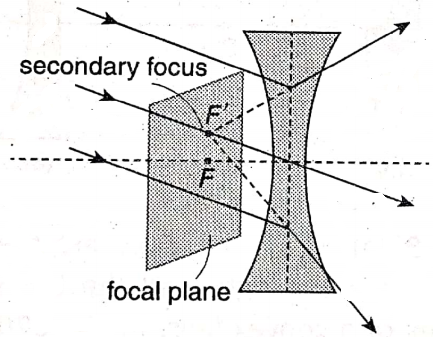
 

WBBSE Solutions For Class 10 Physical Science And Environment Chapter 5 Light Image 84


(3)A parallel beam of incident light inclined to the principal axis of a concave lens appears to diverge from a point located on the focal plane of the lens after refraction through the lens. This point is called the secondary focus. F’ is the secondary focus of the concave lens.

Question 24. Explain the converging action of a convex lens.

Answer;

The converging action of a convex lens:

Let us suppose that a beam of light parallel to the principal axis is incident on a convex lens, To get an idea about the nature of refraction of this parallel beam of rays, the lens is considered to be the sum of a very large number of small sliced (truncated) prisms.

The bases of these prisms above and below the principal axis are oriented towards the principal axis. When a ray of light is incident on any small sliced prism parallel to the principal axis, it bends towards the base of the prism due to refraction.

As a result, the parallel rays of the beam meet at a particular point on the principal axis after refraction. In this way, a convex lens transforms a beam of parallel rays to a beam of converging rays. That is the reason why a convex lens is also known as a converging lens.
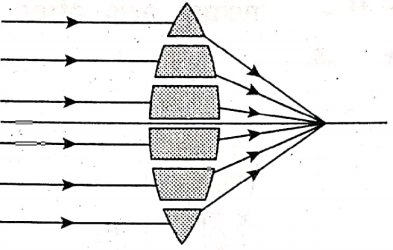
 

WBBSE Solutions For Class 10 Physical Science And Environment Chapter 5 Light Converging Action Of A Convex Lens


Question 25. Explain the diverging action of a concave lens.

Answer:

The diverging action of a concave lens:

Let us suppose that a beam of light parallel to the principal axis is incident on a concave lens. To get an idea about the nature of refraction of this parallel beam of rays, the lens is considered to be an aggregate of a very large number of small sliced (truncated) prisms.

The bases of these prisms above and below the principal axis are oriented away from the principal axis of the concave lens. When an incident ray falls on any small sliced prism in a direction parallel to the principal axis, it bends towards the base of the prism due to refraction.

As a result, the parallel rays of the beam appear to diverge from a particular point on the principal axis after refraction. In this way a concave lens transforms a beam of parallel rays to a beam of diverging rays. That is the reason why a concave lens is also known as a diverging lens.


WBBSE Solutions For Class 10 Physical Science And Environment Chapter 5 Light Diverging Action Of A Concave Lens


Question 26. What is a linear magnification of a lens?

Answer:

A linear magnification of a lens:

The ratio of the height of the image of an object to the height of the object kept perpendicular to the principal axis of the lens, is known as the linear magnification of the lens.

If the heights of the object and the image are and h2, then linear magnification, \(m=\frac{h_2}{h_1}\)

Question 27. Nature of the image is given below. Draw a ray diagram of the formation of image of an extended object by a convex lens. Mention the position of the object, the position of the image and the practical application in each of the following cases:
(1)Very small real image compared to the size of the object
(2)A Real image of a smaller size than the object
(3)A real image of the same size as that of the object
(4)A real image of size larger than that of the object
(5)Virtual Image

Answer:

Nature of the image Position of the object Position of the image Practical application
  1. Very small real image compared to the size of the object
An infinite distance from the lens On the focal plane of the lens on the side of the lens other than that on which the object is placed The objective of a telescope is made by utilising this property of a convex lens
2. A real image of smaller size than the object At a distance more than twice the focal length of the lens On the side of the lens other than that on which the object is placed and at a distance between ƒ and 2ƒ This property of a convex lens is used in a camera


WBBSE Solutions For Class 10 Physical Science And Environment Chapter 5 Light Image 90


WBBSE Solutions For Class 10 Physical Science And Environment Chapter 5 Light Image 91


Nature of the image Position of the object Position of the image  Practical application
3. A real image of the same size as that of the object At a distance of 2ƒ from the lens At a distance of 2ƒ from the lens on the side of the lens other than that on which the object is placed This property of the convex lens is utilised in a terrestrial telescope to convert an inverted image into an erect one
4. A real image of size larger than that of the object The object is positioned between ƒ and 2ƒ from the lens At a distance of more than 2ƒ from the lens on the side of the lens other than that on which the object is placed The objective of a microscope utilises this property of a convex lens


WBBSE Solutions For Class 10 Physical Science And Environment Chapter 5 Light Image 92


WBBSE Solutions For Class 10 Physical Science And Environment Chapter 5 Light Image 93


Nature of the image  Position of the object Position of the image Practical application 
5. Virtual image The object is placed between the lens and the focus The image is produced on the side as that of the object but behind the object In this case, the virtual image is always larger in size than the object. A magnifying glass works according to this principle.


WBBSE Solutions For Class 10 Physical Science And Environment Chapter 5 Light Image 94


Question 28. A candle kept very close to a convex lens of focal length ƒ Is slowly removed from the lens. Different positions of the candle are given below. Mention the position of the image, its size and nature in each of the given cases. Position of the candle:
1. At a distance less than ƒ from the lens
2. At focus
3. More than ƒ but less than 2ƒ distance from the lens
4. At a distance 2ƒ from the tens
5. More than 2ƒ distance from the lens
6. At a very large distance from the lens

Answer:

Position of the candle  Position of the image Size and nature of the image
1. At a distance less than ƒ At a distance of more than ƒ on the same side of the lens as the object Magnified, erect, virtual
2. At the focus At infinity, on the other side of the lens on which the object is placed. Highly magnified, inverted, real
3. Distance is more than ƒ but less than 2ƒ At a distance of more than 2ƒ on the other side of the lens on which the object is placed. Magnified, inverted, real
4. At a distance of 2ƒ At a distance of 2ƒ on the other side of the lens on which the object is placed Same size, inverted, real
5. At a distance more than 2ƒ At a distance more than ƒ but less than 2ƒ on the other side of the lens on which the object is placed Diminished, inverted, real
6. At a very large distance At the second principal focal plane Highly diminished, inverted, real


Visual Representation of Light Phenomena

Question 29. Why the convex lens is called as a magnifying glass? State uses of magnifying glass in practice.

Answer:
1. If an object (or writings) is placed within the focus of a convex lens and is looked through it, the object looks magnified. Hence the convex lens is called as a magnifying glass.
 

WBBSE Solutions For Class 10 Physical Science And Environment Chapter 5 Light Magnifying Glass


2. A magnifying glass is used to get an enlarged view of a small object. For example, it is used to read the small writing on a bottle of syrup or on a medicine packet. Further, it is used to help a watch mechanic to see the very small instruments of a watch or to note the fine readings in a laboratory.

Question 30. Draw a ray diagram showing the image formation of an object by a concave lens.

Answer: L1L is a thin concave lens with a small aperture. O1O2 is an extended object placed perpendicularly on the principal axis of the concave lens.


WBBSE Solutions For Class 10 Physical Science And Environment Chapter 5 Light Image 96

Here the image is virtual. It is erect and diminished in size.

Question 31. How do you recognise whether a lens is a convex lens Or a concave lens?

Answer: It is known that if an object is placed in front of a convex lens at a distance less than its focal length, an erect, magnified and virtual image of the object is formed. On the other hand, a concave lens always forms an erect, diminished and real image.

A pencil is kept in front of a lens and it can be seen through the lens from the other side. If a magnified and erect image is seen, the lens is convex and if the image is diminished and erect, the lens is concave.

Question 32. The focal length of a convex lens is 15 cm. Suppose you want to read the small writings on a bottle of syrup. Where will you keep the lens?

Answer: We know that if a convex lens is kept in front of an object within a distance of its focal length, an erect, magnified and virtual image of the object in formed. So, in order to read the small writings on a bottle of syrup, the bottle must be kept within a distance of 15 cm from the lens. The writings look magnified from the other side of the lens.

Question 33. On which factors does the focal length of a lens depend?

Answer: The focal length of a lens depends on the following factors:
1. Refractive index of the material of the lens and the surrounding medium.
2. Radii of curvature of the two spherical surfaces of the lens.

Question 34. What is a conjugate pair of foci of a lens?

Answer:

Conjugate pair of foci of a lens

By keeping the position of the lens fixed, if two points are located on the principal axis such that for a point object placed at one, an image is formed at the other, then these two points are called conjugate pair of foci.

Question 35. what Is the change in the image of an object If one half of a convex lens is covered with a black paper?

Answer: As one half of the lens is still exposed, light refracts through that portion and a full image of the object is formed since there is no refraction of light through the other half, the brightness of the image reduces.

Question 36. Why is a human eye compared to a camera?

Answer: When an object is placed in front of a camera, a picture (real image) is produced on the film of the camera. Similarly when an object is placed in front of the eye, a real image of that object is produced on the screen of the eye (retina). This is why a human eye is compared to a camera.

Question 37. What do you mean by accommodation and adaptation of an eye?

Answer:

Accommodation and adaptation of an eye

Accommodation is the process by which the human eye changes optical power to focus on an object as its distance varies (from 25 cm to infinity). The pupil of the eye controls the amount of light entering the eye by its automatic contraction and expansion. This ability of the eye is called adaptation.

Question 38. What is the role of different colours of light to form the colour of a transparent body? Write down with examples.

Answer:

The role of different colours of light to form the colour of a transparent body

1. When light of a particular colour emerges from a transparent body (like air, water, or glass), the body appears to be of the same colour as the colour of the light.
2. For example, only red light can pass through a red glass. If light of any other colour passes through it, it is absorbed. That is why the piece of glass looks red. Again, if a blue glass is placed below a red glass and if it seen from the top, the blue glass looks black due to the reason that if the blue colour goes through a red glass, red glass absorbs it.

Question 39. How does a red species of china rose appear at night in a room lighted with blue light?

Answer: If a red species of china rose flower is seen at night in a room lighted with blue light, it appears black. Since red species of china rose absorbs all colours except red, if the blue light of the room falls on this flower, it absorbs that and no light is reflected by it.

Question 40. What do you mean by the statement that the colour of an object Is white or black?

Answer:

The colour of an object Is white or black

Black and white are not fundamental colours. If an object absorbs all colours then it looks black and if it reflects all the seven colours of the sunlight, it looks white. For example, if sunlight falls on an umbrella, it absorbs all the incident light and no light is reflected. So a black umbrella appears black. Again, if the rays of the sun fall on a white cloth, the cloth reflects all the incident colours and so white cloth appears white.

Question 41. If a white flower is viewed through a blue glass, how does it look?

Answer: If a white flowers is viewed through a blue glass, it appears blue. The seven colors reflected from the white flower enter the blue glass and the glass absorbs all the colours except the blue one. Only blue light reaches the observer and so the flower appears blue.

Question 42. How does the sun look if it is viewed through red glass?

Answer: If rays of the sun fall on a red glass, it absorbs all the light except the red one and then only red rays reach the eyes of a viewer. So the sun appears red.

Question 43. How does it look if a red and a blue glass are kept together and then viewed from the front?

Answer: If the sun’s rays fall on a red glass, it absorbs all the colours except the red one. So only red light is incident on the blue glass. But blue glass again absorbs red light. As a result, no light reaches the observer.

Question 44. Moon has no atmosphere. What can you determine logically about the colour of the sky of the moon?

Answer: There is no atmosphere in the moon, so there is no scattering of sunlight in moon. As no light comes to the surface of the moon from its sky, the sky of the moon appears black.

Light Topic C Lenses Very Short Answer Type Questions Choose The Correct Answers

Question 1. The number of principal focus of a lens is

  1. One
  2. Two
  3. Three
  4. Four

Answer: 2. Two

Question 2. A convex lens forms a magnified real image of an object

  1. Placed at a distance less than ƒ
  2. Placed at a distance more than but less than 2ƒ
  3. Placed at a distance of 2ƒ
  4. Placed at a distance of more than 2ƒ

Answer: 2. Placed at a distance more than but less than 2ƒ

Question 3. The values of object distance and image distance in a convex lens are 10 cm and 20 cm respectively. What is linear magnification?

  1. 1/2
  2. 2
  3. 1/4
  4. 4

Answer: 2. 2

Question 4. The distance of the near point of a normal eye is about

  1. 20 cm
  2. 25 cm
  3. 30 cm
  4. 50 cm

Answer: 2. 25 cm

Question 5. If we place a red glass on a blue glass and observe from the top, what colour does the blue glass convey?

  1. Blue
  2. Red
  3. Yellow
  4. Black

Answer: 4. Black

Question 6. For a concavo-convex lens

  1. The radius of curvature of convex surface is less than the radius of curvature of concave surface
  2. The radius of curvature of convex surface is equal to the radius of curvature of concave surface
  3. The radius of curvature of concave surface is less than the radius of curvature of convex surface
  4. One surface is convex and the other surface is plane

Answer: 1. The radius of curvature of convex surface is less than the radius of curvature of concave surface

Question 7. For a convexo-concave Sens

  1. The radius of curvature of convex surface is less than the radius of curvature of concave surface
  2. The radius of curvature of convex surface is equal to the radius of curvature of concave surface
  3. The radius of curvature of convex surface is more than the radius of curvature of concave surface
  4. One surface is concave and the other surface is plane

Answer: 3. The radius of curvature of convex surface is more than the radius of curvature of concave surface

Question 8. The optical centre of a plano-convex lens is located

  1. At the point of intersection of the principal axis and the plane surface
  2. The principal axis is outside the lens but nearer to the plane surface
  3. At the point of intersection of principal axis and the convex surface
  4. On the principal axis and is outside the lens but nearer to the convex surface

Answer: 3. At the point of intersection of principal axis and the convex surface

Question 9. A convex lens forms a magnified virtual image of an object when the object distance is

  1. Equal to ƒ
  2. Equal to 2ƒ
  3. Less than ƒ
  4. More than 2ƒ

Answer: 3. Less than ƒ

Question 10. A convex lens forms a diminished real image of an object when

  1. ƒ< u < 2ƒ
  2. u < ƒ
  3. u = ƒ
  4. u>2ƒ

Answer: 4. u>2ƒ

Question 11. A convex lens forms a real image of the same size of an object when the object distance is

  1. Less than ƒ
  2. Equal to 2ƒ
  3. More than 2ƒ
  4. More than / but less than 2ƒ

Answer: 2. Equal to 2ƒ

Question 12. When a convex lens forms a virtual image of magnification m then

  1. m > 1
  2. m = l
  3. m < 1
  4. m ≤ 1

Answer: 1. m > 1

Question 13. A concave lens forms

  1. Always a magnified virtual image
  2. Always a diminished virtual image
  3. Always a virtual image of the same size as the object
  4. Amagnified real image

Answer: 2. Always a diminished virtual image

Question 14. The focal length of a lens depends

  1. Only on the colour of the incident light
  2. Only on the refractive index of the materials of the lens with respect to the surrounding medium
  3. Only on the radius of curvature of the two spherical, surfaces
  4. On all the above three

Answer: 4. On all the above three

Question 15. If an object is kept at a distance of more than / but less than 2/ in front of a convex lens, then image distance is

  1. Less than ƒ on the other side
  2. More than 2ƒ on the other side
  3. More than ƒ on the same side as the object
  4. 2ƒ on the other side

Answer: 2. More than 2ƒ on the other side

Question 16. If an object is kept at a distance of more than 2ƒ  in front of a convex lens, then image distance is

  1. More than 2ƒ on the other side
  2. More than ƒ but less than 2ƒ on the other side
  3. More than ƒ on the same side as the object
  4. More than 2ƒ on the other side

Answer: 2. More than ƒ but less than 2ƒ on the other side

Question 17. If an object is kept at a distance of less than f in front of a convex lens, then the image distance is

  1. Always less than the object distance
  2. Less or more than the object distance
  3. Always more than the object distance
  4. Less or equal to the object distance

Answer: 3. Always more than the object distance

Question 18. If an object is kept in front of a concave lens, then the image distance is

  1. Always more than the the object distance
  2. Always less than the object distance
  3. More or equal to the object distance
  4. More or less than the object distance

Answer: 2. Always less than the object distance

Question 19. To minimise the reflection of light, the inner walls of a pin-hole camera should be coloured in

  1. White
  2. Red
  3. Yellow
  4. Black

Answer: 4. Black

Question 20. A person with a defect of long-sightedness should use

  1. Convex lens
  2. Concave lens
  3. Cylindrical lens
  4. Toric lens

Answer: 1. Convex lens

Question 21. A person with a defect of short-sightedness should use

  1. Convex lens
  2. Concave lens
  3. Cylindrical lens
  4. Toric lens

Answer: 2. Concave lens

Question 22. A convex lens

  1. Converges light rays
  2. Diverges light rays
  3. Form real images always
  4. Form virtual images always

Answer: 1. Converges light rays

Question 23. Near and far points of human eye are

  1. 25 cm and infinity
  2. 50 cm and infinity
  3. Infinity and 0 cm
  4. Ocrn and 25 cm

Answer: 1. 25 cm and infinity

Question 24. For a normal eye, the least distance of distinct vision is

  1. 0.25 m
  2. 0.5 m
  3. 25 m
  4. Infinity

Answer: 1. 0.25 m

Question 25. Image formed on the retina is

  1. Real and inverted
  2. Virtual and erect
  3. Real and erect
  4. Virtual and inverted

Answer: 1. Real and inverted

Question 26. The impact of an image on the retina remains for

  1. 0.1s
  2. 1 s
  3. 0.5 s
  4. 10 s

Answer: 1. 0.1s

Question 27. The transparent watery liquid acts as the refracting medium of light and occupies the space between the cornea and the eye lens is

  1. Aqueous humour
  2. Vitreous humour
  3. Tear
  4. Glycerin

Answer: 1. Aqueous humour


Light Topic C Lenses Answer In Brief


Question 1. Which lens is known as a converging lens?
Answer: A convex lens is known as a converging lens.

Question 2. Which lens is known as a diverging lens?
Answer: A concave lens is known as a diverging lens.

Question 3. Can the optical centre of a lens be outside the lens?
Answer: Yes, the optical centre of a lens can be outside the lens. For example, concavo-convex lens, and convexo-concave lens.

Question 4. How many principal focal points of a lens are there?
Answer: There are two principal focal points of a lens.

Question 5. How many secondary focal points of a lens are there?
Answer: There are infinite number of secondary focal points of a lens.

Question 6. What is the nature of the path of the refracted rays when the rays incident on a lens are directed towards the optical centre?
Answer: If the incident rays are directed towards the optical centre, the rays get refracted along the same path.

Question 7. Which lens always forms a virtual image?
Answer: A concave or diverging lens always forms a virtual image.

Question 8. At a particular position of an object in front of a lens, an image of the same size as the object is formed. What is the nature of the Sens?
Answer: The lens is convex in nature.

Question 9. In which lens, a virtual image is formed which is smaller than the object?
Answer: Such an image is formed by a concave lens.

Question 10. Which type of lens is used as a magnifying glass?
Answer: A convex lens is used as a magnifying glass.

Question 11. If a finger is viewed from the opposite side of a lens, the finger looks smaller. What is the nature of the lens?
Answer: The lens is concave in nature.

Question 12. If a finger is viewed from the opposite side of a lens, the finger looks larger. What is the nature of the lens?
Answer: The lens is convex in nature.

Question 13. Where should a convex lens of focal length 10 cm be placed in order to read the small letters of a book?
Answer: The lens has to be placed at a distance of less than 10 cm from the book.

Question 14. Does a camera form a real or a virtual image of an object?
Answer: A real image of the object is formed in a camera.

Question 15. What is the main function of the retina?
Answer: The main function of the retina is to form an image of the object.

Question 16. Which portion of the retina does not contain any photosensitive cell?
Answer: The blind spot of the retina does not contain any photosensitive cell.

Question 17. Speed of light in two media A and B are 2 x 10⁸ m/s and 2.25 x 10⁸ m/s respectively. Which one is the rarer medium?
Answer: Speed of light is greater in medium B than that in medium A. So, B is the rarer medium.

Question 18. Speed of light in two media X and Y are 1.5 x 10⁸ m/s and 1.9 x 10⁸ m/s respectively. Which one is the denser medium?
Answer: Speed of light in medium X is smaller than that in Y. So, X is the denser medium.

Question 19. Which wavelength of light does produce a sensation of vision in our eyes?
Answer: Light of wavelength 4000A to 8000A produces a sensation of vision in our eyes.


Light Topic C Lenses Fill In The Blanks


Question 1. The pupil is present at the centre of _____
Answer: Iris

Question 2. The near point is situated at a longer distance than normal distance for a man with ________ sightedness.
Answer: Long

Question 3. The far point is situated at a shorter distance than normal distance for a man with ________ sightedness.
Answer: Short

Question 4. If a convex lens is immersed in water, its focal length ______
Answer: Increases

Question 5. A _____ lens always forms a virtual image of an object.
Answer: Concave

Question 6. A ______ lens is used in photography.
Answer: Convex

Question 7. An object is placed at a distance 2ƒ from a convex lens of focal length ƒ. The size of image formed is that of the object.
Answer: Equal

Question 8. A magnifying glass is a _______ lens.
Answer: Convex


Light Topic C Lenses State Whether True Or False


Question 1. When a ray of light passes through the optical centre of a thin lens, there is no deviation or lateral displacement of the light ray.
Answer: True

Question 2. A concave lens kept in the air medium acts as a converging lens.
Answer: False

Question 3. A person suffering from near-sightedness cannot see the nearby objects clearly.
Answer: False

Question 4. The colour of an opaque object is that it absorbs.
Answer: False

Question 5. If an object does not reflect any colour at all, it appears to be black in colour.
Answer: True

Question 6. The colour of the rays of light that emerge from a transparent object appears to be the colour of the object.
Answer: True

Question 7. In case of a concavo-convex lens optical centre lies out side the lens.
Answer: True

Question 8. A thin lens is one of which the thickness at the principal axis is small compared with the radii of curvature of the two surfaces.
Answer: True

Question 9. Air bubble into water acts like a concave lens.
Answer: True

Question 10. A magnifying glass is concave lens.
Answer: False

Question 11. Image formed by the convex lens may be magnified and virtual.
Answer: True


Light Topic C Lenses Numerical Examples


1. For refraction through a lens, if object distance = u, image distance = v, height of the object = h1 height of the image = h2

The linear magnification, \(m=\frac{\text { image height }}{\text { object height }}=\frac{h_2}{h_1}=\frac{v}{u}\)

Question 1. The focal length of a convex lens is 10cm. Where should an object be placed in front of the lens so that the image formed is

  1. Magnified and real
  2. Diminished and real
  3. Of the same size and real
  4. Magnified and virtual

Answer: Focal length of the lens, ƒ = 10 cm
∴ 2ƒ= 2 x 10 = 20 cm
Let us suppose that object distance = u

  1. To get a magnified and real image, ƒ<u<2ƒ or, 10 cm < u < 20 cm is the condition.
  2. To get a diminished and real image, u > 2ƒ or, u > 20 cm is the condition.
  3. To get a real image of the same size, u = 2ƒ or, u = 20 cm is the condition,
  4. To get a magnified and virtual image, u < ƒor, u < 10 cm is the condition.

Wb Class 10 Physical Science Question and Answers

Question 2. Focal length of a convex lens is 10 cm. An object of height 2 cm is placed at a distance 20 cm from the lens, What is nature and magnification of the image?

Answer: Focal length of the convex lens is ƒ= 10 cm,
object distance u = 20 cm
Here, u = 20 cm.= 2 x 10 cm = 2ƒ
Therefore, image distance v = 2ƒ= u = 20 cm
As, u> ƒ thus image will be real.

Height of the object  h1 = 2 cm and height of the image = h2 say ,
Now, magnification of the image,\(\frac{h_2}{h_1}=\frac{v}{u}\)
or, \(\frac{h_2}{2}=\frac{20}{20}\)
∴ h2 = 2cm
∴ Height of the image is 2 cm and the image is real, inverted.

Question 3. Height of an object is 5 cm. When the object is placed in front of a convex lens at a distance 2 cm from the lens, an image of 10 cm height is obtained. What is image distance and the magnification of the object?

Answer: Object height = h1 = 5cm, image height = h2 = 10 cm , object distance = u = 2 cm , image distance = v (say)

∴ Linear magnification of the image \(m=\frac{h_2}{h_1}=\frac{10}{5}=2\)

Again, \(\frac{h_2}{h_1}=\frac{v}{u}\) or, \(\frac{v}{2}=\frac{10}{5} \quad \text { or, } v=\frac{10 \times 2}{5}=4\)

.’.So the image distance is 4 cm.

Question 4. When an object is placed in front of a convex lens at a distance 15 cm from the lens, image of the object is formed in opposite side of the lens at a distance 30 cm from the lens. Find the magnification and height of the image if object height is 1.5 cm.

Answer: Object distance u = 15 cm ,
Image distance v = 30 cm
∴ Magnification of the image = \(\frac{v}{u}=\frac{30}{15}=2\) and height of the image, (h2) = m x object height = 1.5 x 2 = 3 cm


Light Topic D Dispersion Of Light And Light Wave Synopsis


1. When a beam of polychromatic light enters into a refracting medium obliquely, it splits into its component colours. This phenomenon is called dispersion of Sight.
2. Spectrum is the sequence of the colours obtained after the dispersion of white light.
3. Rainbow is a natural example of the dispersion of light.

4. The causes of dispersion: In vacuum or air all the different colours of light rays travel at the same speed. But through any other medium, they travel with different speed and gets refracted through different angles. Thus cause of dispersion is the change in speed of light.

5. Colour of different bodies: Colour of a body depends on 0 the colour of incident light 0the portion of light absorbed by them.

6. Colour of an opaque body: A opaque body appears in that colour which is reflected by the body.

7. Colour of transparent body: The colour of a transparent object determined by the colour it can transmit when illuminated by white light.

Wb Class 10 Physical Science Question and Answers

8. Primary colours: Red, blue and green colours are called primary colours.

9. Complementary colours: Any two special colours which on mixing together give the sensation of white are known as complementary colours.
Example: blue + yellow = green + magenta = red + peacock blue = white

10. Light rays of wavelengths 4000A to 8000A creates a sensation of vision of our eyes.
11. Light is an electromagnetic transverse wave. This wave does not affected by the electric and magnetic field.

∴ Speed of light in vacuum c = νλ, where ν and λ are the frequency and wavelength of light wave respectively.

12. Dust particles or air molecules have smaller dimensions than the wavelength of incident visible light. These particles absorb the incident light and then emit the same wave. This phenomenon is called the scattering of light.
13. Scientist Rayleigh proved that the intensity of scattered light (l) is inversely proportional to the fourth power of the wavelength ( λ ) of light, i.e„ \(I \propto \frac{1}{\lambda^4}\)


Light Topic D Dispersion Of Light And Light Wave Short And Long Answer Type Questions

Question 1. What is a dispersion of light? What is a spectrum? What is the sequence of colours in the spectrum of white light?

Answer:
1. A polychromatic light breaks into different colours while passing through a refracting medium. This phenomenon is called dispersion of light.
2. The band that is obtained due to the dispersion of polychromatic light in different colours is known as the spectrum.
3. The spectrum that is produced due to the dispersion of white light through a prism has red colour at the top and violet colour at the bottom. The colours are arranged from bottom to top in the following order: violet, indigo, blue, green, yellow, orange and red.

Question 2. With the help of an experiment, show that a prism does not create colour but disperses a polychromatic light.

Answer: A prism does not create colours, it simply separates the different colours present in white light. An experiment can be performed to demonstrate this. A beam of white light is incident on prism P1 through a small slit S. The rays emerging from the prism form a spectrum VR on the screen.

There is another small slit S1 in screen C1. By moving the screen up and down, any ray of the spectrum (say, yellow-coloured ray) is sent through S1 and is made to fall on another prism P2. The emergent rays from P2 fall on another screen C2. It can be seen that this light is not divided into different colours, i.e., no spectrum is formed. The same thing happens for other colours. This proves that the prism does not create any colour.


WBBSE Solutions For Class 10 Physical Science And Environment Chapter 5 Light Image 98


Question 3. Speeds of light in water and glass are 2.25 x 10⁸ m/s and 2 X 10⁸ m/s respectively. Which medium is optically denser?

Wb Class 10 Physical Science Question and Answers

Answer: Refractive index of water, \(\mu_w=\frac{c}{v_w}\) and that of glass, \(\mu_g=\frac{c}{v_g}\)

∴ \(\frac{\mu_w}{\mu_g}=\frac{\frac{c}{v_w}}{\frac{c}{v_g}}=\frac{v_g}{v_w}=\frac{2 \times 10^8 \mathrm{~m} / \mathrm{s}}{2.25 \times 10^8 \mathrm{~m} / \mathrm{s}}=\frac{2}{2.25}<1\)


i.e.., \(\mu_w<\mu_g \quad \text { or, } \mu_g>\mu_w\)
As refractive index of glass is greater than that of water, glass is the optically denser medium.

Question 4. Why is there no dispersion of light when white light falls on a rectangular slab of glass?

Answer: Let assume that a beam of white light is incident on a face of a rectangular glass slab. This beam of light is composed of innumerable rays. As the refractive index of glass is different for seven constituent colours of white light, dispersion occurs for each ray at the surface of separation.


WBBSE Solutions For Class 10 Physical Science And Environment Chapter 5 Light Image 99


Now as the slab is a rectangular one when these spectra emerge from the other face of the slab, they overlap with each other to form white light. Only lights at the two ends (red and violet) are refracted, whose amount is negligible as compared to the amount of refracted white light. So, there is no dispersion is found in a rectangular glass slab.

Question 5. What is a visible spectrum?

Answer: Electromagnetic waves which have wavelengths between 4000A and 8000 produce a sensation of vision in our eyes. The waves within this range constitute a visible spectrum.

Question 6. What type of wave is light? What is the relationship between the speed of light wave and the frequency of light?

Answer:
1. Light is an electromagnetic transverse wave.
2. The wavelength of a light wave is λ. If the frequency of light in any medium is ν, then speed of light in that medium, v = ν λ.

Question 7. Write down the uses of ultraviolet rays and also its harmful effects.

Answer: Uses of ultraviolet rays:
1. As a sterilising agent.
2. For detecting purity of gems, ghee, eggs etc 0 In manufacturing vitamin D.
3. In the treatment of skin infections like psoriasis.

Harmful effect: Excess exposure to ultraviolet ray may cause skin cancer.

Question 8. Write down the uses of X-rays and also their harmful effects.

Answer: Uses of X-rays:
1. To detect fractures in bones or the inner structure of teeth.
2. In the treatment of cancer and also in research for causes of different diseases.
3. To study the structure of crystals.
4. In forensic investigation.

Harmful effect: It may damage a normal cell if the cell is exposed to it for a prolonged period of time.

Question 9. Write down the uses of γ-ray and also its harmful effect.

Answer: Uses of  γ-ray:
1. In radiotherapy to destroy cancerous cells.
2. It is used in the industry to check if there is any gap in casting or moulding.

Harmful effect: It may damage a living cell to a great extent.

Question 10. What is the relation of the intensity of scattered light with its wavelength?

Answer: Scattering is not the same for light of all wavelengths. Light with a high wavelength has less scattering and light with a low wavelength has more scattering. Scientist Rayleigh proved that the intensity of scattered light is inversely proportional to the fourth power of the wavelength (λ) of light, i.e. \(I \propto \frac{1}{\lambda^4}/latex]

Question 11. what Is the role of different colours of light to form the colour of an opaque body? Write down with examples.

Answer: If an opaque body is kept in sunlight, it appears to be of the same colour which it reflects. If the body reflects more than one colour, it appears to have that colour which is produced by mixing those reflected colours.

For example, it can be said that when sunlight falls on a red species of china rose, it absorbs all colours except red. As it reflects only red colour, red species of chinarose looks red. Again, a leaf looks green because when sunlight falls on a leaf, it reflects only green light.

Wb Class 10 Physical Science Question and Answers

Question 12. Why does the sky look blue during day?

Answer: Rays of the sun travel a long distance through the atmosphere before coming to the earth’s surface. Small dust particles and molecules of gas present in the atmosphere cause the scattering of this sunlight.

As the wavelength of red light is greater than other lights in the visible spectrum, scattering of red light is less. But for blue or violet lights, scattering is more as the wavelength of these lights is less. Our eyes are more sensitive to blue light than violet, so the sky appears blue to us.

Question 13. Why is red fight used as a danger signal?

Answer: Red light has the longest wavelength among the lights of the visible spectrum. As a result, red light has the lowest amount of scattering. That is why red light is used as a danger signal.

Question 14. Why does the sun appear red during sunset and sunrise?

Answer: The sun remains at the horizon during sunrise or sunset, so the rays of the sun have to travel a long distance through the atmosphere. Among the seven constituent colours of sunlight, red light has the longest wavelength and so the scattering for it is the least.

The other lights with smaller wavelengths have greater scattering and as a result, do not reach the earth’s surface. Only red light reaches the earth. So, the sun appears red during sunset and sunrise.

Question 15. Why yellow light is used as a fog light in a vehicle?

Answer: Fog scatters the visible light in different directions, so we cannot see distant objects. As the wavelength of yellow light is comparatively greater, scattering is less and it is easy to see through the fog. But a scattering of red light is lesser but eyes are more sensitive to yellow light than red light. That is why yellow light is used as a fog light in a vehicle.


Light Topic D Dispersion Of Light And Light Wave Very Short Answer Type Questions Choose The Correct Answer


Question 1. In dispersion of white light with a prism, the colour appears on the top of the screen is

  1. Violet
  2. Red
  3. Yellow
  4. Green

Answer: 2. Red

Question 2. In the dispersion of white light with a prism, the colour that appears at the bottom of the screen is

  1. Violet
  2. Blue
  3. Red
  4. Orange

Answer: 1. Violet

Question 3. If the wavelength of light is A and its frequency is v, then the speed of light in a vacuum is

  1. ν/λ
  2. [latex]\frac{\lambda}{v}\)
  3. νλ
  4. \(\sqrt{v \lambda}\)

Answer: 3. νλ

Question 4. If a light wave of wavelength 6000 A enters water (\(\mu_w=\frac{4}{3}\) its wavelength will becomes

  1. 4000 A
  2. 4500 A
  3. 6000 A
  4. 8000 A

Answer: 2. 4500 A

Question 5. If a wave of frequency 1.6 x 10¹⁴ Hz Enters water \(\mu_w=\frac{4}{3}\), its wavelength becomes

  1. 1.2 × 10¹⁴ Hz
  2. 1.6 × 10¹⁴ Hz
  3. 2.3 × 10¹⁴ Hz
  4. 1.5 × 10¹⁴ Hz

Answer: 2. 1.6 x 10¹⁴ Hz

Wb Class 10 Physical Science Question and Answers

Question 6. Among the following electromagnetic waves, which one has the longest wavelength?

  1. Ultraviolet radiation
  2. Visible light wave
  3. Microwaves
  4. X-rays

Answer: 3. Microwaves

Question 7. Among the following electromagnetic waves, which one has the highest energy?

  1. Radiowaves
  2. Microwaves
  3. Infrared waves
  4. Visible light wave

Answer: 4. Visible light wave

Question 8. The relation between the intensity (I) of scattered light and its wavelength (λ) is

  1. \(I \propto \lambda\)
  2. \(I \propto \frac{1}{\lambda^2}\)
  3. \(I \propto \lambda^4\)
  4. \(I \propto \frac{1}{\lambda^4}\)

Answer: 4. \(I \propto \frac{1}{\lambda^4}\)

Question 9. Which colour does scatter least?

  1. Violet
  2. Blue
  3. Yellow
  4. Green

Answer: 3. Yellow

Question 10. Which colour does scatter most?

  1. Green
  2. Yellow
  3. Orange
  4. Red

Answer: 1. Green

Question 11. Among the following colours of light whose velocity is maximum while passing through a glass slab?

  1. Red
  2. Blue
  3. Yellow
  4. Violet

Answer: 1. Red

Question 12. What will, be the colour of the sky as seen from the earth, if there is no atmosphere

  1. Black
  2. Blue
  3. Red
  4. Green

Wbbse Class 10 Physical Science Question and Answers

Answer: 1. Black

Question 13. Sun set or sun rise, the sun looks redder than at mid-day because of

  1. The scattering effect of light
  2. The effect of refraction
  3. The effect of diffraction
  4. The sun is hottest at this time

Answer: 1. The scattering effect of light

Question 14. The colour of the sky is blue due to

  1. Bending of light beam
  2. Dispersion of light
  3. Scattering of light
  4. Reflection of light

Answer: 3. Scattering of light


Light Topic D Dispersion Of Light And Light Wave Answer In Brief


Question 1. In case of dispersion of white light a prism, which colour has the maximum angle of emergence?
Answer: Red light has the maximum angle of emergence.

Question 2. In case of dispersion of white light a prism, which colour has the minimum angle of emergence?
Answer: Violet light has the minimum angle of emergence.

Question 3. In an electromagnetic spectrum, which one has the minimum wavelength (or highest frequency)?
Answer: γ-ray in an electromagnetic spectrum has the minimum wavelength (or highest frequency).

Question 4. What is the speed of light in vacuum?
Answer: The speed of light in vacuum is 3 x 10⁸ m/s.

Question 5. In an electromagnetic spectrum, which one has the maximum wavelength (or lowest frequency)?
Answer: Radio wave in an electromagnetic spectrum has the maximum wavelength (or lowest frequency).

Question 6. Which property of light explains the blue colour of the sky during day?
Answre: Blue colour of sky duringday can be explained by the property of scattering of light.

Question 7. Which ray among visible spectrum scatters the most?
Answer: Violet ray scatters the most.

Question 8. Which colour is used as a danger signal?
Answer: Red colour is used as a danger signal.

Question 9. Which ray among visible spectrum scatters the least?
Answer: Red ray scatters the least.


Light Topic D Dispersion Of Light And Light Wave Fill In The Blanks


Question 1. The refractive index of any medium is _______ for red light than for yellow light.
Answer: Less

Question 2. γ-ray is _______ more powerful than X-ray.
Answer: More

Question 3. The wavelength of microwave is _______ than that of radio waves.
Answer: Less

Question 4. ______ ray is used to determine the structure of a crystalline material.
Answer: X

Wb Class 10 Physical Science Question and Answers

Question 5. In radiotherapy, ______ -ray is used to destroy the cancer cells of a patient.
Answer: γ

Question 6. If the speed of light in a medium is 1.5 x 10⁸ m/s, refractive index is _______
Answer: 2

Question 7. _____ of scattered light is inversely proportional to the λ4.
Answer: Intensity

Question 8. The phenomenon of splitting up of polychromatic light into different colours is called _______ of light.
Answer: Dispersion

Question 9. A Rainbow is the natural phenomenon ______ of light.
Answer: Dispersion

Question 10. Red, green and blue these three colours are called _____ colours.
Answer: Primary

Question 11. _____ light is always used as a danger signal.
Answer: Red

Question 12. Glass is a _____ medium.
Answer: Dispersive

Question 13. Any two colours which on mixing together gives the sensation of white are known as ______ colours.
Answer: Complementary


Light Topic D Dispersion Of Light And Light Wave State Whether True Or False


Question 1. White light is a monochromatic light.
Answer: False

Question 2. A prism does not create colour.
Answer: True

Question 3. Glass is a dispersion medium whereas vacuum is not.
Answer: True

Question 4. Material medium is necessary for propagation of electromagnetic wave.
Answer: False

Question 5. The colour of an opaque object is determined by the colour it absorbed.
Answer: False

Wb Class 10 Physical Science Question and Answers

Question 6. The colour of a transparent object is determined by the colour it can transmit.
Answer: True

Question 7. Red glass absorbs all other colours except red.
Answer: True

Question 8. If a body reflects no light, it looks black.
Answer: True

Question 9. A red rose appears blue when viewed through green glass.
Answer: False

Question 10. The speed of γ-rays and that of X-rays are different in vacuum.
Answer: False

Question 11. The wavelength of microwaves is greater than that of radio wave.
Answer: False

Question 12. The intensity of scattered wave \(l \propto \frac{1}{\lambda^2}\) where λ is the wavelength of light.
Answer: False


Light Topic D Dispersion Of Light And Light Wave Numerical Examples


1. Speed of light in vacuum c = 3 x 10⁸ m/s
2. If speed of light in a medium be v, then absolute refractive index of the medium, \(\mu=\frac{c}{v}\)

3. If v1 and v2 be the speed of light in medium-1 and medium-2 respectively then, \({ }_1 \mu_2=\frac{\mu_2}{\mu_1}=\frac{v_1}{v_2}\)

4. If frequency and wavelength of light in vacuum be ν and λ respectively, then speed of light c = ν x λ

5. If wavelength of light in vacuum be λ and the same in a medium be λ’ then, \(\mu=\frac{\lambda}{\lambda^{\prime}}\)

Question 1. What Is the frequency of X-ray of wavelength 1.2A?

Answer:
Frequency of X-ray = v (say)
∴ Speed of X-ray, c = ν x λ

or, 3 Χ 108 = 1.2 Χ 10-10 ν
or, \(v=\frac{3 \times 10^8}{1.2 \times 10^{-10}}=2.5 \times 10^{18}\)

∴ Frequency of the X-ray is 5 x 11018 Hz

Question 2. The speed of light in vacuum is 3 x 10⁸ m/s What is the speed of light in a diamond? (The refractiveindex of a diamond is 2.4)

Answer: Speed of light in vacuum, c = 3 x 10⁸ m/s
Refractive index of diamond, µ = 2.4
∴ Speed of light in diamond

∴\(v=\frac{c}{\mu}=\frac{3 \times 10^8}{2.4}=1.25 \times 10^8 \mathrm{~m} / \mathrm{s}\)

Question 3. Speed of light in a medium is 2 x 10⁸ m/s. What is the refractive index of the medium?

Answer: Speed of light in medium, v = 2 x 10⁸ m/s
Speed of light in vacuum, c = 3 x 10⁸ m/s
∴ Refractive index of the medium, \(\mu=\frac{c}{v}=\frac{3 \times 10^8}{2 \times 10^8}=1.5\)

Miscellaneous Type Questions Match The Column

Question 1.

Column A (position of object) Column B (position of image)
Centre of curvature 1. Behind the mirror
Between the focus and the pole 2. Between  the centre of curvature and infinity
At infinity 3. At the centre of curvature
Between the centre of curvature and the focus 4. At the focus

Answer:

Centre of curvature:  3. At the centre of curvature
Between the focus and the pole: 1. Behind the mirror
At infinity: 4. At the focus
Between the centre of curvature and the focus: 2. Between  the centre of curvature and infinity

Question 2.

Column A Column B
Normal incidence on the mirror 1. Angular deviation is zero
Normal incidence at the surface separating water and glass 2. Angular deviation is 60°
In the case of refraction, i = 60°, r= 30° 3. Angular deviation is 180°.
In the case of reflection, the angle of incidence is 60° 4. Angular deviation is 30°


Answer:

Normal incidence on the mirror:  3. Angular deviation is 180°
Normal incidence at the surface separating water and glass:  1. Angular deviation is zero
In the case of refraction, i = 60°, r= 30°:  4. Angular deviation is 30°
In the case of reflection, the angle of incidence is 60°:  2. Angular deviation is 60°

WBBSE Solutions for Class 10 Physical Science and Environment


WBBSE Solutions For Class 10 Maths Mensuration Chapter 5 Problems Related To Different Solids And Objects

WBBSE Solutions For Class 10 Maths Mensuration Chapter 5 Problems Related To Different Solids And Objects

Rectangular parallelopiped

In the length, breadth and height ofa rectangular parallelopiped be a unit, b unit and c unit respectively,then

WBBSE Solutions For Class 10 Maths Mensuration Chapter 5 Problems Related To Different Solids And Objects Rectangular Parallelopiped

Total surface area of the rectangular parallelopiped

= 2 x [Length x Breadth + Breadth x Height + Height x Length] sq-unit

Total surface area of the rectangular parallelepiped = 2 x (ab + be + ca) sq-unit.

Length of the diagonal of the rectangular

parallelopiped = \(\sqrt{(\text { Length })^2+(\text { Breadth })^2+(\text { Height })^2}\)unit

= \(\sqrt{a^2+b^2+c^2}\)unit

WBBSE Solutions for Class 10 Maths

Volume of the rectangular parallelopiped

= (Area of the base) x Height cubic-unit

= Length x Breadth x Height cubic unit

Volume of the rectangular parallelepiped = abc cubic-unit.

WBBSE Solutions For Class 10 Maths Mensuration Chapter 5 Problems Related To Different Solids And Objects

Cube:

If each side of a cube be a unit, then

WBBSE Solutions For Class 10 Maths Mensuration Chapter 5 Problems Related To Different Solids And Objects Cube

The total surface area of the cube

= 6 x (side)2 sq-unit

The total surface area of the cube= 6a2 sq-unit

Length of the diagonal of the cube

= √3 x (Length of side) unit

Length of the diagonal of the cube = √3 a unit

Volume of the cube = (side)3 cubic-unit

Volume of the cube = a3 cubic-unit.

WBBSE Solutions for Class 10 History WBBSE Solutions for Class 10 Geography and Environment
WBBSE Class 10 History Long Answer Questions WBBSE Solutions for Class 10 Life Science And Environment
WBBSE Class 10 History Short Answer Questions WBBSE Solutions for Class 10 Maths
WBBSE Class 10 History Very Short Answer Questions WBBSE Solutions for Class 10 Physical Science and Environment
WBBSE Class 10 History Multiple Choice Questions


Right circular cylinder

If the radius of the base of a right circular cylinder be r unit and its height be h unit, then

WBBSE Solutions For Class 10 Maths Mensuration Chapter 5 Problems Related To Different Solids And Objects Right Circular Cylinder

Curved surface area of the cylinder

= (circumference of the base) x height sq-unit

= 2πr x h sq-unit

Curved surface area of the cylinder = 2πrh sq-unit

Total surface area of the cylinder

= (curved surface area) + (area of two end-circle) sq-unit

= (2πrh + 2πr2) sq-unit

Total surface area of the cylinder = 27π(h + r) sq-unit

Volume of the cylinder

= (Area of the circular base) x height cubic-unit

= πr2 x h cubic-unit

Volume of the cylinder = πr2h cubic-unit.

Right circular cone:

If the radius of the base be r unit, height be h unit and slant height be l unit, then

WBBSE Solutions For Class 10 Maths Mensuration Chapter 5 Problems Related To Different Solids And Objects Right Circular Cone

Curved surface area of the cone

= \(\frac{1}{2}\) x (circumference of the base) x slant height sq-unit

= \(\frac{1}{2}\) x 2πr x l sq-unit

Curved surface area of the cone = πrl sq-unit.

Total surface area of the cone

= (curved surface area) + (area of the base) sq-unit

= (πrl +πr2) sq-unit

Total surface area of the cone = πr (l + r) sq-unit.

Volume of the cone

= \(\frac{1}{3}\) x (area of the base) x height cubic-unit

= \(\frac{1}{3}\) x (πr2) x h cubic-unit

Volume of the cone = \(\frac{1}{3}\) πr2h cubic-unit

Slant height of the cone

= \(\sqrt{(\text { radius of base })^2+(\text { height })^2}\) unit

Slant height of the cone = \(\sqrt{r^2+h^2}\) unit.

Sphere:

If the radius of the sphere be r unit, then

WBBSE Solutions For Class 10 Maths Mensuration Chapter 5 Problems Related To Different Solids And Objects Sphere

Total surface area of the sphere

= π x (diameter)2 sq-unit

= π x (2r)2 sq-unit

= π x 4r2 sq-unit

Total surface area of the sphere = 4πr2 sq-unit

Volume of the sphere

= \(\frac{4}{3}\) x π x (Radius)3 cubic-unit

Volume of the sphere = \(\frac{4}{3}\)πr3 cubic-unit.

Hemisphere

WBBSE Solutions For Class 10 Maths Mensuration Chapter 5 Problems Related To Different Solids And Objects Hemisphere

If the radius of a hemisphere, be r unit, then

Total surface area of a hollow hemisphere = 2πr2 sq-unit

Curved surface area of a solid hemisphere = 2πr2 sq-unit

Total surface area of a solid hemisphere = 3πr2 sq-unit

Volume of a solid or hollow hemisphere = \(\frac{2}{3}\)πr3 cubic-unit

Mensuration Chapter 5 Problems Related To Different Solids And Objects Multiple Choice Questions

“WBBSE Class 10 problems on different solids solved examples”

Example 1. If a solid right circular cone of height r unit is made by melting a solid sphere of radius r unit, then the radius of the base of the cone will be

  1. 2r unit
  2. 3r unit
  3. r unit
  4. 4r unit

Solution:

Given:

If a solid right circular cone of height r unit is made by melting a solid sphere of radius r unit

Radius of the sphere = r unit

∴ Volume of the sphere = \(\frac{4}{3}\) πr3 cubic-unit.

Also, the height of the cone = r unit

Let the radius of the base of the cone be r1 unit

∴ Let the radius of the base = r1 unit

∴ the volume of the cone = \(=\frac{1}{3} \pi r_1^2\) x r cubic-unit

As per question, \(\frac{1}{3} \pi r_1^2 \times r=\frac{4}{3} \pi r^3\)

⇒ \(r_1^2=4 r^2\)

⇒ \(r_1^2=(2 r)^2\)

⇒ r1 = 2r

∴ radius of the cone = 2r unit

Hence 1. 2r unit is correct

Example 2. The radius of a right circular cylinder is r un it and height is 2r units. The diameter of the largest sphere that can be put into the cylinder will be

  1. r unit
  2. 2r unit
  3. \(\frac{r}{2}\)
  4. 4r unit

Solution:

Given:

The radius of a right circular cylinder is r un it and height is 2r units.

The radius of the cylinder = r unit and height = 2r unit.

∴ the diameter of the sphere = 2r unit.

Hence 2. 2r unit is correct.

Example 3. The volume of the largest solid cone that can be cut off from a solid hemisphere will be

  1. 4πr3 cubic-unit
  2. 3πr3 cubic-unit
  3. \(\frac{\pi r^3}{4}\) cubic-unit
  4. \(\frac{\pi r^3}{3}\) cubic-unit

WBBSE Solutions For Class 10 Maths Mensuration Chapter 5 Problems Related To Different Solids And Objects Solid Cone Can Be Cut Off From Solid Hemisphere

Solution:

Given:

The volume of the largest solid cone that can be cut off from a solid hemisphere

The radius of the hemisphere = r unit

∴ the radius of the cone = r unit

and height of the cone = r unit

∴ volume of the cone = \(\frac{1}{3}\)πr2 x r cubic-unit

= \(\frac{\pi r^3}{3}\) cubic unit

Hence 4. \(\frac{\pi r^3}{3}\) cubic-unit is correct.

Example 4. The radius of the largest sphere that can be cut off from a solid cube of side x unit each will be

  1. x unit
  2. 2x unit
  3. \(\frac{x}{2}\) unit
  4. 4x unit

Solution:

Given:

The radius of the largest sphere that can be cut off from a solid cube of side x unit

The length of each side of the cube = x unit

∴ the diameter of the largest sphere = x unit

∴ the radius of the largest sphere = \(\frac{x}{2}\) unit

Hence 3. \(\frac{x}{2}\) unit is correct.

“Mensuration exercises for different solids Class 10”

Example 5. The height of the water level when the water of a right circular cone-shaped bottle of radius r unit and of height h unit is poured into a right circular cylinder-shaped pot of radius mr unit will be

  1. \(\frac{h}{2} m^2\) unit
  2. \(\frac{2 h}{m}\) unit
  3. \(\frac{h}{3 m^2}\) unit
  4. \(\frac{m}{2 h}\) unit

Solution:

Given:

The height of the water level when the water of a right circular cone-shaped bottle of radius r unit and of height h unit is poured into a right circular cylinder-shaped pot

The radius of the conical bottle = r unit and height = h unit

∴ the volume of the bottle = \(\frac{1}{3}\) πr2h cubic-unit.

Again, the radius of the cylindrical pot = mr unit,

Let the water-level will rise x unit.

∴ the volume of the water poured into the pot = π x (mr)2 x x cubic-unit

∴ π(mr)2x = \(\frac{1}{3}\)h

⇒ m2r2 x = \(\frac{r^2 h}{3}\)

⇒ x = \(\frac{h}{3 m^2}\)

the water-level of the pot will rise unit.

Hence 3. \(\frac{h}{3 m^2}\) unit is correct.

Mensuration Chapter 5 Problems Related To Different Solids And Objects True Or False

Example 1. If two solid hemispheres of same type of which the radii of bases are r unit be joined along their bases, then the total surface area of the joint solid object is 6πr2 square-unit.

Solution: False

WBBSE Solutions For Class 10 Maths Mensuration Chapter 5 Problems Related To Different Solids And Objects Two Solid Hemispheres Are Same Type

Since the radii of the hemispheres is r unit and the two hemispheres are joint along their bases, so we shall get a full sphere, the total surface area which will be 4πr2sq-unit

Example 2. The radius of base, height and slant height of a solid right circular cone are r unit, h unit and l unit respectively. The base of the cone is joint along the base of solid right circular cylinder. If the radii of the bases and heights of the cylinder and of the cone be equal, then the total surface area of the joint solid object will be (πrl + 2πrh + 2πr2) sq-unit.

Solution: False.

WBBSE Solutions For Class 10 Maths Mensuration Chapter 5 Problems Related To Different Solids And Objects Radius Of Base height And Slant Height

Since the radius of the base of the cone is r unit and its slant height is l unit.

∴ curved surface area = πrl sq-unit.

Again, the radius of the cylinder is r unit and height is h unit.

∴ the surface area of the solid object = (πrl + 2πrh + πr2) sq-unit.

Mensuration Chapter 5 Problems Related To Different Solids And Objects Fill In The Blanks

Example 1. The radii of bases of a solid right circular cone and of two hemispheres are equal. If the two hemispheres be joined with two end-planes of the cone, then the total surface area of the new solid object = (the curved surface area of one of the hemispheres) + (curved surface area of the ______ ) + (the curved surface area of the other hemisphere).

Solution: cylinder

Example 2. The shape of a pencil with its one end cut is the coordination of a right circular cone and a right circular ______

Solution: cylinder

Example 3. If a solid sphere is melted to make a solid right circular cylinder, then the volumes of the sphere and the cylinder are ______

Solution: equal

Mensuration Chapter 5 Problems Related To Different Solids And Objects Short Answer Type Questions

“Chapter 5 different solids problems WBBSE solutions”

Example 1. If a solid sphere of radius r unit be melted to make a solid right circular cone of height r unit, then find the radius of the base of the cone.

Solution:

Given:

A solid sphere of radius r unit be melted to make a solid right circular cone of height r unit

The radius of the sphere = r unit.

∴ the volume of the sphere = \(\frac{4}{3}\)πr3 cubic-unit.

Again, the height of the cone = r unit

Let the radius of the cone = x unit.

∴ the volume of the cone = \(\frac{1}{3}\)πx2r cubic-unit.

As per question, \(\frac{1}{3}\)πx2r = \(\frac{4}{3}\)πr3

⇒ x2 = 4r2

⇒ x2 = (2r)2  ⇒ x = 2r

Hence the radius of base of the cone is 2r unit.

Example 2. If the radii and volumes of a solid right circular cone and a solid sphere be equal, then what will be the ratio of the length of diameter of the sphere and the height of the cone?

Solution:

Given:

The radii and volumes of a solid right circular cone and a solid sphere be equal

Let the radii of the cone and the sphere be r unit and the height of the cone be x-unit.

∴ the volume of the cone = \(\frac{1}{3}\)πr2x cubic-uinit

and the volume of the sphere = \(\frac{4}{3}\)πr3 cubic-unit.

As per question,\(\frac{4}{3}\)πr3 = \(\frac{1}{3}\)πr2x

⇒ 4r = x

⇒ 2r = \(\frac{x}{2}\) = \(\frac{1}{2}\)

⇒ 2r: x = 1 : 2

Hence. the required ratio is 1:2.

Example 3. The shape of the lower part of a solid object is like a hemisphere and the upper part like a right circular cone. If the surface area of the two parts be equal, then find the ratio of the length of radius and height of the cone.

Solution:

Given:

The shape of the lower part of a solid object is like a hemisphere and the upper part like a right circular cone. If the surface area of the two parts be equal

Let the radius of the hemisphere = r unit

∴ the radius of the cone = r unit

Let the height of the cone = h unit.

As per the question,

27πr2 = πrl, where l = slant height of the cone.

⇒ 2r = l ⇒ 2r = \(\sqrt{h^2+r^2}\)

⇒ 4r2 = h2 + r2  ⇒ 3r2 = h2

⇒ √3r = h

⇒ \(\frac{r}{h}=\frac{1}{\sqrt{3}}\)

⇒ r: h = 1: √3

Hence the required ratio = 1 : √3.

“Class 10 Maths mensuration problems on various objects”

Example 4. The length ofradius of base of a solid right circular cone is equal to the length of radius of a solid sphere. If the volume of the sphere is 2 times the volume of the cone, then find the ratio of the height and radius of base of the cone.

Solution:

Given:

The length ofradius of base of a solid right circular cone is equal to the length of radius of a solid sphere. If the volume of the sphere is 2 times the volume of the cone

Let the radius of the base of the cone = r unit

∴ the radius of the sphere = r unit

Let the height of the cone = h unit

∴ the volume of the cone = \(\frac{1}{3}\)πr2h cubic-uinit

and the volume of the sphere = \(\frac{4}{3}\)πr3 cubic-unit.

As per question, 2 x \(\frac{1}{3}\)πr2h = \(\frac{4}{3}\)πr3

⇒ \(\frac{h}{r}=\frac{4}{2} \Rightarrow \frac{h}{r}=\frac{2}{1}\)

⇒h: r = 2: 1

Hence the required ratio is 2: 1.

Example 5. If a right circular cone of height 15 cm and of diameter 30 cm is made from a wooden sphere of radius 15 cm, then what percent of wood will be lost?

Solution:

Given:

A right circular cone of height 15 cm and of diameter 30 cm is made from a wooden sphere of radius 15 cm

The radius of the sphere = 15 cm

∴ the volume of the sphere = \(\frac{4}{3}\)π x (15)3 cc.

Now, the radius of the cone = \(\frac{30}{2}\) cm= 15 cm [∵ diameter = 30 cm]

and the height of the cone =15

∴ the volume of the cone = \(\frac{1}{3}\)π x (15)2 x 15 cc

= \(\frac{1}{3}\)π x (15)3 cc

∴ the lost wood = \(\left\{\frac{4}{3} \pi \cdot \times(15)^3-\frac{1}{3} \pi \times(15)^3\right\}\) cc

= \(\left(\frac{4}{3}-\frac{1}{3}\right) \pi \times(15)^3 \mathrm{cc}=\pi \times(15)^3 \mathrm{cc}\)

∴ the percent of lost wood = \(\frac{\pi \times(15)^3}{\frac{4}{3} \pi \times(15)^3}\) x 100% = 75%

Hence the required percentage = 75%.

Example 6. How many part of a rectangular parallelopiped type hole of length, breadth and depth 48 cm, 16.5 cm and 4 cm respectively should be stuffed with the soil obtained by digging a right circular conical tunnel of diameter 4 metres and of length 56 metres?

Solution: The volume of the soil obtained = π x \(\left(\frac{4}{2}\right)^2\) x 56 cubic-metre.

Again, the volume of the hole = 48 x 16.5 x 4 cubic-metre.

Let x part of the hole should be stuffed.

∴ x x 48 x 16.5 x 4 = π x 22 x 56

or, \(x=\frac{\frac{22}{7} \times 4 \times 56}{48 \times 16.5 \times 4}\)

or, x= \(\frac{22 \times 4 \times 8 \times 10}{48 \times 165 \times 4}\)

or, x = \(\frac{2}{9}\)

Hence \(\frac{2}{9}\) part of the hole should be stuffed.

“Understanding different solids in Class 10 Maths”

Example 7. What will be the ratio of the diameter of the sphere and the height of a cylinder when the volumes of the sphere and the right circular cylinder are equal, given that the radii of the sphere and the cone are equal?

Solution: Let the radii of the sphere and the cylinder be r unit and the height of the cylinder be h unit.

As per question, πr2h = \(\frac{4}{3}\)πr3

⇒ 3h = 4r ⇒ 2.2r = 3h

⇒ \(\frac{2 r}{h}=\frac{3}{2}\)

⇒ 2r: h =3: 2

Hence the,ratio of the diameter of the sphere and the height of the cylinder is 3: 2.

Example 8. The ratio of the radii of a right circular cylinder and a right circular cone is 3: 4 and the ratio of their heights is 2 : 3..Then find the ratio of the volumes of them.

Solution:

Given:

The ratio of the radii of a right circular cylinder and a right circular cone is 3: 4 and the ratio of their heights is 2 : 3..

Let the radii Of the cylinder and the cone be 3r unit and 4r unit respectively and their heights be 2h unit and 3h unit respectively.

∴ Volume of the cylinder = π x (3r)2 x 2h cubic-unit = 18πr2h cubic-unit

and volume of the cone = \(\frac{1}{3}\)π x (4r)2 x 3h cubic-unit = 16πr2h cubic-unit

Hence the ratio of the volumes of cylinder and the cone is 18πr2h: 16πr2h

= \(\frac{18 \pi r^2 h}{16 \pi r^2 h}=\frac{9}{8}\) = 9: 8

Hence the required ratio = 9:8.

Example 9. How many spherical bullets of diameter 4 cm should be got from a cube of edges 44 cm?

Solution: The volume of the cube = (44)3 cc

The diameter of each spherical bullet = 4 cm

∴ the radius of each spherical bullet = \(\frac{4}{2}\)cm = 2 cm

the volume of each spherical bullet = \(\frac{4}{3}\) x \(\frac{22}{7}\) x 23 cc

Let the number, of bullets to be got = x.

So, x = \(\frac{4}{3}\) x \(\frac{22}{7}\) x 23 = (44)3

⇒ x = \(\frac{44 \times 44 \times 44 \times 3 \times 7}{4 \times 22 \times 2 \times 2 \times 2}\) = 2541

Hence the number of required bullets = 2541.

“Step-by-step solutions for solids and objects Class 10”

Example 10. If the curved surface areas of a sphere and a right circular cylinder both of same radii be equal, then what will be the ratio of their volumes?

Solution:

Given:

The curved surface areas of a sphere and a right circular cylinder both of same radii be equal

Let the radii of both the sphere and the cylinder be r unit and also let the height of the cylinder be h unit.

∴ the curved surface area of the sphere = 4πr2 sq-unit

and the curved surface area of the cylinder = 2πrh sq-unit.

As per the question, 4πr2 = 2πrh

or, \(\frac{\pi r^2}{\pi r h}=\frac{2}{4} \quad \text { or, } \quad \frac{r}{h}=\frac{1}{2}\)

or, h = 2r

∴ the ratio of the volumes of the sphere and the cylinder

= \(\frac{4}{3} \pi r^3: \pi r^2 h\)

= \(\frac{\frac{4}{3} \pi r^3}{\pi r^2 h}=\frac{4 \pi r^3}{3 \pi r^2 \times 2 r} \cdot\) [∵ because h=2 r]

= \(\frac{4 \pi r^3}{6 \pi r^3}=\frac{4}{6}=\frac{2}{3}\) =2: 3

Hence the required ratio of the volumes of sphere and the cylinder = 2:3.

Mensuration Chapter 5 Problems Related To Different Solids And Objects Long Answer Type Questions

“Examples of problems related to solids for Class 10 Maths”

Example 1. There is a solid iron-pillar in front of Anil’s house, the lower part of which is of type of a right circular cylinder and the upper part is of type of a right circular cone. The radii of their diameter of bases is 20 cm. If the height of the cylindrical part be 2.8 metres and that of the conical part be 42 cm and if the weight of1 cc iron be 7.5 gm, then what will be the weight of the pillar?

Solution:

Given:

There is a solid iron-pillar in front of Anil’s house, the lower part of which is of type of a right circular cylinder and the upper part is of type of a right circular cone. The radii of their diameter of bases is 20 cm. If the height of the cylindrical part be 2.8 metres and that of the conical part be 42 cm and if the weight of1 cc iron be 7.5 gm

The diameter of the bases = 20 cm

∴ The radii of the bases = \(\frac{20}{2}\) cm = 10 cm

The height of the cylindrical part = 2.8 metres = 280 cm.

∴ the volume of this part= \(\frac{22}{7}\) x (10)2 x 280 cc

= \(\frac{22}{7}\) x 100 x 280 cc

= 88000 cc

Again, the height of the conical part = 42 cm

∴ the volume of the conical part = \(\frac{1}{3}\) x \(\frac{22}{7}\) x (10)2 x 42 cc

= \(\frac{1}{3}\) x \(\frac{22}{7}\) x 100 x 42 cc

= 4400 cc

So, the total volume of the pillar = (88000 + 4400) cc = 92400 cc

∴ the weight of the total pillar = (7.5 x 92400) gm = 693000 gm = 693 kg

Hence the required weight = 693 kg.

Example 2. There is some water in a right circular cylindrical pot of diameter 24 cm. How much the height of water-level will be increased if 60 solid conical iron piece of diameter 6 cm and of height 4 cm each are completely immersed into that water?

Solution:

Given:

There is some water in a right circular cylindrical pot of diameter 24 cm.

The diameter of the conical iron-piece = 6 cm

∴ the radius of the conical iron piece = \(\frac{6}{2}\) cm = 3 cm

Also, the heights of the iron-pieces = 4 cm

So, the volume of each iron-piece = \(\frac{1}{2}\) x π x (3)2 x 4 cc = 12π cc

Again, the diameter of the conical pot = 24 cm

the radius of the conical pot = \(\frac{24}{2}\) cm = 12 cm

Let water-level will rise h cm

∴ the volume of the raised water= π x (12)2 x h cc = 144 πh cc

As per the question, 144 πh = 60 x 12π

⇒ h = \(\frac{60 \times 12 \pi}{144 \pi}\)

⇒ h = 5

Hence the water-level of the pot will rise 5 cm.

Example 3. The ratio of the curved surface areas of a solid right circular cone and of a right circular cylinder both of same radius of base and of same height is 5: 8. Then find the ratio of their radius of base and height.

Solution:

Given:

The ratio of the curved surface areas of a solid right circular cone and of a right circular cylinder both of same radius of base and of same height is 5: 8.

Let radius of base = r unit

and height of them = h unit

Also, let the slant height of the cone = l unit.

∴ curved surface area of the cone = πrl sq-unit

= \(\pi r \sqrt{r^2+h^2}\) sq-unit

The curved surface area of the cylinder = 2πrh sq-unit.

As per question, \(\frac{\pi r \sqrt{r^2+h^2}}{2 \pi r h}=\frac{5}{8}\)

or, \(\frac{\sqrt{r^2+h^2}}{h}=\frac{5}{4}\)

or, \(\frac{r^2+h^2}{h^2}=\frac{25}{16}\)

or, \(\frac{r^2}{h^2}+1=\frac{25}{16}\)

or, \(\frac{r^2}{h^2}=\frac{25}{16}-1\)

or, \(\frac{r^2}{h^2}=\frac{9}{16}\)

or, \(\frac{r}{h}=\sqrt{\frac{9}{16}}=\frac{3}{4}\)

⇒ r: h = 3: 4

Hence the required ratio of the radius of base and the height = 3: 4

Example 4. The radius of cross-section of a right circular rod is 3.2 dcm. The rod is nielted to make 21 solid spheres. If the radius of each sphere be 8 cm, then what will be the length of the rod?

Solution:

Given:

The radius of cross-section of a right circular rod is 3.2 dcm. The rod is nielted to make 21 solid spheres. If the radius of each sphere be 8 cm

The radius of the right circular rod = 3.2 dcm = 32 cm.

Let the length of the rod =x cm

∴ the volume of the rod = π x (32)2 x x cc

The radius of each spheres = 8 cm

∴ the volume of each sphere = \(\frac{4}{3}\) x π x (8)3 cc

So, the volume of 21 spheres = 21 x \(\frac{4}{3}\) x π x (8)3 cc

= 28 x 512 π cc

As per question, π x 32 x 32 x = 28 x 512 π

⇒ x = \(\frac{28 \times 512}{32 \times 32}\) = 14

Hence the required length of the rod = 14 cm.

Example 5. How many solid spheres of diameter 2.1 dcm each can be made by melting a solid rectangular parallelopiped copper piece of length 6.6 dcm, of breadth 4.2 dcm and of thickness 1.4 dcm? How many cubic-dcm metal will possess in each- sphere?

Solution: The length of copper piece = 6.6 dcm = 66 cm

The breadth of copper piece = 4.2 dcm = 42 cm

Height of copper piece= 1.4 dcm = 14 cm

So, the volume of coper piece = (66 x 42 x 14) cc

The diameter of each sphere = 2.1 dcm = 21 cm

∴ the radius of each sphere = \(\frac{21}{2}\) cm

∴ the volume of each sphere = \(\frac{4}{3}\) x \(\frac{22}{7}\) x \(\left(\frac{21}{2}\right)^3\) cc

= \(\frac{4}{3} \times \frac{22}{7} \times \frac{21 \times 21 \times 21}{2 \times 2 \times 2}\)

= 11 x 21 x 21 cc

Let the number of spheres be x.

∴ x x 11 x 21 x 21 = 66 x 42 x 14

⇒ x = \(\frac{66 \times 42 \times 14}{11 \times 21 \times 21}\)

⇒ x = 8

Also, the volume of each sphere = 11 x 21 x 21cc

= \(\frac{11 \times 21 \times 21}{1000}\) cubic-dcm = 4.851. cubic dcm.

Hence the required number of sphere is 8 and the volume of each sphere is 4.851 cubic-dcm.

Example 6. The radius of base of a solid right circular iron-rod is 32 cm and the length of the rod is 35 cm. How many solid right circular cone of radius of base 8 cm and of height 28 Cm can be made by melting this rod?

Solution:

Given:

The radius of base of a solid right circular iron-rod is 32 cm and the length of the rod is 35 cm.

The radius of the base of the rod = 32 cm

and its length = 35 cm.

∴ volume of the rod = π x (32)2 x 35 Cc

Again, the radius of base of each cone = 8 cm

and height of each cone = 28 cm.

∴ volume = \(\frac{1}{3}\) x π x (8)2 x 28 cc

Let the number of cone be x.

∴ \(\frac{1}{3}\)π x (8)2 x 28 x x = π x (32)2 x 35

⇒ x =\(x=\frac{32 \times 32 \times 35 \times 3}{8 \times 8 \times 28} .\)

⇒ x = 60.

Hence the required number of solid cone is 60.

“WBBSE Mensuration Chapter 5 practice questions on solids”

Example 7. The external radius of a hollow sphere of thickness 1 cm made of lead-plate is 6 cm. If a solid right circular rod of radius 2 cm is made by melting this hollow sphere, then what will be the length of the rod?

Solution:

Given:

The external radius of a hollow sphere of thickness 1 cm made of lead-plate is 6 cm. If a solid right circular rod of radius 2 cm is made by melting this hollow sphere

The external radius of the hollow sphere = 6 cm

The thickness of the sphere = 1 cm

∴ the inner radius of the hollow sphere = (6 – 1) cm = 5 cm

So, the volume of the materials of the sphere = \(\frac{4}{3}\)π(63 – 53) cc

= \(\frac{4}{3}\)π(216 -125) cc

= \(\frac{4}{3}\)π x 91 cc

The radius of the right circular rod = 2 cm.

Let the length of the rod = x cm

∴ the volume of the rod = π x (2)2 x x cc = 4πx cc

As per question, 4πx= \(\frac{4}{3}\) x π x 91

⇒ x =\(\frac{4 \times 91}{3 \times 4}\)

⇒ x = \(\frac{91}{3}=30 \frac{1}{3}\)

Hence the length of the solid right circular rod =30\(\frac{1}{3}\) cm

Example 8. What will be the ratio of the volumes of a solid cone, a solid hemisphere and a solid cylinder when their radii of bases and heights are equal?

Solution:

Let radius of the cone, hemisphere and cylinder be r unit and their equal heights be h unit.

Since the heights of the three solid objects are equal,

∴ height of the cone = height of the cylinder = height of the hemisphere = radius of the hemisphere = r unit.

∴ volume of the cone: volume of the hemisphere: volume of the cylinder

= \(\frac{1}{3} \pi r^2 h: \frac{2}{3} \pi r^3: \pi r^2 h\)

= \(\frac{1}{3} \pi r^2 \cdot r: \frac{2}{3} \pi r^3 \cdot: \pi r^2 \cdot r\)

= \(\frac{1}{3} \pi r^3: \frac{2}{3} \pi r^3: \pi r^3\)

= \(\frac{1}{3}: \frac{2}{3}: 1\)

= 1:2 : 3.

Hence the required ratio is 1 : 2 : 3.

Example 9. The upper part of a solid right circular cylindrical pillar is a hemisphere. What will be the volume of the pillar if the radius of base of it is 2 metres and its total length is 10 metres?

Solution:

Given:

The upper part of a solid right circular cylindrical pillar is a hemisphere.

Since the radius of base is 2 metres, so the radius of the hemisphere of the upper, part of the pillar is 2 metres.

∴ the height of the cylindrical part = (10 – 2) metres = 8 metres.

Now, the volume of the hemisphere =\(\frac{1}{2}\) :\(\frac{4}{3}\) x π x 23 cubic-metre

= \(\frac{16}{3}\)π cubic-metre

and the volume of the cylindrical part = π x (2)2 x 8 cubic-metre = 32π cubic-metre.

∴ the total volume = \(\left(\frac{16}{3} \pi+32 \pi\right)\)cubic-metre

= \(\pi\left(\frac{16}{3}+32\right)\)cubic-metre

= \(\pi \times \frac{112}{3}\)cubic-metre

= \(\frac{22}{7} \times \frac{112}{3}\)cubic-metre

= \(\frac{352}{3}\)cubic-metre

=117\(\frac{1}{3}\)cubic-metres

Hence the total volume of the pillar 117\(\frac{1}{3}\) cubic-metres.

Example 10. The lower part of a tent is of shape of a right circular cylinder, the height of which is 3.5 metres. The upper part of the tent is of shape of a right circular cone. If the total height of the tent be 9.5 metre and its diameter of base be 5 metre, then how much quantity of tarpaulin will be required to make 14 such tents?

Solution:

Given:

The lower part of a tent is of shape of a right circular cylinder, the height of which is 3.5 metres. The upper part of the tent is of shape of a right circular cone. If the total height of the tent be 9.5 metre and its diameter of base be 5 metre

The diameter of the base of the tent = 5 cm

∴ the radius of the base of the tent = \(\frac{5}{2}\) = 2.5 m

height of the cylindrical part = 3.5 m

∴ the curved surface area of this part = 2πrh = 2 x\(\frac{22}{7}\) x 2.5 x 3.5 sq-metre = 55 sq-metre

The radius of the conical upper part of the tent = 2.5 m and height = (9.5 – 3.5) m = 6 m.

The slant height of the conical part = \(\sqrt{r^2+h^2}\)

or, \(l=\sqrt{(2.5)^2+(6)^2} \mathrm{~m}\)

or, \(l=\sqrt{42.25} \mathrm{~m}\) = 65 m

∴ the curved surface area of this conical part = πrl

= \(\frac{22}{7}\) x 25 x 6.5 sq-m

∴ the tarpaulin required to make one tent = \(\left(55+\frac{22}{7} \times 2.5 \times 6.5\right)\)sq-metre

∴ the tarpaulin required to make 14 tent = 14 \(\left(55+\frac{22}{7} \times 2.5 \times 6.5\right)\) x 2.5 x 65 = 1485 sq-metre.

Hence the required quantity of tarpaulin = 1485 sq-metre.

Example 11. A conical flask of height 24 cm is full of water. If this water is poured into another cylindrical flask of radius half of the conical flask, then how much water-level of the cylindrical flask will be raised?

Solution:

Given:

A conical flask of height 24 cm is full of water. If this water is poured into another cylindrical flask of radius half of the conical flask

Let the radius of the base of the conical flask = r cm

∴ the radius of base of the cylindrical flask = \(\frac{r}{2}\) cm

∴ the volume of the conical flask = \(\frac{1}{3}\)πr2 cc

= \(\frac{1}{3}\)πr2 x 24 cc = 8πr2 cc

Let water-level into the cylindrical flask will rise h cm.

As per condition, π x \(\left(\frac{r}{2}\right)^2\) x h = 8πr2

\(\frac{1}{4}\)πr2h = 8πr2 ⇒ h = 32.

Hence the water-level into the cylindrical flask will rise 32 cm.

Example 12. One part of an Iron-pillar is cylimlrical and the rest part is conical. The radii of the cylindrical and conical part arc 8 cm and their heights are 240 cm and 36 cm respectively. If the weight of I ec iron he 7.8 gm, then what will be the total weight of the pillar?

Solution:

Given:

One part of an Iron-pillar is cylimlrical and the rest part is conical. The radii of the cylindrical and conical part arc 8 cm and their heights are 240 cm and 36 cm respectively. If the weight of I ec iron he 7.8 gm

The radius of the cylindrical part 8 cm and its height = 240 cm.

∴ the volume of the cylindrical part = \(\frac{22}{7}\) x 82 x 240 cubic cm

= \(\frac{22}{7}\)x 64 x 240 cc

Again, the radius of the conical part = 8 cm and its height = 36 cm.

∴ the volume of the conical part \(\frac{1}{3}\) x \(\frac{22}{7}\) x 82 x 36 cc

= \(\frac{22}{7}\) x 64 x 12 cc

So, the total volume of the pillar = \(\left(\frac{22}{7} \times 64 \times 240+\frac{22}{7} \times 64 \times 12\right)\) cc

= \(\frac{22}{7}\) x 64 x (240 + 12) cc

= \(\frac{22}{7}\) x 64 x 252 cc

Now, the weight of 1 cc pillar is 7.8 gm.

∴ the weight of \(\frac{22}{7}\) x 64 x 252 cc is 7.8 x \(\frac{22}{7}\) x 64 x 252 gm

= 395366.4 gm = 395.3664 kg

Hence the weight of the total pillar = 395.37 kg (approx.)

Example 13. Water flows at a speed of 10 m per minute through a right circular pipe of diameter 5 mm. In how much time a tank of conical shape having diameter 40 cm and depth 24 cm will be fulfilled completely by this pipe?

Solution:

Given:

Water flows at a speed of 10 m per minute through a right circular pipe of diameter 5 mm.

The diameter of the conical tank = 40 cm

∴ its radius = \(\frac{40}{2}\) cm = 20 cm

The depth of the tank = 24 cm

∴ the volume of the tank = \(\frac{1}{3}\) x π x (20)2 x 24 cc

= \(\frac{1}{3}\)π x x 20 x 20 x 24 cc = 3200π cc

Let the tank will be fulfilled completely in x minute.

∴ the length of the water-column = 10x metres = 1000x cm

Clearly, the length of the cylindrical water-column is 1000x cm

and its radius = \(\frac{5}{2}\) mm = \(=\frac{5}{2 \times 10}\) cm = \(\frac{1}{4}\) cm

∴ the volume of cylindrical water-column = \(\pi \times\left(\frac{1}{4}\right)^2 \times 1000 x \mathrm{cc}\)

= \(\pi \times \frac{1}{16} \times 1000 x \mathrm{cc}\)

As per question, \(\frac{\pi \times 1000 x}{16}\) = 3200π

⇒ x = \(\frac{3200 \times 16}{1000}=\frac{256}{5}=51 \frac{1}{5}\)

Hence the tank will be completely fulfilled in 51\(\frac{1}{5}\) minutes.

“WBBSE Class 10 Maths solved problems on mensuration of solids”

Example 14. A pot of conical shaped, the radius and height of which is 6 cm and 8 cm respectively, is fulfilled with water. Now, a sphere is completely immersed into the water of this pot in such a wayn that it just touches the two sides of the pot. So, how many part of the water of the pot will over flow?

Solution:

Given:

A pot of conical shaped, the radius and height of which is 6 cm and 8 cm respectively, is fulfilled with water. Now, a sphere is completely immersed into the water of this pot in such a wayn that it just touches the two sides of the pot.

WBBSE Solutions For Class 10 Maths Mensuration Chapter 5 Problems Related To Different Solids And Objects Long Answer Question Example 14

AD = 6 cm and DC = 8 cm

∴ AC = \(\sqrt{C D^2+A D^2}\)

= \(\sqrt{8^2+6^2} \mathrm{~cm}\)

= \(\sqrt{64+36} \mathrm{~cm}\)

= 10 cm

Now, in the right-angled triangles ΔACD and ΔEOC, we get, ∠ACD = ∠ECO

Let the radius of the sphere be x cm.

∴ AD = AE = 6 cm

∴ EC = (AC – AE) = (10 – 6) cm = 4 cm

Again, ΔADC ~ ΔEOC,

∴ \(\frac{\mathrm{DC}}{\mathrm{AD}}=\frac{\mathrm{EC}}{\mathrm{EO}}\)

⇒ \(\frac{8}{6}=\frac{4}{x}\)

⇒ \(x=\frac{4 \times 6}{8}=3\)

∴ the radius of the sphere is 3 cm

So, the volume of the sphere = \(\frac{4}{3}\)π x 33 cc = 3671 cc

Again, the volume of the conical pot = \(\frac{1}{3}\)π x 62 x 8 cc= 96π cc

So, the required part = \(\frac{36 \pi}{96 \pi}=\frac{3}{8}\)

Hence \(\frac{3}{8}\) part of the water of the pot will overflow.

Example 15. The lower part of a tent is a right circular cylinder of radius 14 metres and its upper part is a right circular cone. If the height of the cylindrical part is 3 metre and the total height of the tent is 13.5 metre, then find the expenditure of colouring the inner part of the tent at a rate of 2 per square-metre.

Solution:

Given:

The lower part of a tent is a right circular cylinder of radius 14 metres and its upper part is a right circular cone. If the height of the cylindrical part is 3 metre and the total height of the tent is 13.5 metre

WBBSE Solutions For Class 10 Maths Mensuration Chapter 5 Problems Related To Different Solids And Objects Long Answer Question Example 15

The radius of the cylindrical part = 1 4 m and the height of this part = 3 m.

∴ the curved surface area of the cylindrical part = 2 x \(\frac{22}{7}\)x 14 x 3 square-metre = 264 square-metre

Again, the height of the conical part of the tent = (13.5 – 3) m = 10.5 m

and its radius of base = 14 metre

∴ the slant height of the conical part

= \(\sqrt{(14)^2+(10.5)^2}\) metre

= \(\sqrt{196+110.25}\) metre

= \(\sqrt{306.25}\) metre

= 17.5 metre

∴ the curved surface area of the conical part of the tent = \(\frac{22}{7}\) x 14 x 17.5 sq-metre = 770 square-metre

∴ the area of the part of the tent which is to be coloured = (770 + 264) square-metre = 1034 square-metre

So the expenditure of colouring = ₹2 x 1034 = ₹2068

Hence the required expenditure = ₹2068.

Example 16. The radii of the two ends of a pail of height 24 cm are 15 cm and 5 cm. Find the volume of the pail.

Solution:

Given:

The radii of the two ends of a pail of height 24 cm are 15 cm and 5 cm.

WBBSE Solutions For Class 10 Maths Mensuration Chapter 5 Problems Related To Different Solids And Objects Long Answer Question Example 16

The volume of the pail = (Volume of the conical OAB) – (Volume of. the cone OCD).

Now, ΔOPB ~ ΔOQD,

∴ \(\frac{\mathrm{PO}}{\mathrm{OQ}}=\frac{\mathrm{PB}}{\mathrm{QD}}\)

⇒ \(\frac{h_1}{h_2}=\frac{15}{5}=3\)

⇒ h1 = 3h2

Again, PQ = OP – OQ

⇒ h1 -h2 = 24

⇒ 3h1 – h2 = 24

⇒ 2h2 = 24

⇒ h2 = \(\frac{24}{2}\)

⇒ h2 = 12

∴ h1 = 3h2 = 3 x 12 = 36

So, the volume of the cone OAB = \(\frac{1}{3}\) x \(\frac{22}{7}\) x 152 x 36 cc

= \(\frac{22}{7}\) x 5 x 15 x 36 cc

and the volume of the cone OCD = \(\frac{1}{3}\) x \(\frac{22}{7}\) x 152 x 12 cc

= \(\frac{22}{7}\) x 5 x 5 x 4 cc

∴ the volume of the pail = \(\left(\frac{22}{7} \times 5 \times 15 \times 36-\frac{22}{7} \times 5 \times 5 \times 4\right) \mathrm{cc}\)

= \(\frac{22}{7} \times 5(15 \times 36-5 \times 4) \mathrm{cc}\)

= \(\frac{22}{7} \times 5(540-20) \mathrm{cc}=\frac{22}{7} \times 5 \times 520 \mathrm{cc}\)

= \(\frac{57200}{7} \mathrm{cc}=817.1 \frac{3}{7} \mathrm{cc}\)

Hence the volume of the pail= 8171 \(\frac{3}{7} \mathrm{cc}\) cc.

Example 17. A hemisphere of internal diameter 36 cm is filled with water. If this water is poured into right circular bottles of radius 3 cm and of height 6 cm, then how many bottles will be needed?

Solution:

Given:

A hemisphere of internal diameter 36 cm is filled with water. If this water is poured into right circular bottles of radius 3 cm and of height 6 cm

The radius of the hemisphere = \(\frac{36}{2}\)cm = 18 cm

∴ the volume of the hemisphere = \(\frac{2}{3}\) x π x 183 cc

The radius of each right circular bottle = 3 cm and its height = 6 cm.

∴ The volume of each bottle = π x 32 x 6 cc

Let the number of bottles to be needed be x.

∴ x x π x 32 x 6 = \(\frac{2}{3}\) x π x 183.

⇒ x = \(\frac{2 \times 18 \times 18 \times 18}{3 \times 3 \times 3 \times 6}\)

⇒ x = 72

Hence the required number of bottles = 72.

“Volume and surface area of different solids examples Class 10”

Example 18. The ratio of the volumes of a cylinder and a sphere is 1 : 3 and the ratio of the radii of the base of the cylinder and of the sphere is 1 : 3. If the sum of the height and radius of base of the cylinder is 78 cm, then what will be the height of the cylinder?

Solution:

Given:

The ratio of the volumes of a cylinder and a sphere is 1 : 3 and the ratio of the radii of the base of the cylinder and of the sphere is 1 : 3. If the sum of the height and radius of base of the cylinder is 78 cm

Let the radii of the cylinder and the sphere be x cm and 3x cm respectively.

Also let the volumes of the cylinder and the sphere be V and 3V respectively.

As per question, x + h = 78 ………..(1)

Again, V = πx2h cu-unit and 3V = \(\frac{4}{3}\)π x (3x)3 cu-unit

⇒ 3πx2h = 36πr3 ⇒ h = \(\frac{36 x^3}{3 x^2}\) = 12x

∴ from (1) we get, 12x + x = 78

or, 13x = 78

or, x = \(\frac{78}{13}\) = 6

and h = 12x

⇒ h = 12 x 6 = 72.

Hence the height of the cylinder = 72 cm.

Example 19. The total surface area of a solid hemisphere is 1848 sq-cm. A solid right circular cone is made by melting this hemisphere. If the radius of base of the cone is equal to the radius of the hemisphere, then what will be the height of the cone?

Solution:

Given:

The total surface area of a solid hemisphere is 1848 sq-cm. A solid right circular cone is made by melting this hemisphere. If the radius of base of the cone is equal to the radius of the hemisphere

Let the radius of the hemisphere be r cm.

So, the total surface area of the hemisphere = 3πr2sq-cm

As per the question, 3πr2 = 1848

or, 3 x \(\frac{22}{7}\) x r2 = 1848

or, r2 = \(\frac{1848 \times 7}{3 \times 22}\)

or, r2 = 196

Also, the volume of the hemisphere = \(\frac{2}{3}\)πr3 cc

and the volume of the cone = \(\frac{1}{3}\)πr2hcc

As per question, \(\frac{2}{3}\)πr3 = \(\frac{1}{3}\)πr2h

⇒ h = \(\frac{2 \pi r^3}{\pi r^2}\)

⇒ h = 2r

⇒ h = 2 x 14

⇒ h = 28

Hence the height of the cone = 28 cm.

Example 20. Half of a tank of length 5 metre, breadth 4 metre and height 2.2 metre, is filled with water. How many iron-bullets of radius 5 cm each should be completely immersed into the water of the tank so that the tank will full to the brim?

Solution:

Given:

Half of a tank of length 5 metre, breadth 4 metre and height 2.2 metre, is filled with water.

The radius of each iron bullet = 5 cm

∴ the volume of each iron-bullet = \(\frac{4}{3}\)π x 53 cc

Let the required number of iron-bullets be x.

the total volume of x bullets = x x \(\frac{4}{3}\)π x 53 cc .

Since half of the tank is filled with water, the Water-level of the tank will be increased \(\frac{2.2}{2}\) m = 1.1 m to be filled to the brim.

So, the volume of the raised-water = 5 x 4 x 1.1 cubic-metre

= 500 x 400 x 110 cc

As per question, \(\frac{4}{3}\) x \(\frac{22}{7}\) x 53 x x = 500 x 400 x 110

⇒ x = \(\frac{500 \times 400 \times 110 \times 3 \times 7}{4 \times 22 \times 125}\)

⇒ x = 42000

Hence the required number of iron-bullets = 42000.

Example 21. Half of a tank of length 21 dcm, breadth 11 dcm and depth 6 dcm is full of water. If 100 spheres made of iron and of diameter 21 cm each are fully immersed into this water of tank, then how many dcm of the water-level of the tank will be raised?

Solution:

Given:

Half of a tank of length 21 dcm, breadth 11 dcm and depth 6 dcm is full of water. If 100 spheres made of iron and of diameter 21 cm each are fully immersed into this water of tank

The length of the tank = 21 dcm

breadth of the tank =11 dcm; and

depth of the tank = 6 dcm.

Let the water-level of the tank rises x dcm after the complete immersion of 100 iron-spheres.

∴ the volume of the raised-water = (21 x 11 x x) cubic-dcm.

Again, diameter of each sphere = 21 cm

∴ radius of each sphere = \(\frac{21}{2}\) cm = \(\frac{21}{2 \times 10}\) x 10 = 1.05 dcm.

∴ the volume of 100 iron-spheres = 100 x \(\frac{4}{3}\) x \(\frac{22}{7}\) x (1.05)3 cubic-dcm

As per question, 21 x 11 x x = 100 x \(\frac{4}{3}\) x \(\frac{22}{7}\) x (1.05)3

x =\(\frac{100 \times 4 \times 22 \times 1.05 \times 1.05 \times 1.05}{3 \times 7 \times 21 \times 11}\)

= \(\frac{100 \times 4 \times 22 \times 105 \times 105 \times 105}{3 \times 7 \times 21 \times 11 \times 100 \times 100 \times 100}\)

= 2.1

Hence the water-level of the tank will rise 2. 1 dcm.

Example 22. The cross-section of a rectangular parallelopiped wooden log of length 2 metre is squareshaped and each of its side is of length 14 dcm. If the rectangular log is reduced to a right circular log by loosing smallest amount of wood, then how much cubic-metre of wood the log will posses and how cubic-metre of wood will be lost?

Solution:

Given:

The cross-section of a rectangular parallelopiped wooden log of length 2 metre is squareshaped and each of its side is of length 14 dcm. If the rectangular log is reduced to a right circular log by loosing smallest amount of wood

WBBSE Solutions For Class 10 Maths Mensuration Chapter 5 Problems Related To Different Solids And Objects Long Answer Question Example 22

The cross-section of the rectangular parallelopiped wooden log is square-shaped and each of its side is of length 14 dcm.

The rectangular log is reduced to a circular log.

∴ the length of the diameter of the circular area = the length of the side of the square.

∴ the radius ofthe right circular cylindrical wooden

log = \(\frac{14}{2}\) dcm = 7 dcm.

The length of the log = 2 metre = 2 x 10 dcm = 20 dcm

∴ the volume of the rectangular wooden log= 14 x 14 x 20 cubic-dcm

= 3920 cubic-dcm = 3.92 cubic-metre.

Again, the volume of the circular log = \(\frac{22}{7}\) x 72 x 20 cubic-dcm

= 3080 cubic-dcm = 3.08 cubic-metre

∴ the lost wood = (3.92 – 3.08) cubic-metre.

= 0.84 cubic-metre

Hence the right circular cylindrical log will possess 3.08 cubic-metre of wood and the lost wood is 0.84 cubic-metre.

Example 23. What will be the ratio of the volumes of a sphere and a cube if the surface areas of the sphere and the cube are equal?

Solution:

Let the radius of the sphere = r unit

and let the length of each side of the cube = x unit.

As per question, 4πr2 = 6x2

⇒ \(\frac{r^2}{x^2}=\frac{3}{2 \pi}\)

⇒ \(\frac{r}{x}=\frac{\sqrt{3}}{\sqrt{2} \cdot \sqrt{\pi}}\)

∴ (volume of the sphere) : (volume of the cube)

= \(\frac{4}{3} \pi r^3: x^3=\frac{\frac{4}{3} \pi r^3}{x^3}=\frac{4}{3} \pi\left(\frac{r}{x}\right)^3\)

= \(\frac{4}{3} \times \pi \times\left(\frac{\sqrt{3}}{\sqrt{2} \cdot \sqrt{\pi}}\right)^3=\frac{4}{3} \times \pi \times \frac{3 \sqrt{3}}{2 \sqrt{2} \pi \sqrt{\pi}}\)

= \(\frac{\sqrt{2} \times \sqrt{3}}{\sqrt{\pi}}=\frac{\sqrt{6}}{\sqrt{\pi}}=\sqrt{6}: \sqrt{\pi}\)

Hence the required ratio =√6 : √π.

Example 24. A right circular cone*is made by cutting a cubical wooden block of side 9 cm each, then what will be the greatest Volume of the cone?

Solution:

Given:

A right circular cone*is made by cutting a cubical wooden block of side 9 cm each

The length of each side of the cube = 9 cm

i.e., if the radius of the required cone be r cm, then 2r = 9 ⇒ r = \(\frac{9}{2}\)

∴ the height of the cone = 9 cm

∴ Volume of the cone = \(\frac{1}{3}\)πr2h cc

= \(\frac{1}{3}\) x \(\frac{22}{7}\) x \(\left(\frac{9}{2}\right)^2\) x 9 cc

= \(\frac{1}{3}\) x \(\frac{22}{7}\) x \(\frac{9}{2}\) x \(\frac{9}{2}\) x 9 cc

= \(\frac{2673}{14}\) cc

= 190.93 cc (approx.)

Hence the greatest volume of the cone = 190.93 cc (approx.)

WBBSE Solutions For Class 10 Maths Mensuration Chapter 4 Right Circular Cone

WBBSE Solutions For Class 10 Maths Mensuration Chapter 4 Right Circular Cone

What is a right circular cone?

Right circular cone

If a right-angled triangle is rotated by taking one of its sides as the axis except the hyponetuse with ah angle of 360°, then the solid object thus produced is known as right circular cone.

WBBSE Solutions For Class 10 Maths Mensuration Chapter 4 Right Circular Cone Right Circular Cone

For example, a comet of Muri, a cone of ice cream, etc.

The right-angular point of the right-angled triangle is O and ∠AOB = 90°.

WBBSE Solutions For Class 10 Maths Mensuration Chapter 4 Right Circular Cone Right Circular Cone Is Rotated

Now, keeping the right-angular point O fixed and taking AO as the axis if the triangle is rotated with an angle of 360°, then the right circular angle ABC is produced.

The line segment joining the vertex and the centre of the circular base will be perpendicular to the base of the cone.

The line segment joining the vertex and the centre of the circular base is not perpendicular to the base of the cone.

WBBSE Solutions for Class 10 Maths

So it is not a right circular cone.

Remember that a closed right circular cone has two surfaces-one is the curved surface and the other is the plane surface.

Some essential definition regarding a right circular cone:

Axis: The side, of a right-angled triangle adjacent to the right angle around which the triangle is rotated with an angle of 360°, a right circular cone is produced is biown as the axis of the cone.

The axis of the right circular cone is AO.

Base: The circular plane, which is produced by the other side of the right-angled triangle adjacent to the right angle, when the triangle is rotated with an angle of 360°, is known as the base of the right-circular cone.

The base of a right circular cone is a circle. O is the centre of the circular base.

Vertex: The point, at the top of the right circular cone which remains fixed while producing the cone by rotating the right-angled triangle with jan angle of 360° except the right-angular point is known as the vertex of the right circular cone.

A is the vertex of the right circular cone.

WBBSE Solutions For Class 10 Maths Mensuration Chapter 4 Right Circular Cone

The radius of the base: The base of the right circular cone is-a circle and the radius of this circle is known as the radius of the base.

OB is the radius of the base of the right-circular cone.

Height: The perpendicular distance between the centre of the base of the right circular cone and the vertex of the cone is known as the height of the right circular cone.

AO is the height of the right circular cone AOB.

Slant height: The length of the hypotenuse of the right-angled triangle which by rotation produces the cone is known as the slant height of the right circular cone.

AB is the slant height of the right circular cone.

Semi-vertical angle: The angle between the axis of a right circular cone and its slant height is known as the semi-vertical angle.

∠OAB is the semi-vertical angle.

WBBSE Solutions for Class 10 History WBBSE Solutions for Class 10 Geography and Environment
WBBSE Class 10 History Long Answer Questions WBBSE Solutions for Class 10 Life Science And Environment
WBBSE Class 10 History Short Answer Questions WBBSE Solutions for Class 10 Maths
WBBSE Class 10 History Very Short Answer Questions WBBSE Solutions for Class 10 Physical Science and Environment
WBBSE Class 10 History Multiple Choice Questions


Relation among the slant height, height and the radius of the base of a right circular cone:

Let ABC be the right circular cone produced by rotating the right-angled triangle AOB by keeping the side AO fixed and with an angle of 360°.

Here, the height of the cone = AO and the radius of it = OB. The slant height of the cone = AB.

WBBSE Solutions For Class 10 Maths Mensuration Chapter 4 Right Circular Cone Radius Of the Base Of A Right Circular Cone

∴ by Pythagoras theorem, AB2 = OA2 + OB2 i.e.,

(slant height)2 = (height)2 + (radius of the base)2

Hence if the slant height, height and the radius of the base be l, h and r Unit respectively, then l2 = h2 + r2

or, l = \(\sqrt{h^2+r^2}\) and r = \(\sqrt{h^2+r^2}\) and h = \(\sqrt{l^2-r^2}\)

Formulas related to right circular cone:

Let the radius of the base of a right circular cone is r unit, height h unit and slant height l unit. Then

1. The lateral surface area of the right circular cone

= \(\frac{1}{2}\) x circumference of the circular base x slant height = \(\frac{1}{2}\) x 2πr x l sq-unit = πrl sq-unit

2. The area of the base of the right circular cone = area of the circular base = πr2 sq-unit.

3. The total surface area of the right circular cone = lateral surface area + area of the base = (πrl + πr2) sq-unit = πr (l + r) sq-unit.

4. The volume of the right circular cone = \(\frac{1}{3}\)πr2h cubic-unit.

Mensuration Chapter 4 Right Circular Cone Multiple Choice Questions

“WBBSE Class 10 right circular cone solved examples”

Example 1. The ratio of the volumes of two right circular cones is 1: 4 and the ratio of their lengths of radii of the bases is 4: 5. Then the ratio of their heights is

  1. 1: 5
  2. 5: 4
  3. 25: 16
  4. 25: 64

Solution:

Given

The ratio of the volumes of two right circular cones is 1: 4 and the ratio of their lengths of radii of the bases is 4: 5.

Let the lengths of the radii of the bases of the right circular cone are 4x unit and 5x unit.

Also, let the heights of the two right circular cones are h1 unit and h2 unit.

So, the volume of the cones are \(\frac{1}{3}\)π(4x)2 h1 cubic-units and \(\frac{1}{3}\)π(5x)2 h2 cubic-unit.

As per question, \(\frac{1}{3}\)π(4x)2 h1 : \(\frac{1}{3}\)π(5x)2 h2 cubic-unit.

⇒ 16 x2 h1 : 25 x2 h2 = 1: 4

⇒ \(\frac{16 x^2 h_1}{25 x^2 h_2}=\frac{1}{4}\)

⇒ \(\frac{h_1}{h_2}\) = \(\frac{1}{4}\times \frac{25}{16}\)

⇒ \(\frac{h_1}{h_2}=\frac{25}{64}\)

⇒ h1: h2 = 25: 64

Hence the ratio of the heights of the two right circular cones is 25: 64.

∴ 4. 25: 64 is correct.

The ratio of their heights is  25: 64

Example 2. If keeping the length of radius of a right circular cone fixed, the height of it is increased by 2 times, then the volume of cone will be increased by

  1. 100 %
  2. 200 %
  3. 300 %
  4. 400 %

Solution:

Given

If keeping the length of radius of a right circular cone fixed, the height of it is increased by 2 times

Let the radius of the right circular cone be r unit and height is h unit.

∴ if the volume of the cone be V cubic-unit, then V = \(\frac{1}{3}\)πr2h.

Now, if the height of the cone be doubled keeping, the radius of it fixed, then the new volume of the cone

V1 = \(\frac{1}{3}\)πr2 (2h) = 2. \(\frac{1}{3}\)πr2h = 2v…….(1)

So, the volume increases = (V1 – V) cubic-unit = (2V – V) cubic-unit = V cubic-unit.

Hence the percent of the increment in volume

= \(\frac{V}{V}\) x 100%\(\left[\frac{\text { increment in volume }}{\text { primary volume }} \times 100 \%\right]\) = 100%

∴ 1. 100% is correct

The volume of cone will be increased by 100%

Example 3. If each of the radius and height of a right circular cone be doubled, then the volume of the cone will be

  1. 3 times
  2. 4 times
  3. 6 times
  4. 8 times

Solution:

Given

If each of the radius and height of a right circular cone be doubled,

If the radius, height and volume of the cone be r unit, h unit and V cubic-unit respectively, then V = \(\frac{1}{3}\)πr2h .

Now, if the volume of the cone be V1 cubic-unit when its radius and height be doubled, then

V1 = \(\frac{1}{3}\)π(2r)2.2h = \(\frac{1}{3}\)π.4r2 .2h = 8.\(\frac{1}{3}\)πr2 h = 8V

∴ If the radius arid height of a right circular cone be doubled its volume will be 8 times of the previous volume.

∴ 4. 8 times is correct.

The volume of the cone will be 8

Example 4. If the length of radius of a right circular cone be \(\frac{r}{2}\) unit and its slant height be 2l unit, the total surface area of it will be

  1. 2πr (l + r) sq-unit
  2. πr (l + r) sq-unit
  3. \(\pi r\left(1+\frac{r}{4}\right)\) sq-unit
  4. 2πrl sq-unit

Solution:

Given

The radius of the right circular cone is \(\frac{r}{2}\), slant height = 2l unit

∴ the total surface area of the cone = \(\pi \times \frac{r}{2}\left(\frac{r}{2}+2 l\right)\)sq- unit

= \(\pi \times \frac{r}{2} \times 2\left(\frac{r}{4}+l\right)\)sq- unit

= \(\pi r\left(l+\frac{r}{4}\right)\) sq-unit

∴ 2. πr (l + r) sq-unit is correct.

The total surface area of it will be πr (l + r) sq-unit

“Mensuration problems on right circular cone for Class 10”

Example 5. If a triangle of sides 6 cm, 8 cm and 10 cm be rotated keeping the side of length 8 cm fixed, then the volume of the cone thus produced will be

  1. 96 π cc
  2. 120 π cc
  3. 128 π cc
  4. 200 π cc

WBBSE Solutions For Class 10 Maths Mensuration Chapter 4 Right Circular Cone Triangle Of Sides

Solution:

Given

If a triangle of sides 6 cm, 8 cm and 10 cm be rotated keeping the side of length 8 cm fixed,

Since 62 + 82 = 102,

∴ the given triangle is a right-angled triangle, the hypotenuse of which is 10 cm.

Now if the triangle is rotated keeping the side of length 8 cm fixed, then height of the cone will be 8 cm and the radius of its base will be 6 cm

[∵ the other side of length 10 cm is the hypotenuse]

∴ the volume of the cone = \(\frac{1}{3}\)π x 62 x 8 cc = 96π cc

∴ 1. 96 π cc is correct.

The volume of the cone thus produced will be 96 π cc

Example 6. The area of the base of a right-circular cone is 25 sq-cm and the height is 10 cm. Then the volume of the cone will be

  1. \(\frac{150}{3}\) cc
  2. \(\frac{250}{3}\) cc
  3. \(\frac{350}{3}\) cc
  4. \(\frac{400}{3}\) cc

Solution:

Given

The area of the base of a right-circular cone is 25 sq-cm and the height is 10 cm.

The volume of the cone = \(\frac{1}{3}\) x area of the base x height = \(\frac{1}{3}\) x 25 x 10 cc = \(\frac{250}{3}\) cc

∴ 2. \(\frac{250}{3}\) cc is correct.

The volume of the cone will be \(\frac{250}{3}\) cc

Example 7. If the numerical values of the area of the base and the volume of a right circular cone of radius 4 cm be equal, then the slant height of the cone is

  1. 3 cm
  2. 4 cm
  3. 5 cm
  4. 6 cm

Solution:

Given

If the numerical values of the area of the base and the volume of a right circular cone of radius 4 cm be equal,

Let the height of the cone be h cm.

As per question, \(\frac{1}{3}\)π .42 .h = π . 42 ⇒ h = 3

∴ the slant height of the cone = \(\sqrt{4^2+3^2}\)

∴ 3. 5 cm is correct.

The slant height of the cone is 3. 5 cm

“Chapter 4 right circular cone exercises WBBSE solutions”

Example 8. If the height of a right circular cone be increased by 10% keeping its radius fixed, then the volume of the cone will be

  1. 5%
  2. 10%
  3. 15%
  4. 20%

Solution:

Given

If the height of a right circular cone be increased by 10% keeping its radius fixed

Let the radius of the base of a right circular cone be r unit and its height be h unit.

∴ if the volume of the cone be V cubic-unit, then V = \(\frac{1}{3}\)πr2h…….(1)

Now, if the height be increased by 10% then the height will be

\(\left(h+h \times \frac{10}{100}\right)\) unit = \(\left(h+\frac{h}{10}\right)\) unit = \(\frac{11 h}{10}\) unit

Then the volume of the cone = \(\frac{1}{3}\)πr2 x \(\frac{11 h}{10}\) cubic-unit = \(\frac{11 h}{10}\) x \(\frac{1}{3}\)πr2h cubic -unit

= \(\frac{11 V}{10}\) cubic -unit [by(1)]

∴ the icrement of volume = \(\left(\frac{11 \mathrm{~V}}{10}-\mathrm{V}\right)\) cubic- unit = \(\frac{V}{10}\) cubic- unit

So, the percent of increment of volume = \(\frac{\frac{\mathrm{V}}{10}}{\mathrm{~V}}\) x 100% = 10%

∴ 2. 10% is correct.

The volume of the cone will be 10%

Example 9. The volume of a right circular conical tent is 1232 cc. If the height of the tent be 24 metres, the area of the base of the cone will be

  1. 140 sq-m
  2. 145 sq-m
  3. 154 sq-m
  4. 160 sq-m

Solution:

Given

The volume of a right circular conical tent is 1232 cc. If the height of the tent be 24 metres,

Let the radius ofthe base of the tent be r metre.

∴ the volume of the tent = \(\frac{1}{3}\)πr2 x 24 cc

∴ \(\frac{1}{3} \times \frac{22}{7} \times r^2\) x 24 = 1232

or, \(r^2=\frac{1232 \times 3 \times 7}{22 \times 24}\)

∴ the area of the base of tent = nr2 sq-cm = \(\frac{22}{7} \times \frac{1232 \times 7 \times 3}{22 \times 24}\) sq-cm = 154 sq-cm.

∴ 3. 154 sq-m is correct.

The area of the base of the cone will be 154 sq-m

Example 10. The difference of the square of the height and the square of the base of a right circular cone of slant height 10 cm is 28 cm, then the volume of the cone will be

  1. 42 π cc
  2. 54 π cc
  3. 72 π cc
  4. 96 π cc

Solution:

Given

The difference of the square of the height and the square of the base of a right circular cone of slant height 10 cm is 28 cm,

Let the height of the right circular cone is h cm and the radius of the base be r cm.

The slant height of the cone is 10 cm.

∴ h2 + r2 = (10)2 or, h2 + r2 = 100…..(1)

Again, h2 – r2 = 28…….(2)

Adding (1) and (2) we get, 2h2 = 128 or, h2 = 64 or, h = 8.

r2 = 100 – h2 = 100 – 64 = 36.

∴ the volume of the cone = \(\frac{1}{3}\)π x n x 36 x 8 cc = 96πcc.

∴ 4. 96 cc is correct.

The volume of the cone will be 96 cc.

Mensuration Chapter 4 Right Circular Cone True Or False

“Class 10 Maths volume of right circular cone problems”

Example 1. If the radius of the base of a right circular cone be halved and its height be doubled, then the volume of the cone remains the same.

Solution:

Given:

If the radius of the base of a right circular cone be halved and its height be doubled

If the volume of a right circular cone of radius r unit and height h unit be V cubicunit, then V = \(\frac{1}{3}\)πr2h

Now, if the radius of its base be halved and its height be doubled, then the volume of the cone

= \(\frac{1}{3} \pi\left(\frac{r}{2}\right)^2\).2h cubic -unit

= \(\frac{1}{3} \pi \cdot \frac{r^2}{4}\).2h cubic- unit

= \(\frac{1}{2}\).\(\frac{1}{3}\)πr2h cubic- unit = \(\frac{1}{2}\) V

i.e., the volume is halved.

Hence the given statement is false.

Example 2. The slant height of a right circular cone is always greater than the height of the cone.

Solution:

The height, radius and slant height of right circular cone are the three sides of a rightangled triangle.

Since slant height is the hypotenuse of this right-angled triangle, so it is always greater than its height.

Hence the given statement is true.

Example 3. Among the total surface area, lateral surface area and the area of the base of a right circular cone, the total surface area is the greatest in magnitude.

Solution:

Given:

Among the total surface area, lateral surface area and the area of the base of a right circular cone

Since for a right circular cone,

the total surface area = (area of lateral surface) + (area of base),

so, the total surface area is the greatest.

Hence the given statement is true.

Example 4. If the area of the base of a right circular cone be 3 times of its volume, then the height of it will be 1 unit.

Solution:

Given:

If the area of the base of a right circular cone be 3 times of its volume

Let the radius of the right circular cone be r unit and its height is h unit.

As per question, πr2 =3 x \(\frac{1}{3}\)πr2h ⇒ h = 1

∴ the height of the cone = 1 unit.

Hence the given statement is true.

Example 5. If the area of the base of a right circular cone be x sq-unit and the volume be y cubic-unit, then the height of the cone will be \(\frac{3x}{y}\) unit.

Solution:

Given:

If the area of the base of a right circular cone be x sq-unit and the volume be y cubic-unit

We know, volume = \(\frac{1}{3}\) x area of base x height

=» height = \(\frac{\text { volume } \times 3}{\text { area of base }}\)

= \(\frac{y \times 3}{x}\)unit = \(\frac{3 y}{x}\)unit.

Hence if the area of the base be x sq-unit and its volume be y cubic-unit, the height will be \(\frac{3 y}{x}\) unit.

Hence the given statement is true.

Mensuration Chapter 4 Right Circular Cone Fill In The Blanks

Example 1. AC is the hypotenuse of a right-angled triangle ABC. The radius of the right circular cone which is produced by one complete rotation of the triangle with the side AB as the axis is _______

Solution:

Given:

AC is the hypotenuse of a right-angled triangle ABC. The radius of the right circular cone which is produced by one complete rotation of the triangle with the side AB as the axis i

BC

WBBSE Solutions For Class 10 Maths Mensuration Chapter 4 Right Circular Cone Hypotenuse Of Right Angled Triangle

Since the hypotenuse of the right-angled triangle is AC and the right circular cone is produced by one complete rotation of the triangle keeping the side AB fixed, so AB is the height of the cone.

Clearly, the radius of the base is BC.

Example 2. If the volume of a right circular cone be V cubic-unit and the area ofthe base be A sq-unit, then the height of the cone is ______

Solution:

Given:

If the volume of a right circular cone be V cubic-unit and the area ofthe base be A sq-unit

\(\frac{3 \mathrm{~V}}{\mathrm{~A}}\)

Since volume = \(\frac{1}{3}\) x area of the base x height

∴ V = \(\frac{1}{3}\) x A x h

⇒ h = \(\frac{3 \mathrm{~V}}{\mathrm{~A}}\)

The height of the cone is = \(\frac{3 \mathrm{~V}}{\mathrm{~A}}\)

Example 3. The number of surfaces of a closed right pircular cone is ______

Solution: 2

Example 4. The number of vertices of a right circular cone is ______

Solution: 1

Example 5. The lateral surface area of a right circular cone = (Total surface area) – ________

Solution: area of base

Mensuration Chapter 4 Right Circular Cone Short Answer Type Questions

“Understanding right circular cone in Class 10 Maths”

Example 1. The height of a right circular cone is 12 cm and its volume is 100 n cc, then find the radius of the cone.

Solution:

Given:

The height of a right circular cone is 12 cm and its volume is 100 n cc

Let the radius of the right circular cone be r cm and its height is 12 cm.

∴ the volume of the cone = \(\frac{1}{3}\)πr2 x 12cc = 4πr2cc

As per question, 4πr2 = 100π or, r2 = 25, or, r = 5

Hence the radius of the cone = 5 cm.

Example 2. The curved surface area of a right circular cone is V5 times of its base area. Find the ratio of the height and the length of radius of the cone.

Solution:

Given:

The curved surface area of a right circular cone is V5 times of its base area.

Let the radius of the cone is r unit, height is h unit and slant height is l unit.

∴ the curved surface area of the cone = πrl sq-unit = πr\(\sqrt{h^2+r^2}\) sq- unit.

Also, the area of the base = πr2 sq-unit.

As per question, πr\(\sqrt{h^2+r^2}\) = √5πr2 or, \(\sqrt{h^2+r^2}\) = √5r or, h2 + r2 = 5r2 or, h2 = 4r2

or, h2 = (2r)2 or, h = 2r or, \(\frac{h}{r}=\frac{2}{1}\) or, h : r = 2 : 1.

Hence the ratio of the height and radius of the right circular cone is 2: 1.

Example 3. If the volume of a right circular cone is V cubic-unit, base area is A sq-unit and height is H unit, then find the value of \(\frac{AH}{V}\)

Solution:

Given:

If the volume of a right circular cone is V cubic-unit, base area is A sq-unit and height is H unit

Let the radius of the right circular cone is r unit. the volume of the cone,

V = \(\frac{1}{3}\)πr2H cubic- unit,

Again, the area of the base of the cone, A = πr2 sq-unit

∴ \(\frac{\mathrm{AH}}{\mathrm{V}}=\frac{\pi r^2 \mathrm{H}}{\frac{1}{3} \pi{ }^2 \mathrm{H}}\)

⇒ \(\frac{\mathrm{AH}}{\mathrm{V}}=3\)

Hence the value of \(\frac{AH}{V}\) = 3

Example 4. The numerical values of the volume and the lateral surface area of a right circular cone are equal. If the height and the radius of the cone are h unit and r unit respectively, then find the value of \(\frac{1}{h^2}+\frac{1}{r^2}\).

Solution:

Given:

The numerical values of the volume and the lateral surface area of a right circular cone are equal. If the height and the radius of the cone are h unit and r unit respectively

Let the slant height of the right circular cone is l unit.

Also, the height and radius of the cone are h and r unit respectively.

As per question, \(\frac{1}{3}\)πr2h = πrl

or, rh = 3l

⇒ r2h2  = 9l2  

⇒ r2 h2 = 9 (h2 + r2)

⇒ \(\frac{h^2+r^2}{r^2 h^2}=\frac{1}{9}\)

⇒ \(\frac{h^2}{r^2 h^2}+\frac{r^2}{r^2 h^2}=\frac{1}{9}\)

⇒ \(\frac{1}{r^2}+\frac{1}{h^2}=\frac{1}{9}\)

⇒ \(\frac{1}{h^2}+\frac{1}{r^2}=\frac{1}{9}\)

Hence the value of \(\frac{1}{h^2}+\frac{1}{r^2}=\frac{1}{9}\)

“WBBSE Mensuration Chapter 4 practice questions on cones”

Example 5. The ratio of the lengths of the radii of the bases of a right circular cylinder and of a right circular cone is 3: 4 and the ratio of their heights is 2 : 3; Find the ratio of the volumes of the cylinder and the cone.

Solution:

Given:

The ratio of the lengths of the radii of the bases of a right circular cylinder and of a right circular cone is 3: 4 and the ratio of their heights is 2 : 3

Let the radii of the bases of the right circular cylinder and the right circular cone are 3r units and 4r units.

Also, let the heights of the cylinder and, the cone are 2h units and 3h units.

∴ the ratio of the volumes of the right circular cylinder and the right circular cone will be

\(\pi(3 r)^2 \cdot 2 h: \frac{1}{3} \pi(4 r)^2 \cdot 3 h=\pi \cdot 9 r^2 \cdot 2 h: \frac{1}{3} \pi \cdot 16 r^2 \cdot 3 h\)

= \(\frac{18 \pi r^2 h}{16 \pi r^2 h}\) = 18: 16 = 9: 8

Hence the required ratio is 9 : 8.

Example 6. The ratio of the radius of the base of a right circular cone and its height is 3: 7; The volume of the cone is 528 cc. Find the diameter of the cone.

Solution:

Given:

The ratio of the radius of the base of a right circular cone and its height is 3: 7; The volume of the cone is 528 cc.

Let the radius of the right circular cone and its height be 3x cm and 7x cm.

.-. the volume-of the cone = \(\frac{1}{3}\)π(3x)2.7x cubic- unit

As per question, \(\frac{1}{3}\)π(3x)2 . 7x = 528 or, \(\frac{1}{3}\)π x 9x2 . 7x = 528

or, \(\frac{1}{3} \times \frac{22}{7} \times 63 x^3\) = 528

or, x3 = \(=\frac{528 \times 3 \times 7}{22 \times 63}\) or, x3 = 8 or, x = 2

∴ the radius of the cone = 3 x 2 cm = 6 cm

∴ the diameter of the cone = 2 x 6 cm = 12 cm

Hence the diameter of the cone =12 cm.

Example 7. The radius of a right circular cone is 7 cm at its vertical angle is 60°. Find the curved surface area of the cone.

Solution:

Given:

The radius of a right circular cone is 7 cm at its vertical angle is 60°.

The semi-vertical angle is \(\frac{60^{\circ}}{2}\) = 30°.

WBBSE Solutions For Class 10 Maths Mensuration Chapter 4 Right Circular Cone Radius Of Right Circular Cone

Now, from the right-angled ΔAOB, we get,

\(\frac{\mathrm{AB}}{\mathrm{OB}}\) = cosec 30° or, \(\frac{\mathrm{AB}}{7}\) = 2

[∵ OB = radius = 7 cm and cosec 30° = 2]

or, AB = 14

∴ the height of the cone = 14 cm.

∴ the curved surface area of the cone = \(\frac{22}{7}\) x 7 x 14sq-cm = 308 sq-cm.

Hence the curved surface area of the cone = 308 sq-cm.

Example 8. If the height and the area of base of a right circular cone be increased by 4 times, then how many times the volume of the cone will be increased?

Solution:

Given:

If the height and the area of base of a right circular cone be increased by 4 times

Let the initial radius of the base and height of the cone be r unit arid h unit respectively.

Now, if the area of the base be increased by 4 times, let the radius of the base will be r1 unit.

∴ \(\pi r_1^2=4 \pi r^2\)

⇒ \(r_1^2=4 r^2\)

⇒ \(r_1^2=(2 r)^2\)

⇒ r1 = 2r

If the initial volume of the cone be V cubic-unit, and the volume after the increment be V1 cubic-unit, then

V = \(\frac{1}{3}\)πr2h and V1 = \(\frac{1}{3}\)π .(2r)2 .4h = 16.\(\frac{1}{3}\)πr2h = 16V. [∵ V = \(\frac{1}{3}\)πr2h]

Hence the volume of the cone will be 1 6 times of its initial volume, if its height and area of base is increased by 4 times.

Example 9. The curved surface area of a right circular cone is 42 times of the area of the base. Then what is the vertical angle of the cone?

Solution:

Given:

The curved surface area of a right circular cone is 42 times of the area of the base.

Let the radius of the base of the right circular cone be r unit and its slant height be l unit.

As per question, πrl = √2πr2 ⇒ l = √2r

WBBSE Solutions For Class 10 Maths Mensuration Chapter 4 Right Circular Cone Curved Surface Area of A Right Circular Cone

Now, let the semi-vertical angle be θ.

∴ from the right-angled ΔAOB we get, \(\frac{OB}{AB}\)= sinθ

⇒  sinθ = \(\frac{r}{\sqrt{2} r}=\frac{1}{\sqrt{2}}\) = sin45°

⇒ θ = 45°.

Hence the vertical angle = 2 x 45° = 90°.

Example 10. The area of bases of two right circular cones are equal. If the ratio of the slant heights be 2 : 3, then what will be the ratio of their curved surface areas?

Solution:

Given:

The ared of bases of two right circular cones are equal. If the ratio of the slant heights be 2 : 3

The area of the bases of the right circular cones are equal.

The radii of the bases of two cones will be also be equal.

Let the equal radii of the two cones be r unit and their slant heights be 21 units and 3l units respectively.

So, the ratio of their curved surface areas = πr2l: πr3l = 2:3.

Hence the required ratio of their curved surface areas is 2 : 3.

Mensuration Chapter 4 Right Circular Cone Long Answer Type Questions

“Step-by-step solutions for right circular cone Class 10”

Example 1. If the height and slant height of a cone are 6 cm and 10 cm respectively. Then determine the total surface area and the volume of the cone.

Solution:

Given:

If the height and slant height of a cone are 6 cm and 10 cm respectively

The height of the right circular cone is 6 cm and its slant height is 10 cm.

Let the radius of the cone be r cm.

∴ 62 + r2 = 102 ⇒ r2 = 100 – 36 = 64 ⇒ r = √64=8

∴ the radius of the cone is 8 cm.

∴ the total surface area of the cone = π x 8 (8 + 10) sq-cm = \(\frac{22}{7}\) x 8 x 18 sq-cm = 144π sq-cm.

Again, the volume of the cone = \(\frac{1}{3}\)π x (8)2 x 6 cubic- cm = 128π cubic- cm.

Hence the total surface area of the cone = 144 n sq-cm and volume = 128 7t cubic-cm.

Example 2. 77 sq-cm tripal is required to make a right circular conical tent. If the slant height of the tent is 7 m, then calculate the base area of the tent.

Solution:

Given:

77 sq-cm tripal is required to make a right circular conical tent. If the slant height of the tent is 7 m,

The slant height of the tent is 7 metres.

Let the radius of the base of the tent be r metres.

∴ the curved surface area of the tent = \(\frac{22}{7}\) x r x 7 sq-m = 22r sq-m.

As per question, 22r = 77 ⇒ r = \(\frac{77}{22}=\frac{7}{2}\)

∴ the area of the base of the tent = \(\frac{22}{7} \times\left(\frac{7}{2}\right)^2\) sq-m = \(\frac{22}{7} \times \frac{7}{2} \times \frac{7}{2}\) sq-m

= \(\frac{77}{2}\) sq- m = 38.5 sq- m.

∴ the required base area of the tent = 38.5 sq-m.

Example 3. The length of the base diameter of a wooden toy of conical shape is 10 cm. The expenditure for polishing whole surfaces of the toy at the rate of 2.10 per square-metre is 429. Calculate the height of the toy. Also determine the quantity of wood which is required to make the toy.

Solution:

Given:

The length of the base diameter of a wooden toy of conical shape is 10 cm. The expenditure for polishing whole surfaces of the toy at the rate of 2.10 per square-metre is 429.

The base diameter of the toy = 10 cm.

∴ Radius of the base of the toy = \(\frac{10}{2}\) cm = 5cm.

Let the slant height of the toy = l cm

∴ the curved surface area of the toy = \(\frac{22}{7}\) x 5 x / sq-cm

₹2.10 is expent to polish 1 sq-m of the area.

∴ ₹1 is expent to polish \(\frac{1}{2 \cdot 10}\) sq-m of the area.

∴ ₹429 is expent to polish \(\frac{1 \times 429}{2 \cdot 10}\) sq-m of the area.

As per condition, \(\frac{22}{7}\) x 5 x l = \(\frac{429}{2 \cdot 10}\)

⇒ l = \(=\frac{429 \times 7}{2 \cdot 10 \times 22 \times 5}\) ⇒ l = 13

So, the slant height of the toy = 13 cm.

Let the height of the toy be h cm

∴ h2 + 52 = (13)2 or, h2 + 25 = 169 or, h2 = 169 – 25 or, h2 = 144

∴ h = √144 ⇒ h = 12

∴ the height of the toy = 12 cm

Again, the volume of the toy = \(\frac{1}{3}\) x \(\frac{22}{7}\) x 52 x 12 cc = \(\frac{2200}{7}\)cc = \(314 \frac{2}{7}\)cc

Hence the height of the toy is 12 cm and the quantity of wood required to make the toy is 314\(\frac{2}{7}\)cc.

Example 4. The quantity of iron-sheet to make a boya of right circular conical shape is 75\(\frac{3}{7}\)sq-m. If the slant height of it is 5 in, then calculate the volume of air in the boya and its height. Determine of the expenditure to colour the whole surface of the boya at the rate of ₹2.80 per square metres. [The width of the iron sheet not to be considered while calculating.]

Solution:

Given:

The quantity of iron-sheet to make a boya of right circular conical shape is 75\(\frac{3}{7}\)sq-m. If the slant height of it is 5 in, then calculate the volume of air in the boya and its height.

The slant height of the boya is 5 metres.

Let the radius, of the boya be r metres.

∴ the total surface area of the boya = \(\frac{22}{7}\)r (5+r) sq-m

∴ \(\frac{22}{7}\)r (5+r) = 75\(\frac{3}{7}\)

or, \(\frac{22}{7}\)r(5 + r) = \(\frac{528}{7}\)

or, r (r+5) = \(\frac{528 \times 7}{7 \times 22}\) or, r(r+5)= 24

or, r2 + 5r- 24 = 0 or, r2 + 8r- 3r- 24 = 0 or, r (r + 8) – 3 (r + 8) = 0 or, (r + 8) (r – 3) = 0

∴ either r + 8 = 0 or, r – 3 = 0

⇒ r = -8  ⇒ r = 3

Since the radius can never be negative, ∴ r = 3.

Now, if the height of the boya be h m, then h2 + 32 = 52 or, h2 = 25-9 or, h2 = 16 or, h = 4.

∴ the height of the boya is 4 metres.

∴ the volume of boya = \(\frac{1}{3}\) x \(\frac{22}{7}\) x 32 x 4 cubic-metres

= \(\frac{264}{7}\) cubic-metres = 37\(\frac{5}{7}\) cubic-metres

Hence the height of the boya = 4 metres and the volume of air in. the boya =37\(\frac{5}{7}\) cubic- metres.

Also, at the rate of ₹2.80 per square ‘metre, the cost of colouring the whole surface of the boya

= ₹2.80 x \(\frac{528}{7}\) = ₹211.20

Example 5. In a right circular conical tent 11 persons can stay, For each person 4 sq-m space in the base and 20 m3 air are necessary. Determine the height of the tent put up exactly for 11 persons.

Solution:

Given:

In a right circular conical tent 11 persons can stay, For each person 4 sq-m space in the base and 20 m3 air are necessary.

Let the radius of the base of the tent be r metre.

∴ the area of the base = πr2 sq-metre

Again, space required for staying for 11 persons =11×4 sq-m. = 44 sq-m.

∴ \(\frac{22}{7}\) x r2 =44 ⇒ r2 =14.

Again, the total air required for 11 person = 20 x 11 m3 = 220 m3.

Now, if the height of the.terit be h metre, then its volume = \(\frac{1}{3}\)πr2h cubic- metres.

As per question, \(\frac{1}{3}\) x \(\frac{22}{7}\) x r2h = 220.

or, \(\frac{1}{3}\) x \(\frac{22}{7}\) x 14 x h = 220 [∵ r2 = 14]

or, h = \(\frac{220 \times 3 \times 7}{22 \times 14}\) or, h = 15

Hence the height of the tent = 15 metres.

Example 6. The external diameter of a conical-coronet made off thermocol is 21 cm in length. To wrap up the outer surface of the coronet with foil, the expenditure will be ₹57.75 at the rate of 10p per-m2. Calculate the height and slant height of the coronet.

Solution:

Given:

The external diameter of a conical-coronet made off thermocol is 21 cm in length. To wrap up the outer surface of the coronet with foil, the expenditure will be ₹57.75 at the rate of 10p per-m2.

The external diameter of the coronet = 21 cm.

∴ the external diameter of the coronet = \(\frac{21}{2}\)

Let the slant height of the coronet be 1 cm,

∴ the curved surface area = \(\frac{22}{7}\) x \(\frac{21}{2}\) x l sq-cm = 33 l sq-cm

10 paise = ₹0.1 is spent to wrap up 1 sq-cm

∴ ₹57.75 is spent to wrap up \(\frac{1 \times 57.75}{0 \cdot 1}\) sq -cm.= 577.5 sq-cm.

As per question, 33 l = 577.5 ⇒ l = \(\frac{577 \cdot 5}{33}\) = 17.5

Let the height of the coronet be h cm.

∴ h2 + \(\left(\frac{21}{2}\right)^2\) = (17.5)2 or, h2 + 110.25 = 306.25 or, h2 = 306.25 – 110.25

or, h2 = 196 or, h = 14.

Hence the height of the coronet is 14 cm and the slant height is 17.5 cm.

Example 7. The base area of a right circular cone is 21 m and height is 14 m. Calculate the expenditure to colour the curved surface at the rate of ₹1.50 per sq-m.

Solution:

Given:

The base area of a right circular cone is 21 m and height is 14 m.

The diameter of the base of the cone = 21 metres

∴ the radius of the base of the cone = \(\frac{21}{2}\) metres

The height of the cone = 14 metres

∴ the slant height of the cone = \(\sqrt{(14)^2+\left(\frac{21}{2}\right)^2}\) metres = \(\sqrt{196+\frac{441}{4}}\) metres

= \(\sqrt{\frac{784+441}{4}}\) metres = \(\sqrt{\frac{1225}{4}}\) metres = \(\frac{35}{2}\) metres.

∴ the curved surface area = \(\frac{22}{7} \times \frac{21}{2} \times \frac{35}{2}\)sq- metres = 577.5 sq-m.

So, the expenditure to colour the curved surface area at the rate of ₹1.50 per sq-m = ₹577.5 x 1.50 = ₹866.25

Hence the required cost = ₹866.25

Example 8. The shape of a heap of wheat is a right circular cone, the diameter of base of which is 9 metres and height is 3.5 metres. Find the volume of the heap of wheat. How much sq-metre of plastic sheet will be needed to cover that heap of wheat? [Given that n = 3.14 and 130 = 11.4]

Solution:

Given:

The shape of a heap of wheat is a right circular cone, the diameter of base of which is 9 metres and height is 3.5 metres.

The radius of the heap of wheat = \( metres

Height = 3.5 metres.

∴ the volume of the heap of wheat = [latex]\frac{1}{3}\) x π x \(\left(\frac{9}{2}\right)^2\) x 3.5 cubic- metres

= \(\frac{1}{3}\) x 3.14 x (4.5)2 x 3.5 cubic-metres = 74.18 cubic-metres

If the slant height of the heap of wheat be l metre, then

\(l^2=(3 \cdot 5)^2+\left(\frac{9}{2}\right)^2=\left(\frac{7}{2}\right)^2+\left(\frac{9}{2}\right)^2=\frac{49}{4}+\frac{81}{4}=\frac{130}{4}\)

∴ l = \(\sqrt{\frac{130}{4}}\) = 5.7 (approx.)

∴the curved surface area of the heap of wheat

= π x \(\frac{9}{2}\) x 5.7sq-m= 3.14 x 4.5 x 5.7 sq-m = 80.54 sq-m.

Hence the total volume of the heap of wheat is 7418 cubic metres and to cover the heap 80.54 sq-m of the plastic sheet will be needed.

Example 9. What will be the height of the cone of radius 12 cm if a solid cone is made by melting a solid cone of radius of base 6 cm and of slant height 10 cm?

Solution: The radius of the base of the first right circular cone = 6 cm and slant height = 10 cm.

∴ the height of the right circular cone = \(\sqrt{(10)^2-(6)^2}\) cm = 8cm

∴ volume of the cone = \(\frac{1}{3}\)π x 62 x 8 cu-cm

The new radius of the cone is 12 cm and the height is h cm, the volume of the cone = \(\frac{1}{3}\)π x (12)2 x h cubic- cm.

As per question, \(\frac{1}{3}\)π x(12)2 xh = \(\frac{1}{3}\)π x (6)2 x 8

⇒ h = \(\frac{6 \times 6 \times 8}{12 \times 12}\) = 2.

Hence the height of the new cone = 2 cm.

Example 10. What changes will be occured in the volume of a right circular cone if its radius be increased by 10% and its height be decreased by 10%?

Solution: Let the radius of the right circular cone be r units and height be h units.

∴ the volume of the cone = \(\frac{1}{3}\)πr2h cubic-units

Now, if the radius be Increased by 10%, then the radius become (r + r x \(\frac{10}{100}\))units = \(\frac{11r}{10}\)units

Again, if the height of the cone be decreased by 10%, then its height becomes

\(\left(h-h \times \frac{10}{100}\right)\) units = \(\frac{9h}{10}\)units.

As a result of these increasing and decreasing, the volume of the cone becomes

\(\pi \times\left(\frac{11 r}{10}\right)^2 \times \frac{9 h}{10}\)cu – units = \(\pi \times \frac{121 r^2}{100} \times \frac{9 h}{10} \)cubic-units = \(\frac{1089}{1000} \pi r^2 h\)cubic -units

∴ the increment in volume = \(=\left(\frac{1089}{1000} \pi r^2 h-\frac{1}{3} \cdot \pi r^2 h\right)\)cu-units = \(\frac{2267}{3000}\)πr2h cubic -units.

So, the percentage of increment in volume = \(=\frac{\frac{2267}{3000} \pi r^2 h}{\pi r^2 h} \times 100 \%=\frac{2267}{3000} \times 100 \%\) = 75.57%

Hence the volume of the cone will be increased by 75.57 % (approx.)

“WBBSE Class 10 Maths mensuration solved problems on cones”

Example 11. If the whole surface area of a right circular cone be 3696 sq-cm and the ratio of its radius of base and height be 3: 4, then what will be the curved surface area of the cone?

Solution:

Given:

If the whole surface area of a right circular cone be 3696 sq-cm and the ratio of its radius of base and height be 3: 4,

The ratio of the radius of base and height of the cone is 3: 4; then let the radius of the cone be 3x cm and height be 4x cm.

So, the slant height of the. cone = \(\sqrt{(3 x)^2+(4 x)^2}\) cm = \(\sqrt{25 x^2}\)cm = 5x cm.

The whole surface area of the cone = 3696 sq-cm

∴ \(\frac{22}{7}\) x 3x x(3x + 5x) = 3696

or, \(\frac{22}{7}\) x 3x x 8x = 3696

or, \(x^2=\frac{3696 \times 7}{22 \times 3 \times 8}\)

or, x2 = 49 or, x = √49 = 7.

So, the radius of base of the cone = 3x cm = 3 x 7 cm = 21 cm

and slant height of the cone = 5x cm = 5 x 7 cm = 35 cm

∴ Curved surface area of the cone = \(\frac{22}{7}\) x 21 x 35 sq-cm = 2310 sq-cm

Hence the required curved surface of the right circular cone = 2310 sq-cm.

Example 12. If the curved surface area of a toy of shaped a right circular cone of height 24 cm is 550 sq-cm, then what will be the volume of the toy?

Solution:

Given:

If the curved surface area of a toy of shaped a right circular cone of height 24 cm is 550 sq-cm

Let the radius of base of the toy be r cm and its slant height be l cm.

Then, l2 = r2 + 242 [∵ height = 24 cm] ⇒ l2 = r2 + 576 ⇒ l = \(\sqrt{r^2+576}\).

The curved surface area of the toy = 550 sq-cm.

∴ \(\frac{22}{7}\) x r x l = 550

or, r x \(\sqrt{r^2+576}\) = \(\frac{550 \times 7}{22}\)

or, r x \(\sqrt{r^2+576}\) = 25 x 7

or, r2 x (r2 + 576) = (25 x 7)2 or, r4 + 576 r2 = 625 x 49 or, r4 + 576r2 – 625 x 49 = 0

or, r4 + (625 – 49)r2 – 625 x 49 = 0 or, r4 + 625r2 – 49 r2 – 625 x 49 = 0

or, r2 (r2 + 625) – 49 (r2 + 625) = 0 or, (r2 + 625) (r2 – 49) = 0

∴ either r2 + 625 = 0, which is impossible, or, r2 – 49 = 0 ⇒ r2 = 72 ⇒ r = 7.

So, the radius of the base of the toy = 7

∴ the volume of the toy = \(\frac{1}{3}\) x \(\frac{22}{7}\) x 72 x 24 cubic-cm

= \(\frac{1}{3}\) x \(\frac{22}{7}\) x 49 x 24 cc = 1232 cc

Hence the required volume of the toy = 1232 cc.

Example 13. The volume of a right circular cone is 410\(\frac{2}{3}\)cc. If the radius of the base of the cone be 14 cm, then what will be the curved surface area of the cone?

Solution:

Given:

The volume of a right circular cone is 410\(\frac{2}{3}\)cc. If the radius of the base of the cone be 14 cm

Let the height of the cone be h cm.

The radius of the cone = 14 cm,

∴ the volume of the cone = \(\frac{1}{3}\) x \(\frac{22}{7}\) x 142 x h cc.

As per question, \(\frac{1}{3}\) x \(\frac{22}{7}\) x 142 x h = 410\(\frac{2}{3}\)

or, \(\frac{22}{3}\) x 28 h = \(\frac{1232}{3}\)

or, h = \(\frac{1232 \times 3}{3 \times 22 \times 28}\) or, h = 2

∴ the height of the cone = 2 cm.

∴ the slant height of the cone = \(\sqrt{(14)^2+(2)^2}\)cm = 200 cm = \(\sqrt{100 \times 2}\) cm = 10√2 cm

∴ the curved surface area of-the cone = \(\frac{22}{7}\) x 14 x 10V2 sq- cm = 440√2 sq- cm

Hence the required curved surface of the cone = 440√2 sq-cm

Example 14. What changes will be occured in the height of a right circular cone if its radius of base is decreased by 50% and its volume be decreased by 25%?

Solution: Let the radius of base of the cone be r units and height be h units.

Now, if the volume of the cone be V cubic-units, then V = \(\frac{1}{3}\)πr2h…..(1)

Now, let the volume of the cone be V1 cubic-unit and height be h1 units when its radius of base is decreased by 50% and volume is decreased by 25%.

∴ \(\quad \mathrm{V}_1=\frac{1}{3} \pi\left(r-r \times \frac{50}{100}\right)^2 \times h_1=\frac{1}{3} \pi\left(r-\frac{r}{2}\right)^2 \times h_1=\frac{1}{3} \pi \times \frac{r^2}{4} \times h_1\)

i.e, \(\mathrm{V}-\mathrm{V} \times \frac{25}{100}=\frac{1}{3} \pi \times \frac{r^2}{4} \times h_1\)

or, \(\frac{3 \mathrm{~V}}{4}=\frac{1}{3} \pi \times \frac{r^2}{4} \times h_1\)

or, \(9 \mathrm{~V}=\pi r^2 h_1\)

or, \(9 \times \frac{1}{3} \pi r^2 \dot{h}=\pi r^2 h_1\) [by (1)]

or, \(3 h=h_1\)

∴h1=3h

∴ the percentage of change in height = \(\frac{3 h-h}{h}\) x 100% = \(\frac{2h}{h}\) x 100% =200%

Hence the required increase in height in percent of the cone = 200%.

Example 15. What changes in curved surface area of a right circular cone will be occured if its radius of base and height is doubled?

Solution:

Let the radius of base, height and slant height of the right circular cone be r unit, h unit and l unit respectively.

∴ l = \(\sqrt{h^2+r^2}\)…….(1)

Now if the curved surface area of the cone be A sq-unit, then

A = πrl……(2)

Also, if the radius of base and the height of the cone be doubled, then let the slant height of it be l1 units

∴ \(l_1=\sqrt{(2 r)^2+(2 h)^2}=\sqrt{4 r^2+4 h^2}=\sqrt{4\left(r^2+h^2\right)}=2 \sqrt{h^2+r^2}\) = 2l [by (1)]…..(3)

In this case, if the curved surface area be A1 sq-unit, then

A1 = π x 2r x lπ = π x 2r x 2l [by (3)] = 4πrl = 4A [by (2)]

Hence if the radius of base and height of a right circular cone be doubled, then the curved surface area becomes 4 times of its previous curved surface area.

Example 16. If the curved surface area, volume, height and semi-vertical angle of a right circular cone be S,V.h and respectively, then prove that S= \(\frac{\pi h^2 \sin a}{\cos ^2 a}\) and V = \(\frac{1}{3} \pi h^3 \tan ^2 \alpha\)

Solution:

Given:

If the curved surface area, volume, height and semi-vertical angle of a right circular cone be S,V.h and respectively,

Here,, the height, AB = h, ∠BAC = α = semi-vertical angle, radius of base, BC = r and slant height, AC = l.

∴ \(\frac{r}{h}\) = tan α or, h tan α= r……(1)

WBBSE Solutions For Class 10 Maths Mensuration Chapter 4 Right Circular Cone Semi Verticle Of A Right Circular Cone

and \(\frac{h}{l}\) = cosα or, l = \(\frac{h}{\cos \alpha}\)……(2)

Now, the curved surface are of the cone = πrl.

= π x h tan α x \(\frac{h}{\cos \alpha}\) [by (1) and (2)]

= x h.\(\frac{\sin x}{\cos \alpha} \times \frac{h}{\cos \alpha}=\frac{\pi h^2 \sin \alpha}{\cos ^2 \alpha}\)

∴ S = \(\frac{\pi h^2 \sin \alpha}{\cos ^2 \alpha}\)

Moreover, the volume of the cone, V = \(\frac{1}{3}\)πr2h = \(\frac{1}{3}\) (h tan α)2.h [by (1)]

= \(\frac{1}{3} \pi \cdot h^2 \tan ^2 \alpha \cdot h=\frac{1}{3} \pi h^3 \tan ^2 \alpha\)

Hence V = \(\frac{1}{3} \pi \cdot h^3 \tan ^2 \alpha\)

“Curved surface area of right circular cone examples Class 10”

Example 17. If the height, curved surface area and volume of a right circular cone be A, c and v respectively, then prove that 3πvh3 – c2h + 9v2 = 0.

Solution:

Given:

If the height, curved surface area and volume of a right circular cone be A, c and v respectively

Let the radius of base and slant height of the cone be r unit and l unit respectively.

∴ l2 = h2 + r2……(1)

Again, v = \(\frac{1}{3}\)πr2h ……(2) and c = πrl…….(3)

∴ 3πvh3 – c2h2 + 9V2

= 3π x \(\frac{1}{3}\)πr2h x h3 -(πrl)2 x h2 +9 x (\(\frac{1}{3}\)πr2h)2 [by (2) and (3)]

= \(\pi^2 r^2 h^4-\pi^2 r^2 l^2 h^2+\pi^2 r^4 h^2\)

= \(\pi^2 r^2 h^4-\pi^2 r^2\left(r^2+h^2\right) \cdot h^2+\pi^2 r^4 h^2\) [by (1)]

= \(\pi^2 r^2 h^4-\pi^2 r^4 h^2-\pi^2 r^2 h^4+\pi^2 r^4 h^2\) = 0 .

Hence 3πvh3 – c2h2 + 9v2 = 0 [Proved]

Example 18. The height of a right circular cone is 30 cm. A small part of the cone is cut off from the above part of the cone with the help of a plane parallel to the base of the cone. If the volume of the small part be 1/27 part of the volume of the original cone, then at what distance above the base of the cone, it has been cut off?

Solution:

Given:

The height of a right circular cone is 30 cm. A small part of the cone is cut off from the above part of the cone with the help of a plane parallel to the base of the cone. If the volume of the small part be 1/27 part of the volume of the original cone

Let OAB is the original cone of radius of base R cm and its height be H cm.

WBBSE Solutions For Class 10 Maths Mensuration Chapter 4 Right Circular Cone Heigth Of The Right Circular Cone

∴ the volume of the cone = \(\frac{1}{3}\)πR2Hcc = \(\frac{1}{3}\)πR2 X 30CC = 10πR2cc

The cut-off small part of the cone is OCD, the radius of base of which is r cm and height is h cm.

Then the volume of this part = \(\frac{1}{3}\)πr2h cc.

As per question, \(\frac{1}{3}\)πr2h = \(\frac{1}{27}\)(10πR2)

⇒ h = \(\frac{10 \pi \mathrm{R}^2}{27} \times \frac{3}{\pi r^2}\)

h= \(\frac{10}{9} \cdot \frac{\mathrm{R}^2}{r^2}\)…….(1)

Now, from ΔOQB and ΔOPD we get, \(\frac{\mathrm{QB}}{\mathrm{PD}}=\frac{\mathrm{OQ}}{\mathrm{OP}}=\frac{30}{h} \Rightarrow \frac{\mathrm{R}}{r}=\frac{30}{h}\)

∴ from (1) we get, h = \(\frac{10}{9} \cdot\left(\frac{\mathrm{R}}{r}\right)^2=\frac{10}{9} \cdot\left(\frac{30}{h}\right)^2=\frac{10}{9} \times \frac{900}{h^2}\)

or, h3 = 1000 or h3 = (10)3 or, h = 10

∴ the small part is cut off at a distance of (30- 10) cm = 20 cm high above the base of the cone.

Hence the required height = 20 cm.

Example 19. The lengths of the adjacent sides of right angle of a right-angled triangle are 20 cm and 15 cm. What will be the total volume of the two right circular cones when this triangle is rotated with its hypotenuse taken as the axis?

Solution:

Given:

The lengths of the adjacent sides of right angle of a right-angled triangle are 20 cm and 15 cm.

WBBSE Solutions For Class 10 Maths Mensuration Chapter 4 Right Circular Cone Lengths of the Adjacent Sides Of Right Angle

Let the perpendicular of the right-angled triangle ABC be ABC = 20 cm and its base, AB = 15 cm.

∴ hypotenuse, AC = \(\sqrt{(20)^2+(15)^2} \mathrm{~cm}\)

= \(\sqrt{400+225} \mathrm{~cm}=\sqrt{625} \mathrm{~cm}=25 \mathrm{~cm}\)

Now, perpendicular BO is drawn from B to the hypotenuse AC.

∴ the area of the ΔABC = \(\frac{1}{2}\) x AB x BC = \(\frac{1}{2}\) x AC x BO

⇒ AC x BO = AB x BC ⇒ 25 x BO = 15 x 20

⇒ BO = \(\frac{15 \times 20}{25}\) => BO = 12

So, the radius of two cones produced by rotating the triangle with the hypotenuse AC as the axis will be 12 cm.

Also, the heights of the two cones will be AO and CO.

So, the total volume of the two cones = \(\left(\frac{1}{3} \pi \times 12^2 \times \mathrm{AO}+\frac{1}{3} \pi \times 12^2 \times \mathrm{CO}\right)\)cc

= \(\frac{1}{3}\)π x (12)2 x (AO + BO)cc = \(\frac{1}{3}\)π x 144 x AC cc

= \(\frac{1}{3}\) x 144 x 25π cc = 1200π cc

Hence the total volume of the two produced cones = 1200π cc.

WBBSE Solutions For Class 10 Maths Mensuration Chapter 3 Sphere

WBBSE Solutions For Class 10 Maths Mensuration Chapter 3 Sphere

Sphere 

If a semi-circle is rotated through an angle of 360° with its diameter as the axis, then the solid object thus produced is called a sphere.

WBBSE Solutions For Class 10 Maths Mensuration Chapter 3 Sphere Semi circle Is Rotated Through An Angle Of 360 Degree

For example, a football is a sphere. We see various spherical objects in our daily life, such as marbles ball, bullets, etc.

Surface of a sphere: It is obvious that the surface of a sphere is a curved surface and the number of the curved surfaces is one.

WBBSE Solutions For Class 10 Maths Mensuration Chapter 3 Sphere

So, we can say that a solid object surrounded by only one curved surface is known as a sphere. There is no plane surface in a sphere.

WBBSE Solutions for Class 10 Maths

Centre of a sphere: The centre of the semi-circle, the diameter of which was taken as the axis to construct the sphere is known as the centre of the sphere.

WBBSE Solutions For Class 10 Maths Mensuration Chapter 3 Sphere Centre Of The Sphere

O is the centre of the sphere.

The radius of a sphere: The radius of the semi-circle, by the rotation of which the sphere is produced, is known as the radius of the sphere, i.e., the distance of any point on the circumference of the sphere from its centre is known as its radius.

OC is one of the radii of the sphere. Obviously, there can be an infinite number of radii of a sphere, though the lengths of all of them are always equal.

The radius of the semi-circle and the radius of the sphere are the same.

AB is the diameter of the sphere.

WBBSE Solutions for Class 10 History WBBSE Solutions for Class 10 Geography and Environment
WBBSE Class 10 History Long Answer Questions WBBSE Solutions for Class 10 Life Science And Environment
WBBSE Class 10 History Short Answer Questions WBBSE Solutions for Class 10 Maths
WBBSE Class 10 History Very Short Answer Questions WBBSE Solutions for Class 10 Physical Science and Environment
WBBSE Class 10 History Multiple Choice Questions


Height of a sphere: The length of any diameter of the sphere is called the height of the sphere.

AB is a diameter of the semi-circle and so it is also the height of the sphere.

Formulae related to sphere Let the radius of a sphere be r units, then

  1. The curved surface or the total surface area of the sphere = 4nr2 sq-units.
  2. Height of the sphere = 2r units.
  3. Volume of the sphere = \(\frac{4}{3}\) πr3 cubic-units.

Formulae related to hollow spheres: Let the external radius of a hollow sphere be R units and its internal radius be r units. Then

  1. the volume of the hollow sphere = \(\frac{4}{3}\)π(R3 -r3) cubic units.
  2. the area of outer curved surface = 4πR2 sq-units.
  3. the area of inner curved surface = 4πr2sq-units.

Formulae related to solid hemispheres: Let the radius of the solid hemisphere be r units. Then

  1. the area of curved surface of the solid hemisphere = 2πr2 sq-units.
  2. the area of plane surface of the solid hemisphere = πr2 sq-units.
  3. the total area of the surfaces of the solid hemisphere = (2πr2 + πr2) sq-units = 3πr2 sq-units
  4. the volume of the solid hemisphere = \(\frac{2}{3}\)πr3 cubic-units

Formulae related to a hollow hemisphere: Let the radius of the hollow hemisphere be r units, and then

  1. Whole surface area = curved surface area = 2πr2 sq-units
  2. Volume of the hollow hemisphere = \(\frac{2}{3}\) πr3 cubic-units.
  3. Area of the whole surface of a hollow hemisphere = {2πR2 + 27πr2 + (πR2 – πr2)} sq-units, where R and r are the radii of the outer and inner radius of the hollow hemisphere.

Mensuration Chapter 3 Sphere Multiple Choice Questions

“WBBSE Mensuration Chapter 3 practice questions on spheres”

Example 1. The volume of a solid sphere of radius 2r units is

  1. \(\frac{32 \pi r^3}{3}\) cubic-units
  2. \(\frac{16 \pi r^3}{3}\) cubic-units
  3. \(\frac{8 \pi r^3}{3}\) cubic-units
  4. \(\frac{64 \pi r^3}{3}\) cubic-units

Solution: Radius of the solid sphere = 2r units

∴ Volume of the solid sphere = \(\frac{4}{3}\)π x (2r)3 cubic-units

= \(\frac{2}{3}\) π x 8r3 cubic – units = \(\frac{32 \pi r^3}{3}\) cubic-units

∴ 1. \(\frac{32 \pi r^3}{3}\) cubic-units is correct

The volume of a solid sphere of radius 2r units is  \(\frac{32 \pi r^3}{3}\) cubic-units

Example 2. If the ratio of volumes of two solid spheres is 1: 8, the ratio of their curved surface areas is

  1. 1: 2
  2. 1: 4
  3. 1: 8
  4. 1: 16

Solution:

Given

The ratio of volumes of two solid spheres is 1: 8

Let the radii of the two spheres be r1 and r2 units.

So the volumes of two spheres are \(\frac{4}{3} \pi r_1^3\) cubic-units and \(\frac{4}{3} \pi r_2^3\) cubic-units.

As per question, \(\frac{4}{3} \pi r_1^3\) : \(\frac{4}{3} \pi r_2^3\) = 1:8

⇒ \(\frac{\frac{4}{3} \pi r_1^3}{\frac{4}{3} \pi r_2^3}=\frac{1}{8}\)

or, \(\frac{r_1^3}{r_2^3}=\frac{1}{8}\)

or, \(\left(\frac{r_1}{r_2}\right)^3=\left(\frac{1}{2}\right)^3\)

or, \(\frac{r_1}{r_2}=\frac{1}{2}\)

= \(\frac{4}{3} \pi r_1^3\) : \(\frac{4}{3} \pi r_2^3\)

= \(\frac{4 \pi r_1^2}{4 \pi r_2^2}=\left(\frac{r_1}{r_2}\right)^2=\left(\frac{1}{2}\right)^2\) = 1:4

Hence 2. 1: 4 is correct

The ratio of their curved surface areas is 1: 4

Example 3. The whole surface area of a solid hemisphere with length of 7 cm radius is

  1. 588π sq-cm
  2. 392π sq-cm
  3. 147π sq-cm
  4. 98πsq-cm

Solution: The radius of the solid hemisphere = 7 cm.

∴ the whole surface area of it = 3π x (7)2 sq-cm = 3π x 49 sq-cm = 147π sq-cm.

∴ 3. 147π sq-cm is correct.

The whole surface area of it 147π sq-cm

Example 4. If the ratio of curved surface areas of two solid spheres is 16 : 9, the ratio of their volumes is

  1. 64: 2 7
  2. 4: 3
  3. 27: 64
  4. 3: 4

Solution:

Given

The ratio of curved surface areas of two solid spheres is 16 : 9

Let the radii of two solid spheres be units r1 and r2 units respectively.

∴ the curved surface areas of the spheres are \(4 \pi r_1^2\) sq-units and \(4 \pi r_2^2\) sq-units respectively.

As per question, \(4 \pi r_1^2\) : \(4 \pi r_2^2 s q\)

⇒ \(\frac{4 \pi r_1^2}{4 \pi r_2^2}=\frac{16}{9}\)

⇒ \(\left(\frac{r_1}{r_2}\right)^2=\left(\frac{4}{3}\right)^2\)

⇒ \(\frac{r_1}{r_2}=\frac{4}{3}\)

∴ The ratio of their volumes

= \(\frac{4}{3} \pi r_1^3:=\frac{4}{3} \pi r_2^3\)

= \(\frac{\frac{4}{3} \pi r_1^3}{\frac{4}{3} \pi r_2^3}\)

= \(\left(\frac{r_1}{r_2}\right)^3=\left(\frac{4}{3}\right)^3=\frac{64}{27}\)

= 64: 27

∴ 1. 64: 27 is correct

The ratio of their volumes is 64: 27

“WBBSE Class 10 sphere solved examples”

Example 5. If the numerical value of curved surface area of a solid sphere is three times of its volume, the length of its radius is

  1. 1 unit
  2. 2 units
  3. 3 units
  4. 4 units

Solution:

Given

If the numerical value of curved surface area of a solid sphere is three times of its volume

Let the radius of the sphere = r units

∴ curved surface area of the sphere = 4 πr2 sq-units

∴ the volume of the sphere = \(\frac{4}{3}\)πr3 cubic-units

As per questions, 4πr2 = 3x \(\frac{4}{3}\) πr3

or, 4πr2 = 4πr3

⇒ 1 = r ⇒ r = 1

∴ radius = 1 unit

∴ 1. 1 unit is correct.

The length of its radius is 1 unit

Example 6. The radius of a copper sphere is twice the radius of an iron sphere. The numerical value of the whole surface area of the copper sphere is equal to the numerical value of the volume of the iron sphere. Then the radius of the copper sphere will be

  1. 6 units
  2. 12 units
  3. 18 units
  4. 24 units

Solution:

Given

The radius of a copper sphere is twice the radius of an iron sphere. The numerical value of the whole surface area of the copper sphere is equal to the numerical value of the volume of the iron sphere.

Let the radius of the iron sphere be r units.

∴ the radius of the copper-sphere is 2r units.

∴ the whole surface area of the copper-sphere = 4π x (2r)2 sq-units = 16πr2 sq-units

Also, the volume of the iron sphere = \(\frac{4}{3}\)πr3 cubic-units

As per question, \(\frac{4}{3}\)πr3 = 16πr2 ⇒ r = 12

∴ the radius of the copper-sphere = 2 x 12 units = 24 units.

∴ 4. 24 units is correct.

The radius of the copper sphere will be 24 units

Example 7. If the volume of a sphere be V cubic units, then the radius of the sphere will be

  1. \(\left(\frac{3 V}{4 \pi}\right)^3\) units
  2. \(\frac{3 \mathrm{~V}}{4 \pi}\) units
  3. \(\sqrt{\frac{3 V}{4 \pi}}\) units
  4. \(\sqrt[3]{\frac{3 V}{4 \pi}}\) units

Solution: Let the radius of the sphere be r units

∴ the volume of the sphere = \(\frac{4}{3}\)πr3cubic-units

As per question, \(\frac{4}{3}\)πr3 = V

or, r3 = \(\frac{3 \mathrm{~V}}{4 \pi}\) or r = \(\sqrt[3]{\frac{3 V}{4 \pi}}\)

∴ 4. \(\sqrt[3]{\frac{3 V}{4 \pi}}\) is correct.

The radius of the sphere will be \(\sqrt[3]{\frac{3 V}{4 \pi}}\)

“Mensuration problems on sphere for Class 10”

Example 8. If the radius of a sphere is decreased by \(\frac{1}{2}\) times times, then the curved surface area of the sphere will be changed by

  1. \(\frac{1}{2}\) times
  2. \(\frac{1}{4}\) times
  3. \(\frac{1}{8}\) times
  4. \(\frac{1}{16}\) times

Solution: If the radius of a sphere be r units, then the curved surface area of it will be = S = 4πr2 sq-units.

If the radius is decreased by \(\frac{1}{2}\) times times, then the curved surface area

= 4 x \(\left(\frac{r}{2}\right)^2\) sq – units = πr2 sq-units = \(\frac{1}{4}\) x 4πr2 sq-units

= \(\frac{1}{4}\) x S sq – units = \(\frac{S}{4}\) sq – units

∴ the new curved surface area of the sphere will be \(\frac{1}{4}\) times of the previous curved surface area.

∴ 2. \(\frac{1}{4}\) times is correct.

The curved surface area of the sphere will be changed by \(\frac{1}{4}\) times

Example 9. If the volume of a sphere is increased by 8 times, then its radius will be increased by

  1. 2 times
  2. 4 times
  3. 6 times
  4. 8 times

Solution: Let the radius of the sphere be r units and its volume be V cubic units.

∴ V = \(\frac{4}{3}\)πr3 (by formula)

Now, if the volume of the sphere be increased by 8 times, i.e., its volume be 8V cubic-units, then let its radius be r1, units.

∴ 8V = \(\frac{4}{3} \pi r_1^3\)

⇒ 8 x \(\frac{4}{3}\)πr3 = \(\frac{4}{3} \pi r_1^3\)

⇒ \(r_1^3=8 r^3\)

⇒ \(r_1^3=(2 r)^3\)

⇒ r1= 2r, i.e., the radius will be increased by 2 times.

∴ Hence 1. 2 times is correct.

Radius will be increased by 1. 2 times

Example 10. If the external and internal radii of a hollow sphere be 6 cm and 3 cm respectively, then the volume (i.e.. the material) of the sphere will be

  1. 629 cu-units
  2. 792 cu-units
  3. 829 cu-units
  4. 929 cu-units

Solution: The required volume of the sphere = \(\left(\frac{4}{3} \pi \times 6^3-\frac{4}{3} \pi \times 3^3\right)\)

= \(\frac{4}{3} \times \frac{22}{7}\)(216-27) cu.units

= \(\frac{4}{3} \times \frac{22}{7}\) x 189 cubic. units

= 792 cubic.units.

∴ 2. 792 cu-units is correct.

The volume (i.e.. the material) of the sphere will be 792 cu-units

Mensuration Chapter 3 Sphere True Or False

“Chapter 3 sphere exercises WBBSE solutions”

Example 1. If the ratio of curved surface areas of two hemispheres is 4: 9, then the ratio of their lengths of radii is 2 : 3

Solution: Let the radii of the two spheres be r1 and r2 units.

Given

If the ratio of curved surface areas of two hemispheres is 4: 9 then the ratio of their lengths of radii is 2 : 3

As per question, \(2 \pi r_1^2: 2 \pi r_2^2=4: 9\)

⇒  \(\frac{2 \pi r_1^2}{2 \pi r_2^2}=\frac{4}{9}\)

⇒ \(\left(\frac{r_1}{r_2}\right)^2=\left(\frac{2}{3}\right)^2\)

⇒ \(\frac{r_1}{r_2}=\frac{2}{3}\)

⇒ r1: r2 = 2: 3

Hence the given statement is true.

Example 2. If the length of radius of a solid sphere be doubled, the volume of sphere will be doubled.

Solution: Let the radius of the sphere be r units, then the volume of the sphere will be \(\frac{4}{3}\)πr3 cu-units.

Given

If the length of radius of a solid sphere be doubled, the volume of sphere will be doubled.

Now, if the radius be doubled, the volume of the sphere will be \(\frac{4}{3}\) π x(2r)3 cu-units= 8 x \(\frac{4}{3}\)πr3 cubic- units.

i,e, the volume of the sphere will be 8 times of its previous volume.

Hence the given statement is false.

Mensuration Chapter 3 Sphere Fill In The Blanks

Example 1. The name of solid which is composed of only one surface is ______

Solution: sphere

Example 2. The number of surfaces of a solid hemisphere is ______

Solution: 1

Example 3. If the length of radius of a solid hemisphere is 2r units, its whole surface area is _______ πr2 sq-units.

Solution: 12

Mensuration Chapter 3 Sphere Short Answer Type Questions

“Class 10 Maths volume of a sphere problems”

Example 1. The numerical values of volume and whole surface area of a solid hemisphere are equal. Find the length of radius of the hemisphere.

Solution:

Given:

The numerical values of volume and whole surface area of a solid hemisphere are equal.

Let the radius of the solid hemisphere = r units.

∴ the volume of the solid hemisphere = \(\frac{2}{3}\)πr3 cu.units, and its whole surface area = 3πr2 sq.units.

As per question, \(\frac{2}{3}\)πr3 = 3πr2

⇒ r = \(\frac{9}{2}\) = 4.5

Hence the radius of the solid hemisphere = 4.5 units.

Example 2. The curved surface area of a solid sphere is equal to the surface area of a solid right circular cylinder. The lengths of both height and diameter of cylinder are 12 cm. Find the length of radius of the sphere.

Solution:

Given:

The curved surface area of a solid sphere is equal to the surface area of a solid right circular cylinder. The lengths of both height and diameter of cylinder are 12 cm.

Let the radius of the sphere be r cm.

∴ curved surface area of the solid sphere = 4πr2 sq-cm

The radius of the right circular cylinder = \(\frac{12}{2}\) cm= 6cm. and height of it = 12 cm.

∴ surface area of the right circular cylinder = 2π x 6 x 12 sq-cm.

As per question, 4πr2 = 2π x 6 x 12 or, r2 = 36 or, r = 6.

Hence the required radius of the sphere = 6cm.

Example 3. Whole surface area of a solid hemisphere is equal to the curved surface area of a solid sphere. Find the ratio of lengths of radius of hemisphere and sphere.

Solution:

Given:

Whole surface area of a solid hemisphere is equal to the curved surface area of a solid sphere.

Let the radius of the solid hemisphere be r1 unit and the radius of the solid sphere be r2 unit.

∴ the whole surface area of the solid hemisphere = \(3 \pi r_1^2\) sq-unit and the curved surface area of the solid sphere = \(4 \pi r_2^2\) sq-unit

As per question, \(3 \pi r_1^2\) = \(4 \pi r_2^2\)

⇒ \(\frac{r_1^2}{r_2^2}=\frac{4}{3}\)

⇒ \(\left(\frac{r}{r_2}\right)^2=\left(\frac{2}{\sqrt{3}}\right)^2\)

⇒ \(\frac{r_1}{r_2}=\frac{2}{\sqrt{3}}\) = 2: 3

Hence the required ratio = 2 : √3.

Example 4. If curved surface area of a solid sphere is S and volume is V, then find the value of \(\frac{S^3}{V^2}\) [putting the value of π].

Solution:

Given:

If curved surface area of a solid sphere is S and volume is V

Let the radius of the solid sphere be r unit.

Then the curved surface area of the sphere = 4πr2sq.units.

As per question, S = 4πr2 ……..(1)

Also, the volume of the sphere = \(\frac{4}{3}\)πr3cu.units.

As per question, V = \(\frac{4}{3}\)πr3 ………..(2)

∴ \(\frac{\mathrm{S}^3}{\mathrm{~V}^2}=\frac{\left(4 \pi r^2\right)^3}{\left(\frac{4}{3} \pi r^3\right)^2}\)

[Divding cube of (1) by square of (2)]

= \(\frac{64 \pi^3 r^6}{\frac{16}{9} \pi^2 r^6}=\frac{64 \times 9}{16} \pi=36 \pi\)

Hence the required value of \(\frac{\mathrm{S}^3}{\mathrm{~V}^2}\) = 36π.

Example 5. If the length of radius of a sphere is increased by 50%, how much percent will be increased of its curved surface area?

Solution:

Given:

If the length of radius of a sphere is increased by 50%,

Let the radius of the sphere be r unit.

∴ the area of the curved surface of the sphere = 4πr2sq-unit.

If the radius of the sphere be increased by 50% then the new radius will be \(\left(r+r \times \frac{50}{100}\right)\) unit = \(\frac{3r}{2}\) unit.

Then the curved surface area of the sphere will be \(4 \pi\left(\frac{3 r}{2}\right)^2\) sq.units = \(4 \pi \cdot \frac{9 r^2}{4}\) sq.units = 9nr1 sq.units.

∴ increase of curved surface area = (9πr2 – 4πr2) sq.unit = 5πr2sq.unit.

∴ the percent of increment of the curved surface area of the sphere = \(\frac{5 \pi r^2}{4 \pi r^2}\) x 100% = 125%

Hence the required percent = 125%

Example 6. The diameter of a sphere is double of the diameter of another sphere. Then how much times will be the volume of smaller sphere than the volume of the greater sphere?

Solution:

Given:

The diameter of a sphere is double of the diameter of another sphere.

Let the radius of the smaller sphere be r unit.

Then the radius of the greater sphere will be 2r unit, since the diameter of the greater sphere is double of the diameter of the smaller one.

Now, volume of the smaller sphere, V = \(\frac{4}{3}\)πr3cu.unit

and the volume of the greater sphere= \(\frac{4}{3}\)π x (2r)3cu. unit = \(\frac{4}{3}\)π x 8r3 cu.unit = 8 x \(\frac{4}{3}\) πr3cu.unit.

i.e., 8 times of the smaller sphere.

Hence the volume of the greater sphere is 8 times of the volume of the smaller sphere.

Example 7. What will be the ratio of diameter of a hemisphere and the length of its circumference?

Solution:

Let the radius of the hemisphere be r unit.

∴ its diameter = 2r unit

Also, the circumference of the hemisphere = (πr + 2r) unit.

As per question, 2r : (πr + 2r) = 2r : r (π + 2) = 2 : (π + 2)

Hence the ratio = 2 : (π + 2).

Example 8. If by melting a solid hemisphere be made into a sphere, then what will be the ratio of their radii?

Solution:

Let the radii of the hemisphere and the sphere be r1 unit and r2 unit respectively.

So, the volume of the hemisphere = \(\frac{2}{3} \pi r_1^3\) cubic.unit, and the volume of the original sphere = \(\frac{4}{3} \pi r_2^3\) cubic.unit

As per question, \(\frac{2}{3} \pi r_1^3=\frac{4}{3} \pi r_2^3\)

or, \(\frac{r_1^3}{r_2{ }^3}=\frac{4}{2}=2\)

or, \(\left(\frac{r_1}{r_2}\right)^3=2\)

or, \(\frac{r_1}{r_2}=\sqrt[3]{2}\)

∴ r1: r2 = \(\sqrt[3]{2}\) :1

Hence the required ratio = \(\sqrt[3]{2}\) : 1.

Example 9. A circular iron plate of thickness 2/3 cm is made by beating an iron sphere of diameter 4 cm. What will be the radius of the iron plate?

Solution:

Given:

A circular iron plate of thickness 2/3 cm is made by beating an iron sphere of diameter 4 cm.

The radius of the iron-sphere = \(\frac{4}{3}\) cm = 2cm.

∴ the volume of the iron-sphere = \(\frac{4}{3}\)π x 23 cc. = \(\frac{32 \pi}{3}\) cc.

Let the radius of the iron plate be r cm.

∴ the area of the iron-plate = πr2 sq-cm.

Since the iron-plate is of thickness \(\frac{2}{3}\) cm,its volume = \(\frac{2}{3}\)πr2 cu.cm.

As per question, \(\frac{2}{3}\)πr2 = \(\frac{32 \pi}{3}\)

⇒ r2 = 16 ⇒ r = √16 = 4

Hence the radius of the circular iron plate = 4 cm.

Example 10. The external radius of a hollow hemisphere is 6 cm and it is of thickness 2 cm. What will be the whole surface area of the hemisphere?

Solution:

Given:

The external radius of the hemisphere is 6 cm. and the thickness of it is 2cm.

∴ the internal radius of the hemisphere = (6 – 2) cm = 4 cm.

∴ the whole surface area of the hemisphere

= (2π x 62 + 2π x 42 + π x 62 – π x 42) sq.cm.

= π(2 x 36 + 2 x 16 + 36 – 16) sq.cm

= \(\frac{22}{7}\) x(72 + 32 + 20) sq.cm = \(\frac{22}{7}\) x 124 sq.cm = \(\frac{1728}{7}\) sq.cm = 389 \(\frac{5}{7}\) sq.cm.

Hence the whole surface area of the hemisphere =389 \(\frac{5}{7}\)sq.cm.

Example 11. A large new sphere is made by melting two metal spheres of radii rj unit and r2 unit respectively. Find the radius of the large sphere.

Solution:

Given:

A large new sphere is made by melting two metal spheres of radii rj unit and r2 unit respectively.

The total volume of the Mo spheres = \(\frac{4}{3}\)π \(\left(r_1^3+r_2^3\right)\) cubic. unit.

Now, let the radius of the large sphere be r unit.

∴ the volume of the large sphere = \(\frac{4}{3}\)πr3cu.umt.

As per condition,\(\frac{4}{3}\)πr3 = \(\frac{4}{3}\)πr3 \(\left(r_1^3+r_2^3\right)\)

⇒ r = \(\sqrt[3]{r_1^3+r_2^3}\)

Hence the required radius of the large sphere = \(\sqrt[3]{r_1^3+r_2^3}\) unit.

Mensuration Chapter 3 Sphere Long Answer Type Questions

“Understanding sphere in Class 10 Maths”

Example 1. If the cost of making a leather ball is ₹431.20 at the rate of ₹17.50 per square cm. Calculate the length of diameter of the ball.

Solution:

Given:

If the cost of making a leather ball is ₹431.20 at the rate of ₹17.50 per square cm.

Let the radius of the ball = r cm.

∴ the whole surface area of the ball = 4πr2 sq-cm.

₹17.50 is required to make a ball of leather of 1 sq.cm

∴ ₹431.20 is required to make a ball of leather of \(\frac{431 \cdot 20}{17 \cdot 50}\) sq.cm

∴ 4πr2 = \(\frac{431 \cdot 20}{17 \cdot 50}\)

or, 4 x \(\frac{22}{7}\) x r2 = \(\frac{4312}{175}\)

or, \(r^2=\frac{4312 \times 7}{175 \times 4 \times 22}=\frac{49}{25}\)

or, \(r=\sqrt{\frac{49}{25}}=\frac{7}{5}\) =1.4

∴ the diameter of the ball = 2 x 1.4 cm = 2.8 cm.

Hence the diameter of the leather ball = 2.8 cm.

Example 2. If the length of diameter of a solid sphere is 28 cm and it is completely immersed into the water then calculate the volume of water displaced by the sphere.

Solution:

Given:

If the length of diameter of a solid sphere is 28 cm and it is completely immersed into the water

The diameter of the sphere = 28 cm

∴ radius of the sphere = \(\frac{28}{2}\) cm = 14 cm

∴ the volume of the sphere = \(\frac{4}{3}\) x \(\frac{22}{7}\) x(14)3cc = 11498 \(\frac{2}{3}\) cc

Hence the required volume of water = 11498 \(\frac{2}{3}\) cc

Example 3. The length of radius of a spherical gas balloon increases from 7 cm to 21 cm as air is being pumped into it, then find the ratio of surface areas of the balloon in two cases.

Solution:

Given:

The length of radius of a spherical gas balloon increases from 7 cm to 21 cm as air is being pumped into it

The previous radius of the balloon = 7 cm.

∴ the previous surface area of the balloon = 4 x \(\frac{22}{7}\) x 72 sq.cm

∴ the ratio of the whole surface areas of the balloon in two cases

= 4 x \(\frac{22}{7}\) x 72: 4 x \(\frac{22}{7}\) x 212 = \(\frac{7 \times 7}{21 \times 21}\) = \(\frac{1}{9}\)= l: 9.

Hence the required ratio = 1:9.

Example 4. 127 \(\frac{2}{7}\)sq.cm of sheet is required to make a hemispherical bowl. Calculate the length of diameter of the forepart of the bowl.

Solution:

Given:

127 \(\frac{2}{7}\)sq.cm of sheet is required to make a hemispherical bowl.

Let the radius of the forepart of the bowl be r cm.

∴ the quantity of sheet required to make the bowl = 2πr2 sq.cm.

As per question, 2πr2=127 \(\frac{2}{7}\)

⇒ 2 x \(\frac{22}{7}\) x r2 = \(\frac{891}{7}\)

⇒ r2 = \(\frac{891 \times 7}{7 \times 2 \times 22}\)

⇒ r2 = \(\frac{81}{4}\)

⇒ r = \(\frac{9}{2}\)

So, the diameter of the bowl = 2 x \(\frac{9}{2}\) cm = 9cm.

Hence the required diameter of the forepart of the bowl = 9 cm.

“Step-by-step solutions for sphere problems Class 10”

Example 5. The length of diameter of a solid sphere of lead is 14 cm. If the sphere is melted, then calculate how many spheres with length of 3.5 cm radius can be made?

Solution:

Given:

The length of diameter of a solid sphere of lead is 14 cm. If the sphere is melted

The radius of the large solid sphere = \(\frac{14}{2}\) cm= 7cm

∴ volume of it = \(\frac{4}{3}\) x 73 cc.

The radius of each smaller sphere = 3.5 cm

∴ volume of each of it = \(\frac{4}{3}\)π x (3.5)3 cc

Let the number of smaller spheres which can be made is x.

∴ the volume of x smaller sphere = x x \(\frac{4}{3}\)π x (3.5)3 cc

As per condition, x x \(\frac{4}{3}\)π x (3.5)3 = \(\frac{4}{3}\)π x 73

⇒ x = \(\frac{7 \times 7 \times 7}{3 \cdot 5 \times 3 \cdot 5 \times 3 \cdot 5}\)

∴ x = 8

Hence the required number of smaller spheres = 8.

Example 6. Three spheres made of copper having the lengths of 3 cm, 4 cm and 5 cm radii are melted and a large sphere is made. Calculate the length of radius of the large sphere.

Solution:

Given:

Three spheres made of copper having the lengths of 3 cm, 4 cm and 5 cm radii are melted and a large sphere is made.

The radii of three smaller spheres are 3 cm, 4 cm and 5 cm.

∴ the total volume of the three smaller spheres

= \(\frac{4}{3}\)π(33 + 43 +53)cc = \(\frac{4}{3}\)π(27 + 64 + 125)cc = \(\frac{4}{3}\) x \(\frac{22}{7}\) x 216 cc.

Let the radius of the large sphere be R cm.

∴ volume ot the large sphere = \(\frac{4}{3}\) x \(\frac{22}{7}\) x R3 cc.

As per question, \(\frac{4}{3}\) x \(\frac{22}{7}\) x R3 = \(\frac{4}{3}\) x \(\frac{22}{7}\) x 216

⇒ R3 = 63

⇒  R = 6.

Hence the radius of the large sphere = 6 cm.

Example 7. The length of diameter of base of a hemispherical tomb is 42 dcm. Calculate the cost of colouring the upper surface of the tomb at the rate of 35 per square metre.

Solution:

Given:

The length of diameter of base of a hemispherical tomb is 42 dcm.

The diameter of base of the hemispherical tomb = 42 dcm

∴ its radius = \(\frac{42}{2}\) dcm = 21 dcm

∴ the surface area of the upper surface of the tomb

= 2 x \(\frac{22}{7}\) x 212 sq.dcm = 2772 sq.dcm = 27-72 sq. metres

So the cost of colouring the tomb = ₹27.72 x 35 = ₹970.2

Hence the required cost = ₹970.2.

Example 8. Two hollow spheres with the lengths of diameter 21 cm and 17.5 cm respectively are made from the sheets of the same metal, Calculate the volumes of sheets of metal required to make the two spheres.

Solution:

Given:

Two hollow spheres with the lengths of diameter 21 cm and 17.5 cm respectively are made from the sheets of the same metal

The lengths of diameters of the two hollow spheres are 21 cm and 17.5 cm.

∴ their radii are \(\frac{21}{2}\) cm and \(\frac{17.5}{2}\) cm

So, the ratio of the curved surface areas of the two hollow spheres

= 4π x \(\left(\frac{21}{2}\right)^2\) : \(4 \pi \times\left(\frac{17 \cdot 5}{2}\right)^2\)

= \(\frac{21^2}{4}: \frac{(17 \cdot 5)^2}{4}\)

= 21 x 21: 17.5 x 17.5 = \(\frac{21 \times 21 \times 100}{175 \times 175}=\frac{36}{25}\) = 36: 25

Hence the required ratio = 36: 25

“WBBSE Class 10 Maths mensuration solved problems on spheres”

Example 9. The curved surface of a solid metalic sphere is cut in such a way that the curved surface area of the new sphere is half of that previous one. Calculate the ratio of the volumes of the portion cut off and remaining portion of the sphere.

Solution:

Given:

The curved surface of a solid metalic sphere is cut in such a way that the curved surface area of the new sphere is half of that previous one.

Let the radius of the metalic sphere be R unit and that of the new sphere produced be r unit.

As per question, 4πr2 = \(\frac{1}{2}\) x 4πR2

⇒ R2 = 2r2

⇒ R = √2r.

∴ the volume of the new sphere = \(\frac{4}{3}\)πr3 cubic.units.

Also, the volume of the portion cut off = \(\left(\frac{4}{3} \pi R^3-\frac{4}{3} \pi r^2\right)\) cubic.units.

= \(\frac{4}{3}\)πr3(R3-r3) cubic.units.

= \(\frac{4}{3}\) x \(\frac{22}{7}\)\(\left\{(\sqrt{2} r)^3-r^3\right\}\) cubic.units

= \(\frac{4}{3}\) x \(\frac{22}{7}\)(2√2r3 -r3) cubic.units

= \(\frac{4}{3}\) x \(\frac{22}{7}\)(2√2-1)r3 cubic, units.

∴ ratio of the volumes of the cut off the large sphere and the volume of the remaining part.

= \(\frac{4}{3}\) x \(\frac{22}{7}\) x (2√2-1)r3 : \(\frac{4}{3}\)πr3 = (2√2-1):1

Hence the required ratio =(2√2-1) : 1.

Example 10. On the curved surface of the axis of a globe with the length of 14 cm radius, two circular holes are made each of which has the length of radius 0.7 cm. Calculate the area of metal sheet surrounding its curved surface.

Solution:

Given:

On the curved surface of the axis of a globe with the length of 14 cm radius, two circular holes are made each of which has the length of radius 0.7 cm.

The whole surface area of the globe = 4π x (14)2 sq-cm.

The areas of the holes = 2π x (0.7)2 sq-cm.

So the required surface area of the two circular holes

= {4π x (14)2 – 2π x (0.7)2} sq-cm = 2π [2 x (14)2 – (0.7)2] sq-cm

= 2 x \(\frac{22}{7}\) x (392 – 0.49) sq.cm = 2 x \(\frac{22}{7}\) x 391.51 sq.cm = 2460.92 sq.cm.

Hence the required surface area of the circular metalic sheet = 2460.92 sq.cm.

Example 11. Calculate how many marbles with lengths of 1 cm radius may be formed by melting a solid sphere of iron having 8 cm length of radius.

Solution:

The radius of solid iron-sphere = 8 cm

∴ the volume of the iron-sphere = \(\frac{4}{3}\) x π x 83cc

The radius of each marble = 1 cm

∴ volume of each marble = \(\frac{4}{3}\)π x 13cc.

Let x marbles can be made.

∴ as per condition, x x \(\frac{4}{3}\)π x 13 = \(\frac{4}{3}\)π x 83

⇒ x = \(\frac{8^3}{1^3}\) = 512

Hence 512 marbles can be made.

Example 12. The external and internal radii of a hollow copper-sphere are 20 cm and 16 cm respectively. By melting this sphere, how many solid bullets of diameter 40 cm each can be made?

Solution:

Given:

The external and internal radii of a hollow copper-sphere are 20 cm and 16 cm respectively.

The external radius of the hollow sphere = \(\frac{20}{2}\) cm = 10 cm.

and the internal radius of the hollow-sphere = \(\frac{16}{2}\) cm = 8 cm

∴ the volume of materials of the hollow sphere

= \(\left[\frac{4}{3} \pi \times 10^3-\frac{4}{3} \pi \times 8^3\right]\) cc. = \(\frac{4}{3}\)π(1000- 512)cc = \(\frac{4}{3}\)π x 488cc

The radius of solid bullets = \(\frac{4}{2}\) = 2cm

∴ volume of solid bullets = \(\frac{4}{3}\)π x 23 cc.

Let the number of solid bullets that can be made be x.

∴ x x \(\frac{4}{3}\)3 x 23 = \(\frac{4}{3}\)π x 488

⇒ x = \(\frac{488}{8}\) = 61.

Hence 61 solid bullets can be made.

Example 13. If the radius of a sphere be increased by 3 cm, the volume of the sphere is increased by 264 cc. Find the radius of the sphere.

Solution:

Given:

If the radius of a sphere be increased by 3 cm, the volume of the sphere is increased by 264 cc.

Let the radius of the sphere be r cm.

∴ the volume of the sphere = \(\frac{4}{3}\)πr3 cc.

If the radius of the sphere be increased by 3 cm, then its volume will be \(\frac{4}{3}\)π(r + 3)3 cc.

As per question, \(\frac{4}{3}\)π(r + 3)3 – \(\frac{4}{3}\)πr3 = 264

or, \(\frac{4}{3}\)π[(r +3)3-r3] = 264 or, \(\frac{4}{3}\) x \(\frac{22}{7}\)(r3 +9r2 +27r + 27-r3) = 264

or, \(\frac{4}{3}\) x \(\frac{22}{7}\)(9r2+ 27r + 27) = 264

or, 9r2 +27r + 27 = \(\frac{264 \times 3 \times 7}{4 \times 22}\)

or, 9(r2 + 3r + 3) = 63 or, r2 + 3r + 3 = 7 or, r2 + 3r + 3 – 7 = 0 or, r2 + 3r- 4 = 0

or, r2 + 4r-r-4=0 or, r (r + 4) – 1 (r + 4) = 0 or, (r + 4)(r – 1) = 0

∴ either r + 4 = 0, or, r- 1 = 0 ⇒ r = – 4 or, r = 1

But the value of r cannot be negative, ∴ r = 1.

Hence the required radius of the sphere was 1 cm.

Example 14. If the radius of a solid sphere be decreased by 1 cm, then the curved surface area of it is decreased by 88 sq-cm. What was the radius of the square?

Solution:

Given:

If the radius of a solid sphere be decreased by 1 cm, then the curved surface area of it is decreased by 88 sq-cm

Let the radius of the solid sphere be r cm.

∴ the curved surface area of the sphere = 4πr2 sq-cm.

Now, if the radius of the sphere is decreased by 1 cm, then the curved surface of it will be 4 (r-1)2 sq-cm

As per question, 4πr2 – 4π(r- 1)2 = 88

or, 4π[r2 – (r – 1)2] = 88

or, 4 x \(\frac{22}{7}\)[(r+r-1)(r-r + 1)] = 88 or, 4 x \(\frac{22}{7}\)[(2r- 1)] = 88

or, 2r-1 = \(\frac{88 \times 7}{4 \times 22}\) or, 2r- 1 = 7 or, 2r = 8 or, r = 4.

Hence the radius of the solid sphere was 4 cm.

Example 15. The external diameter of a hollow gold-sphere is 12 cm and it is made of a plate of thickness 1 cm. If the mass of 1 cc gold be 19.5 gm and the price of 1 gm gold be X 1280, then what is the price of the whole solid sphere?

Solution:

Given:

The external diameter of a hollow gold-sphere is 12 cm and it is made of a plate of thickness 1 cm. If the mass of 1 cc gold be 19.5 gm and the price of 1 gm gold be X 1280

The external diameter of the gold-sphere is 12 cm and the thickness of it is 1 cm.

∴ the external radius of the gold-radius is \(\frac{12}{2}\)cm = 6 cm and its internal radius = (6- 1) cm = 5 cm.

So the volume of the sphere = \(\left(\frac{4}{3} \pi \times 6^3-\frac{4}{3} \pi \times 5^3\right)\) cc = \(\frac{4}{3}\)π(216-125) cc

= \(\frac{4}{3}\) x \(\frac{22}{7}\) x 91 cc = \(\frac{88 \times 13}{3}\) cc

The mass of 1 cc gold = 19.5 gm.

∴ the mass of \(\frac{88 \times 13}{3}\) cc gold = \(\frac{88 \times 13}{3}\) x 19.5 gm

∴ the price of the gold-sphere = ₹\(\frac{88 \times 13}{3}\) x 19.5 x 1280 = ₹9518080

Hence the required cost of the hollow gold-sphere = ₹9518080.

“Surface area and volume of a sphere examples Class 10”

Example 16. Two solid spheres of radii 3 cm and 4 cm are melted to make a hollow sphere of external radius of 6 cm, then what will be the thickness of the new hollow sphere?

Solution:

Given:

Two solid spheres of radii 3 cm and 4 cm are melted to make a hollow sphere of external radius of 6 cm

The radii of the two solid spheres are 3 cm and 4 cm.

So, the tqtal volume of the two spheres

= \(\left(\frac{4}{3} \pi \times 3^3+\frac{4}{3} \pi \times 4^3\right)\)cc = \(\frac{4}{3}\) (27 + 64)cc = \(\frac{4}{3}\)π x 91 cc.

The external radius of the hollow sphere = 6 cm

Let the internal radius of it = r cm.

∴ the volume of material of the hollow sphere = \(\frac{4}{3}\)(63 -r3)cc = \(\frac{4}{3}\)(216-r3)cc

= \(\frac{4}{3}\)π(216-r3) = \(\frac{4}{3}\)π x 91 or, 216 – r3 = 91 or, r3 = 125 or, r3 = 53 ⇒ r = 5.

∴ thickness of the hollow sphere = (6 – 5) cm = 1 cm

Hence the thickness of the hollow sphere = 1 cm.

Example 17. The ratio of the volumes of two spheres is 216: 125. If the sum of the radii of the two spheres be 22 cm; then find the radii of the spheres.

Solution:

Given:

The ratio of the volumes of two spheres is 216: 125. If the sum of the radii of the two spheres be 22 cm

Let the radii of the two spheres be r1cm and r2 cm respectively.

As per question, \(\frac{4}{3} \pi r_1^3: \frac{4}{3} \pi r_2^3\) = 216: 125

⇒ \(\left(\frac{r_1}{r_2}\right)^3=\frac{216}{125}=\left(\frac{6}{5}\right)^3\)

⇒ \(\frac{r_1}{r_2}=\frac{6}{5}\)

⇒ \(r_1=\frac{6 r_2}{5}\)……(1)

Again, by question, r1 + r2 = 22

⇒ \(\frac{6 r_2}{5}+r_2\) = 22 [by (1)]

⇒ 11r2= 22 x 5

⇒ r2 = \(\frac{22 \times 5}{11}\) = 10

∴ from (1) we get, r1 = \(\frac{6 \times 10}{5}\) = 12

Hence the radii of the two spheres were 10 cm and 12 cm respectively.

Example 18. A sphere of greatest volume is cut off from a metal hemisphere of radius 6 cm. If the cost of 1 cc metal be ₹42, then what will be the cost of the remaining hemisphere?

Solution:

Given:

A sphere of greatest volume is cut off from a metal hemisphere of radius 6 cm. If the cost of 1 cc metal be ₹42

The radius of the metal hemisphere = 6 cm.

So, the volume of the hemisphere = \(\frac{2}{3}\)π x 63 cc.

Again, the diameter of the greatest sphere that can be cut off from the hemisphere will be 6 cm.

So, its radius will be \(\frac{6}{2}\)cm = 3cm.

∴ the volume of the greatest sphere cut off from the hemisphere = \(\frac{4}{3}\)π x 33 cc.

∴ The volume of the remaining part of the hemisphere

= \(\left(\frac{2}{3} \pi \times 6^3-\frac{4}{3} \pi \times 3^3\right)\)cc = \(\frac{2}{3}\)π(216-54)cc = \(\frac{2}{3}\)π x 162 cc = 108π cc.

So, the cost of the remaining part of the metal hemisphere = ₹108 x \(\frac{22}{7}\) x 42 = ₹14256.

Hence the required cost = ₹14256.

Example 19. The external diameter of the forepart of a bowl made of a copper plate of thickness I cm is 12 cm. If the weight of 1 cc of copper be 12 gm, then what will be the weight of the bowl?

Solution:

Given:

The external diameter of the forepart of a bowl made of a copper plate of thickness I cm is 12 cm. If the weight of 1 cc of copper be 12 gm

The external radius of the semicircular bowl = \(\frac{12}{2}\) cm = 6 cm.

The bowl is of thickness 1 cm.

So, the internal radius of the bowl = (6 – 1) cm = 5 cm.

∴ the volume of the material of the bowl

= \(\left(\frac{2}{3} \pi \times 6^3-\frac{2}{3} \pi \times 5^3\right)\)cc = \(\frac{2}{3}\)π(216-125) cc

= \(\frac{2}{3}\) x \(\frac{22}{7}\) x 91 cc

∴ the weight of the bowl = \(\frac{2}{3}\) x \(\frac{22}{7}\) x 91 x 21 gm = 2288 gm = 2.288 kg

Hence the weight of the semicircle bowl = 2.288 kg

WBBSE Solutions For Class 10 Physical Science And Environment Physical And Chemical Properties Of Elements Organic Chemistry

Organic Chemistry Topic A General Properties Of Organic Compounds Synopsis

WBBSE Class 10 Organic Chemistry Overview

1. In 1828, a German chemist Friedrich Wohler synthetically prepared urea, an organic compound found in the urine of most mammals, by heating an inorganic compound, ammonium .cyanate. This accidental synthesis gave a fatal blow to the ‘vital force theory’ in which it was considered impossible to prepare an organic compound in the laboratory from inorganic compounds.

2. The fundamental element of all organic compounds is carbon. Apart from carbon, H, O, N, S, P, halogens and some metals may also be present in organic compounds.
3. The self-linking property of carbon by virtue of which its atoms mutually combine with each other to form long open chains (straight or branched) and rings is called catenation. Using its catenation property, carbon forms a vast number of organic compounds.
4. Organic compounds in which all the adjacent carbon atoms are linked to one another by single bonds only are called saturated compounds. For example, methane, ethane.

Read and Learn Also WBBSE Solutions for Class 10 Physical Science and Environment

5. Organic compounds which contain at least one carbon-carbon double bond or triple bond are called unsaturated compounds. For example, ethylene, and acetylene.
6. Organic compounds containing carbon and hydrogen are called hydrocarbons.
7. An atom or a group of atoms present in an organic compound, which determines the nature and characteristic chemical properties of the compound is called a functional group.

WBBSE Solutions for Class 10 History WBBSE Solutions for Class 10 Geography and Environment
WBBSE Class 10 History Long Answer Questions WBBSE Solutions for Class 10 Life Science And Environment
WBBSE Class 10 History Short Answer Questions WBBSE Solutions for Class 10 Maths
WBBSE Class 10 History Very Short Answer Questions WBBSE Solutions for Class 10 Physical Science and Environment
WBBSE Class 10 History Multiple Choice Questions


8. The phenomenon of existence of two or more compounds possessing the same molecular formula but different physical and chemical properties is called isomerism. Such compounds showing isomersim are called isomers.
9. The compounds having the same molecular formula but different structures are called structural isomers and the phenomenon is known as structural isomerism.

10. Structural isomerism may arise due to differences in functional groups or positions of the functional groups in the carbon chain.

ch3ch2ch2oh Iupac Name

Example of functional group isomerism:

CH3 — O — CH3 (dimethyl ether)
CH3 CH2 — OH (ethanol)

Example of positional isomerism:

CH3CH2CH2OH (propan-1-ol)

CH3 — CH(OH) — CH3 (propan-2-ol)

11. A homologous series may be defined as a series or group of similarly constituted organic compounds having same functional group and same general formula arranged in increasing order of molecular mass. Any two successive members of a homologous series differ in their molecular formula by ‘a’ CH2 group or unit. The members of a homologous series are called homologues.

CH3CH2CH2OH Iupac Name

12. General formula of the homologous series of alkanes is CnH2n + 2 and the general formulae of alkene and alkyne are CnH2n-2 and CnH2n respectively.
13. A scientific and systematic approach of naming the organic compounds was adopted in a conference attended by chemists from worldwide. These rules of naming organic compounds are collectively known as IUPAC (International Union of Pure and Applied Chemistry) nomenclature of organic compounds. These rules have been modified from time to time.

WBBSE Solutions For Class 10 Physical Science And Environment Physical And Chemical Properties Of Elements Organic Chemistry

Organic Chemistry Topic A General Properties Of Organic Compounds Short And Long Answer Type Questions


Question 1. Write three differences between organic and inorganic compounds.

Answer:

The major differences between organic and inorganic compounds are as follows:

Property Organic compound Inorganic compound
1. Constituents All organic compounds must contain carbon. Apart from carbon, elements like H, N, 0, S, P, halogens etc., may also be present in organic compounds. Existence of more than 20 lakhs of organic compounds is known till date. Inorganic compounds may or may not contain carbon. About 92 naturally occurring elements and some synthetically prepared elements form almost 90000 inorganic compounds which is far less than the number of organic compounds.
2. Melting point and boiling point Organic compounds being covalent in nature generally have low melting and boiling points. Most inorganic compounds being ionic in nature have high melting and boiling points.
3. Solubility Organic compounds are soluble in organic and non-polar solvents like benzene, CCI4 etc., but insoluble in polar solvents such as water. Inorganic compounds are generally soluble in polar solvents such as water but insoluble in non-polar solvents such as benzene.


Question 2. The general molecular formula isomers is C4H8. Predict the structural formula of those compounds.

Answer:

The general molecular formula of the isomers is C4H8. The formula conforms to the general formula CnH2n (where n = 4) which belongs to the alkene family.

Therefore, the possible isomers and their structural formulas are as follows:

Wbbse Class 10 Physical Science Solutions


WBBSE Solutions For Class 10 Physical Science And Environment Physical And Chemical Properties Of Elements Organic Chemistry Straight Chain And Branced Chain Isomers


Question 3. What is homologous series? Discuss the significance of homologous series.

Answer:

Homologous series

1. A homologous series may be defined as a series or a group of similarly constituted organic compounds having the same functional group and general formula arranged in order of their increasing molecular mass. Any two successive members of a homologous series differ in their molecular formula by a CH2 -group or unit. The members of a homologous series are called homologues.

The significance of homologous series

2. If the method of preparation and properties of a certain member of a homologous series are known, then the method of preparation and properties of the other members of the same series can be easily predicted.

Wbbse Class 10 Physical Science Solutions

Question 4. Mention the important characteristics of a homologous series.

Answer:

The important characteristics of a homologous series

1. All the members of a homologous series have the same constituent elements and they can be represented by a single general formula.
2. If all the members of a homologous series are arranged in increasing order of their molecular masses, then two consecutive members of the family differ from one-another by one CH2 -group and the difference in their molecular mass is 14 units.
3. All the members of a homologous series have almost similar chemical properties.

Question 5. How was Berzelius’ ‘vital force theory’ proved invalid?

Answer: In 1828, scientist Wohler accidentally prepared urea, an organic compound, by heating an inorganic compound, ammonium cyanate. Later, in 1845, Kolbe and in 1856, Berthelot prepared acetic acid and methane respectively from their constituent elements in the laboratory.

All these discoveries proved that no vital force inherent to living beings was involved in the formation of organic compounds. Thus, the ‘vital force theory’ was proved invalid.

Wbbse Class 10 Physical Science Solutions

Question 6. Why are organic compounds generally insoluble in water (a polar solvent)?

Answer: As organic compounds are formed by covalent bonds, they do not dissociate or ionise in water or any other polar solvents. Consequently, no electrostatic force of attraction develops between the water molecules and the molecules of the organic compound.

So, organic compounds are insoluble in water. However, some organic compounds dissolve in water by forming hydrogen bonds with water molecules (such as alcohols, glucose etc.) or by ionising in water (such as carboxylic acids).

Question 7. Why are the solutions of organic compounds generally non-conductor of electricity?

Answer: As organic compounds are formed by covalent bonds, they do not ionise in water or any other polar solvents. Hence, they cannot conduct electricity in solutions. However, aqueous solutions of carboxylic acids such as formic acid, acetic acid etc., ionise in water and conduct electricity to a small extent.

Understanding Organic Compounds and Their Properties

Question 8. What is the catenation property of carbon?

Answer:

The catenation property of carbon

The unique self-linking property of carbon due to which C-atoms mutually combine with each other by forming covalent single, double or triple bonds to form long open chains (straight or branched) and rings of different sizes is called catenation property of carbon. Due to this reason, carbon forms a vast number of organic compounds.


WBBSE Solutions For Class 10 Physical Science And Environment Physical And Chemical Properties Of Elements Organic Chemistry Catention Property Of Carbon


Question 9. Why is carbon able to show catenation property?

Answer: Due to the small size and moderate electronegativity of carbon atoms, it can form very strong and stable carbon-carbon covalent bonds. As a result, carbon atoms can link with one another by forming covalent single, double or triple bonds. For these reasons, carbon is able to show catenation property which leads to the formation of a large number of open chain and cyclic compounds.

Wbbse Class 10 Physical Science Solutions

Question 10. Briefly describe the tetrahedral model of the four valencies (bonds) of carbon as proposed by scientists van’t Hoff and Le Bel.

Answer: In 1874, scientists van’t Hoff and Le Bel proposed the tetrahedral model of the four valencies of carbon. According to this model—

1. All four valencies of a carbon atom cannot be on the same plane.
2. If a carbon atom is placed at the centre of an imaginary regular tetrahedron, then the four valencies of the C-atom will be directed towards the four corners of the tetrahedron.
3. The angle between any two valencies of the carbon atom is 109°28′.


WBBSE Solutions For Class 10 Physical Science And Environment Physical And Chemical Properties Of Elements Organic Chemistry Tetrahedral Model Of Carbon


Question 11. Describe the structure of ethane (C2H6) with the help of a suitable diagram.

Answer:

The structure of ethane (C2H6) with the help of a suitable diagram

In ethane (C2H6), the two adjacent C-atoms equally share one electron pair among themselves to form a single bond. Each of the C- atoms then satisfies its remaining three valencies by forming three single bonds with three hydrogen atoms.

Wbbse Class 10 Physical Science Solutions


WBBSE Solutions For Class 10 Physical Science And Environment Physical And Chemical Properties Of Elements Organic Chemistry Ethane Molecule


Question 12. Describe the structure of ethylene (C2H4) with the help of a suitable diagram.

Answer:

The structure of ethylene (C2H4) with the help of a suitable diagram

In ethylene (C2H4), the two adjacent C-atoms share two electron pairs with each other to form a double bond and satisfy two of its valencies. Each of the two C-atoms then fulfils its remaining two valencies by forming single bond with two hydrogen atoms each. All the atoms in the molecule remain on the same plane.


WBBSE Solutions For Class 10 Physical Science And Environment Physical And Chemical Properties Of Elements Organic Chemistry Ethylene Molecule


Question 13. Describe the structure of acetylene (C2H2) with the help of a suitable diagram.

Answer:

The structure of acetylene (C2H2) with the help of a suitable diagram

In acetylene (C2H2), the two adjacent C-atoms share three electron pairs with each other to form a triple bond and satisfy three of its valencies. Each of the two C-atoms then fulfils its remaining valency by forming a single bond with one hydrogen atom each. All the atoms in the molecule remain in the same line and so, the molecule is linear in shape.

WBBSE Solutions For Class 10 Physical Science And Environment Physical And Chemical Properties Of Elements Organic Chemistry Acetylene Molecule


Question 14. What do you mean by functional group? Give one example.

Answer:

Functional group

An atom or a group of atoms present in an organic compound which determines the nature and characteristic chemical properties of the compound is called a functional group.

Example: —OH is the functional group of the alcohol series.

Question 15. Write the name and structure of the functional group of the alcohol series. Give an example of a compound containing that functional group.

Answer:

The name and structure of the functional group of the alcohol series.

The functional group of the alcohol series is the hydroxyl group and its structure is given by

2. A compound containing —OH as the functional group is ethyl alcohol (C2H5OH).

Question 16. Write the name and structure of the functional group present in aldehydes. Give an example of a compound containing that functional group.

Answer: The functional group present in aldehydes is the formyl or aldehydic group and its structure is given by:


WBBSE Solutions For Class 10 Physical Science And Environment Physical And Chemical Properties Of Elements Organic Chemistry Aldehydic Group And Its Structure


A compound containing — CHO as the functional group is acetaldehyde (CH3CHO).

Question 17. Write the name and structure of the functional group present in ketones. Give an example of a compound containing that functional group.

Answer: The functional group present in ketones is keto group and its structure is given by: WBBSE Solutions For Class 10 Physical Science And Environment Physical And Chemical Properties Of Elements Organic Chemistry Keto Group

A compound containing  WBBSE Solutions For Class 10 Physical Science And Environment Physical And Chemical Properties Of Elements Organic Chemistry Acetone Functional Group   as the functional group is acetone (CH3COCH3)

Question 18. Write the name and structure of the functional group present in carboxylic acids. Give an example of a compound containing that functional group.

Answer: The functional group present in carboxylic acids is the carboxyl group and its structure is given by:


WBBSE Solutions For Class 10 Physical Science And Environment Physical And Chemical Properties Of Elements Organic Chemistry Carboxylic Acid


A compound containing — COOH as the functional group is acetic acid (CH3COOH).

Types of Organic Reactions: Addition, Substitution, and Elimination

Question 19. Write the name and structure of the functional group present in amines. Give an example of a compound containing that functional group.

Answer: The functional group present in amines is the amino group and its structure is given by:


WBBSE Solutions For Class 10 Physical Science And Environment Physical And Chemical Properties Of Elements Organic Chemistry Amino Group And Its Structre


A compound containing -NH2 as the functional group is methylamine (CH3NH2)

Question 20. Write the name and structure of the functional group present in ethers. Give an example of a compound containing that functional group.

Answer: The functional group present in ethers is the ether group and its structure is given by: WBBSE Solutions For Class 10 Physical Science And Environment Physical And Chemical Properties Of Elements Organic Chemistry

A compound containing — O — as the functional group is dimethyl ether (CH3OCH3).

Question 21. What is functional group isomerism? Give example.

Answer:

Functional group isomerism

The phenomenon of the existence of two or more compounds having the same molecular formula but different functional groups (i.e., belonging to different families) is called functional group isomerism.

Example: The functional groups in dimethyl ether (CH3 — O — CH3) and ethyl alcohol ( C2H5OH) are — O — and — OH respectively but both of these compounds have the same molecular formula of C2H6O.

Question 22. What is positional isomerism? Give example.

Answer:

Positional isomerism

The phenomenon of the existence of two or more compounds having the same structure of the carbon chain, i.e., the same carbon skeleton, but differing in the position of the multiple bond or functional group is called positional isomerism.

Example: The compounds, propan-1-ol or n- propyl alcohol (CH3CH2CH2OH) and propan-2-ol or isopropyl alcohol [CH3CH(OH)CH3] both have the same molecular formula C3H8O, but the positions of — OH group is different in both the compounds.

Question 23. The members of a homologous series generally show similar chemical properties but different physical properties. Why?

Answer:

The members of a homologous series generally show similar chemical properties but different physical properties.

Due to the presence of the same functional group, the members of a particular homologous series show similar chemical properties. However, as the molecular masses of the members of a homologous series are different, the physical properties (such as melting point, boiling point, density etc.) dependent on the molecular mass of a compound are also different for the homologues.

Question 24. Only one alkyl group is formed from ethane whereas two different alkyl groups are formed from propane. Why?

Answer:

Only one alkyl group is formed from ethane whereas two different alkyl groups are formed from propane.

All the 6 H-atoms in an ethane molecule are equivalent. Hence, the removal of any one hydrogen atom from ethane produces the same alkyl group, i.e., the ethyl group ( — CH2CH3). On the other hand, two different types of hydrogen atoms are present in propane.

The two hydrogen atoms bonded to the central C-atom are different from the 6 H-atoms bonded to the terminal C-atoms in propane. So, the removal of the terminal H-atom produces an n-propyl group (CH3CH2CH2—) whereas the removal of the non-terminal H-atom produces an isopropyl group WBBSE Solutions For Class 10 Physical Science And Environment Physical And Chemical Properties Of Elements Organic Chemistry


Question 25. Give the IUPAC names and structural formulas of the alkynes containing up to C-atoms.

Answer: HC = CH : ethyne
H3C — C Ξ CH : propyne

Question 26. Give the IUPAC names and structural formulas of the alcohols containing up to 3 C-atoms.

Answer:

WBBSE Solutions For Class 10 Physical Science And Environment Physical And Chemical Properties Of Elements Organic Chemistry IUPAC Names And Structural Formulas Of The Alochols


Question 27. Give the IUPAC names and structural formulas of the carbonyl compounds containing upto 3 C-atoms.

Answer:
Aldehydes:
HCHO: methanal
CH3CHO : ethanal
CH3CH2CH3CHO: propanal

Ketones:
CH3COCH3: propanone

Question 28. Give the IUPAC names and structural formulas of the carboxylic acids containing upto 3 C-atoms.

Answer:
HCOOH: methanoic acid
CH3COOH: ethanoic acid
CH3CH2COOH : propanoic acid

Question 29. (1) Who proved that the main component of all organic compounds is carbon?
(2)All organic compounds contain carbon but all carbon compounds are not organic compounds. Explain

Answer:
(1) Scientist Lavoisier proved that the main component of all organic compounds is carbon.
(2) All carbon compounds are not organic compounds. Compounds like carbon monoxide, carbon dioxide, metallic carbonate, metallic bicarbonate, metallic cyanite etc. can not be termed as organic compounds as catenation property of carbon, isomerism etc. are not seen in these compounds. They all are inorganic compounds.

Question 30. What is a saturated compound? Give examples.

Answer:

Saturated compound

Organic compounds, in which all of the carbon atoms are attached through covalent single bonds are called saturated compounds.

Examples of saturated compounds are—


WBBSE Solutions For Class 10 Physical Science And Environment Physical And Chemical Properties Of Elements Organic Chemistry Saturated Compounds


Question 31. What is an unsaturated compound? Give examples.

Answer:

Unsaturated compound

Organic compounds, in which at least two carbon atoms are attached through covalent double or triple bonds, are called unsaturated compounds.

Examples of unsaturated compounds are—


WBBSE Solutions For Class 10 Physical Science And Environment Physical And Chemical Properties Of Elements Organic Chemistry Unsaturated Compounds


Question 32. What are alkenes or olefines? Give examples.

Answer:

Alkenes or olefines

Unsaturated hydrocarbons which contain at least one carbon-carbon double bond are called alkenes or olefins. The general formula of alkenes are CnH2n.

Examples: ethylene (CH2=CH2), propene (CH3 — CH = CH2) etc.

Question 33. What are alkynes? Give examples.

Answer:

Alkynes

Unsaturated hydrocarbons which contain at least one carbon-carbon triple bond are called alkynes.

Examples: H — C Ξ C — H(acetylene),  CH3 — C=C-H(propyne)

Question 34. Differentiate between saturated and unsaturated hydrocarbons.

Answer:

Differences between saturated and unsaturated hydrocarbons are—

Topic Saturated hydrocarbon Unsaturated hydrocarbon
1. Nature of bond Carbon atoms are attached through a covalent single bond. At least two carbon atoms are attached through the double or triple bond.
2. Reactivity Reactivity is comparatively less. Chemical reactivity is comparatively more.
B. Nature of reaction Usually participates in substitution reactions. Usually participates in addition reactions.
4. Reaction with Br2 water No reaction takes place. The red colour of bromine water remains unaltered. An additional reaction takes place. The red colour of bromine water turns colourless.


Functional Groups in Organic Chemistry

Question 35. Why is C2H6 termed as saturated hydrocarbon but C2H4 is termed as unsaturated hydrocarbon?

Answer: All the carbon atoms of C2H6 are attached through the covalent single bond, hence it is termed as saturated hydrocarbon.

On the other hand, in C2H4, two adjacent carbon atoms are attached through a covalent double bond and hence it is termed as an unsaturated hydrocarbon.

Question 36. What do you mean by isomerism and isomer?

Answer:

Isomerism and isomer

1. The phenomenon of the existence of two or more compounds possessing the same molecular formula but different physical and chemical properties is known as isomerism.
2. Compounds with the same molecular formula but different physical and chemical properties, are termed as isomers to each other.

Question 37. Write down the definition and example of structural isomerism.

Answer:

Definition of structural isomerism

The phenomenon of existence of two or more compounds having the same molecular formula but different structures are called structural isomerism. For example, two structural isomers having the molecular formula C2H6O are—

H3C — CH2 — OH (ethanol) and H3C — O —CH3 (dimethyl ether)

Question 38. How would you identify two isomeric compounds denoted by the formula C2H6O? Or, Distinguish between ethanol and dimethyl ether by a chemical reaction.

Answer: Two compounds having same formula of C2H6O are dimethyl ether and ethanol. Ethanol reacts with sodium metal at room temperature, forming sodium ethoxide and H2 gas. But dimethyl ether does not react with sodium.

2CH3CH2OH + 2Na → 2CH3CH2ONa + H2
CH3 – O – CH3 + Na → no reaction

Question 39. Write down the structural formula and IUPAC name of the following compounds:

1.CH3CH2CH3
2. CH2= CH2
3.  H3C-CH=CH2
4. CH=CH
5.  CH3-CH,CH
6. CH3CH2OH
7. CH3CH(OH)CH3
8. CH3CH2CH2OH
9. CH2(OH)CH(OH)CH2(OH)
10. (CH3)3COH
11. C(CH3)3CHO
12. (CH3)2C= CH2
13. CH3COCH3
14. CH2(CI)CH2(Cl)
15. CH3CH(CI)CH3

Answer:

WBBSE Solutions For Class 10 Physical Science And Environment Physical And Chemical Properties Of Elements Organic Chemistry IUPAC Names And Structural Formulas Of The Alcohols

Question 40. Write down the structural formula of—  

1. Ethanal
2. Methanoic acid
3. 2 -methyl propanal
4. 2,2-dichloro propane
5. Ethanoic acid
6. Ethanoic-1, 2-dioic acid
7. Tricloromethane
8. Methanol
9. Acetone

Answer:
WBBSE Solutions For Class 10 Physical Science And Environment Physical And Chemical Properties Of Elements Organic Chemistry Structural Formulas


Organic Chemistry Topic A General Properties Of Organic Compounds Answer In Brief


Question 1. Give the chemical equation for the reaction by which urea is produced from ammonium cyanate.
Answer: The chemical equation for the reaction by which urea is produced from ammonium cyanate is—

⇒ \(\underset{\text { (Ammonium cyanate) }}{\mathrm{NH}_4 \mathrm{CNO}} \frac{\text { heat }}{\text { (rearrangement) }} {\mathrm{NH}_2 \mathrm{CONH}_2}\)

Question 2. Give some examples of organic solvents.
Answer: Some examples of organic solvents are benzene, chloroform, acetone, ethanol etc.

Question 3. What are hydrocarbons?
Answer:

Hydrocarbons

The binary compounds of carbon and hydrogen are called hydrocarbons.

Question 4. What are saturated hydrocarbons?
Answer:

Saturated hydrocarbons

The hydrocarbons in which all the C-atoms are linked to one another through single covalent bonds only are called saturated hydrocarbons. For example, methane, ethane, and propane.

Question 5. What are unsaturated hydrocarbons?
Answer:

Unsaturated hydrocarbons

The hydrocarbons containing at least a double or a triple bond are called unsaturated hydrocarbons. For example, ethylene, and acetylene.

Question 6. Why are alkanes also known as paraffin?
Answer: Alkanes are also known as paraffin due to their less reactive nature.

Question 7. To which class do the organic compounds containing —the CHO group belong?
Answer: The organic compounds containing CHO as the functional group belongs to aldehyde.

Question 8. To which class do the organic compounds containing —CO— as the functional group belongs?
Answer: The organic compounds containing —CO — as the functional group belongs to the ketone.

Question 9. To which class do the organic compounds containing —COOH as the functional group belongs?
Answer: The organic compounds containing — COOH as the functional group belong to carboxylic acid.

Applications of Organic Chemistry in Daily Life

Question 10. To which class do the organic compounds containing —NH2 as the functional group belongs?
Answer: The organic compounds containing —NH2 as the functional group belongs to an amine.

Question 11. To which class do the organic compounds containing — O— as the functional group belongs?
Answer: The group name for organic compounds containing —O— as the functional group is ether.

Question 12. Name the first member of the alcohol homologous series. What is its IUPAC name?
Answer: The first member of the alcohol homologous series is methyl alcohol (CH3OH).
Its IUPAC name is methanol.

Question 13. Name the first member of the aldehyde homologous series. What is its IUPAC name?
Answer: The first member of the aldehyde homologous series is formaldehyde (HCHO).
Its IUPAC name is methanal.

Question 14. Name the first member of the ketone homologous series. What is its IUPAC name?
Answer: The first member of the ketone homologous series is acetone (CH3COCH3).
Its IUPAC name is propanone.

Question 15. Name the first member of the carboxylic acid homologous series. What is its IUPAC name?
Answer: The first member of the carboxylic acid homologous series is formic acid (HCOOH).
Its IUPAC name is methanoic acid.

Question 16. Name the first member of the amine homologous series. What is its IUPAC name?
Answer: The first member of the amine homologous series is methylamine (CH3NH2).
Its IUPAC name is methenamine.

Question 17. Name the first member of the ether homologous series. What is its IUPAC name?
Answer: The first member of the ether homologous series is dimethyl ether(CH3OCH3).
Its IUPAC name is methoxymethane.

Question 18. What is isomerism?
Answer:

Isomerism

The phenomenon of the existence of two or more compounds having the same molecular formula but different chemical and physical properties is called isomerism.

Question 19. What do you mean by structural isomerism?
Answer:

Structural isomerism

The phenomenon of the existence of two or more compounds having the same molecular formula but different physical and chemical properties due to differences in their structures i.e., different bonding sequences is called structural isomerism.

Question 20. Between ethyl alcohol and dimethyl ether, which one does not react with metallic sodium?
Answer: Between ethyl alcohol and dimethyl ether, the latter does not react with metallic sodium.

Question 21. What is the minimum number of C-atoms required to represent the structural formula of a ketone?
Answer: A minimum of three C-atoms are required to represent the structural formula of a ketone.

Question 22. Name the two scientists who proved ‘the vital force theory’ wrong successfully synthesising acetic acid and methane in the laboratory.
Answer: Kolbe and Berthelot were the scientists who proved ‘the vital force theory’ to be wrong.

Question 23. Which two alkyl groups are formed when one hydrogen atom is removed from propane?
Answer: The two alkyl groups formed are—the propyl group (CH3CH2CH2 —) and the isopropyl group (H3C — CH — CH3).

Word Problems on Organic Reactions with Solutions

Question 24. Why is ethanol called ‘grain alcohol’?
Answer: Ethanol is also called ‘grain alcohol’ because it can be prepared by the fermentation of finely ground grains (such as corn).

Question 25. Which type of chemical bond is present in organic compounds?
Answer: Covalent bond.

Question 26. Give an example of a biomolecule.
Answer: Glucose.

Question 27. State whether the organic compound of molecular formula C4H8 is saturated or unsaturated?
Answer: C4H8 (CnH2n, where n = 4) is an alkene compound, hence it is unsaturated in nature.

Question 28. Write down the number of H-atoms present in 4C-alkane.
Answer: The number of H-atoms in a 4C-alkane is 10.

Question 29. What is the number of H-atoms in a 3- carbon alkyne?
Answer: The number of ‘H’-atoms in a 3-carbon alkyne is 4.

Question 30. Name the simplest alkyne.
Answer: Ethyne (H — C = C — H).

Question 31. Which type of hydrocarbon is acetylene?
Answer: Acetylene is an unsaturated hydrocarbon.

Question 32. What is the H — C—H bond angle in methane molecules?
Answer: 109°28′

Question 33. How many chemical bonds are there in ethylene?
Answer: 6 chemical bonds are present in ethylene.

WBBSE Solutions For Class 10 Physical Science And Environment Physical And Chemical Properties Of Elements Organic Chemistry 6 Chemical Bonds Present In Ethylene

Question 34. Write down the H —C —H bond angle in ethylene.
Answer: The h — C—H bond angle in ethylene is 120°

Question 35. Give an example of a non-carbon functional group.
Answer: Hydroxyl ( — OH).

Question 36. Which type of isomerism can be seen in propanone and propanal?
Answer: Functional group isomerism.

Question 37. Write down the formula of functional group isomer of CH3CH2OH.
Answer: CH3 — O — CH3 (dimethyl ether)

Question 38. Write down the structural formula of positional isomer of CH3CH2CH2OH.
Answer: Equation

Question 39. Write down the next two higher homologue of methane.
Answer: C2H6 (ethane) and C3H (propane).

Question 40. Write down the formula of first alkene homologue.
Answre: CH2 = CH2 (ethene)

Question 41. Write down the next homologue of C2H5OH.
Answer: The next homologue of C2H5OH is propanol (C3H7OH).

Question 42. Write down the full form of IUPAC.
Answer: International Union of Pure and Applied Chemistry.

Question 43. Write down the formula of prop-1-ene.
Answer: Formula of prop-1-ene is H2C = CH — CH3.

Question 44. Write down the IUPAC name of HC = CH.
Answer: IUPAC name of HC ≡ CH is ethyne.

Question 45. Write down the IUPAC name of CH3CH2OH.
Answer: ethanol.

Question 46. Write down the IUPAC name of CH3CH2CH2OH.
Answer: propan-1-ol.

Question 47. Write down the IUPAC name of CH3CH2CHO.
Answer: propanal.

Question 48. Write down the IUPAC name of CH3CH2COOH.
Answer: propanoic acid.


Organic Chemistry Topic A General Properties Of Organic Compounds Fill In The Blanks


Question 1. Organic compounds are generally insoluble in ______ solvents.
Answer: Polar

Question 2. Most organic compounds are combustible due to the presence of _____ and _______.
Answer: Carbon, hydrogen

Question 3. Organic compounds do not ______ when dissolved in suitable solvents.
Answer: Ionise

Question 4. A carbon atom forms _______ bond with other atoms.
Answer: Covalent

Question 5. In most cases/carbon cannot form _____ compounds.
Answer: Ionic

Question 6. In the tetrahedral model of C-atom, all the four bonds of carbon atom does not remain on the ______ plane.
Answer: Same

Question 7. In the tetrahedral arrangement of four valencies of carbon, the carbon atom is present at the ______ of the tetrahedron and the four bonds are directed towards the four ______ of the tetrahedron.
Answer: Center, Corners

Question 8. The large number of organic compounds exists due to _____ and______ Of carbon.
Answer: Catenation, Isomerism

Question 9. The chain formed by carbon atoms due to catenation may be either ______ or ______
Answer: Open, Cyclic

Question 10. In methane, all the four valencies of carbon atom are satisfied by ______
Answer: Single, Bonds

Question 11. The ______ of an organic compound determines its chemical property.
Answer: Functional group

Question 12. The chemical reactivity of saturated hydrocarbons is very _____ while that of unsaturated hydrocarbons is quite ______
Answer: Less, high

Question 13. Between alcohols and ethers, _______ are relatively less reactive.
Answer: Ethers

Question 14. Between aldehydes and ketones, ______ are chemically more reactive.
Answer: Aldehyde

Question 15. If an alcohol and an ether are isomers, then it is an example of ______ isomerism.
Answer: Functional group

Question 16. Two adjacent members of a homologous series differ in their molecular formula by a _____ group.
Answer: CH2

Question 17. All the compounds of a homologous series contain the same _____
Answer: Functional group

Question 18. The chemical properties of all the members of a homologous series is generally_________
Answer: Identical

Question 19. The phenomenon of similarity in the properties of the members of a homologous series is known as ________
Answer: Homology

Question 20. When one hydrogen atom is removed from ethane, _______ group is formed.
Answer: Ethyl

Question 21. The IUPAC name of the carboxylic acid having lowest molecular mass is _______
Answer: Methanoic acid

Question 22. The IUPAC name of the aldehyde containing two C-atoms is ______
Answer: Ethanal

Question 23. Covalent compounds are usually _________ in water.
Answer: Insoluble

Question 24.Different compounds with same molecular formula are ______ to each other.
Answer: Isomers

Question 25. n -propyl alcohol and isopropyl alcohol are _______ isomers.
Answer: Positional


Organic Chemistry Topic A General Properties Of Organic Compounds State Whether True Or False


Question 1. The first organic compound to be synthesised from an inorganic compound is acetic acid.
Answer: False

Question 2. Methane and ethane are saturated hydrocarbons while ethylene and acetylene are unsaturated hydrocarbons.
Answer: True

Question 3. In C2H2, the two adjacent carbon atoms are linked by a double bond.
Answer: False

Question 4. Alkenes are also called olefins because the lower members of this family react with halogens to form oily substances.
Answer: True

Question 5. Ethylene reacts with sulphur monochloride ( S2CI2) to produce mustard gas.
Answer: True

Question 6. CnH2n+1OH is the general formula of carboxylic acids.
Answer: False

Question 7. 2-bromopentane and 3-bromopentane are positional isomers.
Answer: True

Question 8. The molecular formula, C3H6O, represents two functional isomers namely, acetone and propionaldehyde.
Answer: True

Question 9. Thermal decomposition of organic compounds is known as pyrolysis.
Answer: True

Question 10. The first member of the aldehyde family is formaldehyde and its IUPAC name is ethanal.
Answer: False

Question 11. The IUPAC name of dimethyl ether is methoxymethane.
Answer: True

Question 12. Aldehydes and ketones are collectively known as carbonyl compounds.
Answer: True

Question 13. Ethane can decolourise the red colour of Br2 dissolved in carbon tetrachloride solution.
Answer: True

Question 14. If one hydrogen atom is removed from propane, then two alkyl groups are formed namely, propyl and isopropyl.
Answer: True

Question 15. All the organic compounds are made of carbon.
Answer: True

Question 16. Catenation is the property of organic compounds.
Answer: False

Question 17. Formula of the 3-carbon alkane is C3H6.
Answer: False

Question 18. H —C —H bond angle in methane is 120°.
Answer: False

Question 19. C2H6 is a saturated hydrocarbon.
Answer: True

Question 20. Number of H-atoms in a 2-carbon alkane is 5.
Answer: False

Question 21. Functional group of alcohol is —OH .
Answer: True

Question 22. Common name of methanal is formaldehyde.
Answer: True

Question 23. IUPAC name of formic acid is methanoic acid.
Answer: True

Organic Chemistry Topic B Methane, Ethylene, Acetylene, LPG And CNG Synopsis


1. Methane (CH4), ethylene (C2H4) and acetylene (C2H2) are the first members of alkane, alkene and alkyne homologous series respectively. These compounds have extensive applications in different industries.
2. The gaseous component obtained at the time of refining crude petroleum by fractional distillation is liquefied under high pressure and stored in steel cylinders. This is known as LPG (Liquefied Petroleum Gas). It is widely used as a fuel.

3. The gas trapped in petroleum mines or coal mines is called natural gas. It is liquefied under high pressure and is known as CNG (Compressed Natural Gas). It is also used as a fuel. The main component of CNG is methane (~ 90%). Ethane, ethene, propane, butane and little amount of pentane is generally present in CNG, in addition to methane.

4. Methane is a saturated hydrocarbon belonging to the alkane family. It mainly participates in substitution reactions.

5. Combustion of methane: in presence of air, methane burns in a blue flame to form carbon dioxide and water.

⇒ \(\begin{array}{r}
\mathrm{CH}_4+2 \mathrm{O}_2 \rightarrow \mathrm{CO}_2+2 \mathrm{H}_2 \mathrm{O}+\text { heat } \\
(213 \mathrm{kcal} / \mathrm{mol})
\end{array}\)

6. Ethylene is an unsaturated hydrocarbon belonging to the alkene family. It mainly participates in addition reactions. Polythene, a polymer of ethylene, has many practical applications.

7. Addition reaction of ethylene: When ethylene gas is passed through Br2-solution (in CCI4,CHCI2), the red colour of the solution disappears and ethylene dibromide is formed.

8. Acetylene is an unsaturated hydrocarbon of the alkyne family and generally participates in addition reactions.

9. Uses of acetylene:
(1)Used to form oxyacetylene flame (3000°C)
(2)Used to form artificial rubber, artificial fibre, to lit carbide lamp, to form PVC etc.

9. Addition reaction of acetylene:
(1)Acetylene may be hydrogenated in presence of Ni- catalyst at 200°C, or in presence of Pt, Pd or Raney Ni catalyst at room temperature, to form ethylene and then ethane.

⇒ \(\begin{aligned}
& \mathrm{H}-\mathrm{C} \equiv \mathrm{C}-\mathrm{H} \underset{2}{200^{\circ} \mathrm{C}} \mathrm{H}_2 / \mathrm{Ni}=\mathrm{CH}_2 \frac{\mathrm{H}_2 / \mathrm{Ni}}{200^{\circ} \mathrm{C} \downarrow} \\
& \mathrm{H}_3 \mathrm{C} \equiv \mathrm{CH}_3
\end{aligned}\)

(2)Acetylene decolourises the red colour of bromine-water as well as of liquid bromin.

⇒  \(\begin{array}{r}
\mathrm{H}-\mathrm{C} \equiv \mathrm{C}-\mathrm{H}+\mathrm{Br}_2 \frac{\mathrm{H}_2 \mathrm{O}}{\longrightarrow} \mathrm{HCBr}=\mathrm{CHBr} \\
\text { (red). } \\
\begin{array}{c}
1,1,2,2 \text {-dibromoethene } \\
\text { (colourless) }
\end{array}
\end{array}\)

⇒  \(\begin{aligned}
& \mathrm{H}-\mathrm{C} \equiv \mathrm{C}-\mathrm{H}+2 \mathrm{Br}_2 \stackrel{\mathrm{H}_2 \mathrm{O}}{\longrightarrow} \mathrm{HCBr}_2-\mathrm{CHBr}_2 \\
& \text { (red) 1,1,2,2-tetrabromoethane } \\
& \text { (colourless) } \\
&
\end{aligned}\)


Organic Chemistry Topic B Methane, Ethylene, Acetylene, LPG and CNG Short And Long Answer Type Questions

Question 1. What are the important uses of methane?

Answer:

Important uses of methane

1. ‘Carbon black’ obtained due to cracking of methane is used in making black paint, printing ink and in rubber industries for making motor tyres.
2. Important chemical compounds such as methyl chloride, acetylene, formaldehyde, methanol are prepared from methane.
3. Due to high calorific value of methane (1000 Btu/ft3), it is used as a fuel.

Question 2. Mention some important uses of ethylene.

Answer:

Some important uses of ethylene

1. Ethylene is used in ripening and preservation of fruits.
2. It is used in the preparation of ethylene dichloride, ethylene dibromide, mustard gas (toxic in nature) etc.
3. It is used in the manufacture of plastics such as polythene, polystyrene etc., and synthetic fibres like nylon, terylene etc.
4. A mixture of 80% ethylene and 20% oxygen is used as an anesthetic in surgeries.

Question 3. Mention some important uses of acetylene.

Answer:

Some important uses of acetylene

1. Acetylene is used for producing oxy-acetylene flame, used for cutting steel and other metals.
2. It is used to produce bright illuminating flame in carbide lamps.
3. It is used in the industrial preparation of acetaldehyde, acetic acid, ethyl alcohol, acetone etc.
4. Acetylene is also used in the manufacture of industrial non-inflammable solvents like acetylene tetrachloride (westron, C2H2CI4) and trichloroethylene (westrosol, CI2C = CHCI) used in dissolution of fats, oil and resins.


WBBSE Solutions For Class 10 Physical Science And Environment Physical And Chemical Properties Of Elements Organic Chemistry Oxy-acetylene flame


Question 4. How will you distinguish between the following pairs of compounds? Ethylene and acetylene, ethane and acetylene, ethane and ethylene.

Answer:

Reagent Ethylene Acetylene
Ammoniacal Cu2CI2 solution No precipitate is observed. A red precipitate is formed.


Reagent Ethane Acetylene    
Br2/CCI4 solution No change in the colour of bromine solution. The orange-brown colour or bromine solution disappears.


Reagent Ethane Ethylene
Br2/CCI4 solution No change in the colour of bromine solution. The orange-brown colour of bromine solution disappears.


Question 5. Write some important uses of LPG.

Answer:

Some important uses of LPG

1. As the calorific value of LPG is very high (29500 kcal/m3)it is used as a fuel for cooking purposes.
2. It is also used as a fuel in vehicles and industries.
3. As boiling point of LPG is quite low, it is also used as a refrigerant.

Question 6. What are the advantages of using LPG as a fuel?

Answer:

The advantages of using LPG as a fuel

1. As the calorific value of LPG is very high, it easily generates large amount of heat which is used up in heating other objects.
2. LPG undergoes complete combustion. So, it does not produce ashes or liberate poisonous gas such as CO during its combustion.
3. Using a regulator, the flow of LPG from the cylinder can be controlled. Hence, its combustion can be controlled depending upon the requirement of heat.
4. LPG cylinders can be conveniently transported to far off places as well.
5. It does not contain carbon monooxide and hence it is not harmful.

Question 7. Which sulphur compound is mixed with LPG? Why is this compound added?

Answer:
1. Ethyl mercaptan (C2H5SH) is mixed with LPG. It emits a very foul smell.
2. The gases constituting LPG are colourless and odourless but are highly imflammable. So, if these gases accidentally leak out of the cylinder, it is not possible to detect them which may lead to fatal accidents. So, as a precautionary measure, ethyl mercaptan is added to LPG as its characteristic foul smell help to detect any gas leakage thereby preventing accidents.

Question 8. Mention some important uses of CNG. Mention one environmental disadvantage of using CNG.

Answer:

Some important uses of CNG.

1. As the calorific value of CNG is very high (21300 Btu/lb), it is widely used as a fuel.
2. CNG causes least air pollution when it is used in vehicles. So, nowadays CNG is extensively used as a fuel in public transport like buses, autos, taxis etc.

Small amount of methane is released into the atmosphere due to the usage of CNG. Methane being a greenhouse gas causes global warming.

Question 9. What-are the advantages of using CNG as a fuel?

Answer:

The advantages of using CNG as a fuel

1. The carbon content of CNG is very low. So, it produces very less amount of carbon particles and CO2 compared to other fuels during its combustion. Thus, CNG causes less air pollution.
2. It has a very high ignition temperature (1350°F). Hence, CNG does not burn easily which makes it safe to use.
3. No poisonous gas and ash are produced during combustion of CNG.
4. The calorific value of CNG (21300 Btu/ lb) is higher than that of diesel and LPG.

Question 10. What are the disadvantages of using CNG as a fuel?

Answer:

The disadvantages of using CNG as a fuel

1. As it is a gaseous fuel, the amount of heat generated by CNG per unit volume is low compared to other fuels.
2. The tanks required to store CNG are usually 3 to 5 times larger than those required for other fuels like diesel.
3. CNG being lighter than air- rises up and rapidly spreads in the atmosphere when it comes out of a cylinder. Consequently, the entire place gets covered by CNG leading to serious explosion.
4. During combustion of CNG, small amount of methane which is a greenhouse gas, is released into the atmosphere.

Question 11. Mention the industrial sources of methane ( CH4).

Answer:

The industrial sources of methane ( CH4)

1. The natural gas obtained from petroleum mines contains large amount of methane (40-90%).
2. Coal gas contains almost 40% (by volume) methane.
3. Methane is found in traces in the gas obtained from coal mines.
4. A mixture of CO2 and H2 or CO and H2 when passed over hot Ni at 250-400°C, methane is produced.

⇒ \(\mathrm{CO}_2+4 \mathrm{H}_2 \underset{250-400^{\circ} \mathrm{C}}{\stackrel{\text { Ni-dust }}{\longrightarrow}} \mathrm{CH}_4+2 \mathrm{H}_2 \mathrm{O} \text {; }\)

⇒ \(\mathrm{CO}+3 \mathrm{H}_2 \underset{250-400^{\circ} \mathrm{C}}{\stackrel{\text { Ni-dust }}{\longrightarrow}} \mathrm{CH}_4+\mathrm{H}_2 \mathrm{O}\)

Question 12. Mention the major industrial sources of ethylene (C2H4).

Answer:

The major industrial sources of ethylene (C2H4)

1. The natural gas obtained from petroleum mines contains almost 20% of ethylene.
2. Ethylene is found in large volumes in coke oven gas.
3. Coal gas contains small amount of ethylene (almost 4%).
4. During cracking (the process by which long-chain hydrocarbons are degraded into smaller hydrocarbons by applying heat) of petroleum, ethylene is produced as a by product.

Question 13. Mention the major indu acetylene (C2H2).

Answer:

The major indu acetylene (C2H2)

1. Coal gas contains traces of acetylene (almost 0.06%)
2. Acetylene is produced by decomposing natural gas (mainly methane) at high temperature.

Question 14. What is LPG? Mention its industrial source?

Answer:

LPG:

1. LPG stands for Liquefied Petroleum Gas. It is a mixture of hydrocarbons of low molecular mass (upto 3-4 C-atoms). The major constituents of LPG are n-butane, propane, isobutane, butene etc. It also contains small amounts of propylene and ethane.
2. LPG is obtained by compressing the crude petroleum during refining into liquid under high pressure. It is stored in steel cylinders.

Question 15. Mention the constituents and industrial sources of CNG.

Answer:

The constituents and industrial sources of CNG

Constituents: The major constituent of CNG (Compressed Natural Gas) is methane (almost 90%). Apart from this, trace amounts of ethane, ethene, propane, butane and low-boiling pentane are also present in CNG.

Industrial sources: Natural gas is obtained above petroleum in petroleum mines and also from the coal mines. This gas is compressed into liquid by applying high pressure.

Question 16. Write with equation what happens when methane reacts with chlorine gas in presence of diffused sunlight.

Answer: In presence of diffused sunlight, methane undergoes substitution reaction with chlorine. In this case, the hydrogen atoms of methane are successively replaced by chlorine atoms one after another to form methyl chloride, methylene chloride, chloroform and carbon tetrachloride.

CH4 + Cl2 → CH3CI (methyl chloride) + HCI
CH3CI + Cl2 → CH2CI2 (methylenechloride) + HCI
CH2CI2 + Cl2 → CHCI3 (chloroform) + HCI
CHCI3 + Cl2 → CCI4 (carbon tetrachloride) + HCI

Question 17. Write down the hydrogenation reaction of ethylene specifying suitable conditions and chemical equation.

Answer: Hydrogen adds to the double bond of ethylene molecule at ordinary temperature and pressure in the presence of finely divided platinum or palladium or Raney nickel or at a temperature of about 200-300°C in the presence of finely divided nickel catalyst to produce ethane.


WBBSE Solutions For Class 10 Physical Science And Environment Physical And Chemical Properties Of Elements Organic Chemistry Hydrogenation Reaction Of Ethylene And Chemical Equation


Question 18. What happens when ethylene gas is passed through bromine dissolved in carbon tetrachloride or in chloroform? Give equation. Or, How will you prove that ethylene is an unsaturated compound? Or, Give an example of addition reaction of ethylene.

Answer: When ethylene gas is passed through bromine dissolved in carbon tetrachloride ( CCI4) or in chloroform (CHCI3), the orange-brown colour of the solution is decolourised due to the formation of a colourless compound, ethylene dibromide or 1,2-dibromoethane. This reaction proves that ethylene is an unsaturated compound.

WBBSE Solutions For Class 10 Physical Science And Environment Physical And Chemical Properties Of Elements Organic Chemistry


Question 19. Write a short note on polymerisation of ethylene.

Answer:

Polymerisation of ethylene

When ethylene is heated at 150 – 200°C in the presence of oxygen or peroxide catalyst under a very high pressure (1500-2000 atm), a large number of ethylene molecules combine with each other to form a solid compound of high molecular mass (approx. 20000) called polyethylene or polythene. This reaction is known as polymerisation of ethylene.


WBBSE Solutions For Class 10 Physical Science And Environment Physical And Chemical Properties Of Elements Organic Chemistry Polymerisation Of Ethylene


Question 20. Write down the hydrogenation reaction of acetylene specifying the suitable conditions and chemical equation.

Answer: Hydrogen reacts with acetylene at ordinary temperature in presence of Raney nickel or powdered platinum or palladium catalyst or at a temperature of about 200 – 300°C in presence of powdered nickel catalyst to produce ethane. The reaction occurs in two steps. In the first step, one molecule of hydrogen adds to acetylene to form ethylene and in the second step, another molecule of hydrogen adds to ethylene to form ethane.

WBBSE Solutions For Class 10 Physical Science And Environment Physical And Chemical Properties Of Elements Organic Chemistry Polymerisation Of Ethylene

Question 21. Which of the following hydrocarbons will participate in addition reactions— C4H10 ,C3H4 ,C3H6

Answer: Only unsaturated hydrocarbons participate in addition reactions. Among the given hydrocarbons, C3H6 (an alkene) and C3H4 (an alkyne) are unsaturated compounds and hence, undergo addition reactions. On the other hand,  C4H10 (an alkane) being a saturated compound does not undergo addition reaction.

Wbbse Class 10 Organic Compounds

Question 22. How will you prove that acetylene is an unsaturated compound? Or, What happens when an excess amount of acetylene gas is passed through bromine? Give equation.

Answer: When acetylene gas is passed through orange- brown coloured bromine water, 1,2- dibromoethene or acetylene dibromide is formed and consequently, the colour of bromine water is discharged. This reaction proves that acetylene is an unsaturated compound.

HC = CH + Br2 → CHBr = CHBr
(orange-brown solution)  1,2-dibromo ethene (colourless)

Question 23. Three cylinders separately contain methane, ethylene and acetylene. How will you identify the gases?

Answer:

Three cylinders separately contain methane, ethylene and acetylene.

At first, the three gases are separately passed through ammoniacal cuprous chloride solution. The gas which produces a red precipitate is acetylene. After that, the two remaining gases are separately passed through bromine dissolved in CCI4 solution. The gas which turns orange-brown solution of bromine colourless is ethylene. Thus, the remaining gas is definitely methene.

WBBSE Solutions For Class 10 Physical Science And Environment Physical And Chemical Properties Of Elements Organic Chemistry

Question 24. what happens when methane is combusted in the presence of oxygen? Give balanced equations.

Answer: Methane burns with a light blue flame in excess air or oxygen and produces carbon dioxide, water vapour and huge heat is evolved.

⇒ \(\mathrm{H}-\mathrm{C} \equiv \mathrm{C}-\mathrm{H} \stackrel{\mathrm{CuCl}_2}{\longrightarrow} \mathrm{H}-\underset{\text { red ppt }}{\mathrm{C} \equiv \stackrel{\ominus}{\mathrm{C}} \mathrm{Cu}^{\oplus} \downarrow}\)

Question 25. What is Will-o’-the-wisp?

Answer:

Will-o’-the-wisp

Methane is formed in marshy lands due to the bacterial decomposition of organic matter. Moreover, phosphine (PH3) and phosphorous tetrahydride (P2H4) are also formed as a result of the putrefaction of animal bodies. P2H4 rapdily burns in the air.

So when the mixture of CH4, PH3 and P2H4 comes in contact with air, P2H4 sets the gas mixture on fire and the heat produced causes methane to burn with a light blue flame. As a result, an intermittent source of light is produced. This is known as ‘Will-o’-the-wisp’.

Wbbse Class 10 Organic Compounds

Question 26. How will you prepare ethylene from acetylene?

Answer: In the presence of Lindler’s catalyst, acetylene combines with only one molecule of hydrogen to form ethylene.

⇒ \(\mathrm{HC} \equiv \mathrm{CH}+\mathrm{H}_2 \frac{\mathrm{Pd}-\mathrm{CaCO}_3 / \mathrm{Pb}(\mathrm{OAc})_2}{\text { Lindler’s catalyst }} \mathrm{H}_2 \mathrm{C}=\mathrm{CH}_2)\)

Question 27. A’ and ‘B’ are two unsaturated hydrocarbons with two carbon atoms in each. In reaction with bromine, each molecule of ‘A’ combines with 1 molecule of bromine and while each molecule of ‘B’ combines with 2 molecules of bromine. Write down the structure of ‘A’ and ‘S’. Write down the balanced equation for the reaction of ‘6’ with bromine.

Answer: Unsaturated hydrocarbons with two carbon atoms are ethylene and acetylene. Since each molecule of ‘A’ combines with 1 molecule of bromine, therefore ‘A’ is ethylene (CH3 = CH2). Again since each molecule of ‘6’ combines with 2 molecules of bromine, therefore ‘S’ is acetylene (HC ≡ CH).

Visual Representation of Organic Molecules

WBBSE Solutions For Class 10 Physical Science And Environment Physical And Chemical Properties Of Elements Organic Chemistry


Organic Chemistry Topic B Methane, Ethylene, Acetylene, LPG and CNG Answer In Brief


Question 1. What is carbon black?
Answer:

Carbon black

At 1000°C, methane decomposes to form fine particles of carbon which is known as carbon black.

⇒ \(\mathrm{CH}_4 \stackrel{1000^{\circ} \mathrm{C}}{\longrightarrow} \mathrm{C}+2 \mathrm{H}_2 \uparrow\)

Question 2. What are the uses of carbon black?
Answer: Carbon black is used in the manufacture of tyres, typewriter ribbons, printing ink, shoe polish etc.

Question 3. Which member of the alkane homologous series is the major constituent of natural gas?
Answer: Methane (CH4) belonging to the alkane homologous series is the major constituent of natural gas.

Question 4. Give an example of a hydrocarbon which is also a greenhouse gas.
Answer: Methane (CH4) is a hydrocarbon as well as a greenhouse gas.

Wbbse Class 10 Organic Compounds

Question 5. Which hydrocarbon is used in the industrial preparation of formaldehyde?
Answer: Methane (CH4) is used in the industrial preparation of formaldehyde.

Question 6. Which hydrocarbon is used in the manufacture of industrial non-inflammable solvents namely Westron and Westrosol (used to dissolve fats, oils, resins etc.)?
Answer: Acetylene (C2H2) is used in the manufacture of industrial non-inflammable solvents namely Westron and Westrosol.

Question 7. Write with equation what happens when methane undergoes combustion in the presence of sufficient oxygen.
Answer: When methane undergoes combustion it burns with a pale bluish non-luminous flame in presence of sufficient oxygen or air to produce CO2 and water vapour.

⇒ \(\begin{array}{r}
\mathrm{CH}_4+2 \mathrm{O}_2 \rightarrow \mathrm{CO}_2+2 \mathrm{H}_2 \mathrm{O}+\text { heat } \\
\left(213 \mathrm{kcal} \cdot \mathrm{mol}^{-1}\right)
\end{array}\)

Question 8. Name the catalyst used in the addition reaction between ethylene and hydrogen.
Answer: Pt, Pd or Raney nickel is used as the catalyst in the addition reaction between ethylene and hydrogen.

Question 9. Under what conditions do the H-atoms of methane gets replaced by chlorine atoms in stepwise substitution reaction?
Answer: When chlorine reacts with methane in the presence of diffused sunlight the H-atoms of methane gets successively replaced by chlorine atoms in stepwise substitution reaction.

Question 10. What is the main component of marsh gas?
Answer: Main component of Marsh gas is methane (CH4).

Question 11. Write down the formula of the organic compound formed in the first step of the substitutional reaction of methane with chlorine.
Answer: Formula of the compound is CH3CI (methyl chloride).

Question 12. Which gas is responsible for Will- ‘O’-the wisp?
Answer: Methane gas (CH4) along with phosphine (PH3) and diphosphane (P2H4) are responsible for Will- ‘O’-the wisp.

Wbbse Class 10 Organic Compounds

Question 13. Which one undergoes addition reaction, saturated or unsaturated hydrocarbon?
Answer: Unsaturated hydrocarbon undergoes addition reaction.

Question 14. How will you identify wheather an organic compound is unsaturated or not?
Answer: If the red colour of bromine water decolourises in reaction with the sample organic compound, it can be said that the sample organic compound is unsaturated.

Question 15. CaC2 + 2H2O → A + Ca(OH)2; Identify ‘A’.
Answer: ‘A’ is acetylene, HC = CH.

Question 16. Write down the name of the compound formed when acetylene gas is passed through red coloured bromine water.
Answer: 1,2-dibro methene (CHBr = CHBr)

Question 17. What is the main component of LPG?
Answer: Butane (C4H10).

Question 18. Mention the use of LPG.
Answer: LPG is used as fuel in cooking and industrial purpose.

Question 19. Which bad-smelling component is mixed with LPG?
Answer: Ethyl mercaptan ( C2H5SH)

Question 20. What is the industrial source of CNG?
Answer: The source is usually shale rock far beneath the earth’s surface. Again the trapped gas in petroleum mines is CNG.

Question 21. Which one of petrol and CNG causes comparatively lower air pollution when used as fuel for vehicles?
Answer: CNG causes comparatively lower pollution.

Question 22. Mention the use of CNG.
Answer: CNG is used as fuel in bus, taxi, auto rickshaws etc.

Organic Chemistry Topic B Methane, Ethylene, Acetylene, LPG and CNG Fill In The Blanks

Physical Science Class 10 West Bengal Board

Question 1. The characteristic odour of LPG is due to the presence of _______
Answer: Ethyl mercaptan

Question 2. Methane gas is used as a fuel because of its high ______
Answer: Calorific value

Question 3. At high temperatures, natural gas is decomposed to produce _______
Answer: Acetylene

Question 4. _______ is formed when all the hydrogen atoms in methane are replaced by chlorine atoms.
Answer: Carbon tetrachloride

Question 5. The number of organic compounds formed in the reaction between methane and chlorine is _______
Answer: 4

Question 6. The temperature of the oxy-acetylene flame is ______°C.
Answer: 3000

Question 7. The major constituent of LPG is ______
Answer: Butane

Question 8. To reduce air pollution, _______ is used as an alternative fuel nowadays in buses, taxis, auto-rickshaws and other vehicles.
Answer: CNG

Question 9. In the presence of excess oxygen, methane burns with a non-luminous, pale _____ flame.
Answer: Blue

Question 10. In addition reaction with hydrogen, each molecule of ethylene combines with _____ molecule of hydrogen.
Answer: One

Wbbse Class 10 Organic Compounds

Question 11. At normal temperature, ethylene is a while polythene is a ______ while polythene is a ______
Answer: Gas, solid

Question 12. The component of Marsh gas which ignites in contact with air is ______
Answer: P2H4

Question 13. 3’H’ atoms of methane when substituted by 3’CI’ atoms, ______ is formed.
Answer: Chloroform

Question 14. Full form of LPG is ______
Answer: Liquefied Petroleum Gas

Question 15. Full form of CNG is ______
Answer: Compressed Natural Gas


Organic Chemistry Topic B Methane, Ethylene, Acetylene, LPG and CNG State Whether True Or False

Physical Science Class 10 West Bengal Board

Question 1. Methane usually participates in additional reactions.
Answer: False

Question 2. A mixture of methane and oxygen explodes when it comes in contact with fire.
Answer: True

Question 3. The decomposition of acetylene at a temperature of about 1000°C produces fine particles of carbon called carbon black.
Answer: False

Question 4. LPG stands for Liquid Petroleum Gas.
Answer: False

Wbbse Class 10 Organic Compounds

Question 5. Acetylene is used to produce illuminating flame in carbide lamps.
Answer: True

Question 6. 10% methane is present in coal gas (by volume).
Answer: False

Question 7. The smell of H2S can be smelled in leakage of the LPG cylinder.
Answer: False

Question 8. CNG produces comparatively lower pollutants than LPG.
Answer: True


Organic Chemistry Topic C Polymer, Ethyl Alcohol, Acetic Acid And Denatured Spirit Synopsis


1. A chemical reaction in which a number of simple molecules react to form a larger molecule of high molecular mass is called a polymerisation reaction. The large molecule formed in the reaction is called polymer and the small molecules forming the repeating units in the polymer are called monomers. For example, polyethene, PVC, and Teflon.

2. Non-biodegradable synthetic polymers create different environmental hazards. As the manufacture of biodegradable polymers is still not cost-effective yet, use of natural polymers such as cotton, jute, wood, paper etc., should be encouraged.
3. Ethyl alcohol, acetic acid and denatured spirit have different commercial utilities.

Wbbse Class 10 Physical Properties Of Organic Compounds

4. Uses of acetic add:
(1)Acetic acid is used to prepare white lead, and acetone. 0 5-8% aqueous solution of acetic acid is used to preserve fish, meat etc.

5. Methylated spirit or denatured spirit: Poisonous methanol (10%), a small amount of pyridine, naphtha, copper sulphate. etc.

6. Some polymers and their monomers:

Polymer Name and formula of the monomer Uses of polymer
1. Polythene or polyethene (PE) Ethene or Ethylene (CH2 = CH2) 1. Used to prepare carry bags,2. used to prepare water pipes, water tanks, bottles, buckets, mugs etc.
2. Polyvinyl chloride(PVC) Vinyl Chloride 1. To prepare a false ceiling, 2. to make an insulator of wire, 3. used to prepare an inner side of the refrigerator.
3. Polytetrafluroethylene (PTFE) Tetrafluoroethylene(F2C = CF2) 1. prepare non-stick utensils,2. used as insulators in electrical goods, 3. To prepare several apparatus in the chemical lab.


Are mixed with ethyl alcohol to make it poisonous and non-drinkable. This mixture is termed as methylated spirit or denatured spirit.

7. Uses of denatured spirit:

1. Used as a solvent of paint or varnish.
2. Used as the fuel of spirit lamp and stove.

Physical Science Class 10 West Bengal Board

Organic Chemistry Topic C Polymer, Ethyl Alcohol, Acetic Acid And Denatured Spirit Short And Long Answer Type Questions


Question 1. Which compound is formed due to the polymerisation of ethylene? How does it differ from ethylene in terms of its properties?

Answer: Due to polymerisation of ethylene, the polymer polythene or polyethene is formed.

The difference in properties of ethylene and polythene are as follows—

Ethylene Polythene
1. Ethylene is a gas at ordinary temperature. 1. Polythene is solid at ordinary temperature.
2. The molar mass of ethylene is constant. Its value is 28. 2. Polythene is formed by the combination of numerous ethylene molecules. Thus, its molar mass is very high (approx. 20000).
3. Being a gas, the molar volume of ethylene at STP is very high (22.4 L). 3. Being a solid, the molar volume of polythene at STP is very low.


Question 2. What are biodegradable and non-biodegradable polymers? Give examples.

Answer:

Biodegradable polymers

1. The polymers which are degraded by the enzymatic action of environmental microorganisms (such as bacteria, fungi etc.) to form simple molecules (such as CO2, H2O etc.) are known as biodegradable polymers.’

Example: Polymers obtained from animals and plants such as carbohydrates (cellulose, starch), protein, nucleic acids etc.

Non-biodegradable polymers

2. The polymers which are not degraded by the enzymatic action of environmental microorganisms (such as bacteria, fungi etc.) to form simple molecules such as CO2, H2O etc., are known as non-biodegradable polymers.

Example: Synthetic polymers such as polyethene, PVC, polystyrene, Teflon etc.

Physical Science Class 10 West Bengal Board

Question 3. Biodegradable polymers do not cause environmental pollution—Explain with a suitable example.

Answer:

Biodegradable polymers do not cause environmental pollution

Biodegradable polymers are degraded into simpler compounds such as CO2, H2O etc., due to the enzymatic action of different microorganisms (bacteria, fungi etc.) present in the environment. These compounds are not hazardous to the environment and thus, biodegradable polymers do not cause environmental pollution.

For example, cotton, straw, paper and wood are biopolymers or polymers originating from plant sources. Cellulose present in these biopolymers is degraded by the enzymatic action of microorganisms into compounds which are not harmful to the environment.

Question 4. How do non-biodegradable polymers cause environmental pollution?

Answer:
1. Most synthetic polymers are non-biodegradable in nature and hence, they are not easily decomposed. These polymers accumulate in the soil and prevent the free flow of air and water in the soil. This makes the soil infertile and unsuitable for agriculture.

Deposition of these polymers in the soil leads to the formation of toxic chemical compounds due to weathering which in turn adversely affects the useful soil microorganisms. Accumulation of plastics also blocks the drains and sewage canals which makes the sewage system ineffective.

2. Combustion of synthetic polymers produces poisonous gases like CO, SO2, NO2 etc., and causes air pollution.
3. PVC polymers may sometimes contain free vinyl chloride monomer. When water pipes, water tanks etc., made of PVC get damaged due to friction, the monometer(vinyl chloride) may mix with water, Vinyl chloride is carcinogenic in nature.


WBBSE Solutions For Class 10 Physical Science And Environment Physical And Chemical Properties Of Elements Organic Chemistry Environmental Pollution Due To Non-Biodegradable Polymers


Physical Science Class 10 West Bengal Board

Question 5. What measures should be adopted to prevent pollution caused by non-biodegradable polymers?

Answer:

1. Extensive use of synthetic polymers such as plastics, polythene, PVC etc., should be reduced.
2. Recently, it has been possible to prepare some synthetic biodegradable polymers such as Nylon- 2, Nylon-6, PHBV etc. However, the cost of production of these polymers is very high.
3. Natural polymers such as paper, cotton, jute etc., are biodegradable in nature. Thus, the use of jute and paper for packaging purposes should be encouraged. The government must also initiate awareness campaigns for people to encourage the use of natural polymers.
4. Remoulding of plastic wastes into other useful substances by recycling is another way to control pollution caused by non-biodegradable polymers.

Question 6. Discuss some important uses of ethyl alcohol.

Answer:

Some important uses of ethyl alcohol

1. Ethyl alcohol is used as a solvent for resins, soaps, varnishes, rayons, scents, pigments, synthetic rubbers, synthetic fibres, medicines, etc. % 2. It is used in the preparation of ether, ethyl esters, ethyl halides, chloroform, acetic acid, ethylene, methylated spirit etc.
3. Power alcohol which is used as an automobile fuel is prepared by mixing ethyl alcohol with petrol.
4. In cold countries, a mixture of water and ethanol is used as the anti-freezing agent in the radiators of motor vehicles.

Question 7. Mention some important uses of acetic acid.

Answer:

Some important uses of acetic acid

1. Glacial acetic acid (anhydrous) is used as a solvent for many organic compounds. 0 Acetic acid is used to prepare chemical compounds such as acetone, ethyl acetate, acetic anhydride, acetyl chloride etc.
2. Cellulose acetate, used for the preparation of photographic films and synthetic fibres (rayon), is prepared from acetic acid.
3. Vinegar (5-8% aqueous solution of acetic acid) is used as a preservative for fish, meat, etc., and also for making pickles and chutneys.

Question 8. What are polymers and monomers? Give example.

Answer:

Polymers and monomers

The giant molecules of high molecular mass formed by the polymerisation of a large number of small molecules, linked together in long chains of varying lengths are called polymers. The small molecules forming the repeating units in polymers are called monomers.

Physical Science Class 10 West Bengal Board

Example: A large number of ethylene molecules combine with each other to form polyethene. Hence, polyethene is the polymer while ethylene is its monomer.

Question 9. Write the name and structural formula of the monomer of polythene. Write some lines of polythene.

Answer: The monomer of polythene is ethene or ethylene and its structural formula is CH2 = CH2.

Uses of polythene: It is used as a packaging material and in the manufacture of carry bags, water pipes, water tanks, bottles, buckets, and window nets and as electrical insulation for being a non-conductor of electricity.

Question 10. Write the name and structural formula of the monomer of polyvinyl chloride (PVC). Write some uses of PVC.

Answer: The monomer of polyvinyl chloride (PVC) is vinyl chloride and its structural formula is CHCI.

Uses of PVC: It is used in the manufacture of electrical wires and cable insulation, water pipes, water tanks, raincoats, artificial flooring, handbags, tubings and hoses for corrosive materials etc.


WBBSE Solutions For Class 10 Physical Science And Environment Physical And Chemical Properties Of Elements Organic Chemistry Articles Made Of Polythene


WBBSE Solutions For Class 10 Physical Science And Environment Physical And Chemical Properties Of Elements Organic Chemistry Articles Made Of Teflon


WBBSE Solutions For Class 10 Physical Science And Environment Physical And Chemical Properties Of Elements Organic Chemistry Articles Made Of PVC


Question 11. Write the name and structural formula of the monomer of polytetrafluoroethylene (PTFE) or Teflon. Write some uses of Teflon.

Wbbse Class 10 Physical Science Solutions

Answer: The monomer of Teflon is tetrafluoroethylene and its structural formula is F2C — CF2.

Uses Of Teflon: It is used in making non-stick cookware, as an insulating cover in electrical appliances, in making pipes and tanks for carrying corrosive substances and for making laboratory apparatus.

Question 12. Biodegradable polymers are more eco-friendly than non-biodegradable polymers. Explain.

Answer:

Biodegradable polymers are more eco-friendly than non-biodegradable polymers.

Uncontrolled use of non-biodegradable polymers is a major cause of environmental pollution. So, the use of natural polymers such as cotton, wood, paper, jute etc., should be encouraged until and unless the cost of manufacture of biodegradable polymers can be minimised. Jute and paper should be extensively used for packaging. Jute bags instead of plastic bags should be used for carrying things. As these are biodegradable polymers, they do not cause pollution.

Wbbse Class 10 Physical Science Solutions

Question 13. Write the equation of what happens when absolute ethanol is heated with excess concentrated  H2SO4 at 170°C. What wifi happens if the reaction is carried out with excess ethanol instead of excess acid?

Answer: When absolute ethanol is heated with excess concentrated  H2SO4 at 170°C, ethanol undergoes dehydration to produce ethene.

CH3CH2OH + H2SO4 (conc.) → CH2 = CH2 (ethene) + H2O
(excess)

If the reaction is carried out in presence of excess ethanol instead of excess acid at a temperature of 140°C, then diethyl ether is produced instead of ethene.

CH3CH2OH + HOCH2CH3 → CH3CH2 —O—CH3CH2 + H2O

Question 14. Write with an equation of what happens when sodium hydroxide reacts with acetic acid.

Answer: Acetic acid reacts with sodium hydroxide solution to form sodium acetate or sodium ethanoate (CH3COONa) and water.

CH3COOH + NaOH → CH3COONa + H2O

Question 15. Write with an equation what happens when sodium bicarbonate reacts with acetic acid.

Answer: Acetic acid (CH3COOH) reacts with sodium bicarbonate (NaHCO3) to form sodium acetate, water and carbon dioxide and the latter comes out of the reaction mixture as effervescence.

CH3COOH + NaHCO3 → CH3COONa + CO2 ↑ + H2O

Wbbse Class 10 Physical Science Solutions

Question 16. How will you distinguish between ethanol and acetic acid using sodium bicarbonate?

Answer: Ethanol does not react with sodium bicarbonate but, acetic acid reacts with sodium bicarbonate to form carbon dioxide which comes out of the solution as effervescence.

CH3CH2OH + NaHCO3 → No reaction
CH3COOH + NaHCO3→ CH3COONa + CO2 ↑+ H2O

Question 17. What is esterification? Describe the esterification reaction of ethyl alcohol and acetic acid along with a suitable equation.

Answer:

Esterification

1. In presence of a suitable catalyst such as concentrated H2SO4 or dry HCI, carboxylic acids react with dry alcohols to produce esters and water. This reaction is known as the esterification reaction.
2. When dry ethyl alcohol (CH3CH2OH) is heated with acetic acid (CH3COOH) in presence of concentrated H2SO4 which acts as the catalyst, ethyl acetate (CH3COOCH2CH3) having a fruity smell is formed.


WBBSE Solutions For Class 10 Physical Science And Environment Physical And Chemical Properties Of Elements Organic Chemistry


Question 18. What are the physiological effects of consuming ethyl alcohol?

Answer:

Physiological effects of consuming ethyl alcohol

Consumption of limited amount of ethyl alcohol may act as a mild stimulant. However, if it is consumed in large quantities, it may lead to different physiological problems such as headache, nausea, reluctance to work, incoherence of speech, unconsciousness etc. Regular consumption of ethyl alcohol may lead to addiction which affects the liver and kidneys and may eventually lead to death.

Wbbse Class 10 Methanol Formula

Question 19. Briefly discuss the toxic effects of methanol.

Answer:

The toxic effects of methanol

Methanol is a highly toxic compound. Consumption of even a small amount of methanol may be fatal. It gets oxidised to form formaldehyde in the liver cells which rapidly reacts with certain components responsible for the formation of the cells. As a result, the protoplasm of the cell gets coagulated. Apart from this, methanol also damages the optic nerves which may cause blindness. Excess intake of methyl alcohol may even cause death.

Question 20. What is a methylated spirit or denatured spirit? Write its uses.

Answer:

Methylated spirit or denatured spirit

In order to prevent the use of ethanol as a beverage, it is made unfit for consumption by adding highly poisonous methyl alcohol (up to 10%) along with small amounts of certain compounds having a bitter taste such as pyridine, copper sulphate, naphtha etc. This mixture is known as methylated spirit or denatured spirit.

Uses: It is used as a solvent for paints and varnishes, as a fuel and in lighting stoves.

Wbbse Class 10 Methanol Formula

Question 21. Write down the differences between polymer and monomer.

Answer:

The differences between polymer and monomer are as follows—

Topic Polymer Monomer
1. Definition Giant molecules formed by the chemical union of a large number of small molecules, Jinked together in long chains of varying lengths are called polymers. The small molecules forming the repeating units in polymers are called monomers.
2. Molecular weight The molecular weight of polymers is much higher than the corresponding monomers. The molecular weight of monomers is less compared to that of polymers.
3. Formula The formula varies with the number of repeating units and the process of polymerisation. The formula of the monomer is fixed.
4. Example Polytetrafluoroethylene (PTFE) or Teflon The monomer of Teflon is tetrafluoroethylene (F2C = CF2)


Question 22. Which one between jute and polythene used in packaging is eco-friendly and why?

Answer: Jute is eco-friendly. Because jute is the natural polymer of carbohydrate molecule called cellulose. Being biodegradable, jute easily decomposes and mixes with soil, causing no harm to the environment. But polythene is a non- biodegradable polymer and hence does not mix with soil after use and causes environmental pollution in several ways.

Question 23. Identify A, B and C:


WBBSE Solutions For Class 10 Physical Science And Environment Physical And Chemical Properties Of Elements Organic Chemistry

Answer:

WBBSE Solutions For Class 10 Physical Science And Environment Physical And Chemical Properties Of Elements Organic Chemistry


Question 24. The molecular formula of an organic compound is   C2H4O2. The compound is soluble in water and on the addition of NaHCO3 in the aqueous solution of the compound, CO2 gas evolved. Identify the compound. Write down the condition and balanced equation of the reaction of the organic compound with ethanol.

Answer:
1. Since the compound is organic, water-soluble and produces CO2 in reaction with NaHCO3, the compound must be a carboxylic acid i.e., the —  COOH group is present as a functional group.

Since the formula of the compound is C2H4O2 so — CH3 group must be added with — COOH.

The compound is CH3COOH i.e., acetic acid.

Wbbse Class 10 Methanol Formula

2. In presence of heat and cone. H2S04, acetic acid reacts with ethyl alcohol producing sweet-smelling ethyl acetate ester and water.

WBBSE Solutions For Class 10 Physical Science And Environment Physical And Chemical Properties Of Elements Organic Chemistry


Organic Chemistry Topic C Polymer, Ethyl Alcohol, Acetic Acid And Denatured Spirit Answer In Brief


Question 1. Which polymer is present in plant fibres such as cotton, jute etc.?
Answer: Plant fibres such as cotton, jute etc., are made of the polymer, cellulose.

Question 2. What is bio pool?
Answer:

Bio pool

The trade name for polyhydroxy butyrate (PHB) is bio pool. It is an eco-friendly and biodegradable synthetic polymer.

Question 3. Give an example of a biodegradable synthetic polymer.
Answer: Polyhydroxybutyrate is a biodegradable synthetic polymer.

Question 4. What are the uses of bio pool?
Answer: Biopol is widely used to make single-use products such as disposable cups, shaving razors, surgical threads etc.

Question 5. What is rectified spirit?
Answer:

Rectified spirit

A solution of 95.6% ethanol and 4.4% water is known as rectified spirit.

Question 6. Give an example of an organic compound which turns blue litmus red.
Answer: Acetic acid turns blue litmus red.

Question 7. Which organic compound is used to make pickles and chutneys?
Answer: Vinegar (5-8% aqueous solution of acetic acid) is used to make pickles and chutneys.

Wbbse Class 10 Physical Properties Of Organic Compounds

Question 8. What is vinegar?
Answer:

Vinegar

A 5-8% aqueous solution of acetic acid is commonly known as vinegar.

Wbbse Class 10 Methanol Formula

Question 9. How do biopolymers decompose in the natural environment?
Answer: Biopolymers decompose into simple molecules (like  CO2, H2O etc.) by the action of different microorganisms (fungi, bacteria etc.) present in the natural environment.

Question 10. Write down the name of the monomer of polythene.
Answer: The monomer of polythene is ethene or ethylene.

Question 11. What is PVC?
Answer:

PVC

PVC or polyvinyl chloride is the polymer of vinyl chloride (CH2 = CH — Cl).

Question 12. Mention the use of polyvinyl chloride.
Answer: PVC is used to prepare corrugated roofing material.

Question 13. Name a polymer which is used to prepare raincoats, sandals or gumboots.
Answer: PVC or polyvinyl chloride.

Question 14. Write down the full form of PTFE.
Answer: Polytetrafluoroethylene.

Question 15. Mention the use of polytetrafluoroethylene.
Answer: Polytetrafluoro ethylene is used to prepare non-stick cooking utensils.

Question 16. Name two natural polymers.
Answer: Cellulose and protein.

Question 17. Which type of polymer is protein?
Answer: Protein is a biodegradable natural polymer.

Question 18. Name the monomer of the protein.
Answer: The monomer of protein is an amino acid.

Question 19. Mention an use of ethyl alcohol.
Answer: Ethyl alcohol is used to prepare rectified spirit (96.5% ethanol and 4.4% H2O) which is used as an antiseptic.

Question 20. What is formed when ethyl alcohol is dehydrated by cone H2SO4?
Answer: Ethylene is formed when ethyl alcohol is dehydrated by the cone. H2SO4 .

Question 21. Write down the formula of a compound which can form ester in reaction with ethanol.
Answer: Acetic acid (CH3COOH)

Question 22. Which gas is evolved when NaHCO3 is added to acetic acid?
Answer: Carbon dioxide (CO2)

Question 23. Which compounds are formed in the reaction of CH3COOH with NaOH?
Answer: Sodium acetate (CH3COONa) and water (H2O).

Question 24. What is glacial acetic acid?
Answer:

Glacial acetic acid

Acetic acid that contains a very low amount of water (less than 1%) is called anhydrous acetic acid or glacial acetic acid. The reason it is called glacial is that it solidifies into white solid acetic acid crystals at 16.7°C.


Organic Chemistry Topic C Polymer, Ethyl Alcohol, Acetic Acid And Denatured Spirit  Fill In The Blanks


Question 1. Ethyl alcohol reacts with metallic sodium at ______ temperature to liberate _______ gas.
Answer: Ordinary, hydrogen

Question 2. The monomer of Teflon is _____
Answer: Tetrafluoroethylene

Question 3. ______ is mixed with petrol to produce power alcohol which is used as an automobile fuel.
Answer: Ethanol

Question 4. Ethyl alcohol on dehydration produces _____
Answer: Ethylene

Question 5. A mixture of 80% _____ and 20% ______ is used as an anaesthetic during surgeries.
Answer: Ethylene, oxygen

Question 6. Among all alcohols, _________ is toxic in nature.
Answer: Methanol

Question 7. Iodine dissolved in _______ is known as a tincture of iodine.
Answer: Ethyl alcohol

Question 8. The monomer of PVC is _______
Answer: Vinyl chloride

Question 9. ______ is used to prepare gramophone records.
Answer: PVC

Question 10. The polymer of phenol and formaldehyde is _______
Answer: Bakelite

Question 11. Ethyl alcohol reacts with metallic sodium at _______ temperature to form gas.
Answer: Normal, hydrogen

Question 12. _____ is mixed with petrol to form the fuel for a motor car called power alcohol.
Answer: Ethanol

Question 13. Almost ______ ethyl alcohol is present in rectified spirit.
Answer: 95.6%

Question 14. _______ can cause blindness by causing harm to the optic nerve.
Answer: Methanol


Organic Chemistry Topic C Polymer, Ethyl Alcohol, Acetic Acid And Denatured Spirit State Whether True Or False


Question 1. Oxygen or peroxide is used as the catalyst during the polymerisation of ethylene.
Answer: True

Question 2. The monomer of the polymer Teflon is vinyl chloride.
Answer: False

Question 3. Methanol on entering the body can damage the optic nerves.
Answer: True

Question 4. Polystyrene and polyethene are examples of non-biodegradable polymers.
Answer: True

Question 5. Petrol mixed with alcohol along with a cosolvent like benzene is called power alcohol.
Answer: True

Question 6. The basicity of acetic acid is 2.
Answer: False

Question 7. In spite of being an organic compound, ethyl alcohol is soluble in water due to its formation of hydrogen bonds with water molecules.
Answer: True

Question 8. The reaction between an alcohol and an aldehyde to form an ester in presence of concentrated sulphuric acid is called an esterification reaction.
Answer: False

Question 9. Teflon is used to prepare non-stick frying pans.
Answer: True

Question 10. Ethanol causes harm to the liver.
Answer: True

Question 11. Denatured spirit is used as a solvent of organic substances.
Answer: True

Question 12. Methylated spirit is poisonous due to the presence of methanol.
Answer: True

Miscellaneous Type Questions Match The Column

Question 1.

Column A Column B
Dimethyl ether and ethyl alcohol 1. Chain isomers
n-propyl alcohol and propan-2-ol 2. Functional group isomers
n-pentane, isopentane and neopentane 3. Ring-chain isomers
Propene and cyclopropane 4. Positional isomers


Answer:
Dimethyl ether and ethyl alcohol: 2. Functional group isomers
n-propyl alcohol and propan-2-ol: 4. Positional isomers
n-pentane, isopentane and neopentane: 1. Chain isomers
Propene and cyclopropane: 3. Ring-chain isomers

Question 2.

Column A Column B
Hydrogenation of ethylene 1. Undergoes substitution reactions
C4H10 2. Prepared acetic acid and methane from their constituent elements
Kolbe and Berthelot 3.  Alternative name for alkanes
Paraffin 4.  Ethane is formed as the product


Answer:
Hydrogenation of ethylene: 4.  Ethane is formed as the product
C4H10 1. Undergoes substitution reactions
Kolbe and Berthelot: 2. Prepared acetic acid and methane from their constituent elements
Paraffin: 3.  Alternative name for alkanes

Question 3.

Column A Column B
Biopol 1. Natural polymer
Vinegar 2. Commercial name of tetrafluoroethylene
Teflon 3. Commercial name of polyhydroxybutyrate
Cellulose 4. 5-8% aqueous solution of acetic acid


Answer:
Biopol: 3. Commercial name of polyhydroxybutyrate
Vinegar: 4. 5-8% aqueous solution of acetic acid
Teflon: 2. Commercial name of tetrafluoroethylene
Cellulose: 1. Natural polymer

WBBSE Solutions for Class 10 Physical Science and Environment

WBBSE Solutions For Class 10 Physical Science And Environment Chapter 6 Current Electricity

Current Electricity Topic A Coulomb’s Law, Potential Difference, EMF Synopsis

WBBSE Class 10 Current Electricity Overview

1. Electric charge: Electric charge is the physical property of a matter due to which it exerts force on a charged body or on an uncharged body. There are two types of charges—positive charge and negative charge. Similar charges repel each other while opposite charges attract each other.

2. Coulomb’s law: The mutual attractive or repulsive force between two point charges at rest is directly proportional to the product of the charges and inversely proportional.to the square of the distance between them.

This law was given by the French scientist Charles Coulomb. If r is the distance between two point charges
q1 and  q2, from Coulomb’s law mutual force,

\(F=k \cdot \frac{q_1 q_2}{r^2}\)

Read and Learn Also WBBSE Solutions for Class 10 Physical Science and Environment

where k is the constant of proportionality. The value of k depends on the surrounding medium and the system of unit used.

3. Units of charge in CGS system and Sl are esu of charge and C (coulomb) respectively, 1C = 3 x 10⁹ esu of charge .
4. 1 esu charge: If two point charges of the same magnitude and of the same nature are placed in vacuum 1 cm apart and exert a repulsive force of 1 dyn on each other, then each charge is called a unit charge or 1 esu of charge or 1 statcouiomb in CGS system.
5. 1 coulomb charge: If two point charges of the same amount and of the same nature are placed in vacuum at a distance of 1 m and exert a repulsive force of 9 x 10⁹  N on each other, then each charge is called a unit charge or 1 C (coulomb) in SI.

6. Electric field: When a charge is kept at any place, it creates a field around it and if any other charge is kept there, it experiences an electric force. This area or field is called electric field.

WBBSE Solutions for Class 10 History WBBSE Solutions for Class 10 Geography and Environment
WBBSE Class 10 History Long Answer Questions WBBSE Solutions for Class 10 Life Science And Environment
WBBSE Class 10 History Short Answer Questions WBBSE Solutions for Class 10 Maths
WBBSE Class 10 History Very Short Answer Questions WBBSE Solutions for Class 10 Physical Science and Environment
WBBSE Class 10 History Multiple Choice Questions


Understanding Electric Current and Its Measurement

7. Electric potential: Potential at a point in an electric field is defined as the amount of work done in bringing a unit positive charge from infinity to that point.

8. Units of electric potential in CGS system and in SI are respectively esu potential or statvolt and volt.

\(1 \text { volt }=\frac{1}{300} \text { statvolt }\)

9. 1 volt of potential difference: if 1 joule of work has to be done to move 1 coulomb of positive charge from one point to another point in an electric field, then the potential difference between these two points is called 1 volt of potential difference.

\(1 \text { volt }=\frac{1 \text { joule }}{1 \text { coulomb }}=1 \mathrm{~J} / \mathrm{C}\)

10. Electric cell: An electric cell is an arrangement in which other forms of energy like chemical energy, radiant energy can be converted into electric energy without the help of any appliance.

11. Electromotive force of a cell: The amount of work done by an external agency to move a unit positive electric charge from the positive pole of the cell to its negative pole is the electromotive force. V
12. If W work is done in taking a test charge q around the complete circuit of the cell, then emf of the cell is E = W/q.
13. SI unit of emf is volt (V).

WBBSE Solutions For Class 10 Physical Science And Environment Chapter 6 Current Electricity

Current Electricity Topic A Coulomb’s Law, Potential Difference, EMF Short And Long Answer Type Questions

Question 1. Write the mathematical form of Coulomb’s law.

Answer:

The mathematical form of Coulomb’s law:

Let two point charges q1 and q2 be placed at the points A and B respectively. The distance between these two charges is r. Now if F is the mutual force between the two charges, then according to Coulomb’s law, F ∝ q1, q2

\(F \propto \frac{1}{r^2}\) [when q1, q2 are constants]

Combining the above two conditions, we get \(F \propto \frac{q_1 q_2}{r^2}\) [when q1, q2, and r are variables]

or, \(F=k \cdot \frac{q_1 q_2}{r^2}\)

where k is a constant whose value depends on the surrounding medium and the system of units used.

WBBSE Solutions For Class 10 Physical Science And Environment Chapter 6 Current Electricity Figure 2

Question 2. Give the definition of unit charge in CGS system with the help of Coulomb’s law.

Answer:

The definition of unit charge in CGS system with the help of Coulomb’s law:

Two point charges q1 and q2 are placed at a distance of r. Now if the mutual force between them is F, then according to Coulomb’s law

⇒ \(F=k \cdot \frac{q_1 q_2}{r^2}\) where k is a constant.

When the two charges are placed in vacuum, k = 1 in CGS system.

∴ \(F=\frac{q_1 q_2}{r^2}\) …….(1)

Here, q1 = q2 = q, r = 1 cm and F = 1 dyn.
So, we get from equation (1), q2  = 1 or, q = ± 1. Therefore, if two point charges of the same magnitude and of the same nature are placed in vacuum 1 cm apart and exert a repulsive force of 1 dyn on each other, then each charge is called a unit charge or 1 esu of charge or 1 statcoulomb in CGS system.

Wbbse Class 10 Physical Science Solutions

Question 3. Give the definition of unit charge in Si with the help of Coulomb’s law.

Answer:

The definition of unit charge in Si with the help of Coulomb’s law:

Two point charges q1 and  q2 are placed at a distance of r. Now if the mutual force between them is F, then according to coulomb’s law,

⇒ \(F=k \cdot \frac{q_1 q_2}{r^2}\), where k is a constant.

When the two charges are placed in vacuum, k =9x 10⁹ in SI.

∴ \(F=9 \times 10^9 \cdot \frac{q_1 q_2}{r^2}\) ……(1)

Here, q1 = q2 = q, r = 1 m and F = 9 X 10⁹ N

So from equation (1), we get 9 x 109 = 9 x 10⁹ • q2           or, q2 = 1 or, q = ±1

Therefore, if two point charges of the same amount and of the same nature are placed in vacuum at a distance of 1 m and exert a repulsive force of 9 x 10⁹ N on each other, then each charge is called a unit charge or 1 C (coulomb) in SI.

Question 4. Establish a relation between the units of charge in CGS system and SI.

Answer:

A relation between the units of charge in CGS system and SI:

The unit of charge in SI is C and the unit of charge in CGS system is esu of charge.

Suppose, 1 C = x esu of charge.

Now if two point charges of q1 = q2 = 1 C = x esu are kept at a distance of r = 1 m = 100 cm, then the mutual repulsive force is given by F= 9 x 10⁹ N = 9 x  1014 dyn .

Now according to the coulomb’s law,

⇒ \(F=\frac{q_1 q_2}{r^2}\)

or, x2 = 9 x  1018 or, x = 3 x 10⁹

∴ 1 C = 3 x 10⁹ esu of charge

Question 5. Can we term Coulomb’s constant of the mutual force between two point charges as universal?

Answer:

The mathematical form of the Coulomb’s law regarding electrical force between two point charges q1 and q2 at a distance of r from each other in a medium is \(F=k \cdot \frac{q_1 q_2}{r^2}\) where k is called Coulomb’s constant.

The constant k depends on the nature of the medium. Therefore, mutual electrical force between two point charges depends on the nature of the medium and the value of this force is different in different media. Hence, Coulomb’s constant cannot be termed as universal.

Question 6. How can a charge Q be divded into two parts so that at a particular distance, mutual repulsisve force between them is maximum?

Answer:

Suppose the charge Q is divided into two portions q and (Q – q) and are kept at a distance of r from each other.

∴ mutual repulsive force, \(=k \cdot \frac{q(Q-q)}{r^2}\) [where, k is a constant]

or, \(F=\frac{k}{r^2}\left(Q q-q^2\right) \quad \text { or, } F=\frac{-k}{r^2}\left(q^2-Q q\right)\)

or, \(F=\frac{-k}{r^2}\left\{q^2-2 q \cdot \frac{Q}{2}+\left(\frac{Q}{2}\right)^2-\frac{Q^2}{4}\right\}\)

or, \(F=\frac{-k}{r^2}\left\{\left(q-\frac{Q}{2}\right)^2-\frac{Q^2}{4}\right\}=\frac{k}{r^2}\left\{\frac{Q^2}{4}-\left(q-\frac{Q}{2}\right)^2\right\}\)

For maximum value of F, q-Q/2 = 0 or, q = Q/2

∴ mutual repulsive force is maximum if the charge Q is divided into two equal parts, i.e., Q/2 and Q/2.

Question 7. Two bodies A and B have the same mass. A and B are charged respectively with equal amount of positive and negative charges. Find the change of their masses after charging.

Answer:

Given

Two bodies A and B have the same mass. A and B are charged respectively with equal amount of positive and negative charges.

Let us assume that charge of body A is q and that of body B is -q. Now if the charge of an electron is e, then q/e number of electrons are transferred from A and B. So when the mass of one electron is m, the mass of body A reduces by an amount qm/e and the mass of body B increases by an amount qm/e.

Question 8. Give the idea of potential difference in terms of work done to move one unit of positive charge Give the definition of the units of potential difference in CGS and Si from this.

Answer:

1. Potential difference between two points is the amount of work that has to be done to bring one unit positive charge from the point of lower potential to the point of higher potential.

Let,  VR and Vs be the electric potentials of the two points R and S kept in an electric field. If VS >  VR, then the amount of work done to bring one unit of positive charge from point R to the point  S = VS – VR, which is the potential difference between the two points S and R.

2. The units of potential difference in CGS system and Si are esu of potential and volt (V) respectively.

1 esu of potential difference: If 1 erg of work has to be done to move 1 esu of positive charge from one point to another point in an electric field, then the potential difference between those two points is called 1 esu of potential difference.

1 volt of potential difference: If 1 joule of work has to be done to move 1 coulomb of positive charge from one point to another point in an electric field, then the potential difference between these two points is called 1 volt of potential difference.

Question 9. The potentials of two points S and R at a distance of r1 and r2 from a charge Q are VS and VR, respectively. If r2>r1, which point is at higher potential and which one is at lower potential? What is the potential difference between them?

Answer:

Given

The potentials of two points S and R at a distance of r1 and r2 from a charge Q are VS and VR, respectively. If r2>r1,

More the amount of work one to bring one unit positive charge from infinity to any point near another positive charge, more is its potential. For this reason, as r2 > r1,  VS > VR. Hence, point S will be at higher potential and point R will be at lower potential.

3. The potential difference between two points is the amount of work that is to be done to bring one unit positive charge from a lower potential point to a higher potential point. Therefore the potential difference between the two given points, V=VS-VR

WBBSE Solutions For Class 10 Physical Science And Environment Chapter 6 Current Electricity Figure 3Question 10. What is electric charge? How many types of charges are there? Name them.
Answer:

Electric charge:

1. Electric charge is that physical property of a matter due to which it exerts force on an electrified body or on an uncharged body.
2. It is of two types, namely positive charge and negative charge.

Question 11. When a material is electrically charged by rubbing, then what is the charge on the two materials?

Answer:

When a material is rubbed with another material, then some electrons get transferred from one material to the other. The material which has deficit of electrons is positively charged and the material which has excess of electrons is negatively charged.

Wbbse Class 10 Physical Science Solutions

Question 12. When does an electrically charged material attract another material? When does it repel another material?

Answer:
1. An electrically charged material attracts an uncharged material and also a material having a charge of opposite nature.
2. It repels a material having charge of similar nature.

Question 13. Write Coulomb’s law.

Answer:

Coulomb’s law:

The mutual attractive or repulsive force between two point charges at rest is directly proportional to the product of the charges and inversely proportional to the square of the distance between them.

Question 14. When the distance between two point charges increases, how does the value of the mutual attractive or repulsive force between the change?

Answer: When the distance between two point charges increases, the value of the mutual attractive or repulsive force gets reduced in proportion to the square of the distance between the two.

Question 15. Define electric field.

Answer:

Electric field:

When a charge is kept at any place, it creates a field around it and if any other charge is placed in that area or field,it experiences an electric force. This area or field is known as an electric field.

Question 16. Define electric potential.

Answer:

Electric potential:

Electric potential at any point in an electric field is the total work done in moving a unit positive charge from infinity to that point under the influence of an external electric field.

In other words, we may say the total amount of work that has to be done in bringing one unit positive charge from infinity to a point near another positive charge is called the electric potential of that point with reference to the second charge.

Question 17. What are the units of electric potential in CGS system and SI? Define them.

Answer:

The units of electric potential in CGS system and SI:

The units of electric potential in CGS system and SI are esu of potential or statvolt and volt (V) respectively.

1. Esu of potential or statvolt: The potential at a point is said to be one esu of potential or one statvolt if 1 erg of work is done in bringing a positive charge of 1 esu from infinity to that point in an electric field.

2. Volt (V): The potential at a point is said to be one volt if 1 J (joule) of work is done in bringing a positive charge of 1 coulomb from infinity to that point in an electric field.

Wbbse Class 10 Physical Science Solutions

Question 18. Establish a relationship between esu of potential and volt (V).

Answer:

A relationship between esu of potential and volt (V)

When the potential difference at any point in an electric field is V, then the work done in bringing a charge of q from infinity to that point is given by

W = qV or, V = W/q

So, \(1 \mathrm{~V}=\frac{1 \mathrm{~J}}{1 \mathrm{C}}=\frac{10^7 \mathrm{erg}}{3 \times 10^9 \mathrm{esu} \text { of charge }}\) = 1/300 esu of potential

∴ 1 esu of potential = 300 V

Wbbse Class 10 Physical Science Solutions

Question 19. What is electromotive force? Or, In reality electromotive force (emf) is not any force—eKpiain the fact.

Answer:

Electromotive force:

1. The electromotive force of an electrical source is defined as the amount of electrical energy that is produced in the source due to the transfer of a positive charge from a lower potential to a higher potential.

2. In reality, electromotive force is not any force at all. It is the energy that is required to move per unit charge from lower potential to higher potential.

Question 20. Define the unit of emf in SI.

Answer:

Unit of emf in SI is J/C or V (volt).

1 volt of electromotive force: If 1J of work has to be done to move a positive charge of 1 coulomb from a point of low potential to a point of high potential in an electrical cell, then the magnitude of the electromotive force of that electrical cell is 1 J/C or 1 V.

Question 21. The emf of an electrical celt is 10 V’ — what do you, mean by this statement?

Answer: ‘The emf of an electrical cell is 10 V’ means that 10 J of work has to be done in order to move an electric charge of 1 C from a lower potential point to a higher potential point in the electrical cell.

Wbbse Class 10 Physical Science Solutions

Question 22. Define electromotive force for an open circuit.

Answer:

Electromotive force for an open circuit:

The electromotive force of a ceil for an open circuit is defined as the amount of work done by an external agency to move a unit positive electric charge from the positive pole of the cell to its negative pole.

Current Electricity Topic A Coulomb’s Law, Potential Difference, EMF Very Short Answer Type Questions Choose The Correct Answer

Question 1. Coulomb force is

  1. Purely attractive force
  2. Purely repulsive force
  3. Either attractive or repulsive
  4. Neither attractive nor repulsive

Answer: 3. Either attractive or repulsive

Question 2. Electric charges are of

  1. A single type
  2. Two types
  3. Three types
  4. Four types

Answer: 2. Two types

Question 3. The charge of an electron is

  1. -3.2 × 10⁻¹⁹ C
  2. -1.6 × 10⁻¹⁹ C
  3. 1.6 × 10⁻¹⁹ C
  4. 3.2 × 10⁻¹⁹ C

Answer:  3. 1.6 X 10⁻¹⁹ C

Question 4. 450 V = how many statvolt?

  1. 0.5
  2. 1
  3. 2
  4. 1.5

Answer: 4. 1.5

Question 5. 0.1 C = how many esu of charge?

  1. 3 × 10¹⁰
  2. 3 × 10⁹
  3. 3 x 10⁸
  4. 3 x 10⁷

Answer:  4. 3 x 10⁷

Question 6. 1 J/ C is equal to

  1. 1w
  2. 1V
  3. 1A

Answer: 3. 1V

Wbbse Class 10 Physical Science Solutions

Question 7. 2C charge is equivalent to the charge of how many electrons?

  1. 6.25 × 10¹⁸
  2. 6.25 × 10¹⁹
  3. 1.25 × 10¹⁹
  4. 12.5 × 10¹⁹

Answer: 3. 1.25 × 10¹⁹

Question 8. If the charge of an electron be 1.6 x 10⁻¹⁹ C, which one of the following cannot be the charge of a body?

  1. 1.6 x 10⁻¹⁹ C
  2. 0.8 x 10⁻¹⁹ C
  3. 3.2 x 10⁻¹⁹ C
  4. 4.8 x 10⁻¹⁹ C

Answer: 2. 0.8 x 10⁻¹⁹ C

Question 9. Unit of electromotive force is

  1. Volt
  2. Coulomb
  3. Ohm
  4. Ampere

Answer: 1. Volt

Question 10. Electromotive force is measured by

  1. Ammeter
  2. Voltmeter
  3. Galvanometer
  4. Potentiometer

Answer: 2. Voltmeter

Question 11. 1 V = how many esu of potential?

  1. 3 x 10⁴
  2. 1/3 x 104
  3. 1/300
  4. 300

Answer: 3. 1/300

Current Electricity Topic A Coulomb’s Law, Potential Difference, EMF Answer In Brief

Question 1. What is the unit of electric charge?
Answer: The unit of electric charge in CGS system is esu of charge or stat coulomb.

Question 2. What is the unit of electric charge in SI?
Answer: The unit of electric charge in SI is coulomb (C).

Question 3. On which factors, does the value of the constant k of Coulomb’s law depend?
Answer: The value of the constant k depends on the nature of the surrounding medium and the system of unit.

Question 4. What is the value of k in CGS unit in the equation for Coulomb’s law, \(F=k \cdot \frac{q_1 q_2}{r^2}\) in vacuum?
Answer: The value of k is 1 in CGS unit in vacuum.

Question 5. What is the value of k in SI in the equation for Coulomb’s law, \(F=k \cdot \frac{q_1 q_2}{r^2}\) in vacuum?
Answer: The value of k is 9 x 10⁹ N • m2 • C2 in vacuum.

Question 6. What type of quantity is electric potential?
Answer: Electric potential is a scalar quantity.

Question 7. What is the relationship between electric charge (q) and work (l/V) with electric potential (V)?
Answer: Electric potential, V = W/q

Wbbse Class 10 Physical Science Solutions

Question 8. What is the unit of electric potential in CGS unit?
Answer: The unit of electric potential in CGS unit is esu of potential or statvolt.

Question 9. What is the unit of electric potential in SI?
Answer: The unit of electric potential in SI is volt (V).

Question 10. V • C is the unit of which physical quantity?
Answer: V-C is equal to J (joule) which is the unit of work and energy.

Question 11. What is the unit of electromotive force (emf) in SI?
Answer: The unit of electromotive force (emf) in SI is volt (V).

Question 12. Is Coulomb’s law a universal law?
Answer: No, Coulomb’s law is not a universal law.

Question 13. Does the mass of an uncharged body increase or decrease when it is charged with a positive charge?
Answer: When an uncharged body is charged with a positive charge, its mass decreases.

Question 14. Does the mass of an uncharged body increase or decrease when it is charged with a negative charge?
Answer: When an uncharged body is charged with a negative charge, its mass increases.

Question 15. What is the relationship between quantity of charge and amount of current flown through a conductor?
Answer: Amount of current flown through a conductor = \(\frac{\text { charge }}{\text { time }}\)

Question 16. Unit of which physical quantity is obtained when the unit of electric charge is divided by the unit of electric current?
Answer: Unit of time is obtained when the unit of electric charge is divided by the unit of electric current.

Question 17. Unit of which physical quantity is obtained when the unit of potential difference is multiplied by the unit of charge?
Answer: Unit of work is obtained when the unit of potential difference is multiplied by the unit of electric charge.

Question 18. What is the carrier of electricity in a metal conductor?
Answer: Free electron is the carrier of electricity in a metal conductor.

Current Electricity Topic A Coulomb’s Law, Potential Difference, EMF Fill In The Blanks

Question 1. A body is positively charged if there is ________ of electrons.
Answer: Deficit

Question 2. A body is negatively charged if there is ________ of electrons in it due to friction.
Answer: Excess

Question 3. The active mutual force between two point charges _____ on the nature of the medium.
Answer: Depends

Question 4. The potential at a particular point is _____ volt if 1/300 erg of work is done in bringing one esu of positive charge from infinity to that point in an electric field.
Answer: One

Question 5. Some other form of energy is transformed into _______ in an electric cell.
Answer: Electrical energy

Question 6. Force and electromotive force (emf) are ______ quantities.
Answer: Different

Question 7. Scientist _____ named two opposite type of charges as positive and negative.
Answer: Benjamin Franklin

Question 8. Electric charge is a _____ physical quantity.
Answer: Scalar

Question 9. In equation \(\mathrm{F}=k \cdot \frac{q_1 q_2}{r^2}\) SI unit of k is ______
Answer: n.m2.C-2

Current Electricity Topic A Coulomb’s Law, Potential Difference, EMF State Whether True Or False

Question 1. Charge of an electron is -1.6 x 10⁻¹⁹C.
Answer: True

Question 2. Like charges attract each other and unlike charges repels each other.
Answer: False

Question 3. 1C = 3×10¹⁰ esu of charge.
Answer: False

Question 4. According to the Coulomb’s law, mutual force of attraction or repulsion is directly proportional to the square of the distance between the two given point charges.
Answer: False

Question 5. 1 V = 1/300 esu of potential.
Answer: True

Question 6. When a body is earthed, electrons from the earth flow into the body. This means that the body gets positively charged.
Answer: False

Question 7. According to Coulomb’s law if q1 q2 < 0, the force will be repulsive.
Answer: False

Question 8. In electric cell heat energy is converted into electric energy.
Answer: False

Current Electricity Topic A Coulomb’s Law, Potential Difference, EMF Numerical Examples Useful Relations

1. Charge of a body is q = ±ne, where e = charge of an electron and n is an integer.
2. Electrostatic force between two point charges and q2 kept in air or vacuum,

(1) \(F=\frac{q_1 q_2}{r^2}\) (in CGS system)

(2)F = 9 x 10⁹ (in SI)

2. The amount of work done to bring a point charge q from a point of lower potential to a point of higher potential W = qV, V = potential difference between the two points.

1 V = 1/300 esu potential

Question 1. Two-point charges 25 esu and 12 esu are 5 cm apart in air. Calculate the force between the two charges.

Answer:

Given

Two-point charges 25 esu and 12 esu are 5 cm apart in air.

First charge (qx) = 25 esu

Second charge (q2) = 12 esu

Distance between the two charges (r) = 5cm

∴ mutual force between the two charges,

⇒ \(F=\frac{q_1 q_2}{r^2}=\frac{25 \times 12}{5^2}=12 \mathrm{dyn}\)

Question 2. There are two point charges in air at a distance of 2 m from each other. The magnitude of one charge is double than that of the other. If the force of repulsion between them is 7.2 x 10¹⁰ N, what is the value of each charge?

Answer:

Given

There are two point charges in air at a distance of 2 m from each other. The magnitude of one charge is double than that of the other. If the force of repulsion between them is 7.2 x 10¹⁰ N

Let us assume that first charge, q1 = qC,

Second charge, q2 = 2q C and the distance between the two charges, r = 2 m.

Mutual repulsive force, F= 7.2 x 10¹⁰ N

∴ from the equation, \(F=9 \times 10^9 \cdot \frac{q_1 q_2}{r^2}\), we get

⇒ \(7.2 \times 10^{10}=9 \times 10^9 \cdot \frac{q \times 2 q}{2^2}\)

or, \(q^2=\frac{4 \times 7.2 \times 10^{10}}{2 \times 9 \times 10^9}\)

or,  q2 = 16 or, \(q=\pm 4\)

So, when \(q=\pm 4\), we get q1 = 4C and q2 = 2 x 4 = 8 C and when q = -4, we get q1 = -4 C and q2 = 2 × (-4) = -8 C

Question 3. Two point charges are kept at a distance of r and the mutual electrostatic force is F . What should be the distance between them for the value of force to become F/2?

Answer:

Given

Two point charges are kept at a distance of r and the mutual electrostatic force is F .

If the charges are q1 and q2, then \(F=k \cdot \frac{q_1 q_2}{r^2}\) ……(1)

where k is a constant.

Let us assume that the distance between the two charges is x so that the value of the mutual force, \(F_1=\frac{F}{2}\).

⇒ \(F_1=k \cdot \frac{q_1 q}{x^2}\) …..(2)

Dividing equation (1) by (2), we get

⇒ \(\frac{F}{F_1}=\frac{x^2}{\dot{r}^2}\)

or, \(2=\frac{x^2}{r^2}\left[because F_1=\frac{F}{2}\right]2=\frac{x^2}{r^2}\left[because F_1=\frac{F}{2}\right]\)

⇒ \(x^2=2 r^2 \quad therefore x=\sqrt{2} r\)

Question 4. A body M is rubbed with another body N and as a result, charge of M is 4.8 μC How many electrons have been exchanged during the process of rubbing?

Answer:

Given

A body M is rubbed with another body N and as a result, charge of M is 4.8 μC

Value of charge of one electron (e) = 1.6 x 10⁻¹⁹ C

Charge of body M, q = 4.8 μC = 4.8 x 10⁻⁶C

Let us assume that x number of electrons have been exchanged in this process.

or, \(x=\frac{q}{e} \quad \text { or, } x=\frac{4.8 \times 10^{-6}}{1.6 \times 10^{-19}}=3 \times 10^{13}\)

Hence, 3 x 10¹³ numbers of electrons have been transferred from body M to body N during the process of rubbing.

Question 5. Charge of body A becomes 6.4 x 10⁻⁸ C when rubbed with another body B. What is the change of the mass of body A?

Answer:

Given

Charge of body A becomes 6.4 x 10⁻⁸ C when rubbed with another body B.

Value of charge of one electron (e) = 1.6 x 10⁻¹⁹ C

Charge of material A(q) = 6.4 x 10⁻⁸C

If x number of electrons are transferred from A to B during the process of rubbing, then

⇒ \(x=\frac{q}{e}=\frac{6.4 \times 10^{-8}}{1.6 \times 10^{-19}}=4 \times 10^{11}\)

Again, the mass (m) = 9.1 x 10⁻³¹kg

∴ Decrease of the mass of body A = mx= 9.1 x 10-31 x 4 x 1011 = 3.64 x 10⁻¹⁹ kg

Current Electricity Topic B Ohm’s Law Synopsis

Ohm’s Law Explained with Examples

1. Electric current: The flow of electrically charged particles through any conductor is called electric current. The direction of electric current is given by the direction of motion of positive charges.

2. The amount of electrically charged particles flowing per second through any cross section of a conductor is known as the amount of electric current (l).

\(I=\frac{\text { total charge }(Q)}{\text { total time }(t)}\)

3. Unit of electric current in SI is ampere (A).
4. 1 A: A current of 1 A Is said to flow when a charge of 1C passes through any cross section of a conductor in 1 second.
5. The conventional direction of current is taken to be the direction of flow of positive charge i.e., opposite to the direction of flow of negative charge.
6. Current is a scalar quantity.

7. Ohm’s law: When temperature and other physical conditions of a conductor remain constant, the amount of current flowing through a conductor is directly proportional to the potential difference across the two ends of the conductor.

8. Mathematical expression: If the current flowing through a conductor is l when the potential difference across its two ends is V, then according to the Ohm’s law,
l ∝ V or, l = KV [where K is a proportional constant] or, V = 1/K • l or, V = R; [where 1/K = R(constant)] [where 1/K = R (constant)]
R is called resistance of the conductor.

9. The resistance of a conductor is defined as the property of the conductor due to which the flow of current through it is opposed.

10. Definition of resistance from Ohm’s law: When a potential difference is created across the two ends of a conductor, a current flows through the conductor. The ratio of the potential difference across the conductor to the amount of current flowing through the conductor is called the resistance of the conductor.

11. Unit of resistance in SI is ohm (Ω). \(\text { ohm }=\frac{\text { volt }}{\text { ampere }}\)

12. Those materials which easily conduct electricity are known as conductors.
Example: Any metallic conductor like iron, silver.

Those materials which cannot conduct electricity in general are known as insulators.
Example: Glass, plastic, rubber.

Those materials whose resistivity is more than that of a good conductor but less than that of an insulator are known as semiconductors.
Example: Germanium, Silicon.

13. There is a type of metal or substance whose resistivity becomes zero at a temperature less than a particular temperature. That particular temperature is called critical temperature and this type of substance is called superconductor.
Example: Mercury becomes a superconductor at 4.2K temperature.

14. When an electric current flows through an electric cell, then the constituents of the electric cell provides resistance to the current. This resistance inside the cell is known as the internal resistance.
15. Relation between emf and internal resistance of a cell: Let, an circuit is formed by connecting an electric cell of emf E, internal resistance r and an external resistance R , In closed circuit a current / is passing through the external circuit.

Now from Ohm’s law, we can write \(I=\frac{E}{R+r} \text { or, } E=I R+I r \text { or, } r=\frac{E-I R}{I}\)

15. Resistivity: The resistance of a conductor between the two opposite faces of a unit cube of the substance, when current passes normally through them is called resistivity.
16. If the length and area of cross section of a conductor at a particular temperature are l and A respectively, then its resistance,

\(R=\rho \frac{l}{A}\)

where ρ is resistivity of the material.

16. Unit of resistivity in SI is ohm • m (Ω • m)
17. Conductance: The property of a conductor due to which electricity can be conducted through it is called the conductance of the conductor.
18. If the resistance of a conductor is R, then its conductance, K= 1/R.

19. The unit of conductance is mho (℧). In SI, mho is called siemens (S).
20. The conductance of unit length of any conductor having unit cross sectional area is called the conductivity of the material of that conductor.
21. If the resistivity of the material of a conductor is ρ, its conductivity is \(\sigma=\frac{1}{\rho}\)

22. The unit of conductivity in SI is mho • m-1(℧ • m-1), but another unit S • m-1 is also used.

23. Combination of Resistances: When a number of resistances are connected together in electrical circuit, then the combination is called combination of resistances.

24. Series combination: When several resistances are connected in such a way that the extreme end of one resistance is connected to the beginning of the next resistance and so on, then this combination is called a series combination.

So, if three resistances  R1, R2 and R3 are connected in a series combination and if the equivalent resistance is Rs, then Rs = R1 + R2 + R3

25. Parallel combination: When several resistances are connected in such a way that the one of ends of all the resistances are connected to a particular point, while the other ends are also connected to another particular point, then this combination is called a parallel combination.

So, if three resistances R1, R2 and R3 are connected in a parallel combination and if the equivalent resistance is Rp, then \(\frac{1}{R_p}=\frac{1}{R_1}+\frac{1}{R_2}+\frac{1}{R_3}\)

Current Electricity Topic B Ohm’s Law Short And Long Answer Type Questions

Question 1. What are the directions of electric current and the flow of electrons in a metal conductor present in an electric circuit?

Answer:

The directions of electric current and the flow of electrons in a metal conductor present in an electric circuit are

In a metallic conductor, free electrons are the carriers of electricity. If a potential difference is applied across the two sides of a conductor, free electrons move from lower potential to higher potential. As a result, it is said that a current is passing through the conductor.

In a metallic conductor, the direction of electric current is opposite to the motion of the electrons. In other words, it has been assumed that the electrons flow from higher potential to lower potential.

Question 2. Write down Ohm’s law. Or, Explain the formula by which the relationship between the potential difference across the two ends of a conductor and the value of current through it can be known.

Answer:

Ohm’s law

According to Ohm’s law, if the temperature and other physical conditions remain constant, the amount of current flowing through a conductor is directly proportional to the potential difference across the ends of the conductor.

Let us assume the potential across the two ends of a conductor are  VA and VB respectively. If VA > VB, then the current flows from A to B.


WBBSE Solutions For Class 10 Physical Science And Environment Chapter 6 Current Electricity Figure 4


Now, if l is the current, then according to ohm’s law, l ∝ (VA – VB) or, \(\frac{V_A-V_B}{I}=k\)

or, VA – VB = kl, where k is a constant.

Question 3. What do you mean by the resistance of a conductor? Define resistance from Ohm’s law.

Answer:

Resistance of a conductor

1. Resistance is that property of a conductor due to which it obstructs the flow of current through it.
2. If a current l flows through a conductor when V is the potential difference across its two ends, then according to Ohm’s law, V ∝ l or, V/l = R (constant)

This constant is called the resistance of the conductor. In other words, the ratio between the potential difference across the conductor and the amount of current flowing through the conductor is called the resistance.

Question 4. What are ohmic conductor and non-ohmic conductor? Give examples.

Answer:

Ohmic conductor: Those conductors which follow Ohm’s law or those conductors for which l-V graph is a straight line passing through the origin, are called ohmic conductors.
Example: any metallic conductor

Non-ohmic conductor: Those conductors which do not follow Ohm’s law or those conductors for which l-V graph is not a straight line passing through the origin, are called non-ohmic conductors.
Example: electrolytic solution

Question 5. What are the factors on which the resistance of a conductor depends?

Answer:

Factors on which the resistance of a conductor depends are:

  1. Length of the conductor,
  2. Cross sectional area of the conductor,
  3. Nature of the material of the conductor,
  4. Temperature.

In addition, for some conductors, resistance depends on:

  1. Intensity of light,
  2. Strength of magnetic field,
  3. Pressure.

Question 6. What are the factors on which the resistance of a conductor made of a particular material depends at a definite temperature? How?

Answer:

The factors on which the resistance of a conductor made of a particular material depends at a definite temperature

1. The resistance of a conductor (R) at a particular temperature depends on the length (l) and cross sectional area (A) of the conductor.
2. If the cross sectional area of the conductor remains unchanged, the resistance of the conductor is directly proportional to its length, i.e., R ∝ l [when A is constant].

Again, if the length of the conductor remains unchanged, the resistance of the conductor is inversely proportional to its cross sectional area, i.e., R ∝ 1/A [when l is constant].

Question 7. Define electrical conductance and electrical conductivity. Write down their expressions and their units in SI.

Answer:

Electrical conductance and electrical conductivity

1. The property of a conductor due to which electricity can be conducted through it is called the conductance of the conductor. If the resistance of a conductor is R, its conductance, K = 1/R.

The unit of conductance is mho (℧). In SI, mho is called siemens (S).

2. The conductance of unit length of any conductor having unit cross sectional area is called the conductivity of the material of that conductor. If the resistivity of the material of a conductor is p, its conductivity is σ = 1/ρ.

The unit of conductivity in SI is mho.m-1(℧.m-1), but another unit S.m-1is also used.

Question 8. Write down how the resistance of a metallic wire changes in the following cases:

  1. Length -of the wire is doubled, diameter and temperature remain unchanged.
  2. Diameter of cross section of the wire is doubled, length and temperature remain unchanged.
  3. Keeping length and diameter unchanged, temperature of the wire is increased.

Answer:
1. The resistance of a wire is directly proportional to its length if the diameter and temperature of the conducting wire remain unchanged. Therefore, if length of the wire is doubled, its resistance will also be doubled.
2. If the length of the conducting wire and its temperature remain unchanged, then the resistance of the wire is inversely proportional to its cross section. Suppose, diameter was d initially. Therefore, cross sectional area,

\(A_1=\frac{\pi d^2}{4}\)

Now, if the diameter is doubled, cross sectional area becomes \(A_2=\frac{\pi(2 d)^2}{4}=\pi d^2=4 A_1\)

∴ cross-sectional area will be four times the previous one.

Therefore, present resistance of the wire is 1/4th of the previous resistance.

3. If the length of the conducting wire and its diameter remain unchanged, the resistance of the wire increases with increase of temperature.

Question 9. Two terminals of an electrical cell are connected by a wire. After that, the wire is folded into two and connected again with the same two terminals. In this condition, does the amount of current increase or decrease as compared to the first case?

Answer: As the wire is folded into two and is connected with the cell, the resistance of the folded wire will be half of the resistance of the original wire due to reduction of its length into half. Again, due to doubling of the area of cross section, resistance of the folded wire will be half of the original wire.

Therefore, due to change of length and cross section of the wire, the resistance of the folded wire will be (1/2 Χ 1/2) or 1/4th of its original resistance. Since the potential difference of the cell is constant, current through the folded wire is 4 times the current through the original wire as resistance and current are inversely proportional to each other.

Question 10. A thin and a thick Wire of the same length are connected with the same battery. In which wire is the value of current more and why? Explain.

Answer:
1. When a thin and a thick wire of the same length are connected with the same battery, value of current in the thick wire is more.
2. The resistance of a conductor is inversely proportional to the cross section, so the resistance of a thick wire will be less. Again, if the potential difference remains the same, value of current is inversely proportional to the resistance. Therefore, as a result of decrease of resistance of the thick wire, value of current in the conductor will be more.

Similarly, if the wire is thin, i.e., the cross section is reduced, the resistance of the wire will increase. Hence, as a result of increase of resistance, the value of current through the thin wire will be less.

Question 11. A copper wire is heated keeping its length and radius constant. Find the change in its resistance. If we take a carbon thread instead of a copper wire, will there be any change in the resistance?

Answer:

1. If a copper wire is heated by keeping its length and resistance constant, its resistance increases.

2. If a carbon thread is used instead of a copper wire and heated, the resistance of the thread will decrease. This is because the resistance of all pure metals and most metallic alloys increase with increase of temperature. But the resistance of carbon, electrolytes, rubber, silicon etc. decreases with increase of temperature.

Question 12. 1. How can you connect several resistance of lower value to get a resistance of higher value?
2. How can you connect several resistances of higher values to get a resistance of low value?

Answer:

1. When several resistances of lower values are connected in a series combination, a resistance of higher value can be obtained.

Example: Three wires of resistance 2Ω, 3Ω and 6Ω are connected in a series combination. The equivalent resistance of the combination R = (2 + 4 + 6) Ω =12 Ω

2. When several resistances of higher values are connected in a parallel combination, a resistance of lower value can be obtained.

Example: Three wires of resistances 2Ω, 3Ω and 6Ω are connected in-a parallel combination. The equivalent resistance is given by

⇒ \(\frac{1}{R}=\frac{1}{2}+\frac{1}{4}+\frac{1}{6}=\frac{11}{12}\)

∴ \(R=\frac{12}{11}=1.09 \Omega \text { (approx.) }\)

Types of Current: AC vs. DC


Question 13. Define conductor, insulator and semiconductor at electricity. What is the value of resistivity of each?

Answer:

Conductor: A conductor is a substance which easily conducts electricity.
Example: Any metallic substance.

Insulator: The value of resistivity of a good conductor lies between 10-8 Ω • m and 10-6 Ω • m(approx.). An insulator is a substance which in general, cannot conduct electricity.
Example: Glass, plastic, rubber etc.

Semiconductor: The value of resistivity of an insulator lies between 1010 Ω • m and  1017 Ω • m(approx.).

A semiconductor is a substance whose electrical conductance is less than that of a conductor but more than that of an insulator.
Example: Germanium, silicon.
The value of resistivity of a semiconductor lies between 10-5 Ω • m and 10-2 Ω • m (approx.).

Question 14. Write down the use of insulators in daily life.

Answer:

Use of insulators in daily life

If electric current passes through a conductor and if we touch it during that time, an electric shock can be felt. This is due to the fact that our body is a good conductor of electricity. Insulators protect us from this.

That is why an insulating material like coating of polyethylene is always applied on a conducting wire. For the same reason, a ceramic insulator is used in the overhead wire of trains. Also, handles of electrical instruments like pliers, tester etc. are made up of insulating materials.


WBBSE Solutions For Class 10 Physical Science And Environment Chapter 6 Current Electricity Pliers


WBBSE Solutions For Class 10 Physical Science And Environment Chapter 6 Current Electricity Tester


Question 15. What do you mean by superconductivity? Draw a resistivity vs temperature graph to explain this.

Answer:

Superconductivity:

1. In general, if the temperature of a metal is reduced, its resistivity decreases. There is a type of metal or compound whose resistivity becomes zero if their temperature becomes less than a particular temperature. This particular temperature is called critical temperature. This type of phenomenon is called superconductivity and those materials are called superconductors.

2. In the given figure change of resistivity with temperature of this type of material is shown. In the graph, point C is the critical temperature.
For example, mercury at 4.2 K temperature, lead at 7 K temperature and Niobium Nitride (NbN) at 16 K temperature become superconductors.


WBBSE Solutions For Class 10 Physical Science And Environment Chapter 6 Current Electricity Figure 6


Question 16. Explain series combination and parallel combination of resistance.

Answer:

Series combination and parallel combination of resistance:

Series combination: When some resistances are connected such that the extreme end of one is connected with the beginning of the next resistance and so on, then the resistance are said to be connected in series. When this combination is joined in an electrical circuit, the same current flows through each resistance after applying a potential difference across the combination.

Parallel combination: When some resistances are connected such that one of the ends of all the resistances is connected at a fixed point while the other end is connected to another point, then the resistances are said to be in parallel combination. When this combination is joined in an electrical circuit, potential difference across each of the resistance remains the same.

Question 17. Determine the equivalent resistance of three resistances connected in series combination.

Answer: The three resistances R1,R2,R3 are connected in series at points A and D in the original circuit. Electric current (I) in the circuit is flowing in the direction from A to D which remains the same for each resistance.

Let us assume that the electric potential at the points A, B, C and D are VA, VB, VC and VD respectively.

WBBSE Solutions For Class 10 Physical Science And Environment Chapter 6 Current Electricity The Equivalent Resistance Of Three Resistances Connected In Series Combination

WBBSE Solutions For Class 10 Physical Science And Environment Chapter 6 Current Electricity The Equivalent Resistance Of Three Resistances Connected InSeries Combination


∴ according to Ohm’s law,

VA-VB = IR1 …(1)

VB -VC = IR2 …(2)

VC -VD = IR3 …(3)

Adding the above three equations, we get VA-VD = l(R1 + R2 + R3) …(4)

Now, instead of these three resistances, a single resistance Rs is used in between the points A and D. If the same current l flows when the same potential difference is applied between A and D, then according to Ohm’s law, VA-VD = IRS …(5)

By comparing the equations (4) and (5), we get Rs =R1 + R2 + R3 ….(6)

So, RS is the equivalent resistance of the series combination of three resistances.

Question 18. Write the characteristics of the series combination of resistances.

Answer:

The characteristics of the series combination of resistances are:

1. Same amount of electric current passes through each resistance.
2. Equivalent resistance of the combination is the algebraic sum of each individual resistance.
3. When a potential difference is applied between the two sides of the combination, potential difference between the two sides of each resistance is directly proportional to the respective resistance.
4. Equivalent resistance of the combination is more than the value of each resistance.

Question 19. Determine the equivalent resistance of three resistances connected in parallel combination.

Answer: The three resistances  R1,R2, R are connected in parallel at points A and B in the original circuit.

The potential difference between the points A and B is VA – VB = V. Now, suppose the value of original current in the circuit is l and values of current through  R1, R2 and R3 are I1,  I2 and  l3 respectively. As the resistances are connected in parallel combination, the potential difference across the two sides of each resistance is the same.

WBBSE Solutions For Class 10 Physical Science And Environment Chapter 6 Current Electricity The Equivalent Resistance Of Three Resistances Connected In Parallel Combination


WBBSE Solutions For Class 10 Physical Science And Environment Chapter 6 Current Electricity The Equivalent Resistance Of Three Resistances Connected InParallel Combination


Applying Ohm’s law, we get:

For the first resistance, V = I1 R1 ….(1)

For the second resistance, V = I2 R2 …..(2)

and for the third resistance, V = l3R ….(3)

Again, l =I1+I2 +l3

or, \(I=\frac{V}{R_1}+\frac{V}{R_2}+\frac{V}{R_3}\)

or, \(I=V\left(\frac{1}{R_1}+\frac{1}{R_2}+\frac{1}{R_3}\right)\) ….(4)

Now, if a single resistance RP is used in place of the three resistances in between the points A and B and if the same potential difference is applied to get the same value of current , then according to Ohm’s law,

⇒ \(V=I R_p \quad \text { or, } \quad I=\frac{V}{R_p}\) …..(5)

By comparing equations(4) and (5), we get

⇒ \(\frac{1}{R_p}=\frac{1}{R_1}+\frac{1}{R_2}+\frac{1}{R_3}\) …..(6)

or, \(R_p=\frac{R_1 R_2 R_3}{R_2 R_3+R_1 R_3+R_1 R_2}\)

So, RP is called the equivalentr resistance of the three parallel resistance.

Question 20. Write the characteristics of the parallel combination of resistances.

Answer:

The characteristics of the parallel combination of resistance are:

1. The potential difference across the two terminals of each resistance is the same.
2. The reciprocal of the equivalent resistance of the combination is equal to the sum of the reciprocals of all the resistances.
3. The equivalent resistance of the combination is smaller than the smallest resistance of the combination.
4. As the terminal potential difference is constant, hence the value of current passing through a particular resistance is inversely proportional to that resistance.

Question 21. Calculate the equivalent resistance when n number of resistances, each of value R, are connected in series combination as well as in parallel combination. What is the ratio of thses two values?

Answer:
1. There are n number of resistances with values R1, R2, R••• Rn If they are connected in series combination, then the equivalent resistance
Rs = R1+ R2 + R+ …+ R

Now, as R1 = R2 = R3 = ••• = R = R, so, RS= nR Again, if the resistances are connected in parallel combination and their equivalent resistance is RP, then

⇒ \(\frac{1}{R_p}=\frac{1}{R_1}+\frac{1}{R_2}+\frac{1}{R_3}+\cdots+\frac{1}{R_n}\)

As R1 = R2 = R3 = • • • = R = R, then \(\frac{1}{R_p}=\frac{n}{R} \text { or, } R_p=\frac{R}{n}\)

2. The ratio of equivalent resistances in the two cases, \(\frac{R_S}{R_p}=\frac{n R}{\frac{R}{n}}=n^2\)

Question 22. Show that the equivalent resistance of three resistances in parallel combination is smaller than the smallest resistance.

Answer: Let us assume that three resistances of values R1, R2 and R3 are connected in parallel combination. R1 is smallest among the three.
If RP is the equivalent resistance of the combination, then

⇒ \(\frac{1}{R_p}=\frac{1}{R_1}+\frac{1}{R_2}+\frac{1}{R_3} \quad \text { or, } \frac{1}{R_p}=\frac{1}{R_1}+x\)

[Here, \(\frac{1}{R_2}+\frac{1}{R_3}\) is taken as x, where x is a positive quantity.]

∴ \(\frac{1}{R_p}>\frac{1}{R_1} \quad \text { or, } R_p<R_1\)

∴ The equivalent resistance of three resistances.
In parallel combination is smaller than the smallest resistance.

Question 23. What are the constituents of a simple electrical circuit? What Is the direction of electric current in the entire circuit?

Answer:

Constituents of a simple electrical circuit

1. There are two parts of a simple electrical circuit-
(1) External circuit (entire portion except the cell) and
(2) Internal circuit (internal portion of the cell). At least one resistance must be present in the external circuit.

2. Once the key of the circuit is closed, an electric current starts flowing through the circuit and also through the resistance from the end of higher potential to the end of lower potential. In the internal circuit, this flow is from the negative terminal of the cell to the positive terminal.

Question 24. An electrical circuit has been formed by connecting a resistor, a voltmeter, an ammeter, an electric cell and a few pieces of
conducting wires.
1. Out of these, which electrical parts have, their own resistances and which parts have no resistance?
2. If we consider the parts to be ideal, then which ones will be without any resistance?

Answer:
1. According to the question, all the parts, namely, resistor, voltmeter, ammeter, electric cell, conducting wires possess some resistance. Out of these, the resistance of the conducting wire is considered to be negligible compared to the other parts.
2. If all the constituents had been ideal, then except the resistor and voltmeter, then all the other constituents namely ammeter, electric cell and conducting wires would have been without resistance.

Question 25. What is internal resistance of an electric cell? What Is the reason for the existence of this resistance?

Answer:
1. Resistance of the electric cell connected in an electrical circuit is the internal resistance of cell.
2. When an electric cell sends current through a closed circuit, then current flows also through the cell. The active liquid or electrolytic material placed between the two electrodes of this cell offers resistance to this current. This resistance inside the cell is the internal resistance.

Question 26. What is lost volt? What is the cause of its origin?

Answer:

Lost volt:

1. During the flow of electric current through the resistances of the external circuit and the internal circuit, some amount of work has to be done by each electric charge to overcome those resistances.

2. Therefore, some amount of electrical energy is converted to some other form of energy while passing through each resistance. The energy converted in the case of internal circuit is heat energy which cannot be used for any practical purpose. This wasted energy inside an electricai cell is known as lost volt.

3. The presence of the internal resistance of the electrical cell is the cause of origin of lost volt.

Question 27. Write down and explain the mathematical form of Ohm’s law for the entire circuit.

Answer:

According to Ohm’s law, electromotive force (E) for the entire circuit is given by: E=V+V’

where V = potential difference between the two terminals across the resistance R in the external circuit and V’ = amount of work that has to be done by an electric charge to overcome the resistance of the internal circuit, i.e., internal resistance (r) of the cell or lost volt.

WBBSE Solutions For Class 10 Physical Science And Environment Chapter 6 Current Electricity The Mathematical Form Of Ohm's Law For The Entire Circuit

Applications of Current Electricity in Daily Life

Question 28. The emf of an electrical cell and its internal resistance are E and r respectively. The cell is connected with an external resistance. What is the value of this external resistance If potential difference is half of the emf of the cell?

Answer:

Suppose the value of external resistance = R.
Current flow in the circuit, \(I=\frac{E}{R+r}\)

The potential difference across the two ends of the resistance (R)= \(R I=\frac{R E}{R+r}\)

According to the question,\(\frac{R E}{R+r}=\frac{E}{2}\) or, R + r = 2R or, r = R or, R = r

∴ The external resistance (R) has the same value as that of the internal resistance (r).

Question 29. Two resistances R1 and R2 are connected in parallel, if an electrical cell is connected with the combination, a current I flows through the circuit. Calculate the values of currents through R1 and R2.

Answer: Suppose the values of currents through  R1 and R2 are I1 and I2 respectively.

I = I1+I2 or, I2 = I – I1


WBBSE Solutions For Class 10 Physical Science And Environment Chapter 6 Current Electricity Two Resistances R1 And R2 Are connected In Parallel ,Across The Two Ends Is Equal


Now as the two resistances  R1 and R2 are connected in parallel, so the potential difference across the two ends is equal.

⇒ \(\begin{aligned}
& therefore \quad I_1 R_1=I_2 R_2 \\
& \text { or, } I_1 R_1=\left(I-I_1\right) R_2 \text { or, } I_1\left(R_1+R_2\right)=R_2 I \\
& therefore \quad I_1=\frac{R_2}{R_1+R_2} \cdot I \\
& \text { So, } I_2=I-I_1=I-\frac{R_2}{R_1+R_2} \cdot I \\
& \quad=\frac{R_1 I+R_2 I-R_2 I}{R_1+R_2}=\frac{R_1}{R_2+R_2} \cdot I
\end{aligned}\)

Alternative method: As the two resistances are connected in parallel, potential difference across the two ends of each resistance is equal. according to Ohm’s law, V = I1R1 = I2R2

Again, equivalent resistance, \(R=\frac{R_1 R_2}{R_1+R_2}\)

Let the main current = I

⇒ \(So, V=I R=I \frac{R_1 R_2}{R_1+R_2}\)

⇒ \(therefore \quad I_1 R_1=I \cdot \frac{R_1 R_2}{R_1+R_2} and I_2 R_2=I \cdot \frac{R_1 R_2}{R_1+R_2}\)

So, \( I_1=\frac{R_2}{R_1+R_2} \cdot I and I_2=\frac{R_1}{R_1+R_2} \cdot I\)


Question 30. If R = r in the circuit, calculate the value of l.

Answer: Let  R1 is the resistance of the external circuit.

So, \(\frac{1}{R_1}=\frac{1}{R}+\frac{1}{R} \quad \text { or, } \frac{1}{R_1}=\frac{2}{R} \quad \text { or, } R_1=\frac{R}{2}=\frac{r}{2}\)

Now, current flow in the circuit, \(I=\frac{E}{R_1+r}=\frac{E}{\frac{r}{2}+r}=\frac{E}{\frac{3 r}{2}}=\frac{2 E}{3 r}\)

Question 31. Ordinary rubber is a bad conductor of electricity but the tyre of an aeroplane is made by a conductor of electricity to some extent. Why?

Answer: An aeroplane runs with high velocity at the time of take-off and landing. As a result, tyres are electrically charged due to friction of the runway and the tyres. There is a possibility of an accident due to this reason. As the tyres are made up of low conductors of electricity, charge produced by this friction goes to the earth and the possibility of an accident is averted.

Question 32. What is the function of an electrical source or electrical cell in an electrical circuit?

Answer: The function of an electrical cell is to create a permanent potential difference between the two ends of a conductor in an electrical circuit. The movement of charge takes place through the conductor as long as there is potential difference between the two ends, that is, the electrical cell is effective.


WBBSE Solutions For Class 10 Physical Science And Environment Chapter 6 Current Electricity Electrical Circuit


Question 33. What do you mean by short circuit?

Answer:

Short circuit:

1. If the two poles of any electrical source is connected by a conducting wire of negligible resistance, then that circuit is known as a short circuit.
2. As the resistance is low, flow of current becomes high causing the wire to get extremely heated. The electrical circuit may get damaged due to this.

Question 34. What is electric current?

Answer:

Electric current:

The flow of electrically charged particles through any conductor is called electric current. The magnitude of current is the amount of electrically charged particles flowing per second through any cross section of the conductor.

Question 35. What is the relationship between electric current and charge?

Answer: If q amount of charge passes through any cross section of a conductor in time t, then flow of charge per second = q/t.

∴ Electric current, I = q/t.

Question 36. Define the unit of electric current in SI.
Answer:

Unit of electric current in SI is A (ampere).

1 A: A current of 1 A is said to flow when a charge of 1 C passes through any cross section of a conductor in 1 second.

Question 37. Though electric current has a direction, why is it called a scalar quantity?

Answer: Electric current has both magnitude and direction but it is called a scalar quantity. This is because electric current does not follow the vector addition rule.

Question 38. Define the unit of resistance in SI.

Answer: The unit of resistance in SI is ohm (Ω) and it is given by \(1 \Omega=1 \frac{\mathrm{V}}{\mathrm{A}}\)

1Ω: If a current of 1 A flows through a conductor after the application of a potential difference of 1 V across its two ends, then the resistance of the conductor is called 1Ω.

Question 39. with the help of a graph, express Ohm’s law. Or, With the help of Ohm’s law, draw V-I graph.

Answer: According to Ohm’s law, V = IR.

Taking potential difference V as abscissa and current l through the conductor as ordinate, a graph is drawn. It will be a straight line passing through the origin.


WBBSE Solutions For Class 10 Physical Science And Environment Chapter 6 Current Electricity With The Help Of Ohm's Law V - I Graph


Question 40. Define resistivity.

Answer:

Resistivity

The resistivity of a material is the resistance per unit length of a conductor having unit cross sectional area of the material at a definite temperature. In other words, it is defined as the resistance between the two opposite surfaces of a cube of unit length.

Question 41. What do you mean by the statement— ‘The resistivity of copper is 1.68 x 10⁻⁶. cm (at 20°C temperature)’?

Answer:

‘The resistivity of copper is 1.68 x 10⁻⁶. cm (at 20°C temperature)’

The statement, ‘The resistivity of copper is 1.68x 10⁻⁶ Ω• cm (at 20°C temperature)’ means that the resistance between the two opposite surfaces of a cube of 1 cm side made of copper is 1.68 X 10⁻⁶ Ωat 20°C.

Question 42. Determine the unit of resistivity In SI.

Answer:

Unit of resistivity In SI

If ρ is the resistivity of the material of a conductor of length l and cross sectional area A, then

\(R=\rho \cdot \frac{l}{A} \text { or, } \rho=\frac{R A}{l}\)

∴ The unit of resistivity in SI = \(=\frac{\text { unit of resistance in } \mathrm{SI} \times \text { unit of area in } \mathrm{SI}}{\text { unit of length is } \mathrm{SI}}\)

∴ \(=\frac{\Omega \times m^2}{m}=\Omega \cdot m\)


Question 43. How does pressure affect the resistance of a conductor?

Answer: In general, resistance of most of the metals decreases with the application of pressure. For example, resistance of carbon decreases with increase of pressure. But for Li, Ca and Bi, application of pressure increases the resistance instead of decreasing it.

Question 44. How does light affect the resistance of a conductor?

Answer: The resistances of some conductors depend on the intensity of incident light. The resistance of the metal selenium decreases when light is projected on it. With further increase of intensity, resistance keeps on decreasing.

Question 45. Current is passed through a wire With the help of an electrical cell. After sometime, it is observed that the wire gets heated and the amount of current decreases slightly. Explain this phenomenon.

Answer: When an electric current passes through a wire, it gets heated due to the production of heat in the wire. As the temperature of the wire increases, its resistance also increases. As a result, amount of current through it gets reduced. So, after sometime the amount of current flowing through the wire decreases.

Question 46. One silver wire and one iron wire of the same length and the same cross sectional area are taken. They are connected across the same electrical cell individually. The flow of electric current will be more in which case?

Answer: The resistance of a silver wire is less than that of a iron wire having the same length and the same cross section. Now if they are connected across the same electrical cell individually, then current through the silver wire will be more as its resistance is less.

Question 47. Draw- a graph which shows the change of resistivity of a semiconductor with the change of temperature.

Answer: The graph is shown below:


WBBSE Solutions For Class 10 Physical Science And Environment Chapter 6 Current Electricity A Graph Shows The Change Of Resistivity Of A Semiconductor With The Change Of Temperature


Question 48. There are two wires, one is thin and the other is thick. Both are made up of the same material and have the same length. Which wire will have more resistance and why?

Answer: The resistance of a conductor is inversely proportional to its cross sectional area when its length and material remain constant. Now as cross sectional area of a thin wire is less than that of a thick wire, so the resistance of a thin wire is more than that of a thick wire.

Question 49. What is equivalent resistance?

Answer:

Equivalent resistance

If a single resistance can be used in place of a combination of more than one resistance between the two points of an electrical circuit and when the same current flows through the circuit with the application of the same potential difference, then that single resistance is called an equivalent resistance of those resistances.

Question 50. How do you describe the emf in terms of work done inside a cell?

Answer: The magnitude of emf can be determined by the amount of work done to move a unit positive charge from the negative pole to the positive pole of a cell in an open circuit.


Current Electricity Topic B Ohm’s Law Very Short Answer Type Questions Choose The Correct Answer


Question 1. Which metal is the best conductor of electricity?

  1. Gold
  2. Silver
  3. Aluminium
  4. Copper

Answer: 2. Silver

Question 2. What is the equivalent resistance of a parallel combination of resistances 3Ω and 6Ω?

Answer: 1. 2Ω

Question 3. When the potential difference is 10 V and the amount of current is 5 A, then the resistance is

Answer: 4. 2Ω

Question 4. If R is the equivalent resistance of a parallel combination of three resistances R1, Rand Rs (R1> R> R3), then

  1. R > R1
  2. R > R
  3. R > R3
  4. R < R3 < R< R1

Answer: 4. R < R3 < R< R1

Question 5. The resistance of a superconductor at critical temperature is

  1. Infinite
  2. Zero
  3. 106 Ω
  4. 109 Ω

Answer: 2. Zero

Question 6. When temperature increases, the resistance of a semiconductor

  1. Decreases
  2. Increases
  3. First increases then decreases
  4. First decreases then increases

Answer: 1. Decreases

Question 7. What is the value of R at the time of a short circuit?

  1. 0
  2. 106 Ω
  3. 1010 Ω

Answer: 2. 0

Question 8. What is the value of R in an open circuit?

  1. 0
  2. 10 Ω
  3. 1000 Ω

Answer: 1. ∞

Question 9. 1 A is equal to

  1. 1 C2/s
  2. 1 C/s2
  3. 1 C/s
  4. 1 s/C

Answer: 3. 1 C/s

Question 10. The carrier of electricity in a metal conductor is

  1. Orbital electrons
  2. Electrons and ions
  3. Free electrons
  4. Ions

Answer: 3. Free electrons

Question 11. When a charge of 120 C passes through a conductor for 2 minutes, what is the amount of electric current?

  1. 1 A
  2. 2 A
  3. 0.5 A
  4. 0.25 A

Answer: 2. 2 A

Question 12. 1 A = how many mA?

  1. 10
  2. 100
  3. 1000
  4. 106

Answer: 3. 1000

Question 13. When  1019 electrons flow through any cross section of a conductor in 2 seconds, the amount of electric current

  1. 0.8 A
  2. 1.6 A
  3. 2.4 A
  4. 3.2 A

Answer: 1. 0.8 A

Question 14. 1 V/A is equal to

  1. 1J
  2. 1C
  3. 1W

Answer: 3. 1Ω

Question 15. If temperature increases, resistance of a metal

  1. Increases at first, then decreases
  2. Decreases at first, then increases
  3. Increases
  4. Decreases

Answer: 3. Increases

Question 16. The unit of resistivity is

  1. Ω-m2
  2. Ω-m
  3. Ω/m
  4. Ω/m2

Answer: 2. Ω-m

Question 17. When the resistance of a conductor is 0.1 Ω, its conductance is

  1. 0.1 S
  2. 1 S
  3. 10 S
  4. 100 S

Answer: 3. 10 S

Question 18. When the resistivity of a conductor 2 x 10 8 n • m, then its conductivity is

  1. 2 x 10⁷ S • m-1
  2. 2 x 10⁻⁸ S • m-1
  3. 5 x 10⁷ S • m-1
  4. 5 x 10⁸ S • m-1

Answer: 3. 5 x 10⁷ S • m-1

Question 20. The value of resistivity is lowest in the case of

  1. Metal
  2. Insulator
  3. Semiconductor
  4. Superconductor

Answer: 4. Superconductor

Question 21. When n number of resistances, each of value R, are connected in series combination, its equivalent resistance is

  1. (n + 1)R
  2. (n – 1)R
  3. nR
  4. R/n

Answer: 3. nR

Question 22. When n number of resistances, each of value R are connected in parallel combination, its equivalent resistance is

  1. (n + l)R
  2. nR
  3. R/(n+1)
  4. R/n

Answer: 4. R/n

Question 23. What is the ratio of equivalent resistances of a combination of n number of resistances in series and in parallel, each of value R?

  1. n2
  2. n
  3. 1/n
  4. 1/n2

Answer: 1. n2

Question 24. In a series combination of several resistances, which of the following remains unchanged for each resistance?

  1. Potential difference
  2. Consumed power
  3. Current
  4. None of these

Answer: 3. Current

Question 25. In a parallel combination of several resistances, which of the following remains unchanged for each resistance?

  1. Potential difference
  2. Consumed power
  3. Current
  4. None of these

Answer: 1. Potential difference

Question 26. What is the equivalent resistance of two resistances R1 and R2 in Parallel combination?

  1. \(\frac{R_1 R_2}{R_1-R_2}\)
  2. \(\frac{R_1-R_2}{R_1 R_2}\)
  3. \(\frac{R_1+R_2}{R_1 R_2}\)
  4. \(\frac{R_1 R_2}{R_1+R_2}\)

Answer: 4. \(\frac{R_1 R_2}{R_1+R_2}\)

Question 27. Three identical resistances are connected in series. The equivalent resistance of the combination is 9 Ω. What is the value of each resistance?

  1. 3 Ω
  2. 4.5 Ω
  3. 18 Ω
  4. 27 Ω

Answer: 1. 3 Ω

Question 28. Four identical resistances are connected in parallel. The equivalent resistance of the combination is 2 Ω. What is the value of each resistance?

  1. 16Ω
  2. 32Ω

Answer: 3. 8Ω

Question 29. Two resistances are connected in parallel. If the potential difference is doubled, rate of heat production at a particular resistance becomes

  1. Two times
  2. Four times
  3. Half
  4. Eight times

Answer: 2. Four times

Question 30. Two resistances are connected in parallel. The ratio of these resistances is 1: 2. What is the ratio of the power consumed by the two resistances?

  1. 1:2
  2. 2:1
  3. 4:1
  4. 1:4

Answer: 2. 2:1

Question 31. Nichrome is

  1. An alloy of Ni, Cr, Al
  2. An alloy of Ni, Cr, Fe
  3. An alloy of Al, Cr, Fe
  4. An alloy of Ni, Cr, Fe

Answer: 2. An alloy of Ni, Cr, Fe

Question 32. Which physical quantity is compatible with electromotive force?

  1. Force
  2. Momentum
  3. Acceleration
  4. Power

Answer: 4. Power

Question 33. If the resistivity of a conductor with length l and cross sectional are a A is p, what is its conductance?

  1. \(\rho \frac{l}{A}\)
  2. \(\frac{\rho A}{l}\)
  3. \(\frac{l}{\rho A}\)
  4. \(\frac{A}{\rho l}\)

Answer: 4. \(\frac{A}{\rho l}\)

Question 34. If the resistance of a conductor with length l and cross sectional area A is R, its conductivity is

  1. l/R
  2. RA/l
  3. l/RA
  4. A/Rl

Answer: 3. l/RA

Question 35. The l-V curve of an ohmic conductor makes an angle θ with the positive side of the potential difference axis. What is the value of the resistance (R)?

  1. R = sinθ
  2. R = cosθ
  3. R = tanθ
  4. R = cotθ

Answer: 4. R = cotθ

Question 36. What is the equivalent resistance between A and B Shown In Fig?

WBBSE Solutions For Class 10 Physical Science And Environment Chapter 6 Current Electricity The Equivalent Resistance Betweeen A And B

Answer: 4. 4Ω

Question 37. What is the equivalent resistance between A and B shown in Fig. 16?

WBBSE Solutions For Class 10 Physical Science And Environment Chapter 6 Current Electricity What Is The Equivalent Resistances Between A And B As Shown In Fig

Answer: 1. 2Ω

Question 38. emf of the electric cell is 5 V and its internal resistance is 1Ω. What is the amount of current with a resistance of 4Ω?

  1. 0.5 A
  2. 0.75 A
  3. 1 A
  4. 1.25 A

WBBSE Solutions For Class 10 Physical Science And Environment Chapter 6 Current Electricity

Answer: 3. 1 A

Question 39. Amount of current is 0.5 A with a resistance of 9Ω. If the emf of the electric cell is 5V, what is the internal resistance?

  1. 0.5A
  2. 0.75Ω
  3. 1.5Ω

WBBSE Solutions For Class 10 Physical Science And Environment Chapter 6 Current Electricity Fig18

Answer: 3. 1Ω

Question 40. Which of the following has the lowest resistivity?

  1. Gold
  2. Silver
  3. Copper
  4. Aluminium

Answer: 2. Silver

Question 41. A wire of resistance R is cut into two equal parts and these two parts are connected in parallel. What is the equivalent resistance?

  1. R
  2. R/2
  3. R/8
  4. R/4

Answer: 4. R/4

Current Electricity Topic B Ohm’s Law Answer In Brief

Question 1. What is the unit of resistance in SI?
Answer: Unit of resistance in SI is ohm (Ω).

Question 2. Give example of an ohmic conductor.
Answer: All metal conductors are ohmic conductors.

Question 3. Give examples of three non-ohmic devices.
Answer: Three non-ohmic devices are transistor, LED and filament lamp.

Question 4. What is the term used to describe the fall of potential inside an electric cell?
Answer: The fall of potential inside on electric cell is called lost volts.

Question 5. When an electric cell is connected with an external resistance, what is the direction of current flow in the external resistance?
Answer: The direction of current flow in the external resistance is from the positive pole towards the negative pole.

Question 6. When an electrical cell is connected with an external resistance, what is the direction of current flow inside the cell?
Answer: The direction of current flow inside the cell is from the negative pole towards the positive pole.

Question 7. What is the unit of resistivity in SI?
Answer: The unit of resistivity in SI is Ω• m.

Question 8. What is the unit of conductivity in SI?
Answer: The unit of conductivity in SI is S • m-1.

Question 9. What is the unit of conductance in SI?
Answer: The unit of conductance in SI is siemens (S).

Question 10. When the resistance of the conductor is 100 Ω, what is the value of the conductance?
Answer: When the resistance of a conductor is 100 ft, the conductance of the conductor = 1/100 = 0.01 S 100.

Question 11. When the resistivity of a conductor is 4×10⁻⁸ Ω • m, what is the value of its conductivity?
Answer: When the resistivity of a conductor is 4 x 10⁻⁸ Ω • m, the value of its conductivity

= \(=\frac{1}{4 \times 10^{-8}}\) = 2.5 x 107 S • m-1

Question 12. What is the value of resistivity of a conductor at a temperature less than the critical temperature?
Answer: The value of resistivity of a conductor at a temperature less than the critical temperature is zero.

Question 13. How does the resistivity of a metal change if its temperature is increased?
Answer: The resistivity. of a metal increases if its temperature is increased.

Common Mistakes in Current Electricity Calculations

Question 14. How does the resistivity of a semiconductor change if its temperature is increased?
Answer: The resistivity of a semiconductor decreases if its temperature is increased.

Question 15. How would you connect some resistances, in series combination or in parallel combination, to get a resistance higher than the resistance of the individual constituents?
Answer: To get a resistance higher than the resistance of the individual constituents, the resistances have to be connected in a series combination.

Question 16. How would you connect some resistances, in series combination or in parallel combination, to get a resistance lower than the resistance of the individual constituents?
Answer: To get a resistance lower than the resistance of the individual constituents, the resistances have to be connected in a parallel combination.

Question 17. The household electrical instruments are connected in which combination?
The household electrical instruments are always connected in parallel combination.

Question 18. Which physical quantity, electric current or potential difference, remains constant for all the resistances connected in a series combination?
Answer: Electric current remains the same through each resistance connected in a series combination of resistances.

Question 19. Which physical quantity, electric current or potential difference, remains constant for all the resistances connected in a parallel combination?
Answer: Potential difference across the two ends of each resistance remains constant in a parallel combination of resistances.

Question 20. Two resistances R1 and R2(R1> R2) are connected in a parallel combination. Which resistance carries more current?
Answer: Between the two resistance R1 and R2, R2 carries more current.

Question 21. Two resistances, each of value R, are connected in a parallel combination. What is the equivalent resistance?
Answer: If two resistances, each of value R, are connected in a parallel combination, its equivalent resistance becomes R/2.

Question 22. What are the values of two resistances such that the amount of current passing through them remains the same, when connected in series and in parallel combination?
Answer: The values of the two resistances should be equal.

Question 23. What is the value of the equivalent resistance, when three resistances 2Ω, 4Ω and 6Ω are connected in a series combination?
Answer: The equivalent resistance of the series combination = 2 + 4 + 6 = 12Ω.

Question 24. Which instrument is used to measure electric current?
Answer: Ammeter is used to measure electric current.

Question 25. Which instrument is used to measure potential difference?
Answer: Voltmeter is used to measure potential difference.

Queswtion 26. What is the condition for steady electric current through a conductor?
Answer: Steady electric current is obtained when the potential difference across the two ends of the conductor remains constant.

Question 27. How does the resistance of the metal selenium change when light rays fall on it?
Answer: When light rays fall on the metal selenium, its resistance decreases.

Question 28. How does the resistance of bismuth change when it is kept in a megnetic field?
Answer: When bismuth is kept in a magnetic field, its resistance increases.

Question 29. How does the resistance of carbon change when pressure on it is increased?
Answer: When pressure on carbon is increased, its resistance decreases.

Question 30. Write one use of superconductivity.
Answer: Superconductive magnet is a very powerful electromagnet. This type of magnet is used in a particle accelerator.

Current Electricity Topic B Ohm’s Law Fill In The Blanks

Question 1. Electric current is a _____ quantity.
Answer: Scalar

Question 2. .cm is the practical unit of ______
Answer: Resistivity

Question 3. The resistivity of a metal is _____ than that of a semiconductor.
Answer: Less

Question 4. If temperature increases, the resistance of germanium (Ge) ________
Answer: Decreases

Question 5. When a suitable impurity is doped inside a semiconductor, its resistivity ________
Answer: Decreases

Question 6. Electric current does not follow the law of _______ addition.
Answer: Vector

Question 7. When the potential difference across the two ends of a conductor is changed, the _______ passing through the conductor also changes.
Answer: Amount of current

Question 8. The nature of the l-V curve of a metallic conductor is a ______
Answer: Straight line

Question 9. If r is the internal resistance of a cell and l is the value of current, then rl is the _______
Answer: Lost volt

Question 10. The ______ of a conductor depends on its length, cross sectional area and its constituent material.
Answer: Resistance

Question 11. When temperature decrease, the resistivity of a metal also _______
Answer: Decreases

Question 12. The handle of an electrical instrument is made of an _______ material in order to avoid electric shock.
Answer: Insulating

Current Electricity Topic B Ohm’s Law State Whether True Or False

Question 1. The SI unit of electric potential is volt.
Answer: True

Question 2. Conductivity of a conductor is the reciprocal of the resistivity of the same conductor.
Answer: True

Question 3. Resistivity of a metal decreases as temperature increases.
Answer: False

Question 4. For a good conductor, resistivity is very low and conductivity is very high.
Answer: True

Question 5. If three resistances R1,R2 ,R are connected in series, then the equivalent resistance RS is given by \(R_S=\frac{1}{R_1}+\frac{1}{R_2}+\frac{1}{R_3}\)
Answer: False

Question 6. In series combination of resistances, voltage remains the same through each resistance.
Answer: False

Question 7. In parallel combination of resistances, current remains the same through each resistance.
Answer: False

Question 8. If three resistances R1,R2 ,R are connected in parallel, then the equivalent resistance RP is given by \(R_p=\frac{R_1 R_2 R_3}{R_1 R_3+R_1 R_3+R_1 R_2}\)
Answer: True

Question 9. Out of a thin and a thick wire, both made up of same material and having same length, the thin wire has more resistance.
Answer: True

Current Electricity Topic B Ohm’s Law Numerical Examples

1. Electric current intensity I = q/t, where q = amount of charge flows through any cross section of the conductor in the time t
2. q = It
3. Mathematical expression of Ohm’s law is V=IR, where V – potential difference between two ends of the conductor I = electric current passing through the conductor, R = resistance of the conductor.

4. \(R=\rho \frac{l}{A}\), where l = length of the conductor, A = area of cross section of the conductor, ρ = specific resistance

5. Formula for the determination of equivalent resistance in series combination,  RS = R1 + R2 + R3 + …… + Rn , if R1 = R2 = … = Rn= R then  RS = nR.
6. Formula for the determination of equivalent resistance in parallel combination, \(\frac{1}{R_p}=\frac{1}{R_1}+\frac{1}{R_2}+\cdots+\frac{1}{R_n}\)

For two resistances R1 and ,R2 \(\frac{1}{R_p}=\frac{1}{R_1}+\frac{1}{R_2}=\frac{R_1+R_2}{R_1 R_2}\) or \(R_p=\frac{R_1 R_2}{R_1+R_2}\)

7. E = Ir+V, where E = emf of a cell, r = internal resistance of the cell and V = potential difference

8. Current through external circuit, \(I=\frac{E}{R+r}\)

9. Lost volt = Ir
10. Terminal potential difference of the cell, V = E – lr

Question 1. An electric current of 2 A is passing through a conductor. How much charge will flow in 5 seconds? When the carrier of charge in the conductor are free electrons, how many electrons flow through any cross section of the conductor?

Answer:
Electric current (l) = 2 A
Time (t) = 5 s
If q amount of charge flows, then l = q/t or, q= lt = 2×5 = 10C
Value of the charge of (e) = 1.6 x10⁻¹⁹. C

Number of electrons flowing, through any cross section of the conductor \(=\frac{q}{e}=\frac{10}{1.6 \times 10^{-19}}=6.25 \times 10^{19}\).

Question 2. A current of 0.1 A flows when a potential difference of 10 V is applied across the two ends of a conductor. What is the resistance of the conductor?

Answer: Potential difference across the two ends of the conductor (V) = 10 V
Amount of current flowing (I) = 0.1 A
Now, if the resistance of the conductor = R, then according to Ohm’s law, V= IR or, \(R=\frac{V}{l}=\frac{10 \mathrm{~V}}{0.1 \mathrm{~A}}=100 \Omega\).

Question 3. There are two Conductors, the resistance of the first being three times that of the second. The amount of current flowing through the first is twice that of the second. What is the ratio of the potential difference of the two conductors?

Answer: Let us assume that the resistance and the amount of current passing through the second conductor are R and l respectively.
resistance of the first conductor =3R and current passing through the first conductor = 2I. Potential difference across the two ends of the first conductor,
V1 = 3Rx2I =6RI….(1)
and potential difference across the two ends of the second conductor, V2 = RI
Now dividing equation (1) by (2), we get \(\)or, V1 : V2 = 6 :1

Question 4. An electrical cell with internal resistance of 5 Ω and emf of 2 V is attached to a resistance of 15Ω. What is the potential difference across the two terminals of the cell?

Answer: Emf (E) of the electrical cell = 2 V
Internal resistance (r) = 5 Ω
Resistance of the external circuit (R) = 15 Ω
Let current in the circuit = I

WBBSE Solutions For Class 10 Physical Science And Environment Chapter 6 Current Electricity Figure 19


So, \(I=\frac{E}{R+r}=\frac{2}{15+5}\)

∴ I + 0.1A

Hence, potential difference across the two terminals, V=IR = 0.1×15 = 1.5 V

Question 5. An electrical cell has an emf of 5 V. How much work has to be done in an open circuit by an external agency in moving a charge of 1C from cathode to anode inside the cell?

Answer: Emf (E) of the electrical cell = 5 V.
In an open circuit, charge inside the cell, q = 1C Now, work done by an external agency for moving the charge from cathod to anode is given by
W = qE= 1CX5V = 5J

Question 6. The emf and the internal resistance of an electrical cell are 10 V and 1 Ω respectively. The cell is connected to a resistance R = 9 Ω. How much work has to be done by the cell to move a positive charge of 1 C through the resistance R and also through the cell?

Answer: Emf of the cell (E) = 10V and internal resistance (r) = 1 Ω
Resistance in the external circuit (R) = 9 Ω

∴ Current in the circuit, \(I=\frac{E}{R+r}=\frac{10}{9+1}=1 \mathrm{~A}\)

Potential difference across the two ends of the resistance R, V = IR = 1A x 9 Ω = 9 V and lost voltage =Ir= 1 A x 1Ω = 1 V

∴ If the work done to move a positive charge of 1 C through the resistance R and the cell are W1 and W2 respectively, then
W1 = 9V x lC = 9J and W2 =1V x 1C = 1J

Question 7. The resistivity of a material is 9 x 10⁻⁶ Ω • cm. What is the length of a wire made of the same material with cross sectional area 0.5 cm2 to have a resistance of 0.5 Ω?

Answer: The cross sectional area of the wire (A) = 0.5cm2
Resistivity of the material (ρ) = 9 x 10⁻⁶ Cl • cm
Resistance (ft) = 0.5 Ω
Let the length of the wire = l

So,\(R=\rho \frac{l}{A}\) or, \(l=\frac{R A}{\rho}\)

∴ \(\begin{aligned}
l & =\frac{0.5 \times 0.5}{9 \times 10^{-6}} \\
& =27777.7 \mathrm{~cm}
\end{aligned}\) = 27777.7cm(approx).

Question 8. The ratio of the lengths, radii and resistivities of two metallic wires is 1:2 each. What is the ratio of the resistances of these two wires?

Answer: Suppose the length, the radius and the resistivity, of the first wire are , l1,r1 and ρ respectively. For the second wire, these are I2, r2 and p respectively.

\(\frac{l_1}{l_2}=\frac{r_1}{r_2}=\frac{\rho_1}{\rho_2}=\frac{1}{2}\)


Now, if the areas of cross section and the resistances of the two wires are A1, R1 and A2, R2 respectively, then


\(\frac{R_1}{R_2}=\frac{\rho_1 \frac{l_1}{A_1}}{\rho_2 \frac{l_2}{A_2}}=\frac{\rho_1}{\rho_2} \times \frac{l_1}{l_2} \times \frac{A_2}{A_1}=\frac{1}{2} \times \frac{1}{2} \times \frac{\pi r_2^2}{\pi r_1^2}\) \(=\frac{1}{4} \times\left(\frac{r_2}{r_1}\right)^2=\frac{1}{4} \times 2^2=1\)


∴ Ratio of the resistances of the wires is 1:1.

Question 9. When an electric cell with emf E and internal resistance r is connected to a resistance 12Ω, a current of 0.5 A flows in the circuit. When it is connected to a resistance of 25 Ω, the current is 0.25 A. Calculate the values of E and r.

Answer: In the first case, current  l1 = 0.5 A

∴ \(\frac{E}{R+r}=\frac{E}{12+r}=0.5\) or, E = 0.5(12 + r) •••(1)

In the second case, current I2 = 0.25 A

\(\frac{E}{25+r}=0.25\) = 0.25 or, E= 0.25(25 + r) •••(2)

By comparing equations (1) and (2), we get 0.5(12 + r) = 0.25(25 + r) or, 2(12 + r) = 25 + r
r = 1 Cl
Now from equation (1), we get E = 0.5(12 + 1) = 6.5 V

WBBSE Class 10 Revision Notes on Current Electricity

Question 10. A wire of resistance R is melted and then a new wire is made from that material Whose length is half of the first one. What is the resistance of the new wire?

Answer: Let the length of the original wire =1 and its cross sectional area =A. If the resistivity of the material of the wire = ρ, the resistance of the wire, \(R=\rho \frac{l}{A}\).

Now the length of the wire that is made by melting the original wire, l1  =1/2

Let the cross sectional area of the new wire =AX As the volume of the wire remains unchanged,
l1 A1= lA  or,1/2. A1= l.A or, A1 = 2A

∴ Resistance of the new wire, \(R_1=\rho \frac{l_1}{A_1}=\rho \frac{\frac{1}{2}}{2 A}=\frac{1}{4} \times \frac{\rho l}{A}\) or, R1 = R/4

Question 11. A copper wire of diameter 5 mm is made from a piece of copper. Another wire of diameter 1 cm is made from another piece of copper wire of the same mass. What is the ratio of the resistances of the two wires?

Answer: Diameter of the first wire (d1) = 5 mm = 0.5 cm

∴ Cross sectional area of the first wire, \(A_1=\frac{\pi d_1^2}{4}\)

Diameter of the second wire (d2) = 1 cm

∴ Cross sectional area of the second wire, \(A_2=\frac{\pi d_2^2}{4}\)

Let the lengths of the wires be l1 and l2 respectively. As the masses of the wires are the same, their volumes are also the same.
∴ A1l1 = Al2

or, \(\frac{\pi d_1^2}{4} \cdot l_1=\frac{\pi d_2^2}{4} \cdot l_2\)

or, \(\frac{1}{l_2}=\left(\frac{a_2}{d_1}\right)^2=\left(\frac{1}{0.5}\right)^2=4\)

Now let the resistivity of copper =ρ and the resistances of the two wires are R1 and R2 respectively.

Then,\(R_1=\rho \frac{l_1}{A_1}\) and \(R_2=\rho \frac{l_2}{A_2}\)

\(\frac{R_1}{R_2}=\frac{\rho \frac{l_1}{A_1}}{\rho \frac{l_2}{A_2}}=\frac{l_1}{l_2} \times \frac{A_2}{A_1}=4 \times\left(\frac{d_2}{d_1}\right)^2\left[because \frac{l_1}{l_2}=4\right]\) = \(\)

∴ Ratio of the resistances of the two wires is 16: 1.

Question 12. Three resistances of values 1Ω, 2Ω and 3 Ω are connected in parallel. Calculate the equivalent resistance.

Answer: Let the equivalent resistance be R.

So, \(\frac{1}{R}=1+\frac{1}{2}+\frac{1}{3}=\frac{6+3+2}{6}=\frac{11}{6}\)

R = 6/11Ω.

Question 13. The equivalent resistances of two resistances in series and in parallel are 9Ω and 2Ω respectively. Calculate the values of the two.

Answer: Suppose the values of the two resistances are R1 and R2. The equivalent resistance of the resistances connected in series combination is 9Ω.

∴ R1 + R2 = 9 or, R2 = (9-R1) ••(1)

Again the equivalent resistance of the resistances connected in parallel combination is 2Ω.

∴ \(\frac{R_1 R_2}{R_1+R_2}=2 \quad \text { or, } \frac{R_1\left(9-R_1\right)}{9}=2\) [from equation (1)]

or, \(9 R_1-R_1^2\) = 18 or, \(R_1^2-9 R_1\) + 18 = 0 or, (R1-3)(R1-6) = 0

Now when (R1 -3) = 0, then R1 = 3 Ω and R2 = 9-3 = 6Ω

Again, when (R1-6) = 0, then R1 = 6Ω and R2 = 9-6 = 3Ω

∴ Value of these two resistances are 3Ωand 6Ω.

Question 14. A wire of resistance 10 Ω is divided into two equal parts and these two parts are put in a parallel combination. What is the resistance of the combination?

Answer: Resistance of the wire (R) = 10 Ω. As it is divided into two equal parts, resistance of each part, R1= 10/2 = 5 Ω.

Now two resistances, each of 5Ω, are connected in a parallel combination. So the equivalent resistance RP is given by

\(\frac{1}{R_p}=\frac{1}{5}+\frac{1}{5}=\frac{2}{5}\)

∴ Rp = 5/2 =2.5

Question 15. Three resistances; each of value R, are connected in series and parallel combination one after another. If the values of the equivalent resistances in the two cases are RS and respectively, what is the value of \(\frac{R_S}{R_P}\)?

Answer: Equivalent resistance of the series combination of the three resistances, RS = R + R + R = 3R and in case of parallel combination,

\(\frac{1}{R_p}=\frac{1}{R}+\frac{1}{R}+\frac{1}{R}=\frac{3}{R} \quad \text { or, } R_p=\frac{R}{3}\)


So,the required ratio, \(\frac{R_S}{R_P}=\frac{3 R}{\frac{R}{3}}=9\)

Question 16. Calculate the equivalent resistance between the points A and B in the circuit.


WBBSE Solutions For Class 10 Physical Science And Environment Chapter 6 Current Electricity Calculate The Resistance Between The Points A And B Circult Shown in Figure 20


Answer: Equivalent resistance of the parallel combination of two resistances 6Ω and 4Ω,

\(R_1=\frac{6 \times 4}{6+4}=\frac{24}{10}=2.4 \Omega\)


Again, equivalent resistance of the parallel combination of two 8Ω and 3Ω,

\(R_2=\frac{8 \times 2}{8+2}=\frac{16}{10}=1.6 \Omega\)


Now, resistances R1 and R2 have formed a series combination.

∴ Equivalent resistance of these two resistance R1 and R2 in series id given by

R = R1+ R2 = 2.4 Ω + 1.6 Ω= 4Ω

∴ Equivalent resistance between the points A and B is 4 Ω.

Question 17. Calculate the value of I in the circuit.


WBBSE Solutions For Class 10 Physical Science And Environment Chapter 6 Current Electricity Calculate The Value Of In The Circuit As Shown In Figure 22 .png


Answer: Equivalent resistance R1 of the parallel combination of two resistances 6 Ω and 4 Ω,

\(\frac{1}{R_1}=\frac{1}{6}+\frac{1}{4}=\frac{2+3}{12}=\frac{5}{12}\)

∴ R1 = 12/5 = 2.4

Now equivalent resistance of two resistances R1 and 1.6 Ω connected in series combination is R = (2.4 + 1.6)Ω = 4Ω
Emf of the cell (E) = 5 V
Internal resistance (r) = 1Ω

∴ \(I=\frac{E}{R+r}=\frac{5}{4+1}=\frac{5}{5}=1 \mathrm{~A}\)

Current Electricity Topic C Heating Effect Of Electric Current, Electrical Power Synopsis

1. Joule’s law:
(1)First law: The amount of heat (H) produced in a conductor is directly proportional to the square of the current (l) passed, when the resistance (R) of the conductor and the time (t) of flow of current remain constant, i.e., H ∝ I2 [when R and t remain constant].

(2)SecondLaw: The amount of heat(H) produced in a conductor is directly proportional to the resistance (R) of the conductor, when the amount of current (I) and the time (t) of flow of current remain constant, i.e.; H ∝ R [when I and t are constants].

(3)Third Law: The amount of heat (H) produced in a conductor is directly proportional to the time (t) for which the current passes, when the amount of current (I) and resistance (R) of the conductor remain constant, i.e., H ∝ t [when R and l are constants].

2. If a current l is sent through a resistance R for a time t, an amount of heat H is produced. Then according to Joule’s law, \(H=\frac{I^2 R t}{4.2} \mathrm{cal}\)

3. Electric Fuse: Electric fuse is a safety device which is used to limit the current in an electric circuit Fuse protects the circuit and the appliances connected in that circuit from being damaged. Generally an alloy of lead and tin (Pb 75%, Sn 25%) is used to make a fuse wire.

4. Electric energy: The capacity to do work by an electrical instrument is called its electric energy.
5. SI unit of electric energy is joule (J).
6. Electric power: Electrical power (P) of any electrically driven machine is defined as its rate of consumption of electrical energy with respect to time.

\(P=V I=I^2 R=\frac{V^2}{R}\)

7. Unit of electric power in SI is watt (W). 1W is defined as the rate of consumption of electrical energy in an electrical appliance when a current of 1A passes through the appliance at a potential difference of 1V.
1 kW = 103 watt, 1 MW = 106 watt

8. kW • h: The amount of electrical energy consumed by an electrical appliance of 1 kW power in Ih is called lkW • h or BOT unit.
1 kilowatt • hour -1000 x 3600 j = 3.6 X 10⁶ J

9. The rating of an electric bulb is 220 V -100 W. This means, that if the potential difference across the two ends of a iarnp is 220 V, it has the brightest glow and the lamp spends 100 j of electrical energy per second.
10. LED (Light Emitting Diode) lamp saves more electricity than CFL- (Compact Fluorescent Lamp). CFL produces around 7% to 9% of expended energy into visible light whereas LED produces nearly 4% to 18% of expended energy into visible light.


Current Electricity Topic C Heating Effect Of Electric Current, Electrical Power Short And Long Answer Type Questions


Question 1. Write down Joule’s laws of heating effect of electric current.

Answer:

Joule’s laws of heating effect of electric current:

In the year 1841, British physicist James Prescott Joule published three laws with respect to heating effect of electric current. These are:

1. Law of electric current: The amount of heat produced in a conductor (H) is directly proportional to the square of the current passed (I), when the resistance (R) of the conductor and the time of flow of current (t) remain constant, i.e., H ∝ I2 [when R and t remain constant].

2. Law of resistance: The amount of heat produced in a conductor (H) is directly proportional to the resistance of the conductor (R), when the amount of current (l) and the time of flow of current (t) remain constant, i.e., H oc R [when / and t are constants].

3. Law of time: The amount of heat produced in a conductor (H) is directly proportional to the time for which the current passes (t), when the amount of current (I) and resistance of the conductor (R) remain constant, i.e. H ∝t [when R and I are constants].

Question 2. A steady current l is flowing through a resistance 8 connected in a circuit for time (t). Potential difference across its two ends is V. Answer the following questions.
1. If e is the charge of a single electron, then how many electrons do flow across any cross section of the resistor during that interval of time?
2. What is the work done in moving +Q charge potential difference across the potential difference V and what is the power supplied to circuit by the source?
3. What happens to the energy expended by the source? If the work done is totally converted into heat, then how much heat is produced In the resistor?

Answer:
1. Let n numbers of electron flow across any cross section of the resistor in time t.
So net charge flow, q=ne
Hence from the equation, l = q/t We get, q = It or, ne = It or, n = lt/e

2. Work done in moving +Q charge through a potential difference V is W = VQ ….(1)
Hence the power input to the circuit by the source is P = W/t = V .Q/t

3. Energy expended by the source gets dissipated in the resistor as heat.
Now, if the amount of heat produced is H, then from the law of equivalence of heat and work, we may write
W = JH or, H = W/J •••(2)

Hence from equations (1) and (2), we get

\(H=\frac{V Q}{J}=\frac{V I t}{J}=\frac{I^2 R t}{J}\)

where J = 4.2 J/cal is the mechanical equivalent of heat.


∴ \(H=\frac{I^2 R t}{4.2} \mathrm{cal}\)

Question 3. Electric current is passing through a metallic wire. How does the amount of heat that is produced according to Joule’s law, change for the following cases?
1. Value of electric current is tripled, keeping resistance and time of flow of current unchanged.
2. Potential difference across the two ends of the wire is doubled, keeping resistance and time of flow of current unchanged.

Answer: 1. According to Joule’s law, the amount of heat produced in a metallic wire is directly proportional to the square of the current passed, when the resistance of the conductor and time of flow of current remain constant. In this case, as the value of current is tripled, heat produced becomes 32 or 9 times.

2. Amount of heat produced is given by \(H=I^2 R t=\left(\frac{V}{R}\right)^2 R t=\frac{V^2 t}{R} \quad\left[because I=\frac{V}{R}\right]\)

So, amount of heat produced in a metallic wire is directly proportional to the square of the potential difference across the two ends of the wire, when the resistance of the conductor and time of flow of current remain constant. In this case, as the value of potential difference is doubled, heat produced becomes 22 or 4 times.

Question 4. What is the change in the lieat produced jp a conductor due to flow of current in the flowing two cases?
1. Current is allowed to flow in the opposite direction
2. ac is applied instead of dc.

Answer:
1. Heat produced in a conductor due to flow of current does not depend on.the direction of the current. If the magnitude of current and time of its flow through the conductor remain constant for a fixed resistance, then amount of heat produced does not change even if the direction of current is changed.

2. When ac is sent through a conductor instead of dc, then also heat is produced. If the magnitude of current and time of its flow through the conductor remain unchanged, then amount of heat produced in the conductor remains unchanged even if ac is applied instead of dc.

Question 5. Two resistances R1 and R2 are connected In parallel. This combination is connected to a circuit having a definite potential difference. and H2 are the heat produced in them in-a time t. Prove that H1 : H2= R2 : R1.

Answer: Let us assume, thar l1 and l2 are the respective currents passing resistances R1 and R2 combination.


WBBSE Solutions For Class 10 Physical Science And Environment Chapter 6 Current Electricity Figure 23

∴ ratio of heat produced in these two resistances in time t,

\(H_1: H_2=I_1^2 R_1 t: I_2^2 R_2 t=I_1^2 R_1: I_2^2 R_2\) \(\begin{aligned}
& =\frac{V^2}{R_1^2} \cdot R_1: \frac{V^2}{R_2^2} \cdot R_2 \cdot\left[because I=\frac{V}{R}\right] \\
& =\frac{1}{R_1}: \frac{1}{R_2}=R_2: R_1 \text { (proved) }
\end{aligned}\)

Question 6. What is electrical power? How is it measured?

Answer:

Electrical power:

1. Electrical power of any electrically driven machine is defined as the rate of consumption of electrical energy with respect to time.
2. When an electric current l is passed through an electrically driven machine for a time period t, then electrical energy consumed, W = VIt

where V is the potential difference between the two ends of the resistance of the instrument. Therefore, electrical power is given by

\(P=\frac{W}{t}=\frac{V I t}{t}=V I\) ….(1)

Again, if R is the resistance of the instrument, then according to the Ohm’s law, we get V=IR

So from equation (1), P =V1 = IR.I = I2R …(2)

Further, l =V/R

∴ \(P=\left(\frac{V}{R}\right)^2 R=\frac{V^2}{R^2} \cdot R=\frac{V^2}{R}\) ….(3)

Therefore from equations (1), (2) and (3), the electrical power is given by P = Vl + I2R +V2/R

Question 7. How is the rating of an electrical lamp done? Or, What do you mean by voltage rating and power rating of an electric lamp?

Answer: Any electrical appliance is manufactured in such a way that at a particular potential difference, it would be most effective without getting damaged. This value of potential difference is mentioned on the body of the appliance. This is called voltage rating.

If 220 V is written on the body of an electrical lamp, it indicates that the lamp, if connected to a 220 V supply line, would be most effective without getting damaged. If the potential difference is less than 220 V, it glows with less brightness and if the potential difference is more than 220 V, this lamp may get damaged or burnt.

In addition to voltage rating, there is another rating which is called power rating. This is also known as watt rating.
Power rating or watt rating is the electrical energy that is consumed per unit time by the electric lamp when a potential difference mentioned in the voltage rating is applied to it.

Question 8. Caiculate the resistance and the maximum current passing through a 220 V- 100 W lamp.

Answer: Rating of the lamp is 220 V-100 W. This means that when a potential difference V= 220V is applied across the two ends of the lamp, power consumed, P = 100 W.

If R is the resistance of the lamp, then \(P=\frac{V^2}{R}\) or \(R=\frac{V^2}{P}=\frac{220^2}{100}=484 \Omega\)

Again if l is the maximum current passing through the lamp, then
P=VI = or, I = P/V = 100/220 = 0.454A

Question 9. Two electric lamps of 240V-60W and 240 V-100 W are connected in series combination. Which one glows brighter?

Answer: If p electrical energy is consumed when a potential difference V is applied across the two ends of a lamp of resistance R, then

\(P=\frac{V^2}{R} \quad \text { or, } R=\frac{V^2}{P}\) ….(1)

So, resistance of the first lamp, \(R_1=\frac{240^2}{60}=960 \Omega\) and resistance of the second \(R_2=\frac{240^2}{100}=576 \Omega\)

Now, if the two lamps are connected in a series combination, the same current (I) flows through each lamp.
From Joule’s law, H ∝ I2Rt

Now as the resistance of first lamp is greater than that of the second lamp, more heat is produced in this case and so the first lamp glows brighter.

Question 10. Two filament bulbs of ratings 3 V-1 W and 3 V-2 W are connected in series and in parallel combination. In each case, which bulb does glow brighter?

Answer:
Resistance of 3V-1W bulb is given by \(R_1=\frac{3^2}{1}=9 \Omega\)

Resistance of 3V-2W bulb is given by \(R_2=\frac{3^2}{2}=\frac{9}{2}=4.5 \Omega\)

Case 1: When the bulbs are connected in series, current passing through them is the same. Here, the bulb which has greater resistance produces more heat and thus glows brighter. So, 3V-1W bulb glows brighter.

Case 2: When the bulbs are connected in parallel, potential difference across the two ends is the same. Here, the bulb which has less resistance produces more heat and thus glows brighter. So, the 3 V-2 W bulb glows brighter.

Question 11. There are two lamps of ratings 240 V- 500 W and 240 V -1000 W. Which one has got a thicker filament?

Answre: If P is the energy consumed when a potential difference V is applied across the two ends of a lamp of resistance R, then \(P=\frac{V^2}{R} \quad \text { or, } R=\frac{V^2}{P}\)  ……(1)

So, resistance of the first lamp, \(R_1=\frac{240^2}{500}\) = 115.2Ω  and resistance of the second lamp, \(R_2=\frac{240^2}{1000}=57.6 \Omega\) = 57.6Ω

Now, if the length (l) of conductor remains unchanged, A ∝ 1/R, where A is the cross sectional area of the conductor.

As the resistance of the second lamp is less, the cross sectional area of the filament of the second lamp is more, i.e., this filament is thicker than the filament of the first one.

Question 12. What happens if a 220 V-100 W lamp is connected to a 440V line? Further, what happens if it is connected to a 160 V line?

Answer:
1. When a 220 V-100 W lamp is connected to a 440V line, current greater than the highest admissible amount of current passes through it and as a result, huge amount of heat is produced and the coil of the lamp is burnt or damaged. So, the lamp glows brightly for a very short interval of time and then gets fused.
2. If the lamp is connected to a 160 V line, current lower than the highest admissible amount of current passes through it and as a result, the lamp glows less brightly.

Question 13. Describe an electric lamp and its working principle.

Answer:

An electric lamp

The practical application of the heating effect of electric current is best demonstrated in the case of an electric lamp. Two thick conducting wires are inserted in a sealed glass bulb. A long filament made of tungsten is attached to the two ends of the wires.


WBBSE Solutions For Class 10 Physical Science And Environment Chapter 6 Current Electricity Electrical Bulb


Now if current is passed through it, the filament gets extremely heated and emits light due to incandescence. As the melting point of tungsten is high (3380°C), it does not melt at high temperature. Again, to prevent it from corrosion, the bulb is filled with some inert gas like argon and in some cases, also with nitrogen gas. Nowadays, the filament is made up of wolframite (an alloy of iron, manganese and tungsten) instead of tungsten.

Question 14. Why Is an electric bulb filled with an inert gas or nitrogen instead of making It free from air or filling it up with air?

Answer: When an electric bulb is made free from air, its filament vaporises at high temperature. After a few days, the filament decays, disintegrates and then finally vaporises to form a coating inside the bulb.

As a result, the transparency of the glass is reduced and brightness of the bulb is decreased. On the other hand, if the bulb is filled with air, the filament will be corroded by oxygen of air to produce a metallic oxide at high temperature and the working power of the bulb is slowly reduced.

For all these reasons, an electric bulb is filled with an inert gas or nitrogen. Only then there is no possibility of corrosion and as vaporisation is very low, the bulb works for a longer period of time.

Question 15. Describe an electric lamp and its working principle.

Answer:

An electric lamp and its working principle:

In an electric heater, there is a notched roundshaped disc made of a bad conductor of electricity, like mica or fire clay, inside a metallic container. A long wire made of nichrome (an alloy of Ni, Cr and Fe) is set inside by twisting it like a spring. If the two ends of the nichrome wire are connected to an electric line with the help of a plug, the coil becomes hot and red.


WBBSE Solutions For Class 10 Physical Science And Environment Chapter 6 Current Electricity Electric Heater


As the resistivity of nichrome is high, it can be heated more and it is not corroded easily. Further, melting point of nichrome is high. For these reasons a nichrome wire is used in a heater. There is a base of porcelain on the mica or fire clay disc on which the cooking utensils are kept so that there is no possibility of connection between the cooking utensils and electricity.

Question 16. Though heat is generated continuously in an electric heater, its temperature becomes stable after sometime. What is the reason behind this?

Answer: When electrical current is passed through a heater, heat is produced in the coil of the heater according to Joule’s law and the temperature of the coil increases. As a result, difference of temperature between the coil and the surrounding goes on increasing.

More the difference of temperature, more is the rate of radiation of heat by the coil. In this way, the temperature of the coil increases and at a particular temperature, rate of production of heat in the coil is equal to the rate of radiation of heat by the coil, in this state, the temperature of the coil stops increasing further and becomes stable.

Question 17. What happens when a small length” of the coll of the nichrorne wire of a heater is cutoff?

Answer: When the length of the nichrorne wire is reduced, resistance of the coil also gets reduced. We know that different electrical appliances in our houses remain in parallel combination and due to this parallel combination, potential difference at the two ends of different electrical appliances always remain constant.

In this case, heat produced is inversely proportional to the resistance \(\).

Now as the resistance gets reduced in this case, so more heat is produced. Therefore, when the length of the coil made of nichrorne wire is reduced, more heat is produced.

Question 18. Describe an electric Iron and its working principle.

Answer:

Electric Iron

A nichrorne wire coil is fitted within two trianguler shaped mica sheets in an electric iron. This is kept securely in an iron covering. When current is passed through the coil, it gets heated and as a result, the iron covering also gets heated.


WBBSE Solutions For Class 10 Physical Science And Environment Chapter 6 Current Electricity Electric Iron


Question 19. What is a fuse? Write down the working principle of an electric fuse. Why is It used?

Answer:

Fuse:

1. Electric fuse is an arrangement that protects a circuit from excess flow of electric current. This is a type of wire with low melting point and is made of an alloy of tin and lead (tin 75%, lead 25%). The wire is joined with a holder made of porcelain and then connected to an electric line.

2. Electric fuse is connected in a series combination with the live wire of an electric line. The melting point of a fuse wire is low and it cannot carry current of a value more than that of a fixed value. Due to any reason, when value of current in that electric line increases suddenly such that its crosses that fixed value, the wire melts to disconnect the circuit. Thus, electric fuse saves electrical appliances from getting burnt or damaged.

3. Due to joining of a fuse wire in a line, costly electrical appliances in the house (for example, refrigerator, washing machine, TV etc.) are protected against damage in case of excess flow of electric current. Above all, possibility of a fire due to burning of a line by short circuit in the house is also considerably reduced.

Question 20. Make a comparative discussion on incandescent lamp, CFL and LED with respect to saving of energy.

Answer: In an incandescent lamp, nearly 98% of consumed electrical energy is converted to heat energy and only 2% produces visible light.


WBBSE Solutions For Class 10 Physical Science And Environment Chapter 6 Current Electricity Incandescent lamp,CFL,LED Lamp

CFL (Compact Fluorescent Lamp) converts 7% to 9% of consumed energy into visible light whereas LED (Light Emilting Diode) converts nearly 4% to 18% of consumed energy into visible light. So, incandescent lamp does not save energy. CFL and LED save more energy than the incandescent lamp. Though CFL and LED are costlier than incandescent lamps, these reduce electric bill by saving a good deal of electrical energy in the long run.

Question 21. What are the main advantages of LED bulb in comparison to CFL?

Answer:

LED bulb is an energy-saver compared to CFL in many ways. Some of the main advantages of LED bulb are as follows:

1. LED bulb produces very low green house gas.
2. Consumption of energy is comparatively lower in LED bulb.
[For example, whereas a CFL of 12-15 W consumes 55 kW-h of energy in a particular time interval, an LED bulb consumes only 28 kW-h of energy in the same time interval.]
3. The light of an LED bulb goes out immediately when it is switched off but the same does not happen in case of a CFL.
4. The life of an LED bulb is many times more than that of a CFL. [For example, whereas one CFL can glow easily for 10000 hours, an LED bulb gives light for nearly 50000 hours.]
5. Light energy received from an LED bulb is much more than the same from one CFL of the same wattage.

Question 22. The coil of a heater does not radiate light whereas the filament of an electric lamp radiates light. Why?

Answre: The filament of an electric lamp is made of tungsten and is very thin. Again, the coil of a heater is made of nichrome whose area of cross section is more than the filament. As a result, the resistance of the filament of lamp is comparatively greater than the coil.

Due to its high resistance, the filament is heated more and after becoming white hot, it starts radiating light. But as the resistance of the coil of the heater is less, it is not heated to that extent and does not become white hot to radiate light.

Question 23. How is the energy rating mark of an electrical machine done? There are two washing machines manufactured by two different companies. Four stars are marked on one machine and five stars are marked on another. Which one is more economical in terms of consumption of electrical energy?

Answer:
1. The same machine of different models consume different amounts of electrical energy. To show this difference in consumption of electrical energy, some stars are marked on the machines. Amount of energy consumed by the machine can be compared by the number of stars.

More the number of these stars on the body of a machine, less is the amount of energy spent by that machine as compared to other models. Therefore more stars signify more savings. This is how energy rating mark of an electrical machine is done.


WBBSE Solutions For Class 10 Physical Science And Environment Chapter 6 Current Electricity Power Saving Guide


2. Five stars marked washing machines is more economical in terms of consumption of electrical energy.

Question 24. When we received the electric bill, we found that 24 units were consumed last month. What is the meaning of this unit? What is its name?

Answer:
1. The meaning of consumption of 24 units in the last month is that 24 BOT units of electrical energy were spent in that house last month. That is the unit of consumed electrical power.
2. The name of the unit is Board of Trade Unit (BOT unit) or kilowatt-hour (kW-h).

Question 25. What do you mean by a short circuit?

Answer:

Short circuit

When two electrical lines of opposite nature or two opposite poles of an electrical cell are connected through very low resistance, excessive amount of current flows in the circuit. This is called short circuit. As excessive amount of heat is produced in a short circuit, sometimes leading to a fire in the circuit or a damage to the circuit components.

Question 26. Define the unit of electrical power in SI.

Answer: The unit of electrical power in SI is watt (W).
1 W power: 1W is defined as the rate of consumption °f electrical energy in an electrical appliance When a current of 1 A passes through the appliance at a potential difference of 1V.

Question 27. What is W • h and kW • h or BOT unit? These are the units of which physical quantity?

Answer:
(1)1 W-h: The amount of electrical energy consumed by an electrical appliance of 1W power in 1 h is called 1W • h.

1 kW-h or BOT unit: The amount of electrical energy consumed by an electrical appliance of lkW power in lh is called lkW• h or BOT unit.

(2)W•h and kW• h or BOT unit are the unit of electrical energy.

Question 28. Express 1W • h and1 kW • h in J unit.

Answer: 1 W•h = \(1 \frac{\mathrm{J}}{\mathrm{s}}\) = 3600 J and 1 kW • h = 1000 W.h = \(1000 \frac{\mathrm{J}}{\mathrm{s}} \times 3600 \mathrm{~s}=3.6 \times 10^6 \mathrm{~J}\)

Question 29. MW and kW are the units of which physical quantity? Express MW in terms of kW.

Answer:
1. MW and kW are the practical units of electrical power.
2. 1 MW = 106 W = 103 • 103 W = 1000 kW

Question 30. 220 V-100 W is written on the body of an electric lamp. What information does it convey?

Answer: If 200 V – 100 W is written on the body of an electric lamp, we can infer that if a potential difference of 220 V is applied across the two ends of the lamp, it will glow with maximum brightness and 100 J of electrical energy is consumed by the lamp every second.

Question 31. Why is the filament of an electric lamp made of tungsten?

Answer: Tungsten does not melt even at high temperatures as its melting point is 3380°C. In addition to this, as the resistivity of tungsten is high, the resistance of the wire is also high and thus it becomes very hot due to current flow to radiate light. Also, thin and long wire can be drawn from tungsten. For all these reasons, the filament of an electric lamp is made of tungsten.

Question 32. There are two thick conducting wires in an electric bulb at the ends of which the filament is attached. Why as light not emitted from them, even though the same amount of current passes through these wires?

Answer: As these two wires are short and their cross sectional area is large, the resistance is Sow. As the resistance is low, the heat produced is less in spite of passing the same amount of current. That is why no light is emitted.

Question 33. Why is a nichrome wire used in an electric heater?

Answer: Nichrome is an alloy of nickel, chromium and iron. As the resistivity of nichrome is high, so it can be heated more and as its melting point is also high (1400°C approx.), it will not melt so easily. Further, it does not corrode easily at high temperature. For all these reasons, a nichrome wire is used in a heater.

Question 34. What do you mean by a 10A fuse?

Answer:

10A fuse

A 10A fuse means that if an electric current of more than 10A passes through that fuse wire, the wire will become extremely hot and will melt immediately to disconnect the circuit. As a result, electric current through the circuit will stop flowing.

Word Problems on Current Electricity with Solutions

Question 35. The same amount of current is passed through one thin and another thick wire of the same material and of the same length for the same period of time. Heating of which wire will be more?

Answer: The resistance of a thin wire is more than that of a thick wire of the same material and of the same length. Now we know that, H = Therefore, the thin wire will become hotter than the thick wire when the same current is passed through it for the same period of time.

Question 36. Two wired of the same material and of the same cross sectional area are taken. The length of the first one is greater than that of the second. When the same amount of current is passed through both the wires for the same period of time, heating of which wire will be more?

Answer: Out of the two wires made of the same material and having the same cross sectional area, the one with greater length has higher resistance. Therefore the resistance of the first wire is more than that of the second wire. So, when the same amount of current is passed through both the wires for the same period of time, the first wire gets more heated.

Question 37. If same amount of electric current is passed for the same time duration through two copper wires-one thick and one thinheating of which wire will be more? Explain with reasons.

Answer: Between the two copper wire, the resistance of the thin wire is more. We know that if electric current and time of flow of current remain unchanged, then heat produced in the conductor is directly proportional to the resistance of the wire. Therefore, heat produced will be more in the case of the thin copper wife.

Question 38. Through two copper wires, one long and the other short, the same amount of current passed for the same duration of time. why the longer wire gets heated more? Explain with reasons.

Answer: The resistance of wires of the same cross section and made of the same materia! is directly proportional to the length of the wires. So, the resistance of the longer wire is more than the resistance of the shorter wire.

Now we know that the amount of heat produced in a conductor is directly proportional to the resistance of the conductor, when the amount of current and time of flow remain constant. Therefore, as the same amount of current is sent through both the wires for the same time duration, more heat is produced in the longer wire as its resistance is more. As a result, longer wire gets heated more.

Question 39. The same amount of current is passed through two wires of the same type for 1 minute and 5 minutes respectively. The heat produced in the second wire is how many times the heat produced in the first wire?

Answer: We know that the amount of heat produced in a conductor is directly proportional to the time of flow of current through the conductor when the amount of current and the resistance of the conductor remain constant.

As the same amount of current passes through these two wires of the same type and the time of flow in the second wire is 5 times the time of flow in the first wire, heat produced in the second wire is 5 times the heat produced in the first wire.

Question 40. Two wires of the same length but of different cross section and made of the same material are connected separately with a battery for a certain time. In which case is more heat produced?

Answer: We know that heat produced in a conductor,

\(H=\frac{V^\tau t}{4.2 \times R}\)

As V and t are constant, so, H ∝ 1/R

As the resistance of the thick wire is less than that of the thin wire, so more heat is produced when the thick wire is connected for the same time with the battery.

Question 41. Electricity is passing through a wire from east to west and it Is passing through another wire of the same resistance from west to east, is the amount of heat produced in these two wires during the same time duration equal?

Answer: The amount of heat produced in these two wires will be equal. This is because the heat produced in a conductor due to passing of electricity does not depend on the direction of current. Since both the wires have the same resistance and current flows through them for the same time duration, the amount of heat produced is also the same.


Current Electricity Topic C Heating Effect Of Electric Current, Electrical Power Very Short Answer Type Questions Choose The Correct Answer


Question 1. Keeping the resistance and time constant, if the amount of current is doubled, heat produced becomes

  1. Two times
  2. Four times
  3. Six times
  4. Eight times

Answer: 2. Four times

Question 2. When a number of resistances are kept in a parallel combination and the amount of current (l) and time of flow of current (t) remain constant, then the relation between the produced heat (H) and resistance (R) is

  1. H ∝ R
  2. H ∝ 1/R
  3. H ∝ R2
  4. H ∝ 1/R2

Answer: 2. H ∝ 1/R

Question 3. When the resistance (R) of a conductor and the time of flow of current (t) remain constant, then the relation between the heat produced (H) and the amount of current (l) is

  1. H ∝ R
  2. H ∝ 1/R
  3. H ∝ R2
  4. H ∝ 1/R2

Answer: 3. H ∝ R2

Wbbse Class 10 Physical Science Solutions

Question 4. When the resistance (R) of the conductor and the amount of current (I) remain constant, then the relation between the heat produced (H) and time (t) is

  1. H ∝  t2
  2. H ∝ t
  3. H ∝ 1/t
  4. H ∝ 1/t2

Answer: 2. H ∝ t

Question 5. When some resistances are kept in a series combination and the amount of current (I) and the time of flow of current (t) remain constant, the relation between the heat produced (H) and the resistance (R) is

  1. H ∝ R
  2. H ∝ R2
  3. H ∝1/t
  4. H ∝ 1/t2

Answer: 1. H ∝ R

Question 6. A fuse wire is made of

  1. Tin
  2. Lead
  3. An alloy of tin and lead
  4. An alloy of aluminium and copper

Answer: 3. An alloy of tin and lead

Question 7. Which of the following does not indicate 1 W (watt)?

  1. 1 V x 1A
  2. 1 A2 x 1Ω
  3. 1 V2/1Ω
  4. 10V x 1Ω

Answer: 4. 10V x 1 Ω

Question 8. The resistance of a 240 V – 60 W lamp is

  1. 480 Ω
  2. 960 Ω
  3. 240 Ω
  4. 720 Ω

Answer: 2. 960 Ω

Question 9. What is the emf of the cell, if 10 J of work is done in moving 2 C of charge once around an electric circuit?

  1. 10 V
  2. 5 V
  3. 2.5 V
  4. 1 V

Answer: 2. 5 V

Question 10. Star sign on an electric machine indicates

  1. Voltage rating
  2. Watt rating
  3. Energy rating
  4. Ampere rating

Answer: 3. Energy rating

Question 11. Power consumed to send a current of 2 A through a potential difference of 5 V is

  1. 20 W
  2. 5 W
  3. 10W
  4. 15 W

Answer: 3. 10W

Question 12. Power consumed to send a current of 4 A through a resistance of 2 ft is

  1. 64 W
  2. 16 W
  3. 24 W
  4. 32 W

Answer: 4. 32 W

Question 13. Power consumed to maintain a potential difference of 10 V at the two ends of a resistance of 10 ft is

  1. 10 W
  2. 100 W
  3. 1 W
  4. 1000 w

Answer: 1. 10 W

Question 14. 0.2 W • h = how many joules?

  1. 360
  2. 720
  3. 1080
  4. 1440

Answer: 2. 720

Question 15. Which of the following bulbs has the highest resistance?

  1. 220 V-25 W
  2. 220 W-60 W
  3. 220 V-100 W
  4. 220 V-40 W

Answer: 3. 220 V-100 W

Question 16. Which of the following bulbs has the lowest resistance?

  1. 220 V-25 W
  2. 220 V-60 W
  3. 220 V-100 W
  4. 220 V-40 W

Answer: 3. 220 V-100 W

Question 17. When the following four bulbs are connected in series, which one will glow brightest?

  1. 220 V-25 W
  2. 220 V-60 W
  3. 220 V-100 W
  4. 220 V-40 W

Answer: 1. 220 V-25 W

Question 18. Among the following light emitters of equal watts, which one saves maximum power?

  1. CFL
  2. LED bulb
  3. Incandescent bulb
  4. Tube light

Answer: 2. LED bulb

Question 19. Electric iron works on the principle of

  1. Action of magnet on electric current
  2. Action of electric current on magnet
  3. Action of electromagnetic induction
  4. Production of heat due to flow of current

Answer: 4. Production of heat due to flow of current

Wbbse Class 10 Physical Science Solutions

Question 20. A constant potential difference is applied at the two sides of a uniform wire. Heat produced is doubled if

  1. Radius of the wire is doubled
  2. Both length and radius are doubled
  3. Both length and radius are halved
  4. Length is doubled but radius is halved

Answer: 3. Both length and radius are halved

Question 21. The resistance of a 220 V-100 W lamp is

  1. 968 Ω
  2. 1936 Ω
  3. 484 Ω
  4. 242 Ω

Answer: 3. 484 Ω

Question 22. A current of 1 A is passed through a resistance of 10 ft for 4.2 minutes. What is the amount of heat produced?

  1. 500 cal
  2. 600 cal
  3. 700 cal
  4. 800 cal

Answer: 2. 600 cal

Question 23. 1 kW = how many W?

  1. 100
  2. 1000
  3. 500
  4. 5000

Answer:

Question 24. 1 MW = how many W?

  1. 102
  2. 106
  3. 103
  4. 104

Answer: 2. 106

Question 25. 1W • h = how many J?

  1. 36
  2. 360
  3. 3600
  4. 36000

Answer: 3. 3600

Question 26. Which one is the unit of power?

  1. A • s
  2. W • h
  3. A2/ ohm
  4. A2 • ohm

Answer: 4. A2 • ohm

Question 27. The amount of heat produced in a resistor when a current is passed through it can be found using

  1. Faraday’s law
  2. Ampere’s law
  3. Joule’s law
  4. Ohm’s law

Answer: 3. Joule’s law


Current Electricity Topic C Heating Effect Of Electric Current, Electrical Power Answer In Brief


Question 1. If H calories of heat is produced when a current of I A passes through a resistance of R Ω  for time t, then write the expression for H.
Answer: \(H=\frac{I^2 R t}{4.2} \mathrm{cal}\)

Question 2. If H joules of heat is produced when a current of I A passes through a resistance of R Ω for time t, then write the expression for H.
Answer: H = I2Rt J

Question 3. What is the step taken to prevent the corrosion of the filament of an electric bulb?
Answre: To protect the filament from oxygen in the air, the air in the bulb is either removed or replaced with an inert gas like neon or argon.

Question 4. What is a gas-filled bulb?
Answer: A bulb filled with an inert gas or nitrogen (N2) is called a gas-filled bulb.

Question 5. Between the filament and the fuse wire of an electric bulb, which one has greater cross section?
Answer: The cross section of a fuse wire is more than that of a filament of an electric bulb.

Question 6. What is the material used for making the heating coil of a heater?
Answer: The heating coil of a heater is made of an t alloy of Ni, Cr and Fe known as nichrome.

Question 7. What happens when there is a hole in the mica sheet of an electric iron?
Answer: There is possibility of getting an electric shock if there is a hole in the mica sheet of an electric iron.

Question 8. Which material is used for the manufacturing of an electric fuse?
Answer: An alloy of tin and lead (tin 25%, lead 75%) is used for the manufacturing of an electric fuse.

Question 9. What is the nature of the resistivity and the melting point of a fuse wire?
Answer: Both the resistivity and the melting point of a fuse wire are very low.

Question 10. What is the unit of electric power in SI?
Answer: The unit of electric power in SI is watt (W).

Question 11. What is the voltage at which a 220 V-100 W lamp glows with maximum brightness?
Answer: A lamp of 220 V-100 W glows with maximum brightness when the potential difference across it is 220 V.

Question 12. While purchasing an electrical appliance, which of the following factors should be given maximum importance? Voltage rating, watt rating, energy rating.
Answer: While purchasing an electrical appliance, the utmost importance should be given to energy rating.

Question 13. What is the amount of current passing through a 220 V- 100 W bulb connected across a potential difference of 200 V?
Answer: Amount of current passing through the lamp = 100/220 = 0.45A

Question 14. What is the commercial unit of electrical energy?
Answer: BOT unit is the commercial unit of electrical energy.

Wbbse Class 10 Physical Science Chapter 6 Question and Answers

Question 15. There are two bulbs of 220 V-100 W and 220 V-50 W respectively. Which one has more resistance?
Answer: The 220V-50W bulb has more resistance than the 220 V-100 W bulb.

Question 16. Write full form of CFL.
Answer: CFL stands for Compact Fluorescent Lamp.

Question 17. Which harmful element is used in CFL?
Answer: Mercury is used in CFL.

Question 18. What is the full form of LED?
Answer: The full form of LED is Light Emitting Diode.

Question 19. Between CFL and LED which have long lifespan?
Answer: Between CFL and LED, LED have long lifespan.

Current Electricity Topic C Heating Effect Of Electric Current, Electrical Power Fill In The Blanks


Question 1. The unit of electrical energy in SI is ______
Answer: Joule

Question 2. The value of the mechanical equivalent, of heat is _______
Answer: 4.2 J/cal

Question 3. An electric fuse saves us from accidents and short-circuits by ____ when an excess current flows through it.
Answer: Melting

Question 4. The filament of an electric bulb is made of ______
Answer: Tungsten

Question 5. The coil of the nichrome wire in an electric iron is covered with a _____ foil.
Answer: Mica

Question 6. 1 MW = _____ kW
Answer: 1000

Question 7. The unit of electrical power is multiplied by the unit of ____ to get an unit of electrical energy.
Answer: Time

Question 8. W • h is the unit ______
Answer: Electric Energy

Question 9. In a plant producing thermal electricity, plenty of ______ gas is emitted which pollutes the environment.
Answer: CO2

Question 10. 1BOT unit = _______ W • h
Answer: 1000

Question 11. 1 W/A = 1 _____
Answer: V(volt)

Current Electricity Topic C Heating Effect Of Electric Current, Electrical Power State Whether True Or False


Question 1. In an electric cell, electrical energy gets converted into chemical energy.
Answer: False

Question 2. If the potential difference across the two ends of a wire is halved, keeping resistance and time of flow of current same, then the amount of heat produced will become 4 times.
Answer: False

Question 3. The filament of an electric bulb is made of tungsten.
Answer: True

Question 4. Lamps, electric fans and refrigerators used in our house are connected in series combination.
Answer: False

Question 5. CFL, LED lamps are more efficient than incandescent lamps.
Answer: True

Question 6. A fuse is used to avoid short circuit damage.
Answer: True

Question 7. If ac is passed through a conductor istead of dc, heat is not produced.
Answer: False

Question 8. 1 watt = 1 V x 1 A
Answer: True

Question 9. Maximum current that can passes through a 200V-25 W lamp is 1/8 A.
Answer: True

Question 10. Resistance of a 220 V-100 W lamp is 484Ω.
Answer: True

Question 11. Poisonous mercury vapour used in CFL.
Answer: True

Current Electricity Topic C Heating Effect Of Electric Current, Electrical Power Numerical Examples


1. If Q charge flows through a section under potential difference V, then the amount of electrical work done, W = QV
2. Heat evolved in a conductor of resistance R due to current flowing through it for time t, H =I2Rt (in J unit)

=\(\frac{I^2 R t}{4.2} \text { (in cal unit) }\)

3. If I be the current through resistance R and potential difference between its two ends is V then, electrical power

P = VI = I2R = \(=\frac{V^2}{R}\)

3. 1 BOT unit = 1kW • h = 3.6 x 10⁶ J
4. If rating of a electric lamp be xV-yW, then resistance of the filament of the lamp, R = \(\frac{x^2}{y}\) unit and current through the filament, I=y/x unit.


Question 1. How much heat Is produced if a current of 0.8 A passes through a resistance of 10 Ω for 1 minute?

Answer: Resistance of the conductor (R) = 10 Ω
Electric current (I) = 0.8 A
Time of flow of current (t) = 1 minute = 60 seconds

∴ Amount of heat produced in the conductor, H =  I2Rt = 0.82 X 10 X 60 = 384 J

∴ \(H=\frac{384}{4.2}\) cal = 91.42 cal 4.2

Question 2. There are two bulbs with ratings 220 V-40 W and 220V-60W.
1. Which one has greater resistance?
2. When the two bulbs are connected in series, which one glows more brightly?
3. When the two bulbs are connected in parallel, which one glows more brightly?

Answer:
1. We know, power (P) = \(\frac{V^2}{R} \text { or, } R=\frac{V^2}{P}\)
∴ Resistance of the 220 V-40 W bulb \(\left(R_1\right)=\frac{220^2}{40} \Omega\)

And resistance of the 220 V-60 W bulb 2202 \(\left(R_2\right)=\frac{22 U^2}{60} \Omega\)

2. When the two bulbs are connected in series, equal amount of current passes through each of them.

Therefore, power spent by the bulb of resistance R1( P1) = I2 R1 and power spent by the bulb of resistance R2(P2) = I2 R2
As R1 >R2, therefore P1 > P2. Again since heat produced, H α P, so the first bulb glows more brightly.

3. When the two bulbs are connected in parallel, the potential difference across the two ends of each of them is equal.

In that case, power consumed by the bulb of resistance \(R_1\left(P_1\right)=\frac{V^2}{R_1}\) and power consumed by the bulb of resistance \(R_2\left(P_2\right)=\frac{V^2}{R_2}\).

As R> R2, therefore, P2 > P and consequently, H2 > H1 [∴ H ∝ P]. Hence the second bulb glows more brightly.

Wbbse Class 10 Physical Science Chapter 6 Question and Answers

Question 3. The emf of an electric cell is 6 V and its internal resistance is 1Ω. The cell is connected to a resistance of 9Ω. How much heat is generated in the resistance in 21 seconds?

Answer: The emf of an electrical cell (E) = 6 V and its internal resistance (r) = 1Ω
Resistance in the external circuit (R) = 9 Ω
∴ Electric current in the circuit,

\(I=\frac{E}{R+r}=\frac{6}{9+1}=0.6 \mathrm{~A}[latex]

Heat produced in resistance R in t = 21 seconds is given by
[latex]H=\frac{l^2 R t}{4.2}=\frac{0.6^2 \times 9 \times 21}{4.2}=16.2 \mathrm{cal}\)

WBBSE Solutions For Class 10 Physical Science And Environment Chapter 6 Current Electricity Figure 29

Question 4.6 bulbs of 40 W each, 4 fans of 80 W each, one TV of 100 W run daily for 5 hours in a house. What is the monthly (30 days) energy consumption of that house in BOT unit?

Answer: 1 kW • h = 1 BOT unit = 1 unit Light, fan and TV run daily for 5 hours.
∴ Power consumed = 40 x 6 + 80 x 4 + 100 = 660 W
∴ Electricity consumed in one day = 660 W x 5 h = 3300 W • h 3300

=\(\frac{3300}{1000}\) kW.h = 3.3 BOT unit.

∴ Electricity consumed in a month containing 30 days = 3.3 X 30 = 99 BOT unit.

Question 5. There are 1 light of 60 W, 2 lights of 100 W, 1 fan of 80 W and 1 heater of 1000 W in a house. If in the month of May, all lights burn for 6 h, fan runs for 12 h and heater burns for 4 h, what is the electric bill for that month? Cost of 1Bot Unit =  ₹ 5

Answer: The month of May contains 31 days.
Electricity consumption per day for electric lights, fan and heater = (1 X 60 X 6 + 2 X 100 X 6 + 1 X 80 X 12
+ 1 x 1000 x 4) W – h = 6520 W • h = 6.52 kW • h = 6.52 BOT unit
∴ Electricity consumption in the month of May = 6.52 x 31 = 202.12 BOT unit
Hence electricity bill for the month of May
= 202.12 x 5 =  ₹ 1010.60

Question 6. A 220 V-60 W lamp is connected to an electrical line with a potential difference of 220 V. What is the amount of current passing through the lamp? What is the resistance of the filament?

Answer: We know, watt = volt x ampere Suppose, a current l is passing through the lamp. So, 60 = 220 X I or, I = 60/220 = 0.27A

Now if the resistance of the filament of the lamp is R, we get V = IR or, 220 = 60/220 x R
\(R=\frac{220 \times 220}{60}=806.67 \Omega \text { (approx.) }\)

Question 7. What is the change of rate of production of heat, if the length and radius are both doubled by keeping the same potential difference across the two ends of a conducting wire?

Answer: Let the length of the wire = l and radius = r in the first case
∴ Cross sectional area, A = πr2

When the resistivity of the material of the wire is ρ, then resistance of the wire,  \(R=\rho \frac{l}{A}\)

Let V be the potential difference across the two ends of the wire, then rate of heat production,

\(H=\frac{V^2}{4.2 R} \mathrm{cal} / \mathrm{s}\) …..(1)

Now in the second case, the length of the wire, (l1) = 2l and radius, (r1) = 2r

∴ Cross sectional area, \(A_1=\pi r_1^2=4 \pi r^2=4 \mathrm{~A}\)

Now, resistance of the wire, \(R_1=\rho \frac{l_1}{A_1}=\rho \cdot \frac{2 l}{4 A}=\frac{1}{2} \times \frac{\rho l}{A}=\frac{R}{2}\)

Hence the change of rate of production of heat,

\(H_1=\frac{V^2}{4.2 R_1}=\frac{2 V^2}{4.2 \times R}=2 \mathrm{H}\)…(2)

∴ Rate of production of heat in the second case is double of that in the first case.

Wbbse Class 10 Physical Science Chapter 6 Question and Answers

Question 8. What Is the total electric bill for 30 days if an electric lamp of 220 V-100 W is lighted everydayfor 6 hours? Cost of lBQT unit = ₹5

Answer: Electrical energy consumed in one day = 100 x 6 = 600 W • h

∴ Electrical energy consumed in 30 days = 600 X 30 = 18000 W- h = 18 kW • h = 18 BOTunit
∴ Amount of electric bill = 5 x 18 = ₹90

Question 9. Two bulbs have ratings 240 V-500 W and 240V-1000W. Filament of which bulb is thicker?

Answer: Rating of the first bulb is 240 V-500 W.
∴ Resistance of the first bulb,

\(R_1=\frac{V_1^2}{P_1}=\frac{240 \times 240}{500}=115.2 \Omega\)

Rating of the second bulb is 240 V-1000 W.
∴ Resistance of the second bulb,

\(R_2=\frac{V_2^2}{P_2}=\frac{240 \times 240}{1000}=57.6 \Omega\)

Since R ∝1/A, when other parameters are kept A constant. A is area of cross section.

Hence resistance of the second bulb is less than that of the first.

∴ Area of cross section of the second bulb is greater than that of the first i.e., the filament of th second bulb is thicker than that of the first.

Question 10. An electric cell of emf 10 V and internal resistance 1 Ω is connected with a 3Ω resistor. What is the rate of production of heat by the cell?

Answer: emf of the cell (E) = 10 V
Internal resistance, r=1Ω
Resistance in the external circuit R = 3Ω

∴ Current through the circuit, \(I=\frac{E}{R+r}=\frac{10}{3+1}=2.5 \mathrm{~A}\)

Rate of production of heat by the cell =I2(R+r) = 2.52(3+1) = 25J/s = 25/4.2 cal/s = 5.95 cal/s

Question 11. A lamp of resistance 440 Ω is used for 10 h in 220 V supply line. Find the amount of energy consume by the lamp in BOT unit.

Answer: Resistance of the lamp (R) = 440
potential difference, V = 220 V

∴ The amount of energy consumed  \(=\frac{V^2}{R} \cdot t=\frac{220^2 \times 10}{440 \times 1000} \mathrm{~kW} \cdot \mathrm{h}=1.1 \mathrm{~kW} \cdot \mathrm{h}\) =1.1Bot unit


Current Electricity Topic D Electromagnetism Synopsis


1. Ampere’s swimming rule: When a man swims along a current-carrying wire in the direction of the flow of current with his face turned towards the compass needle, then the north pole of the compass needle gets deflected towards his left hand.

2. Right hand grip rule: If a current carrying wire is held in the right hand such that the thumb points towards the direction of the flow of current, then the other fingers holding the wire indicate the direction of the magnetic lines of force.

3. Fleming’s left hand rule: If the thumb, forefinger and the middle finger of the left hand is held mutually perpendicular to each other in such a way that the forefinger points Electromagnetism to the direction of the magnetic field and the middle finger to the direction of the electric current, then the thumb indicates the direction of motion of the conductor or the direction of operative force on the conductor.

4. Barlow’s wheel: Barlow’s wheel is an arrangement to demonstrate action of magnet on current. Rotation of Barlow’s wheel can be explained using Fleming’s left hand rule.Electrical energy is converted into mechanical energy in Barlow’s wheel. Barlow’s wheel rotates only when direct current (dc) is pass.

5. If the direction of either the magnetic field or the electric current is reversed, the rotation of the wheel also gets reversed.
6. Speed of rotation of the wheel increases with the increase of
(1)Flow of current through the circuit,
(2)Intensity of the magnetic field. induction is the phenomenon in which an emf is induced in a coil if there is a change in the magnetic flux linked with the coil.

7. Faraday’s laws of electromagnetic induction:
(1)First law: When there is a change in the magnetic fiux linked with a dosed coil,fan electromotive force is induced In the coil, thereby producing electric current.

(2)Second law: in case of electromagnetic induction, the magnitude of the induced emf (electromotive force) is directly proportional to the time rate of change of magnetic flux linked with the coil.

(3)Lens’s law: in case of electromagnetic induction, the direction of the induced current (or emf) is such that the current opposes the very cause which produces it.

8. Fleming’s right hand rule: Stretch the thumb, middle finger and forefinger of your right hand In a mutually perpendicular way. If the forefinger of indicates the direction of magnetic field and the thumb indicates the direction of motion of conductor, then the middle finger will indicate the direction of induced current.

9. An electric motor is an electrical instrument where an electric-carrying coil rotates around a fixed axis under the influence of a fixed magnetic field and transforms electrical energy into mechanical energy.

10. Direct current and alternating current: If an electric current is always unidirectional then it Is called dc (direct current). if the direction of an electric current reverses at regular intervals, it is called ac (alternating current).

11. Advantages of ac over dc:
(1)The voltage of ac can be steped up or steped down as required by using step up or step down transformer respectively. But dc voltage can not be steped up or steped down.
(2)Production and distribution cost of ac is lower than that of dc.

12. Dynamo: Dynamo is an instrument by which mechanical energy is converted into electrical energy by utilising the principal of electromagnetic induction.

13. For domestic supply of electricity, two wires are drawn from the overhead or underground cable of the electric supply company. One is live wire and the other is neutral wire. In general, the live wire is covered with red plastic and the neutral wire is covered with black plastic. According to recent international guidelines, live wire is now covered with brown plastic and neutral wire is covered with light blue (sky blue) plastic.


Current Electricity Topic D Electromagnetism Short And Long Answer Type Questions


Question 1. Describe Oersted’s experiment to demonstrate the magnetic effect of electric current. Or, Show the magnetic effect of electric current with the help of a simple experiment.

Answer: Scientist Hans Christian Oersted performed an experiment in 1820 to demonstrate the magnetic effect of electric current. The following experiment is done on the basis of the same.

Required instruments: Two batteries of 1.5 V each, a thick copper wire, connecting wires, battery holder, switch, magnetic needle, resistor. Experiment: Two batteries are put in the battery holder and then connection is made as shown in Fig 30 with thick copper wire, resistor (R) and v switch through connecting wires.

The entire setup is kept by the side of a table. AB is the thick copper wire. Now wire AB is placed outside the table so that wire AB does not fall off or slide. Further, wire AB is kept such that A remains in the south and B in the north.

The magnetic needle is kept below the wire AB with the switch remaining off. In this state, magnetic needle remains along the direction of north-south. Now, when the switch is flipped on, it can be seen that the north pole of the magnetic needle is deflected towards the west.


WBBSE Solutions For Class 10 Physical Science And Environment Chapter 6 Current Electricity Oersted Experiment


Now, the poles of the batteries are interchanged. As a result, flow of current is from B to A in the wire AB or from north to south direction. As done previously, if the magnetic needle is kept below the wire AB, it is observed that the deflection of the north pole of the magnetic needle is towards east.

Conclusion: From this experiment of Oersted, we can conclude that a magnetic field is produced around a current carrying wire and if the direction of current is reversed, the direction of magnetic field is also reversed.

Question 2. In which direction does the deflection of the north pole of a magnetic needle take place when it has been kept below a current carrying wire in Oersted’s experiment, when the direction of current flow is from:
1. South to north
2. North to south

Answer:
1. When the direction of current flow through the wire is from south to north, then the north pole of the magnetic needle gets deflected towards west.
2. When the direction of current flow through the wire is from north to south, then the north pole of the magnetic needle gets deflected towards east.


Question 3. Explain the similarity between the magnetic fields created by a bar magnet and by the flow of current in a circular conductor.

Answer: The lines of force obtained in case of a bar magnet and in case of a circular current carrying conductorshow that a circular current carrying conductor is equivalent to a bar magnet since their lines of force are similar.


WBBSE Solutions For Class 10 Physical Science And Environment Chapter 6 Current Electricity The Magnetic Field Created By A Bar Magnet


If the current flows in a clockwise direction in the circular conductor, the front face of the circular conductor acts like the south pole of a bar magnet.


If seen from the opposite side, the direction of flow is anticlockwise and that side acts like the north pole.

Question 4. If a current carrying circular coll is kept in a hanging position, what is the final alignment of the coil? Why?

Answer: When a current carrying circular coil is kept hanging, it settles such that its axis is along north-south direction. If we look at the coil from the south, flow of current is clockwise and if it is seen from the north, flow of current is anticlockwise. This is because a current carrying circular coil acts like a bar magnet.


WBBSE Solutions For Class 10 Physical Science And Environment Chapter 6 Current Electricity Figure 34


The side from which the flow of current is found to be clockwise acts as the south pole and the side from which the flow of current is found to be anticlockwise acts as the north pole.

Question 5. Write down Fleming’s left hand rule.

Answer: According to Fleming’s left hand rule, if the thumb, the forefinger and the middle finger of the left hand is held mutually perpendicular to each other in such a way that the forefinger points to the direction of the magnetic field and the middle finger points to the direction of the electric current, then the thumb indicates the direction of motion of the conductor or the direction of the force acting on the conductor.


WBBSE Solutions For Class 10 Physical Science And Environment Chapter 6 Current Electricity Fleming's Left Hand Rule


Question 6. Explain the working principle, construction and working of a Barlow’s wheel with a diagram.

Answer:
Working principle: A force acts on an electrical conductor due to the effect of magnetic field. In Barlow’s wheel, a star-shaped metal wheel with several spokes rotates continuously due to this force. Here, electrical energy is converted into mechanical energy.

Construction: A star-shaped copper wheel with several sharp teeth is mounted on a metal rod (B) in such a way that the wheel rotates along a horizontal axis in a perpendicular plane. The metal rod is attached with the wooden base by the help of a stand (T).

Just below the wheel and above the wooden base, a container filled with mercury (M) is placed in such a way that each tip of the tooth just dips into the container while rotating. The container (M) is placed in between the two poles of a horse-shoe magnet (NS). Now the axis of the wheel and mercury are connected to a battery and switch with the help of two binding screws (S1 and S2) and conducting wires.

Working: If the switch is flipped on, electric current passes along the path shown by arrows. Now, as the direction of the magnetic field and the direction of current through the wheel are mutually perpendicular to each other, so, according to Fleming’s left hand rule, a force is applied on the tooth of the wheel which touches mercury.


WBBSE Solutions For Class 10 Physical Science And Environment Chapter 6 Current Electricity Barlow's Wheel


Due to this force, the wheel rotates towards right. Now as the wheel starts rotating, the tip of the tooth which is in contact with mercury rotates and the circuit gets disconnected. But due to the inertia of motion, the next tooth comes in contact with mercury and again the whole process continues and the wheel of Barlow’s wheel keeps rotating continuously.

Question 7. What happens to the rotation of Barlow’s wheel If:
1. The current flow is in opposite direction?
2. The two poles of the magnet are reversed?
3. The current flow is in opposite direction and the poles of the magnet are reversed simultaneously?
4. ac is applied instead of dc?

Answer:
1. If the current flows in the opposite direction- in a Barlow’s wheel, then by keeping the direction of magnetic field the same, the wheel starts rotating in the opposite direction.
2. If the current flows in the same direction but the two poles of the magnet are reversed, the Barlow’s wheel starts rotating in the opposite direction.
3. If the current flows in the Barlow’s wheel in the opposite direction and the two poles are reversed simultaneously, the Barlow’s wheel keeps rotating in the same direction.
4. If ac is applied instead of dc, the rotation of the Barlow’s wheel stops.

Question 8. Describe the construction and working of an electric motor.

Answer:
Construction: The main parts of an electric motor are:
1. Field magnet,
2. Armature,
3. Commutator and
4. Brush.

Answer:
1. Field magnet: This is a powerful horseshoe electromagnet. The strength of the magnet may be increased as required by increasing the amount of current or the number of wounds per unit length.


WBBSE Solutions For Class 10 Physical Science And Environment Chapter 6 Current Electricity Electric Power Motor


2. Armature: This is a rectangular coil ABCD made of insulated copper wire. The coil is wound on a soft iron bar. The coil is kept in such a way that the two arms of the coil; AB and CD are at right angles to the magnetic field.

3. Commutator: The two ends of the armature are joined with two half-rings E and F. (This is also called split-ring device.) This is called a commutator. When the armature rotates, these two half-rings also rotate.

4. Brush: The outer surfaces of the two half-rings touch two carbon brushes B1 and B2. A battery and a switch are connected to these two brushes through conducting wires.

Working: When current is passed, it goes from A to B in the arm AB and from C to D in the arm CD. According to Fleming’s left hand rule, it is observed that the force acting on AB acts downwards and the force acting on CD acts upwards. Hence, the coil rotates anticlockwise. When the coil ABCD is vertical, then two brushes B1 and B2 come in the gap between the two halfrings E and F and connection is broken.

But due to inertia of motion, half-ring F touches brush B1 and half-ring E touches brush B2. As a result, direction of current in the arm AB is from B to A and in the arm CD, it is from D to C. In this state, according to Fleming’s left hand rule, the arm AB is deflected upwards and the arm CD is deflected downwards. In this way, current continues to flow in the circuit and the armature rotates in the same direction.

Question 9. What is the direction of magnetic field? How would you determine the direction of a magnetic field?

Answer:
1. The direction towards which a magnetic field exerts force on a small isolated north pole placed in it gives the direction of the magnetic field.
2. As it is not possible to get an isolated magnetic pole, so the deflection of the north pole of a magnetic needle is used to determine the direction of a magnetic field.

Question 10. When an electric current is passed through a conducting wire, does the wire get magnetised?

Answer: No, the wire does not get magnetised in this case. If we keep some iron filings on a piece of paper which is in contact with a conducting wire, we would find that the iron filings are not attracted by the wire.

Visual Representation of Electric Circuits

Question 11. Write down Ampere’s swimming rule.

Answer: According to Ampere’s swimming rule, if a man swims along the current carrying wire in the direction of the flow of current with his face always towards the compass needle, then the north pole of the compass needle gets deflected towards his left hand.


WBBSE Solutions For Class 10 Physical Science And Environment Chapter 6 Current Electricity Ampere's Swimming Rule


Question 12. Write down the right hand grip rule.

Answer: According to right hand grip rule, if a current carrying wire is held in right hand such that the thumb points towards the direction of flow of current, then the other fingers holding the wire indicate the direction of magnetic field lines.


WBBSE Solutions For Class 10 Physical Science And Environment Chapter 6 Current Electricity Right Hand Grip Rule


Question 13. Can Barlow’s wheel he called a motor?

Answer: In an electric motor, electrical energy is transformed into kinetic energy. In Barlow’s wheel, electrical energy is transformed into rotational kinetic energy. Hence, Barlow’s wheel can be called an electric motor.

Question 14. How would you increase the speed of rotation of a Barlow’s wheel?

Answer: When the pole strength of the magnet or the amount of electric current increases, then the speed of rotation of Barlow’s wheel also increases.

Wbbse Class 10 Physical Science Chapter 6 Question and Answers

Question 15. When current is passed through a conducting circular coil, which magnetic pole is formed in which face?

Answer: South pole is formed on that face of the coil through which current flows in a clockwise direction, whereas north pole is formed on that surface of the coil through which current flows in an anticlockwise direction.


WBBSE Solutions For Class 10 Physical Science And Environment Chapter 6 Current Electricity Figure 42


Question 16. What is an electric motor?

Answer:

Electric motor:

Electric motor is an electrical appliance where a current carrying coil rotates around a fixed axis under the influence of a uniform magnetic field and transforms electrical energy into mechanical energy.

Question 17. A dc motor is rotating clockwise. How is it possible to change this direction?

Answer: When the poie of the magnet is reversed or the direction of current is reversed, then the direction of rotation of a motor is also reversed, i.e., it rotaties in an anticiockwise direction.

Question 18. Write the uses of an electric motor. How would you increase the speed of rotation of the armature of an electric motor?

Answer:
1. Electric motor is used in electric fans, MP3 players, pumps, trains, rolling mills etc.
2. The speed of rotation of the armature can be increased by increasing the number of windings or increasing the current or increasing the strength of the magnetic field.

Question 19. The north Pole and the south pole of a magnetic needle are not indicated. How would you identifythe poles ofa magnetwith the help of a conducting wire and a battery?

Answer: The conducting wire is connected to the battery. Now, the wire is kept in such a way that the electric current in the wire flows from south to north. If the magnetic needle is then kept below the wire, the pole that gets deflected towards the west is the north pole. The remaining one is the south pole.

Question 20. The positive terminal and the negative terminal of a battery are not indicated How would you identify the terminals of the battery with the help of a conducting wire and a magnetic needle?

Answer: Generally the magnetic needle aligns itself in the north-south direction. The conducting wire is connected with the battery and is placed along
the north-south direction. Now, the magnetic needle is kept below the wire. If the north pole is deflected towards west, then the wire at the south end has been connected with the positive terminal and if the north pole is deflected towards east, then the wire at the, south end has been connected with the negative terminal.

Question 21. What is the function of caron in dc motor?

Answer:

The function of caron in dc motor:

Carbon brushes make contact with the commutator to supply current to the armature in on brushes motor.


Current Electricity Topic D Electromagnetism Very Short Answer Type Questions Choose The Correct Answer

Question 1. Electrical energy is produced from mechanical energy in

  1. Barlow’s wheel
  2. Electric motor
  3. Electric generator
  4. Transformer

Answer: 3. Electric generator

Question 2. Barlow’s wheel rotates when

  1. dc is passed
  2. ac is passed
  3. ac or dc is passed
  4. No current is passed

Answer: 1. dc is passed

Question 3. Barlow’s wheei is a

  1. Simple dc motor
  2. Simple ac motor
  3. dc generator
  4. ac generator

Answer: 1. Simple dc motor

Question 4. The liquid used in the arrangement of Barlow’s wheel is

  1. Glycerin
  2. Alcohol
  3. Mercury
  4. Kerosene

Answer: 3. Mercury

Question 5. Which of the following converts electrical energy into mechanical energy?

  1. Dynamo
  2. Transformer
  3. Electric motor
  4. Inductor

Answer: 3. Electric motor

Question 6. Rotation speed of the armature of a motor can be increased by

  1. Increasing current intensity
  2. Increasing number of turns of the coil
  3. Increasing the strength of the magnetic field
  4. All of these

Answer: 4. All of these

Question 7. According to Fleming’s left hand rule, the middle finger indicates the direction of

  1. Magnetic field
  2. Current
  3. Motion
  4. Force

Answer: 2. Current

Question 8. Rotation of Barlow’s wheel occurs according to

  1. Fleming’s left hand rule
  2. Ampere’s swimming rule
  3. Right hand grip rule
  4. Fleming’s right hand rule

Answer: 1. Fleming’s left hand rule


Current Electricity Topic D Electromagnetism Answer In Brief


Question 1. What can be determined with the help of Ampere’s swimming rule?
Answer: The direction of the magnetic field around a long wire carrying electric current can be determined with the help of Ampere’s swimming rule.

Question 2. When a man swims towards east, what is the direction of deflection of the north pole of the magnetic needle according to the Ampere’s swimming rule? [Suppose the current flows from west to east.]
Answer: There is no deflection of the north pole of the magnetic needle.

Question 3. According to Ampere’s swimming rule, in which direction a man should swim for the deflection of the north pole of a magnetic needle to be towards west. [Suppose the current flows from south to north.]
Answer: The man should swim from south towards north.

Question 4. In a magnetic field, when a force acts on the south poje of a magnet towards the east direction, then what is the direction of the magnetic field?
Answer: The direction of the magnetic field is towards the west.

Question 5. Would two magnetic lines of force intersect each other?
Answer: No, two magnetic lines of force wouuld never intersect each other.

Question 6. Can ac (alternating current) rotate a Barlow’s wheel?
Answer: No, an ac cannot rotate a Barlow’s wheel.

Question 7. What is magnetic flux?
Answer: The number of magnetic lines of force passing perpendicularly through a plane placed in a magnetic field is called magnetic flux.

Question 8. What type of electric current can rotate a Barlow’s wheel?
Answer: dc (direct current) can rotate a Barlow’s wheel.

Wbbse Class 10 Physical Science Chapter 6 Question and Answers

Question 9. What type of energy transformation does take place in an electric motor?
Answer: Electrical energy is transformed into mechanical energy in an electric motor.

Question 10. What type of energy transformation does take place in a dynamo?
Answer: Mechanical energy is transformed into electrical energy in a dynamo.

Question 11. Between thermal energy and hydroelectric energy which one is renewable?
Answer: Hydroelectric energy is renewable energy

Question 12. How do you determine the direction of rotation of Barlow’s wheel?
Answer: The direction of rotation of Barlow’s wheel is determined by Fleming’s left hand rule.

Question 13. When the south pole of a bar magnet is brought towards a closed coil along its axis, what is the direction of current in the front face of the coil?
Answer: The direction of current in the front face of the coil is clockwise.

Question 14. Name the device which is used to reverse the direction of current in the coil of a motor after every half rotation.
Answer: Commutator.

Question 15. State the function of a split ring in a dc motor.
Answer: Function of split ring in a dc motor is to reverse the direction of current in the coil of a motor after every half rotation.


Current Electricity Topic D Electromagnetism Fill In The Blanks


Question 1. In Fleming’s left hand rule, the forefinger indicates the direction of ______
Answer: Magnetic Field

Question 2. Magnetic lines of force emerge from the ______ pole of a magnet.
Answer: North

Question 3. When an electric current is passed through a conducting wire, a _________ field is produced around it.
Answer: Magnetic

Question 4. When current is flowing through a conductor, the conductor is not ______
Answer: Magnetised

Question 5. For a circular current carrying loop, the face of the coil in which current appears clockwise develops ______ pole.
Answer: North

Question 6. If ac is passed through a dc motor, its armature does not ______
Answer: Rotate

Question 7. Magnetic lines of forces may be _____ curve.
Answer: Closed

Current Electricity Topic D Electromagnetism State Whether True Or False


Question 1. Direaction of rotation of Barlow’s wheel is determined by right hand grip rule.
Answer: False

Question 2. A static charge may produce mgnetic field.
Answer: False

Question 3. The direction of magnetic field at any point on a magnetic line of force is along the tangent drawn on that point.
Answer: True

Question 4. In right hand thumb rule the thumb indicates the direction of flow of urrent.
Answer: True

Question 5. A circular wire carrycing current acts as a bar magnet.
Answer: True

Question 6. Magnetic field intensity inside a spiral current carrying conductor increases when an iron rod is placed inside the coil.
Answer: True

Question 7. Strength of an electromagnet can be increased as much as desired.
Answer: False

Question 8. Galvanometer is an electrical device which is based on the principle of magnetic effect of electric current.
Answer: True

Question 9. The magnitude of force applied on a long straight current carrying wire is maximum when it is placed perpendicular to the direction of magnetic field.
Answer: True

Question 10. Direction of the magnetic field around a long wire carrying current is determined by right hand thumb rule.
Answer: True


Current Electricity Topic E Electromagnetic Induction And Domestic Electrical Circuit Synopsis


1. Electromagnetic induction is the phenomenon in which an emf is induced in a coil if there is a change in the magnetic flux linked with the coil.

2. Faraday’s laws of electromagnetic induction:

3. First law: When there is a change in the magnetic fiux linked with a dosed coil, an electromotive force is induced in the coil, thereby producing electric current

Wbbse Class 10 Physical Science Chapter 6 Question and Answers

Second law: In case of electromagnetic induction, the magnitude of the induced emf (electromotive force) is directly proportional to the time rate of change of magnetic flux linked with the coil.

4. Lenz’s law: In case of electromagnetic induction, the direction of the induced current (or emf) is such that the current opposes the very cause which produces it.

5. Fleming’s right hand rule: Stretch the thumb, middle finger and forefinger of your right hand in a mutually perpendicular way. If the forefinger of indicates the direction of magnetic field and the thumb indicates the direction of motion of conductor, then the middle finger will indicate the direction of induced current.

6. Direct current and alternating current: If an electric current is always unidirectional then it is called dc (direct current). If the direction of an electric current reverses at regular intervals, it is called ac (alternating current).

7. Advantages of ac over dc:
(1)The voltage of ac can be steped up or steped down as required by using step up or step down transformer respectively. But dc voltage can not be steped up or steped down.
(2) Production and distribution cost of ac is lower than that of dc.

8. Dynamo: Dynamo is an instrument by which mechanical energy is converted into electrical energy by utilising the principal of electromagnetic induction.

9. For domestic supply of electricity, two wires are drawn from the overhead or underground cable of the electric supply company. One is live wire and the other is neutrai wire. In general, the live wire is covered with red plastic and the neutral wire is covered with black plastic. According to recent international guidelines, live wire is now covered with brown plastic and the neutral wire is covered with light blue (sky blue) plastic.


Current Electricity Topic E Electromagnetic Induction And Domestic Electrical Circuit Short And Long Answer Type Questions


Question 1. Write down Faraday’s electromagnetic induction. Or, Write down the two laws of Faraday regarding electromagnetic induction.

Answer:
First law: Whenever there is a change in the magnetic flux linked with a closed coil, an electromotive force is induced in the coil. The induced emf lasts as long as the magnetic flux continues to change.

Second law: In case of electromagnetic induction, the magnitude of the induced emf (electromotive force) is directly proportional to the rate of change of magnetic flux linked with the coil.

Question 2. State Lenz’s law. Explain Lenz’s law with tHe help of the law of conservation of energy.

Answer:
1. According to Lenz’s law, the direction of any magnetic induction effect is such as to oppose the cause of the effect.
2. Let us assume that the N pole of a bar magnet is brought near a closed coil along its axis and due to this, the direction of induced current in the coil is clockwise. That means, S pole is formed in the front face of the coil.

This S pole attracts the N pole of the bar magnet. As a result, the bar magnet accelerates towards the coil. In this case, it is found that without the supply of any external energy, kinetic energy of the magnet and also electrical energy are obtained which go against the principles of law of conservation of energy.

Therefore, when the N pole of the bar magnet proceeds along the axis of the coil, then flow of current in the coil is anticlockwise. As a result, N pole is created in the front face of the coil instead of S pole and it repulses the N pole of the bar magnet.

To move the bar magnet towards the coil along its axis, some mechanical work has to be done. This mechanical work is converted into electrical energy. Therefore, the direction of the induced emf is such that it opposes the very cause responsible for its production—this is Lenz’s law.

Question 3. Show that Lenz’s law supports the law of conservation of energy

Answer: It is known from the phenomenon of electromagnetic induction that if there is a relative motion between a magnet and a coil, a current is induced in the coil. It has been found by experiment that if the magnet is brought near or taken away from the coil, some resistance acts always.

As a result, in order to maintain a relative motion between the magnet and the coil, positive work has to be done against this resistance. This work is manifested as electrical energy in the coil. In other words, the law of conservation of energy is valid in this case.

Lenz’s law states that the direction of induced emf is such that it opposes the cause responsible for its production. Hence, Lenz’s law supports the law of conservation of energy.

Question 4. By keeping a copper ring horizontal, a bar magnet is dropped freely from a steep height through the centre of the ring, is the acceleration of the failing ring equal to or more than the acceleration due to gravity?

Answer: When the bar magnet is dropped from a steep height towards the centre of the copper ring, then magnetic flux linked to the copper ring increases, that is, there is a change of magnetic flux linked to the copper ring. As a result, an electromotive force is induced in the ring and electric current starts to flow.

The direction of induced current is such that it opposes the very cause which produces it. In this case, the fall of the bar magnet is opposed. Therefore, a repulsive force acts upward on the bar magnet so that it falls downwards with lesser acceleration than the acceleration due to gravity.

Question 5. What do you mean by direct current and alternating current?

Answer:
Direct current (dc): When the direction of an electric current is always the same, it is called dc.

Alternating current (ac): When the direction of an electric current reverses at regular intervals, it is called ac.

Change of electric current (I) is shown with change of time (t) with the help of a graph.
The direction of current does not change but in the direction of current reverses at regular intervals. So current is dc and it is ac.

WBBSE Solutions For Class 10 Physical Science And Environment Chapter 6 Current Electricity Figure 44


WBBSE Solutions For Class 10 Physical Science And Environment Chapter 6 Current Electricity Figure 44


Question 6. What are the advantages of ac over dc?

Answer:

The advantages of ac over dc are as follows:

1. With the help of a transformer, ac may be transformed from low voltage to high voltage (step-up transformer) and from high voitage to low voltage (step-down transformer). This advantage is not available in case of dc. i The cost of generation of ac by a generator is less than that of dc.
2. Loss of energy while transmission comparatively less in ac

Question 7. Discuss the working principle of an ac dynamo in brief.

Answer:

The working principle of an ac dynamo in brief:

The main parts of an ac dynamo are shown. The main parts are field magnet, armature, slip ring and brush. N and S are the two poles of a horse-shoe magnet, which is called a field magnet. But, generally, an electromagnet is used in place of a field magnet as a permanent magnet.

This field magnet creates a nearly constant magnetic field between the two poles, directed from north pole to south pole. ABCD is a rectangular coil made by winding insulated copper wires on a rectangular bar made of soft iron. This is called an armature.

The open ends of the armature coil are connected with two perfectly smooth round-shaped rings made of with two perfectly smooth round-shaped rings made of result, electromotive force is induced in the coil and current flows in the circuit.


WBBSE Solutions For Class 10 Physical Science And Environment Chapter 6 Current Electricity Ac Dynamo


When the arm AB of the coil ABCD comes down, then the direction of current in the resistance R becomes opposite to the direction of the current when the arm AB goes up. Hence, during one full rotation of the coil ABCD, the direction of current in the resistance R changes twice.

In this way, as the coil ABCD rotates with a uniform angular velocity, the direction of current in the resistance changes direction periodically at a fixed interval of time and the generated current is ac in nature.

Question 8. Discuss the working principle of a dc dynamo in brief.

Answer:

The working principle of a dc dynamo in brief:

The main parts of a dc dynamo are shown. The main parts are field magnet, armature, commutator and brush. N and S are two poles of a horseshoe magnet, which is called a field magnet. But, in general, an electromagnet is used in place of a field magnet as a permanent magnet. This field magnet creates a nearly constant magnetic field between the two poles, directed from north pole to south pole.

ABCD is a rectangular coil made by winding insulated copper wires on a soft iron cylindrical bar. This is called an armature. The open ends of the armature coil are connected with two semi-circular sheets Rand R2 made of brass. R and R2 together form a commutator. When the coil rotates, the commutator also rotates. B1 and B2 are two carbon brushes.

When the coil AB rotates with the commutator, then the brushes touch the two sheets of the commutator lightly. A resistance R is connected with the brushes B1 and  B2 in the external circuit. Now when the coil rotates, magnetic flux linked with the coil changes. As a result, electromotive force is induced in the coil and current flows in the circuit.

When current is passed through the coil in the direction of ABCD, then applying Fleming’s left hand rule we can say that the arm AB experiences a downward force while arm CD experiences an upward force. After crossing the vertical position, the arm AB tries to move upwards and the arm CD tries to come downwards due to inertia of motion. At that time, sheet R1 comes in contact with brush  B2 and sheet R2 comes in contact with brush Br.

As a result, the current is unidirectional instead of rotating in the opposite direction. Thus, it flows through the armature. The open ends of the armature coil are connected with two semi-circular sheets R1 and R2 made of brass. R and R2 together form a commutator. When the coil rotates, the commutator also rotates. B1 and B2 are two carbon brushes.

When the coil AB rotates with the commutator, then the brushes touch the two sheets of the commutator lightly. A resistance R is connected with the brushes B1 and B2  in the external circuit. Now when the coil rotates, magnetic flux linked with the coil changes. As a result, electromotive force is induced in the coil and current flows in the circuit.

When current is passed through the coil in the direction of ABCD, then applying Fleming’s left hand rule we can say that the arm AB experiences a downward force while arm CD experiences an upward force. After crossing the vertical position, the arm AB tries to move upwards and the arm CD tries to come downwards due to inertia of motion.

At that time, sheet R1 comes in contact with brush  B2 and sheet R2 comes in contact with brush Br. As a result, the current is unidirectional instead of rotating in the opposite direction. Thus, it flows through the resistance R in the same direction in the external circuit and dc is generate.


WBBSE Solutions For Class 10 Physical Science And Environment Chapter 6 Current Electricity Dc Dynamo


Question 9. Write down the difference between a dynamo and an electric motor.

Answer:

The diffrence between a dynamo and an electric motot as follows:

Dynamo Electric motor 
1. Mechanical energy is converted into electrical energy in a dynamo 1. Electrical energy is converted into mechanical energy in an electric motor.
2. Dynamo is constructed on the basis of the principle of electromagnetic induction. 2. Electric motor is constructed on the basis of the magnetic action of electric current.


Question 10. Describe, in brief, the principle generation of thermal electricity.

Answer:

Principle generation of thermal electricity

In a simple turbine, some blades are attached to the end of a rod which is connected to the coil of a dynamo. If the turbine is rotated, the coil also rotates and electrical energy is generated

In a thermal power station, water is boiled by burning coal or any other fuel and transformed into steam. This steam rotates the blades of a turbine and consequently, the armature coil of the dynamo rotates.


WBBSE Solutions For Class 10 Physical Science And Environment Chapter 6 Current Electricity Priciple Of Generation Of Thermal Electricity


As a result, there is a change in the magnetic flux linked with the coil and an electromotive force is induced. Thermal electricity is generated in this way.This steam is again condensed in a condenser and is sent back by Rankine cycle to the place where it is heated.

Question 11. Briefly describe the principle of generation of hydroelectricity

Answer:

The principle of generation of hydroelectricity:

In a hydroelectric power plant, water is stored in reservoirs. Now this water stored at a great height is allowed to fall downwards. As the mass of water falls down, its potential energy decreases and kinetic energy increases.

If a blade of a turbine is kept in this falling water, it rotates and the armature coil of the dynamo also rotates with it. As a result, there is a change in the magnetic flux linked with the coil causing an electromotive force to be induced and thus hydroelectricity is generated.

Huge amount of CO2 is generated in a thermal power plant which pollutes the environment. For this reason, many countries of the world are now giving importance to hydroelectricity. At present, 16% of the total generated electricity is hydroelectricity.

Question 12. Explain the arrangement of electric fine in a house with diagram.

Answer:

The arrangement of electric fine in a house with diagram:

For domestic supply of electricity, two wires are drawn from the overhead or underground cable of the electric supply company. One is live wire and the other is neutral wire. In general, live wire is covered with red plastic and neutral wire is covered with black plastic. According to international guidelines, live wire is now covered with brown plastic and neutral wire is covered with light blue (sky coloured) plastic.

Live wire and neutral wire are first connected with the meter. Now, the live wire is passed through the main fuse and neutral wire is taken directly from the meter and connected with the main switch. The line of the house can be switched ‘on’ and ‘off’ as per requirement with the help of the main switch.

As the potential difference between the earth and the neutral line is not always zero, an iron rod is inserted inside the ground and that rod is connected with the conducting wire. This arrangement is called earthing and the wire used for this is called the earth wire. The earth wire is green or yellow in colour.

The earth wire is taken to the switch board meant for electrical appliance (iron, refrigerator, table fan etc.) through the main switch. Live wire goes to different switch boards from the main switch through several branch lines. Points are made, according to requirement,in the switch board for use of fan, tv, lamp etc.

Live wire is connected to each switch board through, a fuse. Next, the wiring of the house is done from switch board through live wire and neutral wire. Lamp, refrigerator, electric fan etc., in the house remain in a parallel combination.


WBBSE Solutions For Class 10 Physical Science And Environment Chapter 6 Current Electricity The Arrangement Of Electric Line In A House With Diagram


Question 13. What is earthing? Why is it done? How earthing is done?

Answer:

Earthing:

1. Connecting an electrical circuit or an electrical appliance to the earth through a conducting wire is known as earthing.
2. Due to any defect in the electrical connection, the metal coating of the appliance may get electrified. There is a possibility of danger due to that. If anybody standing on the ground touches that appliance, the person may get an electric shock. Earthing is done to avoid that possibility.

3. For earthing, a conducting rod made of metal is driven into the ground. In the household circuit, there is an extra wire (earthing wire) connected to this rod. In case of a three-pin socket, the comparatively thicker hole is connected to this wire.

The resistance of this wire is very low There is a connection between the metal coating of the electrical appliance and the earthing wire. The potential of the earth is zero. So, if anyhow the coating of the instrument is electrified, that electricity goes to the earth directly. Therefore the possibility of getting a shock is minimised.

Question 14. Explain the functioning of a switch and a main switch.

Answer:

The functioning of a switch and a main switch:

Switch is an arrangement in an electrical circuit by which the flow of electric current can be made ‘off’ and ‘on’. Switch is generally made of ebonite and is fixed on the respective board attached on the surface of the wall. Generally, a 5A switch is used in the circuit of electric fan, bulb, tubelight and a 10A or 15A switch is used in the circuit of pump, refrigerator, heater.


WBBSE Solutions For Class 10 Physical Science And Environment Chapter 6 Current Electricity Funtioning Of A Switch And Main Switch


Main switch is an arrangement which may be made ‘off’ and ‘on’ according to necessity to disconnect or connect the electric line of the house from the main electric supply line. As a result, the flow of electric current in homes can be stopped or started according to one’s will.


WBBSE Solutions For Class 10 Physical Science And Environment Chapter 6 Current Electricity Figure 50


Question 15. What are electromagnetic induction and induced current?

Answer:

Electromagnetic induction and induced current

If there is change of magnetic flux associated with a closed coil, an electric current originates in the coil. This phenomenon is called electromagnetic induction and the current flowing in the coil is called induced current.

Question 16. What is induced electromotive force?

Answer:

Induced electromotive force

If there is a relative motion between a magnetic field and a conductor, then an electromotive force originates in the conductor which is called induced electromotive force.

Question 17. The north poles of two identical bar magnets are kept at the same height from the centres and at right angles to the planes of two identical closed circular conducting coils. Now both the bar magnets are brought near the coils to the same height, first one rapidly and the second one slowly. In which case is the induced current more

Answer: Induction of current is more in the first coil because the first magnet was brought rapidly and thus, the rate of change of magnetic flux linked with the first coil is more than the second one. As result, the amount of induced electromotive force is also more. Hence, induction of current is more in the first case.

Question 18. Along the axis of a circular coil made of wire, a cylindrical bar magnet Is kept. The fragment rotates about the axis. Is there any induction of current in that coil?

Answer: When the magnet rotates about the common axis of the magnet and the circular coil, there is no change in the flux linked to the coil. So, no electromotive force is induced in the coil. As a result, no current is induced in the coil.

WBBSE Solutions For Class 10 Physical Science And Environment Chapter 6 Current Electricity Figure 52

Question 19. A bar magnet is kept along the axis of a circular conducting coil. Now both the coil and the bar magnet are moved in the same direction with the same velocity. Is there any induction of current in the coil?

Answer: When both the coil and the bar magnet are moved in the same direction with the same velocity, there is no relative velocity between them. As a result, there is no change in the magnetic flux linked to the coil. Therefore, no electromotive force is induced and thus, no current is induced in the coil.

Question 20. What is a dynamo? How many types of dynamo are there? Name them.

Answer:

Dynamo

1. Dynamo is a device in which mechanical energy is converted into electrical energy by utilising the principle of electromagnetic induction.
2. It is of two types: (1) ac dynamo and (2) dc dynamo.

Question 21. What is the combination in which electric lamp, electric fan, refrigerator etc. are connected with the electric line of house? Why?

Answer: Electric lamp, electric fan, refrigerator etc. are connected in a parallel combination with the electric line of a house because any one of them can be switched on or off as per requirement and the potential difference across the two ends of every electrical appliance remains constant.

Question 22. Write down the formation of a three-pin plug in brief.

Answer:

Formation of a three-pin plug in brief

In a three-pin plug, there are three metal pins. The top one is longer and thicker than the other two which are of equal size. The two lower pins are connected with the live wire and the neutral wire respectively. Earthing is done with the thicker and longer one.

Question 23. Why do electrical appliances like electric bulb, heater, iron etc. work both with ac and dc?

Answer: The electrical appliances like electric bulb, heater, iron etc. work on the principle that heat is produced when electric current passes through a conductor. Heat produced in a conductor due to the flow of electric current depends on the resistance, amount of current and time of flow of current, which are independent of direction. Hence, produced heat does not depend on ac or dc.

Question 24. Why is the earth pin of a three-pin plug made longer and thicker?

Answer: The earth pin of a three-pin plug is made thicker so that this pin can not be inserted in the other two holes by mistake. Also, the earth pin is made longer so that the end of this pin gets connected with the socket before the other two pins and thereby reducing the chance of the user getting electric shock.

Question 25. Write down the construction of a socket in brief.

Answer:

Construction of a socket in brief

A socket is an important component of an electric circuit in which a plug is inserted. There are three holes in a socket. The lower two holes are connected with live wire and neutral wire whereas the upper, bigger hole is connected with earth wire. This socket is connected with the respective board.

Question 26. Why is the front portion of every pin of a three-pin plug split?

Answer: The front portion of every pin of a three-pin plug is split length-wise so that proper connection can be made with the socket. Without proper connection between the pin and the socket, sparks may fly due to loose connection which can be very dangerous.


WBBSE Solutions For Class 10 Physical Science And Environment Chapter 6 Current Electricity Three Pin Plug Split


Current Electricity Topic E Electromagnetic Induction And Domestic Electrical Circuit Very Short Answer Type Questions Choose The Correct Answer


Question 1. The colour of a live wire is

  1. Brown
  2. Black
  3. Green
  4. Sky blue

Answer: 1. Brown

Question 2. The colour of a neutral wire is

  1. Brown
  2. Black
  3. Green
  4. Skyblue

Answer: 2. Black

Question 3. Which of the following helps in the conversion of low voltage ac into high voltage ac?

  1. Converter
  2. Rectifier
  3. Step-up transformer
  4. Step-down transformer

Answer: 3. Step-up transformer

Question 5. Electromotive force (emf) is induced in a closed coil, when magnetic flux linked with the coil

  1. Purely increases
  2. Remains constant
  3. Purely decreases
  4. Either increases or decreases

Answer: 4. Either increases or decreases

Question 6. The direction of the induced emf in a circuit is determined by which law?

  1. Lenz’s law
  2. Faraday’s first law of electromagnetic induction
  3. Faraday’s second law
  4. Ampere’s swimming rule

Answer: 1. Lenz’s law

Question 7. No emf is induced in a closed coil when magnetic flux linked with the coil

  1. Decreases
  2. Is constant
  3. Increases
  4. Changes

Answer: 2. Is constant

Question 8. In electromagnetic induction, the induced emf in a coil is independent of

  1. Change in the flux
  2. Time
  3. Resistance of the coil
  4. All of these

Answer: 3. Resistance of the coil

Question 9. Lenz’s law is a consequence of the law of conservation of

  1. Charge
  2. Momentum
  3. Energy
  4. Mass

Answer: 3. Energy

Question 10. The instrument which converts mechanical energy into electrical energy is

  1. Dynamo
  2. Motor
  3. Galvanometer
  4. Barlow’s wheel

Answer: 1. Dynamo

Question 11. The basic principle in which dc generator works is

  1. Magnetic effect of electricity
  2. Electromagnetic induction
  3. Chemical effect of electricity
  4. Heating effect of electricity

Answer: 2. Electromagnetic induction

Question 13. In domestic circuit switch is connected in the

  1. Live wire
  2. Neutral wire
  3. Earth wire
  4. Fuse wire

Answer: 1. Live wire

Question 14. The thicker and longer pin of the three-pin plug is connected to

  1. Live wire
  2. Neutral wire
  3. Live or neutral wire
  4. Earth wire

Answer: 4. Earth wire

Question 15. The main fuse is connected in

  1. Live wire
  2. Neutral wire
  3. Both the live and earth wire
  4. Earth wire

Answer: 1. Live wire


Current Electricity Topic E Electromagnetic Induction And Domestic Electrical Circuit Answer In Brief


Question 1. When the north pole of a bar magnet is brought towards a closed coil along its axis, what is the direction of current in the front face of the coil?
Answer: The direction of current in the front face of the coil is anticlockwise.

Question 2. When the north pole of a bar magnet is taken away from a closed coil along its axis, what is the direction of current in the front face of the coil?
Answer: The direction of current in the front face of the coil is clockwise.

Question 3. When the south pole of a bar magnet is taken away from a closed coil along its axis, what is the direction of current in the front face of the coil?
Answer: The direction of current in the front face of the coil is anticlockwise.

Question 4. With the help of which instrument, alternating current (ac) of high voltage can be transformed into ac of low voltage and vice versa?
Answer: With the help of a transformer, alternating current (ac) of high voltage can be transformed into ac of low voltage and vice versa.

Question 5. In which direction does current pass through a live wire?
Answer: Current through a live wire passes from the direction of electricity supply station to the direction of electrical appliances.

Question 6. In which direction does current pass through a neutral wire?
Answer: Current through a neutral wire passes from the direction of electrical appliances to the direction of electricity supply station.

Question 7. What is the colour of live wire used in electric line in our homes?
Answer: The colour of live wire used in electric line in our homes is brown.

Question 8. What is the colour of neutral wire used in electri c line in our homes?
Answer: The colour of neutral wire used in electric line in our homes is sky blue.

Question 9. By means of which gadget, the electric line in our homes can be switched on and off?
Answer: With the help of the main switch, the electric line in our homes can be switched on and off.

Question 10. What is the colour of earthing wire?
Answer: The colour of earthing wire is either green or green with yellow stripe.

Question 11. Which wire is connected with the top big hole of a three pin plug?
Answer: Earthing wire is connected with the top big hole of a three pin plug.

Question 12. Which type of wire is generally used in house wiring?
Answer: Copper wire is generally used in house wiring.

Question 13. Which metal wire is generally used for the transmission of electricity to a distant place?
Answer: Aluminium wire is generally used for the transmission of electricity to a distant place.

Question 14. What is electromagnetic induction?
Answer: Electromagnetic induction is the phenomenon in which an emf is induced in a coil if there is a change in the magnetic flux linked with the coil.


Current Electricity Topic E Electromagnetic Induction And Domestic Electrical Circuit Fill In The Blanks


Question 1.If there is change of _____ linked with a closed coil, an emf is induced in the coil.
Answer: Magnetic Flux

Question 2. The cost of production generator is _____ than that of ac.
Answer: More

Question 3. When ac with high voltage is sent from a power station, loss of energy due to transmission of electricity is _____
Answer: Less

Question 4. When magnetic flux in a closed coil remains _____ no emf is induced in the coil
Answer: Stationary

Question 5. In ______ mechanical energy converted into electrical energy.
Answer: Generator

Question 6. Frequency of dc current is ______
Answer: Zero

Question 7. ac can be converted into dc by ______
Answer: Rectifier

Question 8. Lenz’s law actually follows the principle of conservation of _______
Answer: Energy

Question 9. In our domestic supply line frequency of ac is ______ Hz.
Answer: 50

Question 10. According to international convention, colour of the insulation of the neutral wire is ______
Answer: Blue


Current Electricity Topic E Electromagnetic Induction And Domestic Electrical Circuit State Whether True Or False


Question 1. Lenz’s law supports the law of conservation of energy.
Answer: True

Question 2. Induced emf is produced in a closed coil when it is placed in a magnetic field.
Answer: False

Question 3. If the north pole of a bar magnet moves towards a closed coil, the direction of induced current is anticlockwise in the front side of the coil.
Answer: False

Question 4. Magnitude of induced emf can be calculated from Faraday’s first law.
Answer: False

Question 5. In electroplating ac is used.
Answer: False

Question 6. Production cost of ac is less than that of dc.
Answer: True

Question 7. dc can be converted to ac by using converter.
Answer: True

Question 8. EMF produced by a generator is directly proportional to its number of turns
Answer: True

Question 9. Switches are connected in neutral wire.
Answer: False

Question 10. Fuse is always connected in the beginning of the circuit in live wire.
Answer: True

Question 11. According to colours of insulation are brown for live, light blue of neutral and green for earth
Answer: False


Current Electricity Miscellaneous Type Questions Match The Column

Question 1. 

Column A Column B
Equivalent resistance in Ω 1. 48
Current flowing through the circuit in A 2. 3
Heat produced in the circuit for 2 seconds in J 3. 96
Power consumed in W 4. 4


Answer:

Equivalent resistance in Ω: 2. 3
Current flowing through the circuit in A: 4. 4
Heat produced in the circuit for 2 seconds in J: 3. 96
Power consumed in W: 1. 48

Question 2. 

Column A Column B 
6 x 10⁸ esu of charge is equal to 1. 0.1 W • h
360 joule is equal to 2. 4 x 10⁻⁸  Ω • m
2.5 x 10⁷ S • m-1 is equal to 3. 107 W
10 MW is equal to 4. 0.2 C


Answer:

6 x 10⁸ esu of charge is equal to: 4. 0.2 C
360 joule is equal to: 1. 0.1 W • h
2.5 x 10⁷ S • m-1 is equal to:  2. 4 x 10⁻⁸  Ω • m
10 MW is equal to: 3. 107 W

WBBSE Solutions for Class 10 Physical Science and Environment

WBBSE Solutions For Class 10 Maths Solid Geometry Chapter 9 Determination Of Mean Proportional

WBBSE Solutions For Class 10 Maths Solid Geometry Chapter 9 Determination Of Mean Proportional

WBBSE Class 10 Mean Proportional Overview

Mean Proportional

Definition of Mean Proportional: If three homogeneous quantities a, b, c be such that \(\frac{a}{b}=\frac{b}{c}\) or, b2 = ac

or, b = ± √ac, then b is said to be the mean-proportional of a and c.

For example, the mean-proportional of 1 and 4 is \(\sqrt{1 \times 4}\) = 2.

Similarly, if x, y and z be in continued proportion, then \(\sqrt{1 \times 4}\) or, y = zx or, y2 = ± √zx, i.e., y is the mean-proportional of x and z.

Application of mean-proportional:

Since \(\frac{a}{b}=\frac{b}{c}\) or, b2 = ac, ∴ the area of a rectangle of sides a and c is equal to the area of a square of side b.

So, by applying the principle of mean-proportional we can construct a square of area equal to the area of a rectangle.

Applications of Mean Proportional in Geometry

In the following, we have discussed how the mean-proportional of two given line segments is drawn in the geometric method by applying the principle of mean-proportional.

Read and Learn More WBBSE Solutions for Class 10 Maths

Construction of mean-proportional of two given line segments.

Let AB and BC be two given line segments, where AB = a cm and BC = b cm. We have to draw the mean-proportional of them.

WBBSE Solutions For Class 10 Maths Solid Geometry Chapter 9 Determination Of Mean Proportional

Method of construction:

  1. Let us draw a ray AX of a length greater than (a + b) cm.
  2. Let us cut off the part AB from AX equal to a cm and the part BC from BX equal to b cm.
  3. Let us draw the perpendicular bisector PQ of AC. Let PQ intersects AC at O.
  4. Let us draw a semi-circle by taking centre at O and radius equal to OA or OC.
  5. Let us now draw a perpendicular on OC at B, which intersects the semi-circle at the point D.
  6. Let us join B and D.

Hence BD is the required mean-proportional.

WBBSE Solutions For Class 10 Maths Solid Geometry Chapter 9 Determination Of Mean Proportional Mean Proportional Of Two Given Line Segments

Proof: Let us join A, D and C, D.

∵ ∠ADC is a semi-circular angle, ∴ ∠ADC = 1 right-angle.

BD is the perpendicular drawn on the hypotenuse AC from the right-angular point D.

∴ ΔABD ~ ΔBCD.

∴ \(\frac{A B}{B D}=\frac{B D}{B C}\) [by Thales’ theorem]

or, BD2 = AB x BC = a x b or, BD = √ab

‍ ∴ BD = √ab

Hence BD is the required mean-proportional. [Proved]

From the definition of mean-proportional, we have seen that if the length and breadth of a rectangle be a cm and c cm respectively, then the side of the square of equal area of the rectangle will be b cm, where b2 = ac.

We shall now draw the following construction in the geometric method according to this principle.

WBBSE Solutions for Class 10 History WBBSE Solutions for Class 10 Geography and Environment
WBBSE Class 10 History Long Answer Questions WBBSE Solutions for Class 10 Life Science And Environment
WBBSE Class 10 History Short Answer Questions WBBSE Solutions for Class 10 Maths
WBBSE Class 10 History Very Short Answer Questions WBBSE Solutions for Class 10 Physical Science and Environment
WBBSE Class 10 History Multiple Choice Questions


Mean Proportional Examples with Solutions

Construction of a square of area equal to the area of a given rectangle.

Let the length of the given rectangle = a cm and breadth = b cm.

We have to construct a square of area equal to the area of this rectangle.

Since the length of the rectangle = a cm and breadth = b cm.

∴ the area of the rectangle = ab sq-cm.

WBBSE Solutions For Class 10 Maths Solid Geometry Chapter 9 Determination Of Mean Proportional Square Of Area equal To the Area Of A Given Rectangle

Rule of construction:

  1. Let us draw a rectangle ABCD at first, the length of which is AB = a cm and the breadth BC = b cm.
  2. DC is extended to Y. The part CR is cut off from CY equal to b cm such that CR – b cm.
  3. Let us draw the perpendicular bisector PQ of DE. Let PQ intersects DC at M.
  4. Let us now draw a semicircle with centre at M and radius equal to DM or MR.
  5. Let us draw a perpendicular CG on CR at the point C. Let CG intersects the semi-circle at G.
  6. Let us now draw two arcs simultaneously in the same side of GC by taking centres at C and G respectively and with radius equal to CG.
  7. Let us draw another arc with centre at E and radius equal to CG, which intersects the previous arc at the point F.
  8. Let us join E, F and G, F.

Hence CEFG is the required square to be drawn.

Proof: In the rectangle AB = a cm and BC = b cm.

Again by construction, DC = AB = a cm and AD = BC = b cm and ∠BAD = 90°.

∴ ABCD is the required rectangle to be drawn.

Now, area of ABCD = ab sq-cm.

Again, in the quadrilateral CEFG, CE = EF = FG = CG [ by construction ] and ∠ECG = 90° [ by construction ]

∴ CEFG is a square.

Area of the square CEFG = (side)2 = (CG)2 sq-cm.

But by construction, CG is the mean-proportional of a cm and b cm.

∴ CG2 = ab sq-cm.

∴ ab sq-cm = CG2 = Area of the square.

or, area of the rectangle = area of the square.

Hence CEFG is the required square to be drawn. [Proved]

We shall now discuss about whether it is possible or not to construct a square of area equal to the area of a given triangle.

Construction of a square of area equal to the area of a given triangle.

Let ΔABC be a given triangle. We have to construct a square of area equal to the area of the given triangle ΔABC.

WBBSE Solutions For Class 10 Maths Solid Geometry Chapter 9 Determination Of Mean Proportional Square Of Area equal To the Area Of A Given Triangle

Rule of construction:

  1. Let us draw a rectangle CDEF of area equal to the area of ΔABC.
  2. Let us extend EF to N. Let us cut-off the part FG from extended FN equal to CF.
  3. Let us draw perpendicular bisector of EG which intersects EG at the point O.
  4. Let us now draw a semi-circle with centre at O and radius equal to OE or OG.
  5. Let us extend CF in the upward direction, which intersects the semi-circle at R.
  6. Now, let us draw an arc with centre F and radius equal to FR along FN, which intersects FN at R
  7. Let us now draw two arcs, one with centre at R and radius equal to RF and another with centre at P and radius equal to RF. Let these two arcs intersect each other at the point Q.
  8. Let us join P, Q and R, Q.

Hence FPQR is the required square to be drawn.

Proof: Let us join A, D.

∵ D is the mid-point of BC, ∵ AD is the median.

∴ area of ΔACD = \(\frac{1}{2}\) ΔABC …..(1)

∵ the median of a triangle bisects the triangle into two parts of equal areas.

Again, ΔACD and rectangle CDEF stand up on the same base CD and within the same parallels BC and MN,

∴ ΔACD = \(\frac{1}{2}\) (rectangle CDEF)

or, \(\frac{1}{2}\) ΔABC = \(\frac{1}{2}\)(rectangle CDEF)

or, ΔABC = rectangle CDEF……..(2)

Again, ∠CFE = 1 right angle [ by construction ]

∴ CF ⊥ EG.

By construction, RF is the mean-proportional of EF and CF.

∴ RF2 = EF x CF = area of the rectangle CDEF…….(3)

Again, in quadrilateral PQRF

PQ = QR = RF = FP [ by construction ]

and ∠PFR = ∠CFE = 1 right angle, i.e., each and every angle is a right angle.

∴ PQRF is a square.

∴ the area of the square PQRF = PF2 ……..(4)

Now from (3) and (4) we get,

area of the rectangle CDEF = area of the square PQRF……..(5)

Again, from (2) and (5) we get,

area of ΔABC = area of the square PQRF. [Proved]

In the following examples different applications of the above constructions are discussed thoroughly.

Solid Geometry Chapter 9 Determination Of Mean Proportional Examples

Example 1. Construct the mean-proportional of each of the following cases and also find the value of the mean-proportional:

  1. 5 cm, 2.5 cm
  2. 4 cm, 3 cm
  3. 7.5 cm, 4 cm
  4. 10 cm, 4 cm
  5. 9 cm, 5 cm
  6. 12 cm, 3 cm.

Solution:

WBBSE Solutions For Class 10 Maths Solid Geometry Chapter 9 Determination Of Mean Proportional Example 1-1

Here BD is the required mean-proportional and by scale, BD = 3.53 cm (approx.)

2.

WBBSE Solutions For Class 10 Maths Solid Geometry Chapter 9 Determination Of Mean Proportional Example 1-2

Here BD is the required mean-proportional and by scale, BD = 3.46 cm (approx.)

3.

WBBSE Solutions For Class 10 Maths Solid Geometry Chapter 9 Determination Of Mean Proportional Example 1-3

Here, BD is the required mean-proportional, the length of which is by scale 5.47 cm (approx.)

4.

WBBSE Solutions For Class 10 Maths Solid Geometry Chapter 9 Determination Of Mean Proportional Example 1-4

Here, the required mean-proportional = BD and by scale, BD = 6.22 cm (approx.)

5.

WBBSE Solutions For Class 10 Maths Solid Geometry Chapter 9 Determination Of Mean Proportional Example 1-5

Here, the required mean-proportion = BD and by scale, BD = 6.7 cm (approx.)

Visual Representation of Mean Proportional

6.

WBBSE Solutions For Class 10 Maths Solid Geometry Chapter 9 Determination Of Mean Proportional Example 1-6

Here, the required mean-proportional * BD and by scale, BD = 6 cm (approx.)

Example 2. Determine the square root of the following numbers in geometric method.

  1. 7
  2. 28
  3. 13
  4. 29

Solution:

1. We know that 7 = 7×1.

So, we can construct the mean-proportional of two line segments of length 7 cm and 1 cm, which will be the required square root of 7.

WBBSE Solutions For Class 10 Maths Solid Geometry Chapter 9 Determination Of Mean Proportional Example 2-1

Here AB = 7 cm and BC = 1 cm and BD is the required mean-proportional of AB and BC. By scale, BD = 2.64 cm (approx.)

∴ √7 = 2.64 (approx.)

2. We know that 28 = 7 x 4

So, the required square root of 28 will be the mean-proportional of two line segments of length 7 cm and 4 cm.


WBBSE Solutions For Class 10 Maths Solid Geometry Chapter 9 Determination Of Mean Proportional Example 2-2

Here, the required mean-proportional = BD and by scale, BD = 5.3 cm (approx.)

∴ √28 =5.3 (approx.)

3. We know that 13 = 13 x 1

WBBSE Solutions For Class 10 Maths Solid Geometry Chapter 9 Determination Of Mean Proportional Example 2-3

Geometric Mean vs. Arithmetic Mean

Here, AB = 13 cm, BC = 1 cm and the required mean-proportional = BD and BD = 3.6 cm (approx.)

∴ √13 = 3.6 (approx.)

4. We know that 29 = 5.8 x 5

WBBSE Solutions For Class 10 Maths Solid Geometry Chapter 9 Determination Of Mean Proportional Example 2-4

Here, AB = 5.8 cm, BC = 5 cm,

The required mean-proportional = BD and by scale

BD = 5.39 cm (approx.)

Hence √29=5.39 (approx.)

Construction Steps for Mean Proportional

Example 3. Construct a rectangle of each of the following cases by taking the given lengths as its two sides and also construct a square of area equal to this constructed rectangles.

  1. 6 cm, 4 cm
  2. 7.25 cm, 3.75 cm

Solution:

1.

WBBSE Solutions For Class 10 Maths Solid Geometry Chapter 9 Determination Of Mean Proportional Example 3-1

Here, BPQR is the required square and ABCD is the required rectangle.

By construction, area of rectangle ABCD = area of the square BPQR.

2.

WBBSE Solutions For Class 10 Maths Solid Geometry Chapter 9 Determination Of Mean Proportional Example 3-2

Here, ABEF is the required rectangle and BPQR is the required square.

Example 4. Construct a triangle at first by taking the given lengths as the sides of the triangle, then construct a square of area equal to the area of this drawn triangle.

  1. The lengths of the three sides are 8.4 cm, 6.15 cm and 3.75 cm respectively.
  2. An isosceles triangle, the base of which is 7 cm and the length of each of the equal sides is 5 cm.
  3. An equilateral triangle the sides of which is 4.7 cm.

Solution:

1.

WBBSE Solutions For Class 10 Maths Solid Geometry Chapter 9 Determination Of Mean Proportional Example 4-1

Here PQRF is the required square.

2.

WBBSE Solutions For Class 10 Maths Solid Geometry Chapter 9 Determination Of Mean Proportional Example 4-2

3.

WBBSE Solutions For Class 10 Maths Solid Geometry Chapter 9 Determination Of Mean Proportional Example 4-3

Here PQRF is the required square.

4.

WBBSE Solutions For Class 10 Maths Solid Geometry Chapter 9 Determination Of Mean Proportional Example 4-3

Here PQRF is the required square.

WBBSE Solutions For Class 10 Maths Mensuration Chapter 2 Right Circular Cylinder

WBBSE Solutions For Class 10 Maths Mensuration Chapter 2 Right Circular Cylinder

Right circular cylinders:

A right circular cylinder is a solid generated by the revolution of a rectangle round one of its side as its axis.

In our daily life we see several objects like right circular cylinders, such as, a drum, a lead pencil, a heap of round coins placed one upon another, pipe of water, etc are right circular cylinders.

WBBSE Solutions For Class 10 Maths Mensuration Chapter 2 Right Circular Cylinder Right Circular Cylinders

Let ABCD be a rectangle, it is made to turn round the side AB, it generates a right circular cylinder.

So, AB is the axis of the cylinder.

The positions of C and D always remain equidistant from B and A respectively.

Thus two circles of equal areas are generated by the rotation of C and D respectively, one with centre at B and the other with the centre, at A, AB is called the height of the cylinder.

Obviously, AB = CD = C’D’ = h.

WBBSE Solutions for Class 10 Maths

The circle on the lower side, i.e., the circle with centre at A, is called the base of the cylinder since the cylinder stands on this plane surface.

The constant distance between A and D is called the radius (r) of the base of the cylinder, which is also known as the radius of the cylinder.

The distance between A and B, i..e, the length of the axis AB is called the height (h) of the cylinder.

We may also assume the lengths of CD or C’D’ as the height of the cylinder since AB = CD = C’D’ = h

Curved and plane surface:

The round surface of the cylinder is called the curved surface of the cylinder and the planes on the upper and lower sides of the cylinder are known as the plane surfaces of the cylinder.

If we draw a vertical straight line along the curved surface of a cylinder and cut it along that line, the curved surface of the cylinder will turn into a plane surface.

Evidently, this plane surface will be a rectangle whose length and breadth are equal to the circumference of the base circle and height of the cylinder respectively.

WBBSE Solutions For Class 10 Maths Mensuration Chapter 2 Right Circular Cylinder

Thus, the area of the curved surface is equal to the area of the rectangle whose length is the circumference of the circle denoted as the base and whose breadth is the height of the cylinder.

Hence the area of the curved surface of the right circular cylinder = circumference of the base circle x height of the cylinder.

The cylinders as shown in the following images are not right circular cylinders since their lateral surface of them are not orthogonal to their bases

WBBSE Solutions For Class 10 Maths Mensuration Chapter 2 Right Circular Cylinder Curved And Plane Surface Not cylinders

Formulas related to right circular cylinder:

Let the radius of the base, i.,e., of the cylinder be r and the height of the cylinder be h.

Then 1. The area of the base of the cylinder = πr2 sq-units. Since the base is a circle with radius r units.

2. The area of the curved surface of the cylinder = (circumference of the base of the cylinder) X (height of the cylinder) = 2πr x h sq-units = 2πrh sq-units.

3. The area of the two plane surfaces of the cylinder = 2πr2, since there are two such plane surfaces, the areas of which are equal and both are circles with radii r units.

4. The total surface area of the cylinder = area of the curved surface + area of the two ends, i.e., the two plane surfaces.

= (2πrh + 2πr2) sq-units = 2πr (h + r) sq-units

5. The volume of the solid cylinder = (area of the base) X (height of the cylinder)

= πr2 x h cubic- units = πr2h cubic-units.

WBBSE Solutions for Class 10 History WBBSE Solutions for Class 10 Geography and Environment
WBBSE Class 10 History Long Answer Questions WBBSE Solutions for Class 10 Life Science And Environment
WBBSE Class 10 History Short Answer Questions WBBSE Solutions for Class 10 Maths
WBBSE Class 10 History Very Short Answer Questions WBBSE Solutions for Class 10 Physical Science and Environment
WBBSE Class 10 History Multiple Choice Questions


6. The total surface area of a hollow cylinder:

Let the external radius of a hollow cylinder be R units and the internal radius of it be r units.

Also let the height of the cylinder be h units.

Then the area of the external curved surface = 2πRh and the area of the internal curved surface = 2πrh.

Hence, the total area of the curved surfaces = area of the external curved surface + area of the internal curved surface + area of the two ends…..(1)

Now, area of the two ends = 2 (πR2 – πr2) sq-units

From (1) we get,

The total surface area of the curved surfaces of a hollow cylinder

= {2πRh + 2πrh + 2 (πR2 – πr2)} sq-units = 2π (Rh + rh + R2 – r2) sq-units.

7. The volume of a hollow cylinder:

The volume of the hollow cylinder

= (Volume of the external cylinder) – (the volume of the internal cylinder)

= (πR2h – πr2h) cubic-units = πh (R2 – r2) cubic-units = πh (R + r) (R – r) cubic-units.

8. The area of the two ends of a hollow cylinder:

The area of the two ends of a hollow cylinder

= 2 x (area of the outer circle – area of the inner circle)

= 2 x (πR2 – πr2) sq-units = 2π (R2 – r2) sq-units = 2 π (R + r) (R – r) sq-units.

WBBSE Solutions For Class 10 Maths Mensuration Chapter 2 Right Circular Cylinder Formulas Related To Right Circular Cylinder

Frustum of a cone:

Let us given a cone, if we cut through it with a plane parallel to its base and remove the cone that is formed on one side of that plane, the part which is left over on the other side of the plane is known as a frustum of the cone.

For example, a glass, used for drinking water, a pail (Balti) etc are frustums.

Let the height of the frustum be h, the slant height of it be l and R and r (R > r) be the two radii of the frustum of a cone.

Then,

  1. The curved surface area of the frustum of the cone = π(R + r) l sq-units, where l= \(\sqrt{h^2+(\mathrm{R}-r)^2}\)
  2. the total surface area of the frustum of the cone = {πl (R + r) + πR2 + πr2} sq-units, where l= \(\sqrt{h^2+(\mathrm{R}-r)^2}\)
  3. Volume of the frustum of the cone = \(\frac{1}{3}\) πh (r2 +r2 + Rr) cubic-units.

WBBSE Solutions For Class 10 Maths Mensuration Chapter 2 Right Circular Cylinder Frustum Of A Cone

Mensuration Chapter 2 Right Circular Cylinder Multiple Choice Questions

“WBBSE Class 10 right circular cylinder solved examples”

Example 1. If the length of the radii of two solid right circular cylinders are in the ratio 2 : 3 and their heights are in the ratio 5:3, then the ratio of their lateral surfaces is

  1. 2: 5
  2. 8: 7
  3. 10:9
  4. 16: 9

Solution:

Given

If the length of the radii of two solid right circular cylinders are in the ratio 2 : 3 and their heights are in the ratio 5:3,

Let the radii of two solid right circular cylinders are 2x units and 3x emits, such that their ratio is 2x: 3x = 2 : 3, which satisfies the given condition.

Also, let their heights be 5 h units and 3 h units respectively.

∴ the area of the lateral surface of the first = 2π X 2x X 5h sq-units = 20πxh sq-units.

and the area of the lateral surface of the second = 2π X 3x X 3h sq-units = 18πxh sq-units.

Hence the required ratio = 20πxh : 18πxh =10:9

∴ 3. 10:9 is correct.

The ratio of their lateral surfaces is 10:9.

Example 2. If the length of the radii of two solid right circular cylinders are in the ratio 2 : 3 and their height are in the ratio 5:3, then the ratio of their volumes is

  1. 27: 20
  2. 20: 27
  3. 4: 9
  4. 9: 4

Solution:

Given

If the length of the radii of two solid right circular cylinders are in the ratio 2 : 3 and their height are in the ratio 5:3

Let the radii are 2r units and 3r units and their heights are 5h units and 3h units respectively.

Then the volume of the first = π (2r)2 x 5h cubic-units = 20 πr2h cubic-units

and the volume of the second = π (3r)2 x 3h cubic-units = 27πr2h cubic-units.

Hence the required ratio = 20πr2h : 27πr2h = 20 : 27

∴ 2. 20: 27 is correct.

The ratio of their volumes is 20: 27

Example 3. If volumes of two solid right circular cylinder are same and their heights are in the ratio 1: 2, then the ratio of lengths of their radii is

  1. 1: √2
  2. √2 : 1
  3. 1: 2
  4. 2: 1

Solution:

Given

If volumes of two solid right circular cylinder are same and their heights are in the ratio 1: 2,

Let the heights of the cylinders arc h units and 2h units (since the ratio is 1: 2) and let the radii of the cylinders arc R and r units respectively.

Since the volume of the cylinders are same,

∴ πR2h = πr2.2h

⇒ R2 = 2r2

⇒ \(\sqrt{\mathrm{R}^2}=\sqrt{2 r^2}\) [Taking square root of both the sides]

⇒ R = √2r

⇒ \(\frac{R}{r}\) = √2

⇒ R : r = √2 : 1

Hence the required ratio = √2 : 1

∴ 2. is correct.

The ratio of lengths of their radii is √2 : 1

“Mensuration problems on right circular cylinder for Class 10”

Example 4. In a right circular cylinder, if the length of radius is halved and height is doubled, then the volume of the cylinder will be

  1. Equal
  2. Double
  3. Half
  4. 4 times

Solution:

Given

In a right circular cylinder, if the length of radius is halved and height is doubled

Let the radius of the cylinder be r units and height of it be h units.

Then the volume of the cylinder = πr2h cubic-units when the radius is halved,

i.e., \(\frac{r}{2}\) units and the height is doubled,

i.e., 2h units, then the volume becomes  π \(\left(\frac{r}{2}\right)^2\) x 2h cubic – units

= \(\pi \times \frac{r^2}{4}\) x 2h cubic – units

= \(\frac{\pi r^2 h}{2}\) cubic – units

So, the volume will be half.

∴ 3. Half is correct.

The volume of the cylinder will be Half

Example 5. If the length of radius of a right circular cylinder is doubled and height is halved, then its lateral surface area will be

  1. Equal
  2. Double
  3. Half
  4. 3 times

Solution:

Given

If the length of radius of a right circular cylinder is doubled and height is halved

Let the radius of the cylinder be r units and height of it be h units,

∴ the lateral surface area = 2πrh sq-units

If the radius is doubled, i.e., 2r units and the height is halved, i.e., \(\frac{h}{2}\) units, then the lateral surface area becomes 2π x 2r x \(\frac{h}{2}\) sq-units = 2πrh sq-units.

The lateral surface area remains the same, i.e., in both the cases the lateral surface areas are equal.

∴ 1. Equal is correct.

Lateral surface area will be

Mensuration Chapter 2 Right Circular Cylinder True Or False

“Chapter 2 right circular cylinder exercises WBBSE solutions”

Example 1. The length of right circular drum is r cm and height is h cm. If half part of the drum is filled with water, then the volume of water will be πr2 h cubic cm.

Solution: False

Since the volume of water will be \(\frac{1}{2}\) πr2h cu – cm = \(\frac{\pi r^2 h}{2} \mathrm{cc}\) cc.

Example 2. If the length of radius of a right circular cylinder is 2 units, then the numerical value of volume and surface area of cylinder will be equal for any height.

Solution: True

since volume = π22h, h = height of the cylinder; surface area = 2π.2h = 4πh sq-cm.

But the numerical value of π.22h cc = 4πh and of 2.π.2.h sq-cm = 4πh are equal.

Hence the statement is true.

Mensuration Chapter 2 Right Circular Cylinder Fill In The Blanks

Example 1. The length of a rectangular paper is l units and the breadth is b units. The rectangular paper is rolled and a cylinder is formed of which perimeter is equal to the length of the paper. The lateral surface area of the cylinder is ______ sq-unit.

Solution: lb

since we know that lateral surface area = circumference of the base x height = l x b sq-units = lb sq-units.

Example 2. The longest rod that can be kept in a right circular cylinder having a diameter of 3 cm and height of 4 cm, then the length of rod is _______ cm.

Solution: 5

since the length of rod = \(\sqrt{3^2+4^2}\) cm = √25 cm = 5cm.


WBBSE Solutions For Class 10 Maths Mensuration Chapter 2 Right Circular Cylinder Height Of The Cylinder


Example 3. If the numerical values of volume and lateral surface area of a right circular cylinder are equal, then the length of diameter of cylinder is _______ unit.

Solution: 4

since let the diameter be d units and height of the cylinder is h units.

As per question, π x \(\left(\frac{d}{2}\right)^2\) x h = 2π x \(\frac{d}{2}\) x h ⇒ d = 4.

Mensuration Chapter 2 Right Circular Cylinder Short Answer Type Questions

“Class 10 Maths volume of right circular cylinder problems”

Example 1. If the lateral surface area of a right circular cylindrical pillar is 264 sq-metres and volume is 924 cubic-metres. Find the length of radius of the base of the cylinder.

Solution:

Given:

If the lateral surface area of a right circular cylindrical pillar is 264 sq-metres and volume is 924 cubic-metres.

Let the radius of the base of the cylinder be r metres and height be h metres.

∴ Its lateral surface = 2 πrh sq-metres and volume = πr2h cubic-metres.

As per questions, 2πrh = 264 or, πrh =132……(1)

and πr2h = 924 or, πrh x r = 924 or, 132 x r = 924 by (1) or, r = \(\frac{924}{132}\) = 7

Hence the required radius = 7 metres.

Example 2. If the lateral surface area of a right circular cylinder is c square unit, length of radius of base is r unit and volume is V cubic-unit. Find the value of \(\frac{cr}{V}\)

Solution:

Given:

If the lateral surface area of a right circular cylinder is c square unit, length of radius of base is r unit and volume is V cubic-unit.

Let the height of the cylinder be h units.

As per question, c = 2πrh……(1)

V = πr2h……(2)

∴ \(\frac{cr}{V}\) =\(\frac{2 \pi r h \times r}{\pi r^2 h}\) =\(\frac{2 \pi r^2 h}{\pi r^2 h}=2\)

Hence the required value of \(\frac{cr}{V}\)  = 2.

Example 3. If the height of a right circular cylinder is 14 cm and lateral surface area is 264 sq-cm, find the volume of the cylinder.

Solution:

Given:

If the height of a right circular cylinder is 14 cm and lateral surface area is 264 sq-cm

Let the radius of the base of the cylinder be r cm.

As per question, 2πr x 14 = 264 or, 2 x \(\frac{22}{7}\) x r x l4 = 264 or, r = \(=\frac{264}{2 \times 22 \times 2}\) = 3

∴ the volume of the cylinder = \(\frac{22}{7}\) x (3)2 x 14 cc = 22 x 9 x 2 cc = 396 cc

Hence the required volume = 396 cc.

“Understanding right circular cylinder in Class 10 Maths”

Example 4. If the height of two right circular cylinder are in the ratio of 1 : 2 and perimeters are in the ratio of 3 : 4. Find the ratio of their volumes.

Solution:

Given:

If the height of two right circular cylinder are in the ratio of 1 : 2 and perimeters are in the ratio of 3 : 4.

Let the heights of the two cylinders be h unit and 2h units [ratio =1:2]

Also, let the radii of the cylinders be r1 units and r2 units.

As per questions, 2πr1h : 2πr2.2h = 3:4

Now, ratio of volumes = \(=\frac{\pi r_1^2 h}{\pi r_2^2 \cdot 2 h}=\left(\frac{r_1}{r_2}\right)^2\) x \(\frac{1}{2}\)

Hence the required ratio = 9 : 16.

Example 5. The length of radius of a right circular cylinder is decreased by 50% and height is increased by 50%. Calculate how much percent of the volume will be changed.

Solution:

Given:

The length of radius of a right circular cylinder is decreased by 50% and height is increased by 50%

Let the radius of the cylinder be r units and height be h units,

∴  the volume of the cylinder = πr2h cubic-units

If radius is decreased by 50% the radius becomes \(\left(r-r \times \frac{50}{100}\right)\) units = \(\left(r-\frac{r}{2}\right)\) units = \(\frac{r}{2}\) units.

Also, if height is increased by 50%, then it becomes \(\left(h+h \times \frac{50}{100}\right)\) units = \(\left(h+\frac{h}{2}\right)\) units = \(\frac{3h}{2}\) units.

Then the volume of the cylinder = π x \(\left(\frac{r}{2}\right)^2\) x \(\frac{3h}{2}\) cubic-units = \(\frac{3 \pi r^2 h}{8}\) cubic units.

So, the volume decreases by \(\left(\pi r^2 h-\frac{3 \pi r^2 h}{8}\right)\) cubic-units.

= \(\frac{8 \pi r^2 h-3 \pi r^2 h}{8}\) cubic-units = \(=\frac{5 \pi r^2 h}{8}\) cubic-units

So, the required percentage = \(\frac{\frac{5 \pi r^2 h}{8}}{\pi r^2 h} \times 100 \%=\frac{5}{8} \times 100 \%=\frac{125}{2} \%=62 \frac{1}{2} \%\)

Hence the volume will be decreased by 62 \(\frac{1}{2}\) %

Mensuration Chapter 2 Right Circular Cylinder Long Answer Type Questions

“Step-by-step solutions for right circular cylinder Class 10”

Example 1. Calculate how many cubic decimetre of concrete materials will be needed to construct two cylindrical pillars each of whose diameter is 5.6 decimetres and height is 2.5 metres. Calculate the cost of plastering the curved surface area of the two pillars at ₹125 per sq-metres.

Solution:

The radius of the pillar = \(\frac{5 \cdot 6}{2}\) dcm = 2.8 dcm = 0.28 m

and height = 2.5 metres = 2.5 x 10 dcm = 25 dcm

Total volume of the two pillars = 2 x \(\frac{22}{7}\) x(2.8)2 x 25 cubic-dcm

= 2 x \(\frac{22}{7}\) x 2.8 x 2.8 x 25 cubic – dcm = 1232 cubic – decm

Again, the total curved surface area of two pillars = 2 x 2 x \(\frac{22}{7}\) x 0.28 x 2.5 sq- metres = 8.8 sq-metres.

Hence the required cost = ₹ 8.8 x 125 = ₹1100.

Example 2. Out of three jars of equal diameter and height, 2/3 part of the first, 5/6 part of the second and 7/9 part of the third were filled with dilute sulphuric acid. Whole of acid in the three jars were poured into a large jar of 2.1 dcm diameter, as a result the height of acid in the jar becomes 4.1 dcm. If the length of diameter of each of the three equal jars is 1.4 dem. Calculate the height of three jars.

Solution:

Given:

Out of three jars of equal diameter and height, 2/3 part of the first, 5/6 part of the second and 7/9 part of the third were filled with dilute sulphuric acid. Whole of acid in the three jars were poured into a large jar of 2.1 dcm diameter, as a result the height of acid in the jar becomes 4.1 dcm. If the length of diameter of each of the three equal jars is 1.4 dem.

Let the height of three jars be h dcm.

So the volume of the acid in the large jar

= \(\frac{22}{7}\) x \(\left(\frac{2 \cdot 1}{2}\right)^2\) 4 . 1 cubic.dcm = \(\frac{22}{7}\) x 1.05 x 1.05 x 4.1 cubic – dccm = 14.2065 cubic – dcm

As per question,

\(\frac{2}{3} \times \frac{22}{7} \times\left(\frac{1 \cdot 4}{2}\right)^2 \times h+\frac{5}{6} \times \frac{22}{7} \times\left(\frac{1 \cdot 4}{2}\right)^2 h+\frac{7}{9} \times \frac{22}{7} \times\left(\frac{1 \cdot 4}{2}\right)^2 \times h=14 \cdot 2065\)

or, \(\frac{22}{7} \times(0 \cdot 7)^2 \times h\left(\frac{2}{3}+\frac{5}{6}+\frac{7}{9}\right)\) = 14.2065

or, 22 x 0.1 x 0.7 x h x \(\frac{12+15+14}{18}\) = 14.2065

or, 1.54 h x \(\frac{41}{18}\) = 14.2065

or, h = \(\frac{14 \cdot 2065 \times 18}{1 \cdot 54 \times 41}\)

Hence the required height of the jar = 4 05 dcm.

Example 3. If a pump set with a pipe of 14 cm diameter can drain 2500 metres water per minute, then calculate how much kilolitres water will that pump drain per hour. [1 litre = 1 cubic.dcm]

Solution:

Given:

If a pump set with a pipe of 14 cm diameter can drain 2500 metres water per minute

14cm = \(\frac{14}{10}\) dcm = 1.4 dcm

2500 metres = 2500 x 10 dcm = 25000 dcm

So, the volume of water poured by the pipe per minute

= \(\frac{22}{7} \times\left(\frac{1 \cdot 4}{2}\right)^2\) x 2500 cubic.dcm = 38500 cubic.dcm = 38500 litres

= \(\frac{38500}{1000}\) kilolitres = 38.5 kilolitres

∴ the volume of water poured by the pipe per hour = 38.5 x 60 kilolitres = 2310 kilolitres.

Hence the required water = 2310 kilolitres.

Example 4. There are some water in a long gas jar of 7 cm diameter. If a solid right circular cylindrical pipe of iron having 5 cm length and 5.6 cm diameter be immersed completely in that water, calculate how much the level of water will rise.

Solution:

Given:

There are some water in a long gas jar of 7 cm diameter. If a solid right circular cylindrical pipe of iron having 5 cm length and 5.6 cm diameter be immersed completely in that water

The volume of the solid cylindrical iron pipe

= \(\frac{22}{7} \times\left(\frac{5 \cdot 6}{2}\right)^2\) x 5cc = 123.2cc

Let the level of water in the gas jar be h cm.

Then the volume of water raised in the jar = \(\frac{22}{7} \times\left(\frac{7}{2}\right)^2\) x hcc = 38.5 hcc

As per question, 38.5 h = 123.2

or, h = \(\frac{123 \cdot 2}{38 \cdot 5}\) = 3.2

Hence the level of water will rise 3.2 cm.

Example 5. If the surface area of a right circular cylindrical pillar is 264 sq-metres and volume is 396 cubic-metres, then calculate height and length of diameter of this pillar.

Solution:

Given:

If the surface area of a right circular cylindrical pillar is 264 sq-metres and volume is 396 cubic-metres

Let the height and radius of the pillar be h metres and r metres respectively.

∴ the surface area of the pillar = 2 x \(\frac{22}{7}\) x r x h sq.metres = \(\frac{44}{7}\) rh sq.metres

As per question, \(\frac{44}{7}\) rh = 264 or, rh = \(\frac{264 \times 7}{44}\) = 42……..(1)

Again, volume of the pillar = \(\frac{22}{7}\) x r2 x h cubic.metres

As per question, \(\frac{22}{7}\) r2h = 396

or, \(\frac{22}{7}\) x rh x r = 396 or, \(\frac{22}{7}\) x 42 x r = 396 [from (1)]

or, r = \(=\frac{396}{22 \times 6}\) = 3

∴ 2r = 2 x 3 = 6

∴ h = \(\frac{42}{3}\) = 14

Hence the required height = 14 cm and length of diameter = 6 cm.

Example 6. A right circular cylindrical tank of 9 metres height is filled with water. Water comes out from there through a pipe having length of 6 cm diameter with a speed of 225 metre per minute and the tank becomes empty after 2 hours 24 minutes. Calculate the length of radius of the tank.

Solution:

Given:

A right circular cylindrical tank of 9 metres height is filled with water. Water comes out from there through a pipe having length of 6 cm diameter with a speed of 225 metre per minute and the tank becomes empty after 2 hours 24 minutes.

Let the radius of the base of the tank be r metres,

∴ the volume of the tank (i.e., of the water)

= \(\frac{22}{7}\) x r2 x 9 cubic.metres = \(=\frac{198 r^2}{7}\) cubic metres.

Again, 6 cm = \(\frac{6}{100}\) m = 0.06 metre.

∴ the volume of water comes out per minute

= \(\frac{22}{7}\) x \(\left(\frac{0.06}{2}\right)^2\) x 225 cubic.metres

= \(\frac{22}{7}\) x 0.03 x 0.03 x 225 cubic.metres = \(\frac{4 \cdot 455}{7}\) cubic.metres

2 hours 24 minutes = (2 x 60 + 24) minutes = 144 minutes

∴ the volume of water comes out in 2 hours 24 minutes = \(\frac{4 \cdot 455}{7}\) x l44 cubic. metres

As per condition given, \(\frac{198 r^2}{7}\) = \(\frac{4 \cdot 455}{7}\) x 144

or, r2 = \(\frac{4 \cdot 455}{198}\) x 144 or, r2 = 0.0225 x 144

or, r = V0.0225x 144 = 0.15×12 = 1.8

Hence the length of radius = 1.8 m = 1.8 x 100 cm = 180 cm.

Example 7. Curved surface area of a right circular cylindrical log of wood of uniform density is 440 sq-dcm. If 1 cubic dcm of wood weighs 1.5 kg and weight of the log is 9.24 quintals, then calculate the length of diameter of log and its height.

Solution:

Given:

Curved surface area of a right circular cylindrical log of wood of uniform density is 440 sq-dcm. If 1 cubic dcm of wood weighs 1.5 kg and weight of the log is 9.24 quintals

1 quintal = 100 kg

9.24 quintal = 100 x 9.24 kg = 924 kg

Also 1.5 kg is the weight of 1 cu.dcm wood

∴ 1 kg is the weight of \(\frac{1}{1 \cdot 5}\) cu.dcm wood

∴ 924 kg is the weight of \(\frac{1 \times 924}{1 \cdot 5}\) cu.dcm wood = 616 cubic.dcm

Let the radius of the log of wood be r dcm and its height be h dcm.

∴ curved surface area =2 x \(\frac{22}{7}\) x r x h sq.dcm

As per question, 2 x \(\frac{22}{7}\) x rh = 440

⇒ rh= \(\frac{440 \times 7}{2 \times 22}\) ⇒ rh = 70…….(1)

Also, volume of the log = \(\frac{22}{7}\) x r x h cu – dcm.

As per question, \(\frac{22}{7}\) x r2 x h = 616

⇒ r x rh = \(=\frac{616 \times 7}{22}\)

⇒ r x 70 = 19l [rh = 70]

⇒ r = \(\frac{196}{20}\) = 2.8

∴ 2r = 2 x 2.8 = 5.6. From (1) we get, h = \(\frac{70}{2 \cdot 8}\) = 25

Hence the required diameter = 56 dcm and height = 25 dcm.

“WBBSE Mensuration Chapter 2 practice questions on cylinders”

Example 8. The length of inner and outer diameter of a right circular cylindrical pipe open at two ends are 30 cm and 26 cm respectively and length of pipe is 14.7 metres. Calculate the cost of painting its all surfaces with coaltar at ₹ 2.25 per sq-dcm.

Solution:

Given:

The length of inner and outer diameter of a right circular cylindrical pipe open at two ends are 30 cm and 26 cm respectively and length of pipe is 14.7 metres.

Inner diameter of the cylinder = 30 cm 30

∴ Inner radius = \(\frac{30}{2}\) cm = 15cm = 1.5dcm

∴ Inner curved surface =2 x \(\frac{22}{7}\) x l.5 x l47 sq.dcm [v 14.7 m = 147 dcm] = 1386 sq.dcm.

Outer diameter of the cyclinder = 26 cm

∴ Outer radius = \(\frac{26}{2}\) cm = 13cm = 1.3 dcm

∴ Outer curved surface area =2 x \(\frac{22}{7}\) x 1.3 x 147 sq. dcm = 1201.2 sq. dcm

∴ Total curved surface of the pipe = (1386 + 1201.2) sq. dcm = 2587.2 sq. dcm

∴ the cost of painting = ₹ 2587.2 x 2.25 = ₹ 5821.2

Hence the required cost of painting = ₹ 5821.2.

Example 9. The height of a hollow right circular cylinder, open at both ends, is 2.8 metres. If length of inner diameter of the cylinder is 4.6 dcm and the cylinder is made up of 84.48 cubic-dcm of iron, then calculate the length of outer diameter of the cylinder.

Solution:

Given:

The height of a hollow right circular cylinder, open at both ends, is 2.8 metres. If length of inner diameter of the cylinder is 4.6 dcm and the cylinder is made up of 84.48 cubic-dcm of iron,

Let the outer diameter be d dcm.

∴ outer radius = \(\frac{d}{2}\) dcm.

As per question, π \(\pi\left\{\left(\frac{d}{2}\right)^2-\left(\frac{4 \cdot 6}{2}\right)^2\right\}\) x 28

= 84.48 [2.8 m = 28 dcm]

or, \(\frac{22}{7}\left\{\left(\frac{d}{2}\right)^2-(2 \cdot 3)^2\right\}\) x 28 = 84.48

or, \(\left\{\left(\frac{d}{2}\right)^2-5 \cdot 29\right\}\) x 28 = 84.48 x \(\frac{7}{22}\)

or, \(\left(\frac{d}{2}\right)^2\) – 5.29 = \(\frac{84 \cdot 48 \times 7}{28 \times 22}\)

or, \(\left(\frac{d}{2}\right)^2\) -5.29 = 0.96

or, \(\left(\frac{d}{2}\right)^2\) =0.96+5.29

or, \(\left(\frac{d}{2}\right)^2\) = 6.25= (2.5)^2

\(\frac{d}{2}\) =2.5

or, d = 2.5 x 2 = 5

Hence the length of the diameter of the cylinder = 5 dcm.

Example 10. The height of a right circular cylinder is twice of its radius. If the height would be 6 times of its radius, then the volume of the cylinder would be greater by 4312 cubic. dcm. Calculate the radius of the cylinder.

Solution:

Given:

The height of a right circular cylinder is twice of its radius. If the height would be 6 times of its radius, then the volume of the cylinder would be greater by 4312 cubic. dcm

Let the radius of the cylinder be r dcm.

∴ height = 2r dcm

∴ volume = \(\frac{22}{7}\) x r2 x 2r cubic.dcm = \(\frac{44}{7}\) r3 cubic.dcm.

If the height be 6 times of its radius, i.e if h = 6r, then volume

= \(\frac{22}{7}\) x r2 = 6r cubic.dcm

= \(\frac{132 r^3}{7}\) cubic.dcm

As per question, \(\frac{132 r^3}{7}\) – \(\frac{44}{7} r^3\) = 4312

or, \(\frac{88 r^3}{7}\) = 4312

or, r3 = \(\frac{4312 \times 7}{88}\)

or, r3 = 49 x 7 = 73 or, r = 7

Hence the required radius = 7 dcm.

Example 11. A group of fire brigade personnel carried a right circular cylindrical tank filled with water and pumped out water at a speed of 420 metres per minute to put out the fire in 40 minutes by three pipes of 2 cm diameter each. If the diameter of the tank is 2.8 metres and its length is 6 metre, then calculate (1) what volume of water has been spent in putting out the fire and (2) the volume of water that still remains in the tank.

Solution:

Given:

A group of fire brigade personnel carried a right circular cylindrical tank filled with water and pumped out water at a speed of 420 metres per minute to put out the fire in 40 minutes by three pipes of 2 cm diameter each. If the diameter of the tank is 2.8 metres and its length is 6 metre

2 cm = \(\frac{2}{100}\) metre = 0.02 metre.

The volume of water pumped out in 40 minutes by one pipe

= \(\frac{22}{7} \times\left(\frac{0 \cdot 02}{2}\right)^2\) x 420 x 40 cubic.metres

= \(=\frac{22 \times 0.01 \times 0.01 \times 420 \times 40}{7}\) cubic.metres.

= 22 x 0.01 x 0.01 x 60 x 40 cubic.metres.

∴ The volume of water pumped out in 40 minutes by three pipes = 3 x 22 x 0.01 x 0.01 x 60 x 40 cubic.metres

= 3 x 22 x 0.01 x 0.01 x 60 x 40 x 1000 cubic.dcm = 15840 cubic.dcm = 15840 litres

The volume of the tank = \(\frac{22}{7} \times\left(\frac{2.8}{2}\right)^2\) x 6 cubic.metres

= \(\frac{22 \times 1 \cdot 4 \times 1 \cdot 4 \times 6}{7}\) = 36960 cubic.dcm = 36960 litres

∴ the water still remains = (36960 – 15840) litres = 21120 litres.

Example 12. It is required to make a plastering of sand and cement with 3.5 cm thick, surrounding four cylindrical pillars, each of whose diameter is 17.5 cm.

  1. If each pillar is of 3 metre height, calculate how many cubic dcm of plaster materials will be needed?
  2. If the ratio of sand and cement in the plaster material be 4 : 1, then how many cubic- dcm of cement will be needed?

Solution: Diameter = 17.5 cm = 1.75 dcm

∴ Radius = \(\frac{1 \cdot 75}{2}\) dcm = 0.875 dcm

Thickness of each pillar = 3.5 cm = 0.35 dcm

∴ Outer radius of the pillars after plastering will be (0.875 + 0.35) dcm = 1.225 dcm

∴ Volume of materials = \(\frac{22}{7}\){(1.225)2 -(0.875)2} x 30 cubic.dcm [3m = 30dcm]

= \(\frac{22}{7}\) x (1.225 + 0.875)(1.225-0.875) x 30 cubic -dcm

= \(\frac{22}{7}\) x 2.1 x 0.35 x 30 cubic-dcm= 69.3 cubic.dcm

∴ Volume of materials needed for 4 pillars = 69.3 x 4 cubic.dcm = 277.2 cubic,dcm

  1. 277.2 cubic.dcm plaster materials will be needed.
  2. The ratio of sand and cement is 4 : 1

∴ part of cement = \(\frac{1}{4+1}=\frac{1}{5}\)

Hence the required cement =277.2 x \(\frac{1}{5}\) cubic.dcm = 55.44 cubic.dcm.

Example 13. The length of outer and inner diameter of a hollow right circular cylinder are 16 cm and 12 cm respectively. Height of cylinder is 36 cin. Calculate how many solid cylinders of 2 cm radius and 6 cm length may be obtained by melting this cylinder.

Solution:

Given:

The length of outer and inner diameter of a hollow right circular cylinder are 16 cm and 12 cm respectively. Height of cylinder is 36 cin.

The outer diameter =16 cm

∴ the outer radius = \(\frac{16}{2}\) cm = 8 cm.

The inner diameter = 12 cm

∴ the inner radius = \(\frac{12}{2}\) cm = 6 cm.

Height of the cylinder = 36 cm.

So, the volume of the materials of the hollow cylinder

= \(\frac{22}{7}\){(8)2-(6)2} x 36cc = \(\frac{22}{7}\) x 28 x 36 cc = 3168 cc.

The radius of small cylinders to be made = 2 cm and their lengths = 6 cm each.

∴ The volume of each small cylinders to be made = \(\frac{22}{7}\) X (2)2 x 6cc = \(\frac{22}{7}\) x 4 x 6cc

So the required number of small cylinders

= \(\frac{\frac{22}{7} \times 28 \times 36}{\frac{22}{7} \times 4 \times 6}\) = 42.

Hence the required number of cylinders to be made is equal to 42.

[If the outer and inner radius (not diameter) be 16 cm and 12 cm respectively, then the number of cylinders is 168.]

Example 14. 11 cubic centimetres of iron is drawn into a wire of 56 cm long. Find the radius of the end of the wire.

Solution:

Given:

11 cubic centimetres of iron is drawn into a wire of 56 cm long.

Let the radius of the end of the wire be r cm.

∴ Volume of the wire = \(\frac{22}{7}\) x r2 x 56 cc

Also, the volume of iron = 11 cc

∴ \(\frac{22}{7}\) x r2 x 56= 11 or r2 = \(\frac{11 \times 7}{22 \times 56}\)=\(\frac{1}{2 \times 8}\)=\(\frac{1}{16}\)

or, r = \(\sqrt{\frac{1}{16}}=\frac{1}{4}\) = 0.25

Hence the radius of the end of the wire is 0.25 cm.

Example 15. The upper portion of a cylindrical pillar is a hemisphere. If the radius of its base is 2 metres and its total length is 10 metres. Find out the volume of the pillar.

Solution:

Given:

The upper portion of a cylindrical pillar is a hemisphere. If the radius of its base is 2 metres and its total length is 10 metres.

WBBSE Solutions For Class 10 Maths Mensuration Chapter 2 Right Circular Cylinder Upper Portion Of A Cylindrical pillar Is A Hemisphere

Since the radius of the base is 2 metres, the height of the hemisphere on top of the pillar will be 2 metres.

∴ the height of the cylindrical portion = (10 – 2) metres = 8 metres

Now the volume of the hemisphere = \(\frac{1}{2}.\frac{4}{3}\) π. (2)3 cu.m = \(\frac{16}{3}\) π cu.m,

and the volume of the cylindrical portion = π.22.8 = 32π cu.m.

∴ The total volume of the pillar = \(\left(\frac{16}{3} \pi+32 \pi\right)\) cu-m. = \(\pi\left(\frac{16}{3}+32\right)\) cu-m

= \(\frac{22}{7} \times \frac{112}{3}\) cu-m.

= \(\frac{352}{3}\) cu-m.

= 117 \(\frac{1}{3}\) cu-m.

Hence the required volume = 117 \(\frac{1}{3}\) cu-m.

WBBSE Solutions For Class 10 Maths Mensuration Chapter 1 Rectangular Parallelopiped Or Cuboid

WBBSE Solutions For Class 10 Maths Mensuration Chapter 1 Rectangular Parallelopiped Or Cuboid

What is solid object?

Solid object

If any space be surrounded by different planes or curved surfaces, then the space is said to be solids. For examples

Bricks, spheres, cones, cylinders, etc are solid objects. Every solid object covers some space.

If the object is surrounded by planes only, then the objects are known as polyhedrons.

We know that to cover any space at least 4 planes are required.

These planes are called the surface of the solid object and the straight line at which two surfaces intersect each other is known as the edges of the solid object.

WBBSE Solutions for Class 10 Maths

What is rectangular parallelopiped and cuboid?

Rectangular parallelopiped:

WBBSE Solutions For Class 10 Maths Mensuration Chapter 1 Rectangular Parallelopiped Or Cuboid

The solid objects of which each surface is rectangular and the lengths and breadths of any two opposite surfaces are equal and adjacent surfaces are perpendicular to each other, are called rectangular parallelopiped.

ABCD, AEHD, and BCGF are the surfaces of the parallelopiped, AB, CD, AE, DH, AD, BC,………, etc are the different edges of the parallelopiped.

The surface ABCD is the base of this solid, AB = DC = HG = EF is said to be the length of the rectangular parallelopiped and AD = BC = EH = FG is called the breadth of this solid.

Also, AE = DH = BF = CG is called the height of the rectangular parallelopiped.

The number of surfaces of a rectangular parallelopiped is 6, the number of edges is 12 and the numbers of angular points or vertices is 8.

WBBSE Solutions For Class 10 Maths Mensuration Chapter 1 Rectangular Parallelopiped Or Cuboid

What is dimensions of a rectangular parallelopiped?

Dimensions of a rectangular parallelopiped

The length, breadth and height of a rectangular parallelopiped are called the dimensions of it.

So, a rectangular parallelopiped has 3 dimensions.

Books, Bricks, etc are the most prominent examples of a rectangular parallelopiped.

Cuboid and Cube:

The rectangular parallelopiped whose length, breadth and height are equal is called a cube.

A cube has also 3 dimensions. Also, it has a number of surfaces 6, the number of edges is 12 and a number of angular points or vertices is 8.

In the given cube beside, ABCD, EFGH, ADHE, BCGF, CDHG, and ABFE are the 6 surfaces of the cube, AB = CD = AD = BC = EF = HG = EH = FG = AE = DH = BF = CG are the 12 edges and A, B, C, D, E, F, G, H are the 8 vertices of the given cube.

Thus we can say that cube is a special kind of rectangular parallelopiped.

Diagonals of a rectangular parallelopiped and a cube:

The straight lines AG, BH, CE and DF are the 4 diagonals of the given rectangular parallelopiped.

Similarly, The straight lines AG, BH, CE and DF are the 4 diagonals of the given cube.

WBBSE Solutions for Class 10 History WBBSE Solutions for Class 10 Geography and Environment
WBBSE Class 10 History Long Answer Questions WBBSE Solutions for Class 10 Life Science And Environment
WBBSE Class 10 History Short Answer Questions WBBSE Solutions for Class 10 Maths
WBBSE Class 10 History Very Short Answer Questions WBBSE Solutions for Class 10 Physical Science and Environment
WBBSE Class 10 History Multiple Choice Questions


Necessary formulas related to rectangular parallelopiped and cube:

Rectangular parallelopiped:

1. The total surface area of a rectangular parallelopiped = 2 x (Length x breadth + breadth x height + height x length)

Thus, the total surface area of the parallelopiped.

= 2 x (AB x BC + BC x CG + CG x AB), when AB = length, BC = breadth and CG = height.

2. Volume of a rectangular parallelopiped = length x breadth x height.

Thus, the volume of the rectangular parallelopiped.

= AB x BC x CG, when AB = length, BC = breadth and CG = height.

3. Length of the diagonals of a rectangular parallelopiped

=\(\sqrt{(\text { length })^2+(\text { breadth })^2+(\text { height })^2}\)

Thus, the length of the diagonals of the parallelopiped = \(\sqrt{(\mathrm{AB})^2+(\mathrm{BC})^2+(\mathrm{CG})^2},\)

where AB = length, BC = breadth and CG = height.

The total surface area of a cube:

1. Total surface area = 6 x (length of equal sides)2

Thus, the total surface area of the cube = 6 x (AB)2, where AB = length of the equal sides.

2. Volume of a cube = (length of the equal sides)3.

Thus, the volume of the cube = (AB)3, where AB = length of equal sides.

3. Length of the diagonals of a cube = √3 x (length of equal sides)

Thus, the length of the diagonals of the cube = √3 x AB, where AB = length of equal sides.

Mensuration Chapter 1 Rectangular Parallelopiped Or Cuboid Multiple Choice Questions

“WBBSE Class 10 cuboid solved examples”

Example 1. The length, breadth and height of a cuboidal hole are 30 m, 10 m and 14 m respectively. The number of planks having a height of 3 m, a breadth of 5 m and the thickness of 7 m can be kept in that hole is

  1. 20
  2. 30
  3. 40
  4. 50

Solution:

Given:

The length, breadth and height of a cuboidal hole are 30 m, 10 m and 14 m respectively. The number of planks having a height of 3 m, a breadth of 5 m and the thickness of 7 m

The volume of the hole = 30 x 10 x 14 cubic-m.

The volume of each of the planks = (3 x 5 x 7) cubic-m.

Hence the planks can be kept = \(\frac{30 \times 10 \times 14}{3 \times 5 \times 7}\) = 40.

∴ 3. 40 is correct.

The planks can be kept in that hole is 40

Example 2. The inner volume of a cuboidal box is 540 cc and the area of inner base is 108 sq.cm, the inner height of the box is

  1. 3 cm
  2. 4 cm
  3. 5 cm
  4. 6 cm

Solution:

Given:

The inner volume of a cuboidal box is 540 cc and the area of inner base is 108 sq.cm

Let the inner height of the box be h cm.

∴ the inner volume of the box = area of inner base x h cubic cm. = 108 x h cc.

As per question, 108 x h = 540

⇒ h = \(\frac{540}{108}\) = 5.

Hence the inner height of the box is 5 cm.

∴ 3. 5 cm is correct.

The inner height of the box is 3. 5

“Mensuration problems on rectangular parallelepiped for Class 10”

Example 3. The lateral surface area of a cube is 324 sq-m, the volume of the cube is

  1. 216 m3
  2. 343 m3
  3. 512 m3
  4. 729 m3

Solution:

Given:

The lateral surface area of a cube is 324 sq-m,

Let the length of equal sides of the cube be a m.

∴ the surface area of the cube = 4a2 sq-m. [∵ the number of lateral surface is 4]

As per question, 4a2 = 324 or, a2 = \(\frac{324}{4}\) or, a2 = 81 or, a = ± 9.

But the value of a can never be negative. ∴ a = 9.

Hence the volume of the cube = 93 cubic-metre = 729 m3.

∴ 4. 729 m3 is correct.

The volume of the cube is 4. 729 m3

Example 4. The ratio of the volumes of two cubes is 1 : 8; the ratio of total surface areas of two cubes is

  1. 1: 3
  2. 1: 4
  3. 1: 6
  4. 1: 8

Solution:

Given:

The ratio of the volumes of two cubes is 1 : 8

Let the lengths of equal sides of the two cubes be a and b units respectively.

So, their volumes of them are a3 and b3 cubic-units respectively.

As per question, a3 : b3 = 1:8

\(\Rightarrow \frac{a^3}{b^3}=\frac{1}{8} \Rightarrow\left(\frac{a}{b}\right)^3=\left(\frac{1}{2}\right)^3 \Rightarrow \frac{a}{b}=\frac{1}{2}\) [by taking cube roots]

\(\Rightarrow\left(\frac{a}{b}\right)^2=\left(\frac{1}{2}\right)^2 \Rightarrow \frac{a^2}{b^2}=\frac{1}{4}\)

⇒ a2: b2 = 1:4

Hence the ratio of total surface areas of two cubes =6a2: 6b2 = a2: b2 = 1: 4.

∴ 2. 1: 4 is correct.

The ratio of total surface areas of two cubes is 1: 4

Example 5. If total surface area of a cube is s sq.unit and the length of its diagonal is d unit, then the relation between s and d is

  1. s = 6d2
  2. 3s = 7d
  3. s3 = d2
  4. d2 = \(\frac{s}{2}\)

Solution: If the length of equal sides of the cube be q units, then s = 6a2 and d = √3a

⇒ \(\dot{a}=\frac{d}{\sqrt{3}} \Rightarrow a^2=\frac{d^2}{3}\)

⇒ \(s=6 \times \frac{d^2}{3} \Rightarrow s=2 d^2 \Rightarrow d^2=\frac{s}{2}\)

∴ 4. d2 = \(\frac{s}{2}\) is correct.

The relation between s and d is d2 = \(\frac{s}{2}\).

Mensuration Chapter 1 Rectangular Parallelopiped Or Cuboid True Or False

“Chapter 1 cuboid exercises WBBSE solutions”

Example 1. If the length of each edge of a cube is twice of that 1st cube, then the volume of this cube is 4 times more than that of the 1st cube.

Solution:

Given:

If the length of each edge of a cube is twice of that 1st cube, then the volume of this cube is 4 times more than that of the 1st cube

Let the length of each edge of the 1st cube be a cm.

Then the volume of this cube = a3 cc.

If the edge be twice, then the edge becomes 2a cm.

Then the volume of the cube = (2a)3cc. = 8a3cc.

So, the volume is \(\frac{8 a^3}{a^3}\) = 8 times more.

Hence the statement is false.

Example 2. The height of rainfall in 2 hectare land is 5 cm, the volume, of rainwater is 1000 cubic metres.

Solution:

Given:

The height of rainfall in 2 hectare land is 5 cm, the volume, of rainwater is 1000 cubic metres.

1 hectre = 100 arc = 100 x 100 sq-m. = 10000 sq-m.

2 hectre = 2 x 10000 sq-m = 20000 sq-m.

Height of rainfall = 5 cm = 0.05 m

volume of rainwater = 0 05 x 20000 cubic-metre = 1000 cubic-metres

So the required volume of rainwater = 1000 cubic-metre

Hence the statement is true.

Mensuration Chapter 1 Rectangular Parallelopiped Or Cuboid Fill In The Blanks

Example 1. Area of a rectangular cardboard = _______ x breadth.

Solution: length.

Example 2. If the length = a unit, breadth = b unit and height = c unit of a room, then the length of the diagonal of the room = _______ unit.

Solution: \(\sqrt{a^2+b^2+c^2}\)

Example 3. The length of the diagonal of a cube = _______ x length of one side.

Solution: 3.

Example 4. If the length, breadth and height of a rectangular parallelopiped are equal then the name of this solid is ________.

Solution: Cube.

Mensuration Chapter 1 Rectangular Parallelopiped Or Cuboid Short Answer Type Questions

“Class 10 Maths cuboid volume and surface area problems”

Example 1. A tank can contain 384 litres of water. The length of the tank is 3 times of its depthness and the breadth is 2 times of its depths. Find the depthness of the tank.

Solution:

Given:

A tank can contain 384 litres of water. The length of the tank is 3 times of its depthness and the breadth is 2 times of its depths.

384 litres = 384 cubic dcm.

Let the depthness of the tank = x dcm.

As per question, the length of the tank = 3x dcm. and the breadth = 2x dcm.

∴ the volume of the tank = x X 3x X 2x cubic-dcm = 6x3 cubic-dcm

As per the question, 6x3 = 384

⇒ x3 = \(\frac{384}{6}\) = 64 = 43

⇒ x = 4.

Hence the depthness of the tank = 4 dcm = 0.4 metres.

Example 2. If the number of surfaces of a cuboid is x, the number of edges is y, the number of vertices is z and the number of diagonals is p, find the value of (x – y + z + p).

Solution:

Given:

If the number of surfaces of a cuboid is x, the number of edges is y, the number of vertices is z and the number of diagonals is p

The number of surfaces of a cuboid is 6. ∴ x = 6

The number of edges of a cuboid is 12. ∴ y = 12.

The number of vertices of a cuboid is 8. ∴ z = 8.

The number of diagonals of a cuboid is 4. ∴ p = 4

So, x – y + z+ p = 6-12 + 8 + 4 = 6.

Example 3. The lengths of the dimensions of two cuboids are 4, 6, 4 units and 8, (2h – 1), 2 units respectively. If the volumes of two cuboids are equal, then find the value of h.

Solution:

Given:

The lengths of the dimensions of two cuboids are 4, 6, 4 units and 8, (2h – 1), 2 units respectively.

The volume of the 1st cube = 4x6x4 cubic units, and the volume of the 2nd cube = 8 x (2h – 1) x 2 cubic units.

As per question, 8 x (2h – 1) x 2 = 4 x 6 x 4

or, 2h- 1 = \(\frac{4 \times 6 \times 4}{8 \times 2}\) or, 2h – 1 = 6

or, 2h= 6+1 or, 2h = 7 or, h = \(\frac{7}{5}\) = 3.5

Hence the value of h = 3.5 units.

Example 4. If each edge of a cube is increased by 50%, then how much the total surface area of the cube will be increased in per cent?

Solution:

Given:

If each edge of a cube is increased by 50%,

Let the side of the cube be a units.

∴ the area of the total surface area = 6a2 sq-units.

The side becomes when it is increased by 50% = \(\left(a+a \times \frac{50}{100}\right)\) units = \(\frac{3a}{2}\) units.

Then the area of the total surface = 6 x \(\left(\frac{3 a}{2}\right)^2\) sq-units = \(\frac{27 a^2}{2}\) sq-units

So, the increase in total surface area = \(=\left(\frac{27 a^2}{2}-6 a^2\right)\) sq-units = \(\frac{15 a^2}{2}\) sq-units.

∴ the total surface area of the cube will be increased in per cent = \(\frac{\frac{15 a^2}{2}}{6 a^2}\) x l00% = 125%

Hence the required increment = 125%.

Example 5. If a river of depthless 2 metres and breadth 45 metres, flows at a speed of 3 km per hour, then find the quantity of water that will fall from the river to the sea in 1 minute.

Solution:

Given:

If a river of depthless 2 metres and breadth 45 metres, flows at a speed of 3 km per hour

Speed of the river = 3 km per hour = \(\frac{3 \times 1000}{60}\) metres/minute = 50 metres/minute.

So, in 1 minute the quantity of water that will fall from the river to the sea = 2 x 45 x 50 cubic metres = 4500 cubic metres.

Hence the required quantity of water = 4500 m3.

“Understanding rectangular parallelepiped in Class 10 Maths”

Example 6. Find the volume of the water deposited in a land of a surface area of 2 hectres if in a day there rains 5 cm.

Solution:

The surface area of the land = 2 hectares = 2 x 10000 sq-metres

The height of the rain-fall = 5 cm = 0.05 metres.

So, the volume of the water deposited in the land = (2 x 10000 x 0.05) m3 = 1000 m3.

Hence the required volume of water = 1000 cubic-metres.

Example 7. If the areas of three consecutive surfaces of a parallelopiped-shape box be 50 sq-cm, 40 sq-cm and 20 sq-cm respectively. Find the volume of the box.

Solution:

Given:

If the areas of three consecutive surfaces of a parallelopiped-shape box be 50 sq-cm, 40 sq-cm and 20 sq-cm respectively.

Let the length, breadth and height of the box be x cm, y cm and z cm respectively.

As per question, xy = 50, yz = 40 and zx = 20.

∴ xy X yz X zx = 50 x 40 x 20

or, (xyz)2 = 50 x 2 x 20 x 20

or, (xyz)2 = 100 x 20 x 20

or, (xyz)2 = (10 x 20)2

⇒ xyz = 10 x 20 = 200.

Hence the volume of the box = 200 cc.

Example 8. The length, breadth and height of a rectangular parallelopiped type piece of wood are 15 cm, 12 cm and 20 cm respectively. To make a cube at least how many piece of such wood will be required?

Solution:

Given:

The length, breadth and height of a rectangular parallelopiped type piece of wood are 15 cm, 12 cm and 20 cm respectively.

The length of the least side of the cube = L.C.M. of (20 cm, 15 cm and 12 cm) = 60 cm.

Then the volume of the cube = 60 x 60 x 60 cc.

Again, the volume of each piece of wood = (20 x 15 x 12) cc

∴ the required piece of wood = \(\frac{60 \times 60 \times 60 c c}{20 \times 15 \times 12 c c}\) 60.

Hence at least 60 pieces of wood will be required to make a cube.

Example 9. By melting a large metal cube of side 4 cm each, some smaller metal cube of side 2 cm each are made. Find the total surface area of each smaller cube.

Solution:

Given:

By melting a large metal cube of side 4 cm each, some smaller metal cube of side 2 cm each are made

The volume of the large cube = 43 cc = 64 cc.

The volume of the smaller cube = 23 cc = 8 cc.

Hence the number of smaller cube = \(\frac{64 \mathrm{cc}}{8 \mathrm{cc}}\) = 8.

The total surface area of each smaller cube = 6 x 22 sq-cm = 24 sq-cm.

So, the total surface area of 8 cube = 24 x 8 sq-cm = 192 sq-cm.

Hence the required total surface area of each smaller cube =192 sq. cm.

Mensuration Chapter 1 Rectangular Parallelopiped Or Cuboid Long Answer Type Questions

“WBBSE Mensuration Chapter 1 cuboid practice questions”

Example 1. The inner length, breadth and height of a tea box are 7 dcm, 6 dcm and 5 dcm respectively. The weight of the box filled with tea is 42 kg 750 gms, but the weight of the empty box is 3.75 kg. Then what will be the weight of tea of volume 1 cu-dcm?

Solution:

Given:

The inner length, breadth and height of a tea box are 7 dcm, 6 dcm and 5 dcm respectively. The weight of the box filled with tea is 42 kg 750 gms, but the weight of the empty box is 3.75 kg.

Length of the tea-box = 7 dcm,

Breadth = 6 dcm and height = 5 dcm

∴ Volume of the tea-box = 7x6x5 cu-dcm = 210 cu-dcm.

The weight of the box full with tea = 45.750 kg and the weight of the empty box = 3.750 kg.

∴ the weight of only tea = (45.750 – 3.750) kg = 42 kg

∴ The weight of tea of volume 210 cu-dcm = 42 kg

∴ The weigth of tea of volume 1 cu-dcm = \(\frac{42}{210}\) kg = 0.2 kg = 200 gms.

Hence the required weight = 200 gms.

Example 2. The length of brass-plate of a square-shaped base is x cm, thickness 1 mm and weight 2100 gms. If the weight of 1 cu-cm brass is 8.4 gms, then what will be the value of x?

Solution:

Given:

The length of brass-plate of a square-shaped base is x cm, thickness 1 mm and weight 2100 gms. If the weight of 1 cu-cm brass is 8.4 gms

The area of the base of the brass-plate = x2 sq-cm.

Thickness = 1 mm = 0.1 cm.

∴ the volume of the plate = x2 x 0.1 cc = \(=\frac{x^2}{10}\) cc.

∴ the weight of 1 cc brass = 8.4 gms.

∴ the weight of \(=\frac{x^2}{10}\) cc brass = \(\frac{8 \cdot 4 \times x^2}{10}\) gms = \(\frac{84 \times x^2}{10 \times 10}\) gms = \(\frac{84 x^2}{100}\) gms.

As per question, \(\frac{84 \times x^2}{10 \times 10}\) = 2100 or, 84x2 = 210000

or, x2 = \(\frac{210000}{84}\) or, x2 = 2500 or, x = √2500 = 50.

Hence the value of x is 50.

Example 3. The height of a expressway is to be raised, so, 20 cuboidal holes with equal depth and of equal measure are dug out on both sides of the way and with this soil the way is elevated. If the length and breadth of each hole are 14 m and 8 m respectively and if the total quantity of soil required to make the way be 1680 cubic metre, then calculate the depth of each hole.

Solution:

Given:

The height of a expressway is to be raised, so, 20 cuboidal holes with equal depth and of equal measure are dug out on both sides of the way and with this soil the way is elevated. If the length and breadth of each hole are 14 m and 8 m respectively and if the total quantity of soil required to make the way be 1680 cubic metre

The length and breadth of each hole is 14 metres and 8 metres respectively.

Let the depth of each whole be x metres.

∴ the volume of each hole = 14 X 8 X x cubic-metres = 112 x cu-metres.

∴ the volume of 20 holes = 112x X 20 cu-metres.

As per question, 112x X 20 = 1680 or, x = \(\frac{1680}{112 \times 20}\) =0.75

Hence the depth of each-hole = 0.75 metres.

Example 4. If 32 water filled buckets of equal measure are taken out from a cubical water filled tank, then 1/3rd of water remains in the tank. If the length of one edge of the tank is 2.4 m, then calculate the quantity of water that can be hold in each bucket?

Solution:

Given:

If 32 water filled buckets of equal measure are taken out from a cubical water filled tank, then 1/3rd of water remains in the tank. If the length of one edge of the tank is 2.4 m

The length of one edge of the tank = 2.4 metres = 24 dcm.

∴ the volume of the whole tank = (24 x 24 x 24) cu-dcm = 13824 cu-dcm.

The tank remains full of water 1/3 rd part of it.

∴ the part from which water has been taken out is \(\left(1-\frac{1}{3}\right)\) part = \(\frac{2}{3}\)

So, the volume of the water drawn = \(\left(13824 \times \frac{2}{3}\right)\) cu-dcm = 9216 cu-dcm = 9216 litres.

So, 9216 litres water can be hold in 32 buckets.

∴ 1 bucket can be hold \(\frac{9216}{32}\) litres of water = 288 litres of water.

Hence 288 litres of water can be hold in each bucket.

Example 5. The length, breadth and height of a rectangular parallelopiped room are 5 m, 4 m and 3 m respectively. Find the length of the longest rod that can be put into that room.

Solution:

Given:

The length, breadth and height of a rectangular parallelopiped room are 5 m, 4 m and 3 m respectively.

The length breadth and height of the room are 5 m, 4 m and 3 m respectively.

So, the length of the diagonals of the room

= \(\sqrt{5^2+4^2+3^2}\) metres = \(\sqrt{25+16+9}\) metres = 50 metres = 25 √2 metres

Hence the required length of the longest rod = 5√2 metres.

Example 6. A canal of breadth 2 m and depth 8 dcm have been drugged in our village. If the volume of the soil extrated be 288 cubic-metres, then find the length of the canal.

Solution:

Given:

A canal of breadth 2 m and depth 8 dcm have been drugged in our village. If the volume of the soil extrated be 288 cubic-metres

Let the length of the canal be x metres.

The breadth of the canal = 2 metres and the depth of the canal = 8 dcm = 0.8 metre

∴ the volume of the canal = x x 2 x 0.8 cubic-metres = 1.6x cubic-metres.

Hence the length of the canal = 180 metres.

Example 7. The sum of the areas of six surfaces of a cube is 216 sq-cm, find the volume of the cube.

Solution:

Given:

The sum of the areas of six surfaces of a cube is 216 sq-cm

Let the length of each side of the cube be a cm.

∴ the total surface areas of the cube = 6a2 sq-cm

As per question, 6a2 = 216 or, a2 = \(\frac{216}{6}\) = 36

⇒ a = √36 = 6

∴ the volume of the cube = 63 cc. = 216 cc.

Hence the volume of the cube = 216 cc.

Example 8. The volume of a rectangular parallelopiped is 432 cc. If it is divided into two cubes of equal volume, then find the length of each side of the cubes.

Solution:

Given:

The volume of a rectangular parallelopiped is 432 cc. If it is divided into two cubes of equal volume

Since the volumes of the two cubes are equal, so their length of sides will also be equal.

Let the length of each side of the cubes be a cm.

∴ the volume of each cdbe = a3 cc.

As per question, 2a3 = 432 or, a3 = 216 = 63 ⇒  a = 6.

Hence the length of each side of the two equal cubes is 6 cm.

Example 9. Each side of a cube is decreased by 50%. Then what will be the ratio of volumes of the original cube and the decreased cube?

Solution:

Given:

Each side of a cube is decreased by 50%.

Let the length of each side of the cube be a units, the volume of the cube = a3 cubic-units

After decreasing the length of each side by 50%, the length of each sides becomes \(\left(a-a \times \frac{50}{100}\right)\) units = \(\frac{a}{2}\) units.

∴ the volume of the decreased cube = \(\left(\frac{a}{2}\right)^3\) cubic-units = \(\frac{a^3}{8}\) cubic-units.

∴ (volume of the original cube) : (volume of the decreased cube)

= a3 : \(\frac{a^3}{8}\) = 1 : \(\frac{1}{8}\) = 8 : 1.

Hence the required ratio = 8:1.

“Step-by-step solutions for cuboid problems Class 10”

Example 10. If the length, breadth and height of one packet of one gross match-box are 2.4 dem, 1.2 dem and 0.9 dem respectively, then calculate the volume of one match-box. [one gross = 12 dozen]. But if the length and breadth of one match box be 3 cm and 2.5 cm, then also calculate the height of it.

Solution:

Given:

If the length, breadth and height of one packet of one gross match-box are 2.4 dem, 1.2 dem and 0.9 dem respectively, then calculate the volume of one match-box. [one gross = 12 dozen]. But if the length and breadth of one match box be 3 cm and 2.5 cm

1 gross =12 dozen = 144 match-box.

The length of one gross of match-box = 2.4 dcm = 24 cm.

breadth = 1-2 dem = 12 cm and height = 0.9 dcm = 9 cm.

∴ volume of one gross match-box = 24 x 12×9 cu-cm. = 2592 cc.

∴ volume of one match-box = \(\frac{2592}{144}\) cc = 18 cc.

Length of each matchbox = 3 cm, breadth = 2.5 cm.

Let the height of each matchbox be x cm.

So, the volume of each matchbox = 3 X 2.5 x x cc = 7.5x cc.

∴ volume of 144 match-boxes = 7.5x X 144 cc.

∴ 7.5x X 144 = 3780 or, x = \(\frac{2592}{7.5 \times 144}\) = 2.4

Hence the volume of one match-box is 18 cc and the height of each match-box is 2.4 cm.

Example 11. Half of a cuboidal water tank with length of 2.2 m and breadth of 1.1 m is filled with water. If 484 litres water is poured more into the tank, then calculate the depth of water that will be increased by.

Solution:

Given:

Half of a cuboidal water tank with length of 2.2 m and breadth of 1.1 m is filled with water. If 484 litres water is poured more into the tank

The length of the tank = 2.2 m = 22 dcm.

breadth =11 metres = 11 dcm.

Water poured into the tank = 484 litres = 484 cubic-dcm.

Let the depth of water of the tank after pouring water to it be increased by x dcm.

∴ 22 x 11 x x = 484 or, x = \(\frac{484}{22 \times 11}\) = 2.

Hence the depth of water of the tank will be increased by 2 dcm.

Example 12. There were 800 litres, 725 litres and 575 litres kerosine oil in three drums in a house. The oil of these three drums is poured into a cuboidal pot and for this, the depth of oil in drums becomes 7 dcm. If the ratio of the length and breadth of the cuboidal pot is 4 : 3, then calculate the length and breadth of the pot. If the depth of the cuboidal pot would be 5 dcm, calculate whether 1620 litre oil can be kept pr not in that pot.

Solution:

Given:

There were 800 litres, 725 litres and 575 litres kerosine oil in three drums in a house. The oil of these three drums is poured into a cuboidal pot and for this, the depth of oil in drums becomes 7 dcm. If the ratio of the length and breadth of the cuboidal pot is 4 : 3, then calculate the length and breadth of the pot. If the depth of the cuboidal pot would be 5 dcm,

The total quantity of oil in the three drums = (800 + 725 + 575) litres = 2100 litres = 2100 cu-dcm.

Let the length of the cuboidal pot be 4x dcm and its breadth be 3x dcm.

The depth of oil = 7 dcm.

∴ the volume of oil in the cuboidal pot = 4x X 3x X 7 cu-dcm

As per question, 4x X 3x X 7 = 2100 or, x2 = \(=\frac{2100}{4 \times 3 \times 7}\) or, x2 = 25 or, x = 5

∴ the length of the pot = 4×5 dcm = 20 dcm and breadth of the pot = 3 x 5 dcm =15 dcm.

Now, the volume of the cuboidal pot = 20 x 15 x 5 cu-dcm = 1500 cu-dcm = 1500 litres.

Hence if the depth of the cuboidal pot be 5 dcm, then 1620 litres oil can not be kept in that pot.

Example 13. The length and breadth of a rectangular field are 22 m and 18 m respectively. For construction of pillars in the 4 corners of that field 5 cubic holes having length of 4 m are dug out and the soils removed are dispersed on the remaining land. Calculate the height of the surfaces of the field that is increased by it.

Solution:

Given :

The length and breadth of a rectangular field are 22 m and 18 m respectively. For construction of pillars in the 4 corners of that field 5 cubic holes having length of 4 m are dug out and the soils removed are dispersed on the remaining land.

The volume of soil of one hole = 53 cu-m. = 125 cu-m.

∴ the volume of soil of 4 holes = 125 x 4 cu-m = 500 cu-m.

Let the height of the surface of the field be increased by h metres.

∴ the volume- of the soil thus increased = 22 X 18 X h cu-metres

As per condition, 22 X 18 X h = 500 or, h = \(\frac{500}{22 \times 18}\) = 1.26 (approx.)

Hence the height of the surface of the field is increased by 1.26 metre (approx.).

Example 14. The daily requirements of water of three families in our three-storyed flat are 1200 litres, 1050 litres and 950 litres respectively. After fulfilling these requirements in order to put up a tank again and to deposit to store 25% of the required water, only a land having the length of 2.5 m and breadth of 1.6 m has been procured. Calculate the depth of the tank in metre that should be made. If the breadth of the land would be more by 4 dcm, then calculate the depth of the tank to be made.

Solution:

Given:

The daily requirements of water of three families in our three-storyed flat are 1200 litres, 1050 litres and 950 litres respectively. After fulfilling these requirements in order to put up a tank again and to deposit to store 25% of the required water, only a land having the length of 2.5 m and breadth of 1.6 m has been procured.

The total requirements of water of three families = (1200 + 1050 + 950) litres = 3200 litres.

As per question, the quantity of water to be stored

= \(\left(3200+3200 \times \frac{25}{100}\right)\)litres = (3200 + 800) litres = 4000 litres = 4000 cu-dcm.

The length of the tank = 2.5 m = 25 dcm

Breadth = 1.6 m = 16 dcm

Let the depth of the tank = x m = 10 x dcm.

the volume of the tank = 10x X 25 x 16 cu-dcm = 4000x cu-dcm

As per condition, 4000 x = 4000

or, x = \(\frac{4000}{4000}\) = 1.

∴ the depth of the tank = 1 m.

If the breadth be 4 dcm more then let the depth of it be y dcm.

∴ 25 X (16 + 4) X v = 4000 or, 25 X 20 X y = 4000 or, y = \(=\frac{4000}{25 \times 20}\) = 8

Hence in the first case, the depth of the tank will be 1 metre and in the second case the depth of the tank will be 8 dcm

Example 15. The weight of a wooden box made of wooden planks with the thickness of 5 cm along with its covering is 115.5 kg. But the weight of the box filled with rice is 880.5 kg. The length and breadth of inner side of the box are 12 dcm and 8.5 dcm respectively and the weight of 1 cubic dcm rice is 1.5 kg. Determine the inner height of the box. Also determine the total expenditure to colour the outside of the box, if the rate is ₹ 1.50 per sq-dcm.

Solution:

Given:

The weight of a wooden box made of wooden planks with the thickness of 5 cm along with its covering is 115.5 kg. But the weight of the box filled with rice is 880.5 kg. The length and breadth of inner side of the box are 12 dcm and 8.5 dcm respectively and the weight of 1 cubic dcm rice is 1.5 kg.

The weight of the box filled with rice = 880.5 kg

The weight of the empty box = 115.5 kg.

∴ the weight of rice = (880.5 – 115.5) kg = 765 kg

The volume of rice of 1.5 kg = 1 cu-dcm

∴ The volume of rice of 1 kg = \(\frac{1}{1 \cdot 5}\) cu-dcm

The volume of rice of 765 kg = \(\frac{1}{1 \cdot 5}\) x 765 cu-dcm = 510 cu-dcm

Let the inner height of the box be x dcm.

∴ the inner volume of the box = 12 X 8.5 X x cu-dcm

∴ 12 X 8.5 X x = 510 ⇒ \(x=\frac{510}{12 \times 8 \cdot 5}\) = 5

∴ the inner height of the box = 5 dcm.

The thickness of the wooden plank = 5 cm = 0.5 dcm

⇔ The outer length of the box = (12 + 2 x 0.5) dcm = 13 dcm

Breadth = (8.5 + 2 x 0.5) dcm = 9.5 dcm

Height = (5 + 2 x 0.5) dcm = 6 dcm

So, the total surface area of the outside of the box = 2 (13 x 9.5 + 9.5 x 6 + 13 x 6) sq-dcm = 2 (123.5 + 57 + 78) sq-dcm.

= 2 x 258.5 sq-dcm = 517 sq-dcm.

So, the required expenditure = ₹ 517 x 1.50 = ₹ 775.50

Hence the inner height of the box is 5 dcm and the required expenditure = ₹ 775.50

Example 16. The depth of a cuboidal pond with length of 20 m and breadth of 18.5 m is 3.2 m, determine the time required to irrigate whole water of the pond with a pump having the capacity to irrigate 160 kilolitres water per hour. If that quantity of water is poured on a paddy field with a ridge having the length of 59.2 m and breadth of 40 m, then what is the depth of water in that land? [Let 1 cubic metre = 1 kilolitre]

Solution:

Given:

The depth of a cuboidal pond with length of 20 m and breadth of 18.5 m is 3.2 m, determine the time required to irrigate whole water of the pond with a pump having the capacity to irrigate 160 kilolitres water per hour. If that quantity of water is poured on a paddy field with a ridge having the length of 59.2 m and breadth of 40 m

1 kilolitre = 1 cubic metre

∴ 160 kilolitre = 160 cubic metre

The length of the pond = 20 metres, breadth = 18.5 metres and depth of water in the pond = 3.2 metres.

∴ the volume of water = (20 x 18.5 x 3.2) cu-metres – 1184 cu-metres.

The pump irrigate 160 cu-metres in 60 minutes

∴ The pump irrigate 1 cu-metres in \(\frac{60}{160}\) minutes

The pump irrigate 1184 cu-metres in \(\frac{60 \times 1184}{160}\) minutes

= 444 minutes = 7 hours 24 minutes.

Again, let the depth of water after pouring water in the paddy field be x metre.

Then, the volume of water in the field = 59.2 X 40 X x cubic-metres.

As per question 59.2 X 40 X x = 1184

or, x = \(x=\frac{1184}{59 \cdot 2 \times 40}=0 \cdot 5\) = 0.5

Hence the required time to irrigate the water of the pond is 7 hours and 24 minutes and the depth of water in the paddy field after pouring the water of the pond in it will be 0.5 metre = 5 dcm.

Example 17. 8 wooden rectangular parallelopiped of same shape when arranged one over another, the volume becomes 128 cc. If the base of each rectangular parallelopiped be square and of height 1 cm, then find the length, breadth and height of each wooden rectangular parallelopiped.

Solution:

Given:

8 wooden rectangular parallelopiped of same shape when arranged one over another, the volume becomes 128 cc. If the base of each rectangular parallelopiped be square and of height 1 cm

Let the length and breadth of each wooden rectangular parallelopiped be x cm.

Since there are 8 such parallelopipeds of height 1 cm each have been arranged one over another, the total height of this soild object is 8 cm.

So, the volume of whole solid object = x X x X 8 cc = 8x2 cc.

As per the question, 8x2 = 128

or, x2 = \(\frac{128}{8}\) = 16 or, x = √16 or, x = 4

Hence the length, breadth and height of each of the cuboidal solid are 4 cm, 4 cm and 1 cm respectively.

Example 18. The length and breadth of a rectangular field are 154 m and 121 m respectively. If by digging a hole of length 14 m and breadth 11 m in the middle of the field, the soil thus obtained is dispersed in the remaining land, then the height of the field is increased by 25 cm. Determine the depth of the hole.

Solution:

Given:

The length and breadth of a rectangular field are 154 m and 121 m respectively. If by digging a hole of length 14 m and breadth 11 m in the middle of the field, the soil thus obtained is dispersed in the remaining land, then the height of the field is increased by 25 cm.

The total surface area of the field = 154 x 121 sq-metres = 18634 sq-metres.

Again, the surface area of the hole = (14 x 11) sq-cm =154 sq-cm.

So, the surface area of the remaining field = (18634 – 154) sq-cm = 18480 sq-cm.

The height of the field is raised by 25 cm. = \(\frac{25}{100}\) m = \(\frac{1}{4}\) m.

So, the volume of the dispersed soil = \(\left(18480 \times \frac{1}{4}\right)\) cu-m = 4620 cu-m

Let the depth of the hole be x m.

∴ 14 X 11 X x = 4620 or, x = \(\frac{4620}{14 \times 11}\) = 30

Hence the depth of the hole was 30 m.

Example 19. If two cubes of sides 10 cm each be joined side by side, then what will be the total surface area of the produced cuboid?

Solution:

Given:

If two cubes of sides 10 cm each be joined side by side,

The length of the produced cuboid = (10 + 10) cm = 20 cm and the breadth of it remains 10 cm.

Obviously, height of the cuboid = 10 cm.

So, the total surface area of the cuboid = 2 (20 X 10 + 10 X 10 + 10 X 20) sq-cm

= 2 X (200 + 100 + 200) sq-cm = 2 X 500 sq-cm = 1000 sq-cm

Hence the required total surface area = 1000 sq-cm

Example 20. If the sum of length, breadth and height of a cuboid be 19 cm and the length of its diagonal be 11 cm, then what will be the total surface area of the cuboid?

Solution:

Given:

If the sum of length, breadth and height of a cuboid be 19 cm and the length of its diagonal be 11 cm

Let the length, breadth and height of the cuboid be a cm, b cm and c cm respectively.

As per question, a + b + c = 19 and \(\sqrt{a^2+b^2+c^2}\) = 11 or, a2 + b2 + c2 = 121

Now, (a + b + c)2 = 192 = 361

⇒ a2 + b2 + c2 + 2 (ab + bc + ca) = 361

⇒ 121 +2 (ab + bc + ca) = 361 [a2 + b2 + c2 = 121]

⇒ 2 (ab + bc + ca) = 381 – 121 = 240.

Hence the required total surface area of the cuboid is 240 sq-cm.

Example 21. To make a wall of length 6 metres, of height 5 metres and of thickness 0-5 metre, how many bricks of size 25 cm x 12.5 x 7.5 cm will be required when 1/20 part of the wall will be made of a mixture of sand and cement?

Solution:

Given:

To make a wall of length 6 metres, of height 5 metres and of thickness 0-5 metre,

The volume of the wall = 6 X 5 X 0.5 cubic-metres = 15 cu-metres.

Also, volume of each brick = 25 X 12.5 X 7.5 cc. = 0.25 X 0.125 X 0.075 cu-metres

= \(\frac{25}{100} \times \frac{125}{1000} \times \frac{75}{1000}\) cu-metres = \(\frac{3}{1280}\) cu-metres

Let number of bricks to be required is x.

As per question, x X \(\frac{3}{1280}\) = (1- \(\frac{1}{20}\)) X 15

or, x X \(\frac{3}{1280}\) = \(\frac{19}{20}\) X 15

or, x = \(\frac{19}{20}\) X 15 x \(\frac{3}{1280}\) or, x = 6080

Hence 6080 bricks will be required.

Example 22. The length and breadth of a cuboid-shaped piece of wood are 2.3 metres and 0.75 metres respectively. If the volume of the wooden piece be 1.104 cubic-metres, then how many piece of wood of size 2.3 m x 0.75 m x 0.04 m can be cut off from this piece of wood?

Solution:

Given:

The length and breadth of a cuboid-shaped piece of wood are 2.3 metres and 0.75 metres respectively. If the volume of the wooden piece be 1.104 cubic-metres,

Let the thickness of the wooden piece by x metres.

Its volume = 1.104 cu-metres.

As per question, 2.3 x 0.75 X x = 1.104

⇒ x = \(\frac{1.104}{2.3 \times 0.75}=\frac{10 \times 1104 \times 100}{23 \times 75 \times 1000}\) = 0.64

∴ the thickness of the wooden piece = 0.64 m.

Let the number of such piece of wood be y.

∴ 2.3 x 0.75 x 0.04 x y = 2.3 x 0.75 x 0.64

⇒ y = \(\frac{2.3 \times 0.75 \times 0.64}{2.3 \times 0.75 \times 0.04}\) = 16

Hence the required number of piece of wood = 16.

Example 23. The length of a cuboidal tank is 20 metres. The height of the water-level in the tank decreases by 15 cm when 18 kilolitres water is taken out from the tank. Then find the breadth of the tank.

Solution:

Given:

The length of a cuboidal tank is 20 metres. The height of the water-level in the tank decreases by 15 cm when 18 kilolitres water is taken out from the tank.

18 kilolitres = 18 cubic-metres.

The height of water level in the tank decreases by 15 cm = 0.15 metre.

Let the breadth of the tank be x metres,

∴ 20 X x X 0.15 =18 or, x = \(\frac{18}{20 \times 0 \cdot 15}\) = 6

Hence the breadth of the tank = 6 metres.

Example 24. A solid cube is divided into two cuboidal objects of equal volumes, then what will be the ratio of the total surface area of the cube and the surface area of each cuboidal object?

Solution:

Given:

A solid cube is divided into two cuboidal objects of equal volumes

Let the length of each side of the cube be a unit.

Since the cube is divided into two cuboidal object, so the length of the cuboidal object will be a unit, breadth a unit and height \(\frac{a}{2}\) unit.

Now, the total surface area of the cube = 6a2 sq-units and the total surface area of each cuboidal object

= \(\) sq-units = \(\) sq-units

= \(\) sq-units = \(\) sq-units = 4a2 sq-units

So, (the total surface area of the cube) : (the total surface area of each cuboidal object) = 6a2: 4a2 = 3:2

Hence the required ratio = 3:2.

WBBSE Solutions For Class 10 Maths Solid Geometry Chapter 8 Construction Of Tangent To A Circle

WBBSE Solutions For Class 10 Maths Solid Geometry Chapter 8 Construction Of Tangent To A Circle

What is tangent to a circle?

Definition of Tangent to a circle: If a straight line intersects any circle on a plane at only one point, i.e. if there exists only one common point of the straight line and the circle, then the straight line is called the tangent to the circle.

For example, in the adjoining figure the straight line AB intersects the circle with the centre at O at only one point P.

So, AB is tangent to the circle with the centre at O.

WBBSE Solutions For Class 10 Maths Solid Geometry Chapter 8 Construction Of Tangent To A Circle

Number of tangents

Only one tangent can be drawn on a point of any circle, i.e:, the number of tangent = 1.

Common tangent

If a straight line touches two or more than two circles, then the straight line is called the common tangent of the circles.

Types of common tangents: Common tangents can be of three types. Such as,

WBBSE Solutions for Class 10 Maths

Common tangents drawn at the point of intersection:

If two circles intersect each other internally or externally, then we can draw a common tangent at the point of intersection.

Here the tangent passes through the common point of intersection of the two circles.

WBBSE Solutions For Class 10 Maths Solid Geometry Chapter 8 Construction Of Tangent To A Circle Common Tangents Drawn At The Point Of Intersection

Direct common tangent:

If a straight line touches both of the disjoint circles, then the straight line is called the common tangent to the circles.

Such as, in the figure above, PQ and RS are both common tangents to the two circles with centres at A and B.

WBBSE Solutions for Class 10 History WBBSE Solutions for Class 10 Geography and Environment
WBBSE Class 10 History Long Answer Questions WBBSE Solutions for Class 10 Life Science And Environment
WBBSE Class 10 History Short Answer Questions WBBSE Solutions for Class 10 Maths
WBBSE Class 10 History Very Short Answer Questions WBBSE Solutions for Class 10 Physical Science and Environment
WBBSE Class 10 History Multiple Choice Questions


The important characteristic of a direct common tangent is that here the two point of intersection of the two circles lie on the same side of the line segment obtained by joining the centres of the two circles.

The number of direct common tangents is almost 3.

WBBSE Solutions For Class 10 Maths Solid Geometry Chapter 8 Construction Of Tangent To A Circle Direct Common Tangent

Transverse common tangent:

If a straight line touches transversely both of the disjoint circles, then the straight line is called the transverse common tangent of the two circles.

Such as in the adjoining PQ and RS are both the transverse common tangents to the two circles with centres at A and B.

The important characteristic of transverse common tangent is, here the points of contact of the two circles lie on the opposite sides of the line segment obtained by joining the two centres of the circles.

The number of the transverse common tangents of two disjoint circles is 2.

WBBSE Solutions For Class 10 Maths Solid Geometry Chapter 8 Construction Of Tangent To A Circle Transverse Common Tangent

Point of contact and Radius through the point of contact:

The point at which any straight line touches a circle is called the point of contact and the line segment joining the point of contact and the centre of the circle is called the radius through the point of contact.

In the image beside, the tangent PT touches the circle with the centre at O at the point P.

So, here P is D the point of contact and OP is the radius through point of contact P.

WBBSE Solutions For Class 10 Maths Solid Geometry Chapter 8 Construction Of Tangent To A Circle

One important characteristic of radius through point of contact is that it is always perpendicular to the tangent at the point of contact.

A theorem related to this you have proved earlier.

WBBSE Solutions For Class 10 Maths Solid Geometry Chapter 8 Construction Of Tangent To A Circle Point Of Contact And Radius Through Point Of A Contact

∴ OP ⊥ PT, i.e., ∠OPT = 1 right angle or 90°.

The number of transverse common tangents is at most 2.

We shall now discuss different types of construction of tangents to a circle.

Construction of a tangent to the circle on any point of its circumference.

Let P be any point on the circumference of the circle with centre at O.

We have to construct a tangent to this circle at P.

WBBSE Solutions For Class 10 Maths Solid Geometry Chapter 8 Construction Of Tangent To A Circle Tangent To The Circle On Any Point Og Its Circumference

Method of construction:

Let us join O, P. Let us also draw a perpendicular PT on OP at P. Then PT is the required tangent.

Proof: OP is a radius of the circle with the centre at O which intersects the circle at P and OP ⊥ PT.

∴ PT has required tangent to the circle with centre O at point P.

Construction of a tangent to a circle from any external point of the circle.

Let P be an external point of the circle with the centre at O. We have to construct a tangent to the circle from point P.

WBBSE Solutions For Class 10 Maths Solid Geometry Chapter 8 Construction Of Tangent To A Circle Tangent To A Circle From Any External Point Of The Circle

Method of construction:

Let us join O, P. Let us construct the perpendicular bisector CD of OP.

Let CD intersects OP at B. Let us then draw a semi-circle with centre at B and a radius equal to BO or BP.

Let the semicircle intersects the circle with centre at O at the point A. Let us join P, A and PA is extended to T.

Then PT is the required tangent drawn from the external point P to the circle with centre at O.

Proof: Let us join O, A.

Since ∠OAP is a semicircular angle of the semicircle with diameter OP,

∴ ∠OAP = 90°, i.e., OA ⊥ PT.

But OA is a radius passing through point of contact A.

∴ PT is a tangent to the circle with centre at O. (Proved)

Construction of two tangents to a circle from an external point of the circle.

Let P be any point of the circle with centre at C. the point P.

WBBSE Solutions For Class 10 Maths Solid Geometry Chapter 8 Construction Of Tangent To A Circle Two Tangent To A Circle From An External Point Of The Circle

Method of construction:

  1. Let us draw a circle with centre at C and with any radius.
  2. Let us take any external point P of the circle.
  3. Let us join C and P.
  4. Let us bisect CP so that D is the mid-point of CP.
  5. Let us draw another circle with centre at D and with radius equal to CD. Let this circle intersects the circle with centre at C at two points A and B.
  6. Then, let us join P, A and P, B.

Hence PA and PB are two required tangents to the circle with centre at C.

Proof: Let us join C, A.

In the circle with centre at D, ∠PAC is a semicircular angle. ∴ ∠PAC = 90°.

Again, CA is the radius through point of contact. ∴ CA ⊥ PA,

∴ PA is a tangent to the circle with centre at C.

Similarly, it can be proved that PB is another tangent to the circle with centre at C.

Hence PA and PB are the required two tangents to the circle with centre at C from an external point P of the circle. (Proved)

In the following examples various applications of the above constructions are discussed.

Solid Geometry Chapter 8 Construction Of Tangent To A Circle Examples

WBBSE Class 10 Tangent Construction Overview

Example 1. Draw a circle of radius 3.2 cm. Then construct a tangent to that circle on any point of that circle.

Solution:

Given:

Radius 3.2 cm

Let r = 3.2 cm and O is the centre of the circle.

Let us draw a circle with centre at O and radius = 3.2 cm.

Let P be a point on the circle. We have to construct a tangent at the point P.

WBBSE Solutions For Class 10 Maths Solid Geometry Chapter 8 Construction Of Tangent To A Circle Example 1

Method of construction:

  1. Let us join O, P.
  2. Let us draw PT ⊥ OP.
  3. TP is extended to Q.

Then QPT is the required tangent.

Example 2. Draw a line segment AB, the length of which is 3 cm. Draw a circle with centre at A and with radius equal to AB. Then construct a tangent to that circle at the point B.

Solution:

Given:

length is 3 cm.

PT is the required tangent to the circle with centre at A.

WBBSE Solutions For Class 10 Maths Solid Geometry Chapter 8 Construction Of Tangent To A Circle Example 2

Steps to Construct Tangents from an External Point

Example 3. Construct a circle of radius 2.5 cm. Take a point at a distance of 6.5 cm from the centre of that circle. Then draw a tangent to that circle from that external point and find the length of the tangent by a scale.

Solution:

Given:

Radius 2.5 cm

Here PT is the required tangent and PT = 6 cm.

WBBSE Solutions For Class 10 Maths Solid Geometry Chapter 8 Construction Of Tangent To A Circle Example 3

Example 4. Construct a circle of radius 2.8 cm. Take a point at a distance of 7.5 cm from the centre of the circle. Draw two tangents to that circle from that external point.

Solution:

Given:

Radius 2.8 cm.

Take a point at a distance of 7.5 cm from the centre of the circle.

Here PQ and PR are the two tangents to the circle with centre at O from the external point P at u distance of 2.8 cm from the centre O.

WBBSE Solutions For Class 10 Maths Solid Geometry Chapter 8 Construction Of Tangent To A Circle Example 4

Example 5. PQ is a chord of the circle with centre at O. Draw two tangents at P and Q respectively.

Solution:

Given

PQ is a chord of the circle with centre at O.

Here, PT and QS are the two required tangents at P and Q respectively.

WBBSE Solutions For Class 10 Maths Solid Geometry Chapter 8 Construction Of Tangent To A Circle Example 5

Construction of Two Tangents from a Point Outside the Circle

Example 6. Draw a line segment XY of length 8 cm and taking XY as the diameter, draw a circle. Then construct two tangents to that circle at the points X and Y. Also find the relation between the two tangents.

Solution: Here, PQ and RS are the two required tangents at the points Y and X respectively.

WBBSE Solutions For Class 10 Maths Solid Geometry Chapter 8 Construction Of Tangent To A Circle Example 6

Relation between PQ and RS:

We see that PQ and RS are parallel to each other.

Example 7. Draw an equilateral triangle of sides 5 cm and then draw a circumcircle of that triangle. Also draw three tangents at A, B and C respectively.

Solution:

Given:

Equilateral triangle of sides 5 cm.

The circle with centre at O is the required circumcircle of the equilateral triangle ABC.

The three tangents at A, B and C are PQ, RS and UV respectively.

WBBSE Solutions For Class 10 Maths Solid Geometry Chapter 8 Construction Of Tangent To A Circle Example 7

Example 8. Construct an equilateral triangle ABC of sides 5 cm each and then construct its circumcircle. Draw a tangent at A of the circle and then take a point P on it such that AP = 5 cm. Draw another tangent to the circle from the point P and observe minutely at what point of the circle this tangent intersects.

Solution: We see that another tangent from P touches the circle at the point C.

WBBSE Solutions For Class 10 Maths Solid Geometry Chapter 8 Construction Of Tangent To A Circle Example 8


Example 9. p is any point on the line segment AB. Draw a perpendicular PQ at O on AB. Draw two circles with centres at A and B and radius equal to AO and BO. Also write what PQ is called with respect to these circles.

Solution:

Given

P is any point on the line segment AB.

Here PQ is said to be a direct common tangent with respect to the circles with centres at A and B.

WBBSE Solutions For Class 10 Maths Solid Geometry Chapter 8 Construction Of Tangent To A Circle Example 9

Real-Life Applications of Tangents in Geometry

Example 10. P is any point on the circle with centre at O. Draw a tangent to that circle at P and cut off the part PQ equal to the radius of the circle from that tangent. From the point Q, draw another tangent QR to that circle and find the value of ∠PQR.

Solution:

Given

P is any point on the circle with centre at O.

Here QR is the required another tangent to the circle with centre at O and ∠PQR = 90°.

WBBSE Solutions For Class 10 Maths Solid Geometry Chapter 8 Construction Of Tangent To A Circle Example 10

Example 11. Construct a circle of radius 2.5 cm. Take any point on the circle and draw a tangent to the circle at that point.

Solution: Here PQ is the required tangent to the circle with centre at O.

WBBSE Solutions For Class 10 Maths Solid Geometry Chapter 8 Construction Of Tangent To A Circle Example 11

Example 12. Draw a circle of radius 2 cm. Draw any triangle inside the circle so that the drawn circle be the circumcircle of the triangle. Now, draw three tangents to the circle with centre at O at the three vertices of that triangle.

Solution:

Given:

Radius 2 cm.

Here O is the centre of the circumcircle of ΔABC.

PQ, RS and UV are the three tangents to the circle at the vertices A, B and C respectively.

WBBSE Solutions For Class 10 Maths Solid Geometry Chapter 8 Construction Of Tangent To A Circle Example 12

Example 13. Draw a circle of radius 3 cm. Take any point at a distance of 5 cm from the centre of that circle and then construct a tangent to the circle from that point.

Solution:

Given:

Radius 3 cm.

Here PT is the required tangent to the circle with centre at O.

WBBSE Solutions For Class 10 Maths Solid Geometry Chapter 8 Construction Of Tangent To A Circle Example 13

Example 14. Construct the circumcircle by drawing an equilateral triangle of sides 5 cm each. Also draw two tangents to that circle at A and C which intersect each other at Write what type of the quadrilateral ABCP is.

Solution: Here, O is the centre of the circumcircle of ΔABC.

WBBSE Solutions For Class 10 Maths Solid Geometry Chapter 8 Construction Of Tangent To A Circle Example 14

The tangent EAP at A and the tangent TCP at C intersect each other at P.

∵ AB II PC and AP II BC, ∴ the quadrilateral ABCP is a parallelogram.

Solid Geometry Chapter 8 Construction Of Tangent To A Circle Construction Of Common Tangents

Visual Guide to Tangent Construction Steps

You have already studied about the common tangents of two circles. You have also known that common tangents are of two types—direct common tangents and transverse common tangents.

We shall now discuss how common tangents (direct and transverse) of two circles are drawn.

Construction of direct common tangents to two circles of unequal radii.

Let the radii of the circles with centres at O and O’ be r and r’, where r > r’, i.e., the radii are unequal.

We have to construct a direct common tangent to these circles.

WBBSE Solutions For Class 10 Maths Solid Geometry Chapter 8 Construction Of Tangent To A Circle Direct Common Tangent To Two Circles Of Unequal Radii

Method of construction:

  1. Let us draw two circles with centres at O and O’, the radii of which are r and r’ respectively, where r > r’.
  2. Let us join O and O’. Let OO’ = R, where R > r + r’.
  3. Let us now draw a third circle with centre at O and radius equal to (r – r’).
  4. Let us draw a tangent OA from O’ to this thiai circle.
  5. Let us join O and A and let us extend OA. Let extended OA intersects the greater circle with centre O at B.
  6. Let us draw the radius O’C on the same side of O’A and parallel to OB.
  7. Let us join B and C to get the line segment BC which is further extended to both the sides. Let the extended BC is PQ.

Hence PQ is the required direct common tangent to the circles with centres at O and O’ respectively.

Proof: O’A is a tangent to the circle with centre at O’ [as per construction] and OA is the radius through point of contact,

∴ OA ⊥ O’A, ∴ ∠O’AO = 90°.

Again, O’C || OB and BC is their transversal.

∴ ∠OBC = ∠O’CQ [∵ similar angles]

Again, ABCO’ is a parallelogram.

Since AB = OB – OA = r – (r — r’) = r – r + r’ = r’ = O’C and AB || O’C

∵ BC || AO’ and OB is their transversal.

∴ ∠OAO’ = ∠OBC [∵ similar angles]

∴ ∠OBC = 90°, [∵  ∠OAO’ = 90°]

∴ BC is a tangent to the circle with centre at O at the point B and BC is also a tangent to the circle with centre at O’ at the point C.

If BC is extended to both the sides, we get a line segment PQ (let).

Hence PQ is a direct common tangent to the circles. [Proved]

How constructions of a direct common tangent of two- circles of equal radii are made is discussed in the following construction.

Construction of a direct common tangent to two circles of equal radii.

Let two circles with centres at A and B are of equal radii. We have to construct a direct common tangent to the circles.

WBBSE Solutions For Class 10 Maths Solid Geometry Chapter 8 Construction Of Tangent To A Circle Direct Common Tangent To Two Circles Of Equal Radii

  1. Let us join A and B.
  2. Let us draw a perpendicular AC at A of the line segment AB. Let AC intersects the circle with centre at A at the point P.
  3. Let us draw an arc with centre at P and radius equal to AB. Let this arc intersects the circle with centre at B at a point Q.
  4. Let us join P and Q and let PQ is extended to both the sides.

Hence PQ is the required direct common tangent to the two circles.

Construction of transverse common tangent to two circles:

In the following construction the method of construction of drawing a transverse common tangent to two unequal circles is discussed.

Construction of a transverse common tangent of two circles of unequal radii.

Let the radii of two circles with centres at A and B be R and r (R > r) respectively.

We have to construct a transverse common tangent to both circles.

WBBSE Solutions For Class 10 Maths Solid Geometry Chapter 8 Construction Of Tangent To A Circle Transverse Common Tangent Of Two Circles Of Unequal Radii

Method of construction:

  1. Let us draw two circles with centres at A and B, the radii of which are R and r respectively.
  2. Let us draw a third circle with centre at A and radius equal to the sum of the radii of the two given circles, i.e, equal to (R + r).
  3. Let us draw a tangent BP to this third circle from the point B which intersects the third circle at the point P.
  4. Let us join A and P. Let AP intersects the circle with centre at A at the point Q.
  5. Let us draw a line segment BD from the point B parallel to AQ and in its opposite direction. Let this line segment intersects the circle with centre at B at a point R.
  6. Let us join Q and R and let QR be extended to both sides.

Word Problems Involving Tangents to Circles

Hence QR is the required transverse common tangent to two circles of unequal radii.

In the following construction, the method of construction of a transverse common tangent to two circles when the circles are of equal radii, have discussed.

Construction of a transverse common tangent Of two circles of equal radii.

Let the radii of two circles with centres at A and B arc equal (here r unit).

We have to construct a transverse common tangent to these two circles.

WBBSE Solutions For Class 10 Maths Solid Geometry Chapter 8 Construction Of Tangent To A Circle Transverse Common Tangent Of Two Circles Of Equal Radii

Method of construction:

  1. Let us construct two circles with centres at A and B with radius r.
  2. Let us join A and B.
  3. Let us draw the perpendicular bisector GH of AB, which intersects AB at a point P.
  4. Let us again draw the perpendicular bisector MN of AP. Let MN intersects AP at a point R.
  5. Let us draw an arc with centre at R and radius equal to RA. Let the arc intersect the circle with centre at A at a point C.
  6. Let us join C and P and let CP is extended to both sides upto E and F to get a line segment EPF which touches the circle with centre B at a point D.

Hence EPF is the required transverse common tangent to the circles of equal radii.

Solid Geometry Chapter 8 Construction Of Tangent To A Circle Construction Of Common Tangents Examples

Understanding the Properties of Tangents to Circles

Example 1. Construct two circles of radii 2 cm and 4 cm, the distance of whose centres is 8 cm. Construct a direct common tangent to these two circles

Solution:

Given:

Two circles of radii 2 cm and 4 cm the distance of whose centres is 8 cm

Here, BC is the required direct common tangent to the circles with centres at O and O’ respectively.

WBBSE Solutions For Class 10 Maths Solid Geometry Chapter 8 Construction Of Tangent To A Circle Construction Of Common Tangents Example 1

Example 2. Construct two circles of radii 2 cm each, the distance of whose centres is 10 cm. Then construct a direct common tangent to two circles.

Solution:

Given:

Two circles of radii 2 cm each, the distance of whose centres is 10 cm

Here PQ is the required direct common tangent to two circles with centres at O and O’.

WBBSE Solutions For Class 10 Maths Solid Geometry Chapter 8 Construction Of Tangent To A Circle Construction Of Common Tangents Example 2

Example 3. Construct two circles of radii 2.5 cm each, the distance of whose centres is 8 cm. Then construct a transverse common tangent to these two circles.

Solution:

Given:

Two circles of radii 2.5 cm each, the distance of whose centres is 8 cm.

Here CD is the required transverse common tangent to the circles with centres O and O’.

WBBSE Solutions For Class 10 Maths Solid Geometry Chapter 8 Construction Of Tangent To A Circle Construction Of Common Tangents Example 3

Example 4. Construct two circles of radii 2 cm and 3 cm, the distance between whose centres is 8.7 cm. Then draw a transverse common tangent to these two circles.

Solution:

Two circles of radii 2 cm and 3 cm, the distance between whose centres is 8.7 cm.

Here, PQ is the required transverse common tangent to the circles with centres at O’ and O.

WBBSE Solutions For Class 10 Maths Solid Geometry Chapter 8 Construction Of Tangent To A Circle Construction Of Common Tangents Example 4