
Sound Waves
Wave Equation:
Question 1. A wave travelling in the positive having displacement along the y-direction with amplitude 1 m, wavelength 2π m and frequency of \(\frac{1}{\pi}\) Hz is represented by
- y = sin(10πx- 20nt)
- y = sin(2πx + 2nt)
- y = sin(x-2t)
- y = sin (2πx- 2nt)
Answer: 3. y = sin(x-2t)
The standard equation of a progressive wave travelling along the +ve x-direction is given by
y = A sin(kx – ωt),
where A = displacement amplitude (=1 m),
⇒ \(k=\frac{2 \pi}{\lambda}\) = angular wavenumber \(\left(=\frac{2 \pi}{(2 \pi) m}\right)\), and
ω = angular frequency \(\left[=\frac{2 \pi}{T}=2 \pi f=2 \pi\left(\frac{1}{\pi} \mathrm{Hz}\right)\right]\)
∴ y = (1 m) sin(x-2t)
= sin(x- 2t).

Question 2. The equation of a simple harmonic wave is given by y = 3 sin \(\frac{\pi}{2}\) (50t- x), where x and y are in metres and t is in seconds. The ratio of maximum particle velocity to the wave velocity is
- 2π
- \(\frac{3}{2}\)n
- 3π
- \(\frac{2}{3}\)n
Answer: 2. \(\frac{3}{2}\)n
For a wave equation, y = Asin (ωt-kx),
particle velocity = \(\frac{d y}{d t}=A \omega \cos (\omega t-k x) \Rightarrow\left(v_{\text {particle }}\right)_{\max }=A \omega\)
Wave velocity = \(f \lambda=\frac{\frac{2 \pi}{T}}{\frac{2 \pi}{\lambda}}=\frac{\omega}{k}\)
In the given equation, \(y=3 \sin \left(25 \pi t-\frac{\pi}{2} x\right)\)
A = 3m, ω = 25n and \(k=\frac{\pi}{2}\)
∴ particle, \(\frac{\left(v_{\text {particle }}\right)_{\max }}{v_{\text {wave }}}=\frac{A \omega}{\omega / k}=A k=(3 \mathrm{~m})\left(\frac{\pi}{2} \mathrm{~m}^{-1}\right)=\frac{3 \pi}{2}\)
Question 3. Two waves are represented by the equations y1 = asin (ωt + kx + 0.57) and y2 = acos (ωt + kx), where x is in metres and f is in seconds. The phase difference between them is
- 1.0 rad
- 1.25 rad
- 1.57 rad
- 0.57 rad
Answer: 1. 1.0 rad
Given, y1 = asin(ωf+ kt + 0.57) and
⇒ \(y_2=a \cos (\omega t+k x)=a \sin \left(\omega t+k x+\frac{\pi}{2}\right)\)
phase difference = \(\phi=\frac{\pi}{2}\) – 0.57
= 1.57 – 0.57
= 1.0 rad
Read And Learn Also NEET Physics Multiple Choice Question and Answers
Question 4. A transverse wave is represented by y = Asin(ωt – kx). For what value of the wavelength is the wave velocity equal to the maximum particle velocity?
- \(\frac{\pi}{2}\)A
- πA
- 2πA
- A
Answer: 3. 2πA
The given wave equation is y = Asin(ω- kx), wave velocity = \(\frac{ω}{k}\), and maximum particle velocity = Aω.
Since both velocities are given as equal,
⇒ \(\frac{ω}{k}\) = Aω
⇒ \(\frac{\lambda}{2 \pi}=A\)
⇒ λ = 2πA
Question 5. A wave is described by y = 0.25sin (10πx- 2πt), where x and y are in metres and t is in seconds. The wave is travelling along
- +x-direction with frequency 1 Hz and wavelength λ = 0.2 m
- -x-direction with amplitude 0.25 m and wavelength λ = 0.2 m
- -x-direction with frequency 1 Hz
- +x-direction with frequency n Hz and wavelength λ = 0.2 m
Answer: 1. +x-direction with frequency 1 Hz and wavelength λ = 0.2 m
Comparing the given equation y = (0.25 m)sin(10πr – 2πt) with the standard wave equation travelling along the +ve x-direction,
y= Asin(kx-ωt),
we conclude that
(1) the wave is travelling along the +x-direction,
(2) \(k=\frac{2 \pi}{\lambda}\) =10K, λ = 0.2m, and
(3) ω = 2πf = 2π, f = 1 Hz.
Question 6. A transverse wave propagating along the x-axis is represented by \(y(x, t)=8.0 \sin \left(0.5 \pi x-4 \pi t-\frac{\pi}{4}\right)\) where x is in metres and t is in seconds. The speed of the wave is
- 4k m s-1
- 0.5k m s-1
- 8 ms-1
- – m s-1
Answer: 3. 8 ms-1
Given, y = 8.0sin\(\left(0.5 \pi x-4 \pi t-\frac{\pi}{4}\right)\), where k = \(\frac{2 \pi}{\lambda}\) = 0.5π, and
ω = 2πf
= 4π.
∴ speed r of the wave is v = \(\frac{\omega}{k}=\frac{4 \pi}{0.5 \pi}\)
= 8 m s-1.
Question 7. A wave is travelling along the positive x-direction with a = 0.2 m, velocity = 360 m s-1 and λ = 60 m. The correct expression for the wave motion is
- \(y=0.2 \sin 2 \pi\left(6 t+\frac{x}{60}\right)\)
- \(y=0.2 \sin \pi\left(6 t+\frac{x}{60}\right)\)
- \(y=0.2 \sin 2 \pi\left(6 t-\frac{x}{60}\right)\)
- \(y=0.2 \sin \pi\left(6 t-\frac{x}{60}\right)\)
Answer: 3. \(y=0.2 \sin 2 \pi\left(6 t-\frac{x}{60}\right)\)
Given that amplitude fl = 0.2m and velocity = \(\frac{ω}{k}\) = 360 m s-1.
λ = 60m
⇒ \(k=\frac{2 \pi}{60} \mathrm{~m}^{-1}\),
So, \(\omega=360 \times \frac{2 \pi}{60}\)
= 12π.
∴ the required wave equation is
y = asin(ωt-kx)
⇒ \(0.2 \sin \left(12 \pi t-\frac{2 \pi}{60} x\right)\)
⇒ \(0.2 \sin 2 \pi\left(6 t-\frac{x}{60}\right)\)
Question 8. The equation of a progressive wave is given by \(y=4 \sin \left[\pi\left(\frac{t}{5}-\frac{x}{9}\right)+\frac{\pi}{6}\right]\) where x, y are in centimetres and t is in seconds. Which of the following is correct?
- a = 0.04 cm
- λ = 18 cm
- f = 50Hz
- v = 5 cm s-1
Answer: 2. λ = 18 cm
In the equation \(y=4 \sin \left(\frac{\pi t}{5}-\frac{\pi}{9} x+\frac{\pi}{6}\right)\), x and y are in centimetres and t is in seconds.
∴ amplitude = a = 4.0 cm.
⇒ \(\omega=\frac{2 \pi}{T}=\frac{\pi}{5}\)
⇒ \(f=\frac{1}{10} \mathrm{~s}^{-1}\)
⇒ \(k=\frac{2 \pi}{\lambda}\)
= \(\frac{\pi}{9}\)
⇒ wavelength= y =18cm
Question 9. The equation of a progressive wave is given by y = 5sin (100πt- 0.4πλ), where x and y are in metres and t is in seconds.
(1) The amplitude of the dying wave is 5 m.
(2) The wavelength of the wave is 5 m.
(3) The frequency of the wave is 50 Hz.
(4) The velocity of the wave is 250 m s-1.
Which of the above statements is correct?
- (1), (2) and (3)
- (2) and (3)
- (1) and (4)
- All are correct
Answer: 4. All are correct
In the equation y= 5 sin(100πt – 0.4πλ), with x and y in metres, J we have
amplitude = 5m, ω = 2πf = 100π,f = 50Hz,
⇒ \(k=\frac{2 \pi}{\lambda}=0.4 \pi, \lambda=\frac{2}{0.4}\) = 5 m.
∴ velocity = \(\partial=\frac{\omega}{k}=\frac{100 \pi}{0.4 \pi}\)
= 250m s-1.
Question 10. The graph between wavenumber λ and angular frequency ω is
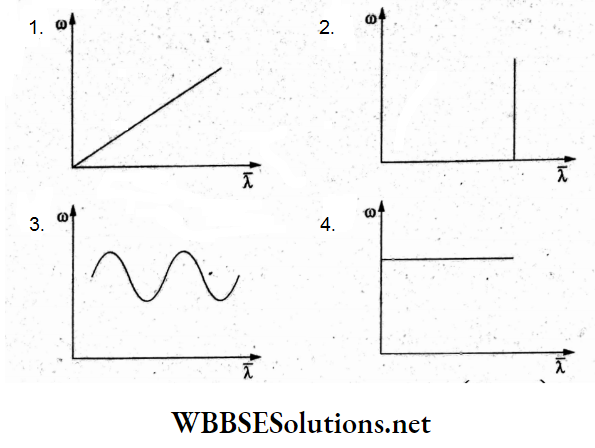
Answer: 1.
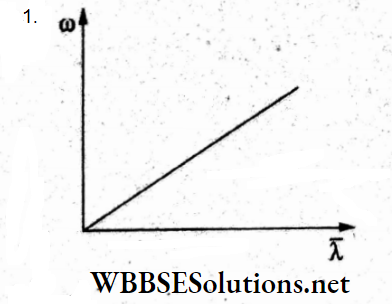
Wavenumber \(\bar{\lambda}=\frac{1}{\lambda}=\frac{f}{v}=\frac{2 \pi f}{2 \pi v}=\frac{\omega}{2 \pi v}\)
∴ \(\omega=(2 \pi 0) \bar{\lambda}\)
Thus the equation connecting ω and \(\bar{\lambda}\). is of the form y= mx which is a straight line passing through the origin as shown in option (1).
Question 11. The wave equation is expressed as \(y=10 \sin \left(\frac{2 \pi t}{30}+\alpha\right)\). If the displacement is 5 cm at t = 0 then the total phase at t = 7.5 s will be
- \(\frac{2 \pi}{3} \mathrm{rad}\)
- \(\frac{\pi}{3} \mathrm{rad}\)
- \(\frac{\pi}{2} \mathrm{rad}\)
- \(\frac{2 \pi}{5} \mathrm{rad}\)
Answer: 1. \(\frac{2 \pi}{3} \mathrm{rad}\)
In the equation \(y=10 \sin \left(\frac{2 \pi t}{30}+\alpha\right)\), y = 5 cm at t = 0.
Thus,
⇒ \(5 \mathrm{~cm}=10 \mathrm{~cm} \sin \left(\frac{2 \pi}{30} \cdot 0+\alpha\right)\)
⇒ \(\sin \alpha=\frac{1}{2}\)
Hence, \(\alpha=30^{\circ}=\frac{\pi}{6}\)
∴ total phase angle at t = 7.5s is
⇒ \(\phi=\frac{2 \pi}{30}(7.5)+\frac{\pi}{6}=\frac{\pi}{2}+\frac{\pi}{6}=\frac{2 \pi}{3} \mathrm{rad}\)
Question 12. The equations of two progressive waves are given by \(y_1=a \sin \left(\omega t+\phi_1\right) \text { and } y_2=a \sin \left(\omega t+\phi_2\right)\). If the amplitude and time period of the resultant wave are the same as those of the component waves then \(\left(\phi_1-\phi_2\right)\) is
- \(\frac{\pi}{3}\)
- \(\frac{2 \pi}{3}\)
- \(\frac{\pi}{6}\)
- \(\frac{\pi}{4}\)
Answer: 2. \(\frac{2 \pi}{3}\)
The equations of component waves are y1 = asin(ωt + Φ1) and y2 = asin(ωt + Φ2).
The superposition leads to the resultant displacement y = y1 + y2, in which die results in an amplitude A = a
=> A² = a² + a² +2a. acosΦ
=> a² = 2a²(1 + cos Φ)
∴ \(\left(\phi_1-\phi_2\right)=\phi\)
= \(120^{\circ}=\frac{2 \pi}{3}\)
Question 13. A progressive wave is expressed by y = 2.0 cos 2π(10t-8 x 10⁻³x+ 0.45), where x and y are in centimetres and t is in seconds. The phase difference between two points separated by a distance of 4m is
- 1.2K rad
- 3.2K rad
- 6.4K rad
- \(\frac{2 \pi}{3} \mathrm{rad}\)
Answer: 3. 6.4K rad
In the given equation,
y = 2.0cos2π(10f- 8 x 10⁻³x + 0.45).
∴ ω = 20π and 16π x 10-3 = k = \(\frac{2 \pi}{\lambda}\)
y = 8 x 10⁻³ cm.
Phase difference= Φ = \(\frac{2 \pi}{\lambda}\) (path difference)
= (167t x 10-3 cm-1)(400 cm)
= 6.4n rad.
Question 14. The equation \(y=A \cos ^2\left(2 \pi f t-\frac{2 \pi}{\lambda} x\right)\) represents a wave in which
- Amplitude = A, frequency = f and wavelength = λ
- Amplitude = A, frequency = 2f and wavelength = 2λ
- Amplitude = \(\frac{A}{2}\), frequency = 2f and wavelength = λ
- Amplitude = \(\frac{A}{2}\), frequency = 2f and wavelength = \(\frac{λ}{2}\)
Answer: 4. Amplitude = \(\frac{A}{2}\), frequency = 2f and wavelength = \(\frac{λ}{2}\)
For the given equation
⇒ \(y=A \cos ^2\left(2 \pi f t-\frac{2 \pi}{\lambda} t\right)\)
⇒ \(\frac{A}{2} 2 \cos ^2\left(2 \pi f t-\frac{2 \pi}{\lambda} t\right)\)
⇒ \(\frac{A}{2}\left[1+\cos 2\left(2 \pi f t-\frac{2 \pi}{\lambda} t\right)\right]\)
⇒ \(\frac{A}{2}+\frac{A}{2} \cos \left[2 \pi(2 f) t-\frac{2 \pi}{\frac{\lambda}{2}} t\right]\)
Thus, amplitude = \(\frac{A}{2}\), frequency= 2f and wavelength = \(\frac{\lambda}{2}\)
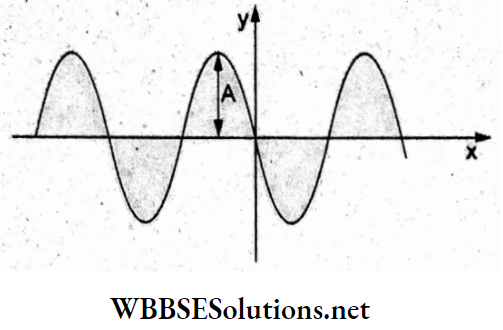
Question 15. A progressive wave travelling along the positive is represented by y(x, t) = Asin(kx- ωt + Φ). Its amplitude at x = 0 is given in the figure. For this wave the initial phase is
- π
- \(\frac{\pi}{2}\)
- –\(\frac{\pi}{2}\)
- 0
Answer: 1. π
Given that y = Asin(kx- ωt + Φ ).
Slope of the waveforms, \(\frac{d y}{d x}=A k \cos (k x-\omega t+\phi)\)
At t = 0, \(\frac{d y}{d x}=A k \cos (k x+\phi)\)
Since the slope is negative, = π.
Question 16. A travelling harmonic wave is represented by the equation y(x, t) = 10-3 sin(50t + 2x), where x and y are in metres and t is in seconds. Which of the following statements is correct?
- The wave is propagating along the negative x-axis with a speed of 25 ms-1.
- The wave is propagating along the positive x-axis with a speed of 25 ms-1.
- The waves propagate along the positive x-axis with a speed of 100 ms-1.
- The wave is propagating along the negative x-axis with a speed of 100 ms-1.
Answer: 1. The wave is propagating along the negative x-axis with a speed of 25 ms-1.
The equation of a harmonic wave travelling along the negative x-axis is given by y = Asin (ωt + kx).
Comparing this with the given equation y = 10-3 sin(50t + 2x), we conclude that the wave represented by this equation is travelling
along the negative x-axis with speed v = \(\frac{\omega}{k}=\frac{50 \mathrm{~s}^{-1}}{2 \mathrm{~m}^{-1}}\)
= 25 m s-1.
Doppler Effect:
Question 17. Two cars moving in opposite directions approach each other with speeds of 22 m s-1 and 16.5 m s-1 respectively. The driver of the first car blows a horn having a frequency of 400Hz. The frequency heard by the driver of the second car is (velocity of sound = 340 m s-1)
- 361 Hz
- 411 Hz
- 448 Hz
- 350 Hz
Answer: 3. 448 Hz
When the source (vs) and observer (vo) approach each other, the apparent frequency = \(f^{\prime}=\frac{v+v_0}{v-v_{\mathrm{s}}} f\), where the velocity of sound = v = 340 m s-1.
Velocity of source (first car) = vs = 22 m s-1.
Velocity of observer (2nd car) = vo = 16.5m s-1.
True frequency = f = 400 Hz.
∴ \(f^{\prime}=\frac{340+16.5}{340-22} \times 400\)
= 448 Hz.
Question 18. The driver of a car travelling at 108 km h-1 towards a hill sounds a horn of frequency 600 Hz. If the velocity of sound air is 330 m s-1, the frequency of the reflected sound as heard by the driver is
- 550 Hz
- 555.5 Hz
- 720 Hz
- 500 Hz
Answer: 3. 720 Hz
Frequency of the sound reaching the hill is \(f^{\prime}=\frac{v}{v-v_{\mathrm{s}}} f\), where vs = vcar This sound is reflected to the car (acts like an observer). The resultant frequency heard by the drivers
⇒ \(f^{\prime \prime}=\frac{\left(v+v_{\mathrm{car}}\right)}{v} f^{\prime}\)
= \(\frac{v+v_{\mathrm{car}}}{v-v_{\mathrm{car}}} f\)
⇒ \(\frac{330+30}{330-30} \times 600 \mathrm{~Hz}\)
= 720 Hz (∵ 108kmh-1 = 30m s-1).
Question 19. Two trains move towards each other at the same speed. The speed of sound is 340 m s-1. If the height of the tone of the whistle of one of them heard the other changes by \(\frac{9}{8}\) times then the speed of each car should be
- 20 ms-1
- 2 ms-1
- 200 ms-1
- 2000 ms-1
Answer: 1. 20 ms-1
The apparent frequency in the case of two trains approaching each other is
⇒ \(f^{\prime}=\frac{v+v_{\text {train }}}{v-v_{\text {train }}} f\)
⇒ \(\frac{f^{\prime}}{f}=\frac{v+v_{\text {train }}}{v-v_{\text {train }}}\)
Given, \(\frac{f^{\prime}}{f}=\frac{9}{8}\), velocity of sound = v = 340 m s-1 and
velocity of train = vtrain = ?
Substituting the values, \(\frac{9}{8}=\frac{340+v_{\text {train }}}{340-v_{\text {train }}}\)
vtrain = 20 ms-1.
Question 20. A star emitting radiation of wavelength 500 nm is approaching the earth with a velocity of 1.50 x 10⁶ m s-1. The change in wavelength of the radiation as received on the earth is
- 0.25 A
- 2.5 A
- 25 A
- 250 A
Answer: 3. 25 A
According to the Doppler effect, there is an apparent increase in frequency and an apparent decrease in the wavelength of light radiated from the star approaching the Earth. The decrease in wavelength is given by
⇒ \(\Delta \lambda=\lambda\left(\frac{v}{c}\right)\)
= \((500 \mathrm{~nm})\left(\frac{1.5 \times 10^6 \mathrm{~ms}^{-1}}{3 \times 10^8 \mathrm{~ms}^{-1}}\right)\)
= 2.5nm
= 25 A.
Question 21. A whistle is made to revolve in a circle with angular velocity ω = 20 rad s-1 using a string of length 50 cm. If the actual frequency of the sound of the whistle is 385 Hz then the minimum frequency heard by a listener far away from the centre is (given that velocity of sound in air = 340 m s-1)
- 385 Hz
- 374 Hz
- 399 Hz
- 333 Hz
Answer: 2. 374 Hz
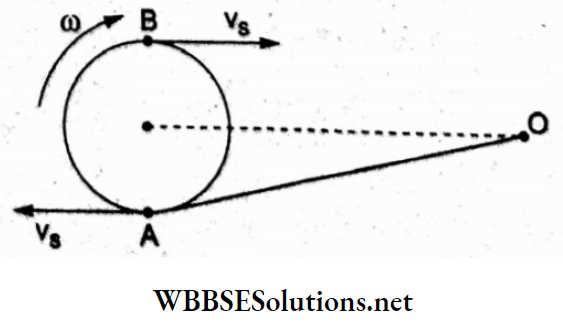
The tangential velocity of the whistle,
vs = ωr = (20 rad s-1)(50 x 10-2m)
= 10m s-1.
The apparent frequency heard by the listener will be minimum (at A) when the source is moving away and maximum when at B.
∴ \(f_{\min }=\frac{v}{v+v_s} f=\frac{340}{340+10} \times 385 \mathrm{~Hz}\)
= 374 Hz.
Question 22. A car is approaching a high hill. The driver of the car sounds a horn of frequency f. The reflected sound heard by the driver has a frequency of 2f. If the velocity of sound in air is v then the velocity of the car, in the same velocity units, will be
- \(\frac{v}{\sqrt{2}}\)
- \(\frac{v}{3}\)
- \(\frac{v}{4}\)
- \(\frac{v}{2}\)
Answer: 2. \(\frac{v}{3}\)
Apparent frequency reaching the hill, \(f^{\prime}=\frac{v}{v-v_{\text {car }}}\). The hill now acts as a sound source emitting sound waves of frequency f’.
Now, the apparent frequency of the car approaching the hill is
⇒ \(f^{\prime \prime}=\frac{v+v_{\mathrm{car}}}{v} f^{\prime}=\frac{v+v_{\mathrm{car}}}{v} \cdot \frac{v}{v-v_{\mathrm{car}}} f\)
Given that \(f^{\prime \prime}=2 f \Rightarrow \frac{v+v_{\mathrm{car}}}{v-v_{\mathrm{car}}}\)
= 2
∴ velocity of the car =vcar = \(\frac{v}{3}\)
Question 23. A listener moves towards a stationary source of sound with a speed \(\frac{1}{5}\) th of the speed of sound. The true values of the frequency and wavelength of the sound emitted are f and y respectively. The apparent frequency and wavelength recorded by the listener are respectively
- f, 12λ
- 0.8f, 0.8λ
- 1.2f, 1.2λ
- 1.2f, λ
Answer: 4. 1.2f, λ
When a listener moves towards a stationary source, the apparent frequency is \(f^{\prime}=\frac{v+v_e}{v} f\)
Given that \(v_0=\frac{v}{5} \Rightarrow f^{\prime}=\frac{v+\frac{v}{5}}{v} f=\frac{6}{5} f=1.2 f\)
= 1.2 f.
The motion of the listener does not affect the wavelength.
Hence, f’ = 1.2f, λ’ = λ
Question 24. A siren emitting a sound of frequency 800 Hz moves away from a listener towards a cliff at a speed of 15 m s-1. Then, the frequency of sound that the listener hears in the echo reflected from the cliffs (given that velocity of sound in air = 330 m s-1)
- 800 Hz
- 885 Hz
- 838 Hz
- 760 Hz
Answer: 3. 838 Hz
Frequency of sound waves reaching the cliffs
⇒ \(f^{\prime}=\frac{v}{v-v_s} f=\frac{330}{330-15} \times 800\)
= 838 Hz.
This is the apparent frequency of waves reflected from the cliff and heard by the standing listener.
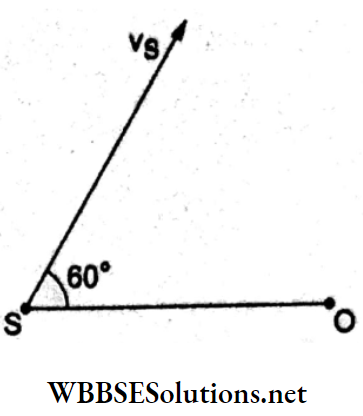
Question 25. A source of sound S emitting waves of frequency 100 Hz and a listener O is located at some distance from each other. The source is moving at a speed of 19.4 m s-1 at an angle of 60° with the source-listener tine as shown in the figure. The listener is at rest. The apparent frequency heard by the listener is (velocity of sound in air = 330 m s-1)
- 110 Hz
- 103 Hz
- 106 Hz
- 97 Hz
Answer: 2. 103 Hz
The component of the velocity of the source towards the listener is
⇒ \(v_{\mathrm{s}}^{\prime}=v_5 \cos 60^{\circ}=\frac{v_{\mathrm{s}}}{2}\)
As the separation between the source and the listener decreases, there will be an apparent increase in frequency.
Hence,
⇒ \(f^{\prime}=\frac{v}{v-\frac{v_s}{2}} f\)
= \(\left(\frac{330}{330-\frac{19.4}{2}}\right) 100 \mathrm{~Hz}\)
= \(\frac{330 \times 100}{320.3} \mathrm{~Hz}\)
= 103 Hz.
Question 26. A speeding motorcyclist sees a traffic jam ahead of him. He slows down to 36 km h-1. He finds that traffic has eased and a car moving ahead of him at 18 km h-1 is honking at a frequency of 1392 Hz. If the speed of sound in air is 343 m s-1, the frequency of the honk as heard by him will be
- 1332Hz
- 1372 Hz
- 1412 Hz
- 1454Hz
Answer: 3. 1412 Hz
Velocity of the motorcyclist= 36 x \(\frac{5}{18}\) m s-1
= 10 m s-1.
Velocity of the car moving away =18 x \(\frac{5}{18}\)m s-1
= 5m s-1.
Apparent frequency as heard by the motorcyclist,
⇒ \(f^{\prime}=\frac{v+v_{\text {bike }}}{v+v_{\text {car }}} f\)
= \(\frac{343+10}{343+5} \times 1392 \mathrm{~Hz}\)
= 1412 Hz
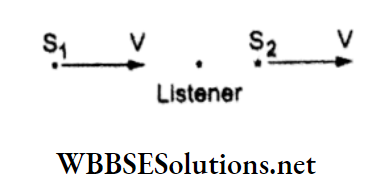
Question 27. Two sources of sound S1 and S2 are moving towards and away from a stationary listener with the same speed. If 3 beats per second are heard by the listener, find the speed of the sources. (Given that f1 = f2 = 500 Hz, speed of soundin air = 330 m s-1.)
- 2.5 ms-1
- 1 ms-1
- 3.2 ms-1
- 2 ms-1
Answer: 2. 1 ms-1
Apparent frequencies heard by the listener are
⇒ \(f_1=\frac{V}{V-v} f \text { and } f_2=\frac{V}{V+v} f \text {, }\)
where V= velocity ofsound= 330m s-1,
v = speed of sources, and
f= true frequency = 500Hz.
Now, f1-f2 = 3S-1
⇒ \(\frac{V}{V-v} f-\frac{V}{V+v} f=3 \mathrm{~s}^{-1}\)
⇒ \(\frac{V f}{V\left(1-\frac{v}{V}\right)}-\frac{V f}{V\left(1+\frac{v}{V}\right)}=3 \mathrm{~s}^{-1}\)
⇒ \(\left(1+\frac{v}{V}\right) f-\left(1-\frac{v}{V}\right) f=3 \mathrm{~s}^{-1}\)
⇒ \(v=\frac{3 \mathrm{~s}^{-1} V}{2 f}\)
= \(\frac{3 \mathrm{~s}^{-1}\left(330 \mathrm{~ms}^{-1}\right)}{2\left(500 \mathrm{~s}^{-1}\right)}\)
= 0.99ms-1
= 1 ms-1.
Question 28. A submarine travelling at 18 km h-1 is being chased by another submarine travelling at 27 km h-1 along the line of its velocity. B sends a sonar of 500Hz to detect A and receives a reflected sound of frequency f. The value of f is close to (speed of sound in water = 1500m s-1)
- 504Hz
- 499 Hz
- 507 Hz
- 502 Hz
Answer: 4. 502 Hz
The velocity of A is vA = 5 m s-1 and that of B is vB = \(\frac{15}{2}\) m s-1. The apparent frequency detected by A is \(f^{\prime}=\frac{v-v_{\mathrm{A}}}{v-v_{\mathrm{B}}} f\) when A is the detector and B is the source.
The apparent frequency detected by B for the wave which gets reflected from A is
⇒ \(f^{\prime \prime}=\frac{v+v_{\mathrm{B}}}{v+v_{\mathrm{A}}} f^{\prime}\) (when B is the detector and A is the source)
⇒ \(\left(\frac{v+v_{\mathrm{B}}}{v+v_{\mathrm{A}}}\right)\left(\frac{v-v_{\mathrm{A}}}{v-v_{\mathrm{B}}}\right) f\)
= \(\left(\frac{1500+\frac{15}{2}}{1500+5}\right) \times\left(\frac{1500-5}{1500-\frac{15}{2}}\right) 500 \mathrm{~Hz}\)
= 502 Hz.
Question 29. A source of sound S is moving with a velocity of 50m s-1 towards a stationary listener. The listener detects the frequency of the source as 1000Hz. What will be the source’s apparent frequency when it moves away from the listener after crossing him? (Velocity of sound in air = 350 m s-1.)
- 1140 Hz
- 750 Hz
- 850 Hz
- 805 Hz
Answer: 2. 750 Hz
The apparent frequency detected by the listener is
⇒ \(f^{\prime}=\frac{v}{v-v_{\mathrm{s}}} f\)
⇒ \(1000 \mathrm{~Hz}=\frac{350 \mathrm{~m} \mathrm{~s}^{-1}}{350 \mathrm{~m} \mathrm{~s}^{-1}-50 \mathrm{~m} \mathrm{~s}^{-1}} \times f=\frac{350}{300} f\)
When the moving source has crossed the listener and is moving away,
⇒ \(f^{\prime \prime}=\frac{350}{350+50} f=\frac{350}{400} f\)
∴ \(\frac{f^{\prime \prime}}{1000}=\frac{350}{400} \times \frac{300}{350}=\frac{3}{4}\)
Hence f” = 750Hz.
Question 30. Two sources of sound S1 and S2 produce sound waves of the same frequency of 600 Hz. A listener is moving from source S1 towards source S2 with a constant speed u m s-1 and hears 10 beats per second. The velocity of sound in air is 330m s-1. The value of u is
- 10.30 ms-1
- 5.56 ms-1
- 2.75 ms-1
- 15.35 ms-1
Answer: 3. 2.75 ms-1
Apparent frequencies detected by the listener are
⇒ \(f_1=\frac{v}{v-u} f=\left(1-\frac{u}{v}\right)^{-1} f \sim\left(1+\frac{u}{v}\right) f\)
and \(f_2=\frac{v}{v+u} f\)
= \(\left(1+\frac{u}{v}\right)^{-1} f \sim\left(1-\frac{u}{v}\right) f\)
Sincebeat frequency = difference in frequency,
⇒ \(10 \mathrm{~s}^{-1}=f_1-f_2\)
= \(2 \frac{u}{v} f\)
= \(\frac{(2 u)\left(600 \mathrm{~s}^{-1}\right)}{330 \mathrm{~m} \mathrm{~s}^{-1}}\)
Hence, \(\frac{330}{120}\) ms-1
= 2.75 m s-1.
Question 31. A stationary source emits sound waves of frequency 500 Hz. Two listeners moving along a line passing through the source detect the sound to be of frequency 480 Hz and 530 Hz. Their respective speeds (in m s-1) are (given that speed of sound = 300 ms-1)
- 12, 18
- 8, 18
- 16, 14
- 12, 16
Answer: 1. 12, 18
For the listener moving away from the source, the apparent frequency decreases and for the listener moving towards the sources the apparent frequency increases.
Hence,
⇒ \(480 \mathrm{~Hz}=\left(\frac{v-u_1}{v}\right) f \text { and } 530 \mathrm{~Hz}=\left(\frac{v+u_2}{v}\right) f\)
where u1 and u2 are the velocities of the two listeners. Substituting the
values,
⇒ \(480=\left(1-\frac{u_1}{300}\right) 500 \Rightarrow u_1=12 \mathrm{~m} \mathrm{~s}^{-1}\)
and \(530=\left(1+\frac{u_2}{300}\right) 500 \Rightarrow u_2=18 \mathrm{~m} \mathrm{~s}^{-1}\)
Question 32. A train moves towards a stationary listener with a uniform speed of 34 m s-1. The train sounds a whistle and its frequency detected by the listener is f1 If the speed of the train is reduced to 17 m s-1, the frequency detected is f2. If the speed of sound is 340 m s-1, the ratio is
- \(\frac{19}{18}\)
- \(\frac{18}{17}\)
- \(\frac{20}{19}\)
- \(\frac{21}{20}\)
Answer: 1. \(\frac{19}{18}\)
The apparent frequency detected by the approaching train is \(f^{\prime}=\frac{v}{v-v_{\mathrm{T}}} f\)
When \(v_{\mathrm{T}}=34 \mathrm{~m} \mathrm{~s}^{-1}, f_1=\frac{340}{340-34} f\)
When \(v_{\mathrm{T}}=17 \mathrm{~m} \mathrm{~s}^{-1}, f_2=\frac{340}{340-17}\)
∴ \(\frac{f_1}{f_2}=\frac{323}{306}\)
= \(\frac{17 \times 19}{17 \times 18}\)
= \(\frac{19}{18}\)
| Class 11 Physics | Class 12 Maths | Class 11 Chemistry |
| NEET Foundation | Class 12 Physics | NEET Physics |
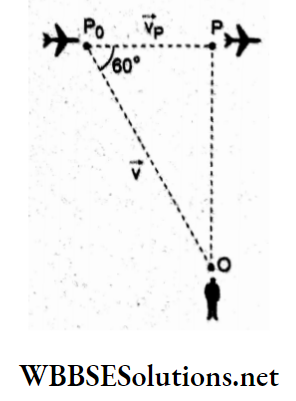
Question 33. A person standing on open ground hears the sound of a jet aeroplane coming from the north at an angle of 60° with the ground. But he finds the aeroplane right vertically above his position. If v is the speed of sound then the speed of the plane is
- \(\frac{\sqrt{3}}{2} v\)
- v
- \(\frac{v}{2}\)
- \(\frac{2}{\sqrt{3}} v\)
Answer: 3. \(\frac{v}{2}\)
At time t = 0, the sound from the jet plane propagates along the line P0O towards the person at O. During the time interval t, the jet plane has moved through P0P and is directly overhead.
Thus,
P0P = (velocity of jetplane, vp)(time t) and
P0O = (velocity of sound in air, va)(time t).
⇒ \(\frac{P_0 P}{P_0 O}=\frac{v_{\mathrm{p}}}{v_{\mathrm{a}}}=\cos 60^{\circ}\)
Hence, vp = \(\frac{v}{2}\)
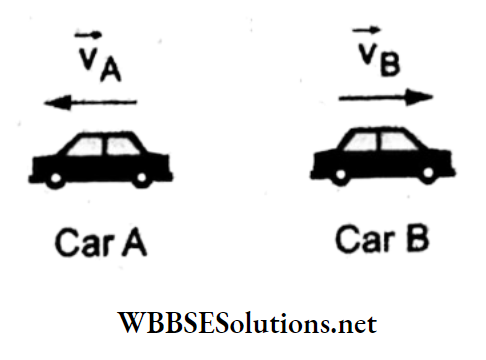
Question 34. Two cars A and B are moving away from each other in opposite directions. Both the cars are moving at a speed of 20 m s-1 relative to the ground. If a listener in car A detects a frequency of 2 kHz of the sound coming from car B, what is the true frequency of the sound source in car B? (Given that speed of sound in air = 340 m s-1.)
- 2250 Hz
- 250 Hz
- 300 Hz
- 2060 Hz
Answer: 1. 2250 Hz
The apparent frequency detected by a listener in car A will be
⇒ \(f^{\prime}=\frac{v-v_{\mathrm{A}}}{v+v_{\mathrm{B}}} f\)
=> 2kHz = \(\frac{340-20}{340+20} f=\frac{320}{360}\)
true frequency = f = (2000Hz) \(\frac{9}{8}\) = 2250Hz
Question 35. The driver of a car moving with velocity v towards a hill blows a horn which emits a sound of frequency 420 Hz. The frequency of the reflected sound detected by the driver was found to be 490 Hz. The velocity of the car is (given that velocity of sound in air = 330 ms-1)
- 71 km h-1
- 61 km h-1
- 91 km h-1
- 81 km h-1
Answer: 3. 91 km h-1
The apparent frequency of a sound wave reaching the hill (as receiver),
⇒ \(f^{\prime}=\frac{v}{v-v_{\mathrm{car}}} f\)
The apparent frequency detected by the driver (observer) moving towards the hill (source) is
⇒ \(f^{\prime \prime}=\left(\frac{v+v_{\mathrm{car}}}{v}\right) f^{\prime}=\left(\frac{v+v_{\mathrm{car}}}{v-v_{\mathrm{car}}}\right) f\)
⇒ \(490=\frac{330+v_{\mathrm{car}}}{330-v_{\mathrm{car}}} \times 420\)
⇒ \(v_{\mathrm{car}}=\frac{330}{13} \mathrm{~m} \mathrm{~s}^{-1}\)
= 91 km h-1
Vibration of Air Column: Organ Pipe
Question 36. The two nearest harmonics of a tube dosed at one end and open at the other end are 220 Hz and 260 Hz. What is the fundamental frequency of the system?
- 20Hz
- 30Hz
- 40Hz
- 10Hz
Answer: 1. 20Hz
In a closed organ pipe (open at one end only), only odd harmonics are present with fundamental (or first harmonics) = f1 = \(\frac{v}{4l}\). Two consecutive harmonics are (2n-1)f1 and (2n +1)f1.
Thus, their difference is
(2n + 1)f1– (2n-1)f1
= 260Hz – 220Hz
= 40Hz
or 2f1 = 40Hz. Hence the fundamental frequency is f1 = 20Hz.
Question 37. An air column, closed at one end and open at the other, resonates with a tuning for k when the smallest length of the column is 50 cm. The next larger length of the column resonating with the same tuning for k is
- 150 cm
- 100 cm
- 200 cm
- 66.7 cm
Answer: 1. 150 cm
In a closed organ pipe, let be the length of the air column for the 1st resonance; then \(l_1=\frac{\lambda}{4}\)
For the 2nd resonance, \(l_2=\frac{3 \lambda}{4}\)
⇒ \(\frac{l_2}{l_1}=\frac{\frac{3 \lambda}{4}}{\frac{\lambda}{4}}=3, \text { thus } l_2=3 l_1\)
= 3(50 cm)
= 150 cm,
Question 38. The second overtone of an open organ pipe has the same frequency as the first overtone of a closed pipe metres long. The length of the open pipe will be
- 2L
- L
- \(\frac{L}{2}\)
- 4L
Answer: 1. 2L
In an open organ pipe, the second overtone is the third harmonic for which \(f_3=3 f_1=3\left(\frac{v}{2 L_0}\right)\),
where P = speed of sound, and L0 = length of the open pipe.
The first overtone of the closed pipe is the third harmonic
⇒ \(f_3^{\prime}=3\left(\frac{v}{4 L_c}\right)=3 \frac{v}{4 L}\) (∵ Lc = L).
Equating f3 and f’3,
⇒ \(\frac{3 v}{2 L_0}=\frac{3 v}{4 L}\)
=> L0 = 2L
Question 39. The fundamental frequency of a closed organ pipe of length 20 cm is equal to the second overtone of an organ pipe open at both ends. The length of the organ pipe open at both ends is
- 80 cm
- 140 cm
- 100 cm
- 120 cm
Answer: 4. 120 cm
Given: length of the closed pipe = 20 cm.
Its fundamental frequency is \(f_{\mathrm{c}}=\frac{v}{4 l}=\frac{v}{80 \mathrm{~cm}}\)
The second overtone of the open pipe is the third harmonic for which
⇒ \(f_3=3 f_1=3\left(\frac{v}{2 l_0}\right)\)
Since \(f_{\mathrm{c}}=f_3, \text { so } \frac{3 v}{2 l_0}=\frac{v}{80 \mathrm{~cm}}\)
∴ length of the pipe is l0 = 120 cm.
Question 40. A closed organ pipe (closed at one end) is excited to support the third overtone. It is found that the air column in the pipe has
- Three nodes and three antinodes
- Three nodes and four antinodes
- Four nodes and three antinodes
- Four nodes and four antinodes
Answer: 4. Four nodes and four antinodes
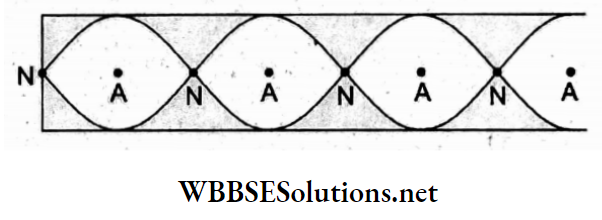
In a closed organ pipe, 1st, 3rd, 5th, 7th, … harmonics are present.
So, the 3rd overtone is the 7th harmonic, which will consist of four nodes and four antinodes as shown in the adjoining figure.
Question 41. The number of possible natural oscillations of an air column in a pipe closed at one end of length 85 cm whose frequencies lie below 1250Hz is (velocity of sound = 340 m s-1)
- 4
- 5
- 7
- 6
Answer: 4. 6
The fundamental frequency in the closed pipe is
⇒ \(f_1=\frac{v}{4 l}=\frac{340 \mathrm{~m} \mathrm{~s}^{-1}}{4\left(85 \times 10^{-2} \mathrm{~m}\right)}\) = 100Hz.
Since only odd harmonics are present, the harmonics below 1250 Hz are(in Hz) 100, 300, 500, 700, 900 and 1100.
Hence, there are 6 possible harmonics
Question 42. If we study the vibration of a pipe open at both ends, which of the following statements is not true?
- The open ends will be antinodes.
- Odd harmonics of the fundamental frequency will be present.
- All harmonics of the fundamental frequency will be generated.
- Pressure change will be maximum at both ends.
Answer: 4. Pressure change will be maximum at both ends.
During the longitudinal vibration of an air column, the displacements of antinodes and pressure nodes are coincident. At open ends in the pipe, there exist displacement antinodes. Hence, pressure nodes exist where a change of pressure is not maximum.
Question 43. A cylindrical resonance tube open at both ends has a fundamental frequency f in air. If half of the length is dipped vertically in water, the fundamental frequency of the air column will be
- 2f
- \(\frac{3}{2}\)
- f
- \(\frac{f}{2}\)
Answer: 4. \(\frac{f}{2}\)
Let L be the length of the open organ pipe, for which the fundamental frequency is f = \(\frac{v}{2L}\) When half the length of the pipe is dipped
vertically in water, it becomes a closed organ pipe with length = \(\frac{L}{2}\)
The fundamental frequency of this dosed pipe is
⇒ \(f^{\prime}=\frac{v}{4\left(\frac{L}{2}\right)}\)
= \(\frac{v}{2 L}\)
= f.
Question 44. An organ pipe closed at one end has a fundamental frequency of 1500 Hz. The maximum number of overtones generated by this pipe which a normal person can hear is
- 14
- 13
- 6
- 9
Answer: 4. 9
The audible range is 20 Hz to 20 kHz.In a dosed organ pipe, only odd harmonics are produced. Since the fundamental frequency is f1 = 1500 Hz, the overtones are 3f1, 5f1…
∴ 20,000 = n x 1500
n ≈ 13.
Hence, the maximum number of possible harmonics is seven, the harmonics being the 1st, 3rd, 5th, 7th, 9th, 11th and 13th.
The number of overtones = 7-1
= 6.
Question 45. In a pipe, the die fundamental frequency is 50 Hz and the next successive frequencies are 150 Hz and 250 Hz. Then, the pipe is
- Closed at both ends
- Closed at one end
- An open pipe
- A stretched pipe
Answer: 2. Closed at one end
Since 50 Hz is the fundamental (1st harmonic), the higher harmonics are 150 Hz = 3 x 50 Hz = 3f1, and 250 Hz = 5 x 50 Hz = 5f1.
The presence of only odd harmonics indicates that the pipe is dosed at one end.
Question 46. A tube closed at one end produces the fundamental note of frequency 512 Hz. If it is open at both ends, the fundamental frequency will be
- 1024 Hz
- 256 Hz
- 1250 Hz
- 768 Hz
Answer: 1. 1024 Hz
The frequency of the fundamental note in a closed pipe is f1 = 512 Hz
= \(\frac{2}{4l}\) . When the ends are open, the fundamental frequency is
⇒ \(\frac{v}{2 l}=2\left(\frac{v}{4 l}\right)\)
= 2(512 Hz)
= 1024 Hz
Question 47. A pipe open at both ends suddenly dosed at one end, as a result of which the frequency of the third harmonic of the dosed pipe is found to be higher by 100 Hz than the fundamental frequency of the open pipe. The fundamental frequency of the open pipe is
- 200 Hz
- 240 Hz
- 450 Hz
- 300 Hz
Answer: 1. 200 Hz
The fundamental frequency of the open pipe is fo = \(\frac{v}{2l}\) and the 3rd harmonic of the dosed pipe is \(f_{\mathrm{c}}=\frac{3 v}{4 l}=\frac{3}{2}\left(\frac{v}{2 l}\right)=\frac{3}{2} f_{\mathrm{o}}\)
Given that fc = fo + 100
⇒ \(\left(\frac{3}{2}-1\right) f_0=100 \mathrm{~Hz}\)
=> fo = 200Hz.
Question 48. The third overtone of an open organ pipe of length has the same frequency as the third overtone of a dosed pipe of length The ratio \(\frac{L_0}{L_c}\) is
- 2:1
- 3:2
- 5:3
- 8:7
Answer: 4. 8:7
The third overtone of an open pipe is the fourth harmonic, which is
⇒ \(f_0=4\left(\frac{v}{2 L_0}\right)\)
The third overtone of the dosed pipe is the seventh harmonic, which is
⇒ \(f_{\mathrm{c}}=7\left(\frac{v}{4 L_{\mathrm{c}}}\right)\)
Since \(f_{\mathrm{o}}=f_{\mathrm{c}^{\prime}} \frac{2 v}{L_{\mathrm{o}}}\)
= \(\frac{7 v}{4 L_{\mathrm{c}}}\)
⇒ \(\frac{L_{\mathrm{o}}}{L_{\mathrm{c}}}=\frac{8}{7}\)
Question 49. A pipe of length 1 m is dosed at one end. The velocity of sound in air is 300 m s-1. The air column in the pipe will not resonate for sound of frequency
- 75 Hz
- 225 Hz
- 300 Hz
- 378 Hz
Answer: 3. 300 Hz
In a dosed organ pipe only odd harmonics are produced. So the tube will resonate with lengths
⇒ \(l=\frac{\lambda}{4}, 3 \frac{\lambda}{4}, 5 \frac{\lambda}{4}, \ldots,(2 N+1) \frac{\lambda}{4}\)
⇒ \(\lambda=\frac{4 l}{2 N+1}\)
∴ the allowed frequencies are
⇒ \(f=\frac{v}{\lambda}\)
= \((2 N+1) \frac{v}{4 l}\)
= \((2 N+1) \frac{300 \mathrm{~m} \mathrm{~s}^{-1}}{4 \mathrm{~m}}\)
= 75(2N+ 1) Hz.
With N= 0,1, 2, …, f=? 75Hz, 225Hz, 375Hz, ….
So, 300 Hz will not resonate
Question 50. Find the number of tones present in an open organ pipe of length 1 m whose frequencies lie within 1 kHz. (Given that the speed of sound in air = 330m s-1.)
- 6
- 4
- 3
- 5
Answer: 1. 6
Fundamental frequency is \(f_1=\frac{v}{2 l}=\frac{330 \mathrm{~m} \mathrm{~s}^{-1}}{2(1 \mathrm{~m})}=165 \mathrm{~s}^{-1}\)
The notes produced have frequencies f1, 2f1, …, so the number of tones
lying within 1 kHz will be n = \(\frac{1000 \mathrm{~Hz}}{165 \mathrm{~Hz}} \approx 6\)
Question 51. Second harmonics are produced by an open organ pipe of length 50 cm. A person moves towards the organ pipe at a speed of 10 km h-1. If the speed of sound is 330m s-1, the frequency heard by the person will be
- 666 Hz
- 500 Hz
- 753 Hz
- 333 Hz
Answer: 1. 666 Hz
In an open organ pipe, the frequency of the fundamental is f1 = \(\frac{v}{2l}\)
For the 2nd harmonic, \(f_2=2 f_1=2\left(\frac{v}{2 l}\right)=\frac{330 \mathrm{~m} \mathrm{~s}^{-1}}{50 \mathrm{~cm}}\)
= 660 Hz.
Speed ofobserveris v0 = 10km h-1 = \(\frac{50}{18}\)m s-1.
Because of the Doppler effect, the apparent frequency is
⇒ \(f^{\prime}=\left(\frac{v+v_{\Omega}}{v}\right) f=\left(1+\frac{v_{\Omega}}{v}\right) f_2\)
Substituting the values:
⇒ \(f^{\prime}=\left(1+\frac{50}{18 \times 330}\right) 660 \mathrm{~Hz}\)
= 660Hz + \(\frac{50}{9}\)Hz == 666 Hz
Question 52. A dosed organ pipe has a fundamental frequency of 1.5 kHz. The number of overtones that can be distinctly heard by a person from this organ pipe will be (given that audible range = 20Hz-20 kHz)
- 8
- 6
- 4
- 5
Answer: 2. 6
If the die-closed pipe has n overtones, the maximum frequency (2n + 1)f corresponds to the maximum frequency of the audible range (= 20 kHz).
Thus, (2n +1)(1.5 kHz) = 20kHz
or 2n = 12
⇒ number of overtones, n = 6.
Question 53. A tuning fork of frequency 480 Hz is used in an experiment for measuring the speed of sound (v) in air by the resonance tube method. Resonance is observed to occur at two successive lengths of the air column, l1 = 30 cm and l2 = 70 cm. Then v is equal to
- 332 ms-1
- 371 ms-1
- 338 ms-1
- 384 m s-1
Answer: 4. 384 m s-1
For 1st resonance, \(\frac{\lambda}{4}=h_1+\epsilon\), and
for 2nd resonance, \(\frac{3 \lambda}{4}=l_2+\epsilon\)
⇒ \(\lambda=2\left(l_2-l_1\right)\)
∴ The velocity of sound is
v = fλ =(480s-1) x 2 x (70cm – 30cm)
= (960 s-1)(40 X 10-2 m)
= 384 m s-1.
Question 54. In a resonance tube experiment, when the tube is filled with water up to a height of 17.0 and from the bottom, it resonates with a given tuning fork. When the water level is raised, the next resonance with die same tuning fork occurs at a height of 24.5 cm. The frequency of the tuning fork is (given that the velocity of sound in air = 330m s-1)
- 2200 Hz
- 3300 Hz
- 1100 Hz
- 550 Hz
Answer: 1. 2200 Hz
The difference between the lengths of the air columns at two consecutive resonances is \(\frac{λ}{2}\)
Hence, \(\frac{λ}{2}\) = (24.5 cm-17.0 cm)
= 7.5 cm.
∴ wavelength is λ = 15 cm.
Hence, frequency = \(f=\frac{v}{\lambda}=\frac{330 \mathrm{~m} \mathrm{~s}^{-1}}{15 \times 10^{-2} \mathrm{~m}}\)
= 2200 Hz.
Vibration of a String: Sonometer
Question 55. A stretched string resonates with a tuning fork of frequency 512Hz when the length of the string is 0.5m. The length of the string required for it to vibrate resonantly with a tuning fork of frequency 256Hz would be
- 0.25 m
- 0.5 m
- 1 m
- 2 m
Answer: 3. 1 m
In the transverse vibration of a stretched string, frequency \(f \propto \frac{1}{\text { length }(l)}\)
Thus, f1l1 = f2l2
=> (512Hz)(0.5 m)
= (256Hz)l2
⇒ l2 = 1.0 m.
Question 56. A uniform string of length 5.5m has a mass of 35 g. If the tension in the string is 77N, the speed of the wave on the string is
- 110 ms-1
- 165 ms-1
- 77 ms-1
- 102 ms-1
Answer: 1. 110 ms-1
Given that mass m = 35 x 10-3 kg, length l = 5.5 m, tension F = 77N.
Then, massperunitlengthis
⇒ \(\mu=\frac{m}{l}\)
= \(\frac{35 \times 10^{-3}}{5.5}\)
= \(\frac{70}{11} \times 10^{-3} \mathrm{~kg} \mathrm{~m}^{-1}\)
The speed of the wave is
⇒ \(v=\sqrt{\frac{F}{\mu}}\)
= \(\sqrt{\frac{77 \mathrm{~N}}{\frac{70}{11} \times 10^{-3} \mathrm{~kg} \mathrm{~m}^{-1}}}\)
= 110 ms-1.
Question 57. A wave of frequency 100 Hz is sent along a string towards its fixed end. When these wave gels are reflected, a node is formed at a distance of 10 cm from the fixed end of the string. The speed of the incident and the reflected wave is
- 5ms-1
- 10 m s-1
- 20 ms-1
- 40m s-1
Answer: 3. 20 ms-1
At the fixed end of the string, an ode is produced, so the distance between two consecutive nodes is \(\frac{\lambda}{2}\) = 10 cm
or λ = 20 cm
= 20 x 10-2 m.
The speed of the incident and the reflected wave is
v = fλ = (100 s-1)(20 x 10-2m)
= 20m s-1.
Question 58. A sonometer wire when vibrated over its entire length has frequency n. Now it is divided by bridges into a number of segments of lengths l1, l2, l3,… When vibrated, these segments have frequencies n1, n2, n3 …. Then the correct relation is
- n = n1 + n2 + n3 + ……..
- \(n^2=n_1^2+n_2^2+n_3^2+\ldots\)
- \(\frac{1}{n}=\frac{1}{n_1}+\frac{1}{n_2}+\frac{1}{n_3}+\ldots\)
- \(\frac{1}{\sqrt{n}}=\frac{1}{\sqrt{n_1}}+\frac{1}{\sqrt{n_2}}+\frac{1}{\sqrt{n_3}}+\ldots\)
Answer: 3. \(\frac{1}{n}=\frac{1}{n_1}+\frac{1}{n_2}+\frac{1}{n_3}+\ldots\)
According to the law of length, frequency
⇒ \(n \propto \frac{1}{l}\)
⇒ \(n_1 l_1=n_2 l_2=\ldots=k\)
∵ total length l = l1 + l2+ l3+ …
∴ \(\frac{k}{n}=\frac{k}{n_1}+\frac{k}{n_2}+\frac{k}{n_3}+\ldots\)
⇒ \(\frac{1}{n}=\frac{1}{n_1}+\frac{1}{n_2}+\frac{1}{n_3} \ldots\)
Question 59. Two strings A and B of lengths lA and lB have their upper ends fixed to rigid supports, They have masses MA and MB. If nA and nB are the frequencies of their vibrations and nA = 2nB then
- lA– 4lB regardless of their masses
- lB = 4lA, regardless of their masses
- MA = 2MB, lA = 2lB
- MB = 2MA, lB– 2lA
Answer: 2. lB = 4lA, regardless of their masses
Frequency of vibration in a suspended string,
⇒ \(n=\frac{1}{2 l} \sqrt{\frac{m g}{\mu}}=\frac{1}{2 l} \sqrt{\frac{m g}{\frac{m}{l}}}=\frac{1}{2 l} \sqrt{l g}=\frac{1}{2} \sqrt{\frac{l g}{l^2}}=\frac{1}{2} \sqrt{\frac{g}{l}}\)
Given that \(n_{\mathrm{A}}=2 n_{\mathrm{B}}\)
⇒ \(\frac{1}{2} \sqrt{\frac{g}{l_{\mathrm{A}}}}=2 \cdot \frac{1}{2} \sqrt{\frac{g}{l_{\mathrm{B}}}}\)
Hence, lB = 4lA which will not depend on the masses MA and MB.
Question 60. When a string is divided into three segments of lengths l1, l2 and l3, the fundamental frequencies of these segments are f1, f2 and f3 respectively. The original fundamental frequency f of the string is
- \(\sqrt{f}=\sqrt{f_1}+\sqrt{f_2}+\sqrt{f_3}\)
- f = f1 + f2 + f3
- \(\frac{1}{\sqrt{f}}=\frac{1}{\sqrt{f_1}}+\frac{1}{\sqrt{f_2}}+\frac{1}{\sqrt{f_3}}\)
- \(\frac{1}{f}=\frac{1}{f_1}+\frac{1}{f_2}+\frac{1}{f_3}\)
Answer: 4. \(\frac{1}{f}=\frac{1}{f_1}+\frac{1}{f_2}+\frac{1}{f_3}\)
For the transverse vibration of a stretched string, frequency \(f=\frac{1}{2 l} \sqrt{\frac{F}{\mu}}\)
When F and p are constants,
fl=k
⇒ \(f l=f_1 l_1=f_2 l_2=f_3 l_3=k\)
⇒ \(l=\frac{k}{f}, l_1=\frac{k}{f_1}, l_2=\frac{k}{f_2}, l_3=\frac{k}{f_3}\)
∵ \(l=l_1+l_2+l_{3 f}\)
∴ \(\frac{1}{f}=\frac{1}{f_1}+\frac{1}{f_2}+\frac{1}{f_3}\)
Question 61. A uniform rope of length L and mass M hangs vertically from a rigid support. A block of mass m is attached to the free end of the rope. A transverse pulse of wavelength λ1 is produced at the lower end of the rope. The wavelength of the pulse when it reaches the top of the rope is λ2. The ratio \(\frac{\lambda_2}{\lambda_1}\) is
- \(\sqrt{\frac{M+m}{m}}\)
- \(\sqrt{\frac{m}{M}}\)
- \(\sqrt{\frac{M+m}{M}}\)
- \(\sqrt{\frac{M}{m}}\)
Answer: 1. \(\sqrt{\frac{M+m}{m}}\)
Since the rope has mass M, its tension will be different at different points. The tension at the free end will be mg (due to the mass m of the block) and that at the upper fixed end is (M + m)g. The frequency of the wave pulse will be the same everywhere on the rope as it depends only on the frequency of the source. The mass per unit length is also the same throughout.
⇒ \(\lambda=\frac{v}{f}=\frac{1}{f} \sqrt{\frac{F}{\mu}}\)
⇒ \(\lambda \propto \sqrt{F}\)
⇒ \(\frac{\lambda_2}{\lambda_1}=\sqrt{\frac{M+m}{m}}\)
Question 62. The tension in a piano Wire is 10 N. What should be the tensionin the wire to produce a note double the frequency?
- 40 N
- 5 N
- 80 N
- 20 N
Answer: 1. 40 N
Since \(f \propto \sqrt{F}\)
⇒ \(\frac{f_2}{f_1}=\sqrt{\frac{F_2}{F_1}}\)
⇒ \(\frac{2 f_1}{f_1}=\sqrt{\frac{F_2}{10 \mathrm{~N}}}\)
F2 = 40 N
Question 63. Standing waves are produced in a 10-m-long stretched string. If the string vibrates in 5 segments and the wave velocity is 20m s-1 its frequency is
- 5 Hz
- 4 Hz
- 2 Hz
- 10 Hz
Answer: 1. 5 Hz
Length of string = L = 10 m.
Length of each segment = \(\frac{\lambda}{2}\)
So, 5.\(\frac{\lambda}{2}\) = 10m
or, λ = 4m.
Frequesncy = \(f=\frac{v}{\lambda}=\frac{20 \mathrm{~m} \mathrm{~s}^{-1}}{4 \mathrm{~m}}\) = 5Hz.
Question 64. A transverse wave passes through a string with equation y = 10 sin π(0.02x – 2.0t), where x is in metres and t is in seconds. The maximum particle velocity in the wave motion is
- 63
- 78
- 100
- 121
Answer: 1. 63
The wave equation is y = 10π(0.02x- 2.0t).
∵ particle velocity= \(\frac{\partial y}{\partial t}=-20 \pi \cos \pi(0.02 t-2 t)\)
The maximum value of particle velocity is
⇒ \(\left(\frac{\partial y}{\partial t}\right)_{\max }=20 \pi \text { units }\)
= 63 units
Question 65. A string is stretched between fixed points separated by 75 cm. It is observed to have resonant frequencies of 420Hz and 315Hz and other resonant frequencies between these two. The lowest resonant frequency for this string is
- 10.5 Hz
- 105 Hz
- 155 Hz
- 205 Hz
Answer: 2. 105 Hz
The given resonant frequencies are
Hence, 315Hz = frequency of the 3rd harmonic and 420 is that of the 4th harmonic.
∴ the lowest (or 1st harmonic) frequency is
⇒ \(f_1=\frac{315}{3} \mathrm{~Hz}=\frac{420}{4} \mathrm{~Hz}\)
= 105Hz.
Question 66. The tension in a string is increased by 44%. If the frequency of vibration is to remain unchanged, its length must be increased by
- 44%
- V44%
- 22%
- 20%
Answer: 4. 20%
Frequency = \(f=\frac{1}{2 l} \sqrt{\frac{F}{\mu}}=\frac{1}{2(l+\Delta l)} \sqrt{\frac{F+\frac{44}{100} F}{\mu}}\)
⇒ \(\frac{l+\Delta l}{l}=\frac{12}{10}\)
⇒ \(1+\frac{\Delta l}{l}=1+\frac{2}{10}\)
∴ % increase in length \(\frac{\Delta l}{l} \times 100 \%=\frac{2}{10} \times 100 \%\)
= 20%.
Question 67. The equation of a wave travelling along a stretched string is given by y = (0.002 m)sin(300t- 15x). The mass density is μ = 0.1 kg m-1. The tension in the strings
- 30 N
- 40 N
- 10 N
- 45 N
Answer: 2. 40 N
From the given wave equation, the velocity of the wave is
⇒ \(v=\frac{\omega}{k}=\frac{300 \mathrm{~s}^{-1}}{15 \mathrm{~m}^{-1}}=20 \mathrm{~m} \mathrm{~s}^{-1}\)
But \(v=\sqrt{\frac{F}{\mu}}\) hence the tension is F = μv² = (0.1 kg m-1)(20m s-1)²
= 40N.
Question 68. A 2.0-m-long string fixed at its ends is driven by a 240-Hz vibrator. The string vibrates in its third harmonic mode. The speed of the wave and its fundamental frequency are
- 320 ms-1, 80 Hz
- 180 m s-1 80 Hz
- 320 ms-1, 120 Hz
- 180 ms-1, 120 Hz
Answer: 1. 320 ms-1, 80 Hz
Given that l = 2.0 m and the frequency of the 3rd harmonic is
f3 = 3f1 = 240 Hz.
∴ the frequencyofthe fundamental mode is = \(\frac{240}{3}\)Hz = 80 Hz.
For the 3rd harmonic, 3 \(\frac{λ}{2}\) = 2.0m
λ = \(\frac{4}{3}\) m.
Speed of the wave = v = fλ = (240 s-1) (\(\frac{4}{3}\)m)
= 320 ms-1.
Question 69. A string is damped at both ends and is vibrating in its 4th harmonic. The equation of the stationary wave is y = 0.3 sin(0.157x)cos(2007πt). The length of the string is (all quantities are in SI units)
- 40 m
- 25 m
- 80 m
- 60 m
Answer: 3. 80 m
The equation of a standing wave is given by y = 2Asin(kx)cos(ωt).
Comparing with the given equation,
y= 0.3sin(0.157x)cos(2007πt),
k = \(\frac{2 \pi}{\lambda}\)
= 0.157 m-1 and
ω = 2πf = 200n s-1.
wavelength λ = \(\frac{2 \pi}{0.157}\) m
= 40m.
Since the string vibrates in its 4thharmonic, the length of the string will be,
⇒ \(L=4\left(\frac{\lambda}{2}\right)=2 \lambda\)
= 80m.
Question 70. A string of length 1 m and mass 5g is fixed at both ends. The tension in the string is 8.0 N. The string is set into transverse vibration, using an external vibrator of frequency 100 Hz. The separation between the successive nodes on the string is due to
- 16.6 cm
- 33.3 cm
- 20.0 cm
- 10.0 cm
Answer: 3. 20.0 cm
Given that for a vibrating string, the linear mass density is μ = 5 x 10⁻³ kg m-1, the length of the string is l = 1 m, the tension in the string is F = 8 N and the frequency is f = 100 s. If the string vibrates in its pth harmonic, we have
⇒ \(f=\frac{p}{2 l} \sqrt{\frac{F}{\mu}}\)
⇒ \(p=(2 f l) \sqrt{\frac{\mu}{F}}\)
= \(2\left(100 \mathrm{~s}^{-1}\right)(1 \mathrm{~m}) \sqrt{\frac{5 \times 10^{-3} \mathrm{~kg}}{8 \mathrm{~N}}}\)
Hence, the string vibrates in 5 loops.
∴ \(5\left(\frac{\lambda}{2}\right)=100 \mathrm{~cm}\)
Hence, separationbetween two successivenodes = \(\frac{\lambda}{2}\) = 20 cm.
Question 71. The fundamental frequencies of two identical strings x and y are 450 Hz and 300 Hz respectively. The ratio of the tensions in them is
- \(\sqrt{\frac{2}{3}}\)
- \(\frac{9}{4}\)
- \(\sqrt{\frac{4}{3}}\)
- \(\sqrt{\frac{3}{2}}\)
Answer: 2. \(\frac{9}{4}\)
Frequency \(f \propto \sqrt{\text { tension }}\).
Hence,
⇒ \(\frac{f_1}{f_2}=\sqrt{\frac{F_1}{F_2}}\)
⇒ \(\frac{F_1}{F_2}=\left(\frac{f_1}{f_2}\right)^2\)
= \(\left(\frac{450 \mathrm{~Hz}}{300 \mathrm{~Hz}}\right)^2\)
= \(\frac{9}{4}\)
Question 72. A uniform string of mass 6 g is suspended from a rigid support and the lower end has a block of mass 2 g attached to it. A wave pulse of wavelength 6 cm produced at the bottom travels up along the string. The wavelength at the top of the string is
- 6 cm
- 18 cm
- 12 cm
- 24 cm
Answer: 3. 12 cm
Velocity = v = fλ = VF.
Since frequency f and mass per unit length remain constant,
⇒ \(\frac{\lambda_1}{\lambda_2}=\sqrt{\frac{F_1}{F_2}}\)
⇒ \(\frac{6 \mathrm{~cm}}{\lambda_2}=\sqrt{\frac{2 g \omega t}{(6+2) g \omega t}}\)
= \(\frac{1}{2}\)
⇒ \(\frac{6 \mathrm{~cm}}{\lambda_2}=\frac{1}{2}\)
λ2 = 12 cm
Beats:
Question 73. A source of unknown frequency gives 4 beats per second when sounded with a source of known frequency 250 Hz. The second harmonic of the source of unknown frequency gives five beats per second when sounded with a source of frequency 513 Hz. The unknown frequency is
- 240 Hz
- 260 Hz
- 254 Hz
- 246 Hz
Answer: 3. 254 Hz
Let f be the unknown frequency of the given source. Since 4 beats per second are produced when sounded with a source of frequency = 250 Hz, therefore,
f = (250 ± 4) Hz
= 246 Hz or 254 Hz.
The second harmonic of this fundamental is 2f = 492 Hz or 508 Hz, which gives 5 beats per second when sounded with a source of 513 Hz.
This is possible with the 2ndharmonic of 508Hz = 2f.
∴ unknown frequency = f = 254Hz.
Question 74. Two identical piano wires, kept under the same tension, have a fundamental frequency of 600 Hz. The fractional increase in the tension in one of the wires which will lead to the occurrence of 6 beats per second when wires vibrate together would be
- 0.01
- 0.02
- 0.03
- 0.04
Answer: 2. 0.03
The frequency is \(f=\frac{1}{2 l}\left(\frac{F}{\mu}\right)\)
⇒ \(\frac{\Delta f}{f}=\frac{1}{2} \frac{\Delta F}{F}\) (∵ l and μ are constants).
∴ \(\frac{\Delta F}{F}=2 \frac{\Delta f}{f}=\frac{2}{f}\) (beat frequency)
⇒ \(\frac{2}{600}\) x 6
= 0.02.
Question 75. A tuning fork of frequency 512 Hz produces 4 beats per second with the vibrating string of a piano. The beat frequency decreases to 2 beats per second when the tension in the piano string is slightly increased. The frequency of the piano string before the increase in the tension was
- 510 Hz
- 514 Hz
- 516 Hz
- 508 Hz
Answer: 4. 508 Hz
Let f be the initial frequency of the piano wire. Since the beat frequency with a 512-Hz tuning fork gives 4 beats per second,
f = 512 ± 4
= 516Hz or 508Hz.
On increasing the tension, the beat frequency decreases to 2 beats per second (but the frequency of the guitar wire is increased).
Hence,
f’ = 512 ± 2
= (514 or 510)Hz.
Since f’ > f, the frequency of the guitar wire has increased from its initial value of 508 Hz to 510 Hz.
The frequency before increasing the tensionis 508Hz.
Question 76. Two sound waves with wavelengths 5.0 m and 5.5 m propagate in gas with a velocity of 330 m s-1. The number of beats per second will be
- 6
- 12
- 0
- 1
Answer: 1. 6
Given, the velocity of sound = 330 m s-1; the two wavelengths are λ1 = 5.0 m and λ2 = 5.5 m.
The corresponding frequencies are
⇒ \(f_1=\frac{v}{\lambda_1} \text { and } \lambda_2=\frac{v}{\lambda_2}\)
Beat frequency = \(\Delta f=f_1-f_2\)
= \(\frac{v}{\lambda_1}-\frac{v}{\lambda_2}\)
⇒ \(\frac{330}{5} \mathrm{~s}^{-1}-\frac{330}{5.5} \mathrm{~s}^{-1}\)
= \(330\left(\frac{1}{55}\right)\)
= 6 beats per second.
Question 77. Two waves of wavelengths 50 cm and 51 cm produce 12 beats per second. The velocity of sound in air is
- 340 ms-1
- 331 ms-1
- 306 ms-1
- 360 ms-1
Answer: 3. 306 ms-1
Let v = velocity of sound in air.
∴ frequency, \(f_1=\frac{v}{\lambda_1} \text { and } f_2=\frac{v}{\lambda_2}\)
∴ beat frequency is \(12=f_1-f_2\)
= \(v\left(\frac{1}{\lambda_1}-\frac{1}{\lambda_2}\right)\)
⇒ \(v\left(\frac{100}{50 \mathrm{~m}}-\frac{100}{51 \mathrm{~m}}\right)=12 \mathrm{~s}^{-1}\)
⇒ \(v=\left(12 \mathrm{~s}^{-1}\right)\left(\frac{50 \times 51}{100}\right) \mathrm{m}=306 \mathrm{~m} \mathrm{~s}^{-1}\)
Question 78. Two vibrating tuning forks produce waves given by y1 = 4sin 500πt and y2 = 4sin 506πf. The number of beats produced in one minute is
- 60
- 3
- 180
- 360
Answer: 3. 180
The angular frequencies are
ω1 = 500π = 2πf1 and ω2 = 506π = 2πf2.
∴ f1 = 250Hz, f2 = 253Hz.
Hence, the number of beats in one second is f2 – f1 = 3 Hz.
So, in one minute, the number of beats = 3 x 60
= 180.
Question 79. Each of the two strings of lengths 51.6 cm and 49.1 cm are tensioned separately by a force of 20 N. The linear mass densities of both strings are the same and equal to 1.0 g m-1. When both the strings vibrate together the beat frequency is
- 7 s-1
- 3 s-1
- 8 s-1
- 5 s-1
Answer: 1. 7 s-1
Given, l1 = 51.6 cm, l2 = 49.1 cm, F1 = F2 = 20 N.
Linear mass density = μ1 = μ2
= 1.0 g m-1
= 1 x 10⁻³ kg m-1.
Frequency due to the 1st string,
⇒ \(f_1=\frac{1}{2 l_1} \sqrt{\frac{F}{\mu}}\)
= \(\frac{1}{2\left(51,6 \times 10^{-2} \mathrm{~m}\right)} \sqrt{\frac{20 \mathrm{~N}}{10^{-3} \mathrm{~kg} \mathrm{~m}^{-1}}}\)
= 137 Hz
Similarly, \(f_2=\frac{1}{2 I_2} \sqrt{\frac{F}{\mu}}\)
= 144 Hz
=> beat frequency= Δf = f2-f1
= 7Hz
= 7 s-1.
Question 80. Two sound sources are a finite distance apart. They emit sounds of wavelength λ. An observer situated between them on the line joining the sources approaches one source with speed u. Then the I number of beats heard per second by the observer will be
- \(\frac{2u}{λ}\)
- \(\frac{u}{λ}\)
- \(\frac{u}{2λ}\)
- \(\frac{λ}{u}\)
Answer: 1. \(\frac{2u}{λ}\)
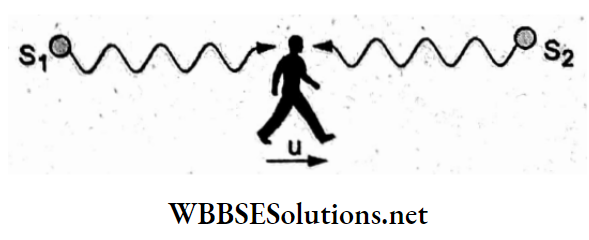
Let the observer move towards the source S2, so the apparent frequency will increase from the true frequency of \(f_2=\frac{v+u}{v} f\) and that due to
S1 will decrease from \(f_1=\frac{v-u}{v} f\), where the velocity of sound v = fλ.
∴ beat frequency is
⇒ \(\Delta f=f_2-f_1\)
= \([(v+u)-(v-u)] \frac{f}{f \lambda}\)
= \(\frac{2 u}{\lambda}\)
Question 81. A closed organ pipe and an open organ pipe of the same length produce four beats per second when sounded together. If the length of the closed pipe is increased, the beat frequency will
- Increase
- Decrease
- Remain the same
- First, increase then remain constant
Answer: 1. Increase
The fundamental frequency of the openpipe is fo = \(\frac{v}{2L}\), and that of the closed pipe, fc = \(\frac{v}{4L}\)
Since fo > fc, beat frequency = fo-fc.
If the length of the closed pipe is increased, fc will decrease. So the frequency difference (=beat frequency) will increase
Question 82. Two closed organ pipes of lengths 100 cm and 101 cm produce 16 beats in 20 seconds when each pipe is sounded in fundamental mode. The velocity of sound in air is
- 303 ms-1
- 332 ms-1
- 323.2 ms-1
- 300 ms-1
Answer: 3. 323.2 ms-1
The lengths of the closed pipes are l1 = 100 cm = 1.0 m and l2 = 101 cm
= 1.01 m.
The frequencies of their fundamental modes of vibration are,
⇒ \(f_1=\frac{v}{4 l_1} \text { and } f_2=\frac{v}{4 l_2}\), where v = speed of sound.
Given thatbeat frequency = \(\frac{16 \text { beats }}{20 \text { seconds }}\)
⇒ \(f_1-f_2=\frac{16}{10}\)
⇒ \(\frac{v}{4}\left(\frac{1}{1.0 \mathrm{~m}}-\frac{1}{1.01 \mathrm{~m}}\right)=\frac{16}{20} \mathrm{~s}^{-1}\)
Simplifying, we get v = 323m s-1.
Question 83. In a guitar, two strings A and B made of the same material are slightly out of tune and produce beats of frequency 6Hz. When the tension in B is slightly decreased, the beat frequency increases to 7 Hz. If the frequency of A is 530 Hz, the original frequency of B will be
- 524 Hz
- 536 Hz
- 537 Hz
- 523 Hz
Answer: 1. 524 Hz
Beat frequency = difference in frequencies.
Hence, fA – fB = 6Hz or fB-fA = 6Hz.
The decrease in tension in string B will decrease fB, which will increase the beat frequency to 7.
Hence the first option is true.
fA – fB = 6Hz
=> 530Hz – fB = 6Hz
=> fB = 524Hz
Intensity: Loudness
Question 84. When we hear a sound, we can identify its source from the
- Frequency of the sound
- Wavelength of the sound
- Overtones present in the sound
- Amplitude of the sound
Answer: 3. Overtones present in the sound
It is the richness of overtones (harmonics) that changes the quality of sound and the source of sound can be identified.
Question 85. Consider sound waves originating from two identical sources S1 and S2 reaching a point P in the same phase and producing an intensity I0. If the power of S1 is reduced by 64% and the phase difference between S1 and S2 is varied continuously, the ratio of the maximum and minimum intensities recorded at P will be
- 16:3
- 4:3
- 4:1
- 16:1
Answer: 4. 16:1
Let l be the intensity originating from two identical sources.
Superposition in the same phase (- 0) produces intensity
⇒ \(I_0=I+I+2 \sqrt{I} \sqrt{I} \cos 0^{\circ}=4 I\)
Next, the changed intensity of one source is reduced to 36%I = 0.361 and for maximum intensity,
⇒ \(I_{\max }=I+0.36 I+2 I \sqrt{0.36} \cos 0^{\circ}\)
⇒ \(=I\left(1.36+\frac{2 \times 6}{10}\right)=2.56 I\)
And, \(I_{\min }=I(1.36-1.20)=0.16 I\)
∴ \(\frac{I_{\max }}{I_{\min }}=\frac{2.56}{0.16}=16\)
Question 86. The intensity of sound from a point source is 1.0 x 10⁻⁸ W m-2 at a distance of 5.0 m from the source. The intensity at a distance of 25m from the source will be
- 4.0 x 10⁻⁸ W m-2
- 4.0 x 10⁻⁹ Wm-2
- 2.0 x 10⁻⁸ W m-2
- 4.0 x 10⁻¹⁰ W m-2
Answer: 4. 4.0 x 10⁻¹⁰ W m-2
Intensity \(I \propto \frac{1}{r^2}, \text { so } \frac{I_1}{I_2}=\frac{r_2^2}{r_1^2}\)
⇒ \(\frac{1.0 \times 10^{-8} \mathrm{~W} \mathrm{~m}^{-2}}{I_2}=\frac{(25 \mathrm{~m})^2}{(5.0 \mathrm{~m})^2}=25\)
⇒ \(I_2=\frac{10^{-8} \mathrm{~W} \mathrm{~m}^{-2}}{25}=4.0 \times 10^{-10} \mathrm{~W} \mathrm{~m}^{-2}\)
Question 87. The sound level at a point 5.0m away from a point source is 40 dB. The sound level at a point 50m away from the source will be
- 10 dB
- 20 dB
- 30 dB
- 5 dB
Answer: 2. 20 dB
β1 = 40 dB = 10 log I1 and β2 = ? = 10 1og I2.
∴ β1 – β2 = 40 dB – β2 = \(10 \log \frac{I_1}{I_2} \mathrm{~dB}\)
But \(\frac{I_1}{I_2}=\frac{r_2^2}{r_1^2}=\left(\frac{50 \mathrm{~m}}{5 \mathrm{~m}}\right)^2\) = 100
∴ 40 dB – β2 = 10 log 10² dB = 20 log 10 = 20 dB.
∴β2 = 20 dB.
Question 88. If the intensity of sound is tripled, the level of loudness increases by L decibels, where L is
- 3
- 4.77
- 4
- 4.7
Answer: 2. 4.77
Loudness level = \(\beta=10 \log \frac{I}{I_0}\)
∴ \(\beta_1=10 \log \frac{I}{I_0}\)
and \(\beta_2=10 \log \frac{I_2}{I_0}\)
= \(10 \log \frac{3 I}{I_0}\)
∴ increase in loudness level,
⇒ \(\beta_2-\beta_1=L\)
= \(10\left(\log \frac{3 I}{I_0}-\log \frac{I}{I_0}\right)\)
= \(10 \log 3\)
= 10(0.477)
= 4.77.
Question 89. The sound level at a point 5.0m away from a point source is 40 dB. At what distance from the same source will the loudness reduce to 20 dB?
- 30 m
- 10 m
- 20 m
- 50 m
Answer: 4. 50 m
Given, L1 = 10 \(\log \frac{I_1}{I_0}=40 \mathrm{~dB}\). At a distance of x, let the intensity be I2.
∴ \(L_2=10 \log \frac{I_2}{I_0}=20 \mathrm{~dB}\)
Change in level, \(L_1-L_2=10 \log \frac{I_1}{I_2}\)
⇒ \(L_1-L_2=(40-20) \mathrm{dB}=10 \log \left(\frac{x^2}{25 \mathrm{~m}^2}\right)\)
⇒ \(20=10 \log \left(\frac{x}{5 \mathrm{~m}}\right)^2\)
⇒ \(\left(\frac{x}{5 \mathrm{~m}}\right)^2=100\)
x = 50m
Question 90. The loudness level at a point is increased from 50 dB to 60 dB. By what factor is the pressure amplitude increased?
- √5
- √10
- 4
- 3
Answer: 2. √10
Increase in loudness level,
⇒ \(\beta_2-\beta_1=60 \mathrm{~dB}-50 \mathrm{~dB}=10 \log \frac{I_2}{I_1}\)
⇒ \(10=10 \log \frac{I_2}{I_1} \Rightarrow \frac{I_2}{I_1}=10\)
But as the intensity is proportional to the square of the pressure amplitude, we have
⇒ \(\frac{p_2}{p_1}=\sqrt{\frac{I_2}{I_1}}=\sqrt{10}\)
Question 91. If the pressure amplitude at a point is increased by a factor of (10)3/2, the loudness level will increase by
- 10 dB
- 40 dB
- 30 dB
- 20 dB
Answer: 3. 30 dB
Increase in loudness level = \(\beta_2-\beta_1=10 \log \frac{I_1}{I_2}\)
But \(\frac{I_1}{I_2}=\left(\frac{p_1}{p_2}\right)^2=\left(10^{3 / 2}\right)^2=10^3\)
∴ β2-β1 = 10 log(10)³
= 30 log 10
= 30 dB
Question 92. A small speaker delivers 2 W of audio output. At what distance from the speaker will one detect 120 dB intensity of sound waves? (Given that the reference intensity of sound = 10-12 W m-2.)
- 40 cm
- 10 cm
- 20 cm
- 30 cm
Answer: 1. 40 cm
Loudness dB is \(\beta=10 \log \frac{I}{I_0} \mathrm{~dB}\)
∴ \(120 \mathrm{~dB}=10 \log \frac{I}{10^{-12}} \mathrm{~dB}\)
= \(10[12+\log I] \mathrm{dB}\)
=> log10I= 0.
Hence,
I = 1 W m-2.
Intensity at distances
⇒ \(I=\frac{P}{4 \pi r^2}\)
⇒ \(1 \mathrm{~W} \mathrm{~m}^{-2}=\frac{2 \mathrm{~W}}{4 \pi r^2}\)
⇒ \(r=\frac{1}{\sqrt{2 \pi}} \mathrm{m}\)
= 0.399 m
= 0.4m
= 40 cm.