WBBSE Notes For Class 8 School Science Chapter 2 Element Compound And Chemical Reaction Structure Of Matter

Chapter 2 Element Compound And Chemical Reaction Section 2 Structure Of Matter

Constitution of matter

The constitution of matter that is how and with what matter it is composed has been the most important question, the answer to which humans are searching for the very ancient times.

The Indian Philosopher Kanada suggested the existence of atoms. In ancient Greece, Democritus and Leucippus and Roman philosopher Lucretius independently proposed the existence of a very small (invisible), indivisible and indestructible particle at around 400 B.C.

Democritus named the smallest particle of matter “atoms” meaning indivisible in Greek. The word “atom” originated from this Greek word.

Although the idea of the atom was fundamentally correct, they did not pursue it further to give the theory a scientific footing.

We can very well understand that in those ancient times, it was not possible to experimentally prove the existence of atoms. Naturally, the idea went into oblivion.

At the beginning of the 19th century, the English scientist John Dalton came forward with an elaborate theory, known as the Atomic Theory of Matter to solve the eternal problem related to *he constitution of matter Alton assumed the following in atomic theory.

Read And Learn More WBBSE Notes For Class 8 School Science

All elements are composed of very small, indestructible particles called atoms, which is indivisible.

Atoms can neither be created nor destroyed in chemical reactions.

Atoms of the same element are identical in mass and chemical properties. Ex: Element like oxygen may be obtained from different sources but the mass and properties of all the oxygen atoms are the same.

Atoms of different elements are different, having different masses and different chemical properties. Ex: Masses and properties of Hydrogen and Oxygen atoms are different.

During chemical reactions, atoms of different elements combine in simple numerical ratios (such as 1:1, 2:3, 2:1, etc.). Ex: Compound like NaCI is formed by combining one atom of sodium with one atom of chlorine.

The theory was first accepted as a hypothesis, as there was little experimental evidence in its support.

WBBSE Class 8 Structure of Matter notes

But during the next 50 years or so this theory was verified by several scientists the many experiments and the rectified theory created a strong foundation over which future research towards understanding the structure and constitution of matter could proceed.

Dalton’s original theory proposed that an atom was the smallest particle of all kinds of matter (elements and compounds).

The smallest particle of an element was termed a “simple atom” and the smallest particle of a compound was termed a “compound atom”.

A compound atom was right to be a combination of atoms of different ents in simple proportions.

At about the same time when Dalton proposed his atomic theory (1803), French cc “it’s. Gay Lussac (1808) put forward is volumes based on several experiments

The Law of Gaseous Volume estate orders the same condition of temperature and pressure the volumes of gases participating in a chemical reaction bear a simple ratio to one another- and also to the product if it is also gaseous.

Remember that Dalton’s theory suggests that atoms of different elements combine in a simple ratio during a chemical reaction.

WBBSE Notes For Class 8 School Science Chapter 2 Element Compound And Chemical Reaction Structure Of Matter

Gay Lussac’s law suggests that gases combine in a simple ratio by volume. So it is obvious that there must be a simple relation between the volume of gases and the number of atoms contained in them.

Sweedish scientist Berzelius then proposed that an equal volume of gases under the same temperature and pressure contain a new number of atoms.

But soon it was clear through several experiments, that this contradicts the very essence of Dalton’s theory – the indivisibility of atoms.

It was the Italian scientist Amadeo Avogadro (1811), who distinguished between two kinds of ultimate particles of matter-atom and molecule.

He recognized that an atom is the smallest particle of an element, which participates in a chemical change, and a molecule is the smallest particle of a substance (element or compound) that can exist in a free state.

Read And Learn More WBBSE Notes For Class 8 School Science

Model of an Atom

Atoms are made up of three types of sub-atomic particles – neutron, proton, and electron. Both proton and neutron are sub-atomic particles with unit weight, but a proton has a unit positive charge and a neutron is electrically neutral (i.e., it is uncharged).

Electrons are relatively much lighter – about 1/1836 the weight of a proton. Each electron is negatively charged.
Electron was the first sub-atomic particle that was discovered.

By studying the deflection of cathode rays in an electric and magnetic field, Sir J. J. Thomson (1897) realized that cathode rays are nothing but a stream of negatively charged particles.

American scientist George Stoney termed these particles electrons. Since an atom is uncharged, the discovery of negatively charged particles within an atom prompted the search for positively charged sub-atomic particles which balance the negative charges due to electrons.

Rutherford in the year 1913 established experimentally the presence of positively charged particles within an atom. Later (in 1920) he named these particles protons.

A proton has a charge which is equal in magnitude but opposite in sign to that of an electron. The neutron – another important sub-atomic particle was discovered in 1932 by James Chadwick (during an experiment where a beryllium target was bombarded with an alpha particle).

Elements and Compounds Class 8 summary

Neutron has almost the same mass as that of a proton (It is slightly heavier than a proton) and it is an uncharged particle present within the atom.

But the question is how these sub-atomic particles are arranged within an atom. In the early years of the twentieth century, attempts were made to obtain a physical picture of the atom by several scientists.

To get an idea about the structure of an atom, New Zealand-born physicist Ernest Rutherford did some experiments (for example alpha-particle scattering experiment from thin gold foil) and on the basis of this he arrived at the following conclusions:

1. Most of the space occupied by an atom is practically empty

2. Nearly all mass of the atom is concentrated in a very small, dense, centrally located portion within it. Rutherford named this central part of the atom the nucleus.

3. The nucleus contains the entire positive charge of an atom.

4. The electrons revolve around the nucleus in circular orbits at various distances at very high speeds in order to counterbalance the electrostatic force of attraction between a positive charge and electrons.

5. The structure of an atom as proposed by Rutherford is known as Rutherford’s Atomic Model, also called the planetary model of the atom.

This model was later modified by Niels Bohr (1885 – 1962) [Nobel Prize winner in Physics in 1922], the Danish physicist, who is regarded as one of the foremost physicists of the 20th century.

[It is worth mentioning that Niels Bohr did his post-doctoral research in England with Rutherford at the University of Manchester].

Several scientists also contributed to the understanding of the structure of an atom. To summarize all these findings,

We can conclude that the nucleus, consisting of neutrons and protons, makes up most of the weight of an atom and carries all the positive charges of the atom.

These positive charges are exactly balanced by negatively charged electrons moving around the centrally located nucleus in different orbits like planets moving around the sun. Protons and neutrons are collectively named nucleons.

We have learned that “like” charges repel each other. If that is the case then positively charged protons within the nucleus must repel each other with great repulsive force and this can destabilize the structure of the nucleus.

But a strong attractive force exists within the nucleus, called nuclear force, which strongly holds neutrons and protons together within the nucleus.

This nuclear force overcomes the repulsive forces existing between the positively charged protons. This force has such a great magnitude that to separate the nucleons (i.e., protons and neutrons) very high energy would be required.

According to the Bohr – Rutherford model of an atom, the electrons revolve around the nucleus in different orbits, just like the planets moving around the sun.

The major difference is that each orbit can accommodate more than one electron. The negatively charged electrons in an atom do not fall to the nucleus containing positively charged protons.

The first orbit (nearest from the nucleus) can accommodate at most 2 electrons. The second orbit can accommodate at most 8 electrons and the third orbit can accommodate at most 18 electrons, and so on.

Chemical reactions and structure of matter for Class 8

The first orbit (nearest to the nucleus) is denoted as K shell, the second orbit is called L shell, the third orbit is called M shell, and so on. The maximum number of electrons that can be accommodated in each shell is 2n2.

Here, “n” represents a number; for the first orbit, n = 1, for the second orbit n = 2, and so on. n is called Principal Quantum Number.

The energy of different orbits increases with increasing Principal quantum number. The electron in each shell has a definite energy.

The energy of an electron remains constant as long as it revolves in a particular shell. An electron moves from a lower energy level to a higher energy level when it absorbs energy from an external source. An electron gives out energy while jumping from a high energy level to a low energy level

Shell Maximum number of electrons that can be accommodated in the shell

  1. K-shell (n = 1) 2n² = 2×12 = 2
  2. L-shell (n = 2) 2n²= 2×22 = 8
  3. M —shell (n = 3) 2n² = 2 x 3² = 18

Of course, a shell may contain less number of electrons than that shown here. Also, the outermost shell will never contain more than 8 electrons.

We have already mentioned that the nucleus occupies a very small part of an atom. In fact, Rutherford’s experiments revealed that only a very small part of the atom is occupied by the nucleus which contains almost the whole mass of an atom.

If we could magnify a nucleus to the level of a marble of diameter 1 cm, the atom has to be enlarged to a sphere of diameter 1 kilometer.

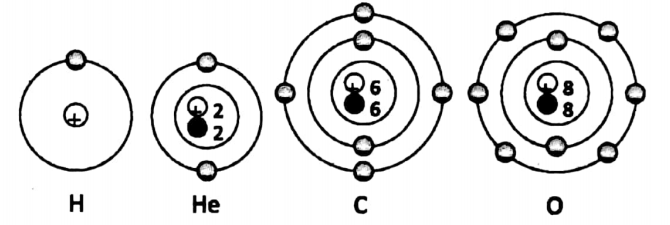
With these things in mind, we are now in a position to diagrammatically represent the following four atoms – a hydrogen atom, a helium atom, a carbon atom, and an oxygen atom.

The hydrogen atom is unique in the sense that it is the only atom that has no neutron in its nucleus. It has one proton in the nucleus. One electron is revolving around the nucleus.

(K-shell has 1 electron). Helium atom has one proton and one neutron in the nucleus. Two electrons are present in the first orbit and are revolving around the nucleus. (K-shell has two electrons).
 

WBBSE Solutions For Class 8 Chapter-2 Element, compound and chemical reaction sec-2 Structure of matter Nucleus

Understanding structure of matter for Class 8

The carbon atom has six protons and six neutrons in the nucleus. A total of six electrons are revolving around the nucleus.

Among them, two electrons are present in the first orbit (i.e. K-shell) and four electrons are present in the second orbit (i.e. L-shell).

The oxygen atom has eight protons and eight neutrons in the nucleus. A total of eight electrons are revolving around the nucleus.

Among them, two electrons are present in the first orbit (i.e. K- shell) and six electrons are present in the second orbit (i.e. L-shell).

The total number of protons in the nucleus of an atom is called the atomic number of the atom. The atomic number is represented by the letter Z.

The total number of protons and neutrons in the nucleus of an atom is called its mass number. The mass number is represented by the letter A.

Since an atom is electrically neutral as a whole, it is clear that the total number of protons in an atom is equal to the total number of electrons present in that atom.

Each different element is represented by a symbol. For example, the symbol of hydrogen is “H”, that of helium is “He”, the symbol of carbon is “C”, and the symbol of oxygen is “O” and so on.

Let the symbol of an element be “X” (Remember that there is no such element represented by “X”, it is just a hypothetical assumption). The element is represented as follows.

Mass. number x Atomic. number (Z)

In this representation, with respect to the symbol of the element, its mass number is written as left superscript and its atomic number is written as a left subscript.

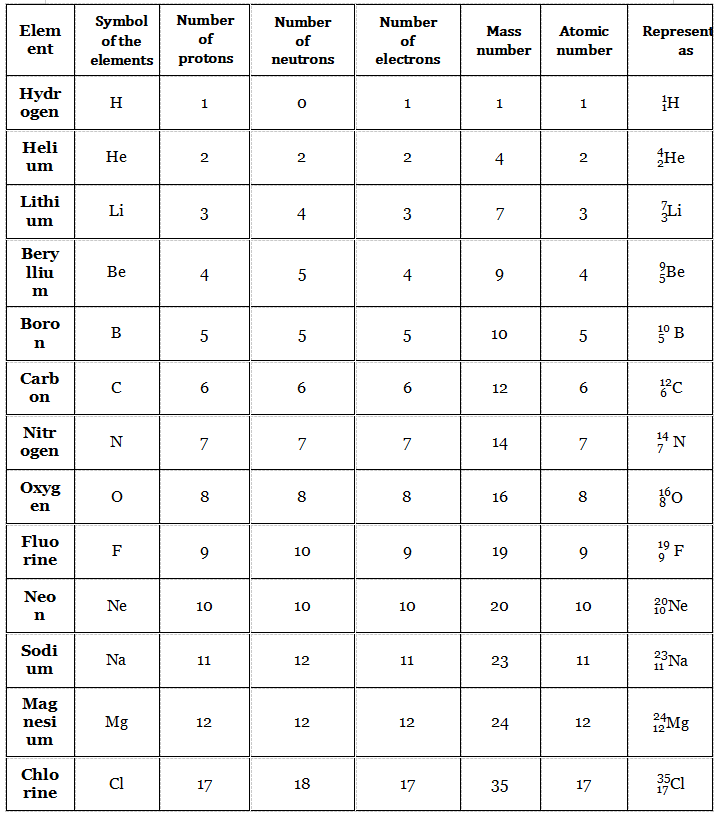
For example, a carbon atom with 6 protons and 6 neutrons (which means mass number = 6 + 6 = 12; atomic number = 6) is represented as.

More Examples Are Given In The Following Table.
WBBSE Solutions For Class 8 Chapter-2 Element, compound and chemical reaction sec-2 Atomic numbers mass number

Different Types Of Atom

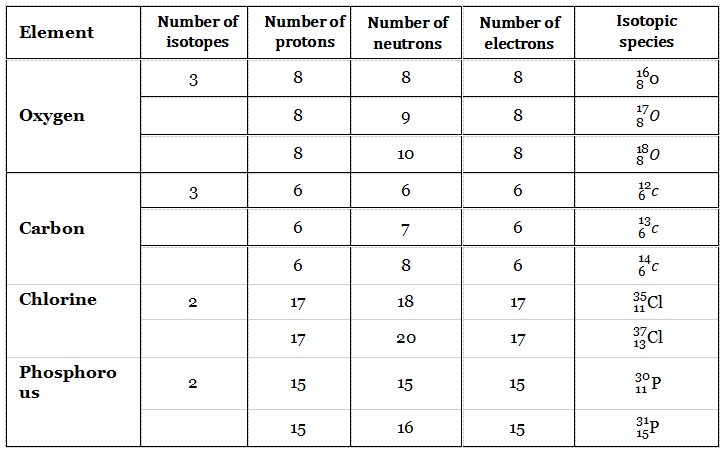
Atoms of the same elements (having the same atomic number) having different numbers of neutrons (i.e., having different mass numbers) are called isotopes.

So two isotopes have the same number of protons (i.e., the same atomic number) but different numbers of neutrons. For example, hydrogen ( \H ), deuterium ( \H ), and tritium ( \H ) are isotopes.
Apart from hydrogen, oxygen, carbon, and chlorine have isotopes.
WBBSE Solutions For Class 8 Chapter-2 Element, compound and chemical reaction sec-2 Atomic numbers Different type of Atom.1

Properties of matter for Class 8 students

The chemical properties of an element are regulated by the electronic configuration of the atom, particularly by the number of extranuclear electrons (in the outermost shell). So isotopes of an element have similar chemical properties.

Isobars

Atoms of different elements that have the same mass number but a different atomic number are called isobars. This means that in the case of isobars, the number of protons and the number of neutrons are different, but the total number of neutrons and protons is the same. Examples of isobars are latex-

Isotone

Atoms of different elements having the same number of neutrons in the nucleus are called isotones. In the case of isotones, the number of protons in the nucleus or the atomic number is different. They also have different mass numbers. Examples of isotones are In all three atoms the number of neutrons is 16.

Structure of Matter

All the substances or matter that we see around us are nothing but the aggregation of atoms and molecules. A very minute mass of a substance is composed of a very large number of atoms and molecules. For example, 1 milligram of gold contains about 3 x 10¹⁸ atoms.

We know that the various kinds of substances can be divided mainly into three categories – gas, liquid, and solid. These are called the three states of matter.

All substances are made up of atoms or molecules. Then one may wonder how some of the substances are gaseous, while some are liquids and others are solids.

So, one can guess that there must be differences in the arrangement of atoms or molecules in three different states of matter.

1. Gaseous state

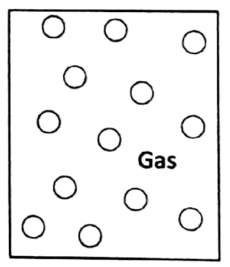
In a gas, the molecules move at a very large speed and move randomly. The gas molecules possess translatory, rotatory, and vibratory motions in all directions.

During this random, chaotic movement, they collide with each other and also with the walls of the container in which they are kept. The average distance between the molecules is quite large compared to liquids and solids.
 

WBBSE Solutions For Class 8 Chapter-2 Element, compound and chemical reaction sec-2 Structure of matter gas


The force of attraction between the atoms or molecules in a gas is very small. Due to this random movement of molecules, gas tends to fill up completely any available space. So they have no finite volume (or shape).

By applying pressure, the volume of a gas can be easily reduced. So gases are easily compressible. The density of a gas is generally the lowest among the three states.

The random movement of molecules in gas can be easily understood from the following experiment. If we open a small bottle of perfume in one corner of the room, we can smell it from the other side of the room almost immediately.

This is because perfumes are generally volatile liquids. Once the bottle is opened, some of the liquid is vaporized (i.e., converted to a gaseous state).

The molecules in the gaseous state move randomly with great speed. So almost immediately after opening the bottle of perfume, we can smell it from any corner of the room.

2. Liquid state

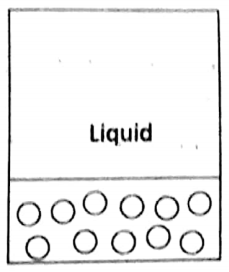
Compared to a gaseous state, in a liquid state, the molecules are closer to one another- The force attraction between the molecules is greater compared to that in the gaseous state.

The molecules can still move but their movements are somewhat restricted. They can rotate, vibrate and move over a small distance.

The translatory motion is either sideways or downwards. Consequently, liquids also do not have definite shapes, but due to greater interaction between the molecules, they have definite volumes. Liquids are much dense and much less compressible compared to gases.
WBBSE Solutions For Class 8 Chapter-2 Element, compound and chemical reaction sec-2 Structure of matter Liquid

3. Solid state

The attraction between the atoms or molecules is very high compared to liquids and gases. As a result, the position of atoms or molecules remains fixed with respect to one another.

So atoms or molecules remain in a relatively ordered state. The atoms or molecules within a solid have no mobility (i.e., cannot move from one place to another) and cannot rotate.

Each atom or molecule can only vibrate about its mean position. Solids, in general, have definite shapes and volumes and can have any number of free surfaces. The density of a solid is the highest among the three states of matter.

Solids can be further classified into two categories – amorphous and crystalline. In crystalline solids, atoms or molecules remain in a highly ordered fashion and they are characterized by sharp melting points. But amorphous solids lack such highly ordered arrangement and melts over a range of temperature.
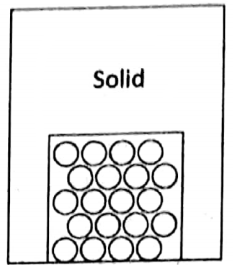
WBBSE Solutions For Class 8 Chapter-2 Element, compound and chemical reaction sec-2 Structure of matter Soild

We have observed that when heated, ice melts to form liquid water and if water is heated it starts boiling and forms vapor.

Similarly, on cooling the vapor condenses to liquid, and on further cooling the liquid freezes to solid.
This observation suggests that change of state can be effected by supplying (or extracting) heat (i.e., by increasing or decreasing temperature).

So we may wonder how a change in temperature can bring about a change in state. Actually, in a solid, the force of attraction between the atoms or molecules is very great.

Each of them remains fixed at a particular position. They can neither rotate nor move from one place to another. They can only vibrate about their mean positions.

As the temperature is increased due to the supply of heat energy, the kinetic energy of vibration gradually increases and beyond a certain temperature, the vibration of molecules becomes so energetic that the force of attraction between the atoms or molecules significantly decreases.

The atoms or molecules become free from their fixed positions and the solid is transformed into a liquid state. As more and more heat energy is supplied to a liquid, its temperature increases gradually and the mobility of the atoms or molecules further increases.

The average distance between the atoms or molecules also increases and beyond a certain temperature, the mobility becomes so high that the average distance between the atoms or molecules becomes very high and the atoms or molecules become completely free. Then the liquid is transformed into a gaseous state.

Plasma

We have mentioned that generally there are three states of matter. Plasma is the fourth fundamental state of matter. The term “plasma” was first coined by Irving Langmuir.

It has properties unlike those of the other states. Plasma may be produced by heating a gas to an extremely high temperature.

Due to the heating of gas at very high temperatures, vigorous collisions between atoms and molecules take place as a result of which electrons are ripped off yielding electrons and ions.

So, plasma is an electrically conducting medium. Like the gaseous state, plasma does not have a definite shape or a definite
volume.

Plasma is the most abundant form of matter in the universe, most of which is present in intergalactic regions and in stars including the sun.

The center or core of the sun is extremely hot (approximately 107 °C). At this extremely high temperature, matter can exist only in the form of plasma.
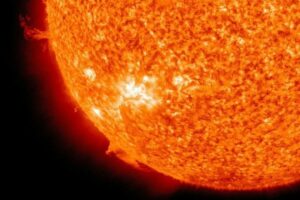
WBBSE Solutions For Class 8 Chapter-2 Element, compound and chemical reaction sec-2 Structure of matter palsma


Ionic Compounds And Covalent Compounds

So far we have mentioned that substances are made up of atoms and molecules. But there are many substances that are actually aggregates of ions.

Common salt (sodium chloride, NaCI), ammonium chloride, potassium chloride, etc., are only a few examples. Ions are produced from atoms when it accepts or rejects electron(s).

The electrons in the distant shells away from the nucleus are attracted by the protons of the nucleus with a weaker force than that acting on the electrons in the shells closer to the nucleus.

So, a certain small amount of energy may detach one or more electrons from the outer shells and in that case, the atom which was initially electrically neutral will be positively charged or it will be a positive ion or cation.

Again if somehow an atom captures one or more electrons it will be a negative ion or anion. Thus cations are formed due to the loss of electrons and anions are formed due to the gain of electrons.

Substances, made up of ions, are called ionic compounds. But there is another kind of substance – known as covalent compounds. In such cases, different atoms share electron(s) with another atom (s) to form a compound.

Ionic Compounds

Sodium chloride (NaCI) is an example of an ionic compound. It is made up of Na+ ions and Cl” ions. The biggest experimental proof that the solid NaCI contains ions is that fused or molten NaCI conducts electricity.

To conduct electricity, there must be some charged particles in the molten or fused state. In a metal, which is a good conductor of electricity, electrons are charged particles. But experiments have proved that in the case of NaCI, it is the ions (i.e., positively charged Na+ ions and negatively charged Cl” ions)

which are responsible for the conduction of electricity. The aqueous solution of NaCI also is a good conductor and here also Na+ and Cl” are the carriers of electricity.

NaCI can be formed by the reaction between solid sodium metal and chlorine gas. \(2 \mathrm{Na} \text { (solid) }+\mathrm{Cl}_2 \text { (gas) } \rightarrow 2 \mathrm{NaCl} \text { (solid) }\)

1. Alternatively, we can think of the formation of NaCI, consisting of the following steps

Na atom loses one electron to form Na+ cations; the Cl atom (formed from the Cl2 molecule) accepts one electron to form Cl” anions.

An equal number of Na+ ions and Cl” ions then combine to form solid sodium chloride. In NaCI crystal, Na+, and Cl” ions exist at every alternate position (along any direction), as
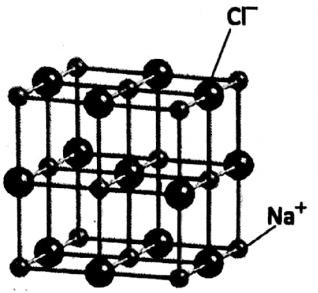
WBBSE Solutions For Class 8 Chapter-2 Element, compound and chemical reaction sec-2 Structure of matter Nacl

Na has 11 protons, 12 neutrons and 11 electrons. It can lose one electron to produce a positively charged Na+ ion or cation (containing 10 electrons).

Cl atom has 17 protons, 18 neutrons and 17 electrons. It can accept one electron to form a negatively charged Cl” ion or anion (containing 18 electrons).

Two ions are strongly held together by strong electrostatic force. Solid NaCI is a solid compound consisting of a large number of cations and anions. For every Na+, there is one Cl’ ion.

\(\begin{aligned}
& \mathrm{Na}-\mathrm{e} \rightarrow \mathrm{Na}^{+} \\
& \mathrm{Cl}+\mathrm{e} \rightarrow \mathrm{Cl}^{-}
\end{aligned} \longrightarrow \mathrm{Na}^{+} \mathrm{Cl}^{-} \text {or } \mathrm{NaCl}\)

So, overall NaCI crystal has no net charge. In fact, in all ionic compounds, the total number of positive charges on cations must be equal to the total negative charge on the anions. Thus all the ionic compounds are charge neutral (i.e., no net charge).

2. We can give some more examples in the following table
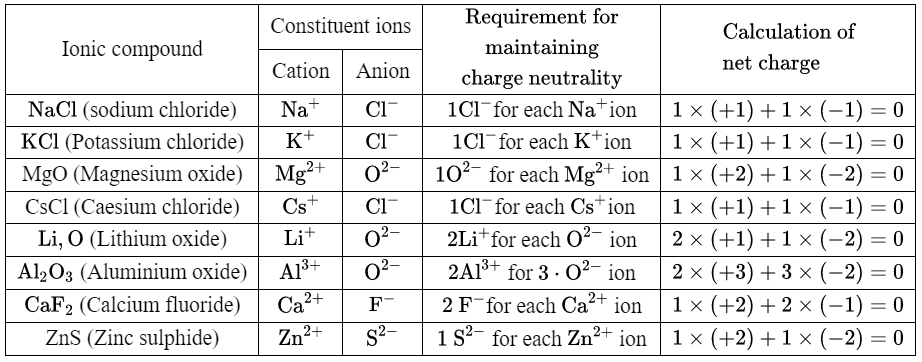
 

WBBSE Solutions For Class 8 Chapter-2 Element, compound and chemical reaction sec-2 Atomic numbers Inonic compound

In the above table, there are some metal atoms that can lose only one electron to form a cation (such as Na, K, Cs, Li) and there are some metal atoms that can lose more than one electron to form a cation {such as Mg (loses 2 electrons), Zn (loses 2 electrons), Al (loses 3 electrons), Ca (loses 2 electrons)}.

These metals can form only one type of cation. The metal atom gives up the electron(s) to have 8 electrons in its outermost shell. The number of electrons (s) given up by a metal atom is called its valency. So the valency of U is 1, Na is 1, K is 1, Zn is 2, etc.

3. But there are some metal atoms, each of which can form more than one type of cation by losing a different number of electrons For example, a Fe atom can lose two electrons to form Fe2+ ions, called ferrous ions.

When the same Fe atom loses three electrons, it forms a Fe3+ion called a ferric ion. Among these two ions, the ion with lower charge is represented with the “ous” suffix (for example, the Fe2+ ion is called a ferrous ion), and the ion with higher charge is represented with ic” suffix (for example, Fe3+ is called “ferric” ion). The element Fe is said to have variable valency.

Some more examples of elements having variable valency are given below.
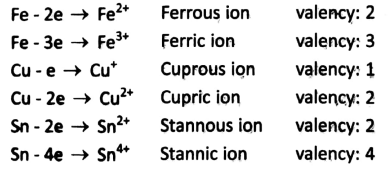
WBBSE Solutions For Class 8 Chapter-2 Element, compound and chemical reaction sec-2 Structure of matter electrons

Similarly, a non-metal usually accepts electron(s) to form an anion. By gaining the requisite number of electron(s) an atom attains a structure where 8 electrons (or 2 electrons in the case of H only) exist in the outermost shell.

For example, the Cl atom gains one electron to form Cl” ion. So its valency is 1. Similarly, the valency of F, Cl, Br, I is 1.

Now, let us get back to the compound NaCI. We have mentioned that solid sodium chloride consists of Na+ and Cl- ions. The question one may ask is why the sodium atom is losing one electron and the chlorine atom is gaining an electron.

Actually, during the formation of a compound, each atom attains the electronic configuration of inert gas. Helium, neon, argon, etc., are examples of inert gases.

Helium (atomic number 2) has 2 electrons in its outermost shell. All other gases have 8 electrons in their outermost shells.

Structure of matter examples for Class 8

Neon (atomic number 10) has 2 electrons in K-shell and 8 electrons in L-shell. Argon (atomic number 18) has 2 electrons in K-shell and 8 electrons in L-shell and 8 electrons in M-shell.

The electronic configuration observed in inert gases is stable, and during the formation of compounds or during a chemical reaction, atoms try to attain this stable configuration.

When the Na atom (atomic number 11) loses an electron, 10 electrons are left – 2 in K-shell and 8 in L-shell. This is the electronic configuration of neon (an inert gas).

Again, when the chlorine atom (atomic number 17) gains an electron, it has 18 electrons – 2 in K-shell, 8 in L-shell, and 8 in M- shell.

This is the electronic configuration of argon. So, in sodium chloride, the electronic configuration of both the cation and the anion is similar to that of an inert gas. Na+ and Cl are held together strongly by electrostatic force.

4. The general characteristics of an ionic compound can be summarized as follows :

  1. In the case of ionic compounds, molecules do not exist. In solid-state, cations and anions are properly arranged in a definite pattern.
  2. In ionic compounds, the total charges on cations will be the same as the total charges on anions.
  3. Ionic compounds are generally soluble in water.
  4. An aqueous solution of ionic compounds which are soluble in water conducts electricity.
  5. The melting point and boiling point of ionic compounds are totally high.

Radicals

Sometimes, a group of atoms consisting of different elements collectively behave as a single entity during a chemical reaction. Such a group of atoms is known as a radical.

Since a radical behaves like a single entity during a chemical reaction, it must have a definite valency. For example, ammonium ion (NH4+) is formed by one nitrogen atom and four hydrogen atoms.
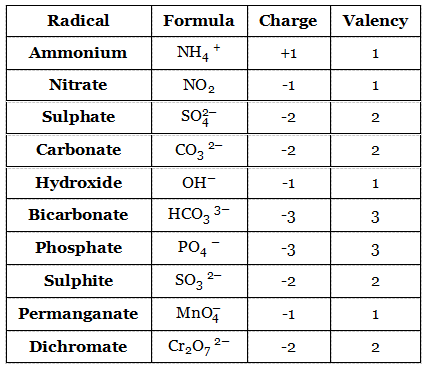
WBBSE Solutions For Class 8 Chapter-2 Element, compound and chemical reaction sec-2 structure of matter radical

The net charge of this radical is +1. As an approximation, the charge of a radical may be taken as its valency. This means the valency of NH4+ is 1. Examples of some other radicals are given below:

Atoms of elements combine to form Let us construct the formula of some molecules. The number of atoms of each element compound using the above information, present in a particular molecule is definite. let us construct a formula for some compounds using the above information.
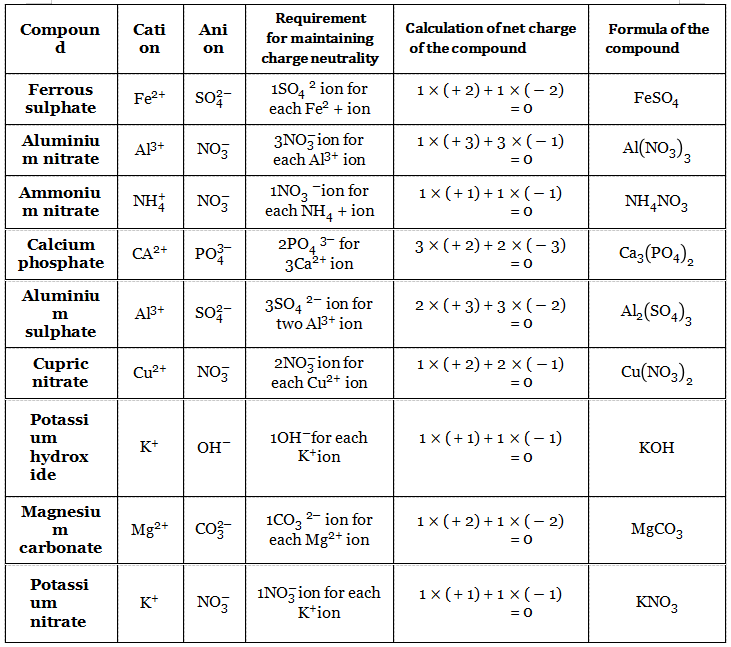
WBBSE Solutions For Class 8 Chapter-2 Element, compound and chemical reaction sec-2 sturcture of matter Compounds

We should mention here that in ionic compounds no molecules exist. For example, in solid sodium chloride, there are only properly arranged Na+ and Cl’ ions; no entity like “NaCI” exists in it.

When dissolved in water or in a molten state, these ions come apart readily and move chloride. So, basically what we are writing is the number of cations per anion and in this way, we are representing the ionic compound.

Covalent Compound

Ionic compounds are made up of ions. Molecules do not exist there. But there is another class of compounds which are known as covalent compounds.

Unlike ionic compounds, here the presence of molecules has been experimentally established. Water is the most common example of a covalent compound. Some elemental gases such as H2, Cl2, etc., are also covalent.

Let us consider a diatomic covalent compound such as H2, Cl2, etc. Here, two atoms unite to form a molecule. No electron transfer from one atom to the other occurs here.
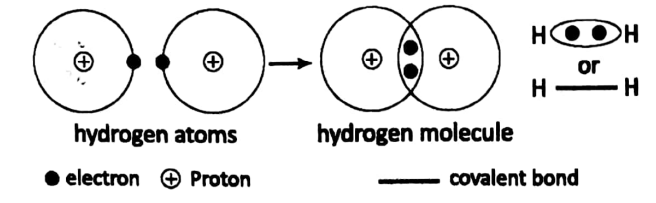
WBBSE Solutions For Class 8 Chapter-2 Element, compound and chemical reaction sec-2 Structure of matter mass number hydrogen molecule


But atoms share one electron each to form a pair of electrons. This pair of electrons becomes joint property, so as to say, of the two atoms.

For example, H2 is a diatomic molecule formed by two H-atoms. Each atom has 1 electron. The valency of the H-atom is 1. Each H-atom shares its only electron with the other atom.

Thus an electron pair is formed. This pair of electrons holds the two H-atom by a chemical force – which is called a covalent bond.

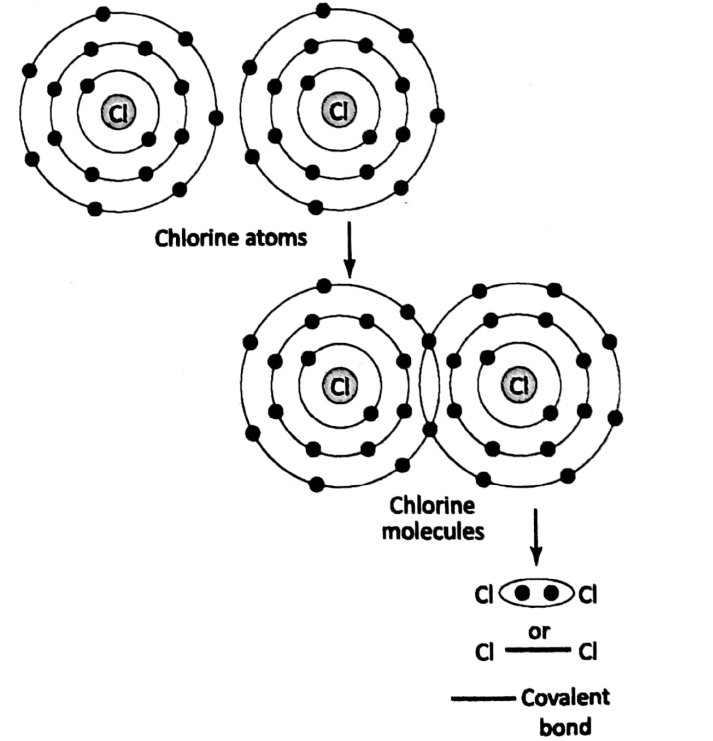
The covalent bond is usually represented by “• •” or Let us consider the case of Cl2. Each chlorine atom has a total of 17 electrons.
 

WBBSE Solutions For Class 8 Chapter-2 Element, compound and chemical reaction sec-2 Structure of matter Covalent bond

Nature of matter in chemistry for Class 8

out of these 17 electrons, 7 electrons are in the outermost shell. The valence of chlorine is 1. Each chlorine atom shares one of its electrons from its outermost shell with the other chlorine atom, thus forming a covalent bond.

Thus chlorine molecule is formed. When more than two atoms of two or more elements combine to form a covalent compound, then the atom of the element having the highest valency is usually considered a “central atom”.

It is surrounded by other atoms. The valency of the surrounding atoms is not the same. More than one covalent bond is formed, one each for each pair of electrons shared between the central atom and another surrounding atom.

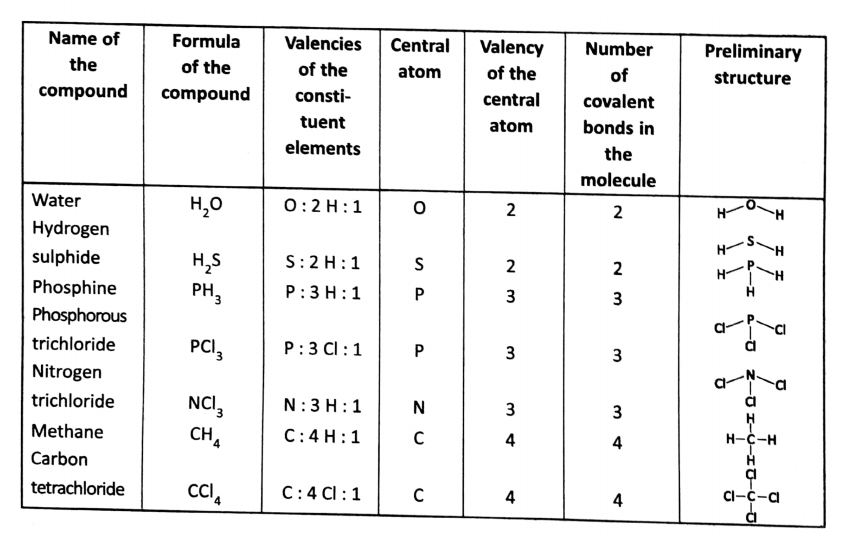
\(\mathrm{H}_2 \mathrm{O}, \mathrm{H}_2 \mathrm{~S}, \mathrm{NH}_3, \mathrm{CH}_4, \mathrm{PCl}_3,\) etc., are all covalent compounds.

Let us consider the case of H,0 molecules. The valency of oxygen is 2 and the valency of hydrogen is 1. So, oxygen having the highest valency is considered a central atom in water molecules.

The oxygen atom has a total of 8 electrons, out of which 6 electrons are at the outermost shell. 2 electrons are shared with two electrons of two hydrogen atoms (one each from each hydrogen atom).

Thus two covalent bonds are formed. (In the H20 molecule, oxygen has effectively 8 electrons in its outermost shell).
Some more examples are given below in tabular form.
WBBSE Solutions For Class 8 Chapter-2 Element, compound and chemical reaction sec-2 Structure of matter Name of compound


[We must mention here that using this concept, only the preliminary structure of a molecule can be predicted. But for the actual three-dimensional structure of a molecule, we need more advanced scientific theory.]

  1. The General Characteristics Of Covalent Compounds Can Be Summarized As Follows:
  2. In covalent compounds, molecules exist.
  3. The melting point and boiling point of covalent compounds are usually low.
  4. Covalent compounds are generally soluble in organic solvents and usually insoluble in water.
  5. These compounds usually exist as gas or liquid under normal temperatures and pressure.

WBBSE Class 8 School Science Chapter 2 Element Compound And Chemical Reaction Nature Of Matter SAQs

Chapter 2 Element Compound And Chemical Reaction Nature Of Matter Short Answer Type Questions

Question 1. What do you mean by a substance? Substances are those which can be sensed by our sense organs.
Answer:

Substance:

They have mass and occupy a certain volume and have inertia.

Question 2. What do you mean by change of state?
Answer:

Change of state:

The transformation of matter from one physical state to another is known as a change of state. For example during melting, a solid is transformed into liquid.

Question 3. What do you mean by sublimation?
Answer:

Sublimation:

When heated, solid melts and is transformed into liquid. Further heating converts liquid into vapour.

But there are some substances, which when heated, are directly transformed into vapour without passing through the liquid state.

The transformation of a solid directly into vapour on being heated is called sublimation.

WBBSE Class 8 Nature of Matter short answer questions

Question 4. What do you mean by the physical property of a substance?
Answer:

Physical property of a substance:

The property of a substance, which gives us an idea about the nature and external condition of the substance is called its physical property.

It cannot provide us with an idea about its internal structure (or “molecular-level information”). Example of physical properties is – physical state, colour, odour, melting point, boiling point, magnetic property, solubility in a particular solvent, etc.

Question 5. What do you mean by the chemical property of a substance?
Answer:

Chemical property of a substance:

The property of a substance which decides the tendency and capacity of that substance to react with other substances is called its chemical properties.

For example, the sulphur burns in the air to produce sulphur dioxide (SO2); zinc reacts with dilute sulphuric acid to produce hydrogen gas.

Read And Learn More WBBSE Solutions For Class 8 School Science Short Answer Type Questions

Question 6. Among three jars, one contains a piece of zinc, one contains petrol and the other contains nitrogen. How can you identify them?
Answer:

Zinc is solid, petrol is liquid and nitrogen is gas. So from their physical state, each of them can be identified.

Question 7. Among two jars, one contains camphor and the other contains naphthalene. How can you identify them?
Answer:

Camphor and naphthalene, both are volatile solids. But each of them has its characteristics odour. By this odour, they can be identified.

WBBSE Class 8 School Science Chapter 2 Element Compound And Chemical Reaction Nature Of Matter SAQs

Question 8. Among three containers, one contains mustard oil, the other coconut oil and the third contains diesel. How can you identify them?
Answer:

Mustard oil, coconut oil and diesel, all have their characteristic odours. So by their odour, they can be individually identified.

Question 9. An element X forms an oxide X20. An aqueous solution of X20 turns red litmus paper blue. What is the nature of the oxide?
Answer:

An element X forms an oxide X20. An aqueous solution of X20 turns red litmus paper blue.

State whether element X is a metal or a non-metal. Since the aqueous solution of X2O turns red litmus paper blue, X2O is a basic oxide.

Non-metallic oxides are generally either acidic or neutral oxides. Since X2O is a basic oxide, hence element X must be a metal since metals form basic oxides.

Short answer questions on elements and compounds for Class 8

Question 10. Four containers containing the tip of a pencil, glycerine, a piece of iron wire and water are supplied to you. How can you identify each of them?
Answer:

Four containers containing the tip of a pencil, glycerine, a piece of iron wire and water are supplied to you.

The tip of the pencil is made of graphite. Graphite and iron wire are both solid while water and glycerine are liquid.

Graphite is soft and slippery but iron wire is hard and not slippery. So they can be distinguished from one another.

Glycerine is more viscous and slippery, but water is not slippery. So they can be distinguished from each other.

Question 11. You are provided with a gas jar containing nitric oxide. What will happen if the gas jar is opened?
Answer:

You are provided with a gas jar containing nitric oxide.

When the gas jar containing nitric oxide is opened, brown fumes are formed. This is because nitric oxide reacts with oxygen present in the air, and brown-coloured nitrogen dioxide gas is formed.

⇒ \(2 \mathrm{NO}+\mathrm{O}_2 \rightarrow 2 \mathrm{NO}_2\)

Question 12. Take two glasses filled with water. In one glass some sugar is added and in another glass, calcium oxide is added. What will you observe?
Answer:

Take two glasses filled with water. In one glass some sugar is added and in another glass, calcium oxide is added.

When sugar is added to a glass of water and stirred well, sugar dissolves in water. The temperature of the glass of water remains the same after the dissolution of sugar.

When calcium oxide is added to water, the temperature of the glass of water increases. This happens due to an exothermic reaction between calcium oxide and water.

⇒ \(\mathrm{CaO}+\mathrm{H}_2 \mathrm{O} \rightarrow \mathrm{Ca}(\mathrm{OH})_2+\text { heat }\)

Question 13. Some amounts of common salt and sugar are taken on a spoon and are separately heated. What will you observe?
Answer:

Some amounts of common salt and sugar are taken on a spoon and are separately heated.

When some amount of common salt (i.e., sodium chloride) is taken on a spoon and is strongly heated, no visible change (of colour or odour or physical state etc.) is observed.

When some sugar is taken on a spoon and is strongly heated, the sugar first turns brown and then becomes black. In the case of sugar, water is first liberated from it and ultimately only black carbon is left on the spoon.

⇒ \(\mathrm{C}_{12} \mathrm{H}_{22} \mathrm{O}_{11} \rightarrow 12 \mathrm{C}+11 \mathrm{H}_2 \mathrm{O}\)

WBBSE Chapter 2 nature of matter answers

Question 14. How do sodium, potassium and calcium react with cold water?
Answer:

Sodium and potassium react vigorously with cold water and form hydrogen gas. The gas catches fire and burns with blue flame by the heat produced during the reaction.

⇒ \(\begin{gathered}
2 \mathrm{Na}+2 \mathrm{H}_2 \mathrm{O} \rightarrow 2 \mathrm{NaOH}+\mathrm{H}_2 \uparrow \\
2 \mathrm{~K}+2 \mathrm{H}_2 \mathrm{O} \rightarrow 2 \mathrm{KOH}+\mathrm{H}_2 \uparrow
\end{gathered}\)

Calcium reacts less vigorously with cold water.

⇒ \(\mathrm{Ca}+2 \mathrm{H}_2 \mathrm{O} \rightarrow \mathrm{Ca}(\mathrm{OH})_2+\mathrm{H}_2 \uparrow\)

Question 15. How do iron, aluminium and zinc react with water?
Answer:

Iron, aluminium and zinc do not react with either cold or hot water. They react with steam to produce metallic oxide and hydrogen gas.

⇒ \(\begin{aligned}
2 \mathrm{Fe}+3 \mathrm{H}_2 \mathrm{O} & \rightarrow \mathrm{Fe}_2 \mathrm{O}_3+3 \mathrm{H}_2 \uparrow \\
2 \mathrm{Al}+3 \mathrm{H}_2 \mathrm{O} & \rightarrow \mathrm{Al}_2 \mathrm{O}_3+3 \mathrm{H}_2 \uparrow \\
\mathrm{Zn}+\mathrm{H}_2 \mathrm{O} & \rightarrow \mathrm{ZnO}+\mathrm{H}_2 \uparrow
\end{aligned}\)

Question 16. If you are supplied with some amount of iron powder and some amount of zinc powder, how can you distinguish them?
Answer:

Iron powder and zinc powder – both are solids. But iron is a magnetic material while zinc is not. So, when a magnet is brought near iron powder, they are attracted towards it.

But when a magnet is brought near the powder, they are not at all attracted by the magnet.

Question 17. Mention the role of iron in the oxidation-reduction of tissues and cells. Name two states of matter which are fluid.
Answer:

Several proteins are required for the release of energy in mitochondria by using oxygen inhaled through breathing. Iron is required to make these proteins. Liquids and gases are fluids.

Nature of matter concepts with short answers for Class 8

Question 18. Why gases do not have definite volume and shape but solids do?
Answer:

The molecules of solids are very closely packed with negligible intermolecular space. The intermolecular force of attraction among solid molecules is maximum.

Hence solids possess definite shapes and volumes. Gas molecules are loosely packed with the negligible intermolecular force of attraction. The intermolecular space in gas molecules is the maximum among the three states of matter. Hence gases neither have a definite volume nor shape of their own.

WBBSE Solutions For Class 8 School Science Long Answer Type Questions WBBSE Solutions For Class 8 School Science Short Answer Type Questions
WBBSE Solutions For Class 8 School Science Very Short Answer Type Questions WBBSE Solutions For Class 8 School Science Review Questions
WBBSE Solutions For Class 8 School Science Solved Numerical Problems WBBSE Solutions For Class 8 School Science Experiments Questions
WBBSE Solutions For Class 8 Maths WBBSE Class 8 History Notes
WBBSE Class 8 History Multiple Choice Questions WBBSE Solutions For Class 8 History
WBBSE Solutions For Class 8 Geography


Question 19. Why is sodium kept immersed in kerosene oil?
Answer:

Sodium is a highly reactive metal which reacts vigorously with cold water to form sodium hydroxide and hydrogen gas.

⇒ \(2 \mathrm{Na}+2 \mathrm{H}_2 \mathrm{O} \rightarrow 2 \mathrm{NaOH}+\mathrm{H}_2\)

It also reacts with oxygen in the air at room temperature to form sodium oxide.

⇒ \(4 \mathrm{Na}+\mathrm{O}_2 \rightarrow 2 \mathrm{Na}_2 \mathrm{O}\)

Hence, sodium is stored under kerosene oil to prevent its reaction with oxygen, moisture and carbon dioxide in the air.

Question 20. Give two examples of metalloids and show that they exhibit properties of both metals and non-metals
Answer:

Metalloid Metallic property  non- metallic property
Arsenic Fair conductor of electricity Arsenic hydride (AsH3) is a weak base
Selenium Good conductor of electricity at 200°C. It exists in one non-metallic allotropic form.


WBBSE Class 8 Science practice short answer questions on elements and compounds

Question 21. When calcium metal is added to water, the gas evolved does not catch fire but the same gas evolved on adding sodium metal to water catches fire-why?
Answer:

Sodium metal reacts vigorously with cold water and produces hydrogen gas. This is a highly exothermic reaction and the gas catches fire by the heat evolved in the reaction.

Calcium reacts less violently with cold water and less heat is evolved during the reaction. This cannot make the hydrogen gas burn.

Question 22. Which metal foil is used for packing some of the medicine tablets? Both physical and chemical changes occur when ammonium chloride is heated-explain.
Answer:

Aluminium foil is used for packing medicine tablets.

Process Physical change involved Chemical change involved
Heating of ammonium chloride (NH4CI) Ammonium chloride sublimes Decomposition into ammonia and hydrogen chloride.

WBBSE Class 8 School Science Chapter 2 Element Compound And Chemical Reaction Nature Of Matter WBBSE Class 8 School Science Chapter 1 Physical Environment Heat VSAQs

Chapter 2 Element Compound And Chemical Reaction Nature Of Matter VSAQs

Question 1. Name two compounds which sublime.
Answer:

The two compounds are iodine and camphor.

Question 2. Name one substance which is attracted by a magnet.
Answer:

Iron is a magnetic substance, attracted by a magnet.

Question 3. What is the melting point of ice and boiling point of water at1 atmospheric pressure?
Answer:

The melting point of ice qt 1 atmospheric pressure is 0°C and the boiling point of water at atmospheric pressure is 100’C.

Question 4 Name one substance which is one of the hardest known materials known to us.
Answer:

Diamond is a substance which is one of the hardest known materials known to us.

Question 5. Name one metal and a non-metal which are liquid at room temperature.
Answer:

Mercury (metal) and bromine (non-metal)

Question 6. Name one solvent in which sulphur is soluble
Answer:

Sulphur is soluble in carbon disulphide (CSJ.

WBBSE Solutions For Class 8 School Science Chapter 2 Element Compound And Chemical Reaction Nature Of Matter Vsaqs

WBBSE Class 8 Nature of Matter very short answer questions

Question 7. Name one non-metal which is a good conductor of heat and electricity.
Answer:

Graphite is a good conductor of heat and electricity.

Question 8. Name one non-metal which is a good conductor of heat but a bad conductor of electricity.
Answer:

Diamond is a good conductor of heat but a bad conductor of electricity.

Question 9. Name two metals (excluding mercury) which are liquid at 30°C and1 atmospheric pressure.
Answer:

Gallium (melting point = 29.8’C) and caesium (melting point = 28.4°C) are two metals which are liquid at 30°C and1 atmospheric pressure.

Read And Learn More WBBSE Solutions For Class 8 School Science Very Short Answer Type Questions

Question 10. Name two metals which can be cut by a sharp knife
Answer:

Lithium and sodium are two metals which can v be cut by a sharp knife.

Question 11. Give two examples of amphoteric oxide.
Answer:

Examples of amphoteric oxide:

Aluminium oxide (Al203) and zinc oxide (ZnO) are amphoteric oxides.

Question 12. Which gas smells like a rotten egg?
Answer:

Hydrogen sulphide (H2S) gas smells like a rotten egg.

Question 13. What is the lightest metal on earth?
Answer:

Lightest metal on earth:

Lithium is the lightest metal on earth.

Very short answer questions on elements and compounds for Class 8

Question 14. Name one metal which catches flame when comes in contact with water.
Answer:

Sodium catches fire when comes in contact with water.

Question 15. Which ion helps in the clotting of blood?
Answer:

Co2+ ion helps in the clotting of blood.

Question 16. Which gas is produced when a piece of zinc is immersed in dilute sulphuric acid?
Answer:

Hydrogen (H2) gas is produced when a piece of zinc is immersed in dilute sulphuric acid.

WBBSE Solutions For Class 8 School Science Long Answer Type Questions WBBSE Solutions For Class 8 School Science Short Answer Type Questions
WBBSE Solutions For Class 8 School Science Very Short Answer Type Questions WBBSE Solutions For Class 8 School Science Review Questions
WBBSE Solutions For Class 8 School Science Solved Numerical Problems WBBSE Solutions For Class 8 School Science Experiments Questions
WBBSE Solutions For Class 8 Maths WBBSE Class 8 History Notes
WBBSE Class 8 History Multiple Choice Questions WBBSE Solutions For Class 8 History
WBBSE Solutions For Class 8 Geography


Question 17. Name two metals which neither react with steam nor with water.
Answer:

Lead and gold.

Question 18. Name two proteins which play a crucial role in the contraction of the muscle.
Answer:

Actin and myosin are the two proteins which play a crucial role in the contraction of the muscle.

Question 19. Lack of secretion of which hormone causes type-1 diabetes in human beings?
Answer:

Insulin is the hormone’s lack of secretion which causes type-1 diabetes in human beings.

Question 20. Which protein is responsible for the transport of oxygen within muscle tissues?
Answer:

Myoglobin is the protein which is responsible for the transport of oxygen within muscle tissues.

WBBSE Chapter 2 nature of matter answers

Question 21. Which non-metal plays an important role in the synthesis of thyroxin?
Answer:

Iodine is a non-metal which plays an important role in the synthesis of thyroxin.

Question 22. Which ion helps in the transport of nerve impulse v across nerve cells?
Answer:

Ca2+ ion helps in the transport of nerve impulses across nerve cells.

Question 23. Name two metals which are chemically very inert.
Answer:

Gold and platinum are the two metals which are chemically very inert.

Question 24. Name one protein present in the human body whose main constituent element is iron.
Answer:

Hemoglobin is the protein present in the human body whose main constituent element is iron.

Question 25. Name a metal and a non-metal which are required for the formation of teeth and bone.
Answer:

Calcium and phosphorous.

Question 26. Iron, sodium, copper- which metal among these three is not sonorous?
Answer:

Sodium.

Question 27. Two gas jars contain ammonia and hydrogen sulphide. How would you detect them using a physical property?
Answer:

The two gases can be distinguished by their characteristic odour. Ammonia has a pungent smell while Hydrogen sulphide has the smell of a rotten egg.

Question 28. I am an odourless, non-volatile, inorganic hydrated crystalline solid with having deep blue colour-who am I?
Answer:

Copper sulphate pentahydrate (Cu S0A.5H20).

Nature of matter concepts with very short answers for Class 8

Question 29. Name two metals that may not be found in the same physical state in the months of May and December.
Answer:

Gallium (Ga) and Caesium (Cs) since their melting points are 29.78°C and 28.4°C respectively.

Question 30. Which property of copper and aluminium makes them suitable for making wires?
Answer:

Ductility

WBBSE Class 8 Science practice very short answer questions on elements and compounds

Question 31. Name the metal which has been placed just below copper in the reactivity series.
Answer:

Mercury (Hg).

Question 32. X, Y, and Z represent three metals in the decreasing order of their reactivity. Which one of them is most likely to occur in a free state in nature?
Answer:

Metal Z since it is the least reactive and hence there is the least possibility of formation of any compound.

WBBSE Solutions For Class 8 School Science Chapter 2 Element Compound And Chemical Reaction Nature Of Matter Review Questions

Chapter 2 Element Compound And Chemical Reaction Nature Of Matter MCQs

Question 1. Carbon monoxide is

  1. A basic oxide
  2. A neutral oxide
  3. An acidic oxide
  4. An amphoteric oxide

Answer: 1. A basic oxide

Question 2. Blue vitriol is

  1. ZnSO4.7H2O
  2. CusO4.5H2O
  3. FesO4.7H2O
  4. Na2CO3. 10 H2O

Answer: 2. CusO4.5H2O

Question 3. Naphthalene and camphor can be identified

  1. By their odour
  2. By their colour
  3. By their taste
  4. By their structure

Answer: 1. By their odour

WBBSE Class 8 Nature of Matter review questions

Question 4. Which one of the following is a chemical change?

  1. Dissolving common salt in water
  2. Rusting
  3. Melting of wax
  4. Freezing of water

Answer: 2. Rusting

Question 5. One of the characteristic properties of metal is

  1. Brittleness
  2. Good conductor of heat and electricity
  3. Forms acidic oxide
  4. dull appearance

Answer: 2. Good conductor of heat and electricity

WBBSE Solutions For Class 8 School Science Chapter 2 Element Compound And Chemical Reaction Nature Of Matter Review Questions

Question 6. Which one of the following is a non-metal?

  1. Tungsten
  2. Sulphur
  3. Titanium
  4. Iron

Answer: 2. Sulphur

Question 7. Which one of the following has magnetic properties?

  1. Iron
  2. Copper
  3. Aluminium
  4. Zinc

Answer: 1. Iron

Review questions on elements and compounds for Class 8

Question 8. Which one of the following gases is odourless?

  1. Ammonia
  2. H2S
  3. Oxygen
  4. Ozone

Answer: 3. Oxygen

Question 9. The gas has a smell of rotten eggs is

  1. H2S
  2. Nh3
  3. Chlorine
  4. Ozone

Answer: 1. H2S

Question 10. When heated, solid iodine

  1. Sublimes
  2. Melts
  3. Boils
  4. Ionizes

Answer: 1. Sublimes

Read And Learn More WBBSE Solutions For Class 8 School Science Review Questions

Question 11. The metalloids are

  1. Fe, al
  2. As, sb
  3. Cl, Br
  4. Ar, ne

Answer: 2. As, sb

Question 12. The metal which does not produce hydrogen gas when reacts with H2C is

  1. Al
  2. Cu
  3. Zn
  4. Fe

Answer: 2. Cu

Question 13. Which one of the following metals is chemically most inert?

  1. Fe
  2. Au
  3. Cu
  4. Na

Answer: 2. Au

WBBSE Solutions For Class 8 School Science Long Answer Type Questions WBBSE Solutions For Class 8 School Science Short Answer Type Questions
WBBSE Solutions For Class 8 School Science Very Short Answer Type Questions WBBSE Solutions For Class 8 School Science Review Questions
WBBSE Solutions For Class 8 School Science Solved Numerical Problems WBBSE Solutions For Class 8 School Science Experiments Questions
WBBSE Solutions For Class 8 Maths WBBSE Class 8 History Notes
WBBSE Class 8 History Multiple Choice Questions WBBSE Solutions For Class 8 History
WBBSE Solutions For Class 8 Geography


Question 14. The substance having a characteristic odour is

  1. Silver
  2. Water
  3. Kerosene
  4. None of these

Answer: 3. Kerosene

Question 15. The metal which reacts explosively even with cold water is

  1. Sodium
  2. Iron
  3. Calcium
  4. Aluminium

Answer: 1. Sodium

Question 16. Water and glycerin can be distinguished

  1. By touching
  2. By their odour
  3. By their colour
  4. Their magnetic properties

Answer: 1. By touching

Question 17. The substance which does not sublime is

  1. Naci
  2. Nh cl
  3. Iodine
  4. Camphor

Answer: 1. Naci

Question 18. The order of melting point for the following metals is

  1. Fe>au>ai
  2. Fe>ai>au
  3. Au<fe<ai
  4. Al > au > fe

Answer: 1. Fe>au>ai

Nature of matter concepts summary and review questions for Class 8

Question 19. If a very thin sheet of metal is required in an experiment, then which of the following is to be taken?

  1. Zn
  2. Cu
  3. Fe
  4. Au

Answer: 4. Au

Question 20. An example of a metal which can be easily cut by a sharp knife is

  1. Sodium
  2. Iron
  3. Titanium
  4. Copper

Answer: 1. Sodium

Question 21. Which one is a neutral oxide?

  1. Calcium oxide
  2. Carbon dioxide
  3. Zinc oxide
  4. Carbon monoxide

Answer: 4. Carbon monoxide

Question 22. Four test tubes contain four different types of salt solutions. Strips of zinc metal are added to each solution in the four test tubes. In which cases there will be a visible colour change occurring in the test tubes?

WBBSE Solutions For Class 8 Chapter-2 Element, compound and chemical reaction sec-1 Nature of matter test tudes

  1. I & ii
  2. I& IV
  3. II & III
  4. III & IV

Answer: 4. III & IV

WBBSE Class 8 Science practice review questions on elements and compounds

Question 23. An element e reacts with water to form a solution which turns the phenolphthalein solution pink. The element e is most likely to be

  1. S
  2. Ca
  3. C
  4. Ag

Answer: 4. Ag

Question 24. Maximum intermolecular forces of attraction exist in

  1. Bromine
  2. Air
  3. Mercury
  4. Copper

Answer: 4. Copper

Question 25. Which among the following pairs possesses low melting points?

  1. Magnesium, mercury
  2. Iron, copper
  3. Sodium, potassium
  4. Calcium, manganese

Answer: 3. Sodium, potassium

Chapter 2 Element Compound And Chemical Reaction Fill In The Blanks

Question 1. _________ helps in the transport of oxygen Within Muscles.
Answer: Myoglobin

Question 2. Lack of _________ causes diabetes.
Answer: Insulin

Question 3. Concentrated sulphuric acid is slowly added to water. This is an example of _________ change.
Answer: Exothermic

Question 4. Ammonium chloride is dissolved in water. This is an example of_________ change.
Answer: Endothermic

Question 5. _________ is a non-metal but good conductor of electricity.
Answer: Graphite

Question 6. In general, metals are _________ conductors of heat and electricity.
Answer: Good

Question 7. The colour of nitrogen dioxide is _________.
Answer: Brown

Question 8. _________ is a metal which has a low melting point.
Answer: Gallium

Question 9. Rusting occurs due to a reaction between iron and _________ air.
Answer: Moist

Question 10. Oxygen is transported through the blood by _________
Answer: Haemoglobin

Question 11. If solid naphthalene is heated it _________.
Answer: Sublimes

Examples of nature of matter review questions for Class 8

Question 12. _________ is a metal which is liquid at room temperature.
Answer: Mercury

Question 13. _________ is used for preparing pencils.
Answer: Graphite

Question 14. _________ is a metalloid.
Answer: Arsenic

Question 15._________ ion helps in the conduction of nerve impulses from one nerve cell to another.
Answer: Ca2+

Question 16. When a piece of zinc is added to dilute Sulphuric acid, _________ gas is produced.
Answer: Hydrogen

Question 17. Carbon dioxide is _________ oxide
Answer: Acidic

Question 18. Magneslurrr oxide is _________ oxide.
Answer: Basic

Question 19. When sulphur is burnt in oxygen _________ is produced.
Answer: Sulphur Dioxide

Question 20. _________ and _________ play a crucial role in maintaining the w&tfer balance in the human body.
Answer: Na+ ,K+

Question 21. _________ ion plays an important role in the coagulation of blood.
Answer: Ca2+

Question 22. _________ ion plays a significant role in the process of maturation of RBC in the bone marrow.
Answer: Cobalt

Question 23. _________ magnesium and phosphorous are responsible for the mechanical strength of our teeth and bones.
Answer: Calcium

Question 24. When distilled water is added to magnesium oxide and then a piece of _________ litmus paper is dipped in that solution, it turns is a metalloid.
Answer: Red, Blue

Question 25. When CO2 gas is bubbled through water for sometime andrtHerrarptiece of _________ litmus paper is dipped In that solution, it turns.
Answer: Blue, red

Question 26. _________ ion helps in the conduction of nerve impulses from one nerve cell to another. When a piece of zinc is added to dilute
Answer: Zn2+

Chapter 2 Element Compound And Chemical Reaction Nature Of Matter Identify As True Or False


Question 1. In general, metals are good conductors of heat and electricity.
Answer: True

Question 2. The intermolecular attractive forces are highest in the case of solids.
Answer: True

Question 3. When heated at 1 atmospheric pressure, solid iodine becomes liquid.
Answer: False

Question 4. The iodine vapour is violet-coloured.
Answer: True

Question 5. When sulphur is burnt in oxygen sulphur dioxide gas is produced.
Answer: True

Question 6. Hydrogen sulphide gas has a sweet smell.
Answer: False

Question 7. The melting point and boiling point of non-metals are generally lower than that of metals.
Answer: True

Question 8. Sodium chloride is soluble in petrol.
Answer: False

Question 9. Cobalt has no magnetic properties.
Answer: False

Question 10. Bromine is a liquid at room temperature.
Answer: True

WBBSE Chapter 2 exercises review solutions on nature of matter

Question 11. The colour of chlorine gas is greenish-yellow. When strongly heated, sugar becomes black. In general, metal oxides are basic and oxides of non-metals are acidic.
Answer: True

Question 12. The melting point of a solid does not depend on pressure.
Answer: True

Question 13. Copper is a good conductor of heat and electricity.
Answer: True

Question 14. Carbon monoxide is a neutral oxide. Graphite and diamond are both good conductors of electricity.
Answer: False

Question 15. The colour of nitrogen dioxide is brown.
Answer: True

Question 16. At room temperature, magnesium metal does not react with water.
Answer: True

Question 17. Erosion of bone joints is initiated due to loss of acid-base equilibrium.
Answer: False

Question 18. The colour of nitrogen dioxide is brown.
Answer: True

Question 19. At room temperature, magnesium metal does not react with water.
Answer: True

Question 20. Erosion of bone joints is initiated due to loss of acid-base equilibrium.
Answer: True

Chapter 2 Element Compound And Chemical Reaction Nature Of Matter Match The Columns

1.

Column – A Column-B
A. Bromine 1. Silver-coloured liquid
B. Mercury 2. Red-coloured liquid
C. Nitrogen dioxide 3. Pungent-smelling gas
D. Ammonia 4. Brown-coloured gas

Answer: A-2, B-1,C-4,D-3  

2.

Column A Column B 
A. Na+ and k+ 1. Storge and stabilisation of insulin
B. Ca2+ and k+ 2. transport of oxygen
C. haemoglobin and myoglobin 3. Functioning of cardiac muscle
D. Zn2+ 4. Maintain water balance

Answer: A-4, B-3,C-2,D-1

3.

Column A Column B
A. Chlorine 1. Smells and slippery
B. Sulphur 2. Slippery
C. Hydrogen sulphide 3. greenish-yellow gas
D. Glycerin 4. Yellow-coloured solid

Answer: A-3, B-4,C-1,D-2  

4. 

Column A Column B 
A. Gold 1. Soft and slippery
B. Diamond 2.  Blue colured solid
C. Graphite 3. Soft and malleable
D. CuSO4.5H2O 4. Bad conductor of electricity

Answer: A-3, B-4,C-1,D-2 

5.

Column A Column B
A. H2SO4 added to water  1. Endothermic Oxide
B. NH4Cl added to water  2.  Amphoteric Oxide
C. AL2O3 3.  Exothermic
D. MgO 4. Basic oxide

Answer: A-3, B-1,C-2,D-4

WBBSE Notes For Class 8 School Science Chapter 2 Element Compound And Chemical Reaction Nature Of Matter

Chapter 2 Element Compound and Chemical Reaction Nature Of Matter

Physical State of the Substances

We are surrounded by different substances. All the substances can be sensed by our sense organs. They have mass and occupy some volume. They have inertia.

These substances can be divided into three categories according to their physical states solid, liquid and gas. Below a table is given where the natural physical states of different substances are given.

Physical State Substances
Solid Iron, gold, aluminium, ice, common salt, naphthalene, and chalk.
Liquid Milk, water, oil, chloroform, acetone, glycerine, sulphuric acid, rectified spirit, kerosene, petrol etc.
Gas Oxygen, hydrogen, water vapour, ozone, nitrogen, etc.


Read And Learn More WBBSE Notes For Class 8 School Science

The basic building block of matter or substance is known as a molecule. The molecule is the smallest constituent particle of matter which retains all the properties of the matter and has independent existence.

The arrangement of the molecules gives rise to the variation in the physical appearance and behaviour of matter in the form of solid, liquid and gas.

Arrangement of molecules in the different states of matter Molecules is packed in different ways in three different states of matter which leads to variation in parameters like intermolecular space, an intermolecular force of attraction and the movement of the molecules. Let us study them one by one:

1. Intermolecular Space: The space between the constituent molecules of the matter is called intermolecular space.

The molecules of a solid are very closely packed with negligible intermolecular space. This sort of arrangement gives them definite volume, definite shape and high density.

The rigidity (i.e. they can not flow) of solids is also due to the closed packing of the solid molecules. The molecules in a liquid are loosely packed resulting in more intermolecular space than that among the solid molecules.

Hence liquids do not have a definite shape and have lesser density than solids though they possess definite volume. Due to a greater magnitude of intermolecular spaces, liquids are slightly compressible.

They are less rigid and can flow (that is why they are also called fluids). Gas molecules are very loosely packed with the maximum amount of intermolecular spaces among them.

This results in gases having no definite volume and shape, the least density and very high fluidity (viz. diffusion occurs due to high fluidity). Gases are highly compressible also.

2. Intermolecular forces of attraction: The attractive forces that exist between the adjacent molecules of matter are called intermolecular forces of attraction.

This can either be cohesive force or adhesive force depending upon the nature of the participant molecules involved.

The intermolecular forces of attraction are maximum among molecules of solids followed by those in the liquids and it is negligible among molecules of gases.

Hence solid is rigid and they do not diffuse. Some liquids can diffuse spontaneously into others (for example water and alcohol) but others do not diffuse (for example oil and water).

WBBSE Notes For Class 8 School Science Chapter 2 Element Compound And Chemical Reaction Nature Of Matter

Gas molecules can diffuse spontaneously and rapidly due to the minimal magnitude of intermolecular forces of attraction that exist between them.

A Substance can occur in all states at suitable temperatures and pressures. This means varying the temperature and pressure,

the physical state of a particular substance can be changed Matter can be transformed from one state to another by altering the temperature and pressure and this phenomenon is called interconversion of states of matter.

So, let us now discuss the inter-conversion between the various physical states of a particular substance by changing the temperature.

Melting And Boiling: Let us take some amount of ice in a beaker and a thermometer is dipped in the beaker. Suppose, the thermometer shows the temperature of the ice as 0°C. Now the beaker is slowly warmed.

Name of the solid Melting point Name of the liquid Boiling point
Ice 0°C Ether 35°C
Zinc 420°C Acetone 56°C
Aluminium 659°C Chloroform 61°C
Common salt 801°C Ethyl alcohol 78°C
Silver 962°C Benzene 80.1°C
Gold 1063°C Water 100°C
Copper 1083°C Sulphuric acid 338°C
Iron 1530°C Mercury 357°C


So the heat is being supplied to the beaker and ice starts melting, but still, the temperature of the system remains at 0°C until all the ice melts.

Once all the ice in the beaker melts, the temperature of the system starts rising. After some time, the water starts boiling and its temperature becomes 100°C.

Until all the water in the beaker is vaporized, the temperature remains the same, that is, remains at 100°C We should note here that during this experiment, the pressure over the system is constant (which is equal to 1 atmospheric pressure).

So, from the above experiment, we find that the melting point of ice is 0°C (at 1 atmospheric pressure) and the boiling point of water is 100°C (at 1 atmospheric pressure).

The melting point and boiling point of a substance can be changed by changing the pressure over it.

Also, from the above experiment we find that by changing temperature, the physical state of a substance can be changed.

The melting point and boiling point of some pure substances are listed below (at 1 atmospheric pressure).

Condensation and freezing: We have just found that when heat is supplied to a solid, it melts. So, if we extract heat from a liquid, it will be transformed into a solid.

Similarly, the exchange of heat can transform a liquid into vapour and vapour into liquid. Condensation is the process which involves the change of matter from gas to liquid on cooling, viz. conversion of steam to water.

The process involving the change of matter from liquid to solid on cooling is called freezing or solidification.

Water changes to the ice at 0°C under normal atmospheric pressure. The temperature of 0°C is called the freezing point of water.

Sublimation: Generally, when heat is supplied directly into the vapour state is called sublimation. The solid obtained on cooling the vapour is called sublimate and the vapour formed is called sublime.

Substances which sublime are iodine, naphthalene, ammonium chloride, etc. The sublimation of iodine can be easily demonstrated with an experiment.

Let us take some amount of solid iodine in an evaporating dish (or a round-bottomed dish) and cover it with a glass funnel, The other end of the funnel is plugged with cotton.

WBBSE Solutions For Class 8 Chapter-2 Element, compound and chemical reaction sec-1 Nature of matter Condensation and freezing

The evaporating dish is then heated slowly. It is found that as the temperature is increased, the solid iodine sublimes (i.e., transformed directly into vapour, without going through the liquid state) and it again collects as solid at the inner surface of the upper and colder part of the funnel.

Actually, the vapour formed due to the sublimation of iodine condenses as a solid when comes in contact with the upper part of the funnel which is comparatively colder.

Elements and Compounds Class 8 summary

The experiment can be repeated with camphor, naphthalene and ammonium chloride. We will observe the same result.
Solid substances have a definite shape, but liquids and gas do not have definite shapes.

Liquids and gases can “flow”; this means they have fluidity. So, liquids and gases are commonly called fluids. When a solid is transformed into a liquid, generally its volume increases.

One important exception is ice. When ice melts, its volume decreases. All liquids, when transformed into vapour, their volume increases significantly.

Different substances have different properties. Generally, each substance has special properties by which it can1 be distinguished from the others. We sometimes term these properties as “characteristic properties” of the substance.

WBBSE Solutions For Class 8 Chapter-2 Element, compound and chemical reaction sec-1 Nature of matter Heat

Such Properties Can Be Classified Into Two Categories:

  1. Physical properties
  2. Chemical properties

Physical properties: The property of a substance, which gives us an idea about the nature and external condition of the substance is called its physical property.

It cannot provide us with an idea about its internal structure (or “molecular-level information”). Examples of physical properties are – physical state, colour, odour, melting point, boiling point, magnetic property, solubility in a particular solvent, etc.

Chemical properties: The property of a substance which decides the tendency and capacity of that substance to react with other substances is called its chemical properties.

For example, the sulphur burns in the air to produce sulphur dioxide (S02); zinc reacts with dilute sulphuric acid to produce hydrogen gas.WBBSE Solutions For Class 8 Chapter-2 Element, compound and chemical reaction sec-1 Nature of matter round bottomed dish

Identification of Substances by their Physical Properties As we have already stated, the physical properties of substances from others and so preliminary of substances are those characteristics which are identification of a substance becomes easy, exhibited externally.

They distinguish one The physical properties, which help the differentiation of substances, are given below :


Physical property Examples
1 State of the substance The physical state of a system sometimes helps to identify a system:

For example, let one be provided with three containers, one containing iron powder, another containing benzene and the rest nitrogen.

At normal temperature and pressure, iron powder is solid, benzene is liquid and nitrogen is in a gaseous state.

So an idea about the physical state of a system can distinguish a particular substance from others.

2 Touch Many substances can be identified by touch. Graphite is soft and slippery.

Chalk feels rough when touched. Glycerine is denser than water and slippery and sticky to the touch. Water is neither slippery nor sticky.

3 Odour Many substances may be distinguished by their typical smell.

Ammonia (NH3) gas has a pungent smell. Hydrogen sulphide (H2S) has a distinctive smell of rotten eggs.

4 Solubility Ozone has a fish-like smell. Rectified spirit has a sweet smell.

Glycerine does not have any characteristic smell. Naphthalene, Camphor, petrol, and kerosene all have distinct characteristic smells by which they can be identified.

Substances may be identified by their solubility in different solvents.

Sugar is soluble in water but not in petrol (or kerosene).

Common salt is soluble in water, but not in petrol (or kerosene). Sulphur is not soluble in water but soluble in carbon disulphide (CS2).

Copper sulphate is soluble in water but not in petrol (or kerosene).

Camphor is slightly soluble in water but completely soluble in petrol.

5 Magnetic property Some substances can be identified by their magnetic properties.

For example, iron, nickel, cobalt etc., are attracted by magnets, but aluminium, magnesium etc., do not have such magnetic properties.

6 Melting point and Boiling point The melting point and boiling point of a pure substance at a particular pressure (say at 1 atmospheric pressure) are constant.

So, knowing the value of the melting point and boiling point of substances, one can identify a particular substance.

For example, we find that the melting point of copper is 1083°C and that of aluminium is 659°C (at 1 atmospheric pressure).

Similarly, the boiling point of water is 100°C and that of benzene is 80.1°C (at 1 atmospheric pressure).


Chemical reactions and nature of matter for Class 8

Identification of Substances by their Chemical Properties

The properties that a substance exhibits when it undergoes a complete change of its initial atomic composition and arrangement due to some action with other substances or influenced by heat or electricity are known as chemical properties.

Different substances show different chemical properties when they are treated similarly. A substance can be uniquely identified or distinguished from others with its chemical properties.

To determine its chemical property, the substance is allowed to react with air, water, acid, alkali and some other chemical reagents under various conditions

(such as at different temperatures and pressures) and the change in the composition of the substance and the properties of the products formed under such reaction conditions are analyzed. Some examples are given below.

1. Nitric oxide (NO) gas is colourless. Suppose it is stored in a closed container. When the lid is opened, NO reacts with oxygen present in the air and produces brown fumes of nitrogen dioxide
(NO2)

⇒ \(2 \mathrm{NO}+\mathrm{O}_2 \rightarrow 2 \mathrm{NO}_2\)

2. If sugar and quicklime are added separately to two glasses of water, then the glass in which quicklime is added becomes hot.

Here, quicklime (Calcium oxide, CaO) reacts with water to form calcium hydroxide [Ca(OH)2] and during this reaction, heat is produced. (It is an example of an exothermic reaction.

⇒ \(\mathrm{CaO}+\mathrm{H}_2 \mathrm{O} \rightarrow \mathrm{Ca}(\mathrm{OH})_2+\text { heat }\)

For sugar added to water, no chemical reaction takes place, only the sugar dissolves in water as it is highly soluble in water.

3. Two stainless steel spoons with insulated handles are taken. In one, powdered sugar and in the other common salt are taken.

Both the spoons are then heated over a flame. The sugar first turns brown and then becomes black, but no such visible change is observed for common salt.

In the case of sugar, water is first liberated from it and ultimately only black carbon (charcoal) is left on the spoon. This is called charring.

⇒ \(\mathrm{C}_{12} \mathrm{H}_{22} \mathrm{O}_{11} \rightarrow 12 \mathrm{C}+11 \mathrm{H}_2 \mathrm{O}\)

4. Heating a substance may cause chemical changes in it and it may be transformed into new substances.

For example, some amount of hydrated cupric nitrate, solid iodine and a magnesium ribbon is separately heated at elevated temperatures. Cupric nitrate forms deep blue hydrated crystals of the composition \(\mathrm{Cu}\left(\mathrm{NO}_3\right)_2, 3 \mathrm{H}_2 \mathrm{O}\)
When hydrated cupric nitrate \(\left[\mathrm{Cu}\left(\mathrm{NO}_3\right)_2 \cdot 3 \mathrm{H}_2 \mathrm{O}\right]\) Is strongly heated, then brown-coloured nitrogen dioxide is produced and a black residue of copper oxide (CuO) is left.

⇒ \(2 \mathrm{Cu}\left(\mathrm{NO}_3\right)_2 \cdot 3 \mathrm{H}_2 \mathrm{O} \stackrel{\Delta}{\longrightarrow} 2 \mathrm{CuO}+4 \mathrm{NO}_2+\mathrm{O}_2\)

Iodine is a deep brown (almost black) crystalline solid with a shining lustre. When solid iodine is heated, it sublimes and is converted into violet-coloured iodine vapour. No chemical change takes place in this case.

⇒ \(\mathrm{I}_2 \text { (solid) } \stackrel{\Delta}{\longrightarrow} \mathrm{I}_2 \text { (vapour) }\)

5. The addition of dilute acids to some substances may cause chemical changes in them, forming new substances which may (or may not) have characteristic colour or odour.

So some substances may be identified by reacting them with dilute acids such as sulphuric acid or hydrochloric acid.

For example, zinc powder, iron powder and solid ferrous sulphide are taken separately in three dry test tubes. Dilute sulphuric acid (H2S04) is added to each of them.

When dilute sulphuric acid is added to zinc powder, a colourless and odourless gas bubbles out from the mixture.

This gas burns with a blue flame when ignited with a burning stick. This gas is hydrogen (H2).

⇒ \(2 \mathrm{Mg}+\mathrm{O}_2 \stackrel{\Delta}{\longrightarrow} 2 \mathrm{MgO}\)

When dilute sulphuric acid is added to the iron powder, here also a colourless and odourless gas bubbles out from the solution.

This gas is hydrogen. The solution turns light green due to the formation of water-soluble ferrous sulphate (FeSaO4).

⇒ \(\mathrm{Fe}+\mathrm{H}_2 \mathrm{SO}_4 \rightarrow \mathrm{FeSO}_4+\mathrm{H}_2 \uparrow\)

When the same acid is added to ferrous sulphide, a gas bubbles out with the smell of a rotten egg. This gas is hydrogen sulphide (H2S). The solution turns faint green due to the formation of ferrous sulphate.

⇒ \(\mathrm{FeS}+\mathrm{H}_2 \mathrm{SO}_4 \rightarrow \mathrm{FeSO}_4 \text { (faint green) }+\mathrm{H}_2 \mathrm{~S} \uparrow\)

As we have just shown some substances can be identified by their reaction with dilute acids, similarly, some substances can be identified by their reaction with alkaline substances.

For example, common salt and ammonium chloride (NH4CI) are separately mixed with sodium bicarbonate (NaHCO3) or quicklime or sodium hydroxide (NaOH) using a mortar and a pestle.

In the case of common salt, no observable change occurs. But in the case of ammonium chloride, a gas evolves (vapour).

When magnesium ribbon is strongly heated, it burns brightly producing light and white-coloured magnesium oxide is formed and has a strong, pungent odour. The gas is ammonia (NH3).

When NH4CI reacts with NaHCO3:

⇒ \(\mathrm{NH}_4 \mathrm{Cl}+\mathrm{NaHCO}_3\rightarrow\mathrm{NaCl}+\mathrm{NH}_3 \uparrow+\mathrm{H}_2 \mathrm{O}+\mathrm{CO}_2\) reacts with NaOH:

⇒ \(\mathrm{NH}_4 \mathrm{Cl}+\mathrm{NaOH} \rightarrow \mathrm{NaCl}+\mathrm{NH}_3 \uparrow+\mathrm{H}_2 \mathrm{O}\)

When NH4CI reacts with Ca(OH)2:

∴ \(2 \mathrm{NH}_4 \mathrm{Cl}+\mathrm{Ca}(\mathrm{OH})_2 \rightarrow\mathrm{CaCl}_2+2 \mathrm{NH}_3 \uparrow+\mathrm{H}_2 \mathrm{O}\)

So, it is clear now that physical and chemical properties can be utilized to identify a substance.
In fact, both the physical and chemical properties of a particular substance are studied to conclusively identify the substance.

Metals and Non-metals: Characteristics and Uses

There are about 92 naturally occurring elements, out of which about 70 are metals. The rest are categorized as non-metals and metalloids.

Physical properties of metals: The Important Physical Properties Of Metals Are Briefly Given Below

1. Malleability: The property which allows the metals to be hammered into thin sheets is called malleability. Most of the metals are malleable.

Gold and silver are some of the best malleable metals. Aluminium and copper are also highly malleable metals. All these metals can be beaten with a hammer to form very thin sheets called foils.

2. Ductility: The property which allows the metals to be drawn into thin wires is called ductility. Gold is the most ductile metal.

Silver is also among the best ductile metals. Copper and aluminium are also very ductile and can be drawn into thin copper wires and aluminium wires. Thin wires of tungsten metal are used to make filaments of electric bulbs.

3. Good thermal conductivity: Metals are generally good conductors of heat as they allow heat to pass through them easily.

Silver metal is the best conductor of heat. Copper and aluminium are also very good conductors of heat.

4. Good electrical conductivity: Metals are good conductors of electricity as they allow an electric current to pass through them easily.

Silver is the best conductor of electricity followed by copper. Gold, aluminium and tungsten are also good conductors of electricity. Metals are good conductors of, electricity because they contain free electrons.

5. Metallic lustre: The property of metal having a shining surface is called metallic lustre. The shining surface of metals makes them good reflectors of light and useful in making jewellery and decoration pieces. Gold and silver are used in ornaments. Silver is used in mirrors.

6. Hardness: Most metals like iron, copper, aluminium etc are very hard. They can not be cut with a knife.

7. High strength: Metals are strong and they can hold large weights without snapping. For example, iron (in the form of steel) is very strong and due to this, it is used in the construction of bridges, buildings, railway lines, chains etc.

8. Solid at room temperature: Most metals like iron, copper, aluminium, silver and gold etc are solids at room temperature.

9. High melting and boiling points: Metals have high melting and boiling points. Iron has a melting point of 1535°C, copper has a melting point of 1083°C etc.

10. High density: Metals are heavy due to their high density.

11. Sonorousness: Metals are sonorous by virtue of which they are capable of producing a deep or ringing sound.

It is due to this property of sonorousness that metals are used for making bells and strings of musical instruments.

12. Physical properties of non-metals: The physical properties of non-metals are just the opposite of those of the metals:

1. Brittleness: Non-metals are neither malleable nor ductile; non-metals are brittle. Solid non-metals can neither be hammered into thin sheets nor drawn into thin wires.

Non-metals break into pieces when hammered or stretched. Carbon, sulphur and phosphorous are solid non-metals that are. brittle.

However brittleness is only applicable for solid non-metals, it is not applicable for liquid or gaseous non-metals.

2. Non-conductor of heat and electricity: Non-metals do not conduct heat and electricity because they have no free electrons.

3. Dull appearance: Solid non-metals have a dull appearance. For example, sulphur and phosphorus have no lustre and they appear to be dull.

4. Soft: Most of the solid non-metals are quite soft.

5. Low strength: Non-metals are not strong, they are easily broken and they do not have appreciable tensile strength.

Solid, liquid or gas at room temperature: Non-metals can exist in all three physical states: solid, liquid and gaseous.

For example, carbon and sulphur are solid non-metals, bromine is a liquid non-metal whereas hydrogen, oxygen etc are gaseous non-metals at room temperature.

Low melting and boiling points: The melting point of sulphur is only 115°C, which is quite low.

6. Light in weight: Due to their low density, non-metals are light substances.

7. Non-sonorous: Non-metals do not produce sound when hit with an object.

Different Physical Properties Of Metals And Non-Metals Can Be Summarized As Follows:

Properties of Metals Properties of Non-Metals
Lustrous (shining/appearance) Non-lustrous
Ductile (can be made into a thin wire) Non-ductile
Malleable (can be hammered or pressed into different shapes easily without breaking or cracking) Non-malleable
High melting point and boiling point (generally exists as solid at or near room temperature) Low melting point and boiling point (generally exists as liquid or gas at or near room temperature)
High density Low density
Good conductors of heat and electricity Bad conductors of heat and electricity


Understanding nature of matter for Class 8

Metalloids are those elements which have both metallic and non-metallic properties. Examples of metalloids are arsenic, antimony, etc.

Metalloids have a metallic appearance (i.e., shiny) but they are brittle. Chemically they have similarities with non-metals. They generally form alloys with metals.

One should always remember that there are exceptions that exist in the physical properties of both metals and non-metals.
For example:

Generally, metals are solid at or near room temperature. But mercury is a metal which is liquid at normal temperature.

1. Metals are generally hard and they cannot be cut into pieces easily by a knife. But lithium, sodium and potassium – all metals are soft and can be cut with a knife.

2. Carbon (in the form of a diamond) is a non-metal that is very hard. In fact, diamond is the hardest natural substance known.

3. Metal surfaces appear shining and it is called metallic lustre. It reflects light from the polished or freshly cut surface. Non-metals have a dull appearance. But iodine, which is a non-metal, has a metallic lustre.

4. Metals usually have high densities. But there are several exceptions. For example, lithium is a light metal (density = 0.53 g/ cm3); sodium, potassium, calcium, magnesium and aluminium also have low densities. Non-metals have low densities. Diamond, though non-metal, has high density.

Key concepts of elements and compounds for Class 8

5. Metals generally have a very high melting point and boiling point. But gallium (Ga) and caesium (Cs) have low melting points (29.75°C and 26.45°C, respectively).

6. Non-metals are usually gases or volatile solids or liquids. For example, fluorine and chlorine are gases, bromine is a liquid while iodine is a volatile solid (which sublimes when heated).

On the other hand carbon, silicon and boron have high melting and boiling points.

7. Metals are good conductors of electricity and heat, but non-metals are not. Carbon is non-metal. One of its “allotropes” – graphite – is a very good conductor of heat and electricity.

8. Metals possess tenacity and toughness which means they possess resistance to, rupture by a stretching force and twisting respectively.

They are also malleable and ductile. But some metals, such as bismuth and antimony are brittle and can be easily crushed to powder.

It can be proved with an experiment that metals such as iron, copper, aluminium, etc., are good conductors of electricity but non-metals such as charcoal, sulphur etc., are bad conductors of electricity.

Use Of Metals And Non-Metals In Human Life And Environment

The earth was created nearly 4500 million years ago. Initially, it was in a very hot condition. Gradually with the progress of time, it started to cool down.

The molten substances also began to cool down and the earth’s crust was formed. Life originated on earth much later (nearly 3500 million years ago). The first life form was very much simple.

Gradually it became more and more complex. Various species appeared and disappeared on earth with the passage of time. At different ages different species were dominant.

In the modern world, the most important and dominating species is the human being. Among all the species which exist in today’s world, human beings were probably the last species to come.

Yet, human beings tried to adapt themselves to changing situations and have been struggling to improve the condition of their living.

In this process, we, human beings have utilized various natural resources for our own benefit and development.

One of the most important natural resources human beings have been using is the metals such as iron, copper etc.

Various non-metals are also used by us. Every metal and non-metal has its specific uses depending on their physical and chemical properties.

Below are some important materials used in our everyday life and the metals and non-metals present in them have been listed.

Name of the materials Metal and non-metals present in the material
1 Cement, brick Silicon, aluminium, oxygen
2 Stainless steel Iron, chromium, carbon
3 Ornament Silver, copper, gold, platinum
4 Chemical Fertiliser Phosphorous, nitrogen, potassium, oxygen
5 Plastic Carbon, hydrogen, nitrogen, oxygen, chlorine
6 Toothpaste Carbon, hydrogen, oxygen, calcium, aluminium, etc.
7 Soap Carbon, hydrogen, oxygen, etc.
8 Photographic film Silver, carbon, hydrogen, oxygen
9 Medicine, drug Carbon, hydrogen, oxygen, nitrogen, aluminium, sodium, calcium, sulphur, etc.
10 Gunpowder of match stick Red phosphorous, chlorine, potassium, oxygen


Nature of matter examples for Class 8

Our body is made up of several elements (metals and non-metals). This includes metals like sodium, potassium, calcium, iron etc., and non-metals like nitrogen, carbon, hydrogen, oxygen, phosphorous etc.

All these metals or non-metals remain within our body mostly as ions, bounded to other ions, forming complex substances.

They are always undergoing some complex but specific processes which are responsible for the functioning of all the physiological processes due to which we remain “alive”.

Various metals and non-metals are present in our bodies in definite proportion. A large deviation from this may result in severe problems in the human body and may sometimes prove fatal.

Let Us Now Briefly Discuss The Role Of Various Elements In Different Important Physiological Processes.

1. Maintenance Of Water Balance In the Human Body:

Na+ and K+ are two of the most important ions present in intracellular and extra-cellular body fluids.

Sodium is present in soft tissues, like muscle and nerves, in blood and extracellular fluids and in bones.

Potassium is present mainly in skeletal muscles and approximately 75% of potassium present in our body is found in the skeletal muscles.

The presence of sodium ions in extra-cellular body fluid helps in maintaining the level of water in the intracellular and extracellular regions by a process known as “osmosis”.

When urine is formed, the volume of water in it is regulated by Na+ ions, so that the level of water in the blood is maintained.

If we start taking more raw salts through our dietary intake, the concentration of Na+ in the extra-cellular fluid increases. This increases the osmotic pressure of the extra-cellular fluid.

To normalize this, water from the intracellular fluid comes out through the cell membrane to the outside, resulting in the absorption of more water by blood.

So, the level of water within the intracellular fluid decreases. As a result blood pressure increases, which in turn can adversely affect the proper functioning of the heart and kidneys.

Similarly, when excess Na is lost from our body (for example, due to diarrhoea or due to profuse sweating), water from extracellular regions moves towards the intracellular region.

Hence, blood pressure decreases to an alarming level and may even cause cardiac arrest.

2. Functioning Of Heart:

Cardiac muscles require calcium to contract and squeeze blood out of the heart and into the arteries.

Calcium flows into the muscle cells and works as a switch that allows cardiac muscles to contract.

At the end of the contraction, calcium flows out of the muscle cells to allow the muscle to relax and expand again.

So the rate of heart contraction increases with increasing concentration of Ca2+ and decreases with decreasing concentration of this Ca ion.

K is also crucial to the functioning of the heart. A low level of K+ leads to irregular contraction of the heart and abnormal electrocardiogram results.

Actually, the electrocardiogram is a measure of heart function and is related to the force and rate of contraction of cardiac muscles. Too much K+ in the body may cause palpitation and disruption of heart rhythm.

3. Acid-Base Equilibrium:

K+ions play a significant role to maintain acid-base equilibrium in our body. Acidity (due to the high concentration of H+ ions inside the cellular fluid) causes a shift, in the concentration of K+ extracellularly.

H+ ions are then exchanged with K+ and Na+. Unless sufficient K+ and Na+ are not taken withstood, this causes alkalinity in extracellular fluid.

In the ‘same way, if the concentration of K+ and Na+ increases in extracellular fluid, then they go inside the cellular fluid and H+ ions come outside into the extracellular fluids, causing increased acidity.

Due to loss of acid-base balance, erosion of bone joints is initiated and bone density may be lowered.

4. Formation of teeth and bone:

Several ions like Ca2+, Mg2+ and phosphorous play a major role in the formation of the skeletal structure of our body.

Besides they are important for the formation of teeth. They give mechanical stability to the teeth and bones. These ions are also present in the enamel, dentine and cementum of teeth.

5. Functioning Of Enzymes:

Enzymes can be regarded as bio-catalyst since they function as catalysts inside the body and they are highly selective (in the sense that each enzyme participates-)h only in a specific reaction involving a specific substance).

All the important physiological processes occur due to the involvement of enzymes. Several metallic and non-metallic species like Ca2+, Mg2+, Na+, Fe2+, Fe[ Naphthalene and camphor can be identified and are required for the proper functioning of different enzymes.

6. Coagulation Of Blood:

Whenever our skin tissues are broken, blood comes out. As soon as blood from the wound is exposed to air, the platelets (present in the blood) disintegrate and react with fibrinogen to create fibrin – a mass of tiny threads.

This triggers a whole series of reactions that relies on an adequate concentration of Ca2+ and vitamin K. Fibrin eventually hardens quickly to form a coating over the wound and the blood clots.

Without adequate levels of Ca2+, blood will take a longer time to clot.

7. Contraction Of Muscle And Conduction Of Nerve Impulse:

Contraction and relaxation of muscles occur due to rapidly changing concentrations of Ca2+ inside the muscle cells.

This process is commonly referred to as the calcium cycle. Two proteins play a vital role in muscle contraction.

The contraction of smooth muscles is dependent on myosins and the contraction of the striated muscle depends on actin. Muscles contain myofilaments.

Contraction represents the shortening of myofilaments. Too much or too little Ca2+ causes muscular symptoms due to disruption of the calcium cycle.

Mg2+, Na+ and K+ also control the excitability of muscles. Ca2+ ion also plays a major role in the conduction of nerve impulses from one nerve cell to the other.

8. Oxidation—Reduction Of Tissues And Cells:

During breathing, we inhale oxygen. This is utilized by various proteins to generate energy in mitochondria present within the cell.

9. Transport, storage and utilization of oxygen: Iron is one of the most important metals n being has 4.2 to 6.1 grams of iron in his body.

Iron is present within our body as an iron-containing protein. These proteins are usually called heme proteins. They are responsible for oxygen transport and the electron transfer process in our body.

WBBSE Class 8 Science notes on nature of matter

It is done by changing the oxidation state of iron (inter-conversion between Besides, they play a major role in iron storage and its transport across the body. Haemoglobin in blood transports oxygen.

Myoglobin – an iron-containing binding protein found in muscle tissues of vertebrates and mammals, are regarded as the primary oxygen-carrying pigment within muscle tissues.

Its higher concentration allows an organism to hold its breath for a longer time. Diving mammals such as whales have muscles with a high abundance of myoglobin.

10. Prevention Of Excess Oxidation And The Process Of Ageing:

The presence of different free radicals is held responsible for the ageing process. Compounds of metals like copper, selenium, magnesium and zinc generally neutralize the activities of free radicals such as superoxide anion. Thus the ageing process is delayed.

11. Formation of hormones:

Type – I diabetes is caused by a lack of insulin production in our body. Zinc plays an important role in the production of insulin in the beta-cells of the pancreas for the vast majority of animal species.

Iodine plays a vital role in the synthesis of thyroxine hormone. Secreted from the thyroid gland, thyroxine hormone controls the oxygen intake by different cells of our body and the production of heat energy.

12. Formation Of Blood :

Cobalt plays a significant role in the process of maturation of red blood corpuscle (RBC) in the bone marrow and the formation of haemoglobin.

13. Formation Of Some Important Compounds In the Human Body:

Phospholipids, glycolipids, nucleic acid, DNA, RNA etc., play the most important role in all biological systems. Several metals.

(such as Fe, Cu, Mn, Se) and several non-metals (such as C, H, N, O, and P, So we can conclude that the role of metals and non-metals are not only important for our everyday life but is also crucial for our physiological and biochemical activities.

As we have learnt that presence of some elements in the proper amounts is mandatory for the proper functioning of our body, similarly, there are some elements too, which may cause damage to several of our body parts like the brain, kidney, liver, heart, lungs, etc.

In today’s world, sometimes we are exposed to such elements unknowingly. Examples of such elements are lead, mercury, arsenic, fluorine, cadmium, aluminium etc.

The source of these elements is various. Below, we have outlined some of the common sources of such elements which are harmful to our bodies.

Element Common source
Lead Insecticide, leaded petrol (nowadays leaded petrol is not at all sold from any petrol pumps throughout India), pipes made of lead, and storage cells (containing lead electrodes).
Mercury Factories producing batteries, factories producing mercury vapour lamps, paper factories, plastic factories, thermometers, and fly ash produced in thermal power generation units.
Cadmium Fungicides, super phosphate, tobacco leaf, cheap toys, smoke produced from cigarettes etc.
Aluminium Cosmetics, medicines like antacids, cooking utensils, aluminium wrappers etc.
Fluorine Underground water, plastic, medicine.
Arsenic Underground water, insecticides, fly ash produced in thermal power generation units, etc.

(ln South Bengal, particularly in Gangetic West Bengal, the presence of arsenic much above the permissible level has emerged as one of the biggest environmental problems.

Efforts have been initiated to provide safe drinking water to persons living in these affected areas.)


WBBSE Class 8 School Science Chapter 1 Physical Environment Light LAQs

Chapter 1 Physical Environment Long Answer Questions

Question 1. What are the differences between a real image and a virtual image?
Answer:

Differences Between a real image and a virtual image

Real image Virtual image
1 Real images are formed when reflected rays or refracted rays actually meet at the same points. 1 Virtual images are formed when the reflected or the refracted rays appear to diverge from other points.
2 It can be cast on a screen. 2 It cannot be cast on a screen.
3 By single reflection or refraction, it is always inverted. 3 It is always erect.
4 It may be magnified or diminished or equal to the size of an object. 4 Images formed by a plane mirror are equal to the size of the object.

Those formed by lenses or curved mirrors may be equal, larger or smaller in size in comparison to the object.


Question 2. Describe the formation of a real image with the help of a magnifying glass. What is the angle, in degrees, between a plane mirror and the straight line joining the object and its?
Answer:

Formation Of A Real Image With The Help Of A Magnifying Glass:-

Let us take a magnifying glass and hold it in the sunlight above a piece of white paper, placed on the floor. We can see a round shape of light on the paper.

It is nothing but the image of the sun, which can be cast on the paper, which is the “screen” here and the image is a real image of the sun because,

after refraction, the rays of light coming from the sun actually meet at some point. The formation of a real image of magnifying glass has been The angle is 90°.

WBBSE Class 8 Light long answer questions

Question 3. What are the characteristics of images formed by a plane mirror? If a diverging beam of light is incident on a plane mirror, is it reflected as a converging, parallel, or diverging beam?
Answer:

Characteristics Of Images Formed By A Plane Mirror

WBBSE Class 8 School Science Chapter 1 Physical Environment Light LAQs

Formation of multiple images by plane mirrors

Let us now take two plane mirrors and place them vertically; on a white sheet of paper in such a way that the angle between them is 90°,

If we now place an object (say an eraser) between the mirrors, we can see multiple images. We can see three images when the angle between the two mirrors is 90°.

If the angle between the mirrors is 45°, then the number of images formed is 7. So, to generalize our observation,

we can say that if the angle between the two plane mirrors is x°, then the number of images formed will be equal to (360°/x°-1), if 360°/x° is an even integer and (360°/x°),360°/x° is an odd integer

WBBSE Solutions For Class 8 Chapter-1 Physical environment Sec-4 Light Formation of multiple images by plane mirrors

Read And Learn More WBBSE Solutions For Class 8 School Science Long Answer Type Questions

So, when two plane mirrors are placed vertically facing each other and if an object is placed between them then a large number of images are formed.

WBBSE Solutions For Class 8 Chapter-1 Physical environment Sec-4 Light images formed by two parallel plane mirror

Diverging beam

Long answer type questions on light for Class 8

Question 4. Describe the construction of the periscope. Mention one disadvantage of periscope.
Answer:

Construction Of The Periscope:-

It is a simple long, tubular instrument with which a viewer can see different objects from the other side of a barrier that extends high above his or her head and are out of the direct line of sight.

It consists of a long rectangular box made of wood or metal. Two plane mirrors M1 and M2 (or in some cases two prisms) are fixed inside the box, one at the top and the other at the lower end of the box such that the mirrors face each other.

Each mirror makes a 45° angle with the axis of the periscope box. Rays of light coming from a distant object are incident on the mirror Mr. The rays get reflected by M1 and are incident on mirror M2.

The mirror M2 then reflects the reflected rays of light towards the eyes of the observer. The observer thus sees any object from the other side of a high barrier.

Soldiers use it to observe the movements of enemies keeping themselves hidden in trenches. In submarines, a periscope is used to watch the movements of the enemy vessel on the surface of the water, while remaining submerged in the water.

Sports lovers, unable to get entry into the galleries of a playground, take the help of a periscope to watch games from outside the barriers of the playground.

WBBSE Solutions For Class 8 Chapter-1 Physical environment Sec-4 Light periscope.2

The disadvantage of periscope: The final image is not bright due to successive reflections in a periscope.

Question 5. What are the differences between simple reflection and total internal reflection?
Answer:

Differences Between Simple Reflection And Total Internal Reflection

Simple Reflection Total Internal Reflection
1 Simple reflection occurs when light from any medium is incident on a reflector. 1 In the case of total internal reflection, the ray of light must pass from an optically denser medium to an optically rarer medium.
2 Reflection occurs for any value of the angle of incidence. 2 In this case, the angle of incidence in the optically denser medium must be greater than the characteristic critical angle of the two media.
3 In the case of simple reflection, a part of the light is absorbed by the reflector, another part is refracted and the remaining is reflected. 3 In this case, the incident light totally reflects back from the surface of separation of the two media and no part of the incident light is either absorbed by the medium or refracted.
4 For simple reflection, a reflector is required. 4 In the case of total internal reflection, the surface of separation between the two media itself acts as a reflector.


WBBSE Chapter 1 light detailed answers

Question 6. Explain with a suitable the formation of mirages in the desert during day time.
Answer:

Total Internal Reflection

When a ray of light tends to travel from an optically denser medium to an optically rarer medium, then if the angle of incidence (∠DON1 exceeds the critical angle (°C), the incident light totally reflects back along OR to the first medium (optically denser medium)

Refraction of light does not take place in this case. Such a phenomenon is called total internal reflection.

WBBSE Solutions For Class 8 Chapter-1 Physical environment Sec-4 Light Internal reflection

The term “total” is used because of the incident media. The points at which total internal light totally reflects back into the same denser reflection takes place look very bright,

as the medium from the surface of separation of the two incident lights reflects totally from these points.

The conditions required for the total internal reflection to take place are :

  1. light rays should travel from the denser to the rarer medium.
  2. The angle of incidence should be greater than the critical angle for the pair of media involved
  3. Phenomena related to total internal reflection

1. Brightness of diamonds or gems

Usually, diamonds and other gems are constituted of materials of high refractive index, the critical angle of each of which with respect to air is thus very small.

For example, the critical angle of a diamond is only 24.5°. Also, diamonds or any other gem is cut in such a way that, light can get into it through all surfaces but can emerge from very few surfaces.

This is because, the diamond or the gemstone is cut in such a way, that the rays within the “body” trying to come out are incident on most of the surfaces at an angle exceeding the critical angle.

After undergoing several total internal reflections, the light rays are incident on a small number of surfaces at angles less than the critical angle and emerge from those surfaces only.

Hence, the emergent light is very intense, and that is why a diamond or a gem looks very bright.

WBBSE Solutions For Class 8 Chapter-1 Physical environment Sec-4 Light Brightness of diamonds or gems


2. A crack in the glass of a window pane looks shiny

Some air is present in the gap of a crack in the glass. So, light rays pass through the denser medium (i.e. glass)

when tend to pass through the rarer medium (i.e. air), and total internal reflection occurs at some point in the crack. Hence those points of the crack look shiny.

3. An empty test tube dipped in the water looks shiny

An empty test tube is dipped in water in an inclined way. Light rays passing through water outside the tube tend to pass through air present in the empty test tube.

Thus light passes from an optically denser medium to an optically rarer medium. At some points on the surface of the test tube, rays of light are incident at angles exceeding the critical angle of water to air.

At those points total internal reflection takes place and so the empty portion of the test tube looks bright when viewed from above vertically.


WBBSE Solutions For Class 8 Chapter-1 Physical environment Sec-4 Light water looks


4. Drop Of Water On the Arum Leaf Seems Glittering

This is because when a ray of light travels from inside the water droplet to the air, the angle of incidence exceeds the critical angle of the two media (i.e. water and air).

So, total internal reflection occurs at the surface of the separation between water and air. When the emerging ray of light reaches to viewer’s eye, the viewer finds the area glittering.

5. Mirage in the desert

In deserts, during day time, the sand bed becomes extremely hot. So the air just above it is also heated and the density of air decreases.

With increasing altitude, the successive layers of the air have gradually increasing density. In absence of any flow of air, this is maintained for a long time.

Let us consider a light ray coming from point “A” on top of a tree in the desert moving downwards

As the density of air decreases downwards, and as the ray of light moves downwards through different layers (of decreasing density), the angle of refraction increases progressively.

At some interface between two layers of air, the angle of incidence is greater than the critical angle, and it suffers total internal reflection and consequently moves upwards.

As it moves upwards from a rarer medium to a denser medium, the ray of light bends towards the normal. When the ray reaches an observer, he or she “secs” a virtual image of A at A7.

In this way, rays coming from different parts of the object (i.e. tree) reach to viewer’s eye after suffering total internal reflection.

Ultimately the viewer sees an inverted, virtual image of the original object in a direction far away from the original position of the object.

Due to variations in temperature, the density of different layers of air changes continuously, and to an observer, the image seems shimmering.

The observer thinks this inverted, shimmering image of the tree is the reflection of the tree formed on the water surface below the tree and the viewer is totally misguided. This optical illusion is called a mirage.

WBBSE Solutions For Class 8 Chapter-1 Physical environment Sec-4 Light Hot sand bed

6. Mirage in the cold country

In colder countries, the air in contact with water is denser and with increasing altitude, the density of air decreases.

For our convenience, we can think of different layers of air of decreasing density with increasing altitude.

The rays of light from a boat far away from the jetty, when going in an upward direction, it travels from a denser to a rarer medium.

In each layer, the refracted ray moves away progressively from the normal and the angle of incidence increases gradually.

Ultimately, a point is reached when the angle of incidence becomes greater than the critical angle of the two adjacent layers of air and the incident ray suffers total internal reflection at that particular interface

(or surface of separation) and bends downwards. When it reaches the viewer’s eye, the viewer sees a virtual image of the boat, which is inverted, moving in the sky.

WBBSE Solutions For Class 8 Chapter-1 Physical environment Sec-4 Light Mirage in the cold country

In-depth explanations of light concepts for Class 8

Question 7. What do you mean by looming?
Answer:

Looming:-

The velocity of light in a vacuum is 3×1010 cm/s. The refractive index of glass with respect to air is 1.5. What is the velocity of light in a glass medium?

Looming is an optical phenomenon observed in cold countries due to total internal reflection, wherein objects like ships, which are normally below the horizon appear to be hanging in air.

The refractive index of a glass

= velocity of light in vacuum/velocity of light in the glass
or, 1.5= 3×10¹⁰ / velocity of light in the glass

or, 1-5 – velocity of light in the glass

or, the velocity of light in the glass

= (3x 10¹⁰)/1.5 = 2 x 1010 cm/s.

Question 8. What is the value of the absolute critical angle of the denser medium as shown in the adjacent ?
Answer:

WBBSE Solutions For Class 8 Chapter-1 Physical environment Sec-4 Light Denser medium


Mention the conditions necessary for total internal reflections to occur.
Answer: Absolute critical angle, 0c = 48°.
Conditions for total internal reflections:

Question 9. When a light ray travels from a rarer to a denser medium, how does the bending of light depend on the refractive index of the material? Why does refraction occur?
What is the angle of incidence if a ray is reflected by a plane mirror back along its original path?
Answer:

The higher the refractive index of the material, the more the light bends as it is refracted. Cause of refraction: This is the case of normal incidence wherein, Zi = Zr = 0°.

Refraction of Light

It is our common experience that when light travels from one medium to the other, it deviates from its original path.

If we dip a pencil obliquely in a beaker containing water and observe it from a particular position as shown in it seems that the pencil is bent at the point of contact between the water surface and air.

WBBSE Solutions For Class 8 School Science Long Answer Type Questions WBBSE Solutions For Class 8 School Science Short Answer Type Questions
WBBSE Solutions For Class 8 School Science Very Short Answer Type Questions WBBSE Solutions For Class 8 School Science Review Questions
WBBSE Solutions For Class 8 School Science Solved Numerical Problems WBBSE Solutions For Class 8 School Science Experiments Questions
WBBSE Solutions For Class 8 Maths WBBSE Class 8 History Notes
WBBSE Class 8 History Multiple Choice Questions WBBSE Solutions For Class 8 History
WBBSE Solutions For Class 8 Geography


(It is also called the air-water interface). This occurs due to the optical phenomenon known as refraction.

It means that light deviates from its path if one optical medium is changed with another optical medium or the density of the same medium changes because of variations in temperature, pressure, etc.

The path of light remains a straight line path in the second medium but it is inclined at some angle with the original path in the first medium.

The phenomenon, due to which a ray of light deviates from its original path while traveling from one optical medium to another optical medium is called refraction.

WBBSE Solutions For Class 8 Chapter-1 Physical environment Sec-4 Light Refraction of light in glass slab

1. Refraction of light in glass slab

Let us discuss the phenomenon in some detail. Let an oblique ray of light traveling through air transmit through a glass slab and then come out of the glass slab to air again The ray AO in the first medium is called the incident ray.

If no deviation of path occurs at 0 then the light would have traveled along OA’. But the path of the light deviates at O and light moves through the glass medium along OB.

OB is the refracted ray. Again, at B there is a glass-air interface, and the deviation of the path of the light is observed and in the air medium it is refracted along BC.

BC is called the emergent ray. The angle between the incident ray and normal (i.e. NIST) is the angle of incidence (i.e. ∠AON) and the angle between the refracted ray and the normal at the

WBBSE Solutions For Class 8 Chapter-1 Physical environment Sec-4 Light Refracted ray

2. Finding the refractive index of glass with respect to air

Let us take a white sheet of paper and place it on the surface of a table. Let us now place a glass slab and place it at the middle of the paper and draw its boundary ABCD with a pencil.

Now place two board pins P and Q in an upright position towards the AB side of the glass slab, as

Now looking from the side CD, let us fix two more board pins R and S such that these two pins and the images of pins P and Q as seen through the glass slab are in the same straight line.

The glass slab and the pins are then removed and the position of the pins is marked. Join PQ to meet AB at point O and join SR to meet CD at L.

Draw NM such that it is perpendicular to AB at point

Now with O as the center, let us draw a circle of any radius, intersecting PO at E and OL at G. Draw EF and GH in such a way that EF is perpendicular to NO and GH is perpendicular to MO.

Understanding light concepts long answers for Class 8

So PQ. is the incident ray, 0 is the point of incidence, OL is the refracted ray, ∠EON is the angle of incidence and ∠LOM is the angle of refraction.

The ratio of EF and GH is determined. Now if the angle of incidence is changed, the angle of refraction will also change. But in each case the ratio, EF/GH will remain constant.

[More appropriately it can be said that if the two media are fixed and the color of the light remains unchanged during refraction, then whatever the angle of incidence, the magnitude of EF/GH remains constant.]

The ratio is called the Refractive Index of the second medium (i.e. here it is glass) with respect to the first medium (i.e. here it is air).

When refraction occurs between a vacuum and a certain medium, then the refractive index of the said medium is called Absolute Refractive Index.

The refractive index depends on the nature of the two media and on the color of a ray of light. When a ray of light travels from an optically denser medium to an optically rarer medium, then the magnitude of the refractive index for the light of different colors will be in the order: of red< green < blue < violet.

When a ray of light travels from an optically rarer medium, such as air, to an optically denser medium (say glass), the ray in the denser medium moves towards the normal and the angle of incidence is always greater than the angle of refraction (i.e. Z/ > Zr).

medium, such as glass, to an optically rarer medium (say air), then the ray of light in the rarer medium moves away from the normal and the angle of incidence is always less than the angle of refraction (i.e. Z/ < Zr).

WBBSE Solutions For Class 8 Chapter-1 Physical environment Sec-4 Light Glass


WBBSE Solutions For Class 8 Chapter-1 Physical environment Sec-4 Light Light tarvels


It should be kept in mind that the density of a medium and its optical density is not the same. For example, oil is optically denser than water, but its natural density (i.e. mass per unit volume) is less than that of water.

Velocity Of Light In Rarer And Denser Medium

A medium in which light moves faster or the velocity of light is higher is optically rarer whereas a medium in which light moves slower is optically denser.

Whether a medium is optically denser or rarer depends upon its absolute refractive index. Light has a constant velocity of 3 x 10⁸ m/s for all colors in a vacuum (or air).

However, if the light travels through any other optical medium, it is slowed down. It is this slowing down of light that is responsible for the phenomenon of refraction.

It has been found experimentally that, Absolute refractive index of a medium Velocity of light in a vacuum “ /Velocity of light in that medium

Laws of Refraction

First Law: The incident ray, the refracted ray, and the normal drawn at the point of incidence on the refracting surface lie on the same plane.

Second Law: For refraction of an obliquely incident ray of light of any given color in a given pair of optical media, the refractive index is constant, irrespective of the magnitudes of the angle of incidence and angle of refraction.

In the beginning, we mentioned that when water is poured into an empty tub, the base of the tub appears to be raised.

This occurs due to refraction. Now we can explain this in a better way. Let us consider a point “0” at the base of the tub.

When water is poured into the tub, the light from “0” travels from water (an optically denser medium) to air (an optically rarer medium).

When the ray of light enters in air, it moves away from the normal drawn surface of separation between the two media.

If the refracted rays are extrapolated linearly backward, they meet at point “O'”, which is positioned higher than “0” So, to a viewer, it seems that the base of the tub has been raised


WBBSE Solutions For Class 8 Chapter-1 Physical environment Sec-4 Light Laws of reflection

Key long answer questions about light for Class 8

4. Critical Angle

If a ray of light starting from an optically denser medium refracts in a rarer medium, for all oblique incident rays, the angle of refraction is greater than the angle of incidence.

In the adjacent AO is an obliquely incident ray. Its corresponding refracted ray is OA’ and the angle of refraction is ∠NOA’ which is greater than the corresponding angle of incidence, ∠AON’.

If the angle of incidence is gradually increased, the corresponding angle of refraction is also gradually increased.

This continues till for a certain angle of incidence, ∠CON’ (denoted as °C) the corresponding angle of refraction, ∠GON, becomes 90°

That means the refracted ray, OG, grazes along the surface of the separation of the two media. This particular angle of incidence for which the angle of refraction becomes 90° is called the critical angle.

WBBSE Solutions For Class 8 Chapter-1 Physical environment Sec-4 Light Denser

Its value depends on the pair of media as well as the color of the incident light.

Definition: When a ray of light of any given color tends to travel from an optically denser medium to an optically rarer medium, then for a certain angle of incidence the angle of refraction is 90°.

The corresponding angle of incidence is the critical angle of the given pair of media for the given color of light.

It is to be noted that the critical angle for a certain color of light is different in different pairs of media.

The critical angle of glass with respect to air for yellow light is 42°, but that of water with respect to air is 49°. Also, a given pair of media have different critical angles for different colors of light.


WBBSE Solutions For Class 8 Chapter-1 Physical environment Sec-4 Light Critical angle

WBBSE Class 8 Science practice long answer questions on light

Question 10. How many images will be formed when an object is placed between two parallel plane mirrors with their reflecting surfaces facing each other? Why do more distant images appear fainter?
Answer:

Two plane mirrors are mounted at right angles to each other. Let an object be placed in front of them. How many images are formed in all? Draw the ray to illustrate the situation.

Kaleidoscope

This is a kind of funny toy that utilizes the property of formation of multiple images of an object when placed between three or more mirrors.

Suppose, three rectangular pieces of mirrors of the same size are joined together to give it a prism-like appearance

It is joined in such a way that the reflecting surface of each mirror should face inside.

Then one of the open ends is covered by a ground glass of the required size. Some broken, colored glass pieces or colored small objects like beads, etc.

They are placed within it. If this instrument is now aimed at a suitable source of light and is seen from the other open end, we can see some beautiful patterns formed due to multiple image formations by the three mirrors.

If we spin this kaleidoscope slowly, numerous colorful patterns will be created continuously. Formation of images by two mirrors: Ray.


WBBSE Solutions For Class 8 Chapter-1 Physical environment Sec-4 Light Periscope

WBBSE Solutions For Class 8 Chapter-1 Physical environment Sec-4 Light Two mirrors


WBBSE Class 8 School Science Chapter 1 Physical Environment Light SAQs

Chapter 1 Physical Environment Short Answer Type Questions

Question 1. What do you mean by a real image and a virtual image?
Answer:

Real Image And Virtual Image:-

Real images are formed when reflected rays or refracted rays actually meet at some point. Virtual images are formed when the reflected or the refracted rays appear to diverge from some point.

Question 2. What do you mean by the refraction of light?
Answer:

Refraction Of Light:-

When light is traveling from one medium to the other, it deviates from its original path at the surface of separation between the two mediums. The change of direction of the incident light from its original direction is called the refraction of light.

Question 3. What do you mean by absolute refractive index?
Answer:

Absolute Refractive Index:-

When refraction occurs between a vacuum and a certain medium, then the refractive index of the medium is called Absolute Refractive Index. This is the ratio of the velocity of light in a vacuum to the velocity of light in that medium.

Question 4. Can the absolute refractive index of a medium be less than 1 ?
Answer: Absolute refractive index of a medium = velocity of light in vacuum/ velocity of light in the medium. Since the velocity of light is maximum in a vacuum, so absolute refractive index of a medium can never be less than 1.

WBBSE Class 8 School Science Chapter 1 Physical Environment Light SAQs

Question 5. Write the laws of refraction.
Answer:

Laws Of Refraction:-

There are two laws of refraction. They are as follows:

First Law: The incident ray, the refracted ray, and the normal drawn at the point of incidence on the refracting surface lie on the same plane.

Second Law: For refraction of an obliquely incident ray of light of any given color in a given pair of optical media, the refractive index is constant, irrespective of the magnitudes of the angle of incidence and angle of refraction.

Read And Learn More WBBSE Solutions For Class 8 School Science Short Answer Type Questions

Question 6. On which factors does the refractive index depend?
Answer:

Refractive index depends on the nature of two media and on the color of light. For example, when a ray of light travels from an optically denser medium to an optically rarer medium, then the magnitude of the refractive index for the light of different colors will be in the order: of red< green < blue < violet.

Question 7. Inversion of the image of an object formed by a plane mirror occurs left for right and vice versa. Why does it not occur top for the bottom?
Answer:

The straight line joining any point on an object and its corresponding mirror image always meets the mirror perpendicularly.

If the inversion of an image happens top for the bottom, the straight line, connecting a point of the object with its image would meet the mirror obliquely.

Thus, a plane mirror does not produce inversion of any extended non- sym metric object top for bottom or vice versa.

Short answer questions on light for Class 8

Question 8. Describe appropriately, the refraction of light when a ray of light travels from an optically rarer medium to an optically denser medium.
Answer:

When a ray of light travels from an optically rarer medium, such as air, to an optically denser medium (say glass),

the ray in the denser medium moves towards the normal, and the angle of incidence is always greater than the angle of refraction (as shown in ). Here ∠AON is the angle of incidence;

∠BON’ is the angle of refraction; AO is the incident ray; OB is the refracted ray and NN’ is normal.

WBBSE Solutions For Class 8 Chapter-1 Physical environment Sec-4 Light Refraction

Question 9. Describe appropriately, the refraction of light when a ray of light travels from an optically denser medium to an optically rarer medium.
Answer:

When a ray of light travels from an opt it ally denser medium, such as glass, to an optically rarer medium (say air),

then the ray of light in the rarer medium moves away from the normal and the angle of incidence is always less than the angle of refraction (as shown in).

Here Z AON is the angle of incidence; Z BON is the angle of refraction; AO is the incident ray; OB is the refracted ray and NN’ is normal.

Question 10. What do you mean by critical angle for a given pair of media?
Answer:

Critical Angle For A Given Pair Of Media:-

When a ray of light of any given color tends to travel from an optically denser medium to an optically rarer medium, then for a certain angle of incidence the angle of refraction is 90°.

The corresponding angle of incidence is the critical angle of the given pair of media for the given color of light.

WBBSE Solutions For Class 8 Chapter-1 Physical environment Sec-4 Light Light tarvels

WBBSE Chapter 1 light short answer solutions

Question 11. What do you mean by total internal reflection?
Answer:

Total Internal Reflection:-

When a ray of light tends to travel from an optically denser medium to an optically rarer medium,

then if the angle of incidence (∠DON exceeds the critical angle (6C), the incident light reflects back along OR that is to the first medium (optically denser medium)

Such a phenomenon is called total internal reflection. The term “total” is used because the incident light reflects back from the surface of separation of the two media and no part of the incident light is either absorbed by the medium or refracted.

WBBSE Solutions For Class 8 Chapter-1 Physical environment Sec-4 Light Internal reflection

Question 12. What are the primary conditions to be fulfilled so that total internal reflection can occur?
Answer:

The primary conditions for total internal reflection to occur are – the ray of light must pass from an optically denser medium to an optically rarer medium and

the angle of incidence in the optically denser medium must be greater than the characteristic critical angle of the two media.

Question 13. Explain why a diamond or a gemstone glitters and looks very bright.
Answer:

Usually, diamonds and other gems are constituted of materials with a high refractive index. The critical angle of each of which concerning air is thus very small.

For example, the critical angle of a diamond is only 24.5°. Also, a diamond or any other gem is cut in such a way that light can get into it through all surfaces but can emerge from very few surfaces.

This is because, the diamond or the gemstone is cut in such a way, that the rays within the “body” trying to come out are incident on most of the surfaces at an angle exceeding the critical angle.

After undergoing several total internal reflections, the light rays are incident on a small number of surfaces at angles less than the critical angle and emerge from those surfaces only.

Hence, the emergent light is very intense and that is why a diamond or a gem looks very bright.

Light concepts summary with short answers for Class 8

Question 14. Explain why a crack in the glass of a window pane looks shiny.
Answer:

A crack in the glass of a window pane looks shiny. Some air is present in the gap of a crack in the glass. So, light rays passing through the denser medium (i.e. glass)

when tends to pass through the rarer medium (i.e. air), total internal reflection occurs at some point in the crack. Hence those points of the crack look shiny.

WBBSE Solutions For Class 8 School Science Long Answer Type Questions WBBSE Solutions For Class 8 School Science Short Answer Type Questions
WBBSE Solutions For Class 8 School Science Very Short Answer Type Questions WBBSE Solutions For Class 8 School Science Review Questions
WBBSE Solutions For Class 8 School Science Solved Numerical Problems WBBSE Solutions For Class 8 School Science Experiments Questions
WBBSE Solutions For Class 8 Maths WBBSE Class 8 History Notes
WBBSE Class 8 History Multiple Choice Questions WBBSE Solutions For Class 8 History
WBBSE Solutions For Class 8 Geography


Question 15. Explain why an empty test tube dipped in the water looks shiny.
Answer:

An empty test tube dipped in the water looks shiny. An empty test tube is dipped in water an inclined way.

Light rays passing through water outside the tube tend to pass through air present in the empty test tube.

Thus light passes from an optically denser medium to an optically rarer medium. At some points on the surface of the test tube, rays of light are incident at angles exceeding the critical angle of water to air.

At those points total internal reflection takes place and so the empty portion of the test tube looks bright when viewed from above vertically.

WBBSE Solutions For Class 8 Chapter-1 Physical environment Sec-4 Light Tude dipped

Question 16. Explain why a drop of water on an arum leaf seems glittering.
Answer:

A drop of water on the arum leaf seems glittering. This is because when a ray of light travels from inside the water droplet to the air,

the angle of incidence exceeds the critical angle of the two media (i.e. water and air).

So, total internal reflection occurs at the surface of the separation between water and air. When the emerging ray of light reaches to viewer’s eye, the viewer finds the area glittering.

Question 17. A fish of length 8 cm is lying parallel to the surface of the water at a depth of 4cm below the surface. If it is viewed perpendicularly from the top, then how long would it appear? Explain with reasons.
Answer:

A ray incident normally on the surface of separation of two media does not undergo refraction and passes undeviated in the second medium from the first medium.

Hence when viewed down normally from above the surface of the water, the fish would appear 8 cm in length.

Question 18. 1. If the angle of incidence of a ray of light on a plane mirror is 60° then what is the angle of deviation?
2. If the distance between the object and its image in a plane mirror is 120 cm then what is the distance between the object and the mirror?
Answer:

1. <i=<r=60°
Angle of deviation
=180°-(<i+<r)
=60°

WBBSE Solutions For Class 8 Chapter-1 Physical environment Sec-4 Light Angle of deviation

2. Distance between object 5 and the plane mirror =120/2=60 cm.

WBBSE Class 8 Science practice short answer questions on light

Question 19. A boy walks at a speed of 2 km/hr toward a mirror. What will be their speed of his? Let the boy be x km away from the mirror at the beginning.
Answer:

Given That

A boy walks at a speed of 2 km/hr toward a mirror.

Therefore, his image was also x km away from the mirror and the distance between the boy and his image was 2x km. The distance of the boy from the mirror after 1 hour = (x-2) km.

∴Distance of his image from the mirror after 1 hour = (x-2) km.

Distance covered by image w.r. to mirror in 1 hour = x – (x-2) = 2 km.

∴Speed of image w.r. to the mirror=2 km/hour. Distance between the boy and his image after 1 hour = 2 (x – 2) km = 2x – 4 km.

Change of Distance of the image w.r. to the boy in 1 hour = 2x – (2x-A) = 4 km.

∴Speed of image w.r. to the boy = 4 km/hour.

WBBSE Class 8 School Science Chapter 1 Physical Environment Light WBBSE Class 8 School Science Chapter 1 Physical Environment Heat VSAQs

Chapter 1 Physical Environment VSAQs

Question 1. What is the critical angle of a diamond with respect to air?
Answer:

The critical angle of a diamond concerning air Is 24.5°

Question 2. What kind of image is formed in a plane mirror?
Answer:

Virtual image is formed in a plane mirror.

Question 3. Which kind of image can be cast on a screen?
Answer:

Real image can be cast on a screen.

WBBSE Class 8 Light very short answer questions

Question 4. If the angle between two plane mirrors is 60° and if an object is placed in between them, how many images will be formed?
Answer:

The number of images that will be formed is 360°
1= 5. So five virtual images will be

WBBSE Class 8 School Science Chapter 1 Physical Environment Light VAQs

Question 5. If two plane mirrors are placed parallel facing each other, and if an object is placed in between them then how many Answer: images will be formed?
Answer:

If the two plane mirrors are placed parallel facing each other, then an infinite number of images will be formed. But except for a finite number of images, most of the images cannot be seen as they would become faint.

Read And Learn More WBBSE Solutions For Class 8 School Science Very Short Answer Type Questions

Question 6. In which medium the velocity of light is maximum?
Answer:

The velocity of light is maximum in a vacuum.

Question 7. On which factors does the refractive index of a medium to another depend? 
Answer:

Refractive index depends on the nature of the two media and on the color of a ray of light.

Question 8. Give one example of total internal reflection which is observed in nature.
Answer:

Mirage, formed during daytime in the desert is an example of total internal reflection observed in nature.

Question 9. If a ray of light is incident on a plane mirror making an angle of 60° with the plane of the mirror, what will be the value of the angle of reflection?
Answer:

If the angle between the plane mirror and the incident ray is 60°, then the angle of incidence is (90° – 60°) = 30°.

Since, from the laws of reflection, we know that the angle of incidence is the same as the angle of reflection, so the angle of reflection, in this case, will be 30°.

If a ray of light is incident on a plane mirror making an angle of 90° with the plane of the mirror, what will be the value of the angle of reflection?

Question 10. If the ray of light is incident on a plane mirror making an angle of 90° with the plane of the mirror, then the  angle of incidence is (90? – 90?)
Answer:

=0°. Since, from the laws of reflection, we know that the angle of incidence is the same as the angle of reflection, the angle of reflection will be 0°.

Very short answer questions on light for Class 8

Question 11. If the distance between an object and a plane mirror is 10 cm, what will be the distance between the object and its virtual image?
Answer:

If the distance between an object and a plane mirror is 10 cm, then the distance between the plane mirror and the virtual image of the object is 10 cm. So the total distance between the object and its virtual image is (10 + 10) cm = 20 cm.

Question 12. An object is placed in front of a plane mirror. If the object is moved 2 cm away from the mirror, how much does the virtual image move from the object?
Answer:

If the object is moved 2 cm away from the mirror, then the distance between the object and the plane mirror is (x + 2) gm.

So the distance between the object and its virtual image will be 2(x + 2) cm.
So the distance by which the virtual image will move away from the object is = 2(x+2) – 2x = 4cm.

Question 13. The critical angle of glass concerning air
Answer:

The critical angle of glass with respect to air

Is 42°. If a ray of light, when passing from glass to air is incident at the glass-air interface with the angle of incidence of 42°, what will be the angle of refraction in the air?

If the critical angle of glass concerning air is 42? then for a light passing from glass to air, the angle of refraction will be 90? in air.

Question 14. Where do we observe superior mirage?
Answer:

Superior mirage is observed in colder countries during winter.

WBBSE Solutions For Class 8 School Science Long Answer Type Questions WBBSE Solutions For Class 8 School Science Short Answer Type Questions
WBBSE Solutions For Class 8 School Science Very Short Answer Type Questions WBBSE Solutions For Class 8 School Science Review Questions
WBBSE Solutions For Class 8 School Science Solved Numerical Problems WBBSE Solutions For Class 8 School Science Experiments Questions
WBBSE Solutions For Class 8 Maths WBBSE Class 8 History Notes
WBBSE Class 8 History Multiple Choice Questions WBBSE Solutions For Class 8 History
WBBSE Solutions For Class 8 Geography


Question 15. When viewed from the top, the depth of water in a water-filled bucket seems to be raised. Which property of light is responsible for this phenomenon?
Answer:

Refraction of light is responsible for this phenomenon.

Question 16. An image of a tree is formed on the surface of the water of a pond. Is it an erect or an inverted image?
Answer:

Inverted real image.

WBBSE Chapter 1 light quick answer solutions

Question 17. Which principle of light is utilized in making periscope?
Answer:

A periscope works on the reflection of light from two plane mirrors arranged parallel to one another.

Question 18. Two plane mirrors are inclined at an angle of 72° to each other with an object placed between them. How many images of the object are formed by successive reflections?
Answer:

360° Number of images = 360°/72°- 5.

Question 19. Find out the odd term :
Answer:

Total internal reflection, critical angle, refraction, reflection.
Refraction.

Light concepts summary with very short answers for Class 8

Question 20. What do you mean by the statement that the critical angle of glass is 42° ?
Answer:

Critical angle of glass is 42°, this means that when a ray of light of any given colour tends to travel from glass to air, then for an angle of incidence of 42° in glass, the angle of refraction in the air is 90°.

Question 21. Sitting in front of a plane mirror when we write with our right hand, it appears in the mirror that we are writing with our left hand. Which phenomenon is responsible for this?
Answer:

Lateral inversion of image.


WBBSE Solutions For Class 8 School Science Chapter 1 Physical Environment Light Review Questions

Chapter-1 Physical Environment Review Questions MCQs

Question 1. In the case of a virtual image formed by a plane mirror, the distance between the object and the mirror is

  1. Greater than the distance between the image and the mirror
  2. Same as the distance between the image and the mirror
  3. Less than the distance between the image and the mirror
  4. Twice the distance between the image and the mirror.

Answer: 2. Same as the distance between the image and the mirror

Question 2. The screen used in the cinema hall should be

  1. White and smooth
  2. White and rough
  3. Colored and smooth
  4. Black and rough

Answer: 2. White and rough

3. If the distance between the object and the mirror is reduced by 2 cm, the distance between the object and its image will be reduced by

  1. 4 Cm
  2. 2 Cm
  3. Ocm
  4. None of these

Answer: 1. 4 Cm

Question 4. The drop of water on an arum leaf glitters due to

  1. Reflection of light
  2. Total internal reflection of light
  3. Refraction of light
  4. Absorption of light

Answer: 2. Total internal reflection of light

Read And Learn More WBBSE Solutions For Class 8 School Science Review Questions

Question 5. The image formed by the magnifying glass is

  1. Real
  2. Virtual
  3. Inverted
  4. Hazy

Answer: 1. Real

Question 6. The velocity of light in an optically denser medium is

  1. Greater than the velocity of light in an optically rarer medium
  2. Less than the velocity of light in an optically rarer medium
  3. Same as the velocity of light in an optically rarer medium
  4. None of these

Answer: 2. Greater than the velocity of light in an optically rarer medium

WBBSE Class 8 Light review questions

Question 7. During total internal reflection, the angle of incidence is

  1. Greater than the critical angle
  2. Less than the critical angle
  3. Same as the critical angle
  4. Does not depend upon the critical angle

Answer: 1. Less than the critical angle

WBBSE Solutions For Class 8 School Science Chapter 1 Physical Environment Light Review Questions

Question 8. If the angle between the two plane mirrors is 30°, and if an object is placed in between them, the number of images formed is

  1. 12
  2. 13
  3. 11
  4. Infinite

Answer: 3. 11

Question 9. When a ray of light is incident on a plane mirror, the angle of incidence for which the angle between the incident ray and reflected ray will be 90° is

  1. 45°
  2. 30°
  3. 15°
  4. 60°

Answer: 1. 45°

Question 10. The letter which will not suffer lateral inversion when placed in front of a plane mirror is

  1. M
  2. P
  3. S
  4. B

Answer: 1. M

Question 11. For which color of light, the refractive index will be minimum?

  1. Green
  2. Red
  3. Violet
  4. Indigo

Answer: 2. Red

WBBSE Solutions For Class 8 School Science Long Answer Type Questions WBBSE Solutions For Class 8 School Science Short Answer Type Questions
WBBSE Solutions For Class 8 School Science Very Short Answer Type Questions WBBSE Solutions For Class 8 School Science Review Questions
WBBSE Solutions For Class 8 School Science Solved Numerical Problems WBBSE Solutions For Class 8 School Science Experiments Questions
WBBSE Solutions For Class 8 Maths WBBSE Class 8 History Notes
WBBSE Class 8 History Multiple Choice Questions WBBSE Solutions For Class 8 History
WBBSE Solutions For Class 8 Geography


Question 12. The critical angle of the diamond with respect to air is

  1. 2.42°
  2. 24.2°
  3. 2.45°
  4. 24.5°

Answer: 2. 24.2°

Question 13. Two boys are standing in front of a plane mirror as shown. When boy looks into the mirror, how far away from him will the image of boy b appear to be?

  1. 6M
  2. 8M
  3. 2M
  4. 10M

Answer: 4. 10M

Question 14. The refractive index depends upon

  1. Color of a ray of light
  2. The critical angle between the two media
  3. Nature of the two media
  4. Both color of a ray of light and the nature of the two media.

Answer: 4. Both color of a ray of light and the nature of the two media.

Question 15. When a ray of light travels from an optically rarer medium to an optically denser medium, the ray in the denser medium

  1. Moves away from the normal
  2. Grazes along the surface of separation of the two media
  3. Moves towards the normal
  4. Suffers total internal reflection

Answer: 3. Moves toward the normal

Chapter-1 Physical Environment Fill in the Blanks

Question 1. A ________image can be cast on screen.
Answer: Real

Question 2. The velocity of light in glass is ________ than the velocity of light in vacuum.
Answer: Less

Question 3. An image of the sun formed by a magnifying glass is a ________ image.
Answer: Real

Question 4. An image formed by a plane mirror is a ________ image.
Answer: Virtual

Question 5. When refraction occurs between ________ and a certain medium, then the refractive index of the medium is called Absolute Refractive Index.
Answer: Vaccum

Question 6. In the case of an image formed by a plane mirror, the distance between the object and the mirror is ________ as the distance between the image and the mirror.
Answer: Same

Question 7. When passing from an optically ________ medium to an optically medium, the refracted ray moves away from the
normal drawn at the surface of separation between the two media.
Answer: Denser, rarer

Question 8. When passing from an optically ________medium to an optically medium, the refracted ray moves closer to the normal drawn at the surface of separation between the two media.
Answer: Greater

Question 9. In the case of total internal reflection, the light must be incident at an angle ________than the critical angle.
Answer: Dense

WBBSE Chapter 1 light review questions and answers

Question 10. In the case of total internal reflection, the light must travel from an optically ________medium to an optically medium.
Answer: Dense, rarer

Question 11. In the periscope, each mirror makes an angle of ________ with the axis of the periscope box.
Answer: 45°

Question 12. In a kaleidoscope, the three mirrors are joined together facing each other in a shape resembling a ________
Answer: Prism

Chapter 1 Physical Environment Identify As ‘True Or ‘False’

Question 1. A virtual image cannot be cast on a screen.
Answer: True

Question 2. The virtual image is formed by a plane mirror.
Answer: True

Question 3. If the angle between two plane mirrors is 45° and if an object is placed between them then 8 images will be formed.
Answer: False

Question 4. A drop of water on the arum leaf glitters due to the total internal reflection of light.
Answer: True

Question 5. In the case of total internal reflection of light, no part of it is absorbed or refracted.
Answer: True

Question 6. The higher the density of a medium higher will be its optical density.
Answer: False

Question 7. When a ray of light passes from an optically denser medium to an optically rarer medium, the refracted light moves away from the normal.
Answer: True

Question 8. The velocity of light is lower in an optically rarer medium.
Answer: False

Question 9. In the case of total internal reflection, the angle of incidence of the ray of light must be smaller than the critical angle.
Answer: False

Question 10. The critical angle of the diamond with respect to air is low.
Answer: True

Question 11. Periscope is used to view a magnified image of an object.
Answer: False

Light concepts summary and review questions for Class 8

Question 12. Lateral inversion occurs when an image is formed by a plane mirror.
Answer: True

Question 13. Kaleidoscope utilizes the property of formation of multiple images by three or more mirrors.
Answer: True

Question 14. Light is a form of energy.
Answer: True

Question 15. Mirage is a virtual image.
Answer: True

Question 16. The refractive index of a medium has no unit.
Answer: True

Chapter 1 Physical Environment Match The Columns

1.

Column -A Column – B
A. Mirage 1. Real image
B. Magnifying glass 2. Total internal reflection
C. Plane mirror 3. Cinema screen
D. Real image 4. Virtual image

Answer: A-2,B-1,C-4,D-3

2.

Column – A Column-B 
A. Brightness of diamond 1. Lateral inversion
B. The glittering of water on arum leaf 2. Multiple image of a single object
C. The image formed by a plane mirror 3. Refraction of light only through a few planes
D. kaleidoscopes 4. Total internal reflection

Answer: A-3,B-4,C-1,D-2


WBBSE Notes For Class 8 School Science Chapter 1 Physical Environment Light

Chapter 1 Physical Environment Light

Light is a form of energy. We can see objects around us with the help of light, although light itself is invisible.

If a person enters a dark room, he does not see the articles present in the room. When he or she switches on the electric lights, the objects within that room immediately become visible.

Light, emitted from some light source may come directly to our eyes or sometimes it may undergo reflection to reach our eyes after “bouncing off” from a surface(such as a mirror). Then it is called reflected light.

WBBSE Notes For Class 8 School Science Chapter 1 Physical Environment Light

There is another optical phenomenon – known as refraction. In this case, when a ray of light coming from one medium, enters another medium, the direction of the ray of light changes at the surface of the separation of the two media.

We come across different instances of refraction in our daily life. When water is poured into an empty tub, the base of the tub appears to be raised. This occurs due to refraction.

Reflection of Light

1. Let us now discuss the reflection of light.

When we stand in front of a plane mirror, we see our images. The image appears to be “behind” the mirror. But we can immediately understand that light cannot pass through the mirror and go beyond it.

So, if we place a screen behind the mirror, no image will be formed on the screen. Such an image is called a virtual image. Formation of the real image with the help of a magnifying glass

Let us take a magnifying glass and hold it in the sunlight above a piece of white paper, placed on the floor. We can see a round shape of light on the paper.

It is nothing but the image of the sun, which can be cast on the paper, which is the “screen” here

WBBSE Solutions For Class 8 Chapter-1 Physical environment Sec-4 Light magnifying glass

Read And Learn More WBBSE Notes For Class 8 School Science

2. Formation of the virtual image with the help of a mirror

When an object is placed in front of a plane mirror, its image is formed in the plane mirror. We can locate the image of the object in a plane mirror by using the laws of reflection of light.

Let us consider that a point object “A” is placed in front of a plane mirror, MM’. AB is the incident ray coming from A.

It falls perpendicularly on the mirror at B and is reflected along BA. AC and AD are two other rays of light, which are reflected along CE and DF, respectively.

If AB, EC, and FD are extrapolated behind the mirror, they meet at point A’. So, to a spectator it seems that the rays of light are coming from A’. Here A’ is the virtual image of A.

So, a virtual image is formed by the intersection of the light rays when extrapolated behind the mirror and not by their actual intersection.

The path of light rays forming a virtual image is generally shown by dotted lines or dashed lines in  Real images and the path of the light rays forming them are shown by solid (i.e. continuous) lines.

Hence, there are two types of images – some of which can be cast or produced on screen while others cannot be cast on a screen. The former are called real images and the latter are called virtual images.

The image formed by the magnifying glass is real. Real images are always inverted (i.e. upside down). The image formed by a mirror is a virtual image. These images are always erect (i.e. upright).

WBBSE Solutions For Class 8 Chapter-1 Physical environment Sec-4 Light Formation of virtual image

3. Formation of the virtual image of an extended object

Considers an extended object AB placed in front of a plane mirror MM’. The light ray AC from point A is incident perpendicularly on the mirror at point C and retraces its path along CA. Another light ray AD from point A of the object is incident on the mirror at point D and gets reflected along DE.

The two reflected rays CA and DE, when extrapolated backward, intersect at point A’. Therefore, A’ is the image of point A.

Similarly, the reflection of the extended object takes place throughout the body of object AB and similar rays are plotted for the bottommost position of object B.

Hence the total image of the object AB is formed as A’B’. It is found that size of A’B’ is exactly equal to the size of AB.

The distance of object AB from the plane mirror is equal to the distance of the image from the mirror.

WBBSE Solutions For Class 8 Chapter-1 Physical environment Sec-4 Light Formation of virtual image of an extended object

Physical Environment Light summary

4. Shifting of the object and its virtual image in a plane mirror

When rays of light coming from a certain point, after reflection or refraction, meet at a point, the real image of the first point is formed.

It implies that a real image is formed by the actual intersection of light rays. This is not the case for virtual images.

Let us now take a ruler on the table and a plane mirror is placed at the zero mark of the ruler, perpendicularly with the plane of the table as

Let us now place the tip of a pencil at the “eight” mark on the ruler. This means that the tip of the pencil is 8 cm from the plane mirror.

Since the virtual image of the tip of the pencil is also formed 8 cm “behind” the mirror, so the total distance between the object (i.e. the tip of the pencil) and its virtual image is (8 + 8) cm = 16 cm. away from the plane mirror, its virtual image moves away by a distance of (20 -16) cm = 4 cm away from the object.

WBBSE Solutions For Class 8 Chapter-1 Physical environment Sec-4 Light Shifting of object and its virtual image in a plane mirror

Similarly, it can be shown that if we move the object towards the mirror by 3 cm, the distance between the object and its virtual image is decreased by (3+3) cm = 6 cm.

So, it is seen that if we increase or decrease the distance between the mirror and the object, the distance between the object and its virtual image will be increased or decreased by a factor of two.

5. Lateral Inversion of the in-plane mirror

If we stand in front of a plane mirror and look at ourselves, we find that our images are of the same size as ours.

The image is at the same distance behind the mirror as we are in front of the mirror. The image is also erect. But if we move our right hand, the image moves its left hand.

This means that lateral inversion has taken place. Actually, in an image formed by a plane mirror, the left side of the object appears on the right side in the image whereas the appears on the right side in the image whereas the right side of the object appears on the left side of the image.

This change of sides of an object and its mirror image is called lateral inversion. In a lateral inversion, the image, therefore, undergoes a rotation of 180° the vertical axis.

So from the above observation and experimentation, we have learned some aspects of images formed by a plane mirror. They can be summarized as follows.

  1. Characteristics of images formed by a plane mirror
  2. Images are virtual and erect.
  3. Images appear to form as far behind the mirror as the object is in front of the mirror.
  4. The size of the image is exactly equal to the size of the object.
  5. The image of an asymmetric object is seen inverted laterally.
  6. No inversion of the top and bottom of an extended object occurs.

WBBSE Solutions For Class 8 Chapter-1 Physical environment Sec-4 Light Characteristics of images formed by a plane mirror

6. Formation of multiple images by plane mirrors

Let us now take two plane mirrors and place them vertically; on a white sheet of paper in such a way that the angle between them is 90°,

If we now place an object (say an eraser) between the mirrors, we can see multiple images. In fact, we can see three images when the angle between the two mirrors is 90°.

If the angle between the mirrors is 45°, then the number of images formed is 7. So, to generalize our observation,

we can say that if the angle between the two plane mirrors is x°, then the number
of images formed will be equal to (360°/x°-1), if 360°/x° is an even integer and (360°/x°),360°/x° is an odd integer

WBBSE Solutions For Class 8 Chapter-1 Physical environment Sec-4 Light Formation of multiple images by plane mirrors

So, when two plane mirrors are placed vertically facing each other and if an object is placed between them then a large number of images are formed.


WBBSE Solutions For Class 8 Chapter-1 Physical environment Sec-4 Light images formed by two parallel plane mirror

7. Images formed by two parallel plane mirrors

Two plane mirrors M1, and M2 are placed parallel to and facing each other. O is a luminous point situated between the mirrors.

From O perpendicular OT is drawn on Mx and perpendicular OV is drawn on M2 OT and OV is extended both ways. Light rays diverge from O.

We first consider a reflection of the rays from M1when is the image of O1 is such that OT = TO1

WBBSE Solutions For Class 8 Chapter-1 Physical environment Sec-4 Light reflected rays

Understanding Light for Class 8

Some of these reflected rays a, b fall on M2 and appear to diverge from O2 which is the image of Or O1.O2 serves as the virtual object in front of M2 and so O1= VO2.

Again O2 acts as the virtual object ill front of and the image O3 forms, such that TO2= TO3. The same phenomenon repeats and thus a series of images form.

Similarly, starting with the rays first being reflected from the mirror M2 another series of images form.

Theoretically, an infinite number of images should form, but, as some light is absorbed during each reflection, the images become fainter and fainter.

Thus, a finite but quite large number of images are visible. Plane mirrors can be used to prepare periscopes and kaleidoscopes.

It is a simple long, tubular instrument with which a viewer can see different objects from the other side of a barrier that extends high above his or her head and are out of the direct line of sight.

It consists of a long rectangular box made of wood or metal. Two plane mirrors M1 and M2 (or in some cases two prisms) are fixed inside the box, one at the top and the other at the lower end of the box such that the mirrors face each other.

Each mirror makes a 45° angle with the axis of the periscope box. Rays of light coming from a distant object are incident on the mirror Mr. The rays get reflected by M1 and are incident on mirror M2.

The mirror M2 then reflects the reflected rays of light towards the eyes of the observer. The observer thus sees any object from the other side of a high barrier.

Soldiers use it to observe the movements of enemies keeping themselves hidden in trenches. In submarines, a periscope is used to watch the movements of the enemy vessel on the surface of the water, while remaining submerged in the water.

Sports lovers, unable to get entry into the galleries of a playground, take the help of a periscope to watch games from outside the barriers of the playground.

WBBSE Solutions For Class 8 Chapter-1 Physical environment Sec-4 Light periscope.2

WBBSE Chapter 1 Light exercises

8. Kaleidoscope

This is a kind of funny toy that utilizes the property of formation of multiple images of an object when placed between three or more mirrors.

Suppose, three rectangular pieces of mirrors of the same size are joined together to give it a prism-like appearance.

It is joined in such a way that the reflecting surface of each mirror should face inside.

Then one of the open ends is covered by a ground glass of the required size. Some broken, colored glass pieces or colored small objects like beads, etc.

are placed within it. If this instrument is now aimed at a suitable source of light and is seen from the other open end, we can see some beautiful patterns formed due to multiple image formations by the three mirrors.

If we spin this kaleidoscope slowly, numerous colorful patterns will be created continuously.

WBBSE Solutions For Class 8 Chapter-1 Physical environment Sec-4 Light Periscope


Refraction of Light

It is our common experience that when light travels from one medium to the other, it deviates from its original path.

If we dip a pencil obliquely in a beaker containing water and observe it from a particular position as shown in it seems that the pencil is bent at the point of contact between the water surface and air.

(It is also called the air-water interface). This occurs due to the optical phenomenon known as refraction.

It means that light deviates from its path if one optical medium is changed with another optical medium or the density of the same medium changes because of variations in temperature, pressure, etc.

The path of light remains a straight line path in the second medium but it is inclined at some angle with the original path in the first medium.

The phenomenon, due to which a ray of light deviates from its original path while traveling from one optical medium to another optical medium is called refraction.

WBBSE Solutions For Class 8 Chapter-1 Physical environment Sec-4 Light Refraction of light in glass slab

Light concepts in Physical Environment

1.Refraction of light in glass slab

Let us discuss the phenomenon in some detail. Let an oblique ray of light traveling through air transmits through a glass slab and then comes out of the glass slab to air again The ray AO in the first medium is called the incident ray.

If no deviation of path occurs at 0 then the light would have traveled along OA’. But the path of the light deviates at O and light moves through the glass medium along OB.

OB is the refracted ray. Again, at B there is a glass-air interface, and the deviation of the path of the light is observed and in the air medium it is refracted along BC.

BC is called the emergent ray. The angle between the incident ray and normal (i.e. NIST) is the angle of incidence (i.e. Z AON) and the angle between the refracted ray and the normal at the

WBBSE Solutions For Class 8 Chapter-1 Physical environment Sec-4 Light Refracted ray

2. Finding the refractive index of glass with respect to air

Let us take a white sheet of paper and place it on the surface of a table. Let us now place a glass slab and place it at the middle of the paper and draw its boundary ABCD with a pencil.

Now place two board pins P and Q in an upright position towards the AB side of the glass slab, as

Now looking from the side CD, let us fix two more board pins R and S such that these two pins and the images of pins P and Q as seen through the glass slab are in the same straight line.

The glass slab and the pins are then removed and the position of the pins is marked. Join PQ to meet AB at point O and join SR to meet CD at L.

Draw NM such that it is perpendicular to AB at point

Now with O as the center, let us draw a circle of any radius, intersecting PO at E and OL at G. Draw EF and GH in such a way that EF is perpendicular to NO and GH is perpendicular to MO.

So PQ. is the incident ray, 0 is the point of incidence, OL is the refracted ray, Z EON is the
the angle of incidence and Z LOM is the angle of refraction.

The ratio of EF and GH is determined. Now if the angle of incidence is changed, the angle of refraction will also change. But in each case the ratio, EF/GH will remain constant.

[More appropriately it can be said that if the two media are fixed and the color of the light remains unchanged during refraction, then whatever the angle of incidence, the magnitude of EF/GH remains constant.]

WBBSE Class 8 Environmental Science Light

The ratio is called the Refractive Index of the second medium (i.e. here it is glass) with respect to the first medium (i.e. here it is air).

When refraction occurs between a vacuum and a certain medium, then the refractive index of the said medium is called Absolute Refractive Index.

The refractive index depends on the nature of the two media and on the color of a ray of light. When a ray of light travels from an optically denser medium to an optically rarer medium, then the magnitude of the refractive index for the light of different colors will be in the order: of red< green < blue < violet.

When a ray of light travels from an optically rarer medium, such as air, to an optically denser medium (say glass), the ray in the denser medium moves towards the normal and the angle of incidence is always greater than the angle of refraction (i.e. Z/ > Zr).

medium, such as glass, to an optically rarer medium (say air), then the ray of light in the rarer medium moves away from the normal and the angle of incidence is always less than the angle of refraction (i.e. Z/ < Zr).

WBBSE Solutions For Class 8 Chapter-1 Physical environment Sec-4 Light Glass


WBBSE Solutions For Class 8 Chapter-1 Physical environment Sec-4 Light Light tarvels


It should be kept in mind that the density of a medium and its optical density is not the same. For example, oil is optically denser than water, but its natural density (i.e. mass per unit volume) is less than that of water.

Velocity Of Light In Rarer And Denser Medium

A medium in which light moves faster or the velocity of light is higher is optically rarer whereas a medium in which light moves slower is optically denser.

Whether a medium is optically denser or rarer depends upon its absolute refractive index. Light has a constant velocity of 3 x 10⁸ m/s for all colors in a vacuum (or air).

However, if the light travels through any other optical medium, it is slowed down. It is this slowing down of light that is responsible for the phenomenon of refraction.

It has been found experimentally that, Absolute refractive index of a medium Velocity of light in a vacuum “ /Velocity of light in that medium

Laws of Refraction

First Law: The incident ray, the refracted ray, and the normal drawn at the point of incidence on the refracting surface lie on the same plane.

Second Law: For refraction of an obliquely incident ray of light of any given color in a given pair of optical media, the refractive index is constant, irrespective of the magnitudes of the angle of incidence and angle of refraction.

In the beginning, we had mentioned that when water is poured into an empty tub, the base of the tub appears to be raised.

This occurs due to refraction. Now we can explain this in a better way. Let us consider a point “0” at the base of the tub.

When water is poured into the tub, the light from “0” travels from water (an optically denser medium) to air (an optically rarer medium).

When the ray of light enters in air, it moves away from the normal drawn surface of separation between the two media.

If the refracted rays are extrapolated linearly backward, they meet at point “O'”, which is positioned higher than “0” So, to a viewer, it seems that the base of the tub has been raised.


WBBSE Solutions For Class 8 Chapter-1 Physical environment Sec-4 Light Laws of reflection

WBBSE Class 8 science practice on Light

4. Critical Angle

If a ray of light starting from an optically denser medium refracts in a rarer medium, for all oblique incident rays, the angle of refraction is greater than the angle of incidence.

In the adjacent  AO is an obliquely incident ray. Its corresponding refracted ray is OA’ and the angle of refraction is Z NOA’ which is greater than the corresponding angle of incidence, Z AON’.

If the angle of incidence is gradually increased, the corresponding angle of refraction is also gradually increased.

This continues till for a certain angle of incidence, Z CON’ (denoted as 0C) the corresponding angle of refraction, Z GON, becomes 90°

That means the refracted ray, OG, grazes along the surface of the separation of the two media. This particular angle of incidence for which the angle of refraction becomes 90° is called the critical angle.

WBBSE Solutions For Class 8 Chapter-1 Physical environment Sec-4 Light Denser

Its value depends on the pair of media as well as the color of the incident light.

Definition: When a ray of light of any given color tends to travel from an optically denser medium to an optically rarer medium, then for a certain angle of incidence the angle of refraction is 90°.

The corresponding angle of incidence is the critical angle of the given pair of media for the given color of light.

It is to be noted that the critical angle for a certain color of light is different in different pairs of media.

The critical angle of glass with respect to air for yellow light is 42°, but that of water with respect to air is 49°. Also, a given pair of media have different critical angles for different colors of light.


WBBSE Solutions For Class 8 Chapter-1 Physical environment Sec-4 Light Critical angle


Total Internal Reflection

When a ray of light tends to travel from an optically denser medium to an optically rarer medium, then if the angle of incidence (<DON1 exceeds the critical angle (0C), the incident light totally reflects back along OR to the first medium (optically denser medium)

Refraction of light does not take place in this case. Such a phenomenon is called total internal reflection.

WBBSE Solutions For Class 8 Chapter-1 Physical environment Sec-4 Light Internal reflection

The term “total” is used because of the incident media. The points at which total internal light totally reflects back into the same denser reflection takes place look very bright,

as the medium from the surface of separation of the two incident lights reflects totally from these points.

The conditions required for the total internal reflection to take place are :

  1. light rays should travel from the denser to the rarer medium.
  2. The angle of incidence should be greater than the critical angle for the pair of media involved
  3. Phenomena related to total internal reflection

1. Brightness of diamonds or gems

Usually, diamonds and other gems are constituted of materials of high refractive index, the critical angle of each of which with respect to air is thus very small.

For example, the critical angle of a diamond is only 24.5°. Also, diamonds or any other gem is cut in such a way that, light can get into it through all surfaces but can emerge from very few surfaces.

This is because, the diamond or the gemstone is cut in such a way, that the rays within the “body” trying to come out are incident on most of the surfaces at an angle exceeding the critical angle.

After undergoing several total internal reflections  the light rays are incident on a small number of surfaces at angles less than the critical angle and emerge from those surfaces only.

Hence, the emergent light is very intense, and that is why a diamond or a gem looks very bright.

WBBSE Solutions For Class 8 Chapter-1 Physical environment Sec-4 Light Brightness of diamonds or gems

Light and its properties for Class 8

2. A crack in the glass of a window pane looks shiny

Some air is present in the gap of a crack in the glass. So, light rays pass through the denser medium (i.e. glass)

when tend to pass through the rarer medium (i.e. air), and total internal reflection occurs at some point in the crack. Hence those points of the crack look shiny.

3. An empty test tube dipped in the water looks shiny

An empty test tube is dipped in water in an inclined way. Light rays passing through water outside the tube tend to pass through air present in the empty test tube.

Thus light passes from an optically denser medium to an optically rarer medium. At some points on the surface of the test tube, rays of light are incident at angles exceeding the critical angle of water to air.

At those points total internal reflection takes place and so the empty portion of the test tube looks bright when viewed from above vertically

WBBSE Solutions For Class 8 Chapter-1 Physical environment Sec-4 Light water looks

4. Drop Of Water On the Arum Leaf Seems Glittering

This is because when a ray of light travels from inside the water droplet to the air, the angle of incidence exceeds the critical angle of the two media (i.e. water and air).

So, total internal reflection occurs at the surface of the separation between water and air. When the emerging ray of light reaches to viewer’s eye, the viewer finds the area glittering.

5. Mirage in the desert

In deserts, during day time, the sand bed becomes extremely hot. So the air just above it is also heated and the density of air decreases.

With increasing altitude, the successive layers of the air have gradually increasing density. In absence of any flow of air, this is maintained for a long time.

Let us consider a light ray coming from point “A” on top of a tree in the desert moving downwards

As the density of air decreases downwards, and as the ray of light moves downwards through different layers (of decreasing density), the angle of refraction increases progressively.

At some interface between two layers of air, the angle of incidence is greater than the critical angle, and it suffers total internal reflection and consequently moves upwards.

As it moves upwards from a rarer medium to a denser medium, the ray of light bends towards the normal. When the ray reaches an observer, he or she “secs” a virtual image of A at A7.

In this way, rays coming from different parts of the object (i.e. tree) reach to viewer’s eye after suffering total internal reflection.

Ultimately the viewer sees an inverted, virtual image of the original object in a direction far away from the original position of the object.

Due to variations in temperature, the density of different layers of air changes continuously, and to an observer, the image seems shimmering.

The observer thinks this inverted, shimmering image of the tree is the reflection of the tree formed on the water surface below the tree and the viewer is totally misguided. This optical illusion is called a mirage.


WBBSE Solutions For Class 8 Chapter-1 Physical environment Sec-4 Light Hot sand bed


6. Mirage in the cold country

In colder countries, the air in contact with water is denser and with increasing altitude, the density of air decreases.

For our convenience, we can think of different layers of air of decreasing density with increasing altitude.

The rays of light from a boat far away from the jetty, when going in an upward direction, it travels from a denser to a rarer medium.

In each layer, the refracted ray moves away progressively from the normal and the angle of incidence increases gradually.

Ultimately, a point is reached when the angle of incidence becomes greater than the critical angle of the two adjacent layers of air and the incident ray suffers total internal reflection at that particular interface

(or surface of separation) and bends downwards. When it reaches the viewer’s eye, the viewer sees a virtual image of the boat which is inverted, moving in the sky.


WBBSE Solutions For Class 8 Chapter-1 Physical environment Sec-4 Light Mirage in the cold country