WBBSE Class 8 School Science Chapter 1 Physical Environment Force Active Without Contact VSAQs

Chapter 1 Physical Environment Force Active Without Contact VSAQs

Question 1. What is the unit of G in SI and CGS units?
Answer:

The unit of G in SI and CGS units:-

The unit of G in the SI unit is N.m² /kg²  and in the CGS unit is done.cm2/g²

Question 2. What is meant by gravitational force?
Answer:

Gravitational Force:-

Gravitational force is the force of attraction between any two point objects in this universe having masses “m,” and “m² ” separated by a distance “r”, acting along the line joining the objects and has the magnitude F-Gym²  (where G is a constant known as the universal gravitational constant).

WBBSE Solutions For Class 8 School Science Chapter 1 Physical Environment Force Active Without Contact Very Short Answer Type Questions

WBBSE Class 8 Force Active Without Contact very short answer questions

Question 3. The law of universal gravitation applies to two-point objects. Is this law valid for bigger objects (which obviously do not point objects)?
Answer:

Given:

The law of universal gravitation is applicable to two-point objects

If the distance between the two objects is much greater than the diameter of either of the objects, then the objects can be considered point masses.

Besides, the earth, moon, sun, stars, etc. have spherical shapes and their masses can be considered to be condensed at their geometric centre. So the law of universal gravitation can be directly applied.

Very short answer questions on non-contact forces for Class 8

Question 4. Why do raindrops fall on the earth?
Answer:

Raindrops fall on the earth because of 

Earth pulls anything near its surface towards its centre by a force called gravity. So, everything near its surface, for example, raindrops, shredded leaves and fruits from a tree fall on the earth.

Question 5. What do you mean by acceleration due to gravity?
Answer:

Acceleration Due To Gravity:-

The acceleration produced in a freely falling object due to the earth’s gravity is called acceleration due to gravity.

Question 6. What is the magnitude of the acceleration due to gravity in an SI unit?
Answer:

The magnitude of the acceleration due to gravity in an SI unit

The acceleration due to gravity is 9.8 m/s²  in the SI unit.

Read And Learn More WBBSE Solutions For Class 8 School Science Very Short Answer Type Questions

Question 7. Is “g” (acceleration due to gravity) a constant?
Answer:

No, “g” is not a constant. It depends on the distance from the centre of the earth.

Question 8. What is the magnitude of escape velocity on earth?
Answer:

The magnitude of escape velocity on earth

The magnitude of escape velocity on earth is 11.2 km/s.

WBBSE Chapter 1 quick answer solutions

Question 9. How far the Gravitational force exists between the two objects in this universe? 
Answer:

The force of Gravitation is zero only when two objects are separated by an infinitely large distance. But in reality, beyond a certain distance, the force of Gravitation becomes negligibly small.

Question 10. What is the unit of charge in the SI unit?
Answer:

The unit of charge in the SI unit is the coulomb.

Question 11. When a glass rod is rubbed with a piece of silk what type of charges are generated on each of them?
Answer:

When a glass rod is rubbed with a piece of silk, the glass rod acquires a positive charge and the silk acquires a negative charge.

Question 12. When an ebonite rod is rubbed with a piece of wool what charges are generated on each of them?
Answer:

When an ebonite rod is rubbed with a piece of wool, the ebonite rod acquires a negative charge and the wool acquires a positive charge.

Question 13. Why an atom is electrically neutral (i.e. uncharged)?
Answer:

In an atom, the total number of positive charges is the same as the total number of negative charges. Hence, an atom has no net charge.

WBBSE Solutions For Class 8 School Science Long Answer Type Questions WBBSE Solutions For Class 8 School Science Short Answer Type Questions
WBBSE Solutions For Class 8 School Science Very Short Answer Type Questions WBBSE Solutions For Class 8 School Science Review Questions
WBBSE Solutions For Class 8 School Science Solved Numerical Problems WBBSE Solutions For Class 8 School Science Experiments Questions
WBBSE Solutions For Class 8 Maths WBBSE Class 8 History Notes
WBBSE Class 8 History Multiple Choice Questions WBBSE Solutions For Class 8 History
WBBSE Solutions For Class 8 Geography


Question 14. What do you mean by static electricity?
Answer:

Static Electricity:-

When surfaces of two different objects are rubbed against each other, one of them may lose electrons and acquire a positive charge and the other gains the electrons and acquire a negative charge. The electricity so produced is called Static Electricity.

Question 15. The table to decide the nature of charges that develop due to rubbing is given here:
Answer:

What kind of charges would develop if silk is rubbed with resin?
Silk
wood
Human body
Resin
Celluloid
Silk- Positive charge 
Resin- Negative Charge 


Question 16. Name the device which is used to detect the presence of static charge in a body.
Answer:

Electroscope

WBBSE Class 8 Science very short answer practice

Question 17. Why does a sheet of paper fall slower than one that is crumpled into a ball?
Answer:

When the sheet of paper is crumpled into a ball, its density increase (due to a decrease in volume) and hence, resistance to its motion through air decreases. Thus it falls faster than a sheet of paper.

Question 18. Which force is responsible for the revolution of planets around the sun?
Answer:

Gravitational force of attraction between the sun and the planets.

WBBSE Solutions For Class 8 School Science Long Answer Type Questions WBBSE Solutions For Class 8 School Science Short Answer Type Questions
WBBSE Solutions For Class 8 School Science Very Short Answer Type Questions WBBSE Solutions For Class 8 School Science Review Questions
WBBSE Solutions For Class 8 School Science Solved Numerical Problems WBBSE Solutions For Class 8 School Science Experiments Questions
WBBSE Solutions For Class 8 Maths WBBSE Class 8 History Notes
WBBSE Class 8 History Multiple Choice Questions WBBSE Solutions For Class 8 History
WBBSE Solutions For Class 8 Geography


Question 19. A man can lift an object of mass 10 kg on the surface of the earth. What will be the maximum mass which he can lift at the surface of the moon by applying the same muscular force?
Answer:

10 kg x 6 = 60 kg

WBBSE Class 8 Science revision very short answers

Question 20. Two bodies attract each other with a force F in the air. What will be the value of the force when the same bodies are immersed in water?
Answer:

The force of gravitation does not depend on the intervening medium. Hence the force shall remain as F.

WBBSE Solutions For Class 8 School Science Chapter 1 Physical Environment Force Active Without Contact Review Questions

Chapter 1 Physical Environment MCQ Questions

Question 1. If you have a mass of 40 Kg, then the force with which the earth attracts you towards its center is

  1. 20 N
  2. 40 N
  3. 392 N
  4. 336 N

Answer: 3. 392 N

WBBSE Solutions For Class 8 School Science Chapter 1 Physical Environment Force Active Without Contact Review Questions

Question 2. If the mass of two objects is doubled, the force due to gravitation

  1. Increases by two times
  2. Increases by four times
  3. Decreases by four times
  4. Decreases by two times

Answer: 2. Increases by four times

Question 3. The mathematical expression of the Law of Universal Gravitation is

WBBSE Solutions for class 8 Physical Environment Section-2 Forces active without contact-mcq- 3

Answer:
WBBSE Solutions for class 8 Physical Environment Section-2 Forces active without contact-mcq- 3.

Read And Learn More WBBSE Solutions For Class 8 School Science Review Questions

4. Using a spring balance, we measure

  1. The mass of an object
  2. The weight of an object
  3. The pressure of an object
  4. The acceleration due to gravity at a place

Answer: 2. The weight of an object

Question 5. The weight of an object on earth is the product of its mass and

  1. G
  2. g
  3. Distance from the centre of the earth
  4. None of these

Answer: 2. g

Question 6. F (the gravitational force) is zero when the distance between two objects is

  1. Zero
  2. Infinitely large
  3. Less than the radius of the earth
  4. Does not depend on the distance between the two objects

Answer: 2. Infinitely large

WBBSE Class 8 Force Active Without Contact review questions

Question 7. The magnitude of escape velocity is

  1. 11.2 km/s
  2. 11.2 m/s
  3. 11.2 cm/s
  4. 11.2 km/h

Answer: 1. 11.2 km/s

8. The value of G in SI unit is

Question 9. If the acceleration due to gravity on earth is “g”, its value on the moon is

  1. g/6
  2. g
  3. 6g
  4. 0

Answer: 1. g/6

Question 10. When an ebonite rod is rubbed with wool, it acquires

  1. Negative charge
  2. No charge
  3. Positive charge
  4. Protons

Answer: 1. Negative charge

Question 11. Keeping masses of two bodies constant, if the distance between them is made twice then the gravitational force of attraction between them becomes

  1. Twice the previous
  2. Four times the previous
  3. Half of previous
  4. A fourth of previous

Answer: 2. Four times the previous

Question 12. The weight of a freely falling object

  1. Gradually increases
  2. Gradually decreases
  3. Remains same
  4. Vanishes

Answer: 3. Gradually decreases

Understanding non-contact forces for Class 8

Question 13. The net charge in an atom is

  1. Negative
  2. Zero
  3. Positive
  4. None of these

Answer: 2. Zero

WBBSE Solutions For Class 8 School Science Long Answer Type Questions WBBSE Solutions For Class 8 School Science Short Answer Type Questions
WBBSE Solutions For Class 8 School Science Very Short Answer Type Questions WBBSE Solutions For Class 8 School Science Review Questions
WBBSE Solutions For Class 8 School Science Solved Numerical Problems WBBSE Solutions For Class 8 School Science Experiments Questions
WBBSE Solutions For Class 8 Maths WBBSE Class 8 History Notes
WBBSE Class 8 History Multiple Choice Questions WBBSE Solutions For Class 8 History
WBBSE Solutions For Class 8 Geography


Question 14. Two identical metal spheres A and B are placed on insulating stands and kept in contact as shown. What kind of charges will appear on A and B when a negatively charged ebonite rod is brought near A ? Ebonite rod

WBBSE Solutions for class 8 Physical Environment Section-2 Forces active without contact-mcq- 14

  1. Both A and B will have a positive charge
  2. Both A and B will have a negative charge
  3. A will have a negative charge and B a positive charge
  4. A will have a positive charge and B a negative charge

Answer: 4. A will have a positive charge and B a negative charge

Question 15. The CGS unit of charge is

  1. Coulomb
  2. Statcoulomb
  3. E.S.U.
  4. Ampere

Answer: 3. E.S.U.

Question 16. An atom is electrically neutral because

  1. The number of protons is the same as the number of electrons
  2. The number of protons is the same as the number of neutrons
  3. The number of neutrons is the same as the number of electrons
  4. Atom does not exhibit static electricity

Answer: 1. Number of protons is the same as the number of electrons

Question 17. Keeping the distance between the two point- charges fixed, if the amount of charge on the point charges increases,

  1. The electrostatic force increases
  2. The electrostatic force decreases
  3. The electrostatic force remains unchanged
  4. It is independent of the magnitude of charges

Answer: 1. The electrostatic force increases

Question 18. The magnitude of the electrostatic force between two point charges

  1. Depends on the intervening medium
  2. Is independent of the distance between them
  3. Is independent of the charge on the point- charges
  4. All of these

Answer: 1. Depends on the intervening medium

Question 19. When no charge is supplied to or removed from a neutral body, then the amount of

  1. Positive charge > negative charge present in it
  2. Positive charge < negative charge present in it
  3. Positive charge = negative charge present in it
  4. No charge is present in the body initially

Answer: 3. positive charge < negative charge present in it

WBBSE Chapter 1 review questions and answers

Question 20. The law of gravitation gives the gravitational force between

  1. Earth and the sun only
  2. Earth and point mass only
  3. Two charged bodies only
  4. Any two bodies having a certain mass

Answer: 4. Any two bodies having a certain mass

Question 21. Two objects of different masses falling freely near the surface of the moon would

  1. Have the same velocities at any instant
  2. Have different accelerations
  3. Experience forces of different magnitudes
  4. undergo different distances at the same interval of time

Answer: 1. Have the same velocities at any instant

Chapter 1 Physical Environment Fill in the Blanks

Question 1. The earth pulls any object near it by the force of _______.
Answer: Gravity

Question 2. Weight = mass of an object x _______
Answer: Acceleration due to gravity

Question 3. The magnitude of “g” in SI unit is _______
Answer: 9.8m/s²

Question 4. The magnitude of “g” in the CGS unit is _______
Answer: 981 cm/s²

Question 5. The magnitude of “g” _______is than at the equator.
Answer: Less

Question 6. Speed of a freely falling body _______ at the poles with the increase in the time of fall.
Answer: Increases

Question 7. The distance traversed by a freely falling body _______ with the increase in time of fall.
Answer: Increases

Question 8. If the mass of one object is 2 kilograms, its weight is _______ Newton.
Answer: 19.6

Question 9. Electrons are _______ charged particles
Answer: Negative

Question 10. Like charges _______ each other.
Answer: Repel

Question 11. Unlike charges _______ each other.
Answer: Attract

Question 12. Statcoulomb is the unit of _______
Answer: Charge

Question 13. Keeping the number of charges on two-point- charges fixed, if the distance between them is increased, the electrostatic force will _______
Answer: Decreases

Force concepts review for Class 8 Science

Question 14. When a glass rod is rubbed with a piece of silk it acquires_____charge.
Answer: Positive

Question 15. When an ebonite rod is rubbed with wool, it acquires _______ charge.
Answer: Negative

Question 16. All the positive charges of an atom are contained in the _______
Answer: Nucleus

Question 17. If an atom loses an electron it becomes _______ charged.
Answer: Positively

Question 18. If an atom gains an electron, it becomes _______ charged.
Answer: Negatively

Chapter 1 Physical Environment Identify as ‘True’ or ‘False’

Question 1. When an object is thrown upwards, it comes down due to gravity.
Answer: True

Question 2. The force of gravitation can never be zero.
Answer: True

Question 3. G is called the Universal gravitational constant.
Answer: True

Question 4. The magnitude of “G” is affected by heat, light, magnetic or electric fields etc.
Answer: True

Question 5. The force of gravity on unit mass is equal to the acceleration dile to gravity.
Answer: True

Question 6. The unit of “G” in the CGS unit is dyne.cm² /g².
Answer: False

Question 7. Force always produces acceleration in the body on which it is applied.
Answer: False

Question 8. The value of “G” in the SI unit is 6.67/ 108 dyne.cm² / g²
Answer: False

Question 9. Spring balance is used to measure the weight of an object.
Answer: True

Question 10. The average value of “g” in SI unit is 9.8 m/s².
Answer: True

Question 11. In a vacuum, all bodies starting from rest fall with equal rapidity.
Answer: True

Practice questions on Force Active Without Contact for Class 8

Question 12. In absence of any resistance, a heavier object will fall more rapidly than a lighter object.
Answer: False

Question 13. Earth always produces the same acceleration on every object.
Answer: True

Question 14. Electrons are positively charged.
Answer: False

Question 15. Neutrons are negatively charged.
Answer: False

Question 16. Rubbing two objects against each other may produce static electricity.
Answer: True

Question 17. A freely falling body is weightless.
Answer: True

Question 18. If the magnitude of two-point charges is doubled, the electrostatic force will increase by 4 times.
Answer: True

Question 19. Repulsion is a surer test of electrification.
Answer: True

Question 20. Gravitational force is operational between an electron and a proton.
Answer: False

Chapter 1 Physical Environment Match the Columns

Question 1.

 Column – A Column – B
A. Law of Universal Gravitation 1. Galileo
B. Laws of freely falling bodies 2. Newton
C. Naming of different charges as positive and negative 3. Leaning tower of Pisa
D. Experiment with falling objects 4. Franklin

Answer: A-2,B-1,C-4,D-3

Question 2.

 Column – A Column – B
A. g 1. Unit of charge
B. G 2. 11.2 km/s
C. Coulomb 3. 9.8 m/s2
D. Escape velocity 4. 6.67/1011 N.m2/kg2

Answer: A-3,B-4,C-1,D-2

Question 3.

Column – A Column – B
A. Increase of altitude 1. G unchanged
B. Increase in distance between two objects 2. Force of gravitation
C. Decrease in distance between two objects 3. Decrease in gravitation
D.  Increase in mass of two objects 4. Force of increases

Answer: A-3,B-3,C-2,D-2

WBBSE Chapter 1 summary and review questions

Question 4.

Column – A Column – B
A. CGS unit of “g” 1. cm
B.  SI unit of 2. coulomb
C. SI unit of charge 3. N.m2/kg2
D. CGS unit of distance 4. cm/s2

Answer: A-4,B-3,C-2,D-1

Question 5.

Column – A Column – B
A. w = 1. G r2 m2
B. F = 2. k q1q2/r2
C. The electrostatic force of attraction 3. m.g
D. g = 4. w/m

Answer: A-3,B-1,C -2,D-4

WBBSE Solutions For Class 8 School Science Chapter 1 Physical Environment Force Active Without Contact Experiments

Chapter 1 Physical Environment Force Active Without Contact Experiments


Let us carry out the following three experiments:

Experiment-1

Let us take an ebonite rod and rub it with wool. It is then suspended freely from some support by a silk thread. Another ebonite rod, which has also been rubbed with wool, is then brought near it.

It is observed that the suspended ebonite rod is repelled (i.e. moves away) as

WBBSE Solutions for class 8 Physical Environment Section-2 Forces active without contact-1 charged ebonite rod

Experiments on force without contact for Class 8

Experiment-2

Let us take a glass rod. It is rubbed with silk and then it is suspended from a support by a silk thread. Another glass rod, which has been rubbed with silk, is now brought nearer to it. It is found that the suspended glass rod is repelled, as

WBBSE Solutions for class 8 Physical Environment Section-2 Forces active without contact- charged glass rod

Read And Learn More WBBSE Solutions For Class 8 School Science Experiments Questions

Experiment -3

let us take a glass rod. It is rubbed with silk and then suspended freely from a support by a silk thread. An ebonite rod, which has been rubbed with wool, is now brought near to it. It is found that the glass rod is attracted by the ebonite rod as

WBBSE Solutions for class 8 Physical Environment Section-2 Forces active without contact- charged rod

WBBSE Class 8 Force Active Without Contact notes

From experiments 1 and 2, it is found that when two objects have like charges or similar charges on them, they repel each other.

That is why two charged glass rods or two charged ebonite rods repel each other. From experiment 3,

we can understand that charges produced on the ebonite rod and charges produced on the glass rods are not similar. When they come closer, they attract each other.

The above experiments were carried out by Dr Gilbert. From the experiments, he came to the conclusion that like charges repel and unlike charges attract each other.

These are static charges produced by friction. When something is not moving, it is said to be static. Similarly, static electricity is the electric charge at rest.

Dr Gilbert was also able to establish that various bodies which get electrified on rubbing either acquired charges similar to those acquired by glass rod or that acquired by ebonite rod.

We can perform another experiment to show that equal charges are produced on two different rubbing surfaces.

Force and pressure experiments for Class 8 students

Experiment -4

A glass rod is rubbed with a piece of silk. The rod and the silk piece are separately held over some small pieces of paper. Each is found to attract paper pieces.

This proves that each is electrically charged. Now, both the glass rod and the silk piece are held over the paper pieces, keeping the rubber parts of the two objects close to each other.

This time no paper piece is attracted by either of the two. This is due to the fact that equal charges of opposite nature are developed when the two different bodies are rubbed.

WBBSE Solutions For Class 8 School Science Long Answer Type Questions WBBSE Solutions For Class 8 School Science Short Answer Type Questions
WBBSE Solutions For Class 8 School Science Very Short Answer Type Questions WBBSE Solutions For Class 8 School Science Review Questions
WBBSE Solutions For Class 8 School Science Solved Numerical Problems WBBSE Solutions For Class 8 School Science Experiments Questions
WBBSE Solutions For Class 8 Maths WBBSE Class 8 History Notes
WBBSE Class 8 History Multiple Choice Questions WBBSE Solutions For Class 8 History
WBBSE Solutions For Class 8 Geography


So, we can conclude that Like charges (or similar charges) repel each other.

Unlike charges attract each other. It will be convenient for us if we assign specific symbols to two different types of charges produced on the objects due to rubbing.

Renowned scientist Benjamin Franklin named the two different charges as positive charge (+) and negative charge (-).

The charge produced on the glass rod (when it is rubbed with silk) is positive and the charge produced on the ebonite rod (when it is rubbed with wool) Is negative.

How can we decide the nature of charges produced on the two objects when they are rubbed against each other? This can be decided using the following table

Wool Metal
Glass Ebonite
Paper Lac
Silk Amber
Wood Resin
Human body Celluloid


Understanding non-contact forces for Class 8

If any two objects listed in the table are rubbed with each other, then the object that lies above in the list will acquire a positive charge and the one that lies below acquires a negative charge.

WBBSE Solutions For Class 8 School Science Chapter 1 Physical Environment Force Active Without Contact Solved Numerical Problems

Chapter 1 Physical Environment Solved Numerical Problems

Problem 1. Let the force of attraction between two bodies of masses M, and M, separated by a distance r, be F1. What will happen to the force of attraction if

1. only the distance between the two bodies is halved;
2. mass of the body M, is doubled?

Solution:

Given:

The force of attraction between two bodies of masses M, and M, separated by a distance r, be F1.

According to the given problem,

WBBSE Solutions for class 8 Physical Environment Section-2 Forces active without contact 4

1. In this case let the force be F2,

WBBSE Solutions for class 8 Physical Environment Section-2 Forces active without contact-3

Hence, the force becomes 4 times the initial force, F1

2. In this case let the force be F3.

= 4F.

So, F3 =

WBBSE Solutions for class 8 Physical Environment Section-2 Forces active without contact 5

So the force is twice the initial value.

This is also important to understand that the gravitational forces between two particles are an action-reaction pair.

The first particle exerts a force on the second particle and the second particle also exerts a force on the first particle.

These forces are equal in magnitude but oppositely directed. At this point, some of us may raise a question.

If the gravitational force is attractive in nature and if it is applicable to any object in this universe,

then why don’t we see the objects to be approaching each other on their own? and colliding between themselves? Before, answering it, let us do some mathematics.

Read And Learn More WBBSE Solutions For Class 8 School Science Solved Numerical Problems

Problem 2. Let us calculate the magnitude of the gravitational force between two particles of mass 1 kg each which are 1 metre apart.
Solution:

Given:

The magnitude of the gravitational force between two particles of mass 1 kg each which are 1 metre apart.

Here, m¹ = m, = 1 kg, r = 1 metre,

G=6.67/10¹¹ N.m²/kg² Hence Force of gravitation

WBBSE Solutions for class 8 Physical Environment Section-2 Forces active without contact 6

Note: This value is very small. In fact, the force of gravitation (not gravity) is probably the weakest known force in nature.

This means that the law of gravitation applies to all the objects on the Earth’s surface, but the force of attraction due to gravitation is so small that no two objects collide with each other on the Earth’s surface.

WBBSE Solutions For Class 8 School Science Chapter 1 Physical Environment Force Active Without Contact Solved Numerical Problems

Problem 3. Let us now calculate the gravitational force or gravity with which the earth pulls an object of mass 1 kg. [Given: mass of the earth is 5.96 x 1024 kg]
Solution:

Given:

Gravity with which the earth pulls an object of mass 1 kg.

Here, the mass of the object, m¹ = 1 kg

Mass of the earth, m² = 5.96 x 1024 kg

Distance of the object from the earth’s center,

r = average radius of the earth

= 6370 kilometre

= 6370×103 metre

So, gravitational force (gravity),

WBBSE Solutions for class 8 Physical Environment Section-2 Forces active without contact 8

From the above two results, we find that F, (i.e. force of attraction between the earth and an object of mass 1 kg) is much greater than F, (i.e. force of attraction between the two objects of mass 1 kg each).

This means that the gravitational force exerted by the earth on an object is very much greater than the force of attraction between two objects of mass 1 kg each.

Solved numerical problems on non-contact forces Class 8

Problem 4. Calculate the magnitude of the force of gravitation between two objects of mass 15 kg and 40 kg separated by a distance of 20 cm. Given that the value of G is 6.67/1011 N.m² /kg².
Solution:

Given:

Two objects of mass 15 kg and 40 kg separated by a distance of 20 cm.

From the law of universal gravitation, we know that, IGE

Hence, G= 6.67/1011 N.m² /kg²

m¹=15kg;m² =40kg;r=20cm=0.2m hence, a force of gravitation,

WBBSE Solutions For Class 8 School Science Long Answer Type Questions WBBSE Solutions For Class 8 School Science Short Answer Type Questions
WBBSE Solutions For Class 8 School Science Very Short Answer Type Questions WBBSE Solutions For Class 8 School Science Review Questions
WBBSE Solutions For Class 8 School Science Solved Numerical Problems WBBSE Solutions For Class 8 School Science Experiments Questions
WBBSE Solutions For Class 8 Maths WBBSE Class 8 History Notes
WBBSE Class 8 History Multiple Choice Questions WBBSE Solutions For Class 8 History
WBBSE Solutions For Class 8 Geography


Problem 5. Two bodies of masses 10,000 kg and 100 kg are separated by a distance of 1m. At which point on the line joining them does a third body, when placed, experience no net gravitational force?
Solution:

Given:

Two bodies of masses 10,000 kg and 100 kg are separated by a distance of 1m. At which point on the line joining them does a third body.

The situation is

WBBSE Solutions for class 8 Physical Environment Section-2 Forces active without contact two bodies

Let the third body of mass m be placed x m away from the body of mass 100 kg.

Distance between mass m and that of 10,000 kg mass = (1-x) m.

Let F1 and F2 be the gravitational forces of attraction of 10,000 kg and 100 kg mass on m respectively. In order that m should experience no net gravitational force, F1 and F2 should be equal in magnitude.

WBBSE Solutions For Class 8 Chapter-1 Section -2 force active with out contact 9

Since the Resultant gravitational force will be zero at a distance of 1/11 m from the mass of 100kg (or 1 m from the mass of 10,000 kg).

WBBSE Notes For Class 8 School Science Chapter 1 Physical Environment Force Active Without Contact

Chapter 1 Physical Environment Force Active Without Contact Force Active Without

Contact Introduction

A force which can be exerted by an object even from a distance (without touching each other) is called a non-contact force or force active without contact.

There is no physical contact between the object which exerts the force and the object on which the force is exerted. Examples of non-contact type forces are Gravitational force and Electro- static force.

The force exerted by a magnet is called the magnetic force. The magnetic force acts even from a distance. Hence, the magnetic force is also a force that is active without contact.

Force Active Without Contact

Gravity and Gravitation

To explain the causes of the various natural phenomena, such as planetary motion, the fall of Gravitation is the mutual attractive force between any two material bodies in the universe that have mass.

The gravitational force that acts between the earth and any other object nearer to it is called gravity. In other words, gravity is the earth’s gravitational pull on a body lying on or near it.

The gravitational force between two bodies is a force of attraction that acts even if the two objects are not connected by any means.

For example, it is the gravitational force between the sun and the earth which holds the earth in its orbit around the sun.

Since this force acts on objects from a distance (without there being a physical Sir Isaac Newton proposed the Law of Universal Gravitation to calculate the magnitude of such attractive forces. The law is also known as Newton’s law of Universal Gravitation.

WBBSE Notes For Class 8 School Science Chapter 1 Physical Environment Force Active Without Contact

Newton’s law of universal gravitation states that any two bodies in the universe attract each other with a force that is directly proportional to the product of their masses and inversely proportional to the square of the distance between them.

The attractive force (F) between any two bodies having masses “m,” and “m”, separated by a distance “r” acts along the line joining the centres of two bodies and has the magnitude, F = Gm¹m²

where G is called Universal Gravitational Constant. The constant “G” is called “universal” because it does not depend on the mass of the bodies or the medium in which they are placed.

Also, it is not affected by heat, light, magnetic or electric fields etc. It is independent of the presence of other bodies.

contact), therefore, gravitational force or gravity is an example of non-contact force.
objects towards Earth’s surface, etc. scientists and

Read And Learn More WBBSE Notes For Class 8 School Science

1. The Law of Universal Gravitation

Sir Isaac Newton proposed the Law of Universal Gravitation to calculate the magnitude of such attractive forces. The law is also known as Newton’s law of Universal Gravitation.

philosophers put forward different hypotheses. But now we know that all these phenomena are the manifestations of gravity and gravitation.

That the weight of a body should be regarded as a force of attraction between the earth and that body, was an idea by Newton and some of his contemporary scientists.

It is the amount of gravitational force with which the earth pulls all the bodies near it. This is the reason that raindrops fall on the earth from the sky or shredded tree leaf falls on the ground.

Earth’s pull has been utilized in making spring balance, which measures the weight of the objects. Until the seventeenth century, the laws governing the celestial motions (e.g. planetary motions, revolving of the earth around the sun, etc.)

Were considered quite different from the laws practically governing the motions of the bodies on the earth. It was Sir Isaac Newton, who first pointed out that both motions might have the same origin.

The attractive force (F) between any two bodies having masses “m” and “m”, separated by a distance V’ acts along the line joining the centres of two bodies and has the magnitude,
where G is called Universal Gravitational Constant.

The constant “G” is called “universal” because it does not depend on the mass of the bodies or the medium in which they are placed.

Also, it is not affected by heat, light, magnetic or electric fields etc. It is independent of the presence of other bodies.

WBBSE Solutions for class 8 Physical Environment Section-2 Forces active without contact-1

2. Unit of Universal Gravitational Constant (G)

A century after Newton’s death, astronomer William Herschel (1738- 1822) discovered instances of far-distant stars that revolved around each other in strict accordance with Newton’s law of universal gravitation.

From the Law of Universal Gravitation, we have learnt that the gravitational force,

WBBSE Solutions for class 8 Physical Environment Section-2 Forces active without contact-1

or,

WBBSE Solutions for class 8 Physical Environment Section-2 Forces active without contact-2

Understanding Non-Contact Forces

Hence, a unit of G in SI unit is Newton.m² /kg²  (that is, Newton.metre2 per kg² or N.m² /kg² )

And in CGS system unit of G is dyn.cm² /g²  (that is , dyne.centimetre2 per gram² or dyne.cm² /g² )

3. Value of G

The value of G, as has been calculated from various experiments, in SI unit is 1011 N.m² /kg²  and in
CGS unit is6.67/108 dyne.cm² /g²

In 1798, the English scientist Henry Cavendish (1731 1810) devised an experiment to determine the value of “G”. What he obtained is a value very close to this.

From the mathematical expression of the law of Universal Gravitation, we find that for a pair of two-point objects of masses “m,” and “m”, the force of gravitation decreases as “r” (which is the distance between the two objects) increases.

Since G is a constant, F will be zero only when ” is infinitely large. So we can consider that F will always be a number other than zero, however large the value of “may be.

But actually after a certain value of “, the value of F becomes very small and the force due to gravitation becomes insignificant. Another point needs to be clarified at this stage.

In the statement of the Law of Universal Gravitation, we have mentioned point mass and. the mathematical expression has been proposed accordingly.

But, when we consider celestial bodies like the earth, moon etc. which are not point masses, how can one use the above mathematical expression?

Actually, if the distance between the two objects is much more compared to the diameter of either of the objects, then the objects can be considered as point masses.

Besides this, the earth, moon, sun, stars, etc. have spherical shapes and their masses can be considered to be condensed at their geometric centre.

So, while considering the gravitational force between the earth and an object placed on the surface of the earth, the distance between them has to be taken as equal to the average radius of the earth (which is approximately 6370 kilometres).

4. Relation between ‘G’ and ‘g

The force of gravity (F) exerted by the earth on an object of mass 1 kg can be alternatively shown as follows:

Let, the mass of the earth = M kg Mass of the object = 1 kg Distance of the object from the earth’s centre, (r) = average radius of the earth = R

So, applying Newton’s law of gravitation, we can show that, Image-

Let us denote the force of gravity of the earth on an object of unit mass by “g”.

So,

WBBSE Solutions For Class 8 Chapter-1 Section -2 force active with out contact 10

Also, from the calculation (2) above, we see that the gravitational force with which the earth pulls an object of mass 1 kg is 9.797 Newton.

So, we can say that g= 9.797 Newton So, the force of gravity of earth on an object of mass “m” will be,

WBBSE Solutions For Class 8 Chapter-1 Section -2 force active with out contact 13

5. Motion (where ‘w’ is the weight of the object) and Acceleration due to Gravity

If we allow a ball to fall freely when released from a certain height, it falls vertically down on the surface of the earth.

It is our general observation that starting from rest, as the ball starts falling down, the speed of the ball increases with the passage of time.

So the ball falls down with acceleration. This acceleration is produced due to the action of the earth’s gravity.

The acceleration produced in an object due to the earth’s gravity is called acceleration due to gravity.

We already know that,

Force = mass x acceleration

or, F = m x a

When F is the force of gravity on an object of mass “m”, then,

WBBSE Solutions For Class 8 Chapter-1 Section -2 force active with out contact 14

So, we can show that the force of gravity on unit mass is equal to the acceleration due to gravity, denoted by “g”.

Acceleration due to gravity means the increase in velocity of a freely falling body with time which is caused by the force of gravity acting on it. ,

The value of ‘g’ varies from place to place. The average value of “g” in the SI unit is taken as 9.8 rp/s²  and in the CGS unit 981 cm/s².

We have calculated earlier that g=GM/R² This means that magnitude of “g” at any point on the earth’s surface depends on the distance of that point from the centre of the earth.

The shape of the earth is not perfectly spherical. Hence, even if we place an object at sea level, the distance from the centre of the earth is not always the same, and it will be different at different places.

The value of “g” at the equator is 9.781 m/s²  and that at the poles is 9.831 m/s². In Kolkata, the value of “g” is 9.788 m/s²; in New Delhi, it is 9.79 m/s²; in Mumbai, it is 9.786 m/s²  and in Chennai, it is 9.784 m/s².

6. Difference and relation between Weight and Mass

The weight of a body (w) is the force with which the earth attracts it, whereas mass is the measure of the amount of matter in a body.

Now, Weight of a body = mass of the body x acceleration due to gravity or, w = m.g

SI unit of weight is the same as that of the force i.e., newton (N).

A weight of 1 kg mass is usually written as 1-kilogram weight (1 kg wt.). Similarly, the weight of a 10-gram mass is written as 10 g wt. and so on.

Some important points about the weight of a body:

  1. The weight of a body (w) can be zero if g is zero since mass (m) can not be zero.
  2. Since the value of g changes from place to place, therefore the weight of a body is not constant, i.e. it changes from place to place.
  3. Weight has magnitude and direction (towards the centre of the earth) both.
  4. At a given place, g is constant.
    ∴ At a given place w varies as mass (m). Thus weight is a measure of the mass of the body at a given place.

7. Value of acceleration due to gravity on the moon

The moon’s pull on an object on its surface is not the same as that of the earth. When an object is placed on the surface of the moon, the mass of the object (m) & G remains constant.

But the mass and radius of the moon are respectively 1/81 the 3/11 mass and the radius of the earth.

So, the mass of the M moon M = M/81 and the radius of the moon, r =3R/11 where M and R are the mass and radius of the earth respectively.

WBBSE Solutions For Class 8 Chapter-1 Section -2 force active with out contact 15

So, the Force of gravitation of the moon is only 1/6th of that of the earth.

We know that the weight of a body (w) is the force (Fmoon) with which the earth attracts it. So, for an object of mass “m”, we can write, F=m.g (where “g” is the acceleration due to gravity on earth).

When the same object is placed on the moon’s surface, the force (Fmoon) with which the moon attracts it is, F= m.gmoon (where the moon is the acceleration due to gravity on the moon).

Hence, we can show that Fmoon / F = g moon /g
But we have shown that Fmoon F = 1/6. Hence, gmoon/g=1/6

That means acceleration due to gravity on the surface of the moon is about l/6th of that on the surface of the earth.

8. Falling Bodies

Due to gravity, ail bodies lying within a certain distance above the earth, come down when they are released.

It is seen, usually, that a lighter body, e.g., a piece of paper, descends more slowly than a heavier object e.g., a piece of stone.

This is because when a body Is falling on the earth, the air resists its motion. When the heavier stone is falling,

Its weight prevails over the resistance offered by air So it comes down more quickly than the lighter object, which cannot overcome the resistance of air appreciably.

But, we should note that in absence of air, when there is no resistance, all bodies of different masses come down at the same time.

In fact, Galileo, the famous Italian scientist, demonstrated this phenomenon through an experiment in public.

From the top of the leaning tower of Pisa, Galileo simultaneously released two spheres of equal volume but of different masses (one made of wood and the other made of iron).

One was much lighter than the other. The people gathered there to witness this experiment saw that both spheres touched the ground almost at the same time.

Laws of Freely Falling Bodies

If you drop a stone from a cliff, in addition to gravity, air resistance acts on it. Hence not all bodies fall down freely.

When a body is falling on earth due to gravity in absence of air, there is no resistive force, and it is called a free-falling body.

A body is thus said to be falling freely or in a state of free fall when it is under the influence of gravity alone and no other force acts on it.

When bodies are in free fall, the acceleration due to gravity acting on them is the same and is independent of their masses.

Galileo established three laws for freely falling objects. The laws are:

1. In a vacuum, all bodies starting from rest fall with equal rapidity.

2. In a given time, the velocity acquired by a body falling freely from rest is directly proportional to time.

(This means that the speed of a freely falling body increases with the increase in the time of fall).

3. The distance traversed by a body falling freely from rest is directly proportional to the square of the time. (This means that the distance traversed by a freely falling body increases with the increase in time of fall)

Newton’s Guinea And Feather Experiment Newton’s Guinea And feather Experiment

Newton’s Guinea and feather experiment Newton’s Guinea and feather experiment proves the 1st law as mentioned above.

Newton in his experiment used a hollow glass tube in which a guinea and a feather were introduced.

When the tube was inverted with air in it, the coin was found to come down earlier than the feather.

After that, the air was drawn out from the tube and again the tube was inverted. Both the guinea and the feather this time were seen to fall at the same time.

So, we find that, in absence of any opposing forces, like air resistance, gravity causes all bodies (heavier or lighter) to fall simultaneously if they start to fall simultaneously from rest.

This means the earth always produces the same acceleration on every object.

WBBSE Solutions for class 8 Physical Environment Section-2 Forces active without contact- newtons

10. Common Facts Due To The Action Of Gravity

1. It is our common experience that when an object is thrown vertically upward, its speed decreases with increasing altitude. Ultimately at a certain altitude, the speed becomes zero.

Then the direction of motion is altered and it comes back to the earth again. Acceleration due to gravity is directed towards the centre of the earth. So, while moving upwards, speed decreases with increasing altitude.WBBSE Solutions for class 8 Physical Environment Section-2 Forces active without contactcommon facts due to action gravity

When the object starts falling down, acceleration occurs due to gravitational pull, and hence, the speed of fall increases with the time of fall.

Step-by-Step Guide to Force Concepts

2. If the same object is thrown upwards (as a projectile), making an acute angle (0) with the ground, under the action of gravity the direction and speed of the projectile will continuously change as
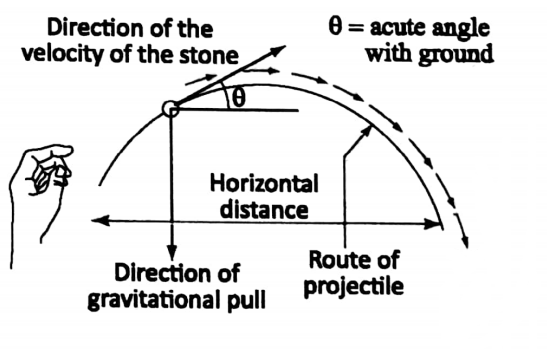
WBBSE Solutions for class 8 Physical Environment Section-2 Forces active without contact- Direction of the velocity

Moving along a curved path, the projectile ultimately comes back to the ground after traversing some horizontal distance.

3. If a stone is thrown with greater and greater force, then a situation will arise when the object will not return to the earth due to balancing between its velocity and gravitational pull by the earth.

It will then start revolving around the earth. During its revolution around the earth, along a path of circular trajectory, its velocity will change continuously due to changes in its direction

4. Artificial satellites: Man-made objects which revolve (or orbit) around the earth in outer space are called artificial satellites.

Aryabhatta (the first artificial satellite successfully launched by India), Bhaskara, Rohini, INSAT-1A etc. are some of the satellites launched by India.

Artificial satellites are “thrown” with a very great speed and they revolve around the earth. Moon is a natural satellite of the earth and also revolves around the earth following the same principle.

WBBSE Solutions for class 8 Physical Environment Section-2 Forces active without contact- pieces of paper

Examples of Non-Contact Forces in Everyday Life

5. Escape Velocity: When a body is projected upwards, it comes down to the earth after some time due to the earth’s gravitational attraction.

So, one may think, whether it is possible to throw a body with such a velocity, that the body will not return to the earth again.

For an object to escape from the earth and never return, it must be launched with a velocity, which will take the body beyond the gravitational field of the earth. Such velocity is known as Escape Velocity”.

It Is defined as the least velocity with which a body must be thrown vertically upwards In order that it may just escape the gravitational pull of the earth. The value of escape velocity is estimated to be 11.2 km/s or approximately 7 mile/s.

Electrostatic Force and Charge

1. Introduction to static electricity

When a plastic ruler is rubbed against dry hair or a woollen sweater for some time and then brought near to the small pieces of paper, we find that the paper pieces are flying towards.

The plastic ruler and sticking to it, as if the ruler is attracting them like a magnet, although they are not in contact with each other.

Another example of such a phenomenon is that a metal knife or blade does not attract pieces of Thermocol.

But immediately after cutting a sheet of thermocol with that knife or blade, it attracts small pieces of thermocol.

When an inflated balloon is rubbed against a woollen sweater, it sticks to the sweater.
So it is found that if knife or blade or plastic ruler etc.

are rubbed with another object for some time, and only then do they acquire the capability of attracting other objects.

It is interesting to note that ancient Greeks knew that when amber, a fossilized gum, is rubbed against wool, it acquired the property of attracting light objects like small leaves, dry straw etc.

Dr William Gilbert in the seventeenth century showed that glass on rubbing against silk, ebonite on rubbing against cat’s skin or sealing wax on rubbing against wool also acquire this property.

The substances which develop this property are said to be charged or electrified and the process is called electrification.

The formation of “charges” is evident from the following example. In winter, when we take off our clothes (made from synthetic materials like nylon, terylene, etc.) in darkness, we may see sparks (caused by electrical charges) fly off our bodies.

Similarly, if we comb dry hair in darkness while standing in front of a mirror, we will see sparks coming out from the hair.

So, we have found that a number of different objects can be charged by rubbing them with suitable materials. Let us now understand the nature of the electric charge produced on the objects.

Coulomb’s Law

We have just learnt that like charges repel each other and unlike charges attract each other. Attraction or repulsion occurs due to a force called electrostatic force.

The force exerted by an electrically charged object is called electrostatic force. An electrically charged object can exert an electrostatic force on an uncharged object or another charged object.

The electrostatic force can be exerted by a charged object on another object from a distance (even when they are not in contact with each other). So, an electrostatic force is an example of a non-contact force.

French scientist Charles Augustin invented the following formula to calculate the magnitude of force existing between two charged particles.

where, F is the electrostatic force of attraction or repulsion between two particles having the amount of charge q1 and q2on them, separated by a distance “r”. “k” is a constant whose value depends on the nature of the intervening medium between the two charged particles.

For example, the value of “k” is different for dry air, water and vacuum.

The unit of “F” is dyne (in the CGS system); [Symbol = ‘dyn’]. The unit of “r” is cm (in the CGS system) and the unit of charge is e.s.u. or statcoulomb.

∴The unit of “k” is dyne.cm² /(e.s.u)² according to the CGS system.

If the electrostatic force of repulsion between two like point-charges separated by a distance of 1 cm in a vacuum is 1 dyne, then the charge on each point-charge is 1 e.s.u. or 1 statcoulomb.

If vacuum (or air) is the medium and the quantities are measured in the CGS system, then k = 1.

SI unit of charge is coulomb; a unit of force is Newton; a unit of V’ is metre. So the unit of “k” is Newton.m² / (Coulomb)².

If the electrostatic force of repulsion between two like point-charges separated by a distance of 1 m in a vacuum is 9 x 10⁹ Newton, then the charge on each point-charge is 1 coulomb.

For all practical purposes, ‘k’ is taken to be equal to 9 x 10⁹ Nm² /C2 according to the SI system. From Coulomb’s law, we realize that,

1. Keeping the distance between the two point charges fixed, if the amount of charge on the point charges increases, the electrostatic force also increases.

For example, if the amount of charge on one point- charge is doubled and the amount of charge is tripled on the other, the electrostatic force will be increased by (2 x 3) times or 6 times.

2. Keeping the number of charges on two point-charges fixed, if the distance between them is increased, the electrostatic force will decrease and vice versa.

For example, if the distance between the two point charges is halved, the electrostatic force will be increased Similarly, if the distance between them is doubled, the electrostatic force will be (1/2)2 or l/4th of the former.

Electrification Due To Rubbing

We already know that All things are made up of atoms.

An atom consists of three types of subatomic particles – electron, proton and neutron. (The only exception is the hydrogen atom which does not have a neutron.)

Electron has a unit negative charge on them, a proton has a unit positive charge and a neutron is uncharged.

In an atom, sum total of the positive charge of all the protons is equal to the sum total of the negative charge of all electrons. So an atom is neutral, which means the net charge in an atom is zero.

Protons and neutrons form the central core of the atom, commonly called the nucleus. The electrons revolve around the nucleus in fixed orbits.

Electrons close to the nucleus are strongly held by electrostatic attraction. But the electrons away from the nucleus experience less attractive force and so electrons in the outermost orbit are loosely held.

When two objects (say A and B) are rubbed against each other, the loosely held electrons in the outermost orbit of one object (say, A) come out and are transferred to the other object (B).

Key Terms Related to Non-Contact Forces

After losing electrons, A has less number of electrons than the number of protons in its nucleus. So A becomes positively charged.

After gaining electrons, the number of electrons of B becomes more than the number of protons in its nucleus. So, B becomes negatively charged.

The number of electrons lost by A is equal to the number of electrons gained by B. So, equal but opposite charges are produced simultaneously in the two objects.

This transfer of electrons from one body to another takes place when these two bodies are rubbed and the cause of electron transfer is friction between the two bodies.

The process of charging a body is known as electrification and when it is done by rubbing one body over the other, it is called electrification by friction. The charge thus obtained is called frictional charge.

Charging A Body By Induction

Let us consider brushing dry hair with a plastic comb. After that, the comb is placed near small pieces of paper and we find that they are attracted.

We have learnt that opposite charges attract each other. The plastic comb can acquire a charge due to rubbing with dry hair.

But the small pieces of paper have not undergone any such rubbing. So, how can they acquire charges?

Actually, an uncharged object becomes charged when it is brought closer to any charged object.
This can be explained as follows.

Suppose a positively charged body (say, A) is brought nearer to an uncharged body (say, B). The negatively charged sub-atomic particles of B are attracted towards A and the positively charged sub-atomic particles of B are repelled by A.

As a result, the end closer to A becomes negatively charged and the other end of B becomes positively charged. Hence the positively charged A attracts the negatively charged end of B.

WBBSE Solutions for class 8 Physical Environment Section-2 Forces active without contact- induction

The process by which an uncharged body gets two electrically opposite ends when held near a charged body is called INDUCTION and the uncharged body is then said to be induced.

The charges on body B that are towards body A in, i.e. negative charges in this case, are called bound charges and the charges that are away from body A, i.e. positive charges in this case,

When the charged plastic comb is held near the pieces of paper, they are induced and get attracted to the plastic comb.

Motion due to Electrostatic Force From Newton’s law, we know that a change in the velocity of an object occurs due to the application of external force and acceleration takes place towards the direction of the applied force.

Similarly, we have learnt that like charges attract each other and opposite charges repel each other. This attraction and repulsion are also a kind of force.

Such force is termed an electrostatic force. The motion produced by electrostatic force can be found in the case of negatively charged electrons revolving around the positively charged nucleus inside an atom.

WBBSE Solutions for class 8 Physical Environment Section-2 Forces active without contact- revolving

The nucleus contains positively charged protons. Since electrons and protons are oppositely charged while moving,

electrons are attracted towards the nucleus and the direction of their motion is bent towards the centre of the atom.

The planets revolving around the sun resemble this situation, but here the force of attraction is gravitational.

There is also a resemblance between the mathematical expression of the law of universal gravitation and Coulomb’s law.

But we should remember that “m” is replaced by “q” in the case of the latter. Also in the case of gravitation, the forces are always attractive whereas electrostatic force may either be attractive or repulsive.

 

WBBSE Class 8 School Science Chapter 1 Physical Environment Force And Pressure LAQs

WBBSE Chapter 1 Physical Environment Force And Pressure Long Answer Questions

Question 1. State Newton’s laws of motion.
Answer:

Newton’s Laws of Motion

1. First Law: Everybody continues in its state of rest or of uniform motion along a straight line unless it is compelled to change that state by force impressed on it.

2. Second Law: The rate of change of momentum is directly proportional to the impressed force and takes place in the direction in which the force acts.

3. Third Law: To every action, there is an equal and opposite reaction. Newton’s first law gives us an idea about the inertia and definition of force. bicycle, then the speed of the bicycle decreases.

Even the shape of an object can change when we apply force to it. Force is required to expand or compress a spring.

WBBSE Solutions For Class 8 School Science Long Answer Type Questions WBBSE Solutions For Class 8 School Science Short Answer Type Questions
WBBSE Solutions For Class 8 School Science Very Short Answer Type Questions WBBSE Solutions For Class 8 School Science Review Questions
WBBSE Solutions For Class 8 School Science Solved Numerical Problems WBBSE Solutions For Class 8 School Science Experiments Questions
WBBSE Solutions For Class 8 Maths WBBSE Class 8 History Notes
WBBSE Class 8 History Multiple Choice Questions WBBSE Solutions For Class 8 History
WBBSE Solutions For Class 8 Geography


When we hammer a piece of aluminum metal, it undergoes a change in shape and an aluminum sheet is formed. We require force to lift an object.

Suppose, a book is lying on the table. Some force is required to lift this book from the table. The heavier the book, the greater the force needed to lift it.

A weightlifter uses enormous force to lift the weights. Even when we are standing on our feet, force plays the most important role in our muscles and bones.

Likewise, we can find several events in our everyday life where force plays an important role. Famous scientist Sir Isaac Newton put forward three laws of motion that elaborate the concept of force and motion.

Newton’s first law clearly states that no object can move unless force is applied to it. A body at rest does not take any initiative to move all by itself.

An external force is required for this purpose. Similarly, a moving body can change its velocity (either the direction or magnitude of velocity or both) only when an external force is applied to it.

WBBSE Class 8 School Science Chapter 1 Physical Environment Force And Pressure LAQs

To Understand Clearly What We Mean By The Term ‘Force’, Let Us Consider The Following Situations :

1. It is a matter of common experience that if a book is lying on a table, it continues to be lying on the table at the same position forever until somebody comes and displaces it to some other position. For moving it, one has to either lift it, push it, or pull it.

It shows that to bring a body into motion from its state of rest, some external agency or influence has to act on the body.

An isolated body (i.e., a body that is free from external influences) will maintain its state of rest forever. This fact demonstrates the inertia of rest. It is an intrinsic property of the material.

2. Let us now consider a ball rolling on a rough surface. We observe that the speed of the ball gradually decreases and finally the ball stops.

If the surface on which the ball is made to roll is made smooth, we see that it covers a much longer distance before coming to rest.

One can well imagine that the smoother the surface, the longer and longer will be the distance covered by the ball before it stops.

In an ideal situation where the surface is perfectly smooth, the ball would continue moving forever in the same direction with a constant speed. This fact demonstrates the inertia of motion.

Now the question arises—why does the ball stop after moving some distance on a rough surface? What does the rough surface do to the motion of the ball? The roughness of the surface provides an external influence called friction (or force of friction) which decreases the speed of the ball.

WBBSE Class 8 Force and Pressure long answer questions

3. In the game of football, a player can change the direction of the moving ball by kicking it. The kick applied by the foot is the external influence that changes the direction of the moving ball.

This external influence is called force which is necessary to change the state of rest or speed or the direction of motion of a body.

So from the first law, we realize that whether force is operating on an object, we have to observe the change of velocity of the object.

If the object remains static or its velocity remains unchanged, we can conclude that either no force is operating on the object or the aggregate of various forces operating on the object is zero.

In other words, we can say that if no net force acts on a body, its acceleration is zero. Net force implies the resultant or aggregate of various forces operating on an object.

Read And Learn More WBBSE Solutions For Class 8 School Science Long Answer Type Questions

Question 2. When a weight is placed on our hand, it is exerting a force on the hand, but the weight does not undergo acceleration. Explain.
Answer:

Measurement and Unit of Force

1. Unit of Momentum

Let a cricket ball and a loaded truck move equally fast toward you. It would be possible to stop the cricket ball but you just cannot think of stopping the truck even though both the ball and the truck move equally fast.

On the other hand, it is convenient to stop a slow-moving cricket ball as compared to a fast-moving one. This happens due to the quantity of motion contained in the body.

The quantity of motion contained in a body in turn depends on its mass and velocity. This defines another important physical quantity called momentum.

The momentum of an object is the product of its mass and velocity.
Momentum = mass x velocity

CGS unit of momentum is gram-centimeter per second [g.cm/s]

SI unit of momentum is kilogram-meter per second [kg.m/s]

When an object of mass 1kg is moving with a velocity of 1 meter per second then its momentum is 1 kg.m/s.

2. Measurement of Force

To measure the force on a particular object, we have to measure the acceleration of the object which is produced by the impact of the force.

From Newton’s law, it can be derived that force acting on an object is the product of its mass and its acceleration.

Force = mass of the object x acceleration or, F = m x a

The higher the force applied to an object, the greater will be its acceleration.

The higher the mass of the body, the lesser will be its acceleration for equal force.

The SI unit of force is Newton and the CGS unit of force is done.

The force which produces an acceleration of 1 meter per (second)2 when it acts on a mass of 1 kilogram is 1 Newton.

Similarly, the force which produces an acceleration of 1 centimeter per (second)2 when it acts on a mass of 1 gram is 1 dyne. It can be shown that 1 Newton =105 dyne as below :

1 Newton = 1kg×1m/s²
=1000g×100cm/s²
= 105 dyne

Long answer type questions on force and pressure for Class 8

Question 3. How do we measure force? Define momentum.
Answer:

Measurement and Unit of Force

1. Unit of Momentum

Let a cricket ball and a loaded truck move equally fast toward you. It would be possible to stop the cricket ball but you just cannot think of stopping the truck even though both the ball and the truck move equally fast.

On the other hand, it is convenient to stop a slow-moving cricket ball as compared to a fast-moving one. This happens due to the quantity of motion contained in the body.

The quantity of motion contained in a body in turn depends on its mass and velocity. This defines another important physical quantity called momentum.

The momentum of an object is the product of its mass and velocity.
Momentum = mass x velocity

CGS unit of momentum is gram-centimeter per second [g.cm/s]

SI unit of momentum is kilogram-meter per second [kg.m/s]

When an object of mass 1kg is moving with a velocity of 1 meter per second then its momentum is 1 kg.m/s.

2. Measurement of Force

To measure the force on a particular object, we have to measure the acceleration of the object which is produced by the impact of the force.

From Newton’s law, it can be derived that force acting on an object is the product of its mass and its acceleration.

Force = mass of the object x acceleration or, F = m x a

The higher the force applied to an object, the greater will be its acceleration.

The higher the mass of the body, the lesser will be its acceleration for equal force.

The SI unit of force is Newton and the CGS unit of force is done.

The force which produces an acceleration of 1 meter per (second)2 when it acts on a mass of 1 kilogram is 1 Newton.

Similarly, the force which produces an acceleration of 1 centimeter per (second)2 when it acts on a mass of 1 gram is 1 dyne. It can be shown that 1 Newton =105 dyne as below :

1 Newton = 1kg×1m/s²
=1000g×100cm/s²
= 105 dyne

Question 4. What are the effects of a force?
Answer:

Effects Of A Force:-

A force of 100N acting on a certain mass for 4s, gives it a velocity of 20m/s. Find the mass of the body if the body was initially at rest. A force can produce the following effects:

  1. It can move a stationary object.
  2. It can stop a moving object.
  3. It can change the speed of a moving object.
  4. It can change the direction of a moving object.
  5. It can change the shape of an object. We know, acceleration
  6. Final velocity-initial velocity /time= 20-0 / 4

(The body was initially at rest) = 5m/s2. Now, force = mass (m) x acceleration mass (m)= F/a = 100/ 5 = 20 kg.

WBBSE Chapter 1 detailed answers on forces and pressure

Question 5. You are given a rubber ball and two types of liquid. How would you assess which liquid has greater density?
Answer:

Given:

I Got a rubber ball and two types of liquid,

In what direction does the buoyant force on an object immersed in a liquid act?
We know that when an object floats in a liquid, the weight of the object and the weight of the displaced liquid are the same.

The more the density of a liquid, the less the volume of the displaced liquid. Then the liquid having greater density will produce greater buoyancy and consequently, the submerged volume of the ball will be lesser in that liquid.

The greater volume of the ball shall go inside the liquid having lesser density to generate upthrust same as the weight of the ball. The buoyant force acts on an object in a vertically upward direction.


WBBSE solutions for 8 Chapter-1 Physical environment Sec-1 Forces And pressure Liquid having


Question 6. A book can be moved by tilting the table a little as shown. In which direction would friction act in this case? Which force is responsible for the motion of the book?
Answer:

Given:

A book can be moved by tilting the table a little as shown.

Give some practical examples of where we intend to increase friction for our benefit.


WBBSE solutions for 8 Chapter-1 Physical environment Sec-1 Forces And pressure book


In this case force of gravity is responsible for the motion of the book. Since the book would move in the downward direction due to tilting under the effect of the force of gravity, the force of friction acts on it in the opposite direction – in the upward direction as shown.


WBBSE solutions for 8 Chapter-1 Physical environment Sec-1 Forces And pressure titled table


  1. Friction is increased by the following methods:
  2. Vehicle tires are made with treads to prevent skidding
  3. Grooves are made on the soles of shoes
  4. Spikes are provided in the shoes of athletes
  5. Rough machine belts are employed in some mills to prevent the slipping of wheels.

Understanding force and pressure long answers for Class 8

Question 7. An object just floats on water. What will happen to it if common salt is added to water? In which figure is the magnitude of buoyancy maximum?
Answer:

Given: An object just floats on water.


WBBSE solutions for 8 Chapter-1 Physical environment Sec-1 Forces And pressure Buoyancy


The addition of common salt increases the density of water which in turn increases the buoyancy of water. Thus the submerged volume of the object decreases as salt is added to the water.

Buoyancy is greater in B since the body is completely immersed in liquid and the volume of displaced liquid is the same as the total volume of the body.

Question 8. When a body floats in a liquid, what are the forces that act on the body? A metal ball is floating completely immersed anywhere inside a liquid. Explain it.
Answer:

When a body floats in a liquid, what are the forces that act on the body? A metal ball is floating completely immersed anywhere inside a liquid.

  1. During floatation following forces act on a body:
  2. Its weight acts vertically downward
  3. The upthrust or buoyancy of displaced
  4. liquid acting vertically upward.

The density of the metal ball is the same as the density of the liquid. Then the weight of the ball is exactly equal to the buoyancy offered by the displaced volume of the liquid.

Hence the metal ball floats anywhere inside the liquid.

Question 9. Write down the factors on which the pressure of a liquid depends at any point inside the liquid.
Answer:

Factors on which the pressure of a liquid depends at any point inside the liquid:-

The factors on which the pressure at a point within a liquid depends are the density of the liquid – the more the density of the liquid, the more will be the more pressure exerted by the liquid at that point.

The depth of that point from the surface of the liquid more the depth of the point within a particular liquid, and the more will be pressure exerted by the liquid on that point.

the acceleration due to gravity(g) at that place-more the magnitude of g, the more will be the pressure exerted by the liquid at a point at a certain depth within a particular liquid.

WBBSE Chapter 1 long answer solutions for Class 8 Science

Question 10. Give a practical application of the fact that a liquid always seeks its own height.
Answer:

Water supply system in a locality

Pressure of Liquid

When a solid block of 1 kg is kept on a table, the earth pulls it with a force of W = m x g = 1kg x 9.8m/s² = 9.8 Newton. The block is therefore applying pressure on the table on account of its weight.

Pressure is the force per unit area, applied to the surface of the object on which it is placed.

Pressure=Force/Area

SI unit of pressure is Newton per square meter (N/m²).

Let us consider a solid, wooden block of mass 5 kg, which is placed on a table. The total area of contact between the block and the table is 0.2 m².

We can calculate the pressure of the block exerted on the table.

Mass of the block = 5 kg

The magnitude of the force exerted by the block on the table

= 5 kg X 9.8 m/s² (D g = 9.8m/s²)

= 49 Newton

Area of contact of the block and the table =
0.2 m²

So, the pressure of the block exerted on the table = Force/Area

= 49 Newton / 0.2 m² = 245 N/m²


WBBSE solutions for 8 Chapter-1 Physical environment Sec-1 Forces And pressure Presuree of liquid


Since all liquids have weight, so when we pour a liquid into a vessel or tumbler, then the weight of the liquid pushes down on the base of the vessel producing pressure.

Therefore, to calculate the pressure exerted by a liquid on the base of a vessel using the formula, pressure =, we are to substitute ‘Force’ with the weight of the liquid and ‘Area’ by the area of the base of the vessel in which the liquid is placed.

Let us consider a tumbler filled with water of mass 10 kg. The area of the floor of the tumbler is 0.5 m². We can measure the pressure exerted by the water on the base of the tumbler.

Mass of the water in the tumbler = 10 kg Magnitude of the force exerted by water on the base of the tumbler

= 10 kg x 9.8 m/s²
= 98 Newton

Area of the base of the tumbler = 0.5 m²

So, Pressure exerted by water on the base of the tumbler

= Force / Area = 98 N / 0.5 m²
= 196 N/m²

In-depth explanations of force and pressure for Class 8

Question 11. Prove with an experiment that pressure at a point within a liquid depends on its depth from the surface of the liquid.
Answer:

Pressure of Liquid

When a solid block of 1 kg is kept on a table, the earth pulls it with a force of W = m x g = 1kg x 9.8m/s² = 9.8 Newton. The block is therefore applying pressure on the table on account of its weight.

Pressure is the force per unit area, applied to the surface of the object on which it is placed.

Pressure=Force/Area

SI unit of pressure is Newton per square meter (N/m²).

Let us consider a solid, wooden block of mass 5 kg, which is placed on a table. The total area of contact between the block and the table is 0.2 m².

We can calculate the pressure of the block exerted on the table.

Mass of the block = 5 kg

The magnitude of the force exerted by the block on the table

= 5 kg X 9.8 m/s² (D g = 9.8m/s²)

= 49 Newton

Area of contact of the block and the table =
0.2 m²

So, the pressure of the block exerted on the table = Force/Area

= 49 Newton / 0.2 m² = 245 N/m²


WBBSE solutions for 8 Chapter-1 Physical environment Sec-1 Forces And pressure Presuree of liquid

Since all liquids have weight, so when we pour a liquid into a vessel or tumbler, then the weight of the liquid pushes down on the base of the vessel producing pressure.

Therefore, to calculate the pressure exerted by a liquid on the base of a vessel using the formula, pressure =, we are to substitute ‘Force’ with the weight of the liquid and ‘Area’ by the area of the base of the vessel in which the liquid is placed.

Let us consider a tumbler filled with water of mass 10 kg. The area of the floor of the tumbler is 0.5 m². We can measure the pressure exerted by the water on the base of the tumbler.

Mass of the water in the tumbler = 10 kg Magnitude of the force exerted by water on the base of the tumbler

= 10 kg x 9.8 m/s²
= 98 Newton

Area of the base of the tumbler = 0.5 m²

So, Pressure exerted by water on the base of the tumbler

= Force / Area = 98 N / 0.5 m²
= 196 N/m²

WBBSE solutions for 8 Chapter-1 Physical environment Sec-1 Forces And pressure Vessel

WBBSE Chapter 1 exercises long answer type solutions

Experiment

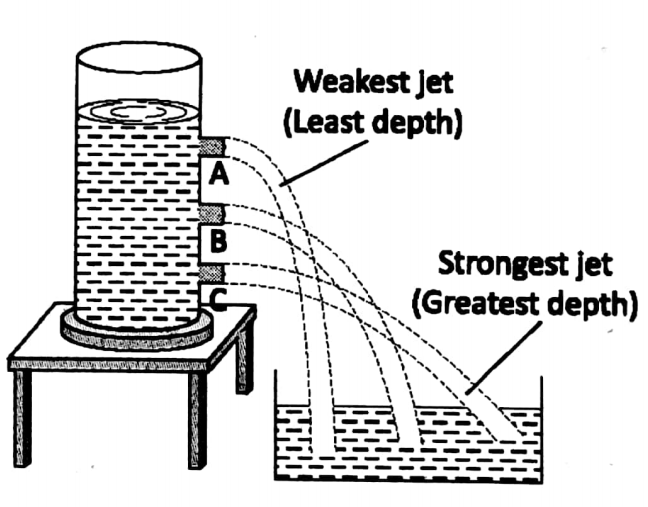
A long jar with three outlets A, B, and C along its length is taken. The three outlets are closed with corks or with molten wax.

The jar is now filled with water or any other liquid. The three openings are then opened simultaneously. Liquid flows out through all the holes in the jets.

Observation: It is found that of the three liquid jets, the range of the lowest one is the longest as well as the strongest. As we go up, the range (i.e. the distance covered by the liquid jet) decreases.

Inference: Liquid is coming out from all three holes. This means the liquid exerts lateral pressure on the wall of the jar. The lateral pressure at any point within a liquid increases with the depth from the free surface of the liquid.


WBBSE solutions for 8 Chapter-1 Physical environment Sec-1 Forces And pressure Long jar


Question 12. Prove with an experiment that the pressure at any particular point within a liquid is the same in any direction.
Answer:

Experiment

Apparatus needed: A glass funnel with its mouth closed with a thin rubber sheet, a rubber tube, a glass tube that contains a drop of colored liquid, a scale, a beaker, and some liquid.

A glass funnel with its mouth closed with a thin rubber sheet is taken. A rubber tube is attached at the end of the stem of the funnel.

The other end of the rubber tube is connected to a glass tube that contains a drop of colored liquid (index). The glass tube is fixed horizontally on a stand.

A scale is also attached alongside the glass tube. Some liquid is taken in a beaker. The glass funnel (attached to the rubber tube) is immersed in the liquid and at a certain depth from the free surface of the liquid, the mouth of the funnel is made to face in different directions

Observation: The colored liquid drop in the horizontal glass tube remains at the same position, irrespective of the direction of the glass funnel immersed within the liquid (sideways or lateral, upward, downward, etc).

Inference: No change in the position of the liquid drop within the horizontal glass tube indicates that the pressure exerted by the liquid at a certain depth is equal in all directions.


WBBSE solutions for 8 Chapter-1 Physical environment Sec-1 Forces And pressure Glass funnel closed with thin rubber sheet


  1. Pressure at a point inside a liquid depends on the density of the liquid [Experiment 1].
  2. Pressure at a point within a liquid increases with depth [Experiment 2].
  3. So long as the depth remains the same, the pressure exerted by a liquid is the same in any direction. In other words, liquid exerts pressure evenly in all directions at a given depth [Experiment 3].

Some more experiments can be carried out to understand other properties related to the All these observations can be summarized as the pressure of a liquid. follows:

Examples of long answer questions on force and pressure Class 8

Question 13. Using the concept of buoyant force, explain the condition when an object will float on a liquid and when it will sink.
Answer:

Archimedes’ Principle

Approximately two thousand years ago, famous Greek philosopher and scientist Archimedes proposed the relation between the apparent loss of weight of an object when immersed in liquid and the weight of the liquid displaced due to immersion of the object.

This relation is known as Archimedes’ Principle. When a solid object is immersed in a liquid (partially or completely), it experiences an upward buoyant force, which is equal to the weight of the liquid displaced by the immersed -part of the object.

From the Experiment stated above we can also conclude that buoyant force is directly proportional to the volume of liquid displaced by the solid object.

When the object is completely immersed in water the weight loss is more because it displaces more water compared to when it is partially immersed.

Accordingly, the weight loss due to buoyant force is more in the case of complete immersion of the object in the water.

If the same object is now immersed completely in two different liquids having different densities, it is found that the weight loss is more in the case of liquid with higher density.

This is due to the fact that though the volume of liquid displaced by the object is the same in both cases, the mass of liquid displaced is more for the liquid Buoyancy is therefore absent in a vacuum since there is no medium to displace in a vacuum.

Principle, the buoyant force is more, which is evident from the higher weight loss in liquid with higher density.

For example, a piece of iron that sinks in water can float in mercury. Hence, we can summarize these observations as follows:

When a body is immersed in a liquid either completely or partly, it always experiences a buoyant force or upthrust.

The buoyant force is directly proportional to the volume of liquid displaced by the solid object.

The buoyant force is directly proportional to the density of liquid displaced by the solid object.

When a body floats in a liquid, the weight of the whole body acting vertically downward is completely balanced by the buoyant force produced by the displaced liquid.

The weight of a body immersed in a liquid is always less than its actual weight because of buoyancy or upthrust.

This weight of the body in the immersed condition is called the apparent weight which is always less than the true weight of the body.

Let us perform an experiment similar to that with higher density. So according to Archimedes shown earlier to verify Archimedes’ Principle.

WBBSE Class 8 School Science Chapter 1 Physical Environment Force And Pressure SAQs

WBBSE Chapter 1 Physical Environment Short Answer Questions

Question 1. What is meant by 1 Newton force?
Answer:

1 Newton Force:-

The force which produces an acceleration of 1 m/s² when it acts on a mass of 1 kilogram is 1 Newton.

Question 2. What do you mean by force? What is its SI unit?
Answer:

Force:

Force is an agent acting on a body that changes the state of rest or uniform motion of the body.

The SI unit of force is Newton.

Force And Pressure

WBBSE Class 8 Force and Pressure short answer questions

Question 3. A body kept on the surface of the table just tends to move when it is pushed with a force of 5N. Based on this, complete the following table:
Answer:

Force   The magnitude of frictional force 
A. Zero
B. 2N


What is the limiting value of static friction in this case?
Magnitudes of frictional force:

  1. zero
  2. 2N

Since the body just tends to move when 5N force is applied, hence limiting (or maximum) value of static friction is 5N.

Question 4. What do you mean by frictional force?
Answer:

Frictional Force:-

Whenever the surface of one body is sliding over the surface of another body, each body exerts a force on the other.

This force on each body is always in the direction opposite to its motion relative to the other body and it acts in parallel to the surfaces in contact. This force is called frictional force.

WBBSE Class 8 School Science Chapter 1 Physical Environment Force And Pressure SAQs

Question 5. What do you mean by the force of static friction?
Answer:

Force Of Static Friction:

The frictional forces operating between the two surfaces at rest concerning each other are called forces of static friction.

Question 6. What do you mean by force of kinetic friction?
Answer:

Force Of Kinetic Friction:-

The frictional forces operating between surfaces in relative motion are called forces of kinetic friction or forces of sliding friction.

Short answer questions on force and pressure for Class 8

Question 7. Mustard oil floats on water. Which one has greater density mustard oil or water? Compute the pressure exerted by a 500g mass when it is placed on a table on its side having an area of 0.4 sqm. (g = 9.8m/s2).

Answer:

Water has a greater density than mustard oil.
Pressure = Force / Area = mxg= kg x 9.8 m/s²
Force= mx g=500/1000kgx 9.8m/s²
Pressure = 4.9/0.4 = 12.25 N= 12.25 N/m² (or Pa).

Read And Learn More WBBSE Solutions For Class 8 School Science Short Answer Type Questions

Question 8. State two advantages of frictional force.
Answer:

Two advantages of frictional forces are:

We can stand and walk or run easily on a surface due to the presence of frictional forces. An automobile can smoothly run on the road due to this force.

If the roads were very smooth, the frictional force would have reduced considerably, and then controlling the movement of the automobile would have been difficult.

We can hold various things in our hands due to the existence of frictional forces which exists between the object and our hand. In absence of frictional forces, we could not have gripped any object properly.

Question 9. State two disadvantages of frictional force. Two disadvantages of frictional forces are:
Answer:

Disadvantages Of frictional force:-

When an object moves over a surface, for example, a car is moving on the road, it feels frictional forces that always try to reduce its velocity.

So to maintain a steady velocity, additional expenditure of energy is required. Some machine parts experience frictional forces during their operation.

As a result machine parts suffer wear and tear, and they have to be replaced from time to time. Thus maintenance cost of such machines increases.

Question 10. What do you mean by the density of a substance? What is its CGS and SI unit?
Answer:

Density of a substance:-

The quantity of matter (mass) contained in a unit volume of a substance is called the density of that substance.
Density = mass/volume
The unit of density in CGS unit is gram per cubic centimeter (g/cc), and in SI unit is kilogram per cubic meter (kg/m³).

WBBSE Chapter 1 short answer solutions

Question 11. The density of a liquid is 10 kg/liter. Express it in the g/cc unit.
Answer:

1 litre of water = 1000 cc of water
and, 10 kg of water = 10000 g of water
So, the density of water = 10 kg/liter = 10000g/1000cc=10g/cc.

WBBSE Solutions For Class 8 School Science Long Answer Type Questions WBBSE Solutions For Class 8 School Science Short Answer Type Questions
WBBSE Solutions For Class 8 School Science Very Short Answer Type Questions WBBSE Solutions For Class 8 School Science Review Questions
WBBSE Solutions For Class 8 School Science Solved Numerical Problems WBBSE Solutions For Class 8 School Science Experiments Questions
WBBSE Solutions For Class 8 Maths WBBSE Class 8 History Notes
WBBSE Class 8 History Multiple Choice Questions WBBSE Solutions For Class 8 History
WBBSE Solutions For Class 8 Geography


Question 12. What do you mean by the pressure of a liquid? Write its CGS and SI unit.
Answer:

Pressure of a liquid:-

The pressure of a liquid is the force exerted by the liquid per unit area of the surface, acting perpendicularly on it.

The CGS unit of pressure is dyne/cm² and the SI unit of pressure is N/m² (or Pascal).

Question 13. What are the characteristics of pressure exerted by a liquid?
Answer:

Characteristics of pressure exerted by a liquid:-

The characteristics of pressure exerted by a liquid are the following:

Pressure at a point inside a liquid depends on the density of the liquid. Pressure at a point within a liquid increases with depth.

So long as the depth remains the same, the pressure exerted by a liquid is the same in any direction. In other words, liquid exerts pressure evenly in all directions at a given depth.

Question 14. A man is standing on the ground. What are the action-reaction forces in this case?
Answer:

When a person is standing on the floor, the person is exerting a force on the floor by virtue of his weight acting vertically downward.

According to Newton’s third law, the floor is also exerting an equal amount of force on the person. If the former is called action, the latter is the reaction force.

Question 15. What do you mean by buoyant forces?
Answer:

Buoyant Forces:-

When an object is immersed in a liquid, partially or completely, it experiences an upward force called “buoyant force”. As the object is immersed in a liquid, it displaces some volume of liquid and occupies that position.

The weight of the displaced liquid is equal to the magnitude of this upward force or buoyant force. This buoyant force is responsible for a decrease in the weight of the object when it is immersed in a liquid.

WBBSE Class 8 Science practice short answer questions

Question 16. A solid object always weighs less in water than in air. Explain.
Answer:

Given:

A solid object always weighs less in water than in air

When a solid object is immersed in a liquid, partially or completely, it experiences an upward force called “buoyant force”.

When the object is immersed in a liquid, it displaces some volume of liquid and occupies that position.

The weight of the displaced liquid is equal to the magnitude of this upward force or buoyant force. This buoyant force is responsible for making the weight of the object less than its weight in the air.

Question 17. State Archimedes’ principle.
Answer:

Archimedes’ Principle:-

Archimedes’ Principle states that, when a solid object is immersed in a liquid (partially or completely), it experiences an upward buoyant force, which is equal to the weight of the liquid displaced by the immersed part of the object.

Question 18. Submarines are not allowed to sink beyond a certain depth in the sea. Why?
Answer:

Submarines are not allowed to sink beyond a certain depth in the sea.

A Submarine is a small warship capable of going down water, when necessary. We know that pressure exerted by a liquid at a point within it depends on the depth of that point.

The more the depth of that point more will be the more pressure exerted by the liquid. The body of a submarine is made to withstand a certain amount of pressure exerted by the liquid.

This is equivalent to a certain depth within the water. Beyond this depth, the pressure exerted by water is so large that the submarine cannot withstand it.

So sinking beyond a certain depth is not permissible.

Key concepts of force and pressure short answers for Class 8

Question 19. On what factors does the buoyancy of a liquid depend?
Answer:

Factors affecting buoyancy are the following:

The buoyant force increases as the volume of the object immersed in the liquid increases. The buoyant force is maximum when the object is completely immersed in the liquid.

As the density of the liquid increases, the buoyant force exerted by the liquid on the object also increases.

Question 20. A body has a volume of 10 cm³ and the density of its material is 8g/cm³. Find out whether the body would float or sink if it is completely immersed in water.
Answer:

Mass of the body = volume x density
M=10×8 = 80g
When completely immersed in water, the body displaces 10 cm³ (equal to its volume) of water.
Mass of displaced water = volume of displaced water x density
= 10 cm³x 1g/cm³ = 10g.

Since the mass of the body is more than the mass of the displaced water, the weight of the body is greater than the buoyancy of the displaced water. Thus the body sinks in water.

Question 21. You are holding a 2kg mass. How much force do you experience in this condition and in which direction?
Answer:

The force experienced is the weight of the mass.
Weight = mg = 2 x 9.8 = 19.6 N (g = 9.8 m/s²)

The force is directed vertically downward towards the center of the earth.

Question 22. An object is kept on a table and it is pulled. The magnitude of the pulling force is increased until the object moves. Why does the object remain stationary till the pulling force attains a certain value? When does the object start to move?

Answer:

What kind of friction comes into play when a block of wood kept on cylindrical iron rods moves?
The object does not move because its motion is opposed by the force of static friction which acts in the opposite direction of the pulling force.

As the pulling force is increased, the friction also goes on increasing. Ultimately when the applied pulling force becomes equal to or a little more than the maximum frictional force or the limiting value of static frictional force, the object tends to move on the surface of the table.

The frictional force acting between two surfaces has a maximum value beyond which it cannot increase. This maximum value is called the limiting value of static friction.

The pulling force has to be greater than this limiting value of static friction to make the object move.
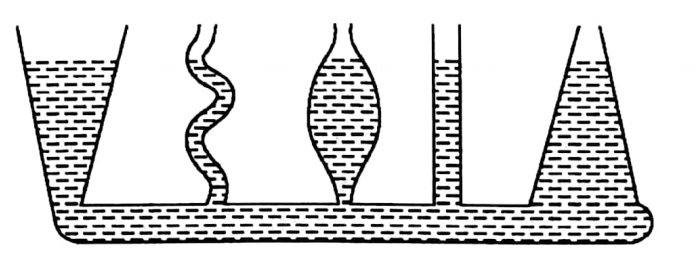
Rolling friction comes into play when a block of wood kept on cylindrical iron rods moves.

Examples of force and pressure short answers for Class 8

Question 23. A large bus and a car, both moving with the same velocity, have a head-on collision and both of them come to a halt after that.

  1. Which vehicle experiences the greater force of impact?
  2. During motion, which vehicle has greater momentum?
  3. Which vehicle experiences greater acceleration?

Answer:

From Newton’s third law, action and reaction are the same in magnitude. Therefore, both vehicles experience the same force of impact.
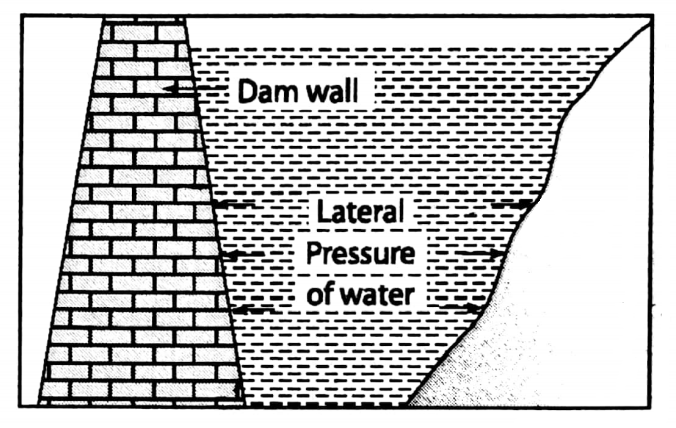
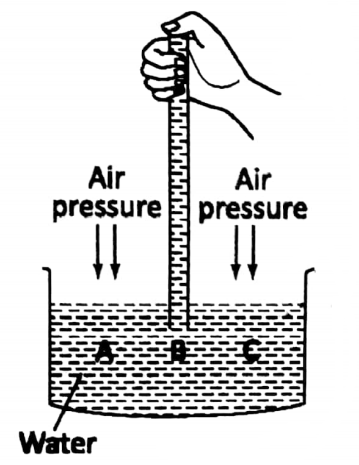
Since they were moving with the same velocity, the bus having greater mass had bigger momentum.
Acceleration, a= F/ m

For the same force of impact (F), if the mass of the car is small, the car would experience greater acceleration.

Question 24. Two metal plates A and B having the same breadth but different lengths I, and 12 respectively are placed at the same depth inside the water such that their breadth is held exactly in vertical positions.
Answer:

Find the ratio of pressure acting on A and B by water in this situation. As air bubbles rise from the bottom to the top of a water tank, the size of the bubbles increases. Why does it happen?

Since the pressure inside a liquid varies as the depth of the point from the free surface, hence both plates A and B would experience the same pressure as they are placed at the same depth inside water.

Hence the ratio of pressure acting on A and B by water is 1:1.

The pressure exerted by water on the bubbles decreases as the height of the water column above them decreases. Due to the decrease in pressure, the volume of bubbles tends to increase.

Question 25. When a body is immersed in water, it displaces 5 Kg of water. How much is the buoyant force acting on the body? (g = 9.8 m/s2).
Answer:

A given solid is weighed in the air using a spring balance. It is then weighed by immersing fully in each of the following three vessels containing water as shown. In which vessel the loss of weight will be maximum and why?

The buoyant force is the weight of displaced water.

Buoyant force = mxg=5×9.8=49 N Loss in weight does not depend on the shape of the vessel. Therefore, loss in weight will be equal in all three vessels marked 1,2, and 3.

WBBSE solutions for 8 Chapter-1 Physical environment Sec-1 Forces And pressure Buoyant force


WBBSE Class 8 School Science Chapter 1 Physical Environment Force And Pressure VSAQs

WBBSE Class 8 Science Chapter 1 Force And Pressure VSAQs

Question 1. What is the unit of force in the SI and CGS units?
Answer:

The unit of force in the SI unit is Newton and the CGS unit is done.

Question 2. What is the relation between force and acceleration?
Answer:

Force = mass x acceleration

Question 3. What do you mean by a force of 1 Newton?
Answer:

Force Of 1 Newton:-

This force produces an acceleration of 1 m/s² when applied to an object of mass 1 kg.

Read And Learn More WBBSE Solutions For Class 8 School Science Very Short Answer Type Questions

Question 4. What do you mean by a force of 1 dyne?
Answer:

Force Of 1 dyne:-

This force produces an acceleration of 1 cm/s² when applied to an object of mass 1g.

Question 5. From which law do we get an idea of inertia?
Answer:

From Newton’s first law, we get an idea about inertia.

WBBSE Class 8 Force and Pressure concisely answer questions

Question 6. What is the force exerted by a mass of 1 kg placed on the hand?
Answer:

The force exerted by a mass of 1 kg on our hand is 9.8 N.

Question 7. Which instrument is used to measure the weight of an object?
Answer:

A spring balance is used to measure the weight of an object.

Question 8. Do action and reaction force act on the same object?
Answer:

No, action and reaction force act on different objects.

Question 9. Which principle has been applied to make spring balance?
Answer:

If a force is applied, the spring is elongated in the direction of the applied force and the extension produced in a spring by a force is directly proportional to the applied force. This principle has been used to make spring balance.

West Bengal Class 8 Physical Science Chapter 1 Very Short Answer Questions 

Question 10. What do you mean by the density of a substance?
Answer:

Density Of A Substance:-

The density of a substance is the mass of a unit volume of that substance.

WBBSE Class 8 School Science Chapter 1 Physical Environment Force And Pressure VSAQs

Question 11. What are the CGS and SI units of density?
Answer:

The CGS unit of density is g/cc and its SI unit is kg/m³.

Question 12. If there is a hole at the bottom of a boat, why does water enter through it?
Answer:

Due to an upward force at any point within the water, the water enters through the hole at the bottom of the boat.

Question 13. When a ball is thrown along the surface of the table, it ultimately stops after covering some distance. Why?
Answer:

When a ball is thrown along the surface of the table with an initial velocity, it stops ultimately, because of the frictional force exerted by the surface of the table which opposes the motion of the ball.

Question 14. If the density of a liquid is increased how it will affect the buoyant force?
Answer:

If the density of a liquid is increased its buoyant force will increase.

Class 8 Science Force and Pressure VSAQs WBBSE 

Very short answer questions on force and pressure for Class 8

Question 15. Write the condition of floatation.
Answer:

Floatation:-

If the weight of the object is less than the weight of the liquid displaced by it when it is immersed in the liquid, then the object will float on the liquid.

Question 16. Which instrument is used to measure the air pressure?
Answer:

A barometer is used to measure air pressure.

Question 17. To supply water in urban areas which property of the liquid is utilized?
Answer:

A liquid seeks its own height. This property is utilized in supplying water from a storage tank in urban areas.

Question 18. What will be the acceleration produced if a force of 10N acts on a mass of 5 kg?
Answer:

Acceleration = Force/ mass 10N/5kg = 2m/s².

Question 19. A floating body is weightless – why?
Answer:

A floating body is weightless

When a body floats in a liquid, the buoyant force acting upward balances the weight of the body acting downwards.

In the state of floatation, the body appears to lose its weight totally and so it is said that a floating body is weightless.

WBBSE Solutions For Class 8 School Science Long Answer Type Questions WBBSE Solutions For Class 8 School Science Short Answer Type Questions
WBBSE Solutions For Class 8 School Science Very Short Answer Type Questions WBBSE Solutions For Class 8 School Science Review Questions
WBBSE Solutions For Class 8 School Science Solved Numerical Problems WBBSE Solutions For Class 8 School Science Experiments Questions
WBBSE Solutions For Class 8 Maths WBBSE Class 8 History Notes
WBBSE Class 8 History Multiple Choice Questions WBBSE Solutions For Class 8 History
WBBSE Solutions For Class 8 Geography


Question 20. What is the relation between the pressure exerted by a liquid and its density?
Answer:

Pressure at a point inside a liquid varies directly with the density of the liquid.

Question 21. A body is floating with a part of it submerged in a liquid. What is the relation between the weight of the body and the weight of the displaced liquid?
Answer:

Following the condition of floatation, at equilibrium, the total weight of the body is equal to the weight of the liquid displaced by the submerged volume of the body.

WBBSE Solutions for Class 8 Science Chapter 1 VSAQs 

Question 22. If a body does not move on the surface of a table even if it is pulled by a force, then what kind of opposing force act on the body?
Answer:

Static Friction

WBBSE Chapter 1 quick answer solutions

Question 23. A 5N force creates a pressure of 500 Pa when it acts on a surface. What is the area of the surface in square cm?
Answer:

Area = Force/Pressure =5N / 500 Pa =1 / 100m²= 100 x 100 / cm² = 100 cm².

Question 24. The reading of a spring balance shows 10g-wt when a solid is half immersed in water. What will be the reading of the spring balance when the solid is completely immersed in water?
Answer:

Less than 10g wt due to more buoyancy.

Force and Pressure Chapter 1 VSAQs for Class 8 WBBSE 

Question 25. A body kept on the floor, just tends to move when it is pulled with a force of 5N. What is the limiting force of static friction between the body and the floor?
Answer:

5N

Question 26. A car is moving towards the east. What will be the direction of frictional force acting on this car due to the surface of the road?
Answer:

Since friction always opposes the motion, Hence it will act towards the west.

Question 27. A body of mass 2kg is moving with a velocity of 15m/s. Find the momentum of the body.
Answer:

Given:

A body of mass 2kg is moving with a velocity of 15m/s.

Momentum = mass x velocity = 2kg x 15 m/s = 30 kg m/s.

WBBSE Solutions for Class 8 Science Chapter 1 VSAQs 

WBBSE Class 8 Science practice concise answer questions

Question 28. The same body is immersed in two liquids A and B in succession. The extent to which the body sinks in liquid B is less than that in liquid A. What can you conclude about the densities of two liquids from the observation?
Answer:

Since a denser liquid will produce more buoyancy hence more the density of the liquid, the less the body sinks in liquid. Thus the density of liquid B is more than the density of liquid A.

WBBSE Solutions For Class 8 School Science Chapter 1 Physical Environment Force And Pressure Review Questions

Chapter 1 Physical Environment Force And Pressure Review Questions MCQs

Question 1. Action and reaction forces

  1. Are not the same in magnitude
  2. Are equal in magnitude and opposite in direction
  3. Act in the same direction
  4. Cancel each other.

Answer: 2. Are equal in magnitude and opposite in direction

Question 2. A book is lying in a stationary condition on the table. The book is stationary because

  1. The weight of the book and the normal reaction is oppositely directed
  2. The force of friction is absent
  3. The weight of the book is more than the normal reaction
  4. There is no external force acting on the book.

Answer: 2. There is no external force acting on the book.

Question 3. The relation between force (f) which produces an acceleration on an object of mass (m) is

  1. A = f/m
  2. A = m/f
  3. F=m/a
  4. A = f.m

Answer: 1. A = f/m

Question 4. Using a spring balance, we measure

  1. The mass of an object
  2. The weight of an object
  3. The pressure of an object
  4. The buoyancy on an object

Answer: 2. The weight of an object

Read And Learn More WBBSE Solutions For Class 8 School Science Review Questions

Question 5. If the area of contact between two surfaces is increased, the magnitude of frictional force will

  1. Increase
  2. Decrease
  3. Remain same
  4. Vanish

Answer: 2. Decrease

WBBSE Solutions For Class 8 School Science Chapter 1 Physical Environment Force And Pressure Review Questions

Question 6. The mass of an object is 1 kg. The weight of that object is

  1. 1 N
  2. 9.8 n
  3. 9.8 dyne
  4. 9.8 kg

Answer: 2. 9.8 n

Question 7. If the action-reaction force which acts vertically between two surfaces is increased, the frictional force will

  1. Increase
  2. Remain same
  3. Decrease
  4. Vanish

Answer: 1. Increase

WBBSE Class 8 Force and Pressure review questions

Question 8. The weight of an object is 30 kg in air and 25 kg in water. What is the weight of water displaced by the object when it is immersed in water?

  1. 30 Kg
  2. 25 Kg
  3. 5 Kg
  4. None of these

Answer: 3. 5 Kg

Question 9. When completely immersed in water, the weight of an object is 30 kg and the weight of water displaced by it is 15 kg. The weight of that object in air is

  1. 45 Kg
  2. 30 Kg
  3. 15 Kg
  4. None of these

Answer: 1. 45 Kg

Question 10. When the density of a liquid increases, the pressure exerted by the liquid at any point within it

  1. Increases
  2. Decreases
  3. Remains unchanged
  4. Becomes zero

Answer: 1. Increases

WBBSE Solutions For Class 8 School Science Long Answer Type Questions WBBSE Solutions For Class 8 School Science Short Answer Type Questions
WBBSE Solutions For Class 8 School Science Very Short Answer Type Questions WBBSE Solutions For Class 8 School Science Review Questions
WBBSE Solutions For Class 8 School Science Solved Numerical Problems WBBSE Solutions For Class 8 School Science Experiments Questions
WBBSE Solutions For Class 8 Maths WBBSE Class 8 History Notes
WBBSE Class 8 History Multiple Choice Questions WBBSE Solutions For Class 8 History
WBBSE Solutions For Class 8 Geography


Question 11. If the depth of a point within a liquid decreases, the pressure on that point exerted by the liquid

  1. Increases
  2. Decreases
  3. Remains unchanged
  4. Becomes zero

Answer: 2. Decreases

Question 12. The density of river water is

  1. More than that of seawater
  2. Less than that seawater
  3. Same as that of seawater
  4. None of these

Answer: 2. Less than that of seawater

Question 13. 1 Atmospheric pressure is equal to the pressure exerted by a column of mercury of height

  1. 76 M
  2. 76Cm
  3. 76 Mm
  4. 10.34m

Answer: 2. 76Cm

Question 14. The density of mercury is

  1. 13.6 kg/m³
  2. 13.6 g/litre
  3. 13.6 g/cc
  4. 13.6 kg/cc

Answer: 3. 13.6 g/cc

Question 15. The pressure exerted by air is measured by

  1. Hydrometer
  2. Barometer
  3. Calorimeter
  4. Speedometer

Answer: 3. Calorimeter

WBBSE Chapter 1 review questions and answers

Question 16. The density of an object is

  1. Weight per unit area
  2. Force to produce unit acceleration
  3. Mass per unit length
  4. Mass per unit volume

Answer: 4. Mass per unit volume

Question 17. The buoyant force acts in

  1. Upward direction
  2. Downward direction
  3. Laterally
  4. All directions

Answer: 1. Upward direction

Question 18. When immersed in water, if the weight of water displaced by the object is more than the weight of the object in the air, then the object will

  1. Float on water
  2. Sink in water
  3. Float anywhere inside the water
  4. None of these

Answer: 1. Float on water

Question 19. Pressure at a point within a liquid

  1. Acts in a downward direction only
  2. Acts in an upward direction only
  3. Acts in all directions
  4. Acts in lateral direction only

Answer: 3. Acts in all directions

Force and pressure concepts review for Class 8

Question 20. If the weight of a body in the air is w and the buoyancy of a liquid on it is b, then in which of the following cases will the body sink when immersed in the liquid?

  1. W=b
  2. W<b
  3. W>b
  4. In all the cases

Answer: 3. W>b

Question 21. In which of the following cases will a milk bottle exert maximum pressure on the table?

  1. Position – 1
  2. Position – 2
  3. Position – 3
  4. Same in all positions

Answer: 2. Position – 2

Question 22. Absence of which of the following forces would have caused difficulty in walking?

  1. Geomagnetic force
  2. Gravitational force
  3. Electrostatic force
  4. Frictional force

Answer: 4. Frictional force

Question 23. Two balls marked a and b have the same volume but the density of the material of b is more than that of a. The balls are completely immersed in a liquid. Which of the following statements is correct?

  1. Buoyancy on b is more than on a
  2. Buoyancy is the same for both a and b
  3. Buoyancy on a is more than on b
  4. No buoyancy acts on either of the two

Answer: 4. No buoyancy acts on either of the two

Chapter 1 Physical Environment Force And Pressure Fill in the Blanks

Question 1. When 1 kg of weight is placed on an outstretched hand, the weight exerts a force of magnitude_______
Answer: 9.8 N

Question 2. Force = mass of an object _______
Answer: Acceleration

Question 3. Acceleration is the rate of change of velocity with_______
Answer: Time

Question 4. We get the idea about_______Newton’s 1″ law.
Answer: Inertia

Question 5. 9.8 Newton _______
Answer: 1

Question 6. Every action has an_______reaction.
Answer: Equal, Opposite

Question 7. The frictional force on the nature of_______surfaces in contact with each other.
Answer: Depends

Question 8. Frictional force does not depend on the of _______surface in contact with another surface.
Answer: Area

Question 9. The density of a substance is the weight of unit _______ of the substance.
Answer: Volume

Question 10. The density of concentrated saline water is_______than that of ordinary water.
Answer: More

Question 11. The density of glycerine is_______than that of water.
Answer: More

Question 12. 1 ml mercury weighs_______ water.
Answer: More

WBBSE Chapter 1 revision questions on forces

Question 13. If the density of mercury is 13.6 g/cc, the mass of 2 cc of mercury is_______g.
Answer: 27.2

Question 14. At sea level, the pressure exerted by air is equal to the pressure exerted by a mercury column of height_______cm.
Answer: 76

Question 15. At sea level, the pressure exerted by air is equal to the pressure exerted by a water column of height
than 1 ml of _______m.
Answer:10.34

Question 16. The pressure of liquid at any point inside of liquid and depends on the _______ depth of the point from the surface of the liquid
Answer: Density

Question 17. The pressure of the liquid at a point within it is the same in any_______
Answer: Direction

Question 18. Liquid seeks its own_______
Answer: Height

Question 19. When immersed in water, the weight of any object_______
Answer: Decreases

Question 20. 1 litre= _______ cubic centimeter.
Answer: 1000

Question 21. 1 Newton =_______ dyne.
Answer: 100000

Question 22. When an object is immersed in water, it acts _______ downwards and buoyancy acts upwards.
Answer: Weight

Question 23. The density of Mercury is more than water, so it _______ in water.
Answer: Sink

Question 24. The _______ exerted by water at any point within it does not depend on the shape and size of the container in which it is kept.
Answer: Pressure

Question 25. The weight of an object is 100 g in air and when immersed in water it weighs 70 g. So the weight of water displaced by the object _______g.
Answer: 30

Chapter 1 Physical Environment Force And Pressure Identify as ‘True’ or ‘False’

Question 1. SI unit of force is Newton.
Answer: True

Question 2. We get an idea about inertia from Newton’s first law.
Answer: True

Question 3. The frictional force is independent of the nature of two surfaces in contact with each other.
Answer: False

Question 4. The frictional force is independent of the surface area of an object in contact with the other surface.
Answer: True

Question 5. Pressure is the force applied per unit area of the surface.
Answer: True

Question 6. When a mass of double the weight is hung, the spring elongates by four times.
Answer: False

Question 7. Force always produces acceleration in the body on which it is applied.
Answer: False

Question 8. Air exerts no pressure.
Answer: False

Question 9. Spring balance is used to measure pressure.
Answer: False

Question 10. Force / mass = acceleration
Answer: True

Question 11. Pressure at a point within a liquid depends on the density of the liquid.
Answer: True

Question 12. Pressure at a point within a liquid depends on the depth of that point from the surface of the liquid.
Answer: True

Question 13. The pressure exerted by air is equal to the pressure exerted by a water column of a height of 10.34 meters.
Answer: True

WBBSE Class 8 Science practice review questions

Question 14. Static friction is smaller than sliding friction.
Answer: False

Question 15. An egg sinks in pure water but floats in concentrated saline water.
Answer: True

Question 16. Pressure at any point within the water is the same in all directions.
Answer: True

Question 17. Water exerts pressure only downwards.
Answer: False

Question 18. A buoyant force acts upwards.
Answer: True

Question 19. Buoyancy is absent in outer space.
Answer: True

Question 20. Ice floats on water.
Answer: True

Question 21. Swimming in the sea is easier than swimming in the river.
Answer: True

Chapter 1 Physical Environment Force And Pressure Match the Columns

Question 1. 

Column -A Column-B 
A. 1litre 1. 1g/cm3
B. Density of water 2. 1kg
C. mass of 1cc of water 3. 1000g
D. 1kg of water 4. 1g

Answer: A-2,B-1,C-4,D-3

Question 2.

Column-A Column-B
A. Measurement of force 1. cm/s2
B. S1 unit of force 2. Mass per unit volume
C. Cgs unit of acceleration 3. Spring Balance
D. Density 4. Newton

Answer: A-3,B-4,C-1,D-2

Question 3.

Column-A Column-B
A. A substance  floats 1. If the buoyant force is less than the weight of the substance
B. supply of water in urban areas utilizes the property 2. Density of  mercury
C. a substance sinks 3. If the buoyant force is more than the weight of the substance
D. Buoyant force 4. Liquid finds its own height

Answer: A-3,B-4,C-1,D-2

WBBSE Chapter 1 exercises review solutions

Question 4.

Column-A Column-B
A. Normal  Atmospheric pressure 1. Borameter
B. Density of mercury 2. independent of the direction
C. Pressure at any point within a liquid 3. 13.6 g/cc
D. Measurement of air pressure 4. Pressure exerted by a mercury column of height 76 cm

Answer: A-4,B-3,C-2,D-1

Question 5.

Column-A Column-B
A. A ship sinks more in 1. Water
B. A piece of ice floats in 2. Saline water
C. An iron nail sinks in 3. River water
D. Density of seawater more than that of 4. Alcohol

Answer: A-3,B-1,C-2,D-4


WBBSE Solutions For Class 8 School Science Chapter 1 Physical Environment Force And Pressure Experiments

Chapter 1 Physical Environment Force And Pressure Experiments On Liquid Pressure

Experiment-1

Two identical jars with a hole near the base (at the same depth) are taken. The hole is initially sealed with a cork or with molten wax.

One of the jars is filled with water up to a certain height, and the other is filled with concentrated saline water up to the same height.

As the holes in both the bottles are opened, liquids immediately start coming out through the holes in the jets.

Observation: It is found that of the two liquids, the range (i.e., the distance a liquid travels when coming out of the hole in the jet) of the concentrated saline water is longer than that for the ordinary water.

Also, the concentrated saline water exerts a pushing force on fingertips (if we place a finger on the hole to stop the liquid flow) which is more than that in the case of ordinary water.

Read And Learn More WBBSE Solutions For Class 8 School Science Experiments Questions

Chapter 1 Force And Pressure Experiments On Liquid Pressure

Experiment-1 On Liquid Pressure

Two identical jars with a hole near the base (at the same depth) are taken. The hole is initially sealed with a cork or with molten wax.

One of the jars is filled with water up to a certain height, and the other is filled with concentrated saline water up to the same height.

As the holes in both the bottles are opened, liquids immediately start coming out through the holes in the jets.

Science Experiments For Class 8 WBBSE

Observation: It is found that of the two liquids, the range (i.e., the distance a liquid travels when coming out of the hole in the jet) of the concentrated saline water is longer than that for the ordinary water.

Also, the concentrated saline water exerts a pushing force on fingertips (if we place a finger on the hole to stop the liquid flow) which is more than that in the case of ordinary water.

WBBSE Class 8 Force and Pressure experiments

Inference: The height of the liquid level in both jars is the same. But concentrated saline water has a higher density than water and a liquid with higher density exerts more lateral pressure.

The more the lateral pressure, the longer the distance the water travels when coming out of the holes in jets. So, we can infer that lateral pressure at any point within the liquid depends on the density of the liquid.WBBSE solutions for 8 Chapter-1 Physical environment Sec-1 Forces And pressure Waters


Chapter 1 Force And Pressure Experiment-2 On Liquid Pressure

A long jar with three outlets A, B, and C along its length is taken. The three outlets are closed with corks or with molten wax.

The jar is now filled with water or any other liquid. The three openings are then opened simultaneously. Liquid flows out through all the holes in the jets.

Science Experiments For Class 8 WBBSE

Observation: It is found that of the three liquid jets, the range of the lowest one is the longest as well as the strongest. As we go up, the range (i.e. the distance covered by the liquid jet) decreases.

Inference: Liquid is coming out from all three holes. This means the liquid exerts lateral pressure on the wall of the jar. The lateral pressure at any point within a liquid increases with the depth from the free surface of the liquid.

WBBSE solutions for 8 Chapter-1 Physical environment Sec-1 Forces And pressure Long jar


Chapter 1 Force And Pressure Experiment-3 On Liquid Pressure

Experiments on force and pressure for Class 8

Apparatus needed: A glass funnel with its mouth closed with a thin rubber sheet, a rubber tube, a glass tube that contains a drop of colored liquid, a scale, a beaker, and some liquid.

A glass funnel with its mouth closed with a thin rubber sheet is taken. A rubber tube is attached at the end of the stem of the funnel.

The other end of the rubber tube is connected to a glass tube that contains a drop of colored liquid (index). The glass tube is fixed horizontally on a stand.

Science Experiments For Class 8 WBBSE

A scale is also attached alongside the glass tube. Some liquid is taken in a beaker. The glass funnel (attached to the rubber tube) is immersed in the liquid and at a certain depth from the free surface of the liquid, the mouth of the funnel is made to face in different directions

Observation: The colored liquid drop in the horizontal glass tube remains at the same position, irrespective of the direction of the glass funnel immersed within the liquid (sideways or lateral, upward, downward, etc).

Inference: No change in the position of the liquid drop within the horizontal glass tube indicates that the pressure exerted by the liquid at a certain depth is equal in all directions.

WBBSE solutions for 8 Chapter-1 Physical environment Sec-1 Forces And pressure Glass funnel closed with thin rubber sheet

  1. Pressure at a point inside a liquid depends on the density of the liquid [Experiment 1].
  2. Pressure at a point within a liquid increases with depth [Experiment 2].
  3. So long as the depth remains the same, the pressure exerted by a liquid is the same in any direction. In other words, liquid exerts pressure evenly in all directions at a given depth [Experiment 3].

Some more experiments can be carried out to understand other properties related to the All these observations can be summarized as the pressure of a liquid. follows:

Chapter 1 Force And Pressure Experiment-4 On Liquid Pressure

A “U”-shaped glass tube is taken. The right-hand side of the glass tube has a larger radius compared to that of the left-hand side of the tube. Initially, the connecting pipe is closed by a stopcock.

Let the same liquid is taken in both tubes and both of them be filled in such a way that the liquid level in the right-hand tube is lower than the liquid level in the left-hand tube.

Because of its bigger cross-sectional area, the right-hand tube contains more volume of liquid than the left-hand tube.

Science Experiments For Class 8 WBBSE

The stop cock at the connecting side to the right-hand side; indicates that the pressure pipe is then opened

Observation: It is found that the liquid is moving from the left-hand side to the right-hand side. As a result, the liquid level on the left-hand side gradually decreases and the liquid level on the right-hand side gradually increases. This will continue till the liquid levels at both sides become the same.

Inference: The flow of liquid takes place from a region of higher pressure to a region of lower pressure.

Since the liquid is flowing from the left-hand side to the right-hand side; it indicates that pressure is higher at the base of the left-hand tube than at the base of the right-hand tube.

The volume of liquid in the right-hand tube was more but the initial height of the liquid column was less compared to that of the left-hand tube.

This clearly illustrates that pressure exerted by a liquid at any point within it is independent of the volume (or mass) of the liquid but depends only on the height of the liquid from its surface to that point.

So we can conclude that the Pressure, and not the force, decide the direction of the flow of a liquid.

WBBSE solutions for 8 Chapter-1 Physical environment Sec-1 Forces And pressure ushaped

Understanding force and pressure experiments Class 8

Chapter 1 Force And Pressure Experiment-5 On Liquid Pressure

An Apparatus, apparatus consists of five glass tubes of various shapes, and they are connected to each other by a horizontal glass tube.

The apparatus is placed on a table vertically and water ( or any other liquid) is gradually Poured through any of the tubes.

Observation: It is found that the level seeks its level, and rises up through the pipes fitted in each building. the liquid in all the tubes is the same.

Science Experiments For Class 8 With Explanation WBBSE

Inference: This experiment clearly illustrates that liquids seek their own level.

This fact is utilized in supplying water in a locality. The municipal storage tank is made at a level higher than the height of the buildings in the locality.

Since we know that liquids seek their own level, the water flowing out from the storage tank through the water supply pipes also In domestic buildings, the water reservoir is placed on the rooftop.

Water flows down from the reservoir through the pipes connected to taps on different floors. When the taps are opened, water gushes out because the water in the taps tends to come to the same level of water kept in the reservoir.

This tendency is due to the property of a liquid that a liquid finds its own level.

WBBSE solutions for 8 Chapter-1 Physical environment Sec-1 Forces And pressure Tubes

Application of these Observations

In domestic buildings, the water reservoir is placed on the rooftop. Water flows down from the reservoir through the pipes connected to taps on different floors.

When the taps are opened, water gushes out because the water in the taps tends to come to the same level of water kept in the reservoir.

This tendency is due to the property of a liquid that a liquid finds its own level. Submarines are forbidden to sink beyond a limit in the sea.

As the depth increases, the pressure exerted by the liquid on the submarine increases. If a submarine sinks below a certain depth in the sea, the tremendous pressure of the seawater may crush its body.

The lower part of a dam is made thicker than its upper part. The reason behind this is that the lower part of the dam is at a greater depth in water.

Science Experiments For Class 8 With Explanation WBBSE

As we know that the pressure of the liquid increases with depth, so the pressure of water is very high at the lower part of the dam compared to its upper part.

To withstand the enormous pressure of water, the lower part of the dam is made thick and strong.

WBBSE solutions for 8 Chapter-1 Physical environment Sec-1 Forces And pressure dam wall

WBBSE Chapter 1 practical activities on force

Air Pressure

We have just discussed the pressure at any point within a liquid. But is the pressure at that point due only to the pressure exerted by the liquid at that point?

Certainly, the answer is ‘no’ since we are surrounded on all sides by the Experiment atmosphere which has a certain weight and hence, it also exerts pressure.

Thus, air also exerts pressure on the surface of the liquid. This can be illustrated with the help of an experiment.

Chapter 1 Force And Pressure Air Pressure Experiment On Liquid Pressure

A tumbler, filled with water is taken. A glass tube, approximately 2-3 feet long with both ends open, is completely filled with water and both its ends are shut tightly with thumbs so that no water can escape.

Science Experiments For Class 8 With Explanation WBBSE

Then one end of the water-filled tube is dipped vertically in water taken in the tumbler and the thumb is removed from that end of the tube keeping the other end shut my thumb.

WBBSE solutions for 8 Chapter-1 Physical environment Sec-1 Forces And pressure air pressure

Observation: It is found that water does not flow out from the glass tube to the tumbler.

Inference: Let us consider three points A, B, and C, situated at the same plane inside the water. Point “B” is situated exactly beneath the glass tube filled with water.

We know that the pressure at a point inside a liquid increases with depth. Since the height of the water above point “B” is more than that at “A” and “C”, so we expect that the pressure of water at “B” is more than that at “A”> and “C”, and water should flow from B to A and B to C.

WBBSE Solutions For Class 8 School Science Long Answer Type Questions WBBSE Solutions For Class 8 School Science Short Answer Type Questions
WBBSE Solutions For Class 8 School Science Very Short Answer Type Questions WBBSE Solutions For Class 8 School Science Review Questions
WBBSE Solutions For Class 8 School Science Solved Numerical Problems WBBSE Solutions For Class 8 School Science Experiments Questions
WBBSE Solutions For Class 8 Maths WBBSE Class 8 History Notes
WBBSE Class 8 History Multiple Choice Questions WBBSE Solutions For Class 8 History
WBBSE Solutions For Class 8 Geography


But actually, water does not flow out from B towards A or C. This is because the pressure at A and C is not only due to the pressure of the liquid but also due to the pressure of the air on the surface of the liquid above A and C.

So the pressure at A and C is not less than that at B. That is why water does not flow from B to A or from B to C.

If the thumb at the other end is now removed from the top of the glass tube, water will flow out of the tube.

This is because as soon as the thumb is removed, air exerts pressure on the surface of the water taken in the tube.

Then pressure at B becomes more (being the sum of the air pressure and the pressure exerted by the water column of the tube) and the water flows out from the tube to the tumbler.

Let us now carry out the same experiment with a glass tube of length of approximately 12 meters, whose one of the ends is sealed.

The tube is filled with water and if its open end is carefully immersed in a water-filled tumbler in a vertical manner, we will find that the water will come out from the tube.

WBBSE solutions for 8 Chapter-1 Physical environment Sec-1 Forces And pressure air and water

The water level within it will gradually decrease till the water level in the tube is 10.34 meters from the surface of the water in the tumbler.

The fact is that when the water level within the glass tube is approximately 12 meters, water pressure within the glass tube at point “B” is more than the pressure of the air exerted on the surface of the liquid (at either point A or C).

But the pressure exerted by a 10.34 meter-long water column on “B” is the same as the pressure exerted by the air on the surface of the water (at either point A or C).

Force and pressure science experiments for Class 8

Liquid Pressure Experiment WBBSE

Thus, atmospheric pressure or air pressure (due to the enormous weight of air layers that constitute the atmosphere) is equivalent to the pressure exerted by a water column of height 10.34 meters.

If we imagine a unit area of the earth’s surface and a very tall column filled with air (up to the extremities of the atmosphere) standing on it, then the weight of air in this column will be the atmospheric pressure at that place.
On the surface of the earth, the atmospheric pressure is maximum at sea level.

WBBSE solutions for 8 Chapter-1 Physical environment Sec-1 Forces And pressure Unit area

This is because the column of air above us is tallest at sea level. The atmospheric pressure at mean sea level is taken as standard and its value is 101.3-kilo pascals (1 pascal = 100 N/m²).

Since the weight of the air constitutes the atmospheric pressure, so as we go up in the atmosphere from the surface of the earth, the atmospheric pressure goes on decreasing.

This is because as we go up in the atmosphere, the weight of air above us goes on decreasing due to which the pressure also goes on decreasing.

So, the atmospheric pressure at the top of a high mountain will be much less than at its base. Just as the pressure in a liquid acts in all directions, in the Thumb same way, atmospheric pressure also acts in all directions.

Evangelista Torricelli (1608 1647), who succeeded Galileo as Professor of Mathematics at the Academia in Florence, developed a method for measuring the pressure exerted by air (which is called atmospheric pressure) by using a similar experiment with mercury instead of water.

Liquid Pressure Experiment WBBSE

He used a long glass tube of approximately 100 cm in length (closed at one end) filled with mercury and then it was inverted in a bowl containing mercury.

WBBSE solutions for 8 Chapter-1 Physical environment Sec-1 Forces And pressure Glass tudes

He found that some mercury moved down thereby creating an empty space at the sealed top end of the tube, which is commonly called a Torricellian vacuum. It is found that at sea level, the pressure exerted by a vertical column of mercury of height 76 cm is equal to the pressure of the air exerted on the surface of the mercury in the bowl.

class 8 science chapter 10 WBBSE

Hence, atmospheric pressure is expressed in terms of the height of the mercury column and normal atmospheric It is also found that pressure is equal to the pressure of a 76cm high mercury column.

This simple arrangement is known as Torricellian Barometer. It may be noted that the instrument used for measuring air or atmospheric pressure is known as Barometer.

  1. The vertical height of the mercury column is independent of the size and shape of the tube.
  2. The vertical height of the mercury column is not changed even if the tube is tilted.

Fortin’s Barometer, an improved version of the Torricellian method, is the instrument employed to measure the atmospheric pressure at a place.

It uses mercury following the Torricellian principle. Water is not used in the barometer. This is because water is less dense than mercury (The density of mercury is 13.6 gm/cc and that of water is 1gm/cc).

The normal atmospheric pressure is equal to the pressure of a 76cm high mercury column. This simple arrangement is known as Torricellian Barometer.

Liquid Pressure Experiment WBBSE

It may be noted that the instrument used for measuring air or atmospheric pressure is known as Barometer.

WBBSE solutions for 8 Chapter-1 Physical environment Sec-1 Forces And pressure mercury

Practical examples of force and pressure for Class 8

pressure can support 10.34 meters of water as against 76cm or 0.76m of mercury column. If water is used in a barometer, we need a tube of a length of more than 10.34 m. Using such a long glass tube is not practicable.

Buoyancy and Immersion

It is our common experience that a piece of wood floats on water, an iron nail immerses but a ship made of iron floats in water.

In this section, pressure can support 10.34 meters of water as against 76cm or 0.76m of mercury column.

class 8 science chapter 10 WBBSE

If water is used in a barometer, we need a tube of a length of more than 10.34 m. Using such a long glass tube is not practicable.

let us discuss some aspects of immersion or floating of any object on liquid. Let us perform an experiment to prove that a solid weighs less in water and more in air.

Chapter 1 Force And Pressure Buoyancy And Immersion Experiment-1

A heavy, solid object is taken which will immerse completely in water when dropped freely. Let this object be hung from a spring balance.

The weight of the object is determined from the reading on the spring balance. Then the same object is partially immersed in water, the object is still tied to the Pointer- the spring balance.

The reading on the spring balance shows a decrease in the weight of the object. When the same object is completely immersed in the water, the weight shows a further reduction.

It is evident that the solid weighs less in water than in air. It seems that some invisible force acts in the upward direction when a body is immersed in a liquid.

This force is responsible for making the weight of the object less than its weight in the air.

So the object suffered a loss of weight when immersed in a liquid – either partially or completely.

partially or completely, it experiences an upward When an object is immersed in a liquid, a force called “buoyant force”.

When the object is immersed in a liquid, it displaces some volume of liquid and occupies that position.

Liquid Pressure Experiment WBBSE

The weight of the displaced liquid is equal to the magnitude of this upward force or buoyant force.

This buoyant force is responsible for the decrease in the weight of the object when it is immersed in a liquid.

WBBSE solutions for 8 Chapter-1 Physical environment Sec-1 Forces And pressure 1

Archimedes’ Principle

Approximately two thousand years ago, famous Greek philosopher and scientist Archimedes proposed the relation between the apparent loss of weight of an object when immersed in liquid and the weight of the liquid displaced due to immersion of the object.

This relation is known as Archimedes’ Principle. When a solid object is immersed in a liquid (partially or completely), it experiences an upward buoyant force, which is equal to the weight of the liquid displaced by the immersed -part of the object.

From the Experiment stated above we can also conclude that buoyant force is directly proportional to the volume of liquid displaced by the solid object.

When the object is completely immersed in water the weight loss is more because it displaces more water compared to when it is partially immersed.

class 8 science chapter 10 WBBSE

Accordingly, the weight loss due to buoyant force is more in the case of complete immersion of the object in the water.

If the same object is now immersed completely in two different liquids having different densities, it is found that the weight loss is more in the case of liquid with higher density.

This is due to the fact that though the volume of liquid displaced by the object is the same in both cases, the mass of liquid displaced is more for the liquid Buoyancy is therefore absent in a vacuum since there is no medium to displace in a vacuum.

Principle, the buoyant force is more, which is evident from the higher weight loss in liquid with higher density.

For example, a piece of iron that sinks in water can float in mercury. Hence, we can summarize these observations as follows:

When a body is immersed in a liquid either completely or partly, it always experiences a buoyant force or upthrust.

The buoyant force is directly proportional to the volume of liquid displaced by the solid object. The buoyant force is directly proportional to the density of liquid displaced by the solid object.

When a body floats in a liquid, the weight of the whole body acting vertically downward is completely balanced by the buoyant force produced by the displaced liquid.

The weight of a body immersed in a liquid is always less than its actual weight because of buoyancy or upthrust.

This weight of the body in the immersed condition is called the apparent weight which is always less than the true weight of the body.

Let us perform an experiment similar to that with higher density. So according to Archimedes shown earlier to verify Archimedes’ Principle.

Chapter 1 Force And Pressure Archimedes’ Principle Experiment 2

This experiment aims to establish the relationship between the loss in weight of a solid and the weight of water displaced by it when the solid is fully immersed in water.

Take a jar and a beaker placed under the spout of the jar. Pour water into the jar up to the level of the spout.

Suspend a heavy solid by a thread from the hook of a spring balance and the weight of the solid in the air is measured. This is the true weight of the solid.

Now the solid is carefully lowered into the jar and its new weight is measured when it is completely immersed in water. This is the apparent weight of the solid.WBBSE solutions for 8 Chapter-1 Physical environment Sec-1 Forces And pressure pointer-2

The displaced water is collected in the beaker and its weight is measured. It will be found that,

(True weight of the solid in the air) –

(Apparent weight of the solid in water) = Weight of the displaced water.

Loss in weight of the body

= Weight of displaced water

= Upward Buoyant force Thus, Archimedes’ Principle is verified.

Liquid Pressure Experiment WBBSE

1. So we have realized that when immersed in water or any liquid, a body experiences an upward force due to buoyancy which acts against the direction of the weight of the body.

If the weight of the body is more than the buoyant force, the body sinks into the liquid. For example, an iron nail sinks in water.

2. But if the buoyant force (acting upwards) is more than the weight of the body (acting downwards), then the body floats in the liquid (with a part of it immersed in the liquid).

For example, a piece of wax floats in water. If the weight of the body is equal to the buoyant force, then the body floats somewhere within the liquid.

For example, a drop of olive oil floats anywhere within a mixture of an equal volume of water and alcohol.

3. Although animals like buffaloes, cows, etc. are ignorant of swimming techniques, yet they can swim with ease.

This is because their voluminous bodies displace a huge quantity of water that produces a large buoyant force which is more than their body weight. Hence, they remain floating in the water.

4. When a person swims in water, he/she has to move his/her hands and legs properly to displace a large volume of water whose weight must be greater than his/her body weight.

Only then he/she can remain floating on the water. Moreover, the human head is heavier than any other part of the body. So a swimmer tries to keep his/her head above water while swimming.

5. A large and heavy log cannot be displaced when it is on land. But if it is in water, it can be shifted with a small effort.

Here, the log “loses” a part of its weight in water due to the buoyancy that the water exerts on the log. So the log becomes lighter in water and can be displaced with more ease.

6. Ice floats in water. When water is converted into solid ice, the arrangement of molecules inside it becomes such that its volume increases. As a result, the density of ice becomes less than the density of water.

So, when a piece of ice is immersed in water, it floats, because the weight of water displaced by its immersed part is more than the weight of the ice.

So, buoyant forces prevail, and the piece of ice floats in the water. In ordinary water, 11/12th part of the volume of ice remains submerged. of iron floats in water. This is because the ship

WBBSE Chapter 1 experiments with explanations

7. An iron nail sinks in water, but a ship made displaces a huge quantity of water due to the bulged shape of its lower part.

The upward buoyant force which is equal to the weight of this displaced water is sufficient to balance the weight of the entire ship.

So the ship floats. But an iron nail can displace a very little volume of water which is insufficient to produce enough buoyant force to make it float on the water.

8. An egg sinks in ordinary water but floats displaced by the egg in water that is less than its own in concentrated saline water. The weight of water weight. So it sinks into ordinary water.

Liquid Pressure Experiment WBBSE

But when it is immersed in concentrated saline water (whose density is more than that of ordinary water), then the weight of the displaced water is more than the weight of the egg.

So the egg floats. If the salted water is diluted, the egg will sink again. Jordan has such a high salt content that a person

9. Water of the ‘Dead Sea’, situated near may lie leisurely on the water. The high salt content in water produces such a large buoyant force that a person may easily float on it. seawater. This is because the density of seawater

1. A ship sinks deeper in river water than in is more than the density of river water, due to dissolved salts in seawater.

When a ship enters density to a liquid of lower density, a greater volume of the river from the sea, i.e. from a liquid of higher water has to be displaced to produce sufficient buoyant force so that it can float.
So the ship sinks deeper into the river water. going down water, when necessary.

10. A Submarine is a small warship capable of Submarine can sink by changing the buoyancy on it by letting water into ballast tanks. A ballast tank is a large, hollow steel box within the submarine.

When the ballast tank is filled with water, the weight of the submarine is increased and it is more than the weight of water displaced by the submarine.

So, the submarine sinks. When the ballast tank is made empty by pumping out the water from it, the total weight of the submarine decreases, and this is less than the weight of water displaced by it. So it floats on water.