WBBSE Solutions For Class 6 Maths Chapter 1 Simplification Problems On Highest Common Factor And Lowest Common Multiple Of Integers

Chapter 1 Simplification Problems On Highest Common Factor And Lowest Common Multiple Of Integers

Question 1. The L. C. M. and H. C. F. of the two numbers are 252 and 6 respectively. What is the product of these two numbers?

Solution:

Given:

The L. C. M. and H. C. F. of the two numbers are 252 and 6 respectively.

 We know that, the product of two numbers = L. C. M. x H. C. F.

 = 252 × 6 

= 1512.

∴ The required product = 1512.

WBBSE Class 6 HCF and LCM Simplification Notes

Read And Learn More: WBBSE Solutions For Class 6 Maths Chapter 1 Simplification Solved Problems

Question 2. The H. C. F. and L. C. M. of the two numbers are 8 and 280 respectively; if one of them is 56, then what is the other number?

Solution:

Given:

The H. C. F. and L. C. M. of the two numbers are 8 and 280 respectively; if one of them is 56

We know that, the product of two numbers = H. C. F. x L. C. M.

Here the product of two numbers = 8 × 280.

One number = 56. 

∴ The other number = \(\frac{8 x 280}{56}

= 40

∴ The required other number = is 40.

WBBSE Solutions For Class 6 Maths Chapter 1 Simplification Problems On Highest Common Factor And Lowest Common Multiple Of Integers

Short Questions on HCF and LCM Problems

Class 6 Math Solution WBBSE

WBBSE Solutions For Class 6 Geography WBBSE Solutions For Class 6 History WBBSE Solutions For Class 6 Maths
WBBSE Class 6 Geography Notes WBBSE Class 6 History Notes
WBBSE Class 6 Geography Multiple Choice Questions WBBSE Class 6 History MCQs WBBSE Notes For Class 6 School Science


Question 3. The circumference of the front wheel of a rail engine is 140 cm and that of the rear wheel is 350 cm. Find the least distance to be covered so that both wheels complete their full rotation simultaneously.

Solution:

Given:

The circumference of the front wheel of a rail engine is 140 cm and that of the rear wheel is 350 cm.

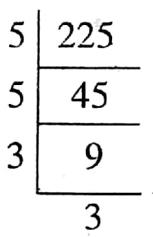
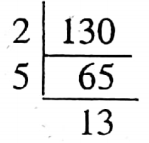
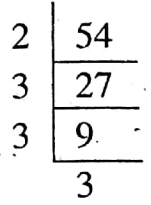
The L. C. M. of 140 cm and 350 cm will be the required distance.

WBBSE Solutions For Class 6 Maths Chapter 1 Simplification Question 17 Q 1

∴ 140 = 2 x 2 x 5 x 7

WBBSE Solutions For Class 6 Maths Chapter 1 Simplification Question 17 Q 2

∴ 350 = 2 x 5 x 5 x 7

The required L. C. M. of 140 and 350 = 2 x 2 x 5 x 7 x 5

= 700

So the required distance = 700 cm

= 70 dm.

Class 6 Math Solution WBBSE

Question 4.

1. With the help of H. C. F. of 45 and 60, find their L. C. M.

Solution:

Given:

H. C. F. of 45 and 60


WBBSE Solutions For Class 6 Maths Chapter 1 Simplification Question 18 Q 1


∴ The H.C.F. of 45, 60 = 15

Now, the product of numbers = H.C.F x L.C.M

∴ 45 x 60 = 15 x L.C.M


WBBSE Solutions For Class 6 Maths Chapter 1 Simplification Question 18 Q 2


 2. With the help of L. C. M. of 105 and 225, find their H. C. F.

Solution:


WBBSE Solutions For Class 6 Maths Chapter 1 Simplification Question 18 Q 3


∴ 105 = 3 x 5 x 7


WBBSE Solutions For Class 6 Maths Chapter 1 Simplification Question 18 Q 4

Common Questions About Finding HCF and LCM

∴ 225 = 3 x 3 x 5 x 5

L.C. M. of 105 and 225 = 3 x 5 x 7 x 3 x 5 = 1575 

Now, the product of the numbers = H. C. F. x L. C. M.

or, 105 x 225 = H. C. F. x 1575


WBBSE Solutions For Class 6 Maths Chapter 1 Simplification Question 18 Q 5


∴ The required H.C.F of 150 and 225 = 15.

Question 5. Find the H. C. F. of 24, 33, and 130.

Solution:

Given:

The H. C. F. of 24, 33, and 130


WBBSE Solutions For Class 6 Maths Chapter 1 Simplification Question 19 Q 1

∴ 24 = 1 x 2 x 2 x 2 x 3


WBBSE Solutions For Class 6 Maths Chapter 1 Simplification Question 19 Q 2


∴ 33 = 3 x 11


WBBSE Solutions For Class 6 Maths Chapter 1 Simplification Question 19 Q 3


∴ 130 = 1 x 2 x 5 x 13

Here 33 and 130 are prime to each other.

The given numbers have no common factor except 1.

Hence the required H. C. F. is 1.

Practice Problems on HCF and LCM of Integers

Question 6. Examine whether 278 and 365 are prime to each other.

Solution:

Given:

278 and 365

Here we shall find the H. C. F. of the given numbers by the method of division


WBBSE Solutions For Class 6 Maths Chapter 1 Simplification Question 20WBBSE Solutions For Class 6 Maths Chapter 1 Simplification Question 20


∴ The H. C. F. of 278 and 365 is 1. Hence 278 and 365 are prime to each other.

Question 7. Find the H. C. F of 906, 1057, and 1510 by the division method.

Solution:

Given:

906, 1057, and 1510

First, we find the H. C. F. of 906 and 1057.
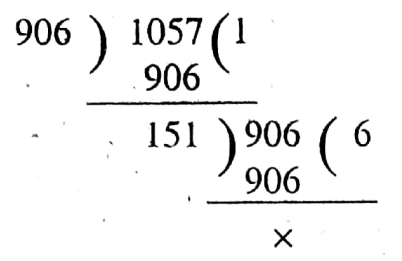
 

WBBSE Solutions For Class 6 Maths Chapter 1 Simplification Question 21 Q 1


∴ The H. C. F. of 906 and 1057 is 151.

Now we shall find H. C. F. of 151 and 1510.


WBBSE Solutions For Class 6 Maths Chapter 1 Simplification Question 21 Q 2


∴ The H. C. F. of 151 and 1510 = 151.

Hence the required H. C. F. of 906, 1057, and 1510 = 151.

Question 8. Find the H. C. F. of 84, 112, 140.

Solution:

Given:

84, 112, 140.

Simplification For Class 6

WBBSE Solutions For Class 6 Maths Chapter 1 Simplification Question 22


Here we divide all the given numbers by their common prime factor 2 in the 1st row.

The quotients obtained are written in the 2nd row and divided into all the numbers in the 2nd row by their common prime factor 2 and the quotients are written in the 3rd row.

They are also divided by their common factor 7 and the quotients are written in the 4th row.

But the numbers in the 4th row have no common factor except 1 and the process is now completed.

∴ The required H. C. F. = product of the common prime factors

= 2 × 2 × 7 = 28.

The required H. C. F = 28.

Examples of Real-Life Applications of HCF and LCM

Question 9. Find the L. C. M. of 28, 35, 63, 84, 96.

Solution:

Given:

28, 35, 63, 84, 96


WBBSE Solutions For Class 6 Maths Chapter 1 Simplification Question 23


∴ The required L.C.M = 2 x 2 x 3 x 7 x 5 x 3 x 8

= 10080.

The required L.C.M = 10080.

Question 10

1. Find the least number which is exactly divisible by 18, 24, and 42.

Solution:

Given:

18, 24, and 42

Find the least number which is exactly divisible by 18, 24, and 42.
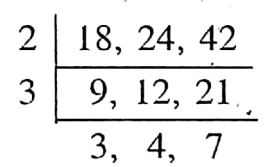
 

WBBSE Solutions For Class 6 Maths Chapter 1 Simplification Question 24 Q 1


 The L. C. M. of 18, 24, 42 = 2 x 3 x 3 x 4 x7 = 504.

∴ The required least number = 504.

2. Find the least number which is exactly divisible by 18, 39, 56, and 64.

Solution:

Given:

18, 39, 56, and 64

The required least number will be the L. C. M. of 18, 39, 56, and 64. 

Now,


WBBSE Solutions For Class 6 Maths Chapter 1 Simplification Question 24 Q 2

Simplification For Class 6

L.C.M. of 18, 39, 56 and 64 = 2 x 2 x 2 x 3 x 3 x 13 x 7 x 8 = 52416.

∴ The required least number = 52416.

Question 11.

The honorable Education Minister of the West Bengal Government has sent some books on Mathematics, Physical Science, and Life Science for class VI of Raghunath Vidyamandir. These books can be arranged in the school library in 20, 24, and 30 rows so that each row contains an equal number of books. How many least number of books has the minister sent?

Solution:

Given:

The honorable Education Minister of the West Bengal Government has sent some books on Mathematics, Physical Science, and Life Science for class VI of Raghunath Vidyamandir. These books can be arranged in the school library in 20, 24, and 30 rows so that each row contains an equal number of books.

Since each row contains an equal number of books the required number of books will be the L. C. M. of 20, 24, 30.

Now,


WBBSE Solutions For Class 6 Maths Chapter 1 Simplification Question 25
∴ L.C.M. of 20, 24, 30 = 2 x 2 x 5 x 3 x 2
= 120.
∴ The honorable Education minister has sent at least 120 books.
Conceptual Questions on Using LCM in Problem Solving

Question 12.

Find the H. C. F. and L. C. M. of 35, 45, and 50. Examine whether the product of the numbers and the product of their H. C. F. and L. C. M. are equal or not.

Solution:

Given:

35, 45, and 50


WBBSE Solutions For Class 6 Maths Chapter 1 Simplification Question 26


∴ H. C. E. of 35, 45, 50 = 5 and their L. C. M. = 5 x 7 x 9 x 10 = 3150. Product of H. C. F. and L. C. M. = 5 x 3150 = 15750.

Again the product of the numbers 35 x 45 x 50 = 78750

∴ Product of the numbers ≠ product of H.C.F. and L.C.M.

Question 13.

The sum of the two numbers is 150 and their H. C. F. is 15. Find the numbers.

Solution:

Since the H. C. F. of two numbers is 15, the numbers must be multiples of 15.

Let the numbers be 15x and 15 y where x and y are primes to each other.

∴ Their sum = 15x + 15y= 15 (x + y)

∴ By the given condition, we get, 15 (x + y) = 150

Dividing both sides by 15, we get, x + y = [latex]\frac{150}{15}\) = 10.

Now,

10 = 1+9=2+8=3+7=4+6=5+5.

Among them, 1, and 9 are prime to each other, and 3, and 7 are also prime to each other. 

So the numbers are either 15 x 1 = 15; 15 x 9 = 135

or, 15 x 3 = 45; 15 x 7 = 105 . 

∴ The required numbers are either 15, 135, or 45, 105.

Real-Life Scenarios Involving Equal Distribution Using HCF

Question 14.

If the H. C. F. and L. C. M. of two numbers be 5 and 75 respectively, then find the numbers.

Solution:

Since the H. C. F. of two numbers is 5, let the numbers be 5x and 5y, where x and y are primes to each other.

Then L. C. M. of 5x and 5y = 5xy. But the L. C. M. is 75.

∴ 5xy = 75.

Now dividing both sides by 5, we get, xy= 15.

But 151 x 15 = 3 x 5. Both the sets of numbers 1, 15, and 3, 5 are prime to each other.

∴ The numbers are either 5 x 1, 5 x 15 = 5, 75.

or, 5 x 3, 5 x 5 = 15, 25.

∴ The required numbers are either 5, 75

or 15, 25.

WBBSE Solutions For Class 6 Maths Chapter 1 Simplification Highest Common Factor And Lowest Common Multiple Of Integers

Chapter 1 Simplification Highest Common Factor And Lowest Common Multiple Of Integers

Question 1. 

1. Write down 2 numbers of two digits which are multiples of 4

Solution:

Two multiples of 4 of two digits are 12 and 16, because 4 × 3 = 12 and 4 × 4 = 16.

2. Write 6 multiples of 5 except 0;

Solution:

6 multiples of 5 except 0 are 5 × 15, 5 × 2 = 10, 5 × 3 = 15, 5 × 4 = 20, 5 × 5, 25 and 5 × 6 = 30.

Read And Learn More: WBBSE Solutions For Class 6 Maths Chapter 1 Simplification Solved Problems

3. Write two numbers whose L. C. M. is 12 and whose sum is 10;

Solution:

Two numbers are 4 and 6; because of the L. C. M. of 4 and 6 = 12 and whose sum 4+6= 10.

(Here 4 2 × 2 and 6 = 2 x 3. .. L. C. M.2 × 2 × 3 = 12).

WBBSE Solutions For Class 6 Maths Chapter 1 Simplification Highest Common Factor And Lowest Common Multiple Of Integers

WBBSE Class 6 HCF and LCM Simplification Notes

4. Write three numbers each of which has a factor of 4

Solution:

The required 3 numbers are 8, 12, and 16 because each of these numbers has a factor of 4.

5. Write three multiples of 7 greater than 50.

Solution:

Three multiples of 7 greater than 50 are 56, 63, and 70 because 56 > 50; 63 50; 70 > 50

56 = 7 × 8,

63 = 7 × 9, 

70 = 7 × 10.

WBBSE Solutions For Class 6 Geography WBBSE Solutions For Class 6 History WBBSE Solutions For Class 6 Maths
WBBSE Class 6 Geography Notes WBBSE Class 6 History Notes
WBBSE Class 6 Geography Multiple Choice Questions WBBSE Class 6 History MCQs WBBSE Notes For Class 6 School Science


Question 2.

1. Which is the smallest even prime number?

Solution:

The smallest even prime number is 2.

2. Which is the smallest odd prime number?

Solution:

The smallest odd prime number is 3.

3. What are the prime factors of 14?

Solution:

We know that 14= 1 × 2 × 7.

The factors of 14 are 1, 2, 7, and 14.

The prime factors of 14 are 2 and 7.

Short Questions on HCF and LCM

Question 3. 42 is the multiple of which of the following numbers? 

1. 5

2. 6

3. 7

4. 13.

Solution:

42 is divisible by both the numbers 6 and 7 but 42 is not divisible by 5 or 13.

So, 42 is the multiple of 6 and 7.

42 is not a multiple of 5. and 13.

Question 4. 11 is a factor of which of the following numbers?

1. 101

2. 111

3. 121

4. 112.

Solution: We know that 121 = 11 × 11.

∴ 11 is a factor of 121. 

Again the numbers 101, 111, and 112 are not divisible by 11.

So 11 is not a factor of 101, 111, or 112.

Question 5.

Find the H.C.F. by the resolution into prime factors of the numbers in each of the following cases:

1. 22, 44

Solution:

22 = 1 × 2 × 11

WBBSE Solutions For Class 6 Maths Chapter 1 Simplification Question 5 Q 1

44 = 1 × 2 × 2 × 11

WBBSE Solutions For Class 6 Maths Chapter 1 Simplification Question 5 Q 2

The factors of 22 are 1, 2, 11, 22 and that of 44 are 1, 2, 4, 11, 22, 44

WBBSE Solutions For Class 6 Maths Chapter 1 Simplification Question 5 Q 3

∴ The common factors of 22 and 44 are 1, 2, 11, and 22.

Among these factors, the highest factor is 22

∴ The required H. C. F. = 22.

2. 54, 72.

WBBSE Solutions For Class 6 Maths Chapter 1 Simplification Question 5 Q 1

WBBSE Solutions For Class 6 Maths Chapter 1 Simplification Question 5 Q 2

∴ So the factors of 54 are 1, 2, 3, 6,9, 18, 27, and 54.

WBBSE Solutions For Class 6 Maths Chapter 1 Simplification Question 5 Q 3

WBBSE Solutions For Class 6 Maths Chapter 1 Simplification Question 5 Q 4

∴ So the factors of 72 are 1, 2, 3, 4, 6, 8, 9, 12, 18, 24, 36, 72

∴ The common factors of 54 and 72 are 1, 2, 3, 6, 9, and 18.

Among these factors, the highest factor is 18.

∴ The required H. C. F. = 18.

Common Questions About Simplifying Fractions Using HCF

Question 6. Find the H. C. F. of 36 and 48 by resolution into factors.

Solution:

WBBSE Solutions For Class 6 Maths Chapter 1 Simplification Question 6 Q 1

∴ 36 = 2 × 2 × 3 × 3

∴ 48 = 2 × 2 × 2 × 2 × 3

Now

WBBSE Solutions For Class 6 Maths Chapter 1 Simplification Question 6 Q 2

WBBSE Solutions For Class 6 Maths Chapter 1 Simplification Question 6 Q 3

∴ The factors of 36 are 1, 2, 3, 4, 6, 9, 12, 18, and 36.

The factors of 48 are 1, 2, 3, 4, 6, 8, 12, 16, 24, and 48.

The common factors of 36 and 48 are 1, 2, 3, 4, 6, and 12.

Among these factors, the highest factor is 12.

∴ The required H. C. F. = 12.

Alternative Method:

WBBSE Solutions For Class 6 Maths Chapter 1 Simplification Question 6 Q 4

v

Here

WBBSE Solutions For Class 6 Maths Chapter 1 Simplification Question 6 Q 6 markings are common to both 36 and 48.

∴ The required H.C.F = 1 × 2 × 2× 3 =12.

Practice Problems on HCF and LCM

Question 7. Find the H. C. F. of 75 and 105 by factorization.

Solution:

WBBSE Solutions For Class 6 Maths Chapter 1 Simplification Question 7 Q 1

WBBSE Solutions For Class 6 Maths Chapter 1 Simplification Question 7 Q 2

WBBSE Solutions For Class 6 Maths Chapter 1 Simplification Question 7 Q 3

WBBSE Solutions For Class 6 Maths Chapter 1 Simplification Question 7 Q 4

Here

WBBSE Solutions For Class 6 Maths Chapter 1 Simplification Question Q 7 Q 5 marking is common to both 75 and 105.

∴ the required H.C.F = 1 × 3 × 5 = 15.

Question 8. Write two numbers whose H. C. F. is 7.

 Solution : 7 × 2 = 14; 7 × 3 = 21

2 and 3 are prime to each other, and the H. C. F. of 14 and 21 is 7.

The required two numbers are 14 and 21.

N.B. We can get an infinite number of such two numbers.

Question 9. By division method find the H. C. F. in the following cases:

1. 28, 35

Solution: 

WBBSE Solutions For Class 6 Maths Chapter 1 Simplification Question 9 Q 1


∴ the required H.C.F. = 7

2. 54, 72

WBBSE Solutions For Class 6 Maths Chapter 1 Simplification Question 9 Q 2


∴ The required H.C.f. = 18.

Examples of Real-Life Applications of HCF and LCM

Question 10. By division method, find the H. C. F. of 90 and 144.

Solution:

WBBSE Solutions For Class 6 Maths Chapter 1 Simplification Question 10


∴ The required H.C.F. = 18.

Question 11. What will be the greatest number by which 45 and 60 will be exactly divisible so that there will be no remainder in each case?

Solution:

The required greatest number will be the H. C. F. of 45 and 60.

Now,


WBBSE Solutions For Class 6 Maths Chapter 1 Simplification Question 11


∴ The H. C. F. of 45 and 60 = 15. So the required greatest number is 15.

Question 12.

1. The H. C. F. of two numbers is 1. How many such two numbers may exist? Find one pair of such numbers. What conclusion can you draw about such two numbers?

Solution:

There are infinite numbers of two numbers that have the H. C. F. 1. For example 2, 3; 5, 7; 9, 11, etc.

The required numbers are 9 and 11.

The numbers which have the H. C. F. 1 are prime to each other.

Conceptual Questions on Using HCF in Fraction Simplification

2. How many greatest number of persons can be distributed equally two kinds of sweets: 48 sweets of one kind and 64 sweets of another kind, without breaking the sweets?

Solution:

The required number of persons will be the H. C. F. of 48 and 64.

Now,

WBBSE Solutions For Class 6 Maths Chapter 1 Simplification Question 12

H.C. F. of 48 and 64 = 16

So the required greatest number of people is 16.

Question 13. Find the L. C. M. by factorization in each of the following cases:

 1. 25, 80

Solution:

WBBSE Solutions For Class 6 Maths Chapter 1 Simplification Question 13 Q 1

∴ 25 = 1 x 5 x 5

WBBSE Solutions For Class 6 Maths Chapter 1 Simplification Question 13 Q 2

∴ The required L.C.M = 1 x 5 x 5 x 2 x 2 x 2 x 2

= 400.

2. 36, 39

WBBSE Solutions For Class 6 Maths Chapter 1 Simplification Question 13 Q 3

∴ 36 = 2 x 2 x 3 x 3

WBBSE Solutions For Class 6 Maths Chapter 1 Simplification Question 13 Q 4

∴ 39 = 3 x 13

∴ The required L. C. M. = 2 x 2 x 3 x 3 x 13

= 468

Question 14. Find the L. C. M. by prime factors in each of the following cases:

1. 33, 132

Solution:

∴ 33 = 3 x 11

WBBSE Solutions For Class 6 Maths Chapter 1 Simplification Question 14 Q 2

∴ 132 = 2 x 2 x 3 x 11

∴ The required L. C. M. = 3 x 11 x 2 x 2 = 132.

Real-Life Scenarios Involving Equal Distribution Using HCF

2. 90, 144

WBBSE Solutions For Class 6 Maths Chapter 1 Simplification Question 14 Q 3

∴ 90 = 2 x 3 x 3 x 5

WBBSE Solutions For Class 6 Maths Chapter 1 Simplification Question 14 Q 4

∴ 144 = 2 x 2 x 2 x 2 x 3

 The required L. C. M. = 2 x 3 x 3 x 5 x 2 x 2 x 2 = 720.

WBBSE Solutions For Class 6 Maths Chapter 1 Simplification Prime And Composite Numbers Problems

Chapter 1 Simplification Prime And Composite Numbers Problems

Question 1. What is the smallest prime number?

Solution:

The smallest prime number is 2.

Question 2. Which number is neither prime nor composite?

Solution:

The number is 1, which is neither prime nor composite.

Question 3. Examine whether the following pair of numbers are prime to each other

1. 5, 7 

Solution:

WBBSE Class 6 Prime and Composite Numbers Notes

Given Numbers: 5, 7 

5 and 7 have no common factor except 1,

∴ 5 and 7 are prime to each other.

2. 10, 21.

Solution:

10 = 2 x 5 and 21 = 3 x 7.

∴ The factors of 10 are 1, 2, 5, and 10. 

Among them, 2 and 5 are the prime factors of

Again, the factors of 21 are 1, 3, 7, and 21. 

Among them, 3 and 7 are the prime factors of 21.

∴ 10 and 21 have no common factor other than 1.

So 10 and 21 are prime to each other.

Read And Learn More: WBBSE Solutions For Class 6 Maths Chapter 1 Simplification Solved Problems

Example 4. Write two composite numbers which are prime to each other. 

Short Questions on Prime and Composite Numbers

Solution:

Two composite numbers which are prime to each other

Two composite numbers 18 and 35 are prime to other.

Because, 18 = 2 x 3 x 3 and 35 = 5 x 7.

So 18 and 35 have no common factor except 1.

∴ 18 and 35 are two composite numbers but are prime to each other.

WBBSE Solutions For Class 6 Maths Chapter 1 Simplification Prime And Composite Numbers Problems

Example 5. Write down all the prime numbers between 100 and 200.

Solution:

The prime numbers between 100 and 200

The prime numbers between 100 and 200 are as follows

101, 103, 107, 109, 113, 131, 133, 137, 139, 141, 149, 151, 157, 161, 163, 167, 173, 179, 181, 191, 193, 197, 199.

Practice Problems on Prime and Composite Number Identification

WBBSE Solutions For Class 6 Geography WBBSE Solutions For Class 6 History WBBSE Solutions For Class 6 Maths
WBBSE Class 6 Geography Notes WBBSE Class 6 History Notes
WBBSE Class 6 Geography Multiple Choice Questions WBBSE Class 6 History MCQs WBBSE Notes For Class 6 School Science


Example 6. Find whether 331 is a prime number or not.

Solution:

Given:

331

Since 331 contains 1 in the unit’s place, therefore, 331 is not divisible

by any even number and also 331 is not divisible by 5.

Now the sum of the digits is 3+3 + 1 = 7. Therefore, the number 331 is not divisible by 3 or 9.

Now we divide the number 331 by 7, 11, 13, 17, etc., and we get,


WBBSE Solutions For Class 6 Maths Chapter 1 Simplification Question 6


The number 331 when divided by 19, the quotient is 17, which is less than the divisor 19, therefore further division by a prime number greater than 19 is not required.

Simplification For Class 6

∴ The number 331 is a prime number.

Example 7. Find the prime factors of 30030.

Solution :

The prime factors of 30030

Simplification For Class 6


WBBSE Solutions For Class 6 Maths Chapter 1 Simplification Question 7


∴ 30030 = 2 x 3 x 5 x 7 x 11 x 13

∴ The prime factors of 30030 are 2, 3, 5, 7, 11, and 13.


Example 8. Find the common factor or factors of the numbers 154, 195, and 714 by resolving them into prime factors.

Solution:

Given:

The common factor or factors of the numbers 154, 195, and 714 by resolving them into prime factor


WBBSE Solutions For Class 6 Maths Chapter 1 Simplification Question 8


∴ 154 = 1 X 2 x 7 x 11.

∴ 195 = 1 × 3 × 5 × 13

∴ 714 = 1 x 2 x 3 x 7 x 17.

Here we see that 154, 195, and 714 have no common factor except 1.

Therefore, 154, 195, and 714 are mutually prime to each other.

Examples of Real-Life Applications of Prime Numbers

Example 9. Find the common factors of the numbers 42, 66, and 78. Obtain the highest common factors of them.

Solution:

The common factors of the numbers 42, 66, and 78.


WBBSE Solutions For Class 6 Maths Chapter 1 Simplification Question 9

∴ 42 = 1 x 2 x 3 x 7.

∴ Factors of 42 are 1, 2, 3, 6, 7, 14, 21, and 42.


∴ 66 1 × 2 × 3 × 11

∴ Factors of 66 are 1, 2, 3, 6, 11, 22, 33, and 66.


∴ 78 1 X 2 X 3 X 13

∴ Factors of 78 are 1, 2, 3, 6, 13, 26, 39, and 78.

∴ The common factors of 42, 66, and 78 are: 1, 2, 3, 6

∴ Highest common factor

∴ The required highest common factor of the given numbers = 6.

Real-Life Scenarios Involving Factors and Multiples

Example 10. Examine, without actual division, whether the number 40821 is divisible by 3 or not.

Solution:

We know that any number will be divisible by 3 if the sum of the digits of the number is divisible by 3.

Here is the sum of the digits of the numbers 408214+0+8+2+1 = 15, which is divisible by 3.

Hence the number 40821 is divisible by 33


Example 11. Examine, without actual division, whether the number 55473 is divisible by 11 or not.

Solution:

We know that any number will be divisible by 11 if the difference between the sum of the digits in the odd places and even places of the number be zero or divisible by 11.

Here, the sum of the digits in the even places of the number 55473 = 5 + 7 = 12, and the sum of the digits in the odd places of the number 55473 = 5 + 4 + 3 = 12.

The difference of the sum of the digits in the odd places and even places = 12 12 = 0.

Hence the number 55473 is divisible by 11.


Example 12. Examine, without actual division, whether the number 908476118 is divisible by 11 or not.

Solution:

We know that any number will be divisible by 11 if the difference between the sum of the digits in the odd places and even places of the number be zero or divisible by 11.

Here, the sum of the digits in the odd places of the number 908476118 9+ 8 + 7+1+8=33 and that of the digits in the even places of the number 908476118 = 1 + 6 + 4 + 0 = 11.

.. The difference of the sum of the digits in the odd places and even places = 33 11 22, which is divisible by 11.

Hence the number 908476118 is divisible by 11.

Conceptual Questions on Prime Factorization

Example 13. Without actual division, Examine

1. if the number 85944 is divisible by 4.

2. if the number 705432700 is divisible by 4.

Solution:

We know that a given number is divisible by 4 if the last two digits, of the number, be zeroes or if the number formed by the last two digits of the given number is divisible by 4.

1. if the number 85944 is divisible by 4.

The number formed by the last two digits of the number 85944 is 44, which is divisible by 4.

∴ The number 85944 is divisible by 4.

2. if the number 705432700 is divisible by 4.

The last two digits of the number 705432700 are zeroes.

∴ The number 705432700 is divisible by 4.

WBBSE Notes For Class 6 Maths Chapter 1 Simplification Prime And Composite Numbers

Chapter 1 Simplification Prime And Composite Numbers

Chapter 1 Prime And Composite Numbers Definition: 

A number is said to be a prime number if it is divisible either by itself or by 1 only and is not divisible by any other number.

2, 3, 5, 7, 11, etc. are prime numbers. A prime number has no factor except the. the number itself and 1.

Definition:

  1. A number that is divisible by numbers other than itself and 1 is called a composite number.
  2. For example, 4, 12, 15, 18, 24, etc., numbers are composite numbers. A composite number is a multiple of two or more prime numbers.
  3. For example, 6 is a composite number and it is a multiple of the prime numbers 2 and 3.
  4. Again 12 is a composite number and it is a multiple of 2, 3, 4, and 6.
  5. Among them, 2 and 3 are the prime numbers, and 4, and 6 are composite numbers.
  6. Here 2, 3, 4, and 6 are the factors of 12.
  7. The number 1 is not a prime number, it is also not a composite number. 

Read And Learn More: WBBSE Notes For Class 6 Maths Chapter 1 Simplification

Determination of Prime Numbers :

  1. The method of determination of prime numbers among the natural numbers 1, 2, 3, 4, 5, 6, etc., is given below:
  2. First, we write down the natural numbers 1, 2, 3, 4, 5, 6, etc. consecutively.
  3. Then cut out every second number after 2. Thus all the multiples of 2 are canceled.
  4. Then cancel every third number after 3 and so all the multiples of 3 are canceled.
  5. Now cancel every fifth number after 5. Following the same procedure as the prime numbers 7, 11, etc., the numbers which are left after cancellation are the prime numbers.
  6. With the help of the above process, the prime numbers from 1 to 50 have been determined as follows

WBBSE Solutions For Class 6 Maths Chapter 1 Simplification Question 8

WBBSE Class 6 Prime and Composite Numbers Notes

  1. The remaining numbers are 1, 2, 3, 5, 7, 11, 13, 17, 19, 23, 29, 31, 37, 41, 43, 47.
  2. These numbers are prime numbers except 1.
  3. Therefore the prime numbers between 1 and 50 are 2, 3, 5, 7, 11, 13, 17, 19, 23, 29, 31, 37, 41, 43, 47.
  4. This method is called the Sieve of Eratosthenes. In third century B.
  5. C., Greek Mathematician Eratosthenes formulated a method by which prime numbers between 1 to 100 could be identified.
  6. In this method, the prime numbers can be easily found.
  7. out without finding factors or multiples.

WBBSE Notes For Class 6 Maths Chapter 1 Simplification Prime And Composite Numbers

Numbers Prime to each other or Co-prime numbers :

Definition:

  1. If two numbers are such that they do not have any common factors, or they have only common factor 1, then the numbers are said to be prime to each other (or Co-príme numbers).
  2. In the two numbers which are prime to each other or Co-prime numbers, there is no common factor other than 1.
  3. These numbers themselves may or may not be prime.

Important Definitions Related to Prime and Composite Numbers

For example

  1. 11 and 19 both the numbers are both prime and they do not have any common factor other than 1.
  2. Therefore 11 and 19 are prime to each other.
  3. Similarly, 11 and 13 are prime to each other because they do not have any common factor other than 1.
  4. Again 12 = 2 x 2 x 3 and 35 = 5 x 7. So the numbers 12 and 35 both are composite numbers i.e., they are not prime numbers.
  5. But there is no number common other than 1, by which both of them are exactly divisible i.e., they have no common factor.
  6. So the numbers 12 and 35 are prime to each other although they are not prime numbers.
WBBSE Solutions For Class 6 Geography WBBSE Solutions For Class 6 History WBBSE Solutions For Class 6 Maths
WBBSE Class 6 Geography Notes WBBSE Class 6 History Notes
WBBSE Class 6 Geography Multiple Choice Questions WBBSE Class 6 History MCQs WBBSE Notes For Class 6 School Science


Factors and Prime Factors:

  1. We know that,12 = 2 x 2 x 3. We can write,
  2. \(\left.\begin{array}{rl}
    12 & =1 \times 12 \\
    & =2 \times 6 \\
    & =3 \times 4
    \end{array}\right\}\)
  3. ∴ The factors of 12 are 1, 2, 3, 4, 6, and 12. 
  4. Among them, 2 and 3 are prime factors of 12. 
  5. So the prime factors of 12 are 2 and 3.
  6. Similarly, 
  7. \(\left.35=\begin{array}{c}
    1 \times 35 \\
    5 \times 7
    \end{array}\right\}\)
  8. ∴ The factors of 35 are 1, 5, 7, and 35. 
  9. Among them, 5 and 7 are prime factors.
  10. ∴ The prime factors of 35 are 5 and 7.

Simplification Maths Class 6

Definition:

  1. The numbers by which a given number is exactly divisible, then the numbers are called the factors of the given number.
  2. Among these factors, which factors are prime numbers are called prime factors.
  3. So the factors and prime factors of a given number are not the same.

Resolution of a number into Prime factors:

  1. In order to resolve a number into prime factors, the number should be continuously divided by suitable prime numbers, until the quotient comes to be a prime number.
  2. The successive divisors and the last quotient will be the prime factors.

Understanding Prime Numbers

Rule of Divisibility:

  1. The following are the rules to determine whether a natural number is divisible by other natural numbers or not.
  2. The natural number which has 0 or an even number in the unit’s place is divisible by 2.
    So all natural numbers having 0 or an even number in the unit’s place is divisible by 2. For example, 20, 26, 32, 34, etc. are divisible by 2.
  3. If the sum of the digits of a natural number is divisible by 3, the number is also divisible by 3.
    For example, the sum of the digits of the number 234 is 9 which is divisible by 3 and so the number 234 is divisible by 3.
  4. If the last two digits of a natural number be zeroes or if the number formed by the last two digits of the given natural number is divisible by 4, then the given natural number is divisible by 4.
    For example, the natural number 200, having the last two digits 0, is divisible by 4 and the number formed by the last two digits of the natural number 132 is 32, which is divisible by 4 and so the number 132 is divisible by 4.
  5. The natural numbers having 0 or 5 in the unit’s place are divisible by 5.
    For example, 150 and 205 are divisible by 5.
  6. The natural numbers which are divisible by both 2 and 3 are divisible by 6. For example, 78 and 126 are divisible by 6.
  7. In order to determine whether a natural number is divisible by 7 or not, it is better to divide the natural number by 7.
    If there is no remainder, then the given natural number must be divisible by 7.
  8. If the last 3 digits of a given natural number be zeroes or the number formed by the last 3 digits of the given natural number is divisible by 8, then the given natural number must be divisible by 8.
    For example, 1000 and 2152 both are divisible.. by 8.
  9. If the sum, of the digits of a number, is divisible by 9, then the number is divisible by 9.
    For example, the numbers 1107 and 1827 are divisible by 9.
  10. The natural numbers having 0 in the unit’s place must be divisible by 10.
    For example, 210, and 2350 both are divisible by 10.
  11. If the difference of the sum of the digits in the odd places and even places of a natural number by zero or divisible by 11, then the number must be divisible by 11.
    For example, the numbers 1474 and 61754 are divisible by 11, because for the number 1474:
  12. The sum of the digits in the odd places = 1 + 7 = 8 and the sum of the digits in the even places 4+4 = 8.
  13. The difference between these two numbers = is 8-8 = 0.
  14. Again for the number 61754:
  15. The sum of the digits in the odd places = 6 +7+4 = 17 and the sum of the digits in the even places = 1 + 5 = 6.
  16. The difference between these two numbers is 17 – 6 = 11, which is divisible by 11.
  17. Hence both the natural numbers 1474 and 61754 are divisible by 11.
  18. With the help of the above rules, we can determine whether a natural number is divisible, by 12, 15, 16, 18, 25, etc., or not.


WBBSE Solutions For Class 6 Maths Chapter 1 Simplification Solved Example Problems

Chapter 1 Simplification Solved Example Problems

Question 1: Simplify each of the cases (1), (2), (3), (4) Verify whether the results of the cases are equal or not.

1.10 + 8 ÷ (5 – 2)

Solution:

Given

10 + 8 ÷ (5 – 2)

= 10 + 8 ÷ 3

= 10 + \(\frac{8}{3}\)

= \(\frac{10+3}{3}\)

= \(\frac{38}{3}\)

10 + 8 ÷ (5 – 2)  = \(\frac{38}{3}\)

Read And Learn More: WBBSE Solutions For Class 6 Maths Chapter 1 Simplification Solved Problems

WBBSE Class 6 Simplification Example Problems

2. (10 + 8) ÷ (5 – 2)

Solution:

Given

(10 + 8) ÷ (5 – 2)

= 18 ÷ 3

= 6.

(10 + 8) ÷ (5 – 2) = 6.

WBBSE Solutions For Class 6 Maths Chapter 1 Simplification Solved Example Problems

3. (10 – 8)(5 – 2)

Solution:

Given

(10 – 8)(5 – 2)

= (2)(3)

= 6

(10 – 8)(5 – 2) = 6

Short Questions on Simplification Problems

4. 10 – 8 (5 – 2).

Solution:

Given

10 – 8 (5 – 2)

= 10 – 8 (3)

= 10 – 24

= – 14.

10 – 8 (5 – 2) = – 14.

Question 2.

Simplify :

1. (12 – 2) ÷ 2,

2. {90 – (48 – 21)} ÷ 7

Solution: 

Given

1. (12 – 2) ÷ 2

= 10 ÷ 2

= 5.

(12 – 2) ÷ 2 = 5.

2. {90 – (48 – 21)} ÷ 7

= {90 – 27} ÷ 7

= 63 ÷ 7

= 9.

{90 – (48 – 21)} ÷ 7= 9.

Common Simplification Problems and Solutions

Question 3

Evaluate:

1. (72 ÷ 8 x 9) – (72 ÷ 8 of 9)

2. {25 x 16 ÷ (60 ÷ 15) – 4 x (77 – 62)} ÷ (20 x 6 + 3)

3. 200 ÷ [88 – {(12 x 13) – 3 x (40 – 9)}]

Solution:

Given

1. (72 ÷ 8 x 9)- (72 ÷ 8 of 9)

= (9 x 9) – (72 ÷ 72)

= 81 – 1

= 80.

(72 ÷ 8 x 9)- (72 ÷ 8 of 9) = 80.

WBBSE Solutions For Class 6 Geography WBBSE Solutions For Class 6 History WBBSE Solutions For Class 6 Maths
WBBSE Class 6 Geography Notes WBBSE Class 6 History Notes
WBBSE Class 6 Geography Multiple Choice Questions WBBSE Class 6 History MCQs WBBSE Notes For Class 6 School Science


2. {25 x 16 ÷ (60 + 15) – 4 x (77 – 62)} ÷ (20 x 6 ÷ 3)

= {25 x 16 + 4 – 4 xl5} ÷ (20 x 2)

= {25 x 4 – 4 x 15} ÷ 40

= {100 – 60} ÷ 40

= 40 v 40

= 1

{25 x 16 ÷ (60 + 15) – 4 x (77 – 62)} ÷ (20 x 6 ÷ 3) = 1

Practice Problems on Simplification with Solutions

3. 200 ÷ [88 – {(12 x 13) – 3 x (40 – 9)}]

= 200 ÷ [88 – {156 – 3 x 31}] – 200 + [88 – {156 – 93}]

= 200 ÷ [88 – 63]

= 200 ÷ 25

= 8.

200 ÷ [88 – {(12 x 13) – 3 x (40 – 9)}] = 8.

Question 4

1. 256 ÷ \(\overline{16 \div 2}\) ÷ \(\overline{18 \div 9}\)  x 2

Solution :

256 + 16 + 2 + 18 + 9 x 2

= 256 + 8 – 2 x2

= 32 + 2 x 2

= 16 x 2

= 32.

256 + 16 + 2 + 18 + 9 x 2 = 32.

Class 6 Simplify Questions

2. 76 – 4 – [6 + {19 – (48 – 57-17)}] \(\overline{57 – 17}\)

Solution:


WBBSE Solutions For Class 6 Maths Chapter 1 Simplification Question 4 Q 2


3. [16 + {42 – \(\overline{38 + 2}\) }]12 + (24 + 6) x 2 + 4.

Solution:

WBBSE Solutions For Class 6 Maths Chapter 1 Simplification Question 4 Q 3

Examples of Real-Life Applications of Simplification

Question 5. Evaluate:

1. 4 x [24 – {(110 – \(\overline{11 + 3}\) x 4) + 9}] ÷ 2 of 9

Solution:

4 x [24 – {(110 – \(\overline{11 + 3}\) x 4) + 9}] ÷ 2 of 9


WBBSE Solutions For Class 6 Maths Chapter 1 Simplification Question 5 Q 1


2. (987 – \(\overline{43 + 25}\)) – 10 [5 + {(999 ÷ \(\overline{9 * 3}\)) + (\(\overline{8 * 9}\) ÷ 6) 4 }].

Solution:

(987 – \(\overline{43 + 25}\)) – 10 [5 + {(999 ÷ \(\overline{9 * 3}\)) + (\(\overline{8 * 9}\) ÷ 6) 4 }].


WBBSE Solutions For Class 6 Maths Chapter 1 Simplification Question 5 Q 2

Conceptual Questions on BODMAS and Simplification

Example 6. Evaluate:

[latex100-[60 \div \overline{3+2}\} \div\{(5 \text { of } 3) \div \overline{1+4}\}] \text { of } \overline{12+13}[/latex]

Solution:

\(100-[60 \div \overline{3+2}\} \div\{(5 \text { of } 3) \div \overline{1+4}\}] \text { of } \overline{12+13}\)


WBBSE Solutions For Class 6 Maths Chapter 1 Simplification Question 6


Example 7. Simplify:

\(4-[4+\{4-(\overline{4-4}) \text { of } 4\} \div 4]\)

Solution:

4-[4+\{4-(\overline{4-4}) \text { of } 4\} \div 4]

Simplification Questions For Class 6

WBBSE Solutions For Class 6 Maths Chapter 1 Simplification Question 7

Example 8. Simplify:

\(a-[a+\{a-(a+\overline{a-a}) \div a\}-a]\)

Solution:

\(a-[a+\{a-(a+\overline{a-a}) \div a\}-a]\)


WBBSE Solutions For Class 6 Maths Chapter 1 Simplification Question 8

Real-Life Scenarios Involving Mathematical Problem Solving

Question 9. Express the following in Mathematical Language and then solve it:

Father of Subhas plucked 125 guavas from their guava orchard and sold them at the rate of 2 each. Then he purchased 2 pens at the cost of 5 each and 2 exercise books at the cost of 20 each from the money he got by selling the navas. Then the remaining money was distributed between Subhas and his sister equally for eating sweets. How much money did Subhas receive?

Solution:

Expressing the given information in the language of mathematics, we get

Subhas received = [125 x 2 -((5 x 2) + (20 × 2)}] ÷ 2

Solution is Subhas received = [125 x 2 -((5 x 2) + (20 × 2)}] ÷ 2

= [250 (10+40)] ++ 2

= [125 x 2 -((5 x 2) + (20 x 2)}] ÷ 2 [25050] ÷ 2 

= [200] ÷ 2 

= 100.

∴ Subhas received 100.


Example 10. Express the following statement in Mathematical Language and then solve it:

Debapriyo, a student of class Six, received 10,000 as the first prize in the talent search competition in the village. Then he went to his house and he gave to his mother half the prize money and to his elder sister studying Physics Honours 1 half of the remaining money. After this, he purchased a watch by \(\frac{1}{20}\)th of the 20 prize money and purchased 10 pens at a cost of 5 each, 10 exercise books at a cost of 20 each and a book at a cost of 150 for his youngest brother. After these expenses, he kept the remaining money with his father for savings. What was the savings of Debapriyo?

Solution:

Expressing the given information in the mathematical language, we get

The savings of Debapriyo

= [{10,000 – (10,000 ÷ 2)) (10,000 (10,000 ÷ 2)} ÷ 2] – [(10,000 ÷ 20) + (5 x 10+ 20 x 10 + 150)]

= [{10,000 – 5000) – (10,000 – 5000) ÷ 2] – [500+ (50+ 200+ 150)]

= [5000 – 5000 ÷ 2] – [500 +400]

= [ 5000 – 2500] – 900 

= 2500 – 900

= 1600

The savings of Debapriyo was 1600.

WBBSE Notes For Class 6 Maths Chapter 1 Simplification

Simplification Maths Class 6

Chapter 1 Simplification

  1. Simplification of a mathematical quantity means that a simplified form is obtained after the application of different mathematical processes on it such that no further mathematical process can be applied to this simplified form.
  2. Suppose that you have to simplify “10 + 2”—here you have to obtain a simplified form on two real numbers 10 and 2 and there is a mathematical operation “+” (addition) in between them.
  3. We get a simplified real number 12 as a result of the mathematical operation “+” is applied on 10 and 2 and there you can not apply any other mathematical operation on 12.
  4. So the simplification of the mathematical quantity (10 + 2)—we get 12, i.e., 10+ 2 = 12.
  5. Similarly, 20 – 5 = 15, a simplification process. 4 x 5 = 20, 30 -r 5 = 6, etc. are examples of simplification.
  6. It is to be noted that by a “mathematical process or operation” we mean.
  7. Addition, Subtraction, Multiplication, Division,  etc. and we express them as +, -, x, ÷,  etc. respectively.
  8. Other than these operations, we also use the mathematical symbols ( ), { }, [ ], of, etc.
  9. These mathematical symbols denote also definite
  10. mathematical processes or operations like +, x, -, ÷, etc.
  11. For example, the mathematical operation “2 of 8” means 8 x 2 and the result of this quantity after the operation has been done is 16.
  12. Similarly, the symbols ( ), { }, [ ], etc. represent definite mathematical operations or processes.
  13. So we get the following mathematical operations: “+” means addition ; means subtraction ; “x” means multiplication, “÷” means division, “of’ means multiplication ; means first bracket ; “{ }” means second bracket ; “[ ]” means third bracket ;
  14. “—” means vinculum.
  15. Now if it is said that only one mathematical operation is to be done in a mathematical quantity, then we generally do not say that “Simplify” it, we say that you make the process directly,
  16. For example
  17. Add : 15 + 3
  18. or, Multiply: 12 x 5, etc. so to say “Simplify”—we mean generally do more than one mathematical process or operations,

Class 6 Math Solution WBBSE English Medium

Read And Learn More: WBBSE Notes For Class 6 Maths Chapter 1 Simplification

For example:

Simplify 10 ÷ 2 x 5 + 3-1. Here all four mathematical operations or processes “÷”, “x”, “+” and “-’’ are to be done.

Now the question is:

  1. Whether all the operations can be done simultaneously or not?
  2. If not, then which process or operation can be done at first, and which process can be done afterward?
  3. This must be known clearly, otherwise, the result will be different in different procedures.

For this you observe the following simplification :

24 + 6 + 2

= 4 + 2

= 6.

WBBSE Notes For Class 6 Maths Chapter 1 Simplification

Understanding BODMAS

  1. Here we have done the division (+) process first and then the addition (+) process has been done.
  2. Again, ,24 + 6 + 2 = 24 + 8 = 3. Here we have done an addition.
  3. (+) the process at first and then the division process has been done.
  4. As a result of which we get the answer 6 in the first case and 3 in the second case.
  5. So in the simplification of the same problem, we get different results in the different processes if we do not obey a definite rule. But this is not reasonable.
  6. For this Mathematicians have decided on a definite rule of an operational procedure for simplification which we should follow always.
  7. The operational rule for simplification is “VBODMAS”.
  8. Where V = Vinculum
  9. B = Brackets (1st, 2nd, 3rd) .
  10. O = Of
  11. D = Division
  12. M = Multiplication
  13. A = Addition
  14. S = Subtraction
  15. So for simplification, you have to start with, the operations vinculum, then the first bracket, 2nd bracket, 3rd bracket, of, and at last division, multiplication, addition, and subtraction correspondingly.
  16. It is to be noted that if any one of the mathematical operations is absent, then perform the next mathematical operation and so on and this rule can not be violated in any way.
  17. Sometimes in any of the simplifications, there may exist no definite mathematical operation between any two numbers or quantities
WBBSE Solutions For Class 6 Geography WBBSE Solutions For Class 6 History WBBSE Solutions For Class 6 Maths
WBBSE Class 6 Geography Notes WBBSE Class 6 History Notes
WBBSE Class 6 Geography Multiple Choice Questions WBBSE Class 6 History MCQs WBBSE Notes For Class 6 School Science


WBBSE Class 6 Simplification Notes

For example

  1. 12÷2 (5-3) in this simplification there is no mathematical operation between 2 and (5−3). In this case, the process i.e., the operation “x” between 2 and (5-3) is absent, you will always assume that there is “x” i.e., the product operation between these two quantities but you can not put directly “x”-sign between these two quantities. Because in that case, the answer may not be correct. For example, in the same simplification, we get 12÷2 (5-3) = 122 (2) = 12 ÷ 4 = 3
  2. This is the correct answer. But if you put the “x” sign between 2 and (5-3), then the simplification becomes
       12÷2 (5-3)
    = 12÷2 x (5-3)
    = 12÷ 2 x 26 x 2
    = 12 which is not the correct answer.
  3. Here we have done the division process first and then multiplication (whenever you put the “x” sign in the specified place) and the result of the simplification is wrong correspondingly. You will always be alert in this matter.

Simplification Questions For Class 6

Alertness regarding the withdrawal of the Vinculum sign:

  1. The students often make a mistake about the operation “Vinculum”, especially there is a “—” sign before the sign “Vinculum”. For example:
  2. \(22 \div 11-\overline{7-3}\) here” — ” sign exists before the sign Vinculum. Some students write this after the operation of Vinculum as 22 ÷ 11-7-3, which is totally wrong Because in this case,
    22 ÷11-7-3
    = 2-7-3
    = -5-3
    = -8.
  3. But the correct value of the simplification is \(22 \div 11-\overline{7-3}\)
    = 22÷11-4
    = 2-4
    = -2.
  4. So if there is a “—” sign before the sign Vinculum, then after the withdrawal of the vinculum sign, one must take care of the sign as follows
  5. The “+” sign becomes the “—” sign and the “—” sign becomes the “+” sign.
  6. Then only the correct value of the simplification will be obtained.
  7. So we write
  8. \(22 \div 11-\overline{7-3}\)
    = 211-7+3
    = 2-7+3
    = 2+3-7
    = 5-7
    = -2, which is the correct value of the simplification.

WBBSE Notes For Class 6 Maths Geometry Chapter 6 Symmetry

Geometry Chapter 6 Symmetry

Geometry Chapter 6 What is meant by symmetrical body

  1. We are always facing some bodies or some figures of bodies that have some similarities.
  2. Again times, we observe that there exist similarities between two halves of the same body or the figure of the same body.
  3. For example, our left and right hands there exist some similarities of these two hands.
  4. Again if we draw a straight line along the middle of the figure of the butterfly and after folding two halves of the butterfly along this line, we see that these two halves will coincide completely.
  5. So if we find replaceable similarities (i.e., one body is completely identical with the other body) of two or more bodies, then these bodies are called Similar to each other.

WBBSE Notes For Class 6 Maths Geometry Chapter 6 Symmetry Figures of hands

WBBSE Notes For Class 6 Maths Geometry Chapter 6 Symmetry figures of butterfly

WBBSE Class 6 Symmetry Notes

Definition:

If there exists a replaceable similarity (one part is completely identical to the other part) of two halves of a body or the figure of that body, then this body or the figure of that body is called a symmetrical body or the figure of a symmetrical body.

Read And Learn More WBBSE Solutions For Class 6 Maths

Classification of Symmetry :

Symmetry is generally classified into two types.

1. Linear Symmetry

2. Rotational Symmetry

Linear Symmetry:

  1. When a body or a figure of the body is such that with respect to a straight line the body or its figure can be divided into two exactly equal parts i.e. if a body or its picture is folded along a straight line, one part will coincide with the other part, then the body or its picture is called a Linear Symmetrical body.

For example, any equilateral triangle is symmetrical with respect to its media.

WBBSE Notes For Class 6 Maths Geometry Chapter 6 Symmetry 3

1. Line of Symmetry:

  1. The straight line about which the two parts of the body or its picture are equal or identical completely is called the line of Symmetry.
  2. A body or its picture can be symmetrical with respect to more than one straight line.
  3. So a body or its picture may have more than one line of symmetry.

Important Definitions Related to Symmetry

WBBSE Solutions For Class 6 Geography WBBSE Solutions For Class 6 History WBBSE Solutions For Class 6 Maths
WBBSE Class 6 Geography Notes WBBSE Class 6 History Notes
WBBSE Class 6 Geography Multiple Choice Questions WBBSE Class 6 History MCQs WBBSE Notes For Class 6 School Science


2. Rotational Symmetry :

  1. If a body or a figure is rotated about a straight line then it seems to be identical to the original body or figure i.e., in any position of rotation the body or the figure is assumed to be the same, then the body or the figure is said to be Rotational Symmetrical body.

WBBSE Notes For Class 6 Maths Geometry Chapter 6 Symmetry 4

  1. For example, when a circle is rotated with respect to its center, then no difference in the circle is observed.
  2. So a circle is symmetrical with respect to its center.
  3. Again when a top or a football is spinning about its axis, then in any position of this spinning its figure will be the same.
  4. So the top of the football is symmetrical about its axis.

WBBSE Notes For Class 6 Maths Geometry Chapter 6 Symmetry top

WBBSE Notes For Class 6 Maths Geometry Chapter 6 Symmetry football

Triangle

WBBSE Notes For Class 6 Maths Geometry Chapter 6 Symmetry 7


Quadrilateral


WBBSE Notes For Class 6 Maths Geometry Chapter 6 Symmetry 8


WBBSE Notes For Class 6 Maths Geometry Chapter 6 Symmetry 9

Understanding Symmetry

Polygon

WBBSE Notes For Class 6 Maths Geometry Chapter 6 Symmetry 10


Dome English Capital Alphabets


WBBSE Notes For Class 6 Maths Geometry Chapter 6 Symmetry 11


WBBSE Notes For Class 6 Maths Geometry Chapter 6 Symmetry 12

Class 6 Math Solutions WBBSE English Medium

Some Figures Of Symmetrical Badies

WBBSE Notes For Class 6 Maths Geometry Chapter 6 Symmetry 13


WBBSE Notes For Class 6 Maths Geometry Chapter 6 Symmetry 14

WBBSE Notes For Class 6 Maths Geometry Chapter 5 Drawing Of Different Geometrical Figures

Geometry Chapter 5 Drawing Of Different Geometrical Figures

Geometry Chapter 5 To draw a perpendicular line to a given line at a point on it:

1. Method 1. (paper folding process):

Drawing process:


WBBSE Notes For Class 6 Maths Geometry Chapter 5 Drawing Of Different Geometrical Figures 1


  1. Draw a line segment AB on tracing paper.
  2. Take point O on segment AB.
  3. Now folds the paper along point O such that the line segments OB coincides with OA.
  4. Then open the folding and draw vertical line segments OB folding line.
  5. The line segment PQ is the required perpendicular line segment at O on AB.

WBBSE Class 6 Geometrical Figures Notes

Read And Learn More WBBSE Solutions For Class 6 Maths

Method – 2 (With the help of scale and set square):

Drawing Process:

  1. Draw a straight line PQ with the help of scale and take a point A on PQ as shown in the.
  2. A scale is placed on PQ such that one edge of the scale coincides with PQ.
  3. Now a set square is placed on the scale such that the right-angled point of the set square coincides with point A.
  4. Then draw a line segment AB at point A along the vertical side of the set square.
  5. AB is the required perpendicular at A on PQ
  6. i.e., \(\overline{\mathrm{AB}}\) ⊥ \(\stackrel{\leftrightarrow}{\mathbf{P Q}}\)

WBBSE Notes For Class 6 Maths Geometry Chapter 5 Drawing Of Different Geometrical Figures 2

Understanding Geometrical Shapes

Method – 3. (with the help of scale and pencil compass)

This can be done in 3 ways as described and drawn below

Process 1:

Drawing process:

  1. Draw a straight line PQ with the help of a scale and take a point A on it.
  2. With the help of a pencil compass, draw a circular arc taking any radius centered at A, so that the arc intersects the line PQ at points C and D.
  3. Now with the centers at G and D taking any radius greater than CA on the same side of the straight line PQ, draw two arcs and let them meet at point B.
  4. Join points A and B with the help of a scale.
  5. AB is the required perpendicular at A on PQ.


WBBSE Notes For Class 6 Maths Geometry Chapter 5 Drawing Of Different Geometrical Figures 3

Class 6 Math Solution WBBSE In English

WBBSE Solutions For Class 6 Geography WBBSE Solutions For Class 6 History WBBSE Solutions For Class 6 Maths
WBBSE Class 6 Geography Notes WBBSE Class 6 History Notes
WBBSE Class 6 Geography Multiple Choice Questions WBBSE Class 6 History MCQs WBBSE Notes For Class 6 School Science


Process 2:

Drawing Process :

  1. Draw a straight line PQ with the help of a scale and take a point A on PQ.
  2. With the help of a pencil compass, draw a circular arc taking any radius centered at A so that the arc intersects the straight line PQ at points E and F.
  3. Now with the center at F taking the same radius as before, draw an arc that intersects the previous arc at C.
  4. With the center at C and taking the same radius draw an arc that intersects the previous arc at point D.
  5. Now with the center at D and taking the same radius, draw an arc with the help of a pencil compass and let this arc intersects the arc drawn with the center at C at point B as shown in the.
  6. Join points A and B with the help of a scale and produce the joining line to M as shown in the.
  7. AB is the required perpendicular line to PQ.
  8. \(\overline{\mathrm{AM}}\) ⊥ \(\stackrel{\leftrightarrow}{\mathbf{P Q}}\)


WBBSE Notes For Class 6 Maths Geometry Chapter 5 Drawing Of Different Geometrical Figures 4

Short Questions on Drawing Geometrical Figures

Process 3:

Drawing Process:

  1. Draw a straight line PQ with the help of a scale and take a point on PQ.
  2. Take point C outside the straight line PQ.
  3. With the center at C and taking the radius CA, draw a semi-circular arc that intersects the straight line PQ at points A and D respectively.
  4. With the help of a scale, join D and C and produce DC which intersects the semicircular arc at B as shown in the.
  5. With the help of a scale, join A and B.
  6. AB is the required perpendicular line to PQ.
  7. i.e., \(\overline{\mathrm{AB}}\) ⊥ \(\stackrel{\leftrightarrow}{\mathbf{P Q}}\)


WBBSE Notes For Class 6 Maths Geometry Chapter 5 Drawing Of Different Geometrical Figures 5


Geometry Chapter 5 Draw a perpendicular line to a given line from a point lying outside the given line

Important Definitions Related to Geometrical Figures

Method – 1 (Paper folding process):

Drawing Process:

  1. Take a rectangular tracing paper.
  2. Draw a straight line AB on this paper and take point O outside the straight line AB.
  3.  Now fold the paper along point O such that the mark of folding the paper will lie on both sides of line AB and the straight line on both sides of the folding should coincide.
  4. Now open the folding and draw a straight line along the mark of folding by a scale so that this drawing straight line intersects AB at M.
  5. OM is the required perpendicular straight line to AB
  6. i.e., \(\overline{\mathrm{OM}}\) ⊥ \(\stackrel{\leftrightarrow}{\mathbf{A B}}\)


WBBSE Notes For Class 6 Maths Geometry Chapter 5 Drawing Of Different Geometrical Figures 6


Method – 2 (with the help of scale and pencil compass):

There are 2 processes that are described and drawn below:


WBBSE Notes For Class 6 Maths Geometry Chapter 5 Drawing Of Different Geometrical Figures 7

Common Questions About Geometrical Constructions

Process 1:

Drawing Process :

  1. With the help of a scale, draw a straight line AB and take a point O outside the line AB.
  2. Take a point P on that side of the straight line AB opposite to that of O.
  3. With the help of a pencil compass, taking a radius equal to OP and centered at O, draw a circular arc that intersects AB at points C and D respectively.
  4. With the center at C and D, taking the radius greater than half of the length CD draw two arcs on the side of AB where the point P lies.
  5. Let these two arcs intersect at N.
  6. Join the points O and N with the scale and let this straight line ON intersect AB at M.
  7. OM is the required perpendicular from O on AB
  8. i.e. \(\overline{\mathrm{OM}}\) ⊥ \(\stackrel{\leftrightarrow}{\mathbf{A B}}\)


Process – 2:

Drawing process :

  1. With the help of a scale, draw a line AB and take a point O outside the straight line AB.
  2. We take any two points C and D on the straight line AB.
  3. With the center at C and taking the radius equal to CO, draw a circular arc.
  4. With the center at D and taking the radius equal to DO, draw another circular arc that intersects the previous arc at point P.
  5. Obviously, these two arcs will intersect at O also.
  6. Now join the points O and P with the scale.
  7. Let the line segment OP intersect AB at point M.
  8. OM is the required perpendicular on AB.
  9. i.e., \(\overline{\mathrm{OM}}\) ⊥ \(\stackrel{\leftrightarrow}{\mathbf{A B}}\).


WBBSE Notes For Class 6 Maths Geometry Chapter 5 Drawing Of Different Geometrical Figures 8


Practice Problems on Drawing Shapes

Method – 3 (with the help of scale and set square):

Drawing Process :

  1. With the help of a scale, draw the straight line AB and take a point O outside the line AB. ,
  2. Place any side other than the hypotenuse of the set square such that this side coincides with AB.WBBSE Notes For Class 6 Maths Geometry Chapter 5 Drawing Of Different Geometrical Figures 9
  3. Now place a scale along the hypotenuse of the set square so that the edge of the scale coincides with the hypotenuse of the set square.
  4. Now press the scale strongly and ascend the set square and move if necessary so that the vertical edge of the set square coincides with point O.
  5. In this position, mark point M where the vertical edge of the set square intersects the line AB as shown in the.
  6. Now join O and M.
  7. OM is the required perpendicular on the straight line AB.
  8. i.e., \(\overline{\mathrm{OM}}\) ⊥ \(\stackrel{\leftrightarrow}{\mathbf{A B}}\).


WBBSE Notes For Class 6 Maths Geometry Chapter 5 Drawing Of Different Geometrical Figures 10


Geometry Chapter 5 Perpendicular-bisector

Definition:

  1. The perpendicular upon a line segment at its mid-point is called the perpendicular bisector of the line segment.
  2. In the above AB is a line segment and P is its mid-point.
  3. OP is perpendicular to the line segment AB at P.
  4. OP is called the perpendicular bisector, of AB.
  5. So a perpendicular bisector is
    1. Perpendicular to the given line segment.
    2. It divides the given line segment into equal parts i.e., a perpendicular bisector upon a line segment bisects the given line segment.
  6. Now we shall discuss how to draw a perpendicular bisector to a given line segment.


WBBSE Notes For Class 6 Maths Geometry Chapter 5 Drawing Of Different Geometrical Figures 11

Examples of Real-Life Applications of Geometry

Geometry Chapter 5 Draw the perpendicular bisector of a given line segment

The different methods of drawing the perpendicular bisector upon a given line segment are discussed below:

Method – 1 (Paper folding process):

Drawing process:

  1. We take a rectangular piece of paper and fold the paper along a horizontal line.
  2. Then open the folding (in along the CD).
  3. Along the folding, draw a line segment AB.
  4. Now the paper is folded vertically (in the along EF) such that point A completely falls D on point B.
  5. Now, open the folding paper and draw a line segment OP along the vertical folding and it intersects the line segment AB at point P.
  6. ∴ OP is the required perpendicular bisector of the line segment AB.


WBBSE Notes For Class 6 Maths Geometry Chapter 5 Drawing Of Different Geometrical Figures 12

Method – 2 (with the help of scale and pencil compass):

Drawing Process:

  1. At first, we draw a line segment AB with the help of scale.
  2. With the centers at A and B respectively, taking the
  3. radius equal to the length AB, we draw two circular arcs with help of a pencil compass.
  4. Let the arcs intersect each other at points O and Q.
  5. Join the points O and Q with a scale.
  6. Let this line segment OQ intersect AB at P.
  7. OP is the required perpendicular bisector of the line segment AB.


WBBSE Notes For Class 6 Maths Geometry Chapter 5 Drawing Of Different Geometrical Figures 13

Conceptual Questions on Properties of Geometrical Figures

Method – 3 (with the help of scale and pencil compass):

Drawing Process:

  1. With the help of a scale, draw a line segment AB.
  2. With the center at point A, taking the radius greater than, half of AB, draw two arcs, one arc on each side of the line segment AB.
  3. With the center at point B, taking the same radius, draw two arcs, one arc on each side of the line segment AB.
  4. Let these arcs intersect the previous arcs at points O and Q respectively.
  5. With the help of a scale, join O and Q.
  6. Let the line segment OQ intersect the line segment AB at P.WBBSE Notes For Class 6 Maths Geometry Chapter 5 Drawing Of Different Geometrical Figures 14
  7. OP is the required perpendicular bisector of the line segment AB.


WBBSE Notes For Class 6 Maths Geometry Chapter 5 Drawing Of Different Geometrical Figures 15


Geometry Chapter 5 To Draw an angle that is equal to a given angle

Let ∠AOB be a given angle. We have to draw an angle that is equal to ∠AOB.

Drawing Process:

  1. With the help of a scale, a line segment QR be drawn.
  2. With the center O of the angle AOB and taking any radius.
  3. We draw a circular arc that intersects the side OA at C and the side OB at D.
  4. Now with the center at Q of the line segment QR and taking a radius equal to \(\overline{\mathrm{OC}}\) or \(\overline{\mathrm{OD}}\) draw a circular arc that intersects the line segment QR at E.
  5. Now, with the center at E and taking the radius \(\overline{\mathrm{CD}}\), draw another circular arc that intersects the previous arc with the center at Q at F.
  6. Join the points Q and F by a scale and produce QF to point P.
  7. Then ∠PQR is the required angle.
  8. ∴ ∠PQR = AOB.

Real-Life Scenarios Involving Art and Design

Geometry Chapter 5 To bisect a given angle (with the help of a scale and a pencil compass)

Let ∠AOB be a given angle. We have to bisect it.


WBBSE Notes For Class 6 Maths Geometry Chapter 5 Drawing Of Different Geometrical Figures 16


Drawing Procedure:

  1. First, with the center at O of the ∠AOB and taking the radius, draw a circular arc.
  2. Let this arc intersect the side OA and the side OB of the angle ∠AOB at points C and D respectively.
  3. Now with the centers at points C and D and taking the radius equal to CD (or greater than half of CD) within the angle ∠AOB, we draw consecutively two arcs.
  4. Let these two arcs intersect each other at point Q.
  5. Join the points O and Q by a scale and produce OQ to point P.
  6. Then OP is the required bisector i.e. OP is the bisector of the ∠AOB
  7. ∴ ∠AOP = ∠BOP.

WBBSE Notes For Class 6 Maths Geometry Chapter 4 Geometrical Concept Of Circle

Geometry Chapter 4 Geometrical Concept Of Circle

Geometry Chapter 4 What Is Circle

Definition:

Circle

  1. A circle is a plane surface enclosed by a single curved line in such a way that every point on this curved line is equidistant from a fixed point inside it in the same plane.
  2. This definition can also be written in the following way:
  3. In a plane surface if a point moves in such a way that its distance from a fixed point in the same plane is always equal to a given distance, then the locus of
  4. the movable point is called a circle.
    WBBSE Notes For Class 6 Maths Geometry Chapter 4 Geometrical Concept Of Circle 1
  5. The fixed point is called the centre of the circle and the given distance is called the radius of the circle
  6. In the above O is a fixed point, and point A (the point lies in the same plane as that O) is moving around in such a way that in any position of A, the distance of A from O is always equal to a given distance i.e., the distance of A from O is always constant. Here the distances OA, OB, OC, and OD are always the same.
  7. The locus of point A i.e., ABCDA is a circle
  8. O is the centre of the circle


WBBSE Notes For Class 6 Maths Geometry Chapter 4 Geometrical Concept Of Circle 2

WBBSE Class 6 Circle Notes

Geometry Chapter 4 Different Parts Of A Circle


WBBSE Notes For Class 6 Maths Geometry Chapter 4 Geometrical Concept Of Circle 3

Important Definitions Related to Circles

Centre of the circle :

  1. The fixed point which lies inside the circle around which the movable point moves is called the centre of the circle.
  2. In the above, O is the centre of the circle.

Circumference of the circle:

  1. The locus of the movable point i.e., the curved line is called the circumference of the circle.
  2. In the above ANMBQPA, the curved line in which the movable point A moves is the circumference of the circle.

The radius of the circle:

  1. The length of the line segment obtained by joining the centre to any point on
  2. the circumference of the circle is called the radius of the circle.
  3. Or, The constant distance from the centre of the circle to any point on the circumference of the circle is called the radius of the circle.
  4. In the above figure, O is the centre of the circle. Each of the lengths \(\overline{\mathrm{OA}}\),
    \(\overline{\mathrm{ON}}\), \(\overline{\mathrm{OM}}\), \(\overline{\mathrm{OB}}\), \(\overline{\mathrm{OQ}}\) and \(\overline{\mathrm{PQ}}\)
  5. is the radius of the circle.
  6. It is clear that \(\overline{\mathrm{OA}}\) = \(\overline{\mathrm{ON}}\) = \(\overline{\mathrm{OM}}\) = \(\overline{\mathrm{OB}}\) = \(\overline{\mathrm{OQ}}\) = \(\overline{\mathrm{OP}}\) = r, where r is the radius of the circle.

Understanding Circles

Diameter of the circle :

  1. The line segment which passes through the centre of the circle and is bounded by the circumference is called the diameter of the circle.
  2. In the above AB is the diameter of the circle and it is generally denoted by the symbol d”.
  3. The line segment is obtained by joining two points on the circumference of the circle and passing through the centre of the circle.
  4. In any circle, the diameter is twice the radius.
  5. ∴ d = 2r or, diameter = 2 x radius.

Chord of a circle :

  1. The line segment obtained by joining any two points on the circumference of the circle is called a chord of the circle.
  2. In the above, both PQ and AB are the chords of the circle centred at O.

Arc of a circle :

  1. Any part of the circumference of a circle is called an Arc of the circle.
  2. In the above figure, BMN is an arc. It is denoted by arc \(\overparen{B M N}\)
  3. Any chord of a circle other than the diameter divides the circumference of the circle into two arcs.
  4. So the arcs of a circle are of two types:
    1. Minor Arc and
    2. Major Arc.

1. Minor Arc:

  1. The smaller arc is called the Minor Arc.
  2. In the figure alongside PR is a chord and it divides the circumference into two arcs; PQR\(\overparen{P Q R}\) and arc \(\overparen{P M R}\).
  3. Here PQR\(\) is smaller than the arc \(\overparen{P M R}\).
  4. So arc PQR is a Minor Arc.


WBBSE Notes For Class 6 Maths Geometry Chapter 4 Geometrical Concept Of Circle 4


2. Major Arc:

  1. The larger arc is called the Major Arc.
  2. In the figure,\(\overparen{P M R}\) is the Major arc, because it is larger than the arc \(\overparen{P Q R}\)


WBBSE Notes For Class 6 Maths Geometry Chapter 4 Geometrical Concept Of Circle 4


The sector of a circle:

  1. The part of the circle bounded by an arc and the two radii is called a sector of the circle.
  2. The OAB is a sector of the circle.WBBSE Notes For Class 6 Maths Geometry Chapter 4 Geometrical Concept Of Circle 6
  3. In (1) below, there are eight sectors of the circle.WBBSE Notes For Class 6 Maths Geometry Chapter 4 Geometrical Concept Of Circle 7
  4. In (2) there are six sectors of the circle.WBBSE Notes For Class 6 Maths Geometry Chapter 4 Geometrical Concept Of Circle 8


Semi-circle:

  1. The half part of a circle is called Semi-circle.
  2. A diameter of a circle divides it into two equal parts, each part is called a semi-circle.WBBSE Notes For Class 6 Maths Geometry Chapter 4 Geometrical Concept Of Circle 9
  3. In the above, ACB is a semi-circle.
  4. The centre of the circle is the centre of the semi-circle and the radius of the circle is the radius of the semi-circle.

Concentric circles:

  1. Circles which have the same centre are called concentric circles.
  2. Concentric circles have the same centre but their radii are different.

Geometry Chapter 4 Some Properties Of Circle

  1. The diameter of a circle is the largest chord of the circle.
  2. All chords of equal length of a circle are equidistant from the centre of the circle.
  3. All equidistant chords from the centre of a circle are equal in length.
  4. The angle in a semi-circle is a right angle.
  5. Equal arcs of a circle subtend equal angles at the centre of the circle.
  6. The circumference of a circle = 2nr, r= radius
    (\(\pi=\frac{22}{7}\), the symbol π is read as pie).
  7. A straight line drawn from the centre of a circle to bisect a chord, which is not a diameter, is at right angles to the chord.
  8. The perpendicular to a chord from the centre bisects the chord.


WBBSE Notes For Class 6 Maths Geometry Chapter 3 Geometrical Bos Its Instruments And Their Uses

Geometry Chapter 3 Geometrical Bos Its Instruments And Their Uses

Geometry Chapter 3 Names of the different instruments of a geometrical box

  1. A geometrical box contains the following instruments:
    1. A ruler or scale
    2. A pair of dividers
    3. A pencil compass
    4. Two set squares
    5. A protractor.
  2. In addition to these instruments, a geometrical box contains a pencil, an eraser for erasing wrong writings (written with pencils) or drawings, and a pencil cutter.


Geometry Chapter 3 Description of the instruments and their uses

A ruler of scale:

  1. The standard ruler which is contained in the geometrical box is of length 6 inches or 15 centimetres.
  2. One side of the ruler is marked in centimetres and millimetres and the other side is marked in inches.
  3. The number of divisions in each centimetre or inch is 10.
  4. With the help of a ruler or scale, we usually draw a line segment and also measure the length of a line segment.
  5. It is also used to draw a line segment by joining two given points.
  6. The diagram of a ruler is given below:WBBSE Notes For Class 6 Maths Geometry Chapter 3 Geometrical Bos Its Instruments Ans Their Uses 1
  7. On the inch side, we find the mark 0 on the extreme left and 1, 2, 3, 4, 5, and 6 are marked on this side.
  8. Each inch is divided into 10 equal parts.
  9. On the other side i.e., on the centimetre side 0, 1, 2, 3, and 15 are marked and each centimetre is divided into 10 equal parts; each of these 10 sub-divided parts denotes 1 millimetre.

1. 

  1. Suppose, you have to determine the length of any segment, AB, with the help of a ruler.
  2. First of all place the scale upon the line AB such that the O mark (on the centimetre side) coincides with A while the other extremity B goes beyond 8 and point B falls on the 5 small marks after 8 cm.
  3. Therefore the length of segment AB is 8-5 cm.

WBBSE Notes For Class 6 Maths Geometry Chapter 3 Geometrical Bos Its Instruments Ans Their Uses 2

WBBSE Class 6 Regular Solids Notes

2.

  1. Suppose, you have to draw a line segment of length equal to that of AB (= 6-5 cm). For this, first measure the length of the line segment AB, and let this length be 6-5 cm.
  2. Then place the ruler on the plane of the paper where the line segment is to be Hold the ruler with the left hand.
  3. Now taking the pencil in the right hand, put a point on the paper at the O mark with the sharp end of the pencil at the left and starting from there construct a line segment by drawing the pencil up to the marks 6 and five small markings after 6.
  4. The length of the segment thus drawn would be equal to that of AB = 6-5 cm.


WBBSE Notes For Class 6 Maths Geometry Chapter 3 Geometrical Bos Its Instruments Ans Their Uses 3


3. 

  1. Suppose, a line segment of any length is to be drawn with the help of a ruler.
  2. If we want to construct a line segment of length 3-8 cm (say), place the ruler on the plane of the paper where the line segment is to be drawn.
  3. Then put the sharp end of the pencil at the O mark (on the cm-side) of the ruler and then from there move your pencil along the side of the ruler up to the mark 3 cm and 8 small markings after 3 cm.
  4. The line segment thus drawn is of length 3-8 cm.


4.

  1. Suppose, you have to join two given points on a plane of the paper so that a straight line segment is obtained.
  2. Place the ruler such that it lies just below the given two points.
  3. Then putting the sharp end of the pencil at one point which lies on the left side, move the pencil from there to the right side given point along the side of the ruler.
  4. Thus we get a line segment joining the two given points.
  5. In the same way, we can also extend the line on both sides of the given points.

Uses :

  1. We use a ruler or scale to measure the length of a line segment.
  2. A line segment of a given length can be drawn with the help of a ruler or scale.
  3. It is also used to draw a line segment by joining two given points.
  4. To measure the length, breadth and height of any regular body, a ruler or scale is used.
  5. To draw different geometrical like angles, triangles, quadrilaterals etc., we use a ruler or scale.

Important Definitions Related to Geometrical Solids

A pair of dividers :

  1. A pair of dividers is an instrument which looks like pincers with a pair of legs of equal length.
  2. The lower end of each of the legs contains a needle and the upper ends of the legs are thicker and are fixed together with a  screw.
  3. The lower ends of the legs i.e. the needles may be drawn apart according to our requirements.


WBBSE Notes For Class 6 Maths Geometry Chapter 3 Geometrical Bos Its Instruments Ans Their Uses 4


Uses :

  1. The distance between two points can be determined with the help of dividers.
  2. A line of any given length can be drawn with the help of dividers.
  3. With the help of dividers a line segment of length equal to that of a given line segment can be drawn.
  4. We can cut a given required segment from a line segment of greater length with the help of dividers.

1.

  1. Suppose, we have to determine the distance between two given points.
  2. Place the needle points of the dividers upon the two given points.
  3. Without disturbing the distance between the needle points by keeping the dividers fixed, place the dividers on a ruler such that one end of a needle be at the O-mark of the ruler and read the mark where the end of the other needle falls.
  4. This gives the distance of the given points.


2.

  1. Suppose, you have to draw a line segment of length 3 cm.
  2. At first, place one of the needle points of the dividers on any of the markings on the ruler and the other needlepoint of the dividers is drawn apart in such a way that it reaches up to the 5th small marking beyond the 4 bold markings.
  3. Then lift the dividers without disturbing the distance between the needles, and mark two points by pressing the dividers on the paper.
  4. Join these two points with the ruler.
  5. Thus you get a line segment of length 3 cm.


WBBSE Notes For Class 6 Maths Geometry Chapter 3 Geometrical Bos Its Instruments Ans Their Uses 5


3. 

  1. Suppose, AB is a given segment of a certain straight line of length equal to that of AB.
  2. First, measure the distance between points A and B with the help of the dividers, and without disturbing the dividers, construct two points C and D’ by putting the needle points of the dividers on the plane of the paper where the required straight line is to be drawn.
  3. Now join the CD with help of a pencil and a ruler.
  4. Then CD gives the required straight line whose length is equal to that of AB.


WBBSE Notes For Class 6 Maths Geometry Chapter 3 Geometrical Bos Its Instruments Ans Their Uses 6


4. 

  1. Suppose, you have to cut a part whose length is equal to CD from a line segment AB.
  2. In the first place, the needle points one at C and the other at D.
  3. Now lift the dividers and without disturbing the distance between the needle points of the dividers put one needlepoint at A and let the other needlepoint of the dividers falls at E on the line segment AB.
  4. So AE is equal to the length CD.


WBBSE Notes For Class 6 Maths Geometry Chapter 3 Geometrical Bos Its Instruments Ans Their Uses 7


5.

  1. We also use a pair of dividers in different ways to draw different geometrical such as angles, triangles, quadrilaterals and circles etc.
  2. To cut a given, length of a line segment or to replace a definite length of the line segment.

Understanding Geometrical Solids

A pencil compass

  1. A pencil compass has two legs.
  2. The lower end of one leg contains a needle (like dividers) and on the other leg, a pencil can be fixed with a screw.
  3. A pencil compass is used to draw circles.
  4. In order to draw a circle, the distance between the needle point and the end of the pencil is adjusted such that this distance is equal to the radius of the circle.
  5. Now place the needle point on the plane of the.
  6. paper where the circle is to be drawn.
  7. Then holding the pencil compass with the right hand at the top of the instrument and keeping the needlepoint fixed, move the end of the pencil on the plane of the paper around the fixed needlepoint.
  8. The bounded so drawn is the circle.
  9. Here the fixed point of the needle is the centre of the circle.


WBBSE Notes For Class 6 Maths Geometry Chapter 3 Geometrical Bos Its Instruments Ans Their Uses 8


Uses :

  1. To draw a circle, semicircle, or arc of a circle we use a pencil compass.
  2. To draw different angles without using a protractor, a pencil compass is used.
  3. To draw an angle equal to another angle a pencil compass is necessary.
  4. We also use pencil compasses to draw different geometrical like triangles or, quadrilaterals having different lengths of the line segment.


Two set squares

  1. There are two set squares in the geometrical box.
  2. They are of different sizes in angles and also insides.
  3. One set square has angles of 30°, 60° and 90°; the length of the largest side is twice that of the smallest side.
  4. The other set square has angles 45°, 45° and 90°; two sides of it are of equal lengths.
  5. The largest side in each of the set squares is called the hypotenuse.

Uses:

  1. We can draw angles 30°, 45°, 60° and 90° with the help of set squares.
  2. With the help of set squares, we can draw a line perpendicular to another line.
  3. With the set squares, we can draw a line parallel to another line.


1.

  1. Suppose, you have to draw angles 30°, 45°, 60° and 90°.
  2. These angles can be drawn with the set squares.
  3. Place one set square which has angles 30°, 60° and 90° on the plane of the paper.
  4. Then by drawing a pencil through its border, we get a triangle.
  5. Its angles are 30°, 60° and 90°.
  6. If you require individual angles, then only by drawing the pencil through the border of two sides pairwise, do you get the required angles.
  7. In the same way, with another set square you can draw angles 45° and 90°.


WBBSE Notes For Class 6 Maths Geometry Chapter 3 Geometrical Bos Its Instruments Ans Their Uses 9


2.

  1. Suppose, you have to draw a line perpendicular to a point on another line.
  2. First, draw the straight line on which the perpendicular line is to be drawn.
  3. Let AB be the straight line and O be a point at which the perpendicular line on AB is to be drawn.
  4. Now place the set square so that one of its sides containing the right angle coincides with AB.
  5. Then move the set square along the line AB towards the point O such that the other side containing the right angle i.e., the vertical side falls at O or in other words the other side containing the right angle lies at O vertically on AB.
  6. Then a line OM is drawn along the border of the vertical side of the set square.
  7. Lift the set square.
  8. ∴ OM is drawn perpendicular to AB.

WBBSE Notes For Class 6 Maths Geometry Chapter 3 Geometrical Bos Its Instruments Ans Their Uses 10


3.

  1. Suppose, you have to draw a line through a given point parallel to a given line.
  2. This construction can be done with the help of two set squares.WBBSE Notes For Class 6 Maths Geometry Chapter 3 Geometrical Bos Its Instruments Ans Their Uses 11
  3. Let AB be the given line and C be the given point.
  4. You have to draw a line through C parallel to AB.
  5. Point C lies outside AB.
  6. First of all, place a set square on line AB such that one of its sides containing the right angle coincides with AB.
  7. Now hold this set square with your left hand and place another set square in such a way that one of its sides containing the right angle lies horizontally above AB and the other side containing the right angle towards the vertical side of the former set square and touches it as shown in the below.
  8. Then move the second set square upwards till the horizontal side of it touches C.
  9. Now a straight line is drawn along the border of the horizontal side of the second set square through C.
  10. Let this line be CD. Lift both the set squares.
  11. The line CD is drawn parallel to AB.
  12. We also use two set squares to draw the angles 75°, 105°, 120°, 135°, 150°, and 180° other than the standard angles as stated in (1).
  13. With the help of two set squares, we can easily draw geometrical like isosceles triangles, scalene triangles, isosceles right-angled triangles, scalene right-angled triangles, squares, rectangles, parallelograms, trapeze omes, rhombuses, etc.


WBBSE Notes For Class 6 Maths Geometry Chapter 3 Geometrical Bos Its Instruments Ans Their Uses 12


WBBSE Notes For Class 6 Maths Geometry Chapter 3 Geometrical Bos Its Instruments Ans Their Uses 13


WBBSE Notes For Class 6 Maths Geometry Chapter 3 Geometrical Bos Its Instruments Ans Their Uses 14


WBBSE Notes For Class 6 Maths Geometry Chapter 3 Geometrical Bos Its Instruments Ans Their Uses 15


WBBSE Notes For Class 6 Maths Geometry Chapter 3 Geometrical Bos Its Instruments Ans Their Uses 16


WBBSE Notes For Class 6 Maths Geometry Chapter 3 Geometrical Bos Its Instruments Ans Their Uses 17


Protractor:

  1. Protractor is a very useful instrument.
  2. It is a semicircular type; its circumference is divided into 180 equal parts.
  3. There is a mark C at the centre of this instrument.
  4. The protractor is marked from each end and the markings are given from 0° to 180° in both the clockwise and anticlockwise directions.WBBSE Notes For Class 6 Maths Geometry Chapter 3 Geometrical Bos Its Instruments Ans Their Uses 18

Uses:

  1. A protractor is used
  2. To draw an angle of a given measurement
  3. To measure a given angle.

1.

  1. Suppose, you have an angle equal to 65°.
  2. First, you draw a straight line AB on the plane of the paper.
  3. Mark a point C on AB.
  4. Now place the protractor on AB such that the centre of it falls on C and the 0°-180° line coincides with AB; the semicircular portion lies above AB.
  5. Now mark a point P on the paper against the mark 65° (60° and 5 small markings after it) on the protractor starting from 0° on AB towards the right-hand side.
  6. Now remove the protractor and draw the straight line PC by joining the points P and C.
  7. Then ∠PCB is the required angle i.e., ∠PCB = 65°.


WBBSE Notes For Class 6 Maths Geometry Chapter 3 Geometrical Bos Its Instruments Ans Their Uses 19


2. 

  1. Suppose, you have to measure an angle ∠POQ.
  2. The protractor is placed on the angle ∠POQ such that the centre of the protector falls on O and the 0º – 180º line coincides with the line OQ.
  3. You see that the arm OP falls along the mark of 60º on the circumference of the protractor.
  4. So the angle POQ measures the angle 60º
  5. ∴ ∠POQ = 60º


WBBSE Notes For Class 6 Maths Geometry Chapter 3 Geometrical Bos Its Instruments Ans Their Uses 20


Geometry Chapter 3 Some Geometrical Figures


Angle:

  1. When two line segments lying in the same plane intersect at a point, an angle is formed at their point of intersection.
  2. The line segments are called arms.
  3. Here, in ∠PQR is an angle.
  4. PQ and QR are its arms and point Q is said to be the vertex of the angle.


WBBSE Notes For Class 6 Maths Geometry Chapter 3 Geometrical Bos Its Instruments Ans Their Uses 21


Different types of angles :

Acute angle:

  1. An angle which is less than a right angle or 90° is called an Acute Angle.
  2. In ∠AOB is less than 90° i.c, a right angle and so ∠AOB is an acute angle.
  3. 30°, 60°, 75° etc. arc acute angles.


WBBSE Notes For Class 6 Maths Geometry Chapter 3 Geometrical Bos Its Instruments Ans Their Uses 22


obtuse Angle:

  1. An angle which is greater than 90° but less than 180° is called an obtuse angle.
  2. In ∠PQR is greater than 90° but less than 180°.
  3. Therefore ∠PQR is an obtuse angle.
  4. 100°, 120°, 135°, 175° etc. are obtuse angles.


WBBSE Notes For Class 6 Maths Geometry Chapter 3 Geometrical Bos Its Instruments Ans Their Uses 23


Right Angle:

  1. Two straight lines are such that one stands on the other at the point and the two adjacent angles formed are equal to one another, then each of these two adjacent angles is called a right angle.
  2. 1 right angle =; 90° (90 degrees).
  3. Here ∠AOB = 90°.


WBBSE Notes For Class 6 Maths Geometry Chapter 3 Geometrical Bos Its Instruments Ans Their Uses 24


Reflex Angle:

  1. An angle which is greater than two right angles i.e., 180º but less than four right angles i.e. 360° is called a Reflex angle.WBBSE Notes For Class 6 Maths Geometry Chapter 3 Geometrical Bos Its Instruments Ans Their Uses 25
  2. In the above, the indicated angles are reflex angles.
  3. 200°, 300°, 330°, 34.5° etc. are reflex angles.

Real-Life Scenarios Involving Architecture and Design

Straight Angle:

  1. An angle which is exactly equal to two right angles i.e., an angle whose two arms lie in opposite directions in a straight line is called a straight angle.
  2. ∠AOB = 180°
  3. 1 straight angle = 180° = 2 x 90° = 2 right angles.


WBBSE Notes For Class 6 Maths Geometry Chapter 3 Geometrical Bos Its Instruments Ans Their Uses 26


Triangle:

  1. A triangle is a plane bounded by three
  2. line segments which are obtained by joining three non-collinear points in the plane.
  3. Here ΔABC is a triangle.
  4. Its three arms are AB, BC and CA and its three angles are ∠ABC, ∠BAC, and ∠ACB.
  5. It has three vertices A, B and C.
  6. In any triangle, the sum of three angles of it is 180°.
  7. ∠A + ∠B + ∠C = 180°.


WBBSE Notes For Class 6 Maths Geometry Chapter 3 Geometrical Bos Its Instruments Ans Their Uses 27


On the basis of the sides, the triangles are divided into three classes:

  1. Scalene triangle
  2. Isosceles triangle and
  3. Equilateral triangle.


Scalene triangle:

  1. If all three sides of a triangle are of different lengths, then the triangle is called a scalene triangle.
  2. In the AB ≠ BC ≠ CA.
  3. So the triangle ABC is a scalene triangle.
  4. It is also seen that ∠ABC ≠ ∠BAC ≠ ∠ACB.


WBBSE Notes For Class 6 Maths Geometry Chapter 3 Geometrical Bos Its Instruments Ans Their Uses 28


Isosceles Triangle:

  1. If the lengths of two sides of a triangle are equal, then the triangle is called an isosceles triangle.
  2. In ΔABC is an isosceles triangle because the lengths of the sides AB and AC are equal.
  3. AB = AC
  4. In an isosceles triangle, the opposite angles of equal sides are equal.
  5. The opposite angles of equal sides AB and AC are ∠ACB and ∠ABC respectively.
  6. ∴ ∠ACB = ∠ABC.


WBBSE Notes For Class 6 Maths Geometry Chapter 3 Geometrical Bos Its Instruments Ans Their Uses 29


Equilateral triangle:

  1. If the lengths of all three sides of a triangle are equal then the triangle is called an equilateral triangle.
  2. In an equilateral triangle, all the angles of the triangle are also equal and each is equal to 60°.
  3. In ΔABC is an equilateral triangle because, AB = BC = CA i.e., all three sides are of equal length.
  4. Again, ∠BAC = ∠ABC = ∠ACB = 60°.


WBBSE Notes For Class 6 Maths Geometry Chapter 3 Geometrical Bos Its Instruments Ans Their Uses 30


Again on the basis of angles, triangles are divided into three classes:

  1. Acute-angled triangle
  2. Obtuse-angled triangle and
  3. Right-angled triangle.


Acute-angled triangle:

  1. If all three angles of a triangle are acute angles, then the triangle is called an acute-angled triangle.
  2. In the ΔABC is an acute-angled triangle because all three angles ∠BAC, ∠ABC and ∠ACB are acute angles.


WBBSE Notes For Class 6 Maths Geometry Chapter 3 Geometrical Bos Its Instruments Ans Their Uses 31


Obtuse angled triangle:

  1. If one angle of a triangle is an obtuse angle, then the triangle is called an obtuse-angled triangle.
  2. In ΔABC is an obtuse-angled triangle because ∠ABC is an obtuse angle.
  3. Each of the angles ∠BAC and ∠ACB is an acute angle.


WBBSE Notes For Class 6 Maths Geometry Chapter 3 Geometrical Bos Its Instruments Ans Their Uses 32


Right-angle triangle:

  1. If one angle of a triangle is a right angle i.e., 90°, then the triangle is called a right-angled triangle.
  2. The ΔABC is a right-angled triangle because ∠ABC = 90° i.e., a right angle and∠BAC, ∠ACB are acute angles.
  3. Here AC is the opposite side of ∠ABC = 90°.
  4. So AC is called the hypotenuse of the triangle ABC.
  5. AB is perpendicular to the BC at B.
  6. ThenWBBSE Notes For Class 6 Maths Geometry Chapter 3 Geometrical Bos Its Instruments Ans Their Uses 33
  7. This is called Pythagoras Theorem.


Quadrilateral:

  1. A plane bounded by four line segments is called a quadrilateral.
  2. Its 4 sides are AB, BC, CD and DA; 4 angles are ∠DAB, ∠ABC, ∠BCD and ∠CDA.
  3. The sum of the four angles of a quadrilateral is 360°.
  4. ∴∠ABC + ∠BCD + ∠CDA + ∠DAB = 360°.
  5. The vertices of the quadrilateral are A, B, C, and D.


WBBSE Notes For Class 6 Maths Geometry Chapter 3 Geometrical Bos Its Instruments Ans Their Uses 34


Different types of Quadrilaterals :

Parallelogram:

  1. A quadrilateral is said to be a Parallelogram if its opposite sides are parallel.
  2. The PQRS is a parallelogram because PQ || SR and PS || QR.
  3. In the parallelogram, the opposite sides are equal and also the opposite angles are equal.
  4. Here PQ = SR and PS = QR ; ∠PSR = ∠PQR and ∠SPQ = ∠QRS.
  5. The diagonals of the parallelogram are PR and SQ and PR ≠ SQ.
  6. The diagonals of parallelograms bisect each other.
  7. SO = OQ and PO = OR.


WBBSE Notes For Class 6 Maths Geometry Chapter 3 Geometrical Bos Its Instruments Ans Their Uses 35


Rectangle:

  1. A quadrilateral is said to be a Rectangle if the opposite sides are equal and each of the angles is one right.
  2. The ABCD is a rectangle because AB = DC and AD = BC and ∠ABC = ∠BCD = ∠CDA = ∠DAB = 90°.
  3. Its diagonals AC and BD are equal i.e., AC = BD and they bisect each other at O i.e., AO = OC = BO = DO.
  4. Here AB || DC and AD || BC.
  5. The opposite sides are parallel to one another.


WBBSE Notes For Class 6 Maths Geometry Chapter 3 Geometrical Bos Its Instruments Ans Their Uses 36


Square:

  1. A quadrilateral is said to be a square if all the sides of it are equal to one another and each of the angles of it is a right angle.
  2. In the ABCD is a square because AB = BC = CD = DA and ∠ABC = ∠BCD = ∠CDA = ∠DAB = 90°.
  3. The diagonals AC and BD are equal i.e., AC = BD and the diagonals bisect each other.
  4. AO = OC – OB = OD.
  5. Here AB || DC and BC i.e., the opposite sides are parallel to one another.


WBBSE Notes For Class 6 Maths Geometry Chapter 3 Geometrical Bos Its Instruments Ans Their Uses 37


Rhombus:

  1. A quadrilateral is said to be a Rhombus if all the sides of it are equal to one another and none of its angles is a right angle.
  2. In ABCD is rhombus because AB = BC = CD = DA and none of its angles ∠ABC, ∠BCD, ∠CDA, or ∠DAB is a right angle.
  3. Here the diagonals are not equal i.e. AC ≠ BD but AO = OC, BO = OD.
  4. Here AB || DC and AD || BC.
  5. The diagonals bisect each other at right angles.
  6. ∴ ∠AOB = ∠BOC = ∠COD = ∠AOD = 90°.


WBBSE Notes For Class 6 Maths Geometry Chapter 3 Geometrical Bos Its Instruments Ans Their Uses 38


Trapezium:

  1. If only one pair of opposite sides of a quadrilateral are parallel but not equal, then it is called a trapezium.
  2. The remaining two opposite sides which are not parallel are called oblique sides.
  3. In the ABCD is a trapezium.
  4. It’s one pair of opposite sides AB and DC are parallel; AD and BC are oblique sides.


WBBSE Notes For Class 6 Maths Geometry Chapter 3 Geometrical Bos Its Instruments Ans Their Uses 39


  1. Isosceles trapezium:
  2. If the length of two non-parallel sides i.e., the oblique sides of a trapezium are equal, then it is called an isosceles trapezium.
  3. In the ABCD is an isosceles trapezium.
  4. Its two opposite sides AB and DC are parallel and the lengths of the non-parallel sides i.e., the oblique sides AD and BC are equal i.e., AD = BC.


WBBSE Notes For Class 6 Maths Geometry Chapter 3 Geometrical Bos Its Instruments Ans Their Uses 40