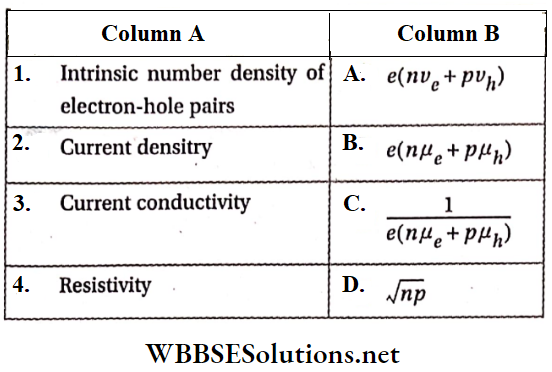
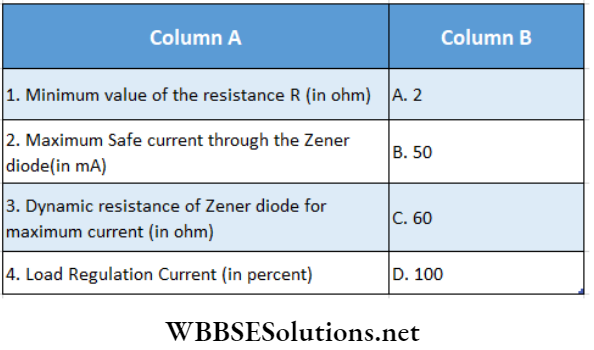
WBCHSE Class 12 Physics Multiple Choice Questions

WBCHSE Class 12 Physics Multiple Choice Questions

WBCHSE Class 12 Physics Refraction Of Light At Spherical Surface Lens Short Answer Questions

Refraction Of Light At Spherical Surface Lens Short Questions And Answers

Question 1. An unsymmetrical thin lens forms the Image of a point object on its own axis. If the lens is inverted, will the position of the image be changed?
Answer:

The position of an image formed by a lens depends on the object’s distance and the focal length of the lens. The first and the second principal focal lengths of the lens are equal. So, if the object distance from the lens is unchanged and if the lens is inverted the position of the image will not be changed?

Question 2. The radii of curvature of the two surfaces of a concavoconvex lens are equal Determine the focal length and power of the lens. Where is this type of lens used
Answer:

If the focal length of a lens is f, we have from lens maker’s formula

⇒ \(\frac{1}{f}=(\mu-1)\left(\frac{1}{r_1}-\frac{1}{r_2}\right)\)

Now, according to the question, r1 = r2

Again, power of the lens P = \(\frac{1}{f}=\frac{1}{\infty}\) = 0

This type of lens made of coloured glass is used in single

Question 3. A convex lens is placed in contact with of focal length greater than Its focal length. What will be the nature of the lens combination?
Answer:

Suppose, the focal lengths of the convex lens and the concave lens are f1 and f2 respectively.If the focal length of the combination of the lenses is F

∴ \(\frac{1}{F}=+\frac{1}{f_1}+\frac{1}{-f_2}=\frac{1}{f_1}-\frac{1}{f_2}\)

Now, according to the question, f1 < f2 and so, \(\frac{1}{f_1}>\frac{1}{f_2}\)

∴ F>0

So, the lens combination will act as a convex lens i.e., a converging lens.

Question 4. A parallel beam of rays is focused at a point by a convex lens. A concave lens of focal length equal to the focal length of the convex lens is placed in contact with it. Find the final position of the image.
Answer:

Let the focal lengths of the convex and concave lens be f and the focal length of the lens combination be F

Therefore \(\frac{1}{F}=\frac{1}{f}+\frac{1}{-f}\) Or, F = ∞

So, the focal length of the lens combination is infinity, i.e., the image will form at infinite distance

WBCHSE Class 12 Physics Refraction Of Light At Spherical Surface Lens Short Answer Questions

WBBSE Class 12 Refraction of Light Short Q&A

Question 5. A convex lens is placed on a plain mirror. If a point light source Is placed on Its focus then where will the Image be formed? Draw a suitable ray diagram.
Answer:

Since the source is at the focus of the lens so, rays emitted from a source and after refraction by the lens become parallel, These parallel rays are incident on the plain mirror normally and retrace the same path, f After that those rays refracted by the lens meet at the focal point. Therefore the image is formed at the point where the source’ is present. The image is a real image

Class 12 Physics Unit 6 Optics Chapter 3 Refraction Of Light Plain Mirror

Question 6. Under what circumstances can a concave lens act as a converging lens?
Answer:

If the surrounding medium of the concave lens is denser than that of the material of the lens, the refractive index of the material of the lens relative to the medium becomes less than In this condition the concave lens acts as a converging lens. Under similar conditions, a convex lens acts as a diverging lens

Question 7. If a convex lens of refractive index 1. 5 is immersed in a liquid of refractive index 1.65, it acts as a concave lens. Explain the reason. 
Answer:

We know, that the refractive index for the material of a convex lens is less than the refractive index of the surrounding medium the convex lens acts as a concave lens. Since in this case the refractive index for the material of the lens is less than the refractive index of the surrounding liquid medium, the convex lens acts as a concave lens.

Question 8. The focal length of a uniform convex lens. If the lens is cut into two pieces along its principal axis, what will be the focal length of each half?
Answer:

If the lens is cut into two pieces along its principal axis, the radius of curvature of the surfaces of each half of the lens remains the same. Thus focal length of each half of the lens does not change i.e., their focal length will be f.

Question 9. What is die significance off-number camera lens? 
Answer:

f-number of camera lenses indicates the ratio of the focal length of the lens and the diameter of its aperture. If the f-number of a lens of definite focal length decreases, the diameter of the aperture of the lens increases. So, a large amount of light enters through the lens, and the image becomes indistinct

Short Answer Questions on Lens Properties

Question 10. A camera lens is covered by a black striped glass and a white-coloured donkey is photographed using it. Does the photograph look like a zebra?
Answer:

The photograph does not look like a zebra. If the camera lens Is covered by a black striped glass then its aperture is decreased. As a result relatively small number of light rays take part in the formation of the image. Therefore the brightness of the image is decreased but the character of the image is never changed

Question 11. A spherical mirror has only one focus but the lens has two foci. Explain
Answer:

In the case of a spherical mirror, only one point is found on its axis where if an object is placed then the image is formed at infinite and vice versa. This point is the focus of the spherical mirror. But for lerns two such points are found on its axis on two sides of the lens having one such point. So the spherical mirror has one focus but the lens has two focuses.

Question 12. Double-convex lenses are to be manufactured from a glass of refractive index 1. 55, with both faces of the same radius of curvature. What is the radius of curvature required if the focal length is to be 20 cm?
Answer:

In the case of a double-convex lens, the lens maker’s formula is given by

⇒ \(\frac{1}{f}=(\mu-1) \cdot \frac{2}{r}\)

r = 2f (μ-1 ) 2 × 20 (1.55 -1 )= 22 cm

Class 11 Physics Class 12 Maths Class 11 Chemistry
NEET Foundation Class 12 Physics NEET Physics

Question 13. What is the focal length of the combination of a convex lens of a focal length of 30 cm in contact with a concave lens of a focal length of 20 cm? is the system a converging or a diverging lens? ignore the thickness of the lenses.
Answer:

For the combination of two thin lenses, the focal length is given b

⇒ \(\frac{1}{f}=\frac{1}{f_1}+\frac{1}{f_2}\)

Here, f1 = 30 cm and f2 = -20 cm

⇒ \(\frac{1}{f}=(\mu-1) \cdot \frac{2}{r}\)

The focal length of the combination lens is 60 cm.

Since the value off is negative, the combination will act as a concave lens

Question 14. The image of a small electric bulb fixed on the wall of a room is to be obtained on the opposite wall 3 m away employing a large convex lens. What is the maximum possible focal length of the lens required for the purpose?
Answer:

For a real image, the least distance between the object and image (D) should be four times the focal length (f) i.e., 4f = D

⇒ \(\frac{D}{4}=\frac{3}{4}\)m

= 0.75 m

Common Short Questions on Refraction Laws

Question 15. A screen is placed 90 cm from an object. The image of the object is formed by a convex lens at two different locations separated by 20 cm. Determine the focal length of the lens.
Answer:

Focal length f = \(\frac{D^2-x^2}{4 D}=\frac{90^2-20^2}{4 \times 90}\)

= 21.44 cm

Question 16. A plano-concave lens is made of glass of refractive index1.5 and the radius of curvature of its curved surface is 50cm. What is the power of the lens?
Answer:

The radius of curvature of the plane surface, r→∞, radius of curvature of the concave surface, r2 = 50cm = 0.5m

Power of the lens

P = \(\frac{1}{f}=(\mu-1)\left(\frac{1}{r_1}-\frac{1}{r_2}\right)\)

= \((1.5-1)\left(0-\frac{1}{0.5}\right)\)

= \(0.5 \times\left(\frac{1}{0.5}\right)\)

= – 1 dpt

Question 17. You are given three lenses L1, L2, and L3 each of focal length 20 cm, An object Is kept at 40 cm in front of L1 as shown. The final real Image Is formed at the focus I of L1. Find the separations between L1, L2, and L3.

Class 12 Physics Unit 6 Optics Chapter 3 Refraction Of Light At Spherical Surface Lens Three Lens Of Focal Length

We consider the magnitudes only of the distance in lens L1,

u= PB = 40 cm = 2 × 20 cm = 2f

Then, v = 2f = 2 × 20 cm = 40 cm = PB1

Given, the final image B2 is at the focus of I3; so,

RB2 = 20 cm.

Class 12 Physics Unit 6 Optics Chapter 3 Refraction Of Light At Spherical Surface Lens The Rays Between Must Be Parallel

Then, the rays between L2 and L3 must be parallel.

This shows that is the focus of L2; so, B1Q = 20 cm.

Therefore, the separation between L1 and L2

= PQ = PB1 + B1Q = 40 + 20 = 60 cm

Again, the parallel rays between L2 and L3 indicate that these two lenses may be kept at any separation between them.

Practice Short Questions on Image Formation by Lenses

Question 18. A convex lens of focal length f1 is kept in control with a concave lens of focal length f2. Find the focal length of the. The focal length of a convex lens Is positive, but that of a concave lens is negative.

If F is the focal length of the combination, the

⇒ \(\frac{1}{F}=\frac{1}{4 f_1}+\frac{1}{-f_2}=\frac{1}{f_1}-\frac{1}{f_2}=\frac{f_2-f_1}{f_1 f_2}\)

∴ \(\frac{f_1 f_2}{f_2-f_1}\)

Question 19. A biconvex lens made of a transparent material with a refractive index of 1.5 is immersed in water with a refractive index of 1.33. Will the lens behave as a converging or diverging lens? Give
Answer:

The refractive indices of the material of the biconvex lens and air are 1.5 and 1.0 respectively. As 1.5 > 1, the lens acts as a converging lens in air. When it is immersed in water with a refractive index1.33, we still have 1.5 > 1.33. So the lens still behaves as a converging lens.

Question 20. A convex lens of focal length 20 cm is placed coaxially with a concave mirror of focal length 10 cm at a distance of 50 cm apart from each other. A beam oflight coming parallel to the principal axis is incident on the convex lens. Find the position of the final image formed by this combination. Draw the ray diagram showing the formation of the image.
Answer:

The beam of light coming parallel to the principal axis of a convex lens converges at the focus Fl of the lens. So P is the position of the object P relative to the concave mirror.

Class 12 Physics Unit 6 Optics Chapter 3 Refraction Of Light At Spherical Surface Lens The Beam Of Light Parallel To The Principal Axis

Given, OO’ = 50 cm , OP = OF1 = 20 cm

O’P = 50-20 = 30 cm

Also given, O’ F2 = 10 cm = focal length of the mirror

Appropriate signs for the minor:

f = O’ F2 = – 10 cm , u = O’ P = – 30 cm

Then the mirror equation is

⇒ \(\frac{1}{v}+\frac{1}{u}=\frac{1}{f}\)

or, \(\frac{1}{v}=\frac{1}{f}-\frac{1}{u}=-\frac{1}{10}+\frac{1}{30}\)

⇒ \(\frac{-3+1}{30}=-\frac{1}{15}\)

Or, v = -15 cm

So, the final image is formal at Q, where O’Q = -15 cm

Conceptual Short Questions on Focal Length and Magnification

Question 21. A biconvex lens of a glass of refractive index 1.5 having a focal length of 20 cm is placed in a medium of refractive index 1.65. Find its focal length. What should be the value of the refractive index of the medium in which the lens should be placed so that it acts as a plane sheet of glass?
Answer:

Focal length of the lens in air /Focal length of the lens in the other medium

⇒  \(\frac{\text { refractive index of glass with respect to medium }-1}{\text { refractive index of glass with respect to air }-1}\)

The required focal length = \(\frac{1.5-1}{\frac{1.5}{1.65}-1} \times 20\)

= – 110 cm

The value of the refractive index of the medium in which the lens should be placed so that it acts as a plane sheet of glass should be 1.65.

Question 22. A beam oflight converges at a point P. Now a lens is placed in the path of the convergent beam 12 cm from P. At what point does the beam converge if the lens is

  1. A convex lens of focal length 20 cm,
  2. A concave lens of focal length 16 cm?

Class 12 Physics Unit 6 Optics Chapter 3 Refraction Of Light At Spherical Surface Lens A Convex lens of Focal Length

Here, the object is virtual

1. u = + 12 cm , f = + 20 cm

⇒ \(\frac{1}{f}=\frac{1}{v}-\frac{1}{u}\)

Or, \(\frac{1}{v}=\frac{1}{u}+\frac{1}{f}=\frac{1}{12}+\frac{1}{20}\)

∴ Or, \(\frac{1}{v}=\frac{8}{60}\)

∴ v = 7.5 cm

Hence, the image formed is real and at a distance of 7.5 cm on the right of the lens

2. Here, u = +12cm, f= -16cm

Class 12 Physics Unit 6 Optics Chapter 3 Refraction Of Light At Spherical Surface Lens A Concave lens Of Focal Length

∴ \(\frac{1}{v}=\frac{1}{u}+\frac{1}{f}=\frac{1}{12}-\frac{1}{16}\)

Or, \(\frac{1}{v}=\frac{1}{48}\)

∴ v = 48 cm

Hence, the image formed is real, and at 48 cm on the right of the lens,

Real-Life Scenarios Involving Refraction Questions

Question 23.

  1.  A screen is placed at a distance of 100 cm from a The image of the object is formed on the screen by a convex lens for two different locations of the lens separated by 20 cm. Calculate the focal length of the lens used
  2. A covering lens is kept coaxially in contact with a diverging lens, both the lenses being of equal focal length. What is the focal length of the combination?

Answer:

The distance between the object and the screen (image) is 100 cm. The first position of the lens is L1 and the second position is L2.

Class 12 Physics Unit 6 Optics Chapter 3 Refraction Of Light At Spherical Surface Lens The Distance Between The Object And The Screen

Now, for the first position of the lens,

Object distance = u cm

Image distance, v = (100- u) cm

∴ \(\frac{1}{f}=\frac{1}{100-u}-\frac{1}{-u}=\frac{1}{100-u}+\frac{1}{u}\)…………… (1)

Now, for the second position of the lens,

Object distance = (u + 20) cm

Image distance, v = (100-u-20)cm

⇒ \(\frac{1}{f}=\frac{1}{80-u}-\frac{1}{-(u+20)}=\frac{1}{80-u}+\frac{1}{u+20}\)…………… (2)

Therefore, from equations (1) and (2), we get

⇒ \(\frac{100-u}+\frac{1}{u}=\frac{1}{80-u}+\frac{1}{u+20}\)

Or, 200 u = 8000

Or, u = 40 cm

v = 100 -u = 100 – 40 = 60 cm

Therefore, from the lens formula

⇒ \(\frac{1}{100-u}+\frac{1}{u}=\frac{1}{80-u}+\frac{1}{u+20}\)

f = 24 cm

The focal length of the converging lens is f and that of the diverging lens is -f.

If fe is the equivalent focal length of the combination then

⇒ \(\frac{1}{f_e}=\frac{1}{f_1}+\frac{1}{f_2}=\frac{1}{f}-\frac{1}{f}\) = 0

∴ fe = ∞

Examples of Applications of Spherical Lenses

Question 24. A double convex lens is made of a glass of a refractive index 1.55, with both faces of the same radius of curvature. Find the radius of curvature required, if the focal length is 20cm
Answer:

The focal length of a double convex lens with both faces of equal radius of curvature is given by

⇒ \(\frac{1}{f}=(\mu-1) \cdot \frac{2}{r}\)

Given: f = 20 cm, u = .1.55 , r = ?

∴ \(\frac{1}{20}=(1.55-1) \cdot \frac{2}{r}\)

Or, r = 2 × 0.55 × 20 = 22 cm

∴ The required radius of curvature of the convex lens is 22 cm.

Question 25. Mrs. Rashmi Singh broke her reading glasses. When she went to the shopkeeper to order new specs, he suggested that she should get spectacles with plastic lenses instead of glass lenses. On getting the new spectacles, she found that the new ones were thicker than the earlier ones. She asked this question to the shopkeeper but he could not offer a satisfactory explanation for this. At home, Mrs. Sing raised the same question to her daughter Anuja who explained why plastic lenses were thicker

  1. Write two qualities displayed each by Anuja and her mother
  2. How do you explain this fact using lens maker’s formula?

Answer:

1. Anuja has explained it precisely because she has proper knowledge about it and solves her mother’s query. Mrs. Rashmi Singh is surprised and is hunting for suitable information

2. From lens maker’s formula.

⇒ \(\frac{1}{f}=(\mu-1) \cdot\left(\frac{1}{r_1}-\frac{1}{r_2}\right)\)

Where μ is the refractive index for the material of the lens.

Since, the refractive index of glass (ug) > refractive index of plastic (up)

⇒ \(\mu_g-1>\mu_p-1\)

Taking \(\frac{1}{R}=\frac{1}{r_1}-\frac{1}{r_2}\), we get \(\frac{1}{f}=(\mu-1) \cdot \frac{1}{R}\)

Since the focal lengths in the two cases are the same,

⇒ \(\left(\mu_g-1\right) \cdot \frac{1}{R_g}=\left(\mu_p-1\right) \cdot \frac{1}{R_p}\)

Or, \(\frac{R_g}{R_p}=\frac{\mu_g-1}{\mu_p-1}>1\)

Or, Rg> Rp

∴ The thickness of the plastic lens > the thickness of the glass lens.

WBCHSE Class 12 Physics Refraction Of Light At Spherical Surface Lens Multiple Choice Questions

WBCHSE Class 12 Physics MCQs

Refraction Of Light At Spherical Surface Lens Multiple Choice Questions

Question 1. What sort of lens will an air bubble in water behave like?

  1. Biconvex
  2. Concavo-convex
  3. Biconcave
  4. Convexo-concave

Answer: 4. Convexo-concave

Question 2. Observe the behavior of the light rays as shown in the relation of n1 and n2 is

Class 12 Physics Unit 6 Optics Chapter 3 Refraction Of Light At Spherical Surface Lens Observe The Behaviour Of Light Rays

  1. n2>n1
  2. n1 >>n2
  3. n > n
  4. n = n

Answer:

Question 3. An object behaves like a convex lens in air and a concave lens in water. The refractive index of the material of the object is

  1. Less than air
  2. More than both water and air
  3. More than air but less than water
  4. Almost equal to water

Answer: 3. More than air but less than water

Read and Learn More Class 12 Physics Multiple Choice Questions

Question 4. The optical centre of a lens is a fixed point whose position is

  1. Within the lens
  2. Outside the lens
  3. On the principal axis of the lens
  4. At the focus of the lens

Answer: 3. On the principal axis of the lens

Question 5. A convex lens of focal length 20 cm is placed on a plane mirror. A point object is placed at a distance of 20 cm above the lens along its axis. What will be die final image distance from the lens?

  1. 10 cm
  2. 1
  3. Infinity
  4. 20 cm
  5. 0

Answer: 3. 20 cm

WBCHSE Class 12 Physics Refraction Of Light At Spherical Surface Lens Multiple Choice Questions

WBBSE Class 12 Refraction at Spherical Surfaces MCQs

Question 6. If an object is placed at the focus of a concave lens, the image will be formed

  1. At infinity
  2. At the mid-point of the optical centre and the focus
  3. At the optical centre
  4. At the focus

Answer: 2. At the mid-point of the optical centre and the focus

Question 7. The focal length of a convex lens is if an object is placed at a distance u from the lens, the condition of formation of an inverted image of equal size as the object is

  1. u = 2f
  2. u>2f
  3. f<u<2f
  4. 0 <u<f

Answer: 1. u = 2f

Question 8. The focal length of a convex lens is If an object is placed at a distance u from the lens, the condition of formation of a diminished inverted image is

  1. u = 2f
  2. u>2f
  3. f< u < 2f
  4. 0 < u <f

Answer: 2. u>2f

Question 9. The focal length of a convex lens. If an object be placed at a distance u from the lens, the condition of formation of a virtual image is

  1. u = f
  2. u > 2f
  3. f< u < 2f
  4. 0 <u<f

Answer: 4. 0 <u<f

Question 10. The focal length of a convex lens.If an object is placed at a distance u from the lens, the condition of formation of an image at infinity is

  1. u = f
  2. u>2f
  3. f< u < 2f
  4. 0 <u<f

Answer: 1.  u = f

WBCHSE class 12 physics MCQs 

Question 11. The focal length of a convex lens. If an object be placed at a distance u from the lens, the condition of formation of an inverted magnified image is

  1. u=f
  2. u > 2f
  3. f< u < 2f
  4. 0 < u<f

Answer: 3. f< u < 2f

Question 12. The focal length of a convex lens. If an object is placed at a distance u from the lens, the condition of formation of a magnified virtual image is

  1. u = f
  2. u>2fF
  3. f< u< 2f
  4. 0<u<f

Answer: 4. 0<u<f

Short Questions on Spherical Lenses

Question 13. The focal length of a concave lens is f. If an object is placed at a distance u from the lens, the condition of formation of a diminished image is

  1. u = 0
  2. 0 < u < oo
  3. u < 0 and |u| <|f|
  4. A diminished image will not be formed under any condition

Answer: 2. 0 < u < ∞

Question 14. The focal length of a concave lens is f.  If an object is placed at a distance u from the lens, the condition of formation of a real image is

  1. u = 0
  2. 0 < u < oo
  3. u < 0 and| u| <|f|
  4. Real image will not be formed under any condition

Answer: 3. u < 0 and| u| <|f|

Question 15. A point object is placed at the centre of a glass sphere. If the radius of the sphere is 6 cm and the refractive index of the material is 1.5, then the distance of the virtual image from the surface of the sphere will be

  1. 2cm
  2. 4 cm
  3. 6 cm
  4. 12 cm

Answer: 3. 6 m

Question 16. An object is placed at a distance of 20 cm from a convex lens of focal length 0 cm. The image distance is

  1. 20 cm
  2. 6.67 cm
  3. 10 cm
  4. 30 cm

Answer: 1. 20 cm

Question 17. The size of the image of an object which is at infinity, as formed by a convex lens of focal length 30 cm is 2 cm. If a concave lens of focal length 20 cm is placed between the convex lens and the image at a distance at 26 cm from the convex lens, the real size of the image would be

  1. 1.25 cm
  2. 2.5 cm
  3. 1.05 cm
  4. 2 cm

Answer: 2. 2.5 cm

Question 18. A convex lens image of focal of a length object.30 cm produces 5 times the magnified real image of an object, What is the object distance?

  1. 36 cm
  2. 25cm
  3. 30cm
  4. 150 cm

Answer: 1. 36 cm

Question 19. If the object distance from the first focus of a convex lens is x and the image distance from the second focus of the lens is x’, the graph between x and x’ will be a

  1. Hyperbola
  2. Parabola
  3. Circle
  4. Ellipse

Answer: 1. Hyperbola

Practice MCQs on Types of Lenses

Question 20. The focal length of a lens made of glass in air is 10 cm. What will be the focal length of the lens in water? The refractive index of glass =1.51 and the refractive index of water = 1.33.
Answer:

  1. 18.84 cm
  2. 36 cm
  3. 18 cm
  4. 37.7 cm

Answer: 4. 37.7 cm

Question 21. If a lens is surrounded by a medium denser than air, the focal length of the lens

  1. Decreases
  2. 1ncreases
  3. Remains same
  4. Cannot be determined

Answer: 2. Increases

Class 11 Physics Class 12 Maths Class 11 Chemistry
NEET Foundation Class 12 Physics NEET Physics

Question 22. If the focal length of a symmetrical convex lens is equal to the radius of curvature of the lens, the refractive index of the material of the lens is

  1. 0.5
  2. 1.1
  3. -1.5
  4. 1.5

Answer: 4. 1.5

Refraction at spherical surfaces class 12 MCQs 

Question 23. The refractive index of the material of a double equi-convex lens is 1.5. If R be its radius of curvature then its focal length is

  1. 0
  2. 2R
  3. R1
  4. R

Answer: 4. R

Question 24. What type of lens is used in sunglasses?

  1. A concavo-convex lens whose radii of curvature of the two surfaces are equal
  2. A biconcave lens whose radii of curvature of the two surfaces are equal
  3. A biconcave lens whose radii of curvature of the two surfaces are unequal
  4. Plano-concave lens

Answer: 1. A concavo-convex lens whose radii of curvature of the two surfaces are equal

Question 25. An equal-convex lens is divided into two halves along) XOX’ and (ii) YOY’ as shown in the.  Suppose the focal lengths of the complete lens, of each half portion of

Case  1- And of each half portion of the
Case 2  – Respectively in this case the correct statement is

Class 12 Physics Unit 6 Optics Chapter 3 Refraction Of Light At Spherical Surface Lens An Equi Convex Lens Is Divided Into Two Halves

  1. f = 2f; f”= f
  2. f = 2f; f”= f
  3. f = 2f; f”= 2f
  4. f = f; f”= f

Answer: 4. f = f; f”= f

Question 26. A convex lens is immersed in a liquid whose refractive index is equal to that of the material of the lens. Under this condition the focal length of the lens
Answer:

  1. Will decrease but will not be zero
  2. Will remain unchanged
  3. Will be zero
  4. Will be of infinite value

Answer: 4. Will be of infinite value

Question 27. A convex lens made of glass has a focal length of 0.15 m in the air. if the refractive indices of glass and water are respectively \(\frac{3}{2}\) and \(\frac{4}{3}\), then the focal length of the lens immersed in water will be

  1. 0.45 m
  2. 0.15 m
  3. 0.30 m
  4. 0.6 m

Answer: 4. 0.6 m

Question 28. Which of the following is true for rays coming from infinity incident on the lens

Class 12 Physics Unit 6 Optics Chapter 3 Refraction Of Light At Spherical Surface Lens Infinity Incident On The Lens

  1. Two images are formed.
  2. A continuous image is formed between the focal points of the upper and lower lens
  3. One image is formed
  4. None of the above

Answer: 1.  Two images are formed.

Important Definitions in Refraction Q&A

Question 29. A beam of parallel rays after refraction in a convex lens converges at a point.If a concave lens of the same focal length is placed lit contact with the convex lens where will the image be shifted?

  1. At infinity
  2. At 2f
  3. Between 0 and f
  4. Between f and 2f

Answer: 1.  At infinity

Question 30. The ratio of powers of a thin convex and a thin concave lens is \(\frac{3}{2}\). When they are to contact, the equivalent focal length is 30 cm, Individual focal lengths are

  1. 75 cm – 50 cm
  2. 10 cm -15 cm
  3. 15 cm -10 cm
  4. 50 cm – 75 cm

Answer: 2. 10 cm -15 cm

Question 31. Two thin equal-convex lenses each of focal length 0,2 m are placed coaxially with their optical centres 0.5 in apart. Then the focal length of the combination

  1. – 0.4 m
  2. 0.4 m
  3. -0.1 m
  4. 0.1 m

Answer:

Refraction at spherical surfaces class 12 MCQs 

Question 32. Mercury (Hg) is coated on the plane part of a plano-convex lens. The refractive index of the lenses μ and the radius of curvature is R. The system behaves as u concave mirror whose radius of curvature is

  1. μR
  2. \(\frac{R}{2(\mu-1)}\)
  3. \(\frac{R^2}{\mu}\)
  4. \(\frac{(\mu+1)}{(\mu-1)} n\)

Answer: 2. \(\frac{R^2}{\mu}\)

Question 33. If the distance between the object and the screen is less than four times the focal length of the lens then,

  1. A real image of the object will be formed on the screen for only one particular position of the lens
  2. Two virtual images of the object will be formed on the screen for two different positions of the lens
  3. No image will be formed on the screen for any position of the lens
  4. Two real images of the object will be formed on the screen for two different positions of the lens

Answer: 3

Question 34. A biconvex lens has a radius of curvature of magnitude 20 cm. Which one of the following options describes best the image formed of an object of height 2 cm placed 30 cm from the lens?

  1. Virtual, upright, height = 1 cm
  2. Virtual, upright, height = 0.5 cm
  3. Real, inverted, height = 4 cm
  4. Real, inverted, height =1 cm

Answer: 3. Real, inverted, height = 4 cm

Question 35. A convex lens forms a real image of an object for its two different positions on the screen. If the height of the images in two cases are 8 cm and 2 cm, then the height of the object will be.

  1. 2cm
  2. 4cm
  3. 8cm
  4. 16cm

Answer: 2. 4cm

Question 36. If x1 is the size of the magnified image and x2 is the size of the diminished image in the lens displacement method, then the size of the object is

  1. \(\sqrt{x_1 x_2}\)
  2. x1x2
  3. 1x2
  4. x12

Answer: 1. \(\sqrt{x_1 x_2}\)

Examples of Applications of Lenses in Optics

Question 37. To determine the focal length of a thin convex lens, if red light is used instead of blue light the focal length of the lens

  1. Increases
  2. Remains same
  3. Decreases
  4. Cannot be determined

Answer: 1.  Increases

Class 12 physics refraction questions 

Question 38. Two thin lenses of focal lengths f1, and f2 are kept in contact co-axially. The power of the combination is given by

  1. \(\sqrt{\frac{f_1}{f_2}}\)
  2. \(\sqrt{\frac{f_2}{f_1}}\)
  3. \(\frac{f_1+f_2}{2}\)
  4. \(\frac{f_1+f_2}{f_1 f_2}\)

Answer: 4. \(\frac{f_1+f_2}{f_1 f_2}\)

Question 39. An asymmetric double convex lens is cut in two equal parts by . a plane perpendicular to the principal axis. If the power of the original lens is 4 D, the power of the halved portion will be

  1. 2D
  2. 3D
  3. 4D
  4. 5D

Answer: 2D

Question 40. A thin glass (refractive index, (μ =1.5) lens has an optical power of -5 D in air. Its optical power in a liquid medium with a refractive index of 1.6 will be

  1. 1D
  2. -1D
  3. 25D
  4. -25D

Answer: 1D

Question 41. A plano-concave lens of glass (μ = 1.5) has a radius of curvature of its curved face of 50 cm. The power of the lens is

  1. -1.0 D
  2. – 0.2 D
  3. 1.0 D
  4. 0.2 D

Answer: 1 . -1.0 D

Question 42. A plano-concave lens is made of glass of a refractive index of 1.5 and the radius of curvature of its curved surface is

  1. +0.5D
  2. – 0.5D
  3. – 2D
  4. +2D

Answer: 2. – 0.5D

Question 43. The f-number of a lens is f-15. By this statement we mean

  1. Focal length of lens = \(\frac{1}{15} \times\) aperture of the lens
  2. Aperture of the lens = \(\frac{1}{15} \times\) Focal length of lens
  3. Aperture of the lens = \(\frac{1}{15^2}\) Focal length of lens
  4. Focal length of lens = \(\frac{1}{15^2}\) aperture of the lens

Answer: 2. Aperture of the lens = \(\frac{1}{15} \times\) Focal length of lens

Question 44. Two thin lenses of focal lengths 20 cm and 25 cm are placed in contact The effective power of the combination is

  1. 9D
  2. 2D
  3. 3D
  4. 7D

Answer: 1. 9D

Class 12 physics refraction questions 

Question 45. The radius of curvature of the curried surface of a planoconvex lens is 20 cm. If the tire refractive index of the material of the lens is 1. 5, it will

  1. Act as a convex lens only for the objects that lie on its curved side
  2. Act as a concave lens for objects that lie on its curved side
  3. Act as a convex lens irrespective of the side on which the object lies
  4. Act as a concave lens irrespective of the side on which the object lies

Answer: 3. Act as a convex lens irrespective of the side on which the object lies

Question 46. An object approaches a convex lens from the left of the lens with a uniform speed of 5m. s-1 and stops at the focus. The image

  1. Moves away from the lens with a uniform speed 5m. s-1
  2. Moves away from the lens with uniform acceleration
  3. Moves away from the lens with a non-uniform acceleration
  4. Moves towards the lens with a non-uniform

Answer: 3. Moves away from the lens with a non-uniform acceleration

Question 47. A convex lens Is used to form an image on a screen When the upper half of the Jens is converted by an opaque screen, then

  1. Half of the Image will disappear
  2. A complete Image will be formed
  3. The intensity of the Image will decrease
  4. Intensity will remain the same

Answer: 2 And 3

Question 48. A convex lens of the glass of refractive index μ1 is immersed in a liquid of refractive index μ2. It will behave as

  1. Converging lens if μ1 > μ2
  2. Converging lens if μ1< μ2
  3. Diverging lens if μ1> μ2
  4. Diverging Jens if μ1< μ2

Answer: 1 And 4

Question 49. An object and a screen are fixed at a distance d apart. When a lens of focal length f is moved between the object and the screen, sharp images of the object are formed on the screen for two positions of the lens. The magnifications produced at these two positions are M1 and M2

  1. d>2f
  2. d>4f
  3. M1M2
  4. |M1|- |M2| = 1

Answer: 2 And 3

Spherical lens multiple choice questions 

Question 50. A thin, symmetric double-convex lens of power P is cut into thin parts A, B, and C as, the power of

Class 12 Physics Unit 6 Optics Chapter 3 Refraction Of Light At Spherical Surface Lens Symmetric Double Convex

  1. A is P
  2. A is 2P
  3. B is \(\frac{P}{2}\)
  4. B is \(\frac{P}{4}\)

Answer: 1 And 3

Question 51. Consider three converging lenses L1 , L2 and L3 having identical geometrical construction. The index of refraction of L1 and L2 are μ1 and μ2 respectively. The upper half of the lens L3 has a refractive index of μ and the lower half has μ1, A point object’ O is imaged at O1 by the lens L1 and at O2 by the lens placed in the same position. If L3 is placed in the same place

Class 12 Physics Unit 6 Optics Chapter 3 Refraction Of Light At Spherical Surface Lens Identical Geometrical Construction

  1. There will be an image at O
  2. There will be an image at O2
  3. The only image will form somewhere between Oj and
  4. The only image will form away from O2

Answer: 1 And 2

Question 52. Radii of curvature of a thin concavo-convex lens are R and 2R respectively. The refractive index of the material of the lens is μ. When the lens is placed in the air the focal length

  1. Depends on the direction of the incident ray from where it comes
  2. Will remain the same and does not depend on which direction the incident ray comes
  3. Will be \(\frac{R}{\mu-1}\)
  4. Will be \(\frac{2 R}{\mu-1}\)

Answer: 2 And 4

Question 53. A luminous object is placed at D = 100 cm away from a screen. A conjugate focus is obtained due to two positions of a convex lens of 21 cm focal length, placed in between the object and screen. The gap between the two positions of the lens (A) and (B) is d. For the positions A and B respectively linear magnifications are m1 and m2.

  1. d = 40 cm
  2. d = 42 cm
  3. \(m_1=\frac{7}{3}, m_2=\frac{3}{7}\)
  4. \(m_1=\frac{7}{5}, m_2=\frac{5}{7}\)

Answer: 1 And 3

Question 54. The distance between a source of light and a screen is 1 m. By placing a convex lens between them an image is cast on the screen. The lens is shifted through a distance of 40 cm along the line joining the source and the screen and again an image is formed on the screen.

1. The focal length of the lens is

  1. 40cm
  2. 12cm
  3. 21cm
  4. 25cm

Answer: 3. 21cm

2. If the length of the images are 0.66 cm and 1.51 cm respectively the length of the object is

  1. 0.998 cm
  2. 1.3 cm
  3. 0.667 cm
  4. 0.889 cm

Answer: 2. 1.3 cm

Spherical lens multiple choice questions 

Question 55. A convex lens of power 5 D is placed on a plane mirror. A pin is placed above 30 cm straight from the lens.

1. The distance of the image from the lens at which the image is formed is

  1. 30 cm
  2. 40 cm
  3. 50 cm
  4. 60 cm

Answer: 4. 60 cm

2. The distance of the pin from the lens so that its image will coincide with the pin is

  1. 20 cm
  2. 30 cm
  3. 40 cm
  4. 50 cm

Answer: 1. 20 cm

Question 56. Two convex lenses of focal lengths 3cm and 4 cm are placed 8 cm apart from each other. An object of height 1 cm is placed at a distance of 4 cm from the lens’s smaller focal length.

1. The position of the final image formed by the two lenses

  1. 8 cm away from the right side of the second lens
  2. 2 cm away from the left side of the second lens
  3. 2 cm away from the right side of the second lens
  4. 1 cm away from the left side of the second lens

Answer: 3. 2 cm away from the right side of the second lens

2. The size of the image will be

  1. 3 cm
  2. 2 cm
  3. 2.5 cm
  4. 18 cm

Answer: 4. 18 cm

Question 57. A convex lens forms a five-times magnified real image of an object. When the object is further shifted by 6 cm away from the lens the magnification of the real image becomes double

1. The focal length of the lens is

  1. 20 cm
  2. 15 cm
  3. 25 cm
  4. 18 cm

Answer: 1. 20 cm

Spherical lens multiple choice questions 

2. The distance of the object from the lens in the first case

  1. 18 cm
  2. 24 cm
  3. 20 cm
  4. 32 cm

Answer: 2. 24 cm

Question 58. The refractive index of the material of a double equi convex lens is 1.5. If the radius of curvature of the lens is R, then its focal length is

  1. Zero
  2. Infinite
  3. 2R
  4. R

Answer: 4. R

If R is the radius of curvature of one surface of the lens, the radius of curvature of the other surface =-R

Now

⇒ \(\frac{1}{f}=(\mu-1)\left(\frac{1}{r_1}-\frac{1}{r_2}\right)\)

⇒ \((1.5-1)\left(\frac{1}{R}-\frac{1}{-R}\right)\)

⇒ \(0.5 \times \frac{2}{R}=\frac{1}{R}\)

f = R

Conceptual MCQs on Image Formation by Lenses

Question 59. A luminous object is separated from a screen by distance d is A convex lens is placed between the object and the object and the screen such that it forms a distinct image on the screen. The maximum possible focal length of this convex lens is.

  1. 4d
  2. 2d
  3. \(\frac{d}{2}\)
  4. \(\frac{d}{2}\)

Question 60. An object is placed 30 cm away from a convex lens of focal length 10 cm and a sharp image is formed on a screen. Now a concave lens is placed in contact with the convex lens. The screen now has to be moved by 45 to get a sharp image again. The magnitude of the focal length of the concave lens is (in cm).

  1. 72
  2. 60
  3. 36
  4. 20

Answer: 4. 20

Here, u1 = -30cm, f1 = 10 cm, v1 = ?

For the first case,

⇒ \(\frac{1}{v_1}-\frac{1}{u_1}=\frac{1}{f_1}\)

⇒ \(\frac{1}{v_1}+\frac{1}{30}=\frac{1}{10}\)

Or, \(\frac{1}{f}=\frac{1}{f_1}+\frac{1}{f_2}\)

⇒ \(\frac{1}{f}=\frac{1}{60}+\frac{1}{30}=\frac{1}{20}\)

Where , u2= -30 cm, v2= 15 + 45= 60 cm

∴ \(\frac{1}{f_2}=\frac{1}{10}-\frac{1}{20}=\frac{1}{20}\)

f2 = 20 cm

WBCHSE physics refraction at spherical surfaces MCQs 

Question 61. An object is located 4 m from the first of two thin converging lenses of focal lengths 2 m and lm respectively. The lenses are separated by 3 m. The final image formed by the second lens is located from the source at a distance of

  1. 8.0 m
  2. 7.5 m
  3. 6.0 m
  4. 6.5 m

Answer: 2. 7.5 m

Class 12 Physics Unit 6 Optics Chapter 3 Refraction Of Light At Spherical Surface Lens Surface Of The Lens

For the first convex lens, the object is placed at a distance of 2/(2 x 2 m = 4 m). The image for the first lens would be formed at a distance of 4 m in the opposite direction.

But the second lens is at a distance of 3 m, consequently, the image of the first lens would be at a distance of m behind the second lens.

Hence, the effective object distance for the second lens is u = +1m.

The focal length of the second lens, f= + 1 m

If the image distance is v,

⇒ \(\frac{1}{v}-\frac{1}{u}=\frac{1}{f}\)

Or, \(\frac{1}{v}=\frac{1}{u}+\frac{1}{f}\)

Or, v = \(\frac{u f}{u+f}=\frac{1 \times 1}{1+1}\)

= 0. 5 m

∴ Distance of the final image from the source

= 4 + 3 + 0.5 = 7.5 m

Question 62. A point object is held above a thin biconvex lens at its focus. The focal length is 0.1m and the lens rests on a horizontal thin plane mirror. The final image will be formed at

  1. Infinite distance above the lens
  2. 0.1m above the centre of the lens
  3. Infinite distance below the lens
  4. 0. 1 m below the centre of the lens

Answer: 2. 0.1m above the centre of the lens

Here a point object is placed at focus (F) of the convex lens. Thus, a beam of diverging rays emerges from it and becomes parallel after refraction from the lens and is incidentally on the plain mirror. As a result, reflected travels the same path and again refraction from the lens meets at the focus of the lens.

Class 12 Physics Unit 6 Optics Chapter 3 Refraction Of Light At Spherical Surface Lens Refraction From The Lens Meet At Focus Of The Lens

WBCHSE physics refraction at spherical surfaces MCQs 

Question 63. Two identical biconvex lenses, each of focal length/ are placed side by side by side in contact with each other with a layer of water in between them as shown in the figure. If the refractive index of the material of the lenses is greater than that of water, howthecombinedfocallength F related to f

  1. F>f
  2. \(\frac{f}{2}<F<f\)
  3. \(F<\frac{f}{2}\)
  4. F = f

Answer: 2. \(\frac{f}{2}<F<f\)

Class 12 Physics Unit 6 Optics Chapter 3 Refraction Of Light At Spherical Surface Lens Two Identical Equiconvex Lenses

If the focal length of the lens formed by water be fw then,

⇒ \(\frac{1}{f_w}=\left(\mu_w-1\right)\left(-\frac{1}{R}-\frac{1}{R}\right)\)

⇒  \(\left(\mu_w-1\right)\left(-\frac{2}{R}\right)\)

If the focal length of each lens is f then,

⇒  \(\frac{1}{f_l}=\left(\mu_l-1\right)\left\{\frac{1}{R}-\left(-\frac{1}{R}\right)\right\}=\left(\mu_l-1\right) \frac{2}{R}\) …………… (1)

⇒  \(\frac{1}{f_{\mathrm{eq}}}=\frac{1}{f_w}+\frac{1}{f_l}+\frac{1}{f_l}\)

= \(\left(\mu_w-1\right)\left(-\frac{2}{R}\right)+\frac{2}{f_l}\)

= \(-\frac{\mu_w-1}{\mu_l-1}\left(\frac{1}{f_l}\right)+\frac{2}{f_l}\) Using equation 1

= \(\frac{1}{f_l}\left\{2-\frac{\mu_w-1}{\mu_l-1}\right\}\) ………….. (2)

Class 12 Physics Unit 6 Optics Chapter 3 Refraction Of Light At Spherical Surface Lens If Focal Length Of Lens Formed By Water

Since \(\frac{\mu_w-1}{\mu_l-1}<1\)

From eq. (2) we get \(\frac{1}{f_{\text {eq }}}<\frac{2}{f_l}\)

Therefore, \(\frac{1}{f_l}<\frac{1}{f_{\text {eq }}}<\frac{2}{f_l}\)

Or, \(f_l>f_{\text {eq }}>\frac{f_l}{2}\)

Given fl = f and feq = F]

Or, \(\frac{f}{2}<F<f\)

Real-Life Scenarios Involving Refraction Questions

Question 64. A diverging lens with a magnitude of focal length 25cm is I placed at a distance of 15cm from a converging lens of a magnitude of focal length 20cm. A beam of parallel light falls on the diverging lens. The final image formed is 1 =

  1. Real and at a distance of40cm from the convergent lens
  2. Virtual and at a distance of40cm from the convergent lens
  3. Reak and at a distance of 40cm from the convergent lens
  4. Real and at a distance of cm from the convergent lens

Answer: 1. Real and at a distance of40cm from the convergent lens

For converging lens, u = -(15 + 25) = -40cm

Since u = 2f2[f2 = 20 cm ]

Class 12 Physics Unit 6 Optics Chapter 3 Refraction Of Light At Spherical Surface Lens Converging Lens

Therefore, v = u = 40crn

So, the final Image Is real and Is formed at a distance of 40cm from the converging lens,

Question 65. Two Identical thin plano-convex glass lenses (refractive index 1.5) each having a radius of curvature of 20 cm are placed with their convex surfaces In contact at the center. The Interveningspace Is filled with oil of refractive Index1,7. The focal length of the combination is

  1. – 20 cm
  2. – 25 cm
  3. – 50 cm
  4. 50 cm

Answer: 3. – 50 cm

We know \(\frac{1}{f}=(\mu-1)\left(\frac{1}{r_1}-\frac{1}{r_2}\right)\)

For the lens on the left,

⇒ \(\frac{1}{f_1}=(1.5-1)\left(\frac{1}{\infty}-\frac{1}{-20}\right)=\frac{1}{40}\)

For the lens on the right,

⇒ \(\frac{1}{f_2}=(1.5-1)\left(\frac{1}{+20}-\frac{1}{\infty}\right)=\frac{1}{40}\)

For the oil in the Intervening space

⇒ \(\frac{1}{f_3}=(1.7-1)\left(\frac{1}{-20}-\frac{1}{20}\right)=-\frac{7}{100}\)

Hence, if the focal length of the combination is F, then

⇒ \(\frac{1}{F}=\frac{1}{f_1}+\frac{1}{f_2}+\frac{1}{f_3}=\frac{1}{40}+\frac{1}{40}-\frac{7}{100}=-\frac{1}{50}\)

I. e F = – 50 cm

WBCHSE physics refraction at spherical surfaces MCQs 

Refraction Of Light At Spherical Surface Lens Synopsis

1. Usually the transparent refracting medium is bounded by two spherical surfaces or a spherical surface and a plane surface. is. called a lens

  • If the refractive index for the material of a lens is greater than the refractive index of its surrounding medium, then a convex lens behaves as a converging lens and a concave lens behaves as a diverging lens
  • If the refractive index for the material of a lens is less than the refractive index of its surrounding medium, then a convex lens behaves as a diverging lens and a concave lens behaves as a converging lens

2. If the thickness of a lens is much less than the radii of curvature of two surfaces then that lens is called a thin lens

3. The point situated on the principal axis of the lens and within the lens through which rays oflight emerge without deviation after refraction, is called the optical centre of the
lens

4. A lens has two foci:

  1. The first principal focus,
  2. Second principal focus. Usually, the principal focus of a lens means the second principal focus.

5. The distance between the principal focus and the optical centre of a lens is called the focal length (f) of the lens

Class 12 Physics Unit 6 Optics Chapter 3 Refraction Of Light At Spherical Surface Lens The Distance Between The Principal Focus And Optical Centre

6. The ratio of the length of the image to that of the object is called linear magnification of the image.

7. The ratio of the area of the image to that of the two-dimensional object is called areal magnification of the image

8. The ratio of the length of the image to that of the object along the principal axis is called longitudinal or axial magnification.

9. A convex lens always forms a real image for a virtual object and that image always lies within the focus.

10. If the object distance for a virtual object in front of a concave lens be less than its focal length then the image is always real.

11. A pair of points is such that if an object is placed at one of them, its image is formed at the other by a fixed lens, then that pair of points are called conjugate foci of that lens

12. If the surrounding medium of a lens is denser than air then the focal length of a lens increases.

13. An image of an object is formed by a combination of a number of co-axial lenses. Now, keeping the position of the object and the image unaltered a single lens is used instead of a combination.

14. If the magnification of the image thus produced by the lens is equal to that in the case of the combination of lenses then this single lens is called the equivalent lens of the combination of lenses.

15. The degree of convergence or divergence of parallel rays of light incident on a lens gives the measure of the power of the lens.

16. The general form of refraction of light at the common spherical surface, when light rays moving from a medium of refractive index fix are refracted in the medium of refractive index μ2, is

⇒ \(\frac{\mu_2}{v}-\frac{\mu_1}{u}=\frac{\mu_2-\mu_1}{R}\)

Where, u = object distance; V = image distance and R = radius of curvature of spherical surface

17. General equation of a lens \(\frac{1}{v}-\frac{1}{u}=\frac{1}{f}\)

This is also called the conjugate foci relation

18. Linear magnification

m = \(\frac{\text { length or height of the image }}{\text { length or height of the object }}\)

= \(\frac{v}{u}=\frac{f-v}{f}=\frac{f}{u+f}\)

19. Areal magnification

m’ = \(\frac{\text { area of the image }\left(A^{\prime}\right)}{\text { area of the object }(A)}=m^2\)

20. Longitudinal or axial magnification

m” = \(\frac{\text { length of the image along the principal axis }}{\text { length of the object along the principal axis }}\)

= \(\frac{d v}{d u}=-m^2\)

= – m²

21. Newton’s equation, xy = f²

Where x = u- f and y = v- f

22. Lens maker’s formula \(\frac{1}{f}=\left({ }_a \mu_b-1\right)\left(\frac{1}{r_1}-\frac{1}{r_2}\right)\)

Where, aμb = refractive index of the material of the lens concerning the surrounding medium a, rx = radius of curvature of the first refracting surface of the lens, r2 radius of curvature of the second refracting surface of the lens.

23. Two thin coaxial lenses have focal lengths f1 and f2 respectively, the distance between their optical centres if the equivalent focal length of this combination of lenses is F then

⇒ \(\frac{1}{F}=\frac{1}{f_1}+\frac{1}{f_2}-\frac{a}{f_1 f_2}\)

If a = 0, i.e., when the lenses are in contact then

⇒ \(\frac{1}{F}=\frac{1}{f_1}+\frac{1}{f_2}\)

24. A convex lens is placed in between an object and a screen which are kept at a fixed distance D. In this case

If D > 4f, then for two different positions of the lens two real images will be formed on the screen.

If D = 4f, then for a fixed position of the lens a real image will be formed on the screen.

If D < 4f, then no image will be formed on the screen for any position of the lens.

If D > 4f, then f= \(\frac{D^2-x^2}{4 D}\) where x = distance between the two positions of the lens

If D > 4f, then u1 = v2 and v1= u2, where u1 and v1 are the object and image distance respectively for the first position of the lens and u2 and v2 are the object and image distance respectively for the second position of the lens.

1f D > 4f, then d = \(\sqrt{d_1 d_2}\), where d- the size of the object, dy and d2 = size of the two images for two different positions of the lens

Power of a lens, P = + \(+\frac{100}{f}\) dioptre {wheref is in cm]

= + \(\frac{1}{f}\) dioptre {wheref is in m]

If two lenses have power P1 and P2 then when these two lenses are kept in contact with each other, the power of their combination, P = P1+P2

WBCHSE Class 12 Physics Refraction Of Light At Spherical Surface Lens Notes

WBCHSE Class 12 Physics Lens Notes

Refraction Of Light At Spherical Surface Lens Introduction

We have discussed in the previous chapter the refraction of light at a plane surface separating two transparent media and the formation of Image due to It. If the surface of separation be spherical (concave and convex), how light will be refracted and how the image will be formed will be discussed in the present chapter. The refraction of light in a lens and its principle of action can easily be understood from the refraction oflight at a spherical surface.

Refraction Of Light At Spherical Surface Lens Spherical Refracting Surfaces

A spherical refracting surface is the part of a sphere separating two transparent media

The spherical refracting surfaces are of two types :

  1. Concave spherical refracting surface which is concave towards the rarer medium
  2. Convex spherical refracting surface which is convex towards the rarer medium
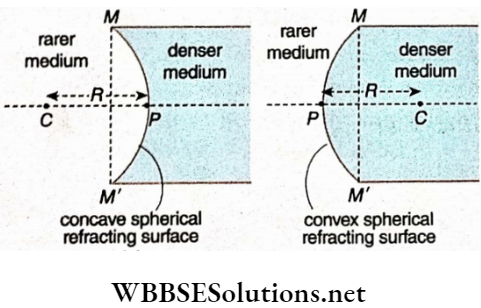
Class 12 Physics Unit 6 Optics Chapter 3 Refraction Of Light At Spherical Surface Lens Convex Spherical Refracting Surface

WBBSE Class 12 Refraction at Spherical Surfaces Notes

Refraction Of Light At Spherical Surface Lens A Few Terms Related To Spherical Refracting Surfaces

Pole: The midpoint P of the spherical refracting surface called the pole of the surface

Centre of curvature: The centre of the sphere C, of which the curved refracting surface forms a part is called the centre of curvature of the surface.

Read and Learn More Class 12 Physics Notes

The radius of curvature: The radius of the sphere of which the refracting surface is a part is called the radius of curvature of the surface.  PC is the radius of curvature (R) of each surface. It is equal to the distance of the centre of curvature from the pole of the surface.

Principal axis: The straight line joining the pole and the centre of curvature of the spherical refracting surface is called the principal axis of the surface. In the line PC extended both ways is the principal axis.

Aperture: The effective diameter of the refracting spheri¬ cal surface exposed to the incident light is called the aperture of the surface. In the line joining M end M’ i.e., the line MM’ is the aperture of the spherical refracting surface.

Refraction Of Light At Spherical Surface Lens Sign Convention

  1. All distances are measured from the pole of the spherical surface.
  2. The distances measured from the pole in the direction opposite to the direction of the incident ray are taken as negative and those measured in the direction of the incident ray are taken as positive
  3. If the principal axis of the spherical refracting surface is taken as x -the x-axis, distances along the y – y-axis above the principal axis are taken as positive and distances along y -axis below the principal axis are taken as negative.

Assumptions

While studying refraction through spherical surfaces following assumptions are made:

  1. The aperture of the spherical refracting surface is small.
  2. Refraction of only paraxial rays will be considered

The object will be a point object and will lie on the principal axis.
WBCHSE Class 12 Physics Refraction Of Light At Spherical Surface Lens Notes

Refraction Of Light At Spherical Surface Lens Refraction At Spherical Surfaces

Refraction at Concave Surface

1. When the object is real and lies in a rarer medium and the image formed is virtual:

Let MPM’ be a concave surface separating two media of refractive indices μ1 and μ2  ( μ1 2) . Let P be the pole and C be the centre of curvature of the concave surface. A point object O is placed in the rarer medium on the principal axis OP.

An incident ray OA, after refraction at point A on the surface bends towards the normal CAN and goes along AB in the denser medium. Another ray OP moving along the principal axis is incident on the surface normally and hence gets undeviated into the denser medium. The two refracted rays AB and PQ being divergent meet at / when produced backwards. I is the virtual image of O.

Let angle of incidence, ∠OAC – i; angle of refraction, ∠BAN = opposite angle ∠IAC = r; ∠ACO = θ; object distance, PO = -u; image distance, PI = -v; radius of curvature, PC = -R
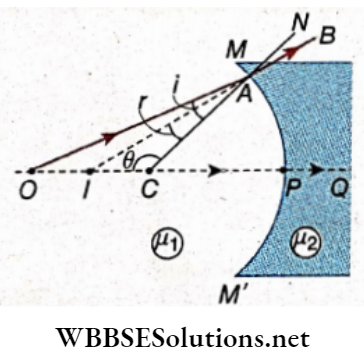
Class 12 Physics Unit 6 Optics Chapter 3 Refraction Of Light At Spherical Surface Lens Refraction At Concave Surface

Now from the triangle AOC have

⇒ \(\frac{\sin i}{C O}=\frac{\sin \theta}{A O} \text { or, } \frac{\sin i}{\sin \theta}=\frac{C O}{A O}\)

From the triangle AIC we have

⇒ \(\frac{\sin r}{C I}=\frac{\sin \theta}{A I}, \text { or, } \frac{\sin r}{\sin \theta}=\frac{C I}{A I}\)

Again considering refraction at point A, according to Snell’s law we have

μ1 sin i = μ2 sin

Or, \(\mu_1 \frac{\sin t}{\sin \theta}=\mu_2 \frac{\sin r}{\sin \theta}\)…………. (3)

From equations (1), 2) and(3) we have,

For the small aperture of the spherical surface

AO ≈ PO; and AI ≈ PI

Or, \(\mu_1\left(\frac{P O-P C}{P O}\right)=\mu_2\left(\frac{P I-P C}{P I}\right)\)

Or, \(\mu_1\left(1-\frac{P C}{P O}\right)=\mu_2\left(1-\frac{P C}{P I}\right)\)

Or, \(\mu_1\left(1-\frac{-R}{-u}\right)=\mu_2\left(1-\frac{-R}{-v}\right)\)

Or, \(\mu_1\left(1-\frac{R}{u}\right)=\mu_2\left(1-\frac{R}{v}\right) \text { or, }\left(\frac{\mu_2}{v}-\frac{\mu_1}{u}\right) R=\mu_2-\mu_1\)

Or, \(\frac{\mu_2}{v}-\frac{\mu_1}{u}=\frac{\mu_2-\mu_1}{R}\) …………….. (4)

Equation (4) is called Gauss’ equation for refraction at a concave spherical surface.

If the object O is in air, μ1 = 1 and μ2 = μ (say), then equation (4) becomes

⇒ \(\frac{\mu}{v}-\frac{1}{u}=\frac{\mu-1}{R}\)…………………….. (5)

Short Notes on Spherical Lenses and Refraction

2. When the object is virtual and the Image formed is real:

Let MPM’ be a concave surface separating two media of refracting indices μ1 and μ2 ( μ2 > μ1 ) the pole and C be the centre of curvature of the concave surface.

O is the virtual point object on the principal axis of the concave surface and I is its real image.

Let angle of incidence ∠DAC = opposite angle ∠NAO = i; angle of refraction, ∠NAI = r; ∠ACP = Q ; virtual object distance, PO = u; real image distance, PI = v; radius of curvature,
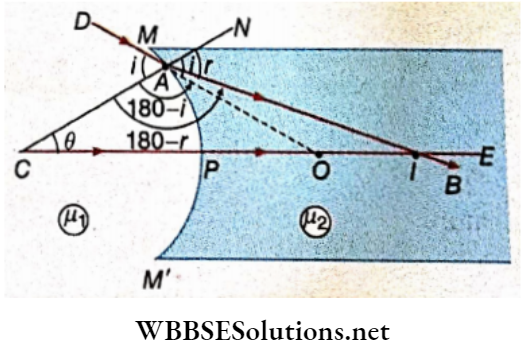
Class 12 Physics Unit 6 Optics Chapter 3 Refraction Of Light At Spherical Surface Lens Virtual And The In Image Formed Is Real

Now, from ΔAOC we have

⇒ \(\frac{\sin \left(180^{\circ}-i\right)}{C O}=\frac{\sin \theta}{A O}\)

Or, \(\frac{\sin i}{C O}=\frac{\sin \theta}{A O}\)

Or, \(\frac{\sin i}{\sin \theta}=\frac{C O}{A O}\) ……………………… (6)

From ΔACI we have,

⇒ \(\frac{\sin \left(180^{\circ}-r\right)}{C I}=\frac{\sin \theta}{A I}\)

Or, \(\frac{\sin r}{\sin \theta}=\frac{C I}{A I}\) ……………………… (7)

Again considering refraction at point A, according to Snell’s law we have,

⇒ \(\mu_1 \sin i=\mu_2 \sin r\)

Or, \(\mu_1 \cdot \frac{\sin i}{\sin \theta}=\mu_2 \cdot \frac{\sin r}{\sin \theta}\) ………………………  (8)

From equations (6), (7) and (8) we have

⇒ \(\mu_1 \cdot \frac{C O}{A O}=\mu_2 \cdot \frac{C I}{A I}\)

Or, \(\mu_1 \frac{C O}{P O}=\mu_2 \frac{C I}{P I}\) [ Small aperture approximation]

Or, \(\mu_1\left(\frac{C P+P O}{P O}\right)=\mu_2\left(\frac{C P+P I}{P I}\right)\)

Or, \(\mu_1\left(1+\frac{C P}{P O}\right)=\mu_2\left(1+\frac{C P}{P I}\right)\)

Or, \(\mu_1\left(1+\frac{-R}{u}\right)=\mu_2\left(1+\frac{-R}{v}\right)\)

Or, \(\mu_1\left(1-\frac{R}{w}\right)=\mu_2\left(1=\frac{R}{v}\right)\)

Or, \(\left(\frac{\mu_2}{v}-\frac{\mu_1}{u}\right) R=\mu_2-\mu_1\)

Or, \(\frac{\mu_2}{v}-\frac{\mu_1}{u}=\frac{\mu_2-\mu_1}{R}\) …………………………….. (9)

If μ1 = 1 and μ2= 2 equation (9) takes the form

⇒ \(\frac{\mu}{v}-\frac{1}{u}=\frac{\mu-1}{R}\)…………….. (10)

When the object is real and lies in a denser medium and the image formed is virtual:

In MPM’ is a spherical surface which is concave towards the rarer medium.

Object O is placed in the denser medium. The virtual image of the object is I.

Here μ1 2

Let angle of incidence, ∠DAO = i;

Angle of refraction, ∠BAC = r;  ∠ACP =  θ

Object distance, PO = -u;

Image distance, PI = -v;

The radius of curvature, PC = R
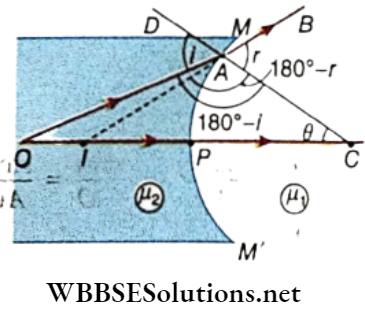
Class 12 Physics Unit 6 Optics Chapter 3 Refraction Of Light At Spherical Surface Lens Real Image And Lies In Denser Medium

Now, from the triangle ACO, we have,

⇒ \(\frac{\sin \left(180^{\circ}-i\right)}{O C}=\frac{\sin \theta}{O A}\)

Or, \(\frac{\sin i}{O C}=\frac{\sin \theta}{O A}\) ……………….. (11)

And we have from AACI

⇒  \(\frac{\sin \left(180^{\circ}-r\right)}{I C}=\frac{\sin \theta}{I A}\)

Or, \(\frac{\sin r}{\sin \theta}=\frac{I C}{I A}\) …………… (12)

Again considering refraction at point A, according to Snell’s law we have,

μ1 sin i = μ2 sin r

⇒ \(\mu_2 \frac{\sin i}{\sin \theta}=\mu_1 \frac{\sin r}{\sin \theta}\)

From the equations (11), (12) and (13) we have

⇒ \(\mu_2 \cdot \frac{O C}{O A}=\mu_1 \cdot \frac{I C}{I A}\)

Or, \(\mu_2\left(\frac{O P+P C}{O P}\right)=\mu_1\left(\frac{I P+P C}{I P}\right)\)

∴ For small aperture of the spherical surface OA≈OP; IA≈IP

Or, \(\mu_2\left(1+\frac{P C}{O P}\right)=\mu_1\left(1+\frac{P C}{I P}\right)\)

Or, \(\mu_2\left(1+\frac{R}{-w}\right)=\mu_1\left(1+\frac{R}{-v}\right) \text { or, } \mu_2\left(1-\frac{R}{w}\right)=\mu_1\left(1-\frac{R}{v}\right)\)

Or, \(\mu_2-\mu_1=\mu_2 \cdot \frac{R}{u}-\mu_1 \cdot \frac{R}{v}\)

Or, \(\mu_2-\mu_1=R\left(\frac{\mu_2}{u}-\frac{\mu_1}{v}\right) \text { or, } \frac{\mu_2}{u}-\frac{\mu_1}{v}=\frac{\mu_2-\mu_1}{R}\)

Or, \(\frac{\mu_1}{v}-\frac{\mu_2}{u}=\frac{\mu_1-\mu_2}{R}\) ……………………. (14)

If μ2 = μ  and μ1 = 1, the equation (14) takes the form

⇒ \(\frac{1}{v}-\frac{\mu}{u}=\frac{1-\mu}{R}\)

Or, \(\frac{\mu}{u}-\frac{1}{v}=\frac{\mu-1}{R}\)…………………. (15)

Refraction at Convex Surface

1. When the object is real and lies in a rarer medium and the image formed is virtual:

Let MPM’ be a convex surface separating two media of refractive indices and μ221)

An incident ray of OA after refraction at point A on the surface goes along AB in the denser medium
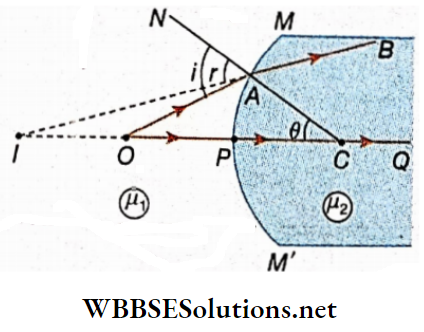
Class 12 Physics Unit 6 Optics Chapter 3 Refraction Of Light At Spherical Surface Lens An Incident Of Ray

Another ray of tight OP moving along the principal axis Is incident on the surface normally and hence gets undeviated into the denser medium. The two refracted rays AB and PQ when produced back meet on the principle axis at point I which is the virtual image Of O

Let the angle of incidence ∠OAN = r

∴ ∠CAO = 180°- i

Angle of refraction, ∠BAC = ∠IAN = r

∴ ∠CAI = 180°-r

Let, ∠ACO = θ

Object distance a PO = -u

Image distance, PI = -v

radius of curvature, PC = R

From tire ΔACO we have

⇒ \(\frac{\sin \left(180^{\circ}-i\right)}{C O}=\frac{\sin \theta}{A O}\)

Or, \(\frac{\sin i}{C O}=\frac{\sin \theta}{A O}\)

Or, \(\frac{\sin i}{\sin \theta}=\frac{C O}{A O}\)

From the ΔACI we have

⇒ \(\frac{\sin \left(180^{\circ}-r\right)}{C I}=\frac{\sin \theta}{A I}\)

Or, \(\frac{\sin r}{C I}=\frac{\sin \theta}{A I}\)

Or, \(\frac{\sin r}{\sin \theta}=\frac{C l}{A l}\)

Again, considering ing refraction at point A, according to Snell’s law we have

μ1 sin = μ2 sin r

⇒ \(\mu_1 \cdot \frac{\sin i}{\sin \theta}=\mu_2 \cdot \frac{\sin r}{\sin \theta}\). ………………………………. (3)

From equations (1), (2) and (3) we have

⇒  \(\mu_1 \cdot \frac{C O}{A O}=\mu_2 \cdot \frac{C I}{A I}\)

⇒  \(\mu_1 \cdot \frac{C O}{A O}=\mu_2 \cdot \frac{C I}{A I}\)

∴ For small aperture of the spherical surface AO ≈ PO, AI≈pI

⇒  \(\mu_1\left(\frac{P C+P O}{P O}\right)=\mu_2\left(\frac{P C+P I}{P I}\right)\)

⇒  \(\mu_1\left(\frac{P C}{P O}+1\right)=\mu_2\left(\frac{P C}{P I}+1\right)\)

⇒  \(\mu_1\left(\frac{P C}{P O}+1\right)=\mu_2\left(\frac{P C}{P I}+1\right)\)

Or, \(\mu_1\left(\frac{R}{-u}+1\right)=\mu_2\left(\frac{R}{-\nu}+1\right)\)

⇒  \(\mu_1\left(1-\frac{R}{u}\right)=\mu_2\left(1-\frac{R}{\nu}\right) \text { or, }\left(\frac{\mu_2}{\nu}\right)\)

Or, \(\frac{\mu_2}{\nu}-\frac{\mu_1}{u}=\frac{\mu_2-\mu_1}{R}\) …………………….(4)

Equation (4)  is called Gauss’ equation for refraction for refraction at a convex spherical surface.It is similar to the equation (4)

If object O Is situated In the air,  μ1 = 1  and μ= μ  (say)

Convex spherical surface. It Is similar to the equation (4)  of the equation (4) becomes

⇒ \(\frac{\mu}{\nu}-\frac{1}{u}=\frac{\mu-1}{R}\) ……………………… (5)

2. When the object is real and lies In a rarer medium and the Image formed Is also real:

Let MPM’ be a convex surface separating two media of refractive Indices μ1 and μ2 ( μ2 > μ1 ). Let P be the pole and C be the centre of curvature of the convex surface. O is the point object on the principal axis of the convex surface and I is its real Image.

Let the angle of Incidence, ∠NAO = i

The angle of refraction,∠ IAC = r;

∠ACO = θ

Object distance, PO = -u

Image distance, PI = v

The radius of curvature, PC = R
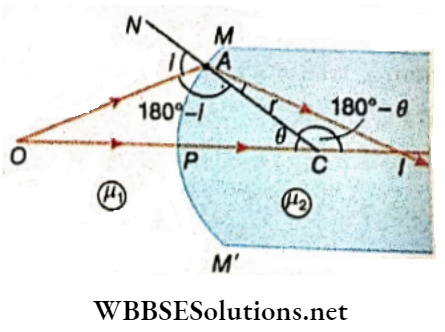
Class 12 Physics Unit 6 Optics Chapter 3 Refraction Of Light At Spherical Surface Lens Real Image And Lies In Rarer Medium

Now, from ΔACO we have

⇒ \(\frac{\sin \left(180^{\circ}-i\right)}{C O}=\frac{\sin \theta}{A O}\)

Or,  \(\frac{\sin i}{C O}=\frac{\sin \theta}{A O}\)

Or, \(\frac{\sin l}{\sin \theta}=\frac{C O}{A C}\) …………………………………….. (6)

From ΔAIC we have

⇒  \(\frac{\sin r}{C I}=\frac{\sin \left(180^{\circ}-\theta\right)}{A I}\)

Or, \(\frac{\sin r}{\sin \theta}=\frac{C I}{A I}\) ……………………………………….. (7)

Again, considering refraction at point A, according to Snell’s law we have,

μ1 Sini = μ2 Sini r

Or, \(\mu_1 \cdot \frac{\sin i}{\sin \theta}=\mu_2 \cdot \frac{\sin r}{\sin \theta}\)  ………………………………. (8)

From equations (6), (7) and (8) we have,

⇒  \(\mu_1 \cdot \frac{C O}{A O}=\mu_2 \cdot \frac{C I}{A I}\)

Or, \(\mu_1 \cdot \frac{C O}{P O}=\mu_2 \cdot \frac{C I}{P I}\)

For the small aperture of the spherical surface AO ≈  PO, AI ≈ PI

Or, \(\mu_1\left(\frac{P O+P C}{P O}\right)=\mu_2\left(\frac{P I-P C}{P I}\right)\)

Or, \(\mu_1\left(1+\frac{P C}{P O}\right)=\mu_2\left(1-\frac{P C}{P I}\right)\)

Or, \(\mu_1\left(1+\frac{R}{-u}\right)=\mu_2\left(1-\frac{R}{v}\right)\)

Or, \(\mu_1\left(1-\frac{R}{w}\right)=\mu_2\left(1-\frac{R}{v}\right)\)

Or, \(\frac{\mu_2}{v}-\frac{\mu_1}{u}=\frac{\mu_2-\mu_1}{R}\) ……………………………………….  (9)

If the object O is situated in air, μ1 = 1  and μ= μ (say) the equation (9) becomes

Or, \(\frac{\mu}{v}-\frac{1}{u}=\frac{\mu-1}{R}\)……………………………………….. (10)

WBCHSE class 12 physics lens notes

2. When the object is real and lies in a denser medium and the image formed is real:

In  MPM’ is a spherical surface which is convex towards the rarer medium. The object O is placed in the denser medium. The real image formed is I.
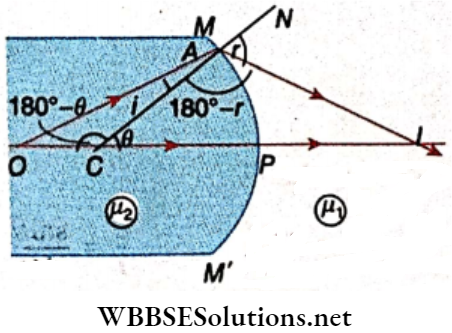
Class 12 Physics Unit 6 Optics Chapter 3 Refraction Of Light At Spherical Surface Lens Real Image And Lies In Denser Medium Image Formed Is Real

Let the angle of incidence, ∠CAO = i

The angle of refraction, ∠NAI = r;

∠ACP = θ;

Object distance, PO = -u

Image distance, PI = + v

The radius of curvature, PC = -R

Now, from the triangle ACO we have

⇒ \(\frac{\sin i}{O C}=\frac{\sin (180-\theta)}{O A}\)

Or, \(\frac{\sin i}{O C}=\frac{\sin \theta}{O A}\)

Or, \(\frac{\sin i}{\sin \theta}=\frac{O C}{O A}\)…………………………………… (11)

From the triangle AIC, We have,

⇒ \(\frac{\sin \left(180^{\circ}-r\right)}{C I}=\frac{\sin \theta}{A I}\)

Or, \(\frac{\sin r}{\sin \theta}=\frac{C I}{A I}\) ………………………… (12)

Again considering refraction at point A, according to Snell’s law we have,

μ1 sini =  μ2 sin r

Or, \(\mu_2 \cdot \frac{\sin i}{\sin \theta}=\mu_1 \cdot \frac{\sin r}{\sin \theta}\) ……………………………. (13)

From equations (11), (12) and (13) we have,

⇒ \(\mu_2 \cdot \frac{O C}{O A}=\mu_1 \cdot \frac{C I}{A I}\)

Or, \(\mu_2 \cdot \frac{O C}{O P}=\mu_1 \cdot \frac{C I}{P I}\)

For small aperture of the spherical surface OA ≈ OP; IA ≈ IP

Or, \(\mu_2\left(\frac{O P-P C}{O P}\right)=\mu_1\left(\frac{P I+P C}{P I}\right)\)

Or, \(\mu_2\left(1-\frac{P C}{O P}\right)=\mu_1\left(1+\frac{P C}{P I}\right)\)

Or, \(\mu_2\left(1-\frac{-R}{-w}\right)=\mu_1\left(1+\frac{-R}{v}\right)\)

Or, \(\left(\frac{\mu_1}{v}-\frac{\mu_2}{u}\right) R=\mu_1-\mu_2\)

Or, \(\frac{\mu_1}{v}-\frac{\mu_2}{u}=\frac{\mu_1-\mu_2}{R}\) ……………………. (14)

If  μ2 = μ and μ1= 1 the equation (14) takes the form

⇒ \(\frac{1}{v}-\frac{\mu}{u}=\frac{1-\mu}{R}\)

Or, \(\frac{\mu}{u}-\frac{1}{v}=\frac{\mu-1}{R}\) ………………………………………. (15)

If the object is a mat and lies In a rarer medium, then relation \(\frac{\mu_2}{v}-\frac{\mu_1}{u}=\frac{\mu_2-\mu_1}{R}\) is valid irrespective of the type of the spherical refracting surface

If the object is real and lies in the denser medium, then relation \(\frac{\mu_1}{v}-\frac{\mu_2}{u}=\frac{\mu_1-\mu_2}{R}\)  is valid irrespective of the type of the spherical refracting surface

Here  u =  object distance, v = image distance, r = radius of Air Venture of spherical refracting surface, μ1 = refractive index of rarer medium and μ2  =  refractive index of denser medium

Refraction At Spherical Surfaces Class 12 Notes

Refraction Of Light At Spherical Surface Lens Refraction At Spherical Surfaces Numerical Examples

Example 1.  There is a small air bubble inside a glass sphere; (μ = 1.5) of radius 10 cm. The bubble is 4 cm below the surface and is viewed nearly normal from the out side. Find the apparent depth of the bubble
Solution: 

Here, u = -4 cm; r =  -10 cm; μ2 = 1.5, μ1= 1

O is the position of the bubble and I is the position of the image of the bubble
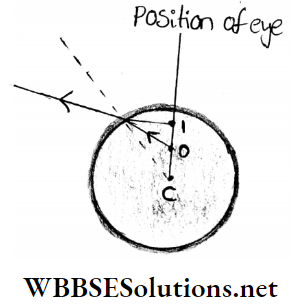
Class 12 Physics Unit 6 Optics Chapter 3 Refraction Of Light At Spherical Surface Lens Small Air Bubble Inside A Glass Sphere

We know, \(\frac{\mu_1}{v}-\frac{\mu_2}{u}=\frac{\mu_1-\mu_2}{r}\)

Or, \(\frac{1}{v}-\frac{1.5}{-4}=\frac{1-1.5}{-10}\)

Or, \(\frac{1}{v}=\frac{0.5}{10}-\frac{1.5}{4}\)

Or,  v = -3 cm

Thus the bubble will appear 3 cm below the top point of the sphere.

Example 2. A point of red mark on the surface of a glass sphere Is observed straight, nearly along the diameter from the opposite surface of the sphere. If the diameter of the sphere is 20 cm and the refractive index of the glass is 1.5, find the position of the image. Sftlutlan: Let P be a point of red mark on the glass sphere being observed from point A
Solution:

According to the question, object distance = AP = u = -20:  radius of curvature = r = -10 cm
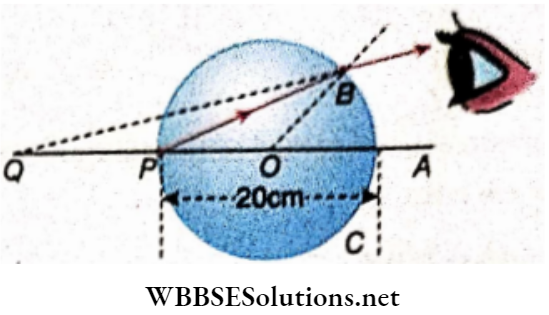
Class 12 Physics Unit 6 Optics Chapter 3 Refraction Of Light At Spherical Surface Lens Red Mark On The Surface Of A Glass Sphere

In this case, the object lies in the denser medium μ2=  1.5

The observer is situated in the rarer medium (μ1= 1)

So, in case of refraction in the spherical surface BAC

⇒ \(\frac{\mu_1}{v}-\frac{\mu_2}{u}=\frac{\mu_1-\mu_2}{r}\)

Or, \(\frac{1}{v}-\frac{1.5}{-20}=\frac{1-1.5}{-10}\)

Or, \(\frac{1}{v}+\frac{15}{200}=\frac{-0.5}{-10}\)

Or, \(\frac{1}{v}=\frac{5}{100}-\frac{15}{200}\)

Or, \(\frac{1}{v}=\frac{10-15}{200}=\frac{-5}{200}\)

or, v = -40 cm

So, a virtual image will be formed on Q on the extended line AOP at a distance of 40 cm from point A. So the virtual position of the red spot will be found (40- 20) or 20 cm behind its real position while looking through the sphere

Common Questions on Refraction at Lenses

Example 3. A mark exists at a distance of 3 cm on the axis from the plane surface of a hemisphere of glass. If the mark Is observed from above the curved surface determine the apparent position of the mark. The radius of the hemisphere = 10 cm; the refractive index of glass = 1.5.
Solution: 

A is the position of the mark  A’ is the position of its image.

u = -OA = -(OC- AC) = -(10 – 3) = -7 cm

r = -10 cm; μ2 = 1.5 and μ1= 1

We know \(\frac{\mu_1}{v}-\frac{\mu_2}{u}=\frac{\mu_1-\mu_2}{r}\)

Or, \(\frac{1}{v}-\frac{1.5}{-7}=\frac{1-1.5}{-10}\)

Or, \(\frac{1}{v}+\frac{1.5}{7}=\frac{0.5}{10}\)

Or, \(\frac{1}{v}=\frac{0.5}{10}-\frac{1.5}{7}\)

Or, \(\frac{1}{v}=\frac{-11.5}{70}\)

Or,  v = – 6.09 cm

∴ Position of±e ima8e from the plane surface is at a distance of (10 – 6.09) or 3.91 cm
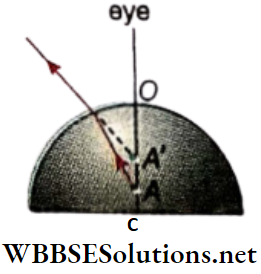
Class 12 Physics Unit 6 Optics Chapter 3 Refraction Of Light At Spherical Surface Lens Radius Of The Hemisphere

Example 4. A parallel beam of light travelling In the water is refracted a by a spherical air bubble of radius 2 mm situated In the water. Find the position of the Image due to refraction at the first surface and the position of the final Image. Refractive Index of water = 1.33. Draw a ray diagram showing the positions of both the Images.
Solution:

Let C be the centre of the spherical air bubble. P1 and P2 are the poles of the spherical surfaces. A beam of light parallel to the diameter of the sphere, after refraction at the first surface, forms a virtual Image I1 After that it forms another virtual image I2 due to refraction at the second surface.
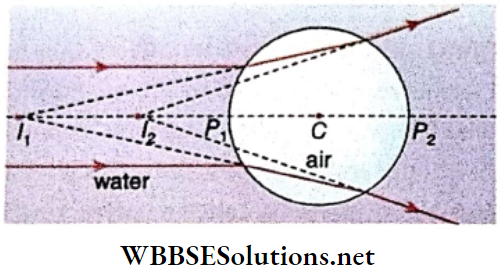
Class 12 Physics Unit 6 Optics Chapter 3 Refraction Of Light At Spherical Surface Lens A Parallel Beam Of Light Travelling In Water

We know \(\frac{\mu_1}{v}-\frac{\mu_2}{u}=\frac{\mu_1-\mu_2}{r}\)

For refraction at the first surface of the bubble (from water to air)

μ1 = 1 ,μ = 1.33 ; u = ∞ and r = 2 mm

⇒ \(\frac{1}{v}=\frac{1.33}{\infty}=\frac{1-1.33}{2}\)

Or, \(\frac{1}{v}=\frac{-1}{6}\)

v = -6 mm

The negative sign indicates that the image Ix is virtual and forms at 6 mm from the surface of the bubble on the waterside. The refracted rays (which seem to come from I1 ) are incident on the farther surface of the bubble. For this refraction, μ1 = 1, μ =  1. 33 , r = 2 mm and u = -(6 + 4) = -10 mm

∴ \(\frac{\mu_2}{v}-\frac{\mu_1}{u}=\frac{\mu_2-\mu_1}{r}\)

Or, \(\frac{1.33}{\nu}+\frac{1}{10}=\frac{1.33-1}{-2}\)

Or, \(\frac{1.33}{v}=\frac{-0.33}{2}-\frac{1}{10}\)

Or, v = – 5mm

The negative sign shows that the image is formed on the air side at 5 mm from the second refracting surface.

Measuring from the centre of the bubble the first image is formed at (6+2) or 8 mm from the centre and the second image is formed at (5- 2). or 3 mm from the centre. Both images are formed on the side from which the incident rays are coming.

Practice Problems on Lens and Spherical Surface Refraction

Example 5. A spherical surface of radius of curvature R separates air (refractive Index 1.0) from glass (refractive Index = 1.5). The centre of curvature Is In the glass A point object P placed In the air is found to have a real Image Q In the glass. The line PQ cut the surface at a point O and PO = OQ. Find the distance of the object from the spherical surface.
Solution:

Let PO = OQ = x. Suppose object and image distances are u and v respectively.

We, know ,\(\frac{\mu_2}{v}-\frac{\mu_1}{u}=\frac{\mu_2-\mu_1}{R}\)

Here,  μ2 = 1.5 , μ1 = 1, v = +x, u = -x

From equation (1),

⇒ \(\frac{1.5}{x}-\frac{1}{-x}=\frac{1.5-1}{+R}\)

Or, \(\frac{2.5}{x}=\frac{0.5}{R}\)

Or, x = 5R

Hence distance of the object from the spherical surface is 5R.
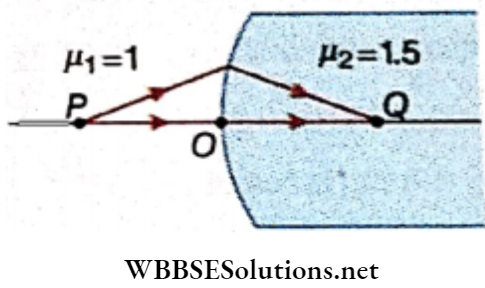
Class 12 Physics Unit 6 Optics Chapter 3 Refraction Of Light At Spherical Surface Lens A Spherical Surface Of Radius Of Curvacture R Separates Air

Refraction Of Light At Spherical Surface Lens Application Of Refraction In A Spherical Surface Lens

Spherical surface  Definition:  A lens Is a portion of a transparent refracting medium bounded by two spherical surfaces or a spherical surface and a plane surface.

The lens is generally of two types:

  1. Convex or converging lens and
  2. Concave or diverging lens.

Class 12 Physics Unit 6 Optics Chapter 3 Refraction Of Light At Spherical Surface Lens Convex Or Conver ging Lens And Concave Or Diverging Lens

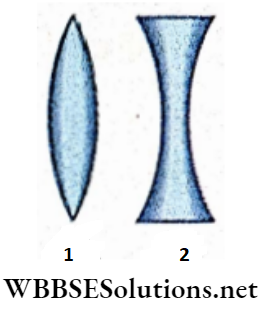
A lens which is thicker in the middle than towards its edges is called a convex lens. A lens which is thinner in the middle than towards the  edges is called a concave lens

Refraction at spherical surfaces class 12 notes

Refraction Of Light At Spherical Surface Lens Different Types Of Lenses

Convex lens

Convex lenses may be of three types according to the shape of two surfaces forming it.
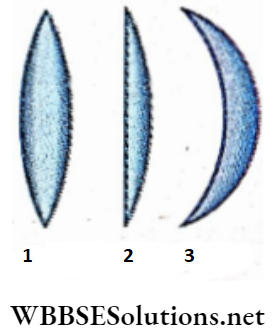
Class 12 Physics Unit 6 Optics Chapter 3 Refraction Of Light At Spherical Surface Lens Convex Bi Convex Or Double Convex Lens

  1.  Bi-convex or double convex lens: It is one in which both the surfaces are convex   The radii of curvature of both the surfaces may or may not be equal. If the radii of curvature are equal, the convex lens is called the equi-convex lens.
  2.  Plano-convex lens: It is a lens with one surface plane and the other convex.
  3.  Concavo-convex lens: Here one surface is concave and the other is convex  In this type of lens the radius of curvature of the convex surface is smaller than that of the concave surface.

Concave lens

Similarly, the concave lens may be of three types according to the shape of two surfaces forming it
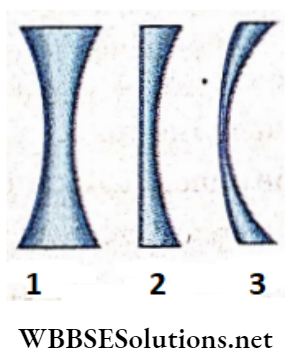
Class 12 Physics Unit 6 Optics Chapter 3 Refraction Of Light At Spherical Surface Lens Concave Bi Concave Or Double Concave Lens

  1. Bi-concave or double-concave Lens: This type of lens has both surfaces concave. The radii of curvature of both surfaces may or may not be equal. If the radii of curvature are equal, the. concave lens is called the equiconcave lens.
  2. Plano-concave lens: This type of lens has one surface, plane and the other concave.
  3. Convexo-concave lens: Here one surface Is convex and the other is concave. The radius of curvature of the concave surface Is smaller than that of the convex surface,

Refraction at spherical surfaces class 12 notes 

Refraction Of Light At Spherical Surface Lens Action Of A Lens

Principal axis

The line passing through the centres of curvature of the two bounding surfaces of a lens Is called the principal axis of the lens. If one surface of the lens is spherical and the other plane, then the perpendicular drawn from the curvature of the spherical surface to the plane surface is the principal axis of the lens. [The definition of centre of curvature is given in the section 3.9

Converging and diverging lenses

If the surrounding medium of a lens is rarer compared to the medium of the lens, then the parallel beam of rays after refraction through a convex or a concave lens appears to be converging or diverging respectively. Therefore, a convex lens is called a converging lens and a concave lens is called a diverging lens.

1. Convergence by the convex lens:

A convex lens may be imagined as being formed of two sets of truncated prisms arranged symmetrically on the opposite sides of a central paral¬ lel-faced rectangular slab. the prisms in each set being placed one above another with their bases turned towards the principal axis of the lens
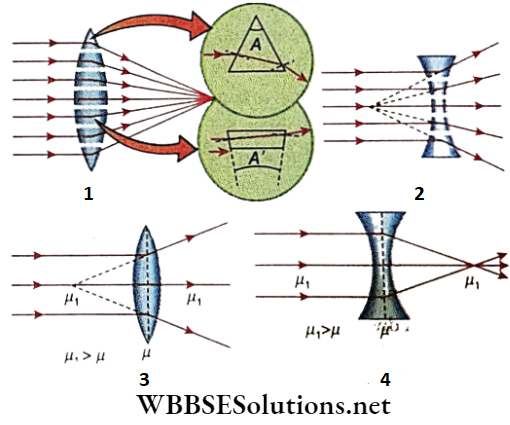
Class 12 Physics Unit 6 Optics Chapter 3 Refraction Of Light At Spherical Surface Lens Convergence By Convex Lens

As we move further away from the principal axis the angle of refraction consequently keeps on increasing. Any parallel ray incident on a prism will bend by refractippÿthrough the prism towards its base. Since the refracting angles of.the various prisms.

Increase successively with their distance from the principal axis, the raj’s which fall on a prism at a distance from the axis is bent more than those which pass nearer to the axis. So a pencil of parallel rays is refracted by the combination of prisms i.e, by the convex lens to converge to a particular point on the princi¬ pal axis. Hence, a convex lens is called a converging lens,

2. Divergence by concave lens:

Let us refer to the concave lens may also be imagined as being formed of two sets of truncated prisms arranged symmetrically on the opposite sides of a central parallel-faced slab. The pile of prisms on each side of the principal axis have their refracting angles turned towards the axis. So their bases are turned towards the edge of the lens.

Therefore in this case a pencil of parallel rays after refraction through the prism will bend away from the axis being tinned towards foe bases of foe prisms. So for emergent light will behave as a divergent beam. Hence, a concave lens is called a diverging lens.

Divergence by the convex lens and convergence by the concave lens

It is to be noted that usually, a convex lens acts as a converging lens and a concave lens as a diverging one. These types of behaviour offoe lenses are seen when foe refractive indices offoe material of foe lenses are greater than that of the surrounding medium. But if the refractive index of the material of for lens is less than that of the surrounding medium i.e., the medium surrounding the lens is denser, the convex lens will diverge and a concave lens will converge for incoming parallel rays

Refraction at spherical surfaces class 12 notes 

Refraction Of Light At Spherical Surface Lens A Few Definitions

Centre of curvature: Generally the two surfaces of a lens are spherical. The two spherical surfaces are each a part of two spheres. The centres of the spheres are called the centres of curvature of the Idris.

If for two surfaces of a lens are spherical, the centres of the nature of the lens are at a finite distance. C1 and C2 are the centres of curvature of the lenses. If the surface of the lens is plane, the centre of curvature of that surface is at infinity
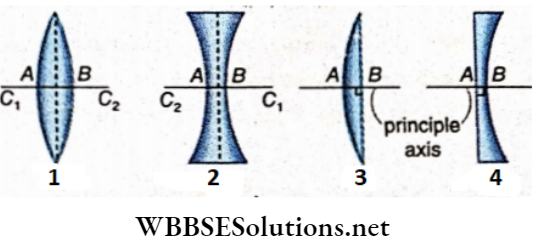
Class 12 Physics Unit 6 Optics Chapter 3 Refraction Of Light At Spherical Surface Lens Centre Of Curvacture

Radius Of curvature

The two spherical surfaces are each a part of two spheres. The radii of the spheres are called the radii of curvature of the lens.

If the two surfaces of a lens are spherical, each radius of curvature is finite. AC2 and BC1 are the radii of curvature of the lens. If one of the surfaces is plane, its radius of curvature is infinite

Principal axis

For a lens having two spherical surfaces, the line passing through the centres of curvatures of the two bounding surfaces of a lens is called the principal axis of the lens for the principal axis of the ~ lens.

If one surface of the lens is spherical and the other is a plane, then the perpendicular drawn from the centre of curvature of the spherical surface to the plane surface is the principal axis of the lens

Optical centre

If a ray of light passes through a lens in such a way that the direction of emergence is parallel to the direction of incidence, the path of the ray inside the lens intersects the principal axis at a fixed point. This fixed point for a lens is called its optical centre

The incident ray AB and the emergent ray CD are parallel to each other. The refracted ray BC intersects the principal axis at O . So point 0 is the optical centre of the lens.

It is to be noted that the incident ray AB and the emergent  CD do not lie on the same straight line. The emergent ray CL is laterally displaced from the incident ray AB. The displacement will be small if the lens is a thin one. If the lens is very thin
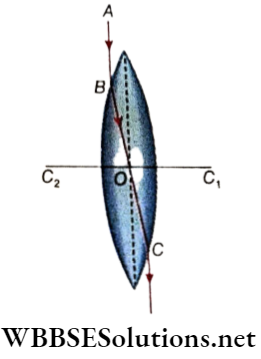
Class 12 Physics Unit 6 Optics Chapter 3 Refraction Of Light At Spherical Surface Lens Optical Centre

The displacement is so negligible that AB, BC and CD may be taken as the same straight line. So we can say that the optical centre of a thin lens Is such n point on Its principal axis that a ray passing through it passes out straight without any displacement or deviation.

The optical centre is a fixed point:

The optical centre of a lens Is a fixed point on Its principal axis. But the position of the point depends oil its shape. It can be proved in die following way.

C1 and C2 are the centres of curvature of the spherical surfaces LBL’ and LAL’ respectively. Q and R are two points on the spherical surfaces. If r1 and r2 are the radii of curvature of the surfaces LBL’ and LAL’ then C1Q = C1B = r1 and C2R = C2A = r1
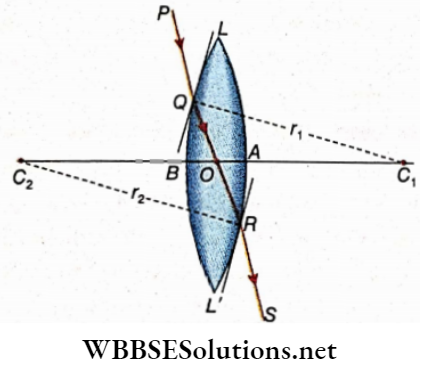
Class 12 Physics Unit 6 Optics Chapter 3 Refraction Of Light At Spherical Surface Lens Optical Centre Is A Fixed Point

Let us join Q and R and let the line QR intersect the principal axis at O . Therefore, O is the optical centre of the lens. Thus the rays PQ and RS are parallel to each other. Suppose, the thickness of the lens =AB = t.

Two tangent planes are drawn at Q and R of the two surfaces of the lens. We know that when a ray is refracted through a parallel glass slab the incident ray and the emergent ray are parallel.

In this case, the rays PQ and RS being parallel we can assume that the ray PQ is refracted through a parallel glass slab. So the tan¬ gent planes at Q and R will be parallel to each other.

The radius of curvature C1Q is perpendicular to the tangent plane at Q and the radius of curvature C2R is perpendicular to the tangent plane at R. Since the two tangent planes are parallel, therefore C1Q  and C2 R are parallel, to each other.

So the triangles C1OQ and C2OR are similar.

∴  \(\frac{O C_1}{O C_2}=\frac{C_1 Q}{C_2 R}=\frac{r_1}{r_2}\)

∴  \(\frac{O C_1}{O C_2}=\frac{C_1 n}{C_2 A}\)

= \(\frac{C_1 B-O C_1}{C_2 A-O C_2}=\frac{O B}{O A}\)

⇒ \(\frac{r_1}{r_3}=\frac{O B}{O A}\)

So, the point O divides the thickness of the lens AB In a fixed ratio i.e., in ratio of the radii of curvature of the two surfaces

Again \(\frac{r_1}{r_1+r_2}=\frac{O B}{O B+O A}=\frac{O B}{A B}=\frac{O B}{t}\)

∴ OB = \(\frac{t r_1}{r_1+r_2}\), OA = \(\frac{t r_2}{r_1+r_2}\) …………………………………………. (2)

Since t, r1 and r2 are constants, the position of O is constant. i.e., the optical centre O of a lens is a fixed point.

  1. In the case of equi-convex and equi-concave lenses:  In this case since r1 = r2 therefore from equation (1), we get OB = OA. i.e., in this case, the optical centre is situated on the principal axis within the lens and equidistant from both surfaces.
  2. In the case of plano-convex and plano-concave lenses: In this case, one surface of the lens is the plane. Therefore when  r1→∞ , then OA →0. Again when r2→ ∞ , then OB →0. So, in this case, the optical centre lies at the intersecting point of the spherical surface with the principal axis
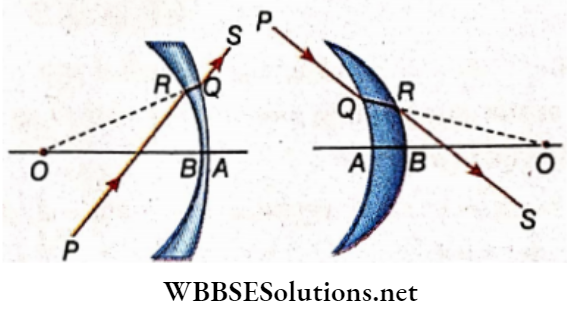
Class 12 Physics Unit 6 Optics Chapter 3 Refraction Of Light At Spherical Surface Lens Spherical Surface With The Principle Axis

It is to be noted that the optical centre may be within the lem or outside, depending on the nature of the two surfaces, the case of the concavo-convex and convexo-concave optic centre lies outside the lens, Wherever the position of the optical centre, its distance from any surface of lens is proportional to the radius of curvature of the surface because

⇒ \(\frac{O B}{O A}=\frac{r_1}{r_2}\)

Refraction through spherical surfaces physics notes Principle focuses

Suppose, a narrow beam of rays parallel to the principal axis is incident on a lens’

  1.  If the lens is convex, the beam of rays after refraction verges to a point on the principal axis. This point is called the principal focus of the lens.
  2. If the lens is concave, the beam of rays after refraction appears to diverge from a point on the principal axis. This point is called the principal focus of the lens.
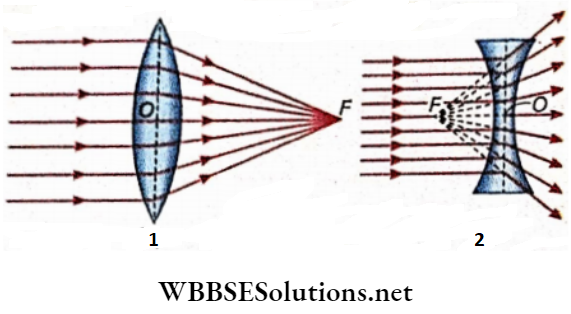
Class 12 Physics Unit 6 Optics Chapter 3 Refraction Of Light At Spherical Surface Lens Principle Focus

The point F is the principal focus of the lens. A lens has two principal foci. Here in either case point F is the second principal focus of the lens. In addition to this principal focus a lens has another principal focus which is called the first principal focus.

1. First principal focus:

  • In the case of a convex lens: The first principal focus is a point on its principal axis such that the rays diverging from it emerge parallel to the axis after refraction through the lens.
  • In the case of a concave lens: The first principal focus is a point on its principal axis such that the rays directed towards it emerge parallel to the axis after refraction through the lens. The point F’ is the first principal focus.

2. The second principal focus is conventionally called the principal focus of a lens:
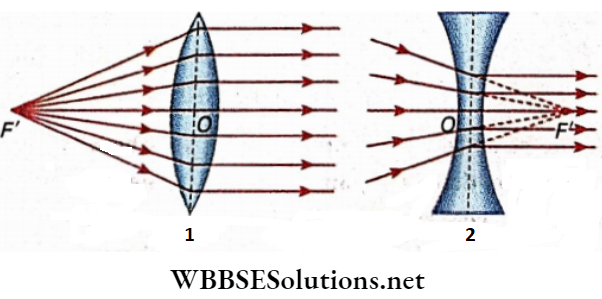
Class 12 Physics Unit 6 Optics Chapter 3 Refraction Of Light At Spherical Surface Lens The Second Principle Focus Is Conventionally

Focal Length

The distance of the principal, focus from the optical centre of a lens is the focal length F of that lens.

1. The first principal focal length: 

Is the distance of the first principal focus from the oj$cal centre. The second principal focal length is the distance of the second principal focus from the optical centre.

The point O Is the optical centre.

OF’ = First principal focal length of the lens

OF = Second principal focal length of the lens

2. The second principal focal length Is conventionally taken as the focal length of a lens:

The value of the focal length of the lens depends on the colour of light, the lens medium and also on the surrounding medium. If the media on both sides of the lens are the same, then it can be proved that the first principal focal length (f1) and the second principal focal length (f2) are equal. But if the media are different on both sides, then these two lengths would be different.

Focal plane

A plane perpendicular to the principal axis of a lens drawn through the principal focus is known as the focal plane of a lens.

A lens has two focal planes corresponding to its two focal points. The focal plane through the first principal focus is called the first principal focal plane and the plane through the second principal focus is called the second principal focal plane.

Secondary focus

Suppose a beam of parallel rays inclined at a small angle with the principal axis of a lens is incident on it. The point on the focal plane to which the beam converges (in the case of the convex lens) and from which the beam appears to diverge (in the case of the concave lens) after refraction is called the secondary focus of the lens.

The point F’ is the secondary focus of the lens. It Is to be noted that the principal focus of a convex or concave lens Is a fixed point, but the secondary focus is not a fixed point. With the change of the angle of inclination of the incident rays with the principal axis of the lens, the position of the secondary focus changes. However the secondary focus always remains on the focal plane.
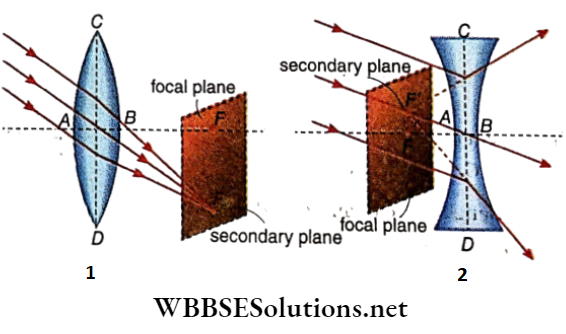
Class 12 Physics Unit 6 Optics Chapter 3 Refraction Of Light At Spherical Surface Lens Secondary focus

  1. Aperture: The boundary line of the planes of a lens is circular and the diameter of the circle is ordinarily called the aperture of the lens. In the diameter CD Is the aperture of the lens.
  2. Thin lens: A thin lens Is one in which the thickness at the principal axis Is small compared with the radii of curvature of the two surfaces

Refraction through spherical surfaces physics notes

Refraction Of Light At Spherical Surface Lens Determination of the Position Of An Image By Geometrical Method

In all the following discussions the lenses we shall deal with are thin lenses with small aperture.

To find the position of the image of an extended object placed on the principal axis of a lens

By the geometrical method, we should remember the following facts:

  1. A ray falling on a convex lens in a direction parallel to the principal axis converges to the second principal focus after refraction by the lens and a ray falling on a concave lens in a direction parallel to the principal axis appears to diverge from the second principal focus after refraction by the lens.
  2. A ray passing through the first principal focus of a convex lens or proceeding to the first principal focus of a concave lens will emerge parallel to the principal axis after refraction through it.
  3. A ray passing through the optical centre of a convex or a concave lens emerges out from the lens undeviated and undisplaced with respect to the direction of incidence as the concerned lens is a thin lens.

Using any two rays of the above-mentioned three rays, the image Q of an object can be drawn,  images have been drawn in different cases applying this method. These diagrams are called ‘Ray diagrams’

Refraction Of Light At Spherical Surface Lens Position Size And Nature Of The Image For Different Positions Of An Object

For any particular surrounding media (here, air), the position, size and nature of the image of an object formed by refraction in a lens depend on the position of the object with respect to the lens. How the position and nature of the Image change when the object is brought from infinity up to a position dose to the lens is shown below. For the convenience of discussion, we shall consider the object PQ to be placed perpendicular to the principal axis of the lens LL’ .{f is taken as the focal length of the lens).

In the case of convex lens

1. Object is placed at infinity:

If the object is at infinity, the rays of light from a point on the object may be considered parallel. The beam of parallel rays inclined at a small angle with the principal axis of the convex lens converges at this point p on the second principal focal plane after refraction the lens. So, the image is formed in the focal plane and it is real, inverted and infinitely diminished.
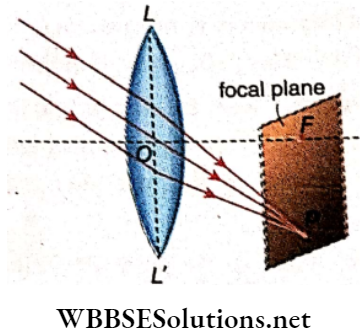
Class 12 Physics Unit 6 Optics Chapter 3 Refraction Of Light At Spherical Surface Lens Object Is Placed At Infinity Diminished

Use: The objective of a telescope is made by using this prop of the convex lens.

2. Object is placed between infinity and 2 f: 

The  object PQ is placed perpendicular to the principle axis of the convex lens LL’ and at a  distance greater than 2f from the lens
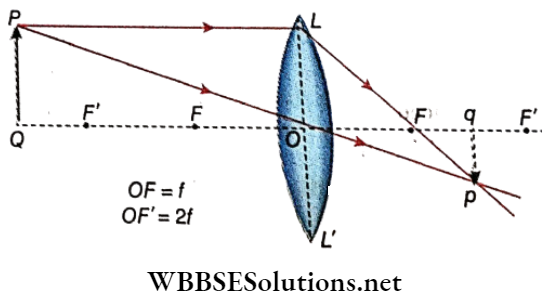
Class 12 Physics Unit 6 Optics Chapter 3 Refraction Of Light At Spherical Surface Lens Object Is Placed At Infinity And 2f

A ray travelling parallel to the principal axis the refraction through the lens passes through the focus F’ Another ray from p goes straight through the Optical centre O . These two refracted rays meet at the point p which is the image of p, from p, pq is drawn perpendicular to the principle axis Obviously, q is the image of the foot Q of the object. So, pq is the image of PQ.

3. Object is placed at 2f:   

The object PQ Is placed per appendicular to the principal axis of the convex lens I, If and is a distance 2f from the Leon A ray from travelling parallel to the principal axis air refraction through the lens passes through the focus P, Another ray from P goes straight through the optical centre Q, These two refracted rays meet at the point p which is the image of P from p, pq IN drawn perpendicular to the principal axis. Q Is the Image of the foot Q of the object. So, pq Is the image of PQ.
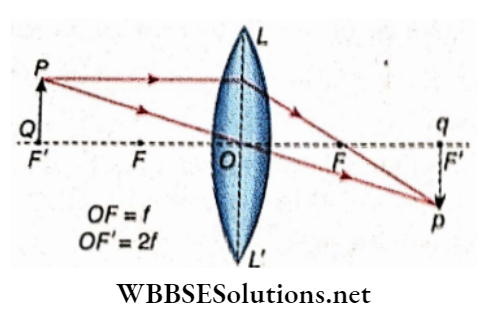
Class 12 Physics Unit 6 Optics Chapter 3 Refraction Of Light At Spherical Surface Lens Object Is Placed At 2f

Therefore, the image is formed on the side of the lens opposite to that of the object at a distance of 2f from the lens. The Image Is real, inverted and equal In size to the object

Use: In terrestrial telescope, this property of the convex lens Is utilised to convert the inverted Image Into an erect image of the same size.

4. Object is placed between f and 2f:

The object PQ is placed perpendicular to the principal axis of the convex lens LL’ and is placed between f and 2f, A ray from P travelling parallel to the principal axis after refraction through the lens passes through the focus P. Another ray from P goes straight through the optical centre 0. These two refracted rays meet at the point p which is the Image of P. From p, pq Is drawn perpendicular to the principle axis q is the image of the foot Q of the object. So pq is the images of PQ.
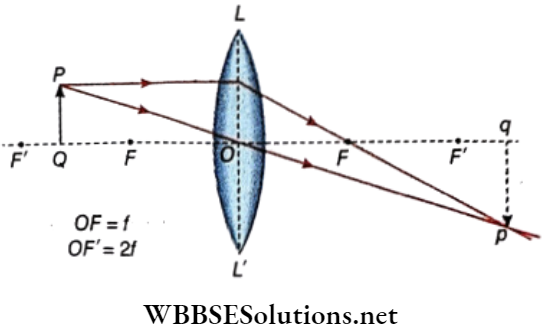
Class 12 Physics Unit 6 Optics Chapter 3 Refraction Of Light At Spherical Surface Lens Object Placed f And 2f

Therefore, die Image In formed on the side of the lens opposite to that of the object and at a distance greater than 2f. The image is real, inverted and magnified i size with respect to the object

Use:  The objective of a microscope Is made by utilising this property of the convex lens.

5. Object Is placed at:

The Object PQ is placed perpendicular to the principal axis of the convex lens LL’ and Is placed at focus. A ray from fi travelling parallel to the principal axis after refraction through the lens passes through DM focus V. Another ray from fi moves straight through Ilia optical centre O, these two refracted rays being parallel, the I Image of PQ Is assumed to be formed at infinity
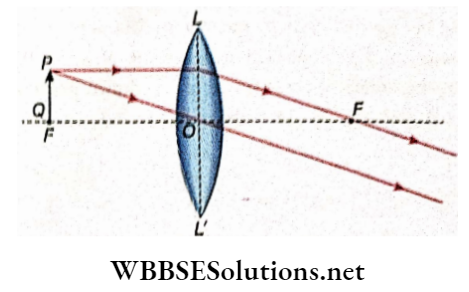
Class 12 Physics Unit 6 Optics Chapter 3 Refraction Of Light At Spherical Surface Lens Object Is Placed At f

Therefore, the linage Is formed at infinity on the side of the lens opposite to that of the object. The Image Is real, inverter and Infinitely magnified.

Use: The convex lens is utilised in the above way in such instruments whore the production of a parallel beam of rays is required. spectrometer parallel rays are produced in this way

Class 11 Physics Class 12 Maths Class 11 Chemistry
NEET Foundation Class 12 Physics NEET Physics

6. Object is placed between f and lens:

Is placed perpendicular to the principal axis of the convex le LL’ and Is placed between f and the lens. A ray free P travelling parallel to the principal axis after refraction through the lens passes through the focus F, Another ray horn I” moves straight through the optical centre 0. These two refracted rays are divergent. So when the two rays are produced backwards they meet at; which is the virtual Image of F. l; from p, pq is drawn perpendicular to the principal axis. So, pq Is the image of PQ.
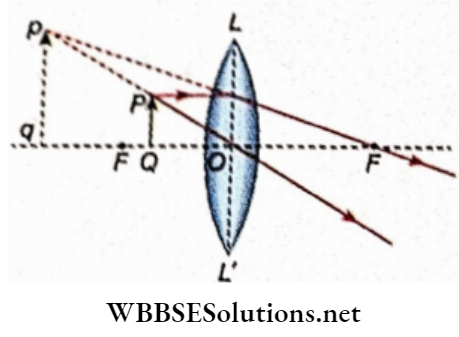
Class 12 Physics Unit 6 Optics Chapter 3 Refraction Of Light At Spherical Surface Lens Object Is Placed between f And Lens

Therefore, the image Is formed on the same side of the lens as the object Is situated. The image is virtual, erect and magnified.

Use: Magnifying glass, eyepieces of microscope and telescope are made utilising this principle of the convex lens

In the case of a concave lens

The object PQ is placed perpendicular to the principal axis of the concave lens LL’. A ray from P travelling parallel to the principal axis after refraction through the lens appears to diverge from the focus F. Another ray from P moves straight through the optical centre O.

The two refracted rays being divergent, when produced backwards, virtually meet at p. The point p from where the emergent rays appear to diverge after refraction through the lens is the image of P. From p, pq is drawn perpendicular to the principal axis. So, pq is the image of PQ
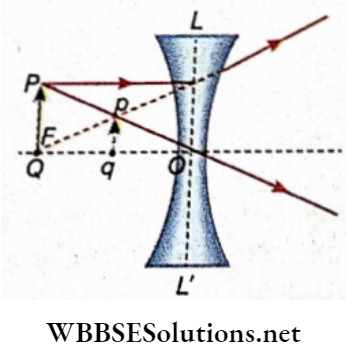
Class 12 Physics Unit 6 Optics Chapter 3 Refraction Of Light At Spherical Surface Lens In Case Of Concave Lens

Therefore, the image is formed on the same side of the lens as the object is situated. The image is virtual, erect and diminished in size concerning the object.

The image moves from F to the lens and increases in size as the object is brought from infinity up to the lens. But the size of the page will always be less than the object

Inference: The following Inferences can be drawn from the above discussion.

  1. The virtual InutHo la formed on the Maine (tide of the lens as the object but the real Image IN formed on the aide of the lens opposite to that of the object.
  2. Virtual Image Is always erect and real Image Is always Inverted.

If half of a lens Is palmed black, the brightness of the Image produced by the lens reduces to half as the Image will be produced due to refraction through half portion of the lens. However, the size of the Image remains the same, because every half part of a lens forms a complete image of an object.

Method of Identifying Lenses

We know that if an object is placed very near to a convex lens l.o., within the focal length, then a virtual, erect and magnified Imago Is formed. On the other hand, when an object Is placed very near to a concaveÿ Ions a virtual, correct and diminished Imago Is formed. So, to Identify a lens easily will hold a linger In front of the lens and look at It from the other side of the lens. If the Image Is erect and magnified concerning the object the lens Is convex. But If the image Is erect but diminished In size, the lens Is concave

Refraction Of Light At Spherical Surface Lens Sign Convention

  1. Distances along the principal axis are to be measured from the optical centre of the lens.
  2. Distance from the  optical centre) to be measured opposite to the direction of the incident ray are taken as negative and those to be measured in the direction of the incident ray are taken as positive. According to the above convention, the focal length of a convex lens is positive and that of a concave lens is negative.
  3. If the principal axis of the lens is taken as the x-axis, distances along the y-axis above the principal axis are taken as positive and distances along the y-axis below the principal axis are taken as negative

Assumptions are made during a discussion of refraction through the lens :

  1. The lens will be thin and its aperture will be small.
  2. Direction of incident ray will be shown from left to right i.e., the object should be considered to be placed on the left side of the lens.
  3. The optical centre O of the lens will be the origin of the cartesian frame of reference and the principal axis of the lens will be the x-axis

Refraction Of Light At Spherical Surface Lens General Formula Of Lens

The relation among object distance, image distance and focal length of a lens is known as the general formula of the lens.

Convex lens and real image

LL’ is a convex lens. An object PQ is placed perpendicular to the principal axis of the A ray from P travelling parallel to the; principal axis after refraction through the. leap passes through the second principal focus F. Another ray from P moves straight through the optical centre O. These two refracted rays meet at the point p which is the image of P. From p, pq is drawn per

Pendicular to the principal axis. So, pq is the image of PQ. This image is real and inverted
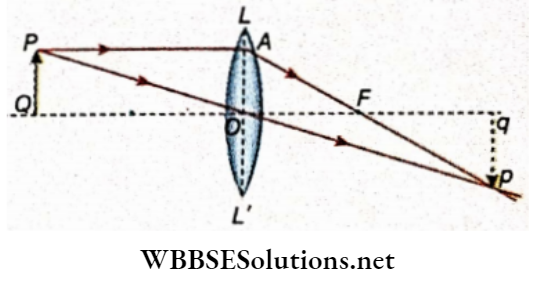
Class 12 Physics Unit 6 Optics Chapter 3 Refraction Of Light At Spherical Surface Lens Convex Lens And Real Image

As the triangles POQ and pOq are similar

∴ \(\frac{P Q}{p q}=\frac{O Q}{O q}\) ……………………………….(1)

On the other hand, as the triangles AFO and pFq are similar,

∴ \(\frac{A O}{p q}=\frac{F O}{F q}\)

Or,\(\frac{P Q}{p q}=\frac{F O}{F q}\)  ……………………………… (2)

AO = PQ

From equations (1) and (2) we, get

∴ \(\frac{O Q}{O q}=\frac{F O}{F q}\)

Or, \(\frac{O Q}{O q}=\frac{F O}{O q-O F}\) …………………… (3)

Now, according to sign convention, object distance = OQ = -u,

Image distance = Oq = +v, focal length = OF = +

Putting these values in equation (3) we get

Or , \(\frac{-u}{v}=\frac{f}{v-f}\)

Or, -uv+uf= vf

Or, -uf-vf = uv

Or, \(\frac{u f}{u v f}-\frac{v f}{u v f}=\frac{u v}{u v f}\)

Or, \(\frac{1}{v}-\frac{1}{u}=\frac{1}{f}\) ………………………(4)

Convex lens and virtual image

The object PQ is placed perpendicular, to the principal axis of the convex lens LL’ and is placed between the focus and the lens. So, the virtual image pq has been formed

As the triangles POQ and pOq are similar,

⇒ \(\frac{P Q}{p q}=\frac{O Q}{O q}\)
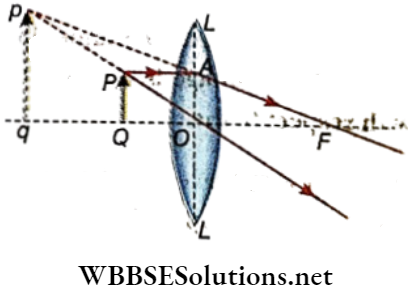
Class 12 Physics Unit 6 Optics Chapter 3 Refraction Of Light At Spherical Surface Lens Convex Lens And Virtual Image

On the other hand, as the triangles AFO and pFq, they are similar

⇒  \(\frac{A O}{p q}=\frac{O F}{q F}\)

Or, \(\frac{P Q}{p q}=\frac{O F}{q F}\) …………………….. (6)

[AO = PQ]

From equations (5) and (6) we get

⇒  \(\frac{O Q}{O q}=\frac{O F}{q F} \text { or, } \frac{O Q}{O q}=\frac{O F}{O q+O F}\) …………………. (7)

Now, according to sign convention, object distance =OQ -~u , image distance – Oq = -v, focal length = OF = +f

Putting these values in equation (7) we get

⇒  \(\frac{-u}{-v}=\frac{f}{-v+f}\)

or, uv-uf= -vf Or, uf- vf = uv

Or, \(\frac{u f}{u v f}-\frac{v f}{u v f}=\frac{u v}{u v f}\)

Or, \(\frac{1}{v}-\frac{1}{u}=\frac{1}{f}\) ……………………. (8)

The focal length of a convex is taken as positive, In the formation of a real image of a real object, u is negative but v is positive. So the formation of a real image of a real objective by a convex lens the modified form of the general formula is as follows.

⇒  \(\frac{1}{v}-\frac{1}{-u}=\frac{1}{f} \text { or, } \frac{1}{v}+\frac{1}{u}=\frac{1}{f}\)

Concave lens and virtual image

LL’ is a concave lens, An object PQ is placed perpendicular to the principal axis of the lens. A ray from P travelling parallel to the principal axis after refraction through the lens appears to diverge from the focus F. Another ray from P moves straight through the optical centre O. The two refracted rays virtually meet at p, The point p from where the emergent rays appear to diverge after refraction through the lens is the image of P. From p, pq is drawn perpendicular to the principal axis. So, pq is the Image of PQ. The image is virtual and erect
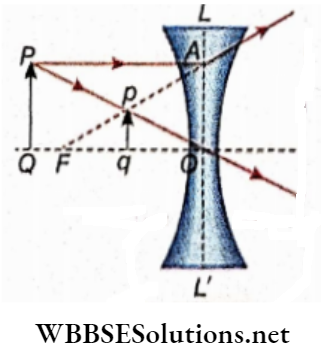
Class 12 Physics Unit 6 Optics Chapter 3 Refraction Of Light At Spherical Surface Lens Concave Lens And Virtual Image

As the triangles POQ and pOq are similar,

⇒ \(\frac{P Q}{p q}=\frac{O Q}{O q}\)

On the other hand, as the triangle APQ and ppq are similar

⇒  \(\frac{A O}{p q}=\frac{O F}{q F}\)

Or, \(\frac{P Q}{p q}=\frac{O F}{q F}\) ………………………………….. (10)

[AO = PQ]

From equations (9)and (10) we get,

⇒ \(\frac{O Q}{O q}\)

= \(\frac{O F}{q F} \text { or, } \frac{O Q}{O q}=\frac{O F}{O q+O F}\) ………………………… (11)

Now, according to sign convention , object distance = OQ = -u , image distance = Oq = -v, focal length = OF = -f

Putting these values in equation (11) we get,

⇒ \(\frac{-u}{-v}\)  = \(\frac{-f}{-f+v}\)

Or, uf – uv= vf

Or, uf- vf= uv

Or, \(\frac{u f}{u v f}-\frac{v f}{u v f}=\frac{u v}{u v f}\)

Or, \(\frac{1}{v}-\frac{1}{u}=\frac{1}{f}\) ………………………….. (12)

This is the conjugate foci relation of the lens, also known as the general formula of the lens.

The term conjugate means that the two points are Interchangeable, This follows from the principle of reversibility of light path. For these lenses the distance of conjugate foci l.e., u and v are given by the relation \(\frac{1}{v}-\frac{1}{u} \equiv \frac{1}{f}\) So this relation Is often called conjugate foci relation.

Refraction Of Light At Spherical Surface Lens Magnification Of The Image Formed By Lens

Linear or Transverse or Lateral Magnification of the Image of an Object Kept Perpendicular to the Principal Axis

Linear Magnification Definition:

Linear magnification of an image formed by a lens is defined as the ratio of the size of the image to the size of the object

Denoting linear magnification by m we have, from and

m = \(\frac{\text { size of image }(I)}{\text { size of object }(O)}=\frac{p q}{P Q}\)

= \(\frac{v}{u}=\frac{\text { image distance }}{\text { object distance }}\)

According to sign convention:

  1. For the formation of a real image in a convex lens u is negative and v is positive. So linear magnification m is negative. The image is inverted
  2. For the formation of a virtual image in a convex lens both u and v are negative. So linear magnification m is positive. The image is erect.
  3.  In the case of a concave lens both u and v are negative, So linear magnification m is positive. So the image is erect.

So we can say that if magnification is negative, the image is inverted and if magnification is positive, the image is erect

We can determine the expression for the magnification of an image formed by a lens by the same process as adopted for the determination of the magnification of an image formed by the reflection oflight on a curved surface.

It is to be noted that the real image formed by reflection is formed in front of the mirror i.e. on the same side of the mirror as the object. But in the case of a lens, the real image formed by a lens due to refraction is formed on the opposite side of the real object.

The general expression for magnification of the image formed by refraction in the lens is given by

m = \(\frac{I}{O}=\frac{v^2}{u}\)

Magnification produced by a combination of lenses:

The magnification of the final image produced by a combination of lenses is given by m = m1 × m2  × m3; where m1,m2,m3,…… etc..are respectively the magnifications produced by each lens.

Areal Magnification of the image is kept perpendicular to the principal axis

Areal Magnification Definition:

Linear magnification of an image formed by a lens is defined as the ratio of the size of the image to the size of the object.

Let the length and breadth of a two-dimensional object be l and b respectively. Hence, the area of object A = lb

If the linear magnification of the image is m, the length of the image l’ = mx l and the breadth of the image b’ = m × b

Area of the image, A’ = l’b’ = m²lb = m²A

Therefore areal magnification

m’ = \(\frac{A^{\prime}}{A}=m^2\) …………………. (1)

Longitudinal or Axial Magnification of the Image of an Object Kept Along the Principal Axis

Axial Magnification  Definition:

Longitudinal or Axial magnification of the image formed by a lens of an object kept along the principal axis is defined as the ratio of the length of the image to that of the object.

Let an extended object is kept along the principal axis of a vex lens.

Let u1 and u2 be the distances of the nearest and the furthest points respectively of the object along the principal axis and v1 and v2 the respective image distances

Longitudinal magnification m” = \(\frac{v_2-v_1}{u_2-u_1}=\frac{\Delta v}{\Delta u}\)

For infinitesimal values of Δv and Δu, magnification should be noted a \(\frac{d v}{d u}\)
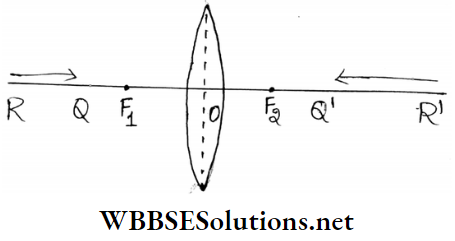
Class 12 Physics Unit 6 Optics Chapter 3 Refraction Of Light At Spherical Surface Lens Infinitesimal Values

Differentiating the lens equation, \(\frac{1}{v}+\frac{1}{u}=\frac{1}{f}\) , with respect to u we get,

⇒ \(-\frac{1}{v^2} \frac{d v}{d u}-\frac{1}{u^2}\) = 0 [ f is constant]

Or, \(\frac{d v}{d u}=\frac{-v^2}{u^2}\)

m” = \(\frac{d v}{d u}=-m^2\) …………………………..(1)

Longitudinal magnification =- (linear magnification)²

Hence, longitudinal magnification in the case of the lens is numerically equal to the square of linear magnification.

It is dear from equation (1) that m” is always negative irrespective of the sign of m. This implies that object and image always lie in opposite directions along the principal axis, whatever may be the nature of the image real or virtual, in a convex or concave lens. This matter is called axial change

Relation of f and v or f and u with m

The lens formula is

⇒ \(\frac{1}{\nu}-\frac{1}{u}=\frac{1}{f}\) …………………………………… (1)

Or, \(1-\frac{\nu}{u}=\frac{p^{\prime}}{f} \text { or, } 1-m=\frac{\nu}{f}\)

Or, m = \(1-\frac{\nu}{f} \text { or, } m=\frac{f-\nu}{f}\)

Again, from equation (1) we get,

⇒ \(\frac{u}{\nu}-1=\frac{u}{f} \text { or, } \frac{1}{m}-1=\frac{u}{f}\)

Or,  \(\frac{1}{m}=1+\frac{u}{f} \text { or }, \frac{1}{m}=\frac{f+u}{f}\)

m = \(\frac{f}{u+f}\)

u-v And \(\frac{1}{u} \frac{1}{v}\) Graphs For Convex Lens

The focal length of convex lens f is positive. The real image formed by this lens is always situated on the side opposite to the object So image distance v is also positive. According to the sign convention object distance u is negative. Hence if a real image is formed by a convex lens the equation of the lens is as follows

⇒ \(\frac{1}{v}-\frac{1}{-u}=\frac{1}{f} \text { or, } \frac{1}{v}+\frac{1}{u}=\frac{1}{f}\)

1. u – v graph: In the case of a convex lens if different values of object distances and the corresponding image distances are recorded and plotted on a graph, It will be a rectangular hyperbola
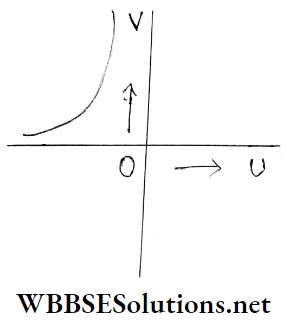
Class 12 Physics Unit 6 Optics Chapter 3 Refraction Of Light At Spherical Surface Lens Rectangular Hyperbola

2. \(\frac{f}{u+f}\) graph:

In case a convex lens if \(\frac{1}{u} \sim \frac{1}{v}\)graph Is drawn taking different values of u and v, It will be a straight line The intercept cut by the straight line AB from the axes are each equal to \(\frac{1}{f}\)

i.e OA = OB = \(\frac{1}{f}\)
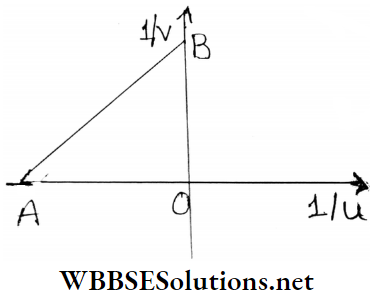
Class 12 Physics Unit 6 Optics Chapter 3 Refraction Of Light At Spherical Surface Lens The Intercept Cut By The Straight Line

Numerical Examples

Example 1. The distance of an object from a convex lens is 20 cm. If the focal length of the lens is 15 cm determines the position of the image and its nature.
Solution:

Here, u = -20 cm ; as the lens is convex,f = +15 cm

We know, \(\frac{1}{v}-\frac{1}{u}=\frac{1}{f}\)

Or, \(\frac{1}{v}=\frac{1}{u}+\frac{1}{f}=\frac{1}{-20}+\frac{1}{15}\)

= \(\frac{4-3}{60}=\frac{1}{60}\)

Or, v = 60 cm

As v  is positive, the image will be formed on the side opposite to the object at a distance of 60 cm i.e., the image is real.

Magnification, m = \(\frac{v}{u}\frac{60}{-20}\) = -3

So, an image magnified three times as the size of the object is formed. As magnification is negative, the image is inverted

Example 2. If an object is placed at a distance of 30 cm from a lens, a virtual image is formed. If the magnification of the image Is, find the position of the image and the focal length of the lens. Also, find the nature of the lens
Solution:

Here, object distance, u = -30 cm ; magnification

m = \(\frac{1}{v}-\frac{1}{u}=\frac{1}{f}\)

Or, \(\frac{u}{v}-1=\frac{u}{f}\)

Or, \(\frac{1}{m}-1=\frac{u}{f}\)
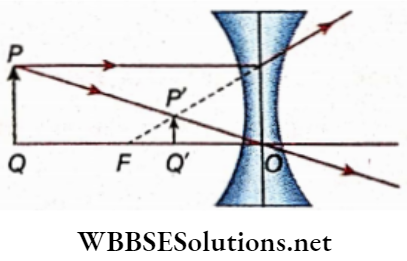
Class 12 Physics Unit 6 Optics Chapter 3 Refraction Of Light At Spherical Surface Lens Focal Lenght Of The Lens

Substituting m = \(\frac{2}{3}\) u = -30 we get,

⇒ \(\frac{3}{2}\)– 1 = \(\frac{3}{2}-1=\frac{-30}{f}\), or, f = -30 × 2 = -60 cm

The focal length of the lens is 60 cm.

Further, the negative sign of f implies that the lens is a concave one

Important Definitions Related to Lens Refraction

Example 3. A convex lens forms a real image of an object magni¬ fied n times. Prove that the object distance =(n+ 1) \(\frac{f}{n}\) , f = focal length of the lens
Solution:

Here, magnification =n

i.e, \(\frac{v}{u}\) = n or, v = nu

For a real object, is negative and v is positive. For a convex lens f is positive. Following this sign convention, we get from the lens formula

⇒ \(\frac{1}{v}-\frac{1}{u}=\frac{1}{f}\)

Or, \(\frac{1}{n u}+\frac{1}{u}=\frac{1}{f}\)

or, u = \(\frac{1+n}{n u}=\frac{1}{f}\)

u = (n+1)\(\frac{f}{n}\)

i. e the object distance is (n+1)\(\frac{f}{n}\)

Example 4.

1. A luminous object and a screen are placed 90 cm apart. To cast an image magnified twice the size of the object on the screen, what type of lens is required and what will be its focal length?

2. An object Is situated at a distance of 10 in from the convex lens. A magnified Image Is cast on a screen by the lens. Its magnification Is 19  what is the focal length of the lens
Solution:

Since The image is formed on a screen, it Is real. Hence lire lens to be used should be convex.

In this case, u + v = 90 cm

And \(\frac{v}{u}\) = 2 or, v = 2u

∴ 3u = 90 cm

or, u = 30 cm

∴  v= 90- 30 = 60 cm

Substituting in lens formula, \(\frac{1}{v}-\frac{1}{u}=\frac{1}{f}\)

Or, \(\frac{1}{60}-\frac{1}{-30}=\frac{1}{f}\)  [

u = – 30, as the object is real

Or, f = 20 cm

The focal length of the lens is 20 cm.

Magnification , m = \(\frac{v}{u}\) = 19

v = 19 u = 19 × 10 = 190m

Substituting v = 190 and u – 10 in \(\frac{1}{v}-\frac{1}{u}=\frac{1}{f}\)

We get, \(\frac{1}{190}+\frac{1}{10}=\frac{1}{f}\) Or, f = \(\frac{190}{1+19}\) = 9.5 m1

∴ The focal length of the lens is 9.5 m.

Example 5.  A convex lens is placed just above an empty vessel. Ait object is placed at the bottom of the vessel and at u distance of 45 cm below the lens. An image of the object is formed above the vessel at a distance of 36 cm front die lens. A liquid is poured up to a height of 40 and cut lit the vessel. Now the image is formed above the vessel at ! a distance of 48 cm from the lens. Calculate the refractive index of the liquid
Solution: 

When the vessel is empty, u = (-45) cm , v = 36 cm From the equation of the lens we get

⇒ \(\frac{1}{v}-\frac{1}{u}=\frac{1}{f}\)

Or, \(\frac{1}{+36}-\frac{1}{-45}=\frac{1}{f}\)

Or, \(\frac{+9}{180}=\frac{1}{f}\)

Or,  f = + 20 cm

On pouring the liquid into the vessel the apparent position of the object will be raised.

Real depth of the liquid = 40 cm and apparent depth = cm (say)

If the refractive index of the liquid is fi, then

μ = \(\frac{\text { real depth }}{\text { apparent depth }}=\frac{40}{x}\)

⇒ \(\frac{40}{\mu}\)

Or, x =  \(\frac{40}{\mu}\)

Now, distance of the lens from the liquid surface = 45-40 = 5 cm

Object distance from the lens = (5 + x) = 5 + \(\frac{40}{\mu}\)

In this case, v = +48 cm and f = +20 cm

From the equation of the lens

⇒ \(\frac{1}{v}-\frac{1}{u}=\frac{1}{f}\)

⇒  \(\frac{1}{48}-\frac{1}{-\left[5+\frac{40}{\mu}\right]}=\frac{1}{20}\)

Or, \(\frac{1}{48}+\frac{1}{5+\frac{40}{\mu}}=\frac{1}{20}\)

Or, \(\frac{1}{5+\frac{40}{\mu}}=\frac{1}{20}-\frac{1}{48}=\frac{7}{240}\)

⇒ \(5+\frac{40}{\mu}=\frac{240}{7}\)

⇒  \(\frac{40}{\mu}=\frac{240}{7}-5\)

⇒ \(\frac{40}{\mu}=\frac{205}{7}\)

⇒ \(\frac{280}{205}\)

= 1.366

Example 6. Two convex lenses of focal lengths 15 cm and 10 cm are placed coaxially. A ray of light parallel to the principal axis of a lens is incident on it and emerges from the other lens parallel to the same axis. Draw a neat ray – diagram. What is the distance of separation between the lenses?
Solution: 

The ray incident on the lens Ly passes through the second principal focus of this lens after refraction. Since the ray after refraction through the second lens moves parallel to the principal axis of this lens, F is the first principal focus of lens L2
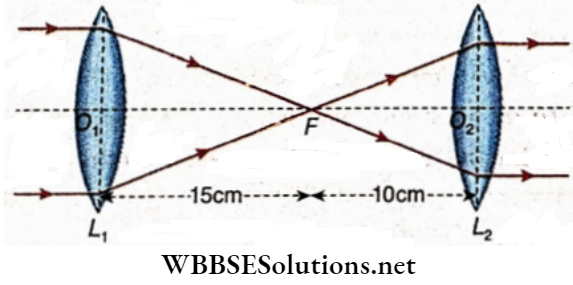
Class 12 Physics Unit 6 Optics Chapter 3 Refraction Of Light At Spherical Surface Lens Two convex Lenses Of Focal Lenghts

O2F = 15 cm , O2 F = 10 cm

Distance of separation between the lenses

= 15 + 10 = 25 cm

Example 7. If an object is placed at a distance of 20 cm in front of a convex lens, three times magnified and an Inverted Image is formed. In which direction and how far Is the lens to be moved to obtain an erect Image of equal magnification [m = 3] T
Solution:

Here, m = 3 and u = 20 cm

Here, m = 3 and u = 20 cm

⇒ \(\frac{v}{u}\)= 3

Or, v = 3u = 3 × 20 = 60 cm

Now \(\frac{1}{v}-\frac{1}{u}=\frac{1}{f}\)

⇒ \(\frac{1}{60}-\frac{1}{-20}=\frac{1}{f}\)

Following sign convention, u = -20 cm and v = 60 cm

Or, f = 15 cm

To obtain an erect image, the lens is to be moved towards the object, so that the object distance now becomes less than the focal distance of the lens

Let the lens is moved x cm towards the object

So, the object distance becomes, u1 = (20 -x) cm

Let the image distance be v1 cm

⇒ \(\frac{v_1}{u_1}\)  = m = 3

Or, v1 = 3u1 = 3(20- x) cm

From the lens equation following the sign convention we have,

⇒ \(\frac{1}{v_1}-\frac{1}{u_1}=\frac{1}{f} \text { or, } \frac{1}{-3(20-x)}-\frac{1}{-(20-x)}\)

= \(\frac{1}{15}\) [as the image is virtual and so v1 is taken as negative]

Or, \(\frac{2}{3(20-x)}=\frac{1}{15}\)

Or,  x = 10 cm

∴ The lens is to be moved by a distance of 10 cm towards the lens

Example 8. If a magnifying lens of focal length 10 cm is held in front of very small writing, It is magnified five times. How far was the magnifying lens held?
Solution:

Here, focal length, f = 10 cm

Let object distance = u

Now, magnification, m = \(\frac{v}{u}\) – = 5, or, v = 5u

Now \(\frac{1}{v}-\frac{1}{u}=\frac{1}{f}\)

⇒ \(\frac{1}{-5 u}-\frac{1}{-u}=\frac{1}{10}\)

[For magnifying lens, u and v both are negative]

Or, \(-\frac{1}{5 u}+\frac{1}{u}=\frac{1}{10}\)

Or, \(\frac{4}{5 u}=\frac{1}{10}\)

Or , u = 8 cm

So, the lens was held at a distance of 8 cm from the writing

Example 9. An object is placed at a distance of 150 cm from a screen. A convex lens is placed between the object and the screen so that an image magnified 4 times the object is formed on the screen. Determine the position of the lens and its focal length
Solution:

Here, u + v – 150 cm

And magnification, m = 4 or, – = 4 or, v = 4h

From equation (1) we have,

u + 4u = 150

Or,  5u = 150 or, u = 30 cm

∴ v = 4 × 30 = 120 cm

Hence, the distance of the lens from the screen = 120 cm

Now, \(\frac{1}{v}-\frac{1}{u}=\frac{1}{f}\)

Or, \(\frac{1}{120}-\frac{1}{-30}=\frac{1}{f}\)

Since the object and the image are situated on mutually opposite sides of the lens, u = -30 cm, v = 120 cm

⇒ \(\frac{1}{120}+\frac{1}{30}=\frac{1}{f}\)

Or, \(\frac{1}{f}=\frac{1+4}{120}\)

= \(\frac{5}{120}\)

or, f = 24 cm

The focal length of the lens is 24 cm.

Example 10. A convex lens of focal length f forms an image which is m times magnified on a screen.If the distance of the object and the screen is x, prove that f = \(\frac{m x}{(1+m)^2}\)
Solution:

Since the image is formed on a screen, it is real. So the image distance is positive. The focal length is also positive. Object distance is negativeMagnification, m = “ or; v

Magnification, m = \(\frac{v}{u}\)  or; v  = mu

Here u+v = x Or, U+ mu = x Or, u= \(\)

v =  \(\frac{m x}{1+m}\)

The equation of lens \(\frac{1}{v}-\frac{1}{u}=\frac{1}{f}\)

⇒ \(\frac{1}{m u}+\frac{1}{u}=\frac{1}{f}\) Or, \(\)

Or, f = \(\frac{m u}{1+m}=\frac{m x}{(1+m)^2}\)

Since u = \(\frac{x}{1+m}\)

Example 11.  An object is placed on the left side of a convex lens A of focal length 20 cm at a distance of 10 cm from the lens. Another convex lens of focal length 10 cm is placed co-axially on the right side of lens A at a distance of 5 cm from it Determine magnification and position of the final image by the lens combination. Solution; In case of image formation by the first lens, u cm; f = 20 cm, v =?
Solution:

Now, \(\frac{1}{v}-\frac{1}{u}=\frac{1}{f}\)

⇒ \(\frac{1}{v}-\frac{1}{-10}=+\frac{1}{20}\)

⇒  \(\frac{1}{v}=\frac{-1}{10}+\frac{1}{20}=\frac{-1}{20}\)

v = -20cm

Since v is negative, a virtual image would form on the same side of the object at a distance of 20 cm from the lens.

This image will act as the object for the second lens.

In the case of image formation by the second lens,

u= -(20+5) = -25 cm,

f= 10 cm,

v =?

From the equation of lens,

⇒  \(\frac{1}{v}-\frac{1}{u}=\frac{1}{f}\)

⇒  \(\frac{1}{v}-\frac{1}{-25}=\frac{1}{10}\)

⇒  \(\frac{1}{v}=\frac{-1}{25}+\frac{1}{10}=\frac{3}{50}\)

Or, v = \(\frac{50}{3}\)

= 16.66

So, finally, a real image is formed on the right side of the second lens (on the opposite side of the object) at a distance of 16.66 cm from this lens.

Magnification by the first lens

m1 = \(\frac{v}{u}=\frac{20}{10}\)

= 2

And magnification by the second lens

m2 = \(\frac{v}{u}=\frac{50}{3 \times 25}\)

= \(\frac{2}{3}\)

Magnification by the lens combination

m = m1 × m2

= 2 × \(\frac{2}{3}\)

= \(\frac{4}{3}\)

= 1.33

Example 12. A convex lens forms a real image of an object magnified 10 times. If the focal length of the lens is 20cm, determine the distance of the object from the lens
Solution:

Let object distance = x

Here, m= 10

∴ \(\frac{v}{x}=10\)

Or, v = 10 x

In this case, v is positive and f = 20 cm

From The Equation of the Lens

⇒ \(\frac{1}{v}-\frac{1}{u}=\frac{1}{f}\)

Or, \(\frac{1}{10 x}-\frac{1}{-x}=\frac{1}{20}\)

Or, \(\frac{11}{10 x}=\frac{1}{20}\)

Or, x =  22cm

Object distance = 22cm

Examples of Applications of Spherical Lenses in Optics

Example 13. Two convex lenses of focal lengths 3cm and 4cm are placed 8cm apart from each other. An object of height Icm Is placed In front of a lens of smaller focal length at a distance 4cm. Determine the magnification and size of the final image by the lens combination.
Solution:

In the case of image formation by the first lens, u = -4cm,f = 3cm

Now, \(\frac{1}{\nu}-\frac{1}{u}=\frac{1}{f}\)

Or, \(\frac{1}{v}+\frac{1}{4}=\frac{1}{3}\)

Or, \(\frac{1}{\nu}=\frac{1}{3}-\frac{1}{4}=\frac{1}{12}\)

Or, v = 12 cm

Since v is positive, an image would form on the side of the first lens opposite that of the object. This image acts as a virtual image for the second lens.

In the case of image formation by this lens

u = (12-8) = 4cm , f = 4 cm , v= ?

From the equation of lens

⇒ \(\frac{1}{v}-\frac{1}{u}=\frac{1}{f}\)

⇒ \(\frac{1}{v}-\frac{1}{4}=\frac{1}{4}\)

Or, \(\frac{1}{v}=\frac{1}{4}+\frac{1}{4}\)

⇒ \(\frac{1}{2}\)

Or v = 2cm

So, the final image is real and it will be formed at a distance 2cm from the second lens.

Magnification by the first lens

m1 = \(\frac{v}{u}=\frac{12}{4}\)

m1 = 3

Magnification by the second lens

m2 = \(\frac{v}{u}=\frac{2}{4}\)

m2 = \(\frac{1}{2}\)

So, magnification by the lens combination

m = m1 × m2 = \(3 \times \frac{1}{2}=\frac{3}{2}\)

Again m = \(\frac{\text { size of image }}{\text { size of object }}\)

Or, \(\frac{3}{2}=\frac{\text { size of image }}{1}\)

Or, size of image = \(\frac{3}{2}\)

= 1.5 cm

Image Of A Virtual Object

We have so far discussed the image formation of real objects. But objects may be virtual as well and images of the virtual objects can be formed by using lenses.

A converging beam of rays is incident on a convex lens and a concave lens respectively. In the absence of the lenses, the converging beam of rays would meet at Q on the other side of the lenses but due to the presence of the lenses the beam meets at Q’. So, Q is a virtual object here and its image Q’ is a real
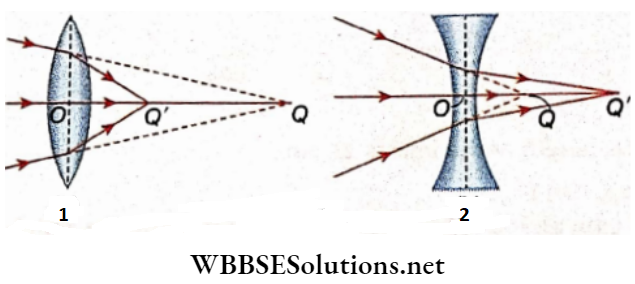
Class 12 Physics Unit 6 Optics Chapter 3 Refraction Of Light At Spherical Surface Lens Image Of A Virtual Object

After refraction in the convex lens, a convergent beam of rays becomes more convergent i.e., the convergent beam meets nearer to the lens. In the case of the convex lens, Q’ is nearer to the lens than Q . Obviously in this case image distance, OQ’ is less than object distance, OQ. In a convex lens, the real image of a virtual object is formed and the image lies within the focus

After refraction in the concave lens, a convergent beam of rays becomes less convergent i.e., the convergent beam meets further away from the lens. In the case of a concave lens Q’ is more distant from the lens than Q . Obviously in this case image distance, OQ’ is greater than object distance, OQ.

But if the virtual object distance, OQ is greater than the focal length of the concave lens, the image formed by the concave lens becomes virtual.

Remember that virtual object distance is positive.

Example 1. If a convex lens of focal length 20 cm is placed in the path of a convergent beam of rays, the beam meets at Q. In the absence of the lens, the beam would meet at P.If the distance of P from the lens- is 30 cm, determine the distance of Q from the lens
Solution:

The converging beam of rays meets at Q after refraction in the lens LL’. In the absence of the lens the beam would meet at P In this case concerning the lens, P is the virtual object and Q is its real image

Here, u = 30 cm , f= 20 cm , v = OQ = ?
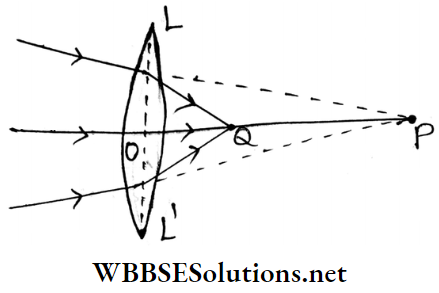
Class 12 Physics Unit 6 Optics Chapter 3 Refraction Of Light At Spherical Surface Lens The Coverging Beam Of Rays Meets

The equaton of lens is = \(\frac{1}{v}-\frac{1}{u}=\frac{1}{f}\)

⇒ \(\frac{1}{v}-\frac{1}{30}=\frac{1}{20}\)

Or, \(\frac{1}{v}=\frac{1}{30}+\frac{1}{20}=\frac{1}{12}\)

Or, v =12cm

Required distance OQ = 12cm

Example 2. A converging beam of frays after refraction in a concave lens of focal length 20 cm meets at a distance of 15 cm from the lens. In the absence of the lens, where would the beam meet?
Solution:

In the absence of the lens, the converging beam would meet at P. So, concerning this lens P is the virtual object and Q is its real image
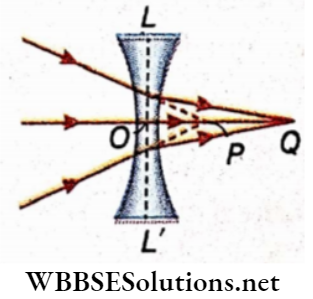
Class 12 Physics Unit 6 Optics Chapter 3 Refraction Of Light At Spherical Surface Lens A Convergining Beam Of Rays After Refraction

In this case, v = OQ – 15 cm; f= -20 cm

The equation of lens is \(\)

⇒ \(\frac{1}{15}-\frac{1}{u}=-\frac{1}{20}\)

Or, \(\frac{1}{u}=\frac{1}{20}+\frac{1}{15}\)

u = \(\frac{60}{7}\) = 8.57 cm

Therefore, in the absence of the lens, the beam of rays would meet at a distance of 8.57 cm from the lens.

Refraction Of Light At Spherical Surface Lens Newton’s Equation

Let II’ be a convex lens. F, F’ and O are the second principal focus, the first principal focus and the optical centre of the lens respectively. P and Q are the point object and point image respectively
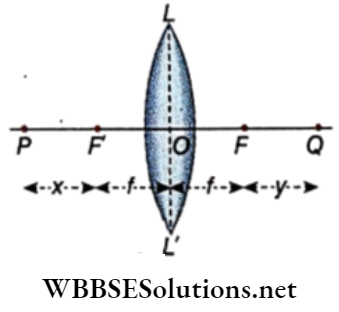
Class 12 Physics Unit 6 Optics Chapter 3 Refraction Of Light At Spherical Surface Lens Newtons Equation

Here, OF = OF’ = f; PF’ = x and QF = y; object distance, OP = -u = and image distance,
OQ – v = y+f

The equation of the lens is

⇒ \(\frac{1}{v}-\frac{1}{u}=\frac{1}{f}\)

⇒ \(\frac{1}{y+f}+\frac{1}{x+f}=\frac{1}{f}\)

Or, \(\frac{x+f+y+f}{(y+f)(x+f)}=\frac{1}{f}\)

or, (y +f)(x +f) = f(x + y + 2f)

or, xy + xf+ yf+f² = xf+ yf+ 2f² or, xy = f²

This is Newton’s equation in the case of lens.

For any lens, f is a constant quantity. Hence, an x- y graph supporting Newton’s equation will be a rectangular hyperbola.

Refraction Of Light At Spherical Surface Lens Lens Makers Formula For Thin Lens

The lens maker’s formula involves the focal length, the refractive index of the material of the lens, and the radius of curvature of the two surfaces of the lens. This formula is derived from the refraction of light on the two spherical surfaces of a lens.
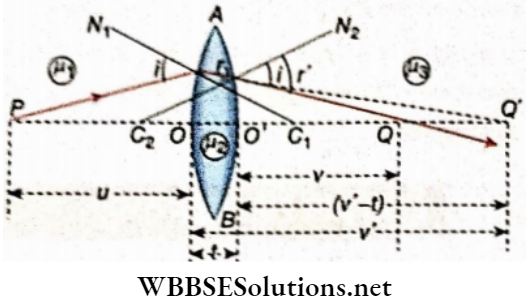
Class 12 Physics Unit 6 Optics Chapter 3 Refraction Of Light At Spherical Surface Lens lens MArkers Formula For Thin Lens

In refraction of light at the two spherical surfaces of a biconvex lens has been shown. P is the point object on the principal axis of the lens; Q’ is the image formed due to the refraction of light at die first surface of the lens and Q is the final image

Let μ1 = Refractive index of the medium in which the object is placed

μ2  = Refractive index of the material of the lens

μ3   = Refractive index of the medium into which the final ray emerges

In the Gaussian system, the object distance is measured from the pole O of the first spherical surface, and the final image distance is measured from the pole O of the second spherical surface. Accordingly,

object distance, OP = -u

Image distance, OQ’ = v’

Final image distance, O’Q = v

Thickness of lens on the axis, OO’ = t

The radius of curvature of the first surface of the lens = r1

The radius of curvature of the second surface of the lens = -r2

Considering refraction at the first surface AOB of the lens we have,

⇒ \(\frac{\mu_2}{v^{\prime}}-\frac{\mu_1}{u}=\frac{\mu_2-\mu_1}{r_1}\) ……………. (1)

Both object and image are real

Considering refraction at the second surface AO’B of the lens we have,

⇒ \(\frac{\mu_3}{v}-\frac{\mu_2}{v^{\prime}-t}=\frac{\mu_3-\mu_2}{r_2}\) …………….(2)

The object is virtual and the image is real

If the lens is very thin i.e…… v’, then it can be neglected.

In that case, equation (2) becomes

⇒ \(\frac{\mu_3}{v}-\frac{\mu_2}{v^{\prime}-t}=\frac{\mu_3-\mu_2}{r_2}\) …………….(3)

Adding equations (1) and (3) we have,

⇒ \(\frac{\mu_3}{v}-\frac{\mu_1}{u}=\frac{\mu_2-\mu_1}{r_1}+\frac{\mu_3-\mu_2}{r_2}\) ……………. (4)

This is the general equation of the lens:

This formula has been obtained for the formation of real images by a convex lens. But this formula is equally applicable for the formation of virtual image by a convex lens or for the concave lens

If the surrounding medium is by air, then μ1 = μ3  = 1

Taking  μ2  = μ for the r of the material, we have

⇒ \(\frac{1}{v}-\frac{1}{u}=(\mu-1)\left(\frac{1}{r_1}-\frac{1}{r_2}\right)\) ………… (5)

If the object is at infinity, the image will be formed at the principal focus

i. e if u = ∞, v= f

∴ \(\frac{1}{f}=(\mu-1)\left(\frac{1}{r_1}-\frac{1}{r_2}\right)\) ……………………. (6)

This is the lens maker’s formula.

Lens in the air

If the refractive index of a glass lens relative to air is Jig and the radii of curvature of the first and the second refracting surfaces are r1 and r2 respectively, the focal length  of the lens is obtained from the following relation,

\(\frac{1}{v}-\frac{1}{u}=(\mu-1)\left(\frac{1}{r_1}-\frac{1}{r_2}\right)\) ………………… (7)

1. In the case of the biconvex lens:  r1 is positive and r2 is negative,

So for this lens from equation (7) we have,

⇒ \(\frac{1}{f}=\left({ }_a \mu_g-1\right)\left(\frac{1}{r_1}+\frac{1}{r_2}\right)\) ……………………. (8)

If the lens is equi-convex, then r1 = r2 = r and in that case,

⇒ \(\frac{1}{f}=\left(a_g{ }_g-1\right)^{\frac{2}{r}}\) ……………….. (9)

2. In the case of the biconcave lens: r1 is native and r2 is positive.

So for this lens from equation (7) we have

⇒ \(\frac{1}{f}=-\left(a_a \mu_g-1\right)\left(\frac{1}{r_1}+\frac{1}{r_2}\right)\) ……………….. (10)

If the lens Is equt-concnvo, then r1 = r2 = r. In this case

⇒ \(\frac{1}{f}=-\left({ }_a \mu_g-1\right) \cdot \frac{2}{r}\) …………………………… (11)

Dependence of focal length on surrounding medium:

Let us suppose that a lens Is situated In a medium denser titan air. Suppose, the denser medium is water.

Now, If the focal lengths of the lens In air and water are fa and fa respectively, then

⇒ \(\frac{1}{f_a}=\left({ }_a \mu_g-1\right)\left(\frac{1}{r_1}-\frac{1}{r_2}\right) \text { and } \frac{1}{f_w}=\left({ }_w \mu_g-1\right)\left(\frac{1}{r_1}-\frac{1}{r_2}\right)\)

∴ r1 and r2 are the radii of curvature of the first and the second refracting surfaces respectively

⇒ \(\frac{\frac{1}{f_a}}{\frac{1}{f_w}}=\frac{\left({ }_a \mu_g-1\right)}{\left({ }_w \mu_g-1\right)}\)

Or,  \(\frac{f_w}{f_a}=\frac{\left({ }_a \mu_g-1\right)}{\left({ }_w \mu_g-1\right)}\) ……………… (12)

Now , \(\frac{w^{\mu_g}}{1}=\frac{a^{\mu_g}}{a^{\mu_w}}\)

Or, \(\frac{a^\mu g}{w^\mu g}=a^\mu w>1\)

∴ \(w^{\mu_g}<{ }_a \mu_g\)

Or, \(w^{\mu_g-1}<_a \mu_g-1\)

From equations (12) and (13) we get,

⇒\(\frac{f_w}{f_a}\) >1 Or, fw >fa

So, the focal length of a lens increases with the Increase of optical density of the surrounding medium.

If a convex lens of focal length f is cut horizontally along its principal axis into two halves, each half will have a focal 1 length equal to/ because the radii of curvature of the two surfaces of the new parts have the same values as the original

Refraction Of Light At Spherical Surface Lens Lens Makers Formula For Thin Lens Numerical Examples

Example 1. Focal length The focal length of a glass lens in air is 5 cm. What will be its focal length In water? The refractive index of glass =1.51 and the refractive index of water =1.33.
Solution:

Let the focal length of the lens in air =fa radii of curvature of the two surfaces = r1 and r2

\(\frac{1}{f_a}\) = ( aμg– 1) \(\left(\frac{1}{r_1}-\frac{1}{r_2}\right)\)

Or, \(\frac{1}{5}=(1.51-1)\left(\frac{1}{r_1}-\frac{1}{r_2}\right)\)

Or, \(\frac{1}{r_1}-\frac{1}{r_2}=\frac{1}{5 \times 0.51}\)

= \(\frac{1}{2.55}\)

If the focal length of the lens In water Is fw, then

⇒ \(\frac{1}{f_w}=\left({ }_w \mu_g-1\right)\left(\frac{1}{r_1}-\frac{1}{r_2}\right)\)

Or, \(\frac{1}{r_1}-\frac{1}{r_2}=\frac{1}{5 \times 0.51}=\frac{1}{2.55}\)

⇒ \(\left(\frac{1.51}{1.33}-1\right) \times \frac{1}{2.55}\)

= \(\frac{0.18}{1.33} \times \frac{1}{2.55}\)

= \(\frac{1.33 \times 2.55}{0.18}\)

= 18.84 cm

Example 2.  A convex lens(μ =1.5) Is Immersed. In water (μ = 1.33). Will the focal length of the lens change In water? If so, how?
Solution:

If the focal length of the convex lens In air Is fa, the refractive index of the material of the lens is and the radii of curvature of the two surfaces are r1 and r2, then following sign convention

\(\frac{1}{f_a}=+\left(a_a \mu_g-1\right)\left(\frac{1}{r_1}+\frac{1}{r_2}\right)\) ………………………… (1)

If the lens is immersed in water, the focal length of the lens will be changed. If the focal length of the lens when immersed in water is fw, then

\(\frac{1}{f_w}=+\left({ }_w \mu_g-1\right)\left(\frac{1}{r_1}+\frac{1}{r_2}\right)\) ……………………… (2)

Dividing equation (1) by equation (2)

⇒ \(\frac{\frac{1}{f_a}}{\frac{1}{f_w}}=\frac{a^{\mu_g-1}}{w^{\mu_g-1}}\)

Or, \(\frac{f_w}{f_a}=\frac{1.5-1}{1.1278-1}\)

wμg = \(\frac{a^{\mu_g}}{a^\mu}=\frac{1.5}{1.33}\)

= 1.1278

⇒ \(w^{\mu_{\mathrm{g}}}=\frac{a^{\mu_{\mathrm{g}}}}{a^{\mu_w}}=\frac{1.5}{1.33}=1.1278\)

⇒ \(\frac{0.5}{0.1278}\)

= 3.9 Or , fw = 3.9 fa

So, if the lens is immersed in water Its focal length will be about 4 times its focal length in air.

Example 3. The radii of curvature of two surfaces of a biconvex glass lens are 20 cm and 30 cm. What is its focal length in air and water Refraction index of glass = \(\frac{3}{2}\) refractive index of water = \(\frac{4}{3}\)
Solution:

If the focal length of the lens in air is fa and following sign convention, we have

⇒ \(\frac{1}{f_a}=\left({ }_a \mu_g-1\right)\left(\frac{1}{r_1}+\frac{1}{r_2}\right)\)

= \(\left(\frac{3}{2}-1\right)\left(\frac{1}{20}+\frac{1}{30}\right)\)

= \(\frac{1}{2} \times \frac{5}{60}=\frac{1}{24}\)

fa = 24 cm

Therefore, the focal length of the biconvex lens in air is 24 cm. If the focal length of the lens in water is fw, we have

⇒ \(\frac{1}{f_w}=\left({ }_w \mu_g-1\right)\left(\frac{1}{r_1}+\frac{1}{r_2}\right)\)

⇒ \(\left(\frac{9}{8}-1\right)\left(\frac{1}{20}+\frac{1}{30}\right)\)

⇒ \(\frac{1}{8} \times \frac{5}{60}=\frac{1}{96}\)

wμg= \(\frac{a^{\mu_g}}{a^{\mu_w}}=\frac{\frac{3}{2}}{\frac{4}{3}}=\frac{9}{8}\)

fw= 96 cm

So, the focal length of the lens in water is 96 cm

Example 4. A plano-convex lens has a radius of curvature 10. It focal length is 80 cm in water. Calculate the refractive index ofthe material ofthe lens. Given refractive index of water \(\frac{4}{3}\)
Solution:

Let the absolute refractive index of the material of the lens = n of the material concerning water = n1: absolute r. i of water = n’

Given, r1 = ∞ and r2 = -10 cm. The focal length of the planoconvex lens when immersed in water = 80 cm.

∴ \(\frac{1}{f}=\left(n_1-1\right)\left(\frac{1}{r_1}-\frac{1}{r_2}\right)\)

Or , \(\frac{1}{80}=\left(n_1-1\right)\left(\frac{1}{\infty}+\frac{1}{10}\right)\)

Or , n1– 1= \(\frac{10}{80}=\frac{1}{8}\)

i.e n1 = \(\frac{9}{8}\)

n = n1 n’ = \(\frac{9}{8} \times \frac{4}{3}\)

= \(\frac{3}{2}\)

= 1.5

Example 5. The refractive index of the material of an equal convex lens is 1.5 and the radius of curvature of each spherical surface is 20 cm. Calculate the focal length of the lens
Solution:

Let the focal length of the lens he f and ratlins of curvature of each spherical surface be r

⇒ \(\frac{1}{f}=(\mu-1) \cdot \frac{2}{r}\)

(1.5 – 1) \(\frac{2}{20}=\frac{1}{20}\)

f = 20 cm

Refraction Of Light At Spherical Surface Lens Combination Of Lenses And Equivalent Focal Length

Equivalent lens

Suppose, the image of an object Is produced by the combination of more than one co-axial lens. Now, without changing the position of the object and the Image, a single lens is used in place of the combination. If this single lens produces the image of the same magnification of the object and in the same position, this single lens Is called the equivalent lens of the combination. The focal length of this lens Is called the equivalent focal length

The equivalent focal length of the combination of two thin co-axial lenses In contact:

Let two thin lenses and L2 having focal lengths f1 and f2 respectively be placed In contact so as to have a common axis. Since the lenses

Are thin, we may assume that the optical centers of the two lenses coincide at a single point the point O is their common optical center.

P is a point object on the principal axis. Rays of light starting from P form an image at point Q1 due to refraction in the lens.
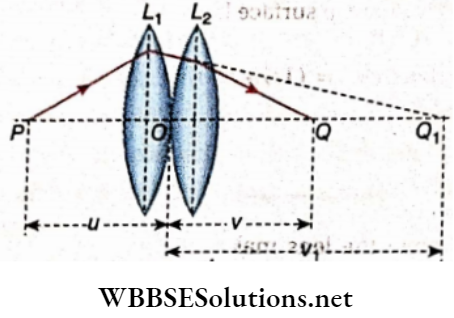
Class 12 Physics Unit 6 Optics Chapter 3 Refraction Of Light At Spherical Surface Lens Equivalent Focal Lengths

In this case, object distance = OP =  -u, image distance

= OQ1 = v1 , focal length =+f1.

⇒ \(\frac{1}{v_1}-\frac{1}{u}=\frac{1}{f_1} \text { or, } \frac{1}{v_1}+\frac{1}{u}=\frac{1}{f_1}\)………………. (1)

Q1 acts as a virtual object concerning the second lens and forms the final real image at Q due to refraction in the second lens L2. So, in this case, object distance = OQ1 = +v1, image distance = OQ = +v, focal length =f1.

⇒ \(\frac{1}{v_1}-\frac{1}{u}=\frac{1}{f_1} \text { or, } \frac{1}{v_1}+\frac{1}{u}=\frac{1}{f_1}\)………………. (2)

Adding equations (1) and (2) we get

⇒  \(\frac{1}{v}+\frac{1}{u}=\frac{1}{f_1}+\frac{1}{f_2}\) ………………. (3)

Now, if the equivalent focal length is F, according to the definition, the equivalent lens will form the image of the equivalent lens will be converging. So we can write

⇒ \(\frac{1}{v}-\frac{1}{-u}=\frac{1}{F} \quad \text { or, } \frac{1}{v}+\frac{1}{u}=\frac{1}{F}\) ………………. (4)

From equations (3) and (4), we get

⇒ \(\frac{1}{F}=\frac{1}{f_1}+\frac{1}{f_2}\) ………………. (5)

If several thin lenses are placed in contact, it can be proved similarly that

⇒  \(\frac{1}{F}=\frac{1}{f_1}+\frac{1}{f_2}+\frac{1}{f_3}\) ………………. (6)

It is to be noted that instead of the combination of convex lenses, a combination of concave lenses or a mixed combination of convex and concave lenses may be used. In each case, equivalent focal length is obtained from equation (6), with proper signs of focal lengths of the lenses used

If an equi-convex lens focal length f is cut vertically into two equal haves, each half will have a focal length equal to 2f.

One of the lenses of the combination is convex and the other is concave:

Let the focal length of the convex lens be /t and that of the concave lens be f2 , If F be the focal length of the combination, then

⇒ \(\frac{1}{F}=\frac{1}{f_1}+\frac{1}{-f_2}=\frac{1}{f_1}-\frac{1}{f_2}\)

∴ \( \frac{f_1 f_2}{f_2-f_1}\)

If f1>f2, then F will be negative and the combination will act as a concave lens. I If f1 < f2  then F will be positive and the combination will act as a convex lens.

[H If f1 = f2, then F will be infinite and the combination will act as a plane laminar plate

The general formula of equivalent focal length:

In all practical purposes, no lens-combination is formed by keeping the lenses in contact. Rather, in different optical Instruments the lenses are necessarily placed separated by a distance. Again, f even when the two lenses are placed in contact, an effective distance due to their thickness is introduced. This distance cannot be ignored in all cases.

Let the focal length of two lenses placed co-axially be f1 and f2 and the distance between their optical centres be a.

Then the expression of the equivalent focal length of the combination of lenses is given by

⇒ \(\frac{1}{F}=\frac{1}{f_1}+\frac{1}{f_2}-\frac{a}{f_1 f_2}\) ………………… (7)

When the two lenses are in contact, a = 0; then equation (7) becomes equation (5).

Refraction Of Light At Spherical Surface Lens Combination Of Lenses And Equivalent Focal Length Numerical Examples

Example 1. A combination of a convex lens of focal length 20 and a concave lens of focal length 10 cm Is formed by keeping In contact with each other. Determine the equivalent focal length of the combination
Solution:

Here, f1 = 20 cm and f2= -10 cm

We know \(\frac{1}{F}=\frac{1}{f_1}+\frac{1}{f_2}\)

⇒ \(\frac{1}{F}=\frac{1}{20}+\frac{1}{-10}=\frac{-1}{20}\)

F = – 20 cm

Since the sign of equivalent focal length is negative, the equivalent lens is concave

Example 2. A lens combination is formed by keeping a lens in contact with a concave lens of a focal length 25 cm. This Icnscomblnatlon produces a real Image magnified 5 tim* of an object placed at a distance of 20 cm from the combination. Calculate the focal length and the nature of the lens placed In contact with the concave lens.
Solution:

Final magnification, m = \(\frac{v}{u}\)

= 5

v = 5u = 100 cm (as u = 20 cm )

From lens formula = \(\frac{1}{v}-\frac{1}{u}=\frac{1}{F}\)

We get, for the combination

⇒ \(\frac{1}{100}-\frac{1}{-20}=\frac{1}{F}\)

∴ u is negative

Or \(\frac{100}{6}\)

= 16.66 cm

For the combination, let the focal length of the unknown lens be f. Then

⇒\(\frac{1}{f}-\frac{1}{25}=\frac{1}{16.66}\)

Or, \(\frac{1}{f}=\frac{1}{16: 66}+\frac{1}{25}\)

The unknown lens is a convex lens with a focal length 10 cm

Refraction Through Spherical Surfaces Physics Notes

Combination Of Lenses And Mirror

Combination of a convex lens and a plane mirror determination of the focal length of a convex lens:

A lane mirror MM’ is placed behind a convex lens LL’

A pin AB is placed in front of the combination of lens and mirror in such a way that the tip of pin A just tousches the principal axis of the lens, The pin is moved until its real Image Ao’ coincides with the pin Itself without parallax, lids Is possible only If the rays from A are Incident normally on the plane mirror after refraction from the lens and these rays retrace the same path.

Then the real Image A’B’ IS formed at the position of All. The tip A of the pin All Indicates the position of the focus of the Ions. So If the lens Is thin, the distance of the tip of the pin from the surface of the lens Is the focal length of the lens. If the lens Is thick, half of the thickness of the lens is to be added to the previous distance to get the focal length of the convex lens.
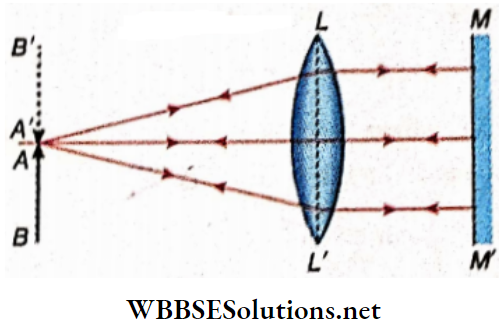
Class 12 Physics Unit 6 Optics Chapter 3 Refraction Of Light At Spherical Surface Lens Combination Of Lenses And Mirror

Combination of a convex lens and a convex mirror: Determination of the focal length of a convex mirror: 

In  LL’ Is a convex lens. The convex mirror MM’ IS placed a little behind the convex lens. Now the point object P is to be placed in front of the combination of lenses and mirror at such a distance that the image of the object coincides with the point object.

It Is possible only if the rays from P are incident normally on the convex mirror after refraction by the lens. These rays if produced further, must converge to the center of curvature C of the mirror. Hence the rays after being reflected from the convex mirror return along the same path and form the image at P.

Now on applying the lens formula for the formation of a real image by a convex lens, the image distance OC is determined. Measuring the distance of the mirror from the lens i.e., OO1, the distance O1C is determined. This distance O1C  is the radius of curvature of the convex mirror.

Half of this distance is the focal length of the convex mirror
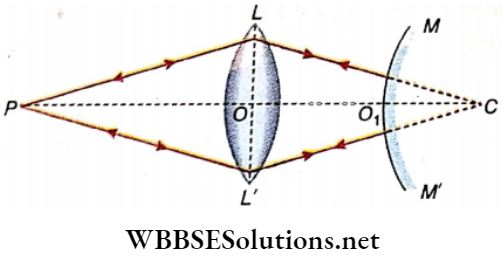
Class 12 Physics Unit 6 Optics Chapter 3 Refraction Of Light At Spherical Surface Lens Focal Length Of The Mirror

Combination of a convex tens and a concave mirror: Determination of focal; length of a concave mirror:

In LL’ is a convex lens. P is a point object Placed on the principal axis of the lens. MM’ is a concave mirror placed at a certain distance on die other side of the lens. The point object P is placed on the axis; at such a distance that its image coincides with the object at the same point P.

Since the final image coincides with the object at the same point, it can be said that the ray of light after passing through the convex lens is incident on the mirror perpendicularly. So point Q in the figure is the centre of curvature of the concave mirror. On applying the lens formula for the formation of a real image by a convex lens the image distance OQ is determined
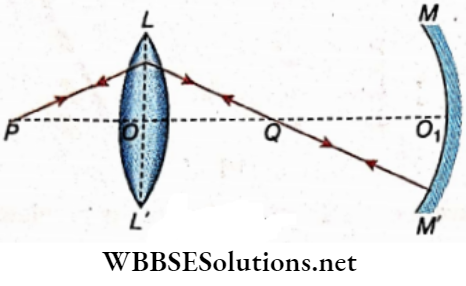
Class 12 Physics Unit 6 Optics Chapter 3 Refraction Of Light At Spherical Surface Lens Cobination Of A Convex lens And A Concave Mirror

So the radius of curvature of the concave mirror, QO1 = OO1– OQ

If OO1 is known, QO1 can be determined.

Therefore focal length of the concave mirror = \(\frac{1}{2}\) QO1

Combination of a concave lens and a concave mirror: Determination of focal length of a concave lens:

In LL’ is a concave lens. P is a pin. It is taken as a point object placed on the principal axis of the lens. MM’ is a concave mirror placed at a certain distance on the other side of the lens. Now the pin is placed in front of the lens at such a distance that the image formed by the combination of the lens and the mirror will be formed at the position of the pin.

It is possible only if the light rays from the object after refraction by the lens are incident perpendicularly on the concave mirror and after reflection from the mirror return along the same path. In that case, if the lens is absent, the reflected rays would meet at Q, the centre of curvature of the mirror. So concerning the concave mirror, the real image of the virtual object at Q is formed at P.
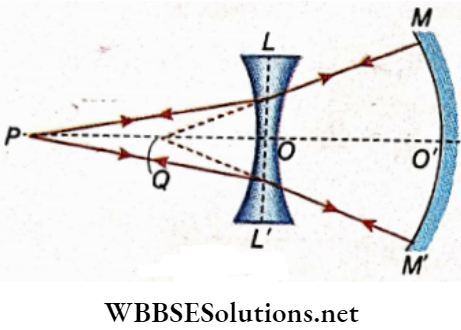
Class 12 Physics Unit 6 Optics Chapter 3 Refraction Of Light At Spherical Surface Lens Combination Of A Concave Lens And A Concave Mirror

If the radius of curvature of the concave mirror is known, QO’ will be known. Again If the distance between the lens and the mirror i.e., OO’ is known, QO will be known since QO = QO’-OO’ .

This QO is the virtual object distance with respect to the concave Knowing the distance PO and using the general lens for the focal length of the concave lens can be determined.

Refraction through spherical surfaces physics notes

Refraction Of Light At Spherical Surface Lens A Few Problems On Formation Of Real Image By A Convex Lens

Prove that by keeping the object and the screen fixed, a convex lens can be placed in two such positions that in each position, a distinct image of the object is formed on the the screen. Suppose, PQ is an object and S1S2 is a screen In between them a convex lens LL” is placed.

The lens forms a real image pq on the screen. Let the distance between the object and the screen =D, object distance = u, image distance = v. Here, D ‘ = u + v For the formation of a real image by a convex lens the equation of the lens is

⇒ \(\frac{1}{v}+\frac{1}{u}\)=\(\frac{1}{f}\)
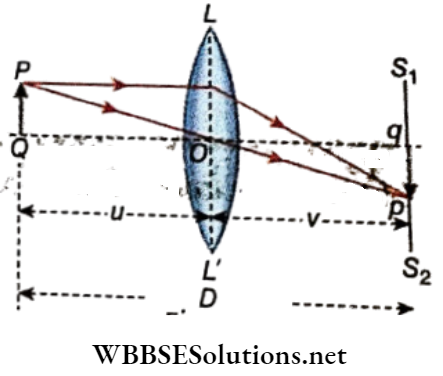
Class 12 Physics Unit 6 Optics Chapter 3 Refraction Of Light At Spherical Surface Lens Real Image By A Convex Lens

∴ \(\frac{1}{D-u}+\frac{1}{u}=\frac{1}{f}\)

Or, \(\frac{D}{(D-u) u}=\frac{1}{f}\)

Or, u² – Du +Df = 0……………(1)

In solving this equation, the following two values of u are obtained

⇒ \(\begin{aligned}
& u_1=\frac{D+\sqrt{D^2-4 D f}}{2} \\
& u_2=\frac{D-\sqrt{D^2-4 D f}}{2}
\end{aligned}\) Taking u1 > u2 ……………….(2)

For the different values of (D2– 4Df) three cases may arise:

1. When D² > 4Df i.e., D > 4f, the values of u1 and u2 are real and different.

So, if the distance between the object and the screen is greater than 4 times the focal length of the lens, then for two different positions of the lens, two real images of the object are formed on the screen.

2. When D2 = 4Df i.e., D = 4f, the values of u1 and u2 real and equal u1 = u2 = \(\frac{D}{2}\)

So, if the distance between the object and the screen is equal to 4 times the focal length of the lens, then for a single position of the lens, real images of the object are formed on the screen.

In this case, the lens is to be placed in the middle of the object and the screen, because

Object distance = u = u1 = u2 = \(\frac{D}{2}\)

= \(\frac{D}{2}\)

= 2f

And image distance =v = D-u = 4f- 2f = 2f.

3. When D² < 4Df i.e., D < 4f, the values of uy and u2 are imaginary. So in this case, wherever the lens is placed, no image is formed on the screen.

So it is clear from the above discussion that to obtain a real image on a screen with the help of a convex lens, the minimum distance between the object and the screen should be 4 times the focal length of the lens. If the distance between the object and the screen is greater than

4 times the focal of the lens two images will be obtained on-.the screen for two positions of the lens

An object and a screen are placed at a fixed distance D apart from each other. There are two positions for a convex lens in between them for a sharp image to be cast on the screen.

If the separation between positions shows that the focal length of the lens is given by f = \(\frac{D^2-x^2}{4 D}\)

Suppose, OO is the position of the object and SS{ is the position of the screen. L1 and L2 are two different positions of the lens. these two positions of the lens, the image of the object is  obtained on the screen,
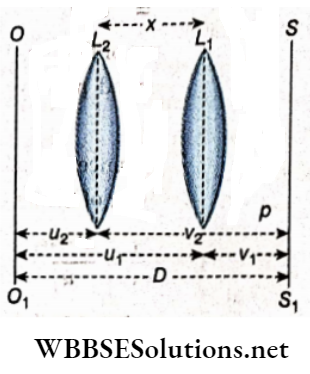
Class 12 Physics Unit 6 Optics Chapter 3 Refraction Of Light At Spherical Surface Lens Object Obtained On The Screen

We have seen in the discussion of the problem

u1 = \(\frac{D+\sqrt{D^2-4 D f}}{2}\)

u1 = \(\frac{D-\sqrt{D^2-4 D f}}{2}\)

u1 and u2 have been chosen arbitrarily

u1– u1 = \(\frac{1}{2}\left[\left(D+\sqrt{D^2-4 D f}\right)-\left(D-\sqrt{D^2-4 D f}\right)\right]\)

Or, \(\sqrt{D^2-4 D f}\)

u1– u2 = x = distance between the two positions of the lens]

Or, x2 = D2 – 4Df

or, f = \(\frac{D^2-x^2}{4 D}\)

If two images of the object are obtained on the screen for two different positions of the lens, prove that ux = v2 and Vy = u2.

Suppose, the distance between the object and the screen is D.

For the first position of the lens at L1, object distance = u1 and image distance = v1

For the second position of the lens at L2 the corresponding values are u2 and v2 respectively

u1+ v1 = D and u2+ v2 = D

Taking u1 = \(\frac{D+\sqrt{D^2-4 D f}}{2}\)

And So , u2 = \(\frac{D-\sqrt{D^2-4 D f}}{2}\)

∴ v1 = D – \(D-\frac{D+\sqrt{D^2-4 b f}}{2}=\frac{D-\sqrt{D^2-4 D f}}{2}\) = u2

And v1 = D – \(\frac{D-\sqrt{D^2-4 D f}}{2}=\frac{D+\sqrt{D^2-4 D f}}{2}\) = u1

4. A convex lens is placed between an object and a screen. If dj and d2 be the lengths, of the two real images formed for taro positions of. the lens and d be the length of the object, prove that d = \(\sqrt{d_1 d_2}\)

Suppose, for the first position of the lens the length of the image = d1, and for the second position of the lens the length of the image = d2

If u1 and v1 are the object distance and the Image distance respectively for the first position of the lens, then

Magnification m1 = \(\frac{d_1}{d}=\frac{v_1}{u_1}=\frac{D-u_1}{u_1}\)

[∴ D = u1 +v1 ]

If u2 and v2 are the object distance and the Image distance respectively for the first position of the lens, then

Magnification m2 = \(\frac{d_2}{d}=\frac{v_2}{u_2}=\frac{D-u_2}{u_2}\)

∴ m1 ×  m2 =  \(\frac{d_1}{d} \times \frac{d_2}{d}=\frac{\left(D-u_1\right)\left(D-u_2\right)}{u_1 u_2}\)

∴ \(\frac{d_1 d_2}{d^2}=\frac{D^2-\left(u_1+u_2\right) D+u_1 u_2}{u_1 u_2}\)

= \(\frac{D^2-\left(u_1+v_1\right) D+u_1 u_2}{u_1 u_2}\)

Since u2 = v1

= \(\frac{D^2-D^2+u_1 u_2}{u_1 u_2}\)

Since = u1 +v1 = D

= \(\frac{u_1 u_2}{u_1 u_2}\) = 1

d1 d2 = d² or, d = \(\sqrt{d_1 d_2}\)

i.e., the size or length of the object the geometrical mean of the sizes or lengths of the images formed on screen for two different positions of the lens

5. A convex lens is placed between an object and a screen. A real image of the object is formed for two positions of the lens. If m1 and m2 are the magnifications of the Image for the two positions of the lens respectively, prove that the focal length of the lens is given by f =
\(\frac{x}{m_2-m_1}\) Where x = Distance between the two positions of the lens

According to the position of the lens at L1 object distance = u and image distance = v1. For the

Formation of real image by the convex lens at lens the equation of the lens is

⇒ \(\frac{1}{v_1}+\frac{1}{u_1}=\frac{1}{f}\)

Or, \(1+\frac{v_1}{u_1}=\frac{v_1}{f}\)

Or, \(1+m_1=\frac{v_1}{f}\)

Since  m1 = \(\frac{v_1}{u_l}\) ……………… (3)

Similarly, for the position of the lens at L, object distance = u2 and image distance – v2 For the formation of a real image by the lens, the equation of the lens is

⇒ \(\frac{1}{v_2}+\frac{1}{u_2}=\frac{1}{f}\)

Or, \(1+\frac{v_2}{u_2}=\frac{v_1}{f}\)

Or, \(1+m_1=\frac{v_1}{f}\)

Since  m1 = \(\frac{v_1}{u_l}\) ……………… (4)

Subtracting equation (3) from equation (4) we get,

1 +\(m_2-1-m_1=\frac{v_2}{f}-\frac{v_1}{f}\)

Or, \(m_2-m_1=\frac{v_2-v_1}{f}\)

Or, \(m_2-m_1=\frac{x}{f}\)

Since [v2– v1= u1-u2= x]

Or, f = \(\frac{x}{m_2-m_1}\)

Class 12 physics spherical lens refraction notes

Refraction Of Light At Spherical Surface Lens Displacement Method To Find The Focal Length Of A Convex Lens By Finding Position Of Images

A Convex Lens By Finding Position Of Images Procedure

Two pins N1 And N2 are mounted on the optical bench such that the separation such that the separation between them is greater

then four times the focal length of the convex lens. Now the lens is placed in between the pins N1 and N2 Two positions of the lens are found in such a way that in each position of the lens the image of one pin if formed at the position occupied by the other
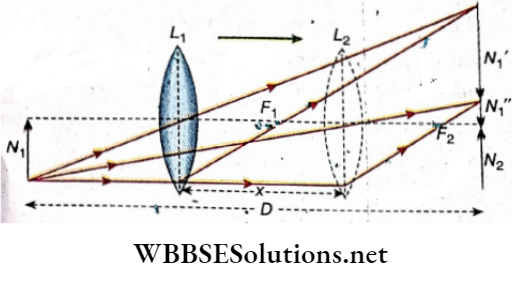
Class 12 Physics Unit 6 Optics Chapter 3 Refraction Of Light At Spherical Surface Lens Lens The Image Of One Pin Is Formed At The Position Occupied

A Convex Lens By Finding Position Of Images Calculation

Let the distance between the two pins be D distance between the two positions of the lens be x. For the first position L1 of the lens,’

u = N1L1 = \(\frac{1}{2}\left(N_1 N_2-L_1 \dot{L}_2\right)=\frac{1}{2}(D-x)\)

v = L1N2 = \(N_1 N_2-N_1 L_1=D-\frac{1}{2}(D-x)=\frac{1}{2}(D+x)\)

The general formula of a convex lens forming a real image is

⇒ \(\frac{1}{v}+\frac{1}{u}=\frac{1}{f}\)

⇒ \(\frac{2}{D+x}+\frac{2}{D-x}=\frac{1}{f}\)

Or, \(\frac{1}{f}=\frac{4 D}{D^2-x^2}\)

Or, f = \(\frac{D^2-x^2}{4 D}\)

Measuring D and x from the optical bench, the focal length of a convex lens can be determined from equation (1)

Refraction Of Light At Spherical Surface Lens Power Of A Lens

The function of a lens is to converge a beam of light in the case of a convex lens or to diverge it in the case of a concave lens

Power of a Lens Definition

The power of a lens is the degree of convergence in the case of the convex lens or the degree of divergence in the case of a concave lens.

Since a convex lens of shorter focal length produces a greater convergence and a concave lens of shorter focal length produces

Hence, the reciprocal of the focal length of a lens is called its power. Representing the fatal length of a lens by f and power by P we can write, P = \(\frac{1}{f}\)

Unit of power of lens

The unit of power of the lens is dioptre (dpt or, D).

1 dioptre is defined as the power of a lens of focal length one meter. So unit of power oflens in SI is m-1

i. e P = \(\frac{1}{\text { focal length in meter }} \text { dioptre or } \mathrm{m}^{-1}\)

= \(\frac{100}{\text { focal length in centimeter }} \text { dioptre or } \mathrm{m}^{-1}\)

or, p (diopter) = \(\frac{1}{f(\text { metre })}=\frac{100}{f(\text { centimetre })}\)

The power of a convex lens is considered positive and that of a concave lens is considered negative.

The convex lens having a focal length of 20 cm has power

= \(\frac{100}{20}\)

= 5 dpt

The lens having power 4 dpt has a focal length

= \(\frac{1}{4}\) m = 25 cm

Again, the nature of the lens having power -4 dioptre is concave, and its focal length

f = \(\frac{1}{4}\) = – 0.25m

Power of a combination of lenses

The power of; a combination of lenses is equal to the algebraic sum of the powers of the constituent lenses.

The power of the combination of two lenses with powers Px and P2 kept in contact with one another is

p = P1+P2

Relation of the radius of curvature of a lens with the power

We know that the equation of focal length of a given by,

⇒ \(\frac{1}{f}=(\mu-1)\left(\frac{1}{r_1}-\frac{1}{r_2}\right)\)

If the radii of curvature of the two surfaces of the lens be equation then in the case of biconvex and biconcave lenses we have,

⇒ \(\frac{1}{f}=(\mu-1) \cdot \frac{2}{r}\) and

⇒ \(\frac{1}{f}=-(\mu-1) \frac{2}{r}\) respectively

So, the corresponding power of (these lenses are,

P = (mu-1).\(\frac{2}{r}\) and p = -(mu-1)

I. e \(P \propto \frac{1}{r}\)

Therefore, if the radius of curvature of a biconvex or a biconcave lens increases, the power of the lens decreases, and if the radius of curvature decreases power of the lens increases.

1. When two thin lenses haying equal and opposite focal lengths (one convex and one concave) are placed in contact with each other and if F be their equivalent focal length then

⇒ \(\frac{1}{F}=\frac{1}{f}+\frac{1}{-f}\) = 0

F = \(\frac{1}{0}\)

So, power P = \(\frac{1}{F}\) = 0

This type of combination of lenses acts as a plane glass plate.

2. If the refractive index of the medium surrounding the lens is greater than that of the material of the lens, the convex lens shows diverging power and the concave lens shows converging power

3. Suppose that the refractive index of the surrounding medium is μm and the refractive index of the material of the lens is μg. If μm increases, the power of the lens decreases i.e, its focal length increases

Change of the focal length and the power of a lens with the wavelength of the incident light:

According to Scientist Cauchy, the relation of wavelength (λ) with refractive index (μ) is given by

μ = A + \(\frac{B}{\lambda^2}\) [ where A and B are constants]

Now, if be the focal length of a lens then,

⇒ \(\frac{1}{f}=(\mu-1)\left(\frac{1}{r_1}-\frac{1}{r_2}\right)\)

So, for any particular lens,

⇒  \(f \propto \frac{1}{(\mu-1)}\)

In comparison to any other wavelength of light, the wavelength of red light is greater i.e., for red light, the refractive index of the lens is minimal. So the focal length of a lens is greater for red light is comparison to other colours.

The power of a lens is given by

⇒ \(P\frac{1}{f}=(\mu-1)\left(\frac{1}{r_1}-\frac{1}{r_2}\right)\)

Or, P ∝(μ-1)

So, the power of a lens will be less in the case of red light in comparison to any other colour.

f-number of lens:

The focal length of a lens is generally expressed as a multiple of the diameters of its aperture. This multiple is called the f-number of lenses. If F is the focal length and D is the diameter of the aperture, Then D = \(\frac{F}{f}\) or, f = \(\frac{F}{D}\). For example, if the f-number of a lens is (\(\frac{1}{15}\)), it means that the diameter of the aperture of the lens is its focal length.

Depth of field:

In optics, depth of field (DOF) is the distance between the nearest and farthest objects in a scene that appear acceptably sharp in an image. The term mainly relates to film and photography. For a particular lens greater the value of f-number, the greater is the depth of field.

Class 12 physics spherical lens refraction notes

Refraction Of Light At Spherical Surface Lens Power Of A Lens Numerical Examples

Example 1. The power of a lens- of a pair of spectacles is -2.5 dioptre. What is the nature and focal length of the lens used?
Solution:

We know, P= + \(\frac{100}{f}\)

⇒ \(\frac{100}{f}\) dioptre

[If f is expressed in cm]

= – 2.5 = + \(\frac{100}{f}\) Or, f = -40 cm

Since the focal length is negative, the lens is concave and its focal length is 40 cm.

Example 2. A lens of power 0.5 dioptre is placed In front of a lens of power 2.0 dioptre. Assume that the distance between the two lenses is zero, 

  1. What will be the power of the lenses in dioptre
  2. What will be their focal lengths?

Solution:

Power of the combination of lenses

P = P1 + p2

Here P1 = 0.5 dpt

P2 = 2 dpt

= 0. 5 + 2 = 2.5 dpt = 2.5 m1

The focal length of the lens of power is 0.5 dioptre

f1 = \(\frac{+100}{0.5}\) = 200 cm (convex lens)

And focal length of the lens of power 2.0 dpt

f2 = \(\frac{100}{2}\)

= + 50 cm (convex lens)

Example 3. A convex lens of focal length 40cm Is placed In contact with a concave lens of focal length 25cm. What Is the power of the lens combination?
Solution:

Power of the convex lens, P2 = \(\frac{100}{f_1}\)

⇒ \(\frac{100}{40}\) ‘

Power of the concave Mirror lens P2 = \(\frac{100}{f_2}=\frac{100}{-25}\) = -4.0 m1

= 2.5 m1

The Power of the combination of lenses

P = P1+P2 = 2.5 – 4.0 = -1.5 m1

Example 4.   An object is placed at a distance of 12 cm from a lens and a virtual image, four times magnified is formed. Calculate the focal length of the lens. Draw the ray diagram for the formation of linage. What Is the power of the lens?
Solution:

Magnification , m= \(\frac{v}{u}\) = 4 or, v = 4u

From diagram u = OQ = -12 cm, v = OQ’ = -48 cm
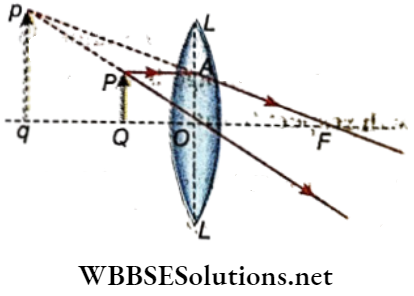
Class 12 Physics Unit 6 Optics Chapter 3 Refraction Of Light At Spherical Surface Lens Convex Lens And Virtual Image

From the lens equation

⇒ \(\frac{1}{f}=\frac{1}{v}-\frac{1}{u}=\frac{1}{-48}-\frac{1}{-12}\)

Or, \(\frac{1}{f}=\frac{1}{12}-\frac{1}{48}\)

Or, f = 16

The focal length of the lens is 16 cm.

The lens is convex i.e.,f is positive.

Power of the lens P = \(\frac{100}{f}\) D = \(\frac{100}{16}\) D

= + 6.25 D

Example 5. A real image of an object Is formed by a convex. lens on. a screen at a distance of 20 cm from the lens. When a concave lens is placed at a distance of 5 cm from the convex lens towards the screen the Image Is shifted through 10 cm. Calculate the focal length and the power of the concave lens.
Solution:

The role of the convex lens is just to form the first image on the screen

For the concave lens, this image acts as the virtual object, and another real image is formed at a distance of 10 cm away from The virtual object.
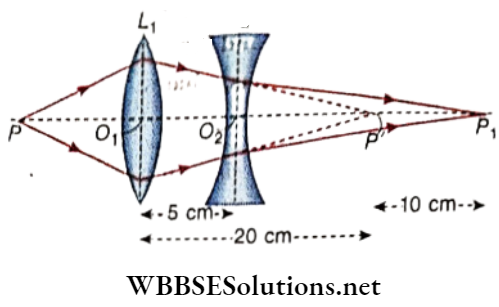
Class 12 Physics Unit 6 Optics Chapter 3 Refraction Of Light At Spherical Surface Lens Focal Lenght And The Power Of The Concave Lens

Let P is the position of the object. L1 and L2 are the convex and concave lenses respectively separated by O1O2= 5 cm

P’ is the real image formed by L1 and O1P’ = 20 cm

P’ acts as the virtual object for the second lens L2 and a real

Image of P’ is formed at P1, the distance P’P1 = 10 cm

∴ For the concave lens:

u = O2P’ = O1P’-  O1O2 = 20 – 5 = 15 cm

And v = O2P1 = O2P’ + P’P1 = 15 + 10 = 25 cm

Putting in \(\frac{1}{v}-\frac{1}{u}=\frac{1}{f}\), we get

⇒ \(\frac{1}{25}-\frac{1}{15}=\frac{1}{f}\),Or, f = – 37. 5 cm

So, the focal length of the concave lens is 37.5 cm

Power of the lens = \(\frac{100}{f}=\frac{100}{-37.5}\)D

= – 2.67 D

Class 12 Physics Spherical Lens Refraction Notes

Example 6. The distance between a lamp and a screen is 90 cm. Where should a convex lens of focal length 20 cm be placed between the lamp and the screen so that a real Image of the lamp Is formed on the screen?
Solution:

Let the distance of the lamp from the lens be x cm.

So, image distance =(90-x) cm I.e., u = -x and v = (90-x)

For the formation of a real image by the convex lens we have

⇒ \(\frac{1}{v}-\frac{1}{u}=\frac{1}{f}\)

Or, \(\frac{1}{90-x}+\frac{1}{x}=\frac{1}{20}\)

Or, \(\frac{90}{x(90-x)}=\frac{1}{20}\)

Or, x² – 90x +1800 = 0

Or, (x – 30)(x – 60)= 0

Or, x = 30 cm or, 60 cm

So, the lens is to be placed at a distance of 30 cm or 60 cm concerning the lamp.

Example 7. The size of the image of an object that is at infinity, as formed by a convex lens of focal length 30 cm, is 2 cm. If a concave lens of focal length 20 cm is placed between the convex lens and the image at a distance of 26 cm from the convex lens what will be the size of the final image?
Solution:

For the convex lens, since the object is at Infinity

Image is formed at the focus (P’)

∴ v = f = 30 cm
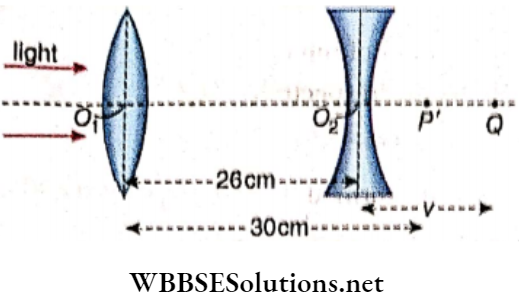
Class 12 Physics Unit 6 Optics Chapter 3 Refraction Of Light At Spherical Surface Lens Size Of The Image Of An Object Is Infinity Formed By A Convex Lens

This is the virtual object for the second lens which Is at a distance Oj02 = 26 cm from the first lens.

In this case object distance

u = (O1P’-O1O1) = 30 -26 = 4cm and f = -20 cm

⇒ \(\frac{1}{v}-\frac{1}{4}=\frac{1}{-20}\) Or, + = 5 cm

Magnification by the second lens = \(\frac{5}{4}\)

Size of the final image = size of the 1st image x \(\frac{5}{4}\)

= 2 × \(\frac{5}{4}\)

= 2.5 cm

Example 8. The image of an Illuminated pin placed at a distance of 20 cm from a convex lens is formed on a screen placed at a distance of 30 cm from the lens. Between the screen and the convex lens, a concave lens is placed at a distance of 10 cm from the convex lens. If the screen Is shifted through a distance of 10 cm more, a distinct image is formed on the screen. Find the ratio of the power of the two lenses. If the power of the concave lens Is -4 m-1, how far should the screen is to be shifted?
Solution:

For the convex lens

u = O1 P = -20 cm

v = O1P = 30 cm , f= ?

From \(\frac{1}{v}-\frac{1}{u}=\frac{1}{f}\) we ,get

⇒ \(\frac{1}{30}-\frac{2}{-20}=\frac{1}{f_1}\)

Let the focal length be f1

∴ f1 = 12cm

Example 9. The radii of the curvature of (lie two surfaces of a convexoconcave lens made of glass are 20 cm and 60 cm. An object Is situated on the left side of the lens at a distance of 80 cm along the principal axis.

  1. Determine the position of the Image
  2. A similar type of lens Is placed at a u distance of 100 cm on the right side of the first lens co-axially  Determine the position of the image. [Given mu of glass a l.5 ]

Solution: The focal length of an Ions Is given the lens maker’s formula

⇒ \(\frac{1}{f}=(\mu-1)\left(\frac{1}{r_1}-\frac{1}{r_2}\right)\)

In this case mu = 1.5 r1 = + 20 cm

r1 = + 60 cm

⇒ \(\frac{1}{f}=(1.5-1)\left(\frac{1}{20}-\frac{1}{60}\right)\)

Or, f = 60 cm

Here, u = -80 cm , f = 60 cm

From \(\frac{1}{v}-\frac{1}{u}=\frac{1}{f}\) we get

⇒ \(\frac{1}{v}+\frac{1}{80}=\frac{1}{60}\) or, v = 240 cm

So, the Image Is at a distance of 240 cm on the other side of the lens.
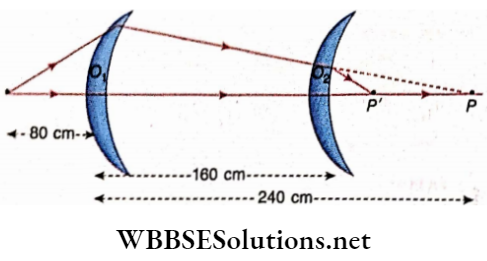
Class 12 Physics Unit 6 Optics Chapter 3 Refraction Of Light At Spherical Surface Lens The Radii Of Curvacture Of The Two Surfaces Of A Convexoconcave

The image P formed by the 1st lens will act as the virtual

Image of the second lens

∴ Object distance, u’ = O2P = 240-160 = 80 cm

Distance is measured along the direction of the ray

And f’ = 60 cm

∴ From \(\frac{1}{v}-\frac{1}{u}=\frac{1}{f}\)

We get,  \(\frac{1}{v}-\frac{1}{80}=\frac{1}{60}\)

Or, v =  \(\frac{240}{7}\)

= 34.28

So, the final image is formed at a distance of 34.28 cm from the second lens and on the other side of the first lens

Example 10. An illuminated object is placed at a distance 15cm in front of a convex lens of a focal length of 12cm. If a plain mirror is placed behind the lens at a distance 45cm, a distinct image is formed in front of the lens (on the object side) on the screen. Find the distance of the screen from the lens.
Solution:
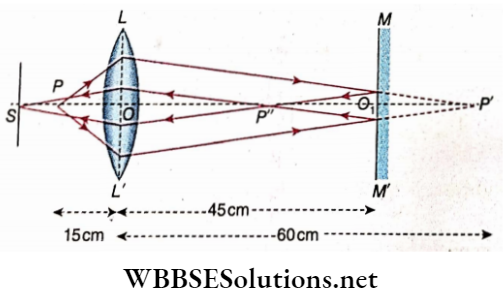
Class 12 Physics Unit 6 Optics Chapter 3 Refraction Of Light At Spherical Surface Lens Distance Of The Screen From The Lens

LL’ is a convex lens and MM’ is a plain mirror placed at a distance of 45cm from the lens. P is an illuminated object at a distance 15cm in front of the convex lens.

In the case of image formation by the lens,

u = -15 cm , f= 12 cm, v= ?

From the lens equation,

⇒ \(\frac{1}{v}-\frac{1}{u}=\frac{1}{f}\)

Or, \(\frac{1}{v}+\frac{1}{15}=\frac{1}{12}\)

Or, \(\frac{1}{12}-\frac{1}{15}=\frac{1}{60}\)

∴ v = 60 cm

If the plain mirror is absent a real image will be formed at P’. This P’ will act as a virtual object for the plain mirror.

For plain mirror,

object distance = O1 P’ = 60 – 45 = 15cm

Mirror MM’ will form a real image of P’ at P”.

Now, image P” acts as an object for the formation of the image in a second time

So, object distance – OP”= OO1– O1P”

= (45 – 15) = 30 cm

Since [ O1p’ = O1 P” = 15 cm]

Thus, u = -30cm, f = 12cm, v = ?

From lens equation, \(\frac{1}{v} \cdot \frac{1}{u}=\frac{1}{f}\)

Or, \(\frac{1}{v}+\frac{1}{30}=\frac{1}{12}\) Or, \(\frac{1}{v}=\frac{1}{12}-\frac{1}{30}=\frac{1}{20}\)

Or, v = 20 cm

Therefore an image will be formed on screen S at a distance of 20cm in front of the lens (on the object side).

Example 11. If an object is placed at a distance from a convex lens, the magnification of the real image so formed is m1. If the object is shifted through a distance x, the magnification of the real image now formed is m2. Prove that the focal length of the lens,  f = \(\frac{x}{\frac{1}{m_2}-\frac{1}{m_1}}\)
Solution:

Let the object distance and image distance in the first and second cases be u1, v1 and u2, v2 respectively

∴ m1 = \(\frac{v_1}{u_1}\)

And m2 = \(\frac{v_2}{u_2}\)

From the general lens formula, we get

⇒ \(\frac{1}{v}-\frac{1}{u}=\frac{1}{f}\)

Or, \(\frac{u}{v}-1=\frac{u}{f}\)

So in the 1st case, for the formation of a real image in the convex lens

⇒ \(\frac{1}{v_1}+\frac{1}{u_1}=\frac{1}{f} \text { or, } \frac{u_1}{v_1}+1=\frac{u_1}{f}\)

Or, \(\frac{1}{m_1}+1=\frac{u_1}{f}\) ………………… (1)

And the second case, the relationship will be

⇒ \(\frac{1}{v_2}+\frac{1}{u_2}=\frac{1}{f} \text { or } \frac{u_2}{v_2}+1=\frac{u_2}{f}\)

From equations (1) and (2) we get

⇒ \(\frac{u_2}{f}-\frac{u_1}{f}=\frac{1}{m_2}-\frac{1}{m_1}\)…………. (2)

Or, \(\frac{u_2-u_1}{\frac{1}{m_2}-\frac{1}{m_1}}=\frac{x}{\frac{1}{m_2}-\frac{1}{m_1}}\)

Since [ u2 – u2= x]

Class 12 physics spherical lens refraction notes

Example 12. An Object Is Placed At A Distance D From A Screen. A Convex Lens Forms A Distinct Image of Object On The Screen. When The Lens Is Shifted Through A Distance X Towards The Screen, Another Distinct Image Is Formed Cm The Screen. Prove That The Ratio Of The Lizes Of The first and the second images are equal to \(\left(\frac{D+x}{D-x}\right)\)
Solution: 

Suppose, in the first case, object distance -u, image distance =D

For the formation of a real image in a convex lens, the lens equation is

⇒ \(\frac{1}{v}+\frac{1}{u}=\frac{1}{f} \text { or, } \frac{1}{D-u}+\frac{1}{u}=\frac{1}{f}\)

Or, \(\frac{D}{(D-u) u}=\frac{1}{f}\)

or, u²- Du+Df = 0

The two roots of u are

u1 = \(\frac{D-\sqrt{D^2-4 D f}}{2}\)

And u2 = \(\frac{D+\sqrt{D^2-4 D f}}{2}\) …………….. (1)

According to the

x = u2– u1

⇒ \(\frac{D+\sqrt{D^2-4 D f}}{2}-\frac{D-\sqrt{D^2-4 D f}}{2}\)

⇒ \(\sqrt{D^2-4 D f}\)

Putting the value of x in equation (1) we get

u1 = \(\frac{D-x}{2}\) and

u2 = \(\frac{D+x}{2}\)

Let v1 and v2 be the image distances corresponding to the object distances Uj and u2 respectively.

v = D-u = \(-\frac{D-x}{2}=\frac{D+x}{2}\) and

v = D-u =  \(-\frac{D+x}{2}=\frac{D-x}{2}\)

⇒ If f be the size of the object and I1 had I2 be the size of the images for the two positions of the lens, then

⇒ \(\frac{I_1}{I}=\frac{v_1}{u_1}=\frac{D+x}{D-x}\)

And \(\frac{I_2}{I}=\frac{v_2}{u_2}=\frac{D-x}{D+x}\)

⇒  \(\frac{I_1}{I_2}=\frac{\frac{1}{I}}{I_2}=\frac{\frac{D+x}{D-x}}{\frac{D-x}{D+x}}\)
= \(\left(\frac{D+x}{D-x}\right)^2\)

Example 13. The focal length of a lens is inversely proportional to, (n-1) where n is the refractive index. Forviolet light if the focal length of the lens is 50 mm, what will be the focal length of the lens for red light? Given for violet light, n = 1.532 andforred light, n = 1.512.
Solution:

If f is the focal, the length of the lens

⇒ \(f \propto \frac{1}{n-1}\)

or, f = \(\frac{k}{n-1}\)

⇒ \(-\frac{f_r}{f_\nu}=\frac{n_\nu-1}{n_r-1}\)

⇒  \(f_r=\frac{n_\nu-1}{n_r-1} \times f_\nu\)

= \(\frac{1.532-1}{1.512-1} \times 50\)mm

= 51.95mm

So, the focal length of the lens for red light is 51.95 mm.

Example 14. The focal length–of the lens of a camera is 1.25 times its I diameter. Calculate the angle of deviation of a ray parallel to the axis of the lens incident at the edge of the lens.
Solution:

Suppose, the diameter of the lens is D and the focal length of the lens is f.
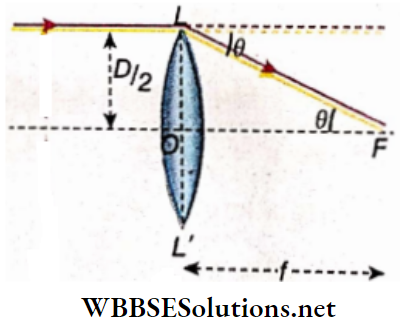
Class 12 Physics Unit 6 Optics Chapter 3 Refraction Of Light At Spherical Surface Lens Angle Of A Deviation Of A Ray Parallel To The Axis Of The Lens

According to the question, f = 1.25D.

According to suppose that the ray has deviated through an angle θ

⇒ \(\tan \theta=\frac{O L}{O F}=\frac{\frac{D}{2}}{f}\)

⇒ \(\frac{D}{2 f}=\frac{D}{2 \times 1.25 D}\)

Or, tan θ \(\frac{1}{2.5}\)

= 0.40

= tan 22°

or, θ = 22°

Example 15. Two lenses one convex and another, concave, both of equal focal length are placed In contact What is the focal length of the lens combination?
Solution:

If F is the equivalent focal length of the lens combination, then

⇒ \(\frac{1}{F}=\frac{1}{f_1}+\frac{1}{f_2}\)

For convex lens, f1 = f and for concave lens, f2 =  -f

Thus \(\frac{1}{F}=\frac{1}{f}-\frac{1}{f}\) = 0 Or, F = ∞

Therefore, the focal length of the lens combination will be infinite,

Example 16. A convex lens of focal length 15 cm is placed coaxially at a distance of 5 cm in front of a convex mirror. When an object is placed on the axis at a distance of 20 cm from the lens, it is found that the image coincides with the object. Find the focal length of the mirror.
Solution:

Here, the object at P is supposed to be a point object. LL’ is the convex lens and MM’ is a convex mirror. If the image of the object is to coincide with the point object, the light rays after being refracted from the lens must be incident normally on the convex mirror i.e., the light rays should be directed along the radius of curvature, C of the convex mirror as a result of which after being reflected on the mirror the rays of light return along the same path and form image at P.

According to the problem, u = -20 cm, f = 15, v =?

According to the equation of lens,

⇒ \(\frac{1}{v}-\frac{1}{u}=\frac{1}{f} \text { or, } \frac{1}{v}=\frac{1}{u}+\frac{1}{f}\)

Or, \(\frac{1}{v}=\frac{1}{-20}+\frac{1}{+15}=+\frac{1}{60}\)

Or, v = + 60 cm

OC = 60 cm

Or, OO1+O1C = 60

Or, 5 +  O1 C = 60 Or, O1C = 55

∴ The radius of curvature of the convex mirror = 55 cm

∴ Focal length = \(\frac{55}{2}\) = 27.5 cm

Class 12 physics spherical lens refraction notes 

Example 17. if an object is placed at position A in front of a convex of vex lens of focal length f, the Image produced by the lens becomes erect But If the object Is placed at position B, an Inverted image of the same size is produced. If the amount of magnification is m, prove that AB = \(\frac{2 f}{m}\)
Solution:

In the 1st case, let the object distance, OA = u1 and image distance, OA1 = v1

From the lens equation, we get,

⇒\(\frac{1}{-\nu_1}-\frac{1}{-u_1}=\frac{1}{f}\)

Or, \(-\frac{u_1}{v_1}+1=\frac{u_1}{f}\) ……………………. (1)

In this case, magnification, m = \(\frac{\nu_1}{u_1}\)
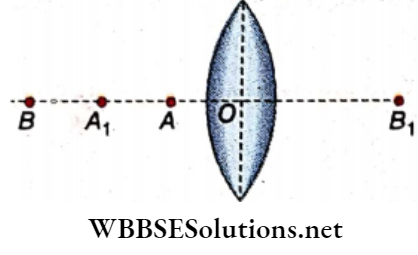
Class 12 Physics Unit 6 Optics Chapter 3 Refraction Of Light At Spherical Surface Lens Inverted Image Of The Same Size

Putting in equation (1) we get

⇒ \(-\frac{1}{m}+1=\frac{u_1}{f}\)

Or, \(\frac{1}{m}-1=-\frac{u_1}{f}\) …………………………….. (2)

Similarly, in the second case, let the object distance, OB1 = u2, and image distance, OB1 = v2

In this case, magnification

⇒ \(\frac{1}{v_2}-\frac{1}{-u_2}=\frac{1}{f}\)

Or, \(\frac{u_2}{v_2}+1=\frac{u_2}{f}\)

Or, \(\frac{1}{m}+1=\frac{u_2}{f}\)

Or, \(\frac{1}{m}+1=\frac{u_2}{f}\) ………………………… (3)

From Equations (2) we get

⇒ \(\frac{2}{m}=\frac{u_2-u_1}{f}\)

Or, \(\frac{A B}{f}=\frac{2}{m} \text { or, } A B=\frac{2 f}{m}\)

Example 18. A convex lens of focal length 10cm is placed In front of a concave mirror. The principal axes of both coincide and the lens is at a distance 40cm from the pole of the mirror. If an object is placed on the axis at a distance15 of cm from the lens on another side of the lens, then image point coincides with the object point. Find the focal length of the mirror.
Solution:
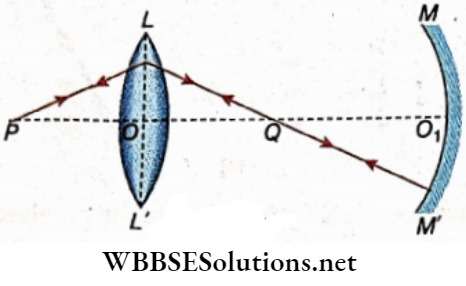
Class 12 Physics Unit 6 Optics Chapter 3 Refraction Of Light At Spherical Surface Lens Cobination Of A Convex lens And A Concave Mirror

LL’ is a convex lens and MM’ is a concave mirror. P is an

object and Q is the image of P formed by the lens.

Here, object distance = PO = u = -15cm

And image distance – OQ = v

From the lens equation, \(\)

⇒ \(\frac{1}{v}-\frac{1}{u}=\frac{1}{f}\)

Or, \(\frac{1}{v}+\frac{1}{15}=\frac{1}{10}\)

Or, v = 30 cm

v is positive Le., the image is formed on another side at a distance of 30cm from the lens. This image acts as a real object for the concave mirror. In this case object distance = O1Q = 40- 30 = 10cm.

Since the final image is formed at the same point where the object is situated it can be concluded that light ray is incident on the mirror normally.

Therefore, Q is the centre of curvature of the concave mirror.

∴ The radius of curvature of the mirror, r = O1Q = 10cm

∴ Focal length of the mirror f = \(\frac{r}{2}=\frac{10}{2}\)

= 5cm

Example 19. The focal length of a convex lens is/ and the distance of the object from the lens is u. A plane mirror is placed perpendicular to the principal axis of the lens at a distance f from the lens on the opposite side of the object. If the final Image is formed at a distance v in front of the lens, prove that u + v= 2f
Solution:

Let P be the object in front of the lens L

Object distance, OP = -u

In the absence of the mirror, P’ would be the image formed by the lens.

Let OP’ = v’

But the rays before forming the image P’ are incident on the mirror M and are reflected by it to form a real image at P” for the virtual object P’.

MP’ = OP’- OM and MP” = MP’
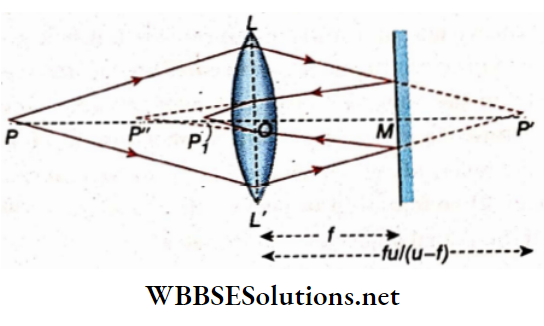
Class 12 Physics Unit 6 Optics Chapter 3 Refraction Of Light At Spherical Surface Lens Perpendicular To The Principle Axis

Again the rays before reaching P” are refracted by the lens for the second time and converge at P to form a real image.

Now, OPl = v; OP” = us = MP”-MO

[ u’ is positive as the distance is taken along the direction of the ray.]

Now, for the 1st refraction, we have

⇒ \(\frac{1}{v^{\prime}}+\frac{1}{u}=\frac{1}{f}\)

Or, \(v^{\prime}=\frac{u f}{u-f}\)…………………….. (1)

For reflection in the mirror,

MP’ = \(v^{\prime}-f=\frac{u f}{u-f}-f=\frac{f^2}{u-f}\) ………………………………………… (2)

And MP’ = \(M P^{\prime}=\frac{f^2}{u-f}\)

[Positive, since the distance is taken along the ray]

For the second refraction in the lens

u’ = OP” = MP”- MO

⇒ \(\frac{f^2}{u-f}-f=\frac{2 f^2-u f}{u-f}=\frac{f(2 f-u)}{u-f}\)

From the lens equation; we can write

⇒ \(\frac{1}{v}-\frac{1}{u^{\prime}}=\frac{1}{f}\)

Or, \(\frac{1}{v}-\frac{u-f}{f(2 f-u)}=\frac{1}{f}\)

Or, \(\frac{1}{v}=\frac{1}{f}+\frac{u-f u}{f(2 f-u)}\)

Or, \(\frac{1}{v}=\frac{1}{2 f-u}\)

v = 2f- u

Or, u+v = 2f

Example 20. A Concave of focal length 20 cm Is placed at a distance of 25 cm behind a concave lens. If a pin is u = distance 68.6 cm, placed In front of the lens at an Image formed by the combination of lens and mirror will be formed at the position of the pin. What Is the focal length of the lens?
Solution:

In P is a pin. It is taken as a point object. LL’ is the concave lens and MM’ is the concave mirror. Light rays from the object after refraction in the lens are incident perpendicularly on the concave mirror and after reflection from the mirror return, along the same path. In that case, if the lens is absent the. reflected rays would meet at Q, the optical center of the mirror. Therefore, with respect to the concave lens, the real image of the virtual object at Q is formed at P.
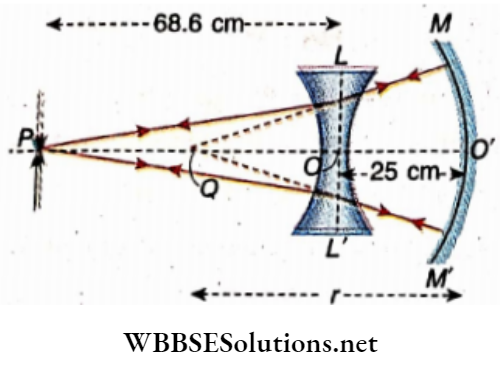
Class 12 Physics Unit 6 Optics Chapter 3 Refraction Of Light At Spherical Surface Lens Concave lens The Real Image Of The Virtual Object

The radius of curvature of the concave mirror,

r = 2f = 2 × 20 = 40 cm

Therefore, concerning the concave lens,

u = OQ =(40-25) = 15 cm

[Along the direction of the ray]

v = 68.6 cm ; f = ?

According to the equation of the lens

⇒ \(\frac{1}{v}-\frac{1}{u}=\frac{1}{f}\)

⇒  \(\frac{1}{68.6}-\frac{1}{15}=\frac{1}{f}\)

Or, \(\frac{15-68.6}{68.6 \times 15}=\frac{1}{f}\)

Or, \(\frac{-53.6}{68.6 \times 15}=\frac{1}{f}\)

Or, f = \(-\frac{68.6 \times 15}{53.6}\)

= 19.2 cm

Therefore, the focal length of the concave lens is 19,2 cm

Example 21. A convex lens of power 5 D is placed on a plane mirror. A pin is placed above 30 cm straight from the lens. Determine the position of the Image. Where should the pin be placed The image will coincide with the pin
Solution:

We know,

P = \(\frac{100}{f}\)

Or, 5 = \(\frac{100}{f}\)

Or, 20 cm

In the case of the formation of an image by the convex lens,

u = -30 cm , f = +20 cm; v = ?

According to the equation of lens

⇒ \(\frac{1}{v}-\frac{1}{u}=\frac{1}{f}\)

⇒ \(\frac{1}{v}-\frac{1}{-30}=+\frac{1}{20}\)

Or, \(\frac{1}{v}=\frac{-1}{30}+\frac{1}{20}=\frac{+1}{60}\)

Or, + 60 cm

So the image is real and is formed at a distance of 60 the lens. This image will act as a virtual object for the plane mirror. The image of this virtual object will be formed above at a distance of 60 cm. This image will again act as a virtual object for the convex lens.

In the case of the formation of an image again by the convex lens,

u = + 60 cm [distance taken along the direction of ray]

f = +20 cm; v = ?

According to the equation of lens,

⇒ \(\frac{1}{v}-\frac{1}{u}=\frac{1}{f}\)

⇒ \(\frac{1}{v}-\frac{1}{60}=\frac{1}{20}\)

Or, \(\frac{1}{v}=\frac{1}{60}+\frac{1}{20}=\frac{1}{15}\)

Or, v = 15 cm

So, the image will be formed above the lens at a distance of

Radius of curvature of the concave mirror, If the pin is placed at the focus of the convex lens, its image will coincide with the pin. In that case the distance of the pin from the lens = 20 cm.

WBCHSE Physics Class 12 Refraction Lens Notes

Example 22. The diameter of the sun makes an angle of 0.5° at the pole of the convex lens. If the focal length of the lens be 1 m, what will be the Image of the sun?
Solution:

Suppose, the diameter of the sun = D m and the distance of the sun from the lens = u m

Angle made by the sun at the pole of the lens, θ = \(\frac{D}{u}\)

Given = 0.5 = \(\frac{0.5 \times \pi}{180}\)rad

As the sun is stated at a long distance, its image is formed at the focus.

v = f

Suppose, the diameter of the image of the sun = d

m = \(\frac{v}{u}=\frac{d}{D}\)

Or, d = \(\frac{v D}{u}\)

fθ =  \(\frac{1 \times 0.5 \pi}{180}\)

= 0.00872 m

= 0.872cm

Example 23. There is a square hole In the screen. The hole is Illuminated and its Image is formed on another screen with the help of a convex lens. The distance of the hole from the lens is 40 cm. If the area of the Image is 9 times the area of the hole, determine the position’ of the image and the focal length of the lens.
Solution:

Suppose, the length of each side of the hole = x and the length of each side of the image = y

The area of the hole = x² and the area of the image = y².

⇒ \(\frac{y^2}{x^2}\) = 9

Or, \(\frac{y}{x}\) = 3

m = 3

Or, \(\frac{v}{u}\) = 3 or, 3u = 3 × 40= 120 cm

u = 40 cm

So, the image is formed at a distance of 120 cm from the lens

v = +120 cm and given , u= – 40 cm

According to the equation of lens

⇒ \(\frac{1}{v}-\frac{1}{u}=\frac{1}{f}\)

Or, \(\frac{1}{+120}-\frac{1}{-40}=\frac{1}{f}\)

Or, \(\frac{1}{f}=+\frac{1}{30}\)

f = 30 cm

Therefore, the focal length of the lens is 30 cm

Example 24. The focal—length of a camera lens is 45 cm msmmand the measurement of the photographic plate Is 30 cm x 30 cm. What is the measure of square area of the earth that can be photographed from a plane at a height 1500 m above the earth
Solution:

Here, u = 1500 m = 150000 cm . The image of a very distant object is formed at the focus of the convex lens.

v = f = 45 cm

Now m = \(\frac{45}{150000}\)

Or, \(\frac{\text { length of the image }}{\text { length of the object }}=\frac{45}{150000}\)

Or, length of the object = \(\frac{150000}{45}\) × length of the image

The length of the photographic plate is 30 cm. So, the length of a side of the image of a square area of the earth to be photo-‘ graphed is 30 cm

Length of the square area of the earth

= \(\frac{150000}{45} \times 30\)

= 10000 cm = 1000 m = 1 km

So, the area of the earth to be photographed = 1 km ×1 km = 1 km²

Example 25. The distance of a source of light from a screen Is 1 m. By placing a convex lens between them an image Is cast on the screen. The lens Is shifted through a distance of 40 cm along the line joining the source and the screen and again an Image Is formed on the screen. What is the focal length of the lens? If the length of the images are 0.428 cm and 2.328 cm respectively, what is the length of the object?
Solution:

Distance between the object and the screen, D = lm = 100 cm, and distance between the two positions of the lens, x = 40 cm

If the focal length of the lens

f = \(\frac{D^2-x^2}{4 D}=\frac{(100)^2-(40)^2}{4 \times 100}\)

= \(\frac{140 \times 60}{4 \times 100}\)

= 21 cm

The length of the two images

I = 0.428 cm and J2 = 2.328 cm

Length of the object = \(\sqrt{I_1 I_2}=\sqrt{0.428 \times 2.328}\)

= 0.998 cm

Example 26.  Two equal-convex lenses are so placed inside the two curved faces of a thin box of glass that they are well set in the box. The focal lengths of the two lenses are 10 cm and 20 cm respectively. If the box Is used as a lens by filling it with water, how far should the object be placed to get an image double its size? \(\frac{3}{2}\) and uw = \(\frac{3}{2}\)
Solution:

The lens combination has been shown. If the radii of curvature of the two lenses be and r2 , then
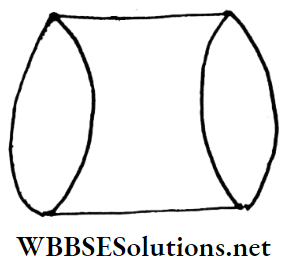
Class 12 Physics Unit 6 Optics Chapter 3 Refraction Of Light At Spherical Surface Lens A Bi Concave Lens

⇒ \(\frac{1}{f_1}=(\mu-1) \cdot \frac{2}{r_1}\)

And \(\frac{1}{f_2}=(\mu-1) \cdot \frac{2}{r_2}\)

⇒ \(\frac{1}{10}=\left(\frac{3}{2}-1\right) \cdot \frac{2}{r_1}\)

And \(\frac{1}{20}=\left(\frac{3}{2}-1\right) \cdot \frac{2}{r_2}\)

Or, = r1 = 10 cm and r = 20 cm

If f3 be the focal length of the biconcave lens’ made of water, then

⇒ \(\frac{1}{f_3}=-\left(\mu^{\prime}-1\right)\left(\frac{1}{r_1}+\frac{1}{1+m_2}\right)^{\prime}\)

⇒ \(-\left(\frac{4}{3}-1\right)\left(\frac{1}{10}+\frac{1}{20}\right)=\frac{-1}{3} \times \frac{3}{20}=\frac{-1}{20}\)

Or,  f3  = – 20 cm

If F be the equivalent focal length of the Icns-combination, then

⇒ \(\frac{1}{F}=\frac{1}{f_1}+\frac{1}{f_2}+\frac{1}{f_3}\)

= + \(\frac{1}{10}+\frac{1}{20}-\frac{1}{20}\)

= + \(\frac{1}{10}\)

Or, F = + 10 cm

Since the Image Is double the size of the object, so magnification,

m = 2 or, \(\frac{v}{u}\) = 2 Or, v = 2u

So, for the formation of real Images,

⇒ \(\frac{1}{2 u}-\frac{1}{(-u)}=\frac{1}{10}\)

Or, \(\frac{3}{2 u}=\frac{1}{10}\)

u = 15 cm

For the formation of a virtual Image,

⇒ \(\frac{1}{-2 u}-\frac{1}{(-u)}=\frac{1}{F}\)

or, \(\frac{1}{-2 u}+\frac{1}{u}=+\frac{1}{10}\)

or, \(\frac{-1+2}{2 u}=\frac{1}{10}\)

Or, u = 5 cm

Therefore, the object distance Is 15 cm (In the formation of a real image) and 5 cm (information of a virtual Image)

Example 27. An object Is placed at a distance of 36 cm in front of a convex lens of focal length 30 cm. A plane mirror is placed behind the lens at a distance of 100 cm In such a way that the mirror Is inclined at an angle of 45° with the axis of the lens. A vessel containing water of a height 20 cm Is placed below the mirror In such a way that the image formed by the above combination is situated at the bottom of the vessel. What is the distance of the bottom of the vessel from the axis of the lens? The refractive index of water \(\frac{4}{3}\) =. Draw the ray diagram.
Solution:

Ray-diagram has been shown.

For convex lens, u = -36 cm ; f = + 30 cm ; v = ?
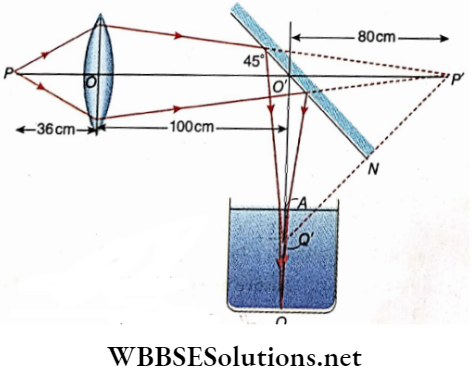
Class 12 Physics Unit 6 Optics Chapter 3 Refraction Of Light At Spherical Surface Lens Bottom vessel of The Axis And Refractive Index Of Water

According to the equation of lens

⇒ \(\frac{1}{v}-\frac{1}{u}=\frac{1}{f}\)

⇒ \(\frac{1}{v}+\frac{1}{36}=\frac{1}{30}\)

Or, \(\frac{1}{v}=\frac{-1}{36}+\frac{1}{30}=\frac{1}{180}\)

v = 180 cm

So, If the piano mirror was absent, the Imoge would be formed at a P’ nt n distance of 180 cm behind the lens .

But due to the reflection In the plane mirror, the Image should be formed at Q below the principal axis at a distance, BO cm P’N=Q’N (P’N IS normal to mirror),’ Therefore in bP’O’Q’, O’Q’ = O’P’ = 80 cm]. However, due to refraction in the water of the vessel, the final image Is formed at Q, situated at the bottom of the vessel.

According to the formula

⇒ \(\frac{A Q}{A Q}\)

Or, \(\frac{4}{3}=\frac{20}{A Q^{\prime}}\)

Or, AQ’ = 15 cm

QQ’ = AQ-AQ’ = 20-15 = 5 cm

Distance of the bottom of the vessel from the axis of the lens

= 80 + 5 = 85 cm

Conceptual Questions on Image Formation by Spherical Lenses

Example 28. A convex lens of focal length 20 cm Is placed on a plane mirror. An object, If placed centrally along the axis of the lens at a distance of 20 cm above the lens, where will the image be formed?
Solution:

Here, u = -20 cm , f = 20 cm , v = ?
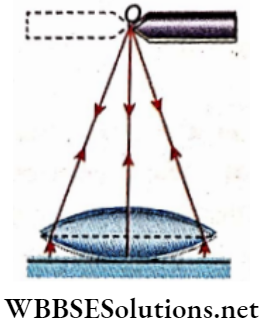
Class 12 Physics Unit 6 Optics Chapter 3 Refraction Of Light At Spherical Surface Lens If Placed Centrally Along The Axis Of The Lens

According to the equation of lens

⇒ \(\frac{1}{v}-\frac{1}{u}=\frac{1}{f}\)

⇒  \(\frac{1}{v}-\frac{1}{-20}=\frac{1}{20}\)

Or, \(\frac{1}{v}\) = 0, v = ∞

Therefore, the refracted rays proceeding parallel to the axis of the lens will be incident perpendicularly on the plane mirror. Hence, the reflected rays will retrace the same path and will form an image which will coincide with the object at O

Example 29. A point object is placed at a distance of 15 cm from a convex lens and its image is formed at a distance of 30 cm on the opposite side of the lens. If a concave lens, the image shifts 30 cm more away from the combination of lenses find the focal lengths of the lenses
Solution:

For the image formation by the convex by lens only u = -15cm, v= 30 cm, f=?

According to the lens equation

⇒ \(\frac{1}{v}-\frac{1}{u}=+\frac{1}{f}\)

⇒  \(\frac{1}{30}-\frac{1}{-15}=\frac{1}{f}\)

Or, \(\frac{1+2}{30}=\frac{1}{f}\)

Or, f = 10 cm

The focal length of the convex lens = 10 cm

An image formed by the convex lens will act as the virtual object for the concave lens and its real image will be formed at a distance of 60 cm from the concave lens
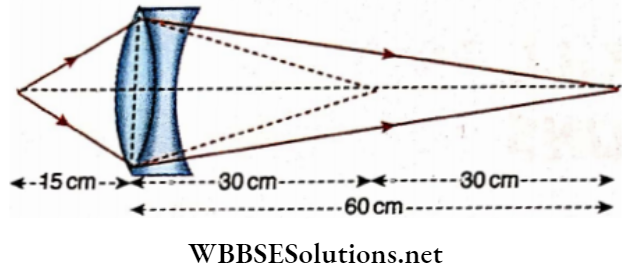
Class 12 Physics Unit 6 Optics Chapter 3 Refraction Of Light At Spherical Surface Lens Distance Of The Concave Lens

For the image formation by the concave lens

u = +30 cm, v = +60 cm, f- ?

From the equation, \(\frac{1}{v}-\frac{1}{u}=\frac{1}{f}\) we get

⇒ \(\frac{1}{60}-\frac{1}{30}=\frac{1}{f}\)

Or, \(\frac{1-2}{60}=\frac{1}{f}\)

Or, f = -60 cm

The focal length of the concave lens =-60 cm

Example 30. r A converging beam of rays converges to the point P. A lens is placed at a distance of 12 cm from point P in the path of the rays. Where will the converging beam of rays meet if

  1. The lens is a convex one of focal length 20 cm or
  2. The lens is a concave one with a focal length of 6 cm

Solution:

The converging beam of rays after refraction in the convex lens LL’ meets at the point Q. In the absence of the lens, the beam of rays would meet at P [Fig. 3.67]. In this case, P is the virtual object and Q is its real image with respect to the lens.
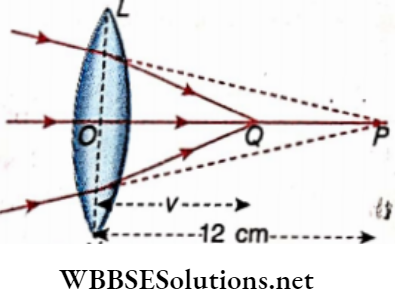
Class 12 Physics Unit 6 Optics Chapter 3 Refraction Of Light At Spherical Surface Lens Covering Beam Of Rays After In The Convex Lens

Here, u = 12 cm; f= 20 cm; v = ?

From to the equation of lens

⇒ \(\frac{1}{v}-\frac{1}{u}=\frac{9}{f}\)

Or, \(\frac{1}{v}-\frac{1}{12}=\frac{1}{20}\)

Or, \(\frac{1}{v}=\frac{1}{20}+\frac{1}{12}=\frac{2}{15}\)

Or, \(\frac{15}{2}\)cm = 7.5

So, the beam of rays will meet at Q at a distance of 73 cm from the lens.

The converging beam of rays after refraction in the concave lens LLf appears to diverge from point Q. So in this case the object is virtual and its image is also virtual
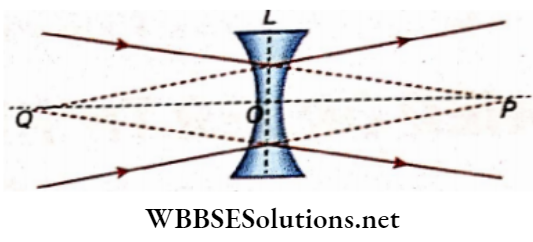
Class 12 Physics Unit 6 Optics Chapter 3 Refraction Of Light At Spherical Surface Lens Covering Beam Of Rays After Refraction In The Concave

Here, u = 12 cm,f = -6 cm, v = ?

According to the equation of lens,

⇒\(\frac{1}{v}-\frac{1}{u}=\frac{1}{f} \quad \text { or, } \quad \frac{1}{v}-\frac{1}{12}=\frac{1}{-6}\)

Or, \(\frac{1}{v}=\frac{1}{12}-\frac{1}{6}=\frac{1-2}{12}\)

= \(\frac{-1}{12}\)

Or, v = -12 cm

The negative sign of v indicates that after refraction the beam of rays appears to diverge from Q

Example 31. A convex lens of glass has power- 10.0 D. When this lens is completely immersed in a liquid, it behaves as a concave lens of focal length 50 cm. Determine the refractive index of the liquid. Given that – 1.5
Solution:

Power, P= \(\frac{100}{f(\mathrm{~cm})}\)

Or, f = \(\frac{100}{10}\)

= 10 cm

Now, \(\frac{1}{f}=\left({ }_a \mu_g-1\right) \times\left(\frac{1}{r_1}-\frac{1}{r_2}\right)\)

Or, \(\frac{1}{r_1}-\frac{1}{r_2}=\frac{1}{5}\)

When the lens is immersed in the liquid the focal length of the lens (J) becomes -50 cm

⇒ \(\frac{1}{-50}=\left({ }_l \mu_g-1\right)\left(\frac{1}{r_1}-\frac{1}{r_2}\right)\)

Or, \(\frac{1}{-50}=\left(\frac{a^\mu}{a^\mu}-1\right) \times \frac{1}{5}\)

= Re&active index of the liquid relative to air

Or, \(\frac{a^{\mu_g}}{a_l}-1=-\frac{1}{10}\)

Or, \(\frac{a^\mu}{a^{\mu_l}}-1=-\frac{1}{10}\)

Or, \(\frac{a^\mu g}{a_l \mu_l}=1-\frac{1}{10}=\frac{9}{10}\)

Or, \(\frac{1.5}{a^\mu}=\frac{9}{10}\)

⇒  \(_a \mu_l=\frac{15}{9}\)

= 1.67

The refractive index of the liquid is 1.67

WBCHSE physics class 12 refraction lens notes 

Refraction Of Light At Spherical Surface Lens Long Questions And Answers

Question 1. A swimmer underwater sees the objects indistinct inside the water with his uncovered eyes. But if he wears a mask, why does he see them distinctly?
Answer:

The refractive index of water is greater relative to air and the refractive index of water is slightly smaller than that of the ingredient of the human eye. So, the focal length of the uncovered eye increases inside water. Due to the increase in focal length, the power of the eye lens decreases. For this, the images of the objects inside water are formed much behind the retina instead of on it. So the objects appear to be indistinct.

On the other hand, if the swimmer wears a mask, his eyes are in contact with air. So, the rays of light enter the eyes from the air and the focal length of the eye lens does not change. The power of eye-lens remains the same. So, due to the presence of a mask, the swimmer sees the objects inside the water distinctly

Question 2. Shows that a concave lens always produces a diminished and virtual image.
Answer:

According to the equation of lens \(\frac{1}{v}-\frac{1}{u}=\frac{1}{f}\)

For a concave lens, both u and f are negative.

∴ \(\frac{1}{v}-\frac{1}{u}=\frac{1}{f}\)

= \(\frac{-(f+u)}{u f} \text { or, } v=\frac{-u f}{u+f}\)

Now, for any value of u, v is negative.

So, the image is formed on the same side as the object and is virtual

From the equation of lens , \(\frac{1}{v}-\frac{1}{u}=\frac{1}{f}\), we get

Or, \(\frac{u}{v}-1=\frac{u}{f}\)

[ m = \(\frac{1}{m}-1=\frac{u}{f}\) [m = \(\frac{v}{u}\) Linear magnification]

Or, \(\frac{1}{m}=1+\frac{u}{f}\)

Or, \(m=\frac{f}{f+u}\)

Now, since both u and f are negative, m < 1

Again, m = \(\frac{\text { length of the image }}{\text { length of the object }}\)

∴ \(\frac{\text { length of the image }}{\text { length of the object }}<1\)

∴ Length of the image < length of the object

Real-Life Scenarios Involving Refraction through Lenses

Question 3. Can a concave lens form a real image?
Answer:

A concave lens can form a real image if the object is virtual or if the lens is placed in a medium whose refractive index is greater than the refractive index of the material of the lens.

Question 4. A concave lens of refractive index μ is immersed in a medium whose refractive index

  1. Is smaller than μ,
  2. Is equal to μ,
  3. Is greater than μ.

When a parallel beam of rays is incident on the lens, show with the help of a diagram in each case the path of the rays.
Answer:

Suppose, the refractive index of the medium = μ’

1.  If μ’ < μ, i.e., if the refractive index of the material of the lens is greater than that of the medium, the concave lens behaves as a diverging lens. So, in this case, a beam of rays paraÿel to the axis of the lens, after in the lens, appears to diverge from a point on the principal axis

2. If μ’ = μ, i-e., if the refractive index of the material of the lens and that of the medium are equal, ho refraction oflight

Takes place inside the lens. So, in this case a beam of rays, parallel to the axis of the lens, after refraction in the lens, emerges as a parallel beam. So, on observation of the behaviour of the light rays, it can be said that there is no existence of the lens.
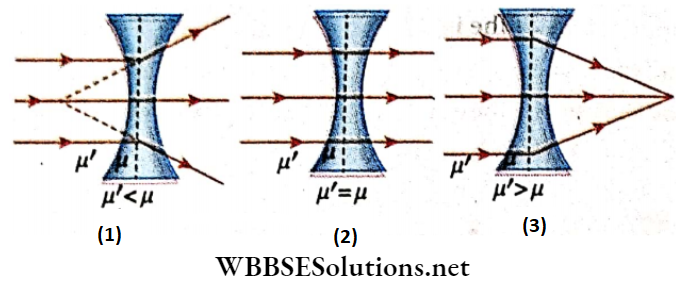
Class 12 Physics Unit 6 Optics Chapter 3 Refraction Of Light At Spherical Surface Lens Beam Of Rays Parallel To The Axis

3. If μ’ > μ, i.e., if the refractive index of the material of the lens is less than that of the medium, the concave lens behaves as a convex lens i.e., a converging lens. So, in this case a beam of rays parallel to the axis of the lens, after refraction in the lens, converges to a point on the principal axis of the lens.

Question 5. Show that the minimum distance between an object and its real image formed by a convex lens is four times the focal length of the lens.
Answer:

In the case of the formation of a real image by the convex lens we have,

⇒ \(\frac{1}{v}+\frac{1}{u}=\frac{1}{f}\) ………………….. (1)

If D be the distance between the object and the screen i.e., the image, then

u + v = D

Or, D \((\sqrt{u})^2+(\sqrt{v})^2\)

Or, D \((\sqrt{u}-\sqrt{v})^2+2 \sqrt{u v}\)

Now, D will be the minimum, if \(\sqrt{u}=\sqrt{v}\)= 0

i.e if \(\sqrt{u}=\sqrt{v}\)

Or, u = v

So from equation (1), we get

⇒  \(\frac{1}{u}+\frac{1}{u}=\frac{1}{f}\)

Or,\(\frac{2}{u}=\frac{1}{f}\)

u = 2f

v = 2f

Dmin  = 2f+2f = 4f

Question 6. How does the focal length of a lens depend on The colour of the incident light and The Medium surrounding the lens
Answer:

Suppose, the refractive index of the lens relative to the surrounding medium is ft; the radii of curvature of the first and the

The second refracting surfaces of the lens are r1, and r2 respectively. 1ff be the focal length of the lens, then

⇒ \(\frac{1}{f}=(\mu-1)\left(\frac{1}{r_1}-\frac{1}{r_2}\right)\) ……………………… (1)

1. We know that if the wavelength of the incident light ~ increases, the refractive index of any medium (suppose, the material of the lens) decreases according to Cauchy’s relation, μ = A +\(\frac{B}{\lambda^2}\)  can be said from the equation

⇒ \(f \propto \frac{1}{(\mu-1)}\) ………………….. (2)

So, if the refractive index of the material of the lens ft decreases, the focal length of the lens increases. Similarly, if the wavelength of light decreases, the refractive index of a medium increases and the focal length of the lens decreases.

In comparison to the wavelength oflight of other colours, the wavelength of red light is greater. So, the focal length of a lens is greater for red light in comparison to other colours.

2. In equation (1), it is the refractive index of the lens relative to the surrounding medium. Now, if the refractive index of the surrounding medium increases, ft decreases. So from equation (2), it can be said that the focal length of a lens increases if ft decreases.

Similarly, if the refractive index of the surrounding medium decreases, μ increases. With the increase of μ, the focal length of the lens decreases

Question 7. The lens is made of two different materials. A point object is placed on the axis of the lens. How many images of the object will be formed?
Answer:

The lens is made of two different materials i.e., it is made up of two materials of different refractive indices. So, the portions of the lens coloured in different will behave as two lenses of two different focal lengths. So, two images of the object will be formed
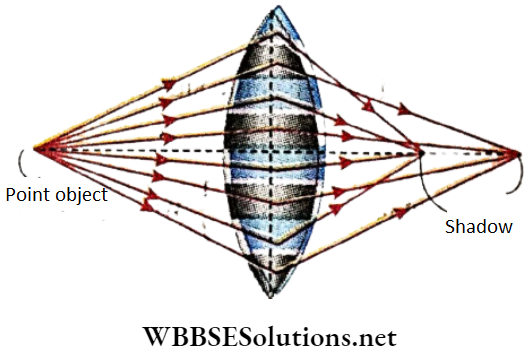
Class 12 Physics Unit 6 Optics Chapter 3 Refraction Of Light At Spherical Surface Lens Two Different Focal Lengths

Question 8. Prove that the area of the image of the moon formed by a convex lens is proportional to the square of the focal length of the lens. What change of the image will be observed if a portion of the lens is covered by black paper?
Answer:

Suppose, the angular radius of the moon = θ As the moon is situated from the lens at infinite distance, the image of the moon is formed in the focal plane of the lens. The Image of the centre of the moon is formed at F, the focus of the lens. The rays of light coming from the circumference of the moon are inclined at angle θ with the principal axis of the lens
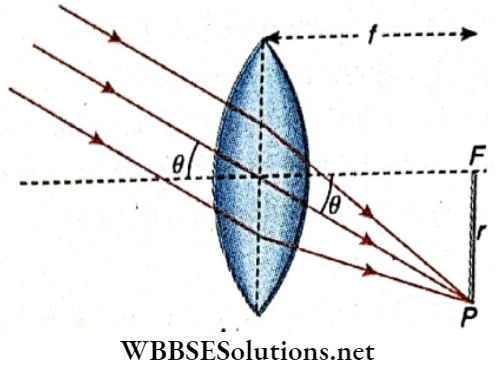
Class 12 Physics Unit 6 Optics Chapter 3 Refraction Of Light At Spherical Surface Lens Principle Axis Of The Lens

Radius of the image = r = FP = fθ [∴ θ is small]

Area of the image of the moon, A = μr² =μf² θ²

An ∝ f² [ ∴  μ and  θ are constants]

If a portion of the lens is covered by black paper, the nature of the image does not change. Only the brightness of the image decreases because comparatively a few light rays take part in the formation of the image.

Question 9. How should the two convex lenses be placed so that a parallel beam of rays emerges out parallel after refraction through the lenses?
Answer:

If the axes of the two lenses are along the same straight line and the distance between the two lenses is equal to the sum of the focal lengths of the lenses, a beam of parallel rays will emerge as a parallel beam after refraction through the lenses
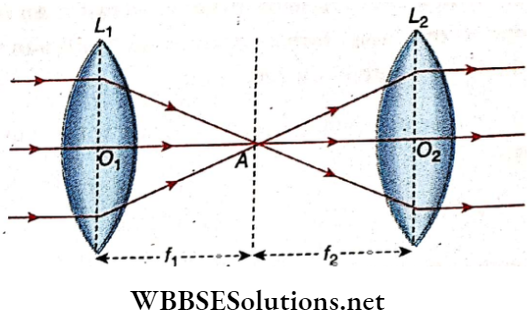
Class 12 Physics Unit 6 Optics Chapter 3 Refraction Of Light At Spherical Surface Lens Parallel after Refraction Through The Lenses

Suppose, the focal lengths of the two lenses L1 and L2 are f1 and f2 respectively. A beam of parallel rays parallel to the principal axis, after refraction on the lens L1, forms the image at A, the focus of the. Lens L1. So, O1A = f1. This image acts as the object for the lens L2. If point A is at a distance of f2 from the second lens, L2 i.e., if AO2 = f2, the rays emitted from A, after refraction in lens L2, emerge as a parallel beam

O1O2 = O1A+AO2= f1+f2

Question 10. A lens is immersed in a liquid so that it vanishes. State the optical nature of the liquid. Find the value of the focal length of the lens from the lens maker’s formula under the above condition
Answer:

The lens will vanish while immersing in a liquid if it has a refractive index equal to that of the material of the lens, i.e., no deviation or lateral displacement of light is observed. 1ff be the focal length of a lens, we get from the lens maker’s for¬ mula

⇒ \(\frac{1}{f}\) = (1μ2-1) \(\left(\frac{1}{r_1}-\frac{1}{r_2}\right)\)

1μ2= Refractive index of the material of the lens relative to the surrounding medium

If the refractive index of the material of the lens and that of the surrounding medium are equal, then 1μ2 = 1.

So, from the above equation, we get

⇒ \(\frac{1}{f}\) = 0

Or, f = ∞

Question 11. An object is moving with velocity Vo along the axis of a convex lens. If m be the magnification at any moment, then what will be the. velocity of the image?
Answer:

The equation of lens is \(\frac{1}{v}-\frac{1}{u}=\frac{1}{f}\)

Differentiating this equation concerning t we get

⇒ \(-\frac{1}{v^2} \frac{d v}{d t}+\frac{1}{u^2} \frac{d t}{d t}\)

Or, \(\frac{v^2}{u^2}\) × Vo

∴  Velocity of the image = \(\frac{v^2}{u^2} \times \text { velocity of the object }\)

V1= Velocity of the image

Vo = Velocity of the object

Or, \(v_1=m^2 \times v_0\)

∴ m= \(\frac{v}{u}\) = Linear magnification

Velocity of the image = \(\)

Or, \(\)

The velocity of the image, V= a velocity of the object

m = linear magnification

Question 12. Explain briefly with a diagram how it is possible to determine the focal length of a concave lens by using a convex lens.
Answer:

In general, a concave lens cannot form a real image. So by casting on a screen the location of the image cannot be measured. A convex lens L1 is taken in contact with a concave lens L2 If the focal length of the convex lens is smaller than that of the concave lens, the combination will act as a convex lens.
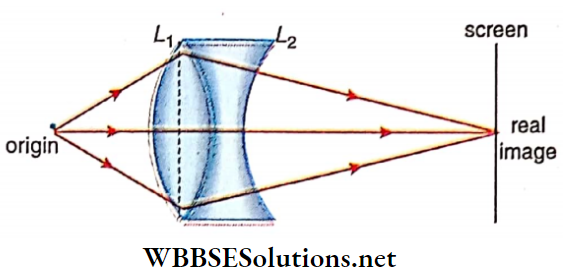
Class 12 Physics Unit 6 Optics Chapter 3 Refraction Of Light Origin And Screen

Under this condition, the real image of an object can be formed on a screen. By measuring object distance u and image distance v and using the relation \(\frac{1}{v}-\frac{1}{u}=\frac{1}{F}\) the equivalent focal length, F of the lens-combination can be calculated.

Now, if the focal length of the convex lens and the concave lens are f1 and f2 respectively, then

⇒ \(\frac{1}{F}=\frac{1}{f_1}+\frac{1}{f_2} \text { or, } \frac{1}{f_2}=\frac{1}{F}-\frac{1}{f_1}\)

Or, \(f_2=\frac{F f_1}{f_1-F}\)

So, if the focal length of the convex lens f1 is known, the focal length of the concave lens f2 can be calculated. Here, f1 and F are both positive. So, for the calculation of f2 these positive values are to be put in the above equation and f2 will be negative

Question 13. Show that for any convex lens, the general equation of \(\frac{1}{v}+\frac{1}{u}=\frac{1}{f}\) represents a rectangular hyperbola.
Answer:

For a convex lens, the general equation of a lens can be written as

⇒ \(\frac{1}{v}-\frac{1}{u}=\frac{1}{f}\)

uv- f(u+v) = 0 Or, uv- f(u+v)+f² = f²

⇒ \(f^2-f(u+v)+\left(\frac{u+v}{2}\right)^2-\left(\frac{u-v}{2}\right)^2\) = f²

⇒  \(\left(f-\frac{u+v}{2}\right)^2-\left(\frac{u-v}{2}\right)^2=f^2\)

Or, x² – y² = f²

Where x= \(f-\frac{u+v}{2}\) and y= \(y=\frac{u-v}{2}\)

The above equation represents a rectangular hyperbole

Question 14. The radius of curvature of a plano-convex lens made of a material of refractive index 1.5 is 30 cm. Its concave surface is silvered. At what distance from the plane surface .of the lens is an object to be placed so that a real image equal to the size of the object is formed?
Answer:

This is an optical system with two elements: a convex lens and a concave mirror in contact with each other. For focal length / of the convex lens

∴ \(\frac{1}{f}=(\mu-1)\left(\frac{1}{r_1}-\frac{1}{r_2}\right)\)

⇒ \((1.5-1)\left(\frac{1}{\infty}-\frac{1}{-30}\right)\)

= 0.5 \(\frac{1}{30}\)

∴ f = \(\frac{3.0}{0.5}\)

= 60 cm

Focal length of the concave minor,

F = \(\frac{r_2}{2}=-\frac{30}{2}\)

= -15 cm

Let, u = object distance from the optical system [Fig. 3.75].

Then, for the convex lens

⇒ \(\frac{1}{v}+\frac{1}{u}=\frac{1}{f}, \text { or, } \frac{1}{v}=\frac{1}{f}+\frac{1}{u}\)

⇒  \(\frac{u+f}{u f}, \text { or } v=\frac{u f}{u+f}\)

∴ Magnification in the lens m = \(\frac{v}{u}=\frac{f}{u+f}\)

Now, v = U = object distance for the concave mirror. So

⇒ \(\frac{1}{V}+\frac{1}{U}=\frac{1}{F}\)

Or, \(\frac{1}{V}=\frac{1}{F}-\frac{1}{U}=\frac{U-F}{U F}\)

Or, V = \(\frac{U F}{U-F}\)

Magnification in the mirror M =  \(\frac{V}{U}=\frac{F}{U-F}\)

Then, overall magnification,

Mo = mM =  \(\frac{f}{u+f} \cdot \frac{F}{U-F}\)

= \(\frac{f}{u+f} \cdot \frac{F}{\frac{u f}{u+f}-F}\)

= \(\frac{f}{u+f} \cdot \frac{F(u+f)}{u f-u F-f F}\)

= \(\frac{f F}{u(f-F)-f F}\)

Given, object and image sizes are equal, i.e., MQ =i

fF = u(f- F) -fP or, u(f-F) = 2fF

Or, \(\frac{2 f F}{f-F}\)

Putting these values off and F, to have

u = \(\frac{2 \times 60 \times(-15)}{60-(-15)}\)

= \(-\frac{2 \times 60 \times 15}{75}\)

= -24 cm

Question 15. The focal length of the equi-convex lens is if the lens is cut into two pieces h along AB, what will be the focal length of each half
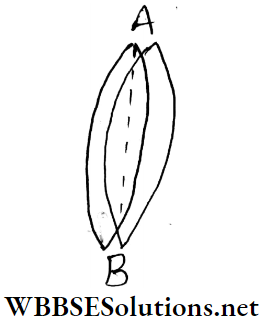
Class 12 Physics Unit 6 Optics Chapter 3 Refraction Of Light At Spherical Surface Lens Equi Convex Lens

Answer:

Let the radius of curvature of each surface of the biconvex lens be r and the refractive index of its material be, From the lens maker’s formula We have

⇒ \(\frac{1}{f}=(\mu-1)\left(\frac{1}{r_1}+\frac{1}{r_2}\right)\)

= \((\mu-1)\left(\frac{1}{r}+\frac{1}{r}\right)=\frac{2}{r}(\mu-1)\) ……………. (1)

For each half, the radius of curvature of the curved surface r1 = r and that for the plain surface, r2 = ∞

Let us suppose that the focal length of each of the cut pieces be x.

⇒ \(\frac{1}{x}=(\mu-1) \frac{1}{r}=\frac{1}{2 f}\)

From Equation

x = 2f
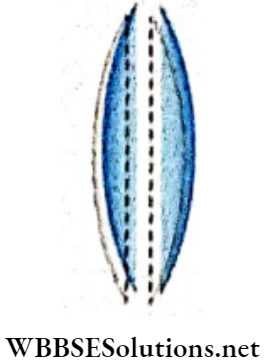
Class 12 Physics Unit 6 Optics Chapter 3 Refraction Of Light At Spherical Surface Lens Half Radius Of Curvacture

Question 16. If the light rays behave, what will be the relation among μ1, μ and μ2?
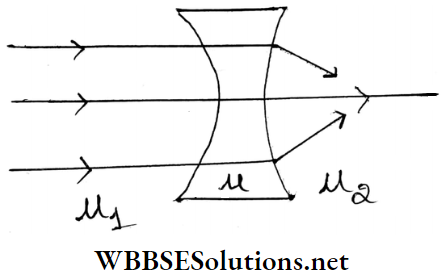
Class 12 Physics Unit 6 Optics Chapter 3 Refraction Of Light At Spherical Surface Lens Light Rays

Answer:

Since the light fays after entering the lens proceed undefeated, the refractive index of the left-hand medium of the lens and that of the material of the lens are the same, i.e., μ1 = μ.

Again, as the rays after emerging out from the second surface of the concave lens become convergent instead of divergent rays, it may be concluded that the refractive index of the right-hand medium is greater than that of the material of the lens i.e., μ1 > μ.

Question 17. An object behaves like a convex lens in air but like a concave lens in water. What is the type of refractive index of its material concerning air and water
Answer:

For a convex lens,

⇒ \(\frac{1}{f}=\left(\frac{\mu_2}{\mu_1}-1\right)\left(\frac{1}{r_1}+\frac{1}{r_2}\right)\) ……………… (1)

Here, μ2 is the refractive index of the material and μ1 is that of the surrounding medium. f is positive for a convex lens. From, equation (1), it can be said that f will be positive if μ21  i.e., if the refractive index of the material of the object is greater than that of air.

For a concave lens. f is negative. From equation (1), it can be said that f will be negative if μ2 < μ1 i.e. if the refractive index of the material of the object is less than that of water. So, the refractive index of the material of the object is greater than air but less than water.

Question 18. A convex lens and a concave lens of equal focal length are placed in contact. What are the focal length and power of the lens combination?
Answer:

If focal length of convex lens, f1 = f, then focal length of concave lens, f2 = -f

If F be the focal length of the lens combination, then

⇒ \(\frac{1}{F}=\frac{1}{f_1}+\frac{1}{f_2}=\frac{1}{f}+\frac{1}{-f}\)

Or, F = ∞

Power of the lens combination = \(\frac{1}{F}\) = 0

Question 19. If the plane surface of a plano-convex lens is silvered, what will be the effective (or equivalent) focal length of the lens
Answer:

If an object is placed in front of such a lens, light rays are at first refracted through the convex surface. Next, by reflect¬ ing from the silvered plane surface, the light rays are refracted through the convex surface for the second time.if the equivalent focal length of the lens is F, then

⇒ \(\frac{1}{F}=\frac{1}{f}+\frac{1}{f_m}+\frac{1}{f}\)

[Where f is the focal length of the convex surface and fm focal length of the silvered plane surface]

Or, \(\frac{1}{F}=\frac{2}{f}+\frac{1}{f_m}\)

Or, \(\frac{1}{F}=\frac{2}{f}\)

Since the focal length of the silvered plane

Surface fm = ∞,  So \(\frac{1}{f_m}\) = 0

∴ F = \(\frac{f}{2}\)

Question 20. The focal length f of an equi-convex lens is related to the radius of curvature r of the surface by f = r, find out the refractive index of the material of the lens.
Answer:

From the lens maker’s formula,

⇒ \(\frac{1}{f}=(\mu-1)\left(\frac{1}{r_1}-\frac{1}{r_2}\right)\)

For a equi-convex lens, r1 = r ; r2 = -r

∴  \(\frac{1}{f}=(\mu-1) \cdot \frac{2}{r}\)

Or, \(\frac{1}{r}=(\mu-1) \frac{2}{r}\)

Since by the question f = +r

Or, \(\mu-1=\frac{1}{2}\)

Or, μ = \(\frac{3}{2}\)

= 1.5

Question 21. Sunglasses (Goggles) have two curved surfaces yet their power is zero, Why?
Answer:

The two radii of curvature of the two surfaces of the lens used in sunglasses are equal and of the same sign (curved in the same direction) and also thickness of the glass is very small
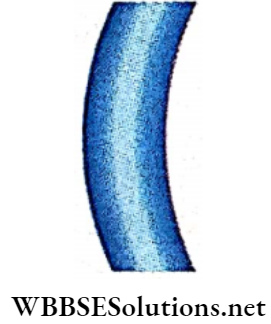
Class 12 Physics Unit 6 Optics Chapter 3 Refraction Of Light At Spherical Surface Lens Sunglasses

Power = \(\frac{1}{f}=\left(a_g \mu_g-1\right)\left(\frac{1}{r_1}-\frac{1}{r_2}\right)\) = 0

∴ r1 = r2

Question 22. What is the relation between the refractive indices μ, μ1 and μ2 if the behaviour of light rays. 
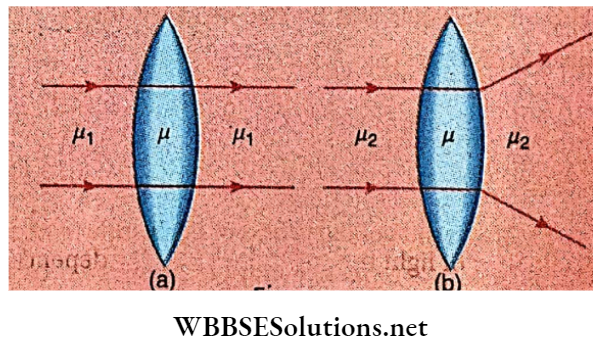
Class 12 Physics Unit 6 Optics Chapter 3 Refraction Of Light At Spherical Surface Lens Relation Between The Refrcative Indices

Answer:

Let a lens of material of refractive index μ is placed in a medium of refractive index

The focal length is given by,

⇒ \(\frac{\mu}{\mu_1}-1\) = 0

⇒ \(\left(\frac{1}{r_1}-\frac{1}{r_2}\right)\) = 0

According to the = oo [because the lens behaves as a plane a glass plate

∴ \(\frac{\mu}{\mu_1}-1\)

Since \(\left(\frac{1}{r_1}-\frac{1}{r_2}\right)\) ≠ 0

Or, μ = μ1

According to the the lens acts as a concave lens. Sof is negative.

The focal length of the lens is given by,

∴ \(\frac{1}{f}=\left(\frac{\mu}{\mu_2}-1\right)\left(\frac{1}{r_1}-\frac{1}{r_2}\right)\) = 0

Since in case of a convex lens \(\) >0

Therefore \(\left(\frac{\mu}{\mu_2}-1\right)\) < 0

Or μ < μ2

Question 23. The f-number of a lens is given by \(\frac{F}{D}\) where F is its focal length and D is aperture diameter. If the f-number is 1.6 instead of 2, determine the amount of excess light that will fail on the film.
Answer:

We know, f-number \(=\frac{F}{D}\)

Or, D = \(=\frac{F}{f \text {-number }}\)

Suppose, when f-number = f1; D = D1 and when f-number

So from equation (1) we get

⇒ \(\frac{D_2}{D_1}=\frac{f_1}{f_2}\)

Now the amount of light that will reach the film depends on the area of the aperture Le., on D²

So, \(\frac{\text { the amount of tight in the second case }}{\text { the amount of light in the first case }}=\frac{D_2^2}{D_2^2}\)

⇒ \(\frac{2^2}{16^2}=\frac{1}{64}\)

Therefore, if the f-number of the lens, changes from 2 to 1. 6 the amount of light falling on the film will be \(\frac{1}{64}\) of the first case

Question 24. The aperture of the camera lens is changed from \(\frac{f}{8}\) to  \(\frac{f}{11}\)  to, How are

  1. The size of the image
  2. The intensity of illumination of the
  3. Exposure time and
  4. The distinctness of the image influenced

Answer:

When the f-number of the lens is changed from f-8 to tof-11 the effective aperture of the lens decreases.
So,

  1. The size of the image will not be changed,
  2. The intensity of illumination of the image will be diminished as less amount of light passes through the lens.
  3. Exposure time will be lengthened.
  4. Distinctness of the image will increase

Question 25. The radius of curvature of both sides of the given lens is R. The Refractive index of the fV medium in which the source is present is μ1, and the refractive indices of the lens and the medium in which the image is formed are μ2 and μ3 respectively. Find the focal length of the system.
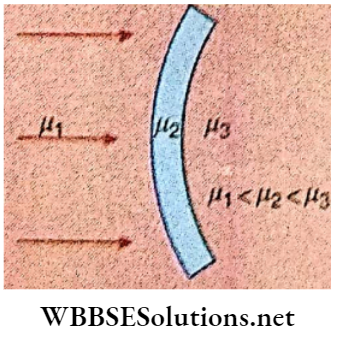
Class 12 Physics Unit 6 Optics Chapter 3 Refraction Of Light At Spherical Surface Lens Focal Length Of The System

Answer: In case of refraction at the first curved surface,

⇒ \(\frac{\mu_2}{v_1}+\frac{\mu_1}{\infty}=\frac{\mu_2-\mu_1}{+R}\) ………………………. (1)

Again, for refraction at the second curved surface object distance is equal to the distance of the image formed by the first refracting surface since the lens is a thin lens

⇒ \(\frac{\mu_3}{v_2}-\frac{\mu_2}{v_1}=\frac{\mu_3-\mu_2}{+R}\) …………. (2)

Adding equations (1) and (2), we get

⇒ \(\frac{\mu_3}{v_2}=\frac{\mu_3-\mu_1}{R}\)

Hence the focal length of the system,f \(\frac{\mu_3 R}{\mu_3-\mu_1}\)

Question 26. An equl convex lens with radii of curvature each of magnitude r is kept over a liquid layer poured on top of a plane mirror. A small needle with its tip on the principal axis of the lens is moved along the axis until its inverted real image coincides with the needle itself.  The distance of the needle from the lens is measured to be x On removing the liquid layer and repeating the experiment, the design 3.82 stance is found to be y. Prove that the refractive index of the liquid.
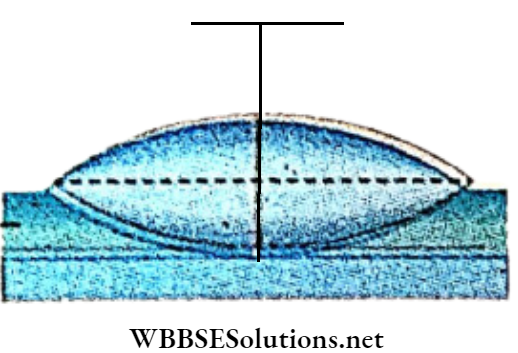
Class 12 Physics Unit 6 Optics Chapter 3 Refraction Of Light At Spherical Surface Lens An Equiconves Lens With Radii Of Curvacture

Answer:

From the given conditions, we get the equivalent focal length of the combination of glass lens and liquid lens, F = x and the focal length of convex lens, f1 = y.

If f2 is the focal length of the liquid lens then

⇒ \(\frac{1}{f_1}+\frac{1}{f_2}=\frac{1}{F} \text { or, } \frac{1}{f_2}=\left(\frac{1}{x}-\frac{1}{y}\right)\)

The liquid lens is a plano-concave lens for which

R1 = -r and R2 =∞

From the lens maker’s formula,

⇒ \(\frac{1}{f_2}=(\mu-1)\left(\frac{1}{R_1}-\frac{1}{R_2}\right)\)

⇒ \(\left(\frac{1}{x}-\frac{1}{y}\right)=(\mu-1)\left(\frac{1}{-r}-\frac{1}{\infty}\right)\)

Or, \((\mu-1)=r\left(\frac{1}{y}-\frac{\mathrm{i}}{x}\right)\)

⇒ \(1+\frac{r}{y}-\frac{r}{x}\)

Question 27.

  1. Determine the effective focal length of the combination of two lenses, one a convex lens of focal length 30 cm and the other a concave lens of focal length 20 cm placed 8.0 cm apart with their principle axis coincident. Does the answer depend on which side of the combination a beam of parallel light is incident?is the notion of effective focal length of this system useful at all?
  2. An object 1. 5 cm in size is placed on the side of the convex lens. The distance between the object and the

Answer:

Convex lens s 40an. Detersirs* the oagrtifkation produced by the two-knows system. and she sze os she image.

1. When a beam of a parallel beam of light is incident on the convex lens then.

u1 =∞

f1 = 30 cm

This image is the virtual o&jecrssrthesecondfens

u2= 30-8 = 22 cm, f2= – 20 cm

∴ \(\frac{1}{v_2}=\frac{1}{f_2}+\frac{1}{u_2} \text { or, } u_2=\frac{-20 \times 22}{+22-20}\)

= -220 cm

The focal length of the combination is (220-4) = 216 cm from the midpoint of the line joining the lenses when the light falls on the convex lens first

When the beam of light is incident on the concave lens first then f1 = -20 cm, u = ∞

∴ v1 = -20 cm

This image Is the virtual object for the convex lens

∴  f2 = 30 cm, u2  = (20 + 8) cm

= -28 cm

∴ \(v_2=\frac{u_2 f_2}{u_2+f_2}=\frac{-28 \times 30}{30-28}v_2=\frac{u_2 f_2}{u_2+f_2}=\frac{-28 \times 30}{30-28}+\)

So in this case the focus of the combination is at a distance (420-4) = 416 cm to the right from the mid¬ point of the line joining the two lenses.

Thus the answer depends on the lens nn which the length is first incident as there is no definite formula based on which the focal length of the combination can he calculated, the notion of effective focal length is not useful at all

2. For the first lens, u1= -40 cm, f1 = 30 cm

∴ \(\frac{1}{v_1}=\frac{1}{f_1}+\frac{1}{u_1} \quad \text { or } \quad v_1=\frac{u_1 f_1}{u_1+f_1}\)

∴  v1= \(\frac{-40 \times 30}{-40+30}\)

= 120 cm

∴ Magnification by the convex lens,

m1 = \(\frac{v_1}{u_1}=\frac{120}{40}\)

= 3

Forthesecondlens, u2 = +120 – 8

= 112 cm

∴ Virtual object, f2 = -20 cm

∴ \(\frac{1}{v_2}=\frac{1}{u_2}+\frac{1}{f_2}\quad \text { or, } v_2=\frac{1}{u_2+f_2}\)

v= \(\frac{+112 \times 20}{+112-20}=-\frac{112 \times 20}{92}\) cm

Magnification \(m_2=\frac{v_2}{n_2}=\frac{112 \times 20}{92 \times 112}=\frac{20}{92}\)

∴ Total magnification,

m = m1× m2= 3 × \(\frac{20}{92}\)

= 0.652

∴ Size of the image = 1.5 × 0.652

= 0.98 cm

Question 28. Acaid-sheet divided into squares each of size 1 mm² is being viewed at a distance of 9 cm through a magnifying glass (a {YipvpT’PTnglens of focal length 10 cm ) held close to the eye.

What is the magnification produced by the lens? How much is the area of each square in the virtual image ?

  1. What is the angular magnification (magnifying power) of the lens? ‘
  2. Is the magnification in (a) equal to the magnifying powerin (b)? Explain. *
  3. At what distance should the lens be held from the cardboard in order to view the squares distinctly with the maximum possible magnifying power
  4. What is thelinear magnification in this case?
  5. Is the linear magnification equal to the magnifying power in this case? Explain.
  6. What should be the distance between the object and the magnifying glass if the virtual image of each square is to have an area 6.25 mm2?
  7. Would you be able to see the squares distinctly with your eyes very close to the magnifier?

Answer:

1. In the case of a convex lens,

⇒ \(\frac{1}{v}=\frac{1}{f}+\frac{1}{u}\)

Here , f= 10 cm , u= -9 cm

= \(\frac{1}{10}-\frac{1}{9}\)

Or, v = 90 cm

∴ Linear magnification

m = \(\frac{v}{u}=\frac{-90}{-9}\)

= 10

Length of each side of the square

= 1 × 10 mm = 1 cm

∴ Area of each square in the virtual image = 1 cm²

2.  Angular magnification

= \(\frac{\text { distance of near point }}{\text { object distance }}=\frac{25}{9}\)

= 2.8

3. The magnification in (a) = 10 and magnifying power in (b) =2.8 , So the two are not equal. But when the object is placed at the nearpoint, then only the two would become equal.

4. When the image is formed at the near point, the magnification is maximum:

1n that case, v = -25 cm and f = 10 cm

⇒ \(\frac{1}{u}=\frac{1}{v}-\frac{1}{f}=-\frac{1}{25}-\frac{1}{10}\)

Or, u = \(-\frac{25 \times 10}{10+25}\)

= – 7.14 cm

5. Linear magnification:

m = \(\frac{v}{u}=\frac{25}{7.14}\)

= 3.5

6. Angular magnification:

= \(\frac{D}{u}=\frac{25}{7.14}\)

= 3.5 = Linear magnification

The image distance and least distance of distinct vision Are equal in this case. Thus the linear magnification and angular magnification are equal

7. Area of enlarged square = 6.25 mm²

Length of each side of the enlarged square

= \(\sqrt{6.25}\)

= 2.5mm

Magnification \(\frac{v}{u}=\frac{2.5}{1.0}\)

= 2.5

v = 2.5 u

From lens equation

⇒ \(\frac{1}{u}=\frac{1}{v}-\frac{1}{f}\)

Or \(\frac{1}{u}=\frac{1}{2.5 u}-\frac{1}{10}\)

u = – 6cm

The object should be placed at a distance of 6 cm from the lens.

8. When the eye is kept very near the lens the image formed will be within the least distance of distinct vision and it can not be observed distinctly.

Question 29. An equi-convex lens (of refractive indexi.50 ) in contact with a liquid layer on top of a plane mirror A small needle with its tip on the principal axis moves along the axis until an inverted image is found at the position of the needle. The distance of the needle from the lens is measured to be 45.0 cm. The liquid is removed and the experiment is repeated. The new distance is measured to be 30.0 cm. What is the refractive index of the liquid?
Answer:

The rays oflight from the pin are first refracted from the lens liquid combination and then reflected by the mirror at the bottom of the combination. Since the image coincides with the object, the beam incident on the mirror is a parallel beam oflight. Thus it is obvious that the pin is situated at the focal length of the lens-liquid combination, i.e.,f = 45 cm

In the absence of the liquid, the position of the pin is the focal point of the equi-convex lens i.e., f1 = 30 cm. Let the focal length of the liquid plano-concave lens be f2
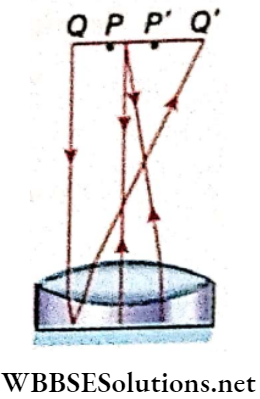
Class 12 Physics Unit 6 Optics Chapter 3 Refraction Of Light At Spherical Surface Lens Liquid Plano Concave Lens

Then \(\frac{1}{f_1}+\frac{1}{f_2}=\frac{1}{f}\)

∴ f = -90 cm

From lens maker’s formula

⇒ \(\frac{1}{f}=(\mu-1)\left(\frac{1}{R_1}-\frac{1}{R_2}\right)\)

For the equi-convex lens,

f1 = 30, μ = 1.5, R1 = R and R = -R

⇒ \(\frac{1}{30}=(1.5-1) \times \frac{2}{R}\)

R = 30 cm

For the liquid plano-concave lens

f = -90 cm, μ = μ’ (say), R1 = -30 cm, R2 = ∞

⇒ \(-\frac{1}{90}=\left(\mu^{\prime}-1\right)\left(-\frac{1}{30}-\frac{1}{\infty}\right)\)

μ’ = 1.33
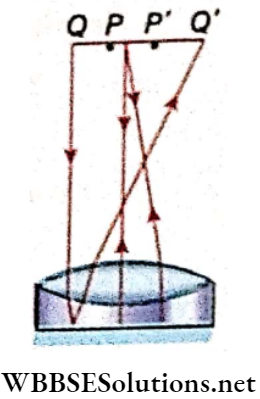
Class 12 Physics Unit 6 Optics Chapter 3 Refraction Of Light At Spherical Surface Lens Liquid Plano Concave Lens

Question 30. A beam of light converges at a point P. Now a lens is placed in the path of the convergent beami2cm from P. At what point does the beam converge if the lens is

  1. A convex lens of focal length 20cm or
  2. A concave lens of focal length 16cm?

Answer:

u = 12cm,f = 20cm , v = ?

⇒ \(\frac{1}{v}-\frac{1}{u}=\frac{1}{f}\)

Or, \(\frac{1}{v}=\frac{1}{12}+\frac{1}{20}\)

Or, \(=\frac{12 \times (20)}{12+20}\)

= 7.5 cm
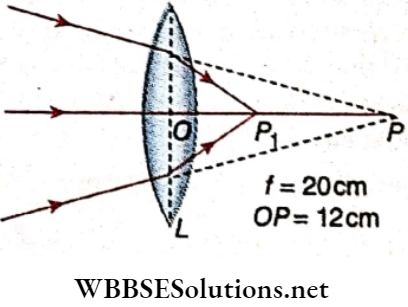
Class 12 Physics Unit 6 Optics Chapter 3 Refraction Of Light At Spherical Surface Lens A Beam Of Light Converges At A Point

Beam of rays will meet at point P1 at a distance of 7.5cm from the lens

u = 1. 2cm, f= -16cm, v = ?

⇒ \(\frac{1}{v}-\frac{1}{u}=\frac{1}{f}\)

Or, \(\frac{1}{v}=\frac{1}{12}-\frac{1}{16}\)

Or, v = \(\frac{16 \times(12)}{16-12}\)

= 48 cm
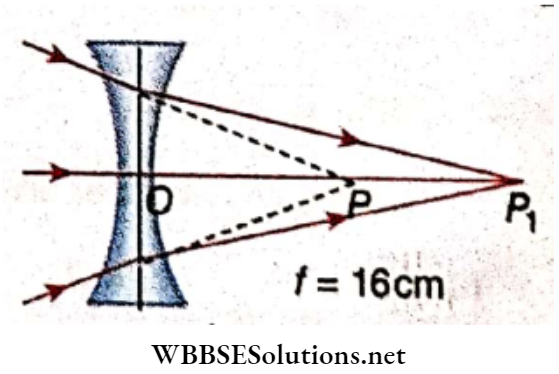
Class 12 Physics Unit 6 Optics Chapter 3 Refraction Of Light At Spherical Surface Lens Concave Lens Of Focal Length

∴ The beam of rays will meet at point Pr at a distance 48cm from the lens.

Question 31. Two lenses, one convex and the other concave are kept in contact. The focal length of a convex lens is 30cm and that of a concave lens is 20cm. What will be the equivalent focal length of the combination? What will be the nature of the combination?
Answer:

For the convex lens, f1 = +30 cm;

For the concave lens, f2 = -20 cm

If the equivalent focal length is F then

⇒ \(\frac{1}{F}=\frac{1}{f_1}+\frac{1}{f_2}\)

Or, \(\frac{f_1 f_2}{f_1+f_2}=\frac{30 \times(-20)}{30+(-20)}\)

⇒  \(\frac{-600}{10}\)

= – 60 cm

Since the equivalent focal length is negative, the combination will act as a concave lens

Refraction Of Light At Spherical Surface Lens Assertion Reason type

Direction: These questions have statement 1 and statement 2. Of the four choices given below, choose the one that best describes the two statements.

  1. Statement 1 is true, statement 2 is true; statement 2 is a correct explanation for statement 1.
  2. Statement 1 is true, and statement 2 is true; statement 2 is not a correct explanation for statement 1.
  3. Statement 1 is true, statement 2 is false.
  4. Statement 1 is false, and statement 2 is true.

Question 1.

Statement 1: The lens formula \(\) indicates that the focal length of a lens depends on the distances of the object and image from the lens.

Statement 2: The formula does indicate that when u is changed v also changes, so that f of a particular lens remains constant

Answer: 4. Statement 1 is false, and statement 2 is true.

Question 2.

Statement 1: A lens has two principal focal lengths which may differ.

Statement 2: Light can fall on either surface of the lens. The two principal focal lengths differ when the medium on the two sides has different refractive indices

Answer: 1. Statement 1 is true, statement 2 is true; statement 2 is a correct explanation for statement 1.

Question 3.

Statement 1: A convex Jens of glass (mu = 1,5) behave as a diverging lens when 1mmersed 1n carbon disulphide of higher refractive index mu = 1.65

Statement 2: A diverging lens in air is thinner in the middle and thicker at the edges

Answer: 3. Statement 1 is true, statement 2 is false.

Question 4.

Statement-1: The power of a lens depends on the nature of the material of the lens, the medium in which it is placed, and the radii of curvature of its surfaces

Statement-2: It follows from the relation p = \(\frac{1}{f}\) = \((\mu-1)\left(\frac{1}{r_1}-\frac{1}{r_2}\right)\), where the symbol have standard meaning

Answer: 1. Statement 1 is true, statement 2 is true; statement 2 is a correct explanation for statement 1.

Question 5.

Statement 1: If a portion of a Jens is broken then we can gel a complete 1mage of an object with the broken lens,

Statement 2: With his broken lens the intensity of the 1mage format! will he lesser

Answer: 2. Statement 1 is true, and statement 2 is true; statement 2 is not a correct explanation for statement 1.

Question 6.

Statement 1: If a convex lens of focal length f and a concave lens of power \(\frac{1}{f}\) are put 1n contact, then the focal length of the combination Is zero,

Statement 2 : P = \(p_1+p_2=\frac{1}{f_1}+\frac{1}{f_2}\)

Answer: 4. Statement 1 is false, and statement 2 is true.

Refraction Of Light At Spherical Surface Lens Match The Columns

Question 1. Match the position of an object concerning a convex lens in column 1 with the corresponding position of the image in column 2.
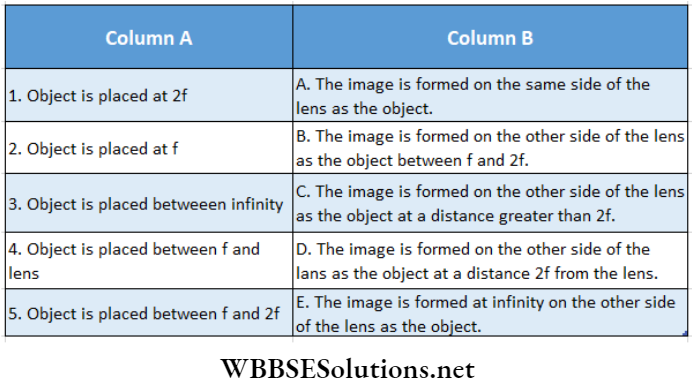
Class 12 Physics Unit 6 Optics Chapter 3 Refraction Of Light At Spherical Surface Lens Respect To A Convex Lens

Answer: 1- D, 2-E, 3-B, 4-A, 5-C

Question 2. The nature and size of the image formed by the convex mirror is given in column 1 and the position of the object is given in column 2.
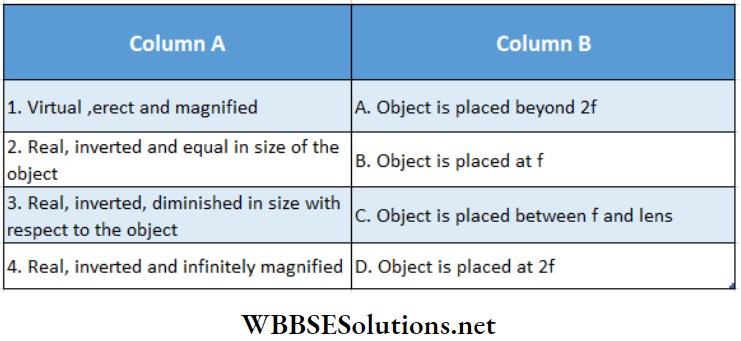
Class 12 Physics Unit 6 Optics Chapter 3 Refraction Of Light At Spherical Surface Lens Nature Size Of The Image

Answer: 1-C, 2-D, 3-A, 4-B

Question 3. Two transparent media of refractive indices μ1 and μ2 have a solid lens-shaped transparent material of refractive index between them as shown in figures in column 2. A ray traversing these media is also shown in the figures. In column 1 different relationships between, μ1, μ2, and μ3 are given. Match them to the ray diagram shown in column 2
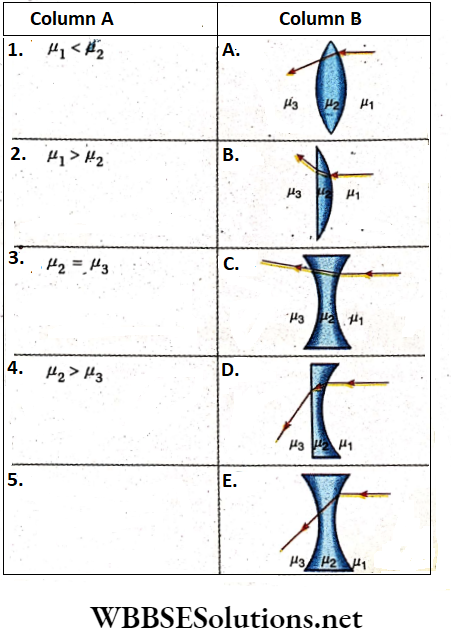
Class 12 Physics Unit 6 Optics Chapter 3 Refraction Of Light At Spherical Surface Lens Two Transparent Media Of Refractive Indices

Answer: 1- A, C, 2-B, D, E, 3- A, C, E, 4-B, D

Question 4. Four combinations of two thin lenses are given in column 1. The radius of curvature of all curved surfaces is R and the refractive index of all the lenses is 1.5. Match lens combinations in column 1 with their focal length is column 2
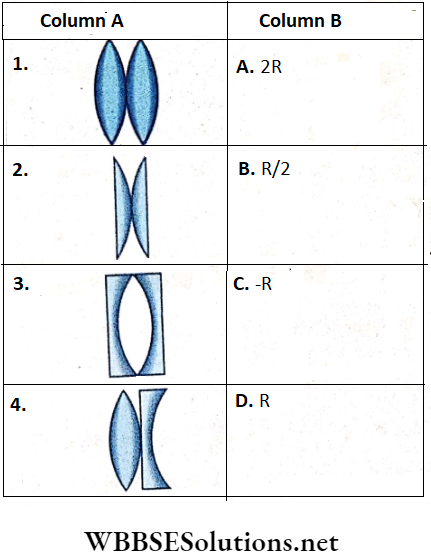
Class 12 Physics Unit 6 Optics Chapter 3 Refraction Of Light At Spherical Surface Lens Four Combination Of two Thin Lenses

Answer: 1- B, 2-D, 3-C, 4-A

WBCHSE Class 12 Physics Semiconductor Electronics Notes

WBCHSE Class 12 Physics Notes

Semiconductors And Electronics Conduction Of Electricity In Solids

A solid can in general be divided Into two classes:

  1. Crystalline and
  2. Amorphous.

We shall concern ourselves In this chapter only with crystalline solids. A lattice in such a solid is an ordered sequence of points describing the arrangement of y atoms that form a crystal.

A unit cell is defined as the smallest part of a crystal that repeats itself regularly through translation in three dimensions to form the entire crystal. Innumerable unit cells are arranged in a regular pattern to form a piece of a crystal.

Read and Learn More Class 12 Physics Notes

Semiconductors And Electrons Crystalline Solids

Based on electrical conductivity, solids can be divided Into three groups:

  1. Conductor
  2. Insulator and
  3. Semiconductor

1. Conductor:

Electricity can easily pass through the conductors. Solid conductors are mainly metals. In metals free elec¬ trons act as charge carriers; the magnitude of current through metals may be equal to or greater than 1 A. With an Increase In temperature, the resistance of metallic conductors increases. Silver (Ag), copper (Cu), aluminum (Al), iron (Pc), etc. are some examples of conductors.

2. Insulator:

The substances through which electricity cannot pass are known as insulators. Free electrons do not exist In this kind of substance. Most of the non-metals are insulators. The insulators which are widely used in electrical machines are mica, diamond, quartz, etc.

3. Semiconductor:

Semiconductors are substances that possess electrical conductivity that falls between that of metals and insulators. Conduction Conduction in semiconductors occurs through the movement of free electrons and holes. The electric current flowing through this substance

The current never exceeds a few milliamperes. Semiconductors such as silicon (Si) and germanium (Ge) exemplify this category. The distinguishing characteristic of silicon and germanium Both of them belong to the fourth group (carbon group) in the periodic table and have -1 electrons in their outermost orbit, which are crucial for the formation of covalent bonds. During the process of electrical conduction, silicon or germanium crystals utilise free electrons and holes as charge carriers, as previously explained.

As the temperature rises, their resistance diminishes. The upcoming part will provide a comprehensive analysis of this subject matter. Out of the several types of semiconductors, silicon is favoured due to its low production cost in the manufacturing of electronic devices. Nevertheless, silicon-germanium (SiGe) is employed as a substitute for silicon (Si) in high-speed networking.

There are two types of semiconductors:

  1. Pure or intrinsic semiconductors and
  2. Impure or extrinsic semiconductors

WBCHSE Class 12 Physics Semiconductor Electronics Notes

WBBSE Class 12 Semiconductor Electronics Notes

Pure Or Intrinsic Semiconductor

1. Valcnco electron:

5 atoms of silicon (Si) crystal. There are 4 electrons in the outermost shell of a silicon atom. Each electron forms a single covalent bond with an electron of the adjacent silicon atom. So, the four covalent bonds.

Semiconductors And Electrons Pure Or Intrinsic Semiconductor

In this scenario, the effective number of electrons in the outermost shell of the central atom becomes 8. These electrons enclosed in the bonding are called valence electrons, thus Each atom in the crystal gets stability by fulfilling an octet in the outermost shell and keeps the crystal In uniform bonding.

At absolute zero temperature (i.e., 0 K), each electron remains confined to the bond. Due to the absence of any free electron or hole, conduction of electricity does not take place through the crystal, i.e., the crystal behaves as an insulator.

2. Conduction electron:

Now if the temperature of the crystal is increased, i.e., if the crystal absorbs heat, the energy of the valence electrons increases. Due to this, some valence electrons gain sufficient kinetic energy to break the covalent bond and come out from the valence shell. These electrons are known as free electrons and they act as charge carriers in the crystal. If the suitable potential difference is applied, current flows through sil¬ icon or germanium crystals due to these electrons. These charge-carrying free electrons are called conduction electrons or thermal electrons.

Note that, the conductivity of a substance is directly proportional to its concentration of free electrons, n. in the case of a good conductor, n ≈ 1023 electrons per m3, and for an insulator, n ≈ 107 electrons per m3. In the case of semiconductors, the value of n lies between these two. For example, at room temperature (i.e., at 300K), the values of n for germanium and silicon are n ≈1019 per m3 and n ≈1016 per m3 respectively.

3. The magnitude of current:

The value of electric current through pure germanium crystal is not more than a few microamperes (μA) and in the case of silicon, it is even less, only a few nanoamperes (nA). This small current is of no use for practical purposes and hence pure semiconductor has no use as an electrical element.

4. Resistance Of semiconductor:

As the temperature of a silicon or germanium crystal rises, the quantity of unbound electrons within it also rises. Consequently, the electric current likewise rises, meaning that the resistance of the crystal reduces. Conversely, the temperature of a metallic conductor directly affects its resistance, causing it to grow. The relationship between temperature and resistance in metallic conductors and semiconductors

Semiconductors And Electrons Resistance Of Semiconductor

5. Hole:

WBCHSE class 12 physics notes Hole Definition:

If any electron is released from a bond in an atom, the deficit of the electron at that position is regarded as a hole. Its effective charge is +e, although it is not a real particle.

Generation of holes:

Assuming a pure silicon crystal, the electron originally located at position A in bond 1 is relocated to place X upon the bond’s rupture. Therefore, a valence electron undergoes a transformation and becomes a conduction electron. Simultaneously, there is an electron deficiency at location A. An effective positive charge is generated at the specified place.

A pertains to its adjacent electrons. A deficiency of electrons within a bond is referred to as a hole. The charge of an electron is -e, while the effective charge of a hole is +e. In an intrinsic semiconductor, the number of holes generated is precisely equivalent to the number of electrons released, denoted as n = p, where n and p represent the concentrations of electrons and holes, respectively.

Semiconductors And Electrons Generations Of Holes

Short Notes on p-n Junctions

The motion of holes:

Apply a potential difference across the two ends of the crystal. The bond at location B in bond 2 is disrupted as a result of thermal vibration of the electron. Now, this electron will undergo directed motion as a result of the applied potential difference and eventually occupy the vacancy at position A of bond 1. Simultaneously, the aperture at point A will disappear and a fresh aperture will materialise at location B. It can be inferred that the hole at location A gets moved to location B. The electrons in a crystalline material move in the opposite direction to the holes.

It is important to note that the concept of a ‘hole’ is not an actual particle like an electron. Instead, it refers to the absence or lack of an electron. It is simply a theoretical framework created to develop a model for elucidating conduction in semiconductors. Inside. Describing electric current in terms of hole motion is often beneficial. Electrons are the primary negative charge carriers in silicon and germanium crystals, whereas holes are regarded as the primary positive charge carriers.

WBCHSE class 12 physics notes Energy Bands in Solids

We shall begin by considering a sodium atom as an example. An isolated Na atom has been. Its electronic configuration is ls22s22p63s1.

Semiconductors And Electrons Energy Bands In Solids

The nucleus of an atom creates an attractive force that forms a potential well (shown by a solid line). Electrons are then placed in this potential well by occupying various discrete energy levels with negative potential energies. Pauli’s Exclusion Principle states that each energy level can accommodate a maximum of two electrons with opposite spins.

Therefore, in the Sodium atom, two electrons occupy each of the energy levels Is and 2s, while the 2p level is divided into 3 sublevels and contains 6 electrons. The valence electron occupies the 3s orbital. This electron is the outermost electron of the sodium atom.

Within the sodium crystal lattice, numerous atoms are in close proximity to one another, resulting in a modification of the potential well’s form, as seen by the solid line. Typically, with the exception of the valence electron, the remaining electrons in the Na atom are located within their respective potential well. Therefore, these electrons are not affected by adjacent atoms.

Semiconductors And Electrons Nucleus An Atom

But, in the case of valence electrons, the situation is completely different. The valence1, electrons cannot ^be accommodated within the potential well. Therefore each of the valence electrons is influenced by all the other atoms surrounding it.

  • So, it is not possible to recognize the valence electrons of individual Na atoms in the 3s energy level.
  • However, according to Pauli’s exclusion principle, the maximum number of electrons that can be accommodated in a definite energy level is two.
  • Due to this, the 3s energy level splits into a large number of substrates Each substate contains 2 electrons. As inside a crystal, large numbers of atoms (~ 1020) are packed closely in a very small space, the number of substrates is very high.
  • So the variation of the potential energy of the energy levels may be assumed to be continuous. Thus these closely spaced energy levels will form an energy band at the position of 3s.
  • This energy band in a solid crystal is called the valence band.
  • Generally, each electron in the valence band escapes from’ its atom, but due to attraction by the rest of the ionized atoms i.e., a group of atoms in a crystal, the valence electrons cannot behave as free electrons.
  • So no free electrons are available as charge carriers.
  • In the crystal, if the valence electrons gain sufficient energy from an external source to overcome the potential barrier of the group of atoms, then the electrons become free.
  • These electrons are called conduction electrons. Now, if a potential difference is applied at both ends of a solid sodium bar, then the conduction electrons start drifting.

For this current will be introduced in the solid. When a large number of valence electrons are transformed Into conduction electrons by acquiring enough energy, they form an energy residing In a certain discrete energy level. This energy band is j called the conduction band.

Semiconductors And Electrons Conduction Bond

Common Questions on Semiconductor Materials

Naturally, the energy of electrons in the conduction band is more than that in the valence band. The gap between these two consecutive energy bands is known as the forbidden zone.

No electron can stay in the forbidden zone. The energy gap between these two bands is known as the forbidden energy gap. For different substances, the energy gaps (between these two bands are different, and depending on the energy gap, the electrical conductivities of different substances are also different.

Semiconductor electronics class 12 notes  Insulator:

In an insulator, the energy gap between the valence band and the conduction band is such that, electrons in the valence band can never gain sufficient energy for transition into conduction electrons As a result, no charge carriers are produced and the substance behaves as an insulator.

Conductor:

Overlap occurs between the higher region of the valence band and the lower region of the conduction band in certain compounds. The movement of electrons from the valence band to the conduction band does not require any energy.

Consequently, valence electrons have the ability to readily convert into conduction electrons. Therefore, a vast number of charge carriers are generated, causing the substance to exhibit excellent conductivity.

Class 11 Physics Class 12 Maths Class 11 Chemistry
NEET Foundation Class 12 Physics NEET Physics

Semiconductor:

The substances in which the energy gap between the valence band and conduction band is smaller than insulators behave as semiconductors.

  • The energy required for the transition of valence electrons into conduction electrons is greater than that for conducting substances.
  • However, the energy gap between the valence band and conduction band in these sub¬stances is not too large like that in insulators. This energy gap  (Eg) is 0.67 eV for germanium and 1.11 eV for silicon

Semiconductors And Electrons Insulator And Conductor And Semiconductor

Electrons and holes in the two bonds:

At low temperatures, the valence band of an intrinsic semiconductor remains saturated and the conduction band remains fully vacant. Now, at a higher temperature, when an electron reaches the conduction band from the valence band, a vacancy of electron is created in the valence band, i.e., a hole is generated.

Semiconductors And Electrons Electrons And Holes In The Two Bands

Naturally, the number of electrons in the conduction band and the number of holes in the valence bond of an intrinsic semiconductor are equal

Semiconductor Electronics Class 12 Notes

Ranges of resistivity and conductivity:

The following table provides an overall knowledge of the resistivities and conductivities of the three types of materials

Semiconductors And Electrons Range Of Resistivity And Conductivity

Comparison of Semiconductors with Conductors and Insulators

Semiconductors And Electrons Comparision Of Semiconductors And Conductors Insulators

Semiconductor electronics class 12 notes 

Semiconductors And Electronics Impure Or Extrinsic Semiconductor

Important Definitions Related to Semiconductor Electronics

Impure Or Extrinsic Semiconductor Definition:

If some special kinds of impurities are mixed with an intrinsic semiconductor in a controlled manner, the conductivity of the semiconductor increases drastically. The semiconductor thus developed is known conductor. The method of mixing of impurities is called doping and the mixed impurities are called dopants.

A few milliamperes (103 A) current can be passed through silicon or germanium crystals by doping with impurities. The current increases to a high value because the energy gap between the valence band and the conduction band decreases considerably due to doping. As a result, the concentration of charge carriers in the crystal increases manyfold.

Extrinsic semiconductors are of two types 

  1. n-type and
  2. p – type.

1. n-type semiconductors

n-type  Definition:

If pentavalent elements (like arsenic or phosphorus) are doped as Impurities In the crystal of an Intrinsic semiconductor In a controlled manner, the crystal thus formed is called an n-type semiconductor.

n-type  Structure:

A small amount of pentavalent impurity [of group V (nitrogen group) elements,] like arsenic (As) or phosphorus (P), is doped in a controlled way in pure silicon (Si) or germanium (Ge) crystals to produce this kind of semiconduc¬ tors. Each dopant atom contains 5 electrons in its outermost orbit.

n-type  Working principle: 

A silicon crystal doped with arsenic is shown. Inside the crystal, an arsenic atom finds itself surrounded by silicon atoms. It forms four covalent bonds with 4 neighboring silicon atoms. The extra electron in its outermost orbit finds no place to occupy in any bond and hence acts as a free electron or conduction electron. These electrons are known as donor impurities. If only 1 phosphorus or arsenic atom is doped per 106 germanium or silicon atoms, a sufficient number of conduction electrons are released, thereby raising the electrical conductivity of the crystal by a factor of 106.

Semiconductors And Electrons Working Principle Of Conduction band And Valence Band

The energy band of an n-type semiconductor has been shown. The dotted line indicates the energy level of the excess electrons generated by the doping of the pentavalent element. These electrons can easily be excited to the conduction band. This line is known as donor level.

n-type Discussions:

  •  The n-type crystal, as a whole, is chargeless. Electrons don’t need to remain actively charged because although free, the arsenic or phosphorus atoms present inside the crystal are electrically neutral.
  • The energy gap between the Fermi level and the conduction band is approximately 0.05 eV.  In n-type semiconductors, the majority carriers are electrons, and the minority carriers are holes.
  • Only a single impurity atom on average is to be doped in approximately 106 atoms of the original crystal. Hence the host silicon or germanium crystal should be an absolute purc. The cost of a semiconducting crystal is almost entirely due to its purification.
  • But still, the crystal is very cheap. | y| Phosphorus or arsenic atoms donate free electrons to the pure semiconducting crystal and hence they are called donor elements.

Since the negatively charged electrons act as majority charge carriers, this type of crystal is called r;-type

Class 12 Physics Semiconductor Notes

2. P-type semiconductors

P-type Definition:

If trivalent elements (like boron or aluminum) are doped as impurities in the crystal of an intrinsic semiconductor in a controlled manner, the crystal thus obtained is called a p-type semiconductor

p-type Structure:

A small amount of trivalent impurity (of group III elements,) like boron (B), and aluminum (Al). is doped in a controlled manner in pure silicon (Si) or germanium (Gi) crystals to produce this kind of semiconductor. Each dopant atom contains 3 electrons In Its outermost orbit.

P-type Working principle:

A silicon crystal doped with boron. Inside the crystal, a boron atom finds itself surrounded by four silicon atoms of which the boron atom completes 3 covalent bonds with 3 neighboring silicon atoms.

Due to the deficit of one electron in the outermost orbit of boron. the fourth bonding cannot be completed and hence a hole appears there. If a suitable potential difference is applied, the holes having effective positive charges can drift inside the crystal. The holes act as charge carriers. As a result, it Is possible to bring the electrical conductivity of the crystal up to its desired value.

Semiconductors And Electrons Working Principle Of Conduction band And Valence Band.

The energy band of the p-type semiconductor is shown. The dotted line denotes an electron-accepting level. The electron of the valence band can easily be exited to the acceptor level. Thus carrier holes are created in the valence band.

Its majority carriers are holes and its electrical conductivity is many times greater than that of an intrinsic semiconductor.

P-type Discussions:

  • The p-type crystal as a whole is electrically neutral
  • The energy gap between the valence band and the fermi level is approximately 0.05 eV.
  • In p-type semiconductors, the majority carriers are holes and the minority carriers are electrons.
  • Only a single atom on average is to be doped in approximately 106 atoms of the original crystal
  • When boron or aluminum atoms are doped in the semi¬ conducting crystal, holes are generated which can accept electrons. Thus, boron or aluminum are called acceptor elements.

Since positively charged holes act as majority charge carriers in this type of crystal, it is called p-type.

Difference between n-type and p-type Semiconductors

Difference between n-type and p-type Semiconductors:

Semiconductors And Electrons n And p Type Semiconductors

Drift of Charge Carriers in Semiconductors

In the case of current conduction through a metal wire, the current through the wire is

I = nevA

Where e = charge of an electron, v = drift velocity of free electrons through the metallic wire n = number density or concentration of free electrons = number of free electrons in unit volume of metal, and A = area of cross-section.

Class 12 physics semiconductor notes Intrinsic semiconductors:

Consider a cylindrical block of Intrinsic semiconductor of length I and area of cross-section A. Here, electron-hole pairs act as charge carriers. Let potential difference V be applied across two ends of the semiconductor block. As a result, both electrons and holes start drifting in opposite directions. As electrons are negatively charged and holes are positively charged, so current will flow in the same direction for both the charges. Conventionally, this direction is along the drifting of holes. i.e opposite to the drifting of electrons

Semiconductors And Electrons Intrinsic Semiconductors

So, the current passing through the semiconductor
.
I = neveA+ pevhA = Ae(nve+pvh) ……………………………………… (1)

Here, n = number density of electrons

p = Number density of holes

ve = Drift velocity of electrons

vh = Drift velocity of holes

For intrinsic semiconductors; the number of thermal electrons and thermal holes as charge carriers are the same.

Therefore, n = p = ni, where ni is the number density of electron-hole pairs in intrinsic semiconductors.

So, from the equation (1), we get

I = Aeni(ve+ vh) ………………………………………… (2)

The current through unit area i.e current density for equation(1)

J = \(\frac{I}{A}\) =   e(nve+pvh) ………………………………………. (3)

For intrinsic semiconductor

J = eni(ve + vh)

The effective electric field in the semiconductor is E = \(\frac{V}{l}\)

So, J = \(\frac{I}{A}=\frac{1}{A} \frac{V}{R}\)

I = \(\frac{V}{R}\)

Or, J = \(\frac{1}{A} \cdot \frac{V}{\rho \frac{l}{A}}=\frac{1}{\rho} \frac{V}{l}\)

= \(\frac{1}{\rho} \frac{V}{l}=\frac{1}{\rho} E\)

= σE

Here , R = \(\frac{\rho l}{A}\) = Resistance of the block of semiconductor

ρ = Restivity

And \(\sigma=\frac{1}{\rho}\) = conductivity

hence σ E= e(nve+pvh) from equation (3)

Or, σ =  \(e\left(n \frac{v_e}{E}+p \frac{v_h}{E}\right)=e\left(n \mu_e+p \mu_h\right)\) ………………………………… (4)

Here  μe = \(\frac{v_e}{E}\) = Mobility of electrons

And = \(\mu_h=\frac{v_h}{E}\)  = Mobility of holes

This is the equation of conductivity of the semiconductor crystal

In the case of intrinsic semiconductors

σ = \(e n_i\left(\mu_e+\mu_h\right)\) ……………………………..(5)

It should be borne in mind that in an intrinsic semiconductor, charge carrier electrons reside outside atomic bonds, whereas charge carrier holes remain inside atomic bonds. Therefore the holes cannot move as easily as electrons.

So, it can be said that the effective mass of each hole is larger than that of each electron. Hence, at the time of current flow through the semiconductor, drift velocity and mobility of electrons are larger than those of holes i.e.,

νeh and μeh

It is important to note that each equation depends on the temperature T of the semiconductor. So, the number densities, drift velocities, and mobilities of electrons and holes are changed with temperature change.

Extrinsic semiconductor:

We have seen how in an n-type semiconductor, electrons act as majority carriers, and in a p-type semiconductor, holes in the host crystal act as the majority carriers.  Hence, in an extrinsic semiconductor, the number densities of electrons and holes are not the same i.e., n ± p

In an n-type semiconductor, as the number of majority charge carriers increases by doping, the holes get annihilated due to recombination with newly generated electrons.  Hence, with an increase in electron concentration (n), the hole concentration (p) gradually decreases. On the other hand, for p-type semiconductors, n decreases with the increase of p. In either case, the condition of equilibrium is

np =  n²i ……………………….. (6)

The equation (6) is known as the law of mass action.

Law of mass action:

Under thermal equilibrium, the product of free electron concentration (n) and freehold concentration (p) is constant. This constant is equal to the square of carrier concentration (n) in intrinsic semiconductor

Incidentally in SI, the charge of an electron or hole is 1.6 × 10⁻¹⁹ C

Unit number density is m-3, a unit of drift velocity is m.s-1 V unit of mobility is m² V-1.s-1 and the unit of conductivity is mho m-1 i.e., Ʊ  .m-1 or, S .m-1

Semiconductor devices class 12 notes 

Semiconductors And Electronics Impure Or Extrinsic Semiconductor Numerical Examples

Example 1.  An intrinsic semiconductor has 5 × 1028 atoms and a carrier concentration of 1.5 × 10¹⁶ m-3. If it is doped by a pentavalent impurity in the ratio 1: 10-6, then calculate the number density of holes as charge carriers  
Solution:

On doping by pentavalent Impurity, the n-type semiconductor is formed. Here we neglect the number density of the thermal electrons lu respect to (ho number density of electrons as majority carriers. Nonce the number density of electrons in n-type semiconductors,

n = \(\frac{5 \times 10^{28}}{10^5}\)

= 1.5 × 10¹⁶ m-3

Given, ni = 1.5 × 10¹⁶ m-3 holes,

p = \(\frac{n_i^2}{n}=\frac{\left(1.5 \times 10^{16}\right)^2}{5 \times 10^{22}}\)

= 4.5 × 10⁹ m-3

Practice Questions on Semiconductor Electronics

Example 2. A semiconductor has equal electron and hole concentrations of 6 ×10⁸ m-3. On doping with a certain Impurity, the electron concentration of the semiconductor Increases to 8×10¹² m-3.

  1. What type of semiconductor is obtained from doing?
  2. Calculate the new hole concentration of the semiconductor.

Solution:

Here, n = p = ni = 6 ×10⁸ m-3 i.e., in its initial state, it is an intrinsic semiconductor.

As the concentration of electrons as majority carriers increases on doping, so n-type semiconductor is formed in n-type semiconductor, and the electron concentration

In n-type semiconductor, the electron concentration

n = 8 × 10¹² m-3

Her, np= n²i

Therefore, the new hole concentration

p = \(\frac{n_i^2}{n}=\frac{\left(6 \times 10^8\right)^2}{8 \times 10^{12}}\)

= 4.5 × 10⁴m-3

Example 3. A semiconductor has an electron concentration of 0.45× 10¹²m3 and a hole concentration of 5 × 10²⁰m3. Calculate the conductivity of the material of this semiconductor. Given, Electron mobility = 0.135 m2.V-1.s-1
Solution:

Here, n = 0.45 × 10¹²m3

p = 5 × 10²⁰m3

μ = 0.135 m2.V-1.s-1

μ = 0.048 m2.V-1.s-1

So, the conductivity of the material of this semiconductor

σ = e(nμe+ pμh)

= 1.6 × 10⁻¹⁹(0.45× 1012)× 0.135 +(5×1020) ×0.048

= 3.84 mho.m-1

Semiconductors And Electronics p- n junction

p-n junction Definition

By the opposite kind of doping, if one part of a semiconducting crystal is made n-type p-type, then that crystal is called a p-n junction. end me ot

A p-n junction is shown- There is a jnncaoc in between the p-type and n-type parts. Remember that, by jor-ing two different p-type and n-type crystals, a p-n junction is not formed because in that case, the crystals would not be joined uniformly and so the junction would not act properly.

To construct a p-n junction diode, a single crystal is doped with p -Type in one half and n type in the other half The junction thus developed is not so perfect though impossible to make the junction thin up to the order of lOÿm so far. Here we will take the junction as an ideal one to avoid complexity. It means we consider a perfect junction between p and. n -parts

Semiconductors And Electrons Junction Plane

Circuit symbol

The symbol by which a p-n junction a denoted in an electrical circuit. The base of the triangle indicates p-end and the line drawn at the vertex parallel to the base indicates n-end.

Semiconductors And Electrons Curcuit Sympol pn Juction

Depletion region or depletion layer

As soon as the p-n junction is formed, electrons and holes start to diffuse through the junction.

First, we take a look at the condition of the junction beer. diffusion starts. During that time, the free electrons in the n-pan move disorderly, whereas the donor ions remain fixed in their positions. As the free electrons remain confined within the n-part, the net charge of this part is zero. On the other hand, the free holes in the p -part move disorderly, whereas the acceptor ions remain fixed. Just like the n -part, the net charge of the p – part is also zero.

Semiconductors And Electrons Depletion Region Or Depletion Layer

Due to the lack of free electrons in the p -part, the free electrons scan to move from n to the p -part- Similarly, due to the lack of free boles in n pan, the free holes start to move from p to n -pan, Le., diffusion starts. In this tray, the electrons just entering the p-part neutralize the holes of the acceptor ions near the junction.

This makes the acceptor ions negative in charge, i.e., the net charge in the p pan becomes negative. Similarly, the holes just entering the n-pan neutralize the electrons of the donor ions near the junction. This makes the donor ions positive in charge, i.e., the net charge in n-pan becomes positive.

Semiconductors And Electrons Depletion Region Or Depletion Layer Of n Part Charge

Because of diffusion, the amount of positive and negative charges in n -part, and p -part respectively increases rapidly. At a certain moment, the amount of these charges becomes so high that no electron or hole can cross the junction anymore. In other words, net dif¬fusion in this state comes to zero.

In this condition up to a certain distance from either side of the plane no free charge depletion region. electron whole P S n depletion region it does exist. The region on either side of the junction plane containing no free charge is known as the depletion region (or depletion layer).

Semiconductors And Electrons Depletion Region

Inevitably, the depletion region contains negative and positive ions in the p -part and the n -part respectively. Hence due to higher potential in n -type and lower potential in p -type, a potential barrier develops at the p-n junction plane. Neither the majority carriers nor the electron and hole can overcome this barrier.

However, the movement of minority carriers continues even after the development of the depletion region. Since the depletion layer in the n -n-region is at a positive potential, the minority carrier electrons of the depletion layer in the p -p-region get attracted toward that direction. Again, the minority carrier holes of the depletion layer in the n -n-region get attracted toward the depletion layer in the -region having a negative potential.

Semiconductor Devices Class 12 Notes

Application of forward and reverse bias to the p-n junction

Biassing refers to the process of establishing a connection between electrical components. An electron behaves similarly to electronic components such as a diode or transistor when an external source of electricity, such as a battery, is applied. Prior to the application of any external voltage across a p-n junction, it has been previously discussed that there is no biassing or influence present.

The N-end acquires a positive potential, while the P-end acquires a negative potential. The phenomenon being described here is the application of a reverse bias to the junction, sometimes referred to as the natural reverse bias. Consequently, a depletion layer is spontaneously created around the location of the n and p areas. The working principle of a p-n junction is determined by the transition of the depletion layer when an external bias is applied, namely the actual external voltages applied to the junction.

1. Application of reverse bias:

Reverse bias is applied p-n junction by connecting the n-end of the p-n junction with the positive terminal of the external source and the p-end with the negative terminal.

If reverse bias is applied using an external battery B to a p-n junction, the thickness of the depletion region increases. The majority carriers cannot cross the junction and hence no current is obtained in the external circuit But due to the motion of minority carriers, a small current is obtained whose value in the case of germanium is approximately 10-6 A’ and in base of silicon, it is only about 10-6 A. The current is called. the reverse saturation current of a diode. in most cases, this current is neglected

Semiconductors And Electrons Application Of Forward Bias

2. Application of forward bias:

To apply forward bias to a p-n junction, its p -end is connected with the positive terminal of the external source of electricity, and n -ends with the negative terminal. A part of the forward bias applied using an external battery B, is used to decrease the value of the potential barrier. To do so applied voltage is to be increased. Very soon, the voltage thus applied reaches a particular value, when the depletion region vanishes.

If the forward bias is increased more the holes present in the p -region and electrons in the n -region can cross the junction easily. This is due to the applied positive potential at the end and negative potential at the n -end which help the holes and electrons, respectively to pass through the junction. As a result, a current flows through the external circuit According to the conventional rule, the direction of current flow in the external circuit is just opposite to the direction of flow of electrons, i.e., the direction along which the holes flow.

Semiconductors And Electrons Application Of Forward Bias

3. Semiconductor diode:

If forward bias is applied to a p-n junction current flows through it; but when a reverse bias is applied current flow is negligible. So, the p-n junction acts as a valve, i.e., the current through it is unidirectional. p-n junction is also called a semiconductor diode. It can be used as a rectifier just like a vacuum diode, although their properties are not identical

Semiconductors And Electrons Semiconductor Diode

Characteristics of p-n junction diode: The variation of current with potential difference applied to a p-n junction diode in its forward and reverse biased condition, is shown in

Semiconductors And Electrons Characteristics Of pn Juction Diode

It is known as I-V characteristics or simply the characteristic curve of a p-n junction.

Some properties of the characteristic curve:

  • Due to the presence of minority carriers, a reverse saturation current exists in reverse bias.
  • To neutralize the reverse saturation current, a minimum forward biasing is essential
  • With the increase in the potential difference in forward bias, the current increases rapidly (AB part in that curve).

The characteristic curve of the p-n junction is not linear, i.e., V and I are not proportional to each other. Hence it is a non-ohmic electrical component. Since ΔI is the change of current due to a change of potential difference  ΔV, the ratio ΔV/ΔI is called the dynamic resistance of the junction. The value of the dynamic resistance Rp is different in the different portions of the characteristic curve.

Semiconductor devices class 12 notes p-n junction rectifier

The arrangements convert an alternating waveform into unidirectional wav.-f.mn an alternating current into the unidirectional current. It called. rectifier. A p-n junction diode is used for the rectification of alternating current

Half-wave rectification

Tire required a circuit diagram for half-wave reeducation, the input as well as the output forms. For the positive half-cycle of alternating current, the p-n junction gets forward biased, and for the biased. So, only for the positive half cycle of the input alternating voltage output voltage and current are obtained which is unidirectional. Since only one half-cycle of the input wave can be rectified by this arrangement, it is called half-wave rectification.

Semiconductors And Electrons Half Wave Rectification

Each wave-crest in the DC output is called a ripple. In a half¬ wave rectifier, the number of wave crests in the alternating input becomes equal to the number of ripples in the DC output. Hence, if the frequency of alternating Input is 50 Hz, the frequency of the ripples will also be 50 Hz.

Full-wave rectification:

The full-wave rectification and the input-output waveforms shown A full wave can be rectified by using two p-n junctions.

Semiconductors And Electrons Full Wave Rectification

For one half-cycle of the alternating current, the diode D1 gets forward bia&d but tire diode D2 gets reverse biased. As a result, current flows only through the diode D1, in this case. For the text half-cycle, the diode D2 gets forward biased but the diode D1 gets reverse biased. As a result, current flows only through tile diode D2. Note that, for both the half-cycles of a complete cycle, tire current through the load resistance is unidirectional.

Since, both the half-cycles of the input wave can be rectified by this arrangement, so it is called full-wave rectification. In this case, the tire number of ripples becomes double the number of wave-crests of tire alternating input. Hence, if the frequency of tire alternating input is 50 Hz, the frequency of the ripples will be 100 Hz.

Advantage of silicon over germanium for use as rectifiers: Due to tire presence’ of minority carriers, a very small current passes through the junction in the reverse bias. Hence, a p-n junction is not completely free from error as a rectifier. The value of this reverse current is approximately 10-6 A for germanium and only 10~9 A for silicon. This reverse current can easily be neglected for silicon. Hence, silicon is more useful than germanium as a rectifier

Semiconductors And Electronics p- n junction Numerical Examples

Example 1. The potential barrier of a p-n junction diode is 0.4 V. If the thickness of the depletion region is 4.0 × 10⁻⁷ m, what will be the electric field intensity in this region? An electron from the n-region moves towards the p-n junction with a velocity of 6 × 10s m s-1. What will be the velocity of that electron with which it enters the p -p-region?

Electric field intensity, E = \(\frac{V}{d}\)

Here, V = value ofpotential barrier = 0.4 V

And d = thickness of depletion region = 4 × 10⁻⁷ m.

∴ E = \(\frac{0.4}{4 \times 10^{-7}}\)

E = 106 V.m-1

Let an electron enter to the depletion region from the n -n-region with velocity v1 and come out from the depletion region with velocity v2. Due to this, the increase in potential energy is eV. According to the principle of conservation of energy

½mv²1 = eV+ ½mv²2

Or,  ½ (9.2 ×10-31)× (6×105)2

= 1.6 ×10-19×  0.4 + ½ ×(9.1×10⁻³¹)

Or, 1.64 ×10-19 = 0.64 ×10⁻¹⁹  +4.55×10⁻³¹. v²2

2 = \(\frac{1 \times 10^{-19}}{4.55 \times 10^{-31}}\)

= 22 × 1010

v2 = 4.7 × ×105 m.s-1

Semiconductors And Electronics Some Special Semiconductor Diodes

Zener Diode

When an ordinary semiconductor diode is reverse-biased, a very small saturated reverse current flows across the junction due to the flow of a few thermally-generated minority carriers (electrons in p -region and holes in n -region). This current is not at all dependent on the applied reverse bias voltage. But, if this reverse bias voltage exceeds a definite value, the reverse current increases abruptly. This situation is known as the breakdown of the semiconductor diode.

As n result, power consumed by the diode U. The rate of production of heat increases rapidly which can damage the diode. The tolerance of some specially prepared semiconductor diodes is Increased in such a way that at reverse bias, even due to the flow of high reverse current, the diode is not damaged. This type of diode has important use for practical purposes and is generally known as Zener diode

Explanation of Zener effect:

1. If the reverse bias voltage across a p -n junction diode is very high, the minority charge carriers are accelerated.

  • Due to their high speed, they knock out more electrons from the covalent bonds. Such collisions produce electron-hole pairs.
  • Newly generated carriers, in turn, may gain sufficient energy to disrupt more covalent bonds and produce more electron-hole pairs.
  • This phenomenon is cumulative and soon an avalanche of charge carriers is produced causing a flow of large currents.
  • Breakdown occuring in this manner is called avalanche breakdown and the diode is called avalanche diode.

2. If both regions of a semiconductor diode i.e., a p-n junction diode are heavily doped, the thickness of the depletion layer decreases to a large extent.

  • Then a very small reverse bias is applied, and a very strong electric field is created between the two ends of the depletion layer.
  • This electric field breaks up the covalent bonds of the semiconductor. crystal directly and a huge number of charge carriers are set free within the crystal.
  • Tints, due to a comparatively small reverse bias, diode-breakdown occurs i.e., at a constant breakdown voltage of small magnitude, the diode reaches a state when a large reverse current flows.
  • Thus breakdown that occurs in this manner is called Zener breakdown and the diode is called Zener diode
  • In the case of any semiconductor diode of this type, the avalanche effect and Zener effect occur simultaneously at reverse bias.
  • Generally, for a near 6 V breakdown voltage, the avalanche effect and Zener effect become equivalent to each other, and concerning temperature no special change of breakdown voltage takes place.
  • So, diodes having breakdown voltage around 6 V, are very suitable to use at different temperatures.

Avalanche effect or Zener effect whichever may be die principal effect, these types of diodes are simply called Zener diodes in practical cases.

Characteristic curve:

The ampere-volt (I- V) characteristic curve of a forward-biased Zener diode is similar to that of an ordinary semiconductor diode. But, when the reverse bias voltage reaches a particular value Vz, the reverse current suddenly increases to a large value. This part of the characteristic curve is represented by AB, almost a verticle line. In an ideal Zener diode, the increase of voltage with the increase of current is zero. In practical cases, this increase is within 1 % to 5%.

Semiconductors And Electrons Curve

Semiconductor devices class 12 notes Rating of a Zener diode:

In every Zener diode, a reference voltage and a reference power are mentioned. This voltage rating Vz indicates the reverse-bias voltage, at which the reverse current increases abruptly, but no change of the terminal voltage of the Zener diode takes place. The meaning of power rating or watt rating Pz is that, due to the increase of the current drought the diode, if the value of power consumed exceeds the j value of Pz, the diode will.be damaged

So, the maximum safe reverse current through the diode

Imax = \(\frac{P_Z}{V_Z}\) the point indicates the value.

For example, in the case of the rating 4.7 -1W of a Zener diode,

Imax = \(\frac{1 \mathrm{~W}}{4.7 \mathrm{~V}}\) = 0.21 A

= 210 mA

In the circuit for a Zener diode, a regulative resistance is so selected that the value of the reverse diode current never exceeds Imax

Circuit symbol: The circuit symbol of a Zener diode is shown below

Semiconductors And Electrons Zenor Dipode Circuit Symbol

Zener diode as a voltage regulator:

A Zener diode is used to obtain constant voltage across a load resistance connected to a fluctuating DC voltage source. The Zener diode and load resistance are to be connected in parallel.

Zener diode Working principle:

A fluctuating DC voltage source (unregulated voltage source) is connected to a Zener diode through a resistance Rs in series such that the Zener diode is reverse biased.

If the input voltage increases current through Rs and Zener diode also increases. Due to this, the voltage drop across Rs increases, but the voltage drop across the Zener diode remains constant as it operates in the breakdown region. The breakdown voltage of the Zener diode does not change by

Changing current through it. On the other hand, if the Input Voltage Is decreased, the current through Rs and Zener also decreases, but the voltage drop across Zener remains the same.

As soon as the reverse bias voltage of a Zener diode reaches VZ despite increasing the current through it indefinitely, the terminal voltage of the diode remains constant at VZ. Hence, the terminal voltage of a load resistance RL connected parallel to the Zener diode also remains at VZ, despite any change of current through it.

Conversely, it may be said that to maintain a constant potential difference across a load resistance, a Zener diode of equal voltage rating is to be connected in reverse bias parallel to the load resistance. This is called voltage regulation across a load resistance

The voltage across a Zener diode thus serves as a reference so the diode is referred to as a reference diode

Semiconductors And Electrons Reference Diode

Selection Of RS:

If (V RZ-PZ) is the rating of the Zener diode, then the maximum safe current through it is IZmax  = PZ/ VZ. The resistance RS is so chosen in the circuit that it restricts the Zener current below /max even for the maximum value of the unsteady input voltage.

Load regulation:

It is the capability to maintain a constant voltage (or current) level on the output channel of a power supply despite changes in the load resistance. More simply, load regulation is a measure of the ability of an output channel to remain constant for given changes in the load. In the circuit, a millimeter is connected to measure current (IL) flowing through load resistance RL, and a voltmeter to measure the potential difference across RL.

The changed circuit Keeping the supply voltage Vi constant, Rj is changed step by step and in ea-and VL are recorded. Now a graph of VL -IL is drawn. Part AB indicates the regulated voltage. If the Zener diode behaves ideally, the line AB would become horizontal. Point B exists a bit lower. From the portion BC, it is understood that, if the magnitude of IL is very high, i.e., the Zener current IZ is very low, VL becomes uncontrollable. As the current IL is maximum at the point B of the regulated zone

So, the ratio \(\frac{V_L}{I_L}\) at B indicates the minimum value of the load resistance RL Despite fluctuation of load resistance above that minimum value through a long-range, the potential difference across the load resistance VL remains almost constant.

Semiconductors And Electrons Load Regulation

If voltage at the point A is VNL (NL means no load or zero current) and voltage at the point B is VL,

Then percentage regulation \(\frac{V_{N L}-V_L}{V_{N L}} \times 100 \%\)

In an ideal Zener diode, this percentage regulation is zero and in actual practice, this value lies within 1% to 5%.

Light Emitting Diode or LED

If a specially made semiconductor diode or p-n junction forward bias emits light spontaneously, it is known as light-emitting, diode, or LED.

Silicon; (Si) or Germanium (Ge) diode is unsuitable as LED. For LED, semiconductor crystals of Gallium arsenide (GaAs), Gallium Phosphide (GaP), Silicon Carbide (SiC) etc. are used. The color of the light emitted from LED depends on the band gap of the semiconductor crystal and the strength of doping.

LED Working principle:

When a p-n junction diode is forward-biased, both the electrons and the holes move towards the f junction. As they cross the junction, recombination of a few electrons and holes takes place and energy is released at the junction in the form of light. Photons are emitted from the p-n junction. The color of the emitted light depends on the energy of the photons.

From the principle of conservation of momen¬ tum, it is found that a photon can be emitted only when an elec¬ tron and a hole combine with equal and opposite momentum. This condition is fulfilled in some crystals like GaP or SiC but not in Ge or Si. In the latter, the released energy of the electron-hole pair is converted to heat energy which only makes the crystal heated. For this, GaP or SiC-like crystals rather than Ge or Si are generally used to construct LED.

LED Circuit Symbol:

With the symbol bf ordinary semi ductor diode two arrows directed outwards1′ are drawn. This indicates the circuit symbol of the LED

Semiconductors And Electrons Circuit Symbol Arrows Direct Out Ward

LED Characteristic curve:

The volt-ampere characteristic curve of LED is identical to that of an ordinary semiconductor diode. But when it is forward biased, due to emission of light, a few electron-hole pairs are current (/in mA) destroyed. So, the magnitude of the current is less than that of an -ordinary diode.

But, by the low current, the action of LED is not hampered because forward bias never exceeds 2.5V or 3V and the maximum value of .current in forward bias does not exceed 50mA. If the magnitude of the forward current is increased slowly from 10mA to 50mA, the intensity of light emitted from LED continuously increases

Semiconductors And Electrons LED Characteristics Curve

LED Uses:

The power consumed by an LED is very small. In a well-planned circuit, these are not easily damaged and can be used uniformly for a long time. Moreover, LEDs are cheap. Hence, LEDs are extensively used in electrical and electronic circuits at present. It is extensively used for fast on-off switching. Besides these, LEDs are used in various electronic circuits, like torchlights, low-power household electric lamps, calculator digital watches, etc. These diodes are also used in signal lamps

WBCHSE physics semiconductor electronics Photodiode

A photodiode is a special type of reverse-biased semiconductor diode. If the light is made to fall on its p-n junction, the reverse saturated r current increases almost linearly | with the intensity of the incident I light. The circuit diagram of a photodiode.

Semiconductors And Electrons Photodiode

The reverse bias of the junction diode, naturally a small reverse current flows in the circuit. This is called dark current Now light is made to fall on p -n junction through a lens. New electron-hole pairs are created in exchange for the energy: of the incident photons and hence the reverse current increases. It is found that, the

Semiconductors And Electrons Photodiode Reverse Bias Voltage

The magnitude of the reverse current is proportional to the Intensity of the incident light. But. if the energy of the photon of the incident light is not sufficient to create additional electron-hole pairs, the photodiode will not function

The volt-ampere characteristics of a photodiode Are Shown In

Photodiodes are used for the identification of sound from sound or sound-track of cinema, determination of the Intensity of light, light-operated switches, electronic counters, CD players, smoke detectors, etc

Photodiode Circuit symbol:

With the symbol of an ordinary semicon¬ductor diode, two arrows directed inward are drawn. This indicates the circuit symbol of the photodiode.

Semiconductors And Electrons Circuit Symbol Of Ordinary Semiconductor

WBCHSE physics semiconductor electronics 

Semiconductors And Electronics Solar Cell

A special and very important practical application of photodiode is solar cells. In a photodiode, incident solar energy Is so converted into electrical energy that, it behaves as a battery. In the daytime In the presence of sunlight, this solar battery is used as a charger. Afterward, this storage battery is used to operate various electrical appliances. Solar cells are used in artificial satellites or space vehicles to operate various electrical instruments kept Inside the satellite or space vehicles. Also, solar cells are used in calculators

Earth’s surface gets an average of 1000 W of solar power per square meter on a sunny day. Only 10% of the incident photons can produce an electron-hole pair and make a photodiode active. So, approximately 100 W of solar power per square meter is available for transformation to electrical energy. This available energy is too small compared to approximate generally the available solar energy is focused on a small area with the help of a concave mirror. But due to this process, the temperature of the photodiode increases so much that even the much

Semiconductors And Electrons Solar Cell

Effective silicon crystal loses its efficiency. So in this case, the use of semiconductor crystals like Gallium Arsenide (GaAs) is suitable. reverse bias voltage more

The characteristic curve of the photodiode lying in the 4th quadrant is very relevant to, the action of a solar cell. In this case, a potential difference is positive i.e., p-n

Junction is in forward bias. But current is negative i.e. reverse current flows through the junction. It is to be noted that, current flows through the pn junction from the negative end to the positive end and this flow Is Identical to the flow of current through a battery, So the photodiode l.e„ the solar diode behaves like a cell or battery. The forward bias voltage of a cell does not exceed

1 V and the magnitude of reverse current Is very small, hence to increase output power, the internal resistance of a cell Is made very small. The output voltage is increased by connecting a large number of cells connected in series and the output current Is also increased by a large number of such series combinations in parallel. The details of technology regarding the construction of a solar cell are beyond our present discussion.

Semiconductors And Electrons Application Of Forward Bias, pn Juction From Negative

WBCHSE physics semiconductor electronics 

Semiconductors And Electronics Junction Transistor

In 1947, John Bardeen, William Shockley, and Walter Brattain Invented the transistor Out of different forms of translators, the most widely used form Is the bipolar Junction transistor (BJT), It Is a semiconductor device In which the current How between the two end terminals (called the collector and the emitter), Is controlled by an amount of current following through an Intermediate third terminal (called the base).

Transistors are used In almost all modern technologies. Thus, the Importance of semiconductors Is Immense In the modern age, hence, the modern age Is also known as ‘the silicon age Like a diode, a transistor Is also made from a crystal. It Is very small In size and Is kept sealed Inside a metallic or plastic covering In such a way that It cannot come in contact with air or moisture

Transistors are of two types:

  1. p-n-p transistor and
  2. n-p-n transistor

Structure of a p-n-p transistor:

1. A thin n-type layer Is introduced by doping between two p-type regions at the two ends of a semiconducting crystal. The n-type layer at the middle is very small in thickness in comparison with the two p-type regions at the two ends, This layer at the middle is known as the base (B) of the transistor

Semiconductors And Electrons Structure Of pnp Transistor

2. The two p-type regions at the two ends of the transistor are called emitter (E) and collector (C). Although these two regions are identical, the rates of doping them are different. The emitter region is heavily doped compared to the collector region. Hence, in a circuit, if the connection of the emitter and collector is interchanged, the working of a transistor gets disturbed.

3. The rate of doping of the base of a transistor is much less than that of its emitter and collector. CID The majority of charge carriers of this kind of transistor are holes. Usually, holes are emitted from the emitter and after crossing the thin layer of the base, they are collected by the collector. The thin layer of the base controls this flow of holes.

Structure of an n-p-n transistor:

The structure of an n-p-n transistor Is almost identical to that of a p-n-p transistor, as discussed above. For the n-p-n transistor, the failure of doping of the different parts of the die semiconducting crystal Is Just the opposite of the p-n-p transistor. In this case,

  • The thin base layer at the middle is of p-type
  • The emitter and collector regions at the two ends are of n-type
  • For this kind of doping, the. majority charge carriers electrons.

The speed of electrons Is more than that of holes as charge carriers. Mdnce In high-frequency circuits and computer circuits, n-p-n transistors are used. Actually, during the transmission of signals through these circuits, the greater the speed of the effective charge carriers, the greater will be the rate of work done.

p-n-p transistor and n-p-n transistor Circuit symbol:

The circuit symbols of p-n-p and n-p-n transistors are. The arrow sign indicates the? direction of conventional current flow between the emitter and the base. So, electrons flow in the direction opposite to the arrow sign

Semiconductors And Electrons pnp And npn Transistor

Transistor In an open circuit:

Let us assume that a transistor Is a combination of two diodes. So, diffusion of electrons and holes takes place through the junctions just like that of a p-n junction diode, As a result, each p-n junction becomes reverse-biased without the presence of any external source depletion region

Semiconductors And Electrons Transistor In An Open Circuit

Just as In a p-n junction diode, depletion regions are formed around the Junctions in a p-n-p transistor

Common-Emitter or CE Configuration of a Transistor

Three, kinds of circuit carts be constructed using transistors:

  1. Common-base (CB)
  2. Common-emitter (CE) and
  3. Common-collector, (CC)

Among these, a common emitter or CE circuit is widely used as an amplifier circuit

The flow of charge carriers In a CE-cIrcuit:

We take a n-p-n transistor and consider the flow of conduction electrons

Semiconductors And Electrons Flow Of Charge Carriers In A CE Circuit

It is to be noted that, by convention, the direction of currents is opposite to that of the moving electrons.

Semiconductors And Electrons Flow Of Charge Carriers In A CE Circuit Of Moving Electrons

Real-Life Scenarios Involving Semiconductor Devices

A CE circuit is shown using an n-p-n transistor. In this case:

  1. The circuit connecting the base and the emitter (left side circuit in the figure) is used as the input circuit and
  2. The circuit connecting the collector and the emitter (right side circuit in the figure) is used as the output circuit. Hence, in both circuits, the emitter is common. In an alternating current (AC) circuit this emitter is grounded. So it is also called a grounded emitter circuit

Biasing of a CE circuit:

  1. Keeping the emitter grounded, the base is kept at forward bias in the input circuit, i.e., the p-type base of the n-p-n transistor is connected with the positive pole of the source battery VBB
  2. Keeping the emitter grounded, the collector is kept at reverse bias in the output circuit, i.e., the n-type collector of the n-p-n transistor is connected with the positive pole of the I source battery VCC

Current in a CE circuit: 

In a tile input circuit, the emitter is at the negative potential concerning the base. Hence, a large number of majority carriers, i.e., electrons are emitted from the tire emitter which is then attracted by the positive base. Since the base layer is very thin, most of these moving electrons enter the collector after crossing the thin base layer. Then they are attracted by the positive potential of the collector.

The small number of electrons that fail to cross the base are attracted by the positive potential of the base. In this way,

The flow of electrons from the emitter produces two currents:

  1. The base current of the input circuit and
  2. The collector current of the output circuit.

The conventional direction of electric current is opposite to the direction of electron flow. According to that, the emitter current IE base current IC and collector current 

Clearly, IE = IB+ IC

The value of IB is much less than IE or IC

For example IB = 10μA , IC = 2mA = 2000μA

Then, IE = 2000 + 10 = 2010 μA

Discussions:

  • Keeping IE at a fixed value, if IB is increased, then from the relation IC = IEIB, we see that the value of IC decreases. Hence in the CE circuit, the phase difference between the output signal and the input signal is 180°.
  • Usually, the power expended in the output circuit of a transistor is much greater than that of the input circuit. Hence for commercial purposes the area of the base-collector junc¬ tion of a transistor is made much greater than the emitter-base junction
  • As the emitter-base is forward-biased, the input resistance, i.e., the resistance of the emitter-base junction becomes very small. Again, as the collector-base junction is reverse biased, the output resistance, i.e., the resistance of the emitter-collector junction becomes very high. The circuit with IowTinput resistance and high output resistance acts as the best current amplifier

CE characteristics:

  • Source voltage of the input circuit= VBB
  • Source voltage of the output circuit = VCC
  • Base current, IB = input current
  • Base-emitter voltage, VBE = input voltage
  • Collector current, IC = output current
  • Collector-emitter voltage, VCE = output voltage

Among the input and output currents and voltages, only the input current IB and output voltage VCE can be changed easily according to need, i.e., in a CE circuit IB and VCE should be taken as independent variables, and VBE as well as IC as the two dependent functions of them. Out of these, VBE has less importance in the analysis of the circuit

So, IC = f(IB,VCE) ………………………………………. (1)

Using the mathematical relation (1), two characteristic curves of the CE circuit can be drawn:

WBCHSE physics semiconductor electronics 

Transfer characteristics:

Keeping VCE the graph of Ic drawn concerning IC is known as transfer characteristics. In this case, IB and IC are the input and output quantities respectively.

Generally, IC changes linearly with IB

The ratio Δ IC /Δ IB is called current transfer ratio current amplification factor or current gain it is expressed by the symbol β Usually, the range of β is 100 to 500, approximately

Semiconductors And Electrons Transfer Characteristics

Output characteristics:

Keeping IB at different fixed values, the graphs drawn concerning VCE are called output characteristics. In this case, both VCE and Ic are output quantities. For different values of IB, a series of different output characteristics is obtained.

Semiconductors And Electrons Output Characteristics

This series is divided into three clear regions:

  1. Active region: In this region, the base-emitter junction is forward-biased and the collector-emitter junction is reverse-biased. As a result, IB> 0 and VCE> 0; but in actual practice, the value of VCE should be more than 0.2V (approximately) to keep the collector junction in the actual reverse bias. If a transistor is to be used as a good amplifier without much distortion, it has to be operated in the active region.
  2. Cut-off region: In this region, both the base-emitter and the collector-emitter junctions are reverse-biased.
  3. Saturation region: In this region, both the base-emitter and the base-collector junctions are forward-biased. Remember that, if the value of VCE is less than 0.2 V (approximately), the collector is forward-based effectively.

Use of transistor as a switch:

An Ideal switch, when It is made ‘on: makes a circuit closed, On the other hand, when It is made ‘off,’ the circuit becomes an open one. Moreover, all these are done by an Ideal switch momentarily, No transistor can satisfy these conditions of an Ideal switch properly. Despite that, on the whole, the use of a transistor as a switch in different electronic circuits Is very wide.

If a transistor is employed in common-emitter mode, In the cutoff region the base-emitter junction Is reverse-biased. Under this condition, base current lB Is negative and the magnitude of the collector current is very small. This Is called the ‘off’ condition of the transistor.

On the other hand, if the base current attains a high positive value, the collector-emitter junction is forward-biased and the transistor is placed In the saturation region. In this case, the collector-emitter voltage Is nearly zero. So, almost the whole external bias Vcc acts as the terminal potential difference of the load resistance RL.

So, the collector current Ic reaches a sufficiently high value. This condition is treated as the ‘on’ condition of the transistor. In a switch system, the arrangement is to be made to turn the base current of the transistor from a positive to a negative value or from a negative to a positive value very rapidly. As a result, the transistor can turn from ‘on’ to ‘off’ or from ‘off’ to ‘on’ respectively.

But when it is ‘on,’ the collector current Ic takes some time to reach a high value and when it is ‘off; the charge collected at the base takes some time to decay. Hence, a transistor as a switch can never act with the rapidity of an ideal switch. Only its efficiency can be increased by using some specially designed transistors.

Accordingly, since a transistor can be in either ‘on’ mode or ‘off’ mode, it has considerable use in digital circuits. The application of transistors to make NOT logic gates has been discussed in the chapter ‘Digital Circuits!

Use of transistor as a current amplifier:

In the circuit, DC biases, VBB, and Vcc have been applied

Semiconductors And Electrons Use of Transistors As A Current Amplifier

At the base-emitter junction and collector-emitter junction of an n- p-n transistor respectively, R1 is the load resistance, In the collector-emitter circuit

VCC = VCR + ICRL

[VCR is de voltage and IC is DC]

In the cut-off region, I≈0, So, VCR ≈ VCC The point A indicates this condition.

Semiconductors And Electrons Load Line

Again In the saturation region, VCE ≈  0, So, VCC≈ ICRL Or, \(\frac{v_{C C}}{n_L}\). Point B In, indicates this condition.

The line AB is called the load line of the referred circuit. If a transistor Is used as a current amplifier in common-emitter mode, DC bias voltage VBB and VCC and load resistance RL are so selected that, the action of the transistor is confined in the active region.

Under this condition, if the output characteristics for the constant base current IB intersect the load line at point Q.

  • This point is called the DC operating point or, Q -point of the circuit. In the case of an amplifier circuit, generally, a weak AC signal is supplied across the base-emitter circuit as input.
  • For example: If a sound is made in front of a microphone, a weak AC signal is obtained. To apply this AC signal to a DC circuit, a condenser Cx is used.
  • Direct current (dc) cannot pass through the condenser C, the input signal is free from the influence of the battery VBB. The input AC signal is added to the constant dc base-cur¬ rent IB. So, the base current oscillates between IB1 and IB2
  • The point Q oscillates between P and R. It is understood easily from the output characteristics that, the collector current Ic oscillates between IC1 and IC2.
  • So, the AC signal obtained is the output signal. the values of IB are generally expressed in the microampere {μA) scale and the values of IC are expressed in the milliampere (mA) scale.
  • So, the amplitude of the output signal is greater than that of the input signal by 100 to 500 times. This is the current amplification by the transistor. Only the ac part of the amplified output signal is taken out from the two ends of the load resistance RL with the help of the Condensor C2 .’
  • The two parts of the circuit containing C1 and C2 are called filter circuits. From the mixture of AC and DC, the condensers filter outin’ AC stopping the DC. The output AC signal can be applied again as an input signal in the amplifier circuit of another transistor. Hence, the signal is again amplified.
  • Thus, using successive amplifier circuits, input AC signals of small amplitude can be amplified many times.

But this type of magnification has a limit. If the magnification is very large, the waveform of the output ac is distorted. The output waveform does not resemble the input waveform. In that case, the output signal becomes useless. For example, if a man speaks out in a low voice in front of a microphone, the outcoming speech from the loudspeaker becomes distorted and hard to understand

Current amplification factor or current gain:

In the CE circuit, the current amplification factor of current gain is defined as the ratio of a component of the output collector current to a component of the input base current. It is denoted by the symbol 0. In different types of. transistors, the value of 0 is in the range 20 to 200.

If ib = input ac base current and is = output ac collector current, then

β = \(\frac{i_c}{i_b}\) ……………………(1)

Initially, a stable DC biasing is applied in each transistor circuit. Now an input AC signal is applied at the base of the transistor. If Jg and IQ are dc base current and dc collector current respectively, then at any instant, total base current =IB + ib and total collector current = IC+ic

Both AC currents ib and ic are considered instantaneous changes in constant DC currents IB and Ic respectively. Hence we can write, ib = ΔIB and ic = ΔIC. Therefore current amplification can also be written as

β = \(\left(\frac{\Delta I_C}{\Delta I_B}\right)_{V_{C E}}\) ……………..(2)

On the other hand, the ratio of change in collector current to the change in emitter current IE is known as the current transfer ratio of the transistor and it is denoted by the symbol a.

α – \(\left(\frac{\Delta I_C}{\Delta I_E}\right)_{Y_{O B}}\) constant) ……………..(3)

Here, IC< IE Since in general, the value of ΔIC< ΔIE   Since in general, the value of IEB is very small, so the value .of α is less than unity but still very nearly equal to 1, α≈ 1 (In most of the transistors, a is in the range 0.95 to 0.995 approximately). In a CB circuit, this parameter is of great importance, but almost irrelevant to a CE circuit.

Relation between α and β: Now from equation (2) we have,

β =  \(\frac{\Delta L_C}{\Delta I_B}=\frac{\Delta I_C}{\Delta I_E-\Delta I_C}\)

β =  \(\frac{\Delta I_C / \Delta I_E}{1-\Delta I_C^* \cdot \Delta I_E}\)

Or,  β =  \(\frac{\alpha}{1-\alpha}\)

∴ α = \(\frac{\Delta I_C}{\Delta I_E}\)

For example, if = 0.995

β = \(\frac{0.995}{1-0.995}=\frac{0.995}{0.005}\) ≈200

And if. α  = 0.995

β  = \(\frac{0.95}{\mathrm{I}-0.95}=\frac{0.95}{0.05}\)≈ 20

Voltage gain and Power gain:

For the CE circuit, if ΔVi is the change in input voltage” and  ΔV0 is the corresponding  output voltage, then

Voltage again   = \(\frac{\Delta V_o}{\Delta V_i}=\frac{\Delta V_{C E}}{\Delta V_{B E}^*}\)

= \(\frac{\Delta I_C R_L}{\Delta I_B R_B}=\beta \frac{R_L}{R_B}\)

Here, RL = Load resistance

And RB = Base resistance or input resistance

Power again = \(\frac{\Delta P_o}{\Delta P_i}=\frac{\Delta V_{C E} \cdot \Delta I_C}{\Delta V_{B E} \cdot \Delta I_B}\)

= \(\beta \frac{R_L}{R_B} \cdot \beta=\beta^2 \frac{R_L}{R_B}\)

Power gain =’ current gain ×  voltage gain

Another parameter, called transfer conductance or transconductance gm is defined as gm  = \(\frac{\Delta I_C}{\Delta V_{B E}}\)

Semiconductors And Electronics Junction Transistor Numerical Examples

Example 1. In a common-emitter circuit, the collector-emitter voltage is fixed at 5V. For base currents 30 μA and 40 μA, the collector currents are 8.2 mA and 9.4 mA respectively. Calculate the current gain of the circuit
Solution:

The change in base current

ΔIB  =(40- 30)μA = 10 μA

The change in the collector’s current

ΔIC = (9.4-8.2) = 1.2 mA = 1.2 × 10³ μA = 1200 μA

∴ β = \(\frac{\Delta I_C}{\Delta I_B}\)

= \(\frac{1200 \mu \mathrm{A}}{10 \mu \mathrm{A}}\)

= 120

Examples of Applications of Semiconductors in Technology

Example 2. The collector current of an n-p-n transistor is 10 mA. If 99.5% of the emitted electrons reach the collector, determine the emitter current, base current, and amplification factor of the transistor.
Answer:

In an n-p-n transistor,  we know collector current =IC= 10 mA, emitter current = IE, base current = IB  and

Amplification factor, β =  \(\frac{I_C}{I_B}\)

According to the problem, IC = 99.5% of IE

∴ IC  = \(\frac{995}{1000} I_E\)

Or,  IE = \(\frac{1000}{995} \times 10\)

= 10.05 mA

IB = IE – IC= (10.05 -10) mA

= 0.05 mA

β = \(\frac{I_C}{I_B}=\frac{10}{0.05}\)

= \(\frac{10}{0.05}\)

= 200

Example 3.  An n-p-n transistor is kept in a common-emitter configuration. The amplification factor of the transistor is 100. If the collector current is changed by 1 mA, what will be the corresponding change in the emitter’s current?
Solution:

Amplification factor, β = \(\frac{\Delta I_C}{\Delta I_B}\)

ΔIB = \(\frac{\Delta I_C}{\beta}\)

= \(\frac{1}{100}\)

= 0.01 mA

So, change in emitter current,

ΔIE= ΔIC+ΔIB = 1+0.01

= 1.01 mA

Conceptual Questions on Intrinsic and Extrinsic Semiconductors

Example 4. The input resistance of a silicon transistor is 100 Ω. Base current is changed by 40 μA which results in a change in collector current by 2mA. This transistor is used as a common emitter amplifier with a load resistance of 4kΩ. What is the voltage gain of the amplifier?
Solution:

Voltage gain \(=\frac{\Delta V_o}{\Delta V_i}=\frac{\Delta I_C R_L}{\Delta I_B R_B}=\beta \frac{R_i}{R_1}\)

Load resistance RL= 4 kΩ = 4000Ω

Input resistance RB = 100Ω

∴ Current gain = \(\frac{\Delta I_C}{\Delta I_R}=\frac{2 \mathrm{~mA}}{40 \mu \mathrm{A}}\)

= \(\frac{2 \times 10^3}{40}\)

= 5

∴ Voltage gain = \(50 \times \frac{4000}{100}\)

= 2000

Semiconductors And Electronics Oscillators

Oscillator Definition:

The system that can convert a DC or unregulated AC signal to an AC signal of a certain frequency is called an oscillator

Feedback: Let A be the amplification of a voltage amplifier. If the input and output voltages are V and VQ respectively, then

A = \(\frac{V_o}{V_s}\)

i.e  V0 = AVs …………………………………………….(1)

Semiconductors And Electrons Oscillator Feedback

Now a feedback circuit is connected between the points P and Q in this amplifier circuit. The voltage between P and Q is so controlled that a part of the output voltage V0 (say, βV0) is again fed back to the input through the feedback circuit.

This phenomenon is known as feedback. β is known as the feedback ratio, where 0 < 1.

Semiconductors And Electrons Feed Back

In this case, the effective input voltage of the amplifier circuit

Vi= Vs= βV0

So, the output voltage,

V0= AVi = A(Vs+βV0) = AVs+βV0

Or, V0-AβV0 = AVs

Or, V0{1-Aβ) = AVs

So, the effective amplification of the amplifier circuit

As = \(\frac{V_o}{V_s}=\frac{A}{1-A \beta}\) ……………..(2)

In general, the self-amplification A of the amplifier is called open loop gain and the effective amplification Af due to feedback is called closed loop gain. Gain Af is known as loop gain.

Negative feedback:

If loop gain Aβ is real and negative, then according to equation (2) (1-Aβ) > 1 and Af< A.

Due to such feedback, the effective amplification Aj becomes less compared to self-amplification A. This is called negative feedback.

Despite the lowering of amplification, negative feedback has great utility due to some special advantages:

  • The amplification can be kept at a stable value.
  • The distortion in the output signal concerning the & put signal can be removed.
  • The internal noises of the. the amplifier can be minimized.
  • The effective bandwidth [see the chapter ‘Communication System’] increases and so on.

Positive feedback:

Barkhausen criterion: if the loop gain A0 is real, positive, and less than 1, then (1-Aβ) <1 and Af>A. Consequently, the effective amplification Af becomes greater concerning self-amplification A of the amplifier. It is called positive feedback.

Generally, the reactive components, like inductors or capacitors are used in feedback and amplifier circuits. As a result, A and 0 both become complex, instead of being real, which means that | an addition to the numerical values, ‘these quantities include a phase factor

Let us assume that the components of an amplifier and positive feedback circuit are so chosen that the following condition Is satisfied

Then from equation (2), Af = ∞, i.e., the effective amplification of the amplifier becomes infinity.

  • Hence, the amplifier produces an output signal without any externally applied Input signal. Thus, the amplifier becomes an oscillator
  • This condition is called the Barkhausen criterion of oscillation. This condition means that |Aβ| = 1 and the phase difference for a complete feedback cycle is zero or an integral multiple of 2n.
  • If the components used in the feedback circuit remain unchanged, then it is observed that for a certain frequency (say f0 ), the condition (3) is satisfied. Only for this specific frequency (say f0), the magnitude and phase of the feedback voltage become equal to those of the input voltage.
  • So, the feedback voltage itself itself effectively an input signal. Hence, no external input signal is required to obtain an output signal.
  • Thus, an oscillator can generate an output signal of a particular frequency without any externally applied input signal.
  • Due to this, an oscillator may also be called a self-sustaining device. Output can be generated without input this is true for the signal only.
  • Given the law of conservation of energy, to get a stable alternating voltage or alternating current of a specific frequency as an output, we should connect an energy source to the input.
  • Generally, any DC source or AC source of unregulated frequency is used for this purpose

Oscillators Classification 

Depending on the active arrangements of components to generate oscillation,

Oscillators can be classified as:

  1. Feedback oscillators and
  2. Negative resistance oscillators.

On the other hand, according to the range of frequencies generated by an oscillator,

It can also be classified as an:

  1. Audio frequency oscillator or AF oscillator,
  2. Radiofrequency oscillator or RF oscillator etc.

In the case of sinusoidal oscillators, depending on the particular circuit used as the frequency-determining circuit, oscillators are named as LC oscillators, RC oscillators, crystal oscillators, etc.

LC Feedback oscillator:

In the feedback amplifier, an LC circuit has been used as a feedback circuit.

Semiconductors And Electrons Feedback Oscillator

From AC analysis, it will be observed that such a type of circuit will generate alternating voltage or alternating current of a constant frequency. The frequency is given by

f0 = \(\frac{1}{2 \pi \sqrt{L C}}\)  ……………………………………. (4)

Now, if a DC source is applied at the input, it can be observed that such type of DC source, whatever may be its stability in magnitude, always contains some amount of distortions or ripples mixed with it. These are called noise. Ripples of each noise can also be analyzed as a combination of many sinusoidal waves. Each of such sinusoidal waves reaches the output point Q after getting amplified by the amplifier A.

Then the LC feedback circuit brings back the wave of frequency fQ [as shown in equation (4) ] to the point P. For all other frequencies except fQ, LC circuits act as rejector circuits. Hence, no feedback of the frequencies other than f0 takes place to the input.

  • Thus the wave of frequency f0 undergoes repeated feedback and amplification and ultimately attains stability at the output. Outputs for all other frequencies become negligible.
  • So, it can be said that the LC feedback oscillator generates an alternating wave of a constant frequency f0. This frequency-determining LC circuit is called a tank circuit.
  • It may be noted that the noise at the input is the source of the output wave of a constant frequency.
  • If the magnitude of the components of the LC circuit is changed, then according to equation (4), the magnitude of fQ will also be changed. Thus by changing the magnitudes of the components of the LC circuit, alternating waves of other frequencies can also be generated.
  • Particularly, if it is so arranged that the magnitude of capacitor C can be changed continuously, then the LC feedback oscillator is converted to a variable frequency oscillator.

Besides generating sinusoidal waves, if an oscillator is used to generate square waves, triangular waves, and other types of complex waves, then this oscillator is termed a multivibrator

Designing of an oscillator using a transistor amplifier:

How an n-p-n transistor can be used as an oscillator (Resistors which are used for biasing of the transistor have not been shown here)

Semiconductors And Electrons Designing Of An Oscillator Using Transistor Amplifier

In this oscillator, a frequency-determining tank circuit has been used. This tank circuit is a combination of a capacitor C and a mutual inductor M (L and L’ are constituent selfinductors of this mutual inductor). This combination of C and M acts as the feedback circuit across collector output and base input. We know, that in the case of the common-emitter (CE) configuration of the transistor, there is a phase difference of 180° between input and output.

The components of the tank circuit are so selected that due to feedback, it again generates a phase shift of 180°, which means the feedback voltage is in the same phase as the input volt¬ age. Such an oscillator is called a tuned collector oscillator. Generally, this type of oscillator is used for generating alternating output of high frequency of the order of 1 MHz. There are some other varieties of oscillators made of transistors which find different applications.

In the case of reverse biasing, the net flow of holes is from n -region to p -region. Because, in this case, the majority carrier holes in the p -p-region cannot enter the n -n-region, but the minority carrier holes can move easily from the n -n-region to the p -p-region


Semiconductors And Electronics Synopsis

1. The substances having electrical conductivity intermediate between conductors and insulators are called semiconduc¬ tors. Examples: silicon, germanium, etc.

2. If any electron is released from the bond of an atom, the deficit of electrons appears at that position is known as a hole. Its effective charge is +e, although it is not a real particle.

3. Innumerable energy levels which remain very close to each other, form an energy band.

4. The separation between two consecutive energy bands in a solid is called the forbidden band or forbidden zone. No electrons can stay in the forbidden zone.

5. Electrons residing at the highest energy band in an atom are called valence electrons. The energy band that is formed by the energy levels in which the valence electrons of a substance can reside, is called the valence band. The energy levels possessed by the free electrons or conduction electrons of a substance constitute the band known as the conduction band.

6. The energy difference between the conduction band and the valence band is called the energy gap or band gap. If the energy of the conduction band is Ec, the energy of the valence band is Ev and the band gap is Eg, then, Eg = Ec-Ev.

7. In the case of insulators, the energy gap between the valence band and conduction band is very large

8. In the case of conductors, the upper portion of the valence band overlaps with the lower portion of the conduction band.

9. In the case of semiconductors, the energy gap between the valence band and the conduction band is small.

10. In the case of an intrinsic semiconductor, the number of electrons in the conduction band and the number of holes in the valence band are equal.

11. If some special type of impurities are mixed with the intrinsic semiconductor in a controlled manner, the conduction of the semiconductor increases manyfold.

This type of semi¬ conductor is known as an extrinsic semiconductor. The method of mixing impurities is called doping. The impurities thus mixed are called dopants.

12. If pentavalent (group V) elements (like arsenic or phosphorus) are doped as impurities in the crystal of an intrinsic semiconductor (like Si or Ge) in a controlled manner, the crystal thus formed is called an n-type semiconductor. Its majority carriers are electrons.

13. Phosphorus or arsenic supplies free electrons to the intrinsic semiconductor crystal and hence they are called donors.

14. If trivalent (group III) elements (like boron or aluminum) are doped as impurities in the crystal of an intrinsic semi¬ conductor in a proper well-controlled manner, the crystal thus formed is called a p-type semiconductor. Its majority of carriers are holes

15. Boron or aluminium when mixed the pure crystal, produces holes in their bonding and can accept electrons. Hence, they are called acceptors.

16. By the opposite kind of doping, if one part of a semiconductor crystal is made of p-type and the other part of n-type, then that crystal is called a p-n junction or semiconduc¬ tor diode.

17. The connection of the electrical components like a diode, transistor, etc., with an external source of electricity

For example:  A battery), is called biasing.

18. To apply forward bias to a p-n junction, its p-end and n-end are connected with the positive and negative terminal of the external electric source respectively.

19. Reverse bias is applied to a p-n junction by connecting the n-end of the junction with the positive terminal of the external source and the end with the negative terminal.

20. The variation of current with potential difference applied to a p-n junction diode in its forward or reverse biased condition is known as I- V characteristics or simply the characteristic curve of a p-n junction.

21. The arrangement that converts an alternating waveform into a unidirectional waveform,

For example: An alternating current into a unidirectional current is called a rectifier.  For the rectification of an alternating current, p-n junc¬ tion diodes are widely used.

22. The most used form of a transistor is a bipolar junction transistor (BIT). It is a semiconductor device containing

23. Three terminals or connecting points (base, emitter, and collector)

24. In a p-n-p and an n-p-n transistor, the majority of charge carriers are holes and electrons respectively.

Three kinds of circuits can be made by using transistors:

  1. Common-base (CB),
  2. (U) Common-emitter (CE) and
  3. Common-collector (CC)

As an amplifier circuit, CE configuration is widely used.

25. In using a transistor In the CE mode,

The circuit connecting the base and the emitter is the input circuit

The circuit connecting the collector and the emitter is the output circuit.

Emitter is common and in an AC circuit, the emitter is grounded.

26. In the CE mode, By keeping the emitter grounded, the base is forward-biased in the input circuit.

By keeping the emitter grounded, the collector is = reverse-biased in the output circuit.

27. The output characteristic curves of a transistor have three regions:

Active region,

Cut-offregionand

Saturation region.

28. The system that can convert a DC or unregulated AC signal to a signal of a certain frequency Is called an oscillator.

29. The circuit of the feedback amplifier is designed in such a way that the effective amplification of the amplifier reaches infinity.

30. In a semiconductor,

  • Current density, J = e(nve +pvh)
  • And conductivity, cr = e(nμe+ pμe)
  • where,n = number density of electrons
  • p = number density of holes;
  • ve = drift velocity of electrons;
  • ve = drift velocity of holes;
  • μe= mobility of electrons;
  • μh = mobility of holes.

31. For n-type semiconductor, n > p, and for p-type But in all cases, np = n²i

32.Energy of the forbidden gap, Eg = hc/ λmax   [where λmax = the corresponding maximum wavelength of the forbidden gap]

33. If V (volt)- P (watt) Is the rating of a Zener diode, then the maximum safe current through the Zener diode as a voltage

34. If the emitter current is lp, the base current be, and the collector current is lC, then in the case of the VCE mode of a transistor

IE= IB +IC

IC= f(IB,VCE)

Current transfer ratio, α = \(\frac{\Delta I_C}{\Delta I_E}\)

current amplification factor β = \(\frac{\Delta I_C}{\Delta I_B}=\frac{a}{1-a}\)

In A feedback oscillator, if an LC circuit is used as a back circuit, then

Output frequency of the oscillator = \(\frac{1}{2 \pi \sqrt{L C}}\)

Semiconductors And Electronics Very Short Questions And Answers

Question 1. What type of impurity is required to prepare an n-type semiconductor?
Answer: Pentavalent element

Question 2. What type of impurity is required to prepare a p-type semiconductor?
Answer: Trivalent Element

Question 3. What kind of semiconductor will be produced if it is doped with a donor element?
Answer: n – Type

Question 4. What is the effective electric charge of a hole?
Answer: +e

Question 5. The total number of negative charge carriers in an intrinsic semiconductor is n. What is the total number of positive charge carriers in this semiconductor?
Answer: n, because the total number of positive and negative charge carriers are equal]

Question 6. What change in the energy band gap of a pure semicon¬ ductor occurs due to an increase in temperature?
Answer: Remains the same

Question 7. What change in the energy band gap of a semiconductor occurs due to an increase in doping?
Answer: Decrease

Question 8. At which temperature is a semiconductor completely transformed into an insulator?
Answer: 0K

Question 9. What kind of semiconductor will be produced if a silicon crystal is doped with arsenic?
Answer: n-type

Question 10. If a frill-wave rectifier draws input from a 50 Hz main, what will be the ripple frequency of the output?
Answer: 100 Hz

Question 11. What will be the change in the thickness of the depletion region, if a p-n junction is forward-biased?
Answer: Thickness will decrease]

Question 12. In which condition, does a semiconductor diode behave like an open switch?
Answer: In reverse biasing

Question 13. What kind of biasing is required to use a Zener diode as a
Answer: Reverse biasing

Question 14. What type of biasing gives a semiconductor diode very high resistance?
Answer: Reverse biasing

Question 15. Mention the practical importance of a Zener diode in the laboratory.
Answer: As a voltage regulator

Question 16. Under what condition does a p-n junction diode work as 1 an open switch?
Answer: At reverse bias

Question 17. Write the two processes that take place in the formation of a p-n junction.
Answer: The two processes that take place In the formation of a p-n junction are diffusion and drift

Question 18. Name two important processes that occur during the formation of aap-n junction.
Answer: The two important processes that occur during the formation of a p-n junction are diffusion and drift

Question 19. What are the majority carriers in ap-type semiconductors?
Answer: Holes are the majority carriers in p-type semiconductor

Question 20. What type of semiconductor is produced If germanium crystal is doped with arsenic?
Answer: An n-type semiconductor is produced if germanium crystal Is doped with arsenic.

Question 21. Name the junction diode whose 1-V characteristics are drawn below
Answer: The junction diode is a solar cell

Semiconductors And Electronics Assertion Type

Direction: These questions have statement 1 and statement 2 Of the four choices given below, choose the one that best describes the two statements.

  1. Statement 1 is true, statement 2 is true; statement 2 is a correct explanation for statement 1.
  2. Statement 1 is true, and statement is true; statement 2 is not a correct explanation for statement 1.
  3. Statement 1 is true, and statement 2 is false.
  4. Statement 1 is false, and statement 2 is true

Question 1.

Statement 1: The depletion layer is also generated at the junction of ap-n a junction diode without any applied biasing.

Statement 2: The diffusion of thermal electrons and holes takes place from one region to another.

Answer: 2. Statement 1 is true, and the statement is true; statement 2 is not a correct explanation for statement 1.

Question 2.

Statement 1: The holes are created in the valence band only if the electrons from the valence band transit to the conduction band.

Statement 2: Due to the applied electric field, the hole in a semiconductor gains velocity which is less than that of a free electron.

Answer: 2. Statement 1 is true, and the statement is true; statement 2 is not a correct explanation for statement 1.

Question 3.

Statement 1: In p-type semiconductors, the drift velocity of charge carrier holes is higher than that of electrons,

Statement 2: In p-type semiconductors, the majority of charge carriers are holes.

Answer: 4. Statement 1 is false, and statement 2 is true

Question 4.

Statement 1: In the CE mode of a transistor, if the input signal is applied at the base, then the output signal is obtained at the collector.

Statement 2: In a transistor, most of the emitter current is transformed into the collector current.

Answer: 2. Statement 1 is true, and the statement is true; statement 2 is not a correct explanation for statement 1.

Question 5.

Statement 1: The frequency of the output signal from a feedback oscillator depends on its feedback ratio.

Statement 2: A feedback oscillator circuit is made in such a way that the closed-loop gain of the amplifier reaches an infinite value.

Answer: 4. Statement 1 is false, and statement 2 is true

Question 6.

Statement 1: Despite the increase in doping level, the conductivity of the semiconductor does not change.

Statement 2: By increasing the doping level in the semiconductor, the concentration of one type of charge carrier (electrons or holes) is increased and at the same time, the concentration of other charge carriers decreases.

Answer: 4. Statement 1 is false, and statement 2 is true

Question 7.

Statement 1: If the frequency of light below a certain minimum value is made incident on a photodiode, then current will flow through it.

Statement 2: If the energy of incident photon is less than a minimum value, then in a photodiode there is a possibility of recombination of electron-hole pairs.

Answer: 3. Statement 1 is true, and statement 2 is false

Semiconductors And Electronics Match The Columns

Question 1.

Semiconductors And Electrons Semiconductors

Answer: 1-B, 2-D, 3-A, 4-C

Question 2. Match the following two columns in case of different uses of a transistor

Semiconductors And Electrons Different Uses Of A Transistor

Answer: 1-B, 2-D, 3-C, 4-A

Question 3. In an extrinsic semiconductor, n, p are the concentration of electrons and holes, ve, vh are drift velocities and e μh are mobilities of electrons and holes respectively, e = charge of an electron

Semiconductors And Electrons Extrinsic Semiconductor

Answer: 1-D, 2-A, 3-B, 4-C

Question 4. A voltage regulator circuit is formed by a Zener diode of the rating 5V-0.25W. The maximum unregulated voltage of an external battery is 8V.To keep the Zener current at a safe limit, a resistance R is connected to the circuit. The terminal voltage of the load resistance in voltage-regulated conditions is 4.9V. Some quantities and their corresponding values are given in the following two columns.

Semiconductors And Electrons A Voltage Regulator Circuit

Answer: 1-C, 2-B, 3-D, 4-A
WBCHSE Class 12 Physics Semiconductor Electronics Long Answer Questions

WBCHSE Class 12 Physics Semiconductor Electronics Long Questions And Answers

Question 1. When a semiconductor is irradiated by light of a definite wavelength, its resistance decreases. Explain why.
Answer:

  • In semiconductors, the greater the number produced, the greater its electrical conductivity and hence lesser its resistance.
  • The energy of photons of light of definite wavelength is fixed.
  • If the energy of photon incident oh a semiconductor is equal to the difference in the energy level between the conduction band and valence band,
  • An electron transits from the valence band to the conduction band by generating a hole in the die valence band.
  • Due to an increase in the electrical conductivity of a semiconductor resistance decreases

Question 2. What happens if the amount of reverse bias in a p-n junction diode is gradually increased?
Answer:

  • If the reverse bias is increased gradually, the majority of carrier electrons of the TL -region and the majority of carrier holes of the p -region move away from the junction of the diode gradually.
  • As a result, the thickness of the depletion layer on the two sides of the junction goes on increasing.
  • Hence, although the applied potential difference is increased, the current being only due to minority carriers, is negligible.
  • If the reverse bias voltage across the z.p-n junction diode is very high, the minority charge carriers get accelerated.
  • Due to their high speed, the car. knock out electrons from the covalent bonds and in turn produce a large reverse current.
  • This phenomenon is termed a breakdown

Read And Learn More WBCHSE Class 12 Physics Long Question And Answers

Question 3. Ax absolute zero temperature, the conductivities of the current p-n junction both the insulators and the semiconductors are zero. At any higher temperature, the semiconductor may have some conductivity but for insulator is zero. FT plain why
Answer:

  • At absolute zero temperature, there is no existence of charge carriers in semiconductors or insulators.
  • So, their electrical conductivities are zero.
  • At a temperature higher than absolute zero, some electron-hole pairs are generated due to thermal energy, and they act as charge carriers in semiconductors.
  • Some electrons or holes of the valence band, in p-type and p-type semiconductors respectively, can cross the narrow band gap and reach the conduction band.
  • Hence, semiconductors possess some electrical conductivities.
  • But at that temperature, no charge carriers are generated inside insulators and hence their thermal conductivities remain zero.

Question 4. You are given two bars of the same resistance; one of them is a conductor and the other is a semiconductor. How will you distinguish them experimentally?
Answer:

  • At first, both the rods are connected separately with the same source of electricity at room temperature, and currents passing through them are measured.
  • After that, the temperature of both the rods is increased.
  • Then they are again connected with the same source of electricity and currents through them are measured.
  • The bar through which the flow of current increases due to temperature rise is a semiconductor.

Question 5. In a transistor, the base is made very thin. Explain the reason. reverse
Answer:

  • The number density of majority carriers in the base region is low as it is lightly doped.
  • When the emitter-base junction is forward-biased, the majority of charge carriers crossing the emitter-base junction reach the base and result in electron-hole recombination in the base region.
  • Since it is thin and lightly doped, only a small amount of electron-hole recombination takes place.
  • The rest of the majority of charge carriers cross the barrier and reach the collector under the influence of the reverse bias and produce an appreciable current in the collector circuit.

WBCHSE Class 12 Physics Semiconductor Electronics Long Answer Questions

Long Answer Questions on Transistors and Their Applications

Question 6. Why is a transistor called a temperature-sensitive device?
Answer:

  • A transistor has free electrons and holes as charge tiers.
  • When the emitter-base junction is forward-biased and the collector-base junction is reverse-biased, the charge carriers carry current through the transistor in the external circuit.
  • When temperature increases, theÿelectrons gain sufficient energy to break the covalent bonds and thus produce a large amount of current
  • .If the transistor is continued to operate at this temperature a strong current would flow through it.
  • As a result, the transistor would get heated excessively and ultimately break down.
  • Thus the operations of the transistor are restricted by its temperature

Question 7. In a transistor, the forward bias is always small compared to the reverse bias. Why?
Answer:

  • In a transistor, the emitter-base junction is forward-biased and the collector-base junction is reverse-biased.
  • If the forward bias is made large, the velocity of the majority of carriers entering the collector region through the base region would be very large.
  • In addition to this, the number of these carriers is also very large.
  • So, the heat produced would be large enough to break up the covalent bonds resulting in permanent damage of the i transistor.
  • But the reverse bias applied to the collector is larger than this forward bias, this would restrict the majority of carriers coming from the emitter from reaching the collector with such high speed and thus saving the device from damage
Class 11 Physics Class 12 Maths Class 11 Chemistry
NEET Foundation Class 12 Physics NEET Physics

Question 8. Explain why the input resistance of a transistor is low while the output resistance is high.
Answer:

  • While using a transistor the emitter-base junction is always forward biased and the collector-base junction is biased.
  • For this reason, a small change in emitter voltage produces a large emitter current.
  • This means a small variation of the input voltage produces a large variation in the emitter rent. This implies that the input resistance of the transistor is small.
  • On the other hand, the collector being reverse-biased, collects all the charge carriers that enter through the base.; So a very large change in the collector voltage produces a very small change in the collector current.
  • This implies that the output resistance of the transistor is very high

Question 9. The gain of a common-emitter amplifier is given by Av= ~gmRL. Does it mean that if we keep on increasing- RL indefinitely, the gain of the amplifier will also Increase? Explain your answer
Answer:

No, the gain of the amplifier will not increase indefinitely on increasing RL.

We know that, VCE = VCC– ICRL

Where, VCE → Collector-emitter voltage

VCC → Output reverse battery voltage,

IC → Current through output circuit.

Thus, when RL is increased VCE decreases and ultimately becomes less than the base voltage when both the junctions get forward biased and the collector current IC gets saturated. Once Ic is saturated there will be no increase in the gain.

Practice Long Answer Questions on Logic Gates

Question 10. Under normal use of transistors, the emitter is forward-biased while the collector is reverse-biased. Can either of these biases be changed? Explain.
Answer:

  1. If the emitter is reversed biased, no majority charge carrier would reach the base. So, if both the emitter and collector are reverse-biased, there would be no current through the transistor.
  2. When both the emitter and collector are forward-biased, the majority of carriers would enter the base from both of these. So two separate circuits, i.e., one emitter-base and the other collector-base circuit will be formed and the purpose of the transistor will not be served.
  3. If the emitter is reverse biased and the collector is forward biased, then the transistor will perform in the opposite direction, i.e., the emitter will become the collector and the collector will become the emitter. The base current will increase and the collector current

Question 11.

  1. Draw the output characteristic curves of a n – p -n  transistor in a CE configuration and find the output resistance from it.
  2. Explain, with a circuit diagram, the action of a transistor as a switch.

Answer: 

For an n-p-n transistor in CE configuration, the graphs of output current IC concerning output voltage VCE when the base current IB is kept fixed at different values. These are called output characteristic curves of the n-p-n transistor. If two points A and B are taken on the same graph, the change in collector-emitter voltage = Δ VCE and the change in collector current = ΔIc for these two points.

Semiconductors And Electrons Characteristics Curves Of npn Transistor

∴ Output Resistance  = \(\frac{\Delta V_{C E}}{\Delta I_C}\)

Question 12. Derive an expression for the voltage gain of the amplifier and hence show that the output voltage is in the opposite phase with the input voltage
Answer:

Let us consider the input voltage Vi = 0.

ApplyingKirchhoff’s lawto the outputloop we get,

VCC = VCE+ICRL

In theinput loop, VBB = VBE+IBRB

When Vi isnot zero, we get,

VBE+ Vi = VBE+ IBRB +ΔIB( RB+ri)

The change in VBE can be related to the input resistance ri and the change in IB. Hence,

Vi = ΔIB (RB+ ri) = RΔIB

The change in IB causes a change in Ic. We define a parameter /?

β = \(\frac{\Delta I_C}{\Delta I_B}=\frac{I_C}{I_B}\) …………………..  (2)

Semiconductors And Electrons Circuit npn Transistor

Again, the change in the IC due to a change in IB causes a change in VCE and the voltage drop across the resistor RL because VCC is fixed.

These changes can be given by equation (1) as,

ΔVCC = ΔVCE  + RLΔIC = 0

Or, ΔVCE =  -R ΔIC

The change in VCE is the output voltage V0. We get

V0 = ΔVCE =  – βRL ΔIB

The voltage gain of the amplifier is

AV = \(\frac{V_o}{V_i}=\frac{\Delta V_{C E}}{R \Delta I_B}=-\frac{\beta R_L}{R}\)

The negative sign represents that the output voltage is in the opposite phase to the input voltage.

Conceptual Long Answer Questions on Intrinsic and Extrinsic Semiconductors

Question 13. Draw V – I characteristics of a p- n junction

  1. Why is the current under reverse bias almost independent of the applied potential up to a critical voltage?
  2. Why does the reverse current show a sudden increase at the critical voltage?

Answer:

1. Up to a certain reverse bias potential, the small current p-n junction is due only to the saturated current produced by the minority carriers. It is independent of the applied potential.

2. Either,

  1. When the reverse bias potential is fairly high, the high velocity attained by the minority carriers becomes sufficient to break the crystal bonds and produce a large number of electron-hole pairs. For this increase in the number of charge carriers (avalanche breakdown), the reverse current shows a sudden increase.
  2. When the dopings, of the p-n junction are sufficiently high, even a comparatively small reverse potential can produce a high electric field across the junction. As a result, a large number of charge carriers become free (Zener breakdown). So, the reverse current shows a sudden increase.

The semiconductor device used in this case is called a Zener diode.

Question 14. Show how these characteristics can be used to determine output resistance.

The collector current (IC) of a transistor is a function of the base current (JB) and the collector-emitter voltage (V). The output resistance of a transistor is r0 = \(\frac{\Delta V_{C E}}{\Delta I_C}\)  when IB is kept constant On the linear graph in the. the active region of the output characteristics, two convenient points are chosen by a line representing a fixed IB. The coordinates of the points, (VCE, IC) and (V’CE, I’C) Then r0 is calculated from the relation \(r_o=\frac{v_{C E}^{\prime}-v_{C E}}{I_C^{\prime}-I_C}\)

Question 15. For a CE transistor amplifier, the audio signal voltage across the collector resistance of 2 kΩ is 2 V. Suppose the current amplification factor of the transistor is 100, find the input signal voltage and base current, if the base resistance is 1kΩ
Answer:

Voltage amplification factor,

Av = \(\frac{V_o}{V_i}=\beta \frac{R_C}{R_B}\)

∴ Vi = \(\frac{V_o R_B}{\beta R_C}\)

Now, V0 = 2 V, RB = 1 kΩ = 1000 Ω

β = 100, RC = 2kΩ = 2000 Ω

V = \(\frac{2 \times 1000}{100 \times 2000}\) = 0.01 V

V = \(=\frac{V_l}{R_B}=\frac{0.01}{1000}\) = 10-5 A = 10 μA

Question 16. The amplifiers are connected one after the other in series (cascaded). The first amplifier has a voltage gain of 10 and the second has a voltage gain of 20. If the input signal is 0.01 V, calculate the output AC signal.
Answer:

Netvoltage gain, A = A1 × A2

∴ A = 10 × 20 = 200

Again A = \(\frac{V_o}{V_i}\)

Question 17. A p-n photodiode is fabricated from a semiconductor with a band gap of 2.8 eV. Can it detect a wavelength of 6000 nm?

The energy of the photon of wavelength λ Is

E = hc/ λ

∴ E = \(\frac{6.62 \times 10^{-34} \times 3 \times 10^8}{6000 \times 10^{-9}}\)

= 0.206 eV

The band gap of the semiconductor = 2.8 eV

Since the band gap energy is more than, the energy of the light photon,it cannot be detected

Important Definitions and Explanations in Semiconductor Electronics

Question 18. In an intrinsic semiconductor, the energy gap Eg is 1.2 eV. j Its hole mobility is much smaller than electron mobility and independent of temperature. What is the ratio between conductivity at 600 K and that at 300 K? Assume that the temperature dependence of intrinsic carrier concentration ni is given by ni = \(n_0 \exp \left(-\frac{E_g}{2 k_B T}\right)\) where ni is a constant
Answer:

Let K and K be the conductivity of the material at 600  and 300 K respectively.

⇒ \(\frac{K_1}{K_2}=\frac{n_1}{n_2}=\frac{n_0 e^{-\frac{E_g}{2 k_B T_1}}}{n_0 e^{-\frac{E_g}{2 k_B T_2}}}=e^{\frac{E_g}{2 k_B}\left(\frac{1}{T_2}-\frac{1}{T_1}\right)}\)

Here, \(\frac{E_g}{2 k_B}\left(\frac{1}{T_2}-\frac{1}{T_1}\right)=\frac{1.2}{2 \times 8.6 \times 10^{-5}}\left(\frac{1}{300}-\frac{1}{600}\right)\)

= 11.279

∴ \(\frac{K_1}{K_2}=e^{11.6279}\)

= 1.12 × 10⁵

Question 19. The number of silicon atoms per m³ is 5 × 1028. This is doped simultaneously with 5 × 10²² atoms per m3 of arsenic and 5 × 10²⁰ atoms per m³ of indium. Calculate the number of electrons and holes. Given that nC

= 1.5 × 10¹⁶m-3. Is the material n-type or p-type?

ne = 5 × 10²²  – 5  × 1020

= 4.95 × 10²² m-3

The number density of hole

nh = \(\frac{n_i^2}{n_e}=\frac{\left(1.5 \times 10^{16}\right)^2}{4.95 \times 10^{22}}\)

= 4.55 ×  109 m-3

Since ne>>nh, the material is of n-type.

Examples of Applications of Semiconductors in Technology

Question 20. For a CE transistor amplifier, the audio signal voltage across the collector resistance of 2kΩ is 2 V. Given the current amplification factor of the transistors 100, find the input signal voltage and base current, if the base resistance 1kΩ.

Given RC = 2kΩ ,VCC =  2V , β = 100 , Rβ = 1 kΩ

The current amplification factor β= \(\frac{I_C}{I_B}\)

IC = \(\frac{V_{C C}}{R_C}=\frac{2}{2 \times 10^3}\)

= 1mA

IB= \(\frac{I_C}{\beta}=\frac{1}{100}\)

= 0.01 mA

= 10 μA

∴  \(\frac{V_o}{V_i}=\frac{\beta R_C}{R_i}\)

Or, \(\frac{2}{V_i}=100 \times \frac{2000}{1000}\)

Or, Vi = 0.01 V

WBCHSE Class 12 Physics Semiconductor Electronics Multiple Choice Questions

WBCHSE Class 12 Physics MCQs

Semiconductor Electronics Multiple Choice Questions

Question 1. In an n-type silicon, which of Ibe following statements is true?

  1. Electrons are majority carriers and trivalent atoms are the dopants
  2. Electrons are minority carriers and pentavalent atoms are dopants
  3. Holes are minority carriers and pentavalent atoms dopants (oi holes are majority carriers and trivalent atoms are dopants
  4. Holes are majority carriers and trivalent atoms are dopants

Answer: 3. Holes are minority carriers and pentavalent atoms dopants (oi holes are majority carriers and trivalent atoms are dopants

Question 2. In an unbiased p-n junction, boles diffuse from the p-region to the n -region because

  1. Free electrons In the n -region attract them f v they move across the junction by the potential difference
  2. They move across the junction by the potential difference
  3. Hole concentration In p -the region is higher as compared To the n-region
  4. All the above

Answer: 3. Hole concentration in p – the region is more as compared To n-region

Question 3. Carbon, silicon, and germanium have four valence electrons each.’ These are characterisedi>y valence and conduction bands separated by energy band gap equal to (£g)c, (£g)s. and (£g)Ge> Which of the following statements is true?

  1. (Eg)Si<(Eg)GeE<(Eg)C
  2. (Eg)C<(Eg)Ge<(Eg)Si
  3. (Eg)C>(Eg)Si>(Eg)Ge
  4. (Eg)C= (Eg)Si= (Eg)Ge

Answer: 3.(Eg)C>(Eg)Si>(Eg)Ge

Read and Learn More Class 12 Physics Multiple Choice Questions

Question 4. In V0 is the potential barrier across a p-n junction, when no battery is connected across the junction

Semiconductors And Electrons Potential Barrier pn Juction

  1. 1 and 3 both correspond to the forward bias of the junction
  2. 3 corresponds to the forward bias of the junction and 1 corresponds to the reverse bias of the junction
  3. 1 corresponds to forward bias and 3 corresponds to reverse bias of junction
  4. 3 and 1 both correspond to the reverse bias of the junction

Answer: 2. 3 corresponds to the forward bias of the junction and 1 corresponds to the reverse bias of the junction

WBBSE Class 12 Semiconductor Electronics MCQs

Question 5. Assuming the diodes to be ideal

Semiconductors And Electrons Diodes To Be Ideal

  1. D1 is forward-biased and D2 is reverse biased, hence current flows from A to B
  2. D2 is forward biased and D1 is reverse biased, hence n current flows from B to A and vice versa
  3. D1 and D2 are both forward-biased and hence current flows from A to B
  4. D1 and D2, are both reverse biased and hence no current flows from A to B and vice versa

Answer: 2. D2 is forward biased and D1 is reverse biased, hence n current flows from B to A and vice versa

WBCHSE Class 12 Physics Semiconductor Electronics Multiple Choice Question

Question 6. A 220 V AC supply is connected between points A and B will be the potential difference V across the capacitor

Semiconductors And Electrons V Across The Capacitor

  1. 220V
  2. 110V
  3. 0V
  4. 222√2V

Answer: 4. 222√2V

WBCHSE class 12 physics MCQs 

Question 7. In the circuit, if the diode forward voltage drop is 0.3 V, the voltage difference between A and B is

Semiconductors And Electrons Diode Forward Voltage Drop

  1. 1.3 V0
  2. 2.3 V
  3. 0
  4. 0.5 V

Answer: 2. 2.3 V

Question 8. The output of the given circuit in

Semiconductors And Electrons Output Of Circuit

  1. Would be zero
  2. Would be like a half-wave rectifier with positive cycles in the output
  3. Would be like a half-wave rectifier with negative cycles in the output
  4. Would be like that of a full-wave rectifier

Answer: 3. Would be like a half-wave rectifier with negative cycles in the output

Short MCQs on p-n Junctions – Brief multiple 

Question 9. Consider an n-p-n transistor with its base-emitter junction forward-biased and collector-base junction reverse-biased. Which of the following statements is true?

  1. Electrons cross over from emitter to collector
  2. Holes move from base to collector
  3. Electrons move from emitter to base
  4. Electrons from the emitter move out of the base without going to the collector

Answer: 1 And 3

Question 10. The breakdown in a reverse-biased p-n junction is more likely to occur due to the

  1. The large velocity of the minority charge carriers if the doping concentration is small
  2. The large velocity of the minority carriers if the doping concentration is large
  3. The strong electric field in a depletion region if the doping concentration is small
  4. Strong electric field in the depletion region if the doping concentration is large

Answer: 1 And 4

Question 11. In an n-p-n transistor circuit, the collector current is 10 mA. If 95% of the electrons emitted reach the collector, which of the following statements is true?

  1. The emitter current will be 8 mA
  2. The emitter current will be 10.53 mA
  3. The base current will be 0.53 mA
  4. The base current will be 2 mA

Answer: 2 And 3

Question 12. If the potential difference is applied, the value of the electric current

  1. Becomes infinite for an insulator kept at OK
  2. Becomes zero for a semiconductor kept at 0 K
  3. Becomes finite for a metal kept at 0 K
  4. Becomes infinite in a forward-biased p-n junction diode kept at 300 K

Answer: 3. Becomes finite for a metal kept at 0 K

Semiconductor electronics class 12 MCQs 

Question 13. Two pieces of copper and germanium are cooled from room temperature to 77 K. As a result,

  1. Resistance of both the pieces will increase
  2. Resistance of both pieces will decrease
  3. Resistance of copper will decrease but that of germanium will increase
  4. Resistance of copper will increase but that of germanium will decrease

Answer: 3. Resistance of copper will decrease but that of germanium will increase

Question 14. For Intrinsic semiconductors, the energy gap of the forbidden zone Is approximately

  1. 0.01 eV
  2. 0.1 eV
  3. 1 eV
  4. 10 eV

Answer: 3. 1 eV

Question 15. In a semiconducting material, the mobilities of electrons and holes are pe and ph respectively. Which of the following is time?

  1. μeh
  2. μeh
  3. μe= μh
  4. μe>< 0 , μh>0

Answer: 1.μeh

Question 16. In some substances, the charge can flow at ordinary temperatures, but not at very low temperatures. These are called

  1. Conductors
  2. Insulators
  3. Semiconductors
  4. Dielectric

Answer: 3. Semiconductors

Question 17. If a small amount of antimony is added to the germanium crystal

  1. It becomes a P-type semiconductor
  2. The antimony becomes an acceptor atom
  3. There will be more free electrons than holes in the semiconductor
  4. Its resistance is increased

Answer: 3. There will be more free electrons than holes in the semiconductor

Semiconductor electronics class 12 MCQs 

Question 18. Pure Si at 500K has an equal number of electron (nf) hole (nh) concentrations of 1.5 × 1016.m-3 Doping by indium increases nh to 4.5 × 1022.m-3. The doped semiconductor is of concentration

  1. p-type basing electron concentration ne= 5 × 109.m-3
  2. n-type having electron concentration ne= 5 × 1022.m-3
  3. p-type having electron concentration ne= 2. 5 × 1010.m-3
  4. n-type having electron concentration ne= 2.5 × 10²³m-3

Answer: 1. p-type basing electron concentration ne= 5 × 109.m-3

Question 19. A rectifier converts

  1. Mechanical energy in electrical
  2. Liglit energy into electrical
  3. ac to dc
  4. dc to ac

Answer: 3. ac to dc

Question 20. If a p-n junction diode is not connected in a circuit, then

  1. The potential is the same everywhere
  2. The potential of p -end is more than n -end
  3. An electric field acts from the N-end junction
  4. An electric field acts from the p -end to n -end at the junction

Answer: 3. An electric field acts from the N-end junction

Question 21. In the circuit, The forward bias resistances of both the diodes are 50, and reverse bias resistances are infinite. If the battery voltage is 6 V, the current through 100fl resistance in unit A is

Semiconductors And Electrons Diode

  1. Zero
  2. 0.02
  3. 0.03
  4. 0.036

Answer: 2. 0.02

Practice MCQs on Logic Gates in Electronics

Question 22. Two identical p-n junctions are connected in series with a battery in three different ways. The potential drop across the two p-n junctions will be equal

Semiconductors And Electrons pn Juction are Connected Three are connw

  1. In the circuits 1 and 2
  2. In the circuits 2 and 3
  3. In the circuits 3 and 1
  4. In the circuit 1 only

Answer: 2. In the circuits 2 and 3

Semiconductor electronics class 12 MCQs 

Question 23. When a p-n diode is reverse-biased, then

  1. No current flows 20 V 15V 1kft
  2. The depletion region is increased
  3. The depletion region is reduced
  4. The height of the potential barrier is reduced

Answer: 2. The depletion region is increased

Question 24. The current through the given circuit 

Semiconductors And ElectronsCurrent Through The Circuit

  1. \(\frac{3}{10}\) A
  2. \(\frac{1}{10}\) A
  3. \(\frac{3}{50}\) A
  4. \(\frac{3}{10}\) A

Answer: 3. \(\frac{3}{50}\) A

Class 11 Physics Class 12 Maths Class 11 Chemistry
NEET Foundation Class 12 Physics NEET Physics

Question 25. The impurity atoms that should be added to germanium to make it n-type of semiconductor is

  1. Iodine
  2. Indium
  3. Arsenic
  4. Aluminium

Answer: 3. Arsenic

Question 26. The circuit has two oppositely connected ideal diodes in parallel. What is the current in the circuit

Semiconductors And Electrons Current In The Circuit

  1. 1.33A
  2. 1.71A
  3. 2.00A
  4. 2.31A

Answer: 3. 2.00A

Question 27. When a p-n junction is reverse-biased, then

  1. No current flows
  2. The depletion layer is increased
  3. The depletion layer is decreased
  4. The height of potential barriers is reduced

Answer: 3. The depletion layer is increased

Class 12 physics semiconductor questions 

Question 28. A Zener diode having a breakdown voltage equal to 15Y is used in a voltage regulator circuit. The current through the diode is

Semiconductors And Electrons Current Through The Circuit

  1. 5 mA
  2. 10 mA
  3. 15 mA
  4. 20 mA

Answer: 5mA

Question 29. If the rate of dropping in the emitter, base, and collector of a transistor is De, Db, and De respectively, then

  1. De= Db = Dc
  2. De < Db = Dc
  3. De > Db > Dc
  4. De > Dc > Db

Answer: 4. De > Dc > Db

Question 30. In the active region of a transistor, the biasing at the emitter-base junction and collector-base junction are respectively

  1. Forward, Forward
  2. Forward, Reverse
  3. Reverse, Forward
  4. Reverse, Reverse

Answer: 2. Forward, Reverse

Important Definitions Related to Semiconductor Electronics MCQs

Question 31. A transistor is used as

  1. A rectifier
  2. An amplifier
  3. An oscillator
  4. A source of electrons and holes

Answer:  2. An amplifier

Question 32. In an n-p-n transistor circuit. collector current Is 10 mA. If 90% A of electrons from the emitter enter into the collector then

  1. Emitter current = 11.11 mA
  2. Emitter current
  3. = 9mA
  4. Base current = 2.1 mA
  5. Base current = 0.9 mA

Answer: 1. Emitter current = 11.11 mA

Class 12 physics semiconductor questions 

Question 33. For a transistor, if ΔIC/ΔIE = 0.96, then the current gain = β is

  1. 6
  2. 12
  3. 24
  4. 48

Answer: 3. 24

Question 34. A transistor is operated in a common-emitter configuration at Vc = 2V such that a change in the base current from 100 A to 300 A produces a change in the collector current from 10 mA to 20 mA. the current gain is

  1. 50
  2. 75
  3. 100
  4. 25

Answer: 1. 50

Question 35. If the open-loop gain feedback ratio of a positive feedback oscillator is A are r respectively, then the closed-loop gain Af is

  1. 1
  2. <A
  3. <A
  4. Infinity

Answer:  4. Infinity

Question 36. The depletion region of the p-n junction completely vanishes, if.

  1. A suitable forward bias is applied
  2. a suitable reverse bias is applied
  3. a light of suitable frequency is made incident from outside
  4. The Zener effect takes place

Answer:  1,3,4

Class 12 physics semiconductor questions 

Question 37. If a pentavalent element is doped in an intrinsic semiconductor, then

  1. a p-type semiconductor is formed
  2. The effective energy gap of the forbidden zone decreases
  3. The energy states of free electrons in  the pentavalent element come nearer to the conduction band
  4. The energy states of free electrons in the pentavalent element come down near the valence band

Answer: 2,3

Question 38. If a p-n junction is reverse-biased, then

  1. A potential barrier is created at the junction
  2. The effective resistance reaches an infinite value
  3. A small current is obtained due to the diffusion of the majority of carrier electrons and holes
  4. Despite increasing the reverse bias, the reverse current remains almost unchanged

Answer:  1,2,3

Question 39. In case of a transfer

  1. The emitter region is heavily doped
  2. In CE configuration, if the base-emitter and the collector-emitter both junctions are forward biased, then the transistor acts in the saturation region
  3. To use as an amplifier, it is operated in the active region
  4. To use as a switch, it is operated in either cut region or saturation region

Answer: 1,2,3,4

Question 40. In case of a Zener diode,

  1. To use as a voltage regulator, it is kept in reverse bias.
  2. Power consumption in reverse bias is higher than that of an ordinary semiconductor diode
  3. On forward bias, _ it behaves as an ordinary semiconductor diode is
  4. If Zeiifer voltage is applied in reverse bias, then a high potential barrier is created at its junction

Answer:  1,2,3

Question 41. In a feedback oscillator

  1. Effective amplification of the amplifier used in this oscillator is infinity
  2. The output AC signal frequency is only determined by the feedback ratio
  3. The output AC signal frequency is controlled by a tank circuit in the feedback device
  4. The output AC signal is obtained without any externally applied input

Answer: 1,3,4

Question 42. In an n-type semiconductor, If n and p am dm WHvmtratlon of electrons and holes respectively and n( Is die concentration, of electron-hole pairs In a pure semi doctor, then

  1. n = p
  2. n>p-
  3. n<p
  4. np = n²1

Answer:  1,3,4

Class 12 physics semiconductor questions 

Question 43.  A common-emitter DC circuit of the n-p-n transistor is shown. VBB and VCC are applied emf of the external source at the base end and collector end respectively. Generally, if we need to amplify an AC signal, it is to be applied at the base end. Hence base end is called the input end. RB and IB are input resistance and input DC respectively.

⇒ In most of the cases, input resistance RB is induced due to the internal resistance of the transistor. The amplified signal of the transistor is obtained at the collector end. Thus the col¬lector end is called the output end. Here, RL is external load resistance and IC is the output DC

Semiconductors And Electrons Commn Emitter dc Circuit npn Transistor

The terminal voltage across RL, V0 = ICRL is the output voltage; Vi = IBRB is the input voltage. In the case of only DC biasing of the transistor, the current gain iff = voltage gain β =\(\frac{I_C}{I_B}\), power gain =. \(=\frac{P_o}{P_i}\)

In a given circuit, VCC – 8V, the terminal voltage across load resistance =0.8V, load resistance = 800 Ω, the internal resistance of the transistor = 200 Ω, and βdc – 250.

 1. The value of base current (in μA)

  1. 0.8
  2. 2.5
  3. 4.0
  4. 8.0

Answer:  3. 4.0

 2. The value of collector current (in mA)

  1. 1.0
  2. 2.5
  3. 8.0
  4. 10.0

Answer:  1. 1.0

3. The collector-emitter voltage (in volt)

  1. 2.5
  2. 7.2
  3. 8.0
  4. 8.8

Answer:  2. 7.2

Semiconductor multiple choice questions 

4. Voltage gain

  1. 250
  2. 1000
  3. 2000
  4. 4000

Answer:  2. 1000

5. Power gain

  1. 250
  2. 2500
  3. 25000
  4. 250000

Answer: 4. 250000

Real-Life Scenarios Involving Semiconductor Questions

Question 44. To maintain a constant potential difference across a regulative load resistance RL, it is not connected directly with an unregulated voltage source Vf. Hence a reverse biased Zener diode may be connected parallel to the load resistance. If the range of the current through the load resistance in which the value ofthe terminal voltage is well maintained within maximum value VQ and minimum value V, then percentage load regulation

r = \(\frac{V_0-V}{V_0} \times 100\)

Each Zener diode has a voltage rating and a watt rating. According to this, the current through the Zener diode has

a specific value above which the Zener diode will be burnt Hence to bypass this damage, an additional resistance R is to be connected in the circuit

Semiconductors And Electrons Specific Value Above Which The Zener Diode

In a given circuit, the maximum voltage of the external unregulated source is 15V, the rating of the Zener diode is 6 V-0.25 W and the maximum and minimum voltages across the load resistance are 5.95 V and 5.90 V respectively.

1. Maximum safe current through the Zener diode is approximately (in mA)

  1. 1.5
  2. 9.0
  3. 24.0
  4. 41.67

Answer: 4. 41.67

Semiconductor multiple choice questions 

2. The minimum value of the resistance R is approximately

  1. 360
  2. 216
  3. 166
  4. 83

Answer: 2. 216

3. Percentage load regulation

  1. 0.84
  2. 4.2
  3. 5.95
  4. 8.4

Answer: 1. 0. 84

Question 45. The impurity atom which when added to germanium makes it an n-type semiconductor

  1. Boron
  2. Indium
  3. Arsenic
  4. Aluminium

Answer: 3. Arsenic

Semiconductor multiple choice questions 

Question 46. What will happenifthe amount of reverse biasing a p-n junction diode is gradually increased?

  1. The thickness of the depletion region will increase
  2. The flow of current due to majority carriers will increase
  3. The thickness of the depletion region will decrease
  4. The flow of current due to majority carriers will decrease

Answer: 1. Thickness of the depletion region will increase

Question 47. For a transistor if β = 100, then α will be

  1. 0.99
  2. 1.01
  3. 100
  4. 0.0

Answer: 1. 0.99

β = \(\frac{\alpha}{1-\alpha}\)

Or, \(\frac{\beta}{1}=\frac{\alpha}{1-\alpha}\)

= \(\frac{\beta}{1+\beta}=\frac{\alpha}{(1-\alpha)+\alpha}\)

∴ α = \(\frac{\beta}{1+\beta}=\frac{100}{1+100}\)

= \(\frac{100}{101}\)

= 0.99

Question 48. The lengths, radii, and specific resistances of two conducting wires are each in the ratio of 1: 3. If the resistance of the thinner wire is 10Ω, then the resistance of the other wire will be

  1. 40 Ω
  2. 20 Ω
  3. 10 Ω
  4. 5 Ω

Answer: 3. 10Ω

We know, R = \(\rho \frac{l}{A}=\frac{\rho l}{\pi r^2}\)

∴ \(\frac{R_1}{R_2}=\frac{\rho_1}{\rho_2} \cdot \frac{l_1}{l_2} \cdot\left(\frac{r_2}{r_1}\right)^2\)

= \(=\frac{1}{3} \times \frac{1}{3} \cdot\left(\frac{3}{1}\right)^2\)

= 1

R2=  R1 =  10

WBCHSE physics semiconductor MCQs 

Question 49. Innormal transistor operation

  1. Emitter-base junction and collector-base junction are both in reverse bias
  2. Emitter-base junction is in forward bias and collector base junction is in reverse bias
  3. Emitter-base junction and collector-base junction both are in forward bias
  4. Emitter-base junction is in reverse bias and the collector-base junction is in forward bias

Answer: 2. Emitter-base junction is in forward bias and the collector-base junction is in reverse bias

In the common-base (CB) mode of a transistor, the emitterbase junction is kept at forward bias keeping the base grounded and the collector-base junction is kept at reverse bias to get the proper circuit action.

Question 50. In a transistor output characteristics commonly used in the common-emitter configuration, the base current IB, the collector current IC and the collector-emitter voltage VCE have values of the following orders of the magnitude in the active region

  1. IB and IC are both in μA and VCE in V
  2. IB is in μA, IQ in mA, and VCE in V
  3. IB is in mA, IC in μA, and VCE in mV
  4. IB is in mA, IC is in mA and VCE in mV

Answer: 2. IB is in μA, IQ in mA, and VCE in V

Question 51. In the circuit shown assume the diode to be ideal. When Vf increases from2Vto 6V, the changes in the current is(In mA)

Semiconductors And Electrons The Change In The Current

  1. Zero
  2. 20
  3. 80/3
  4. 40

Answer: 2. 20

When Vi. increases from 2V to 3V, the diode remains in reverse bias, so current I = 0

When Vi increases from 3V to 6V, the current increases From 0 to; so,I = \(\frac{(6-3) V}{150 \Omega}\)= 0.02A

= 20mA

Question 52. If the band gap between the valence band and conduction band in a material is 5.0 eV, then the material

  1. Semiconductor
  2. Good conductors
  3. Superconductor
  4. Insulator

Answer: 4. Insulator

WBCHSE physics semiconductor MCQs 

Question 53. Assume that each diode. 1.70 has a forward bias resistance of 50Ω and an infinite reverse bias resistance. The current through the resistance 150Ω is

Semiconductors And Electrons Diode

  1. 0.66 A
  2. 0.05 A
  3. Zero
  4. 0.04 A

Answer: 4. 0.04 A

The uppermost diode in the circuit is forward-biased. But the diode beneath it is reverse biased, hence would not conduct any current

The current through the closed circuit

= \(\frac{10 \mathrm{~V}}{(50+50+50) \Omega}\)

= \(\frac{10}{250}\)

= 0.04A

Question 54. In the case of a bipolar transistor β = 45. The potential drop T across the collector resistance of 1 kΩ is 5 V. The base current is approximately

  1. 22 μA
  2. 55 μA
  3. 11μA
  4. 45 μA

Answer: 3. 11 μA

Here β = 45

∴ \(\frac{I_C}{I_B}\) = 45

Now, IC ×  1 × 10³ = 5 or, IC = 5 × 10⁻³

∴ \(I_B=\frac{I_C}{45}\)

= \(\frac{5 \times 10^{-3}}{45}\)

= 0.111 × 10-3

= 111 μA

WBCHSE physics semiconductor MCQs 

Question 55. A zener diode having breakdown voltage 5.6 Vis connected in reverse bias with a battery ofemf10 V and a resistance of 100 fl in series. The current flowing through the more zen is

  1. 88 mA
  2. 4.4 mA
  3. 0.88 mA
  4. 44 mA

Answer: 4. 44 mA

Semiconductors And Electrons Current Flowing Through The Zener

Her, I= \(\frac{10-5.6}{100}\)

= 0.044 A

= 44 × 10-3

= 44 mA

Question 56. When a semiconductor device is connected in series with a battery and a resistance, a current is found to flow in the circuit. If, however, the polarity of the battery is reversed, practically no current flows in the circuit. The device may be

  1. A p-type semiconductor
  2. A n-type semiconductor
  3. An intrinsic semiconductor
  4. A p-n junction

Answer: 4. A p-n junction

Question 57. What will be the current flowing through the 6kil resistor in the circuit shown, where the breakdown voltage of the Zener is 6 V?

Semiconductors And Electrons Breakdown Voltage Of The Zener

  1. \(\frac{2}{3}\)mA
  2. 1 mA
  3. 10 mA
  4. \(\frac{3}{2}\)mA

Answer: 1. \(\frac{2}{3}\)mA

As the breakdown voltage of Zener is 6v, the potential drop in the 4 kΩ resistor is 6V.

The potential drop in 6 kΩ resistor is 4 V

∴ The current flowing through the 6kΩ resistor

= \(\frac{4}{6 \times 10^3}\) A

= \(\frac{2}{3}\)mA

Question 58. The forward-biased diode connection is

Semiconductors And Electrons Forward Biased Diode Connection

Answer: 1

In the case of forward bias of a p-n junction diode, the potential ofp -side is greater than n -side.

Examples of Applications of Semiconductor Devices

Question 59. Identify the semiconductor devices whose characteristics are given below, in the order (1), (2), (3), (4)

Semiconductors And Electrons Semiconductor Devices

  1. Simple diode, zener diode, solar cell, light-dependent resistance
  2. Zener diode, simple diode, light-dependent resistance, solar cell
  3. Solar cell, light-dependent resistance, zener diode, simple diode
  4. Zener diode, solar cell, simple diode, light-dependent resistance

Answer: 1. Simple diode, zener diode, solar cell, light-dependent resistance

Question 60. For a common emitter configuration,if a and /? have their usual meanings, the incorrect relationship between cr and is

  1. \(\frac{1}{\alpha}=\frac{1}{\beta}+1\)
  2. \(\alpha=\frac{\beta}{1-\beta}\)
  3. \(\alpha=\frac{\beta}{1+\beta}\)
  4. \(\alpha=\frac{\beta^2}{1+\beta^2}\)

Answer: 3. \(\alpha=\frac{\beta}{1+\beta}\)

Question 61. In a common-emitter amplifier circuit using an n-p-n transistor, the phase difference between the input and the output voltages will be

  1. 45°
  2. 90°
  3. 135°
  4. 180°

Answer: 4. 180v

Question 62. The reading of the ammeter for a silicon diode in the given circuit is

Semiconductors And Electrons Ammeter For A Silicon Diode

  1. 11.5 mA
  2. 13.5 mA
  3. 0
  4. 15mA

Answer: 1. 11.5 mA

Semiconductors And Electrons Ammeter For A Silicon Diode

For silicon diode, the stopping potential is 0.7 V

I = \(\frac{V-V_{\text {diode }}}{R}\)

= \(\frac{3-0.7}{200} \times 1000\)

= 11.5 mA

WBCHSE physics semiconductor MCQs 

Question 63. The barrier potential of a p-n junction depends on

1. Type of semiconductor material

2. The amount of doping and

3. Temperature. Which one of the following is correct?

  1.  (1) and (2) only
  2. (2) only
  3. (2) and (3) only
  4. (1), (2), and (3)

Answer: 4. (1), (2), and (3)

The barrier potential V of-n junction diode,

  • Is proportional to temperature T increases with the Increase of density of the donor atom and acceptor atom In the two parts of the diode.
  • Decreases with the increase of number density (nÿ) of the thermal electron and hole of the pure semiconductor. This
  • H depends on the material of the semiconductor.

Question 64. The given graph represents V-I characteristics for a semiconductor device. Which ofthe following statements Is correct?

Semiconductors And Electrons VI Characteristic For A Semiconductor

  1. It Is a V-I characteristic for solar cells where point A represents open circuit voltage and point B short circuit current
  2. It is for a solar cell and points A and B represent open circuit voltage and current respectively
  3. It Is for a photodiode and points A and B represent open circuit voltage and current respectively
  4. It is for LED and points A and B represent open circuit voltage and short circuit current respectively

Answer: 1. It Is a V-I characteristic for solar cells where point A represents open circuit voltage and point B short circuit current

Question 65. If p-n junction, a square input signal of 10 V is applied, as shown,

Semiconductors And Electrons p-n Junction A Square Input Signal

Then the output across RL will be

Semiconductors And Electrons pn Junction A Square Input Signal.

Answer: 4

Only positive voltage can pass through a p-n junction diode

Question 66. Consider the junction diode as ideal. The value of current flowing through AB Is

Semiconductors And Electrons Juction Diode As Ideal

  1. 10-2 A
  2. 10-1 A
  3. 10-3 A
  4. 0

Answer: 1. 10-3 A

The p-n junction diode is forward-biased

I = \(\frac{V}{R}=\frac{4-(-6)}{1000}\)

= 10-2 A

Question 67. A n-p-n transistor is connected to a common emitter configuration in a given amplifier. A load resistance of 800 ft is connected in the collector circuit and the voltage drop across it is 0.8 V. If the current amplification factor is 0.96 and the input resistance of the circuit is 192 ft, the voltage gain and the power gain of the amplifier will respectively be

  1. 3.69, 3.84
  2. 4,4
  3. 4,369
  4. 4,3.84

Answer: 4. 4,3.84

Here β =  0.96

RL = 800

V0 = 0.8V

RB = 192Ω

∴ Voltage grain = \(\beta \frac{R_L}{R_n}=0.96 \times \frac{800}{192}\)

= 4

∴ Power gain = \(\beta^2 \frac{R_L}{R_B}=(0.96)^2 \times \frac{800}{192}\)

= 3.84

Question 68. Two sides of a semiconductor germanium crystals A and B are doped with arsenic and indium, respectively. They are connected to a battery. 

Semiconductors And Electrons Semiconductor Germanium Crystal

The correct graph between current and voltage for the arrangement is

Semiconductors And Electrons Graph Between Current And Voltage For The Arrangement

Answer: 1.

Arsenic is a pentavalent sample and indium is a trivalent sample. As side A is doped with arsenic is n-type and as side B is doped with indium it is p-type. Therefore, the circuit is reverse-biased. But the given electric cell is a fixed source. If it is considered as an ideal source then there will be no change in the electromotive force.

Question 69. A common-emitter amplifier circuit is shown in the figure below. For the transistor used in the circuit the current amplification factor, βdc = 100. Other parameters are mentioned.

Semiconductors And Electrons A Common Emitter Amplifier Circuit

We find that

  1. VBE=  . + 18.2 V, VBC = -3.45 V, and the amplifier is  working
  2. VBE = + 18.5 V, VBC =  +2.85 V, and the amplifier is not working
  3. VBE =. + 120.7 V, VBC = + 3.75 V=  and amplifier Is not working
  4. VBE=  . + 21.5 V, VBC = -2.75 V, and the amplifier is  working

Answer: 3. VBE =. + 120.7 V, VBC = + 3.75 V=  and amplifier Is not working

VCE =  VCC – IC RC =  24- (1.5 × 10-3) × (4.7 × 10³)

= 16.95 V

VBE VCC – IB RB =  \(V_{C C}-\frac{I_C}{\beta} R_B\)

= 24 – \(\frac{1.5 \times 10^{-3}}{100} \times\left(220 \times 10^9\right)\)

= 20.7 V

The p – side of the n-p-n transistor i.e the base connected with +20 .7V, means it is kept in forward.

Again, the n-type collector is connected with +16.95 V, which means it is kept in reverse bias.

∴ This transistor is in the active region. So it acts as an amplifier

VBC = VBC + VEC = VBE – VCE

20.7-16.95 = 3.75 V

WBCHSE physics semiconductor MCQs 

Question 70. In the circuit shown in the figure, the input voltage V. is 20 V, VB£ = 0 and VCE – 0. The values of IB, Ic, and /? are given by

Semiconductors And Electrons Curcuit The Input Voltage

  1. IB = 20μA, IC= 5 mA, β = 250
  2. IB = 25μA, IC = 5 mA, β = 200
  3.  IB = 40 μA, IC= 5 mA, β = 250
  4.  IB = 40μM, IC= 5 mA, β = 125

Answer: 4.  IB = 40μM, Ic = 5 mA, β = 125

Applying KVL in loop ABEKD we get,

500 × l0³ IB + VBE-20 = 0

Or, \(=\frac{20}{5 \times 10^5}\)

= 40 μA

Semiconductors And Electrons Circuit The Input Voltage

Applying KVL in loop FGHKEBC we get

⇒ \(4 \times 10^3 I_C+V_{C E}-20\) = 0

⇒ \(I_C=\frac{20}{4 \times 10^3}\)

= 5 mA

Or, IC= βIB

Or, β = \(\frac{I_C}{I_B}=\frac{5 \times 10^{-3}}{40 \times 10^{-6}}\)

= 125

Question 71. Inap-w junction diode, changeintemperaturedue to heating

  1. Does not affect the resistance of the p-n junction
  2. Affects only forward resistance
  3. Affects only reverse resistance
  4. Affects the overall V-I characteristics of the p-n junction

Answer: 4. Affects the overall V-I characteristics of the p-n junction

The number density of electrons and holes of a p-n junction diode increases due to heating. So, the characteristics graph of the p-n junction diode will change totally

WBCHSE Class 12 Physics Communication System Short Answer Questions

WBCHSE Class 12 Physics Communication System Short Question And Answers

Question 1. Why is satellite used for TV transmission to far places?
Answer:

The ionosphere is unable to reflect the signals above 40 MHz. TV signals have a frequency range of 100 MHz to 200 MHz. So TV signals are not properly reflected by the ionosphere.

So satellites are used for TV transmission to far places. Also, a communication satellite has an amplifier and transmitter that work with solar energy. The satellite amplifies the weak TV signals sent to it from the ground stations and then transmits them to the different ground stations from where they are relayed

Question 2. Write down different modes by which electromagnetic waves, can propagate from transmitting to receiving antenna. Mention one important use of the microwave.
Answer:

Electromagnetic waves propagate through the atmosphere V from the transmitting antenna to the receiving antenna in the form of ground waves, space waves, and sky waves. One important use of microwaves is communication through artificial satellites.

Read And Learn More WBCHSE Class 12 Physics Short Question And Answers

Practice Short Questions on Signal Types

Question 3. Draw a neat diagram of the amplitude-modulated waveform. Write down the expression’ modulation index’ and show each term in the diagram
Answer:

Communication System Neat Diagram Of Amplitude Modulated Waveform

Modulation index, β =  \(k \frac{v_0}{V_0}\)

k = is constant

Question 4. What is the importance of the modulation index?
Answer:

The degree of modulation or modulation index is an indication of the strength of the message signal, i.e., the greater the modulation index, the stronger and clearer will be the message signal.

Question 5. In the given block diagram of a receiver, identify the boxes labelled as X and Y and write their functions.

Communication System Block Diagram Of A Receiver

Answer:

X is the IF block which converts the carrier frequency to a lower value and Y is the amplifier

Class 11 Physics Class 12 Maths Class 11 Chemistry
NEET Foundation Class 12 Physics NEET Physics

WBBSE Class 12 Communication System Short Q&A

Question 6. Write the function of the following in communication, and distinguish between the ‘sky wave’ and ‘space wave’ modes of the system:
Answer:

1. Transmitter: A device that transmits a suitably designed modulated signal to long distances in the form of electromagnetic wave

2. Modulator: A device that superimposes a data signal on a suitable carrier wave.

WBCHSE Class 12 Physics Physics Communication System Short Answer Questions

Question 7. Write two basic modes of communication.
Answer:

  1. Point-to-point communication: This communication takes place over a link between a single transmitter and a receiver. Example—telephonic communication.
  2. Broadcast: In Broadcast mode, there are a large number of receivers corresponding to a single transmitter. Example—radio, television

Question 8. Write the function of the following in the communication system:
Answer:

The following in the communication system:

  1. Receiver
  2. Demodulator

1. Receiver: A device that accepts, electromagnetic waves transmitted from distant stations, through an antenna and then sends it to the demodulator.

2. Demodulator: A device that separates, at the receiving end, a data signal from the modulated signal transmitted from distant stations

Short Answer Questions on Modulation Techniques

Question 9. Write the function of a transducer in communication
Answer:

A transducer is any device that converts one form of energy into another. In a communication system, the transducer in the receiver converts the signal into sound waves

Question 10. Why is the sky wave mode of propagation restricted to frequencies up to 40 MHz
Answer:

The sky wave mode of propagation is ionospheric propagation. In the frequency range from a few MHz up to 30MHz to 40 MHz, long-distance communication can be achieved by ionospheric reflection of radio waves back toward the earth. Hence, the sky wave mode of propagation is restricted to frequencies up to 40 MHz

WBCHSE Class 12 Physics Communication System Long Answer Questions

WBCHSE Class 12 Physics Communication System Long Question And Answers

Question 1. Explain briefly the following terms used in communication systems:
Answer:

The following terms used in communication systems:

  1. Transducer
  2. Repeater
  3. Amplification.

1. Transducer:

An energy transformation device. In communication systems, it is used to convert the electrical energy from the modulator into the energy carried by electromagnetic waves. Also, it produces the reverse transformation at the receiving end. These transducers are essential parts of these transmitting and receiving antennas.

2. Repeater:

Space wave communication is a highly efficient mode of long-distance communication. But space waves travel in straight lines and cannot cover a large distance due to the curvature ofthe earth’s surface. So intermediate repeaters or repeater stations are set up to receive the transmitted signal from one side and to send it to other required directions

3. Amplification:

In communication sterns, the generally feeble data signals need adequate amplification before they, after modulating a suitable carrier wave, are transmitted from an antenna

Read And Learn More WBCHSE Class 12 Physics Long Question And Answers

Question 2. In the block diagram of a simple modulator for obtaining an AM signal,  identify the boxes A and B. j Write their functions.

Communication System Block Diagram Of A Simple Modulator

Answer:

A : Linear amplifier; it amplifies the modulated signal and sends it to the transmitting antenna.

B: Transmitting antenna; it transmits the modulated signal in the form of electromagnetic waves.

Question 3. Name the type of waves that are used for line of sight (LOS) communication. What is the range of their frequencies?
Answer:

A transmitting antenna at the top of a tower has a height of 20 m and the height of the receiving antenna is 45 m. Calculate the maximum distance between them for
satisfactory communication in LOS mode. (Radius of the earth 6.4 × 10⁶ m)

These waves are space waves. The frequency range is from about 30 MHz to 300 MHz and higher.

The maximum distance between the two towers, earth = 6.4 × 10⁶ m )

= \(\sqrt{2 R}(\sqrt{H}+\sqrt{h})\)

= \(=\sqrt{2 \times\left(6.4 \times 10^6\right)} \times(\sqrt{20}+\sqrt{45})\)

= 40000 m ‘

= 40 km

Question 4. Draw a block diagram of a simple modulator for obtaining an amplitude modulated signal A carrier wave of peak voltage 12 V is used to transmit a message signal. What should be the peak voltage of the modulating signal to have a modulation index of 75%?
Answer:

 Block diagram of a simple modulator for obtaining amplitude-modulated signal:

Communication System Amplitude Modulated Signal

Ac = 12 V

μ = 75

= 0.75%

∴ μ = \(\frac{A_m}{A_c}\)

Or, Am = μ Ac = 0.75 × 12 V

= 9V

∴ The peak voltage of the modulating signal should be 9 V

WBBSE Class 12 Communication System Long Answer Questions

Question 5. A signal of 5 kHz frequency is amplitude modulated carrier wave off-frequency 2 MHz. What are the frequencies ofthe sidebands produced?
Answer:

Upper sideband frequency:

= 5 kHz + 2 MHz =5 × 10⁻³ MHz + 2 MHz

= 0.005 + 2 = 2.005 MHz

Lower sideband frequency:

= 2 MHz- 5 kHz = 2 MHz- 0.005 MHz

= 1.995 MHz

WBCHSE Class 12 Physics Communication System Long Answer Questions

Question 6. Why is the baseband signal not transmitted directly? Give any two reasons.
Answer:

The baseband signal is not transmitted directly, because:

  1. Its higher wavelength (low frequency) will require the size of the antenna or aerial used for transmission to be very high.
  2. For linear antenna (length l) the power radiated is proportional to Q)2> and hence, the effective power radiated by a long wavelength baseband signal would be small.
Class 11 Physics Class 12 Maths Class 11 Chemistry
NEET Foundation Class 12 Physics NEET Physics

Question 7. State the factors which limit its range of propagation
Answer:

Factors that limit the range of propagation:

  • At frequencies higher than 40 MHz, the space waves scatter more easily and the communication is limited to line-of-sight propagation.
  • Because of the line-of-sight nature of propagation, direct waves get blocked at some point by the curvature of the Earth

Question 8. Which basic mode of communication is used in satellite communication? What type of wave propagation is used in this mode? Write, giving a reason, the frequency range used in this mode of propagation.
Answer:

  • The basic mode of communication used in satellite communication is point-to-point mode.
  • Space wave propagation is used in satellite communication
  • In space wave propagation, the range of frequency is between 54 MHz to 4.26 GHz since both the ground wave and sky wave propagation fail at such high frequencies

Question 9.

  1. What is the line of sight communication?
  2. Why is it not possible to use sky waves for the transmission of TV signals? Up to what distance can a signal be transmitted using an antenna ofheight h ?

Answer:

1. A space wave travels in a straight line from the transmitting antenna to the receiving antenna. This is known as line-of-sight communication.

2. TV signals lie in the frequency range of 100 MHz-220 MHz. Waves in this frequency range are not reflected in the ionosphere and hence cannot be transmitted via sky waves.  A signal can be transmitted using an antenna of height h up to a distance of 2Rh

Question 10. Explain any two factors that justify the need for modulating a low-frequency baseband signal.
Answer:

The two factors that justify the need for modulating a low-frequency baseband signal are:

Power radiated by the antenna is given by \(P \propto \frac{l^2}{\lambda^2}\). Hence, there is a need for higher frequency conversation for effective power transmission by the antenna.

To transmit a signal effectively, the size of the antenna should be at least of the size \(\frac{\lambda}{4}\), where λ is the wavelength of the signal to be transmitted. So if λ is small (or frequency is high) signal can be transmitted with reasonable antenna length.

Detailed Explanations of Communication System Principles

Question 11. The frequencies of two sidebands in an AM wave an 640 kHz and 660 kHz respectively. Find the frequencies of carrier and modulating signal. What, is the bandwidth required for amplitude modulation?
Answer:

Let the frequencies of carrier and modulating signal bi denoted by and f respectively

According to the problem

fc + fm = 660

fc – fm = 640

∴ fc =  \(\frac{660+640}{2}\) = \(\frac{1300}{2}\)

= 659 kHz

∴ f=  \(\frac{660-640}{2}\) = \(\frac{20}{2}\)

= 10 kHz

Hence, the bandwidth required for amplitude modulation = 660 – 640 = 20 kHz

Question 12.

  1. Give three reasons why modulation of a message signal is necessary for long-distance transmission.
  2. Show graphically an audio signal, a carrier wave, and an amplitude-modulated wave.

Answer:

Three reasons behind modulating message signals for long-distance transmission are:

1. The audio / audiovisual signals when converted into electromagnetic waves do not have sufficiently high energy to travel up to long distances, because of their lower frequency. Hence these signals must be modulated with high-frequency carrier waves, before beginning

2. For effective transmission by an antenna, its size should at least be of the order \(\frac{\lambda}{4}\), where λ is the wavelength of the signal to be sent For an electromagnetic wave of frequency 20 kHz, we need an antenna of size \(\frac{\lambda}{4}\)  i.e., 3.75 km high, which is practically impossible. Hence, these low-frequency signals are first converted into high frequencies so that transmission can be obtained with reasonable antenna Lengths

3. The power radiated by an antenna is related to its length l and wavelength A of the signal as \(P \propto \frac{l^2}{\lambda^2}\) The relation shows that for die same antenna length, power (P) radiated increases with decreasing wavelength or increasing frequency. Hence, there is a need for higher frequency conversion for effective power transmission by the antenna.

Question 13. A carrier wave of peak voltage 15 V is used to transmit a message signal Find the peak voltage of the modulating signal to have a modulation index of 60%
Answer:

Modulation index is given by μ = \(\frac{A_m}{A_c}\)

Where Am is the die amplitude of the modulated wave, Ac is the amplitude of the carrier wave.

Here, Ac = 15 V, μ = 60% = 0.6

As,  μ =  \(\frac{A_m}{A_c}\)

Or, Am= μ Ac

Am= 0.6 × 15

= 9V

Question 14. What is an antenna? Find the length of a dipole antenna for
Answer:

The antenna is a device used in communication systems for sending electromagnetic waves in all directions from the transmitter and receiving them at the receiver. The wavelength of carrier wave,

λ = \(\frac{\text { velocity }}{\text { frequency }}\)

= \(\frac{3 \times 10^8 \mathrm{~m} \cdot \mathrm{s}^{-1}}{3 \times 10^8 \mathrm{~s}^{-1}}\)

= 1m

∴ The length of the dipole antenna should be about 1 m

Practice Long Answer Questions on Modulation Techniques

Question 15.  Due to economic reasons, only did upper side bards of an AM wave are transmitted; but at the receiving station there is a facility for generating the carrier.
Answer:

Let the two signals be represented by \(A_1 \cos \left(\omega_c+\omega_m\right) t\) and \(A_c \cos \omega_c t\)

Multiplying the waves, we get,

⇒ \(A_1 A_c \cos \left(\omega_c+\omega_m\right) t \cdot \cos \omega_c t\)

= \(\frac{A_1 A_c}{2} \cos \omega_m t+\frac{A_1 A_c}{2} \cos \left(2 \omega_c+\omega_m\right) t\)

The separation of the relationship indicates that the modulating signal \(\frac{A_c A_1}{2} \cos \omega_m t\)can be easily recovered at the receiving station

Question 16. Write down the Difference between amplitude modulation (AM) and Frequency(FM)
Answer: 

Communication System Amplitude Modulation And Frequency Modulation

WBCHSE Class 12 Physics Communication System Multiple Choice Questions

WBCHSE Class 12 Physics MCQs

Communication System Multiple Choice Questions

Question 1. Which of the following frequencies will be suitable for beyond-the-horizon communication using sky waves?

  1. 10 kHz
  2. 10 MHz
  3. 1 GHz
  4. 1000 GHz

Answer: 2. 10 MHz

Frequency 10 MHz will suffer from antenna problems. Frequency of 1 GHz and 1000 GHz have so high penetration power that the earth would absorb them

Question 2. Frequencies in the UHF range normally propagate using

  1. Ground waves
  2. Surface waves
  3. Sky waves
  4. Space waves

Answer: 4. Space waves

Question 3. Digital signals

  1. Do not provide a continuous set of values,
  2. Represent values as discrete steps,
  3. Can utilize only binary systems, and
  4. Can utilize decimal as well as binary systems

Question 4. Which ofthe above statements are true?

  1. (1) and (2) only
  2. (2) and (3) only
  3. (1), (2), and (3) but not (4)
  4. All of (1), (2), (3) and (4)

Answer: 3. (1), (2), and (3) but not (4)

Read and Learn More Class 12 Physics Multiple Choice Questions

Question 5. Is it necessary for a transmitting antenna to be at the same Ac 6 height as that of the receiving antenna for line-of-sight communication? A TV transmitting antenna is 81 m all How much service area can it cover if the receiving antenna is at the ground level?
Answer:

Two antennas don’t need to be of height

Required area = \(\pi d^2=\pi(\sqrt{2 \times h \times R})^2\)

= \(\frac{22}{7} \times 2 \times 81 \times 6.4 \times 10^6\)

= 3258 km²

WBCHSE Class 12 Physics Communication System Multiple Choice Questions

WBBSE Class 12 Communication System MCQs

Question 6. A carrier wave of peak voltage 12 V is used to transmit a message signal. What should be the peak voltage of the modulating signal in order to have a modulation index of 75%?
Answer:

μ = \(\frac{A_m}{A_c}\)

∴ Am = μ A

= \(\frac{75}{100} \times 12\)

= 9V

Question 7. For an amplitude-modulated wave, the maximum amplitude is found to be 10 V while minimum amplitude is found to be 2 V. Determine the modulation index H . What would be the value of μ if the minimum amplitude is zero?
Answer:

Amax = Ac+Am and Amin= Ac– Am

∴  Ac = \(\frac{A_{\max }+A_{\min }}{2}\) = \(\frac{10+2}{2}\)

= 6V

Am = \(\frac{A_{\max }-A_{\min }}{2}\) = \(\frac{10-2}{2}\)

= 4V

∴ μ = \(\frac{A_m}{A_c}=\frac{4}{6}\)

= 0.67

If Amin= 0 , then Am = Ac and μ = 1 .

WBCHSE class 12 physics MCQs

Question 8. Three waves A, B, and C of frequencies 1600 kHz, 5 MHz carrier wave of frequency (oc to get modulated wave (AM ). The frequency of the AM wave will and 60 MHz respectively are to be transmitted from one place to another. Which of the following is the most appropriate mode of communication?

  1. A is transmitted via space waves while B and C are transmitted via sky waves
  2. A is transmitted via ground wave, B via sky wave and C via space wave
  3. B and C are transmitted via ground wave while A is transmitted via sky wave
  4. B is transmitted via ground wave while A and C are transmitted via space wave

Answer: 1. A is transmitted via space waves while B and C are transmitted via sky waves

Question 9. A 100-long antenna is mounted on a 500 m tall building The complex can become a transmitting tower for waves with A

  1. 400m
  2. 25m
  3. 150m
  4. 2400m

Answer: 1. 400m

Question 10. A 1 kW signal is transmitted using a communication channel that provides attenuation at the rate of -2dBperkmrIf the communication channel has a total length of 5 km, the power of the signal received is [gain in dB = 10Iog(P0/Pt)

  1. 900 W
  2. 100 W
  3. 990W
  4. 1010W

Answer: 2. 100 W

Class 11 Physics Class 12 Maths Class 11 Chemistry
NEET Foundation Class 12 Physics NEET Physics

Short Answer Questions on Communication Systems

Question 11. A speech signal of 3 kHz is used to modulate a carrier signal of frequency 1MHz, using amplitude modulation. The frequencies ofthe sidebands will be

  1. 3001 kHZ and 2997 kHz
  2. 1.003 MHz and 0.997 MHz
  3. 1003 kHz and 1000 kHz
  4. 1 MHz and 0.997 MHz

Answer: 2. 1.003 MHz and 0.997 MHz

Question 12. A message signal of frequency com is superposed on a carrier wave of frequency to get an amplitude-modulated wave (AM). The frequency of the AM wave will.

  1. ωm
  2. ωc
  3. \(\frac{\omega_c+\omega_m}{2}\)
  4. \(\frac{\omega_c-\omega_m}{2}\)

Answer: 3. \(\frac{\omega_c+\omega_m}{2}\)

Question 13. I-V characteristics of four devices are shown. Identify devices that can be used for modulation

Communication System IV Four Devices Of Modulation

  1. (1) and (3)
  2. Only (3)
  3. (2) and some regions of (4)
  4. All the devices can be used

Answer: 3.

Question 14. A male voice after modulation transmission sounds like that of a female to the receiver. The problem is due to

  1. Poor selection of modulation index (selected 0 < m < 1)
  2. Poor bandwidth selection of amplifiers
  3. Poor selection of carrier frequency
  4. Loss of energy in transmission

Answer: 2. Poor bandwidth selection of amplifiers

WBCHSE class 12 physics MCQs

Question 15. Identify the mathematical expression for the amplitude-modulated wave

  1. \(A_c \sin \left[\left\{\omega_c+k_1 v_m(t)\right\} t+\phi\right]\)
  2. \(A_c \sin \left\{\omega_c t+\phi+k_2 v_m(t)\right\}\)
  3. \(\left\{A_c+k_2 v_m(t)\right\} \sin \left(\omega_c t+\phi\right)\)
  4. \(A_c v_m(t) \sin \left(\omega_c t+\phi\right)\)

Answer: 3. \(\left\{A_c+k_2 v_m(t)\right\} \sin \left(\omega_c t+\phi\right)\)

Question 16. An audio signal of 15 kHz frequency cannot be transmitted over long distances without modulation because

  1. The size of the required antenna would be at least 5 km which is inconvenient
  2. The audio signal cannot be transmitted through sky waves
  3. The size of the required antenna would be at least 20 km which is inconvenient
  4. Effective power transmitted would be very low if the size of the antenna is less than 5 km

Answer: 1,2 And 4

Question 17. Audio sine waves of 3 kHz frequency are used to amplitude modulate a carrier signal of 1.5 MHz. Which of the following statements are true?

  1. The sideband frequencies are 1506 kHz and 1494 kHz
  2. The bandwidth required for amplitude modulation is 6 kHz
  3. The bandwidth required for amplitude modulation is 3 MHz
  4. The sideband frequencies are 1503 kHz and 1497 kHz

Answer: 2 And 4

Question 18. In amplitude modulation, the modulation index m, is kept less than or equal to 1 because

  1. m > 1 will result in interference between frequency and message frequency, distortion
  2. m> 1 will result in overlapping of both sidebands resulting in loss of information
  3. m> 1 will result in a change in phase between the carrier signal and the message signal
  4. m> 1 indicates amplitude of the message signal greater than the amplitude of the carrier signal resulting in distortion

Answer: 2 And 4

Practice Questions on Transmission Media

Question 19. A TV transmission tower has a height of 240 m. Signals broadcast from this tower will be received by LOS communication at a distance of(assume the radius of the earth to be 6.4 × 10⁶ m )

  1. 100 km
  2. 24 km
  3. 55km
  4. 50 km

Answer: 2,3 And 4

Question 20. Out of the following, which is an essential element of a communication system?

  1. Transistor
  2. Transmitter
  3. Computer
  4. Both 1 and 3

Answer: 3. Computer

Question 21. The distortion in the transmission and processing of signals is called

  1. Interference
  2. Diffraction
  3. Noise
  4. Scattering

Answer: 2. Diffraction

Question 22. If the maximum frequency of an audio signal is f, then what would be the bandwidth of an Amplitude Modulated (AM) wave?

  1. \(\frac{f}{2}\)
  2. f
  3. 2f
  4. 4f

Answer: 3.2f

Communication system class 12 MCQs 

Question 23. If the frequencies of carrier waves for AM and FM are fA and fF respectively, then

  1. fA ≈ fF
  2. fA < fp
  3. fA>fp
  4. fA>fp

Answer: 2. fA < fp

Question 24. If the modulation frequency of an FM wave is f, then the modulation index will be directly proportional to:

  1. \(\frac{1}{f}\)
  2. f
  3. \(\frac{1}{f^2}\)

Answer: 1.\(\frac{1}{f}\)

Question 25. In amplitude modulation modulation index of a transmitted carrier wave is 0. The increase in power dissipation would be directly proportional to

  1. β
  2. β²
  3. 1+β²
  4. 1+β²/2

Answer: 2. β²

Question 26. The rate of energy dissipation in a carrier wave transmission is 10 kW. What would be the rate of energy dissipated if the wave is frequency modulated to a 10% level?

  1. 10 kW
  2. 10.05 kW
  3. 10.1 kW
  4. 10.5 kW

Answer: 1. 10 kW

Important Definitions in Communication Systems

Question 27. In an amplitude-modulated wave, the circular frequency of the carrier wave is ft and that of the data signal lies in the range between (ω’ -ω) Then the width of a single sideband is

  1. Ω +ω’
  2. Ω + (ω’ -ω)
  3. 2ω’
  4. (ω’ -ω)

Answer: 4.(ω’ -ω)

Question 28. A MODEM is used

  1. To superimpose a data signal on a carrier wave
  2. To retrieve a data signal from its mixture with a carrier wave
  3. To amplify a data signal
  4. To convert an analog signal to a digital signal and vice-versa

Answer: 4. To convert an analog signal to a digital signal and vice-versa

Question 29. The process in which the amplitude of the carrier wave is made proportional to the instantaneous amplitude ofthe signal wave is called

  1. Amplitude modulation
  2. Demodulation
  3. Rectification
  4. Amplification

Answer: 1. Amplitude modulation

Question 30. Radio waves of low frequencies cannot be transmitted to long distances. So these are. superposed on a high-frequency carrier signal. This process is known as

  1. Amplification
  2. Modulation
  3. Rectification
  4. Demodulation

Answer: 2. Modulation

Communication system class 12 MCQs 

Question 31. Long-distance transmission is not possible using ground waves due to which characteristics of electromagnetic waves?

  1. Scattering
  2. Diffraction
  3. Interference
  4. Polarisation

Answer: 4. Polarisation

Question 32. A transmitting antenna and a receiving antenna, both of, height H, are used for a space wave transmission. At; another place, a similar transmission uses a transmitting antenna of height 2H, but the receiving antenna is set very near the ground. The ratio of the radio horizons for these two cases is
Answer:

  1. 1: 1
  2. 2: 1
  3. √2: 1
  4. 1: √2

Answer:  3. √2: 1

Question 33. An example of employing electromagnetic wave, with a range of frequency from 30 MHz to very high 300 MHz, as carrier wave is

  1. Radio transmission of short-distance
  2. Transmission of FM radio
  3. Television transmission
  4. Radar system

Answer: 2 And 3

Examples of Communication System Applications

Question 34. In distant communication, the data signal is not transmitted directly without the help of a carrier wave. The reason is

  1. An extremely large transmitting antenna is necessary
  2. The transmitting antenna is to be installed at a very high altitude
  3. The chance of mixing noise in data signal increased
  4. Due to the overlapping of many data signals, the data at the receiving end becomes very unclear

Answer: 1 And 4

Question 35. If a properly modulated carrier wave is transmitted through an antenna, then rate of energy dissipated at the antenna

  1. Remains the same for AM wave
  2. Increases in AM wave
  3. Remains the same for FM wave
  4. Increases in FM wave

Answer: 2 And 3

Question 36. Long-distance communication is possible through space wave

  1. Due to reflection at the ionosphere
  2. Due to reflection at artificial satellite
  3. Through successive reflections from the earth’s surface
  4. By Installing many antennas one after another at a specific distance apart

Answer: 2 And 4

Question 37. Which of the following is used as carrier wave, in a communication system?

  1. Ultraviolet wave
  2. Infrared wave
  3. Microwave
  4. Radio wave

Answer: 3 and 4

Communication system class 12 MCQs 

Question 38. In long-distance communication, the similar potential wave produced from a carrier wave is V – V0 sin Ω t. On the other side, the potential wave corresponding to data signal

Is, v = v0 sin ω t,  v0 << V0 and ω <<Ω. Superimposing data signal on a carrier wave, generally two types of modulated waves are produced; they are:

1.  Amplitude Modulated (AM) wave:

VAM = \(V_0\left(1+\beta_1 \sin \omega t\right) \sin \Omega t\)

Where β1 =  \(k_1 \frac{v_0}{V_0}\) = Modulation index

k1 = constant

2. Frequency Modulated (FM) wave:

VFM = \(V_0 \sin \left(\Omega t-\beta_2 \cos \omega t\right)\)

Where, \(\beta_2=k_2 \frac{v_0}{\omega}\)

Mathematical analysis of two modulated waves shows that, for the AM wave, apart from Ω frequency, there are two sine wave components of frequencies Ω – ω and Ω + ω. As a result, the bandwidth of the waves becomes (Ω – ω)- (Ω + ω). = 2ω). On the other hand, in FM wave, the number of single wave components is infinite and their frequencies are Ω ±ω, Ω ±2ω, ……….

1000 Hz

Besides that, if the dissipated power for a transmitting antenna to transmit a carrier wave be PC and the dissipated power for transmitting AM and FM waves be PAM and PFM, then

PAM  = \(\left(1+\frac{\beta^2}{2}\right)\)

PFM  = PC

1. The unit of constant K1

  1. Does not have any unit
  2. V.s-1
  3. V-1. s
  4. V-1 . s-1

Answer: 1. Does not have any unit

2. The unit of constant K2

  1. 1
  2. V.s-1
  3. V-1. s
  4. V-1 . s-1

Answer:  4. V-1 . s-1

Conceptual Questions on Signal Processing

Question 39. What Would Be The Width OF SIdeband On Either side of the amplitude modulated (AM) wave, if there is a mixing of frequency of 1000 Hz to 1500 Hz in the data signal?

  1. 500 Hz
  2. 1500 Hz
  3. 2000 Hz
  4. 3000 Hz

Answer: 4. 3000 Hz

Question 40. What would be the width of the sideband on either side of the amplitude-modulated (AM) wave, if there is a mixing frequency of 1000 Hz to 1500 Hz in the data signal?

  1. 500 Hz
  2. 1000 Hz
  3. 1500 Hz
  4. 2000 Hz

Answer: 4. 2000 Hz

Question 41. In converting a carrier wave into an amplitude-modulated (AM) wave, the modulation index was 0.05. Then, what would be the percentage increase in dissipated power at the transmitting antenna

  1. 2.5
  2. 1.25
  3. 0.25
  4. 0.125

Answer: 4. 0.125

Class 12 physics communication questions 

Question 42. As radio waves of low frequencies cannot be transmitted to long distances, a high-frequency carrier signal is superposed on it. This process is called

  1. Amplification
  2. Rectification
  3. Modulation
  4. Oscillation

Answer: 3. Modulation

Question 43. Satellite communication is done with

  1. Ground wave
  2. Skywave
  3. Space Wave
  4. None of these

Answer: 3. Space Wave

Class 12 physics communication questions 

Question 44. A signal of 5 kHz frequency is amplitude modulated carrier wave of frequency 2 MHz. The frequencies of the resultant signal is/are

  1. 2 MHz only
  2. 2005 kHz and 1995 kHz
  3. 2005 kHz, 2000 kHz and 1995 kHz
  4. 2000 kHz and 1995 kHz

Answer: 3. 2005 kHz, 2000 kHz and 1995 kHz

The two sidebands are also present along with the main frequency ofthe carrier wave

Question 45. Choose the correct statement:

  1. In amplitude modulation, the amplitude of the high-frequency carrier wave is made to vary in proportion to the amplitude of the audio signal
  2. In amplitude modulation, the frequency of the high-frequency carrier wave is made to vary in proportion to the amplitude of the audio signal
  3. In frequency modulation the amplitude of the high. frequency carrier wave is made to vary in proportion to the amplitude of the audio signal
  4. In frequency modulation, the amplitude of the high-frequency carrier wave is made to vary in proportion to the frequency of the audio signal

Answer: 1. In amplitude modulation the amplitude of the high-frequency carrier wave is made to vary in proportion to the amplitude of the audio signal