WBCHSE Class 12 Physics Electromagnetic Waves Multiple Choice Questions

Class 12 Physics Electromagnetic Waves Multiple Choice Questions And Answers

Question 1. One requires 11ev of energy to dissociate a carbon monoxide molecule into carbon and oxygen atoms. The minimum frequency of the appropriate electromagnetic radiation to achieve dissociation lies in

  1. Visible region
  2. Infrared region
  3. Ultraviolet region
  4. Microwave region

Answer: 3. Ultraviolet region

E = hf and c = fλ

∴ \(\lambda=\frac{h c}{E}\)

=\(\frac{6.63 \times 10^{-34} \times 3 \times 10^8}{11 \times 1.6 \times 10^{-19}}\) = 1.13 x 10⁻⁷ m

‍∴ The wave lies in the ultraviolet region.

Question 2. A linearly polarized electromagnetic wave given by \(\vec{E}=E_0 \hat{i} \cos (k z-\omega t)\) is incident normally on a perfectly reflecting infinite wall at z = a. Assuming that the material of the wall is optically inactive, the reflected wave will be given as

  1. \(\vec{E}_r=-E_0 \hat{i} \cos (k z-\omega t)\)
  2. \(\vec{E}_r=E_0 \hat{i} \cos (k z+\omega t)\)
  3. \(\vec{E}_r=-E_0 \hat{i} \cos (k z+\omega t)\)
  4. \(\vec{E}_r=E_0 \hat{i} \sin (k z-\omega t)\)

Answer: 2. \(\vec{E}_r=E_0 \hat{i} \cos (k z+\omega t)\)

The phase difference between the incident and reflected wave being n, the reflected ray will be \(\vec{E}_r=E_0 \hat{i} \cos (k z+\omega t)\).

Question 3. An EM wave radiates outwards from a dipole antenna, with E0 as the amplitude of its electric field vector. The electric field E0 which transports significant energy from the source falls off as

  1. \(\frac{1}{r^3}\)
  2. \(\frac{1}{r^2}\)
  3. \(\frac{1}{r}\)
  4. Remains constant

Answer: 3. \(\frac{1}{r}\)

WBCHSE Class 12 Physics Electromagnetic Waves Multiple Choice Questions

WBBSE Class 12 Electromagnetic Waves MCQs

Question 4. The ratio of contributions made by the electric field and magnetic field components to the intensity of an EM wave is

  1. c:1
  2. c2:1
  3. 1:1
  4. √c:1

Answer: 3. 1:1

Question 5. A plane electromagnetic wave propagating along x -direction can have the following pairs of \(\vec{E}\) and \(\vec{B}\)

  1. Ex, By
  2. Ey, Bz
  3. Bx, By
  4. Bz, By

Answer:

2. Ey, Bz,

3. Ez, Ey

Since the wave is traveling along the x-direction, \(\vec{E}\) and \(\vec{B}\) will be along y and z -direction respectively, and vice versa.

Question 6. A charged particle oscillates about its mean equilibrium position with a frequency of 109 Hz. The electromagnetic wave produced

  1. Will have a frequency of 109 Hz
  2. Will have a frequency of 2 x 10⁹ Hz
  3. Will have a wavelength of 0.3 m
  4. Fall in the region of radio waves

Answer:

  1. Will have a frequency of 109 Hz
  2. Will have a frequency of 2 x 10⁹ Hz
  3. Will have a wavelength of 0.3 m

The frequency of electromagnetic waves is equal to the frequency of oscillating charged particles.

Question 7. The source of electromagnetic waves can be a charge

  1. Moving with a constant velocity
  2. Moving in a circular orbit
  3. At rest
  4. Falling in an electric field

Answer:

2. Moving in a circular orbit

3. At rest

Accelerated charged particles can produce electromagnetic waves.

Common MCQs on Properties of Electromagnetic Waves

Class 11 Physics Class 12 Maths Class 11 Chemistry
NEET Foundation Class 12 Physics NEET Physics

Question 8. μ0 and ε0 are the magnetic permeability and the electric permittivity, respectively, of free space. Φ is the electric flux across any Gaussian surface. Then the displacement current is defined as

  1. \(\frac{d \phi}{d t}\)
  2. \(\epsilon_0 \frac{d \phi}{d t}\)
  3. \(\mu_0 \frac{d \phi}{d t}\)
  4. \(\mu_0 \epsilon_0 \frac{d \phi}{d t}\)

Answer: \(\epsilon_0 \frac{d \phi}{d t}\)

Question 9. Electric flux enclosed by a surface A is given by

  1. \(\epsilon_0 \int \vec{E} \cdot d \vec{A}\)
  2. \(\frac{1}{\epsilon_0} \int \vec{E} \cdot d \vec{A}\)
  3. \(\epsilon_0 \mu_0 \int \vec{E} \cdot d \vec{A}\)
  4. \(\int \vec{E} \cdot d \vec{A}\)

Answer: 2. \(\frac{1}{\epsilon_0} \int \vec{E} \cdot d \vec{A}\)

Question 10. Electromagnetic waves are produced by

  1. A static charge
  2. A uniformly moving charge
  3. An accelerated charge
  4. Neutral particles

Answer: 3. An accelerated charge

Question 11. Of the following frequencies, which one may be the frequency of a radio wave?

  1. 102HZ
  2. 108HZ
  3. 1014HZ
  4. 1020HZ

Answer: 2. 108HZ

Question 12. Of the following frequencies, which one may be the frequency of X-rays?

  1. 102HZ
  2. 108HZ
  3. 1014HZ
  4. 1020HZ

Answer: 4. 1020HZ

Practice MCQs on Electromagnetic Wave Applications

Question 13. Of the following frequencies, which one may be the frequency of an infrared wave?

  1. 102HZ
  2. 108HZ
  3. 1014HZ
  4. 1020HZ

Answer: 3. 1014HZ

Question 14. Wavelengths of microwave, ultraviolet, and infrared rays are λm, λn, and λi respectively. Which one of the following is correct?

  1. λmni
  2. λinm
  3. λnim
  4. λmin

Answer: 4. λmin

Question 15. Which of the following is not an electromagnetic wave?

  1. Cosmic ray
  2. γ-ray
  3. β-ray
  4. x-ray

Answer: 3. β-ray

Question 16. Which of the following has the shortest wavelength?

  1. Microwaves
  2. Ultraviolet rays
  3. X-rays
  4. Infrared rays

Answer: 3. X-rays

Question 17. The frequency orders of y-rays, X-rays, and UV rays are a, b, and c respectively. Which of the following is correct?

  1. a>b, b<c
  2. a>b, b>c
  3. a<b, b>c
  4. a = b = c

Answer: 2. a>b, b>c

Question 18. The decreasing order of the wavelength of infrared, microwave, ultraviolet, and gamma rays is

  1. Microwave, infrared, ultraviolet, gamma rays
  2. Gamma rays, ultraviolet, infrared, microwaves
  3. Microwaves, gamma rays, infrared, ultraviolet
  4. Infrared, microwave, ultraviolet, gamma rays

Answer: 1. Microwave, infrared, ultraviolet, and gamma rays

Important Definitions in Electromagnetic Waves

Question 19. Electromagnetic wave is a kind of

  1. Matter-wave
  2. Stationary wave
  3. Longitudinal wave
  4. Progressive wave

Answer: 4. Progressive wave

Question 20. Which phenomenon proves that electromagnetic waves are transverse waves?

  1. Polarisation
  2. Interference
  3. Reflection
  4. Diffraction

Answer: 1. Polarisation

Question 21. The ratio between the amplitudes of electric and magnetic fields at any point on a progressive electromagnetic wave in free space is equal to

  1. \(\frac{1}{\mu_0 \epsilon_0}\)
  2. \(\frac{1}{\sqrt{\mu_0 \epsilon_0}}\)
  3. \(\sqrt{\mu_0 \epsilon_0}\)
  4. \(\mu_0 \epsilon_0\)

Answer: 2. \(\frac{1}{\sqrt{\mu_0 \epsilon_0}}\)

Question 22. In a plane electromagnetic wave, the electric field (E) having an amplitude of 48 V.m-1 oscillates at a frequency of 2.0 x 10¹⁰ Hz. The amplitude of the oscillating magnetic field (B) is

  1. 3.2 x 10⁻⁸ T
  2. 3 x 10⁷ T
  3. 16 x 10-7 T
  4. 1.6 x 10⁻⁷ T

Answer: 4. 1.6 x 10⁻⁷ T

Question 23. The electric and the magnetic field associated with an em wave propagating along the +z -axis can be represented by

  1. \(\left[\vec{E}=E_0 \hat{i}, \vec{B}=B_0 \hat{j}\right]\)
  2. \(\left[\vec{E}=E_0 \hat{k}, \vec{B}=B_0 \hat{i}\right]\)
  3. \(\left[\vec{E}=E_0 \hat{j}, \overrightarrow{B_1}=B_0 \hat{i}\right]\)
  4. \(\left[\vec{E}=E_0 \hat{j}, \vec{B}=B_0 \hat{k}\right]\)

Answer: 1. \(\left[\vec{E}=E_0 \hat{i}, \vec{B}=B_0 \hat{j}\right]\)

Question 24. An electromagnetic wave in a vacuum has the electric and magnetic fields \(\vec{E}\) and \(\vec{B}\), which are always perpendicular to each other. The direction of polarization is given by \(\vec{X}\) and that of wave propagation by \(\vec{k}\). Then

  1. \(\vec{X} \| \vec{E} \text { and } \vec{k} \| \vec{E} \times \vec{B}\)
  2. \(\vec{X} \| \vec{B} \text { and } \vec{k} \| \vec{E} \times \vec{B}\)
  3. \(\vec{X} \| \vec{E} \text { and } \vec{k} \| \vec{B} \times \vec{E}\)
  4. \(\vec{X} \| \vec{B} \text { and } \vec{k} \| \vec{B} \times \vec{E}\)

Answer: 1. \(\vec{X} \| \vec{E} \text { and } \vec{k} \| \vec{E} \times \vec{B}\)

Question 25. The electric field associated with an em wave in vacuum is given by \(\vec{E}=\hat{i} 40 \cos \left(k z-6 \times 10^8 t\right)\), where E, z and t are in V.m-1, meter and seconds respectively. The value of wave vector k is

  1. 2 m-1
  2. 0.5 m-1
  3. 6 m-1
  4. 3 m-1

Answer: 1. 2 m-1

Question 26. Electromagnetic waves

  1. Can show interference
  2. Can be polarised
  3. Are deflected by an electric field
  4. Are deflected by the magnetic field

Answer:

1. Can show interference

2. Can be polarised

Examples of Electromagnetic Wave Phenomena

Question 27. During the propagation of electromagnetic waves in a vacuum, the electric field \(\vec{E}\) and the magnetic field \(\vec{B}\) at each point

  1. Are mutually perpendicular
  2. Are you in the same phase
  3. Varry an equal amount of energy by dividing the average energy of the wave between them
  4. The ratio of amplitude of these fields is equal to the speed of light

Answer: All are correct

Question 28. When the electromagnetic wave enters into a medium from free space,

  1. The velocity of the wave decreases
  2. The frequency of the wave decreases
  3. The wavelength of the wave decreases
  4. Frequency increase and wavelength decreases

Answer:

2. Frequency of the wave decreases

3. The wavelength of the wave decreases

Question 30. c and v are the velocities of an electromagnetic wave in free space of permittivity e0 and permeability and a medium of permittivity e and permeability fi respectively. If the refractive index of the medium is n, then which of the following relations are correct?

  1. \(c=\frac{1}{\sqrt{\mu_0 \epsilon_0}}\)
  2. \(v=\frac{1}{\sqrt{\mu \epsilon}}\)
  3. \(n=\frac{v}{c}\)
  4. \(n=\sqrt{\frac{\mu \epsilon}{\mu_0 \epsilon_0}}\)

Answer:

1. \(c=\frac{1}{\sqrt{\mu_0 \epsilon_0}}\)

2. \(v=\frac{1}{\sqrt{\mu \epsilon}}\)

4. \(n=\sqrt{\frac{\mu \epsilon}{\mu_0 \epsilon_0}}\)

Real-Life Applications of Electromagnetic Waves

Question 31. On the surface of the earth, the average intensity of sunlight is 1300 W. m-2. If the electric permittivity of free space or air is 8.845 x 10⁻¹² F.m-1,

  1. The average amplitude of the electric field on the earth’s surface is almost 990 V.m-1
  2. The average amplitude of the magnetic field on the earth’s surface is almost 3.3 x 10⁻⁸ Wb.m-2
  3. The average energy density of sunlight on the earth’s surface is almost 4.33 x 10⁻⁶ J.m-3
  4. In case of normal incidence, the polarisation surface is parallel to the earth’s surface

Answer:

1. The average amplitude of the electric field on the earth’s surface is almost 990 V.m-1

3. The average energy density of sunlight on the earth’s surface is almost 4.33 x 10⁻⁶ J.m-3

WBCHSE Class 12 Physics Digital Electronics & Logic Gates Short Answer Questions

Digital Electronics & Logic Gates Short Questions And Answers

Question 1. Convert the number (120)3 into decimal.
Answer:

(120)2 = (1 × 32) + (2 × 31) + (0 × 30)

= 9 + 6 + 0 = (15)10

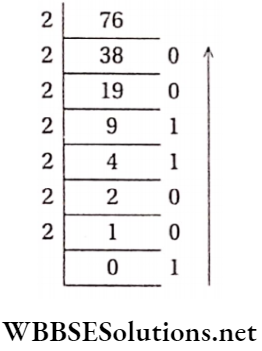
Question 2. Assume that the first and the second digits of any binary system are 7 and 6, respectively. Convert (76)10 into this binary system.
Answer:

Digital Circuit First And Second Digits Of Binary System

Conceptual Questions on Sequential Circuits

(76)10 = (1001100)2

Here, we have to take 0 → 7 and 1→ 6.

Therefore, according to the given binary process,

(76)10 = (6776677)2

Read And Learn More WBCHSE Class 12 Physics Short Question And Answers

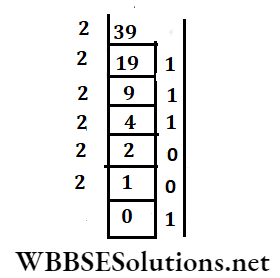
Question 3. Express 39 as a binary number
Answer:

Digital Circuit Express 39 Binary System

∴ (39)10 = (10011)2

Question 4. Why is it called a universal gate?
Answer:

NOR gate can be used to obtain all the possible gates by using it as a basic building. This is why it is called the universal gate. It may be used to realize the basic logic functions OR, AND, and NOT

WBBSE Class 12 Digital Electronics Short Q&A

Class 11 Physics Class 12 Maths Class 11 Chemistry
NEET Foundation Class 12 Physics NEET Physics

Question 5. What is the decimal equivalent of the binary number 100117
Answer:

(1 × 24) + (0 × 23)  (1 × 22) (1 × 21) +(1 × 20)

= (16 + 0 + 0 + 2+ 1)

= (19)10

WBCHSE Class 12 Physics Digital Electronics And Logical Gates Short Answer Questions

Question 6. If two Inputs of n NAND gate arc are joined, what type of gate is formed
Answer:

If the joining of two inputs implies that the inputs are short-circuited, then the two inputs are generally the same. If the input is A, then the output of the NAND gate

Y = \(\overline{A \cdot A}=\bar{A}\)

Hence, in this case, a NOT gate Is formed

Question 7. Write down the value of \((\bar{X}+X) \text { and }(X \cdot \bar{X})\) in Boolean algebra
Answer:

⇒ \(\bar{X}+X\)= 1

⇒ \(X \cdot \bar{X}\) = 0

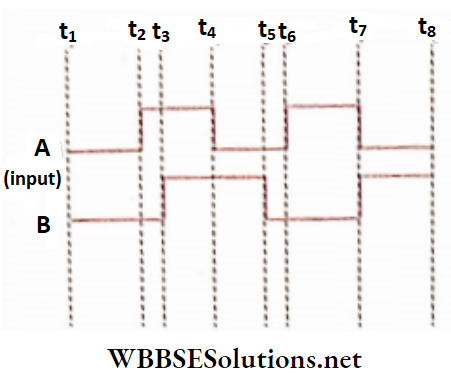
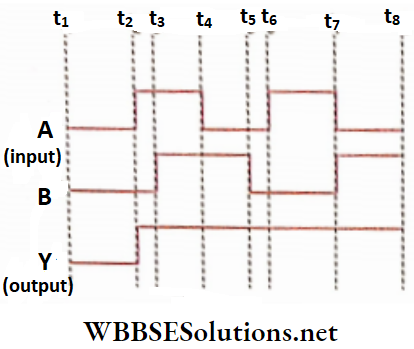
Question 8.  The Input waveforms A and B to a logic gate. 

Digital Circuit Logic Gate And Logic Symbol

Answer:

Digital Circuit Logic Gate And Logic Symbol.

Short Answer Questions on Digital Circuits

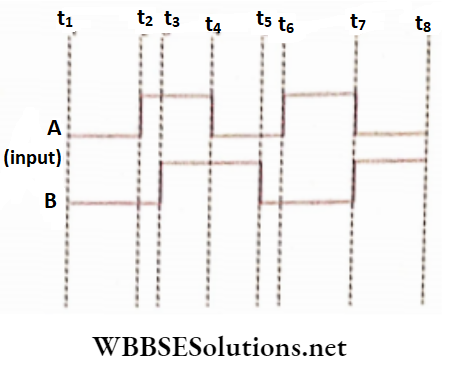
Question 9.  The figure shows the Input waveforms A and B for the AND gate. 

Digital Circuit Output Waveforms

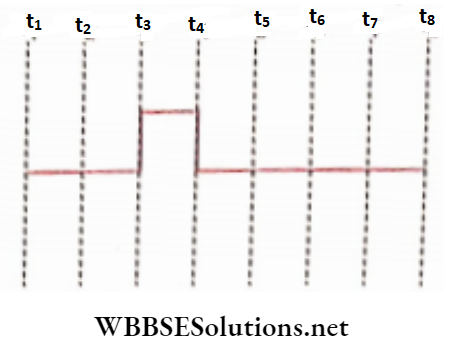
Output waveform will ho as follows:

Digital Circuit Output Waveforms.

WBCHSE Class 12 Physics Notes For Electromagnetic Induction

 Electromagnetic Induction And Alternating Current

 Electromagnetic Induction Induced Emf Or Induced Induction

When a current-carrying wire is placed in a magnetic field, it is deflected, i.e., a motion is generated. An opposite phenomenon was first observed by Michael Faraday.

He saw that if a closed wire loop is moved in a magnetic field, an electric current is generated in that loop as long as the motion continues.

Definition: If there is a relative motion between a magnetic field and a conductor, an electromotive force is generated in the conductor. It is called induced electromotive force.

It should be noted carefully that, to get electric current from this induced emf, the conductor should be in the form of a closed circuit.

This is because, the resistance of an open circuit is infinite and hence, despite the presence of induced emf, no current passes through the conductor.

Definition: If there is a relative motion between a magnetic field and a closed circuit conductor, the current flowing through that conductor is known as induced current.

Electromagnetic induction: The phenomenon involving the generation of electrical energy due to relative motion between a magnetic field and a conductor is called electromagnetic induction.

WBCHSE Class 12 Physics Notes For Electromagnetic Induction

Electromagnetic Induction And Alternating Current

Electromagnetic Induction Experimental Demonstration

Magnitude And Direction Of Induced Current

Induced current with the help of a magnet: In Fig. 1.1, C is a circular coil having one or more turns. M is a permanent magnet kept along the axis of C. G is a galvanometer connected to C.

By observing the deflection of the pointer in G towards left or right, the direction of current in the coil C (i.e., anticlockwise or clockwise) can be determined.

Again, noting the extent of deflection of the pointer (i.e.,
low or high), the magnitude of the current, low or high, can be ascertained.
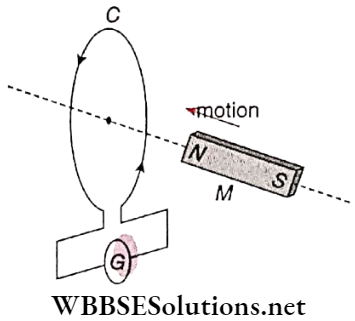
Electromagnetic Induction Induced Current With The Help Of A Magnet

For different motions of the magnet along the axis of the coil, the directions of induced current through the coil are given in the following table.
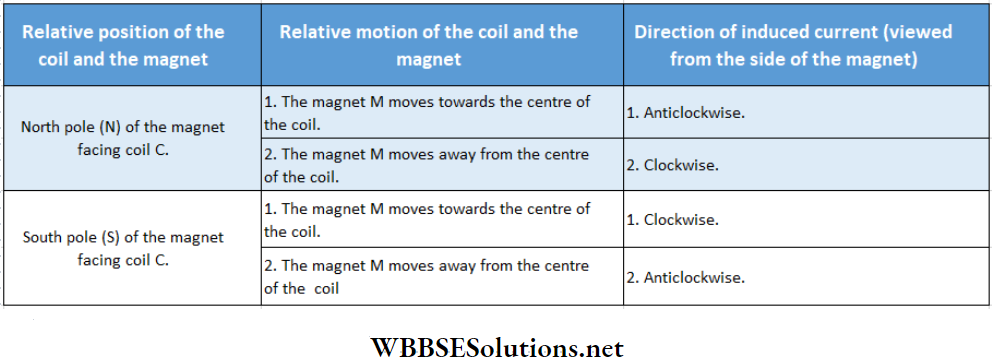
Electromagnetic Induction Different Motions Of The Magnetic

WBBSE Class 12 Electromagnetic Induction Notes

Note that, no induced current is noticed in the coil when

  1. The magnet is at rest, the magnet rotates about its axis or
  2. Both the magnet and this coil move in such a way that no relative motion exists between them.
  3. Keeping the magnet at rest, if the coil is moved towards or away from the magnet, the same results will be obtained.

Direction Of The Induced Electromotive Force:

This direction depends on

  1. The nature of the magnetic pole facing the conductor and
  2. The direction of motion of the magnet concerning the conductor.

Magnitude Of The Induced Electromotive Force:

  1. Increases with an increase in the relative velocity between the coil and the magnet.
  2. Increases with the increase in pole strength of the magnet.
  3. Increases with an increase in the number of turns of the coil.

Magnitude And Direction Of The Induced Current:

  1. The direction is identical to the direction of induced electromotive force.
  2. Magnitude is directly proportional to the magnitude of the induced emf
  3. Magnitude is directly proportional to the magnitude of the induced emf.
  4. Inversely proportional to the resistance of the coil.

Note that, induced electromotive force does not depend on the resistance of the circuit. In an open circuit, the resistance is infinite, hence no current passes but the induced emf associated with the circuit does exist.

Current Induced With The Help Of Current Carrying Conducting Coil Or Current Carrying Solenoid:

A current-carrying circular coil or a current-carrying solenoid is equivalent to a permanent magnet. The rule for determination of their poles are

  1. If the current view from a face is anticlockwise, that face acts as a north pole (N) and
  2. If the current view from a face is clockwise, that face acts as a south pole (S).

So, if a circular current-carrying coil or a current-carrying solenoid is used instead of the magnet M shown, the same experimental result will be obtained. Two more important facts should be noted:

  1. With the increase in the current through the circular coil or solenoid, the strength of the magnetic field increases.
  2. If the direction of current through the circuit is reversed, magnetic polarity is also reversed.

Current Induced With The Help Of Static Electrical Circuits:

In S is a circular coil with one or more turns. A galvanometer G is connected to it. From this galvanometer, the magnitude and direction of the induced current can be determined.

P is another co-axial circular coil connected with an electrical circuit. B is a battery and a key K is used to switch on or off the circuit. Again, with the help of the rheostat, current through the circuit can be increased or decreased.

Now, if the circuit P be switched ‘on’ or if the current in the circuit is increased rapidly, the magnetic field also increases considerably.

It is similar to the situation when a magnet is moved towards the coil S swiftly. So, the results of two phenomena: ‘increase of current in the circuit P’ and ‘relative motion between the coil S and the magnetic field’ are identical.

Naturally, if the circuit P is switched ‘off’ suddenly or if the current in the circuit is decreased rapidly, the effective relative velocity becomes just opposite to the former case.
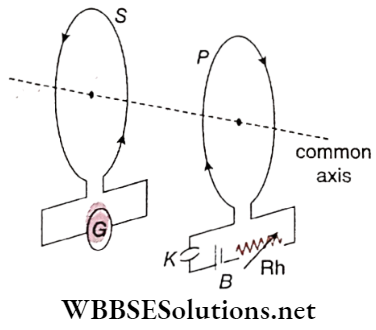
Electromagnetic Induction Current Induced With The Help Of Static Electrical

Observation:

the current through coil P be increased or decreased in different ways using the key K and the rheostat Rh, the induced current found the coil S will be as described below:
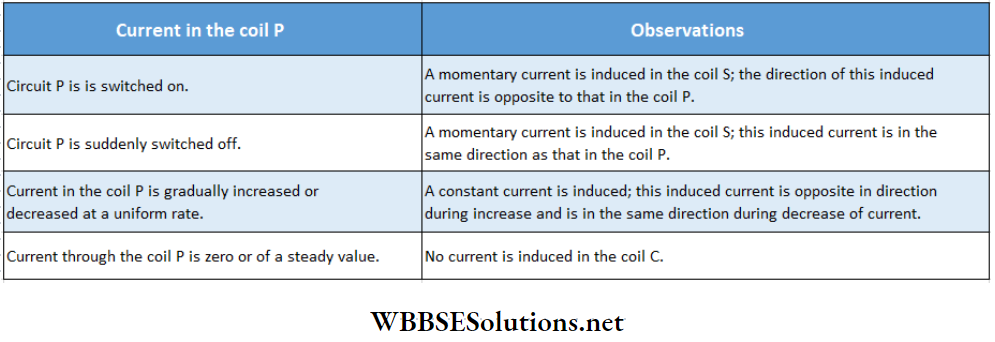
Electromagnetic Induction Current Induced With The Help Of Static Electrical Circuits Observation

Short Notes on Faraday’s Law of Induction

Primary And Secondary Coils:

In the experiment shown, the current through coil P is the cause of electromagnetic induction and this coil is called the primary coil.

On the other hand, the current in coil S is the result of electromagnetic induction and this coil is called the secondary coil.

Electromagnetic Induction And Alternating Current

Electromagnetic Induction Magnetic Induction And Magnetic Flux

From the discussion of magnetism we know that, if a magnetic material is placed in an external magnetic field, it gets magnetically induced.

This magnetic induction is a vector quantity, and the most convenient way to specify its magnitude and direction is to draw lines of induction through that substance.

If the magnetic induction is greater at a place, lines of induction get crowded there. Moreover, the direction of lines of induction is to be represented.

According to the direction of magnetic induction at every point. From this we can define magnetic induction as follows:

Definition: The number of lines of induction passing normally through a unit area surrounding a point inside a substance is called magnetic induction at that point.

Magnetic induction is a vector quantity, its symbol is \(\vec{B}\). This vector is identical to the magnetic field \(\vec{B}\) described in the chapter ‘Electromagnetism.

Usually, the lines of induction passing through any medium are called lines of force. These continuous lines of force passing through a medium can be imagined as a kind of stream.

This stream is comparable to the flow of water. We know that, in the case of water flow, the rate of flow of water can be obtained from the mass of water passing through any cross-section. Magnetic flux can be defined from this analogy.

Definition: The number of lines of induction passing normally through any surface placed in a magnetic field is called the magnetic flux linked with that surface.

Magnetic flux is a scalar quantity, and its symbol is Φ.

Let the area of a surface placed in a uniform magnetic field be A. If the magnetic induction \(\vec{B}\) is inclined at an angle θ with the normal to the surface, the component of \(\vec{B}\) in the direction of that normal is Bcosθ (magnitude of \(\vec{B}\) is B).
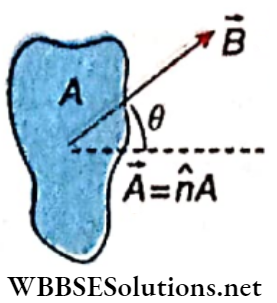
Electromagnetic Induction Magnetic Flux Is A Scalar Quantity

Hence according to the definition, of magnetic flux,

⇒ \(\phi=B A \cos \theta=\vec{B} \cdot \vec{A}=\vec{B} \cdot \hat{n} A\)

where \(\hat{n}\) is a unit vector normal to the surface.

For a finite surface, we first consider the magnetic flux through an infinitesimal area \(d \vec{A}\). The magnetic flux across this area, \(d \phi=\vec{B} \cdot d \vec{A}\)

A finite surface A can be assumed as the summation of such infinitesimal elements and the magnetic flux through the total surface area,

∴ \(\phi=\int_S \vec{B} \cdot d \vec{A}\)

Special Cases:

If the lines of induction are along the surface, then θ = 90° and hence Φ = 0.

If the lines of induction are perpendicular to the surface, θ = 0° and hence Φ = BA. In this case, \(B=\frac{\phi}{A}\) = magnetic flux linked with unit area.

Thus, magnetic induction \(\vec{B}\) is also called magnetic flux density. According to this flux is positive.

If θ = 180°, Φ = -BA i.e., flux is negative.

Electromagnetic Induction And Alternating Current

Electromagnetic Induction Laws Of Electromagnetic Induction

The phenomenon of electromagnetic induction is completely described by three laws. The exact information obtained from these laws is as follows:

  1. Whether or not an emf would be induced in a coil (Faraday’s 1st law).
  2. The magnitude of this induced emf (Faraday’s 2nd law).
  3. The direction of the induced emf (Lenz’s law)

Faraday’S Laws

First law: Whenever the magnetic flux linked with a coil changes with time, an electromotive force is induced in the coil. Induced EMF lasts as long as the magnetic flux linked with the coil continues to change.

Second law: The magnitude of the induced is directly proportional to the time rate of change of magnetic flux linked with the coil.

If the change in magnetic flux linked with a coil in time dt be dtb, according to Faraday’s second law,

induced emf \(e \propto \frac{d \phi}{d t}\) → (1)

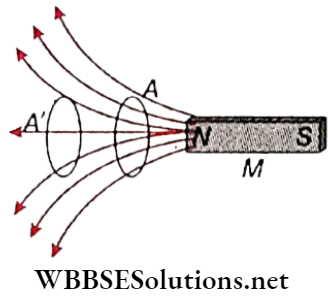
Explanation Of Faraday’s Two Laws: The magnetic lines of force or lines of. induction adjacent to the north pole (IV) of a bar magnet M is shown.

Explanation Of The First Law:

If a closed coil is moved from A to A’ or from A’ to A, the number of lines of force through that coil, i.e., magnetic flux linked with it decreases or increases, respectively.

According to Faraday’s first law, during the motion of the coil in both cases an emf will be induced in the coil: On the other hand, if the coil is at rest, no change in the magnetic flux will occur, and hence induction will not take place.

From the experiment of electromagnetic induction, the same result is obtained. So, from the first law, the cause of the electromagnetic induction and the time of existence of the induced emf can be ascertained.
Electromagnetic Induction Faradays Two Laws

Explanation Of The Second Law: If the relative velocity between the coil and the magnet is increased, the strength of induced emf also increases. This phenomenon is by Faraday’s second law, because if the coil is moved quickly the rate of change of the number of lines of force, i.e., the rate of change of magnetic flux also increases. So, the second law determines the magnitude of the induced emf.

Lenz’s Law

From Faraday’s laws, the direction of the induced emf cannot be ascertained. The necessary law for the determination of this direction is Lenz’s law. This may be called the third law of electromagnetic induction.

Statement: In the case of electromagnetic induction, the direction of the induced emf is such that, it always opposes the cause of induction in the circuit.

Important Definitions in Electromagnetic Induction

Explanation of Lenz’s law:

Relative motion between a magnet and a closed coil:

Let C be a circular conducting coil. Along its axis, the north pole (AO of a bar magnet M is moved towards the coil.

According to Lenz’s law, the induced current in C will oppose the motion of the magnet M, i.e., it will repel the magnet. For this, a north pole would be generated on the front face of the coil.

So, if viewed from the side of the magnet, the induced current will be anticlockwise. Similarly, if the magnet is moved in the opposite direction the current in the coil C will be clockwise.
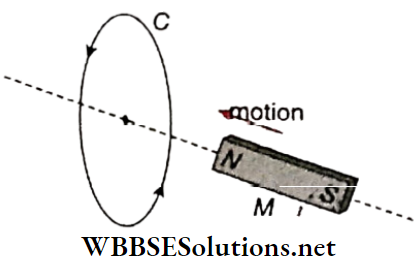
Electromagnetic Induction Relative Motion Between A Magnet And A Closed Coil

If magnet M is moved forward beyond the surface of coil C, the induced current in the coil will attract the south poles of the magnet.

Hence, a north pole should be generated on the back face of the coil and a south pole on the front face. So, if Viewed from the front face, the induced current is clockwise.

Primary And Secondary Coils:

let a current be passed through the primary coil P by switching on the circuit. At that moment.

The instantaneous effect on the secondary coil becomes similar to the effect due to a sudden rapid movement of a current-carrying coil towards the secondary coil.

So, according to Lenz’s law, the induced current in the secondary coil S will repel the primary coil. Since two unlike parallel currents repel each other.

We can conclude that the induced current in the secondary coil is opposite in direction concerning the primary coil.

On the other hand, if the primary circuit is switched off; just at that moment, a like current will be induced in the secondary coil.
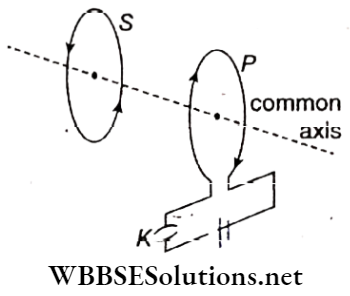
Electromagnetic Induction Primary And Secondary Coils

Falling Of A Magnet Through A Coil: when a body is allowed to fall freely in the gravitational field of the earth, it falls with „ acceleration due to gravity (g).

Let us consider a closed circular coil C kept horizontally and along its axis, a bar magnet M is released. Due to the downward motion of the magnet, an induced current is set up in coil C.

According to Lenz’s law, the direction of this induced current will be such that, the downward motion of the magnet will be opposed. As a result, the magnet will fall with a smaller acceleration than that due to gravity (g).

If the coil is replaced by a long cylindrical conductor (say, a copper pipe), the slower motion of the magnet becomes more dearly noticeable.
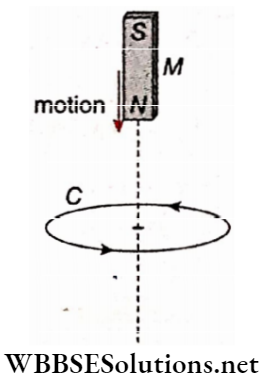
Electromagnetic Induction Falling Of A Magnet Through A Coil

Lenz’s Law From The Law Of Conservation Of Energy:

Let a bar magnet M be moving towards a closed coil C along its axis. Its north pole faces the coil. As a result, a current is induced in the coll, i.e., electrical energy is developed.

According to the law of conservation of energy, this electrical energy can only be obtained at the cost of other forms of energy and hence some external positive work is to be done against an opposing force.

The current induced in the coil is the source of this opposing force. Naturally, the direction of the induced current has to be anticlockwise to develop.

An N pole in its front face will oppose the motion of the bar magnet. So, Lenz’s law is a natural consequence of the law of conservation of energy.
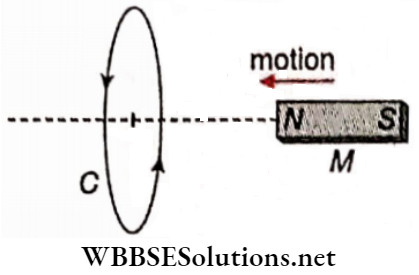
Electromagnetic Induction Lenzs Law From The Law Of Conservation Of Energy

Law Of Conservation Of Energy From Lenz’s Law:

According to Lenz’s law, the direction of the induced emf is such that, this induced emf can oppose the cause of the generation of electric current in the circuit.

It means that if we gradually bring a magnet near the coil, the induced EMF will oppose the forward motion, and when the magnet is taken away from the coil, it opposes that receding motion.

As a result, to generate relative motion between the magnet and the coil, some work must be done against this opposing force and this work will induce electromotive force to obey the principle of conservation of energy.

Hence, the principle of conservation of energy can be obtained from Lenz’s law.

Expression For Induced Electromotive Force

From Faraday’s second law we know that, if the change in magnetic flux linked with a closed conductor be dtp in time dt, induced emf, \(e \propto \frac{d \phi}{d t}\)

So, according to Lenz’s law, we can write,

\(e=-k \frac{d \phi}{d t}\) → (1)

Here, k is a positive constant. Since the induced emf e opposes the change in magnetic flux dΦ, a negative sign is used in the equation.

Note that, equation (1) expresses the three laws of electromagnetic induction simultaneously.

  1. If magnetic flux does not change i.e. if dΦ = 0 then e = 0. This supports Faraday’s first law.
  2. \(e \propto \frac{d \phi}{d t}\).It is Faraday’s second law. For a coil having n turns, \(e \propto n \frac{d \phi}{d t}\).
  3. The ‘negative’ sign on the right-hand side of equation (1) indicates the opposing nature of induced emf e due to the change in magnetic flux d<t>. This is Lenz’s law.

Units Of Magnetic Flux And Magnetic Induction:

The unit of magnetic flux is so defined that the magnitude of the
constant k in equation (1) becomes 1

For \(e=1, \text { if } \frac{d \phi}{d t}=1, \text { then } k=1\)

In that case \(e=-\frac{d \phi}{d t}\) → (2)

So, the unit of magnetic flux is defined as the change in unit time of magnetic flux linked with a conducting coil, for which 1 unit emf is induced in that coil.

Again, since the magnetic flux linked with the unit area is called magnetic induction or magnetic flux density, the unit of magnetic induction or magnetic flux density = \(\frac{\text { unit of magnetic flux }}{\text { unit of area }}\)
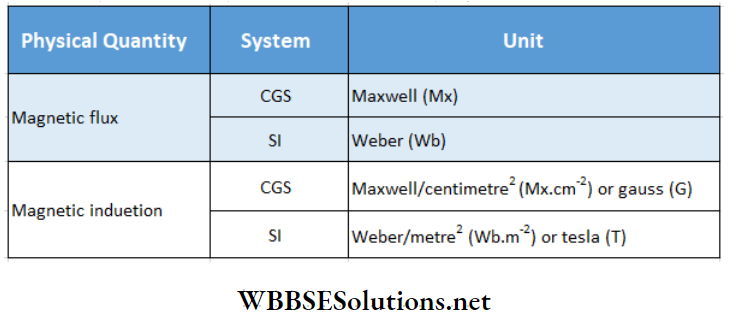
Electromagnetic Induction Units Of Magnetic Flux And Magnetic Induction

1 Wb: The change of magnetic flux linked with a coil in 1 s, for which 1 V emf is induced in the coil, is called 1 Wb.

In other words, 1 Weber is the magnetic flux which, linking a circuit of one turn, would produce in it an electromotive force of 1 volt if it were reduced to zero at a uniform rate in 1 second.

1 Mx: The change of magnetic flux linked with a coil in 1 s, for which 1 abvolt (1 abvolt = 10~8 V) emfis induced in the coil, is called 1 Mx.

In other words, 1 maxwell is the magnetic flux which, linking a circuit of one turn, would produce in it an electromotive force of 1 aibvolt if it were reduced to zero at a uniform rate in 1 second.

Relation Between Different Units:

As l volt = 108 abvolt

so, 1 Wb = 108 Mx .

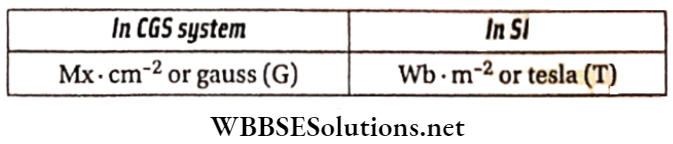
Again, 1 T = \(\frac{1 \mathrm{~Wb}}{1 \mathrm{~m}^2}=\frac{10^8 \mathrm{Mx}}{10^4 \mathrm{~cm}^2}\)

= 104 Mx.cm-2 = 104 G

Relation between web and V: According to the relation,

⇒ \(e=\frac{d \phi}{d t}\),

∴ \(\mathrm{V}=\frac{\mathrm{Wb}}{\mathrm{s}}\) or, Wb = V.s

Amount Of Change Flowing Through A Closed Circuit For Induced Electromotive Force:

Let the number of turns of any closed coil be n, the emf induced in the coil be e and the rate of change of magnetic flux linked with the coil be \(\frac{d \phi}{d t}\). Now, if the resistance of the circuit is R, the current induced in it (taking the magnitude only),

∴ \(i=\frac{e}{R}=\frac{n}{R} \cdot \frac{d \phi}{d t}\) [∵ e = \(n \frac{d \phi}{d t}\)]

Or, \(i d t=\frac{n}{R} \cdot d \phi\) → (3)

If the initial magnetic flux linked with the coil be and the final magnetic flux linked be <p2, then integrating equation (3) we get,

⇒ \(\int_0^t i d t=\frac{n}{R} \int_{\phi_1}^{\phi_2} d \phi=\frac{n}{R}\left(\phi_2-\phi_1\right)\)

So, the amount of charge flowing through the circuit,

∴ \(q=\int_0^t i d t=\frac{n}{R}\left(\phi_2-\phi_1\right)\) → (4)

Electromagnetic Induction And Alternating Current

Electromagnetic Induction Numerical Examples

Example 1: A coil of resistance 100 Ω having 100 turns is placed in a magnetic field. A galvanometer of resistance 400 Ω is connected in series with it If the coil is brought from the present magnetic field to another magnetic field in \(\frac{1}{10}\)s, determine the average emf and the current. Given, the initial and final magnetic flux linked with each turn of the coil are 1 mWb and 0.2 mWb respectively.

Solution:

Change in magnetic flux for each turn

= 0.2-1 = -0.8 mWb

So, a change in magnetic flux for 100 turns

= 100 X (+0.8) mWb = -0.08 Wb

Hence, the magnitude of average emf-induced

= the negative of the rate of change of magnetic flux

= \(-\left(-\frac{0.08 \mathrm{~Wb}}{\frac{1}{10} \mathrm{~s}}\right)=0.8 \mathrm{~V}\).

The equivalent resistance of the circuit = 100 + 400 = 500 Ω

Hence, the average induced current = \(\frac{0.8 \mathrm{~V}}{500 \Omega}\) = 0.0016 A = 1.6mA.

Practice Problems on Electromagnetic Induction

Example 2.  A conducting wire is wound around the great circle of a spherical Balloon. This Circular Loop Can Contract with The Balloon. A hemispherical cross-section of the balloon is shown in the figure. The initial radius of the balloon is 0.60m. A uniform magnetic field B = 0.25T exists along the perpendicular to the plane of the circular loop., in +y – direction. After 5.0 x 10⁻², the balloon is deflated to a radius of 0.30m. What will be the average EMF induced in the loop during this time?
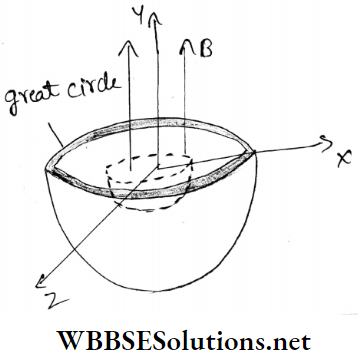
Electromagnetic Induction The Circular Loop Can Contract With The Balloon

Solution: Initially the flux linked with the conducting loop along the y-axis,

⇒ \(\phi_i=\vec{B} \cdot \overrightarrow{A_i}=B A_i \cos 0^{\circ}=0.25 \pi \times 0.60^2\)

= 0.28 Wb

After deflation of the balloon, the flux linked with the conducting loop of radius 0.30m,

⇒ \(\phi_f=\vec{B} \cdot \vec{A}_f=B A_f \cos 0^{\circ}=0.25 \pi \times 0.30^2\)

= 0.070 Wb

∴ change of flux,

∴ \(\Delta \phi=\phi_f \phi_i=(0.070-0.28) \mathrm{Wb}=-0.21 \mathrm{~Wb}\)

∴ Induced emf, e = \(e=-\frac{\Delta \phi}{\Delta t}=\frac{+0.21}{5 \times 10^{-2}}=4.2 \mathrm{~V}\).

Class 11 Physics Class 12 Maths Class 11 Chemistry
NEET Foundation Class 12 Physics NEET Physics

Example 3.  A copper wire of diameter 0.04 in. and length 50 cm is bent in the form of a circular loop. The plane of the loop is normal to a uniform magnetic field which is increasing with time at a constant rate of 100 G.s-1. What is the rate of Joule heating in the loop? [Resistivity of copper = 1.7 X l0-8 Ω . m, 1 in. = 2.54 cm]

Solution:

The radius of the wire

= 0.02 in. = 0.02 x 2.54 x 10-2m = 5.08 x 10⁻⁴ m

Area of cross-section of the wire,

⇒ \(A_1=\pi r^2=\pi\left(5.08 \times 10^{-4}\right)^2=81 \times 10^{-8} \mathrm{~m}^2\)

Resistance of the wire,

⇒ \(R_0=\frac{\rho l}{A_1}=\frac{1.7 \times 10^{-8} \times 0.5}{81 \times 10^{-8}} \Omega\) [l =length of the wire = 0.5 m ]

= 1.05 x 10⁻² Ω

The radius of the loop,

⇒ \(R=\frac{l}{2 \pi}=\frac{0.5}{2 \pi}=7.96 \times 10^{-2} \mathrm{~m}\)

Area of the loop,

⇒ \(A=\pi R^2=3.14 \times\left(7.96 \times 10^{-2}\right)^2\)

= 0.02 m2

Here \(\frac{d B}{d t}=100 \mathrm{G} / \mathrm{s}=10^{-2} \mathrm{~Wb} \cdot \mathrm{m}^{-2} \cdot \mathrm{s}^{-1}\)

∴ Induced emf,

⇒ \(e=A \cdot \frac{d B}{d t}=(0.02) \times 10^{-2}=2 \times 10^{-4} \mathrm{~V}\)

∴ From Joule’s law, the rate of Joule heating,

⇒ \(H=I^2 R_0=\frac{e^2}{R_0}=\frac{\left(2 \times 10^{-4}\right)^2}{1.05 \times 10^{-2}}=3.8 \times 10^{-6} \mathrm{~W}\)

Electromagnetic Induction And Alternating Current

Electromagnetic Induction Motional Electromotive Force

Let us assume a uniform magnetic field \(\vec{B}\) directed along the axis which is vertically downwards.

A rod PQ parallel to the z -z-axis, is moving at a constant velocity \(\vec{v}\) along the x -x-axis through this field.
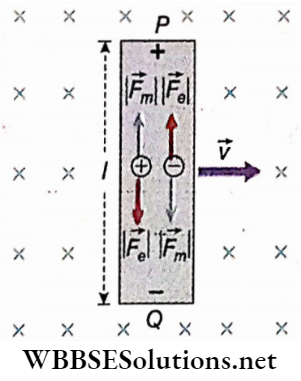
Electromagnetic Induction Uniform Magnetic Field Directed Along Y axis Vertically Downwards

In this condition, a free charge q in the rod experiences a magnetic force, \(\vec{F}_m=q \vec{v} \times \vec{B}\). If q is a positive charge then this force is directed from Q to P (i.e., along +ve z-axis).

On the other hand, if q is negative then this force is directed from P to Q (i.e., along the -ve z-axis). Hence the free charges continue to accumulate at the ends of the rod creating a gradually increasing potential difference between P and Q.
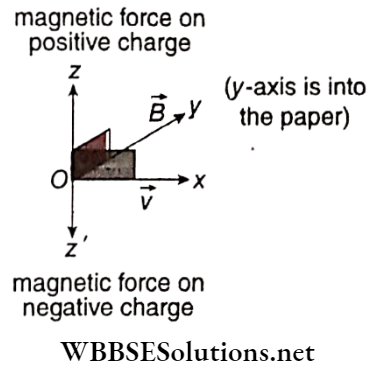
Electromagnetic Induction q Is Negative Then This Force Is Directed

This, in turn, creates an increasing electric field \(\vec{E}\) within the rod, in the direction from P to Q (opposite to the magnetic force). Due to this growing electric field, the electric force exerted on the charge q at any moment, Fe = qE.

As the magnitude of electric force comes to be equal with that of magnetic force, no net force anymore acts on the charge q, i.e., at equilibrium condition,

⇒ \(\left|\vec{F}_e\right|=\left|\vec{F}_m\right|\)

i.e., \(q|\vec{E}|=q|\vec{v} \times \vec{B}| \quad \text { or, }|\vec{E}|=|\vec{v} \times \vec{B}|\)

∴ \(E=v B \quad\)  [∵ \(\vec{v} \perp \vec{B}]\)→ (1)

Let the potential difference between the ends P and Q be V. If the length of the rod is l then,

V = El = vBl [putting the value of E from (1) ] → (2)

Now, if the ends of the rod are connected with a conductive wire, a current is set up in the circuit. Hence the moving rod can be considered as a source of emf (e), i.e., as a cell. Just like in a cell, this emf directs from the negative end Q to the positive end p inside the road.
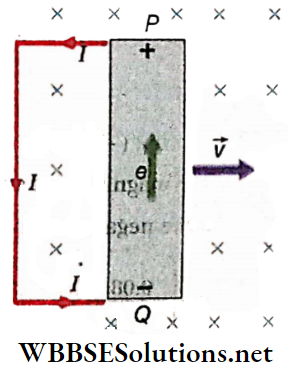
Electromagnetic Induction A Current Is Set Up In The Circuit

For an open circuit, equation (2) can be written as,

V = e = vBl → (3)

This induced EMF in the moving rod is called motional electromotive force.

In general, if θ is the angle between \(\vec{v}\) and \(\vec{B}\) then, equation (3) becomes,

e = vBlsinθ → (4)

Discussions:

Dependence Of Induced Motional Emf On Different Factors:

From the above equation (4), the emf e induced across the straight conductor moving in a magnetic field is

  1. Directly proportional to the magnetic induction (B),
  2. Directly proportional to the length (l) of the conductor,
  3. Directly proportional to the velocity (v) of the conductor and
  4. Dependent on the angle 6 between the magnetic field and the direction of motion of the conductor. If the direction of motion of the conductor is parallel to the magnetic field then, θ = 0 and e = 0, and in that case, no electromagnetic induction takes place.

For θ = 90°, the emf induced is maximum.

Emf Induced Between The Two Extremities Of The Wings Of An Aeroplane:

At different places on the earth, the geomagnetic field is not horizontal; from the values of the angle of dip, the actual direction of the geomagnetic field is known.

When an aeroplane flies in a horizontal plane above the earth’s surface, the length of its two wings repeatedly intercepts the lines of force of the geomagnetic field.

As a result, electromagnetic induction takes place, i.e., a potential difference is set up between the two extremities of its wings.

The magnitude of this potential difference depends on

  1. The distance between the extremities of the wings,
  2. The velocity of the aeroplane,
  3. The direction of motion of the aeroplane,
  4. The horizontal component and
  5. The angle of dip of the geomagnetic field.

The value of the angle of dip at the geomagnetic equator is zero. In this position, a horizontally moving aeroplane does not cut the geomagnetic lines of force, and hence no potential difference is set up between the extremities of the wings.

Emf Induced Between The Two Ends Of A Conductor Rotating With Uniform Angular Velocity In A Uniform Magnetic Field:

Let a conductor of length L be rotating about the point O with uniform angular speed ω in the plane of the paper. The magnetic field B is normally upwards relative to the plane of the paper.
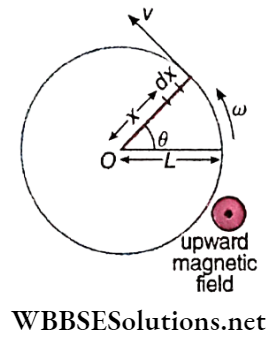
Electromagnetic Induction The Magnetic Field Is Normally Upwards Relative To The Plane Of The Paper

Let us consider a small element dx of the conductor at a distance x from the point 0, which is moving with velocity v perpendicular to the direction of the magnetic field. The emf induced in this element of the conductor,

de = B(dx)v [using the relation, e = Blv]

= Bωxdx [∵ v = ωx]

So, the emf induced between the two ends of the entire conductor,

∴ \(e=\int_0^L B \omega x d x=B \omega\left[\frac{x^2}{2}\right]_0^L=\frac{1}{2} B \omega L^2\)

Induced Current In A Moving Straight Conductor:

In the discussion of motional electromotive force, if R be the total resistance of the circuit then, V = IR. So, from (3) we get,

⇒ \(I R=v B l \quad \text { or, } I=\frac{v B l}{R}\) → (5)

The direction of the induced current can be determined with the help of the following simple rule.

Fleming’s right-hand rule:

The thumb, the forefinger and the middle finger of the right hand are stretched perpendicular to each other.

If the magnetic field forefinger points in the direction of the magnetic field and the thumb in the direction of the motion of the conductor, then the middle finger will point in the direction of the induced current.

This rule is also called the dynamo rule.
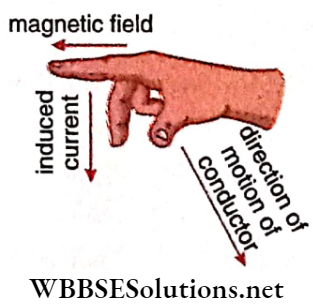
Electromagnetic Induction Flemings Right Hand Rule

Electromagnetic Induction And Alternating Current

Electromagnetic Induction Motional Electromotive Force Numerical Examples

Example 1. The distance between the two endpoints of the wings of an aeroplane is 5m and the aeroplane is flying parallel to the earth’s surface with a velocity of 360 km h-1. If the geomagnetic intensity is 4 x 10⁻⁴ Wb.m-2 and the angle of dip at that place is 30°, determine the emf induced between the two end-points of the wings.

Solution:

While flying horizontally, the wings of the aeroplane cut the vertical component of the earth’s magnetic field normally and hence, an emf is induced between the two ends of the wings.

This induced emf, e = Blvsinθ.

Here \(B=4 \times 10^{-4} \mathrm{~Wb} \cdot \mathrm{m}^{-2}, l=5 \mathrm{~m}\)

⇒ \(v=360 \mathrm{~km} \cdot \mathrm{h}^{-1}=360 \times \frac{5}{18} \mathrm{~m} \cdot \mathrm{s}^{-1}=100 \mathrm{~m} \cdot \mathrm{s}^{-1}\)

and θ = 30°.

∴ e = 4 x 10-4 x 5 X 100 x sin30° = 0.1 V

Example 2. A copper disc of diameter 20 cm is rotating uniformly about its horizontal axis passing through the centre with an angular frequency of 600 rpm. A uniform magnetic field of strength 10-2 T acts perpendicular to the plane of the disc. Calculate the induced emf between its centre and a point on the rim of the disc.

Solution:

The diameter of the disc = 20 cm

∴ Radius, r = 10 cm = 0.1 m

Angular frequency, n = 600 rpm

∴ Angular speed,

⇒ \(\omega=\frac{600 \times 2 \pi \mathrm{rad}}{60 \mathrm{~s}}=20 \pi \mathrm{rad} \cdot \mathrm{s}^{-1}\)

Let us take a small segment dx on the disc at a distance x from its centre. The length of dx is so small that the speed of all the points on this segment is considered to be the same, which is, v’ = ωx.

Therefore, motional emf across dx,

de = v’Bdx [where B is the magnetic field]
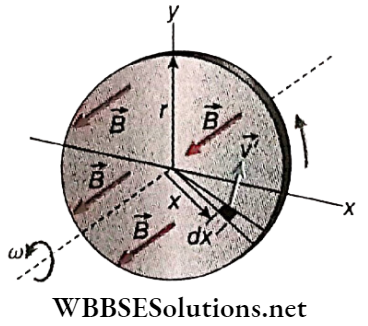
Electromagnetic Induction A Copper Disc Of Diameter

∴ Total induced emf between the centre and a point on the rim of the disc,

∴ \(e=\int_0^r \nu_B^{\prime} B d x=\int_0^r \omega x B d x=\frac{1}{2} \omega B r^2\)

⇒ \(\frac{1}{2} \times 20 \pi \times 10^{-2} \times(0.1)^2\)

∴  0.00314 V = 3.14 mV

Examples of Applications of Electromagnetic Induction

Example 3. A pair of parallel horizontal conduct invariable resistance shorted at one end Is fixed on a smooth table. The distance between the rails Is L. A massless conducting rod of resistance R can slide on the rails frictionlessly. The rod is tied to a massless string which passes over a pulley fixed to another edge of the table. A mass m, tied to the other end of the string, hangs vertically. A constant magnetic field B exists along the perpendicular to the plane of the table in an upward 1 direction. If the system Is released from rest, calculate

  1. The terminal velocity of the rod,
  2. The acceleration of the mass at the instant, when the velocity of the rod is half the terminal velocity.
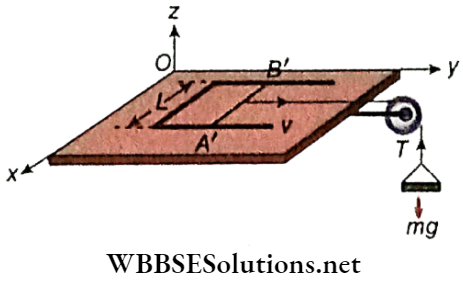
Electromagnetic Induction A Pair Of Parallel Horizontal Conducting Rails Fixed In A Smooth Table

Solution:

1. Let, rod A’B’ of length L and resistance R slide with a velocity v along the y-axis, while a constant magnetic field B exists along the z-direction.

Induced emf in the rod, e = BLv

The induced current flowing through the rod,

⇒ \(I=\frac{e}{R}=\frac{B L v}{R}\)

The direction of flow of the current through the rod A’B’ will be such that, it opposes the cause of generation of induced emf i.e., the motion of the rod along a positive y-axis. Thus the rod will experience force along the negative y-axis. The magnitude of the force is given by,

⇒ \(F=B I L=B \cdot \frac{B L v}{R} \cdot L=\frac{B^2 L^2 v}{R}\)

Let the rod move with acceleration, along the positive y-axis. Then from the equation of motion,

⇒ \(m a=m g-F=m g-\frac{B^2 L^2 v}{R} \quad \text { or, } a=g-\frac{B^2 L^2 v}{m R}\)

When the rod gets terminal velocity v0, then a = 0

∴ \(0=g-\frac{B^2 L^2 v_0}{m R}\)

∴ \(v_0=\frac{m g R}{B^2 L^2}\)

2. When the rod moves with velocity, \(v=\frac{1}{2} v_0\), then

⇒ \(v=\frac{m g R}{2 B^2 L^2}\)

Hence the acceleration of the mass at the instant

∴ \(a=g-\frac{B^2 L^2}{m R} \cdot \frac{m g R}{2 B^2 L^2}=g-0.5 g=0.5 g\)

Electromagnetic Induction And Alternating Current

Electromagnetic Induction Eddy Current

To enhance the effect of electromagnetic induction, in many cases, solid plates of soft iron or rods are used as the core of the armatures rotating in a magnetic field.

For example, in a dynamo, the armature rotating in the magnetic field is wound on a core of soft iron. Now, iron is a good conductor of electricity.

So electromagnetic induction takes place over the entire volume of the iron rotating in the magnetic field.

Many closed circuits or loops are formed locally within iron and induced current continues to flow in each loop.

Such current is known as eddy current Generally eddy current is produced whenever a conducting metal plate is in motion in a magnetic field.
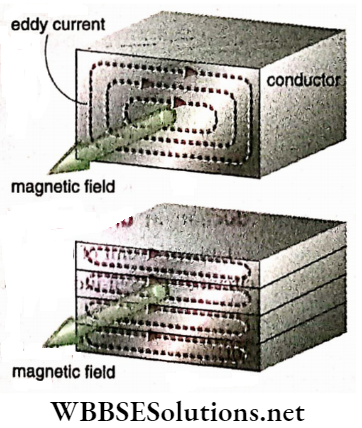
Electromagnetic Induction Eddy Current

If there is a relative motion between a conducting metal piece and a magnetic field, an induced current is set up throughout the volume of the metal in different closed loops. This current is known as eddy current.

According to Lenz’s law, eddy current opposes the cause that produces it, i.e., it opposes the relative motion between the metallic conductor and the magnetic field.

Due to this opposition, heat is generated in the conductor. This wasteful thermal energy comes at the cost of useful energy.

To minimise the loss of energy in the form of heat due to eddy current the cores are not taken as a single piece but are made of many thin laminas ofconductors which are insulated from each other with suitable insulating materials.

By doing so, the flux linked with local eddy current circuits is reduced to a minimum, hence eddy current becomes quite weak and its heating effect is minimised.

On calculation, it is observed that if the number of lamina is n instead of a single one, the loss of energy due to eddy current will come down to \(\frac{1}{n}\) times.

On the other hand, eddy current in some cases can be applied in our favour. For example, the coil of a moving coil galvanometer when deflected in the magnetic field begins to oscillate around the equilibrium position.

It takes a long time to come to rest To get rid of this problem the coil is wound on a single soft iron core.

The eddy current thus produced in the core opposes the motion of the coil following Lenz’slaw. Thus, the coil will not oscillate for a long time after the current is cut off.

It will return to the equilibrium position quickly. Besides this, eddy current is employed usefully in induction motors, induction cookers, electric brakes, etc.

Electromagnetic Induction And Alternating Current

Electromagnetic Induction Inductance Of A Coil

Self Induction

When current flows through a coil, a magnetic field is generated around the coil. As a result, the coil becomes linked up with its magnetic flux.

This magnetic flux Increases or decreases with the increase or decrease of current. Hence, an electromagnetic induction takes place and an emf is induced in the coil.

This induced emf opposes the change in electric current through the coil. This phenomenon is known as self-induction.
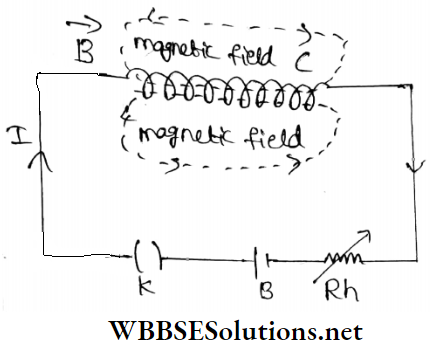
Electromagnetic Induction Self Induction

Definition: An electromagnetic induction in a coil due to a change of current through itself is called self-induction.

The electric current generated due to self-induction flows in the direction opposite to the main current.

Self-Inductance: If current flows through a coil, the magnetic flux linked with the coil becomes directly proportional to the current passing through it. So, if the magnetic flux is <p for current I, then

Φ ∝ I or, Φ = LI →(1)

L is a constant which depends on its construction. It is called the self-inductance or coefficient of self-induction of the coil. If I = 1, then L = Φ.

Definition: For unit current flowing through a coil, the magnetic flux linked with it is called its self-inductance.

Again, we know that the emf induced in the coil, \(e=-\frac{d \phi}{d t}\)

So, using equation (1) we can write,

\(e=-L \frac{d I}{d t}\) → (2)

If \(\frac{d I}{d t}=1\), then e = L (considering the magnitude only). From this, the following alternative definition of self-inductance can be drawn:

If the rate of change of electric current in a coil with time is unity, the emf induced in the coil is called its self-inductance.

Unit Of Self-Inductance:

In SI: In this system, the unit of self-inductance is Henry (H). To define it, we can use either of the equations (1) or (2).

  1. If I = 1 A and 0 = 1 Wb, then L = 1 H.
  2. If \(\) and e = 1 V, then L = 1 H.

So, the self-inductance of a coil is 1 H if

  1. For n current of 1 A flowing through that coll, the magnetic flux linked with It is I Wb; or,
  2. For a change of 1 A current in 1 second through that coll, the emf induced In It Is 1 V.

Hence, from equation (1) we get

Wb = H.A → (3)

Again from equation (2) we get

⇒ \(V=H \cdot \frac{A}{s} \quad \text { or, } \frac{V}{A} \cdot s=H\)

∴ H = Ω.s → (4)

The unit of resistance R is Ω and the unit of self-inductance L is H. Hence from equation (4) we infer that the unit of \(\frac{L}{R}\) and the unit of time is the same.

In CG System: Putting \(\frac{d I}{d t}=1 \mathrm{emu} \cdot \mathrm{s}^{-1}\) and e = 1 emu of emf, we get, L = 1 emu of self-inductance. So, if the current is changed at the rate of 1 emu.s-1 and 1 emu electromotive force is induced in the coil, the self-inductance of that coil is 1 emu.

Relation between the CGS and SI units of self-inductance:

⇒ \(1 \mathrm{H}=\frac{1 \mathrm{~V}}{1 \mathrm{~A} \cdot \mathrm{s}^{-1}}=\frac{10^8 \mathrm{emu} \text { of potential difference }}{\frac{1}{10} \text { emu of current per second }}\)

= 109 emu of inductance

Non-inductive Coil: Self-induction creates disturbances in many electrical circuits. A coil of finite resistance but of zero self-inductance is often required. Such a coil is called a non-inductive coil.

A long insulated conducting wire is given a fold and then coiled up. The free ends of the coil are now on the same side. This kind of winding is called non-inductive winding.

Hence antiparallel currents flow through adjacent wires of any part of the coil. So, the resultant magnetic flux becomes zero. That means, in this coil, no electromagnetic induction takes place.
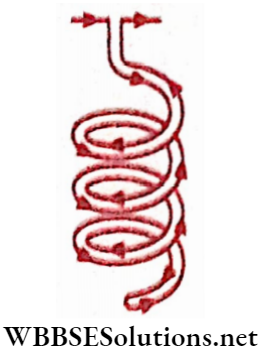
Electromagnetic Induction Non Inductive Coil

Effect Of Self-Induction On Electrical Circuit:

In the circuit, if the emf of battery B is E, the effective emf of the circuit due to self-induction [according to equation (2)] = \(E-L \frac{d I}{d t}\)

If the current is zero or a steady current flows through the circuit, \(\frac{d I}{d t}=0\); and in this case, self-induction does not affect the circuit.

On the other hand, self-induction affects a circuit when electric current changes with time in that circuit.

Thus, self-induction plays an important role in an AC circuit. In the case of a DC circuit, self-induction occurs only when the circuit is switched ‘on’ or ‘off.

Choke: A coil of high self-inductance and low resistance is commonly called a choke. If a choke is connected in series in an AC circuit, then due to its high self-inductance, the effective resistance of the circuit increases.

On the other hand, due to the low resistance of the coil, less heat is produced in the circuit. So, the function of a choke is to increase the effective resistance of the circuit lowering the dissipation of heat energy as much as possible.

Uses: In a tube light arrangement, a choke is usually connected in series.

Energy stored In the magnetic field of an inductor: We have induced emf in an inductor carrying a time-varying current i, \(e=-L \frac{d i}{d t}\), where L = self-inductance of the inductive coil.

To increase the current in the inductor against this opposing emf, some energy has to be spent on work. This external work will be stored in the magnetic field of the inductor as magnetic energy.

Power, i.e., rate of work done = ei = \(L i \frac{d i}{d t}\) (the negative sign is not taken in calculation of work done)

So, work done in time dt = ei dt = Lidi

Total work done to increase the current through the inductor from 0 to I,

⇒ \(W=L \int_0^I i d i=L \cdot\left[\frac{i^2}{2}\right]_0^I=\frac{1}{2} L I^2\)

This work done is stored as energy (EL) in the magnetic field of the inductor, i.e.,

∴ \(E_L=\frac{1}{2} L I^2\)

Mutual Induction

Let two coils, P and S, be kept very close to each other. Now if current is passed through them (say, P), a magnetic field is generated around it.
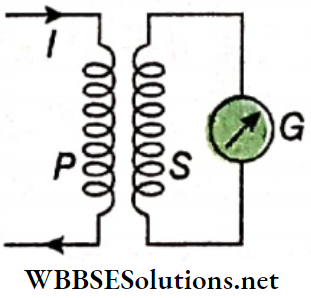
Electromagnetic Induction Mutual Induction

As a result, the second coil (S) gets linked with the magnetic flux generated by the first coil. If the current through P is increased or decreased concerning time.

The magnetic flux linked with an electromotive force induced in the coil S will also increase or decrease accordingly. Hence, an electromotive force is induced in the coil S.

This phenomenon is known as mutual induction. The first coil P is called the primary coil and the second coil S is called the secondary coil.

Definition: If current changes over time in a coil, the electromagnetic induction that occurs in an adjacent coil is called mutual induction.

Mutual Inductance: Mutual inductance is defined in a similar way as self-inductance. If the magnetic flux linked with the secondary coil is Φs for the current Ip in the primary coil then,

⇒ \(\phi_S \propto I_P \quad \text { or, } \phi_S=M I_P\) → (1)

Here, M is a constant, which depends on the geometry of the coils and the distance between them and is called mutual inductance or coefficient of mutual induction.

Naturally for Ip = 1, M = Φs

Definition: In the case of two adjacent coils, if one carries a unit current, then the magnetic flux linked with the other is called the mutual inductance between the two coils.

Again, induced emf in the secondary cop,

⇒ \(e=-\frac{d \phi_S}{d t}=-M \frac{d I_P}{d t}\) → (2)

If \(\frac{d I_p}{d t}=1\), then e = M [considering the magnitude only]

From this, the following, an alternative definition of mutual inductance is obtained.

In the case of two adjacent coils, if the rate of change of current concerning time in a coil is unity, the emf induced in the other coil is called the mutual inductance between the two coils.

Unit Of Mutual Inductance:

In SI: In this system, the unit of mutual inductance is Henry (H), exactly that of self-inductance L.

‘Mutual inductance between a pair of coils is 1 H’ means that,

  1. If the current passing through one coil is 1 A, the magnetic flux linked with the other becomes 1 Wb; or,
  2. If the current changes through one coil at the rate of 1 A per second, the emfinduced in the other becomes 1 V.

In the CGS system: If \(\frac{d I}{d t}=1\) emu of current per second and e = 1 emu of potential, then M = 1 emu of mutual inductance. So, in the case of two adjacent coils, if the current changes at the rate of 1 emu.s-1 in one coil and as a result if 1 emu of emf is induced in the other coil, the mutual inductance between the coils is said to be 1 emu.

Discussions:

Interchange of two colls: The second coil can be used as the primary coil and the first as the secondary. In that case, due to: a change in current in the second coil, electromagnetic induction will take place in the first coil, and the value of mutual, inductance (M) will remain unchanged.

Relation between self-inductance, and mutual inductance: If the self-inductances of the two coils are, L1 and L2, the mutual inductance becomes

⇒ \(M=k \sqrt{L_1 L_2}\) (3)

Here, k is a constant whose value is 1 or less than 1. If the magnetic flux of one coil is linked completely with the other; k≈1. Thus,

∴ \(M \approx \sqrt{L_1 L_2}\)

Electromagnetic Induction And Alternating Current

Electromagnetic Induction Inductance Of A Solenoid

Self-inductance of a solenoid: Let the length of the solenoid = l, area of its circular cross-section = A.

So, if several turns are N, then the number of turns per unit length (n) = \(\frac{N}{l}\).

If current I flow through the solenoid, then the magnetic field thus generated inside it is

B = μ0nI, where μ0 = magnetic permeability of vacuum or air.

So, the magnetic flux linked with each, turn of the solenoid,

⇒ \(B A=\mu_0 n A I=\frac{\mu_0 N A}{l} \cdot I\)

Hence; the magnetic flux linked with JV turns,

⇒ \(\phi=N B A=\frac{\mu_0 N^2 A}{l} \cdot I\)

If the self-inductance of the solenoid is L then, Φ = LI

∴ \(L=\frac{\phi}{I}=\frac{\mu_0 N^2 A}{l}\)

For any other medium of magnetic permeability p inside the solenoid, \(L=\frac{\mu N^2 A}{l}\).

Mutual Inductance Of Two Inseparable Solenoids:

PP’ and SS’ are primary and secondary solenoids respectively. They arpÿound over each other on a length. The cross-sectional area of each of them = A

Number of turns in length l in PP’ = N1 and that in SS’ = N2.
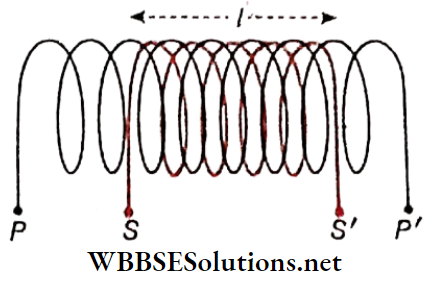
Electromagnetic Induction Mutual Inductance Of Two Inseparable Solenoids

Therefore, the number of turns per unit length of PP’.

⇒ \(n_1=\frac{N_1}{l}\)

If I1 current flows through the primary coil PP’, the magnetic field thus developed inside it,

⇒ \(B_1=\mu_0 n_1 I_1=\frac{\mu_0 N_1}{l} I_1\)

0 = magnetic permeability of vacuum or air]

As the solenoids are closely wound on each other, the magnetic flux linked in each turn of the secondary coil = B1A and hence the magnetic flux linked with N2 turns,

⇒ \(\phi_2=N_2 B_1 A=\frac{\mu_0 N_1 N_2 A}{l} \cdot I_1\)

If the mutual, inductance of the solenoid is M then,

⇒ \(\phi_2=M I_1\)

So, \(M=\frac{\mu_0 N_1 N_2 A}{l}\) → (2)

For any other medium used as the core, M = \(\frac{\mu N_1 N_2 A}{l}\), where mu = magnetic permeability of that medium.

In the present context, self-inductances of the coils are

⇒ \(L_1=\frac{\mu_0 N_1^2 A}{l} \text { and } L_2=\frac{\mu_0 N_2^2 A}{l}\)

So, \(L_1 L_2=\left(\frac{\mu_0 A}{l}\right)^2 N_1^2 N_2^2=\left(\frac{\mu_0 N_1 N_2 A}{l}\right)^2=M^2\)

i.e., \(M=\sqrt{L_1 L_2}\)

Comparing this equation with equation (3). we get, k = 1. This is the maximum value of k.

Energy Density In The Magnetic Field Of A Solenoid:

Length of a solenoid = l, cross-sectional area = A

So, its volume = l A.

If N be the total turns ui the solenoid, the number of turns per unit length of it, \(n=\frac{N}{l}\)

If I current flows through the solenoid, the magnetic field thus develops along its axis,

⇒ \(B=\mu_0 n I=\frac{\mu_0 N I}{l} \quad \text { or, } I=\frac{B l}{\mu_0 N}\)

But, self-inductance of the solenoid,

⇒ \(L=\frac{\mu_0 N^2 A}{l}\)

So, the stored energy in its magnetic field,

⇒ \(U=\frac{1}{2} L I^2=\frac{1}{2} \frac{\mu_0 N^2 A}{l}\left(\frac{B l}{\mu_0 N}\right)^2=\frac{1}{2 \mu_0} B^2 L A\)

So, the energy stored per unit volume,

⇒ \(u=\frac{U}{L A}\)

i,e. \(u=\frac{1}{2 \mu_0} B^2\) → (3)

This u is the energy density in the magnetic field. For any other medium, instead of air or vacuum,

⇒ \(u=\frac{1}{2 \mu} B^2\)

Though equation (3) has been established for the magnetic field inside a solenoid, it is a general equation for any magnetic field because the relation is independent of the geometrical features of the inductor.

To find the energy density at a point in any magnetic field the above equation may be applied. Unit of energy density = J.m3 and its dimension = \(\frac{M L^2 T^{-2}}{L^3}=M L^{-1} T^{-2}\)

Electromagnetic Induction And Alternating Current Electromagnetic Induction Inductance Of A Solenoid Numerical Examples

Example 1. The mutual inductance between two adjacent coils is 1.5 H. If the current in the primary coil changes from 0 to 20 A in 0.05 s, determine the average emf. induced in the secondary coil. If the number of turns in the secondary coll is 800, what change in flux will be, observed in it?

Solution:

The average value of induced emf,

⇒ \(e=-M \frac{\Delta I}{\Delta t}=-1.5 \times \frac{(20-0)}{0.05} \stackrel{211}{=}-\frac{1.5 \times 20}{0.05}=-600 \mathrm{~V}\)

Hence, the magnitude of the induced emf = 600 V.

Again, from the relation Φ = MI, we get,

change in flux, ΔΦ = M. ΔI = 1.5 x (20 – 0) = 30 Wb

Example 2.  When the current in a coil changes from + 2 A to -2 A in 0.05 s, an emf of 8 V is induced in the coil. Determine the self-inductance of the coil

Solution:

We know that, \(e=-L \frac{\Delta I}{\Delta t}\)

Self-inductance of the coil, L = \(L=-\frac{e \Delta t}{\Delta I}=\frac{8 \times 0.05}{-2-(+2)}=0.1 \mathrm{H}\)

Conceptual Questions on Eddy Currents and Their Applications

Example 3.  The mutual inductance of two coils is 0.005H, ac in the primary coil, I = I0 sin ωt, where I0 = 10A and ω = 100π rad/s. What is the maximum emf in the secondary coil?

Solution:

ac in the primary coil, I = I0 sin ωt

∴ \(\frac{d I}{d t}=\omega I_0 \cos \omega t\)

So, \(e_2=-M \frac{d I}{d t}\) [here M = mutual inductance]

= -M ωI0 cos ωt

So the maximum emf in the secondary coil

= MωI0 = 0.005 x 100π X 10 = 15.7V

Example 4. If a rate of change of current of 2 A.s-1 induces an emf of 10 mV in a solenoid, what is the self-inductance of the solenoid?

Solution:

∴ \(e=-L \frac{d I}{d \hbar} \quad \text { or, } L=\frac{|e|}{\frac{d I}{d t}}=\frac{10 \times 10^{-3} V}{2 \mathrm{~A} \cdot \mathrm{s}^{-1}}=5 \mathrm{mH}\)

Example 5.  The resistance of a coil is 10Ω and its self-inductance is 5H. Find the energy stored when it is connected to a 100V battery.

Solution:

Curreht in circuit, \(I=\frac{V}{R}=\frac{100}{10}=10 \mathrm{~A}\)

Stored energy in the inductor = \(\frac{1}{2} L I^2=\frac{1}{2} \times 5 \times(10)^2=250 \mathrm{~J}\)

Example 6. The self-inductance of an air core solenoid increases from 0.01 mH to 10 mH when an iron core is introduced into it. What is the relative magnetic permeability of iron?

Solution:

Self-inductance is proportional to the permeability of the core. So, we get

⇒ \(\frac{L}{L_0}=\frac{\mu}{\mu_0}=\mu_r \quad \text { or }, \mu_r=\frac{L}{L_0}=\frac{10}{0.01}\)

∴ \(\mu_r=1000\)

Hence relative magnetic permeability of iron is 1000.

Example 7.  A small square loop of wire of side y is placed Inside a large square loop of side x (x»y). The loops are coplanar and their centres coincide. Find the mutual inductance of the system.

Solution:

Let I be the current flowing through a square loop of side L.

The magnetic field at the centre of the loop, B = 4B1

[where B1 is the magnetic field at the centre of the loop due to one of its sides]

Now, for the large square loop, L = x

∴ \(B_1=\frac{\mu_0}{4 \pi} \cdot \frac{I}{\frac{x}{2}}\left(\sin 45^{\circ}+\sin 45^{\circ}\right)\) [∵ V distance of the centre from each side of the large loop = \(\frac{x}{2}\)]

⇒ \(=\frac{\mu_0}{2 \pi} \cdot \frac{I}{x}\left(\frac{1}{\sqrt{2}}+\frac{1}{\sqrt{2}}\right)=\frac{\mu_0 I}{\sqrt{2} \pi x}\)

∴ \(B=\frac{4 \mu_0 I}{\sqrt{2} \pi x}=\frac{2 \sqrt{2} \mu_0 I}{\pi x}\)

Now, magnetic flux linked with the small square loop,

Φ =B x area of the small square loop

\(B \times y^2=\frac{2 \sqrt{2} \mu_0 I y^2}{\pi x}\) → (1)

If M be the mutual inductance between the two loops, then

Φ = MI → (2)

From equations (1) and (2), \(M=\frac{2 \sqrt{2} \mu_0 y^2}{\pi x}\)
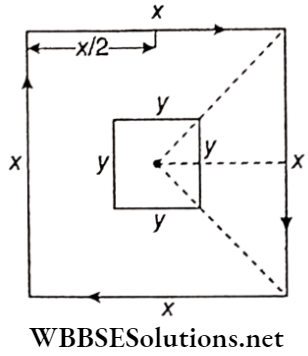
Electromagnetic Induction A Small Square Loop Of Wire

Real-Life Scenarios in Electromagnetic Induction Experiments

Example 8. Cross sectional area, of a solenoid is 10 cm2. Haif of its cross section is filled with iron (μr = 450) and the remaining half with air ( μr = 1 ). Calculate the self-inductance of the solenoid fits length is 2m and the number of turns is 3000.

Solution:

If the α1 part of the cross-section of the solenoid is filled with a substance of relative permeability μr1 and the remaining part of the cross-section α2 with another substance of relative permeability μr2 then self-inductance of the s inside is,

⇒ \(L=\frac{\mu_0 n^2 A}{l}\left(\mu_{r_1} \alpha_1+\mu_{r_2} \alpha_2\right)\)

Here μ0 = 4π x 10-7 H/m; number of Pirns, n = 3000; length of solenoid, l = 2m; area of cross section A = 10cm2 = 0.001m2; α1 = 0.5 and α1 = 0.5.

∴ Self-inductance of the solenoid,

⇒ \(L=\frac{4 \pi \times 10^{-7} \times(3000)^2 \times 0.001}{2}(1 \times 0.5+450 \times 0.5) \mathrm{H}\)

⇒ 2π x 9 x 10-4 x (0.5 + 225) H

= 1.27H (approx.)

Electromagnetic Induction And Alternating Current

Electromagnetic Induction Very Short Questions And Answers

Question 1. What is the unit of magnetic induction or magnetic flux density in SI?

Answer: Wb.m-2 or T

Question 2. What is the relation of the magnetic field vector 5 with magnetic induction and magnetic flux density?

Answer: They are the spare physical quantity.

Question 3. Induced emf is direct propohiotfÿ’tti the rate of change with time of magnetic _____ linked with a coil.

Answer: Flux

Question 4. In the case of electromagnetic induction, the _______ always opposes the cause of its generation.

Answer: Current

Question 5. With the help of Fleming’s _______ rule, the direction of induced current in a straight conductor in motion can be determined.

Answer: Right-hand

Question 6. What is the relation between the units: tesla and Weber?

Answer: \(\mathrm{IT}=\frac{1 \mathrm{wb}}{1 \mathrm{~m}^2}\)

Question 7. What is the relation between the units: Weber and Volt?

Answer: 1 Wb = 1 V.1 s

Question 8. Which of the conservation laws would not hold if Lenz’s law was incorrect?

Answer: The law of conservation of energy

Question 9. The self-inductance of a coil is 1H. If 1A current passes through it, what will be the magnetic flux linked with the coil?

Answer: 1 Wb

Question 10. What is the relation between the units: weber and ampere?

Answer: 1 Wb = 1A.1H

Question 11. What is the relation between the units of self-inductance and mutual inductance?

Answer: They have the same unit

Question 12. The self-inductance of an air core inductor increases from 0.01 mH to 10 mH on introducing an iron core into it. What is the relative permeability of the core used?

Answer: 1000

Electromagnetic Induction And Alternating Current

Electromagnetic Induction Synopsis

if there is a relative motion between a magnetic field and a conductor, the electromotive force (emf) generated in that conductor is called induced emf.

  • If there is a relative motion between a magnetic field and a closed conductor, the current generated through that conductor is called induced current.
  • The number of lines of induction passing normally through the unit area surrounding a print inside a substance is called the magnetic induction (\vec{B}) of that point.
  • The number of lines of induction that crosses normally any surface placed in a magnetic field is called the magnetic flux (Φ) linked with that surface.

Faraday’s laws of electromagnetic induction:

  • First law: Whenever the magnetic flux linked with a coil changes with time, an emf is induced in the coil. The induced EMF lasts as long as the change in magnetic flux linked with the coil continues.
  • Second law: The strength of the induced emf is directly proportional to the time rate of change of magnetic flux linked with a coil.
  • Lenz’s law: In the case of electromagnetic induction the direction of induced emf is such that, it always opposes the cause of the generation of current in the circuit.
  • The change of magnetic flux linked with a conducting coil in unit time, for which unit electromotive force is induced in the coil, is taken as the unit of magnetic flux.

Units of magnetic flux:

Electromagnetic Induction Units Of Magnetic Flux

Units of magnetic induction:

Electromagnetic Induction Units Of Magnetic Induction

  • An electromagnetic induction that takes place in a coll due to a change of current through itself is called self-induction. The electric current generated due to self-induction flows in the direction opposite to the main current.
  • The magnetic flux linked with a coil for unit current flowing through the coil is called its self-inductance.
  • A coil having finite resistance but zero self-inductance is called a non-inductive coil.
  • A coil having a high self-inductance but low resistance is called a choke.
  • The phenomenon of production (induction) of emf in a coil due to a change in current with time in a neighbouring coil is called mutual induction.
  • The magnetic flux linked with a coil due to the flow of unit current through a neighbouring coil is called the mutual inductance between the two colls.
  • Units of self-inductance and mutual inductance: Henry (H), in SI.
  • If there is a relative motion between a conducting metal piece and a magnetic field, an induced current is set up throughout the volume of the metal in different closed loops. This current is known as eddy current.

To minimise the loss of energy in the form of heat due to eddy current, the core is not taken as a single piece of conductor but is made of many thin laminas of conductors which are insulated from each other with suitable insulating materials.

  • Magnetic flux linked with surface \(\vec{A}\),

⇒ \(\phi=B A \cos \theta=\vec{B} \cdot \vec{A}\)

[where \(\vec{B}\) = magnetic induction, 6 = angle between \(\vec{B}\) and \(\vec{A}\)]

The magnetic flux through a finite surface S,

∴ \(\phi=\int_S \vec{B} \cdot d \vec{A}\)

  • According to Faraday’s second law,

induced emf, \(e \propto \frac{d \phi}{d t}\). In combination with Lenz’s law and the chosen units of 0, it becomes, \(e=-\frac{d \phi}{d t}\).

  • 1 Wb = 108 Mx, IT = 104G, Wb = V.s
  • Induced emf in a straight conductor moving in a magnetic field, e = Blvsind [where B = magnetic flux density, l = length of the conductor, v = velocity of the conductor and 0 = angle between \(\vec{B}\) and \(\vec{v}\))
  • The emf induced between the two ends of a conductor rotating in a uniform magnetic field,

∴ \(e=\frac{1}{2} B \omega L^2\)

[where L = length of the conductor, co = steady angular velocity]

  • For current I, if the magnetic flux is <p, then

Φ ∝ I = 1 or, 0 = LI (L = self-inductance of the coil]

The equation \(e=-\frac{d \phi}{d t} \text { gives, } e=-L \frac{d I}{d t}\)

∴ Wb = H.A, H = n .s

or 1 H = 109 emu of Inductance

  • If the flux linked with the secondary coll is 0 for current I in the primary coil, then

Φ ∝ I or, Φ = MI {M = mutual inductance]

  • If the self-inductances of two coils are L1 and L2, mutual inductance, \(M=k \sqrt{L_1 L_2}\) where k is a constant whose value is 1 or less.
  • Energy stored in the magnetic field of a conducting coil of self-inductance L due to current I flowing through it = \(\frac{1}{2} L I^2\).

A conducting wheel is rotating in a uniform magnetic field with angular velocity co. The length of each spoke is l. If there are n number of spokes in the wheel.

Then total electromotive force between the centre and any point situated on the circumference of the wheel, \(e=\frac{1}{2} B \omega l^2\). Here, the total emf does not depend on the number of spokes.
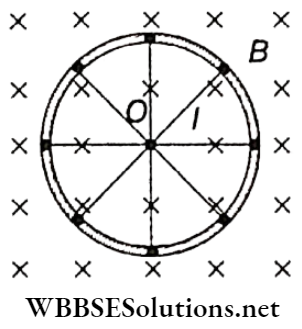
Electromagnetic Induction A Conducting Wheel

  • A thin semicircular conducting ring (PQR) of radius r is falling with its plane vertical in a horizontal magnetic field B, as shown. If the speed of the ring is v, the value of the induced emf between the two ends of the semicircular ring, c = B x (2r) x v.
  • Here, the induced emf depends upon the distance between the two ends of the conductor, not on the shape of the conductor.
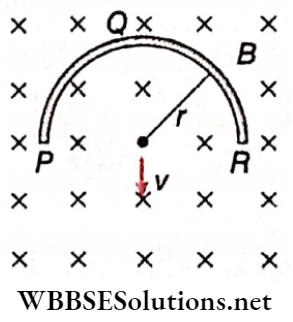
Electromagnetic Induction A Thin Semicircular Conducting Ring

  • If any two vectors among the three vectors \(\vec{B}, \vec{v} \text { and } \vec{l}\) are parallel, then the motion emf induced in the conductor, e = 0.
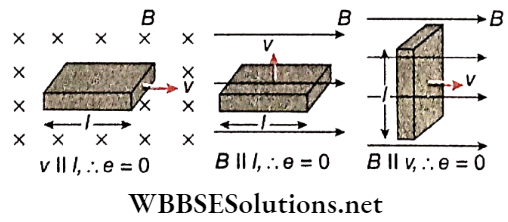
Electromagnetic Induction The Motional Emf Induced In The Conductor

  • Values of self-inductance in some special cases:
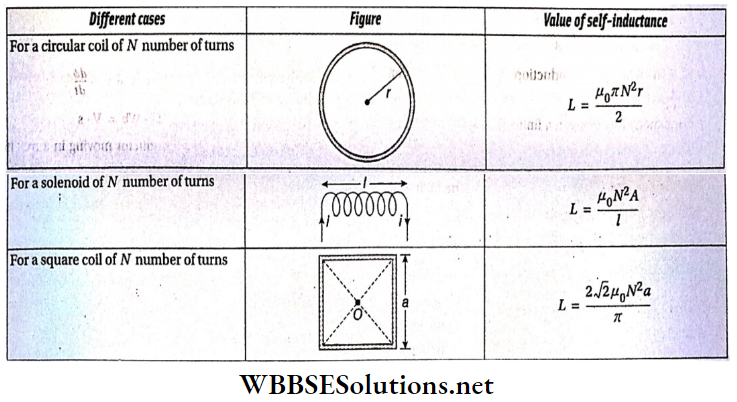
Electromagnetic Induction Value Of Self Inductance In Some Special Cases

  • Values Of Mutual Inductance In Some Special Cases:
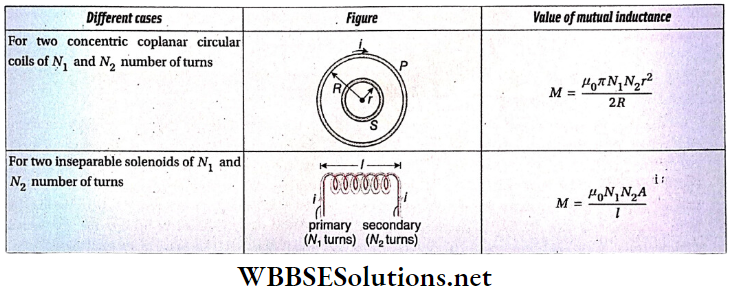
Electromagnetic Induction Values Of Mutual Inductance In Some Special Cases

Electromagnetic Induction And Alternating Current

Electromagnetic Induction Assertion Reason Type Questions And Answers

Direction: These questions have statement 1 and statement 2 Of the four choices given below, choose the one that best describes the two statements.

  1. Statement 1 is true, statement 2 Is true; statement 2 is a correct explanation for statement 1
  2. Statement 1 is true, Statement 2 Is true) statement 2 is not a correct explanation for statement 1
  3. Statement 1 is true, statement 2 is false
  4. Statement 1 is false, statement 2 Is true

Question 1. Statement 1: Induced emf in a conductor is proportional to the time rate of change of associated magnetic flux.

Statement 2: In the case of electromagnetic induction transfer of energy takes place in a manner energy is conserved.

Answer: 2. Statement 1 is true, Statement 2 Is true) statement 2 is not a correct explanation for statement 1

Question 2. Statement 1: The north pole of a.bar, magnet is moving towards a closed circular coil along its axis. As a result, the direction of induced currently the front face of the coil will be clockwise.

Statement 2: Any incident connected with electromagnetic induction obeys Lenz’s law.

Answer: 4. Statement 1 is false, statement 2 Is true

Question 3. Statement 1: The charge passing through a coil in time At is \(\frac{\Delta \phi}{R}\), where R is the resistance of the coil and ΔΦ is the change in flux linked with the coil in time Δt:

Statement 2: The induced emf in a conductor \(e \propto \frac{d \phi}{d t}\), at \(\frac{d \phi}{d t}\) where is the time rate of change of flux linked with the conductor.

Answer: 1. Statement 1 is true, statement 2 Is true; statement 2 is a correct explanation for statement 1

Question 4. Statement 1: A closed solenoid is placed in an external magnetic field. Both the magnetic field and axis of the solenoid are directed along the z-axis. No electromotive force will be induced if the solenoid is rotated along its axis.

Statement 2: Electromagnetic induction in a conducting coil takes place only when the magnetic flux linked with the coil changes with time.

Answer: 1. Statement 1 is true, statement 2 Is true; statement 2 is a correct explanation for statement 1

Question 5. Statement 1: Self-inductance of a solenoid having 1000 turns is l00 mH if the associated magnetic flux linked with each turn is 10-3 Wb for a current of 1 A passing through the solenoid.

Statement 2: The self-inductance L of a coil is defined as Φ = LI when <p is the magnetic flux linked with the coil for a current I through it.

Answer: 4. Statement 1 is false, statement 2 Is true

Question 6. Statement 1: When two coils are wound on each other, the mutual induction between the coils is maximum.

Statement 2: Mutual induction does not depend on the orientation of the coils.

Answer: 3. Statement 1 is true, statement 2 is false

Question 7. Statement 1: When the number of turns of a coil. doubled, the coefficient of self-inductance of the coil becomes 4 times.

Statement 2: Self-inductance oc (number of turns)2

Answer: 1. Statement 1 is true, statement 2 Is true; statement 2 is a correct explanation for statement 1

Electromagnetic Induction And Alternating Current

Electromagnetic Induction Match The Following

Question 1. Some physical quantities are given in column 1 while their units are given in column 2.
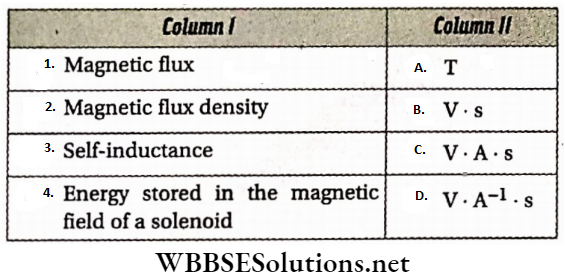
Electromagnetic Induction Some Physical Quantities

Answer: 1-B, 2-A, 3-D, 4-C.

Question 2. Column 1 gives the value of self-inductance (L) and the current (I) through some coils. Column 2 gives the energy stored in them.
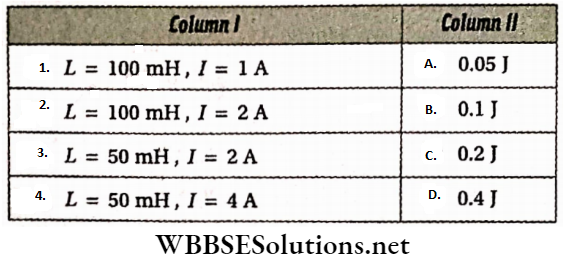
Electromagnetic Induction The Value Of Self Inductance And The Current

Answer: 1-A, 2-C, 3-B, 4-D

Question 3. Column 1 describes,s some solenoids kept in the air while column 2 gives, their self-inductance. Magnetic permeability of air = 4π x 10-7 H.m-1.
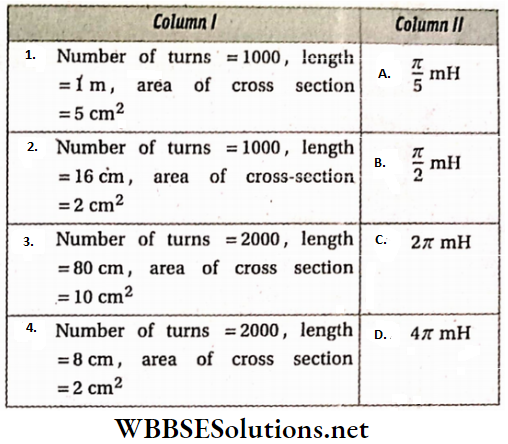
Electromagnetic Induction Some Solenoids Kept In Air

Answer: 1-A, 2-B, 3-C, 4-D

Electromagnetic Induction And Alternating Current

Electromagnetic Induction Comprehension Types

Read The Following Passage Carefully And Answer The Questions At The End Of It.

If the current through a solenoid changes with time electromagnetic induction takes place in the solenoid. This is known as self-induction, In general, for a current I, the induced emf in the coil is \(e=-L \frac{d I}{d t}\).

L is the self-inductance of the solenoid. On the other hand, such a change in the current in a solenoid can produce electromagnetic induction, in another adjacent solenoid. The induced emf in the other solenoid \(e=-M \frac{d I}{d t}\), M is called the mutual inductance of the solenoids.

If L1 and L1 are the self-inductance of the adjacent coils then their mutual inductance \(M=k \sqrt{L_1 L_2}\). If the magnetic flux produced by the current in one coil is linked with the other coil then k = 1.

Question 1. Unit of self-inductance L is Henry (H). Its relation with other known units is

  1. V.s
  2. A.s-1
  3. Ω .s
  4. Ω .s-1

Answer: 3. Ω .s

Question 2. The self-inductance (in H) of a coil when the Induced emf is 5.0μV for a change of 1 mA.s-1 in current through it, is

  1. 50
  2. 5
  3. 0.5
  4. 0.05

Answer: 4. 0.05

Question 3. If the induced emf in a coil linked with the coil in question (2) is 20μV, the mutual inductance (in H) of die two coils is

  1. 0.002
  2. 0.02
  3. 0.2
  4. 2

Answer: 2. 0.02

Question 4. Self-inductance (in H) of the coil in question (3) is

  1. 0.1
  2. 0.08
  3. 0.01
  4. 0.008

Answer: 4. 0.008

Question 5. The negative sign in the expression of induced emf is explained by

  1. Faraday’s first law
  2. Faraday’s second law
  3. Law of conservation of energy
  4. Law of conservation of charge

Answer: 3. Law of conservation of energy

Electromagnetic Induction And Alternating Current

Electromagnetic Induction Integer Answer Type

In this type, the answer to each of the questions Is a single-digit integer ranging from 0 to 9.

Question 1. The current through a coil of self-inductance 500 mH is 4 A. What amount of magnetic energy (in J) is stored in its magnetic field?

Answer: 4

Question 2. A straight conductor of length 50 cm is moving with a velocity of 5 m.s-1 in a magnetic field of strength 2T in a direction perpendicular to the field. What is die emf(in V) induced between the two ends of the conductor?

Answer: 5

Question 3. The magnetic flux Φ (in Wb) linked with a 100H coil changes with time t (in s) according to the relation Φ = 8t2 – 2t + 1. What is the value of induced current (in A) in the coil at t = 2 s?

Answer: 3

Question 4. A straight conductor of length 10 cm Is rotating In a vortical plane with one of Its ends fixed. The angular velocity Is 10 rad.s-1. What is the value of one (In μV ) Induced between the two ends of the conductor If the horizontal component of earth’s magnetic field at the place Is 10-4 T?

Answer: 5

Question 5. A circular wire loop of radius is placed In the xy-plane centred at the origin 0. A square loop of side a (\(a \ll R\)) having two turns is placed with its centre at z = √3R along the axis of the circular wire loop, as shown. The plane of the square loop makes an angle of 45° concerning the z-axis. If the mutual Inductance between the loops is given by \(\frac{\mu_0 a^2}{2^{p / 2} R}\), then what is the value of p?
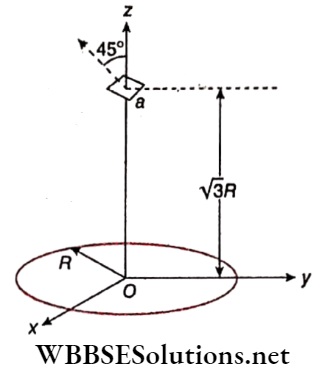
Electromagnetic Induction A Circular Loop

Answer: 7

Question 6. Find the change in magnetic flux (in Wb )in an inductor of 10H in which the emf induced is 300 V in 10-2 s.

Answer: 3

Question 7. An average induced emf of 0.20 V appears in a coil when the current is changed from 5A in one direction to 5A in the opposite direction in 0.20 s. Find the self-inductance of the coil in mH.

Answer: 4

WBCHSE Class 12 Physics Electromagnetic Induction Short Question And Answers

Electromagnetic Induction And Alternating Current

Electromagnetic Induction Short Questions And Answers

Question 1. Use Lenz’s law to determine the direction of induced current in the situations described:

Electromagnetic Induction Lenzs Law

  1. A wire of irregular shape turns into a circular shape.
  2. A circular loop is deformed into a narrow straight wire.

Answer:

  1. In this case, fine magnetic flux linked with the coil increases with the change in shape of the loop. The direction of the: induced current should be such that it will oppose the increase, the direction of the induced current should produce a magnetic Field in a direction upwards on the plane of the paper. Applying the thumb rule it can be said that the induced current will be in the direction adeba.
  2. In this case, the magnetic flux linked with the loop decreases. So the induced current will be along a’d’c’b’a’.

Question 2. A rectangular wire loop of sides 8 cm and 2 cm with a small cut is moving out of a region of uniform magnetic field of magnitude 0.3 T directed normally to the loop. What is the emf developed across the cut if the velocity of the loop is 1cm.s-1 in a direction normal to the

  1. Longer side,
  2. Shorter side, of the loop? For how long does the induced voltage last in each case?
  3. Suppose in this case the loop is stationary but the current feeding the electromagnet that produces the magnetic field is gradual. reduced so that the field decreases from its initial value of 0.3 T at the rate of 0.02 T s-1. If the cut is joined and the loop has a resistance of 1.611, how much power is dissipated by the loop as heat? What is the source of this power?

Answer:

1. e = Blv = 0.3 x 8 X 10-2 X 10-2 [in the longer side, l = 8 cm ]

= 2.4 X 10⁻⁴ V

∴ Time, t1 = \(t_1=\frac{l^{\prime}}{v}=\frac{2}{l}=2 \mathrm{~s}\) [l’ = shorter side = 2 cm]

2. e = Bl’v = 0.3 x 2 x 10-2 x 10-2 = 0.6 x 10⁻⁴ V

∴ Time, \(t_2=\frac{l}{v}=\frac{8}{1}=8 \mathrm{~s}\)

3. Induced emf, \(e=\frac{d \phi}{d t}=\frac{d B}{d t} \cdot A\)

= 0.02 x 8 x 2 x 10-4 = 3.2 x 10⁻⁵ V

Induced current, \(I=\frac{e}{R}=\frac{3.2}{1.6} \times 10^{-5} \mathrm{~A}=2 \times 10^{-5} \mathrm{~A}\)

Power dissipated = e x I = 6.4 x 10⁻¹⁰ W

The source of this power is the external agency which brings change in a magnetic field.

Read And Learn More WBCHSE Class 12 Physics Short Question And Answers

Question 3. Indicate the direction of induced current in each case.

Electromagnetic Induction The Direction Of Induced Current In Each Case

Answer:

  1. According to Lenz’s law S-pole forms at q and N-pole forms at p. Therefore induced current will flow along qrp.
  2. S-pole will be formed at both q And x. Therefore induced current will flow along prq in the first coil and along yzx in the second coil.
  3. Along xyz.
  4. Along zyx.
  5. Along xry.
  6. Since the lines of force are in the same plane as the coil, no emf will be induced. So there will be no induced current.

Question 4. A 1.0 m long metallic rod is rotated with an angular velocity of 400 rad s-1 about an axis normal to the rod passing through its one end. The other end of the rod is in contact with a circular metallic ring. A constant and uniform magnetic field of 0.5 T parallel to the axis exists everywhere. Calculate the emf developed between the centre and the ring.

Answer:

∴ \(e=\frac{B l v}{2}=\frac{0.5 \times 1 \times 1 \times 400}{2}=100 \mathrm{~V}\)

WBCHSE Class 12 Physics Electromagnetic Introduction Short Question And Answers

Key Concepts in Electromagnetic Induction Short Answers

Question 5. A circular coil of radius 8.0 cm and 20 turns rotates about its vertical diameter with an angular speed of 50 rad.s-1 in a uniform horizontal magnetic field of magnitude 3.0 x 10⁻² T. Obtain the maximum and average emf induced in the coil. If the coil forms a closed loop of resistance 10 Ω, calculate the maximum value of current in the coil. Calculate the average power loss due to Joule heating. Where does this power come from?

Answer:

Flux through each turn of the coil,

∴ \(\phi=\pi r^2 B \cos (\omega t)\)

∴ \(e=-N \frac{d \phi}{d t}=-N \pi r^2 B \frac{d}{d t} \cos \omega t=N \pi r^2 B \omega \sin \omega t\)

∴ \(e_{\max }=N \pi r^2 B \omega\)

= 20 x 3.14 x (8 X 10-2)2 x 3 x 10-2 x 50

= 0.603V

The average emf over a complete cycle is zero.

∴ \(I_{\max }=\frac{e_{\max }}{r}=\frac{0.603}{10}=0.0603 \mathrm{~A}\)

Average dissipated power = \(\frac{1}{2} e_{\max } \times I_{\max }\)

= \(\frac{1}{2} \times 0.603 \times 0.0603=0.018 \mathrm{~W}\)

The induced emf produces a torque, which opposes the motion of the coil. An external machine is to be used which will produce an equal and opposite torque to maintain the motion of the coil. This machine supplies the power apart which is being transferred to heat.

Question 6. A horizontal straight wire 10 m long extending from east to west is falling with a speed of 5 m s-1, at right angles to the horizontal component of earth’s magnetic field, 0.30 x 10⁻⁴ Wb.m-2.

  1. What is the instantaneous value of the emf induced in the wire?
  2. What is the direction of the emf?
  3. Which end of the wire is at higher electrical potential?

Answer:

1. e = Bvl

∴ e = 0.30 X 10-4 X 5 X 10V

[∵ B = 0.30 x 10⁻⁴ Wb m-2, v = 5.0 m.s-1, l = 10m]

⇒ 1.5 x 10⁻³V

2. Applying Fleming’s right-hand rule.it is seen that the direction of the induced emf is from west to east.

3. The west end is at a higher potential.

Short Answer Questions on Faraday’s Law

Question 7. A square loop of side 12 cm with its sides parallel to the X and Y axes is moved with a velocity of 8 cm.s-1 in the positive x-direction in an environment containing a magnetic field in the positive z-direction. The field is neither uniform in space nor constant in time. It has a gradient of 10-3 T.cm-1 along the negative x-direction and is decreasing in time at the rate of 10-3 T.s-1. Determine the direction and magnitude of induced current in the loop if its resistance is 4.50mil.

Answer:

Rate of change due to variation with time

= \(A \cdot \frac{d B}{d t}=\left(12 \times 10^{-2}\right)^2 \times 10^{-3}\)

= 1.44 x 10⁻⁵ Wb.s-1

Rate of change due to variation in space

= \(A \cdot \frac{d B}{d x} \cdot \frac{d x}{d t}=\left(12 \times 10^{-2}\right)^2 \times 10^{-3} \times 8 \times 10^{-2}\)

= 11.52 x l0-5 Wb s-1

Total rate of change of flux

= (1.44 + 11.52) x 10-5 Wb s-1

= 12.96 x 10⁻⁵ Wb.s-1

∴ e = 12.96 x 10⁻⁵ V

∴ \(I=\frac{e}{R}=\frac{12.96 \times 10^{-5}}{4.5 \times 10^{-3}}=2.88 \times 10^{-2} \mathrm{~A}\)

Question 8.

  1. Obtain an expression for the mutual inductance between a long straight wire and a square loop of side a as shown.
  2. Now assume that the straight wire carries a current of 50 A and the loop is moved to the right with a constant velocity v = 10 m.s-1. Calculate the induced emf in the loop at the instant when x = 0.2 m. Take a = 0.1 m and assume that the loop has a large resistance.

Electromagnetic Induction Square Loop Of A Side

Answer:

1. Consider a small portion of the coil of thickness dt at a distance t from the current carrying wire as shown.

Then the magnetic field strength experienced by this portion,

∴ \(B=\frac{\mu_0 I}{2 \pi t}\)

Magnetic Flux linked with this portion,

⇒ \(d \phi=B \cdot d A=\frac{\mu_0 I}{2 \pi t} \cdot a d t[d A=a d t]\)

∴ Magnetic flux linked with the coil,

⇒ \(\phi=\int_x^{a+x} \frac{\mu_0 I a}{2 \pi t} d t \quad \text { or, } M I=\frac{\mu_0 I a}{2 \pi} \ln \left(\frac{a+x}{x}\right)\)

∴ \(M=\frac{\mu_0 a}{2 \pi} \ln \left(\frac{a+x}{x}\right)=\frac{\mu_0 a}{2 \pi} \ln \left(1+\frac{a}{x}\right)\)

2. Induced emf,

⇒ \(e=\frac{\mu_0}{2 \pi x} \cdot \frac{I a^2 v}{a+x}=\frac{2 \times 10^{-7} \times 50 \times(0.1)^2 \times 10}{0.2(0.1+0.2)}\).

∴ \(1.67 \times 10^{-5} \approx 1.7 \times 10^{-5} \mathrm{~V}\)

Electromagnetic Induction Current Carrying Wire

Common Short Questions on Lenz’s Law

Class 11 Physics Class 12 Maths Class 11 Chemistry
NEET Foundation Class 12 Physics NEET Physics

Question 9. A metal rod PQ is resting on the rails A’B’ and positioned between the poles of a permanent magnet. The rails, the rod and the magnetic field are in three mutually perpendicular directions. A galvanometer G connects the rails through a switch K. Length of the rod = 15 cm, B = 0.50 T, and the resistance of the closed loop containing the rod = 9.0 mΩ. Assume the field to be uniform.

  1. Suppose K is open and the rod is moved with a speed of 12 cm s-1 in the direction shown. Give the polarity and magnitude of the induced emf.
  2. Is there an excess charge built up at the ends of the rods when K is open? What if K is closed?
  3. With K open and the rod moving uniformly, there is no net force on the electrons in the rod PQ even though they do experience magnetic force due to the motion of the rod. Explain.
  4. What is the retarding force on the rod when K is closed?
  5. How much power is required by an external agent to keep the rod moving at the same speed (= 12 cm.s-1 ) when K is closed? How much power is required when K is open?
  6. How much power is dissipated as heat in the closed circuit? What is the source of this power?
  7. What is the induced emf in the moving rod if the magnetic head is parallel to the rails instead of being perpendicular?

Electromagnetic Induction A Metal Rod Between The Poles Of A Permanent Magnet

Answer:

1. Induced emf, e = Bvl

∴ e = 0.50 x 12 x 10-2 x 15 x 10-2 = 9 x 10⁻³ V

[∵ B = 0.50 T, v = 12 x 10-2 m.s-1, l = 15 x 10-2 m ]

The electrons of the rod will experience a force along PQ. Therefore, the P, end is positive and the Q end is negative.

2. Yes. When K is open, excess charge is developed at the end of the rod. When K is closed, the continuous flow of current maintains this excess charge.

3. The electric force developed due to excess charge of opposite nature at the ends of the rod cancels the magnetic force.

4. \(F=B I l=B \cdot \frac{e}{R} \cdot l=0.5 \times \frac{9 \times 10^{-3}}{9 \times 10^{-3}} \times 15 \times 10^{-2}\)

= 7.5 X 10⁻² N

5. Power = F x v

= 7.5 x 10-2 x 12 x 10-2

= 9 x 10⁻³ W

No power is spent when K is open.

6. Power lost \(\frac{e^2}{R}=\frac{\left(9 \times 10^{-3}\right)^2}{9 \times 10^{-3}}\)

= 9 x 10⁻³ W

7. Zero, because the motion of the rod does not cut or link with field lines.

Question 10. Which of the following is the unit of magnetic flux?

  1. Tesla
  2. Tesla x m2
  3. Tesla/m2
  4. Weber/m2

Answer: 3. Tesla/m2

The unit of magnetic flux is Tesla x m2. The option 3 is correct

Question 11. A current flowing through a coil changes from +2 A to -2 A in 0.05 s and an emf of 8 V is induced in the coil. The value of self-inductance of the coil is

  1. 0.8 H
  2. 0.1 H
  3. 0.2H
  4. 0.4 H

Answer: 2. 0.1 H

We know, \(e=-L \frac{d I}{d t}\)

or, \(L=\frac{-e d t}{d I}=\frac{8 \times 0.05}{-2-(+2)}=\frac{0.4}{4}=0.1 \mathrm{H}\)

The option 2 is correct

Practice Short Questions on Induced EMF

Question 12. A metallic disc of radius 10 cm is rotating uniformly about a horizontal axis passing through its centre with angular v velocity 10 revolutions per second. A uniform magnetic field of intensity 10-2 T acts along the axis of the disc. Find the potential difference induced between the centre and the rim of the disc.

Answer:

Radius of the metallic disc, R = 10 cm = 0.1 m

Now, magnetic field, B = l0-2 T

Frequency, n = 10

Angular velocity, ω = 10 x 2 π rad = s-1

The value of the induced potential difference between the endpoint and the centre of the metallic disc

= \(\frac{1}{2} B \omega R^2=\frac{1}{2} \times 10^{-2} \times 10 \times 2 \pi \times(0.1)^2\)

∴ 3.14 x 10⁻³ V = 3.14 mV

Question 13. The dimension of magnetic flux is

  1. \(M L^2 T^{-2} A^{-1}\)
  2. \(M L T^{-1} A^{-2}\)
  3. \(M L^{-1} \mathrm{TA}^{-1}\)
  4. \(M L^{-1} A\)

Answer: 1. \(M L^2 T^{-2} A^{-1}\)

The option 1 is correct

Question 14. The magnetic flux through a coil varies according to the relation Φ = (4t2 + 2t – 5)Wb, t measured in seconds. Calculate the induced current through the coil at t = 2s, if the resistance of the coil is 5 Ω.

Answer:

Φ = 4t2 + 2t – 5

∴ \(\frac{d \phi}{d t}=8 t+2\)

When t = 2 s, \(\frac{d \phi}{d t}=8 \times 2+2=18\)

∴ Induced emf, e = 18V

Resistance of the coil, R = 5 Ω.

∴ Induced current through the coil, \(I=\frac{e}{R}=\frac{18}{5}=3.6 \mathrm{~A}\)

Question 15. The mutual inductance of two coils can be increased by

  1. Decreasing the number of turns on the coils
  2. Increasing the number of turns on the coils
  3. Winding the coils on the wooden core
  4. None of these

Answer: 2. Increasing the number of turns on the coils

The option 2 is correct.

Important Definitions in Electromagnetic Induction

Question 16. If L and R denote inductance and resistance respectively, then the dimension of \(\frac{L}{R}\) is

  1. \(\mathrm{M}^0 \mathrm{~L}^0 \mathrm{~T}^0\)
  2. \(M^0 L^0 T^1\)
  3. \(M^2 L^0 T^2\)
  4. \(M^1 L^1 T^2\)

Answer: 2. \(M^0 L^0 T^1\)

The option 2 is correct.

Question 17.

1. A horizontal straight wire. 5 m long extending from east to west is falling with a speed of 10 m/s at right angles to the horizontal component of the earth’s magnetic field 0.40 x 10⁻⁴ Wb. m-2.

  • Find the instantaneous value of emf induced in the wire.
  • What is the direction of the emf?
  • Which end of the wire will be at a higher potential? (Neglect acceleration due to gravity.)

2. Derive the expression for energy stored in an inductor of coefficient of self-inductance L carrying current i0.

Answer:

1. The wire is in an east-west direction, the horizontal component of the earth’s magnetic field is directed from south to north and the direction of the wire’s velocity is vertically downwards. These three are perpendicular to each other.

Hence the instantaneous emf induced across the wire,

e = vBl = 10 x (0.40 x 10-4) x 5

= 2 x l0-3V = 2 mV

2. From the relation, \(\vec{F}_m=q \vec{v} \times \vec{B}\) since \(\vec{v}\) is directed downwards and \(\vec{B}\) is directed towards north, so any positive charge in the wire experiences a force from west to east and moves in that direction. The direction of the induced emf is in the direction in which the positive charge moves, i.e., from west to east.

3. Since the direction of the induced emf is from west to east, the west end of the wire will be at a higher potential.

Question 18. A coil of metallic wire is at rest in a non-uniform magnetic field. Would any electromotive force be induced in the

Answer:

As the coil of metallic wire is at rest in a non-uniform magnetic field, the magnetic flux linked with the coil will not change concerning time. Hence no emf is induced in the coil.

Question 19. A very small circular loop of radius a is initially (at t = 0) coplanar and concentric with a much larger fixed circular loop of radius b. A constant current I flows in the larger loop. The smaller loop is rotated with a constant angular speed a) about the common diameter. The emf induced in the smaller loop as a function of time t is

  1. \(\frac{\pi a^2 \mu_0 I}{2 b} \omega \cos (\omega t)\)
  2. \(\frac{\pi a^2 \cdot \mu_0 I}{2 b} \omega \sin \left(\omega^2 t^2\right)\)
  3. \(\frac{\pi a^2 \mu_0 I}{2 b} \omega \sin (\omega t)\)
  4. \(\frac{\pi a^2 \mu_0 I}{2 b} \omega \sin ^2(\omega t)\)

Answer:

= \(B=\frac{\mu_0 I}{2 b}, A=\pi a^2\)

=\(\phi=\vec{B} \cdot \vec{A}=B A \cos \omega t\)

= \(e=-\frac{d \phi}{d t}=-\frac{\mu_0 I}{2 b} \cdot \pi a^2(-\omega \sin \omega t)\)

= \(\frac{\mu_0 I \pi a^2}{2 b} \omega \sin \omega t\)

The option 3 is correct.

Question 20. A straight conductor 0.1 m long moves in a uniform magnetic field of 0.1 T. The velocity of the conductor is 15 m/s and is directed perpendicular to the field. The emf induced between the two ends of the conductor is

  1. 0.10 V
  2. 0.15 V
  3. 1.50 V
  4. 15.00 V

Answer: 2. 0.15 V

The emf induced between the two ends of the conductor

= Blv = 0.1 x 0.1 x 15 = 0.15 V

The option 2 is correct.

Question 21. A conducting loop in the form of a circle is placed in a uniform magnetic field with its plane perpendicular to the direction of the field. An emf will be induced in the loop if

  1. It is translated parallel to itself
  2. It is rotated about one of its diameters
  3. It is rotated about its axis which is parallel to the field
  4. The loop is deformed from the original shape

Answer:

If the conducting loop is translated parallel to itself or rotated about its axis, it won’t intersect any magnetic line of force.

The options 2 and 4 are correct.

Question 22. Two coils of self-inductances 6mH and 8mH are connected in series and are adjusted for the highest coefficient of coupling. Equivalent self-inductance L for the assembly is approximately

  1. 50 mH
  2. 36 mH
  3. 28 mH
  4. 18 mH

Answer: 3. 28 mH

If the self-inductance of two coils are respectively L1 and L2 and their mutual inductance is M, then

⇒ \(L=L_1+L_2+2 M=L_1+L_2+2 k \sqrt{L_1 L_2}\) [k: = coefficient of coupling of the coils]

⇒ 6 + 8 + 2 x l x \(\sqrt{6 \times 8}\) [∵ L1 = 6mH, L1 = BmH and highest value of k = 1 ]

≈ 28mH

The option 3 is correct.

Question 23. As shown in the figure, a rectangular loop of a conducting wire is moving away with a constant velocity v in a perpendicular direction from a very long straight conductor carrying a steady current I. When the breadth of the rectangular loop is very small compared to its distance from the straight conductor, how does the emf E induced in the loop vary with time t?

Electromagnetic Induction A Rectangular Loop Of A Conducting Wire

  1. \(E \propto \frac{1}{t^2}\)
  2. \(E \propto \frac{1}{t}\)
  3. \(E \propto-\ln (t)\)
  4. \(E \propto \frac{1}{t^3}\)

Answer: 1. \(E \propto \frac{1}{t^2}\)

Electromotive force,

⇒ \(E=-\frac{d \phi}{d t}=-\frac{d}{d t}(\vec{B} \cdot \vec{A})\)

⇒ \(-A \frac{d B}{d t}\) [∵ the direction of A and B are same]

⇒ \(-A \frac{d}{d t}\left(\frac{\mu_0 I}{2 \pi v t}\right)\)

[Since for an infinity long conductor, magnetic field at a distance r is, \(B=\frac{\mu_0 I}{2 \pi r}. \text { Now, } r=v \times t\)]

⇒ \(-\frac{A \mu_0 I}{2 \pi \nu} \frac{d}{d t}\left(t^{-1}\right)=\frac{A \mu_0 I}{2 \pi \nu} t^{-2}\)

∴ \(E \propto \frac{1}{t^2}\)

The option 1 is correct

Question 24. In a coil of resistance 100 Ω, a current is induced by changing the magnetic flux through it as shown in the figure. The magnitude of change in flux through the coil is

Electromagnetic Induction Current Is Induced By Changing The Magnetic Flux

  1. 200 Wb
  2. 225 Wb
  3. 250 Wb
  4. 275 Wb

Answer: 3. 250 Wb

Induced emf,

⇒ \(|e|=\frac{d \phi}{d t} \quad \text { or, } t R=\frac{d \phi}{d t}\)

or, \(\int d \phi=R \int i d t\)

or, Φ = R x area enclosed by the graph and axes

= 100 x \(\frac{1}{2}\) x 0.5 x 10 = 250 Wb

The option 3 is correct.

Examples of Applications of Electromagnetic Induction

Question 25. A thin semicircular conducting ring (PQR) of radius falling with its plane vertical in a horizontal magnetic field B, as shown. The potential difference developed across the ring when its speed is v is

Electromagnetic Induction Radius Is Falling With Its Plane Vertical In A Horizontal Magnetic Field

  1. Zero
  2. \(\frac{B v \pi r^2}{2}\) and P is at higher potential
  3. πrBv and R is at higher potential
  4. 2rBv and R have a higher potential

Answer: 4. 2rBv and R have a higher potential

⇒ \(|e|=\frac{d \phi}{d t}=\frac{d}{d t}(B A)=B \frac{d A}{d t}\)

⇒ B x diameter x velocity = B x 2r x w = 2rvB

According to Fleming’s right-hand rule, if P and R are connected to a closed external circuit, the direction of the induced current is from P to R. In the external circuit, the current is from R to P so the potential of R is greater than that of P.

The option 4 is correct.

Question 26. A conducting square frame of side a and a long straight wire carrying current I are located in the same plane as shown. The frame moves to the right with a constant velocity v. The emf induced in the frame will be proportional to

Electromagnetic Induction A Conducting Square Frame

  1. \(\frac{1}{x^2}\)
  2. \(\frac{1}{(2 x-a)^2}\)
  3. \(\frac{1}{(2 x+a)^2}\)
  4. \(\frac{1}{(2 x-a)(2 x+a)}\)

Answer: 4. \(\frac{1}{(2 x-a)(2 x+a)}\)

The electromotive force and the current induced due to the motion of the frame are in the clockwise direction. Hence, the emf and the current will be oppositely directed in the left and right arms of the frame. If the magnetic field in those two arms due to current 1 is B1 and B2 respectively, then the emf induced will be directly proportional to (B1-B2).

Here, \(B_1-B_2=\frac{\mu_0}{4 \pi} \frac{2 I}{x-a / 2}-\frac{\mu_0}{4 \pi} \frac{2 I}{x+a / 2}\)

= \(\frac{\mu_0 I}{\pi}\left(\frac{1}{2 x-a}-\frac{1}{2 x+a}\right)\)

= \(\frac{\mu_0 I}{\pi} \frac{2 a}{(2 x-a)(2 x+a)}\)

∴ \(B_1-B_2 \propto \frac{1}{(2 x-a)(2 x+a)}\)

The option 4 is correct.

Question 27. A long solenoid has 1000 turns. When a current of 4 A flows through it, the magnetic flux linked with each turn of the solenoid is 4 x l0-3 Wb. The self-inductance of the solenoid is

  1. 3H
  2. 2H
  3. 1H
  4. 4H

Answer: 3. 1H

If the number of turns of the solenoid is N, the current through is I and the magnetic flux linked with each turn of the solenoid is Φ, then its self-inductance,

∴ \(L=\frac{N \phi}{I}=\frac{1000 \times\left(4 \times 10^{-3}\right)}{4}=1 \mathrm{H}\)

The option 3 is correct.

Question 28. A circular coil of radius 10 cm, 500 turns and resistance 2 Ω is placed with its plane, perpendicular to the horizontal component of the earth’s magnetic field. It is rotated about its vertical diameter through 180° in 0.25 s. The induced emf in the coil is (take HE = 3.0 x 10⁻⁵ T).

  1. 6.6 x 10⁻⁴ V
  2. 1.4 x 10⁻² V
  3. 2.6 X 10⁻² V
  4. 3.8 x 10⁻³ V

Answer: 4. 3.8 x 10⁻³ V

A = π x 102 = 3.14 x l02cm2 = 3.14 x 10⁻² m2

Considering the surroundings as vacuum or air,

B = 3.0 x 10⁻⁵T; N = 500

Initially, magnetic flux linked with the coil,

Φ1 = NBA

By rotating the coll through 180°, magnetic flux linked with the coil, Φ2 = -NBA

∴ Induced emf,

⇒ \(e=-\frac{\Delta \phi}{\Delta t}=-\frac{\phi_2-\phi_1}{\Delta t}=\frac{2 N B A}{\Delta t} .\)

⇒ \(\frac{2 \times 500 \times\left(3 \times 10^{-5}\right) \times\left(3.14 \times 10^{-2}\right)}{0.25}\)

≈ 3.8 x 10⁻³ V

The option 4 is correct.

Question 29. Inside a parallel plate capacitor, the electric field E varies with time as t2. The variation of the induced magnetic field with time is given by

  1. t2
  2. No variation
  3. t3
  4. t

Answer: 4. t

A varying electric field induces a magnetic field and this induced magnetic field is proportional to the rate of change in an electric field. According to the question, the electric field is proportional to \(t^2 \text { and } \frac{d}{d t}\left(t^2\right)=2 t\), so the induced magnetic field is proportional to t.

The option 4 is correct.

Question 30. The magnetic potential energy stored in a certain inductor is 25 mJ, when the current in the inductor is 60 mA. This inductor is of inductance

  1. 1.389 H
  2. 138.88 H
  3. 0.138 H
  4. 13.89 H

Answer: 4. 13.89 H

Energy stored in the inductor,

⇒ \(U=\frac{1}{2} L i^2\)

or, \(25 \times 10^{-3}=\frac{1}{2} \times L \times\left(60 \times 10^{-3}\right)^2\)

or, \(L =\frac{2 \times 25 \times 10^{-3}}{\left(60 \times 10^{-3}\right)^2}\)

or, L = 13.888 = 13.89 H

The option 4 is correct.

Question 31. A bar magnet is moved in the direction indicated by the arrow between two coils PQ and CD. Predict the directions of induced current in each coil.

Electromagnetic Induction Bar Magnet Is Moved In The Direction Indicated By The Arrow

Answer:

As per Lenz’s law, an S-pole is induced at the C-side of the coil CD. So the induced current in CD is such that it is clockwise when seen from the position of NS. Similarly, another S-pole is induced at the Q-side of PQ. So, the induced current in PQ is clockwise when seen from the position of NS.

Question 32. The motion of a copper plate is damped when it is allowed to oscillate between the two poles of a magnet. What is the cause of this damping?

Answer:

The eddy current generated in the copper plate is in such a direction, as per Lenz’s law, that its oscillation is damped.

Question 33. A rectangular conductor LMNO is placed in a uniform magnetic field of 0.5 T. The field is directed perpendicular to the plane of the conductor. When the arm MN of the length of 20 cm is moved towards the left with a velocity of 10 m.s-1, calculate the emf induced in the arm. Given the resistance of the arm to be 5 Ω, (assuming that the other arms are of negligible resistance) find the value of the current in the arm.

Electromagnetic Induction A Rectangular Conductor Lmno Is Placed In A Uniform Magnetic Field

Answer:

In unit time, the arm MN describes an area Iv. Sb, the rate of change of magnetic flux linked with MN is

⇒ \(\frac{d \phi}{d t}=\frac{d}{d t}(B \times \text { area })=B \frac{d}{d t}(\text { area })=B l v\)

∴ The magnitude of emf Induced in the arm (omitting the negative sign) is

⇒ \(|e|=\frac{d \phi}{d t}=B l v=0.5 \times\left(20 \times 10^{-2}\right) \times 10=1 \mathrm{~V}\)

∴ Induced current in the arm MN,

∴ \(i=\frac{1}{5}=0.2 \mathrm{~A}\).

Question 34. A wheel with 8 metallic spokes each 50 cm long is rotated with a speed of 120 rev.min-1 in a plane normal to the horizontal component of the Earth’s magnetic field. The Earth’s magnetic field at the place is 0.4 G and the angle of dip is 60°. Calculate the emf induced between the axle and the rim of the wheel. How will the value of emf be affected if the number of spokes were increased?

Answer:

Length of each spoke, L = 50 cm = 0.5 m;

⇒ \(\omega=\frac{2 \pi \times 120}{60}=4 \pi \mathrm{rad} \cdot \mathrm{s}^{-1}\)

Horizontal component of earth’s magnetic field,

B = 0.4 cos 60° = 0.2G = 0.2 x 10⁻⁴ T

∴ The emf induced between the two ends of a spoke,

= \(e=\frac{1}{2} B \omega L^2\)

= \(\frac{1}{2} \times 0.2 \times 10^{-4} \times 4 \pi \times(0.5)^2\)

= 3.14 x 10⁻⁵ V

Each metal spoke behaves like a cell of emf e. All such identical cells are connected in parallel. So the total emf does not depend on the number of spokes.

Question 35. How does the mutual inductance of a pair of coils change when

  1. Distance between the coils is increased and
  2. The number of turns in the coils is increased.

Answer:

  1. The flux linkage decreases in this case; so the mutual inductance decreases.
  2. The flux linkage increases in this case, so the mutual inductance increases.

Question 36. A light metal disc on the top of an electromagnet is thrown up as the current is switched on. Why? Give reason.

Answer:

Let at the top end of the electromagnet, the current in the coil is clockwise when observed from above. As per Lenz’s law, eddy current is induced, in the metal disc in such a direction that it would tend to neutralise the current, at this instant the current is switched on. So the eddy current will be anticlockwise. As unlike parallel currents repel each other, the metal disc is thrown up.

Question 37. The motion of copper plates is damped when it is allowed to oscillate between the two poles of a magnet. If slots are cut in the plate, how will the damping be affected?

Answer:

The damping is due to eddy currents induced in the copper plate. If slots are cut in the plate, the eddy current loops become much shorter as a result, the net value of the eddy current decreases. Then the damping becomes less.

Question 38. A conducting loop is held above a current-carrying wire PQ as shown in the figure. Depict the direction of the current induced in the loop when the current in the wire PQ is constantly increasing.

Electromagnetic Induction Conducting Loop Current Carrying Wire

Answer:

The current in the wire PQ is increasing constantly. So the magnetic field connected with the conducting loop will also increase constantly. As per Lenz’s law, the direction of the current induced in the loop will be such that the magnetic flux will tend to decrease.

Then this induced current will be anticlockwise [Use Max-well’s corkscrew rule to determine the directions of the magnetic fields due to the current in PQ, and due to the induced current in the loop].

Electromagnetic Induction Magnetic Flux Linked With The Conducting Loop

Real-Life Scenarios in Electromagnetic Induction

Question 39. How does one understand this motional emf by invoking the Lorentz force acting on the free charge carriers of the conductor? Explain.

Answer:

Let \(\vec{B}=B(-\hat{k})\) (in the negative z-direction)

The rod PQ is moved towards the right, i.e., in the y-direction. So, the f charge carriers (electrons) in the rod moves also in the y-direction Q with a velocity

∴ \(\vec{v}=v \hat{j}\)

As the charge of an electron is -e, the Lorentz magnetic force acting on it is

∴ \(\vec{F}=-e \vec{v} \times \vec{B}=-e[v \hat{j} \times B(-\hat{k})]=e v B \hat{i}\)

So, the electron drift in the rod PQ is in the x-direction, i.e., from P to Q. Then, as per convention, the motional emf in PQ will be directed from Q to P. This is the direction obtained by applying Flemings’s right-hand rule.

Electromagnetic Induction Negative Z-direction

Question 40. Two loops, one rectangular of dimensions 10 cm x 2.5 cm and the second of square shape of side 5 cm are moved out of a uniform magnetic field \(\vec{B}\) perpendicular to the planes of the loops with equal velocity v as is shown.

Electromagnetic Induction One Rectangular Of Dimensions

  1. In which case will the emf induced be more?
  2. In which case will the current flowing through the two loops be less?

Answer:

1. When the loop is completely inside the magnetic field there is no change in the magnetic flux.

∴ |e| = 0

When the loop is moving out of the field,

Φ = BA = Blx

∴ \(|e|=\frac{d \phi}{d t}=B l \frac{d x}{d t}=B l v\)

So, \(\left|e_{\text {rec }}\right|=(B \times 2.5 \times v) \mathrm{V}\)

∴ \(\left|e_{\mathrm{sq}}\right|=(B \times 5 \times v) \mathrm{V}\)

When the loop moves out of the field, |e| = 0 Hence, the emf induced in the square loop is more.

Electromagnetic Induction The Loop Is Completely Inside The Magnetic Field

2. Current, I = \(I=\frac{|e|}{R}\)

∵ |e| is less for the rectangular loop, the current induced in the rectangular loop will be less.

Question 41. Sketch the change in flux, emf and force when a conducting rod PQ of resistance R and length L moves freely and fro between A and C with speed v on a rectangular conductor placed in the uniform magnetic field as shown.

Electromagnetic Induction Rectangular Conductor Placed In Uniform Magnetic Field

Answer:

The flux enclosed by the rod is,

⇒ Φ = Blx for 0 ≤ x ≤ b = Blb for b ≤ x ≤ 2b

Now, the magnitude of induced emf is,

⇒ \(e=-\frac{d \phi}{d t}=-B L \frac{d x}{d t}=-B L v\) for 0 ≤ x ≤ b

⇒ \(-B L \frac{d b}{d t}=0\) for b ≤ x ≤ 2b

Now, the magnitude of induced current when induced emf is non-zero,

⇒ \(I=\frac{e}{R}=\frac{B L v}{R}\)

The force required to keep the conductor in motion is,

⇒ \(F=B I L=B \frac{B L v}{R} L=\frac{B^2 L^2 v}{R}\)

∴ \(F=\frac{B^2 L^2 v}{R}\) for 0 ≤ x ≤ b = 0 for b ≤ x ≤ 2b

Therefore, the variation of flux, emf and force are shown respectively.

Electromagnetic Induction The Variation Of Flux Emf And Force

Question 42. A long straight current-carrying wire passes normally through the centre of a circular loop. If the current through the wire increases, will there be an induced emf in the loop? justify.

Answer:

We know that, induced emf, \(e=-\frac{d \phi}{d t}=-\frac{d}{d t}(\vec{B} \cdot \vec{A})\)

In this case, the magnetic lines of force due to the current-carrying wire are parallel to the plane of the loop. So, the angle between the magnetic field and normal of the normal plane of the circular loop is 90°.

∴ e = 0 \( [∵ \vec{B} \cdot \vec{A}=0]\)

Hence, there will be no induced emf in the loop.

Question 43. Predict the polarity of the capacitor in the situation described below:

Electromagnetic Induction The Polarity Of The Capacitor

Answer:

According to Lenz’s law, the direction of induced emf is such that, this induced emf can oppose the motion of the tire magnet in both cases. So polarity of plate A will be positive concerning the plate B of the capacitor.

Question 44. What is the direction of induced currents in metal rings 1 and 2 when current I in the wire is increasing steadily?

Electromagnetic Induction The Direction Of Induced Current In Metal Rings

Answer:

The current in the wire is increasing steadily. So the magnetic flux linked with the metal rings 1, and 2 will also increase steadily. According to Lenz’s law, the direction of the current induced in the rings 1 and 2 will be such that the magnetic flux will tend to decrease.

So, the induced current in rings 1 and 2 will be clockwise and anticlockwise respectively.

Electromagnetic Induction The Direction Of The Current Induced In The Ring

Question 45. A horizontal conducting rod 10 m long extending from east to west is falling with a speed of 5.0 m.s-1 at right angles to the horizontal component of the Earth’s magnetic field, 0.3 x 10⁻⁴ Wb m-2. Find the instantaneous value of the emf induced in the rod.

Answer:

The instantaneous value of the induced emf in the rod,

e = Blvsind = 0.3 x 10-4 x 10 x 5 x sin90°

= 15 X 10-4 V = 1.5 mV

Question 46. An aeroplane is flying horizontally from west to east with a velocity of 900 km/h. Calculate the potential difference developed between the ends of its wings having a span of 20 m. The horizontal component of the Earth’s magnetic field is 5 x 10⁻⁴T and the angle of dip is 30°.

Answer:

A potential difference between the wings of the aeroplane

e = B sin30° .l.v

= \(l=20 \mathrm{~m}, v=900 \mathrm{~km} / \mathrm{h}=900 \times \frac{5}{18}=250 \mathrm{~m} \cdot \mathrm{s}^{-1}\)

= H = B sin 30 or, \(B=\frac{H}{\cos 30^{\circ}}\)

∴ e = H tan 30. l.v = \(5 \times 10^{-4} \times \frac{1}{\sqrt{3}} \times 20 \times 250\)

= 1. 44 V.

WBCHSE Class 12 Physics Electromagnetic Induction Questions And Answers

Electromagnetic Induction Long Questions And Answers

Question 1. A cylindrical bar magnet Is placed along the axis of a circular coll. If the magnet is rotated about that axis, will any current be induced in the coil?

Answer:

Since the bar magnet is cylindrical, its lines of force remain symmetric about its axis. As a result, if the bar magnet is rotated about its axis, i.e., for the axis of the coil, the number of magnetic lines of force Le., magnetic flux linked with the coil remains unchanged. The induced in the coil.

Question 2. Concerning where a small bar magnet M approaches a coil C (with ends connected to a galvanometer), show that Lenz’s law is consistent with the principle of conservation of energy. What will be the Magna polarity of the coil according to the diagram, as the magnet moves the night and comes out from the left?

Electromagnetic Induction A Small Bar Magnet

Answer:

According to Lenz’s law, the direction of induced current in the coil will be such that, the end Q opposes the motion of the magnet. Hence, a north pole is generated at the end Q, i.e., the direction of current is anticlockwise.

To continue the motion of the magnet against the repulsive force between the magnet and the coil, some external work must be done.

This external work is converted into electrical energy in the coil. Hence, Lenz’s law is the law of conservation of energy.

If the magnet moves through the coil and comes out from the left, the induced current in the coil again opposes that motion, i.e., the end P attracts the S pole.

So, the direction of the current in the coil will be reversed. This event can be noticed with the help of the galvanometer G.

WBBSE Class 12 Electromagnetic Induction Q&A

Question 3. A conducting wire is bent in the form of a circle and a straight conductor AB is kept outside but near the conducting circle. The wires are in the plane of the paper. If the current flowing from A to B gradually increases in magnitude, will there be any current in the circular conductor? If so, in what direction?

Electromagnetic Induction The Conducting Circle

Answer:

A magnetic field exists around the current-carrying conductor AB. The magnetic lines of force thus generated around AB) cut the plane of the circular wire.

With the increase in current, the magnetic field as well as the number of lines of force linked with the circular wire increases.

So, current is induced in the circular conductor; and its direction is such that the circular conductor tries to resist the increase of current in the wire AB (according to Lenz’s law).

This can occur only if the induced current flows in a clockwise direction (viewed from the upper face) in the circular conductor.

Question 4. Two conducting rings P and Q of radius r and 3r move in opposite directions with velocities 2v and v respectively on a conducting surface S. There Is a uniform magnetic field of magnitude B perpendicular to the plane of the rings. What Is the potential difference between the highest points of the two rings?

Electromagnetic Induction Two Conducting Rings

Answer:

The potential difference between highest point E and lowest point A of ring P,

⇒ \(V_A-V_E=B \cdot 2 v \cdot 2 r=4 B v r\) → (1)

A potential difference between highest point D and lowest point C of ring Q,

⇒ \(V_D-V_C=B \cdot v \cdot 6 r=6 B v r\) → (2)

As the two rings move on the same conducting surface S,

∴ \(V_A=V_C\)

From equations (1) and (2),

∴ \(V_D-V_E=10 B v r\)

Question 5. Two identical circular colls A and B are placed parallel to each other with their centres on the same axis. The coil B carries current in the clockwise direction as seen from A. What would be the direction of the induced current in A as seen from B when

  1. The current in B is increased,
  2. The coil B is moved towards A, keeping the current in B constant.

Answer:

  1. If the current in coil B is increased, a current will be induced in coil A and according to Lenz’s law, its direction will be such that, it will oppose the increase of current in coil B. Hence the direction of induced current in coil A will be opposite to the direction of current in coil B. So, when looking from coil B, the current in coil A will be clockwise.
  2. Keeping the current steady in coil B, if it is moved towards coil A, the number of magnetic lines’ 6f force linked with coil A will increase and current to that in coil B will be induced in coil A. Hence, in this case, if looked at from coil B, the current in coil A will be clockwise.

WBCHSE Class 12 Physics Electromagnetic Induction Questions And Answers

Key Concepts in Electromagnetic Induction

Question 6. Show that the units of RC and \(\frac{L}{R}\) arc of time. R, L and C carry their usual significance.

Answer:

Unit of RC = \(\Omega \times F=\frac{V}{A} \times \frac{C}{V}=\frac{C}{A}=\frac{C}{\underline{S}}=s\)

So, the unit of RC and the unit of time are the same.
Again, according to the law of electromagnetic induction,

⇒ \(e=-L \frac{d I}{d t}\)

So, \(V=H \times \frac{A}{s} \quad \text { or, } \frac{V}{A} \times s=H\)

Or, \(\Omega \times \mathrm{s}=\mathrm{H} \quad \text { or, } \frac{\mathrm{H}}{\Omega}=\mathrm{s}\)

So, the unit of \(\frac{L}{R}\) and the unit of time are the same.

Class 11 Physics Class 12 Maths Class 11 Chemistry
NEET Foundation Class 12 Physics NEET Physics

Question 7. Three identical closed coils A, B and C are placed parallel. Coils A and C carry equal currents as shown. Coils B and C are fixed and coil A is moved towards B with uniform speed. Will there be any induced current in B? If no, give a reason. If yes, mark the direction of the induced current in

Electromagnetic Induction Three Identical Closed Coils

Answer:

As coil A moves towards coil B, the number of magnetic lines of force linked with coil B will increase and hence a current will be induced in coil B.

Since there is no relative motion between coils B and C, the current in coil C cannot induce any current in coil B. So, according to Lenz’s law, the direction of current in coil B will be opposite to that in A, is depicted

Electromagnetic Induction The Direction Of Coil Current

Question 8. A coil of resistance R having n turns is connected with a galvanometer of resistance 4R. If the magnetic flux changes from Φ1 to Φ2 in time t in the circuit, what will be the value of the induced current?

Answer:

Effective resistance = R + 4R = 5R

For n turns the effective change in the magnetic flux = \(n\left(\phi_2-\phi_1\right)\)

So, the emf induced = \(-\frac{n\left(\phi_2-\phi_1\right)}{t}\)

∴ Induced current = \(-\frac{n\left(\phi_2-\phi_1\right)}{5 R t}\)

9. Self-Inductance of a coll is 2mH; current through this coll is, I = t2 e-t (t = time). After how much time will the Induced emf be zero?

Answer:

Induced emf \(E=-L \frac{d I}{d t}\)

Now, \(\frac{d I}{d t}=\frac{d}{d t}\left(t^2 e^{-t}\right)=2 t e^{-t}-t^2 e^{-t}\)

⇒ \(-e^{-t} \cdot t(t-2)\)

Hence, \(E=L e^{-t} t(t-2)\)

So, if E = 0, then t = 0 or 2

Therefore, after 2 s from the initial moment, the induced emf will be zero.

Question 10. The north pole of a bar magnet faces a closed circular coil. It oscillates rapidly along the common axis of the magnet and the coil. Determine the direction of induced current in the coil from Lenz’s law.

Answer:

When the north pole of the bar magnet comes nearer the coil, then according to Lenz’s law, the coil repels that pole. So, at the end of the coil facing the magnet, a north pole will be generated due to induced current.

When viewed from the side of the magnet, this current will appear anticlockwise in direction. Conversely, when the magnet is taken away from the coil, the induced current at the same end will be clockwise in direction.

If the magnet is oscillated periodically the induced current in the coil will also change direction periodically. Thus, an alternating current will be induced in the coil.

Electromagnetic Induction The Current Will Appear Clockwise And Anticlockwise Directions

Short Answer Questions on Faraday’s Law

Question 11. A bar magnet is pulled through a conducting loop along its axis with its south pole entering the loop first. Draw the graphs of

  1. The induced current,
  2. Joule heating as a function of time. Take the induced current to be positive, if it is clockwise when viewed along the path of the magnet.

Answer:

1. When the south pole of the magnet moves towards the conducting loop along its axis, then according to Lenz’s law, the induced current will be clockwise when viewed along the motion of the magnet.

According to the given question, induced current is positive in this case. Again, when the magnet goes to the other side of the loop.

The direction of the induced current will be anticlockwise. In this case, the induced current is negative. Variations of induced current with time are depicted.

Electromagnetic Induction Variation Of Induced Current With Time

2. Joule heat produced is directly proportional to the square of the current. Hence, the heat produced will always be positive and will be independent of the direction of the current. Variations of heat produced with time are depicted.

Electromagnetic Induction Variation Of Heat Produced With Time

Question 12. A semicircular wire of radius r Is rotating with angular velocity ω in a uniform magnetic field B with its radius as the axis. If the resistance of the circuit is R and if the axis of rotation remains perpendicular to B, f what will be the average power produced in each period?

Answer:

Magnetic flux, \(\phi=B A \cos \omega t=B \cdot \frac{\pi r^2}{2} \cdot \cos \omega t\)

∴ emf induced, \(e=-\frac{d \phi}{d t}=\frac{B \pi r^2}{2} \omega \sin \omega t\)

Power, \(P=\frac{e^2}{R}=\frac{\left(B \pi r^2 \omega\right)^2}{4 R} \sin ^2 \omega t\)

In a complete period, the average of \(\sin ^2 \omega t=\frac{1}{2}\)

So, the average power, \(\bar{P}=\frac{\left(B \pi r^2 \omega\right)^2}{8 R}\)

Question 13. Write down the dimensional formula for induced emf.

Answer: Induced emf e has the dimension of potential difference V.

Potential difference \((V)=\frac{work (W)}{charge (Q)}\)

∴ \([e]=[V]=\frac{[W]}{[Q]}=\frac{M^2 T^{-2}}{I T}=\left.M^2 T^{-3}\right|^{-1}\).

Question 14. A plot of magnetic flux (Φ) versus current (I) is shown In the figure for two Inductors A and B. Which of the two has a larger value of self-inductance?

Electromagnetic Induction A Plot Magnetic Flux

Answer:

As we know,

magnetic flux (Φ) = self-inductance (L) x current(I)

Or, \(L=\frac{\phi}{I}\) = slope of the graph

The slope of the Φ-I graph for inductor A is greater than that for inductor B. Therefore inductor A has a larger value of self-inductance.

Practice Questions on Induced EMF

Question 15. A circular conducting R is placed with its plane perpendicular to a magnetic field. The magnetic field varies with time according to the equation B = B0sin ωt. Obtain the expression for the Induced current in the coll. coll of radius a and resistance

Answer:

As we know, induced current,

⇒ \(I=\frac{\text { induced emf }(e)}{\text { resistance }(R)}\)

Again, \(e=-\frac{d \phi}{d t}\) = rate of change of magnetic flux with time

∴ \(I=\frac{-\frac{d \phi}{d t}}{R}=-\frac{1}{R} \cdot \frac{d}{d t}\left(B A \cos 0^{\circ}\right)\)

Or, \(I=-\frac{A}{R} \cdot \frac{d}{d t}\left(B_0 \sin \omega t\right)\) [∵B = B0 sin ω t]

⇒ \(-\frac{A \omega B_0}{R} \cos \omega t=-\frac{\pi a^2 \omega B_0}{R} \cos \omega t\)

Question 16. A conducting wire is bent in the form of an angle θ. The wire moves with velocity v along the bisector of ∠A ‘OB’ as shown. Find the EMF induced between the two ends of the wire If a magnetic field Is acting perpendicular to the plane of the paper and directed into It.

Electromagnetic Induction Length Of The Wire

Answer:

Let, 21 = length of the wire A’OB’

where, OA’ = OB’ =l

∴ \(v l \sin \frac{\theta}{2}\) = area described in unit time by the portion OA’.

⇒ \(B l v \sin \frac{\theta}{2}\) = magnetic flux intercepted by OA’ in unit time

= emf induced between O and A’.

Similarly, \(B l v \sin \frac{\theta}{2}\) = emf induced between O and B’.

Using Flemming’s right-hand rule, we get that the induced emf is directed from B’ to A’, i.e., A’ is at a higher potential.

∴ Net induced emf = \(2 \times B l v \sin \frac{\theta}{2}=2 B l v \sin \frac{\theta}{2}\).

Question 17. A Conducting Rod ab of length l, mass m and resistance R slides on a smooth, thick pair of metallic rails. The plane of the rails makes an angle of θ with the Horizontal. A magnetic field B acts along the perpendicular to the horizontal plane in an upward direction. If the rod slides down on the rails at a constant speed v, then shown that \(B=\sqrt{\frac{m g R \sin \theta}{i^2 v \cos ^2 \theta}}\)

Electromagnetic Induction Pair Of Metallic Rails

Answer:

During the sliding of the rod with constant speed, the net force acting on the rod is zero.

∴ Fmcosθ = mgsinθ

or, BIlcosθ = mgsinθ

or, \(m g \sin \theta=B\left(\frac{B l v \cos \theta}{R}\right) l \cos \theta\)

or, \(m g \sin \theta=\frac{B^2 l^2 v \cos ^2 \theta}{R}\)

or, \(B^2=\frac{m g R \sin \theta}{l^2 v \cos ^2 \theta}\)

∴ \(B=\sqrt{\frac{m g R \sin \theta}{l^2 v \cos ^2 \theta}}\) (Proved)

Electromagnetic Induction Slide Of The Rod With Constant Speed

WBCHSE Class 12 Physics Electromagnetic Induction Multiple Choice Questions

Electromagnetic Induction And Alternating Current

Electromagnetic Induction Multiple Choice Questions And Answers

Question 1. A cylinder bar magnet is rotated about its axis. A wire is connected from the axis and is made to touch the cylindrical surface through contact. Then

  1. A direct current flows in the ammeter A
  2. No current flows through A
  3. An alternating sinusoidal current flows through the ammeter A with period, \(T=\frac{2 \pi}{\omega}\)
  4. A time-varying non-sinusoidal current flows through ammeter A.

Electromagnetic Induction A Cylinder Bar Magnet Is Rotated

Answer: 2. No current flows through A

Since there is no change in magnetic flux linked with the circuit, no current will flow through the ammeter A.

Question 2. There are two coils A and B. When A is brought towards B, a current flows through B which stops when A stops moving. The current In B is counterclockwise. B is stationary when A moves. We can infer that

  1. A constant current flows through A in the clockwise direction
  2. A varying current is passing through A
  3. There is no current through A
  4. A constant counterclockwise current is passing through A

Electromagnetic Induction Two Coils

Answer: 4. A constant counterclockwise current is passing through A

Question 3. A loop, made ofstraight edges has six comers at A(0, 0, 0), B(L, 0, 0), C(L, L, 0), D(0,L,0), E(0,L,L) and F(0, 0, L). A magnetic field \(\) is present in the region. The flux passing through the loop ABCDEFA (in that order) is:

Electromagnetic Induction A Loop Made Of Straight Edges Has Six Corners

  1. \(B_0 L^2 \mathrm{~Wb}\)
  2. \(2 B_0 L^2 \mathrm{~Wb}\)
  3. \(\sqrt{2} B_0 L^2 \mathrm{~Wb}\)
  4. \(4 B_0 L^2 W \mathrm{~b}\)

Answer: 2. \(2 B_0 L^2 \mathrm{~Wb}\)

= \(\vec{A}=L^2 \hat{k}+L^2 \hat{i}=L^2(\hat{i}+\hat{k})\)

∴ \(\phi=\vec{B} \cdot \vec{A}=B_0(\hat{i}+\hat{k}) \cdot L^2(\hat{i}+\hat{k})=2 B_0 L^2 \mathrm{~Wb}\)

WBBSE Class 12 Electromagnetic Induction MCQs

Question 4. The number of turns of a solenoid of length l and area of cross-section A is N. The self-inductance L increases as

  1. l and A increase
  2. l decreases and A increases
  3. l increases and A decreases
  4. Both Z and A decrease

Answer: 2. l decreases and A increases

∴ \(L=\frac{\mu_0 N^2 A}{l}\)

WBCHSE Class 12 Physics Electromagnetic Induction mcqs

Question 5. The two coils A and B are the same as in Q. 2. The coil A is made to rotate about a vertical axis. No current flows in B if A is at rest. The current in coil A, when the current B (at t = 0) is counterclockwise and coil A is as shown at this instant t = 0, is

Electromagnetic Induction Coils Made To Rotate About A Vertical Axis

  1. Constant current clockwise
  2. Varying current clockwise
  3. Varying current counterclockwise
  4. Constant current counterclockwise

Answer: 1. Constant current clockwise

Common MCQs on Lenz’s Law

Question 6. A metal plate is getting heated. It can be because

  1. A direct current is passing through it
  2. It is placed in a time-varying magnetic field
  3. It is placed in a magnetic field which varies with space but not with time
  4. A current (either direct or alternating) is passing through it

Answer:

  1. A direct current is passing through it
  2. It is placed in a time-varying magnetic field
  3. It is placed in a magnetic field which varies with space but not with time

Question 7. An emf is produced in a coil, which is not connected to an external voltage source. This can be due to

  1. The coil is in a time-varying magnetic field
  2. The coil moving in a time-varying magnetic field
  3. The coil moving in a constant magnetic field
  4. The coil is stationary in an external spatially varying magnetic field, which does not change with time

Answer:

When a coil is not connected to an external source of voltage, then emf in the coil is produced due to changing magnetic flux with time,

∴ \(e=-\frac{d \phi}{d t}\)

Question 8. A circular coil expands radially in a region of magnetic field but no electromotive force is produced in the coil. It can be because

  1. The magnetic field is constant
  2. The magnetic field is in the same plane as the circular coil and it may or may not vary
  3. The magnetic field may have a perpendicular (to the plane of the coil) component with suitably decreasing magnitude
  4. There is a constant magnetic field perpendicular (to the plane of the coil) direction

Answer:

2. The magnetic field is in the same plane as the circular coil and it may or may not vary

3. The magnetic field may have a perpendicular (to the plane of the coil) component with suitably decreasing magnitude

When the magnetic field is in the plane of the coil, no magnetic flux is linked with the coil. Since there is no change in magnetic flux linked with the coil, induced emf is zero.

When the magnetic field perpendicular to the plane of the coil decreases suitably and the magnetic flux linked with the coil remains constant, e = 0.

Question 9. The mutual inductance M12 of coil 1 concerning coil 2

  1. Increases when they are brought nearer
  2. Depends on the current passing through the coils
  3. Increases when one of them is rotated about an axis
  4. Is the same as M21 coil 2 concerning coil 1

Answer:

1. Increases when they are brought nearer

4. Is the same as M21 coil 2 concerning coil 1

When the coils are brought nearer, the flux linked with them increases, thus M21 is increased.

Again, \(M_{12}=k \sqrt{L_1 L_2}=M_{21}\)

Practice MCQs on Magnetic Flux

Question 10. If the emf induced in an electrical circuit is e and the current induced by i then,

  1. Both e and i depend on the resistance of the circuit
  2. None of e and i depends on the resistance of the circuit.
  3. e depends on the resistance of the circuit but noti
  4. i depends on the resistance of the circuit but not e

Answer: 4. i depends on the resistance of the circuit but not e

Question 11. The magnetic flux across a coil, of 50 turns and a diameter of 0.1 m, changes from 3 x 10⁻⁴ to 10-4 Wb in 0.02 s. The EMF induced in the coil is

  1. 3.9 mV
  2. 10 mV
  3. 15 mV
  4. 196 mV

Answer: 2. 10 mV

Question 12. A coil with a small area of 10-5 m2 is lying on the xy-plane around point P. If the magnetic field at P is \(\)Wb.m-2, the magnetic flux passing through the coil would be

  1. 10-5 Wb
  2. 2 x 10⁻⁵ Wb
  3. 3 x 10⁻⁵ Wb
  4. 3 x 10⁻⁵ Wb

Answer: 1. 10-5 Wb

Question 13. The magnetic flux linked with a coil varies with time Φ = at2 + bt + c, where a, b and c are constants. The emf induced in the coil will be zero at a time of

  1. \(\frac{b}{a}\)
  2. \(-\frac{b}{a}\)
  3. \(\frac{b}{2a}\)
  4. \(-\frac{b}{2a}\)

Answer: 4. \(-\frac{b}{2a}\)

Question 14. The induced current in a coil due to electromagnetic induction does not depend upon

  1. Rate of change of flux
  2. Shape of the coil
  3. Resistance of coil
  4. None of these

Answer: 4. None of these

Class 11 Physics Class 12 Maths Class 11 Chemistry
NEET Foundation Class 12 Physics NEET Physics

Question 15. A metal ring is held horizontally with the ground and a bar magnet is dropped through the ring with its length along the axis of the ring. The acceleration of the falling magnet is

  1. Equal to g
  2. Less than g
  3. More than g
  4. Zero

Answer: 2. Less than g

Important Definitions in Electromagnetic Induction

Question 16. An electric potential difference will be induced between the die ends of the die conductor (AB) shown in the figure when the die conductor moves along

Electromagnetic Induction An Electric Potential

  1. OP
  2. OQ
  3. OL
  4. OM

Answer: 4. OM

Question 17. In a circular loop of radius r and resistance R is shown. A variable magnetic field of induction B = e-t exists inside the loop. If the key (K) is closed at t = 0, the electrical power developed in the circuit at diet instant is equal to

Electromagnetic Induction A Circular Loop Of Radius

  1. \(\frac{\pi r^2}{R}\)
  2. \(\frac{10 r^3}{R}\)
  3. \(\frac{\pi^2 r^4 R}{5}\)
  4. \(\frac{10 r^4}{R}\)

Answer: 4. \(\frac{10 r^4}{R}\)

Hint: Induced emf,

⇒ \(e=-A \frac{d B}{d t}=-\pi r^2 \frac{d}{d t}\left(e^{-t}\right)=\pi r^2 e^{-t}\)

or, \(\left.e\right|_{t=0}=\pi r^2\)

Hence the power developed in the circuit at the instant of closing the key,

∴ \(P=\frac{\left(\left.e\right|_{t=0}\right)^2}{R}=\frac{\pi^2 r^4}{R} \approx \frac{10 r^4}{R}\).

Question 18. Two identical circular loops of metal wire are lying on a table without touching each other. Loop A carries a current which increases with time. In response, the loop B

  1. Remains stationary
  2. Is attracted by the loop A
  3. Is repelled in the loop A
  4. Rotates about its centre of mass with the centre of mass fixed.

Answer: 3. Is repelled in the loop A

Question 19. A circular disc of ratlins 0.2 m is placed In a uniform magnetic field of induction \(\frac{1}{\pi} \mathrm{Wb} / \mathrm{m}^2\) in such a way that Its axis makes an angle 60° with the field. The magnetic flux linked with the disc is

  1. 0.01 Wb
  2. 0.02 Wb
  3. 0.06Wb
  4. 0.08 Wb

Answer: 2. 0.02 Wb

Question 20. A square wire loop of side 10 cm is placed at an angle of 45° with a magnetic field that changes uniformly from 0.1 T to zero in 0.7 s. If the resistance of the loop is 1 Ω, then die induced current in it is

  1. 1 mA
  2. 2.5 mA
  3. 3.5 mA
  4. 4 mA

Answer: 1. 1 mA

Examples of Electromagnetic Induction Applications

Question 21. A rod of length b moves with a constant velocity v in the magnetic field of an infinitely long straight conducting wire that carries a current i as shown in the figure. The induced emf in the rod is

Electromagnetic Induction a Rod Of Length

  1. \(\frac{\mu_0 i v}{2 \pi} \tan ^{-1}\left(\frac{a}{b}\right)\)
  2. \(\frac{\mu_0 i v}{2 \pi} \ln \left(1+\frac{b}{a}\right)\)
  3. \(\frac{\mu_0 i v \sqrt{a b}}{4 \pi(a+b)}\)
  4. \(\frac{\mu_0 i v(a+b)}{4 \pi a b}\)

Answer: 2. \(\frac{\mu_0 i v}{2 \pi} \ln \left(1+\frac{b}{a}\right)\)

Hint: The induced emf between two ends of a segment dx, de = Bv.dx

[B = magnetic field due to current i in the wire at perpendicular distance \(x=\frac{\mu_0 i}{2 \pi x}\)]

∴ \(e=\int d e=\frac{\mu_0 i v}{2 \pi} \int_a^{a+b} \frac{d x}{x}\)

∴ \(\frac{\mu_0 i v}{2 \pi} \ln \left(1+\frac{b}{a}\right)\)

Electromagnetic Induction Induced Emf Between Two Ends Of A Segment

Question 22. A boat is moving due east in a region where the earth’s magnetic field is 5.0 x 10⁻⁵ N A-1.m-1 due north and horizontal. The boat carries a vertical aerial 2 m long. If the speed of the boat is 1.50 m.s-1, the magnitude of the induced emf in the wire of the aerial is

  1. 0.75 mV
  2. 0.50 mV
  3. 0.15 mV
  4. 1 mV

Answer: 3. 0.15 mV

Hint: The induced emf,

e = BHlv = 5 x 10-5 x 2 x 1.50 = 0.15 mV

Question 23. SI unit Henry (H) of inductance can be written as

  1. \(\mathrm{Wb} \cdot \mathrm{A}^{-2}\)
  2. \(\mathrm{J} \cdot \mathrm{A}^{-1}\)
  3. \(\mathrm{V} \cdot \mathrm{s} \cdot \mathrm{A}^{-2}\)
  4. \(\Omega \cdot \mathbf{s}\)

Answer: 4. \(\Omega \cdot \mathbf{s}\)

Question 24. The self-inductance of a long straight solenoid isL Each of the length, the diameter and the number of turns of another solenoid is double that of the first. The self-inductance of the second solenoid is

  1. 2L
  2. 4L
  3. 8L
  4. 16L

Answer: 3. 8L

Question 25. The self-inductances of the two coils are 16 mH and 25 mH, and they have a mutual inductance of 10 mH. Their coupling constant is

  1. 0.025
  2. 0.05
  3. 0.25
  4. 0.5

Answer: 4. 0.5

Real-Life Scenarios in Electromagnetic Induction

Question 26. If current I passes through a pure inductor of self-inductance L, the energy stored is

  1. \(L I^2\)
  2. \(\frac{L I^2}{2}\)
  3. \(\frac{L I^2}{4}\)
  4. Zero

Answer: 2. \(\frac{L I^2}{2}\)

Question 27. Two solenoids of equal number of turns have their lengths and radii in the same ratio of 1:2. The ratio of their self-inductances will be

  1. 1:2
  2. 2:1
  3. 1:1
  4. 1:4

Answer: 1. 1:2

Hint: We know, the self-inductance of a solenoid,

∴ \(L=\frac{\mu_0 N^2 A}{l}=\frac{\mu_0 N^2\left(\pi r^2\right)}{l}\)

So, \(\frac{L_1}{L_2}=\left(\frac{N_1}{N_2}\right)^2\left(\frac{r_1}{r_2}\right)^2\left(\frac{l_2}{l_1}\right)=\frac{1}{4} \times \frac{2}{1}=\frac{1}{2}\)

Question 28. The current in a coil varies with time as shown. The variation of induced emf with time would be

Electromagnetic Induction The Current In A Coil Varies With Time

Electromagnetic Induction The Variation Of Induced Emf With Time

Answer: 1.

Hint: e = \(e=-L \frac{d i}{d t}\)

When, 0 ≤ t ≤ \(\frac{T}{4}, \frac{d i}{d t}\) = constant, so e is negative and constant.

When, \(\frac{T}{4} ≤ t ≤ \frac{T}{2}, \frac{d i}{d t}=0, \text { so } e=0\).

When, \(\frac{T}{2} ≤ t ≤ \frac{3 T}{4}, \frac{d i}{d t}\) = constant’ so e is Positive and constant.

When, \(\frac{3 T}{4} ≤ t ≤ T, \frac{d i}{d t}=0, \text { so } e=0\).

Question 29. In the case of electromagnetic induction in a conductor

  1. Electromotive force is induced whenever the conductor starts moving in a magnetic field
  2. Induced electromotive force is proportional to the magnetic flux linked with the conductor
  3. The induced current may be zero even if the induced emf is not zero
  4. Induced emf does not depend on the resistance of the conductor

Answer:

3. Induced current may be zero even if the induced emf is not zero

4. Induced emf does not depend on the resistance of the conductor

Question 30. The induced emf between the two ends of a straight conductor moving perpendicular to its axis in a uniform magnetic field is

  1. Proportional to the length of the conductor
  2. Proportional to the velocity of the conductor
  3. Proportional to the magnetic field
  4. Inversely proportional to the magnetic field

Answer:

1. Proportional to the length of the conductor

3. Proportional to the magnetic field

4. Inversely proportional to the magnetic field

Question 31. The length and radius of a solenoid of N turns are l and r respectively. The self-inductance of the solenoid is

  1. Proportional to N
  2. Proportional to N2
  3. Inversely proportional to r
  4. Inversely proportional to l

Answer:

2. Proportional to N2

4. Inversely proportional to l

Question 32. Which of the following relations is correct?

  1. Henry = ohm x second
  2. Farad = ohm/second
  3. Weber = volt x second
  4. Henry = weber/ampere

Answer:

1. Henry = ohm x second

3. Weber = volt x second

4. Henry = weber/ampere

Question 33. The mutual inductance of two adjacent coils depends on the

  1. Rate of change of current in any one of them
  2. Number of turns of the two solenoids
  3. Length of the solenoids
  4. Relative position of the solenoids

Answer:

2. Number of turns of the two solenoids

3. Length of the solenoids

4. Length of the solenoids

Conceptual Questions on Self and Mutual Inductance

Question 34. A conducting coil of resistance R and radius r has its centre at the origin of the coordinate system in a uniform magnetic field of induction B. When it is rotated about the y-axis through 90°, the change of flux in the coil is directly proportional to

  1. B
  2. R
  3. r2
  4. r

Answer:

1. B

3. r2

Question 35. A V-shaped conducting wire is moved with a speed of v in a magnetic field as shown in the figure. The magnetic field is perpendicular to the paper, directed inwards; then

Electromagnetic Induction A V Shaped Conducting Wire

  1. \(v_a=v_c\)
  2. \(v_a>v_c\)
  3. \(v_a>v_b\)
  4. \(v_c>v_b\)

Answer:

1. \(v_a=v_c\)

3. \(v_a>v_b\)

4. \(v_c>v_b\)

Question 36. The magnetic flux (Φ) linked with a coil varies with time (t) as Φ = atn, where a and n are constants. The induced emf in the coil is e. Which of the following is correct?

  1. if 0 < n < l,e = 0
  2. if 0 < n < l,e ii 0 and |e| decreases with time
  3. if n = 1, e is constant
  4. if n > 1, |e| increases with time

Answer:

2. if 0 < n < l,e ii 0 and |e| decreases with time

3. if n = 1, e is constant

4. if n > 1, |e| increases with time

Question 37. Current (i) passing through a coil varies with time t as i = 2t2. At 1 s total flux passing through the coil is 10 Wb. Then

  1. The self-inductance of the coil is 10 H
  2. The self-inductance of the coil is 5 H
  3. Induced emf across the coil at 1 s is 20 V
  4. Induced emf across the coil at 1 s is 10 V

Answer:

2. Self-inductance of the coil is 5 H

3. Induced emf across the coil at 1 s is 20 V

WBCHSE Class 12 Physics Electromagnetic Waves Question And Answers

Physics Electromagnetic Waves Questions And Answers

Question 1. Sound waves, unlike electromagnetic waves, cannot travel through a vacuum. Why?

Answer:

Sound is produced by the mechanical vibration of a body. Mechanical vibrations need a material medium with inertia and elasticity to sustain it for propagation. Hence, sound waves cannot travel through a vacuum.

On the other hand, electromagnetic waves are set up due to the oscillation of electric and magnetic fields. Electric and magnetic fields can spread without any medium. Hence, electromagnetic waves can travel through a vacuum.

Question 2. Electric fields or magnetic fields can independently exist in nature, but in electromagnetic waves, neither electric fields nor magnetic fields can exist independently. Why?

Answer:

The electric field or magnetic field, which does not vary with time, can exist independently. But fields, varying with time, cannot exist independently. Because during progression, the two fields continually create each other.

As varying electric and magnetic fields generate electromagnetic waves, none of the two fields of an electromagnetic wave can exist independently.

Question 3. The electric field and magnetic field of an electromagnetic wave advance as sinusoidal waves. Instead of being sinusoidal, If these fields had been different periodical waves, state whether any electromagnetic wave would have been formed or not.

Answer:

Any periodic wave can be expressed as a mixture of a large number of sinusoidal waves. The frequency of these waves is an integral multiple of the frequency of the main wave.

Hence, in this case, electromagnetic waves will be formed. It will contain many electromagnetic waves of different frequencies.

WBBSE Class 12 Electromagnetic Waves Q&A

Question 4. Name any two electromagnetic waves. State any one similarity and one dissimilarity between them.

Answer:

  1. Radio wave,
  2. Gamma rays.

Similarity: Each is a transverse wave traveling with the velocity of light.

Dissimilarity: Radio waves are used as carrier waves in distant communication, but gamma rays cannot be. On the other hand, gamma rays can initiate nuclear reactions, whereas radio waves can not.

Question 5. Light waves can travel in a vacuum but sound waves require a material medium. Why?

Answer:

A sound wave is an elastic wave. It travels by using the property of elasticity of material media. On the other hand, a light wave is an electromagnetic wave—the propagation of electric and magnetic fields does not need any Medium.

WBCHSE Class 12 Physics Electromagnetic Waves Questions And Answers

Short Answer Questions on Electromagnetic Spectrum

Class 12 Physics Electromagnetic Waves Short Questions And Answers

Question 1. A capacitor is made of two circular plates each of radius 12 cm, and separated by 5.0 cm. The capacitor is being charged by an external source. The charging current is constant and equal to 0.15 A.

  1. Calculate the capacitance and rate of change of potential difference between the plates.
  2. Obtain the displacement current across the plates.
  3. Is Kirchhoff’s first rule (junction rule) valid at each plate of the capacitor? Explain.

Answer:

1. ∵ \(V=\frac{Q}{C} \quad \text { or, } \frac{d V}{d t}=\frac{1}{C} \frac{d Q}{d t}=\frac{I}{C}\)

In this case,

⇒ \(C=\frac{\epsilon_0 A}{d}=\frac{8.854 \times 10^{-12} \times 3.14 \times\left(12 \times 10^{-2}\right)^2}{5 \times 10^{-2}}\)

= 8 x 10-12 F = 8 pF

∴ \(\frac{d V}{d t}=\frac{I}{C}=\frac{0.15}{8 \times 10^{-12}}=1.875 \times 10^{10} \mathrm{~V} \cdot \mathrm{s}^{-1}\)

2. Displacement current,

⇒ \(I_d=\epsilon_0 \frac{d \phi_E}{d t}=\epsilon_0 \frac{d}{d t}(E A)=\epsilon_0 A \frac{d E}{d t}=\frac{\epsilon_0 A}{d} \cdot \frac{d V}{d t}\)

⇒ \(C \cdot \frac{d V}{d t}=8 \times 10^{-12} \times 1.875 \times 10^{10}=0.15 \mathrm{~A}\)

3. Yes, because the conduction current entering a plate and the displacement current of the plate are identical.

Question 2. Which physical quantity is the same for X-rays of wavelength 10-10 m, red light of wavelength 6800 Å, and radio waves of wavelength 500 m?

Answer:

The speed of electromagnetic waves in a vacuum is fixed and is equal to 3 x l08 m. s-1. Since all three waves (viz. X-ray, redlight, and radio waves) are electromagnetic, their speed in vacuum remains the same.

Practice Questions on Applications of Electromagnetic Waves

Question 3. A plane electromagnetic wave travels in a vacuum along the z direction. What can you say about the directions of its electric and magnetic field vectors? If the frequency of the wave is 30 MHz, what is its wavelength?

Answer:

In this case, the electric field \(\bar{E}\) and magnetic field \(\bar{B}\) perpendicular to to other and lie on the xy -plane.

∵ c = fλ

∴ \(\lambda=\frac{c}{f}=\frac{3 \times 10^8}{30 \times 10^6}=10 \mathrm{~m}\)

Question 4. A charged particle oscillates about its mean equilibrium position with a frequency of 109 Hz. What is the frequency of the electromagnetic waves produced by the oscillator?

Answer:

The frequency of the oscillator and the frequency of the electromagnetic wave produced by it are the same. So in this case the frequency of the electromagnetic wave is 109 Hz.

Class 11 Physics Class 12 Maths Class 11 Chemistry
NEET Foundation Class 12 Physics NEET Physics

Question 5. In a plane electromagnetic wave, the electric field oscillates sinusoidally at a frequency of 2.0 x 10¹⁰ Hz and an amplitude of 48 V. m-1.

  1. What is the wavelength of the wave?
  2. What is the amplitude of the oscillating magnetic field?

Answer:

1. ∵ c = fλ

∴ \(\lambda=\frac{c}{f}=\frac{3 \times 10^8}{2.0 \times 10^{10}}=1.5 \times 10^{-2} \mathrm{~m}\)

2. ∵ \(c=\frac{E_0}{B_0}\)

∴ \(B_0=\frac{E_0}{c}=\frac{48}{3 \times 10^8}=1.6 \times 10^{-7} \mathrm{~T}\)

Question 6. Suppose that the electric field part of an electromagnetic wave in a vacuum is

\(\vec{E}\) = [(3.1 N.C-1)cos{(1.8 rad.m-1)y + (5.4 x 10⁶ rad. s-1)t}]\(\hat{i}\)

  1. What is the direction of propagation?
  2. What is the wavelength, λ?
  3. What is the frequency, f?
  4. What is the amplitude of the magnetic field part of the wave?
  5. Write an expression for the magnetic field part of the wave.

Answer:

The given equation

⇒ \(\vec{E}\) = [3.1 cos(1.8y + 5.4 x 10⁶t)]\(\hat{i}\) → (1)

may be compared with the standard equation of the electric field

⇒ \(\vec{E}\) = [E0 cos(ky + ωt)]\(\hat{i}\) →(2)

and following conclusions drawn.

  1. Along \(\hat{-j}\) direction (∵ coefficient of y is positive).
  2. Wavelength, \(\lambda=\frac{2 \pi}{k}=\frac{2 \times 3.14}{1.8}=3.49 \mathrm{~m}\)
  3. Frequency, \(f=\frac{\omega}{2 \pi}=\frac{5.4 \times 10^6}{2 \times 3.14}=0.86 \mathrm{MHz}\)
  4. \(B_0=\frac{E_0}{c}=\frac{3.1}{3 \times 10^8}=10 \mathrm{nT}\)
  5. \(\vec{B}\) = [B0 cos(ky + (ωt)]\(\hat{k}\)

= [10 cos(1.8y + 5.4 x 10⁶ t)] \(\hat{k}\) nT

Question 7. Given below are some famous numbers associated with electromagnetic radiations in different contexts in physics. State the part of the electromagnetic spectrum to which each belongs.

  1. 21 cm (wavelength emitted by atomic hydrogen in interstellar space)
  2. 1057 MHz (frequency of radiation arising from two close energy hydrogen, known as Lamb shift)
  3. 5890 Å-5896 Å (double lines of sodium)
  4. 14.4 keV [energy of a particular transition in 57Fe nucleus associated with a famous high-resolution spectroscopic method (Mossbouer spectroscopy)]

Answer:

  1. λ = 21 cm, is of the order of 10-2 m. i.e., the wavelength lies in the short radio wave region.
  2. f = 1057 MHz = 1.057 x 10⁹ Hz, which is in the short radio wave region.
  3. λ = 5890 Å – 5896 Å i.e.„ the wavelengths fall in the visible radiation (these are yellow lights of sodium).
  4. \(\lambda=\frac{h c}{E e}=\frac{6.63 \times 10^{-34} \times 3 \times 10^8}{14.4 \times 10^3 \times 1.6 \times 10^{-19}}=8.6 \times 10^{-11} \mathrm{~m}\)
  5. This wavelength is in the X-ray or soft gamma-ray region.

Question 8. Why do long-distance radio broadcasts use short-wave bands?

Answer:

Only radio waves of short wavelengths can be reflected from the ionosphere of Earth’s atmosphere. Long-distance radio broadcasts use these sky waves.

Question 9. Why use of satellites is necessary for long-distance TV transmission?

Waves of very high frequency necessary for long-distance TV transmission get transmitted through the ionosphere. The satellite is used to return these signals to Earth.

Question 10. Optical and radio telescopes are built on the ground but X-ray astronomy is possible only from satellites orbiting the earth. Why?

Answer:

The earth can receive visible and radio waves coming from the extra-terrestrial objects as the atmosphere can transmit these rays.

But the atmosphere absorbs X-rays and hence an X -telescope cannot receive these signals when set up on the ground. Thus an X-ray telescope has to be set up in a satellite orbiting the earth.

Question 12. The small ozone layer on top of the stratosphere is crucial for human survival. Why?

The ultraviolet rays coming from outer space are prevented by the ozone layer on top of the stratosphere from entering the inner layers of the earth’s atmosphere.

These rays are harmful to life on Earth, and the presence of the thin ozone layer is crucial for human survival.

Question 13. If the earth did not have an atmosphere, would its average surface temperature be higher or lower than what is now?

Answer:

In the absence of an atmosphere, there would be no greenhouse effect and the temperature of the earth would be lower than what it is now.

Question 14. Electromagnetic waves are produced by

  1. A static charge
  2. A uniformly moving charge
  3. An accelerated charge
  4. Neutral particle

Answer:

Electromagnetic waves are produced by accelerated charges.

The option 3 is correct.

Question 15. An electromagnetic wave of frequency 25 MHz travels in free space along the x-direction. At a particular point in space and time, \(\vec{E}\) = 6.3\(\hat{j}\) volt/meter. What is the value and direction of B of the wave at that point?

Answer:

Magnitude of magnetic field \(\vec{B}\)

∴ \(B=\frac{E}{c}=\frac{6.3}{3 \times 10^8}=2.1 \times 10^{-8} \mathrm{~Wb} \cdot \mathrm{m}^{-2}\)

The direction of wave propagation: x-axis

Direction of \(\vec{E}\): y-axis (unit vector is directed along \({j}\))

∴ \(\vec{B}\) is directed along z-axis.

∴ \(\vec{B}=\left(2.1 \times 10^{-8}\right) \hat{k} \mathrm{~Wb} \cdot \mathrm{m}^{-2}\).

Real-Life Applications of Electromagnetic Waves

Question 16. The speed of electromagnetic waves in a vacuum is

  1. \(\sqrt{\epsilon_0 \mu_0}\)
  2. \(\frac{1}{\sqrt{\epsilon_0 \mu_0}}\)
  3. \(\epsilon_0 \mu_0\)
  4. \(\frac{1}{\epsilon_0 \mu_0}\)

Answer:

2. \(\frac{1}{\sqrt{\epsilon_0 \mu_0}}\)

The option 2 is correct.

Question 17. Electromagnetic waves do not carry

  1. Energy
  2. Charge
  3. Information
  4. Momentum

Answer:

2. Charge

The option 2 is correct.

Question 18. A plane electromagnetic wave Ez = 100cos(6 x 10⁸t + 4x)V/m propagates in a medium. Find the refractive index of the medium.

Answer:

Comparing with the equation,

⇒ \(E=E_0 \cos (\omega t+k x)\)

we get, ω = 6 x 10⁸ s-1, k = 4 m-1

∴ The velocity of the electromagnetic wave in the medium,

⇒ \(v=\frac{\omega}{k}=\frac{6 \times 10^8}{4}=1.5 \times 10^8 \mathrm{~m} \cdot \mathrm{s}^{-1}\)

The refractive index of the medium,

∴ \(\mu=\frac{c}{v}=\frac{3 \times 10^8}{1.5 \times 10^8}=2\)

Question 19. The electric and magnetic fields of electromagnetic waves are

  1. In opposite phase and perpendicular to each other
  2. In opposite phases and parallel to each other
  3. In the same phase and perpendicular to each other
  4. In the same phase and parallel to each other

Answer:

3. In the same phase and perpendicular to each other

Question 20. The speed of an electromagnetic wave in a material medium is given by \(v=\frac{1}{\sqrt{\mu \epsilon}}\), μ being the permeability of the medium and e its permittivity. How does its frequency change?

Answer:

The speed and wavelength of an em wave change when it enters a material medium, but its frequency remains unchanged.

Question 21. Welders wear special goggles or face masks with glass windows to protect their eyes from electromagnetic radiation. Name the radiations and write the range at their frequency.

Answer:

To protect the eye from UV radiation.

Examples of Electromagnetic Wave Phenomena

Question 22. A capacitor made of two parallel plates each of plate area A and separation d is being charged by an external AC source. Show that the displacement current inside the capacitor is the same as the current charging the capacitor.

Answer:

The capacitance of the parallel plate capacitor

⇒ \(C=\frac{\epsilon_0 A}{d}\)

Effective emf in a purely capacitative circuit driven by an AC voltage V is

⇒ \(V^{\prime}=V-\frac{q}{C}\)

∴ The circuit equation is

⇒ \(V-\frac{q}{C}=0 \text { or, } q=C V\)

∴ Charging current, I = \(\frac{d q}{d t}=C \frac{d V}{d t}=\frac{\epsilon_0 A}{d} \frac{d V}{d t}\)

Displacement Current,

⇒ \(I_d=\epsilon_0 \frac{d \phi_E}{d t}=\epsilon_0 \frac{d}{d t}(E A)=\epsilon_0 \frac{d}{d t}\left(\frac{V}{d} A\right)=\frac{\epsilon_0} A \frac{d V}{d t}\)

∴ Id = 1

Question 23. To which part of the electromagnetic spectrum does a wave of frequency 3 x 10¹³ Hz belong?

Answer:

∴ \(\lambda=\frac{c}{f}=\frac{3 \times 10^{8}}{3 \times 10^{13}}=10^{-5} \mathrm{~m}\)

This belongs to the infrared part of the electromagnetic spectrum.

Question 24. Define the intensity of radiation based on a photon picture of light. Write its SI unit.

Answer:

1st Part: The intensity of radiation is the energy transmitted in unit time through photons across a unit area normal to the photon beam.

2nd Part: Its SI unit is J.m-2. s-1 or W. m-2

Question 25.

  1. Which one of the following electromagnetic radiations has the least frequency: UV radiations, X-rays, Microwaves
  2. How do you show that electromagnetic waves carry energy and momentum?

Answer:

  1. UV radiations.
  2. Electromagnetic waves are streams of photon particles. Since photon particles carry both energy and momentum, electromagnetic waves also carry energy and momentum.

Question 26. How are electromagnetic waves produced? What is the source of energy of these waves? Write mathematical expressions for electric and magnetic fields on an electromagnetic wave propagating along the z-axis. Write any two important properties of electromagnetic waves.

Answer:

Electromagnetic waves are produced when charged particles oscillate. The vibrations of charged particles result in energy which is emitted as electromagnetic radiation.

The mathematical expressions for electric and magnetic fields along the z-axis are

⇒ \(\vec{E}=E_0 \sin (\omega t-k z) \hat{i} \text { and } \vec{B}=B_0 \sin (\omega t-k z) \hat{j}\)

Properties of electromagnetic waves:

  1. They carry energy through space and this energy is distributed equally between the electric and magnetic fields at the time of propagation of electromagnetic waves.
  2. They do not require any material medium for their propagation.

Question 27. Why does current in a steady state not flow in a capacitor connected across a battery? However momentary current does flow during the charging or discharging of the capacitor explain.

Answer:

In a steady state, no current flows in a capacitor connected across a battery because no AC voltage is applied across the capacitor.

During the charging of the capacitor, current flows from the negative plate to the positive plate. The current flows in the opposite direction during the discharging of the capacitor.

Question 28. How is the speed of EM waves in a vacuum determined by the electric and magnetic fields?

Answer:

The speed of EM waves in vacuum in terms of the electric [E0] and magnetic field [B0] is, \(c=\frac{E_0}{B_0}\)

Question 29. Do electromagnetic waves carry energy and momentum?

Answer:

Yes, electromagnetic waves carry energy and momentum.

Question 30. Identify the electromagnetic waves whose wavelengths vary as

  1. 10-12m < λ < 10-8m and
  2. 10-3m < λ < 10-1m

Answer:

  1. X-rays—used in medical imaging
  2. Microwaves—used in radar

Question 31. What do you understand by the statement, “electromagnetic waves transport momentum”?

Answer:

The statement “electromagnetic waves transport momentum” means that electromagnetic waves carry momentum from one place to another in a vacuum or a medium.

Important Definitions in Electromagnetic Waves

Question 32. Name the electromagnetic radiation used for

  1. Water purification and
  2. Eye surgery.

Answer:

  1. Ultraviolet rays and
  2. Ultraviolet rays

Question 33. Why are infrared waves often called heat waves? Explain.

An object absorbs infrared waves incident on it and then its temperature increases. That is why infrared waves are called heat waves.

Question 34. Electromagnetic waves are produced by

  1. A static charge
  2. A uniformly moving charge
  3. An accelerated charge
  4. Neutral particle

Answer:

3. An accelerated charge

Electromagnetic waves are produced by accelerated charges.

The option 3 is correct

Question 35. An electromagnetic wave of frequency 25 MHz travels in free space along the x-direction. At a particular point in space and time,\(\vec{E}=6.3 \hat{j}\) volt/meter. What is the value and direction of \(\vec{B}\) of the wave at that point?

Answer:

Magnitude of magnetic field \(\vec{B}\),

⇒ \(B=\frac{E}{c}=\frac{6.3}{3 \times 10^8}=2.1 \times 10^{-8} \mathrm{~Wb} \cdot \mathrm{m}^{-2}\)

Direction of wave propagation: x-axis

Direction of \(\vec{E}\): y-axis (unit vector is directed along \(\hat{j}\))

∴ \(\vec{B}\) is directed along z-axis.

∴ \(\vec{B}=\left(2.1 \times 10^{-8}\right) \hat{k} \mathrm{~Wb} \cdot \mathrm{m}^{-2}\).

Question 36. Electromagnetic waves do not carry

  1. Energy
  2. Charge
  3. Momentum
  4. Information

Answer:

2. Charge

The option 2 is correct.

Question 37. A plane electromagnetic wave Ez = 100cos(6 x 10⁸ t + 4x)V/m propagates in a medium. Find the refractive index of the medium.

Answer:

Comparing with the equation,

E = E0 cos (ωt + kx)

we get, ω = 6 x 10⁸ s-1, k = 4 m-1

∴ The velocity of the electromagnetic wave in the medium,

⇒ \(v=\frac{\omega}{k}=\frac{6 \times 10^8}{4}=1.5 \times 10^8 \mathrm{~m} \cdot \mathrm{s}^{-1}\)

The refractive index of the medium,

∴ \(\mu=\frac{c}{v}=\frac{3 \times 10^8}{1.5 \times 10^8}=2\)

Question 38. The electric and magnetic fields of electromagnetic waves are

  1. In opposite phase and perpendicular to each other
  2. In opposite phases and parallel to each other
  3. In the same phase and perpendicular to each other
  4. In the same phase and parallel to each other

Answer:

3. In the same phase and perpendicular to each other

The option 3 is correct.

WBCHSE Class 12 Physics Electric Energy And Power Notes

WBCHSE Class 12 Physics Electric Energy Notes

Electric Energy And Power Introduction

In the preceding chapters, different types of electrical circuits, their constructions and uses have been discussed. The subject of discussion of this chapter is the measurement of electrical energy consumed in different electrical circuits and the power of different effective elements of a circuit. The practical idea about electrical power and energy is essential for systematic planning and control of the following subjects

  1. How much electrical energy is to be generated in a generating station,
  2. Howdie energy is to be distributed in different areas,
  3. How the loss of energy is to be minimized,
  4. What types of electrical appliances are to be used in the residence office and factory and how they should be used so that, necessary work will be obtained at minimum cost?

Electric Energy And Power Electrical Work

From the discussion in statical electricity, we know that, if Q amount of charge flows through a section under the potential difference V, then the amount of electrical work done is given by,

W = Q x V….(1)

In this equation, if Q is measured in coulomb'(C) and V in volt (V), then the unit of IV is the joule (I), i.e., the relation of the unit is

I = C x V

Read and Learn More Class 12 Physics Notes

Definition: The amount of work done to carry a 1-coulomb charge through a potential difference of 1 volt is called 1 joule.

Besides this, we know that, if current I flow through a conductor for time t, then the amount of charge flowing through it is given by,

Q = It…..(2)

So, combining equations (1) and (2) wo haw.

The electrical work done in the conductor,

W = VIt…..(3)

This work is the amount of electrical energy consumed by the conductor.

WBCHSE Class 12 Physics Electric Energy And Power And Notes

WBCHSE Class 12 Physics Electric Energy notes Active and Passive Electrical Devices:

The electrical work done by an electrical source in a circuit, l.e., the electrical energy sent in a circuit is used up generally in two ways:

Electrical energy is converted only to treat energy in the connecting wires and in some devices of the circuit.

In most of the cases, this heat energy has no use, i.e., this energy is dissipated. These devices are called passive devices of the circuit and their resistances are called passive resistances.

But in our daily lives, heat energy is utilized in many ways; e.g., electric heaters, electric irons, etc. are very useful appliances.

Yet, the resistance of diesel appliances will also be called passive resistance in conformity with the present discussion.

Electrical energy may be converted to other forms of energy.

For Example, from electrical energy, mechanical energy is obtained in an electric fan and chemical energy is obtained during the charging of a storage cell.

These types of devices are called active devices. However, in these appliances, some amount of heat is evolved. So, it may be said that the active devices possess some passive resistance also.

Electric Energy And Power Active and Passive Electrical Devices

Let V be the potential difference between the points ll and C in the circuit. If current 1 flows through the circuit for time t, then electrical work,

IV = Vlt

In section AB of the circuit, there is an active electrical device (e.g., an electric fan) and in tire section DC there is a passive device whose resistance is R . This R also Includes (he resistance that generates heat in the active device.

Now, VA – VB = V0

and, VB – VC = V’

VAC = VA – VC

= (VA– VB) + (VB– VC)

= V0 + V’

= V (say)

∴ V = V0 + V’

or, Vlt = V0lt+ V’lt

Again, in the section BC, according to Ohm’s law,

V’ = IR

or, V’t = IR- It

= I²Rt

So, Vlt= V0It+I²Rt….(4)

Electric Energy Notes WBCHSE

This equation (4) can be expressed in the following form:

Electrical work in the circuit = transformed active energy + exothermic energy

If energy and heat are expressed in the same unit (e.g., in SI, both have the same unit joule or), the amount of exothermic energy and heat produced (H) will be equal

i.e., in that case, H = I²Rt

But in many cases, calorie (CGS) is used as the unit of heat. In that case, Joule’s law regarding the relation between heat and work, i.e., W = JH is to be used. In that case,

J = mechanical equivalent of heat or Joule’s equivalent
of heat

= 4.2 J.cal-1

= 4.2 x 10⁷ erg.cal-1

In this condition, if exothermic work or energy is W’, then heat produced,

⇒ \(H=\frac{W^{\prime}}{J}\)

i.e., \(H=\frac{I^2 R t}{J}\)….(5)

If work or energy is expressed in joule (J) and heat in calorie (cal), then J = 4.2 J.cal-1

i.e., \(\frac{1}{J}=\frac{1}{4.2}\)

So, the practical form of the equation (5) is

⇒ \(H=\frac{t^2 R t}{4.2}=0.24 I^2 \mathrm{Rt}\)….(6)

the expense of electrical work Is known as the soulful effect or Joule heating.

Three laws regarding Joule effect are offlined easily from equation (5) or (6):

⇒ \(H \propto I^2\); when R and t are constants;

⇒ \(H \propto R\); when I and t are constants;

⇒ \(H \propto t\); when I and R are constants.

Mechanical equivalent of heat:

Prom equation (5), we have,

⇒ \(J=\frac{I^2 R t}{H}\)

Now, if I = 1 , R = 1 and t = 1

we have, J = \(\frac{1}{H}\)

From the tills relation, the mechanical equivalent of heat Is defined in current electricity.

Definition: The reciprocal of the heat produced in one second in a conductor of unit resistance, for the passage of unit current through it, is called the mechanical equivalent of heat.

In electricity, J = 4.2 J.cal-1 means:

The amount of heat produced in 1Ω resistance, for the passage of 1 A current for 1 s through It = \(\frac{1}{4.2}\) cal = 0.24 cal.

Class 12 Physics Electric Power Notes

Electric Energy And Power Numerical Examples

Example 1. 2A current was sent through a coil of resistance 100Ω for 30 min. Determine the amount of heat produced, the quantity of charge passed, and the amount of work done.
Solution:

Here, I = 2A, R = 100Ω t = 30min = 30 x 60s

∴ The amount of heat produced,

⇒ \(H=\frac{I^2 R t}{J}=\frac{(2)^2 \times 100 \times 30 \times 60}{4.2}\)

= 1.71 x 10⁵ cal

The quantity of charge flowing,

Q = It

=2 x 30 x 60

= 3600C

The amount of work done,

W = QV = QIR

= 3600 x 2 x 100

= 7.2 x 10s J

Basic Principles of Electric Energy for Students

Example 2. Two separate circuits are made with resistances r1 and r2 connected to the same storage battery. What should be the internal resistance (r) of the storage battery for which an equal amount of heat is produced in the external circuits?
Solution:

For the first connection, current Ix = \(I_1=\frac{E}{r+r_1}\) [E = emf of the battery]

So, the heat produced in resistance rx in time t,

⇒ \(H_1=\frac{I_1^2 r_1 t}{J}=\frac{E^2 r_1 t}{\left(r+r_1\right)^2 J}\)

Similarly, the heat produced at the same time in the resistance r2,

⇒ \(H_2=\frac{E^2 r_2 t}{\left(r+r_2\right)^2 J}\)

According to the question, H1 = H2

∴ \(\frac{E^2 r_1 t}{\left(r+r_1\right)^2 J}=\frac{E^2 r_2 t}{\left(r+r_2\right)^2 J}\)

or, \(r_1\left(r+r_2\right)^2=r_2\left(r+r_1\right)^2\)

or, \(r_1\left(r^2+2 r r_2+r_2^2\right)=r_2\left(r^2+2 r r_1+r_1^2\right)\)

or, \(r_1 r^2+r_1 r_2^2=r_2 r^2+r_2 r_1^2\)

or, \(r^2\left(r_1-r_2\right)=r_1 r_2\left(r_1-r_2\right)\)

or, \(r^2=r_1 r_2\)

or, \(r=\sqrt{r_1 r_2}\)

Example 3. A heating coll of resistance 5Ω is connected to a cell. The internal resistance of the cell is 20Ω. Calculate the value of the shunt to be introduced, so that, the energy consumed in the heating coil will be \(\frac{1}{9}\)th of the previous value.
Solution:

Let E be the emf of the cell and S be the shunt.

Here, the internal resistance of the cell, r = 20Ω, and external resistance, R = 5Ω.

Class 12 Physics Unit 2 Current Electricity Chapter 3 Electric Energy And Power Example 3 A heating coll of resistance

In the absence of the shunt, current flowing in the circuit,

⇒ \(I_1=\frac{E}{R+r}\)

In time t, energy consumed in the resistance R,

⇒ \(W_1=I_1^2 R t=\frac{E^2 R t}{(R+r)^2}\)

Now, if shunt S is connected, current flowing in the circuit,

⇒ \(I_2=\frac{E}{\frac{R S}{R+S}+r}=\frac{E(R+S)}{R S+r(R+S)}\)

∴ Current flowing in the resistance R,

⇒ \(I_R=I_2 \cdot \frac{S}{R+S}=\frac{E S}{R S+r(R+S)}\)

∴ In time t, energy consumed in the resistance R

⇒ \(W_2=I_R^2 R t=\frac{E^2 S^2 R t}{[R S+r(R+S)]^2}\)

According to the question,

⇒ \(W_2=\frac{W_1}{9} \quad \text { or, } W_1=9 W_2\)

∴ \(\frac{E^2 R t}{(R+r)^2}=9 \cdot \frac{E^2 S^2 R t}{[R S+r(R+S)]^2}\)

or, \(\frac{1}{(R+r)^2}=\frac{9 S^2}{[R S+r(R+S)]^2}\)

or, \(\frac{1}{R+r}=\frac{3 S}{R S+r(R+S)} \text { or, } R+r=\frac{R S+r R+r S}{3 S}\)

or, \(S=\frac{r R}{2(R+r)}=\frac{20 \times 5}{2(20+5)}=\frac{20 \times 5}{2 \times 25}=2 \Omega\)

Example 4. The rate of energy consumed in 5Ω resistance is 10 J.s-1. What will be the rate of energy consumed in 4Ω resistance?
Solution:

In the adjoining if, VA-VB= V, then,

⇒ \(I_1=\frac{V}{5} \text { and } I_2=\frac{V}{4+6}=\frac{V}{10}\)

Class 12 Physics Unit 2 Current Electricity Chapter 3 Electric Energy And Power Example 4 The rate ofenergy consumed

∴ \({Energy consumed in 1 \mathrm{~s} in 4 \Omega resistance}{Energy consumed in 1 \mathrm{~s} in 5 \Omega resistance}\)

⇒ \(\frac{I_2^2 \cdot 4}{I_1^2 \cdot 5}=\frac{\left(\frac{V}{10}\right)^2 \cdot 4}{\left(\frac{V}{5}\right)^2 \cdot 5}=\frac{1}{5}\)

So, energy consumed in 1s in 4 resistance

= \(\frac{1}{5}\) x energy consumed in 5Ω resistance

= \(\frac{1}{5}\) x 10

= 2J

i.e., the rate of energy consumed in 4Ω resistance is 2 J.s-1

Ohm’s Law and Electric Power Summary

Example 5. Water boils in an electric kettle for 10 minutes after being switched on. How will you modify the heating coil to boil water in 5 minutes using the same source.
Solution:

For the source of power of the same emf, V = constant.

As an equal amount of heat is produced in the two cases, we have

⇒ \(\frac{V^2 t_1}{R_1}=\frac{V^2 t_2}{R_2} \text {, because heat produced } \propto \frac{V^2 t}{R}\)

∴ \(R_2=R_1 \frac{t_2}{t_1}=R_1 \times \frac{5 \mathrm{~min}}{10 \mathrm{~min}}=\frac{1}{2} R_1\)

This means that a heating coil with half the resistance compared to the initial one, is to be used.

WBCHSE Physics Electric Energy And Power Study Material

Electric Energy And Power Electrical Power

If an electrical source sends current I for time t, in a circuit under potential difference V, then the electrical work done in the circuit,

W = Vlt

We know that the rate of work done concerning time is called power.

∴ \(P=\frac{W}{t}=\frac{V I t}{t}\)

or, P = VI …(1)

i.e., electrical power = potential difference x current

Unit of power: The units of current and potential difference are volt (V) and ampere (A) respectively. Again, the unit of work is joule (J) and the unit of power is joule/second (J/s) or watt (W).

So, from equation (1) we have,

watt = volt x ampere ….(2)

Definition: If the potential difference at the two terminals of an electrical appliance is 1 volt and the current passing through it is 1 ampere, then the power of the appliance is 1 watt.

We have seen that the relation between the electrical work done in an electrical circuit or in a portion of the circuit is electrical work = active energy + exothermic energy

or, Vlt = V0It + I2Rt

For t= 1s; VI = V0I+I2R

Equation (3) expresses that, electrical power applied = active power + power consumed in the production of heat

The active energy/power is of little concern to us. We are only interested in the latter, for which we shall find an alternative expression.

An alternative expression of the power of passive resistance: If V’ is the terminal potential difference and I is the current flowing through a passive resistance R, then according to Ohm’s law,

V’ = IR

The power consumed in this resistance is,

P’ = I²R [equation (3)]

= IR.I

= V’I, as already shown.

Since, \(I=\frac{V^{\prime}}{R}\)

∴ \(P^{\prime}=\left(V^{\prime} \cdot \frac{V^{\prime}}{R}\right)=\frac{V^{\prime 2}}{R}\)

So, \(P^{\prime}=V^{\prime} I=I^2 R=\frac{V^{\prime 2}}{R}\) …(4)

In most electrical circuits, there is no active device. All the resistances are passive. So, the entire power applied is consumed in the form of heat. In that case, the applied potential difference and the potential difference across the passive resistance (or resistances) become equal to each other.

That is, in this condition, V = V’ and P = P’. So equation (4) can be written as,

⇒ \(P=V I=I^2 R=\frac{V^2}{R}\)…(5)

It is evident from equations (4) and (5) that, the power consumed in the external resistance can be expressed in three different ways. P = VI is the general expression of power and it is applicable in all types of electrical appliances.

On the other hand, the relations \(P=I^2 R \text { or, } P=\frac{V^2}{R}\) are used as the expressions for power consumed in exothermic devices.

Wastage of energy in the transmission of electric power. Suppose, electrical power is to be transmitted over long distances from a generating station. Usually, a long line wire is used for this purpose.

Now, as current flows through this wire, a huge amount of heat is generated due to the Joule effect, i.e., a large amount of electrical energy is wasted as heat during transmission. So, the most important condition for transmitting the electrical power from one place to another is that the wastage of energy should be reduced as much as possible.

Class 11 Physics Class 12 Maths Class 11 Chemistry
NEET Foundation Class 12 Physics NEET Physics

WBCHSE Physics Notes on Electric Power

A solution to minimize wastage of energy: From the expression of the power P = VI, it can be easily understood that the higher the value of V, the lower will be the value of I.

Again, from equation (3), it is seen that, if the value of I is small, the value of power consumed in the production of heat (I2R) will also diminish, i.e., the wastage of energy will also diminish. So, a high-voltage power transmission allows for lesser resistive losses over long distances in wiring.

In actual practice, electrical energy is transmitted along the long line wire at a high voltage, 11000 V or more. At the place where the supply is required, the high voltage is stepped down to 220 V or 440 V by a step-down transformer.

Horsepower or hp: This is a large unit of power. From the discussion of mechanical energy and power, we know,

1 hp = 746 W

Generally, a horsepower unit is used to express the power of those machines (motor, pump, etc.), where electrical energy is transformed into mechanical energy.

Power Consumed in an Electrical Circuit:

Suppose, in an electrical circuit, the emf of the battery is E. If the internal resistance of the battery is r and R is the equivalent resistance of all the resistances used in the external circuit, current in the circuit, \(I=\frac{E}{R+r}\)

Class 12 Physics Unit 2 Current Electricity Chapter 3 Electric Energy And Power Power Consumed in an electrical circuit

∴ Power consumed in the circuit, \(P_0=I^2(R+r)=\frac{E^2}{R+r}\)

Maximum power in the external circuit: A part of the total power, in the circuit equivalent to I²r, is consumed due to the internal resistance of the battery and it cannot be utilized in any other way. The best part of the power is spent in the external circuit and is utilized for running different electrical appliances connected in the external circuit. Since the equivalent resistance of the external circuit is R, the available power in the external circuit,

⇒ \(P=I^2 R=\frac{E^2 R}{(R+r)^2}\)

Class 12 Physics Unit 2 Current Electricity Chapter 3 Electric Energy And Power Maximum power in the extrnal circuit

In case of constant emf and internal resistance of the battery (E = constant, r = constant), the condition of availability of maximum power in the external circuit is given by,

⇒ \(\frac{d P}{d R}=0 \quad \text { or, } \frac{d}{d R}\left[\frac{E^2 R}{(R+r)^2}\right]=0\)

or, \(E^2 \cdot \frac{1(R+r)^2-2(R+r) R}{(R+r)^2}=0\)

or, (R + r)²-2R²-2Rr = 0

or, r²-R² = 0

or, R = r

i.e., maximum power is obtained in the external circuit, if the equivalent resistance of the external circuit is equal to the internal resistance of the battery. The value of maximum power is

⇒ \(P_{\max }=\frac{E^2 R}{(R+R)^2}=\frac{E^2}{4 R}=\frac{E^2}{4 r}\)

Electric Energy And Power Notes For Class 12 WBCHSE

Electric Energy And Power Numerical Examples

Example 1. A 20Ω resistor can dissipate a maximum of 2kW power as heat without damage. Should this resistor be connected directly across a 300 V dc source of negligible Internal resistance?
Solution:

If the resistor is connected directly with a 300Vdc source, its power would be,

⇒ \(P=\frac{V^2}{R}=\frac{(300)^2}{20}\)

= 4500W

= 4.5W

Since, this power is greater than 2 kW, so the resistor should not be directly connected to a 300V dc source.

Example 2. Three resistors of equal resistances which en connected in series across voltage sources, dissipate 1.00 watatt of power. What would be the power dissipated, if the resistors are connected in parallel across the same source of emf
Solution:

If each resistance is r, then the equivalent resistance in series, R1 = 3r; and the equivalent resistance in parallel

⇒ \(R_2=\frac{r}{3}\)

In both combinations, the potential difference across the two ends is equal to V (say).

∴ In case of series combination, power, \(P_1=\frac{V^2}{R_1}\) and in case of parallel combination, power, \(P_2=\frac{V^2}{R_2}\)

∴ \(\frac{P_1}{P_2}=\frac{R_2}{R_1} \quad \text { or, } P_2=P_1 \cdot \frac{R_1}{R_2}=100 \times \frac{3 r}{\frac{r}{3}}\)

= 900W

Example 3. The coil of a heater connected to a 200V line consumes a power of 100 W. The coil Is divided Into two equal parts. The two parts are combined In parallel and connected to a 200 V line. What will be the power consumed by the new combination?
Solution:

If R is the resistance of the coll, then power summed in the potential difference V, \(P=\frac{V^2}{R}\)

In the first case, \(100=\frac{(200)^2}{R}\)

In the second case, the resistance of each of the two equal parts = \(\frac{R}{2}\)

So, the equivalent resistance in the parallel combination

⇒ \(\frac{\frac{R}{2} \times \frac{R}{2}}{\frac{R}{2}+\frac{R}{2}}=\frac{R}{4}\)

So, power consumed,

⇒ \(P_2=\frac{(200)^2}{\frac{R}{4}}=4 \times \frac{(200)^2}{R}\)

= 4 x 100

= 400W

Example 4. The power consumed in the circuit. Is 150 W. What is the value of it?

Electric Energy And Power The power consumed in the circuit

Solution:

Equivalent resistance,

⇒ \(r=\frac{R \cdot 2}{R+2}=\frac{2 R}{R+2}\)

So, power, \(P=\frac{V^2}{r}=\frac{V^2(R+2)}{2 R}\)

or, \(\frac{R+2}{R}=\frac{2 P}{V^2} \quad\)

or, \(1+\frac{2}{R}=\frac{2 \times 150}{(15)^2}=\frac{4}{3}\)

or, \(\frac{2}{R}=\frac{4}{3}-1=\frac{1}{3}\)

or, R = 6Ω

Electric Energy And Power Notes For Class 12 WBCHSE 

Example 5. With a ceil of emf 1.5 V and an internal resistance of 0.1Ω when connected with a resistor and an ammeter of negligible resistance in series, the ammeter shows a 2.0 A steady current. Find

  1. The rate of energy dissipated within the cell
  2. The power consumed in

Solution:

1. The rate of energy dissipated within the cell

= El = 1.5 x 2.0

= 3W

2. \(I=\frac{E}{R+r}\); R = resistance of the resistor

or, \(R=\frac{E}{I}-r\)

= \(\frac{1.5}{2}-0.1\)

= 0.65Ω

∴ Power consumed in the resistor,

= (2.0)² x 0.65

= 2.6 W

Example 6. A balanced Wheatstone bridge has resistances 100Ω, ion, 500Ω, and 50Ω respectively in its four arms. Determine the ratio of powers consumed in its different arms.
Solution:

Wheatstone Bridge has been shown.

Class 12 Physics Unit 2 Current Electricity Chapter 3 Electric Energy And Power Example 6 A balanced Wheatstone bridge has resistances

Let \(I_1=\frac{V}{P+Q} \text { and } I_2=\frac{V}{R+S}\)

∴ \(\frac{I_1}{I_2}=\frac{R+S}{P+Q}=\frac{500+50}{100+10}=5 \quad \text { or, } I_1=5 I_2\)

∴ The required ratio

⇒ \(I_1^2 P: I_1^2 Q: I_2^2 R: I_2^2 S\)

⇒ \(\left(5 I_2\right)^2 \times 100:\left(5 I_2\right)^2 \times 10: I_2^2 \times 500: I_2^2 \times 50\)

= 2500: 250: 500: 50

=50: 5: 10: 1

Example 7. A factory requires a power of 90kW. The energy is transmitted to the factory through a 2.5 n line wire. If 10% of the power generated is lost in transmission, calculate

  1. The transmission line current
  2. The potential difference at the power generating station
  3. The potential drop due to line resistance

Solution:

Here, \(\begin{aligned}
\frac{\text { power of the generating station }}{\text { power required for the factory }} & =\frac{100}{(100-10)} \\
& =\frac{100}{90}
\end{aligned}\)

or, power of the generating station = 90 x \(\frac{100}{90}\) = 100 kW

Power lost =100-90

= 10kW

= 10000 W

This power is lost in the transmission line.

So, according to the equation, P = I²R

Current in the transmission line,

⇒ \(I=\sqrt{\frac{P}{R}}=\sqrt{\frac{10000}{2.5}}=\sqrt{4000}\)

= 63.25A(approx.)

According to the equation, P = VI,

potential difference at the generating station,

⇒ \(V=\frac{P}{I}=\frac{10000}{63.25}=1581 \mathrm{~V}(\text { approx })\)

Potential drop due to line resistance,

V’ =IR

= 63.25 x 2.5

= 158.1V (approx.)

Essential Notes on Electric Current and Power

Example 8. Electrical energy is transmitted at the rate of 2.2 MW through the line wire. The resistance of the line wire is 25Ω. Calculate the percentage of heat dissipation of the electrical energy for each line voltage

  1. 22000V
  2. 110kV.

Solution:

VI = 2.2 MW

= 2.2 x 10⁶W

1. \(V=22000 \mathrm{~V} ; I=\frac{V I}{V}=\frac{2.2 \times 10^6}{22000}=100 \mathrm{~A}\)

∴ Percentage of heat dissipation = \(\frac{I^2 R}{V I} \times 100 \%\)

⇒ \(\frac{(100)^2 \times 25}{2.2 \times 10^6} \times 100 \%\)

= 11.4%

2. \(V=110 \mathrm{kV}=110000 \mathrm{~V} ; I=\frac{V I}{V}=\frac{2.2 \times 10^6}{110000}=20 \mathrm{~A}\)

∴ Percentage of heat dissipation = \(\frac{I^2 R}{V I} \times 100 \%\)

⇒ \(\frac{(20)^2 \times 25}{2.2 \times 10^6} \times 100 \%\)

0.45%

[Obviously, it is seen that the dissipation of energy becomes less if the line voltage is high.]

WBCHSE Class 12 Physics Chapter 5 Solutions

Electric Energy And Power Commercial Units Of Electrical Work And Electrical Energy

Watt. hour (W.h): Work done or electrical energy consumed in 1 hour by an electrical appliance having power 1W is called 1W.h.

∴ lW h = lWx lh = 1W x 3600 s =3600J

It is obvious that, W.h = W x h

= V x A x h

i.e., if 1 A current flows for lh under the potential difference of IV, the amount of electrical energy spent will be 1W.h.

kiloWatt. hour (kW.h): Work done or electrical energy spent in lh by an electrical appliance having power lkW is called lkW h or 1 BOT unit.

Obviously, this is a bigger unit of electrical energy. The electricity supplied to us for our use is measured by this unit. Many times, kW h or BOT unit is simply called unit

lkW.h = 1000 W h = 1000 W x lh

= 1000 W X 3600 s

= 3.6 X 10⁶ W.S

= 3.6 X 10⁶J

⇒ \(\mathrm{kW} \cdot \mathrm{h}=\frac{\mathbf{W} \times \mathbf{h}}{1000}=\frac{\mathrm{V} \times \mathrm{A} \times \mathrm{h}}{1000}\)

For Example, if an electric bulb marked 100 W glows for 20h then, the amount of electrical energy spent = \(=\frac{100 \times 20}{1000}=2 \mathrm{~kW} \cdot \mathrm{h}\)

= 2 unit

So, in this case, the value of the electric meter will rise up by 2 units.

Class 12 WBCHSE Physics Electric Energy Concepts

Electric Energy And Power Numerical Examples

Example 1. In a house, there are 10 lamps of 40 W each, 5 fans of 80 W each, and a TV set of 80 W. They run for 6 hours a day. Find the consumption of electrical energy in a month of 30 days. What is its value in BOT unit
Solution:

Total power = (10 x 40) + (5 x 80) + 80

= 880 W.

Total time = 6 x 30

= 180 h

= 180 x 3600 s

Energy consumed in a month = 880 x 180 x 360

= 5.7 x 10⁸J

Its value in BOT unit = \(\frac{\mathrm{W} \times \mathrm{h}}{1000}=\frac{880 \times 180}{1000}\)

= 158.4

Example 2. In an evening college, there are 100 bulbs of 60 W each, 80 bulbs of 100 W each, and 70 fans of 100 W each. They run for 5h, 4h and 4h respectively per day. If each kW.h costs ₹ 0.50, calculate the electric bill of the college for a month
Solution:

The electrical energy consumed by 60 W bulb

= \(\frac{(60 \times 100) \times 5 \times 30}{1000}\)

= 900kW.h

Electrical energy consumed by 100 W bulbs

⇒ \(\frac{(100 \times 80) \times 4 \times 30}{1000}\)

= 960kW.h

Electrical energy consumed by fans

⇒ \(\frac{(100 \times 70) \times 4 \times 30}{1000}\)

= 840 kW.h

∴ Cost of electrical energy = (900 + 960 + 840) x 0.50

= ₹ 1350

Example 3. In a house, there are 20 lamps of 60W each, and 10 fans that operate in 0.5A current. If the main power supply is 220V, the expense per kW h is 50 paise and each application runs 6 h per day then calculate the electric bill of
Solution:

November month has 30 days.

∴Total time = 30 x 6h = 180h ;

50 paise = ₹ 0.5

Power of each fan =220 x 0.5 = 110W

∴ Electrical energy

⇒ \(\frac{(60 \times 20+110 \times 10) \times(30 \times 6)}{1000}\)

⇒ \(\frac{2300 \times 30 \times 6}{1000}\)

= 23 x 18 kW.h

∴Electric bill of November = ₹(23 x 18) x 0.5

= ₹ 207

Class 12 WBCHSE Physics Electric Energy Concepts

Example 4. There are six 40 W and two 100 W lamps, four 40 W fans, and a 1000 W electric heater in the house. If in April, each lamp runs for 5 hours a day, each fan for 15 hours a day, and the heater for 2 hours a day, what will be the electric bill for that month? It may be supposed that the main supply voltage is 200 V and the cost of each BOT unit = ₹ 1.50. Which one of the three fuse wires, rating 5 A, 10 A, and 15 A, will be appropriate for connection to the main switch?
Solution:

Number of days in April = 30

Electrical energy consumed by the lamp

⇒ \(\frac{(6 \times 40+2 \times 100) \times 5 \times 30}{1000}\)

= 66 BOT unit

Electrical energy consumed by the fans

⇒ \(\frac{(4 \times 40) \times 15 \times 30}{1000}\)

= 72 BOT unit

The electrical energy consumed by the heat

⇒ \(=\frac{1000 \times 2 \times 30}{1000}=60 \mathrm{BOT} \text { unit }\)

∴ Monthly expenditure on electricity

= (66 + 72 + 60) X 1.50 = ₹ 297

Again, the total power of the appliances

= (6 x 40) + (2 x 100) + (4 x 40) + 1000

= 1600 W

If all the appliances run simultaneously, according to the relation, P = V x I,

we have, \(I=\frac{P}{V}=\frac{1600}{200}=8 \mathrm{~A}\)

So, a 10 A fuse will be appropriate for connection in the main switch
because a 5 A fuse will melt and there is no need for a 15 A fuse

Example 5. The power of a small electric motor is \(\frac{1}{8}\) HP. If it is connected to a 220 V supply line, how much current will it j draw? If the motor runs for 80 hours, what will be the cost? j (Each BOT unit costs 70 paise)
Solution:

Power, P = \(\frac{1}{8}\) HP = \(\frac{1}{8}\) x 746 W

According to the relation, P = V x I,

we have, \(I=\frac{P}{V}=\frac{1}{8} \times 746 \times \frac{1}{220}=0.424 \mathrm{~A}\)

Number of BOT units = \(\frac{1}{8} \times 746 \times 80 \times \frac{1}{1000}\)

∴ \(\text { Cost }=\frac{1}{8} \times 746 \times 80 \times \frac{1}{1000} \times 70 \text { paise }\)

= ₹ 5.22 (approx.)

Understanding Electric Power in Physics WBCHSE

Example 6. A heating coil of resistance 100 fl is connected for 30 min to 220 V. By this time, determine

  1. Amount of charge flowing,
  2. Amount of electrical energy consumed
  3. Amountofheatgenerated. Determine the cost of consumed electrical energy if 1 kW.h costs ₹1.

Solution:

1. Amount of charge flowing,

⇒ \(Q=I t=\frac{V}{R} t=\frac{220}{100} \times 30 \times 60=3960 \mathrm{C}\)

2. Amount of electrical energy consumed,

W = Q.V

= 3960 x 220

= 8.712 x 10⁵ J

3. Amount of heat generated,

⇒ \(H=\frac{W}{J}=\frac{8.712 \times 10^5}{4.2}=2.074 \times 10^5 \mathrm{cal}\)

= 2.074 x 10⁵ cal

4. Cost of consumed electrical energy = \(\frac{8.712 \times 10^5}{3600 \times 1000} \times 1\)

= ₹ 0.24

= 24 paise

Electric Fuse:

Every metal, such as copper, aluminum, etc. used as the element of connecting wires in electrical circuits and electrical applications has a definite melting point.

Due to a short circuit or any other reason, if an excessively high current flows in the circuit, the temperature of the wire may rise to its melting point.

As a result, the whole circuit may be damaged and may cause fire. A fuse inserted in the circuit may prevent an accidental fire. It is prepared from an alloy (e.g., 3 parts lead and 1 part tin) having a comparatively low melting point.

This fuse is placed in an insulating box and is connected in series with the main circuit. Before the current of the main circuit reaches the danger point, the temperature of the fuse reaches its melting point.

As a result, the fuse melts down and the main circuit is disconnected. Hence, there is no chance of damage to the main circuit

Circuit breaker:

This is an automatic switch system that disconnects the circuit before being damaged due to short-circuit or overload. At the very moment the circuit is disconnected, the switch of the breaker moves to the ‘off’ position.

After replacing the defective instrument for which the circuit was broken, the switch is made ‘on current flows as usual through the circuit. In different types of circuit breakers, different physical phenomena are used.

For Example, in the circuit through which high current flows, a bimetallic strip bends due to heating and disconnects the circuit; or if a high current flows through an electromagnet, it attracts a soft-iron plate of the circuit and thus the circuit is cut off.

The main difference between a fuse wire and a circuit breaker is that, the fuse wire is burnt off and needs to be replaced with a new wire every time the fuse melts.

On the other hand, a circuit breaker is not at all damaged and hence there is no need to replace it. Once the fault has been repaired, the contacts must again be closed to restore power to the interrupted circuit.

The circuit breaker which is used in low voltage lines (0-1000 V) is generally called a Mechanical or Miniature Circuit Breaker (MCB).

Nowadays, in place of fuse wire, MCB is widely used. The switch gear is generally used as a circuit breaker in the supply line of high voltage (11000 V or more) from the generating station.

Highest safe current: If l is the length of the fuse wire, r is its radius, and \(\rho\) its specific resistance, then the resistance of the wire is given by,

⇒ \(R=\rho \frac{l}{\pi r^2}\)

So, heat generated in the wire per second is,

⇒ \(H=\frac{l^2 R}{J}=\frac{l^2 \rho l}{J \pi r^2}\)

This heat is used in two ways:

1. One part increases the temperature of the tire wire,

2. The other part radiates to the surroundings from the outer surface of the wire.

Thus, a situation arises when the total heat generated in the wire, radiates to the surroundings. So, the temperature does not increase further and reaches a fixed value. If this temperature lies just below the tire melting point of the material of the fuse wire, then the tire current flowing in the tire wire at this stage is called the tire’s highest safe current.

Now, the outer surface area of the tire wire = 2πrl.

If h is the tire amount of radiant heat from the unit area of the tire wire per second, then the total radiant heat from the outer surface of the wire per second is, H’ = 2πrlh.

So, for the highest safe current I,

⇒ \(H=H^{\prime}\)

or, \(\frac{I^2 \rho l}{J \pi r^2}=2 \pi r l h \quad\)

or, \(I^2=\frac{2 \pi^2 J h}{\rho} \cdot r^3\)

i.e., \(I^2 \propto r^3 \text { or, } I \propto r^{3 / 2}\)

It is to be noted that, the expression for highest safe current I is independent of the length I of the fuse wire.

Electric Energy And Power Rating Of Electrical Instruments

Voltage rating: Bach and every electrical instrument depends on potential differences. Each instrument is marked with a fixed value of potential difference, indicating the range of potential difference within which it can be run safely. This is called voltage rating.

For Example, the voltage rating of each domestic appliance is 220 V. This means that, if the potential difference between two ends of the appliance is 220 V, then its efficiency becomes maximum.

The efficiency of the appliance decreases if for any reason the supply voltage Is diminished, i.e., the electric lamp glows dimly, the electric fan moves comparatively slowly, etc.

On the other hand, if the voltage exceeds 220 V, there is a chance of damage to the appliance.

This is to note that, the appliances heaving the same voltage rating should be connected in parallel while used simultaneously in a circuit. In that case, the potential difference across each application remains the same.

For this reason, daily appliances are all connected in parallel combination with a 220 V supply line.

Watt rating: Different electrical appliances, even running at the same voltage may not consume the same electrical energy in unit time.

Hence, the power of the appliance, i.e., the electrical energy consumed per second should be mentioned.

This is called the watt rating of electrical appliances. Thus 220V-100W on the body of a lamp or 220V-2000W on the body of a heater refers to the voltage and watt ratings of the appliance.

Significance of ratings:

1. Maximum capability: Voltage rating indicates at what voltage, the appliance does maximum work, and watt rating indicates the rate of consumption of electrical energy at that voltage.

For Example, 220V-100W indicates diet, if the voltage at the two ends of the lamp is 220 V, it will glow with maximum brightness, consuming energy at the rate of 100 W

2. Calculation of current and resistance: It is possible to calculate the current and resistance of the appliance when it operates with maximum efficiency.

Significance of rating Example:

⇒ \(I(\text { current })=\frac{P(\text { power })}{V(\text { potential difference })}=\frac{100 \mathrm{~W}}{220 \mathrm{~V}}=0.45 \mathrm{~A}\)

⇒ \(R(\text { resistance })=\frac{V}{I}=\frac{220 \mathrm{~V}}{0.45 \mathrm{~A}}=489 \Omega\)

Safety of supply line: Whether an electrical appliance is safe or not for a supply line, is known from its rating. Consider the case of a 220 V-2000 W electric heater.

Current drawn by the heater = \(\frac{2000}{20}\) = 9.1 A (approx.)

So, this heater cannot be used in the house, where the meter and fuse are installed for 5 A current. If it is used, the supply line will be damaged.

Power in a combination of more than one electrical device:

Parallel combination: Suppose, and R2 are the resistances of two electrical appliances. Their watt ratings are P1 and P2 respectively and the voltage rating of both of them is V.

If they are connected in parallel to an electric source of voltage V, then the voltage at the two ends of both the appliances will be V. The two appliances will function at full power and the total power consumed by the circuit will be,

P = P1 + P2

Class 12 Physics Unit 2 Current Electricity Chapter 3 Electric Energy And Power Parallel combination

For any number of electrical appliances connected in parallel, P = P1+P2 + P3+…. obviously, total power will be greater than that of each appliance.

Household electrical appliances are usually connected in
parallel.

Now, \(P_1=\frac{V^2}{R_1} \text { and } P_2=\frac{V^2}{R_2}\)

∴ \(\frac{P_1}{P_2}=\frac{R_2}{R_1}\)….(1)

Electric Energy Formulas and Definitions WBCHSE

For Example, if two electric lamps of 220 V-100 W and 220 V-60 W are connected in parallel and the combination is joined to a 220 V line, the 100 W lamp will glow brighter and the total power of the circuit will be, P – 100 + 60 = 160 W.

Series combination: Now the two appliances are nected in series and this combination is connected to the same electric source. The same current, say I, will flow through both of them. So, their powers will be respectively,

P’1 = I²R1 and P’2 = I²R2

So, \(\frac{P_1^{\prime}}{P_2^{\prime}}=\frac{R_1}{R_2}\) …..(2)

From equations (1) and (2) we have,

⇒ \(\frac{P_1^{\prime}}{P_2^{\prime}}=\frac{P_2}{P_1}\)

So, if \(P_1>P_2, P_1^{\prime}<P_2^{\prime}\)

i.e., in series combination, the appliance having a higher watt rating will consume less power.

For Example, if two electric lamps having the power of 100 W and 60 W are connected in series, the power of the 100 W lamp will be comparatively lower and it will glow with less brightness.

Again, according to,

⇒ \(I=\frac{V}{R_1+R_2}\)

So, the total power of the circuit,

⇒ \(P^{\prime}=I^2\left(R_1+R_2\right)=\frac{V^2}{R_1+R_2}\)

∴ \(\frac{1}{P^{\prime}}=\frac{R_1+R_2}{V^2}=\frac{R_1}{V^2}+\frac{R_2}{V^2}=\frac{1}{P_1}+\frac{1}{P_2}\)

For any number of electrical appliances connected in series,

⇒ \(\frac{1}{P^{\prime}}=\frac{1}{P_1}+\frac{1}{P_2}+\frac{1}{P_3}+\cdots\)

Obviously, the total power P’ will be less than that of each application.

For Example, if two electric lamps of 220 V-100 W and 220 V-60 W are connected in series and joined to a 220 V supply line, the 60 W lamp will glow brighter and the total power of the circuit will be less than 60 W. Here

⇒ \(\frac{1}{P^{\prime}}=\frac{1}{100}+\frac{1}{60} \quad\)

or, \(P^{\prime}=\frac{100 \times 60}{100+60}\)

= 37.5 W^

Rating of a resistor: No resistor can endure excess current over a certain designated value depending upon its nature. If the limit is exceeded, the excessive heat generated in the resistor will bum it. We may say that, as soon as the power consumption due to the production of heat crosses a certain limit, the resistor gets damaged. This maximum power tolerance is known as the watt rating of the resistor.

For Example, a resistor with a rating lW-100Ω means a 100Ω resistance and of maximum power tolerance 1W. We know, power,

P = VI = IR.I = I²R

So maximum current tolerance of the resistor Is,

⇒ \(I=\sqrt{\frac{P}{R}}=\sqrt{\frac{1}{100}}=\frac{1}{10} \mathrm{~A}\)

Under this condition, the potential difference between the two ends of the resistor is,

⇒ \(V=I R=\frac{1}{10} \times 100\)

= 10V

Therefore, before joining a circuit, the rating of a resistor should be known. In that case, it can be connected in such a way that the current should always remain below

⇒ \(\frac{1}{10}\) A through it

Electric Power Derivations For Class 12 WBCHSE

Electric Energy And Power Numerical Examples

Example 1. A 220V-60W electric bulb is connected To a 220 V line. What is the resistance of the filament of the bulb, when it is turned on?
Solution:

Power, \(P=V I=V \cdot \frac{V}{R}=\frac{V^2}{R} \quad[∵ V=I R]\)

∴ \(R=\frac{V^2}{P}=\frac{220 \times 220}{60}\)

= 806.67Ω

Example 2. The resistance of a hot tungsten filament is about 10 times that in its normal state. What will be the resistance of a 100 W-200 V tungsten lamp in its normal state?
Solution:

Resistance of the lamp when it is hot,

⇒ \(R=\frac{V^2}{P}=\frac{(200)^2}{100}=400 \Omega\)

So, resistance of the lamp in its normal state = \(\frac{400}{10}=40 \Omega\)

Example 3. The main meter of a house is marked 10 A-220 V. How many 60 W electrical amps can be used safely in this line?
Solution:

Maximum power of the household line,

P = VI

= 220 X 10

= 2200 W

Maximum number of 60 W lamp = \(\frac{2200}{6}\) = 36.67

So, a maximum of 36 lamps can be used at a time.

Example 4. A 220V-100W electric lamp fuses above 150 power. What should be the maximum tolerable voltage for the lamp?
Solution:

Power, \(P=\frac{V^2}{R}\)

If we ignore the change or resistance to the Increase of power,

We have, \(P \propto V^2\)

So, for two different powers, \(\frac{P_1}{P_2}=\frac{v_1^2}{v_2^2}\)

i.e., \(\cdot V_2=V_1 \sqrt{\frac{P_2}{P_1}}=220 \times \sqrt{\frac{150}{100}}\)

= 269.4 V

So, the maximum tolerable voltage for the lamp Is 269.4 V.

Example 5. In order to run a 60V-120W lamp safely in a 220V dc line, a resistor of what minimum magnitude should be placed in series with it?
Solution:

When the lamp runs safely In the given dc line, the maximum current is,

⇒ \(I=\frac{120}{60}=2 \mathrm{~A}\)

So, this 2 A current will also flow through the resistance placed in series.

Again, the potential difference at the two ends of the resistance

= 220-60

= 160V.

∴ The minimum value of the resistance = \(\frac{160}{2}\)

= 80Ω

Electric Power Derivations For Class 12 WBCHSE

Example 6. Draw a household circuit having a 1200 W toaster, a 1000 W oven, an 800 W heater, and a 1500 W cooler. The circular has a heavy-duty wire and a 20 A circuit breaker. Will the circuit breaker trip, if all the appliances are operated simultaneously in a 220 V supply voltage?
Solution:

The household circuit. When all the appliances are operated simultaneously, the total po is, P = 1200 + 1000 + 800 + 1500

= 4500 W.

Now, P = VI

or, \(I=\frac{P}{V}=\frac{4500}{220}\)

= 20.45A

Class 12 Physics Unit 2 Current Electricity Chapter 3 Electric Energy And Power Example 6 household circuit

But the circuit breaker is rated for 20 A.

So, if all the appliances are operated simultaneously, the circuit breaker will trip.

Example 7. Two lamps of 200 W and 100W arc connected in series in 200 V mains. Assuming the resistance of the two lamps remains unchanged, calculate the power consumed by each of them.
Solution:

⇒ \(P=\frac{V^2}{R} \quad \text { or, } R=\frac{V^2}{P}\)

So, the resistance of the first lamp, \(R_1=\frac{200 \times 200}{200}=200 \Omega\)

and resistance of the second lamp, \(R_2=\frac{200 \times 200}{100}=400 \Omega\)

Now, if we connect the two lamps in series with 200 V mains, current flowing through each of them,

⇒ \(I=\frac{V}{R_1+R_2}=\frac{200}{200+400}=\frac{1}{3} \mathrm{~A}\)

∴ Power of the first lamp, \(P_1=I^2 R_1=\frac{1}{3} \times \frac{1}{3} \times 200=22.2 \mathrm{~W}\)

Power of the second lamp, \(P_2=I^2 R_2=\frac{1}{3} \times \frac{1}{3} \times 400=44.4 \mathrm{~W}\)

Example 8. Two electric bulbs each designed to operate with a power of 500 W In a 220 V line are connected in series in a 110 V line. What will be the power generated by each bulb?
Solution:

Power, \(P=\frac{V^2}{R}\)

So, the resistance of each bulb,

⇒ \(R=\frac{V^2}{P}=\frac{(220)^2}{500}=\frac{484}{5} \Omega\)

When connected in series, the potential difference at the two ends of each bulb = \(\frac{110}{2}\)

=55V.

∴ \(\frac{(55)^2}{\frac{484}{5}}=\frac{55 \times 55 \times 5}{484}\)

= 31.25W

Example 9. If the supply voltage drops from 220 V to 200 V , what would be the percentage reduction in heat produced by a 220 V-1000 W heater? Neglect the change of resistance. If the change of resistance is taken into consideration, would the reduction of heat produced be smaller or larger than the previously calculated value?
Solution:

We know, \(P=\frac{V^2}{R}\)

So, \(R=\frac{V^2}{P}\)

If the variation of resistance is ignored,

In the first case, \(R=\frac{V_1^2}{P_1}\)

In the second case, \(R=\frac{V_2^2}{P_2}\)

i.e., \(\frac{V_1^2}{P_1}=\frac{V_2^2}{P_2} \text { or, } \frac{P_2}{P_1}=\frac{V_2^2}{V_1^2}\)

or, \(\frac{P_2-P_1}{P_1}=\frac{V_2^2-V_1^2}{V_1^2}=\frac{\left(V_2+V_1\right)\left(V_2-V_1\right)}{V_1^2}\)

= \(\frac{(200+220)(200-220)}{220 \times 220}\)

or, \(\frac{P_2-P_1}{P_1}=-\frac{420 \times 20}{220 \times 220}\)

= -0.1736 (approx.)

So, the power of the heater will reduce by 17.36%; i.e., the percentage reduction of heat produced is 17.36%. In the above calculation, the decrease of resistance with voltage drop was ignored. But actually, with a decrease in the temperature of the coil, its resistance also decreases. Hence according to the relation P = \(P=\frac{V^2}{R}\), power Increases, i.e., heat supplied by the heater also increases. So, the reduction of heat produced will be lower than 17.36%.

Electric Power Derivations For Class 12 WBCHSE

Example 10. The emf of the cell, E = 20V. The rating of each resistance R1 and R2, is 1W-100Ω. What should be the minimum value of the resistance R in the circuit? Also, find its minimum watt rating

Electric Energy And Power Example 10 the minimum value of the resistance

Solution:

According to the formula,

P = I²R

or, \(I=\sqrt{P / R}\)

The maximum current that can flow through each of the resistance R1, and R2 is,

⇒ \(I_1=I_2=\sqrt{\frac{1}{100}}=\frac{1}{10} \mathrm{~A}\)

∴ The maximum current that can flow through the resistance R,

⇒ \(I=I_1+I_2=2 \times \frac{1}{10}=\frac{1}{5} \mathrm{~A}\)

On die other hand, equivalent resistance of R1 and R2.

⇒ \(\frac{R_1 R_2}{R_1+R_2}=\frac{100 \times 100}{100+100}=50 \Omega\)

Now, \(I=\frac{E}{R+50} \quad\)

or, \(\frac{1}{5}=\frac{20}{R+50}\)

or, R + 50 = 100

∴ R = 100-50 = 50Ω

i.e., to keep the value of I lower than \(\frac{1}{5}\) A, R sliould be greater than 50Ω. Power consumption for the minimum value of R,

⇒ \(P=I^2 R=\left(\frac{1}{5}\right)^2 \times 50=2 \mathrm{~W}\)

Example 11. If a 220 V-1000 W lamp is connected to 110 V line then what will be the power consumed by it?
Solution:

Resistance of the lamp, \(R=\frac{V_1^2}{P}=\frac{(220)^2}{1000} \Omega\)

∴ Power consumed by the lamp when it is connected to 110V
line,

⇒ \(P_2=\frac{V_2^2}{R}=\frac{(110)^2 \times 1000}{(220)^2}=250 \mathrm{~W}\)

Example 12. 2.2 kW power is supplied through a line of 10Ω resistance under a 22000 V voltage difference. What is the rate of heat dissipation in the line?
Solution:

⇒ \(I=\frac{P}{V}=\frac{2.2 \times 10^3}{22000} \quad\left[∵ 2.2 \mathrm{~kW}=2.2 \times 10^3 \mathrm{~W}\right]\)

= 0.1 A

∴ Rate of heat dissipation = I²R

= (0.1 )2 x 10

= 0.1 W

Example 13. The potential difference between the two ends of an electric lamp is decreased by 1%. Neglecting the change in its resistance, calculate the percentage increase or decrease in the power of the lamp.
Solution:

We know power, \(P=\frac{V^2}{R}\)

∴ InR = 21nV-InR

By differentiating \(\frac{d P}{P}=2 \cdot \frac{d V}{V}[∵ R=\text { constant, } d R=0]\)

According to die problem, \(\frac{d V}{V}=-1 \%=-\frac{1}{100}\)

∴ \(\frac{d P}{P}=-\frac{2}{100}=-2 \%\)

i.e., the power of the lamp will be decreased by 2%.

Electric Energy and Power Study Guide WBCHSE

Example 14. 15 kW power is supplied through a line of 0.5Ω resistance under 250 V potential difference. Find the efficiency of the supply in percentage.
Solution:

Power, P = 15 kW

= 15000 W

So, currently in the supply line.

⇒ \(I=\frac{P}{V}=\frac{15000}{250}=60 \mathrm{~A}\)

Power loss due to inactive resistance in the line

= I²R = (60)² x 0.5

= 1800W;

Therefore, total power in line = 15000 + 1800

= 16800 W

∴ \(\text { Efficiency }=\frac{\text { effective power }}{\text { total power }} \times 100 \%\)

⇒ \(\frac{15000}{16800} \times 100 \%=89 \%\)

Example 15. Two incandescent lamps (25 W, 120 V) and (100 W, 120 V) are connected in series across a 240 V supply. Assuming that the resistances of the lamps do not vary with current, find the power dissipated in each lamp after the connection.
Solution:

The resistance of the lamp is 25 W-120 V,

⇒ \(R_1=\frac{120^2}{25}=576 \Omega\)

The resistance of the lamp \(100 \mathrm{~W}-120 \mathrm{~V}, R_2=\frac{120^2}{100}=144 \Omega\)

When the lamp is connected in series, the equivalent resistance of the circuit,

R’ = 576 + 144 = 720Ω

∴ Current flowing through the circuit = \(=\frac{240}{720}=0.33 \mathrm{~A}\)

∴ Power dissipated in die first bulb =(0.33)²x576 = 62.72 W

∴ Power dissipated in die second bulb = (0.33)² x 144

= 15.68 W

Electric Power Derivations For Class 12 WBCHSE

Electric Energy And Power Synopsis

  • The amount of work done to carry a 1-coulomb charge through a potential difference of 1 volt is called 1 joule.
  • The reciprocal of the heat produced in one second in a conductor of unit resistance, for the passage of unit current through it, is called the mechanical equivalent of heat.
  • If in a resistor, electrical energy is totally transformed into heat energy, the resistor is then called a passive resistor.
  • Electrical power is to be transmitted from one place to another at high voltage and low current. This is the most important condition to minimize heat loss.
  • If the potential difference at the two terminals of an electrical appliance is 1 volt and the current passing through it is 1 ampere, then the power of the appliance is l watt.
  • Work done or electrical energy spent in 1 hour by an electrical appliance having power 1W is called 1Wh. Work done or electrical energy spent in lh by an electrical appliance having power lkW is called lkW-h or 1BOT unit.
  • In writing 220V-100W on the body of an electric lamp or 220V-2000W on the body of an electric heater, both voltage rating and watt rating are preferred.
  • If Q charge flows through a section under the potential difference V, then the amount of electrical work done,
  • W = QV.
  • The relation between joule (I), coulomb (C), and volt (V) is J = C x V [∵ W= QV]
  • The heat evolved in a conductor of resistance R due to current I flowing through it for time t,
  • \(H=\frac{I^2 R t}{J}\)
  • where, J = mechanical equivalent of heat
  • = 4.2 x 10⁷ erg/cal (In CGS)
  • = 4.2 J/cal
  • = 1 (In SI)
  • i.e., \(H=0.24 I^2 R t=0.24 \frac{V^2 t}{R}\) [∵ V = IR]

Class 12 Physics Unit 2 Current Electricity Chapter 3 Electric Energy And Power Relation of electrical power P with V, I and R and relation between the units

  • Current in a total circuit,
  • I = \(\frac{E}{R+r}\) , where, E = emf of the cell, R = external resisR + r tance, r = internal resistance
  • Power consumption in the circuit, \(P_0=I^2(R+r)=\frac{E^2}{R+r}\)
  • Output power, \(P=I^2 R=\frac{E^2 R}{(R+r)^2}\)
  • lW.h = 3600J, lkW.h = 3.6 x 10⁶ J
  • \(1 W \cdot h=\frac{W \times h}{1000}=\frac{V \times A \times h}{1000}\)
  • For a parallel combination of a number of electrical appliances, equivalent power, P = P1 + P2 + P3+….
  • For a series combination of a number of electrical appliances, equivalent power,
  • \(P^{\prime}=\frac{1}{\frac{1}{P_1}+\frac{1}{P_2}+\frac{1}{P_3}+\cdots}\)
  • If a heating coil of resistance R, consumes power P, when voltage V is applied to it, then by keeping V constant if it is cut in n equal parts then the resistance of each part will be R/n and the power consumed by each part P’ = nP.
  • Power consumed by a n equal resistors is parallel is n2 times that of power consumed in series if V remains the same i.e., Pp = n2Ps.

Class 12 WBCHSE Physics Electric Energy Concepts 

Electric Energy And Power Very Short Questions And Answers

Question 1. A current I flows through a potential drop V across a conductor. What is the rate of heat production?
Answer: VI

Question 2. A small heating element connected to a 10 V dc supply draws a current of 5 A. Find the electric power supplied to the heater.
Answer: 50W

Question 3. A 220 V – 1000 W electric heater is connected in parallel with a 220 V – 60 W electric lamp, and the combination is fed by a 220 V main. Now, if the lamp is replaced by another 220 V – 100 W lamp, what will be the change in the rate of heat generation in the heater?
Answer: No change

Question 4. Two wires having resistances R and 2R are connected in series. If current is allowed to pass through the combination, what will be the ratio of power consumed in the two resistances?
Answer: 1: 2

Question 5. Two wires having resistances R and 2R are connected in parallel. If current is allowed to pass through the combination, what will be the ratio of power consumed in the two resistances?
Answer: 2: 1

Question 6. A 240 V- 1000 W lamp and a 240 V- 100 W lamp—which of these two has a thinner filament?
Answer: 240 V – 100 VV lamp

Question 7. Two resistances, each of magnitude 2Ω, are connected in series and a potential difference of 2V is applied at the two terminals of the combination. What is the power of the combination?
Answer: 1W

Question 8. Two resistances each of magnitude 2Ω are connected in parallel and a potential difference of 2V is applied at the two ends of the combination. What is the power of the combination?
Answer: 4W

Question 9. What is the resistance of an electric bulb marked 220 V-100 W in an incandescent state?
Answer: 484Ω

Question 10. An electric lamp is marked 240V -60 W. What is the resistance of the lamp in an incandescent state?
Answer: 960Ω

Question 11. A 220V -60 W electric lamp is connected to a 220V supply line. Determine the resistance of the lamp in an incandescent state.
Answer: 8.67Ω

Question 12. Which one of two electrical appliances, rated 100 W-200 V and 60 W-200 V, would have a higher resistance?
Answer: 60 W-220 V

Question 13. What is the largest voltage you can safely put across a 98Ω, 0.5 W resistor?
Answer: 7V

Class 12 WBCHSE Physics Electric Energy Concepts

Electric Energy And Power Fill In The Blanks

1. A 2Ω resistance is connected to a source of constant emf. Another 2Ω resistance is connected in parallel to the previous one. The power consumed in the circuit becomes double

2. Two resistances are connected in series. If the current is made to pass through the combination, power consumed in the larger resistance will be higher

3. Two resistances are connected in parallel. If the current is made to pass through the combination power consumed in the larger resistance will be lower

4. A 220 V-100 W lamp and a 220V-60W lamp are connected in parallel. If the current is made to pass through the combination, the brightness of the first lamp will be higher

5. A 220 V-100 W lamp and a 220V-60W lamp are connected in series. If the current is made to pass through the combination, the brightness of the first lamp will be lower

Electric Energy And Power Assertion Reason Type

Direction: These questions have Statement 1 and Statement 2. Of the four choices given below, choose the one that best describes the two statements.

  1. Statement 1 is true, Statement 2 is true; Statement 2 is a correct explanation for Statement 1
  2. Statement 1 is true, Statement 2 is true; Statement 2 is not a correct explanation for Statement 1
  3. Statement 1 is true, Statement 2 is false
  4. Statement 1 is false, Statement 2 is true

Question 1.

Statement 1: Electric current is distributed in different branches of a circuit in such a way, that the total heat evolved in the circuit is the lowest.

Statement 2: The transformation of electrical energy into heat energy in a circuit is less probable than its transformation into other forms of energy.

Answer: 3. Statement 1 is true, Statement 2 is false

Question 2.

Statement 1: An external circuit can draw a maximum power of 9 W from a source of emf 6 V and internal resistance 1 n.

Statement 2: The condition, for which an external circuit of resistance R draws the maximum power from a source of internal resistance r, is R = r.

Answer: 1. Statement 1 is true, Statement 2 is true; Statement 2 is a correct explanation for Statement 1

Question 3.

Statement 1: The power consumed would be 50 W by each of two 200V-100W lamps when their series combination is driven by a potential difference of 200V.

Statement 2: If P is the power consumed by a series combination of some electrical devices of power P1, P2, P3,…., then, \(\frac{1}{P}=\frac{1}{P_1}+\frac{1}{P_2}+\frac{1}{P_3}+\cdots\)

Answer: 4. Statement 1 is false, Statement 2 is true

Question 4.

Statement 1: A fuse wire of diameter 0.5 mm can withstand a maximum current of I A. For a current of 8 A, a fuse wire made of the same alloy should have a diameter of 2 mm.

Statement 2: The radius r of a fuse wire and the maximum safe current I that may pass through it are related as \(I \propto r^{3 / 2}\)

Answer: 1. Statement 1 is true, Statement 2 is true; Statement 2 is a correct explanation for Statement 1

Question 5.

Statement 1: The coil resistance of a 200 V-100 W electric fan is 20Ω. A power of 5 W is lost as heat when the fan rotates at its maximum speed.

Statement 2: If, for an electrical device the current is I and the terminal potential difference is V, the power consumed = VI

Answer: 2. Statement 1 is true, Statement 2 is true; Statement 2 is not a correct explanation for Statement 1

Class 12 WBCHSE Physics Electric Energy Concepts

Electric Energy And Power Match The Columns

Question 1. Each of the two cells in the circuit has emf 5 V and internal resistance 2Ω. Match the following two columns for this circuit.

Class 12 Physics Unit 2 Current Electricity Chapter 3 Electric Energy And Power Match The Column 1

Class 12 Physics Unit 2 Current Electricity Chapter 3 Electric Energy And Power Match The Column 1.

Answer: 1-B, 2-D, 3-A, 4-C

Question 2. The cell in the circuit has negligible internal resistance. The resistance values are in Ω. Match the following two columns for this circuit.

Class 12 Physics Unit 2 Current Electricity Chapter 3 Electric Energy And Power Match The Column 2

Class 12 Physics Unit 2 Current Electricity Chapter 3 Electric Energy And Power Match The Column 2.

Answer: 1-C, 2-A, 3-D, 4-B

Question 3. The ratings of a few electrical elements are given in Column A, and Column B shows the values of maximum safe currents. Match the two columns.

Class 12 Physics Unit 2 Current Electricity Chapter 3 Electric Energy And Power Match The Column 3

Answer: 1-B, 2-A, 3-D, 4-C

WBCHSE Class 12 Physics Electric Energy And Power Short Question And Answers

WBCHSE Class 12 Physics Electric Energy

Electric Energy And Power Short Question And Answers

Question 1. A parallel combination of three resistors 3Ω, and 5Ω is connected across a battery. Find which resistor will consume more electrical energy per second.
Answer:

As the three resistances are connected in parallel, the voltage drop across each of them will be the same.

Electric Energy And Power A parallel combination ofthree resistors

∴ ‍Power dissipated in 3 Ω resistance, \(P_1=\frac{V^2}{3}\)

Similarly, \(P_2=\frac{V^2}{4} \text { and } P_3=\frac{V^2}{5}\)

So, the resistance 3Ω will consume more energy in 1 s.

Read And Learn More WBCHSE Class 12 Physics Short Question And Answers

Question 2. The rate of heat developed in a resistor R connected to a supply of potential difference V is H. What will be the rate of heat developed if the potential difference is V/3 and the resistance doubles?
Answers:

In the first case,

⇒ \(H \propto \frac{V^2}{R} \text { or, } H=k \frac{V^2}{R}\) [where k = constant]

In the second case,

⇒ \(H^{\prime}=k \frac{\left(\frac{V}{3}\right)^2}{2 R}=\frac{1}{18} k \frac{V^2}{R}=\frac{1}{18} H\)

Electric Energy and Power Short Questions 

Electric Energy Short Q&A WBCHSE

Question 3. A light bulb is rated 100 W for a 220 V ac supply of 50 Hz.

  1. The resistance of the bulb,
  2. Therms current through the bulb.

Answer:

200 V = rms supply voltage = equivalent dc voltage

1. \(P=\frac{V^2}{R} \quad \text { or, } R=\frac{V^2}{P}=\frac{(220)^2}{100}=484 \Omega\)

2. \(I_{\mathrm{rms}}=\frac{V_{\mathrm{rms}}}{R}=\frac{220}{484} \approx 0.45 \mathrm{~A}\)

WBCHSE Class 12 Physics Electric Energy And Power Short Question And Answers

Class 12 Physics Electric Power Questions 

Question 4. Nichrome and copper wires of the same length and radius are connected in series. Current A is passed through them. Which wire gets heated up more?
Answer:

Heat dissipates in a wire, H = I²Rt

We know that,

⇒ \(R=\frac{\rho l}{A}\)

∴ \(H=I^2 \frac{\rho l}{A} t\)

If current I, length l, and area A remain the same, H depends on \(\rho\)

∴ \(H \propto \rho \text { and } \rho_{\text {nichrome }}>\rho_{\text {copper }}\)

Hence, the nichrome wire will heat up more.

Class 11 Physics Class 12 Maths Class 11 Chemistry
NEET Foundation Class 12 Physics NEET Physics

WBCHSE Physics Questions on Electric Power

Question 5. The potential difference applied across a given resistor is altered so that the heat produced per second increases by a factor of 9. By what factor does the applied potential difference change?
Answer:

We know that, \(H=\frac{V^2}{R} t\)

or, \(\frac{H}{t}=\frac{V^2}{R} \quad ∴ \frac{H}{t} \propto V^2\)

It is given that heat produced per second \(\frac{H}{t}\), increases by a factor of 9.

Hence, the applied potential difference V increased by a factor of 3.

Electric Energy and Power Class 12 Notes 

Question 6. The current is drawn from a cell of emf E and internal resistance r connected to the network of resistors each of resistance r. Obtain the expression for

  1. The current drawn from the cell
  2. The power consumed in the network.

Class 12 Physics Unit 2 Current Electricity Chapter 3 Electric Energy And Power a cell of emf E and internal resistance

Answer:

Class 12 Physics Unit 2 Current Electricity Chapter 3 Electric Energy And Power a cell of emf E and internal resistance.

Here r, 2r, 2r, and r are in parallel.

So, \(\frac{1}{R_{A B}}=\frac{1}{r}+\frac{1}{r}+\frac{1}{2 r}+\frac{1}{2 r}\)

or, \(\frac{1}{R_{A B}}=\frac{3}{r} \quad \text { or, } R_{A B}=\frac{r}{3}\)

The total resistance of the circuit,

⇒ \(R=r+R_{A B}=r+\frac{r}{3}=\frac{4 r}{3}\)

1. Current drawn from the cell,

⇒ \(I=\frac{E}{R}=\frac{E}{(4 r / 3)}=\frac{3 E}{4 r}\)

2. Power consumed in network, \(P=I^2 R_{A B}\)

∴ \(P=\left(\frac{3 E}{4 r}\right)^2 \cdot \frac{r}{3}=\frac{3 E^2}{16 r}\)

WBCHSE Physics Chapter 3 Solutions 

Short Answer Questions on Electric Energy WBCHSE

Question 7. Two electric bulbs P and Q have their resistances In the ratio of 1: 2. They are connected in series across a battery. Find the ratio of the power dissipation in these bulbs.
Answer:

Class 12 Physics Unit 2 Current Electricity Chapter 3 Electric Energy And Power Two electric bulbs P and Q have their resistances

We have, \(\frac{R_P}{R_Q}=\frac{1}{2}\)

Power consumed by a bulb,

P = I²R

Here, the current I is the same for both bulbs.

So, \(\frac{P_p}{P_Q}=\frac{R_p}{R_Q}=\frac{1}{2}\)

WBCHSE Class 12 Physics Electric Energy And Power Multiple Choice Questions

WBCHSE Class 12 Physics MCQs

Electric Energy And Power Multiple Choice Question And Answers

Question 1. Which quantity expresses the work done by an electrical machine?

  1. VI
  2. VIt
  3. I2R
  4. \(\frac{I^2 R t}{J}\)

Answer: 2. VIt

Question 2. A-s is a unit of

  1. Emf
  2. Energy
  3. Power
  4. Charge

Answer: 4. Charge

Question 3. Which one is the unit of power?

  1. A.s
  2. W.half
  3. \(\frac{\mathrm{A}^2}{\Omega}\)
  4. A².Ω

Answer: 4. A².Ω

Question 4. Two bulbs are marked 220V- 100 W and 110V-100W. The ratio of the resistances of the two bulbs is

  1. 1:4
  2. 1:2
  3. 2:1
  4. 4:1

Answer: 4. 4: 1

Read and Learn More Class 12 Physics Multiple Choice Questions

Question 5. What is the power of the combination?

Class 12 Physics Unit 2 Current Electricity Chapter 3 Electric Energy And Power Multiple Choice Question And Answers Question 5

  1. 50W
  2. 20W
  3. 10W
  4. 8W

Answer: 4. 8W

Electric Energy MCQs for WBCHSE

Question 6. What is the power of the combination?

Class 12 Physics Unit 2 Current Electricity Chapter 3 Electric Energy And Power Multiple Choice Question And Answers Question 6

  1. 2.5 W
  2. 2.0W
  3. 0.5W
  4. 0.8W

Answer: 1. 2.5W

Question 7. A fuse wire of length Z and radius r is connected in series with a circuit. The safe current that can pass through the circuit is proportional to

  1. r3
  2. r3/2
  3. l-3/2
  4. l-1

Answer: 2. r3/2

WBCHSE Class 12 Physics Electric Energy And Power Multiple Choice Questions

Question 8. The ratio of the resistances of 100 W and 40 W bulbs of the same rated voltage is

  1. 2:5
  2. 5: 2
  3. 25:4
  4. 4:25

Answer: 1. 2: 5

Power in Electric Circuits Questions WBCHSE

Question 9. If power dissipated in the 9 H resistor in the circuit shown is 36 W, the potential difference across the 2Ω resistor is

Class 12 Physics Unit 2 Current Electricity Chapter 3 Electric Energy And Power Multiple Choice Question And Answers Question 9

  1. 4 V
  2. 8 V
  3. 10 V
  4. 2 V

Answer: 3. 10 V

Question 10. 1 BOT unit is equal to

  1. 3600 W
  2. 3600 J
  3. 3.6 x 10⁶W
  4. 3.6 x 10⁻⁶ J

Answer: 4. 3.6 x 10⁶ J

Class 11 Physics Class 12 Maths Class 11 Chemistry
NEET Foundation Class 12 Physics NEET Physics

Question 11. BOT unit is a unit of

  1. Charge
  2. Energy
  3. Power
  4. Efficiency

Answer: 2. Energy

Question 12. 1 BOT unit is equal to

  1. lW.h
  2. 1000W.h
  3. \(\frac{1}{1000}\)
  4. \(\frac{1}{1000}\)V.A

Answer: 2. 1000W.h

WBCHSE Physics Questions on Electric Energy

Question 13. An electric conductor has a resistance R and its terminal potential difference is V. If charge Q passes through it in time t, then the amount of electrical energy transmitted is

  1. QV
  2. \(\frac{Q^2 R}{t}\)
  3. \(\frac{V^2 t}{R}\)
  4. \(\frac{Q V}{t}\)

Answer:

1. QV

2. \(\frac{Q^2 R}{t}\)

3. \(\frac{V^2 t}{R}\)

Question 14. Each of the two electric lamps has a voltage rating of V and a watt rating of P. If they are joined in series and are connected to a supply line of V volt, then,

  1. Current through each = \(\frac{P}{V}\)
  2. Current through each = \(\frac{P}{2V}\)
  3. Power consumed by each = \(\frac{P}{2}\)
  4. Power consumed by each = \(\frac{P}{4}\)

Answer:

2. Current through each = \(\frac{P}{2V}\)

4. Power consumed by each = \(\frac{P}{4}\)

Electric energy and power class 12 MCQs 

Question 15. A 10 kn carbon resistor has a watt rating of 1 W, i.e., it may be damaged if the power consumed exceeds 1 W. Which of the following currents are safe for the resistor?

  1. 5mA
  2. 8mA
  3. 12mA
  4. 20mA

Answer:

1. 5mA

2. 8mA

Electric energy and power class 12 MCQs 

Question 16. The powers consumed in the resistances \(\frac{R}{3}\), R and 2R are P1 P2 and P3 respectively. Then,

Class 12 Physics Unit 2 Current Electricity Chapter 3 Electric Energy And Power Multiple Choice Question And Answers Question 16

  1. P1<P2
  2. P1<P3
  3. P2 > P3
  4. P2<P3

Answer:

1. P1< P2

3. P2<P3

Multiple Choice Questions on Power and Energy WBCHSE

Question 17. A fuse wire has a length of l and a radius of r. The maximum safe. current through it is

  1. Proportional to r2
  2. Proportional to r3/2
  3. Inversely proportional to l
  4. Independent of l

Answer:

2. Proportional to r3/2

4. Independent of l

Question 18. For an electric lamp, ‘the voltage rating is V and the watt rating is P’- this means that the lamp will be brightest when its terminal potential difference is V volt, and in that condition, its power consumed will be P watt. The current through the’lamp is I = \(\frac{P}{V}\) and its resistance R = \(\frac{V}{l}\). A voltage higher than V is never applied between its terminals, as in that case the lamp may get damaged. On the other hand, the supply voltage may fall below V for different reasons say, the terminal voltage then is V'(V’ < V); the brightness of the lamp diminishes in this case. The resistance of the lamp, however, may be assumed to be unchanged, and it may be said that the current through the lamp, \(I^{\prime}=\frac{V^{\prime}}{R}\) and the power consumed, P’ = V’l’. The voltage rating of more than one lamp is V, and their watt ratings are P1, P2…. (suppose). When a voltage V is applied across a parallel combination of them, each lamp attains a terminal potential difference V. As a result, each lamp glows with its maximum brightness. On the other hand, when the same voltage V is applied at the two ends of their series combination, the lamps share the voltage V among themselves. As no lamp attains the rated terminal voltage V, none of them achieves the maximum brightness.

Class 12 Physics Unit 2 Current Electricity Chapter 3 Electric Energy And Power Multiple Choice Question And Answers Question 18

1. Two lamps have ratings of 200V-40W and 200V-60W respectively. The power consumed by their series combination, driven by a potential difference of 200 V, is

  1. 24 W
  2. 50 W
  3. 72 W
  4. 100W

Answer: 1. 24 W

2. Two lamps have ratings of 200V-40W and 200V-60W respectively. If the supply voltage across their parallel combination falls by 2% from 200 V, then the power consumed by the two lamps decreases by

  1. 1%
  2. 2%
  3. 4%
  4. 8%

Answer: 4%

Class 12 physics electric energy questions 

3. A potential difference of 100 V is applied across the parallel combination of two electric bulbs rated at 100 V-100 W and 200 V-100 W respectively. The ratio of the power consumed by them would be

  1. 1:1
  2. 2:1
  3. 4:1
  4. 16:1

Answer: 4: 1

4. The power of an electric heater is P. This becomes P’ when the heater coil is cut to have a slightly shorter length. P’ would be related to P as

  1. P’ = P
  2. P’ > P
  3. P’ < P
  4. P’ ≠ P

Answer: P’ > P

Question 19. Let us take an electrical conductor in which the electrical energy supplied is entirely converted into heat. If, for the conductor, the terminal potential difference = V, the current through it =I, and its resistance = R, then the electrical energy consumed in time t is, W = I²Rt (from Ohm’s law, R = \(\frac{V}{I}\)). So, if the electrical and the heat energies both are expressed in joule, the heat developed in time t is H = PRt. However, if H is expressed in the conventional unit calorie, then from the law, W = JR, we may write, H = \(H=\frac{I^2 R t}{J}\) where J = mechanical equivalent of heat = 4.2 J- cal-1. The resistance R of a conducting wire depends on its material, its length l, and its area of cross-section A. The resistivity of the material of the conductor is, \(\rho=\frac{R A}{l}\) When more than one heat-producing conductor is kept in series in a circuit, the same current passes through each of them; but as their resistances are different in general, the terminal potential differences are also unequal. On the other hand, each conductor has the same terminal potential difference in a parallel combination; however, the rents through them are different.

1. The terminal potential difference and the currents through two conducting wires are both in the ratio 2: 1. The ratio of the rates of heat evolved in them is

  1. 1: 1
  2. 2: 1
  3. 4: 1
  4. 8: 1

Answer: 3. 4: 1

Class 12 physics electric energy questions 

2. Heat is produced at the rate of 8 cal.s-1 in a uniform wire when its terminal potential difference is 10 V. What would be the rate in another wire of the same material, of the same length, but of half the diameter, for the same potential difference?

  1. 32 cal.s-1
  2. 16 cal.s-1
  3. 4 cal.s-1
  4. 2 cal.s-1

Answer: 2 cal.s-1

3. The first one of two wires, of the same material and of equal cross sections, is longer than the second. A current through their series combination produces heat in them at the rates h1 and h2, respectively. Then,

  1. h1 = h2
  2. h1>h2
  3. h1<h2
  4. h1 ≠ h2

Answer: h1>h2

Question 20. By how much will the power of an electric bulb decrease if the current drops by 0.5%?

  1. 0.25%
  2. 0.5%
  3. 1%
  4. 2%

Answer: 3. 1%

The resistance of an electric bulb can be assumed to be constant.

Power, P = I²R or, InP = 21nI + InR

∴ \(\frac{\Delta P}{P}=2 \frac{\Delta I}{I}\)

= 2 x 0.5 %

= 1%

The option 3 is correct

Class 12 physics electric energy questions 

Question 21. Consider the circuit. The value of the resistance X for which the thermal power generated in it is practically independent of small variation of its resistance is

Class 12 Physics Unit 2 Current Electricity Chapter 3 Electric Energy And Power Multiple Choice Question And Answers Question 21

  1. X = R
  2. X = \(\frac{R}{3}\)
  3. X = \(\frac{R}{2}\)
  4. X = 2R

Answer: 3. X = \(\frac{R}{2}\)

⇒ \(i=\frac{E}{\left(R+\frac{R X}{R+X}\right)}[i=\text { main current in the circuit }]\)

⇒ \(V_{R X}=\frac{E \frac{R X}{R+X}}{\left(R+\frac{R X}{R+X}\right)}=\frac{E X}{(R+2 X)}\) [potential difference across two terminals of R and X]

⇒ \(\left.P_X=\frac{V_{R X}^2}{X}=\frac{E^2 X}{(R+2 X)^2} \text { [power consumed by } X\right]\)

∴ \(\frac{d P_X}{d X}=E^2 \frac{(R-2 X)}{(R+2 X)^3} \text { or, } d P_X=\frac{E^2(R-2 X)}{(R+2 X)^3} d X\)

Now if X = \(\frac{R}{2}\), then for any value of dX, dPx = 0

The option 3 is correct.

Practice MCQs on Electric Energy for Class 12

Question 22. In a large building, there are 15 bulbs of 40 W, 5 bulbs of 100 W, 5 fans of 80, and 1 heater of 1 kW. The voltage of the electric mains is 220 V. The minimum capacity of the main fuse of the building will be

  1. 8A
  2. 10 A
  3. 12 A
  4. 14 A

Answer: 3. 12 A

15 x 40 + 5 x 100 + 5 x 80 + 1000

= 220 x I

∴ I = 11.36 A ≈ 12 A

The option 3 is correct.

Question The two cities are 150 km apart. Electric power is sent from one city to another city through copper wires. The fall of potential per km is 8 volts and the average resistance per km is 0.5Ω. The power loss in the wire is

  1. 19.2W
  2. 19.2 kW
  3. 19.2 J
  4. 12.2 kW

Answer: 2. 19.2 kW

Total resistance =0.5 X 150

= 75Ω

Total voltage drop = 8 x 150

= 1200 V

∴ Power dissipated

⇒ \(\frac{V^2}{R}=\frac{(1200)^2}{75}=19200 \mathrm{~W}=19.2 \mathrm{~kW}\)

The option 2. is correct.

WBCHSE physics electric energy MCQs 

Question 23. The charge flowing through a resistance R varies with time t as Q = at – bt², where a and b are positive constants. The total heat produced in R is

  1. \(\frac{a^3 R}{3 b}\)
  2. \(\frac{a^3 R}{2 b}\)
  3. \(\frac{a^3 R}{b}\)
  4. \(\frac{a^3 R}{6 b}\)

Answer: 4. \(\frac{a^3 R}{6 b}\)

Current passing through resistance R,

⇒ \(I=\frac{d Q}{d t}=a-2 b t\)

Now, I will be zero when \(a-2 b t=0 \text { or, } t=\frac{a}{2 b}\)

∴ Total heat produced in R

⇒ \(\int_0^t I^2 R d t=\int_0^{\frac{a}{2 b}}(a-2 b t)^2 R d t\)

⇒ \(\int_0^{\frac{a}{2 b}}\left(a^2 R+4 b^2 R t^2-4 a b R t\right) d t\)

⇒ \(\left[a^2 R t+\frac{4 b^2}{3} R t^3-\frac{4 a b R}{2} t^2\right]_0^{\frac{a}{2 b}}=\frac{a^3 R}{6 b}\)

The option 4 is correct.