WBCHSE Class 12 Physics Notes For Types of Reflecting Prisms

Optics

Refraction Of Light Types of Reflecting Prisms

Total Reflecting Prism:

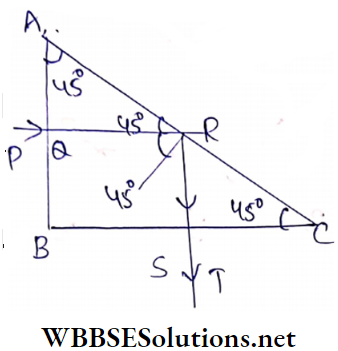
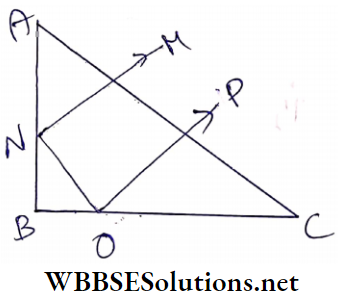
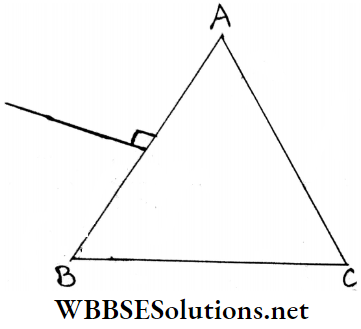
Total internal reflection of light can easily take place in a prism made of crown glass and whose principle cross-section is a right-angled isosceles triangle. So this type of prism is called a total reflecting prism.

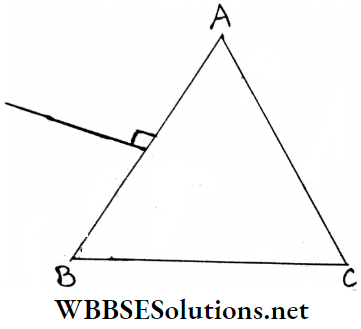
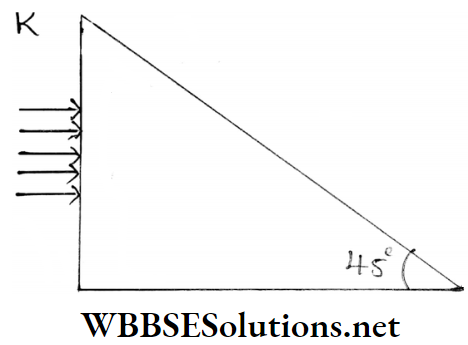
ABC is die principal section of a total reflecting prism { Its sides.AS and BC are equal and ∠ABC = 90′. If the ray PQ is incident perpendicularly on the face AS, it is incident on the face AC at an angle of 45° which is greater than the critical angle of glass and air, about 42°. So it is totally
reflected and passes along RST perpendicular to the side SC. Thus the hypotenuse face

AC of the prison acts as a plane mirror. So it is called a total reflecting prism. it is to be noted that in this case, the deviation of the ray is 90°

Class 12 Physics Unit 6 Optics Chapter 2 Refraction Of Light Reflecting Prism

WBBSE Class 12 Reflecting Prisms Notes

Advantages of a total reflecting prism:

  1. In the case of a plane mirror multiple images may be formed due to several reflections from the front and the back surfaces of the mirror and the images thus formed is also bright.
  2. But in the case of a total reflecting prism, only one bright image is formed due to total internal reflection.
  3.  When the mercury coating of the back surface of a plane mirror is damaged, the image becomes indistinct.
  4. But such a problem arises in a totally reflecting prism mirror is damaged, and the image becomes indistinct. But such a problem arises in a totally reflecting prism

Disadvantages of a total reflecting prism:

  1. A total-reflecting prism is more costly than a plane mirror.
  2. If the glass of the prism is not completely homogeneous, the image becomes less distinct

Effecting prism: The inverted image of an object can be made erect with the help of a total reflecting prism.

Erecting of the image by deviating a ray through 0°:

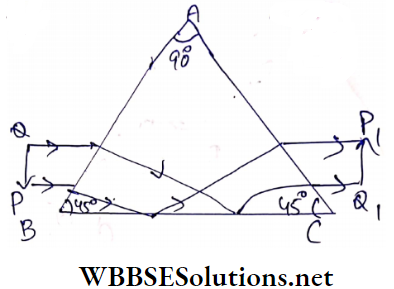
ABC is an isosceles right-angled prism, where ∠A = 90° uniting side of prism for no emergent ray j and ∠B = ∠C = 45°. Suppose that QP is the inverted image of an object. The ray coming from Q after refraction on the face AB is incident on the face BC at an angle greater than the critical angle of glass and air. So the ray is totally reflected from this face and emerging from the face AC forms its image at Q1.

Similarly, a ray starting from P comes to the point P1. So this P1Q1 is inverted with respect to QP, thus erecting an inverted object. can type of prism is called a total reflecting prism.

Class 12 Physics Unit 6 Optics Chapter 2 Refraction Of Light Isosceles Right Angled Prism

In this case, no deviation of the ray has taken place.

In instruments like telescopes, binoculars, etc., total reflecting

RST is perpendicular to the side SC. Thus the hypotenuse face, prism is therefore used to erect an inverted image.

Erecting of the image by deviating 180°:

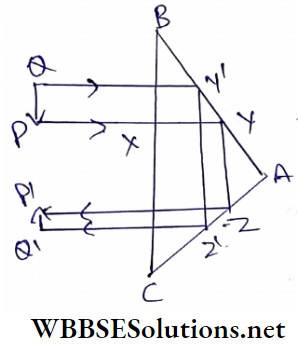
To get an erect Image, the above-mentioned prism can be used in another way. QP is the Inverted Image of an object. The hypotenuse faces BC of the prism ABC Is held In front of it. A ray of PX from P is incident normally on the face BC and enters the prism.

After refraction, it Is incident at Y on the face AB. ‘I lie angle of incidence of the ray AT at the face AH is 45° which Is greater than the critical angle (nearly 42) of glass and air. So the ray moves along YZ after total reflection at Y and is incident on the face AC.

For The same reason, the ray moves along ZR after total reflection at Z and incident normally on the face BC. It emergences RP’ and comes to the point P’

Class 12 Physics Unit 6 Optics Chapter 2 Refraction Of Light Inverted Image And The Hypotenuse Face

Similarly, a ray coming from Q comes to the point  Q’ obviously according to the figure, the image P’Q’ becomes inverted relative to PQ. So the erect image P’Q’ of an inverted object Is thus formed.

Each incident ray bends twice at 90°, thus producing a total deviation of 180°. So, an inverted image can be made erect by deviating a ray through 180°.

Short Notes on Total Internal Reflection Prism

Prism periscope:

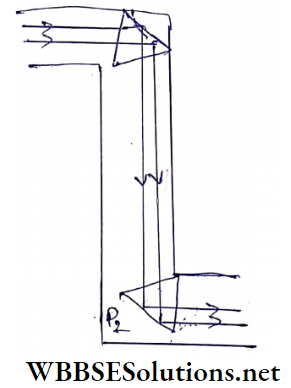
Total reflecting prisms are commonly used nowadays in good-quality periscopes instead of inclined parallel mirrors. This type of periscope is called prism periscope and the image formed by a prism periscope is more bright than that formed by a simple periscope.

The periscope tube contains two right-angled isosceles prisms P1 and P2. P1 is fixed at the top in such a way that rays of light coming from a.Distant object enter the prism through a window and after total internal reflec¬ tion goes downwards. The hypotenuse face P2, which is fixed at the bottom receives these rays and reflects them totally In n horizontal direction through the ohworvinlon window. Thu observer thus sees an exact Image of the distant object.

Class 12 Physics Unit 6 Optics Chapter 2 Refraction Of Light Prism Periscope

Unit 6 Optics Chapter 2 Refraction Of Light Types of Reflecting Prisms Numerical Examples

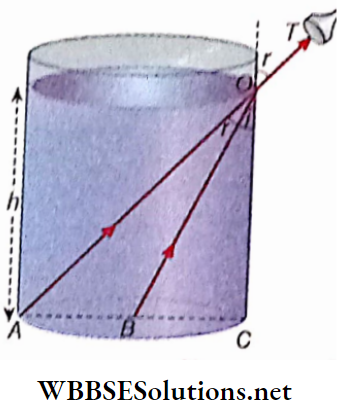
Example 1. A man with a telescope can just observe point A on the circumference of the base of an empty cylindrical vessel.   When the vessel is filled completely with a liquid of refractive index 1.5 the man can just observe the middle point B of the base of the vessel without moving either the vessel or the telescope If The diameter of the base of the vessel is 10 cm, what is the height of the vessel.
Solution:

When the vessel Is empty, a light from point A enters the telescope ‘l’ following the straight path AO. When the vessel Is filled with the liquid, a ray of light from point II moves along BO and after refraction in air enters the telescope. Let h be the height of the vessel.

Class 12 Physics Unit 6 Optics Chapter 2 Refraction Of Light Empty Vessel

Here

According to the figure

⇒ \(\frac{\sin l}{\sin r}=\frac{1}{\mu} \quad \text { or, } \mu=\frac{\sin r}{\sin t}\)

Or, \(1.5=\frac{\frac{A C}{A O}}{\frac{B C}{B O}}=\frac{A C}{A O} \times \frac{B O}{B C}=\frac{A C}{B C} \times \frac{B O}{A O}\)

Or,\(1.5=\frac{10}{5} \times \frac{\sqrt{B C^2+C O^2}}{\sqrt{A C^2+C O^2}}=2 \times \frac{\sqrt{25+h^2}}{\sqrt{100+h^2}}\)

Or,\(2.25=\frac{4\left(25+h^2\right)}{100+h^2}\)

h = 8.45 cm

Example 2. A post remains above is dipped the water straight of the in a pond.“The rays of the sun are Inclined at an angle of 45° to the surface of water what will be the length of the shadow of the post at the bottom of the pond? The refractive index of water p
Solution:

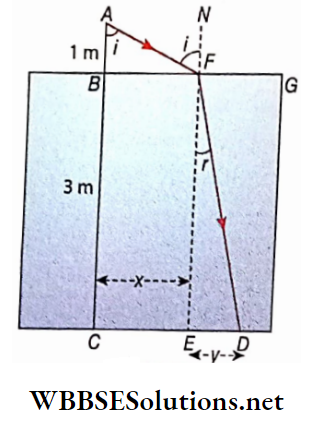
ABC is the post and BFG is the surface of water

The length of the shadow at the bottom of the pond = CD

Class 12 Physics Unit 6 Optics Chapter 2 Refraction Of Light Pond

Let CE = BF= x = ED = yellow

According to the figure

∠AFN = i= angle of incidence

∠BAF = i

∠EFD = r = angle of refraction

We know, \(\mu=\frac{\sin i}{\sin r}\)

⇒ \(\frac{4}{3}=\frac{\sin 45^{\circ}}{\sin r}\)

Since i = 45°

Or, \(\frac{3}{4} \times \frac{1}{\sqrt{2}}=\frac{3}{4 \sqrt{2}}\)

From the

tan i= \(\frac{x}{1}\)

Or, \(\tan 45=\frac{x}{1}\)

Or, x = 1cm

tan 45° = \(\frac{x}{1}\)

Again, \(\sin r=\frac{y}{\sqrt{y^2+9}} \quad \text { or, } \frac{3}{4 \sqrt{2}}=\frac{y}{\sqrt{y^2+9}}\)

Or, y²× 32 = 9(y² + 9) or, 23y² = 81

Or, \(\frac{81}{23}\)

y²= 1.879 m

The length of the shadow of the post at the bottom of the pond = x+y= 1+1.876

= 2.876 m

Common Questions on Types of Reflecting Prisms

Example 3. There is a point object at a height above the surface of water in a tank. If the bottom of the tank acts as a plane mirror where will be the Imago formed? If on observer looks from the air at the surface of the water normally, calculate the distance of the image front the surface of the water of the tank formed by the mirror-like bottom surface of the tank. Refractive Index of water = \(\frac{4}{3}\)
Solution:

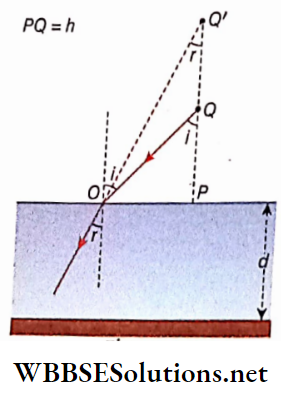
Q is a point source. For refraction in water, the apparent position of Q is Q’

Class 12 Physics Unit 6 Optics Chapter 2 Refraction Of Light Refractive Index In Water

So, \(\mu=\frac{\text { apparent height }}{\text { real height }}=\frac{P Q^{\prime}}{P Q}\)

= \(\frac{P Q^{\prime}}{h}\)

Or, PQ’ = μh =  \(\frac{4}{3}\)

Therefore the distance of Q’ from the bottom of the tank

= d +\(\frac{4}{3}\)

So the image of Q’ will be formed at a distance of (d +\(\frac{4}{3}\)) from the bottom of the tank

= d + d +\(\frac{4}{3}\)h = 2d +\(\frac{4}{3}\)h

⇒ \(\frac{4}{3}\) = \(\frac{2 d+\frac{4}{3} h}{x}\)

=  \(x\frac{3}{4}\left(2 d+\frac{4}{3} h\right)=\frac{3}{2} d+h\)

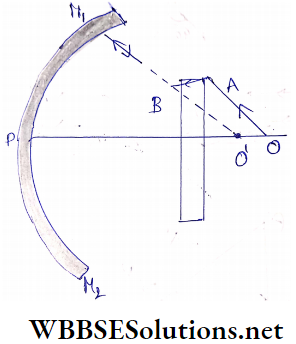
Example 4.  A rectangular glass slab of thickness 3 cm and of refractive Index 1.5 is placed in front of a concave mirror, perpendicular to Its principal axis. The radius of curvature of the mirror Is 10 cm. Where Is an object to be placed on the principal axis so that Its image will he formed on the object?
Solution:

The rectangular glass slab is placed perpendicular to the principal axis of the concave mirror M1M2 Suppose that if an object is placed at O on the principal axis, its image will be formed at
O. OABM1 is the path of the ray. Tiie ray after reflection at M1 retraces the path and forms an image at O. So the ray BM1 must be incident on the mirror at M1  perpendicularly. If Af, B must be incident on the mirror at Af, perpendicularly. If Af, B O’ is the centre of curvature of the concave mirror.

PO’ = 10 cm

Now OO’ = \(t\left(1-\frac{1}{\mu}\right)=3\left(1-\frac{1}{1.5}\right)\)

= 3-2 = 1cm

So, the distance of O from the concave mirror

= PO’ + OO’ = 10 + 1 = 11 cm

Class 12 Physics Unit 6 Optics Chapter 2 Refraction Of Light Rectangular Glass Slab

Practice Problems on Prism Applications

Example 5. A cross mark at the bottom of an empty vessel is focused with the help of a vertical microscope. Now! water (refractive Index = \(\frac{4}{3}\) ) Is poured into the vessel.  The height of water in the vessel Is 4 cm. Another lighter liquid which does not mix with water and has  a refractive index is, is poured into the water. The height of the liquid is 2 cm. How much should the microscope be raised vertically to focus the mark again?
Solution:

The real depth of the combination of water and the

liquid = 4 + 2 = 6 cm

The apparent depth of the cross-mark

⇒ \(\frac{4}{\frac{4}{3}}+\frac{2}{\frac{3}{2}}=3+\frac{4}{3}\)

= 4.33 cm

So, to focus the cross mark, the microscope is to be raised vertically through a height (6-4.33) = 1.67 cm.

WBCHSE Class 12 Physics Notes For Types Of Reflecting Prisms

Example 6. A concave mirror with a radius of curvature of 1 m Is placed at the bottom In a reservoir of water. When the sun Is situated directly over the head, the mirror forms an Image of the sun. If the depth of water Is  80 cm and  40 cm, calculate the Image distances from the mirror, f Given \(\mu_w=\frac{4}{3}\)

Solution:

The sun is an object situated at infinity. So its image will be formed by the concave mirror at its focus i.e. \(\frac{100}{2}\) = 50 cm above the mirror.

When the depth of water in the reservoir is 80 cm the image is formed at n distance of 50 cm inside water from the mirror. : § But when the depth of water is 40 cm the image will be formed in air. Light rays will be refracted while passing from water t0 ain So> the refracted rays wiU converge at O’ and an image will be formed at O’

Displacement of the image

= \(O O^{\prime}=t\left(1-\frac{1}{\mu}\right)=10\left(1-\frac{3}{4}\right)\)

= \(10 \times \frac{1}{4}\)

= 2.5 cm

Distance of image from the mirror

= PO’ = 50 – 2.5

= 47.5 cm

Class 12 Physics Unit 6 Optics Chapter 2 Refraction Of Light Refracted Rays

Important Definitions Related to Reflecting Prisms

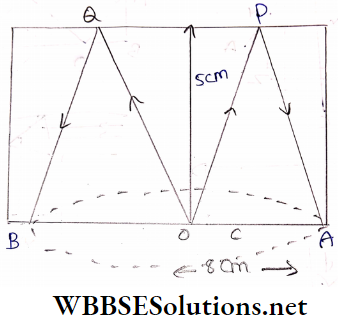
Example 7. The width of a rectangular glass slab is 5 cm. From a point on Its bottom surface, light rays are incident on its top face and after total reflection form a circle of light of radius 8 cm. What is the refractive Index of the
Solution:

Let o be a bright point at the bottom face of the rectangular slab. light rays starting from

Return to the bottom face after total reflection from the upper face of the slab.

As a result, a circle of light of radius OA = OB = 8 cm formed on the bottom face. So the angle of incidence on the upper face is P(. (critical angle) glass slab

According to the

OP = \(\sqrt{O C^2+P C^2}=\sqrt{(4)^2+(5)^2}\)

= \(\sqrt{41} \mathrm{~cm}\)

Refractive index \(\)

\(\mu=\frac{1}{\sin \theta_c}=\frac{1}{\frac{O C}{O P}}\) \(=\frac{O P}{O C}=\frac{\sqrt{41}}{4}\)

= 1.6

Class 12 Physics Unit 6 Optics Chapter 2 Refraction Of Light Bottom Space Of Rectangular Slab

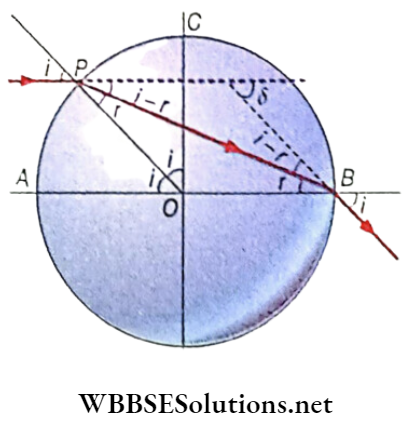
Example 8.  A glass sphere having a centre at 0 and two perpendicular diameters AOB and COD. A ray parallel to AOB is incident on the sphere at P where AP = PC and emerges from the sphere at B. Calculate the refractive index of glass and the deviation of the emergent ray
Solution:

Class 12 Physics Unit 6 Optics Chapter 2 Refraction Of Light Deviation Of The Emergent Ray

According to the  arc AP = arc PC

∠AOP = ∠POC = 45° = i,

∠POB = 45° + 90° = 135°

From the triangle POB,

r+r+ 135° = 180° or, 2r = 45° or, r = 22.5°

= \(\frac{\sin i}{\sin r}=\frac{\sin 45^{\circ}}{\sin 22.5^{\circ}}\)

= 2 cos 22.5° = 2 × 0. 924 = 1.85

Angle of deviation

δ  =i-r+i-r = 2 (i-r) = 2(45°-22.5°)

= 2 × 22.5° = 45°

Class 11 Physics Class 12 Maths Class 11 Chemistry
NEET Foundation Class 12 Physics NEET Physics

Example 9. A glass slab is placed on a page of a book kept horizontally. What should be the value of the minimum refractive index of the glass slab so that the printed letters of the page will not be visible from any vertical side of the slab? 
Solution:

It is assumed that there is a thin layer of air between the page of the book and the glass slab. So any ray coming from

any portion of the page of the hook Is Incident on the glass slab According to the figure, at an angle of almost

Class 12 Physics Unit 6 Optics Chapter 2 Refraction Of Light A Glass Slab

If the angle of refraction Is Φ and the refractive index of glass Is μ, S. then, sin Φ = \(\frac{1}{\mu}\)

If θC is the critical angle, then sin θC = \(\frac{1}{\mu}\)

This refracted ray is incident on any vertical l side of the slab at an angle θ  (say) So. θ + Φ = 90°.

If  . θ is greater than Φ, a total internal reflection of light takes place and the printed letters of the page will not be visible from any vertical side, μ will be minimum when. θ = Φ

2Φ = 90° , Or, Φ = 45°

∴ \(\mu_{\min }=\frac{1}{\sin \phi}=\frac{1}{\sin 45^{\circ}}\)

= \(\sqrt{2}\)

= 1.414

Examples of Applications of Reflecting Prisms

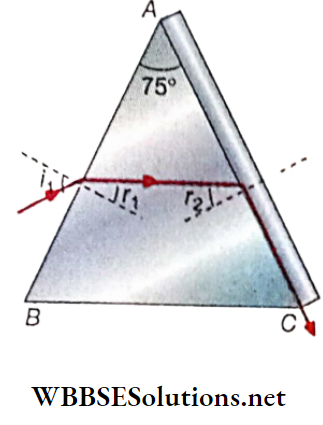
Example 10. A surface of a prism having a refractive index 1.5 is covered with n liquid of refractive index \(\frac{3 \sqrt{2}}{4}\) . What should be the minimum angle of incidence of an incident ray so that on the other surface of the prism tire ray will be totally reflected from the surface covered with liquid? The refracting angle of tho prism =75° [sin48°36′ = 0.75].
Solution:

Let the critical angle between the prism and the liquid be θC. If the ray of light is totally reflected from the surface covered with liquid then the angle of incidence of the ray on the surface is θC

Class 12 Physics Unit 6 Optics Chapter 2 Refraction Of Light Refracting Angle Of The Prism

So, 1.5 sin θC = \(\frac{3 \sqrt{2}}{4}\)

Or, \(\frac{3 \sqrt{2}}{4}\)

Or, \(\frac{3 \sqrt{2}}{4}\) x \(\frac{10}{15}\)

= \(\frac{1}{\sqrt{2}}\)

Again , r1+ θC = A

Or,  r1+ 45° = 75°  Or, = 30°

Now , sin i1 = μ sin r1 = 1.5 sin 30° = 0.75 Or, i1= 48° 36′

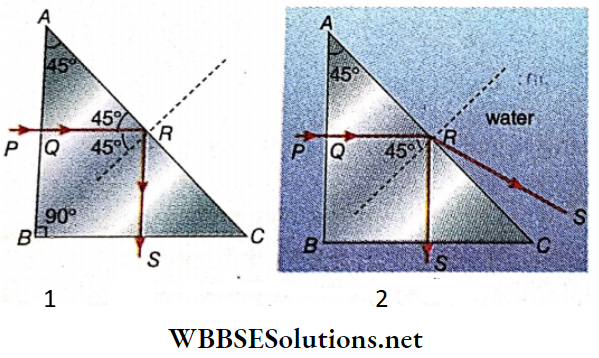
Example 11. A ray of light Is Incident normally on one, side of on isosceles right-angled prism and Is totally reflected on the other side.

  1. What Is the value of minimum refractive lodes of the material of the prism?
  2. If the prism Is Immersed In water, draw the diagram showing the direction of the emergent ray. In the diagram, point out the values of the angles,μ of water \(\frac{4}{3}\)

Solution:

1. ABC Is an Isosceles light-angled prism and Its sides are AB= BC The light lay PQ Is incident on the face AR normally and enters the prism. The ray Is an Incident at R on the face AC.

It Is evident from the figure that angle of Incidence of the ray at R Is 45° . Now if the ray Is to be totally reflected from R then this angle of incidence should he greater than the critical angle of the material of the prism μ maximum critical angle will be θC = 45° . If H be the minimum refractive Index of the material of the prism then,

sinθC  = \(\frac{1}{\mu}\)

Or, in 45° = \(\frac{1}{\mu}\)

Or, = \(\frac{1}{\mu}\)

= 1.414

Class 12 Physics Unit 6 Optics Chapter 2 Refraction Of Light Right Angled Prism And Totally Reflected From The Other Side

2. If the prism is immersed in water, then the refractive Index of glass relative to water is,

⇒ \({ }_u^{\mu_E}=\frac{\mu_S}{\mu_i}=\frac{\sqrt{2}}{\frac{4}{3}}=\frac{3 \sqrt{2}}{4}\)

If the critical angle between the prism and water is  θC

⇒ \(\theta_c^{\prime}=\sin ^{-1} \frac{1}{w^{\mu_g}}=\sin ^{-1}\left(\frac{4}{3 \sqrt{2}}\right)\)

= 70.53°

But the angle of Incidence at R is 45° [Fig. 2.64(b)] and it Is less than the critical angle. So at R, light rays will not be totally reflected. It will be refracted and will enter water. If the angle of refraction is r, then

⇒ \(\sqrt{2} \sin 45^{\circ}=\frac{4}{3} \sin r\)

sin r= \(\sqrt{2} \times \frac{3}{4} \times \frac{1}{\sqrt{2}}\)

= 0.75 = sin 48.59°

Or, r = 48.59°

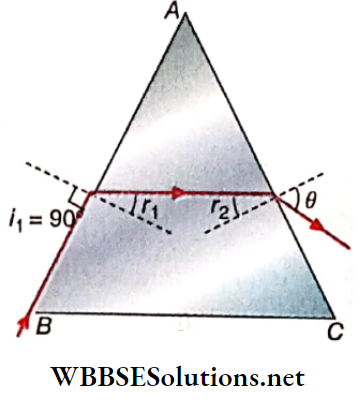
Example 12.  A ray of light Is incident grazing the refracting surface of a prism having refracting angle A. It emerges the other refracting surface making an angle θ with the normal to the surface. Prove that the refractive index  of the material of the prism is given by \(\mu=\left[1+\left(\frac{\cos A+\sin \theta}{\sin A}\right)^2\right]^{1 / 2}\)
Solution:

For grazing incidence on the refracting surface AB of the prism, i1 = 90°

Class 12 Physics Unit 6 Optics Chapter 2 Refraction Of Light Grazing The Refacting Surface Of Prism

So, in this case r1 = dc (critical angle)

Now, A = r1 + r2 or, r2= A-r1 = A – θC

Considering refraction at the second refracting surface, AC

We get \(\mu=\frac{\sin \theta}{\sin r_2}\)

Or, \(\sin \theta=\mu \sin r_2=\mu \sin \left(A-\theta_c\right)\)

⇒ \(\mu\left[\sin A \cos \theta_c-\cos A \sin \theta_c\right]\)

But \(\sin \theta_c=\frac{1}{\mu} \text { and } \cos \theta_c=\sqrt{1-\frac{1}{\mu^2}}=\frac{\sqrt{\mu^2-1}}{\mu}\)

⇒ \(\sin \theta=\mu\left[\sin A \frac{\sqrt{\mu^2-1}}{\mu}-\cos A, \frac{1}{\mu}\right]\)

⇒ \(\sin A \sqrt{\beta^2-1}-\cos A\)

Or, \(\sin \theta+\cos A=\sin A \sqrt{\mu^2-1}\)

Or, \(\frac{\sin \theta+\cos A}{\sin A}=\sqrt{\mu^2-1}\)

Or,\(\mu^2-1=\left(\frac{\sin \theta+\cos A}{\sin A}\right)^2\)

Or,\(\mu^2=1+\left(\frac{\sin \theta+\cos A}{\sin A}\right)^2\)

Or,\(\mu=\left[1+\left(\frac{\sin \theta+\cos A}{\sin A}\right)^2\right]^{\frac{1}{2}}\)

Conceptual Questions on Light Behavior in Reflecting Prisms

Example 13. A ray of light incident normally on a refracting surface of the prism it totally reflated from the other refracting surface. If the prism it Immersed In water how will the ray act? The refractive index of a glass of =1.5; the refractive index of water = 1.33.
Solution:

At the ray of light it incident on the face of the prism normally so it goes straight through the surface. The ray it incident j on the second refracting face and is totally reflected. So the angle i or, of Incidence of the ray at the second face is greater than the critical  angle θC

⇒ \(\sin \theta_C=\frac{1}{a^{\mu_E}}=\frac{1}{1.5}=0.667\)

= sin 41.8°

θC = 41.8°

Now, if the prism is immersed in water, the refractive index of glass j with respect to water is,

wμg =aμg /aμw

= \(\frac{1.5}{1.33}\)

= 1.128

In this case, if the critical angle is  θ’C then

⇒ \(\sin \theta_C^{\prime}=\frac{1}{u^{\mu_g}}\)

= \(\frac{1}{1.128}\)

θ’= sin 62.44°

So the angle of incidence of the ray at the second face (41.8) is less than the critical angle (62.44). Hence, instead of being . totally reflected from the second face, the ray is refracted through it.

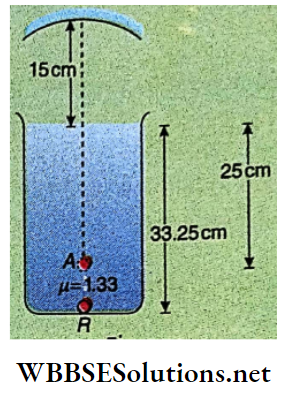
Example 14. A tank height of 33.25 cm is completely filled with liquid (μ= 1.33).An object is placed at the bottom of the tank on the axis of a concave mirror.   Image of the object is formed 25 cm below the surface of the liquid . What is the focal length of the mirror?

Class 12 Physics Unit 6 Optics Chapter 2 Refraction Of Light Height Of The Tank On The Axis Of Concave Mirror
Solution:

Here, R is the actual position of the object and A is the apparent position of the image

We, know, \(\mu=\frac{\text { real depth }}{\text { apparent depth }}\)

Or, 1.33  \(=\frac{33.25}{x_a}\)

Therefore, the apparent depth of the object

Here, object distance , u = \(-\left(15+\frac{33.25}{1.33}\right)\)

And image distance, v= -(15+25)cm = -40 cm

Applying the mirror equation, we get

⇒ \(-\frac{1}{40}-\frac{1}{40}=\frac{1}{f}\)

Or, f = \(-\left(\frac{40 \times 40}{40+40}\right)\) = -20

Therefore, the required focal length is 20 cm.

Example 15. What should be the minimum value of the refractive index of a right-angled isosceles prism to that the is F prism can deviate a ray through 180′ by total internal reflection

Class 12 Physics Unit 6 Optics Chapter 2 Refraction Of Light Rigt Angled Isosceles Prism

Solution:  ABC is a right-angled isosceles triangle, whose ∠ABC is 90 and AB = BC

Here light ray is incident along MN on the side AB and is reflected back along NO. Now, the reflected ray NO is incident on side BC and gets reflected along the path OP.

Therefore, light rays suffer total internal reflection when incident ic onsides AB and BC

It is clearly seen that the value of incident angle ig on sides AB and BC is 45° or less than 45°

ic ≤ 45°

sin-1 1/μ <45°

Or, 1/μ < sin 45°

Or,μ > \(\sqrt{2}\)

Therefore, the refractive index of the material of the prism is at least Jz so that the prism can deviate a ray through 180° by total internal reflection

Real-Life Scenarios Involving Reflecting Prisms

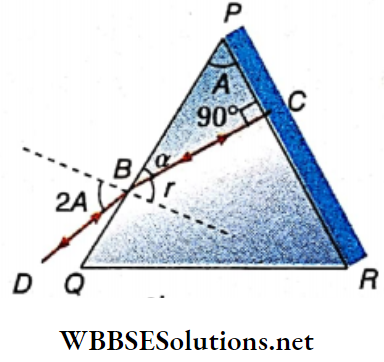
Example 16. The face of the prism of refracting angle A is coated with silver. A light ray after first being Incident at an angle of Incidence 2A on the first face of the prism, is refracted and is then reflected from the second face, retracing its path. Calculate the value of the refractive index of the prism
Solution:

Let PQR be a glass prism. The refracting surface PR of the prism is coated with mercury

Class 12 Physics Unit 6 Optics Chapter 2 Refraction Of Light Prism Is Coated With Mercury

In the, incident ray DB is refracted along BC and the light ray returns following the same path after getting reflected from the surface PR

∴ ∠PCB = 90°

And ∠PBC = a = (90°-A) ………………………………… (1)

Where BPC= refracting angle of the prism = A-\theta_c\right

Again, from the a+r = 90°

∴ a =  (90°-r) ……………………………….(2)

Comparing equations (1)and (2), we may write

Where , \(=\frac{\sin i}{\sin r}=\frac{\sin 2 A}{\sin A}\)

Or, \(\mu=\frac{2 \sin A \cos A}{\sin A}\)

μ = 2cos A

Therefore, the required refractive index is 2 cosA.

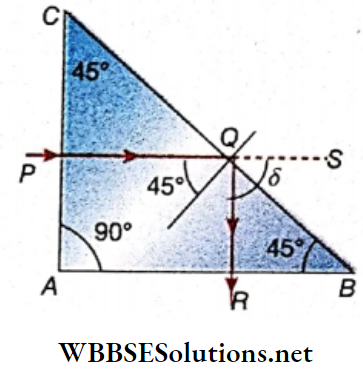
Example 17. A ray of light falls normally on one side other than the hypotenuse of a right-angled isosceles prism of refractive index 1.5. From which side will the ray emerge from the prism? Find the deviation of the incident ray
Solution:

ABC is a right-angled isosceles triangle i.e., Angle of prism A = 90

Class 12 Physics Unit 6 Optics Chapter 2 Refraction Of Light Right Angled Isosceles Triangle

∠ABC = ∠ACB = 45°

AB. The ray of light is incident normally on the side AC and is inci¬ dent on the side BC at an angle 45°

.As a result, after total internal reflection, the ray passes along QR perpendicular to the side

Now, the angle of deviation = ∠SQR = δ = 90°

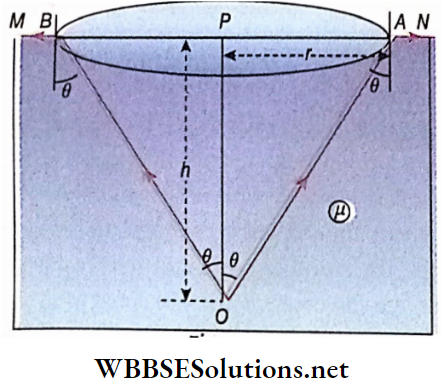
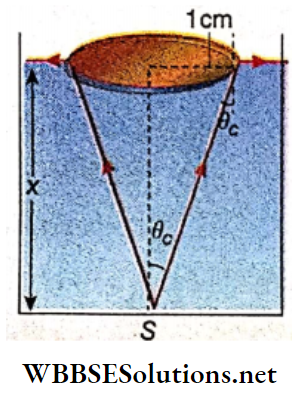
Example 18. A vessel contains a liquid of refractive index \(\frac{5}{3}\). Inside j the liquid, S is a point source which is observed from above the liquid. An opaque disc ot radius 1 cn, is floating on the liquid such that its centre is just the source, at this circumstance liquid of the vessel is leaving gradually through a hole. What is the depth of the liquid, so that the source no more remains visible from above
Solution:

Let x be the required dÿepth obviously, at this position light rays from the source S must be incident at a critical angle (dc) at the edge of the disc

Class 12 Physics Unit 6 Optics Chapter 2 Refraction Of Light Critical Angle At Edge Of The Disc

So, \(\sin \theta_c=\frac{1}{\sqrt{1+x^2}}\)

Also \(\sin \theta_c=\frac{1}{\mu}=\frac{3}{5}\)

\(\frac{3}{5}=\frac{1}{\cos \sqrt{1+x^2}}\)

Or, \(\)

Or, \(1+x^2=\frac{25}{9}\)

= \(x=\frac{4}{3}\)

= 1.33 cm

WBCHSE Class 12 Physics Refraction Of Light Short Questions And Answers

Optics

Refraction Of Light Short Questions And Answers

Question 1. A prism is made of glass of unknown refractive index A parallel beam of light incident on the face of the prism. By rotating the prism, the angle of minimum deviation la j measured to be 40° What is the refractive Index of the material of the prism? If the prism is placed In water j (refractive index  1.33 ). predict the new angle of minimum j deviation of a parallel! a beam of light Refracting angle of the prism is 60°
Answer: 

The refractive index of the material of the prism

μ = \(\frac{\sin \frac{A+8}{2}}{\sin \frac{A}{2}}=\frac{\sin \frac{60^{\circ}+40^{\circ}}{2}}{\sin \frac{60^{\circ}}{2}}\)

= \(\frac{\sin 50^{\circ}}{\sin 30^{\circ}}\)

= 1.53

When placed in water,

w μg= aμg /aμw

= \(\frac{1.53}{1.33}\)

w μg= \({ }\frac{\sin \frac{A+\delta_m^{\prime}}{2}}{\sin \frac{A}{2}}\)

Or, 1.15\(\sin \frac{60^{\circ}}{2}=\sin \frac{60^{\circ}+\delta_m^{\prime}}{2}\)

∴ δ’m= 10.2°

= 10. 12′

Read And Learn More WBCHSE Class 12 Physics Short Question And Answers

Question 2. A small pin fixed on the table and top of it is viewed from above from a distance of 50 cm. By what distance would the tire pin appear to be raised if it is viewed from the same point through a 15 cm thick glass slab held parallel to the table?

The refractive index of glass = 1.5. Does the answer depend on the location of the slab? The apparent displacement of the pin

x = d\(\left(1-\frac{1}{\mu}\right)\)

[ d= apparent depth and = refractive index]

= 15 (1-\(\left(1-\frac{1}{1.5}\right)\) = 5 cm

Fors mall angles of Incidence the answer will not depend on the position of the glass

Class 12 Physics Unit 6 Optics Chapter 2 Refraction Of Light Internal Reflection Inside The Pipe Take Place

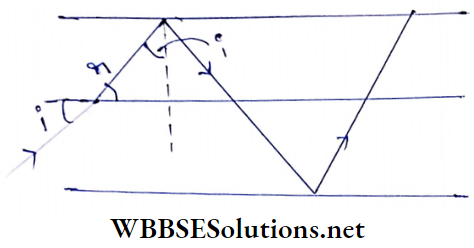
Question 3. A cross glass fiber with a refractive Index of 1.68. The outer covering of the pipe is made of material with a refractive index of 1.44. What Is the tango of the angles of Incident rays with the axis of the pipe for which the total internal reflection inside the pipe takes place as shown In the figure? What is the answer If there is no outer covering of the pipe?  If there is no covering, then

If there is no covering, then

⇒ \(i^{\prime}=\sin ^{-1}\left(\frac{1}{1.68}\right) \approx 36.5^{\circ}\)

We know, \(\frac{\sin t}{\sin r}=\mu\)

∴  sin i =  sin 53.5° × 1.65 a 80.3 × 1.65 = 1.33 which is absurd as sin imax  = sin 90° = 1

A mass must be less than 53.5° which means

0°<K90° Thus total internal reflection will take a plate for any angle of incidence ranging from 90°

WBBSE Class 12 Refraction of Light Short Q&A

Question 4. A diver underwater looks obliquely at a fisherman standing on the bank of a lake. Would the fisherman look taller or shorter than he Is?
Answer:

The displacement of the Image of the head of the fisherman The displacement of the Image of the head of the fisherman

Question 5. At what angle should a ray of light be Incident on the face of a prism of refractive angle 60° so that it Just suffers total internal reflection at the other face? The refractive index of the material of the prism Is 1.524. 
Answer:

The limiting value of the angle of incidence,

i = \(\sin ^{-1}\left[\sin A \sqrt{\mu^2-1}-\cos A\right]\)

= \(\sin ^{-1}\left[\sin 60^{\circ}\left(\sqrt{1.524^2-1}\right)-\cos 60^{\circ}\right]\)

= 29.73 30

WBCHSE Class 12 Physics Refraction Of Light Short Questions And Answers

Question 6. Calculate the speed of light in a medium whose critical angle is 45s. Mention two practical applications of optical fiber. 

It is the critical angle of any medium concerning vacuum or air and // is the refractive index of the medium

⇒ \(\sin \theta_c=\frac{1}{\mu}\)

According to the question

⇒ \(\frac{1}{\sin \theta_c}=\frac{1}{\sin 45^{\circ}}=\frac{1}{\frac{1}{\sqrt{2}}}=\sqrt{2}\)

The velocity of light in air or vacuum,

c = 3 x 10⁸ m/s

Velocity of light in the medium

ν = \(\frac{c}{\mu}=\frac{3 \times 10^8}{\sqrt{2}}\) ‘

= 2.12

Short Answer Questions on Spherical Surfaces

Question 7. The refracting angle of a prism is 60° and the refractive index of its material is \(\sqrt{\frac{7}{3}}\) Find the minimum angle of incidence of a ray of light falling on one refracting face of the prism such that the emerging ray will graze the other refracting face
Answer:

⇒ \(i_1=\sin ^{-1}\left[\sin A \sqrt{\mu^2-1}-\cos A\right]\)

Here, \(\mu=\sqrt{\frac{7}{3}}\)

Or, \(\mu^2-1=\frac{4}{3}\)

⇒ \(\sqrt{\mu^2-1}=\sqrt{\frac{4}{3}}=\frac{2}{\sqrt{3}}\)

Given that A = 60

Sin A = \(\frac{\sqrt{3}}{2}\)

Cos A = \(\frac{1}{2}\)

Hence, \(\sin ^{-1} \frac{\sqrt{3}}{2} \times \frac{2}{\sqrt{3}}-\frac{1}{2}\)

= \(\sin ^{-1} \frac{1}{2}\)

= 30°

Class 11 Physics Class 12 Maths Class 11 Chemistry
NEET Foundation Class 12 Physics NEET Physics

Question 8. For the same value of angle of incidence, the angle of refraction in three media A, B, and C are 15°, 25’, and 35° respectively. In which medium would the velocity of light be minimum?

Refractive index μ = \(\frac{\sin i}{\sin r}\)

For the same value of i, μ ∝ \(\frac{1}{\sin r}\)

In the given problem

r1<r2<r3 Or, sin r1<sinr2< sinr3

As velocity oflight, v = \(\frac{c}{\mu}\) i.e \(\nu \propto \frac{1}{\mu}\) , we have ν123

So In the Grst medium, the die velocity of light Is minimal.

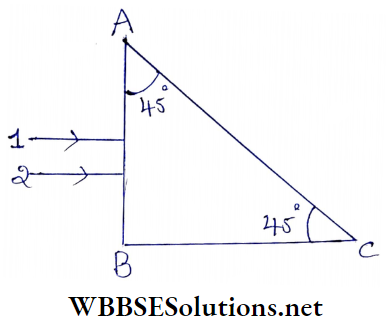
Question 9.  Two monochromatic rays of light are incident normally on the face AB of an isosceles right-angled prism ABC. The refractive indices of the glass prism for the two rays 1 and 2 are respectively13 and13. Trace the path of these rays after entering through the prism

Class 12 Physics Unit 6 Optics Chapter 2 Refraction Of Light Monochromatic Rays Of Light Are Incident

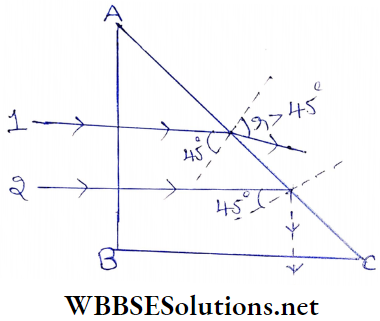
Both the rays enter the glass prism through the face AB without deviation

Class 12 Physics Unit 6 Optics Chapter 2 Refraction Of Light Enter The Glass Prism

Now, the critical angles for glass-to-air refraction are

For ray 1 : = \(\sin ^{-1} \frac{1}{1.3}=50.3^{\circ}\) = 50.3

For ray 1 : = \(\sin ^{-1} \frac{1}{1.5}\) = 41.8

Both the rays are incident on the surface AC at an angle of 45°. As 45° < θ1, ray 1 refracted across AC to reenter air. But, as 45° > θ12, ray 2 suffers total internal reflection at AC and the reflected ray is incident normally on BC and then escapes to air without deviation

Conceptual Short Questions on Critical Angle and Total Internal Reflection

Question 10. For the same angle of incidence, the angle of refraction in two media A and B are 25° and 35° respectively. In which medium is the speed of light less?

We know,

∴ VA<VB

Hence, the speed of light is less in medium A

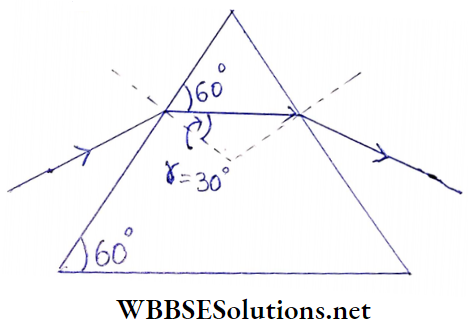
Question 11. A ray of light incident on an equilateral glass prism propagates parallel to the base Ifne of the prism Inside it Find the angle of incidence of this ray. Given refractive index of the material of the glass prism is \(\sqrt{3}\). 

From the diagram r = 30

Also \(\mu=\frac{\sin i}{\sin r}\)

Or, \(\sqrt{3}=\frac{\sin i}{\sin 30^{\circ}}\)

Or, sin i \(\sqrt{3} \times \frac{1}{2}\)

Hence i = 60

Class 12 Physics Unit 6 Optics Chapter 2 Refraction Of Light Equilateral Glass Prism

The required angle of incidence is 60°

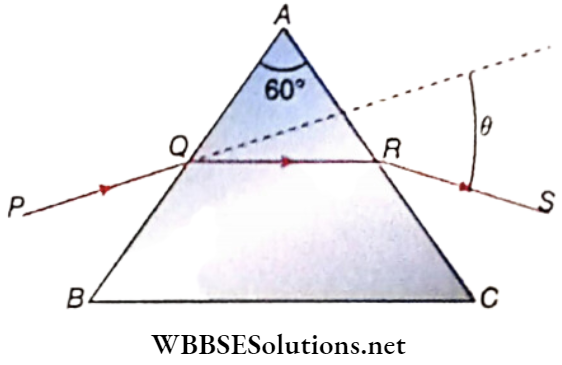
Question 12. A ray PQ incident on the refracting face BA is refracted in the prism BAC shown in the figure and emerges from the other refracting face AC as BS such that AQ = AB. If the angle of prism A = 60° and the refractive index of the material of the prism is \(\sqrt{3}\), calculate angle θ

Class 12 Physics Unit 6 Optics Chapter 2 Refraction Of Light PQ Incident On The Refracting Face

The angle of the prism is A = 60°. It is also given that AQ = AR. Therefore, the angles opposite to these two sides are also equal

Now for the triangle AQR

∠A+∠AQR+∠ARQ= 180

∠AQR= ∠ARQ= 60

r1=  r2= 30

r1+r2= 60

When r1 and r2 are equal, we have i =  e

Now, according to Snell’s law, \(\mu=\frac{\sin i}{\sin r_1}\)

\(\sin i=\mu \sin r_1=\sqrt{3} \sin 30^{\circ}=\frac{\sqrt{3}}{2}\)

i = 60°

Now, the angle of deviation

= i + e-A = 60°+60°- 60 = 60°

Practice Short Questions on Snell’s Law

Question 13. Monochromatic light of wavelength 589 nm is incident from air on a water surface. If μ for water is 1.33, find the face wavelength, frequency, and speed of the refracted light
Answer:

The velocity of light in air is nearly equal to the velocity of light in free space.

Velocity of light in air  \(\) = 2.99 × 10⁸m. s-1

Frequency n = \(\frac{v_a}{\lambda_a}=\frac{2.99 \times 10^8}{589 \times 10^{-9}}\)

= \(5.07 \times 10^{14}\) Hz

Frequency is a fundamental property and does not change with a change in medium

= \(\frac{\text { velocity of light in air }\left(v_a\right)}{\text { velocity of light in water }\left(v_w\right)}=\frac{n \lambda_a}{n \lambda_w}\)

= \(\frac{\lambda_a}{\mu}=\frac{589}{1.33}\)

⇒ \(frac{589}{1.33}\) = 443nm

∴ The wavelength of the refracted light = 443nm.

∴ Speed of the refracted light, vw \(=\frac{\nu_a}{\mu}=\frac{2.99 \times 10^8}{1.33}\)

How does the angle of minimum deviation of a glass prism vary, if the incident violet light is replaced by red light? give reason

We know, \(\lambda_{\text {red }}>\lambda_{\text {violet }} \text { and } \mu=A+\frac{B}{\lambda^2}\)

Where A and B are constant

So, the increase of wavelength refractive index of the material for different colored rays decreases

∴ \(\mu_{\text {red }}<\mu_{\text {violet }}\)

Since, \(\mu=\frac{\sin \left(\frac{A+\delta_m}{2}\right)}{\sin \frac{A}{2}}\)

∴ \(\left(\delta_m\right)_{\text {red }}<\left(\delta_m\right)_{\text {violet }}\)

Question 14.

1. A ray of light incident on face AB of an equilateral glass prism, shows the minimum deviation of 30°. Calculate the speed of light through the prism

2. Find the angle of incidence at Find the angle of incidence at face AC.

Class 12 Physics Unit 6 Optics Chapter 2 Refraction Of Light A Ray Light Incident On Face AB

Answer:

1 . The refractive index for the material of the prism,

μ = \(\frac{\sin \left(\frac{A+\delta_m}{2}\right)}{\sin \frac{A}{2}}=\frac{\sin \left(\frac{60^{\circ}+30^{\circ}}{2}\right)}{\sin 30^{\circ}}\)

[Given A = 60, = 30]

= \(\frac{\sin 45^{\circ}}{\sin 30^{\circ}}=\frac{1}{\sqrt{2}} \times 2\)

Since,

⇒ \(\mu=\frac{c}{v}\)

Speed of light through the prism = 2.12 ×10⁸m .s-1

2. Critical Angle = \(=\sin ^{-1}\left(\frac{1}{\mu}\right)\) = r2

θc= \(\sin ^{-1}\left(\frac{1}{\sqrt{2}}\right)\) = 45°

Class 12 Physics Unit 6 Optics Chapter 2 Refraction Of Light Critical Angle

A= r1+ r2

rx= A- r2= 60°- 45° = 15°

Considering refraction at face AB,

μ = \(\frac{\sin i_1}{\sin r_1}\)

= \(\sin i_1=\mu \sin r_1=\sqrt{2} \times \sin 15^{\circ}\)

Or, i1 = 21.47

Real-Life Scenarios Involving Refraction Questions

Question 15. A ray of light passing from the air through an equilateral gla?s prism undergoes minimum deviation when the angle of incidence| of the angle of prin. Calculate the speed of light in the prism.

Here, refracting angle (A) = 60°

We know, minimum deviation (8m) = 2i1– A

⇒ \(\delta_m=2 \times \frac{3}{4} A-A\)

Given \(i_1=\frac{3}{4} A\)

= \(\frac{A}{2}\)= 30

= \(\frac{A}{2}\)

The refractive index of the prism

μ = \(\frac{\sin \frac{A+\delta_m}{2}}{\sin \frac{A}{2}}=\frac{\sin 45^{\circ}}{\sin 30^{\circ}}\)

= \(\frac{1}{\sqrt{2}} \times 2\)

= \(\sqrt{2}\)

Also μ = \(\frac{c}{v}\) [ v = velocity of light in the prism]

v = \(\frac{c}{\mu}\) = ~998 x 108 = 2.12 × 10⁸ m .s1

Question 16. The figure shows a ray of light falling normally on the face AB of an equilateral glass prism having refractive index \(\frac{3}{2}\) placed in water of refractive index \(\frac{4}{3}\) Will this ray suffer total internal reflection on striking the face AC? Justify your answer.

Class 12 Physics Unit 6 Optics Chapter 2 Refraction Of Light A Ray Light A Ray Of Light Falling

For an equilateral prism, the angle of the prism is A – 60°.

Critical angle of the glass relative to water medium

⇒ \(\theta_c=\sin ^{-1}\left(\frac{1}{w^g}\right)=\sin ^{-1}\left(\frac{\mu_w}{\mu_g}\right)\)

= \(\sin ^{-1}\left(\frac{4}{3} \times \frac{2}{3}\right)=\sin ^{-1}\left(\frac{8}{9}\right)\)

Class 12 Physics Unit 6 Optics Chapter 2 Refraction Of Light A Ray Light A Ray Of Light Falling

On the face AC, the ray is incident at an angle of 60° which is less than 6 c. Thus the ray suffers no total internal reflection rather it is refracted in a water medium.

WBCHSE Class 12 Physics Refraction Of Light Questions and Answers

Optics

Refraction Of Light Long Questions and Answers

Question 1. Monochromatic rays of light coming from a vacuum are refracted in a medium of refractive index μ. Show that the ratio of the wavelength of the incident ray and that of the refracted ray is equal to the refractive index of the medium.
Answer:

Suppose the wavelength of light in a vacuum is λ and its velocity is c. The corresponding values in a medium of refractive index μ are λ’ and c’. The frequency of light is v . The frequency of light remains the same in all media. So the velocity of light in vacuum, c = vλ  and velocity of flight in the referred medium c’ =  vλ’

Now refractive index of the medium,

= \(\frac{\text { velocity of light in vacuum }}{\text { velocity of light in the medium }}=\frac{c}{c^{\prime}}\)

= \(\frac{\nu \lambda}{\nu \lambda^{\prime}}=\frac{\lambda}{\lambda^{\prime}}\)

Question 2. Can the value of the absolute refractive index of a medium be less than 1?
Answer:

The absolute refractive index of a medium is the ratio of the velocity of light in a vacuum to the velocity of light in that j medium. Since the velocity of light in vacuum is greater than that in any other medium, the value of the absolute refractive index of a medium cannot be less than 1.

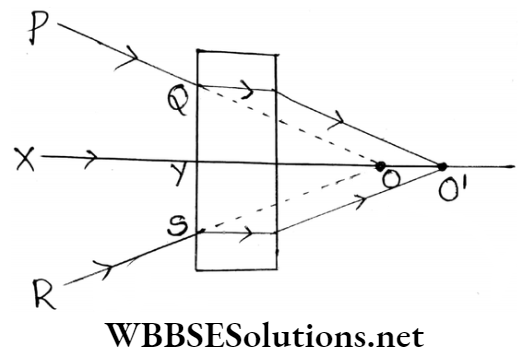
Question 3. A beam of converging rays of light meets at a point on a screen. A parallel plane glass slab is kept in the path of the converging rays. How far will the intersecting point of the rays be shifted? Draw a diagram to show it

If a parallel plane glass slab is placed on the path of the beam of converging rays, the intersecting point of the rays will be shifted away from the previous point. We know that a ray of light incident obliquely on a parallel glass slab emerges with a lateral displacement. In the path of the rays has been drawn and the displacement of the intersecting point has been shown. In the absence of a glass slab, the rays PQ, XY and RS would meet at 0. But due to the presence of the glass slab, the rays meet at O’. Hence, the displacement of the intersecting point = OO’

Class 12 Physics Unit 6 Optics Chapter 2 Refraction Of Light A Beam Of Covering Rays Of Light Meets

WBBSE Class 12 Refraction of Light Q&A

Question 4. A ray of light is refracted from medium 1 to medium 2. Show that the ratio of the sine of the angle of incidence and the sine of the angle of refraction is equal to the ratio of the speed of light in medium 1 and that in medium 2.
Answer:

If the absolute refractive indices of medium 1 and We know, medium 2 are //j and p2 respectively we know

⇒ \(\frac{\sin i}{\sin r}={ }_1 \mu_2=\frac{\mu_2}{\mu_1}\) ……………….(1)

Now \(\mu_1=\frac{c}{v_1}\) [c = speed of light in vacuum, = speed of light in medium]

⇒ \(\mu_2=\frac{c}{v_2}\) [v2= Speed of light in medium 2]

⇒ \(\frac{\mu_2}{\mu_1}=\frac{\frac{c}{v_2}}{\frac{c}{v_1}}\)

= \(\frac{v_1}{v_2}\) ……………. (2)

From (1) and (2) we get,

⇒ \(\frac{\sin i}{\sin r}=\frac{v_1}{v_2}\)

Question 5.  μ1 are μ2 the refractive indices of a medium for two electromagnetic waves. If μ1 is greater than /2, then which wave will move faster than the other?
Answer:

Let c1 and c2 be the velocities of the two electromagnetic waves in the given medium

μ1 = \(\frac{c}{c_1}\)

μ2= \(\frac{c}{c_2}\)

c = velocity of an electromagnetic wave in vaccum]

⇒ \(\frac{\mu_1}{\mu_2}=\frac{\frac{c}{c_1}}{\frac{c}{c_2}}\)

⇒ \( \frac{c_2}{c_1}\)

Now since μ1 > μ2, therefore c1 >c2

So the second wave moves faster through the medium.

WBCHSE Class 12 Physics Refraction Of Light Questions And Answers

Short Answer Questions on Refraction

Question 6. An object is placed at a certain depth from the upper surface of a liquid. When it is seen from the air, it appears that the object is raised through \(\frac{1}{3}\)  of the depth. Again if water is taken instead of the liquid it appears that the object is raised above through \(\frac{1}{4}\)  of the real depth. The refractive index of liquid =  \(\frac{3}{2}\) and refractive index of water| = \(\frac{4}{3}\)  Explain the matter
Answer:

Suppose that the real depth of the object below the surface of the liquid is d and the apparent depth is d.

The refractive index of the liquid  μ1= 1.5

We know, μ = \(\frac{\text { real depth }}{\text { apparent dept }}\)

Or, \(\frac{3}{2}=\frac{d}{d}\) Or,  d ‘= \(\frac{2}{3}\) d

∴ The apparent change in depth

= d-d’ = d –\(\frac{2}{3}\) = \(\frac{1}{3}\)d

= Apparent upward displacement of the object.

Again refractive index of water,μw = \(\frac{4}{3}\)

So in the case of water,

μw  = –\(\frac{d}{d^{\prime}}=\frac{4}{3}\)

Or, d’ = –\(\frac{3}{4}\)

The apparent change in depth

= d-d’ = d – \(\frac{3}{4}\) d

= \(\frac{1}{4} d\)

= apparent upward displacement of the object

Question 7. What sort of arrangement is to be taken so that an object cannot be visible even in light? Or, why is a piece of glass immersed In glycerine not visible?

Answer: An object having nearly the same refractive index as to be same. But if the rod is the medium will not be visible in that medium. Since the refractive indices of both of them are nearly the same, reflection or refraction of visible rays almost does not take place at their surface of separation and light will travel almost undefeated through them.

Then it cannot be understood that light is travelling from one medium to another. It seems as if light is moving in die same medium. As a result, the surface of separation is not visible. So a medium vanishes in the other medium

The refractive indices of glycerine and glass are almost equal. So when a piece of glass is immersed in glycerine kept in a vessel, the piece of glass is not visible

Class 11 Physics Class 12 Maths Class 11 Chemistry
NEET Foundation Class 12 Physics NEET Physics

Question 8. There is a branch hanging from a tree on the bank of a lake. It is at a height of h1  from the surface of the water. A diver underwater sees it at a height of h2. What Is the relation between h1 and h2 Given, μw
Answer:

As the object is situated in a rarer medium and it is seen from the denser medium, the apparent height of the object

= \(\frac{\text { from the surface of water }}{\text { real height of the object }}=\frac{h_2}{h_1}\)

Or, 1.33 \(=\frac{h_2}{h_1}\) Or, 1.33 h1

Question  9. A red ray and a violet ray passing through a glass slab Fig 2.72 ly c arc incident simultaneously on an interface with air. It is seen that the red ray is refracted but the violet ray is reflected. Explain the reason behind it.
Answer:

The refractive index of glass for red light is smaller than that of glass for violet light. Since the critical angle, θc  = sin \(\sin ^{-1} \frac{1}{\mu}\), the critical angle of glass for red light is comparatively greater. So the angle at which the red and the violet rays are incident is smaller than the critical angle of red light but greater than the critical angle of violet light. So the red light is refracted and the violet light is reflected

Question 10. A rod immersed horizontally in water does not appear small when viewed normally but appears small if It is kept vertically. Explain. What sort of arrangement is to be taken so that an object cannot be visible even in light? Or, why is a piece of glass immersed In glycerine not
Answer:

When the rod is kept horizontally underwater, every point of the rod appears to be upward equally due to refraction.

So, the length of the rod appears immersed vertically, and different points of the rod appear to be and form an image. Since its depth, is apparent dis upward with different distances displacement of a point depends placement of the lower point of the rod is larger than the higher point. Thus, the apparent displacement of the lowest and highest points of the rod are maximum and minimum respectively. So, the rod appears to be small

Practice Questions on Lens and Refraction

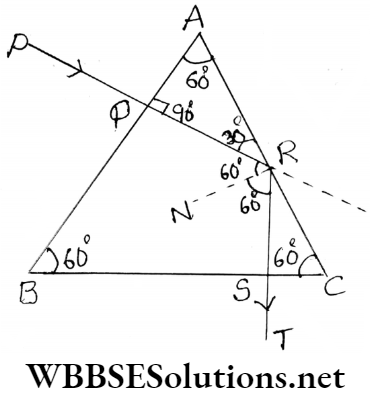
Question 11. The critical angle of glass and air is 42’. If a ray of light Is incident normally on the face of an equilateral prism, show that the ray will emerge from the base of the prism normally. Calculate the deviation of the ray.
Answer:

ABC is an equilateral prism. Each angle of the prism is 60°. A ray of light PQ is incident normally on the face AB. Without changing direction it travels along QR and Is incident at R on the face of AC

Class 12 Physics Unit 6 Optics Chapter 2 Refraction Of Light Critical Angle Of Glass And Air

According to the  ∠ARQ = 30°

The angle of incidence at R = 60°

We know that the critical angle of glass and air Is 42°.

So the ray incident at R will be reflected and will follow the path RST.

∠NRS = 00°

Again ∠ACB = 60°

So, ∠CRS = 30°

So, ∠CSR = 90°

So the ray RST will emerge along the normal to the face BC. The angle of deviation of the ray = 180°- (60° + 60°) = 60°

12. A beam of light consisting of red, green and blue colours Is incident on the right-angled prism. The refractive Indices of the material of the prism for red, green and blue lights are 1.39, 1.44 and 1.47 respectively. Will the prism separate the colours?
Answer:

Let the critical angles for red, green and blue lights be θrg, and θb respectively.

So, sin θr =   \(\frac{1}{1.39}\) Or, sin θr = 0.719 Or,  θr=, 46

Again, sin θg = \(\frac{1}{1.44}\) Or,  sin θ = 0.694 Or,  θr=, 44

And sin θb = \(\frac{1}{1.47}\) Or, sinθb =  0.680 Or, =, 42.9

Class 12 Physics Unit 6 Optics Chapter 2 Refraction Of Light A Beam Of Light Consisting Of Red Green And Blue Colours

According to, the rays are incidentally on the first face and are refracted without deviation. So the rays of all the colours are incident on the second face at an angle of incidence 45°. The green and blue rays are incident on the second face at angles greater than their respective critical angles. So these two rays are reflected from the second face and after reflection emerge from the base of the prism perpendicularly.

So the rays of these two colours will not be separated. The ray of red colour is incident on the second face of the prism at an angle less than the critical angle. So it will emerge from the face after refraction through it. Therefore, only the red light becomes separated from the incoming beam of light

Question 13. A ray of light is Incident on medium A If the emergent ray through medium C is parallel to the ray incident on medium A, then find the refractive index of medium C

Class 12 Physics Unit 6 Optics Chapter 2 Refraction Of Light A Ray Of Incident On The Medium

Answer:

As the incident ray and the final emergent ray are Parsi to each other, the two rays are in the same medium. So, the active index of the medium C is the same as that of air

14. The phenomenon of refraction is associated with the change in the velocity of light. When a ray of light is incident normally on a glass slab, a change in the velocity of light takes place. Then state why there is no change in the direction of light
Answer:

Suppose, v and v’ are the velocities of tight in vacuum and glass medium respectively. According to Snell’s law,

⇒ \(\frac{\sin i}{\sin r}=\frac{v}{v^{\prime}}\)

⇒ \(\sin r=\frac{v^{\prime}}{\nu} \sin i\)

For normal incidence, i = 0

sin i = 0

∴ sin r = 0 or, r = 0

So, for normal incidence though the change in velocity takes place, there is no change in direction—since both the angle of incidence and the angle of refraction are zero.

Important Definitions Related to Refraction Q&A

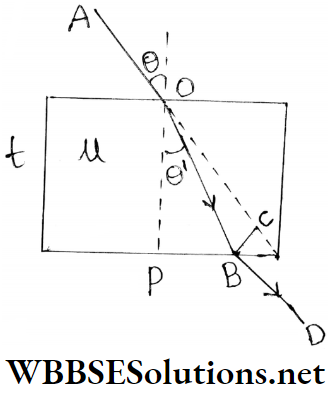
Question 15. A ray is incident at a small angle θ on a glass slab of thickness t. If the refractive index of glass is μ, show that the lateral displacement of the emergent ray from 45°/ the slab is t θ (μ-1)/μ.
Answer:

The lateral displacement of the emergent ray BD relative to the incident ray AO is BC

⇒ \(O B \cdot \frac{B C}{O B}=O P \cdot \frac{O B}{O P} \cdot \frac{B C}{O B}\)

= OP sec ∠BOP. sin ∠BOC

= t sec θ’ sin(θ – θ’ )

Class 12 Physics Unit 6 Optics Chapter 2 Refraction Of Light A Ray Incident At Small Angle

θ and  θ’ being small we have

sec  θ’ = \(\frac{1}{\cos \theta^{\prime}} \approx \frac{1}{1}\) = 1

sin( θ- θ’)≈θ- θ’

Bc= t(θ- θ’)= \(t \theta\left(1-\frac{\theta^{\prime}}{\theta}\right)\)

Again, \(\mu=\frac{\sin \theta}{\sin \theta^{\prime}} \approx \frac{\theta}{\theta^{\prime}}\)

Or, \(\frac{1}{\mu}=\frac{\theta^{\prime}}{\theta}\)

∴ Lateral displacement

BC = tθ \(\left(1-\frac{1}{\mu}\right)=t \theta \frac{(\mu-1)}{\mu}\)

Question 16. When a rectangular glass slab is placed on different coloured letters, the violet-coloured letter appears to be raised more. What is the reason behind it?

⇒ \(x=t\left(1-\frac{1}{\mu}\right)\)

Or, \((t-x)=\frac{t}{\mu}\)

Where t = thickness of the slab and u – refractive index for the particular colour of light.

Since Mv for violet colour is maximum, the value of (f-x) i.e., the distance of the letter from the top of the slab will be minimum, thus the letters of violet colour will seem to be raised more than other colours

17. For a few minutes before sunrise and a few minutes after sunset we can see the sun explain with proper reason
Answer:

As the height above the earth’s surface increases, the density of air decreases. Any ray coming obliquely from near the horizon gradually enters denser layers from rarer layers of air. So due to refraction, the ray bends towards the ground. This incident happens when the sun is below the horizon just after sunset and just before sunrise. If we see along the direction of the rays reaching us, the sun appears raised in position in the sky above the horizon

Class 12 Physics Unit 6 Optics Chapter 2 Refraction Of Light Sky Above The Horizon

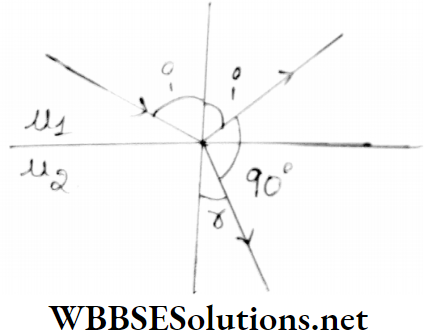
Question 18. A ray of light passing through the medium of refractive index μ1 is incident on the surface of separation of another medium of refractive index μ2. A part of the ray is reflected and another part is refracted. What should be the angle of incidence so that the reflected ray and the refracted ray are at right angles to each other?
Answer:

According to

i+ 90°+r = 180°

Or, r = 90°- i-r

By Snells law

μ1 sin i= μ2 sir r

Class 12 Physics Unit 6 Optics Chapter 2 Refraction Of Light A Light Passing Through The Medium Of Refractive Index

∴ \(\frac{\sin i}{\sin \left(90^{\circ}-i\right)}=\frac{\mu_2}{\mu_1}\)

Or, \(\frac{\sin i}{\cos i}=\frac{\mu_2}{\mu_1}\)

Or, \(\tan i=\frac{\mu_2}{\mu_1}\)

i = \(\tan ^{-1}\left(\frac{\mu_2}{\mu_1}\right)\)

Examples of Applications of Refraction in Optics

Question 19. A ray of light passes through a glass slab of thickness t and refractive index μ  If the velocity of light in vacuum c is then how much time will the light take to emerge from the slab?
Answer:

Velocity of light in the glass

v = \(\frac{c}{\mu}\)

∴ To overcome the glass slab of thickness t, time is taken by light

⇒ \(\frac{t}{v}=\frac{t}{\frac{c}{\mu}}\)

⇒ \(\frac{\mu t}{c}\)

Question 20. A bird is moving towards the water surface perpendicularly downwards. To a fish in the water just below the bird, where will the bird appear to be in comparison to its actual position?
Answer:

We know that if the object is in a rarer medium and the observer is in the denser medium then the refractive index of the denser medium,

μ = \(\frac{\text { apparent height of the object }}{\text { real height of the object }}\)

Here, \(\mu_w=\frac{\text { apparent height of bird }(x)}{\text { real height of bird }(d)}\)

x= μw × d

μw >1

∴ x>d

Therefore to the fish, the bird appears to be slightly higher than its actual position

Question 21. For a beam of light emerging from the glass into the air, for which visible spectral colour the critical angle of glass will be minimal?
Answer:

The wavelength of violet rays is the least among all the visible spectral colours. If wavelength decreases, the refractive index increases. Again when the refractive index increases, the critical angle decreases. Therefore,’ during refraction from glass to air the critical angle will be minimum for the violet-ray

Question 22. For the same angle of incidence, the angles of refraction for, Three different media A, H and C are 15°, 25° and 35° respectively. In which is the velocity of light minimum?
Answer:

The absolute refractive Index of a medium Is given by

= \(\frac{\sin i}{\sin r}=\frac{c}{v}\)

v = \(c \frac{\sin r}{\sin i}\)

Here, i = Angle of incidence,

r = Angle of refraction

c- Velocity of light in vacuum (constant)

v = Velocity of light In the required medium.

So, for the same angle of incidence i, v ∝ sin r. Therefore v mill is the minimum for the medium where slur i.e., r will be the minimum.

In this case, since the angle of refraction r is minimum In a medium A, the velocity of light is minimum in this medium.

Question 23. A glass prism is Immersed In winter. What change will take place In the value of the angle of minimum deviation? Answer: If the refractive indices of the material of the prism in air and water are aub and respectively. Then we can write,

⇒ \(a^{\mu_g}=\frac{\sin \frac{A+\delta_m}{2}}{\sin \frac{A}{2}}\)

⇒  \(w^{\mu_g}=\frac{\sin \frac{A+\delta_m^{\prime}}{2}}{\sin \frac{A}{2}}\)

Since wμg< aμg

Therefore δg< δg

That is The angle of minimum deviation decreases due to immersion of the prism in water.

Conceptual Questions on Total Internal Reflection

Question 24. A ray of light is incident on the face of a triangular glass prism and is reflected. What conclusion will you draw regarding the value of the refractive index of the glass prism?
Answer:

According to the ray of light is incident at a gle of 45° on the’ hypotenuse face and is reflected, I.e., in o. glass

The critical angle of gliosis concerning air-less

For the same angle of incidence the angles of refraction for than 45μ

We, know \(i_c=\sin ^{-1} \frac{1}{f}\)

⇒ \(\sin ^{-1} \frac{1}{11}<45^{\circ}\)

Or, \(\frac{1}{\mu}<\sin 15^{\circ}\)

Or, \(\frac{1}{\mu}<\sin 45^{\circ}\)

Or, \(\mu>\frac{1}{\sin 45^{\circ}} \quad \text { or, } \mu>\sqrt{2}\)

= 1.414

So, the value of the refractive index of glass will be higher than 1.414

Question 25. On placing a transparent glass cube page of a hook, it was found that the covered printed words are not visible from any of the lateral sides of the [WI3CHSE Sample Question] on the printed cube. Explain why? Answer: The refractive index of glass relative to air, (i = 1.5. So, the critical angle for the two media,
Answer:

The refractive index of glass relative to air, (i = 1.5)

So, the critical angle for the two media

= \(\sin ^{-1}\left(\frac{1}{\mu}\right)=\sin ^{-1}\left(\frac{1}{1.5}\right)\)

= 42° (nearly)

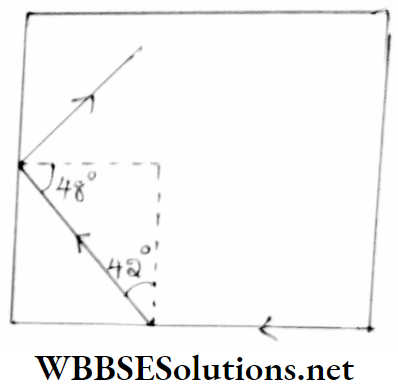
There is always a thin layer of air between the glass cube and the paper. If any ray from the printed words is incident on the lower surface of the cube even with the maximum angle of 90°, then it enters the glass with a maximum angle of refraction of 42°.

Then, the minimum angle of incidence of the ray on the side face of the cube becomes'(90°- 42°) or 48°. A total internal reflection occurs as this angle is greater than the critical angle, and no ray can emerge out of the side face.

Class 12 Physics Unit 6 Optics Chapter 2 Refraction Of Light Transparent Glass Cube

WBCHSE Class 12 Physics Notes For Magnetic Properties Of Materials

WBCHSE Class 12 Physics Magnetic Properties Notes

Magnetic Properties Of Materials Introduction

Electric dipole end electric dipole moment:

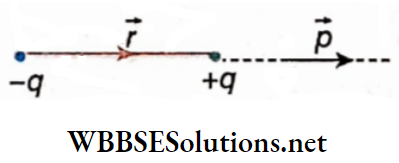
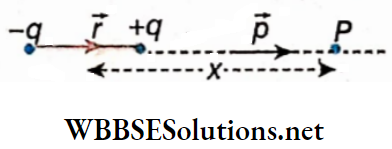
From the chapter ‘Electric Field’ we know that, two equal but opposite charges +q and -q kept close to each other form an electric dipole.

Electric dipole moment \(\vec{p}\) of this di[o;e is defined as:

⇒ \(\vec{p}=q \vec{r}\)….(1)

= magnitude of any charge x position vector of charge +q with respect to charge -q

So, the magnitude of \(\vec{p} \text { is } p=|\vec{p}|=q r\) and the direction is from -q to +q.

Electromagnetism electric dipole and electric dipole moment

Electric field on the axis of an electric dipole: Let p be a point on the axis of an electric dipole. If the distance

Electromagnetism Electric field on the axis of an electric dipole

X of the point P from the mid-point of the dipole be much greater than the length r of the dipole, the glottic field at the point P due to that dipole,

⇒ \(\vec{E}=\frac{1}{4 \pi \epsilon_0} \cdot \frac{2 \vec{p}}{x^3}\)

Here, ∈0 = permittivity of air or Vacuum

Read and Learn More Class 12 Physics Notes

= 8.854 x 10⁻¹² C2.N-1.m-2

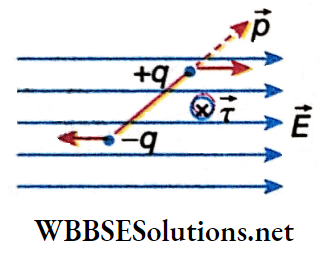
Torque on an electric dipole in a uniform electric field: \(\vec{E}\) is a uniform electric field (-q, +q) is an electric dipole whose dipole moment = \(\vec{p}\).

Now, the torque acting on the dipole due to the electric field \(\vec{E}\) is,

⇒ \(\vec{\tau}=\vec{p} \times \vec{E}\)

In the direction of \(\vec{\tau}\) is particularly downward concerning the page of the tired book, which Is denoted by the symbol\(\otimes\).

Electromagnetism Torque on an electric dipole in a uniform electric field

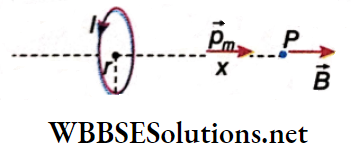
Magnetic field on the axis of a current loop:

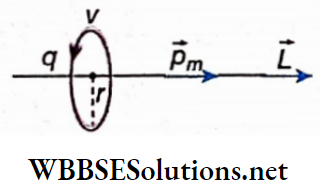
r = radius of a circle conductor of a single turn, i.e., the radius of the current loop,

I = current in that loop.

P is any point on the axis of the current loop which is at a distance x from the center of the loop.

Electromagnetism Magnetic field on the axis of a current loop

WBBSE Class 12 Magnetic Properties Notes

In the chapter ‘Electromagnetism’ we know that the magnetic field produced at the point P due to the current loop is,

⇒ \(B=\frac{\mu_0 I}{2} \cdot \frac{r^2}{\left(r^2+x^2\right)^{3 / 2}}\) [μ0 = magnetic permeability of air or vacuum = 4π x 10-7 Hm-1]

⇒ \(\text { If } r \ll x \text {, then } B \approx \frac{\mu_0 I}{2} \cdot \frac{r^2}{x^3}=\frac{\mu_0 I}{2 \pi} \cdot \frac{\pi r^2}{x^3}=\frac{\mu_0 I}{2 \pi} \cdot \frac{A}{x^3}\)

where, A = πr2 = area of the current loop.

∴ \(B=\frac{\mu_0}{4 \pi} \cdot \frac{2 I A}{x^3}\)

From the corkscrew rule we get, that the direction of \(\vec{B}\) is along the axis of the loop; the direction of \(\vec{B}\) at the point P is outward along the axis. Again, taking that direction as the direction of the area A, it can be expressed as \(\vec{A}\).

Therefore, \(\vec{B}=\frac{\mu_0}{4 \pi} \cdot \frac{2(\overrightarrow{I A})}{x^3}\)….(4)

WBCHSE Class 12 Physics Notes For Magnetic Properties Of Materials

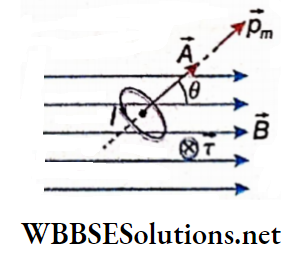
WBCHSE Class 12 Physics Magnetic Properties Notes Torque on a current loop in a uniform magnetic field:

In the chapter ‘Electromagnetism’ we know that, if a current loop of single turn is kept in a uniform magnetic field B, the torque acting on the loop is,

⇒ \(\vec{\tau}=\overrightarrow{I A} \times \vec{B}\)….(5)

The direction of this torque is perpendicularly downward concerning the page of the book, which is denoted by the symbol.

Electromagnetism Torque on a current loop in a uniform magnetic field

Class 12 Physics Magnetic Properties Of Materials

Magnetic Properties Of Materials Magnetic Dipole And Magnetic Dipole Moment Or Magnetic Moment

Comparing equations (2) and (4) and at the same time equations (3) and (5) as described, we get,

1. Electric field \(\vec{E}\) in electrostatics plays the same role as that of magnetic field \(\vec{B}\) in magnetism.

2. The role of the quantity \(\frac{1}{4 \pi \epsilon_0}\) in electrostatics is the same as that of the quantity \(\frac{\mu_0}{4 \pi}\) in magnetism.

3. The role of electric dipole moment \(\vec{p}\) in electrostatics is the same as the quantity I\(\vec{A}\) related to a current loop in magnetism.

Inference: Any current loop behaves as a magnetic dipole. The dipole moment of this dipole is,

⇒ \(\vec{p}_m=I \vec{A}\)

where, I = current through the loop, \(\vec{A}\) = area vector of the loop.

The magnitude of \(\vec{A}\) is the same as the magnitude of the area of the loop; the direction of \(\vec{A}\) is in the direction of advancement of the screw-head when a right-handed screw is rotated in the direction of current I through the loop.

Naturally, if the current loop contains N turns, it’s the magnetic moment, becoming \(\vec{p}_m=N I \vec{A}\).

Unit of magnetic moment:

Unit of pm = unit of I x unit of A

= ampere.metrer2 (A.m2)

In the CGS or Gaussian system:

The magnetic dipole moment of a current loop, \(\vec{p}_m \equiv I \vec{A}\); if the current loop contains N turns instead of a single turn, \(\vec{p}_m=N I \vec{A}\). Here, the units of

A, I and pm are cm2, emu of current, and emu.m2, respectively.

∴ 1 emu.cm2 = 10A x 10-4 m2

= 10-3 A.m2

Significance: Any current loop behaves as a magnetic dipole-it means that a current loop and a magnet having a north and a south pole are qualitatively equivalent. This similarity is discussed with the help of the following two examples.

Similarities between a circular conductor and a magnet:

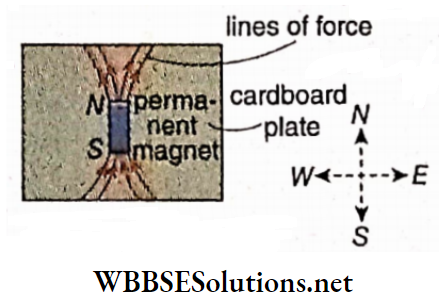
Magnetic lines of force near the center of a circular conductor are almost parallel to each other and they remain perpendicular to the plane of the circle.

So, almost a uniform magnetic field is generated at that region, which acts normally to the plane of the circular conductor.

Electromagnetism Similarities between a circular conductor and a magnet

Short Notes on Ferromagnetism and Paramagnetism

From the properties of magnetic lines of force of a permanent magnet, we know that, if the circular conductor is replaced by a small permanent magnet in that region, similar lines of force will be obtained.

So, we can conclude that a circular current-carrying coil behaves as a permanent magnet.

We can also get the rule for the determination of the polarity of the circular conductor.

Electromagnetism Similarities between a circular conductor and a magnet.

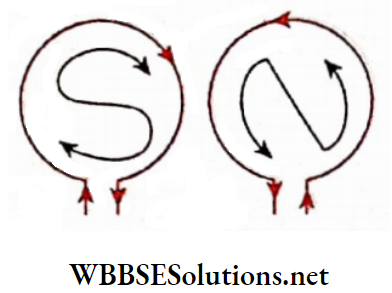
1. The face of a circular conductor on which the current appears to flow clockwise, develops a magnetic south pole.

2. The face of a circular conductor, on which the current appears to flow anticlockwise, develops a magnetic north pole.

With the help of the following experiment, the magnetic property of a circular conductor can be shown.

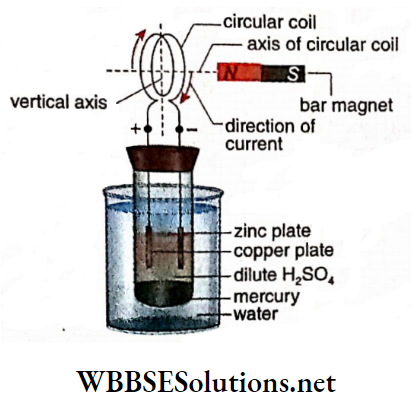
De la Rives floating battery: In a wide test tube some mercury is taken so that it can float upright in water

Electromagnetism de la Rives floating battery

Some dilute sulphuric acid (H2SO4) is poured into the test tube above mercury, and zinc and copper plates are dipped in the acid so that a voltaic cell is formed. This is known as a floating battery.

Two conducting wires from the two plates are brought outside the test tube through a cork fitted at the top.

These two wires act as two poles of the battery. Now the two ends of a circular coil are joined with those two poles. Usually, the coil contains several number of turns instead of a single turn.

When the coil is connected to the battery, the whole system begins to oscillate about a vertical axis.

At last, when the battery comes to rest, the axis of the circular coil sets itself in the north-south direction.

From this directive property, it is understood that the current-carrying coil behaves as a magnet.

With the help of a bar magnet, it can also be observed that like poles repel and unlike poles attract each other.

Class 12 Physics Magnetic Properties Of Materials Similarities between a current-carrying solenoid and a magnet:

The arrangement of the lines of force in the chapter ‘Electromagnetism’ is similar to the arrangement of lines of force of a bar magnet.

On the face, on which the direction of current flow appears clockwise, a magnetic south pole develops, and on the other face of the solenoid, a magnetic north pole develops.

So, we can conclude that a current-carrying solenoid behaves as a permanent bar magnet.

Experimental demonstration:

The magnetic properties of a solenoid can be shown by replacing the circular coil attached to the de la Rive’s floating battery with a solenoid.

In this case, also, the directive and the attractive or repulsive properties of the solenoid with another magnet are also observed.

Actually, from the similarities of a magnet and a current loop, it can be concluded that magnetism is not a separate branch of physics, rather it is a part of electricity and this specific subject is known as electromagnetism.

Pule-sought of a Magnet:

In modem theory of magnetism, the concept of the pole-strength of a magnet is not essential; but for the comparison with electrostatics and also to get an idea about the old theory of magnetism, we may discuss here about the pole-strength of a magnet.

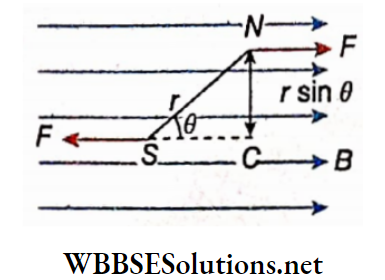
Let a bar magnet NS of effective length r be kept at an angle θ with the direction of a uniform magnetic f field \(\vec{B}\).

The effect on the N and S poles are equal and opposite; hence due to the magnetic field \(\vec{B}\), two equal but opposite forces will act on the two poles.

Electromagnetism Pule-strength of a Magnet

The distance between the line of action of the two forces, NC = rsinθ. So, the torque acting on the bar magnet due to these two forces,

\(\tau\) = magnitude of any one force x perpendicular distance between the two forces

= Frsinθ….(1)

substituting \(\vec{p}_m=I \vec{A}\) we get,

⇒ \(\vec{\tau}=\vec{p}_m \times \vec{B}\)

We get the value of the torque \(\vec{\tau}\),

⇒ \(\tau=p_m B \sin \theta\)

Since a current loop and a magnet are identical, from equations (1) and (2) we get,

⇒ \(F r \sin \theta=p_m B \sin \theta \quad \text { or, } F=\frac{p_m}{r} B=q_m B\)….(3)

The term qm is known as the pole strength of a magnet. The value of the pole-strength of each of the N and S poles is qm; conventionally the pole-strength of the N pole is taken as + qm and that of the S pole is taken as -qm.

Definition:

The ratio of the magnetic moment of a magnet to its effective length is called the pole strength of that magnet.

The strength of the two poles of the magnet is equal but opposite; the strength of the north pole is taken as positive and that of the south pole as negative.

Using the vector symbol, equation (3) can be written as

⇒ \(\vec{p}_m=q_m \vec{r} \text { and } \vec{F}=q_m \vec{B}\)

These two equations are identical to the equations \(\vec{p}=q \vec{r} \text { and } \vec{F}=q \vec{E}\) in electrostatics.

Due to the similarities between the electric field \(\vec{E}\) and magnetic field \(\vec{B}\), we can say that the role of positive arid negative charges (±q) in electrostatics is the same as that of the north and south poles (±qm) in electromagnetism.

Class 12 Physics Magnetic Properties Of Materials Unit of pole-strength:

In SI: \(\text { Unit of } q_m=\frac{\text { unit of } p_m}{\text { unit of } r}=\frac{\mathrm{A} \cdot \mathrm{m}^2}{\mathrm{~m}}=\mathrm{A} \cdot \mathrm{m}\)

In CGS: Unit of qm is emu of current cm;

⇒ \(1 \mathrm{emu} \text { of current } \cdot \mathrm{cm}=10 \mathrm{~A} \times 10^{-2} \mathrm{~m}=\frac{1}{10} \mathrm{~A} \cdot \mathrm{m}\)

The magnetic moment of a magnet: The magnetic moment of a magnet can also be defined from the concept of pole strength.

Definition: The product of the pole-strength of any pole of a magnet and its effective, length is called the magnetic moment of that magnet.

If the distance vector from the south pole to the north pole of a bar magnet is 2\(\vec{l}\) and its pole strength is qm, then the magnetic moment,

⇒ \(\vec{p}_m=2 q_m \vec{l}\)

Mutual force between two magnetic poles: We know that, for a charge q, the electric field at any point at a distance r from the charge = force acting on unit positive charge placed at that point,

⇒ \(\text { i.e., } E=\frac{1}{4 \pi \epsilon_0} \cdot \frac{q}{r^2}\) [∈0 = electrical permittivity of vacuum]

From analogy, we can say that the magnetic field at any point at a distance r from a magnetic pole of pole-strength qm = force acting on a unit north pole placed at that point,

⇒ \(\text { i.e., } B=\frac{\mu_0}{4 \pi} \cdot \frac{q_m}{r^2}\) [μ0 = magnetic permeability of vacuum]

If another magnetic pole of pole-strength ‘m is placed at a distance r from qm, from the equation F = qmB we can say that, force acting on that pole

⇒ \(F=\frac{\mu_0}{4 \pi} \cdot \frac{q_m \cdot q_m^{\prime}}{r^2}\)…(4)

According to Newton’s third law of motion, it is the mutual force acting between the poles having pole strengths qm and I’m. Equation (4) is called Coulomb’s law in magnetism.

If both the poles are north poles or both the poles are south poles, the product qmq’m becomes positive, and hence F is also positive. It means that the direction of F is the same as r, i.e., the force F is repulsive.

If the two poles are unlike, the product qmq am becomes negative. It means that F is in the direction opposite to r, i.e., the force F is attractive. From equation (4), we can say that the force acting between two magnetic poles is,

1. Directly proportional to the product of the pole strengths of the two poles, and

2. Inversely proportional to the square of the distance between the two poles.

In electrostatics, the similar law is the Coulomb’s law:

⇒ \(F=\frac{1}{4 \pi \epsilon_0} \cdot \frac{q q^{\prime}}{r^2}\)

In CGS or Gaussian system:

The corresponding relations of electric field E, magnetic intelligence H, and magnetic force Fin vacuum or in air are respectively,

⇒ \(E=\frac{q}{r^2}, H=\frac{q_m}{r^2} \text { and } F=\frac{q_m \dot{q}_m^{\prime}}{r^2}\)

Magnetic Field due to a Bar Magnet:

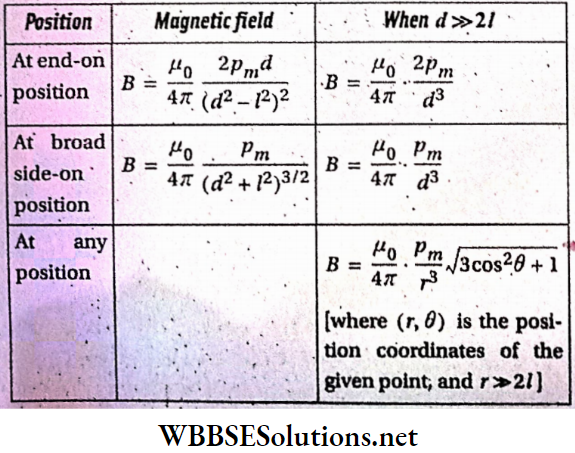
End-on or axial position:

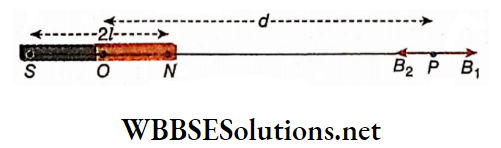
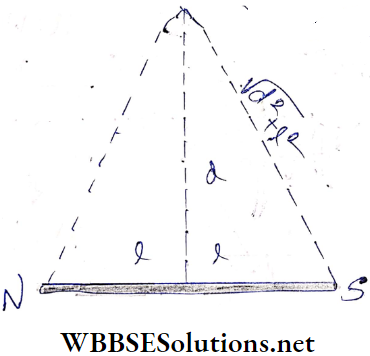
A bar magnet SN is kept in the air, Its pole strength is qm, and its magnetic length = SN = 21. A point P is taken on the axis of the magnet at a distance d from its mid-point O’.

The position of point P is called the end-on or axial position: We have to determine the magnetic field at point F, due to the magnet

Electromagnetism End on or axial position

Calculation: Magnetic field at the point P due to N-pole,

⇒ \(B_1=\frac{\mu_0}{4 \pi} \cdot \frac{q_m}{(d-l)^2} ; \text { the direction of } \vec{B}_1 \text { is along } \overrightarrow{O P}\)

Again, the magnetic field at the point P due to S-the pole,

⇒ \(B_2=\frac{\mu_0}{4 \pi} \cdot \frac{q_m}{(d+l)^2} ; \text { the direction of } \vec{B}_2 \text { is along } \overrightarrow{P O}\)

∵ The N-pole is nearer to P than the S-pole, and the value of B1 is greater than that of B2.

Therefore, the resultant magnetic field at the point P,

⇒ \(B=B_1-B_2=\frac{\mu_0}{4 \pi}\left[\frac{q_m}{(d-l)^2}-\frac{q_m}{(d+l)^2}\right]\)

⇒ \(\frac{\mu_0}{4 \pi} \cdot \frac{q_m \cdot 4 d l}{\left(d^2-l^2\right)^2}\)

= \(\frac{\mu_0}{4 \pi} \cdot \frac{2 p_m d}{\left(d^2-l^2\right)^2}\) [pm = qm.21 = magnetic moment of the bar magnet]

The direction of \(\vec{B}\) is along \(\vec{OP}\).

The vector representation of the equation is,

⇒ \(\vec{B}=\frac{\mu_0}{4 \pi} \cdot \frac{2 \vec{p}_m d}{\left(d^2-l^2\right)^2}\)

The resultant magnetic intensity in the CGS system

⇒ \(H=\frac{2 p_m d}{\left(d^2-l^2\right)^2}\)

If the length of the bar magnet is very small and the point p is taken at a very- large distance from the bar magnet, l.e., d>>l, then (d²- l²)² ≈ d4.

∴ \(B=\frac{\mu_0}{4 \pi} \cdot \frac{2 p_m}{d^3}\)

Class 11 Physics Class 12 Maths Class 11 Chemistry
NEET Foundation Class 12 Physics NEET Physics

Broadside on or equatorial position:

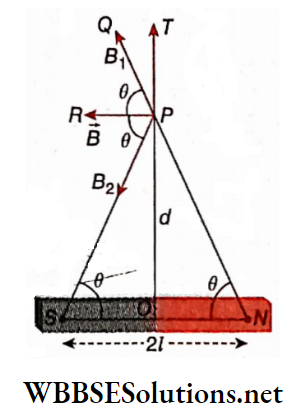
A bar magnet SN is kept in the air, its pole strength is qm, and magnetic length = SN = 2l.

A point P is taken on the perpendicular bisector of the magnetic length and at a distance d from the mid-point O of the magnet.

The position of the point p is called the broadside-oil or equatorial position. We have to determine the magnetic field at the point P due to the magnet.

Electromagnetism Broadside on or equatorial position

Calculation: Magnetic field at the point P due to N-pole,

⇒ \(B_1=\frac{\mu_0}{4 \pi} \cdot \frac{q_m}{N P^2} \text {; the direction of } \vec{B}_1 \text { is along } \overrightarrow{P Q}\)

Again, the magnetic field at the point P due to the S-pole,

⇒ \(B_2=\frac{\mu_0}{4 \pi} \cdot \frac{q_m}{S P^2} ; \text { the direction of } \vec{B}_2 \text { is along } \overrightarrow{P S}\)

The components of B1 and B2, i.e., B1sinθ and B2sinθ, along with PT and PO respectively, cancel each other.

On the other hand, the components B1cosθ and B2cosθ along PR are added together.

So, the resultant magnetic field at the point P,

B = 2B1cosθ [∵ magnitudes of B1 , B2 are equal]

or, \(B=\frac{2 \mu_0}{4 \pi} \cdot \frac{q_m}{N P^2} \cos \theta=\frac{2 \mu_0}{4 \pi} \cdot \frac{q_m}{\left(d^2+l^2\right)} \cdot \frac{l}{\sqrt{d^2+l^2}}\)

⇒ \(\frac{\mu_0}{4 \pi} \cdot \frac{p_m}{\left(d^2+l^2\right)^{3 / 2}} \text {; the direction of } \vec{B} \text { is along } \overrightarrow{P R}\)

The vector representation of the equation is,

⇒ \(\vec{B}=-\frac{\mu_0}{4 \pi} \cdot \frac{\vec{p}_m}{\left(d^2+l^2\right)^{3 / 2}}\)

The resultant magnetic intensity in the CGS system,

⇒ \(H=\frac{p_m}{\left(d^2+l^2\right)^{3 / 2}}\)

If the length of the bar magnet is very small and the point P is
taken at a very large distance from the bar magnet, i.e., l<<d

then, \(B=\frac{\mu_0}{4 \pi} \cdot \frac{p_m}{d^3}\)

So, magnetic field at the end-on or axial position = 2 x magnetic field at the broadside-on or equatorial position

Magnetic Properties notes for Class 12 WBCHSE Any position:

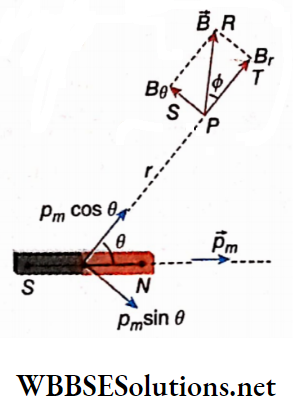
Concerning the bar magnet of magnetic length 2l, the point P under consideration is at the position (r, θ), i.e., the point P is at a distance r from the mid-point of the magnet and lies at an angle θ with the magnetic axis.

The component of pm along r is pmcosθ; concerning this component, the point P is at the end of the position, and hence the magnetic field at the point P,

Electromagnetism bar magnet of magnetic length

⇒ \(B_r=\frac{\mu_0}{4 \pi} \cdot \frac{2 p_m \cos \theta}{r^3}(∵ r \gg l)\)

Again, the component of pm normal to r is pmsinθ; concerning this component point P is at the equatorial position, and hence the magnetic field at point P,

⇒ \(B_\theta=\frac{\mu_0}{4 \pi} \cdot \frac{p_m \sin \theta}{r^3}\)

So, according to the resultant magnetic field at the point P,

⇒ \(B=\sqrt{B_r^2+B_\theta^2}=\sqrt{\left(\frac{\mu_0}{4 \pi} \cdot \frac{p_m}{r^3}\right)^2\left(4 \cos ^2 \theta+\sin ^2 \theta\right)}\)

⇒ \(\frac{\mu_0}{4 \pi} \cdot \frac{p_m}{r^3} \sqrt{3 \cos ^2 \theta+1}\)

The direction of \(\vec{B} \text { is along } \overrightarrow{P R} \text {; where } \angle T P R=\phi \text { (say) }\)

∴ \(\tan \phi=\frac{B_\theta}{B_r}=\frac{1}{2} \tan \theta\)

The resultant magnetic intensity in the CGS system,

⇒ \(H=\frac{p_m}{r^3} \sqrt{3 \cos ^2 \theta+1}\)

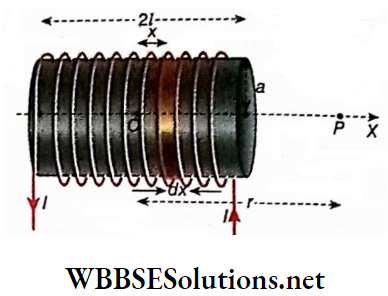
Equivalence of a solenoid and a bar magnet: Let us assume a solenoid of radius = a, length = 2l, number of turns per unit length = n. Current through it = I.

So, the total number of turns of the solenoid = 2ln, and hence the effective net current around its axis =2lnI. As the cross-sectional area of the solenoid = πa², so, the magnetic dipole moment of the current-carrying solenoid,

⇒ \(p_m=(2 \ln I) \cdot\left(\pi a^2\right)=2 \pi \ln a^2 I\)

Electromagnetism Equivalence of a solenoid and a bar magnet

Now the center (O) of the solenoid is taken as the origin and its axis as the x-axis. Considering a small length dx at a distance x from 0, we get a circular current-carrying coil with several turns dx. For this coil, the magnetic field is thus produced at a point P on the axis (where, OP = r and r>>a, r>>x),

⇒ \(d B=\frac{\mu_0(n d x) I}{2} \cdot \frac{a^2}{\left\{a^2+(r-x)^2\right\}^{3 / 2}}=\frac{\mu_0 n I a^2}{2 r^3} d x\) [As a and x are negligible with respect to r, \(\left\{a^2+(r-x)^2\right\}^{3 / 2} \approx r^3\)]

So, the magnetic field at P for the entire solenoid,

⇒ \(B=\frac{\mu_0 n I a^2}{2 r^3} \int_{-l}^l d x=\frac{\mu_0 n I a^2}{2 r^3} \cdot 2 l=\frac{\mu_0}{4 \pi} \cdot \frac{2\left(2 \pi \ln a^2 I\right)}{r^3}\)

i.e., \(B=\frac{\mu_0}{4 \pi} \frac{2 p_m}{r^3}\)

In this very section, we have already found the same expression due to a bar magnet. Thus we conclude that a bar magnet and a current-carrying solenoid are equivalent to each other.

Comparing their magnetic moments, we get,

⇒ \(q_m \cdot 2 l=2 \pi \ln a^2 I \quad \text { or, } q_m=\pi n a^2 I\)

Magnetic Properties Notes For Class 12 WBCHSE

Magnetic Moment of Charged Particle Moving in a Circle:

We know that a revolving charged particle is equivalent to an electric current. So, the orbit of that particle is equivalent to a current loop and as a result, it behaves as a magnetic dipole which must have a magnetic moment.

Suppose a particle having a charge q is revolving in a plane circular path; r = radius of the orbit of that particle and v = velocity of the particle.

Electromagnetism Magnetic Moment of Charged Particle moving in a circle

The period of revolution of the particle, \(T=\frac{2 \pi r}{v}\)

∴ Equivalent current, \(I=\frac{q}{T}=\frac{q v}{2 \pi r}\)

So, the magnetic moment of the particle,

⇒ \(p_m=\frac{q \nu}{2 \pi r} \cdot A=\frac{q \nu}{2 \pi r} \cdot \pi r^2=\frac{q v r}{2}\)

The direction of this magnetic moment pm can be obtained by applying a corkscrew rule. If the mass of the particle is m then along the axis of the circular path, Le., along the direction of pm, the angular momentum of the particle,

L = mv [L = moment of momentum = momentum x radius of circular path]

∴ \(p_m=\frac{q v r}{2}=\frac{q}{2 m} \cdot m v r=\frac{q}{2 m} L\)

Since the directions of pm and L are the same, using vector notation we can write,

⇒ \(\vec{p}_m=\frac{q}{2 m} \vec{L}\)…(1)

Magnetic dipole moment of an electron:

Electrons inside an atom revolve around the nucleus continuously. As a revolving charged particle, each electron behaves as a magnetic dipole. Substituting the charge of an electron -e in place of q in equation (1), we can write,

⇒ \(\vec{p}_m=-\frac{e}{2 m} \cdot \vec{L}\)…(2)

The negative sign on the right-hand side indicates that the charge of an electron is negative, its angular momentum and magnetic moment are oppositely directed.

From Bohr’s theory related to atomic structure: Atoms, it is known that electrons revolving in different orbits have discrete angular momenta, defined as

⇒ \(L=n \frac{h}{2 \pi}=n \hbar \quad[n=1,2,3, \cdots]\)

Here, \(h=\text { Planck’s constant }=6.626 \times 10^{-34} \mathrm{~J} \cdot \mathrm{s} \text { and } \dot{\hbar}=\frac{h}{2 \pi}\)

= 1.05 x 10⁻³⁴ J.s = reduced Planck’s constant

So, the magnitude of the magnetic moment of an electron [from equation (2)],

⇒ \(p_m=\frac{e}{2 m} n \hbar=n \frac{e \hbar}{2 m}\)….(3)

In the case of the innermost orbit of an atom (K-orbit), n = 1; then \(p_m=\frac{e \hbar}{2 m}\) – this quantity is called Bohr magneton. It is denoted by μB and it is the atomic unit of the magnetic moment

⇒ \(I \mu_B=\frac{e h}{2 m}=\frac{\left.\left(1.6 \times 10^{-19} \mathrm{C}\right) \times\left(1.05 \times 10^{-34}\right) \cdot s\right)}{2 \times\left(9.1 \times 10^{-31} \mathrm{~kg}\right)}\)

= 9.23 x 10⁻²⁴ A m2

= 9.23 x 10⁻²⁴ J. T-1

The spin of an electron: Besides the revolution of each electron in its orbit, it also rotates about its axis (like the diurnal motion of the earth). This is known as the spin of an electron. An electron may have any of two oppositely directed spins.

One kind of spin (say clockwise) is called up spin and is denoted by ( symbol) The opposite kind of spin is then known as down spin and is denoted by the symbol.

Due to the spin of any electron. a magnetic moment generates. By theoretical analysis, its Value is found to be l Bohr magneton. It is allied tire intrinsic spin magnetic moment.

The concept of rotation of an electron about its axis is oversimplified and requires quantum physics for a proper explanation.

The magnetism of an atom: If the resultant moment i.e., the vector sum of tire magnetic moments of the electrons rotating, around the nucleus inside an atom is zero, we can say that the atom as a whole does not show the airy magnetic property.

On the other hand, if the resultant is not zero, the tire atom behaves like a magnetic dipole. Due to this property, each atom or molecule of iron, nickel eta behaves like a small magnet and is called an atomic magnet.

Magnetic Properties Notes For Class 12 WBCHSE

Magnetic Properties Of Materials Numerical Examples

Example 1. A torque of 8 units is applied on a magnet when it is kept at 30° with the direction of a uniform magnetic field of intensity 0.32 units. Determine the magnetic moment of the magnet.
Solution:

If a magnet having magnetic moment pm is placed inclined at an angle θ with a uniform magnetic field B, the torque acting on the magnet,

⇒ \(\tau=p_m B \sin \theta\)

Here, B = 0.32 units, θ = 30° and \(\tau\) = 8 units.

∴ \(p_m=\frac{\tau}{B \sin \theta}=\frac{8}{0.32 \times \sin 30^{\circ}}\)

⇒ \(\frac{8}{0.32 \times \frac{1}{2}}=50 \text { units }\)

Practice Problems on Magnetization

Example 2. lf the distance between two north poles of equal strength is 2 cm, the mutual force of repulsion between them becomes 2.5 dyn. What should be the distance of separation between them for which the repulsive force becomes 3.6 dyn?
Solution:

Magnetic force between two magnetic poles,

⇒ \(F=\frac{\mu_0}{4 \pi} \cdot \frac{q_m \cdot q_m^{\prime}}{r^2}\)

So, if the pole strength remains unchanged then, \(F \propto \frac{1}{r^2}\)

Hence, for two separate distances,

⇒ \(\frac{F_1}{F_2}=\left(\frac{r_2}{r_1}\right)^2 \quad \text { or, } \frac{r_2}{r_1}=\sqrt{\frac{F_1}{F_2}}\)

∴ \(r_2=r_1 \sqrt{\frac{F_1}{F_2}}=2 \times \sqrt{\frac{2.5}{3.6}}=2 \times \frac{5}{6}\)

= 1.67cm

Example 3. The length of a bar magnet is 20 cm and its magnetic moment is 0.6 Am2. Determine the magnetic field at a point 30 cm away from either end.
Solution:

PN = PS

= 30 cm

= 0.3 m

= \(\sqrt{d^2+l^2}\)

The magnetic field at the point P due to the magnet,

⇒ \(B=\frac{\mu_0}{4 \pi} \cdot \frac{p_m}{\left(d^2+l^2\right)^{3 / 2}}\)

⇒ \(\frac{4 \pi \times 10^{-7}}{4 \pi} \times \frac{0.6}{(0.3)^3}\)

= 2.22 x 10⁻⁶ Wb.m-2

Electromagnetism Example 3 The length of a bar magne

Example 4. The length of a bar magnet is 20 cm and its magnetic moment is 0.6 A.m2. Determine the magnetic field at a point on the axis of the magnet and 30 cm away from the north pole.
Solution:

Length of the magnet. 2l = 20 cm

= 0.2 m

So, l = 0.1 m

Distance of the given point from the center of the magnet,

d = (0.3 + 0.1)m

= 0.4 m

∴ The magnetic field at the given point due to the magnet,

⇒ \(B=\frac{\mu_0}{4 \pi} \cdot \frac{2 p_m d}{\left(d^2-l^2\right)^2}=\frac{4 \pi \times 10^{-7}}{4 \pi} \times \frac{2 \times 0.6 \times 0.4}{\left\{(0.4)^2-(0.1)^2\right\}^2}\)

⇒ \(10^{-7} \times \frac{0.48}{0.0225}=2.13 \times 10^{-6} \mathrm{~Wb} \cdot \mathrm{m}^{-2}\)

WBCHSE Class 12 Physics Chapter 6 solutions

Example 5. The radius of a circular conducting coil of 100 turns Is 10 cm. If 2A current passes through the coil, what will be the magnetic moment generated?
Solution:

Magnetic moment,

pm = NIA = NIπr2

= 100 x 2 x (π x 0.1 x 0.1) [∵ 10 cm = 0.1 m]

= 6.28 A.m2

Example 6. If the magnetic moment of a straight magnetized wire is pm, what will be Its magnetic moment when the wire is bent in the form of a semicircle?
Solution:

Let the length of the magnetized wire be l.

∴ Pole-strength of the wire, \(m=\frac{p_m}{l}\)

When the wire is bent in the form of a semicircle, its effective length = diameter of the semicircle = 2r.

According to the problem, \(\pi r=l \quad \text { or, } r=\frac{l}{\pi}\)

∴ The changed magnetic moment of the wire = effective length x pole-strength

⇒ \(2 r \times \frac{p_m}{l}=\frac{2 l}{\pi} \cdot \frac{p_m}{l}=\frac{2 p_m}{\pi}\)

Example 7. The magnetic moments of two small magnets are pm and p’m; they are kept on a table. What will be the magnitude and direction of the magnetic field produced by the gents at point P? [pm = 2.7 A m2, pm = 3,2 A m2; d1 = 30 cm, d2 = 40 cm]

Electromagnetism Example 7 Magnetic moments of two small magnets

Solution:

According to the point, P lies on the perpendicular bisectors of both magnets.

The magnetic field at the point P due to the magnet having magnetic moment pm,

⇒ \(B_1=\frac{\mu_0}{4 \pi} \cdot \frac{p_m}{d_1^3}=10^{-7} \times \frac{2.7}{(0.3)^3}=10^{-5} \mathrm{~T}\)

At point P, the magnetic field due to the magnet having magnetic moment I’m is,

⇒ \(B_2=\frac{\mu_0}{4 \pi} \cdot \frac{p_m^{\prime}}{d_2^3}=10^{-7} \times \frac{3.2}{(0.4)^3}=5 \times 10^{-6} \mathrm{~T}\)

Since these two magnetic fields are perpendicular to each other, the resultant magnetic field at the point P,

⇒ \(B=\sqrt{B_1^2+B_2^2}\)

⇒ \(\sqrt{\left(10^{-5}\right)^2+\left(5 \times 10^{-6}\right)^2}\)

= 1.12 x 10⁻⁵T

If the resultant magnetic field makes an angle θ with B1, then,

⇒ \(\tan \theta=\frac{B_2}{B_1}=\frac{5 \times 10^{-6}}{10^{-5}}=0.5\)

∴ \(\theta=\tan ^{-1}(0.5)=26.57^{\circ}\)

Conceptual Questions on Magnetic Field Lines 

Example 8. Two bar magnets A and B, each having a magnetic length of 4 cm are placed along a straight line with their north poles 8 cm apart and facing each other. The neutral point lies on the axis, 2 cm from the north pole of the magnet A. Calculate the ratio of the magnetic moments of A and B.
Solution:

O is die neutral point.

Given, NO = 2 cm

N’O = (8-2)

= 6 cm

⇒ \(X N=X^{\prime} N^{\prime}=l=\frac{4}{2} \mathrm{~cm}=2 \times 10^{-2} \mathrm{~m}\)

d1 = XO

= (2 + 2) cm

= 4 x 10⁻³ m

d2 = X’O

= (6 + 2) cm

= 8 x 10⁻³ m

Electromagnetism Example 8 Two bar magnets

∴ The magnetic field at point O due to the magnet A,

⇒ \(B_1=\frac{\mu_0}{4 \pi} \frac{2 p_{m_1} d_1}{\left(d_1^2-l^2\right)^2}\)

or, \(B_1=\frac{\mu_0}{4 \pi} \frac{2 p_{m_1} \times 4 \times 10^{-2}}{\left[\left(4 \times 10^{-2}\right)^2-\left(2 \times 10^{-2}\right)^2\right]^2}\)

⇒ \(=\frac{\mu_0}{4 \pi} \cdot \frac{2 p_{m_1} \times 4 \times 10^{-2}}{(16-4)^2 \times 10^{-8}}\)

∴ The magnetic field at O due to the magnet B,

⇒ \(B_2=\frac{\mu_0}{4 \pi} \frac{2 p_{m_2} \times 8 \times 10^{-2}}{\left[\left(8 \times 10^{-2}\right)^2-\left(2 \times 10^{-2}\right)^2\right]^2}\)

⇒ \(\frac{\mu_0}{4 \pi} \cdot \frac{2 p_{m_2} \times 8 \times 10^{-2}}{(64-4)^2 \times 10^{-8}}\)

According to the question, B1 = B2

∴ \(\frac{\mu_0}{4 \pi} \cdot \frac{2 p_{m_1} \times 4 \times 10^{-2}}{144 \times 10^{-8}}=\frac{\mu_0}{4 \pi} \cdot \frac{2 p_{m_2} \times 8 \times 10^{-2}}{3600 \times 10^{-8}}\)

or, \(\frac{p_{m_1}}{p_{m_2}}=\frac{2 \times 144}{3600}=\frac{2}{25}\)

∴ Ratio of the magnetic moments \(p_{m_1}: p_{m_2}=2: 25\)

WBCHSE Class 12 Physics Chapter 6 Solutions

Magnetic Properties Of Materials Magnetic Lines Of Induction

The magnetic lines of force in a uniform magnetic field are equidistant parallel straight lines.

If a piece of any magnetic material (i.e., iron, steel, nickel, etc.) is placed in this kind of external magnetic field, a magnetic field is induced in the specimen which is converted into a temporary magnet. The external magnetic field is referred to as the inducing magnetic field.

Electromagnetism Magnetic lines of induction

Let an iron bar PQ be placed parallel to a uniform magnetic field. At the end of PQ through which the magnetic lines of force enter, an S-pole is developed and at the other end, an AT-pole is developed.

So, due to induction, the magnetic lines of force are rearranged. This rearrangement inside and outside the magnetic material is discussed below.

The lines inside the magnetic material are generated due to the superposition of two kinds of lines of force:

  1. The lines of force are due to the inducing magnetic field.
  2. The lines of magnetization (the magnetic material is temporarily converted into a magnet due to induction and the lines of the magnetic field of this temporary magnet are called lines of magnetization).

Electromagnetism magnetic material

The lines of force outside the magnetic material are generated due to the superposition of two types of lines of force:

  1. The lines of force due to inducing magnetic field
  2. The lines of force are due to the temporary magnetic field of the magnetized specimen.

Outside the iron bar, the lines of force suffer bending and inside the bar are densely crowded. In the region adjacent to points A and B outside the iron bar, the lines of force are less dense.

Note that, inside the bar PQ, the lines of force of the inducing field and the lines of magnetization are unidirectional. It means that inside the bar PQ, the resultant of the two magnetic fields increases, and hence in that region and the adjacent regions C and D, the lines of force are densely crowded.

In the regions adjacent to points A and B, the inducing magnetic field and the temporary magnetic field are oppositely directed and hence the resultant magnetic field decreases there. So the lines of force become less dense in that region

Definition:

The lines of force generated inside a magnetic material due to the superposition of the lines of force of the inducing magnetic field and the lines of magnetization are called the lines of induction.

Outside a magnetic material lines of magnetic induction follow magnetic lines of force. In some materials, called diamagnetic materials, the scenario would be the reverse of the above picture

Magnetic Properties Of Materials Some Magnetic Quantities And Their Relations

Magnetic permeability of a material:

Let the current through a long straight solenoid = I; the number of turns per unit length of the solenoid = n.

If air or vacuum is taken as the core of the solenoid, the magnetic field produced along the axis of the solenoid,

B0 = μ0nI…(1)

where, μ0 = magnetic permeability of vacuum (or air)

= 4π x 10-7 H.m-1

If a rod of any material is introduced inside the solenoid co-axially, the magnetic field along the axis of the solenoid will change; this magnetic field can be expressed as,

B = μnI….(2)

This quantity ju is called the magnetic permeability of the material used.

Relative magnetic permeability: If air or vacuum is replaced by a material, the fractional change of magnetic field in that material is called the relative magnetic permeability of that material.

So, relative magnetic permeability,

⇒ \(\mu_r=\frac{B}{B_0}=\frac{\mu n I}{\mu_o n I}=\frac{\mu}{\mu_0}\)….(3)

Unit: Equations (1) and (2) show that the units of μ0 are the same, i.e., H m-1.

Again, equation (3) shows that being the ratio of two identical quantities μ and μ0, μr has no unit.

Classification of materials: Depending on the value of relative magnetic permeability μr, different materials can be divided into three groups.

1. \(\mu_r<1 \text {, i.e., } \mu<\mu_0\): Diamagnetic material;

2. \(\mu_r>1 \text {, i.e., } \mu>\mu_0\): Paramagnetic material;

3. \(\mu_r \gg 1 \text {, i.e., } \mu \gg \mu_0\): Ferromagnetic material.

For Example, in the case of aluminum, μr = 1.00002, hence it is a paramagnetic material; in the case of copper, μr = 0.9999904, hence it is a diamagnetic material; in the case of iron, μr = 1000 to 5000 (approx.), hence it is a ferromagnetic material. These materials are discussed elaborately later

Magnetization: If the magnetizing field at any point in vacuum or air is \(\vec{B}\), the magnetic field at that point, \(\vec{B}_0=\mu_0 \vec{H}\).

If vacuum or air at a point is replaced by any other material, magnetism is induced in that material and hence the magnetic field acting will also change from \(\vec{B}_0 \text { to } \vec{B}\) (say).

Naturally, \(\vec{B} \neq \mu_0 \vec{H}\). If the material is paramagnetic or ferromagnetic, \(\vec{B}>\mu_0 \vec{H}\). Here, it is assumed that,

⇒ \(\vec{B}=\mu_0 \vec{H}+\mu_0 \vec{M}=\mu_0(\vec{H}+\vec{M})\)….(4)

The first term on the right-hand side \(\left(\mu_0 \vec{H}\right)\) comes from the magnetizing field \(\vec{H}\) produced because of electric current or some other external cause, and tire second term \(\left(\mu_0 \vec{M}\right)\) comes due to induced magnetism inside the material.

So, the term \(\mu_0 \vec{M}\) indicates the additional magnetic field produced due to magnetic induction.

The quantity \(\vec{M}\) is called the intensity of magnetization of the material or simply the magnetization vector, the magnitude of which at a point is given as the net dipole moment per unit volume around that point.

By calculation, we can show that (this calculation is omitted here), the magnetic moment per unit volume of a material is \(\vec{M}\).

Definition: If the unit volume is considered around any point in a material, the magnetic moment of that volume is called the intensity of magnetization at that point. So, relative magnetic permeability

Unit: From equation (4) it is clear that the unit of \(\vec{M}\) is the same as the unit of \(\vec{H}\).

This unit is A.m-1. \(\vec{B}\), \(\vec{H}\) and \(\vec{M}\) are called the three magnetic vectors,

Magnetic susceptibility of material: In most materials, the intensity of magnetization at a point is directly proportional to the magnetic intensity at that point, i.e.,

⇒ \(M \propto H \quad \text { or, } M=k H\)

This constant fc is called the magnetic susceptibility of the material. The property by which a material can be magnetized is its magnetic susceptibility.

In vector form, \(\vec{M}\) = k\(\vec{H}\)….(5)

Now, if H = 1, k = M; from this we can define k.

Important Definitions in Magnetism

Definition: The magnetic moment induced per unit volume of a material due to unit magnetic intensity is called the magnetic susceptibility of that material.

Unit: Since the units of M and H are the same, k has no unit.

Mass (magnetic) susceptibility: The ratio of the magnetic susceptibility of a material and its density is called the mass susceptibility of that material. It Is denoted by the symbol \(\chi\).

∴ Mass susceptibility,

⇒ \(x=\frac{k}{\rho}\) [where, ρ = density of the material]

Rotation between magnetic susceptibility and relative magnetic permeability:

We know that,

⇒ \(\vec{B}=\mu \vec{H}\)

⇒ \(\vec{B}=\mu_0(\vec{H}+\vec{M}) \text { and } \vec{M}=k \vec{H}\) [from equations (4) and (5)]

Combining them we can write,

⇒ \(\mu \vec{H}=\mu_0(\vec{H}+\vec{M})=\mu_0(\vec{H}+k \vec{H})=\mu_0(1+k) \vec{H}\)

∴ \(\frac{\mu}{\mu_0}=1+k \quad \text { or, } \mu_r=1+k\) [\(\mu_r=\frac{\mu}{\mu_0}\) = relative magnetic permeability]

or, k = μr – 1….(6)

For vacuum or air, μr = 1 , hence, k = 0

The values of μr and k of some materials:

Electromagnetism The values of μr and k of some materials

Hence, for paramagnetic material, k > 0 (positive); for diamagnetic material, k<0 (negative); for ferromagnetic material, k >> 0 (large positive number).

Significance:

1. In the case of paramagnetic and diamagnetic materials magnetic susceptibilities are very low and are respectively positive and negative numbers.

This means that magnetic induction in these materials is negligible. Thus, these are called non-magnetic materials.

2. On the other hand, in the case of ferromagnetic materials magnetic susceptibilities are large positive numbers.

Hence, in this kind of material, strong magnetic induction takes place. Thus, these are known as magnetic materials (e.g., iron, nickel, cobalt).

Since the value of k is very large, from the relation, \(\vec{B}=\mu_0(\vec{H}+\vec{M})=\mu_0(\vec{H}+k \vec{H})\), we come to know that the term pgM is much greater than the term p0H.

So, the magnitude of the magnetic field \(\vec{B}\) is mainly determined by induced magnetism.

In CGS or Gaussian system:

Equations (l) and (2) respectively, can be replaced by the relations, H0 = 4π ni [magnetic permeability of vacuum or air =1 ] and H = 4πμni [magnetic permeability of the material = μ] So, relative magnetic permeability, \(\mu_r=\frac{H}{H_0}=\mu\); so in this system, magnetic permeability and relative magnetic permeability of a material are the same.

Again, in this system equation (4) is written as,

⇒ \(\vec{B}=\vec{H}+4 \pi \vec{M}\)

But we know that, \(\vec{B}=\mu \vec{H}\)

So, \(\mu \vec{H}=\vec{H}+4 \pi k \vec{H} \quad[∵ \vec{M}=k \vec{H}]\)

⇒ \(\mu=1+4 \pi k \quad \text { or, } k=\frac{\mu-1}{4 \pi}\)

Magnetic retentivity and coercivity:

When a magnetic material is placed in a magnetic field, the material acquires magnetism due to induction. This magnetism does not vanish completely even after the withdrawal of the magnetic field; some amount of magnetism is left behind in the material.

Magnetic retentivity:

The property by which a magnetic material retains some magnetism in it even after the withdrawal of the magnetizing field is called the retentivity of that material.

The magnetism, retained in a magnetic material even after the removal of the magnetic field applied to it, is called residual magnetism.

There are some magnetic materials for which the residual magnetism is almost zero, i.e., they are almost completely demagnetized.

Magnetic coercivity: The property by which magnetic material can retain induced magnetism even if used roughly, i.e., subjected to demagnetizing forces, is called the coercivity of that material.

Differences between wrought iron and steel on magnetic properties:

If two identical rods one of soft iron and the other of steel-are placed in the same magnetic field, both of them acquire approximately equal amounts of magnetism.

If the rods are then removed from the magnetic field, both soft iron and steel retain almost the entire magnetism.

Soft iron can hold slightly more magnetism than steel. But if this soft iron magnet is handled roughly, its magnetism dies out easily compared to that of steel.

So, it can be said that the magnetic retentivity of soft iron is slightly greater, but the coercivity of soft iron is much less than that of steel.

Electromagnetism differences between wrought iron and steel on magnetic properties

A ferromagnetic material can be converted into a strong magnet easily. In the case of a ferromagnetic material like soft iron or steel, if a graph of intensity of magnetization (M) vs magnetic field intensity (H) is drawn, we will get a closed loop.

It is known as the magnetization cycle. In the case of steel, the loop is OABCDA and in the case of soft iron, the loop is OA’B’C’D’A’. From the graph, it is evident that the intensity of magnetization (M) is not zero ( OB or OB’) even if the magnetic field intensity (H) is reduced to zero from its maximum value, i.e., M lags behind H.

This lagging of the intensity of magnetization is called hysteresis. However, M falls to zero if H is given a certain value (OC or OC’) in the opposite direction. According to the diagram, OB is the retentivity of steel, OB’ is the retentivity of soft iron, OC is the coercivity of steel, and OC’ is the coercivity of soft iron.

Selection of material to construct a permanent magnet:

The magnetic material chosen to construct a permanent magnet should have the following properties m The material should have high retentivity so that it can retain sufficient magnetism even after the withdrawal of the magnetizing field.

If The saturation magnetization of the material should be high enough it can make a strong polarity.

The material should also have high coercivity so that it can retain induced magnetization, even if used roughly. The magnetic susceptibility of the material should be of high magnitude.

Though all of the above properties do not match properly, steel, rather than soft iron is used to construct permanent magnets.

Besides steel, there are some metallic alloys like alnico (Fe 51%, Cu 3%, A1 8%, Ni 14%, Co 24% ); national (Fe 47%, Cu 3%, A1 8%, Ti 2%, Ni 15%, Co 25% ), etc. possess the above-mentioned qualities and can be used to construct permanent magnets.

Selection of material to construct an electromagnet: To construct an electromagnet, a material that possesses the following properties should be chosen.

1. The material should have low retentivity so that it can lose almost all of its magnetism as soon as the applied magnetizing field is withdrawn.

2. The saturation magnetisation of the material should be high enough which can make a strong polarity.

3. The material must have low coercivity so that it can be easily demagnetized.

4. Hysteresis loss for the material should be low so that during magnetization and demagnetization the temperature of the material should remain more or less constant.

Soft iron or alloy (an alloy of 5% silicon and 95% iron) possesses these qualities and hence can be used as the core of an electromagnet.

Selection of material as the core of a transformer or dynamo:

To prepare the core of a transformer or a dynamo, a high magnetic permeability material should be chosen.

Soft iron possesses such qualities, and hence it is used as the core. Moreover, metallic alloys, like permalloy (50% iron and 50% nickel) and transformer steel (96% iron and 4% silicon), are used nowadays for the same purpose.

Magnetic Properties Of Materials Numerical Examples

Example 1. The number of turns of a solenoid of length 10 cm is 1000. If the air inside it is replaced by a magnetic material and 1 A current is passed through the coil, the magnitude of the magnetic field at any point on its axis becomes 20 T. Determine the magnetic Intensity at that point and relative magnetic permeability of the magnetic material.
Solution:

Number of turns per unit length of the coil,

⇒ \(n=\frac{1000}{10}=100 \mathrm{~cm}^{-1}=10000 \mathrm{~m}^{-1}\)

∴ Magnetic intensity on the axis

H = nI = 10000 x 1

= 10000 A.m-1

If the interior of the solenoid is a vacuum or contains air then the magnetic field on the axis,

B0 = μ0nI = (4π x 10-7) x 10000 = 12.56 x 10⁻³T

Due to the presence of the magnetic material,

B = μnl = 20 T

∴ Relative magnetic permeability,

⇒ \(\mu_r=\frac{\mu}{\mu_0}=\frac{B}{B_0}=\frac{20}{12.56 \times 10^{-3}}=1592\)

Example 2. The relative magnetic permeability of a magnetic medium is 1000. If the magnetic field at any point in the medium is 0.1 Wb.m-2, what will be the values of magnetic intensity and intensity of magnetization at that point?
Solution:

Here, B = 0.1 Wb.m-2 and μr – 1000.

So, μ = μ0 x μr

= 4π x 10-7 x 1000

= 4π x 10-4 H.m-1

Now, magnetic intensity, \(H=\frac{B}{\mu}=\frac{0.1}{4 \pi \times 10^{-4}}=79.6 \mathrm{~A} \cdot \mathrm{m}^{-1}\)

Again, B = μ0(H + M)

∴ The intensity of magnetization,

⇒ \(M=\frac{B}{\mu_0}-H=\frac{0.1}{4 \pi \times 10^{-7}}-79.6\)

= 79577.5 – 79.6

= 79497.9 A.m-1

Real-Life Scenarios in Magnetic Properties Experiments

Example 3. An iron-cored toroid has a ring radius of 7 cm and several turns of 500. If 2 A current is passed through the wire, what will be the value of a magnetic field on the axis of the toroid? Given, the relative magnetic permeability of iron = 1500.
Solution:

Length of the circular axis of the ring

⇒ \(2 \pi r=2 \times \frac{22}{7} \times 7=44 \mathrm{~cm}=0.44 \mathrm{~m}\)

∴ The number of turns per unit length of the toroid,

⇒ \(n=\frac{500}{0.44} \mathrm{~m}^{-1}\)

∴ Magnetic field on the axis of the toroid,

B = μ0nI

= μ0μrnI

⇒ \(\left(4 \pi \times 10^{-7}\right) \times 1500 \times \frac{500}{0.44} \times 2=4.28 \mathrm{~Wb} \cdot \mathrm{m}^{-2}\)

WBCHSE Class 12 Physics Chapter 6 Solutions

Magnetic Properties Of Materials Paramagnetic Diamagnetic And Ferromagnetic Materials

Depending on the behavior of a material placed in an external magnetic field.

Michael Faraday first classified all materials into three groups:

  1. Paramagnetic material,
  2. Diamagnetic material
  3. Ferromagnetic material.

Paramagnetic Material:

The materials attracted feebly by a strong magnet are known as paramagnetic materials. Paramagnetic materials may be solid, liquid, or gaseous.

Examples: Solid elements like aluminum, potassium, platinum, sodium, tin, manganese, etc., copper sulfate, ferric chloride salts and their aqueous solutions, and gaseous materials like oxygen, air, etc.

The relative magnetic permeability of a paramagnetic material varies from 1 to 1.001 and its magnetic susceptibility has a very small positive value (10-4 or less).

Properties:

1. When a paramagnetic material is placed in a non-uniform magnetic field, it moves gradually from the weaker part to the stronger part of that magnetic field, i.e., the material is attracted feebly by the magnet

2. If a paramagnetic material is placed in a uniform magnetic field, the lines of force close up a little and pass through the material. As a result, the lines inside that material get crowded slightly.

So, the magnetic field (B), increases slightly inside a paramagnetic material.

Electromagnetism Paramagnetic Material

3. A small number of molecules of a paramagnetic material are magnetic dipoles. When heated, the random thermal motion of these dipoles increases, and hence their magnetic alignment is disturbed. As a result, both magnetic susceptibility and magnetic permeability decrease.

Magnetic susceptibility per unit mass of a paramagnetic material, \(\chi=\frac{k}{\rho}(\rho=\text { density })\) is inversely proportional to the absolute temperature; i.e., \(\chi=\frac{C}{T}\) (for a particular material C is constant).

This is known as Curie law. Experimental observations show that Curie’s law applies only to gases. In the case of paramagnetic solids, Curie- Weiss law is applicable.

According to this law,

Magnetic susceptibility \(\chi=\frac{C}{T-\theta}\)

where θ is a specific temperature known as the Curie temperature of that paramagnetic material. The values of Curie temperature are very small for almost all paramagnetic materials.

4. If a liquid is poured through one of the limbs of a vertical U-tube then the liquid rises to the same level in both limbs.

If the liquid is paramagnetic and if one of the limbs of the U-tube is placed between the two poles of a strong electromagnet, it is observed that the liquid rises in that limb. This is due to the attraction of paramagnetic liquid by a magnet.

Electromagnetism vertical U-tube

Diamagnetic Material:

The material repelled feebly by strong magnets are known as diamagnetic materials. Diamagnetic materials may be solid, liquid, or gaseous.

Examples: Antimony, bismuth, zinc, copper, silver, gold, lead, mercury, water, hydrogen, etc.

The relative permeability of a diamagnetic material is slightly less than 1 and its magnetic susceptibility is slightly negative (≥ -10-4).

Properties:

1. If a diamagnetic material is placed in a non-uniform magnetic field, it tries to move from the stronger region to the weaker region of the magnetic field. So, the material is fully repelled by a magnet.

2. If a diamagnetic, material is kept in a uniform magnetic field, the lines of force move away a little. As a result, the lines are more sparse inside the material than outside. For a sphere.

So, the magnetic field (B) decreases slightly inside a diamagnetic material.

Electromagnetism Diamagnetic Material

3. In a diamagnetic material, almost none of the molecules are magnetic dipoles. So the random molecular motion due to increasing temperature has a negligible effect on the magnetic properties.

An increase in the applied magnetic field also does not affect the magnetic alignment of molecules.

As a result, the magnetic susceptibility of a diamagnetic material does not depend on the applied magnetic field and temperature.

4. Theoretically it is proved that diamagnetism is present in every material. The diamagnetic property of a material is very much weaker than its paramagnetic and ferromagnetic properties.

As a result, despite the magnetic properties present in paramagnetic and ferromagnetic materials, diamagnetism remains dormant in them. Hence, it can be said that diamagnetism is the most fundamental magnetic property.

5. If some diamagnetic liquid is poured into a U-tube and if one of the limbs is now placed between the pole pieces of a strong magnet, the level of the liquid in the limb falls. This is due to the repulsion of diamagnetic liquid by the magnet.

Class 12 WBCHSE Physics Magnetic Properties concepts Ferromagnetic Material:

Five metals iron (Fe), nickel (Ni), cobalt (Co), gadolinium (Gd), dysprosium (Dy), and alloys like steel, etc. are attracted strongly by any magnet. Even if the inducing magnetic field is removed, these materials can retain some induced magnetism. These are known as ferromagnetic materials.

The relative magnetic permeability of a ferromagnetic material is usually very high (102 to 106 ) and its magnetic susceptibility is also very high and positive (200 to 2000 approximately).

Though the magnetic properties of ferromagnetic materials are just like that of paramagnetic materials they show stronger paramagnetism and hence they are placed in a separate group.

Heusler alloy is a special kind of ferromagnetic material because none of its components (Cu, 64%, Mn 24%, A1 12% ) are ferromagnetic.

Properties:

1. Generally, ferromagnetic materials are solid and crystalline.

2. If a ferromagnetic material is placed in a non-uniform field, it moves very fast from the weaker to the stronger region of the field and sets itself parallel to the direction of the magnetic field. So, ferromagnetic materials are very strongly attracted by a magnet.

If a ferromagnetic material is placed in a uniform magnetic field, the lines of force crowd too much within the material than in the air.

3. So, the magnetic field (B) is very high inside a ferromagnetic material. The value of μ of a ferromagnetic material is also very high.

For Example, the relative magnetic permeability of iron is approximately 2000, for nickel it is 300, and for cobalt, it is 250. Magnetic susceptibility (k) of ferromagnetic material has a high positive value.

4. Magnetic permeability and magnetic susceptibility of a ferromagnetic material are not constants. They change with the change in the magnitude of the applied magnetic field.

5. Magnetic susceptibility of ferromagnetic materials changes with the temperature change.

If the magnetic field is weak, magnetic susceptibility increases with an increase in temperature. In a stronger field, the magnetic susceptibility decreases with an increase in temperature.

6. If a ferromagnetic material is heated gradually, at a particular temperature the material loses its ferromagnetic property completely and is converted into a paramagnetic material.

The transition temperature at which a ferromagnetic material is converted into a paramagnetic one is called the Curie point or Curie temperature for that material.

Above Curie point, magnetic susceptibility obeys Curie-Weiss law. Curie points of some materials are mentioned in Table.

Electromagnetism Curie-Weiss law

7. Even if the inducing magnetic field is removed, a ferromagnetic material can retain some induced magnetism, i.e., a ferromagnetic material possesses magnetic retentivity.

It should be mentioned here that, though a ferromagnetic material can be converted into a paramagnetic one by heating above Curie temperature, ferromagnetism, and paramagnetism are two separate phenomena.

A paramagnetic material cannot be converted into a ferromagnetic material by cooling. The change is irreversible.

Magnetic screen:

A magnetic screen is an arrangement that works on the property of ferromagnetism and with this, a region can be kept free from the influence of any external magnetic field.

If a magnetic needle is kept in front of any pole of a bar magnet, the needle gets deflected. But if a plate of soft iron is placed in between them, the magnetic needle suffers no deflection.

This is because the magnetic permeability of the plate of soft iron is much greater than that of air.

Hence, the magnetic lines of force emerging from the bar magnet try to traverse the maximum distance through the plate of soft iron, and hence the lines of force cannot cross over to the other side of the plate.

Therefore, the region beyond the plate remains free from the influence of the magnetic field.

Electromagnetism Magnetic screen

Similarly, if a soft-iron ring is placed in front of any pole of a bar magnet, most of the lines of force pass through the iron ring just avoiding the air gap inside the ring.

Since no line of force enters this region A inside the ring, it remains free from the influence of all external magnetic fields. If a magnetic needle is placed in that region, it sets itself at rest in any direction.

So, a magnetic material used to make a particular region free from the influence of any external magnetic field is called a magnetic screen.

Magnetic screens made of soft iron are used to protect delicate measuring instruments like galvanometers, ammeters, etc., from external magnetic fields. To make a costly wristwatch antimagnetic, a soft iron ring is fitted around it.

Comparison of Ferromagnetic, Paramagnetic and Diamagnetic Materials:

Electromagnetism comparison of ferromagnetic paramagnetic and diamagnetic meterials

Magnetic Properties derivations For Class 12 WBCHSE

Magnetic Properties Of Materials Geomagnetism

A freely suspended magnet always sets itself at rest along the north-south direction. If disturbed, it will again come to the previous position after a few oscillations.

This phenomenon is observed anywhere on the earth. Since only a magnetic field can influence a magnet, we can infer that a magnetic field exists throughout the earth, i.e., the earth behaves as a magnet.

The following two phenomena can be mentioned in support of this concept:

1. If a soft iron rod is kept at a place on the surface of the earth facing north-south direction, after a long period (say, six months), a feeble magnetism is found to have developed in the rod.

2. If a closed conductor is moved in a magnetic field an electric current is induced in that conductor. Similarly, if a closed conductor is moved at any place on the earth’s surface, a feeble electric current is seen to be induced in that conductor.

The Earth is a huge magnet: To explain the cause of the above-mentioned phenomena, scientists concluded that the Earth behaves as a huge magnet In 1600, physicist William Gilbert suggested this theory for the first time.

Later on, Gilbert performed a simple experiment. He shaped a lodestone into a sphere and demonstrated that small magnets placed at different positions on the sphere behave exactly as they do on Earth.

Locations of the Earth’s magnetic poles: Like an ordinary magnet, the Earth’s magnet also has two poles. The north pole of Earth’s magnet is situated at Ellef Ringnes Island in Canada.

The latitude and longitude of this region are 78.3°N and 104° W. This region is at an approximate distance of 1300 km from the geographical north pole.

The south pole of the earth’s magnet is located in the sea near the sea-shore of Wilkes Land belonging to Antarctica.

The latitude and longitude of this region are 65°S and 139°E. This region is at a distance of about 2550 km from the geographical south pole.

Electromagnetism Locations of the earth's magnetic poles

These poles are not stationary. The north pole shifts towards the northwest by 15 km every year; the shifting of the south pole is nearly the same. At present times, the magnetic axis of the earth is inclined at an angle of 11.5° with its geographical axis and the distance of the earth’s magnetic axis from the center of the earth is about 1120 km.

Nature of Earth’s magnetic poles:

The pole of a magnetic needle that points towards the north is called the north-seeking pole or simply the north pole, and the pole that points towards the south is called the south-seeking pole or simply the south pole.

The magnetic poles of Earth at the north and the south are called the magnetic north pole and magnetic south pole. Now, the north and south poles of a magnetic needle direct themselves towards the magnetic north and south poles of the earth.

It means that the north pole of the earth behaves as the south pole of an ordinary magnet and the south pole of the earth as the north pole of an ordinary magnet Sometimes the north pole of the earth’s magnet is called the blue pole and its south pole is called a red pole.

Geomagnetic Field:

The magnetic field of the earth extends up to a great height above its surface. Practically, the influence of this field is found up to a height of 105 kilometers (approx.) above the earth’s surface.

There was no clear concept about the source of the geomagnetic field for a long time. If we imagine a bar magnet kept inclined at an angle of 11.5° with the geographical axis at the center of the earth, it is possible to describe the alignment of the geomagnetic field more or less correctly. For a hypothetical bar magnet, the nature of the lines of force.

Electromagnetism Geomagnetic Field

Sources of geomagnetic field: The geomagnetic field has three different sources. From these three sources, the following three magnetic fields are produced.

1. Main field: The source of this magnetic field is the outer core of Earth which is made of liquid iron. The electric current in this part produces the main field. The main field develops 97% to 99% of the geomagnetic field.

2. Crustal field: The source of this magnetic field is the earth’s crust Some parts of the earth’s crust made of hard rock become magnetized due to the presence of the main field. This magnetized part creates the crustal field. 1% to 2% of the geomagnetic field is due to this crustal field.

3. External field: The source of this magnetic field is the ionosphere present in the atmosphere of Earth. This part made up of ions, produces the external field under the influence of solar wind. 1% to 2% of the geomagnetic field is due to this external field.

Direction of the geomagnetic field: Magnetic lines of force of the geomagnetic field are naturally from the N-pole to the S-pole. But the geomagnetic N-pole is in the south and the S-pole is in the north, As a result, to show the direction of the geomagnetic field at a place, the arrow sign on each line of force should be from the south to the north direction.

Magnetic Properties Derivations For Class 12 WBCHSE  Elements of Earth’s Magnetism:

To know the magnitude and direction of the geomagnetic field at any place on Earth, the quantities required are called the elements of Earth’s magnetism. There are three elements of earth’s magnetism.

These are:

  1. Angle of dip
  2. Angle of declination
  3. Horizontal component of geomagnetic intensity.

Dip or angle Of dip: The angle made by the intensity of the earth’s magnetic field with the horizontal at any place on the earth is called dip or angle of dip at that place. If a bar magnet is suspended from its center of gravity by a thread, the magnet at rest, does not remain horizontal but inclines a little.

This means that the magnetic axis sets’ itself along the direction of the intensity of the geomagnetic field at that place. The angle (θ) made by the magnetic axis with the horizontal straight line drawn on the magnetic meridian is called dip or the angle of dip at that, place.

So, if the angle of a place is known,’ We can determine the direction of the intensity of the magnetic field at that place.

Electromagnetism Dip or angle Of dip

Positive and negative dips: The inclination of a magnet is different at different places on Earth, i.e., the values of the dip are different at different places. If the north pole of a magnet leans downwards at a place, the value of the dip is taken as positive; but if the south pole of the magnet leans downwards, the dip at that place is taken as negative.

Positive and negative dips are denoted by the symbols N and S, respectively. For any place in the northern hemisphere of the earth, the angle of dip becomes positive, but for places in the southern hemisphere, this angle of dip is negative.

‘The angle of dip at Kolkata is 31° N’, which means that if a magnet is suspended from its center of gravity at Kolkata, the north pole of the magnet leans downwards and the magnetic axis of the magnet inclines at an angle of 31° with the horizontal plane.

At the two magnetic poles of the earth, angles of dip are 90° each, i.e., at these two places, a freely suspended magnet remains vertical. At the magnetic equator, the angle of dip is 0°, i.e., a freely suspended magnet remains horizontal at the magnetic equator.

Declination or angle of declination: The geographical poles and the magnetic poles of the earth are not located in the same places. So if a magnetic needle, capable of rotating in the horizontal plane freely, is kept at a place, we will observe that, at rest, the magnetic axis of that needle makes a definite angle with the geographical north-south horizontal line at that place.

At different places on the earth’s surface, the value of this angle is different The vertical plane passing through the magnetic axis of a freely suspended magnetic die at any place is called the magnetic meridian at that place. Again, the vertical plane at a place containing the geographical north and south poles of Earth is called the geographical meridian at that place.

Electromagnetism Declination or angle of declination

Definition: The angle between the magnetic meridian and the geographical meridian at a place is called the angle of declination at that place.

It is usually denoted by the symbol δ. If the north pole of the magnetic needle turns towards the east or the west concerning the geographical meridian, the angle of declination is called \(\delta^{\circ} E \text { or- } \delta^{\circ} W\), respectively.

For Example, the angle of declination of Delhi is 2°E means that at Delhi, the north pole of a magnetic needle capable of rotating freely on a horizontal plane moves away from the geographic meridian towards east through 2°.

Naturally, the angles of declination at different places on the earth are different. At a place, where the magnetic meridian and geographical meridian coincide, the angle of declination becomes zero.

Horizontal component of geomagnetic intensity: The direction of the geomagnetic intensity at a place does not lie on the horizontal plane usually, but it inclines at a definite angle with the horizontal plane.

This definite angle is called the angle of dip. Since magnetic intensity is a vector quantity, the geomagnetic intensity can be resolved into a horizontal component and a vertical component It should be clear that these two components lie on the magnetic meridian.

ABCD is the geographical meridian and GBCJ is the magnetic meridian. At point B, the magnitude and direction of the geomagnetic intensity I can be represented by BR. The magnitudes and directions of the vertical component V and the horizontal component H of I can be expressed by BM and BN, respectively.

Electromagnetism Horizontal component of geomagnetic intensity

Let the angle of dip be 8 and the angle of declination be δ.

∴ V = Isinθ and H = Icosθ

or, \(\frac{V}{H}=\frac{I \sin \theta}{I \cos \theta}=\tan \theta\)

∴ V = Htanθ…(1)

Again, V² + H² = I²sin²θ + I²cos²θ = I²

∴ \(I=\sqrt{V^2+H^2}\)….(2)

The value of the horizontal component H of geomagnetic intensity is not the same throughout the earth’s surface face. At the magnetic equator, θ = .0° and hence H = I; this is the maximum value of H. Again, at the magnetic poles, θ = 90° and hence H = 0; this is the minimum v value of H. Note that, at a place where the angle of dip is 45°, the values of horizontal and vertical components are equal.

Electromagnetism Horizontal component of geomagnetic intensity.

The elements of earth’s magnetism for the northern hemisphere. In the case of the southern hemisphere, the elements.

‘Horizontal component of earth’s magnetic field at Kolkata is 0.37 Oe’ means that the magnitude of the horizontal component of the geomagnetic intensity, i.e., the force acting on a unit pole along the magnetic meridian at that place is 0.37 Dyn.

In most cases, we require the horizontal component of the geomagnetic Intensity, the vertical component Is of less importance. This is because the magnetic needles we use in the laboratory, can rotate in the horizontal plane but not In the vertical plane.

As a result,’ only the horizontal component acts on the needle to create deflection in it, but the vertical component does not affect it,

Magnetic Properties derivations for Class 12 WBCHSE Values of the geomagnetic elements at some places:

Electromagnetism value of the geomagnetic elements at some places

Mariner’s Compass:

Mariner’s compass, as the name suggests, is used to ascertain the direction in the sea when the sun, the pole star, or other stars are not visible.

The construction of a compass is based on the directive property of a magnet.

Working principle: Noting the position of the crown mark on the compass disc, navigators determine the direction. The crown mark on the compass disc indicates the magnetic north.

To determine the geographical north at a place, the angle of declination at the place should be collected from the magnetic maps. If the value of that declination is δ°W, it should be understood that the crown mark lies at an angle of δ°, west of the geographical north.

In this way from the position of the crown mark on the compass disc, navigators can determine directions.

Electromagnetism Mariner’s Compass

Magnetic Maps: F

Values of the elements of Earth’s magnetism are different at different places on Earth. But the value of any one of the elements at different places on earth’s surface may be the same.

The places on the earth’s surface possessing the same value of a particular element are along a line. Thus different lines are drawn for different values of that element.

The geographical map of Earth containing such lines is called a magnetic map. For three different elements of Earth’s magnetism, three different magnetic maps are obtained.

The values of Earth’s magnetic elements at a particular place change gradually with time. Hence new magnetic maps should be drawn at different times. Maps of this kind are essential to navigators and also for searching minerals under the earth’s crust Three different kinds of magnetic maps.

Isogonic lines:

Places on earth’s surface, having equal declination are joined by lines, called isogonic lines. The lines shown are isogonic lines drawn in 2000 AD. The lines of zero declination are called agonic lines.

Isoclinic lines:

The lines obtained by joining the places on the earth’s surface having equal dips are called isoclinic lines. The lines shown are isoclinic lines drawn in -2000 AD. The line of zero angle of dip corresponds to the magnetic equator, and it is called an aclinic line.

Isodynamic lines:

Places on the earth’s surface having equal horizontal components of geomagnetic field intensity are joined by lines, called isodynamic lines. The lines are isodynamic lines drawn in 2000 AD.

Electromagnetism Magnetic Maps..

Electromagnetism Magnetic Maps.

Electromagnetism Magnetic Maps

Magnetic Properties derivations for Class 12 WBCHSE Variations of the Elements of Geomagnetism:

The values of the elements of geomagnetism are different at different places on the earth. Again, at a particular place, the values of these elements do not remain the same always; they vary with time. This change is periodic, i.e., after a definite period, the elements return to their initial values. This kind of variation is known as periodic or regular variation.

Besides this, the elements of geomagnetism suffer another kind of variation. This kind of variation is known as a magnetic storm.

Regular variation: Regular variations are of three kinds

  1. Daily variation,
  2. Annual variation
  3. Secular variation.

Daily variation: The elements of geomagnetism undergo a kind of slow variation daily. At two different specific times on a day, any element of geomagnetism attains maximum and minimum values.

Annual variation: The elements of geomagnetism also undergo a kind of very slow variation. On two specific months in a year, the value of any element becomes maximum and minimum.

For Example, in London, the declination is found to have a maximum value in February and a minimum value in August every year. Variations of declination in the northern and southern hemispheres are just the opposite.

Secular variation: A kind of secular variation is observed in the elements of geomagnetism. The rate of this kind of variation is very slow, and its period is approximately 960 years. Perhaps this variation is due to the rotation of the earth’s magnetic north and south poles around its geographical south and north poles, respectively.

Magnetic storm: Sometimes sudden huge changes in the elements of geomagnetism are seen throughout a large region on the earth’s surface. This phenomenon is known as a magnetic storm. This kind of variation cannot be predicted.

However, after a while, the values of the elements return to their normal state. Magnetic storms usually occur due to earthquakes, volcanic eruptions, aurora borealis, the appearance of large sunspots, etc. During a magnetic storm, radio communication, television, telephone systems, etc. are disturbed greatly.

Lines of Force of a Bar Magnet in Earth’s Magnetic Field Neutral Points:

In the discussions of the magnetic lines of force of a bar magnet, the influence of the earth’s magnetic field has not been taken into account so far. The lines of force for the geomagnetic field at a place remain parallel to the magnetic meridian at that place and the direction of the lines of force is from south to north. The pattern of the lines of force near a bar magnet gets distorted under the influence of the geomagnetic field. A few cases are shown below.

N-pola pointing north: Let a bar magnet be placed along the magnetic meridian in such a manner that its 4-pole points north. In this case, the pattern of the magnetic lines of force due to the combined effect of the geomagnetic field and the magnetic field due to the bar magnet is shown.

Electromagnetism N-pola pointing north

In the vicinity of the magnet, the lines of force are curved. In this region, the influence 6f the .bar magnet is more effective. The greater the distance from the magnet, the lesser its influence but the greater the influence of the geomagnetic field.

At a sufficient distance from the magnet,” its influence almost vanishes. In that region, ‘the lines of force due to geomagnetic field only. Hence, those lines of force are straight, parallel, and directed from south to north

At different points on the axis of the bar magnet, as the lines of force due to the bar magnet and geomagnetic field are; in the same direction, the value of the magnetic intensity increases.

But at different points on the perpendicular bisector of the magnetic axis, as the lines of force due to the geomagnetic field and the bar magnet are opposite in direction, the value of the magnetic intensity decreases.

On this perpendicular bisector, there are two points X and, X where the intensities due to the geomagnetic field and the magnetic- field of the magnet become equal and opposite.

As a result, these two intensities cancel each other; i.e., at these two points, the resultant magnetic intensity becomes zero. These two points are known as neutral points.

They lie at equal distances on either side of the magnet. A magnetic needle placed at any of these two natural points does not show any ‘directive property. Naturally, ho line of force passes through the neutral points.

Neutral point: A point in a magnetic field where the resultant magnetic intensity due to the superposition of two or more magnetic fields becomes zero is called a neutral point.

When the N-pole of the bar magnet points north, at the neutral point,

F = H

or, \(\frac{p_m}{\left(d^2+l^2\right)^{3 / 2}}=H\) [in CGS system]

[where, F-resultant intensity due to the bar magnet, H = horizontal component of geomagnetic intensity, pm = magnetic moment of the bar magnet, d distance, of the neutral point from the center of the bar magnet, and 2l = magnetic length of the bar magnet.]

For a tiny bar magnet, \(\frac{p_m}{d^3}=H\). Usually, if the value of d is more than ten times l, then l2 can be neglected compared to d2.

S-pola pointing north: Let a bar magnet be placed along the magnetic meridian in such a way that its S-pole points north. In this case, the pattern of the magnetic lines of force is due to the combined effect of the geomagnetic field and magnetic field due to the bar magnet.

Electromagnetism S-pola pointing north

Here the neutral points (X, X) lie on the axis of the bar magnet at equal distances from its two ends.

When the S-pole of the bar magnet points north, at neutral points,

⇒ \(F=H \quad \text { or, } \frac{2 p_m d}{\left(d^2-l^2\right)^2}=H \text { [in CGS system] }\)

[where, F = intensity of the bar magnet, H = horizontal component of the geomagnetic field, pm = magnetic moment of the bar magnet, d = distance of the neutral point from the center of the magnet, and 21 = magnetic length of the bar magnet]

For a tiny bar magnet, \(\frac{2 p_m}{d^3}=H\). If the value of d is more than

10 times of l, then l2 can be neglected compared to d2.

N – pole pointing east: The north pole of a bar magnet points east, the pattern of magnetic lines of force due to the combined effect of the geomagnetic field and the magnetic field of the bar magnet. The two points X, X at the northwest and southeast of the bar magnet are the neutral points. These are at equal distances from the center of the magnet.

Electromagnetism N-po!e pointing east

N-pole pointing west: If the north pole of a bar magnet points west, the pattern of the magnetic lines of force is due to the combined effect of the geomagnetic field and magnetic field due to the bar magnet. The two points X, X at the northeast and southwest of the magnet are the neutral points. Their distances from the center of the magnet are equal.

Electromagnetism N-pole pointing west

Magnetic Properties Of Materials Numerical Examples

Example 1. The angle of dip at a place is 30° and the horizontal component of the earth’s magnetic field at that place is 0.39 CGS units. Determine the vertical component of the earth’s magnetic field at that place.
Solution:

Here, θ = 30° and H = 0.39 CGS units.

If the intensity of the earth’s magnetic field is I, then

⇒ \(H=I \cos \theta \quad \text { or, } I=\frac{H}{\cos \theta}\)

Vertical component,

⇒ \(V=I \sin \theta=\frac{H}{\cos \theta} \cdot \sin \theta=H \tan \theta\)

⇒ \(0.39 \times \tan 30^{\circ}=0.39 \times \frac{1}{\sqrt{3}}=0.225 \text { CGS units }\)

Example 2. At two places, the angles of dip are 30° 1V and 30° S and the intensity of the earth’s magnetic field is 0.42 Oe. Determine the horizontal and the vertical components of the earth’s magnetic field at these two places and also indicate their directions with the help of a diagram.
Solution:

At the first place, θ = 30° N, and at the second place, θ = 30°S.

The intensity of the earth’s magnetic field at both places, I = 0.42 Oe

Horizontal component,

⇒ \(H=I \cos 30^{\circ}=0.42 \times \frac{\sqrt{3}}{2}=0.364 \mathrm{Oe}\)

and vertical component,

⇒ \(V=I \sin 30^{\circ}=0.42 \times \frac{1}{2}=0.210 \mathrm{e}\)

Electromagnetism Example 2 At two places the angles of dip

Example 3. At a place, the horizontal and vertical components of the earth’s magnetic field are 0.3 Oe and 0.2 Oe, respectively. Determine the resultant intensity and angle of dip there.
Solution:

Here, H = 0.3 Oe, V = 0.2 Oe.

If the resultant intensity is I then

⇒ \(I=\sqrt{H^2+V^2}=\sqrt{(0.3)^2+(0.2)^2}=\sqrt{0.13}=0.3605 \mathrm{Oe}\)

If the angle of dip is θ then,

⇒ \(\tan \theta=\frac{V}{H}=\frac{0.2}{0.3}=0.6667\)

∴ \(\theta=\tan ^{-1}(0.6667)=33.69^{\circ}\)

Example 4. The angle of dip and the horizontal component of the earth’s magnetic field at a place is 30° S and 0.36 Oe. Determine the magnitude and direction of the vertical component of the earth’s magnetic field at that place.
Solution:

Here, θ = 30° S. So, in equilibrium, the south pole of the magnetic needle leans downwards.

We know that, tanθ = \(\frac{V}{H}\)

∴ V = vertical component of the earth’s magnetic field,

= Htanθ

= 0.36tan30° [∵ H = 0.36 Oe]

⇒ \(0.36 \times \frac{1}{\sqrt{3}}\)

= 0.208 Oe

Since the north pole of the magnetic needle lies above the horizontal line, the direction of the vertical component (V) will be vertically upwards.

Electromagnetism Example 4 The angle of dip and the horizontal

Examples of Applications of Magnetic Materials

Example 5. At a place, the angle of declination is 30°E and the angle of dip is 45°N. Determine the horizontal and vertical components of the geomagnetic intensity In the geographical meridian at that place. Given, the horizontal component of earth’s magnetic held at that place = 0.3 Oe.
Solution:

Here, 8 = 30°E, 0 = 45°A’ and H = 0.3 Oe.

If the horizontal component of the earth’s magnetic field in the geographical meridian is H’

Electromagnetism Example 5 At a place the angle of declination

⇒ \(H^{\prime}=H \cos \delta=0.3 \cos 30^{\circ}=0.3 \times \frac{\sqrt{3}}{2}=0.2598 \mathrm{Oe}\)

The vertical component remains the same in the geographical and the magnetic meridian planes, hence

V = Htanθ

= 0.3 tan45°

= 0.3 x 1

= 0.3 Oe

Example 6. The mass of a magnetic needle is -7.5 g and its magnetic moment is 98 units. To keep the magnetic needle horizontal in the northern hemisphere, what should be the position of its fulcrum concerning its center of gravity? The vertical component of the earth’s magnetic field = 0.25 Oe.
Solution:

Let the fulcrum be kept at a distance x (towards the north pole) from the center of gravity to keep the magnetic needle horizontal.

If the length of the magnetic needle = 2l and the strength of each pole = m, magnetic moment, pm = m.21.

∴ In equilibrium,

mV.2l = W.x

or, V.pm = W.x

or, \(x=\frac{V^{:} \dot{p}_m}{W}=\frac{0.25 \times 98}{7.5 \times 980}\)

= 0.0033cm

Electromagnetism Example 6 The mass of a magnetic needle

Example 7. The magnetic moment of a magnetic needle of mass 3.2 g is 980 CGS units. From which point should the needle be hung so that it will remain horizontal in the magnetic meridian? The horizontal component of the earth’s magnetic field at that place is 0.32 Oe and the angle of dip = 45°N. [g = 980 cm.s-2]
Solution:

Let the magnetic needle be hung from a point at a distance x from its center of gravity (towards the north N pole)

Electromagnetism Example 7 The magnetic moment of a magnetic needle

In equilibrium,

mV x 2l = W.x

or, V.pm = W.x [∵ Pm = m.2l]

or, \(x=\frac{V \cdot p_m}{W}=\frac{H \tan \theta \cdot p_m}{W}\) [∵ V = Htanθ]

⇒ \(=\frac{0.32 \times \tan 45^{\circ} \times 980}{3.2 \times 980}\)

= 0.1cm

Example 8. The angle of dip at a place = θ; if the angle of dip in a vertical plane making angle δ with the magnetic meridian be θ’, show that tanθ’: tanθ = Secδ: 1
Solution:

If the true dip angle in the magnetic meridian is θ, the vertical and horizontal components of earth’s magnetic field are V and H, respectively then,

⇒ \(\tan \theta=\frac{\dot{V}}{H}\)

In a vertical plane inclined at an angle δ with the magnetic meridian, the horizontal component of intensity,

H’ = Hcosδ, apparent dip at that plane = θ’ and vertical component = V.

∴ \(\tan \theta^{\prime}=\frac{V}{H^{\prime}}=\frac{V}{H \cos \delta}=\tan \theta \cdot \sec \delta\)

or, \(\frac{\tan \theta^{\prime}}{\tan \theta}=\sec \delta\)

∴ \(\tan \theta^{\prime}: \tan \theta=\sec \delta: 1\)

Example 9. At a place, the apparent geomagnetic dip in a vertical plane is 40°, and in another plane, perpendicular to it is 30°. What is the real dip at the place? Similar problem: If θ1 is the angle of dip of the magnetic axis of a magnetic needle with horizontal at any vertical plane and θ2 is that in another vertical plane at right angles to the former, prove that the real angle of dip, θ is given by \(\cot ^2 \theta=\cot ^2 \theta_1+\cot ^2 \theta_2\).
Solution:

If the horizontal and vertical components of the earth’s magnetic field are H and V, respectively and the true dip angle at that place is θ then,

⇒ \(\tan \theta=\frac{V}{H}\)…..(1)

M is the magnetic meridian and X, and Y are two vertical planes inclined at a right angle to each other.

The angle between the planes X and M is δ. If the apparent dip in the plane X is θ1 then,

Electromagnetism Example 9 At a place the apparent geomagnetic dip in a vertical

⇒ \(\tan \theta_1=\frac{V}{H \cos \delta}\)….(2)

If the apparent dip in plane Y is θ2 then,

⇒ \(\tan \theta_2=\frac{V}{H \sin \delta}\)…..(3)

From equations (2) and (3) we get,

⇒ \(\cot ^2 \theta_1+\cot ^2 \theta_2=\frac{H^2}{V^2}\left(\cos ^2 \delta+\sin ^2 \delta\right)=\frac{H^2}{V^2}\)

= cot²θ [from equation (1)]

Here, θ1 = 40° and θ2 = 30°.

∴ \(\cot ^2 \theta=\cot ^2 40^{\circ}+\cot ^2 30^{\circ}\)

or, \(\cot \theta=\sqrt{1.42+3}=\sqrt{4.42}=2.1\)

or, θ = cot-1(2.1)

= 25.46°

Example 10. A bar magnet of length 6 cm is kept vertically with its north pole on the ground. If the distance of the neutral point on the ground is 8 cm from the north pole, what will be the magnetic moment of that magnet? [If = 0.36 CGS units]
Solution:

Let O be the neutral point

Here, NS = 6 cm, NO = 8 cm

So, \(S O=\sqrt{6^2+8^2}=10 \mathrm{~cm}\)

If the pole strength of the magnet NS is qm, magnetic intensity at the point O due to the north pole,

⇒ \(H_1=\frac{q_m}{O N^2} \text {, in the direction of } O A \text { [in CGS] }\)

Electromagnetism Example 10 A bar magnet of length

Again, due to the south pole magnetic intensity at the point O,

⇒ \(H_2=\frac{q_m}{O S^2} \text {, in the direction of } O S\)

∴ Component of H2 in the direction ON,

⇒ \(H_2 \cos \theta=\frac{q_m}{O S^2} \cdot \frac{O N}{O S}\)

So, the horizontal magnetic intensity at the point O due to the entire magnet,

⇒ \(H_1-H_2 \cos \theta=\frac{q_m}{O N^2}-\frac{q_m}{O S^2}: \frac{O N}{O S}=q_m\left(\frac{1}{8^2}-\frac{1}{10^2} \times \frac{8}{10}\right)\)

= qm x 0.007625 Oe

Since O is the neutral point, the magnetic intensity at that point due to the magnet will be equal but opposite to the horizontal component H of Earth’s magnetic field.

∴ \(q_m \times 0.007625=0.36 \quad \text { or, } q_m=\frac{0.36}{0.007625} \mathrm{emu} \cdot \mathrm{cm}\)

∴ Magnetic moment of the magnet

⇒ \(q_m \cdot N S=\frac{0.36}{0.007625} \times 6=283.3 \mathrm{emu} \cdot \mathrm{cm}^2\)

Example 11. A bar magnet of length 8 cm is placed on a horizontal plane in the magnetic meridian with its north pole pointing north. If the magnetic moment of the magnet is 90 CGS units and the horizontal, component of the earth’s magnetic field is 0.35 Oe, determine the positions of the neutral points.
Solution:

Let each of the two neutral points be at a distance d from the center of the magnet along its perpendicular bisector. If the magnetic moment of the magnet is pm and its magnetic length is 2l, the magnetic intensity at the neutral points due to the magnet (in the CGS system) is,

⇒ \(H_m=\frac{p_m}{\left(d^2+l^2\right)^{3 / 2}}\)

At the neutral points, the horizontal component H of the earth’s magnetic field will be equal and opposite.

∴ \(H=H_m=\frac{p_m}{\left(d^2+l^2\right)^{3 / 2}} \quad \text { or, }\left(d^2+l^2\right)^{3 / 2}=\frac{p_m}{H}\)

or, \(d^2+l^2=\left(\frac{p_m}{H}\right)^{2 / 3} \quad\)

or, \(d=\sqrt{\left(\frac{p_m}{H}\right)^{2 / 3}-l^2}\)

Here, pm = 90 CGS units, H = 0.35 Oe, 2l = 8 cm i.e.,
I = 4 cm.

∴ \(d=\sqrt{\left(\frac{90}{0.35}\right)^{2 / 3}-4^2}=4.94 \mathrm{~cm}\)

Example 12. At a place, the vertical component of the earth’s magnetic field is V3 times its horizontal component. What will be the angle of drop at that place?
Solution:

If the intensity of the earth’s magnetic field is I and the angle of dip is θ, then the horizontal component of the earth’s magnetic field, H = Icosθ, and a vertical component, V = Isinθ

According to the problem,

⇒ \(V=\sqrt{3} H \quad\)

or, \(\frac{V}{H}=\sqrt{3} \quad\)

or,\(\frac{I \sin \theta}{I \cos \theta}=\sqrt{3}\)

or, \(\tan \theta=\sqrt{3}=\tan 60^{\circ}\)

∴ θ = 60°

Magnetic Properties Derivations For Class 12 WBCHSE

Magnetic Properties Of Materials Very Short Questions and Answers

Question 1. The magnetic moment of a small bar magnet is 1 A.m2. What will be the magnitude of the magnetic field at a point 1 m away from the center of the magnet along its length?
Answer: 2 x 10⁻⁷T

Question 2. If the magnetic moment of a bar magnet of length 5 cm is 1 A.m2, what is the strength of each pole?
Answer: 20 A.m

Question 3. Pole-strengths of two magnetic poles are 1 A.m and 2 A.m. If they are kept 1 m apart in the air, then what is the magnitude of the force acting between them?
Answer: 2 x 10⁻⁷N

Question 4. A short bar magnet, placed with its axis at an angle 6 with a uniform external magnetic field B, experiences a torque r. What is the moment of the magnet?
Answer: \(\frac{\tau}{B \sin \theta}\)

Question 5. What is the unit of magnetic susceptibility?
Answer: No unit

Question 6. What is the unit of intensity of magnetization \(/vec{M}\)?
Answer: A.m-1

Question 7. If the relative magnetic permeability of a material is 1,00004, what will be its magnetic susceptibility?
Answer: 0.00004

Question 8. If the magnetic intensity at a point in a material is 100 A.m-1 and the magnetic susceptibility is 1000, what will be the value of the magnetic field at that point?
Answer: 4π x 10-2T

Question 9. If the magnetic susceptibility of a material is -0.0002, what is its relative magnetic permeability?
Answer: 0.99998

Question 10. The area of the hysteresis loop of a magnetic material A is larger than that of another magnetic material B. Which of the two materials is better suited for use as the core of an electromagnet?
Answer: Material B

Question 11. The relative permeability of iron is 5500. What is its magnetic susceptibility?
Answer: 5499

Question 12. The Curie temperature of nickel is 360°C. In which group of magnetic materials will you place nickel at 500°C?
Answer: Paramagnetic

Question 13. Name a non-magnetic alloy of iron.
Answer: Stainless Steel

Question 14. Name a material that is used as the core of an electromagnet.
Answer: Soft Iron

Question 15. For which type of material the magnetic susceptibility is negative?
Answer: Diamagnetic

Question 16. For which type of material, the magnetic susceptibility is independent of temperature?
Answer: Diamagnetic

Question 17. How does the magnetic susceptibility per unit mass (\(\chi\)) of a paramagnetic gas depend on absolute temperature T?
Answer: \(\chi \propto \frac{1}{T}\)

Question 18. If the intensity of the geomagnetic field at a place is 60 A.m-1 and the horizontal component of that intensity is 30 A.m-1, determine the angle of dip.
Answer: 60°

Question 19. Where on the surface of the earth, the value of the angle of dip is zero?
Answer: Geomagnetic equator

Question 20. Where on the earth’s surface, the value of the angle of dip is 90°?
Answer: Geomagnetic poles

Question 21. The vertical component of the earth’s magnetic field at a place is √3 times the horizontal component. What is the angle of dip at this place?
Answer: 60°

Question 22. The horizontal component of the earth’s magnetic field at a place is V3 times the vertical component. What is the angle of dip at this place?
Answer: 30°

Magnetic Properties Of Materials Fill in The Blanks

1. The ratio of the magnetic field \(\vec{B}\) at a point in a material to the magnetic permeability of that material is called the intensity of the magnetic field \(\vec{H}\) at that point.

2. The magnetic moment per unit volume of a material due to unit magnetic intensity is called the magnetic susceptibility of that material.

3. The horizontal component of the earth’s magnetic field exists in all regions except at the geomagnetic poles

Magnetic Properties Of Materials Assertion Reason Type

Direction: These questions have Statement 1 and Statement 2. Of the four choices given below, choose the one that best describes the two statements.

  1. Statement 1 is true, Statement 2 is true; Statement 2 is a correct explanation for Statement 1.
  2. Statement 1 is true, Statement 2 is true; Statement 2 is not a correct explanation for Statement 1.
  3. Statement 1 is true, Statement 2 is false.
  4. Statement 1 is false, and Statement 2 is true.

Question 1.

Statement 1: The magnetic moment of an electron rotating in an atom is proportional to its angular momentum.

Statement 2: The electrons in an atom can rotate only in those orbits for which the angular momentum of the electron is an integral multiple of \(\frac{h}{2 \pi}\)(h= Planck’s constant).

Answer: 2. Statement 1 is true, Statement 2 is true; Statement 2 is not a correct explanation for Statement 1.

Question 2.

Statement 1: Soft iron is preferred for making electromagnets.

Statement 2: Both the permeability and retentivity of soft iron are high.

Answer: 3. Statement 1 is true, Statement 2 is false.

Question 3.

Statement 1: The magnetic lines of force inside a piece of copper placed in a uniform magnetic field move away from each other.

Statement 2: The permeability of diamagnetic material is less than one.

Answer: 1. Statement 1 is true, Statement 2 is true; Statement 2 is a correct explanation for Statement 1.

Question 4.

Statement 1: The intensity of Earth’s magnetic field may be different even if the horizontal component of Earth’s magnetic field is the same at two different places.

Statement 2: The horizontal component of the earth’s magnetic field is Isinθ where I am the intensity of the earth’s magnetic field and θ is the angle of dip at a place.

Answer: 3. Statement 1 is true, Statement 2 is false.

Question 5.

Statement 1: The B-H curve of a ferromagnetic material is not linear which means that these materials do not obey \(\vec{B}=\mu \vec{H}\) rule.

Statement 2: The permeability of a ferromagnetic material is not constant, it can even have a negative value

Answer: 4. Statement 1 is false, Statement 2 is true.

Magnetic Properties Of Materials Conclusion

  • A current loop behaves as a magnetic dipole.
  • The product of the effective area of a current-carrying loop and the current flowing through that loop is called the magnetic moment of the loop.
  • The behavior of a current-carrying circular coil is similar to that of a permanent magnet.
  • The behavior of a current-carrying solenoid is similar to that of a permanent bar magnet.
  • The ratio of the magnetic moment to the effective length of a magnet is the pole strength of that magnet. The strengths of the two poles of a magnet are equal but opposite.
  • Inside a magnetic material, the lines of force produced as a result of the superposition of the lines of force due to ‘the induced magnetic field and the lines of magnetization are called magnetic lines of induction.
  • If air or vacuum is replaced by any other material the fractional change in the magnetic field in that material is called the relative magnetic permeability (r) of that material.

Electromagnetism relative magnetic permeability

  • Tire intensity of magnetization (M) at a point, is defined as the magnetic moment of a unit volume surrounding the point.
  • The amount of induced magnetic moment per unit volume of a material due to unit magnetic intensity is called the magnetic susceptibility of that material.
  • The ratio of magnetic susceptibility and its density is called the mass (magnetic) susceptibility of the material.
  • The property by which a magnetic material retains some magnetism even after the withdrawal of the external magnetic field is called the magnetic retentivity of the material.
  • The property by which a magnetic material can retain induced magnetism even if it is handled roughly is called the coercivity of the material.
  • Magnetic susceptibility per unit mass of a paramagnetic material, \(\dot{\chi}=\frac{k}{\rho} \cdot(\rho=\text { density })\) varies inversely with the absolute temperature. So, \(\chi=\frac{C}{T}\) (for a particular-material C is constant). This is known as Curie law.
  • Diamagnetism is the most fundamental magnetic property of all materials.
  • The critical temperature at which a ferromagnetic material is converted into a paramagnetic material is called the Curie point dr Curie temperature of that material.
  • To make a particular place free from any external magnetic influence, a magnetic material having high magnetic permeability is used as a magnetic screen.
  • The earth behaves as a huge magnet.
  • Earth’s magnetic north pole is situated near its geographic south pole and the magnetic south pole is situated near its geographic north pole,

The elements of earthly magnetism are:

  1. The angle of dip,
  2. Angle of declination
  3. Horizontal component of the earth’s magnetic intensity.

The angle made by the tire intensity of the earth’s magnetic field with the horizontal at a place on the earth is called, the angle of dip at that place.

  • The angle between the magnetic meridian and geographical meridian at a place is called the angle of declination at that place.
  • Due to the superposition of two or more magnetic fields at a point, if the resultant, magnetic field becomes zero, then that point is called a neutral point.
  • The magnetic moment of a current loop (it is a magnetic dipole), \(\vec{p}_m=N I \vec{A}\)
  • where, I = current through the loop, \(\vec{A}\) = vector indicating the area of the loop and N = number of turns.
  • The torque acting on a bar magnet in a magnetic field,

⇒ \(\vec{\tau}=\vec{p}_m \times \vec{B}\)

  • The magnetic moment of a bar magnet of effective length 21 is,

⇒ \(\vec{p}_m=2 q_m \vec{l} \text { [where } q_m=\text { pole-strength] }\)

  • The mutual force between two magnetic poles of pole strengths strengths \(q_m \text { and } q_m^{\prime}\) is,

⇒ \(F=\frac{\mu_0}{4 \pi} \cdot \frac{q_m \cdot q_m^{\prime}}{r^2}\)

  • This is known as Coulomb’s law of magnetism.

Magnitudes of the magnetic field at different points due to a bar magnet:

Electromagnetism magnitudes of magnetic field at different points due to a bar magnet

Here, d = distance of the point from the mid-point of the tire magnet, 2l = effective length of the magnet, and pm = magnetic content of the bar magnet.

The magnetic moment of a revolving charged particle (q),

⇒ \(p_m=\frac{q v r}{2}=\frac{q}{2 m} L\)

[where, r = radius of tire circle, v = speed of the particle, m = mass of the particle, L = angular momentum]

A few relations:

  1. \(\vec{B}_0=\mu_0 \vec{H}\)
  2. \(\vec{B}=\mu_0(\vec{H}+\vec{M})\)
  3. \(\vec{M}=k \vec{H}\)
  4. \(\mu_r=\frac{\mu}{\mu_0}=1+k\)
  5. \(\chi=\frac{k}{\rho}\)
  6. \(k=\mu_r-1\)

[where, B0 = magnetic field in air (or vacuum),

  • B = magnetic field in airy medium,
  • H = magnetic intensity in air (or vacuum),
  • M = intensity of magnetization,
  • μ0 = magnetic permeability of air (or vacuum),
  • μ = permeability of a medium,
  • μr = relative permeability of a medium,
  • k = magnetic susceptibility,
  • ρ = density of the medium,
  • \(\chi\) = mass (magnetic) susceptibility]

If the angle of dip at a place is θ and the magnitude of tire Intensity of earth’s magnetic field is I, then the vertical component of earth’s magnetic field, V = Isinθ, and Its horizontal component H = Icosθ.

In this case, \(I=\sqrt{V^2+H^2}\)

Some physical quantities related to the magnetic property of material:

  • The magnetic moment for a straight current-carrying wire is zero.
  • The magnetic moment for a toroid is zero.
  • A magnetized wire having length L and magnetic moment M is bent.
  • Now the magnetic moment becomes \(M^{\prime}=\frac{M}{\sqrt{2}}\)

Electromagnetism a magnetised wire

  • A magnetized wire having length L and magnetic moment M is bent.
  • Now the magnetic moment becomes \({M}^{\prime}=\frac{M}{2}\)

Electromagnetism a magnetised wire.

  • If the magnetic latitude of a place is λ and the angle of dip is θ, then tanθ = 2tanλ.

Unit 3 Magnetic Effect Of Current And Magnetism Chapter 2 Magnetic Properties Of Materialsm Match The Columns

Question 1. Some quantities are given in column A and corresponding units are in column B.

Electromagnetism match the columns 1

Answer: 1-C, 2-B, 3-D, 4-A

Question 2. The magnetic moment of a magnetized steel wire is p. It is bent to form different shapes, given in column A. The magnetic moments are given in column B.

Electromagnetism match the columns 2

Answer: 1-D, 2-A, 3-B, 4-C

WBCHSE Class 12 Physics Magnetic Properties Of Materials Short Question And Answers

Magnetic Effect Of Current And Magnetism

Magnetic Properties Of Materials Short Question And Answers

Question 1. Answer the following questions regarding Earth’s magnetism.

  1. Name the three independent quantities conventionally used to specify Earth’s magnetic field.
  2. The angle of dip at a location in southern India is about 18 0. Would you expect a greater or smaller dip angle in Britain?
  3. If a map of magnetic field lines is prepared at Melbourne in Australia, would the lines seen; go into the ground or come out of the ground?
  4. In which direction would a compass be free to move in the vertical plane point, if located right on the geomagnetic north or south pole?

Answer:

1.

  1. Angle of dip
  2. Angle of declination
  3. Horizontal component of earth’s magnetic field.

2. Britain is situated far north compared to India. So the angle of the dip will be greater than 18°.

3. Australia is situated in the southern hemisphere. So the lines offeree would come out of the ground in Melbourne.

4. The geomagnetic north pole is a south pole. So the north pole of a compass needle would point vertically downwards. Similarly, the south pole of the needle would point vertically downwards at the geomagnetic south pole.

Read And Learn More WBCHSE Class 12 Physics Short Question And Answers

Question 2. The earth’s core is known to contain iron. Yet geologists do not regard this as a source of earth’s magnetism. Why?
Answer:

Iron present in the earth’s core is in the molten state. The temperature of this molten iron is much higher than the Curie point. So this iron cannot have any ferromagnetism.

Question 3. The age of the earth is 4 to 5 billion years. Geologists believe that during this period earth’s magnetism has changed, even reversing its direction several times. How can geologists know about Earth’s field in such a distant past?
Answer:

The magnetic field of the earth gets weakly recorded on some rocks during their solidification. Geologists trace the geomagnetic history, of the earth by analyzing these rocks.

Question 4. A short bar maghet placed on a horizontal plane has its axis aligned along the magnetic north-south direction. Null points are found on the axis of the magnet at 14 cm from the center of the magnet. The earth’s magnetic field at the place is 0.36G. What is the total magnetic field on the normal bisector of the magnet at the same distance as the null points (i.e., 14 cm ) from the center of the magnet (at null points, field due to a magnet is equal and opposite to. the horizontal component of earth’s magnetic field.)
Answer:

Axial magnetic field Bax is equal to the geomagnetic field (= 0.36) at the null points. Magnetic field at the equatorial line due to die magnet,

⇒ \(B_{\mathrm{eq}}=\frac{B_{\mathrm{ax}}}{2}=\frac{0.36}{2}=0.18 \mathrm{C}\)

∴ The total magnetic field at a point 14 cm away on the equatorial line,

B = Beq + Bax

= 0.36 + 0.18

= 0.54 G

WBBSE Class 12 Magnetic Properties Short Q&A

Question 5. Where will the new null points be located if the bar magnet in the previous Example is rotated through 180°?
Answer:

The new null point will be located on the perpendicular bisector of the axis of the magnet.

The magnetic field at a distance rax on the axis,

⇒ \(B_H=\frac{\mu_0}{4 \pi} \cdot \frac{2 p_m}{r_{\mathrm{ax}}^3}\)

The magnetic field at a distance req on the perpendicular bisector of the axis,

⇒ \(B_H=\frac{\mu_0}{4 \pi} \cdot \frac{p_m}{r_{\mathrm{eq}}^3}\)

∴ \(\frac{\mu_0}{4 \pi} \cdot \frac{2 p_m}{r_{\mathrm{ax}}^3}=\frac{\mu_0}{4 \pi} \cdot \frac{p_m}{r_{\mathrm{eq}}^3}\) [∵ at null point both the fields are equal]

∴ \(r_{\mathrm{eq}}=\frac{r_{\mathrm{ax}}}{\sqrt[3]{2}}=\frac{14}{\sqrt[3]{2}}\)

= 11.1 cm.

WBCHSE Class 12 Physics Magnetic Properties Of Materials saqs

Short Answer Questions on Ferromagnetic Materials

Question 6. A short bar magnet of magnetic moment 5.25 x 10⁻² J.T-1 is placed with its axis perpendicular to the earth’s magnetic field. At what distance from the center of the magnet, the resultant field is inclined at 45° with the earth’s, field on

  1. Its normal bisector
  2. Its axis.

The magnitude of the earth’s magnetic field at the place is 0.42 G. Ignore the length of the magnet in comparison to the” distances involved.
Answer:

1. Beq = BH = 0.42 x 10⁻⁴ T [∵ resultant field is inclined at an angle of 45º
to earth’s magnetic field]

⇒ \(B_{\mathrm{eq}}=\frac{\mu_0}{4 \pi} \cdot \frac{p_m}{r^3}\)

∵ \(r=\left(\frac{\mu_0}{4 \pi} \cdot \frac{p_m}{B_{\mathrm{eq}}}\right)^{\frac{1}{3}}=\left(\frac{10^{-7} \times 5.25 \times 10^{-2}}{0.42 \times 10^{-4}}\right)^{\frac{1}{3}} \mathrm{~m}\)

= 5cm

2. \(B_{\mathrm{ax}}=\frac{\mu_0}{4 \pi} \cdot \frac{2 p_m}{r^{\prime 3}}\left[\text { Here, } B_{\mathrm{ax}}=B_H\right]\)

∴ \(r^{\prime}=\left(\frac{\mu_0}{4 \pi} \cdot \frac{2 p_m}{B_H}\right)^{\frac{1}{3}}=\left(\frac{10^{-7} \times 2 \times 5.25 \times 10^{-2}}{0.42 \times 10^{-4}}\right)^{\frac{1}{3}} \mathrm{~m}\)

= 6.3cm

Class 11 Physics Class 12 Maths Class 11 Chemistry
NEET Foundation Class 12 Physics NEET Physics

Question 7. Why is diamagnetism almost independent of temperature?
Answer:

Almost none of the molecules of a diamagnetic material act’ as magnetic dipoles. So thermal motion of the molecules does not affect their magnetic properties. Thus diamagnetism is almost independent of temperature.

Question 8. Why does a paramagnetic sample display greater magnetization (for the same magnetizing field) when cooled?
Answer:

When a paramagnetic sample is placed in a magnetic field the magnetic dipoles of the sample align themselves along the magnetic field. At higher temperatures, the internal energy of the dipoles increases as a result of which this alignment is destroyed. Thus, at lower temperatures, the sample shows greater magnetization’ due to better dipole alignment.

Common Short Questions on Magnetic Susceptibility

Question 9. If a food uses bismuth for its core, will the field in the core be greater or less than when the core is empty?
Answer:

As bismuth is a diamagnetic material, the field in the core will be slightly less when bismuth is used.

Question 10. Is the permeability of a ferromagnetic material independent of the magnetic field? If not, is it more for lower or higher fields?
Answer:

The permeability of ferromagnetic material depends upon the magnetic field. It is more for the lower magnetic field.

Question 11. The hysteresis loop of a soft iron piece has a much smaller area than that of a carbon steel piece. If the material is to go through repeated cycles of magnetization, which piece will dissipate greater heat energy?
Answer:

Heat dissipated per second is directly proportional to the area of the hysteresis loop of the material. Hence carbon steel will dissipate more energy than soft iron.

Question 12. ‘A system displaying a hysteresis loop such as a ferromagnet is a device for storing memory.’ Explain the meaning of the statement.
Answer:

Magnetization of a ferromagnetic material indicates the number of magnetic cycles undergone by the sample in an applied magnetic field. Thus it can be said that the sample stores the history of its magnetization as its memory’.

Question 13. What type of ferromagnetic material is used as the memory store of modem computers?
Answer:

Normally ferrites, which are specially treated barium iron oxides, are used.

Practice Short Questions on Paramagnetic and Diamagnetic Materials

Question 14. Suggest a method to shield certain regions of space from magnetic fields.
Answer:

The space has to be enclosed by rings of soft iron or some other ferromagnetic material. The magnetic lines of force would pass through the material and keep the space inside free from the magnetic field.

Question 15. A long straight horizontal cable carries a current of 2.5 A in the direction from 10° south of west to 10° north of east The magnetic meridian of the place happens to be 10° west of the geographic meridian. The earth’s magnetic field at the location is 0.33 G and the angle of dip is zero. Locate the line of the neutral point. (Ignore the thickness of the cable.)
Answer:

As the angle of dip, θ = 0°

∴ BH = Bcosθ

= 0.33 x 1

= 0.33 G

If a is the distance of the neutral point, then,

⇒ \(B_H=\frac{\mu_0}{4 \pi} \cdot \frac{2 I}{a}\) [∵ magnetic field at neutral point = horizontal component of earth’s magnetic field)

∴ \(a=\frac{\mu_0}{4 \pi} \cdot \frac{2 I}{B_H}\)

= \(\frac{10^{-7} \times 2 \times 2.5}{0.33 \times 10^{-4}} \mathrm{~m}\)

= 1.5cm

Applying the thumb rule it is seen that the direction of the magnetic field is upwards from the tire cable. Thus, the neutral point is situated on a line above the cable at a distance of 1.5 cm and parallel to the cable.

Question 16. The magnetic moment vectors μs and μl associated with the intrinsic spin angular momentum \(\vec{s}\) and orbital angular momentum \(\vec{l}\), respectively, of on electron are predicted by quantum theory to be given by

⇒ \(\mu_s=-\left(\frac{e}{m}\right) s, \mu_l=-\left(\frac{3}{2 m}\right) l\)

Important Definitions in Magnetic Properties

Which of these relations is in accordance with the result expected classically? Outline the derivation of the classical result.
Answer:

From the definition of \(\overrightarrow{\mu_l} \text { and } \vec{l}\)

⇒ \(\mu_l=I A=\left(\frac{e}{t}\right) \cdot \pi r^2\)

and, \(l=m v r=m \cdot \frac{2 \pi r^2}{t}\)

where an electron of mass m and charge -e completes one rotation in an orbit of radius r in time t.

∴ \(\frac{\mu_l}{l}=\frac{e}{2 m}\)

The electron has a negative charge, therefore, μ1 and l are parallel and opposite to each other and both are perpendicular to the orbit

∴ \(\mu_l=-\frac{e}{2 m} \cdot l\)

This relation is obtained from classical physics.

But the relation \(\mu_s=-\left(\frac{e}{m}\right) s\) cannot be established without quantum theory.

Question 17. A magnetic dipole is under the influence of two magnetic fields. The angle between the field directions Is 60° and one of the fields has a magnitude of 1.2 x 10⁻²T. If the dipole comes to stable equilibrium at an angle of 15° with this field, what is the magnitude of the other field?
Answer:

Let the other field be B2.

The dipole makes an angle (60° – 15°) = 45° with B2.

∵ pmB1sinθ1 = pmB2sinθ2 [pm = dipole moment, tarque = \(\vec{p}_m \times \vec{B}\)]

∴ \(B_2=B_1 \frac{\sin \theta_1}{\sin \theta_2}=1.2 \times 10^{-2} \times \frac{\sin 15^{\circ}}{\sin 45^{\circ}}\)

= 4.39 x 10⁻³ T

Examples of Applications of Magnetic Materials

Question 18. A wire is kept horizontally at a place in the northern hemisphere of the earth. In what direction will force act on the wire due to the vertical component of the earth’s magnetic field, if electric current flows through the wire from south to north?
Answer:

When a wire is placed horizontally in the northern hemisphere and the current in it flows from south to north then according to Fleming’s left-hand rule, the direction of the force acting on the wire will be along the west. The vertical component of the earth’s magnetic field is along \(\otimes\) mark.

Electromagnetism A wire is kept horizontally

Question 19. A copper wire of length l meter is bent to form a circular loop. If i ampere current flows through the loop, find out the magnitude of the magnetic moment of the loop.
Answer:

The length of a copper wire = l, let the radius be r when the wire is bent to form a circular coil.

∴ \(2 \pi r=l \text { or, } r=\frac{l}{2 \pi}\)

∴ Area of the circular coil,

⇒ \(A=\pi r^2=\pi \times \frac{l^2}{4 \pi^2}=\frac{l^2}{4 \pi}\)

∴ Magnetic moment of the circular wire = \(i A=\frac{i l^2}{4 \pi}\)

Question 20. Suppose that the source of Earth’s magnetism is a magnetic dipole placed at the center of the Earth. Find the moment of this magnetic dipole if the strength of the earth’s magnetic field at the equator is 4 x 10⁻⁵T. Given, radius of the earth = 6.4 x 10⁶ m and \(\frac{\mu_0}{4 \pi}=10^{-7} \mathrm{~T} \cdot \mathrm{m} \cdot \mathrm{A}^{-1}\)
Answer:

The strength of the Earth’s magnetic field at the equator

= 4 x 10⁻⁵T

Radius of the earth, R = 6.4 x 10⁶ m

∴ \(B=\frac{\mu_0}{4 \pi} \cdot \frac{p_m}{R^3}\) [pm = the moment of the magnetic dipole of the earth]

or, \(4 \times 10^{-5}=10^{-7} \cdot \frac{p_m}{\left(6.4 \times 10^6\right)^3}\)

or, \(p_m=\frac{4 \times 10^{-5} \times\left(6.4 \times 10^6\right)^3}{10^{-7}}\)

= 1.05 x 10²³ A.m2

Conceptual Questions on Magnetic Field Strength and Measurement

Question 21. On what physical quantity does the magnetic moment of an electron revolving in an orbit depend?
Answer:

The magnetic moment of an electron depends on the specific charge of the electron \(\frac{e}{m}\) and the angular momentum of rotation of the electron \(\vec{L}\).

Question 22. A current-carrying loop behaves as a magnetic dipole.
Answer:

The torque acting on an electric dipole of the moment \(\vec{p}\) in an electric field \(\vec{E}, \vec{\tau}=\vec{p} \times \vec{E}\)

The torque acting on a loop of area A carrying current I in a magnetic field \(\vec{B}, \vec{\tau}=I \vec{A} \times \vec{B}\)

Hence, it can be said that a current-carrying loop behaves as a magnetic dipole.

Question 23. A circular coil of N turns and diameter d carries a current I. It is unwound and rewound to make another coil of diameter 2d, current I remaining the same. Calculate the ratio of the magnetic moments of the new coil and the original coil
Answer:

For the original coil, magnetic moment,

⇒ \(p_1=N I A=N I \cdot \frac{\pi d^2}{4}\)

For the new coil, the diameter becomes 2d, i.e., the circumference is doubled.

So the number of turns becomes \(\frac{N}{2}\). Magnetic moment,

⇒ \(p_2=\frac{N I}{2} \cdot \frac{\pi(2 d)^2}{4}=N I \cdot \frac{\pi d^2}{4} \cdot 2=2 p_1\)

∴ \(\frac{p_2}{p_1}=\frac{2}{1}\)

Question 24. A circular coil of closely wound N turns and radius r carries a current of 1.

  1. The magnetic field at its center,
  2. The magnetic moment of this coil

Answer:

1. \(B=\frac{\mu_0 N I}{2 r}\)

2. \(p_m=N I A=\pi N I r^2\)

Question 25. At a place, the horizontal component of the earth’s magnetic field is B, and the angle of dip is 60°. What is the value of the horizontal component of the earth’s magnetic field at the equator?
Answer:

Given, the horizontal component of the earth’s magnetic field, H = B.

The angle of dip, θ = 60°.

H = VcosB [V = vertical component of earth’s magnetic field]

= Vcos60°

= \(\frac{V}{2}\)

∴ V = 2H

At equator, θ = 0°

∴ \(H_{\text {eq }}=V \cos 0^{\circ} \text { or, } H_{\text {eq }}=2 H\)

Real-Life Scenarios in Magnetism Experiments

Question 26. A bar magnet of magnetic moment 6 J.T-1 is aligned at 60° with a uniform external magnetic field of 0.44 T. Calculate

  1. The work done in turning the magnet to align its magnetic moment
    1. Normal to the magnetic field
    2. Opposite to the magnetic field
  2. The torque on the magnet in the final orientation in case (2).

Answer:

Here, m = 6J.T-11 = 60° , B = 0.44 T

1. Work done in turning the magnet,

W = -mB(cosθ2 – cosθ1)

1. θ1 = 60° , θ2 = 90°

∴ W = -6 x 0.44 (cos90°- cos60°)

⇒ \(-6 \times 0.44\left(0-\frac{1}{2}\right)=1.32 \mathrm{~J}\)

2. θ1 = 60°, θ2 = 180°

W = -6 x 0.44 (cos180° – cos60°)

⇒ \(-6 \times 0.44\left(-1-\frac{1}{2}\right)\)

= 3.96J

2. The torque on the magnet in the final orientation in case (2),

⇒ \(\tau=m B \sin \theta=m B \sin 180^{\circ}=0\)

WBCHSE Class 12 Physics Magnetic Properties Of Materials Question and Answers

Magnetic Effect Of Current And Magnetism

Magnetic Properties Of Materials Long Questions and Answers

Question 1. Indicate the magnetic axis and magnetic length for a permanent horse-shoe (U-shaped) magnet.
Answer:

In a straight line, CD passes through the two poles of the horseshoe magnet. So, CD is the magnetic axis.

The line segment AB indicates the least distance between the two poles, N and S.

So, the length of AB is the magnetic length.

Electromagnetism Question 1 Indicate the magnetic axis and magnetic length

Question 2. A magnetized steel wire is bent in the form of L. One arm of E is of length 4 cm and the other arm Is of length 3 cm. If the magnetic moment before bending is pm, what will be the new magnetic moment?
Answer:

Length of the steel wire before bending,

l = 4 + 3

= 7 cm

∴ Pole-strength, \(m=\frac{p_m}{l}\)

Distance between the two poles after bending,

⇒ \(l^{\prime}=\sqrt{4^2+3^2}=5 \mathrm{~cm}\)

So, the new magnetic moment,

⇒ \(p_m^{\prime}=m \cdot l^{\prime}=\frac{p_m}{l} \cdot l^{\prime}=\frac{p_m}{7} \cdot 5=0.714 p_m\)

WBBSE Class 12 Magnetic Properties Q&A

Question 3. Two identical bar magnets having magnetic moments 2 pm and 3 pm are kept one over the other in such a manner that their

  1. Like poles
  2. Opposite poles are in contact. Determine the resultant magnetic moments in each case

Answer:

1. Magnetic moment is a vector quantity. If the like poles are in contact, the magnetic moments for the two magnets are in the same direction. So, the resultant magnetic moment = 2 pm + 3 pm = 5 pm, and this resultant magnetic moment acts in the direction of 3 pm and 2 pm.

2. If the opposite poles are in contact, 3 pm and 2 pm lie on the same straight line but opposite in direction. So, the resultant magnetic moment = 3 pm – 2 pm = pm, and this resultant magnetic moment acts in the direction of 3 pm.

WBCHSE Class 12 Physics Magnetic Properties Of Materials Question and Answers

Question 4. If a permanent bar magnet is cut along its breadth into two equal parts, what will be the pole strength and magnetic moment of each part?
Answer:

Let the pole strength of the bar magnet be m and its magnetic length is 2l.

∴ The magnetic moment of the bar magnet,

Pm = m.2l

If the magnet is cut along its breadth into two equal parts, the strength of each part remains m but the magnetic length of each part becomes l.

So, the magnetic moment of each part,

⇒ \(p_m^{\prime}=m \cdot l=\frac{p_m}{2}\)

Short Answer Questions on Ferromagnetic Materials

Question 5. If a permanent magnet is cut along the length into two equal parts, what will be the pole strength and magnetic moment of each part?
Answer:

Let the pole strength of the bar magnet be m and its magnetic length is 2l.

So, the magnetic moment of the magnet, pm = m.2l.

If the magnet is cut along its length into two equal parts, the number of free poles of the molecular magnets at its extremities will also be halved.

So, the poie-strength of each part = \(\frac{m}{2}\) and magnetic length = 2l.

∴ Magnetic moment, \(p_m^{\prime}=\frac{m}{2} \cdot 2 l=m l=\frac{p_m}{2}\)

Question 6. What is a ‘magnet-proof’ watch?
Answer:

A ring of soft iron is fitted around a watch to make it free from external magnetic influence. That ring acts as a magnetic screen. This kind of watch is called a ‘magnet-proof’ watch.

Question 7. An electron (charge = e) revolves around a nucleus along a circular path of radius r with frequency f. What will be the magnetic moment of the electron due to its orbital motion?
Answer:

Number of complete revolutions per second = f.

So, the amount of charge flowing through any point on the orbit per second = effective current (I) = ef.

Therefore, the required magnetic moment,

⇒ \(p_m=I A=e f \cdot \pi r^2\)

Common Questions on Magnetic Susceptibility

Question 8. According to the mariner’s compass, a ship is sailing toward the east. If the declination at the place is 20°E, what is the actual direction of motion of the ship?
Answer:

Let the ship be at A. The points E and E’ are on the geographical east and magnetic east of the point A.

According to the problem,

⇒ \(\angle N A N^{\prime} \doteq 20^{\circ}\)

∴ \(\angle E A E^{\prime}=20^{\circ}\)

So, the ship is moving towards point E’, i.e., along a direction of 20° south of the geographically east

Electromagnetism Question 8 the matiners compass

Question 9. Example why a mariner’s compass does not work inside a submarine?
Answer:

Due to the presence of a geomagnetic field, a mariner’s compass indicates directions. But the iron covering of a submarine acts as a magnetic screen. As a result, geomagnetic fields cannot penetrate the interior of a submarine. Thus, a mariner’s compass does not work inside a submarine.

Class 11 Physics Class 12 Maths Class 11 Chemistry
NEET Foundation Class 12 Physics NEET Physics

Question 10. In a hydrogen atom, an electron of charge e revolves in an orbit of radius r with speed v. Find the magnetic moment associated with the electron.
Answer:

The period of revolution of the electron, \(T=\frac{2 \pi r}{v}\)

equivalent current, \(I=\frac{e}{T}=\frac{e v}{2 \pi r}\)

∴The magnetic moment of the electron,

⇒ \(p_m=I A=\frac{e v}{2 \pi r} \cdot \pi r^2=\frac{1}{2} e v r\)

Practice Questions on Paramagnetic and Diamagnetic Materials

Question 11. A vertical iron pillar, partially dipped inside the ground, is found to be magnetized after several years. What will be the polarity at the top of the pillar when it is in the northern hemisphere of the earth?
Answer:

The vertical iron pillar gets magnetic induction in the presence of the earth’s magnetic field. We know that the south pole of Earth’s magnet lies in the northern hemisphere. As a result, following the rule of magnetic induction, a north pole will be induced at the underground end, and a south pole at the top of the pillar.

Question 12. A magnetic needle lying parallel to a magnetic field requires a W unit of work to turn it through 60°. How much torque should be needed to maintain the needle in this position?
Answer:

Work done in rotating the magnetic needle from 0° position through an angle θ in a magnetic field B is,

W = pmB(l- cosθ) [where pm = magnetic moment of the needle]

⇒ \(p_m^B=\frac{W}{1-\cos \theta}\)

∴ Required torque,

⇒ \(\tau=p_m^B \sin \theta=\frac{W \sin \theta}{1-\cos \theta}=\frac{W \sin 60^{\circ}}{1-\cos 60^{\circ}}=\sqrt{3} W\)

Question 13. I ampere current is flowing through a meter-long conducting wire. If the wire is shaped into a circular loop, then what will be its magnetic moment?
Answer:

If the radius of the circular loop is r then,

⇒ \(2 \pi r=l. \quad \text { or, } r=\frac{l}{2 \pi}\)

and area of the loop, \(A=\pi r^2=\frac{l^2}{4 \pi}\)

∴ The magnetic moment of the circular loop = \(I A=\frac{l^2}{4 \pi}\)

Important Definitions in Magnetic Properties

Question 14. Indicate the zero-potential line of a bar magnet.
Answer:

The perpendicular bisector of the magnetic axis of a bar magnet is the zero-potential line because any point lying on this line is equidistant from the two poles of the magnet. Let O be any point on the perpendicular bisector of the magnetic axis of the magnet NS having pole-strength qm. If the distance of the point O from each pole is r, then the potential at O is,

⇒ \(V=\frac{q_m}{r}-\frac{q_m}{r}=0\)

Electromagnetism Example 3 The length of a bar magnet

Examples of Applications of Magnetic Materials

Question 15. Two particles, each of mass m and charge q, are kept at the two ends of a light rod of length 2l and are rotated with a uniform angular velocity about the vertical axis passing through the center of the rod. Determine the ratio of the magnetic moment and the angular momentum of the combination with respect to the center of the rod.
Answer:

The radius of the path described = l.

If the angular velocity = ω, time period, \(T=\frac{2 \pi}{\omega}\)

In this duration of time, the amount of charge flowing through any point of the orbit = 2q.

So, the charge flows per second

= effective current (I)

⇒ \(\frac{2 q}{T}=\frac{q \omega}{\pi}\)

∴ Magnetic moment, \(p_m=L A=\frac{q \omega}{\pi} \cdot \pi l^2=q \omega l^2\)

and angular momentum, \(L=(2 m) l^2 \omega=2 m \grave{\omega} l^2\)

Therefore, \(\frac{p_m}{L}=\frac{q}{2 m}\)

Question 16. An iron nail gains kinetic energy due to the force of attraction by a magnet. What is the source of this kinetic energy?
Answer:

When an iron nail is kept in a magnetic field, it gains some magnetic potential energy. In this case, that potential energy is the source of the kinetic energy of the nail. When the nail. moves towards the magnet due to the force of attraction, the potential energy of the nail decreases and it is converted into the said kinetic energy.

WBCHSE Class 12 Physics Notes For Electromagnetism

WBCHSE Class 12 Physics Electromagnetism Notes

Magnetic Effect Of Current And Magnetism

Magnetite, a black stone found in nature is called a natural magnet. It has two specific properties

  1. Attractive property
  2. Directive property.

1. Attractive property: Magnetite is found to attract pieces of iron.

2. Directive property:

  • If a piece of magnetite is suspended freely with the help of a thread, it aligns itself in the north-south direction.
  • Navigators used magnetite as a compass for guiding their ships and hence it was called leading stone or lodestone.
  • The two above-mentioned properties are called magnetic properties and the phenomenon is known as magnetism. Bodies showing these properties are called magnets.
  • Magnetism is a physical property of matter because when a body is magnetized, no chemical change occurs.

Artificial Magnet:

Magnets found in nature have no definite shape. So the directive property cannot be understood clearly. Moreover, the attractive power of this magnet is weak and hence is not so useful.

Read and Learn More Class 12 Physics Notes

Later artificial magnets were invented for practical use. Using some special processes magnetic properties can be built up in iron, steel, nickel, and some alloys.

This process is known as magnetization and the magnets thus made are known as artificial magnets.
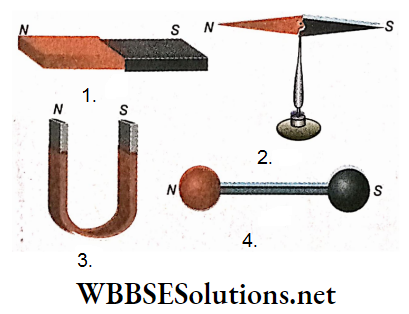
Electromagnetism Artificial Magnet

There are different shapes and sizes of artificial magnets:

  1. Bar magnet
  2. Magnetic needle
  3. Horseshoe magnet
  4. Ball-ended magnet etc.

North and South Poles of a Magnet:

If a bar magnet is dipped into some iron filings and then withdrawn, a good amount of filings clings at the two ends of the magnet but almost none at its middle
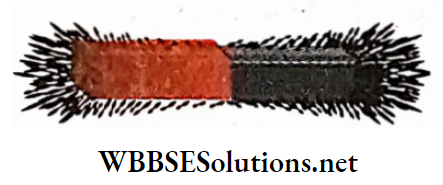
Electromagnetism North and South Poles of a Magnet

So, attractive power is maximum at the two ends of the magnet, and these two regions are called the poles of a magnet. The middle portion, where no attraction is observed, is called the neutral region.

If a bar magnet is suspended freely by a thread, it sets itself at rest in the north-south direction. The pole of the magnet which always faces north is called the north pole (N-pole) or positive pole. Similarly, the pole facing south is called the south pole (S-pole) or negative pole of the magnet.

The line joining the two poles of a magnet is called the magnetic axis. If a magnet is suspended freely from its mid-point, it comes to rest after some time. The imaginary vertical plane through the magnetic axis of the magnet at this position is called the magnetic meridian of that place.

Usually, poles are considered as points and these two points lie very close to the ends of the magnet. The effective length of the magnet is about 80- 85% of its geometrical length.
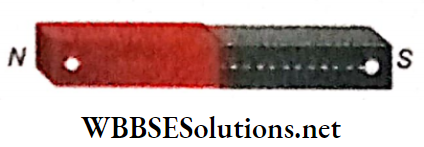
Electromagnetism North and South Poles of a Magnet.

If different magnets are dipped into iron filings and withdrawn, the amounts of iron filings collected are not the same in all cases. So, the attractive power of different magnets is different, but there is no difference between powerful and weak magnets with respect to the directive property.

WBCHSE Class 12 Physics Electromagnetism Notes Mutual Action Between Two Magnetic Poles:

If the N-pole of a bar magnet is brought near the Af-pole of a magnetic needle, repulsion occurs between them, i.e., the Npole of the magnetic needle moves away from the bar magnet.

Again, if the N-pole of the bar magnet is brought near the S-poIe of the magnetic needle, they attract each other, i.e., the S-pole of the magnetic needle comes closer to the bar magnet.

If the experiment is performed with the S-pole of the bar magnet, the opposite action is observed, i.e., the S-pole of the bar magnet attracts the AT-pole of the magnetic needle but repels its S-pole.
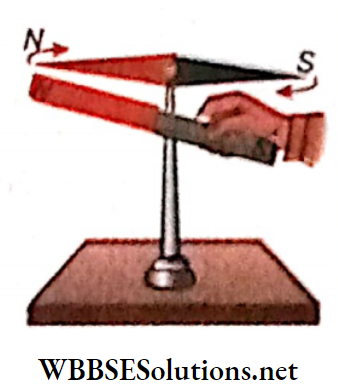
Electromagnetism Mutual Action between Two Magnetic poles

Inference: Like poles repel each other but unlike poles attract each other.

Repulsion Is the conclusive tost of magnetization:

If a body is repelled by a magnet, it is sure that the body is a magnet

If one end of a body Is brought near the Af-poles of a powerful magnet and if an attraction is observed between them there are two probabilities:

  1. The body may be an ordinary piece of iron
  2. The body is a magnet and the end under investigation is the S-pole of that magnet. So, attraction cannot Identify whether a body is a magnet or not.

But if repulsion instead of attraction Is observed In the above experiment, it is definite that the body is a magnet and the end under investigation is the iV-pole of that magnet.

Hence, repulsion is the conclusive test of magnetization.

WBCHSE Class 12 Physics Notes For Electromagnetism

WBCHSE Class 12 Physics Electromagnetism Notes

Magnetic Effect Of Current And Magnetism

A magnet attracts iron, nickel, cobalt, and some metallic alloys. This force of attraction even penetrates the wood, glass, paper, or other obstructions. It is always observed that the influence of a magnet is felt in its surrounding region. The greater the distance from the magnet, the lesser is its influence. Again if a weak magnet is replaced by a stronger one, the range of this influence increases.

Magnetic Field Definition: The region surrounding a magnet in which the Influence of that magnet is felt, is called the magnetic field of that magnet.

Theoretically, the magnetic field of a magnet extends up to infinity; but In practice, the field Is assumed to be extended up to a limited region due to,

Limitation of the experimental arrangement used for identification

Presence of other magnetic fields (like Earth’s magnetic field) in the environment.

Magnetic Lines of Force or Field lines:

Experiment: A small but powerful bar magnet is kept on a fairly large piece of cork and is let to float on water kept in a large vessel. In the floating condition, the magnet ultimately sets Itself at rest along the Nordic-south direction.

So, its N-pole faces the north and the S-pole faces the sound. With the help of a small cork, a long but comparatively weak magnetic needle is set to float vertically on the water in such a manner that the n-pole of the needle is just above the water’s surface but its s-pole remains deep inside the water.

In this situation, the effect of the bar magnet on the s-pole of the needle becomes negligible due to its depth. Hence, the n-pole of the needle can be treated as an isolated free n-pole with respect to the bar magnet.

The N-pole of the needle is brought in contact with the N-pole of the bar magnet at point A and then released. It is seen that this n-pole moves over the surface of water and follows a curved path ABCD to reach the S-pole of the bar magnet
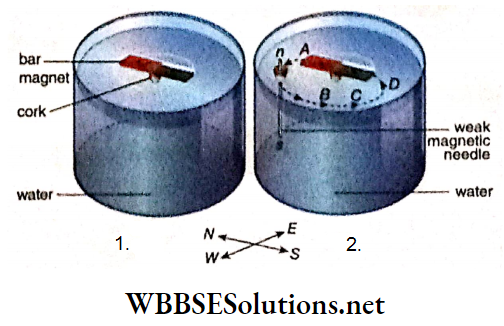
Electromagnetism Magnetic Lines of Force or Field lines

WBBSE Class 12 Electromagnetism Notes

Explanation of the experiment: The N-pole of the bar magnet exerts a force of repulsion on the isolated n-pole of the needle but the S-pole exerts a force of attraction on it.

The isolated free n-pole then starts moving along the resultant of the above two forces. At different points of the magnetic field of the bar magnet, the direction of this resultant force is different.

Then, the direction of motion of the n-pole will also change., So, when an isolated and free n-pole is allowed to travel in the magnetic field of a magnet, the pole describes a curved path and this path extends from the north pole to the south pole of the magnet.

A magnetic line of force is an imaginary curved line of a magnetic field; the direction of this field at any point is given by the tangent drawn at that point on the line of force passing through that point.

Class 12 Physics Electromagnetism Notes Properties of magnetic Hass of force:

1. A magnetic line of force emerges from the north pole of a magnet and terminates at the south pole.

2. For different initial points adjacent to the north pole of a magnet, different lines of force are obtained in the magnetic field. Different lines of force at one side of a bar magnet are shown. A number of such lines of force indicate a magnetic field.
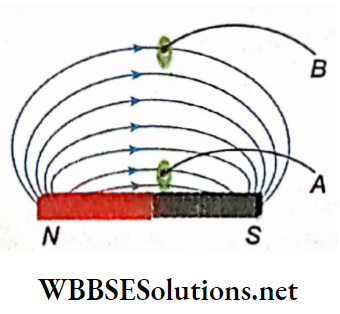
Electromagnetism properties of magnetic lines of force

3. Two lines of force never intersect each other. If they intersect, through that point of intersection two tangents can be drawn on the two lines of force and each tangent will be the direction of the magnetic field at the point of inter the section. But two directions of the magnetic field at a single point are meaningless.

4. The concept of lines of force is totally imaginary, no such line exists in a magnetic field.

5. At any point in a magnetic field, if a unit area normal to the direction of the lines of force is imagined, the number of lines of force passing through that area is called the number density of the lines of force or magnetic flux at that point.

6. The greater this number density, the greater will be the strength of the magnetic field at that point For Example, the number density at point B is less than that at point A. So the magnetic field at point B is weaker than that at point A.

7. In general, the strength of a magnetic field is different at different points in that field and their directions are also different. Hence, the magnetic lines of force are usually curved lines at different distances.

8. But if the magnetic field is uniform, i.e., its magnitude and direction are the same up to a certain region, then it can be represented by equispaced parallel straight lines. Earth’s magnetic field, very close to the surface of the earth, is such a uniform magnetic field.
Electromagnetism uniform magnetic field

Class 12 Physics Electromagnetism Notes

Electromagnetism Action Of Current On Magnets

Oersted’s Experiment:

In 1820, scientist Hans Christian Oersted discovered that a magnetic field is generated around a current-carrying conductor. He inferred this through the following experiment.

A magnetic needle is kept just below a conducting wire stretched along a north-south direction. The magnetic needle should be free to rotate about its vertical axis. Now if current is passed through the straight conductor with the help of an external source, the magnetic needle gets deflected, i.e., the needle undergoes an angular deflection θ
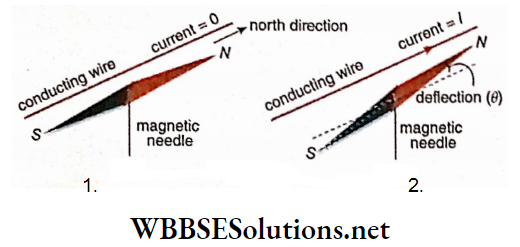
Electromagnetism Oersteds Experiment

Observations related to deflection:

1. As soon as the current stops flowing through the wire, the magnetic needle rotates back to its initial position.

2. With the increase in current through the conducting wire, the angular deflection of the needle increases.

3. If the direction of the current in the conductor is reversed, the magnetic needle deflects in the opposite direction.

4. If the conducting wire is rotated slowly from its north-south direction while carrying current, the deflection of the magnetic needle gradually decreases. Ultimately when the direction of the current is along east-west, there will be no deflection of the magnetic needle.

5. So, when the conducting wire is placed normally to the axis of the magnetic needle and current is passed through the wire, no deflection of the magnetic needle is observed.

The direction of deflection of the magnetic needle due to the flow of electric current through the conductor can be determined with the help of any one of the following two rules:

1. Ampere’s swimming rule: If a man is imagined to be swimming along the direction of the current facing the magnetic needle with his arms outstretched, the north pole of the needle will be deflected towards his left hand
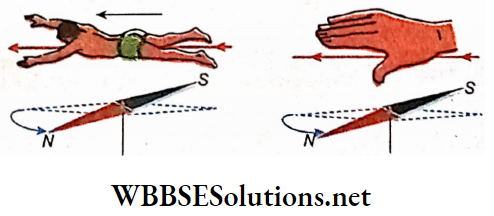
Electromagnetism Amperes swimming rule

2. Right-hand thumb rule: The right hand, with its thumb sticking out, is held in. Such a way that the conducting wire is in between the palm and the magnetic needle. If the other fingers point the direction of the current then the thumb will indicate the direction of deflection of the north pole of the needle.

WBCHSE Physics Electromagnetism Study Material

The direction of deflection of the magnetic needle is shown in the following table:
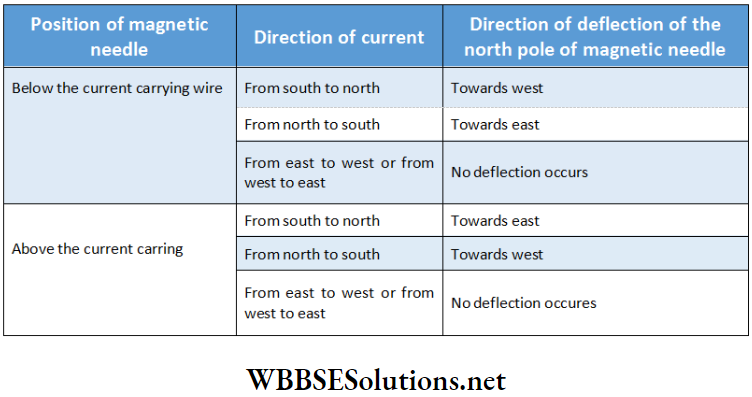
Electromagnetism The direction of deflection of the magnetic needle..

Key Formulas in Electromagnetism for Class 12
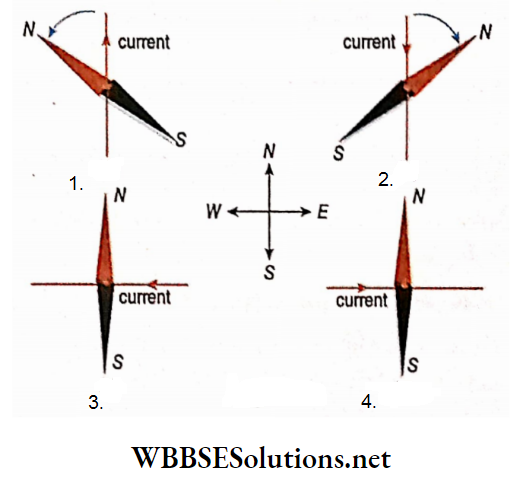
Electromagnetism The direction of deflection of the magnetic needle

Electromagnetism The direction of deflection of the magnetic needle.

WBCHSE Physics Electromagnetism Study Material Discussions:

1. Dependence of magnetic field: At any adjacent point of a current-carrying conductor, the magnitude of the magnetic field depends on the magnitude of current and the direction of the magnetic field depends on the direction of current and on the position of the point with respect to the current-carrying conductor.

2. Presence of insulating material: The magnetic field is not affected if the current-carrying conductor is covered with an insulating material.

3. Current-carrying material: The current-carrying conductor itself is not magnetized. If some iron filings are brought in contact with the conductor, no attraction is observed.

4. Magnetic field due to a moving charged particle: The motion of charged particles is the cause of electric current. Hence, a moving charge can produce a magnetic field around it. Obviously, when a charged particle is at rest, it cannot produce a magnetic field.

Mapping of Magnetic Lines of Force due to an Electric Current:

Any magnetic field can be represented by magnetic lines of force. The direction of the magnetic field at any point is denoted by the direction of the magnetic line of force at that point. To determine the direction of the magnetic field at any point around a current-carrying conductor, either of the following two rules can be used.

1. Maxwell’s corkscrew rule: If we imagine a right-handed corkscrew to be driven along the direction of current in a conductor, then the direction in which it rotates, gives the direction of the magnetic field.
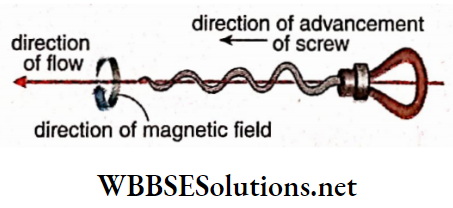
Electromagnetism Maxwells corkscrew rule

2. Right-hand grip rule: If a current-carrying conductor is imagined to be held within the grip of the right hand and if the direction of current through the conductor is indicated by the thumb, direction then the other fingers will curl in the direction of the magnetic field.
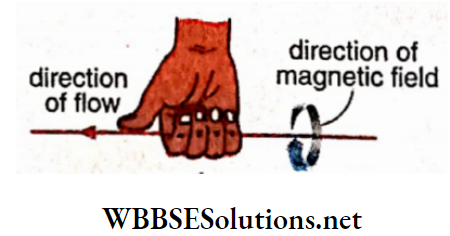
Electromagnetism Right hand grip rule

Long straight conductor: A long straight conducting wire carrying current is passed through the center of a cardboard and the cardboard is held normally to the length of the wire.

Some light iron filings are scattered over the cardboard. Now if the cardboard is slightly tapped, the iron filings arrange themselves in some concentric circles around the conducting wire. These concentric circles indicate the magnetic lines of force on a plane perpendicular to the current carrying a long straight conductor.

With the help of the corkscrew rule, the direction of the lines of force can also be determined. For an upward current, the directions of the magnetic lines of force. If the direction of current flow is reversed, i.e., for a downward current, the direction of the lines of force will also be reversed.

In the laboratory, generally, a magnetic needle is used instead of iron filings for plotting magnetic lines of force.
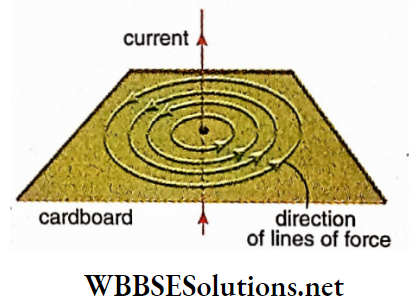
Electromagnetism Long straight conductor

Circular conductor: A circular current-carrying conductor is shown in penetrating a cardboard plate kept perpendicular to the plane of the circular conductor.

With the help of iron filings or a magnetic needle, if the lines of force of the magnetic field are drawn on the cardboard.

The directions of the magnetic lines of force may be determined by the corkscrew rule. If the direction of current in the circular conductor is reversed, the directions of the lines of force will also get reversed.

It is to be noted here that, at the centre of the circular conductor the lines of force are almost parallel to the axis going through the center.
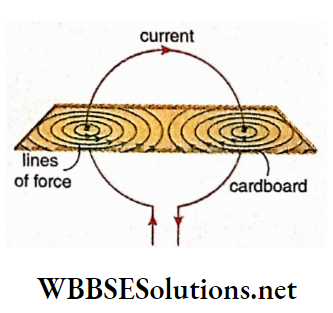
Electromagnetism Circular conductor

Electromagnetism Notes For Class 12 WBCHSE

Electromagnetism Biot-Savart Law Or Laplace’s Law

A diagrammatic representation of a magnetic field is its representation using magnetic lines of force:

1. The direction of the tangent drawn at any point on a magnetic line of force is the direction of the magnetic field at the point;

2. Comparing the number density of magnetic lines of forces at different points in a magnetic field, the field strengths at those points can be compared. But to define magnetic field precisely as a definite physical quantity, at every point its magnitude should be represented by a number and an associated unit. This is not possible from the concept of magnetic lines of force only.

As a physical quantity, the usual symbol of the magnetic field is \(\vec{B}\) (as it is a vector). This vector B is named magnetic field magnetic induction or magnetic flux density. In the region surrounding a current-carrying conductor

  1. The direction of \(\vec{B}\) is determined by Maxwell’s corkscrew rule
  2. The magnitude of \(\vec{B}\) (i.e., B) is determined by Biot-Savart law.

Statement of Biot-Savart law:

Let δl= a small elementary part of a conducting wire

I = current through the wire

r = distance of any external point from the element δl

θ = angle between the element \(\delta \vec{l}\) and the position vector -r of the external point

δB = magnitude of the magnetic field at that external point.
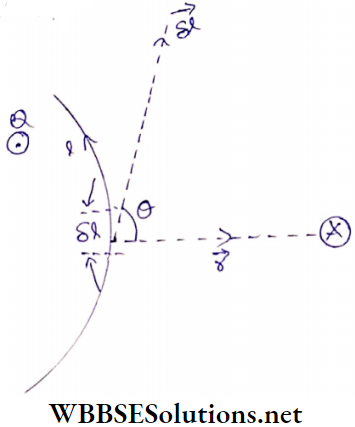
Electromagnetism Statement of Biot-Savart law

Then the Biot-Savart law states that,

  1. \(\delta B \propto \delta l\)
  2. \(\delta B \propto I\)
  3. \(\delta B \propto \frac{1}{r^2}\)
  4. \(\delta B \propto \sin \theta\)

This means, \(\delta B \propto \frac{I \delta l \sin \theta}{r^2} \text { or, } \delta B=k \frac{I \delta l \sin \theta}{r^2}\)….(1)

This law is also called Laplace’s law. The value of the constant k in equation (1) depends on

1. The nature of the medium between the conductor and the point under consideration and

2. The system of units used for different physical quantities. In this chapter, we shall consider only vacuum as the medium.

SI unit: SI units of different physical quantities used in equation (1) are:

δl and r: meter (m); I: ampere (A); δB: weber/metre2 (Wb.m-2) or tesla (T).

For the definition of the unit of magnetic field (Wb.m-2)

If these units are used in equation (1) then another constant is traditionally used instead of k. This constant is μ0 = 4πk,

⇒ \(k=\frac{\mu_0}{4 \pi}\)

So, the usual form of Biot-Savart law in vacuum,

⇒ \(\delta B=\frac{\mu_0}{4 \pi} \cdot \frac{I \delta l \sin \theta}{r^2}\)….(2)

The constant μ0 is called the permeability of free space.

Unit of μ0: From equation (2),

⇒ \(\mu_0=\frac{4 \pi r^2 \delta B}{I \delta l \sin \theta}\)

∴ The unit of \(\mu_0=\frac{\mathrm{m}^2 \times \mathrm{Wb} \cdot \mathrm{m}^{-2}}{\mathrm{~A} \times \mathrm{m}}=\mathrm{Wb} \cdot \mathrm{A}^{-1} \cdot \mathrm{m}^{-1}\)

Here, Wb.A-1 is also called Henry (H).

Hence, the unit of μ0 is henry/metre (H.m-1)

Value of μ0: = 4π x 10-7 H m-1.

It is to be noted that,

⇒ \(\frac{\mu_0}{4 \pi}=10^{-7} \mathrm{H} \cdot \mathrm{m}^{-1}\)

Biot-Savart law for extended conductors: An extended conductor is assumed to be composed of a number of smaller parts \(\delta l_1, \delta l_2, \cdots\), etc. and the Biot-Savart law is applied for each part. At any point, the magnetic field due to the whole conductor will be,

⇒ \(B=\sum \delta B=\frac{\mu_0}{4 \pi} \sum \frac{I \delta l \sin \theta}{r^2}\)

The \(\) (summation) sign indicates the sum of a number of terms. \(\vec{B}\) is a vector; so to determine the resultant, the rule of vector addition is applied. Usually, this vector addition is very complicated. But in the case of symmetrical conductors like straight conducting wire, circular coil, etc., determination of the resultant magnetic field is not so troublesome.

Vector form of Wot-Savort low: If the unit vector towards the point P with respect to \(\delta l \text { be } \hat{r} \text {, then } \vec{r}=r \hat{r}\).
Hence, the magnitude of the vector product \((\delta \vec{l} \times \hat{r})\) is,

⇒ \(|\delta \vec{l} \times \hat{r}|=\delta l \cdot 1 \cdot \sin \theta=\delta l \sin \theta \quad[∵|\hat{r}|=1]\)

Again, the direction of \((\delta \vec{l} \times \hat{r})\) is downward with respect, which is actually the direction of the magnetic field as per the corkscrew rule. So, the vector form of the equation (2) is,

⇒ \(\delta \vec{B}=\frac{\mu_0}{4 \pi} \cdot \frac{I \delta \vec{l} \times \hat{r}}{r^2}\)….(3)

From equation (3) we get,

⇒ \(\vec{B}=\frac{\mu_0}{4 \pi} \sum \frac{I \delta \vec{l} \times \hat{r}}{r^2}=\frac{\mu_0}{4 \pi} \sum \frac{I \delta \vec{l} \times \vec{r}}{r^3}\)….(4)

Usually with respect to the plane of the paper, an upward vector is denoted by \(\odot\) sign to mean the tip of an arrow and a downward vector by \(\otimes\) sign to mean the tail of an arrow. Thus, the direction of the magnetic field at point P is denoted by the \(\otimes\) sign, and at point Q, \(\odot\) sign is used.


The magnetic intensity or magnetic field strength or magnetizing field:

In SI: The magnetic permeability of vacuum is μ0 this value of μ0 is also used for air because, in the presence of air, no remarkable change in the magnetic field is observed.

But for any other medium, the permeability of that medium is denoted by n. For different media the magnitude of μ is different. In the case of any medium, the general form of Biot-Savart law is,

⇒ \(\delta B=\frac{\mu}{4 \pi} \cdot \frac{I \delta l \sin \theta}{r^2}\)….(5)

From equations (2) and (5) we see that the quantity \(\frac{1}{4 \pi} \cdot \frac{I \delta l \sin \theta}{r^2}\) can be treated as the cause of the magnetic field in a medium. In the absence of the multiplier μ0 or μ in this expression, this quantity does not depend on the medium. To determine the magnetic field in a medium, this quantity is just multiplied by the magnetic permeability of that medium. This quantity is called magnetic intensity or magnetizing field. It is expressed by H.

From the equation (5) we can write,

⇒ \(\delta B=\frac{\mu}{4 \pi} \cdot \frac{I \delta l \sin \theta}{r^2}=\mu \delta H\)

where, \(\delta H=\frac{1}{4 \pi} \cdot \frac{I \delta l \sin \theta}{r^2}\)…(6)

Generally, \(B=\mu H \quad \text { or, } \quad H=\frac{1}{\mu} B\)

Like \(\vec{B}\), H is also a vector quantity whose direction is the same
as that of \(\vec{B}\).

So, \(\vec{B}=\mu \vec{H} \quad \text { or, } \quad \vec{H}=\frac{1}{\mu} \vec{B}\)…(7)

With the help of this equation (7), \(\vec{H}\) can be defined.

Definition: At any point in a medium the ratio of the acting magnetic, field and the magnetic permeability of the medium is called the magnetic intensity or magnetizing field at that point.

Unit: Unit of \(H=\frac{\text { unit of, } B}{\text { unit of } \mu}=\frac{\mathrm{Wb} \cdot \mathrm{m}^{-2}}{\mathrm{~Wb} \cdot \mathrm{A}^{-1} \cdot \mathrm{m}^{-1}}\)

= A.m-1 (ampere/metre)

CGS or Gaussian system:

In this system \(\vec{H}\), i.e., the magnetic intensification (instead of \(\vec{B}\)) is considered as the primary vector in magnetism. In this case, the unit of magnetic intensity H is d (Oe) arid the unit of magnetic field B is gauss (G). It may be of interest to note that 1 oersted is the same as 1 dyn per unit pole, and 1 gauss is the same as 1 maxwell/cm2 according to the old definition of magnetic intensity.

Relation between SI and CGS units:

1 A.m-1 = 4π x 10-3 Oe, 1 Wb.m-2 = 10-4 G

In the CGS system, the electromagnetic, unit (abbreviated as emu) of current is used as the unit of current and is expressed by the symbol i. This electromagnetic unit is so defined that if the other quantities in equation (6) are expressed in CGS units, thÿf-,ÿ constant \(\frac{1}{4 \pi}\) can be replaced by 1. In that case, the CGS form of the equation will be,

⇒ \(\delta H=\frac{i \delta l \sin \theta}{r^2}\)…(8)

So, the different units used in this equation are

δl and r: cm; i: emu of current; δH: Oe.

This equation (δ) indicates the Biot-Savart law or Laplace’s law in the CGS or Gaussian system.

Emu current: The current which, when flowing through a conducting wire of length in the form of an arc of a circle of radius 1 cm, produces a magnetic Intensity of 1 Oe at the center of the arc, is called 1 electromagnetic unit (emu) of current

The two parts of the wire except the circular are kept along the radius of the circle; thus no magnetic field is produced at the center of the circle due to the current flowing through these two parts.

The definition of the electromagnetic unit of current can be explained from the discussion of the magnetic field produced due to current in a circular conductor

Relation between ampere and emu of current:

1 emu of current = 10 A

Rules of conversion from SI to CGS:

The following replacements convert SI expressions into the corresponding ones. CGS expressions;

1. Magnetic intensity \(\vec{H}\), in place of magnetic field \(\vec{B}\);

2. Electric current in the emu, in place of I in amperes;

3. The constant 1 in place of \(\frac{\mu_0}{4 \pi}\), i.e., 4π in place of μ0

Application of Biot-Savart Law Long Straight Conductor:

Let I = strength of current in an electrical circuit. AB is a straight conductor and OP = r = perpendicular distance of the point P from the current carrying wire.
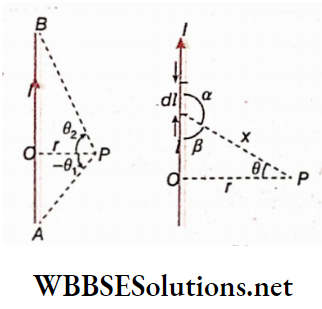
Electromagnetism Application of Biot-Savart Law and Long straight conductor

The two endpoints of the conducting wire make angles θ1 and θ2 at point P with respect to OP. In the direction of the current, if the angle θ2 is taken as positive then in the opposite direction, θ1 will be negative, i.e., it will be -θ1.

The conducting wire and its adjacent region in a magnified form. From a very small part dl of the wire, the distance of the point P is x and the angle between the direction of current and x is a.

So, according to Iliot-Savnrt law, the magnitude of the magnetic field at die point P due to dl is,

⇒ \(d B=\frac{\mu_0}{4 \pi} \cdot \frac{I d l \sin \alpha}{x^2}\)…(1)

From the diagram,

⇒ \(\alpha=180^{\circ}-\beta=180^{\circ}-\left(90^{\circ}-\theta\right)=90^{\circ}+\theta\)

So, sinaaa = sin(90° + θ) = cosθ ….(2)

Again, l = rtanθ

Since, r = constant, differentiating the equation we get,

dl = rsec²θdθ….(3)

Again, cosθ = \(\frac{r}{x}\)

or, \(x^2=\frac{r^2}{\cos ^2 \theta}=r^2 \sec ^2 \theta\)…..(4)

Now putting the values of sinaaa, dl, and x2 from equations (2), (3), and (4) into equation (1) we get,

⇒ \(d B=\frac{\mu_0}{4 \pi} \cdot \frac{I \cdot r \sec ^2 \theta d \theta \cdot \cos \theta}{r^2 \sec ^2 \theta}=\frac{\mu_0}{4 \pi} \cdot \frac{I}{r} \cdot \cos \theta d \theta\)….(5)

So, for the entire wire AB, the magnetic field at the point P is,

⇒ \(B=\int d B=\frac{\mu_0}{4 \pi} \cdot \frac{I}{r} \int_{-\theta_1}^{\theta_2} \cos \theta d \theta\)

⇒ \(\frac{\mu_0}{4 \pi} \cdot \frac{I}{r}[\sin \theta]_{-\theta_1}^{\theta_2}=\frac{\mu_0}{4 \pi} \cdot \frac{I}{r}\left[\sin \theta_2-\sin \left(-\theta_1\right)\right]\)

⇒ \(\frac{\mu_0}{4 \pi} \cdot \frac{I}{r}\left(\sin \theta_2+\sin \theta_1\right)\)

So, \(B=\frac{\mu_0}{4 \pi} \cdot \frac{I}{r}\left(\sin \theta_1+\sin \theta_2\right)\)…(6)

This is the expression for the magnitude of the magnetic field at point P due to the current carrying wire.

Special cases:

For infinitely long conducting wire: Let the length of the wire below the point O be Ll and above this point, I². If these two lengths are much greater than r, i.e., and r<<I², the wire can be treated as of infinite length with respect to the point P. In that case, for the lowermost end of the wire,θ1 ≈ 90° and for the uppermost end of the wire θ2 ≈ 90°.

So from the equation (6), we can write,

⇒ \(B=\frac{\mu_0}{4 \pi} \cdot \frac{I}{r}\left(\sin 90^{\circ}+\sin 90^{\circ}\right)\)

∴ \(B=\frac{\mu_0}{4 \pi} \cdot \frac{2 I}{r}\)…(7)

For semi-infinitely long conducting wire: Let the lowermost end of the wire be O and the length of the wire = I. If r<<L, the wire can be called semi-infinitely long with respect to the point P. In that case, θ1 = 0° and θ2 = 90°.

So, from the equation (6), we can write

⇒ \(B=\frac{\mu_0}{4 \pi} \cdot \frac{I}{r}\left(\sin 0^{\circ}+\sin 90^{\circ}\right)\)

∴ \(B=\frac{\mu_0}{4 \pi} \cdot \frac{I}{r}\)…(8)

For a point on the extended part of the wire: If point P1 is located according to, both θ1 and θ2 will be negative with respect to r which is the perpendicular distance between point P1 and the extension of the wire AB.
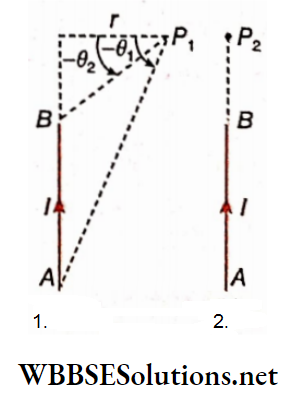
Electromagnetism point on the extended part of the wire

So, the magnetic field at P1,

⇒ \(B_1=\frac{\mu_0}{4 \pi} \cdot \frac{I}{r}\left[\sin \theta_1+\sin \left(-\theta_2\right)\right]\) [taking θ2 negative in equation (6)]

⇒ \(\frac{\mu_0}{4 \pi} \cdot \frac{I}{r}\left(\sin \theta_1-\sin \theta_2\right)\)…..(9)

If we consider the point P2 to lie on the extension of the wire AB, then θ1 = 90° and θ2 = 90°. Putting these in equation (9) we get, the magnetic field at the point P2,

⇒ \(B_2=\frac{\mu_0}{4 \pi} \cdot \frac{I}{r}\left[\sin 90^{\circ}-\sin 90^{\circ}\right]=\frac{\mu_0}{4 \pi} \cdot \frac{I}{r}[1-1]=0\)

So, at any point lying along the length of a current-carrying conductor, the magnetic field due to that conductor will be zero.

Expressions in CGS or Gaussian system: In the above-mentioned equations (6), (7), and (8), if we substitute B→H, I→I, and μ0→4π then we get

Magnetic intensity due to a straight conductor,

⇒ \(H=\frac{i}{r}\left(\sin \theta_1+\sin \theta_2\right)\)

Magnetic intensity due to an infinitely long conductor,

⇒ \(H=\frac{2 i}{r}\)

Magnetic intensity due to a semi-infinitely long conductor,

⇒ \(H=\frac{i}{r}\)

Magnetic Effect Of Current And Magnetism

Electromagnetism Numerical Examples

Short Answer Questions on Electromagnetism

Example 1. The distance between two long straight conductors is 5m. Currents 2.5 A and 5 A are flowing through in the same direction. What will be the magnetic field at a themed point between them?
Solution:

According to the corkscrew rule, the magnetic fields at the mid-point due to die two conductors will be opposite in directions.

So, the relation, \(B=\frac{\mu_0}{4 \pi} \cdot \frac{2 I}{r}, \text { gives }\)

magnetic field at the mid-point due to the first conductor,

⇒ \(B_1=\frac{\mu_0}{4 \pi} \cdot \frac{2 I_1}{\frac{r}{2}}=\frac{\mu_0}{4 \pi} \cdot \frac{4 I_1}{r}\)

and magnetic field at the mid-point due to the second conductor,

⇒ \(B_2=\frac{\mu_0}{4 \pi} \cdot \frac{2 I_2}{\frac{r}{2}}=\frac{\mu_0}{4 \pi} \cdot \frac{4 I_2}{r}\)

⇒ \(I_2>I_1 \text { and hence } B_2>B_1\)

∴ The resultant magnetic field,

⇒ \(B=B_2-B_1=\frac{\mu_0}{4 \pi} \cdot \frac{4}{r}\left(I_2-I_1\right)\)

⇒ \(\frac{\mu_0}{4 \pi} \cdot \frac{4}{5}(5-2.5)=\frac{4 \pi \times 10^{-7}}{4 \pi} \times \frac{4}{5} \times 2.5\) [∵ r = 5m, I1 = 2.5 A, I2 = 5 A]

= 2 x 10⁻⁷ T

Example 2. 5 A current Is flowing in two opposite directions through each of two parallel straight conducting wires kept 0.2 m apart. find who second wins) Determine the magnitudes and directions of the magnetic field at the points P, Q, and R lying on the plane containing the two wires.
Solution:

The magnetic field at P due to the first wire,

⇒ \(B_1=\frac{\mu_0}{4 \pi} \cdot \frac{2 \times 5}{0.1} \text { (upward) }\)

The magnetic field at P due to the second wire,

⇒ \(B_2=\frac{\mu_0}{4 \pi} \cdot \frac{2 \times 5}{0.3} \text { (downward) }\)

Since, B1 > B2, the resultant magnetic field will be upward from the plane.

∴ Bp = B1 – B2

⇒ \(\frac{\mu_0}{4 \pi}(2 \times 5)\left(\frac{1}{0.1}-\frac{1}{0.3}\right)\)

⇒ \(10^{-7} \times 10 \times 10 \times \frac{2}{3}\)

⇒ \(6.67 \times 10^{-6} \mathrm{~Wb} \cdot \mathrm{m}^{-2}\)

Similarly, the upward magnetic field at the point Q,

BQ = 6.67 x 10⁻⁶ Wb.m-2

At point R, the magnetic field due to the first wire as well as for the second wire is downward. Hence, the resultant magnetic field will be the sum of these two fields.

So, \(B_R=2 B_1=2 \times \frac{\mu_0}{4 \pi} \cdot \frac{2 \times 5}{0.1}\)

= 2 x 10-7 x 10 x 10

= 2 x 10⁻⁵ Wb.m-2

Example 3. An infinitely long conducting wire POQ is bent through right angles at O. If a current I . 0 is sent through this bent wire, what will be the magnitude of the magnetic field at point A at a distance r from each part of the wire?
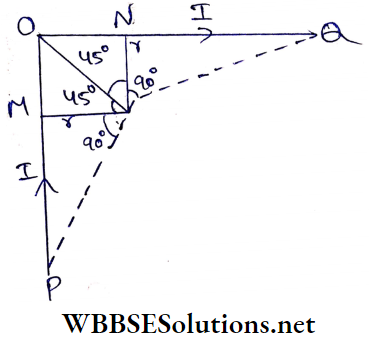
Electromagnetism Example 3 long conducting wire

Solution:

AM = AN = r

So, ∠OAM = ∠OAN = 45°

Now, the magnetic field at A due to PO is equal to that due to OQ both in magnitude and direction (downwards). Again, the points P and Q make angles at A relative to AM and AN. For infinitely long wires, each of these angles is close to 90°.

So the resultant magnetic field at A is

⇒ \(B=2 \times \frac{\mu_0}{4 \pi} \cdot \frac{I}{r}\left(\sin 90^{\circ}+\sin 45^{\circ}\right)\)

⇒ \(\frac{\mu_0}{4 \pi}: \frac{I}{r}(2+\sqrt{2}) \text { (directed downwards) }\)

Example 4. Through each of two wires POQ and P’O’Q’ an electric current I is passing. P The points Q, O, O’, and Q’ are collinear. Determine the magnetic field at the midpoint A of OO’.
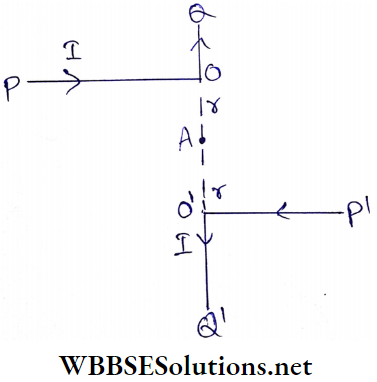
Electromagnetism Example 4 magnetic field

Solution:

Point A lies along the length of the two parts OQ and O’Q’. Hence, no magnetic field exists at A due to these two parts.

The two parts PO and P’O’ are semi-infinite conducting wires with respect to point A. Hence, for each part, the magnetic field at \(A=\frac{\mu_0}{4 \pi} \cdot \frac{I}{r}\) and these two fields are downwards.

Hence, the downward magnetic field at the point A,

⇒ \(B=\frac{\mu_0}{4 \pi} \cdot \frac{I}{r}+\frac{\mu_0}{4 \pi} \cdot \frac{I}{r}=\frac{\mu_0}{4 \pi} \cdot \frac{2 I}{r}\)

Applications of Electromagnetism in Daily Life

Example 5. 5 A current is flowing through a long straight conducting wire. What is the magnitude of the magnetic field at a distance of 10 cm from the wire?
Solution:

We know, \(B=\cdot \frac{\mu_0}{4 \pi} \cdot \frac{2 I}{r}\) [for a straight infinite wire]

Here,I = 5 A, r = 10 cm = 0.1m, μ0 = 4π x 10-7 H.m-1

∴ \(B=\frac{4 \pi \times 10^{-7}}{4 \pi} \times \frac{2 \times 5}{0.1}=10^{-5} \mathrm{~Wb} \cdot \mathrm{m}^{-2}\)

Application of Biot-Savart Law Circular Conductor:

1. Magnetic field at the center of a circular conductor: Let the current through a circular conductor of radius r be I.

Due to an element of length δ1 of the conductor, the magnetic field at the center of a circle,

⇒ \(\delta B=\frac{\mu_0}{4 \pi} \cdot \frac{I \delta l \sin 90^{\circ}}{r^2}=\frac{\mu_0}{4 \pi} \cdot \frac{I \delta l}{r^2}\)

If the circumference of the circle is divided into a large number of such elements then, for each element, I and r remain the same and the angle between that element and the radius is 90°. Again sum of these elements = circumference of the circle = 2πr.
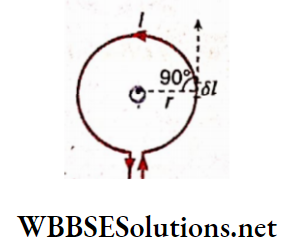
Electromagnetism Application of Biot-Savart Law Circular conductor

So, die magnetic field at the center of the circular conductor,

⇒ \(B=\frac{\mu_0}{4 \pi} \frac{I}{r^2} \sum \delta l=\frac{\mu_0}{4 \pi} \cdot \frac{I}{r^2} \cdot 2 \pi r=\frac{\mu_0 I}{2 r}\)…(1)

If the circular conductor of a single turn is replaced by a circular coil of N turns then,

⇒ \(B=\frac{\mu_0 N I}{2 r}\)….(2)

The direction magnetic field at the center of the circular conductor can be determined by the corkscrew rule. This direction is normally upward from the plane of the paper. If the conductor is in die form of a circular arc and if that arc makes an angle θ (rad) at the center, the magnetic field at the center of the circle
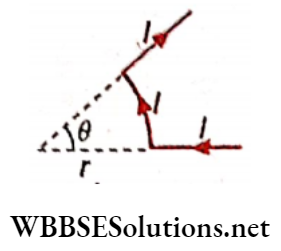
Electromagnetism The direction of magnetic field

⇒ \(B=\frac{\mu_0 I}{2 r} \cdot \frac{\theta}{2 \pi}=\frac{\mu_0 I}{4 \pi r} \cdot \theta\)….(3)

The magnetic field on the axis of a circular conductor:

Let r = radius of a circular conductor, I = current through the conductor, and O is the center of the circular conductor and hence. P is any point on the axis (OP – x). An element of length δl is considered at the topmost point C of the conductor. The line segment CP is perpendicular to this element So, for the element of length 8/ at C, the genetic field at the point P is,

⇒ \(\left.\delta B=\frac{\mu_0}{4 \pi} \cdot \frac{I \delta l \sin 90^{\circ}}{u^2}=\frac{\mu_0}{4 \pi} \cdot \frac{I \delta l}{u^2} \text { [here } C P=u\right]\)
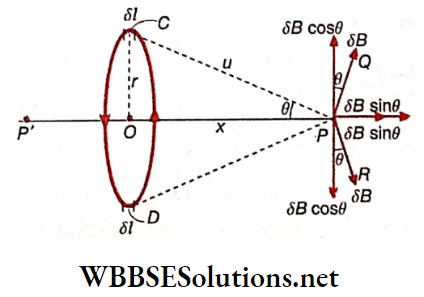
Electromagnetism Magnetic field on the axis of a circular conductor

From the corkscrew rule, we see that the direction of δB is along PQ. The component of 8B along the axis is δBsinθ and perpendicular to the axis is δBcosθ. If an element of length δl is now considered at point D diametrically opposite to C on the circumference, the magnetic field at point P will be SB and its direction will be along PR. Naturally, its downward component δBcosθ neutralizes the previous component δBcosθ, but two components

δBsinθ each will be added together along the axis. In this way, if the whole circular conductor is considered, the algebraic sum of the components SBsinfl along the axis will be the resultant magnetic field due to the circular conductor at die point P.

∴ \(B=\sum \delta B \sin \theta=\frac{\mu_0}{4 \pi} \sum \frac{I \delta l}{u^2} \cdot \frac{r}{u}=\frac{\mu_0}{4 \pi} \sum \frac{I \delta l}{u^3} \cdot r\)

Now, due to the symmetry of the circular conductor, the magnitudes of I, r and u will be die same at every point on its circumference. Hence,

⇒ \(B=\frac{\mu_0}{4 \pi} \cdot \frac{I r}{u^3} \sum \delta l=\frac{\mu_0}{4 \pi} \cdot \frac{I r}{u^3} \cdot 2 \pi r=\frac{\mu_0 I}{2} \cdot \frac{r^2}{\left(u^2\right)^{3 / 2}}\)

So, \(B=\frac{\mu_0 I}{2} \cdot \frac{r^2}{\left(r^2+x^2\right)^{3 / 2}}\)….(4)

If a circular coil having N turns is taken instead of the circular conductor of single turn then,

⇒ \(B=\frac{\mu_0 N I}{2} \cdot \frac{r^2}{\left(r^2+x^2\right)^{3 / 2}}\)…..(5)

Now, at the center of the circle, i.e., at the point O, x = 0, and hence,

⇒ \(B=\frac{\mu_0 N l}{2 r}\), which is identical to the equation (2).

Expressions In COS or Gaussian system: In equations (1) to (5) above, substituting B→H, I→I, and μ0 → 4π we get,

magnetic intensity at the center of a circular conductor,.

⇒ \(H=\frac{2 \pi i}{r}\)

and magnetic intensity at the center of a circular coil having N-tums,

⇒ \(H=\frac{2 \pi N i}{r}\)

In the case of a conductor in the form of an arc of a circle, the magnetic intensity at the center of the conductor, H = \(\frac{i}{r}\)θ where θ is the angle made by the arc at the center.

Magnetic intensity at any point on the axis of a circular conductor,

⇒ \(H=2 \pi i \cdot \frac{r^2}{\left(r^2+x^2\right)^{3 / 2}}\)

In the case of a circular coil having N turns, the magnetic intensity at any point on its axis,

⇒ \(H=2 \pi N i \cdot \frac{r^2}{\left(r^2+x^2\right)^{3 / 2}}\)

Angle (θ) subtended by a current-carrying conductor of length 1 cm bent in the form of an arc of a circle of 1 cm radius is 1 rad. If the magnetic intensity at the center of the arc is 1 Oe, then substituting r = 1, θ = 1, H = 1 in the relation \(H=\frac{i \theta}{r}\), we get, i = 1.

Characteristics of the magnetic field of a circular conductor:

1. Direction of magnetic field: At any point on the axis of the conductor the direction of the resultant magnetic field is always along the axis. For the direction of current the magnetic field at the point P is along the axis and directed outward. But on the opposite side of the coil, at the point magnetic field is along the axis and directed inward, i.e., along Pf O. If the direction of current in the coil is reversed, at the point P magnetic field will be inward while at the point P’, it will be outward.
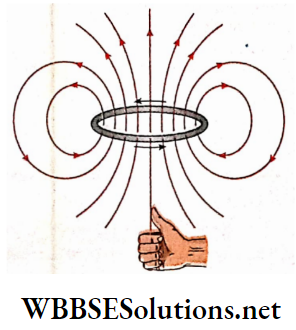
Electromagnetism characteristics of magnetic field of a circular conductor

2. Magnitude of the magnetic field: From equation (5) we see that the magnitude of the field becomes maximum at the center of the circle, and decreases along the axis, on either side.

As a result, no uniform magnetic field is obtained at any point on the axis and thus a problem arises while constructing electrical instruments with a circular coil. This problem can be removed by using a Helmholtz double coil.
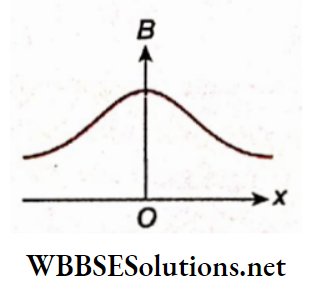
Electromagnetism Magnitude of the magnetic field

Helmholtz double coll: Two circular coils having the same radius (= r) are placed coaxially at a distance equal to their radius. If a direct current is passed through them in the same direction, the magnetic fields generated between them will have the same direction. Thus the resultant magnetic field remains almost uniform in between the coils.
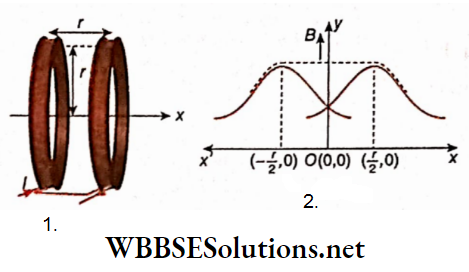
Electromagnetism Helmholtz double coil

Magnetic Effect Of Current And Magnetism

Electromagnetism Numerical Examples

Example 1. The radii of two concentric circular colls are 8 cm and 10 cm and the number of turns In them are 40 and 10, respectively. A 5A current Is passing through each of them in the same direction. Determine the magnetic field produced at the center of the two colls.
Solution:

Since current flows in the same direction through the two coils, the directions of magnetic fields at the center due to the coils will be the same. Hence, the resultant magnetic field will be obtained by adding these magnetic fields.

For the first coil, \(B_1=\frac{\mu_0 N_1 I}{2 r_1}\)

For the second coil, \(B_2=\frac{\mu_0 N_2 I}{2 r_2}\)

∴ The resultant magnetic field,

⇒ \(B=B_1+B_2=\frac{\mu_0 I}{2}\left(\frac{N_1}{r_1}+\frac{N_2}{r_2}\right)\)

⇒ \(\frac{4 \pi \times 10^{-7} \times 5}{2}\left(\frac{40}{8}+\frac{10}{10}\right)
\)

= 2π x 10-7 x 5 x 6

= 1.885 x 10⁻⁵ Wb.m-2

Example 2. A current I is flowing through an Infinitely long wire PQRS. The wire is bent a J S at right angles so that the part QR becomes one-fourth of the circumference of a circle of radius r whose center is at O. Determine the magnetic field at O.
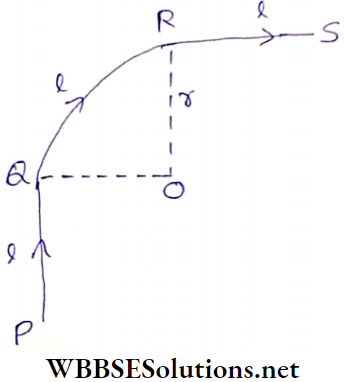
Electromagnetism Example 2 Circumference of a circle of radius

Solution:

With respect to point O, both the parts PQ and

RS are semi-infinite wires and hence, for each part magnetic field at point O will be,

⇒ \(B_1=B_2=\frac{\mu_0}{4 \pi} \cdot \frac{I}{r}\)

Again for a complete circular conductor, the magnetic field at its center = \(\frac{\mu_0 I}{2 r}\)

So. for the one-fourth part QR of the circle, the magnetic field
at O,

⇒ \(B_3=\frac{1}{4} \times \frac{\mu_0 I}{2 r}=\frac{\mu_0 I}{8 r}\)

Hence, the resultant magnetic field at O,

B = B1 + B2 + B3

⇒ \(\frac{\mu_0 I}{4 \pi r}+\frac{\mu_0 I}{4 \pi r}+\frac{\mu_0 I}{8 r}\)

⇒ \(\frac{\mu_0 I}{4 r}\left(\frac{1}{\pi}+\frac{1}{\pi}+\frac{1}{2}\right)=\frac{\mu_0(4+\pi) I}{8 \pi r}\)

Examples of Faraday’s Law of Induction

Example 3. Determine the magnetic field at point O due to the circuit.
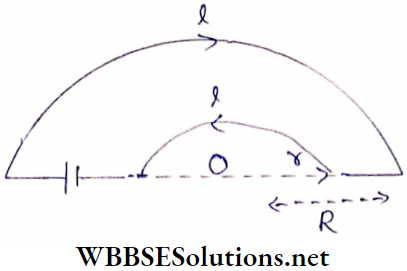
Electromagnetism Example 3 the magnetic field

Solution:

Point O lies on the same straight line with the two linear parts of the circuit Hence, no magnetic field acts at O due to those two parts.

For a complete circular conductor, the magnetic field at the tire center of the circle = \(\frac{\mu_0 I}{2 r}\)

Hence, for a semicircular conductor, the magnetic field at the center = \(\frac{\mu_0 I}{4 r}\)

The magnetic field at O due to the semicircular conductor of radius r is \(B_1=\frac{\mu_0 I}{4 r}\) and that due to the semicircular conductor of radius \(R \text { is } B_2=\frac{\mu_0 I}{4 R}\).

The corkscrew rule shows that Bj and B2 are oppositely directed. Since Bj > Bz, the resultant magnetic field at the point O (upward with respect to the page of the book),

⇒ \(B=B_1-B_2=\frac{\mu_0 I}{4}\left(\frac{1}{r}-\frac{1}{R}\right)=\frac{\mu_0 I(R-r)}{4 r R}\)

Example 4. What is the magnetic field produced at the center of a hydrogen atom due to the revolution of its electron in the first orbit (K-orbit)? The radius of the first orbit = 0.53 x 10⁻¹⁰ m, the velocity of the electron in that orbit = 2.19 x 10s m s-1
Solution:

Time period of revolution, \(T=\frac{2 \pi r}{v}\).

So, the circular loop formed due to the revolution of the electron carries an effective current

⇒ \(I=\frac{\text { charge }}{\text { time period }}=\frac{e}{T}=\frac{e v}{2 \pi r}\)

So, the magnetic field at the center of the atom,

⇒ \(B=\frac{\mu_0 I}{2 r}=\frac{\mu_0}{4 \pi} \cdot \frac{e v}{r^2}\)

⇒ \(10^{-7} \times \frac{\left(1.6 \times 10^{-19}\right) \times\left(2.19 \times 10^6\right)}{\left(0.53 \times 10^{-10}\right)^2}\)

= 12.47 T

Example 5. Calculate the magnetic induction at point O (center of the partial circular conductor).
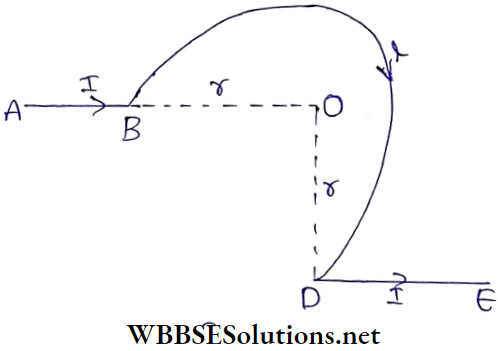
Electromagnetism Example 5 partial circular conductor

Solution:

Magnetic induction at die center due to whole conductor, B = Magnetic induction due to (straight part AB + curved part BCD + straight part DE)

∴ \(B_{\text {total }}=B_{A B}+B_{B C D}+B_{D E}\)

BAB = 0 [∵ thePoint O is along AB]

⇒ \(B_{B C D}=\frac{3}{4}\) of the ma8netic due to the whole circle

⇒ \(\frac{3}{4} \times \frac{\mu_0}{4 \pi} \cdot \frac{2 \pi I}{r}\) [directed inwards and perpendicular to the plane of the conductor]

⇒ \(B_{D E}=\frac{\mu_0}{4 \pi} \cdot \frac{I}{r}\) [directed outwards and perpendicular to the plane of the conductor]

∴ \(B_{\text {total }}=\frac{3}{4} \frac{\mu_0}{4 \pi} \frac{2 \pi l}{r}-\frac{\mu_0}{4 \pi} \frac{l}{r}\)

⇒ \(\frac{\mu_0}{4 \pi}, \frac{I}{r}\left[\frac{3}{2} \pi-1\right]\) [directed inwards and perpendicular to the plane of the conductor]

Example 6. Two concentric but mutually perpendicular conducting coils are carrying current 3 A and 4 A, respectively. If the radius of each coil is 2x cm, what will be the magnetic induction at the center of the coils? (μ0 = 4π x 10-7 Wb A-1.m-1)
Solution:

⇒ \(r=2 \pi \mathrm{cm}=\frac{\pi}{50} \mathrm{~m}\)

Magnetic field at the center of a circular coil, \(B=\frac{\mu_0 I}{2 r}\)

∴ For the first coil,

⇒ \(B_1=\frac{\left(4 \pi \times 10^{-7}\right) \times 3}{2 \times \frac{\pi}{50}}=3 \times 10^{-5} \mathrm{~Wb} \cdot \mathrm{m}^{-2}\)

and for the second coil,

⇒ \(B_2=\frac{\left(4 \pi \times 10^{-7}\right) \times 4}{\ddots 2 \times \frac{\pi}{50}}=4 \times 10^{-5} \mathrm{~Wb} \cdot \mathrm{m}^{-2}\)

Since the coils are mutually perpendicular, By and B2 are also at right angles to each other. Hence, the resultant magnetic field,

⇒ \(B=\sqrt{B_1^2+B_2^2}=\sqrt{(3)^2+(4)^2} \times 10^{-5}\)

= 5 x 10⁻⁵ Wb.m-2

Example 7. Each of two long straight wires, passing through points A and B, carries a current directed vertically upwards with respect to the plane of the paper. The separation between them is r. Find out the magnetic field at a point P on that plane, which is at a distance r from each of the wires.
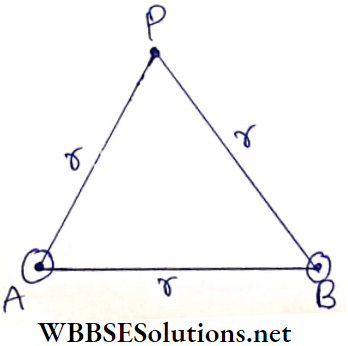
Electromagnetism Example 7 two long straight wires

Solution:

Here PA = PB = r

Due to the current-carrying conductor, which passes through point A, the magnetic field intensity at P is,

⇒ \(B_1=\frac{\mu_0}{4 \pi} \frac{2 I}{P A}=\frac{\mu_0}{4 \pi} \frac{2 I}{r}\)

Similarly, due to the current-carrying conductor which passes through point B, the magnetic field intensity at point P is,
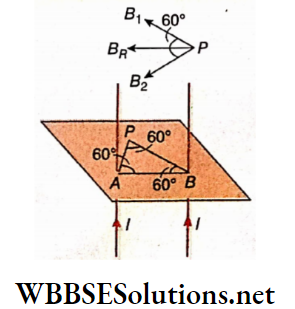
Electromagnetism Example 7 two long straight wires.

⇒ \(B_2=\frac{\mu_0}{4 \pi} \cdot \frac{2 I}{P B}=\frac{\mu_0}{4 \pi} \cdot \frac{2 I}{r} \text { (along } \overrightarrow{P B_2} \text { ) }\)

The resultant magnetic field intensity at point P is given by,

⇒ \(B=\sqrt{B_1^2+B_2^2+2 B_1 B_2 \cos 60^{\circ}}\)

⇒ \(\sqrt{\left(\frac{\mu_0}{4 \pi} \frac{2 I}{r}\right)^2\left[1^2+1^2+2 \cdot 1 \cdot 1 \cdot \frac{1}{2}\right]}\)

⇒ \(\frac{\mu_0}{4 \pi} \frac{2 I}{r} \sqrt{3} \text { (directed parallel to } \overrightarrow{B A} \text { ) }\)

Example 8. Two small identical circular loops marked (1) and (2) carrying equal currents are placed with their geometrical axes perpendicular to each other. Find the magnitude and direction of the net magnetic field produced at O. Also determine the field when the radius of the loop is very large as compared to the distance of the point from the center.
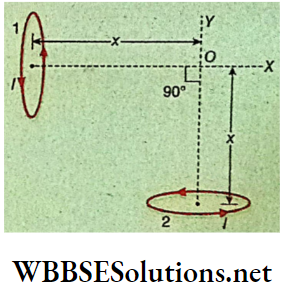
Electromagnetism Example 8 two small identical circular loops

Solution:

Let R be the radius of each loop. Magnetic field at O due to loop 1,

⇒ \(B_1=\frac{\mu_0 I R^2}{2\left(R^2+x^2\right)^{3 / 2}} \text { (it acts along } \overrightarrow{O X} \text { ) }\)

Magnetic field at O due to loop 2,

⇒ \(B_2=\frac{\mu_0 I R^2}{2\left(R^2+x^2\right)^{3 / 2}} \text { (it acts along } \overrightarrow{O Y} \text { ) }\)
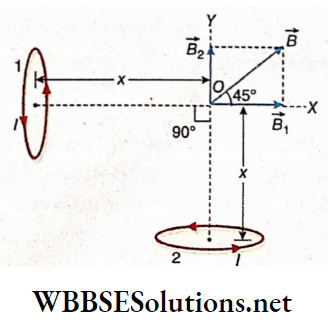
Electromagnetism Example 8 two small identical circular loops.

∴ The net magnetic field at O due to both the loops,

⇒ \(B=\sqrt{B_1^2+B_2^2}=\sqrt{2 B_1^2}=\sqrt{2} B_1 \cdot\left[∵ B_1=B_2\right]\)

⇒ \(=\sqrt{2} \frac{\mu_0 I R^2}{2\left(R^2+x^2\right)^{3 / 2}}=\frac{\mu_0 I R^2}{\sqrt{2}\left(R^2+x^2\right)^{3 / 2}}\)

This field acts at an angle of 45° with \(\vec{OX}\).

Now if R>>x, neglecting x2/R2 we get

⇒ \(B=\frac{\mu_0 I R^2}{\sqrt{2}\left[R^2\left(1+x^2 / R^2\right)\right]^{3 / 2}} \approx \frac{\mu_0 I R^2}{\sqrt{2} R^3}\)

∴ \(B \approx \frac{\mu_0 I}{\sqrt{2} R}\)

Example 9. Two circular coils of radii a and 2a having a common center, carry identical currents, but opposite directions. The number of turns of the second Conductor is 8. Show that magnetic field intensity at the center 3 times that glue to the smaller one. Also, find out the ChangeinWe previous result when current flows in the same direction throughout the coils
Solution:

Magnetic field intensity at the center O due to the smaller loop is,

⇒ \(B_1=\frac{\mu_0 i}{2 a} \text { (upwards) }\)

Similarly magnetic field intensity at the centre due to the bigger loop,

⇒ \(B_2=8 \times \frac{\mu_0 i}{2(2 a)}=\frac{2 \mu_0 i}{a}\) (downwards)

∴ The net magnetic field at O,

B = B2-B1

⇒ \(\frac{\mu_0 i}{a}\left(2-\frac{1}{2}\right)\)

⇒ \(\frac{3 \mu_0 i}{2 a}=3 B_1 \quad\left[∵ B_1=\frac{\mu_0 i}{2 a}\right]\)

Hence resultant field is 3 times that due to the smaller loop.

Now if the direction of the current is the same for both loops, the resultant field will be,

⇒ \(B=B_1+B_2=\frac{\mu_0 i}{2 a}+\frac{2 \mu_0 i}{a}=5 \frac{\mu_0 i}{2 a}=5 B_1\)

Hence the resultant field will be 5 times that due to the smaller loop if current flows in the same direction.
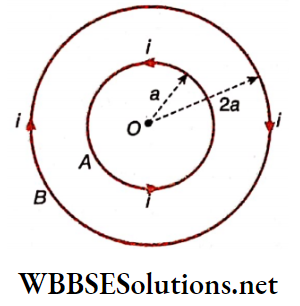
Electromagnetism Example 9 Two circular coils of radii

Example 10. A wire loop is formed by joining two semicircular wires of radii r1 and r2. If the loop carries a current I, find the magnetic field at the center O.
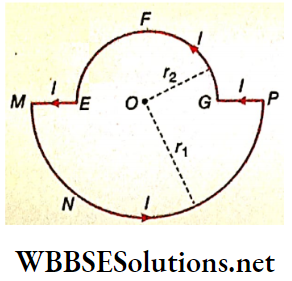
Electromagnetism Example 10 two semicircular wires

Solution:

The magnetic field at the point O due to the semicircular part MNP is,

⇒ \(\dot{B}_{M N P}=\frac{\mu_0}{4} \cdot \frac{I}{r_1} \text { (upwards) }\)

Similarly magnetic field at O due to the semicircular part GFE is,

⇒ \(B_{G F E}=\frac{\mu_0}{4} \cdot \frac{I}{r_2} \text { (upwards) }\)

As the point, O lies along the straight parts ME and PG of the loop, the magnetic field due to them at O is zero.

The so-net magnetic field at O due to the whole loop,

B = B1 + B2

⇒ \(\frac{\mu_0}{4} \cdot \frac{I}{r_1}+\frac{\mu_0}{4} \cdot \frac{I}{r_2}\)

∴ \(B=\frac{\mu_0}{4} I\left[\frac{1}{r_1}+\frac{1}{r_2}\right] \text { (upwards) }\)

Example 11. The radius and number of turns of a circular coil are 10 cm and 25 respectively. What should be the current through the coil that will produce a magnetic field of 6.28 x 10⁻⁵Wb.m-2 at its center?
Solution:

Radius of the coil, r = \(\frac{10}{2}\) = 5cm = 0.05m;

number of turns, N = 25, and magnetic field at the center of the coil

B = 6.28 x 10⁻⁵Wb.m-2.

Now, \(B=\frac{\mu_0 N I}{2 r}\)

∴ \(I=\frac{2 r B}{\mu_0 r}=\frac{2 \times 0.05 \times\left(6.28 \times 10^{-5}\right)}{\left(4 \times \pi \times 10^{-7}\right) \times 25}\)

= 0.2A

Example 12. The magnetic field due to a current carrying a circular loop of radius 3 cm at a point on the axis at a distance of 4 cm from the center is 54μT. What will be Its value at the center of the loop?
Solution:

Magnetic field on the axis of a circular conductor; \(B=\frac{\mu_0 I}{2} \frac{r^2}{\left(r^2+x^2\right)^{3 / 2}}\) and magnetic field at the centre (x = 0) is

⇒ \(B^{\prime}=\frac{\mu_0 I}{2 r}\)

∴ \(\frac{B^{\prime}}{B}=\frac{\left(r^2+x^2\right)^{3 / 2}}{r^3}\)

or, \(B^{\prime}=\frac{\left(r^2+x^2\right)^{3 / 2}}{r^3} B\)

⇒ \(\frac{\left(3^2+4^2\right)^{3 / 2}}{3^3} \times 54\)

∴ \(B^{\prime}=250 \mu \mathrm{T}\)

Magnetic Effect Of Current And Magnetism

Electromagnetism Ampere’s Circuital Law

Line integral or path integral of a vector: Let \(\vec{A}\) be a vector and 81 a very small line segment. This segment can be treated as a vector \(\delta \vec{l}\), where the magnitude of \(\delta \vec{l}\) is equal to the length of the segment and its direction is along the tangent to that segment. (\(\delta \vec{l}\) is shown in a magnified form),
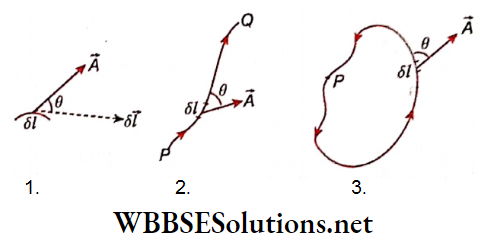
Electromagnetism Line Integral or path integral of a vector

Now, \(\vec{A} \cdot \delta \vec{l}=A \delta l \cos \theta\)

The sum of the above dot products along a finite line segment PQ can be expressed as an integral (using the symbol dl, instead of δl).

⇒ \(\lim _{n \rightarrow \infty} \sum_{i=1}^n \vec{A} \cdot \delta \vec{l}_i=\int_P^Q \vec{A} \cdot d \vec{l}=\int_P^Q A \cos \theta d l\)

It is called the line integral or path integral of vector \(\vec{A}\) along the path PQ. It is to be noted that the magnitude of vector \(\vec{A}\) may vary between point A to point B and if the direction of \(\vec{A}\) changes, θ will also change. The determination of the magnitude of a line integral is in general very complicated. However, due to different types of symmetry, the integral can often be determined easily.

Closed line integral:

A path that closes on itself is a closed path. To express the line integral of a vector along a closed path the symbol \(\oint\) is used.

For Example, the line integral of the vector \(\vec{A}\), called the circulation of \(\vec{A}\), is given by

⇒ \(\oint \vec{A} \cdot d \vec{l}=\oint A \cos \theta d l\)

Example:

The line integral of force vector work done:

If the force vector \(\vec{F}\) is taken as a special Example of vector \(\vec{A}\), according to the definition of work done we can write, work done by the force \(\vec{F}\) for displacement \(\overline{\delta l}\)

⇒ \(d W=\vec{F} \cdot \delta \vec{l}=F \delta l \cos \theta\)

So, tire total work done along the segment PQ.

⇒ \(W=\int_P^Q d W=\int_P^Q \vec{F} \cdot d \vec{l}=\int_P^Q F \cos \theta d l\)

Similarly, total work done by the force \(\vec{F}\) along a closed path,

⇒ \(W=\oint \vec{F} \cdot d \vec{l}=\oint F \cos \theta d l\)

If the force is conservative, the work done is zero. Naturally, the physical significance of the line integral of the force vector is this integral always indicates tire work done along a line.

Similarly, line integrals of different vectors in physics have different physical significances. For Example, the liter integral of tire electrostatic field \(\vec{E}\) around a closed path is zero because the electrostatic field is a conservation force field.

Statement of Ampere’s circuital law: The line integral of the magnetic field vector along a closed path in any magnetic field is equal to the product of the net current enclosed by the closed path and the permeability of vacuum, i.e.,

⇒ \(\oint \vec{B} \cdot d \vec{l}=\mu_0 I\)….(1)

Here, I = net current enclosed by the closed path.

Explanation:

If Ω is the closed path, it encloses current I, and as a result,

⇒ \(\oint_{X_1} \vec{B} \cdot d \vec{l}=\mu_0 I\)

On the other hand, if we consider the closed path X2, it encloses no current and henceI = 0.

⇒ \(\oint_{X_2} \vec{B} \cdot d \vec{l}\)
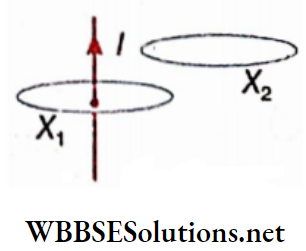
Electromagnetism Statement of Ampere's circuital law

2. If any closed path encloses a number of conductors, carrying currents in different directions, the algebraic sum of the enclosed currents is to be taken.
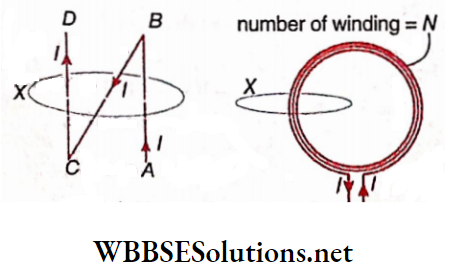
Electromagnetism Statement of Ampere's circuital law.

Currents in the parts AB, BC, and CD may be taken as I, -I, and I, respectively, and for the closed path X we can write,

⇒ \(\oint_X \vec{B} \cdot d \vec{l}=\mu_0(I-l+l)=\mu_0 l\)

Again, since an equal current, I flow through each of Tiro’s turns,

⇒ \(\oint_X \vec{B} \cdot d \vec{l}=\mu_0 N I \quad[N=\text { number of turns }]\)

CGS form of the law: Substituting B→H, I→i and μ0 → 4π we can write,

for a closed path enclosing a single turn

⇒ \(\oint \vec{H} \cdot d \vec{l}=4 \pi i\)

and for a closed path enclosing N turns,

⇒ \(\oint \vec{H} \cdot d \vec{l}=4 \pi N i\)

Application of Ampere’s Circuital Law:

The magnetic field of a long straight wire:

Let a current I flow through a straight long conductor. We have to determine the magnetic field at the point P at a perpendicular distance r from the wire.
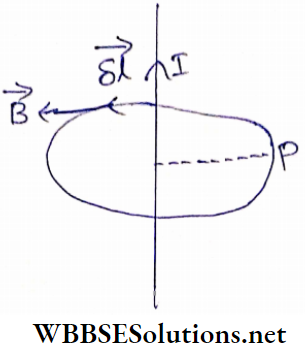
Electromagnetism magnetic field of a long straight wire

Taking the wire as an axis, a circular path is drawn through the point P having radius r in such a manner that the tire path lies in a plane perpendicular to the wire.

It is convenient to consider this circular path as Ampere’s closed path. For an element of length \(\delta \vec{l}\) on this closed path, the corkscrew rule shows that the magnetic field \(\vec{B}\) is parallel to \(\delta \vec{l}\) at every place, i.e., the angle between them is 0°.

Again, due to symmetry, the magnitude of \(\vec{B} \text { (i.e., }|\vec{B}|=B \text { ) }\) is the same at every point on the closed path.

So, \(\oint \vec{B} \cdot d \vec{l}=\oint_{B d l \cos \theta}\)

Since the current enclosedÿ by the closed path is I, from Ampere’s circuital law,

B – 2πr = μ0I

or, \(B=\frac{\mu_0 I}{2 \pi r}=\frac{\mu_0}{4 \pi} \cdot \frac{2 I}{r}\)

Solenoid: If a long insulated conducting wire is wound tightly over the surface of a cylinder so that every circular turn is perpendicular to the axis of the cylinder, then this coll is called a solenoid.

The axis of the cylinder is the axis of the solenoid. Usually after making a solenoid the inner cylinder is removed. (A conductor with a coating of insulating material is called an insulated conductor.)
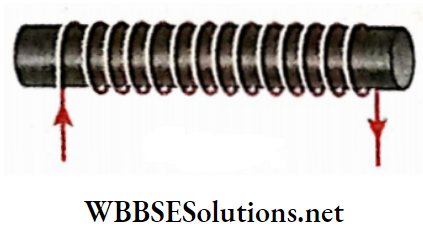
Electromagnetism Solenoid

Magnetic lines of force: The solenoid is placed on a cardboard with its axis lying on the cardboard plane. Now some light iron filings are scattered over the cardboard and the cardboard is slightly tapped.

The iron filings arrange themselves along the magnetic lines of force. The magnetic lines of force.
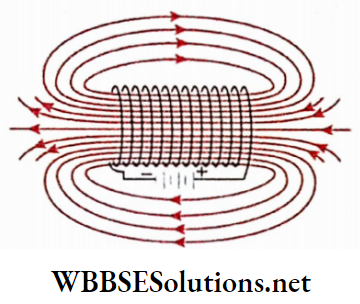
Electromagnetism Magnetic lines of force

Characteristics of the lines of force: The number density of magnetic lines of force inside the solenoid is very high, i.e., the magnetic field in that part is very strong.

The magnetic field outside the solenoid can be neglected in comparison. Moreover, the magnetic lines of force inside the solenoid are parallel to its axis. So, a strong and nearly uniform axial magnetic field is generated inside the solenoid

Magnetic field inside a long straight solenoid: Let the length of a long straight solenoid = L and its number of turns =N.

So, the number of turns per unit length of the solenoid, n = \(\frac{N}{L}\)A few number of turns of the solenoid is shown. Current through the solenoid = I.

Here, the rectangle abed is taken as the Ampere’s closed path whose side ab=L lies along the axis of the solenoid.
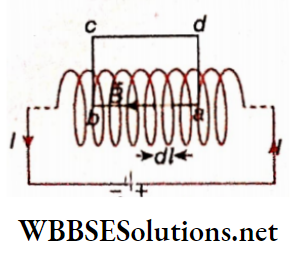
Electromagnetism Magnetic field inside a long straight solenoid

Let N be the number of turns enclosed by the rectangular path, \(\overrightarrow{d l}\) is a very small segment on this path, and \(\vec{B}\) is the magnetic field produced due to this part of the solenoid. According to Ampere’s circuital law,

⇒ \(\begin{array}{r} \oint_{a b c d} \vec{B} \cdot d \vec{l}=\int_a^b \vec{B} \cdot d \vec{l}+\int_b^c \vec{B} \cdot \overrightarrow{d l}+\int_c^d \vec{B} \cdot \overrightarrow{d l} \\ +\int_d^a \vec{B} \cdot d \vec{l}=\mu_0 N I \end{array}\) …(1)

As \(d \vec{l} \text { and } \vec{B}\) are in the same direction along ab so,

⇒ \(\int_a^b \vec{B} \cdot d \vec{l}=\int_a^b B d l \cos 0^{\circ}=B \int_a^b d l=B L\)….(2)

On the other hand, the magnetic field \(\vec{B}\) is perpendicular to the small segments \(d \vec{l}\) on the parts of me and da inside the solenoid. As the solenoid is an ideal one, \(\vec{B}\) = 0 for the side cd and also \(\vec{B}\) = 0 for the parts of me and da which are outside the solenoid.

Hence from equations (1) and (2) we get,

⇒ \(\oint_{a b c d} \vec{B} \cdot d \vec{l}=B L=\mu_0 N I\)…(3)

or, \(B=\mu_0 \frac{N}{L} \cdot I \quad \text { or, } B=\mu_0 n I\)….(4)

It is to be noted here that the magnitude of the magnetic field depends on the number of turns per unit length n but not on the total number of turns N of the solenoid. Hence, to increase the magnetic field it is not sufficient to increase the number of turns but it is also necessary to make the turns very close to each other so that the value of n increases.

CGS expression: Substituting B→H, I→I, and μ0 → 4π in equation (4), we get, H = 4πni.

Toroid: A toroid is a long insulated conducting wire, wound on a donut-shaped core having a circular axis and uniform cross-section so that each turn is normal to the axis.

A toroid is nothing but a solenoid bent to close on itself. A long straight solenoid has two definite ends but a toroid is an endless solenoid.
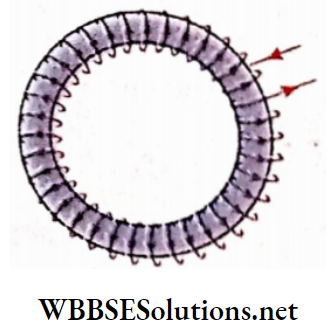
Electromagnetism Toroid

The magnetic field of a toroid: Let the radius of the ring of a toroid = r and the total number of turns in it = N. Sd,’ the circumference of the circular axis of the toroid = 2nr, arid the number of turns per unit length of it, \(n=\frac{N}{2 \pi r}\). A few turns of a toroid are shown. Current through the toroid = I.

Here, the axis of the toroid is considered as the Ampere’s closed path. If any small part \(8 \vec{l}\) is taken on the axis, according to the corkscrew rule, the direction of the magnetic field \(\vec{B}\) is parallel to \(8 \vec{l}\) at every point, i.e., the angle between them is 0°. Now, due to symmetry, the magnitude of \(\vec{B}\) is the same at all points on the axis.
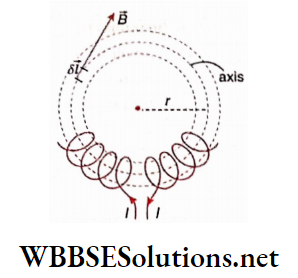
Electromagnetism Magnetic field of a toroid

Hence,

⇒ \(\oint \vec{B} \cdot d \vec{l}=\oint B d l \cos 0^{\circ}=B \oint d l=B \cdot 2 \pi r\)

Again, the net current enclosed by the axis = current I through each of N turns = NI

So, according to Ampere’s circuital law,

⇒ \(B \cdot 2 \pi r=\mu_0 N I \quad \text { or, } B=\mu_0 \cdot \frac{N}{2 \pi r} I\)

or, B = μ0nI….(5)

It should be noted that equation (5) is identical to equation (4). From this, it is concluded that if a solenoid is too long, whatever may be the shape, the magnitude of the magnetic field at any point on its axis will be B = μ0nI.

CGS expression: Substituting B→H, I→i, and μ0 → 4π in equation (5), we get, H = 4πni.

The core of a solenoid: In the above discussion, air is considered the core of a solenoid or a toroid. Thus, magnetic permeability is taken as μ0. For any other core (like iron, nickel, etc.), the value of the magnetic permeability changes notably. In that case, Ampere’s circuital law takes the form

⇒ \(\oint \vec{B} \cdot d \vec{l}=\mu n I, \text { where } \mu\), is the permeability of the core.

Limitation of Ampere’s circuital law:

Maxwell proved that Ampere’s circuital law is valid only for steady current. If the enclosed current varies with time, on the right-hand side of equation (1), an additional term should be added.

By this correction, Maxwell arrived at his famous electromagnetic field equations. An elaborate discussion about it has been done in the chapter on Electromagnetic waves. We should remember that, Ampere’s law is not incorrect, it can only be called incomplete.

In our discussion, we consider the cases where electric current remains steady with time, and hence, the equations obtained from Ampere’s law are accurate.

Magnetic Effect Of Current And Magnetism

Electromagnetism Numerical Examples

Example 1. A solenoid with 7 turns per unit length Is carrying a current of 2.5 A. What is the magnetic Intensity Inside the solenoid?
Solution:

Turns per unit length, n = 7 cm-1 =700 m-1; if μ is the permeability of the medium inside the solenoid then, magnetic field B = μnl.

∴ Magnetic intensity,

H = \(\frac{B}{\mu}\) = nI

=700 x 2.5

= 1750 A m-1

Example 2. The length of a solenoid is GO cm and Its total number of turns is 1250. If 2 A current is passed through It, what will be the magnetic field at any point on Its axis?
Solution:

Number of turns = 1250, length = 60 cm = 0.6 m

∴ Number of turns per unit length, n = \(\frac{1250}{0.6}\) m-1

So, the magnetic field at any point on its axis,

B = μ0nI

= 4π x 10-7 x \(\frac{1250}{0.6}\) x 2 [μ0 = 47T x 10-7Wb.A-1 m-1]

= 5.23 x 10⁻³ Wb/m2

Example 3. Two solenoids made of insulated conducting wires and of equal lengths are such that one is wound over another. The resistance of each of them is R and the number of turns per unit length is n. The solenoids are now connected in

  1. Series
  2. Parallel and the combination Is then connected with a battery of emf E.
  3. If current flows through them in the same direction in both cases, determine the magnetic field along the axis of the solenoids in each case

Solution:

1. In case of series combination, equivalent resistance =2R and hence current through each solenoid, \(I_s=\frac{E}{2 R}\)

Hence, the resultant magnetic field along the axis,

⇒ \(B=B_1+B_2=\mu_0 n I_s+\mu_0 n I_s\)

⇒ \(2 \mu_0 n \cdot \frac{E}{2 R}=\frac{\mu_0 n E}{R}\)

in the case of parallel combination, the terminal potential difference across each solenoid = E.

So, current through each solenoid, Ip = \(\frac{E}{R}\).

⇒ \(B=B_1+B_2=\mu_0 n I_p+\mu_0 n I_p\)

⇒ \(2 \mu_0 n \cdot \frac{E}{R}=\frac{2 \mu_0 n E}{R}\)

Example 4. A long straight solid conductor of radius 5 cm carries a current of 2 A, which is uniformly distributed over its circular cross-section. Find the magnetic field at a distance of 3 cm from the axis of the conductor.
Solution:

Let us consider an internal point P at a distance r(= 3 cm) from the axis of the conductor. Imagine a circular path of radius r around the conductor, such that P lies on it. If R is the radius of the solid conductor then the current enclosed by the circular path,

⇒ \(I_1=\frac{I}{\pi R^2} \times \pi r^2=\frac{I r^2}{R^2}\)

Let B be the magnetic field at point P due to the current-carrying conductor. B acts tangentially to the circular path. So according to Ampere’s Circuital law,

⇒ \(\oint \vec{B} \cdot d \vec{l}=\mu_0 I_1\)

or, \(B \times 2 \pi r=\frac{\mu_0 I r^2}{R^2}\)

Here, I = 2 A, r = 3 cm = 0.03 m, R = 5 cm = 0.05 m

∴ \(B=\frac{10^{-7} \times 2 \times 2 \times 0.03}{(0.05)^2}=4.8 \times 10^{-6} \mathrm{~T}\)

Force on A Moving Charge In A Magnetic Field

Let \(\vec{B}\) = magnetic field at a point, q= electric charge of a particle, \(\vec{v}\) = velocity of the particle at the given point.

Magnetic force on the charged particle due to the magnetic field at that point,

⇒ \(\vec{F}=q \vec{v} \times \vec{B}\) ….(1)

If the angle between \(\vec{v} \text { and } \vec{B} \text { be } \theta\), from the cross product of two vectors,

⇒ \(F=|\vec{F}|=q \nu B \sin \theta\)…(2)

Naturally, if v = 0, F = 0, i.e., if a charged particle is at rest then no magnetic force acts on it.
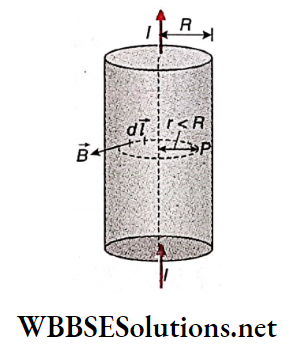
Electromagnetism Example 4 A long straight solid conductor of radius

Definition of magnetic field \(\vec{B}{/latex]:

Direction of [latex]\vec{B}{/latex]: If θ = 0° or 0 = 180°, F = 0. Thus no magnetic force acts on a charged particle that is moving parallel or antiparallel to the magnetic field. Hence, in a magnetic field, the direction (or its opposite direction) of a moving charged particle for which no magnetic force acts on it, defines the direction of [latex]\vec{B}{/latex].

Magnitude of [latex]\vec{B}{/latex]: If v and B remain perpendicular to each other, d = 90°. Thus, the magnitude of the magnetic force [latex]\vec{F}{/latex] becomes maximum. Expressing this maximum force by Fm, equation (2) can be written as,

⇒ [latex]F_m=q v B\)…(3)

If q = 1 and v – 1, then B = Fm. The maximum possible force exerted by a magnetic field on a particle of unit charge moving with unit velocity through the field defines this magnitude of the magnetic field.

Unit of B: From equation (3), \([B]=\frac{[F]}{[q][v]}\)

Hence the unit of B is,

⇒ \(\frac{\mathrm{N}}{\mathrm{A} \cdot \mathrm{s} \cdot\left(\mathrm{m} \cdot \mathrm{s}^{-1}\right)} \quad \text { or } \mathrm{N} \cdot \mathrm{A}^{-1} \cdot \mathrm{m}^{-1}\)

This unit is known as tesla (T) or Weber/metre2 (Wb.m”2).

Electromagnetism Notes For Class 12 WBCHSE  Significance of the cross product:

Applying the rule of the cross product of two vectors in equation (1) we can conclude that \(\vec{F}\) is always perpendicular to the plane containing \(\vec{v} \text { and } \vec{B}\).

If a right-handed corkscrew rotated from the direction of \(\vec{v} \text { to } \vec{B}\), the direction of advancement of the screw-head indicates the direction of \(\vec{F}\).
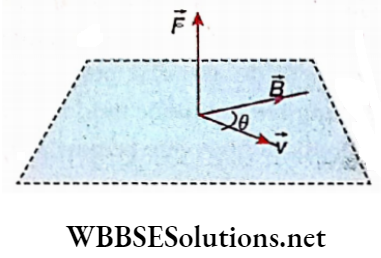
Electromagnetism Significance of the cross product

Work done by the magnetic force is zero: \(\vec{F} \text { and } \vec{v}\) is always perpendicular to each other. Since the displacement of a particle is taken along the direction of its velocity, at any point in the magnetic field, the force \(\vec{F}\) and a small displacement \(\vec{ds}\) of the particle are perpendicular to each other. Then, for the magnetic force F and its displacement \(\vec{ds}\), work done,

⇒ \(d W=\vec{F} \cdot d \vec{s}=F d s \cos 90^{\circ}=0\)

Hence, the work done by the magnetic force on a moving charged particle in a magnetic field is zero. In other words, the magnetic force is a no-work force.

Again, we know that, work done on a free particle = change in the kinetic energy of the particle. Since magnetic force is a no-work force, the kinetic energy of a charged particle is not affected.

∴ AK = W =0

or, \(\frac{1}{2}\) mv2 = constant (m = mass of the particle)

or, v = constant

So, when a magnetic force acts on a charged particle moving in a magnetic field, its speed as well as its kinetic energy remains unaffected.

Magnetic force In CGS system: in this system, charge q is expressed in esu [see the chapter: ‘Electric Fields’]. But to indicate the magnetic force, the current as well as the charge must be measured in emu.

1 emu of charge = 3 x 10¹⁰ esu of charge = c esu [ c = velocity of light in vacuum = 3 x 1010 cm.s-1 ]

So, if the magnitude of an electric charge is q esu, in the electromagnetic unit, it will be \(\vec{q}{c}\) emu.

Hence, the above-mentioned SI equation (1) can be expressed in

CGS system as,

⇒ \(\vec{F}=\frac{q}{c} \vec{v} \times \vec{B}\)

In this equation, magnetic field \(\vec{B}\) is used but not the magnetic intensity \(\vec{H}\). Here c = 3 x 1010 cm.s-1. F, q, v, and B are measured in dyn, esu, cm.s-1, and gauss or G, respectively.

Note that, 1 C = 0.1 emu of charge = 3 x 10⁹ esu of charge.

Fleming’s left-hand rule: If a charged particle moves at right angles to the magnetic field, is if the angle between \(\vec{v}\) and \(\vec{B}\) be θ = 90°, then from it can be concluded that the three vectors \(\vec{v}, \vec{B} \text { and } \vec{F}\) are mutually perpendicular. This special case can be easily explained by Fleming’s left-hand rule.
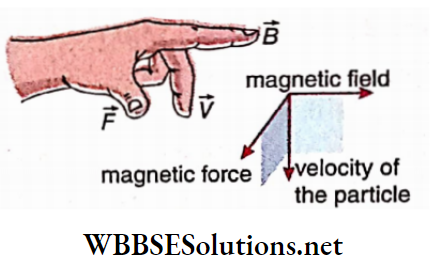
Electromagnetism Fleming's left hand rule

Path of a Moving Charge in a Uniform Magnetic Field:

Uniform magnetic field: A magnetic field is said to be uniform if its magnitude and direction remain constant in a region. We know that a magnetic field is represented by magnetic lines of force. For a uniform magnetic field

Magnetic lines of force are parallel to each other because the direction of the magnetic field remains constant;

The magnitude of the magnetic field also remains unchanged and hence the number density of the lines of force at different points are equal, i.e., the lines of force are equispaced.

Moreover, to represent a uniform normal and upward magnetic field with respect to the plane of the page; equispaced marked points are used; on the other hand, to denote a downward uniform magnetic field similar marked points are used
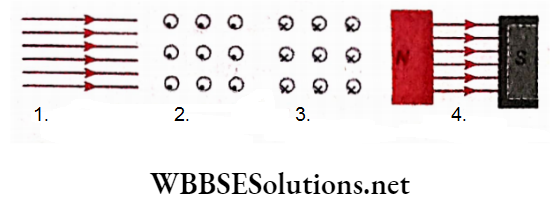
Electromagnetism Uniform magnetic field

In the region adjacent to the surface, the terrestrial magnetic field is assumed to be formed. Only in the vicinity of magnets or magnetic materials, are these lines of force distorted a little.

A uniform magnetic field is also generated between two strong opposite magnetic poles kept very close to each other.

Determination of the path of a charged partake: The charged particle is at rest: Since \(\vec{F}=q \vec{v} \times \vec{B}\) if \(\vec{v}\) = 0, \(\vec{F}\) = 0. Hence, in this case, no magnetic force acts on the particle and the charged particle remains at rest.

The charged particle enters with a velocity \(\vec{v}\) parallel to the magnetic field: If the velocity of the particle and the magnetic field are parallel to each other, then \(\vec{v} \times \vec{B}=0\). So, the magnetic force, \(\vec{F}=q \vec{v} \times \vec{B}=0\). Since no magnetic force acts in this case, the particle continues to move along a straight line.

The charged particle enters with a velocity \(\vec{v}\) perpendicular to the magnetic field:

Let a uniform magnetic field B be acting upward, perpendicular to the plane of the paper. A particle having charge +q enters that magnetic field at P with a velocity \(\vec{v}\) parallel to the plane of the paper.

Applying cross product rule, we see that the magnetic force \(\vec{F}\) ing on the particle will be normal to \(\vec{v}\) and along the direction \(\vec{PO}\).

As a result, the particle will be accelerated towards \(\vec{PO}\), and hence it will tend to deviate from its path.

When the particle reaches another point Q, the magnetic force \(\vec{F}\) will still act normally to \(\vec{v}\) and along \(\vec{QO}\).

In this way, magnetic force acting on the charged particle at every point of its path is always directed towards point O.

This force acts as a centripetal force on the particle, which therefore keeps revolving along a circular path centered at O and of radius r (r = PO = QO). Since the magnitude of velocity does not change under the influence of the magnetic field, the charged particle will have a uniform circular motion.
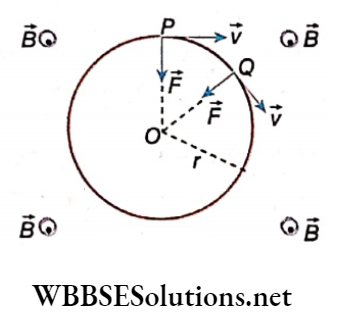
Electromagnetism The charged particle enters with a velocity

The radius of the circular path: Magnetic force, \(\vec{F}=q \vec{v} \times \vec{B}\).

Since the angle between v and B is 90°, the magnitude of the magnetic force,

⇒ \(F=|\vec{F}|=q v B \sin 90^{\circ}=q v B\)

If the mass of the charged particle is m,

⇒ \(\text { centripetal force }=\frac{m v^2}{r}\)

So, \(q v B=\frac{m v^2}{r} \quad

or, [latex]r=\frac{m v}{q B}\)…(1)

We see from the equation (1) that:

For a given charged particle (q = constant) and for a definite magnetic field (B = constant), the radius of the circular path is directly proportional to the momentum (mv) of the particle. This property is utilized in the measurement of the mass of a charged particle in a mass spectroscope.

If a given charged particle (q = constant) enters a magnetic field with a definite momentum (mv= constant) then the radius of the circular path is inversely proportional to the applied magnetic field (B).

The radius of the circular path is inversely proportional to its specific charge \(\frac{q}{m}\). For Example, the charge of a proton and electron is the same but the mass of a proton is 1836 times that of an electron.

Hence, the value of \(\frac{q}{m}\) for an electron is 1836 times higher. It means that if a proton and an electron enter a magnetic field with equal velocity, the electron revolves in a circular path of a much smaller radius.

It is clear that if the charge is -q instead of +q, the direction of uniform circular motion will be reversed.

Period of resolution and cyclotron frequency: Circumference of the circular path =2πr.

Since it is a uniform circular Otiort, time period,

⇒ \(T=\frac{2 \pi r}{\nu}=2 \pi \frac{\dot{m}}{q B}\)…(2)

The number of complete revolutions made in unit time, i.e., frequency of the circular motion,

⇒ \(n=\frac{1}{T}=\frac{1}{2 \pi}\left(\frac{q}{m}\right) B\) ….(3)

This frequency n is called cyclotron frequency.

Evidently, both T and n are independent of the radius of the path as well as of the velocity. From equation (1), it is clear that \(frac{r}{v}\) = constant. This property for the motion of a charged particle in a magnetic field is utilized in particle accelerators like cyclotrons.

The charged particle enters the magnetic field at an inclined path: Let the z-axis be chosen along the direction of a uniform magnetic field acting at a place. A particle of charge +q and mass m enters that magnetic field with velocity \(\vec{v}\) at the point P on the xy -plane.

If this velocity \(\vec{v}\) is inclined at an angle θ with the magnetic field \(\vec{B}\), the component of velocity along \(\vec{B}\), i.e., along z-axis = vcosθ and the component of velocity perpendicular to B, i.e., on the xy -plane = vsinθ.
Electromagnetism The charged particle enters the magnetic field at an inclined path

Naturally, no magnetic force acts on the particle the component cost, and hence this corÿonent remains unchanged. So, the charged particle performs a uniform linear motion along the magnetic field.

Again, the component vsinθ produces a uniform circular motion. The radius o|this uniform circular motion can be obtained by using for v in equation (1),

⇒ \(r=\frac{m v \sin \theta}{q B}\)….(4)

The time period and frequency of the particle in uniform circular motion do not depend on the velocity of the particle; hence just like equations. (2) and (3), it can be written as

⇒ \(T=\frac{2 \pi m}{q B} \text { and } n=\frac{1}{T}=\frac{q B}{2 \pi m}\)….(5)

Due to the combination of linear motion parallel to the z-axis and uniform circular motion on the xy-plane, the charged particle follows a spiral or helical path.

The axis of this helical path is the z-axis. For each complete revolution of the particle, the distance covered along the z-axis, i.e., along the direction of the magnetic field is called the pitch of this helical motion.

So, pitch = time period x linear velocity

⇒ \(\frac{2 \pi m}{q B} \cdot v \cos \theta\)

⇒ \(\frac{2 \pi m}{q B} \cdot \frac{q B r}{m \sin \theta} \cdot \cos \theta\)

= 2πrcotθ

= circumference of the circular path x cotθ …(6)

The property of the helical motion of a charged particle in a magnetic field is utilized in the magnetic focussing of different equipment.

Class 11 Physics Class 12 Maths Class 11 Chemistry
NEET Foundation Class 12 Physics NEET Physics

WBCHSE Class 12 Physics Chapter 6 solutions  Cyclotron:

The cyclotron was developed in 1932 by Professor E O Lawrence at the BerkelyInstitute, taliformia is a powerful particle accelerator for accelerating positively charged particles such as protons, aaa particles, etc., to very high energies so that they can be used in disintegration experiments.
Electromagnetism Cyclotron

Description: It consists of two cylindrical shells of copper having semicircular cross sections with the same diameter and height. They are open towards their diameter and all other sides are closed.

The diameters of the two shells are much larger than their heights. They are arranged side by side in such a way that a small gap exists between their diameters. Each is called ‘dee’ on account of its shape like the letter D.

Two pole pieces of a strong electromagnet are placed above and below the dees in such a way that a uniform magnetic field -defects perpendicular to the plane of the dees.

An alternating potential of the order of 105 V and of high frequency (about 106 Hz) is applied between the dees. So the dees act as the two electrodes -of the source of potential.

An ion source S is located near the center of the dees and it supplies the positive ions to be accelerated. At the periphery of the dees, an auxiliary negative electrode deflects the accelerated ions onto the target to be bombarded.

The whole space inside the dee is evacuated to a pressure of about 10-6 mm of mercury. If the ‘whole arrangement is seen horizontally.
Electromagnetism Cyclotron.

Principle of action: Suppose that a positive ion (e.g., hydrogen ion H+ or helium ion He++ ) emerges from the ion sources S. Generally these ions are produced by bombarding gas molecules with high-velocity electrons.

The positive ion produced at S will be attracted to whichever dee happens to be negative at that moment. Due to this attractive force-velocity of the ion increases and it enters the dee. Inside the dee, there is no electric field.

Owing to the magnetic field which is perpendicular to the plane of the dee the ion describes a semicircular path. The radius of the path is obtained from equation (1) of the section.

The ion moves in this path at a constant speed. At the end of the semicircular path when the ion arrives at the gap between the dees, then the other dee should become negative. Then the ion is again attracted, its velocity increases and it enters the other dee. From equation

It is understood that due, to the increase of velocity v, the radius r of the semicircular path will also increase. But from the equation

Of section, it is seen that in spite of the increase in velocity and radius, the time taken to describe each of the semicircular paths remains the same.

In this way, then at last reaches the outer edge of the dee and comes out with a high velocity. To increase the velocity of the ion, the magnetic field (\(\vec{B}\)) may be increased

Resonance condition: It is obvious that the condition of proper operation of a cyclotron is that the time taken by the ion to traverse a semicircular path will be equal to half of the time period of the alternating potential. So the frequency of the applied alternating potential difference n0 must be equal to the frequency of revolution of the ion, i.e., cyclotron frequency n.

⇒ \(\frac{1}{2 \pi}\left(\frac{q}{m}\right) B=n_0\)….(1)

This equation is called the resonance condition of the cyclotron. In practice, the value of n0 is kept fixed and the magnetic field B is varied until the above condition is satisfied.

The kinetic energy of the accelerated particle: If v is the velocity of a charged particle of mass m and charge q and if it moves perpendicular to a magnetic field B, the radius of its circular path according to the equation (1) of the section is,

⇒ \(r=\frac{m v}{q B} \quad\)

or, \(v=\frac{q B r}{m}\)

If R is the radius of a dee of the cyclotron, then the velocity of the charged particle ejected from the outlet is given by,

⇒ \(v_0=\frac{q B R}{m}\)

So, the kinetic energy of, the particle,

⇒ \(E=\frac{1}{2} m \nu_0^2=\frac{q^2 B^2 R^2}{2 m}\)….(2)

The kinetic energy of the accelerated particle Disadvantages:

1. If the velocity of the charged particle is high enough to be displacement comparable to the velocity of light, the mass of the particle does not remain constant.

According to the theory of relativity, m increases with the increase of velocity. So the resonance condition according to equation (1) is violated and the cyclotron does not function.

For an electron, the relativistic increase of mass is much greater. So the electrons very quickly get out of step. Hence a cyclotron is not used for accelerating electrons.

2. To make the charged particle sufficiently fast, dees of very large diameter are to be taken. This diameter may even exceed 100m. The construction of an electromagnet of so large diameter is prohibitively expensive and technically complicated.

WBCHSE Class 12 Physics Chapter 6 solutions  Remedies:

1. With the increase of mass due to relativity the frequency n0 of the alternating source may also be diminished in such a way that the product mn0 always remains constant. In that case, the resonance condition is never violated. The machine with this arrangement is called a synchro-cyclotron.

2. Both B and n0 can be changed simultaneously in such a way that

  1. The resonance condition is always satisfied
  2. In spite of the increase in velocity of the charged particle, the radius r of its circular path remains unchanged. So a thin annular electromagnet of that radius will serve the purpose. Hence technical complications and expenses may be reduced sufficiently. This machine is called a synchrotron.

Path of a Charged Particle in a Uniform Electric Field:

If a particle of charge +q experiences a force \(\vec{F}\) in a uniform electric field, from definition,

the electric field, \(\vec{E}=\frac{\vec{F}}{q} \quad \text { i.e., } \vec{F}=q \vec{E}\)…(1)

If the mass of the particle is m, then acceleration,

⇒ \(\vec{a}=\frac{\vec{F}}{m}=\frac{q \vec{E}}{m}\)….(2)

Naturally, for negative charges, the acceleration (\(\vec{a}\)) will be opposite to \(\vec{E}\). Due to this acceleration, the charged particle acquires different kinds of motion in different cases.

1. The charged particle is initially at rest: Initial velocity u = o. Hence, after time t,

the velocity of the particle, \(v=a t=\frac{q E}{m} t\)

and displacement, \(s=\frac{1}{2} a t^2=\frac{q E}{2 m} t^2\)

2. The charged particle enters with a velocity \(\vec{u}\) along the electric held: Since the direction, of acceleration, is in the direction of \(\vec{E}\) after time t,

velocity of the particle, \(v=u+\frac{q E}{m} t\)

and the displacement, \(s=u t+\frac{1}{2} \frac{q E}{m} t^2\)

3. The charged particle enters with a velocity \(\vec{u}\) perpendicular to the electric field: Let the uniform electric field act parallel to the y-axis and the charged particle enters this electric field with a velocity \(\vec{u}\) at the point P along the x-axis
Electromagnetism the charged particle enters with a velocity.

There is no component of E along the x-axis and hence the particle has no acceleration in this direction. So, along the x-axis, the particle possesses a uniform velocity u.

If the distance covered by the particle in time t is x, then t = \(\frac{x}{u}\). Again, along y-axis, initial velocity of the particle = 0, but acceleration, a = \(\frac{qE}{m}\).

So, in time t, displacement of the particle along the y-axis is,

⇒ \(y=\frac{1}{2} a t^2=\frac{1}{2} \frac{q E}{m}\left(\frac{x}{u}\right)^2=\frac{q E}{2 m u^2} \cdot x^2\)

or, \(x^2=\frac{2 m u^2}{q E} y\)….(3)

This is an equation of a parabola (in the form of x² = 4ay)

So, the path of the particle will be parabolic.

Path of Charged Particle in Crossed Electric Field and Magnetic Field:

Let a particle of charge +q and mass m enter an electromagnetic field at the point O along the z-axis with a velocity \(\vec{v}\),

Electric field \(\vec{E}\) at that point O is along the x-axis and magnetic field \(\vec{B}\) is along the y-axis, i.e.,\(\vec{v}\) \(\vec{E}\) and \(\vec{B}\) are mutually perpendicular. Now, the electric force acting on the particle along the x-axis = qE. The magnetic force acting on the particle = qvB, and the cross-product rule shows that this magnetic force acts along the negative direction of the x-axis.
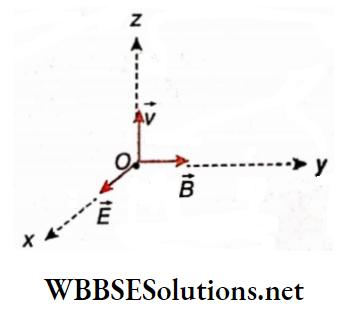
Electromagnetism Path of Charged Particle in Crossed Electric field and magnetic field

So, here the electric and the magnetic fields are oppositely directed. Keeping the directions of i, and B unchanged, if these two forces are made equal in magnitude, the net force acting on the charged particle becomes zero. In this case, the charged particle continues its motion along the z-axis with its initial Velocity v without suffering any deviation. The condition for this situation is,

⇒ \(q E=q v B \quad \text { or, } \quad \nu=\frac{E}{B}\)

Suppose the electric field E and magnetic field \(\vec{B}\) are acting simultaneously perpendicular to each other.

Let a stream of charged particles enter the space in a direction perpendicular to both \(\vec{E}\) and \(\vec{B}\). If the speed of the charged particles is different, then only those particles whose speed is equal to the ratio \(\frac{E}{B}\) will pass through the hole S on the screen without any deflection.

All other particles will be deflected from, their path and will not reach point S. This arrangement is known as a velocity filter. In the figure only the green particle would pass through the hole S as its velocity is equal to \(\frac{E}{B}\).
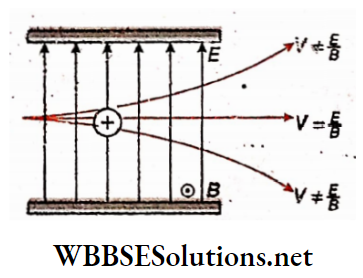
Electromagnetism particle continues its motion along

This principle, known as the velocity selector, Is utilized In the determination of Q specific charge \(\frac{q}{m}\) of an electron by J J Thomson’s experiment and θ mass of the nucleus with the help of mass-spectrometer.

Lorentz Force:

In an electromagnetic field, if a charge q enters with velocity \(\vec{v}\), the forces acting on it are

Electric force, \(\vec{F}_e=q \vec{E} \quad[\vec{E}=\text { electric field }]\)

Magnetic force, \(\vec{F}_m=q \vec{v} \times \vec{B} \quad[\vec{B}=\text { magnetic field }]\)

These forces, \(\vec{F}_e \text { and } \vec{F}_m\) are called Lorentz electric force and Lorentz magnetic force, respectively. The resultant Lorentz
force acting on the particle (charge),

⇒ \(\vec{F}=\vec{F}_e+\vec{F}_m=q \vec{E}+q \vec{v} \times \vec{B}\) – q (\(\vec{F}\) x \(\vec{v}\) x \(\vec{B}\))….(1)

In CGS or Gaussian system:

⇒ \(\vec{F}_{e q}=q \vec{E}, \vec{F}_m=\frac{q}{c}(\vec{v} \times \vec{B})\)

So, the resultant Lorentz force, \(\vec{F}=q\left[\vec{E}+\frac{1}{c}(\vec{v} \times \vec{B})\right]\)

Remarks:

1. If the charged particle is at rest in an electromagnetic field, an electric force still acts on it, but as [lavec]\vec{v}[/latex] = 0 no magnetic, force acts.

2. For negatively charged particles (e.g., electron or negative ion) q is replaced by -q, and hence the direct|on of each force \(\left(\vec{F}_e \vec{F}_m \text { and } \vec{F}\right)\) will be reversed.

WBCHSE Class 12 Physics Chapter 6 Solutions

Electromagnetism Numerical Examples

Example 1. An amagnetic field of 0.4 T is applied on a proton moving with a velocity of 5 x 10⁻⁶ m s-1. The magnetic field acts at an angle of 30º with the direction of velocity of the proton. What will be the acceleration of the proton? (mass ofa proton = 1.6.x 10-27 kg)
Solution:

Force acting on the proton, F= qvBsinθ.

∴ Acceleration antiproton = \(\frac{\text { force acting }}{\text { mass of proton }}=\frac{q v B \sin \theta}{m}\)

Here, q = 1.6 x 10⁻¹⁹ C, v = 5 x 10⁶ m.s-1,

B = 0.40 T, θ = 30° and m = 1.6 x 10⁻²⁷ kg.

∴ Acceleration of the proton

⇒ \(\frac{1.6 \times 10^{-19} \times 5 \times 10^6 \times 0.40 \times \sin 30^{\circ}}{1.6 \times 10^{-27}}\)

= 1014 m.s-2

Example 2. An electron (mass = 9 x 10-31g, charge = 1.6 x 10⁻¹⁹ C) enters a magnetic field with a velocity of 106 m si and starts rotating in a circular path of radius 10 cm. What is the value of the magnetic field?
Solution:

The electron is rotating in a circular path i.e. the direction Of the velocity of the electron is perpendicular to the direction of the magnetic field. So the magnetic force = qvB, which provides the necessary centripetal force for the circular motion.

∴ \(q v B=\frac{m v^2}{r}\) [r = radius of the circular path = 10cm = 0.1 m]

or, \(B=\frac{m v}{q r}=\frac{\left(9 \times 10^{-31}\right) \times 10^6}{\left(2.6 \times 10^{-19}\right) \times 0.1}\)

= 5.6 x 10⁻⁵ T

Example 3. Two particles of equal charge are accelerated by applying the same potential difference and then allowed to enter a uniform magnetic field normally. If the particles keep revolving along circular paths of radii R1 and R2, determine the ratio of their masses
Solution:

If the charge of each particle is q and the potential difference applied is V, kinetic energy acquired = qV

So, \(q V=\frac{1}{2} m_1 v_1^2=\frac{1}{2} m_2 v_2^2\)

or, \(\frac{v_1}{v_2}=\sqrt{\frac{m_2}{m_1}}\)

Again, the magnetic force required to revolve along a circular path = centripetal force.

∴ For the first particle,

⇒ \(q v_1 B=\frac{m_1 v_1^2}{R_1} \quad\)

or, \(q B=\frac{m_1 v_1}{R_1}\)

For the second particle, \(q B=\frac{m_2 v_2}{R_2}\)

∴ \(\frac{m_1 v_1}{R_1}=\frac{m_2 v_2}{R_2} \quad\)

or, \(\frac{m_1}{m_2}, \frac{v_1}{v_2}=\frac{R_1}{R_2}\)

or, \(\frac{m_1}{m_2} \cdot \sqrt{\frac{m_2}{m_1}}=\frac{R_1}{R_2} \quad\)

or, \(\sqrt{\frac{m_1}{m_2}}=\frac{R_1}{R_2}\)

or, \(\frac{m_1}{m_2}=\left(\frac{R_1}{R_2}\right)^2\)

Example 4. In a cyclotron, the frequency of alternating current is 12 MHz and the radius of its dee is 0.53 m.

  1. What should be the operating magnetic field to accelerate protons?
  2. What is the kinetic energy of the proton beam produced by the cyclotron? Given, the mass of the proton = 1.67 x 10⁻²⁷ kg and charge = +1.6 X 10⁻¹⁹ C.

Solution:

1. Condition of resonance,

⇒ \(\frac{1}{2 \pi}\left(\frac{q}{m}\right) B=n_0 \quad \text { or, } B=\frac{2 \pi n_0 m}{q}\)

Here, n0 = 12 MHz = 12 x 106 Hz = 12 x 106 s-1

So, \(B=\frac{2 \times 3.14 \times\left(12 \times 10^6\right) \times\left(1.67 \times 10^{-27}\right)}{1.6 \times 10^{-19}}\)

= 0.79 Wb.m-2

2. Kinetic energy of proton,

⇒ \(E^{\prime}=\frac{q^2 B^2 R^2}{2 m}\)

= \(\frac{\left(1.6 \times 10^{-19}\right)^2 \times(0.79)^2 \times(0.53)^2}{2 \times\left(1.67 \times 10^{-27}\right)}\)

= \(1.34 \times 10^{-12} \mathrm{~J}\)

= \(\frac{1.34 \times 10^{-12}}{1.6 \times 10^{-19}} \mathrm{eV}\)

= 8375 x 10-6 eV

= 8.375 MeV

Example 5. A beam of protons with velocity 4 x 10 sm.s-1 enters a uniform magnetic field of 0.4 T at an angle of 60° to the magnetic field. Find the radius of the helical path of the proton beam and the time period of revolution. Also, find the pitch of the helix. Mass of proton = 1.67 X 10⁻²⁷ Vg
Solution:

Mass of the proton, m = 1.67 x 10⁻²⁷ kg velocity of the proton, v = 4 x 10⁵ m.s-1; charge, q = 1.6 x 1049 C.
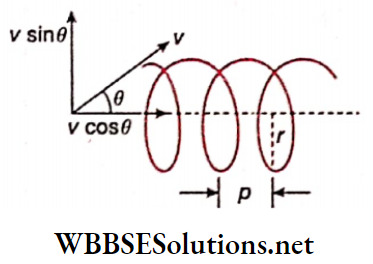
Electromagnetism Example 5 A beam of protons with velocity

∵ The component of velocity perpendicular to the field is vsinθ, the radius of the helical path,

⇒ \(r=\frac{m \nu \sin \theta}{q B}\)

= \(\frac{\left(1.67 \times 10^{-27}\right)\left(4 \times 10^5\right) \sqrt{3}}{\left(1.6 \times 10^{-19}\right) \times 0.4 \times 2}\)

= 9 x 10⁻³ m

= 0.9 cm

During the time period of the revolution,

⇒ \(T=\frac{2 \pi r}{\nu \sin \theta}\)

= \(\frac{2 \times 3.14 \times 0.009 \times 2}{4 \times 10^5 \times \sqrt{3}}\)

= 1.63 x 10⁻⁷ s

The pitch of the helix,

p = vcosθ x T =4 x 10⁵ x \(\frac{1}{2}\) x 1.63 x 10-7

= 3.26 x 10⁻² m

= 3.26 cm

Class 12 WBCHSE Physics Electromagnetism Concepts

Electromagnetism Action Of A Magnet On Current

Oersted’s experiment deals with the influence of a current-carrying conductor on a magnet. The magnet, in reaction, also exerts equal but opposite force on the current-carrying conductor.

So, it is possible to move a current-carrying wire in a magnetic field. This kind of motion is very important for practical purposes. This phenomenon is the subject matter of electrodynamics.

Force on a Current-Carrying Conductor in a Magnetic Field:

The Lorentz force acting on a charge q moving with velocity \(\vec{v}\) in a magnetic field \(\vec{B}\) is,

⇒ \(\vec{F}=q \vec{v} \times \vec{B}\)

When current flows in a circuit, the drift motion of free electric charges through the circuit is considered as the cause of that current. Naturally, the magnetic force acting on those free charges in a magnetic field acts as the force on the current-carrying conductor.

Let the current through a circuit = I; a V element of length \(\vec{dl}\) of that circuit is considered.
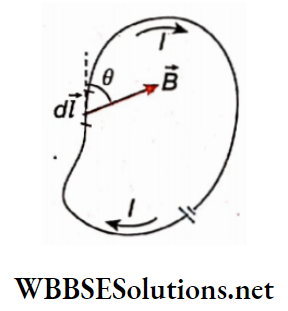
Electromagnetism Force on a Current Carrying Conductor in a magnetic field

The magnetic field at the position of this element of the circuit = \(\vec{B}\). If dq amount of charge crosses dl length in time dt, current the circuit, \(I=\frac{d q}{d t}\)

Velocity of the charge, \(\vec{v}=\frac{d \vec{l}}{d t}\)

So, the magnetic force acting on the small part \(\vec{dl}\)

⇒ \(d \vec{F}=d q \vec{v} \times \vec{B}=d q \cdot \frac{d l}{d t} \times \vec{B}=\frac{d q}{d t} d \vec{l} \times \vec{B}\)

∴ \(d \vec{F}=I d \vec{l} \times \vec{B}\) ….(1)

If the angle between \(d \vec{l} \text { and } \vec{B}\) be θ, then

\(dF=|d \vec{F}|=I d l B \sin \theta=B I d l \sin \theta\)….(2)

So, the magnetic force acting on the whole circuit or on a finite part of it,

⇒ \(F=\int d F=\int B I d l \sin \theta\)…(3)

Generally, for different elements- of the circuit, both B and θ may change. Hence, in the absence of some special symmetry, the integral of equation (3) becomes very complicated.

Special cases:

The current carrying wire is at right angles with a uniform magnetic field: For any small part of the wire, θ = 90° or sinθ = 1. If the magnetic field is uniform, B = constant. If a current carrying wire of length is placed in this uniform magnetic field, according to equation (3) the force acting on the wire will be,

F = BIl….(4)
Electromagnetism The current carrying wire is at right angles

The current-carrying wire is placed parallel to the magnetic field: For any small part of the wire, 0 = 0° or sinθ = 0.

So, according to equation (3), the force acting on the wire is,

F = 0….(5)

Note that, the units of l or dl, I, B, and F are m, A, Wb.m-2, and N, respectively.

Fleming’s left-hand rule:

If a long straight current-carrying conductor is kept at right angles with a uniform magnetic field, i.e., if for each element of the wire, the angle between \(\vec{dl}\) and \(\vec{B}\) is θ = 90°, then according to the rule of cross-product we can say from equation (1) that the three vectors \(\vec{dl}\), \(\vec{B}\) and \(\vec{dF}\) will be mutually perpendicular.

Fleming’s left-hand rule is a handy tool for determining the direction of the magnetic force acting on a current-carrying conductor, perpendicular to the magnetic field.

Statement: If the forefinger, middle finger, and thumb of the left hand are stretched mutually perpendicular to each other, such that the forefinger points to the direction of the magnetic field and the middle finger points to the direction of current, then the thumb points to the direction of force experienced by the conductor.
Electromagnetism Fleming's left hand rule.

This left-hand rule is also known as the motor rule.

Barlow’s wheel: We can demonstrate the action of a magnet on an electric current with the help of this experimental arrangement.

Description: B is the Barlow’s wheel made of a thin copper plate having a number of sharp teeth. The wheel B is kept vertical such that its one sharp tooth remains in contact with mercury kept in a container placed in between two poles of a strong horse-shoe magnet (NS). Now the wheel and the mercury inside the container (M) are connected to a source of current E.
Electromagnetism Barlow's wheel

Working principle: The magnetic field acts from the JV-pole to the S-pole of the magnet parallel to the horizontal platform.

Since the tooth of the wheel remains in contact with mercury, the circuit is closed as soon as the battery is switched on. As a result, the current flows in a downward direction.

From Fleming’s left-hand rule, we see that a magnetic force acts on the current toward the right. Due to this force, the tooth will be deflected towards the right. As a result, the circuit breaks.

Hence magnetic force will no longer act on the wheel. But due to inertia of motion, the next tooth comes in contact with mercury and in a similar way will be deflected towards the right. Hence, a continuous anticlockwise motion will be observed in Barlow’s wheel.

Electromagnetism Derivations For Class 12 WBCHSE  Discussions:

1. To get an effective result, the wheel should be very light. Moreover, the magnetic field and the electric current should be very strong.

2. If the direction of either the magnetic field or the electric current is reversed, the rotation of the wheel will also be reversed; but if both of them are reversed then the rotation of the wheel will be in the same direction.

3. The machine which converts electrical energy into rotational energy (usually mechanical energy) is called a motor. So, Barlow’s wheel is a motor, although it has no practical use.

Torque on a Current Loop in a Uniform Magnetic Field:

PQRS is a rectangular conductor. Its length, PQ = RS =l and breadth, QR = PS = b

So, the area of the rectangular face of the conductor, <A= Tb. This rectangular conductor is placed in a magnetic field B in such a way that

  1. PQ and RS 316 perpendicular to the magnetic field
  2. The surface PQRS is parallel to the magnetic field.
Electromagnetism Torque on a Current Loop in a Uniform magnetic field

If a current is sent through the conductor,

1. No force acts on the arms QR and PS as they are parallel to the magnetic field,

2. Magnitude of the force (\(\vec{F}\)) acting on each of the arms PQ and RS, F = BIl.

Applying Fleming’s left-hand rule, we see that these two equal forces are downward and upward, respectively and hence they constitute a couple.

Since the perpendicular distance between these two forces is QR = PS = b, the moment of the couple, i.e., the torque acting on the coil is,

⇒ \(\tau=B I l \cdot b=B I A\)….(1)

and due to this torque, the coil starts to rotate. Instead of a single turn, if the conducting coil has N turns, torque acting on it,

⇒ \(\tau\) = BNIA….(2)

Equations (1) and (2) show that the torque r depends only on area A of the coil. This means that the shape of the coil is not important. Instead of a rectangular coil, a coil of any other shape of equal area may be used to obtain the same torque.

Vector representation of torque: We know that any plane surface can be treated as a vector, such that the magnitude of the vector is equal to the magnitude of its area and its direction is along the normal to that plane.

So, the quantity A in equation (1) can be expressed as a vector \(\vec{A}\) the direct arbitrary position of the rotating loop under the influence of torque. If the angle between \(\vec{A}\) and the magnetic field \(\vec{B}\) is θ, from equation (1) we get,

⇒ \(\tau=B I A \sin \theta\)….(3)

The vector representation of the above equation is,

⇒ \(\vec{\tau}=I \vec{A} \times \vec{B}\)…..(4)

So, the torque acting on a conducting coil having N turns will be

⇒ \(\vec{\tau}=N I \vec{A} \times \vec{B}\)….(5)
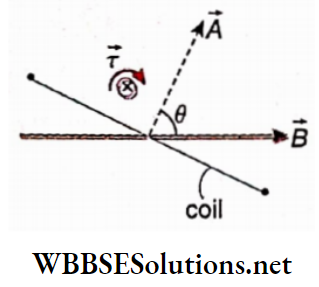
Electromagnetism Vector representation of torque

Electromagnetism Derivations For Class 12 WBCHSE

Electromagnetism Numerical Examples

Example 1. 2A current is flowing through a circular coil of radius 10 cm, made of insulated wire and having 100 turns.

  1. If the circular plane of the conductor is kept at right angles to the direction of a magnetic field of 0.2 Wb.m-2, determine the force acting on the coil.
  2. If the conductor is placed parallel to the magnetic field, determine the torque acting on it.

Solution:

Here,N = 100, r = 10 cm = 0.1 m,

B = 0.2 Wb m-2.

∴ Circumference of the circular loop,

L = 2πr

= 2 x I x 0.1

= 0.628 m

Area of the circular loop,

A = πr2 = π x (0.1)2

= 0.0314 m2

1. The whole circumference of the conductor is normal to the magnetic field; hence magnetic force

= NILB

= 100 x 2 x 0.628 x 0.2

= 25.12 N

[It should be noted that, in this situation, if the circular plane is taken as a vector, its direction will be perpendicular to that plane, i.e., parallel to the magnetic field. As a result, no torque will act on the conductor.]

2. If the circular plane is taken as a vector, its direction will be perpendicular to the plane, i.e., normal to the magnetic field.

As a result, the torque acting on the conductor

= NIAB

= 100 x 2 x 0.0314 x 0.2

= 1.256 N.m

Example 2. The radius of a circular coil having 100 turns Is 5 cm and a current of 0.5 A is flowing through this coil. If it is placed in a uniform magnetic field of strength 0.001 T, then what torque will act on the coil when the plane of the coil is

  1. Parallel to the magnetic field
  2. Inclined at 30° with the magnetic field
  3. Perpendicular to the magnetic field?

Solution:

Number of turns = 100

Current, I = 0.5A

Radius of the circular coil, r = 5 cm = 5 x 10⁻²m

∴ Area of the coil, A = πr2 = 3.14 x (5 x 10-2)2m2

Magnetic field intensity, B = 0.0001 T

Now torque acting on the current carrying coil due to magnetic field,

⇒ \(\tau=n B I A \sin \theta\)

1. When the coil is parallel to the malefic field, then θ = 90°

So, \(\tau=n B I A \sin 90^{\circ}\)

= 100 x 0.001 x 0.5 x 3.14 x 25 x 10-4

= 3.93 x 10⁻⁴ N.m

2. When the coil makes an angle 30° with the field, then θ = 60°

So, \(\tau=n B I A \sin 60^{\circ}\)

⇒ \(=100 \times 0.001 \times 0.5 \times 3.14 \times 25 \times 10^{-4} \times \frac{\sqrt{3}}{2}\)

= 3.4 X 10⁻⁴ N.m

3. When the coil is perpendicular to the field, θ = 0°.

∵ \(\tau=0\)

Example 3. On a smooth plane inclined at 30° with the horizontal, a thin current-carrying metallic rod is placed parallel to the horizontal ground. The plane is In a uniform magnetic field of 0.15 T along the vertical direction. For what value of current can the rod remain stationary? The mass per unit length of the rod is 0.30kg/m.
Solution:

Along the inclined plane, the component of the magnetic force acting on the conductor and the component of the weight of the conductor will bring equilibrium. So,

BIlcosd = mgsinθ….(1)

Here, force on the conductor BIl acts horizontally towards the right.

Now, from equation (1),

⇒ \(I=\frac{m g \sin \theta}{B l \cos \theta}=\frac{m g}{B l} \tan \theta\)

∵ \(\frac{m}{l}=0.30 \mathrm{~kg} / \mathrm{m}, g=9.8 \mathrm{~m} / \mathrm{s}^2\)

B = 0.15 T, θ = 30°

∴ \(I=\frac{0.30 \times 9.8}{0.15} \tan 30^{\circ}\)

⇒ \(=2 \times 9.8 \times \frac{1}{\sqrt{3}}=11.3 \mathrm{~A}\)
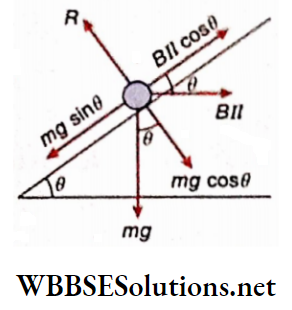
Electromagnetism Example 3 On a smooth plane inclined

Electromagnetism Action Of Current On Current

Like parallel currents: Let two straight parallel conductors PQ and RS be kept horizontally and I1 and I2 be the currents flowing through them in the same direction
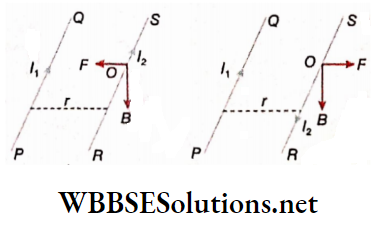
Electromagnetism like parallel currents

According to the corkscrew rule, for current I1, the magnetic field B at any point O on the wire RS will act downwards. If Fleming’s left-hand rule is applied at point O on wire RS, it is seen that the wire RS will experience a force F towards the wire PQ.

As Reactiion, the wire PQ also will experience the same force F towards the wire RS. So, we can conclude that two parallel currents attract each other.

Unlike parallel currents: Suppose I1 and I2 currents are flowing through the wires PQ and RS, respectively mutually opposite directions. Applying Fleming’s left-hand rule similarly, it is found that the wire RS experiences a force F away from the wire PQ. The wire PQ also experiences an equal but opposite force that acts on It away from the wire RS. So, we can conclude that two unlike parallel currents repel each other.

The magnitude of the force of attraction or repulsion: Let r be the perpendicular distance between two long, straight parallel conductors kept in a vacuum or air.

Due to current I1 the magnetic field at a distance of r will be

⇒ \(B=\frac{\mu_0}{4 \pi} \cdot \frac{2 I_1}{r}\)

From the relation F = BIl, we get, the force acting on the unit length of the wire placed at r, carrying current I2, which is

⇒ \(\left.F=\frac{\mu_0}{4 \pi} \cdot \frac{2 I_1 I_2}{r} \text { [Putting } B=\frac{\mu_0}{4 \pi} \cdot \frac{2 I_1}{r} \text { and } l=I_2\right]\)….(1)

Here, the unit of r is m, I1, and I2 is A, F is N.m-1, and μ0 = 4π x 10-7 H.m-1.

This equation gives the definition of international ampere. If I1 = I2 = 1 A and r = 1 m,

⇒ \(F=\frac{\mu_0}{4 \pi} \times \frac{2 \times 1 \times 1}{1}=\frac{4 \pi \times 10^{-7}}{4 \pi} \times 2\)

= 2 x 10⁻⁷ N

1 ampere: Two long straight parallel conducting wires, having negligible cross sections and carrying equal currents are kept 1 m apart from each other. The steady direct current for which each wire experiences a force of 2 x 10⁻⁷ N per unit length, is called 1 ampere.

Expressions in Gaussian system: Substituting \(I_1 \rightarrow i_1, I_2 \rightarrow i_2 \text { and } \mu_0 \rightarrow 4 \pi\) in equation (1) we get,

⇒ \(F=\frac{2 i_1 i_2}{r}\)

Here unit of r is cm, F is dyn, and i1 and i2 emu

Obliquo currents:

1. If currents through two oblique straight conductors lying in the same plane converge to or diverge from their point of intersection, they attract each other
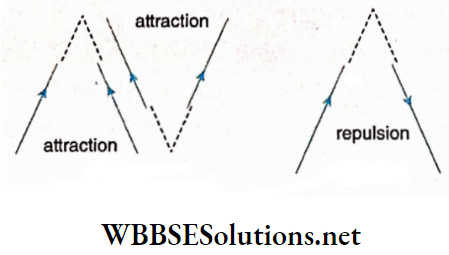
Electromagnetism Obliquo currents

2. If currents through two oblique straight conductors lying in the same plane are such that, one of them is directed towards and the other directed away from their point of intersection, they repel each other.

Experimental Demonstration Roget’s Vibrating Spiral:

Description: A long elastic spring made of insulated copper wire is suspended from a rigid support. A small spherical copper bob, attached at the lower end of the spring, just touches the mercury kept in a vessel. The fulcrum at the upper end of the spring and mercury in the vessel are joined to a battery.
Electromagnetism Experimental Demonstration Roget’s vibrating sprial

Working principle: When the battery is switched on, a unidirectional parallel current flows through the turns of the spring and hence the turns attract each other, resulting in the contraction of the spring.

Naturally, the copper bob remains no longer in contact with mercury and hence the circuit is cut off. As soon as the bob leaves the surface of the mercury, the attraction between the turns of the spring no longer exists.

Hence, the spring elongates due to its own weight, the copper sphere touches the mercury again and closes the circuit. In this way, alternate compression and elongation of the spring goes on and hence the spring vibrates continuously.

This experiment proves that a number of unidirectional parallel currents attract each other.

Electromagnetism Numerical Examples

Example 1. Two very long- conducting wires are kept at a distance of 4 cm from each other in a vacuum. Currents flowing through the wires are 25A and 5A, respectively. Find the length of each conductor, which experiences a force of 125 dynes.
Solution:

Here, I1 = 25 A, I2 = 5 A, r = 4 cm = 0.04 m

So, the force acting per unit length of the wire,

⇒ \(F=F=\frac{\mu_0}{4 \pi} \cdot \frac{2 I_1 I_2}{r}=\frac{4 \pi \times 10^{-7}}{4 \pi} \cdot \frac{2 \times 25 \times 5}{0.04}\)

= 625 x 10-6 N.m-5

For 125 dyn or 125 x 10-5 N force, the effective length of each wire,

⇒ \(l=\frac{125 \times 10^{-5}}{625 \times 10^{-6}}=2 \mathrm{~m}\)

Example 2. Two long straight parallel conducting wires kept 0.5 m apart, carry 1 A and 3 A currents, respectively.

  1. What is the force acting per unit length of tire two wires?
  2. At what position in the plane of the wires, the resultant magnetic field will be zero?

Solution:

1. Force acting per unit length,

⇒ \(F=\frac{\mu_0}{4 \pi} \cdot \frac{2 I_1 I_2}{r}=10^{-7} \times \frac{2 \times 1 \times 3}{0.5}\)

= 1.2 x 10⁻⁶ N.m-1

According to the corkscrew rule, the magnetic fields produced between two wires are mutually opposite in direction. Let any point P in this region be at a distance x from the first wire.

∴ The magnetic field at point P due to the first wire

⇒ \(\frac{\mu_0}{4 \pi} \cdot \frac{2 I_1}{x}\)

and magnetic field at the point P due to the second wire

⇒ \(\frac{\mu_0}{4 \pi} \cdot \frac{2 I_2}{(0.5-x)}\)

If the resultant magnetic field at the point P is zero, then

⇒ \(\frac{\mu_0}{4 \pi} \cdot \frac{2 I_1}{x}=\frac{\mu_0}{4 \pi} \cdot \frac{2 I_2}{(0.5-x)} \quad\)

or, \(\frac{0.5-x}{x}=\frac{I_2}{I_1}=\frac{3}{1}\)

or, 3x = 0.5 – x

or, 4x = 0.5

or, x = \(\frac{0.5}{4}\)

= 0.125 m

So, at any point on the plane between the wires, 0.125 m away from the first wire, the resultant magnetic field will be zero

Example 3. Two long parallel conductors, kept at a distance d, carry currents I1 and I2, respectively. The mutual force acting between them. Now, the current one is doubled and its direction is also reversed. If the distance of separation between them is made 3d, what will be the force acting between the two conductors?
Solution:

For the unit length of the conductors,

⇒ \(F=\frac{\mu_0}{4 \pi} \cdot \frac{2 I_1 I_2}{d}\)

If the current in the first conductor is doubled and its direction is reversed, it will be -2I1.

∴ In the second case

⇒ \(F^{\prime}=\frac{\mu_0}{4 \pi} \cdot \frac{2\left(-2 I_1\right) I_2}{3 d}\)

= \(-\frac{2}{3} \frac{\mu_0}{4 \pi} \cdot \frac{2 I_1 I_2}{d}\)

= \(-\frac{2}{3} F\)

Practice Problems on Electromagnetism for Class 12

Example 4. A long horizontal wire AB, which is free to move in a vertical plane and carries a steady current of 20 A, is in equilibrium at a height of 0.01 m over another parallel long wire CD, which is fixed in a horizontal plane and carries a steady current of 30A. Show that when AB is slightly depressed, it executes simple harmonic motion. Find its period of oscillations.
Electromagnetism Example 4 A long horizontal wire

Solution:

Force per unit length on wire AB due to the magnetic field produced by wire CD

⇒ \(\frac{\mu_0}{4 \pi} \frac{2 I_1 I_2}{r}\)

where Ix = 20 A, I2 = 30 A and distance between AB and CD, r = 0.01m.

So force on the whole of wire AB due to wire CD,

⇒ \(\left.F=\frac{\mu_0}{4 \pi} \cdot \frac{2 I_1 I_2}{r} \times L \text { [where } L=\text { length of wire } A B\right]\)

Since wire AB is in equilibrium, the force F must balance its weight by acting downwards. This is possible only if the two wires repel each other and hence I1 and I2 are flowing in opposite directions.

Accordingly, \(F=\frac{\mu_0}{4 \pi} \cdot \frac{2 I_1 I_2}{r} \times L=M g\)…..(1) [where M=mass of wire AB]

If we consider that the wire is depressed by a small distance d so that the height of AB over CD becomes (r-d), then the force on wire AB increases to,

⇒ \(F_1=\frac{\mu_0 2 I_1 I_2}{4 \pi(r-d)} \times L=\frac{\mu_0 I_1 I_2}{2 \pi r}\left(1-\frac{d}{r}\right)^{-1} L\)

= \(=\frac{\mu_0 I_1 I_2}{2 \pi r}\left(1+\frac{d}{r}\right) L\)

Now on releasing the wire AB, it moves under the effect of restoring force f.

⇒ \(f=F_1-M g=F_1-F=\frac{\mu_0 I_1 I_2}{2 \pi r}\left[1+\frac{d}{r}-1\right] L\)

= \(\frac{\mu_0 I_1 I_2 L}{2 \pi r^2} d\)

Acceleration of the wire AB, \(a=\frac{f}{M}=\frac{\mu_0 I_1 I_2 L}{2 \pi r^2 M} d\)

Since, except d all other physical quantities are constants

Hence the motion of the wire is simple harmonic.

So time period,

⇒ \(T=2 \pi \sqrt{\frac{2 \pi r^2 M}{\mu_0 I_1 I_2 L}}=2 \pi \sqrt{\frac{2 \pi r^2}{\mu_o I_1 I_2 L} \times \frac{\mu_0 I_1 I_2 L}{2 \pi r g}}\) [putting the value of M from equation (1)]

∴ \(T=2 \pi \sqrt{\frac{r}{g}}=2 \pi \sqrt{\frac{0.01}{9.8}}\)

= 0.2s

Electromagnetism Derivations For Class 12 WBCHSE

Electromagnetism Galvanometer

A galvanometer is an instrument used to detect and measure the current in a circuit.

A current measuring instrument can be constructed using the heating effect, the chemical effect, or the magnetic effect of current. However, to measure a direct current (dc), the magnetic effect is most advantageous for practical purposes.

The two types of galvanometers used widely in laboratories are:

1. Moving magnet galvanometer: The basic principle of this instrument is the action of electric current on a magnet.

Example: Tangent galvanometer, Since galvanometer, Helmholtz double coil galvanometer.

This type of galvanometer is rarely used due to its disadvantageous setup and low sensitivity. The discussion is out of our syllabus.

2. Moving coil galvanometer: The basic principle of this instrument is the action of a magnet on an electric current.

Example: D’Arsonval galvanometer, table galvanometer.

Moving Coil Galvanometer:

With a moving coil galvanometer, we can detect and measure even a very weak current (about 10-9A) in a circuit. This galvanometer.
Electromagnetism Moving Coil Galvanomete

Description of a moving coil:

ABCD: A coil of insulated copper wire wound over a rectangular frame made of cane or aluminum.

I: A cylinder of soft iron. The axis of the cylinder coincides with the axis of the coil and the cylinder is fitted inside the coil.

NS: Two magnetic poles made of soft iron attached with a strong permanent magnet. The gap between the two poles is cylindrical and in this gap, the coil is placed in such a way that the axis of the gap coincides with the axis of the coil.

Due to this special shape of the magnetic poles, the magnetic field always remains parallel to the plane of the coil.

Now this coil is fitted with a mechanical system such that:

  1. The circuit current to be measured can be sent directly through the coil
  2. A very accurate measurement of the deflection of the coil due to the flow of current can be done. For this purpose, two types of mechanical arrangements are widely used

1. Suspended-coil galvanometer or D’Arsonval galvanometer: This type of arrangement.

W: Phosphor-bronze wire. The coil ABCD is hung by this wire.

M: A small mirror attached to the phosphor-bronze thread W. Ift he coil rotates through an angle θ, and the mirror also rotates through θ. So, if a ray of light falls on the mirror from a stationary source of light, the reflected ray rotates through an angle of 20. If the displacement of the reflected light spot on a scale, kept at a distance D from the mirror, is d then,

⇒ \(2 \theta=\frac{d}{D} \quad(\text { when, } d \ll D)\)

or, \(\theta=\frac{d}{2 D}\)….(1)

For this arrangement, it is also called a mirror galvanometer.

b This arrangement is shown. Two magnetic poles are not drawn here.

HH: Two hairsprings. Two ends of the coil are connected with these two hairsprings. The circuit current to be determined enters the coil through the two bearings P and Q attached to HH.

R: A pointer. With the rotation of the coil, it also rotates. When no current flows through the galvanometer, the pointer remains vertical. It can move on either side of this position depending on the direction of the current.

The deflection of the pointer gives an idea of the magnitude of the current. The tire value of the rotation is obtained from a graduated circular scale. Titus it is also called a pointer galvanometer.

Theory: Let the number of turns of the rectangular coil = N, the area of its surface A, the magnetic field parallel to the coil = D, and current through the coil = I. The torque acting on the coil, \(\tau=B N I A\) Due to torque, the coil rotates from its equilibrium position.

On the other hand, the phosphor-bronze thread in a suspended coil galvanometer or the hairsprings in a table galvanometer always tries to return the coil to its equilibrium position by virtue of its elastic property.

The value of this restoring torque \(\tau\)‘ is directly proportional to the tire angle of deflection of the coil. So, if the tire coil comes to rest at an angular displacement of θ

⇒ \(r=r^{\prime} \text { or, } B N I A=c \theta\)

or, \(I=\frac{c}{B N A} \cdot \theta\)….(2)

Here, c = restoring torque per unit twist = constant. From this equation, the tire value of the current can be obtained.

Using equation (1) for a suspended coil galvanometer we get,

⇒ \(I=\frac{c}{2 B N A D} d\)….(3)

WBCHSE Class 12 Physics Electromagnetism Notes Discussions:

1. Relation between current and angle of deflection: From equation (2), it is seen that current (I) is directly proportional to the angle of deflection (θ), i.e., a linear relation exists between them. Thus, the current measuring scale of this kind of galvanometer is always uniform.

2. Setting of the galvanometer: This galvanometer contains no magnetic needle and hence it is not necessary to set this galvanometer magnetic meridian plane. Rather, it can be placed in any position.

3. Galvanometer sensitivity: A moving coil galvanometer is very sensitive and current can be measured very accurately with it. Thus, this type of galvanometer is widely used for current measurement.

Suspended-type galvanometers are highly sensitive. The current through the coil for which the displacement of the light spot on a scale kept at a distance of 1 m from the mirror is 1 .mm, which is called the sensitivity of the galvanometer. Its unit is A mm-1

The sensitivity of this kind of galvanometer is about 10-9 A.mm-1.So, the galvanometer will be more sensitive for a lesser value of sensitivity.

On the other hand, a table galvanometer is very durable in spite of our lower sensitivity. Different table galvanometers are so designed that their pointers give full-scale deflection for a current range of 50μA to 15 mA

4. Condition of sensitivity:

From equation (2) we get, \(\frac{\theta}{I}=\frac{B N A}{c}\)

So, for a given current I, to get greater deflection θ, the value of \(\frac{B N A}{c}\) should be greater.

  1. Using a powerful magnet the value of B can be increased.
  2. A rectangular coil of multiple turns (N) and of sufficiently large surface area (A) has to be used. However, with an increase of N and A, the resistance of the galvanometer also increases and the coil becomes very heavy.
  3. A suspension thread should be chosen for which c is sufficiently small and hence a very thin wire should be used which can bear the weight of the coil. A suspension wire made of phosphor bronze serves this purpose

5. Limitation: The main disadvantage of a moving coil galvanometer is overload. If the current is more than its endurance limit and is passed through this galvanometer, its phosphor bronze wire or the hairsprings may get damaged permanently.

Electromagnetism Use Of Galvanometer As An Ammeter Or A Voltmeter

Ammeter: The instrument which measures current in an electrical circuit is called an ammeter. An ammeter is always connected in series with a circuit so that the entire current in the circuit can pass through it, Again, its resistance should be very low so that when it is joined in a circuit, the main current in that circuit does not decrease appreciably.

So, an ammeter milliammeter or microammeter) is a low-resistance instrument connected in series with an electrical circuit. The resistance of an Ideal ammeter should be zero.

Voltmeter: The instrument used for measuring the potential difference between two points of an electrical circuit is called a voltmeter. To equalize the potential difference between those two points with the potential difference between the two ends of the voltmeter, it should be connected in parallel with those two points in the circuit.

Again, the resistance of the voltmeter should be very high so that no appreciable fraction of the main current passes through the voltmeter. So, a voltmeter (or millivoltmeter) is an instrument of high resistance connected in parallel with an electrical circuit. The resistance of an ideal voltmeter should be infinite.
Electromagnetism Voltmeter

Disadvantages of using a galvanometer: The basic instrument used for measuring current is a moving magnet galvanometer or a moving coil galvanometer. In spite of this, there are some problems with using these instruments directly in laboratory experiments.

1. Some time is spent on leveling and setting of these galvanometers.

2. The magnitude of the current cannot be obtained directly from any scale. To calculate the magnitude of current we have to use the galvanometer formula after measuring the angle of deflection.

3. Usually the resistance of a galvanometer is of intermediate order (in most of cases, from 100Ω to 500Ω). When this galvanometer is used to measure current or potential difference, the results turn out to be erroneous; because it is not an ideal one to use as an ammeter as its resistance is not too low, and again it is not an ideal one as a voltmeter as its resistance is not too high.

Transformation of Galvanometers:

To make a galvanometer fit for everyday use in the laboratory, it should be effectively converted into an ammeter or a voltmeter. Thus, a galvanometer is the primary instrument while an ammeter or a voltmeter is the secondary instrument.

To construct an ammeter or a voltmeter, a moving coil table galvanometer is generally used. For this

The resistance of the galvanometer, G;

The current IG, for the full-scale deflection of the pointer in the circular scale, should be known beforehand.

Galvanometer to ammeter: Let the resistance of the galvanometer = G and the current required for the full-scale deflection of the pointer = IG
Electromagnetism galvanometer to ammeter

Now, a low resistance in parallel, i.e., a shunt S is connected with the galvanometer. The whole system is kept in a box covered with glass in such a way that

The pointer and the circular scale remain visible from the outside,

The terminals A and B are outside the box. The points A and B are connected with the external circuit. If the main circuit current corresponds to a full-scale deflection of the galvanometer, the galvanometer is effectively converted into an ammeter suitable for measuring maximum current I. Note that, due to the parallel combination of G and S, the equivalent resistance of the ammeter thus formed becomes sufficiently small.

Galvanometer to ammeter Calculation:

VX – VY = IG.G = IS.S [here, Is stands for shunt current]

So, \(S=\frac{I_G}{I_S} \cdot G\)

Again, \(I=I_G+I_S \quad \text { or, } \quad I_S=I-I_G\)

Hence, \(S=\frac{I_G}{I-I_G} \cdot G\)….(1)

So, to convert the galvanometer into an ammeter to measure a maximum current I, a shunt S as obtained from equation (1), should be connected in parallel with the galvanometer.

Range of the ammeter: In equation (1), I > IG; hence when an ammeter is constructed from a galvanometer, its range always increases and never decreases. If this range becomes n times, \(\frac{I}{I_G}=n\); so from equation (1) we get,

⇒ \(S=\frac{1}{I / I_G-1} \cdot G=\frac{G}{n-1}\) ….(2)

Resistance of the ammeter: The equivalent resistance of G and S is the resistance (R) of the ammeter.

So, \(\frac{1}{R}=\frac{1}{G}+\frac{1}{S}=\frac{1}{G}+\frac{n-1}{G}=\frac{n}{G} \text { i.e., } R=\frac{G}{n}\)…(3)

Galvanometer to voltmeters: In this case, a high resistance R is connected in series with the galvanometer. The two points A and B are connected with the external circuit.

So, if the current in the external circuit is IG, the galvanometer current will also be and as a result, the pointer gives full-scale deflection. Hence, In this condition, the potential difference (VA – VB) between the two points A and B will show full-scale deflection of the pointer.

So, the galvanometer will then be effectively converted into a voltmeter. Due to the series combination of G and R, the equivalent resistance of the voltmeter becomes sufficiently large.
Electromagnetism Resistance of the ammeter

Galvanometer to voltmeters Calculation:

VA – VB = V = IG (G+R)

or, \(G+R=\frac{V}{I_G} \quad .. R=\frac{V}{I_G}-G\)….(4)

So, to convert the tire galvanometer into a voltmeter fit for measuring a maximum potential difference V, high resistance of magnitude R, as obtained from equation (4), should be connected in series.

Range of voltmeter: In equation (4), V > IGG (= VG), and hence if a galvanometer is converted into a voltmeter, the range of the voltage always increases and never decreases.If this range becomes n -times, then \(\frac{V}{V_G}=n\); So from equation (4) we get,

⇒ \(R=G\left(\frac{V}{I_G \cdot G}-1\right)=G\left(\frac{V}{V_G}-1\right)=G(n-1)\)…(5)

Resistance of the voltmeter: Naturally, the resistance of the newly formed voltmeter,

RV = G + R = G + G(n-l) = nG….(6)

WBCHSE Class 12 Physics Electromagnetism notes Differences between an ammeter and a voltmeter:
Electromagnetism differences between an ammeter and a voltmeter

Theoretically moving magnet or suspended-coll galvanometers may be converted to an ammeter or voltmeter in a similar way. However due to the practical difficulties associated with such arrangements only moving coil table galvanometers are converted to be used as an ammeter or voltmeter.

WBCHSE Class 12 Physics Electromagnetism Notes

Electromagnetism Numerical Examples

Example 1. A galvanometer of resistance 10Ω gives lull scale deflection for a current of 10 mA. How can this galvanometer be used?

  1. As an ammeter to measure current of range 0-2 A
  2. As a voltmeter having a voltage range of 0-5 V?

Solution:

Resistance of the galvanometer, G = 10-11; maximum current, IG = 10 mA = 0.01 A

1. Connecting a shunt S in parallel to the galvanometer, if the instrument is used between points A and B, an ammeter of current range 0-1 will be obtained.

In the given question, I = 2 A.
Electromagnetism Example 1 A galvanometer of resistance

Now, IS.S= IG.-G

or, \(S=\frac{I_G}{I_S} G=\frac{I_G}{I-I_G} \cdot G=\frac{0.01}{2-0.01} \times 10\)

= 0.0503Ω

This is the required value of the shunt resistance.

2. A voltmeter having a voltage range of zero to (VA – VG) is obtained if a resistance R is connected in series with the galvanometer and the instrument is used between points A and B.
Electromagnetism Example 1 A galvanometer of resistance.

In the given problem, VA – VB = 5V

Now, VA – VB = IG (G + R)

or, \(R=\frac{V_A-V_B}{I_G}-G=\frac{5}{0.01}-10\)

= 500-10

= 490Ω

Example 2. Full-scale deflection occurs, in a moving coil galvanometer of resistance 36Ω when 100 mA current flows through it. What arrangement should be made to convert it into a voltmeter in the 0-5V range? Draw the necessary circuit diagram.

Solution:

Resistance of the galvanometer = 36Ω, maximum current, IG = 100 mA = 0.1 A.

Connecting a resistance R in series with the galvanometer and using the equipment in between the two points A and B, we shall get a voltmeter to measure voltage difference ranging from 0 to (VA– VB).

Here, VA – VB = 5V

Now, VA – VB = IG(G+R)

or, \(R=\frac{V_A-V_B}{I_G}-G=\frac{5}{0.1}-36\)

= 50-36

= 14Ω

This is the required value of the resistance R.

Example 3. A millivoltmeter of range ‘0-50 mV’ and resistance 50Ω is to be converted into an ammeter of range 0-1 A. How can it be done?
Solution:

Resistance of the millivoltmeter, R = 50 Ω; maximum voltage, V = 50 mV = 0.05 V.

Connecting a shunt S in parallel with the millivoltmeter and using this combination in between points A and B, we shall get an ammeter to measure a maximum current I.

Here, I = 1 A.

Now, IS. S = IV.R

or, \(S=\frac{I_V}{I_S} \cdot R=\frac{I_V}{I-I_V} \cdot R\)

⇒ \(\frac{\frac{V}{R}}{I-\frac{V}{R}} \cdot R=\frac{V}{I-\frac{V}{R}}=\frac{0.05}{1-\frac{0.05}{50}}=\frac{0.05}{1-0.001}=0.05 \Omega\)

This is the required value of the shunt resistance.
Electromagnetism Example 3 A millivoltmeter of range

Example 4. How would you convert a voltmeter that can measure up to 150 V to an ammeter that can measure current up to 8R The Resistance of the voltmeter is 300Ω.
Solution:

Resistance of the voltmeter, R = 300Ω; maximum voltage, V = 150 V.

∴ Maximum current through the voltmeter,

⇒ \(I_V=\frac{V}{R}=\frac{150}{300}=0.5\)

Connecting a shunt S in parallel with the voltmeter and using this combination in between the points A and B, we shall get an ammeter to measure a maximum current I.

Here, I = 8 A

Now, IS.S = IV.R

or, \(S=\frac{I_V}{I_S} \cdot R=\frac{I_V}{I-I_V} \cdot R=\frac{0.5}{8-0.5} \times 300=\frac{0.5}{7.5} \times 300\)

= 20Ω

This is the required value of the shunt resistance.

Example 5. A galvanometer of resistance 100Ω gives full-scale deflection for a current of 10 mA. What is the value of, the shunt to be used to convert it into an ammeter which can measure current up to 10 A?
Solution:

Resistance of the galvanometer, G= 100Ω; maximum current, IG = 10 mA = 0.01 A. Connecting a shunt S in parallel with the voltmeter and using this combination in between the points A and B, we shall get an ammeter useful to measure a maximum current I.

Here, I = 10A and IS.S = IG.G

or, \(S=\frac{I_G}{I_S} \cdot G=\frac{I_G}{I-I_G} \cdot G=\frac{0.01}{10-0.01} \times 100=\frac{1}{9.99}\)

= 0.1001Ω

Example 6. A moving coil galvanometer of resistance 50Ω gives full-scale deflection for a current of 50 mA. How can this galvanometer used to convert it into a voltmeter that can measure voltage up to 200 V?
Solution:

Resistance of the galvanometer, G = 50Ω; maximum current, IG= 50 mA = 0.05 A. Connecting a resistance R in series with the galvanometer and using the equipment in between the two points A and B, we shall get a voltmeter to measure the voltage difference ranging from 0 to ( VA– VB)

Here, VA – VB = 200V

Now VA – VB = IG(G+R)

or, \(R=\frac{V_A-V_B}{I_G}-G=\frac{5}{0.1}-36=14 \Omega\)

This is the required value of resistance R.

WBCHSE Class 12 Physics Electromagnetism notes

Electromagnetism Conclusion

  • Two like poles repel each other and two unlike poles attract each other.
  • Repulsion is the conclusive test of magnetization.
  • The region surrounding a magnet in which the influence of the magnet is felt is called the magnetic field of the magnet.
  • A magnetic line of force in a magnetic field is defined as a continuous line such that the litigant drawn at any point on it gives the direction of the magnetic field at that point.
  • The direction of deflection of a magnetic needle due to the flow of electric current can be determined by
    • Ampere’s swimming rule
    • Right-hand thumb rule.
  • The right-hand thumb rule is also called Oersted’s rule. For determination of the direction of the magnetic field at a point near a current-carrying conductor)
    • Maxwell’s corkscrew rule
    • The right-hand grip rule is used. The ratio of the magnetic field (B) acting at a point by a substance to the magnetic permeability (μ) of that substance is called the magnetic intensity or magnetizing field (H) at that point.

Units of B and H:
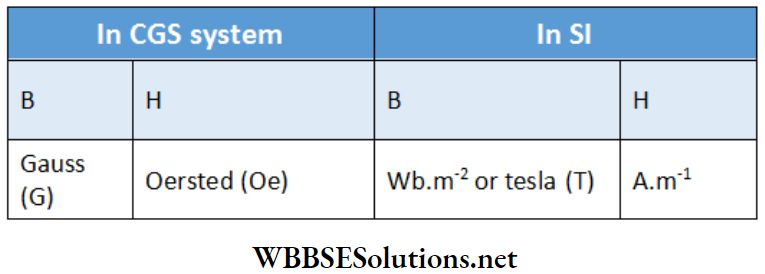
Electromagnetism units of B and H

Relation between SI and CGS units:

  • 1A.m-1 = 4π x 10-3 Oe , 1Wb.m-2 = 104 G
  • The current which, when flowing through a conducting wire of length 1 cm bent in the form of an arc of a circle of radius 1 cm, produces a magnetic field of 1 Oe at the center of the arc, is called an electromagnetic unit of current.
  • 1 emu of current =10 A.
  • Ampere’s circuital law: The line integral of the magnetic field vector along a closed path in a magnetic field is equal to the product of the total current enclosed by the closed path and the permeability of the vacuum.
  • \(\text { i.e., } \oint \vec{B} \cdot \overrightarrow{d l}=\mu_0 I\)
  • Here, I is the total current enclosed by the closed path.
  • If a long, insulated conducting wire is wrapped over the surface of a cylinder in such a way that each circular turn is perpendicular to the axis of the cylinder, the coil thus formed is called a solenoid.
  • If a long, insulated conducting wire is wound on a donut-shaped core of uniform cross-section having a circular axis such that each turn is perpendicular to its axis, the coil thus formed is called a toroid. A toroid is also called an endless solenoid.
  • If a positively charged particle of magnitude 1 C moves with velocity 1m s-1 in a magnetic field and experiences a maximum force of 1 N, then the magnitude of the magnetic field is called 1 T or 1 Wb.m-2.
  • The magnetic force experienced by a moving charged particle in a magnetic field is a no-work force.
  • The speed and kinetic energy of a charged particle does not change when a magnetic force acts on it.
  • If the magnitude and direction of a magnetic field throughout a certain region remain constant, the field is called a uniform magnetic field otherwise, it is a non-uniform magnetic field.
  • A charged particle follows a circular path inside a uniform magnetic field when it enters the field perpendicularly. A charged particle follows a helical path inside a uniform magnetic field when it enters the tire field obliquely.

Fleming’s left-hand rule: If the tire forefinger of the middle finger and the thumb of the left hand are stretched mutually perpendicular to each other, such that the forefinger points the direction of the magnetic field and the tire middle finger points the direction of the current, the thumb points the direction of the force acting on tire conductor.

  • Two like parallel currents attract each other and two unlike parallel currents repel each other.
  • Two long, linear, and parallel conducting wires of negligible cross sections are kept 1 nr apart from each other. The steady direct current flowing in each wire for which both of them experience a force of 2 x 10⁻⁷ N.m-1 is called 1 A current.
  • Galvanometers used in the laboratory are:
    • Moving magnet galvanometer-examples: Tangent galvanometer, sine galvanometer.
    • Moving coil galvanometer-examples: D’Arsonval galvanometer, table galvanometer.
  • According to Biot-Savart law or Laplace’s law, die magnitude of magnetic field ⇒ \(\delta \vec{B}\) at a point due to a small element δ1 of a current carrying wire is,
  • ⇒ \(\delta B \propto \frac{I \delta l \sin \theta}{r^2} \text { or, } \delta B=k \frac{I \delta l \sin \theta}{r^2}\)
  • where r = distance of the point from the element and
  • θ = angle between the current element \(\delta \vec{B}\) and position vector \(\vec{r}\).
  • In SI, the conventional form of Biot-Savart law is,
  • ⇒ \(\delta B=\frac{\mu_0}{4 \pi} \cdot \frac{I \delta l \sin \theta}{r^2}\)
  • [μ0 = magnetic permeability of vacuum = 4π x 10-7 H.m-1]
  • Generally, \(B=\mu H \quad \text { or, } \quad H=\frac{1}{\mu} B\)
  • The magnetic field at any point near a straight conductor,
  • ⇒ \(B=\frac{\mu_0}{4 \pi} \frac{I}{r}\left(\sin \theta_1+\sin \theta_2\right)\)
  • Magnetic field due to an Infinite straight conductor,
  • ⇒ \(B=\frac{\mu_0}{4 \pi} \cdot \frac{2 l}{r}\)
  • The magnetic field at the center of a circular conductor of N turns,
  • ⇒ \(B=\frac{\mu_0 I N}{2 r}[r=\text { radius of the circle }]\)
  • The magnetic field at a point on the axis of a circular conductor of N times,
  • ⇒ \(B=\frac{\mu_0 N I}{2} \cdot \frac{r^2}{\left(r^2+x^2\right)^{3 / 2}}\)
  • [where, x = distance of the point from the center of the coil]
  • Magnetic field due to a long, straight solenoid at any point on its axis,
  • ⇒ \(B=\mu_0 n I\)
  • [n = number of turns per unit length of the solenoid = \(\frac{N}{L}\)
  • Magnetic field due to a toroid,
  • ⇒ \(B=\mu_0 n I\)
  • [n = number of turns per unit length of the toroid = \(\frac{N}{2 \pi r}\)]
  • If N number of conductors carrying current I are enclosed by a closed loop then according to circuital law,
  • ⇒ \(\oint \vec{B} \cdot d \vec{l}=\mu_0 N I\)
  • Force on a charged particle moving with a velocity (\(\vec{v}\)) in a uniform magnetic field (\(\vec{B}\)) is
  • ⇒ \(\vec{F}=q \vec{v} \times \vec{B}\)
  • The radius of the circular path described by a moving charged particle entering a uniform magnetic field perpendicularly,
  • ⇒ \(r=\frac{m v}{q B}\)
  • [m = mass of the charged particle, v = velocity of the particle, q = charge of the particle and B = magnetic field]
  • Time period of revolution, \(T=2 \pi \frac{m}{q B}\)
  • Number of complete revolutions in the circular path, i.e., frequency of circular motion,
  • ⇒ \(n=\frac{1}{T}=\frac{1}{2 \pi}\left(\frac{q}{m}\right) B\)
  • This is known as cyclotron frequency.
  • The kinetic energy of the charged particle ejected from the outlet of the cyclotron device = \(\frac{q^2 B^2 R^2}{2 m}\) [ R = radius of the dee of cyclotron]
  • A charged particle, when it enters a magnetic field obliquely, follows a helical or spiral path. The pitch of this spiral or helical path
  • = time period x linear velocity
  • = circumference of the circular path x cotθ
  • Force experienced by a particle of charge + q in a uniform electric field
  • ⇒ \(\vec{F}=q \vec{E}\)
  • For a charge q moving in an electromagnetic field with velocity \(\vec{v}\), the forces acting are,
    • Electric force, \(\vec{F}_e=q \vec{E} \quad[\vec{E}=\text { electric field }]\)
    • Magnetic force, \(\vec{F}_m=q \vec{v} \times \vec{B}[\vec{B}=\text { magnetic field }]\)
  • Resultant Lorentz force, \(\vec{F}=q(\vec{E}+\vec{v} \times \vec{B})\)
  • In the case of a current-carrying conductor in a magnetic field, the resultant magnetic force acting on the whole circuit or a finite part of the circuit,
  • ⇒ \(F=\int d F=\int B I d l \sin \theta\)
  • The torque acting on a rectangular conductor having N turns placed in a uniform magnetic field,
  • ⇒ \(\tau=B N I A\) [I = current-strength, A = area of cross-section of the rectangular conductor]

Vectorial form:

  • ⇒ \(\vec{\tau}=N I \vec{A} \times \vec{B}\)
  • If the perpendicular distance between two long parallel conductors kept in vacuum or in air be r, the force of attraction or repulsion per unit length of the wire is,
  • ⇒ \(F=\frac{\mu_0}{4 \pi} \cdot \frac{2 I_1 I_2}{r}\) [I1 , I2 are the currents in the two wires]
  • In the case of a moving coil galvanometer, if the number of turns in the tire coil is N, the area of the plane of coil A, the magnetic field parallel to coil B, current the of the coil I, and the coil comes to rest at an angle θ, then
  • ⇒ \(I=\frac{c}{B N A} \theta\)
  • Here, c = restoring torque per unit deflection = constant
  • Required shunt to be connected with a galvanometer in parallel to convert it to an ammeter,
  • ⇒ \(S=\frac{I_G}{I-I_G} \cdot G\)
  • [where S = shunt resistance, G = galvanometer resistance, IG = maximum galvanometer current, I = main current in circuit]
  • If the range of an ammeter is to be increased n -times,
  • ⇒ \(S=\frac{G}{n-1}\)
  • To convert a galvanometer into a voltmeter for measuring a maximum voltage of V, the resistance to be connected in series with the galvanometer,
  • ⇒ \(R=\frac{V}{I_G}-G\)
  • If the range of the voltmeter is to be increased n -times, then
  • R = G(n-l)

Units of some magnetic quantities:
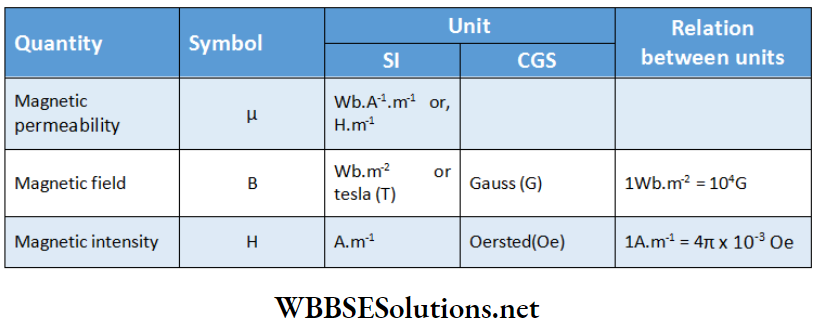
Electromagnetism units of some magnetic quantities

  • When two current-carrying loops make an angle θ with each other, then net magnetic field at their center,
  • ⇒ \(B=\sqrt{B_1^2+B_2^2+2 B_1 B_2 \cos \theta}\)
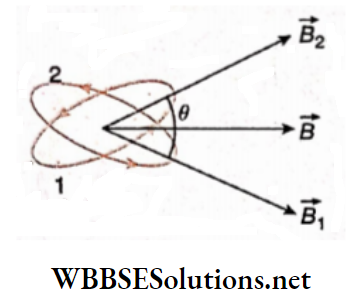
Electromagnetism net magnetic field

  • The value of the magnetic field at at point on the center of separation of two parallel conductors carrying equal currents in the same direction is zero.
  • If a current-carrying circular loop is turned into a coil having n identical turns then the magnetic field at the center of the coil becomes n² times the previous electric field i.e., Bn = n²B1 where Bn = magnetic field at the center of the coil having n turns; B1 = magnetic field at the center of the circular loop.

Electromagnetism Very Short Questions and Answers

Question 1. What is the nature of lines of force in a uniform magnetic field?
Answer: Parallel and equispaced

Question 2. In a uniform magnetic field, lines of force are equispaced – straight lines.
Answer: Parallel

Question 3. How is the direction of a magnetic field $ at a point related to the magnetic line of force passing through that point?
Answer:

⇒ \(\vec{B}\) is tangential to the line of force at that point

Question 4. A magnetic needle is kept below a very long conducting wire. If the current is sent through the wire from north to south, in which direction will the north pole of the needle be deflected?
Answer: Toward the east

Question 5. A magnetic needle is placed below a very long conducting wire. If the current is sent through the wire from east to west, in which direction will the north pole of that needle be deflected?
Answer: No deflection occurs

Question 6. How does the magnetic field at a point near a long straight current-carrying conductor vary with the current and the distance of the point?
Answer: Proportional, inversely proportional

Question 7. When 1 A current flows through a circular conductor, the magnetic: fields generated at its centre are 10-7 T. For what value of current, will the magnetic field be 10-6 T?
Answer: 10 A

Question 8. Which physical quantity has the unit Wb.m-2? Is it a scar lar or a vector quantity?
Answer: Magnetic field or magnetic induction \(\vec{B}\) it is a vector quantity

Question 9. What is the unit of magnetic permeability μ0 of vacuum?
Answer: H.m-1

Question 10. What is the magnetic field produced at a distance of 1 m from a long, straight conductor carrying 1 A current?
Answer: 2 x 10⁻⁷ T

Question 11. The magnetic field at a distance of 1 m from a long, straight conductor is 10-7 T. What is the current through the conductor?
Answer: 0.5 A

Question 12. Consider the circuit where APB and AQB are semi-circles. What is the magnetic field at the center C of the circular loop?
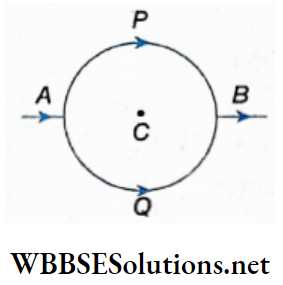
Electromagnetism magnetic field at the at the center C of the circler loop

Answer: Zero

Question 13. A solenoid carrying 1 A current has a length of 1 m and contains 10000 turns. What is the magnetic field on the axis of the solenoid?
Answer: 4π x 10-3T

Question 14. What will be the nature of the path of a charged particle when it enters a uniform magnetic field 5 normally?
Answer: Circular

Question 18. An electron and a proton enter a uniform magnetic field perpendicularly with the same speed. How many times larger will be the radius of the proton’s path than that of the electron’s path? Given: the proton is 1840 times heavier than the electron
Answer: 1840

Question 19. Can a stationary charge produce a magnetic field?
Answer: No

Question 20. What is the magnitude of force experienced by a stationary charge placed in a uniform magnetic field?
Answer:

⇒ \(\vec{F}_m=q \vec{v} \times \vec{B}=0(… \vec{v}=0)\)

Question 21. Does any force act on a magnetic north pole ifit is brought near a negatively charged conductor at rest?
Answer: No

Question 22. Does any force act on a charge moving in a magnetic field?
Answer:

⇒ \(\text { yes, } \vec{F}=q \vec{v} \times \vec{B}\)

Question 23. A long straight wire is carrying a current. An electron starts its motion on a line parallel to the wire in a direction same as that of the current. What will be the direction of the force on the electron?
Answer: Away from the wire in a normal direction

Question 24. A charge q moves with velocity \(\vec{v}\) at an angle 6 to a magnetic field P. What is the force experienced by the particle?
Answer: qvBsinθ

Question 25. An electron moving with a velocity of 107m.s-1 enters a uniform magnetic field of 1 T along a direction parallel to the field. What would be its trajectory?
Answer: Undeviated straight line

Question 26. A certain proton moving through a magnetic field region experiences maximum force. When does this occur?
Answer: The velocity of the proton is perpendicular to the magnetic field

Question 27. An electron beam projected along the positive x-axis experiences a force, due to a magnetic field, along the positive y-axis. What is the direction of the magnetic field?
Answer: Positive z-axis

Question 30. What is the mutual action between two, unlike parallel currents?
Answer: Repulsion

Question 31. Two long and straight parallel wires carry a current 1 A each. If the distance between the two wires is 1 m, what will be the force acting per unit length on them?
Answer: 2 x 10⁻⁷ N.m-1

Question 32. What type of galvanometer is used to prepare an ammeter or a voltmeter in the laboratory?
Answer: Moving coil table galvanometer

Question 33. In the case of a moving coil galvanometer, what is the relation between the current I and the angle of deflection θ?
Answer: Proportional

Question 34. How is a galvanometer converted into an ammeter?
Answer: By connecting a rightly chosen low-resistance shunt in parallel to it

Question 35. How should a resistance be connected with a galvanometer to convert it into a voltmeter?
Answer: In series

Question 36. What is the nature of the magnetic field in a moving coil galvanometer?
Answer: Radial

Electromagnetism Assertion Reason Type

Direction: Those questions have Statement 1 and Statement 2, Of the four choices given below, choose the one that best describes the two statements.

  1. Statement 1 is true, Statement 2 is true; Statement 2 is a correct explanation for statement I.
  2. Statement 1 is true, Statement 2 Is true; Statement 2 is not a correct explanation for Statement 1.
  3. Statement 1 is true, Statement 2 is false.
  4. Statement 1 is false, and Statement 2 Is true.

Question 1.

Statement 1: A magnetic needle that can rotate in a horizontal plane undergoes a deflection when current is passed through a conducting wire, placed above and parallel to it.

Statement 2: A magnetic field is developed around a current-carrying conductor.

Answer: 1. Statement 1 is true, Statement 2 is true; Statement 2 is a correct explanation for statement I.

Question 2.

Statement 1: A long straight conductor attracts iron filings when a current is passed through it.

Statement 2: A magnetic field is developed around a current-carrying conductor.

Answer: 4. Statement 1 is false, Statement 2 Is true.

Question 3.

Statement 1: I = 1 A and OA = 1 cm. The magnetic field developed at A is 10-5 Wb.m-2.
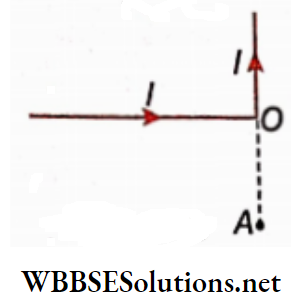
Electromagnetism the magnetic field developed

Statement 2: If I am the current flowing through a long straight conductor, then the magnetic field developed at a distance r from the conductor is \(B=\frac{\mu_0 I}{2 \pi r}\)

Answer: 2. Statement 1 is true, Statement 2 Is true; Statement 2 is not a correct explanation for Statement 1.

Question 4.

Statement 1: Neither the magnetic field vector \(\vec{B}\) nor the
magnetic intensity vector \(\vec{H}\) of a magnetic field depend on
the nature of the medium.

Statement 2: If the magnetic permeability of a medium is \(\mu \text { then } \vec{H}=\frac{1}{\mu} \vec{B}\)

Answer: 4. Statement 1 is false, Statement 2 Is true.

Question 5.

Statement 1: A galvanometer of resistance G is converted to an ammeter by increasing its range n times. The resistance of the ammeter is \(\frac{G}{n}\).

Statement 2: A shunt of resistance has \(\frac{G}{n-1}\) to be connected in parallel with a galvanometer in order to increase its range n times.

Answer: 1. Statement 1 is true, Statement 2 is true; Statement 2 is a correct explanation for statement I.

Question 6.

Statement 1: The velocity of injection of a charged particle, being accelerated in a cyclotron remains constant irrespective of the applied magnetic field.

Statement 2: In a cyclotron the charged particle is accelerated only due to the applied electric field because magnetic force is a no-work force.

Answer: 4. Statement 1 is false, Statement 2 Is true.

Question 7.

Statement 1: If an electron and a proton are projected with equal momentum in a uniform transverse magnetic field, then the curvature of their padis is equal.

Statement 2: The mass of a proton is much higher than that of an electron.

Answer: 2. Statement 1 is true, Statement 2 Is true; Statement 2 is not a correct explanation for Statement 1.

Question 8.

Statement 1: A charged particle moves perpendicular to a magnetic field. Its kinetic energy remains constant, but momentum changes.

Statement 2: A magnetic force acts on the charged particle.

Answer: 2. Statement 1 is true, Statement 2 Is true; Statement 2 is not a correct explanation for Statement 1.

Electromagnetism Match The Column

Question 1. Match the electromagnetic quantities in column A with the rules or formulae in column B.
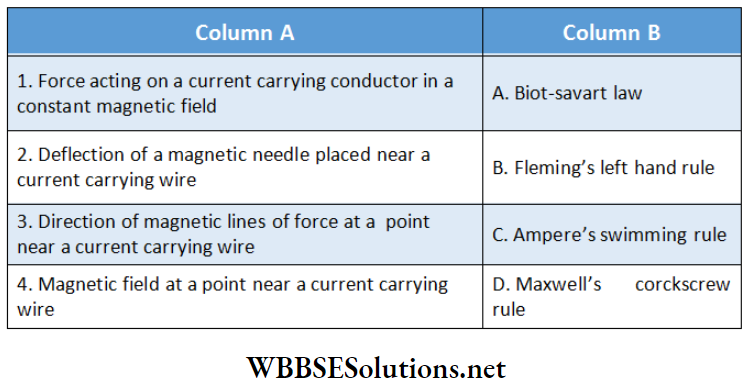
Electromagnetism Match the Columns 1

Answer: 1-B, 2-C, 3-D, 4-A

Question 2. The BC of the conductor is semicircular. Match the values of the magnetic field developed at O given in column 2 with the corresponding segments given in column 1.
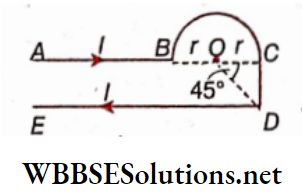
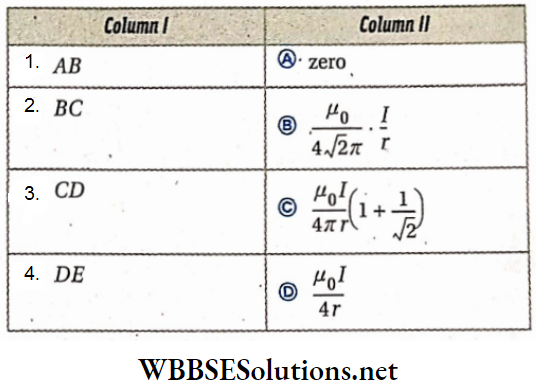
Electromagnetism Match the Columns 2

Electromagnetism Match the Columns 2.

Answer: 1-A, 2-D, 3-B, 4-C

Question 3. A galvanometer of resistance 100Ω shows full-scale deflection for a current of 10 mA. Match the resistances in column 2 necessary to convert the galvanometer to an ammeter or voltmeter as given in column 1.
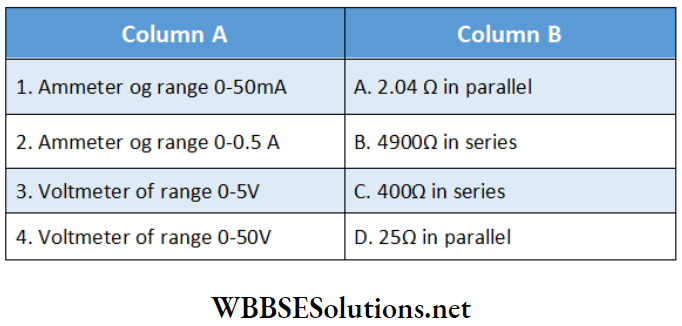
Electromagnetism Match the Columns 3

Answer: 1-D, 2-A, 3-C, 4-B

Question 4. Current in each of the two conductors parallel to each other and at a distance r is I (column 1). The magnetic fields at a point on the same plane and equidistant from the two conductors are given in column 2 (μ0 = 4π x 10-7 H.m-1)
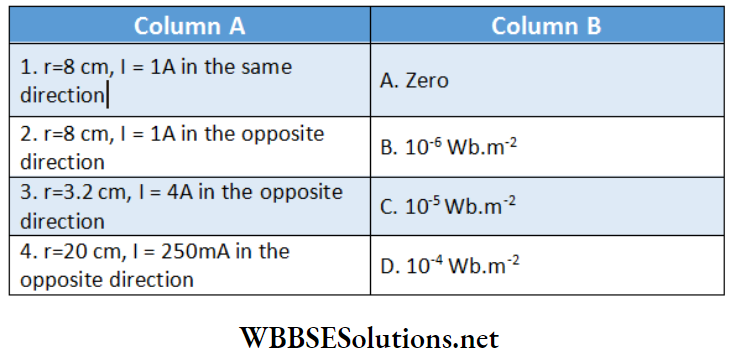
Electromagnetism Match the Columns 4

Answer: 1-A, 2-C, 3-D, 4-B

Question 5. A current-carrying wire. An electron at a point P moves with a velocity \(\vec{v}\). The direction of \(\vec{v}\) is given in column A and its deflection in column B. Match them.
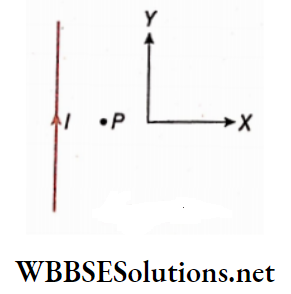
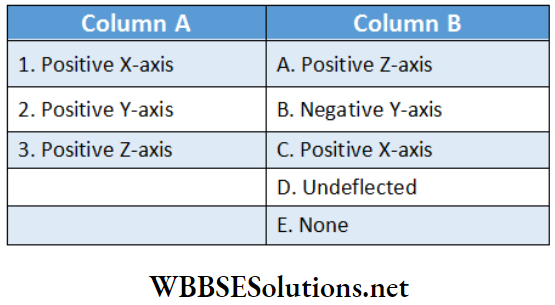
Electromagnetism Match the Columns 5

Electromagnetism Match the Columns 5.

Answer: 1-B, 2-C, 3-D,
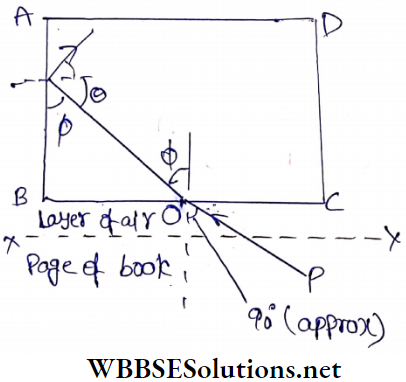
WBCHSE Class 12 Physics Electromagnetism Short Question And Answers

Magnetic Effect Of Current And Magnetism

Electromagnetism Short Question And Answers

Question 1. Two moving coil meters M1 and M2 have the following particulars

Electromagnetism Two moving coil meters

(The spring constants are identical for the two meters.) Determine the ratio of

  1. Current sensitivity and
  2. Voltage sensitivity of M2 and Mx.

Answer:

Current sensitivity = \(\frac{N B A}{c}\) [c = restoring torque for unit deflection]

∴ \(\frac{\text { sensitivity of } M_2}{\text { sensitivity of } M_1}=\frac{N_2 B_2 A_2}{N_1 B_1 A_1} \quad\left[∵ c_1=c_2\right]\)

⇒ \(\frac{42 \times 0.50 \times 1.8 \times 10^{-3}}{30 \times 0.25 \times 3.6 \times 10^{-3}}\)

= 1.4

Read And Learn More WBCHSE Class 12 Physics Short Question And Answers

2. \(\text { Voltage sensitivity }=\frac{N B A}{c R}=\frac{\text { current sensitivity }}{R}\)

∴ \(\begin{aligned}
& \text { voltage sensitivity } \\
& \frac{\text { of } M_2}{\text { voltage sensitivity }}=1.4 \times \frac{R_1}{R_2}=1.4 \times \frac{10}{14}=1 \\
& \text { of } M_1 \\
&
\end{aligned}\)

WBBSE Class 12 Electromagnetism Short Q&A

Question 2.

  1. A circular coil of 30 turns and a radius of 8.0 cm carrying a current of 6.0 A is suspended vertically in a uniform horizontal magnetic field of magnitude 1.0 T. The field lines make an angle of 60° with the normal of the coil. Calculate the magnitude of the counter torque that must be applied to prevent the coil from turning.
  2. Would your answer change, if the circular coil in (a) were replaced by a planar coil of some irregular shape that encloses the same area? (All other particulars are unaltered.)

Answer:

1. The torque acting on the coil,

⇒ \(\tau=N B I A \sin \theta\)

=30 x 1 x 6 x π x (8x 10⁻²)2sin 60°

= 3.13 N.m

∴ If a torque of 3.13 N m is applied in the opposite direction, there will be no deflection of the coil.

2. The torque does not depend on the shape of the coil if the area remains the same. So the answer will not change

Question 3.Two concentric circular coils X and Y of radii 16 cm and 10 cm, respectively, lie in the same vertical plane oriented along the north-to-south direction. Coil X has 20 turns and carries a current of 16 A. Coil Y has 25 turns and carries a current of 18 A. The sense of the current in X is anticlockwise and in Y is clockwise, for an observer looking at the coils facing west. Give the magnitude and direction of the net magnetic field due to the coils at their center.
Answer:

⇒ \(B=\frac{\mu_0 n l}{2 a}\) [ n = no. of turns, I = current a = radius of the coil]

∴ For coil X,

⇒ \(B_X=\frac{4 \pi \times 10^{-7} \times 20 \times 16}{2 \times 16 \times 10^{-2}}\)

= 4π x 10-4 T (towards east)

For coil Y,

⇒ \(B_Y=\frac{4 \pi \times 10^{-7} \times 25 \times 18}{2 \times 10 \times 10^{-2}}\)

= 9π x 10-4 T (towards west)

⇒ \(\text { Net field }=B_Y-B_X=9 \pi \times 10^{-4}-4 \pi \times 10^{-4}\)

= 1.6 x 10⁻³ T (towards west)

Short Answer Questions on Faraday’s Law

Question 4. A uniform magnetic field of 100 G (1G = 10-4 T) exists in a region of length about 10 cm and an area of cross-section of about 10-3 m2. The maximum current carrying capacity of a given coil of wire is 15A and the number of turns per unit length that can be wound around a core is at most 1000 turns m-1. How would you utilize the coil to design a solenoid for the required purpose? Assume the core is not ferromagnetic.
Answer:

For the maximum number of turns the current through the solenoid is given by,

⇒ \(I=\frac{B l}{\mu_0 N}=\frac{B}{\mu_0\left(\frac{N}{l}\right)}\left[∵ B=\mu_0 \cdot \frac{N}{l} \cdot I\right]\)

⇒ \(\frac{100 \times 10^{-4}}{4 \pi \times 10^7 \times 100} \mathrm{~A}=7.96 \mathrm{~A} \approx 8 \mathrm{~A}\)

The length of the solenoid should be much more than its diameter.

For a current of 15 A to flow through the solenoid, the number of turns per unit length has to be decreased [as \(I \propto \frac{l}{N} \propto \frac{1}{N / l}\)]

∴ \(\frac{I^{\prime}}{I}=\frac{N / l}{N^{\prime} / l^{\prime}} \quad \text { or, } \frac{15}{8}=\frac{1000}{N^{\prime} / l^{\prime}}\)

∴ \(\frac{N^{\prime}}{l^{\prime}}=\frac{1000 \times 8}{15}=533 \approx 550 \text { turns } \cdot \mathrm{m}^{-1}\)

For a circular coil of radius R and number of turns N carrying a current I, the magnitude of the magnetic field at a point on its axis at a distance x from its center is given by

⇒ \(B=\frac{\mu_0 I R^2 N^{\prime}}{2\left(x^2+R^2\right)^{3 / 2}}\)

Question 5. Consider two parallel co-axial circular coils of equal radius R and number of turns N, carrying equal currents in the same direction and separated by a distance R. Show that the field on the axis around the mid-point between the coils is uniform over a distance that is small compared to R and is given by \(B=0.72 \mu_0 N I / R\), approximately. (Such an arrangement to produce a nearly uniform magnetic field over a small region is known as Helmholtz coils.)
Answer:

The magnetic field in a small region of length 2d about the midpoint of the space between the two coils

⇒ \(B=\frac{\mu_0 N I R^2}{2\left[\left(\frac{R}{2}+d\right)^2+R^2\right]^{3 / 2}}+\frac{\mu_0 N I R^2}{2\left[\left(\frac{R}{2}-d\right)^2+R^2\right]^{3 / 2}}\)

⇒ \(\frac{\mu_0 N I R^2}{2}\left\{\left[\frac{5 R^2}{4}\left(1+\frac{4 d}{5 R}\right)\right]^{-\frac{3}{2}}+\left[\frac{5 R^2}{4}\left(1-\frac{4 d}{5 R}\right)\right]^{-\frac{3}{2}}\right\}\)

⇒ \(=0.72 \frac{\mu_0 N I}{R}\)

WBCHSE Class 12 Physics Electromagnetism saqs

Common Short Questions on Lenz’s Law

Question 6. A charged particle enters an environment of a strong and non-uniform magnetic field varying from point to point both in magnitude and direction and comes out of it following a complicated trajectory. Would its final speed equal the initial speed if it suffered no collisions in the environment?
Answer:

Yes. The direction of the velocity of a charged particle can change in a magnetic field, but the magnitude of velocity remains the same.

Question 7. An electron traveling west to east enters a chamber having a uniform electrostatic field in the north-to-south direction. Specify the direction in which a uniform magnetic field should be set up to prevent the electron from deflecting from its straight-line path.
Answer:

The negatively charged electron tends to move towards the north due to the electric field. If an equal magnetic force acts in the south direction then the electron will not be deflected. Using the hand rule and considering the conventional direction of flow of charge from east to west we get the direction of magnetic field along the vertically download direction.

Electromagnetism An electron travelling

Question 8. An electron emitted by a heated; cathode and accelerated through a potential difference of 2.0 kV, enters a region of 1 uniform magnetic field of 0.15 T. Determine the trajectory of the electron if the field

  1. Is transverse to its initial velocity,
  2. Makes an angle of 30° with the initial velocity.

Answer:

1. The trajectory of the electron will be a circle of radius r with the magnetic field as its axis. The radius r is given by,

⇒ \(r=\frac{m v}{B e}\)

⇒ \(\text { Also, } e V=\frac{1}{2} m v^2\)

∴ \(r=\frac{1}{B}\left(\frac{2 m V}{e}\right)^{\frac{1}{2}}=\frac{1}{0.15} \sqrt{\frac{2 \times 9 \times 10^{-31} \times 2 \times 10^3}{1.6 \times 10^{-19}}}\)

= 1mm

2. The electron will move along the direction of the field with velocity, v’ = ysin30°, and radius r’ with the magnetic field as the axis.

⇒ \(r^{\prime}=\frac{m v^{\prime}}{B e}=\frac{\sin 30^{\circ}}{B} \sqrt{\frac{2 m V}{e}}\)

⇒ \(=\frac{\frac{1}{2}}{0.15} \sqrt{\frac{2 \times 9 \times 10^{-31} \times 2 \times 10^3}{1.6 \times 10^{-19}}}\)

= 0.5 x 10⁻³ m2

The electron will follow a helical path. Its pitch is,

⇒ \(2 \pi r^{\prime} \cot \theta=2 \times 3.14 \times\left(0.5 \times 10^{-3}\right) \times \sqrt{3}\)

= 5.44 X 10⁻³ m

= 5.44 mm

Class 11 Physics Class 12 Maths Class 11 Chemistry
NEET Foundation Class 12 Physics NEET Physics

Practice Short Questions on Induced EMF

Question 9. A magnetic field, set up using Helmholtz coils, is uniform in a small region and has a magnitude of 0.75 T. In the same region, a uniform electrostatic field is maintained in a direction normal to the common axis of the coils. A narrow beam of (single species) charged particles, all accelerated through 15kV, enters this region in a direction perpendicular to both the axis of the coils and the electrostatic field. If the beam remains undeflected when the electrostatic field is 9.0 x 10⁵ V.m-1, make a simple guess as to what the beam contains. Why is the answer not unique?
Answer:

qE = Bqv

∴ \(v=\frac{E}{B}=\frac{9 \times 10^5}{0.75}=1.2 \times 10^6 \mathrm{~m} \cdot \mathrm{s}^{-1}\)

⇒ \(\frac{1}{2} m v^2=q V\)

∴ \(\frac{q}{m}=\frac{1}{2} \frac{v^2}{V}=\frac{1}{2} \times \frac{\left(1.2 \times 10^6\right)^2}{15 \times 10^3}=4.8 \times 10^7 \mathrm{C} \cdot \mathrm{kg}^{-1}\)

He++ ‘, Li+++ 1H2 ion – for all these particles

⇒ \(\frac{q}{m}=4.8 \times 10^7 \mathrm{C} \cdot \mathrm{kg}^{-1}\)

∴ The charged particle may be any of these.

Question 10. A straight horizontal conducting rod of length 0.45 m and 60 g is suspended by two vertical wires at its ends. A current of 5.0 A is set up in the rod through the wires.

  1. What magnetic field should be set up normally to the conductor in order that the tension in the wires is zero?
  2. What will be the total tension in the wires if the direction of the current is reversed keeping the magnetic field the same as before? (Ignore the mass of the wires) 9.8 ms-2

Answer:

1. To keep the tension in the wire zero, the upward force exerted by the magnetic field should be neutralized by the downward force exerted by gravity (weight of the rod).

∴ BIl = mg

∴ \(B=\frac{m g}{I l}=\frac{60 \times 10^{-3} \times 9.8}{5 \times 0.45}=0.26 \mathrm{~T}\)

2. If the direction of the current is reversed, the tension in the wire will be doubled.

∴ T = 2 x weight of the rod

= 2 x 60 x 10-3 x 9.8 N

= 1.18 N

Question 11. A uniform magnetic field of 3θ G is established along the positive z-direction. A rectangular loop of sides 10 cm and 5 cm carries a current of 12 A. What is the torque on the loop In the different cases? Which case corresponds to stable equilibrium?

Electromagnetism corresponds to stable equilibrium

Answer:

Using \(\tau\) = IAsinθ

1. \(\tau\) = 12 x (10 x 5 x 10-4) x (3θ X 10-4)

= 1.8 x 10⁻² N.m-1 , along y-axis

2. \(\tau\) = 1.8 x 10⁻² N m-1 , along y-axis

3. \(\tau\) = 1.8 x 10⁻² N.m-1, along -X axis

4. \(\tau\) = 1.8 x 10⁻² N.m-1 , along a direction making 240° with +X axis

5. \(\tau\) = 0, stable equilibrium, because if this loop is slightly rotated, the torque generated tends to bring the loop back to its initial alignment.

6. \(\tau\) = 0, unstable equilibrium, because if the loop Is slightly rotated, the torque generated tends to rotate the loop farther.

Question 12. A 60 cm long solenoid of radius 4.0 cm has 3 layers of windings of 300 turns each. A 2.0 cm long wire of mass 2.5 g lies inside the solenoid (near its center) normal to its axis; both the wire and the axis of the solenoid are in the horizontal plane. The wire is connected through two leads parallel to the axis of the solenoid to an external battery which supplies a current of 6.0 A In the wire. What value of current (with appropriate sense of circulation) in the windings of the solenoid can support the weight of the wire? g = 9.8 m.s-2
Answer:

⇒ \(F=B I l \text { and } B=\mu_0 \cdot \frac{N}{l^{\prime}} \cdot I^{\prime}\)

∴ \(F=\mu_0 \cdot \frac{N}{l’} \cdot l’ \cdot l \cdot l\) [where I’m required current, I’ length of the solenoid, I current from the battery, I length of the wire.

This force will neutralize the gravitational force on the wire.

∴ \(\mu_0 N \cdot \frac{l}{l} \cdot I^{\prime} \cdot I=m g\)

or, \(I^{\prime}=\frac{m g}{\mu_0 N l \cdot l}\)

⇒ \(\frac{2.5 \times 10^{-3} \times 9.8 \times 60 \times 10^{-2}}{4 \pi \times 10^{-7} \times 3 \times 300 \times 2.0 \times 10^{-2} \times 6.0}\)

=108.3A

Question 13. Two long and parallel straight wires A and B carrying currents of 0.0 A and 5.0 A In the same direction are separated by a distance of 4.0 cm listen to the force on a 10 cm section of wire A.
Answer:

We know that, \(\frac{F}{l}=\frac{\mu_0 I_1 I_2}{2 \pi r} \quad\)

or, \(F=\frac{\mu_0 I_1 I_2}{2 \pi r} \cdot l\)

∴ \(F=\frac{4 \pi \times 10^{-7} \times 8 \times 5}{2 \pi \times 4 \times 10^{-2}} \times 10 \times 10^{-2}=2 \times 10^{-5} \mathrm{~N}\)

(attractive force Is towards A to B along the perpendicular)

Question 14. A uniform magnetic 1.5 T exists in a cylindrical region of radius 10.0 cm. Its direction is parallel to the axis along east to west. A wire carrying a current of 7.0 A In the north-to-south direction passes through this region. What is the magnitude and direction of the force on the wire lf,

  1. The wire intersects the axis
  2. The wire Is turned from N-S to the northeast-northwest direction
  3. The wire In the N-S direction Is lowered from the axis by a distance of 6.0 cm

Answer:

1. F1 = IBl sin90° = 1.5 X 7 X 0.2 x 1 = 2.1 N (directed vertically downwards)

2. If l1, be the effective length of the wire Inside the magnetic field,

F2 = IBl1 sin45° = IBl [since, l1 sin45° = l]

= 1.57 x 7 x 0.2

= 2.1 N (directed vertically, downwards)

3. When wire 16 is lowered by 6 cm from the axis, then the effective length of the wire inside the magnetic field is 2α.

Electromagnetism A uniform magnetic

a = 8 cm

F = IB.2a

= 1.5 x 7 x 0.16N

= 1.68 N (directed vertically downwards)

Important Definitions in Electromagnetism

Question 15. A square coil of side 10 cm consists of 20 turns and carries a current of 12 A. The coil i$ suspended vertically and the normal to the plane of the coil makes an angle of 30° with the direction of a uniform horizontal magnetic field of magnitude 0.80 T. What is the magnitude of torque experienced by the coil?
Answer:

Torque

⇒ \(\tau\) = NIABsinθ

= 20 x 12 x (10 x 10-2)2 x 0.8sin30°

= 0.96 N.m [Here, N= number of turns, I=current, A – area of the coil, B = magnetic field]

Question 16. A toroid has a core (non-ferromagnetic) of inner radius 25 cm and outer radius 26 cm, around which 3500 turns of a wire are wound. If the current in the wire is 11 A, what is the magnetic field

  1. Outside the toroid
  2. Inside the core of the toroid
  3. In the empty space surrounded by the toroid

Answer:

1. Zero

2. \(B=\mu_0 \frac{N I}{2 \pi r}=\frac{4 \pi \times 10^{-7} \times 3500 \times 11}{2 \pi \times 25.5 \times 10^{-2}}\) \(\left[\text { Here } r=\frac{25+26}{2}=25.5 \mathrm{~cm}\right]\)

= 3.02 x 10⁻² T

3. Zero

Question 17. A closely wound solenoid 80 cm long has 5 layers of windings of 400 turns each. The diameter of the solenoid is 1.8cm. If the current carried is 8.0 A, estimate the magnitude of B inside the solenoid near its center.
Answer:

⇒ \(B=\frac{\mu_0 \cdot N I}{l}=\frac{4 \pi \times 10^{-7} \times 400 \times 8 \times 5}{80 \times 10^{-2}}\)

= 8π x 10-3T

Question 18. A electron is moving with a velocity \(\vec{v}=(\hat{i}+2 \hat{j}) \mathrm{m} \cdot \mathrm{s}^{-1}\) in the magnetic field \(\vec{B}=(2 \hat{i}+2 \hat{j}) \mathrm{Wb} \cdot \mathrm{m}^{-2}\). Determine the magnitude and direction of the force acting on the electron. The charge of an electron is -1.6 x 10⁻¹⁹ C.
Answer:

The force acting on the electron,

⇒ \(\vec{F}=q(\vec{v} \times \vec{B})=-1.6 \times 10^{-19}[(\hat{i}+2 \hat{j}) \times(2 \hat{i}+2 \hat{j})]\)

⇒ \(-1.6 \times 10^{-19} \times[-2 \hat{k}]=+3.2 \times 10^{-19} \hat{k} \mathrm{~N}\)

So the magnitude of the force = 3.2 x 10⁻¹⁹N and the direction is along the positive z-axis.

Question 19. Which physical quantity has the unit Wb/m2? Is it a scalar or a vector quantity?
Answer:

Magnetic field or magnetic induction has the unit Wb/m2. It is a vector quantity.

Question 20. Write down the equation of Lorentz force acting on a moving charged particle.
Answer:

Lorentz force, \(\vec{F}=q(\vec{E}+\vec{v} \times \vec{B})\);

where \(\vec{E}\) is the electric field,

⇒ \(\vec{B}\) is the magnetic field,

q is the charge of the particle

and \(\vec{v}\) is the velocity ofthe particle.

Question 21.

  1. α – particle
  2. β – particle is both projected with the same velocity v perpendicularly to the magnetic field B. Which particle will experience greater force?

Answer:

The value of the charge of the a -particle (+2e) is more than that of the β-particle (-e).

Hence, the α-particle will experience greater force

Question 22. In a compact coil of 50 turns, the current strength is 10 A and the radius of the coil is 25 x 10-2 m. Find the magnitude of the magnetic field at its center.
Answer:

Number of turns, N = 50; radius of the coil, r = 25 x 10-2 m; current strength, I = 10 A.

∴ The magnetic field at the center of the coil,

⇒ \(B=\frac{\mu_0 N I}{2 r}=\frac{4 \pi \times 10^{-7} \times 50 \times 10}{2 \times 25 \times 10^{-2}}\)

= 1.256 X 10⁻³T

Real-Life Scenarios in Electromagnetism

Question 23. Two long parallel straight wires P and Q separated by a distance of 5 cm in air carry currents of 4A and 2A respectively in the same direction. Fruk the magnitude of the force acting per cm of the wire P and indicate the direction of the force.
Answer:

Distance between the two wires, \(r=5 \mathrm{~cm}=\frac{5}{100} \mathrm{~m}\)

Force acting per metre, \(F=\frac{\mu_0}{4 \pi} \cdot \frac{2 I_1 I_2}{r}=\frac{4 \pi \times 10^{-7}}{4 \pi} \times \frac{2 \times 4 \times 2}{\frac{5}{100}}\)

⇒ \(10^{-7} \times \frac{16}{5} \times 100=3.2 \times 10^{-5} \mathrm{~N} \cdot \mathrm{m}^{-1}\)

∴ Force acting per cm = \(=\left(3.2 \times 10^{-5}\right) \times \frac{1}{100}\)

= 0.032 dyn.cm-1

Since the wires are carrying currents in the same direction, the force acting between the wires is attractive, Hence the force on each wire is directed towards the other wire and perpendicular to them.

Question 24. Write the expression for the force \(\vec{F}\) acting on a particle of charge q moving with a velocity \(\vec{v}\) in the presence of both electric fields \(\vec{E}\) and magnetic field \(\vec{B}\). Obtain the condition under which the particle moves undeflected through the fields.
Answer:

1st Part: Force,

⇒ \(\vec{F}=\vec{F}_e+\vec{F}_m=q \vec{E}+q \vec{v} \times \vec{B}=q(\vec{E}+\vec{\nu} \times \vec{B})\)

2nd Part: The required condition is, either \(\vec{F}\) = 0; i.e., no resultant force acts on the particle. In that case,

⇒ \(q \vec{E}=-q \vec{v} \times \vec{B}\)

or, \(\vec{E}\) and \(\vec{B}\) are both along the direction of velocity of the particle; then \(\vec{\nu} \times \vec{B}=0\), and the force \(q \vec{E}\) along the direction of motion produces a constant acceleration without any deflection.

Question 25. A wire AB is carrying a steady current of 12 A and is lying on a table. Another wire CD carrying 5 A is held directly above AB at a height of 1 mm. Find the mass per unit length of the wire CD so that it remains suspended at its position when left free. Give the direction of the current flowing in CD with respect to that in AB. [Thke the value of g = 10 m.s-2 ]
Answer:

We take the unit length of each of the wires.

Upward force on CD,

⇒ \(F=\frac{\mu_0}{4 \pi} \frac{2 I_1 I_2}{d}=10^{-7} \times \frac{2 \times 12 \times 5}{10^{-3}}=12 \times 10^{-3} \mathrm{~N}\)

Downward force.on CD,

F’ = mg = 10m N [ m = mass of unit length of the wire CD ]

Under the given conditions,

F = F’

or, 12 x 10-3 = 10m

or, m = 1.2 x 10⁻³ kg

The currents in AB and CD are in opposite directions, so that CD is subjected to an upward repulsive force F.

Question 26. 

  1. Using Biot-Savart’s law, derive the expression for the magnetic field in vector form at a point on the axis of a circular current loop.
  2. What does a toroid consist of? Find out the expression for the magnetic field inside a toroid for N turns of the coil having an average radius r and carrying a current I. Show that the magnetic field in the open space inside and outside the toroid is zero.

Answer:

1. From the text, we get the expression,

⇒ \(B=\frac{\mu_0 N I}{2} \cdot \frac{r^2}{\left(r^2+x^2\right)^{3 / 2}}\)

Here, the center of the coil has been taken as the origin and the direction of the axis as the x-axis.

∴ \(\vec{B}=\frac{\mu_0 N I}{2} \cdot \frac{r^2}{\left(r^2+x^2\right)^{3 / 2}} \hat{i}\)

2. Circumference of the toroid = 2πr.

Number of turns per unit length, \(n=\frac{N}{2 \pi r}\)

Magnetic field inside the toroid, \(B=\mu_0 n I=\frac{\mu_0 N I}{2 \pi r}\)

The currents in every pair of diametrically opposite points of the toroid is equal and opposite. So, if we take Ampere’s loops in the open space inside and outside the toroid, the current enclosed by the loops respectively, 0-0 = 0 and Nl-NI = 0

Electromagnetism Ampere’s loops in the open space inside and outside

So, from Ampere’s circuital law, \(\oint \vec{B} \cdot d \vec{l}=\mu_0 I\) we have B = 0 in both cases.

Examples of Electromagnetic Applications

Question 27. What do you mean by the current sensitivity of a galvanometer? Write its SI unit.
Answer:

1st Part: The basic definition of the current sensitivity of a galvanometer is, \(S_i=\frac{d \theta}{d I}, \theta\), being the angular deflection of the coil.

2nd Part: As θ is dimensionless, the unit of Si is A-1.

Question An a -particle and a proton are released from the center of a cyclotron and made to accelerate.

  1. Can both be accelerated at the same cyclotron frequency?
  2. When they are accelerated, in turn, which of the two will have a higher velocity at the exit slit of the dees?

Answer:

Cyclotron frequency, \(n=\frac{1}{2 \pi}\left(\frac{q}{m}\right) B\)

1. For a proton, \(\frac{q}{m}=\frac{e}{m_p}\)

for an α-particle, \(\frac{q}{m} \approx \frac{2 e}{4 m_p}=\frac{1}{2} \frac{e}{m_p} .\)

⇒ \(\text { As } n \propto \frac{q}{m}\) they cannot be accelerated at the same
cyclotron frequency.

2. Velocity at the exit slit, \(v_0=\frac{q B R}{m} \text {, i.e., } v_0 \propto \frac{q}{m}\)

As \(\frac{q}{m}\) is higher for protons, it will hate a higher
velocity at the exit slit.

Question 28. Asha’s uncle was advised by his doctor to have an MRI (magnetic resonance imaging) scan of his brain. Her uncle felt that it was too expensive and wanted to postpone it. When Asha learned about this, she took the help of her family and when she approached the doctor, he also offered a substantial discount. She thus convinced her uncle to undergo the test to enable the doctor to know the condition of his brain. The resulting information greatly helped his doctor to treat him properly. Based on the above paragraph, answer the following questions.

  1. What according to you are the values displayed by Asha, her family, and the doctor?
  2. What in your view could be the reason for MRI tests to be so expensive?
  3. Assuming that the Mill test was performed using a magnetic field of 0.1 T, and the maximum and minimum values of the force that the magnetic field could exert on a proton (Charge = 1.6 x 10⁻¹⁹ C ) that was moving with a speed of 104 m/s.

Answer:

1. Asha, her family, and the doctor were sympathetic, caring, socially aware, and helpful.

2. MRI tests are expensive due to various factors. Firstly, the MRI machines are very expensive and the rooms where the scans are performed cost a fortune. To this the salaries of the doctors, other medical staff, hospital charges, and maintenance charges add up, resulting in a huge amount.

3. We know, F = qvBsinθ

= 1.6 x 10-19 x 104 x 0.1 x sinθ

We get the minimum value of force when θ = 0°.

∴ Fmin = 0

We get the maximum value of force when θ = 90°

∴ \(F_{\max }=1.6 \times 10^{-19} \times 10^4 \times 0.1=1.6 \times 10^{-16} \mathrm{~N}\)

Question 29. What can be the cause of the helical motion of a charged particle?
Answer:

A particle moves along a curved path if it moves in the presence of a magnetic field.

Now, when there is an angular projection, i.e. when the velocity of the particle is at an angle with respect to the magnetic field, then the particle will move in a helical path.

The velocity component (vsinθ) perpendicular to the field will rotate the particle in a circular path. But, the component (vcosθ) along this field will move the particle in a straight line path. So, the cumulative motion of the particle is a helix.

Question 30. Two identical circular coils, P and Q each of radius R, carrying currents 1 A and √3 A respectively, are placed concentrically and perpendicular to each other lying in the XY and YZ planes. Find the magnitude and direction of the net magnetic field at the center of the coils
Answer:

Field due to current in coil P is \(\vec{B}_1=\frac{\mu_0 I_1}{2 R} \cdot \hat{k}\)

Current in coil Q is \(\vec{B}_2=\frac{\mu_0 I_2}{2 R} \cdot \hat{i}\)

Net field \(\vec{B}=\vec{B}_1+\vec{B}_2\)

⇒ \(\vec{B}=\left(\frac{\mu_0 I_1}{2 R}\right) \hat{k}+\left(\frac{\mu_0 I_2}{2 R}\right) \hat{i}\)

⇒ \(=\left(\frac{\mu_0}{2 R}\right) \hat{k}+\left(\frac{\sqrt{3} \mu_0}{2 R}\right) \hat{i}\left(∵ I_1=1 \mathrm{~A} ; I_2=\sqrt{3} \mathrm{~A}\right)\)

⇒ \(|\vec{B}|=\sqrt{\left(\frac{\mu_0}{2 R}\right)^2+\left(\frac{\sqrt{3} \mu_0}{2 R}\right)^2}=\frac{\mu_0}{2 R} \sqrt{1+3}=\frac{\mu_0}{2 R} \times 2\)

∴ \(|\vec{B}|=\frac{\mu_0}{R}\)

The resultant magnetic field is directed in the xz plane.

Question 31. Two identical loops P and Q each of radius 5 cm are lying in perpendicular planes such that they have a common center as shown in the figure. Find the magnitude and direction of the net magnetic field at the common center of the two coils, if they carry currents equal to 3 A and 4 A respectively.

Electromagnetism Two identical loops

Answer:

Magnetic field induction due to the vertical loop at the center O is,

⇒ \(B_1=\frac{\mu_0 I_1}{2 R}=\frac{\mu_0}{10^{-1}} . \quad(∵ R=5 \mathrm{~cm})\)

Magnetic field induction due to the horizontal loop at the center O is,

⇒ \(B_2=\frac{\mu_0 I_2}{2 R}=\frac{3 \mu_0}{10^{-1}}\)

∵ B1 and B2 are perpendicular to each other, therefore the resultant magnetic field induction at the center O is,

⇒ \(B_{\text {net }}=\sqrt{B_1^2+B_2^2}\)

⇒ \(\sqrt{\left(\frac{4 \mu_0}{10^{-1}}\right)^2+\left(\frac{3 \mu_0}{10^{-1}}\right)^2}\)

⇒ \(\frac{\mu_0}{10^{-1}} \sqrt{9+16}=\frac{5 \mu_0}{10^{-1}}\)

= 50 x 4π x 10-7

= 62.8 x 10⁻⁶ T

= 62.8μT

The direction of the resulting magnetic field,

⇒ \(\tan \theta=\frac{B_2}{B_1}=\frac{3 \mu_0 \times 10^{-1}}{4 \mu_0 \times 10^{-1}}\)

or, \(\tan \theta=\frac{3}{4} \quad \text { or, } \theta \approx 37^{\circ}\)

Resultant magnetic field B makes an angle of 37° with B1

Electromagnetism Magnetic field induction due to horizontal loop and vertical loop

WBCHSE Class 12 Physics Electromagnetism Question and Answers

Magnetic Effect Of Current And Magnetism

Electromagnetism Long Questions and Answers

Question 1. State whether the mutual distances between the circular magnetic lines of force obtained on a plane, perpendicular to a straight long current-carrying wire would be the same or not.
Answers:

According to the formula \(B=\frac{\mu_0}{4 \pi} \cdot \frac{2 I}{r}\), the greater the distance from the current carrying wire, “lesser the value of the magnetic field.

Again, according to the properties of magnetic lines of force, the greater the Strength of the magnetic field at a place, the greater the number density of magnetic lines of force, and hence their mutual distances decrease.

So, the mutual distance between the circular magnetic lilies of force gradually increases with the increase of the radius of the lines.

Question 2. A magnet and a charged particle are placed near each other. State whether a force will act on the charged particle if

  1. Both the magnet and the charged particle are at rest,
  2. Both travel with equal velocity,
  3. The magnet is moving but the charged particle is at rest,
  4. The magnet is at rest but the charged particle is in motion.

Answer:

If there is a relative motion between the charged particle and the magnet, then only a force acts on the charged particle.

1. If both the magnet and the charged particle are resting, no force acts on the charged particle because there is a relative motion between them.

2. In this case, no relative motion exists between them and hence no force acts on the charged particle

3. In both cases there is a relative motion between the magnet and the charged particle. So, a force action the charged particle. But there is a special case. If the magnetic field stated above is uniform and the direction of the relative velocity between the magnet and the charged particle is parallel to the field, then no force acts on the charged particle.

Question 3. Current flowing in a long, straight conductor passes through the axis of a circular coil carrying current. What will be the mutual force acting between them?
Answer:

In the case of the straight conductor, if we apply Maxwell’s corkscrew rule, we see that at each point on the circular coil, the direction of the magnetic field is parallel to the direction of the current. We know that no force acts when the direction of the current and that of the magnetic field are parallel to each other. Hence, the mutual force between them will be zero.

Electromagnetism Currentis flowingin a long

WBBSE Class 12 Electromagnetism Q&A

Question 4. An electron and a proton are revolving along circular paths of equal radii in equal magnetic fields. Compare their kinetic energies.
Answer:

The magnitude of charge (e) of an electron and a proton are equal. The force acting on a charge e traveling with a velocity v normal to a magnetic field of strength B is Bev. This force supplies the necessary centripetal force to revolve the charge along a circular path.

So, for the electron \(\frac{m v^2}{r}\) = Bev

or, mv = Ber

Similarly, for the proton, MV = Ber

∴ mv = MV (i.e., the momenta of both of them are equal)

∴ \(\frac{kinetic energy of the electron}{kinetic energy of the proton}\)

= \(\frac{\frac{1}{2} m v^2}{\frac{1}{2} M V^2}\)

= \(\frac{(m \nu)^2}{m} \cdot \frac{M}{(M V)^2}=\frac{M}{m}\)

Since the mass of a proton (M) is about 1836 times that of an electron (m), the kinetic energy of the electron will be about 1836 times that of the proton.

Question 5. Four wires of infinite lengths are placed on a plane. The same current I is flowing through each of the wires. Determine the resultant magnetic field at the center O of the square ABCD.
Answer:

Since point O is at the center of the square ABCD, it is equidistant from the conductor’s AB, BC, CD, and DA. Since, each of the conductors carries equal current I, the magnetic field produced by each of them at the point O will be the same. But the magnetic fields at point O due to the conductors AB and CD are mutually opposite and similarly for the conductors AD and BC, magnetic fields at point O are also mutually opposite. Hence, at the point O, the resultant magnetic field is zero.

WBCHSE Class 12 Physics Electromagnetism Question And Answers

Short Answer Questions on Faraday’s Law

Question 6. When a charged particle moves through a particular region it is not deflected. From this, can it be inferred that no magnetic field is present in that region?
Answer:

We know that, when a charge q passes through a magnetic field B with a velocity v, the force acting on that charged particle is, \(\vec{F}=q(\vec{v} \times \vec{B})\)

The cross product \((\vec{v} \times \vec{B})\) signifies that \(\vec{F}\) = 0 when \(\vec{\nu} \| \vec{B}\). So, if the charged particle moves along or opposite to the direction of the magnetic field, no force acts on it. Hence, when a charged particle moves without suffering any deflection, it cannot be inferred definitely that no magnetic field is present there

Question 7. A charged particle is released from rest In a region of steady and uniform electric and magnetic fields, which are parallel to each other. What will be the nature of the path followed by the charged particle?
Answer:

The force on a particle of charge q and mass m acting along the direction of the uniform electric field E = qE, and its acceleration = \(\frac{qE}{m}\) = constant. So, this particle has a uniformly accelerated motion along \(\vec{E}\).

Now, \(\vec{E}\) and \(\vec{B}\) are parallel; thus the particle velocity is also parallel to \(\vec{B}\). Then, the magnetic force on the particle = 0, i.e., the magnetic field has no effect on the motion of the particle.

Question 8. An electron is not deflected in passing through a certain region of space. Can we be sure that there is no magnetic field in that region?
Answer:

The magnetic force on the electron would be zero if its velocity \(\vec{v}\) is along the magnetic field B, because

⇒ \(\overrightarrow{F_m}=\overrightarrow{e v} \times \vec{B}\).

Then the electron would not be deflected even if a non-zero magnetic field is present.

Class 11 Physics Class 12 Maths Class 11 Chemistry
NEET Foundation Class 12 Physics NEET Physics

Question 9. Equal currents are flowing through two infinitely long conducting wires. State whether a magnetic field will exist at a point midway between the wires if they carry current.

  1. In the same direction
  2. In the opposite direction?

Answer:

1. When equal current flows through two parallel wires in the same direction, at a point midway between the wires, the magnetic field will be zero because at that point magnetic fields for the two current-carrying wires are equal but opposite in direction.

2. When the direction of current in the two wires are opposite, at that point, the magnetic field will be twice the field due to any one wire because in this case the magnetic field due to the two wires will be the same and in the same direction.

Question 10. How will the magnetic field intensity, at the center of a circular coil carrying current, change if the current through the coil is doubled and the radius of the coll is halved?
Answer:

We know, \(B=\frac{\mu_0 N I}{2 r}[/laex]

∴ [latex]\frac{B_1}{B_2}=\frac{l_1}{I_2} \cdot \frac{r_2}{r_1}=\frac{1}{2} \times \frac{1}{2}=\frac{1}{4} \quad \text { or }\)

Practice Questions on Induced EMF

Question 11. A rectangular loop carrying a current is placed near a long straight wire in such a way that the wire is parallel to one of the sides of the loop and in the plane of the loop. If a steady current I is passed through the wire, then the loop

  1. Will rotate about an axis parallel to the wire
  2. Will move away from the wire
  3. Will move towards the wire
  4. Will remain stationary.

Answer:

The arm of the rectangular loop nearer to the wire will be attracted by the wire because the directions of current in them are the same and parallel to each other.

In the farther arm of the loop, the direction of the current is parallel but opposite with respect to the wire and hence they will repel each other. But the like parallel current-carrying arm being nearer to the current-carrying wire, the attraction dominates over the repulsion. Hence, the loop shifts towards the wire. Therefore, alternative 3 is correct.

Question 12. A steady current is flowing through a long wire. If it is converted into a single-turn circular coil, the magnetic field produced at its center is B. Now it is converted into a circular coil having n turns. What will be the magnetic field at the center of the coil?
Answer:

Magnetic field at the center of the single turn circular coil, \(B=\frac{\mu_0 I}{2 r}\)

If a coil of n turns is made, the radius reduces to \(\frac{r}{n}\).

Thus, the magnetic field at the center of the coil

⇒ \(\frac{\mu_0 n I}{2 \cdot \frac{r}{n}}=n^2 \cdot \frac{\mu_0 I}{2 r}=n^2 B\)

Question 13. A rectangular loop made of a very thin and flexible wire is kept on a table. The two ends of the wire are connected with two joining screws and a high direct current Is allowed to pass through the wire. What will be the shape of the wire and why?
Answer:

The rectangular loop. The directions of current in the parts AB and CD are parallel and opposite in direction and hence these two parts repel each other. If the current is too high, the loop will take almost the shape of a circle; that shape is shown by the dotted line.

Electromagnetism A rectangular loop

Question 14. In a region, a uniform electric field and uniform magnetic field are acting in the same direction. An electron is shot along the direction of the fields. What change will be observed In the magnitude and direction of the velocity of that electron?
Answer:

Since the direction of the magnetic field and that of the velocity of the electron is the same, the magnetic force will be zero. Since the charge of an electron is negative, Its velocity will decrease gradually in the direction of the electric field.

Question 15. Two wires of.equal length or bent in the form of two loops of one turn each. One of them Is square-shaped, whereas the other is circular. Both are suspended in a uniform magnetic field. When the same current is passed through them, which one will experience greater torque?
Answer:

The torque on a current loop of current I and area \(\vec{A}\), in a magnetic field \(\vec{B}, \text { is } \vec{\tau}=I \vec{A} \times \vec{B}\). For the two given loops, current I and magnetic field \(\vec{B}\) are both the same. Now, for equal lengths of the boundary, the area of a circle is greater than that of a square. So the torque would be greater for the circular current loop.

Question 16. A circular conducting loop of radius r carrying a currently placed in a magnetic field \(\vec{B}\) in such a way that the plane of the loop is perpendicular to \(\vec{B}\). What will be the magnitude of the magnetic force exerted on the loop?
Answer:

Let us consider an infinitesimal element \(\vec{dl}\) at point P of the Circular loop. The magnetic force on this element,

⇒ \(d \vec{F}=I d \vec{l} \times \vec{B}=I d l B \sin 90^{\circ}\) [∵ \(d \vec{l} \text { is perpendicular to } \vec{B}\)]

= IdlB (directed along \(\vec{OP}\))

Electromagnetism Question 16 a circular conducting loop

Similarly, if we consider an infinitesimal element \(\vec{dl}\) at point Q located on diametrically opposite end of P, then the magnetic force on this element will be IdlB (directed along \(\vec{OQ}\)).

So the net force on two infinitesimal elements located on opposite ends of a diameter is zero.

In this manner, if we divide the whole loop into such pairs of infinitesimal elements, the net force on each pair will be zero. Hence the net force on the loop will be zero

Question 17. The ratios of the masses and charges of a proton and an alpha particle are respectively 1 s 4 and 1:2. They enter a uniform magnetic field of magnitude B normally with

  1. Same velocity
  2. Same momentum and
  3. Same kinetic energy. What will be the ratio of the radii of the circular paths described by the particles in each case?

Answer:

Radius, of the circular path, \(r=\frac{m v}{a B} ; B=\text { constant }\)

1. If the velocity is the same then, \(r \propto \frac{m}{q}\)

⇒ \(\frac{r_1}{r_2}=\frac{m_1}{m_2} \times \frac{q_2}{q_1}=\frac{1}{4} \times \frac{2}{1}=\frac{1}{2}\)

2. If the momentum is the same then, \(r \propto \frac{1}{q}\)

⇒ \(\text { i.e., } \frac{r_1}{r_2}=\frac{q_2}{q_1}=\frac{2}{1}\)

3. \(r=\frac{m v}{q B}=\frac{\sqrt{\frac{1}{2} m v^2 \cdot 2 m}}{q B}\)

If kinetic energy \(\frac{1}{2}\) mv2 is the same then, \(r \propto \frac{\sqrt{m}}{q}\)

∴ \(\frac{r_1}{r_2}=\sqrt{\frac{m_1}{m_2}} \times \frac{q_2}{q_1}=\sqrt{\frac{1}{4}} \times \frac{2}{1}=\frac{1}{1}\)

Question 18. If current I passes through an infinitely long wire PQR bent at the right angle at Q, then the magnetic field at point M is H1. Now another wire is joined along QS in such a manner that the currents along PQ, QR, and QS are 1, \(\frac{1}{2}\) and \(\frac{1}{2}\), respectively. Now, if the magnetic field at the point M is H2, find the value of \(\frac{H_1}{H_2}\)

Electromagnetism Question 18 the magnetic field at the point M

Answer:

Due to the current through the wire QR, no magnetic field exists at point M. With respect to point M, the two wires PQ and QS are semi-infinite in length.

So, if MQ = r,

⇒ \(H_1=\frac{\mu_0}{4 \pi} \cdot \frac{I}{r} \text { and } H_2=\frac{\mu_0}{4 \pi} \cdot \frac{I}{r}+\frac{\mu_0}{4 \pi} \cdot \frac{\frac{I}{2}}{r}=\frac{\mu_0}{4 \pi} \cdot \frac{3 I}{2 r}\)

⇒ \(\text { Hence, } \frac{H_1}{H_2}=\frac{2}{3}\)

Conceptual Questions on Magnetic Fields and Forces

Question 19. If current I pass through a square-shaped conducting loop of side a, what is the value of the magnetic field at the point of intersection of its two diagonals?
Answer:

Distance of the point of intersection of two diagonals (O) from each arm of the square is r = \(\frac{a}{2}\) For two extreme points of each side, the angle subtended at O, θ1 = θ2 = 45°.

So, the magnetic field at O due to current I through each arm

⇒ \(B=\frac{\mu_0}{4 \pi} \cdot \frac{I}{r}\left(\sin \theta_1+\sin \theta_2\right)\)

⇒ \(\frac{\mu_0}{4 \pi} \cdot \frac{I}{\frac{a}{2}}\left(\sin 45^{\circ}+\sin 45^{\circ}\right)\)

⇒ \(\frac{\mu_0}{4 \pi} \cdot \frac{2 I}{a} \cdot 2 \times \frac{1}{\sqrt{2}}\)

= \(\frac{\mu_0}{4 \pi} \frac{2 \sqrt{2} I}{a}\)

The direction of the magnetic field at point O due to current I in each arm is the same.

Hence, the resultant magnetic field at the point O

⇒ \(4 B=\frac{\mu_0}{4 \pi} \cdot \frac{8 \sqrt{2} I}{a}\)

Electromagnetism square-shaped conducting loop of side

Question 20. If the current through a conducting loop in the shape of an equilateral triangle of side a is I, what will be the magnitude of the magnetic field at the point of intersection of its three medians?
Answer:

Length of each median of the triangular loop

⇒ \(\sqrt{a^2-\left(\frac{a}{2}\right)^2}=\frac{\sqrt{3}}{2} a\)

The distance of each side from the point of intersection O of the medians

⇒ \(r=O A=\frac{1}{3} \cdot \frac{\sqrt{3}}{2} a=\frac{a}{2 \sqrt{3}}\)

The angle subtended by the two extremities of each side at O, θ1 = θ2 = 60°.

So, due to current 7 through each side, the magnetic field at point O,

⇒ \(B=\frac{\mu_0}{4 \pi} \cdot \frac{I}{r}\left(\sin \theta_1+\sin \theta_2\right)\)

⇒ \(\frac{\mu_0}{4 \pi} \cdot \frac{I}{\frac{a}{2 \sqrt{3}}}\left(\sin 60^{\circ}+\sin 60^{\circ}\right)\)

⇒ \(\frac{\mu_0}{4 \pi} \cdot \frac{2 \sqrt{3} I}{a} \cdot 2 \times \frac{\sqrt{3}}{2}=\frac{\mu_0}{4 \pi} \cdot \frac{6 I}{a}\)

Electromagnetism Question 20 equilateral triangle

For current I flowing through each side, the direction of the magnetic field at the point O is identical, and hence, the resultant magnetic field at the point \(O=3 B=\frac{\mu_0}{4 \pi} \cdot \frac{18 I}{a}\)

Question 21. Due to the flow of current I through a square-shaped conducting loop, the magnetic field generated at its center is B. The magnetic field generated at the center of a circular conducting loop having the same perimeter as that of the square and for the flow of the same current is B’. Determine the ratio of B to B’.
Answer:

The magnetic field at the center of the circular loop of radius r,

⇒ \(B^{\prime}=\frac{\mu_0 I}{2 r} ; \text { circumference of the circle }=2 \pi r\)

So, the perimeter of the given square loop = 2πr, and hence the length of each side,

⇒ \(a=\frac{2 \pi r}{4}=\frac{\pi r}{2}\)

The magnetic field at the center of the square loop,

⇒ \(B=\frac{\mu_0}{4 \pi} \cdot \frac{8 \sqrt{2} I}{a}\)

⇒ \(\frac{\mu_0}{4 \pi} \cdot \frac{8 \sqrt{2} I}{\frac{\pi r}{2}}=\frac{4 \sqrt{2} \mu_0 I}{\pi^2 r}=\frac{8 \sqrt{2}}{\pi^2} \cdot \frac{\mu_0 I}{2 r}=\frac{8 \sqrt{2}}{\pi^2} B^{\prime}\)

So, \(\frac{B}{B^{\prime}}=\frac{8 \sqrt{2}}{\pi^2}\)

Question 22. The radius of the circular path of a revolving electron (charge = e) around the nucleus is r. Due to this revolution, the magnetic field generated at the nucleus is B. What is the angular velocity of the electron?
Answer:

If the angular velocity of the electron is ω, its time period of revolution,

⇒ \(T=\frac{2 \pi}{\omega}\)

Through any point on the orbit, tire amount of charge flowing per second = effective current (I)

So, \(I=\frac{e}{T}=\frac{e Q}{2 \pi}\)

The magnetic field at the center of the circular path,

⇒ \(B=\frac{\mu_0 I}{2 r}=\frac{\mu_0}{2 r} \cdot \frac{e \omega}{2 \pi}=\frac{\mu_0 e \omega}{4 \pi r}\)

So, \(\omega=\frac{4 \pi r B}{e \mu_0}\)

Question 23. An electron (mass m, charge e), accelerated through a potential difference V, enters normally a uniform magnetic field B. What will be the radius of the circular motion of the electron?
Answer:

If the electron is accelerated through a potential, difference V; then kinetic energy gained by it,

⇒ \(e V=\frac{1}{2} m v^2\)

or, \(v=\sqrt{\frac{2 e V}{m}}\)

Magnetic force = evB and centripetal force = \(\frac{m v^2}{r}\)

So, \(e v B=\frac{m v^2}{r}\)

or, \(r=\frac{m v}{e B}=\frac{m}{e B} \sqrt{\frac{2 e V}{m}}=\left(\frac{2 m V}{e B^2}\right)^{1 / 2}\)

Question 24. To detect whether current is flowing in a wire or not, the wire is brought near a magnetic needle but the needle shows no deflection. Hut when the wire is immersed in water kept In a calorimeter, the water gets heated.
Answer:

A current-carrying wire does not produce any deflection on a magnetic needle placed in its vicinity in the following two cases:

1. If the die wire and the needle are placed perpendicular to each other in the same plane.

2. If the needle Is along the same line as the wire. So, as per the problem, the wire-carrying current may not produce any deflection on the magnetic needle. But a current in a wire always produces heat due to the Joule heating effect. This heat produced is Independent of the direction of the rent and hence the temperature of water Increases when the wire is immersed in water kept in a calorimeter.

Question 25. An α-particle and a proton are moving in the plane of a paper in a region where there is a uniform magnetic field directed normally to the plane. If two particles have equal linear momenta, what will be the ratio of the radii of their trajectories in the field?
Answer:

The magnetic force acts as the centripetal force in the circular orbit, i.e.,

⇒ \(B q v=\frac{m v^2}{r} \quad \text { or, } r=\frac{m v}{B q}\)

For the same linear momentum my, in the same magnetic field,

⇒ \(r \propto \frac{1}{q} \quad ∴ \frac{r_1}{r_2}=\frac{q_2}{q_1}=\frac{e}{2 e}=\frac{1}{2}\)

Question 26. If a particle of charge q is moving with velocity v along the axis and a magnetic field B acts along the axis, find the force acting on it. What happens to its kinetic energy?
Answer:

⇒ \(\vec{v}=\hat{j} v, \vec{B}=\hat{k} B\)

∴ \(\vec{F}=q \vec{v} \times \vec{B}=q(\hat{j} \times \hat{k}) v B=\hat{i} q v B\)

\(\vec{v} \text { and } \vec{F}\) are mutually perpendicular. So the magnetic force does not change the magnitude of the particle velocity, i.e., the kinetic energy of the particle would remain unchanged.

Question 27. A circular loop of radius r is formed by bending some portion of an infinitely long wire. If current i flows through the wire, what will be the magnetic field at the center of the circle?
Answer:

The magnetic field at the center of the circle due to the current in the infinitely long wire,

⇒ \(B_1=\frac{\mu_0}{4 \pi} \cdot \frac{2 i}{r}\) [acts vertically downwards to the plane of the paper]

Magnetic field intensity at the center due to current in the circular loop,

⇒ \(B_2=\frac{\mu_0}{4 \pi} \cdot \frac{2 \pi i}{r}\) [acts vertically upwards to the plane of the paper]

So, the resultant magnetic field at the center of the circle,

⇒ \(B=B_2-B_1=\frac{\mu_0}{4 \pi} \cdot \frac{2 \pi i}{r}-\frac{\mu_0}{4 \pi} \cdot \frac{2 i}{r}=\frac{\mu_0}{4 \pi} \cdot \frac{2 i}{r}(\pi-1)\)

Which is vertically upwards to the plane of the paper.

Question 28. State the nature of the graph showing the change of magnetic field with the perpendicular distance from an infinitely long wire carrying a steady current.
Answer:

If current I flow through an infinitely long current-carrying wire, the magnetic field at a perpendicular distance r from the wire will be,

⇒ \(B=\frac{\mu_0 I}{2 \pi r}\)

∴ \(B \propto \frac{1}{r}\left[∵ \mu_0 \text { and } I \text { are constants }\right]\)

So, the B-r graph will be a rectangular hyperbola

vElectromagnetism Question 28 graph perpendicular distance

Question 29. Determine the force between two parallel circular coaxial coils of radius R each, which are a small distance d(d<<R) apart in free space and carry identical currents I. Assume that each of the coils has a sign.

Electromagnetism Question 29 two parallel circular coaxial coils

Answer:

Let the two coils be denoted by C1 and C2. As d is much smaller than the radius (R) of each coil, the force per unit length on one of the coils (say C1 ) due to the other coil (C2) can be approximated as

⇒ \(F_0=\frac{\mu_0}{2 \pi d}(I)(I)\)

The net force on \(C_1 \text { is, } F=2 \pi R F_0=\frac{\mu_0(I)(I) R}{d}=\frac{\mu_0 I^2 R}{d}\)

The two coils will attract each other with this force if I both are in the same direction.

Examples of Electromagnetic Applications

Question 30. A particle of mass m and charge q moves with a constant velocity v along the positive x-direction. It enters a region of uniform magnetic field B directed along the negative z-direction and extending from x = a to x = b. Find the minimum value of v so that the particle can just enter the region x > b.
Answer:

When a charged particle enters a uniform magnetic field directed perpendicular to its velocity, it moves in a circular path. Let r be the radius of the circular path.

If ( b-a) >= r then the particle cannot enter the region x > b.

So to enter the region x > b, r should be greater than (b-a)

Now we know, \(r=\frac{m v}{B q}\)

So, \(\frac{m v}{B q}>(b-a) \quad .. \quad v>\frac{q(b-a) B}{m}\)

So the minimum value of v is \(\frac{q(b-a) B}{m}\)

Question 31. Two Insulated Infinitely long wires are lying mutually perpendicular to each other. If the two wires carry currents I1 and I2 find the locus of the point, where the magnetic field due to the two wires Is zero.

Electromagnetism Question 31 Two Insulated Infinitely

Answer:

Let the point be P(x,y) where the magnetic field Is zero.

Let B1 and B2 be the magnetic fields at point P due to the wires carrying currents I1 and I2 respectively

Then, \(B_1=\frac{\mu_0}{4 \pi} \cdot \frac{2 I_1}{x}\) (In Inward direction and perpendicular to the plane of the paper)

and, \(B_2=\frac{\mu_0}{4 \pi} \cdot \frac{2 I_2}{y}\) (in an outward direction and perpendicular to the plane of the paper)

If the magnetic field is zero at that point, then

B1 = B2 (in magnitude)

⇒ \(\frac{\mu_0}{4 \pi} \cdot \frac{2 I_1}{x}=\frac{\mu_0}{4 \pi} \cdot \frac{2 I_2}{y} \quad ∴ y=\frac{I_2}{I_1} x\)

This is a straight line passing through the point of intersection.

Question 32. Any two points on the circumference of a uniform circular conductor are connected to the terminals of the u cell. Show that, the resultant magnetic field at the center of the circle is zero.
Answer:

In the circular conductor of radius, a is shown. There are two points X and, Y on the circumference and O is the center of the circle.

Let I1 and I2 be the currents flowing through the parts XMY and XNY respectively of the circular conductor. Let XMY and XNY subtend angles θ1 and θ2 respectively at the center.

Electromagnetism Question 32 magnetic field center of the circle

Now magnetic field intensity at O due to part XMY,

⇒ \(B_{X M Y}=\frac{\mu_0}{4 \pi} \cdot \frac{T_1}{a} \theta_1\)…(1)

and similarly for the part XNY,

⇒ \(B_{X N Y}=\frac{\mu_0}{4 \pi} \cdot \frac{I_2}{a} \theta_2\)…(2)

BXMY is directed into the plane of the conductor, while BXNY Is directed out of the plane of the conductor.

If r Is resistance per unit length of the conductor then the resistance of the parts XMY and XNY are given by, R1 = (αθ1)r and R2 = (αθ2)r respectively.

As potential differences across R1 and R2 are equal,

∴ VXMY = VXNY

or, \(I_1 R_1=I_2 R_2 \quad \text { or, } I_1\left(a \theta_1\right) r=I_2\left(a \theta_2\right) r\)

∵ \(I_1 \theta_1=I_2 \theta_2\)

Prom equations (1) and (2) follow that magnetic fields B1 and B2 due to the two parts of the circular conductor are equal and opposite. Hence the magnetic field at the centre of the circular conductor is zero.

Question 33. Write down the differences between electric lines of force and magnetic lines of force.
Answer:

Electromagnetism Electric lines of force and magnetic lines of force

Important Definitions in Electromagnetism

Question 34. “Increasing the current sensitivity of a galvanometer may not necessarily Increase Its voltage sensitivity”.
Answer:

The current sensitivity (Si) of a galvanometer increases with the increase in the number of its coils. But this increases the galvanometer resistance Rg. If the angle of deflection of the galvanometer, its voltage sensitivity

⇒ \(S_V=\frac{d \theta}{d V}=\frac{d i}{d V} \cdot \frac{d \theta}{d i}=\frac{1}{R_g} S_i\)

This decreases with the increase in Rg

Question 35. The range of an ammeter is Increased by n times. What is the change in its resistance?
Answer:

The shunt that is required to convert a galvanometer of range IG and resistance G into an ammeter of range I is,

⇒ \(S=\frac{I_G}{I-I_G} \cdot G=\frac{1}{\frac{I}{I_G}-1} \cdot G=\frac{G_{-}}{n-1}\) [ given \(\frac{I}{I_G}=n\)]

Now, if R is the equivalent resistance of the parallel combination of G and S, then

⇒ \(\frac{1}{R}=\frac{1}{G}+\frac{1}{S}=\frac{1}{G}+\frac{n-1}{G}={ }^{\prime} \frac{n}{G}\)

∴ \(R=\frac{G}{n}\)

So, if the range of the ammeter is n times, then its resistance decreases from G to \(\frac{G}{n}\)

Question 36. What is the change in resistance of a Voltmeter if its range is increased by n times?
Answer:

A galvanometer has a range of Ig and resistance G. When used as a voltmeter its range, = IG.G.

Resistance to be connected in series with G to convert it into a voltmeter of range V is,

⇒ \(R=\frac{V}{I_G}-G=G\left(\frac{V}{I_G \cdot G}-1\right)=G\left(\frac{V}{V_G}-1\right)\)

⇒ \(=G(n-1)\left[∵ \frac{V}{V_G}=n\right]\)

Now, the equivalent resistance of the series combination of G and R,

G + R= G + G(n – 1)

= nG

So, when the range of a voltmeter is n times its resistance becomes n times

Question 37. If the distance X of a point on the axis of a circular loop carrying current I is much larger than the radius of the loop, show that the magnetic field at that point is proportional to \(\frac{1}{x^3}\)
Answer:

The magnetic field, \(B=\frac{\mu_0 I}{2} \cdot \frac{r^2}{\left(r^2+x^2\right)^{3 / 2}}\)

Now, for x >> r,

⇒ \(\left(r^2+x^2\right)^{\frac{3}{2}}=\left[x^2\left(\frac{r^2}{x^2}+1\right)\right]^{\frac{3}{2}} \approx\left[x^2(0+1)\right]^{\frac{3}{2}}=x^3\)

∴ \(B \propto \frac{1}{x^3}\)

Question 38. Two wires of equal length arc bent in the form of two loops. One of the loops is a square whereas the other loop Is circular. These are suspended In a uniform magnetic field and the same current is passed through them. Which loop will experience greater torque?
Answer:

Torque on a current carrying loop is given by,

⇒ \(\vec{\tau}=I \vec{A} \times \vec{B}\)

Where, \(\vec{A}\) is the area of the loop, \(\vec{B}\) is the magnetic field and I is the current. According to the question, I and \(\vec{B}\) are same for both the loops

Now, for loops having the same perimeter, the loop has a greater area than the square loop. So, the circular loop will experience greater torque.

Question 39. A rectangular coil carrying current I is placed in a uniform magnetic field B such that the direction of B is perpendicular to the plane of the coll. Calculate the torque experienced by the coil.
Answer:

Torque acting on the coil,

⇒ \(\tau=B I A \sin \theta\)

Where I = current in the coil, A = area of the coil and 0 is the angle between the magnetic field and the normal to the surface of the coil.

As the coil is placed perpendicular to the direction of B, the normal to its surface is parallel to B, i.e., θ = 0. Hence sinθ = 0.

∴ \(\tau=B I A \cdot 0=0\)

Therefore no torque acts on the coil.

Question 40. Find the magnetic field at the point of the intersection of the diagonals of a square having sides a and carrying current I.
Answer:

Distance of the point of intersection (O) of the diagonals from every side,

⇒ \(r=\frac{a}{2}\)

From the angles at 0, θ1 = θ2 = 45°

Hence, for each side carrying current I, the magnetic field at O,

⇒ \(B=\frac{\mu_0}{4 \pi} \cdot \frac{I}{r}\left(\sin \theta_1+\sin \theta_2\right)\)

⇒ \(=\frac{\mu_0}{4 \pi} \cdot \frac{I}{\frac{a}{2}}\left(\sin 45^{\circ}+\sin 45^{\circ}\right)\)

⇒ \(=\frac{\mu_0}{4 \pi} \cdot \frac{2 I}{a} \cdot 2 \times \frac{1}{\sqrt{2}}=\frac{\mu_0}{4 \pi} \frac{2 \sqrt{2}}{a}\)

Now, the directions of the magnetic field at O due to all four sides are the same.

So, the net magnetic field at \(O, 4 B=\frac{\mu_0}{4 \pi} \frac{8 \sqrt{2} I}{a}\)

Electromagnetism Question 40 Distance of the point of intersection

Question 41. A charged particle enters a uniform magnetic field perpendicularly and experiences a force F. If the kinetic energy of the particle is doubled, then what will be the force on that particle?
Answer:

Force on a charged particle entering a magnetic field B perpendicularly with speed v is, F = qvB

or, \(F \propto v\)

Now, kinetic energy, \(E \propto v^2\)

or, \(F \propto \sqrt{E}[\text { since } F \propto \nu]\)

or, \(\frac{F}{F^{\prime}}=\sqrt{\frac{E}{E^{\prime}}}\)

or, \(F^{\prime}=F \sqrt{\frac{E^{\prime}}{E}}=F \sqrt{2}\)

Question 42. Two equally charged positive ions of Ne20 and Ne22 atom enters a uniform magnetic field perpendicular to the lines of force. Which trajectory will have a larger radius of curvatures?
Answer:

Ne22 ion is heavier than Ne20 ion

we know, qvB = \(q v B=\frac{m v^2}{r}\)

or, \(r=\frac{m v}{q B}\)

then, \(r \propto m\)

So, Ne22 will have a greater radius of curvature

WBCHSE Class 12 Physics Notes For Electromagnetic Waves

Class 12 Physics Electromagnetic Waves Introduction

In 1865, James Clerk Maxwell analyzed the nature of light. According to him, light is a progressive wave of an electric and a magnetic field. In other words, light is an electromagnetic wave. At this time, except for visible light, infrared, and ultraviolet, the existence of other electromagnetic waves was unknown.

  • As per Maxwell’s electromagnetic theory, an electric field and a magnetic field exist at each point on the path of propagation of an electromagnetic wave. These two fields undergo periodic vibrations.
  • These vibrations propagate from one point to the next, and thus electromagnetic waves spread. Electric and magnetic fields can spread in all directions even without any material medium (solid, liquid, or gaseous). Hence, electromagnetic waves can propagate in a vacuum also.

Class 12 Physics Electromagnetic Waves Displacement Current

As per Ampere’s circuital law (See chapter ‘Electromagnetism; section 1.5),

⇒ \(\oint \vec{B} \cdot d \vec{l}=\mu_0 I\) → (1)

But the law has a limitation. What would be the form of the above equation for a varying current I, i.e., for a varying electric field inside a conductor, is not mentioned.

For example, during the charging of a capacitor, varying current flows through the circuit though no current flows in between the plates of the capacitor. Equation (1) is not applicable in such cases.

Maxwell corrected this error by adding another term to the right side of equation (1). This additional term is,

⇒ \(\mu_0 I_d=\mu_0 \epsilon_0 \frac{d \phi_E}{d t}\) → (2)

Maxwell mentioned the quantity Jd as displacement current. Note that there is no valid reason for using the word ‘displacement’ in this context But, the word is entrenched in the language of physics.

\(\epsilon_0 \text { and } \phi_E\left(=\int \vec{E} \cdot d \vec{A}\right)\) in equation (2) is the permittivity of free space and electrical flux through a Gaussian surface respectively.

  • Therefore, is the rate of change of electrical flux and clearly, \( I_=\epsilon_0 \frac{d \phi_E}{d t}\) is 1h expression representing varying electrical field.
  • This varying electrical field is equivalent to the die current flow between the plates of the capacitor during charging (known as displacement current). So, now there is no discontinuation in the current flow. Hence, the general form of Ampere’s circuital law is,

⇒ \(\oint \vec{B} \cdot d \vec{l}=\mu_0 I+\mu_0 \epsilon_0 \frac{d \phi_E}{d t}\) → (3)

which is also known as Ampere-Maxwell law.

The meaning of this expression can be understood with help. The electric flux through surface s2 is \(\phi_E=\int \vec{E} \cdot d \vec{A}=E A\), where A is the area of the capacitor plates and E is the magnitude of the uniform electric field between the plates.

If Q is the charge on the plates at any instant, then \(E=\frac{Q}{\epsilon_0 A}\).

Therefore, \(\phi_E=E A=\frac{Q}{\epsilon_0}\)

Hence, the displacement current through S2 is

∴ \(I_d=\epsilon_0 \frac{d \phi_E}{d t}=\frac{d Q}{d t}\)

Electromagnetic Waves Displacement Current

The displacement current through S2 is exactly equal to the conduction current through S1.

The displacement current can be identified as the source of the magnetic field on the surface S2. The displacement current has its physical origin in the time-varying electric field. The central point of this formalism is that a magnetic field can be produced in two ways—if

  1. Current flows through a conductor or
  2. The electric field varies with time in a region.

∴ The general form of Faraday’s law of induction is, \(\oint \vec{E} \cdot d \vec{l}=-\frac{d \phi_B}{d t}\).

  • It can be concluded from this law that,’ a changing magnetic field creates an electric field (that is an emf in a conductor). Similarly, from the above law, we can conclude that a changing electric field sets up a magnetic field.
  • In other words, the concept of displacement current develops an important connection between varying electric fields and magnetic fields. These varying electric and magnetic fields spread out in all directions and are known as electromagnetic waves.

Definition: When varying electric and magnetic fields exist in a place then these varying fields spread out in all directions like a wave which is called an electromagnetic wave.

WBCHSE Class 12 Physics Notes For Electromagnetic Waves

WBBSE Class 12 Electromagnetic Waves Notes

Class 12 Physics Electromagnetic Waves The Spectrum Of Electromagnetic Waves

Different types of electromagnetic waves, their wavelengths, sources, and uses are given in the following table.

Electromagnetic Waves Different Types Of Electromagnetic Waves Their Wavelengths, Sources And Uses

Today we know about the existence of the electromagnetic spectrum. The whole world is immersed in electromagnetic waves of different wavelengths. The sun is the main source of most of these waves.

  • In the increasing order of frequencies, i.e., decreasing order of wavelengths, a few important em waves are radio waves or Hertzian rays, microwave, infrared, visible light, ultraviolet rays, X-rays, gamma rays, cosmic rays, etc.
  • which has been discussed in the previous table. There is no distinct line of demarcation of different electromagnetic waves which, almost invariably, overlap to some extent.

All electromagnetic waves are generated due to the motion of accelerated charges. German physicist Heinrich Hertz, in 1888, first generated electromagnetic waves in the range of radio waves on an experimental basis.

And also made arrangements for the identification of the wave, ye took the help of an oscillating electric dipole. An oscillating electric dipole of this type is known as a Hertzian oscillator or Hertzian dipole.

  1. Most substances absorb infrared waves very easily. On absorbing infrared radiation, the internal energy of matter increases; hence there is a temperature rise.
  2. The ozone layer in the upper atmosphere, mainly in the stratosphere, absorbs the ultraviolet rays and converts them to infrared rays. Some chemicals reduce the density of the ozone layer by reacting with it. These substances are called ozone-depleting substances or ODS in short. Most of the ODS are made artificially and used in aerosol spray cans and refrigerants. Uses of this type of matter are trying to be banned.

Electromagnetic Waves Electromagnetic Spectrum

Short Notes on Electromagnetic Spectrum

Class 12 Physics Electromagnetic Waves Characteristics Of Electromagnetic Wave

1. Electric field \(\vec(E)\) and magnetic field \(\vec(B)\) are perpendicular to the direction of propagation of the wave. Hence electromagnetic waves are transverse.

Electromagnetic Waves Characteristics Of Electromagnetic Wave

2. Magnetic field being a varying field, an electric field is induced (following Faraday’s laws of electromagnetic induction) perpendicular to it.

At the same time, varying electric fields induce a magnetic field (following Maxwell’s law of displacement current).

3. Let an electromagnetic wave propagate along the positive x direction. In that case, \(\vec{E}\) field and \(\vec{B}\) field oscillate parallel to the y and z-axes. Expressions for \(\vec{E}\) and \(\vec{B}\) fields at a distance x from the origin O are given in scalar form, by

E = E0 sin(ωt – kx) → (1)

and B = B0 sin (ωt – kx) → (2)

where E0, and B0, are the amplitudes of the electric field and magnetic field, while ω and k are the angular frequency and the magnitude of the propagation vector, respectively.

It is to be noted that none of the two fields exists independently of the other. A time-varying magnetic field induces an electric field.

Simultaneously, a time-varying electric field induces a magnetic field. Thus, self-sustaining electromagnetic waves travel through space.

Electromagnetic Waves Self-Sustaining Electromagnetic Waves Travel Through Space

This depicts an em wave with its components along the y and z-axes oscillating in the xy-plane and zx-plane and representing equations (1) and (2) respectively. They represent the field vectors in magnitude and direction at different distances from the origin at any time t.

Equations (1) and (2) show that the frequencies of the electric and magnetic fields are equal and these two fields are always in the same phase.

Speed of electromagnetic wave in free space,

⇒ \(c=\frac{1}{\sqrt{\mu_0 \epsilon_0}}\) → (3)

where μ0 and ε0 are respectively permeability and permittivity of free space.

Here, = μ0 x 10-7 N. s2.C-2

ε0 = 8.854 X 10⁻² C2. N-2. m-2

Substituting the values in equation (3) we get,

⇒ \(c=\frac{1}{\sqrt{4 \pi \times 10^{-7} \times 8.854 \times 10^{-12}}}=2.998 \times 10^8\)

≈ 3.0 x 10² m. s-1

In addition, the velocity of an electromagnetic wave can also be obtained from the amplitudes of electric and magnetic fields as,

⇒ \(\frac{E_0}{B_0}=c\) → (4)

From equations (1) and (2) we get,

∴ \(\frac{E}{B}=\frac{E_0}{B_0}=c\)

If the frequency and the wavelength of an electromagnetic wave in a medium are respectively f and λ, then in that medium the velocity of the wave will be fλ. If the medium changes, the wavelength as well as the velocity will change, but the frequency will remain the same because frequency is a characteristic of the source.

Class 11 Physics Class 12 Maths Class 11 Chemistry
NEET Foundation Class 12 Physics NEET Physics

Some Quantities Related To EM Waves

Energy density: We have seen that the electric field, E = E0sin(ωt – kx), and magnetic field, B = B0 sin (ωt – kx).

Consider a volume element dV of the medium in which an electromagnetic wave is propagating. At a certain moment, the energy carried by the volume is U. As the energy stored is due to both electric and magnetic fields, we have

U= UE+UM

Here, UE = stored energy due to the electric field in the volume element dV

= \(\frac{1}{2} \epsilon_0 E^2 \cdot d V\)

UM = stored energy due to magnetic field in the volume element dV

= \(\frac{1}{2} \frac{B^2}{\mu_0} \cdot d V\)

So, at any position x of the electromagnetic wave at time t, the energy density of the electric field,

∴ \(u_E=\frac{U_E}{d V}=\frac{1}{2} \epsilon_0 E^2=\frac{1}{2} \epsilon_0 E_0^2 \sin ^2(\omega t-k x)\)

The energy stored in a unit volume of the space between two plates of a charged air capacitor, \( u_=\frac {1}{2} c_0 E^2[/atex].

We can prove that the total stored energy of the charged capacitor = uE x volume of the space between two plates of capacitor = [latex]\frac{1}{2} C V_{P d}^2\), where, C = capacitance of the capacitor and VP(t = potential difference between the plates of the capacitor.

and the energy density of the magnetic field,

∴ \(u_M=\frac{U_M}{d V}=\frac{1}{2 \mu_0} B^2=\frac{1}{2 \mu_0} B_0^2 \sin ^2(\omega t-k x)\)

The above equation is used to calculate the energy, stored in an inductor.

Average value of sin2# or cos2# in a complete cycle = \(\frac{1}{2}\)

Here, \(\left\langle\sin ^2(\omega t-k x)\right\rangle=\frac{1}{2}\)

Therefore, the average energy density,

⇒ \(\bar{u}_E=\frac{1}{2} \epsilon_0 E_0^2 \times \frac{1}{2}=\frac{1}{4} \epsilon_0 E_0^2\)

and \(\bar{u}_M=\frac{1}{2 \mu_0} B_0^2 \times \frac{1}{2}=\frac{1}{4 \mu_0} B^2=\frac{1}{4} c^2 \epsilon_0\left(\frac{E_0}{c}\right)^2\)

= \(\frac{1}{4} \epsilon_0 E_0^2\) [∵\(c=\frac{1}{\sqrt{\epsilon_0 \mu_0}} \text { or } \frac{1}{\mu_0}=c^2 \epsilon_0\)]

so \(\bar{u}_E=\bar{u}_M\)

It implies that the energy is equally distributed between electric and magnetic fields during the propagation of electromagnetic waves.

The average energy density of electromagnetic waves,

∴ \(\bar{u}=\bar{u}_E+\bar{u}_M=\frac{1}{4} \epsilon_0 E_0^2+\frac{1}{4} \epsilon_0 E_0^2=\frac{1}{2} \epsilon_0 E^2\)

For a complete cycle, the average value can be written as u instead of \(\bar{u}\).

Hence energy density,

⇒ \(u=\frac{1}{2} \epsilon_0 E^2=\frac{1}{2 \mu_0} B_0^2\) → (1)

In general, for an isotropic medium of permittivity ε, the energy density,\(u=\frac{1}{2} \epsilon E_0^2\), where ε = Kε0, K is the dielectric constant of the medium.

Practice Problems on Wave Equations

Intensity: In an electromagnetic field, if we consider a unit area around a point, perpendicular to the direction of radiation, then the electromagnetic energy incident on that area per second is called the intensity of electromagnetic radiation at that point.

Electromagnetic Waves Some Quantities Related To EM Waves

Let P is a point in an electromagnetic field. The wave propagates toward the point P with velocity c. A unit area is considered around P, which is perpendicular to the direction of propagation of radiation.

In time dt, the wave travels a distance equal to cdt in the direction of propagation. Imagine a cylinder of length cdt and unit cross-sectional area on the path of the wave such that it crosses the cylinder normally.

The energy of the electromagnetic wave incident at point P is equal to the energy stored in the volume of the imaginary cylinder (cdt X 1 = cdt).

The intensity of radiation at P is equal to the energy incident per second i.e., the energy stored in the volume, c x 1 = c.

So, the energy contained in that cylinder =cu, where u = energy density.

Therefore, the intensity of electromagnetic wave at the point P, by definition

I = cu

By using the equation (l), we get,

⇒ \(I=c u=\frac{1}{2} c \epsilon_0 E_0^2=\frac{1}{2 \mu_0} c B_0^2\) → (2)

Incidentally, unlike in mechanical waves, this energy flow per unit area, per unit time, called energy flux is denoted by S, not I.

Hence, \(S=\frac{d u}{A d t}=c u\)

Average value S is given by \(\bar{S}=\frac{1}{2 \mu_0} E_0 B_0=\frac{1}{2} \epsilon_0 c E_0^2\)

\(\vec{S}\) called Poynting vector, is given by \(\vec{S}=\frac{1}{\mu_0}(\vec{E} \times \vec{B})=\vec{E} \times \vec{H}\)

The direction of \(\vec{S}\) is given by the direction of propagation of the wave, as shown.

If the point P is considered in an isotropic medium of electric permittivity ε and permeability μ instead of free space, then the equation (2) will be

∴ \(I=v u=\frac{1}{2} v \epsilon E_0^2=\frac{1}{2 \mu} v B_0^2\)

Where, \(v=\frac{1}{\sqrt{\epsilon \mu}}\) = velocity of the electromagnetic radiation in tha medium.

Unit of the intensity of electromagnetic radiation

= J.m-2.s-1 = W.m-2

Its dimension = \(\frac{M L^2 T^{-2}}{L^2 T}=M T^{-3}\)

Radiation Pressure: EM wave has linear momentum as well as energy. This means that radiation can exert force and hence pressure on any surface on which it is incident during Its propagation through a medium.

The force exerted on a unit area of the surface, perpendicular to the direction of propagation is called radiation pressure.

From thermodynamical analysis, we can show that (this analysis is beyond our syllabus),

Radiation pressure,\(p=\frac{1}{3} u\). where u = energy density of electromagnetic radiation [see the equation (1)].

The unit of pressure (p) = N.m-2; the unit of energy density

(u) = J.m-3.

Generally, both the units are the same as N.m = J.

The dimension of both p and u = ML-1T-2.

The force due to the radiation pressure is too small to detect under everyday circumstances. In subjects, like astronomy or astrodynamics-related works, its importance cannot be ignored.

For example, if the radiation pressure of the sun had been ignored, the space crafts, Viking-1 and Viking-2 (sent by NASA to Mars’s orbit to collect information about Mars) would have missed Mars’s orbit by about 15000 km.

Class 12 Physics Electromagnetic Waves Numerical Examples

Example 1. If the velocity of the em wave in a vacuum is 3 x 10⁸ m.s-1 and the -magnetic permeability of the vacuum is 4π x 10-7 N.C-2. s2, find the electric permittivity of the vacuum.

Solution:

If permittivity and permeability of free space are ε0 and μ0, respectively,

∴ \(c=\frac{1}{\sqrt{\epsilon_0 \mu_0}} \quad \text { or, } c^2=\frac{1}{\epsilon_0 \mu_0}\)

∴ \(\epsilon_0=\frac{1}{\mu_0 c^2}=\frac{1}{4 \pi \times 10^{-7} \times 9 \times 10^{16}}\)

[∵ μ0 = 4π x 10-7 N.C-2. s2 and c = 3 x 10⁸ m.s-1]

= 8.842 x 10⁻¹² C2.N-1 m-2

Example 2. The amplitude of the electric field of a plane electromagnetic wave is 48 V.m-1. What is the amplitude of the magnetic field of the wave?

Solution:

In this case, the amplitude of the electric field

E0 = 48 V.m-1

As \(\frac{E_0}{B_0}=c\) amplitude of magnetic field, \(B_0=\frac{E_0}{c}\)

∴ \(B_0=\frac{48}{3 \times 10^8}\) [∵ c = 3 x 10⁸ m.s-1]

= 16 x 10-8 Wb.m-2

Important Definitions in Electromagnetic Theory

Example 3. The electric field of an electromagnetic wave is, E = 10-5 sin(12 x 1015 t-4 x 10⁷x). Find the frequency, velocity, and wavelength of the wave. Write the equation of the magnetic field corresponding to this wave. Assume all quantities in SI unit.

Solution:

The electric field of the given electromagnetic wave,

E = 10-5 sin(12 x 1015 t – 4 x 10⁷x)

Compared with the expression for the electric field,

E = E0sin(ωt – kx) we get,

ω = 12 x 1015 rad.s-1

∴ 2πf = 12 x 1015

or \(f=\frac{12 \times 10^{15}}{2 \pi}=1.9 \times 10^{15} \mathrm{~Hz}\)

Hence, the frequency of the wave, f = 1.9 x 10¹⁵ Hz.

The velocity of the wave,

⇒ \(v=\frac{\omega}{k}=\frac{12 \times 10^{15}}{4 \times 10^7}=3 \times 10^8 \mathrm{~m} \cdot \mathrm{s}^{-1}\)

Wavelength \(\lambda=\frac{c}{f}=\frac{3 \times 10^8}{1.9 \times 10^{15}}=1.58 \times 10^{-7} \mathrm{~m}\)

Equation of the corresponding magnetic field,

⇒ \(B=B_0 \sin (\omega t-k x)=\frac{E_0}{c} \sin (\omega t-k x)\) [∵\(\frac{E_0}{B_0}=c\)]

⇒ \(\frac{10^{-5}}{3 \times 10^8} \sin \left(12 \times 10^5 t-4 \times 10^7 x\right)\)

∴ 3.33 x 10⁻¹⁴ sin(12 x 1015 t-4 x 10⁷x)T

Example 4. In an electromagnetic Held, the amplitude of the electric field at a point is 3 V m-1. Calculate the energy density and Intensity of the wave at that point. Given μ0 = 4π x 10-7H. m-1

Solution:

The amplitude of the electric field, E0 = 3 V. m-1

⇒ \(B_0=\frac{E_0}{c}=\frac{3}{3 \times 10^8}=10^{-8} \mathrm{~Wb} \cdot \mathrm{m}^{-2}\)

So, the energy density,

⇒ \(u=\frac{1}{2 \mu_0} B_0^2=\frac{1}{2 \times 4 \pi \times 10^{-7}} \times\left(10^{-8}\right)^2\)

 3.98 x 10⁻¹¹J . m-3

Intensity, I = cu = (3 x 108) x (3.98 x 10-11)

= 0.012 W. m-2

Examples of Applications of Electromagnetic Waves

Example 5. A rectangular parallel plate capacitor of dimension 5 cm x 4 cm is charged in such a way that the rate of change of electric field between the two plates is 5.65 x 10¹¹V. m-1 . s-1. Calculate the displacement current for this capacitor.

Given ε0 = 8.85 x 10⁻¹² F. m-1

Solution:

Area of a rectangular plate,

A = (5 x 4) cm2 = 20 cm2 = 0.002 m2

If E is the electric field between two plates, then the electric flux,

⇒ \(\phi_E=E A ; \frac{d \phi_E}{d t}=A \frac{d E}{d t}\)

Therefore, the displacement current,

⇒ \(I_d=\epsilon_0 \frac{d \phi_E}{d t}=\epsilon_0 A \frac{d E}{d t}\)

= (8.85 x 10-12) x 0.002 x (5.65 x 1011)

= 0.01 A = 10 mA

Example 6. Calculate the intensity and the rms value of an electric field of an electromagnetic wave at a distance of 10 m from a 100 W electric bulb.

Given ε0 = 8.85 x 10⁻¹² F. m-1

Solution:

Area of a spherical surface of radius 10 m

A = 4π (10)2 = 400 m2

∴ Intensity, I, \(\frac{100 \mathrm{~W}}{400 \pi \mathrm{m}^2}=\frac{1}{4 \pi} \mathrm{W} \cdot \mathrm{m}^{-2}=0.08 \mathrm{~W} \cdot \mathrm{m}^{-2}\)

Here, \(I=\frac{1}{2} c \epsilon_0 E_0^2=c \epsilon_0 E_{\mathrm{rms}}^2\) [latex]E_{\mathrm{rms}}=\frac{E_0}{\sqrt{2}}[/latex]

∴ \(E_{\mathrm{rms}}=\sqrt{\frac{I}{c \epsilon_0}}=\sqrt{\frac{0.08}{\left(3 \times 10^8\right) \times\left(8.85 \times 10^{-12}\right)}}\)

= 5.5 V. m-1

Conceptual Questions on Maxwell’s Equations


Class 12 Physics Electromagnetic Waves Very Short Answer Type Questions And Answers

Displacement Current

Question 1. The current which comes into play in a region where the electric flux is changing with time is called___________.

Answer: Displacement Current

Question 2. Write down the mathematical form of Ampere-Maxwell’s law.

Answers: \(\oint \overrightarrow{B \cdot} \cdot d \vec{l}=\mu_0 I+\mu_0 \epsilon_0 \frac{d \phi_E}{d t}\)

Electromagnetic Spectrum

Question 3. The wavelength of a radio wave is 10 m. Is this statement true or false?

Answer: True

Question 4. Wavelengths of visible light, X-rays, and infrared rays are λ1, λ2, and λ3, respectively. Arrange them in ascending order of their magnitudes.

Answer: λ2, λ1, λ3

Question 5. Of X-rays, γ-rays, and ultraviolet rays, which one has the maximum frequency?

Answer: γ – ray

Question 6. Which part of the electromagnetic spectrum has the largest penetrating power?

Answer: Gamma rays

Question 7. Name the electromagnetic waves that have frequencies greater than those of ultraviolet light but less than those of gamma rays.

Answer: x-rays

Question 8. Find the wavelength, in angstrom unit, of electromagnetic waves of frequency 5 x 10¹⁹Hz in free space.

Answer: 0.06 A

Production And Propagation Of Electromagnetic Waves

Question 9. An electromagnetic wave is propagating along the positive z-axis. At any moment, if the direction of the magnetic field at a point is along the positive x-axis, what will be the direction of the electric field at that point?

Answer: Along the negative y-axis

Question 10. What is the velocity of a radio wave in a vacuum?

Answer: 3 x 10⁸ m. s-1

Question 11. Light is a progressive wave of _______ and _______ fields.

Answer: Electric, magnetic

Question 12. An electromagnetic wave is a _______ progressive wave

Answer: Transverse

Question 13. Write down the relation among the velocity of electromagnetic waves, the magnetic permeability of vacuum, and the electric permittivity of vacuum.

Answer: \(c=\frac{1}{\sqrt{\mu_0 \epsilon_0}}\)

Question 14. A Physical quantity is expressed by the ratio of the amplitudes of electric and magnetic fields for an electromagnetic wave.

Answer: velocity of the wave

Question 15. What is the ratio of velocities of light rays of wavelengths 4000A and 8000A in a vacuum?

Answer: 1:1

Question 16. What is the ratio of speeds of infrared rays and ultraviolet rays in a vacuum?

Answer: 1:1

Question 17. Which physical quantity, if any, has the same value waves belonging to the different parts of the electromagnetic spectrum?

Answer: Speed in vacuum


Class 12 Physics Electromagnetic Waves Synopsis

Electromagnetic waves exhibit wave wave-like nature as they travel through space.

Electromagnetic wave has both oscillating electric and magnetic field components.

  • Electromagnetic waves are transverse waves.
  • Electromagnetic waves were first experimentally produced by Hertz and the waves were radio waves.
  • When varying electric and magnetic fields exist in a place then these varying fields spread out in all directions like a wave, which is called an electromagnetic wave.
  • The Velocity of electromagnetic waves in a vacuum is equal to that of light.
  • Some electromagnetic waves according to increasing order of frequency (i.e., decreasing order of wavelength):
  • Radio waves (range 104m-0.1m), microwaves (range 0.3 m – 10-4 m ), infrared waves (range 10-3 m – 7 x 10-7 m), visible light (range 7 x 10⁻⁷ m – 4 x 10⁻⁷ m), ultraviolet rays (range 4 x 10⁻⁷ m – 6 x 10⁻⁸ m), X-rays (range 10-8 m- 10-11 m), gamma rays (range 10-11 m – 10-14 m).

An LC circuit connected with an AC source is known as an LC oscillator. With the help of an LC Oscillator, electromagnetic waves can be created.

The energy is equally distributed between electric and magnetic fields at the time of propagation of electromagnetic waves in a medium.

  • When an electromagnetic wave propagates along the positive X-axis, then electric field \(\vec{E}\) and magnetic field \(\vec{B}\) oscillate parallel to the y and z -axis respectively.
  • Expression of electric field and magnetic field at a distance x from the origin at the time t are given by
  • E = E0sin(ωt – kx) and B = B0sin(ωt – kx)

Real-Life Scenarios in Electromagnetic Wave Experiments

The velocity of electromagnetic waves in free space,

⇒ \(c=\frac{1}{\sqrt{\mu_0 \epsilon_0}}\)

where μ0 and ε0 are permeability and permittivity of free space respectively.

If μ0 = 4π x 10-7N.C-2. s2;

and ε0 = 8.854 x 10⁻¹² C2.N-1.m-2 then, c = 3.0 x 10⁸m.s-1

If the amplitudes of electric and magnetic fields are E0 and B0 respectively, then

⇒ \(\frac{E}{B}=\frac{E_0}{B_0}=c\)

The energy density of an electromagnetic field,

⇒ \(u=\frac{1}{2} \epsilon_0 E_0^2=\frac{1}{2 \mu_0} B_0^2\)

The intensity of radiation at an OOOpoint in an electromagnetic field,

I = cu

and radiation pressure,

∴ \(p=\frac{1}{3} u\)

Class 12 Physics Electromagnetic Waves Assertion Reason Type Questions And Answers

Direction: These questions have statement 1 and statement 2. Of the four choices given below, choose the one that best describes the two statements.

  1. Statement 1 is true, statement 2 is true; statement 2 is a correct explanation for statement 1.
  2. Statement 1 is true, and statement 2 is true; statement is not a correct explanation for statement 1.
  3. Statement 1 is true, statement 2 is false.
  4. Statement 1 is false, and statement 2 is true.

Question 1. Statement 1: The electric field 1 and the magnetic field 3 are mutually perpendicular at a point in the electromagnetic wave.

Statement 2: Electromagnetic waves are transverse waves.

Answer: 2. Statement 1 is true, and statement 2 is true; statement 1 is not a correct explanation for statement 1.

Question 2. Statement 1: Electromagnetic waves are transverse waves.

Statement 2: Electromagnetic waves have the property of polarisation.

Answer: 1. Statement 1 is true, statement 2 is true; statement 2 is a correct explanation for statement 1.

Question 3. Statement 1: The ratio of the amplitudes of electric and magnetic fields at a point in the electromagnetic wave is the same as the velocity of the wave.

Statement 2: If a medium, μ, and ε are the magnetic permeability and the electric permittivity respectively, then 1/ √με is the velocity of an electromagnetic wave in that medium.

Answer: 4. Statement 1 is false, statement 2 is true.

Question 4. Statement 1: During the propagation of visible light and X-rays as electromagnetic waves, X-rays carry more energy than visible light despite both of them having the same amplitudes of electric fields at a point.

Statement 1: The frequency of X-rays is much higher than that of visible light.

Answer: 2. Statement 1 is true, and statement 2 is true; statement 2 is not a correct explanation for statement 1.

Question 5. Statement 1: During the propagation of electromagnetic wave along the z-axis, if the electric field \(\vec{E}\) at a point is along the x-axis, then the magnetic field B at that point will be along the y-axis.

Statement 2: In the direction of propagation of the electromagnetic wave, the electric field \(\vec{E}\) and the magnetic field \(\vec{B}\) both form a right-handed cartesian coordinate system.

Answer: 3. Statement 1 is true, and statement 2 is false.

Class 12 Physics Electromagnetic Waves Match The Columns

Question 1. Some types of electromagnetic waves and their corresponding frequencies are given in column 1 and column 2 respectively.

Electromagnetic Waves Match The Column Question 1

Answer: 1-C, 2-B, 3-D, 4-A
Question 2. Some quantities and their corresponding dimensions are given in Column 1 and Column 2 respectively.

Electromagnetic Waves Match The Column Question 2

Answer: 1-D, 2-C, 3-A, 4-B
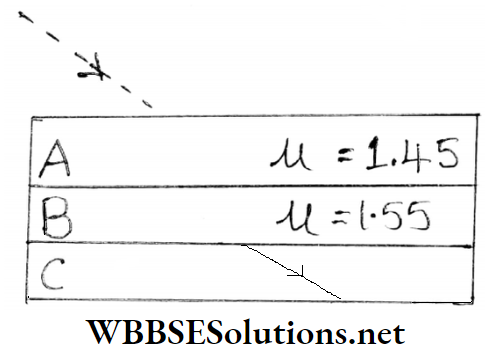
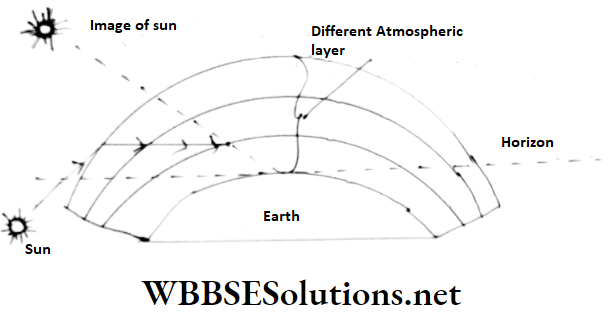
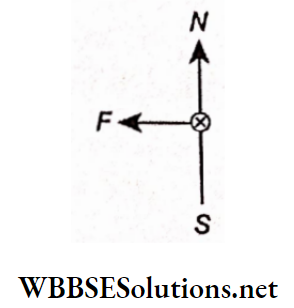
Class 12 Physics Electromagnetic Waves Comprehension Type Questions And Answers

Question 1. Electromagnetic waves propagate through free space or a medium as transverse waves. The electric and magnetic fields are perpendicular to each other as well as perpendicular to the direction of propagation of waves at each point. In the direction of wave propagation, electric field \(\vec{E}\) and magnetic field \(\vec{B}\) form a right-handed cartesian coordinate system. During the propagation of electromagnetic waves, the total energy of electromagnetic waves is distributed equally between electric and magnetic fields. Since e0 and are permittivity and permeability of free space, the velocity of electromagnetic wave, c = (ε0μ0)-1/2. Energy density i.e., energy volume due to electric field at any point, \(u_E=\frac{1}{2} \epsilon_0 E^2\); Similarly, energy density due to magnetic field, \(u_M=\frac{1}{2 \mu_0} B^2\). If the electromagnetic wave propagates along x -direction, then the equations of electric and magnetic field are respectively,
E = E0sin(ωt- kx) and B = B0sin(ωt-kx)

Here, the frequency and the wavelength of oscillating electric and magnetic fields are \(f=\frac{\omega}{2 \pi}\) and \(\lambda=\frac{2 \pi}{k}\) respectively. Thus \(E_{\mathrm{rms}}=\frac{E_0}{\sqrt{2}}\) and \(B_{\mathrm{rms}}=\frac{B_0}{\sqrt{2}}\), where \(\frac{E_0}{B_0}=c\). Therefore, average energy density, \(\bar{u}_E=\frac{1}{2} \epsilon_0 E_{\mathrm{rms}}^2\) and \(\bar{u}_M=\frac{1}{2 \mu_0} B_{\mathrm{rms}}^2\). The intensity of the electromagnetic wave at a point, \(I=c \bar{u}=c\left(\bar{u}_E+\bar{u}_B\right)\).

To answer the following questions, we assume that in the case of propagation of an electromagnetic wave through free space, c = 3 x 10⁸ m. s-1 and μ0 = 4 π x 10-7 H. m-1

Question 1. If the electromagnetic wave propagates along the x-axis, then the electric field \(\vec{E}\) will be

  1. Along y-axis
  2. Along z-axis
  3. On xy – plane
  4. On yz – plane

Answer: 4. Along y-axis

Question 2. If the peak value of the electric field at a point in an electromagnetic wave is 15 V.m-1, then the average electrical energy density (in J.m-3)

  1. 4.98 x l0-9
  2. 9.95 x 10⁻⁹
  3. 4.98 x 10⁻¹⁰
  4. 9.95 x 10⁻¹⁰

Answer: 3. 4.98 x 10⁻¹⁰

Question 3. The peak value of the magnetic field (in Wb.m-2) at that point

  1. 5 x 10⁻⁸
  2. 45 x 10-8
  3. 5 x 10⁸
  4. 45 x 108

Answer: 1. 5 x 10⁻⁸

Question 4. The average energy density (in J.m-3 )of the electromagnetic wave at that point

  1. 4.98 x 10⁻⁹
  2. 9.95 x 10⁻⁹
  3. 4.98 x 10⁻¹⁰
  4. 9.95 x 10⁻¹⁰

Answer: 4. 9.95 x 10⁻¹⁰

Question 5. The intensity (in W.m-2) of the electromagnetic wave at that point is almost

  1. 0.15
  2. 0.3
  3. 0.45
  4. 0.6

Answer: 2. 0.3

Question 6. If the wavelength is 1000A, then the frequency (in Hz)

  1. 1013
  2. 3 x 10¹³
  3. 1015
  4. 3 x 10¹⁵

Answer: 4. 3 x 10¹⁵

Question 7. Relation between ω and k

  1. \(\omega=c k\)
  2. \(\omega=c k\)
  3. \(\omega=\frac{c}{k}\)
  4. \(\omega=\frac{c}{2 \pi k}\)

Answer: 1. \(\omega=c k\)

Class 12 Physics Electromagnetic Waves Integer Type Questions And Answers

In this type, the answer to each of the equations is a single-digit integer ranging from 0 to 9.

Question 1. If the dielectric constant and relative magnetic permeability of a medium are 4 and 2.25 receptively, then the velocity of an electromagnetic wave in that medium is n x 108m.s-1. Find the value of n.

Answer: 1.

Question 2. When the frequency of an electromagnetic wave and the amplitude of its associated magnetic field at a point are 108HZ and 10-10 T respectively, then the amplitude of the electric field is n x 10-2 V . m-1. Find the value of n.

Answer: 3.

Question 3. Due to the sunlight, if the amplitude of the electric field at the earth’s surface is 900 V m-1, then the amplitude of the magnetic field is n x 10-6 T. Find the value of n.

Answer: 3.

Question 4. What is the wavelength (in meters) of a radio wave of frequency 1.5 x 10⁸ HZ?

Answer: 2.

Question 5. If the intensity of an electromagnetic wave at a point is 0.085 W m-2, then find the average amplitude (in V.m-1) of the electric field at that point.

Answer: 8.