WBCHSE Class 11 Physics Notes For Radiation And Properties

Radiation And Properties

Heat can be transmitted from one place to another by radiation, even without the presence of any material medium. There is no material medium above the atmosphere, between the sun and the earth, but still heat from the sun reaches the earth.

  • When we sit near an oven or a fireplace, we feel warm. In this case heat does not reach us by conduction. There is air between the oven and us and we know that air is an insulator.
  • Also the air above the oven gets heated and rises upwards while cold air around the oven moves towards it. So heat does not reach us by convection either. Clearly, there is another process by which the heat reaches us. This process is called radiation.

Radiation: The process by which heat is transmitted from one region to another in the form of electromagnetic waves even in the absence of a material medium, or without heating the material medium (if present) is called radiation.

Radiant heat: In the process of radiation, heat energy is transmitted in all directions, from the source, in the form of waves. This heat wave is called thermal radiation or radiant heat.

Generally, all heated bodies spread heat in the form of radiant heat in all directions. During transmission, when the radiated heat gets absorbed by a body, the kinetic energy of its molecules increases. This means that the temperature of the body increases.

Read and Learn More: Class 11 Physics Notes

Similarities between radiant heat and light:

  1. Radiant heat is an electromagnetic wave like light and can travel in vaccum.
  2. Radiant heat, like light, travels in a straight line. That is why an umbrella saves our body from the heat of the sun.
  3. Radiant heat and light have the same speed. In a vacuum, this speed is 3 x 1010 cm • s-1.
  4. Radiant heat exhibits optical properties like reflection, refraction, interference, diffraction, and polarisation and affects photographic plates.
  5. Heat radiation obeys the inverse square law, i.e., the intensity at a point at a distance d from the source is inversely proportional to d², which is similar to light. From a source, both radiant heat and light propagate as waves.
  6. Radiant heat does not heat a medium while passing through it, but it heats bodies that obstruct its flow.

WBCHSE Class 11 Physics Notes For Radiation And Properties

Differences between radiant heat and light:

Class 11 Physics Unit 7 Properties Of Matter Chapter 9 Transmission Of Heat Differences Between Radiation Heat And Ligth

Nature of Thermal Radiation: We have already seen that radiant heat and light have a lot of similarities. They are of the same nature and they belong to the same family of waves. These waves are known as electromagnetic waves.

  • Only the wavelength of radiant heat is greater than that of visible light. In the spectrum of light, red light has the highest wavelength. As the wavelength of radiant heat more than that of red light, radiant heat is known as infrared waves. Radio waves, ultraviolet waves.
  • X-rays, and gamma rays to are different kinds of electromagnetic waves. All of them have the same nature; the difference lies only in wavelengths.
  • The table provided below lists the wavelength bands of electromagnetic waves with their names and ranges, in order of decreasing wavelength.
  • All the electromagnetic waves mentioned above are called radiation although we have seen earlier that radiation generally refers to a specific process. In this context, it should be mentioned that the term radiation is used to mean emission too.

Class 11 Physics Unit 7 Properties Of Matter Chapter 9 Transmission Of Heat Radiation And Range Of Wavelength

As infrared waves give us the sensation of heat, when they fall on our bodies., they are known as thermal radiation.

  • Everybody, at any temperature above absolute zero (T = 0K), emits and absorbs radiation. It has been observed experimentally that the lower the temperature of a body, the higher is the wavelength of the radiation emitted by it and vice versa.
  • This is why when a body is heated at first it emits infrared radiation. As the temperature rises, the emitted radiation falls in the visible light region. The body goes from being ‘red-hot’ to ‘white-hot’ as its temperature increases.

WBBSE Class 11 Radiation and Properties Notes

Prevost’s Theory of Heat Exchanges: Any hot substance radiates heat to as well as absorbs radiant heat from its surroundings at all times. Hence, there always exists a radiant heat exchange between a body and its surroundings.

Therefore, the rise or fall of temperature of a body depends on the exchange of heat between the body and its surroundings. This is called Prevost’s theory of heat exchange. According to this theory,

  1. when the rate of absorption of heat from the surroundings is greater than the rate of radiation of the body, the temperature of the body rises up.
  2. when the rate of absorption of heat from the surroundings is lower than the rate of radiation of the body, the temperature of the body decreases.
  3. when the rate of radiation equals the rate of absorption, the temperature of the body remains constant and the body remains at thermal equilibrium with its surroundings.

For example, when we stand near a fireplace, we feel hot. The radiant heat absorbed by our body from the fireplace is more than the heat that our body radiates hence the feeling.

Again, when we stand near a big chunk of ice we feel because the amount of radiant heat absorbed by our botljr from the ice is less than the heat that our body radiates.

Absorption of Radiation: When radiation is incident on a surface, it is, in general, divided into three parts:

1. Reflection from the surface: A part of the incident radiation is reflected. The reflective power or reflectance (r) is defined as,

r = \(\frac{\text { amount of reflected radiation }}{\text { amount of incident radiation }}\)

Normally, r ≤ 1. The value r = 1 refers to a perfectly white surface, commonly called a perfectly white body.

2. Transmission across the surface: A part of the incident radiation is transmitted across the surface. The transmitting power or transmittance (t) is defined as,

t = \(\frac{\text { amount of transmitted radiation }}{\text { amount of incident radiation }} \text {. }\)

Here also, t ≤ 1. For t = 1, the material of the surface is called a perfectly transparent medium, or a diather- manous substance. On the other hand, t = 0 corresponds to a perfectly opaque, or athermanous substance.

Class 11 Physics Class 12 Maths Class 11 Chemistry
NEET Foundation Class 12 Physics NEET Physics

3. Absorption by the surface: A part of the incident radiation is absorbed by the surface. The absorptive power (a) of a surface is defined as,

a = \(\frac{\text { amount of radiation absorbed }}{\text { amount of incident radiation }}\)

Here again, a ≤ 1. A surface with a = 1 is called a perfectly black surface, or simply a perfectly black body. The value of a for lamp black and platinum black are 0.96 and 0.98, respectively.

All of the three quantities r, t, and a are ratios of two similar quantities (amounts of radiation). So, each of them is dimensionless and has no unit.

In fact, all of the three quantities r, t and a depend on the wavelength (λ) of radiation. So, rλ, tλ, and aλ denote the reflective power, transmitted power, and absorptive power of a surface at a certain temperature T and for a certain wavelength λ. For example,

1. A blue surface is a good reflector of blue radiation, a negligible part being transmitted or absorbed. So for blue radiation incident of such a surface, r is high, but t or a is low.

2. Glass is almost transparent for radiations of short wavelengths (temperature of source ~ 1200°C), like X-rays

or visible light So, t ≈ 1. But for longer wavelengths (temperature of source ~ 100°C), relevant to thermal radiations, glass behaves as an almost opaque or other- manous medium, so that t ≈ 0. This principle is utilized in greenhouses.

The temperature of a body increases due to radiation only when some part of the incident radiation is absorbed by its surface. Therefore, the absorptive power a turns out to be a very important property in case of thermal radiations.

Emission Of radiation: The rate of emission of radiation from a unit surface area of a body depends only on two properties of the body:

  1. Nature of the surface: The rate of emission depends on the colour of the surface, on whether the surface is rough or shiny, and on whether is it smooth or porous, etc. This dependence is described by Kirchhoff’s law.
  2. Temperature of the body: Higher the temperature of a body, more is the rate of emission. The rate falls to zero only when a body is at the temperature of absolute zero, i.e., at T = 0. This dependence is described by Stefan’s law.

Emissive power (e): The amount of radiation emitted from a unit surface area of a body in unit time is called the emissive power of that particular surface kept at a particular temperature.

In general, this emissive power is different for different colours of radiation, i.e., for different wavelengths (λ).

If eλ denotes the emissive power of a surface for a wavelength λ, then the amount of radiation emitted per unit area of the surface per second between the wavelengths λ and λ + dλ will be eλdλ.

Total emissive power of the surface for all possible wavelengths is, e = \(\int_0^{\infty} e_\lambda d \lambda\)

The units of emissive power are cal • cm-2 • s-1 in CGS system and J • M-2 • s-1 in SI.

1 \(\mathrm{~J} \cdot \mathrm{m}^{-2} \cdot \mathrm{s}^{-1} =\frac{1 \mathrm{~J}}{1 \mathrm{~m}^2 \times 1 \mathrm{~s}}=\frac{\frac{1}{4.2} \mathrm{cal}}{10^4 \mathrm{~cm}^2 \times 1 \mathrm{~s}}\)

= \(\frac{1}{42000} \mathrm{cal} \cdot \mathrm{cm}^{-2} \cdot \mathrm{s}^{-1}\)

A perfectly black surface is the best emitter of radiation at a particular temperature. In this context, the emission from any surface is sometimes compared with that from a perfectly black surface.

A new quantity called relative emittance or emissivity or coefficient of emission (ε) of a surface is then defined as,

ε = \(\frac{\text { heat radiated from the surface }}{\begin{array}{c}
\text { heat radiated from the same area of a perfectly } \\
\text { black surface at the same temperature } \\
\text { in an equal interval of time }
\end{array}}\)

= \(\frac{e}{E}\), where E = emissive power of a perfectly black

Being a ratio between two amounts of heat, ε is dimensionless and has no unit. Of course, ε ≤ 1, the equality sign stands for a perfectly black surface.

Understanding Heat Radiation in Physics

Black body: A body that absorbs radiations of all wavelengths falling on it, without reflecting or transmitting any of it, is called an ideal black body. As it is an ideal absorber it is an ideal emitter as well.

  • At a particular temperature, energy radiated by a black body is greater than that radiated by any other substance. Hence, radiation emitted by an ideal black body is called total radiation or black body radiation.
  • In reality there is no ideal black body, though lamp black and platinum black is considered to be nearly ideal. Lamp black absorbs about 96% and platinum black absorbs about 98% of the radiation falling on them.

Ferry’s black body: A hollow double-walled metal sphere kept at a steady temperature with a fine hole behaves like an ideal black body. It is blackened inside with lamp black and nickel-polished on the outside.

  • The space between the two walls does not have any air. So heat is not lost due to conduction and convection. Heat radiation entering the sphere through the small opening O gets completely absorbed inside the sphere after a few successive reflections.
  • The projection P, opposite to the opening O prevents normal reflection of the radiation. So no radiation entering the sphere through the opening can be out of the sphere. This means that the total radiation gets absorbed. Therefore the sphere acts as an ideal black body This is known as Ferry’s blackbody.
  • Thermal radiation comes out of the opening when the body is heated. In fact the opening O acts as a black body and the intensity and nature of radiation depends only on the temperature of the body. Hence, this radiation is also called temperature radiation.
  • In fact, any hollow enclosure with a small opening acts as a nearly ideal black body. Radiant heat entering it has a negligible chance of coming out through the small opening.

Class 11 Physics Unit 7 Properties Of Matter Chapter 9 Transmission Of Heat Ferry's Black Body

Good absorbers are good emitters so these hollow enclosures emit intense black body radiations at high temperatures. In a coal furnace, the narrow gaps between the burning pieces of coal appear to be brighter than any piece of burning coal itself.

Kirchhoff’s Law: The relation between emissive power and absorptive power of a substance is expressed by Kirchhoff’s law. It states that the ratio between the emissive power and the absorptive power of any substance at a fixed temperature is equal to the emissive power of an ideal black body at that temperature which is constant.

Let at a fixed temperature T, the emissive power of a substance be e, its absorptive power be a, and the emissive power of an ideal black body at that temperature be E. Then, by Kirchhoff’s law, \(\frac{e}{a}=E\)…(1)

Conclusions drawn from Kirchhoff’s law:

  1. The value of the ratio \(\frac{e}{a}\) increases with the increase in temperature as E increases with the rise in temperature for a fixed wavelength.
  2. When T is kept constant, E is also a constant for a particular wavelength of radiation. This means, if e is large, a is also large. So a good emitter is also a good absorber and vice versa for the same wavelength.
  3. Relative emittance or coefficient of emission, \(\varepsilon=\frac{e}{E}\) from Kirchhoff’s law, ε is equal to a, the absorptive power.

Conclusions drawn from Kirchhoff’s law Applications:

  1. A white china bowl is partially smeared with lamp black. Now, the bowl is heated to 1000°C. If we take this bowl to a dark room then the black coloured parts appear brighter than the rest. The black part is a better absorber than the white part. So, from Kirchhoff’s law, it is a good emitter as well. Thus, it appears brighter as emits more heat.
  2. In a solar spectrum, we see many black lines. These are called Fraunhofer lines. The origin of these lines can be explained with the help of Kirchhoff’s law.

Examples of Emission and Absorption of Heat

  1. Cups and saucers, mugs, etc. which are used to serve hot beverages like tea and coffee are usually white and shiny. This helps to keep the beverage hot for a long period of time as heat loss due to radiation is very small.
  2. Dark or black-colored wet clothes dry up faster in sun than white wet clothes do. This happens because black clothes absorb the heat from the sun at a higher rate.
  3. It is comfortable to wear dark clothes in winter and white clothes in summer. Dark clothes keep our bodies warm by absorbing more heat emitted by the sun. During the summer, the white clothes absorb a very small fraction of the heat and reflect most of it. So our bodies remain cool.
  4. The cloth of an umbrella is usually made black. Being a good absorber, it collects the sun rays and also radiates out the heat fast. The radiated heat does not heat up the air below the umbrella and hence keeps the body cool.
  5. Let us take two thermometers and blacken the bulb of one of them. If we keep these thermometers in the sun, after a while the temperature of the blackened thermometer will read more than the other one. This hap¬pens because the blackened bulb absorbs more heat from the sun.
  6. Humid air is a better absorber of heat than dry air. On a cloudy and humid day, air absorbs more heat from the sun and becomes warmer. During night, the surface of the earth cools by radiating heat. But humid air is rather- manous to heat and it prevents the passage of heat to outer space. Thus, humid and cloudy days and nights are warmer than clear ones.
  7. It is difficult to stay in houses with tin roofs during summer afternoons because tiniabsorbs heat. But at night, tin radiates the heat rapidly and cools. So the room becomes cold.
  8. Outer surface of a spacecraft is made smooth and shiny to reflect off radiated heat from the sun so that the spacecraft cannot get much heated.
  9. In coal ovens, spaces between the glowing pieces of coal appear brighter than the glowing coal pieces themselves. Any hole behaves like an ideal black body. Hence, absorptive power, as well as emissive power of the spaces, is very high. So the spaces appear brighter.
  10. Bottom surface of a cooking container is made black and rough so as to absorb more heat. Hence food is cooked faster in these containers than those with white and polished bottom.
  11. Highly polished shoes are more comfortable to wear since they reflect most of the incident heat and absorb very little of it.
  12. In deserts, days are unbearably hot and nights are cold. Air in those regions being very dry, is diathermanous. During the daytime, this dry air allows heat to easily pass through the atmosphere and heat the surface. At night, the earth’s surface radiates heat which easily escapes the atmosphere leaving the surface and the air around it cold. This is why extreme temperature changes are observed in deserts.

Greenhouse: In cold countries glass-houses and sometimes garden-houses with glass roofs are constructed. These are used to preserve plants and vegetables from withering away due to the low temperatures and so are called greenhouses. Glass is diathermanous to short waves.

  • Sun rays, because of its high temperature, are rich in shorter waves and can enter through the roof. Materials in the shade absorb the radiation and warm up. The radiations from these preserved materials mostly consist of long waves like heat waves as they are at quite low temperatures.
  • Glass being athermanous to long waves, does not allow the radiation to escape and the interior of the house remains warm throughout the year.

Greenhouse effect: Due to the presence of certain gasses in the earth’s atmosphere, the earth acts as a huge greenhouse. These gases are present in trace amounts and are known as greenhouse gases.

  • Water-vapour, carbon dioxide- methane, nitrous oxide, dhloroflurocarbons) etc. are some important greenhouse gases. These gases form a layer in the atmosphere which is diathermanous to short heat waves, but athermanous to long waves, So, the sun rays, being of short wavelength can enter the earth’s atmosphere, However, the heat radiated from the earth’s surface.
  • Is of longer wavelength and cannot pass through the gaseous layer, Ihls warms up the air and the earth’s surface. This Is called the greenhouse effect. In the absence of this effect the average temperature of the earth’s surface would have been lower by 30 °C-35 °C approximately. The atmosphere would then be adverse for life.

Enhanced greenhouse effect: Due to human activities, the amount of greenhouse gases In air Is Increasing alarmingly. This results in the increase In air and earth’s temperature regularly. This is called enhanced greenhouse effect. If this enhanced greenhouse effect is not controlled, the existence of life on earth will be in danger In the future.

Harmful effects of global warming:

  1. There will be an acute shortage of water for consumption and for use In agricultural and electricity production. There will also be degradation in the quality of drinking water,
  2. Due to the melting of ice on mountains and polar regions sea level will rise causing large areas on the earth’s surface to submerse under water.
  3. Death rate of plants and animals will increase.
  4. Forest resources will show signs of destruction.

Stefan-Boltzmann Law Explained

Stefan’s Law: After careful analysis of the results of a few experiments by scientists Dulong, Petit and Tyndall, famous physicist Joseph Stefan formulated the relation connecting the amount of radiation emitted by a body and the temperature of the body.

This law is known as Stefan’s law. The law states that, the total heat radiated (E) per second from per unit surface area of a body at an absolute temperature T is directly proportional to the fourth power of the absolute temperature of the body.

i.e., \(E \propto T^4\) or \(E=\sigma \cdot T^4\)

Here σ is called Stefan’s constant, whose experimental value is

σ = \(5.672 \times 10^{-5} \mathrm{erg} \cdot \mathrm{cm}^{-2} \cdot \mathrm{s}^{-1} \cdot \mathrm{K}^{-4}\)

= \(5.672 \times 10^{-8} \mathrm{~W} \cdot \mathrm{m}^{-2} \cdot \mathrm{K}^{-4} .\)

Clearly, for T= 0, E = 0 which means that a body at T = 0 K does not emit thermal radiation.

Later in 1884 Boltzmann theoretically proved the law from thermodynamical considerations and established that the law is valid only for black body radiation.

The law is, thus, also known as Stefan-Boltzmann law. It states that the total radiant energy emitted per second per unit surface area of a perfect black body is directly proportional to the fourth power of its absolute temperature.

ie., E ∝ T4 or, E = σT4

If for any surface, the relative emittance = £ and the surface are = A, then die heat radiated in time t is, Q = σεAtT4

The law is sometimes called Stefan’s fourth power law.

  • It should be noted diat die amount of heat radiated by a body due to its temperature can be obtained from Stefan’s law. But the law does not refer to the net loss or gain of heat by radiation due to exchange with its surroundings. It should be modified in that case.
  • As the black body at absolute temperature T radiates heat, it absorbs heat as well from its surroundings at absolute temperature T0. Hence, by Prevost’s tiieory of heat exchange, the net rate of heat radiation by a unit surface area of a black body is equal to the difference in die rates of emission and absorption.

i.e., \(E=\sigma\left(T^4-T_0^4\right)\)

If the body is not a black body, then radiation per second per unit area, E = ∈σ = \(\epsilon \sigma\left(T^4-T_0^4\right)\), where ∈ is the relative emittance of the die surface.

Solar Constant and Solar Temperature: Surface temperature of the sun can be determined from the knowledge of the solar constant and Stefan’s law.

Solar constant: It is defined as the amount of radiant energy received per minute per unit area by a perfectly black body placed on earth at die mean distance of the earth from the sun in a direction perpendicular to the direction of rays from the sun.

Its value is nearly 1300 J • m-2 • s-1, i.e., 1300 W • m-2

Determination of solar temperature: The central region of the sun is very hot. This region is called the photosphere which is surrounded by a comparatively cooler atmosphere called the chromosphere. For all external purposes, fire temperature of the sun means the temperature of the chromosphere.

Let, r be the radius and TK be the temperature of the sun. To determine the solar temperature, the sun is treated as a perfectly black body. According to Stefan’s Jaw, the energy emitted by the sun in t seconds E = \(4 \pi r^2 \sigma T^4 t\)

Imagine a sphere of radius R drawn around the sun. R is the mean distance of the earth from the sun. The surface area of the sphere = 4πR²,

Therefore, the energy incident normally per unit area of the earth’s surface in time

t = \(\frac{E}{4 \pi R^2}=\frac{4 \pi r^2 \sigma T^4}{4 \pi R^2}=\frac{r^2 \sigma T^4 t}{R^2}\)

Class 11 Physics Unit 7 Properties Of Matter Chapter 9 Transmission Of Heat Solar Temperature

If t=60s then this quantity is nothing but the solar constant S.

∴ S = \(\frac{r^2 \sigma T^4 \times 60}{R^2} \text { or, } T^4=\left(\frac{R}{r}\right)^2 \times \frac{S}{\sigma} \times \frac{1}{60}\)

or, T = \(\left[\left(\frac{R}{r}\right)^2 \times \frac{S}{\sigma} \times \frac{1}{60}\right]^{1 / 4}\)….(1)

From the equation (1), the solar temperature can be determined.

Here, S = \(0.032 \mathrm{cal} \cdot \mathrm{cm}^{-2} \cdot \mathrm{s}^{-1} \text { (approx.) }\)

σ = \(1.37 \times 10^{-12} \mathrm{cal} \cdot \mathrm{cm}^{-2} \cdot \mathrm{s}^{-1}\)

r = \(7 \times 10^{10} \mathrm{~cm}\)

R = \(15 \times 10^{12} \mathrm{~cm}\)

Putting these values in equation (1) the solar temperature (T) becomes 5722 K (approx.).

Wien’s Displacement Law Overview

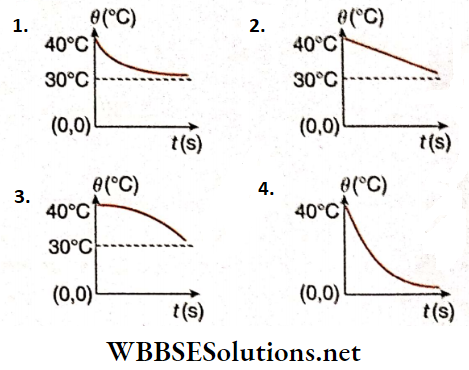
Newton’s Law of Cooling Statement: The rate of loss of heat by a body, due to radiation, is direedy proportional to the temperature difference between the body and its surroundings, provided the temperature difference is small.

Time of cooling: Let a body, of mass m and specific heat s, at a temperature θ be placed in a surrounding of temperature θ0, where θ0 < θ.

According to Newton’s law of cooling, the rate of loss of heat by the body, \(\frac{d Q}{d t} \propto-\left(\theta-\theta_0\right)\)

Also from calorimetry, \(\frac{d Q}{d t}=m s \frac{d \theta^{I R}}{d t}, \text { where } \frac{d \theta}{d t}\) = rate of fall of temperature.

∴ \(\frac{d \theta}{d t} \propto-\left(\theta-\theta_0\right) \quad \text { or, } \frac{d \theta}{d t}=-C\left(\theta-\theta_0\right)\)

where C is 2 constant and the —vs sign indicates fell in temperature with time.

∴ \(\frac{d \theta}{\theta-\theta_0}=-C d t\)

By integration, \(\int_{\theta_1}^{\theta_2} \frac{d \theta}{\theta-\theta_0}=-C \int_0^t d t\),

At the time of cooling the temperature of the body decreases from θ1 to θ2 in time t, where θ1 > θ2]

or, \(\left[\log _e\left(\theta-\theta_0\right)\right]_{\theta_1}^{\theta_2}=-C t\)

or, \(\log _e\left[\frac{\theta_1-\theta_0}{\theta_2-\theta_0}\right]\) = Ct

or, \(t=\frac{1}{C} \log _{\ell}\left[\frac{\theta_1-\theta_0}{\theta_2-\theta_0}\right]\)……(1)

Newton’s few of cooing from Stefan-Bottzmonn few: When the difference in temperature between the body and its surroundings is low, Stefan-Boltzmann’s few becomes equal to Newton’s law of cooling. Let the absolute temperature of die body and That of the surroundings be T and T0 respectively (T— T0) is very small.

From Stefan’s law, heat radiation per unit area per unit time,

E = \(\sigma\left(T^4-T_0^4\right)=\sigma\left(T-T_0\right)\left(T^3 \div T^2 T_0 \div T T_0^2 \div T_0^3\right)\)

If (T- T0) is very small, ie., if T ∝ T0, we can write the equation as,

E = \(\sigma\left(T-T_0\right) \times 4 T_0^3=C\left(T-T_0\right) \text {, where } C=4 \sigma T_0^3\)

At a constant surrounding temperature, C Is a constant

Hence E ∝ (T – T0), which is Newton’s law of cooling.

The body will cool by radiation following Newton’s laws of moving only when the temperature difference between the body and its surroundings is small.

Newton’s law of cooling is valid for cooling by conduction when k, A, and d are constants. It is also valid for some cases of cooling by convection.

Transmission Of Heat Radiation And Properties Numerical Example

Example 1. The initial temperature of a body is 353 K. It reduces to 337 K in 5 mins and to 325 K In 10 mins. What will be its temperature after 15 mins? What is the temperature of the surroundings?
Solution:

From Newton’s law of cooling we have,

In\(\frac{\theta_1-\theta_0}{\theta_2-\theta_0}=Ct\)

After 5 mins, \(\ln \frac{353-\theta_0}{337-\theta_0}=5 C\)…(1)

After the next 5 mins, \(\ln \frac{337-\theta_0}{325-\theta_0}=5 C\)….(2)

Yet after another \(5 \mathrm{mins}, \ln \frac{325-\theta_0}{\theta_3-\theta_0}=5 \mathrm{C}\)…(3)

[where θ3 is the temperature of the body after 15 mins]

From equations (1) and (2) we have, \(\frac{353-\theta_0}{337-\theta_0}=\frac{337-\theta_0}{\theta_3-\theta_0} \text { or, } \theta_0=289 \mathrm{~K}\)

∴ Temperature of the surroundings =289K.

From equations (2) and (3) we have, \(\frac{337-\theta_0}{325-\theta_0}=\frac{325-\theta_0}{\theta_3-\theta_0} \)

or, \(\frac{337-289}{325-289}=\frac{325-289}{\theta_3-289} \quad \text { or, } \theta_3=316 \mathrm{~K}\)

Applications of Thermal Radiation

Example 2. The temperature of a black body is increased from 27°C to 927°C. What is the ratio of the heat radiated at these two temperatures?
Solution:

⇒ \(T_1=27^{\circ} \mathrm{C}=(27+273) \mathrm{K}=300 \mathrm{~K}\)

⇒ \(T_2=927^{\circ} \mathrm{C}=(927+273) \mathrm{K}=1200 \mathrm{~K}\)

According to Stefan’s law, \(E \propto T^4\)

or, \(\frac{E_1}{E_2}=\left(\frac{T_1}{T_2}\right)^4=\left(\frac{300}{1200}\right)^4=\left(\frac{1}{4}\right)^4=\frac{1}{256} .\)

Example 3. A spherical black body of radius 12 cm radiates 450 W heat, energy at 500 K. Now If the radius is reduced to half the temperature doubled, what will be the amount of heat radiated?
Solution:

The surface area of a sphere, \(A=\pi r^2, i.e., A \propto r^2\)

Rate of radiation from the surface of a black body, \(E \propto A T^4 \quad \text { or, } E \propto r^2 T^4 \quad\left[because A \propto r^2\right]\)

∴ \(\frac{E_1}{E_2}=\left(\frac{r_1}{r_2}\right)^2\left(\frac{T_1}{T_2}\right)^4\)

or, \(E_2=E_1\times\left(\frac{r_2}{r_1}\right)^2\left(\frac{T_2}{T_1}\right)^4=450 \times\left(\frac{1}{2}\right)^2 \times\left(\frac{2}{1}\right)^4\)

= 1800 W

Short Answer Questions on Heat Radiation

Example 4. The filament of on electric bulb of 40 W has an average temperature of 2500 °C. If the length and diameter of the filament are 10 cm and 0.1mm respectively, then determine Its coefficient of radiation (ε), provided all the heat Is emitted only through radiation. Given, σ = 5.67 x 10⁻⁵ CGS unit
Solution:

We know, \(\frac{Q}{t}=\epsilon A \sigma T^4\)

Here, \(\frac{Q}{t}\) = radiation per second = 40 W = 40 x 107 erg · s-1,

A = πld = π x 10 x 0.01 = 0.1 π cm²

σ = 5.67 x 10⁻⁵ CGS unit,

T = 2500 + 273 = 2773 K.

∴ 40 x 107 = ∈ x 0.1 π x 5.67 x 10-5 x (2773)4

or, ∈ = 0.38 cal °C-2 cm-2.

Example 5. With a body temperature of 37° C, a person of a body surface area of 1.40 m² and a coefficient of emission of 0.85, stands In a room kept at a temperature of 20°C. If Stefan’s constant, σ = 5.67 x 10⁻⁸ W • m-2 • K-4 find the rate of loss of heat by the man by radiation only.
Solution:

Heat lost by the man per min is given by,

Q = \(\epsilon A \sigma\left(T^4-T_0^4\right) \times t\)

= \(0.85 \times 1.40 \times 5.67 \times 10^{-8}\left[310^4-293^4\right] \times 60\)

= \(7550 \mathrm{~J}=1800 \mathrm{cal} \text { (approx). }\)

Emissivity and Its Importance

Example 6. The earth receives radiation from the sun at the rate of 1400 W • m-2. The distance of the centre of the sun from the surface of the earth is 1.5 x 10¹¹ m and the radius of the sun is 7 x 10⁸ m. Treating the sun as a black body, determine Its surface temperature in Kelvin scale, σ = 5.67 x 10⁻⁸ W • m-2 · K-4
Solution:

If T be the surface temperature of the sun, then

T = \(\left[\left(\frac{R}{r}\right)^2 \times \frac{S}{\sigma}\right]^{1 / 4}\)

Here, \(S=1400 \mathrm{~W} \cdot \mathrm{m}^{-2}, R=1.5 \times 10^{11} \mathrm{~m}, r=7 \times 10^8 \mathrm{~m}, \sigma=5.67 \times 10^{-8} \mathrm{~W} \cdot \mathrm{m}^{-2} \cdot \mathrm{K}^{-4}\)

∴ T = \(\left[\frac{\left(1.5 \times 10^{11}\right)^2}{\left(7 \times 10^8\right)^2} \times \frac{1400}{5.67 \times 10^{-8}}\right]^{1 / 4}\)

= \(\left[0.1128 \times 10^{16}\right]^{1 / 4}=5800 \mathrm{~K}\)

WBCHSE Class 11 Physics Notes For Convection Of Heat

Convection Of Heat

WBBSE Class 11 Convection of Heat Notes

As mentioned earlier, the transmission of heat through fluids (liquids and gases) usually takes place by convection. In this process the heated molecules of the medium, by their actual displacement, transmit heat from hotter parts to cooler parts of the fluid.

  • Liquids and gases, on being heated, expand and hence become less dense or lighter. So, the hot fluid rises up and the comparatively cooler part of the fluid, having a higher density or being heavier, flows downwards. In this way a current is set up in a fluid on heating it.
  • This current is called a convection current in a fluid. Clearly, In this process, heat can only be transmitted upwards, neither sideways nor downwards. It is important to mention that, a convection current cannot be set up at a place where there is no gravity.
  • In the absence of gravity, there is no difference in weight between the hotter part and the cooler part of the fluid. So a convection current is not possible.

As the molecules in a solid are strongly bound together, there is no heat transfer by convection in solids.

Read and Learn More: Class 11 Physics Notes

Practical Applications of Convection of Heat: Convection can be seen in our daily lives and in nature.

WBCHSE Class 11 Physics Notes For Convection Of Heat

Understanding Convection in Fluids

1. Working principle of a table lamp: A table lamp burns due to the convection current of air. The frame holding the chimney covering the flame is provided with holes.

When the flame burns, while hot air escapes through the upper open end of the chimney, fresh cool air enters through the holes maintaining the supply of oxygen for the flame. If the holes in the frame are covered, the convection current of air stops, and the flame extin¬guishes due to absence of oxygen.

Class 11 Physics Unit 7 Properties Of Matter Chapter 9 Transmission Of Heat Working Principal Of A Table Lamp

2. Ventilation in a room: For air circulation in a room ventilators are provided just below the roof. Because of breathing process and also if fire is burning in the room, the air in the room gets heated and polluted.

This warm, polluted air rises up andescapes through the ventilator. Cold and fresh air enters the room through doors and windows maintaining the purity and continuity of the air flow in the room.

Class 11 Physics Class 12 Maths Class 11 Chemistry
NEET Foundation Class 12 Physics NEET Physics

3. Sea breeze and larid breeze: Sea breeze and; land breeze are set up due to the convection current of air. Land absorbs more heat from the sun than the sea does. Also, as the specific heat of land is less than that of water, land gets warm rapidly during the day.

Air in contact with land gets warm and light and moves upwards. Comparatively colder air in contact with the sea flows towards land to fill up the void created, setting up a sea breeze. It flows during daytime and its intensity is the highest just before sunset.

Class 11 Physics Unit 7 Properties Of Matter Chapter 9 Transmission Of Heat Sea Breeze

Types of Convection Explained

During night-time, seawater remains warm for a longer period due to higher specific heat of water while land loses heat fast and cools down. Air in contact with the sea remains hot and light and thus rises up. Air in contact with land is cooler. This air flows towards the sea to fill up the void created. Thus a land breeze is set up. It flows during the whole night and its intensity is the highest just before sunrise.

Class 11 Physics Unit 7 Properties Of Matter Chapter 9 Transmission Of Heat Land Breeze

Real-Life Examples of Convection in Action

4. Trade winds: Temperature at the equatorial region is much higher than that at polar regions. As the equatorial region gets very heated by the sun, air in this region gets warm and light. Thus warm air from the equatorial region rises up and colder air from polar regions rush in to fill up the space.

Because of the rotation of earth about its axis from west to east, colder air in the northern hemisphere flows from N-E, and that in the southern hemisphere flows from S-E. These air currents are called north-east and south-east trade winds respectively. These winds once helped in the navigation of merchant vessels as they blow pretty regularly throughout the year. Hence they are called trade winds.

WBCHSE Class 11 Physics Notes For Thermal Conduction

Transmission of Heat Thermal Conduction

Conduction can be explained easily using the laws of motion for particles. When a part of a solid is heated, the molecules of that region get energized and start vibrating with large amplitudes about their equilibrium positions.

As a result, die number of collisions with the neighbouring molecules increases, and a part of their kinetic energy (due to vibration) is transferred to the neighbouring molecules. These molecules in their turn transfer some energy to their adjoining molecules.

Thus thermal motion occurs or heat travels from one molecule to another, or from one layer to another layer without any net displacement the molecules. Clearly, a material medium is necessary for the transfer of heat by conduction.

Read and Learn More: Class 11 Physics Notes

  • Thermal Conductivity
  • Coefficient of Thermal Conductivity

Thermal conductivity: The capacity of conduction of heat is called the thermal conductivity of a matter. Different substances have different thermal conductivities. Generally, metallic substances are better conductors of heat than non-metallic and other substances.

  • A piece of wood, with one end kept in fire, can be held in our hands for a long time but we cannot hold a piece of iron, with one end kept in fire for too long. Iron can conduct heat more easily than wood. So the thermal conductivity of iron is more than that of wood. Materials which can conduct heat easily are called thermal conductors.
  • Almost all metals are conductors silver is the best thermal conductor. Copper and aluminium come next in line. In metals there are many free electrons that move around haphazardly in the metal-like molecules of an ideal gas.
  • These free electrons can carry energy from hotter to a colder region within a body more quickly and thus take part in conduction of heat along with the molecules of a metal making the metal a good conductor.
  • Materials that cannot conduct heat easily are called bad conductors of heat or thermal insulators. Nonmetals do not have mobile free electrons to carry heat. In this case, heat is solely transmitted by atomic vibrations. Thus they are insulators or bad conductors.

Polystyrene, cotton, fiberglass, paper, cork, water, wood, rubber, asbestos, etc. are bad conductors of heat. All liquids except mercury, are generally bad conductors. All gasses are bad conductors. Vacuum cannot conduct heat and therefore is an ideal insulator.

WBCHSE Class 11 Physics Notes For Thermal Conduction

WBBSE Class 11 Thermal Conduction Notes

Coefficient of thermal conductivity: Thermal conductivity is the property of a material that indicates its ability to conduct heat. The physical quantity used to denote it is called the coefficient of thermal conductivity.

Class 11 Physics Unit 7 Properties Of Matter Chapter 9 Transmission Of Heat Coefficient Of Thermal Conductivity

Let a rectangular plate of cross-sectional area A and thickness d maintain temperatures θ2 and θ1 on its two opposite faces, where θ2 > θ1.

In this condition, heat passes perpendicularly through the slab from the hotter surface to the colder surface. If Q amount of heat is transferred perpendicularly across the plate in time t, then it is observed experimentally that,

  1. Q is directly proportional to A, i.e., Q ∝ A
  2. Q is directly proportional to (θ21), i.e., Q (θ21)
  3. Q is directly proportional to t, i.e., Q ∝ t and
  4. Q is inversely proportional to d, i.e., Q \(xs\propto \frac{1}{d}\)

Hence, \(Q \propto \frac{A\left(\theta_2-\theta_1\right) t}{d} or, Q=\frac{k A\left(\theta_2-\theta_1\right) t}{d}\)…(1)

or, \(\frac{Q}{t}=\frac{k A\left(\theta_2-\theta_1\right)}{d}\)…(2)

Understanding Heat Conduction in Physics

Here k is a physical constant and it depends on the material of the plate, k is known as the coefficient of thermal conductivity or in brief, thermal conductivity of the material.

∴ \(\frac{\theta_2-\theta_1}{d}\) is the space rate of change of temperature in the direction of heat flow and is called the temperature gradient. Q/t is the time rate of heat flow and is called the heat current.

In case, the temperature gradient is non-uniform, equation (2) can be generalised as, \(\frac{d Q}{d t}=k A \frac{d \theta}{d x}\)

[where dθ is the infinitesimal change in temperature across an infinitesimal thickness dx of the material]

From equation (1), Q = k when A = 1, θ21 = 1, d = 1 and t = 1

Coefficient of thermal conductivity Definition: Heat conducted perpendicularly across the opposite faces of a cuboid of unit cross-sectional area and unit width in unit time, when the temperature difference of the two faces is unity, is called the coefficient of thermal conductivity of the material of the cuboid.

The coefficient of thermal conductivity of copper is 0.92 CGS unit means that 0.92 cal of heat will flow per second normally from the hotter surface to the colder surface of a copper cuboid of 1 cm² cross-sectional area and 1 cm width, with 1 °C temperature difference between the two surfaces.

Note that for an ideal conductor, k is infinity, and for an ideal insulator k is zero. But in practice, no substance is found for which k → ∞ or k = 0.

The value of k for a substance changes slightly with the change in temperature. With the increase in temperature, the values of k for solids and liquids decrease, but that for gases increases.

Units of k: From equation (1), k = \(\frac{Q \times d}{A \times\left(\theta_2-\theta_1\right) \times t}\)

Dimension of k: From equation (1),

⇒ \([k]=\frac{[Q][d]}{[A]\left[\theta_2-\theta_1\right][t]}=\frac{\mathrm{ML}^2 \mathrm{~T}^{-2} \mathrm{~L}}{\mathrm{~L}^2 \Theta \mathrm{T}}=\mathrm{MLT}^{-3} \Theta^{-1}\)

The coefficient of thermal conductivity (k) of a few substances in CGS system

Class 11 Physics Unit 7 Properties Of Matter Chapter 9 Transmission Of Heat Coefficient of Thyermal Conductivity Of A Few Substances In CGS System

Thermal Resistance and Thermal Resistivity: Q = \(\frac{k A\left(\theta_2-\theta_1\right) t}{d} \text { or, } \frac{Q}{t}=\frac{\theta_2-\theta_1}{\frac{1}{k} \cdot \frac{d}{A}}\)….(1)

where \(\frac{Q}{t}\) denotes the rate of flow of heat through a conductor of thickness d, area of cross-section A, and coefficient of thermal conductivity k.

An equation similar to (1) is obtained for the rate of flow of charge or current through an electrical conductor of length d, area of cross-section A, resistance R, and resistivity ρ having a potential difference (V2-V1) across its length, this equation is

⇒ \(\frac{q}{t}=I \text { (current) }=\frac{V_2-V_1}{R}=\frac{V_2-v_1}{\rho \frac{d}{A}}\)….(2)

Comparing equations (1) and (2) it is apparent that

  1. V2 – V1, the potential difference is similar to the temperature difference. θ21 in this case.
  2. \(\frac{d}{k A}\) is similar to the electrical resistance R. Hence, \(\frac{d}{k A}\) is termed as the thermal resistance of the conductor.
  3. \(\frac{1}{k}\) is similar to ρ. Hence, \(\frac{1}{k}\) is termed as thermal resistivity of the conductor.
  • Pre-steady state
  • Steady State
  • Thermal Diffusivity

When a metal rod is heated by putting one of its ends into a source of heat, it is observed that heat is conducted along the length of the rod. As a result, the temperatures of the transverse layers situated perpendicular to the length of the rod increase gradually.

Heat received by any layer from its previous layer is spent in three ways:

  1. By absorption so that the layer’s temperature increases,
  2. By radiation from its outer surface, and
  3. By transmission to the next layer. Same happens for each of the consecutive transverse layers of the rod.
  • Heat absorbed by each layer increases its temperature and it is seen that the temperature of a layer decreases with the distance of the layer from the heat source.
  • This type of absorption of heat and rise in temperature goes on for sometime. This condition of the metal rod is called the pre-steady state of heating.
  • After a reasonable interval of time, the temperature of each of the transverse layers of the rod is seen to have reached a steady value. This means that the temperature does not rise anymore and that the layers are not absorbing heat anymore.

Class 11 Physics Unit 7 Properties Of Matter Chapter 9 Transmission Of Heat Thermal Conductivity Pre Steady State

  • Some of the heat received from the previous layer is radiated and the rest is conducted to the next layer. This state is called steady state of heating. In this state the temperature of the layers also decreases with the distance of the layers from the heat source.
  • Conduction of heat through any part of the rod depends on its coefficient of thermal conductivity. In the steady state of heating, a part of the heat received by a layer from its previous one is absorbed to increase its own temperature.

The rise in temperature of a layer depends on the specific heat of the material of the rod. Hence, in a pre-steady state, heat conduction through a rod depends on both

  1. The coefficient of thermal conductivity, and
  2. Specific heat of the material of the rod.

On the other hand, since there is no absorption of heat by any layer in the steady state, heat conduction along a rod depends only on the coefficient of thermal conductivity of its material.

Thermal diffusivity or thermometric conductivity: if a substance has a coefficient of thermal conductivity k, specific heat s, and density ρ, it can be proved that during the pre-steady state of heating the rate of increase in temperature for any section of the rod does not depend only on the value of k.

Instead, this rate depends on the ratio \(\frac{k}{\rho s}\). This ratio \(\frac{k}{\rho s}\) is called the thermal diffusivity or thermometric conductivity of the substance.

∴ Thermal diffusivity, h = \(\frac{k}{\rho s}\)

= \(\frac{\text { coefficient of thermal conductivity }}{\text { density } \times \text { specific heat }}\)

= \(\frac{\text { coefficient of thermal conductivity }}{\text { thermal capacity per unit volume of the substance }}\)

[ρ = mass per unit volume of a substance]

Class 11 Physics Class 12 Maths Class 11 Chemistry
NEET Foundation Class 12 Physics NEET Physics

Thermal diffusivity or thermometric conductivity Definition: The ratio of the coefficient of thermal conductivity and the thermal capacity per unit volume of a substance is called the thermal diffusivity of the substance.

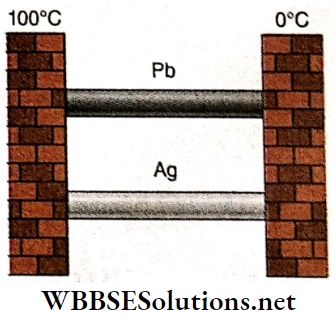
  • Even if the coefficient of thermal conductivity of a substance is less than that of another substance, its thermal diffusivity may be relatively more. For example, lead has a coefficient of thermal conductivity less than that of iron but the thermal diffusivity of lead is more.
  • Due to this reason, when two similar wax-coated rods of lead and iron are kept in the same source of heat, the different parts of the lead rod get heated faster than those of the iron rod, during the pre-steady state.
  • In steady state let the temperature of a part on the iron rod situated l distance away from the source of heat be t1°C and the temperature of a part on the lead rod situated l distance away from the source of heat be t1°C. Then we can see that t1°C > t1°C.

So, in a pre-steady state, the wax coating on the lead rod melts along its length at a faster rate than that on the iron rod. But, finally, in the steady state, it is seen that the wax on iron rod has melted for a greater distance than the wax on lead rod.

Practical Illustrations of Conduction of Heat

1. Cooking utensils are usually made of copper or aluminum because of their high conductivity. Heat is conducted quickly through them. For the same reason, boiler tubes are generally made of copper.

2. Davy’s safety lamp: In 1815, Sir Humphry Davy invented a lamp for the safety of coal miners using the property of good conductivity of copper wire gauze. In this lamp, an ordinary oil lamp is kept inside a fence of copper wire mesh with very fine pores.

  • The inflammable gases if present in the coal mine penetrate through the mesh and enter the lamp. So, the flame begins to burn brightly and changes its colour. As the pores in the wire mesh are very fine and made of copper, the flame cannot propagate through them to light the inflammable gases outside the mesh.
  • Copper being a good conductor, rapidly distributes heat from the flame throughout the entire surface of the copper mesh. Thus immediately outside the mesh, the temperature is not high enough to sustain the burning reaction. So no explosion can take place. This kind of wire mesh is known as a flame arrestor.
  • In modern times, this lamp has been replaced by other types of lamps.

Class 11 Physics Unit 7 Properties Of Matter Chapter 9 Transmission Of Heat Practical Illustarations Of Conduction Of Heat

3. Woolen clothes are used during winter. They keep us warm. So they are also known as warm clothes. Woolen yarn traps a lot of air, which is a bad conductor of heat. Thus body heat cannot easily escape through these clothes. So we keep warm. Ordinary cotton yarn does not trap as much air. So they do not provide enough warmth.

  • If we wear two relatively finer clothes instead of a thick cloth, we feel warmer. This happens because the two clothes trap a layer of air between them. Air is a thermal insulator so it prevents the heat from our body from escaping. So we feel warm.
  • For the same reason, in colder countries, the windows have double panes of glass. Air is trapped between the two layers of glass. As air is an insulator, heat cannot escape from the room This keeps the room warm.

4. The kettles are made of aluminum as it is a good con ductor. So the water in the kettle gets heated fast but at the same time, the handle also gets heated. So an insulator is needed.

Aluminum kettles have wooden handles or cane handles to provide insulation, as wood or cane are bad conductors and heat cannot pass from the hot kettle to the hand.

5. Sawdust is used to cover ice to prevent it from melting. Sawdust is a bad conductor and this also traps a lot of air (also a bad conductor). Thus, heat from outside cannot reach the ice block and this prevents it from melting.

6. Villagers use the property of conductivity of different substances to build houses. Thatched roofs of mud houses, which comprise hay and air spaces (both insulators), prevent heat from entering the house during the scorching summer, while in the winter the heat generated within the house does not escape to the outside.

7. A wooden chair feels warmer on touch in winter than an iron chair in the same room at the same temperature. During winter, the temperature of the chairs is generally less than that of our bodies. Iron, being a good conductor, conducts heat away from our body rapidly.

  • It then quickly spreads the heat to other parts of the chair. So, we feel colder on touching the iron chair. Wood is a bad conductor of heat, and so the heat from our bodies is not spread to the other parts of the chair. So a wooden chair does not feel that cold.
  • For the same reason, an iron chair feels warmer on touch than a wooden chair in summer. During summer, the temperature of the chair is generally more than that of our bodies.
  • Now iron, being a good conductor, conducts heat from other parts of the chair to our hands rapidly. On the other hand, wood being a bad conductor, conducts heat to our hands only from the part that we touch. So a wooden chair feels relatively less hot.

8. During winter, the birds fluff up their feathers to keep themselves warm. The feathers trap air in them. Air, being an insulator, does not allow heat from the body to escape. So the birds keep warm.

9. New quilts make us feel warmer than old quilts do. Cotton in old quilts contract. So the amount of air trapped inside them decreases. But new quilts trap more air. Air being an insulator stops heat from our bodies from escaping. So we feel warmer.

10. During winters, walking barefeet on a cemented floor makes us feel very cold. Cement is a good conductor. Heat from our bodies gets conducted to the floor and spreads to other parts rapidly. So we feel cold. Carpeted floors feel warmer as carpets are insulators. So the heat from our bodies is not conducted and spread through the carpet.

11. A dip in a pond in summer afternoon is comfortable. Sun heats up the top layer of water. But, water being a bad conductor, does not conduct heat down to the depths of the pond. Hence, the lower water layers are comfortably cool for a dip.

Transmission of Heat Thermal Conductivity Numerical Examples

Short Answer Questions on Heat Conduction

Example 1. A copper piece of thickness 5 cm and area of cross-section 100 cm² is so heated that the temperature difference between the two opposite surfaces is 5°C. If the conductivity of copper is 0.9 CGS unit, find the quantity of heat that would flow in 5 min across the surfaces.
Solution:

Q = \(\frac{k A\left(\theta_2-\theta_1\right) t}{d}\)

[Given, k=0.9 CGS unit, \(A=100 \mathrm{~cm}^2, \theta_2-\theta_1=5^{\circ} \mathrm{C}, t=5 \times 60=300 \mathrm{~s}, d=5 \mathrm{~cm}\)]

∴ Q = \(\frac{0.9 \times 100 \times 5 \times 300}{5}=27000 \mathrm{cal}\) .

Example 2. Thickness of an iron plate is 4 mm and area 150 cm². Its surfaces are at 100°C and 30°C and 3940 cal of heat is conducted in 1 s across the sur¬faces. Calculate the thermal conductivity of iron.
Solution:

Q = \(\frac{k A\left(\theta_2-\theta_1\right) t}{d} \text { or, } k=\frac{Q d}{A\left(\theta_2-\theta_1\right) t}\)

[In this case, Q = 3940 cal, d = 0.4 cm, A = 150 cm², θ21 = 100-30 = 70°C, t= 1 s]

∴ k = \(\frac{3940 \times 0.4}{150 \times 70 \times 1}=0.15 \text { CGS unit }\)

Example 3. There are five glass windows in a room. Area of each glass window is 2 m2 and the thickness is 2 mm. Temperatures inside and outside the room are 20°C and -5°C respectively. Find the amount of heat conducted outside per minute through the glass windows. k for glass = 0.002 CGS unit
Solution:

Q = \(\frac{k A\left(\theta_2-\theta_1\right) t}{d}\)

[Given, k = 0.002 CGS unit, A = 5 x 2 x 104 cm², θ2 – θ1 = 20 – (-5) = 25°C, t = 60 s, d = 0.2 cm]

∴ Q = \(\frac{0.002 \times 5 \times 2 \times 10^4 \times 25 \times 60}{0.2}=15 \times 10^5 \mathrm{cal} .\)

Example 4. The surface area of an iron cube is 4 cm². Two opposite surfaces of the cube are in contact with ice and steam respectively. What mass of ice will melt in 10 min? The conductivity of the material of the cube = 0.2 CGS unit and latent heat of fusion of ice = 80 cal · g-1.
Solution:

Area of each surface of the cube A = 4 cm²

Each side of the cube = √4= 2 cm = thickness of the cube = d

θ2 = 100°C (steam), θ2 = 0°C (ice), t = 10x 60 = 600 s, k = 0.2 CGS unit

∴ Heat conducted in 10 min = \(\frac{k A\left(\theta_2-\theta_1\right) t}{d}=\frac{0.2 \times 4 \times 100 \times 600}{2}=24000 \mathrm{cal}\)

Latent heat of fusion of ice = 80 cal · g-1

∴ Mass of ice melted = \(\frac{24000}{80}\) = 300 g.

Example 5. The length and the diameter of a metal rod are 31.41 cm and 4 cm respectively. One end of the rod is kept in steam at 100°C and the other end Is in ice at 0°C. Conductivity k of the material of the rod = 0.9 CGS unit Find the rate of melting ice per minute.
Solution:

Here, A = π(2)² = 4×3.141 cm², d = 31.41 cm, θ2 – θ1 = 100 – 0 = 100°C, k = 0.9 CGS unit and f = 60 s

∴ Heat conducted per minute = \(\frac{k A\left(\theta_2-\theta_1\right) t}{d}=\frac{0.9 \times 4 \times 3.141 \times 100 \times 60}{31.41}=2160 \mathrm{cal}\)

Latent heat of fusion of ice = 80 cal • g-1

∴ Ice melted per minute = \(\frac{2160}{80}=27 \mathrm{~g}\)

Example 6. External diameter of a thin hollow sphere is 10 cm. This is filled with water at 100°C. The sphere is then immersed in melting ice. Find the rate of supply of heat to the sphere so that the temperature of water in the sphere is maintained. The thickness of the sphere is 2 mm and the coefficient of thermal conductivity of its material is 0.002 CGS unit
Solution:

Rate of conduction of heat to the ice through the wall of the hollow sphere,

⇒ \(\underset{t}{Q}=\frac{k A\left(\theta_2-\theta_1\right)}{d} \mathrm{cal} \cdot \mathrm{s}^{-1}\)

Here, \(k=0.002 CGS unit,\)

A = \(4 \pi(5)^2=100 \pi=100 \times 3.14=314 \mathrm{~cm}^2\)

⇒ \(\theta_2-\theta_1=100-0=100^{\circ} \mathrm{C} \text { and } d=2 \mathrm{~mm}=0.2 \mathrm{~cm}\)

∴ Q = \(\frac{0.002 \times 314 \times 100}{0.2}=314 \mathrm{cal} \cdot \mathrm{s}^{-1}\)

So, heat has to be supplied at the same rate i.e., 314 cal · s-1 to keep the temperature of water in the sphere constant.

Example 7. Steam at 100°C is passed through a copper pipe of length 2 m, thickness 2 mm, and circumference 20 cm. Through the outlet 25000 g of water at 100°C is coming out per min. What is the temperature at the outer surface of the pipe? The coefficient of thermal conductivity of copper =0.9 CGS unit and latent heat of vaporization of water = 540 cal • g-1.
Solution:

Let the temperature of the outer surface of the pipe = θ1 temperature of inner surface, θ2 = 100°C, the thickness of the pipe, d = 2 mm = 0.2 cm.

Total surface area of the pipe, A = circumference x length = 20 x 200 = 4000 cm²

Time, t = 1 min = 60 s

Hence, heat conducted per minute through the surface,

Q = \(\frac{k A\left(\theta_2-\theta_1\right) t}{d}=\frac{0.9 \times 4000 \times\left(100-\theta_1\right) \times 60}{0.2} \mathrm{cal}\)

Latent heat of vaporisation of water = 540 cal • g-1

Mass of steam condensed to water in 1 min

= \(\frac{0.9 \times 4000 \times\left(100-\theta_1\right) \times 60}{0.2 \times 540} \mathrm{~g}\)

∴ \(\frac{0.9 \times 4000 \times\left(100-\theta_1\right) \times 60}{0.2 \times 540}=25000\)

or, \(100-\theta_1=12.5 \text { or, } \theta_1=87.5^{\circ} \mathrm{C}\) .

Example 8. A cubical box of side 20 cm and wall thickness 0.2 cm, is filled with ice at 0 °C and then immersed in water at 100°C. The conductivity of the material of the box is 0.02 CGS unit. How long will it take to melt the whole ice in the box? Latent heat of fusion of ice = 80 cal • g-1 density of ice at 0 °C = 0.9 g • cm-3.
Solution:

Area of the six surfaces of the cubical box, A = 6 x (20)² = 2400 cm², thickness of the wall, d = 0.2 cm, θ2 = 100°C, θ1 = 0°C, k = 0.02 CGS unit

Neglecting thickness of the wall, volume of the box = volume of ice = (20)³ cm³ = 8 x 103 cm3

∴ Mass of ice = 8 x 103 x 0.9 = 7200 g

Heat required to melt the whole ice = 7200 x 80 = 576000 cal

Heat conducted to the box from outside in 1s

= \(\frac{k A\left(\theta_2-\theta_1\right) t}{d}=\frac{0.02 \times 2400 \times 100 \times 1}{0.2}=24 \times 10^3 \mathrm{cal}\)

∴ Time required to melt the ice, t = \(\frac{576000}{24000}\) = 24 S

Example 9. A hollow metallic cube of side 10 cm and thickness lcm, is filled with ice and is kept immersed in water at 100 °C. Find the rate of melting of ice per minute if the conductivity of the material of the cube be 0.5 CGS unit and the latent heat of fusion of ice = 80 cal · g-1.
Solution:

If m mass of ice melts in 1 min or 60 s, heat conducted to the cube from outside = 80 m cal.

Length of the inner side of the hollow cube =10-1-1 = 8 cm.

Hence, average length of the side = \(\frac{10+8}{2}=9 \mathrm{~cm}\)

∴ Area of 6 surfaces, A = 6 x 9 x 9 cm²

Class 11 Physics Unit 7 Properties Of Matter Chapter 9 Transmission Of Heat One End Of Metal Rod

Now, \(Q=\frac{k A\left(\theta_2-\theta_1\right) t}{d}\)

or, \(80 \mathrm{~m}=\frac{0.5 \times 6 \times 9 \times 9 \times(100-0) \times 60}{1}\)

or, \(m=\frac{0.5 \times 6 \times 9 \times 9 \times 100 \times 60}{80}\)

= 18225 g

Real-Life Examples of Thermal Conductivity

Example 10. One end of a metal rod is attached to a heat source at 100°C. At a steady state of conduction, the temperature of a point at a distance of 10 cm from the source is 60°C. What will be the temperature of a point, 20 cm away from the source? Ignore heat lost by radiation.
Solution:

Let the required temperature be θ

As no heat is lost by radiation, the rate of heat transfer is constant along the rod. According to the problem,

⇒ \(\frac{Q}{t}=\frac{k A(100-60)}{10}=\frac{k A(100-\theta)}{20}\)

or, \(\frac{40}{10}=\frac{100-\theta}{20} \text { or, } 80=100-\theta\)

or, θ = 100-80 = 20°C.

Example 11. A metal rod of length 10 cm and area of cross-section 2 cm² connects a piece of ice at 0°C to a steam chamber. Find the rate of melting of ice per second. Latent heat of melting of ice =80 cal · g-1, coefficient of thermal conductivity of the material of the rod = 0.25 CGS unit.
Solution:

If the rate of melting is m g · s-1, heat conducted per second = 80 m = \(\frac{Q}{t}\)

Now, \(\frac{Q}{t}=\frac{k A\left(\theta_2-\theta_1\right)}{d} \quad or, 80 \mathrm{~m}=\frac{0.25 \times 2 \times(100-0)}{10}\)

or, \(m=\frac{0.25 \times 2 \times 100}{10 \times 80}=0.0625 \mathrm{~g}\).

Example 12. A 5 cm thick ice layer covers the water surface of a pond. Air temperature above the ice is -10 °C. At what rate would heat be conducted per cm³ of the ice surface? k for ice = 5 x 10⁻³ CGS unit.
Solution:

Q = \(\frac{k A\left(\theta_2-\theta_1\right) t}{d}\)

Here, k = 5 x 10⁻³ CGS unit, θ21 = 0-(-10) = 10°C, d = 5 cm

∴ \(\frac{Q}{A t}=\frac{k\left(\theta_2-\theta_1\right)}{d}=\frac{5 \times 10^{-3} \times 10}{5}=0.01 \mathrm{cal} \cdot \mathrm{s}^{-1} \cdot \mathrm{cm}^{-2}\)

Example 13. Two ends of a cylindrical metal rod of length 31.4 cm and radius 2 cm are kept in touch with ice at 0°C and water at 100°C respectively. At what rate will ice melt every minute? Latent heat of melting of ice = 80 cal • g-1, coefficient of conductivity of the material of the rod, k = 0.25 CGS unit.
Solution:

Here, A = π(2)² = 4×3.14 cm², d = 31.4 cm, θ2 – θ1 = 100 – 0 = 100°C, k = 0.25 CGS unit and t = 60 s

∴ Heat conducted, Q = \(\frac{k A\left(\theta_2-\theta_1\right) t}{d}\)

= \(\frac{0.25 \times 4 \times 3.14 \times 100 \times 60}{31.4}\)

= \(6 \times 10^2 \mathrm{cal}\)

∴ Amount of molten ice = \(\frac{6 \times 10^2}{80}=7.5 \mathrm{~g}\)

∴ Ice will melt at a rate of 7.5 g • min-1

Example 14. Water is kept at standard atmospheric pressure inside a 1.25 cm thick iron container. The bottom surface of the container is kept at 120°C and its area is 2.5 m². The coefficient of thermal conductivity of iron is 0.2 CGS unit. After water starts boiling, how much of the water will turn into vapor within an hour? Latent heat of vaporization of water = 540 cal- g-1.
Solution:

Amount of heat conducted, Q = \(\frac{k A\left(\theta_2-\theta_1\right) t}{d}\)

Here, k = 0.2 CGS unit, A = 2.5 x 104 cm², θ21 = 120 – 100 = 20°C, t = 60 x 60 s, d = 1.25 cm

Q = \(\frac{0.2 \times 2.5 \times 10^4 \times 20 \times 60 \times 60}{1.25}=288 \times 10^6 \mathrm{cal}\)

∴ Amount of water transformed into vapour

= \(\frac{288 \times 10^6}{540}=533300 \mathrm{~g}=533.3 \mathrm{~kg} .\)

Example 15. Water is being boiled in a flat-bottomed steel kettle stove. The base of the kettle measures 300 cm² and is of a thickness 2 mm. If the amount of steam produced is lg per min., calculate the difference temperature between the inner and outer surace of the base. Given, the thermal conductivity of steel =0.5 cal · cm-1 °C s-1. Latent heat of steam = 540 cal · g-1
Solution:

Thickness of the base of the kettle, d = 2 mm = 0.2 cm area of the base, A = 300 cm²; time, t = 1 min = 60 s

Thermal conductivity of steel, k = 0.5 cal • cm-1 • °C-1 • s-1

Now, \(Q=\frac{k A\left(\theta_2-\theta_1\right) t}{d}\)

∴ \(\left(\theta_2-\theta_1\right)=\frac{Q d}{k A t}=\frac{540 \times 0.2}{0.5 \times 300 \times 60}=0.012^{\circ} \mathrm{C}\)

Conduction of Heat through a Composite Slab

1. Series combination: Two rectangular slabs, S1 and S2, of different materials are in contact. The cross-sectional area of each slab is A their breaths are x1 and x2 and the coefficients of thermal conductivity are k1 and k2 respectively.

The composite slab is heated from the left of S1 and heat is conducted through the junction to S2. Heat will be released from the right surface of S2.

Let us assume that at steady state, the temperatures on the left-hand surface and on the right-hand surface of the composite slab are θ2 and θ1 respectively. The temperature at the junction is θ such that θ2> θ> θ1.

Class 11 Physics Unit 7 Properties Of Matter Chapter 9 Transmission Of Heat Two Rectangular Slabs Of Different Materials Are In Contact

Hence, heat conducted through S1 in time t,

⇒ \(Q_1=\frac{k_1 A\left(\theta_2-\theta\right) t}{x_1} \text { or, } \frac{Q_1}{t}=\frac{k_1 A\left(\theta_2-\theta\right)}{x_1}=\frac{A\left(\theta_2-\theta\right)}{\frac{x_1}{k_1}}\)

Similarly, heat conducted through S2 in time t,

⇒ \(Q_2=\frac{k_2 A\left(\theta-\theta_1\right) t}{x_2} \text { or, } \frac{Q_2}{t}=\frac{k_2 A\left(\theta-\theta_1\right)}{x_2}=\frac{A\left(\theta-\theta_1\right)}{\frac{x_2}{k_2}}\)

In steady state, Q1 = Q2 = Q (say)

∴ Q/t = \(\frac{A\left(\theta_2-\theta\right)}{\frac{x_1}{k_1}}=\frac{A\left(\theta-\theta_1\right)}{\frac{x_2}{k_2}}=\frac{A\left(\theta_2-\theta_1\right)}{\frac{x_1}{k_1}+\frac{x_2}{k_2}}\)…(1)

[because \(\frac{a}{b}=\frac{c}{d}=\frac{a+c}{b+d}\)}

Now, let us consider a single slab of thickness (x1+ x2) and area of cross-section A, such that if a temperature difference of (θ2 – θ1) is maintained between its two opposite surfaces, then the same amount of heat will be conducted through the slab per second. In this case the coefficient of thermal conductivity is called the equivalent thermal conductivity of the composite slab.

Let the equivalent thermal conductivity of the composite slab be k. Then,

⇒ \(\frac{Q}{t}=\frac{k A\left(\theta_2-\theta_1\right)}{x_1+x_2}=\frac{A\left(\theta_2-\theta_1\right)}{\frac{x_1+x_2}{k}}\)….(2)

Comparing equations (1) and (2) we have, \(\frac{x_1+x_2}{k}=\frac{x_1}{k_1}+\frac{x_2}{k_2}\)…(3)

If the composite slab is made up of n number of slabs with thickness x1, x2, •••xn, xn and coefficients of thermal conductivity k1, k2, •••, kn respectively, then,

∴ \(\frac{x_1+x_2+\cdots+x_n}{k}=\frac{x_1}{k_1}+\frac{x_2}{k_2}+\cdots+\frac{x_n}{k_n}\)….(4)

Thermal Conductivity and Its Importance

Temperature of the junction: From equation (1),

⇒ \(\frac{\theta_2-\theta}{\frac{x_1}{k_1}}=\frac{\theta-\theta_1}{\frac{x_2}{k_2}} \text { or, } \frac{\theta}{\frac{x_2}{k_2}}+\frac{\theta}{x_1}=\frac{\theta_2}{\frac{x_1}{k_1}}+\frac{\theta_1}{\frac{x_2}{k_2}}\)

or, \(\theta\left(\frac{k_2}{x_2}+\frac{k_1}{x_1}\right)=\frac{k_1 \theta_2}{x_1}+\frac{k_2 \theta_1}{x_2}\)

or, \(\theta\left(\frac{k_2 x_1+k_1 x_2}{x_1 x_2}\right)=\frac{k_1 \theta_2 x_2+k_2 \theta_1 x_1}{x_1 x_2}\)

Hence, the junction temperature, \(\theta=\frac{k_1 \theta_2 x_2+k_2 \theta_1 x_1}{k_2 x_1+k_1 x_2}\)…(5)

2. Parallel combination: In this case, two rectangular slabs S’1 and S’2 of same length x but of different cross-sectional area A1 and A2 respectively are joined at their ends so that the left ends of both slabs are kept at a temperature θ2, and the right ends are kept at temperature θ1.

Let k1 and k2 be the coefficients of thermal conductivity of S’1. and S’2 respectively, then heat conducted through slab S’1 in time t,

⇒ \(Q_1 =\frac{k_1 A_1\left(\theta_2-\theta_1\right) t}{x}\)

and heat conducted through slab S’2 in time t,

⇒ \(Q_2=\frac{k_2 A_2\left(\theta_2-\theta_1\right) t}{x}\)

Class 11 Physics Unit 7 Properties Of Matter Chapter 9 Transmission Of Heat Parallel Combination Of Two Rectangular Slabs

The total heat passing through the composite slab in time t,

Q = \(Q_1+Q_2=\frac{\left(\theta_2-\theta_1\right) t}{x}\left(k_1 A_1+k_2 A_2\right)\)

\(\frac{Q}{t}=\frac{\theta_2-\theta_1}{x}\left(k_1 A_1+k_2 A_2\right)\)….(6)

Now, let us consider a single slab of length x, cross-sectional area A such that if a temperature difference (θ2– θ1) is maintained between its two opposite surfaces, the same amount of heat will be conducted through the slab per second.
Let, k be the equivalent thermal conductivity of the composite slab. Then,

⇒ \(\frac{Q}{t}=\frac{k A\left(\theta_2-\theta_1\right)}{x}\)…(7)

Comparing equations (6) and (7) we get,

∴ \(k_1 A_1+k_2 A_2=k A=k\left(A_1+A_2\right) \quad\left[because A=A_1+A_2\right]\)

k = \(\frac{k_1 A_1+k_2 A_2}{\left(A_1+A_2\right)}\)…(8)

If the composite slab is made up of n number of slabs with cross-sectional areas A1, A2, ……, An and coefficients of thermal conductivity k1, k2, kn respectively, then,

⇒ \(k_1 A_1+k_2 A_2+\cdots+k_n A_n=k\left(A_1+A_2+\cdots+A_n\right)\)

k = \(\frac{k_1 A_1+k_2 A_2+\cdots+k_n A_n}{\left(A_1+A_2+\cdots+A_n\right)}\)…(9)

WBCHSE Class 11 Physics Notes For Transmission of Heat 

Transmission of Heat

Different Mechanisms Of Heat Transfer: When two bodies having different temperatures are brought in contact with each other, heat flows from the hot¬ter body to the colder one.

Again, when there is a temperature difference between different points of a body, heat flows in die body from the point of higher temperature to the point of lower temperature.

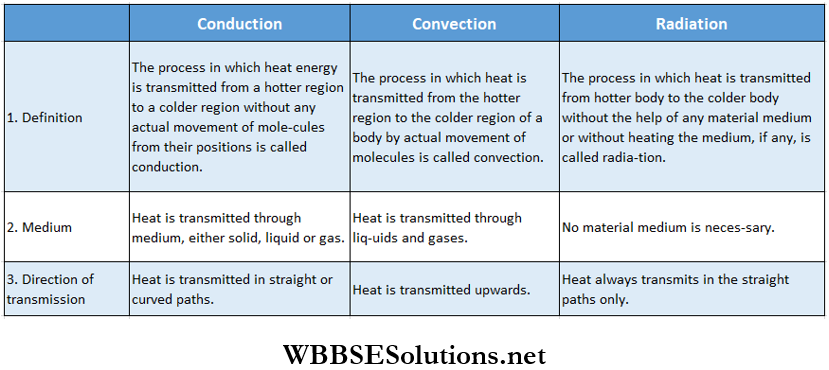
The flow of heat from one place to another is called transmission of heat: Heat is transmitted in three different processes:

  1. Conduction,
  2. Convection and
  3. Radiation.


  1. Conduction: It is the process in which heat energy is transmitted from a hotter region to a colder region of a material without any displacement of molecules. Conduction usually takes place in solids. When one end of an iron rod is placed in fire, the other end becomes so hot that it becomes difficult to hold that end with our hand. In this case heat gets transmitted through the rod from the end held in fire to the other end. This is known as heat conduction.
  2. Convection: It is the process in which heat is transmitted from a hotter region to a colder region of a material by the actual movement of heated molecules. This happens only in fluids i.e., in liquids and gases because here molecules can move freely. If we take some liquid in a container and heat it from below, the top part of the liquid gets heated mainly through convection.
  3. Radiation: This is the process in which heat is transferred from one place to another in the form of electro-magnetic radiation in the absence of any material medium or without heating a material medium if it is present between the two places. Heat from the sun reaches the earth by radiation.

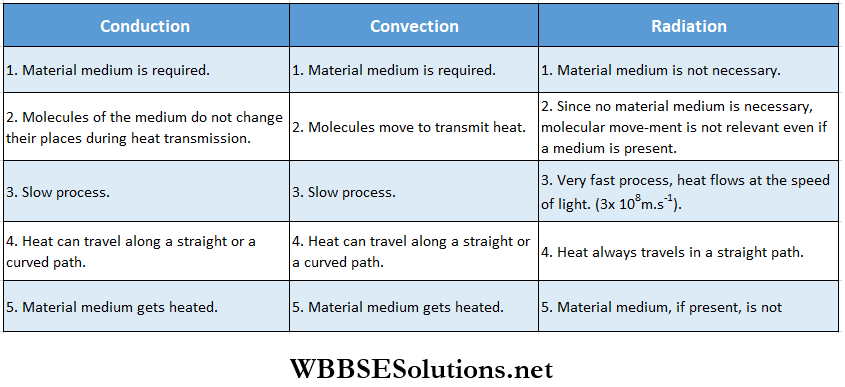
Comparison among the three modes of transmission of heat

Class 11 Physics Unit 7 Properties Of Matter Chapter 9 Transmission Of Heat Comparison Among The Three Modes Of Transmission Of Heat

Transmission Of Heat Numerical Examples

Short Answer Questions on Heat Transfer Methods

Example 1. Four metal pieces of the same surface area and of thickness 1 cm, 2 cm, 3cm, and 4cm respectively are connected serially with each other; Coefficients of thermal conductivity of the respective pieces are 0.2 CGS, 0.3 CGS, 0.1 CGS, and 0.4 CGS units. Find the equivalent conductivity of the system.
Solution:

It is known that, \(\frac{x_1+x_2+x_3+x_4}{k}=\frac{x_1}{k_1}+\frac{x_2}{k_2}+\frac{x_3}{k_3}+\frac{x_4}{k_4}\)

or, \(\frac{1+2+3+4}{k}=\frac{1}{0.2}+\frac{2}{0.3}+\frac{3}{0.1}+\frac{4}{0.4} \)

or, \(\frac{10}{k}=51.67 \text { or, } k=0.1935 \text { CGS. }\)

WBCHSE Class 11 Physics Notes For Transmission of Heat 

Example 2. A thick composite plate is formed by two plates of equal thickness kept one over the other. If the conductivities of the material of the constituent plates are k1 and k2, show that the equivalent conductivity of the thick plate, k = \(\frac{2 k_1 k_2}{k_1+k_2}\)
Solution:

Is is known, \(\frac{x_1+x_2}{k}=\frac{x_1}{k_1}+\frac{x_2}{k_2}\)

Here, \(x_1=x_2=x\) (say)

∴ \(\frac{x+x}{k}=\frac{x}{k_1}+\frac{x}{k_2} or, \frac{2}{k}=\frac{1}{k_1}+\frac{1}{k_2} or, k=\frac{2 k_1 k_2}{k_1+k_2}\).

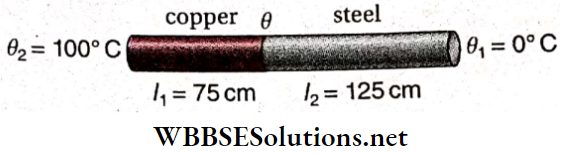
Example 3. A 75 cm long copper rod and a 125 cm long steel rod are joined face to face. Each rod is of a circular cross-section of diameter 2 cm. Temperatures at the two ends of the composite rod are 100 °C and 0°C and the outer surface of the rod is insulated. Find the temperature at the junction of the two rods What is the rate of conduction of heat through the junction?

  1. k for copper = 9.2 x 10⁻² kcal · m-1 · °C-1 · s-1 and
  2. k for steel = 1.1 x 10⁻²  kcal · m-1 · °C-1 · s-1

Solution: Let the temperature of the junction = θ Conductivity of copper,

⇒ \(k_1=\frac{9.2 \times 10^{-2} \times 10^3}{10^2}=0.92 \text { CGS unit }\)

and that of steel, \(k_2=\frac{1.1 \times 10^{-2} \times 10^3}{10^2}=0.11 \text { CGS unit }\)

Class 11 Physics Unit 7 Properties Of Matter Chapter 9 Transmission Of Heat Long Copper And Steel Rod

Area of cross-section of each rod, \(A=\pi(1)^2=\pi \mathrm{cm}^2\)

∴ Rate of flow of heat through the junction, \(\frac{Q}{t}=\frac{k_1 A\left(\theta_2-\theta\right)}{l_1}=\frac{k_2 A\left(\theta-\theta_1\right)}{l_2}\)

or, \(k_1 l_2(100-\theta)=k_2 l_1 \theta\)

or, \(0.92 \times 125 \times(100-\theta)=0.11 \times 75 \times \theta \text { or, } \theta=93.3^{\circ} \mathrm{C}\)

∴ Rate of conduction, \(\frac{Q}{t}=\frac{k_2 A\left(\theta-\theta_1\right)}{l_2}=\frac{0.11 \times \pi \times 93.3}{125}=0.258 \mathrm{cal} \cdot \mathrm{s}^{-1}\)

Class 11 Physics Class 12 Maths Class 11 Chemistry
NEET Foundation Class 12 Physics NEET Physics

Example 4. The thickness of each metal in a composite bar is 0. 01 m and the temperature of the two external surfaces are 100 °C and 30 °C. If the conductivities of the metals be 0.2 CGS unit and 0.3 CGS unit respectively, find the temperature on the interface.
Solution:

Let the temperature on the interface = θ.

At steady state, rate of flow of heat will be the same through both the plates.

∴ \(\frac{Q}{t}=\frac{k_1 A(100-\theta)}{x_1}=\frac{k_2 A(\theta-30)}{x_2}\)

or, \(\frac{0.2(100-\theta)}{1}=\frac{0.3(\theta-30)}{1} \text { or, } 200-2 \theta=3 \theta-90\)

or, \(5 \theta=290 \text { or, } \theta=58^{\circ} \mathrm{C} .\)

Real-Life Examples of Heat Transmission

Example 5. Three metal rods of the same length and area of cross-section are attached in series. Conductivity of the three metals are k, 2k, and 3k. Free end of the first rod is kept at 200°C while the other end of the combination is kept of 100 °C. Find the temperatures of the two junctions at steady state. Assume that no heat loss occurs due to radiation.
Solution:

Let the required temperatures be θ1  and θ2.

At steady state, \(\frac{Q}{t}=\frac{k A\left(200-\theta_1\right)}{l}=\frac{2 k A\left(\theta_1-\theta_2\right)}{l}=\frac{3 k A\left(\theta_2-100\right)}{l}\)

∴ \(200-\theta_1=2\left(\theta_1-\theta_2\right)=3\left(\theta_2-100\right)\)

As \(200-\theta_1=2\left(\theta_1-\theta_2\right)\)

∴ \(3 \theta_1-2 \theta_2=200\)…..(1)

Also, \(200-\theta_1=3\left(\theta_2-100\right)\)

or, \(\theta_1+3 \theta_2=500\)…..(2)

Solving (1) and (2), \(\theta_1=145.45^{\circ} \mathrm{C} \text { and } \theta_2=118.18^{\circ} \mathrm{C} \text {. }\)

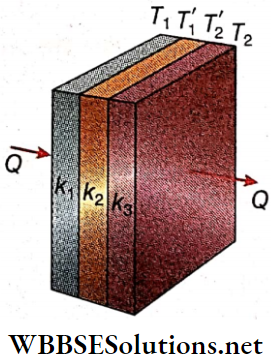
Example 6. A composite block is constructed with three plates of equal thickness and of equal cross-sectional area. The coefficients of conductivity of the three plates are k1, k2, and k3 respectively. If the coefficient of conductivity of the composite block is k, then prove that k = \(=\frac{3}{\frac{1}{k_1}+\frac{1}{k_2}+\frac{1}{k_3}}\)
Solution:

Let the thickness of each plate be d and cross-sectional area be A.

Q amount of heat flows through each plate in time t, The temperatures of the two ends of the composite slab are T1 and T2 respectively.

Class 11 Physics Unit 7 Properties Of Matter Chapter 9 Transmission Of Heat Composite Block Is Constructed With Three Plates Of Equal Thickness And Equal Cross Section Area

Also, the temperatures of the consecutive junctions

So, \(Q=\frac{k_1 A\left(T_1-T_1{ }^{\prime}\right) t}{d}\)

= \(\frac{k_2 A\left(T_1{ }^{\prime}-T_2{ }^{\prime}\right) t}{d}=\frac{k_3 A\left(T_2{ }^{\prime}-T_2\right) t}{d}\) or, \(\frac{Q d}{A t}=\frac{T_1-T_1{ }^{\prime}}{\frac{1}{k_1}}=\frac{T_1{ }^{\prime}-T_2{ }^{\prime}}{\frac{1}{k_2}}=\frac{T_2{ }^{\prime}-T_2}{\frac{1}{k_3}}\)

or, \(\frac{Q d}{A t}=\frac{T_1-T_2}{\frac{1}{k_1}+\frac{1}{k_2}+\frac{1}{k_3}}\)…(1)

[by componendo and dividendo process]

Again, since thickness of the composite slab is 3d,

Q = \(\frac{k A\left(T_1-T_2\right) t}{3 d} \text { or, } \frac{Q d}{A t}=\frac{T_1-T_2}{\frac{3}{k}}\)….(2)

From (1) and (2) we get, \(\frac{1}{k_1}+\frac{1}{k_2}+\frac{1}{k_3}=\frac{3}{k} \text { or, } k=\frac{3}{\frac{1}{k_1}+\frac{1}{k_2}+\frac{1}{k_3}}\)

Fourier’s Law of Heat Conduction

Example 7. The temperature of a room is kept fixed at 20 °C with the help of an electric heater of resistance 20Ω. The heater is connected to a 200 V main. Temperature is same everywhere in the room. The area of the window through which heat is conducted outside from the room is 1 m² and the thickness of the glass is 0.2 cm. Then calculate the temperature outside. [Given, coefficient of thermal conductivity of glass = 0.002 cal • m-1 • ° C-1 • s-1 and / = 4.2 J/s
Solution:

Heat generated by the heater in 1s,

⇒ \(H_1=\frac{V^2}{R J}=\frac{(200)^2}{20 \times 4.2}=\frac{200 \times 2000}{20 \times 42}=476.19 \mathrm{cal}\)

Heat conducted through the window in 1s,

⇒ \(H_2=\frac{k A\left(\theta_2-\theta_1\right)}{d}=\frac{0.002 \times 10^4 \times\left(\theta_2-\theta_1\right)}{0.2} \mathrm{cal}\)

Here, \(H_2=H_1 \quad \text { or, } \frac{0.002 \times 10^4 \times\left(\theta_2-\theta_1\right)}{0.2}=476.19\)

or, \(\left(\theta_2-\theta_1\right)=4.7619\)

∴ \(\theta_1=\theta_2-4.76=20-4.76=15.24^{\circ} \mathrm{C}\)

Example 8. The temperature of a room is kept fixed at 20°C. With the help of an electric heater when the temperature outside is -10°C. The total area of the walls in the room is 137 m2. The walls have three layers—the innermost layer is made of wood and 2.5 cm thick, the middle layer is made of cement and 1 cm thick, the outermost layer is made of bricks and 25 cm thick. Then calculate the power of the heater. [Given, coefficients of thermal conductivity of wood, cement, and brick are 0.125 W · m-1 • °C-1, 1.5 W · m-1 • °C-1 and 1.0 W • m-1 • °C-1 respectively]
Solution:

If k is the equivalent thermal conductivity of the wall made of three layers of different materials then,

k = \(\frac{x_1+x_2+x_3}{\frac{x_1}{k_1}+\frac{x_2}{k_2}+\frac{x_3}{k_3}}\)

Here, \(x_1=2.5 \mathrm{~cm}, x_2=1.0 \mathrm{~cm}, x_3=25 \mathrm{~cm}\)

⇒ \(k_1=0.125 \mathrm{~W} \cdot \mathrm{m}^{-1} \cdot{ }^{\circ} \mathrm{C}^{-1}, k_2=1.5 \mathrm{~W} \cdot \mathrm{m}^{-1} \cdot{ }^{\circ} \mathrm{C}^{-1},\)

⇒ \(k_3=1 \mathrm{~W} \cdot \mathrm{m}^{-1} \cdot{ }^{\circ} \mathrm{C}^{-1}\)

k = \(\frac{2.5+1+25}{\frac{2.5}{0.125}+\frac{1}{1.5}+\frac{25}{1}}=0.624 \mathrm{~W} \cdot \mathrm{m}^{-1} \cdot{ }^{\circ} \mathrm{C}^{-1}\)

Heat conducted outside through the walls per second

= \(\frac{k A\left(\theta_2-\theta_1\right)}{d}=\frac{0.624 \times 137 \times\{20-(-10)\}}{28.5 \times 10^{-2}}\)

= 8998,7 W ≈ 8999 J s-1

To keep the temperature of the room fixed the healer must generate 8999 J or 8.999 kJ heat per second.

Hence, power of the heater = 9 kW.

Example 9. The temperature gradient at the earth’s surface is 32 C/km and the average thermal conductivity of earth is 0.005 CGS unit. Find the loss of heat per day from the earth surface taking its radius to be  6000 km.
Solution:

We know, Q = \(k \cdot \Lambda \frac{d \theta}{d x} t \quad\left[\frac{d \theta}{d x}=\frac{\theta_2-\theta_1}{d}\right]\)

Here, k = 0.008 CGS unit, A = 4 x (6000 x 105)² cm²

∴ \(\frac{d \theta}{d x} = 32^{\circ} \mathrm{C} / \mathrm{km}=\frac{32}{10^5}{ }^{\circ} \mathrm{C} / \mathrm{cm},\)

t = \(1 \text { day }=24 \times 60 \times 60 \mathrm{~s}\)

∴ Q = \(\frac{0.008 \times 4 \pi \times 36 \times 10^{16} \times 32 \times 24 \times 60 \times 60}{10^5}\)

= \(1.0006 \times 10^{18} \mathrm{cal}\)

Thermal Conductivity and Its Importance

Example 10. Three rods made of material X and three rods of material Y are connected as shown. Each rod has equal length and equal cross-section. If the temperatures of end A and junction E are 60°C and 10°C respectively, find the temperatures of junctions B, C, and D. Coefficients of thermal conductivity of the materials X and Y are 0.92 CGS units and 0.46 CGS units respectively.
Solution:

Let the temperatures of the junctions B, C, and D be θ1, θ2, and θ3 respectively.

Class 11 Physics Unit 7 Properties Of Matter Chapter 9 Transmission Of Heat Three Rods Made Of Material X

Now, heat conducted from A to B

= heat conducted from B to C + heat conducted from B to D

or, 0.46(60 – θ1) = 0.92(θ12) + 0.46(θ1 – θ3)

or, 60 -θ1 =2(θ1 – θ2) + (θ1 – θ3)

or, 4θ1 -2θ13 = 60 …(1)

Again, heat conducted from B to D

= heat conducted from D to C + heat conducted from D to E

or, \(0.46\left(\theta_1-\theta_3\right)=0.92\left(\theta_3-\theta_2\right)+0.46\left(\theta_3-10\right)\)

or, \(\theta_1-\theta_3=2\left(\theta_3-\theta_1\right)+\left(\theta_3-10\right)\)

or, \(-\theta_1-2 \theta_2+4 \theta_3=10\)….(2)

Similarly, heat conducted from B to C+ heat conducted from D to C= heat conducted from C to E

or, \(0.92\left(\theta_1-\theta_2\right)+0.92\left(\theta_3-\theta_2\right)=0.92\left(\theta_2-10\right)\)

or, \(\theta_1-\theta_2+\theta_3-\theta_2=\theta_2-10\)

or, \(\theta_1-3 \theta_2+\theta_3=-10\)…(3)

Solving (1), (2), and (3), we get, \(\theta_1=30^{\circ} \mathrm{C} ; \theta_2=\theta_3=20^{\circ} \mathrm{C}\)

Example 11. Determine the equivalent thermal conductivity of the system shown. when

  1. Heat flows from left to right and
  2. Heat flows downwards.

Given, k1 = 2k2 and the length and cross section are same for all the slabs.

Solution:

1. Let, the equivalent thermal conductivity is k

Area of cross-section of each plate = A

Temperature difference between the two ends of each Plate =θ

Then heat conducted, \(Q_1=2 \frac{k_1 A \theta t}{l}+2 \frac{k_2 A \theta t}{l}\)

= \(4 \frac{k A \theta t}{l}\)

or, \(\frac{2 A \theta t}{l}\left(k_1+k_2\right)=\frac{4 k A \theta t}{l}\)

or, \(k_1+k_2=2 k\)

or, \(k=\frac{k_1+k_2}{2}=\frac{2 k_1+k_2}{2}=\frac{3 k_2}{2}=1.5 k_2\)

Class 11 Physics Unit 7 Properties Of Matter Chapter 9 Transmission Of Heat Equilvalent Thermal Conductivity Of System

2. In this case if \(k^{\prime}\) be the equivalent thermal conductivity then,

⇒ \(\frac{l}{k^{\prime}} =\frac{\frac{l}{4}}{k_1}+\frac{\frac{l}{4}}{k_2}+\frac{\frac{l}{4}}{k_1}+\frac{\frac{l}{4}}{k_2}\)

or, \(\frac{1}{k^{\prime}}=\frac{1}{2 k_1}+\frac{1}{2 k_2} \frac{1}{4 k_2}+\frac{1}{2 k_2}=\frac{3}{4 k_2}\)

or, \(k^{\prime}=\frac{4 k_2}{3}=1.33 k_2\)

Conduction of Heat through a Slab of Varying Thickness: The thickness of a slab can vary during thermal conduction.

  • In cold countries when temperature falls below 0°C, the water on the surface of the lakes and ponds slowly freeze to ice.
  • Heat from rest of the mass of water is conducted to the atmosphere through the top frozen layer and the thickness of the ice layer on the surface gradually increases.
  • So this is a fine example of conduction of heat through a slab of varying thickness. When the temperature of the atmosphere falls below 0°C, the uppermost surface of water loses its latent heat to the atmosphere and forms a thin sheet of ice.
  • In this way, as the thickness of the layer of ice increases, heat will have to be conducted through a thicker layer too.

Let the coefficient of conductivity of ice = k, the density of ice at 0°C = ρ, the temperature of air above the ice surface = -θ °C and the uppermost surface area of the water body = A

Class 11 Physics Unit 7 Properties Of Matter Chapter 9 Transmission Of Heat Conduction Of Heat Through A Slab Of Varying Thickness

After a time t s from the beginning of the formation of ice, let the thickness of ice formed on the water body be x.

If in a small interval of time dt, the increase in thickness of ice is dx, then the volume of ice formed in dt is Adx.

∴ The mass of that ice =Aρdx.

Therefore, the heat lost by water or the heat conducted to air in time dt through ice of thickness x is,

dQ = Aρdx- L [where L = latent heat of ice]

∴ Rate of flow of heat, \(\frac{d Q}{d t}=A \rho L \frac{d x}{d t}=\frac{k A[0-(-\theta)]}{x}=\frac{k A \theta}{x}\)

or, \(xdx  =\frac{k}{\rho L} \theta d t\)…(1)

2. Let us assume that at t = 0, x = x1 and at t = t1, x = x2. This means that in t1 s time if the thickness of ice slab has increased from x1 to x2, integrating the equation (1) we get,

⇒ \(\int_{x_1}^{x_2} x d x=\int_0^{t_1} \frac{k \theta}{\rho L} d t\)

or, \(\frac{1}{2}\left(x_2^2-x_1^2\right)=\frac{k \theta}{\rho L} t_1\)

∴ \(t_1=\frac{\rho L}{2 k \theta}\left(x_2^2-x_1^2\right)\)

1. If x1 = 0 when t = 0 and x2-x when t = t1

∴ \(t_1=\frac{\rho L}{2 k \theta} x^2\)….(3)

This equation gives the time (t1) required for the deposi¬tion of a layer of ice of thickness x.

Note that in both equations (1) and (2), t1 is independent of the surface area A of the lake. So in the same weather conditions, water bodies of all sizes from ice in this same rate.

Transmission Of Heat Conductivity Of Ice Numerical Examples

Example 1. A 3 cm thick layer of ice is formed over a water reservoir. Temperature over the reservoir is -20°C. In what time, the thickness of the ice layer increase by 1 mm? The conductivity of ice = 0.005 CGS unit; latent heat of fusion of ice = 80 cal · g-1; density of ice at 0°C = 0.91 g · cm-3.
Solution:

We shall use the equation, \(t=\frac{\rho L}{2 k \theta}\left(x_2^2-x_1^2\right)\)

where ρ = 0.91 g · cm-3, L = 80 cal · g-1,

k = 0.005 CGS unit, θ = 0 – (-20) = 20°C , x1 = 3cm, x2 = 3.1 cm

∴ t = \(\frac{0.91 \times 80}{2 \times 0.005 \times 20}\left[(3.1)^2-(3)^2\right]\)

= \(\frac{0.91 \times 80}{2 \times 0.005 \times 20} \times 0.61\)

= 222.04 s = 3 min 42 s

Example 2. The surface of a lake is covered with a layer of ice of a thickness 10 cm. For increase in thickness of the ice layer by 1 mm, time taken is found to be 49 min9s. Conductivity of ice = 0.005 CGS unit, latent heat of fusion of ice = 80 cal · g-1, and density of ice = 0. 917 g • cm-3. Find the outside temperature.
Solution:

Let the temperature of air outside = -θ

It is known that, t = \(\frac{\rho L}{2 k \theta}\left(x_2^2-x_1^2\right) \quad \text { or, } \theta=\frac{\rho L}{2 k t}\left(x_2^2-x_1^2\right)\)

In this case, t = 49 min 9 s = 2949 s, x1 = 10.1 cm, x2 = 10 cm, ρ = 0.917 g · cm-3, L = 80 cal · g-1, k = 0.005 CGS unit

∴ \(\theta =\frac{0.917 \times 80}{2 \times 0.005 \times 2949}\left[(10.1)^2-(10)^2\right]\)

= \(\frac{0.917 \times 80 \times 2.01}{2 \times 0.005 \times 2949}=5\)

∴ The outside temperature is -5°C

Example 3. Water in a tank at 0°G is in contact with a surrounding temperature of -20°C. Prove that the rate of increase of thickness x (in cm) ofice on the surface, is related to time t (in s) as x² = 0.00273t. The density of ice =0.917 g · cm-3, latent heat of fusion of ice =80 cal • g-1, and conductivity of ice =0.005 CGS unit.
Solution:

Let, A be the surface area of the tank, x be the initial thickness of ice floating on the tank surface and dx be the increase in thickness in time dt.

Hence, mass of ice formed in the time dt = Adx x ρ [ρ = density of ice]

Heat released by water = Adx x ρ xL [L = latent heat of fusion of ice]

This is the amount of heat that is conducted from water in the tank through the ice of thickness x to the surroundings.

∴ Rate of release of heat, \(\frac{d Q}{d t}=A \rho L \frac{d x}{d t}=\frac{k A[0-(-\theta)]}{x}\)

[-θ°C being the temperature of the surroundings]

or, \(x d x=\frac{k \theta}{\rho L} d t\)

Integrating, \(\int_0^x x d x=\frac{k \theta}{\rho L} \int_0^t d t\)

or, \(x^2=\frac{2 k \theta}{\rho L} t=\frac{2 \times 0.005 \times 20 \times t}{0.917 \times 80}\)

or, \(]y=0.00273 t\) (Proved).

Example 4. A 14.9 cm thick layer of ice floats on a deep lake. The temperature of the upper surface of the ice layers is the same as that of the surrounding air. If this temperature remains constant at -1°C then determine the time required for the layer to increase by 2mm in thickness. Given, latent heat of melting of ice =80 cal · g-1, density of ice = 0.9 g cm-3 and coefficient of thermal conductivity of ice = 0.006 CGS unit.
Solution:

We know, \(t=\frac{\rho L}{2 k \theta}\left(x_2^2-x_1^2\right)\)

Here, \(\rho=0.9 \mathrm{~g} \cdot \mathrm{cm}^{-3}, L=80 \mathrm{cal} \cdot \mathrm{g}^{-1}\)

k = \(0.006 \mathrm{CGS} \text { unit }, \theta=1^{\circ} \mathrm{C}\)

∴ \(x_1 =14.9 \mathrm{~cm}, x_2=14.9+0.2=15.1 \mathrm{~cm}\)

t = \(\frac{0.9 \times 80}{2 \times 0.006 \times 1}\left[(15.1)^2-(14.9)^2\right]\)

= \(\frac{0.9 \times 80}{0.012} \times 30 \times 0.2=36000 \mathrm{~s}=10 \mathrm{~h}\)

Energy Distribution In Black Body Radiation Wien’s Displacement Law

Radiation from a hot body consists of electromagnetic waves of different wavelengths (λ). However the energy is not evenly distributed in all wavelengths of radiation.

The intensity of wavelengths in black body radiation, obtained by experimental observations, reveals a pattern as shown by the graph.

The abscissa of the graph denotes the wavelengths A of radiated heat and the ordinate denotes radiation per unit area per unit time (Eλ) for different wavelengths.

Interpretation of the graph:

1. At a temperature T1, the source

  1. Energy distribution is unequal for different wavelengths and
  2. The intensity is maximum at a certain wavelength \(\lambda_{m_1}\) as represented by point P on graph A.

2. Radiations from the body at different temperatures T1, T2, T3, and the corresponding intensity distribution can be compared from graphs A, B, C. Clearly

  1. As temperature increases the total intensity, represented by the area under the curve, also increases,
  2. The wavelength of maximum intensity shifts towards the lower wavelength side, with the increase in temperature of the source.

Class 11 Physics Unit 7 Properties Of Matter Chapter 9 Transmission Of Heat Wien's Displacement Law Graph

WBBSE Class 11 Heat Transmission Notes

The observations referred to above led to the formulation of Wien’s displacement law which can be stated as: With the increase in the temperature of a body, the wavelength corresponding to the maximum intensity shifts towards the lower wavelength side.

The mathematical representation of Wien’s displacement law is, λmT = b (constant), where λm is the wavelength having maximum intensity at a temperature T of the source.

The value of Wien’s constant b, is about 0.0029 m K in SI unit. Thus, if λm is known, the temperature of the source T can be calculated. This method is widely used in estimating the temperature of stars. For example, if the temperature of a black body (star) is 1000 K,

∴ \(\lambda_m=\frac{0.0029}{1000}=2.9 \times 10^{-6} \mathrm{~m}\)

= \(29000 \times 10^{-10} \mathrm{~m}=29000\)Å

This wave lies in the infrared region of the electromagnetic spectrum.

Transmission Of Heat Energy Distribution In Black Body Radiation Numerical Examples

Example 1. The wavelength of the radiation of maximum Intensity from the solar surface Is 4.9 x 10⁻⁷ m. From Wien’s displacement law, find the surface temperature of the sun. [ b = 0.0029 m • K]
Solution:

As per Wien’s displacement law, \(\lambda_m T=b=0.0029 \mathrm{~m} \cdot \mathrm{K}\)

Hence, \(T=\frac{0.0029}{4.9 \times 10^{-7}}=5918 \mathrm{~K}\).

Example 2. Assume that a star, which has a surface temperature of 5 x 10⁴ K, is a black body. Calculate the length of maximum intensity In Its radiation [b = 0.0029 m · K]
Solution:

From Wien’s displacement law, \(\lambda_m T=b\); given, \(T=5 \times 10^4 \mathrm{~K}\) and \(b=0.0029 \mathrm{~m} \cdot \mathrm{K}\).
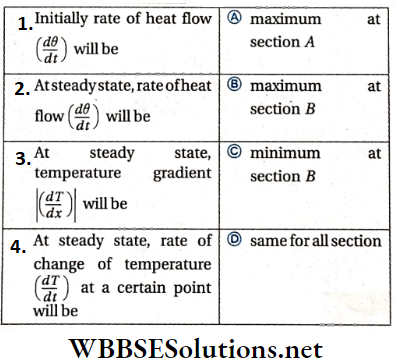
∴ \(\lambda_m=\frac{b}{T}=\frac{0.0029}{5 \times 10^4}=\frac{29}{5} \times 10^{-8}=5.8 \times 10^{-8} \mathrm{~m}\).


Transmission Of Heat Long Answer Type Questions

The capability of a material to conduct heat is called its thermal conductivity.

Class 11 Physics Unit 7 Properties Of Matter Chapter 9 Transmission Of Heat Definations And Medium And Direction Of Transmission

  • The quantity of heat conducted per second perpendicularly across the opposite faces of a unit cube, when the difference of temperature between its opposite faces is unity, is called the coefficient of thermal conductivity or simply thermal conductivity (k) of that material.
  • In case of an ideal conductor k → ∞ and in case of an ideal insulator k = 0. So in reality, 0 < k < ∞.

Dimension of k: \(\mathrm{MLT}^{-3} \Theta^{-1}\)

  • In the pre-steady state, the rate of increase in temperature of any layer of a conducting rod depends on the coefficient of thermal conductivity, the density and the specific heat of the material of the rod.
  • In steady state, no layer of the rod has any increase in temperature and hence, the transmission of heat along the rod depends only on the coefficient of thermal conductivity.
  • The ratio of the thermal conductivity of a substance to the thermal capacity per unit volume of that substance is called the thermal diffusivity of the substance.

In the radiation process, heat energy spreads all around in the form of electromagnetic waves. This thermal wave is called thermal radiation or radiant heat.

Prevost’s theory of heat exchange: The rise and fall of temperature of a body depends on the heat exchange of the body with its surroundings.

  • The body which is a good absorber is also a good radiator of heat. Conversely, a bad absorber is also a bad radiator of heat.
  • The body which absorbs all the incident radiations without reflecting or transmitting any part of it is called a perfectly black body. Since a perfectly black body is an ideal absorber of heat, it is also an ideal radiator of heat.

Kirchhoff’s law: At a particular temperature, the ratio of the emissive power and the absorptive power of a substance is always a constant and is equal to the emissive power of a perfectly black body at that temperature.

Stefan’s law: The total radiation of all wavelengths emitted per unit time per unit area of a perfect blackbody is directly proportional to the fourth power of its absolute temperature.

Newton’s law of cooling: For a small difference in temperature, heat lost per unit time by a body is directly proportional to the difference in temperature of the body with its surroundings.

Men’s law: With the increase in temperature of a body, the wavelength of the radiation corresponding to the maximum intensity shifts towards the lower wavelengths.

Transmission Of Heat Useful Relations For Solving Numerical Problems

If the temperature of the two faces of a rectangular plate of cross-sectional area A and of thickness d be θ2 and θ1 2 > θ1) then the amount of heat conducted in time t from the hot to the cold face of the plate will be

Q = \(\frac{k A\left(\theta_2-\theta_1\right) t}{d}\)

Thermal resistance of conductor = \(\frac{1}{k} \cdot \frac{d}{A} .\)

Thermal resistivity of a substance = \(\frac{1}{k}\)

Thermal diffusivity of a substance, \(h=\frac{k}{\rho s}\)

[k = coefficient of thermal conductivity, ρ = density, s = specific heat]

Understanding Heat Transfer Methods

If the equivalent thermal conductivity of a combined slab is k, then, \(\frac{x_1+x_2+\cdots+x_n}{k}=\frac{x_1}{k_1}+\frac{x_2}{k_2}+\cdots+\frac{x_n}{k_n}\)

where, xn = thickness of n-th slab, kn= thermal conductivity of the n-th slab. The temperature of the interface,

⇒ \(\theta=\frac{k_1 \theta_2 x_2+k_2 \theta_1 x_1}{k_2 x_1+k_1 x_2}\)

Emissive power (e) of a surface = amount of radiation emitted at a particular temperature from unit area of the surface in unit time.

Relative emittance of a surface (e) = \(\begin{gathered}
=\frac{\text { the amount of heat radiated by that surface }}{\text { the amount of heat radiated by the same surface area }} \\
\text { of a black body at the same temperature } \\
\text { in an equal interval time }
\end{gathered}\)

Absorptive power (a) of a surface = \(\frac{\text { the amount of heat absorbed }}{\text { the amount of heat incident on the surface }}\)

If the emissive power and absorptive power of a surface at a particular temperature be e and a respectively and the emissive power of a perfectly black body is E, then according to Kirchhoff’s law, \(\frac{e}{a}\) = E.

According to the Stefan’s law, E = σT4 (where σ = Stefan’s constant]

If the absolute temperature of an ideal black body and its surroundings be T and T0, then by Prevosfs theory of heat exchange, the net rate of radiation of heat from the black body, \(E=\sigma\left(T^4-T_0^4\right)\)

Let mass of a body be m, its specific heat s, and the temperature of the surroundings θ0. If at time t the temperature of the body drops from θ1 to θ2, then

t = \(\frac{1}{C} \ln \left(\frac{\theta_1-\theta_0}{\theta_2-\theta_0}\right)\)

According to the Wien’s law, λmT= constant.

[where, λm = wavelength of the radiation corresponding to the maximum intensity emitted from a black body kept at an absolute temperature T.]

Solar temperature T = \(\left[\left(\frac{R}{r}\right)^2 \times \frac{s}{\sigma}\right]^{1 / 4}\)

(where r = radius of the sun, R = mean distance of the earth from the sun, s = solar constant and σ = Stefan’s constant)


Transmission Of Heat Assertion Reason Type Questions And Answers

Direction: These questions have statement 1 and statement 2. Of the four choices given below, choose the one that best describes the two statements.

  1. Statement 1 is true, statement 2 is true; statement 2 is a correct explanation for statement 1.
  2. Statement 1 Is true, statement 2 Is true; statement 2 Is not a correct explanation for statement 1.
  3. Statement 1 is true, statement 2 is false.
  4. Statement 1 Is false, and statement 2 Is true.

Question 1.

Statement 1: The equivalent thermal conductivity of two plates of same thickness in contact is less than the smaller value of thermal conductivity.

Statement 2: For two plates of equal thickness contact, the equivalent thermal conductivity is given by \(\frac{2}{k}=\frac{1}{k_1}+\frac{1}{k_2} \text {. }\)

Answer: 4. Statement 1 Is false, statement 2 Is true.

Question 2.

Statement 1: If the thermal conductivity of a rod is 5 units, then its thermal resistivity is 0.2 units.

Statement 2: Thermal conductivity = \(\frac{1}{\text { thermal resistivity }}\)

Answer: 1. Statement 1 is true, statement 2 is true; statement 2 is a correct explanation for statement 1.

Question 3.

Statement 1: When the temperature difference across the two sides of a wall is increased, its thermal conductivity increases.

Statement 2: Thermal conductivity depends on the nature of material of the wall.

Answer: 4. Statement 1 Is false, statement 2 Is true.

Question 4.

Statement 1: If the temperature of a star is doubled then the rate of loss of heat from it becomes 16 times.

Statement 2: The specific heat varies with temperature.

Answer: 3. Statement 1 is true, statement 2 is false.

Question 5.

Statement 1: Radiant heat is an electromagnetic wave.

Statement 2: Heat from the sun reaches the earth by convection.

Answer: 3. Statement 1 is true, statement 2 is false.

Transmission Of Heat Match Column 1 With Column 2

Question 1. On average, the temperature of the earth’s crust increases 1°C for every 30 m of depth. The average thermal conductivity of the earth’s crust is 0.75 J • m-1 • K-1 • s-1. Solar constant is 1.35 kW • m-2.

Class 11 Physics Unit 7 Properties Of Matter Chapter 9 Transmission Of Heat Match The Column Question 1

Answer: 1. A, 2. 3. 4. E

Question 2. Three rods of equal length of the same material are joined form an equilateral triangle ABC as shown. Area of a cross-section of rod AB is S, of rod BC is 2S and that of AC is S.

Class 11 Physics Unit 7 Properties Of Matter Chapter 9 Transmission Of Heat Three Rods Of Equal Length Of Same Material Are Joined From An Equilateral Triangle

Class 11 Physics Unit 7 Properties Of Matter Chapter 9 Transmission Of Heat Match The Column Question 2

Answer: 1. C, 2. D, 3. 1, 4. B

Question 3. A copper rod (initially at room temperature 20°C) of the non-uniform cross section is placed between a steam chamber at 100°C and an ice water chamber at 0°C. A and B are cross sections as shown. Then match the statements in Column 1 with results in Column 2 using comparing only cross sections A and B.

Class 11 Physics Unit 7 Properties Of Matter Chapter 9 Transmission Of Heat Copper Rod Of Non Uniform Cross Section

Class 11 Physics Unit 7 Properties Of Matter Chapter 9 Transmission Of Heat Match The Column Question 3

Answer: 1. A, C, 2. D, 3. B

Transmission Of Heat Comprehension Type Questions And Answers

Read the following passages carefully and answer the questions at the end of them.

Question 1. A body cools in a surrounding of constant temperature 30°C. Its heat capacity is 2 J • °C-1. The initial temperature of die body is 40°0. Assume Newton’s law of cooling is valid. The body cools to 38°C in 10 minutes.

1. In further 10 min it will cool from 38 °C to

  1. 36°C
  2. 36.4 °C
  3. 37°C
  4. 37.5°C

Answer: 2. 36.4 °C

2. The temperature of the body in T. denoted by θ. The variation of θ versus time t is best denoted as

Class 11 Physics Unit 7 Properties Of Matter Chapter 9 Transmission Of Heat

Answer: 1

3. When the body temperature has reached 38°C, it is heated again so that it reaches 40°C in 10 min. The heat required from a heater by the body is

  1. 3.6J
  2. 0.364J
  3. 8J
  4. 4J

Answer: 3. 4

Question 2. Two insulated metal bars each of length 5 cm and rectangular cross-sections with sides 2 cut and 3 cm are wedged between two walls one held at 100°C and the other at 0°C. The bars are lead (Pb) and silver (Ag) kPb = 350 W m-1 K-1, kAg = 425 W m-1 K-1

Class 11 Physics Unit 7 Properties Of Matter Chapter 9 Transmission Of Heat Two Insulated Metal Bars

1. Thermal current through lead bar is

  1. 210W
  2. 420W
  3. 510W
  4. 930W

Answer: 2. 420W

2. Total thermal current through the two-bar system is

  1. 210 W
  2. 420W
  3. 510 W
  4. 930W

Answer: 4. 930W

3. Equivalent thermal resistance of the two-bar system is

  1. 0.1 W
  2. 0.23 W
  3. 0.19 W
  4. 0.42W

Answer: 1. 0.1 W

Question 3. Assume that the thermal conductivity of copper is twice that of aluminum and four times that of brass. Three metal rods made of copper, aluminum, and brass are each 15 cm long and 2 cm in diameter. These rods are placed end to end, with aluminum between the other two. The free ends of the copper and brass rods are maintained at 100°C and 0°C, respectively. The system is allowed to reach the steady state condition. Assume there is no loss of heat anywhere,

1. Under steady-state condition, the equilibrium temperature of the copper-aluminum junction will be

  1. 86°C
  2. 18.8°C
  3. 57°C
  4. 73°C

Answer: 1. 86°C

2. When steady state condition is reached everywhere,

  1. No heat is transmitted across the copper-aluminium or aluminium-brass junction
  2. More heat is transmitted across the copper-aluminium junction than across the aluminium-brass junction
  3. More heat is transmitted across the aluminium-brass junction than the copper-aluminium junction
  4. Equal amount of heat is transmitted at the copper-aluminum and aluminium-brass junction

Answer: 4. Equal amount of heat is transmitted at the copper-aluminium and aluminium-brass junction

3. Under steady-state conditions, the equilibrium temperature of the aluminum-brass junction will be

  1. 57°C
  2. 35°C
  3. 18.8°C
  4. 28.5°C

Answer: 1. 57°C

Transmission Of Heat Integer Type Questions And Answers

In this type, the answer to each of the questions is a single-digit integer ranging from 0 to 9.

Question 1. A metal rod AB of length 10x has its one end A in. ice at 0°C and the other end B in water at 100°C if a point P on the rod is maintained at 400°C, then it is found that equal amounts of water and ice evaporate and melt per unit time. The latent heat of evaporation of water is 540 cal · g-1 and the latent heat of melting of ice is 80 cal · g-1. If the point P is at a distance of λx from the ice end A, find the value of λ. (Neglect any heat loss to the surroundings.)
Answer: 9

Question 2. Two spherical bodies A (radius 6 cm] and B (radius IS cm) are at temperature T1 and T2, respectively. The maximum intensity in the emission spectrum of A is at 500 runs and of B is at 1500 nm. Considering them to be blackbodies, what will be the ratio of the rare of total energy radiated by A to that of B?
Answer: 9

Question 3. A liquid takes 5 minutes to cool from 80°C to 50°C- How much time (in min) will it take to cool from 60°C to 30 °C? The temperature of the surroundings is 20°C
Answer: 9

Question 4. The ends of the two rods of different materials with their thermal conductivities, radii of cross-section, and lengths in the ratio 1:2 are maintained at the same temperature difference. If the rate of flow of heat through the larger rod is 4 cal · s-1, what is the rate of flow of heat (in cal • s-1) through the shorter rod?
Answer: 1


WBCHSE Class 11 Physics Expansion Of Solid And Liquids Long Answer Questions

Expansion Of Solid And Liquids Long Answer Type Questions

Long Answer Questions on Expansion of Solids and Liquids for Class 11

Question 1. Is it possible to maintain a constant difference in the lengths of a brass rod and a steel rod, at all temperatures?
Answer:

Yes, It is possible to maintain a constant difference in the lengths of a brass rod and a steel rod, at all temperatures

If the initial lengths of the brass rod and the steel rod are such that their expansion is the same for the same rise in temperature, a constant difference in length can be maintained.

Let at a certain temperature, lb and ls be the lengths of the brass rod and the steel rod, and ab and as be their coefficients of linear expansion, respectively.

For a rise t in temperature, the expansion of brass rod = \(l_b \times \alpha_b \times t\)

and the expansion of steel rod = \(l_s \times alpha_s \times t\)

To preserve the difference in length we must have, \(l_b \times \alpha_b \times t=l_s \times \alpha_s \times t\)

Read and Learn More Class 11 Physics Long Answer Questions

or, \(\frac{l_b}{l_s}=\frac{\alpha_s}{\alpha_b}\)

i. e., if the initial length is inversely proportional to the coef¬ficient of linear expansion, the difference in length of the two rods remains constant at all temperatures.

WBCHSE Class 11 Physics Expansion Of Solid And Liquids Long Answer Questions

Example 2. A brass disc is stuck in a hole of a steel plate. Should you heat the system to free the disc from the hole? Given, α for brass = 19 x 10-6 °C-1 and α for steel I = 12 x 10-6 °C-1.
Answer:

Given

α for brass = 19 x 10-6 °C-1 and α for steel I = 12 x 10-6 °C-1.

A brass disc is stuck in a hole of a steel plate.

To free the disc from the hole, the system should cooled.

Since \(\alpha_{\text {brass }}>\alpha_{\text {steel }}\), and initially the radii of the disc and the hole were the same, the disc expands more on heating and gets stuck more tightly.

On cooling, the disc contracts more than the hole, and thus becomes free.

Examples of Long Answer Questions on Thermal Expansion

Question 3. An isosceles triangle is made of three zinc rods. Will there be any change in its base angles with the rise in temperature? Give reasons for your answer.
Answer:

Given

An isosceles triangle is made of three zinc rods.

Let the initial length of each equal arm of the triangle be a and the length of the base be b. Hence, initial ratio of the lengths of the arms = a: a: b.

Let the rise in temperature be t and the coefficient of linear expansion of zinc be a .

Now, the ratio of the lengths of the arms

= a(1 + αt): a(1 + αt): b(1 + αt) = a: a: b.

Hence, the ratio of the lengths of the sides remains unchanged with the rise in temperature. Thus, the base angles too, do not change.

Example 4. A copper plate and an iron plate of the same volume are riveted together. Explain the likely observations, when the system is heated.
Answer:

Given

A copper plate and an iron plate of the same volume are riveted together.

On heating, the strip will bend, instead of remaining straight.

Since the coefficient of linear expansion of copper \(\left(\alpha_{\mathrm{Cu}}\right)\) is more than that of iron \(\left(\alpha_{\mathrm{Fe}}\right)\), the plates expand differently and thus the system bends.

The copper plate forms the outer surface due to a greater expansion, and the iron plate forms the inner surface of the arc. If the coefficients of linear expansion would have been the same for copper and iron, then the strip would remain straight.

Question 5. An iron rod is fitted along the diameter of a circular iron ring. Explain, whether the ring remains circular or not, when the system is heated.
Answer:

Given

An iron rod is fitted along the diameter of a circular iron ring.

The ring will continue to be circular even when the system is heated.

Let the initial diameter of the ring be d and the coefficient of linear expansion of iron be α.

∴ Circumference of the ring =πd and length of the rod = d.

∴ \(\frac{\text { length of the circumference of the ring }}{\text { length of the rod }}=\frac{\pi d}{d}=\pi\)

When the system is heated to a temperature θ,

the new circumference = πd(1 + αθ) and the new length = d(1 + αθ)

∴ The new ratio = \(\frac{\pi d(1+\alpha \theta)}{d(1+\alpha \theta)}=\pi\)

Hence, the ring continues to be circular.

Calculating Changes in Length and Volume: Long Answers

Question 6. Two rods of different materials are of the same length and cross-sectional area. They are joined lengthwise and rigidly fixed between two walls. The materials of the two rods have different thermal and mechanical properties. What should be the relation between the Young’s moduli and the coefficients of linear expansion of the two materials so that the position of the junction point of the rods does not alter even when heated?
Answer:

Given

Two rods of different materials are of the same length and cross-sectional area. They are joined lengthwise and rigidly fixed between two walls. The materials of the two rods have different thermal and mechanical properties.

The rods are rigidly fixed. If the thermal stresses developed remains the same for all temperatures, the position of the junction point will not change.

Let Young’s moduli and coefficients of linear expansion for the two materials be Y1, α1 and Y2, α2 respectively and the temperature be increased by t.

Hence, the thermal stress in the 1st rod =Y1α1t and that in the 2nd rod = Y2α2t.

For no movement of the junction point, \(Y_1 \alpha_1 t=Y_2 \alpha_2 t\)

or, \(\frac{Y_1}{Y_2}=\frac{\alpha_2}{\alpha_1}\) is the required relation.

Understanding Thermal Expansion: Long Answer Format

Question 7. If the other factors remain unaltered, does the change in the volume of a solid, with the change in temperature, depend on the presence of a hole in the solid? Answer with reason.
Answer:

The change in volume of a solid with the change in temperature, does not depend on the presence of a hole in the solid. The hole size will change byotheosame amount as the solid that would have exactly fitted in the hole.

Question 8. A solid and a hollow cylinder of the same size and made of the same material ore heated for the same change of temperature. Will the expanisons be the same? Explain your answer.
Answer:

The volume expansion, in both cases, will be the same.

  • Let us imagine a solid cylinder made of the same material inserted inside tire hollow cylinder to fit exactly in the inner gap.
  • Then the hollow cylinder is identical to the initially supplied solid cylinder. They will expand equally for the same rise in temperature.
  • When their external dimensions are observed, we shall see that their volumes are the same. So, their expansions are equal.

Question 9. The difference in lengths of two rods, made up of different materials, remains constant at all temperatures. Show that their lengths at 0°C are inversely proportional to their coefficients of linear expansion.
Answer:

Given

The difference in lengths of two rods, made up of different materials, remains constant at all temperatures.

The lengths of the rods at 0°C are l1 and l2, and their respective coefficients of linear expansion are α1 and α2

Linear expansion of the first rod for t°C rise in temperature = l1α1t and that of the second rod = l2α2t

For the difference in lengths to be constant at all temperatures, \(l_1 \alpha_1 t=l_2 \alpha_2 t \text { or, } l_1 \alpha_1=l_2 \alpha_2 \quad \text { or, } \frac{l_1}{l_2}=\frac{\alpha_2}{\alpha_1} \text {. }\)

Question 10. While casting concrete roofs, the meshwork is made only using iron rods and no other metal. Why?
Answer:

Coefficients of thermal expansion of concrete and iron are almost the same. Thus on increase or decrease of temperature, iron and concrete expand or contract almost equally and concrete joints do not get separated from the rods. No thermal stress develops between them.

If rods of other metals were used, the two expansions or contractions would not match and cracks would develop.

Question 11. A platinum wire can easily be sealed to a glass bulb while a copper wire cannot Why?
Answer:

A copper wire cannot be sealed to glass as their coefficients of thermal expansion are different. After being sealed at a high temperature, and then being bolted, glass cracks or a gap develops between the wire and the glass because of unequal contraction.

Glass and platinum, having almost the same coefficients of expansion, contract or expand equally on cooling or heating, keeping the seal intact.

Question 12. Electric wires are hung between two consecutive poles with a slight sag, instead of stretching them out fully. Give reasons.
Answer:

This arrangement takes into account the expansion or contraction of the wire with the change in seasonal temperatures. Wires are fitted to two consecutive poles such that during winter, due to the fall in temperature, the contraction does not produce a thermal stress to bend the poles or to snap the wire.

Question 13. An aluminium rod of length l1 and an iron rod of length I2 are joined lengthwise to form a single rod of length \(\left(l_1+l_2\right)\). The coefficients of linear expansion of aluminium and iron are aa and as respectively. If both the rods expand equally for a rise in temperature t find the ratio between and \(\left(l_1+l_2\right)\).
Answer:

Given

An aluminium rod of length l1 and an iron rod of length I2 are joined lengthwise to form a single rod of length \(\left(l_1+l_2\right)\). The coefficients of linear expansion of aluminium and iron are aa and as respectively. If both the rods expand equally for a rise in temperature t

Expansion of aluminium rod for rise t in temperature = l1αat

and that of iron rod for the same rise in temperature =l2αst.

According to the problem, \(l_1 \alpha_a t=l_2 \alpha_s t\)

∴ \(\frac{l_1}{l_2}=\frac{\alpha_s}{\alpha_a}\)

∴ \(\frac{l_1}{l_1+l_2}=\frac{\alpha_s}{\alpha_a+\alpha_s}\)

Class 11 Physics Class 12 Maths Class 11 Chemistry
NEET Foundation Class 12 Physics NEET Physics

Question 14. On being heated, the length of each side of a cube increases by 2%. What is the percentage increase in the volume of the cube?
Answer:

Given

On being heated, the length of each side of a cube increases by 2%.

If l is the length of the cube of volume V, then \( V=l^3\)….(1)

∴ \(dV = 3 l^2 d l\)….(2)

or, \(\frac{d V}{V}=\frac{3 l^2 d l}{l^3}=\frac{3 d l}{l} . \text { Given, } \frac{d l}{l}=\frac{2}{100}\)

∴ \(\frac{d V}{V}=\frac{3}{l} \cdot \frac{2 l}{100}=\frac{6}{100}\)

∴ Increase in volume = \(\frac{6}{100} \times 100 \%=6 \% .\)

Example 15. Coefficient of linear expansion along one edge of a cube-shaped crystal is α1, but that along a particular direction is α2 find the coefficient of volume expansion of the crystal.
Answer:

Given

Coefficient of linear expansion along one edge of a cube-shaped crystal is α1, but that along a particular direction is α2

Let l0 = length of a side of the crystal at 0°C, and t = rise in temperature

∴ Final volume of tire crystal = \(I_0\left(1+a_1 t\right) \times I_0^2\left(1+a_2 t\right)^2\)

= \(l_0^3\left(1+a_1 t\right)\left(1+a_2 t\right)^2\)

= \(V_0\left(1+a_1 t\right)\left(1+a_2 t\right)^2 \quad\left[because l_0^3=V_0\right]\)

Now, V = V0(l + γt), where γ is the coefficient of volume expansion of the crystal.

∴ \(1+\gamma t =\left(1+\alpha_1 t\right)\left(1+\alpha_2 t\right)^2=\left(1+\alpha_1 t\right)\left(1+2 \alpha_2 t\right)\)

= \(1+t\left(\alpha_1+2 \alpha_2\right)\) [neglecting higher powers]

or, \(\gamma=\alpha_1+2 \alpha_2.\)

Practice Long Answer Questions on Thermal Expansion for Class 11

Example 16. The length of each side of a skeleton cube (made up of rods) at 0°C is I0. Taking any vertex of the cube as the origin, the coefficients of linear expansion of the rods along x, y, z-axes or parallel to them are α1, α2 and α3 respectively. Show that the equivalent coefficient of volume expansion of the skeleton cube is α1 + α2 + α3.
Answer:

Given

The length of each side of a skeleton cube (made up of rods) at 0°C is I0. Taking any vertex of the cube as the origin, the coefficients of linear expansion of the rods along x, y, z-axes or parallel to them are α1, α2 and α3 respectively.

Volume of the skeleton cube at 0°C = \(l_0^3\)

For a rise r in temperature, the final volume of the cube

= \(l_0\left(1+\alpha_1 t\right) \times l_0\left(1+\alpha_2 t\right) \times l_0\left(1+\alpha_3 t\right)\)

= \(l_0^3\left(1+\alpha_1 t\right)\left(1+\alpha_2 t\right)\left(1+\alpha_3 t\right)\)

= \(l_0^3\left(1+\alpha_1 t+\alpha_2 t+\alpha_3 t\right) \text { [neglecting higher powers] }\)

= \(l_0^3+l_0^3\left(\alpha_1+\alpha_2+\alpha_3\right) t\)

∴ Increase in volume = \(l_0^3+l_0^3\left(\alpha_1+\alpha_2+\alpha_3\right) t-l_0^3\)

= \(l_0^3\left(\alpha_1+\alpha_2+\alpha_3\right) t\)

Hence, equivalent coefficient of volume expansion of the skeleton cube

= \(\frac{\text { increase in volume }}{\text { initial volume } \times \text { rise in temperature }}\)

= \(\frac{l_0^3\left(\alpha_1+\alpha_2+\alpha_3\right) t}{l_0^3 \times t}=\alpha_1+\alpha_2+\alpha_3 .\)

Example 17. When the temperature of a body increases from t to t + Δt, the moment of inertia of it increases from I to I+ ΔI. If the coefficient of linear expansion of the body is α, then show that \(\frac{\Delta I}{I}=2 \alpha \Delta t\)
Answer:

Given

When the temperature of a body increases from t to t + Δt, the moment of inertia of it increases from I to I+ ΔI. If the coefficient of linear expansion of the body is α,

We know, moment of inertia I = mk²

∴ ΔI = 2mkΔk

∴ \(\frac{\Delta I}{I}=\frac{2 m k \Delta k}{m k^2}=\frac{2 \Delta k}{k}=\frac{2 \alpha k \Delta t}{k} \quad[\Delta k=\alpha k \Delta t]\)

= 2 αΔt

Question 18. The apparent coefficient of expansion of a liquid when heated in a copper vessel is C and when heated in a silver vessel is S. If A is the linear coefficient of expansion of copper, then show that the linear coefficient of expansion of silver Is \(\frac{C+3 A-S}{3}\)
Answer:

Given

The apparent coefficient of expansion of a liquid when heated in a copper vessel is C and when heated in a silver vessel is S. If A is the linear coefficient of expansion of copper,

The relation between the apparent coefficient of expansion γa and real coefficient of expansion γr is \(\gamma_r=\gamma_a+3 \alpha\)

or, \(\gamma_a=\gamma_r-3 \alpha. \) [α is the linear coefficient of expansion of the material of the vessel] In case of copper vessel]

In case of silver vessel, \(C=\gamma_r-3 A\)

[α’ is the linear coefficient of expansion of silver (say)]

∴ C+3A = \(S+3 \alpha^{\prime} \quad \text { or, } \alpha^{\prime}=\frac{C+3 A-S}{3}\)

Question 19. A liquid in a container is heated suddenly. At first the liquid level goes down a little and then the level begins to rise. Explain why.
Answer:

Given

A liquid in a container is heated suddenly. At first the liquid level goes down a little and then the level begins to rise.

As heating starts, the container receives the heat first and expands in volume. No significant change occurs in the temperature of the liquid in the container. So, initially, the volume of the liquid remains approximately unchanged.

  • For this, the liquid level in the container goes down a little. But on prolonged heating, the liquid gradually becomes hot and begins to increase in volume.
  • Generally, the expansion of a liquid is greater than that of a solid. Hence, after some time, the liquid level rises above its initial level.

Question 20. What will be the effect of using water in place of mercury, in a thermometer for measuring the temperatures in the range of 0°C to 10°C?
Answer:

From 0°C to 4°C water contracts, but then expands above 4°C. So, for a water thermometer, the markings on the thermometer stem will be confusing. Volume of water, both at 0°C and 8°C, may be the same.

Then the same marking will correspond to two temperatures. Hence, water is not suitable as a thermometric liquid for the range of 0°C to 10°C.

Question 21. If mercury is kept in a glass vessel and in a copper! vessel separately, will the coefficient of apparent expansion in both cases be the same? If not, In which case will it be greater? Coefficients of volume expansion of glass and copper are 25 x 10-6  °C-1 and 50 x 10-6 °C-1 respectively.
Answer:

The coefficient of apparent expansion of mercury in a glass vessel will not have the same value as in a copper vessel.

The coefficient of apparent expansion = the coefficient of real expansion – the coefficient of volume expansion of the material of the container. The value of coefficient of real expansion of a liquid is fixed. So, coefficients of apparent expansion obtained in the two cases are

⇒ \(\gamma_{\text {apparent }}=\gamma-\gamma_{\text {glass }}\), when glass vessel is used,

and \(\gamma_{\text {apparent }}^{\prime}=\gamma-\gamma_{\text {copper }}\), when copper vessel is used.

Here, \(\gamma_{\text {copper }}>\gamma_{\text {glass }}, \gamma_{\text {apparent }}>\gamma_{\text {apparent }}^{\prime}\).

Therefore, the coefficient of apparent expansion of mercury in a glass vessel will be higher than that in a copper vessel.

Example 22. A wooden block floats in water keeping a volume V of it above the surface, at 0°C. If the temperature of water is slowly raised from 0°C to 20°C, what will be the change in the value of V?
Answer:

Given

A wooden block floats in water keeping a volume V of it above the surface, at 0°C. If the temperature of water is slowly raised from 0°C to 20°C,

The upthrust of a liquid buoyant force on a floating body depends on the density of the liquid. The part of a floating object above the liquid surface [V, in this case) increases with the increase in density of the liquid.

The density of water at 20°C is less than that at 0°C. But, at 4° C, it is the highest. So, from 0°C to 4°C, V will increase, but after that V will decrease gradually. Eventually, V20 < V0

Question 23. What will be the difference observed when one heats mercury and water from 0°C?
Answer:

Mercury expands continuously from 0°C when heat is supplied to it. But when water is heated from 0°C, it contracts up to 4°C, attains a minimum volume, and then expands like other liquids from 4°C.

Question 24. Ice is formed on the top surface of a lake. Temperature of air above ice is -15°C.

  1. What is the tern- perature of the water layer just below ice?
  2. Find the maximum possible temperature at the bottom of the lake.

Answer:

  1. The temperature of the water layer just below the fro¬zen surface is 0°C. A thick ice layer acts as a good insulator that prevents heat from escaping to the outer atmosphere. So the water below does not freeze easily.
  2. Maximum temperature can be 4°C at the bottom of the lake. As the density of water is maximum at 4°C, water of this temperature occupies the bottom.

Key Concepts in Expansion of Solids and Liquids

Question 25. A beaker is filled up to its brim with a liquid of denity 1.5 g cm-3. A piece of ice is floating on the liquid. Does the liquid overflow due to melting of ice?
Answer:

Given

A beaker is filled up to its brim with a liquid of denity 1.5 g cm-3. A piece of ice is floating on the liquid.

The liquid in the beaker overflows due to melting of ice.

Let the mass of ice =mg.

Hence, while floating, the ice displaces = \(\frac{m}{1.5} \mathrm{~cm}^3=V_1 \text { (say) }\) of the liquid.

Volume of water produced on melting of ice = m cm³ = V2 (say)

As V2 > V1 i.e., volume of water produced is greater than the space occupied by floating ice, the excess water rises above the liquid level and overflows.

Question 26. A container is filled up to its brim with water with a piece of ice floating on it. State the effect on the level of water in the container when ice melts completely, if the initial temperature of water was

  1. 0°C
  2. 4°C and
  3. above 4°C.

Answer:

Given

A container is filled up to its brim with water with a piece of ice floating on it.

Volume expansion of the container at the tempera¬tures mentioned is neglected.

1. There will be no change in the water level. Here mass of ice is equal to the mass of the displaced water as per the condition of floatation.

Class 11 Physics Unit 7 Properties Of Matter Chapter 5 Expansion Of Solid And Liquids Effect Of Anamouls Of Expansion Of Water On Marine Life

Ice, being at 0°C, produces water at 0°C on melting. Volume of that water is equal to the space formerly occupied by the Immersed portion of ice. Hence, water thus formed on melting of ice fills the space.

2. Some water will overflow from this container. Density of water is maximum at 4°C so water formed on melting of ice at 0°C is of lower density. Therefore the volume of this water will be greater than the volume of water displaced by floating ice at 4°C.

3. The water level will come down. Mass of the ice floating is equal to the mass of water displaced by the ice. According to the question, temperature of the water is above 4°C. Receiving heat from the surroundings and water, the ice produces water at 0°C on melting.

Density of water at 0°C is higher than that of water at 4°C. Hence, volume of the water displaced is more than the volume of the water produced on melting. Also, the temperature of the water falls as it supplies heat to the ice. With decrease in temperature, volume of the water also decreases.

Question 27. A body, immersed in a liquid, is suspended from the left arm of a hydrostatic balance, and is balanced by putting measuring weights on the scale pan at the right arm. If the liquid with the body in it is heated, will the equilibrium be disturbed?
Answer:

Given

A body, immersed in a liquid, is suspended from the left arm of a hydrostatic balance, and is balanced by putting measuring weights on the scale pan at the right arm. If the liquid with the body in it is heated

The left arm of the balance will go down.

  • With rise in temperature, density of the body as well as that of the liquid decreases. But the decrease in density of the liquid is greater than that of the solid body, because the volume expansion coefficient of a liquid is much higher.
  • Hence, the value of the upthrust decreases, i.e., the apparent weight of the body increases. Now more counterpoising weights should be put on the right pan to balance the beam.

Question 28. State the factors on which the coefficients of expansion of a liquid depend.
Answer:

The coefficient of real expansion of a liquid depends on the nature of the liquid only.

But, the coefficient of apparent expansion depends on the nature of the liquid, and also on the coefficient of volume expansion of the material of its container.

Question 29. Is the apparent expansion coefficient of a liquid a constant?
Answer:

The apparent expansion coefficient of a liquid is not a constant it depends on the material of the container in which the liquid is kept.

Question 30. Which one of the following graphs in Fig. correctly represents the change of density of water with temperature?

Class 11 Physics Unit 7 Properties Of Matter Chapter 5 Expansion Of Solid And Liquids Graph Is Represent The Change Of Density Of Water With Temperature
Answer:

Graph (1) represents the correct nature of variation of density of water with temperature. The convex nature is due to the anomalous expansion of water. The maximum point corresponds to the maximum density of water at 4°C.

Question 31. If the coefficient of volume expansion of glass had been equal to the coefficient of real expansion of mercury, a mercury thermometer would not be active.
Answer:

A thermometer shows the apparent expansion of the thermometric liquid.

But, the coefficient of apparent expansion of mercury = the coefficient of real expansion of mercury – the coefficient of volume expansion of glass = 0, if γglass = γmercury (given).

Therefore, the mercury within the tube Would remain at the same level, no matter what the change in temperature is.

Expansion Of Solid And Liquids Conclusion

Thermal expansion of solid are of three kinds

  1. Linear Expansion,
  2. Surface Expansion And
  3. Volume Expansion.

The increase in length for unit rise in temperature for a unit length of a solid is called the coefficient of linear expansion (α) of that solid.

The value of α does not depend on the unit of length but depends on the unit of temperature.

The unit of α is °C-1 or °F-1.

  • The increase in surface area for unit rise in temperature for a unit surface area of a solid is called the coefficient of surface expansion (β) of that solid.
  • The value of ft does not depend on the unit of area, but depends on the unit of temperature.

The unit of β is °C-1 or °F-1.

  • The increase in volume for unit rise in temperature for a unit volume of a solid is called the coefficient of volume expansion (γ) of that solid.
  • The value of γ does not depend on the unit of volume, but depends on the unit of temperature.

The unit of γ is °C-1 or °F-1.

  • With the increase in temperature, the volume of a solid increases and hence its density decreases, and vice-versa.
  • With the increase in temperature of a rod, its length increases and with the decrease in temperature its length decreases.
  • But, if the two ends of the rod are rigidly fixed, then expansion or contraction of the rod faces some obstruction when its temperature changes.
  • As a result, a force develops inside the rod. This force, per unit area of the rod, is called thermal stress.
  • Thermal stress is independent of the length or area of cross-section of a rod or a wire.

Liquids undergo expansion in volume due to rise in tent perature. This expansion is of two kinds

  1. Real expansion and
  2. Apparent expansion.

Apparent expansion: The expansion of a Uqnid me a sured by ignoring the expansion of the container is called apparent expansion of the liquid.

Real expansion: The sum of the apparent expansion of the liquid and the expansion of the container is called real expansion of the liquid.

Coefficient of apparent expansion: The apparent expansion of unit volume of a liquid for a temperature rise of 1° is called the coefficient of apparent expansion of the liquid.

The coefficient of apparent expansion of a liquid depends on the coefficient of expansion of the material of the container. This is not a characteristic property of the liquid.

Coefficient of real expansion: The real expansion of unit volume of a liquid for a temperature rise of 1° is called the die coefficient of real expansion of the liquid.

  • This coefficient is a characteristic property of the liquid.
  • With the increase in temperature, the apparent weight of a solid body immersed in a liquid will increase.
  • With the increase in temperature of a liquid, its density decreases.

Exception: Density of water increases with the increase in temperature from 0°C to 4°C. Beyond this temperature density of water decreases with the rise of temperature like other liquids.

This exceptional or peculiar expansion of water from 0°C to 4°C is called anomalous expansion of water.

Volume of some amount of water at 4 ° C is the minimum (volume of 1g of water is 1 cm3) and the density is the maximum (1 g ⋅ cm-3).

WBCHSE Class 11 Physics Notes For Expansion Of Liquids

Expansion Of Solid And Liquids Introduction Expansion Of Liquids

WBBSE Class 11 Expansion of Liquids Notes

Liquids expand with the rise in temperature just like solids. The solids have definite shapes. Hence, in case of solids three types of expansion (linear, surface and volume) are significant.

But liquids have no definite shape. Thus unlike solids, liquid expansion with change in temperature is studied only in terms of the change in volume.

  1. Other characteristic features in liquid expansion are CD For the same rise in temperature, thermal expansion of a liquid is about ten times that of a solid of the same volume.
  2. For the same rise in temperature, different liquids of equal volume expand differently.
  3. The rate of thermal expansion differs a little for the different ranges of temperature change.

Example: Expansion of water is different for temperature ranges 10°C to 11°C and 93°C to 94°C. Moreover, water contracts in volume when temperature increases from 0°C to 4°C.

Read and Learn More: Class 11 Physics Notes

Expansion Of Solid And Liquids Apparent And Real Expansion Of Liquids Numerical Examples

Short Answer Questions on Liquid Expansion

Example 1. The coefficient of apparent expansion of mercury with respect to glass is 153 x 10-6 °C-1. Find the coefficient of linear expansion (αg) of glass where coefficient of real expansion of mercury is 180 x 10-6 °C-1.
Solution:

Given

The coefficient of apparent expansion of mercury with respect to glass is 153 x 10-6 °C-1.

Since coefficient of real expansion (γ) of mercury = coefficient of apparent expansion (γ’) of mercury + coefficient of volume expansion of the material of the container (γg),

180 x 10-6 = 153 x 10-6 + γg

or, γg = (180- 153) x 10-6 = 27 x 10-6 °C-1

Also, γg = 3αgg = coefficient of linear expansion of the material of the container]

∴ \(\alpha_g=\frac{\gamma_g}{3}=\frac{27}{3} \times 10^{-6}=9 \times 10^{-6}{ }^{\circ} \mathrm{C}^{-1}\)

WBCHSE Class 11 Physics Notes For Expansion Of Liquids

Example 2. A liquid has a coefficient of apparent expansion, 18 x 10-5 °C-1 for an iron container and 14.46 x 10⁻⁵ °C-1 for an aluminium container. If the coefficient of linear expansion of aluminium is 2.38 x 10⁻⁵ °C-1, find that of iron.
Solution:

Given

A liquid has a coefficient of apparent expansion, 18 x 10-5 °C-1 for an iron container and 14.46 x 10⁻⁵ °C-1 for an aluminium container. If the coefficient of linear expansion of aluminium is 2.38 x 10⁻⁵ °C-1,

We know γ =γ’ + γg, where, γ = coefficient of real expansion of the liquid, γ’ = coefficient of apparent expansion of the liquid,γg = coefficient of volume expression of the material of the container.

⇒ \(\gamma=18 \times 10^{-5}+\gamma_{\text {iron }}\)….(1)

and for aluminium container, \(\gamma=14.46 \times 10^{-5}+\gamma_{\mathrm{Al}}\)

= \(14.46 \times 10^{-5}+3 \times 2.38 \times 10^{-5 \circ} \mathrm{C}^{-1}\)

⇒ \({\left[because \gamma_{\mathrm{Al}}=3 \alpha_{\mathrm{Al}}\right]}\)

= \(21.60 \times 10^{-5 \circ} \mathrm{C}^{-1}\)…(2)

From (1) and (2), we get,

⇒ \(\gamma_{\text {iron }}=21.60 \times 10^{-5}-18 \times 10^{-5}=3.6 \times 10^{-5}\)

or, \(3 \alpha_{\text {iron }}=3.6 \times 10^{-5}{ }^{\circ} \mathrm{C}^{-1}\)

∴ \(a_{\text {iron }}=1.2 \times 10^{-5}{ }^{\circ} \mathrm{C}^{-1}\)

Example 3. A thin long glass tube of uniform cross-section contains 1 m long mercury thread at 0°C. At 100°C, the mercury thread increases by 16.5 mm. If the coefficient of real expansion of mercury is 0. 000182 °C-1, find the coefficient of linear expansion of glass.
Solution:

Given

A thin long glass tube of uniform cross-section contains 1 m long mercury thread at 0°C. At 100°C, the mercury thread increases by 16.5 mm. If the coefficient of real expansion of mercury is 0. 000182 °C-1,

Let the areas of cross-section of the glass tube be A0 cm² and A100  cm² at 0°C and 100°C respectively.

Volume of mercury at 0°C, V0 = 100 x A0 cm³…..(1)

and volume of mercury at 100°C, \(V_{100}=101.65 \times A_{100} \mathrm{~cm}^3\)….(2)

Also from surface expansion of glass we get,

⇒ \(A_{100}=A_0(1+100 \beta)\)

= \(A_0\left(1+100 \times 2 \alpha_g\right)\)…(3)

From definition, γ for mercury = \(\frac{V_{100}-V_0}{V_0 \times 100}\)….(4)

Substituting the values of γ, V0, V100 and using (3), we have, 1

0.000182 = \(\frac{101.65 \times A_{100}-100 \times A_0}{100 \times A_0 \times 100}\)

= \(\frac{101.65 A_0\left(1+200 \alpha_g\right)-100 A_0}{100 \times A_0 \times 100}\)

= \(\frac{101.65\left(1+200 \alpha_g\right)-100}{10^4}\)

or, \(1.82=101.65(1+200 \alpha)-100\)

∴ \(1+200 \alpha=\frac{101.82}{101.65}\)

or, \(\alpha=8.3 \times 10^{-6}{ }^{\circ} \mathrm{C}^{-1} .\)

Class 11 Physics Class 12 Maths Class 11 Chemistry
NEET Foundation Class 12 Physics NEET Physics

Example 4. The internal volume of a glass flask is V cm³. What volume of mercury should be kept in the flask so that the volume of the empty space over mercury in the flask remains constant at all temperatures? Coefficient of volume expansion of mercury = 1.8 x 10⁻⁴ °C-1 and coefficient of linear expression of glass = 9 x 10⁻⁶ °C-1.
Solution:

Given

The internal volume of a glass flask is V cm³.

Coefficient of volume expansion of mercury = 1.8 x 10⁻⁴ °C-1 and coefficient of linear expression of glass = 9 x 10⁻⁶ °C-1.

Let the required volume of mercury be x cm³.

To keep the volume of empty space constant at all temperatures, the expansion of mercury should be equal to that of glass for the same rise in temperature.

If the temperature rise is t°C, \(x \times 1.8 \times 10^{-4} \times t=V \times 3 \times 9 \times 10^{-6} \times t\)

or, x = \(\frac{V \times 27 \times 10^{-6}}{1.8 \times 10^{-4}}=\frac{27}{180} V=\frac{3}{20} V\)

∴ 3/20 th part of the flask should be filled up with mercury.

Understanding Thermal Expansion of Liquids

Example 5. The volume expansion coefficients of glass and mercury are 2.4 x 10⁻⁵ °C-1 and 1.8 x 10⁻⁴ °C-1 respectively. What volume of mercury should be kept in the flask so that the volume of the empty space over mercury in the flask remains constant at all temperatures?
Solution:

Given

The volume expansion coefficients of glass and mercury are 2.4 x 10⁻⁵ °C-1 and 1.8 x 10⁻⁴ °C-1 respectively.

Let the required volume of mercury = x cm³ and volume of the glass container = V cm³.

To keep the volume of empty space constant at any temperature, the expansion of mercury should be equal to that of the glass container for the same rise in temperature.

If the temperature rise is t°C, \(x \times 1.8 \times 10^{-4} \times t=V \times 2.4 \times 10^{-5} \times t\)

or, \(x=\frac{V \times 2.4 \times 10^{-5}}{1.8 \times 10^{-4}}=V \times \frac{24}{180}=\frac{2}{15} V\)

∴ 2/15 th part of the flask should be filled with mercury.

Example 6. The internal volume of a glass flask is 540 cm³. What volume of mercury should be kept in the flask so that the volume of the empty space remains constant at any temperature? Real expansion of mercury = 1.8 x 10⁻⁴ °C-1 and volume expansion of glass = 2.5 x 10⁻⁵ °C-1.
Solution:

Given

The internal volume of a glass flask is 540 cm³.

Real expansion of mercury = 1.8 x 10⁻⁴ °C-1 and volume expansion of glass = 2.5 x 10⁻⁵ °C-1.

Let the volume of mercury be x cm³.

To keep the volume of the empty space constant at any temperature, the expansion of mercury should be equal to that of the glass flask for the same rise in temperature. I the temperature rise is t°C than,

x x 1.8 x 10⁻⁴ x t = 540 x 2.5 x 10-5 x t or, x = 75

∴ 75 cm³ of mercury should be kept in the flask

Coefficient of Volume Expansion in Liquids

Example 7. The volume of the bulb of a mercury thermometer is 1 cm³ at 0°C, and it is filled with mercury at that temperature. The tube attached to the bulb has an area of cross-section 0.1 mm². If the coefficient of apparent expansion of mercury is 16 x 10-5 °C-1, find the length up to which mercury expands in the tube, when the bulb is immersed in boiling water.
Solution:

Given

The volume of the bulb of a mercury thermometer is 1 cm³ at 0°C, and it is filled with mercury at that temperature. The tube attached to the bulb has an area of cross-section 0.1 mm². If the coefficient of apparent expansion of mercury is 16 x 10-5 °C-1,

The expansion of mercury in the bulb = initial vol¬ume of mercury x its coefficient of apparent expansion x increase in temperature

= 1 x 16 x 10-5 x (100-0) = 16 x 10-3 cm³

Suppose the mercury thread expands by a length x in the tube.

∴ x x 0.1 x 10-2 = 16 x 10-3

∴ x = 16 cm.

Example 8. 1 g water has a volume of 1 cm³ at 4°C. Its volume at 60°C is 1.0169 cm³. Calculate the average coefficient of real expansion of water between these two temperatures.
Solution:

Given

1 g water has a volume of 1 cm³ at 4°C. Its volume at 60°C is 1.0169 cm³.

Coefficient of real expansion \(\gamma=\frac{V_2-V_1}{V_1\left(t_2-t_1\right)}\)

= \(\frac{1.0169-1}{1 \times(60-4)}=\frac{0.0169}{56}=3.02 \times 10^{-4}{ }^{\circ} \mathrm{C}^{-1} .\)

Factors Affecting Liquid Expansion

Example 9. Masses of 10 cm³ of water are 9.998 g and 10 g at 0°C and 4°C respectively. Find the average coefficient of real expansion of water within the range of these temperatures.
Solution:

Given

Masses of 10 cm³ of water are 9.998 g and 10 g at 0°C and 4°C respectively.

Density of water at 0°C, \(\rho_0=\frac{9.998}{10}=0.9998 \mathrm{~g} \cdot \mathrm{cm}^{-3} .\)

Density of water at 4°C, \(\rho_4=\frac{10}{10}=1 \mathrm{~g} \cdot \mathrm{cm}^{-3}\)

Therefore, the average coefficient of real expansion of water within the range of 0°C to 4°C,

⇒ \(\gamma=\frac{\rho_0-\rho_4^{100}}{\rho_0 \times t} \frac{0.9998-1}{0.9998 \times(4-0)}=-5 \times 10^{-5}{ }^{\circ} \mathrm{C}^{-1}\)

The negative value of γ indicates that water contracts when it is heated from 0°C to 4°C.

Example 10. Density of mercury at 0°C is 13.5955 g · cm-3. If the coefficient of linear expansion of mercury is 0. 000061 °C-1, find its density at 60°C.
Solution:

Given, \(\rho_0=13.5955 \mathrm{~g} \cdot \mathrm{cm}^{-3}, \rho_{60}=\)?

Density of mercury at 0°C is 13.5955 g · cm-3. If the coefficient of linear expansion of mercury is 0. 000061 °C-1,

⇒ \(\gamma=3 \alpha=3 \times 61 \times 10^{-6}{ }^{\circ} \mathrm{C}^{-1} \text {. }\)

Density of mercury at \(60^{\circ} \mathrm{C}\),

⇒ \(\rho_{60}=\frac{\rho_0}{1+\gamma t}=\frac{13.5955}{1+3 \times 61 \times 10^{-6} \times 60}\)

⇒ \({\left[because t=60^{\circ}-0^{\circ}=60^{\circ}\right]}\)

=13.448 g · cm³

Applications of Liquid Expansion in Everyday Life

Example 11. Density of mercury at 15°C is 13.56 g · cm-3 and its coefficient of real expansion is 18 x 10-5 °C-1. What will be the mass of 600 cm³ of mercury at 130°C? What will be the volume of 600 g of mercury at 130°C?
Solution:

Given

Density of mercury at 15°C is 13.56 g · cm-3 and its coefficient of real expansion is 18 x 10-5 °C-1.

We know, \(\rho_2=\rho_1\left[1-\gamma\left(t_2-t_1\right)\right]\)

Here density of mercury at 15°C, ρ15 = 13.56 g · cm-3

Coefficient of real expansion, γ= 18 x 10-5 °C-1; t1 = 15°C and t2 = 130°C

Increase in temperature, t = 130-15 = 115°C

∴ Density of mercury at 130 °C,

⇒ \(\rho_{130}=\frac{\rho_{15}}{1+\gamma t}=\frac{13.56}{1+18 \times 115 \times 10^{-5}}=13.285 \mathrm{~g} \cdot \mathrm{cm}^{-3}\)

∴ Mass of 600 cm³ of mercury at \(130^{\circ} \mathrm{C}\)

= \(600 \times 13.285=7971 \mathrm{~g}\)

Volume of \(600 \mathrm{~g}\) of mercury at \(130^{\circ} \mathrm{C}\)

= \(\frac{600}{13.285}=45.163 \mathrm{~cm}^3 \text {. }\)

Example 12. Density of mercury is 13.6 g · cm-3 at 0°C. What will be the volume of 100 g of mercury at 100°C? Coefficient of real expansion of mercury 1/5550 °C-1.
Solution:

Given

Density of mercury is 13.6 g · cm-3 at 0°C.  Coefficient of real expansion of mercury 1/5550 °C-1.

Here, density of mercury at 0°C, ρ0 = 13.6 g · cm-3

Coefficient of real expansion, \(\gamma=\frac{1}{5550}{ }^{\circ} \mathrm{C}^{-1}\)

Increase in temperature, t = 100-0 = 100°C

∴ Density of mercury at 100°C, \(\rho_{100}=\frac{\rho_0}{1+\gamma t}=\frac{13.6}{1+\frac{100}{5550}}=\frac{13.6 \times 5550}{5650}\)

∴ Volume of 100 g of mercury at 100°C = \(\frac{100}{13.359}=7.485 \mathrm{~cm}^3\)

WBCHSE Class 11 Physics Notes For Practical Applications Of Thermal Expansion Of Solids

Expansion Of Solid And Liquids – Practical Applications Of Thermal Expansion Of Solids

WBBSE Class 11 Thermal Expansion Applications Notes

Solids expand on heating and contract on cooling. This may be advantageous in some cases, and in some other cases this is disadvantageous. A few examples are cited below.

Practical Applications Of Thermal Expansion Of Solids Advantages:

1. The iron rim of a bullock cart wheel has a diameter slightly smaller than that of the wheel. Hence, the rim cannot be fitted to the wheel at ordinary temperature. The rim, when heated, expands and thus can be fitted easily around the wheel. When cooled to normal temperature, the iron rim contracts and fits tightly around the wheel.

Class 11 Physics Unit 7 Properties Of Matter Chapter 5 Expansion Of Solid And Liquids Practical Applications Of Thermal Expansion Of Solids

2. Some holes are drilled through two metal plates by placing them one above the other. A rivet is heated and inserted through each hole. Head of the rivet is then flattened by hammering.

This keeps the two plates tightly fitted. On cooling, the rivet contracts lengthwise, fixing the two plates even tighter. Iron bridges are made by riveting large plates in this way. The flattened heads of the rivets can be easily seen on this type of bridges.

Read and Learn More: Class 11 Physics Notes

3. Thermostat: Thermostats are devices used for automatic temperature control. These make use of the property of a bimetallic strip which bends when heated. Thermostats are used in electrical oven, refrigerators, thermostat condition at normal temperature electric iron, incubators, electric heater, etc. Thermostat is an automatic switch that turns on at a definite temperature and off at some other fixed temperature.

Class 11 Physics Unit 7 Properties Of Matter Chapter 5 Expansion Of Solid And Liquids Thermostat

  • Fig shows the working of a thermostat. The two metals in the bimetallic strip are brass and invar. The contact point A of the thermostat is kept adjacent to the brass part of the bimetallic strip. At ordinary temperature the metal strip remains straight.
  • This keeps the thermostat switched on and current flows through the heater. Heat from the heater warms up the air. The strip gets heated up and bends.
  • Coefficient of linear expansion of brass is more than that of invar and so the bimetallic strip bends away from the contact point A and disconnects the circuit, stopping current flow through the heater.
  • Hence, temperature of the heater falls. This also cools the bimetallic strip. The strip straightens up again restoring the electrical connection, and the heater is on again.

Therefore, the heater cannot remain ‘ori above a fixed temperature as the thermostat controls the current flow. Thus, the temperature is also controlled.

4. Fire alarm: In a fire alarm, an electric bell is con¬nected through a thermostat to the power supply. Thermostat is essentially a bimetallic strip of brass and invar, invar piece having the contact point with the supply.

At ordinary temperatures, the thermostat remains disconnected from the power supply. When the strip gets heated up due to fire, it bends towards the contact point. This establishes current through the electric bell and the bell rings.

5. Temperature measurement: The curvature of a bime¬tallic strip increases, and so its radius of curvature decreases with the increase in temperature. From the straight upright stage, it bends as temperature increases. This moves the centre of curvature closer to the strip. If at temperature t0 the strip is upright, and bends to have a radius of curvature r at temperature t, then \(r \propto \frac{1}{t-t_0}, \text { i.e., } r\left(t-t_0\right)=\text { constant. }\)

Value of the constant can be found out by measuring r at a known temperature t. Any unknown temperature can be determined by the measurement of the corresponding value of r at that temperature. However, bimetallic strip is never used as a thermometer due to inconsistencies in its behaviour.

WBCHSE Class 11 Physics Notes For Product Of A Scalar And A Vector

Practical Applications Of Thermal Expansion Of Solids Disadvantages:

1. Railway tracks are made by connecting pieces of rails using fishplates. A small gap is maintained between two consecutive rail pieces. Iron nuts and bolts connect and hold the fishplate with the rail.

  • The bolt holes are slotted to allow free movement at the rail joints. Due to factors like sunlight or friction, the rails get heated up and expand.
  • The gap between the two rails and the longitudinal slots for the bolts, allow the rail to expand lengthwise. Otherwise, the rails would have bent due to high thermal stress.
  • But in case of tram lines no gap is maintained. The line is embedded on the earth surface by concrete and gran¬ite stones. This type of fixing can easily withstand the thermal stress developed, and the rails do not bend.

Class 11 Physics Unit 7 Properties Of Matter Chapter 5 Expansion Of Solid And Liquids Temperature Experiment

Expansion Joints in Construction

2. Iron or steel girders are used in the construction of a bridge. One end of the girder is rigidly fixed with bricks and concrete. The other end is not fixed.

Class 11 Physics Unit 7 Properties Of Matter Chapter 5 Expansion Of Solid And Liquids Iron And Steel Girders

Instead, the end is set on a roller over the support, as shown in Fig. When there is rise or fall in temperature due to seasonal changes, girders may expand or contract, without developing any thermal stress.

3. A thick-walled glass pot often cracks when hot water is poured into it. The inner surface of the thick glass, in contact with the hot water, warms up and expands. Glass is a bad conductor of heat and so the outer sur face remains colder, and hence expansion is less.

  • This unequal expansion sets up a thermal stress and the glass cracks. In case of a thin waliec glass pot, heat transfer to the outer surface is easier and there is almost eqUal expansion of belli the surfaces.
  • The chance of cracking is reduced. Pyrex gloss has a low coefficient of expansion. Hence, beakers, test tube, etc. for laboratory use are usually made of pyrex glass.

4. A metal scale can measure true reading only at the temperature in which it has been graduated. At any other temperature, the interval between two consecutive graduations, increases or decreases, making the measurement inaccurate. Hence, the measured length has to be corrected using the value of a for the metal of the scale in use.

Class 11 Physics Class 12 Maths Class 11 Chemistry
NEET Foundation Class 12 Physics NEET Physics

Expansion Of Solid And Liquids – Practical Applications Of Thermal Expansion Of Solids Numerical Examples

Example 1. The difference in length of two metal rods A and B is 25 cm at all temperatures. The coefficients of linear expansion of the materials of A and B are 1.28 x 10⁻⁵ °C-1 and 1.92 x 10⁻⁵ °C-1 respectively. Find the length of each rod at 0°C.
Solution:

Let lA and lB be the lengths of the rods A and B respectively at 0°C.

From the given condition, increase in length of rod A due to t°C rise in temperature = increase in length of rod B due to the same rise in temperature

∴ \(l_A \times 1.28 \times 10^{-5} \times t=l_B \times 1.92 \times 10^{-5} \times t\)

∴ \(2 l_A=3 l_B \quad \text { or, } l_A=\frac{3}{2} l_B\)

∴ \(l_A>l_B,\)

∴ \(l_A-l_B=25 \quad \text { or, } \frac{3}{2} l_B-l_B=25\)

or, \(l_B=50 \mathrm{~cm}\)

∴ \(l_A=\frac{3}{2} l_B=\frac{3}{2} \times 50=75 \mathrm{~cm}\)

∴ Length of rod A at 0°C is 75 cm, and that of rod B at 0°C is

Example 2. The difference in length of an iron rod and a copper rod at 50°C is 2 cm. This difference remains the same at 450°C. What are the lengths of the rods at 0°C? Given, a for iron =12x 10-6 °C-1 and α for copper = 17 x 10-6 °C-1.
Solution:

Let x and y be the lengths of the iron and the copper rods at 50 °C respectively.

Since the difference in lengths of the two rods remains the same for any rise in temperature, both the rods will have the same expansion.

Increase in length of the iron rod = x x 12 x 10-6(450 – 50) = x x 12 x 10-6 x 400

Increase in length of the copper rod = y x 17 x 10-6(450 – 50) = y x 17 x 10-6 x 400

According to the question, x x 12 x 10-6 x 400 = y x 17 x 10-6 x 400

12x = 17y or, x = 17/12 y

∴ x > y

∴ x-y = 2 or, x = 2 +y

or, 2 + y = 17/12 y or, 5y = 24 or, y = 4.8 cm

∴ x = 2 + 4.8 = 6.8 cm

Now, suppose the lengths of the iron and the copper rods are x0 and y0 respectively at 0°C.

6.8 = x0{1+ 12 x 10-6 x 50} or, x0 = 6.796 cm

4.8 = y0{1 + 17 x 10-6 x 50} or, y0 = 4.796 cm

Hence, lengths of the iron and the copper rods at 0°C are 6.796 cm and 4.796 cm respectively.

Example 3. A metal scale measures correct reading at 25°C. A rod is measured to be 80 cm by the scale at 15°C. What is the actual length of the rod? (α = 15 x 10-6 C-1)
Solution:

The actual length l of measured 1 cm, using the metal scale at 15°C, should be l =1{1-0.000015x(25-15)}

= 1 – 0.00015 = 0.99985 cm

∴ The correct length corresponding to the measured 80 cm = 0.99985 x 80 = 79.988 cm

Example 4. A steel scale is errorless at 50°F. Using the scale, the length of a brass rod is found to be 1.5 m at 50°C. What is the true length of the rod at 100°C? (Coefficients of linear expansion of steel and brass are 11.2 x 10⁻⁶°C-1 and 18x 10-6°C-1 respectively.)
Solution:

Let 50°F be equal to l°C, so that \(\frac{t}{5}=\frac{50-32}{9}\) i.e., t = 10. Hence, the steel scale is errorless at 10°C.

Therefore the true length of 1 m, measured at 50 °C, should be l =1(1 + 11.2 x 10-6 x (50 – 10)}

= 1 + 11.2 x 10-6 x 40 = 1.000448 m

∴ The true length of measured 1.5 m of the brass rod at 50°C = 1.5x 1.000448 = 1.5007 m.

∴ The true length of the brass rod at 100°C

= 1.5007(1 + 0.000018(100-50)}

= 1.5007(1 +0.000018×50} = 1.502 m.

Example 5. The brass scale of a barometer has no error at 0°C. α of brass = 0.00002°C-1. The reading of the barometer at 27°C is 75 cm. What is the actual reading of the barometer?
Solution:

As the scale is error-less at 0°C, its length wil increase at 27°C.

Actual length corresponding to the measured value of 75 cm at 27 °C in this scale

= 75(1 + 0.00002 x 27} = 75 x 1.00054 = 75.0405 cm

∴Actual reading of the barometer = 75.0405 cm.

Impact of Temperature Changes on Structures

Example 6. A steel ring is heated up to 95°C to fit exactly on the outer surface of an iron cylinder of diameter 10 cm at 20°C. After fitting, the ring is cooled so that the system attains a temperature 20°C. What is the thermal stress of the ring? [Young’s modulus of steel =21 x 105 kg · cm-2 and α for steel = 12 x 10-6 °C-1]
Solution:

Thermal stress = \(Y \alpha t=21 \times 10^5 \times 12 \times 10^{-6} \times 75\)

= \(1890 \mathrm{~kg} \cdot \mathrm{cm}^{-2}\)

= \(1890 \times 1000 \times 980 \mathrm{dyn} \cdot \mathrm{cm}^{-2}\)

= \(1.8522 \times 10^9 \mathrm{dyn} \cdot \mathrm{cm}^{-2}\)

Example 7. A metre scale made ofsteelis to be so graduated that at any temperature a reading of 1 item should be correct up to 0.0005 mm. What can be the maximum allowed change in temperature while marking the millimetre gaps? Coefficient of linear expansion of steel = 13.22 x 10⁻⁶ °C-1.
Solution:

Suppose while marking the millimetre gaps, the maximum change in temperature allowed is 81.

If the temperature increases, then at the maximum temperature, the value of 1 mm will be 1 + 0.0005 = 1.0005 mm .

∴ \(1.0005=1+\alpha \cdot \delta t=1+13.22 \times 10^{-6} \times \delta t\)

or, \(\delta t=\frac{0.0005}{13.22 \times 10^{-6}}=37.82^{\circ} \mathrm{C}\).

Example 8. At 0°C, three rods of equal length form an equilateral triangle. Among the three rods, one is made of invar (with negligible expansion) and the other two rods are made of some other metal. When the triangle is heated up to 100°C, the angle between the two rods of the same metal changes to \(\left(\frac{\pi}{3}-\theta\right)\) Show that the coefficient of linear expansion of the metal is \(\frac{\sqrt{3} \theta}{200}{ }^{\circ} \mathbf{C}^{-1}\)
Solution:

Suppose at 0°C the lengths of the rods are Z and the coefficient of linear expansion of the metal of AD and BD is α. The inner rod AB has no expansion.

If l1 is the length of each of the metal rods AD and BD at 100 °C, l1 = l(1 + 100α).

A perpendicular DO is drawn from the vertex D on AB

Class 11 Physics Unit 7 Properties Of Matter Chapter 5 Expansion Of Solid And Liquids Coefficient Of Linear Expansion Of The Metal

From the triangle ADO, we get,

⇒ \(\frac{\frac{l}{2}}{\sin \left(\frac{\pi}{6}-\frac{\theta}{2}\right)}=\frac{l_1}{\sin 90^{\circ}}\)

or, \(\frac{l}{2 \sin \left(\frac{\pi}{6}-\frac{\theta}{2}\right)}=\frac{l(1+100 \alpha)}{1}\)

or, \(\sin \left(\frac{\pi}{6}-\frac{\theta}{2}\right)=\frac{1}{2(1+100 \alpha)}\)

or, \(\sin \frac{\pi}{6} \cos \frac{\theta}{2}-\cos \frac{\pi}{6} \sin \frac{\theta}{2}=\frac{1}{2(1+100 \alpha)}\)

or, \(\frac{1}{2}-\frac{\sqrt{3}}{2} \cdot \frac{\theta}{2}=\frac{1}{2(1+100 \alpha)}\)

[Since θ is very small, \(\sin \frac{\theta}{2} \rightarrow \frac{\theta}{2} and \cos \frac{\theta}{2} \rightarrow 1] or, \quad \frac{\sqrt{3}}{2} \cdot \frac{\theta}{2}=\frac{1}{2}-\frac{1}{2(1+100 \alpha)}=\frac{100 \alpha}{2(1+100 \alpha)}\)]

or, \(\frac{\sqrt{3}}{2} \cdot \frac{\theta}{2}=\frac{1}{2}-\frac{1}{2(1+100 \alpha)}=\frac{100 \alpha}{2(1+100 \alpha)}\)

or, \(\frac{\sqrt{3} \theta}{2}=\frac{100 \alpha}{1+100 \alpha} \approx 100 \alpha\)

[As 100α is very small compared to 1, it is negligible]

or, \(\alpha=\frac{\sqrt{3} \theta^{\circ}}{200}{ }^{\circ} \mathrm{C}^{-1}\).

Example 9. On each surface of a solid cube, a uniform pressure p is applied. Calculate the temperature rise of the solid cube so that its volume remains unaltered. Given, the coefficient of volume expansion of the material of the cube = γ and its bulk modulus of elasticity = B.
Solution:

Let the initial volume of the cube be V and the change in volume due to the applied pressure be ΔV.

Hence, bulk modulus of elasticity,

B = \(\frac{p}{\frac{\Delta V}{V}} \quad \text { or, } \Delta V=\frac{p V}{B} \text {. }\)

∴ Due to the pressure applied the present volume of the cube = (V- ΔV).

Suppose with the rise in temperature by t, the reduced volume increases by ΔV so that the cube regains its initial volume.

∴ \(\Delta V=(V-\Delta V) \gamma t=\left(V-\frac{p V}{B}\right) \gamma t=\left(\frac{B-p}{B}\right) V \gamma t\)

or, \(\frac{p V}{B}=\left(\frac{B-p}{B}\right) \gamma V t \quad \text { or, } t=\frac{p}{(B-p) \gamma}\)

Thermal Expansion Effects on Materials

Example 10. One end of a 100 cm long rod is fixed. At its free end a screw is attached and the pitch of the screw is 0.5 mm. The rod can move along its length on turning the screw. The screw has a circular scale with 100 divisions. It moves by one small-scale division of 0.5 mm per turn. At 20°C, the pitch scale reads a little over zero and the circular scale reads 92. When the temperature is increased to 100°C, the pitch scale reading changes to a little above 4 divisions and the circular scale reading is 72. Find the coefficient of linear expansion of the material of the rod.
Solution:

Screw pitch = 0.5 mm and total number of circular scale divisions =100

∴ Least count of the screw = \(\frac{\text { screw pitch }}{\text { total no. of circular scale divisions }}\)=\(\frac{0.5}{100} \mathrm{~mm}\)

∴ The reading of the screw scale at 20° C = 0 x 0.5 + 92 x 0.005 = 0.46 mm ;

and the reading on that scale at 100°C = 4 x 0.5 + 72 x 0.005 = 2.36 mm

∴ The linear expansion of the rod = 2.36-0.46 = 1.9 mm = 0.19 cm

∴ Coefficient of linear expansion of the material of the rod = \(\frac{0.19}{100 \times(100-20)}\)=\(2.375 \times 10^{-5 \circ} \mathrm{C}^{-1}\)

Example 11. Two rods of the same cross-sectional area are attached end to end forming a total length of 1 m, at 25°C. One rod in the combination is a 30 cm-long copper rod. The composite rod, Increases by 1.91 mm at 125°C. If the composite rod is rigidly fixed between two walls so that no change In length may occur even with the rise in temperature, find Young’s modulus (Y) and the coefficient of linear expansion (a) for the second rod. a for copper =1.7x 10⁻⁵ °C-1, Y for copper = 1.3 x 10⁻¹¹ N · m-2.
Solution:

Length of the 2nd rod at 25°C = 100 cm – length of the copper rod at 25 °C = 100-30 = 70 cm.

Increase in length of the copper rod for the rise in temperature

= 30 x 1.7 x 10-5 x (125-25) cm = 0.051 cm =0.51 mm

Increase in length of the 2nd rod for the same rise in temperature = 1.91-0.51 = 1.4 mm =0.14 cm

If the coefficient of linear expansion of the material of the second rod is α,

0.14 = \(70 \times \alpha \times(125-25)\)

∴ \(\alpha=\frac{0.14}{70 \times(125-25)}=2.0 \times 10^{-5}{ }^{\circ} \mathrm{C}^{-1}p\)

Again, thermal stress = Yα(t2 – t1). For copper rod, thermal stress =1.3 x 1011 x 1.7 x 10-5 x (t2– t1) and for the 2nd rod, the thermal stress = Y x 2 x 10⁻⁵ x (t2-t1).

[Y = Young’s modulus for the second rod]

Since the two rods have the same area of cross-section, the thermal stresses should be equal.

∴ \(1.3 \times 10^{11} \times 1.7 \times 10^{-5} \times\left(t_2-t_1\right)\)

= \(Y \times 2 \times 10^{-5} \times\left(t_2-t_1\right)\)

or, \(Y=\frac{1.3 \times 10^{11} \times 1.7 \times 10^{-5}}{2 \times 10^{-5}}=1.105 \times 10^{11} \mathrm{~N} \cdot \mathrm{m}^{-2}\)

Example 12. An aluminium sphere at 20 °C Is kept at 1 standard atmosphere pressure, In a pressure chamber covered with oil. What should be the rise In pressure on the sphere to keep Its volume unchanged even at 35°C? Coefficient of linear expansion of aluminium, α = 23 x 10-6 °C-1 and Its bulk modulus of elasticity, k = 7.7 x 10¹⁰ N · m-2.
Solution:

Let the volume of the sphere be V0 at 20°C and V at 35°C.

∴ V = \(V_0\{1+3 \alpha(35-20)\}=V_0\left\{1+3 \times 23 \times 10^{-6} \times 15\right\}\)

or, \(\frac{V}{V_0}=1+1035 \times 10^{-6} \quad \text { or, } \frac{V}{V_0}-1=1035 \times 10^{-6}\)

∴ \(\frac{V-V_0}{V_0}=1035 \times 10^{-6}\)

Let the required increase in pressure be p.

∴ Bulk modulus of elasticity, K = \(\frac{p}{\frac{V-V_0}{V_0}}\)

= \(\frac{7.7 \times 10^4 \times 1035}{101300}\) standard atmosphere

= 786.7 standard atmosphere

Example 13. Two rods, each of coefficient of linear expansion α2 and length l2, form the two sides of an isosceles triangle and the base is formed by another rod of length l1 and coefficient of linear expansion α1. The base is fixed horizontally at its mid-point What should be the relationship between l1 and l2 so that the distance of the vertex from the mid-point of the base, does not change for any increase in temperature?
Solution:

ABC is the isosceles triangle and D is the fixed point on the base.

Class 11 Physics Unit 7 Properties Of Matter Chapter 5 Expansion Of Solid And Liquids Two Rods Each Of Coefficient Of Linear Expansion

From the figure,

AD = \(\sqrt{l_2^2-\left(\frac{l_1}{2}\right)^2}=x\) (say)

∴ \(x^2=l_2^2-\left(\frac{l_1}{2}\right)^2\)

Suppose with the rise in temperature by t, the length of AB and AC change to l’2, BC to l’1 and AD to y.

∴ \(l_2^{\prime}=l_2\left(1+\alpha_2 t\right), l_1^{\prime}=l_1\left(1+\alpha_1 t\right)\)

∴ \(y^2 =l_2^{\prime 2}-\left(\frac{l_1^{\prime}}{2}\right)^2=\left\{l_2\left(1+\alpha_2 t\right)\right\}^2-\frac{l_1^2\left(1+\alpha_1 t\right)^2}{4}\)\(\approx l_2^2\left(1+2 \alpha_2 t\right)-l_1^2\left(\frac{1+2 \alpha_1 t}{4}\right)\)

[neglecting higher powers of α1 and α2]

By condition, length AD should remain the same,

i.e. x² = y²

or, \(l_2^2-\frac{l_1^2}{4}=l_2^2\left(1+2 \alpha_2 t\right)-\frac{1}{4} l_1^2\left(1+2 \alpha_1 t\right)\)

or, \(2 l_2^2 \alpha_2 t=\frac{1}{2} l_1^2 \alpha_1 t\)

or, \(\frac{l_2^2}{l_1^2}=\frac{1}{4} \cdot \frac{\alpha_1}{\alpha_2} \quad or, \frac{l_2}{l_1}=\frac{1}{2} \sqrt{\frac{\alpha_1}{\alpha_2}}\).

Thermal Expansion in Engineering Applications

Example 14. Two metal plates of length l0 and width x are joined
together at temperature t by riveting them in such a way that the edges of the plates coincide. The coefficients of linear expansion of the materials of the plates are α1 and α2 1 > α2). When the bimetallic strip is heated to (t+ δ1) it bends and forms an arc of a circle. Find the radius of curvature of the strip.
Solution:

A bimetallic strip bends on heating due to the dif-ference in values of a for the two metal plates forming the strip.

With the increase in temperature, suppose the lengths of the metal plates AB and CD change to l1 and l2, and the radii of curvature are r1 and r2 respectively. Let the angle subtended at the centre by the arc be ø.

Class 11 Physics Unit 7 Properties Of Matter Chapter 5 Expansion Of Solid And Liquids Two Metal Plates Of Length And Width Are Joined Together

∴ \(l_1=l_0\left(1+\alpha_1 \delta t\right)=r_1 \phi\) ….(1)

and \(l_2=l_0\left(1+\alpha_2 \delta t\right)=r_2 \phi\)…(2)

∴ \(\phi\left(r_1-r_2\right)=l_0\left(\alpha_1-\alpha_2\right) \delta t\)

∴ \(\phi=\frac{l_0\left(\alpha_1-\alpha_2\right) \delta t}{r_1-r_2 0}=\frac{l_0\left(\alpha_1-\alpha_2\right) \delta t}{2 x}\)….(3)

[because \(r_1-r_2\) =2x]

Adding (1) anil (2), \(\left(r_1+r_2\right) \phi=2 l_0+l_0\left(\alpha_1+\alpha_2\right) \delta \hat{t}\)

Let the average radius of curvature be r.

r = \(\frac{r_1+r_2}{2}=\frac{2 l_0+l_0\left(\alpha_1+\alpha_2\right) \delta t}{2 \phi}\)

= \(\frac{2 l_0+l_0\left(\alpha_1+\alpha_2\right) \delta t}{2 l_0\left(\alpha_1-\alpha_2\right) \delta t} \times 2 x\)=\(\frac{\left\{2+\left(\alpha_1+\alpha_2\right) \delta t\right\} x}{\left(\alpha_1-\alpha_2\right) \delta t}\)

Example 15. One end of a 600 cm long steel bar Is fixed rigidly and the other endrests on a lever, 10 cm away from Its fulcrum. The lever turns through 2° when the bar is heated up to 50°C. Find the increase In length of the bar and Its coefficient of linear expansion.
Solution:

The increase in length of the bar,

l = \(r \theta=10 \times \frac{2 \times \pi}{180}=\frac{\pi}{9}=0.349 \mathrm{~cm}\)

∴ Coefficient of linear expansion of the material of the bar,

α = \(\frac{\text { increase in length }}{\text { initial length } \times \text { rise in temperature }}\)

= \(\frac{0.349}{600 \times 50}=11.6 \times 10^{-6}{ }^{\circ} \mathrm{C}^{-1} .\)

Example 16. Three rods of equal length at 0°C, are connected with one another to form an equilateral triangle ABC. The coefficient of linear expansion for the rod AB is a and that for the other two rods is β. What will be the Increment in the measure of the angle at C if the triangle is heated to t°C?
Solution:

At 0°C, \(\angle C=60^{\circ}=\frac{\pi}{3} .\)

Suppose due to rise in temperature to t°C, ∠C = 2Φ where \(\phi=\frac{\pi}{6}+\theta\) (assuming that ∠C has increased by 2θ; θ is very small)

If l is the length of each rod at 0°C, then at t°C the lengths of AC and BC become l(1 +βt) and the length of AD becomes 1/2(1 + αt).

So for ΔACD in Fig.

⇒ \(\frac{l / 2(1+\alpha t)}{\sin \phi}=\frac{l(1+\beta t)}{\sin 90^{\circ}}\)

or, \(\sin \phi=\frac{l / 2(1+\alpha t)}{l(1+\beta t)}\)

or, \(\sin \left(\frac{\pi}{6}+\theta\right)=\frac{1+\alpha t}{2(1+\beta t)}\)

or, \(\sin \frac{\pi}{6} \cos \theta+\cos \frac{\pi}{6} \sin \theta\)

= \(\frac{1+\alpha t}{2(1+\beta t)}\)

Class 11 Physics Unit 7 Properties Of Matter Chapter 5 Expansion Of Solid And Liquids Three Rods Of Equal lengths Measure Of The Triangle Is Heated

or, \(\frac{1}{2} \cos \theta+\frac{\sqrt{3}}{2} \sin \theta=\frac{1}{2}\left(\frac{1+\alpha t}{1+\beta t}\right) \)

or, \(\frac{1}{2}+\frac{\sqrt{3}}{2} \cdot \theta=\frac{1}{2}\left(\frac{1+\alpha t}{1+\beta t}\right) \)

[because θ is small, sinθ=θ, cosθ=1]

or, \(\frac{\sqrt{3}}{2} \theta=\frac{1}{2}\left(\frac{1+\alpha t}{1+\beta t}-1\right) \)

or, \( \theta=\frac{1}{\sqrt{3}}\left(\frac{1+\alpha t-1-\beta t}{1+\beta t}\right)=\frac{(\alpha-\beta) t}{\sqrt{3}(1+\beta t)} \)

Increase in \(\angle C is 2 \theta=\frac{2(\alpha-\beta) t}{\sqrt{3}(1+\beta t)} \)

Example 17. A steel wire with a cross-sectional area 0.4 mm² is fixed tightly at 20°C between two rigid supports. If the temperature falls to 0°C, what will be the tension on the string? Given, for steel, Y = 2 x 10¹² dyn · cm-2 and α = 12 x 10-6 °C-1.
Solution:

The tension developed =YAαt

A = area of cross-section = 0.4 mm² = 0.004 cm²

Y = Young’s modulus = 2 x 10¹² dyn • cm-2

α = coefficient of linear expansion = 12 x 10-6 °C-1

t = fall in temperature = 20-0 = 20°C

∴ Tension developed = 2 x 1012 x 0.004 x 12 x 10-6 x 20 = 19.2 x 10⁵ dyn.

Short Answer Questions on Thermal Expansion Applications

Example 16. Structure of an equilateral triangle ABC is made using three thin rods. Another rod AD connects the vertex A with D, the mid-point of BC. Coefficient of linear expansion for AB and AC is a and that for the base BC is β. Show that, if the coefficient of lin-ear expansion for the rod AD is 1/3 (4α – β), the arms of the system will not show any tendency to bend, for a small rise in temperature.
Solution:

Let the initial length of each side of the triangle ABC be 2l

Hence, BD = CD = l

∴ AD = \(\sqrt{A B^2-B D^2}\)

= \(\sqrt{4 l^2-l^2}=\sqrt{3l}\)

Let γ be the coefficient of linear expansion for rod AD.

For a rise in temperature t,

changed length of AB = 2l(1 + αt),

changed length of BD = l(1 + βt) and

changed length of AD = √3(1 +γt)

Class 11 Physics Unit 7 Properties Of Matter Chapter 5 Expansion Of Solid And Liquids Structure Of An Equilateral Triangle ABC

If the sides do not bend, the triangle ABD continues to be a right-angled triangle,

i.e., \({[2 l(1+\alpha t)]^2=[l(1+\beta t)]^2+[\sqrt{3} l(1+\gamma t)]^2}\)

or, \(4 R^2\left(1+2 \alpha t+\alpha^2 t^2\right)=\mathbb{R}^2\left(1+2 \beta t+\beta^2 t^2\right)\)

+ \(3 l^2\left(1+2 \gamma t+\gamma^2 t^2\right)\)

or, \(4(1+2 \alpha t)=1+2 \beta t+3(1+2 \gamma t)\)

(Neglecting the terms containing α², β² and γ² for their very small values)

or, \(4+8 \alpha t=1+2 \beta t+3+6 \gamma t\) or, \(8 \alpha t=2 \beta t+6 \gamma t or, 4 \alpha=\beta+3 \gamma\) or, \(\gamma=\frac{1}{3}(4 \alpha-\beta).\)

Example 19. A thin square metal plate has side of length i0. When the temperature of the plate is raised from 0°C to 100°C, its length increases by 1%. What is the percentage increase in area of the plate in this case?
Solution:

At 100°C, the length of a side of the square metal plate, \(l=l_0 \times \frac{101}{100}\)

∴ \(l^2=l_0^2\left(\frac{101}{100}\right)^2\)

∴ The area of the metal plate at 100°C,

A = \(A_0\left(\frac{101}{100}\right)^2\left[A_0=\text { area of the plate at } 0^{\circ} \mathrm{C}\right]\)

∴ Increase in area, \(\Delta A=A-A_0=A_0\left(\frac{101}{100}\right)^2-A_0\)

= \(\frac{A_0}{(100)^2}\left[(101)^2-(100)^2\right]=\frac{201}{(100)^2} \cdot A_0\)

∴ Percentage increase, \(\frac{\Delta A}{A_0} \times 100=\frac{201}{(100)^2} \times 100=2.01\)

∴ Increase in area of the plate = 2.01%


WBCHSE Class 11 Physics Expansion Of Solid And Liquids Multiple Choice Questions

Expansion Of Solid And Liquids Multiple Choice Questions And Answers

Expansion of Solids and Liquids MCQs for Class 11

Question 1. When a hollow metallic sphere is heated, the volume of the cavity inside that sphere

  1. Remains the same
  2. Decreases
  3. Increases

Answer: 3. Increases

Question 2. If a solid metallic sphere is heated, which of the following quantities undergoes the highest percentage increase?

  1. Length
  2. Area
  3. Volume
  4. Density

Answer: 3. Volume

Question 3. A steel scale gives the correct reading at 10 °C. If the length of a rod is measured with the help of that scale at 30 °C then the measured length will be

  1. Equal to the actual length
  2. Less than the actual length
  3. More than the actual length

Answer: 2. Less than the actual length

Question 4. A platinum wire can easily be sealed in glass, because for glass and platinum

  1. Densities are equal
  2. Melting points are equal
  3. Specific heats are equal
  4. Coefficients of linear expansion are equal

Answer: 4. Coefficients of linear expansion are equal

Question 5. The ratio of lengths of two iron rods is 1 : 2 and that of their cross-sectional areas is 2 : 3 . What will be the ratio of their expansions in volume for the same rise in temperature?

  1. 1:2
  2. 1:3
  3. 2:3
  4. 4:6

Answer: 2. 1:3

Question 6. Three rods of iron form an isosceles triangle. What will be the change in the base angles of that triangle due to a rise in its temperature?

  1. No change will occur
  2. Both the base angles will increase but the vertical angle will decrease
  3. Both the base angles will decrease but the vertical angle will increase
  4. No conclusion can be arrived at

Answer: 1. No change will occur

Question 7. A brass disc just fits inside the hole of an iron plate, lb loosen the disc front the hole easily, which of the following operations would be more convenient? (coefficient of linear expansion of brass is more than that of iron).

  1. The junction should be heated
  2. The junction should be cooled
  3. The junction should be hammered without heating or cooling it
  4. The junction should be heated first and then it should be dipped in water

Answer: 2. The junction should be cooled

Question 8. An aluminium rod (coefficient of linear expansion α1) of length l1 at 0°C is welded with a steel rod (coefficient of linear expansion α2) of length to l2 form a composite rod of length (l1 + l2). If. when heated through t°C, each rod increases in length by the same amount, then the value of \(\frac{l_1}{l_1+l_2}\) will be

  1. \(\frac{a_1}{a_2}\)
  2. \(\frac{\alpha_2}{a_1}\)
  3. \(\frac{a_1}{\alpha_1+\alpha_2}\)
  4. \(\frac{\alpha_2}{\alpha_1+\alpha_2}\)

Answer: 4. \(\frac{\alpha_2}{\alpha_1+\alpha_2}\)

Question 9. The coefficient of linear expansion of brass is 19 x 10-6 °C-1. If the area of a circular brass disc at 0°C is 25 cm² , then at 80°C its area will be

  1. 25.038 cm²
  2. 25.076 cm²
  3. 25.114 cm²
  4. 25.38 cm²

Answer: 2. 25.076 cm²

Question 10. The length of each steel rail of a line at 10°C is 25 m. What gap should be maintained between two successive rails so that up to 50°C they will not be strained? [coefficient of linear expansion of steel = 11 x 10-6 °C-1]

  1. 5.5 mm
  2. 8.25 mm
  3. 1.1 mm
  4. 1.65 mm

Answer: 3. 1.1 mm

Practice MCQs on Thermal Expansion for Class 11

Question 11. Two similar iron and copper strips are riveted together at
20°C. What will be the nature of curvature of this bimetallic strip at 0°C and at 100°C? (The coefficient of linear expansion of copper is more than that of iron)

  1. At both the temperatures the copper plate will be on the convex side
  2. At both the temperatures the iron plate will be on the convex side
  3. At 0°c the copper plate will be on the convex side but at 100cc, it will be on the concave side
  4. At 0°c the iron plate will be on the convex side but at 100°c it will be on the concave side.

Answer: 4. At 0°c the iron plate will be on the convex side but at 100°c it will be on the concave side.

Question 12. In which of the following cases a bimetallic strip is not used?

  1. Sealing of a platinum wire in glass
  2. Thermostat
  3. Fire alarm
  4. Compensated balance wheel of a watch

Answer: 1. Sealing of a platinum wire in glass

Question 13. The length of a brass rod is to be measured at different temperatures. For this, the accuracy will be the highest if the scale is made of which material?

  1. Wood
  2. Steel
  3. Brass
  4. Platinum

Answer: 1. Wood

Question 14. Young’s modulus for the material of a rod is Y and its coefficient of linear expansion is α. A rod of length l and cross-section A of this material is kept in between two rigid supports and its temperature is increased by t °C. The force developed inside the rod is

  1. lAYαt
  2. AYαt
  3. lYαt
  4. Yαt

Answer: 2. AYαt

Question 15. Two rods of the same length are kept in between two rigid supports and their temperatures are increased by the same amount. What will be the relation between the Young’s moduli and coefficients of linear expansion of the rods, for equal thermal stresses generated in them?

  1. \(\frac{Y_1}{Y_2}=\frac{\alpha_1}{\alpha_2}\)
  2. \(\frac{Y_1}{Y_2}=\sqrt{\frac{\alpha_1}{\alpha_2}}\)
  3. \(\frac{Y_1}{Y_2}=\frac{\alpha_2}{\alpha_1}\)
  4. \(\frac{Y_1}{Y_2}=\sqrt{\frac{\alpha_2}{\alpha_1}}\)

Answer: 3. \(\frac{Y_1}{Y_2}=\frac{\alpha_2}{\alpha_1}\)

Question 16. When tire temperature of a metallic sphere is increased by 40°C then its volume increases by 0.24%. The coefficient of linear expansion of the metal in °C-1 is

  1. 2×10⁻⁵
  2. 6×10⁻⁵
  3. 18×10-5
  4. 1.2×10⁻⁵

Answer: 1. 2×10⁻⁵

Sample MCQs on Coefficients of Expansion

Question 17. The ratio of the lengths of two metallic rods is 2 : 3 and the ratio of the coefficients of linear expansion of their materials is 4 : 3. The ratio of their linear expansions for the same rise in temperature is

  1. 1:2
  2. 2:3
  3. 3:4
  4. 8:9

Answer: 4. 8:9

Question 18. A steel scale gives correct reading at t1 °C. With the help of this scale the distance between two points measures l’ at t2 °C. If the coefficient of linear expansion of steel is a then the actual length l between the two points is

  1. \(l=l^{\prime}\)
  2. \(l=l^{\prime}\left[1+\alpha\left(t_2-t_1\right)\right]\)
  3. \(l=l^{\prime}\left[1-\alpha\left(t_2-t_1\right)\right]\)
  4. \(l=\frac{l^{\prime}\left[1+\alpha\left(t_2-t_1\right)\right]}{1+\alpha\left(t_2-t_1\right)}\)

Answer: 2. \(l=l^{\prime}\left[1+\alpha\left(t_2-t_1\right)\right]\)

Question 19. Two spheres of the same material have the same radius but one is hollow while the other is solid. Both spheres are heated to same temperature. Then

  1. The solid sphere expands more
  2. The hollow sphere expands more
  3. Expansion is same for both
  4. Nothing can be said about their relative expansion if their masses are not given

Answer: 3. Expansion is same for both

Question 20. When a rod is heated but prevented from expanding the stress developed is independent of

  1. Material of the rod
  2. Rise in temperature
  3. Length of the rod
  4. None of the above

Answer: 3. Length of the rod

Question 21. A cylindrical metal rod of length L0 is shaped into a ring with a small gap as shown in Figure On heating the system

Class 11 Physics Unit 7 Properties Of Matter Chapter 5 Expansion Of Solid And Liquids A Cylindrical Metal Rod

  1. x decreases, r and d increase
  2. x and r increase, d decreases
  3. x, r and d all increase
  4. Data insufficient to arrive at a conclusion

Answer: 3. x, r and d all increase

Question 22. At some temperature T, a bronze pin is a little large to fit into a hole drilled in a steel block. The change in temperature required for an exact fit is minimal when (the coefficient of linear expansion of bronze is greater than that of steel)

  1. Only the block is heated
  2. Both block and pin are heated together
  3. Both block and pin are cooled together
  4. Only the pin is cooled

Answer: 4. Only the pin is cooled

Question 23. When water is heated from 0°C to 50°C, density of water

  1. Remains the same
  2. Decreases continually
  3. Increases continually
  4. Increases at first and then decreases

Answer: 4. Increases at first and then decreases

Key Concepts in Expansion of Solids and Liquids: MCQs

Question 24. Due to anomalous expansion of water from 0°C to4°C, in cold countries

  1. Entire water in a lake freezes to ice
  2. No part of water in a lake freezes to ice
  3. Aquatic animals can survive
  4. Oxygen content of water increases

Answer: 3. Aquatic animals can survive

Question 25. The relation between real and apparent expansion of a liquid is

  1. Real expansion = apparent expansion
  2. Real expansion < apparent expansion
  3. Real expansion > apparent expansion
  4. Depending on the nature of the liquid, sometimes apparent expansion and sometimes real expansion is greater

Answer: 3. Real expansion > apparent expansion

Question 26. How many coefficients of expansion of a liquid is used in practice?

  1. 1
  2. 2
  3. 3
  4. 4

Answer: 2. 2

Question 27. The coefficient of real expansion of a liquid is γ and the coefficient of apparent expansion is γ’. Units of these are

  1. both °C-1
  2. both m3 °C-1
  3. °C-1 for y and m3 · °C-1 for γ’
  4. m3 °C-1 for γ and °C-1 for γ’

Answer: 1. both °C_1

Question 28. If a liquid having a coefficient of volume expansion a, kept in a container having coefficient of linear expansion α/3, is heated, then the level of the liquid will

  1. Rise
  2. Fall
  3. Remain the same
  4. Remain almost the same

Answer: 3. Remain the same

Question 29. The coefficient of volume expansion of a liquid is

  1. Positive for all liquids
  2. Negative for all liquids
  3. Negative for water from 0°c to 4°c but positive for other liquids
  4. Positive for water from 0°c to 4°c but negative for other liquids

Answer: 3. Negative for water from 0°c to 4°c but positive for other liquids

Question 30. A vessel is partly filled with a liquid at 0°C. The condition for which the volume of the remaining part of the vessel remains unchanged is

  1. Expansion of the entire vessel = real expansion of the liquid in the vessel
  2. Expansion of the remaining part of the vessel = real expansion of the liquid in the vessel
  3. Expansion of the entire vessel = apparent expansion of the liquid in the vessel
  4. Expansion of the remaining part of the vessel = apparent expansion of the liquid in the vessel

Answer: 1. Expansion of the entire vessel = real expansion of the liquid in the vessel

Question 31. Apparent weight of a body immersed in water at 20°C is W1. When temperature is increased to 40°C, the apparent weight becomes. In this case

  1. For different solids W2 may be greater than or less than W1
  2. W2 is always equal to W1
  3. W2 is always less than W1
  4. W2 is always greater than W1

Answer: 4. W2 is always greater than W1

Question 32. Apparent weights of a body immersed in a liquid at the temperature t1 is W1 and temperature t2 is W2. Coefficients of volume expansion of the liquid and the solid are γ and γs respectively. The value of W2 – W1 will be

  1. proportional to \(\left(\gamma-\gamma_s\right)\left(t_2-t_1\right)\)
  2. proportional to \(\frac{\gamma-\gamma_s}{t_2-t_1}\)
  3. proportional to \(\frac{t_2-t_1}{\gamma-\gamma_s}\)
  4. proportional to \(\frac{1}{\left(\gamma-\gamma_5\right)\left(t_2-t_1\right)}\)

Answer: 1. proportional to \(\left(\gamma-\gamma_s\right)\left(t_2-t_1\right)\)

Question 33. Apparent weight of a piece of metal immersed in water at 0°C is 100 g and at 50°C is 100.5 g. What will be the apparent weight at 20 °C?

  1. 100.1 g
  2. 100.2 g
  3. 100.3 g
  4. 100.4 g

Answer: 2. 100.2 g

Question 34. A block of wood is floating on water. If the temperature is increased the apparent weight of the block of wood

  1. Will remain the same
  2. Will increase
  3. Will decrease
  4. May increase or decrease

Answer: 1. Will remain the same

Question 35. The coefficient of apparent expansion of a liquid for two different vessels A and B are γ1 and γ2 respectively. If the coefficient of linear expansion of the material of the vessel A is a, then the coefficient of linear expansion of the material of the vessel B will be

  1. \(\frac{\alpha \gamma_1 \gamma_2}{\gamma_1+\gamma_2}\)
  2. \(\frac{\gamma_1-\gamma_2}{2 \alpha}\)
  3. \(\frac{\gamma_1-\gamma_2+\alpha}{3}\)
  4. \(\frac{\gamma_1-\gamma_2}{3}+\alpha\)

Answer: 4. \(\frac{\gamma_1-\gamma_2}{3}+\alpha\)

Question 36. A glass is fully filled with water at 4°C. Water overflows when the glass is

  1. Cooled but not when heated
  2. Heated but not when cooled
  3. Both cooled or heated
  4. First heated then cooled

Answer: 3. Both cooled or heated

Question 37. Weight of a piece of metal immersed in alcohol at 0°C is W1 and at 59 °C is W2. The coefficient of volume expansion of the metal is less than the coefficient of volume expansion of alcohol If the density of the metal is greater than that of alcohol then

  1. W1 >W2
  2. W1 = W2
  3. W1 < W2
  4. W2 = W1/2

Answer: 3. W1 < W2

Question 38. The coefficient of volume expansion of a liquid is γ and its density at 0°C is ρ. If the temperature is increased to t°C then the change in density will be

  1. \(\frac{\rho(1-\gamma t)}{\gamma t}\)
  2. \(-\frac{\rho(1+\gamma t)}{\gamma t}\)
  3. \(\frac{\rho \gamma t}{1-\gamma t}\)
  4. \(-\frac{\rho \gamma t}{1-\gamma t}\)

Answer: 4. \(-\frac{\rho \gamma t}{1-\gamma t}\)

Question 39. Surface of a lake is at 2C. Find the temperature of the bottom of the lake

  1. 2°C
  2. 3°C
  3. 4°C
  4. 1°C

Answer: 3. 4°C

Question 40. The coefficient of real expansion of a liquid is γ and the coefficient of linear expansion of the material of the containing vessel is a. Then die condition for no apparent expansion of the liquid in that vessel is

  1. γ = a
  2. γ = 3a
  3. γ < a
  4. γ >3a

Answer: 2. γ = 3a

Multiple Choice Questions on Expansion of Solids and Liquids for Class 11

Question 41. Two vessels are filled with water at the same temperature. If one vessel is heated and the other is cooled, then in both the cases water overflows. The initial temperature of water in both the vessels was

  1. 273°C
  2. 273°K
  3. 277°C
  4. 277°K

Answer: 4. 277°K

Question 42. The coefficient of real expansion of mercury is γ and the coefficient of linear expansion of glass is α. The mercury thread, enclosed in a glass tube of uniform bore, expands linearly due to rise in temperature. The effective coefficient of expansion will be

  1. \(\frac{\gamma}{3}\)
  2. \(\frac{\gamma-3 \alpha}{3}\)
  3. \(\frac{\gamma-2 a}{3}\)
  4. \(\gamma-2 a\)

Answer: 4. \(\gamma-2 a\)

Question 43. The coefficient of volume expansion of mercury is 18 x 10-5 °C-1 and the coefficient of linear expansion of copper and glass are 17 x 10-6 °C-1 and 9 x 10⁻⁶ °C-1 respectively. If mercury is kept first in the copper vessel and then in the glass vessel, then

  1. Coefficient of apparent expansion of mercurv in the first case will be less
  2. Coefficient of apparent expansion of mercury in the first case will be greater
  3. Coefficient of real expansion of mercury in the first case will be less
  4. Coefficient of real expansion of mercury in the first case will be greater

Answer: 1. Coefficient of apparent expansion of mercury in the first case will be less

Question 44. To measure the height of the mercury column in a barometer, a brass scale is attached with it. Coefficient of real expansion of mercury is γ and the coefficient of linear expansion of brass is α. Due to rise in temperature, the effective coefficient at which the barometer reading increases is

  1. γ
  2. γ+a
  3. γ-a
  4. γ-2a

Answer: 3. γ-a

Question 45. A uniform pressure p is applied on each face of a solid cube. What will be the rise in temperature of the cube so that it regains its original volume? (Given, bulk modulus = B and coefficient of volume expansion = γ for the material of the cube.)

  1. \(\frac{p}{(B-p) r}\)
  2. \(\frac{p r}{B}\)
  3. \(\frac{p B}{r}\)
  4. \(\frac{B r}{p}\)

Answer: 1. \(\frac{p}{(B-p) r}\)

In this type of questions, more than one options are correct.

Question 46. If α, β and γ are coefficients of linear, surface and volume expansion respectively, then

  1. (β/α) = (1/2)
  2. (β/γ) = (2/3)
  3. (γ/β) = (3/1)
  4. (β/α) = (γ/β)

Answer:

2. (β/γ) = (2/3)

3. (γ/β) = (3/1)

Question 47. In case of a metal scale

  1. The distance between any two scale divisions does not vary with temperature
  2. The distance between any two scale divisions increases in the ratio of 1: (1 + αt) at a higher temperature
  3. The distance between any two scale divisions is higher than the true distance in the ratio (1 + αt): 1 at a lower temperature
  4. None of the above

Answer:

2. The distance between any two scale divisions increases in the ratio of 1: (1 + αt) at a higher temperature

3. The distance between any two scale divisions is higher than the true distance in the ratio (1 + αt): 1 at a lower temperature

Question 48. If the temperature of a rod is increased from θ to θ’ thermal strain in it will depend on

  1. Young’s modulus, Y
  2. Coefficient of linear expansion, a
  3. Temperature difference, (θ’-θ)
  4. None of these

Answer:

  1. Young’s modulus, Y
  2. Coefficient of linear expansion, a
  3. Temperature difference, (θ’-θ)

Question 49. Two identical beakers A and B are filled with water to the same level at 4 °C. If A is heated while B is cooled, then

  1. Water level in A will rise
  2. Water level in B will rise
  3. Water level in A will fall
  4. Water level in B will fall

Answer:

  1. Water level in A will rise
  2. Water level in B will rise

Question 50. Due to thermal expansion, with rise in temperature

  1. Metallic scale reading becomes less than the true value
  2. Pendulum clock becomes fast
  3. A floating body sinks a little more
  4. The weight of a body in a liquid increases

Answer:

1. Metallic scale reading becomes less than the true value

3. A floating body sinks a little more

Question 51. A bimetallic strip is formed out of identical strips one of copper and the other of brass. The coefficients of linear expansion of the two metals are αC and αB. On heating, the temperature of the strip goes up by ΔT and the strip bends to form an arc of radius of curvature R. Then R Is

  1. Proportional to Δt
  2. Inversely proportional to Δt
  3. Proportional to \(\left|\alpha_b-\alpha_c\right|\)
  4. Inversely proportional to \(\left|\alpha_b-\alpha_c\right|\)

Answer:

2. Inversely proportional to Δt

4. Inversely proportional to \(\left|\alpha_b-\alpha_c\right|\)

Question 52. A uniform metallic circular disc of mass M and radius R, mounted on frictionless bearings, is rotating at an angular speed a> about an axis passing through its centre and perpendicular to its plane. The temperature of the disc is then increased by Δt. If a is the coefficient of linear expansion of the metal

  1. The moment of inertia increases by MR²αΔt
  2. The moment of inertia remains unchanged
  3. The angular velocity increases by 2αwΔt
  4. The angular velocity decreases by 2αwΔt

Answer:

2. The moment of inertia remains unchanged

4. The angular velocity decreases by 2αwΔt

WBCHSE Class 11 Physics Notes For Coefficient Of Surface Or Superficial Expansion

Coefficient Of Surface Or Superficial Expansion

WBBSE Class 11 Coefficient of Surface Expansion Notes

Superficial Expansion Definition: The increase in surface area for a unit rise in temperature for a unit surface area of a solid is called the coefficient of surface expansion of the material of that solid.

Let S1 and S2 be the surface areas of a solid at temperatures t1 and t2 respectively, where t2 > t1

Proceeding in a way similar, we get, the coefficient of surface expansion,

⇒ \(\beta=\frac{S_2-S_1}{S_1\left(t_2-t_1\right)}\)

= \(\frac{\text { increase in area }}{\text { initial area } \times \text { rise in temperature }}\) …….(1)

or, \(S_2-S_1=S_1 \beta\left(t_2-t_1\right)\)

or, \(S_2=S_1\left\{1+\beta\left(t_2-t_1\right)\right\}\) ….(2)

If the initial temperature = 0 and the final temperature = t, we may write, St = S0 {1 + βt}……..(3)

Read and Learn More: Class 11 Physics Notes

where S0 = surface area at zero temperature.

  1. The coefficient of surface expansion β is not a constant For precise measurements of β, the surface area at 0°C is to be taken as the initial surface area.
  2. Value of β does not depend on the unit of surface area,
  3. Value of β depends on the unit of temperature.

Unit of β is °C or °F-1. The change in temperature by 1°F = 5/9°C change in temperature.

∴ \(\beta_F=\frac{5}{9} \beta_C \text {, where } \beta_F\) = value of 0 in Fahrenheit scale, and 0C = value of 0 in Celsius scale.

WBCHSE Class 11 Physics Notes For Coefficient Of Surface Or Superficial Expansion

Expansion Of Solid And Liquids – Relation Among The Three Coefficients of Expansion Numerical Examples

Short Answer Questions on Surface Expansion

Example 1. At 30°C the diameter of a brass disc is 8 cm. What will be the increase in surface area if it is heated to 80°C? a of brass = 18 x 10-6 °C-1.
Solution:

Given

At 30°C the diameter of a brass disc is 8 cm.

Increase in surface area = \(S_2-S_1=\beta S_1\left(t_2-t_1\right)\)

Here, \(\beta=2 \alpha=2 \times 18 \times 10^{-6}{ }^{\circ} \mathrm{C}^{-1} \text { and } S_1=\pi \times\left(\frac{8}{2}\right)^2 \mathrm{~cm}^2\)

Increase in temperature = t2– t1 = 80-30 = 50 °C

∴ Increase in surface area, \(S_2-S_1\)=\(2 \times 18 \times 10^{-6} \times \pi \times\left(\frac{8}{2}\right)^2 \times 50\)

= \(36 \times 10^{-6} \times 16 \pi \times 50=0.0905 \mathrm{~cm}^2 .\)

Example 2. A rectangular copper block measures 20 cm x 12 cm x 3 cm. What will be the change in volume of the block when it is heated from 0°C to 800°C? The coefficient of linear expansion of copper is 0. 16 x 10-4 °C-1.
Solution:

Given

A rectangular copper block measures 20 cm x 12 cm x 3 cm.

Initial volume of the block, V0 =20 X 12 X 3 = 720 cm³, increase in temperature = t2 – t1 = 800 – 0 = 800°C.

γ = 3α = 3 x 0.16 x 10-4 °C-1

Cubical expansion, \(V_{800}-V_0=V_0 \times \gamma \times(800-0)\)

= 720 x 3 x 0.16 x 10-4 x 800 = 27.65 cm3.

Applications of Coefficient of Surface Expansion in Physics

Example 3. A lead bullet has a volume of 2.5 cm3 at 0°C. Its volume increases by 0.021 cm³ when heated to 98°C. Find the coefficient of linear expansion of lead.
Solution:

Given

A lead bullet has a volume of 2.5 cm3 at 0°C. Its volume increases by 0.021 cm³ when heated to 98°C.

By definition, the coefficient of volume expansion of lead, \(\gamma=\frac{V_t-V_0}{V_0 t}\)

Given, \(V_t-V_0=0.021 \mathrm{~cm}^3, V_0=2.5 \mathrm{~cm}^3 \text { and } t=98^{\circ} \mathrm{C}\)

∴ \(\gamma=\frac{0.021}{2.5 \times 98}=85.7 \times 10^{-6}{ }^{\circ} \mathrm{C}^{-1}\)

∴ Coefficient of linear expansion of lead \(\alpha=\frac{\gamma}{3}=\frac{8.57 \times 10^{-6}}{3}=2.86 \times 10^{-6 \circ} \mathrm{C}^{-1}\)

Class 11 Physics Class 12 Maths Class 11 Chemistry
NEET Foundation Class 12 Physics NEET Physics

Example 4. An aluminium sphere of diameter 20 cm Is heated from 0°C to 100°C. What will be its change in volume? Coefficient of linear expansion of aluminium = 23x 10-6 °C-1.
Solution:

Given

An aluminium sphere of diameter 20 cm Is heated from 0°C to 100°C.

The initial volume of the aluminium sphere,

= \(\frac{4}{3} \pi\left(\frac{20}{2}\right)^3=\frac{4}{3} \pi(10)^3 \mathrm{~cm}^3\)

Value of γ for aluminium =3 x α =3x23x 10-6 °C-1.

Hence, increase in volume, \(V_t-V_0=V_0 \gamma t=\frac{4}{3} \pi \times 10^3 \times 3 \times 23 \times 10^{-6} \times 100\)

= 28.9 cm³.

Real-Life Examples of Coefficient of Surface Expansion

Example 5. A piece of metal weighs 46 g xg in air. When immersed in a liquid of relative density 1.24, kept at 27°C, its weight is 30 g x g. When the temperature of the liquid is raised to 42°C, the metal piece in it weighs 30.5 g x g. At 42°C, the relative density of the liquid is 1.20. Find the coefficient of linear expansion of the metal.
Solution:

Given

A piece of metal weighs 46 g xg in air. When immersed in a liquid of relative density 1.24, kept at 27°C, its weight is 30 g x g. When the temperature of the liquid is raised to 42°C, the metal piece in it weighs 30.5 g x g. At 42°C, the relative density of the liquid is 1.20.

The apparent loss in weight of the metal at 27°C = weight of an equal volume of the liquid = (46 – 30) g x g;

Thus the volume of the displaced liquid at 27 °C = \(\frac{46-30}{1.24}=\frac{16}{1.24} \mathrm{~cm}^3\) = volume of the metal piece at 27°C(= V1).

Similarly, the volume of the metal piece at 42 °C (= V2)

= \(\frac{46-30.5}{1.20}=\frac{15.5}{1.20} \mathrm{~cm}^3\)

∴ Coefficient of volume expansion of the metal,

⇒ \(\gamma=\frac{V_2-V_1}{V_1\left(t_2-t_1\right)}=\frac{1}{\left(t_2-t_1\right)}\left(\frac{V_2}{V_1}-1\right)\)

= \(\frac{1}{42-27}\left(\frac{15.5}{1.2} \times \frac{1.24}{16}-1\right)=\frac{1}{15}\left(\frac{961}{960}-1\right)\)

= \(\approx 6.94 \times 10^{-5 \circ} \mathrm{C}^{-1}\)

∴ The coefficient of linear expansion of the metal piece \(\alpha=\frac{\gamma}{3}=\frac{6.94 \times 10^{-5}}{3}{ }^{\circ} \mathrm{C}^{-1}=23.15 \times 10^{-6{ }^{\circ}} \mathrm{C}^{-1}\)

WBCHSE Class 11 Physics Notes For Coefficient Of Volume Expansion

Expansion Of Solid And Liquids – Coefficient Of Volume Expansion

WBBSE Class 11 Coefficient of Volume Expansion Notes

Coefficient Of Volume Expansion Definition: The increase in volume for unit rise in temperature for a unit volume of a solid is called the coefficient of volume expansion of the material of that solid.

The coefficient of volume expansion is denoted by γ.

Let V1 and V2 be the volumes of a solid at temperatures t1 and t2 respectively, where t2 > t1.

Proceeding in a way similar, we get, the coefficient of volume expansion,

⇒ \(\gamma=\frac{V_2-V_1}{V_1\left(t_2-t_1\right)}\)

= \(\frac{\text { increase in volume }}{\text { initial volume } \times \text { rise in temperature }}\)….(2)

Hence, \(V_2-V_1\)=\(\gamma V_1\left(t_2-t_1\right)\)

or, \(V_2=V_1\left\{1+\gamma\left(t_2-t_1\right)\right\}\)

Read and Learn More: Class 11 Physics Notes

Coefficient of Volume Expansion Formula and Examples

When initial temperature = 0 and the final temperature = t, then Vt = V0{1 + γt}, where V0 = volume at zero temperature.

  1. Coefficient of volume expansion γ is not a constant For precise measurements, the volume at 0 C is to be taken as the initial volume.
  2. Value of γ does not depend on the unit of volume.
  3. value of γ depends on the unit of temperature. Unit of γ is °C-1 or °F-1. The change in temperature by 1°F = 5/9 °C change in temperature.

∴ \(\gamma_F=\frac{5}{9} \gamma_C\)

Where γF = value of γ in Fahrenheit scale, and γC = value of γ in Celsius scale.

WBCHSE Class 11 Physics Notes For Coefficient Of Volume Expansion

Properties Of Bulk Matter – Expansion Of Solid And Liquids Relation Among The Three Coefficients of Expansion

Relation between α and β: Consider a square metal plate with each side of length l0 at its initial temperature. So the surface area of the plate at that temperature, \(S_0=l_0^2\)

Let the temperature of the plate be increased by t so that the length of each side changes to lt. If the coefficient of linear expansion of the material of the plate is a then, lt = l0(l+αt).

The surface area of the plate now becomes, \(S_t=l_t^2=\left\{l_0(1+\alpha t)\right\}^2\)

= \(l_0^2\left(1+2 \alpha t+\alpha^2 t^2\right)=S_0(1+2 \alpha t)\)…..(1)

[neglecting α² t² as a <<1]

But from the definition of the coefficient of surface expression β for the material of the plate,

⇒ \(S_t=S_0(1+\beta t)\)….(2)

∴ Comparing equation (1) and (2) we get, = 2 ….(3)

Applications of Coefficient of Volume Expansion in Real Life

Relation between α and γ: Let us consider, a metal cube with each side of length l0 at the initial temperature. So, the volume of the cube at that temperature, \(V_0=l_0^3 \text {. }\)

Let the temperature of the cube be increased by t, so that the length of each side changes to lt. If the coefficient of linear expansion of the material of the cube is α, then, \(l_t=l_0(1+\alpha t)\)

The volume of the cube now becomes, \(V_t =l_t^3=l_0^3(1+\alpha t)^3=V_0\left(1+3 \alpha t+3 \alpha^2 t^2+\alpha^3 t^3\right)\)

= \(V_0(1+3 \alpha t) \quad \text { [neglecting } \alpha^2 t^2 \text { and } \alpha^3 t^3 \text { as } \alpha \ll 1]\)….(4)

But from the definition of the coefficient of volume expression γ for the material of the cube,

⇒ \(V_t=V_0(1+\gamma t)\)…(5)

∴ From equations (4) and (5),

γ = 3α ….(6)

So, for the same material,

α = \(\frac{\beta}{2}=\frac{\gamma}{3}\)….(7)

This is the relation among α, β and γ. The relation can also be expressed as α:β:γ= 1:2:3 ….(8)

Class 11 Physics Class 12 Maths Class 11 Chemistry
NEET Foundation Class 12 Physics NEET Physics

Relationship Between Linear and Volume Expansion

To find the relation among α, β and γ using calculus: Suppose the length of a solid changes from l to (l+dl) when it is heated from a temperature θ to a temperature (θ + dθ). From the definition of coefficient of linear expansion,

α = \(\frac{\text { increase in length }}{\text { initial length } \times \text { rise in temperature }}=\frac{1}{l} \cdot \frac{d l}{d \theta}\)

Similarly, if the initial surface area and initial volume are S and V respectively,

coefficient of surface expansion, \(\beta=\frac{1}{S} \cdot \frac{d S}{d \theta}\)

and coefficient of volume expansion, \(\gamma=\frac{1}{V} \cdot \frac{d V}{d \theta}\)

Let us consider a cube of length l at temperature θ. Therefore, area of each surface of the cube, S= l² ….(9)

and volume of the cube, v = l³ …..(10)

Differentiating equation (9) with respect to θ, we get

⇒ \(\frac{d S}{d \theta}=2 l \frac{d l}{d \theta}\)

Now, \(\beta=\frac{1}{S} \frac{d S}{d \theta}=\frac{1}{l} \cdot 2 l \cdot \frac{d l}{d \theta}=2 \cdot \frac{1}{l} \frac{d l}{d \theta}=2 \alpha\)

∴ \(\beta=2 \alpha\)

Differentiating equation (10) with respect to θ,

⇒ \(\frac{d V}{d \theta}=3 l^2 \frac{d l}{d \theta}\)

⇒ \(\gamma=\frac{1}{V} \frac{d V}{d \theta}=\frac{1}{l^3} \cdot 3 l^2 \frac{d l}{d \theta}=3 \cdot \frac{1}{l} \frac{d l}{d \theta}=3 \alpha\)

∴ \(\gamma =3 \alpha\)…(12)

Hence, from equation (1) and (12) \(\alpha=\frac{\beta}{2}=\frac{\gamma}{3}\)….(13)