WBCHSE Class 11 Physics Notes For Viscosity And Surface Tension

 Viscosity And Surface Tension

The flow of fluids is of two types

  1. Laminar or streamline flow and
  2. Turbulent flow.

Laminar or Streamline Flow Definition: A smooth, uninterrupted flow in ordered layers, without any energy transfer between the layers, is called a laminar streamline or steady flow.

Mathematically speaking, for a one-dimensional fluid flow along the x- direction, the fluid velocity \(\vec{v}\) is a function of position x and time t, i.e., \(\vec{v}\) = f(x, t).

For a laminar or streamline motion, the fluid satisfies the condition that \(\vec{v}\) is a function of x only, and not of r. It means that, at any particular point along the fluid flow, the magnitude and the direction of the fluid velocity do not change with time, although the velocity may be different at different points. In short, \(\vec{v}\) = f(x), but \(\vec{v}\) ≠ f(t)

In Fig a laminar flow for a liquid is shown. At points A, B, C, and D, let the flow velocities at any instant be νA, νB, νc, and νD respectively. Also at any subsequent time, a liquid particle that reaches the point A will have the velocity νA similarly, at point B, the velocity will be νB at point C the velocity will be νC and at point D. the velocity will be νD. It means that each particle of the liquid follows the velocity of its preceding particle and moves along the same path.
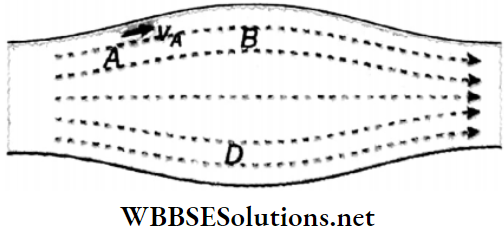
Class 11 Physics Unit 7 Properties Of Matter Chapter 3 Viscosity And Surface Tension Laminar Flow For A Liquid

Streamline: In the case of streamline motion, the paths along which the particles of the fluid move are called streamlines. A tangent drawn at any point on this path indicates the direction of motion of the fluid at that point.

WBCHSE Class 11 Physics Notes For Viscosity And Surface Tension

Properties of streamlining:

1. Two streamlines never intersect each other. Otherwise, at the point of intersection of two streamlines, two tangents can be drawn and hence two directions of motion of the particle are possible. Hut, in streamlined motion, any particle can move in one direction only and hence two streamlines can never intersect.

2. In the flow tube, where the streamlines are crowded together, the velocity of flow is higher. Where they are spaced, the velocity of flow is lower.

A special case of streamlined flow is a steady flow, for which the fluid velocity is a constant at all points along this flow at all times. So this velocity in neither a function of time, not of position. Example: a sufficiently slow liquid flow along a narrow uniform horizontal tube.

Turbulent Flow: In general, the motion of a fluid is streamlined, if its velocity does not exceed a definite limiting value. The limiting value of velocity is called the critical velocity.
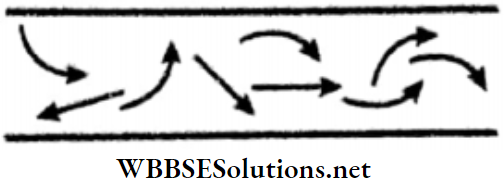
Class 11 Physics Unit 7 Properties Of Matter Chapter 3 Viscosity And Surface Tension Turbulent Flow

If the velocity of a fluid exceeds the critical velocity, then the flow becomes turbulent, and in some regions, eddies and vortices are formed. This kind of flow is called a turbulent flow.

Turbulent Flow Definition: If the velocity of a fluid along its flow continuously and randomly changes in magnitude and direction, then it is called a turbulent or disorderly flow.

The path of fluid particles in turbulent flow is shown in Fig At every point along the flow, both the magnitude and the direction of fluid velocity change with time.

Turbulent Flow Experiment: Reynolds demonstrated the difference between streamline and turbulent flow by a simple experiment. a discharge pipe Q is attached horizontally to a vertical water-filled cylinder P. The flow rate may be varied with a valve at the end of the pipe.

Understanding Viscosity in Fluids
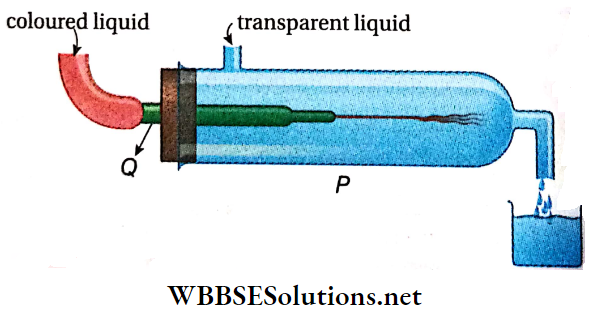
Class 11 Physics Unit 7 Properties Of Matter Chapter 3 Viscosity And Surface Tension Reynolds Experiment

  • To make the flow behavior visible, we use the KMnO4 solution, which is injected centrally into the horizontal pipe through a very narrow tube (diameter < 1 mm), positioned to avoid additional turbulence.
  • If the velocity of the transparent liquid is low, the colored liquid is observed to travel continuously in the form of a thread, indicating a streamlined flow.
  • As the flow of the transparent liquid is increased gradually, the colored thread gets disrupted and later on the colored liquid begins to move randomly, or forms eddies and vortices and mixes with the transparent liquid.
  • The velocity of the transparent liquid at which this disturbance starts is called the critical velocity. It depends on the nature of the liquid, the cross-section of the tube, etc.

Viscosity And Surface Tension Viscosity: When a liquid flows slowly over a fixed horizontal surface, i.e., when the flow is laminar, the layer of the liquid in contact with the fixed surface remains at rest due to adhesion.

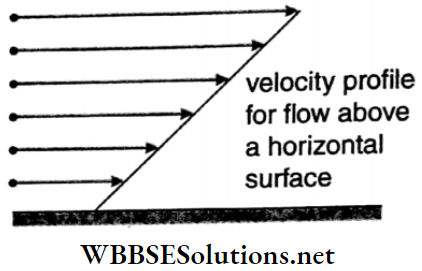
  • The layer just above it moves slowly over the lower one, the third layer moves faster over the second one, and so on. The velocities of the layers of liquid increase with the increase in distance from the horizontal rigid surface.
  • For two consecutive horizontal layers inside the liquid, the upper layer moves with a velocity greater than that of the lower one.
  • The upper layer tends to accelerate the lower layer, while the lower layer tends to retard the upper one. In this way, the two adjacent layers tend to decrease their relative velocity—as if a tangential force acts on the upper layer and tries to oppose its motion.
  • This tangential force is called viscous force. Therefore, to maintain a constant relative motion between the layers, an external force must act. If no external force acts, then the relative motion between the layers will cease and the flow of the liquid will stop.
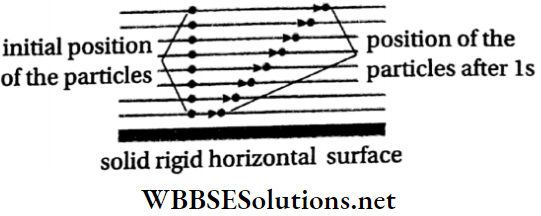
Class 11 Physics Unit 7 Properties Of Matter Chapter 3 Viscosity And Surface Tension Viscosity Horizontal Rigid Surface

Class 11 Physics Unit 7 Properties Of Matter Chapter 3 Viscosity And Surface Tension Velocity Profile For Horizontal Surface

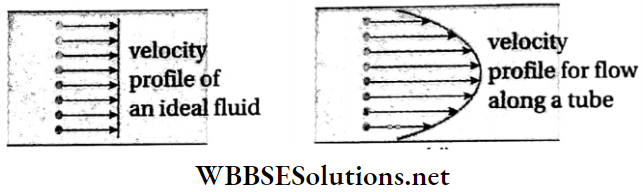
Class 11 Physics Unit 7 Properties Of Matter Chapter 3 Viscosity And Surface Tension Ideal Fluid And Flow Along Tube

WBBSE Class 11 Viscosity and Surface Tension Notes

Viscosity Definition: The property by which a liquid opposes the relative motion between its adjacent layers is called the viscosity of the liquid.

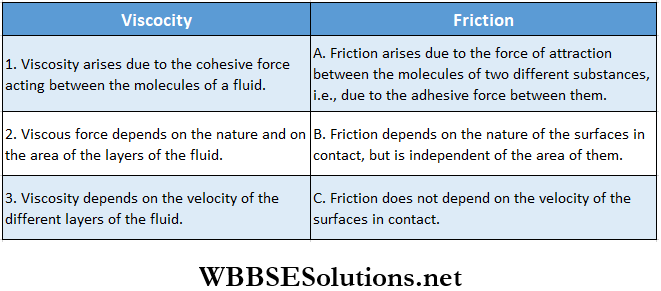
Comparison of viscosity with friction: Viscosity is a general property of a fluid. The frictional force acting between two solid surfaces resembles in many ways the viscosity of a liquid.

  • Hence, viscosity is called the internal friction of a liquid. Like friction, the viscous force is absent if a liquid is at rest.
  • The difference between the frictional force in solids and viscosity in liquids is that the viscous force depends on the area of the liquid surface while the frictional force does not.

Viscosity and mobility of different liquids: Viscosities of different liquids are different. If alcohol and oil are poured separately into two identical vessels and stirred, then oil will come to rest earlier. This shows that the viscosity of oil is greater.

Velocity profile: The surface formed by joining the end points of the velocity vectors of different layers of any section of a flowing liquid is called its velocity profile. The velocity profile for flow above a horizontal surface is shown in Fig.

Velocity profile of a non-viscous liquid: An ideal liquid is non-viscous. For such a liquid, there is no resistance due to viscosity. The velocities of the different layers are the same.

Every particle in a given cross-section of the liquid moves forward with the same velocity. On joining the ends of these velocity vectors, we get a plane surface. Therefore, we can say that the velocity profile of a non-viscous liquid is linear (on 2D graph).

Velocity profile of a viscous liquid: When a viscous liquid flows through a horizontal tube, the layer of liquid in contact with the wall of the tube remains stationary due to adhesion. So the velocity of that layer is zero.

  • The layer of the liquid which flows along the axis of the tube has the maximum velocity. As we progress from the center towards the walls, the velocity decreases.
  • Therefore, on joining the ends of the velocity vectors, we get a parabolic surface. The velocity profile of a viscous liquid is a parabola (on the 2D graph).

WBCHSE Class 11 Physics Notes For Viscosity And Surface Tension

Coefficient of Viscosity: Let PQ be a solid horizontal surface. A liquid is in streamlined motion over the surface PQ. Two liquid surfaces CD and MN are at distances x and (x+dx) respectively from the fixed solid surface. The velocity of layer CD is ν and that of layer MN is ν+ dν.
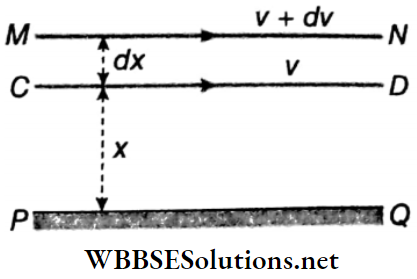
Class 11 Physics Unit 7 Properties Of Matter Chapter 3 Viscosity And Surface Tension Coefficient Of Viscocity

Due to the viscosity of the liquid, an opposing force acts between these two layers and tries to slow down the relative motion of the layers. If this opposing viscous force is F, then for streamline motion of the liquid, Newton proved that

  1. F ∝ A; A = area of cross-section of the liquid surface, and
  2. \(F \propto \frac{d v}{d x}; \frac{d v}{d x}\) = velocity gradient = rate of change of velocity with distance perpendicular to the direction of flow.

∴ \(F \propto A \frac{d v}{d x} \text { or, } F=-\eta A \frac{d v}{d x}\) ….(1)

Here, η is a constant known as the coefficient of viscosity. Its value depends on the nature of the liquid.

Equation (1) is known as Newton’s formula for the streamlined flow of a viscous liquid. Liquids that obey this law are called Newtonian liquids and liquids that do not obey this law are called non-Newtonian liquids.

From equation (1), we get, \(\eta=\frac{F}{A \frac{d v}{d x}}\)

If A = 1 and \(\frac{d v}{d x}=1\), then η = F; from this, we can define the coefficient of viscosity.

Class 11 Physics Class 12 Maths Class 11 Chemistry
NEET Foundation Class 12 Physics NEET Physics

Coefficient of Viscosity Definition: The coefficient of viscosity of a liquid is defined as the required tangential force acting per unit area to maintain unit relative velocity between two liquid layers unit distance apart.

Units of coefficient of viscosity: \(\eta=\frac{F}{A \frac{d v}{d x}}=\frac{F d x}{A d \nu}\)

So, unit of \(\eta=\frac{\mathrm{N} \cdot \mathrm{m}}{\mathrm{m}^2 \cdot\left(\mathrm{m} \cdot \mathrm{s}^{-1}\right)}=\mathrm{N} \cdot \mathrm{s} \cdot \mathrm{m}^{-2}=\mathrm{Pa} \cdot \mathrm{s}\)

Unit:

  • dyn · s · cm-2 CGS System or g · cm-1 · s-1
  • N · s · m-2 or Pa · s or kg · m-1 · s-1 SI

Relation: \(1 \mathrm{~kg} \cdot \mathrm{m}^{-1} \cdot \mathrm{s}^{-1}=\frac{1 \mathrm{~kg}}{1 \mathrm{~m} \times 1 \mathrm{~s}}=\frac{1000 \mathrm{~g}}{100 \mathrm{~cm} \times 1 \mathrm{~s}}\)

= 10 g · cm-1 · s-1

Poise and decompose: The coefficient of viscosity of a liquid is 1 poise when a tangential force of 1 Dyn is required to maintain a relative velocity of 1 cm · s-1 between two parallel layers of the liquid 1 cm apart where each layer has an area of 1 cm2.

So, 1 poise is the CGS unit of the coefficient of viscosity η.

1 poise = 1 dyn • s • cm-2 = 1 g • cm-1 • s-1.

As, 1 kg · m-1 · s-1 = 10g · cm-1 • s-1 = 10 poise,

the SI unit of η is called 1 decapoise = 10 poise.

The coefficient of viscosity of a liquid is 1 decompose when a tangential force of 1 newton is required to maintain a relative velocity of 1 m · s-1 between two parallel layers separated by distance of 1 m, where each layer has an area of 1 m2.

Dimension of coefficient of viscosity: \([\eta]=\frac{[\mathrm{F}]}{[\mathrm{A}]\left[\frac{d \nu}{d x}\right]}=\frac{\mathrm{MLT}^{-2}}{\mathrm{~L}^2 \cdot \frac{\mathrm{LT}^{-1}}{\mathrm{~L}}}=\mathrm{ML}^{-1} \mathrm{~T}^{-1}\)

Effect of pressure and temperature on the coefficient of viscosity:

Effect of pressure: Usually, viscosity increases with pressure. In less viscous liquids, the viscosity increases at a low rate with pressure.

  • However for highly viscous liquids, an increase in pressure results in a rapid rise in its viscosity. However, water behaves differently and, with an increase in pressure, its viscosity decreases.
  • From the kinetic theory of gases, it is known that a change in pressure does not affect the viscosity of a gas. But for a large increase (or decrease) in pressure, viscosity is affected.

Effect of temperature: Usually, the coefficient of viscosity of liquids decreases with a temperature rise. The relation between temperature and coefficient of viscosity is rather complicated. One commonly used equation relating these two is

⇒ \(\eta_t=\frac{A}{(1+B t)^C}\)

where, ηt = coefficient of viscosity of a liquid at t°C and A, B, and C are constants for a particular fluid.

For gases, the coefficient of viscosity increases with an increase in temperature.

Critical Velocity and Reynolds Number

Critical velocity: On gradually increasing the velocity of a fluid, the streamline flow does not become turbulent abruptly. Rather this change occurs gradually.

With the help of experimental demonstration and also by dimensional analysis, it can be proved that the critical velocity (νc) of a fluid is

  1. Inversely proportional to the density (ρ) of the fluid,
  2. Directly proportional to the coefficient of viscosity (η) of the fluid, and
  3. Inversely proportional to the characteristic length (l) of the channel. So,

⇒ \(v_c \propto \frac{\eta}{\rho l} \text { or, } v_c=N_c \cdot \frac{\eta}{\rho l}\) …..(1)

In the case of a tube, the characteristic length is the diameter of the tube while, for a canal, the characteristic length is its breadth.

If, for a liquid, ρ and η are known and its critical velocity νc can be determined experimentally during its flow through a tube of diameter l, then from equation (1), the value of the constant Nc for that liquid can be determined. This value is nearly 2300.

For any velocity ν of the fluid flow, equation (1) can also be written in an equivalent form as

⇒ \(v=N \cdot \frac{\eta}{\rho l} \text { or, } N=\frac{\rho l v}{\eta}\)…….(1)

N is called the Reynolds number.

Special cases:

1. If ν<νc, i.e., the velocity of fluid flow is less than the critical velocity, then comparing equations (1) and (2), we can say that N<Nc. It means that the value of the Reynolds number is less than 2300. So, if the value of the Reynolds number is less than 2300, then the flow will be streamlined.

2. On the other hand, if ν>νc, i.e., the velocity of the fluid is greater than the critical velocity, then N >Nc, and hence the value of the Reynolds number will be greater than 2300. If the Reynolds number is greater than 2300, then the flow will be turbulent.

Dimension of Reynolds number: From equation (2) we get, the dimension of N

= \(\frac{\text { dimension of } \rho \times \text { dimension of } l \times \text { dimension of } \nu}{\text { dimension of } \eta}\)

= \(\frac{M L^{-3} \cdot L \cdot L T^{-1}}{M L^{-1} T^{-1}}=1\)

So, N is a dimensionless quantity; it is a pure number.

Reynolds number: A dimensionless number N= \(\frac{\rho l v}{\eta}\) can be formed by combining the characteristic length (l) of a fluid channel and the velocity (v), density (ρ) and coefficient of viscosity (η) of the fluid the magnitude of N determines whether the fluid flow is streamlined or turbulent. This number N is called the Reynolds number.

  • In the above discussion, 2300 is an approximate value of Nc. Usually, for N < 2000, the fluid flow is streamlined, and for N> 3000 the fluid flow is turbulent. If N lies between 2000 and 3000, the streamlined flow of fluid gradually changes into a turbulent flow.
  • In the above discussion, 2300 is an approximate value of Nc. Usually, for N < 2000, the fluid flow is streamlined, and for N > 3000 the fluid flow is turbulent. If N lies between 2000 and 3000, the streamlined flow of fluid gradually changes into a turbulent flow.
  • As N is a pure number, its value does not depend on the system of units chosen. For a particular flow, the value of N remains the same.

If the radius of a tube of flow is considered, instead of its diameter, then the effective value is Nc ≈ 1150.

Viscosity And Surface Tension Numerical Example

Example: A plate of area 100 cm2 is floating on an oil of depth 2 mm. The coefficient of viscosity of oil is 15.5 poise. What horizontal force is required to move the plate horizontally with a velocity of 3 cm · s-1?
Solution:

The viscous force, F = \(\eta A \frac{d v}{d x}\)

Here, A = 100 cm2, η = 15.5 poise,

dν = 3 cm · s-1 and dx = 2 mm = 0.2 cm.

∴ F = 15.5 x 100 x 3/0.2 = 23250 dyn

So the required horizontal force is 23250 dyn.

Terminal Velocity of a Body in a Viscous Medium and Stokes’ Law: When a body falls through a viscous medium (liquid or gas), it drags a layer of the fluid adjacent to it due to adhesion. But fluid layers at a large distance from the body are at rest.

  • As a result, there is relative motion between different layers of the fluid at different distances from the body. However the viscosity of the fluid opposes this relative motion.
  • The opposing force due to viscosity increases with an increase in the velocity of the body due to the gravitational acceleration g. If the body is small in size, then after some time the opposing upward force (i.e., viscous force and buoyant force) becomes equal to the downward force (weight of the body).
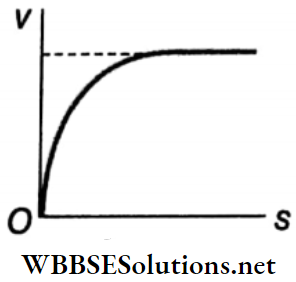
  • Then the effective force acting on the body becomes zero and the body begins to fall through the medium with a uniform velocity, called the terminal velocity. A graph representing the change in velocity of a falling object with time is shown in Fig.
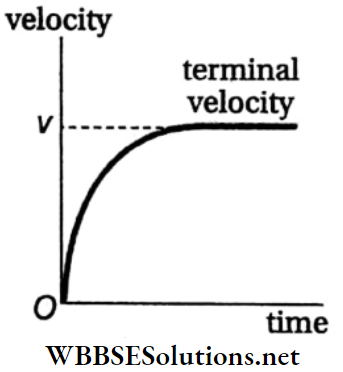
Class 11 Physics Unit 7 Properties Of Matter Chapter 3 Viscosity And Surface Tension Termional Velocity Graph

Stokes’ law: Stokes proved that, if a small sphere of radius r is falling with a terminal velocity ν through a medium of coefficient of viscosity η, then the opposing force acting on the sphere due to viscosity is

F = 6 πηrν ………..(1)

Equation (1) expresses Stokes.

  1. To establish Stokes’ law, the following assumptions are
    made.
  2. The fluid medium must be infinite and homogeneous. E3D The sphere must be rigid with a smooth surface.
  3. The sphere must not slip when falling through the medium.
  4. The fluid motion adjacent to the falling sphere must be streamlined.
  5. The sphere must be small in size, but it must be greater than the intermolecular distance of the medium.

The equation for terminal velocity: if the density of the material of the sphere is ρ, then the weight of the sphere = \(\frac{4}{3} \pi r^3 \rho g.\)

If the density of the fluid medium is σ, then the upward buoyant force acting on the sphere = \(\frac{4}{3} \pi r^3 \sigma g\)

∴ The resultant downward force acting on the sphere =

= \(\frac{4}{3} \pi r^3 \rho g-\frac{4}{3} \pi r^3 \sigma g=\frac{4}{3} \pi r^3(\rho-\sigma) g\)….(2)

If the sphere attains terminal velocity, then

⇒ \(6 \pi \eta r \nu=\frac{4}{3} \pi r^3(\rho-\sigma) g \text { or, } \nu=\frac{2}{9} \frac{r^2(\rho-\sigma) g}{\eta}\) ….(3)

So, from equation (3), we see that the terminal velocity obeys the following rules.

  1. Terminal velocity is directly proportional to the square of the radius of the sphere.
  2. It is directly proportional to the difference of densities of the material of the sphere and that of the medium.
  3. It is inversely proportional to the coefficient of viscosity of the medium.

If the density of the body is less than the density of the medium, i.e., ρ < σ, then it is clear that the terminal velocity becomes negative. Hence, the velocity of the body will be in the upward direction. For this reason, air or other gas bubbles move upwards through water.

Applications of Stokes’ law:

1. Falling of rain drops through air: Water vapour condenses on the particles suspended in air far above the ground to form tiny water droplets. The average radius of these tiny water droplets is 0.001 cm (approx.)

  • Assuming the coefficient of viscosity of air as 1.8 x 10⁻⁴  poise (approx.) the terminal velocity of these droplets is calculated as 1.2 cm · s-1 (approx.) which is negligible. So, these water droplets float in the sky. Collectively these droplets form clouds.
  • But as they coalesce to form larger drops, their terminal velocities increase. For example, the terminal velocity of a water droplet of radius 0.01cm becomes 120 cm · s-1 (approx.). As a result, they cannot float any longer and so they come down as rain.

2. Coming down with the help of a parachute: When a soldier jumps from a flying airplane, he falls with acceleration due to gravity but due to viscous drag in air, the acceleration goes on decreasing till he acquires terminal velocity.

The soldier then descends with constant velocity and opens his parachute close to the ground at a pre-calculated moment, so that he may land safely near his destination.

Terminal Velocity Numerical Examples

Example 1. An oil drop of density 950 kg · m-3 and radius 10-6 m is falling through air. The density of air is 1.3 kg · m-3 and its coefficient of viscosity is 181 x 10-7 SI unit. Determine the terminal velocity of the oil drop, [g = 9.8 m · s-2]
Solution:

Terminal velocity, \(\nu=\frac{2}{9} \cdot \frac{r^2(\rho-\sigma) g}{\eta}\)

[Here, ρ = 950 kg · m-3 ; r = 10-6 m; σ = 1.3 kg · m-3; η = 181 x 10-7 SI]

= \(\frac{2}{9} \cdot \frac{\left(10^{-6}\right)^2(950-1.3) \times 9.8}{181 \times 10^{-7}}\)

= \(1.14 \times 10^{-4} \mathrm{~m} \cdot \mathrm{s}^{-1}\)

Example 2. An air bubble of radius 1 cm is rising from the bottom of a long liquid column. If its terminal velocity is 0.21 cm · s-1, calculate the coefficient of viscosity of the liquid. Given that the density of the liquid is 1.47 g · cm-3. Ignore the density of air.
Solution:

Coefficient of viscosity of the liquid, \(\eta=\frac{2}{9} \cdot \frac{r^2(\rho-\sigma) g}{v}\)

[Here, r = 1cm; v = -0.21 cm · s-1; ρ = 0; cσ = 1.41 g · cm-3]

= \(\frac{2}{9} \times \frac{(1)^2(0-1.47) \times 980}{-0.21}=1524.4 \text { poise. }\)


Viscosity And Surface Tension Surface Tension Of Liquids

All liquids possess a special property—a tendency to minimize its surface area. This tendency of a liquid surface to contract its area is called surface tension. From our practical experience, we know that water droplets, or a small amount of mercury always take the shape of a sphere.

  • In the absence of external forces, all liquids always take a spherical shape. For a given volume, the surface area of a sphere is the least and hence a liquid drop has a natural tendency to take the shape of a sphere.
  • If a clean dry needle is placed horizontally on the surface of water, then it is observed that the needle floats on water. The water surface under the needle is slightly depressed.
  • Insects like spiders and mosquitoes can walk on the surface of water. Where their legs touch, the water surface becomes slightly depressed.
  • From such observations, it seems that the surface of water behaves like a stretched rubber membrane.

Experimental demonstration: A wire loop is dipped into a soap solution. A thin soap film will be formed in the loop when it is taken out of the solution. This film acts as the free surface of the liquid.
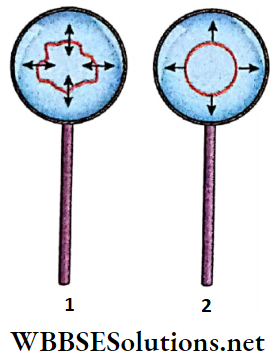
Class 11 Physics Unit 7 Properties Of Matter Chapter 3 Viscosity And Surface Tension Shape Of The Loop

A wet cotton thread loop, after being dipped in soap solution, is put on the film. No change is seen in the shape of the loop. The soap film inside the loop is now punctured with a fine needle and it is observed that the cotton thread pulls itself into a circle. What is the reason behind this observation?

  • Initially, there was soap film inside and outside the cotton loop. Every point on the loop experienced equal and opposite forces tangential to the surface of the film. These two forces balanced each other. As a result, no resultant force acted on the loop.
  • After the film inside the loop was removed, the inward force vanished and only the film outside the loop exerted a force on the thread. We know that among all plane surfaces having the same boundary length, the area of a circle is the greatest.
  • Hence, a circle formed by the loop occupies the maximum area. So, the area of the film in between the loop and the thread reduces to a minimum. From this, it can be inferred clearly that the film tends to minimize its area.
  • It can be concluded that tension always acts on the free surface of a liquid and that the free surface behaves as a stretched-thin membrane. Due to this tension, the free surface of any liquid tends to contract to occupy the minimum area. This tension is known as surface tension.

Surface Tension Explained

Surface tension: Surface tension is the property of the free surface of a liquid due to which the liquid behaves as a stretched-thin membrane and has a tendency to contract to minimize the surface area.

  • As a reason behind the origin of surface tension, it can be said that the molecules of a liquid attract each other by cohesive force [the force of attraction which acts between the molecules of the same material is called cohesive force).
  • The equal cohesive force acts on the molecule inside the liquid from all directions.
  • Consequently, the resultant cohesive force on the molecule is zero. However, no cohesive forces act on the molecules of the free surface of the liquid in the outward direction. So, the cohesive force inside the liquid is not balanced.
  • As a result, a resultant cohesive force acts on each molecule of the free surface in the downward direction. Thus, the free surface of a liquid tends to have the least surface area.
  • Let us imagine a straight line on the free surface of a liquid. Due to the tendency of the liquid surface to contract, the molecules on the opposite sides of the line try to move away from each other. This can be seen in the following experiment.
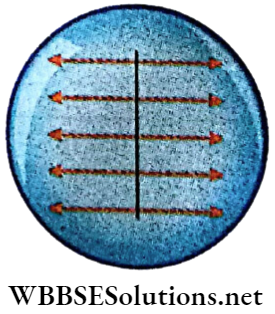
Class 11 Physics Unit 7 Properties Of Matter Chapter 3 Viscosity And Surface Tension Free Surface Of The Liquid

If a matchstick is placed on a water surface, it remains at rest. But when a drop of alcohol is put on water on one side of the stick, the stick moves in the opposite direction.

1. The water surface exerts an equal pressure on both sides of the stick. This force is normal to the stick.

2. When a drop of alcohol is put on water, the force on that side is weaker and the stick is pulled away by the stronger tangential force towards the opposite side.

Hence, surface tension can also be defined as follows:

Surface tension Definition: The tangential force per unit length on a liquid surface, that acts along the normal on either side of an imaginary line on that surface, is called the surface tension of the liquid.

Units:

  • dyn · cm-1 CGS System
  • N · m SI

Relation: \(1 \mathrm{~N} \cdot \mathrm{m}^{-1}=\frac{1 \mathrm{~N}}{1 \mathrm{~m}}=\frac{10^5 \mathrm{dyn}}{10^2 \mathrm{~cm}}=10^3 \mathrm{dyn} \cdot \mathrm{cm}^{-1}\)

Dimensional: \([\text { Surface tension }]=\frac{[\text { force }]}{\text { [length }]}=\frac{\mathrm{MLT}^{-2}}{\mathrm{~L}}=\mathrm{MT}^{-2}\)

Surface Energy: We know that on the free surface of a liquid, the surface tension always tries to minimize the surface area. So, to increase the area of the surface of the liquid, an external force is needed.

  • The external force does work to increase the area of the surface of the liquid, and the work done remains stored inside the surface of the liquid as potential energy.
  • The surface energy of a liquid is measured by the work done to increase the area of the surface of a liquid by unity.

Units:

  • erg · cm-2 CGS System
  • J · m-2 SI

Relation: \(1 \mathrm{~J} \cdot \mathrm{m}^{-2}=\frac{1 \mathrm{~J}}{1 \mathrm{~m}^2}=\frac{10^7 \mathrm{erg}}{10^4 \mathrm{~cm}^2}=10^3 \mathrm{erg} \cdot \mathrm{cm}^{-2}\)

Dimension: \([\text { Surface energy }]=\frac{[\text { work }]}{[\text { area }]}=\frac{\mathrm{ML}^2 \mathrm{~T}^{-2}}{\mathrm{~L}^2}=\mathrm{MT}^{-2}\)

Relation between surface tension and surface energy: A rectangular wire frame PQRS is taken. A wire AB can move along PQ and SR.

When the frame is dipped into a soap solution and taken out, a thin film is formed within the frame.

As a result, the surface tension acts normally on the wire AB and tangentially to the surface of the film. This force tries to contract the film surface and pulls the wire AB towards QR. To keep the wire AB in its position, an equal but opposite force needs to be applied on it.
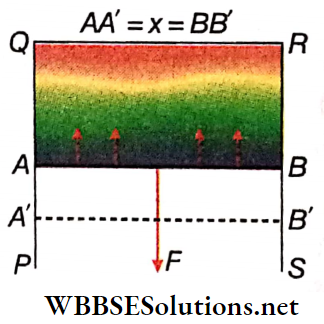
Class 11 Physics Unit 7 Properties Of Matter Chapter 3 Viscosity And Surface Tension Surface Tension And Surface Energy

Let the length of the wire AB be l; the surface tension of the liquid be T.

∴ The net force acting on the wire AB in the direction QR = 2lT. [The film has two surfaces and surface tension acts on each surface, therefore the net force has a factor of 2]

∴ To keep the wire AB still, the force required to be applied in the opposite direction, F = 2lT

Now, the amount of work done in displacing the wire AB through a short distance δx against the surface tension (assuming the force F to be a constant throughout the displacement) so that it comes to the new position A’B’ is

Fδx = 2lTδx

Due to this, the total increase in the area of the film surface = 2 lδx.

This work remains stored as potential energy on the film surface.

∴ Work done for unit increase in area against the surface tension = \(\frac{2 l T \delta x}{2 l \delta x}=\) = T

So, the potential energy stored per unit area or the surface energy is numerically equal to the surface tension of the liquid. Note that the temperature is assumed to be constant.

Alternative definition of surface tension: Keeping the temperature constant, the amount of work done in increasing the area of a liquid surface by unity is called the surface tension of that liquid at that temperature.

Units:

  • erg · cm-2 CGS System
  • J · m-2 SI Units

Dimension: According to the alternative definition,

⇒ \([\text { surface tension }]=\frac{[\text { work }]}{[\text { area }]}=\frac{\mathrm{ML}^2 \mathrm{~T}^{-2}}{\mathrm{~L}^2}=\mathrm{MT}^{-2}\)

Total surface energy: in the discussion, it was assumed that, during increase in the area of a liquid surface under the influence of an applied force, the temperature remains constant. But, in practice, some molecules from inside the liquid rise to its surface during the expansion of the surface.

  • A resultant attraction exerted by the other molecules inside the liquid acts on these moving molecules. Therefore, these molecules on reaching the surface lose their linear kinetic energy and the average linear kinetic energy of the total liquid decreases.
  • Since the temperature is directly proportional to the average kinetic energy, the temperature of the surface of the liquid decreases with an increase in its area. To keep the temperature constant, the liquid surface absorbs heat from its surroundings.

To increase the area of a liquid surface keeping the temperature constant, energy may be supplied in two ways

  1. Mechanical energy to increase the surface area and
  2. Heat energy to keep the temperature constant. The total of these two energies should actually be the surface energy.

So, the increase in potential energy per unit surface area or stored surface energy (E) = mechanical energy or work done (T) + heat (h) required for unit area

i.e., E = T+h……(1)

From thermodynamics, it can be proved that, h = \(-\theta \frac{d T}{d \theta}\)

[θ = temperature in absolute scale and dT/dθ = rate of increase in surface tension due to increase in temperature]

∴ E = \(T-\theta \frac{d T}{d \theta}\)…..(2)

Now, with the increase in temperature, the surface tension decreases and hence \(-\theta \frac{d T}{d \theta}\) is a negative quantity.

So, h is a positive quantity.

∴ E = \(T+\theta \frac{d T}{d \theta}\)…..(3)

when only the magnitudes are considered.

Again, at the absolute zero temperature, i.e., when θ = 0, E = T.

So, at any temperature except absolute zero, the total surface energy of a liquid is always greater than the surface tension of that liquid.

Factors Affecting Surface Tension of a Liquid: Surface tension of a liquid depends on the following factors.

1. Temperature of the liquid: With an increase in the temperature, the surface tension of almost all liquids decreases. For a small change in temperature, the relation between surface tension and temperature is

T’ = \(T\left[1-\alpha\left(t^{\prime}-t\right)\right]\)

Here, T and T’ are the surface tensions at temperatures t and t’ respectively]

For a given liquid, α is a constant quantity. It is called the temperature coefficient of surface tension.

It is experimentally verified that at a specific temperature of every liquid, the surface tension of the liquid disappears. This temperature is called the critical temperature of that liquid.

2. Pollution: If impurities are present on a liquid surface, then the surface tension of that liquid usually decreases. For example, when an oil or a fat-like substance is poured over water, it forms a thin film over the surface of water. This decreases the original surface tension of water.

3. Presence of dissolved substances: if a liquid contains dissolved inorganic substances, then the surface tension of that liquid increases. Again, if the liquid contains dissolved organic matter, then its surface tension decreases. For example, the surface tension of pure water is 0.072 N · m-1.

If common salt (inorganic substance) is dissolved in water, then its surface tension becomes 0.083 N · m-1 (approx.), but the surface tension of soap-water (organic substance) is approximately 0.030 N · m-1.

4. Medium above the liquid surface: The surface tension of a liquid depends on the nature of the medium above the free surface of that liquid. For example, the surface tension of water is about 72 dyn · cm-1 in the presence of dry air above the surface of water, but is about 70 dyn · cm-1 when there is moist air above the surface of water at the same temperature.

5. Presence of electric charge: The surface tension of a liquid decreases due to the presence of electric charge on the surface of the liquid.

Some Phenomena in Connection with Surface Tension

1. Camphor darts to and fro when put on the Surface Of water: Camphor is soluble in water. When put on water, the portion that comes into contact with the water begins to dissolve. The part which gets dissolved in water contaminates the water and the surface tension of that part decreases. Due to this difference in surface tension, a net unbalanced force acts on the piece of camphor, and consequently, the piece of camphor darts to and fro on the surface of water.

2. Hair of a paint brush cling together when the brush is brought out of water: The hair of a brush lie apart while immersed in water because, inside water, the surface tension is absent. But when the brush is brought out of the water, a thin film of water clings to the hair, and the surface tension tries to contract the area of the film hence the hair clings together.

3. Turbulent sea calms down If oil is poured on the water: The surface tension of pure water is more than that of oily water. When oil is poured over sea water, the oil spreads in the direction of motion of the waves leaving uncovered sea water at the rear. Hence, the surface tension of the water ahead of the waves is lower than that of the water behind the waves. The water at the rear pulls the water at the front and, as a result, high waves become lower.

4. When oil is poured on water, it spreads readily Over the entire surface: Since the surface tension of pure water is greater than the surface tension of oil, a tensile force acts on the surface of oil. Due to this tensile force, oil spreads readily over the entire surface of water.

5. When chalk dust is sprinkled on water and a few drops of alcohol is added, then the dust particles rapidly spread on the water surface: Alcohol decreases the surface tension. Due to unequal surface tension on different parts of the water surface, the chalk particles spread rapidly on the surface of water.

6. Water cannot seep in through the cloth of raincoats, umbrellas and tents: The minute pores in the cloth of raincoats etc. trap air molecules. However, these pores are too small to let rain droplets enter, because the droplets retain their spherical shape due to surface tension, and the diameters of the spheres are greater than that of the pores. So, the rainwater falling on the cloth simply flows off.

7. A needle Coin float on water surface: A needle floats due to the surface tension of water. The surface of water where the needle is placed experiences a slight depression due to the surface tension of water. So, the water exerts an upward force on the needle which balances its weight (acting downwards). Therefore, a needle can float if it is placed carefully on a calm water surface.
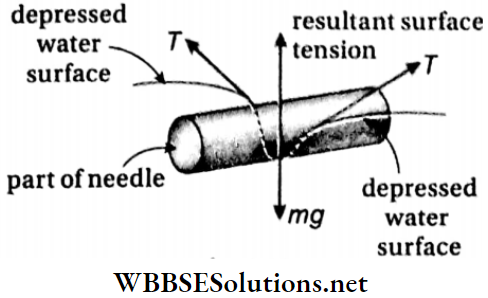
Class 11 Physics Unit 7 Properties Of Matter Chapter 3 Viscosity And Surface Tension A Needle Can Float On Water Surface

Viscosity And Surface Tension Surface Tension Of Liquids Numerical Examples

Example 1. The surface tension of water at 20 °C is 72 dyn · cm-1 and for water dT/dθ = -0.146 dyn · cm-1 · K-1. What is the total surface energy of water?
Solution:

We know that the total surface energy of water,

E = T – θ dT/dθ = 72 – 293 x (-0.146) [20°C = 293 K]

= 72 + 42.778 = 114.778 erg · cm-2.

Example 2. A drop of water of radius 1 mm is to be divided into 106 point drops of equal size. How much mechanical work should be done? The surface tension of water = 72 dyn · cm-1.
Solution:

Let the radius of each point drop be r

∴ \(\frac{4}{3} \pi r^3 \times 10^6=\frac{4}{3} \pi\left(\frac{1}{10}\right)^3 \quad \text { or, } r=0.001 \mathrm{~cm}\)

The surface area of the original drop = \(4 \pi\left(\frac{1}{10}\right)^2 \mathrm{~cm}^2\)

and the total surface area of 106 point drops = 106 x 4π(0.001)² = 4π cm².

∴ Increase in surface area = \(4 \pi-4 \pi\left(\frac{1}{10}\right)^2=4 \pi \times 0.99 \mathrm{~cm}^2\)

= \(4 \pi-4 \pi\left(\frac{1}{10}\right)^2=4 \pi \times 0.99 \mathrm{~cm}^2\)

∴ Mechanical work done = increase in surface area x surface tension

= 72 x 4π x 0.99 = 895.73 erg

Mathematical Problems for Viscosity and Surface Tension

Example 3. 1000 water droplets having a radius of 0.01 cm each coalesce to form a single big drop. What will be the decrease in energy? The surface tension of water = 72 dyn · cm-1
Solution:

Let the radius of the single big drop be R.

∴ \(\frac{4}{3} \pi R^3=\frac{4}{3} \pi(0.01)^3 \times 1000 \quad \text { or, } R=0.1 \mathrm{~cm}\)

Surface area of the big drop = 4π (0.1)² cm²

Total surface area of 1000 droplets

= 4π (0.01)² x 1000 cm²

∴ Decrease in area

= 4π (0.01)² x 1000-4π(0.1)²

= 4π(0.1 -0.01) = 47 x 0.09 cm³

∴ Decrease in energy = 4π x 0.09 x 72 = 81.43 erg.

Example 4. A rectangular glass slab measures 0.1 m x 0.0154 m x 0.002 m and its weight in air is 80.36 x 10⁻³ N. The slab is immersed half in water keeping its length and thickness horizontal. What will be the apparent weight of the slab? The surface tension of water is 72 x 10-3 N · m-1.
Solution:

While it is immersed, the following forces act on the glass slab

  1. Weight of the slab acting downwards,
  2. Upward buoyant force due to the weight of displaced water and
  3. Downward force due to surface tension.

Now, weight of the slab = 80.36 x 10⁻³ N

Buoyant force = weight of displaced water

= \(0.1 \times \frac{0.0154}{2} \times 0.002 \times 1000 \times 9.8\)

= 15.092 x 10⁻³ N

Force due to surface tension

= 2 x (0.1 + 0.002) x 72 x 10-3 N

= 14.688 x 10⁻³ N

∴ The apparent weight of the slab

= 80.36 x 10⁻³ – 15.092 x 10⁻³ + 14.688 x 10-3

= 79.956 x 10⁻³ N.

Example 5. The radius of a soap bubble is increased from 1 cm to 3 cm. What amount of work is done for this? The surface tension of soap-water is 26 dyn • cm-1
Solution:

Work done = increase in area x surface tension =

47{(3)²-(1)²} x 26 x 2 [the soap-bubble has two surfaces]

= 5227.6 erg = 5.2276 x 10⁻⁴ J.

Example 6. Determine the surface energy of a liquid film formed on a ring of area 0.15 m². The surface tension of the liquid = 5 N · m-1.
Solution:

Surface energy, E = 2 x surface tension x area =2 x 5 x 0.15= 1.5 J

Short Answer Questions on Viscosity and Surface Tension

Example 7. Determine the surface energy of a soap-water film formed on a frame of area 10-3 m2. Surface tension of soap-water = 70 x 10-3 N · m-1.
Solution:

Surface energy = 2 x surface tension x area

= 2 x 70 x 10-3 x 10-3 = 14 x 10-5 J.

Example 8. What will be the work done to form a soap bubble of radius 5 cm? The surface tension of soap-water = 70 dyn · cm-1
Solution:

Work done =2 x 4πr² x T =8πr² T

[r = radius of the soap-bubble and T = surface tension of soap-water]

= 8 x 22/7 x (5)² x 70 = 44000 erg

= 0.0044 J.

Example 9.  If a large number of water droplets of diameter 2rcm each coalesce to form a large water drop of diameter 2jRcm, then prove that the rise in tem-perature of water is \(\frac{3 T}{J}\left(\frac{1}{r}-\frac{1}{R}\right)\). Here, T is the surface tension of water and J is the mechanical equivalent of heat.
Solution:

If the number of small water droplets is n, then the dissipation of surface energy, W = (4πr²n-4πR²)T.

We know that W = JH and H = heat absorbed = msθ

[where m = mass of the larger water drop, s = specific heat of water, 6θ = temperature increase]

H = \(\frac{W}{J}=\frac{T}{J} \times 4 \pi\left(n r^2-R^2\right)\)

or, \(\frac{4}{3} \pi R^3 \cdot 1 \cdot \theta=\frac{T}{J} \times 4 \pi\left(n r^2-R^2\right)\)

⇒ \({\left[because m=\frac{4}{3} \pi R^3 \cdot 1=\frac{4}{3} \pi R^3 \text { and } s=1 \mathrm{cal} \cdot \mathrm{g}^{-1} \cdot{ }^{\circ} \mathrm{C}-1\right]}\)

or, \(\theta= \frac{3 T}{J} \frac{\left(n r^2-R^2\right)}{R^3}\)

⇒ \({\left[\text { here, } n \cdot \frac{4}{3} \pi r^3=\frac{4}{3} \pi R^3 \text { or, } R^3=n r^3 \text { or, } n=\frac{R^3}{r^3}\right]}\)

= \(\frac{3 T}{J}\left[\frac{R^3}{r^3} \cdot \frac{r^2}{R^3}-\frac{1}{R}\right]\)

= \(\frac{3 T}{J}\left(\frac{1}{r}-\frac{1}{R}\right)\)

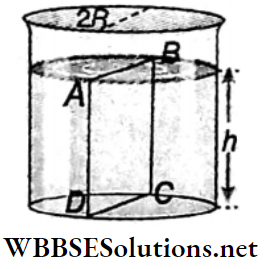
Example 10. Water is filled upto a height h in a beaker of radius R as shown. The density of water is p, the surface tension of water is T and the atmospheric pressure is P0. Consider a vertical section ABCD of the water column through a diameter of the beaker. What is the force on water on one side of this section by water on the other side of this section?
Class 11 Physics Unit 7 Properties Of Matter Chapter 3 Viscosity And Surface Tension A Water Is Filled Upro A Heigth In Breaker Of Radius

Solution:

The force acted on the liquid of left side by the liquid of right side is equal to the resultant of the following two forces.

1. Force due to surface tension =2RT (right side).

2. Impulse due to the exerted pressure by the liquid of height h

= \(\left(P_0+\frac{\rho g h}{2}\right) \times 2 R h\) [where \(\frac{\rho g h}{2}\)= average pressure on the plane A B C D]

= \(2 P_0 R h+\dot{R} \rho g h^2\) (along left side)

∴ The resultant force on the plane ABCD = \(2 P_0 R h+R \rho g h^2-2 R T\)

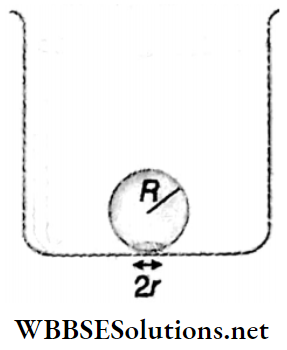
Example 11. When water in a beaker is gradually heated, a bubble formed at the lower surface of the beaker starts to rise up from the bottom of the beaker. The radius of the spherical bubble is R and the radius of the circular region of the bubble touched with the lower surface of the container is r(r<<R). Show that, the value of r will be \(R^2 \sqrt{\frac{2 \rho_u g}{3 T}}\) just before the detached from the lower surface of the container [where, ρw = density of water, T = surface tension of water]. Consider, that though the density and surface tension are unchanged with the increase in temperature, the density of air changes significantly.
Class 11 Physics Unit 7 Properties Of Matter Chapter 3 Viscosity And Surface Tension Water In A Beaker Is Gradully Heated A Bubble Formed At The Lower Surface

Solution:

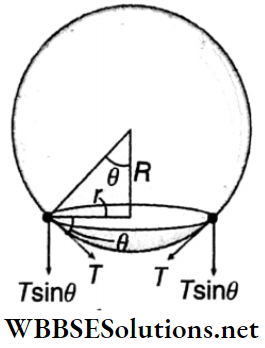
At that instant when the bubble is just detached from the lower surface of the beaker, the buoyancy force = the force due to surface tension.
Class 11 Physics Unit 7 Properties Of Matter Chapter 3 Viscosity And Surface Tension A Bubble Is Just Detached From The Lower Surface Of The Beaker

Now, the net force due to surface tension = (2πr)T sinθ (directed downward)

and the buoyancy force = \(\frac{4}{3} \pi R^3 \rho_w g\) (directed upward)

In this case, \(\frac{4}{3} \pi R^3 \rho_w g=(T)(2 \pi r) \sin \theta\)

[as θ is very small, sin/θ ≈ tanθ = r/R]

or, \(\frac{4}{3} \pi R^3 \rho_w g=(T)(2 \pi r)\left(\frac{r}{R}\right)\)

or, \(\frac{4}{3} \pi R^3 \rho_w g=T \cdot 2 \pi \frac{r^2}{R}\)

or, \(r^2=\frac{2\left(R^4 \rho_w g\right)}{3 T}\)

∴ r = \(R^2 \sqrt{\frac{2 \rho_w g}{3 T}}\)

Pressure Difference Between The Two Sides Of A Curved Liquid Surface

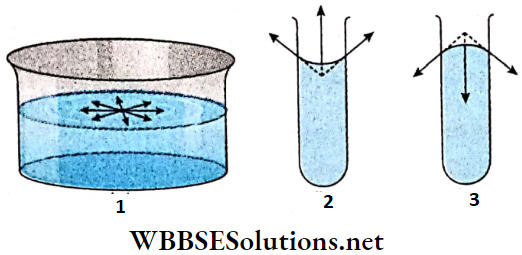
1. Suppose the free surface of a liquid is a plane. A molecule lying on its surface is attracted by other surface molecules equally in all directions. So the resultant tangential force on the molecule is zero.

2. If the free surface of the liquid is concave, then every molecule on the surface experiences an upward resultant force due to attraction by other surface molecules.
Class 11 Physics Unit 7 Properties Of Matter Chapter 3 Viscosity And Surface Tension Pressure Difference Between The Two Sides Of Curved Liquid Surface

3. If the liquid surface is convex, then the resultant force on a molecule on the surface due to attraction by other surface molecules will be directed downwards.

  • Obviously, there must be a difference of pressure between the two sides of a curved surface for equilibrium of it. This difference of pressure i.e., the excess pressure force will balance the resultant force due to surface tension. The pressure on the concave side must be greater than the pressure on the convex side.
  • We shall now calculate the excess pressure on the concave side of spherical surfaces in case of a liquid drop, an air bubble in a liquid, and a soap bubble.

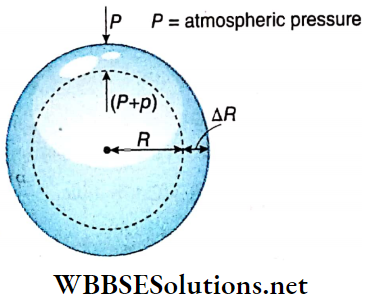
Excess pressure inside a liquid drop: Let us consider a liquid drop of radius R of a liquid of surface tension T. Every molecule on its surface experiences a resultant pull normally inwards due to surface tension.
Class 11 Physics Unit 7 Properties Of Matter Chapter 3 Viscosity And Surface Tension Excess Pressure Inside A Liquid Drop

So the internal pressure of the drop becomes greater than the pressure outside it. The internal excess pressure of the drop produces a force acting outwards which balances the force due to surface tension and maintains the equilibrium of the drop.

Suppose, external pressure on the drop =P, internal pressure of the drop = (P+ p).

So, the excess pressure inside the drop = p.

Suppose this internal excess pressure acting normally outwards increases the radius of the drop from R to R + ΔR i.e., it increases the surface area of the drop. Here ΔR is taken to be so small that the pressure inside the drop may be taken as unchanged.

Work done by the excess pressure,

W = Excess pressure x area x displacement

= p · 4πR² · ΔR ………(1)

Increase of surface area of the liquid drop,

⇒ \(\Delta A =4 \pi(R+\Delta R)^2-4 \pi R^2\)

= \(4 \pi\left\{R^2+2 R \cdot \Delta R+(\Delta R)^2-R^2\right\}\)

= \(8 \pi R \cdot \Delta R\) ; [neglecting the term \((\Delta R)^2\) which is very small]

∴ Increase in surface energy,

E = increase in surface area x surface tension

= 8πR · ΔR · T …….(2)

This increase in surface energy of the liquid drop takes place at the cost of work done by the excess pressure i.e., E = W.

So, from equation (1) and (2) we have, p · 4πR² · ΔR = 8π R ⋅ ΔR · T

or, p = 2T/R …..(3)

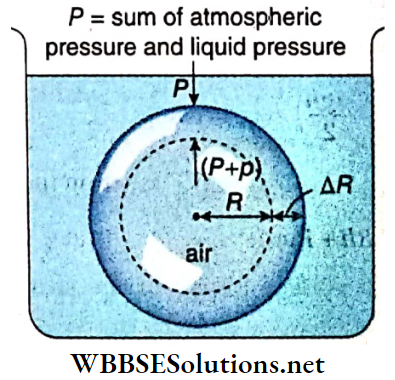
Excess pressure inside an air bubble in a liquid: Let us consider an air bubble of radius R formed in a liquid of surface tension T. Like a liquid drop the air bubble has also one surface in contact with the liquid.
Class 11 Physics Unit 7 Properties Of Matter Chapter 3 Viscosity And Surface Tension Excess Pressure Inside An Air Bubble In A Liquid

So proceeding similarly as in the case of a liquid drop we can prove that the excess pressure inside the air bubble in a liquid is given by p = 2T/R.

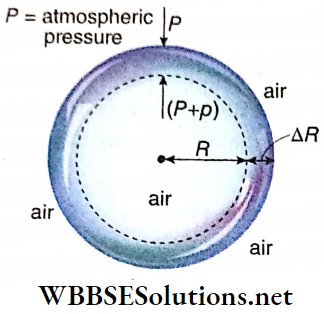
Excess pressure inside a soap bubble: Let us consider a thin soap bubble of radius R formed from a soap solution of surface tension T.
Class 11 Physics Unit 7 Properties Of Matter Chapter 3 Viscosity And Surface Tension Excess Pressure Inside A Soap Bubble

Suppose, the pressure outside the bubble = P, internal pressure =(P+p)

So, the excess pressure inside the bubble = p. Suppose, the radius of the bubble increases from R to R + ΔR due to this internal excess pressure acting normally outwards, i.e., the surface area of the bubble increases.

Here ΔR is taken to be so small that the pressure inside the bubble may be taken as unchanged.

Work done by the excess pressure,

W = excess pressure x area x displacement = p · 4πR² · ΔR …..(1)

The soap bubble has two liquid surfaces in contact with air, one inside the bubble and the other outside the bubble.

So, increase of surface area of the soap bubble,

⇒ \(\Delta A =2\left[4 \pi(R+\Delta R)^2-4 \pi R^2\right]\)

= \(8 \pi\left[R^2+2 R \cdot \Delta R+(\Delta R)^2-R^2\right]\)

= \(16 \pi R \cdot \Delta R\) ; [neglecting the term] \((\Delta R)^2\) which is very small]

∴ Increase in surface energy,

E = increase in surface area x surface tension

= 16 πR · ΔR · T……….(2)

This increase in surface energy of the soap bubble takes place at the cost of work done by the excess pressure i.e., E = W

So, from equations (1) and (2) we have,

⇒ \(p \cdot 4 \pi R^2 \cdot \Delta R=16 \pi R \cdot \Delta R \cdot T\)

p = \(\frac{4 T}{R}\)

Viscosity And Surface Tension Bubble  Numerical Examples

Example 1. Find the excess pressure inside a rainwater drop of diameter 0.02cm. The surface tension of water = 0.072 N · m-1.
Solution:

Water drop has only one curved surface.

So, excess pressure of a water drop, p =2T/r where, T = surface tension of water

r = radius of a water drop = 0.002/2 = 0.01 cm = 0.01 x 10m

∴ p = \(=\frac{2 \times 0.072}{0.01 \times 10^{-2}}=1440 \mathrm{~N} \cdot \mathrm{m}^{-2}\)

Example 2. Surface tension of soap solution = 27 dyn • cm-1. Calculate the excess pressure (in N • m-2) inside a soap bubble of radius 3 cm.
Solution:

The excess pressure inside a soap bubble,

p = \(\frac{4 T}{r}=\frac{4 \times 27}{3}=36 \mathrm{dyn} \cdot \mathrm{cm}^{-2}=3.6 \mathrm{~N} \cdot \mathrm{m}^{-2} \text {. }\)

Example 3. Find the pressure inside an air bubble of radius 0.1mm just inside the surface of water. Surface tension of water = 72 dyn · cm-1
Solution:

Excess pressure inside an air bubble

= \(\frac{2 T}{r}=\frac{2 \times 72}{0.01}\)

[T = 72 dyn · cm-1 and r = 0.1 mm = 0.01 cm] = 14400 dyn · cm-2.

Atmospheric pressure = 76 x 13.6 x 980 dyn · cm-2

∴ Total pressure inside an air bubble = (76 x 13.6 x 980 + 14400)

= 1.0274 x 10⁶ dyn · cm-2.

Real-Life Examples of Surface Tension Effects

Example 4. The excess pressure inside a soap bubble of radius 8mm raises the height of an oil column by 2mm. Find the surface tension of the soap solution. Density of the oil = 0.8 g · cm-3.
Solution:

Excess pressure in a soap bubble (p) = 4πr.

Again, p = hρg, h = height of the oil column.

Now, \(\frac{4 T}{r}=h \rho g \text { or, } T=\frac{h \rho g \times r}{4}=\frac{0.2 \times 0.8 \times 980 \times 0.8}{4}\)

[h = 2mm = 0.2cm; ρ = 0.8 g • cm-3, g = 980cm · s-2 and r = 8mm = 0.8cm],

∴ T = 31.36 dyn · cm-1

Example 5. In an isothermal process, two soap bubbles of radii a and b combine and form a bubble of radius c. If the external pressure is p, then prove that the surface tension of the soap solution is \(T=\frac{p\left(c^3-a^3-b^3\right)}{4\left(a^2+b^2-c^2\right)}\)
Solution:

We know, the excess pressure inside the soap bub¬ble = internal pressure – external pressure.

∴ For the bubble of radius a, excess pressure, \(\frac{4 T}{a}=p_a-p\)

∴ \(p_a=\left(p+\frac{4 T}{a}\right)\)

Similarly, for the bubble of radius b, \(p_b=\left(p+\frac{4 T}{b}\right)\)

For the bubble of radius c, \(p_c=\left(p+\frac{4 T}{c}\right)\)

Boyle’s law is applicable in isothermal process.

According to this law, \(p_a V_a+p_b V_b=p_c V_c\)

or, \(\left(p+\frac{4 T}{a}\right) \times \frac{4}{3} \pi a^3+\left(p+\frac{4 T}{b}\right) \times \frac{4}{3} \pi b^3\)

= \(\left(p+\frac{4 T}{c}\right) \times \frac{4}{3} \pi c^3\)

or, \(\left(p+\frac{4 T}{a}\right) a^3+\left(p+\frac{4 T}{b}\right) b^3=\left(p+\frac{4 T}{c}\right) c^3\)

or, \(4 T\left(a^2+b^2-c^2\right)=p\left(c^3-a^3-b^3\right)\)

∴ T = \(\frac{p\left(c^3-a^3-b^3\right)}{4\left(a^2+b^2-c^2\right)} .\)

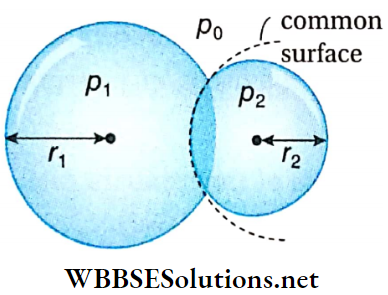
Example 6. Two soap bubbles of radii 0.04 m and 0.03 m are combined in such a way that a common surface is formed between the two bubbles. What is the radius of curvature of the common surface?
Solution:

Let, the radii of the two soap bubbles are r1 and r2, and the internal pressures are p1 and p2 respectively.

The radius of the common surface = r, atmospheric pressure = p0

For the first bubble, \(p_1-p_0=\frac{4 T}{r_1}\)

and for the second bubble, \(p_2-p_0=\frac{4 T}{r_2}\)

where, T = surface tension of soap solution.
Class 11 Physics Unit 7 Properties Of Matter Chapter 3 Viscosity And Surface Tension Two Sopa Bubbles Of Radii Are Combined

Subtracting (1) from (2) we get,

⇒ \(p_2-p_1 = 4 T\left(\frac{1}{r_2}-\frac{1}{r_1}\right)=4 T\left(\frac{1}{0.03}-\frac{1}{0.04}\right)\)

= \(\frac{4 \times 100}{12} \times T\) ……(3)

But, for the common surface, \(p_2-p_1=\frac{4 T}{r}\)……..(4)

Comparing (3) and (4) we get, \(\frac{4 T}{r}=\frac{4 \times 100}{12} \times T\)

∴ r = 0.12 m.


Viscosity And Surface Tension Conclusion

Streamline flow: A smooth, uninterrupted flow of fluid in ordered layers, without any energy transfer between the layers, is called a laminar or streamline flow.

Streamline: In a smooth flow, the path along which any fluid particle moves is called a streamline.

Turbulent flow: If the velocity of a fluid along its flow continuously and randomly changes in magnitude and direction then it is called a turbulent or disorderly flow.

Viscosity: The property by virtue of which a liquid resists the relative motion between its adjacent layers is called viscosity of that liquid.

Velocity profile: The surface obtained by joining the terminal points of the velocity vectors of different layers of a flowing liquid at any section of it is called its velocity profile.

  • In case of flow of a non-viscous liquid along a tube, the velocity profile becomes flat
  • In case of flow of a viscous liquid along a tube, the velocity profile becomes parabolic.

Velocity gradient: In a horizontal streamline flow, the rate of change of velocity with distance \(\left(\frac{d u}{d x}\right)\) in a direction perpendicular to the flow of the liquid is called the velocity gradient. Dimension of velocity gradient \(\left(\frac{d u}{d x}\right)=\frac{\mathrm{LT}^{-1}}{\mathrm{~L}}=\mathrm{T}^{-1} .\)

Coefficient of viscosity: The tangential viscous force acting per unit area between two parallel liquid layers having unit velocity gradient between them is called the coefficient of viscosity of that liquid.

Units of coefficient of viscosity:

CGS system: dyn • s • cm-2 or g • cm-1 • s-1 or poise

SI: N • s • m-2 or Pa • s or kg • m-1 • s-1 or decapoise

Dimension of coefficient of viscosity: ML-1T-1.

  • Usually the viscosity of a liquid increases with the increase in pressure and decreases with the increase in temperature.
  • Pressure has almost no effect on the viscosity of a gas. With the increase in temperature, the viscosity of a gas increases.

Critical velocity: When the velocity of a fluid does not exceed a certain limiting value, the flow of the fluid remains streamline, but when the velocity exceeds that particular limiting value, the flow becomes turbulent. The limiting value of that velocity is called critical velocity.

Reynolds number N is a dimensionless quantity. For N< 2000, the fluid motion is streamlined. If N> 3000, then the fluid motion becomes turbulent. As the value of N gradually changes from 2000 to 3000, the pure streamline flow gradually changes into a fully turbulent flow.

Terminal velocity: When a body falls through a viscous medium under the influence of gravity, the viscosity of the medium offers resistance against its motion.

If the body is small, then after a certain time the magnitude of this upward viscous force become equal to the net force creating the motion. Then the body attains a uniform velocity through the medium. This uniform velocity of the body is called the terminal velocity.

Equation of continuity: In the case of streamline flow of a fluid (liquid or gas), the mass of fluid flowing per second through any cross-section of the tube of flow always remains constant. This is called the equation of continuity.

Bernoulli’s theorem: For the streamline flow of an ideal liquid, the sum of the potential energy, the kinetic energy, and the energy due to pressure per unit volume of the liquid remains constant at every point on the streamline. It leads to the relation

⇒ \(\frac{v^2}{2 g}+h+\frac{p}{\rho g}=\text { constant }\)

or, velocity head + elevation head + pressure head = constant.

Torricelli’s theorem: The velocity of efflux of a liquid, confined in a container through an orifice at some depth of the container is equal to the velocity acquired by a body falling freely from rest under gravity from the free surface of the liquid to the orifice.

Surface tension: Surface tension is a property of the free surface of a liquid due to which it behaves as a stretched thin membrane and has a tendency to con¬tract so as to minimise the surface area.

Units of surface tension:

  • CGS system: dyn · cm-1
  • SI: N • m-1

Dimension of surface tension: MT-1.

Surface energy: The potential energy per unit area of the surface film is called surface energy.

or, surface energy = \(\frac{\text { work done in increasing the surface area }}{\text { increase in surface area }} \text {. }\)

  • The surface energy per unit area is numerically equal to the surface tension of a liquid (if temperature remains constant)
  • At any temperature except absolute zero, the total surface energy of a liquid is always greater than the surface tension.
  • The surface tension of all liquids decreases with the rise in temperature. At the critical temperature of a liquid, the surface tension vanishes.
  • If a liquid surface is contaminated with impurities, then the surface tension of that liquid usually decreases.
  • If an inorganic substance is dissolved in a liquid, then the surface tension increases, but if an organic substance is dissolved, then the surface tension decreases.
  • The presence of electric charges on the surface of a liquid causes a decrease in the surface tension.

Due to surface tension, capillary action is observed in liquids.

  • When a liquid is in contact with a solid, the angle between the solid surface and the tangent to the free surface of the liquid at the point of contact, measured from inside the liquid is called the angle of contact for that specific pair of solid and liquid.
  • If the angle of contact is less than 90°, then the liquid is said to wet the solid, and it rises in a capillary tube. But if the angle of contact is more than 90°, then the liquid does not wet the solid, and falls in a capillary tube.

Jurin’s law: The rise or fall of a liquid in a capillary tube is inversely proportional to the radius of the tube.

Viscosity And Surface Tension Useful Relations For Solving Numerical Problems

For two adjacent layers of a flowing liquid, if the opposing force acting is F, the area of the liquid surface is A and the velocity gradient is \(\frac{d v}{d x}\), then the coefficient of viscosity, \(\eta=\frac{F}{A \frac{d y}{d x}}\)

If Reynolds number is N, velocity of fluid flow is v, characteristic length of the fluid is l, the coefficient of viscosity is η and density of the fluid is ρ, then N = \(\frac{e l v}{\eta}\).

If a small sphere of radius r falls through a medium having a coefficient of viscosity η with a terminal velocity v, then the opposing force acting on the sphere due to viscosity is F = 6πηrv and the terminal velocity of the sphere is,

v = \(\frac{2}{9} \frac{r^2(\rho-\sigma) g}{\eta}\)

where ρ and σ are the densities of the material of the sphere and the material of the medium respectively.

If the cross-sectional area at any place of a tube of flow is a and the velocity of the fluid at that place is v, then the equation of continuity is expressed as, vα = constant.

Bernoulli’s theorem: \(\frac{v^2}{2 g}+h+\frac{p}{\rho g}\) = constant,

where \(\frac{v^2}{2 g}\) is the velocity head, h is the elevation head, and \(\frac{p}{\rho g}\) is the pressure head.

Torricelli’s theorem: The velocity of efflux of a liquid through an orifice situated at a depth h of its container is, v = √2gh

Surface tension = \(\frac{\text { tangential force }}{\text { length }}\)

Work done to increase the area of a liquid surface by unity at constant temperature = surface energy stored per unit area = surface tension.

If the radius of a capillary tube is r, the density’ of liquid is ρ the angle of contact of the liquid with respect to the material of the tube is θ and the surface tension of the liquid is T, then the rise of the liquid in that capillary tube is

h = \(\frac{2 T \cos \theta}{r \rho g}\)

The excess pressure inside a spherical drop or bubble \(p=\frac{2 T}{r}\)

where T = surface tension and r = radius of curvature

The excess pressure inside a spherical soap bubble \(p=\frac{4 T}{r}\)

where T = surface tension and r = radius of curvature.

Viscosity And Surface Tension Assertion Reason Type Question And Answers

Direction: These questions have statement 1 and statement 2. Of the four choices given below, choose the one that best describes the two statements.

  1. Statement 1 is true, statement 2 is true statement n is a correct explanation for statement 1.
  2. Statement 1 is true, statement 2 is true; statement 2 is not a correct explanation for statement 1.
  3. Statement 1 is true, statement 2 is false.
  4. Statement 1 is false, statement 2 is true.

Question 1.

Statement 1: The stream of water flowing at high speed from a garden hose pipe tends to spread like a fountain when held vertically up, but tends to narrow down when held vertically down.

Statement 2: In any steady flow of an incompressible fluid, the volume flow rate of the fluid remains constant.

Answer: 1. Statement 1 is true, statement 2 is true statement n is a correct explanation for statement 1.

Question 2.

Statement 1: The viscosity of liquid increases with rise in temperature.

Statement 2: Viscosity of a liquid is the property of the liquid by virtue of which it opposes the relative motion amongst its different layers.

Answer: 4. Statement 1 is false, statement 2 is true.

Question 3.

Statement 1: All the rain drops hit the surface of the earth with the same constant velocity.

Statement 2: An object falling through a viscous medium eventually attains a terminal velocity.

Answer: 1. Statement 1 is true, statement 2 is true statement n is a correct explanation for statement 1

Question 4.

Statement 1: Air flows from a small bubble to a large bubble when they are connected to each other by a capillary tube.

Statement 2: The excess pressure because of surface tension inside a spherical bubble decreases as its radius increases.

Answer: 1. Statement 1 is true, statement 2 is true statement n is a correct explanation for statement 1
Question 5.

Statement 1: When height of the tube is less than the rise in liquid in a capillary tube, the liquid does not overflow.

Statement 2: Product of radius of meniscus and height of liquid In the capillary tube always remains constant.

Answer: 1. Statement 1 is true, statement 2 is true statement n is a correct explanation for statement 1
Question 6.

Statement 1: It is easier to spray water in which some soap is dissolved.

Statement 2: Soap is easier to spread.

Answer: 3. Statement 1 is true, statement 2 is false.

Question 7.

Statement 1: A needle placed carefully on the surface of water may float, whereas a ball of the same material will always sink.

Statement 2: The buoyancy of an object depends both on the material and shape of the object.

Answer: 3. Statement 1 is true, statement 2 is false.

Question 8.

Statement 1: A large force is required to draw apart normally two glass plates enclosing a thin water film.

Statement 2: Water works as glue and sticks two glass plates.

Answer: 2. Statement 1 is true, statement 2 is true; statement 2 is not a correct explanation for statement 1.

Question 9.

Statement 1: Tiny drops of liquid resist deforming forces better than bigger drop.

Statement 2: Excess pressure inside a drop is directly proportional to surface tension.

Answer: 2. Statement 1 is true, statement 2 is true; statement 2 is not a correct explanation for statement 1.

Question 10.

Statement 1: The uplift of the wing of an aircraft moving horizontally is caused by a pressure difference between the upper and lower faces of the wing.

Statement 2: The velocity of air moving along the upper surface is higher than that along the lower surface.

Answer: 1. Statement 1 is true, statement 2 is true statement n is a correct explanation for statement 1
 

WBCHSE Class 11 Physics Viscosity And Surface Tension Very Short Answer Questions

Viscosity And Surface Tension Very Short Answer Type Questions

Question 1. What is the nature of a fluid flow when the speed of the fluid exceeds critical velocity?
Answer: Turbulent

Question 2. Write down the dimension of the coefficient of viscosity.
Answer: ML-1T-1

Question 3. What is the dimension of the Reynolds number?
Answer: M0L0T0

Question 4. State the nature of the dependence of the terminal velocity of a body in a viscous medium with the coefficient of viscosity of the medium.
Answer: Inversely proportional

Question 5. Can two streamlines intersect each other?
Answer: No

Read And Learn More WBCHSE Class 11 Physics Very Short Question And Answers

Question 6. The viscous force is proportional to the velocity gradient.
Answer: Directly

Question 7. State whether the viscosity of a gas increases or decreases due to an increase in temperature.
Answer: Increases

Question 8. State whether the viscosity of a liquid increases or decreases due to an increase in temperature.
Answer: Decreases

Question 9. How does the viscosity of a liquid change with an increase in pressure?
Answer: Increases

Question 10. How does the viscosity of water change with an increase in pressure?
Answer: Decreases

WBCHSE Class 11 Physics Viscosity And Surface Tension Very Short Answer Questions

WBBSE Class 11 Viscosity and Surface Tension Very Short Answer Questions

Question 11. How does the velocity of flow change with the cross-sectional area of a tube of flow?
Answer: Increases with a decrease in cross-sectional area

Question 12. If a liquid flows through a tube, then what is the velocity of the layer of liquid in contact with the tube?
Answer: Zero

Question 13. 1 Pa • s =? poise.
Answer: 10

Question 14. Liquid : viscocity:: solid : _______
Answer: Friction

Question 15. Which conservation law is expressed by the equation of continuity?
Answer: Law of conservation of mass

Question 16. On which conservation principle is Bernoulli’s theorem established?
Answer: Principle of conservation of energy

Question 17. To what kind of liquid is Bernoulli’s theorem applicable?
Answer: Ideal liquid

Question 18. What is the name of the force of attraction between the molecules of two different substances?
Answer: Adhesive force

Question 19. What do you call the tendency of a liquid to contract its surface area?
Answer: Surface tension

Question 20. Write down the dimension of surface tension.
Answer: MT-2

Class 11 Physics Class 12 Maths Class 11 Chemistry
NEET Foundation Class 12 Physics NEET Physics

Question 21. What is the dimension of surface energy?
Answer: MT-2

Question 22. State whether the surface tension of a liquid increases or decreases due to an increase in temperature.
Answer: Decreases

Question 23. Does the surface tension of a liquid depend on the nature of the medium just above the free surface of tire liquid?
Answer: Yes

Question 24. If the temperature remains fixed, then the surface energy per unit area of a liquid surface is numerically equal to the surface tension of the liquid. Is the statement true or false?
Answer: True

Question 25. What is the SI unit of surface tension?
Answer: N · m-1

Question 26. If a liquid has dissolved organic matter in it, then how does the surface tension of the liquid change?
Answer: Decreases

Question 27. State whether mercury rises or falls inside a glass capillary tube when the tube is dipped into mercury.
Answer: Falls

Question 28. What will be the shape of the mercury meniscus inside a capillary tube when it is dipped into mercury?
Answer: Convex

Question 29. The angle of contact for a solid and a liquid is more than 90°. If the solid is dipped into the liquid, then will the liquid stick to the surface of the solid?
Answer: No

Key Concepts in Viscosity and Surface Tension Short Answers

Question 30. Name the material of a container for which the upper surface of water remains horizontal.
Answer: Silver

Question 31. State whether all liquids will rise in a capillary tube.
Answer: No

Question 32. Name the property due to which a blotting paper can absorb ink.?
Answer: Capillarity

Question 33. When a capillary tube is dipped into water, water rises inside the tube. If the tube is made thinner then how will the rise in the water level change?
Answer: Greater

Question 34. Give the nature of angle of contact for which the liquid wets the solid surface?
Answer: Acute

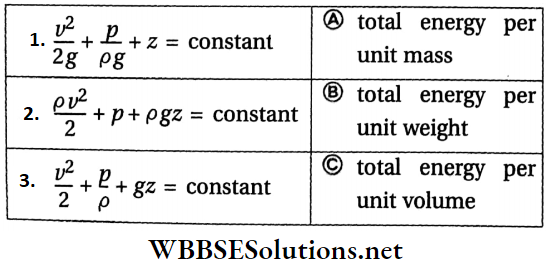
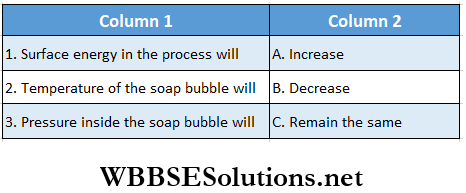
Viscosity And Surface Tension Match Column 1 With Column 2

Question 1. Two soap bubbles combine to form a single big bubble.

Class 11 Physics Unit 7 Properties Of Matter Chapter 3 Viscosity And Surface Tension Match The Column Question 1

Answer: 1. B, 2. A, 3. B

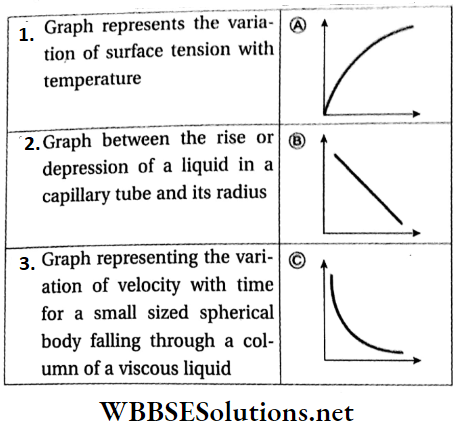
Question 2.

Class 11 Physics Unit 7 Properties Of Matter Chapter 3 Viscosity And Surface Tension Match The Column Question 2

Answer: 1. B, 2. C, 3. A

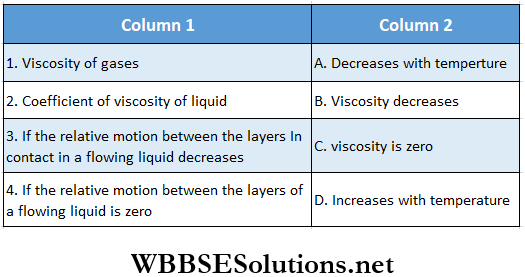
Question 3. Match the two following columns

Class 11 Physics Unit 7 Properties Of Matter Chapter 3 Viscosity And Surface Tension

Class 11 Physics Unit 7 Properties Of Matter Chapter 3 Viscosity And Surface Tension Match The Column Question 3

Answer: 1. B, 2. A, 3. A

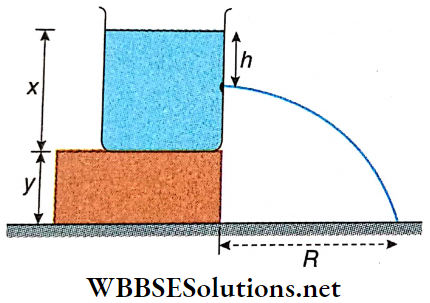
Question 4.

Class 11 Physics Unit 7 Properties Of Matter Chapter 3 Viscosity And Surface Tension Match The Column Question 4

Answer: 1. B, 2. C, 3. A

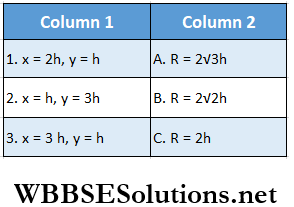
Question 5.

Class 11 Physics Unit 7 Properties Of Matter Chapter 3 Viscosity And Surface Tension Match The Column Question 5

Answer: 1. D, 2. A, 3. B, 4. C

Comparative Analysis of Viscosity and Surface Tension

Viscosity And Surface Tension Comprehension Type Questions And Answers

Read the following passages carefully and answer the questions at the end of them.

Question 1. When liquid medicine of density p is to be put in the eye, it is done with the help of a dropper. As the bulb on the top of the dropper is pressed, a drop forms at the opening of the dropper. We wish to estimate the size of the drop. We first assume that the drop formed at the opening is spherical because that requires the minimum increase in its surface energy. To determine the size, we calculate the net vertical force due to the sur¬face tension T when the radius of the drop is R. When the force becomes smaller than the weight of the drop, the drop gets detached from the dropper.

1. If the radius of the opening of the dropper is r, the vertical force due to the surface tension of the drop of radius R (assuming r << R) is

  1. \(2 \pi r T\)
  2. \(2 \pi R T\)
  3. \(\frac{2 \pi r^2 T}{R}\)
  4. \(\frac{2 \pi R^2 T}{R}\)

Answer: 3. \(2 \pi r T\)

2. If r = 5 x 10⁻⁴ m, ρ = 103 kg · m-3, g = 10 m · s-2, T = 0.11 N · m-1 the radius of the drop when it detaches from the dropper is approximately

  1. 1.4 x 10⁻³ m
  2. 3.3 x 10⁻³ m
  3. 2.0 x 10⁻³ m
  4. 4.1 x 10⁻³ m

Answer: 1. 1.4 x 10⁻³ m

3. After the drop detaches, its surface energy is 

  1. 1.4 x 10⁻⁶ J
  2. 2.7 x 10⁻⁶ J
  3. 5.4 x 10⁻⁶ J
  4. 8.1 x 10⁻⁶ J

Answer: 2. 5.4 x 10⁻⁶ J

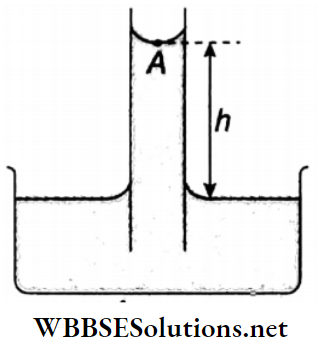
Question 2. The figure shows a glass capillary tube of radius r dipped into water. The atmospheric pressure is p0 and the capillary rise of water is h. Surface tension for water-glass is S.

Class 11 Physics Unit 7 Properties Of Matter Chapter 3 Viscosity And Surface Tension Glass Capillary Rise Of Water

1. The pressure inside water at the point A (the lowest point of the meniscus) is

  1. p0
  2. \(p_0+\frac{2 S}{r}\)
  3. \(p_0-\frac{2 S}{r}\)
  4. \(p_0-\frac{4 S}{r}\)

Answer: 3. \(p_0-\frac{2 S}{r}\)

2. Initially h = 10 cm. If the capillary tube is now inclined at 45°, the length of water rise in the tube will be

  1. 10 cm
  2. 10√2 cm
  3. \(\frac{10}{\sqrt{2}}\) cm
  4. None of these

Answer: 2. 10 72 cm

Real-Life Examples of Viscosity Effects – Brief descriptions of real

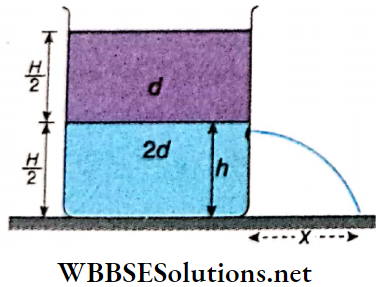
Question 3. A container with a large uniform cross-sectional area A resting on a horizontal surface, holds two immiscible, non-viscous, and incompressible liquids of densities d and 2d each of height H/2 as shown in Fig. The lower density liquid is open to the atmosphere having pressure p0. A tiny hole of area S (S << A) is punched on the vertical side of the container at a height h (h < H/2). As a result of this, liquid starts flowing out of the hole, with a range x on the horizontal surface.

Class 11 Physics Unit 7 Properties Of Matter Chapter 3 Viscosity And Surface Tension Horizontal Surfaec Of Uniform Area Of Cross Section

1. The initial speed of efflux of the liquid at the hole is

  1. \(v=\sqrt{\frac{g}{2}(3 H+4 h)}\)
  2. \(v=\sqrt{\frac{g}{2}(4 H-3 h)}\)
  3. \(v=\sqrt{\frac{g}{2}(3 H-4 h)}\)
  4. \(v=\sqrt{\frac{g}{2}(4 H+3 h)}\)

Answer: 3. \(v=\sqrt{\frac{g}{2}(3 H-4 h)}\)

2. The horizontal distance traveled by the liquid, initially is

  1. \(\sqrt{(3 H+4 h) h}\)
  2. \(\sqrt{(3 h+4 H) h}\)
  3. \(\sqrt{(3 H-4 h) H}\)
  4. \(\sqrt{(3 H-4 h) h}\)

Answer: 4. \(\sqrt{(3 H-4 h) h}\)

3. The maximum horizontal distance traveled by the liquid is

  1. \(x_{\max }=\frac{H}{4}\)
  2. \(x_{\max }=\frac{2 H}{4}\)
  3. \(x_{\max }=\frac{3 H}{4}\)
  4. \(x_{\max }=\frac{5 H}{4}\)

Answer: 3. \(x_{\max }=\frac{3 H}{4}\)

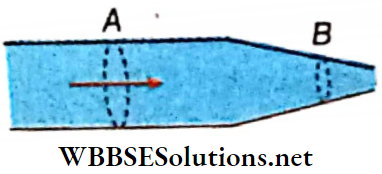
Question 4. Water flows through a horizontal tube of variable cross-section. The areas of cross-section at A and B are 4 mm2 and 2 mm2 respectively. Given that 10-6 m3 of water enters per second through A.

Class 11 Physics Unit 7 Properties Of Matter Chapter 3 Viscosity And Surface Tension Water Flows Through Horizontal Tube

1. The speed of the water at A is

  1. 1.00 m · s-1
  2. 0.75 m · s-1
  3. 0.25 m · s-1
  4. 0.50m · s-1

Answer: 3. 0.25 m · s·

2. The speed of the water at B is

  1. 1.00 m · s-1
  2. 0.30m · s-1
  3. 0.70 m · s-1
  4. 0.50 m · s-1

Answer: 4. 0.50 m · s-1

3. The pressure difference pA – pB is

  1. 85 N · m-2
  2. 94 N · m-2
  3. 100 N · m-2
  4. 105 N · m-2

Answer: 2. 94 N · m-2

Question 5. Let n number of little droplets of water of surface tension S dyn · cm-1, all of the same radius r cm, combine to form a single drop of radius R cm. J is Joule’s mechanical equivalent of heat. While using the CGS system of units answer the following questions.

1. The energy released is

  1. S x 4π nr²
  2. S X 4π R²
  3. S x 4πr²n [1 – n1/3]
  4. S x 4πR² [n2/3 – 1]

Answer: 3. S x 4πr²n [1 – n1/3]

2. If the whole energy released is taken by the water drop formed, then rise in temperature in °C is

  1. \(\frac{S}{J}\left[\frac{1}{r}-\frac{1}{R}\right]\)
  2. \(\frac{4 S}{J}\left[\frac{n}{r}-\frac{1}{R}\right]\)
  3. \(\frac{3 S}{J}\left[\frac{1}{r}-\frac{1}{R}\right]\)
  4. \(\frac{S}{J}\left[\frac{n}{r}-\frac{1}{R}\right]\)

Answer: 3. \(\frac{3 S}{J}\left[\frac{1}{r}-\frac{1}{R}\right]\)

3. What is the change in excess of pressure inside the big drop formed and a small drop if the change in temperature is ignored?

  1. \(2 S\left[\frac{1}{r}-\frac{1}{R}\right]\)
  2. \(S\left[\frac{1}{r}-\frac{1}{R}\right]\)
  3. \(S\left[\frac{n}{r}-\frac{1}{R}\right]\)
  4. \(2 S\left[\frac{n}{r}-\frac{1}{R}\right]\)

Answer: 1. \(2 S\left[\frac{1}{r}-\frac{1}{R}\right]\)

Question 6. A cylindrical tank is open at the top and has a cross-sectional area a1. Water is filled in it up to a height of h. There is a hole of cross-sectional area a2 at its bottom. Given a1 = 3a2

1. The initial velocity with which the water falls in the tank is

  1. \(\sqrt{2 g h}\)
  2. \(\sqrt{g h}\)
  3. \(\sqrt{\frac{g h}{2}}\)
  4. \(\frac{1}{2} \sqrt{g h}\)

Answer: 4. \(\frac{1}{2} \sqrt{g h}\)

2. The initial velocity with which the water emerges from the hole is

  1. \(\frac{1}{2} \sqrt{g h}\)
  2. \(\sqrt{2 g h}\)
  3. \(\frac{3}{2} \sqrt{g h}\)
  4. 2 \(\sqrt{2 g h}\)

Answer: 3. \(\frac{3}{2} \sqrt{g h}\)

3. The time taken to empty the tank is

  1. \(\sqrt{\frac{2 h}{g}}\)
  2. \(4 \sqrt{\frac{h}{g}}\)
  3. \(6 \sqrt{\frac{2 h}{g}}\)
  4. \(8 \sqrt{\frac{2 h}{g}}\)

Answer: 2. \(4 \sqrt{\frac{h}{g}}\)

Viscosity And Surface Tension Integer Type Questions And Answers

In this type, the answer to each of the questions is a single-digit integer ranging from 0 to 9.

Question 1. Two soap bubbles A and B are kept in a closed chamber where the air is maintained at a pressure of 8 N · m-2. The radii of bubbles A and B are 2 cm and 4 cm respectively. The surface tension of the soap water used to make bubbles is 0.04 N · m-1. Find the ratio nB/nA where nA and nB are the number of moles of air in bubbles A and B respectively. (Neglect the effect of gravity).
Answer: 6

Question 2. A vessel whose bottom has a round hole with a diameter of 1 mm is filled with water. Only surface tension acts at the hole. The surface tension of water is 75 x 10-3 N · m-1 and g = 10 m · s-2. What is the maximum height (in cm) to which water can be filled in the vessel without leakage?
Answer: 3

Question 3. A layer of glycerine of thickness 1 mm is present between a large surface area and a surface area of 0.1 m2. With what force (in N) the small surface is to be pulled, so that it can move with a velocity of 1 m · s-1? (Given the coefficient of viscosity = 0.07 kg • m-1· s-1)
Answer: 7

Question 4. A glass rod of diameter d1 = 1.5 mm is inserted sym-metrically into a glass capillary with inside diameter d2 = 2.0 mm. Then the whole arrangement is vertically oriented and brought in contact with the surface of water. To what height (in cm) will the liquid rise in the capillary? Surface tension of water = 73x 10-3 N · m-1
Answer: 6

Question 5. A metal ball of radius 2 mm and density 10.5 g · cm-3 is dropped in glycerine of coefficient of viscosity 9.8 dyn · cm-2 · s and density 1.5 g · cm-3. Find the terminal velocity (in cm · s-1) of the ball.
Answer: 8

WBCHSE Class 11 Physics Viscosity And Surface Tension Long Answer Questions

Viscosity And Surface Tension Long Answer Type Questions And Answers

Question 1. What is velocity gradient? What is its dimension?
Answer:

In a horizontal streamline flow, the rate of change of velocity with distance \(\left(\frac{d u}{d x}\right)\) a direction perpendicular to the flow of the liquid is called the velocity gradient.

Dimension of velocity gradient = \(\left(\frac{d u}{d x}\right)=\frac{\mathrm{LT}^{-1}}{\mathrm{~L}}=\mathrm{T}^{-1} \text {. }\)

Question 2. How can you detect whether the motion of a liquid is streamlined or turbulent?
Answer:

Let a liquid flow through a narrow pipe of uniform cross-section. A coloured solution is injected along the axis of the pipe at the point of entry. If this coloured solution flows like a thread along the axis of the pipe, then it is in streamlined motion. The coloured solution spreads all over the liquid in the case of turbulent motion.

Read and Learn More Class 11 Physics Long Answer Questions

Question 3. Write down the characteristics of streamline motion.
Answer:

Characteristics of streamline motion:

  1. The velocity of a fluid particle at any point of a streamline remains the same in magnitude and direction it does not change with time.
  2. The layer of liquid in contact with the solid surface remains at rest, i.e., the velocity of that layer is zero.
  3. In streamline motion, a liquid is assumed to be arranged in parallel layers one over the other.
  4. Two streamlines never intersect each other.
  5. In the tube of flow, if the streamlines get crowded, then the velocity of fluid flow is greater there, but if the streamlines remain comparatively apart then the velocity of fluid flow is less there.

Question 4. Discuss the differences between viscosity and friction.
Answer:

Class 11 Physics Unit 7 Properties Of Matter Chapter 3 Viscosity And Surface Tension Differnces Between Viscocoty And Friction

WBBSE Class 11 Viscosity and Surface Tension Long Answer Questions

Question 5. Why do two streamlines never intersect each other?
Answer:

If two streamlines intersect each other, then, at the point of intersection, we can draw two tangents to the two streamlines, which would imply two different directions of the velocity of the particle at that point. But in a streamline any particle can move only in one direction and hence two streamlines never intersect each other.

Class 11 Physics Class 12 Maths Class 11 Chemistry
NEET Foundation Class 12 Physics NEET Physics

Question 6. Why does the end of a glass rod become round on heating?
Answer:

When glass starts melting on heat absorption, the liquid surface tries to attain minimum surface area due to the property of surface tension. So the end of a glass rod attains a hemispherical shape.

WBCHSE Class 11 Physics Viscosity And Surface Tension laqs

Question 7. Why does machine parts get jammed in winter?
Answer:

The temperature of the atmosphere decreases in winter. So the viscosity of the lubricating oil increases very rapidly. Due to this reason the machine parts which are directly in contact with the oil. do not move smoothly, that is why they get jammed.

Question 8. What is an ideal fluid?
Answer:

An ideal fluid is incompressible, i.e., the density or volume of that fluid does not change on pressing it. It is non-viscous too. There is no tangential force acting between two adjacent layers of that fluid.

Question 9. Between two lubricating oils A and B, the coefficient of viscosity of A is greater than that of B. For a machine, which one of them is suitable in summer?
Answer:

In summer, the viscosity of a liquid decreases due to increase in temperature. A is more suitable because its coefficient of viscosity is greater.

Question 10. During a cyclone, bits of paper, leaves from a tree, etc.. enter the twister and move upwards revolving continuously. Explain.
Answer:

During a cyclone, the velocity of air inside the twister is greater than that of air outside it and hence the air pressure within the twister becomes low.

So, bits of paper, leaves, etc., enter the centre of the twister from the outer high-pressure zone. Inside the twister, the speed of air in the upward direction is higher; so the pieces of paper, leaves, etc., keep moving upwards revolving continuously.

Question 11. Discuss the importance of the streamlined shape of a fish.
Answer:

A fish experiences viscous drag force while moving through water. The body of a fish is tapered at the head and at the tail, and is compressed at the sides. This is a type of streamlined shape.

For this reason, a fish experiences less viscous drag force while swimming through water and the water flowing by the fish follows streamlines. So they are able to control their direction of motion very easily. For the same reason, the shape of airplanes, fast moving trains, or racing cars, are made streamlined.

Surface Tension Measurement Techniques

Question 12. State whether critical velocity and terminal velocity are the same?
Answer:

Critical velocity and terminal velocity are not the same. The critical velocity of a liquid is the limiting velocity for streamlining flow of the liquid, but terminal velocity is the constant velocity acquired by a body moving through a fluid.

Question 13. A lead ball is allowed to fall through an elongated column filled with glycerine. What sort of graph would we get on plotting the velocity (v) and the distance traversed (s) by the lead ball?
Answer:

Class 11 Physics Unit 7 Properties Of Matter Chapter 3 Viscosity And Surface Tension v s Graph Or velocity Displacement Graph

Glycerine is a viscous liquid. We know that the velocity of the lead ball will increase at first, and, after sometime, it will move with a uniform velocity (terminal velocity). The v-s graph or velocity-displacement graph obtained is as shown in Fig.

Question 14. To make a piece of paper float horizontally in air, we allow air to flow over the upper surface of the paper, but not below its lower surface. Why?
Answer:

If air is allowed to flow horizontally over the upper surface of the paper, the velocity of air above the paper will be comparatively higher than that below it. According to Bernoulli’s theorem, the lower surface of the paper will experience a higher pressure than the upper surface. The resultant upward pressure keeps the piece of paper floating horizontally in air.

Question 15. Why flags flutter in a windy day?
Answer:

Wind generally flows in different velocities by the two sides of a flag. According to Bernoulli’s theorem, the air pressure becomes lower at the side where the velocity of wind is more. A flag flutters in a windy day due to this difference in air pressure and also due to the random push by the particles present in the atmosphere.

Question 16. A large drop of water breaks up into a large number of small droplets. Does the surface energy increase?
Answer:

  • In this case, the surface energy will increase.
  • It can be shown by calculation that the total surface area of the smaller droplets of water is greater than the surface area of the large drop.
  • So, during the breaking up of a large drop of water into many small droplets, the surface area increases. So, increase in surface area x surface tension = increase in surface energy.

Question 17. If a large number of water droplets coalesce to form a single large drop, then state whether the total surface energy increases or decreases. Explain.
Answer:

In this case, the surface energy decreases.

  • The total surface area of the small droplets is greater than the surface area of the large drop formed.
  • So, when a large number of water droplets coalesce to form a single large drop, the surface area decreases.
  • Hence, it indicates a decrease in surface energy, because decrease in surface energy = decrease in surface area x surface tension.

Real-Life Examples of Surface Tension Effects

Question 18. Why are small drops of water in air spherical in shape?
Answer:

Due to surface tension, the liquid surface always tries to contract itself to minimise its surface area. Among all objects of equal volume, the surface area of a sphere is the minimum and hence in air every small drop of water takes the shape of a sphere.

Question 19. If a few spherical drops of a liquid coalesce to form a larger drop, will its temperature rise or fall? Explain.
Answer:

When a few spherical drops of a liquid coalesce to form a larger drop, the surface area decreases. As a result, some surface energy is released. This surface energy is converted into heat energy, thereby the temperature of the large drop increases.

Question 20. Mention a pair of solid and liquid for each of the following cases where the angle of contact is

  1. 90°
  2. less than 90°
  3. more than 90°.

Answer:

  1. In the case of silver and water, the angle of contact is
    9°.
  2. In the case of glass and water, the angle of contact is less than 90°.
  3. In the case of glass and mercury, the angle of contact is more than 90°.

Question 21. Why does water stick to the fingers, but mercury does not?
Answer:

  • Since the angle of contact of water with respect to our body is acute, it sticks to our fingers. It means that the adhesive force between water and our fingers is higher than the cohesive force between water molecules.
  • But the angle of contact of mercury with respect to our body is obtuse and hence it does not stick to our fingers. In this case, the cohesive force between mercury molecules is higher.

Question 22. Why does water rise through a capillary tube whereas mercury goes down through it?
Answer:

We know that if h is the rise of a liquid in a capillary tube, then h = \(\frac{2 T \cos \theta}{r \rho g} .\)

Here, T = surface tension, r = radius of the tube, p = density of the liquid, θ = angle of contact.

  • Now, in the case of water, the angle of contact θ < 90°. So cosθ is a positive quantity and hence h is positive. So, water rises in a capillary tube.
  • In the case of mercury, the angle of contact θ > 90°. So, cosθ is a negative quantity and hence h is negative. So, mercury goes down in a capillary tube.

Comparative Analysis of Viscosity and Surface Tension

Question 23. Why does the nib of a fountain pen have a slit at its centre?
Answer:

The slit helps the ink to flow to the tip of the nib through capillary action; sometimes against the force of gravity.

Question 24. Why do we use a detergent to wash dirty clothes?
Answer:

Since water has a comparatively high surface ten¬sion, it cannot penetrate the minute pores of dirty clothes. On mixing a detergent with water, the surface tension decreases; so water enters the pores and washes out the dirt of the clothes.

Question 25. To what height will water rise in a capillary tube provided there is no gravity acting on it?
Answer:

In the absence of gravity, there is no resistance against the rise of a liquid in 3 capillary tube due to surface tension. So, if the length of the capillary tube is infinite, water will rise to that infinite height.

Again, if the tube is of finite length, water fills it up completely. Even if water spills out, due to capillary action, more water will be drawn into the tube to fill it completely.

Capillary rise, \(h=\frac{2 T \cos \theta}{r \rho g}\)

In absence of gravity, g = 0.

So, h → ∞.

Question 26. In an experiment on surface tension, water rises up to a height of 0.1 m in a capillary tube. If the same experiment is performed in a satellite moving around the earth, what will be the rise in the capillary tube?
Answer:

The weight of the water column in the capillary tube will be zero in an orbiting satellite. Hence, due to surface tension, water will rise up to the top of the tube, and the capillary tube will be completely filled with water.

WBCHSE Class 11 Physics Viscosity And Surface Tension Short Answer Type Questions

Viscosity And Surface Tension Short Answer Type Questions

Question 1. A small spherical body of radius r made of material of density ρ is dropped into a long column of viscous liquid of density σ and coefficient of viscosity η. The graph of the terminal velocity (v) vs radius (r) of the body will be

  1. Straight line
  2. Parabola
  3. Ellipse
  4. None of these

Answer:

We know, terminal velocity, \(v=\frac{2}{9} \frac{r^2(\rho-\sigma) g}{\eta}\)

As v ∝ r² the graph v-r is a parabola.

The option 2 is correct.

Question 2. A spherical air bubble of radius r is formed in water. If T be the surface tension of water, the excess pressure inside the bubble is

  1. 4T/r
  2. 2T/r
  3. T/r
  4. None of these

Answer: The option 2 is correct.

Question 3. A During fall of water gently from a water tap the stream gets thinner at the bottom. Why?
Answer:

Velocity of the downward flow is higher. So the streamlines are crowded together. Hence the flow becomes thinner.

WBCHSE Class 11 Physics Viscosity And Surface Tension Short Answer Type Questions

Question 4. According to Jurin’s law, the graph of the diameter (d) vs height of the water column (h) of the capillary tube will be

  1. Circular
  2. Parabola
  3. Hyperbola
  4. Straight line

Answer: The option 3 is correct.

WBBSE Class 11 Viscosity and Surface Tension Short Answer Questions

Question 5. The work done in blowing a soap bubble of volume V is W. The work is to be done in blowing it of volume 2 V equals to

  1. 2W
  2. \(\sqrt[3]{4} W\)
  3. \(\sqrt[3]{2} W\)
  4. 2W

Answer:

When radius of the soap bubble is x, then excess pressure inside the bubble,

p = 4T/x [T = surface tension of soap water]

Volume, V = \(\frac{4}{3} \pi x^3\)

If the radius increases by dx, then increase in volume, dV = \(p d V=\frac{4 T}{x} \cdot 4 \pi x^2 d x=16 \pi T \cdot x d x\)

Now, work done for this increase, dW = \(p d V=\frac{4 T}{x} \cdot 4 \pi x^2 d x=16 \pi T \cdot x d x\)

If the radii of the rubbles of V and 2 V volume are R and R’ respectively,

V = \(\frac{4}{3} \pi R^3 \text { and } 2 V=\frac{4}{3} \pi R^3\)

∴ \(\frac{2 V}{V}=\left(\frac{R^{\prime}}{R}\right)^3 \text { or, } \frac{R^{\prime}}{R}=2^{1 / 3} \)

Work done to increase volume from 0 to V,

W = \(\int d W=16 \pi T \int_0^R x d x=\left.16 \pi T \frac{x^2}{2}\right|_0 ^R=8 \pi T R^2\)

Similarly, work was done to increase volume from 0 to 2 V,

W’ = \(8 \pi T R^{12}=8 \pi T R^2\left(\frac{R^{\prime}}{R}\right)^2\)

= \(W\left(2^{1 / 3}\right)^2=\sqrt[3]{4} W\)

The option 2 is correct.

Class 11 Physics Class 12 Maths Class 11 Chemistry
NEET Foundation Class 12 Physics NEET Physics

Question 6. Two solid spheres of same metal having masses M and 8 M respectively fall simultaneously on a same viscous liquid and their terminal velocities are v and nv, then the value of n is

  1. 16
  2. 8
  3. 4
  4. 2

Answer:

Ratio of the masses of the two spheres =1:8

So, ratio of their volumes =1:8 and ratio of their radii = \(1: 8^{1 / 3}=1: 2\)

Thus, terminal velocity, \(v=\frac{2}{9} \frac{r^2(\rho-\sigma) g}{n} \text { i.e., } v \propto r^2\)

Hence, ratio of the terminal velocities of the two spheres
= 1:22 = 1:4 = v:4

∴ n = 4

The option 3 is correct.

Key Concepts in Viscosity and Surface Tension Short Answers

Question 7. Two water drops of equal size are falling through air with constant velocity of 2 m/s. If the two drops are allowed to coalesce to form a single drop, what would be its terminal velocity?
Answer:

Ratio of volumes of the smaller and bigger water drop = 1:2

So, ratio of their radii = 1: \(2^{1 / 3}\)

Terminal velocity,

v = \(\frac{2}{9} \frac{r^2(\rho-\sigma) g}{\eta}, \text { i.e., } v \propto r^2\)

∴ \(\frac{v_1}{v_2}=\left(\frac{r_1}{r_2}\right)^2\)

or, \(v_2=v_1\left(\frac{r_2}{r_1}\right)^2=2 \times\left(\frac{2^{1 / 3}}{1}\right)^2=2^{5 / 3}\)

= \(\sqrt[3]{32}=3.175 \mathrm{~m} \cdot \mathrm{s}^{-1}\)

Question 8. What is the gain in potential energy of the water column in case of rise of water in a glass capillary tube? What is the work done by surface tension? Assume that the angle of contact between glass and water is 0°.
Answer:

Rise of water inside the capillary tube of radius r is,
h = \(\frac{2 T \cos \theta}{\rho g r}=\frac{2 T}{\rho g r}\) [where T = surface tension;

θ = angle of contact = 0°; ρ = density of water] Mass of water column of height h, m = nr^hp

The height of centre of mass of the water column = h/2

∴ The gain in potential energy,

U = \(m g \times \frac{h}{2}=\frac{1}{2} \pi r^2 \rho g h^2\)

= \(\frac{1}{2} \pi r^2 \rho g \times \frac{4 T^2}{\rho^2 g^2 r^2}=\frac{2 \pi T^2}{\rho g}\)

The work done by surface tension,

W = \(2 \pi r h T \cos \theta=2 \pi r \times \frac{2 T}{\rho g r} \times T \times \cos 0^{\circ}=\frac{4 \pi T^2}{\rho g}\)

Question 9. Water rises up to a height h in a certain capillary tube of a particular diameter. Another capillary tube is taken whose diameter is half that of the previous tube. The height up to which water will rise in the second tube is

  1. 3h
  2. 2h
  3. 4h
  4. h

Answer:

As, \(h \propto \frac{1}{r} \text {, so } \frac{h}{h^{\prime}}=\frac{r^{\prime}}{r}\)

Here, \(r^{\prime}=\frac{r}{2}\text { or, } r=2 r^{\prime} \)

∴ \(\frac{h}{h^{\prime}}=\frac{r^{\prime}}{2 r^{\prime}} \text { or, } h^{\prime}=2 h\)

The option 2 is correct.

Question 10. When two soap bubbles of radii r1 and r2(r2> r1) adjoin, the radius of curvature of the common surface
is

  1. \(r_2-r_1\)
  2. \(r_2+r_1\)
  3. \(\frac{\left(r_2-r_1\right)}{r_1 r_2}\)
  4. \(\frac{r_1 r_2}{r_2-r_1}\)

Answer:

If the atmospheric pressure is p0, then in case of the first bubble,

⇒ \(p_1-p_0=\frac{4 T}{r_1}\) [T = surface tension of soap solution]

In case of the second bubble,

⇒ \(p_2-p_0=\frac{4 T}{r_2}\)

⇒ \(p_1-p_2=4 T\left(\frac{1}{r_1}-\frac{1}{r_2}\right)\)

Again, if the radius of curvature of the common surface is r, then, \(p_1-p_2=\frac{4 T}{r}\)

∴ \(\frac{4 T}{r}=4 T\left(\frac{1}{r_1}-\frac{1}{r_2}\right) \text { or, } \frac{1}{r}=\frac{r_2-r_1}{r_1 r_2} \text { or, } r=\frac{r_1 r_2}{r_2-r_1}\)

The option 4 is correct.

Applications of Surface Tension in Real Life

Question 11. 27 number of droplets having same size are falling through air with the same terminal velocity of 1 m · s-1. If the small droplets merge to produce a new drop, what will be the terminal velocity of the new drop?
Answer:

The terminal velocity of a moving droplet is proportional to the square of its radius.

When 27 number of droplets having same size merge and form a new drop then the volume of the new drop becomes 27 times the volume of each small drop.

Hence, the radius of the new drop becomes 3√27 times or 3 times.

So, the terminal velocity will be (3)² or 9 times.

∴ The terminal velocity of the new drop = 9×1 = 9 m · s-1

Question 12. The dimension of surface tension is

  1. MLT-2
  2. MLT-1
  3. MT-2
  4. ML2T-2

Answer: The option 3 is correct.

Question 13. The speed of a ball of radius 2 cm in a viscous liquid medium is 20 cm · s-1. The speed of a ball of radius 1 cm in the same liquid will be

  1. 5 cm · s-1
  2. 10 cm · s-1
  3. 40 cm · s-1
  4. 80cm · s-1

Answer:

Terminal velocity, v ∝ r²

∴ \(\frac{v^{\prime}}{v}=\left(\frac{r^{\prime}}{r}\right)^2 \quad \text { or, } v=\left(\frac{1}{2}\right)^2 \times 20=5 \mathrm{~cm} \cdot \mathrm{s}^{-1}\)

The option 1 is correct.

Question 14. Write down Stokes’ law and derive it from dimensional analysis.
Answer:

[F] = MLT-2

[6πηrv] =[η]>[r] · [v] = ML-1T-1 · L · LT-1

= MLT-2

∴ F = 6πηv

Question 15. A small metal sphere of radius a is falling with a velocity through a vertical column of a viscous liquid. If the coefficient of viscosity of the liquid is η, then the sphere encounters an opposing force of

  1. \(6 \pi \eta a^2 v\)
  2. \(\frac{6 \eta \nu}{\pi a}\)
  3. \(6 \pi \eta a v\)
  4. \(\frac{\pi \eta v}{6 a^3}\)

Answer: The option 3 is correct.

Question 16. A drop of some liquid of volume 0.04 cm3 is placed on the surface of a glass slide. Then another glass slide is placed on it in such a way that the liquid forms a thin layer of area 20 cm² between the surfaces of the two slides. To separate the slides, a force of 16 x 105 dyne has to be applied normally to the surfaces. The surface tension of the liquid is (in dyn · cm-1)

  1. 60
  2. 70
  3. 80
  4. 90

Answer:

Thickness of layer,

h = \(\frac{\text { volume }}{\text { area }}=\frac{0.04}{20}=0.002 \mathrm{~cm}\)

Radius of curvature of concave surface,

r = h/2 = 0.001 cm.

Force, F = T/r x area

∴ Surface tension,

T = \(\frac{F \times r}{\text { area }}=\frac{16 \times 10^5 \times 0.001}{20}=80 \mathrm{dyn} \cdot \mathrm{cm}^{-1}\)

The option 3 is correct.

Real-Life Examples of Viscosity Effects

Question 17. A 20 cm long capillary tube is dipped vei tically in water and the liquid rises upto 10 cm. If the entire system is kept in a freely falling platform, the length of water column in the tube will be

  1. 5 cm
  2. 10 cm
  3. 15 cm
  4. 20 cm

Answer:

Height of water in the capillary tube, h = \(\frac{2 T}{r \rho g}\)

Here, T = surface tension of water

If the entire system is kept in a freely falling platform,
g = 0

But there will be no change in T.

∴ h → ∞

So, the maximum length of water column in the tube will be 20 cm.

The option 4 is correct.

Question 18. A gas bubble of 2 cm diameter rises through a liquid of density 1.75 g · cm-3 with a fixed speed of 0.35 cm · s-1. Neglect the density of the gas. The coefficient of viscosity of the liquid is

  1. 870 poise
  2. 1120 poise
  3. 982 poise
  4. 1089 poise

Answer:

The coefficient of viscosity of the liquid,

⇒ \(\eta=\frac{2}{9} \frac{r^2(\rho-\sigma) g}{v}\)

Here, r = 1cm, v = -0.35 cm/s, ρ = 0, σ = 1.75 g · cm-3

∴ \(\eta=\frac{2}{9} \times \frac{(1)^2(0-1.75) \times 980}{-0.35}\)

= 1088.8 ≈ 1089 poise

The option 4 is correct.

Question 19. 1000 droplets of water having 2 mm diameter each coalesce to form a single drop. Given the surface tension of water is 0.072 N · m-1. The energy loss in the process is

  1. 8.146 x 10⁻⁴ J
  2. 4.4 x 10⁻⁴ J
  3. 2.108 x 10⁻⁵ J
  4. 4.7 x 10⁻¹ J

Answer:

Let us consider the radius of the big drop of water = R

∴ \(\frac{4}{3} \pi R^3=\frac{4}{3} \pi(0.1)^3 \times 1000\)

or, R3 = 1 or, R = 1.0 cm

The area of the surface of the big drop to water = 4π(1.0)² – 4π cm²

The total area of the surfaces of 1000 droplets of water = 4π(0.1)² x 1000 cm²

Decrease in surface area = 47(0.1)² x 1000 -4π

= 4π(10 – 1)

= 36π cm² = 0.00367 m²

The energy loss =0.00367×0.072

= 8.143 x 10⁻⁴ J

The option 1 is correct.

Question 20. A drop of water detaches itself from the exit of a tap when [σ = surface tension of water, ρ = density of water, R =radius of the tap exit, r=radius of the drop]

  1. \(r>\left(\frac{2}{3} \frac{R \sigma}{\rho g}\right)^{\frac{1}{3}}\)
  2. \(r>\left(\frac{2}{3} \frac{\sigma}{\rho g}\right)\)
  3. \(\frac{2 \sigma}{r}>\) atmospheric pressure
  4. \(r>\left(\frac{2}{3} \frac{R \sigma}{\rho g}\right)^{\frac{2}{3}}\)

Answer:

Upward force due to surface tension

= Fsinθ = σ x 2π R sinθ

Class 11 Physics Viscosity And Surface Tension Short Answer Questions

= \(\sigma \times 2 \pi R \times \frac{R}{r}=\frac{2 \pi \sigma R^2}{r}\)

Weight of the drop of water = mg = \(\frac{4}{3} \pi r^3 \rho g\)

The drop will detach if, \(\frac{4}{3} \pi r^3 \rho g>\frac{2 \pi \sigma R^2}{r} \text { or, } r^4>\frac{3}{2} \frac{\sigma R^2}{\rho g}\)

∴ \(r>\left(\frac{3}{2} \frac{\sigma R^2}{\rho g}\right)^{\frac{1}{4}}\)

None of the options are correct.

Question 21. A uniform capillary tube of length l and inner radius r with its upper end sealed is submerged vertically into the water. The outside pressure is p0 and surface tension of water is γ. When a length x of the capillary is submerged into water, it is found that water levels inside and outside the capillary coincide. The value of x is

  1. \(\frac{l}{\left(1+\frac{p_0 r}{4 \gamma}\right)}\)
  2. \(\frac{l}{\left(1-\frac{p_0 r}{4 \gamma}\right)}\)
  3. \(\frac{l}{\left(1-\frac{p_0 r}{2 \gamma}\right)} \)
  4. \(\frac{l}{\left(1+\frac{p_0 r}{2 \gamma}\right)}\)

Answer:

When a length x of the capillary is submerged in water and the atmospheric pressure in the capillary tube is p’, then

⇒ \(p_0(l A)=p^{\prime}(l-x) A\)

or, \(p^{\prime}=\frac{p_0 l}{l-x}\) …..(1)

As the water levels inside and outside the capillary coincide, so \(p^{\prime}-p_0=\frac{2 \gamma}{r}\)…..(2)

Solving equation (1) and (2) we get,

x = \(\frac{l}{\left(1+\frac{p_0 r}{2 \gamma}\right)}\)

Question 22. What will be the approximate terminal velocity of a raindrop of diameter 1.8 x 10⁻³ m, when density of rain water ≈ 103 kg · m-3 and the coefficient of viscosity of air ≈ 1.8 x 10⁻⁵ N · s · m-2? (Neglect buoyancy of air)

  1. 49m · s-1
  2. 98m · s-1
  3. 392 m · s-1
  4. 980 m · s-1

Answer:

F = 6πηrv [v is the terminal velocity]

or, \(m g=6 \pi \eta r v \quad \text { or, } \frac{4}{3} \pi r^3 \times \rho \times g=6 \pi \eta r \nu\)

or, v = \(\frac{4 \pi r^3 \rho g}{3 \times 6 \pi \eta r}=\frac{2 r^2 \rho g}{9 \eta}\)

= \(\frac{2 \times 1.8 \times 1.8 \times 10^{-6} \times 10^3 \times 9.8}{4 \times 9 \times 1.8 \times 10^{-5}}=98 \mathrm{~m} / \mathrm{s}\)

The option 2 is correct.

Step-by-Step Explanations for Short Viscosity Questions

Question 23. On heating water, bubbles being formed at the bottom of the vessel detach and rise. Take the bubbles to be spheres of radius R and making a circular contact of radius r with the bottom of the vessel. If r<<R and the surface tension of water is T, value of r just before bubbles detach is (density of water is ρ)

  1. \(R^2 \sqrt{\frac{\rho_w g}{3 T}}\)
  2. \(R^2 \sqrt{\frac{\rho_{w g} g}{6 T}}\)
  3. \(R^2 \sqrt{\frac{\rho_w g}{T}}\)
  4. \(R^2 \sqrt{\frac{3 \rho_w g}{T}}\)

None of the options are correct.

Question 24. certain number of spherical drops of a liquid of radius r coalesce to form a single drop of radius R and volume V. If T is the surface tension of the liquid, then

  1. Energy = 4vt\(\left(\frac{1}{r}-\frac{1}{r}\right)\) is released
  2. Energy = 3vt\(\left(\frac{1}{r}+\frac{1}{r}\right)\) is absorbed
  3. Energy = 3vt\(\left(\frac{1}{r}-\frac{1}{r}\right)\) is released
  4. Energy is neither released nor absorbed

Answer:

⇒ \(A_f=4 \pi R^2=\frac{3}{3} 4 \pi \frac{R^3}{R}=\frac{3 V}{R}\)

⇒ \(A_i=n \times 4 \pi r^2=\frac{V}{\frac{4}{3} \pi r^3} 4 \pi r^2=\frac{3 V}{r}\)

Hence, energy released = \(\left(A_i-A_f\right) T=3 V T\left(\frac{1}{r}-\frac{1}{R}\right)\)

The option 3 is correct.

Question 25. A wind with speed 40 m/s blows parallel to the roof of a house. The area of the roof is 250 m2. Assuming that the pressure inside the house is atmospheric pressure, the force exerted by the wind on the roof and the direction of the force will be [ρair =1.2 kg/m3]

  1. 4.8 x 10⁵ N, downwards
  2. 4.8 x 10⁵ N, upwards
  3. 2.4 x 10⁵ N, upwards
  4. 2.4 x 10⁵ N, downwards

Answer:

According to Bernoulli’s theorem, \(p+\frac{1}{2} \rho v^2=\text { constant }\)

When the pressure inside the house = atmospheric pressure, P0.

Let the pressure on the roof be P.

∴ \(P+\frac{1}{2} \rho v^2=P_0+0\)

Clearly, P0 > P

So, effective pressure P0 – P will act in the upward direction.

⇒ \(P_0-P=\frac{1}{2} \rho v^2=\frac{1}{2} \times 1.2 \times(40)^2\)

Hence, effective force

= \(\frac{1}{2} \times 1.2 \times(40)^2 \times 250=2.4 \times 10^5 \mathrm{~N}\)

The option 3 is correct.

Question 26. A metal block of base area 0.2 m2 is connected to a 0.02 kg mass via a string that passes over an ideal pulley as shown in figure. A liquid film of thickness 0.6 mm is placed between the block and the table. When released the block moves to the right with a constant speed of 0.17 m/s. The coefficient of viscosity of the liquid is

Class 11 Physics Unit 7 Properties Of Matter Chapter 3 Viscosity And Surface Tension A Metal Block Of Base Area

  1. 3.45 x 10³ Pa · s
  2. 3.45 x 10⁻² Pa · s
  3. 3.45 x 10⁻³ Pa · s
  4. 3.45 x 10² Pa · s

Answer:

Velocity gradient of the liquid film between the block
and the table = \(\frac{v}{x}\) [x = thickness of film]

∴ Viscous force, F = \(\eta A \frac{v}{x}\)

As the block has no acceleration, therefore the resultant force is zero.

∴ mg = F= \(\eta A \frac{v}{x}\)

or, \(\eta=\frac{m g x}{A \nu}=\frac{0.02 \times 9.8 \times\left(0.6 \times 10^{-3}\right)}{0.2 \times 0.17}\)

= 3.46 x 10⁻³ Pa · s

The option 3 is correct.

Question 27. A small sphere of radius r falls from rest in a viscous liquid. As a result, heat is produced due to viscous force. The rate of production of heat when the sphere attains its terminal velocity, is proportional to

  1. r5
  2. r2
  3. r3
  4. r4

Answer:

The opposing force due to viscosity, F = 6πηrv

⇒ \(\frac{d Q}{d t}=P=F \cdot \nu=6 \pi \eta r v^2 \text { and } \nu \propto r^2 \text { or, } \nu=k r^2\)

∴ P = \(6 \pi \eta r\left(k r^2\right)^2=6 \pi k^2 \eta r^5\)

∴ \(P \propto r^5\)

The option 1 is correct.

Question 28. State and prove Bernoulli’s theorem.
Answer:

Let an incompressible, non-viscous liquid entering into the cross-sectional area A1 at point A with a velocity v1 and coming out at a height h2 at point B with velocity v2.

The values of the potential energy (PE) and kinetic energy (KE) are increased, since h2 > h1 and v2 > v1.

Class 11 Physics Unit 7 Properties Of Matter Chapter 3 Viscosity And Surface Tension Bernoullis Theorem

This is done by the pressure at the time of work done on (the liquid. If p1 and p2 are the pressure at A and B, for a small displacement at A and B, the work done on the liquid at A,

⇒ \(\Delta x_1=p_1 A_1 v_1 \Delta t\)

At = a small time so that the area may be same] and the work done by the liquid at B,

⇒ \(\Delta x_2=-p_2 A_2 \nu_2 \Delta t\)

So, net work done by pressure

= \(\left(p_1-p_2\right) A_0 v_0 \Delta t \text { [where } A_1 v_1=A_2 v_2=A_0 v_0 \text { ] }\)

From the conservation of energy,

⇒ \(\left(p_1-p_2\right) A_0 v_0 \Delta t=\text { change in } \mathrm{KE}+\text { change in } \mathrm{PE}\)

or, \(\left(p_1-p_2\right) A_0 \nu_0 \Delta t\)

= \(\frac{1}{2} A_0 v_0 \Delta t \rho\left(v_2^2-v_1^2\right)+A_0 v_0 \rho \Delta {tg}\left(h_2-h_1\right)\)

or, \(p_1-p_2=\rho g\left(h_2-h_1\right)+\frac{\rho}{2}\left(v_2^2-v_1^2\right)\)

or, \(p_1+\rho g h_1+\frac{\rho}{2} v_1^2=p_2+\rho g h_2+\frac{\rho}{2} v_2^2\)

∴ \(\frac{p}{\rho g}+h+\frac{v^2}{2 g}=\text { constant }\)

Comparative Analysis of Viscosity and Surface Tension

Question 29. Write two factors affecting viscosity. Which one is more viscous: pure water or saline water?
Amswer:

1st part: We know, viscous force F = \(\eta A \frac{d v}{d x}\)

∴ \(\eta=\frac{F}{\frac{d v}{d x}}A\)

If area A = 1, then, \(\eta=\frac{F}{\frac{d v}{d x}}\)

So the two factors which affect viscosity are force and velocity.

2nd part: Saline water is more viscous.

Question 30. The terminal velocity of a copper ball of radius 2.0 mm falling through a tank of oil at 20 °C is 6.5 cm · s-1. Compute the coefficient of viscosity of the oil at 20 °C. (Density of oil is 1.5 x 10³ kg · m-3, density of copper is 8.9 x 10³ kg · m-3)
Answer:

Terminal velocity of the ball, v = 6.5 cm · s-1

Radius of the ball, r = 2.0 mm = 2 x 10⁻³ m

Density of oil, σ = 1.5 x 10³ kg · m-3

Density of copper, p = 8.9 x 10³ kg · m-3.

Acceleration due to gravity, g = 9.8 m · s-2.

Hence, the coefficient of viscosity of the oil,

⇒ \(\eta=\frac{2}{9} \cdot \frac{r^2(\rho-\sigma) g}{\nu}\)

= \(\frac{2}{9} \cdot \frac{\left(2 \times 10^{-3}\right)^2(8.9-1.5) 10^3 \times 9.8}{6.5 \times 10^{-2}}\)

= 0.99 kg · m-1 · s-1

Question 31. When we try to close a water tap with our fingers fast jets of water gush through the openings between our fingers. Explain why.
Answer:

From the equation of continuity, vα = constant where v is the velocity of the fluid and α is the cross-sectional area of the tube.

When we try to close a water tap with our fingers, the cross-sectional area of the outlet of the water jet is reduced. Hence, the velocity of water increases greatly, and fast jets of water come through the openings between our fingers.

Question 32. What is the surface energy? Find the relation between surface tension and surface energy. Explain why, detergents should have small angle of contact.
Answer:

  • Surface tension of a liquid is the force acting per unit length on a line drawn tangentially to the liquid surface at rest. Since this force is independent of area of liquid surface, hence surface tension of a liquid is also independent of the area of the liquid surface.
  • A cloth has narrow spaces in the form of capillaries. The rise of liquid in a capillary tube is directly proportional to cosθ. If θ is small, cosθ will be large Due to this reason, there will be more capillary rise and so the detergent’s penetration in the cloth will be better. Hence, detergents should have a small angle of contact.

Question 33. Write any two limitations of Bernoulli’s theorem.
Answer:

  1. Viscous drag is not taken into account,
  2. It is assumed that there is no energy loss.

Question 33. A liquid of density ρ and surface tension S rises to a height h in a capillary tube of diameter D. What is the weight of the liquid in the capillary tube? Angle of contact is 0°.
Answer:

Rise of liquid in the capillary tube is given as,

h= \(\frac{2 S \cos \theta}{\rho r g}\)

Here, \(r=\frac{D}{2}, \theta=0^{\circ}, \cos 0^{\circ}=1\)

So, \(h=\frac{2 S \times 1}{\rho \times \frac{D}{2} \times g}=\frac{4 S}{\rho D g}\)

Now, weight of liquid in the capillary tube,

W = mass x g = (volume x density) x g

= \(\left(\pi r^2 \times h\right) \times \rho \times g\)

= \(\pi \frac{D^2}{4} \times\left(\frac{4 S}{\rho D g}\right) \times \rho \times g=\pi D S\)

This is the required result.


WBCHSE Class 11 Physics Viscosity And Surface Tension Multiple Choice Questions

Properties Of Bulk Matter

Viscosity And Surface Tension Multiple Correct Answers Type Questions

Question 1. A spherical steel ball released at the top of a long column of glycerin of length L falls through a distance L/2 with accelerated motion and the remaining distance L/2 with a uniform velocity. If t1 and t2 denote the times taken to cover the first and second half and W1 and W2 the work done against gravity in the two halves, then

  1. t1< t2 ; W1 > W2
  2. t1 > t2 ; W1 < W2
  3. t1 = t2; W1 = W2
  4. t1 > t2; W1 = W2

Answer: 4. t1 > t2; W1 = W2

Question 2. Falling raindrops acquire terminal velocity due to

  1. Upthrust of air
  2. Viscous force of air
  3. Surface tension
  4. Air current in the atmosphere

Answer: 2. Viscous force of air

Question 3. An iron ball and an aluminum ball of equal diameters are released from the upper surface of the water of a deep lake. The bottom of the lake is reached by

  1. The aluminum ball earlier
  2. The iron ball earlier
  3. Both the balls at the same time
  4. The iron ball only—the aluminum ball will never reach the bottom.

Answer: 2. The iron ball earlier

Question 4. When a small lead shot is released from the upper surface of a viscous liquid,

  1. The lead shot will go on descending with an acceleration g
  2. The velocity of the lead shot will decrease with time
  3. The velocity of the lead shot will increase with time
  4. After some time, the lead- ’shot will acquire a uniform velocity

Answer: 4. After some time, the lead- ’shot will acquire a uniform velocity

Read And Learn More WBCHSE Class 11 Physics MCQs

WBBSE Class 11 Viscosity and Surface Tension MCQs

Question 5. A spherical ball is falling with a uniform velocity v through a viscous medium of coefficient of viscosity η. If the viscous force acting on the spherical ball is F then

  1. \(F \propto \eta and F \propto \frac{1}{\nu}\)
  2. \(F \propto \eta and F \propto \nu\)
  3. \(F \propto \frac{1}{\eta} and F \propto \frac{1}{v}\)
  4. \(F \propto \frac{1}{\eta} and F \propto v\)

Answer: 2. \(F \propto \eta and F \propto \nu\)

Question 6. The velocity of efflux of a liquid through an orifice does not depend on

  1. Acceleration due to gravity
  2. Height of the liquid in the vessel
  3. Density of the liquid
  4. Viscosity of the liquid

Answer: 3. Density of the liquid

WBCHSE Class 11 Physics Viscosity And Surface Tension mcqs

Question 7. The ratio of the terminal velocities of two water drops, when they fall towards the earth’s surface, is 4 : 9. The ratio of their radii is

  1. 4:9
  2. 2:3
  3. 3:2
  4. 9:4

Answer: 2. 2:3

Question 8. In case of a falling body of radius r through a viscous medium with a terminal velocity y,

  1. v ∝ r
  2. v ∝ r-2
  3. v ∝ r-1
  4. v ∝ r²

Answer: 4. v ∝ r2

Question 9. A small spherical ball of radius r falls freely under gravity through a distance h before entering a tank of water. If, after entering the water, the velocity of the ball does not change, then h is proportional to

  1. r2
  2. r3
  3. r4
  4. r5

Answer: 3. r4

Question 10. A small metal sphere of radius r and density ρ falls from rest in a viscous liquid of density σ and coefficient of viscosity η. Due to friction heat is produced. The rate of production of heat when the sphere has acquired the terminal velocity is proportional to

  1. r2
  2. r3
  3. r4
  4. r5

Answer: 4. r5

Effects of Temperature on Viscosity MCQs

Question 11. If a fluid flows through the narrower region of a tube of non-uniform cross-section, then in that region of the tube

  1. Both the velocity and the pressure of the fluid will increase
  2. Both the velocity and the pressure of the fluid will decrease
  3. Velocity of the fluid will decrease but pressure will increase
  4. Velocity of the fluid will increase but pressure will decrease

Answer: 4. Velocity of the fluid will increase but pressure will decrease

Class 11 Physics Class 12 Maths Class 11 Chemistry
NEET Foundation Class 12 Physics NEET Physics

Question 12. Working principle of a sprayer or atomizer depends on

  1. Bernoulli’s principle
  2. Boyle’s law
  3. Archimedes’ principle
  4. Newton’s laws of motion.

Answer: 1. Bernoulli’s principle

Question 13. An incompressible fluid flows through a tube at a uniform rate. Radius of the tube at a point A is 2 r and that at a point B is r. If the velocity at the point A is v, then velocity at the point B will be

  1. 2v
  2. y
  3. v/2
  4. 4v

Answer: 4. 4v

Question 14. For a uniform flow of an incompressible, non-viscous fluid Bernoulli’s theorem expresses,

  1. Conservation Of Angular Momentum
  2. Conservation Of Density
  3. Conservation Of Momentum
  4. Conservation Of Energy

Answer: 4. Conservation Of Energy

Question 15. For a streamline flow, if the elevation head is h, then velocity head and pressure head will be

  1. \(\frac{1}{2} \nu^2 and \frac{P}{\rho}\)
  2. \(\frac{1}{2} \frac{v^2}{g} and \frac{P}{\rho g}\)
  3. \(\frac{1}{2} \frac{v^2}{g} and \frac{P}{\rho}\)
  4. \(\frac{1}{2} v^2 and \frac{P}{\rho g}\)

Answer: 2. \(\frac{1}{2} \frac{v^2}{g} and \frac{P}{\rho g}\)

Question 16. Water flows through a tube of non-uniform cross-section. Cross-sectional areas at parts A, B, and C of the tube are 25 cm², 5 cm², and 35 cm² respectively. In which part does the speed of water become maximum?

Class 11 Physics Unit 7 Properties Of Matter Chapter 3 Viscosity And Surface Tension Water IS Flowing Through A Tube Non Uniform Cross Section

  1. A
  2. B
  3. C
  4. Equal speed at all parts

Answer: 2. B

Surface Tension Measurement Techniques MCQs

Question 17. A cylinder of length 20 m is filled completely with water. Velocity of efflux of water through an orifice on the wall of the cylinder near its base is [g = 10 m • s-2]

  1. 10 m · s-1
  2. 20m · s-1
  3. 25.5m · s-1
  4. 5m · s-1

Answer: 2. 20 m · s-1

Question 18. Two metallic spheres of radii a1 and a2 are falling freely through a viscous medium. The ratio of their terminal velocities will be

  1. \(\frac{a_1}{a_2}\)
  2. \(\frac{a_2}{a_1}\)
  3. \(\frac{a_1^2}{a_2^2}\)
  4. \(\frac{a_2^2}{a_1^2}\)

Answer: 3. \(\frac{a_1^2}{a_2^2}\)

Question 19. A large container (with open top) of negligible mass and uniform cross-sectional Area A has a small hole of cross sectional area a in its side wall near the bottom. The container is kept on a smooth horizontal platform and contains a liquid of density ρ and mass m. If the liquid starts flowing out of the hole at time t = 0, the initial acceleration of the container is

  1. \(\frac{g a}{A}\)
  2. \(\frac{g A}{a}\)
  3. \(\frac{2 g a}{A}\)
  4. \(\frac{g A}{2 a}\)

Answer: 3. \(\frac{2 g a}{A}\)

Question 20. The velocity of the liquid when 75% of the liquid has drained out is

  1. \(\sqrt{\frac{3 m g}{4 A \rho}}\)
  2. \(\sqrt{\frac{2 m g}{A \rho}}\)
  3. \(2 \sqrt{\frac{m g}{A \rho}}\)
  4. \(\sqrt{\frac{m g}{2 A \rho}}\)

Answer: 4. \(\sqrt{\frac{m g}{2 A \rho}}\)

Question 21. The property of liquid lead utilised in making lead shots is

  1. Expansion of liquid lead on solidification
  2. Specific gravity of liquid lead
  3. Compressibility of liquid lead
  4. Surface tension of liquid lead

Answer: 4. Surface tension of liquid lead

Question 22. Surface energy of a water drop of radius r will be directly proportional to

  1. r3
  2. r2
  3. r
  4. 1/r

Answer: 4. 1/r

Question 23. The energy required to convert a large water drop of radius R into n smaller droplets of water, each having radius r, is [S = surface tension of water]

  1. \(\left(4 \pi r^2 n-4 \pi R^2\right) S\)
  2. \(\left(\frac{4}{3} \pi r^3 \cdot n-\frac{4}{3} \pi R^2\right) S\)
  3. \(\left(4 \pi R^2-4 \pi r^2\right) n S\)
  4. \(\left(4 \pi R^2-n \cdot 4 \pi r^2\right) S\)

Answer: 1. \(\left(4 \pi r^2 n-4 \pi R^2\right) S\)

Real-Life Examples of Viscosity and Surface Tension Applications

Question 24. Small liquid drops take the spherical shape because of

  1. Adhesion
  2. Gravitational force
  3. Equal pressure from all directions
  4. Surface tension.

Answer: 4. Surface tension.

Question 25. When a vertical capillary tube is dipped into a liquid, then the liquid level inside the tube rises or falls a little from the level outside the tube. The reason behind this is

  1. Viscosity of the liquid
  2. Surface tension of the liquid
  3. Diffusion
  4. Osmosis

Answer: 2. Surface tension of the liquid

Question 26. A solid substance is dipped in a liquid and then brought out of it. It is seen that some liquid sticks to the surface of the solid. The angle of contact between the solid and the liquid is

  1. Equal to 90°
  2. More than 90°
  3. Less than 90°
  4. Equal to 135°

Answer: 3. Less than 90°

Question 27. In an experiment on surface tension, water rises up to a height of 0.1 m in a capillary tube. If that experiment is performed inside an artificial satellite revolving a round the earth then water will rise in the capillary tube by

  1. 0.1m
  2. 0.2 m
  3. 0.98 m
  4. Entire length of the tube

Answer: 4. Entire length of the tube

Question 28. If a number of capillary tubes of different radii (r) are immersed in water, then water rises in the tubes through different heights (h). Then

  1. h/r² = constant
  2. h/r = constant
  3. hr = constant
  4. hr² = constant

Answer: 3. hr = constant

Question 29. Water rises up to a height of h in a certain capillary tube of a particular diameter. Another identical capillary tube is taken whose diameter is half that of the previous tube. The height up to which water will rise in this tube is

  1. 4h
  2. 3h
  3. 2h
  4. h

Answer: 3. 2h

Question 30. If surface tension of water is 0.06 N · m-1, then the height up to which water (θ = 0) will rise in a capillary tube of diameter 1 mm will be

  1. 1.22 cm
  2. 2.45 cm
  3. 3.12 cm
  4. 3.86 cm

Answer: 2. 2.45 cm

In this type of question, more than one options are correct.

Question 31. Excess pressure can be \(\left(\frac{2 T}{R}\right)\) for

  1. Spherical drop
  2. Spherical meniscus
  3. Cylindrical bubble in air
  4. Spherical bubble in water

Answer:

1. Spherical drop

2. Spherical meniscus

4. Spherical bubble in water

Question 32. Viscous force is somewhat like friction as it opposes the motion and is nonconservative but not exactly so, because

  1. It is velocity-dependent while friction not
  2. It is velocity independent while friction is not
  3. It is temperature-dependent while friction is not
  4. It is independent of area like surface tension while friction depends on area

Answer:

1. It is velocity dependent while friction not

3. It is temperature dependent while friction is not

Question 33. If the liquid rises to the same height in two capillaries of the same material at the same temperature

  1. The weight of liquid in both capillaries must be equal
  2. The radius of meniscus must be equal
  3. The capillaries must be cylindrical and vertical
  4. The hydrostatic pressure at the base of the capillaries must be same

Answer:

1. The weight of liquid in both capillaries must be equal

2. The radius of meniscus must be equal

4. The hydrostatic pressure at the base of the capillaries must be same

Question 34. n drops of a liquid, each with surface energy E, join to form a single drop. Then

  1. Some energy will be released in the process
  2. Some energy will be absorbed in the process
  3. The energy released will be E(n- n2/3)
  4. The energy absorbed will be nE(22/3– 1)

Answer:

1. Some energy will be released in the process

3. The energy released will be E(n- n2/3)

Question 35. The velocity of efflux of an ideal liquid does not depend on

  1. The area of orifice
  2. The density of liquid
  3. The area of cross section of the vessel
  4. The depth of the point below the free surface of the liquid

Answer:

  1. The area of orifice
  2. The density of liquid
  3. The area of cross-section of the vessel

Step-by-Step Solutions to Viscosity and Surface Tension MCQs

Question 36. A syringe containing water is held horizontally with its nozzle at a height, h = 1.25 m above the ground as shown in Fig. The diameter of the piston is 5 times that of the nozzle. The piston is pushed with a constant speed of 20 cm · s-1. If g = 10 m · s-2

  1. The speed of water emerging from the nozzle is 5 m · s-1
  2. The time taken by water to hit the ground is 0.5s
  3. The horizontal range, R = 2.5m
  4. The magnitude of the velocity with which the water hits the ground is 5√2m · s-1

Class 11 Physics Unit 7 Properties Of Matter Chapter 3 Viscosity And Surface Tension A Syringe Containg Water Is Held Horizontally

Answer: All are correct

Question 37. A liquid of density ρ is contained in a cylindrical vessel of radius r. When the vessel is rotated about its axis at an angular velocity ω, the liquid rises by h at the sides as shown in Fig. If pc is the pressure of the liquid at the centre and ps at the sides of the vessel, then

Class 11 Physics Unit 7 Properties Of Matter Chapter 3 Viscosity And Surface Tension Angular Velocity

  1. \(p_c>p_s\)
  2. \(p_c<p_s\)
  3. \(h=\frac{r^2 \omega^2}{2 g}\)
  4. \(h=\frac{r^2 \omega^2}{g}\)

Answer:

1. \(p_c>p_s\)

3. \(h=\frac{r^2 \omega^2}{2 g}\)

Question 38. A container of width 2 a is filled with a liquid. A thin wire of mass per unit length μ is gently placed on the middle of the surface. So the liquid surface is depressed by a distance y. The surface tension of liquid is given by

Class 11 Physics Unit 7 Properties Of Matter Chapter 3 Viscosity And Surface Tension Surface Tension Of Liquid

  1. \(\sigma=\frac{\mu g}{2 \cos \theta}\)
  2. \(\sigma=\frac{\mu g}{2 \sin \theta}\)
  3. \(\sigma=\frac{\mu g a}{2 y}, if y \ll a \)
  4. \(\sigma=\frac{\mu g a}{y}, if y \ll a\)

Answer:

2. \(\sigma=\frac{\mu g}{2 \sin \theta}\)

3. \(\sigma=\frac{\mu g a}{2 y}, if y \ll a \)

WBCHSE Class 11 Physics Notes For Expansion Of Gases

Expansion Of Gases Introduction

WBBSE Class 11 Expansion of Gases Notes

Gases expand on heating and contract on cooling, like solids and liquids. Like liquids, gases too do not have any fixed shape and therefore the linear or the surface expansion of a gas is irrelevant.

Only the change in volume with the change in temperature is of importance. Other characteristic features of gaseous expansions, compared to those of solids and liquids, are discussed below.

  1. The coefficient of volume expansion for a gas has a much higher value than that for solids and liquids. For a certain rise in temperature, the expansion of the container is negligible compared to the expansion of the gas in it. Hence, the apparent expansion of gas is practically the same as real expansion and is usually not reckoned separately unless a very high accuracy is required.
  2. Unlike solids and liquids, the volume of a fixed mass of a gas is considerably affected due to any change in pressure. So, the effects of both temperature and pressure have to be studied in connection with the expansion or contraction of a gas. While studying the effect of one, the other is usually kept constant.
  3. The rate of expansion or contraction, due to the change in either pressure or temperature, does not differ for different gases. Unlike solids and liquids, the coefficient of expansion is the same for all gases.

The state of a fixed mass of gas is therefore determined by the parameters

  1. Volume,
  2. Pressure and
  3. Temperature.

The rules, that govern the change of one parameter with the change of another keeping the third one constant, are called gas laws.

  1. It should be mentioned here that the pressure of a gas means the pressure exerted by the gas. In equilibrium (i.e., when each parameter of the gas is a constant) the pressure exerted by the gas and the pressure applied on the gas are equal.
  2. The gas which follows Boyle’s law and Charles’ law at any temperature and pressure is called an ideal gas. In reality, an ideal gas does not exist. However, the ideal gas concept provides a very useful tool for the analysis of real gases.

WBCHSE Class 11 Physics Notes For Expansion Of Gases

 Expansion Of Gases Charles Law

The relationship between the volume and temperature of a fixed mass of gas at constant pressure was investigated experimentally by the French scientist Charles in 1787.

  • He concluded that at constant pressure a fixed volume of all gases would expand by the same amount for an equal rise in temperature. Gay Lussac arrived at almost the same result in 1802.
  • He found that the coefficient of volume expansion of all gases has the same value if pressure is kept constant. In 1842 Regnault showed that the experimental value of this coefficient is 1/273 per degree Celsius.
  • Charles’ law is enunciated by combining the experimental results of Gay Lussac and Regnault.

Statement: When pressure is kept constant, the volume of a fixed mass of gas increases or decreases by 1/273 th part of its volume at 0°C, for each degree Celsius rise or fall in temperature.

Mathematical expression: Let V0 be the volume of a mass m of a gas at 0°C. As per Charles’ law, the volume at 1°C will be

⇒ \(V_1=V_0+\frac{V_0}{273}=V_0\left(1+\frac{1}{273}\right)\)

The volume of the gas at \(2^{\circ} \mathrm{C}\),

⇒ \(V_2=V_0+\frac{2 V_0}{273}=V_0\left(1+\frac{2}{273}\right)\)

Class 11 Physics Unit 7 Properties Of Matter Chapter 6 Expansion Of Gases Charles Law Graph By Mathyematical Expression

∴ The volume of the gas at \(t^{\circ} \mathrm{C}\),

⇒ \(V_t=V_0+\frac{V_0 t}{273}=V_0\left(1+\frac{t}{273}\right)\)….(1)

Similarly, if temperature is decreased by t°C, i.e., at a temperature -t°C, the volume of the gas becomes \(V_{-t}=V_0\left(1-\frac{t}{273}\right)\)

Therefore, at constant pressure volume of a fixed mass of gas changes linearly with its temperature. So, at fixed pressure, a graph plotted between the volume of a gas of a fixed mass and its temperature gives a straight line (AB).

Expansion Of Gases Pressure Law

The law that relates the change in pressure of a fixed mass of a gas at a fixed volume, with change in temperature is called pressure law or Regnault’s law.

Statement: When volume is kept constant, the pressure of a fixed mass of gas increases or decreases by1/273th part of its pressure at 0°C, for each degree centigrade rise or fall in temperature.

Mathematical expression: Let p0 be the pressure of a fixed mass of a gas at 0°C. The pressure is pt when the temperature is raised to t °C.

Therefore the pressure of the gas at 1°C, \(p_1=p_0+\frac{p_0}{273}=p_0,\left(1+\frac{1}{273}\right)\)

and the pressure of the gas at t°C, \(p_t=p_0+\frac{p_0 t}{273}=p_0\left(1+\frac{t}{273}\right)\)

Similarly, the pressure of the gas at -t°C, \(p_{-t}=p_0-\frac{p_0 t}{273}=p_0\left(1-\frac{t}{273}\right)\)

Class 11 Physics Unit 7 Properties Of Matter Chapter 6 Expansion Of Gases Change In Pressure Of A Mixed Mass Of Gas

Hence the change in pressure of a fixed mass of gas is linearly related to the change in temperature at constant volume.

So, at constant volume, a graph plotted between the pressure of a gas of fixed mass and its temperature gives a straight line.

The increase in either the volume or the pressure of a gas with a rise in temperature is loosely termed as thermal expansion, although an increase in pressure is not actually an expansion.

Expansion Of Gases – Alternative Forms Of Charles Law And Pressure Law

Charles’ law: Suppose a fixed mass of a gas. at constant pressure, has volume V0 at 0°C, at V1 at t1°C and V2 at t2°C. From Charles’ law.

⇒ \(V_1=V_0\left(1+\frac{t_1}{273}\right)=V_0\left(\frac{273+t_1}{273}\right)=\frac{V_0}{273} \cdot T_1\)

[where T1 = t1 + 273]

Obviously, the temperature t1 in the Celsius scale is the same as the temperature T1 K in the Kelvin scale.

Similarly, \(V_2=\frac{V_0}{273} \cdot T_2\)

where \(T_2=t_2+273\)

Here, \(t_2{ }^{\circ} \mathrm{C}=T_2 \mathrm{~K}\).

∴ \(\frac{V_1}{V_2}=\frac{T_1}{T_2}=\) constant

or, \(V \propto T\) at constant pressure.

Hence, Charles’ law can also be stated as the volume of a fixed mass of gas at constant pressure is directly proportional to its temperature in an absolute scale.

Pressure law: Suppose a fixed mass of a gas at constant volume has pressure p0 at 0°C, p1 at t1 °C. and p2 at t2 °C. Hence, from pressure law.

⇒ \(p_1=p_0\left(1+\frac{t_1}{273}\right)=\frac{p_0}{273}\left(273+t_1\right)=\frac{p_0}{273} \times T_1\)

where \(T_1=t_1+273\)

It is dear that the temperature t°C is the same as the temperature T1K.

Similarly, \(p_2=\frac{p_0}{273} \times T_2\) [where T2 = t2 + 273]

Here, t2 °C = T2 K.

∴ \(\frac{p_1}{p_2}=\frac{T_1}{T_2} \quad \text { or, } p \propto T\), at constant volume.

Hence, pressure law can be expressed as. the pressure of a fixed mass of a gas at constant volume is directly proportional to its temperature in an absolute scale.

Expansion Of Gases- Combination Of Boyles Law And Charles

Key Concepts in Gas Expansion for Class 11

Ideal or Perfect gas: The gases that obey Bodes and Charles’ law at any temperature are called ideal gases.

The equation obtained by combining Boyles’s law and Charles’ law is called the equation of the state of an ideal gas.

From Bovle’s law, \(V \propto \frac{1}{p}\) when T is constant.

From Charles’ law, V∝T when p is constant.

∴ \(V \propto \frac{T}{p}\) when both p and T vary

or, pV= kT ….(1)

where k is a constant whose value depends on the units of p, V, T, and the mass of the gas. If a gas of fixed mass occupies a volume V1 at pressure p1 and temperature T1, and after a general change, a volume V2, at pressure p2, and temperature T2, then

⇒ \(\frac{p_1 V_1}{T_1}=\frac{p_2 V_2}{T_2}\)….(2)

It is known that the physical property of an ideal gas of fixed mass depends on its pressure, volume, and temperature.

Hence, the equation pV = kT is called the equation of state of an ideal gas.

Note that no real gas totally follows this equation of state.

The deviation, though small at ordinary temperature and pressure, becomes significant at high pressure and at low- temperature.

Expansion Of Gases Absolute Scale Of Temperature

From Charles’ law, If a fixed mass of gas at constant pressure occupies a volume V0 at 0°C, then at t°C its volume will be \(V_t=V_0\left(1+\frac{t}{273}\right)\)

Now if the temperature is reduced to t = -273°C

⇒ \(V_t=V_0\left(1-\frac{273}{273}\right)=0\), i.e., the volume of the gas vanishes at -273°C temperature.

Similarly from pressure law, if a fixed mass of a gas at constant volume has a pressure p at 0°C, then at t°C its pressure will be \(p_t=p_0\left(1+\frac{t}{273}\right) \text {. }\)

Now if the temperature is reduced to t = -273 °C, \(p_t=p_0\left(1-\frac{273}{273}\right)=0\), i.e., the pressure of the gas vanishes at -273°C temperature.

So, at -273 °C, the volume and pressure of a fixed mass of gas have worked out to be zero.

If the temperature could be lowered below -273 °C, the pressure and volume would have been negative, which is meaningless. Hence, the lowest conceivable temperature in this universe is -273 °C.

Therefore -273 °C is called the absolute zero of temperature, or simply, absolute zero. More precisely, the value of absolute zero is -273.15°C.

Definition: The temperature at which the volume and the pressure of a gas reduce to zero is called the absolute zero of temperature. This temperature is the lowest temperature in reality.

Taking absolute zero i.e., -273°C as zero, a new scale of temperature was developed by Lord Kelvin, and it is called the absolute scale of temperature or Kelvin scale after the inventor.

In this scale, the temperature reading is denoted by A (absolute) or K (Kelvin). Each degree in this scale is taken equal to a degree in the Celsius scale. Hence, the scale of temperature where -273°C is taken as zero (0) and each degree is equal to a degree in Celsius scale, is called the absolute scale or Kelvin scale.

The freezing point of water (0°C) in an absolute scale is 273 K and the boiling point of water (100°C) in this scale is 373 K.

If any temperature is represented by t°C in the Celsius scale and by TK on the Kelvin scale, then, T = t + 273.

In the Kelvin scale, a temperature may be zero or positive. A negative Kelvin temperature does not exist.

0° K In Fahrenheit scale: in the relation \(\frac{C}{5}=\frac{F-32}{9}\), putting C = -273°C (0K) we have, \(\frac{-273}{5}=\frac{F-32}{9}\) or, F = – 459.4°F.

Incidentally, gas laws are valid as long as the matter remains in a gaseous state. All gases get liquified much before they attain the absolute zero temperature. No gas can be cooled to the temperature of absolute zero, and as such, zero volume or zero pressure of a gas is never realized in practice.

Absolute scale of temperature—why it is so named: The selection of 0 degrees in Celsius and Fahrenheit scale has no scientific reason behind it. The freezing point of water is taken arbitrarily as 0°C and the boiling point as 100°C in the Celsius scale.

  • But the selection of 0 degrees in absolute scale is scientific as it denotes the temperature at which the volume and pressure of any ideal gas would reduce to zero. This is the lowest conceivable temperature in this universe.
  • In addition, the scale does not depend on the nature of the gas. Hence, it is justified to call it the absolute scale of temperature.

Expansion Of Gases Universal gas Constant

The equation of state for an ideal gas is pV = kT. The value of the constant k depends on the mass of the gas used. Keeping pressure (p) and temperature (T) constant, if the mass of a gas is doubled, the volume is also doubled.

  • So k is doubled. We can conclude that k is directly proportional to the mass of the gas.
  • When one gram-molecule or one mole of an ideal gas is taken, the constant k is written as R. As per Avogadro’s law, at the same temperature and pressure, volume of 1 gram-molecule of any gas is the same.
  • Therefore, the value of the constant R, for all 1-gram-molecule ideal gases, is the same. Hence, R is called the universal gas constant or molar gas constant.

Hence, for 1 gram-molecule of any ideal gas,

pV = RT ….(1) f the volume of n gram-molecule of gas is V, then the volume of 1 gram-molecule of gas, = V/n

Then from equation (1) we get, \(p \cdot \frac{V}{n}=R T \quad \text { or, } p V=n R T\)….(2)

Obviously, for mg of a gas of molecular weight M the number of moles, n = m/n

∴ pV = \(\frac{m}{M} R T\)….(3)

Comparing equation(3) with the gas equation pV = kT, k = \(\frac{m}{M} R T\)

Therefore for 1 gram of gas, k = \(\frac{R}{M}\) = r (say), r is also a constant and is called the specific gas constant.

As the molecular weights of different gases are different, the magnitude of this constant is also different for different gases.

Thermal Expansion of Gases Explained

Magnitude of universal or molar gas constant: From equation (1) above, the relation R = \(\frac{p V}{T}\) is valid for any ideal gas at any temperature and pressure.

Hence, R is also equal to \(\frac{p_0 V_0}{T_0}\) where p0 = 76 cm Hg
(standard pressure) = 76 x 13.596 x 980.665 dyn · cm-2, T0 (standard temperature) = 0 + 273 = 273 K and V0 = the volume at STP of 1 mol of a gas = 22.4 litre, as per Avogadro’s law.

∴ R = \(\left(76 \times 13.596 \times 980.665 \mathrm{dyn} \cdot \mathrm{cm}^{-2}\right) \frac{\times 22.4 \times 1000 \mathrm{~cm}^3 \cdot \mathrm{mol}^{-1}}{273 \mathrm{~K}}\)

= 8.314 x 10⁷ dyn · cm · mol-1 · K-1

= 8.314 x 10⁷ erg · mol”1 · K-1

= 8.314 J · mol-1 · K-1

Magnitude of specific gas constant: Value of r for agasis r= R/M.

1. For hydrogen, molecular weight = 2,

r = \(frac{R}{2}=\frac{8.314 \times 10^7}{2}\)

= \(4.16 \times 10^7 \mathrm{erg} \cdot \mathrm{g}^{-1} \cdot \mathrm{K}^{-1}\)

2. For oxygen, molecular weight = 32

r = \(\frac{R}{32}=\frac{8.314 \times 10^7}{32}\)

= \(0.26 \times 10^7 \mathrm{erg} \cdot \mathrm{g}^{-1} \cdot \mathrm{K}^{-1}\)

3. For nitrogen, molecular weight = 28

r = \(\frac{R}{28}=\frac{8.314 \times 10^7}{28}\)

= \(0.297 \times 10^7 \mathrm{erg} \cdot \mathrm{g}^{-1} \cdot \mathrm{K}^{-1}\)

4. For carbon dioxide, molecular weight = 44

r = \(\frac{R}{44}=\frac{8.314 \times 10^7}{44}\)

= \(0.189 \times 10^7 \mathrm{erg} \cdot \mathrm{g}^{-1} \cdot \mathrm{K}^{-1}\)

Class 11 Physics Class 12 Maths Class 11 Chemistry
NEET Foundation Class 12 Physics NEET Physics

Universal gas Constant Numerical Examples

Gas Laws and Expansion: Class 11 Notes

Example 1. The mass of 1 litre of hydrogen at STP is 0.0896 g. Calculate the value of R from this data.
Solution:

Given

The mass of 1 litre of hydrogen at STP is 0.0896 g.

Volume of 0.0896 g of hydrogen at STP = 1000 cm³.

Hence, a volume of 2 g or 1 mol of hydrogen at STP = \(\frac{1000 \times 2}{0.0896}=22321.4 \mathrm{~cm}^3.\)

Standard pressure = 76x 13.6×981 dyn · cm-2; standard temperature = 0°C = 273 K

∴ R = \(\frac{p V}{T}=\frac{76 \times 13.6 \times 981 \times 22321.4}{273} \mathrm{erg} \cdot \mathrm{mol}^{-1} \cdot \mathrm{K}^{-1}\)

= \(8.29 \times 10^7 \mathrm{erg} \cdot \mathrm{mol}^{-1} \cdot \mathrm{K}^{-1}\)

Example 2. The mass of 3.76 litre of oxygen at 2 standard atmo¬sphere pressure and 20°C is 10 g. Find the value of R
Solution:

Given, p = 2 standard atmosphere = 2 x 76 x 13.6 x 981 dyn · cm-2,

The mass of 3.76 litre of oxygen at 2 standard atmo¬sphere pressure and 20°C is 10 g.

V = 3.76 x 10³ cm³, T = 273 + 20 = 293 K and n = 10/32 mol, [where 32 is the molecular weight of oxygen]

∴ pV=nRT

R = \(\frac{p V}{n T}=\frac{2 \times 76 \times 13.6 \times 981 \times 3.76 \times 10^3 \times 32}{10 \times 293}\)

= \(8.33 \times 10^7 \mathrm{erg} \cdot \mathrm{mol}^{-1} \cdot \mathrm{K}^{-1}\)

Example 3. The density of air at STP = 1.293 g · L-1 and that of mercury = 13.6 g ·  cm-3. Find the value of the gas constant for 1 g of air.
Solution:

Given

The density of air at STP = 1.293 g · L-1 and that of mercury = 13.6 g ·  cm-3.

If k is the constant for 1 g of air, then k = pV/T

According to the problem, 1.293 g of air occupies a volume of 1000 cm³

∴ 1g of air occupies a volume of \(\frac{1000}{1.293} \mathrm{~cm}^3\)

Here, p = \(76 \times 13.6 \times 981 \mathrm{dyn} \cdot \mathrm{cm}^{-1}, T=273 \mathrm{~K}\)

∴ k = \(76 \times 13.6 \times 981 \times \frac{1000}{1.293} \times \frac{1}{273}\)

= \(0.287 \times 10^7 \mathrm{erg} \cdot \mathrm{g}^{-1} \cdot \mathrm{K}^{-1}\)

Example 4. The masses, volumes, and pressures of two samples of oxygen and hydrogen gases are equal. Find the ratio of their absolute temperatures.
Solution:

Given

The masses, volumes, and pressures of two samples of oxygen and hydrogen gases are equal.

Let the volume of each gas = V, the pressure of each gas = p, and the absolute temperatures of the gases be T1 and T2 respectively.

If the mass of each sample is m g, then the number of moles of the gases are respectively, \(n_1=\frac{m}{32} \quad \text { and } n_2=\frac{m}{2} \text {. }\)

As per the equation pV = nRT, for oxygen gas, \(p V=\frac{m}{32} R T_1\) and for hydrogen gas, \(p V=\frac{m}{3} R T_2\)

∴ \(\frac{m}{32} R T_1=\frac{m}{2} R T_2 \quad \text { or, } \quad \frac{T_1}{T_2}=\frac{32}{2}=16: 1\)

 Expansion Of Gases Conclusion

Boyle’s law: At constant temperature, the volume (V) of a fixed mass of gas is inversely proportional to the pressure (p) of the gas.

i.e \(V \propto \frac{1}{p}\) or, pV = constant.

Charles’ law: At constant pressure, the volume of a fixed mass of gas increases or decreases by 1/273 of its volume at 0°C per degree Celsius rise or fall in temperature.

Pressure law: At constant volume, the pressure of a fixed mass of gas increases or decreases by 1/273 of its pressure at 0°C per degree Celsius rise or fall in temperature.

Volume coefficient: The volume coefficient of a fixed mass of a gas at a constant pressure is the increment of its volume per unit volume when its temperature is raised by 1°C from 0°C.

Pressure coefficient: The pressure coefficient of a fixed mass of a gas at a constant volume is the increment of its pressure per unit pressure when its temperature is raised by 1°C from 0°C.

  • The volume coefficient of all gases is equal.
  • The pressure coefficients of all gases are equal.
  • In the case of any ideal gas, the volume coefficient and the pressure coefficient are equal, i.e., \(\gamma_p=\frac{1}{273}{ }^{\circ} \mathrm{C}^{-1}=\gamma_v.\)
  • While determining the volume and pressure coefficients of a gas, we always refer to the initial volume or pressure at 0°C.
  • The gases which obey Boyle’s and Charles’ laws at all temperatures are known as ideal gases. But in actual practice no real gas is ideal.

Absolute zero temperature: The temperature at which the volume and the pressure of an ideal gas theoretically become zero is called the absolute zero temperature. This is the lowest possible temperature in reality.

The scale of temperature in which the temperature -273°C is taken as zero and each degree interval is equal to a degree interval in the Celsius scale is called the absolute scale of temperature or Kelvin scale.

Absolute zero temperature = 0K = -273°C = 459.4°F.

Universal or molar gas constant.

R =8.314 x 10⁷ erg · mol-1  K-1

= 8.314 J ⋅ mol-1 K-1

At constant pressure, the density of a gas is inversely proportional to its absolute temperature.

At constant temperature, the density of a gas is directly proportional to its pressure.

Expansion Of Gases Useful Relations For Solving Numerical Problems

If the volume of a definite mass of a gas is V and its pressure is p, then according to Boyle’s law pV = constant

Let at constant pressure, the volume of some definite mass of a gas at 0°C be V0. According to Charles’ law the final volume of the gas due to riC rise or fall in temperature,

⇒ \(V_t=V_0\left(1 \pm \frac{t}{273}\right)\)

Let at constant volume, the pressure of some definite mass of a gas at 0°C be p0. According to pressure law. the final pressure of the gas due to t°C rise or fall in temperature,

⇒ \(p_t=p_0\left(1 \pm \frac{t}{273}\right)\)

Volume coefficient of a gas at constant pressure, \(\gamma_p=\frac{V_t-V_0}{V_0 \cdot t}\)

Pressure coefficient of a gas at constant volume, \(\gamma_v=\frac{p_t-p_0}{p_0 \cdot t}\)

⇒ \(\gamma_p=\gamma_v=\frac{1}{273}{ }^{\circ} \mathrm{C}^{-1}\)

T = t + 273 lf any temperature is represented by t and T in Celsius and Kelvin scales respectively]

For n mol of an ideal gas, pV = nRT = \(\frac{m}{M} R T\) [where m and M are the mass and molecular weight of the gas respectively]

If ρ is the density of an ideal gas, then \(\frac{p}{\rho T}=\frac{R}{M}\) [symbols have usual meanings]

Expansion Of Gases Very Short Answer Type Questions

Question 1. At what Celsius temperature, does the volume of a gas become zero according to Charles’ law?
Answer: -273°C

Question 2. How does the volume of a definite mass of gas change with pressure at constant temperature?
Answer: Inversely proportional

Question 3. How does the volume of a definite mass of gas change with its absolute temperature at constant pressure?
Answer: Directly proportional

Question 4. At constant volume, the pressure of a definite mass of gas is directly proportional to its absolute temperature. Is the statement true or false?
Answer: True

Question 5. What is the value of the volume coefficient of a gas?
Answer: 1/273 °C-1

Question 6. What is the value of the pressure coefficient of a gas?
Answer: 1/273 °C-1

Expansion Of Gases Assertion Reason Type Question And Answers

Direction: These questions have statement 1 and statement 2 Of the four choices given below, choose the one that best describes the two statements.
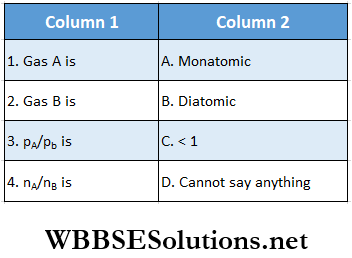
  1. Statement 1 is true, statement 2 is true; statement 2 is a correct explanation for statement 1.
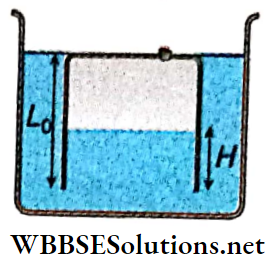
  2. Statement 1 is true, and statement 2 is true; statement 2 is not a correct explanation for statement 1.
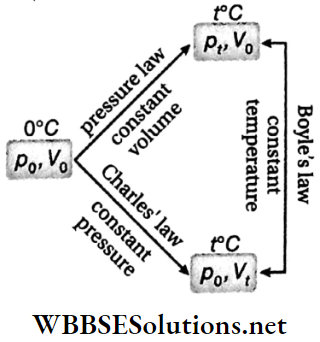
  3. Statement 1 is true, statement 2 is false.
  4. Statement 1 is false, and statement 2 is true.

Question 1.

Statement 1: Equal masses of helium and oxygen gases are given equal quantities of heat. There will be a greater rise in the temperature of helium compared to that of oxygen.

Statement 2: The molecular weight of oxygen is more than the molecular weight of helium.

Answer: 2. Statement 1 is true, statement 2 is true; statement 2 is not a correct explanation for statement 1.

Question 2.

Statement 1: In the upper part of the atmosphere, the temperature of air is of the order of 1000 K, even then it is quite cold there.

Statement 2: Molecular density at high altitudes is low.

Answer:  1. Statement 1 is true, statement 2 is true; statement 2 is a correct explanation for statement 1.

Question 3.

Statement 1: Shows the V – T graphs of a certain mass of an ideal gas at two pressures p1 and p2. It follows from the graph that p1 is greater than p2.

Class 11 Physics Unit 7 Properties Of Matter Chapter 4 Thermometry Graph Between Celcius And Fahrenhit Temperature

Statement 2: The slope of V- T graph for an ideal gas is directly proportional to pressure.

Answer: 3. Statement 1 is true, statement 2 is false.

Question 4.

Statement 1: V-T graph in a process is a rectangular hyperbola. Then p-T graph in the same process will be a parabola.

Statement 2: If the V-T graph is a rectangular hyperbola, with an increase in T, the volume will decrease and hence, pressure will increase.

Answer: 2. Statement 1 is true, statement 2 is true; statement 2 is not a correct explanation for statement 1.

Question 5.

Statement 1: The size of a hydrogen balloon increases as it rises in the air.

Statement 2: The material of the balloon can be easily stretched.

Answer: 2. Statement 1 is true, statement 2 is true; statement 2 is not a correct explanation for statement 1.

Expansion Of Gases Match Column 1 With Column 2

Question 1. The V-T graph of two gases A and B is shown.

Class 11 Physics Unit 7 Properties Of Matter Chapter 6 Expansion Of Gases V T Graph Of Two Gases A And B

Class 11 Physics Unit 7 Properties Of Matter Chapter 6 Expansion Of Gases Match The Column Question 1

Answer: 1. D, 2. D, 3. D, 4. D

Expansion Of Gases Comprehension Type Questions And Answers

Short Answer Questions on Gas Expansion

Read the following passages carefully and answer the questions at the end of them.

Question 1. An air bubble starts rising from the bottom of a lake. Its diameter is 3.6 mm at the bottom and 4 mm at the surface. The depth of the lake is 250 cm and the temperature at the surface is 40°C. The atmospheric pressure is 76 cm of Hg and g = 980 cm · s-2.

1. What is the pressure at the bottom of the lake?

  1. 1279325 dyn • cm-2
  2. 1359943 dyn • cm-2
  3. 1257928 dyn • cm-2
  4. 1378174 dyn • cm-2

Answer:  1. 1279325 dyn • cm-2

2. What is the temperature at the bottom of the lake?

  1. 9.77°C
  2. 10.37°C
  3. 11.31°C
  4. 11.67°C

Answer: 2. 10.37°C

Question 2. A fixed thermally conducting cylinder has a radius of R and a height of L0. The cylinder is open at its bottom and has a small hole at its top. A piston of mass M is held at a distance L, from the top surface as shown. The atmospheric pressure is p0.

Class 11 Physics Unit 7 Properties Of Matter Chapter 6 Expansion Of Gases A Fixed Thermally Conducting Cylinder

1. The piston is now pulled out slowly and held at a distance 2L from the top. The pressure in the cylinder between its top and the piston will then be

  1. \(\frac{p_0}{2}+\frac{M g}{\pi R^2}\)
  2. \(\frac{p_0}{2}\)
  3. \(p_0\)
  4. \(\frac{p_0}{2}-\frac{M g}{\pi R^2}\)

Answer: 1. \(\frac{p_0}{2}+\frac{M g}{\pi R^2}\)

2. When the piston is at a distance 2L from the top the hole at the top is sealed. The piston is then released, at a position where it can stay in equilibrium. In this condition, the distance of the piston from the top is

  1. \(\left(\frac{2 p_0 \pi R^2}{\pi R^2 p_0+M g}\right)(2 L)\)
  2. \(\left(\frac{p_0 \pi R^2-M g}{\pi R^2 p_0}\right)(2 L)\)
  3. \(\left(\frac{p_0 \pi R^2+M g}{\pi R^2 p_0}\right)(2 L)\)
  4. \(\left(\frac{p_0 \pi R^2}{\pi R^2 p_0-M g}\right)(2 L)\)

Answer: 4. \(\left(\frac{p_0 \pi R^2}{\pi R^2 p_0-M g}\right)(2 L)\)

3. The piston is taken completely out of the cylinder. The hole at the top is sealed. A water tank is brought below the cylinder and put in a position so that the water surface in the tank is at the same level as the top of the cylinder as shown.

The density of the water is ρ. In equilibrium, the height H of the water column in the cylinder satisfies

Class 11 Physics Unit 7 Properties Of Matter Chapter 6 Expansion Of Gases Piston IS Completely Out Of The Cylinder

  1. \(\rho g\left(L_0-H\right)^2+p_0\left(L_0-H\right)+L_0 p_0=0\)
  2. \(\rho g\left(L_0-H\right)^2-p_0\left(L_0-H\right)-L_0 p_0=0\)
  3. \(\rho g\left(L_0-H\right)^2+p_0\left(L_0-H\right)-L_0 p_0=0\)
  4. \(\rho g\left(L_0-H\right)^2-p_0\left(L_0-H\right)+L_0 p_0=0\)

Answer: 3. \(\rho g\left(L_0-H\right)^2+p_0\left(L_0-H\right)-L_0 p_0=0\)

Expansion Of Gases Integer Type Questions And Answers

Real-Life Applications of Gas Expansion

In this type, the answer to each of the questions Is a single-digit integer ranging from 0 to 9.

Question 1. An ideal gas is heated from 27 °C to 627°C at constant pressure. If the initial volume was 3 m³, then what would be the final volume (in m³) of gas?
Answer: 9

Question 2. An air bubble of diameter 1 cm is formed at a depth of 238 ft in a lake. What will be the diameter (in cm) of the bubble when it reaches the free surface? Given that the temperature from top to bottom in the lake is the same and the height of a water barometer is 34 ft.
Answer: 2

Question 3. The volume of some air saturated with water vapor is 80 cm³ at a pressure of 74 cm Hg. Keeping the temperature fixed if pressure is made 146 cmHg then the volume becomes halved. What will be the pressure (in cm Hg) of water vapor then?
Answer: 2

Question 4. Find the percentage increase in the pressure when air enclosed at 30 °C is raised to 57 °C at a constant volume.
Answer: 9

Expansion Of Gases Short Answer Type Questions And Answers

Question 1. The temperature of an open room of volume 30 m³ increases from 17°C to 27°C due to the sunshine. The atmospheric pressure in the room remains 1 x 10⁵ Pa. If ni and nf are the number of molecules in the room before and after heating, then nf – ni will be

  1. 1.61 x 10²³
  2. 1.38 x 10²³
  3. 2.5 x 1025
  4. -2.5 x 1025

Answer:

Given

The temperature of an open room of volume 30 m³ increases from 17°C to 27°C due to the sunshine. The atmospheric pressure in the room remains 1 x 10⁵ Pa. If ni and nf are the number of molecules in the room before and after heating,

If n1 and n2 are the number of moles at the initial and final temperature inside the room respectively, then

⇒ \(n_1 =\frac{p_1 V_1}{R T_1}=\frac{10^5 \times 30}{8.31 \times(273+17)}\)

= \(1.245 \times 10^3\)

⇒ \(n_2 =\frac{p_2 V_2}{R T_2}=\frac{p_1 V_1}{R T_2}=\frac{10^5 \times 30}{8.31 \times(273+27)}\)

= \(1.203 \times 10^3\)

Therefore \(n_f-n_1=\left(n_2-n_1\right) \times 6.023 \times 10^{23}\)

= \(-2.5 \times 10^{25}\)

The option 4 is correct.

Question 2. Explain why air pressure in a car increases during driving.
Answer:

Air pressure in a car increases during driving because

The temperature of air inside the increases due to motion. We know from Charles’ law, p ∝ T, therefore air pressure inside the the increases during driving.

WBCHSE Class 11 Physics For Volume And Pressure Coefficients Of A Gas

Expansion Of Gases Volume And Pressure Coefficients Of A Gas

WBBSE Class 11 Volume and Pressure Coefficients Overview

In general, both the volume and the pressure of a fixed mass of a gas change due to any change in its temperature. However, for convenience, we at first consider the two extreme types of heating:

  1. Either by keeping its pressure constant or
  2. By keeping its volume constant.

It is not possible to change the temperature of a gas keeping both pressure and volume constant. Hence, there are two coefficients of a gas. When a gas is heated, keeping the pressure constant, its volume increases and we get the volume coefficient at constant pressure (γp).

Again when the gas is heated, keeping the volume constant, its pressure increases and we get the pressure coefficient at constant volume (γv).

Volume coefficient (γp): The volume coefficient of a fixed mass of a gas at a constant pressure is the increment of its volume when the temperature of a unit volume is raised by 1°C from 0°C.

Let at constant pressure, the volume of a specific amount of gas be V0 at 0°C and Vt at t °C.

∴ Increase in volume = Vt-VQ and increase in temperature = t-0 = t°C

∴ Increase in volume for 1°C rise in temperature of a unit volume of the gas = \(\frac{V_t-V_0}{V_0 t}\)

i.e., the volume coefficient \(\gamma_p=\frac{V_t-V_0}{V_0 t}\)….(1)

or, Vt =V0(1 + γpt)….(2)

Pressure coefficient (γv): The pressure coefficient of a fixed mass of a gas at a constant volume, initially at unit pressure, is the increment of its pressure when its temperature is raised by 1°C from 0°C.

Let at a constant volume the pressure of a specific amount of gas be p0 at 0°C and pt at t °C.

Increase in pressure = pt – p0 and increase in temperature = t-0 = t°C

∴ Increase in pressure for 1°C rise in temperature per unit

initial pressure of the gas = \(\frac{p_t-p_0}{p_0 t}\)…(1)

i.e., pressure coefficient, \(\gamma_\nu=\frac{p_t-p_0}{p_0 t}\)….(3)

or, pt=p0(l + γvt)….(4)

Relationship between the two coefficients of expansion of a gas: Suppose at 0°C a fixed mass of gas has volume V0 and pressure p0. The gas is heated to t °C. We can perform this increase in temperature in any of the two ways.

1. Keeping the volume V0 constant when pressure increases to pt from p0.

Class 11 Physics Unit 7 Properties Of Matter Chapter 6 Expansion Of Gases Relationship Between Two Coefficients Of Expansion Of A Gas

2. Keeping the pressure P0 constant when volume increases to Vt from V0.

Following pressure law in the first case, \(p_t=p_0\left(1+\gamma_\nu t\right)\)

In the second case as per Charles’ law, \(V_t=V_0\left(1+\gamma_p t\right)\)

Since the final temperature is t°C in both cases, as per Boyle’s law

⇒ \(p_t V_0=p_0 V_t \quad \text { or, } p_0 V_0\left(1+\gamma_v t\right)=p_0 V_0\left(1+\gamma_p t\right)\)

∴ \(\gamma_v=\gamma_p\)

Hence, for any ideal gas, the coefficient of volume expansion is equal to the coefficient of pressure expansion.

A comparison of equations (2) and (4) respectively with the corresponding expressions derived from Charles’ law and pressure law shows that

⇒ \(\gamma_p=\frac{1}{273} \text { or, } 0.00366^{\circ} \mathrm{C}^{-1}\)

and also \(\gamma_\nu=\frac{1}{273} or, 0.00366^{\circ} \mathrm{C}^{-1}\)

Definition of Volume Expansion Coefficient in Gases

Therefore,

  1. The pressure coefficient (γv) and the volume coefficient (γp) have the same value which is the same for all gases, though different solids and liquids have different values for the coefficients of volume expansion.
  2. Gases are heated in a container like liquids. However, the volume expansion of a gas is much higher (near about 100 times) than the corresponding expansion of the container. Unless much accuracy is required, two separate expansion coefficients (real and apparent) are not needed. Practically, the apparent expansion coefficient of a gas is the same as the real expansion coefficient of the gas.
  3. To find the volume coefficient (γp) of a gas, the initial volume is to be taken at 0°C and o to find the pressure coefficient of a gas, initial pressure is to be taken at 0°C.

To illustrate 3 or 4 the following example may be considered:

Let the initial volume V0 of a fixed mass of a gas at 0°C, be 273 cm³.

According to Charles’ law, volume at 100°C, \(V_{100} =V_0\left(1+\frac{100}{273}\right)\)

= \(273\left(1+\frac{100}{273}\right)=373 \mathrm{~cm}^3\)

and volume at 150°C, \(V_{150}=V_0\left(1+\frac{150}{273}\right)\)

= \(273\left(1+\frac{150}{273}\right)=423 \mathrm{~cm}^3\)

In the case of solids and liquids magnitudes of expansion coefficients are too small. So to find volume expansion in the case of solids and liquids it is not always necessary to take the initial volume at 0°C. Values of expansions do not differ much if we consider initial volume at some temperature other than 0°C.

WBCHSE Class 11 Physics For Volume And Pressure Coefficients Of A Gas

Pressure Expansion Coefficient Explained for Class 11

Expansion Of Gases Volume And Pressure Coefficients Of A Gas Numerical Examples

Example 1. The volume of a gas is doubled by raising its temperature at constant pressure. The initial temperature of the gas was 13°C. Find the final temperature.
Solution:

Given

The volume of a gas is doubled by raising its temperature at constant pressure. The initial temperature of the gas was 13°C.

As the pressure is constant, using Charles’ law we have \(\frac{V_1}{T_1}=\frac{V_2}{T_2}\)

Here V1 = xcm³ (suppose), T1 = 273+ 13 = 286 K and V2 = 2x cm³.

∴ \(\frac{x}{286}=\frac{2 x}{T_2}\) or, T2 = 572 K = (527-273)°C = 299°C.

Class 11 Physics Class 12 Maths Class 11 Chemistry
NEET Foundation Class 12 Physics NEET Physics

Example 2. The volume of fixed mass of a gas at 47°C is 640cm³ and its pressure is 75 cm of Hg. To which temperature should the gas be raised at constant volume to make its pressure double?
Solution:

Given

The volume of fixed mass of a gas at 47°C is 640cm³ and its pressure is 75 cm of Hg.

As volume is a constant, we get, using pressure law \(\frac{p_1}{T_1}=\frac{p_2}{T_2}\)

Here p1 = 75 cmHg, T1 = 273 + 47 = 320 K

and p2 = 2 x 75 = 150 cmHg.

⇒ \(\frac{75}{320}=\frac{150}{T_2}\)

or, T2 = 640 K = (640 – 273)°C = 367°C.

Mathematical Formulas for Volume and Pressure Coefficients

Example 3. The volume of a fixed mass of gas is 300 cm³ at STP. When the temperature is raised to 50°C at constant volume, the pressure exerted by the gas becomes 900 mmHg. What is the pressure coefficient of the gas?
Solution:

Given

The volume of a fixed mass of gas is 300 cm³ at STP. When the temperature is raised to 50°C at constant volume, the pressure exerted by the gas becomes 900 mmHg.

Here, pt = 900 mmHg, p0 = 760 mmHg and t = 50°C.

⇒ \(p_t=p_0\left(1+\gamma_\nu t\right)\)

∴ \(\gamma_\nu=\frac{p_t-p_0}{p_0 t}\)

or, \(\gamma_\nu=\frac{900-760}{760 \times 50}=\frac{140}{760 \times 50}=0.00368^{\circ} \mathrm{C}^{-1}\)

Example 4. At constant pressure, if the volume of a fixed mass of gas at temperature 80°C is 500 cm³ and that at 150°C is 600 cm3, what is the coefficient of volume expansion (γp) of the gas?
Solution:

Given

At constant pressure, if the volume of a fixed mass of gas at temperature 80°C is 500 cm³ and that at 150°C is 600 cm3,

We have, Vt = V0(1 + γpt)

Using the given conditions we get,

500 = V0(1 +γp x 80) ….(1)

and 600 = V0 (1 + γp x 150)…(2)

Dividing (2) by (1), we get,

⇒ \(\frac{6}{5}=\frac{1+150 \gamma_p}{1+80 \gamma_p} \text { or, } 6+480 \gamma_p=5+750 \gamma_p\)

or, \(270 \gamma_p=1 or, \gamma_p=\frac{1}{270}{ }^{\circ} \mathrm{C}^{-1}\).

Example 5. If heated to 35 °C at constant pressure, the volume of gas increases from 5 L at 0°C, by 640 cm³. What should be the value of absolute zero for this gas in the Celsius scale?
Solution:

Given

If heated to 35 °C at constant pressure, the volume of gas increases from 5 L at 0°C, by 640 cm³.

Let the absolute zero temperature for that gas be -T°C.

So, 0°C = TK = T1, 35°C = (T+35) K = T2,

V1 = 5000 cm³ and V2 = 5000 + 640 = 5640 cm³.

As per Charles’ law, \(\frac{V_1}{T_1}=\frac{V_2}{T_2}\) at constant pressure.

∴ \(\frac{5000}{T}=\frac{5640}{T+35}\)

or, 500(T+35)=564 T

64 T =17500,

T = \(\frac{17500}{64}=273.43\)

Hence, absolute zero in the Celsius scale =-273.43°C.

Applications of Volume and Pressure Coefficients in Real Life

Example 6. A hydrogen cylinder can withstand an internal pressure of 7 x 10⁶ Pa. The pressure of hydrogen in a cylinder at 15°C is 1.7 x 10⁶ Pa. At what minimum temperature an explosion may take place?
Solution:

Given, p1 = 1.7 x 10⁶ Pa and T1 = 273 + 15 = 288 K

A hydrogen cylinder can withstand an internal pressure of 7 x 10⁶ Pa. The pressure of hydrogen in a cylinder at 15°C is 1.7 x 10⁶ Pa.

The explosion may occur at a pressure p2 = 7 x 10⁶ Pa

As volume is constant in the cylinder, according to pressure law,

⇒ \(\frac{p_1}{T_1}=\frac{p_2}{T_2} \text { or, } T_2=\frac{p_2 T_1}{p_1}\)

∴ \(T_2=\frac{7 \times 10^6 \times 288}{1.7 \times 10^6}=1185.9 \mathrm{~K}\)

= \((1185.9-273)^{\circ} \mathrm{C}=927^{\circ} \mathrm{C}\)

Example 7. A glass vessel is filled with air at 30 °C. Up to which temperature should the vessel be heated keeping the pressure constant so that 1/3rd of the initial volume of air is expelled? \(\gamma_p=\frac{1}{273}^{\circ} \mathrm{C}^{-1}\).
Solution:

Given

A glass vessel is filled with air at 30 °C.

Let the initial volume of air = V1

∴ The final volume of an equal mass of air, \(V_2=V_1+\frac{V_1}{3}=\frac{4}{3} V_1\)

[as the volume of expelled air  = 1/3 V1]

Initial temperature, T1 = 273 + 30 = 303 K.

Let the required temperature be T2 K.

As pressure is constant,

⇒ \(\frac{V_1}{T_1}=\frac{V_2}{T_2} \text { or, } \frac{V_1}{303}=\frac{\frac{4}{3} V_1}{T_2}\)

or, \(T_2=\frac{4}{3} \times 303=404 \mathrm{~K}=(404-273)^{\circ} \mathrm{C}=131^{\circ} \mathrm{C} .\)

Example 8. At 27°C, and a pressure of 76 cmHg 100 cm³ of a gas is collected over the water surface. The space occupied by the gas is saturated with water vapour. Maximum vapour pressure of water at 27°C is 17.4 mmHg. What will be the volume of dry gas at STP?
Solution:

Given

At 27°C, and a pressure of 76 cmHg 100 cm³ of a gas is collected over the water surface. The space occupied by the gas is saturated with water vapour. Maximum vapour pressure of water at 27°C is 17.4 mmHg.

Let the volume of the dry gas at STP = V2 cm³, pressure p2 = 76 cmHg and temperature T2 = 0°C = 273 K.

Given V1 = 100 cm³, p1 = 76- 1.74 = 74.26 cmHg and T1 = 27 + 273 = 300K.

Hence, from the equation of state, \(\frac{p_1 V_1}{T_1}=\frac{p_2 V_2}{T_2} \text { or, } \frac{100 \times 74.26}{300}=\frac{V_2 \times 76}{273}\)

or, \(V_2=\frac{273 \times 74.26}{3 \times 76}=88.92 \mathrm{~cm}^3\).

∴ At STP, the volume of dry gas will be 88.92 cm³.

Factors Affecting Volume and Pressure Coefficients of Gases

Example 9. A person measures the pressure of his car tyre to be 2 x 10⁵ Pa. At that time the temperature and pressure of the atmosphere are 27°C and 1 x 10⁵ Pa respectively. Then he travels to another city where the temperature and pressure of the atmosphere are 12°C and 6.7 x 10⁴ Pa respectively. Then what will be the pressure of his car tyre at that time? Assume the volume of the tyre is the same in both cases.
Solution:

Given

A person measures the pressure of his car tyre to be 2 x 10⁵ Pa. At that time the temperature and pressure of the atmosphere are 27°C and 1 x 10⁵ Pa respectively. Then he travels to another city where the temperature and pressure of the atmosphere are 12°C and 6.7 x 10⁴ Pa respectively.

The pressure in a tyre is a gauge pressure, which is the difference between the pressure in the tyre and atmospheric pressure.

Hence, the absolute pressure in the tyre = gauge pressure + atmospheric pressure.

So in 1st case, absolute pressure, p1 = 2 x 10⁵ + 105 = 3 x 10⁵ Pa

and temperature, T1 = 273 + 27 = 300 K

Let in the 2nd case the measured pressure (gauge pressure) = x Pa.

So the absolute pressure, p2 = (x+ 6.7 x 10⁴) Pa and temperature, T2 = 273 + 12 = 285 K

Since the volume of the tyre is constant, \(\frac{p_1}{T_1}=\frac{p_2}{T_2}\)

or, \(\frac{3 \times 10^5}{300}=\frac{x+6.7 \times 10^4}{285} \text { or, } x=2.18 \times 10^5\)

So the measured pressure is 2.18 x 10⁵ Pa.

WBCHSE Class 11 Physics Expansion Of Gases Boyles Law Notes

Expansion Of Gases Boyles Law

Boyle’s Law Notes for Class 11 WBCHSE

Boyle’s law: The relation between the volume and the pressure of a gas, at constant temperature, was first proposed by the British scientist Robert Boyle in 1660 AD, and that relation is called Boyle’s law.

Statement: At constant temperature, the volume of a fixed mass of gas is inversely proportional to its pressure.

Mathematically, if V is the volume of a gas of certain mass, and p is its pressure, then according to Boyle’s law,

⇒ \(V \propto \frac{1}{p}\), when temperature remains constant.

or, \(V=\frac{k}{p}\) or, pV = k = constant ….(1)

The value of k depends on the mass and the temperature of the gas. Hence, the product of the pressure and the volume of a fixed mass of gas at a fixed temperature remains constant.

Thus at constant temperature, if V1, V2, V3 ….. are volumes of a fixed mass of a gas at pressures p1, p2, p3 …., then according to this law,

∴ \(p_1 V_1=p_2 V_2=p_3 V_3 \cdots\) =k (a constant)

Graphical representation of Boyle’s law: Boyle’s law can be expressed through different graphs:

1. p- V graph: Plotting volumes V of a fixed mass of gas, at constant temperature, along the horizontal axis and the corresponding pressures along the vertical axis, the obtained graph is a rectangular hyperbola, Such a graph is called the isothermal of the gas. At different values of fixed temperatures, the isothermals are different rectangular hyperbolas.

Class 11 Physics Unit 7 Properties Of Matter Chapter 6 Expansion Of Gases pV Graph

2. \(\frac{1}{V}-p\) graph: For a fixed mass of a gas at a constant temperature, the graph of pressure p plotted along the horizontal axis and reciprocal I of volume V plotted along the vertical axis, is a straight line passing through the origin. At different values of fixed temperatures, \(\frac{1}{V}-p\) graphs will be different straigth lines.

Class 11 Physics Unit 7 Properties Of Matter Chapter 6 Expansion Of Gases 1 By V - p Graph

A V-\(\frac{1}{p}\) graph is also of the same nature as that of a p-^ graph.

Understanding Boyle’s Law in Gas Expansion

3. pV-p graph: Graph obtained, by plotting pressures p of a fixed mass of gas at constant temperature along the horizontal axis and the corresponding products pV along the vertical axis, is a straight line parallel to the p axis, At different fixed temperatures, pV-p graphs will be different parallel lines.

Class 11 Physics Unit 7 Properties Of Matter Chapter 6 Expansion Of Gases pV - p Graph

At constant temperature, the pV- V graph is also similar.

These graphs, obtained experimentally, verify Boyle’s law.

WBCHSE Class 11 Physics Expansion Of Gases Boyles Law Notes

Expansion Of Gases Boyles Law Numerical Examples

Example 1. The volume of a fixed mass of gas at STP is 500 cm³. What will its volume be at 700 mmHg pressure If its temperature remains constant?
Solution:

The volume of a fixed mass of gas at STP is 500 cm³.

As temperature remains constant, Boyle’s law is applicable.

Given, p1 = 76 cmHg, V1 = 500 cm³, p2 = 70 cmHg.

∴ p1V1= p2V2

∴ 76 x 500 = 70 x V2

or, \(V_2=\frac{76 \times 500}{70}=542.86 \mathrm{~cm}^3\)

Class 11 Physics Class 12 Maths Class 11 Chemistry
NEET Foundation Class 12 Physics NEET Physics

Practice Questions on Boyle’s Law for Class 11

Example 2. While tabulating the pressures and volumes for a fixed mass of a gas at a fixed temperature, a student forgets to record a few observations, as shown below. Fill in the blanks.

Class 11 Physics Unit 7 Properties Of Matter Chapter 6 Expansion Of Gases Pressure And Volumes For A Fixed Gas

Solution:

Since the temperature is fixed, Boyle’s law is applicable here, i.e., pV = constant.

From reading 1 and 3, p1V1 = 100 x 80 = 8000 and p3V3 = 200 x 40 = 8000. Hence the value of the constant in this case is 8000.

∴ For reading (2), \(125 \times V_2=8000 \text { or, } V_2=\frac{8000}{125}=64 \mathrm{~cm}^3\)

and for reading (4) \(p_4 \times 32=8000 \text { or, } p_4=\frac{8000}{32}=250 \mathrm{mmHg} \text {. }\)

Example 3. The volume of a gas at 1 standard atmosphere is compressed to 1/6 th of its value at constant temperature. What will be its final pressure?
Solution:

Given

The volume of a gas at 1 standard atmosphere is compressed to 1/6 th of its value at constant temperature.

Let the initial volume at 1 standard atmosphere be x cm³ and the final pressure be p.

The temperature remains constant; so applying Boyle’s law, we get, 1 x x = p x x/6 or, p = 6 standard atmospheres.

Examples of Boyle’s Law in Everyday Life

Question 4. A 100 cm long vertical cylinder, closed at the bot¬tom end, has a movable, frictionless, air-tight disc attached at its other end. An ideal gas is confined within the cylinder. Initially, when the disc between the confined gas and atmosphere is in equilibrium, the gas column length is 90 cm. Mercury is poured slowly on the disc. When the disc descends by 32 cm, mercury over it is just about to overflow. Find the atmospheric pressure if the operation took place at a constant temperature of the gas. Neglect the weight or thickness of the disc.
Solution:

Given

A 100 cm long vertical cylinder, closed at the bot¬tom end, has a movable, frictionless, air-tight disc attached at its other end. An ideal gas is confined within the cylinder. Initially, when the disc between the confined gas and atmosphere is in equilibrium, the gas column length is 90 cm. Mercury is poured slowly on the disc. When the disc descends by 32 cm, mercury over it is just about to overflow.

Let the atmospheric pressure be p cmHg and α = area of the cross-section of the cylinder. Initially in equilibrium, the pressure of confined gas = atmospheric pressure p.

Now, the volume of enclosed gas V = 90α cm³.

When mercury just overflows from the cylinder, pressure of the gas p1 = (p + 42) cm and volume V1

= (90 – 32)α = 58α cm³.

As the temperature is constant, according to Boyle’s law, \(p V=p_1 V_1\)

Class 11 Physics Unit 7 Properties Of Matter Chapter 6 Expansion Of Gases Long Vertical Cylinder

or, \(p \times 90 \alpha=(p+42) \times 58 \alpha\)

90p = \(58 p+58 \times 42\)

or, \(32 p=58 \times 42\)

or, p = \(\frac {58 \times 42}{32}=76.125 \mathrm{cmHg}\)

Important Questions For Class 11 Physics Expansion Of Gases

Expansion Of Gases Long Answer Type Questions

Question 1. In case of volume expansion of a gas, mention of both the pressure and the temperature is necessary, whereas for expansion of solids and liquids, only the temperature is mentioned. Why?
Answer:

The effect of change in pressure on the volume of a solid or of a liquid is practically insignificant because of compactness of molecules. But, inter-molecular attraction in gases is weak so change in pressure significantly changes the volume of a gas.

All substances, solid, liquid or gas, expand on increase in temperature in general. Hence, the mention of pressure along with temperature is necessary in case of volume expansion of a gas.

Question 2. When a balloon is inflated both its volume and its pressure increase. Is there any violation of Boyle’s law?
Answer:

According to Boyles law, the volume of a gas varies inversely with pressure at constant temperature, only if the mass of the gas is fixed. During the inflation of a balloon, the mass of a gas is increasing. So there is no violation of Boyle’s law.

Important Questions For Expansion Of Gases

Question 3. Unlike a liquid, there is no coefficient of apparent expansion in case of a gas—why? Or, During the expansion of a liquid, volume expansion of the container is taken into account, but not for a gas—why?
Answer:

When a liquid in a container is heated, both the liquid and the container expand. The coefficient of expansion of any solid is less than that of any liquid but not negligible.

  • So the expansion of the solid is not neglected. Thus in case of liquids we get two coefficients of expansion. One is the coefficient of apparent expansion and the other is the coefficient of real expansion.
  • In apparent expansion the expansion of the container is ignored, whereas in real expansion, the coefficient of expansion of the container is added with the coefficient of apparent expansion.
  • A mass of a gas is also heated by heating the container. This is similar to the heating of a liquid. But for the same rise in temperature, the expansion of a gas is nearly 100 times more than that of the container.
  • Unless a very accurate measurement is required, expansion of the container is neglected. Hence, no apparent expansion needs to be considered in case of a gas.

Question 4. Two identical spherical bulbs contain air and are connected by a short horizontal glass tube. The tube contains a short mercury thread in it. Temperatures of the two bulbs are 0°C and 20°C respectively. If the temperature of each bulb is increased by 10°C, what will be the change in the position of the mercury thread?
Answer:

Given

Two identical spherical bulbs contain air and are connected by a short horizontal glass tube. The tube contains a short mercury thread in it. Temperatures of the two bulbs are 0°C and 20°C respectively. If the temperature of each bulb is increased by 10°C

The mercury thread shift⇒ s towards the bulb at higher temperature. As the mercury thread is in equilibrium before increasing the temperature, the initial pressure on both sides of the thread should be the same, say p.

On heating, the equilibrium is disturbed and the pressures change to p1 and p2 respectively for the bulbs at (0+ 10)°C or 10°C, and (20 + 10)°C or 30°C respectively.

Applying Charles’ law for the first bulb, \(\frac{p_1}{p}=\frac{T_1}{T}=\frac{273+10}{273}=\frac{283}{273}=1.037\)

and for the second bulb \(\frac{p_2}{p}=\frac{T_2}{T}=\frac{273+30}{273+20}=\frac{303}{293}=1.034 \)

⇒ \(\frac{p_1}{p_2}=\frac{283 \times 293}{273 \times 303}=1.0024\)

As p1 is greater than p2, the thread shifts towards the bulb at higher temperature.

Question 5. To define the coefficient of expansion of gases, the initial volume or pressure is always taken at 0°C. But for the coefficients of expansion of solids and liquids, the initial temperature need not be taken as 0°C. Why?
Answer:

The values of the coefficients of expansion of solids and liquids are very small. Hence, in this case, the volume at any temperature can be taken as the initial volume. The coefficient of volume expansion of a gas is relatively higher.

So if we consider volumes or pressures at different temperatures as the initial volume or pressure, the coefficient of expansion differs considerably. Hence, to define the coefficient of expansion of gases, the initial volume or pressure should always be taken at 0°C.

Question 6. Air pressure in a car tyre increases during driving. Explain why.
Answer:

Air pressure in a car tyre increases during driving.

Due to friction between the road and the car tyre, the temperature of air inside the tyre increases reasonably. This increases the air pressure during driving.

Thermal Expansion vs. Gas Expansion Questions

Question 7. The expansion of a gas follows the condition pV² = constant. Show that such an expansion causes cool- ingof the gas.
Answer:

Given

The expansion of a gas follows the condition pV² = constant.

Assume that the initial volume of the gas is V1 at pressure p1 and at temperature T1. After the expansion, the corresponding quantities are V2, p2 and T2 (say). From ideal gas equation,

⇒ \(\frac{p_1 V_1}{T_1}=\frac{p_2 V_2}{T_2} \text { or, } \frac{p_1 V_1}{p_2 V_2}=\frac{T_1}{T_2}\)

or, \(\frac{p_1 V_1^2}{p_2 V_2^2}=\frac{T_1 V_1}{T_2 V_2}\) multiplying both sides by \(\frac{V_1}{V_2}\)

As the condition is, \(p_1 V_1^2=p_2 V_2^2\), we have

⇒ \(\frac{V_1 T_1}{V_2 T_2}=1 \text { or, } \frac{T_1}{T_2}=\frac{\dot{V}_2}{V_1}\)

As the gas expands, \(V_2>V_1\) therefore \(\frac{T_1}{T_2}>1\) or, \(T_2<T_1\).

∴ The gas cools down upon expansion.

Question 8. For a fixed mass of a gas at constant volume, draw p-t°C and p-TK graphs. How can the value of, absolute zero be obtained from the 1st graph?
Answer:

The graphs are shown in Figures respectively for 3 different volumes.

Class 11 Physics Unit 7 Properties Of Matter Chapter 6 Expansion Of Gases A Fixed Mass Of A Gas At Constant Volume

The graphs are straight lines in nature.

In the p-t°C graph, the three lines corresponding to the three volumes, converge at a point on the negative t axis, where pressure is zero. This point gives the value of absolute zero as per definition.

In the p-TK graph, the three straight lines pass through the origin, showing p = 0 when T = 0.

Question 9. For a fixed mass of a gas at constant pressure, draw V-t° C and V- T K graphs. How can the value of absolute zero be obtained from the 1st graph?
Answer:

The graphs are shown in Figures respectively for three different pressures.

The graphs are straight lines in nature.

Class 11 Physics Unit 7 Properties Of Matter Chapter 6 Expansion Of Gases A Fixed Mass Of Gas At Constant Pressure

In the V-t°C graph shown, the three lines corresponding to the three pressures, converge at a point on the negative t-axis, where volume is zero. This point gives the value of absolute zero as per definition.

In the V-T K graph the three straight lines pass through the origin, showing V = 0 when T = 0.

Question 10. Determine the value of universal gas constant JR and gas constant k for lg of air. (At STP the density of air =1.293 g · L-1 and that of mercury = 13.6 g · cm-3)
Answer:

Pressure p – 76 x 13.6 x 980 dyn · cm-2 and temperature = 0°C = 273 K

Volume of 1 mol of any gas at STP = 22.4 L = 22400 cm³

∴ R = \(\frac{p V}{T}=\frac{76 \times 13.6 \times 980 \times 22400}{273}\)

= \(8.31 \times 10^7 \mathrm{erg} \cdot \mathrm{mol}^{-1} \cdot \mathrm{K}^{-1}\)

Now, volume of 1 g air,

v = \(\frac{1}{1.293} l=\frac{1000}{1.293} \mathrm{~cm}^3\)

∴ k = \(\frac{p v}{T}=\frac{76 \times 13.6 \times 980 \times 1000}{1.293 \times 273}\)

= \(0.287 \times 10^7 \mathrm{erg} \cdot \mathrm{g}^{-1} \cdot \mathrm{K}^{-1}\)

Question 11. A given mass of an Ideal gas is heated in a vessel. The same amount of gas is then heated by keeping it in a larger vessel. Assume that the volumes of both vessel remain the same during heating. What will be the nature of the pressure-temperature (p- T) graphs in the two cases?
Answer:

Given

A given mass of an Ideal gas is heated in a vessel. The same amount of gas is then heated by keeping it in a larger vessel. Assume that the volumes of both vessel remain the same during heating.

In each case the graph is a straight line, For a Fixed mass of gas, when the volume is less, the pressure increases with temperature at a higher rate.

Class 11 Physics Unit 7 Properties Of Matter Chapter 6 Expansion Of Gases A Given Mass Of An Ideal Gas Is Heated In Vessel

So the slope of the p- T graph for the smaller container is greater than that for the bigger container.

Alternative method: For a fixed mass of an ideal gas, \(p V=k T \text { or, } p=\frac{k}{V} T \text {. }\)

pV = kT or, p = k/V T

If V is fixed, this relation resembles, y = mx.

So the p – T graph is a straight line passing through the origin.

Also, the slope k/V is higher for a smaller V. So the graph for the smaller vessel has a higher slope.

Class 11 Physics Class 12 Maths Class 11 Chemistry
NEET Foundation Class 12 Physics NEET Physics

Sample Problems on Ideal Gas Expansion

Question 12. Draw p- T graphs for masses m and 2m of the same gas, when heated in a container of constant volume. Interpret the slopes.
Answer:

The desired graphs are shown in Figure.

The equation of state for mass m of a gas of molecular weight M is, \(p V=\frac{m}{M} R T \quad \text { or } p=\frac{m R}{M V} T\)

Class 11 Physics Unit 7 Properties Of Matter Chapter 6 Expansion Of Gases p T Graphs For Masses Of The Same Gas

Given, V = constant; so for any fixed mass, p = constant x T.

Thus, the p- T graph is a straight line passing through the origin.

Also, the slope \(\frac{m R}{M V}\) is higher for a higher m.

∴ The slope of the graph for mass 2 m is more than that for mass m.

For any temperature the value of p in the first case will be half of second case. \(\left(B C=\frac{1}{2} A C\right)\)

Question 13. Shows the V- T graph for a fixed mass of an ideal gas at pressures p1 and p2. Can you infer from the graph whether p1 is greater than p2?
Answer:

We have, pV= nRT,

or, V = \(\frac{n R}{p} T .\)

Class 11 Physics Unit 7 Properties Of Matter Chapter 6 Expansion Of Gases V T Graph For A Mixed Mass Of An Ideal Gas At Pressures

This shows that the V- T graph is a straight line passing through the origin, for any fixed pressure p (n = constant for a fixed mass).

The slope \(\frac{n R}{p}\) is greater for a smaller value of p.

In Figure, the graph for p2 has a higher slope.

So, p2 < p1.

Thus, p1 is greater than p2.

Question 14. In a faulty barometer, some air is occupying the space over mercury column. How can the air pressure be correctly determined with this faulty barometer?
Answer:

Let the length of mercury column = h1, and that of air column over mercury =l1.

Now the barometer tube is raised a little still keeping the open end dipped into mercury. Let in this case, the length of mercury column = h2, and that of air column over mercury = l1.

If the true reading of the air pressure is H, and area of the cross-section of the tube is α, then from Boyle’s law

⇒ \(\left(H-h_1\right) l_1 \alpha=\left(H-h_2\right) l_2 \alpha \quad \text { or, } H=\frac{h_1 l_1-h_2 l_2}{l_1-l_2}\)

Hence, measuring h1, h2, l1, l2 the correct atmospheric pressure can be found out.

Question 15. A container filled with oxygen is taken to the moon’s surface from the earth. How will the volume and pressure of the gas change when the container is

  1. A rubber balloon,
  2. A steel cylinder?

Answer:

1. Atmospheric pressure on moon’s surface is practically zero. As pressure of oxygen inside the rubber balloon is high, the gas will expand in volume and finally the balloon will burst.

2. Volume of the gas in the steel cylinder would remain unchanged. There will be no effect of zero atmospheric pressure.

But the pressure of the gas would change due to a different temperature of the surroundings.

Question 16. What is meant by specific gas constant? Is the value of this constant same for all gases?
Answer:

Value of \(\frac{p V}{T}\) for 1 g of a gas is the specific heat constant of that gas. Value of the constant is different for different gases because of the difference in molecular weight M, since \(\frac{p V}{T}=n R=\frac{1}{M} R \text {. }\)

Question 17. Equal number of hydrogen and helium molecules are kept in two identical gas jars at the same temperature. What will be the ratio of the pressures of the gases in the two jars?
Answer:

Given

Equal number of hydrogen and helium molecules are kept in two identical gas jars at the same temperature.

Pressure is the same in both the jars. As per Avaga- dro’s law, all gases of equal volume contain the same number of molecules under identical values of temperature and pressure. In this example, volume, temperature and number of molecules are the same. So, the pressure will be equal in the two jars and the ratio is 1:1.

Question 18. A gas container contains 1 mol of O2 gas (specific molar mass 32) at pressure p and temperature T. In a similar container one mol of He gas (specific molar mass 4) is kept at temperature 2 T. What is the pressure of this He gas?
Answer:

Given

A gas container contains 1 mol of O2 gas (specific molar mass 32) at pressure p and temperature T. In a similar container one mol of He gas (specific molar mass 4) is kept at temperature 2 T.

Since number of moles and volume are the same for both the gases, using pV = nRT, it can be said that the pressure is directly proportional to the absolute temperature. Since the temperature of the second container is double, pressure will also be double, i.e., 2p.

Question 19. Same ideal gas is kept in two containers A and B fitted with frictionless pistons. Volume and temperature of the gas in both containers are the same. mA and mB are the masses of the gas in A and B respectively. The volume of the gases in the two containers are changed to 2 V keeping their temperature constant.

Corresponding changes in pressure in A and B are Δp and 1.5 Δp. Find the ratio of the masses of the gas kept in A and in B.

Answer:

Given

Same ideal gas is kept in two containers A and B fitted with frictionless pistons. Volume and temperature of the gas in both containers are the same. mA and mB are the masses of the gas in A and B respectively. The volume of the gases in the two containers are changed to 2 V keeping their temperature constant.

Corresponding changes in pressure in A and B are Δp and 1.5 Δp.

Volumes of the gases in both the containers become double. So, according to Boyle’s law, the corresponding pressures of the gases become half of their initial pressures.

∴ Initial pressure in A and B are,

pA = 2Δp and pB = 2 x 1.5Δp = 3Δp

∴ \(\frac{p_A}{p_B}=\frac{2}{3} \text { or, } \frac{n_A \frac{R T}{V}}{n_B \frac{R T}{V}}=\frac{2}{3}\)

or, \(\frac{m_A \frac{R T}{M V}}{m_B \frac{R T}{M V}}=\frac{2}{3} \text { or, } \frac{m_A}{m_B}=\frac{2}{3}\)

Question 20. An ideal gas is found to obey a gas law, Vp² = constant Initial temperature and volume of the gas are T and V respectively. If the gas expands to a volume 2 V, what will be the effect on temperature?
Answer:

Given

An ideal gas is found to obey a gas law, Vp² = constant Initial temperature and volume of the gas are T and V respectively. If the gas expands to a volume 2 V,

Here Vp² = constant…..(1)

For an ideal gas pV = RT or \(p=\frac{R T}{V}\)

Substituting for p, equation (1) gives

⇒ \(\frac{V \times R^2 T^2}{V^2}=\text { constant or, } \frac{T^2}{V}=\text { constant }\)

When the volume of the gas expands to 2V, suppose the temperature is T’.

∴ \(\frac{T^2}{V}=\frac{T^{\prime 2}}{2 V} \text { or, } \frac{T^{\prime 2}}{T^2}=2 \text { or, } T^{\prime}=T \sqrt{2} \text {. }\)

Question 21. Shows the p- T graphs for a fixed mass of an ideal gas at volumes V1 and V2. Can it be concluded from the graphs that V1 is greater than V2?
Answer:

∴ \(p V=n R T=\frac{m}{M} R T\)

or, p = \(\frac{m R}{M V} T\) [M= molecular weights]

So p- T graphs are straight lines passing through the origin, for any fixed V. The slope \(\frac{m R}{M V}\) is smaller for a greater value of V.

Class 11 Physics Unit 7 Properties Of Matter Chapter 6 Expansion Of Gases p T Graphs For A Fixed Mass Of Ideal Gas At Volumes

The slope for V1 is smaller than that for V2. So, V1>V2.

Question 22. An ideal gas is Initially at temperature T and volume V. Its volume increases by dV due to an increase in temperature dT, while pressure remains constant. Here \(\gamma=\frac{1}{V} \frac{d V}{d T}\).What will be the nature of the graph between γ and T1
Answer:

In case of an ideal gas,

pV= RT or, \(V=\frac{R T}{p}\)

When pressure remains constant, we have \(\frac{d V}{d T}=\frac{R}{p}\)

Class 11 Physics Unit 7 Properties Of Matter Chapter 6 Expansion Of Gases A Ideal gas Is Initially At Temperature And Volume

∴ \(\gamma=\frac{1}{V} \frac{d V}{d T}=\frac{1}{V} \frac{R}{p}=\frac{R}{R T}=\frac{1}{T}\)

So, the graph γ-T will be a rectangular hyperbola.

Question 23. An ideal gas is initially at pressure p and volume V. Its pressure is increased by dp, so that its volume decreases by dV, while the temperature remains constant. Here \(\beta=-\frac{1}{V} \frac{d V}{d p}\). What will be the nature of the graph between β and p?
Answer:

Given

An ideal gas is initially at pressure p and volume V. Its pressure is increased by dp, so that its volume decreases by dV, while the temperature remains constant.

In case of an ideal gas, pV = RT

If the temperature remains constant, p V = constant

∴ pdV+ Vdp = 0

or, \(\frac{d V}{d p}=-\frac{V}{p}\)

Class 11 Physics Unit 7 Properties Of Matter Chapter 6 Expansion Of Gases An Ideal gas Is Initially At Pressure And Volume

∴ \(\beta=-\frac{1}{V} \frac{d V}{d p}=\frac{1}{p}\)

i. e., βp = 1 = constant So, the graph β-p will be a rectangular hyperbola.

Question 24. Pressure coefficient of a gas is \(\frac{1}{273}{ }^{\circ} \mathrm{C}^{-1}\) Explain.
Answer:

Pressure coefficient of a gas is \(\frac{1}{273}{ }^{\circ} \mathrm{C}^{-1}\)

It means that when the temperature increases 1°C, at constant volume the increase in pressure of the gas of fixed mass per unit pressure at 0°C is equal to 1/273 of the original pressure of that gas at °C.

WBCHSE Class 11 Physics MCQs – Thermal Expansion

Expansion Of Gases Multiple Choice Questions And Answers

WBBSE Class 11 Thermal Expansion MCQs

Question 1. Both the volume and the pressure of a definite mass of gas are observed to increase. This is possible when the temperature of the gas

  1. Remains the same
  2. Decreases
  3. Increases
  4. First decreases, then increases

Answer: 3. Increases

Question 2. The value of the specific gas constant of hydrogen is

  1. \(4.16 \times 10^7 \mathrm{erg} \cdot \mathrm{g}^{-1} \cdot \mathrm{K}^{-1}\)
  2. \(0.26 \times 10^7 \mathrm{erg} \cdot \mathrm{g}^{-1} \cdot \mathrm{K}^{-1}\)
  3. \(4.80 \times 10^7 \mathrm{erg} \cdot \mathrm{g}^{-1} \cdot \mathrm{K}^{-1}\)
  4. \(5.16 \times 10^7 \mathrm{erg} \cdot \mathrm{g}^{-1} \cdot \mathrm{K}^{-1}\)

Answer: 1. \(4.16 \times 10^7 \mathrm{erg} \cdot \mathrm{g}^{-1} \cdot \mathrm{K}^{-1}\)

Question 3. At constant pressure, if the temperature of a gas is increased then its density

  1. Remains the same
  2. Decreases
  3. Increases
  4. Increases or decreases depending on the nature of the gas

Answer: 2. Decreases

Read And Learn More WBCHSE Class 11 Physics MCQs

Question 4. The isothermal (temperature = constant) graph of a gas is its

  1. P-V graph
  2. p-1/V graph
  3. pV-p graph
  4. pV-V graph

Answer: 1. P-V graph

Conceptual Questions on Thermal Expansion for Class 11

Question 5. At constant pressure the volume of a definite mass of gas changes with its temperature

  1. Non-linearly
  2. Linearly
  3. In the form of a rectangular hyperbola
  4. None of the above

Answer: 2. Linearly

Question 6. pV-p graph of an ideal gas is

  1. Parallel to p-axis
  2. Parallel to pv-axis
  3. Not parallel to any axis
  4. Rectangular hyperbolic

Answer: 1. Parallel lo p-axis

Question 7. A vessel contains 1 mol of O2 gas (specific molar mass 32) at a temperature T. Pressure of this gas is p. In another identical vessel, 1 mol of He gas (specific molar mass 4) is kept at a temperature 2T. The pressure of this gas will be

  1. p/8
  2. p
  3. 2p
  4. 8p

Answer: 3. 2p

Question 8. The unit of pV in the equation pV = RT is

  1. N · m-1
  2. J
  3. J · K-1
  4. None of these

Answer: 2. J

Practice MCQs on Linear and Volume Expansion

Question 9. Two gases having the same pressure p, volume V and temperature T are mixed with each other. If the volume and temperature of the mixture are V and T respectively, then the value of pressure will be

  1. 2p
  2. p
  3. p/2
  4. 4p

Answer: 1. 2p

Class 11 Physics Class 12 Maths Class 11 Chemistry
NEET Foundation Class 12 Physics NEET Physics

Question 10. Compared to that of solids and liquids, value of the coefficient of volume expansion of gases

  1. Is same
  2. Is comparatively greater
  3. Is comparatively less

Answer: 2. Is comparatively greater

Question 11. If the coefficients of volume expansion of a solid, a liquid and a gas are γs, γl and γg respectively then

  1. For Different Solids, Liquids And Gases The Values Of γs, γl And γg Are Different
  2. For Different Solids And Liquids The Values Of γs And γl Are Different, But For All Gases The Value Of γg Is The Same
  3. For Different Solids The Values Of γs Are Different But For All Liquids The Value Of γl And For All Gases The Value Of γg Are The Same
  4. For All Solids, Liquids AndGases The Values Of γs, γl And γg Respectively AreThe Same

Answer: 2. For Different Solids And Liquids The Values Of γs And γl Are Different, But For All Gases The Value Of γg Is The Same

Question 12. Coefficients of volume expansion of solids, liquids and gases are respectively γs, γl And γg Usually

  1. \(\gamma_s<\gamma_l<\gamma_g\)
  2. \(\gamma_s>\gamma_l>\gamma_g\)
  3. \(\gamma_l<\gamma_s<\gamma_g\)
  4. \(\gamma_l>\gamma_g>\gamma_s\)

Answer: 1. \(\gamma_s<\gamma_l<\gamma_g\)

WBCHSE Class 11 Physics MCQs – Thermal Expansion

Key MCQs on Coefficient of Thermal Expansion

Question 13. The volume of a gas at STP is 150 cm³, At constant volume, the pressure of the gas becomes 850 mmllg at a temperature of 25°C. The pressure coefficient of that gas is

  1. 4.73 x 10⁻³ °C-1
  2. 5.73 x 10⁻³ °C-1
  3. 6.73 x10⁻³ °C-1
  4. 1 °C-1

Answer: 1. 4.73 x 10⁻³ °C-1

Question 14. While determining the volume coefficient of a gas, the initial volume is taken as its volume at

  1. 273°C
  2. 0°C
  3. 100°C
  4. 27°C

Answer: 2. 0°C

Question 15. Volume coefficient and pressure coefficient are equal in case of

  1. Ideal gas
  2. Real gas
  3. Hydrogen
  4. Inert gases

Answer: 1. Ideal gas

Question 16. An ideal gas is expanding such that pT² = constant. The coefficient of volume expansion of the gas is

  1. \(\frac{1}{T}\)
  2. \(\frac{2}{T}\)
  3. \(\frac{3}{T}\)
  4. \(\frac{4}{T}\)

Answer: 3. \(\frac{3}{T}\)

Question 17. Two identical containers A and B with frictionless pistons contain the same ideal gas at the same temperature and volume. The mass of the gas in A is mA and the same in B is mB. The gas in each cylinder is now allowed to expand isothermally to the same final volume 2 V. The change in the pressure in A and B are found to be Δp and 1.5 Δp respectively. Then

  1. 4mA = 9mB
  2. 2mA = 3mB
  3. 3mA = 2mB
  4. 9mA = 4mB

Answer: 3. 3mA = 2mB

Question 18. Concerning the three quantities—pressure p, density d, and absolute temperature T—the gas equation can be written as

  1. \(\frac{p_1}{T_1 d_1}=\frac{p_2}{T_2 d_2}\)
  2. \(\frac{p_1 T_1}{d_1}=\frac{p_2 T_2}{d_2}\)
  3. \(\frac{p_1 d_1}{T_2}=\frac{p_2 d_2}{T_1}\)
  4. \(\frac{p_1 d_1}{T_1}=\frac{p_2 d_2}{T_2}\)

Answer: 1. \(\frac{p_1}{T_1 d_1}=\frac{p_2}{T_2 d_2}\)

Question 19. At a pressure p, volume V, and temperature T, the equation of state for 5 g of oxygen will be [R = molar gas constant]

  1. \(p V=\frac{5}{32} R T\)
  2. \(p V=5 R T\)
  3. \(p V=\frac{5}{2} R T\)
  4. \(p V=\frac{5}{16} R T\)

Answer: 1. \(p V=\frac{5}{32} R T\)

Sample Questions on Applications of Thermal Expansion

Question 20. When an air bubble rises from the bottom of a lake to the surface, its radius is doubled. Atmospheric pressure is equal to the pressure of a water column of height H. Depth of the lake is

  1. H
  2. 2H
  3. 7H
  4. 8H

Answer: 3. 7H

In this type of question, more than one option are correct.

Question 21. In the thermal expansion of an ideal gas

  1. There is no change in the temperature of the gas
  2. There is no change in the internal energy of the gas
  3. The work done by the gas is equal to the heat supplied to the gas
  4. The work done by the gas is equal to the change in its internal energy

Answer:

  1. There is no change in the temperature of the gas
  2. There is no change in the internal energy of the gas
  3. The work done by the gas is equal to the heat supplied to the gas

WBBSE Class 11 Practice Tests on Thermal Properties

Question 22. From the following statements concerning ideal gas at any given temperature T, select the correct one(s).

  1. The coefficient of volume expansion at constant pressure is the same for all ideal gases
  2. The coefficient of pressure expansion at constant volume is the same for all ideal gases
  3. The coefficient of pressure expansion and volume expansion are not equal for any ideal gas
  4. The coefficient of pressure expansion and volume expansion are equal for all ideal gases

Answer:

1. The coefficient of volume expansion at constant pressure is the same for all ideal gases

2. The coefficient of pressure expansion at constant volume is the same for all ideal gases

4. The coefficient of pressure expansion and volume expansion are equal for all ideal gases

Question 23. Which of the following statements is true?

  1. The density of a gas is proportional to the absolute temperature at a constant pressure
  2. The density of a gas is inversely proportioned to the absolute temperature at constant pressure
  3. The density of a gas is proportional to the pressure at a constant temperature
  4. The density of a gas is inversely proportional to the pressure at a constant temperature

Answer:

2. The density of a gas is inversely proportioned to the absolute temperature at constant pressure

3. The density of a gas is proportional to the pressure at a constant temperature.