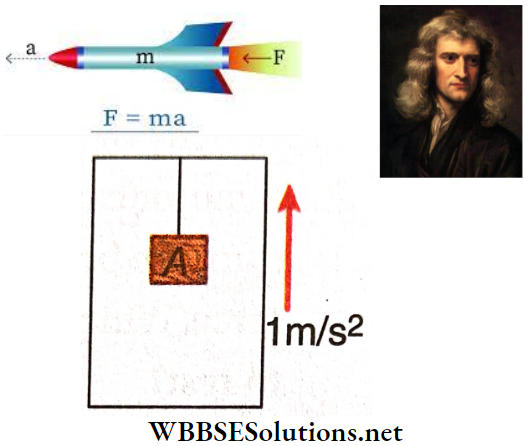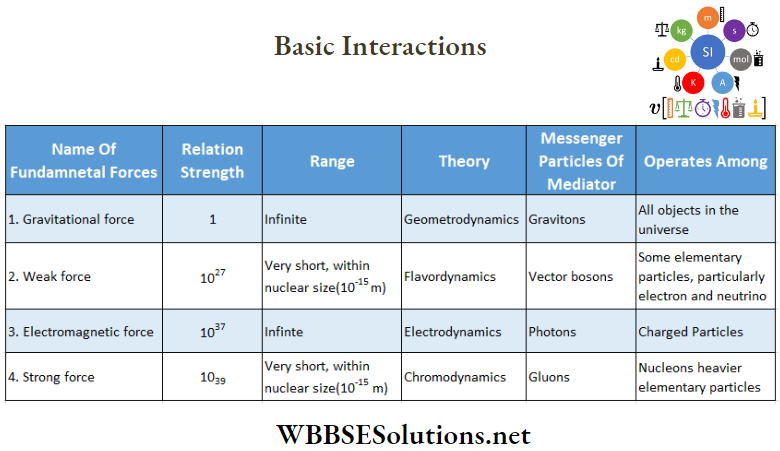
WBCHSE Class 11 Physics Newtons Law Of Motion Notes

Newton Law Of Motion

Statements Of The Laws Of Motion

In 1687, Sir Isaac Newton, in his book Principia, published three laws of motion related to all the moving objects in the universe. These are known as Newton’s laws of motion. These laws cannot be proved using any old concept of physics. Yet, their validity has been confirmed through successful explanations and predictions on numerous events in nature. Hence, the laws founded a new branch of physics called kinetics.

The Laws Are:

  1. 1st Law: Everybody continues to be in its state of rest or of uniform motion in a straight line unless the body is compelled to change its state by a net external force.
  2. 2nd Law: The rate of change of momentum of a body is proportional to the impressed force and takes place in the direction in which the force acts.
  3. 3rd Law: To every action, there is an equal and opposite reaction.

These laws involve the new concepts of

  1. Inertia,
  2. Force and
  3. Momentum.

Read and Learn More: Class 11 Physics Notes

The study of these laws is the subject of this chapter and is called Newtonian mechanics. It should be mentioned, however, that Newtonian mechanics does not apply to all situations.

  1. If the interacting bodies are moving with the speed of light (or an appreciable fraction of the speed of light), Newtonian mechanics should be replaced by Einstein’s special theory of relativity.
  2. If the interacting bodies are of atomic dimensions (for example, electrons in an atom), Newtonian mechanics should be replaced by quantum mechanics.

In short, Newtonian mechanics may be treated as a special case of these two more comprehensive theories.

WBCHSE Class 11 Physics Newtons Law Of Motion Notes

Weight Of A Body Gravitational Unit Of Force

Gravitational Unit Of Force Definition: The weight of a body is the force with which the earth attracts the body.

  • The earth’s attraction is the force of gravity, the acceleration produced by it is called the acceleration due to gravity, g, and it is always directed towards the center of the earth.
  • Hence, using the relation \(\vec{F}=m \vec{a}\), the weight of a body of mass m is formulated as \(\vec{W}=m \vec{g}\)
  • So, weight = mass x acceleration due to gravity at the place. The value of g varies at different places and hence the weight also changes. For example, a bowling ball of mass 7.2 kg weighs 71N on Earth, but only 12N on the Moon.
  • The mass of the ball is the same on both earth and the moon but the free fall acceleration on the moon is only 1.6 m/s².

Gravitational unit Of force: The force with which the earth pulls a body of unit mass, is the unit of gravitational force.
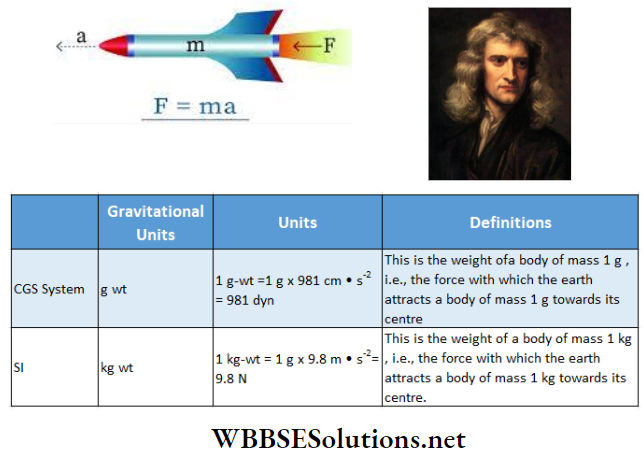
Newtons Law Of Motion Gravitational Unit Of Force

Gravitational units are no longer accepted for use with the SI units by BIPM.

From the above definitions, we see that gravitational units depend on acceleration due to gravity which varies at different places. So we cannot use these units as standard.

But accepting a value of g as a standard, a standard gravitational unit of force can be defined. Kilogram-force or kgf is the most commonly used standard unit.

1 kgf is the weight of a mass of 1 kg at a place where the acceleration due to gravity, g = 9.80665 m · s-2, and

therefore 1 kgf = 1 kg x 9.80665 m · s-2 = 9.80665 N .

However, this unit has become almost obsolete at present.

Inertial Mass: Suppose, two small pieces, one of wood and the other of iron, are at rest on the floor. From experience, we know that, on applying the same amount of force, the piece of wood will have an acceleration greater than that of the iron piece.

  • Conversely, to produce the same acceleration on both pieces, the force applied on the iron piece will have to be greater. So, the inertia of rest for the iron piece is more than that for the piece of wood. Thus, the mass of a body is a measure of inertia of rest.
  • This is also true for the inertia of motion. For instance, to stop a bicycle and a truck, moving with the same velocity within the same distance, i.e., to produce the same retardation, the force applied on the truck has to be greater. So, in this case, too, the masses of the vehicles give a measure of their inertia of motion.

Therefore, to produce the same acceleration in any two different objects, at rest or in motion, force required will be different if their masses are unequal. Thus, the mass of an object is the measure of its inertia. So mass is also called Inertial mass. The mass m in the equation \(\vec{F}=m \vec{a}\), is the inertial mass.

Newton Law Of Motion Weigt Of Body Numerical Examples

Example 1. A paratrooper of mass 75 kg falls with a constant velocity. Find the air resistance acting on him.
Solution:

Given

A paratrooper of mass 75 kg falls with a constant velocity.

As the acceleration is zero, there is no resultant force acting on the paratrooper. The weight acting downwards = 75 x 9.8 = 735 N.

Therefore, the air resistance, acting upwards, is R = 735 N.

Newton Law Of Motion – Analysis Of Different Motions

WBBSE Class 11 Newton’s Laws of Motion Notes

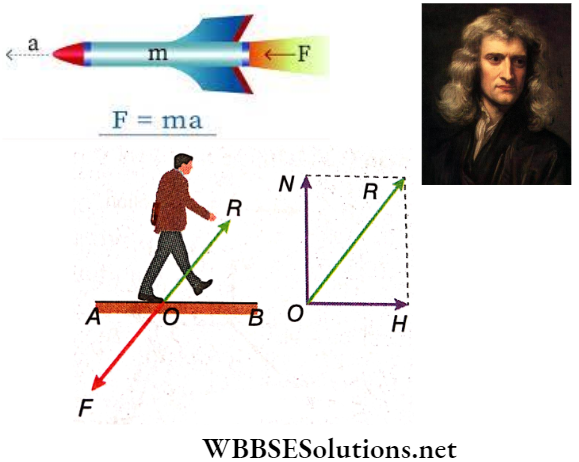
Walking On A Horizontal Plane: AB is a horizontal plane. A man wants to walk on the plane towards B. He applies an oblique force F on the plane. The plane too, exerts a reaction force R on the man.

  • The vertical component of R acts opposite to the weight of the man and the horizontal component H provides the force for the forward movement. So, the motion of the man is not directly due to the force F that he exerts, but due to the opposite reaction.
  • In fact, this force decides the type of the motion. As the frictional force is low on a smooth surface, it is not possible to exert a large force. If the horizontal component of F becomes much larger than the frictional force, the man may slip.
  • Hence one cannot walk fast on a very smooth surface as there is a high chance of slipping.
Newtons Law Of Motion Walking On A Horizontal Plane

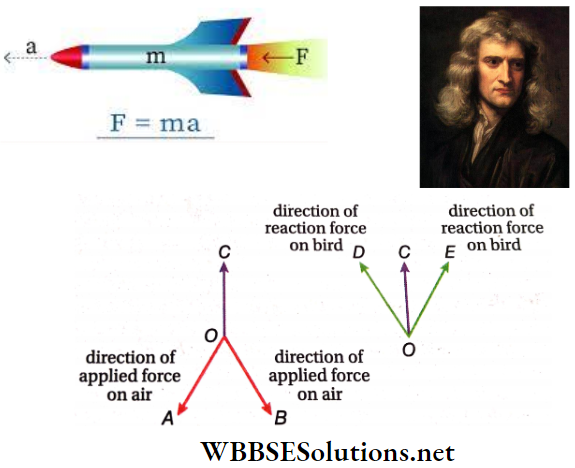
Flight Of Birds: If a bird intends to fly along OC, it flaps its wings along OA and OB, thus exerting some force on the air. At the same time, the reaction forces on the bird are OE and OD.

  • If both the wings of the bird exert equal force on air, the resultant reaction force will be along OC. The bird moves forward due to this reaction force.
  • By adjusting the force applied by the wings, the resultant may be shifted to the left or right of the direction of OC, and the bird can thus change its course.
  • In the absence of air, i.e., in a vacuum, the reaction forces OD and OE cannot be generated, and so birds cannot fly.
Newtons Law Of Motion Flight Of Birds

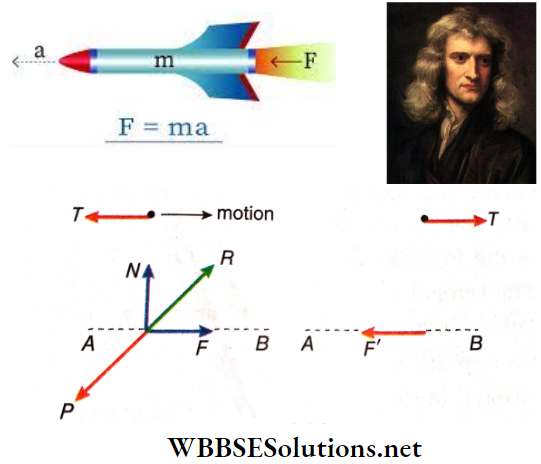
Motion Of A Hand-Pulled Rickshaw: A man is trying to pull a rickshaw on a horizontal plane, towards point B. He exerts an oblique force P on the plane. The reaction R of the plane has a vertical component N and a horizontal component F. Force N is balanced by the weight of the man. Horizontal component F sets up the motion of the man.
Newtons Law Of Motion Motion Of A Hand Pulled Rickshaw

  • Let the force exerted by the man on the handles of the rickshaw be T. The rickshaw also pulls the man backward with the same force T.
  • Due to the motion of the wheel on the plane, frictional force F’ acts at the point of contact of the wheel and the plane in a direction opposing the motion.
  • Hence, the resultant of forces acting on the man = F- T in the forward direction and that on the rickshaw in the same direction = T-F’
  • Let the masses of the man and the rickshaw be m1 and m2 respectively and common acceleration in the forward direction be a.

For the man, F- T = m1a or, T = F-m1a

For the rickshaw, \(T-F^{\prime}=m_2 a \text { or, } T=F^{\prime}+m_2 a\)

∴ \(F-m_1 a=F^{\prime}+m_2 a \text { or, }\left(m_1+m_2\right) a=F-F^{\prime}\)

or, \(a=\frac{F-F^{\prime}}{\left(m_1+m_2\right)}\)

The expression for the acceleration shows that,

  1. Individual masses m1 or m2 are not significant but the sum of the masses (m1 + m2) matters,
  2. The rickshaw will start moving, i.e., Accelerating when F> T>F’,
  3. During the early stages of motion, F > T > F’. It attains a uniform speed when F =T= F’ and then of course a = 0, and
  4. If F< F’, the rickshaw cannot be set into motion at all.

There are many similar examples in nature, where a force (action) is applied backward, and the reaction force generated is actually responsible for the intended forward motion.

Newton Law Of Motion – Equation Of Motion And Its Solution

Key Concepts of Newton’s Laws for Class 11

The body, whose motion is to be analyzed, should be identified at first.

  1. This ‘‘body” may consist of a single body a combination of bodies (often called a system of bodies’) or even a part of a single body.
  2. Then we have to consider the surroundings (or environment). Every other body having a direct influence on our chosen body is a part of the surroundings. In general, action-reaction-type forces act between the body and its surroundings.
  3. Now we search for every force acting on our body. Each of the forces is either a force of action on the body or a force of reaction on it due to some other body in the surroundings.
  4. Once the forces are identified, we regard them on the same footing, i.e., we no longer differentiate between actions and reactions. In this sense, the body under consideration acts as a free body, subject to a system of forces acting on it.
  5. If the active forces are \(\vec{F}_1, \vec{F}_2, \vec{F}_3, \cdots\), then the resultant or net force is \(\vec{F}=\vec{F}_1+\vec{F}_2+\vec{F}_3+\cdots\)

For a body of constant mass m, we get from Newton’s 2nd law, m \(\vec{a}=\vec{F}=\vec{F}_1+\vec{F}_2+\vec{F}_3+\cdots\)…(1)

This equation (1) is to be solved to find out the acceleration \(\vec{a}\) of the body.

As \(\vec{a}\) is related to the velocity \(\vec{v}\) as \(\vec{a}\) = \(\frac{d \vec{v}}{d t}\), equation (1) may be written as \(m \frac{d \vec{v}}{d t}=\vec{F}\)…(2)

Clearly, this is the differential equation to be solved if the velocity of the body is to be found. Similarly, as \(\vec{v}=\frac{d \vec{r}}{d t}\)(\(\vec{r}\) = position vector of the body), we may write m \(\frac{d^2 \vec{r}}{d t^2}=\vec{F}\)…(3)

This 2nd-order differential equation is to be solved to obtain \(\vec{r}\) at any instant.

Any of the equations (1) to (3) is then called the equation of motion of a body.

It is to be noted that the equation of motion is a vector equation. Each vector has three independent components. So the solution of an equation of motion involves, in general, a solution of three independent equations corresponding to three mutually orthogonal coordinate axes.

However, this is not always the case we come across plenty of examples of one or two-dimensional motions where one or two equations, respectively, are relevant.

Newton Law Of Motion Problems On Tension

Horizontal Motion With The Help Of A Smooth Pulley: A body A of mass m is resting on a frictionless horizontal plane. To set body A into motion along the plane, it is tied, using a massless, inextensible string passing over a massless, frictionless pulley, with another m body B of mass M as shown.
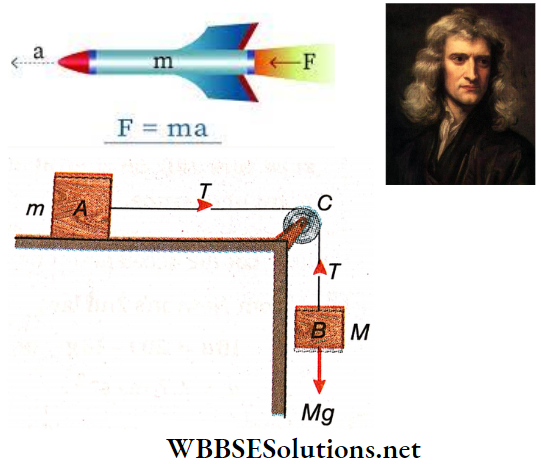
Newtons Law Of Motion Horizontal Motion With With Help Of Smooth Pulley

Both the bodies, A and B, get the same constant acceleration and the tension in the string remains constant (as the pulley is frictionless).

Let the tension in the string = T; acceleration produced = a

∴ For the motion of A, T = ma …(1)

For the downward motion of B, Mg- T = Ma ….(2)

From (1) and (2), (M+ m)a = Mg

or, a = \(\frac{M}{M+m^g} g\)…(3)

As, \(\frac{M}{M+m}<1, a<g\), though the surface and the pulley are frictionless.

Also, inserting the value of an in equation (1) we get, T = \(\frac{M m}{M+m^2} g=\frac{M}{1+\frac{M}{m}^g}\)

Here, \(\frac{M}{1+\frac{M}{m}}<M\), and hence T < mg, i.e., the tension in the string is less than the weight of the body B.

Vertical Motion With The Help Of A Smooth Pulley; To raise a body A of mass m vertically, a heavy body B of mass M is connected to A using a massless inextensible string passing over a massless smooth frictionless pulley as shown.
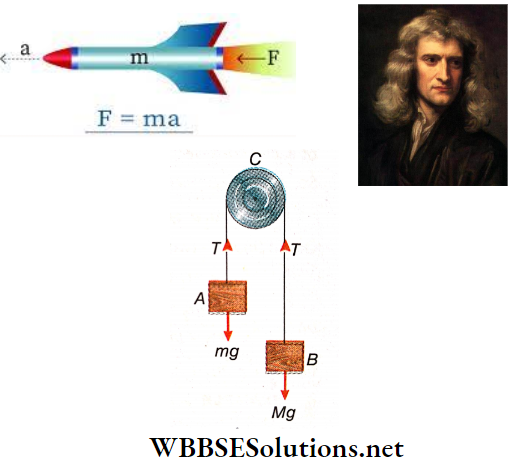
Newtons Law Of Motion Vertical Motion With The Help Of A Smooth Pulley

Let the tension developed in the string be T and the common acceleration of A and B be a. Mass of B is more than that of A. Hence B will move downwards, A will move upwards.

Considering the motion of B, Mg – T = Ma …(1)

and the motion of A, T – mg = ma …(2)

Adding equations (1) and (2), (M- m)g = (M+ m)a

or, a = \(\frac{M-m}{M+m} g\)…(3)

From (3), a < g though the pulley is smooth.

Again, inserting the value of an in (1),

T = \(M g-\frac{M(M-m)}{M+m} g=M g\left(1-\frac{M-m}{M+m}\right)\)

= \(\frac{2 M m}{M+m^2} g\)…(4)

The value of a in equation (3) is positive (i.e., acceleration of A is upwards), if M> m, i.e., if the mass of B is more than that of A. As M > m, we get from equation (4), T> mg and T< Mg, i.e., the tension in the string is more than the weight of A (mg), but less than the weight of B. The net force on the pulley,

2T = \(\frac{4 M m}{M+m} g\)…(5)

Newton Law Of Motion Problems On Tension Numerical Examples

Short Answer Questions on Newton’s Laws

Example 1. A block of mass m2 = 100 g is suspended from one end of an inextensible string. The other end of the string is tied to another block of mass m1 = 200 g, kept on a frictionless table surface. The string passes over a pulley. Find the tension in the string and the acceleration of the blocks.
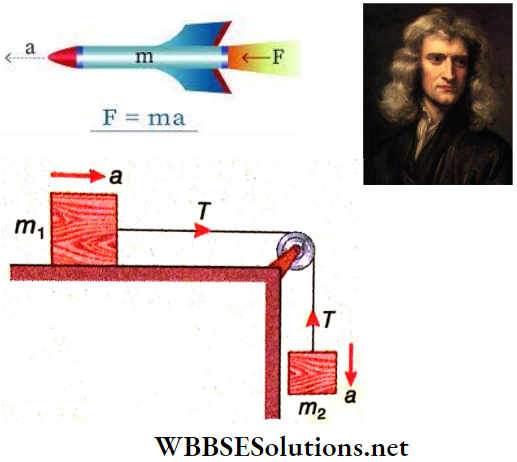
Newtons Law Of Motion Inextensible Spring

Solution:

Given

A block of mass m2 = 100 g is suspended from one end of an inextensible string. The other end of the string is tied to another block of mass m1 = 200 g, kept on a frictionless table surface. The string passes over a pulley.

Let the tension in the string = T, and the acceleration of each block be a.

So, the equations of motion of the two blocks are, T = m1a and m2g – T = m2a

On adding the two equations, we get, m2g = m1a + m2a

or, \(a=\frac{m_2}{m_1+m_2} \cdot g=\frac{100}{200+100} \times 980=326.7 \mathrm{~cm} \cdot \mathrm{s}^{-2}\)

and T = m1a  = 200 x 326.7 = 65340 dyn.

Example 2. Two blocks of masses 2.9 kg and 1.9 kg are suspended from a rigid support, using two inextensible wires, each of length 1 m, as shown. The mass of the upper string is negligible and that of the lower string is 0.2 kg • m-1. If the whole system is moving up with an acceleration of 0.2 ms-2, find

  1. The tension at the midpoint of the lower string and
  2. The tension at the midpoint of the upper string.Acceleration due to gravity = 9.8 m · s-2.
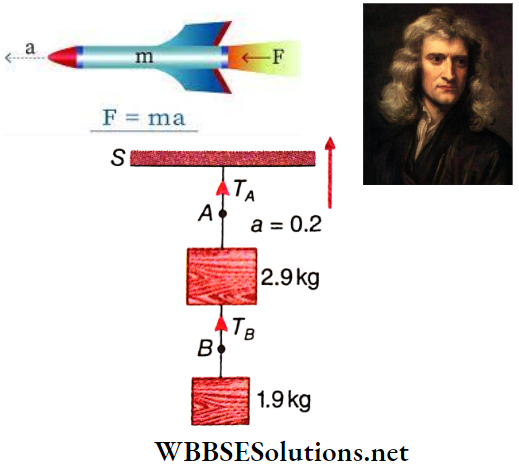
Newtons Law Of Motion Two Blocks Of Masses Are Suspended Using Two Inextensible Wires

Solution:

Given

Two blocks of masses 2.9 kg and 1.9 kg are suspended from a rigid support, using two inextensible wires, each of length 1 m, as shown. The mass of the upper string is negligible and that of the lower string is 0.2 kg • m-1.

1. Mass of the lower string =0.2 x 1 = 0.2 kg. Its midpoint is B, and so the total mass hanging from B, \( m_B=\left (1.9+\frac{0.2}{2}\right)=2 \mathrm{~kg} \text {. }\)

Hence, downward force at B = mBg

Upward force at B = TB

So applying Newton’s 2nd law of motion for the mass below B, mBa = TB– mBg

or, TB = mBa + mBg = mB(a + g)

= 2(0.2 + 9.8) = 20 N

2. Midpoint of the upper string is A; total mass hanging below A, mA = 2.9 + 0.2 + 1.9 =5.0 kg.

Hence, downward force at A = mAg

Upward force at A = TA

Hence applying Newton’s 2nd law of motion for the whole system, mAa = TA– mAg

or, TA = mA(g+ a) = 5(9.8 + 0.2) = 50 N

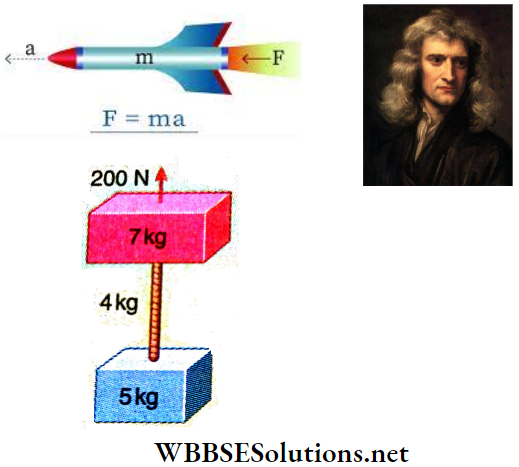
Example 3. Two bodies of mass 7 kg and 5 kg 200 N are joined with a rope of mass 4 kg. An upward force of 200 N is applied on the upper body. Find

  1. The acceleration of the system,
  2. Tension at the top end of the rope and
  3. Tension at the midpoint of the rope.

Newtons Law Of Motion Two Bodies Of Masses Are Joined With A Rope Of Mass

Solution:

Let the acceleration be a.

1. From Newton’s 2nd law, 16a = 200- 16g or, 16a = 200- 16 x 9.8

∴ a = 2.7 m · s-2.

2. The upper end of the rope carries the masses of the second body and the rope. If the tension is T, then T- (4 + 5)g = (4 + 5)a

or, T =9(g+ a) =9(9.8 + 2.7) =112.5 N.

3. The mass carried by the midpoint of the rope is half the mass of the rope and the whole mass of the lower body. Hence, if the tension is T’ at the midpoint, the equation of motion is T’-(2 + 5)g= (2 + 5)a

or, T’ = 7(g+ a) = 7(9.8 + 2.7) = 87.5 N.

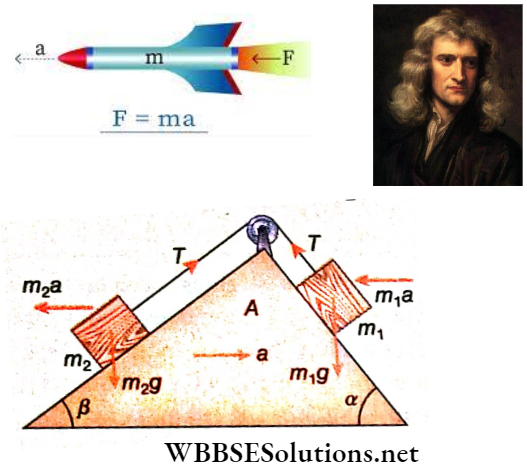
Example 4. A double inclined— plane A is placed on a horizontal table and two blocks of masses m1 and m2 are placed on the two frictionless inclined planes of A. Two ends of a rope wound over a pulley are tied to the two blocks. Find out the horizontal acceleration to be imparted to the system so that the blocks are at rest relative to A. In this condition, what will be the tension in the rope?
Newtons Law Of Motion Doubled Inclined Plane

Solution:

Given

A double inclined— plane A is placed on a horizontal table and two blocks of masses m1 and m2 are placed on the two frictionless inclined planes of A. Two ends of a rope wound over a pulley are tied to the two blocks.

Let the tension in the rope be T and the horizontal acceleration be a .

The forces acting on the two blocks have been shown. They are at rest relative to A, if

∴ \(T-m_2 g \sin \beta-m_2 a \cos \beta=0\)…(1)

∴ \(T-m_1 g \sin \alpha+m_1 a \cos \alpha=0\)…(2)

Subtracting (2) from (1), we get, \(g\left(m_1 \sin \alpha-m_2 \sin \beta\right)=a\left(m_1 \cos \alpha+m_2 \cos \beta\right)\)

or, \(a=\frac{m_1 \sin \alpha-m_2 \sin \beta}{m_1 \cos \alpha+m_2 \cos \beta} \times g\)

∴ T = \(m_2 a \cos \beta+m_2 g \sin \beta\)

= \(m_2 g\left[\frac{m_1 \sin \alpha-m_2 \sin \beta}{m_1 \cos \alpha+m_2 \cos \beta} \cdot \cos \beta+\sin \beta\right]\)

= \(\frac{m_1 m_2 \sin (\alpha+\beta)}{m_1 \cos \alpha+m_2 \cos \beta} g .\)

Class 11 Physics Class 12 Maths Class 11 Chemistry
NEET Foundation Class 12 Physics NEET Physics

Newton Law Of Motion Reaction In A Moving Lift Apparent Weight

Newton’s First Law Explained for Class 11

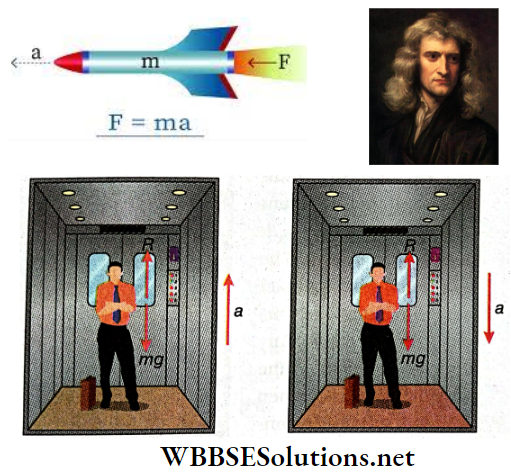
When a person of mass m stands on a floor, a downward force mg acts on the floor due to his weight. At the same time, the floor exerts an upward reaction force or normal force R on the man.

  • As R acts on the person, the person feels his weight. From the third law of motion, R = mg.
  • So, in this case, the actual weight mg, and the normal reaction, R, is the same. If the normal force R is absent, the person feels weightless.
  • For example, while jumping from a height, one feels weightless before touching the earth’s surface, because the normal force R is absent.
  • The normal force R varies inside a lift due to its vertical motion. The floor of the lift, in this case, provides the reaction. A person feels lighter or heavier than his actual weight depending on the reaction force R. This is called apparent weight.

Let the mass of a man in a lift be m.
Newtons Law Of Motion Reaction In A Moving Lift

The downward attractive force acting on him = real weight = mg

The upward normal force of the floor – apparent weight = R

∴ The net upward force F = R- mg.

We can determine the apparent weight R using F = ma for different types of motion of the lift.

1. The Lift Is Moving Up With An Acceleration a(Or, Moving Down With A Retardation a): Here the upward acceleration is a.

∴ R- mg = ma

or, R = mg+ ma = m(g+ a)….(1)

∴  As R> mg, the man feels heavier.

2. The Lift Is Moving Down With An Acceleration a(Or, Moving Up With A Retardation a): Here the downward acceleration = a or upward acceleration =-a (here a < g).

∴ R- mg = -ma

or, R = m(g- a)…(2)

He feels lighter as m(g- a) < mg.

3. The Cable Of The Lift Snaps And The Lift With The Man, Falls Freely Due To Gravitational Pull: Here, the acceleration, a = g. Hence from (2),

R = m(g- g) = 0…(3)

As no normal force acts on the man, he feels weightless.

This apparent weightlessness is true for all freely falling bodies.

4. The Lift Is At Rest Or In Uniform Motion: The value of a is zero and so the reaction force, R = mg. Hence, the apparent weight is the same as the real or true weight.

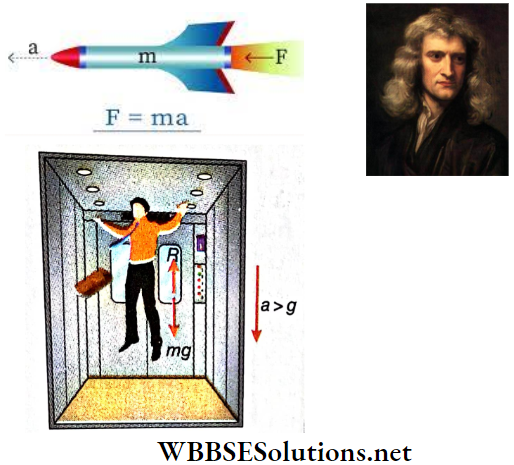
5. The Lift Falls With A Downward Acceleration Greater Than g: Here, a > g. From equation (2), R = m(g-a) or, R = -m(a- g).
Newtons Law Of Motion Lift Falls With A Downward Acceleration Greater Than g

The negative sign indicates that the apparent weight is negative, i.e., it is directed upwards. The man thus loses contact with the floor and hits the ceiling of the lift. Any item on the floor of the lift will hit the roof when exposed to similar conditions. This is termed as super-weightlessness.

Newton Law Of Motion – Reaction In A Moving Lift Apparent Weight Numerical Examples

Example 1. A body of mass 1 kg is suspended from a spring balance calibrated for acceleration due to gravity of 10 m · s-2. What is the reading on the spring balance when the system

  1. Is ascending with an acceleration of 5 m · s-2 and
  2. Is descending with the same acceleration? [g = 10 m · s-2]

Solution:

Given

A body of mass 1 kg is suspended from a spring balance calibrated for acceleration due to gravity of 10 m · s-2.

1. Reaction force on the balance when it ascends, R = m(g+ a) = 1(10 + 5) = 15 N.

∴ In this case, the reading of the spring balance = 15/100 = 1.5 kg

Reaction force when the system descends, R = m(g – a) =1(10-5) = 5N.

∴ In this case, the reading of the spring balance = 5/10 = 0.5 kg

Example 2. A man of 50 kg is standing on a weighing machine in a lift. As the lift moves with a constant acceleration, the weighing machine registers the man’s weight as 45 kg. State whether the lift is ascending or descending. Give reasons for your answer. What is the acceleration of the lift? [g = 9.8 m · s-2]
Solution:

Given

A man of 50 kg is standing on a weighing machine in a lift. As the lift moves with a constant acceleration, the weighing machine registers the man’s weight as 45 kg.

The weighing machine shows a reading lower than the real weight of the man. So, the lift is descending with an acceleration, because in such cases, apparent weight R = m(g- a) < mg.

The downward acceleration, a = \(g-\frac{R}{m}=9.8-\frac{45 \times 9.8}{50}=0.98 \mathrm{~m} \cdot \mathrm{s}^{-2}\)

Example 3. A man of mass 70 kg is sitting in a motor car. The car is moving with an acceleration of 5 m · s-2. What is the gravitational force on the man? [g = 9.8 m s-2]
Newtons Law Of Motion Man Of Mass Is Sitting In Motor Car

Solution:

Given

A man of mass 70 kg is sitting in a motor car. The car is moving with an acceleration of 5 m · s-2.

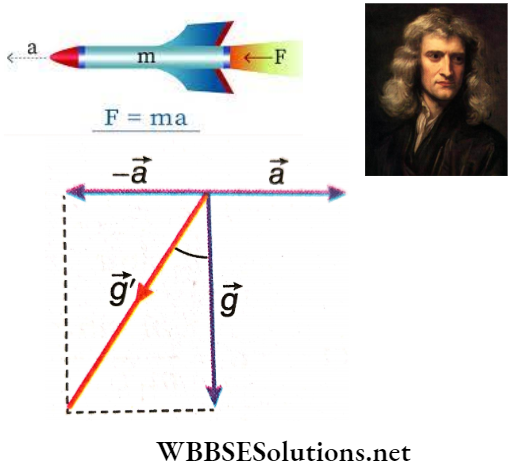
Let the horizontal acceleration of the car be \(\vec{a}\).

The apparent acceleration due to gravity with respect to the car, \(\vec{g}^{\prime}=\vec{g}-\vec{a}=[\vec{g}+(-\vec{a})]\)

which is the resultant of the vectors \(\vec{g}\) and –\(\vec{a}\).

From, \(g^{\prime}=\sqrt{g^2+a^2}=\sqrt{(9.8)^2+5^2}\)

= \(11 \mathrm{~m} \cdot \mathrm{s}^{-2}\)

Force of gravitation on the man =70 x 11 = 770 N,

which acts in the direction of g’.

[The apparent weight of the man is, W’ = \(\frac{770}{9.8}\) = 78.6 kg]

The force of gravity, acting on the man, remains constant but, because of acceleration, the man feels a greater pull of gravity.

Example 4. A man of mass 60 kg is standing in a lift at rest. What will be the reaction force on the man when the lift is

  1. Stationary,
  2. Moving up with an acceleration of 4.9 m · s-2,
  3. Moving up at a constant speed, and
  4. Moving up with a retardation of 4.9 m · s-2? [G = 9.8 m · s-2]

Solution:

1. The reaction of the lift floor when the lift is stationary R = mg = 60 x 9.8 N = 588 N.

2. The lift is moving up with an acceleration, of a = 4.9 m · s-2.

Reaction, R=m(g+a) =60(9.8 + 4.9) N =882N,

3. When the lift is moving up at a constant speed, a = 0.

∴ R = mg =60 x 9.8 N = 588 N.

4. When the  lift moves up with a retardation of 4.9 m · s-2,

R = m[g+ (-a)] = m(g- a) = 60(9.8- 4.9) N = 294 N

Example 5. A man of mass 98 kg, is standing on a weighing machine in a lift. What will be the readings of the weighing machine in the following cases:

  1. The lift ascends at 100 cm per second,
  2. The lift descends with an acceleration of 30 cm · s-2. [g= 980 cm · s-2]

Solution:

Given

A man of mass 98 kg, is standing on a weighing machine in a lift.

1. When the lift ascends with uniform velocity (acceleration a = 0 ) then, R = mg = 98 x 9.8 N.

Reading of the weighing machine = \(\frac{98 \times 9.8}{9.8} \mathrm{~kg}=98 \mathrm{~kg} .\)

2. When the lift descends, R = m(g- a)

= 98(9.8-0.3) [30 cm · s-2 = 0.3 m · s-2]

= 98 x 9.5 N

∴ Reading of the weighing machine = \(\frac{98 \times 9.5}{9.8} \mathrm{~kg}=95 \mathrm{~kg} .\)

Example 6. A man weighing 60 kg is in a lift that descends with an acceleration of 4 cm · s-2. What force will the man exert on the floor of the lift? If the lift begins to ascend with the same acceleration, what reaction force will act on the man? For what acceleration of the lift, while descending, will the man experience weightlessness? [g = 980 cm · s-2]
Solution:

Given

A man weighing 60 kg is in a lift that descends with an acceleration of 4 cm · s-2.

If the lift descends with an acceleration a, and if the reaction force exerted by the lift on the man in the upward direction is R, then mg- R = ma …(1)

The force exerted by the man on the lift’s floor, R = mg – ma [4cm · s-2 = 0.04m · s-2] = 60(9.8-0.04) = 585.6 N

If the lift ascends with the same acceleration, then the reaction force on the man is, R’ = mg+ ma [4 cm · s-2 = 0.04 m · s-2]

= 60(9.8 + 0.04) = 590.4 N

When the acceleration of the lift, while descending, is a = g, then from equation (1), we get, R = mg- mg = 0 . For this zero reaction force, the man feels weightless.

So, for a lift falling freely with an acceleration g, the man inside it will feel no weight.

Example 7. A lift of mass 200 kg is moving up with an acceleration of 4 m · s-2. What is the tension in the lift cable? If the lift moves down with the same acceleration, what will be the tension in that case? [g = 9.8 m · s-2]
Solution:

Given

A lift of mass 200 kg is moving up with an acceleration of 4 m · s-2.

Let the tension in the cable be T when the lift is moving with an acceleration a.

The equation of motion for the lift is, T- mg = ma

or, T = m(g+a)…(1)
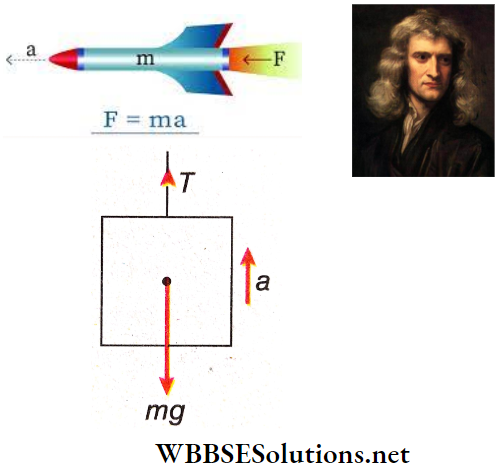
Newtons Law Of Motion Lift Of Mass Moving Up With An Acceleration

Substituting the values for m, g, and a in equation (1), for upward motion,

T =200(9.8 + 4) = 200×13.8 = 2760 N

For the lift moving downwards, a = -4m · s-2,

T= 200(9.8-4) = 200×5.8 = 1160 N

Example 8. A lift of mass 2000 kg is supported by thick steel ropes. If the maximum upward acceleration of the lift be 1.2 m/s2, and the breaking stress for the ropes be 2.8 x 10⁸ N/m2, what should be the minimum diameter of the rope?
Solution:

Given

A lift of mass 2000 kg is supported by thick steel ropes. If the maximum upward acceleration of the lift be 1.2 m/s2, and the breaking stress for the ropes be 2.8 x 10⁸ N/m2,

Here, m = 2000 kg, a = 1.2 m/s2

Breaking stress =2.8 x 10⁸ N/m2

Let the diameter of the rope be D.

When the lift moves upwards, the tension in the rope is T= m(g+ a) = 2000(9.8 + 1.2) = 22000 N.

Now, breaking stress = \(\frac{\text { force }}{\text { area }}=\frac{T}{\pi D^2 / 4}=\frac{4 T}{\pi D^2}\)

or, 2.8 x \(10^8=\frac{4 \times 22000 \times 7}{22 \times D^2}\)

or, \(D^2=\frac{4 \times 22000 \times 7}{22 \times 2.8 \times 10^8}=10^{-4} \quad \text { or, } D=1 \mathrm{~cm}\)

Newton Law Of Motion – Law Of Conservation Of Linear Momentum

Newton’s Second Law: Formulas and Applications

Newton’s second law of motion states that the rate of change of momentum of a body is directly proportional to the applied force. Hence, in the absence of an external force, there is no change in the momentum of a body.

This law is also applicable for a system consisting of a number of bodies. The members in a many-body system may have interactions among themselves due to collisions, attractions, repulsions, etc. These forces are to be treated as internal forces, not external forces.

Law Of Conservation Of Linear Momentum Statement: In the absence of any external force acting on a system of bodies, even if interactions exist among the bodies, the total linear momentum of the system remains constant.

  • This statement is the law of conservation of linear momentum. For a system of bodies, we can calculate the components of linear momentum, of all the bodies present, in any chosen direction. The stun of these individual components in this direction will be a constant.
  • We shall illustrate the law for a one-dimensional collision. Suppose two particles of mass m1 and m2, moving with velocities u1 and u2 respectively in a straight line, collide with each other. After the collision, the particles move with velocities v1 and v2 respectively in the same direction.
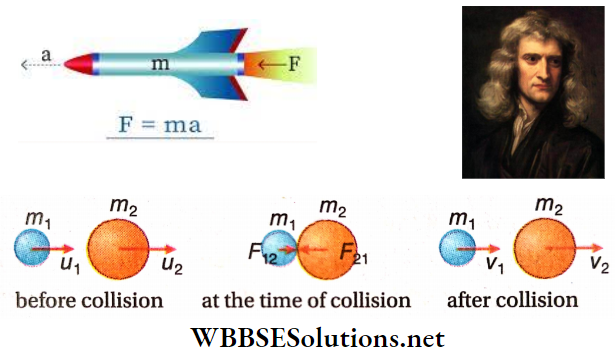
Newtons Law Of Motion Law Of Conservation Lineaar Momentum

Hence, total momentum before collision =m1u1 + m2u2, and total momentum after collision =m1v1 + m2v2.

If there is no external force, as per the conservation law of linear momentum, m1u1 + m2u2 = m1v1 + m2v2…….(1)

Law Of Conservation Of Linear Momentum From Newton’s Third Law Of Motion: In the absence of any external force, two bodies, during a collision, exert an impulsive force on each other. From Newton’s third law of motion, impulsive force on the first body is equal and opposite to that exerted on the second body.

Forces F12 and F21 are shown: F21 = -F12

If the collision lasts for a time t, the impulse of F21 on the first body = F21 • t = change of momentum of the first body = m1u1– m2u2

Similarly, impulse of F12 on the second body = F12 x t = change of momentum of the second body = \(m_2 v_2-m_2 u_2\)

As \(F_{21}=-F_{12}, \quad m_1 v_1-m_1 u_1=-\left(m_2 v_2-m_2 u_2\right)\)

or, \(m_1 u_1+m_2 u_2=m_1 v_1+m_2 v_2\)

As total momentum before collision = total momentum after collision, the total linear momentum remains conserved.

Alternative Method: Suppose two bodies of masses m1 and m2, moving along the same straight line with velocities v1 and v2 respectively, collide with each other.

Since there is no external force present, let the force on the first body exerted by the second body be F21, and that on the second body exerted by the first body be F12.

∴ \(a_1=\frac{d v_1}{d t} \text { and } a_2=\frac{d v_2}{d t}\) = are the respective accelerations of the bodies.

From Newton’s third law of motion, \(F_{21}=-F_{12}\)

or, \(m_1 \frac{d v_1}{d t}=-m_2 \frac{d v_2}{d t}\)

or, \(\frac{d}{d t}\left(m_1 v_1+m_2 v_2\right)=0 or, \quad m_1 v_1+m_2 v_2\)= constant

Hence, the total linear momentum remains conserved.

Newton’s Third Law Of Motion From The Law Of Conservation Of Linear Momentum: Let the initial momentum of two bodies be p1 and p2. They come in contact for a time t and their momenta change to p1‘ and p2‘ respectively.

In the absence of any external force, as per law of conservation of linear momentum, \(p_1+p_2=p_1^{\prime}+p_2^{\prime}\)

or, \(p_1^{\prime}-p_1=-p_2^{\prime}+p_2 \quad \text { or, } \frac{p_1^{\prime}-p_1}{t}=-\frac{p_2^{\prime}-p_2}{t}\)

The left-hand side of the equation is the rate of change of the momentum of the first body = force on the first body = F21; similarly, the right-hand side is -F12.

Hence F21 = -F21 or, action = – reaction.

So action and reaction between two bodies are equal and opposite. This is nothing but Newton’s third law of motion.

Practical Applications Of The Principle Of Conservation Of Linear Momentum:

1. Recoil Of A Gun: When a bullet is fired from a gun, the gun recoils or gives a kick in the backward direction. It can be explained as follows:

  • let m1 be the mass of the bullet and m2 be the mass of the gun. Initially, both the gun and the bullet are at rest. On firing the gun, let the bullet move with a velocity \(\vec{v}_1\), and the gun move with a velocity \(\vec{v}_2\).
  • According to the principle of conservation of linear momentum, the total momentum of gun and bullet before firing = total momentum of gun and bullet after firing.
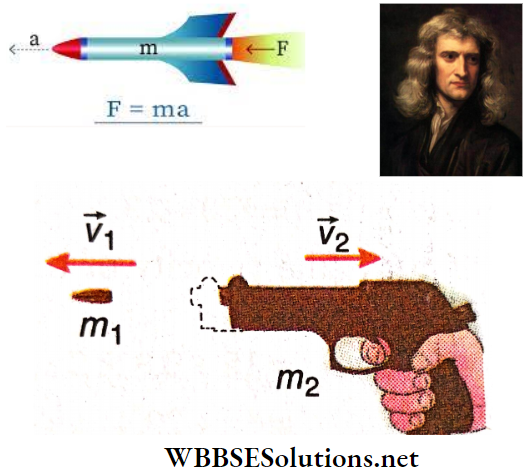
Newtons Law Of Motion Recoil Of A Gun

i.e., 0 = \(m_1 \vec{\nu}_1+m_2 \vec{\nu}_2 \quad \text { or, } \vec{\nu}_2=-\frac{m_1}{m_2} \vec{v}_1\)

  • The negative sign shows that \(\vec{v}_2\) and \(\vec{v}_2\) are in opposite directions, i.e., as the bullet moves forward, the gun will move in backward direction. This backward motion of the gun is called the recoil of the gun.
  • Hence, while firing a bullet, the gun must be held tight to the shoulder otherwise, because of the recoil velocity of the gun, the shoulder of the man who fires the gun, may get hurt.
  • If the gun is held tight to the shoulder then the gun and the body of the man recoil as a single system. As the mass is quite large, the recoil velocity will be very small and the shoulder of the man will not get hurt.

2. Explosion Of A Bomb: Let a bomb of mass M be initially at rest. So, the initial momentum = 0.

After the explosion, suppose that the bomb is split into a few fragments of masses m1, m2, m3 ……; the fragments fly away from the center of the explosion with velocities \(\vec{v}_1\), \(\vec{v}_2\), \(\vec{v}_3\)…

Thus, the final momentum is,\(\vec{p}=\vec{p}_1+\vec{p}_2+\vec{p}_3+\cdots=m_1 \vec{v}_1+m_2 \vec{v}_2+m_3 \vec{v}_3+\cdots\)

As no external force acts on the bomb, the momentum must be conserved, i.e., final momentum = initial momentum, or, \(\vec{p}=\vec{p}_1+\vec{p}_2+\vec{p}_3\)+….. = 0

As a special case, if the bomb explodes into two fragments only, then \(\vec{p}_1+\vec{p}_2=0 \text {, or } m_1 \vec{v}_1+m_2 \vec{v}_2=0 \text {, or } m_1 \vec{v}_1=-m_2 \vec{v}_2\)

Again, if the two fragments are of equal mass, \(m_1=m_2 \text { then } \vec{v}_1=-\vec{v}_2\)

Hence, the two fragments would acquire equal and opposite velocities due to the explosion.

Newton Law Of Motion – Law Of Conservation Of Linear Momentum Numerical Examples

Example 1. A bullet of mass 6 g is fired with a velocity of 500 m s-1 from a gun of mass 4 kg. Find the recoil velocity of the gun.
Solution:

Given

A bullet of mass 6 g is fired with a velocity of 500 m s-1 from a gun of mass 4 kg.

As the bullet and the gun were at rest before the firing, the initial momentum of the system was zero. Let the speed of the bullet after the firing be v, and that of the gun be V.

From the law of conservation of linear momentum, 0 = MV+ mv

[mass of the bullet = m , mass of the gun = M]

or, \(V=-\frac{m}{M} \nu=-\frac{6 \times 10^{-3}}{4} \times 500=-0.75 \mathrm{~m} \cdot \mathrm{s}^{-1}\)

Hence, the recoil velocity of the gun = 0.75 m · s-1.

Example 2. While firing a bullet of mass 8 g, the recoil velocity of the gun of mass 5 kg becomes 64 cm · s-1. The bullet penetrates 50 cm through a target and then stops. Express the average resistance on the bullet in Newton.
Solution:

Given

While firing a bullet of mass 8 g, the recoil velocity of the gun of mass 5 kg becomes 64 cm · s-1. The bullet penetrates 50 cm through a target and then stops.

The initial momenta of the gun and the bullet were zero, as both were at rest. Let the masses of the gun and the bullet be M and m respectively and the respective velocities after firing be V and v.

From the law of conservation of Linear momentum, 0 = MV+ mu

∴ \(\nu=-\frac{M}{m} V=-\frac{5}{8 \times 10^{-3}} \times 0.64=-400 \mathrm{~m} \cdot \mathrm{s}^{-1}\)

The bullet comes to rest after penetrating a distance of 50 cm or 0.5 m. If the retardation is due to the resistance of the material of the target, 0 = (400)² – 2a · 0.5 or, a = 16 x 104 m · s-2

Hence, average resistance, F = ma = 0.008 x 16 x 104 = 1280 N.

Example 3. A body of mass m moving with velocity V along the X-axis collides with another mass M moving with velocity v along the Y-axis. The masses coalesce after the collision. Find the velocity and the direction of motion of the combined mass.
Solution:

Given

A body of mass m moving with velocity V along the X-axis collides with another mass M moving with velocity v along the Y-axis. The masses coalesce after the collision.

Let the velocity of the combined mass be u which makes an angle θ with the X- axis.

Applying the law of conservation of linear momentum along the X-axis, mV+ 0 = (m + M)u cosθ…(1)

Similarly, along Y-axis, 0 + Mv = (m + M)u sinθ…(2)
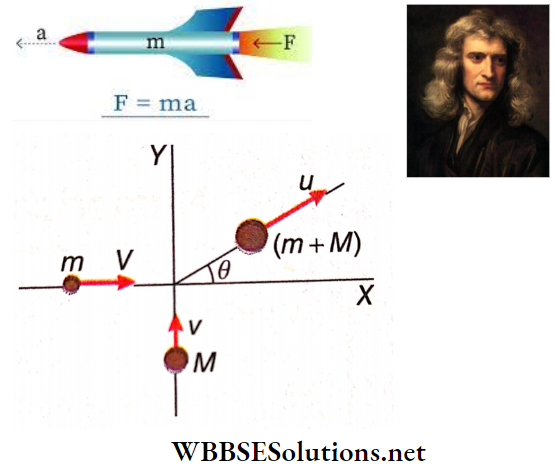
Newtons Law Of Motion A Body Of mass Moving With Velocity Along X Axis

Squaring and adding (1) and (2), \(m^2 V^2+M^2 v^2=(m+M)^2 u^2\)

or, \(u^2=\frac{m^2 V^2+M^2 v^2}{(m+M)^2}\)

Hence, u = \(\frac{\sqrt{m^2 V^2+M^2 v^2}}{M+m}\)

Also, (2) ÷ (1) gives, \(\tan \theta=\frac{M v}{m V} \text { or, } \theta=\tan ^{-1} \frac{M v}{m V} .\)

Example 4. A body of mass 50 kg is projected vertically upwards with a velocity of 100 m s-1. After 5 s it splits up into two parts due to an explosion. One part of mass 20 kg moves vertically upwards with a velocity of 150 m s-1. Find the velocity of the second body. Find the sum of the momenta of the two parts 3 s after the explosion and show that if there was no explosion, the momentum of the body would have been constant.
Solution:

Given

A body of mass 50 kg is projected vertically upwards with a velocity of 100 m s-1. After 5 s it splits up into two parts due to an explosion. One part of mass 20 kg moves vertically upwards with a velocity of 150 m s-1.

Let the velocity of the projectile 5 s after the projection and just before the explosion be v.

∴ v = 100- 9.8 x 5 = 51 m · s-1

Let the velocity of the second part after the explosion be v1.

Applying the law of conservation of linear momentum along the direction of projection, 50 x 51 = 20 x 150 + 30 x v1.

or, \(v_1=\frac{50 \times 51-3000}{30}=-15 \mathrm{~m} \cdot \mathrm{s}^{-1} \text { (downwards) }\)

Let the velocity of the 20 kg mass, produced due to the explosion, 3 seconds after the explosion be v’.

∴ v’ = 150- 9.8 x 3

= 150-29.4 = 120.6 m · s-1 (upwards)

If v” is the velocity of the 30 kg mass 3 seconds after the explosion, then v” =15 + 9.8×3

= 15 + 29.4 = 44.4 m · s-1 (downwards)

Thus the total momentum 3 seconds after the explosion = 20 x 120.6- 30 x 44.4 = 1080 kg · m · s-1

In the case of no explosion, the velocity after 8 seconds of projection would have been v2 = 100-9.8×8 = 100-78.4 = 21.6 m · s-1

Hence, its momentum after 8 s would have been 50 x 21.6 = 1080 kg · m ·  s-1

Example 5. A body P of mass 20 g and another body Q of mass 40 g are projected at the same time from points A A and B on the earth’s surface. The velocity of projection for each was 49 m · s-1 and it was directed at an angle of 45° with the horizontal. Distance AB = 245 m. P and Q collide on the same vertical plane. After the collision, P retraces its path to the ground. Find the position where Q touches the ground. How long will Q take to reach the ground after the collision? [g = 9.8 m · s-2]
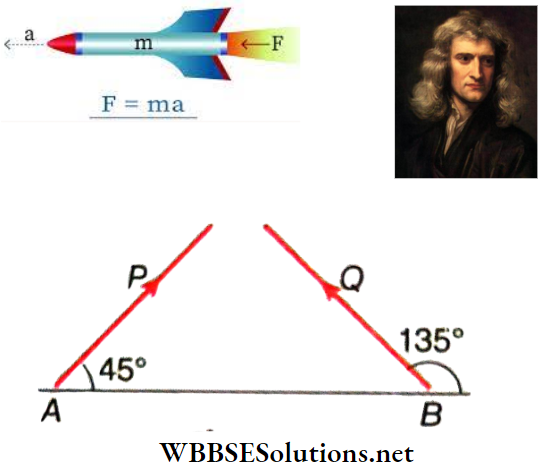
Newtons Law Of Motion A Body Of Mass And Another Body Of Mass

Solution:

Given

A body P of mass 20 g and another body Q of mass 40 g are projected at the same time from points A A and B on the earth’s surface. The velocity of projection for each was 49 m · s-1 and it was directed at an angle of 45° with the horizontal. Distance AB = 245 m. P and Q collide on the same vertical plane. After the collision, P retraces its path to the ground.

As the two bodies P and Q are projected at the same time with the same velocity u = 49 m · s-1 and angle = 45°, the horizontal range for both P and Q is the same an equal to, \(\frac{u^2 \sin 2 \alpha}{g}=\frac{(49)^2 \times \sin 90^{\circ}}{9.8}=245 \mathrm{~m} .\)

Hence the two bodies P and Q will meet at a point on the perpendicular bisector of AB.

Let the time when P and Q meet after projection be t. Hence horizontal distance moved by each x = \(49 \cos 45^{\circ} \times t=\frac{245}{2}, \quad \text { or, } t=\frac{5}{\sqrt{2}} \mathrm{~s}\)

During the collision, the vertical velocity of P and Q \(u_y=u \sin 45^{\circ}-g t=\frac{49}{\sqrt{2}}-\frac{9.8 \times 5}{\sqrt{2}}=0\)

Horizontal velocity of P and Q \(u_x=u \cos 45^{\circ}=\frac{49}{\sqrt{2}} \mathrm{~m} \cdot \mathrm{s}^{-1}\)

Hence horizontal component of the total momentum before collision px = (0.02 ux – 0.04 ux) kg · m · s-1

P retraces its path after the collision. Hence horizontal velocity of P after collision =-ux and for Q it is = v (say).

Hence horizontal component of the total momentum of the system after the collision = (- 0.02 ux + 0.04 v) kg · m · s-1

From the law of conservation of momentum, 0.02 ux– 0.04 ux = (- 0.02 ux + 0.04 V)

or, v = 0

Thus Q does not have any horizontal component of velocity and hence it falls down vertically at the midpoint of AB, at a distance 245/2 = 122.5 m from both A and B

Let t = time required by Q to reach the ground after the collision.

t = \(\frac{u \sin 45^{\circ}}{g}=\frac{49 \times 1}{\sqrt{2} \times 9.8}=3.53 \mathrm{~s} .\)

Example 6. A car of mass 2000 kg collides with a truck of mass 104 kg moving at 48 km · h-1. After the collision, the car rides up the truck, and the truck-car combination moves at 15 km · h-1. What was the velocity of the car before the collision?
Solution:

Given

A car of mass 2000 kg collides with a truck of mass 104 kg moving at 48 km · h-1. After the collision, the car rides up the truck, and the truck-car combination moves at 15 km · h-1.

Suppose a body of mass m moving with velocity u collides along a straight line with a body of mass M and velocity v. After collision the two masses combine and move with velocity V. Applying the law of conservation of equal to, momentum, mu + mv = (m + M)V

or, mu = (m + M)V- Mv

or, \(u=\frac{m+M}{m} V-\frac{M}{m} v=\left(1+\frac{M}{m}\right) V-\frac{M}{m} v\).

Here \(m=2000 \mathrm{~kg}, v=48 \mathrm{~km} \cdot \mathrm{h}^{-1}, M=10000 \mathrm{~kg}\),

V = \(15 \mathrm{~km} \cdot \mathrm{h}^{-1}\)

∴ \(\frac{M}{m}=\frac{10000}{2000}=5\)

u = \((1+5) \times 15-5 \times 48=90-240=-150 \mathrm{~km} \cdot \mathrm{h}^{-1}\)

The negative sign indicates that before collision the car was moving in the direction opposite to that of the truck.

Example 7. A ball weighing 100 g was thrown vertically upwards with a velocity 49 m · s-1. At the same moment, another identical ball was dropped from a height of 98 m vertically above the first ball. After some time the two balls collided and got stuck together. This combined mass reached the ground finally. Determine how long the balls were in motion.
Solution:

Given

A ball weighing 100 g was thrown vertically upwards with a velocity 49 m · s-1. At the same moment, another identical ball was dropped from a height of 98 m vertically above the first ball. After some time the two balls collided and got stuck together. This combined mass reached the ground finally.

Let the height attained by the balls above the ground in time t1 be h when they collide with each other.

Analyzing the upward motion of the first ball, we get \(h=49 t_1-9.8 t_1^2 / 2\)…(1)

Analyzing the downward motion of the second ball, we get \(98-h=9.8 t_1^2 / 2\)…(2)

From equations (1) and (2), 98 = 49 t1 or, t1 = 2 s

At the time of collision, the velocity of the ball thrown in the upward direction is v1 and that of the ball thrown in the downward direction is v2.

∴ v1 = 49 -9.8 x 2 = 29.4 m · s-1(upward)

and v2 = 9.8 x 2 = 19.6 m · s-1 (downward)

After collision, the velocity of the combined mass is V. Then according to the law of conservation of momentum, 0.1 x 29.4- 0.1 x 19.6 = 2 x 0.1 x V

or, V = 4.9m · s-1 (upward)

From equation (1), we get h = 49 x 2- 9.8 x (2)²/2 = 78.4 m

Let the time taken by the combined mass to reach the ground be t2.

Then \(78.4=-4.9 t_2+9.8 \times t_2^2 / 2 \quad \text { or, } t_2^2-t_2-16=0\)

or, \(t_2=(1 \pm \sqrt{1+64}) / 2=4.53 \mathrm{~s}\) (because t Newton Law Of Motion0)

∴ Total time = \(t_1+t_2=2+4.53=6.53 \mathrm{~s} .\)

Example 8. A body of mass m is at rest on a smooth horizontal plane. A force F = kt is applied on the body making an angle α with the horizontal. In the equation of force, t is time and k is a constant. At the instant the object loses contact with the plane, how far will it move along the plane and what will be its velocity?
Solution:

Given

A body of mass m is at rest on a smooth horizontal plane. A force F = kt is applied on the body making an angle α with the horizontal. In the equation of force, t is time and k is a constant. At the instant the object loses contact with the plane

As F= kt, the force increases with time. The vertical component of the force = Fsinα.

The body loses contact with the plane when the vertical force equals the weight of the body, i.e., Fsinα = mg. Let the time after which the body loses contact be t0.

∴ Fsinα = kt0sinα = mg
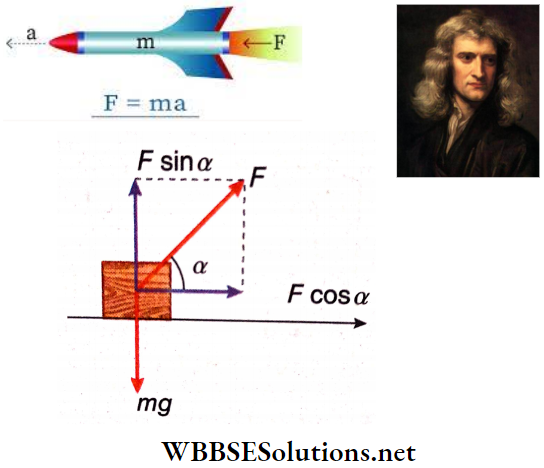
Newtons Law Of Motion A Body Of Mass Is A Rest On A Smooth Horizontal Plane

∴ \(t_0=\frac{m g}{k \sin \alpha}\)

The horizontal component of the force F = Fcosα = ktcosα

Hence horizontal acceleration = \(\frac{k t \cos \alpha}{m}=\frac{d v_x}{d t}\)

∴ \(d v_x=\frac{k t \cos \alpha}{m} \cdot d t\)

Integrating, \(v_x=\frac{k \cos \alpha}{m} \frac{t^2}{2}+A\)…(1)

[where A = integration constant]

As the body starts from rest, at t = 0, v = 0.

Inserting this in equation (1), A = 0

∴ \(v_x=\frac{k \cos \alpha}{2 m} t^2\)…(2)

If the displacement along the plane is s, then \(v_x=\frac{d s}{d t}=\frac{k \cos \alpha}{2 m} t^2 \quad \text { or, } d s=\frac{k \cos \alpha}{2 m} t^2 d t\)

Integrating again, \(s=\frac{k \cos \alpha}{6 m} t^3+B\)…(3)

[where B = integration constant]

As at the initial moment, the displacement is zero, i.e., at t = 0, s = 0.

From equation (3), we get B = 0

Inserting the value of B in equation (3), \(s=\frac{k \cos \alpha}{6 m} r^3\)

Hence, displacement along the plane in time t0, \(s_0=\frac{k \cos \alpha}{6 m} t_0^3=\frac{k \cos \alpha}{6 m}\left(\frac{m g}{k \sin \alpha}\right)^3\)

or, \(s_0=\frac{m^2 g^3 \cos \alpha}{6 k^2 \sin ^3 \alpha}\) and corresponding velocity, \(v_0=\frac{k \cos \alpha}{2 m}\left(\frac{m g}{k \sin \alpha}\right)^2\)

∴ \(v_0=\frac{m g^2 \cos \alpha}{2 k \sin ^2 \alpha} .\)

Example 9. A cannonball of mass 50 kg is fired with a velocity of 40 m s-1 from a cannon of mass 1000 kg. What will be the recoil velocity of the cannon? If the force of friction between the surface and the wheels of the cannon is 1/10th of the weight of the cannon, how far will the cannon move before coming to rest? [Given, g = 10 m s-2].
Solution:

Given

A cannonball of mass 50 kg is fired with a velocity of 40 m s-1 from a cannon of mass 1000 kg. What will be the recoil velocity of the cannon? If the force of friction between the surface and the wheels of the cannon is 1/10th of the weight of the cannon

Let the velocity of the recoil of the cannon be V.

Hence, from the law of conservation of momentum \(0=m v+M V \quad \text { or, } V=-\frac{m v}{M}\)

Here, m = mass of the cannonball = 50 kg, v = its velocity = 40 m · s-1, and M = mass of the cannon = 1000 kg.

From given data, V \(=-\frac{50 \times 40}{1000}=-2 \mathrm{~m} \cdot \mathrm{s}^{-1}\)

Hence, the recoil velocity of the cannon = 2 m · s-1 (backward).

Frictional force between the wheels and the land surface = 1/10 x 1000 x 10 = 1000N

∴ Retardation of the cannon = \(\frac{1000 \mathrm{~N}}{1000 \mathrm{~kg}}=1 \mathrm{~m} \cdot \mathrm{s}^{-2}\)

∴ Distance traveled by the cannon before coming to rest is, \(s=\frac{V^2}{2 a}=\frac{2^2}{2 \times 1}=2 \mathrm{~m}\)

Example 10. Four identical blocks, each of mass m, are connected as shown and are kept on a horizontal table. A force F Is applied on the first block. Find the tension in each string, neglecting friction.
Solution:

Given

Four identical blocks, each of mass m, are connected as shown and are kept on a horizontal table. A force F Is applied on the first block.

Let the acceleration of the system, on applying force F on the first block, be a. Let tension in the string connecting the 1st and the 2nd block be T1, 2nd, and that for the 3rd be T2 and for the 3rd and the 4th be T3.

Equations of motion for the

1st block, F- T1 = ma…(1)

2nd block, T1-T2 = ma……(2)

3rd block, T2-T3 = ma….(3)

and 4th block, T3 = ma …(4)

Since T3 = ma, T2 = ma+ T3 = 2ma and T1 = 3ma.
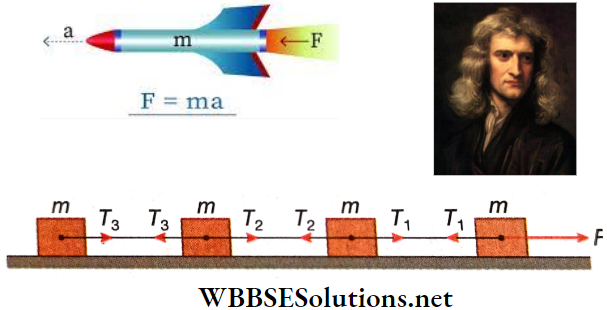
Newtons Law Of Motion Four Identical Blocks

Hence, applied force, F = ma+ T1 = 4 ma

Expressing the tensions in terms of the applied force F, we get \(T_1=\frac{3}{4} F, T_2=\frac{F}{2} \text { and } T_3=\frac{F}{4} \text {. }\)

Newton Law Of Motion – Motion Of An Object Or A System Of Objects With Variable Mass

The mass of an object or a system of objects may change with time. Newton’s second law of motion can be applied in this case only after taking into account the time-variation of mass.

  • Suppose you are cycling along a road with a uniform velocity, carrying your friend in the backseat. You ask your friend to get down by jumping from the running cycle.
  • Then you can realize that suddenly your velocity has increased a bit. The change of velocity would depend on the momentum with which your friend got down from the cycle.

Many examples of this type can be cited which are part of our day-to-day experience.

Equation Of Motion Of An Object Or A System Of Objects With Variable Mass: Let us suppose, at any moment t, the mass and velocity of an object (moving in a straight line) be m and v respectively and the external fixed net force acting on the object be F.

At that moment, another object of an infinitesimal mass dm moving in the same straight line with velocity u is added with the first one. As a result, after an infinitesimal interval of time, i.e., at the moment (f + dt), the mass of the system of objects becomes (m + dm), and let us assume that the velocity becomes (v + dv).
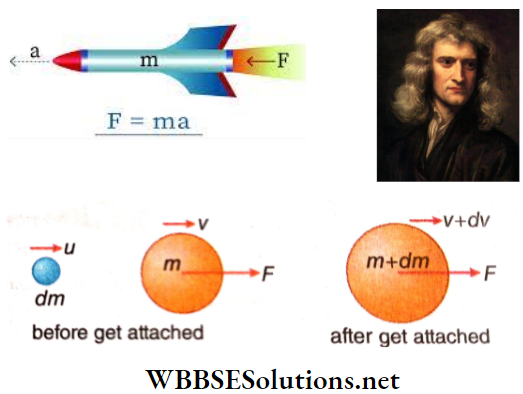
Newtons Law Of Motion Motion Of An object Or A System Of Objects

Now the initial and final momentum of the system of the objects would be respectively, p = mv+ udm….(1)

and p+dp = (m+ dm)(v+ dv)

= mv+ mdv+ vdm…….(2)

As the quantity dmdv is very very small, it is ignored.

So, change in momentum of the system of objects in time dt (p+ dp) – p = mv+ mdv+ vdm – mv- udm

or, dp = mdv-(u-v)dm

Therefore, according to Newton’s second law of motion, F = \(\frac{d p}{d t}=m \frac{d v}{d t}-(u-v) \frac{d m}{d t}\)

It is to be noted that, (u-v) is the relative velocity of dm with respect to m. Putting urel in place of (u – v) in equation (3) we get,

F = \(m \frac{d v}{d t}-u_{\text {rel }} \frac{d m}{d t} \quad \text { or, } F+u_{\text {rel }} \frac{d m}{d t}=m \frac{d v}{d t}\)…(4)

The resulting acceleration of the system is \(\frac{dv}{dt}\) = a.

So from equation (4), \(m a=F+u_{\mathrm{rel}} \frac{d m}{d t}\)….(5)

In the case of time-varying mass, equation (4) or (5) is the effective form of Newton’s second law of motion. Note that, due to time-variation of mass the last term in equation (5) is added to the familiar equation ma = F.

 Newton Law Of Motion – Rocket And Jet Plane

Rocket And Jet Plane Working Principle: A rocket or a jet plane works on the principle of conservation of momentum. In a rocket or a jet engine, there is a combustion chamber with a small aperture (exhaust) H at its rear end.
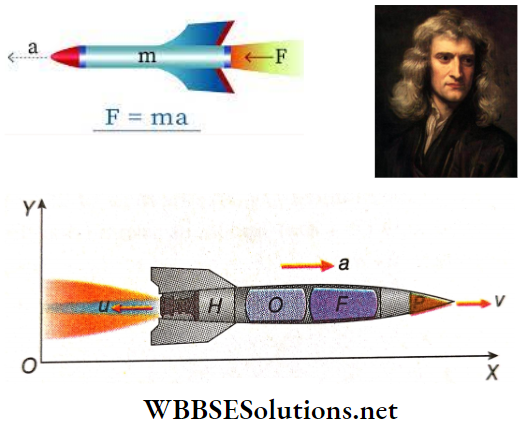
Newtons Law Of Motion Rocket Working Principle

Solid or liquid fuel is ignited in the chamber. As a result of combustion, a large amount of spent fuel, in gaseous form, escapes at a high velocity through the exhaust. This provides a forward thrust to the rocket.

Force On The Rocket And Acceleration: Suppose, at time t, m= mass of a rocket, and v= its velocity in an inertial frame of reference. So, initial momentum of the system, p = mv.

When fuel is burnt in the combustion chamber, a gas is formed. High pressure within the chamber forces the gas out of a nozzle at the back of the rocket. Let the gas eject at a constant speed u relative to the rocket (u is assumed to be constant); the actual speed with respect to the same inertial frame = (u + v).

Let, dm = mass of the gas ejected in time dt

m – dm = residual mass of the rocket

and, v+ dv = velocity of the rocket after time dt

Then, total momentum after time dt, p+ dp = (u+ v)dm + (m- dm)(v+ dv) = mv+ udm + mdv [ignoring the product dmdv]

So, the change of momentum in time dt, dp = (p+ dp) – p = udm + mdv

And, external force = rate of change of momentum =\(\frac{d p}{d t}=u \frac{d m}{d t}+m \frac{d v}{d t}=u \frac{d m}{d t}+m a\)

where, a = \(\frac{dv}{dt}\) = acceleration of the rocket.

As no external force is acting on the rocket, we have 0 = \(u \frac{d m}{d t}+m a, \quad \text { or, } a=-\frac{u}{m} \frac{d m}{d t}\)…(1)

The negative sign shows that the rocket is accelerated in a direction opposite to that of u. Therefore, the rocket increases its speed in the forward direction as a result of the backward exhaust of the burnt fuel.

A jet plane cannot fly where there is no air, because oxygen from air is used for combustion. Otherwise, its motion follows the same working principle as that of a rocket.

Newton Law Of Motion – Rocket And Jet Plane Numerical Examples

Example 1. A wagon is moving along a straight railway track with a velocity of 3.2 m · s-1. The wagon is being loaded with coal in moving condition at a rate of 540 kg · min-1. How much force is to be applied to move the wagon at a constant velocity? Mention the direction of force. Assume, the initial velocity of the coal in the horizontal direction is zero.
Solution:

Given

A wagon is moving along a straight railway track with a velocity of 3.2 m · s-1. The wagon is being loaded with coal in moving condition at a rate of 540 kg · min-1.

The velocity of the wagon, v = 3.2 m · s-1,

and the rate of change of mass of the wagon, \(\frac{d m}{d t}=540 \mathrm{~kg} \cdot \mathrm{min}^{-1}=\frac{540}{60} \mathrm{~kg} \cdot \mathrm{s}^{-1}=9 \mathrm{~kg} \cdot \mathrm{s}^{-1}\)

Hence, force to be applied on the wagon to maintain its constant velocity (acceleration, a = \(\frac{dv}{dt}\) = 0),

F = \(v \frac{d m}{d t}+m \frac{d v}{d t}=3.2 \times 9+0=28.8 \mathrm{~N}\)

In this case, the direction of applied force and the direction of velocity of the wagon is identical.

Example 2. A rocket loses 1/40th of its mass in one second, during its upward motion. The speed of ejection of gas is 4000 m · s-1. Find the acceleration gained.
Solution:

Given

A rocket loses 1/40th of its mass in one second, during its upward motion. The speed of ejection of gas is 4000 m · s-1.

In this case, \(\frac{dm}{m}\) = \(\frac{1}{40}\), dt = 1s,

u = – 4000 m ·  s-1 (since u is in a downward direction)

Hence, acceleration, a = \(-\frac{u}{m} \frac{d m}{d t}=-\frac{u}{d t} \frac{d m}{m} \)

= \(4000 \times \frac{1}{40}=100 \mathrm{~m} \cdot \mathrm{s}^{-2} .\)

The positive value shows that the acceleration is upwards.

Example 3. A rocket is using 200 kg of fuel per second for its flight. Gas produced during combustion is ejected at a velocity of 6000 m • s-1. What is the force acting on the rocket?
Solution:

Given

A rocket is using 200 kg of fuel per second for its flight. Gas produced during combustion is ejected at a velocity of 6000 m • s-1.

Force acting on the rocket, F = \(\frac{dm}{dt}\)u.

Given, rate of combustion of fuel, \(\frac{dm}{dt}\) = 200 kg · s-1, the velocity of ejection of gas, u = 6000 m · s-1.

∴ F = -200 x 6000 kg · m- s-2 = -1.2 x 10⁶ N

The negative sign indicates that the force acts in the direction opposite to that of the ejected gas.

Example 4. A machine gun fires bullets at the rate of 180 shots per minute. Each bullet is of mass 20 g and moves with a velocity of 1 km · s-1. After colliding perpendicularly with a steel plate, the bullets rebound at half the incident speed. What will be the force required to keep the steel plate in position?
Solution:

Given

A machine gun fires bullets at the rate of 180 shots per minute. Each bullet is of mass 20 g and moves with a velocity of 1 km · s-1. After colliding perpendicularly with a steel plate, the bullets rebound at half the incident speed.

Velocity of each bullet before impact = 1 km · s-1 = 1000 m · s-1

Velocity of each bullet after impact

= -1/2 km · s-1 = -1/2 x 1000 m · s-1 = -500 m · s-1

The negative sign indicates this velocity is oppositely directed.

∴ Change in velocity of each bullet after impact = 1000 – (-500) = 1500 m · s-1

Number of bullets incident per second on the steel plate = \(\frac{180}{60}\) = 3

∴ Rate of change of momentum of the three bullets = 3 x \(\frac{2}{1000}\) x 1500 = 90 N = force exerted on the steel plate.

Hence, the force required to hold the steel plate in position = 90 N.

Example 5. Just before take-off, the mass of a rocket is 4000 kg and the velocity of ejection of the burnt fuel is 400 m · s-1. What should be the rate of combustion of the fuel so that the rocket can take off vertically?
Solution:

Given

Just before take-off, the mass of a rocket is 4000 kg and the velocity of ejection of the burnt fuel is 400 m · s-1.

Let the mass of gas ejected per second be m.

∴ Change of momentum of the ejected gas per second = mv = 400m N.

∴ Force on the ejected gas =400mN = upward vertical reaction on the rocket.

Weight of the rocket = 4000 x 9.8 N.

For taking off, the vertical reaction force on the rocket must be slightly greater than the weight of the rocket.

As the limiting case, the vertical reaction force = weight of the rocket.

∴ 400m = 4000 x 9.8 or, m = 98 kg · s-1.

Newton Law Of Motion Synopsis

Newton’s First Law: Everybody continues to be in its state of rest or of uniform motion in a straight line unless the body is compelled to change its state by a net external force.

Newton’s Second Law: The rate of change of momen¬tum of a body is proportional to the impressed force and takes place in the direction in which the force acts.

Newton’s Third Law: To every action, there is an equal and opposite reaction.

  • Property by the virtue of which a body tries to retain its state of rest or of uniform motion is called inertia of the body. There are two types of inertia—inertia of rest and inertia of motion.
  • The tendency of a stationary body to remain at rest forever is called its inertia of rest.
  • The tendency of a moving body to maintain its motion in a straight line at a constant velocity is called its inertia of motion.

The external influence that changes or tends to change the state of rest or state of uniform motion of a body is called force. Force is a vector quantity.

  • The dynamic property arising from the combined effect of mass and velocity of a moving body is called its momentum.
  • A frame of reference, at rest or in uniform motion, is called an inertial frame of reference.
  • All three of Newton’s laws of motion are applicable in an inertial frame of reference.

An accelerating frame of reference is called a non-inertial frame of reference. None of Newton’s laws of motion holds good in a non-inertial frame of reference.

  • Mass of a body determines its inertia. Hence this mass is called inertial mass.
  • For a force acting on a body for an interval of time, the product of this force and the time is called the impulse of that force.
  • If a large force acts on a body for a very short interval of time, it is called an impulsive force.
  • Law of conservation of linear momentum: In the absence of any external force acting on a system of bodies—even if action-reaction forces exist among them, the total linear momentum of the system remains conserved.
  • A rocket’s or a jet plane’s motion is based on the law of conservation of linear momentum.

The oxidant (oxygen) required for the combustion of rocket fuel is carried in the rocket itself so the rocket can travel in outer space where there is no air. A jet plane requires atmospheric oxygen to bum its fuel. Therefore, a jet plane cannot fly in space.

Newton Law Of Motion Useful Relations For Solving Numerical Problems

Newton’s Third Law with Real-Life Examples

Momentum, p = mv

Applied force, F = \(m a=m\left(\frac{v-u}{t}\right)=\frac{m v-m u}{t}\)

Impulse of a force, Ft = mv- mu.

If the reaction force or normal force of a moving lift is R, its value when the lift

Ascends with an acceleration a is, R = m(g+ a)

Descends with an acceleration a is, R = m(g- a)

Ascends with a retardation a is, R = m(g- a)

Descends with a retardation a is, R = m(g+ a)

When the lift is at rest or ascending or descending with uniform velocity, R – mg

During free fall R = 0.

Law of conservation of linear momentum between two bodies: m1u1 + m2u2 = m1v1+ m2v2

The form of Newton’s second law of motion for time-varying mass, \(F+u_{\mathrm{rel}} \frac{d m}{d t}=m a\)


Newton Law Of Motion Very Short Answer Type Questions

Question 1. As per Newton’s laws of motion, only an external force can change the inertia of a body. When a car is brought to rest by the application of brakes, which external force stops the car?
Answer: Frictional force applied by road

Question 2. A man, in a train in uniform motion, throws a ball vertically upwards. Will the ball return to his hand?
Answer: Yes

Question 3. From the roof of a train, a metal ball is suspended by a string. When the train moves with uniform velocity, will the string remain vertical?
Answer: Yes

Question 4. A body in motion is acted upon by a force. Will the body stop at the moment of withdrawal of the force?
Answer: No

Question 5. A force of 200 dyn acts on a mass of 10 g for 5 s. Initially the body was at rest. What will be the final velocity of the mass?
Answer: 100cm · s-1

Question 6. A man is coming down a hanging rope. The rope can bear up to 2/3 of his weight. The minimum acceleration with which the man can come down is _________
Answer: g/ 3

Question 7. Write the name of the physical quantity whose unit is the same as that of the impulse of a force.
Answer: Momentum

Question 8. A body of weight W1 is suspended from the ceiling of a room by a rope of weight W2. What is the force exerted by the ceiling on the rope?
Answer: W1 + W2

Question 9. Arrangements of two identical pulleys are shown in Fig. 1.49. The strings have negligible masses. In (1) mass m is pulled up by attaching a mass 2 m at the other end of the string and (2) mass m is pulled up by applying a downward force of 2 mg at the other end of the string. What are the accelerations in the two cases?
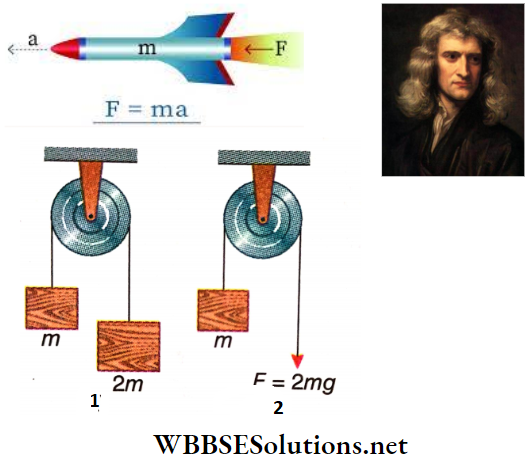
Newtons Law Of Motion Arrangement Of Two Identical Pulleys

Answer: g/3,g

Question 10. A spring balance is set in a stationary lift. A person of mass 50 kg is standing on that balance. What will be the change in the reading of the balance if the lift moves upwards with constant velocity?
Answer: No change

Question 11. A spring balance is set in a stationary lift. A person of mass 50 kg is standing on the balance. What will be the change in the balance reading when the lift moves upwards with a constant acceleration?
Answer: An increase

Question 12. A man of mass 50 kg is descending at a constant velocity using a parachute. What is the air resistance on the man?
Answer: 490 N

Question 13. Two bodies of equal masses are kept on the scale pans of a beam balance in a lift. If the lift starts moving up with an acceleration, will the beam balance be in equilibrium?
Answer: Yes

Question 14. Can a rocket operate in free space?
Answer: Yes

Question 15. What is the principle of Rocket propulsion?
Answer: Conservation of linear momentum

Question 16. A bomb explodes in mid-air into two equal fragments. What is the direction of motion of the two fragments?
Answer: Opposite to each other

Newton Law Of Motion Assertion Reason Type Question And Answers

Direction: These questions have statement 1 and statement 2. Of the four choices given below, choose the one that best describes the two statements.

  1. Statement 1 is true, statement 2 is true; statement 2 is a correct explanation for statement 1.
  2. Statement 1 is true, and statement 2 is true; statement 2 is not a correct explanation for statement 1.
  3. Statement 1 is true, statement 2 is false.
  4. Statement 1 is false, and statement 2 is true.

Question 1.

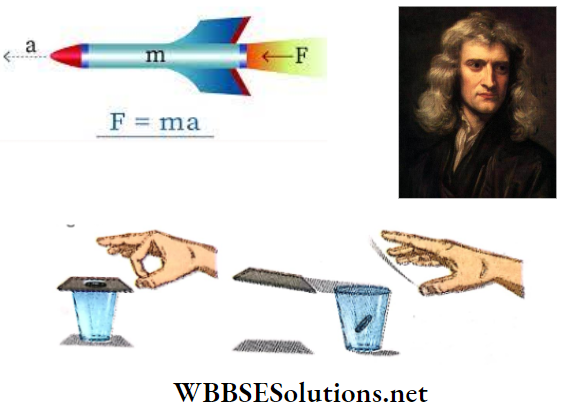
Statement 1: A cloth covers a table. Some dishes are kept on it. The cloth can be pulled out without dislodg¬ing the dishes from the table.

Statement 2: For every action, there is an equal and opposite reaction.

Answer: 2. Statement 1 is true, statement 2 is true; statement 2 is not a correct explanation for statement 1.

Question 2.

Statement 1: A reference frame attached to the earth is an inertial frame of reference.

Statement 2: The reference frame which has zero acceleration is called an inertial frame of reference.

Answer: 4. Statement 1 is false, statement 2 is true.

Question 3.

Statement 1: A concept of pseudo forces is valid both for inertial as well as non-inertial frames of reference.

Statement 2: A frame accelerated with respect to an inertial frame is a non-inertial frame.

Answer: 4. Statement 1 is false, statement 2 is true.

Question 4.

Statement 1: Block A is moving on a horizontal surface towards right under the action of force F. All surfaces are smooth. At the instant shown, the force exerted by block A on block B is equal to the net force on block B.
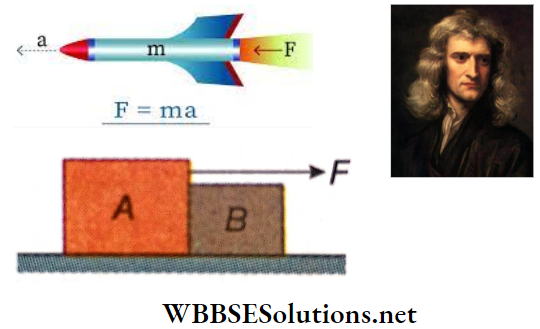
Newtons Law Of Motion Block A Is Moving Horizontal Surface

Statement 2: From Newton’s third law of motion, the force exerted by block A on B is equal in magnitude to the force exerted by block B on A.

Answer: 4. Statement 1 is false, statement 2 is true.

Question 5.

Statement 1: During free fall of a person one feels weightlessness because his weight becomes zero.

Statement 2: He falls with an acceleration of g.

Answer: 1. Statement 1 is true, statement 2 is true; statement 2 is a correct explanation for statement 1.

Question 6.

Statement 1: When a person walks on a rough surface, the net force exerted by the surface on the person in the direction of his motion.

Statement 2: It is the force exerted by the road on the person that causes the motion.

Answer: 4. Statement 1 is false, statement 2 is true.

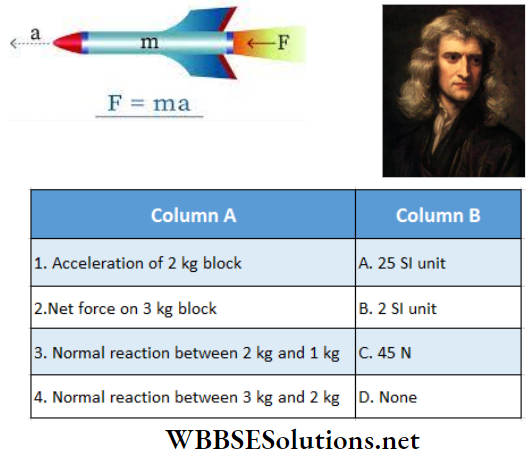
Newton Law Of Motion Match Column 1 With Column 2

Question 1. A block of mass m is released from rest when the spring was in its natural length. The pulley also has mass m but it is frictionless. Suppose the value of m is such that finally it is able to just lift the block M.
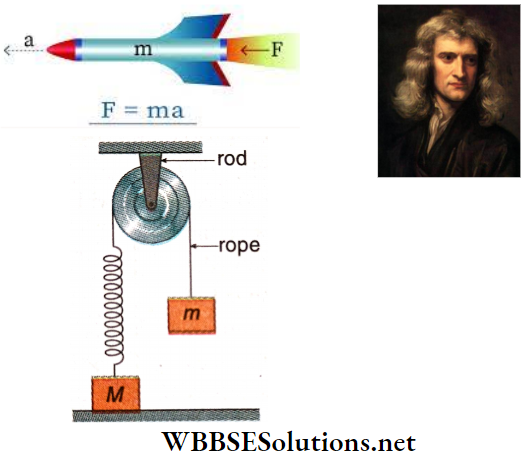
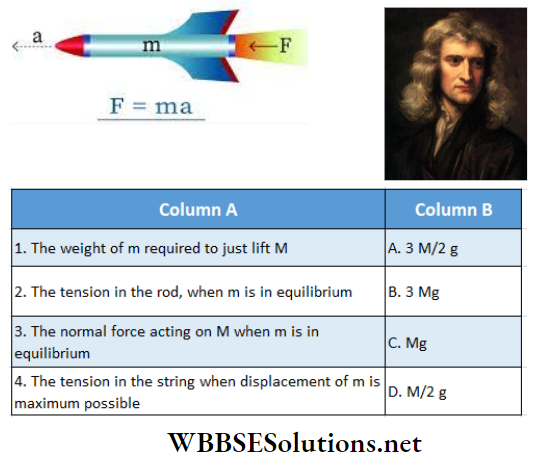
Newtons Law Of Motion A Block Of Mass m is Released From rest

Newtons Law Of Motion Match The Column Question 1

Answer: 1. C, 2. C,3. C, 4. B, D

Question 2. In the diagram shown, match the following column, (g = 10 m/s²)
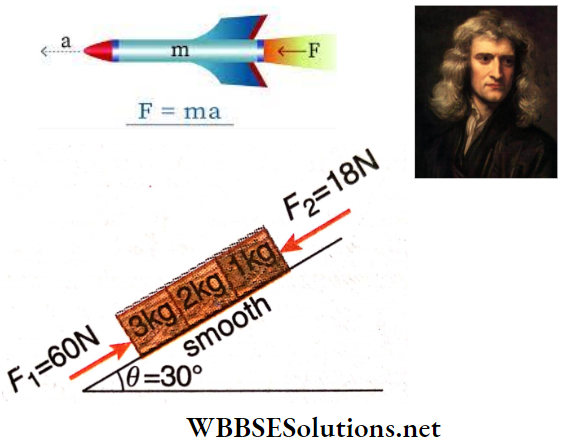
Newtons Law Of Motion

Newtons Law Of Motion Match The Column Question 2

Answer: 1. B, 2. D, 3. A, 4. D

Newton Law Of Motion Comprehension Type Question And Answers

Read the following passages carefully and answer the questions at the end of them.

Question 1. A ball of mass 200 g is thrown with a speed 20 m · s-1. The ball strikes a bat and rebounds along the same line at a speed of 40 m · s-1. Variation in the interaction force, as long as the ball remains in contact with the bat, is shown.
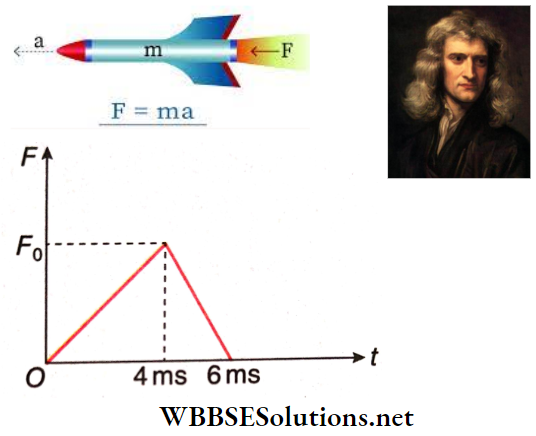
Newtons Law Of Motion A Ball Of Mass 200g Is Thrown

1. Maximum force F0 exerted by the bat on the ball is

  1. 4000 N
  2. 5000 N
  3. 3000 N
  4. 2500 N

Answer: 1. 4000 N

2. Average force exerted by the bat on the ball is

  1. 5000 N
  2. 2000 N
  3. 2500 N
  4. 6000 N

Answer: 2. 2000 N

3. What is the speed of the ball at the instant the force acting on it is maximum?

  1. 40 m · s-1
  2. 30 m · s-1
  3. 20 m · s-1
  4. 10 m · s-1

Answer: 3. 20 m · s-1

Question 2. Three blocks m1 = 10 kg, m2 = 20 kg, and m3 = 30 kg are on a smooth horizontal table, connected to the adjacent blocks by light horizontal strings. A horizontal force F = 60 N is applied to m3, towards the right.
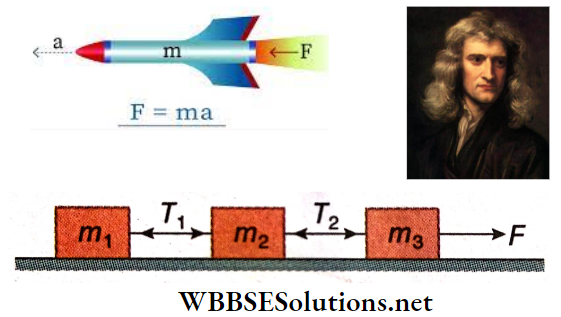
Newtons Law Of Motion Three Blocks Are On Smooth Horizontal tables

1. The tension (T1) acting between m1 and m2 is

  1. 10N
  2. 15N
  3. 20N
  4. 25N

Answer: 1. 10N

2. Tension (T2) acting between m2 and m3 is

  1. 25N
  2. 30N
  3. 24N
  4. 15N

Answer: 2. 30N

3. The tension (T2), if all of a sudden the string between m1 and m2 snaps, is

  1. 30N
  2. 24N
  3. 25N
  4. 15N

Answer: 2. 24N

Question 3. A stone of mass 0.05 kg is thrown in vertically by upward direction (take g = 10 m · s-2). Neglect air friction,

1. The net force acting on the stone during its upward motion is

  1. 0.5 N, upward
  2. 0.5 N, downward
  3. 5 N, upward
  4. Zero

Answer: 2. 0.5 N, downward

2. The net force acting on the stone during its downward motion is

  1. 0.5 N, upward
  2. 0.5 N, downward
  3. 5 N, upward
  4. Zero

Answer: 2. 0.5 N, downward

Newton Law Of Motion Integer Answer Type Questions

In this type, the answer to each of the questions is a single-digit integer ranging from 0 to 9.

Question 1. On planet X, a man throws a 500 g mass with a speed of 20 m · s-1 and catches it as it comes down 20 seconds later. Find the weight of the mass (in N units).
Answer: 1

Question 2. The elevator shows it is descending with an acceleration of 2 m · s-1. The mass of the block A = 0.5 kg. What should be the force (in N) exerted by the block A on the block B? Given g = 10 m • s-2.
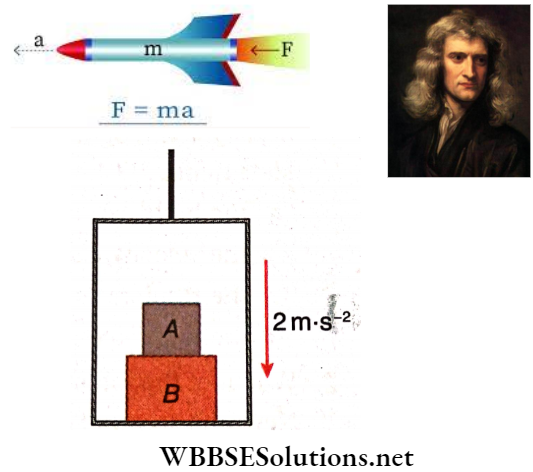
Newtons Law Of Motion Elavator

Answer: 4

Question 3. A monkey of mass 30 kg climbs a rope that can withstand a maximum tension of 360 N. Find the maximum acceleration (in m · s-2) of the climbing monkey which this rope can tolerate, (g = 10m · s-2)
Answer: 2

Question 4. In the arrangement shown the mass M is very heavy compared to m (M»m). The tension in the string is nmg. Find the value of n.
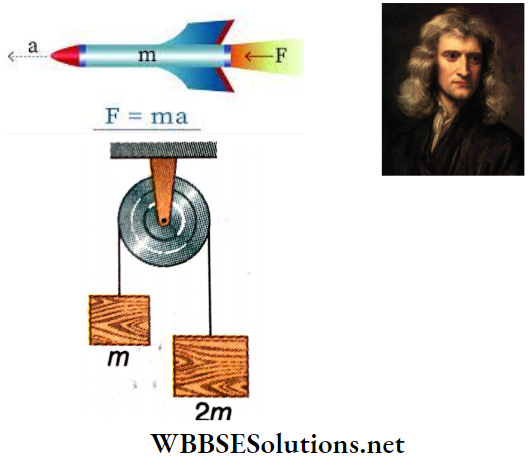
Newtons Law Of Motion Two Masses m And 2m Are Connected Pulley

Answer: 4

Question 5. Find the acceleration of three blocks (in m • s-2) as shown. Each surface of the system is smooth.
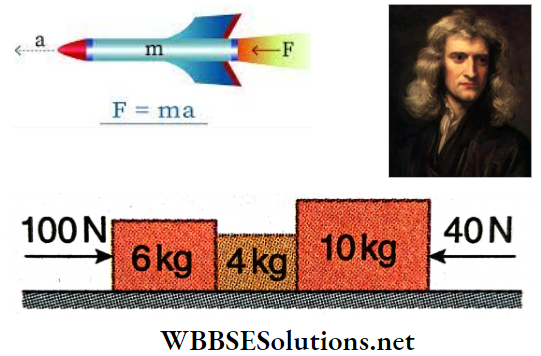
Newtons Law Of Motion Acceleration Of Three Blocks

Answer: 3
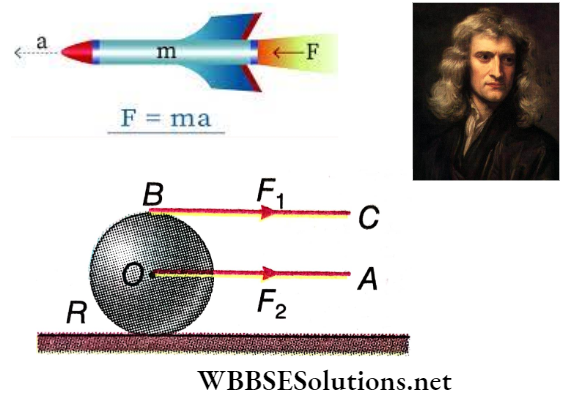
 

WBCHSE Class 11 Physics Newton Law Of Motion Short Answer Questions

Unit 3 Laws Of Motion Chapter 1 Newton Law Of Motion Short Answer Type Questions
WBBSE Class 11 Short Answer Questions on Newton’s Laws

Question 1. A block of mass M is pulled along a frictionless horizontal surface by a rope of mass m by applying a horizontal force F at the other end of the rope. The force exerted by the rope on the block is

  1. \(\frac{m F}{m+M}\)
  2. \(\frac{m F}{M-m}\)
  3. \(\frac{M F}{M-m}\)
  4. \(\frac{M F}{m+M}\)

Answer:

Given

A block of mass M is pulled along a frictionless horizontal surface by a rope of mass m by applying a horizontal force F at the other end of the rope. The force exerted by the rope on the block is

Acceleration of the system, a \(=\frac{\text { total force }}{\text { total mass }}=\frac{F}{m+M}\)

The force exerted by the rope on the block, \(M a=\frac{M F}{m+M}\)

The option 4 is correct.

WBCHSE Class 11 Physics Newton Law Of Motion Short Answer Questions

Question 2. Two blocks A and B are standing side-by-side touching each other, on a smooth horizontal table. The masses of the blocks are 3 kg and 2 kg respectively. Block A is pushed towards block B with 10 N horizontal force.
  1. How much force does block A apply on block B?
  2. If the 10 N horizontal force were applied on block B towards block A, how much force would block B have applied on block A

Answer:

Given

Two blocks A and B are standing side-by-side touching each other, on a smooth horizontal table. The masses of the blocks are 3 kg and 2 kg respectively.

1. Let force applied on B by A is FAN.

Here, acceleration of the system due to force 10 N = acceleration of B due to force FA

Newtons Law Of Motion Two Blocks A And B Are Standing Side By Side Touching Each Other

So, \(\frac{10}{3+2}=\frac{F_A}{2} \quad therefore F_A=4 \mathrm{~N}\)

2. Force applied on A by B, \(F_B=\frac{10 \times 3}{3+2}=6 \mathrm{~N}\)

Question 3. A gun is mounted on a platform fitted with frictionless wheels. The mass of the platform with the gun, shells, and the operator is M. The gun fires shells one after another with a velocity of v in the horizontal direction. If another with a velocity v in the horizontal direction. If the mass of each shell is m, show that the velocity of recoil of the platform after N shells are fired is \(V_N=\frac{N m v}{(M-m N)}\)
Answer:

Given

A gun is mounted on a platform fitted with frictionless wheels. The mass of the platform with the gun, shells, and the operator is M. The gun fires shells one after another with a velocity of v in the horizontal direction. If another with a velocity v in the horizontal direction. If the mass of each shell is m

Let the velocity of the recoil of the platform after 1st shell is fired = v1.

Therefore, from the law of conservation of momentum, \((M-m) v_1=m v\) or, \(v_1=\frac{m v}{M-m}\)

Again from the law of conservation of momentum, after 2nd shell is fired, we get mv-(M-2m)v2 = -(M- m)v1

[v2 = The velocity of recoil of the platform after 2nd shell is fired]

or, \(v_2=\frac{2m v}{M-2m}\)

Similarly the velocity of recoil of the platform after 3rd shell is fired, is \(v_3=\frac{3m v}{M-3m}\)

Therefore, the velocity of recoil of the platform after N shells are fired is \(v_N=\frac{N m v}{M-Nm}\)

Key Concepts in Newton’s Laws: Short Answers

Question 4. Which is easier to lift in the air, 1 kg of steel or 1 kg of wool?
Answer:

The volume of 1 kg of wool is much greater than that of 1 kg of steel. Hence, wool faces more resistance while moving through air. Therefore, it is easier to lift 1 kg of steel.

Question 5. A batsman deflects a ball by an angle of 45° without changing its initial speed which is equal to 36 km/h. What is the impulse imparted to the ball? Given, the mass of the ball is 0.157 kg.
Answer:

Given

A batsman deflects a ball by an angle of 45° without changing its initial speed which is equal to 36 km/h.

Let initial velocity of the ball is \(\vec{v}_1\) and final velocity is \(\vec{v}_2\).

Impulse, \(\vec{I}\)= m(\(\vec{v}_2\) – \(\vec{v}_1\)) [m = mass of the ball]

Newtons Law Of Motion A Batsman Deflects A Ball By An Angle 45 Degress

The magnitude of initial and final velocities are the same,

i.e., \(\left|\vec{v}_1\right|=\left|\vec{v}_2\right|=36 \mathrm{~km} \cdot \mathrm{h}^{-1}\)

= \(\frac{36 \times 10^3}{3600} \mathrm{~m} \cdot \mathrm{s}^{-1}\)

= \(10 \mathrm{~m} \cdot \mathrm{s}^{-1}\)

From figure, \(\left|\vec{v}_2-\vec{v}_1\right|=\sqrt{v_1^2+v_2^2+2 v_1 v_2 \cos 45^{\circ}}\)

= \(\sqrt{10^2+10^2+2 \times 10 \times 10 \times \frac{1}{\sqrt{2}}}\)

∴ \(18.5 \mathrm{~m} \cdot \mathrm{s}^{-1}\)

∴ \(|\vec{I}|=m\left|\vec{v}_2-\vec{v}_1\right|=0.157 \times 18.5 \mathrm{~kg} \cdot \mathrm{m} \cdot \mathrm{s}^{-1}=2.9 \mathrm{~kg} \cdot \mathrm{m} \cdot \mathrm{s}^{-1}\)

The direction of imparted impulse is along the bisector of the angle between \(\vec{v}_2\) and \(\vec{-v}_1\)

Applications of Newton’s First Law: Short Answer Questions

Question 6. In which frame of reference Newton’s first law of motion is applicable?
Answer:

Newton’s first law of motion is applicable in an inertial frame of reference.

Question 7. A mass of 1 kg is suspended by a thread. It is

  1. Lifted up with an acceleration of 4.9m · s-2,
  2. Lowered with an acceleration of 4.9m · s-2. The ratio of the tensions or the thread is
  1. 3:1
  2. 1:2
  3. 1:3
  4. 2:1

Answer:

1. Weight of the body = mg (downwards)

Tension on the thread = T (upwards)

∴ Resultant force acting on the body = T- mg (upwards)

If a is the upward acceleration then from F = ma we get, T- mg = ma or, T = m(g+ a)

2. In case of downward acceleration a, resultant force acting on the body = mg- T

∴ mg- T = ma or, T = m(g- a)

∴ The ratio of tensions on the thread in the two cases

= \(\frac{m(g+a)}{m(g-a)}=\frac{g+a}{g-a}=\frac{9.8+4.9}{9.8-4.9}=\frac{14.7}{4.9}=\frac{3}{1}\)

The option 1 is correct.

Question 8. A bullet is fired from a gun. Which one will possess greater momentum—gun or bullet?
Answer:

A bullet is fired from a gun

Before firing the bullet, both the gun and the bullet were at rest. Hence, initially, the total linear momentum was zero. After firing the bullet, the gun will have an equal but opposite momentum to that of the bullet so as to conserve the total linear momentum of the system.

Understanding Newton’s Second Law: Short Answers

Question 9. A smooth massless string passes over a smooth fixed pulley. Two masses m1 and m2 (m1> m2) are tied at the two ends of the string. The masses are allowed to move under gravity starting from rest. The total external force acting on the two masses is

  1. \(\left(m_1+m_2\right) g\)
  2. \(\frac{\left(m_1-m_2\right)^2}{m_1+m_2} g\)
  3. \(\left(m_1-m_2\right) g\)
  4. \(\frac{\left(m_1+m_2\right)^2}{m_1-m_2} g\)

Answer:

Given

A smooth massless string passes over a smooth fixed pulley. Two masses m1 and m2 (m1> m2) are tied at the two ends of the string. The masses are allowed to move under gravity starting from rest.

If a is the acceleration of the two masses and T is the tension in the two sides of the strings, then m1g-T=m1a….(1)

and T- m2g = m2a…(2)

Newtons Law Of Motion Vertical Motion With The Help Of A Smooth Pulley

Now from equations (1) and (2), we get, a = \(\frac{\left(m_1-m_2\right) g}{m_1+m_2}\)

Therefore, total external force = \(\left(m_1+m_2\right) a=\left(m_1-m_2\right) g\)

The option 3 is correct.

Class 11 Physics Class 12 Maths Class 11 Chemistry
NEET Foundation Class 12 Physics NEET Physics

Question 10. A mass of 1 kg is suspended by means of a thread. The system is

  1. Lifted up with an acceleration of 4.9 m/s²
  2. Lowered with an acceleration of 4.9 m/s². The ratio of tension in the first and second case is
  1. 3:1
  2. 1:2
  3. 1:3
  4. 2:1

Answer:

  1. Tension while lifting the mass, \(T_1=g+a=g+\frac{g}{2}=\frac{3 g}{2}\left[because a=\frac{g}{2}\right]\)
  2. Tension while lowering the mass, \(T_2=g-a=g-\frac{g}{2}=\frac{g}{2}\)

∴ \(T_1: T_2=\frac{3 g}{2}: \frac{g}{2}=3: 1\)

The option 1 is correct.

Question 11. A block of mass 1 kg starts from rest at x = 0 and moves along the x-axis under the action of a force F = kt, where t is time and k = 1 N/s. The distance the block will travel in 6 seconds is

  1. 36m
  2. 72m
  3. 108m
  4. 18m

Answer:

Given

A block of mass 1 kg starts from rest at x = 0 and moves along the x-axis under the action of a force F = kt, where t is time and k = 1 N/s.

F = kt or, \(m \frac{d v}{d t}=k t \text { or, } \frac{d v}{d t}=\frac{k}{m} t\)

or, \(\int_0^v d v=\frac{k}{m} \int_0^t t d t\)

or, \(v=\frac{1}{2} \frac{k}{m} \cdot t^2 or, \frac{d x}{d t}=\frac{1}{2} \frac{k}{m} t^2\)

or, \(\int_0^x d x=\frac{1}{2} \frac{k}{m} \int_0^6 t^2 d t\)

or, x = \(\frac{1}{2} \frac{k}{m} \frac{6^3}{3}=\frac{1}{2} \times \frac{1}{1} \times \frac{216}{3}[because k=1 \mathrm{~N} / \mathrm{s}, m=1 \mathrm{~kg} \mid\)

= 36 m

The option 1 is correct.

Question 12. The velocity v of a particle (under a force F) depends on its distance (x) from the origin (with x > 0) \(v \propto \frac{1}{\sqrt{x}}\). Find how the magnitude of the force (F) on the particle depends on x.

  1. \(F \propto \frac{1}{x^{3 / 2}}\)
  2. \(F \propto \frac{1}{x}\)
  3. \(F \propto \frac{1}{x^2}\)
  4. \(F \propto x \mid 1]\)

Answer:

Given

The velocity v of a particle (under a force F) depends on its distance (x) from the origin (with x > 0) \(v \propto \frac{1}{\sqrt{x}}\).

⇒ \(\quad v \propto \frac{1}{\sqrt{x}} \text { or, } v=\frac{k}{\sqrt{x}}\)

∴ \(\frac{d \nu}{d t}=\frac{d}{d x}\left(k x^{-\frac{1}{2}}\right) \frac{d x}{d t}=\nu \frac{d}{d x}\left(k x^{-\frac{1}{2}}\right)\)

= \(k^{\prime} \times \frac{1}{x^2}\left[\text { where } k^{\prime}=-\frac{k^2}{2}\right]\)

∴ \(\propto \frac{1}{x^2}\)

So, \(F \propto \frac{1}{x^2}\)

The option 3 is correct.

Short Answer Questions on Action and Reaction Forces

Question 13. The force F acting on a particle of mass ni is indicated by the force-time graph shown below. The change in momentum of the particle over the time interval from zero to 8 s is

  1. 24 N • s
  2. 20 N • s
  3. 12 N • s
  4. 6 N •s

Newtons Law Of Motion Force Is Acting On A Particle

Answer:

Given

The force F acting on a particle of mass ni is indicated by the force-time graph shown above.

F = ma = \(m \frac{d v}{d t}\)

∴ P = \(\int m d v=\int F d t\)

So, momentum is the total area of the forcetime graph.

Therefore, change in momentum,

ΔP =(1/2 x 6 x 2)-(3 x 2) + (3 x 4)

= (6-6+12) = 12N · s

The option 3 is correct.

Question 14. A balloon with mass m is descending down with an acceleration a (where a < g). How much mass should be removed from it so that it starts moving up with an acceleration a?

  1. \(\frac{2 m a}{g+a}\)
  2. \(\frac{2 m a}{g-a}\)
  3. \(\frac{m a}{g+a}\)
  4. \(\frac{m a}{g-a}\)

Answer:

Given

A balloon with mass m is descending down with an acceleration a (where a < g).

Let upthrust of air be \(F_a\), then for downward motion \(m g-F_a=m a \text { or, } F_a=m(g-a)\)

For upward motion, \(F_a-(m-\Delta m) g=(m-\Delta m) a\) or, \(\Delta m(g+a)=m a+m g-F_a=2 m a\)

∴ \(\Delta m=\frac{2 m a}{g+a}\)

The option 1 is correct.

Question 15. Three blocks A, B, and C, of masses 4 kg, 2 kg, and 1 kg respectively, are in contact on a frictionless surface, as shown. If a force of 14 N is applied on the 4 kg block, then the contact force between A and B is

  1. 2N
  2. 6N
  3. 8N
  4. 18N

Newtons Law Of Motion Three Blocks ABC Of Masses

Answer:

Given

Three blocks A, B, and C, of masses 4 kg, 2 kg, and 1 kg respectively, are in contact on a frictionless surface, as shown.

Acceleration of the whole system, a = \(\frac{14}{4+2+1}=2 \mathrm{~m} / \mathrm{s}^2\)

Hence, the required force for blocks B and C to have this acceleration =(2 + l)x2 = 6N.

So, the A block will apply 6 N force in the plane of contact of A and B.

Therefore, the contact force between A and B = 6 N.

The option 2 is correct.

Question 16. A girl jumps down from a moving bus, along the direction of motion of the bus, tilting slightly forward. She falls on

  1. A sheet of ice
  2. A patch of glue.
  1. In case (1) she falls backward and in case (2) she falls forward
  2. In both cases (1) and (2) she falls forward
  3. In both cases (1) and (2) she falls backward
  4. In case (1) she falls forward and in case (2) she falls backward

Answer:

  1. Due to super smoothness of the sheet of ice, her leg cannot move forward while her head moves forward due to inertia of motion. Hence, she falls forward.
  2. Her leg becomes still at the patch of glue but her leg cannot move forward while her head moves forward due to inertia of motion. Hence, she falls forward.

The option 2 is correct

Short Answer Questions on Force and Mass Relationship

Question 17. A block of mass m is placed on a smooth inclined wedge ABC of inclination 9 as shown in the figure. The wedge is given an acceleration towards the right. The relation between a and 9 for the block to remain stationary on the wedge is

Newtons Law Of Motion Block Of Mass m Is Placed On Smooth Inclined Wedge

  1. a = \(g \cos \theta\)
  2. \(a=\frac{g}{\sin \theta}\)
  3. a = \(\frac{g}{{cosec} \theta}\)
  4. a = \(g \tan \theta\)

Answer:

For the mass m to remain still in the non-inertial reference frame,

Rsinθ = ma…(1)

Rcosθ = mg…(2)

Newtons Law Of Motion Mass m To Reamin Still In The Non Internal Surface

(1) + (2) \(\tan \theta=\frac{a}{g} \quad \text { or, } a=g \tan \theta\)

The option 4 is correct

Question 18. Two masses 8 kg and 12 kg are connected to the two ends of a light inextensible string that goes over a frictionless pulley. Find the acceleration of the masses and the tension in the string when the masses are released.
Solution:

Given

Two masses 8 kg and 12 kg are connected to the two ends of a light inextensible string that goes over a frictionless pulley.

Let m1 = 12 kg and m2 = 8 kg

Then, a = downward acceleration of m1 = upward acceleration of m2

So, the force equations are, for mass m1: m1g-T= m1a….(1)

and for mass m2: T- m2g = m2a…(2)

Now adding equations (1) and (2), we get, \(g\left(m_1-m_2\right)=a\left(m_1+m_2\right)\)

Newtons Law Of Motion Two Masses Are Connected To The Two Ends Of a Ligth Inextensible String

or, \(a =\frac{m_1-m_2}{m_1+m_2} g=\frac{12-8}{12+8} \times 9.8\)

= \(1.96 \mathrm{~m} \cdot \mathrm{s}^{-2}\)

Then from (2), \(T=m_2 g+m_2 \frac{m_1-m_2}{m_1+m_2} g\)

= \(m_2 g \cdot \frac{2 m_1}{m_1+m_2}=\frac{2 m_1 m_2}{m_1+m_2} g\)

= \(\frac{2 \times 12 \times 8}{12+8} \times 9.8=94.08 \mathrm{~N}\)

Question 19. Define acceleration. When does a body possess uniform acceleration?
Answer:

The acceleration of a body is its rate of change of velocity with time.

From Newton’s 2nd law, the acceleration \(\vec{a}\) of a body of mass m is related to an applied force \(\vec{F}\) as, \(\vec{F}\) = m\(\vec{a}\). So, when the body is acted upon by a constant force \(\vec{F}\), we get \(\vec{a}\) = constant. Thus, the body moves with a uniform acceleration.

Real-Life Examples of Newton’s Laws: Short Answer Questions

Question 20. A monkey of mass 40 kg climbs on a rope that can stand a maximum of 600 N. In which case the rope will break: the monkey

  1. Climbs up with an acceleration of 6 m · s-2
  2. Climbs down with an acceleration of 4 m · s-2
  3. Climbs up with a uniform speed of 5 m · s-1
  4. Falls down the rope nearly under gravity

[Ignore the mass of the rope. Take g = 10 m · s-2]

Answer:

Real weight of the monkey = 40 kg · wt = 40 x 10 N = 400 N; So the rope can withstand his real weight.

Here g = 10 m · s-2 = actual acceleration due to gravity, acting downwards.

1. Acceleration, a = -6 m s-2; the negative sign comes as the acceleration is upwards.

Thus, relative downward acceleration, g’ = g- a = 10- (-6) = 16 m · s-2

Hence, apparent weight = mg’ = 40 x 16 = 640 N

As it is greater than 600 N, the rope will break.

2. Here, acceleration a = + 4 m · s-2

Thus, relative downward acceleration, g’ = g- a = 10- 4 = 6 m · s-2

Hence, apparent weight = mg’ = 40 x 6 = 240 N

This force does not break the rope.

3. The speed is uniform, i.e., there is no acceleration.

Hence, Apparent weight = real weight = 40 kg · wt = 400 N

Clearly, the rope does not break due to this force.

4. When the monkey falls freely under gravity, then a = g

Thus relative downward acceleration, g’ = g – g= 0

Hence, apparent weight = mg’ = 0 In this case, the rope does not break.

Question 21. A cricket ball of mass 150 g moving with a speed 12 m · s-1 is hit by a bat so that the ball is turned back with a velocity of 20 m · s-1. Calculate the impulse received by the ball.
Answer:

Given

A cricket ball of mass 150 g moving with a speed 12 m · s-1 is hit by a bat so that the ball is turned back with a velocity of 20 m · s-1.

The force on the ball acts in the backward direction; this direction is taken to be positive.

So, initial velocity, v1 = -12 m • s-1 and final velocity, v2 = + 20 m • s-1

From Newton’s second law of motion, with proper choice of the unit of force,

force = \(\frac{\text { change of momentum }}{\text { time interval }}\)

So, impulse  = force x time interval

= change of momentum

= \(m v_2-m v_1=m\left(\nu_2-v_1\right)\)

= \(\frac{150}{1000} \mathrm{~kg} \times\{20-(-12)\} \mathrm{m} \cdot \mathrm{s}^{-1}\)

= \(4.8 \mathrm{~kg} \cdot \mathrm{m} \cdot \mathrm{s}^{-1}\)

Question 22. Show that Newton’s second law of motion is the real law of motion.
Answer:

From Newton’s 2nd law, the force \(\vec{F}=\frac{d}{d t}(m \vec{v})\) with proper choice of the unit of force.

1. If the external force \(\vec{F}\)=0; we have, \(\frac{d}{d t}(m \vec{v})\)= 0

∴ m\(\vec{v}\) = constant, so, \(\vec{v}\) = constant This means that a body at rest would remain at rest and a body in motion would continue to maintain its uniform velocity. This is Newton’s 1st law of motion.

2. We consider a system of two bodies, 1 and 2.

∴ \(\vec{F}_21\) = force on body 1, exerted by body 2;

and \(\vec{F}_12\) = force on body 2, exerted by body 1.

In the absence of any other external forces, Newton’s 2nd law gives,

For body 1: \(\vec{F}_{21}=\frac{d}{d t}\left(m_1 \vec{v}_1\right)\)

For body 2: \(\vec{F}_{12}=\frac{d}{d t}\left(m_2 \vec{v}_2\right)\)

Now, if the combination of the two bodies is considered, \(\vec{F}_21\) and \(\vec{F}_12\) are internal forces only and do not contribute to any external force. If the external force is zero, we have from the 2nd law,

0 = \(\frac{d}{d t}\left(m_1 \vec{v}_1+m_2 \vec{v}_2\right)=\frac{d}{d t}\left(m_1 \vec{v}_1\right)+\frac{d}{d t}\left(m_2 \vec{v}_2\right)\)

0 = \(\vec{F}_{21}+\vec{F}_{12}\)

∴ \(\vec{F}_{21}=-\vec{F}_{12}\) This is Newton’s 3rd law.

Thus, Newton’s 2nd law of motion is sometimes called the “real” law of motion—it encompasses both the 1st and the 3rd laws.

However, Newton’s wisdom dictated him to propose the 1st and the 3rd laws separately in order to introduce, respectively,

  1. The Notion Of The Inertial Frames Of Reference, And
  2. The Concept Of Action-Reaction Pair Of Forces.

Question 23. A batsman hits back a ball straight in the direction of the bowler without changing its initial speed of 12 m · s-1. If the mass of the ball is 0.15 kg, determine the impulse imparted to the ball. (Assume linear motion of the ball)
Answer:

Given

A batsman hits back a ball straight in the direction of the bowler without changing its initial speed of 12 m · s-1. If the mass of the ball is 0.15 kg

The impulse is imparted towards the bowler from the position of the batsman. If that direction is taken to be positive, then

The initial velocity of the ball = -12 m · s-1

The final velocity of the ball = +12 m · s-1

So, the impulse = change in momentum

= mass x change in velocity

= 0.15 x{12-(-12)} = 0.15×24

= 3.6 kg m · s-1

Question 24. A bullet of mass 0.04 kg moving with a speed of 90 m · s-1 enters a heavy wooden block and is stopped after a distance of 60 cm. What is the average resistive force exerted by the block on the bullet?
Answer:

Given

A bullet of mass 0.04 kg moving with a speed of 90 m · s-1 enters a heavy wooden block and is stopped after a distance of 60 cm.

Let mass of the bullet, m = 0.04 kg

The initial velocity of the bullet, u = 90 m · s-1

The final velocity of the bullet, v = 0

Distance traversed by the bullet, s = 60 cm = 0.6 m

If a be the retardation of the bullet, v² = u²-2as or, 0 = (90)² – 2a x 0.6

∴ a = \(\frac{(90)^2}{2 \times 0.6}=6750 \mathrm{~m} \cdot \mathrm{s}^{-2}\)

So the resistive force, F = ma = 0.04 x 6750 = 270 N

The actual resistive force, and therefore, the retardation of the bullet may not be uniform. The answer, therefore, only indicates the average resistive force.

Question 25. A car and a truck are moving on a level road so that their linear momenta are equal. Which one is moving faster?
Answer:

A car and a truck are moving on a level road so that their linear momenta are equal.

The car is moving faster as its mass is less than that of the truck.

Question 26. Why a cricket player lowers his hands while catching a cricket ball? Explain
Answer:

We know, impulse = force x time

= change in linear momentum.

Force not only depends on the change in momentum but also on how fast the change is brought about. The same change in momentum brought about in a shorter time needs greater force.

By lowering his hands while catching the cricket ball, the player allows a longer time for the momentum to change, thereby preventing his hands from getting injured.

Question 27. Calculate the net force acting on a body of mass 10 kg moving with a uniform velocity of 2 m/s.
Answer:

Since, velocity is uniform, so, acceleration, a = 0.

Hence, net force, F = ma = 0

Question 28. A lift of mass 400 kg is hung by a wire. Calculate the tension in the wire when the lift is

  1. At rest,
  2. Moving upward with a constant velocity of 2.0 m/s,
  3. Moving upward with an acceleration of 2.0 m/s² and
  4. Moving downward with an acceleration of 2.0 m/s².

Answer:

  1. Lift at rest T – W = mg = 4000 N
  2. Moving up with 2m/s, a = 0; T = W = mg = 4000 N
  3. Moving up with a – 2m/s²; T = mg+ ma – 4000 + 400 x 2 = 4800 N
  4. Moving down with a = -2m/s²; T = mg- ma = 4000 – 400 x 2 = 3200N

Question 29. Write its two applications. The linear momentum of a body can change in the direction of applied force. Comment.
Answer:

  • While firing a gun, the gun must be held tightly to the shoulder.
  • When a man jumps out of a boat, the boat is pushed away, which pushes the man forward.
  • The statement is correct. It is in accordance with Newton’s second law of motion.


WBCHSE Class 11 Physics Newton’s Third Law of Motion Notes

Newton Law Of Motion – Discussions On The Third Law

WBBSE Class 11 Newton’s Third Law Notes

Newton’s Laws 3rd Law

Newton’s third law of motion states that, for every action, there is an equal and opposite reaction. Consider two bodies A and B. They may be in contact with each other, or separated by a distance.

Suppose A exerts a force on B, denoted by \(\vec{F}_{A B}\). According to Newton’s third law, B will exert a force on A simultaneously, that is equal in magnitude but opposite in direction. This force is denoted by \(\vec{F}_{A B}\).

Thus, we have \(\vec{F}_{A B}=-\vec{F}_{B A} \quad therefore\left|\vec{F}_{A B}\right|=\left|\vec{F}_{B A}\right|\)

If \(\vec{F}_{A B}\) is called the action, \(\vec{F}_{B A}\) is the reaction. Action and reaction always coexist in pairs and one exists as long as the other one is present.

Read and Learn More: Class 11 Physics Notes

Examples Of Action-Reaction Pairs:

  1. Thrust: A wooden block is resting on a table surface. The block exerts a downward force \((\vec{W})\) on the table surface due to its weight. At the same time, the table also exerts an equal upward force \((\vec{R})\), on the block.
    • The downward force of the block on the tabletop is the action and the upward force of the table on the block, is the reaction. A pair of action and reaction forces of this type is called thrust.
  2. Tension: A body, suspended by a wire whose upper end is fixed to a rigid support, exerts a downward force on the wire, due to its weight. The wire, at the same time, exerts an equal upward force on the suspended body.
    • This force or reaction is called the tension of the wire. If the weight of the suspended body is termed as action, the tension in the wire is the reaction.
    • When a cord (rope, cable, etc.) is attached to a body and tightly pulled (action), the cord pulls on the body with a force (reaction) directed away from the body and along the cord. This force is also called tension force.
  3. Push: When a person applies a force on a large piece of stone lying on a road, the stone also exerts a force on the person which is equal in magnitude but opposite in direction. Such a pair of actions and reactions constitute a push.
  4. Impact or Collision: When a moving car runs into a wall, as the collision car exerts a force on the wall, the wall also exerts an equal and opposite force on the car. The force on the wall is the action and that on the car is the reaction. Such pairs of forces are called impact or collision.
  5. Attraction: When a pole of a magnet is brought near an iron piece, they attract each other. Such an attraction is called mutual attraction. Another example of attraction is the pull of the earth on a body which causes a downward motion and it is an action.
    • The body also pulls the earth towards it as a reaction. However, since the mass of the earth is very large, the reaction force cannot cause any noticeable acceleration of the earth, and it appears to be at rest.
  6. Repulsion: The action-reaction pair that causes bodies to move away from each other is called repulsion. The north poles of two magnets, when brought close together, repel each other due to action and reaction forces.
  7. Friction: When a body moves or tries to move on a surface, the surface exerts an opposing force on the body. This force resists the motion, or the attempt of motion, and is called friction. The force exerted by the body on the surface is the action while the force of friction on the body is the reaction.

Newtons Law Of Motion Thrust

Key Concepts of Newton’s Third Law for Class 11

There are numerous examples in nature, where action and reaction take place simultaneously.

Contact Force And Field Force: Thrust, tension, impact, etc. come into play when two bodies are in contact. These forces are called contact forces.

  • On the other hand, the attraction of the earth on a body, and the attraction or repulsion between two magnetic poles show the existence of another type of force where the bodies need not be in contact.
  • A magnet produces a magnetic field around it, and whenever a magnetic substance is placed in the field, it experiences a force. The forces due to fields are called field forces.
Class 11 Physics Class 12 Maths Class 11 Chemistry
NEET Foundation Class 12 Physics NEET Physics


A Few General Experiences Related to Action-Reaction:

  • When a gun is fired, the forward-moving bullet exerts a backward reaction on the gun, and the shooter feels a backward thrust.
  • When a man jumps off a boat, the boat moves back slightly. In this case, the man exerts a backward force on the boat (action), whereas the boat exerts a reaction force on the man which enables him to reach the bank.
  • When the fuel in a rocket is ignited, gas is ejected from the rocket with great force in the downward direction. Therefore an upward reaction force is generated which helps the rocket to shoot upwards with great speed.
  • Shows an arrangement for sprinkling water in a garden. There are a few narrow jets fitted to the spherical water reservoir which is pivoted such that it can rotate about an axis.
    • When the reservoir is filled with water, water flows out in the form of fountains from the jets. A reaction force is generated in the opposite direction which sets the reservoir in a spinning motion

WBCHSE Class 11 Physics Newton's Third Law of Motion Notes

In order to bowl bouncers, a fast bowler has to pitch the ball very hard on the ground (action). The ground exerts an equal and opposite force on the ball (reaction) and this bounces the ball at a desired height.

Newtons Law Of Motion Arrangement Of Sprinkle Water

Real-Life Examples Illustrating Newton’s Third Law

Experiments Frustrating The Action-Reaction Forces: The hooks of two spring balances are attached, as shown. The free end of one spring balance is fixed to a rigid support on the wall and the free end of the other is pulled in the opposite direction, both the balances show the same reading. On increasing or decreasing the pull, the readings change by the same amount. This is because the action is equal to the reaction of the wall.

Newtons Law Of Motion Experiment Of The Action Reaction Forced Of Hooks Of Two Spring Balances

Examples Of Newton’s Third Law

A circular toy railway tracks A is set on a table so that the track can turn smoothly about an axis passing perpendicularly through its center. When a toy train B is placed on the track and set into motion, the track will also start rotating in the opposite direction. This shows the generation of an action-reaction pair of forces.

Action And Reaction Cannot Cancel Each Other: An action-reaction pair of forces cannot exist without the presence of two bodies. If the force on the second body by the first one is action, the force on the first body exerted by the second is reaction.

Newton’s Third Law Explained with Examples

Newtons Law Of Motion A Circyular Toy Railway Track

Though action and reaction forces are equal and oppositely directed, they do not act, at the same time on the same body. Hence, they do not cancel each other, and no question of equilibrium arises.

WBCHSE Class 11 Physics Impulse Of Force And Impulsive Force Notes

Newton Law Of Motion – Impulse Of Force And Impulsive Force

WBBSE Class 11 Impulse of Force Overview

Impulse Of Force: When a cricket ball is hit by a bat or a nail is struck into wood with a hammer, the force of impact

  1. Acts for a short time, and
  2. Is usually not constant throughout the duration of impact i.e., It varies with time.

It is not easy to measure the varying force of impact. Let \(\vec{F}_{a v}\) be the average force acting during the small time of impact \(\vec{F}_{a v}\) t. The quantity \(\vec{F}_{a v}\)t is called the impulse of a force.

Impulse Of Force And Impulsive Force Definition: For a force acting on a body for an interval of time, the product of the force and the time interval is called the impulse of the force or simply impulse.

Read and Learn More: Class 11 Physics Notes

Let a force \(\vec{F}\) act for small time dt. The impulse of the force is given by d\(\vec{I}\) = \(\vec{F}\)dt

If we consider a finite interval of time from t1 to t2, then the impulse will be, \(\vec{I}=\int d \vec{I}=\int_{t_1}^{t_2} \vec{F} d t\)

If \(\vec{F}_{a v}\) is the average force, then, \(\vec{I}=\vec{F}_{a v}\left(t_2-t_1\right)\)

or, \(\vec{I}=\vec{F}_{a v} \Delta t \text {, where } \Delta t=t_2-t_1 \text {. }\)

Impulse-Momentum Theorem: According to Newton’s second law of motion, applied force = rate of change in momentum

∴ \(\vec{F}=\frac{d \vec{p}}{d t} \quad \text { or, } \vec{F} d t=d \vec{p}\)

If in time 0 to t, the momentum of the body changes from p1 to p2, then integrating within proper limits, we get, \(\int_0^t \vec{F} d t=\int_{\vec{p}_1}^{\vec{p}_2} d \vec{p}=d \vec{p}=\left(\vec{p}_2-\vec{p}_1\right)\)

But \(\int_0^t \vec{F} d t=\vec{I} \quad therefore \vec{I}=\left(\vec{p}_2-\vec{p}_1\right)\)

Thus, the impulse of a force is equal to the total change in momentum produced by the force. This relationship between impulse and momentum is known as the impulse-momentum theorem.

Unit And Dimension Of Impulse: impulse has the unit and dimension of momentum:

  • CGS System: g · cm · s-1  or dyn · s
  • SI: kg · m · s-1 or N · s

The dimension of impulse is MLT-1.

Measurement Of Impulse By Graphical Method:

1. When A Constant Force Force Acts On A Body: Let a constant force F act on a body from time t1 to t2. The force-time graph is a straight line AB parallel to the time axis, as shown.

Newtons Law Of Motion Measurment Of Impulse By Graphical Method

Impulse of the constant force,

l = area of rectangle ABCD

= ADxAB = F(t2 – t1)

Definition of Impulsive Force in Physics

2. When A Variable Force Acts On The Body: Suppose a force varying in magnitude acts on a body for time t2 – t1 = t

The force-time graph is a curve ABC as shown.

Newtons Law Of Motion Variable Force Acts On A Body

Impulse of force F in time interval t, I = \(\int_0^t F d t\) = area under the curve ABC

Thus, the area under the force-time graph gives the magnitude of the impulse of the given force in the given time interval.

Practical Applications Of Impulse: If two forces \(\vec{F}_1\) and \(\vec{F}_2\) act on a body to produce the same impulse (or change in momentum), then their time durations t1 and t2 should be such that, \(\vec{F}_1\)t1 = \(\vec{F}_2\)t2

Newtons Law Of Motion Practical Applications Of Impulse

In other words, if the time duration of an impulse is large, the force exerted will be small, or vice-versa. The Curves (1) and (2) indicate forces applied and the time intervals for which they act are different but the area under the F-t curve is the same implying that the same impulse is produced in both cases.

WBCHSE Class 11 Physics Impulse Of Force And Impulsive Force Notes

The following examples will make the concept clear.

  1. While catching a ball, a cricket player lowers his hands to save himself from getting hurt: By lowering his hands, the cricket player increases the time interval in which the catch is completed. As the total change in momentum takes place in a large time interval, the time rate of change of momentum of the ball decreases. So, according to Newton’s second law of motion, a lesser force acts on the hands of the player which saves him from getting hurt.
  2. A person falling from a certain height receives more injuries if he lands on a cemented floor than on soft ground (or loose earth, soft snow, cotton, or net). On the cemented floor, the momentum is reduced to zero in comparatively less time. Due to this, the rate of change of momentum is large. So, greater force acts on the person resulting in more injuries.
  3. Automobiles (buses, cars, etc) are provided with shockers. When a vehicle moves on an uneven road, it experiences jerks. The shocker increases the time of jerk and hence reduces the force.
  4. Chinawares are wrapped in straw or paper before packing. The straw (or, paper) between the chinawares increases the time of experiencing the jerk during transportation. Hence, they strike against each other with a lesser force and are less likely to be damaged.

Impulse-Momentum Theorem Explained

Newton Law Of Motion – Impulse Of Force Numerical Examples

Example 1. The graph ABCD represents the change in force (N) against time (μs). Find the impulse on the body between 4 μs to 16 μs.

Newtons Law Of Motion A Graph ABCD Represents Impulse Of Body

Solution:

Given

The graph ABCD represents the change in force (N) against time (μs).

The impulse of the external force during 4 μs to 16 μs

= the area of the quadrilateral BCDE

= sum of the areas of the trapezium BCFE and triangle CDF

= 1/2(BE+ CF) x EF+ x CF = 1/2(200 + 800) x (6 – 4) + 1/2(16 – 6) x 800

= 5000 N · μs = 0.005 N · s [1 μs = 10-6 s]

The impulse on the body between 4 μs to 16 μs = 5000 N · μs = 0.005 N · s

Class 11 Physics Class 12 Maths Class 11 Chemistry
NEET Foundation Class 12 Physics NEET Physics

Example 2. The initial speed of a body of mass 2.0 kg is 5.0 m/s. A force acts for 4 s in the direction of motion of the body. The force-time graph is shown. Calculate the impulse of the force and the final speed of the body.

Newtons Law Of Motion Intial Speed Of Body Of Mass Graph Representation

Solution:

Given

The initial speed of a body of mass 2.0 kg is 5.0 m/s. A force acts for 4 s in the direction of motion of the body. The force-time graph is shown.

Impulse of the force

= area between the force-time graph and the time axis

= area of triangle OAA’ + area of rectangle

AA’B’B + area of trapezium BB’C’C+ area of rectangle CC’D’D

= 1/2 = x 1.5 x 3 + 1 x 3 + 1/2(3 + 2)(3- 2.5) + 2 x 1

= 2.25 + 3 + 1.25 + 2 = 8.5 N · s

∴ Impulse = change in momentum = mΔv

∴ Change in velocity, \(\Delta v=\frac{\text { impulse }}{\text { mass }}\)

= \(\frac{8.5}{2}=4.25 \mathrm{~m} \cdot \mathrm{s}^{-1}\)

Final speed of the body= initial speed + Δv

= (5.0 + 4.25) = 9.25 m · s-1

Mathematical Formulas for Impulse and Impulsive Forces

Impulsive Force Definition: If a large force acts on a body for a very short interval of time, it is called an impulsive force.

Impulsive Force Example:

  1. When a nail is hammered, the applied force, though large, acts for a very short period of time. Hence it is an impulsive force. This force sets up an impulse on the nail and the nail penetrates the wall.
  2. A football is kicked with a large force, but the ball and the foot remain in contact for a very short time. This is an impulsive force acting on tKfe ball.
  3. In cricket, an impulsive force is applied on the ball by the bat when a batsman strikes the ball and the ball gets an impulse.
  4. In a game of carrom, the player applies an impulsive force on the striker and the striker also exerts an impulsive force on the pieces.
  5. When a man jumps from a height onto the ground, the ground exerts an impulsive force on the man and he quickly comes to rest.

Differences Between Impulse Of A Force And Impulsive Force:

Newtons Law Of Motion Differences Between Impulse Force And Impulsive Force

Newton Law Of Motion – Impulsive Force Numerical Examples

Example 1. A hammer of mass 1 kg hits a nail at a speed of 10 m s-1. For this, the nail penetrates 2 cm through a wooden plank. Calculate

  1. Impulse due to the hammer,
  2. The applied force and
  3. The time of contact between the hammer and the nail.

Solution:

Given

A hammer of mass 1 kg hits a nail at a speed of 10 m s-1. For this, the nail penetrates 2 cm through a wooden plank.

Impulse due to the hammer

= change in momentum of the hammer

= m(v-u) = 1 x (10-0) = 10 kg · m · s-1

The nail penetrates 2 cm through the wooden plank. Let the time for which the hammer is in contact with the nail be t s.

∴ Distance moved = average velocity x time

or, \(\frac{2}{100}=\frac{10+0}{2}\) x t (average velocity = \(\frac{u+v}{2}=\frac{10+0}{2}\))

or, \(t=4 \times 10^{-3} \mathrm{~s}\)

If the applied force is F, then F · t=10

or, F = \(\frac{10}{4 \times 10^{-3}}=\frac{10000}{4}=2500 \mathrm{~N}\).

Examples of Impulsive Forces in Real Life

Example 2. Water, ejected from the jet of a firefighting engine, hits a wall perpendicularly at the rate of 12.2 m · s-1. Assuming that the water does not recoil from the wall, calculate the pressure developed on the wall. Mass of 1 m3 of water 103 kg.
Solution:

Given

Water, ejected from the jet of a firefighting engine, hits a wall perpendicularly at the rate of 12.2 m · s-1. Assuming that the water does not recoil from the

Water, ejected from the jet of a firefighting engine, hits a wall perpendicularly at the rate of 12.2 m · s-1.

Let the area of the cross-section of the jet be A.

Hence, the volume of water ejected per second = Axv and mass of water hitting the wall per second =A x v x d; d = density of water = 103 kg · m-3.

Change of momentum, per second, of the water jet hitting the wall

= Avdx (v – 0) = Av²d = A x 12.2 x 12.2 x 103 which is the force on the wall.

Hence, pressure on the wall = \(\frac{\text { force }}{\text { area }}=\frac{A \times 12.2 \times 12.2 \times 10^3}{A}\)

= 1.49 x 10⁵ N · m-2.

Example 3. Two bodies of equal mass are at rest, side by side. A constant force F is applied on the first body while at the same instant an impulsive force, producing an impulse I is applied in the same direction on the second body. Determine the time taken by them, in terms of F and I, to be side by side again.
Solution:

Given

Two bodies of equal mass are at rest, side by side. A constant force F is applied on the first body while at the same instant an impulsive force, producing an impulse I is applied in the same direction on the second body.

Let the mass of each body be m, and the times when they are side by side be 0 and t s.

Acceleration of the first body due to F, a = \(\frac{F}{m}\).

∴ Displacement of the first body in time t, starting from rest, \(s_1=\frac{1}{2} \cdot \frac{F}{m} \cdot t^2=\frac{F t^2}{2 m}\)…(1)

The change in momentum of the second body due to impulse,

I = change in momentum = mv- mu = mv-mx 0 = mv

or, v = \(\frac{I}{m}\)

As no other force acts on the second body, it moves with this constant velocity (v) for t s, and covers a distance s2

∴ \(s_2=v t=\frac{I t}{m}\)…(2)

According to the problem s1 = s2.

∴ \(\frac{F t^2}{2 m}=\frac{I t}{m}\) (from (1) and (2))

∴ t = \(\frac{2 I}{F}\).

Example 4. A cricket ball of mass 150 g, moving at 12 m · s-1, is hit by a cricket bat. The ball recoils with a velocity of 20 m · s-1. If the bat was in contact with the ball for 0.01 s, find the average force imparted on the ball by the bat.
Solution:

Given

A cricket ball of mass 150 g, moving at 12 m · s-1, is hit by a cricket bat. The ball recoils with a velocity of 20 m · s-1. If the bat was in contact with the ball for 0.01 s

The change in velocity of the ball = {12-(-20)} = 32 m · s-1.

Hence, impulse or change in momentum

= \(\frac{150}{1000} \times 32 \mathrm{~kg} \cdot \mathrm{m} \cdot \mathrm{s}^{-1}\)

Average force x time of impact = impulse

If F is the average force, \(F \cdot t=\frac{150 \times 32}{1000}\)

or, \(F=\frac{150 \times 32}{1000 \times 0.01} \mathrm{~kg} \cdot \mathrm{m} \cdot \mathrm{s}^{-2}=480 \mathrm{~N} .\)

Short Answer Questions on Impulse for Class 11

Example 5. A person of mass 60 kg jumps from a height of 5 m, onto the ground. If he does not bend his knees on touching the ground, he comes to rest in 1/10s. But if he bends his knees, he takes 1 s to come to rest. Find the force exerted by the ground on him in the two cases, [g = 10 m · s-2]
Solution:

Given

A person of mass 60 kg jumps from a height of 5 m, onto the ground. If he does not bend his knees on touching the ground, he comes to rest in 1/10s. But if he bends his knees, he takes 1 s to come to rest.

Let v = velocity acquired during the free fall through 5 m.

∴ v2² = 0 + 2 x 10 x 5 or, v= 10 m· s-1

This velocity becomes zero due to the impact with the ground.

Then, change in momentum = mv- mu = 60 x 10 – 0 = 600 N · s-1

The force applied by the earth for this change,

In 1st case, \(F_1=\frac{600}{\frac{1}{10}}=6000 \mathrm{~N}\)

In 2nd case, \(F_2=\frac{600}{1}=600 \mathrm{~N}\)

Hence, the impact on the case is more severe than in the 2nd case, where the momentum changed at a slower rate.

WBCHSE Class 11 Physics Newton’s Second Law Of Motion Notes

Newton Law Of Motion – Discussions On The Second Law

Newton’s Second Law of Motion Notes for Class 11

Momentum Definition: The dynamical property arising from the combined effect of mass and velocity of a moving body, is called its momentum.

  • Newton described momentum as the quantity of motion. The momentum of a body is the product of its mass and velocity. So, if the mass and the velocity of a body are m and v respectively, then its momentum = mv. Thus a body’s momentum depends on both its mass and velocity.
  • Mass is a scalar while velocity is a vector quantity. So momentum is also a vector quantity. It has both magnitude and direction. The direction of momentum is the same as the direction of velocity.

Concept Of Momentum: Suppose, two identical trucks, one loaded and the other empty, are moving with the same velocity. In this case, the momentum of the loaded truck is greater than that of the other because of its greater mass. To stop within the same interval of time, the loaded truck requires more force than the empty one.

Read and Learn More: Class 11 Physics Notes

  • Alternatively, let us consider two trucks of the same mass and the first one is moving with a higher velocity—so its momentum is also higher. Here, again the same principle will apply.
  • To stop the two trucks within the same interval of time, a greater force has to be applied against the first one. Thus, the motion of a body is not described by its velocity only—it is described by the combination of mass and velocity i.e., the momentum of the body.

Newton's Second Law Of Motion Notes

Unit And Dimension Of Momentum: The unit of momentum = unit of mass x unit of velocity

  • CGS System: g · m · s-1
  • SI kg · m · s-1

Dimension of momentum = dimension of mass x dimension of velocity = M x LT-1 = MLT-1

Mathematical Expressions For The Second Law: Let, m = mass of a body; \(\vec{v}\) = its velocity; then momentum, \(\vec{p}=m \vec{v}\).

And, \(\vec{F}\) = net external force acting on the body.

Newton’s second law of motion states that, \(F \propto \frac{d \vec{p}}{d t} \text {, i.e., } \vec{F} \propto \frac{d}{d t}(m \vec{v})\)

Here, Two Different Situations May Arise:

1. The mass of the body is a constant, i.e., m = constant. Then the rate of change of momentum is,

⇒ \(\frac{d \vec{p}}{d t}=\frac{d}{d t}(m \vec{v})=m \frac{d \vec{v}}{d t} ; \text { hence, } \vec{F} \propto m \frac{d \vec{v}}{d t}\)

This is the most common situation in nature. In our daily life, most of the moving bodies we observe do not change their masses with time; external forces produce changes in their velocities only.

2. The mass of the body changes with time, i.e., m ≠ constant. Jet planes, rockets, etc. are familiar examples. Due to combustion and release of fuel, these objects change their velocities as well as their masses with time.

Here, \(\frac{d \vec{p}}{d t}=\frac{d}{d t}(m \vec{\nu})=\frac{d m}{d t} \vec{\nu}+m \frac{d \vec{\nu}}{d t}\)

The second law should be expressed as \(\vec{F} \propto\left(\frac{d m}{d t} \vec{v}+m \frac{d \vec{v}}{d t}\right)\)

Derivation of Newton’s Second Law of Motion

Derivation Of The Equation F = ma: suppose,

u = initial velocity of a moving body

F= an external net force acting on this body for a time t

v = final velocity attained due to the action of the force \(\vec{F}\).

Using the relation v = u + at, we get the acceleration of the body, a = \(\frac{v-u}{t}\).

Here, the rate of change of momentum of the body = \(\frac{m v-m u}{t}=m \frac{v-u}{t}=m a\)

From Newton’s second law, F ∝ ma, or F =kma [k = constant]

This is a situation where we are free to define a unit of force. By convention, it is defined as a way that the proportionality constant becomes unity, i.e., k = 1. For m = 1 and a = 1, if we put F = 1, then k = 1.

Then we get the equation, F = ma ….(1)

This, essentially, is a vector equation; \(\vec{F}=m \vec{a}\)

i.e., force = mass x acceleration

The equation (1) is called the law of motion of a body of constant mass; this is the very basis of the study of mechanics.

∴ \(\vec{F}=m \vec{a}\) can be broken to three component equations, one for each axis of xyz cartesian coordinate system:

Fx = max, Fy = may, Fz = maz

This means that if a force is not parallel to the velocity of the body, i.e., makes an angle with it, it changes only the component of velocity along the direction of force. The component of velocity normal to the force remains unchanged.

Key Concepts of Newton’s Second Law

Definition Of Unit Force: The force, acting on a unit mass and producing a unit acceleration, is called a unit force.

Once this definition of the unit of force is standardized, Newton’s second law can be stated as: the rate of change of momentum of a body is equal to the impressed force.

The Form Of \(\vec{F}=m \vec{a}\) According To Calculus: Suppose the external constant force \(\vec{F}\) is applied on a body of constant mass m.

The acceleration of the body is, \(\vec{a}=\frac{d \vec{v}}{d t}\)

Therefore, according to Newton’s second law of motion, \(\vec{F}=m \frac{d \vec{v}}{d t}\)…(2)

Units Of Force In Different Systems: Using equation (1), units of force in different systems can be defined as:

Newtons Law Of Motion Units Of Force In Different Systems

Dimension Of Force: [m] = M, [a] = LT-2;

so, [F] = [ma] = MLT-2

Newton’s Second Law in Different Reference Frames

Relationship Between The Units Of Force: Relation between N and dyn 1 N = 1 kg x 1 m · s-2

= 1000 g x 100 cm · s-2

= 105 x 1g x 1 cm · s-2 = 105 dyn

Alternative Units Of Momentum: Force = \(\frac{\text { change in momentum }}{\text { time }}\)

So, momentum has the unit of force x time Units:

  • CGS: dyn · s
  • SI: N · s

Direction Of Force: Newton’s second law of motion not only helps to find the magnitude of a force but also provides its direction.

According to the law, the direction of force = direction of acceleration

[mass is a scalar quantity]

In the equation F = ma, both the sides represent vectors and hence it is a vector equation, \(\vec{F}=m \vec{a}\)

Any decrease in momentum in a particular direction signifies that a force is acting and the acceleration is taking place in the opposite direction. This is a case of retardation.

It is to be noted that a body of constant mass will accelerate only as long as a force acts on it. i.e., from the equation F = ma, a = 0 when F = 0. As soon as F becomes 0, the velocity of the body ceases to change any further.

Conversely, the acceleration of a body is always associated with a force acting on it. That is, if a ≠ 0, F ≠ 0.

To Establish The First Law From The Second Law Of Motion: According to the second law, F = ma or, F = \(\frac{m(v-u)}{t}\)

When there is no external force, F = 0.

∴ 0 = m(v-u)

As m ≠ 0, v- u = 0 or, v = u

This is the state of uniform motion in the absence of an external force.

Also if u = 0, then v = u = 0, i.e., the body remains in its state of rest in the absence of an external force.

  • Thus, the second law includes the first law. Yet, Newton mentioned the first law separately to establish the idea of inertial frames of reference—all these three laws are valid only in these frames.
  • When we speak of jet planes, rockets, etc., there are no doubts that objects of variable mass and the second law should be applied on them accordingly. However, there is a more fundamental nature of variation of mass, namely, the relativistic increase of mass of a body with its velocity.
  • Einstein’s special theory of relativity establishes that, even if a body does not gain or lose any amount of matter contained in it, it shows a significant increase of mass when its velocity reaches very near to that of light.

As per this theory, the mass of a body moving with velocity v is m = \(\frac{m_0}{\sqrt{1-\frac{v^2}{c^2}}}\)

Where, m0 = mass of the body at rest, and c = velocity of light in vacuum.

Calculations, with this formula, show that when v = 99% of c, m ≈ 7m0; when v = 99.5% of c, m ≈ 10m0, and so on. Newton’s second law is also valid in this range—we have only to be careful about the variation of mass of a body.

However, in the low-velocity range, say for v < 0.1 c, the mass of a body may safely be assumed to be a constant.

Class 11 Physics Class 12 Maths Class 11 Chemistry
NEET Foundation Class 12 Physics NEET Physics

Unit 3 Laws Of Motion Chapter 1 Newton Law Of Motion Second Law Numerical Examples


Example 1. A force of 100 dyn acts on a mass of 25 g for 5 s. Find the velocity attained.
Solution:

Given

A force of 100 dyn acts on a mass of 25 g for 5 s.

Given, u = 0, F = 100 dyn, t = 5 s and m = 25 g.

Now we know, that F = ma.

∴ 100 = 25 x <2 or, a = 4 cm · s-2

Therefore, v = u+at = 0 + 4×5 = 20cm · s-1

Example 2. A force acts on a mass of 16g for 3s and then ceases to act. In the next 3 seconds, the mass travels 81 cm. What was the magnitude of the force?
Solution:

Given

A force acts on a mass of 16g for 3s and then ceases to act. In the next 3 seconds, the mass travels 81 cm.

While covering the distance of 81 cm, there was no external force on the body and therefore it must have covered this distance with a uniform velocity u, generated when the force was acting on the body.

s = vt or, v = \(\frac{s}{t}\) = \(\frac{81}{3}\) = 27 cm · s-1

If the acceleration on the body due to the force was a then v = u + at or, 27 = 0 + a x 3 or, a = 9 cm · s-2

∴ Applied force, F = ma – 16 x 9 = 144 dyn.

Example 3. A bullet of mass 50 g moving at 400 m s-1 penetrates a wall with an average force of 4 x 10⁴ N. It comes out of the Other Side of the wall at 50 m · s-1. Find the thickness of the wall. Another bullet of comparatively lower mass, moving with the same velocity cannot penetrate the same wall. What can be the maximum mass of the bullet?
Solution:

Given

A bullet of mass 50 g moving at 400 m s-1 penetrates a wall with an average force of 4 x 10⁴ N. It comes out of the Other Side of the wall at 50 m · s-1.

In the case of the 1st bullet, m = 50 g = 5 x 10⁻³ kg

As the average force = 4 x 10⁴ N,

a = average retardation = \(\frac{4 \times 10^4}{50 \times 10^{-3}} \mathrm{~m} \cdot \mathrm{s}^{-2}\)

u = initial velocity = 400 m · s-1

v = final velocity = 50 m · s-1

Let the thickness of the wall = s.

From v² = u²-2as, s = \(\frac{u^2-v^2}{2 a}=\frac{\left(400^2-50^2\right) \times 50 \times 10^{-3}}{2 \times 4 \times 10^4}=0.0984 \mathrm{~m}\)

The second bullet cannot penetrate the wall; hence its final velocity should be 0, i.e., v = 0.

As it cannot cover the distance s, the maximum possible mass m0 corresponds to s = 0.0984 m.

Average retardation, a = \(\frac{F}{m_0}=\frac{u^2-v^2}{2 s}=\frac{u^2}{2 s}\)

or, \(m_0=\frac{2 F s}{u^2}=\frac{2 \times 4 \times 10^4 \times 0.0984}{400^2}=0.0492 \mathrm{~kg}\)

Newton Law Of Motion Second Law Problems Examples 

Example 4. The force on a particle of mass 10g is (\(10 \hat{i}+5 \hat{j}\))N. If it starts from rest what would be its position at time t = 5s?
Solution:

Given

The force on a particle of mass 10g is (\(10 \hat{i}+5 \hat{j}\))N.

We have, Fx = 10N (given) [x component of force is 10]

∴ \(a_x=\frac{F_x}{m}=\frac{10}{0.01}=1000 \mathrm{~m} / \mathrm{s}^2\)

As this is a case of constant acceleration in x -direction,

x = \(u_x t+\frac{1}{2} a_x t^2=0+\frac{1}{2} \times 1000 \times(5)^2=12500 \mathrm{~m}\)

Similarly, \(a_y=\frac{F_y}{m}=\frac{5}{0.01}=500 \mathrm{~m} / \mathrm{s}^2\) and \(y=\frac{1}{2} a_y t^2=\frac{1}{2} \times 500 \times(5)^2=6250 \mathrm{~m}\)

Thus, the position of the particle at \(t=5 \mathrm{~s}\) is, \(\vec{r}=(12500 \hat{i}+6250 \hat{j}) \mathrm{m}\).

Example 5. Raindrops of radius I mm and mass 4 mg are falling with a speed of 30 m/s on the head of a bald person. The drops splash on the head and come to rest. Assuming equivalently that the drops cover a distance equal to their radii on the head, estimate the force exerted by each drop on the head.
Solution:

Given

Raindrops of radius I mm and mass 4 mg are falling with a speed of 30 m/s on the head of a bald person. The drops splash on the head and come to rest.

Here, r = 1 mm = 0.001 m = 10-3m

m = 4 mg = 4 x 10⁻⁶kg

s = 10-3m, v = 0, u = 30 m/s

∴ a = \(\frac{v^2-u^2}{2 s}=\frac{-30 \times 30}{2 \times 10^{-3}} \mathrm{~m} / \mathrm{s}^2\)

= -4.5 x 10⁵ m/s2 (decelerating)

Taking the magnitude only, deceleration is 4.5 x 10⁵ m/s²

∴ Force, F = 4 x 10-6 x 4.5 x 105 = 1.8 N.

WBCHSE Class 11 Physics Newton’s First Law Of Motion Notes

Newton Law Of Motion – Discussions On The First Law

WBBSE Class 11 Newton’s First Law Notes

From the first law, we come to know about

  1. The inertia of a body and
  2. Definition of force.

Inertia Of A Body: The first law leads to the idea that the natural tendency of a body at rest, is to remain at rest; or, the natural tendency of a moving body is to continue to be in its state of uniform motion.

In both cases, the body cannot change its state by itself. The natural tendency of a body to resist any change in its state of rest or of motion is called the inertia of the body.

Inertia Of A Body Definition: The property of a body that enables it to continue in its state of rest or of uniform motion is called inertia. Inertia can be either

Read and Learn More: Class 11 Physics Notes

  1. The inertia of rest or
  2. Inertia of motion.

The Inertia Of Rest: The tendency of a stationary body to remain at rest forever, is called the inertia of rest.

A Few Examples Of Inertia Of Rest:

  1. When a vehicle suddenly starts moving, a passenger sitting or standing inside it leans backward. The passenger’s body was at rest when the vehicle was at rest.
    • But when the vehicle starts moving, the feet being in contact with the vehicle are set into motion. However, the upper part of the body tries to maintain its state of rest and hence moves in the direction opposite to the direction of motion of the vehicle.
  2. From a vertical stack of books, if any book from the middle is rapidly pulled out, the remaining books of the stack do not topple over due to inertia.
  3. If we make a pile of carrom pieces and hit the bottom piece hard enough with a striker, it will move away, but the rest of the pile will remain at the original position.
    • The lowest piece moves because of the force exerted by the striker on it. However, the rest of the pile remains at its place due to the inertia of rest.
  4. When a tree is vigorously shaken, the branches of the tree are in motion but the leaves tend to continue in their state of rest due to inertia of rest. As a result, leaves get separated from the branches of the tree and fall down.

WBCHSE Class 11 Physics Newton's First Law Of Motion Notes

Experimental Demonstration Of Inertia Of Rest: A postcard is kept on top of a glass. A coin is placed on the postcard, just above the mouth of the glass. When the postcard is given a sudden horizontal flick of a finger, it flies off sideways and the coin, due to its inertia of rest, drops into the glass.

Newtons Law Of Motion Experimental Demonstration Of Interia Of Rest

Key Concepts of Newton’s First Law for Class 11

Inertia Of Motion: The tendency of a moving body to maintain its motion in a straight line at a constant velocity is called inertia of motion.

A Few Examples Of Inertia Of Motion:

  1. When a moving vehicle suddenly applies brakes, passengers lean forward or fall. They were in motion with the vehicle; but when it suddenly decelerated, their lower limbs being in contact with the vehicle slowed down, but the upper parts of their bodies continued to move forward.
  2. The blades of an electrical fan continue to rotate for some time due to its inertia of motion even after the fan is switched off. Blades slow down and finally stop because of air resistance and other damping forces.
  3. A bicycle continues its motion, even after the cyclist ceases pedaling.
  4. Athletes run some distance before taking a long jump. The inertia of motion helps them to cover a longer distance.
  5. A stone, tied to the end of a string, is rotated in a circular path. If the string snaps suddenly, due to inertia of motion the stone flies off tangentially with the velocity at that instant.
    • Since, the direction of velocity in a circular motion, at any point, is along the tangent at that point, the stone follows that tangential path.
  6. For a simple pendulum, the lowest position of the bob at A is the equilibrium position. When the bob is taken to B and released, the earth’s pull makes the bob move toward A.
    • Due to the inertia of motion it does not stop at A, and continues up to C. Again, due to the pull of the earth it starts moving towards A. Thus, the pendulum oscillates about its mean position till air resistance brings it to rest.

Newtons Law Of Motion Interia Of Motion Rotated In A Circular Path

Newtons Law Of Motion Interia Of Motion Simple Pendulum

Newton’s Laws Of Motion

Class 11 Physics Class 12 Maths Class 11 Chemistry
NEET Foundation Class 12 Physics NEET Physics

Experimental Demonstration Of Inertia Of Motion: A heavy metallic sphere A is placed on a plank B fitted with wheels. The ball and the plank together, are set in motion. If the plank stops colliding with obstruction C, sphere A, due to its inertia of motion, cannot stop and topples across obstruction C.

Newtons Law Of Motion Experimental Demonstration Of Interia Of Motion

Newton’s First Law Explained with Examples

Force: Newton’s first law of motion states that the state of rest or of uniform motion of a body cannot be altered without the application of a force. In certain cases, there exists opposing forces like friction.

Then, the applied force should be greater than the opposing forces to bring about a change in the state of motion of the body. For example, a heavy boulder cannot be moved, or a moving train cannot be stopped by the force applied by a single man. This discussion leads to the definition of force.

Force Definition: Force is an external influence that changes or tends to change the state of rest or of uniform motion of a body.

Force Is A Vector Quantity: It has both magnitude and direction. In addition, the line of action of the force is also important. For example, we consider the sphere R on a horizontal floor having its center at O. Let force F1 along BC or force F2 along OA, act on R. While the force F2 will cause a rectilinear motion of R, F1 will set up a rotation.

Newtons Law Of Motion Force Is Vector Quantity

Inertia and Newton’s First Law: Class 11 Notes

Inertial And Non-Inertial Frames Of Reference: When the motion of a body is considered on or near the surface of the earth, the earth’s surface is taken as the fixed frame of reference.

  • A stone lying on the surface of the earth remains in that state of rest unless an external force is applied to it. Also, a spherical object, lying on the floor of a train moving with a uniform velocity, remains at rest in the absence of an external force.
  • Hence, for a frame of reference, stationary or in uniform motion, Newton’s first law of motion holds good. Such stationary or uniformly moving frames are called inertial frames of reference. In an inertial frame of reference, all three laws of Newton are valid.

On the other hand, suppose the train, with the spherical object on its floor, accelerates suddenly. The object will also move with acceleration but in the direction opposite to that of the train. Though no external force is applied to the spherical object, it will change its state of rest.

Newton Theory Of Motion

  • Hence, the first law of motion is not applicable in a train moving with acceleration. A frame of reference undergoing acceleration is called a non-inertial frame of reference. Newton’s laws of motion are not applicable in non-inertial frames of reference.
  • The fact that acceleration is produced even in the absence of an external force in a non-inertial frame of reference, can be explained by considering a fictitious or pseudo force.
  • It implies that in a non-inertial frame when any real external force is absent, a fictitious force changes the object’s state of rest or of uniform motion. Centrifugal force, in circular motion, is one of the most common pseudo forces, encountered in our daily lives.

In context, it may be mentioned that the force-acceleration relation, i.e., F = ma may be applicable even in a non-inerial frame of reference if the pseudo forces are properly taken into account.

WBCHSE Class 11 Physics Newton Law Of Motion Long Answer Questions

Unit 3 Laws Of Motion Chapter 1 Newton Law Of Motion Long Answer Type Questions

WBBSE Class 11 Long Answer Questions on Newton’s Laws

Question 1. A metal ball is suspended from the roof of a train by a string. When the train is in uniform motion, will the string remain vertical? What happens to the string if the train accelerates?
Answer:

Given

A metal ball is suspended from the roof of a train by a string. When the train is in uniform motion

When the train moves in a straight line with a uniform speed, the speeds of the string and the ball are the same as that of the train. Hence the string remains vertical.

  • When the train accelerates, the speed of the attached end of the string increases but the metal ball, because of its inertia of rest, tends to resist the change.
  • As a result, the string shifts obliquely backward with respect to the vertical, i.e., shifts opposite to the direction of acceleration.

WBCHSE Class 11 Physics Newton Law Of Motion Long Answer Questions

Question 2. When a bullet is fired at a glass window, it creates a round hole on the glass pane without shattering the whole pane. But when we throw a stone, the glass pane shatters. Explain.
Answer:

Given

When a bullet is fired at a glass window, it creates a round hole on the glass pane without shattering the whole pane. But when we throw a stone, the glass pane shatters.

The interatomic forces between the molecules of a substance are much higher in solids compared to that in liquids and gases. If a part of a solid is set in motion, the neighboring parts also try to be in motion due to this interatomic force. If the speeds of different parts are different, the body breaks.

  • In this case, the speed of the bullet is much higher than the speed of the piece of stone thrown. The bullet, therefore, remains in contact with the glass for a very short time.
  • In this short period of time, only the part of the glass that comes in direct contact with the bullet gets into a state of motion while the other parts remain static due to inertia.
  • Hence, only a small bullet-sized round hole is formed in the glass pane. But the stone, because of its lower velocity, remains in contact with the glass for a longer period and can impact its momentum to a large area of the glass. Thus, within this time, other parts also acquire different speeds and so, the glass shatters.

Question 3. A body is kept on the floor of a train. When the train accelerates forward, the body gains a backward acceleration. Which force is responsible for the backward acceleration?
Answer:

Given

A body is kept on the floor of a train. When the train accelerates forward, the body gains a backward acceleration.

A train moving with an acceleration forms a noninertial frame of reference. A pseudo force develops in such a frame. The pseudo force in this instance acts opposite to the direction of acceleration, and it causes a backward acceleration of the body kept on the floor.

Detailed Explanation of Newton’s First Law

Question 4. Two bodies of equal weight W are suspended exactly from the midpoints of two stretched, horizontal strings. The two strings make angles α1 and α21 > α2), with the horizontal. In which of the strings, would the tension be higher? Explain.
Answer:

Given

Two bodies of equal weight W are suspended exactly from the midpoints of two stretched, horizontal strings. The two strings make angles α1 and α21 > α2), with the horizontal. In which of the strings, would the tension be higher

As the weights are suspended from the midpoints, the tensions in the two sides are the same. If it is T, then the resultant of upward components of T = T sinα + T sinα = 2 T sinα. At equilibrium, the resultant has to balance the weight.

∴ W = \(2 T \sin \alpha \quad \text { or, } T=\frac{W}{2 \sin \alpha} .\)

Newtons Law Of Motion Two Bodies Of Equal Weigth

Thus, when the value of a is small, the value of T is large.

In this case, \(T_1=\frac{W}{2 \sin \alpha_1} \text { and } T_2=\frac{W}{2 \sin \alpha_2}\)

As \(\alpha_1>\alpha_2, T_2>T_1\), i.e., the second string has a higher tension.

Question 5. A force is applied on a particle in a lift moving upward with an acceleration aα. Can Newton’s second law of motion be applied to describe the motion of this particle?
Answer:

Given

A force is applied on a particle in a lift moving upward with an acceleration aα.

A lift moving with an acceleration forms a non-inertial frame of reference. Newton’s second law of motion is not applicable in a non-inertial frame of reference directly. In such frames, a pseudo force acts on the particle in addition to the real force applied. Newton’s second law of motion can be applied if the expressions for both the real and the pseudo forces are known.

Question 6. Masses 1 kg and 3 kg move towards each other, due to their mutual attraction; no other external force acts on them. When their velocity of approach is 2 m · s-1, the velocity of the center of mass is 0.5 m · s-1. What will be the velocity of the center of mass of this system when the velocity of approach is 3 m · s-1?
Answer:

Given

Masses 1 kg and 3 kg move towards each other, due to their mutual attraction; no other external force acts on them. When their velocity of approach is 2 m · s-1, the velocity of the center of mass is 0.5 m · s-1.

The two masses may be considered to be constituents of a single system, and there is no external force acting on the system. As per the first law of motion, the velocity of the system remains constant. The velocity of a system is the velocity of its center of mass. So the velocity of the center of mass will continue to be 0.5 m · s-1.

Class 11 Physics Class 12 Maths Class 11 Chemistry
NEET Foundation Class 12 Physics NEET Physics

Understanding Newton’s Third Law: Long Answer Format

Question 7. Is it possible, for a person sitting inside a car at rest, to make the car move by pushing it from inside?
Answer:

The described push is an internal force, acting only inside the car. For causing the motion of the car on the road, no external force has been applied. By Newton’s first law of motion, in the absence of an external force, the car remains at rest.

Question 8. A meteorite conserved burns in air. Is the momentum of the meteorite conserved?
Answer:

A meteorite conserved burns in air.

Momentum is conserved even when the meteorite bums in the air. The meteorite loses some momentum which gets transferred to the surrounding air particles and to the gases that the meteorite is transformed into. The total momentum is conserved because there is no external force.

Question 9. A man of mass m is standing on a rope ladder attached to and kept vertically by a balloon of mass M at rest in the air. The man starts climbing up the rope ladder at a constant speed v with respect to the ladder. What will be the velocity of the balloon at that time?
Answer:

Given

A man of mass m is standing on a rope ladder attached to and kept vertically by a balloon of mass M at rest in the air. The man starts climbing up the rope ladder at a constant speed v with respect to the ladder.

Since there is no external force, the momentum of the system will be conserved.

Initially, the momentum of the system was zero. When the man starts climbing up, let the velocity with which the balloon moves downwards be V with respect to the ground.

The Upward velocity of the man with respect to the rope ladder = v.

Hence, upward velocity with respect to the ground = v- V.

Hence, from the conservation law of momentum, 0 = m(v-V)-MV or, m(v-V) = Mv

∴ V = \(\frac{m v}{m+M}\).

Question 10. When a body is thrown upwards, the magnitude of its momentum decreases at first and then increases. Does this defy the law of conservation of momentum?
Answer:

Given

When a body is thrown upwards, the magnitude of its momentum decreases at first and then increases.

The momentum of a body is conserved only when there is no external force acting on the body. In the case under discussion, the force of gravity is acting on the body as an external force. So the change in momentum of the body does not signify any violation of the law of conservation of momentum.

Question 11. In a game of tug of war, if both the parties exert a force of Tdyn from either side, what will be the tension in the rope?
Answer:

Given

In a game of tug of war, if both the parties exert a force of Tdyn from either side

Tension in the rope will be T dyn

Long Answer Questions on Force and Acceleration

Question 12. Two persons pull a rope by its two ends, exerting equal but opposite forces F. In another situation, one end of the rope is tied to a rigid support and a person pulls it with a force of 2F. In which case will the tension in the rope be greater?
Answer:

Given

Two persons pull a rope by its two ends, exerting equal but opposite forces F. In another situation, one end of the rope is tied to a rigid support and a person pulls it with a force of 2F

Tension in the rope in the second case will be greater i.e., T’ = 2F, whereas the tension, in the first case is T = F.

Newtons Law Of Motion Two Persons Pull A Rope By Its Tow Ends

Question 13. A uniform rope of length L rests on a smooth plane. One end of the rope is pulled with a force F. What is the tension in the rope at a distance l from that end?
Answer:

Given

A uniform rope of length L rests on a smooth plane. One end of the rope is pulled with a force F.

Let the mass of the rope be M.

Hence, mass per unit length of the uniform rope = \(\frac{M}{L}\).

Newtons Law Of Motion Uniform Rope Of Length Rests On Smooth Plane

Length of the part BC of the rope =l, length of the part AC = L-l,

and mass of the part AC = \(\frac{M}{L}\)(L- l).

Acceleration of the rope due to the force F is a = \(\frac{F}{M}\).

Let the tension at C be T.

Hence, part AC of the rope gains acceleration due to the tension T.

∴ T = mass of AC x acceleration of the rope

= \(\frac{M}{L}\)(L- l). \(\frac{F}{M}\) = \(\frac{F}{L}\)(L-l)

WBBSE Class 11 Sample Questions on Motion

Question 14. A boat is floating on still water. A man walks from one end of the boat to the other. What will be the displacement of the boat?
Answer:

Given

A boat is floating on still water. A man walks from one end of the boat to the other.

The initial momentum of the man-boat system is zero, and no external force acts on it. So, as the person walks from one end of the boat to the other, the boat moves backward as per the law of conservation of momentum.

Let the length of the boat = L, t = time required by the man to move from one end to the other. In this time, let the distance which the boat moves back by be x.

Hence, the average velocity of the boat = \(\frac{x}{t}\), and the average velocity of the man with respect to the bank = \(\frac{L – x}{t}\).

Let the mass of the boat be M and that of the man be m.

So, \(\frac{m(L-x)}{t}-\frac{M x}{t}=0\), from the conservation law of momentum.

∴ Displacement of the boat, x = \(\frac{m L}{m+M}\)

Question 15. A jet plane usually flies at a considerable height but a propeller plane files at a low altitude, Expalin?
Answer:

Given

A jet plane usually flies at a considerable height but a propeller plane files at a low altitude

A jet plane functions on the principle of conservation of linear momentum. Gas is ejected from the rear end of the plane at a high speed and thus the plane moves forward.

  • At high altitudes, though the density of air is low, it is sufficient for providing oxidants to the fuel of the plane. Moreover, as the density of air is low at higher altitudes, the production of heat due to friction is reduced.
  • On the other hand, a propeller plane exerts a backward thrust on the air by rotating its blades. The reaction causes the plane to move. This thrust depends on the density of air and therefore this plane flies at lower altitudes where the air density is higher.

Question 16. Which principle of conservation can explain the flight of a rocket?
Answer:

Given

The flight of a rocket can be explained by the principle of conservation of momentum. The initial momentum of the rocket, along with its fuel, is zero.

  • The burnt fuel is ejected backward, through a hole, with some momentum. This momentum should be canceled by an equal and opposite momentum so that the net momentum is still zero.
  • This requirement for an equal and opposite momentum is responsible for the forward motion of the rocket.

Real-Life Examples of Newton’s Laws: Long Answer Questions

Question 17. Two persons are facing each other on two boats floating on still water. They are holding the two ends of a rope. When either of them or both pull the rope, then the boats meet at the same point whatever the pull on the rope may be. Give reasons for this. Is there any difference in the times taken by the boats to meet, for different forces applied on the rope?
Answer:

Given

Two persons are facing each other on two boats floating on still water. They are holding the two ends of a rope. When either of them or both pull the rope, then the boats meet at the same point whatever the pull on the rope may be

Let the masses of the first and the second men together with their respective boats be m1 and m2.

Let the force applied by one of them on the rope be F.

Acceleration of the 1st boat = \(\frac{F}{m_1}=a_1\), and that of the 2nd boat = \(\frac{F}{m_2}=a_2\).

Let the displacements of the two boats before meeting be Sj and s2 respectively. They meet after a time t.

∴ \(s_1 =\frac{1}{2} a_1 t^2=\frac{1}{2} \frac{F}{m_1} t^2 ;\)

∴ \(s_2=\frac{1}{2} a_2 t^2=\frac{1}{2} \frac{F}{m_2} t^2\)

Hence, \(\frac{s_1}{s_2}=\frac{m_2}{m_1}\).

Thus for any value of the force F, the meeting point of the two boats divides the initial distance in the ratio of m2: m1. Hence, the contact point is a fixed point.

Now, \(t^2=\frac{2 s_1 m_1}{F}=\frac{2 s_2 m_2}{F}\)

As s1m1= s2m2, time remains unchanged for a fixed F. But the time taken would be different for different values of F.

Question 18. A block of mass m is suspended from the ceiling using a string C. Another piece of string D is fitted to the other end of the block. When the string D is pulled suddenly, it snaps. But when D is pulled slowly, the string C snaps. Explain.
Answer:

Given

A block of mass m is suspended from the ceiling using a string C. Another piece of string D is fitted to the other end of the block. When the string D is pulled suddenly, it snaps. But when D is pulled slowly, the string C snaps.

The application of a sudden pull (T) on string D does not disturb the block due to its inertia.

  • The extension of the string C is negligible as the block practically remains at the same place. In this case, only the weight W acts on C and the string does not snap. On the other hand, the force T may be sufficient for D to snap.
  • But when string D is slowly pulled, the applied force acts on the whole system. So, the tension T’ on the string D becomes less than the tension T’ + W on C as the block also starts coming down. The tension, being higher, causes the string C to snap.

Newtons Law Of Motion A Block Of mass Is Suspended From Celling Using A String

Question 19. Rocket is the only means of travel in space—explain.
Answer:

Rocket is the only means of travel in space

Usually, a vehicle applies some force on its surrounding objects; the reaction force exerted by those objects on the vehicle is actually responsible for its motion.

  • On the other hand, let a system of two comparable masses be initially at rest so that the total momentum is zero. Let one of the masses be somehow detached, and allowed to move with a certain momentum in a definite direction.
  • Then the other mass would acquire an equal momentum in the opposite direction.
  • Hence, the total momentum will still be zero, i.e., be conserved. In this way, the masses can acquire motion without any external force, and without the aid of the surrounding objects.
  • A rocket in space utilizes this principle. The spaceship and the fuel constitute the two different masses. As the fuel is ejected backward, the spaceship successfully moves forward. It should be noted that, in space,
  • No external force can be applied on a vehicle, and
  • The vacuum in outer space can provide no surrounding object. A rocket is, therefore, the only means of travel in outer space.

Question 20. Two balls of different masses have the same volume. If the air resistance on both the balls is the same, prove that, when dropped from the same height, the heavier ball reaches the ground earlier.
Answer:

Given

Two balls of different masses have the same volume. If the air resistance on both the balls is the same

Let the mass of one of the balls be m, and the air resistance acting upward, be f.

Hence, total downward force on the ball, F = mg – f

∴ Acceleration, = \(\frac{F}{m}=\frac{m g-f}{m}\)

= \(g-\frac{f}{m}\)

Thus, from the equation, the ball with more mass has a smaller value of \(\frac{f}{m}\) and therefore a greater acceleration. So, it reaches the ground earlier.

Applications of Newton’s Second Law: Long Answers

Example 21. A balloon of mass M, carrying some sand is descending with an acceleration a. When 1/4th of the sand is emptied out of the balloon, the balloon descends with a uniform velocity. Find the initial mass of sand in the balloon.
Answer:

Given

A balloon of mass M, carrying some sand is descending with an acceleration a. When 1/4th of the sand is emptied out of the balloon, the balloon descends with a uniform velocity.

Let the initial mass of sand in the balloon be m and the upward thrust of air on the balloon or air resistance be F.

Hence, the equation of motion initially is, (M + m)g-F = (M+ m)a…(1)

After 1/4th of the sand is emptied out, the equation changes to \(\left[M+\left(m-\frac{m}{4}\right)\right] g-F=0\)…(2)

From (1) and (2), \((M+m) g-\left[M+\left(m-\frac{m}{4}\right)\right] g=(M+m) a\)

or, \(\frac{m}{4} g=(M+m) a\)

or, \(m=\frac{M a}{\left(\frac{1}{4} g-a\right)}=\frac{4 M a}{g-4 a}\)

Question 22. Two forces, F1 and F2 are applied at the two ends of a rope of length l. F2 > F1 and they are oppositely directed. What will be the force that will act at a point at a distance x from one of the extreme ends of the rope?

Newtons Law Of Motion Two Forced Are Applied At The Two Ends Of Rope

Answer:

Given

Two forces, F1 and F2 are applied at the two ends of a rope of length l. F2 > F1 and they are oppositely directed.

Let the mass of the rope be M.

∴ Mass per unit length of the rope = \(\frac{M}{l}\).

∴ Mass of length x of the rope = \(\frac{Mx}{l}\)

Newtons Law Of Motion Two Forced At The Two Ends Of Ropes

Now if the acceleration of the entire rope is a, F2 – F1 = Ma …(1)

Suppose, the force acting at a point, say B, at a distance x from the left end is F. Therefore, the equation of motion of the length AB of the rope is, \(F-F_1=\frac{M x}{l} \cdot a\)…(2)

From (1) and (2) we get, \(F-F_1=\frac{x}{l}\left(F_2-F_1\right) \quad \text { or, } F=\frac{l-x}{l} F_1+\frac{x}{l} F_2 \text {. }\)

Question 23. If you stand on the floor it exerts an upward reaction on you. Then why don’t you go up?
Answer:

Here, two forces act on the body:

  1. The downward force of weight due to earth’s attraction and
  2. Reaction of the ground. They are equal and opposite.

So, resultant force = 0, and there is no motion of the body

Question 24. A body of weight W1 is suspended from the ceiling of a room by a rope of weight W2. What is the force exerted by the ceiling on the body?
Answer:

Given

A body of weight W1 is suspended from the ceiling of a room by a rope of weight W2.

In this case, a total weight ( W1 + W2) is suspended from the ceiling. It is the force exerted on the ceiling. Hence, the ceiling exerts a reaction force of (W1+ W2) on the body.

Question 25. A ball of mass m is suspended by a light thread attached to the hook of a car At the precise moment when the car began to descend a smooth inclined plane under gravity, the thread was perpendicular to the plane. When the car begins to descend, what angle will the thread make with the plane? The angle of inclination = a.

Newtons Law Of Motion A Ball Of Mass Is Suspended By A Ligth Thread Attaches To The Hook Of A Car

Answer:

Given

A ball of mass m is suspended by a light thread attached to the hook of a car At the precise moment when the car began to descend a smooth inclined plane under gravity, the thread was perpendicular to the plane. When the car begins to descend

As the car descends along the inclined plane under gravity, its acceleration is gsinα.

The acceleration of the ball is also gsinα.

Newtons Law Of Motion Car Descends Along The Inclined Plane Under Gravity

Suppose, while descending, the thread makes an angle θ with the vertical.

So, the equation of motion of the ball is, Tsin(θ-α) + mgsinα = m · gsinα

or, sin(θ-α) = 0 or, θ = α

Therefore, the thread will be inclined at an angle α with the vertical, i.e., it will still be perpendicular to the inclined plane.

Question 26. A body of mass 1 kg initially at rest explodes and breaks into three fragments of masses in the ratio 1:1:3. The two pieces of equal mass fly off perpendicular to each other with a speed of 30 m/s each. What is the velocity of the heavier fragment?
Answer:

Given

A body of mass 1 kg initially at rest explodes and breaks into three fragments of masses in the ratio 1:1:3. The two pieces of equal mass fly off perpendicular to each other with a speed of 30 m/s each.

Let the 1kg mass break into three fragments with masses m1, m2, and m3 and their velocities are v1, v2, and v3 respectively.

Here, \(m_1+m_2+m_3=1 \mathrm{~kg}\)

As \(m_1: m_2: m_3=1: 1: 3\)

∴ \(m_1=m_2=0.2 \mathrm{~kg}, m_3=0.6 \mathrm{~kg}, v_1=v_2=30 \mathrm{~m} / \mathrm{s}\)

Newtons Law Of Motion A Body Of Mass 1 Kg Initially At Rest Explodes And Breaks Into Three Fragments

Applying the law of conservation of linear momentum along the horizontal direction, \(m_3 v_3=m_1 v_1 \cos 45^{\circ}+m_2 v_2 \cos 45^{\circ}\)

or, \(0.6 v_3=0.2 \times 30 \times \frac{1}{\sqrt{2}}+0.2 \times 30 \times \frac{1}{\sqrt{2}}\)

or, \(v_3=\frac{2 \times 0.2 \times 30}{0.6} \times \frac{1}{\sqrt{2}}=\frac{20}{\sqrt{2}} \mathrm{~m} / \mathrm{s}=14.14 \mathrm{~m} / \mathrm{s}\)

WBCHSE Class 11 Physics Newton Law Of Motion Multiple Choice Questions And Answers

Unit 3 Laws Of Motion Chapter 1 Newton Law Of Motion Multiple Choice Questions And Answers

WBBSE Class 11 Newton’s Laws MCQs with Answers

Question 1. A closed container filled with gas is moving horizontally with some acceleration. The pressure of the gas in the container (neglecting gravitational pull) is

  1. Same throughout
  2. Comparatively less at the front
  3. Comparatively less at the back wall
  4. Comparatively less in the upper part

Answer: 2. Comparatively less at the front

Question 2. Two masses, m and 2 m are connected by a string that passes over a frictionless pulley. When the mass 2m is released, the acceleration of the mass m upwards will be

  1. g/3
  2. g/2
  3. g
  4. 2g

Newtons Law Of Motion Two Masses m And 2m Are Connected Pulley

Answer: 1. g/3

Read And Learn More WBCHSE Class 11 Physics MCQs

Question 3. The masses of blocks A and B are 2 kg and 3 kg respectively. The blocks are kept at rest on a frictionless horizontal table. When a horizontal force of 10 N is applied to A, the force applied on B by A will be

  1. 4N
  2. 6N
  3. 8N
  4. 10N

Answer: 2. 6N

Conceptual MCQs on Newton’s Laws for Class 11

Question 4. A person of mass M is at a height h from a floor in a place free from gravitational force. The person throws a ball of mass m, downward with a velocity u. Distance of the person from the floor, when the ball touches the floor, will be

  1. \(h\left(1+\frac{m}{M}\right)\)
  2. \(h\left(2-\frac{m}{M}\right)\)
  3. 2h
  4. \(5 h\left(4+\frac{m}{2 M}\right)\)

Answer: 1. \(h\left(1+\frac{m}{M}\right)\)

WBCHSE Class 11 Physics Newton Law Of Motion Multiple Choice Questions And Answers

Question 5. A block is released from the top of an inclined plane of inclination θ and height h. The time required to reach the foot of the inclined plane is

  1. \(\sqrt{\frac{2 h}{g}}\)
  2. \(\sin \theta \sqrt{\frac{2 h}{g}}\)
  3. \(\frac{1}{\sin \theta} \sqrt{\frac{2 h}{g}}\)
  4. \(\frac{1}{\cos \theta} \sqrt{\frac{2 h}{g}}\)

Answer: 3. \(\frac{1}{\sin \theta} \sqrt{\frac{2 h}{g}}\)

Question 6. A plumb line is hanging from the roof of a car. When the car moves with acceleration a, the angle that the plumb line makes with the vertical is

  1. \(\tan ^{-1} \frac{a}{g}\)
  2. \(\tan ^{-1} \underset{a}{g}\)
  3. \(\cos ^{-1} \frac{a}{g}\)
  4. \(\sin ^{-1} \frac{g}{a}\)

Answer: 1. \(\tan ^{-1} \frac{a}{g}\)

Practice Questions on Newton’s First Law

Question 7. Consider an elevator moving downwards with an acceleration a, the force exerted by a passenger of mass m in the floor of the elevator is

  1. ma
  2. ma-mg
  3. mg- ma
  4. mg+ ma

Answer: 3. mg- ma

Question 8. A monkey is descending from the branch of a tree with a constant acceleration. If the breaking strength of the branch is 75% of the weight of the monkey, the minimum acceleration with which the monkey can slide down without breaking the branch is

  1. g
  2. 3g/4
  3. g/2
  4. g/4

Answer: 4. g/4

Question 9. A car moving with a speed of 50 km/hr can be stopped by brakes, over a distance of 6 m. If the same car is moving at a speed of 100 km/hr, the stopping distance is

  1. 12 m
  2. 18 m
  3. 6 m
  4. 24 m

Answer: 4. 24 m

Question 10. The x and y coordinates of a particle at any time t are given by x = 7t + 14t² and y = 5t, where x and y are in meters and t is in seconds. The acceleration of the particle at t = 5 s is

  1. Zero
  2. 8 m · s-2
  3. 20 m · s-2
  4. 40 m · s-2

Answer: 2. 8 m · s-2

Class 11 Physics Class 12 Maths Class 11 Chemistry
NEET Foundation Class 12 Physics NEET Physics

Question 11. A ball of mass 0.5 kg is moving with a velocity v of 2 m · s-1. It is subjected to a force of xN in 2 s. Because of this force, the ball moves with a velocity of 3 m · s-2. The value of x is

  1. 5 N
  2. 8.25 N
  3. 0.25 N
  4. 1N

Answer: 3. 0.25 N

Key MCQs on Newton’s Second Law of Motion

Question 12. A force F1 of 500 N is required to push a car of mass 1000 kg slowly at constant speed on a level road. If a force F2 of 1000 N is applied, the acceleration of the car will be

  1. Zero
  2. 1.5 m · s-2
  3. 1 m · s-2
  4. 0.5 m · s-2

Answer: 4. 0.5 m · s-2

Question 13. A cricket ball of mass 0.5 kg, moving at 30 m · s-1, hits a bat perpendicularly and rebounds with a velocity of 20 m · s-1. The impulse of the force exerted by the ball on the bat is

  1. 0.5 N · s
  2. 1.0 N · s
  3. 25 N · s
  4. 50 N · s

Answer: 3. 25 N · s

Question 14. A rocket consumes fuel at the rate of 100 kg · s-1. Gas ejects out of it with a velocity of 5 x 10  m · s-1. If the gravitational pull is neglected, the impulsive force experienced by the rocket is

  1. 5 X10²N
  2. 5 X 10⁴N
  3. 5 X10⁶N
  4. 5 X10⁸N

Answer: 3. 5X10⁶N

Question 15. A ball of mass m is bowled at a velocity v to a batsman. The batsman hits the ball, deflecting its direction by an angle θ, without changing the magnitude of velocity. The impulse of the ball is

  1. mv cosθ
  2. mv sinθ
  3. \(2 m v \cos ^2 \frac{\theta}{2}\)
  4. \(2 m v \cos \frac{\theta}{2}\)

Answer: 4. \(2 m v \cos \frac{\theta}{2}\)

Question 16. A bird sits on a stretched telegraph wire. The increase in tension in the wire is

  1. Equal to the weight of the bird
  2. More than the bird’s weight
  3. Less than the bird’s weight
  4. Zero

Answer: 2. More than the bird’s weight

Question 17. A block of mass 10 kg is suspended by three strings as shown. The tension T2 is

Newtons Law Of Motion Block Of Mass 10Kg Is Suspended By Three Strings

  1. 100 N
  2. \(\frac{100}{\sqrt{3}} \mathrm{~N}\)
  3. √3x 100 N
  4. 50√3N

Answer: 4. 50√3N

Sample Questions on Newton’s Third Law

Question 18. Two bodies of masses 5 kg and 3 kg respectively are connected to two ends of a light string passing over a horizontal frictionless pulley. The tension in the string is (g = 9.8 m/s²)

  1. 60 N
  2. 36.75 N
  3. 73.50 N
  4. 18 N

Answer: 2. 36.75 N

Question 19. If the elevator is moving upwards with a constant acceleration of 1 m/s², the tension in the string connected to block A of mass 6 kg would be (g = 10 m/s²)

  1. 60 N
  2. 66 N
  3. 54 N
  4. 42 N

Newtons Law Of Motion The Elevator Moving Upwards With Constant Acceleration

Answer: 2. 66 N

Question 20. A man of weight w is in a lift that is moving up with an acceleration a. If acceleration due to gravity is g, the apparent weight of the man will be

  1. \(w\left(1+\frac{a}{g}\right)\)
  2. \(w\left(1-\frac{a}{g}\right)\)
  3. w
  4. Zero

Answer: 1. \(w\left(1+\frac{a}{g}\right)\)

Question 21. A thief steals a treasure box of weight w. He then jumps off a wall of height h with the box on his head. The weight felt on his head before he touches the ground is

  1. 2 w
  2. w
  3. \(\frac{w}{2}\)
  4. Zero

Answer: 4. Zero

Question 22. The working principle of a jet engine is based on the principle of

  1. Conservation of mass
  2. Conservation of energy
  3. Conservation of linear momentum
  4. Conservation of angular momentum

Answer: 3. Conservation of linear momentum

WBBSE Class 11 Practice Tests on Laws of Motion

Question 23. A free particle of mass m was in motion along the x-axis on a horizontal x-y plane kept at a fixed height above the earth. On sudden explosion, the particle broke up into two pieces of masses \(\frac{m}{4}\) and \(\frac{3m}{4}\). After an interval of time, the position of the smaller fragment along the y-axis became y = 15 cm. At that moment, the position of the larger piece was

  1. y = -5 cm
  2. y = + 20 cm
  3. y = + 5 cm
  4. y = -20 cm

Answer: 1. y = -5 cm

Question 24. A truck, carrying sand, moves with uniform velocity u on a smooth horizontal road. If Δm mass of sand falls in time Δt from the truck, then to maintain the speed u, the truck needs a force

  1. \(\frac{\Delta m u}{\Delta t}\)
  2. \(\frac{\Delta m u}{2 \Delta t}\)
  3. \(\frac{\Delta m u^2}{\Delta t}\)
  4. Zero

Answer: 4. Zero

Question 25. A few lead pellets, each of mass m, fall on a horizontal plane. Each pellet touches the plane with velocity u. If n number of pellets fall per second and none renounces, applied force on the horizontal plane will be

  1. \(\frac{m u}{n}\)
  2. \(n m u\)
  3. \(\frac{n m}{u}\)
  4. \(\frac{m}{n u}\)

Answer: 2. \(n m u\)

Question 26. A boy of mass m is standing on a wooden plank, of mass M and length l, floating on water. If the boy walks over the plank at a constant velocity from one end to the other, the displacement of the plank is

  1. \(\frac{m l}{M}\)
  2. \(\frac{M l}{m}\)
  3. \(\frac{m l}{(M+m)}\)
  4. \(\frac{m l}{(M-m)}\)

Answer: 3. \(\frac{m l}{(M+m)}\)

In this type of question, more than one options are correct.

Question 27. Suppose a body that is acted on by exactly two forces is accelerated. For this situation mark out the incorrect statements.

  1. The body can not move with constant speed
  2. The velocity can never be zero
  3. The resultant of two forces cannot be zero
  4. The two forces must act in the same line

Answer:

1. The body can not move with constant speed

2. The velocity can never be zero

4. The two forces must act in the same line

Interactive MCQs on Applications of Newton’s Laws for Students

Question 28. Which of the following statements can be explained by Newton’s second law of motion?

  1. To stop a heavy body (say truck), greater force is needed than to stop a light body (say motorcycle) in the same time if they are moving at same speed
  2. For a body of given mass, the greater the speed, the greater the opposing force needed to stop the body in a particular time duration
  3. To change the momentum of a body by given value, the force required is independent of time
  4. The same force acting on two different bodies for same time causes the same change in momentum for the different bodies

Answer:

1. To stop a heavy body (say truck), greater force is needed than to stop a light body (say motorcycle) in the same time if they are moving with same speed

2. For a body of given mass, the greater the speed, the greater the opposing force needed to stop the body in a particular time duration

4. The same force acting on two different bodies for the same time causes the same change in momentum for the different bodies

WBCHSE Class 11 Physics Measurement And Dimension Of Physical Quantity Notes

Physical World And Measurement

Measurement And Dimension Of Physical Quantity

Scoped And Excitements Of Physics

WBBSE Class 11 Measurement and Dimension Notes

The conquest of physics is often compared to is climbing up a mountain. We climb up to get a better view and a better realization of the universe around us. The farther we climb, the greater is our view and we acquire a more refined knowledge.

  • Sometimes the old path is abandoned, temporarily or permanently, and a new path is invented to climb up to a higher level and to have a better view of the realities of nature.
  • A generally accepted viewpoint is that the peak of the mountain is far above the highest point we could reach so far.
  • The peak, the ultimate truth regarding nature, is probably far beyond our present-day conceptions.
  • As a consequence. the scopes of physics, and of science in general, and the corresponding excitements are almost limitless, paving the way for continuous quests for the truths of the universe.

Read and Learn More: Class 11 Physics Notes

 Measurement And Dimension Of Physical Quantity

Nature Of Physical Laws

Physics is concerned with the study of matter and energy in transit. The theoretical structure of physics in the present times is as follows:

Classical Physics: Before the beginning of the 20th century, it was convincingly established that,

  1. Matter is composed of particles and obeys Newton’s laws of motion, and
  2. Radiant energy is composed of waves and obeys Max-well’s electromagnetic field theory.

These two constitute what is known today as classical physics. This has been extremely successful to date, except in the domains of

  1. Particle speed compared to that of light (3 x 10⁻⁸ m · s-1) and
  2. Particle size of the order of 10-10m or less.

Theory Of Relativity: When the particle speed rises to nearly the speed of light, Newton’s laws are no longer obeyed. Einstein’s theory of relativity can successfully explain particle behaviors in that domain. However, this theory is not just a modification of the classical one: it introduces some revolutionary concepts, particularly on space and time.

Quantum Mechanics: Classical physics fails to describe the motion of microscopic particles, of diameter 10-10 m or less. Heisenberg, Schrodinger, de Broglie, Dirac, and others developed quantum mechanics, that can successfully describe this domain. In contradiction to the classical concept, it establishes the dual nature of both matter and radiation: each of them behaves sometimes as the composition of particles, and at other times, of waves.

Quantum Field Theory: This encompasses the theories of relativity and quantum mechanics, and hence, describes the behaviors of high-speed microscopic particles.

WBCHSE Class 11 Physics Measurement And Dimension Of Physical Quantity Notes

Measurement And Dimension Of Physical Quantity

Conservation Principles

A few inherent symmetries of nature led the physicists to accept some conservation principles and to analyze the physical world on the basis of these principles. A physical quantity is said to be conserved when it can change its manifestation only, but can never be created or destroyed. The most important of these principles are:

  1. Conservation Of Mass-Energy: The symmetry of nature with respect to translation of time is called homogeneity of time and it leads to the law of conservation of energy.
    • Earlier, the conservation of mass and the conservation of energy constituted two separate principles. The theory of relativity established that mass and energy are interconvertible, and this concept led to the principle of conservation of mass-energy.
  2. Conservation Of Linear Momentum: Laws of nature take the same form everywhere in the universe i.e., there is no preferred location in the universe. This symmetry of the laws of nature with respect to displacement or translation in space is called homogeneity of space and gives rise to the law of conservation of linear momentum.
  3. Conservation Of Angular Momentum: Isotropy of space (i.e., there is no preferred direction in space) gives rise to conservation of angular momentum.
  4. Conservation Of Charge: Charged particles can be created but only in pairs of equal and opposite charge such that the total amount of charge remains the same.

A few other conservation principles are also in use.

Four Basic Interactions: Only four types of interactions among matter and energy exist in nature and each of them is mediated by the exchange of a particle called mediator or exchange particle.

Measurement And Dimension Of Physical Quantity Name Of Fundamnetal Forces

Key Concepts in Measurement for Class 11

  1. Gravitational Interaction: This is the attractive interaction between two masses. It obeys the inverse square law. So its range is infinite theoretically, although it may not be detectable beyond a large but finite distance. It is the weakest force in nature.
  2. Electromagnetic Interaction: This is the attractive or repulsive interaction between two electrostatic charges, or between two magnetic poles. The range is similar to that of gravitational interaction.
  3. Strong Or Nuclear Interaction: It is the strong attractive force that is responsible for holding neutrons and protons together inside the atomic nucleus. It is a noncentral and nonconservative force. It is a short-range force that operates only over the size of the nucleus (~10-14 m). Beyond this, the interaction goes to zero. It does not obey the inverse square law.
  4. Weak Interaction: An example of this interaction is that of an electron with a proton or a neutron within nuclear dimensions as in a beta decay. Its range is also very short—it ceases beyond about 10-15 m.

The following table gives a summary of the four fundamental forces in order of increasing strength.

Einstein conceived a dream that all four interactions are different manifestations of a single ultimate natural interaction. This came from his strong belief that nature has some form of ultimate overall symmetry.

The consequent but so far undiscovered concept is known to physicists as the unified field theory. The quest for this theory is on. In spite of some partial successes, the gravitational interaction in particular escaped to show any substantial link with the other three interactions.

Measurement And Dimension Of Physical Quantity

Physics And Technology

Technology is known to be the bridge between the concepts of science and their application to human needs. The rattling of the lid of a kettle containing boiling water led to the concept of the power of steam. Consequently, steam engines were constructed by technologists to utilize steam power directly for human needs. There are many similar examples.

  • The theory of the action of magnets on currents led to electric fans and motors, electromagnetic induction has been utilized to construct electricity-producing dynamos in large power plants, the study of radioactivity-produced nuclear bombs and nuclear power plants, and so on.
  • In the modern applications of electronics, telecommunications, computers, and the internet, physics, and technology march almost simultaneously.
  • In these fields, there are almost no partition lines physicists and technologists almost always complement each other.

Measurement And Dimension Of Physical Quantity

Physics And Society

Physics has always provided very valuable contributions toward the necessities, amenities, and luxuries of our society. Mem in this present society would not certainly have been able to live without the outcomes of physics like electricity, telecommunication, computers, and the internet.

  • On the other hand, it must be noted that physics and its practices are nothing but parts of our society. As such, it enjoys the social virtues, and at this same time, cannot escape the social evils.
  • It is benefitted from the inherent human nature of pursuing knowledge, in the quest for novel developments.
  • On the other hand, it had to be instrumental in the production of nuclear bombs. Proper funding, skilled human resources, and other facilities for physics are often minimal in some countries.
  • It is obvious that the development of physics has always been and will always be closely interlinked with the development of our society as a whole.

Measurement And Dimension Of Physical Quantity

Matter And Energy

Dimensional Analysis Notes for Class 11 Physics

Air, water, clay, sand, and all such natural substances are made of matter. There are three types of matter

  1. Element,
  2. Compound and
  3. Mixture.

Hydrogen, oxygen, etc. are examples of elements. Whereas water, common salt, etc. are compounds and air, milk, etc. are mixtures. Matter manifests itself in the form of material bodies. A material body, simply called a body, has mass and occupies space.

In nature, every material body is observed to change its state frequently in some form or other. For example, a stone kept under direct sunlight becomes hot, naphthalene balls decrease in size with time, and the water level in a beaker decreases with time. During all such changes matter exchanges energy with its surroundings.

Energy is generally described as the ability to do work. Energy manifests itself in nature in one of the following forms:

  1. Mechanical energy,
  2. Heat energy,
  3. Light energy,
  4. Sound energy,
  5. Magnetic energy,
  6. Electrical energy,
  7. Chemical energy and
  8. Nuclear energy.

In classical physics, nature has two entities matter and energy. Both are indestructible. Matter can neither be created nor destroyed, it can only change from one form to another. Similar is the case with energy. These properties led to the formulation of

  1. The law of conservation of mass and
  2. The law of conservation of energy. Later, following Einstein’s theory of relativity, it was discovered that mass could be converted into energy (nuclear fission process) or energy into mass (production of electron-positron pair from a moving photon). This led to a single conservation law the law of conservation of mass energy.


Measurement And Dimension Of Physical Quantity

Length Mass And Time Measurement

Measurement Of Length: Length measurement methods are of two types

  1. Direct method and
  2. Indirect method.

A physical quantity is measured by comparing it with a standard measurement which defines its unit. For example, when we measure some length, we measure with respect to some standard value like lm or 1cm.

Standard Length: Distance traveled by light in 1/299792458 second in vacuum, is taken as 1 meter.

Direct Method: In this method, the length to be measured is directly compared with the standard unit of length. A scale or ruler can be used to measure the length, breadth, and height of a book. Such scales are already graduated as per the unit of length, and its fractions and multiples. Vernier scale, screw gauge, etc. are also used to measure 2 lengths and other equivalent quantities like diameter, depth, etc.

Indirect Method: Very long lengths like the distance of a star from the earth or very short lengths like the diameter of a molecule, cannot be measured by direct methods. In such cases indirect methods like triangulation method, reflection or echo method, parallax method, etc. are used.

Physical quantities like length, height, distance, radius, and depth have the same dimension and the units for their measurement are also the same, like cm, m, km, in., ft, mi, etc. However, their measured values differ widely in magnitudes. Hence different measuring instruments and techniques are required. The measuring instruments also differ depending on the shape of the body.

Ordinary Scale Or Ruler: It is a thin rectangular metal or wooden strip calibrated in centimeter scale along its length. The smallest scale division is usually 1 mm or 0.1 cm. Its extreme left end is marked 0 cm.

  • However, the marking on the extreme right end reads 15 cm, 30 cm, 50 cm, or 100 cm according to the length of the scale. When the marking of scale is from 0 cm to 100 cm it is called a metre-scale.
  • Ruler of this type is mainly used for measuring the length of a straight line, a straight rod, stretched wires, etc. The length of a line can be measured by putting the 0 mark on the scale at one end and taking the reading on the ruler at the other end.

Eye Estimation: If the length of a line is 3 cm or 7 cm exactly, the measurement should be written as 3.0 cm or 7.0 cm. It is often seen that although the start of the line coincides with the 0 mark, the end does not coincide with any mark on the scale. It lies between two successive marks.

In a measurement, let the extreme right end lie between 7.6 and 7.7 cm. If the end appears to be exactly in the middle of the two marks the length can be estimated as 7.65 cm although the extreme right digit is not reliable. Based on eye estimation only, the reading should not be written as 7.63 cm, 7.66 cm, etc.

Vernier Scale: In a ruler or a scale the smallest scale division is usually 1 mm or, sometimes, 0.54 mm. Hence such scales cannot be used to measure accurately any length less than the limits stated. In 1631, Pierre Vernier, a French mathematician, invented the ‘vernier scale’ that can increase the accuracy of measurement.

Vernier Scale Description: M, the main scale, is an ordinary scale graduated in cm. Usually, the smallest scale division is 1 mm i. e., 0.1 cm. V is a small scale, called the vernier scale, attached to the main scale and can slide along the edge of it. A typical vernier scale is shown where 10 divisions of this scale equal 9 divisions of the main scale.

Method Of Measurement With A Vernier Scale: The smallest length that a vernier scale can measure is equal to the difference in lengths between the 1 smallest main scale division and the 1 smallest vernier scale division. The value of this difference is called the vernier constant.

Measurement And Dimension Of Physical Quantity Verinary Constant

Calculation Of The Vernier Constant:

  1. The value of l smallest main scale division (say, m unit) is noted.
  2. The 0 marks on the vernier and the main scale are set to coincide.

Starting from zero, the mark on the main scale that coincides with the last mark on the vernier scale is counted.

Now, let y divisions of the vernier scale coincide with x divisions on the main scale.

Hence, the length of y divisions of the vernier scale = the length of x divisions of the main scale.

∴ Length of 1 division of vernier scale = length of \(\frac{x}{y}\) divisions of main scale = \(\frac{x}{y}\) x m unit

Therefore, vernier constant, c = length of 1 main scale division – length of 1 vernier scale division

∴ c = \(m-\frac{x}{y} \times m=m\left(1-\frac{x}{y}\right)=m\left(\frac{y-x}{y}\right) \text { unit }\)

For most of the vernier scales, (y-x) = 1

Hence, vernier constant c = \(\frac{m}{y}\)

m = 1 mm = 0.1 cm and y = 10, c = \(\frac{0.1}{10}\) cm or 0.01 cm or 0.1 mm.

Hence, the instrument can be measured with an accuracy of 0. 1 mm.

Fundamental and Derived Units Explained

Measurement Using A Vernier Scale: To measure the length of a rod R, the left end of R is set to coincide with the 0 mark of the main scale. Now, the vernier scale is set in such a way that its 0 mark touches the right end of R.

Measurement And Dimension Of Physical Quantity Vernier Scale

At this stage, the main scale reading that is just on the left of the vernier 0 mark is noted. This reading is denoted as a. a = 2.6. Next, the reading on the vernier that coincides best with any one marking on the main scale is noted.

Let this reading of the vernier be b. b = 5 since the fifth vernier division coincides with a marking of the main scale.

So, the length l of the rod R is given by, l = main scale reading + vernier scale reading x vernier constant

or, l = a+ b x c =(2.6 + 5 x 0.01)cm =2.65 cm.

Measurement And Dimension Of Physical Quantity

Length Mass And Time Measurement Numerical Examples

Example 1. Find the length of the rod.

Measurement And Dimension Of Physical Quantity Length Of The Rod

Solution:

The value of 1 smallest main scale division is \(\frac{1}{10}\) = 0.1 cm.

10 vernier divisions coincide with 9 main scale divisions (MSD)

∴ Vernier constant, c = (1 – \(\frac{9}{10}\))x 0.1 cm = 0.01 cm.

0 of the vernier scale crossed 2.2 cm mark on the main scale and 5th vernier division coincides with one main scale division.

∴ The length of the rod = (2.2 + 5 x 0.01) cm = 2.25 cm.

Example 2. Estimate the length of the rod R.

Measurement And Dimension Of Physical Quantity Length Of The Rod 1

Solution:

The value of 1 smallest main scale division is \(\frac{1}{10}\) = 0.1 cm.

5 vernier divisions coincide with 4 main scale divisions.

∴ Vernier constant, c = (1 –\(\frac{4}{5}\)) x 0.1 = 0.02 cm.

Class 11 Physics Class 12 Maths Class 11 Chemistry
NEET Foundation Class 12 Physics NEET Physics

0 of the vernier scale crossed the 3.7 cm mark on the main scale and the 3rd vernier scale mark coincides with an MSD.

∴ Length = (3.7 + 3 x 0.02) = 3.76 cm.

Screw Gauge: A screw gauge can measure lengths smaller than those measured with a vernier. Normally screw gauges can measure lengths up to 0.01 mm, i.e., 10 micrometers (μm), and as such are known as micrometer screw gangs.

Measurement And Dimension Of Physical Quantity Screw Gauge

The working principle is—when a screw is turned, it travels uniformly in a direction perpendicular to the plane of rotation. On one complete rotation, the screw travels a distance equal to its pitch, i.e., the distance between two consecutive threads on the screw.

Screw Gauge Description: A screw gauge essentially consists of a thick U-shaped metal frame with a flat end on its left arm A, called a stud. Its right arm ends in a long, hollow, cylindrical nut C whose inner side is threaded.

  • A screw S, having one flat end B, can be moved inside the nut C by rotating a hollow cylinder D, called a thimble, attached at the other end of the screw. The main scale (L) usually graduated in mm is marked on a baseline on the surface of C.
  • The thimble is also graduated and usually is divided into 100 or 50 divisions. It is called the circular scale (R). A rachet E is attached to the screw, by a spring.
  • When the flat end B of the screw is in contact with the stud A, any further movement of the rachet does not press B against A. The rachet, therefore, helps to hold the object to be measured gently, without any deformation, between A and B.

Screw Gauge Description Example: In an experiment if c = 0.001 cm, the main scale reading is 0.7 cm and the circular scale reading is 37, then d = 0.7 cm + 37 x 0.001 cm = 0.737 cm.

Pitch And Loast Count Of A Screw Gauge: The distance advanced by the thimble along the baseline (L) on one complete rotation of the circular scale, is called pitch or screw pitch. To determine the pitch, the 0 mark on the circular scale is aligned with the baseline, and the reading on the main scale is recorded.

  • The thimble or circular scale is rotated once to coincide the 0 mark of the circular scale with the baseline again and then the new reading is taken. The difference between the two readings along the main scale is tire pitch.
  • Usually, the pitch equals the value of the smallest main scale division, 0.5 mm or 1 mm. The ratio between the pitch and the number of divisions on the circular scale is the least count (c).

Thus, least count, c = \(\frac{\text { pitch }}{\text { no. of divisions on the circular scale }}\)

Least count of a screw gauge is the smallest length that can be measured with it.

For example, if the screw pitch is 0.1 cm, i.e., 1 nr and the circular scale has 100 divisions, then, c = \(\frac{0.1}{100}\) = 0.001 cm

Method Of Measurement: The object whose thickness is to be measured, like a thin wire or a thin metal sheet, is placed between the stud A and the flat end B of the screw such that the two surfaces of the object touch A and B. In this situation both the readings on

  1. The main scale and
  2. The circular scale are noted. Then, the thickness of the object (d) = reading on the main scale + reading on the circular scale x c.

Method Of Measurement Example: If c = 0.001 cm (say), the main scale reading is 0.7 cm and the circular scale reading is 37.

∴ d = 0.7 cm + 37 x 0.001 cm = 0.737 cm

Measurement And Dimension Of Physical Quantity

Screw Gauge Numerical Examples

Dimensional Formula of Physical Quantities Notes

Example 1. Find the screw pitch of a screw gauge having 100 circular scale divisions and a least count of 0.002 cm.
Solution:

A screw gauge having 100 circular scale divisions and a least count of 0.002 cm

Screw pitch

= least count x number of divisions on a circular scale

= 0.002 cm x 100 = 0.2 cm

Example 2. A screw gauge has 50 circular scale divisions and a pitch of 0.1 cm. When this is used to measure the thickness of a plate, the main scale reading is 0.2 cm and the circular scale reading is 35. What is the thickness of the plate?
Solution:

Given

A screw gauge has 50 circular scale divisions and a pitch of 0.1 cm. When this is used to measure the thickness of a plate, the main scale reading is 0.2 cm and the circular scale reading is 35.

Least count (c) for the screw gauge = \(\frac{0.1}{50}\) = 0.002 cm

So the thickness of the plate, t = 0.2 cm + 35 x 0.002 cm = 0.27 cm

Measurement Of Mass: The principle of moments is applied to measure the unknown mass of a body by comparing it with a standard mass using a beam balance or common balance.

Standard Mass: The mass of a platinum-iridium cylinder kept at the International Bureau of Weights and Measures near Paris is taken as the standard mass and is 1 kilogram.

Spring balance and weighing machines can be used to find the weight of a body: the mass can be calculated from these measurements also.

Some indirect methods are employed for the measurement of the mass of practically inaccessible bodies like planets and atomic particles:

  1. Measurement of the gravitational pull of a planet on a known mass;
  2. Mass spectroscopy, when an atomic particle is charged.

Measurement Of Time: The concept of time measurement is always based on some periodic event in nature. An event is periodic if it repeats itself over and over again consuming the same amount of time.

Measurement Of Time Example:

  1. The earth completes a full rotation about its axis in a day. This event repeats itself over and over again and is, thus, periodic. So the time period of the earth’s diurnal motion is a day. This period—a day—can be used as a unit in this measurement of time. For convenience, a day is subdivided to get other units like an hour, a minute, and a second.
  2. The earth completes a full revolution around the sun in a year. So the time period of the earth’s annual motion is a year. This period—a year—can also be taken as a unit of time. It can be subdivided to get units like a month and a day; or can be multiplied to get longer units like a decade, a century, or a millennium.

The instrument for the measurement of time is a clock. Clocks of different forms are used for time measurements of different types. A clock should always be calibrated initially in any of the time units discussed above.

  • However, a day or a year has noticeable uncertainties in its value and cannot provide a reliable and accurate measure of the units used in clocks. For example, a second, defined from a day or from a year, is highly uncertain and not at all reliable.
  • At present, universally accepted high-precision time measurement techniques are provided by atomic clocks. This is not actually a clock of practical use; rather the frequencies of electromagnetic radiations emitted by atoms are utilized for a high-precision definition of the standard unit of time—one second.
  • The cesium clock is the particular atomic clock used in SI to define a second. Since the cesium-133 atom emits electromagnetic radiation of a precise and constant frequency, it was chosen as the atomic clock standard. This definition is given below:

Definition Of 1 Second: Standard time, 1 second in SI, is defined as 9192631770 periods of radiation from cesium- 133 atoms, at a fixed wavelength. The clock has a least count of about 10-10 s and has a precision of 1 s in 1 x 10¹⁸ s.

Clocks In Day-To-Day Use: The cesium clock is the primary clock that defines the unit of time—a second. But actual day-to-day use employs secondary clocks, which are calibrated as per the predefined second, and the time to be measured is directly obtained from the calibrations.

  1. A pendulum has a definite period of oscillation. This is used in pendulum clocks.
  2. A periodically vibrating coiled spring is utilised in wind-ing-type wristwatches.
  3. A quartz crystal oscillator vibrates at a natural frequency of 32768 Hz, i.e., the period of vibration is 1/32768 second. This is the source of modem high-precision quartz clocks.

Measurement And Dimension Of Physical Quantity

Errors In Measurement

Measurement of a physical quantity cannot be free from errors. Errors in measurements are usually of two types

Systematic Error: Generally two types of systematic errors are known:

  1. Instrumental Error: This arises due to defective instruments.
  2. Personal Error: This arises from incorrect setting of the instruments, and incorrect recording of data.
    • Systematic errors can be minimized or eliminated by properly identifying the sources of errors.

Random Error: This type of error arises randomly due to known and unknown reasons that are entirely beyond our control. Random errors cannot be eliminated totally.

Measurement And Dimension Of Physical Quantity

Calculation Of Errors

Even when a particular physical quantity is measured many times under identical conditions using the same method, the results may not be identical. This dispersion arises due to errors and cannot be eliminated totally.

Actual Or True Value: Let the values of measurement of a physical quantity, measured n times using the same instrument and the same method be x1,x2, x3,….xn. The average of the measurements is then considered to be the actual or true value of the physical quantity.

Hence, actual value, \(\bar{x}=\frac{x_1+x_2+x_3+\cdots+x_n}{n}\)

Error: It is not sufficient to write the actual value x as the absolute value in a measurement. The extent of uncertainty associated with \(\bar {x}\) needs to be mentioned.

Hence, absolute value is x = \(\bar{x} \pm \epsilon\); where ∈, the uncertainty, can be calculated as

∴ \(\epsilon=\frac{\left|x_1-\bar{x}\right|+\left|x_2-\bar{x}\right|+\cdots+\left|x_n-\bar{x}\right|}{n}\)

i. e., ∈ is the average of the differences between the measured value and the actual value, ∈ is also referred to as the mean absolute error. It is to be noted, \(\left|x_1-\bar{x}\right|,\left|x_2-\bar{x}\right|, \cdots\left|x_n-\bar{x}\right| geqslant 0\)

Fractional Error Or Relative Error: it is the ratio of the mean absolute error to the absolute value, i.e., \(\frac{\epsilon}{x}.\).

Percentage Error: It is obtained by multiplying the fractional error by 100. Hence, percentage error = \(\frac{\epsilon}{x} .\) x 100.

Propagation Of Errors: When the value of a physical quantity involves a number of measurements, the resultant error depends on

  1. The error associated with each individual measurement, and
  2. Mathematical operations (addition, subtraction, multiplication, division, etc.) are required to arrive at the final value.

Here, we shall discuss the second factor. It is said that the errors in measurement propagate with the said mathematical operations.

Let, Δa, Δb, Δc, …. be the mean absolute errors, respectively, in the measurements of a, b, c, ….. Then in the determination of x, due to mathematical operations among a, b, c, …., Δx = maximum absolute error, f = \(\frac{\Delta x}{x}\) = maximum fractional error and p = \(\frac{\Delta x}{x}\) x 100 = maximum percentage error.

Measurement Techniques in Physics: Class 11 Notes

1. Error Due To Addition: If x = a+ b+ c+ …., then, \(\Delta x=\Delta a+\Delta b+\Delta c+\cdots\)

f = \(\frac{\Delta a+\Delta b+\Delta c+\cdots}{a+b+c+\cdots}\)

p = \(\frac{\Delta a+\Delta b+\Delta c+\cdots}{a+b+c+\cdots} \times 100\)

2. Error Due To Subtraction: If x = a = b, then, \(\Delta x=\Delta a+\Delta b ; f=\frac{\Delta x+\Delta b}{|a-b|} ; p=\frac{\Delta x+\Delta b}{|a-b|} \times 100\)

It is to be noted that, if a and b have very close values, then due to the low value of |a – b|, the error due to subtraction tends to become very high.

3. Error Due To Multiplication: If x = ab, then, f = \(\frac{\Delta a}{a}+\frac{\Delta b}{b} ; p=\left(\frac{\Delta a}{a}+\frac{\Delta b}{b}\right) \times 100\)

4. Error Due To Division: If x = \(\frac{a}{b}\), then, \(f=\frac{\Delta a}{a}+\frac{\Delta b}{b} ; p=\left(\frac{\Delta a}{a}+\frac{\Delta b}{b}\right) \times 100\)

5. Error Due To Powers Of a, b, c, …..: If x = \(\frac{a^k c^m}{b^l}=a^k b^{-l} c^m\), then

f = \(k \frac{\Delta a}{a}+l \frac{\Delta b}{b}+m \frac{\Delta c}{c} ;\)

p = \(\left(k \frac{\Delta a}{a}+l \frac{\Delta b}{b}+m \frac{\Delta c}{c}\right) \times 100\)

It is to be noted that the error is high for high values of k, l, m. For example, if m is high but k and l are comparatively low in the expression of x, then a considerable amount of error tends to arise from the measurement of c. So, c should be measured more precisely than a or b.

Measurement And Dimension Of Physical Quantity

Significant Figures

In a measurement, the digits in the measured value is said to be significant figures when all the digits except the last one are reliably accurate.

Significant Figures Example: Suppose you measure the length of a rod with the help of an ordinary scale (in such a scale the distance between two divisions is 0.1 cm). You observe that the length of the rod is more than 20.1 cm but less than 20.2 cm.

  • In general, if you look carefully, you will find that the length is either closer to 20.1 cm or 20.2 cm. If it is closer to 20.1 cm, you can write it as 20.1 cm. But you know that the last digit 1 is inaccurate, i.e., uncertain. Thus, the number of significant figures of this measurement is 3.
  • A number of significant figures in any reading or measure¬ment indicates how accurate the reading or measurement is. The following points need to be taken into consideration while determining the number of significant figures in a reading or measurement.
  1. All non-zero digits are significant.
  2. To count the number of significant figures or digits, we begin from the leftmost non-zero digit and count all the digits up to the rightmost digit; for example, 27.7 has 3 significant figures.
  3. Zeros between two non-zero digits are significant; for example, 207.007 has 6 significant figures.
  4. Zeros between the decimal point and the first non-zero digit to its right are not significant; for example, 0.00207 has 3 significant figures.
  5. Zeros on the right of the decimal point are significant if there is at least one non-zero digit to its left; for example, 277.0 has 4 significant digits.
    • Note that the number of significant figures of 277 and 277.0 are 3 and 4 respectively. The former denotes that only the last 7 is uncertain while the latter denotes that only 0 is uncertain.
  6. Zeros added to the right of a measured value, while changing the unit, are not significant; for example, when 277.0 kg is written as 277000 g, the number of significant digits remains the same, i.e., 4 only. Note that we should write a mass as either 2.770 x 10² kg or 2.770 x 10⁵ g to avoid the error in counting significant figures.
  7. During the multiplication of two numbers or during the division of one number by another, the number of significant figures of the product or quotient respectively should be equal to that of the number with less significant figures.
    • For example, let an object of mass 10 g have a volume of 3 cm3. Hence its density is supposed to be 10 ÷ 3 = 3.33… g · cm-3. But since the number of significant figures of volume is 1, the quotient has to be written as 3 g · cm-3 i.e., with one significant figure.
    • Again if the volume of an object is 4.23 cm³ and density is 11 g · cm-3, the mass will be 4.23 x 11 = 46.53 g. But since the number of significant figures of density is 2, the product has to be written as 46 g i.e., with two significant figures only.
  8. During the addition of two numbers or subtraction of one number from another, the number of digits to the right of the decimal point in the sum or difference should be equal to that of the number with less number of digits to the right of the decimal point. In this case, it is immaterial how many significant figures the two numbers contain.
    • For example, if the length of two rods are 5 m and 1.25 m, then the actual sum of the lengths of the rods is 6.25 m. But since for 5 m (number of significant figures = 1), the number of digits to the right of the decimal point is 0, the sum is to be expressed as:
    • 5(number of significant figures = 1) + 1.25 (number of significant figures = 3) = 6 (number of significant figures = 1)

A few More Examples For determining the Number Of Significant Figures Are Given Below:

Measurement And Dimension Of Physical Quantity Number Of Significant Figures

Measurement And Dimension Of Physical Quantity

Rules For Rounding Off Digits

The accuracy of a result obtained by mathematical calculation can never be greater than the accuracy of original physical measurements. Therefore, the non-significant figures should be dropped from the result.

The following rules are adopted while dropping figures in rounding off to the appropriate digit:

  1. If the digit to be dropped is less than 5 then the preceding digit is kept unchanged. For example, if the number 3.454 is to be rounded off to three significant figures the digit to be dropped is 4 which is less than 5. Hence the preceding digit, namely 5, is not changed. Therefore, it should be written as 3.45.
  2. If the digit to be dropped is more than 5, then the preceding digit is increased by 1. For example, 3.458 is rounded off as 3.46 to three significant figures.
  3. If the digit to be dropped happens to be 5 or 5 followed by zero(s), then the preceding digit to be retained is increased by 1 if it is odd; if it is even then it remains unchanged.
    • For example, 3.475 3.4750 or 3.47500, when rounded off to the second decimal place, will be written as 3.48. For numbers like 3.48, 3.4850, or 3.48500, all will be rounded off to the same decimal place and will be written as simply 3.48.
  4. If the digit to be dropped happens to be 5 followed by some non-zero digit at any place then the preceding digit up to which the rounding off is desired will be increased by 1 (no matter if it is odd or even).
    • For example. if 3.485010 or 3.485125 when rounded off up to the second decimal place will be written as 3.49. Similarly, 3.475010 when rounded off up to the second decimal place will be written as 3.48.

Measurement And Dimension Of Physical Quantity

Rules For Rounding Off Digits Numerical Examples

Example 1. In an experiment of a simple pendulum a student i made several observations for the period of oscillation. His readings turned out to be 2.63s, 2.56s, 2.42s, 2.71s and 2.80 s. Find

  1. Meantime period of oscillations or the most accurate value of time period,
  2. Absolute errors in each reading,
  3. Mean absolute error,
  4. Fractional error and
  5. Percentage error.

Solution:

Given

In an experiment of a simple pendulum a student i made several observations for the period of oscillation. His readings turned out to be 2.63s, 2.56s, 2.42s, 2.71s and 2.80 s.

1. The mean time period of oscillation,

T = \(\frac{2.63+2.56+2.42+2.71+2.80}{5} \mathrm{~s}\)

= \(\frac{13.12}{5} \mathrm{~s}=2.624 \mathrm{~s} \approx 2.62 \mathrm{~s}\)

(rounded off to 2nd decimal place)

2. Taking 2.62 s as the true value, the absolute errors (true value – measured value) in the five readings are:

(2.62 – 2.63) s = -0.01 s ; (2.62 – 2.56) s = 0.06 s ;

(2.62 – 2.42) s = 0.20 s; (2.62 – 2.71) s = -0.09 s and

(2.62-2.80) s = -0.18 s

3. The (maximum) mean absolute error is, \((\delta T)_{\max } =\frac{(0.01+0.06+0.20+0.09+0.18)}{5} \mathrm{~s}\)

= \(\frac{0.54}{5} \mathrm{~s}=0.108 \mathrm{~s} \approx 0.11 \mathrm{~s}\)

4. The (maximum) fractional error is, \(\left(\frac{\delta T}{T}\right)_{\max }=\frac{0.11 \mathrm{~s}}{2.62 \mathrm{~s}} \approx 0.04p\)

5. The maximum percentage error is, \(\left(\frac{\delta T}{T}\right)_{\max } \times 100=0.04 \times 100=4 \%\)

∴ The value of T should be written as (2.62 ± 0.11) s

Example 2. The measured length and breadth of a rectangle are written as (5.7 ± 0.1) cm and (3.4 ± 0.2) cm respectively. Calculate the area of the rectangle with error limits.
Solution:

The measured length and breadth of a rectangle are written as (5.7 ± 0.1) cm and (3.4 ± 0.2) cm respectively.

Given l = 5.7 cm and Δl = 0.1 cm; b = 3.4 cm and Δb = 0.2 cm.

The area of the rectangle without error limit is,

A = l x b =(5.7 x 3.4) cm² = 19.38 cm² ≈ 19.4 cm²

Next, the fractional error in A is, \(\frac{\Delta A}{A}=\frac{\Delta l}{l}+\frac{\Delta b}{b}=\frac{0.1}{5.7}+\frac{0.2}{3.4} \approx(0.02+0.06)=0.08\)

∴ \(\Delta A=0.08 \times A \approx 0.08 \times 19.4 \mathrm{~cm}^2 \approx 1.6 \mathrm{~cm}^2\)

Hence, the area of the rectangle with an error limit is (19.4± 1.6) cm².

Example 3. The potential difference across the ends of a wire has been measured to be (100 ± 5) volt and the current in the wire as (10 ± 0.2) ampere. What is the percentage error in the computed resistance of the wire?
Solution:

The potential difference across the ends of a wire has been measured to be (100 ± 5) volt and the current in the wire as (10 ± 0.2) ampere.

Given, V = (100 ±5) volt and I =(10±0.2) ampere

Now, R = \(\frac{R}{I}\)

The maximum percentage error in R is, \(\left(\frac{\Delta R}{R}\right)_{\max } \times 100=\left(\frac{\Delta V}{V} \times 100\right)+\left(\frac{\Delta I}{I} \times 100\right)\)

= \(\left(\frac{5}{100} \times 100\right)+\left(\frac{0.2}{10} \times 100\right)\)

= 5% + 2% = 7%

Example 4. A student performing Searle’s experiment for finding the Young’s modulus Y of the material of a wire takes the following observations: Length of the wire (L) = 2.890 m, diameter of the wire (D) = 0.082 cm, mass suspended from the wire (M) = 3.00 kg, extension in the length of wire (l) = 0.087 cm. Calculate the maximum permissible error in the value of Y.
Solution:

Given

A student performing Searle’s experiment for finding the Young’s modulus Y of the material of a wire takes the following observations: Length of the wire (L) = 2.890 m, diameter of the wire (D) = 0.082 cm, mass suspended from the wire (M) = 3.00 kg, extension in the length of wire (l) = 0.087 cm.

The Young’s modulus of the material is given by, Y = \(\frac{4 M g L}{\pi D^2 l}\)

Here M = 3.00 kg  ∴ ΔM = 0.01 kg

L = 2.890 m ∴ ΔL = 0.001 m

D = 0.082 cm  ∴ ΔD = 0.001 cm

l = 0.087 cm ∴ Δl = 0.001 cm

The maximum permissible percentage error in Y is, \(\left(\frac{\Delta Y}{Y}\right)_{\max } \times 100= \left(\frac{\Delta M}{M} \times 100\right)+\left(\frac{\Delta L}{L} \times 100\right)\)

+ \(2\left(\frac{\Delta D}{D} \times 100\right)+\left(\frac{\Delta l}{l} \times 100\right)\)

= \(\frac{0.01}{3.00} \times 100+\left(\frac{0.001}{2.890} \times 100\right)\)

+ \(2 \times\left(\frac{0.001}{0.082} \times 100\right)+\left(\frac{0.001}{0.087} \times 100\right)\)

= \(0.33 \%+0.035 \%+2.44 \%+1.15 \%\)

= 4%

Measurement And Dimension Of Physical Quantity

Accuracy And Precision Of Measuring Instruments

Accuracy: The accuracy of a measuring instrument is decided by the closeness of the measured value of any physical quantity to the actual value which is known beforehand. Suppose the mass of a 100 g body, when measured using a common balance, reads 95 g. The measurement is, therefore, not accurate.

Precision: An instrument is precise when it repeats almost the same value when a physical quantity is measured a number of times. Precision, therefore, denotes how close the measured values of a physical quantity are with respect to one another. Suppose the mass of a 100 g body, when measured five times using a common balance, reads 90g, 96g, 92g, 93g, 97g. The measurement is, therefore, not precise.

Comparison Between Accuracy And Precision:

  1. By using an instrument only once, we can determine its accuracy. But to know its precision we need to take a number of measurements.
  2. Accuracy denotes how close the measured value is, relative to the actual value. Precision denotes how close the measured values are, relative to one another.
  3. The accuracy of an instrument depends upon the method of measurement but precision depends on random factors.

Measurement And Dimension Of Physical Quantity Set Of Measurments

Comparison Between Accuracy And Precision Example: Let us consider the examples in the following table, taking 100 g as standard:

The difference between accuracy and precision can be explained pictorially in the following simple example: Suppose, B is a target board and T is the target point marked on it. A shooter hits the target using two different rifles. The dots on the figure are the bullet marks. Now an observation of the target boards clearly shows that:

  1. The 1st rifle is more accurate since the bullet marks are all around the target point. However, the precision is low as the points are scattered over a large area. This means that the quality of the rifle is fairly low.
  2. The 2nd rifle is highly inaccurate since the bullet marks are far from the target point. But the precision is very high because the marks are very close to one another.
    • This indicates that it is a good-quality rifle, but its initial settings are somehow defective.
    • With proper adjustments, all the bullet marks can be brought close to the target point. In that case, the accuracy and precision would both be high.

Measurement And Dimension Of Physical Quantity Accurancy And Precision Comparison


Measurement And Dimension Of Physical Quantity Synopsis

The unit of a physical quantity can be obtained from the base units raised to certain numeric indices. The indices denote the dimensions of the physical quantity.

Measurement And Dimension Of Physical Quantity Dimensional Of Physical Quantity

  • When the dimension of a quantity is 1, the quantity is called a dimensionless physical quantity.
  • A dimensionless physical quantity can also have a unit, example, angle, or specific gravity.
  • The minimum length that can be measured by using a vernier scale or a screw gauge is the vernier constant or the least count respectively.
  • In a measurement, the digits in the measured value is said to be significant when, except the last digit, all other digits are correct.

Measurement And Dimension Of Physical Quantity Useful Relations For Solving Numerical Examples

Principle Of Dimensional Homogeneity: In any mathematical expression or equation involving physical quantities, each term must have the same dimension.

  • Vernier constant of a vernier scale = c
    • Length of the smallest division in the main scale = m Reading on the main scale = a
    • Length of y divisions in vernier scale = length of x divisions in a main scale.
    • Length of a rod measured by that vernier scale = l

Reading in vernier scale = b

  1. c = \(\frac{y-x}{y} \times m\)
  2. l = a + bc
  • Least count of a screw gauge = c
  • Total number of divisions on a circular scale = y
  • Reading on the linear scale = a
  • Pitch of the screw = x
  • Thickness of a lamina as measured by that screw gauge = d

Applications of Dimensional Formulas in Physics

Reading on the circular scale = b.

  1. c = \(\frac{x}{y}\)
  2. d = a+ bc
  • If n numbers of measured values of a physical quantity, are x1, x2, x3,….,xn then the average value or true value of the quantity, \(\bar{x}=\frac{x_1+x_2+x_3+\cdots+x_n}{n}\)
  • If the error in the average value of a physical quantity is ∈, then the absolute value of the quantity, x = \(\bar{x}\) ± ∈
  • where \(\epsilon=\frac{\left|x_1-\bar{x}\right|+\left|x_2-\bar{x}\right|+\left|x_3-\bar{x}\right|+\cdots+\left|x_n-\bar{x}\right|}{n}\)
  • Fractional error or relative error = \(\frac{\epsilon}{x}\)
  • Percentage error = \(\frac{\epsilon}{x}\) x 100.

Measurement And Dimension Of Physical Quantity Very Short Answer Type Questions

Question 1. Write the number of base units in SI.
Answer: Seven

Question 2. Is mole a base unit or a derived unit in SI?
Answer: Base

Question 3. What is the unit of thermal capacity in SI?
Answer: J K-1

Question 4. Express one parsec in terms of light year.
Answer: 1 parsec = 3.26 light year

Question 5. Light year is a _____ unit.
Answer: Fundamental

Question 6. Ampere is a _____ unit in SI.
Answer: Base

Question 7. Candela is a ______ unit in SI.
Answer: Base

Question 8. Parsec is a ____ unit.
Answer: Fundamental

Question 9. What is the dimension of a dimensionless physical quantity?
Answer: 1

Question 10. The relative density of lead is 11.3. What is its density in CGS and SI?
Answer: 11.3 g · cm-3 , 1.13 x 10⁴ kg · m-3

Question 11.

  1. kg · m2 · s-2 = _______ g · cm2 · s-2
    Answer: 107
  2. 1 m = _______ light year.
    Answer: 10-16
  3. 3.0 m · s-2 = ______ km · h-2.
    Answer: 3.9 x 10⁴
  4. G = 6.67 x 10⁻¹¹ N • m2 • kg-2 = ______ cm3 • s-2 • g-1.
    Answer: 16.67 x 10⁻⁸

Question 12. If x = a+ bt+ ct², where x is in meters and t in seconds, what are the dimensions of b and c?
Answer: LT-1 and LT-2

Question 13. The equation of state of a real gas is (p+\(\frac{a}{V^2}\))(V-b) = RT, where p, V, and T are pressure, volume, and absolute temperature, respectively. Find out the dimension of b.
Answer: L3

Question 14. The Avogadro number is 6.022 x 10²³. How many significant figures are there?
Answer: 4 figures: 6, 0, 2, 2

Measurement And Dimension Of Physical Quantity Assertion Reason Type Questions And Answers

These questions have statement 1 and statement 2. Of the four choices given below, choose the one that best describes the two statements.

  1. Statement 1 is true, statement 2 is true; statement 2 is a correct explanation for statement 1.
  2. Statement 1 is true, and statement 2 is true; statement 2 is not a correct explanation for statement 1.
  3. Statement 1 is true, statement 2 is false.
  4. Statement 1 is false, and statement 2 is true.

Question 1.

Statement 1: It is obvious that the dimensions of all the terms must be the same in any mathematical relation between physical quantities.

Statement 2: Dimensions of a physical quantity are the powers to which the fundamental units should be raised to represent the unit of that physical quantity.

Question 2.

Statement 1: The quantity \(\frac{1}{\sqrt{\mu_0 \epsilon_0}}\) is dimensionally equal to velocity and also numerically equal to the velocity of light.

Statement 2: μ0 is the permeability and ∈0 is the permittivity of free space.

Question 3.

Statement 1: If y = ax b and Y = \(\frac{a}{b}\), then the fractional error of both y and Y is ±\(\left(\frac{\Delta a}{a}+\frac{\Delta b}{b}\right)\)

Statement 2: When two quantities are multiplied or divided their maximum relative errors are added up.

Question 4.

Statement 1: Pressure has the dimensions of energy density.

Statement 2: Energy density = y = \(\frac{\text { energy }}{\text { volume }}=\frac{M L^2 T^{-2}}{L^3}\) = \(M L^1 T^{-2}\)

Question 5.

Statement 1: UR and CR both have the same dimensions.

Statement 2: UR and CR both have the dimension of time.

Question 6.

Statement 1: The measurements of mass and length of a side of a cube involve, errors of 3% and 2%, respectively. The error in the density of its material, computed from this data, would be 9%.

Statement 2: If u = \(\frac{x^a y^b}{z^c}\), the fractional error in the computation of u is, \(\frac{\Delta u}{u}=a \frac{\Delta x}{x}+b \frac{\Delta y}{y}+c \frac{\Delta z}{z}\).

Question 7.

Statement 1: On a body of mass m, moving with a speed v in a circular path of radius r, the centripetal force is, F = \(\frac{m v^2}{r g}\).

Statement 2: In a mathematical expression involving physical quantities, each term on both sides of the equation must have the same dimension.

Measurement And Dimension Of Physical Quantity Match Column 1 And Column 2

Question 1. R = resistance, L = inductance, and C = capacitance. Match the quantities with their dimensions.

Measurement And Dimension Of Physical Quantity Match The Column Question 1

Answer: 1. D, 2. A, 3. B, 4. C

Question 2.

Measurement And Dimension Of Physical Quantity Match The Column Question 2

Answer: 1. D, 2. B, 3. A, 4. C

Question 3. The significant figures are given in column 2.

Measurement And Dimension Of Physical Quantity Match The Column Question 3

Answer: 1. C, 2. A, 3. D, 4. B

Question 4. Identify parts of the same dimensions

Measurement And Dimension Of Physical Quantity Match The Column Question 4

Answer: 1. A, 2. C, 3. B, 4. D

Question 5. Match the quantities with their dimensions

Measurement And Dimension Of Physical Quantity Match The Column Question 5

Answer: 1. B, 2. A, 3. D, 4. C

Measurement And Dimension Of Physical Quantity Comprehension Type Questions And Answers

Read the following passage carefully and answer the questions at the end of it.

Question 1. For real gases, van der Waals equation of state can be expressed as \(\left(p+\frac{a}{V^2}\right)(V-b)=R T\)= RT where p is the pressure, V is the molar volume and T is the absolute temperature of the given sample of gas and a, b and R are constants.

1. Dimension of a is

  1. ML5T-2
  2. L-1T-2
  3. L3
  4. L6

Answer: 1. ML5T-2

2. Dimension of b is

  1. ML5T-2
  2. ML-1T-2
  3. L3
  4. L6

Answer: 3. L6

3. Which of the following does not have the same dimension as that of RT?

  1. pV
  2. pb
  3. \(\frac{a}{V^2}\)
  4. \(\frac{a b}{V^2}\)

Answer: 3. \(\frac{a}{V^2}\)

4. Dimension of \(\frac{a b}{R T}\) is

  1. ML5T-2
  2. M0L0T0
  3. ML-1T-2
  4. None of these

Answer: 4. None of these

5. The dimension of RT is the same as that of

  1. Energy
  2. Force
  3. Specific heat
  4. Latent heat

Answer: 1. Energy

Question 2. It two physical quantities a and b are related by the equation a = kb, where it is a dimensionless constant, then the principle of dimensional homogeneity demands that a and b have the same dimension. However, the proportionality constant k cannot be determined by dimensional analysis only. It may, at most, be written that a ∝ b, if a and b are of the same dimension.

1. Time period (T) of oscillation of a liquid drop depends on its radius r, the density ρ, and the surface tension σ of the liquid. Then T is proportional to

  1. \(\sqrt{\frac{\rho r^2}{\sigma}}\)
  2. \(\sqrt{\frac{r^2}{\rho \sigma}}\)
  3. \(\sqrt{\frac{r^3 \rho}{\sigma}}\)
  4. \(\sqrt{\frac{\rho \sigma}{r^3}}\)

Answer: 3. \(\sqrt{\frac{r^3 \rho}{\sigma}}\)

2. If a particle of mass m executes simple harmonic motion with amplitude A and frequency f, then its energy is proportional to

  1. \(\frac{m f}{A^2}\)
  2. \(m f A^{-2}\)
  3. \(m f^2 A^{-2}\)
  4. \(m f^2 A^2\)

Answer: 4. \(m f^2 A^2\)

3. A coil of inductance L stores an amount of energy 1/2 LI² when a current I passes through it. The dimension of L is

  1. ML2T-1l2
  2. ML2T-1l-2
  3. ML2T-2l2
  4. ML2T-2l-2

Answer: 4. ML2T-2l-2

Measurement And Dimension Of Physical Quantity Integer Type Questions And Answers

The answer to each of the questions is a single-digit integer between 0 and 9.

Question 1. The values of the two resistors are (5.0± 0.2)kΩ and (10.0± 0.1)kΩ. What is the percentage error in the equivalent resistance when they are connected in parallel?
Answer: 7

Question 2. In a circuit, the generation of heat depends on resistance, current, and time for which the current flows. If the error in measuring resistance, current, and time are 1%, 2%, and 1% respectively, find the maximum percentage error in measuring the heat.
Answer: 6

Question 3. The period of oscillation of a simple pendulum is T = \(2 \pi \sqrt{\frac{l}{g}}\). Length l is about 10 cm and is known to 1 mm accuracy. The period of oscillation is about 0.5 s. The time of 100 oscillations is measured with a wristwatch that shows the minimum interval of time as Is (i.e. least count = 1s). What is the percentage of accu¬racy in the determination of g?
Answer: 5


WBCHSE Class 11 Physics Dimensions Of Physical Quantities Notes

Measurement And Dimension Of Physical Quantity

Dimensions Of Physical Quantities

The dimension of a physical quantity is its relationship with the seven quantities, each of which has been assigned, by convention, a base unit.

These seven quantities, shown earlier are

  1. Length (l),
  2. Mass (m),
  3. Time (t),
  4. Electric current (l),
  5. Thermodynamic temperature (T or θ),
  6. Amount of substance (n), and
  7. Luminous intensity (Iv).

The dimension of each of them is expressed as a single symbolic factor, as shown.

Dimensions Of The Base Quantities

Measurement And Dimension Of Physical Quantity Dimensions Of base Quantities

A short and compact notation for expressing the dimension of a quantity is as follows : [length] = L or [l] = L, which is read as “the dimension of length is L”. Here L is a factor that may have multiplication or division with other similar factors, as and when demanded by the relationships among different physical quantities.

WBCHSE Class 11 Physics Dimensions Of Physical Quantities Notes

Dimensions Of The Base Quantities Example:

Volume (V): v = length x breadth x height. Breadth and height are quantities equivalent to length; each has a dimension L.

So, the dimension of volume = L x L x L, i.e., [V] = L³.

Density (ρ): \(\rho=\frac{\text { mass }}{\text { volume }} \text {. Then, }[\rho]=\frac{[\text { mass }]}{[\text { volume }]}\)

Now, [mass] = M and [volume] = L³.

So, the dimension of density, i.e., \([\rho]=\frac{M}{L^3}=M L^{-3} \text {. }\)

Read and Learn More: Class 11 Physics Notes

Dimensions From Units:

1. The SI unit of density is kg/m³. This unit itself shows that density is actually \(\frac{\text { mass }}{(\text { length })^3}\), i.e., its dimension is \(\frac{\mathrm{M}}{\mathrm{L}^3} \text { or } \mathrm{ML}^{-3}\). There are many quantities, like density, for which the dimensions may directly be obtained from the units.

2. The SI unit of force is Newton (N). This derived unit, however, does not show its direct relationship with the base units. To get that, some convenient physical relationship is to be used. Here, a useful relation is force = mass x acceleration

So, the unit of force = unit of mass x unit of acceleration

= kg x m/s² (in SI)

Then, we know that force actually is \(\frac{\text { mass } \times \text { length }}{(\text { time })^2}\)

Hence its dimension is \(\frac{M L}{T^2}\) or MLT-2.

The last example shows that the dimension always clearly relates a derived quantity with the base quantities, whereas its unit may or may not. A useful physical formula is often necessary to get this dimensional relationship.

In essence, the connection of all derived physical quantities with the base ones is explicitly displayed by the dimensions, but not always by the conventional units.

Dimensionless Quantities: Some physical quantities are actually ratios of other quantities that have the same dimensions. As a result, the ratio becomes dimensionless.

Dimensionless Quantities Example

1. Angle (θ): The angle subtended by a circular arc at its center is defined as,

θ = \(\frac{\text { length of the circular arc }}{\text { radius of the circle }}\)

Here, both the length and the radius have the dimension of length, i.e., L.

So, the dimension of angle is, \([\theta]=\frac{L}{L}=L^0=1\)

Dimension 1 actually indicates that angle θ is a dimensionless quantity.

2. Specific gravity (s): By definition, the specific gravity of the material of a body is,

s = \(\frac{\text { mass of the body }}{\text { mass of an equal volume of water }}\)

So, the dimension of specific gravity, [s] = \(\frac{M}{M}\) = M0 = 1. This means that specific gravity is a dimensionless quantity.

If a quantity is dimensionless, its dimension is written as 1. However, expressions like L0, M0, L0M0T0, etc. are equally valid.

Even a dimensionless quantity may have units. Such units are to be assigned to denote different methods of scaling the quantity. For example, an angle θ is dimensionless; but radian and degree are two popular units for the measurement of θ (there are also other, mostly obsolete, units of angle). They actually correspond to the following scalings:

Angle in radian \(\left(\theta^c\right)=\frac{\text { arc }}{\text { radius }} ;\)

Angle in degree \(\left(\theta^{\circ}\right)=\frac{180}{\pi} \times \frac{\text { arc }}{\text { radius }}\)

It is to be noted that,

  1. All real numbers are dimensionless;
  2. A few physical constants (like π, the ratio between the circumference and diameter of any circle) are dimensionless, whereas some others (like the velocity of light or gravitational constant)

Physical Quantities Of The Same Dimension: Every physical quantity has a definite dimension. But the converse is not true a dimensional expression alone cannot identify the corresponding physical quantity. There are many examples where different quantities have the same dimension. A few of them are given in the following table.

Measurement And Dimension Of Physical Quantity Physical Quantities

Dimensional Analysis: Any theoretical probe involving the dimensions of different fundamental and derived physical quantities is called dimensional analysis. Usually, from this analysis,

  1. The dimensional correctness of a physical expression or equation can be checked
  2. The value of a measured quantity can be converted from one system of units to another;
  3. Relations among different physical quantities can be determined.

Dimensional analysis stands on the following basic principle:

Class 11 Physics Class 12 Maths Class 11 Chemistry
NEET Foundation Class 12 Physics NEET Physics

The Principle Of Dimensional Homogeneity: This principle states that, in any mathematical expression or equation involving physical quantities, each term in the expression or each term on either side of the equation must have the same dimension.

For example, let us take an expression a + be, or an equation d = a+bc. The principle asserts that, each term—a, be, and d—in the expression or the equation has the same dimension.

This is obvious, because, for example, some mass cannot be added with some length, or some work can never be equal to some density, etc.

Further, in a polynomial series of form 1 + ax + bx² + cx³ + …., the variable x must be dimensionless.

Otherwise, the different terms of the expression would have different dimensions and they cannot be added. It is to be noted that functions like ex, sinx, cosx, etc. are widely used in physics each of them is actually a polynomial series; hence, x should be dimensionless.

Dimensional Correctness Of An Equation: From the principle of dimensional homogeneity, by analyzing the dimensions of both sides of an equation, the dimen¬sional correctness of an equation may be checked.

Dimensional Correctness Of An Equation Example: Let us check the dimensional correctness of the equation of motion, s = ut + \(\frac{1}{2}\) at².

On LHS, \([s]=\mathrm{L}\)

On RHS, \([u]=\mathrm{LT}^{-1},[t]=\mathrm{T} and [a]=\mathrm{LT}^{-2}\)

i.e., RHS = \([u t]+\left[\frac{1}{2} a t^2\right]\)

= \(L T^{-1} \times \mathrm{T}+1 \times \mathrm{LT}^{-2} \times \mathrm{T}^2=\mathrm{L}+\mathrm{L}=\mathrm{L}\)

Thus, the dimension of physical quantities on both sides of the equation is L. So the equation is dimensionally correct

Conversion Between Unit Systems: The following examples are sufficient to illustrate the method:

1. Relation Between Joule And Erg: 1 joule (J) and 1 erg are the SI and CGS units of work, respectively. Let, 1 J = n erg.

The dimension of work is ML²T-2. Using the SI and CGS fundamental units directly as per the dimension, we have

1 J = \(n \mathrm{erg} \quad \text { or, } 1 \mathrm{~kg} \cdot \mathrm{m}^2 \cdot \mathrm{s}^{-2}\)

= \(n \mathrm{~g} \cdot \mathrm{cm}^2 \cdot \mathrm{s}^{-2}\)

or, n = \(\frac{\mathrm{kg} \cdot \mathrm{m}^2 \cdot \mathrm{s}^{-2}}{\mathrm{~g} \cdot \mathrm{cm}^2 \cdot \mathrm{s}^{-2}}=\left(\frac{\mathrm{kg}}{\mathrm{g}}\right) \cdot\left(\frac{\mathrm{m}}{\mathrm{cm}}\right)^2=1000 \times(100)^2\)

= \(10^7 \quad[\mathrm{As} 1 \mathrm{~kg}=1000 \mathrm{~g} \text { and } 1 \mathrm{~m}=100 \mathrm{~cm}]\)

Thus, 1 J = \(10^7\) erg and 1erg = \(10^{-7} \mathrm{~J}\).

2. Conversion Of The Value Of Young’s Modulus From CGS System To SI: The value of Young’s modulus (Y) of iron is 2 x 10¹² dyn · cm-2. The corresponding SI unit is N · m-2. Let, 2 x 10¹² dyn · cm-2 = n N · m-2.

The dimension of Y is ML-1T-2.

Using the fundamental units directly in the dimension, we get

2 x \(10^{12} \mathrm{dyn} \cdot \mathrm{cm}^{-2}=n \mathrm{~N} \cdot \mathrm{m}^{-2}\)

or, \(2\times 10^{12} \mathrm{~g} \cdot \mathrm{cm}^{-1} \cdot \mathrm{s}^{-2}=n \mathrm{~kg} \cdot \mathrm{m}^{-1} \cdot \mathrm{s}^{-2}\)

or, n= \(2 \times 10^{12} \times \frac{\mathrm{g} \cdot \mathrm{cm}^{-1} \cdot \mathrm{s}^{-2}}{\mathrm{~kg} \cdot \mathrm{m}^{-1} \cdot \mathrm{s}^{-2}}\)

= \(2 \times 10^{12} \times\left(\frac{\mathrm{g}}{\mathrm{kg}}\right) \times\left(\frac{\mathrm{m}}{\mathrm{cm}}\right)\)

= \(2 \times 10^{12} \times \frac{1}{1000} \times 100=2 \times 10^{11}\)

So, \(Y=2 \times 10^{11} \mathrm{~N} \cdot \mathrm{m}^{-2}\)

Relationship Among Different Physical Quantities

1. Dependence of time period (T) of a simple pendulum on its effective length (t), acceleration due to gravity (g), and mass of the pendulum bob (m):

Let us assume,

T ∝ mx [when T and n are constant]

T ∝ ly [when l and n are constant]

T ∝ g² [when l and T are constant]

∴ \( T \propto m^x D_{g^2}\)

or, T = \(k m^x D g^2\), where k is a dimensionless constant of proportionality and x,y, z are numeric indices.

Now, [m] = \(\mathrm{M},[l]=\mathrm{L}\) and \([g]=\mathrm{LT}^{-2}\).

Expressing LHS and RHS in terms of dimensions, \(M^0 L^0 T=M^x \times L^y \times\left(L^{-2}\right)^z\)

or, \(M^0 L^0 T=M^x L^{y+z}-2 z\)

Equating powers of the same bases from both sides we get, x=0

y + z = 0 or, y = -z

-2 z=1 or, z = \(-\frac{1}{2}\)

∴ y = \(+\frac{1}{2} \quad therefore T=k \sqrt{\frac{l}{g}} .\)

We cannot determine the value of k from this analysis. It is also important to note that, x = 0 means the time period does not depend on the mass of the pendulum.

2. Dependence of frequency of vibration (n) of a stretched string on its length (l), mass per unit length (μ), and tension in the string (T):

Let us assume,

n \(\propto l^x\) (when T and μare constant)

n  ∝ Ty (when l and μ are constant)

n \(\propto \mu^z\) (when l and T are constant)

∴ \(n \propto \mu^x T_{\mu^2}\)

or, \(n=k l^x T^y \mu^z\), where k is a dimensionless constant of proportionality and x, y, z are numeric indices.

Here, \([n]=\mathrm{T}^{-1}, \quad[l]=\mathrm{L}, \quad[T]=\mathrm{MLT}^{-2} \quad and [\mu]=\mathrm{ML}^{-1}\).

Then, \(\mathrm{M}^0 \mathrm{~L}^0 \mathrm{~T}^{-1}=\mathrm{L}^x \cdot\left(\mathrm{MLT}^{-2}\right)^y \cdot\left(\mathrm{ML}^{-1}\right)^z\)

or, \(\mathrm{M}^0 \mathrm{~L}^0 \mathrm{~T}^{-1}=\mathrm{L}^{x+y-z} \cdot \mathrm{M}^{y+z} \cdot \mathrm{T}^{-2 y}\)

Equating the power of same bases, x + y – z = 0, -2y = -1

So, y = \(x\frac{1}{2}\)

Then, z = –\(frac{1}{2}\) and x = -1

Hence, n = \(\frac{k}{l} \sqrt{\frac{T}{\mu}}\).

3. Dependence of viscous force (F) on the radius of a ball falling through a viscous fluid (a), coefficient of viscosity of the fluid (η), and terminal velocity (v) of the ball:

Let us assume,

F ∝ ax [when 77 and v are constant]

F ∝ ηy [when a and v are constant]

F ∝ vz [when a and η are constant]

∴ \(F \propto a^x \eta^y \nu^z\)

or, \(F \propto a^x \eta^y \nu^z\), where k is a dimensionless constant of proportionality and x, y, z are numeric indices.

Here, [F] = \(\mathrm{MLT}^{-2}, \quad[a]=\mathrm{L}, \quad[\eta]=\mathrm{ML}^{-1} \mathrm{~T}^{-1} and [\nu]=\mathrm{LT}^{-1}\).

So, \(M L T^{-2}=L^x \cdot\left(M L^{-1} T^{-1}\right)^y \cdot\left(\mathrm{LT}^{-1}\right)^z\)

or, \(\mathrm{MLT}^{-2}=\mathrm{L}^{x-y+z} \cdot \mathrm{M}^y \cdot \mathrm{T}^{-y-z}\)

Equating powers of same bases, x-y+z =1; y =1

and -y-z = -2 or, y+z = 2

Then, z = 1 and x = 1

∴ F = kaηv

Detailed dimensional analysis shows that F does not depend on the densities of the fluid and of the material of the ball. We omitted those details here.

Limitations Of Dimensional Analysis

  1. The value of a constant in an equation cannot be determined.
    • Example: In a simple pendulum the time period of the bob depends on length and acceleration due to gravity.
    • The relation is \(T=k \sqrt{\frac{l}{g}}\). We cannot determine the value of constant k from dimensional analysis.
  2. No relation, containing a constant that is not dimensionless, can be established.
    • Example: We cannot determine the nature of the depen¬dence of force on mass and distance in Newton’s law of gravitation, as it contains a constant G which is not dimensionless.
  3. If any relation contains a dimensionless quantity, we cannot determine its nature of dependence on others present in the relation.
    • Example: If a body is displaced by a distance s when a force is acting on it, then work done by the force depends on the applied force, displacement of the body, and the angle between the force and displacement.
    • This is expressed by the relation W = Fs cos θ, where θ is the angle between the direction of applied force and that of displacement. As θ is a dimensionless quantity we cannot determine the relation by dimensional analysis.
  4. If a physical quantity depends on different quantities having the same dimension, the relation among them cannot be obtained.
    • Example: The volume of a right cylinder depends on its radius and on its length. Here, the radius and the length are entirely different quantities related to the cylinder, but they have the same dimension the dimension of length. So, the relation V ∝ r²l cannot be obtained from dimensional analysis.

Measurement And Dimension Of Physical Quantity Numerical Examples

Example 1. What will be the conversion factor when you change a value expressed in Newton to dyne?
Solution:

N and dyn are the units of force in SI and CGS systems respectively.

The dimension of force, [F] = MLT-2

Let 1 N = n dyn

Then using the base units in the dimension, \(1 \mathrm{~kg} \cdot \mathrm{m} \cdot \mathrm{s}^{-2}=n \mathrm{~g} \cdot \mathrm{cm} \cdot \mathrm{s}^{-2}\)

or, n = \(\frac{1 \mathrm{~kg}}{1 \mathrm{~g}} \times \frac{1 \mathrm{~m}}{1 \mathrm{~cm}} \times\left(\frac{1 \mathrm{~s}}{1 \mathrm{~s}}\right)^{-2}\)

= \(\frac{10^3 \mathrm{~g}}{1 \mathrm{~g}} \times \frac{10^2 \mathrm{~cm}}{1 \mathrm{~cm}} \times 1=10^5\)

∴ \(1 \mathrm{~N}=10^5 \mathrm{dyn}\)

So, the conversion factor is \(10^5\).

Example 2. Taking electric potential V as a fundamental quantity instead of electric current, find the dimension of electric current in terms of the dimension of the electric potential.
Solution:

Given

Taking electric potential V as a fundamental quantity instead of electric current

Since V (electric potential) = \(\frac{P(\text { power })}{I(\text { electric current })}\)

[I] = \(\frac{[P]}{[V]}=\frac{\mathrm{ML}^2 \mathrm{~T}^{-3}}{\mathrm{~V}}=\mathrm{ML}^2 \mathrm{~T}^{-3} \mathrm{~V}^{-1} .\)

Example 3. Find the dimension of the universal gravitational I constant, taking the units of density D, velocity V; and work W as base units instead of those of mass, distance, and time.
Solution:

Given

Taking the units of density D, velocity V; and work W as base units instead of those of mass, distance, and time.

From Newton’s law of gravitation, F = \(G \frac{M_1 M_2}{r^2}\) we have

[G] = \(\frac{[F]\left[r^2\right]}{\left[m^2\right]}=\frac{M L T^{-2} \times L^2}{M^2}=M^{-1} L^3 T^{-2}\)

Let \(\mathrm{M}^{-1} \mathrm{~L}^3 \mathrm{~T}^{-2}\) = \(\mathrm{D}^x \mathrm{~V}^y \mathrm{~W}^z\)

= \(\left(\mathrm{ML}^{-3}\right)^x \times\left(\mathrm{LT}^{-1}\right)^y \times\left(\mathrm{ML}^2 \mathrm{~T}^{-2}\right)^z\)

= \(\mathrm{M}^{x+z} \times \mathrm{L}^{-3 x+y+2 z} \times \mathrm{T}^{-y-2 z}\)

Equating powers of same bases, x + z = -1

-3x + y + 2z = 3

and -y – 2z = -2

Solving for x, y, z, we get \(x=-\frac{1}{3}, y=\frac{10}{3} and z=-\frac{2}{3}\)

∴ [G] = \(\mathrm{D}^{-\frac{1}{3}} \mathrm{~V}^{\frac{10}{3}} \mathrm{~W}^{-\frac{2}{3}}\)

Example 4. In a system of units, the unit of length is defined as the distance traveled by light in space in 1 s and the unit of time is the time taken by the earth to revolve around the sun once. Find the velocity unit in the CGS system.
Solution:

Given

In a system of units, the unit of length is defined as the distance traveled by light in space in 1 s and the unit of time is the time taken by the earth to revolve around the sun once.

In this system, unit distance = 3×1010 cm and unit time = 365.25 d = 3.156 x 10⁷ s

∴ Velocity unit in this system

= \(\frac{3 \times 10^{10}}{3.156 \times 10^7}=950.57 \mathrm{~cm} \cdot \mathrm{s}^{-1}\)

Velocity unit in this system = 950.57 cms-1