WBCHSE Class 11 Physics Notes For Friction

Law of Motion Class 11 Notes Physics

Laws Of Motion – Friction

WBBSE Class 11 Friction Notes

Friction Introduction: It is a common experience that, when a book lying on a table is pushed, it moves some distance and then stops. However according to Newton’s first law of motion, after being pushed, the book should have continued moving with a uniform velocity in the absence of any external force.

  • The fact that the book stops clearly shows the existence of some external force that affects the motion of the body. This force is the force of friction, or simply friction, or dry friction. Also, if the book is pushed slightly, it often does not move at all.
  • If the force on the book is gradually increased, it begins to move after a while. So, initially, the frictional force can balance the applied force. But, later, it is not enough to resist the motion.
  • A large number of phenomena in our daily lives, prove the existence of frictional force. Discussions in this chapter will be restricted to friction between two dry surfaces only.

Read and Learn More: Class 11 Physics Notes

Friction Definition: When two surfaces are in contact with each other and there exists a relative motion between them or an attempt is made to impart a relative motion, then a force comes into play that resists this motion or this attempt. This force is called the force of friction, or simply, friction.

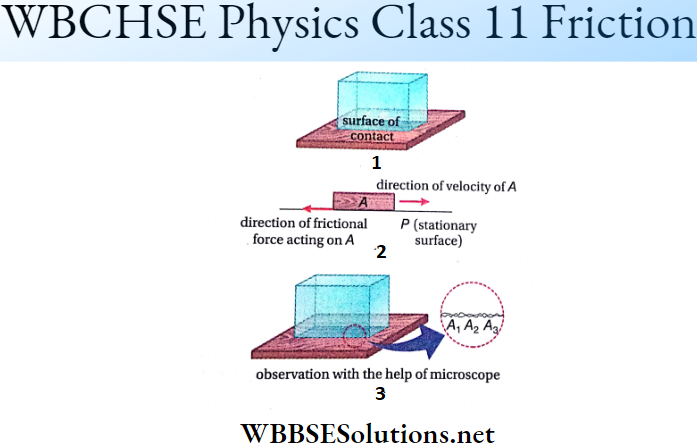
The respective areas of the two bodies which remain in contact with each other are called the surfaces of contact. Friction acts parallel to the surfaces of contact in a direction opposite to the direction of relative motion that is attempted or actually occurs.

Origin Of Friction: From our experience, we find that friction between two smooth surfaces is less than that between two rough surfaces. An apparently smooth surface when examined under a powerful microscope, also shows considerable roughness on the atomic scale.

Friction Origin Of Friction

  • At the points of contact A1, A2, and A3,……. atoms of the two surfaces come very close to each other, and interatomic forces act between them. Hence, adhesion takes place between the planes. Such adhesion is the source of friction.
  • Also, due to the relative motion between the surfaces, the shape and size of the grooves change continuously. This creates waves and atomic motion which also give rise to friction.

WBCHSE Class 11 Physics Notes For Friction

Law of Motion Class 11 Notes Physics

Class 11 Physics Notes For Angle Of Repose

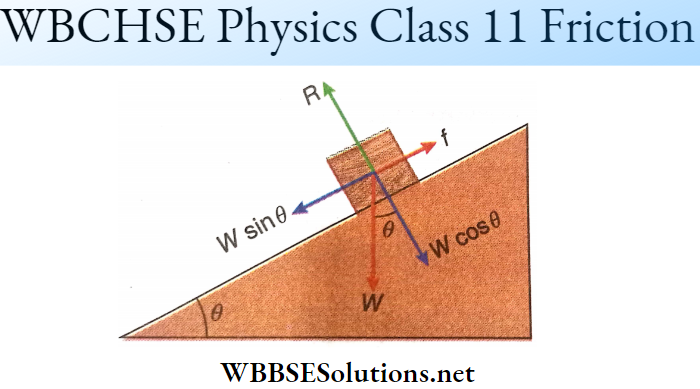
Consider a body of weight W, placed on a surface inclined at an angle θ with the horizontal. The normal force of the inclined plane on the body is R = W cosθ. In this case, the component W sinθ along the plane tries to set up a downward motion of the body.

  • Consequently, a frictional force develops upwards along the surface. If the inclination θ is such that the surface just prevents the downward motion of the body, then the frictional force f is the limiting friction, expressed as f = W sinθ.
  • Hence, the coefficient of friction, \(\mu=\frac{f}{R}=\frac{W \sin \theta}{W \cos \theta}=\tan \theta\)
  • Therefore, when the tangent of the angle of inclination equals the coefficient of friction, the body remains in limiting equilibrium on the inclined plane. If the angle of inclination θ is increased further, W sinθ also increases.
  • Then the limiting friction f cannot balance the body and it starts to slide down the inclined plane. The angle of inclination θ in this case, is called the angle of repose of the inclined plane.

Friction Angle Of Repulse

Understanding Types of Friction

Angle Of Repose Definition: The maximum value of the angle of inclination of a surface, for which an object placed on it is just on the verge of downward motion due to its own weight, is called the angle of repose.

Law of Motion Class 11 Notes Physics – Angle Of Repose Discussion

  1. For a very smooth surface, i.e., for μ ≈ 0, the angle of repose becomes approximately equal to 0°. This means that the surface cannot prevent the downward motion of this body, even when it is very slightly inclined.
  2. When the angle of inclination exceeds the angle of repose, then the frictional force can no longer keep the body in equilibrium on the inclined plane.
  3. The angle of repose of different objects, placed on the same inclined surface, may be different.
  4. We know μ = tanλ, where λ is the angle of friction, and also μ = tanθ, where θ is the angle of repose, for a pair of surfaces in contact.

∴ tanλ= tanθ or, λ = 6.

Thus, the angle of repose and the angle of friction are numerically equal. However, they are two different physical quantities. The angle of friction is a quantity related to friction between any two surfaces; on the other hand, the angle of repose is a property of inclined surfaces only.

Law of Motion Class 11 Notes Physics – Acceleration Of A Body On An Inclined Plane

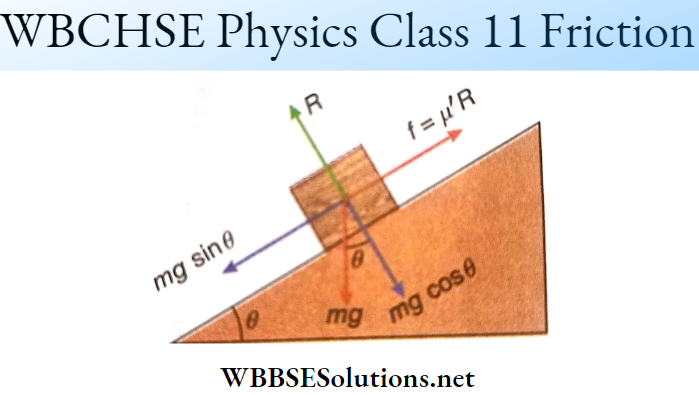
Consider a body of mass m sliding down an inclined plane with an acceleration a. Let the angle of inclination be θ. Since the body slides down, θ must be greater than the angle of repose.

Friction Acceleration Of A Body On A Inclined Plane

Here kinetic friction acts upwards along the incline. Let the normal force of the inclined plane be R, and the coefficient of sliding friction be μ’. Hence, sliding frictional force, f = μ’ R.

Also, R = mgcosθ. The component of the weight of the body along the plane is mg sinθ, which is in the opposite direction of f. The equation of the downward motion, of the body along this inclined plane is, mg sinθ-f= ma

or, ma = mg sinθ – μ’R = mg(sinθ-μ’cosθ)

or, a = g(sinθ-μ’cosθ)

If the inclined plane is perfectly smooth, then μ’ = 0 and a = g sinθ. Hence, the frictional force reduces the downward acceleration of the body along the plane by an amount gμ’ cosθ.

Class 11 Physics Class 12 Maths Class 11 Chemistry
NEET Foundation Class 12 Physics NEET Physics

Equilibrium Of A Body On An Inclined Plane

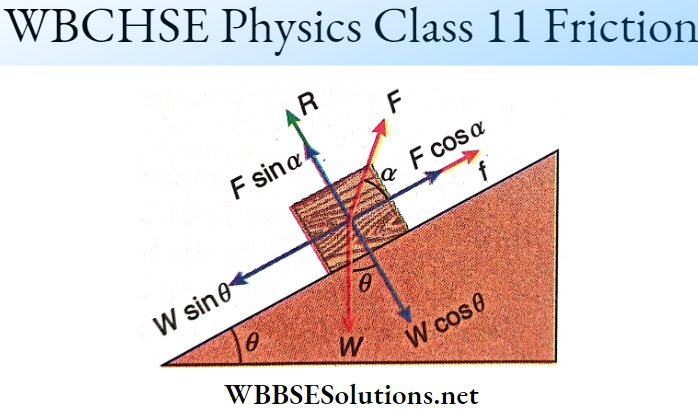
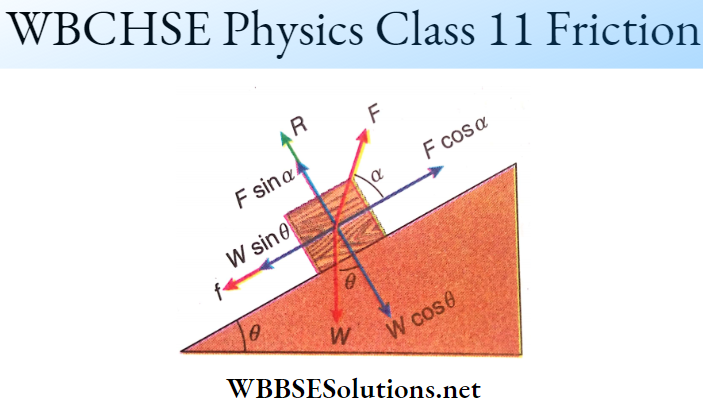
A body of weight W is kept on a plane inclined at an angle θ with the horizontal. If θ is greater than the angle of repose, the frictional force alone is not sufficient to keep the body at rest; an external force F is required for equilibrium. Let it be assumed that the force F makes an angle α with the inclined plane.

There can be either of the two limiting equilibrium conditions—

  1. The body is about to move down along the inclined plane, or,
  2. The body is about to move up along the inclined plane.

Case 1: Equilibrium Against Downward Motion: The force of limiting friction acts on the body in an upward direction. For equilibrium, the resultants of the components of the forces acting

  1. Along The Incline, And
  2. Perpendicular To The Incline, Both Should Be Zero.

Friction Equilibrium Of A Body On An Inclined Plane

Here, f + F cosα = W sinθ …(1) and

R + F sinα = W cosθ …(2)

If the coefficient of friction is μ, then f = μR and from equation (1), μR+ F cosα = W sinθ …..(3)

Multiplying equation (2) by θ and then subtracting from (3) we get,

∴ \(F(\cos \alpha-\mu \sin \alpha)=W(\sin \theta-\mu \cos \theta)\)

or, \(F=W \cdot \frac{\sin \theta-\mu \cos \theta}{\cos \alpha-\mu \sin \alpha}\)

Again, if \(\lambda\) is the angle of friction then, \(\mu=\tan \lambda\)

∴ F = \(W \cdot \frac{\sin \theta-\tan \lambda \cos \theta}{\cos \alpha-\tan \lambda \sin \alpha}\)

= \(W \cdot \frac{\sin \theta \cos \lambda-\cos \theta \sin \lambda}{\cos \alpha \cos \lambda-\sin \lambda \sin \alpha}\)

= \(W \cdot \frac{\sin (\theta-\lambda)}{\cos (\alpha+\lambda)}\)…(4)

For given values of θ and λ, F wdll be minimum when cos(α +λ) is maximum,

i.e., when cos(α +λ) = 1 = cos 0

∴ a + λ = 0 or, λ = -λ ….(5)

∴ Minimum applied force, Fmin – W sin(θ – λ)

Class 11 Physics Friction Notes

Case 2: Equilibrium Against Upward Motion: If the body is about to move up along the incline, the limiting friction, f= μR acts downwards along the incline. The forces acting when the body is just about to move are shown. Conditions for limiting equilibrium are,

F cosα = μR + W sinθ or, F cosα-μR = W sinθ…..(6)

and F sinα + R = Wcosθ or, μF sinα + μR = W μcosθ…..(7)

Friction Equuilibrium Against Upward Motion

Coefficient of Friction Explained

On adding (6) and (7), we get F(cosα + μsinα) = W(sinθ + μcosθ)

or, F = \(W \cdot \frac{\sin \theta+\mu \cos \theta}{\cos \alpha+\mu \sin \alpha}\)

Expressing μ in terms of the angle of friction λ, i.e., μ = tanλ,

F = \(W \cdot \frac{\sin \theta+\tan \lambda \cos \theta}{\cos \alpha+\tan \lambda \sin \alpha}\)

= \(W \cdot \frac{\sin \theta \cos \lambda+\sin \lambda \cos \theta}{\cos \alpha \cos \lambda+\sin \lambda \sin \alpha}\)

= \(W \cdot \frac{\sin (\theta+\lambda)}{\cos (\alpha-\lambda)}\)

For given values of θ and λ for F to be minimum, cos(α-λ) = 1 = cos 0 or,α = λ

Class 11 Physics Friction Notes

and Fmin = W sin(θ + λ).

Special Cases: When F is applied along the plane, i.e., if α = 0, then the force required to prevent the body from moving downwards is F = \(W \cdot \frac{\sin (\theta-\lambda)}{\cos \lambda}\)…(9)

Again, the force required to bring the body on the verge of moving upwards along the inclined plane is F = \(\frac{W \sin (\theta+\lambda)}{\cos \lambda}\)…(10)

Equilibrium Of A Body On An Inclined Plane Numerical Examples

Example 1. A body is kept on a horizontal rough plane. The plane is then gradually raised to an inclination of 30° with the horizontal and the body starts to slide down. The body descends 12 m along the inclined plane in the next 4 s. Find the coefficients of static and magnetic friction between the surfaces in contact.
Solution:

Given

A body is kept on a horizontal rough plane. The plane is then gradually raised to an inclination of 30° with the horizontal and the body starts to slide down. The body descends 12 m along the inclined plane in the next 4 s.

In this case, the angle of repose = 30°.

∴ Coefficient of static friction, μ = tan30° = 1/√3 = 0.577

As the body begins to slide down, kinetic friction starts acting against the motion.

Downward acceleration, a = g(sinθ-μ’cosθ) [μ’ = coefficient of kinetic friction]

= \(9.8\left(\frac{1}{2}-\mu^{\prime} \frac{\sqrt{3}}{2}\right)=9.8\left(0.5-0.866 \mu^{\prime}\right) \mathrm{m} \cdot \mathrm{s}^{-2}\)

As the body travels 12 m in 4 s from rest, from the equation, s = \(\frac{1}{20}\) at², we get,

12 = \(\frac{1}{2} a \cdot(4)^2 \quad \text { or, } a=\frac{3}{2}=1.5 \mathrm{~m} \cdot \mathrm{s}^{-2}\)

∴ \(9.8\left(0.5-0.866 \mu^{\prime}\right)=1.5\)

or, \(4.9-8.5 \mu^{\prime}=1.5 \quad \text { or, } \mu^{\prime}=\frac{3.4}{8.5}=0.4\)

Class 11 Physics Friction Notes

Example 2. To initiate an upward motion of a body along an inclined plane, the minimum force required is twice the force required to keep the body at rest on the same incline. If the coefficient of friction is μ, prove that the inclination of the plane is θ = tan-1 (3μ).
Solution:

Given

The minimum force required is twice the force required to keep the body at rest on the same incline. If the coefficient of friction is μ, prove that the inclination of the plane is θ = tan-1 (3μ).

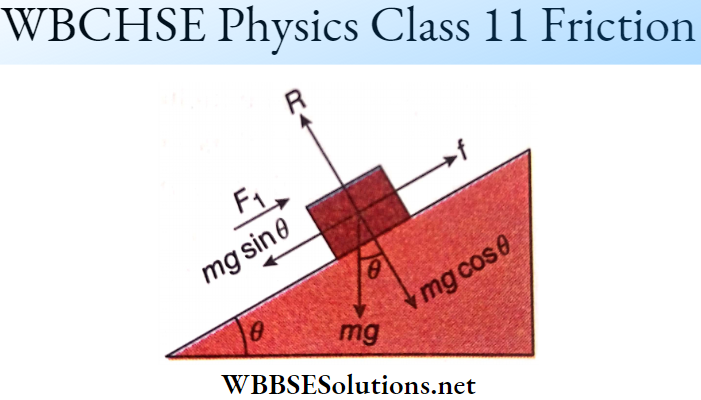
Let the mass of the body be m, and the minimum force required to keep the body at rest on the inclined plane be F1.

In this case, the force of limiting friction f acts in the direction of the applied force.

∴ F1+f=mgsinθ

Friction Initiate An Upward Motion

or, F1 + μmg cosθ = mg sinθ or, F1 = mg(sinθ – μcosθ). If F2 is the minimum force needed to set the body in an upward motion, then limiting friction acts downwards.

∴ F2 = mg sinθ + f = mg sinθ + μmg cosθ

= mg(sinθ +μcosθ)….(1)

As F2 = 2F1 (given),

mg(sinθ + μcosθ) = 2mg(sinθ- μ cosθ) or, sinθ = 3 μ cosθ

or, tanθ = 3μ or, θ = tan-1(3μ) (Proved).

Applications of Friction in Daily Life

Example 3. A body of mass 5 x 10⁻³ kg is projected upwards along a plane inclined at an angle of 30° with the horizontal. If the time required by the body to move up the incline is half the time required for it to slide down, find the coefficient of friction between the surface and the body.
Solution:

Given

A body of mass 5 x 10⁻³ kg is projected upwards along a plane inclined at an angle of 30° with the horizontal. If the time required by the body to move up the incline is half the time required for it to slide down,

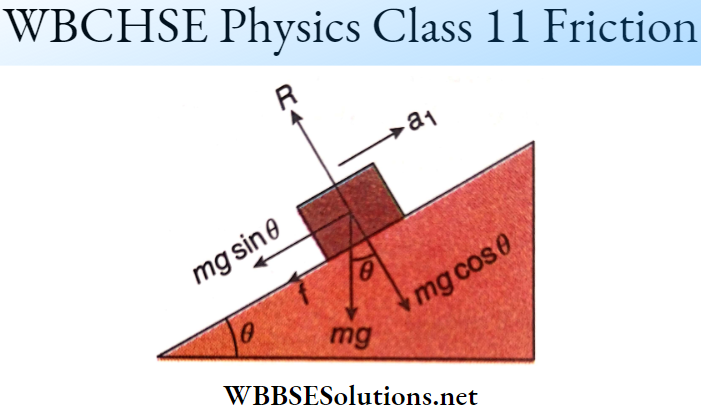
Let the mass of the body be m, and its upward acceleration be a1. Let the force of friction be f.

∴ ma1 = mg sinθ + f = mg sinθ + μmg cosθ

or, a1 = g(sinθ + μcosθ)

Friction Projected Upwards Along A Plane

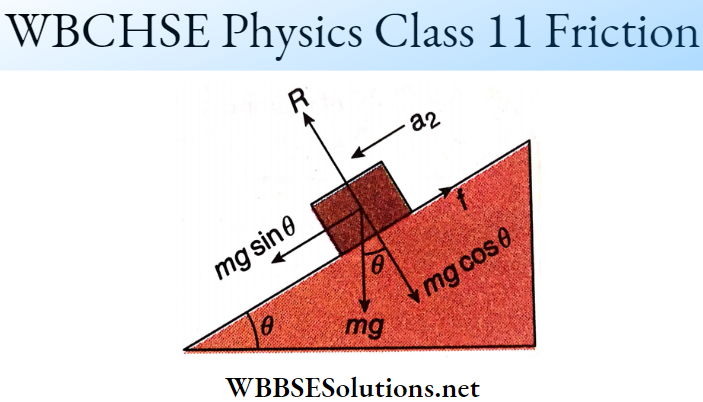
If a2 is the acceleration during the downward motion, then, ma2 = mgsindθ – f = mgsinθ – μmgcosθ

or, a2 = g(sinθ-μcosθ)

Class 11 Physics Friction Notes

Friction Acceleration During Downward Motion

∴ \(\frac{a_1}{a_2}=\frac{\sin \theta+\mu \cos \theta}{\sin \theta-\mu \cos \theta}=\frac{\tan \theta+\mu}{\tan \theta-\mu}\)

If the displacement along the inclined plane is s, and the time taken to move up and to come down are t1 and t2 respectively, then,

s = \(\frac{1}{2} a_1 t_1^2=\frac{1}{2} a_2 t_2^2\)

∴ \(a_1=\frac{2 s}{t_1^2} \text { and } a_2=\frac{2 s}{t_2^2}\)

⇒ \(\frac{a_1}{a_2}=\frac{t_2^2}{t_1^2}=\left(\frac{t_2}{t_1}\right)^2=2^2=4 \quad\left[because t_1=\frac{t_2}{2}\right]\)

∴ \(\frac{\tan \theta+\mu}{\tan \theta-\mu}=4 \text { or, } \mu=\frac{3}{5} \tan \theta=0.6 \tan 30^{\circ}=0.346\)

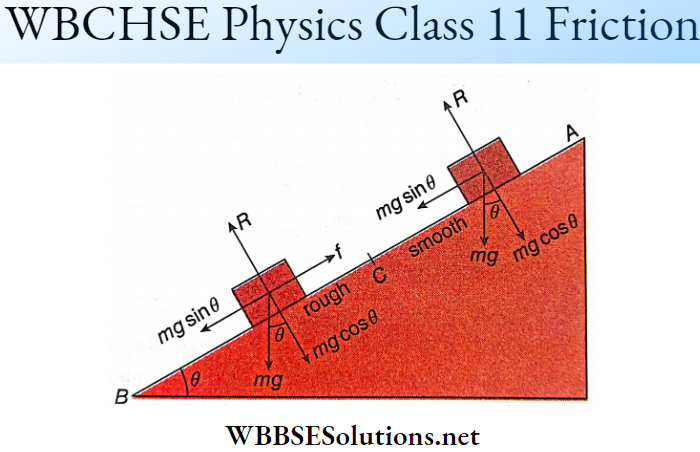
Example 4. The upper half of an inclined surface is perfectly smooth but the lower half is rough. A body starts sliding down the plane and stops immediately upon reaching the bottom. The inclination of the plane is 30° with the horizontal. Show that the frictional resistance of the rough part of the surface is equal to the weight of the body.
Solution:

Given

The upper half of an inclined surface is perfectly smooth but the lower half is rough. A body starts sliding down the plane and stops immediately upon reaching the bottom. The inclination of the plane is 30° with the horizontal.

Class 11 Physics Friction Notes

Let the length of the inclined plane be 2l, and the vertical height from the ground be h.

Then we get, \(\sin 30^{\circ}=\frac{h}{2 l} \quad \text { or, } \frac{1}{2}=\frac{h}{2 l} \quad \text { or, } h=l \text {. }\)

The potential energy of the body of mass m at maximum height on the plane = mgh = mgl.

Friction Upper Half Of An Inclined Surface

The body comes to rest at the bottom. Hence, all its potential energy at the top is spent in doing work against the force of friction, which acts along the length of the lower half of the surface. If f is the frictional force, then f x l = mgl

or, f = mg = weight of the body (Proved).

Rolling Friction

So far we have discussed only the examples of motions where a body slides over a surface. Common examples are, pulling a chair on a floor, skiing on ice, pushing a book over a table, and so on.

  • A characteristic feature of this sliding motion is that the contact plane of the moving body remains unaltered. In other words, the force of friction acts on a particular surface of the sliding body all the time.
  • When a body rolls over a surface, the area of contact of the rolling body changes continuously with time. So, the frictional force does not act on any specific surface of the body.

Types Of Friction

Friction Rolling Friction

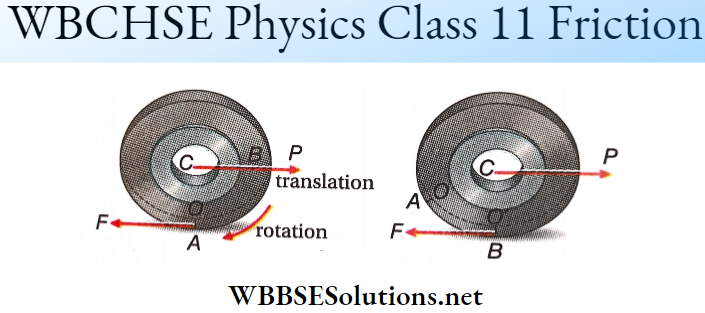
Consider the motion of a wheel over a horizontal plane. In this case the area of contact of the two surfaces at any time during the motion is very small.

  • When a rigid (or hard) wheel is placed on a horizontal plane, the plane of contact practically becomes a straight line, Now, let a horizontal force P be applied at the center C of the wheel.
  • It will initiate a translatory motion of the wheel, along the horizontal surface. Then, a frictional force F will act in the backward direction at the line of contact OA. As a result, the moment of F about C will generate a rotation of the wheel.
  • Line OA will be displaced, and new lines like O’B will come in contact with the horizontal surface. The overall effect is that two types of motion (translational and rotational) are set up in the wheel. Such composite motion of the wheel is called rolling.

Rolling Friction Definition: When a body translates, as well as rotates over a surface without slipping, its motion is known as rolling; the frictional force developed opposite to the direction of motion is called rolling friction.

  • We already know that sliding or kinetic friction is less than the limiting value of static friction (limiting friction). Rolling friction is much lower than even sliding friction. So it is considerably easier to overcome the rolling friction, and thus to set a body in motion.
  • This is how all-wheeled vehicles move. Wheels and tracks are always designed so that the applied force is greater than the rolling friction but less than the sliding friction. Car and bicycle tires have grooved surfaces that increase sliding friction.

If, for some reason, the sliding friction suddenly drops below the applied force, the wheel of the bicycle slides, or ‘skids’. Vehicles with wheels are not used at all where the sliding friction is very low—for example, flat-bottomed carts are used on ice surfaces.

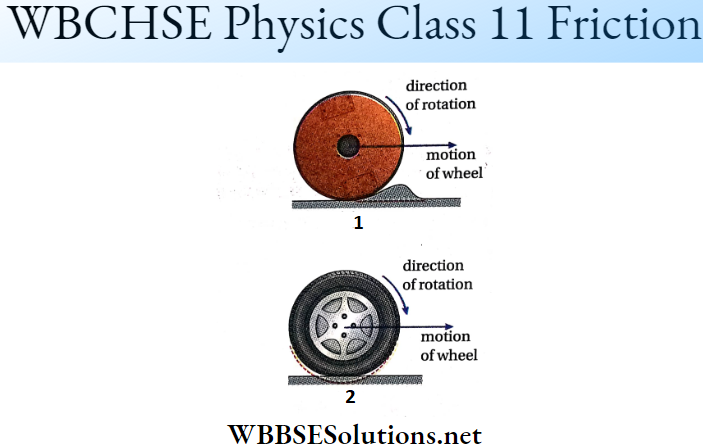
Source Of Rolling Friction: When a wheel rolls on a surface, its motion gets obstructed due to deformation of the wheel, the surface, or both, at the plane of contact.

Types Of Friction

Friction Source Of Rolling Friction

  • In real life, usually, the and the ground are not perfectly rigid and both get deformed to some extent.
  • Such deformation is easily noticeable when a heavy wheel rolls over soft ground. At the point of contact of the wheel and the ground, an indentation is created on the surface due to the weight of the wheel. The ground just in front of the wheel swells up slightly.
  • At the point of contact, the wheel also gets deformed and a slight flattening is easily observed. These deformations at the point of contact are the source of rolling friction. When the air pressure is low in a cycle tube, the is flattened, and frictional force increases.
  • If both the surfaces in contact are rigid enough, then the deformation is negligible, and so the rolling friction is quite low. For this reason, the friction is considerably low in the case of a train running over a railway track.

Note that, the deformations of the surfaces in contact, in case of a rolling motion, are temporary. As soon as the point of contact shifts, the wheel and the surface regain their original shapes and the deformation shifts to a new point of contact.

Factors Affecting Friction

Difference Between Sliding Friction And Rolling Friction:

  1. The surface of contact remains unchanged in case of sliding friction while in case of rolling friction, the surface of contact keeps changing.
  2. In case of sliding friction, two surfaces in contact are in motion with respect to each other. In the case of rolling friction, there is no relative motion between the two surfaces in contact.
  3. The frictional force opposing the sliding motion (sliding friction) is much more than the force opposing the rolling motion (rolling friction).

Class 11 Physics Notes For Friction

Friction Conclusion

When two surfaces are in contact with each other, and there exists a relative motion between them, or an attempt is made to impart a relative motion, a force comes into play that resists the movement. This force is called the force of friction, or simply friction.

  • Force of friction is a self-adjusting force that balances the applied force as long as there is no relative motion in which case it is known as static friction.
  • The maximum possible magnitude of static friction is called limiting friction.
  • The force of limiting friction and kinetic friction, between two surfaces in contact, are directly proportional to the normal force.
  • When the normal force remains constant, friction between the two surfaces in contact is independent of the area of contact and the relative velocity between the surfaces.
  • The ratio between the force of limiting friction and the normal force is called the coefficient of static friction for two surfaces in contact. Again, the ratio between the kinetic friction and the normal force is the coefficient of kinetic friction.

The coefficient of friction (μ) does not have any unit; it is just a number. Usually, it is less than 1, but can be equal to or greater than 1 in special cases.

  • For a pair of surfaces in contact the resultant of the force of limiting friction and the normal force makes an angle with the normal force itself. That is called the angle of friction.
  • The maximum value of the angle of inclination of an inclined plane, for which an object is just on the verge of downward motion along the incline only due to its weight is called the angle of repose.
  • For the same system, the angle of friction is equal to the angle of repose.
  • When a body rolls over a surface without slipping, the frictional force developed at the point of contact, that opposes the rotation of the rolling body, is called rolling friction.

 Friction Useful Relations For Solving Numerical Examples

When R = normal force, f = limiting friction or sliding friction, and μ = coefficient of friction, f = μR,

Acceleration produced on a body of mass m, kept on a rough surface, by a force F applied along the surface, is a = \(\frac{F-\mu R}{m}\)

If a body of mass m remains in equilibrium on a plane, inclined at the angle of repose θ, then R = mg cosθ and f = μR= mg sinθ; hence, μ = tanθ.

If the angle of repose is θ and the angle of friction is λ then, μ = tanθ = tanλ

∴ θ = λ.

Resultant of the limiting friction and the normal force R between two surfaces in contact,

Q = \(R \sqrt{1+\mu^2}\)

Acceleration of a body moving over an incline, under the action of gravity is a = g(sinθ – μcosθ)

Friction Very Short Answer Type Questions

Question 1. Can the value of the coefficient of friction be greater than 1?
Answer: Yes

Question 2. Does the force of friction depend on the area of contact?
Answer: No

Question 3. On what factors does the coefficient of static friction depend?
Answer:

  1. Nature of the surfaces in contact
  2. Nature of the material in contact

Question 4. What is wet friction?
Answer:

Wet friction

The force of friction between a solid and the layer of liquid

Question 5. Value of the angle of friction ______ on increasing the smoothness of the plane.
Answer: Decreases

Question 6. Rolling friction is _______ than both static friction and kinetic friction.
Answer: Less

Friction Assertion Reason Type Question And Answers

These questions have statement 1 and statement 2. Of the four choices given below, choose the one that best describes the two statements.

  1. Statement 1 is true, statement 2 is true; statement 2 is a correct explanation for statement 1.
  2. Statement 1 is true, and statement 2 is true; statement 2 is not a correct explanation for statement 1.
  3. Statement 1 is true, statement 2 is false.
  4. Statement 1 is false, and statement 2 is true.

Question 1.

Statement 1: If a body tries to slip over a surface then friction acting on the body is necessarily equal to the limiting friction.

Statement 2: Static friction can be less than the limiting friction.

Answer: 4. Statement 1 is false, statement 2 is true

Question 2.

Statement 1: Frictional heat generated by the moving ski is the chief factor that promotes sliding in skiing and waxing the ski makes skiing easier.

Statement 2: Due to friction, energy dissipates in the form of heat. As a result, it melts the snow below it. Wax is water-repellent.

Answer: 1. Statement 1 is true, statement 2 is true; statement 2 is a correct explanation for statement 1.

Question 3.

Statement 1: The coefficient of friction can be greater than unity.

Statement 2: Frictional force depends on normal reaction and the ratio of force of friction and normal reaction cannot exceed unity.

Answer: 3. Statement 1 is true, statement 2 is false.

Question 4.

Statement 1: Static frictional force is always greater than the kinetic frictional force.

Statement 2: Coefficient of static friction, μs > coefficient of kinetic friction, μk.

Answer: 4. Statement 1 is false, statement 2 is true

Question 5.

Statement 1: The driver of a moving car sees a wall in front of him. To avoid a collision, he should apply brakes rather than take a turn away from the wall.

Statement 2: Force of friction is needed to stop the car or take a turn on a horizontal road.

Answer: 2. Statement 1 is true, statement 2 is true; statement 2 is not a correct explanation for statement 1.

Question 6.

Statement 1: Friction opposes the motion of a body.

Statement 2: Static friction is self-adjusting while kinetic friction is constant.

Answer: 2. Statement 1 is true, statement 2 is true; statement 2 is not a correct explanation for statement 1.

Question 7.

Statement 1: A particle is thrown vertically upwards. If air resistance is taken into consideration then retardation in the upward journey is more than the acceleration in the downward journey.

Statement 2: Some mechanical energy is lost in the form of heat due to air friction.

Answer: 2. Statement 1 is true, statement 2 is true; statement 2 is not a correct explanation for statement 1.

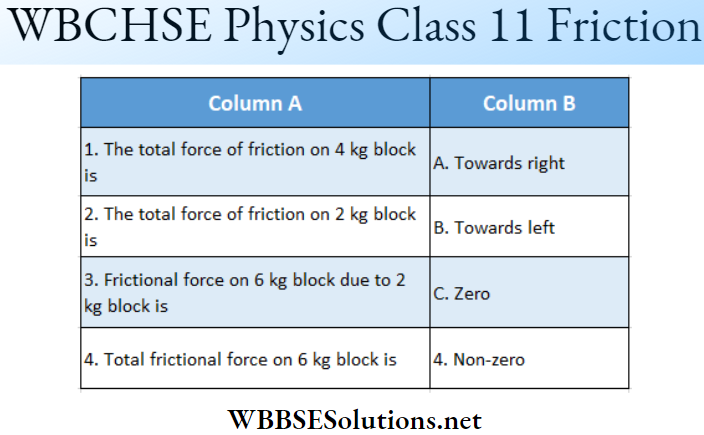
Friction Match Column A With Column B

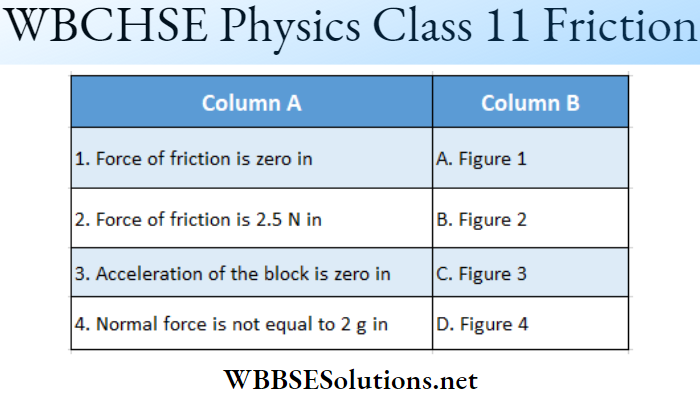
Question 1.

Friction Match The Columns Question 1

Answer: 1. B, 2. A, C, 3. B, 2. A, C

Short Answer Questions on Friction

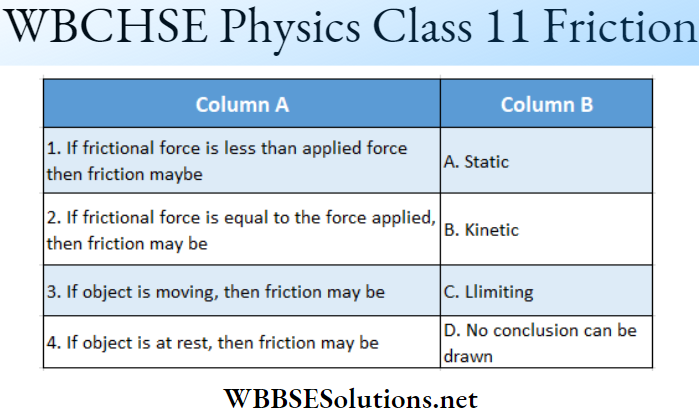
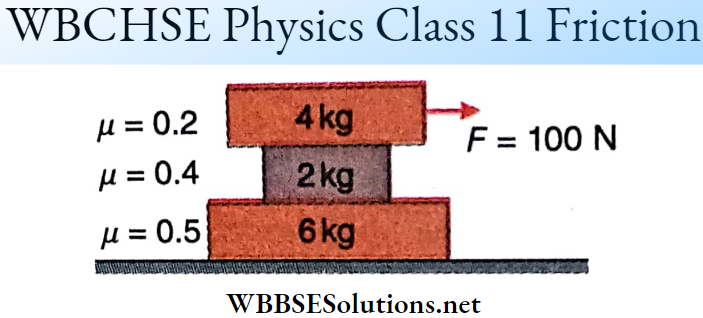
Question 2. For the situation shown, in Column A, the statements regarding frictional forces are mentioned, while in Column B some information related to frictional forces is given.

Friction Force

Friction Match The Columns Question 2

Answer: 1. B, D, 2. C, 3. A, D, 4. C

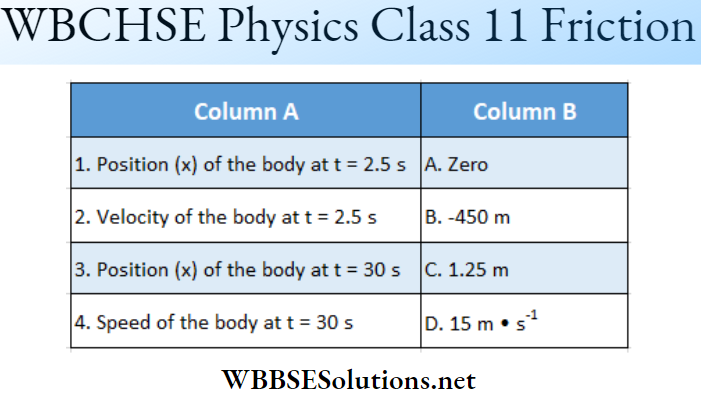
Question 3. A body of mass 200 g is moving with a velocity of 5 m • s-1 along the positive x -x-direction. At time t = 0, when the body is at x = 0, a constant force of 0.4 N directed along the negative x-direction is applied to the body for 10 s.

Friction Match The Columns Question 3

Answer: 1. C, 2. A, 3. B, 4. D

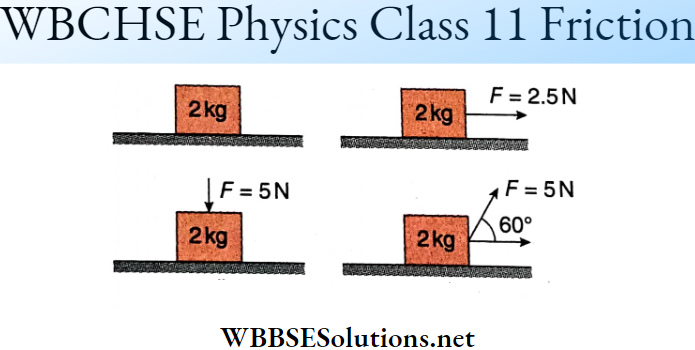
Question 4. The coefficient of friction between the block and the surface is 0.4.

Friction Match The Columns Question 1 Coefficient Of Friction

Friction Match The Columns Question 4

Answer: 1. A, C, 2. B, D 3. A, B 4. C, D

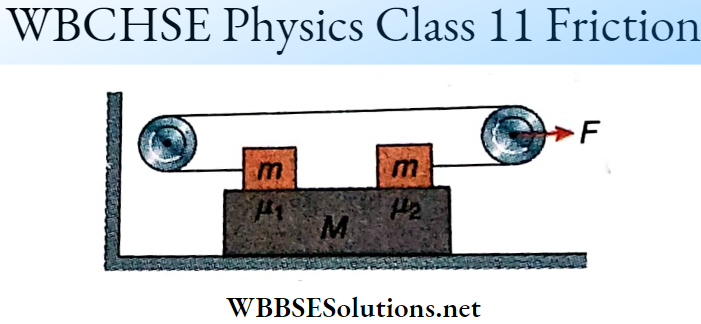
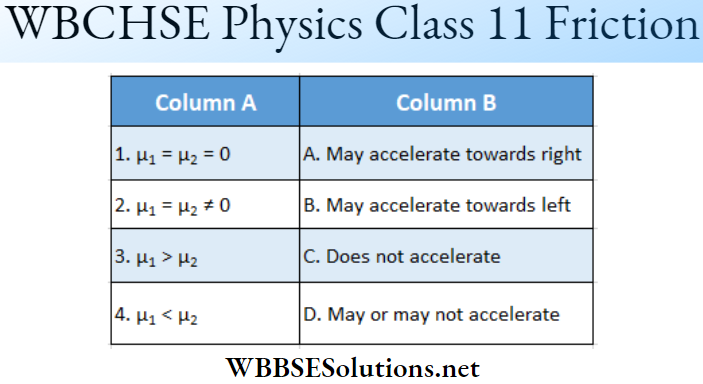
Question 5. Both the pulleys are massless and frictionless. A force F (of any possible magnitude) is applied in the horizontal direction. There is no friction between M and the ground. μ1 and μ2 are the coefficients of friction as shown between the blocks. Column A gives the different relations between μ1 and μ2 and Column B is regarding the motion of M.

Friction Pulleys Are Massless And Friction less

Friction Match The Columns Question 5

Answer: 1. C, 2. C, 3. B, D, 4. A, D

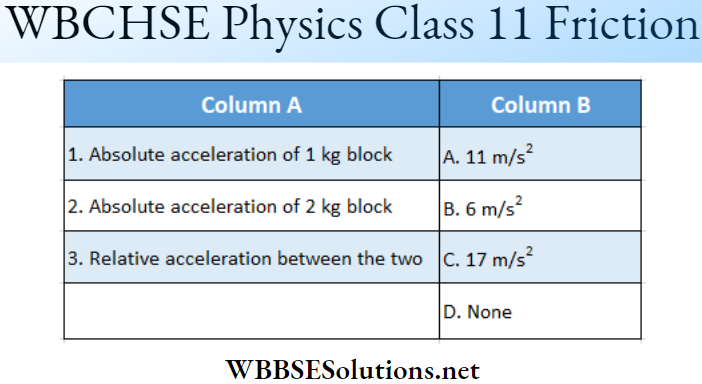
Question 6. For the diagram shown, match the following columns.

Friction Absolute Acceleration

Friction Match The Column Question 6

Answer: 1. D, 2. A, 3. D

Real-Life Examples of Friction in Action

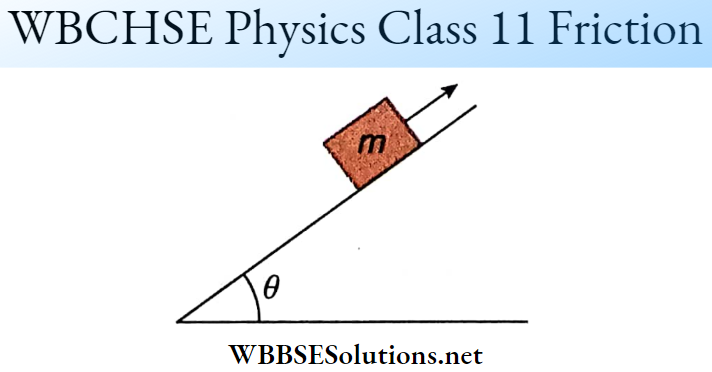
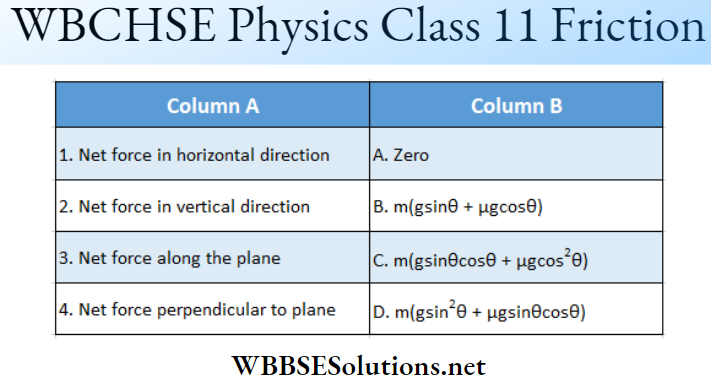
Question 7. A block of mass m is thrown upwards with some initial velocity as shown. On the block:

Friction Bloack Of Mass Is Thrown Upwards With Some Intial Velocity

Friction Match the Column Question 7

Answer: 1. C, 2. D, 3. B 4. A

 Friction Comprehension Type Question And Answers

Read the following passages carefully and answer the questions at the end of them.

Question 1. A man wants to slide down a block of mass m which is kept on a fixed inclined plane of inclination 30° as shown. Initially, the block is not sliding. To just start sliding the man pushes the block down the incline with a force F. Now, the block starts accelerating. To move it downwards with constant speed the man starts pulling the block with the same force. Surfaces are such that ratio of maximum static friction to kinetic friction is 2.

Friction A Man Wants To Slide Down A Block m

1. What is the value of F?

  1. \(\frac{m g}{4}\)
  2. \(\frac{m g}{6}\)
  3. \(\frac{m g \sqrt{3}}{4}\)
  4. \(\frac{m g}{2 \sqrt{3}}\)

Answer: 2. \(\frac{m g}{6}\)

2. What is the value of μs, friction?

  1. \(\frac{4}{3 \sqrt{3}}\)
  2. \(\frac{2}{3 \sqrt{3}}\)
  3. \(\frac{3}{3 \sqrt{3}}\)
  4. \(\frac{1}{2 \sqrt{3}}\)

Answer: 1. \(\frac{4}{3 \sqrt{3}}\)

3. If the man continues pushing the block by force F, its acceleration would be

  1. \(\frac{g}{6}\)
  2. \(\frac{g}{4}\)
  3. \(\frac{g}{2}\)
  4. \(\frac{g}{3}\)

Asnwer: 4. \(\frac{g}{3}\)

Question 2. A lift with a mass 1200 kg is raised from rest by a cable with a tension of 1350g N. After some time the tension drops to 1000g N and the lift comes to rest at a height of 25 m above its initial point. (1gN = 9.8 N).

1. What is the height at which the tension changes?

  1. 10.8 m
  2. 12.5 m
  3. 14.3 m
  4. 16 m

Answer: 3. 14.3 m

2. What is the greatest speed of the lift?

  1. 9.8 m s-1
  2. 7.5 m s-1
  3. 5.92 m s-1
  4. None Of These

Answer: 3. 5.92 m s-1

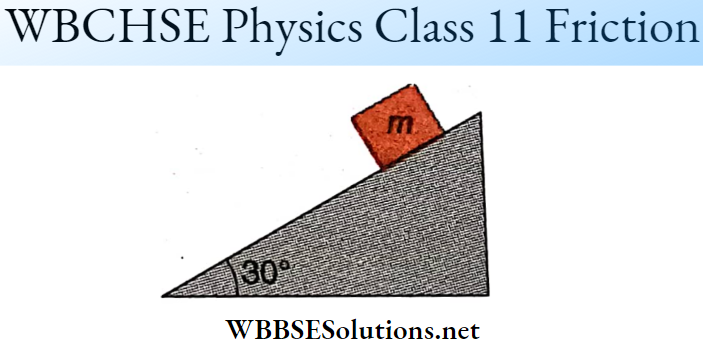
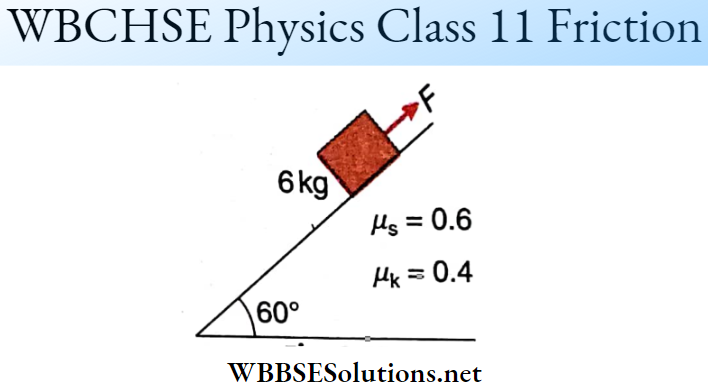
Question 3. A 6 kg block is kept on an inclined rough surface as shown. Based on this information answer the following questions (Take g = 10 m · s-2).

Friction A Block Is kept On An Inclined Rough Surface

1. The amount of force (F) required to keep the block stationary is

  1. 34N
  2. 40 N
  3. 35 N
  4. 36 N

Answer: 1. 34N

2. The amount of force (F) required to move the block downwards with constant velocity is

  1. 35 N
  2. 37 N
  3. 40 N
  4. 44 N

Answer: 3. 40 N

3. The amount of force (F) required to move the block upwards with an acceleration of 4 m • s-2 is

  1. 90 N
  2. 92 N
  3. 88 N
  4. 80 N

Answer: 3. 88 N

Friction Integer Answer Type Questions

In this type, the answer to each of the questions li a tingle digit Integer ranging from 0 to 9.

Question 1. A horizontal force of 10 N is necessary to just hold a block stationary against a wall. The coefficient of friction between the block and the wall is 0.2. What is the weight of the block (in N)?
Answer: 2

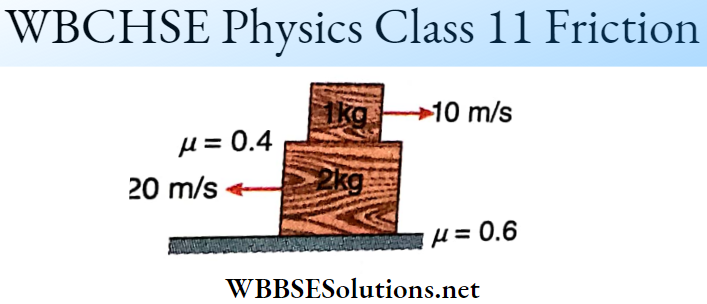
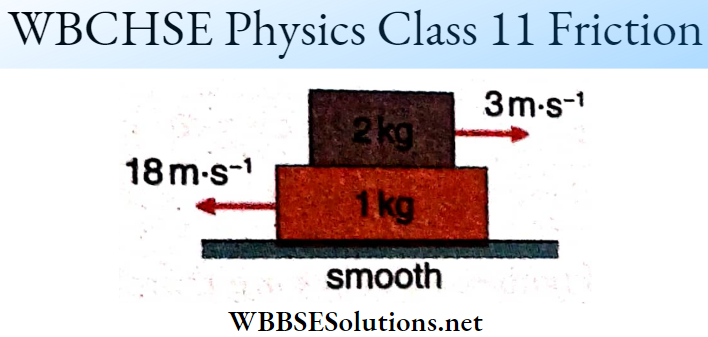
Question 2. The coefficient of friction between two blocks is μ = 0.6. The blocks are given velocities in the directions shown in the figure. Find the common velocity (in m • s-1) of the two blocks.
Answer: 4

Friction Coefficient Of Friction


WBCHSE Class 11 Physics Friction Short Answer Type Questions

 Friction Short Answer Type Questions

WBBSE Class 11 Short Answer Questions on Friction

Question 1. A block of mass M rests on an inclined plane. If the coefficient of friction between the block and the plane is μ, then the block will slide down the plane under its own weight when the angle of inclination is

  1. θ >tan-1 (μ)
  2. θ >tan-1 (1/μ)
  3. θ <tan-1 (μ)
  4. θ <tan-1 (1/μ)

Answer: The option 1 is correct.

Question 2. A block of mass 5 kg rests on a table. 8 N horizontal force is applied to push the block. Find out the force of friction between the block and the table. Given, μs = 0.3 and μk = 0.2, between the block and the table and g = 10m · s-2
Answer:

Given

A block of mass 5 kg rests on a table. 8 N horizontal force is applied to push the block.

Given, μs = 0.3 and μk = 0.2, between the block and the table and g = 10m · s-2

Normal reaction = 5×10 = 50N

So, limiting friction = μs x normal reaction = 0.3 x 50 = 15

Hence, on the application of 8 N horizontal force, the block remains at rest

So, frictional force = applied force = 8 N

Question 3. A block is placed on a horizontal surface. The block is pushed by applying a force F which acts at an angle of θ with the vertical. How much force will be required to move the block if the frictional coefficient μ? Discuss the fact if tanθ < μ.
Answer:

Given

A block is placed on a horizontal surface. The block is pushed by applying a force F which acts at an angle of θ with the vertical.

Normal reaction force, N = (mg+ Fcosθ)

∴ Minimum required force (horizontal) to move the block, pmin = μ(mg + Fcosθ)

Now, \(\frac{\text { required force }\left(P_{\min }\right)}{\text { applied horizontal force }(P)}=\frac{\mu(m g+F \cos \theta)}{F \sin \theta}\)

Friction Block Is Placed On A Horizontal Surface

Key Concepts of Friction: Short Answer Format

If \(\tan \theta<\mu\) then \(\frac{P_{\min }}{P}>\frac{m g \tan \theta+\tan \theta \cdot F \cos \theta}{F \sin \theta}>\frac{m g}{F \cos \theta}+1>1\) [because cosθ >0]

i.e., P<Pmin

∴ The block remains static.

Question 4.

  1. Establish the relation between the angle of friction and the angle of repose.
  2. Explain with reason, whether the coefficient of friction between two surfaces can be zero.

Answer:

1. \(\vec{F}\) = limiting friction, \(\vec{N}\) = normal reaction, \(\vec{R}\) = resultant of \(\vec{F}\) and \(\vec{N}\).

Friction Relation Between Angle Of Friction And Angle Of Response

The angle λ, between \(\vec{R}\) and \(\vec{N}\) is called the angle of friction.

∴ tanλ = \(\frac{F}{N}\) = μ = coefficient of friction

When a body just starts to move downward due to its own weight along an inclined plane, the angle of inclination of the plane at that moment is called the angle of repose.

Now, coefficient of friction, \(\mu=\frac{F}{N}=\frac{W \sin \theta}{W \cos \theta}=\tan \theta\)

∴ \(\mu=\tan \lambda=\tan \theta \quad \text { or, } \theta=\lambda\)

i.e., the angle of friction and the angle of repose are equal.

2. Coefficient of friction, μ = \(\frac{F}{N}\); for p to be zero F has to be zero. In practice, no matter how smooth two surfaces may be, there will always be some friction between the two surfaces whenever one is made to move over the other. Hence, μ can never be zero.

Applications of Friction in Daily Life: Short Answers

Question 5. An object of weight W rests on an inclined plane. The coefficient of friction between the object and the plane is μ. For what value of the angle of inclination θ, will the object move downward with uniform speed under its own weight?
Answer:

Given

An object of weight W rests on an inclined plane. The coefficient of friction between the object and the plane is μ.

The forces acting on the body along with their components are shown.

Friction Force Is Action On The Body

When the body is about to slide down along the incline then, \(W \sin \theta=\mu R=\mu W \cos \theta\)

or, \(\tan \theta=\mu \quad \text { or, } \theta=\tan ^{-1} \mu\)

Question 6. To determine the coefficient of friction between a rough surface and a block, the surface is kept inclined at 45° and the block is released from rest. The block takes a time t in moving a distance d. The rough surface is then replaced by a smooth surface and the same experiment is repeated. The block now takes a time t/2 in moving down the same distance d. The coefficient of friction is

  1. 3/4
  2. 5/4
  3. 1/2
  4. 1/2

Answer:

Given

The surface is kept inclined at 45° and the block is released from rest. The block takes a time t in moving a distance d. The rough surface is then replaced by a smooth surface and the same experiment is repeated. The block now takes a time t/2 in moving down the same distance d.

For a smooth surface, the block takes a time t/2 in moving a distance d with an acceleration gsinθ.

∴ d = \(\frac{1}{2} g \sin \theta \cdot \frac{t^2}{4}=\frac{1}{8} g \sin \theta \cdot t^2\)…(1)

For rough surfaces, the block now takes a time t in moving down the same distance with an acceleration (gsinθ-f) or (gsinθ – μgcosθ).

∴ d = \(\frac{1}{2}(g \sin \theta-\mu g \cos \theta) \cdot t^2\)…(2)

Comparing equations (1) and (2), \(\frac{1}{4} \sin \theta=\sin \theta-\mu \cos \theta\)

or, \(\mu=\tan \theta-\frac{1}{4} \tan \theta=\frac{3}{4} \tan \theta=\frac{3}{4} \tan 45^{\circ}=\frac{3}{4}\)

The option 1 is correct.

Factors Affecting Friction: Short Answer Questions

Question 7. Block B lying on a table weighs W. The coefficient of static friction between the block and the table is μ. Assume that the cord between B and the knot is horizontal. The maximum weight of block A for which the system will be stationary is

  1. \(\frac{W \tan \theta}{\mu}\)
  2. \(\mu W \tan \theta\)
  3. \(\mu W \sqrt{1+\tan ^2 \theta}\)
  4. \(\mu W \sin \theta\)

Friction Block Lying on A Table Weigth

Answer:

Given

Block B lying on a table weighs W. The coefficient of static friction between the block and the table is μ. Assume that the cord between B and the knot is horizontal.

The normal reaction of the table on block B = W

So the effective frictional force acting on the left = μW

Again when the maximum weight of A is W0, it acts downwards.

Therefore, when in equilibrium, the cord between the knot and the wall will be along the resultant of μW and W0.

In that case, \(\tan \theta=\frac{W_0}{\mu W} \quad \text { or, } W_0=\mu W \tan \theta\)

The option 2 is correct.

Class 11 Physics Class 12 Maths Class 11 Chemistry
NEET Foundation Class 12 Physics NEET Physics

Question 8. A block of mass m2 is placed on a horizontal table and another block of mass m1 is placed on top of it. An increasing horizontal force F = αt is exerted on the upper block but the lower block never moves as a result. If the coefficient of friction between the blocks is μ1 and that between the lower block and the table is μ2, then what is the maximum possible value of fi μ12?

  1. \(\frac{m_2}{m_1}\)
  2. \(1+\frac{m_2}{m_1}\)
  3. \(\frac{m_1}{m_2}\)
  4. \(1+\frac{m_1}{m_2}\)

Answer:

Given

A block of mass m2 is placed on a horizontal table and another block of mass m1 is placed on top of it. An increasing horizontal force F = αt is exerted on the upper block but the lower block never moves as a result. If the coefficient of friction between the blocks is μ1 and that between the lower block and the table is μ2

∴ \(\mu_2\left(m_1+m_2\right) g\) ≥ \(\mu_1 m_1 g\)

or, \(\frac{m_1+m_2}{m_1}\) ≥ \(\frac{\mu_1}{\mu_2}\)

Friction A Block Of Mass Is Placed On A Horizontal Table

or, \(\frac{\mu_1}{\mu_2}\) ≤ \(1+\frac{m_2}{m_1} or, \left(\frac{\mu_1}{\mu_2}\right)_{\text {max }}=1+\frac{m_2}{m_1}\)

The option 2 is correct.

Types of Friction Explained: Short Answers

Question 9. Given two blocks A and B of weight 20 N and 100 N, respectively. These are being pressed against a wall by a force F as shown. If the coefficient of friction between the blocks is 0.1 and between block B and the wall is 0.15, the frictional force applied by the wall on block B is 

  1. 100 N
  2. 80 N
  3. 120 N
  4. 150 N

Friction Two Blocks Of Weigth

Answer:

Given

Given two blocks A and B of weight 20 N and 100 N, respectively. These are being pressed against a wall by a force F as shown. If the coefficient of friction between the blocks is 0.1 and between block B and the wall is 0.15,

On the plane of contact of A and B, the upward frictional force acting on A = μF = WA = 20 N.

So the downward frictional force on B on that plane = 20 N

This 20 N force and the weight of B is balanced by μ2F (the upward frictional force applied by the wall on B)

∴ μ2F = 20 + WA = 20 + 100 = 120 N

The option 3 is correct.

Question 10. Two masses m1 = 5 kg and m2 = 10 kg, connected by an inextensible string over a frictionless pulley, are moving as shown. The coefficient of friction of the horizontal surface is 0.15. The minimum weight m that should be put on top of m2 to stop the motion is

Friction Two Masses Connected By Inextensivble String

  1. 43.3 kg
  2. 10.3 kg
  3. 18.3 kg
  4. 27.3 kg

Answer:

Given

Two masses m1 = 5 kg and m2 = 10 kg, connected by an inextensible string over a frictionless pulley, are moving as shown. The coefficient of friction of the horizontal surface is 0.15.

Let the mass m2 come to rest if a mass m is placed on it. For the mass m2 to come to rest, an acceleration (due to friction) should act in the opposite direction of its motion i.e., when f≤ μN

Friction Mass Comes To Rest Due To Friction

Also f = T = 5 g [when m and m2 are at rest]

∴ m1g ≤ μ(m +m2)g or, 5 ≤ 0.15(m +10)

or, 23.33 <≤ m

The option 4 is correct.

Question 11. A system consists of three masses m1, m2, and m3 connected by a string passing over a pulley P. The mass m1 hangs freely and m2 and m3 are on a rough horizontal table (the coefficient of friction = μ). The pulley is frictionless and of negligible mass. The downward acceleration of mass ml is (Assume m1 = m2 = m3 = m)

Friction A System Consists Of Masses

  1. \(\frac{g(1-g \mu)}{9}\)
  2. \(\frac{1 g \mu}{3}\)
  3. \(\frac{g(1-2 \mu)}{3}\)
  4. \(\frac{g(1-2 \mu)}{2}\)

Answer:

Given

A system consists of three masses m1, m2, and m3 connected by a string passing over a pulley P. The mass m1 hangs freely and m2 and m3 are on a rough horizontal table (the coefficient of friction = μ). The pulley is frictionless and of negligible mass.

Acceleration = \(\frac{\text { net force in the direction of motion }}{\text { total mass of system }}\)

= \(\frac{m_1 g-\mu\left(m_2+m_3\right)} g= {m_1+m_2+m_3}=\frac{g(1-2 \mu)}{3}\)

The option 3 is correct.

Mathematical Concepts in Friction: Short Answer Questions

Question 12. A block A of mass m1 rests on a horizontal table. A light string connected to it passes over a frictionless pulley at the edge of the table and from its other end, another block B of mass m2 is suspended. The coefficient of kinetic friction between the block and the table is μk. When the block A is sliding on the table, the tension in the string is

  1. \(\frac{\left(m_2+\mu_k m_1\right) g}{\left(m_1+m_2\right)}\)
  2. \(\frac{\left(m_2-\mu_k m_1\right) g}{\left(m_1+m_2\right)}\)
  3. \(\frac{m_1 m_2\left(1+\mu_k\right) g}{\left(m_1+m_2\right)}\)
  4. \(\frac{m_1 m_2\left(1-\mu_k\right) g}{\left(m_1+m_2\right)}\)

Answer:

Given

A block A of mass m1 rests on a horizontal table. A light string connected to it passes over a frictionless pulley at the edge of the table and from its other end, another block B of mass m2 is suspended. The coefficient of kinetic friction between the block and the table is μk

The frictional force acting on block A = μkm1g

Friction Frictional Froce Actiong On A Block

Hence, the resultant force on the blocks = m2g-μkm1g

Their acceleration, a = \(\frac{m_2 g-\mu_k m_1 g}{m_1+m_2}\)

If the tension in the string is T, then for block B, \(m_2 g-T=m_2 a\)

∴ T = \(m_2(g-a)=m_2 g\left(1-\frac{m_2-\mu_k m_1}{m_1+m_2}\right)\)

= \(m_2 g \frac{m_1+\mu_k m_1}{m_1+m_2}\)

= \(\frac{m_1 m_2\left(1+\mu_k\right) g}{m_1+m_2}\)

The option 3 is correct.

Question 13. Which one of the following statements is incorrect?

  1. Frictional force opposes the relative motion
  2. The limiting value of static friction is directly proportional to the normal reaction
  3. Rolling friction is smaller than sliding friction
  4. The coefficient of sliding friction has dimensions of length

Answer: 4. The coefficient of friction is a dimensionless quantity.

The option 4 is correct.

Question 14. The inclination θ of a rough plane is increased gradually. The ply on the plane just comes into motion when inclination θ becomes 30°. Find the coefficient of friction. If the inclination is further increased to 45° then find the acceleration of the body along the plane, (g = 10 m · s-2)
Answer:

Given

The inclination θ of a rough plane is increased gradually. The ply on the plane just comes into motion when inclination θ becomes 30°.

Here, angle of repose =30°

∴ Coefficient of friction, μ = tan30° = 1/√3

If the angle of inclination is 45°, the acceleration of the body,

a = \(g\left(\sin 45^{\circ}-\mu^{\prime} \cos 45^{\circ}\right)=10 \times \frac{1}{\sqrt{2}}\left(1-\mu^{\prime}\right)\)

= \(\frac{10}{\sqrt{2}}\left(1-\frac{1}{\sqrt{3}}\right) \approx 2.99 \mathrm{~m} \cdot \mathrm{s}^{-2} \quad\left[because \mu^{\prime} \approx \mu\right]\)

Question 15. Give the magnitude and direction of the net force acting on a car moving with a constant velocity of 30 km · h-1 on a rough road.
Answer:

The velocity does not change, so, there is no acceleration.

The relation F = ma shows that, as a = 0, the net force F = 0.

Here, the force applied by the engine is balanced exactly by the friction of the road.

Short Answer Questions on Laws of Friction

Question 16. Two bodies A, B of masses 5 kg and 10 kg in contact with each other rest on a table against a rigid wall. The coefficient of friction between the bodies and the table is 0.15. A force of 200N is applied horizontally to A.

  1. What is the reaction of the partition?
  2. The action-reaction forces between A, and B?
  3. What happens when the wall is removed?

Does the answer 2. Change when bodies are in motion? [Ignore the difference between μs and μk]
Answer:

We take the rounded-off value, g = 10 m · s-2

Friction Two Bodies Round Off Value

Normal reaction on A, NA = its weight (mg)

= 5 x 10 = 50 N

Normal reaction on B, NB = 10 x 10 = 100 N

So the limiting friction on A, fA = μNA = 0.15 x 50 = 7.5 N

and limiting friction on B, fB = μNB = 0.15 x 100 = 15 N

(As the applied force, 200 N, is higher, the force of friction attains its limiting value)

1. We take the combination of A and B as a single body. It is at rest due to the presence of the wall. If R is the reaction of the wall, the force equation in the horizontal direction is, 200-fA-fB-R=0

or, R = 200- 7.5- 15 = 177.5 N

2. Let FAB = action force of A on B; FBA = reaction force of B on A; FAB and FBA are equal and opposite. From the equilibrium of A, we get 200-fA-FBA = 0

or, FBA = 200-7.5 = 192.5 N

So, FAB = -192.5 N

3. Now, if the wall is removed, the reaction force R is absent; due to the applied force, the combination of A and B would move forward with an acceleration a (say). Then the force equation in the horizontal direction would be, 200 -fA-fB = (mA+mB)a

or, a = \(\frac{200-7.5-15}{5+10}=\frac{177.5}{15}=11.83 \mathrm{~m} \cdot \mathrm{s}^{-2}\)

Now, the force equation for the body A is, 200-fA-F’BA = mAa

[F’BA = new value of force by B on A]

or, F’BA = 200-7.5-5 x 11.83 – 133.3 N

Similarly, F’AB = -133.3 N

So due to the accelerated motion, the action-reaction pair changes to a much reduced value.

Question 17. Define:

  1. Stopping distance of a vehicle,
  2. Reaction time during a free fall.

Answer:

  1. Let at a certain moment, the brakes are applied on a vehicle running on a road. If the vehicle then travels a distance x until it comes to rest, then x is called the stopping distance of the vehicle.
  2. Many natural events demand immediate action from the observers. An observer observes an event, registers it in his brain, and then takes the required action. The time spent between the first observation and the action taken is called his/her reaction time.
    • For example, suppose an observer sees an object falling freely from the ceiling of a room towards a glass plate kept on a table. He/she would try either to intercept the falling object or to remove the plate from the table. In this context, if the reaction time is greater than the time of fall, then the glass would break.

Question 18. Give two methods of reducing friction. Show that kinetic friction is less than static friction.
Answer:

  1. Application of lubricating oils, and
  2. Use of ball bearings and roller bearings, between the surfaces in contact, are two of many methods that can reduce friction.
  • When a force, applied to move a body over a surface, just exceeds the limiting friction, the body starts to move. Now, even if the applied force is not increased any more, the body is observed to accelerate.
  • This means that the resultant force is positive, i.e., the kinetic friction during the motion is less than the applied force. This indicates that the kinetic friction falls below the limiting friction (the limiting value of static friction) as soon as the body starts to move.

Question 19. What is the acceleration of the block and trolley system shown given below, if the coefficient of friction between the trolley and the surface is 0.04? What is the tension in the string? (Take g = 10 m · s-2). Neglect the mass of the string.

Friction Acceleration Of the Block And Trolley System

Answer:

The 3 kg block and the 20 kg trolley both have the same magnitude of acceleration.

Hence, for 3 kg block, 30 – T = 3a…..(1)

where T is tension in the string and a is acceleration.

For the trolley, T  – f = 20a

Now for friction, f = μR = 0.04 x 20 x 10 = 8N

where, f = force of friction

μ = coefficient of friction between trolley and the surface

and R = normal force on the trolley

Hence, T – 8 = 20a…..(2)

Solving equations (1) and (2), we get, a = \(\frac{22}{23}\) m s = 0.96 m s and T = 27.2 N

Question 20. A block of mass 3 kg slides down an incline of angle 30° with acceleration g/4. Complete the free-body diagram and find the coefficient of kinetic friction.

Friction Force On The Block Of Mass

Answer:

Given

A block of mass 3 kg slides down an incline of angle 30° with acceleration g/4.

The forces on the block of mass m are as shown.

Taking components along the inclined plane, \(m g \sin 30^{\circ}-f=\frac{m g}{4}\)[because a=g]

Friction Coefficient Of Kinetic Friction (2)

or, f = \(\frac{m g}{4}\)

There is no acceleration perpendicular to inclin plane, so R = \(m g \cos 30^{\circ}=\frac{\sqrt{3}}{2} m g\)

Then coefficient of friction, \(\mu=\frac{f}{R}=\frac{m g}{4\left(m g \frac{\sqrt{3}}{2}\right)}=\frac{1}{2 \sqrt{3}}\)

WBCHSE Class 11 Physics Friction Multiple Choice Questions And Answers

Class 11 Physics Friction Multiple Choice Questions And Answers

WBBSE Class 11 Friction MCQs with Answers

Question 1. During the acceleration of a bicycle, the direction of the force of static friction, exerted by the ground on the wheels is

  1. Against the direction of motion of the front wheel, and along the direction of motion of the rear wheel
  2. Along the motion of the front wheel, and against the motion of the rear wheel
  3. Against the motion of both the wheels
  4. Along the motion of both the wheels

Answer: 1. Against the direction of motion of the front wheel, and along the direction of motion of the rear wheel

Question 2. A block of mass 0.1 kg is kept pressed against a wall, by applying a force of 5 N horizontally on the block. The coefficient of friction between the block and the wall is 0.5. Friction acting on the block is

  1. 2.5 N
  2. 0.98 N
  3. 4.9 N
  4. 0.49 N

Answer: 2. 0.98 N

Question 3. A piece of stone of mass 1 kg slides over ice at 2 m · s-1 and comes to rest in 10 s. In this case, the frictional force is

  1. 0.2N
  2. 20N
  3. 10N
  4. 1N

Answer: 1. 0.2N

Read And Learn More WBCHSE Class 11 Physics MCQs

Question 4. A uniform chain of length l is lying on a rough table and 1/nth of its length is hanging from the table’s edge. If the chain is about to slide off the table, the coefficient of friction between the chain and the table is

  1. \(\frac{1}{n}\)
  2. \(\frac{1}{n-1}\)
  3. \(\frac{1}{n+1}\)
  4. \(\frac{n-1}{n+1}\)

Answer: 2. \(\frac{1}{n-1}\)

Question 5. If the coefficient of friction is 1/√3, the height up to which a particle can rise and stay inside a hollow sphere of radius r, is (the inner surface of the sphere is rough)

  1. 0.5 r
  2. 0.75 r
  3. 0.95 r
  4. 0.134 r

Answer: 4. 0.134 r

WBCHSE Class 11 Physics Friction Multiple Choice Questions And Answers

Conceptual MCQs on Friction for Class 11

Question 6. A block of mass 5 kg is placed on a rough horizontal surface. The coefficients of static and sliding friction between the body and the surface are 0.7 and 0.5 respectively. A horizontal force is applied on the block so that the block just starts moving. If the applied force continues to act even after the block is set in motion, the acceleration of the block will be [g = 10 m · s-2]

  1. 1 m s-2
  2. 2 m s-2
  3. 3 m s-2
  4. 4 m s -2

Answer: 2. 2 m s-2

Question 7. Graphs below show the variation of the frictional force, against the force on a block, applied parallel to the surface of contact of the block with a rough horizontal plane. Out of 1, 2, 3, 4 which one is the correct graph?

Friction Graphs Variation Of The Friction Force

Answer: 2

Question 8. A tram is moving with an acceleration of 49 cm · s-2. If 50% of the engine power is used up to overcome friction, and the remaining 50% is spent for increasing velocity, the coefficient of friction between the wheel and the track should be

  1. 0.03
  2. 0.02
  3. 0.05
  4. 0.10

Answer: 3. 0.05

Question 9. There is no slipping between the two blocks shown. What is the force of friction between the blocks?

  1. Zero
  2. 9N
  3. 12 N
  4. 6N

Friction No Slipping Between Two Blocks

Answer: 4. 6N

Practice Questions on Static and Kinetic Friction

Question 10. A block of weight 5 N is pushed against a vertical wall by a force of 12 N. The coefficient of friction between the wall and the block is 0.6. The magnitude of the force exerted by the wall on the block is

  1. 12 N
  2. 5N
  3. 7.2 N
  4. 13 N

Friction A Wall Pushed Against A Vertical Wall

Answer: 3. 7.2 N

Question 11. In order to stop a car in the shortest distance on a horizontal road, one should

  1. Apply the brakes very hard so that the wheels stop rotating
  2. Apply the brakes hard enough to just prevent slipping
  3. Pump the brakes (press and release)
  4. Shut the engine off and do not apply brakes

Answer: 2. Apply the brakes hard enough to just prevent slipping

Class 11 Physics Class 12 Maths Class 11 Chemistry
NEET Foundation Class 12 Physics NEET Physics

Question 12. A boy of mass M is applying a horizontal force to slide a box of mass M’ on a rough horizontal surface. The coefficient of friction between the shoes of the boy and the floor is μ and that between the box and the floor is μ’. In which of the following cases it is certainly not possible to slide the box?

  1. μ<μ’, M< M’
  2. μ> μ’, M<M’
  3. μ < μ’, M>M’
  4. μ>μ’, M>M’

Answer: 1. μ < μ’, M< M

Question 13. Angle of an inclined plane with the horizontal is θ. The first half of the plane is smooth and the other half is rough. When a body is released from the top of the plane, it slides down and comes to rest at the bottom. The coefficient of friction between the body and the inclined plane is

  1. μ = 2 tanθ
  2. μ = tanθ
  3. \(\mu=\frac{2}{\tan \theta}\)
  4. \(\mu=\frac{1}{\tan \theta}\)

Answer: 1. μ = 2 tanθ

Question 14. Two blocks of masses m1 = 5 kg and m2 = 6 kg, are connected by a weightless frictionless string passing over a pulley and are kept as shown. While m2 is hanging vertically, is resting on an incline.

Friction Weigth Loss Frictionless String

Key MCQs on Laws of Friction

The angle of inclination θ = 30°. In this case, the magnitude and direction of the frictional force on mass m1, are [g = 10 m ·s-2]

  1. 35 N, upward along the inclined plane
  2. 35 N, downward along the inclined plane
  3. 85 N, upward along the inclined plane
  4. 85 N, downward along the inclined plane

Answer: 2. 35 N, downward along the inclined plane

Question 15. A body slides down an inclined plane of inclination θ. While sliding downwards, the coefficient of friction is directly proportional to the displacement. The body slides down the plane with a

  1. Constant acceleration g sinθ
  2. Constant acceleration (g sinθ – μg cosθ)
  3. Constant retardation (μg cosθ – g sinθ)
  4. Variable acceleration

Answer: 4. Variable acceleration

Question 16. For an object sliding on a plane, the force of friction is less if the plane is inclined, instead of being horizontal, because,

  1. The coefficient of friction decreases
  2. Normal force decreases
  3. Effective mass decreases
  4. For an angle of inclination θ, friction is inversely proportional to tan θ

Answer: 2. Normal force decreases

Question 17. A body of mass m is pushed up with a velocity u along a plane of inclination θ. If the coefficient of friction between the body and the inclined plane is μ, displacement of the body before coming to rest is then the maximum inclination of the plane with the horizontal is

  1. \(\frac{u^2 \mu}{2 g \sin \theta}\)
  2. \(\frac{u^2 \mu}{2 g \cos \theta}\)
  3. \(\frac{u^2}{4 g \sin \theta}\)
  4. \(\frac{u^2}{4 g \cos \theta}\)

Answer: 3. \(\frac{u^2}{4 g \sin \theta}\)

Question 18. A mass placed on an inclined plane is just in equilibrium. If μ is the coefficient of friction of the surface, then the maximum inclination of the plane with the horizontal is

  1. tan-1μ
  2. tan-1(μ/2)
  3. sin-1μ
  4. cos-1μ

Answer: 1. tan-1μ

Sample Questions on Coefficient of Friction

Question 19. A 13 m ladder is placed against a smooth vertical wall with its lower end 5 m from the wall. What should be the minimum coefficient of friction between the ladder and the floor so that it remains in equilibrium?

  1. 0.36
  2. 0.72
  3. 0.21
  4. 0.52

Answer: 3. 0.21

Question 20. A box of mass 8 kg is placed on a rough inclined plane of inclination θ. Its downward motion can be prevented by applying an upward pull F and it can be made to slide upwards by applying a force 2 F. The coefficient of friction between the box and the inclined plane is

  1. 1/3 tanθ
  2. 3tanθ
  3. 1/2tanθ
  4. 2tanθ

Answer: 1. 1/3 tanθ

In this type of question, more than one option are correct.

Question 21. Three blocks are arranged as shown. The whole system is placed on a smooth horizontal plane. The coefficient of friction between the plane and the 5 kg block is 0.1, between the 5kg block and 3kg block is a smooth horizontal surface of 0.1, and between the 3 kg and 2 kg block is 0.2. The total frictional force on the 3 kg block is

  1. Towards right
  2. Towards left
  3. Zero
  4. Non zero

Friction Three Bloks Arranged Whole System Is Placerd Smooth Horizontal Plane

Answer:

2. Towards the left

4. Non-zero

Question 22. If the force of friction is equal to the force applied, then friction may be

  1. Static
  2. Kinetic
  3. Limiting
  4. No conclusions can be drawn

Answer:

1. Static

3. Limiting

WBBSE Class 11 Practice Tests on Friction

Question 23. If the object is at rest, then friction may be

  1. Static
  2. Kinetic
  3. Limiting
  4. No conclusion can be drawn

Answer:

1. Static

3. Limiting

Question 24. Two particles A and B, each of mass m are kept stationary by applying a horizontal force F = mg on particle B as shown. Then

  1. tanβ = 2 tanα
  2. 2T1 = 5T2
  3. √2T1 = √5T2
  4. None of these

Friction Two Particles Are kept Stationaryu By Applying Horizontal Force

Answer:

1. tan/3 = 2 tan

3. √2T1 = √5T2

Interactive MCQs on Friction for Students

Question 25. Mark the correct statements about the friction between two bodies.

  1. Static friction is always greater than kinetic friction
  2. The coefficient of static friction is always greater than the coefficient of kinetic friction
  3. Limiting static friction is always greater than kinetic friction.
  4. Limiting friction is never less than static friction

Answer:

2. The coefficient of static friction is always greater than the coefficient of kinetic friction

3. Limiting static friction is always greater than the kinetic friction.

4. Limiting friction is never less than static friction

WBCHSE Class 11 Physics Friction Long Answer Type Questions

 Friction Long Answer Type Questions

WBBSE Class 11 Long Answer Questions on Friction

Question 1. Why should one take short footsteps while walking on ice (or oily surface)?
Answer:

To walk, one exerts a force F obliquely on the ground. The ground also exerts an equal and opposite reaction force R on the man. It is the horizontal component H, of R, which makes walking possible. Frictional force f supplies this horizontal component.

Friction Foot Steps While Walking On Ice

As an icy surface is very smooth, the frictional force is very small. Hence, any attempt to take longer steps can make H greater than the limiting friction. As a result, the person may slip forward.

Question 2. In rainy season sand is sometimes thrown on railway tracks. Why?
Answer:

In rainy season sand is sometimes thrown on railway tracks.

The force impressed on the wheel is generally greater than the force of rolling friction; this produces the rolling of the wheel on the railway track. On the other hand, the kinetic friction is fairly higher than the impressed force, and there is no sliding of the wheels.

But in the rainy season, on the wet railway track, there is a danger that the kinetic friction may drop below the impressed force, resulting in a sliding of the wheels. To avoid this, sand is sometimes thrown on the railway track to increase the kinetic friction.

Read and Learn More Class 11 Physics Long Answer Questions

Question 3. Show that the coefficient of friction is a dimensionless quantity.
Answer:

From the definition, the coefficient of friction,

= \(\frac{\text { limiting friction }(f)}{\text { normal force }(R)}\)

Both f and R are forces and have the same dimension MLT-2.

∴ Dimension of μ = \(\frac{\mathrm{MLT}^{-2}}{\mathrm{MLT}^{-2}}=1\)

Hence, μ is a dimensionless quantity.

Detailed Explanation of Friction in Physics

Question 4. A chair is kept on the floor. When does friction act between them? Where does this force act? Is the magnitude of this force a constant?
Answer:

When the chair is at rest on the floor, frictional force does not act. Friction comes into play when one tries to drag the chair over the floor and it continues to act when the chair is actually in motion.

  • The frictional force acts parallel to the surface of contact between the chair and the floor and opposite to the direction of motion or relative motion.
  • The magnitude of the force of friction is not constant. As the force on the chair is gradually increased, the force of friction also increases and reaches a limit, called the force of limiting friction.
  • On further increase of the applied force, the chair will start moving. Now, the magnitude of the frictional force decreases a little and thereafter remains constant.

Question 5. Can the value of the coefficient of friction be greater than 1?
Answer:

The value of the coefficient of friction (μ) is usually less than 1. But in some special cases, its value can be equal to or even greater than 1. The value of μ between two metal surfaces, cleaned scientifically and kept in a vacuum, may rise up to 10 approximately. Under these conditions, μ ≈ 1.6 between two copper plates.

Question 6. Explain why it is difficult to write on a paper surface that is too smooth or too rough.
Answer:

A force of friction acts at the point of contact of the pen and the paper, against the motion of the pen. For a very smooth paper, the frictional force is low, and the pen slips on the paper’s surface. For a very rough paper, frictional force is quite high, and this makes it difficult to move the pen over the paper. Thus, these surfaces are not suitable for writing.

Question 7. A body of mass m is kept over an object of mass M. The object is at rest on smooth ground. The coefficient of static friction between the two bodies is μ. What is the minimum force that needs to be applied to the object, so that the body will be able to slip over it?
Answer:

Given

A body of mass m is kept over an object of mass M. The object is at rest on smooth ground. The coefficient of static friction between the two bodies is μ.

Let the force applied on the object horizontally, so that the body is about to slide be F.

Friction and Its Importance in Daily Life

Friction A Body of Mass Will Be Slip Over It

Hence, the common acceleration of the system, a = \(\frac{F}{M+m}\)

so the force on the body = ma = \(\frac{Fm}{M+m}\)

When the body is about to slip, this force is balanced by the force of limiting friction acting at the plane of contact.

∴ Frictional force, f = μmg = \(\frac{Fm}{M+m}\)

or, F = μ(m+m)g.

Applications of Friction: Long Answer Questions

Question 8. The effectiveness of the brake of a car does not depend on the area of contact of the brakeshoe with the rim of the wheel—explain.
Answer:

The effectiveness of the brake of a car does not depend on the area of contact of the brakeshoe with the rim of the wheel

A car brake is applied to generate a frictional force against the rolling of the wheel, and thereby to decrease the velocity of the car.

Frictional force does not depend on the area of contact but depends on the nature of the surfaces in contact and the normal reaction. The area of contact of the brake has no effect on its functioning.

Question 9. While polishing a substance, if the polishing cloth is pressed hard, a considerable amount of heat is developed. Why?
Answer:

An increase in pressure increases the normal force. Hence, the force of friction also increases. So, a greater amount of work has to be done against friction while polishing, which in turn, generates a greater amount of heat.

Class 11 Physics Class 12 Maths Class 11 Chemistry
NEET Foundation Class 12 Physics NEET Physics

Factors Affecting Friction: Long Answer Format

Question 10. Will there be any change in the coefficient of friction between the surfaces of two objects, if they are taken to the moon?
Answer:

The coefficient of friction depends on the materials and the smoothness of the contact planes of the two objects. As these factors remain unchanged even when the objects are taken to the moon, the coefficient of friction will also remain the same.

Question 11. When the wheels of a car are bogged down in mud, why cannot the car move forward?
Answer:

The car engine rotates the wheels; and due to friction between the road and the wheels, the car moves forward. When the friction cannot provide a sufficient reaction force, the engine cannot make the car move forward by rotating the wheels; they continue to rotate in the same place without any translation.

Question 12. After a rainfall, one should not drive very fast on a wet asphalt road. Explain.
Answer:

The coefficient of static friction between an asphalt road and the tires plays an important role in controlling the motion of a car. If the value of the coefficient is small, it becomes difficult to accelerate or steer the car.

In some cases, the wheels may start to skid, and the driver may lose control. Such a situation arises while driving on a wet road at high speed, as, the coefficient of static friction between the tyres and the road falls appreciably when this road gets wet.

Mathematical Analysis of Friction Forces

Question 13. A body of mass m is placed on a platform of mass M (m«M), moving with a velocity v. If the coefficient of friction between the platform and the mass is μ, then for how long will the body continue to slide on the platform, and what distance will it cover during that time?
Answer:

Given

A body of mass m is placed on a platform of mass M (m«M), moving with a velocity v. If the coefficient of friction between the platform

When the platform moves, the body on it tends to slide backward. So the frictional force on the body acts in the direction of motion of the platform. It is given by, f= μmg.

∴ Its acceleration, a = \(\frac{f}{m}\) = μg

When the velocity of the body becomes v, it no longer slides over the platform.

We know, \(v=u+a t\)or, \(t=\frac{v-u}{a}\)

Here, u=0, a = \(\mu g\)

t = \(\frac{\nu}{\mu g}\)

Again, \(v^2=u^2+2 a s\)

or, \(s=\frac{v^2-u^2}{2 a}=\frac{v^2}{2 \mu g}\)

∴ The body will slide for a time of \(\frac{v}{\mu g},\), and in this interval of time, it will cover a distance of \(\frac{v^2}{\mu g},\).

Long Answer Questions on Laws of Friction

Question 14. How does the accelerator increase the speed of a car?
Answer:

The accelerator increase the speed of a car as follows

The accelerator, on being pressed, increases the angular velocity of the wheel, and thereby the rolling friction increases. At the point of contact with the ground, the wheel rotates backward so the rolling friction acts in the forward direction. The car accelerates due to the increase of this rolling friction.

WBCHSE Class 11 Physics Notes For Advantages and Disadvantages Of Friction

Disadvantages Of Friction And Their Remedies

WBBSE Class 11 Advantages of Friction Notes

Disadvantages Of Friction: Friction is disadvantageous in many fields. For example:

  1. When a machine is in use, work has to be done against friction due to the relative motion among its different parts. Hence, a part of the applied energy that is spent to overcome friction changes into heat energy, and the efficiency of the machine reduces.
  2. Different parts of a running machine usually corrode due to friction. The machine may become useless due to heavy wear and tear.

Remedy To Minimise The Disadvantages Caused By Friction:

Read and Learn More: Class 11 Physics Notes

  1. If the contact surfaces are very smooth, then friction is less. The surfaces can be made slippery by lubrication. This deposits a thin layer of oil between the two surfaces.
    • Different mineral oils, vaseline, graphite, wax, and fat are a few commonly used lubricants.
  2. The coefficient of friction between two steel surfaces is experimentally found to be greater than that between steel and, for example, an alloy of lead and antimony.
    • So, these types of alloys are used in machines made of steel. These are called antifriction alloys. The process of decreasing friction by using antifriction alloys was invented by the scientist Babbit, and so the process is known as babbling.
  3. Rolling friction is less than kinetic friction. Hence, ball bearings or roller bearings are used in machines, wherever possible.
  4. Streamlining is another method of reducing frictional drag when an object moves through a fluid and the fluid closest to the object opposes that motion.
    • Vehicles are driven through fluid with high speed example, aeroplanes, jets, and spacecrafts are given special shapes or streamlined to reduce fluid friction. Birds, fishes also have streamlined bodies to reduce frictional drag as they move through air or water.
  5. A large frictional force is encountered by a spacecraft during its high-speed journey through the atmosphere, which produces excessive heat on its outer surface. To protect its body against this enormous heat, a special type of thermal barrier is used to cover the body.

WBCHSE Class 11 Physics Notes For Advantages And Disadvantages Of Friction

WBCHSE Class 11 Physics Notes For Advantages Of Friction

To run different machines efficiently, the frictional force between the movable parts should be minimized. However, it is wrong to think that machines would have been more efficient if friction was totally absent.

As an illustration, we may cite the following examples:

  1. Various parts of the machine are able to rotate, and hold together with nuts and bolts because of friction.
  2. The tires of a vehicle are made rough to increase friction between the road and the tires and this prevents skidding.
  3. Chains are attached to the tires of automobiles to increase friction while driving through snow or ice.

A few other examples from day-to-day life, where friction is involved, are given below:

  1. Human beings and animals can walk on the ground. A force is exerted obliquely. While walking, the reaction force generated due to friction makes it possible for a man to move forward without slipping.
  2. Trees can hold the ground tightly with their roots.
  3. Otherwise, plants could have been uprooted easily.
  4. Striking ignites a matchstick.
  5. Objects can be held with the fingers and palms of our hands.
  6. Ladders can be supported on vertical walls.
  7. Sand is thrown on tracks covered with snow to increase friction so that driving or walking on snow becomes safer. Similarly, on a rainy day sand is thrown on the slippery ground to increase the friction between our feet and the ground and thus the chances of slipping is reduced.

Hence, in spite of the inconveniences caused by friction, it plays an important role in nature and in our day-to-day lives.

WBCHSE Class 11 Physics – Disadvantages and Advantages Of Friction Numerical Examples

Disadvantages of Friction in Physics

Example 1. A block of mass 5 kg is kept on a horizontal table. It is connected to a weight of mass 2 kg by a weightless string passing over a smooth pulley. The part of the string on the table is horizontal, and the weight is; hanging freely from the pulley. If the coefficient of kinetic friction between the table and the block is 0. 2, find the acceleration of the block. What will be the tension in the string?
Solution:

Given

A block of mass 5 kg is kept on a horizontal table. It is connected to a weight of mass 2 kg by a weightless string passing over a smooth pulley. The part of the string on the table is horizontal, and the weight is; hanging freely from the pulley. If the coefficient of kinetic friction between the table and the block is 0. 2

Weight of the block, Mg = 5 x 9.8 N

∴ The normal force of the table on the block, R = 5×9.8 N

Kinetic friction against the motion of the block, f’ = μ’R = 0.2 x 5 x 9.8 = 9.8 N

Let the tension in the string be T and the acceleration of the block be a.

Friction A Block Of Mass Is Kept On A Horizontal Table

Hence, for the motion of the block, T-f’ = Ma

or, T-9.8 = 5a….(1)

The weight of mass m (say) moves downwards with the same acceleration.

∴ mg- T = ma

or, 2 x 9.8- T = 2a [m = 2]….(2)

Adding (1) and (2) we get, 2 x 9.8-9.8 = 7 a

or, a = \(\frac{9.8}{7}\) = 1.4 m·s-2

Substituting this value in (1), we get, T – 9.8 = 5 x 1.4 or, T= 16.8 N.

Class 11 Physics Class 12 Maths Class 11 Chemistry
NEET Foundation Class 12 Physics NEET Physics

Example 2. A block of mass m is sliding down a stationary inclined plane. The base of the inclined plane has a length of l, and the coefficient of kinetic friction between the block and the inclined surface is 0.14. What should be the inclination of the plane so that the block can slide down to the ground in minimum time?
Solution:

Given

A block of mass m is sliding down a stationary inclined plane. The base of the inclined plane has a length of l, and the coefficient of kinetic friction between the block and the inclined surface is 0.14.

Acceleration of the block along the plane, a = g(sinθ – μ’cosθ)

Let the time required to slide down from A to B be t.

Friction A Block Of Mass Sliding Down A Stationary Inclined Plane

∴ AB = \(\frac{1}{2} a t^2=\frac{l}{\cos \theta}\)

or, \(\frac{1}{2} t^2 g\left(\sin \theta-\mu^{\prime} \cos \theta\right)=\frac{l}{\cos \theta}\)

or, \(t^2=\frac{2 l}{g} \frac{1}{\left(\sin \theta \cos \theta-\mu^{\prime} \cos ^2 \theta\right)}\)

= \(\frac{4 l}{g}\left[\frac{1}{\sin 2 \theta-\mu^{\prime}(1+\cos 2 \theta)}\right]\)

When t is minimum, \(t^2\) is also minimum.

∴ \(\sin 2 \theta-\mu^{\prime}(1+\cos 2 \theta)\)=x (say) is maximum.

∴ \(\frac{d x}{d \theta}=0 \quad or, 2 \cos 2 \theta-\mu^{\prime}(0-2 \sin 2 \theta)=0\),

or, \(\cos 2 \theta+\mu^{\prime} \sin 2 \theta=0\)

or, \(\tan 2 \theta=-\frac{1}{\mu^{\prime}}=-\frac{1}{0.14}=-\tan 82^{\circ}\)

or, \(\tan 2 \theta=\tan \left(180^{\circ}-82^{\circ}\right)=\tan 98^{\circ}\)

∴ \(2 \theta=98^{\circ} and \theta=49^{\circ}\).

Key Benefits of Friction in Everyday Life

Example 3 A coin slides down an inclined plane of inclination ø at a constant speed. Prove that if the coin is pushed up with a velocity u on that plane, it can rise up to \(\frac{u^2}{4 g \sin \phi}\), and from there it will not slide down again.
Solution:

Given

A coin slides down an inclined plane of inclination ø at a constant speed.

Since, the coin slides down with a uniform speed, it has no acceleration along the plane. So, fμ’R = mg sinø

The downward force acting on the coin as it is pushed up, F = mg sinø + μ’R = mg sinø + mg sinø = 2mg sinø

Retardation, a = \(\frac{2 m g \sin \phi}{m}=2 g \sin \phi .\)

If the coin moves up to s, then, \(u^2=2 a s \text { or, } s=\frac{u^2}{2(2 g \sin \phi)}=\frac{u^2}{4 g \sin \phi} \text {. }\)

As the coin stops and attempts to come down, limiting friction acts on it. Downward force mg sinø along the plane is equal to μ’R which is always less than μR, as μ > μ’ (since pL is the coefficient of static friction).

Hence, the coin cannot slide down again.

Friction Coin Slides Down An Inclined Plane Of Inclination

Example 4. The velocity of a 2.5 kg block sliding down an inclined plane (μ  = 0.2) is found to be 1.5 m • s-1. One second later, it has a velocity of 5 m • s-1. What is the angle of the plane with respect to the horizontal?
Solution:

Given

The velocity of a 2.5 kg block sliding down an inclined plane (μ  = 0.2) is found to be 1.5 m • s-1. One second later, it has a velocity of 5 m • s-1.

Downward resultant force on the block along the inclined plane

= mgsinθ – μN = mgsinθ – μmgcosθ = mg(sinθ – μcosθ)

Friction Velocity Of A Block Sliding Down An Inclined Plane

Downward acceleration, a = g(sinθ- μcosθ) =9.8(sinθ-0.2cosθ)m · s-1

From the relation, v = u+at, a = \(\frac{v-u}{t}=\frac{5-1.5}{1}=3.5 \mathrm{~m} \cdot \mathrm{s}^{-2}\)

∴ \(9.8(\sin \theta-0.2 \cos \theta)=3.5\)

or, \(\sin \theta-0.2 \cos \theta=\frac{3.5}{9.8}=\frac{5}{14}\)

Solving this equation we get, θ = 32°

It is the angle of the plane with respect to the horizontal.

Example 5. A, B, and C are the three blocks of masses 3 kg, 4 kg, and 8kg respectively. The blocks are placed over one another. The coefficient of friction between each pair of surfaces in contact is 0.25. A is connected to the wall by a massless rigid rod, and B and C are connected by an inextensible thread passing over a rigidly fixed smooth pulley. Find the force F required to pull C at a constant speed.

Friction Three Blocks Of Masses

Solution:

Given

A, B, and C are the three blocks of masses 3 kg, 4 kg, and 8kg respectively. The blocks are placed over one another. The coefficient of friction between each pair of surfaces in contact is 0.25. A is connected to the wall by a massless rigid rod, and B and C are connected by an inextensible thread passing over a rigidly fixed smooth pulley.

Let the weights of the blocks A, B, and C be denoted by WA, WB, and WC respectively. When block C moves to the left with uniform velocity, B moves to the right and A remains stationary. Hence, the tension on the thread connected to B is equal to the sum of the forces of friction acting on the upper and lower surfaces of B.

Negative Impacts of Friction: Class 11 Notes

Friction Forces Of Friction Acting On Upper Surface

∴ From the free body diagram of B, tension, T =fs + fk1 =μ X WA + μ(WA+ WB)

= 0.25(3 + 3 + 4) x g = 2.5 xg

Friction Friction On Lower And Upper Surfaces

For C to move at a constant speed, T and frictions on the upper and lower surfaces of C, together, should be equal to F.

∴ From the free-body diagram of C,

F = T+fk1+fk2

= T+μ(WA+WB) + μ(WA+WB+WC)

= 2.5 x g+ 0.25(3 + 4) x g+ 0.25(3 + 4 + 8) x g = 8×9.8 = 78.4N.

Example 6. A block of mass M is at rest on a table. The coefficient of friction between the block and the table is μ. What can be the maximum weight of B so that the system remains in equilibrium?

Friction A Block Of Mass Is Rest On A Table

Solution:

Given

A block of mass M is at rest on a table. The coefficient of friction between the block and the table is μ.

Let the tension in the thread in part OC be T. Resolving the tension T into components, we get,

  1. Tcosθ along AO and
  2. Fsinθ at right angles to AO along BO.

Let the maximum permitted weight of B = W

In equilibrium, T sinθ = W, T cosθ = μMg

⇔ \(\frac{T \sin \theta}{T \cos \theta}=\frac{W}{\mu M g} \text { or, } W=\mu M g \tan \theta \text {. }\)

Applications of Friction: Pros and Cons

Example 7. Calculate the minimum force required to drag a body of mass m, resting on a horizontal surface. The coefficient of friction between the body and the surface is μ.
Solution:

Let the applied force be F, acting at an angle θ with the horizontal.

fs = force of limiting friction;

mg = the weight of the body and R = normal force.

Friction Minimum Forced Required To Drag A Body

For equilibrium, R+ F sinθ = mg or, R = mg-F sinθ

and F cosθ = fs = μR = μ(mg- F sinθ)

or, F cos# + ftF sin# = μmg

∴ F = \(\frac{\mu m g}{\cos \theta+\mu \sin \theta}\)

The value of F will be minimum when (cosθ + μsinθ) is maximum.

∴ \(\frac{d}{d \theta}(\cos \theta+\mu \sin \theta)=0\)

or, \(-\sin \theta+\mu \cos \theta=0 \text { or, } \tan \theta=\mu\)

∴ \(\sin \theta=\frac{\mu}{\sqrt{1+\mu^2}}, \text { and } \cos \theta=\frac{1}{\sqrt{1+\mu^2}}\)

∴ \(F_{\min }=\frac{\mu m g}{\frac{1}{\sqrt{1+\mu^2}}+\frac{\mu^2}{\sqrt{1+\mu^2}}}=\frac{\mu m g}{\sqrt{1+\mu^2}} \text { and } \theta=\tan ^{-1} \mu\)

Short Answer Questions on Friction’s Effects

Example 8. A block of mass 4 kg is kept on a smooth horizontal table surface. Another body of mass 1 kg is placed over one end of the block. The length of the block is 150 cm. The coefficient of friction between the block and the body is 0.1. If a force of 106 dyn is applied on the block, when does the body fall off the block?

Friction The Body Fall Off Of The Block

Solution:

Given

A block of mass 4 kg is kept on a smooth horizontal table surface. Another body of mass 1 kg is placed over one end of the block. The length of the block is 150 cm. The coefficient of friction between the block and the body is 0.1. If a force of 106 dyn is applied on the block

Let the force applied on the block, so that the smaller body begins to slide be F = 106 dyn = 10 N. Let the mass of the block be M and that of the smaller body be m.

Hence, the friction f, acting in the direction of F and opposing the slipping of the smaller body, is equal to μmg.

Let the acceleration of masses M and m be a1 and a2(both taken in the direction of F) respectively, with respect to the table.

Hence, for the 4 kg block, F-f = Ma1…(1)

and for the 1 kg body, f = ma2…..(2)

From equations (1) and (2), we get the acceleration of the body with respect to the block,

∴ \(a_2-a_1 =\frac{f}{m}-\frac{F-f}{M}\)

= \(\frac{\mu m g}{m}-\frac{F-\mu m g}{M}=\frac{\mu g(m+M)-F}{M}\)

Substituting the values, \(a_2-a_1=\frac{0.1 \times 9.8(1+4)-10}{4}\)

= \(-\frac{5.1}{4}=-1.275 \mathrm{~m} \cdot \mathrm{s}^{-2}\)

As, \(s=\frac{1}{2} a t^2\),

t = \(\sqrt{\frac{2 s}{a}}=\sqrt{\frac{2 \times 1.5}{1.275}}\)

[s=150 cm =1.5 m and a = 1.275 m · s-2]

=1.53 s

If calculations show that a2 – a1 is positive, i.e., a2 >a1, it means that F is less than the limiting friction. In that case, the force of friction actually adjusts itself and remains less than the limiting value, such that a2 = a1. Then, both the blocks move together without any sliding between them.

Example 9. At what maximum height, with respect to the lowest point of a hollow sphere of radius r, can a particle stay at rest inside it? Given the coefficient of friction between the sphere and the particle is μ.
Solution:

Let m = mass of the particle, h = AC = maximum height of the point B where the particle can stay at rest

Normal force of the sphere on the particle,

R = mg cosθ = component of the particle’s weight in the radial direction.

Friction Coefficient Of Friction betweeen Sphere And Particle

mgsinθ = tangential component of this particle’s weight = force responsible for this particle’s motion.

For the highest equilibrium point B, this force is equal and opposite to the force of limiting friction, F.

∴ F = mg sinθ

Again F = μR = μmgcosθ

∴ mg sinθ = μmg cosθ

or, tanθ = μ

Now, from the triangle OBC, we have OC = OB cosθ = r cosθ

∴ h = AC = OA- OC = r- r cosθ

= r(1 – cosθ)

As \(\tan \theta=\mu\), we have \(\cos \theta=\frac{1}{\sqrt{1+\mu^2}}\)

∴ h = \(r\left(1-\frac{1}{\sqrt{1+\mu^2}}\right)\)

WBCHSE Class 11 Physics Notes For Static And Kinetic Friction

Static And Kinetic Friction

Coulomb, a famous scientist in the eighteenth century was the first to mention static and kinetic (or sliding) friction, separately. Let a wooden block of weight W rest on a horizontal table.

Friction Static And Kinetic Friction

  • Weight W of the block acts on the table vertically downwards; by Newton’s third law of motion, the table also exerts an equal and opposite reaction force R. Force R is called normal force or normal reaction.
  • If no other force acts on the system, weight and normal force balance each other and the block rests on the table.
  • Let a horizontal force F be applied on the block. If F is below a certain magnitude, the block remains at rest. At the surface of contact, and opposite to the direction of F, a frictional force f develops, which opposes the motion of the block.

Read and Learn More: Class 11 Physics Notes

  • In the table below, the variation of the frictional force f with the change in the magnitude of the applied force F, and the corresponding state of motion of the block, are illustrated.

Friction Normal Force And Normal Reaction

WBBSE Class 11 Static and Kinetic Friction Notes

WBCHSE Class 11 Physics Notes For Static And Kinetic Friction

A Study Of The Table Above Brings Out The Following Important Properties Related To Friction:

  1. When no external force acts on the block, the block remains stationary and there is no existence of friction [observation number 1].
  2. Observations 2 to 4 point out an important fact as the applied force is increased, the frictional force also increases automatically to balance it. The block, therefore, remains at rest.
    • Frictional force by itself, increases by the exact amount required to balance the applied force, before the motion starts. Hence, before any relative motion between the surfaces begins, the frictional force is a self-adjusting force. The frictional force acting under this condition is called static friction.
    • Static Friction Definition: When two surfaces are relatively at rest but one is trying to slide over the other, then the force that comes into existence between the two surfaces and tries to oppose the motion is called static friction.
  3. As the applied horizontal force is increased, the frictional force also increases gradually to its maximum limit. When the applied force exceeds this limit, the block can no longer be at rest [observation number 4]. This maximum value of static friction is called limiting friction or the limiting value of static friction.
    • Limiting Friction Definition: The maximum possible magnitude of static friction is called limiting friction.
  4. As soon as the magnitude of the applied horizontal force exceeds the limiting friction, the horizontal resultant force is no longer zero. Because of this resultant force, the block starts moving over the table with acceleration. This motion is termed as sliding.
    • During sliding, the frictional force that comes into play to oppose the motion is called sliding or kinetic friction. An important property of sliding friction is that the magnitude of this frictional force falls a little as soon as motion sets in. Hence, the magnitude of sliding friction is less than that of limiting friction for a given pair of surfaces [observation number 5].
    • Sliding Or Kinetic Friction Definition: When two surfaces slide against each other, the force developed at their surfaces of contact, opposing the relative motion, is called kinetic or sliding friction.
  5. To keep the block moving with uniform velocity, the resultant of the horizontal forces must be zero (observation 6). To achieve this, the applied force is reduced so that it becomes equal to the kinetic friction.

Friction Kinetic Friction

Understanding Static Friction vs. Kinetic Friction

It is a common experience that, to move a heavy stone over the ground, a large force has to be applied. However, once the stone is moving, a comparatively smaller force (push) is required to maintain its motion.

  • Kinetic friction between two surfaces is independent of the speed of their relative motion, and therefore it is nearly a constant for a specific pair of surfaces.
  • The graph represents the force of friction acting between two surfaces in contact with each other, against the applied force that acts parallel to the surface of contact.
  • The static friction is initially equal to the applied force. This is represented by the line OA. As the magnitude of the applied force becomes equal to OD, the block is on the verge of moving.
  • So AD is the magnitude of limiting friction. On increasing the applied force further, the block begins to move and kinetic friction comes into play. Its value is slightly less than that of the limiting friction.

Friction Force Of A Friction

In the graph, EG represents the magnitude of this kinetic friction which is approximately a constant.

Laws Of Motion – Friction

Laws Of Friction

Friction, acting between two surfaces in contact, follows certain laws. The eminent fifteenth-century artist and scientist, Leonardo Da Vinci was the first to establish these laws experimentally.

Laws Of Static Friction

  1. The force of static friction between two surfaces in contact always acts against the force that attempts to cause relative motion.
  2. The force of limiting friction between two surfaces in contact is directly proportional to the normal reaction.
  3. When normal force remains constant, the force of friction between the surfaces is independent of the area of contact.

Laws Of Kinetic Friction

  1. The force of kinetic friction between two surfaces in contact always acts against their relative motion.
  2. The force of kinetic friction between two surfaces in contact is directly proportional to the normal force.
  3. When normal force remains constant, the force of friction between the surfaces is independent of the relative velocity of the surfaces.
Class 11 Physics Class 12 Maths Class 11 Chemistry
NEET Foundation Class 12 Physics NEET Physics

Coefficient Of Static Friction: On application of a horizontal force on a wooden block kept on a table, the following forces act on the block:

  1. Normal force (R) acting vertically upward
  2. Weight (W) of the block acting vertically downward
  3. Static friction opposite to the direction of the applied force

Friction Coefficient Of Static Friction

Let the maximum value of static friction or limiting friction be denoted by fs. When the block is just about to move, let the force applied be \(-\vec{F}\) .Then, \(\overrightarrow{f_s}=-\vec{F}\)

Applications of Static and Kinetic Friction

According to the laws of static friction, if a body is in contact with a plane, limiting friction (fs) is directly proportional to the normal reaction (R). With the increase of normal reaction, the number of contact points also increases. So, this increases the adhesion within the area covered by the block. This in turn increases the force of friction.

Hence, fs ∝R or, fs = μR

Where μ is a constant for that pair of surfaces. This constant is termed as the coefficient of static friction or simply, the coefficient of friction. The coefficient of friction depends on the materials of the two surfaces in contact and their smoothness.

The coefficient of friction does not depend on the area of the surfaces of contact.

∴ \(\mu=\frac{f_s}{R}=\frac{\text { limiting frictional force }}{\text { normal force }}\)

Definition Of Coefficient Of Static Friction is the ratio between the limiting friction and the normal force between the two surfaces in contact.

  • The coefficient of friction (μ) being a ratio between two forces, is a dimensionless quantity and has no unit. The value of μ is generally less than 1. In special cases, μ can be equal to or even greater than 1.
  • μ may rise up to 10, for two scientifically cleaned metal surfaces, kept in a vacuum. When highly polished and clear metal surfaces are brought together in a vacuum, they instantly form a single piece of metal and cannot slide over each other due to a sudden increase in frictional force.
  • This happens because a large number of atoms (lying on both surfaces) come in contact in this case. This results in a stronger adhesive force which increases friction. For example, μ ≈ 1.6 for two copper surfaces, but μ ≈ 1 if the surfaces are made of glass.

Coefficient of Static and Kinetic Friction

Coefficient Of Kinetic Friction: As a wooden block slides over a table, two reaction forces act on the block

  1. Normal force (R) and
  2. Force of kinetic friction (fk).

According to the law of kinetic friction, the forces stated above are directly proportional to each other, that is, \(f_k \propto R \quad \text { or, } f_k=\dot{\mu}^{\prime} R \quad \text { and } \mu^{\prime}=\frac{f_k}{R}\)

The constant of proportionality μ’ is called the coefficient of kinetic friction.
This constant μ’ is a ratio between two forces. So, it is dimensionless and has no unit.

As kinetic friction is less than limiting friction, the coefficient of kinetic friction is less than that of static friction μ, i.e., μ’ < μ for a given pair of surfaces. It decreases further if the relative velocity between the surfaces becomes very high. However, for rough estimates, μ’ is often taken to be equal to μ.

Coefficient Of Kinetic Friction Definition: For two surfaces in contact, the ratio of the kinetic friction to the normal force, is called the coefficient of kinetic friction.

Friction Coefficient Of Kinetic Friction

Motion Over A Rough Surface: To move a body over a rough surface, the applied force needs to be greater than the force of friction between the surfaces in contact.

Let the acceleration produced on application of a force F on mass m, be a. As the surface is not smooth, the motion of the body is opposed by kinetic friction. Let the normal force of the plane be R, and the coefficient of kinetic friction be μ’. Hence, the force of kinetic friction =μ’R.

∴ \(F-\mu^{\prime} R=m a \quad \text { or, } a=\frac{F-\mu^{\prime} R}{m}\)

Class 11 Physics  Laws Of Motion  Friction

Laws Of Friction Numerical Examples

Short Answer Questions on Static and Kinetic Friction

Example 1. To set a body of mass 5 kg in motion over a horizontal surface, a minimum force of 30 N has to be applied. What is the value of the coefficient of friction?
Solution:

Force of limiting friction, f = 30 N; weight of the body, mg =5 x 9.8 = 49 N

Normal force R by the plane is equal to the weight of the body as it is on a horizontal plane.

∴ R = mg = 49 N

Hence, μ = \(\mu=\frac{f}{R}=\frac{30}{49}\) = 0.612.

Example 2. An iron block of mass 10 kg is kept on a horizontal floor. The block is pulled by a rope at an angle 30° with the floor. What should be the minimum force necessary to set the block in motion? Given μ = 0.5
Solution:

Let the minimum force applied by the rope be T which makes an angle θ with the horizontal.

The horizontal and vertical components of T are T cosθ and T sinθ respectively. T sinθ acts in the direction of the normal force (R) as shown in the diagram. In this problem, θ = 30°.

Friction Iron Block Of Mass

As the block is about to move, the frictional force becomes equal to the force of limiting friction. The resultant of forces acting on the body is zero, as the block is still stationary.

According to,

net horizontal force = Tcosθ -μR

net vertical force = R + Tsinθ- W

As the block is stationary,

∴ Tcosθ-μR = 0 or, μR = Tcosθ…(1)

and R+ Tsinθ – W = 0 or, R = W- Tsinθ…(2)

Dividing (1) by (2), we get, \(\mu=\frac{T \cos \theta}{W-T \sin \theta}\)

or, \(T=\frac{\mu W}{\mu \sin \theta+\cos \theta}=\frac{0.5 \times 10 \times 9.8}{0.5 \times \frac{1}{2}+\frac{\sqrt{3}}{2}}\)

= \(\frac{49}{0.25+0.866}=43.9 \mathrm{~N}\)

Example 3. A body moving on the surface of the earth at 14 m • s-1, comes to rest due to friction after covering 50 m. Find the coefficient of friction between the body and the earth’s surface. Given, acceleration due to gravity = 9.8 m • s-2.
Solution:

Initial velocity, u = 14m · s-1; final velocity, v = 0; displacement, s = 50 m and mass of the body = m.

If retardation is a, then using the formula v² = u²-2as,

a = \(\frac{u^2}{2 s}=\frac{14 \times 14}{2 \times 50}=1.96 \mathrm{~m} \cdot \mathrm{s}^{-2}\)

Friction Acceleration Due To Gravity

∴ Kinetic friction, fk = ma = 1.96 m N and normal force, R = mg = 9.8m N

∴ Coefficient of friction, \(\mu^{\prime}=\frac{f_k}{R}=\frac{1.96 m}{9.8 m}=0.2\)

Example 4. A man holds a book vertically between his two palms so that it does not fall. The mass of the book is 1 kg and j the force exerted by each palm is 2.5 kg x g. Find the coefficient of friction between the book and the palm.
Solution:

The weight of the book is 1 kg x g, which acts vertically downwards.

As two surfaces of the book are passed by two hands, the downward force on each surface of the book = \(\frac{1 \mathrm{~kg} \times g}{2}=0.5 \mathrm{~kg} \times g.\)

As the book is at rest, the frictional force acts upwards to balance this downward force of 0.5 kg x g on each surface.

So the limiting force of friction, f = 0.5 kg x g.

Force exerted by each hand = normal force (R) = 2.5 kg x g

∴ Coefficient of friction, \(\mu=\frac{f}{R}=\frac{0.5 \mathrm{~kg} \times g}{2.5 \mathrm{~kg} \times g}=0.2\)

Example 5. A block of mass 0.1 kg is kept pressed onto a wall by applying a horizontal force of 5 N. If the coefficient of friction between the block and the wall is 0.5, find the force of friction on the block.
Solution:

Downward force on the block = weight of the block = mg = 0.1 x 9.8 = 0.98 N

Friction Force Of Friction On the Block

Since the block is at rest, the downward force must be balanced by the upward frictional force.

∴ The frictional force on the block = 0.98 N.

Example 6. Part of a uniform chain of length L is hanging out of a table. If the coefficient of friction between the chain and the table is μ, estimate the maximum length of the chain that can hang without slipping.
Solution:

Let the maximum length of the chain that can hang out without slipping be l.

Length of the chain on the table = L-l.

Friction Part Of A Uniform Chain Of Length

If m is mass per unit length of the chain, the weight of the chain resting on the table =(L- l)mg

∴ The normal force of the table, R =(L-l)mg

The downward force on the hanging part = weight of the hanging part = lmg

To avoid slipping this downward force has to be balanced by the limiting friction f. i.e., f = lmg

Hence, coefficient of friction, \(\mu=\frac{f}{R}=\frac{l m g}{(L-l) m g}=\frac{l}{L-l}\)

or, \(l=\mu L-\mu l \quad \text { or, } l(1+\mu)=\mu L\)

∴ \(l=\frac{\mu L}{1+\mu} \text {. }\)

Example 7. A tram is moving with an acceleration of 49 cm · s-2 using 50 % of its motor power; the remaining 50 % is used up to overcome friction. Find the coefficient of friction between the wheel and the tram line.
Solution:

Let the power of the motor be P, and the mass of the tram be m. Let the distance covered by the tram in time t be s.

As per given conditions, work against friction per second, \(\frac{\mu m g \times s}{t}=P \times 50 \%=\frac{P}{2}\)…(1)

and rate of work done for the accelerated motion, \(\frac{m a \times s}{t}=P \times 50 \%=\frac{P}{2}\) [where a = acceleration]…(2)

Now dividing (1) by (2) we get,

∴ \(\frac{\mu g}{a}=1 \text { or, } \mu=\frac{a}{g}=\frac{49}{980}=0.05 \text {. }\)

Class 11 Physics Laws Of Motion  – Angle Of Friction Cone Of Friction

Laws Governing Static and Kinetic Friction

Angle Of Friction: Let us consider a body placed on a rough surface. Now if a horizontal force is applied on the body, a frictional force comes into play. If the force applied on the body is increased, the friction also increases until it becomes equal to the limiting friction.

Let the limiting friction be denoted by \(\vec{f}\), the normal force acting on the body be denoted by \(\vec{R}\) and the resultant of the two forces \(\vec{R}\) and \(\vec{f}\) be denoted by \(\vec{Q}\). Now if \(\vec{Q}\) makes an angle A with \(\vec{R}\), then A is called the angle of friction.

Friction Angle Of Friction

Angle Of Friction Definition: The resultant of the limiting friction and the normal force between two surfaces in contact, makes an angle with the normal force. This angle is called the angle of friction.

From, R = Q cosλ, f = Q sinλ.

Again, \(\mu=\frac{f}{R}=\frac{Q \sin \lambda}{Q \cos \lambda}=\tan \lambda\)

Hence, the tangent of the angle of friction is equal to the coefficient of friction.

Also, \(R^2+f^2=Q^2\left(\cos ^2 \lambda+\sin ^2 \lambda\right)=Q^2\)

or, \(R^2+\mu^2 R^2=Q^2 \quad \text { or, } Q=R \sqrt{1+\mu^2}\)

Real-Life Examples of Static and Kinetic Friction

Cone Of Friction: Let a force be applied on a body at rest on a plane. The force of friction acts on the body exactly in the opposite direction. The applied force acts at point O of the body.

Friction Cone Of Friction

  • If the direction of the applied force along the plane changes, the direction of the force of limiting friction f will accordingly change, thereby changing the direction of the resultant Q. But the direction of the normal force and the angle λ between Q and R remains the same, whatever be the direction of Q.
  • Hence, taking into consideration the different directions of the applied force in the same plane, it is seen that the resultant Q makes an imaginary cone, with the normal force R as its axis. This imaginary cone is called the cone of friction.
  • The vertex of the cone is the contact point O of the body and the plane, its axis is along the normal force R and the semi-vertical angle is the angle of friction λ.

WBCHSE Class 11 Physics Notes For Vectors

Kinematics Vector

Definition Of Scalar And Vector Quantities

Physical quantities, used in science and technology are broadly classified into two groups, scalar quantities and vector quantities.

Scalar Quantities Definition: A scalar quantity is a physical quantity having only magnitude but no direction.

Physical quantities like length, mass, time, relative density, energy, temperature, etc. are fully described by their magnitudes. These quantities do not have any direction. These are examples of scalar quantities.

Scalar Definition: Any number, that has a real magnitude only but no direction, is called a scalar.

Essentially, any real number—like 8, -2, √3, etc. is a scalar. Naturally, if an appropriate unit is added to a scalar, it becomes a scalar quantity.

Scalar Example:

  1. The distance of a railway station is 10 km from my residence.
  2. It takes me 30 minutes (time) to reach school from my home.

In all the above examples we can see that a scalar quantity is completely expressed by a real number and a unit and thus have complete information about the quantities.

Mathematical operations of scalars follow simple algebraic rules.

Read and Learn More: Class 11 Physics Notes

Vector Quantities Definition A vector quantity is defined as a physical quantity, having both magnitude and direction.

  • For physical quantities like displacement, velocity, acceleration, force, etc. the magnitude does not define the quantity fully. If we express the position of our school by saying that it is 4 km away from my residence then this statement is incomplete.
  • The school cannot be located until we say that it is 4 km west of my residence. Thus position is a vector quantity. A statement such as ‘the bus stop is 200 m from where one is standing’ may not be useful until a direction is specified, like 200 m east.

Vector Definition: Any number, that has a real magnitude as well as a direction, is called a vector.

WBCHSE Class 11 Physics Notes For Vectors

A vector quantity is expressed by a real number, a unit, and a specific direction.

Vector Example: Velocity of a particle = 10 m · s-1 towards the east. If the unit is omitted, we get a vector. In this example, the vector is ‘10 towards east’.

5 towards the south, -8 downwards, \(\frac{1}{2}\) along the north-west, 2√2 from the south-west, etc. are examples of vectors. Obviously, the vector ‘-8 downwards’ is identical to the vector ‘8 upwards’. If an appropriate unit is added to a vector, it becomes a vector quantity.

Differences Between Scalar And Vector Quantities:
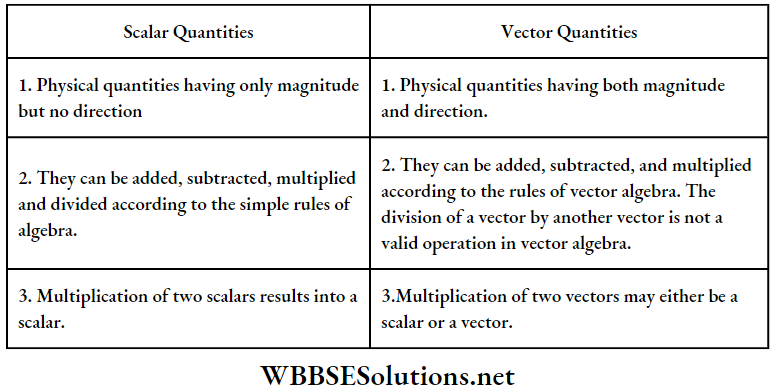
Vector Differences between Scalar And Vector Quantities

It is to be noted that, scalars and vectors are mathematical elements only. After all mathematical operations, a proper unit must be added to the final result to obtain a meaningful physical quantity.

Geometrical Representation Of A Vector

A vector is represented by a line segment with an arrowhead. The length of the line segment (in a predetermined scale), is the magnitude of the vector and the arrowhead denotes the direction. The front end (carrying the arrow) is called the head and the rear end is called the tail.

The velocity of a particle 6 cm • s-1 towards the east is represented by the line segment AB. If the scale is chosen such that CD =0.5 in. represents 2cm · s-1, then the length of the segment AB should be 1.5 in.
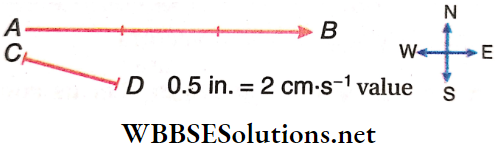
Vector Geometrical Representation Of A Vector

So, the 1.5 in. long line segment AB with the arrowhead pointing towards the east represents both the magnitude and direction (towards the east) of the velocity of the particle. The velocity vector is represented as \(\overrightarrow{A B}\), where A is the initial point and B is the terminal point.

Generally, a vector is expressed as an algebraic quantity by using a letter with an arrowhead like \(\vec{a}, \vec{b}, \vec{c},\), etc. The magnitude or absolute value of a vector is a scalar and is always positive. It is called the modulus of the vector. It is expressed as a, b, c (without an arrow) or \(|\vec{a}|,|\vec{b}|,|\vec{c}|\).

Modulus of the velocity vector \(\overrightarrow{A B}\), as shown.

Therefore, \(|\stackrel{\rightharpoonup}{\nu}|=|\overrightarrow{A B}|=A B \text { (length) }=6 \mathrm{~cm} \cdot \mathrm{s}^{-1}\)

Some Facts About Vectors

Equal Vectors: Two vectors, equal in magnitude as well as in direction, are called equal vectors. \(\overrightarrow{A B}\) and \(\overrightarrow{C D}\) are equal vectors as both have the same magnitude (length) and direction.

If \(\overrightarrow{A B}\) represents 20 towards the north, then \(\overrightarrow{C D}\) will also represent 20 towards the north. If \(\overrightarrow{A B}\) = \(\vec{a}\), then \(\overrightarrow{C D}\) is also = \(\vec{a}\), i.e., \(\overrightarrow{A B}\) = \(\overrightarrow{C D}\).
Equal Vectors

Two vectors may be equal even when their initial and final points are not the same. This means that we can translate a vector keeping its magnitude and direction unchanged.

Opposite Vectors: Two vectors having the same absolute value but opposite directions are called opposite vectors. \(\overrightarrow{F E}\) and \(\overrightarrow{A B}\) or \(\overrightarrow{C D}\) are opposite vectors.

∴ \(\overrightarrow{F E}\) represents a vector with a magnitude same as that of \(\overrightarrow{A B}\) or \(\overrightarrow{C D}\) = a (say), but the direction of \(\overrightarrow{F E}\) is opposite to that of \(\overrightarrow{A B}\) or \(\overrightarrow{C D}\).

Hence, if \(\overrightarrow{A B}\) = \(\overrightarrow{C D}\) = \(\vec{a}\), then \(\overrightarrow{F E}\) = –\(\vec{a}\). It may also be written as \(\overrightarrow{A B}\) = \(\overrightarrow{C D}\) = –\(\overrightarrow{F E}\).

As magnitudes or moduli of two opposite vectors are the same, we have, \(|\vec{a}|=a,|-\vec{a}|=a\).

Collinear Vectors: Vectors that are of the same or different magnitudes, but jure parallel or anti-parallel to one another, are known as collinear vectors. \(\vec{d}, \vec{e}, \vec{f}\) are collinear vectors. Also \(\vec{x}, \vec{y}, \vec{z}\) acting along the same line, represent a set of collinear vectors.
Collinear Vectors

Coplanar Vectors: Vectors lying on the same plane are coplanar vectors. \(\vec{a}\) and –\(\vec{a}\) and all vectors lie on the plane of the paper and hence are coplanar.

Unit Vector: A vector in the direction of a given vector with unit magnitude is called a unit vector. A unit vector is often denoted by a lowercase letter with circumflex or ‘hat’ (^).

The absolute value of any vector is a scalar. This scalar, multiplied by the unit vector in that direction, gives the corresponding vector.

Class 11 Physics Class 12 Maths Class 11 Chemistry
NEET Foundation Class 12 Physics NEET Physics

Unit Vector Example: \(|\vec{A}|\) = A and \(A \hat{n}=\vec{A}\) where \(\hat{n}\) is the unit vector in the direction of \(\vec{A}\). This means \(\frac{\vec{A}}{A}=\hat{n}\).

Therefore a vector divided by its magnitude gives the unit vector in the direction of that vector. In the cartesian coordinate system, unit vectors along x, y, and z axes are conventionally represented as \(\hat{i}, \hat{j} \text { and } \hat{k}\) respectively.

Composition Of Scalars And Vectors

Scalars have only magnitudes. So addition or subtraction of scalars means the addition or subtraction of their magnitudes only. Accordingly, scalar addition follows simple algebraic rules.

Vectors have both magnitude and direction. Therefore, during addition or subtraction of vectors, their directions should be taken into account as well. Thus, they cannot be added or subtracted by using simple algebraic rules. Hence, the geometrical method or analytical method of vector algebra is used for vector addition.

Addition Or Two Vectors

Suppose a particle starting from its initial position O undergoes \(\vec{a}\) displacement a and reaches point A. Hence, \(\vec{a}\) = \(\overrightarrow{O A}\). After a further displacement of \(\vec{b}\) in a  different direction, the particle reaches point B.

Hence, \(\vec{a}\) = \(\overrightarrow{A B}\). Starting from point O, the net displacement of the particle is thus \(\overrightarrow{O B}\) = \(\vec{c}\) (say).

Vector \(\vec{c}\) is called the sum or the resultant of \(\vec{a}\) and \(\vec{b}\), expressed as \(\vec{c}\) = \(\vec{a}\) + \(\vec{b}\).

This sum will obviously be a vector sum, because by adding only the magnitudes of \(\vec{a}\) and \(\vec{b}\), \(\vec{c}\) cannot be found. The magnitudes of \(\vec{a}\), \(\vec{b}\) and \(\vec{c}\) can be determined from the lengths of the sides OA, AB and OB respectively.

This method of finding the resultant of two displacements also holds good for finding the sum of any two vectors. Illustrates one such case where forces \(\vec{P}\) and \(\vec{Q}\) pull a boat simultaneously. As a result, the boat moves along the resultant \(\vec{R}\), and \(\vec{P}\) + \(\vec{Q}\) = \(\vec{R}\).
Addition Of Two Vectors

Addition Of Two Vectors Resultant: A single vector, which represents the result of the summation of a number of vectors both in magnitude and in direction, is called the resultant of those vectors.

∴ \(\overrightarrow{O B}\) is the resultant.

To find the sum of \(\vec{P}\) and \(\vec{Q}\), draw the vectors \(\vec{P}\) as shown and name it as AB i.e., \(\overrightarrow{A B}\) = \(\vec{P}\).
Vector Mgnitufre Of The Resultants Of Two Vectors

Now move the vector \(\vec{Q}\) parallel to itself such that its tail coincides with the tip B of the vector \(\vec{P}\).

Mark the tip of the vector \(\vec{Q}\) as C i.e., \(\overrightarrow{B C}\) = \(\vec{Q}\). Join the tail of the vector \(\vec{P}\) to the tip of the vector \(\vec{Q}\) i.e., \(\overrightarrow{A C}\) = \(\vec{R}\) where \(\vec{Q}\) represents the sum of the vectors \(\vec{P}\) and \(\vec{Q}\). Thus, \(\vec{R}\) = \(\vec{P}\) + \(\vec{Q}\).

Vector addition follows either of the following equivalent laws:

  1. Law of triangle of vectors,
  2. Law of parallelogram of vectors and
  3. Polygon law of vectors.

Magnitude In vector Addition: Let us consider two vectors a and b whose resultant is found to be \(\vec{c}\) i.e., \(\vec{a}\) + \(\vec{b}\) = \(\vec{c}\). Now to think, that the magnitude of \(\vec{c}\) is actually the sum of the magnitude of \(\vec{a}\) and magnitude of \(\vec{b}\) is incorrect. This is because we can see that \(|\vec{c}|<|\vec{a}|+|\vec{b}|\).
Vector Magnitude In Vector Addition

It means that the magnitude of resultant vector \(\vec{c}\) not only depends on the magnitude of \(\vec{c}\) and \(\vec{c}\) but also depends on the angle between the two vectors \(\vec{a}\) and \(\vec{b}\).

To find out the relationship between \(\vec{a}\), \(\vec{b}\), \(\vec{c}\) and the angle between the vectors, let us study the following law of vector addition.

Law Of Triangle Of Vectors

Law Of Triangle Of Vectors Geometrical Method: \(\vec{a}\) + \(\vec{b}\) = \(\vec{c}\) or \(\overrightarrow{O A}+\overrightarrow{A B}=\overrightarrow{O B}\). Vectors \(\overrightarrow{O A}, \overrightarrow{A B} \) and their resultant \(\overrightarrow{O B}\), therefore represent the three sides of the A OAB. The following triangle law of vector addition can be obtained by considering the magnitudes and directions of the vectors.

Law Of Triangle Of Vectors Geometrical Method Statement: When the magnitudes and directions of two vectors, are represented by two adjacent sides of a triangle taken in order, the third side taken in the opposite order, represents the magnitude and direction of the resultant of the two vectors.

Two adjacent sides taken in order and the third side taken in the opposite order—means that if the former is in a clockwise direction in the triangle, the third side, representing the resultant, should be in an anticlockwise direction.

Law Of Triangle Of Vectors Geometrical Method Corollary: With reference to the A OAB, \(\overrightarrow{O A}+\overrightarrow{A B}=\overrightarrow{O B}\) or, \(\overrightarrow{O A}+\overrightarrow{A B}-\overrightarrow{O B}=0\)

or, \(\overrightarrow{O A}+\overrightarrow{A B}+\overrightarrow{B O}=0\)

Hence, if three vectors are completely represented by the three sides of a triangle taken in order (all clockwise or all anticlockwise), then the resultant of the vectors will be zero.
Vector Parallelogram Of Vector

Law Of Triangle Of Vectors Analytical Method: Let the two vectors \(\vec{a}\) and \(\vec{b}\) be represented both in magnitude and direction by the sides \(\overrightarrow{O A}\) and \(\overrightarrow{A B}\) of ΔOAB is taken in the same order. Then according to the triangle law of vector addition, the resultant \(\vec{c}\) is given by the side OB taken in the reverse order, as shown.

Law Of Triangle Of Vectors Analytical Method Magnitude Of The Resultant \(\vec{c}\): BE is the perpendicular drawn from B on the extension of OA. The angle between the vectors \(\vec{a}\) and \(\vec{b}\), ∠BAE = α. It is to be noted that to measure the angle between two vectors, their initial points are superimposed on each other without changing the directions of the vectors.

Now from right-angled ΔAEB we have \(BE \frac{B E}{A B}=\sin \alpha\)

or, \(B E=A B \sin \alpha\)

or, \(B E=b \sin \alpha\) and \(\frac{A E}{A B}=\cos \alpha\) or, \(A E=A B \cos \alpha\)

or, \(A E=b \cos \alpha\)

Applying Pythagoras theorem in right-angled ΔOEB we get, \((O B)^2=(O E)^2+(E B)^2=(O A+A E)^2+(E B)^2\)

or, \(c^2=(a+b \cos \alpha)^2+(b \sin \alpha)^2\)

= \(a^2+2 a b \cos \alpha+b^2 \cos ^2 \alpha+b^2 \sin ^2 \alpha\)

or, \(c^2=a^2+2 a b \cos \alpha+b^2\left(\cos ^2 \alpha+\sin ^2 \alpha\right)\)

or, \(c^2=a^2+b^2+2 a b \cos \alpha\) (because \(\cos ^2 \alpha+\sin ^2 \alpha=1\))

or \(c=\sqrt{a^2+b^2+2 a b \cos \alpha}\)….(1)

WBBSE Class 11 Acceleration Due to Gravity Variations Notes

Law Of Triangle Of Vectors Analytical Method Direction Of The Resultant \(\vec{c}\): Let the resultant vector (\(\vec{c}\)) make an angle α with the first vector \(\vec{a}\). Then from right-angled ΔOEB, we get, \(\tan \theta=\frac{B E}{O E}=\frac{B E}{O A+A E}\)

or, \(\tan \theta=\frac{b \sin \alpha}{a+b \cos \alpha}\)….(2)

Therefore, if the magnitudes a and b, and the value of the angle α are known, then from equations (1) and (2), the magnitude of the resultant vector and its direction can be determined.

Law Of Parallelogram Of Vectors

Law Of Parallelogram Of Vectors Geometrical Method: The law of parallelogram of vector addition is just an alternative form of the law of triangle of vector addition. let \(\overrightarrow{O A}=\vec{a}\) and \(\overrightarrow{A B}=\vec{b}\).

Therefore, from the triangle law of vector addition, the vector \(\overrightarrow{O B}\) represents the magnitude and direction of the resultant \(\vec{c}\). Hence, \(\vec{a}+\vec{b}=\vec{c}\) or, \(\overrightarrow{O A}+\overrightarrow{A B}=\overrightarrow{O B}.\)

Now the parallelogram OABD is completed. AB and OD being the opposite sides of the parallelogram, are equal and parallel.

Hence, \(\overrightarrow{A B}=\overrightarrow{O D}=\vec{b}\).

So, \(\overrightarrow{O A}+\overrightarrow{O D}=\overrightarrow{O B}\)

Law Of Parallelogram Of Vectors Geometrical Method Statement: If the magnitudes and directions of two vectors are represented by two adjacent sides of a parallelogram, the diagonal drawn from the point of origin of the two vectors represents the magnitude and direction of the resultant.

Law Of Parallelogram Of Vectors Analytical Method:

Law Of Parallelogram Of Vectors Analytical Method Magnitude Of Resultant \(\vec{c}\): Let the point of origin of the vectors \(\vec{a}\) and \(\vec{b}\) be O. The two vectors are represented by the line segments OA and OD.

The parallelogram OABD is completed by drawing DB parallel to OA and AB parallel to OD. Then the diagonal OB from point 0 represents the magnitude and direction is the resultant of the vectors \(\vec{a}\) and \(\vec{b}\).

Here, \(\vec{a}=\overrightarrow{O A}, \vec{b}=\overrightarrow{O D}=\overrightarrow{A B} \text { and } \vec{c}=\overrightarrow{O B}\)

Perpendicular BE is drawn from B on the extension of OA. Then ∠BAE = ∠DOA = α

Here, the length of the side OA = \(|\vec{a}|\) = a

length of the side OD = length of the side AB = \(|\vec{b}|\) = b and length of the side OB = \(|\vec{c}|\) = c

From right angled ΔBAE we have, \(\frac{B E}{A B}=\sin \alpha\) or, BE = \(A B \sin \alpha\)

∴ BE = \(b \sin \alpha\)

Again, \(\frac{A E}{A B}=\cos \alpha\) or, \(A E=A B \cos \alpha\)

∴ AE = \(b \cos \alpha\)

Using Pythagoras theorem in right-angled ΔOEB, we get, \((O B)^2=(O E)^2+(B E)^2=(O A+A E)^2+(B E)^2\)

or, \(c^2=(a+b \cos \alpha)^2+(b \sin \alpha)^2\)

or, \(c^2=a^2+b^2 \cos ^2 \alpha+2 a b \cos \alpha+b^2 \sin ^2 \alpha\)

= \(a^2+b^2\left(\cos ^2 \alpha+\sin ^2 \alpha\right)+2 a b \cos \alpha\)

∴ \(c^2=a^2+b^2+2 a b \cos \alpha\) (because \(\cos ^2 \alpha+\sin ^2 \alpha=1\))

or, c = \(\sqrt{a^2+b^2+2 a b \cos \alpha}\)…….(1)

Law Of Parallelogram Of Vectors Analytical Method Direction Of Resultant \(\vec{c}\): Let the resultant \(\vec{c}\) make an angle θ with the direction of \(\vec{a}\). Then from right-angled ΔOEB, we get,

tanθ= \(\frac{B E}{O E}=\frac{B E}{O A+A E} \text { or, } \tan \theta=\frac{b \sin \alpha}{a+b \cos \alpha}\)…..(2)

Equations (1) and (2) are identical to those in the previous section.

It may be noted that two vectors and their resultant are always confined on a plane. This is not the case for three or more vectors and their resultant. The vectors and their resultant are, in general, distributed in 3-dimensional space.

Some Special Cases Of Addition Of Two Vectors

1. Two Parallel Vectors (α = 0): In this case, sinα = 0 and cosα = 1. Thus from equation (1), we can write,

c = \(\sqrt{a^2+b^2+2 a b}=\sqrt{(a+b)^2}=(a+b)\)

From equation (2), we can conclude that tanθ = 0, or, θ = 0°.

Hence, the magnitude of the resultant is the sum of the magnitudes of the vectors and it is directed along the vectors. It is simply a scalar addition.

2. Two anti-parallel vectors (α = 180°): In this case, sinα = 0 and cosα = -1.

Therefore, from equation (1), we get, c = \(\sqrt{a^2+b^2-2 a b}=\sqrt{(a-b)^2}\) or, \(c=|a-b|\) and from equation (2), tanθ = 0 or, θ = 0° when a > b or θ= 180° when b> a.

Hence, the magnitude of the resultant is the difference in the magnitudes of the vectors and its direction is along the larger vector. It is also a simple scalar operation.

3. Two Equal And Anti-Parallel Vectors (a = b and α = 180°): In this case sinα = 0 and cosα = -1.

Hence, using equation (1), c = \(\sqrt{a^2+a^2+2 a^2 \cos 180^{\circ}}=\sqrt{2 a^2-2 a^2}=0\)

Therefore, the magnitude of the resultant is zero. It is essentially a null vector.

4. Two Orthogonal (Perpendicular To Each Other) Vectors (α = 90°): In this case, sinα = 1 and cosα= 0

∴ From equation (1) and (2), c = \(\sqrt{a^2+b^2+2 a b \cos 90^{\circ}}=\sqrt{a^2+b^2}\) and \(\tan \theta=\frac{b}{a}\)

Therefore, we can conclude that,

  1. The maximum possible value of the resultant = sum of magnitudes of the vectors i.e., c(max) = a + b
  2. The minimum possible value of the resultant = difference of magnitudes of the vectors i.e., c (min) = |a- b|
  3. If the vectors are equal in magnitude and anti-parallel, then the resultant will be 0.

Properties Of Vector Addition (Commutative And Associative Rules)

Properties Of Vector Addition Commutative Rule: Vector addition is commutative. If \(\vec{a}\) and \(\vec{b}\) are two vectors, then by this rule, \(\vec{a}+\vec{b}=\vec{b}+\vec{a}\). This means that vectors can be added in any order.
Vector Properties Of Vector Addition

Properties Of Vector Addition Commutative Rule Proof: OA and OC representing two vectors are two adjacent arms of the parallelogram OABC.

Here, \(\vec{a}=\overrightarrow{O A}=\overrightarrow{C B}\) and \(\vec{b}=\overrightarrow{O C}=\overrightarrow{A B}\)

So, \(\vec{a}+\vec{b}=\overrightarrow{O A}+\overrightarrow{A B}=\overrightarrow{O B}=\vec{c}\), (as per the triangle law of addition of vectors).

Again, \(\vec{b}+\vec{a}=\overrightarrow{O C}+\overrightarrow{C B}=\overrightarrow{O B}=\vec{c}\)

Hence, \(\vec{a}+\vec{b}=\vec{b}+\vec{a}\) or in other words, vector sum is commutative.

Properties Of Vector Addition Associative Rule: Vector addition is associative. To add any three vectors, the addition may be initiated with any two of the vectors. Mathematically, \((\vec{a}+\vec{b})+\vec{c}=\vec{a}+(\vec{b}+\vec{c})\), where \(\vec{a}\), \(\vec{b}\) and \(\vec{c}\) are the given vectors. This rule holds good for the addition of more than three vectors as well.

Properties Of Vector Addition Associative Rule Associative Rule Proof: Let \(\vec{a}\), \(\vec{b}\) and \(\vec{c}\) be represented by the three arms OA, AB and BC of the quadrilateral OABC.

As shown, \(\vec{a}+\vec{b}=\overrightarrow{O A}+\overrightarrow{A B}=\overrightarrow{O B}\) and \(\overrightarrow{O B}+\overrightarrow{B C}=(\vec{a}+\vec{b})+\vec{c}=\overrightarrow{O C}\)

Again, as per figure, \(\vec{b}+\vec{c}=\overrightarrow{A B}+\overrightarrow{B C}=\overrightarrow{A C}\)

∴ \(\vec{a}+(\vec{b}+\vec{c})=\overrightarrow{O A}+\overrightarrow{A C}=\overrightarrow{O C}\)

Hence, \(\vec{a}+(\vec{b}+\vec{c})=(\vec{a}+\vec{b})+\vec{c}\)
Vector Scalar Addition

Itis noted that scalar addition also follows these two rules.

Law Of Polygon Of Vectors: Addition Of Three Or More Vectors: The sum (resultant) of two vectors can be determined by the law of triangle for vector addition. If the number of vectors is three or more, then by applying the law of triangle successively the law of polygon of vectors is derived. By the application of the law of polygon of vectors, the addition of any number of vectors is possible.

Suppose the resultant of four vectors \(\vec{a}, \vec{b}, \vec{c} \text { and } \vec{d}\) is to be determined. For this, vector \(\overrightarrow{O A}\) equal to \(\vec{a}\) is drawn from any point O.

Now taking A as the initial point, \(\overrightarrow{A B}\) equal to \(\vec{b}\) is drawn. Similarly, \(\overrightarrow{B C}\) equal to \(\vec{c}\) and \(\overrightarrow{C D}\) equal to \(\vec{d}\) are drawn one after another.

Then, the vector \(\overrightarrow{O D}\) drawn by joining the initial point O of the first vector and the terminal point D of the last vector represents the resultant of the vectors \(\vec{a}, \vec{b}, \vec{c} \text { and } \vec{d}\).

∴ \(\overrightarrow{O D}=\vec{R}=\vec{a}+\vec{b}+\vec{c}+\vec{d}=\overrightarrow{O A}+\overrightarrow{A B}+\overrightarrow{B C}+\overrightarrow{C D}\)
Vector Law Of Polygon Of Vectors

This is called the law of polygon of vectors and with this law, the resultant of any number of vectors can be determined.

Understanding Variation of Gravity with Height

Laws Of Polygon Of Vectors Statement: If the magnitudes and directions of a number of vectors are represented by the sides of a closed polygon, taken in order, then the last side of the polygon, taken in the opposite order, represents the magnitude and direction of the resultant of the vectors.

The coplanarity of the vectors is not necessary for the validity of polygon law. Vectors can be added by using the polygon law irrespective of their number and sequence.

Proof Of The Law Of Polygon Of Vectors: Let the magnitudes and directions of the vectors \(\vec{a}, \vec{b}, \vec{c}, \vec{d}\) be represented, by the arms of the polygon OABCD, taken in order: \(\overrightarrow{O A}, \overrightarrow{A B}, \overrightarrow{B C}, \overrightarrow{C D}\).

From Triangle Law,

In triangle OAB, \(\overrightarrow{O B}=\overrightarrow{O A}+\overrightarrow{A B}\),

In triangle OBC, \(\overrightarrow{O C}=\overrightarrow{O B}+\overrightarrow{B C}=\overrightarrow{O A}+\overrightarrow{A B}+\overrightarrow{B C}\) and

In triangle OCD, \(\overrightarrow{O D}=\overrightarrow{O C}+\overrightarrow{C D}=\overrightarrow{O A}+\overrightarrow{A B}+\overrightarrow{B C}+\overrightarrow{C D}\)

∴ \(\overrightarrow{O D}\)=\(\vec{R}=\overrightarrow{O A}+\overrightarrow{A B}+\overrightarrow{B C}+\overrightarrow{C D}\)=\(\vec{a}+\vec{b}+\vec{c}+\vec{d}\)

Hence, \(\overrightarrow{O D}\) is the resultant of the vectors \(\vec{a}, \vec{b}, \vec{c}\) and \(\vec{d}\). The arm \(\overrightarrow{O D}\) is the remaining arm of the polygon taken in the opposite order. This proves the law and also shows that it is nothing but an extension of the law of triangle of vector addition.

Polygon Of Vector Corollary: In the pentagon OABCD, \(\overrightarrow{O A}+\overrightarrow{A B}+\overrightarrow{B C}+\overrightarrow{C D}=\overrightarrow{O D}\)

or, \(\overrightarrow{O A}+\overrightarrow{A B}+\overrightarrow{B C}+\overrightarrow{C D}-\overrightarrow{O D}=0\)

or, \(\overrightarrow{O A}+\overrightarrow{A B}+\overrightarrow{B C}+\overrightarrow{C D}+\overrightarrow{D O}=0\)

In other words, if three or more vectors can be represented by the sides of a closed polygon, taken in order, the resultant of the vectors must be zero.

The physical quantities that have both magnitude and direction and obey all the laws of vector addition such as

  1. Triangle law of vectors,
  2. Parallelogram law of vectors and
  3. The Polygon law of vectors are called vector quantities.

Unit 2 Chapter 2 Vector

Polygon Of Vectors Numerical Examples

Example 1. If \(\vec{a}+\vec{b}=\vec{c}\) and a + b = c, find the angle between \(\vec{a}\) and \(\vec{b}\).
Solution:

Let the angle between \(\vec{a}\) and \(\vec{b}\) be

Here, \(\vec{a}+\vec{b}=\vec{c}\) = \(\vec{c}\)

∴ c² = a² + b² + 2 ab cosα……..(1)

Again, a+b=c or, a² + b²+ 2ab = c²……(2)

Hence from (1) and (2), a² + b² + 2ab = a² + b² + 2ab cosα

or, 2ab = 2ab cosα or, cosα = 1 = cos0°

∴ α = 0°

Example 2. Can the magnitude of the resultant of two equal vectors be equal to the magnitude of each of the vectors? Explain.
Solution:

Let the magnitude of each vector and of the resultant be a and the angle between the vectors be α.

Hence, a² = a² + a² + 2a · a cosα

or, a² = 2a²(1+ cosα) or, 2(1 + cosα) = 1

or, cosα = \(\frac{1}{2}\) – 1 = –\(\frac{1}{2}\) = cos 120°

∴ α = 120°

Hence, the magnitude of the resultant of two equal vectors is equal to that of each of the given vectors when they are inclined at an angle of 120° with each other.

Example 3. 2P and P are two vectors inclined to each other at such an angle that if the 1st vector is doubled, the value of the resultant becomes three times. What is the angle between the two vectors?
Solution:

Let the initial resultant be R and the angle between the two vectors 2 P and P be α.

∴ \(R^2=(2 P)^2+P^2+2 \cdot 2 P \cdot P \cos \alpha\)

or, \(R^2=5 P^2+4 P^2 \cos \alpha\)…..(1)

In the second case, 1st vector =2 P x 2 = 4P and resultant = 3R

or, \((3 R)^2=(4 P)^2+P^2+2.4 P \cdot P \cos \alpha\)

or, \(9 R^2=17 P^2+8 P^2 \cos \alpha\)

or, \(R^2=\frac{17}{9} P^2+\frac{8}{9} P^2 \cos \alpha\)…..(2)

From (1) and (2), \(5 P^2+4 P^2 \cos \alpha=\frac{17}{9} P^2+\frac{8}{9} P^2 \cos \alpha\)

or, \(\left(4-\frac{8}{9}\right) \cos \alpha=\frac{17}{9}-5\)

or, \(\frac{28}{9} \cos \alpha=-\frac{28}{9}\)

or, \(\cos \alpha=-1=\cos 180^{\circ}\)

∴ \(\alpha=180^{\circ}\)

Short Answer Questions on Gravity Variation Concepts

Example 4. Using vectors, prove that the line joining the midpoints of two sides of a triangle is parallel to the base and half its length.
Solution:

From the triangle law of vector addition in ΔABC, \(\overrightarrow{A B}+\overrightarrow{B C}=\overrightarrow{A C}\)

or, \(\frac{1}{2} \overrightarrow{A B}+\frac{1}{2} \overrightarrow{B C}=\frac{1}{2} \overrightarrow{A C}\)…..(1)

As D and E are the mid-points of sides AB and AC, \(\overrightarrow{A D}\)=\(\frac{1}{2} \overrightarrow{A B}\) and \(\overrightarrow{A E}=\frac{1}{2} \overrightarrow{A C}\)
Vector Ling Joining Of Two Sides Of A Triangle

From the triangle law of vector addition in ΔADE \(\overrightarrow{A D}+\overrightarrow{D E}\)=\(\overrightarrow{A E}\)

or, \(\frac{1}{2} \overrightarrow{A B}+\overrightarrow{D E}=\frac{1}{2} \overrightarrow{A C}\)……(2)

From (1) and (2), \(\overrightarrow{D E}=\frac{1}{2} \overrightarrow{B C}\)

Hence, \(\overrightarrow{D E}\) and \(\overrightarrow{B C}\) are parallel and DE = \(\frac{1}{2}\)BC.

Example 5. When will the magnitude of the resultant of two equal vectors be

  1. √2 times and
  2. √3 times the magnitude of each of them?

Solution:

Let the value of each vector be a and the angle between the two vectors be α.

1. In this case, the magnitude of the resultant =√2a

∴ (√2a)² = a² + a² + 2a · acosα

or, 2a² cosα = 0 or, cosα = 0 = cos 90°

∴ α = 90°

Hence, the angle between the two vectors will be 90°.

2. In this case, the magnitude of the resultant = √3a

∴ (√3a)² = a² + a²+ 2a · acosα

or, 2a² cosα = a² or, cosα = 1/2 = cos 60°

∴ α = 60°

The angle between the two vectors will be 60°.

Example 6. The maximum and the minimum values of the resul¬tant of two forces are 15 N and 7 N respectively. If the magnitude of each force is increased by 1 N and these new forces act at an angle of 90° to each other, find the magnitude and direction of their resultant.
Solution:

Let the magnitudes of the two forces be P and Q.

As per given condition, P + Q = 15 N…..(1)

and P-Q = 7N……(2)

By solving (1) and (2), we get, P = 11 N and Q = 4 N.
Vector Maxiumum And Minimum Values Of Resultant

When each of the two forces is increased by 1 N in magnitude, the new magnitudes are P= (11 + 1) = 12 N and Q = (4 + 1) = 5 N and since the angle between these new forces is 90°, new resultant = \(\sqrt{12^2+5^2}=13 \mathrm{~N}\)

Let the angle of inclination of the resultant with the force 12 N be d.

Then, tanθ = \(\frac{5}{12}\) or, d = tan-1 \(\frac{5}{12}\)

∴ The magnitude of the resultant is 13 N and it is inclined with the force 12 N at an angle tan \(\frac{5}{12}\).

Example 7. The resultant \(\vec{R}\) of two vectors has a magnitude equal to one of the vectors and is at a right angle to it. Find the value of the other vector.
Solution:

Let Q be the value of the other vector.
Vector Resultant Of Two Vectors

R² + R² = Q² or, Q² = 2 R²

∴ Q = √2R

Example 8. The maximum magnitude of the resultant of two vectors, \(\vec{P}\) and \(\vec{Q}\)(where P> Q) is x times the minimum magnitude of the resultant When the angle between \(\vec{P}\) and \(\vec{Q}\) is θ, the magnitude of the resultant Is equal to half the sum of the magnitudes of the two vectors. Prove that, \(\cos \theta=\frac{x^2+2}{2\left(1-x^2\right)}\).
Solution:

P+Q=x(P-Q) (given) or, Q = \(\frac{x-1}{x+1} \cdot P\)

If R is the resultant of the two vectors when the angle between them is θ, then \(R^2=P^2+Q^2+2 P Q \cos \theta\)…..(1)

Given, \(R=\frac{P+Q}{2}=\frac{P+\frac{x-1}{x+1} \cdot P}{2}=\frac{x P}{x+1}\)

Putting in (1),

∴ \(\frac{x^2 P^2}{(x+1)^2}=P^2+\frac{(x-1)^2}{(x+1)^2} P^2+2 P^2\left(\frac{x-1}{x+1}\right) \cos \theta\)

or, \(\frac{x^2}{(x+1)^2}=1+\frac{(x-1)^2}{(x+1)^2}+\frac{2(x-1)}{x+1} \cos \theta\)

or, \(\frac{-\left(x^2+2\right)}{(x+1)^2}=\frac{2(x-1)}{(x+1)} \cos \theta\)

or, \(\cos \theta=\frac{-\left(x^2+2\right)}{2\left(x^2-1\right)}=\frac{x^2+2}{2\left(1-x^2\right)}\)

Example 9. Out of two vectors, the larger one is √2 times the smaller one. Show that the resultant cannot make an angle greater than π/4 with the larger one.
Solution:

Let the two vectors be √2Q and Q and the resultant be R. Angle between R and √2 Q is θ and ∠ADB = α.

From ΔABD, \(\frac{A B}{\sin \angle A D B}=\frac{B D}{\sin \angle D A B} \text { or, } \frac{\sqrt{2} Q}{\sin \alpha}=\frac{Q}{\sin \theta}\)
Vector Out Of Two Vectors

or, \(\sin \theta=\frac{1}{\sqrt{2}} \sin \alpha\)

∴ sinα 1, sinθ  \(\frac{1}{\sqrt{2}}\)

Hence, θ \(\frac{\pi}{4}\)

Example 10. Show that If three forces are represented by the three medians of a triangle, they will be In equilibrium.
Solution:

Let the medians of the A ABC be \(\overrightarrow{A D}, \overrightarrow{B E} \text { and } \overrightarrow{C F}\). Vectors AD, BE and CF represent the three forces.

We have to show: \(\overrightarrow{A D}+\overrightarrow{B E}+\overrightarrow{C F}=\overrightarrow{0} \text {. }\)
Vector Three Medians Of A Triangle

As per triangle law of vector addition, \(\overrightarrow{A D}=\overrightarrow{A C}+\overrightarrow{C D}=\overrightarrow{A C}+\frac{1}{2} \overrightarrow{C B}\)

⇒ \(\overrightarrow{B E}=\overrightarrow{B A}+\overrightarrow{A E}=\overrightarrow{B A}+\frac{1}{2} \overrightarrow{A C}\)

⇒ \(\overrightarrow{C F}=\overrightarrow{C B}+\overrightarrow{B F}=\overrightarrow{C B}+\frac{1}{2} \overrightarrow{B A}\)

Hence, \(\overrightarrow{A D}+\overrightarrow{B E}+\overrightarrow{C F}=\frac{3}{2}(\overrightarrow{A C}+\overrightarrow{C B}+\overrightarrow{B A})=\overrightarrow{0}\)

[as the sum of 3 vectors, represented by the 3 sides of a triangle taken in order, is zero].

Example 11. The magnitude of the resultant of two forces P and Q acting at a point is (2m+1) \(\sqrt{P^2+Q^2}\) when the angle between them is a, and is (2m- 1)\(\sqrt{P^2+Q^2}\) when the angle is \(\left(\frac{\pi}{2}-\alpha\right)\) Prove that, \(\tan \alpha=\frac{m-1}{m+1}\).
Solution:

When the angle is, the magnitude of the resultant is, R = \(\sqrt{P^2+Q^2+2 P Q \cos \alpha}\)

Given, \(R=(2 m+1) \sqrt{P^2+Q^2}\)

On comparison, \(P^2+Q^2+2 P Q \cos \alpha=(2 m+1)^2\left(P^2+Q^2\right)\)

or, \(2 P Q \cos \alpha=\left(P^2+Q^2\right)\left\{(2 m+1)^2-1\right\}\)

= \(\left(P^2+Q^2\right)\left(4 m^2+4 m+1-1\right)\)

or, \(P Q \cos \alpha=2\left(P^2+Q^2\right) m(m+1)\)

= \(2 m(m+1)\left(P^2+Q^2\right)\)….(1)

Again, when the angle is \(\left(\frac{\pi}{2}-\alpha\right)\), the magnitude of the resultant is,

R’ = \(=\sqrt{P^2+Q^2+2 P Q \cos \left(\frac{\pi}{2}-\alpha\right)}=\sqrt{P^2+Q^2+2 P Q \sin \alpha}\)

Given, \(R^{\prime}=(2 m-1) \sqrt{P^2+Q^2}\).

On comparison, \(P^2+Q^2+2 P Q \sin \alpha=(2 m-1)^2\left(P^2+Q^2\right)\)

or, \(2PQ \sin \alpha=\left(P^2+Q^2\right)\left\{(2 m-1)^2-1\right\}\)

= \(\left(P^2+Q^2\right)\left(4 m^2-4 m+1-1\right)\)

or, \(P Q \sin \alpha=2\left(P^2+Q^2\right) m(m-1)\)

= \(2 m(m-1)\left(P^2+Q^2\right)\)….(2)

Dividing (2) by (1), we have, \(\tan \alpha=\frac{m-1}{m+1}\).

Example 12. Two forces P and Q have a resultant R. This resultant is doubled, either when Q Is doubled, or when Q is reversed. Show that, P:Q:P = √2:√3:√2.
Solution:

Let the angle between P and Q be \(\alpha\).

So, \(R^2=P^2+Q^2+2 P Q\) cosα

or, \(2 P Q \cos \alpha=R^2-P^2-Q^2\)…..(1)

When Q is doubled, \((2 R)^2=P^2+(2 Q)^2+2 P \cdot 2 Q \cos \alpha\)

or, \(2 P Q \cos \alpha=2 R^2-\frac{1}{2} P^2-2 Q^2\)…..(2)

Again, when Q is reversed, \((2 R)^2=P^2+Q^2+2 P Q \cos \left(180^{\circ}-\alpha\right)\)

or, \(2 P Q \cos \alpha=-4 R^2+P^2+Q^2\)…..(3)

From (1) and (3), \(R^2-P^2-Q^2=-4 R^2+P^2+Q^2\)

or, \(2 P^2+2 Q^2-5 R^2=0\)…..(4)

From (1) and (2), \(R^2-P^2-Q^2=2 R^2-\frac{1}{2} P^2-2 Q^2\)

or, \(P^2-2 Q^2+2 R^2=0\)…….(5)

Adding (4) and (5), \(3 P^2-3 R^2=0\) or, \(P=R\)

Putting this in (5), \(P^2-2 Q^2+2 P^2=0\) or, \(3 P^2=2 Q^2\) or, \(Q=\frac{\sqrt{3}}{\sqrt{2}} P\)

∴ \(P: Q: R=P: \frac{\sqrt{3}}{\sqrt{2}} P: P=1: \frac{\sqrt{3}}{\sqrt{2}}: 1=\sqrt{2}: \sqrt{3}: \sqrt{2}\)

Example 13. The resultant of two forces P and Q, inclined at a fixed angle, is it which makes an angle θ with P. If P is replaced by (P+ Q) keeping the direction unchanged, show that the resultant of (P+ R) and Q would be inclined at \(\frac{\theta}{2}\) with P+ R.
Solution:

Let a = angle between P and Q.

Then, R² = P² + Q² + 2PQcosα….(1)

and \(\tan \theta=\frac{Q \sin \alpha}{P+Q \cos \alpha}\)…..(2)

In the second case, if the resultant makes an angle θ1 with P+R, then \(\tan \theta_1=\frac{Q \sin \alpha}{(P+R)+Q \cos \alpha}\)….(3)

Now, \(\tan \left(\theta-\theta_1\right)=\frac{\tan \theta-\tan \theta_1}{1+\tan \theta \tan \theta_1}\)

= \(\frac{\frac{Q \sin \alpha}{P+Q \cos \alpha}-\frac{Q \sin \alpha}{(P+R)+Q \cos \alpha}}{1+\frac{Q^2 \sin ^2 \alpha}{[P+Q \cos \alpha][(P+R)+Q \cos \alpha]}}\)

= \(\frac{R Q \sin \alpha}{[P+Q \cos \alpha][(P+R)+Q \cos \alpha]+Q^2 \sin ^2 \alpha}\)

= \(\frac{R Q \sin \alpha}{P^2+Q^2+2 P Q \cos \alpha+P R+R Q \cos \alpha}\)

= \(\frac{R Q \sin \alpha}{R^2+R(P+Q \cos \alpha)}=\frac{Q \sin \alpha}{(P+R)+Q \cos \alpha}\)

= \(\tan \theta_1 \text { [using equation (1) and (3)] }\)

∴ \(\theta-\theta_1=\theta_1 \quad \text { or, } \theta_1=\frac{\theta}{2}\)

Example 14. Four forces 2 P, P, P, and 2P acton a point towards NE, NW, SW, and SE directions respectively. Find the resultant of the forces.
Solution:

The forces 2P along NE, P along NW, P along SW, and 2P along SE are represented by \(\overrightarrow{O A}, \overrightarrow{A B}, \overrightarrow{B C} \text { and } \overrightarrow{C D}\) respectively.

The initial point O and the terminal point D are joined. Hence, the resultant of the four given vectors is \(\overrightarrow{O D}\).
Vector Four Forces Of A Vector

Let ∠EOD = θ.

The quadrilateral EABC is a square. So, from ΔODE, DE = OE =P and ∠OED = 90°
Vector Two Forces Of Resulant

∴ OD = \(\sqrt{P^2+P^2}=\sqrt{2 P^2}=\sqrt{2 P}\)

and \(\tan \theta=\frac{D E}{O E}=\frac{P}{P}=1 \quad \text { or, } \theta=45^{\circ}\)

Since, \(\overrightarrow{O A}\) is along NE, \(\overrightarrow{O D}\) is along east.

Alternative solution: The forces 2 P and P along NE and SW directions respectively are opposite to each other. Hence, their resultant = (2P-P) is equal to a force P directed towards NE.

Similarly, the resultant of P directed towards NW and 2P towards SE is equal to a force P along SE.

Now there two forces, P along NE and P along SE, are perpendicular to each other. So, the resultant is, F = \(\sqrt{P^2+P^2}=\sqrt{2} P\)

If the resultant F makes an angle 6 with P along NE, then tan9 = \(\frac{P}{P}\) = 1 or, 6 = 45°

Thus, F is in the eastward direction.

Hence, the resultant of the four forces is 72 P along the x-axis, i.e., along the east.


Resolutions Of Vectors

A vector can be resolved into many components just as many vectors can be added to give a single resultant vector.

Resolutions Of vectors Definition: When a vector is split into two or more vectors in such a manner that, the original vector becomes the resultant of the resolved parts or components of the vector, this splitting is called the resolution of vectors.

  • Apparently, it may seem that the resolution of vectors is just the opposite of the addition of vectors. But it may be noted that, when two vectors are added, it gives only one resultant vector. On the other hand, in the resolution of vectors, different sets of components can be formed.
  • The resolution of vectors into two or three components is an elegant technique to solve most of the problems related to vectors. Splitting into more than three components is very rare in practice.

Resolution In Two Dimensions

Resolution Of Vectors Into Two Components: Let the magnitude and direction of a given vector \(\vec{R}\) be represented by \(\overrightarrow{O A}\). OM and ON are inclined to OA by angles α and β respectively, in such a way that OA, OM, and ON lie on the same plane. The vector \(\vec{R}\) is to be resolved into components along OM and ON.
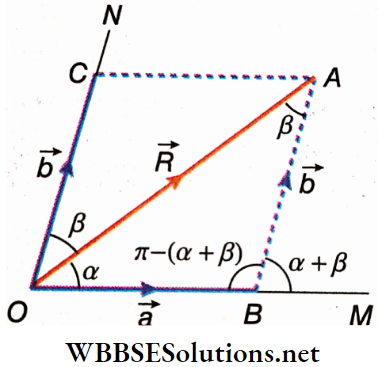
Vector Resolution In Two Dimensions

AC parallel to OM and AB parallel to ON are drawn to complete the parallelogram. Now, from the law of parallelogram of vectors, \(\overrightarrow{O B}+\overrightarrow{O C}=\overrightarrow{O A}\)

Thus, the two components of \(\overrightarrow{O A}\) are \(\overrightarrow{O B}\) and \(\overrightarrow{O C}\)  and their magnitudes are a and b respectively.

∴ OB = a and OC = BA = b

Applying trigonometric rules to ΔOAB, we get, \(\frac{O B}{\sin \angle O A B}=\frac{B A}{\sin \angle A O B}=\frac{O A}{\sin \angle A B O}\)

or, \(\frac{a}{\sin \beta}=\frac{b}{\sin \alpha}=\frac{R}{\sin [\pi-\{\alpha+\beta\}]}\)

or, \(\frac{a}{\sin \beta}=\frac{b}{\sin \alpha}=\frac{R}{\sin (\alpha+\beta)}\)

Hence, \(a=\frac{R \sin \beta}{\sin (\alpha+\beta)}\) and \(b=\frac{R \sin \alpha}{\sin (\alpha+\beta)}\)…..(1)

Since α and β can have many sets of values, a and b can also have many values. Hence, a vector can be resolved into different pairs of components.

The two most useful components of a vector are the two mutually perpendicular components when α + β = 90°. Then from equation (1), we get

a = \(\frac{R \sin \left(90^{\circ}-\alpha\right)}{\sin 90^{\circ}}=R \cos \alpha\)

and b = \(\frac{R \sin \alpha}{\sin 90^{\circ}}=R \sin \alpha\)…..(2)

Again, depending on α, different pairs of orthogonal components are possible.

Applications of Gravity Variation in Physics

Resolution Of Vectors Into Rectangular Or Orthogonal Components: \(\vec{R}\) has been resolved into two components along two mutually perpendicular axes OX and OY.

Let \(\overrightarrow{O B}=\vec{a}, \overrightarrow{O C}=\vec{b} \text { and } \angle A O B=\alpha\); i.e., the component \(\vec{a}\) is inclined to the vector R at an angle α.
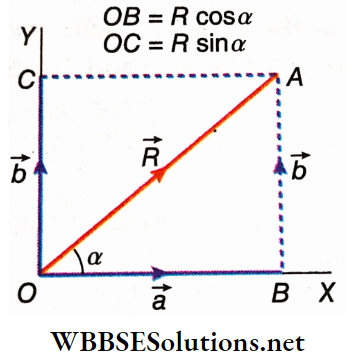
Vector Resolution Of Vectors Into Rectangular Or Orthogonal Components

According to \(\cos \alpha=\frac{O B}{O A}=\frac{a}{R}\)

or, a = Rcosα…..(1)

and \(\sin \alpha=\frac{A B}{O A}=\frac{b}{R} \text { or, } b=R \sin \alpha\)….(2)

Hence, the component of \(\vec{R}\) along a direction that makes an angle α with \(\vec{R}\) is Rcosα, and the other component is Rsinα.

Resolution Of Vectors Into Rectangular Or Orthogonal Components Special Cases: To determine the component of a vector \(\vec{R}\) along its own direction, we put α = 0° in equation (1) and get a = Rcos0° = R.

Again, by putting α = 0° in equation (2) [or, α = 90° in equation (1)], we get the other component, i.e., the component in the direction perpendicular to \(\vec{R}\), as, b = Rsin 0° = 0.

Hence, we may conclude that,

  1. The component (or resolved part) of a vector along its own direction is the vector itself.
  2. There is no component in a direction perpendicular to the vector.

Practical Example—Pull Or Push: A body can be set into motion along a horizontal plane by pushing it from the back or by pulling it towards the front. When the body is pushed, the applied force F1 usually acts downwards at an angle with the horizontal.

  • Horizontal motion of the body is due to the horizontal component Fx of the applied force F1. The vertical component Fy, acting downwards, adds to the weight of the body, and hence, pushing becomes difficult.
  • On the other hand, while pulling, the applied force F2 acts upwards at an angle with the horizontal. In this case, also, the horizontal component F’x of F2 produces the horizontal motion of the body. The vertical component F’y acting upwards, effectively reduces the weight of the body. Hence pulling becomes easier.
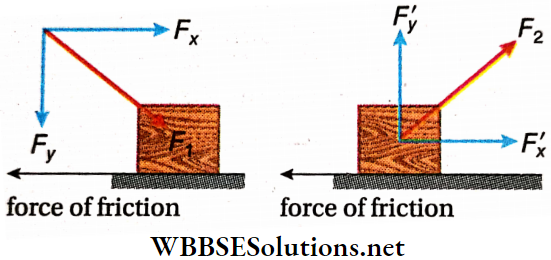
vector Practical Example Of Pull Or Push

Thus, it is easier to pull a body than to push it.

Resolutions In Two Dimensional Numerical Examples

Example 1. A force of 30 dyn Is inclined to the y-axis at an angle of 60°. Find the components of the force along the x and y axes respectively.
Solution:

Given, F = 30 dyn and θ = 60°

Hence, a component of F along the y-axis, Fy = F cosθ = F cos60° = 30 x 1/2 = 15 dyn

and a component of F along x-axis \(F_x=F \sin 60^{\circ}=30 \times \frac{\sqrt{3}}{2}=15 \sqrt{3} \text { dyn }.\)

Example 2. The value of the resultant of two mutually perpendicular forces is 80 Dyn. The resultant makes an angle 60° with one of the forces. Find the magnitudes of the forces.
Solution:

Let the forces be \(\vec{P}\), \(\vec{R}\) and the resultant that makes an angle 60° with \(\vec{P}\) be  \(\vec{R}.\)

Here, R = 80 dyn

∴ P = R cosθ – 80 cos60° = 80 x 1/2 = 40 dyn

and Q = R sin60° =80 sin60° = \(80 \times \frac{\sqrt{3}}{2}\) = 40√3 dyn .


Motion Of A Projectile

Motion Of A Projectile Definition: A body thrown upwards in any direction from the earth’s surface or a point close to it, is called a projectile. Common examples of projectiles are

  1. A javelin thrown by an athlete,
  2. A bullet fired from a rifle,
  3. An object dropped from an airplane,
  4. A jet of water coming out from the side hole of a vessel,
  5. A stone thrown from the top of a hill or a tower,
  6. A rocket after its fuel is exhausted.

The path traced out by a projectile is called its trajectory. The motion of a projectile is two-dimensional as it is always confined to a vertical plane.

  • To study the projectile motion the horizontal direction is taken along the x-axis and the vertical direction is taken along the y-axis. The only force acting on the projectile is the gravitational force.
  • So the projectile has acceleration in the y direction which is equal to the acceleration due to gravity. The force acting on the projectile is zero along the x-axis. So the horizontal acceleration is zero. This means, that projectile motion is a combination of horizontal motion with constant velocity and vertical motion with uniform acceleration.
  • Let a body be projected from a point O with velocity u making an angle α with the horizontal. The body reaches B following the path OAB through the highest point A. Points B and O lie on the same horizontal plane.
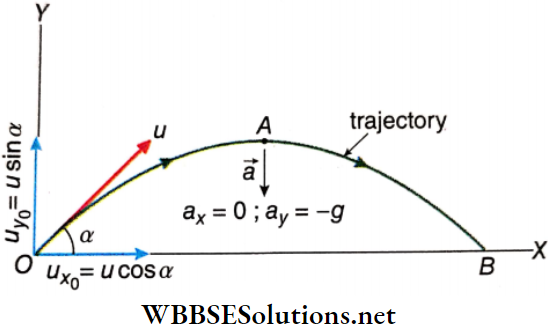
vector Point Of Projection

O is the point of projection, u is the velocity of projection, the angle of projection, and OB is the horizontal range; the time taken for traveling the path OAB is called the time of flight. Velocity of projection u has a horizontal component = \(u_{x_0}=u \cos \alpha\) and a vertical component = \(u_{y_0}=u \sin \alpha\).

  • As acceleration due to gravity (g) acts vertically downward, the velocity component usina gradually changes. Hence, the vertical motion of the body is a motion under gravity. But since g has no component along the horizontal direction, the acceleration or deceleration of the horizontal component of motion is zero.
  • Hence, the motion of the body along the horizontal direction is uniform, i.e., horizontal velocity \(u_{x_0}=u \cos \alpha\) = constant. It is convenient to use the vertical motion and the horizontal motion separately in discussions related to projectile motion.

Principle Of Physical Independence Of Motions: In the absence of air resistance the motion of a projectile is considered as the combination of the following two independent motions.

  1. Motion along the horizontal direction with uniform velocity.
  2. Motion along vertical direction under gravity i.e., uniform acceleration equal to g.

The two motions of a projectile along horizontal and vertical directions are independent of each other. This is called the principle of physical independence of motion.

Principle Of Physical Independence Of Motions Key Points:

  1. A projectile returns to the ground at the same angle and with the same velocity with which it is projected.
  2. When a projectile is at the highest point of its trajectory
    1. It possesses velocity only along horizontal,
    2. The velocity and acceleration of the projectile are perpendicular to each other.

Equations For Projectile Motion: Let the time taken by the projectile to reach the point P be t.

For the horizontal motion of the projectile we have, \(v_x=u_{x_0}+a_x t\)

or, \(v_x=u \cos \alpha\) (because \(a_x=0\))….(1)

where vx is the horizontal component of the velocity of the projectile after time t.

Again, \(x=u_{x_0} t+\frac{1}{2} a_x t^2\)

or, \(x=u_{x_0} t=u \cos \alpha t\)….(2)

From this equation, we get the horizontal position of the projectile after time t.
Vector Horizontal Position Of Projectile

Gravity Variation with Depth Below Earth’s Surface

For the vertical motion of the projectile, ay=-g

∴ \(v_y=u_{y_0}+a_y t\)

[vy is the vertical component of velocity of the projectile after time t]

or, \(v_y=u_{y_0}-g t\) (because \(a_y=-g\))……(3)

Again, \(v_y^2=u_{y_0}^2-2 g y\)

and \(y=u_{y_0} t+\frac{1}{2} a_y t^2=u_{y_0} t-\frac{1}{2} g t^2\)

From equation (4), we get the vertical position of the projectile after time t.

Equations For Projectile Motion Maximum Height: The maximum height of a projectile is the maximum vertical distance attained by the projectile above the horizontal plane of projection. It is denoted by H. To calculate the height of the projectile, consider only its vertical motion. The vertical component of the velocity of projection = u sinα and velocity at the highest point = 0.

If H = maximum height, \(0=(u \sin \alpha)^2-2 g H \text { or, } H=\frac{u^2 \sin ^2 \alpha}{2 g}\)….(5)

It should be noted that the body attains maximum height by reaching a point that is not exactly above point O. Because of the horizontal component of motion, the body has a horizontal displacement as well. the highest point on the trajectory of the projectile is point A and maximum height (H) = AC.

Time Of Flight: It is the time taken by the projectile from the instant it is projected till it reaches a point in the horizontal plane of its projection. As shown the total time taken to reach point B from point O is the time of flight.

Let the time taken to reach the maximum height be T1

Hence, \(0=u \sin \alpha-g T_1 \text { or, } T_1=\frac{u \sin \alpha}{g}\)….(6)

On reaching the highest point, the body starts descending again. At the same time, the body covers a horizontal path due to its horizontal component of motion. Finally, the body reaches B. Thus, the body follows the trajectory OAB.

The height of B with respect to the point of projection, O is zero, i.e., the vertical displacement of the object is zero. Hence, if T is the time required to cover the path OAB,

0 = \(u \sin \alpha \cdot T-\frac{1}{2} g T^2\) [from equation (4)]

∴ \(2 u \sin \alpha=g T or, T=\frac{2 u \sin \alpha}{g}\)…..(7)

Comparing equations (6) and (7), \(2 T_1=\frac{2 u \sin \alpha}{g}=T \text { or, } T_1=\frac{T}{2}\)

So, the time required to reach the maximum height is equal to half the time of flight.

Horizontal Range: Let the horizontal range be OB = R. The horizontal distance traversed by the body in time T is R. Since the body crosses the distance R horizontally with a uniform velocity ucosα,

R = \(u \cos \alpha \cdot T=u \cos \alpha \cdot \frac{2 u \sin \alpha}{g}\)

= \(\frac{2 u^2 \sin \alpha \cos \alpha}{g}=\frac{u^2}{g} \sin 2 \alpha\)…..(8)

The value of R is maximum when sin 2α is maximum. Therefore, the condition for covering the maximum horizontal distance for a particular initial velocity u, is sin 2α = 1 = sin90° or, α = 45°.

∴ \(R_{\max }=\text { Maximum range }=\frac{u^2}{g}\)…..(9)

To send a projectile to the maximum possible distance, it has to be thrown at an angle of 45° with the horizontal. This is why sportsmen try to throw the javelin or discus at 45°.

It should be noted that if the angle of projection is (\(\frac{\pi}{2}-\alpha\)) instead of a, the horizontal range remains the same for a particular velocity of projection, since, \(R^{\prime}=\frac{u^2}{g} \sin \left\{2\left(\frac{\pi}{2}-\alpha\right)\right\}\) = \(\frac{u^2}{g} \sin (\pi-2 \alpha)=\frac{u^2}{g} \sin 2 \alpha=R\)

Locus Of A Projectile: Let us take a reference frame such that, its positive y-axis extends vertically upwards, and the positive x-axis extends horizontally in the direction of the horizontal component of the velocity of the projectile. The origin is taken as the point of projection

Let the point reached by the body from O in time f be P and the coordinates of P be (x, y).

y = \(u \sin \alpha \cdot t-\frac{1}{2} g t^2\)…………(10)
Vector Locus Of A Projctile

Again, as the horizontal velocity =ucosa = constant, x = ucosα · t

or, \(t=\frac{x}{u \cos \alpha}\)

From (10) and (11), \(y=u \sin \alpha \frac{x}{u \cos \alpha}-\frac{1}{2} g \frac{x^2}{u^2 \cos ^2 \alpha}\)

or, y = \(x \tan \alpha-\frac{g}{2 u^2 \cos ^2 \alpha} x^2\)

This equation is the locus of the projectile.

The equation is of the type y=ax+bx² which is the equation of a parabola. Hence, the trajectory of a projectile is parabolic.

Motion Of A Projectile Numerical Examples

Example 1. A body is projected with a velocity of 20 m s-1, making an angle of 45° with the horizontal. Calculate—

  1. The time taken to reach the ground [g = 10 m s-2],
  2. The maximum height it can attain and
  3. Horizontal range.

Solution:

The vertical and horizontal components of the velocity of 20 m s-1 are \(u_H=20 \cos 45^{\circ}=20 \times \frac{1}{\sqrt{2}}=10 \sqrt{2} \mathrm{~m} \cdot \mathrm{s}^{-1}\)

and \(u_V=20 \sin 45^{\circ}=20 \times \frac{1}{\sqrt{2}}=10 \sqrt{2} \mathrm{~m} \cdot \mathrm{s}^{-1}\).

1. Let the total time of flight of the body be t. Considering the vertical motion of the body, we get from the equation h = ut-\(\frac{1}{2}\)gt²,

0 = \(10 \sqrt{2} t-\frac{1}{2} \cdot 10 \cdot t^2 \quad[\text { as } h=0]\)

or, \(5 t^2=10 \sqrt{2} t\)

∴ Total time of flight, \(t=\frac{10 \sqrt{2}}{5}=2 \sqrt{2}=2 \times 1.414=2.828 \mathrm{~s}\)

2. Let the maximum height attained be h. Vertical velocity at the maximum height = 0.

Considering the vertical motion of the body, we get from the equation v² = u²- 2gh,

0 = (10√2)² -2 ·10 · h

∴ h = 10m

3. Let the distance from the point of projection to the point at the ground where the body touches be x. By considering the horizontal motion of the body, we get,

x = uH x t = 10√2 x 2√2 = 40 m.

∴ The horizontal range = 40 m.

Mathematical Formulas for Gravity Variation

Example 2.  A plane is flying horizontally at a height of 196 m at 600 km · h-1 with respect to the ground. On reaching a point directly above A, the plane drops an object that reaches the ground at B. Find the distance AB.
Solution:

Let the point directly above A from where the object is dropped be O

Therefore, OA = 1960 m. Let the time taken by the object to hit the ground at B be t.
Vector Plane Is Flying Horizontally

Since the plane is flying horizontally, the initial vertical velocity of the object = 0 and vertical (downward) A displacement = 1960 m.

Considering the vertical motion of the object, we get from the equation h = ut + \(\frac{1}{2}\) gt²,

1960 = \(0 \times t+\frac{1}{2} \times 9.8 \times t^2\)

or, \(t^2=\frac{2 \times 1960}{9.8}=400\) or, \(t=20 \mathrm{~s}\)

The initial horizontal velocity of the body = \(600 \mathrm{~km} \cdot \mathrm{h}^{-1}=\frac{600 \times 1000}{60 \times 60} \mathrm{~m} \cdot \mathrm{s}^{-1}=\frac{500}{3} \mathrm{~m} \cdot \mathrm{s}^{-1}\)

So, the object moves at a uniform velocity of \(\frac{500}{3} \mathrm{~m} \cdot \mathrm{s}^{-1}\) in the horizontal direction. Hence,

AB = \(\frac{500}{3} \times 20 \mathrm{~m}=\frac{500 \times 20}{3 \times 1000} \mathrm{~km}=\frac{10}{3}=3.33 \mathrm{~km}\)

Example 3.  A particle falls from rest from the highest point of a vertical circle of radius r, along a chord without any friction. Show that the time taken by the particle to come down is independent of the chord’s length. Find the time in terms of r and g.
Solution:

Let the chord along which the particle falls be CD. The CD makes an angle θ with the vertical diameter as shown. CD = 2 r cosθ. The component of acceleration due to gravity along CD = g cosθ.

Let the time taken by this particle to fall from rest along CD be t.
Vector Particle Falls From Rest

Hence, from the equation s = ut + \(\frac{1}{2}\) at²,

2r \(\cos \theta\) = \(0+\frac{1}{2} g \cos \theta \cdot t^2\)

or, \(t^2=\frac{4 r}{g} \text { or, } t=2 \sqrt{\frac{r}{g}}\)

The time is independent of θ, and hence on the length of the chord CD.

Example 4. At what angle with respect to the horizontal, should a projectile be thrown with a velocity of 19.6 m · s-1, to just clear a wall 14.7 m high, at a distance of 19.6 m?
Solution:

Let the angle of projection be θ. Hence horizontal component of velocity = 19.6 cosθ m · s-1 and its vertical component = 19.6 sinθ m · s-1.

Let the time after which the projectile crosses the wall be t.
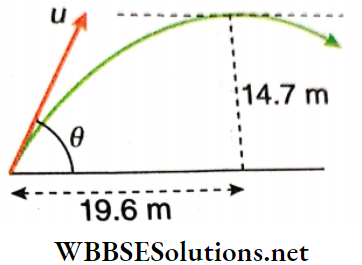
Vector Angle With Horizontal A Projectile

Considering horizontal motion, 19.6 = 19.6 cosθ x t or, t = secθ

For the vertical motion, 14.7 =19.6 sinθ x t \(\frac{1}{2}\) x 9.8 x t²

or, 14.7 = 19.6 sinθ x secθ-4.9 sec²θ

or, 3 = 4 tanθ – (1 + tan²θ) or, tan²θ-4tanθ + 4 = 0

or, (tanθ – 2)³ = 0 or, tanθ = 2

∴ θ = tan-1 2 = 63.4°

Example 5. A block of ice is sliding down the sloping roof of a house and the angle of inclination of the roof with the horizontal is 30°. The maximum and minimum heights of the roof from the ground are 8.1 m and 5.6 m. How far from the starting point, measured horizontally, does the block land? [ignore friction].
Solution:

Let the highest point of the roof be A and the lowest point be P as shown.

∴ AC= 8.1 m; PD = 5.6 m

∴ AB =AC-BC =AC-PD= 8.1 -5.6 = 2.5 m

AP = \(\frac{A B}{\sin 30^{\circ}}=\frac{2.5}{\frac{1}{2}}=5 \mathrm{~m}\)
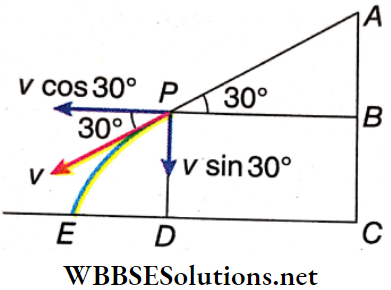
Vector Velocity Of The Block

Let the velocity of the block at P be v.

Considering the motion of the block from A to P,

v² = 2g sin30° xAP = 2 x 9.8 x \(\frac{1}{2}\) x 5 = 49 or, v = 7 m · s-1.

The horizontal and vertical components of the velocity at P are \(v \cos 30^{\circ}=\frac{7 \sqrt{3}}{2} \mathrm{~m} \cdot \mathrm{s}^{-1} \quad \text { and } \quad v \sin 30^{\circ}=\frac{7}{2} \mathrm{~m} \cdot \mathrm{s}^{-1}\) respectively.

Let the total time taken by the block to come from P to E be t. Considering the vertical motion of the block,

5.6 = \(\frac{7}{2} t+\frac{1}{2} \times 9.8 \times t^2 \quad \text { or, } 7 t^2+5 t-8=0\)

∴ t = \(\frac{-5 \pm \sqrt{25+224}}{14}=0.77 \mathrm{~s}\) [taking the positive value of t]

Now, DE =  \(\nu \cos 30^{\circ} \times t=\frac{7 \sqrt{3}}{2} \times 0.77=2.7 \sqrt{3} \mathrm{~m}\)

∴ CE = \(C D+D E=2.5 \sqrt{3}+2.7 \sqrt{3}\)

(\(\tan 30^{\circ}=\frac{A B}{P B} \text { or, } P B=2.5 \sqrt{3} \mathrm{~m}\) and, DC = \(P B=2.5 \sqrt{3} \mathrm{~m}]\))

= \(5.2 \sqrt{3}=9 \mathrm{~m}\)

Example 6. The equation of the trajectory of a projectile on s vertical plane is y = ax- bx², where a and b are constants, and x and y respectively are the horizontal distances of the projectile from the point of projection. Find out the maximum height attained by the projectile, and also the angle of projection with respect to the horizontal.
Solution:

Let, u = velocity of projection; α = angle of projection

The velocity ucosα in the horizontal direction is uniform.

So, in time t, x = \(u \cos \alpha \cdot t \quad \text { or, } t=\frac{x}{u \cos \alpha}\)

The velocity u sin α in the vertically upward direction is under a uniform retardation -g, where g is the acceleration due to gravity.

Then, in time t, y = \(u \sin \alpha \cdot t-\frac{1}{2} g t^2=u \sin \alpha \cdot \frac{x}{u \cos \alpha}-\frac{1}{2} g \frac{x^2}{u^2 \cos ^2 \alpha}\)

or, \(y=x \tan \alpha-\frac{g}{2 u^2 \cos ^2 \alpha} x^2\)

Comparing with the given equation y=a x-bx², we get

  1. a =θ, or angle of projection, \(\theta=\tan ^{-1} a\).
  2. b = \(\frac{g}{2 u^2 \cos ^2 \alpha} \quad or, u^2=\frac{g}{2 b \cos ^2 \alpha}\)

At maximum height H, the velocity of the projectile is zero.

Considering vertical motion, we have

0 = \((u \sin \alpha)^2-2 g H\)

or, H = \(\frac{u^2 \sin ^2 \alpha}{2 g}=\frac{g}{2 b \cos ^2 \alpha} \cdot \frac{\sin ^2 \alpha}{2 g}\)

= \(\frac{\tan ^2 \alpha}{4 b}=\frac{a^2}{4 b}\)

Example 7. A gun fires at an angle 30° with the horizontal and hits a target at a distance of 3 km. Can another target at a distance of 5 km be hit by changing the angle of projection but keeping the velocity of projection unchanged?
Solution:

Horizontal range, \(R=\frac{u^2 \sin 2 \alpha}{g}\)

In the first case, 3 = \(\frac{u^2 \sin \left(2 \times 30^{\circ}\right)}{g}=\frac{u^2}{g} \frac{\sqrt{3}}{2}\)

or, \(\frac{u^2}{g}=2 \sqrt{3}\)

If the velocity of projection is unchanged, the maximum horizontal range for \(\alpha=45^{\circ}\), is \(R_{\max }=\frac{u^2 \sin \left(2 \times 45^{\circ}\right)}{g}=\frac{u^2}{g}=2 \sqrt{3}\)

= \(2 \times 1.732=3.464 \mathrm{~km}\)

So, a target at a distance of 5 km cannot be hit.

Example 8. A gun is kept on a horizontal road and is used to hit a running car. The uniform speed of the car is 72 km/h. At the instant of firing at an angle of 45° with the horizontal, the car is at a distance of 500 m from the gun. Find out the distance between the gun and the car at the instant of hitting. Given, 10 m/s².
Solution:

Velocity of the car, v = 72 km/h = 20 m/s;

if it is hit after a time s, then its displacement = 201 m

∴ Distance between the gun and the car at that instant,

D =  500 + 20tm.

If u be the initial velocity of the bullet, then its horizontal range,

R = \(\frac{u^2 \sin \left(2 \times 45^{\circ}\right)}{g}=\frac{u^2}{g}\)

∴ \(\frac{u^2}{g}=500+20 t\)…..(1)

Considering the vertical motion of the bullet in time t, we have

0 = \(u \sin 45^{\circ} \cdot t-\frac{1}{2} g t^2 \quad \text { or, } \frac{u t}{\sqrt{2}}=\frac{1}{2} g t^2\)

or, u = \(\frac{1}{\sqrt{2}} g t\)

∴ \(u^2=\frac{1}{2} g^2 t^2 \quad \text { or, } \frac{u^2}{g}=\frac{1}{2} g t^2=\frac{1}{2} \times 10 \times t^2=5 t^2\)

Putting in (1), we get \(5 t^2=500+20 t \text { or, } t^2-4 t-100=0\)

∴ t = \(\frac{4 \pm \sqrt{16-4 \times 1 \times(-100)}}{2 \times 1}=2 \pm \sqrt{104}\)

Keeping only the positive value of t, we have \(t=2 \pm \sqrt{104}=12.2 \mathrm{~s}\)

So, we get, \(D=500+20 t=500+20 \times 12.2=744 \mathrm{~m} \text {. }\)

Example 9. The initial velocity of a projectile is (\(\hat{i}+2 \hat{j}\)) m/s, where i and j are unit vectors along the horizontal and vertical directions respectively. Find out the locus of the projectile, taking g = 10 m/s².
Solution:

Horizontal and vertical components of initial velocity are, respectively,

ux = 1 m/s and uy = 2 m/s

Let, at t = 0, the initial coordinates of the projectile are (0, 0); at time t, these are (x, y).

So, \(x=u_x t=t \mathrm{~m}\)

y = \(u_y t-\frac{1}{2} g t^2=\left(2 t-5 t^2\right)=2 x-5 x^2\)

∴ \(y=2 x-5 x^2\) is the locus of the projectile.

Example 10. Two objects are thrown simultaneously from the same point with the same initial velocity at angles of projection α and β respectively. If they reach the top and the bottom of a tower simultaneously, then prove that tanα – tanβ = tanθ where θ = angle of elevation of the tower from the point of projection.
Solution:

Horizontal range of the 2nd projectile

OB = \(x=\frac{u^2 \sin 2 \beta}{g}=\frac{2 u^2}{g} \sin \beta \cos \beta\)…..(1)
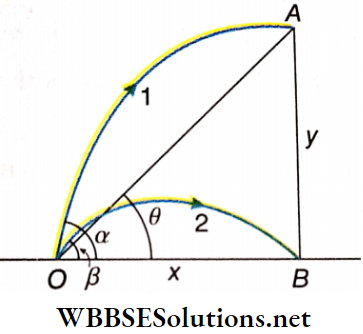
Vector Two Objects Are Thrown

Time of flight of the 2nd projectile, t = \(\frac{2 u \sin \beta}{g}\)

= time taken by the 1st projectile from O to A

For the horizontal motion of the 1st projectile,

OB = \(x=u \cos \alpha \cdot t=u \cos \alpha \cdot \frac{2 u \sin \beta}{g}\)

= \(\frac{2 u^2}{g} \sin \beta \cos \alpha\)……….(2)

Comparing (1) and (2), we have \(\cos \alpha=\cos \beta\)…….(3)

For the vertical motion of the 1st projectile, AB = \(y=u \sin \alpha \cdot t-\frac{1}{2} g t^2\)

= \(u \sin \alpha \frac{2 u \sin \beta}{g}-\frac{1}{2} g\left(\frac{2 u \sin \beta}{g}\right)^2\)

= \(\frac{2 u^2}{g}\left(\sin \alpha \sin \beta-\sin ^2 \beta\right)\)…….(4)

Diving (4) by (1), we have \(\tan \theta=\frac{A B}{O B}=\frac{y}{x}=\frac{\sin \alpha \sin \beta-\sin ^2 \beta}{\sin \beta \cos \beta}\)

= \(\frac{\sin \alpha}{\cos \beta}-\frac{\sin \beta}{\cos \beta}=\frac{\sin \alpha}{\cos \alpha}-\tan \beta\)

= \(tan \alpha-\tan \beta\) (using (3))

Example 11. A truck starts from rest and accelerates uniformly. at 2 m · s-2 At t = 10 s, a stone is dropped by a person standing on the top of the truck (6 m high from the ground). What are the

  1. Velocity and
  2. Acceleration of the stone at t = 11 s? (Neglect air resistance).

Solution:

The velocity of the truck after 10s = at = 2 x 10 = 20 m · s-1

So, at the time of release, the stone has a horizontal velocity of 20 m • s-1, but no vertical velocity. Its horizontal acceleration = 0 and vertical acceleration, g = 9.8 m • s-2.

1. At 11 s, i.e., 1 s after release, the horizontal velocity of the stone = 20 m • s-1;

vertical velocity = gt = 9.8 x 1 = 9.8 m • s-1

So, the resultant velocity = \(\sqrt{(20)^2+(9.8)^2}=22.27 \mathrm{~m} \cdot \mathrm{s}^{-1}\)

2. The acceleration of the stone = downward acceleration due to gravity = 9.8 m • s-2


Vector Synopsis

Geometrical Representation Of A Vector:

  1. A vector is represented by a line segment with an arrowhead,
  2. The magnitude of the vector is the length of the line segment and
  3. The direction of the vector is shown by the arrowhead.

Triangle Law Of Vector Addition: If two sides of a triangle taken in order, represent the magnitudes and directions of two vectors, the third side, taken in the opposite order, represents the magnitude and direction of the resultant of the two vectors.

If three vectors can be represented by the three sides of a triangle, taken in order, the resultant of the vectors is a zero vector.

Parallelogram Law Of Vector Addition: If two adjacent sides of a parallelogram represent the magnitudes and directions of two vectors, then the diagonal, drawn through the intersection of the two sides of the parallelogram, represents the magnitude and direction of the resultant of the two vectors. In this case the point of intersection is the initial point of the two vectors and their resultant.

Polygon Law Of Vector Addition: If the magnitudes and directions of a number of vectors are represented by the sides of a polygon, taken in order, then the last side, taken in the opposite order, represents the magnitude and direction of the resultant of the vectors.

  • If any vector is split into two or more vectors such that the original vector becomes the resultant of the split parts or components of the vector, then this splitting is called the resolution of vectors.
  • Component of a vector in the same direction as the vector has the same magnitude as the vector itself.
  • No vector has a component at right angles to itself.
  • When the position of a point with respect to the origin is represented by a vector, then that vector is called the position vector.
  • The apparent velocity of a body, with respect to another body at rest or in motion, is called its relative velocity.
  • The apparent acceleration of a body, with respect to another body moving with or without, is called its relative acceleration.
  • The scalar product or dot product of two vectors is a scalar, whereas the vector product or cross product of two vectors is another vector.
  • A body thrown obliquely from the earth’s surface or from a point close to it is called a projectile.
  • The path of a projectile is parabolic except for those projected along the vertical direction. In that case, it is a straight line.

Resultant of \(\vec{a}\) and \(\vec{b}\), when the angle between them is \(\alpha\), is \(\vec{c}\) such that \(c=\sqrt{a^2+b^2+2 a b \cos \alpha}\). [equation giving the magnitude of the resultant]

If the angle between \(\vec{a}\) and \(\vec{c}\) is \(\theta\), then \(\tan \theta=\frac{b \sin \alpha}{a+b \cos \alpha}\) [equation giving the direction of the resultant]

  1. When \(\alpha=0\), \(c=a+b=c_{\max }\) (maximum possible value of the resultant) and \(\theta=0\).
  2. For \(\alpha=\pi\), \(c=|a-b|=c_{\text {min }}\) (minimum possible value of c) and \(\theta=0\), (when a>b) or \(\theta=\pi\) (when a<b)
    • Note: α or θ is usually measured from \(\vec{a}\).
  3. When \(\alpha=\frac{\pi}{2}\) then \(c=\sqrt{a^2+b^2}\) and \(\theta=\tan ^{-1} \frac{b}{a}\).

Characteristics Of Vector Addition:

  1. \(\vec{A}+\vec{B}=\vec{B}+\vec{A}\) [Commutative rule]
  2. \(\vec{A}+(\vec{B}+\vec{C})=(\vec{A}+\vec{B})+\vec{C}\)[Associative rule]
  3. \(\vec{A}-\vec{B}=\vec{A}+(-\vec{B})\)
  4. \((-n) \vec{A}=n(-\vec{A})=-n \vec{A}\)

If two components of \(\vec{R}\) are \(\vec{a}\) and \(\vec{b}\), angle between \(\vec{R}\) and \(\vec{a}\) is \(\alpha\), and angle between \(\vec{R}\) and \(\vec{b}\) is \(\beta\), then

a = \(\frac{R \sin \beta}{\sin (\alpha+\beta)} \text { and } b=\frac{R \sin \alpha}{\sin (\alpha+\beta)}\)

When \(\alpha+\beta=\frac{\pi}{2}\) then \(a=R \cos \alpha, b=R \sin \alpha\)

If coplanar vectors \(\vec{P}, \vec{Q}\) and \(\vec{R}\) are at angles \(\alpha, \beta\) and \(\gamma\) respectively with respect to the positive x-axis, then the component of their resultant \(\vec{F}\) along the positive x-axis, \(F_x=P \cos \alpha+Q \cos \beta+R \cos \gamma\)

and component of \(\vec{F}\)

along the positive y-axis \(F_y=P \sin \alpha+Q \sin \beta+R \sin \gamma\)

and hence, \(F=\sqrt{F_x^2+F_y^2}\)

When \(\vec{F}\) makes an angle \(\theta\) with the positive x-axis \(\theta=\tan ^{-1} \frac{F_y}{F_x}\)

Taking O as the origin of the three-dimensional cartesian coordinate system, we get the position vector of A(x, y, z) as, \(\vec{r}=\overrightarrow{O A}=x \hat{i}+y \hat{j}+z \hat{k}\)

∴ r = \(\sqrt{x^2+y^2+z^2}\)

If \(\vec{r}\) makes angles \(\alpha, \beta, \gamma\), with x, y, z axes respectively, then the direction cosines of \(\vec{r}\) are \(\cos \alpha=\frac{x}{r}, \cos \beta=\frac{y}{r}\) and \(\cos \gamma=\frac{z}{r}\) where, \(\cos ^2 \alpha+\cos ^2 \beta+\cos ^2 \gamma=1\)

The resultant of \(\vec{r}_1=x_1 \hat{i}+y_1 \hat{j}+z_1 \hat{k}\) and \(\vec{r}_2=x_2 \hat{i}+y_2 \hat{j}+z_2 \hat{k}\) is \(\vec{r}_1+\vec{r}_2=\left(x_1+x_2\right) \hat{i}+\left(y_1+y_2\right) \hat{j}+\left(z_1+z_2\right) \hat{k}\)

If \(\theta\) is the angle between \(\vec{A}\) and \(\vec{B}\), vector and scalar products of the vectors \(\vec{A}\) and \(\vec{B}\) are respectively \(\vec{A} \times \vec{B}=A B \sin \theta \hat{n} \text { and } \vec{A} \cdot \vec{B}=A B \cos \theta\)

(where \(\hat{n}\) is the unit vector perpendicular to both \(\vec{A}\) and \(\vec{B}\))

If the velocities of two particles are \(\vec{v}_1\) and \(\vec{v}_2\), then the relative velocity of the second particle with respect to the first is, \(\vec{v}=\vec{v}_2-\vec{v}_1\)

If velocity and angle of projection of a projectile are u and \(\alpha\) respectively, then

  1. Maximum height, \(H=\frac{u^2 \sin ^2 \alpha}{2 g}\)
  2. Time of flight, \(T=\frac{2 u \sin \alpha}{g}\)
  3. Range of the projectile, \(R=\frac{u^2 \sin 2 \alpha}{g}\)
  4. Equation of the locus of the projectile, y = \(x \tan \alpha-\frac{g}{2 u^2 \cos ^2 \alpha} x^2 \text { (a parabola). }\)


Vector Match The Columns

Question 1. \(\vec{A}=(3 \hat{i}+4 \hat{j}-5 \hat{k})\)
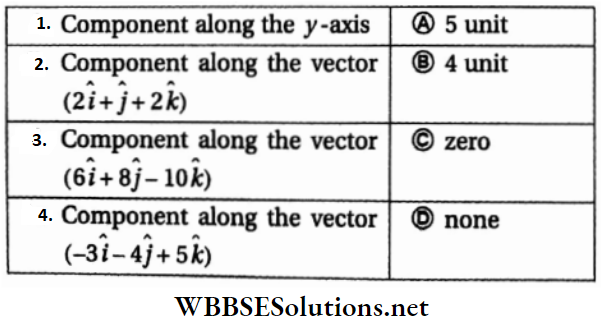
Vector Match The Column Question 1

Answer: 1-B, 2-C, 3-D, 4-D

Question 2. \(|\vec{A}|=2 \text { and }|\vec{B}|=4\). \(\theta\) is the angle between \(\vec{A} \text { and } \vec{B} \text {. }\)
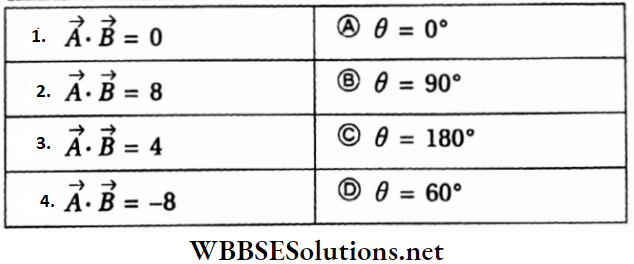
Vector Match The Column Question 2

Answer: 1-B, 2-A, 3-D, 4-C

Question 3. \(|\vec{A}|=2 \text { and }|\vec{B}|=4\). \(\theta\) is the angle between A and B
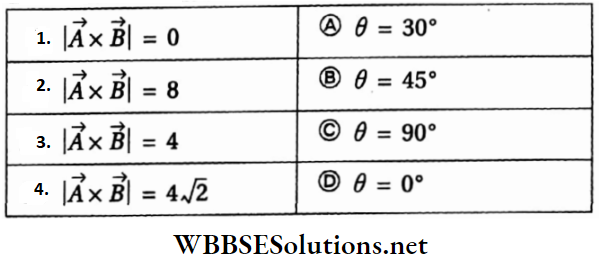
Vector Match The Column Question 3

Answer: 1-D, 2-C, 3-A, 4-B

Question 4. If θ is the angle between two vectors A and B, then match the following columns.
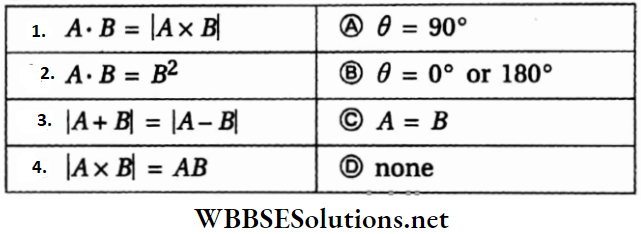
Vector Match The Column Question 4

Answer: 1-D, 2-B, C, 3-A, 4-A

Question 5. Vector A is pointing eastwards and vector B is northwards. Then match the following two columns.
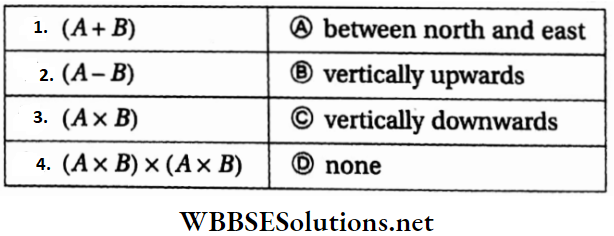
Vector Match The Column Question 5

Answer: 1-A, 2-D, 3-B, 4-D

Question 6. Given below in Column A is the relations between vectors \(\vec{a}\), \(\vec{b}\) and \(\vec{c}\) and in Column B are the orientations of \(\vec{a}\), \(\vec{b}\) and \(\vec{c}\) in the XY plane.
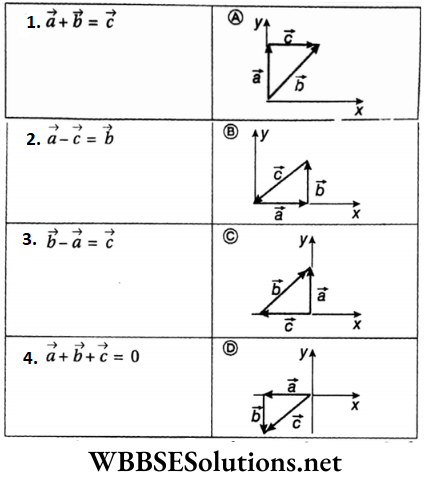
Vector Match The Column Question 6

Answer: 1-D, 2-C, 3-A, 4-B

Question 7. For a projectile thrown from the ground at an angle with the horizontal
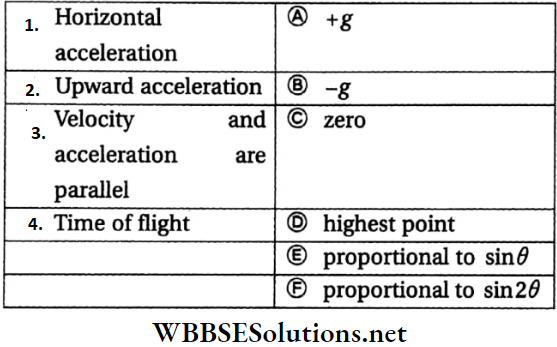
Vector Match The Column Question 7

Answer: 1-C, 2-B, 3-D, 4-E

Vector Comprehension Type Questions And Answers

Read the following passages carefully and answer the questions at the end of them.

Question 1. A farmer goes 500 m due north, 400 m due east and 200 m due south to reach his field. He takes 20 min to reach the field.

1. How much distance does he to walk to reach the field?

  1. 900 m
  2. 1100 m
  3. 1300 m
  4. 700 m

Answer: 2. 1100 m

2. What is the displacement from his house to the field?

  1. 550 m
  2. 700 m
  3. 500 m
  4. 714 m

Answer: 3. 500 m

3. What is the average speed of the farmer during the walk?

  1. 35 m • min-1
  2. 63 m • min-1
  3. 55m · min-1
  4. 65 m · min-1

Answer: 3. 55m · min-1

4. What is the average velocity of the farmer during the walk?

  1. 27 m · min-1
  2. 30 m · min-1
  3. 35 m · min-1
  4. 25 m · min-1

Answer: 4. 25 m · min-1

Question 2. A man crosses a river in a boat. If he crosses the river in minimum time he takes 10 min with a drift 120 m. If he crosses the river taking the shortest path, he takes 12.5 min.

1. What is the width of the river?

  1. 250 m
  2. 200 m
  3. 300 m
  4. 230 m

Answer: 2. 200 m

2. What is the velocity of the boat in still water?

  1. 21 m · min-1
  2. 24 m · min-1
  3. 20 m · min-1
  4. 18 m · min-1

Answer: 3. 20 m · min-1

3. What is the speed of the current?

  1. 13 m · min-1
  2. 12 m · min-1
  3. 14 m · min-1
  4. 15 m · min-1

Answer: 2. 12 m · min-1

Question 3. A particle is projected from the surface of the earth with a speed of 20 m · s-1 at an angle 30° with the horizontal.

1. The time of flight of that particle is

  1. 3 s
  2. 4s
  3. 2s
  4. 1s

Answer: 3. 2s

2. The range of that particle is

  1. 10 m
  2. 12√2 m
  3. 20√3 m
  4. 30 m

Answer: 3. 20√3 m

3. The maximum height the particle can reach is

  1. 3 m
  2. 7 m
  3. 5m
  4. 12 m

Answer: 3. 5m

Vector Integer Answer Type Questions

In this type, the answer to each of the questions is a single-digit Integer between 0 and 9.

Question 1. A projectile is launched from the ground and it returns to the ground level. The horizontal range of the projectile is R = 175 m. If the horizontal component of the projectile’s velocity at any instant is 25 m · s-1, then determine the time of flight of the projectile.
Answer: 7

Question 2. A food packet is to be dropped by a helicopter on a flood relief mission. The helicopter is moving horizontally with a constant speed of y = 50 m · s-1. At the time of dropping the food packet, it is at a height of 2 km from the ground level. For the person shown to receive the packet, what should be the value of x in km? [Given, g = 10 m · s-2]
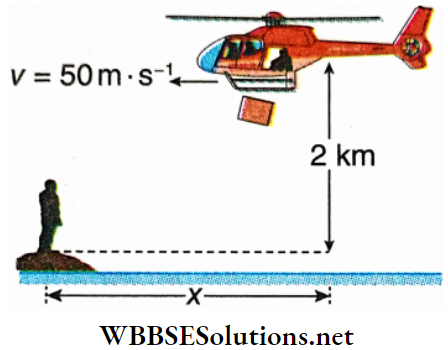
Vector Food Packet Dropped By Helicopter

Answer: 1

Question 3. Two men are running on a straight north-south track. Person A moves north with a speed of 5 m · s-1 while B moves south with a speed of 2 m · s-1. Determine the velocity (magnitude only) of

  1. A with respect to B.
  2. The ground with respect to A.
  3. B with respect to A.

Answer: 7, 5, 7


WBCHSE Class 11 Physics Vector Question and Answers

Vector Long Answer Type Questions

Question 1. Under which condition will the magnitude of the scalar sum be equal to the magnitude of the vector sum?
Answer:

A scalar has only magnitude and therefore, the addition of scalars is the addition of magnitudes. When some vec¬tors have the same direction, then only their magnitudes are added in vector addition. In such a case, the magnitude of the vector sum is equal to the sum of the scalars.

Question 2. If \(|\vec{A}| \neq|\vec{B}|\), then is it possible that \(\vec{A}\) + \(\vec{B}\) =0? Explain.
Solution:

If \(\vec{A}\) + \(\vec{B}\) = 0 or, \(\vec{A}\) = –\(\vec{B}\); it means that \(\vec{A}\) and \(\vec{B}\) are equal in magnitude, but opposite in direction.

But it is given that \(|\vec{A}| \neq|\vec{B}|\), i.e., the magnitudes are not equal. So, \(\vec{A}\) + \(\vec{B}\) +0.

WBCHSE Class 11 Physics Vector Question And Answers

Understanding Vector Concepts Questions

Question 3. Can the sum of three vectors, i.e., their resultant, be equal to zero? Explain.
Answer:

Yes, if the resultant of any two of the vectors is equal and opposite to the third one, the resultant of the three vectors will be zero. Let a, b, c be three vectors related as \(\vec{a}, \vec{b}, \vec{c}\)

∴ \(\vec{a}+\vec{b}=-\vec{c} \text {. Then } \vec{a}+\vec{b}+\vec{c}=0\)

Question 4. Two stones are dropped at the same time from a height. The first is dropped from rest while the other is released with a small horizontal velocity. Which stone will reach the ground first?
Answer:

The initial velocity of the first stone is zero and that of the second stone is in the horizontal direction. Hence, the vertical component of the initial velocity of the second stone is also zero.

Consequently, the two stones will touch the ground at the same instant, but not at the same point. Due to an initial horizontal velocity, the second stone will have some horizontal displacement.

Question 5. A boy throws a ball vertically upward from a vehicle moving with a constant acceleration. Where would the ball land?
Answer:

The ball will fall behind the boy if he is facing the direction of acceleration.

  • When the boy releases the ball, the horizontal velocities of both the ball and the vehicle are the same. The distance the ball covers after being released has nothing to do with its vertical velocity.
  • However, the ball’s horizontal velocity remains the same, whereas that of the vehicle increases as it is moving with a constant acceleration. Therefore, the ball will travel a shorter distance than the vehicle will. Thus, it will land behind the boy.

Vector A Boy Throws A Ball Vertically Upward From Vechicle

WBBSE Class 11 Vector Q&A

Question 6. Can the value of a component of a vector be greater than the value of the vector Itself? Discuss the case of rectangular components in this context
Answer:

By the law of parallelogram of vectors, two components of a vector form two adjacent sides of a parallelogram with the vector as the diagonal. Since both the adjacent sides of a parallelogram can be longer than the diagonal, the value of the components can be greater than that of the vector.

But the rectangular components of a vector, being two adjacent sides of a rectangle, cannot be greater than the value of the vector, because the diagonal of a rectangle is always longer than any of the sides.

Class 11 Physics Class 12 Maths Class 11 Chemistry
NEET Foundation Class 12 Physics NEET Physics

Question 7. At zero wind speed, rainwater falls vertically with velocity V cm • s-1 and is collected in a pot at a fixed rate. How will the rate of collection of rainwater change when the wind is blowing with a velocity of W cm s-1 perpendicular to V?
Answer:

There will be no change in the rate of collection of rainwater due to wind velocity.

Rainwater falls vertically in the pot when there is no wind. If A cm² is the area of the cross-section of the pot, the rate of collection of rainwater is, x = AV cm3 · s-1 …..(1)

Vector At Zero Wind Speed

Because of the wind, water will be filled in the pot obliquely. The component of the cross-sectional area of the pot perpendicular to the velocity of rain, is A1 = A cosθ.

Here, the effective velocity of rain is \(V_1=\frac{V}{\cos \theta}\)

Hence, the rate of collection of water, \(x_1=A_1 \cdot V_1\)

= \(A \cos \theta \cdot \frac{V}{\cos \theta}=A V \mathrm{~cm}^3 \cdot \mathrm{s}^{-1}\)………(2)

Thus, from (1) and (2), it is inferred that the rate of collection of rainwater remains the same.

Question 8. Are the magnitudes of the two vectors (\(\vec{A}-\vec{B}\)) and (\(\vec{B}-\vec{A}\)) the same?
Answer:

The magnitudes of these two vectors are the same. But since \(\vec{B}-\vec{A}\) = –\(\vec{A}-\vec{B}\), their directions are opposite.

Question 9. Show that, if three forces acting on a particle can be taken sequentially to form the three sides of a trian¬gle, their resultant Is zero.
Answer:

Let \(\vec{a}\), \(\vec{b}\), and \(\vec{c}\) be the three forces acting at a point O. Now, taking these forces sequentially and keeping their magnitudes and directions the same, we obtain the three sides of a triangle, \(\overrightarrow{P Q}, \overrightarrow{Q R} \text { and } \overrightarrow{R P}\)

Vector Three Forces Acting On The vertical

We have to show that \(\vec{a}+\vec{b}+\vec{c}=\overrightarrow{0}\)

According to the triangle law of vector addition, \(\vec{a}+\vec{b}=\overrightarrow{P R}=-\overrightarrow{R P} \text { or, } \vec{a}+\vec{b}=-\vec{c}\)

or, \(\vec{a}+\vec{b}+\vec{c}=\overrightarrow{0}\)

∴ The resultant of the three forces \(\vec{a}, \vec{b}, and \vec{c}\) is zero.

Applications of Vectors in Physics Q&A

Question 10. If the position coordinates of the points A and B are (x1, y1, z1) and (x2, y2, z2) respectively, determine the magnitude and direction of the vector \(\overrightarrow{A B}\).
Answer:

The position coordinates of A and B are (x1, y1, z1) and (x2, y2, z2) respectively.

∴ \(\overrightarrow{O A}=x_1 \hat{i}+y_1 \hat{j}+z_1 \hat{k}\) and \(\overrightarrow{O B}=x_2 \hat{i}+y_2 \hat{j}+z_2 \hat{k}\)

Vector Position Coordinates Of The Points

From ΔOAB, we get, \(\overrightarrow{O A}+\overrightarrow{A B}=\overrightarrow{O B}\)

or \(\overrightarrow{A B}=\overrightarrow{O B}-\overrightarrow{O A}\)

= \(\left(x_2 \hat{i}+y_2 \hat{j}+z_2 \hat{k}\right)-\left(x_1 \hat{i}+y_1 \hat{j}+z_1 \hat{k}\right)=\left(x_2-x_1\right) \hat{i}+\left(y_2-y_1\right) \hat{j}+\left(z_2-z_1\right) \hat{k}\)

The magnitude of the vector \(\overrightarrow{A B}\) is, AB = \(\sqrt{\left(x_2-x_1\right)^2+\left(y_2-y_1\right)^2+\left(z_2-z_1\right)^2}\)

The direction of \(\overrightarrow{A B}\) is obtained from its direction cosines \(\frac{x_2-x_1}{A B}, \frac{y_2-y_1}{A B} \text { and } \frac{z_2-z_1}{A B} \text {. }\)

Question 11. A person leans out of a train moving with uniform velocity and drops a coin. How does the path of motion of the coin appear to a co-passenger and a person standing outside the train near the rail tracks?
Answer:

When the coin is dropped from the train, due to inertia of motion it has a horizontal component of velocity equal to that of the train. Simultaneously, it experiences a vertical downward acceleration due to the force of gravity. If the train’s velocity is v, the velocity of the co-passenger is also v. Therefore, with respect to this person, the horizontal component of the velocity of the coin is, v- v = 0.

So, the passenger will see the coin drop vertically downwards due to the action of gravity. With respect to any person standing outside the train near the rail tracks, the coin will have both horizontal and vertical movements. Thus, it is essentially a projectile motion, and the coin follows a parabolic path.

Vector Addition and Subtraction Q&A

Question 12. State whether any physical quantity having magni¬tude and direction is a vector.
Answer:

All physical quantities with magnitude and direction are not vectors. To be a vector, the physical quantity must obey the rules of vector addition. For example, the flow of current is not a vector quantity though it has both magni¬tude and direction.

Question 13. Can the magnitude of the resultant of two vectors be less than either of them? Explain.
Answer:

\(\vec{a}\) = \(\overrightarrow{A B}\) and \(\vec{b}\) = \(\overrightarrow{B C}\). If the resultant of these two vectors is \(\vec{c}\), then according to the triangle law of vectors, \(\vec{c}\) = \(\overrightarrow{A C}\).

Vector Magnitude Of The Resultants Of Two Vectors

Obviously, the side AC of the triangle ABC may be smaller than AB or BC, or both. Thus, the magnitude of the resultant vector \(\vec{c}\) may be smaller than that of \(\vec{a}\) or \(\vec{b}\) or both.

Question 14. By adding three unit vectors is it possible to get a unit vector?
Answer:

If any two unit vectors out of the three are equal in magnitude but opposite in direction, then adding all the three vectors we obtain a resultant equal to the third unit vector. For instance, on adding \(\vec{a}\), –\(\vec{a}\) and \(\vec{b}\), we get, \(\vec{a}\)+(\(\vec{a}\)) + \(\vec{b}\) = \(\vec{b}\).

Question 15. Resultant of two vectors \(\vec{F}_1\) and \(\vec{F}_2\) is \(\vec{P}\) When \(\vec{F}_2\) is reversed, the resultant is \(\vec{Q}\). Show that \(\left(P^2+Q^2\right)=2\left(F_1^2+F_2^2\right)\)
Answer:

When \(\vec{F}_2\) is reversed it becomes –\(\vec{F}_2\).

From given conditions, \(\vec{F}_1+\vec{F}_2=\vec{P}, \vec{F}_1+\left(-\vec{F}_2\right)=\vec{F}_1-\vec{F}_2=\vec{Q}\)

∴ \(P^2+Q^2=\left(\vec{F}_1+\vec{F}_2\right)^2+\left(\vec{F}_1-\vec{F}_2\right)^2\)

= \(F_1^2+F_2^2+2 \vec{F}_1 \cdot \vec{F}_2+F_1^2+F_2^2-2 \vec{F}_1 \cdot \vec{F}_2\)

= \(2\left(F_1^2+F_2^2\right)\)

Question 16. How does the change of acceleration due to gravity affect the path of a projectile?
Answer:

The locus of a projectile is denoted by y = \(x \tan \alpha-\frac{g}{2 u^2 \cos ^2 \alpha} x^2\)…..(1)

Let u and α be constants.

Vector Change Of Acceleration

Now from equation (1) we can say that both the maximum height and the horizontal range of a projectile decrease with increasing g. In this case, the locus of the projectile is shown by line a.

On the other hand, both quantities increase with decreasing g. In this case, the locus of the projectile is shown by line b.

Real-Life Examples of Vector Applications

Question 17. Can four non-coplanar vectors produce equilibrium? Give reasons.
Answer:

Four non-coplanar vectors can produce equilib¬rium when they obey the following condition: The resultant of any two vectors must be equal in magnitude but opposite in direction to the resultant of the other two vectors.

Question 18. Show that a stretched wire cannot remain horizontal when weight is suspended from its mid-point.
Answer:

Let the two ends A and B of the wire be rigidly fixed and a weight W be suspended from the mid-point O. In this condition, the two parts of the string OA and OB make equal angles θ with the horizontal and the tension on each part is T.

Vector Stretched Wire Cannot Remain Horizontal

For equilibrium, the vertical components of T on each wire together balance the weight W, and the horizontal components balance each other.

∴ 2T sinθ = W or, sinθ = \(\frac{W}{2T}\)

Since, T cannot be infinitely large and W ≠ 0,

sinθ ≠ 0 i.e., θ ≠ 0°

Hence, the wire cannot remain horizontal when a weight is suspended from its mid-point (or from any other point along its length).

Question 9. Two wooden blocks are falling from the same height. One is falling down an inclined plane and the other is In a free fall. Out of the two

  1. Which one will reach the ground first and 
  2. Which one will have a higher velocity when it touches the ground?

Answer:

1. Let the length, height, and angle of inclination of the inclined plane be l, h, and θ respectively.

The acceleration of the block falling along the inclined Plane = g sinθ. Let the time taken by the first and the second blocks respectively to touch the ground be t1 and t2

For the first block, \(l=\frac{1}{2} g \sin \theta \cdot t_1^2\)

or, \(t_1^2=\frac{2 l}{g \sin \theta}=\frac{2 h}{g \sin ^2 \theta}\) (because \(\sin \theta=\frac{h}{l}\))

or, \(t_1=\frac{1}{\sin \theta} \sqrt{\frac{2 h}{g}}\)…..(1)

Vector Acceleration Of The Block falling Alon The Inclined

For the second block, h = \(\frac{1}{2} g t_2^2 \quad \text { or, } t_2=\sqrt{\frac{2 h}{g}}\)……(2)

As \(\sin \theta<1\)(because \(\theta<90^{\circ}\)), from equations (1) and (2) it is seen that \(t_1>t_2\), i.e., the block falling freely touches the ground first.

2. Let the velocities acquired by the first and the second blocks respectively be \(v_1\) and \(v_2\).

For the first block, \(v_1^2=2 g \sin \theta \cdot l=2 g \cdot \frac{h}{l} \cdot l=2 g h \text { or, } v_1=\sqrt{2 g h}\)

For the second block, \(v_2^2=2 g h \text { or, } v_2=\sqrt{2 g h}\)

∴ \(v_1=v_2\)

Hence, both the blocks touch the ground with the same velocity.

Step-by-Step Solutions to Vector Problems

Question 20. In a circus, a joker stands on a highly elevated plank with a ball in his hand. Another joker also stands with a rifle in his hand pointing it directly at the ball. If the rifle is fired precisely at the moment when the ball is released, will the bullet hit the bail? Air resis¬tance is negligible.
Answer:

The gravitational acceleration acting on the bullet and the ball are equal in magnitude and act vertically downwards. As the bullet is fired at the very moment the ball is released, the vertical displacements of both the bullet and the ball are the same. Therefore, the bullet will hit the ball.

Alternative method: The bullet from the rifle is directed straight to the ball. Let v0 be the velocity with which the bullet leaves the rifle at an angle θ with the horizontal. Let us consider, the time taken by the bullet to pass across the vertical line MB at A is t.

Vector Joker Stands On A Highly Elevated Plank With Ball In His Hand

Horizontal distance travelled by the bullet = OB = x

x = \(v_0 \cos \theta \times t \quad \text { or, } t=\frac{x}{v_0 \cos \theta}\)

∴ \(t^2=\frac{x^2}{v_0^2 \cos ^2 \theta}\)

For the vertical motion of the bullet, \(A B =v_0 \sin \theta \times t-\frac{1}{2} g t^2\)

= \(v_0 \sin \theta \times \frac{x}{v_0 \cos \theta}-\frac{1}{2} g \times \frac{x^2}{v_0^2 \cos ^2 \theta}\)

= \(x \tan \theta-\frac{1}{2} \frac{g x^2}{v_0^2 \cos ^2 \theta}\)

From the ΔOMB, \(\tan \theta=\frac{M B}{O B}=\frac{M B}{x}\) M B = \(x \tan \theta\)

Now, MA = \(M B-A B=x \tan \theta-\left[x \tan \theta-\frac{1}{2} \cdot \frac{g x^2}{v_0^2 \cos ^2 \theta}\right]\)

= \(\frac{1}{2} \frac{g x^2}{v_0^2 \cos ^2 \theta}=\frac{1}{2} g t^2\)

Thus in a time t, the bullet falls through a vertical distance \(\frac{1}{2} g t^2\) below M.

The vertical distance fallen by the ball is

h = \(u t+\frac{1}{2} g t^2=\frac{1}{2} g t^2\) [because u=0]

Thus the bullet and the ball will always reach point A at the same time. Hence the bullet will always hit the ball whatever be the velocity of the bullet.

Question 21. Under which condition will the magnitude of the resultant of two vectors be equal to that of any one of the constituent vectors?
Answer:

Suppose, a and b are the magnitudes of two vectors and the angle between them is θ. According to the problem let the magnitude of the resultant of \(\vec{a}\) and \(\vec{b}\) be equal to a.

Therefore, \(a^2=a^2+b^2+2 a b \cos \theta \text { or, } b(b+2 a \cos \theta)=0\)

∴ \(b+2 a \cos \theta\) =0(b≠0]

or, \(\theta=\cos ^{-1}\left(-\frac{b}{2 a}\right)\)

that is if the angle between \(\vec{a}\) and \(\vec{b}\) is = \(\cos ^{-1}\left(-\frac{b}{2 a}\right)\) or, \(\cos ^{-1}\left(-\frac{a}{2 b}\right)\), the magnitude of the resultant vector is equal to a or b respectively.

Vector Components and Resolution Questions

Question 22. If the angle between two vectors is slowly increased from 0 then what changes will be found in the resultant?
Answer:

Let \(\vec{a}\) and \(\vec{b}\) be the two vectors whose resultant is \(\vec{R}\). \(\vec{a}\) is directed along the positive x-axis and is constant, while \(\vec{b}\) moves from the positive x-axis in the anticlockwise direction.

Let at any moment, the angle between \(\vec{a}\) and \(\vec{b}\) be θ

∴ R = (a² + b² + 2abcosθ)½

From this equation we get,

when, θ = 0, R = a+ b

when, θ = 90°, R = (a²+b²)  when, 9 = 180°, R = |a-b|

when, θ = 270°, R = (a² + b²)½

when, θ = 360°, R = a+b

So, when the angle increases from 0° to 180° gradually, the magnitude of R decreases from (a+b) to |a-b|. Again, when θ increases from 180° to 360°, the magnitude of R increases from |a-b| to (a+b).

Question 23. If \(|\vec{a} \times \vec{b}|=\vec{a} \cdot \vec{b}\), them what us tghe angle between \(\vec{a}\) and \(\vec{b}\)?
Answer:

According to the question, \(|\vec{a} \times \vec{b}|=\vec{a} \cdot \vec{b}\)

∴ absinθ = abcosθ

[Let the angle between \(\vec{a}\) and \(\vec{b}\) be θ]

or, tan θ = 1 [a and b≠0]

∴ θ = 45°.

Question 24. What is the vector product of two equal vectors?
Answer:

The vector product of two equal vectors leads to a zero vector or null vector, i.e., the resultant vector has a magnitude equal to zero without any fixed direction. For any vector \(\vec{A},|\vec{A} \times \vec{A}|=(A)(A) \sin 0^{\circ}=0\).

∴\(\vec{A}\) x \(\vec{A}\)= \(\vec{0}\)

Question 25. Show that the projection or component of a vector \(\vec{R}\) on another vector \(\vec{A}\) is \(\vec{R}\) \(\hat{a}\), where a is a unit vector along \(\vec{A}\).
Answer:

In general, the component of a vector \(\vec{R}\) along a direction of another vector making an angle θ with it, is Rcosθ which is the projection of \(\vec{R}\) along the direction of that vector.

Consider two planes passing through the initial and terminal points of \(\vec{R}\), which are perpendicular to \(\vec{A}\) at F and H respectively.

Then, projection of \(\vec{R}\) on \(\vec{A}\) is FH = EG = Rcosθ = \(\vec{R}\) – \(\hat{a}\)

Vector Projection Or Components Of A Vector

Question 26. If \(\vec{A}\) is a constant vector, then show that \(\frac{d \vec{A}}{d t}\) is perpendicular to \(\vec{A}\).
Answer:

⇒\(|\vec{A}|=\) constant

∴ \(\vec{A} \cdot \vec{A}=A^2=\) constant

∴ \(\frac{d}{d t}(\vec{A} \cdot \vec{A})=0\)

or, \(\vec{A} \cdot \frac{d \vec{A}}{d t}+\frac{d \vec{A}}{d t} \cdot \vec{A}=0 \text { or, } 2 \vec{A} \cdot \frac{d \vec{A}}{d t}=0 \text { or, } \vec{A} \cdot \frac{d \vec{A}}{d t}=0\)

So, \(\frac{d \vec{A}}{d t}\) is perpendicular to \(\vec{A}\).

Question 27. A water fountain on the ground sprinkles water all around it. If the speed of water coming out of the fountain is v, then what will be the total area around the fountain that gets wet?
Answer:

Let the angle with the horizontal be 6 and the hor¬izontal range of water coming out of the fountain be R.

∴ R = \(\frac{v^2 \sin 2 \theta}{g}\)

The value of R will be maximum when sin 2θ = 1

Vector A water Fountain On The Ground Spinkles

i.e., 2θ = 90° or, θ = 45°

∴ \(R_{\max }=\frac{v^2}{g}\)

So a circular area of radius Rmax around the fountain gets wet.

∴ Total area, \(A=\pi R_{\max }^2=\pi\left(\frac{\nu^2}{g}\right)^2=\frac{\pi v^4}{g^2}\)

WBCHSE Class 11 Physics Vector Short Answer Questions

WBCHSE Class 11 Physics Vector Short Answer Questions

Vector Short Answer Type Questions And Answers

Question 1. The angle subtended by the vector \(\vec{A}=\sqrt{3} \hat{i}-\hat{j}\) with the y-axis is

  1. \(60^{\circ}\)
  2. \(240^{\circ}\)
  3. \(120^{\circ}\)
  4. \(45^{\circ}\)

Answer: 3. \(120^{\circ}\)

The option 3 is correct

Question 2. Two non-collinear unit vector \(\hat{a}\) and \(\hat{b}\) are such that \(|\hat{a}+\hat{b}|=\sqrt{3}\). Find the angle between the two unit vectors.
Answer:

⇒ \(|\vec{a}+\vec{b}|=\sqrt{3}\)

or, \(a^2+b^2+2 a b \cos \theta=(\sqrt{3})^2=3\)

or, \(\cos \theta=\frac{3-a^2-b^2}{2 a b}=\frac{3-\left(1^2-1\right)}{2 \cdot 1 \cdot 1}=\frac{1}{2}=\cos 60^{\circ}\)

∴ \(\theta=60^{\circ}\)

Question 3. The ratio between the values of the cross product and the dot product of two vectors is \(\frac{1}{\sqrt{3}}\). The angle between them is

  1. 30
  2. 45
  3. 60
  4. 120

Answer:

For \(\vec{A}\) and \(\vec{B}\), \(\frac{\text { value of cross product }}{\text { value of dot product }}=\frac{A B \sin \theta}{A B \cos \theta}=\tan \theta\)

∴ \(\tan \theta=\frac{1}{\sqrt{3}}=\tan 30^{\circ}\)

WBCHSE Class 11 Physics Vector Short Answer Questions

WBCHSE Class 11 Physics Vector Short Answer Questions

Question 4. \((2 \hat{i}+\hat{j}-\hat{k}) \mathrm{N}\) force is acting on a body of \(10 \mathrm{~kg}\) mass. If the body starts from rest, then after \(20 \mathrm{sec}\) what will be its velocity?
Answer:

Acceleration, \(\vec{a}=\frac{\text { force }}{\text { mass }}=\frac{2 \hat{i}+\hat{j}-\hat{k}}{10} \mathrm{~m} \cdot \mathrm{s}^{-2}=\text { constant }\)

So, the particle is moving with uniform acceleration.

After 20s, velocity, \(\vec{v}=\vec{u}+\vec{a} t=0+\frac{2 \hat{i}+\hat{j}-\hat{k}}{10} \cdot 20=(4 \hat{i}+2 \hat{j}-2 \hat{k}) \mathrm{m} \cdot \mathrm{s}^{-1}\)

Magnitude of the velocity, \(v=\sqrt{4^2+2^2+(-2)^2}=\sqrt{24}=2 \sqrt{6} \mathrm{~m} \cdot \mathrm{s}^{-1}\)

Question 5. If \(\vec{A}+\vec{B}+\vec{C}=0\) then show that \(\vec{A} \times \vec{B}=\vec{B} \times \vec{C}=\vec{C} \times \vec{A}\)
Answer:

⇒ \(\vec{B} \times \vec{C}=\vec{B} \times(-\vec{A}-\vec{B})=-\vec{B} \times \vec{A}-\vec{B} \times \vec{B}=+\vec{A} \times \vec{B}-0\)

= \(\vec{A} \times \vec{B}\)

Now, \(\vec{C} \times \vec{A}=(-\vec{A} \times-\vec{B}) \times \vec{A}=-\vec{A} \times \vec{A}-\vec{B} \times \vec{A}\)

= \(-0+\vec{A} \times \vec{B}=\vec{A} \times \vec{B}\)

∴ \(\vec{A} \times \vec{B}=\vec{B} \times \vec{C}=\vec{C} \times \vec{A}\)

WBCHSE Class 11 Physics Vector Short Answer Questions

WBBSE Class 11 Vector Short Answer Questions

Question 6. If \(\vec{A} \cdot \vec{B}=|\vec{A} \times \vec{B}|\), then the angle between \(\vec{A}\) and \(\vec{B}\) is

  1. \(\pi\)
  2. \(\frac{\pi}{2}\)
  3. 0
  4. \(\frac{\pi}{4}\)

Answer:

⇒ \(\vec{A} \cdot \vec{B}=|\vec{A} \times \vec{B}|\)

or, \(A B \cos \theta=A B \sin \theta\) or, \(\tan \theta=1\)

∴ \(\theta=\frac{\pi}{4}\)

The option 4 is correct

Class 11 Physics Class 12 Maths Class 11 Chemistry
NEET Foundation Class 12 Physics NEET Physics

Question 7. \(\vec{a} \times \vec{b}\) is not equal to \(\vec{b} \times \vec{a}\). Why?
Answer:

∴ \(\vec{a} \times \vec{b}\) and \(\vec{b} \times \vec{a}\) both are equal in magnitude but opposite in direction.

West Bengal Class 11 Physics Vector SAQs 

Question 8. Find a unit vector that is perpendicular to both \(\vec{A}=3 \hat{i}+\hat{j}+2 \hat{k}\) and \(\vec{B}=2 \hat{i}-2 \hat{j}+4 \hat{k}\).
Answer:

The unit vector perpendicular to both \(\vec{A}\) and \(\vec{B}\),

∴ \(\hat{n}= \pm \frac{\vec{A} \times \vec{B}}{|\vec{A} \times \vec{B}|}\)

Now, \(\vec{A} \times \vec{B}=\left|\begin{array}{ccc}\hat{i} & \hat{j} & \hat{k} \\ 3 & 1 & 2 \\ 2 & -2 & 4\end{array}\right|=8 \hat{i}-8 \hat{j}-8 \hat{k}\)

∴ \(|\vec{A} \times \vec{B}|=8 \sqrt{3}\)

∴ \(\hat{n}= \pm \frac{1}{\sqrt{3}}(\hat{i}-\hat{j}-\hat{k})\)

Question 9.

  1. Determine the relation between the kinetic energy of a projectile at maximum height and at initial position for maximum range.
  2. What is a null vector?

Answer:

Let the mass of the projectile = m and the velocity of projection = v.

Kinetic energy at the time of projection, E = 1/2 mv².

For maximum horizontal range, the angle of projection, = 45

At highest point, kinetic energy, \(E^{\prime}=\frac{1}{2} m\left(v \cos 45^{\circ}\right)^2=\frac{1}{2} m v^2 \times \frac{1}{2}=\frac{E}{2}\)

A null vector is a vector having a magnitude zero and no fixed direction.

Question 10. Which quantity remains unchanged in the case of a projectile?

  1. Momentum
  2. Kinetic energy
  3. Vertical component of velocity
  4. Horizontal component of velocity

Answer:

There is no horizontal acceleration of a projectile.

The option 4 is correct.

West Bengal Class 11 Physics Vector SAQs 

Vector Addition and Subtraction Short Answers

Question 11. Determine the unit vector along the vector \(\vec{A}=\hat{i}+3 \hat{j}+4 \hat{k} \text {. }\)
Answer:

The unit vector, \(\hat{A}=\frac{\vec{A}}{|\vec{A}|}=\frac{\hat{i}+3 \hat{j}+4 \hat{k}}{\sqrt{1^2+3^2+4^2}}=\frac{1}{\sqrt{26}} \hat{i}+\frac{3}{\sqrt{26}} \hat{j}+\frac{4}{\sqrt{26}} \hat{k}\)

Question 12. At what angle should the two forces \((\vec{A}+\vec{B})\) and \((\vec{A}-\vec{B})\) act so that their resultant be \(\sqrt{3 A^2+B^2} \text {. }\)
Answer:

If \(\vec{a}=(\vec{A}+\vec{B})\), then \(a^2=\vec{a} \cdot \vec{a}=(\vec{A}+\vec{B}) \cdot(\vec{A}+\vec{B})=A^2+B^2+2 \vec{A} \cdot \vec{B}\)

If \(\vec{b}=(\vec{A}-\vec{B})\), similarly \(b^2=\vec{b} \cdot \vec{b}=A^2+B^2-2 \vec{A} \cdot \vec{B}\)

∴ \(\vec{a} \cdot \vec{b}=(\vec{A}+\vec{B}) \cdot(\vec{A}-\vec{B})\)

= \(A^2-\vec{A} \cdot \vec{B}+\vec{A} \cdot \vec{B}-B^2=A^2-B^2\)

If the angle between \(\vec{a}\) and \(\vec{b}\) is \(\alpha, \vec{a} \cdot \vec{b}=a b \cos \alpha\)

∴ \(a b \cos \alpha=A^2-B^2\)

If \(\vec{c}\) be the resultant of \(\vec{a}\) and \(\vec{b}\),

\(c^2=a^2+b^2+2 a b \cos \alpha or, \quad 3 A^2+B^2=\left(A^2+B^2+2 \vec{A} \cdot \vec{B}\right)\)

+ \(\left(A^2+B^2-2 \vec{A} \cdot \vec{B}\right)+2\left(A^2-B^2\right)\)

or, \(3 A^2+B^2=4 A^2\) or, \(A^2-B^2=0\)

Hence, \(a b \cos \alpha=A^2-B^2=0\)

or, \(\cos \alpha=0\) or, \(\alpha=90^{\circ}\)

If the two forces act at an angle \(90^{\circ}\), their resultant will be \(\sqrt{3 A^2+B^2}\).

Class 11 Physics Vector Short Questions WBCHSE 

Question 13. If \(\vec{A}=0.4 \hat{i}+0.3 \hat{j}+c \hat{k}\) be a unit vector, then what is the value of c?
Answer:

∴ \(|\vec{A}|=\sqrt{(0.4)^2+(0.3)^2+c^2}=1\)

or, \(0.16+0.09+c^2=1\) or, \(c=\frac{\sqrt{3}}{2}\)

Question 14. Find the angle between the two vectors \(\vec{A}=\hat{i}-2 \hat{j}+3 \hat{k}\) and \(\vec{B}=2 \hat{i}+\hat{j}+3 \hat{k}\).
Answer:

⇒ \(\vec{A}= \hat{i}-2 \hat{j}+3 \hat{k}, \vec{B}=2 \hat{i}+\hat{j}+4 \hat{k}\)

⇒ \(\vec{A} \cdot \vec{B}=1 \times 2+(-2) \times 1+3 \times 4=12\)

⇒ \(|\vec{A}|=A=\sqrt{1^2+(-2)^2+3^2}=\sqrt{14}\)

⇒ \(|\vec{B}|=B=\sqrt{2^2+1^2+4^2}=\sqrt{21}\)

Now, \(\vec{A} \cdot \vec{B}=A B \cos \theta[\theta\) is the angle between the vectors \(\vec{A}\) and \(\vec{B}\).

or, \(\cos \theta=\frac{\vec{A} \cdot \vec{B}}{A B}=\frac{12}{7 \sqrt{6}}\)=\(\frac{2 \sqrt{6}}{7}\) or, \(\theta=\cos ^{-1}\left(\frac{2 \sqrt{6}}{7}\right)\)

Question 15. What are the quantities that remain constant during the motion of the particle?
Answer:

The horizontal component of the velocity of the particle and its downward acceleration (acceleration due to gravity) remain constant

Question 16. Consider three vectors \(\vec{A}=\hat{i}+\hat{j}-2 \hat{k}, \vec{B}=\hat{i}-\hat{j}+\hat{k}\) and \(\vec{C}=2 \hat{i}-3 \hat{j}+4 \hat{k}\). A vector \(\vec{X}\) of the form \(\alpha \vec{A}+\beta \vec{B}\)(α and β are numbers) is perpendicular to \(\vec{C}\). The ratio of α and β is

  1. 1: 1
  2. 2: 1
  3. -1: 1
  4. 3: 1

Answer:

∴ \((\alpha \vec{A}+\beta \vec{B}) \cdot \vec{C}=0\)

or, \(2(\alpha+\beta)-3(\alpha-\beta)+4(\beta-2 \alpha)=0\)

or, \(-9 \alpha+9 \beta=0 or, \alpha: \beta=1: 1\)

The option 1 is correct.

Real-Life Examples of Vector Applications

Question 17. A cricket ball thrown across a field is at heights h1 and h2 from the point of projection at times t1 and t2 respectively after the throw. The ball is caught by a fielder at the same height as that of projection. The time of flight of the ball in this journey is

  1. \(\frac{h_1 t_2^2-h_2 t_1^2}{h_1 t_2-h_2 t_1}\)
  2. \(\frac{h_1 t_2^2+h_2 t_2^2}{h_2 t_1+h_1 t_2}\)
  3. \(\frac{h_1 t_2^2+h_2 t_1^2}{h_1 t_2+h_2 t_1}\)
  4. \(\frac{h_1 t_1^2-h_2 t_2^2}{h_1 t_1-h_2 t_2}\)

Answer:

⇒ \(h_1=(u \sin \theta) t_1-\frac{1}{2} g t_1^2 ; h_2=(u \sin \theta) t_2-\frac{1}{2} g t_2^2\)

∴ \(\frac{h_1+\frac{1}{2} g t_1^2}{h_2+\frac{1}{2} g t_2^2}=\frac{t_1}{t_2} \quad \text { or, } h_1 t_2-h_2 t_1=\frac{g}{2}\left(t_1 t_2^2-t_1^2 t_2\right)\)

So, time of flight is given by T = \(\frac{2 u \sin \theta}{g}=\frac{2}{g}\left[\frac{h_1+\frac{1}{2} g t_1^2}{t_1}\right]=\frac{2}{t_1}\left[\frac{h_1}{g}+\frac{t_1^2}{2}\right]\)

= \(\frac{h_1}{t_1} \times\left(\frac{t_1 t_2^2-t_1^2 t_2}{h_1 t_2-h_2 t_1}\right)+t_1=\frac{h_1 t_2^2-h_2 t_1^2}{h_1 t_2-h_2 t_1}\)

Class 11 Physics Vector Short Questions WBCHSE 

Question 18. Particle A moves along the x-axis with a uniform velocity of magnitude 10 m/s. Particle B moves with a uniform velocity of 20 m/s along a direction making an angle of 60° with the positive direction of the x-axis as shown The relative velocity of B with respect of that of A is

  1. 10 m/s along x-axis
  2. 10√3 m/s along the y-axis (perpendicular to the x-axis)
  3. 10√5 m/s along the bisection of the velocities of A and B
  4. 30 m/s along negative x-axis

Vector Particle A Moves With X axis

Answer:

cos60° = \(\frac{1}{2}\) = \(\frac{10}{20}\)

So, the third side of the triangle will be parallel to the y-axis

Length of the third side = \(\sqrt{20^2-10^2}=10 \sqrt{3}\)

Vector Third Side Of Triangle

Therefore, the relative velocity  of B with respect to that of A = 10√3 m/s along the y-axis

The option 2 is correct.

Question 19. The vectors \(\vec{A}\) and  \(\vec{B}\) are such that \(|\vec{A}+\vec{B}|=|\vec{A}-\vec{B}|\).

  1. 60°
  2. 90°
  3. 45°

Answer:

Here, \(|\vec{A}+\vec{B}|=|\vec{A}-\vec{B}|\)

or, \(A^2+B^2+2 A B \cos \theta=A^2+B^2-2 A B \cos \theta\)

(θ is the angle between \(\vec{A}\) and \(\vec{B}\))

or, \(4 A B \cos \theta=0\) or, \(\cos \theta=0\) or, \(\theta=90^{\circ}\)

The option 3 is correct.

Class 11 Physics Vector Short Questions WBCHSE 

Question 20. Three vectors \(\vec{A}=a \hat{i}+\hat{j}+\hat{k}; \quad \vec{B}=\hat{i}+b \hat{j}+\hat{k}\) and \(\vec{C}=\hat{i}+\hat{j}+c \hat{k}\) are mutually perpendicular (\(\hat{i}, \hat{j} \text { and } \hat{k}\) are unit vectors along X Y and Z axis respectively). The respective values of a, b, and c are

  1. 0,0,0
  2. \(-\frac{1}{2}, \frac{-1}{2}, \frac{-1}{2}\)
  3. 1,-1,1
  4. \(\frac{1}{2}, \frac{1}{2}, \frac{1}{2}\)

Answer:

As \(\vec{A}\), \(\vec{B}\) and \(\vec{C}\) are perpendicular to each other, \(\vec{A} \cdot \vec{B}=\vec{B} \cdot \vec{C}=\vec{C} \cdot \vec{A}=0\)

a + b + 1 = 1 + b + c = a + 1 + c = 0

a+ b + 1= 0……(1)

1 + b + c = 0…..(2)

a + 1 + c = 0………(3)

Solving equations (1), (2), and (3) we get a = b = c = -1/2

The option 4 is correct.

Step-by-Step Solutions to Vector Problems

Question 21. In a triangle ABC, the sides AB and AC are represented by the vectors \(3 \hat{i}+\hat{j}+\hat{k} \text { and } \hat{i}+2 \hat{j}+\hat{k}\) respectively. Calculate the angle ∠ABC.

  1. \(\cos ^{-1} \sqrt{\frac{5}{11}}\)
  2. \(\cos ^{-1} \sqrt{\frac{6}{11}}\)
  3. \(\left(90^{\circ}-\cos ^{-1} \sqrt{\frac{5}{11}}\right)\)
  4. \(\left(180^{\circ}-\cos ^{-1} \sqrt{\frac{5}{11}}\right)\)

Answer:

Given, \(\overrightarrow{A B}=(3 \hat{i}+\hat{j}+\hat{k}) and \overrightarrow{A C}=(\hat{i}+2 \hat{j}+\hat{k})\)

From the triangle law of vector, \(\overrightarrow{A B}+\overrightarrow{B C}=\overrightarrow{A C}\)

or, \(\overrightarrow{B C}=\overrightarrow{A C}-\overrightarrow{A B}=(\hat{i}+2 \hat{j}+\hat{k})-(3 \hat{i}+\hat{j}+\hat{k})=-2 \hat{i}+\hat{j}\)

∠ABC is the angle between \(\overrightarrow{B A}\) and $\(\overrightarrow{B C}\).

Vector Triangle ABC

∴ \(\overrightarrow{B A} \cdot \overrightarrow{B C}=|\overrightarrow{B A}||\overrightarrow{B C}| \cos \theta$\)

or, \((6-1)=\sqrt{3^2+1^2+1^2} \times \sqrt{(-2)^2+1^2} \times \cos \theta\)

or, \(\frac{5}{\sqrt{55}}=\cos \theta\) or, \(\theta=\cos ^{-1}\left(\sqrt{\frac{5}{11}}\right)\)

The option 1 is correct

WBCHSE Physics Vector Chapter Short Answer Questions 

Question 22. A projectile is fired from the surface of the earth with a velocity of 5 m · s-1 and angle θ with the horizontal. Another projectile fired from another planet with a velocity of 3m · s-1 at the same angle follows a trajectory that is identical to the trajectory of the projectile fired from the Earth. The value of the acceleration due to gravity on the planet is (in m · s-2) (given g = 9.8m· s-2)

  1. 3.5
  2. 5.9
  3. 16.3
  4. 110.8

Answer:

Since trajectories of both cases are identical, \(R_{\max }=R_{\max }^{\prime}\) (Here \(R_{\max }^{\prime}\) is the horizontal range in the second case)

∴ \(R_{\max }=\frac{u_1^2}{g} \sin 2 \theta \text { and } R_{\max }^{\prime}=\frac{u_2^2}{g^{\prime}} \sin 2 \theta\)

So, \(\frac{u_1^2}{g} \sin 2 \theta=\frac{u_2^2}{g^{\prime}} \sin 2 \theta\)

∴ \(g^{\prime}=\frac{u_2^2 g}{u_1^2}=\frac{3^2 \times 9.8}{5^2}=3.5\)

The option 1 is correct.

Question 23. A particle is moving such that its position coordinates (x, y) are (2 m, 3 m) at time t = 0, (6 m, 7 m) at time t = 2s and (13m, 14m) at time t = 5s. Average velocity vector \(\left(\vec{V}_{\mathrm{av}}\right)\) from t = 0 and  t = 5s.

  1. \(\frac{1}{5}(13 \hat{i}+14 \hat{j})\)
  2. \(\frac{7}{3}(\hat{i}+\hat{j})\)
  3. \(2(\hat{i}+\hat{j})\)
  4. \(\frac{11}{5}(\hat{i}+\hat{j})\)

Answer:

At t=0, \(\vec{r}_1=2 \hat{i}+3 \hat{j}\) and at \(t=5 \mathrm{~s}, \overrightarrow{r_3}=13 \hat{i}+14 \hat{j}\)

∴ \(V_{\mathrm{av}}=\frac{\left(x_2 \hat{i}-x_1 \hat{i}\right)+\left(y_2 \hat{j}-y_1 \hat{j}\right)}{5}\)

= \(\frac{(13-2) \hat{i}+(14-3) \hat{j}}{5}\)

= \(\frac{11 \hat{i}+11 \hat{j}}{5}=\frac{11}{5}(\hat{i}+\hat{j})\)

Option 4 is correct.

Question 24. A ship A is moving westwards with a speed of 10 km · h-1 and ship B, initially 100 km south of A, is moving northwards with a speed of 10 km · h-1. The time after which the distance between them becomes the shortest is

  1. 0 h
  2. 5 h
  3. 5√2 h
  4. 10√2 h

Answer:

Let the required time be t hours.

If we suppose the x-axis along the eastward direction and the y-axis along the northward direction, then the position of ship A after time t,  \(\vec{r}_A=(-10 \hat{i}) t\)

The position of ship B after time t, \(\vec{r}_B=-100 \hat{j}+(10 \hat{j}) t\)

Therefore, the position of B with respect to A, \(\vec{r}_B-\vec{r}_A=(10 t) \hat{i}+(10 t-100) \hat{j}\)

So, \(\left|\vec{r}_B-\vec{r}_A\right|=\sqrt{(10 t)^2+(10 t-100)^2}\)

= \(\sqrt{100 t^2+100 t^2-2000 t+10000}\)

= \(10 \sqrt{2} \sqrt{t^2-10 t+50}\)

This distance becomes the shortest when \(\left(t^2-10 t+50\right)\) becomes minimum, i.e., \(\frac{d}{d t}\left(t^2-10 t+50\right)=0 \quad \text { or, } 2 t-10=0\)

∴ t = 5 hours

The option 2 is correct

Question 25. If the magnitude of the sum of two vectors is equal to the magnitude of the difference of the two vectors, the angle between these vectors is

  1. 90°
  2. 45°
  3. 180°

Answer: 1. 90°

The option 1 is correct.

WBCHSE Physics Vector Chapter Short Answer Questions 

Question 26. A ball of mass 1 kg is thrown vertically upwards and returns to the ground after 3 seconds. Another ball, thrown at 60° with vertical also stays in air for the same time before it touches the ground. The ratio of the two heights are

  1. 1:3
  2. 1:2
  3. 1:1
  4. 2:1

Answer:

Both of the balls stay in the air for the same time before touching the ground. Hence, the vertical components of the velocities of the balls along with the heights are equal. So, the ratio of the two heights is 1:1.

The option 3 is correct.

Vector Components and Resolution Questions

Question 27. The angle between \(\vec{A}-\vec{B} \text { and } \vec{A} \times \vec{B} \text { is }(\vec{A} \neq \vec{B})\)

  1. 60°
  2. 90°
  3. 120°
  4. 45°

Answer:

⇒ \(\vec{A}-\vec{B}\) lies on the same plane of \(\vec{A}\) and \(\vec{B}\). Again, the direction of vector \(\vec{A}\) x \(\vec{B}\) is along the perpendicular to \(\vec{A}\) – \(\vec{B}\).

∴ The angle between \(\vec{A}\)–\(\vec{B}\) and \(\vec{A}\) x \(\vec{B}\) =90°

The option 2 is correct.

Question 28. The moment of the force, \(\vec{F}=4 \hat{i}+5 \hat{j}-6 \hat{k}\) at (2, 0, -3), about the point (2, -2, -2), is given by

  1. \(-7 \hat{i}-8 \hat{j}-4 \hat{k}\)
  2. \(-4 \hat{i}-\hat{j}-8 \hat{k}\)
  3. \(-8 \hat{i}-4 \hat{j}-7 \hat{k}\)
  4. \(-7 \hat{i}-4 \hat{j}-8 \hat{k}\)

Answer:

⇒ \(\vec{F}=4 \hat{i}+5 \hat{j}-6 \hat{k}\)

⇒ \(\vec{r}=(2 \hat{i}+0 \hat{j}-3 \hat{k})-(2 \hat{i}-2 \hat{j}-2 \hat{k})=0 \hat{i}+2 \hat{j}-\hat{k}\)

⇒ \(\vec{\tau}=\vec{r} \times \vec{F}=(2 \hat{j}-\hat{k}) \times(4 \hat{i}+5 \hat{j}-6 \hat{k})\)

= \(\left|\begin{array}{ccc}
\hat{i} & \hat{j} & \hat{k} \\
0 & 2 & -1 \\
4 & 5 & -6
\end{array}\right|=-7 \hat{i}-4 \hat{j}-8 \hat{k}\)

The option 4 is correct.

WBCHSE Physics Vector Chapter Short Answer Questions 

Question 29. A body is projected horizontally from the top of a building of height h. The velocity of projection is u. Find

  1. The time it will take to reach the ground,
  2. The horizontal distance between the foot of the building and the ground where it will strike,
  3. The velocity with which the body will reach the ground.

Answer:

u = initial velocity at the point A

Vector Body Is Projected Horizontally

So, u = horizontal component of initial velocity,

0 = vertical component of the initial velocity.

The horizontal component, u = constant, since there is no acceleration in that direction. But the vertical motion is under a constant acceleration g, the acceler¬ation due to gravity.

Let B be the point where the body strikes the ground.

The corresponding vertical motion is through the distance AO = h.

1. For the vertical motion AO, h = \(0 \cdot t+\frac{1}{2} g t^2 \quad \text { or, } t=\sqrt{\frac{2 h}{g}}\)

As it corresponds to the actual of flight is, \(t=\sqrt{\frac{2 h}{g}}\)

2. Horizontal range, OB = uniform horizontal velocity x time of flight.

or, \(R=u \sqrt{\frac{2 h}{g}}\)

3. After a time t, the horizontal component of velocity = u, and the vertical component of velocity = 0 + gt = gt.

∴ The resultant velocity at B = \(\sqrt{u^2+(g t)^2}=\sqrt{u^2+g^2 \frac{2 h}{g}}=\sqrt{u^2+2 g h}\)

If it makes an angle θ with the horizontal, then \(\theta=\tan ^{-1}\left(\frac{g t}{u}\right)\)

Common Vector Questions for Class 11

Question 30. Explain why it is easier to pull a lawn mower than to push it.
Answer:

The force F is usually applied obliquely relative to the ground, during either a push or a pull of the lawn mower. In both cases, force F is resolved into two components, one is horizontal and the other is vertical.

Vector Easier To Pull A Lawn Mower Than To Push

The horizontal component H of the force F is responsible for the horizontal motion. The difference is, during the push the vertical component V increases the effective weight of the mower, whereas during the pull the effective weight decreases due to V. So it is easier to pull the mower than to push it.

Question 31. On a two-lane road, car A is traveling at a speed of 36 km · h-1. Two cars B and C approach car A from opposite directions with speeds of 54 km · h-1 each. At a certain instant, when both cars B and C are at a distance of 1 km from A, B decides to overtake car A before C does. What minimum acceleration is required of B to avert an accident?
Answer:

Velocity of car A, vA = 36km · h-1 = 10m · s-1

Let vB and vC be the velocities of cars B and C.

∴ vB = vC = 54 km · h-1 = 15 m · s-1

Velocity of car B relative to A, VBA = VB – VA = 15-10 = 5 m · s-1

Velocity of car C relative to A, VCA = vC + (vA) = VC+VA= 15 + 10 = 25 m · s-1

Also, the distance of B and C from A is 1 km = 100 m. Let t = time taken by car C to travel a distance of 1 km towards A.

Vector On A Two Lane Road

∴ S = vCAt or, 1000 = 25 for, t = 40 s

Suppose a = minimum acceleration required for car B to avoid the accident.

With this acceleration, car B overtakes car A in 40 s.

So, \(S=v_{B A} t+\frac{1}{2} a t^2\) or, \(1000=5 \times 40+\frac{1}{2} a \times(40)^2\)

∴ a = \(\frac{(1000-200) \times 2}{(40)^2}=1 \mathrm{~m} \cdot \mathrm{s}^{-2}\)

Vector SAQs for Class 11 Physics WBCHSE 

Question 32. Find the condition for which \(|\vec{A}+\vec{B}|=|\vec{A}-\vec{B}| ?\)
Answer:

⇒ \(|\vec{A}+\vec{B}|^2=|\vec{A}-\vec{B}|^2\)

or, \(A^2+B^2+2 A B \cos \theta=A^2+B^2-2 A B \cos \theta\)

or, \(4 A B \cos \theta=0\) or, \(\cos \theta=0=\cos 90^{\circ}\) or, \(\theta=90^{\circ}\)

∴ The condition is, \(\vec{A} \perp \vec{B}\)

Key Terms in Vectors Explained

Question 33. Two parallel rail tracks run north-south. Train A moves north at a speed of 54 km/h, and Train B moves south at a speed of 90 km/h. What is the

  1. The velocity of B with respect to A
  2. The velocity of ground with respect to B
  3. Velocity of a monkey, running on the roof of train A against its motion with a velocity of 18 km/h with respect to the train, as observed by a man standing on the ground.

Answer:

Let us consider the south-to-north direction to be positive.

Here, VA = +54 km/h = 15 m/s

vB = -90 km/h = -25 m/s

1. Velocity of B with respect to A, VBA = VB – VA = -25-15 = -40 m/s towards south

2. Velocity of ground with respect to B = 0-vB =0-(-25) =25 m/s towards north

3. Let the velocity of the monkey with respect to the ground be vm.

So, the velocity of monkey with respect to A = vm– vA =-18 km/h =-5 m/s

∴ vm = VA -5 = 15-5 =10 m/s towards north.

Question 34. Is it possible to have a constant rate of change of velocity when velocity changes both in magnitude and direction?
Answer:

Yes, for example—a body moving upwards or downwards where acceleration is constant while magnitude and direction change.

Question 35. What are two angles of projection of a projectile projected with a velocity 30 m/s, so that the horizontal range is 45m? Take g = 10 m/s².
Answer:

Horizontal range, R = \(\frac{u^2 \sin 2 \theta}{g}\)

or, \(\sin 2 \theta=R \cdot g / u^2\)

or, \(\sin 2 \theta=\frac{R \cdot g}{30^2}=\frac{45 \times 10}{30 \times 30}=\frac{1}{2}=\sin 30^{\circ}\)

∴ \(\theta=15^{\circ}\) and \(\left(90^{\circ}-15^{\circ}\right)=75^{\circ}\)

Vector SAQs for Class 11 Physics WBCHSE 

Question 36. If a projectile has a constant initial speed and angle of projection, find the relation between the changes in the horizontal range due to a change in acceleration due to gravity.
Answer:

R = \(\frac{u^2 \sin 2 \theta}{g}\)

⇒ \(R_1=\frac{u^2 \sin 2 \theta}{g_1} ; R_2=\frac{u^2 \sin 2 \theta}{g_2}\)

∴ \(\frac{R_1}{R_2}=\frac{g_2}{g_1}\)

Hence, the horizontal range is inversely proportional to the acceleration due to gravity.

Question 37. An old man walks 10 m due east from his house and then turns to his left at an angle of 60° east. He then walked 10 m in that direction fell down on the ground and got injured. His grandson observing him moves straight towards him from the initial position of his grandfather, helps him to stand, and takes him safely home,

  1. Should the boy follow the same path followed by the old man? If not, why?
  2. What are the values you suggest for the boy’s reply?

Answer:

Vector A Boy Should Take The Shortest Path

Boy should take the shortest path, i.e., direct from A to C.

Vector

Caring, by holding and supporting his grandfa¬ther from his shoulders,

  1. Call nearby people for help,
  2. Gives first aid to his grandfather at home,
  3. Taking grandfather to hospital.


WBCHSE Class 11 Physics Vector Very Short Answer Type Questions

Vector Very Short Answer Type Questions

Question 1. We usually say that ‘time moves in a forward direction’, but time is not a vector quantity. Why?
Answer: Does not obey vector algebra

Question 2. What change takes place in the value of the resultant of two vectors when the angle between them is increased from 0 to 90°?
Answer: Decreases

Read And Learn More WBCHSE Class 11 Physics Very Short Question And Answers

Question 3. Is any physical quantity having a magnitude and a direction a vector quantity?
Answer: No

Question 4. Can the resultant of three coplanar vectors be zero?
Answer: Yes

WBCHSE Class 11 Physics Vector Very Short Answer Type Questions

Question 5. “If the magnitudes and directions of three forces acting on a particle are represented by three sides of a triangle taken in order, the particle remains in equilibrium”— state whether the statement is true or false.
Answer: True

Question 6. What is a free vector?
Answer: Whose initial and final points are not fixed

Question 7. What are orthogonal unit vectors?
Answer: \(\hat{i}, \hat{j} \text { and } \hat{k}\) which are mutually perpendicular to each other

Question 8. What is the position vector of the origin of a coordinate system?
Answer: Zero

Class 11 Physics Class 12 Maths Class 11 Chemistry
NEET Foundation Class 12 Physics NEET Physics


Question 9. Magnitude of the resultant of two vectors is minimal when they are
Answer: In the opposite direction

Question 10. The resultant of two vectors of magnitudes 3 units and 4 units 5 units. What is the angle between the vectors?
Answer: \(\frac{\pi}{2}\)

Question 11. If an acceleration acts on a moving object along the direction of motion, the velocity of the object
Answer: Increases

Question 12. Value of the resultant of \((\vec{A}+\vec{B}) \text { and }(\vec{A}-\vec{B})\) is
Answer: 2  \(\vec{A}\)

Question 13. If \(\left|\vec{v}_1+\vec{v}_2\right|=\left|\vec{v}_1-\vec{v}_2\right| \text { and } \vec{v}_1 \text { and } \vec{v}_2\) have finite values then \(\vec{v}_1 \text { and } \vec{v}_2\) are
Answer: Mutually perpendicular

Question 14. Can commutative law be applied to vector subtraction?
Answer: No

Question 15. Can we apply associative law to vector subtraction?
Answer: Yes

WBBSE Class 11 Vector Very Short Answer Questions

Question 16. How many components can a vector be resolved into?
Answer: Infinite

Question 17. Is a rocket in flight an illustration of a projectile?
Answer: No

Question 18. What is the angle of projection for attaining maximum vertical height?
Answer: 90°

Question 19. What is the angle between two vectors whose vector product is zero?
Answer:

Question 20. What is the scalar product of two vectors perpendicular to each other?
Answer: 0

Question 21. What is the angle between \((\vec{A}+\vec{B}) \text { and }(\vec{A} \times \vec{B}) \text { ? }\)
Answer: 90°

Question 22. Can the value of  \(\vec{A} \times \vec{A}\) be 0?
Answer: Yes

Question 23. If \(\hat{i}\) and \(\hat{j}\) are unit vectors along x and y axes respectively then the angle made by (\(\hat{i}\) + \(\hat{j}\)) vector with the x-axis is
Answer: 45°

Question 24. What is the angle between the vectors \(\vec{A} \text { and } \vec{A} \times \vec{B} \text {? }\)
Answer: 90°

Question 25. What is the angle between vector \(\vec{A}\) and the resultant of \((\vec{A}+\vec{B}) \text { and }(\vec{A}-\vec{B}) ?\)
Answer: Zero

Question 26. Skating on a circular ice slab of a radius of 200 m, three girls travel between diametrically opposite points P and Q along three different paths. Find out the magnitude of the displacement vector for each of them. For which of the girls, this magnitude is equal to the actual distance traveled by her?
Answer: 400 m for each B

Vector Skating On A Circular Ice slab

Real-Life Examples of Vector Applications

Vector Assertion Reason Type Questions And Answers

These questions have statement 1 and statement 2. Of the four choices given below, choose the one that best describes the two statements.

  1. Statement 1 is true, statement 2 is true; statement 2 Is a correct explanation for statement 1.
  2. Statement 1 is true, and statement 2 is true; statement 2 is not a correct explanation for statement 1.
  3. Statement 1 is true, statement 2 is false.
  4. Statement 1 is false, and statement 2 is true.

Question 1. Statement 1: The minimum number of unequal vectors on a plane required to give zero resultant is three.

Statement 2: If \(\vec{B}+\vec{A}+\vec{C}=0\), then they must lie on the same plane.

Answer: 2. Statement 1 is true, statement 2 is true; statement 2 is not a correct explanation for statement 1.

Question 2. Statement 1: If <p is the angle between \(\vec{P}\) and \(\vec{Q}\), then \(\tan \phi=\frac{|\vec{P} \times \vec{Q}|}{\vec{P} \cdot \vec{Q}}\)

Statement 2. Statement 1 is true, statement 2 is false.

Answer: 2. Statement 1 is true, statement 2 is true; statement 2 is not a correct explanation for statement 1.

Question 3. Statement 1: If two vectors \(\vec{a}\), and \(\vec{b}\), are such that \(|\vec{a}+\vec{b}|=|\vec{a}-\vec{b}|\), then the angle between \(\vec{a}\) and \(\vec{b}\) is 90°.

Statement 2: \(\vec{a}+\vec{b}=\vec{b}+\vec{a}\).

Answer: 2. Statement 1 is true, statement 2 is true; statement 2 is not a correct explanation for statement 1.

Question 4. Statement 1: A physical quantity cannot be called a vector if its magnitude is zero.

Statement 2: A vector has both magnitude and direction.

Answer: 4. Statement 1 is false, statement 2 is true.

Question 5. Statement 1: Finite angular displacement is not a vector quantity.

Statement 2: A vector must obey the proper law of addition.

Answer: 1. Statement 1 is true, statement 2 is true; statement 2 Is a correct explanation for statement 1.

Question 6. Statement 1: The vector sum of two vectors is always greater than their vector difference.

Statement 2: If \(\vec{A}\) and \(\vec{B}\) are perpendicular to each other, the magnitudes of \(\vec{A}\) + \(\vec{B}\) and \(\vec{A}\)–\(\vec{B}\) are the same.

Answer: 4. Statement 1 is false, statement 2 is true.

Question 7. Statement 1: (Ax B)- (BxA) is -A²B²sin²θ. Here d is the angle between A and B.

Statement 2: (A x B) and (B x A) are two antiparallel vectors provided A and B are neither parallel nor antiparallel.

Answer: 1. Statement 1 is true, statement 2 is true; statement 2 Is a correct explanation for statement 1.

Question 8. Statement 1: The horizontal range of a projectile is the same for angles 30° and 60° of projection.

Statement 2: The horizontal range of the projectile is independent of the angle of projection.

Answer: 3. Statement 1 is true, statement 2 is false.

Question 9. Statement 1: During the flight of a projectile, the horizontal component of its velocity remains uniform.

Statement 2: The vertical component of the velocity of a projectile becomes zero at the highest point of its path.

Answer: 2. Statement 1 is true, statement 2 is true; statement 2 is not a correct explanation for statement 1.

Unit Vectors and Their Importance Short Answers

Question 10. Statement 1: Two orthogonal components of a force of magnitude 25 N may be 24 N and 7N.

Statement 2: If \(\quad|\vec{A}|=|\vec{B}|=1, |\vec{A} \times \vec{B}|^2+|\vec{A} \cdot \vec{B}|^2=1\)

Answer: 2. Statement 1 is true, statement 2 is true; statement 2 is not a correct explanation for statement 1.

Question 11. Statement 1: The angle between the vectors \(\vec{A}=\hat{i}+\hat{j}\) and \(\vec{B}=\hat{j}+\hat{k} \text { is } \frac{\pi}{3}\)

Statement 2: The angle between vector \(\vec{A}\) and \(\vec{B}\) is, \(\theta=\cos ^{-1}\left(\frac{\vec{A} \cdot \vec{B}}{A B}\right)\)

Answer: 1. Statement 1 is true, statement 2 is true; statement 2 Is a correct explanation for statement 1.

Question 12. Statement 1: The initial velocity of projectile = (a\(\hat{i}\)+b\(\vec{j}\)). The horizontal range becomes maximum for a = b.

Statement 2: for the same magnitude of initial velocity, the horizontal range of a projectile becomes maximum for the angle 45° of projection.

Answer: 4. Statement 1 is false, statement 2 is true.