
WBCHSE Class 11 Physics Notes For Circular Motion

Circular Motion

WBBSE Class 11 Circular Motion Notes

A Material Particle May Possess Two Kinds Of Motion:

  1. Translational motion and
  2. Circular or rotational motion.

Sometimes the particle may possess both kinds of motion simultaneously. This is known as a mixed motion. We have already discussed translational motion elaborately in the chapter on One-dimensional Motion.
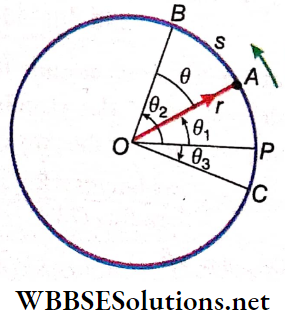
Circular Motion Circular Or Rotational Motion

Circular Motion Definition: If a particle is moving along a circular path about a point as the centre then the motion of that particle is called circular or rotational motion.

  • The surface in which the circular path lies is called the plane of rotation. A straight line drawn through the centre of the circular path and perpendicular to the plane of rotation is called the axis of rotation.
  • Let us consider a particle is revolving along a circular path of radius r and centre O. The perpendicular drawn through the point O on the plane of rotation is the axis of rotation.

Read and Learn More: Class 11 Physics Notes

  • The radius r of the circle is called the radius vector whose direction is towards the particle away from the centre. During the revolution of the particle, the radius vector also keeps on rotating.
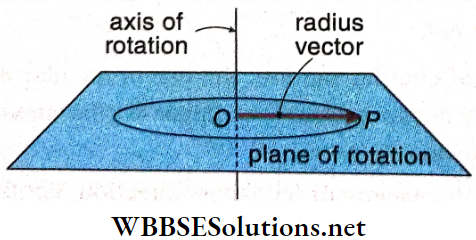
Circular Motion Radius Vector

Angular Coordinate: Let OP be the radius of the circle, and be taken as the reference for rotation i.e., at time t = 0, the position of the particle is at point P. Let us assume that the position of the particle is at point A on the circumference of the circle after time t and the arc AP makes an angle θ1 with OP at the centre O.

  • This angle θ1 is called the angular coordinate for the position A of the particle with respect to the radius OP. Similarly, the angular coordinates of the points B and C are θ2 and -θ3, respectively.
  • So, the position of the particle on a particular circular path can be determined from its angular coordinate only. It should be noted that the angular coordinate for position C in the given figure is negative.
  • Usually, for anticlockwise rotational motion, θ is taken as positive and for clockwise motion, negative.

Angular Acceleration

Key Concepts of Circular Motion in Physics

Angular Acceleration Definition: The rate of change of angular velocity of a particle with time is called the angular acceleration of that particle.

Let us consider a particle under rotational motion whose initial angular velocity is ω1 and final angular velocity after time t is ω2. So, according to the definition

angular acceleration (α) = \(\frac{\text { change in angular velocity }}{\text { time }}\)

= \(\frac{\omega_2-\omega_1}{t}\)

Compared with the definition of average acceleration in the chapter One-dimensional Motion, this can be referred to as the average angular acceleration.

Instantaneous angular acceleration: The instantaneous angular acceleration of a particle at a given point is the limiting value of the rate of the change in velocity with respect to a time interval when the time interval tends to zero.

If the change in angular velocity of a particle in a small time interval Δt is Δω, then instantaneous angular acceleration,

α = \(\alpha=\lim _{\Delta t \rightarrow 0} \frac{\Delta \omega}{\Delta t}=\frac{d \omega}{d t} .\)

Since, \(\omega=\frac{d \theta}{d t}, \alpha=\frac{d}{d t}\left(\frac{d \theta}{d t}\right)=\frac{d^2 \theta}{d t^2}\)

If the angular velocity of a particle increases gradually, the particle is said to be moving with an angular acceleration.

For example, when an electric fan is switched on, it undergoes angular acceleration before attaining its velocity.

On the other hand, if the angular velocity of a body decreases gradually, it is said to be moving with an angular deceleration or angular retardation. For example, when an electric fan is switched off, it undergoes angular deceleration until it stops.

In the case of angular retardation, the initial angular velocity ω1 is greater than the final angular velocity ω2.

Hence, \(\alpha=\frac{\omega_2-\omega_1}{t}\) = a negative quantity.

So, angular retardation is nothing but a negative angular acceleration.

WBCHSE Class 11 Physics Notes For Circular Motion

Angular Acceleration Is An Axial Vector: As \(\vec{\omega}_1\) and \(\vec{\omega}_2\) are axial vectors, \(\vec{\omega}_2\) – \(\vec{\omega}_1\) and, hence, \(\vec{\alpha}\) is also an axial vector. When \(\vec{\alpha}\) is positive, its direction is the same as that of \(\vec{\omega}\) and when \(\vec{\alpha}\) is negative, its direction is opposite to that of \(\vec{\omega}\).

Uniform vs Non-Uniform Circular Motion

Unit And Dimension Of Angular Acceleration: Unit of angular acceleration

= \(\frac{\text { unit of angular velocity }}{\text { unit of time }}\)

= \(\mathrm{radian} / \mathrm{second}{ }^2=\left(\mathrm{rad} \cdot \mathrm{s}^{-2}\right)\)

Dimension of angular acceleration = \(\frac{\text { dimension of angular velocity }}{\text { dimension of time }}=\frac{T^{-1}}{T}=T^{-2} \text {. }\)

Relation Between Linear Acceleration And Angular Acceleration: Let us consider a particle moving along a circular path of radius r, whose linear velocity changes from \(\vec{v}_1 \text { to } \vec{v}_2\) in time t. During this time interval, its angular velocity changes from \(\vec{\omega}_1\) to \(\vec{\omega}_2\).

∴ \(\vec{v}_1=\vec{\omega}_1 \times \vec{r}\) and \(\vec{v}_2=\vec{\omega}_2 \times \vec{r}\)

∴ The value of linear acceleration, \(\vec{a}=\frac{\vec{v}_2-\vec{v}_1}{t}=\frac{\left(\vec{\omega}_2 \times \vec{r}\right)-\left(\vec{\omega}_1 \times \vec{r}\right)}{t}=\frac{\left(\vec{\omega}_2-\vec{\omega}_1\right)}{t} \times \vec{r}\)

Again, angular acceleration is, \(\vec{\alpha}=\frac{\vec{\omega}_2-\vec{\omega}_1}{t}\)

∴ \(\vec{a}=\vec{\alpha} \times \vec{r}\)

Thus, the magnitude of instantaneous linear acceleration = the magnitude of instantaneous angular acceleration x radius of the circular path.

It should be remembered that in the case of pure rotation, linear acceleration changes its direction continuously, but the direction of angular acceleration remains unaltered. Whenever the axis of rotation remains fixed, the direction of angular acceleration does not change.

Geometrical Representation: Putting \(\vec{a} \text { and } \vec{\alpha}\) instead of \(\vec{v} \text { and } \vec{\omega}\), respectively, we will obtain the geometrical representation for the relation among \(\vec{a}\), \(\vec{\alpha}\) and \(\vec{r}\).

Kinematical Equations Of Rotational Motion

From the analogy of the three equations s = θ, v = rω and a = rα, it can be inferred that in case of rotational motion, angular displacement θ, angular velocity co and angular acceleration α, respectively, play the same role as that of displacement s, velocity v and acceleration a in the case of translational motion.

For this reason θ, ω and α are called the rotational analogues of s, v and a respectively. (If a quantity has similarities with another quantity, then that quantity is called the analogue of the other.)

Kinematical Equations For Uniformly Accelerated Motion Are:

  1. v = u + at
  2. s = ut + 1/2at²
  3. v² = u² + 2as

For a uniformly accelerated rotational motion, the analogues of these equations are:

  1. \(\omega_2=\omega_1+\alpha t\)
  2. \(\theta=\omega_1 t+\frac{1}{2} \alpha t^2\)
  3. \(\omega_2^2=\omega_1^2+2 \alpha \theta\)

Here, initial angular velocity = ω1, final angular velocity after time t = ω2, angular acceleration = α and angular displacement after time t = θ.

In the case of translational motion with uniform velocity, s = vt. In the case of uniform rotational motion, the analogue of this equation is θ= ωt.

Comparison Of Linear And Angular Motion With Constant Acceleration:

  1. Straight Line Motion With Constant Linear Acceleration: For an object that starts moving along a straight line with initial velocity u and constant linear acceleration a, we have
    1. a =constant,
    2. v= u+at,
    3. s =ut+ 1/2at²,
    4. v² = u² + 2as
  2. Fixed Axis Rotation With Constant Angular Acceleration: For an object that starts revolving with initial angular velocity ω0 and uniform angular acceleration α, we have
    1. \(\alpha\) = constant,
    2. \(\omega_1=\omega_0+\alpha t\),
    3. \(\theta=\omega_0 t+\frac{1}{2} \alpha t^2\),
    4. \(\omega^2=\omega_0^2+2 \alpha \theta\)

Kinematical Equations Of Rotational Motion Numerical Examples

Short Answer Questions on Circular Motion

Example 1. An electric fan is revolving with a velocity of 210 rpm. When its morion Is Increased with the help of a regulator, it attains a velocity of 630 rpm in 11 s. What is the angular acceleration of the fan? Also, calculate the number of revolutions completed by the fan in that 11s.
Solution:

Given

An electric fan is revolving with a velocity of 210 rpm. When its morion Is Increased with the help of a regulator, it attains a velocity of 630 rpm in 11 s.

Initial angular velocity, \(\omega_1=\frac{2 \pi \times 210}{60}=7 \pi \mathrm{rad} \cdot \mathrm{s}^{-1}\)

Final angular velocity, \(\omega_2=\frac{2 \pi \times 630}{60}=21 \pi \mathrm{rad} \cdot \mathrm{s}^{-1}\)

Now, from the equation ω2 = ω1+ αt we get, angular acceleration,

α = \(\frac{\omega_2-\omega_1}{t}=\frac{21 \pi-7 \pi}{11}=\frac{14 \pi}{11}=\frac{14}{11} \times \frac{22}{7}\)

= \(4 \mathrm{rad} \cdot \mathrm{s}^{-2}\)

Again, angular displacement, \(\theta=\omega_1 t+\frac{1}{2} \alpha t^2=7 \pi \times 11+\frac{1}{2} \times 4 \times(11)^2\)

θ = \(11(7 \pi+22)=484 \mathrm{rad}\)

Since in a single revolution, the angular displacement is 2π, the number of revolutions

= \(\frac{\theta}{2 \pi}=\frac{484}{2 \pi}=77\)

Example 2. A wheel rolls on a horizontal path with uniform velocity. Prove that the velocity of any point on the circumference of the wheel with respect to its centre is equal to the velocity of the wheel What will be the instantaneous velocity of the point on the wheel which touches the ground?
Solution:

A wheel rolls on a horizontal path with uniform velocity.

If the radius of the wheel is r then its circumference = 2πr, and velocity of the wheel = \(\frac{2 \pi r}{T}=\frac{2 \pi r}{\frac{2 \pi}{\omega}}=\omega r\)

here, ω = angular velocity of the wheel

Again, the linear velocity of any point on the circumference of the wheel with respect to its centre is, v = ωr. So, this velocity is the same as the velocity of the wheel.

At any moment, when a point on the wheel touches the ground, its linear velocity with respect to the centre of the wheel is v and its direction is just opposite to the direction of the linear velocity v of the wheel Hence, the instantaneous resultant velocity of the point on the wheel which touches the ground = v-v = 0.

Class 11 Physics Class 12 Maths Class 11 Chemistry
NEET Foundation Class 12 Physics NEET Physics

Example 3. Starting from rest, a wheel, with uniform acceleration, attains an angular velocity of 60 rad · s-1 at the end of 30 complete revolutions. What Is the angular acceleration of the wheel?
Solution:

Given

Starting from rest, a wheel, with uniform acceleration, attains an angular velocity of 60 rad · s-1 at the end of 30 complete revolutions.

Initial angular velocity, ω1 =0.

Angular displacement at the end of 30 revolutions, θ = 30 x 2π = 60π rad

Final angular velocity, ω1 = 60 rad · s-1

Now, from the equation \(\omega_2^2=\omega_1^2+2 a \theta\)

(α = angular acceleration of the wheel) we get, (60)2 = 0 + 2a x 60/r

or, \(\alpha=\frac{30}{\pi}=9.55 \mathrm{rad} \cdot \mathrm{s}^{-2} .\)


Circular Motion Conclusion

Centripetal Force and Circular Motion

If any particle moves along a circular path about a point as the centre, then the motion of that particle is called circular motion or rotational motion.

  • The angle subtended by the initial and final positions of a rotating particle at the centre of its path is called the angular displacement of the particle.
  • Angular displacement is a dimensionless physical quantity.
  • The rate of angular displacement of a particle with time is called the angular velocity of the particle.
  • The rate of change of angular velocity of a particle with time is called the angular acceleration of the particle.
  • If the angular velocity of a particle rotating along a circular path is constant, its motion is known as uniform circular motion.

When an object moves in a circular path with a varying speed, then the motion of the object is called non-uni-form circular motion.

There are two unit vectors of circular motion. One is the radial unit vector and the other is the tangential unit vector. The radial unit vector is directed along the radius of the circular path away from the centre.

  • The tangential unit vector is directed along the tangent of the circular path. There are two components of the acceleration in non-uniform circular motion. One is radial acceleration and the other is tangential.
  • In the case of a particle revolving along a circular path with uniform speed i.e., in the case of uniform circular motion, the acceleration which always acts towards the centre of the circle, known as the radial or centripetal or normal acceleration.
  • The force that acts normally to the direction of its velocity to rotate a body along a circular path and is directed towards the centre of that circular path from the body along the radius of the circle is called the centripetal force.

If an observer rotates with a body with the same angular velocity as that of the body rotating along a circular path, the observer will feel that a force is acting on this body which is equal but opposite in direction to the centripetal force. This force is called the centrifugal force.

Circular Motion Useful Relations For Solving Numerical Examples

1° = π/100 rad or, 1 rad = 57.296°

Distance travelled by a rotating particle (s) = radius of the path (r) x angular displacement(θ)

While revolving along a circular path, if the angular displacement of a particle is θ in time f, then the average angular velocity of the particle, \(\omega=\frac{\theta}{t}\)

If in a time interval Δt, the angular displacement of a particle is Δθ0, then the instantaneous angular velocity, \(\omega=\lim _{\Delta t \rightarrow 0} \frac{\Delta \theta}{\Delta t}=\frac{d \theta}{d t}\)

1 rpm = \(\frac{\text { one complete revolution }}{1 \text { minute }}=\frac{2 \pi}{60} \mathrm{rad} \cdot \mathrm{s}^{-1}\)

= \(\frac{\pi}{30} \mathrm{rad} \cdot \mathrm{s}^{-1}\)

Angular Velocity in Circular Motion

The value of linear velocity at any moment (v) = value of angular velocity (ω) at that moment x radius of the circular path (r)

If the initial angular velocity of a rotating particle be ω1 and that after time t is ω2, then angular acceleration (a) = \(\frac{\omega_2-\omega_1}{t}\)

Value of instantaneous linear acceleration (a) = radius of the circular path (r) x value of instantaneous angular acceleration (α)

Equations for pure circular motion of a particle with uniform angular acceleration are

  1. \(\omega_2=\omega_1+\alpha t\)
  2. \(\theta=\omega_1 t+\frac{1}{2} \alpha t^2\)
  3. \(\omega_2^2=\omega_1^2+2 \alpha \theta\)

Here, initial angular velocity = ω1, final angular velocity after time t = ω2, angular acceleration = α and angular displacement in time t = d.

If a particle of mass m revolves along a circular path of radius r with uniform speed v, the normal or centripetal acceleration of the particle = \(\omega^2 r=\frac{v^2}{r}\)(ω = angular velocity of the particle, ω = \(\frac{v}{r}\))

If the mass of the body is m, the radius of its circular path is r, its linear velocity is v and its angular velocity is ω, then centrifugal force = \(m \omega^2 r=\frac{m v^2}{r}\)

If a body of mass m revolves along a circular path of radius r with velocity v (angular velocity ω), then centrifugal force = \(\frac{m v^2}{r}=m \omega^2 r\)

Circular Motion Assertion Reason Type Question And Answers

Applications of Circular Motion in Real Life

These questions have statement 1 and statement 2. Of the four choices given below, choose the one that best describes the two statements.

  1. Statement 1 Is true, statement 2 Is true; statement 2 is a correct explanation for statement 1.
  2. Statement 1 Is true, and statement 2 Is true; statement 2 is not a correct explanation for statement 1.
  3. Statement 1 is true, statement 2 is false,
  4. Statement 1 Is false, and statement 2 is true.

Question 1.

Statement 1: A pendulum is oscillating between points A, B and C. Acceleration of bob at points A or C is zero.
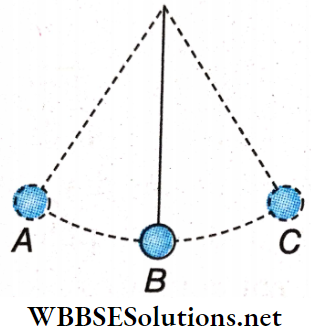
Circular Motion Pendulum IS Oscillationg Between The Points

Statement 2: Velocity at A and C is zero.

Answer: 4. Statement 1 Is false, and statement 2 is true.

Question 2.

Statement 1: A particle of mass m undergoes uniform horizontal circular motion inside a smooth funnel as shown, The Normal reaction in this case is not mgcosθ.
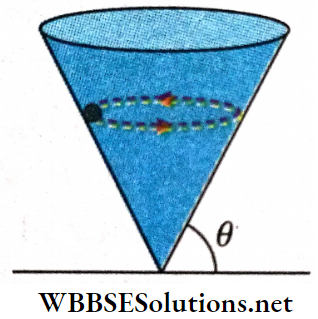
Circular Motion Uniform Horizontal Circular Motion

Statement 2: Acceleration of particle is not along the surface of the funnel.

Answer: 1. Statement 1 Is true, statement 2 Is true; statement 2 is a correct explanation for statement 1.

Question 3.

Statement 1: If a car is taking a turn on a banked road, then the normal contact force between the car and the road is greater than the weight of the car (neglecting friction).

Statement 2: On a banked road, the horizontal component of normal contact force between the car and the road provides the necessary centripetal force. Assume friction is absent.

Answer: 2. Statement 1 is true, statement 2 is false,

Question 4.

Statement 1: A car takes a turn of radius 20 m with a constant velocity of 10 m · s-1.

Statement 2: In circular motion, velocity can never be constant.

Answer: 4. Statement 1 Is false, and statement 2 is true.

Question 5.

Statement 1: A particle can perform circular motion without having any tangential component of acceleration.

Statement 2: For circular motion to take place, radial acceleration should exist.

Answer: 2. Statement 1 Is true, and statement 2 Is true; statement 2 is not a correct explanation for statement 1.

Question 6.

Statement 1: Uniform circular motion is uniformly accelerated motion.

Statement 2: Acceleration in uniform circular motion is always towards the centre.

Answer: 4. Statement 1 Is false, and statement 2 is true.

Question 7.

Statement 1: In circular motion average speed and average velocity are never equal.

Statement 2: In any curvilinear path these two are never equal.

Answer: 1. Statement 1 Is true, statement 2 Is true; statement 2 is a correct explanation for statement 1.

Circular Motion Match Column A With Column B

Question 1. In Column A some physical quantities related to translational motion are given, while in Column B physical quantities associated with rotational motion are mentioned.
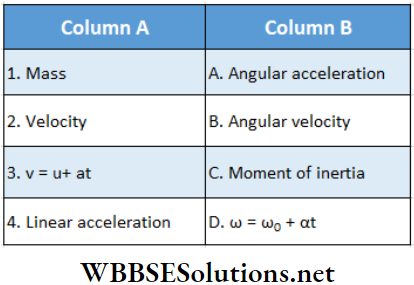
Circular Motion Match The Column Question 1

Answer: 1. C, 2. B, 3. D, 4. A

Question 2. A particle is rotating in a circle of radius R = \(\frac{2}{\pi}\)m, with constant speed 1 m • s-1. Match the following two columns for the time interval when it completes 1/4 th of the circle.
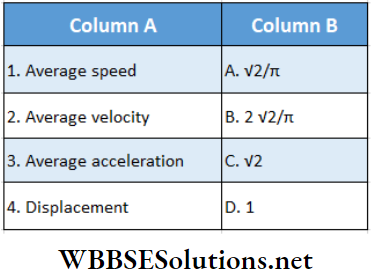
Circular Motion Match The Column Question 2

Answer: 1. D, 2. B, 3. C, 4. B

Circular Motion Comprehension Type Question And Answers

Read the following passages carefully and answer the questions at the end of them.

Question 1. A particle is moving along a circular path of radius 0.7 m with constant tangential acceleration of 5 m · s-2. The particle is initially at rest. Based on the above information, answer the following questions

1. The speed of the particle after 7 s is

  1. 5 m • s-1
  2. 7 m • s-1
  3. 35 m • s-1
  4. 48 m • s-1

Answer: 3. 35 m • s-1

2. The radial acceleration of the particle at t = 7 s is

  1. 1200 m · s-2
  2. 1750 m · s-2
  3. 70 m · s-2
  4. 250 m · s-2

Answer: 2. 1750 m · s-2

3. Distance travelled by the particle in 7 s is

  1. 123 m
  2. 725 m
  3. 728 m
  4. 426 m

Answer: 1. 123 m

4. The number of revolutions made by the particle in 7 s is

  1. 27.8
  2. 164.8
  3. 165.52
  4. 96.85

Answer: 1. 27.8

Question 2. A small particle of mass m attached with a light inextensible thread of length L is moving in a vertical circle. In the given case the particle is moving in a complete vertical circle and ratio of its maximum to minimum velocity is 2: 1.

1. Minimum velocity of the particle is

  1. \(\sqrt[4]{\frac{g L}{3}}\)
  2. \(2 \sqrt{\frac{g L}{3}}\)
  3. \(\sqrt{\frac{g L}{3}}\)
  4. \(3 \sqrt{\frac{g L}{3}}\)

Answer: 2. \(2 \sqrt{\frac{g L}{3}}\)

2. The kinetic energy of the particle at the lowest position is

  1. \(\frac{4 m g L}{3}\)
  2. \(2 m g L\)
  3. \(\frac{8 m g L}{3}\)
  4. \(\frac{2 m g L}{3}\)

Answer: 3. \(\frac{8 m g L}{3}\)

3. The velocity of the particle when it is moving vertically downward is

  1. \(\sqrt{\frac{10 g L}{3}}\)
  2. \(2 \sqrt{\frac{g L}{3}}\)
  3. \(\sqrt{\frac{8 g L}{3}}\)
  4. \(\sqrt{\frac{13 g L}{3}}\)

Answer: 1. \(\sqrt{\frac{10 g L}{3}}\)

Question 3. The earth rotates once per day about an axis passing through the north and south poles, that is perpendicular to the plane containing the equator. Assume the earth as a sphere of radius 6400 km. The two particles A and B are considered on the surface of the earth as shown. The particle A is situated at the equator and B is situated at a latitude of 30° north of the equator.

1. The speed of particle A is

  1. 465.4 m · s-1
  2. 850 m · s-1
  3. 243.6 m · s-1
  4. 1.675 x 10⁶ m · s-1

Answer: 1. 465.4 m · s-1

2. The acceleration of particle A is

  1. 3.38 x 10⁻⁷ m · s-2
  2. 3.38 x 10⁻⁵ m · s-2
  3. 3.38 x 10⁻² m · s-2
  4. 3.38 x 10⁻¹ m · s-2

Answer: 3. 3.38 x 10⁻² m · s-2

3. The speed of particle B is

  1. 405 m · s-1
  2. 403 m · s-1
  3. 706.5 m · s-1
  4. 210 m · s-1

Answer: 2. 403 m · s-1

Circular Motion Integer Answer Type Questions

In this type, the answer to each of the questions is a single-digit integer ranging from 0 to 9.

Question 1. A particle is moving along a circular path of radius 2 m with a constant angular velocity of 3 rad • s-2. Determine the angular displacement (in rad) of the particle in 3 s.
Answer: 9

Question 2. A particle moves in a circle of radius 1.0 cm at a speed given by v = 2.0t, where v is in cm · s-1 and t in seconds. Find the radial acceleration of the particle at t = 1s.
Answer: 4

Question 3. If the earth was to suddenly contract to half its present size, without any change in its mass, then what would be the duration of the new days (in hours)?
Answer: 6
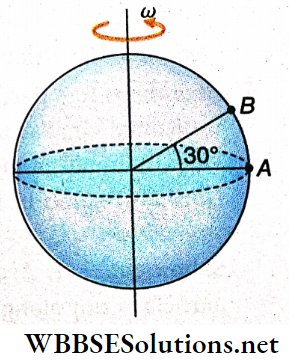
Circular Motion Earth Rotated Once Perday


WBCHSE Class 11 Physics Circular Motion Very Short Answer Questions

Circular Motion Very Short Answer Type Questions

Very Short Answer Questions on Circular Motion for Class 11

Question 1. Name the unit of angular displacement.
Answer:

The unit of angular displacement

Degree or radian

Question 2. State true or false—an angle measured in radians is dimensionless.
Answer: True

Read And Learn More WBCHSE Class 11 Physics Very Short Question And Answers

Question 3. What kind of vector is angular velocity?
Answer: Axial vector

Question 4. What is the angular velocity of the second hand of a clock?
Answer:

The angular velocity of the second hand of a clock

10.105 rad · s-1

Question 5. Uniform circular motion is an example of uniform velocity’—state whether the statement is correct.
Answer: No

Question 6. What do you mean by the term frequency?
Answer:

Frequency

Complete rotation number per second

WBCHSE Class 11 Physics Circular Motion Vsaqs

Question 7. What is the relation between time period and frequency?
Answer:

Relation between time period and frequency

v = \(\frac{1}{T}\)

Question 8. What is the dimension of angular acceleration?
Answer:

Dimension of angular acceleration

T-2

Quetsion 9. 1 rps = ______ rpm = _______ rph
Answer: 60, 3600

Question 10. 1 rpm =? rad · s-1
Answer: π/30

Question 11. What is the vector relation of linear acceleration \(\vec{a}\) and angular acceleration (\(\vec{alpha}\))?
Answer: \(\vec{a}\) = \(\vec{alpha}\) x \(\vec{r}\)

Question 12. In the case of uniform circular motion, the velocity and the acceleration are perpendicular to each other. [State true or false]
Answer: True

Question 13. What is the angular velocity of the minute hand of a clock in rad •· s-1?
Answer: π/1800

Key Terms in Circular Motion: Very Short Answers

Question 14. If the frequency of revolution of a body is n, then what will be the velocity of revolution?
Answer: ω = 2πn

Question 15. A particle of mass m is moving in a circular path of radius r with a uniform speed v. The centripetal force on the body is \(\frac{m \omega^2}{r}\). When the particle is displaced half of the distance, then what is the work done by the centripetal force?
Answer: Zero

Question 16. What does supply the necessary centripetal force when a stone tied with a string is rotated along a circular Path?
Answer: Tension in the string

Question 17. What does provide a planet the necessary centripetal force to revolve around the sun?
Answer: The gravitational force of the sun

Question 18. If a particle moves in a circular path with constant speed, what should be the direction of its resultant acceleration?
Answer: Towards the centre

Question 19. In the case of railway tracks, which rail is to be kept at a slightly higher level near a bend?
Answer: Outer rail

Class 11 Physics Class 12 Maths Class 11 Chemistry
NEET Foundation Class 12 Physics NEET Physics

Question 20. The radius of a curved path is r and the coefficient of friction between a car and the path is μ. What is the maximum speed at which the car can turn at a bend without skidding?
Answer: \(V_m=\sqrt{\mu r g}\)

Question 21. Is it possible for a cyclist to lean through an angle of 45° with the vertical when he takes a turn?
Answer: No

Question 22. Why is a centripetal force so-called?
Answer: It is centre-seeking

Common Concepts in Circular Motion: Short Answers

Question 23. For uniform circular motion, does the direction of the centripetal force depend on the sense of rotation (i.e., clockwise or anti-clockwise)?
Answer: No

Question 24. A body is moving along a circular path such that its speed always remains constant. Should there be a force acting on the body?
Answer: Yes

Question 25. What type of acceleration does a body moving along a circular path possess?
Answer: Centripetal

Question 26. A piece of stone is tied with a thread and is rotated along a horizontal circular path. If the thread snaps suddenly, in which direction will the stone fly?
Answer: Tangentially

Question 27. What supplies the necessary centripetal force to the electrons in an atom to revolve around the nucleus?
Answer: Electrostatic force of attraction

Question 28. When a car turns towards the right while moving, the passengers inside the car lean towards _______.
Answer: Left

Question 29. To avoid an accident of a moving car near a bend, _______ force is supplied by banking the road.
Answer: Centripetal

Examples of Circular Motion with Very Short Answers

Question 30. A cyclist is riding on a cycle with speed v and while negotiating a circular path of radius r, he leans at an angle θ with the ground. Then, what will be the value of tanθ?
Answer: \(\frac{rg}{v^2}\)

Question 31. The angular momentum of a body of mass m rotating along a circular path of radius r with uniform speed is L. What is the magnitude of the centripetal force acting on it?
Answer: \(\frac{L^2}{mr^3}\)

Question 32. When a motor car moves speedily on a convex path, how do the passengers inside the car feel?
Answer: Lighter

Question 33. At which plane on earth, the centripetal force is maximum?
Answer: Equatorial plane

Question 34. Due to which type of force butter comes out during stirring of milk?
Answer: Centrifugal

Question 35. A body of mass m is rotated along a circular path of radius r with uniform speed v. Centripetal force acting on the body is \(\frac{m v^2}{r}\). If the body travels through a semicircular path, then what will be the work done by the centripetal force?
Answer: Zero

WBCHSE Class 11 Physics Circular Motion Multiple Choice Questions

WBCHSE Class 11 Physics Circular Motion MCQs

Circular Motion Multiple Choice Questions And Answers

Question 1. A wheel is rotating 300 times per minute. The angular velocity of the wheel in rad • s-1 unit is

  1. 10π
  2. 20π
  3. 30π

Answer: 1.10π

Question 2. Two bodies of masses m1 and m2 are moving at uniform speed along circular paths of radii r1 and r2 respectively. If they take equal time to describe the circles completely, the ratio of their angular velocities will be

  1. \(\frac{r_1}{r_2}\)
  2. \(\frac{m_1}{m_2}\)
  3. \(\frac{m_1 r_1}{m_2 r_2}\)
  4. 1

Answer: 4. 1

WBCHSE Class 11 Physics Circular Motion Multiple Choice Questions

Question 3. If a body travels along a circular path with uniform speed then its acceleration

  1. Acts along its circumference
  2. Acts along its tangent
  3. Acts along its radius
  4. Is zero

Answer: 3. Acts along its radius

Question 4. After switching on a ceiling fan it completes 10 resolutions in 3 s. The number of complete resolutions it will perform in the next 3 s (assuming uniform angular acceleration) is

  1. 10
  2. 20
  3. 30
  4. 40

Answer: 3. 30

WBCHSE Class 11 Physics Circular Motion MCQs 

Question 5. If a wheel revolves 120 times per minute then its angular velocity in rad · s-1 unit is

  1. π²
  2. 2π²
  3. 4π²
  4. 8π²

Answer: 2. 2π²

Circular Motion MCQs for Class 11 WBCHSE

Question 6. The angular velocity of the hour hand of a clock is

  1. \(\frac{\pi}{30} \mathrm{rad} \cdot \mathrm{s}^{-1}\)
  2. \(2 \pi \mathrm{rad} \cdot \mathrm{s}^{-1}\)
  3. \(\frac{\pi}{1800} \mathrm{rad} \cdot \mathrm{s}^{-1}\)
  4. \(\frac{\pi}{21600} \mathrm{rad} \cdot \mathrm{s}^{-1}\)

Answer: 4. \(\frac{\pi}{21600} \mathrm{rad} \cdot \mathrm{s}^{-1}\)

Question 7. If a particle rotates along a circular path of radius 25 cm with a frequency of 2 rps, its linear acceleration in m · s-2 unit is

  1. π²
  2. 2π²
  3. 4π²
  4. 8π²

Answer: 3.

Question 8. An artificial satellite takes 90 minutes to complete its revolution around the Earth. The angular speed of the satellite is

  1. \(\frac{\pi}{1800} \mathrm{rad} \cdot \mathrm{s}^{-1}\)
  2. \(\frac{\pi}{2700} \mathrm{rad} \cdot \mathrm{s}^{-1}\)
  3. \(\frac{2 \pi}{2700} \mathrm{rad} \cdot \mathrm{s}^{-1}\)
  4. \(\frac{\pi}{45} \mathrm{rad} \cdot \mathrm{s}^{-1}\)

Answer: 2. \(\frac{\pi}{2700} \mathrm{rad} \cdot \mathrm{s}^{-1}\)

Question 9. The driver of a truck suddenly finds a wall in front of him. To avoid collision with the wall he should

  1. Apply brake at once
  2. Turn speedily in a circular path
  3. Follow both the processes 1 and 2
  4. Do none of the above processes

Answer: 1. Apply brake at once

Question 10. Which of the following quantities does not remain constant in a uniform circular motion?

  1. Speed
  2. Momentum
  3. Kinetic energy
  4. Mass

Answer: 2. Momentum

WBCHSE Class 11 Physics Circular Motion MCQs 

Question 11. The angular velocity of a particle, \(\vec{w}=3 \hat{i}-4 \hat{j}+\hat{k}\) and its position vector, \(\vec{r}=5 \hat{i}-6 \hat{j}+6\hat{k}\). What is the linear velocity of the particle?

  1. \(-18 \hat{i}+13 \hat{j}+2 \hat{k}\)
  2. \(18 \hat{i}-13 \hat{j}-2 \hat{k}\)
  3. \(-18 \hat{i}-13 \hat{j}+2 \hat{k}\)
  4. \(18 \hat{i}+13 \hat{j}-2 \hat{k}\)

Answer: 3. \(-18 \hat{i}-13 \hat{j}+2 \hat{k}\)

Class 11 Physics Class 12 Maths Class 11 Chemistry
NEET Foundation Class 12 Physics NEET Physics

Question 12. The ratio of angular speeds of the minute hand and hour hand of a watch is

  1. 1:12
  2. 6:1
  3. 12:1
  4. 1:6

Answer: 3. 12:1

Question 13. A panicle moves with constant angular velocity in a circle. During the motion its

  1. Energy is conserved
  2. Momentum is conserved
  3. Energy and momentum both are conserved
  4. None of the above

Answer: 1. Energy is conserved

Sample MCQs on Centripetal Force and Acceleration

Question 14. The angular speed of a flywheel making 360 revolutions per minute is

  1. 12 π rad · s-1
  2. 6 π rad · s-1
  3. 3 π rad · s-1
  4. 2 π rad · s-1

Answer: 1. 12π rad · s-1

Question 15. A car moves on a circular road. It describes equal angles about the centre in equal intervals of time. Which of the following statements about the velocity of the car is true?

  1. The magnitude of velocity is not constant
  2. Both magnitude and direction of velocity change
  3. Velocity is directed towards the centre of the circle
  4. The magnitude of velocity is constant but the direction changes

Answer: 4. Magnitude of velocity is constant but the direction changes

Class 11 Physics Circular Motion Multiple Choice Questions WBCHSE 

Question 16. A wheel of radius R rolls on the ground with a uniform velocity v. The velocity of the topmost point relative to the bottommost point is

  1. v
  2. 2v
  3. \(\frac{v}{2}\)
  4. Zero

Answer: 2. 2v

Question 17. The angle with which a cyclist leans with the horizontally while turning a curved path of radius r with speed v is

  1. \(\theta=\tan ^{-1} \frac{v^2}{r g}\)
  2. \(\theta=\tan ^{-1} v^2 r g\)
  3. \(\theta=\tan ^{-1} \frac{r g}{v^2}\)
  4. \(\theta=\tan ^{-1} \frac{r}{v g}\)

Answer: 2. \(\theta=\tan ^{-1} v^2 r g\)

Class 11 Physics Circular Motion Multiple Choice Questions WBCHSE 

Question 18. While taking a turn on a plane horizontal road, a car can skid due to

  1. Gravitational force
  2. Absence of necessary centripetal force
  3. Rolling friction between the tyre of the car and the road
  4. Reaction force of the road

Answer: 2. Absence of necessary centripetal force

Question 19. A car is moving along a horizontal circular path of radius 10 m at a uniform speed of 10 m · s-1. A pendulum bob is suspended by means of a light rod from the ceiling of the car. The angle made by the rod with the horizontal path will be (g = 10 m s-2)

  1. Zero
  2. 30°
  3. 45°
  4. 60°

Answer: 3. 45°

Question 20. If maximum and minimum tension in the string whirling in a circle of radius 2.5 m are in the ratio 5 : 3 then its velocity is

  1. \(\sqrt{98} \mathrm{~m} \cdot \mathrm{s}^{-1}\)
  2. \(7 \mathrm{~m} \cdot \mathrm{s}^{-1}\)
  3. \(\sqrt{490} \mathrm{~m} \cdot \mathrm{s}^{-1}\)
  4. \(\sqrt{4.9} \mathrm{~m} \cdot \mathrm{s}^{-1}\)

Answer: 1. \(\sqrt{98} \mathrm{~m} \cdot \mathrm{s}^{-1}\)

WBCHSE Physics Circular Motion Chapter MCQs 

Question 21. The coefficient of friction between the road and the tyre of a car is 0.6. What is the maximum safe limiting speed with which the car can overcome a bend of radius 150 m?

  1. 60m · s-1
  2. 15m · s-1
  3. 30 m · s-1
  4. 25 m · s-1

Answer: 3. 30 m · s-1

Question 22. A body is moving in a circular path with centripetal acceleration a. If its speed gets doubled, find the ratio of the centripetal acceleration after and before the speed in changed.

  1. 1:4
  2. 1:2
  3. 2:1
  4. 4:1

Answer: 4. 4:1

Question 23. A ball of mass 0.12 kg is being whirled in a horizontal circle at the end of a string 0.5 m long. It is capable of making 231 revolutions in one minute. The breaking tension of the string is

  1. 3N
  2. 15.1 N
  3. 31.5 N
  4. 35.1 N

Answer: 4. 35.1 N

Circular Motion MCQs for Class 11 Physics WBCHSE 

Practice Questions on Uniform Circular Motion

Question 24. A car is moving in a circular horizontal track of radius 10 m with a constant speed of 10 m · s-1. A plumb bob is suspended from the roof of the car by a light rigid rod of length 1.0 m. The angle made by the rod with the track is (g = 10 m · s-2)

  1. Zero
  2. 30°
  3. 45°
  4. 60°

Answer: 3. 45°

Question 25. The motor of an engine is rotating about its axis with an angular velocity of 100 rpm. It comes to rest in 15 s, after being switched off. Assuming constant angular deceleration, what are the numbers of revolutions made by it before coming to rest?

  1. 12.5
  2. 40
  3. 32.5
  4. 15.6

Answer: 1. 12.5

In this type of question, more than one option are correct.

WBCHSE Class 11 Physics Circular Motion Questions and Answers 

Question 26. In uniform circular motion of a particle

  1. Particles cannot have uniform velocity
  2. Particles cannot have uniformly accelerated motion
  3. The particle cannot have net force equal to zero
  4. Particles cannot have any force in the tangential direction

Answer: All options are correct

Question 27. A particle is moving in a circular path with decreasing speed. For this situation, mark out the correct statements.

  1. The radial component of its acceleration is decreasing in magnitude
  2. The angular speed of the particle is decreasing
  3. The tangential components of its acceleration and velocity are in opposite directions
  4. The article is performing a ron-uniform circular motion

Answer: All options are correct

WBCHSE Class 11 Physics Circular Motion Short Answer Questions

Circular Motion Short Answer Type Questions

Short Answer Questions on Circular Motion for Class 11

Question 1. When a car takes a circular turn on a level road, which force acts as the centripetal force?
Answer:

When a vehicle takes a turn on a road, the frictional force acting between the tyres of the vehicle and the road supplies the necessary centripetal free.

Question 2.

  1. A particle is moving in a circle of radius r with constant angular velocity ω. At any point (r, θ) on its path, its position vector is \(\vec{r}=r \cos \theta \hat{i}+r \sin \theta \hat{j}\). Show that the velocity of the particle has no component along the radius.
  2. Find an expression for the acceleration of the particle and hence indicate its direction.

Answer:

1. \(\vec{r}=r \cos \theta \hat{i}+r \sin \theta \hat{j}\)

∴ \(\frac{d \vec{r}}{d t}=-r \sin \theta \frac{d \theta}{d t} \hat{i}+r \cos \theta \frac{d \theta}{d t} \hat{j}\)

Circular Motion A Particle Is Moving In A Circle Of Radius

= \(r \omega(-\sin \theta \hat{i}+\cos \theta \hat{j})\)

or, \(\nu=\left|\frac{d \vec{r}}{d t}\right|=\sqrt{r^2 \omega^2}=r \omega\)

So, \(\vec{r} \cdot \frac{d \vec{r}}{d t}=r^2 \omega(-\cos \theta \sin \theta+\cos \theta \sin \theta)=0\)

WBCHSE Class 11 Physics Circular Motion Saqs

As, \(\vec{r}\) and \(\frac{d \vec{r}}{d t}\) are mutually perpendicular, the component of \(\frac{d \vec{r}}{d t}\) along \(\vec{r}\) is zero.

2. Acceleration of the particle, \(\vec{a} =\frac{d \vec{v}}{d t}=r \omega(-\cos \theta \hat{i}-\sin \theta \hat{j}) \frac{d \theta}{d t}\)

= \(-r \omega^2(\cos \theta \hat{i}+\sin \theta \hat{j})\) [because ω = constant]

= \(-\omega^2 \vec{r}\)

∴ \(\vec{a}\) and \(\vec{r}\) are acted in opposite direction.

Question 3. Two particles having masses M and m are moving in a circular path having radii R and r respectively. If their periods are the same, then the ratio of their angular velocities will be

  1. \(\frac{R}{r}\)
  2. \(\sqrt{\frac{R}{r}}\)
  3. \(\frac{r}{R}\)
  4. 1

Answer:

Given

Two particles having masses M and m are moving in a circular path having radii R and r respectively. If their periods are the same

Time period = \(\frac{2 \pi R}{v_1}=\frac{2 \pi r}{v_2}\)

or, \(\frac{v_1}{v_2}=\frac{R}{r}\) [where \(v_1\) and \(v_2\) are linear velocities]

If the angular velocities are \(\omega_1\) and \(\omega_2\) respectively, \(v_1=\omega_1 R \quad \text { and } v_2=\omega_2 r\)

∴ \(\frac{\omega_1}{\omega_2}=\frac{v_1}{R} \cdot \frac{r}{v_2}=\frac{R}{r} \cdot \frac{r}{R}=1\)

The option 4 is correct.

Understanding Circular Motion: Short Answer Format

Question 4. Express in diagram, angular velocity, angular acceleration, linear velocity and linear acceleration as vector quantity.
Answer:

Here, \(\vec{v}\) = linear velocity ; \(\vec{\omega}\) = angular velocity ;\(\vec{a}\) = linear acceleration and \(\vec{\alpha}\) = angular acceleration

Circular Motion Vector Quantity

When velocity gradually increases, both \(\vec{\omega}\) and \(\vec{\alpha}\) act in the same direction. On the other hand, if the velocity gradually decreases, \(\vec{\alpha}\) acts in the direction opposite to that of \(\vec{\omega}\).

Question 5. The maximum velocity of the car which is moving in a circular path of radius 150m in the horizontal plane during banking is (coefficient of friction 0.6)

  1. 60 m/s
  2. 30 m/s
  3. 15 m/s
  4. 25 m/s

Answer:

Given

The maximum velocity of the car which is moving in a circular path of radius 150m

⇒ \(\nu_{\max }=\sqrt{r \mu g}=\sqrt{150 \times 0.6 \times 9.8} \approx 30 \mathrm{~m} / \mathrm{s}\)

The option 2 is correct

Question 6. If the radii of circular paths of two particles of the same masses are in the ratio 1:2, then, in order to have the same centripetal force, their velocities should be in the ratio of

  1. 1:√2
  2. √2:1
  3. 4:1
  4. 1:4

Answer:

Given

If the radii of circular paths of two particles of the same masses are in the ratio 1:2, then, in order to have the same centripetal force,

Centripetal force = \(\frac{m v^2}{r}\) as the masses of the two particles are equal.

\(\frac{m v_1^2}{r_1}=\frac{m v_2^2}{r_2}\)

or, \(\frac{v_1}{v_2}=\sqrt{\frac{r_1}{r_2}}=\sqrt{\frac{1}{2}}=\frac{1}{\sqrt{2}}\)

The option 1 is correct.

Question 7. Calculate the angular speed of a car which rounds a curve of radius 8 m at a speed of 50 km/h.
Answer:

v = \(50 \mathrm{~km} / \mathrm{h}=\frac{50 \times 1000}{60 \times 60} \mathrm{~m} / \mathrm{s}=\frac{125}{9} \mathrm{~m} / \mathrm{s}\)

∴ Angular velocity, \(\omega=\frac{\nu}{r}=\frac{125 / 9}{8}=\frac{125}{72}=1.736 \mathrm{~s}^{-1}\)

Class 11 Physics Class 12 Maths Class 11 Chemistry
NEET Foundation Class 12 Physics NEET Physics

Examples of Circular Motion with Short Answers

Question 8. A particle is moving uniformly in a circular path of radius r. When it moves through an angular displacement θ, then the magnitude of the corresponding linear displacement will be

  1. \(2 r \cos \left(\frac{\theta}{2}\right)\)
  2. \(2 r \cot \left(\frac{\theta}{2}\right)\)
  3. \(2 r \tan \left(\frac{\theta}{2}\right)\)
  4. \(2 r \sin \left(\frac{\theta}{2}\right)\)

Answer:

Given

Aparticle is moving uniformly in a circular path of radius r. When it moves through an angular displacement θ,

Here, \(\angle A O D=\frac{\theta}{2}=\angle B O D, A O=r, A D=B D\)

Circular Motion Linear Displacement

From \(\triangle A O D\)

∴ \(\sin \frac{\theta}{2}=\frac{A D}{O A} \quad \text { or, } A D=r \sin \frac{\theta}{2}\)

Linear displacement, \(A B=2 \times A D=2 r \sin \frac{\theta}{2}\)

The option 4 is correct

Question 9. A circular disc rolls on a horizontal floor without slipping and the centre of the disc moves with a uniform velocity v. Which of the following values the velocity at a point on the rim of the disc can have?

  1. v
  2. -v
  3. 2v
  4. Zero

Answer:

Given

A circular disc rolls on a horizontal floor without slipping and the centre of the disc moves with a uniform velocity v.

Velocity of the point of contact of the circular disc with respect to the horizontal floor = v – v = 0

Velocity of the farthest point = v + v = 2v

Horizontal velocity of the left or right endpoint

= velocity of the centre of the disc

= v

Option 1, 3 and 4 is correct.

Question 10. A particle is moving with a uniform speed in a circular orbit of radius R in a central force inversely proportional to the nth power of R. If the period of rotation of the particle is T, then

  1. \(T \propto R^{(n+1) / 2}\)
  2. \(T \propto R^{n / 2}\)
  3. \(T \propto R^{3 / 2}\) for any n
  4. \(T \propto R^{\frac{n}{2}+1}\)

Answer:

Given

A particle is moving with a uniform speed in a circular orbit of radius R in a central force inversely proportional to the nth power of R.

According to the given condition, \(F \propto \frac{1}{R^n} or, F=\frac{k}{R^n} \)

or, \(m \omega^2 R=\frac{k}{R^n} or, m\left(\frac{2 \pi}{T}\right)^2=\frac{k}{R^{n+1}} \quad or, \frac{4 \pi^2 m}{T^2}=\frac{k}{R^{n+1}}\)

So, \(\frac{1}{T^2} \propto \frac{1}{R^{n+1}} \quad or, T \propto R^{\frac{n+1}{2}}\)

The option 1 is correct

Question 11. A solid cylinder of mass 50 kg and radius 0.5 m is free to rotate about the horizontal axis. A massless string is wound around the cylinder with one end attached to it and the other hanging freely. Tension in the string required to produce an angular acceleration of 2 revolutions s-2 is

  1. 25 N
  2. 50N
  3. 78.5 N
  4. 157N

Answer:

Given

A solid cylinder of mass 50 kg and radius 0.5 m is free to rotate about the horizontal axis. A massless string is wound around the cylinder with one end attached to it and the other hanging freely.

Here, \(\alpha=2 \mathrm{rev} \cdot \mathrm{s}^{-2}=4 \pi \mathrm{rad} \cdot \mathrm{s}^{-2}\)

I = \(\frac{1}{2} M R^2=\frac{1}{2}(50)(0.5)=\frac{25}{4} \mathrm{~kg} \cdot \mathrm{m}^2\)

As, \(\tau=I \alpha, \text { so, } T R=I \alpha\)

∴ T = \(\frac{I \alpha}{R}=\frac{\left(\frac{25}{4}\right)(4 \pi)}{0.5}=50 \pi=157 \mathrm{~N}\)

The option 4 is correct

Centripetal Force and Acceleration: Short Answer Questions

Question 12. A car is negotiating a curved road of radius R. The road is banked at an angle θ. The coefficient of friction between the tyres of the car and the road is μs. The maximum safe velocity on this road is

  1. \(\sqrt{g R\left(\frac{\mu_s+\tan \theta}{1-\mu_s \tan \theta}\right)}\)
  2. \(\sqrt{\frac{g}{R}\left(\frac{\mu_s+\tan \theta}{1-\mu_s \tan \theta}\right)}\)
  3. \(\sqrt{\frac{g}{R^2}\left(\frac{\mu_s+\tan \theta}{1-\mu_s \tan \theta}\right)}\)
  4. \(\sqrt{g R^2\left(\frac{\mu_s+\tan \theta}{1-\mu_s \tan \theta}\right)}\)

Answer: Option 1 is correct

Question 13. A uniform circular disc of radius 50 cm at rest is free to turn about an axis which is perpendicular to its plane and passes through its centre. It is subjected to a torque which produces a constant angular acceleration of 2.0 rad/s². Its net acceleration in m/s² at the end of 2.0 s is approximately

  1. 7.0
  2. 6.0
  3. 3.0
  4. 8.0

Answer:

Given

A uniform circular disc of radius 50 cm at rest is free to turn about an axis which is perpendicular to its plane and passes through its centre. It is subjected to a torque which produces a constant angular acceleration of 2.0 rad/s².

Angular acceleration, a = 2 rad/s²

diameter of the disc, R = 50 cm = 0.5 m

The angular speed of the disc after 2 s,

ω = ω0 + αt

= (0 + 2×2) [ω0 = 0]

= 4 rad/s

At that instant, radial acceleration, ar = Rω² = 0.5 x (4)² = 8 m/s²

and tangential acceleration, at = Rα = 0.5 x 2 = 1 m/s²

∴ Resultant acceleration a = \(\sqrt{a_r^2+a_t^2}=\sqrt{8^2+1^2} \approx 8 \mathrm{~m} / \mathrm{s}^2\)

The option 4 is correct

Question 14. A cyclist on a level road takes a sharp circular turn of radius 3m (g = 10 m · s-2). If the coefficient of static friction between the cycle tyres and the road is 0.2, at which of the following speeds will the cyclist not skid while taking the turn?

  1. 14.4 km · h-1
  2. 7.2 km · h-1
  3. 9 km · h-1
  4. 10.8 km · h-1

Answer:

Given

A cyclist on a level road takes a sharp circular turn of radius 3m (g = 10 m · s-2). If the coefficient of static friction between the cycle tyres and the road is 0.2,

The maximum speed at which the cyclist will not skid is,

∴ \(v_m =\sqrt{\mu r g}=\sqrt{0.2 \times 3 \times 10}=2.45 \mathrm{~m} / \mathrm{s} \)

= \(\frac{2.45 \times 60 \times 60}{1000} \mathrm{~km} / \mathrm{h}=8.82 \mathrm{~km} \cdot \mathrm{h}^{-1}\)

Among the given options, 7.2 km · h-1 is less than this.

The option 2 is correct.

Real-Life Applications of Circular Motion: Short Answers

Question 15. Derive an expression for the acceleration of a body of mass m moving with a uniform speed v in a circular path of radius r.
Answer:

Let A = initial position of the body;

B = position of the body after a small time interval t.

So, the angular displacement θ = ∠AOB is also small, and the displacement x effectively coincides with the arc AB of the circular path. Then,

Circular Motion Circular Path

Now at A, the velocity v is horizontal; at B, the velocity makes the same angle θ with the horizontal direction, keeping its magnitude v to be the same, as the body moves with a uniform speed v.

Again, as θ is small, the change of velocity u, effectively coincides with a circular arc.

So, \(\theta=\frac{u}{v}\)

Then we get, \(\frac{x}{r}=\frac{u}{v}\) or, \(u=\frac{v}{r} x\)

Hence, the acceleration is, a = \(\frac{\text { change of velocity }}{\text { time }}=\frac{u}{t}=\frac{v x}{r t}\)

= \(\frac{v}{r} v=\frac{v^2}{r}\)

Shows that, as θ is small, u is normal to the velocity v. As v is tangential at every point on the circular path, the acceleration a is radial. This is the centripetal acceleration of a uniform circular motion.

Question 16. Why are circular roads banked? Deduce an expression for maximum speed of a vehicle which can be achieved while taking a turn on the banked curved road neglecting friction.
Answer:

The breadths of circular roads are sometimes kept slanted with the horizontal. This is called banking. In a banked road, the normal reaction of a vehicle would have a horizontal component. This contributes to the centripetal force of circular motion and thus helps a vehicle to have a greater safe speed.

Circular Motion Circular Roads Banked

θ = banking angle; N = normal reaction; Ncosθ = vertical component of N, which balances the weight mg of the vehicle; Nsinθ = horizontal component of N, which supplies the centripetal force \(\frac{m v^2}{r}\) for the vehicle moving with velocity v in a path of radius r.

∴ \(N \cos \theta=m g\) and \(N \sin \theta=\frac{m v^2}{r}\)

Then, \(\frac{N \sin \theta}{N \cos \theta}=\frac{\left(m v^2\right) / r}{m g}\)

or, \(\tan \theta=\frac{v^2}{r g} or, v=\sqrt{r g \tan \theta}\)

This is the maximum velocity that a vehicle may achieve in the curved path.

In this treatment, we neglected the effect of friction [However, friction plays a very important role in motions along curved paths. For example, if the road is not banked, θ = 0; then our formula gives v = 0. But in practice, vehicles can turn in curved paths even in the absence of banking. In that case, the entire centripetal force is provided by friction].

Question 17. What is the need for the banking of tracks?
Answer:

The need for the banking of tracks

A vehicle moving along a curved path needs some centripetal force. If the path is banked, i.e., inclined with the horizontal, then the horizontal components of friction and normal reaction help to provide this centripetal force. The vehicle may attain a velocity greater than that if the path has been horizontal along the curve.

Question 18. Why are the spokes fitted in a cycle wheel?
Answer:

To preserve the circular structure of the rim of the wheel.

To withstand the centripetal force, acting radially inwards, when the wheel is in circular motion during running along a road.

Question 19. An insect trapped in a circular groove of radius 12 cm moves along the groove steadily and completes revolutions in 100 s.

  1. What is the angular speed and the linear speed of the motion?
  2. Is the acceleration vector a constant vector? What is its magnitude?

Answer:

1. Here, the radius of the circular groove, r = 12 cm and

time period, T = \(\frac{100}{7}\)s

Hence, angular speed, \(\omega=\frac{2 \pi}{T}=\frac{2 \times 3.14 \times 7}{100}=0.44 \mathrm{rad} \cdot \mathrm{s}^{-1}\)

and linear speed, \(\nu=r \omega=12 \times 0.44=5.28 \mathrm{~cm} \cdot \mathrm{s}^{-1}\)

2. The acceleration is directed radially towards the centre of the circular groove. As the insect moves along the groove, its direction of acceleration changes but its magnitude remains constant.

Its magnitude is \(\frac{v^2}{r}=\frac{(5.28)^2}{12}=2.32 \mathrm{~cm} \cdot \mathrm{s}^{-2}\)

Question 20. Calculate the maximum speed with which a vehicle can travel on a banked circular road without skidding. A cyclist at a 18 km/h on a level road takes a sharp turn of radius 3 m without reducing the speed. The coefficient of static friction between the tyres and the road is 1. Will the cyclist slip while taking the turn?
Answer:

Given

Here, v = 18 km/h =5 m/s, r = 3 m and = 1

Only frictional force can provide the centripetal force on an unbanked road.

The condition for which the cyclist will not slip is \(\frac{m v^2}{r}\) ≤ \(F_s\)

or, \(\frac{m v^2}{r}\) ≤ \(\mu_s m g \quad \text { or, } v^2\) ≤ \(\mu_s r g\)

Here, \(v^2=25\)

and \(\mu_s r g=1 \times 3 \times 10=30\)

Since, 25 < 30, therefore it satisfies the condition v² ≤ \(\mu_s r g\)

Hence, the cyclist will not slip while taking the turn.

Question 21. A stone tied to the end of a string 80 cm long is whirled in a horizontal circle with a constant speed. If the stone makes 14 revolutions in 25 s. what is the magnitude and direction of acceleration of the stone?
Answer:

Given

A stone tied to the end of a string 80 cm long is whirled in a horizontal circle with a constant speed. If the stone makes 14 revolutions in 25 s.

According to the question,

r = 80 cm = 0.8 m

and ω = 2 x π X 14/25 rad/s

Now, the magnitude of acceleration produced,

∴ \(r \omega^2=0.8 \times\left(2 \times \pi \times \frac{14}{25}\right)^2=9.9 \mathrm{~m} / \mathrm{s}^2\)

The direction of this acceleration will be along the radius of the circle towards its centre.

WBCHSE Class 11 Physics Circular Motion Long Answer Questions

Circular Motion Long Answer Type Questions

Long Answer Questions on Circular Motion for Class 11

Question 1. Why is a centripetal force necessary for a uniform circular motion?
Answer:

A centripetal force necessary for a uniform circular motion because

According to Newton’s first law of motion, if there is no external force acting on a body, the body remains at rest or moves with uniform velocity. So, to rotate a body along a circular path, its inertia has to be overcome.

For this reason, an external force has to be applied to the body. This external force acts towards the centre of the circular path radially and is called the centripetal force. In the absence of this force, uniform circular motion is not possible.

Read and Learn More Class 11 Physics Long Answer Questions

Question 2. Centripetal force is called a real force, but centrifugal force is called a pseudo force. Give reasons in support of this statement.
Answer:

Centripetal force is called a real force, but centrifugal force is called a pseudo force.

The force that arises due to a mutual action-reaction process is called a real force. We know that in the absence of any external force, a moving body continues to move with uniform velocity.

  • So, with respect to any inertial frame of reference, when a body moves along a circular path, at every moment its direction of motion changes.
  • This change in direction of motion is possible when an external force acts on the body. This external force is the centripetal force.
  • As centripetal force is an external force acting on a rotating body, it is a real force.
  • On the other hand, in an accelerated or rotating frame of reference, i.e., in a non-inertial frame of reference, a body is acted upon by a force whose direction is opposite to the direction of the centripetal acceleration of the frame.
  • Since this force is not generated due to a mutual action-reaction process between different bodies, it is a pseudo force.
  • This force has no existence in any inertial frame of reference. This force, which arises due to an acceleration of the reference frame, can be felt only in the non-inertial frame of reference.
  • In a rotating frame of reference, the pseudo force, which acts on a body and is equal but opposite to the centripetal force is called centrifugal force.

Circular Motion

Question 3. What should be the length of a day on the earth when a body has no apparent weight at the equatorial region? (Radius of the earth = 6400 km) Or, What should be the time period of rotation of the earth about its own axis so that a person on the equator feels weightless? (Equatorial radius = 6400 km ,g = 9.8m · s-2)
Answer:

Weight mg of a body acts towards the centre of the earth. If the radius of the earth is R, at the equatorial region, the centrifugal force experienced by the body is mω²R, where, ω is the angular velocity of the earth about its own axis.

When the centrifugal force acting on the body becomes equal and opposite to the weight of the body, the apparent weight of the body becomes zero. In that case,

mg = \(m \omega^2 R\)

or, \(\omega=\sqrt{\frac{g}{R}}\) = time period of rotation of the earth (T)

= \(\frac{2 \pi}{\omega}=2 \pi \sqrt{\frac{R}{g}}=2 \pi \times \sqrt{\frac{6400 \times 10^3}{9.8}}=5077.6 \mathrm{~s}\)

= \(1 \mathrm{~h} 24.6 \mathrm{~min}\).

Question 4. What is the maximum speed with which a car can move over a convex bridge?
Answer:

To move over a convex bridge, the car requires a centripetal force. This centripetal force is provided by the weight of the car.

Let us consider that when the car moves with a certain velocity v, the weight of the car is just sufficient to provide that necessary centripetal force; but if the car moves with a velocity greater than v, the car loses its contact with the bridge.

Let the mass of the car be m and the radius of the circular path be r. So, the condition for the car to not lose contact with the surface of the bridge is \(\frac{m v^2}{r}\) ≤ m g or,  v ≤ \(\sqrt{g r}\)

So, a car can move with a maximum speed of √gr over a convex bridge of radius of curvature r such that it does not lose contact with the bridge.

Question 5. Radius of a curved path is r and the coefficient of friction between the wheel of a car and that path is μ. What should be the maximum speed with which the car can take a turn without skidding in that curved path?
Answer:

Weight of the car = mg; so normal force offered by the path = mg.

Hence, limiting frictional force = μmg.

[μ = coefficient of friction between the wheel of the car and the path]

The limiting frictional force provides the centripetal force necessary to prevent skidding.

So, if the maximum speed of the car is v, then the condition for no skidding in that path is, \(\frac{m v^2}{r}=\mu m g \quad \text { or, } \quad v=\sqrt{\mu r g} \text {. }\)

Question 6. While taking a turn, is it possible for a cyclist to lean | at an angle of 45° with the vertical?
Answer:

We know that when a cyclist takes a turn along a circular path of radius r with velocity v, he leans at an angle of θ with the vertical.

In this case, \(\tan \theta=\frac{v^2}{r g}\)

Again, normal force on the cycle = mg, where m is the mass of the cycle along with the cyclist. So, if the coefficient of friction is μ, then limiting frictional force = μmg. This limiting frictional force provides the necessary centripetal force.

Hence, \(\frac{m v^2}{r}=\mu m g \quad \text { or, } \quad \mu=\frac{v^2}{r g}\)…(2)

From the equations (1) and (2) we get, tanθ = μ.

It is given that θ = 45°; so, μ = tan45° = 1.

But the coefficient of friction between the wheel and the road can never be 1; actually, it is less than 1.

Hence, the cycle will skid when the cyclist leans at an angle of 45° with the vertical.

Examples of Long Answer Questions in Circular Motion

Question 7. A stone is tied to the end of a string. When the string is whirled in a circular path, the string can never be kept horizontal. Explain the reason.
Answer:

When a stone tied to the end of a string is whirled along a horizontal circular path, the horizontal component of the tension in the string provides the necessary centripetal force and its vertical component balances the weight of the stone.

If the stone is rotated along a horizontal circular path by keeping the string horizontal, there would be no vertical component of the tension (T) in the string. In that case, the weight of the body (mg) cannot be balanced.

Circular Motion A Stone Is Tied To The End Of String

As a result, the stone would dip downwards leaving the horizontal circular path until the vertical component of T would be just sufficient to balance the weight of the stone. Hence, during rotation of the stone along a horizontal circular path, the string can never be kept horizontal.

Question 8. When a body is hung from a string, it does not snap, But when the same mass is set into rotation along a horizontal path at high speed holding the other end of the string, the string snaps. What is the reason?
Answer:

Given

When a body is hung from a string, it does not snap, But when the same mass is set into rotation along a horizontal path at high speed holding the other end of the string, the string snaps.

If the mass of the body is m, then in the first case, tension in the string, T’ = mg ….(1)

Let the length of the thread be l, linear velocity of the body be v, and tension in the thread be T, when the body is rotated in the horizontal plane.

Circular Motion Body Is Hung From A String

Required centripetal force for revolution, \(\frac{m v^2}{l \sin \theta}=T \sin \theta\)…(2)

Also, \(m g=T \cos \theta\)…(3)

From equations (1) and (3) we get, \(T^{\prime}=T \cos \theta\)

∴ 0 ≤ θ <\(\frac{\pi}{2}\)

Circular Motion Centripetal Force For Revolutions

∴ 0< cosθ ≤1

∴ \(T^{\prime}<T\)

So tension in the thread is greater in the second case than that in the first case, and hence, in the first case though the thread does not snap, in the second case the thread may snap.

Question 9. Two identical trains are running in opposite directions over two tracks along the equator at equal speed. Will both the trains exert the same force on the tracks?
Answer:

Both trains will not exert the same force on the tracks. The train, running towards the east from the west, possesses a greater angular velocity than that of the earth with respect to the axis of rotation of the earth. This is because the earth is also rotating from the west to the east with respect to the same axis.

  • As a result, the outward centrifugal force, which is directly proportional to aω², will increase. Hence, the apparent weight of the train will be reduced. The apparent weight is the difference of the real weight and the centrifugal force on the train.
  • Consequently, the train will exert comparatively less force on the tracks. On the other hand, the train running towards the west from the east will have an increase in its apparent weight, and hence, will exert a comparatively greater force on the tracks.

Question 10. A hollow cylinder of radius r is rotating about its own vertical axis. Both ends of the cylinder are open. A piece of stone of mass m remains fixed on the inner side of the cylinder. What should be the minimum velocity of rotation of the cylinder so that the stone remains fixed on the surface of the cylinder without falling down? Coefficient of static friction between the wall of the cylinder and the stone = μ, acceleration due to gravity = g. Also, prove that this velocity is independent of the mass of the stone.
Answer:

Given

A hollow cylinder of radius r is rotating about its own vertical axis. Both ends of the cylinder are open. A piece of stone of mass m remains fixed on the inner side of the cylinder.

The forces acting on the piece of stone are

  1. Weight of the stone, W = mg
  2. Limiting frictional force, F = μR

[ft = coefficient of friction, R = normal force of the wall,]

Circular Motion A Hollow Cylinder Of Radius

Minimum velocity of rotation = v;

The radius of the cylinder = r.

In equilibrium (i.e., when the stone remains fixed to the wall),

W = mg = F or, mg = μR

Again, R = \(\frac{m v^2}{r}\)

∴ mg = \(\mu \cdot \frac{m v^2}{r}\text { or, } v^2=\frac{g r}{\mu}\text { or, } v=\sqrt{\frac{g r}{\mu}}\)

The above expression is independent of mass.

Class 11 Physics Class 12 Maths Class 11 Chemistry
NEET Foundation Class 12 Physics NEET Physics

Practice Long Answer Questions on Uniform Circular Motion

Question 11. When a moving bus takes a right turn, the passengers inside the bus seem to lean towards the left Explain why.
Answer:

When a bus takes a turn, the centrifugal force felt by the passengers is directed opposite to the direction of the turn. Hence, when a bus takes a right turn, the passengers inside the bus seem to lean towards the left.

Question 12. A small glass marble is put on a smooth gramophone disc. When the disc starts rotating, the marble flies off the disc. Explain why.
Answer:

When the disc starts rotating, the marble flies off because the frictional force between the surface of the gramophone disc and the marble cannot provide the necessary centripetal force required by the marble for its revolution.

Question 13. In a circus show, a motorcycle rider inside a ‘death- -well’ can revolve on the erect wall without falling down. What is the reason behind it?
Answer:

While revolving on the erect wall inside the well, the rider derives the necessary centripetal force for revolving in a circular path from the horizontal component of the normal force. Due to the presence of this normal force, an upward frictional force is generated which balances the combined weight of the motorcycle and the cyclist. For this reason, the rider does not fall down.

Question 14. Why should a signboard mentioning the safe maximum speed be cited before the bend on a horizontal road or railway track?
Answer:

If the speed of a vehicle is more than the maximum safe limit written on the board, the frictional force acting on the tyres of the vehicle by the road cannot provide the necessary centripetal force for its turning, and hence, there is a chance of skidding.

To avoid an accident, the driver of the vehicle should know the maximum speed before he reaches the bend. The signboard provides him with that knowledge.

Question 15. When a motor car travels on a convex road the passengers inside feel lighter. Why?
Answer:

When a motor car travels on a convex road, the resultant of the weight (W) of any passenger inside it and the upward normal force (R) on the surface of the car supplies the necessary centripetal force to the passenger to travel along the convex road (i.e., circular path),

i.e., \(W-R=\frac{m v^2}{r}\),

where, m = mass of the passenger,

v = linear velocity of the car

and r = radius of the circular path

or, R = \(W-\frac{m v^2}{r}\)…(1)

Due to this normal force R, the passenger feels this weight. M=Now, according to equation (1), since R < W, the passenger feels lighter.

Question 16. A funnel is rotating around its vertical axis with a constant frequency ν rev/s. A small cube of mass m is placed on the inside wall of the funnel carefully. The wall of the funnel makes an angle θ with the horizontal. If μ is the coefficient of friction between the funnel and the cube, r is the distance between the centre of mass of the cube and the rotational axis, then find the maximum and minimum value of v for which the cube remains static with respect to the funnel.

Circular Motion A Funnel Is Rotating Around Its Vertical Axis

Answer:

Given

A funnel is rotating around its vertical axis with a constant frequency ν rev/s. A small cube of mass m is placed on the inside wall of the funnel carefully. The wall of the funnel makes an angle θ with the horizontal. If μ is the coefficient of friction between the funnel and the cube, r is the distance between the centre of mass of the cube and the rotational axis

Frequency of rotation of the funnel = ν rev/s.

Circular Motion Rotational Of The Funnel

The centripetal force required for the cube of mass m to rotate around the circular path of radius r is,

Fr = mω²r = m(2πv)²r = 4π²ν²mr

Let the block slide down the wall of the funnel when the funnel is at rest. Suppose, v1 is the minimum value of frequency for which the block remains static. At that time, the direction of the frictional force will be upward along the walls of the funnel.

Balancing the forces on the cube, we get

mg =(ncosθ + fsinθ) [n = normal reaction, f = limiting value of the static friction]

= \(n \cos \theta+\mu n \sin \theta\)

= \(n(\cos \theta+\mu \sin \theta)\)…(1)

and \(m \omega_1^2 r=n \sin \theta-f \cos \theta=n \sin \theta-\mu n \cos \theta\)

= \(n(\sin \theta-\mu \cos \theta)\)….(2)

From equations (1) and (2) we have, \(\frac{\omega_1^2 r}{g}=\frac{\sin \theta-\mu \cos \theta}{\cos \theta+\mu \sin \theta}\)

or, \(\left(2 \pi \nu_1\right)^2=\frac{g}{r}\left(\frac{\sin \theta-\mu \cos \theta}{\cos \theta+\mu \sin \theta}\right)\)

or, \(\nu_1=\frac{1}{2 \pi} \sqrt{\frac{g}{r}\left(\frac{\sin \theta-\mu \cos \theta}{\cos \theta+\mu \sin \theta}\right)}\)

Now, let v2 be the maximum value of the frequency of rotation for which the cube remains static with respect to the funnel. Then the direction of the frictional forces will be downward along the walls of the funnel.

Circular Motion Rotational Of The Funnel

Balancing the forces on the cube, we get mg = \(n \cos \theta-f \sin \theta=n(\cos \theta-\mu \sin \theta)\)…(3)

and \(m \omega_2^2 r=n(\sin \theta+\mu \cos \theta)\)…(4)

From equations (3) and (4) we get, \(\frac{\omega_2^2 r}{g}=\frac{\sin \theta+\mu \cos \theta}{\cos \theta-\mu \sin \theta}\)

or, \(\nu_2=\frac{1}{2 \pi} \sqrt{\frac{g}{r}\left(\frac{\sin \theta+\mu \cos \theta}{\cos \theta-\mu \sin \theta}\right)}\)

Question 17. Why are the bends of a road or of a railway track banked?
Answer:

At the bend of horizontal roads or railway tracks, frictional force provides the necessary centripetal force for a car or a train to take a turn.

  • If the radius of curvature at the bend is low and if the frictional force is not large enough, the speed of the car or train at the bend has to be lowered to avoid skidding.
  • To avoid this difficulty, instead of depending on friction alone, the roads or railway tracks are banked to provide additional centripetal force. The necessary centripetal force is supplied by the horizontal component of the normal force of the plane of the road or railway tracks.
  • Hence, the outer side of the road or railway tracks is slightly elevated with respect to the inner side.

Question 18. Why do we feel lighter and heavier at the highest and lowest points of a Ferris wheel? Suppose, the Ferris wheel is revolving with a constant angular velocity.
Answer:

At the highest point of the wheel, we have mg – n = \(\frac{m v^2}{r}\)

where m = mass of the passenger, v = linear velocity of the passenger at the rotating Ferris wheel, r = radius of curvature of the Ferris wheel and n is the normal reaction.

∴ n = \(m g-\frac{m v^2}{r}\)

So, we feel lighter at the highest point.

At the lowest point of the trajectory \(n-m g=\frac{m v^2}{r} \quad \text { or, } n=m g+\frac{m v^2}{r}\)

Hence, we feel heavier at the lowest point of the Ferris wheel.

WBCHSE Class 11 Physics Notes For A Pseudo Force

Centrifugal Force A Pseudo Force

WBBSE Class 11 Pseudo Force Notes

Let us consider a merry-go-round, capable of revolving in a horizontal plane, to be at rest. A person is sitting in that merry-go-round and has a stone in his hand. When the merry-go-round begins to revolve with uniform angular velocity, the stone also begins revolving in a circular path along with the person.

The following two observers will describe the motion of the stone in two different ways.

Observer Standing On The Surface Of The Earth At Rest: Since the stone revolves in a circular path, according to this observer, a centripetal force is acting on the stone. Due to the application of centripetal force, a body can move in a circular path.

Circular Motion Centrifugal Force

If the person sitting in the merry-go-round releases the stone from his hand at point A, then the observer will see the stone flying off along the tangent (AB) of the circular path. Due to the inertia of the stone, it seems to move along the path AB according to the observer.

Read and Learn More: Class 11 Physics Notes

Observer Sitting In The Merry-Go-Round: This observer is moving with the same angular velocity as that of the stone, and hence, he observes the stone to be always at the same place. This means that the stone seems to be at rest to this observer.

  • If the observer releases the stone from his hand at point A, then after some time when the stone reaches the point B, the observer revolving along with the merry-go-round will reach point C. So, to him, the motion of the stone will be along the straight line CB, away from the centre.
  • The stone seems to be moving radially outwards under the influence of some force. This is called the centrifugal force.
  • If the person sitting in the whirling merry-go-round holds the stone tightly in his hands, then the stone cannot fly off.

Here, the person exerts a force on the stone and it seems to him that this real force (which is the real centripetal force to the observer standing on the surface of the earth at rest) and the centrifugal force keep the stone in equilibrium. Hence, these two forces are equal but opposite in direction.

  • We know that Newton’s laws of motion are not valid in the non-inertial frames. If the frame translates with respect to an inertial frame with an acceleration \(\vec{a}^{\prime}\), an apparent force -m\(\vec{a}^{\prime}\) acts on a particle of mass m, whose motion is described using a non-inertial frame of reference or rotating frame of reference.
  • This force is called pseudo force. Once this pseudo force is included, one can use Newton’s laws in their usual form. This is not a real force. This force only exists in the non-inertial frame of reference or rotating frame of reference.

If a frame of reference rotates at a constant angular velocity ω with respect to an inertial frame and we analyse the dynamics of a particle of mass m kept at a distance r from the axis of rotation, we have to assume that a force mω²r acts radially outward on the particle. Only then we can apply Newton’s laws of motion in the rotating frame.

This radially outward force is the centrifugal force which is an example of pseudo force. It should be mentioned that centrifugal force acts on a particle because we describe the particle from a rotating frame which is non-inertial and still we use Newton’s laws.

So, centrifugal force = ma’

[where a’ is the centripetal acceleration]

= \(\frac{m v^2}{r}=m \omega^2 r\)

This force can be defined in the following way:

Central Force Definition: When a body rotates with an angular velocity along a circular path and an observer rotates with the same angular velocity with the body, then to that observer, a force equal but opposite to the centripetal force appears to be acting on the body. This force is called the centrifugal force.

  • When a bus, full of passengers, turns at a bend on the road, the passengers feel a push opposite in direction to that of the bend and they lean towards that side. A person standing on the road, i.e., in an inertial frame of reference, explains this occurrence as an effect of inertia.
  • While taking a turn at the bend, the bus behaves as a rotating frame of reference and the passengers belonging to that frame of reference it appears to that a force pushes them away from the centre of the circular path. This force is nothing but centrifugal force.

WBCHSE Class 11 Physics Notes For A Pseudo Force

Class 11 Physics Unit 3 Laws Of Motion Chapter 3 Circular Motion

A Few Examples Of Centrifugal Force

Key Concepts of Pseudo Force for Class 11

The existence of centrifugal force in a rotational motion is assumed in various aspects of our daily lives.

  1. Centrifuge: It is usually a container capable of rotating about an axle with a high angular velocity. Particles suspended in a liquid can be separated with this instrument.
    • Generally, the density of a liquid and that of the particles suspended in that liquid are different. From the expression mω²r of centrifugal force, it can be said that the greater the mass (m) of a body, greater the centrifugal force acting on it if co and r are kept constant.
    • As a result, the heavier particles move farther from the axle than the lighter particles. This instrument is used for separating cream from milk, blood corpuscles from blood, etc.
    • When separating cream from milk, cream particles, being lighter than milk, gather round the axle rod and skimmed milk gets separated.
    • Antonin Prandtl invented die first dairy centrifuge.
  2. A drying machine used for drying wet clothes is another kind of centrifuge. The wet clothes are placed in a container consisting of a large number of perforations. This container is rotated with a high angular velocity. Due to centrifugal force, the water droplets present in the wet clothes are driven off, and the clothes are gradually dried up.
  3. Loss of weight of a body due to the earth’s diurnal motion: The earth rotates about its own axis in 24 hours. This is known as the diurnal motion or daily rotation of the earth. Due to this rotational motion of the earth about its own axis, every object on the earth’s surface rotates with the same angular velocity.
    • Let the latitude of a point A on the earth’s surface be 6 and a body of mass m be situated at that point. The weight of the body mg acts along the line AO towards the centre of the earth.
    • Again, due to diurnal motion of the earth, the body revolves around the axis of the earth in a circular path of radius r with angular velocity ω and feels an outward centrifugal force mω²r.
    • The component of this centrifugal force in the direction AC is mω²rcosθ. As this component acts in the opposite direction of the weight mg, there is an effective loss of weight.
    • It should be noted that if the earth was at rest, then no centrifugal force would act, and hence, there Would have been no apparent loss of weight.
      • So, the weight of the body situated at the point A, W = mg- mω²rcosθ = m(g-ω²Rcos²θ)
      • [R is the radius of the earth and r = Rcosθ]
      • At the equatorial region, θ = 0
      • ∴ W = m(g- ω²R)
      • So, the decrease in weight of a body is maximum at the equatorial region due to the diurnal motion of the earth.
      • At the poles, θ = 90°, so W = mg.
      • So, no loss in weight of the body occurs at the polar regions due to the diurnal motion of the earth.
  4. Reason For Flattening Of The Earth At The Poles: The shape of the Earth is not a perfect sphere, but an oblate spheroid, i.e., flattened slightly at the poles and bulged at the equator. This is caused by the daily rotation of the earth about its axis and the generation of corresponding centrifugal force.
    • At the time of formation of the earth, its temperature was very high and it was mainly made up of fused and gaseous matter. Since the magnitude of the centrifugal force acting outwards is maximum at the equatorial region, the fused and gaseous particles in this region had the tendency to move away from the axis.
    • On the other hand, as the magnitude of the centrifugal force at the poles is zero, the particles at the poles did not tend to move away from the axis. From the beginning, the mutual force of cohesion between the material particles on the earth was large.
    • As a result, the material particles at the equatorial region bulged out due to centrifugal force, whereas the material particles at the polar regions were pulled inwards due to the force of cohesion.
    • Later, when the earth’s crust hardened, this specific irregularity in shape became a permanent feature. For this reason, the earth is slightly flattened at the poles and bulged at the equator.

Circular Motion Loss Of Weigth Of A Body Due To Earths Dlurnal Motion

Class 11 Physics Unit 3 Laws Of Motion Chapter 3 Circular Motion

Centrifugal Force Numerical Examples

Examples of Pseudo Forces in Everyday Life

Example 1. A tube of length L is filled completely with an incompressible liquid of mass M and its two open ends are closed. The tube is then rotated with an angular velocity ω with one end of it as the centre. What will be the force exerted by the liquid on the other end?
Solution:

Given

A tube of length L is filled completely with an incompressible liquid of mass M and its two open ends are closed. The tube is then rotated with an angular velocity ω with one end of it as the centre.

Mass of the liquid = M. The centre of mass for the whole liquid is situated at the mid-point of the tube. Hence, the radius of the circular path along which the centre of mass rotates is, r =\(\frac{L}{2}\)

So, the centrifugal force acting on the centre of mass = mω²r = Mω\(\frac{L}{2}\)

This is the centrifugal force acting on the liquid in the tube. This is the force that acts on the other end of the tube.

Example 2. A hemispherical bowl of radius 0.1 m is rotated about a vertical axis passing through the centre of the bowl with an angular velocity ω. A particle of mass m = 10-2 kg placed inside the bowl also rotates with the bowl. If the height of the position of the particle from the bottom of the bowl is h, find the relation between h and ω.
Solution:

Given

A hemispherical bowl of radius 0.1 m is rotated about a vertical axis passing through the centre of the bowl with an angular velocity ω. A particle of mass m = 10-2 kg placed inside the bowl also rotates with the bowl. If the height of the position of the particle from the bottom of the bowl is h

The particle is at a height h from the bottom of the bowl. With the rotation of the bowl, the particle also rotates about the vertical axis along a circular path of radius r.

Circular Motion Hemispherical Bowl Of Radius

In this situation, the weight mg of the particle of mass m, the centrifugal force mω²r and the normal force (R) on the particle by the surface of the bowl keep the particle in equilibrium.

So, \(R \sin \theta=m \omega^2 r\) and \(R \cos \theta=m g\)

∴ \(\tan \theta=\frac{\omega^2 r}{g}\)

If the radius of the bowl is a, then we get \(\tan \theta=\frac{r}{a-h}\)

∴ \(\frac{r}{a-h}=\frac{\omega^2 r}{g} \quad \text { or, } \quad a-h=\frac{g}{\omega^2}\)

or, \(h=a-\frac{g}{\omega^2}=0.1-\frac{9.8}{\omega^2}=0.1\left(1-\frac{98}{\omega^2}\right) \mathrm{m} .\)

Example 3. The radius of the earth is 6400 km. What will be the value of the centrifugal acceleration at the equatorial region due to the earth’s diurnal motion?
Solution:

Given

The radius of the earth is 6400 km.

If the radius of the earth is R and its angular velocity is ω, then at the equatorial region, centrifugal acceleration

= \(\omega^2 R=\left(\frac{2 \pi}{T}\right)^2 \times R=\left(\frac{2 \pi}{24 \times 60 \times 60}\right)^2 \times 6400 \times 10^3\)

= \(0.0338 \mathrm{~m} \cdot \mathrm{s}^{-2} .\)

Class 11 Physics Unit 3 Laws Of Motion Chapter 3 Circular Motion

Comparison Between Linear And Rotational Motion Numerical Examples

Understanding Pseudo Force: Class 11 Physics

In the discussion of rotational motion, some of the physical quantities are the rotational analogues of the corresponding physical quantities of linear motion. These quantities are given below:

Circular Motion Relation Between Linear And Relative Motion

Example 1. A round table Is rotated with an angular velocity of 10 rad · s-1 about Its axis. Two blocks of mass m1 = 10 kg and m2 = 5 kg, connected to each other by a weightless inextensible string of length 0. 3 m, are placed along the diameter of the table. The coefficient of friction between the table and m1 is 0. 5, while there is no friction between m2 and the table. Mass m1 is at a distance of 0.124 m from the centre of the table. The masses are at rest with respect to the table.

  1. Calculate the frictional force on m1.
  2. What should be the minimum angular speed of the table so that these masses will slip from 1 the table?
  3. How should these masses be kept so that the string remains taut but no frictional force; acts on m1?

Solution:

Given

A round table Is rotated with an angular velocity of 10 rad · s-1 about Its axis. Two blocks of mass m1 = 10 kg and m2 = 5 kg, connected to each other by a weightless inextensible string of length 0. 3 m, are placed along the diameter of the table. The coefficient of friction between the table and m1 is 0. 5, while there is no friction between m2 and the table. Mass m1 is at a distance of 0.124 m from the centre of the table.

The top view of the table is shown.

According to the problem,

AB = 0.3 m;

OA = 0.124 m

So, OB = 0.3 – 0.124 = 0.176 m

Circular Motion Round Table Is rotated With and Angular Velocity

1. Centrifugal force acting on mass m1 along the direction OA, m1ω²r = 10 x (10)² x 0.124 = 124 N

Again, centrifugal force acting on mass m2 along the direction OB, m2ω²r = 5 x (10)² x 0.176 = 88 N

So, the resultant force along the direction OA = 124 – 88 = 36 N

In spite of this resultant force, the two masses remain stationary with respect to the table.

Hence, the frictional force is equal and opposite to this force. Hence, the required frictional force = 36 N.

2. Reaction force of the table on mass m1 = weight of the mass = m1g = 10 x 9.8 = 98 N

As the coefficient of friction is 0.5, the limiting frictional force = 0.5 x 98 =49 N.

If the minimum angular velocity of the table is ω, the resultant of the two opposite centrifugal forces acting on the two masses

= m1ω²r1 – m2ω²r2 = ω²(10 x 0.124 – 5 x 0.176)

= ω²(1.24-0.88)= 0.36ω² N

According to the problem, the resultant of the two centrifugal forces = limiting frictional force

∴ 0.36 \(\omega^2=49 \text { or, } \omega^2=\frac{4900}{36}\)

or, \(\omega=\frac{70}{6}=11.67 \mathrm{rad} \cdot \mathrm{s}^{-1}\)

3. If there is no frictional force acting on the masses, the resultant of the two centrifugal forces should be zero. In that case, if mass m1 is placed at a distance r from the centre, then the distance of m2 becomes (0.3-r).

So, for any value of ω, \(m_1 \omega^2 r=m_2 \omega^2(0.3-r) \quad \text { or, } 0.3-r=\frac{m_1}{m_2} r\)

or, \(0.3-r=2 r \quad or, 3 r=0.3 \quad or, \quad r=0.1 \mathrm{~m}\)

Class 11 Physics Class 12 Maths Class 11 Chemistry
NEET Foundation Class 12 Physics NEET Physics

Example 2. What should be the maximum speed of a motor car of mass 2000 kg when it takes a circular turn of radius 100 m on a plane road? Coefficient of friction between the tyre and the road = 0.25. Given, g = 10 m· s-2.
Solution:

Let the maximum speed of the motor car = v; mass of the car = m, radius of the circular path = r; coefficient of friction between the tyre and the road = μ.

In the case of maximum speed of the car, centripetal force = limiting frictional force mv2

or, \(\frac{m v^2}{r}=\mu m g\)

or, v \(=\sqrt{\mu r g}=\sqrt{0.25 \times 100 \times 10}=15.81 \mathrm{~m} \cdot \mathrm{s}^{-1}\)

Example 3. The roadway bridge over a stream is in the form of an arc of a circle of radius r. A car is crossing the bridge with a speed v. Prove that the limiting speed of the car with which it can cross the bridge without leaving the ground at the highest point of the bridge is v ≤ √gr.
Solution:

Given

The roadway bridge over a stream is in the form of an arc of a circle of radius r. A car is crossing the bridge with a speed v.

Let the mass of the car be m and the speed of the car be v.

∴ Weight of the car = mg and centrifugal force = \(\frac{m v^2}{r}\)

At the highest point on the bridge, the car will not jump up from the road if the weight of the car ≥ centrifugal force.

∴ mg ≥ \(\frac{m v^2}{r}\) or, gr ≥ \(v^2\)

or, \(v^2\) ≤ gr  or, ν ≤ \(\sqrt{g r}\).

Example 4. What will be the angular velocity of the diurnal motion of the earth, so that the weight of a body at the equatorial region is 0.6 of the present weight? Radius of the earth = 6400 km.
Solution:

Due to the diurnal motion of the earth, a centrifugal force acts on a body on the surface of the earth and hence the body suffers an apparent loss of weight.

Apparent weight of the body at the equatorial region = mg- mω²R

(ω = angular velocity, R = radius of the earth)

According to the problem, 0.6 mg = mg- mω²R

or, \(0.4 g=\omega^2 R\)

or, \(\omega=\sqrt{\frac{0.4 \times g}{R}}=\sqrt{\frac{0.4 \times 9.8}{6400 \times 1000}}=7.8 \times 10^{-4} \mathrm{rad} \cdot \mathrm{s}^{-1}\)

Short Answer Questions on Pseudo Forces

Example 5. A cylindrical drum made of steel and of diameter 20 cm is rotating about its own vertical axis. A small body made of steel remains stuck inside the cylinder when the drum rotates at the rate of 200 rpm. When the velocity of rotation decreases, the body falls down. What is the coefficient of friction between the body and the surface of the drum?
Solution:

Given

A cylindrical drum made of steel and of diameter 20 cm is rotating about its own vertical axis. A small body made of steel remains stuck inside the cylinder when the drum rotates at the rate of 200 rpm. When the velocity of rotation decreases, the body falls down.

Let the point where the body remains stuck be P

For the equilibrium of the body, weight of the body = limiting frictional force or, mg = F = μR [R = normal force on the body by the wall of the drum]

Again, R supplies the necessary centripetal force to the body for its revolution.

Circular Motion A Cylindrical Drum Made Of Steel Of Diameter

Hence, R = \(\frac{m v^2}{r}=m \omega^2 r\)

∴ \(m g=\mu m \omega^2 r\)

or, \(\mu=\frac{g}{\omega^2 r}=\frac{980 \times 9}{(20 \pi)^2 \times 10}\) (because \(\omega=\frac{200 \times 2 \pi}{60}=\frac{20 \pi}{3}\))

= 0.2234

Example 6. Four balls of mass 5 kg each are placed on the top of a horizontal turntable and fastened together with four strings of length 1 m each to form a square of side 1 m. The axis of rotation passes through the centre of the square. Find the tension in the strings when the turntable is rotated at the rate of \(\frac{30}{\pi}\) rpm.
SolutiIton:

Given

Four balls of mass 5 kg each are placed on the top of a horizontal turntable and fastened together with four strings of length 1 m each to form a square of side 1 m. The axis of rotation passes through the centre of the square.

The table is shown from the top. When the turntable keeps on rotating, the centrifugal force experienced by each ball will be mω²r.

Here, \(m=5 \mathrm{~kg}, \omega=2 \pi \times \frac{30}{\pi \times 60}\) = \(1 \mathrm{rad} \cdot \mathrm{s}^{-1}\)

Circular Motion Four Balls Of mass Are placed On the Top Of Horizontal Turntable

As the length of each side of the square is 1m,

r = \(\frac{1}{2} \times \text { length of the diagonal or, } r=\frac{\sqrt{2}}{2}=\frac{1}{\sqrt{2}} \mathrm{~m}\)

According to the figure, tension in each string, T = \(m \omega^2 r \cos 45^{\circ}=5 \times(1)^2 \times \frac{1}{\sqrt{2}} \times \frac{1}{\sqrt{2}}=\frac{5}{2}=2.5 \mathrm{~N} \text {. }\)

Example 7. A hemispherical bowl of radius r is rotated with an angular velocity ω about a vertical axis passing through Its centre. An object rotates with the same angular velocity remaining attached to the inner surface of the bowl. The straight line Joining the body and the centre of the bowl makes an angle 45° with the vertical. The coefficient of friction between the body and the bowl is 0.2. Assuming the body is just about to move down along the curved surface of the bowl, prove that ω²r = 0.943 g.
Solution:

Given

A hemispherical bowl of radius r is rotated with an angular velocity ω about a vertical axis passing through Its centre. An object rotates with the same angular velocity remaining attached to the inner surface of the bowl. The straight line Joining the body and the centre of the bowl makes an angle 45° with the vertical. The coefficient of friction between the body and the bowl is 0.2. Assuming the body is just about to move down along the curved surface of the bowl,

The hemisphere is rotated about the vertical axis AO with an angular velocity ω. The forces acting on the body at point P are shown.

Circular Motion Hemispherical Bowl Of radius Is Rotated With Angular velocity

When the body is just about to move down, mg – ncosθ + μnsinθ

or, mg = n(cosθ + μsinθ) ….(1)

and mω²rsinθ = nsinθ – μncosθ

or, mω²r = n(1 -μcotθ)…(2)

From (1) and (2), we get \(\frac{\omega^2 r}{g}=\frac{1-\mu \cot \theta}{\cos \theta+\mu \sin \theta}\)

= \(\frac{1-0.2 \cot 45^{\circ}}{\cos 45^{\circ}+0.2 \sin 45^{\circ}}\left[because \mu=0.2 \text { and } \theta=45^{\circ}\right]\)

∴ \(\omega^2 r=0.943 \mathrm{~g}\)

Example 8. A car of mass m is moving with a velocity v over a bridge. What will be the values of the force Fat the highest point of a convex bridge and at the lowest point of a concave bridge?
Solution:

Given

A car of mass m is moving with a velocity v over a bridge.

1. A centripetal force is required to move the car over a convex bridge. The value of this centripetal force is mv²

Here, r is the radius of curvature of the convex bridge.

Circular Motion A Car Of Mass Is Moving With A Velocity Over A Bridge

At the highest point of the bridge, the resultant of the weight of the car mg and F will supply the necessary centripetal force.

∴ \(m g-F=\frac{m v^2}{r}\)

or, F = \(m\left(g-\frac{v^2}{r}\right)\)

2. A centripetal force is required to move the car over a concave bridge also. At the lowest point of the concave bridge, the resultant of the weight of the car mg and F will supply the necessary centripetal force.

∴ \(F-m g=\frac{m v^2}{r} \quad \text { or, } F=m\left(g+\frac{v^2}{r}\right)\)

Circular Motion A Centripetal Force Is To Move The Car Over a Concave Bridge

Example 9. The roadway bridge over a stream is in the form of an arc of a circle of radius 50 m. What is the maximum speed with which a car can cross the bridge without leaving the ground at the highest point?
Solution:

Given

The roadway bridge over a stream is in the form of an arc of a circle of radius 50 m.

Suppose the car is moving with a speed v on the bridge so that it can cross the bridge without leaving the ground at the highest point.

If the normal force at the highest point on the bridge is F, then \(m g-F=\frac{m v^2}{r}\)

For the maximum speed of the car, at the highest point on the bridge, F = 0

∴ \(\frac{m v^2}{r}=m g \quad \text { or, } \quad v^2=r g\)

or, \(v=\sqrt{r g}=\sqrt{50 \times 9.8}\)

= \(22 \mathrm{~m} \cdot \mathrm{s}^{-1}\)

Example 10. A car passes over a convex bridge. The centre of gravity of the car follows an arc of a circle of radius 30 m. Assuming that the car has a mass of 1000 kg, find the force that the car will exert at the highest point on the bridge if the velocity of the car is 15 m · s-1. At what speed will the car lose contact with the road?
Solution:

Given

A car passes over a convex bridge. The centre of gravity of the car follows an arc of a circle of radius 30 m. Assuming that the car has a mass of 1000 kg, find the force that the car will exert at the highest point on the bridge if the velocity of the car is 15 m · s-1.

Mass of the car, m = 1000 kg,

velocity, v = 15 m · s-1

and radius of the circular path, r = 30 m

The weight of the car = mg and the necessary centripetal force =c \(\frac{m v^2}{r}\)

Let at the highest point on the convex bridge, the effective normal force by the road be F.

Then F= \(m g-\frac{m v^2}{r}=m\left(g-\frac{v^2}{r}\right)=10^3\left(9.8-\frac{15^2}{30}\right)\)

= \(2.3 \times 10^3 \mathrm{~N}\)

(because g = \(9.8 \mathrm{~m} \cdot \mathrm{s}^{-2}, v=15 \mathrm{~m} \cdot \mathrm{s}^{-1} \text { and } r=30 \mathrm{~m}\))

When F = 0, the car loses contact with the road. In that situation, if the speed of the car is u, then

⇒ \(m g-0=\frac{m u^2}{r} \text { or, } u^2=g r\)

∴ u = \(\sqrt{9.8 \times 30}=17.1 \mathrm{~m} \cdot \mathrm{s}^{-1} .\)

Pseudo Force Formula and Applications

Example 11. A spotlight is rotating with a uniform angular velocity of 0.1 rad · s-1 on a horizontal plane. The light spot moves on a wall at a distance of 3m. If the path of light inclines at an angle of 45° with the wall, then calculate the velocity of the light-spot.

Circular Motion Spotligth Is Rotating With A Uniform Angular Velocity

Solution:

Given

A spotlight is rotating with a uniform angular velocity of 0.1 rad · s-1 on a horizontal plane. The light spot moves on a wall at a distance of 3m. If the path of light inclines at an angle of 45° with the wall,

Angular velocity of the spotlight S, ω = 0.1 rad · s-1

Suppose at some moment, the light spot is at point L on the wall

∴ SL = r = \(\frac{3}{\sin 45^{\circ}}=3 \sqrt{2} \mathrm{~m}\)

Circular Motion Linear Velocity Of Spoty Ligth

If the linear velocity of the light-spot is v [v = ωr], then the velocity of the light-spot along the wall

= component of v along the wall

= \(v \sin 45^{\circ}=\frac{\omega r}{\sqrt{2}}=\frac{0.1 \times 3 \sqrt{2}}{\sqrt{2}}=0.3 \mathrm{~m} \cdot \mathrm{s}^{-1}\)

Example 12. A piece of stone of mass 1 kg is tied with a thread of length 10 m and is rotating along a horizontal circular path making an angle θ with the vertical. The thread can withstand a maximum tension of 12 N. What is the maximum velocity with which the stone can be rotated without snapping the thread?
Solution:

Given

A piece of stone of mass 1 kg is tied with a thread of length 10 m and is rotating along a horizontal circular path making an angle θ with the vertical. The thread can withstand a maximum tension of 12 N.

Let the length of the thread be l, mass and maximum linear velocity of the stone be m and v respectively and the maximum tension in the thread be T while rotating along a horizontal plane.

Circular Motion A Piece Of Stone Of Mass Is Tied

The required centripetal force for rotation, \(\frac{m v^2}{l \sin \theta}=T \sin \theta\)…(1)

and \(m g=T \cos \theta\)…(2)

From (1) and (2), we get, \(\sin ^2 \theta+\cos ^2 \theta=\frac{m v^2}{l T}+\left(\frac{m g}{T}\right)^2\)

or, \(\frac{m v^2}{l T}=\left(1-\frac{m^2 g^2}{T^2}\right) or, v=\left\{\frac{l T}{m}\left(1-\frac{m^2 g^2}{T^2}\right)\right\}^{1 / 2}\)

Given, \(l=10 \mathrm{~m}, T=12 \mathrm{~N}\) and \(m=1 \mathrm{~kg}\)

∴ v = \(\left\{\frac{10 \times 12}{1}\left(1-\frac{1^2 \times 9.8^2}{12^2}\right)\right\}^{1 / 2}\) (because \(g=9.8 \mathrm{~m} \cdot \mathrm{s}^{-2}\))

or, \(\nu=6.32 \mathrm{~m} \cdot \mathrm{s}^{-1}\)

WBCHSE Class 11 Physics Notes For Centripetal Force

Centripetal Force

WBBSE Class 11 Centripetal Force Notes

We have seen that the value of normal or centripetal acceleration in uniform circular motion is \(\omega^2 r \text { or } \frac{v^2}{r}\). So, if the mass of a body is m, then effective force on the body

= mass x acceleration = \(m \omega^2 r=\frac{m v^2}{r}\)

  • Since the acceleration is towards the centre, the effective force acting on the body will also be towards the centre. This force is known as centripetal force.
  • According to Newton’s first law of motion, we know that if no external force is acting on a body, the body will remain at rest or will move with uniform linear velocity, i.e., the body will not move in a circular path.
  • So, to move a body in a circular path some external force must be acted on it. During motion in a circular path, the acceleration of the body must be towards the centre.
  • So, the force acting on the body must be towards the centre of the circular path, i.e., radially inwards. This external force is nothing but the centripetal force.

Read and Learn More: Class 11 Physics Notes

Centripetal Force Definition: Centripetal force is the force which moves the body in a circular path. It acts perpendicular to the direction of linear velocity and is directed radially towards the centre of that circular path.

If the mass of the body is m, the radius of the circular path is r, the linear velocity of the body is v and its angular velocity is ω, then centripetal force = \(m \omega^2 r=\frac{m v^2}{r}\).

Here, it is to be mentioned that the centripetal force is a no-work force. In the direction of centripetal force, no displacement of the body occurs, and hence, this force does not do any work.

Centripetal Force Some Practical Examples:

  1. A stone is rotated along a circular path by a string. The string pulls the stone towards the centre. This pull or tension is the centripetal force.
  2. While riding a bicycle along a circular path, the frictional force acting between the tyre of the cycle and the road supplies the centripetal force necessary to move the bicycle along that circular path.
  3. The gravitational attraction of the sun on any planet provides the planet with the necessary centripetal force to revolve around the sun.
  4. The electrostatic attraction between the positively charged nucleus inside an atom and the negatively charged electrons supplies the electrons with the necessary centripetal force to revolve around the nucleus.


WBCHSE Class 11 Physics Notes For Centripetal Force

Some Practical Examples Of Centripetal Force

Motion Of A Cyclist On A Horizontal Circular Track: When a cyclist goes around a horizontal circular track, a centripetal force is required. The force of friction between the tyres and the road is too small to provide the necessary centripetal force.

  • As a result, a cyclist going round a curve leans inward, because then the horizontal component of the normal reaction provides the necessary centripetal force.
  • Let the angle with the vertical at which the cyclist leans be θ. In this situation, the vertical component of the reaction R offered by the ground on the cyclist = OB = Rcosθ and the horizontal component of R = OA = Rsinθ.
  • The vertical component balances the weight of the cycle along with the cyclist and the horizontal component supplies the necessary centripetal force required to take the turn on the circular path.

Circular Motion Motion Of A Cyclist On A Horizontal Circular Task

Key Concepts of Centripetal Force in Circular Motion

If the weight of the cycle along with the cyclist is mg, the radius of the circular path is r and the velocity of the cyclist is v, then Rcosθ = mg …(1)

R \(\sin \theta=\frac{m v^2}{r}\) (necessary centripetal force)…(2)

Dividing equation (2) by equation (1) we get, \(\tan \theta=\frac{v^2}{r g}\)….(3)

From equation (3), it is evident that the more the velocity (v) of the cyclist or less the radius (r) of the circular path, the more the value of θ will be, i.e., the cyclist has to incline more towards the bend.

Centripetal Force Formula and Examples

Since the normal force of the ground, Rcosθ = mg, the limiting frictional force between the tyre and the road is fμmg (μ = coefficient of friction). It is clear that this limiting frictional force is the maximum value of the centripetal force.

If the speed of the cyclist is vm for a circular path of certain radius r, the centripetal force will be maximum when, \(\frac{m v_m^2}{r}=\mu m g \text { or, } v_m^2=\mu r g \text { or, } v_m=\sqrt{\mu r g}\)…(4)

which it can turn on a circular path of radius r. If the cyclist tries to attain a speed more than this maximum speed on that road, the frictional force cannot provide the necessary centripetal force, and hence, the cycle will skid. If the maximum value of the angle of inclination with the vertical is θm, then \(\tan \theta_m=\frac{v_m^2}{r g}=\frac{\mu r g}{r g}=\mu\)….(5)

It should be noted that none of the equations (3), (4) and (5) depend on the mass (m) of the cycle along with the cyclist.

Centripetal Force Numerical Examples

Example 1. A cyclist speeding at 18 km/h on a level rod takes a sharp circular turn of a radius 3 m without reducing the speed and without spending towards the centre of the circular path. The coefficient of static friction between the tyres and the road is 0.1. Will the cyclist slip while taking the turn?
Solution:

Given

A cyclist speeding at 18 km/h on a level rod takes a sharp circular turn of a radius 3 m without reducing the speed and without spending towards the centre of the circular path. The coefficient of static friction between the tyres and the road is 0.1.

The maximum safe speed is given by, \(v_{\max }=\sqrt{\mu \mathrm{rg}}=\sqrt{0.1 \times 3 \times 9.8}=1.715 \mathrm{~m} / \mathrm{s}\)

Actual speed of the cyclist, \(v=18 \mathrm{~km} / \mathrm{h}=\frac{18 \times 1000}{60 \times 60} \mathrm{~m} / \mathrm{s}=5 \mathrm{~m} / \mathrm{s}\)

Since the actual speed is greater than the maximum safe speed, the cyclist will slip while taking the turn.

Class 11 Physics Class 12 Maths Class 11 Chemistry
NEET Foundation Class 12 Physics NEET Physics

Example 2. A cyclist is moving in a circular path of radius 20 m with a velocity of 18 km ·h-1. What is his inclination toward the vertical?
Solution:

Given

A cyclist is moving in a circular path of radius 20 m with a velocity of 18 km ·h-1.

Let the angle of inclination of the cyclist with the vertical be θ.

The magnitude of the velocity, i.e., speed of the cyclist, \(\nu=\frac{18 \times 1000}{60 \times 60}=5 \mathrm{~m} \cdot \mathrm{s}^{-1}\)

and radius of the circular path ( r) = 20 m.

We know that, \(\tan \theta=\frac{v^2}{r g}=\frac{5 \times 5}{20 \times 9.8}=0.1276\)

∴ \(\theta=\tan ^{-1}(0.1276)=7.27^{\circ}\)

Short Answer Questions on Centripetal Force

Example 3. A mass is suspended from the ceiling by a string revolving in a horizontal circle of radius 5 cm. The tangential speed of the mass is 0.7 m · s-1. What is the angle between the string and the vertical? (Consider acceleration due to gravity as 9.8 m · s-2)
Solution:

Given

A mass is suspended from the ceiling by a string revolving in a horizontal circle of radius 5 cm. The tangential speed of the mass is 0.7 m · s-1.

Let the angle between the string and the vertical be θ.

From the \(\tan \theta=\frac{\frac{m v^2}{r}}{m g}=\frac{v^2}{r g}\)

Here, \(r=5 \mathrm{~cm}=0.05 \mathrm{~m}\),

Circular Motion String Revolving In A Horizontal Circle

v = \(0.7 \mathrm{~m} \cdot \mathrm{s}^{-1}, g=9.8 \mathrm{~m} \cdot \mathrm{s}^{-2}\)

So, \(\tan \theta=\frac{(0.7)^2}{0.05 \times 9.8}=1 \quad or, \theta=45^{\circ}\).

Example 4. A coin is placed on a horizontal turntable rotating at 33 1/3 rpm. The coin revolves with the table without slipping provided the coin is not more than 10 cm away from the axis. How far from the axis can the coin be placed so that it revolves with the table without slipping if the turntable rotates at 45 rpm? (g = 980 cm · s-2)
Solution:

Given

A coin is placed on a horizontal turntable rotating at 33 1/3 rpm. The coin revolves with the table without slipping provided the coin is not more than 10 cm away from the axis.

The magnitude of the limiting frictional force between the coin and the table is the maximum value of centripetal force. So, if the coin of mass m is rotating along the turntable in a circular path of maximum radius r with angular velocity co, limiting frictional force,

f = mω²r

In the first case of the given problem, \(f=m \omega_1^2 r_1\)

and in the second case, \(f=m \omega_2^2 r_2\)

∴ \(m \omega_1^2 r_1=m \omega_2^2 r_2\)

or, \(r_2=\frac{\omega_1^2}{\omega_2^2} \times r_1=\left(\frac{100}{3 \times 45}\right)^2 \times 10=5.5 \mathrm{~cm}\).

Example 5. A small body is kept at a distance of 7 cm from the centre of a gramophone disc. The disc starts rotating with gradually increasing speed and the body is just on the verge of being thrown off when the disc rotates at 60 rpm. What will be the rate of rotation of the disc when the body, kept at a distance of 12 cm from the centre, is just being thrown off?
Solution:

Given

A small body is kept at a distance of 7 cm from the centre of a gramophone disc. The disc starts rotating with gradually increasing speed and the body is just on the verge of being thrown off when the disc rotates at 60 rpm.

The magnitude of the limiting frictional force between the body and the disc gives the maximum value of the centripetal force. So, if the body of mass m rotates along a circular path of maximum radius r with an angular velocity, then the limiting frictional force, f = mω²r.

In the given problem, f = \(m \omega_1^2 r_1\), in the first case

and \(f=m \omega_2^2 r_2\), in the second case

∴ \(m \omega_1^2 r_1=m \omega_2^2 r_2 \quad or, \omega_2^2=\omega_1^2 \cdot \frac{r_1}{r_2}\)

or, \(\omega_2=\omega_1 \sqrt{\frac{r_1}{r_2}}=60 \times \sqrt{\frac{7}{12}}=45.8 \mathrm{rpm}\).

Real-Life Applications of Centripetal Force Examples

Example 6. The driver of a truck travelling with a velocity v suddenly notices a wall in front of him at a distance d. Is it better for him to apply brakes or to make a circular turn without applying brakes in order to just i avoid crashing into the wall?
Solution:

Given

The driver of a truck travelling with a velocity v suddenly notices a wall in front of him at a distance d.

To stop the truck by applying brakes, the final velocity should be zero.

So, applying the equation v² = u² – 2 as we get, 0 = v² -2ad

or, a = \(\frac{v^2}{2 d}\) = retardation of the truck.

If the mass of the truck is m, then the force applied by the brakes,  F = ma = \(\frac{m v^2}{2 d}\)

  • If the truck turns along a circular path to avoid collision, without applying brakes, then the radius of that circular path = d. For this circular motion, the necessary centripetal force is, \(F^{\prime}=\frac{m v^2}{d}\)
  • Here, F< F’; hence, it is better to stop the truck by applying brakes so that crashing can be avoided by the application of comparatively less force.
  • Here, it should be noted that due to the frictional force exerted by the road on the lyre of the wheels of the truck, it is possible to stop the truck.
  • After the application of brakes, if the road does not exert any frictional force on the tyre then (1) due to the application of frictional force by the brakes on the wheels, they stop rotating and (2) the wheels go on skidding on the road.

(There is a chance of skidding of wheels on wet road when brakes are applied in a fast-moving vehicle). Hence, for any vehicle, if the frictional force necessary to stop it is less, then the chance of skidding is lowered.

Example 7. A body is kept at rest at a distance of 10 cm from the centre of a gramophone disc. If the coefficient of friction between the body and the disc is 0.3, then for what maximum rps of the disc, will the body not be thrown off the disc?
Solution:

Given

A body is kept at rest at a distance of 10 cm from the centre of a gramophone disc. If the coefficient of friction between the body and the disc is 0.3,

The magnitude of the limiting frictional force between the body and the gramophone disc is the maximum value of the centripetal force. If the mass of the body is m and it rotates with the disc along a circular path of radius r with angular velocity co such that the body will not be thrown off the disc, then

limiting frictional force, f = mω²r

or, μmg = mω²r [ω = 2πn, n = number of revolutions of the disc per second (rps); μ = coefficient of friction between the body and the disc]

or, \(\mu g=(2 \pi n)^2 r=4 \pi^2 n^2 r\) or, \(\quad n^2=\frac{\mu g}{4 \pi^2 r}\)

or, \(n=\sqrt{\frac{\mu g}{4 \pi^2 r}}=\sqrt{\frac{0.3 \times 980}{4 \times \pi^2 \times 10}}\)

= \(0.863 \mathrm{rps}\)

Motion Of A Train Or A Car On A Circular Track

Motion Along A Horizontal Path: Let O be the point about which a train or a car takes a turn in a circular path while moving on a horizontal path. The effective centripetal force acting on the car is \(\frac{m v^2}{r}\), where m = mass of the car, v = speed of the car, r = OA = radius of the circular path.

Since the frictional force f between the wheel and the road supplies the necessary centripetal force, f = \(\frac{m v^2}{r}\)…(1)

Again the normal force R on the wheel by the ground is equal to the weight of the car, i.e., R = mg….(2)

Circular Motion Motion Of A Car On Circular Track

Condition For No Skidding: If the frictional force f between the wheels and the road becomes equal to the limiting friction and if the coefficient of friction is f then f = μR

Using the equations (1) and (2) we get, \(\frac{m v^2}{r}\) = μmg or, v² = μrg

So, the maximum velocity of the car with which it can turn on a circular path of radius r will be \(v_m=\sqrt{\mu r g}\)…(3)

Banking In A Circular Path: A moving car, while taking a turn, requires a centripetal force. At the turning point if the road is banked, i.e., the road does not remain horizontal, then the horizontal component of the normal force offered by the road on the moving car supplies the necessary centripetal force.

  • If this component is not sufficient to provide the necessary centripetal force, then the remaining part of it comes from the horizontal component of the frictional force between the road and the car.
  • So, if the road is properly banked, then the horizontal component of the reaction force alone can provide the necessary centripetal force. In that case, frictional force does not come into play.
  • To avoid accidents of cars near a bend, the centripetal force is supplied by raising the outer edge of the road above its inner edge and this method of construction of a road is known as banking.
  • The angle made by the road with the horizontal is known as the angle of banking.

The angle of banking of the road ∠BAC = θ, speed of the car = v, mass of the car = m and the radius of the bend of the road = r (i.e., the radius of the circular path of the car).

In the above-mentioned case, there are two forces acting on the car:

  1. Weight of the car mg acting vertically downwards and
  2. Reaction force R offered by the road on the car, normal to the surface of the road.

The horizontal component Rsinθ of R provides the necessary centripetal force and the vertical component Rcos8 balances the weight of the car.

Circular Motion Centripetal Force

So, \(R \sin \theta=\frac{m v^2}{r}, R \cos \theta=m g\)

∴ \(\tan \theta=\frac{v^2}{r g}\)…(4)

Applications of Centripetal Force in Daily Life

From the above relation, the angle of banking (θ) required for a car of certain speed (v) moving on a particular road can be ascertained. For a particular speed, the value of θ is fixed, i.e., a certain road is properly banked only for a definite value of the speed.

Moreover, according to the figure, tan0 = \(\frac{h}{x}\)

(h = the height of the outer edge of the road with respect to its inner edge; it should be noted that the inner edge of the road lies towards the centre of the circular path)

∴ \(\frac{v^2}{r g}=\frac{h}{x}\) (x = horizontal distance between the outer and the inner edges of the road)

or, \(v=\sqrt{\frac{h r g}{x}}\)…..(5)

  • This relation expresses the maximum speed of the car with which it moves along a banked circular path. If the speed is more than this, then there will be a chance of the car skidding outwards.
  • Similarly, railway tracks are also banked near a bend. Here, the outer rail near the bend is placed at a slightly higher level than the inner rail.
  • At the site of every bend, the maximum permissible speed is displayed on a board. To avoid an accident, the driver of the train should be acquainted with the maximum permissible speed at that place.

Condition For No Skidding: If the speed of the car exceeds the maximum permissible speed, then the car tends to skid towards point B and the frictional force f acting along the direction BA tries to oppose this skidding.

Let the maximum permissible speed of the car for limiting friction is vm. Then limiting frictional force is f = μR (μ = coefficient of friction between the wheel and the road).

According to the given figure, the condition for no skidding is

R \(\sin \theta+f \cos \theta=\frac{m v_m^2}{r}\) or, \(R \sin \theta+\mu R \cos \theta=\frac{m v_m^2}{r}\)

or, \(R(\sin \theta+\mu \cos \theta)\) = \(\frac{m v_m^2}{r}\)….(6)

Understanding Centripetal Force in Physics

Again, \(R \cos \theta=m g+f \sin \theta\) or, \(R \cos \theta-\mu R \sin \theta=m g\)

or, \(R(\cos \theta-\mu \sin \theta)=m g\)….(7)

(6)+(7) gives, \(\frac{\nu_m^2}{r g}=\frac{\sin \theta+\mu \cos \theta}{\cos \theta-\mu \sin \theta}=\frac{\tan \theta+\mu}{1-\mu \tan \theta}\)

or, \(v_m=\left[r g\left(\frac{\mu+\tan \theta}{1-\mu \tan \theta}\right)\right]^{1 / 2}\)….(8)

So, when the speed of the car exceeds vm, it skids towards the point B. Naturally, for θ = 0, i.e., on an unbanked road, \(v_m=\sqrt{\mu r g}\) which is nothing but equation (3).

In equation (8) the quantity (1 – μtanθ) is less than 1, and hence, the value of vm becomes greater due to the presence of banking. Hence, a car can take a sharp turn on a banked road with speed than on an unbanked horizontal road.

Circular Motion

Circular Track Numerical examples

Example 1. The radius of curvature of a railway track at a bend is 500 m. The distance between the two tracks is 1 m and the outer line is 4 cm higher than the inner. At what maximum speed can a train bend around the curve without exerting lateral pressure on the outer line?
Solution:

Given

The radius of curvature of a railway track at a bend is 500 m. The distance between the two tracks is 1 m and the outer line is 4 cm higher than the inner.

If the speed of the train is v, the radius of curvature of the tracks is r and the angle of banking is θ, then \(\tan \theta=\frac{v^2}{r g}\)

If the distance between the two lines is x and the difference in their heights is h, then \(\tan \theta=\frac{h}{x}\)

∴ \(\frac{v^2}{r g}=\frac{h}{x} \text { or, } v^2=\frac{h r g}{x} \quad \text { or, } \quad v=\sqrt{\frac{h r g}{x}}\)

∴ v = \(\sqrt{\frac{0.04 \times 500 \times 9.8}{1}}=14 \mathrm{~m} \cdot \mathrm{s}^{-1}=50.4 \mathrm{~km} \cdot \mathrm{h}^{-1}\)

WBCHSE Class 11 Physics Notes For Uniform Circular Motion

Uniform Circular Motion Centripetal Acceleration

We know that the axis of rotation of a rotating particle passes through the centre of the circular path and also lies normally on the plane of rotation. In the case of uniform circular motion, the particle travels equal distances in equal intervals of time, i.e., the speed of the particle remains constant.

Uniform Circular Motions Centripetal Acceleration Definition: if the angular velocity of a particle rotating in a circular path remains constant, then its motion is called a uniform circular motion.

  • The direction of motion of a particle under uniform circular motion changes at every moment, and hence, the direction of the linear velocity v of the particle changes continuously. However due to the constant speed of the particle, the magnitude of linear velocity always remains constant. Since linear velocity is a vector quantity, it has both magnitude and direction.
  • So, in this case, it cannot be said that the linear velocity of the particle is constant. Hence, uniform circular motion is an example of uniform speed but not of uniform velocity.
  • The direction of the linear velocity of the particle at every point on the circular path is along the tangent drawn at that point. For this reason, during the revolution of a stone tied with a thread, when the thread snaps, the stone flies off along the tangent.
  • When a bicycle moves along a muddy road speedily, the mud particles seem to fly off from the wheel of the bicycle tangentially. Sparks of fire seem to fly off tangentially when knives, scissors, etc., are sharpened on a rotating sharpening machine.
  • We have learnt that the rate of change of velocity of a body is called its acceleration. In a uniform circular motion, the linear velocity of a body varies in direction and hence, the body possesses an acceleration.

Read and Learn More: Class 11 Physics Notes

With the help of the following calculation, we can determine the magnitude and direction of the acceleration of the body.

Circular Motion Uniform Circular Motion

Understanding Centripetal Force in Circular Motion

WBCHSE Class 11 Physics Notes For Uniform Circular Motion

Calculation Of Centripetal Acceleration: Suppose a particle of mass m is rotating along a circular path of radius r with uniform speed v. In a very small time interval t, the particle moves from A to B and as a result, the angular displacement θ(=∠AOB) is very small. So, the angular velocity of the particle is, \(\omega=\frac{\theta}{t}\).

  • At point A, the direction of linear velocity v is along the tangent AP. The component of this velocity along the radius AO is zero because AO and AP are mutually perpendicular.
  • At point B, the velocity v of the particle is along the tangent BQ. This velocity is resolved into two mutually perpendicular components. The component of this velocity parallel to AP and in the direction BR is vcosθ and the component parallel to AO and in the direction BS is vsinθ.
  • If θ is very small, then sinθ ≈ θ and cosθ ≈ 1. Again, if ∠AOB is very small, then the straight lines BR and BS will just coincide with the straight lines AP and AO, respectively.

Circular Motion Calculation Of Centripetal Acceleration

So, the initial velocity of the particle in the direction AP = v and its final velocity = vcosθ = v.

Hence, change in velocity = v- v = 0

or, acceleration = \(\frac{\text { change in velocity }}{\text { time }}=0\)

So, in the direction AP, i.e., along the tangent of the circle, the particle has no acceleration.

Again, the initial velocity of the particle along AO = 0

Its final velocity = vsinθ = vθ

∴ Change in velocity = vθ – 0 = vθ

or, acceleration = \(\frac{\text { change in velocity }}{\text { time }}=\frac{v \theta}{t}=v \omega\)

= \(\omega r \cdot \omega=\omega^2 r=\left(\frac{v}{r}\right)^2 r=\frac{v^2}{r}\)

So, along the direction AO (radially towards the centre of the circle), the particle has an acceleration whose value is (ω²r or\(\frac{v^2}{r}\). This acceleration is called the radial or, normal or centripetal acceleration.

Class 11 Physics Class 12 Maths Class 11 Chemistry
NEET Foundation Class 12 Physics NEET Physics


WBBSE Class 11 Uniform Circular Motion Notes

Calculation Of Centripetal Acceleration Definition: When a particle moves along a circular path with constant speed, it possesses an acceleration towards the centre of the circle and this acceleration is called its radial normal or centripetal acceleration.

It is to be mentioned here that the velocity of the particle is always along the tangent of the circle but its acceleration is always towards the centre. So, in the case of uniform circular motion, velocity and acceleration are always perpendicular to each other.


WBCHSE Class 11 Physics Notes For Angular Velocity

Angular Velocity

WBBSE Class 11 Angular Velocity Notes

Angular Velocity Definition: The rate of change of the angular position of a particle with time is called the angular velocity of that particle.

The angle subtended by a particle, revolving in a circular path, at the centre of rotation in unit time is called the angular velocity of the particle.

So, angular velocity = \(\frac{\text { change of angular position }}{\text { time }}\)

= \(\frac{\text { angular displacement }}{\text { time }}\)

  • Angular velocity is expressed by the symbol ω (Greek letter ‘omega’).
  • While revolving in a circular path, if a particle subtends equal angles at the centre in equal intervals of time, the particle is said to be in uniform circular motion.
  • During a uniform circular motion, if a particle subtends an angle θ at the centre in time t, then the angular velocity of the particle will be = \(\omega=\frac{\theta}{t}\)
  • If the circular motion is not uniform, then the total angle subtended (θ) by the particle divided by the total time (t) is called the average angular velocity of the particle, i.e., the average angular velocity, \(\omega=\frac{\theta}{t}\)

Read and Learn More: Class 11 Physics Notes

Instantaneous Angular Velocity: The instantaneous angular velocity of a particle at a given point is the limiting value of the rate of the angular displacement, from that point with respect to a time interval when the time interval tends to zero.

In a time interval Δt, if the angular displacement of a particle is Δθ, then the instantaneous angular velocity,

= \(\lim _{\Delta t \rightarrow 0} \frac{\Delta \theta}{\Delta t}=\frac{d \theta}{d t}\)

Since angular displacement is an axial vector, angular velocity is also an axial vector. The direction of angular velocity is the same as that of angular displacement, i.e., along the axis of rotation.

WBCHSE Class 11 Physics Notes For Angular Momentum of Rotating Body

Understanding Angular Velocity in Circular Motion

Unit And Dimension Of Angular Velocity: Usually, the unit of angular displacement is radian; hence the unit of angular velocity

= \(\frac{\text { unit of angular displacement }}{\text { unit of time }}\)

= \(\text { radian } / \text { second }=\mathrm{rad} \cdot \mathrm{s}^{-1}\)

Since angular displacement is a dimensionless quantity, the dimension of angular velocity

= \(\frac{\text { dimension of angular displacement }}{\text { dimension of time }}=\frac{1}{\mathrm{~T}}=\mathrm{T}^{-1}\)

Time-Period: The time taken by a particle to make one complete revolution along a circular path is called the time period of that particle in rotational motion.

In one complete revolution of the particle along the circular path, the angular displacement of the particle, θ = 2π rad. So, if the time period is T, then the angular velocity of the particle is, \(\omega=\frac{2 \pi}{T} \quad \text { or, } \quad T=\frac{2 \pi}{\omega}\)

The unit of time period is second (s) and its dimension is T.

Class 11 Physics Class 12 Maths Class 11 Chemistry
NEET Foundation Class 12 Physics NEET Physics

Angular Velocity Formula and Examples

Frequency: The number of revolutions completed by a particle in unit time is called the frequency (n) of that particle. It represents the rotational speed of the particle.

For 1 complete revolution, angular displacement = 2π

So, for n complete revolutions, angular displacement =2πn

Since the time taken for these n revolutions is 1 second, the angular velocity,

⇒ \(\omega=\frac{2 \pi n}{1}=2 \pi n \quad \text { or, } \quad n=\frac{\omega}{2 \pi}\)

Hence, comparing with the time period we see that, n = 1/T

∴ The dimension of frequency = T-1

The unit of frequency is s-1, commonly known as Hertz (Hz). It is also called revolution per second or rps. For practical purposes, a widely used unit is revolution per minute or rpm. For very slow revolutions, revolution per hour or rph is also used.

It is clear that 1 rps = 60 rpm = 3600 rph

The frequencies of the second, minute and hour hands of a clock are 1 rpm, 1 rph and 1/12rph respectively.

Relation Between rpm And rad · s-1:

1 rpm = \(\frac{1 \text { complete revolution }}{1 \text { minute }}=\frac{2 \pi}{60} \mathrm{rad} \cdot \mathrm{s}^{-1}=\frac{\pi}{30} \mathrm{rad} \cdot \mathrm{s}^{-1}\)

Key Concepts of Angular Velocity in Physics

Relation Between Instantaneous Linear Velocity And Angular Velocity: Let us consider that a particle moving with angular velocity ω along a circular path of radius r, covers a distance s along the circular path in time t. In that time, the angular displacement of the particle is θ.

Circular Motion Relation Between Instataneous Linear Velocity And Angular Velocity

According to the definition, \(\omega=\frac{\theta}{t}\).

Now, if the linear speed of the particle is v, then,

v = \(\frac{s}{t}=\frac{r \theta}{t} \quad \text { or, } \quad v=\omega r\)

i.e., speed = angular velocity x radius of the circular path

  • In this case, the magnitude of instantaneous linear velocity is equal to the magnitude of instantaneous speed; hence, it can be inferred that at any moment, magnitude of instantaneous linear velocity = magnitude of instantaneous angular velocity x radius of the circular path
  • If an extended body undergoes perfect revolution (i.e., different points on the body revolve in different circular paths around a definite axis), then the speed of different particles situated at different distances from the axis of rotation will be different, though the magnitude of the angular velocity of every particle remains the same.

Greater the distance of a particle from the axis, greater is its linear velocity.

Proof Of v = ωr With The Help Of Calculus:

We know that, s = rθ

Differentiating with respect to time we get, \(\frac{d s}{d t}=r \frac{d \theta}{d t}\) (because r is constant)

or, v = rω (instantaneous linear velocity, v = \(\frac{d s}{d t}\); instantaneous angular velocity, = \(\frac{d \theta}{d t}\)

Vector Notation: The vector notation of the relation between linear velocity and angular velocity is \(\vec{v}=\vec{\omega} \times \vec{r}\)

The vectors \(\vec{v}\), \(\vec{w}\) and \(\vec{r}\) are shown.

Angular Velocity Numerical Examples

Short Answer Questions on Angular Velocity

Example 1. Determine the angular velocities of the second, minute and hour hands of a clock.
Solution:

The angular velocities of the second, minute and hour hands of a clock are as follows

Since the second hand of a clock completes a circular revolution in 60 seconds, the angular velocity of the second hand is, \(\omega=\frac{2 \pi}{60}=\frac{\pi}{30}=0.105 \mathrm{rad} \cdot \mathrm{s}^{-1}\)

Since the minute hand of a clock completes a circular revolution in 60 minutes, the angular velocity of the minute hand is, \(\omega=\frac{2 \pi}{60 \times 60}=\frac{\pi}{1800}=1.75 \times 10^{-3} \mathrm{rad} \cdot \mathrm{s}^{-1} .\)

Since the hour hand of a clock completes a circular revolution in 12 hours, the angular velocity of the \(\omega=\frac{2 \pi}{60 \times 60}=\frac{\pi}{1800}=1.75 \times 10^{-3} \mathrm{rad} \cdot \mathrm{s}^{-1} .\)

Example 2. A car is moving along a circular path of radius 20 m with a speed of 40 km · h-1. Find its angular velocity.
Solution:

Given

A car is moving along a circular path of radius 20 m with a speed of 40 km · h-1.

Linear velocity, \(v=\frac{40 \times 1000}{60 \times 60}=\frac{100}{9} \mathrm{~m} \cdot \mathrm{s}^{-1}\)

∴ Angular velocity, \(\omega=\frac{v}{r}=\frac{100}{9 \times 20}=0.56 \mathrm{rad} \cdot \mathrm{s}^{-1}\).

Real-Life Applications of Angular Velocity

Example 3. Calculate the angular velocity of the earth about its own axis.
Solution:

The angular velocity of the earth about its own axis

Earth completes one rotation about its axis in 24 h i.e., it covers an angle 2π in 24 x 60 x 60 s.

∴ Angular velocity of the earth = \(\frac{2 \pi}{24 \times 60 \times 60}\)

= \(\frac{\pi}{43200} \mathrm{rad} / \mathrm{s}\)

Example 4. Find the time interval between two successive overlaps of the hour hand and the minute hand of a clock.
Solution:

The time interval between two successive overlaps of the hour hand and the minute hand of a clock

Let the time interval after which the two hands meet each other be t hours.

In the case of the hour hand, the angular velocity \(\omega=\frac{2 \pi}{12}=\frac{\pi}{6} \mathrm{rad} \cdot \mathrm{h}^{-1}\)

Hence, in t hours, the angular displacement of the hour hand, \(\theta=\omega t=\frac{\pi}{6} t \mathrm{rad}\)

In the case of the minute hand, the angular velocity \(\omega^{\prime}=\frac{2 \pi}{1}=2 \pi \mathrm{rad} \cdot \mathrm{h}^{-1} .\)

Hence, the angular displacement of the minute hand, \(\theta^{\prime}=\omega^{\prime} t=2 \pi t \mathrm{rad} .\)

After meeting each other, when the hands coincide again after t hours, the minute hand completes one revolution more than the hour hand, i.e., the angular displacement of the minute hand is 2π rad more than that of the hour hand.

So, \(\theta^{\prime}-\theta=2 \pi\) or, \(2 \pi t-\frac{\pi t}{6}=2 \pi\)

or, \(t \times \frac{11}{6}=2 or, \quad t=\frac{12}{11} \mathrm{~h}=1 \mathrm{~h} 5 \min 27 \mathrm{~s}(approx.).\)

WBCHSE Class 11 Physics Notes For Angular Displacement

Angular Displacement

WBBSE Class 11 Angular Displacement Notes

Angular Displacement Definition: The angle subtended at the centre by the initial and final positions of a particle revolving in a circular path is called the angular displacement of the particle.

Let us consider that the initial position of a particle is point A whose angular coordinate is θ1, and its final position is B whose angular coordinate is θ2. So, for the movement of the particle from A to B, i.e., for its path of motion AB, the angular displacement is

θ = ∠AOB = θ2 1 = change in angular position

So, the value of ∠AOB indicates the value of the angular displacement.

Measurement Of Angles: The most commonly used unit for the measurement of angles is degree. Moreover, an angle can also be measured by the ratio of the arc-length subtending that angle at the centre of the circle to the radius of the circle.

For example, \(\angle A O B=\frac{\text { arc length } A B}{\text { radius } O A}\)

Actually, the relation, \(\theta=\frac{\text { arc }}{\text { radius }}\), provides the defination of an angle d. Arc and radius—both have the dimension of length. So, their ratio, an angle is a dimensionless quantity.

The unit of the angle, defined as \(\frac{\text { arc }}{\text { radius }}\), is radian (abbreviated as rad). Hence, the angle formed, by an arc of a circle equal in length to the radius of the circle, at its centre is one radian.

Read and Learn More: Class 11 Physics Notes

1 revolution =360° = 2π radian

∴ 1 rad = \(\frac{180^{\circ}}{\pi}=57.296^{\circ}\)

As radian is the ratio of two lengths, it is dimensionless. It is only a number. For this reason, the use of radians while measuring angles by any method is advantageous.

The angular displacement is a dimensionless physical quantity when measured in radians.

WBCHSE Class 11 Physics Notes For Angular Displacement

Polar Vector Axial Vector: We know that linear displacement, velocity and acceleration are vector quantities.

Circular Motion Axial Vector

Angular Displacement Formula and Derivation

Similarly, angular quantities like angular displacement, angular velocity and angular acceleration are also vectors.

  • In order to express them completely, we need to mention their definite directions along with their magnitudes. By convention, the directions of these vector quantities are taken along the axis of rotation.
  • Vectors like linear displacement, linear velocity, linear acceleration, linear momentum, and force have real directions. These are known as polar vectors. The initial point of any polar vector is known as the pole of the vector.

On the other hand, the direction of the vectors associated with rotational motion (like angular displacement, angular velocity, angular acceleration, etc.) is imagined to be along a real axis, which is nothing but the axis of rotation. These vectors are called axial vectors.

  • Along the same circular path, the motion of a particle may be clockwise or anticlockwise. These two kinds of motion are opposite to each other. Hence, the two opposite directions of the axis of rotation are considered as the directions of the axial vectors in these two cases.
  • The convention Is If the direction of rotation is along the direction of rotation of a right-handed screw then the direction of advancement of the screw-head indicates the direction of the axial vector.
  • For example, while opening the cap of a bottle placed on a table, if the rotation of the cap is anticlockwise (as seen from the above), then the advancement of the cap will be in the upward direction.

This direction is chosen as the direction of the axial vectors like angular displacement. This is shown. The opposite is shown. The angular displacement Δθ along the circular path and the corresponding vector \(\Delta \vec{\theta}\) along the axis of rotation are shown.

Key Concepts of Angular Displacement

Class 11 Physics Class 12 Maths Class 11 Chemistry
NEET Foundation Class 12 Physics NEET Physics


Relation Between Linear Displacement And Angular Displacement: Let us assume that the length of arc AB is s and the radius of the circular path is r. Then, the angular displacement of the particle can be expressed as

θ = \(\frac{\text { arc length } A B}{\text { radius } O A}=\frac{s}{r}\)

i.e., s = rθ

or, distance travelled = radius x angular displacement

This distance s cannot be termed as the linear displacement of the particle, because it is a scalar quantity but displacement is a vector quantity. In circular motion, the direction of displacement changes continuously and hence, the magnitude of the distance travelled is not equal to the magnitude of displacement.

Understanding Angular Displacement in Circular Motion

In the case of circular motion, the use of angular displacement is more advantageous than linear displacement for the following reasons:

  1. Linear displacement changes direction continuously but the direction of angular displacement remains the same.
  2. Different particles of an extended body may travel different distances, but the angular displacement of every particle is the same. When an electric fan rotates, a particle at a greater distance from the centre of the fan covers more distance than a particle nearer to the centre, although both of them subtend equal angles at the centre of rotation, i.e., both have the same angular displacement.