WBCHSE Class 11 Physics Notes For Coefficient Of Linear Expansion

Expansion Of Solid And Liquids – Coefficient Of Linear Expansion

WBBSE Class 11 Coefficient of Linear Expansion Notes

Experimentally it is observed that the linear expansion of a metal rod on heating is directly proportional to

  1. the initial length of the rod and
  2. the rise in temperature of the rod.

Let l1 be the length of a rod at temperature t1 and the length becomes l2 at temperature t2, (where t2> t1).

∴ The increase in length = (l2 – l1) and the increase in temperature = (t2 – t1)

As an expansion of length is directly proportional to the initial length and the rise in temperature, (l2 — l1) ∝ l1, for the same temperature change and (l2– l1) ∝ (t2– t1), for the same initial length.

Read and Learn More: Class 11 Physics Notes

∴ \(\left(l_2-l_1\right) \propto l_1\left(t_2-t_1\right)\) when both \(l_1 and \left(t_2-t_1\right) vary\)

or, \(\left(l_2-l_1\right)=\alpha l_1\left(t_2-t_1\right)\) ……….(1)

Here α is the constant of proportionality, whose value is dif-ferent for different materials and is called the coefficient of linear expansion of that material.

From (1), \(\alpha=\frac{l_2-l_1}{l_1\left(t_2-t_1\right)}\)

= \(\frac{\text { increase in length }}{\text { initial length } \times \text { rise in temperature }}\)……(2)

From (2), \(l_2=l_1\left\{1+\alpha\left(t_2-t_1\right)\right\}\)….(3)

If the initial temperature t1 = 0, and the corresponding length is ZQ, then the length at temperature t2 = t is, from equation (3),

∴ \(l_t=l_0(1+\alpha t)\)….(4)

Also from equation (1), if l1 – 1 and (t2 -t1) then α= (l2 – l1). From this, the coefficient of linear expansion can be defined.

WBCHSE Class 11 Physics Notes For Coefficient Of Linear Expansion

Key Concepts of Linear Expansion in Physics

Definition: The increase in length for unit rise in temperature for a unit length of a solid is called the coefficient of linear expansion of the material of the solid.

The coefficient of linear expansion, α, is not a constant. In the above discussion we assume that the value of α does not depend on the temperature of the body. But it is not exactly true.

The value of α depends on the temperature of the body. A solid of fixed length, for unit degree rise in temperature, expands a little differently in different temperature ranges.

In fact, the value of α, calculated using equation (2) is the average value of a between the temperatures t1 and t2.

For more precise calculations, initial length of the material is taken as its length at 0°C. Thus, the expression for α modifies as

⇒ \(\alpha=\frac{\text { increase in length for } 1^{\circ} \mathrm{C} \text { rise in temperature }}{\text { length at } 0^{\circ} \mathrm{C}}\)

Unit of coefficient of linear expansion: From relation (2),

unit of \(\alpha=\frac{\text { unit of length }}{\text { unit of length } \times \text { unit of temperature }}\)

= \(\frac{1}{\text { unit of temperature }}\)

Coefficient of Linear Expansion Formula and Examples

This leads to two conclusions:

1. Value of a is independent of the unit of length.

In equation (2), since \(\frac{l_2-l_1}{l_1}\) is a ratio of two lengths, the coefficient of linear expansion does not depend on the unit of length.

For example, α for iron is 12 x 10-6 °C-1 means that an iron rod of length 1 cm or 1 ft or 1 m, when heated through 1°C, will expand by 12 x 10-6 cm or 12 x 10-6 ft or 12 x 10-6 m respectively.

Class 11 Physics Class 12 Maths Class 11 Chemistry
NEET Foundation Class 12 Physics NEET Physics

2. Value of a depends on the unit of temperature.

Unit of a is per °C or per °F.

As the change in temperature by 1°F = 5/9 °C change in temperature,

⇒ \(\alpha_F=\frac{5}{9} \alpha_C\), where αF = value of α in Fahrenheit and αC = value of a in Celsius scale.

For example, the coefficient of linear expansion of iron

= 12 x 10-6 °C-1 = 5/9 x 12 x 10-6 °F-1

= 6.67 x 10⁻⁶ °F-1.

Coefficients of linear expansion of some solids at 20 °C

Class 11 Physics Unit 7 Properties Of Matter Chapter 5 Expansion Of Solid And Liquids Coefficient Of Linear Expansion Of Some Solids

Understanding Linear Expansion in Materials

Expansion Of Solid And Liquids – Coefficient Of Linear Expansions Numerical Examples

Example 1. A steel rod is 1.5 m long at 20°C. What will be the increase in its length if it is heated up to 100°C? a for steel =11 x 10-6 °C-1.
Solution:

Given

A steel rod is 1.5 m long at 20°C.

Here, I1 = 1.5 m = 150 cm, α = 11 x 10-6 °C-1, t1 = 20°C and t2 = 100°C

Increase in length = l2 – l1= l1 α (t2 – t1)

= 150x 11 x 10-6 x (100 – 20)

= 150x 11 x 10-6 x 80 = 0.132 cm.

Short Answer Questions on Coefficient of Linear Expansion

Example 2. The length of a zinc rod, when heated from 20°C to 80°C, increases by 0.6 cm. If the coefficient of linear expansion of zinc is 27 x 10-6  °C-1, what is the initial length of the rod?
Solution:

Given

The length of a zinc rod, when heated from 20°C to 80°C, increases by 0.6 cm. If the coefficient of linear expansion of zinc is 27 x 10-6  °C-1,

⇒ \(a=\frac{l_2-l_1}{l_1\left(t_2-t_1\right)} \text { or, } l_1=\frac{l_2-l_1}{\alpha\left(t_2-t_1\right)}\)

Given, α = 27 x 10-6 °C-1, t1 = 20°C, t2 = 80°C, l2 – l1 = 0.6 cm

∴ \(l_1=\frac{0.6}{27 \times 10^{-6} \times(80-20)}\)

= \(\frac{0.6}{27 \times 10^{-6} \times 60}\)

Example 3. The lengths of a copper rod are 200.166 cm and 200.664 cm at 50°C and 200°C respectively. What is the coefficient of linear expansion of copper?
Solution:

Given

The lengths of a copper rod are 200.166 cm and 200.664 cm at 50°C and 200°C respectively.

α = \(\frac{l_2-l_1}{l_1\left(t_2-t_1\right)}\)

Given, l1 = 200.166 cm, l2 = 200.664 cm, t1 = 50°C and t2 = 200°C

∴ α = \(\frac{200.664-200.166}{200.166(200-50)}=\frac{0.498}{200.166 \times 150}\)

= 16.6 x 10 °C

Applications of Coefficient of Linear Expansion in Engineering

Example 4. A brass rod has a length of 150 cm at 40°C. What will be its length at 100°C ? The coefficient of linear expansion of brass is 18 x 10-6 °C-1.
Solution:

Given

A brass rod has a length of 150 cm at 40°C.

⇒ \(l_2=l_1\left\{1+\alpha\left(t_2-t_1\right)\right\}\)

Given, \(l_1 =150 \mathrm{~cm}, t_1=40^{\circ} \mathrm{C}, t_2=100^{\circ} \mathrm{C}, \alpha=18 \times 10^{-6 \circ} \mathrm{C}^{-1}\)

∴ \(l_2 =150\left\{1+18 \times 10^{-6}(100-40)\right\}\)

= \(150\left\{1+108 \times 10^{-5}\right\}=150 \times 1.00108\)

= 150.162 cm.

Example 5. Coefficient of linear expansion of aluminium is 19 x 10-6 per degree Celsius. What will be the value of this coefficient in the Fahrenheit scale?
Solution:

Given

Coefficient of linear expansion of aluminium is 19 x 10-6 per degree Celsius.

∴ \(a_F=\frac{5}{9} a_C=19 \times 10^{-6} \times \frac{5}{9}=10.56 \times 10^{-6 \circ} \mathrm{F}^{-1}\)

WBCHSE Class 11 Physics Notes For Expansion Of Solid And Liquids

Expansion Of Solid And Liquids Introduction Expansion Of Solids

WBBSE Class 11 Expansion of Solids and Liquids Notes

Usually, all solid substances expand on heating and contract on cooling. For a certain rise in temperature, this change is so small for solids, compared to that of liquids and gases, that the change is not always noticeable.

But with the help of proper experiments, it can be shown that solids expand on heating. This phenomenon of expansion with a change in temperature is called thermal expansion. Expansions in solids by the application of external forces have been discussed in the chapter Elasticity.

Thermal expansion in solids is of three types

  1. Linear expansion (a change in length),
  2. Surface or superficial expansion (the change in surface area) and
  3. Volume or cubical expansion (change in volume).

The thermal expansion of different solids, for the same rise in temperature, is different. For example, copper undergoes a greater thermal expansion than iron, for the same rise in temperature with respect to their initial length, surface or volume.

Generally, with the rise in temperature, a solid expands equally in all directions. But there are exceptions as well. A few crystals expand differently in different directions when heated. Again an alloy of iron and nickel, called invar, practically does not show any expansion with the rise in temperature.

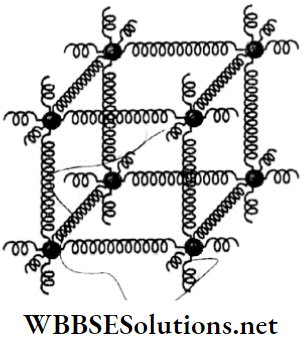
Reason for thermal expansion of solids: From the simple considerations of the structure of a crystalline solid, it can be said that the atoms of the crystal are arranged in a regular array under the elastic force.

Class 11 Physics Unit 7 Properties Of Matter Chapter 5 Expansion Of Solid And Liquids Reason For Thermal Expansion

Between two adjacent atoms this elastic force behaves like an almost inextensible spring. At a fixed temperature, two atoms thus maintain an average distance between them and vibrate. This average distance increases with rise in temperature. Hence, solids expand with the rise in temperature.

WBCHSE Class 11 Physics Notes For Expansion Of Solid And Liquids

Expansion Of Solid And Liquids – Coefficient Of Surface Or Superficial Expansion

Superficial Expansion Definition: The increase in surface area for a unit rise in temperature for a unit surface area of a solid is called the coefficient of surface expansion of the material of that solid.

Let S1 and S2 be the surface areas of a solid at temperatures t1 and t2 respectively, where t2 > t1

Proceeding in a way similar, we get, the coefficient of surface expansion,

⇒ \(\beta=\frac{S_2-S_1}{S_1\left(t_2-t_1\right)}\)

= \(\frac{\text { increase in area }}{\text { initial area } \times \text { rise in temperature }}\) …….(1)

or, \(S_2-S_1=S_1 \beta\left(t_2-t_1\right)\)

or, \(S_2=S_1\left\{1+\beta\left(t_2-t_1\right)\right\}\) ….(2)

If the initial temperature = 0 and the final temperature = t, we may write, St = S0 {1 + βt}……..(3)

where S0 = surface area at zero temperature.

  1. The coefficient of surface expansion β is not a constant For precise measurements of β, the surface area at 0°C is to be taken as the initial surface area.
  2. Value of β does not depend on the unit of surface area,
  3. Value of β depends on the unit of temperature.

Unit of β is °C or °F-1. The change in temperature by 1°F = 5/9°C change in temperature.

∴ \(\beta_F=\frac{5}{9} \beta_C \text {, where } \beta_F\) = value of 0 in Fahrenheit scale, and 0C = value of 0 in Celsius scale.


Expansion Of Solid And Liquids – Relation Among The Three Coefficients of Expansion Numerical Examples

Example 1. At 30°C the diameter of a brass disc is 8 cm. What will be the increase in surface area if it is heated to 80°C? a of brass = 18 x 10-6 °C-1.
Solution:

Given

At 30°C the diameter of a brass disc is 8 cm.

Increase in surface area = \(S_2-S_1=\beta S_1\left(t_2-t_1\right)\)

Here, \(\beta=2 \alpha=2 \times 18 \times 10^{-6}{ }^{\circ} \mathrm{C}^{-1} \text { and } S_1=\pi \times\left(\frac{8}{2}\right)^2 \mathrm{~cm}^2\)

Increase in temperature = t2– t1 = 80-30 = 50 °C

∴ Increase in surface area, \(S_2-S_1\)=\(2 \times 18 \times 10^{-6} \times \pi \times\left(\frac{8}{2}\right)^2 \times 50\)

= \(36 \times 10^{-6} \times 16 \pi \times 50=0.0905 \mathrm{~cm}^2 .\)

Example 2. A rectangular copper block measures 20 cm x 12 cm x 3 cm. What will be the change in volume of the block when it is heated from 0°C to 800°C? The coefficient of linear expansion of copper is 0. 16 x 10-4 °C-1.
Solution:

Given

A rectangular copper block measures 20 cm x 12 cm x 3 cm.

Initial volume of the block, V0 =20 X 12 X 3 = 720 cm³, increase in temperature = t2 – t1 = 800 – 0 = 800°C.

γ = 3α = 3 x 0.16 x 10-4 °C-1

Cubical expansion, \(V_{800}-V_0=V_0 \times \gamma \times(800-0)\)

= 720 x 3 x 0.16 x 10-4 x 800 = 27.65 cm3.

Example 3. A lead bullet has a volume of 2.5 cm3 at 0°C. Its volume increases by 0.021 cm³ when heated to 98°C. Find the coefficient of linear expansion of lead.
Solution:

Given

A lead bullet has a volume of 2.5 cm3 at 0°C. Its volume increases by 0.021 cm³ when heated to 98°C.

By definition, the coefficient of volume expansion of lead, \(\gamma=\frac{V_t-V_0}{V_0 t}\)

Given, \(V_t-V_0=0.021 \mathrm{~cm}^3, V_0=2.5 \mathrm{~cm}^3 \text { and } t=98^{\circ} \mathrm{C}\)

∴ \(\gamma=\frac{0.021}{2.5 \times 98}=85.7 \times 10^{-6}{ }^{\circ} \mathrm{C}^{-1}\)

∴ Coefficient of linear expansion of lead \(\alpha=\frac{\gamma}{3}=\frac{8.57 \times 10^{-6}}{3}=2.86 \times 10^{-6 \circ} \mathrm{C}^{-1}\)

Example 4. An aluminium sphere of diameter 20 cm Is heated from 0°C to 100°C. What will be its change in volume? Coefficient of linear expansion of aluminium = 23x 10-6 °C-1.
Solution:

Given

An aluminium sphere of diameter 20 cm Is heated from 0°C to 100°C.

The initial volume of the aluminium sphere,

= \(\frac{4}{3} \pi\left(\frac{20}{2}\right)^3=\frac{4}{3} \pi(10)^3 \mathrm{~cm}^3\)

Value of γ for aluminium =3 x α =3x23x 10-6 °C-1.

Hence, increase in volume, \(V_t-V_0=V_0 \gamma t=\frac{4}{3} \pi \times 10^3 \times 3 \times 23 \times 10^{-6} \times 100\)

= 28.9 cm³.

Example 5. A piece of metal weighs 46 g xg in air. When immersed in a liquid of relative density 1.24, kept at 27°C, its weight is 30 g x g. When the temperature of the liquid is raised to 42°C, the metal piece in it weighs 30.5 g x g. At 42°C, the relative density of the liquid is 1.20. Find the coefficient of linear expansion of the metal.
Solution:

Given

A piece of metal weighs 46 g xg in air. When immersed in a liquid of relative density 1.24, kept at 27°C, its weight is 30 g x g. When the temperature of the liquid is raised to 42°C, the metal piece in it weighs 30.5 g x g. At 42°C, the relative density of the liquid is 1.20.

The apparent loss in weight of the metal at 27°C = weight of an equal volume of the liquid = (46 – 30) g x g;

Thus the volume of the displaced liquid at 27 °C = \(\frac{46-30}{1.24}=\frac{16}{1.24} \mathrm{~cm}^3\) = volume of the metal piece at 27°C(= V1).

Similarly, the volume of the metal piece at 42 °C (= V2)

= \(\frac{46-30.5}{1.20}=\frac{15.5}{1.20} \mathrm{~cm}^3\)

∴ Coefficient of volume expansion of the metal,

⇒ \(\gamma=\frac{V_2-V_1}{V_1\left(t_2-t_1\right)}=\frac{1}{\left(t_2-t_1\right)}\left(\frac{V_2}{V_1}-1\right)\)

= \(\frac{1}{42-27}\left(\frac{15.5}{1.2} \times \frac{1.24}{16}-1\right)=\frac{1}{15}\left(\frac{961}{960}-1\right)\)

= \(\approx 6.94 \times 10^{-5 \circ} \mathrm{C}^{-1}\)

∴ The coefficient of linear expansion of the metal piece \(\alpha=\frac{\gamma}{3}=\frac{6.94 \times 10^{-5}}{3}{ }^{\circ} \mathrm{C}^{-1}=23.15 \times 10^{-6{ }^{\circ}} \mathrm{C}^{-1}\)

Change Of Density Of A Solid Due To Change Of Temperature

Understanding Thermal Expansion of Solids and Liquids

It is known that the density of a substance = \(\frac{\text { mass }}{\text { volume }}\).

With the change in temperature, while the mass of a solid remains the same, its volume changes. Hence, with the change in temperature, the density of a solid changes.

With the rise in temperature, volume increases, thus density decreases and with the decrease in temperature, volume decreases, thus density increases.

Let for a solid of mass m at temperature t1, the volume be V1 and density be D1; while at temperature t2, its volume becomes V2 and density becomes D2.

∴ \(D_1=\frac{m}{V_1} \text { and } D_2=\frac{m}{V_2}\)

∴ \(\frac{D_1}{D_2}=\frac{V_2}{V_1}\)

If the coefficient of volume expansion of the solid is γ, then

⇒ \(V_2=V_1\left[1+\gamma\left(t_2-t_1\right)\right] \quad \text { or, } \frac{D_1}{D_2}=\frac{V_1\left[1+\gamma\left(t_2-t_1\right)\right]}{V_1}\)

or, \(D_1=D_2\left[1+\gamma\left(t_2-t_1\right)\right]\)

or, \(D_2=\frac{D_1}{\left[1+\gamma\left(t_2-t_1\right)\right]}=D_1\left[1+\gamma\left(t_2-t_1\right)\right]^{-1}\)

or, \(D_2=D_1\left[1-\gamma\left(t_2-t_1\right)\right]\)

[neglecting higher powers of γ(t2 – t2), as γ is very small]

If t2 > t1, D2 < D1

If D0 and Dt are the densities of the solid at 0 and t degree temperatures respectively, equation (2) reduces to Dt = D0(1-γt).

Expansion Of Solid And Liquids – Change Of Density Of A Solid Due To Change Of Temperature Numerical Examples

Example 1. Density of glass at 10°C is 2.6 g · cm-3 and that at 60°C is 2.596 g • cm-3. What is the average value of the coefficient of linear expansion of glass between these two temperatures?
Solution:

Given

Density of glass at 10°C is 2.6 g · cm-3 and that at 60°C is 2.596 g • cm-3.

Using the equation D1 = D2 [1 +γ(t2 -t1)], and substituting the given values,

D1 = 2.6 g · cm-3, D1 = 2.596 g · cm-3, t1 = 10°C and t2 = 60°C,

we get, 2.6 = 2.596 [1 + γ(60 – 10)]

or, \(1+50 \gamma=\frac{2.6}{2.596} \quad \text { or, } 50 \gamma=\frac{2.6-2.596}{2.596}\)

or, 50γ = 1.00154 – 1

or, \(\gamma=\frac{0.00154}{50}=30.8 \times 10^{-6 \circ} \mathrm{C}^{-1}\)

∴ \(\alpha=\frac{\gamma}{3}=10.27 \times 10^{-6 \circ} \mathrm{C}^{-1}\)

Class 11 Physics Class 12 Maths Class 11 Chemistry
NEET Foundation Class 12 Physics NEET Physics

Unit 7 Properties Of Bulk Matter Chapter 5 Expansion Of Solid And Liquids Thermal Stress

A change in temperature causes a change in the length of a metal rod. But if the two ends of the rod are rigidly fixed at fixed supports, expansion or contraction of the rod gets obstructed. Hence, a large force is generated along the rod. This force, measured per unit area of the rod is called ther¬mal stress.

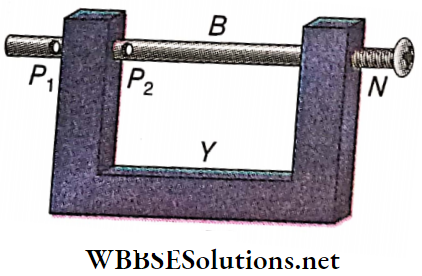
Experimental demonstration of thermal stress: A metal rod B is set within the gap of a heavy iron frame Y. One end of the rod B is threaded and two holes P1 and P2 are at the other end.

Class 11 Physics Unit 7 Properties Of Matter Chapter 5 Expansion Of Solid And Liquids Experimental Demonstration Of Thermal Stress

  • A screw N is fitted at the threaded end of B. A cast iron pin is introduced through the hole P1 and the rod B is heated.
  • When the rod expands, the pin at P1 is tightly fitted with the frame by adjusting the screw N.
  • If the rod is cooled now, the pin obstructs the contraction of the rod developing a huge force which breaks the pin inserted through P1.
  • Expansion of the rod, when obstructed, also generates a huge force. To demonstrate this, a pin is inserted through P2 and the rod is fixed rigidly by adjusting the screw N. If now the rod is heated, the pin P2 gets broken due to the force developed in the rod on expansion.

Magnitude of thermal stress: Let a rod of length l, cross-sectional area A, coefficient of linear expansion α be heated so that the rise in temperature is t. The rod, therefore expands by l∝t.

  • Now if the two ends of the rod are rigidly fixed and it is cooled to its original temperature, it tends to contract back to its original length and this contraction is opposed by a force F (say).
  • Therefore, the reaction to the force F, which is equal and opposite to F, is the thermal force developed in the rod due to expansion lα t.

From Hooke’s law, the Young’s modulus of the rod,

Y = \(\frac{\text { stress }}{\text { strain }}=\frac{\text { applied force } / \text { area }}{\text { change in length } / \text { initial length }}=\frac{F / A}{l a t / l}\)

∴ F = AYαt

Therefore, the thermal stress = F/A = Yαt

Clearly, thermal stress is independent of length or area of the cross-section of the rod (or a wire).

Expansion Of Solid And Liquids Thermal Stress Numerical Examples

Example 1. Two ends of a steel rod are rigidly fixed with two supports. At 30° C its area of cross-section is 4 cm². How much force will be exerted on the supports by the ends of the rod if the temperature of the rod is raised by 60°C? [Young’s modulus of steel = 2.1 x 10¹² dyn · cm-2 and its coefficient of linear expansion is 12 x 10-6 °C-1
Solution:

Given

Two ends of a steel rod are rigidly fixed with two supports. At 30° C its area of cross-section is 4 cm².

In this case, A = 4 cm², Y = 2.1 x 10¹² dyn · cm-2, α = 12 x 10-6 °C-1 and t = 60 – 30 = 30°C

∴ The force exerted

=AYαt =4×2.1 x 1012 x 12 x 10-6 x 30 = 3.024x 10⁹ dyn.

Example 2. Two ends of a wire are rigidly clamped. If its temperature is decreased by 10°C, find the change in the tension of the wire. Area of cross-section of the wire =0.01 cm²; α= 16 x 10 -6 °C-1, Y = 20 x 1011 dyn · cm-2
Solution:

Given

Two ends of a wire are rigidly clamped. If its temperature is decreased by 10°C,

Area of cross-section of the wire =0.01 cm²; α= 16 x 10 -6 °C-1, Y = 20 x 1011 dyn · cm-2

Here A = 0.01 cm², Y = 20 x 1011 dyn · cm-2,α = 16 x 10-6 °C-1, t = 10°C

∴ Change in tension

AYαt = 0.01 x 20 x 1011 x 16 x 10-6 x 10 = 32 x 105 dyn.


Unit 7 Properties Of Bulk Matter Chapter 5 Expansion Of Solid And Liquids Apparent And Real Expansion Of Liquids

To heat a liquid, it has to be kept in a container. When heat is applied, the container also expands along with the liquid. As the liquid expands more than the container for the same change in temperature, expansion of the container is sometimes neglected and only the expansion of the liquid is recorded.

  • Hence, the recorded expansion of the liquid, ignoring the expansion of the container, is less than the actual expansion of the liquid.
  • The expansion of a liquid, ignoring the expansion of the container, is called the apparent expansion of the liquid.
  • The sum of the apparent expansion of the liquid and the expansion of the container is called the real expansion of the liquid.

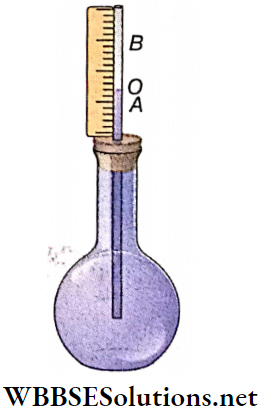
Experiment: Let, surface of the liquid in a flask rest at mark O. If the flask is heated from outside, at first the flask expands and the surface of the liquid comes down at mark A.

Class 11 Physics Unit 7 Properties Of Matter Chapter 5 Expansion Of Solid And Liquids Apparent And Real Expansion Of Liquids Experiment

Thus the length OA represents expansion of the flask. Then the supplied heat reaches the liquid and surface of the liquid rises up to mark B. Therefore, volume of AB is the real expansion of the liquid.

On the other hand, if the first change of volume is unnoticed, it seems like the surface rises from initial position O to final position B. So, volume of OB is the apparent expansion of the liquid.

∴ For a liquid, real expansion = apparent expansion of the liquid + expansion of container

Coefficients of Apparent and Real Expansion of Liquids

Since liquid expansions are of two types, two separate coefficients of expansion are to be considered:

  1. Coefficient of apparent expansion and
  2. Coefficient of real expansion.

Coefficient of apparent expansion of a liquid Definition: The apparent expansion of unit volume of a liquid for a temperature rise of 1° is called the coefficient of apparent expansion (γ’) of the liquid.

Expression for γ’: Let the volume of a certain amount of liquid be V1 at temperature t1, and its apparent volume be V’2 at temperature t2.

∴ For a rise in temperature of (t2 – t1), apparent expansion of the liquid of volume \(V1 = (V2′ – Vx).V_1=\frac{V_2^{\prime}-V_1}{\left(t_2-t_1\right)}\)

∴ For a unit rise in temperature, the apparent expansion per unit volume = \(\frac{V_2^{\prime}-V_1}{V_1\left(t_2-t_1\right)}\)

By definition, \(\gamma^{\prime} =\frac{V_2^{\prime}-V_1}{V_1\left(t_2-t_1\right)}\)

= \(\frac{\text { apparent expansion }}{\text { initial volume } \times \text { rise in temperature }}\) ….(1)

From (1), we get, \(V_2^{\prime}=V_1\left\{1+\gamma^{\prime}\left(t_2-t_1\right)\right\}\)…(2)

It is important to note that, the coefficient of apparent expansion of a liquid is not an intrinsic property of the liquid. It depends on the material of the container. Hence, a liquid may have different values of γ’ when heated in containers of different materials.

Coefficient of real expansion of a liquid Definition: The actual or real increase of unit volume of a liquid for a temperature rise of 1° is called the coefficient of real expansion (γ) of the liquid.

Expression for γ: Let the volume of a fixed amount of a liquid at a temperature t1 be V1, and at a temperature t2 be V2.

Hence, volume increases by (V2-V1) for a rise (t2 – t1) in temperature.

∴ By definition, \(\gamma=\frac{V_2-V_1}{V_1\left(t_2-t_1\right)}\)

= \(\frac{\text { real expansion }}{\text { initial volume } \times \text { rise in temperature }}\)…(3)

∴ \(V_2 =V_1\left\{1+\gamma\left(t_2-t_1\right)\right\}\) …(4)

The coefficient of real expansion is an intrinsic property of the liquid and does not depend on the material of the container.

1. It is clear from equations (1) and (3) that the values of γ and γ’ are independent of the unit of volume but depend on scale of temperature used.

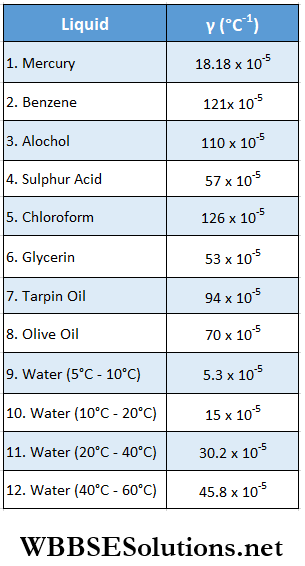
  • For example, the coefficient of real expansion of mercury in the Celsius and the Fahrenheit scales are 18.18 x 10⁻⁵ °C-1 and 10.1 x 10⁻⁵ °F-1 respectively.
  • The coefficient of volume expansion of a liquid is the same in the Celsius and the Kelvin scales but in the Fahrenheit scale it is 5/9 times that in Celsius and Kelvin scales.

2. It is assumed during the derivations of (2) and (4) that the value of the coefficient of expansion of a liquid is the same for all ranges of temperature. Precise observations show that the value changes, though the changes are very small.

Hence, the values deduced above are the average values of γ and γ’ for the temperature range between t1 and t2. However, in practice, the values of γ and γ’ of a liquid are taken as constants for all temperature ranges.

3. While defining γ or γ’, initial volume at any temperature is taken. But for finer measurements, volume at 0°C should be taken as the initial volume In practice, the difference is ignored.

Values of the coefficient of real expansion of a few liquids are shown in the following table.

Class 11 Physics Unit 7 Properties Of Matter Chapter 5 Expansion Of Solid And Liquids Coefficient Of Real Expansion

Relation between the Coefficients of Apparent and Real Expansions of Liquids

Let the volume of certain mass of a liquid in a container at a temperature t1 = V1. At a temperature t2, the apparent volume of that liquid = V’2 and its real volume = V2.

The part of the container, that contained the liquid at t1, has a volume V at t2.

∴ Apparent expansion of the liquid = V2‘ – V1 and real expansion = V2 – V1.

Expansion of the part of the container containing the liquid at t1 = V- V1

Since for a liquid, real expansion = apparent expansion + expansion of container, \(V_2-V_1=\left(V_2^{\prime}-V_1\right)+\left(V-V_1\right)\)

Dividing both sides by V1 t (where t = t2 – t1)

⇒ \(\frac{V_2-V_1}{V_1 t}=\frac{V_2^{\prime}-V_1}{V_1 t}+\frac{V-V_1}{V_1 t}\)

or, γ = γ’ + γgg = coefficient of volume expansion of the material of the container]

Hence, the coefficient of real expansion of a liquid = the coefficient of apparent expansion of the liquid + the coefficient of volume expansion of the material of the container.

Coefficient of Linear Expansion in Solids

Relation between Density and Coefficient of Real Expansion of Liquids: The volume of a liquid increases with the increase in temperature. Thus the density decreases. Water between 0°C and 4°C is an exception, and that will be discussed later. Let the mass of some liquid be m, the volume of that liquid be V1 and the density be ρ1, at temperature t1.

At temperature t1, its volume becomes V1 and density ρ2. Consider t2> t1.

Hence, \(m_1=V_1 \rho_1=V_2 \rho_2 \quad \text { or, } \frac{\rho_1}{\rho_2}=\frac{V_2}{V_1}\)…(1)

If the coefficient of real expansion of the liquid is γ, then

⇒ \(V_2 =V_1\left\{1+\gamma\left(t_2-t_1\right)\right\}\)

or, \(\frac{V_2}{V_1}=1+\gamma\left(t_2-t_1\right)\)…..(2)

From equations (1) and (2) we get,

⇒ \(\frac{\rho_1}{\rho_2}=\left\{1+\gamma^{\prime}\left(t_2-t_1\right)\right\}\)

or, \(\rho_1=\rho_2\left[1+\left(t_2-t_1\right)\right]\)….(3)

\(\rho_2 =\frac{\rho_1}{1+\gamma\left(t_2-t_1\right)}=\rho_1\left\{1+\gamma\left(t_2-t_1\right)\right\}^{-1}\)

= \(\rho_1\left[1-\gamma\left(t_2-t_1\right)\right]\)

neglecting higher powers of γ, as it is very small.

Hence, the density of a liquid decreases with the increase in temperature.

Equations (3) and (4) both give the relation between the coefficient of real expansion and the density of the liquid.

Equation (4) can be written as \(\gamma=\frac{\rho_1-\rho_2}{\rho_1\left(t_2-t_1\right)}\)

Thus if the densities of a liquid at two different temperatures are known, its coefficient of real expansion can be found out.


Unit 7 Properties Of Bulk Matter Chapter 5 Expansion Of Solid And Liquids Apparent Loss In Weight Of A Solid Immersed In A Liquid At Different Temperatures

There is an apparent loss in the weight of a solid when it is immersed in a liquid. This loss in weight is due to the upthrust it receives in a liquid. This upthrust depends directly on the density of the liquid as well as the volume of the immersed portion of the body.

With the change in temperature, density of the liquid and volume of the solid, both change. Hence, the apparent weight of a solid will be different at different temperatures.

Let the weight of a solid in air = W.

Weight of the solid completely immersed in a liquid at temperature t1 = W1 and that at temperature t2 = W2.

Hence, the apparent loss in weight at temperature t1 = W- W1 = M1g, and that at t2 = W- W2 = M2g,

where M1 and M2 are the masses of the liquid displaced by the body.

If V1 and ρ1 are the volume and density at t1, and V2 and ρ2 are those at t2 respectively, then, \(M_1=V_1 \rho_1 \text { and } M_2=V_2 \rho_2\)

If the coefficient of real expansion of the liquid is γ and the coefficient of volume expansion of the material of the solid is γs, then,

⇒ \(\rho_1=\rho_2\left[1+\gamma\left(t_2-t_1\right)\right]\)

= \(\rho_2[1+\gamma t]\left[\text { Let } t_2-t_1=t\right]\)

and \(V_2=V_1\left(1+\gamma_s t\right)\)

∴ \(M_2 =V_2 \rho_2=\frac{\rho_1 V_1\left(1+\gamma_s t\right)}{1+\gamma t}\)

= \(\rho_1 V_1\left(1+\gamma_s t\right)(1+\gamma t)^{-1}\)

= \(\rho_1 V_1\left(1+\gamma_s t\right)(1-\gamma t)\)

[neglecting the higher powers of γ]

Coefficient of Volume Expansion in Liquids

= \(M_1\left[1-\left(\gamma-\gamma_s\right) t\right]\) neglecting the term \(\gamma \gamma_s t^2\)

Usually \(\gamma \gg \gamma_s and t=t_2-t_1>0\),

∴ \(M_1>M_2 \text { or, } M_1 g>M_2 g \text { i.e., } W_1<W_2 \text {. }\)

Hence, the apparent weight of a body immersed in a liquid increases with the increase in temperature of the liquid.

Unit 7 Properties Of Bulk Matter Chapter 5 Expansion Of Solid And Liquids Apparent Loss In Weight Of A Solid Immersed In A Liquid At Different Temperatures Numerical Examples

Example 1. A piece of metal weighs 50 g x g in air. It weighs45 g x g when immersed in a liquid at 25°C, and 45.1 g x g at 100°C. If the coefficient of linear expansion of the metal is 12 x 10-6 °C-1, find the coefficient of real expansion of the liquid.
Solution:

Given

A piece of metal weighs 50 g x g in air. It weighs45 g x g when immersed in a liquid at 25°C, and 45.1 g x g at 100°C. If the coefficient of linear expansion of the metal is 12 x 10-6 °C-1,

Apparent loss in weight at 25°C = M1g = (50 – 45) gxg = 5gxg Apparent loss in weight at 100°C

= \(M_1 g=(50-45) g \times g=5 g \times g\)

Apparent loss in weight at \(100^{\circ} \mathrm{C}\)

= \(M_2 g=(50-45.1) g \times g=4.9 \mathrm{~g} \times \mathrm{g}\)

As \(M_2=M_1\left[1-\left(\gamma-\gamma_s\right)\left(t_2-t_1\right)\right]\)

∴ 4.9 = \(5\left[1-\left(\gamma-12 \times 10^{-6} \times 3\right)(100-25)\right]\)

or, 4.9 = \(5\left[1-\left(\gamma-12 \times 10^{-6} \times 3\right) \times 75\right]\left[\right. as \left.\gamma_s=3 \times \alpha_s\right]\)

or, \(\left(\gamma-36 \times 10^{-6}\right) \times 75 \times 5=5-4.9\)

or, \(\gamma-36 \times 10^{-6}=\frac{0.1}{75 \times 5}\)

or, \(\gamma=36 \times 10^{-6}+2.67 \times 10^{-4}=3.03 \times 10^{-4}{ }^{\circ} \mathrm{C}^{-1}\).

Example 2. A glass rod weighs 90g x g In air. It weighs 49.6 g x g when immersed In n liquid at 12°C, and 51.9 g x g at 97°C. Wnd the real expansion coefficient of the liquid. Volume expansion coefficient of glass = 2.4 x 10⁻⁵ °C-1
Solution:

Given

A glass rod weighs 90g x g In air. It weighs 49.6 g x g when immersed In n liquid at 12°C, and 51.9 g x g at 97°C.

let the volume of the glass rod be V1, at 12°C, and density of the liquid be ρ1.

The mass of the displaced liquid at that temperature = 90-49.6 =40.4 g

∴ Volume of the glass rod at that temperature, \(V_1=\frac{40.4}{\rho_1}\)……(1)

Again at 97°C, mass of the displaced liquid = 90-51.9 = 38.1 g

Let at 97°C the volume of the glass rod be V2, and density of the liquid be ρ2.

∴ \(V_2=\frac{38.1}{\rho_2}\) ….(2)

From (1) and (2), \(\frac{V_2}{V_1}=\frac{\rho_1}{\rho_2} \times \frac{38.1}{40.4}\)….(3)

Now for the glass rod, V2 = V1 [1 + 2.4 x 10-5 x 85]

∴ \(\frac{V_2}{V_1}=1+2.4 \times 10^{-5} \times 85=1.00204\)

In case of liquid, \(\rho_1=\rho_2[1+\gamma \times 85]\)

∴ \(\frac{\rho_1}{\rho_2}=1+\gamma \times 85\)

From equation (3), \(1.00204=(1+\gamma \times 85) \times \frac{38.1}{40.4}\)

or, \(1+85 \gamma=\frac{1.00204 \times 40.4}{38.1}\)

or, \(85 \gamma=\frac{1.00204 \times 40.4}{38.1}-1=\frac{2.382}{38.1}\)

or, \(\gamma=7.35 \times 10^{-4 \circ} \mathrm{C}^{-1} .\)

Example 3. Apparent weights of a solid in a liquid are 50 g x g and 52 g x g at 25°C and 75°C respectively. If the coefficient of linear expansion of the solid Is ag αs = 6.6 x 10⁻⁶ °C-1, and γ for the liquid Is 7.3 x 10⁻⁴ °C-1, what Is the real weight of the solid In air?
Solution:

Given

Apparent weights of a solid in a liquid are 50 g x g and 52 g x g at 25°C and 75°C respectively. If the coefficient of linear expansion of the solid Is ag αs = 6.6 x 10⁻⁶ °C-1, and γ for the liquid Is 7.3 x 10⁻⁴ °C-1,

Let the real weight of the solid in air = M g x g.

Apparent loss in weight at \(225^{\circ} \mathrm{C}:-M_1 g=(M-50) g \times g\)

and apparent loss in weight at \(75^{\circ} \mathrm{C}=M_2 g \circ(M-52) \mathrm{g} \times g\)

∴ \(M_2=M_1\left|1-\left(\gamma-\gamma_s\right) \times t\right|\)

⇒ \((M-52)=(M-50) \mid 1-\left(7.3 \times 10^{-4}\right.\) \(-19.8 \times\left(0^{-6}\right) \times 501\)

= \((M-50)\left\{1-7.102 \times 10^{-4} \times 50\right\}\)

= \((M-50) \times 0.96449\)

M = 0.96449 M-48.2245+52

or, 0.03551 M=3.7755

M = \(\frac{3.7755}{0.03551}=106.32 \mathrm{~g}\)

∴ Real weigth of the solid is 106.32 g x g

Example 4. A sphere of mass 266.5 g and of diameter 7 cm floats on a liquid. When the liquid Is heated to 35°C the sphere sturts sinking In the liquid. If the density of the liquid at 0°C Is 1.527 g • cm-3, find the coefficient of volume expansion. Neglect the expansion of the sphere.
Solution:

Given

A sphere of mass 266.5 g and of diameter 7 cm floats on a liquid. When the liquid Is heated to 35°C the sphere sturts sinking In the liquid. If the density of the liquid at 0°C Is 1.527 g • cm-3,

Volume of the sphere = \(\frac{4}{3} \pi\left(\frac{7}{2}\right)^3 \mathrm{~cm}^3\)

∴ Volume of displaced liquid at 35°C = \(\frac{4}{3} \pi\left(\frac{7}{2}\right)^3 \mathrm{~cm}^3\)

If the density of the liquid at 35°C is ρ35, then the mass of the displaced liquid at 35°C = \(\frac{4}{3} \pi\left(\frac{7}{2}\right)^3 \times \rho_{35} g .\)

From the condition of floatation, \(\frac{4}{3} \pi\left(\frac{7}{2}\right)^3 \times \rho_{35}=266.5\)…(1)

Now, \(\rho_{35}=\frac{\rho_0}{1+\gamma \times 35}\)

= \(\frac{1.527}{1+\gamma \times 35}\)

From equations (1) and (2), we get, \(\frac{1.527}{1+\gamma \times 35}=\frac{266.5}{\frac{4}{3} \pi\left(\frac{7}{2}\right)^3}\)

or, \(1+35 \gamma=\frac{4 \times 22 \times(7)^3 \times 1.527}{3 \times 7 \times(2)^3 \times 266.5}\)

or, \(35 \gamma=1.029-1\)

or, \(\gamma=\frac{0.029}{35}=8.28 \times 10^{-4}{ }^{\circ} \mathrm{C}^{-1}\).

Example 5. A piece of metal weighs 46 g x g in air. It weighs 30 g x g in a liquid of specific gravity 1.24 at 27°C. At 42°C, when the specific gravity of the liquid is 1.20, the weight of the piece immersed in it is 30.5 g x g. Find the coefficient of linear expansion (α) of the metal.
Solution:

Given

A piece of metal weighs 46 g x g in air. It weighs 30 g x g in a liquid of specific gravity 1.24 at 27°C. At 42°C, when the specific gravity of the liquid is 1.20, the weight of the piece immersed in it is 30.5 g x g.

Mass of the displaced liquid at 27°C = 46-30 = 16 g

Volume of the displaced liquid at 27°C, \(V_{27}=\frac{16}{1.24} \mathrm{~cm}^3\)

Similarly volume of the displaced liquid at 42 °C, \(V_{42}=\frac{46-30.5}{1.20}=\frac{15.5}{1.20} \mathrm{~cm}^3\)

So the volume of the piece at 27 °C and 42° C are \(\frac{16}{1.24} \mathrm{~cm}^3\) and \(\frac{15.5}{1.20} \mathrm{~cm}^3\) respectively.

Now, \(V_{42}=V_{27}\{1+\gamma(42-27)\}\)

[where γ = coefficient of volume expansion of the metal]

or, \(\frac{15.5}{1.20}=\frac{16}{1.24}\{1+\gamma \times 15\} or, 1+15 \gamma=\frac{15.5 \times 1.24}{1.20 \times 16}\)

or, \(15 \gamma=1.001-1\)

or, \(\gamma=\frac{0.001}{15}=3 \alpha\)

∴ Coefficient of linear expansion of the metal \(\alpha=\frac{\gamma}{3}=\frac{0.001}{45}=2.2 \times 10^{-5 \circ} \mathrm{C}^{-1}\)

Unit 7 Properties Of Bulk Matter Chapter 5 Expansion Of Solid And Liquids Anomalous Expansion Of Water

When a liquid is heated, its volume increases and density decreases with rise in temperature. Exceptions are observed in case of water for a certain range of temperatures.

  • When heated from 0°C to 4°C, the volume of water decreases and the density increases. Above 4°C, the volume of water increases again with the increase in temperature.
  • Hence, water has a maximum density and a minimum volume at 4°C. Also, on cooling from 4°C to 0°C, the volume of water increases instead of decreasing. This exceptional behaviour of water in respect of expansion within the range of 0°C to 4°C, is called anomalous expansion of water.
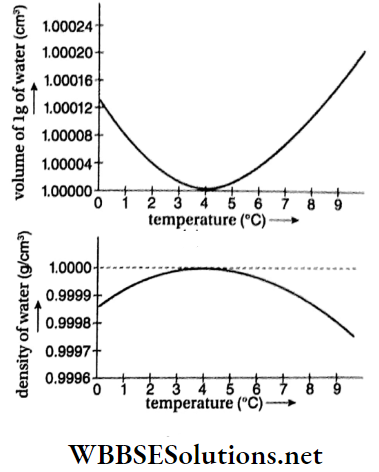
  • The two graphs below represent the change In volume and density of 1 g of water, with the Increase in temperature.

Class 11 Physics Unit 7 Properties Of Matter Chapter 5 Expansion Of Solid And Liquids Anomalous Expansion Of Water

Conclusions from the two graphs are:

  1. Volume of water decreases as its temperature rises from 0°C to 4°C. Hence, expansion of water is anomalous and does not follow the general rule. Consequently, the coefficient of volume expansion of water is negative for this temperature range.
  2. Water has the least volume and the maximum density at 4°C.
  3. After 4°C, expansion of water takes place following the general rule. This means that, with the increase in tem-perature, the volume also starts increasing. The expan¬sion is no longer anomalous.
  4. The slope of the curves for volume or for density, at temperature close to 4°C is almost zero. So, there is practically no change in volume or density for a small variation of temperature at and around 4°C. Hence, the density of water at 4°C is taken as unity.

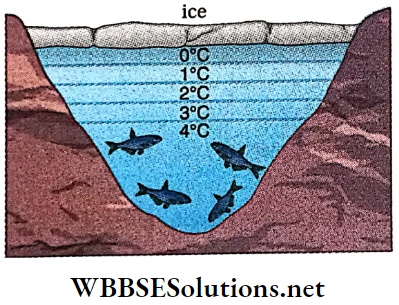
Effect of Anomalous Expansion of Water on Marine Life: Due to anomalous expansion of water, fishes and various living creatures can survive under frozen lakes, rivers or seas.

  • In cold countries, with the fall in atmospheric temperature, upper surface of lakes, seas and various ponds gradully, cool. Water of the upper surface, then being denser and heavier, moves down.
  • Water below it, being comparatively warmer and lighter, moves up. This convection process in water continues until the density of the water in the lower part becomes maximum i.e., the temperature of the lower water reaches 4°C.
  • As the temperature of the upper surface decreases further below 4°C, density begins to decrease. So water cannot move down further. It then begins to cool further and at last turns into ice. As ice is lighter than water, a thick layer of ice, thus formed, floats over the surface of water.

Class 11 Physics Unit 7 Properties Of Matter Chapter 5 Expansion Of Solid And Liquids Tempertaure Of Water Gradulally Increase With Depth And Lowest Layer

Both ice and water are bad conductors of heat. So, a negligible amount of heat can be conducted from the lower levels of water to the atmosphere outside. So, the entire vol¬ume of water (top to bottom) in a pond cannot freeze.

Unit 7 Properties Of Bulk Matter Chapter 5 Expansion Of Solid And Liquids Anomalous Expansion Of Water Numerical Examples

Applications of Thermal Expansion in Engineering

Example 1. The area of the cross-section of the capillary tube of a mercury thermometer is A0 and the volume of the bulb filled with mercury is V0 at 0°C. Find the length of the mercury column in the capillary tube as the bulb is heated to t°C. The coefficient of linear expansion of glass is α and coefficient of volume expansion of mercury is β.
Solution:

Given

The area of the cross-section of the capillary tube of a mercury thermometer is A0 and the volume of the bulb filled with mercury is V0 at 0°C.

The coefficient of linear expansion of glass is α and coefficient of volume expansion of mercury is β.

Let Vg and Vm be the volumes of the bulb and mercury at t°C.

∴ \(V_g=V_0\left(1+\gamma_g t\right)=V_0(1+3 \alpha t)\)

and \(V_m=V_0(1+\beta t)\)

Hence, volume of mercury entering the tube is \(V_m-V_g=V_0(1+\beta t)-V_0(1+3 \alpha t)=V_0 t(\beta-3 \alpha)\)

If the area of the cross-section of the capillary tube at t°C is At then At = A0(1+2αt).

If the length of the mercury column in the tube is l, then \(A_t \times l=V_0 t(\beta-3 \alpha)\)

∴ l = \(\frac{V_0 t(\beta-3 \alpha)}{A_0(1+2 \alpha t)}\)….(1)

= \(\frac{V_0 t(\beta-3 \alpha)(1+2 \alpha t)^{-1}}{A_0}=\frac{V_0}{A_0} t(\beta-3 \alpha)(1-2 \alpha t)\)

= \(\frac{V_0}{A_0}(\beta-3 \alpha) t\)…..(2)

[neglecting αβ and α² as they are very small]

Both the equations (1) and (2), indicate the length of mercury column in the capillary tube at t °C.

Example 2. A 1L flask contains some mercury. It is observed that the volume of air in the flask remains unchanged at all temperatures. What is the volume of mercury in the flask? The coefficient of linear expression of the material of the flask = 9 x 10⁻⁶ °C-1 and coefficient of real expansion of mercury = 1.8 x 10⁻⁴ °C-1
Solution:

Given

A 1L flask contains some mercury. It is observed that the volume of air in the flask remains unchanged at all temperatures.

The coefficient of linear expression of the material of the flask = 9 x 10⁻⁶ °C-1 and coefficient of real expansion of mercury = 1.8 x 10⁻⁴ °C-1

Due to expansion of the scale, the actual barometric reading will be greater than the apparent reading. Let the real reading be h and the apparent reading be H.

∴ h = \(H(1+\alpha t)=75.34\left(1+18 \times 10^{-6} \times 5\right)\)

= \(75.34\left(1+9 \times 10^{-5}\right)\)

h = \(75.34 \times 1.00009 \mathrm{~cm}\)

Again, mercury expands with increase in temperature. Hence, the barometric reading at 0°C will be less than that at 20°C. Let at 0°C, the barometric reading be H0.

∴ \(H_0=h(1-\gamma t)=75.34 \times 1.00009\left[1-18 \times 10^{-5} \times 25\right]\)

= 75.34 x 1.00009[1 -0.0045]

= 75.34 x 1.00009 x 0.9955 = 75.01 cm.

Example 4. Coefficients of volume expansion of benzene and wood are 1.2×10⁻³ °C-1 and 1.5 x 10⁻⁴ °C-1 respectively. Their respective densities at 0°C are 900 kg · m-3 and 880 kg · m-3. Find the temperature at which wood will just immerse in benzene.
Solution:

Given

Coefficients of volume expansion of benzene and wood are 1.2×10⁻³ °C-1 and 1.5 x 10⁻⁴ °C-1 respectively. Their respective densities at 0°C are 900 kg · m-3 and 880 kg · m-3.

The wood will just immerse in benzene at a temperature for which the densities are equal. Let the required temperature be t°C, when the density of both is ρ.

∴ 900 = \(\rho\left[1+1.2 \times 10^{-3} \times t\right]\)

and \(880=\rho\left[1+1.5 \times 10^{-4} \times t\right]\)

Dividing (1) by (2) we get, \(\frac{900}{880}=\frac{1+1.2 \times 10^{-3} t}{1+1.5 \times 10^{-4} t}\)

or, \(t\left(900 \times 1.5 \times 10^{-4}-880 \times 1.2 \times 10^{-3}\right)=880-900 or, \quad t=21.7^{\circ} \mathrm{C}\).

Example 5. A metal piece of density 8g · m-3 is suspended from a wooden hook by a weightless string. The tension in the string is 56 g x g. What will be the tension in the string, if the system is Immersed in a liquid at 40°C? The surrounding temperature during the experiment is 20°C. At 20°C the specific gravity of the liquid is 1.24. The coefficients of volume expansion of the liquid and the metal are 4 x 10⁻⁵ °C-1 and 8 x 10⁻⁴ °C-1 respectively.
Solution:

Given

A metal piece of density 8g · m-3 is suspended from a wooden hook by a weightless string. The tension in the string is 56 g x g.

The surrounding temperature during the experiment is 20°C. At 20°C the specific gravity of the liquid is 1.24. The coefficients of volume expansion of the liquid and the metal are 4 x 10⁻⁵ °C-1 and 8 x 10⁻⁴ °C-1 respectively.

Volume of the metal piece at 20°C, \(V_{20}=\frac{56}{8}=7 \mathrm{~cm}^3\)

∴ Volume at 40°C, \(V_{40}=V_{20}\left[1+8 \times 10^{-4} \times 20\right]\)

= \(7\left(1+8 \times 10^{-4} \times 20\right) \mathrm{cm}^3\)

Volume of the displaced liquid = V40

∴ Mass of displaced liquid = V40 x ρ40

40 = density of the liquid at 40°C]

i.e, weight of the displaced liquid = V40 x ρ40 x g

∴ Upthrust = \(V_{40} \times \rho_{40} \times g\)

= \(7\left[1+8 \times 10^{-4} \times 20\right] \times \frac{1.24}{1+20 \times 4 \times 10^{-5}} \times 980\)

= \(7 \times 1.24[1+0.016]\left[1+8 \times 10^{-4}\right]^{-1} \times 980 \)

= \(7 \times 1.24 \times 1.016[1-0.0008] \times 980\)

= \(7 \times 1.24 \times 1.016 \times 0.9992 \times 980=8.81 \times 980 \mathrm{dyn}\)

∴ Tension in the string = \((56-8.81) \times 980=4.625 \times 10^4 \mathrm{dyn} .\)

Example 6. A body, at 4°C, floats with 0.98 part of its volume immersed in water. At what temperature the body will just be immersed in water? Coefficient of real expansion of water = 3.3 x 10⁻⁴ ° C-1. Neglect expansion of the solid body.
Solution:

Given

A body, at 4°C, floats with 0.98 part of its volume immersed in water.

Coefficient of real expansion of water = 3.3 x 10⁻⁴ ° C-1.

Let the required temperature be t°C, and the volume of the body = V.

Let the densities of water at 4°C and t°C be d1 and d2 respectively.

∴ From the condition of floatation, Vx 0.98 x d1 = Vxd2

∴ \(\frac{d_1}{d_2}=\frac{1}{0.98}=\frac{50}{49}\)

As \(d_1=d_2\left\{1+3.3 \times 10^{-4}(t-4)\right\},\)

∴ \(\frac{d_2}{d_2}\left\{1+3.3 \times 10^{-4}(t-4)\right\}=\frac{50}{49}\)

∴ \(3.3 \times 10^{-4} \times(t-4)=\frac{50}{49}-1=\frac{1}{49}\)

∴ t = \(\frac{1}{49 \times 3.3 \times 10^{-4}}+4=61.84+4=65.84^{\circ} \mathrm{C} .\)

Real-Life Examples of Expansion in Solids and Liquids

Example 7. A solid at 0°C floats with 98% of its volume immersed in a liquid. The solid floats completely immersed when the temperature is raised to 25°C. If the coefficient of volume expansion of the solid is 2.6 x 10⁻⁶ °C-1, find the coefficient of real expansion of the liquid.
Solution:

Given

A solid at 0°C floats with 98% of its volume immersed in a liquid. The solid floats completely immersed when the temperature is raised to 25°C. If the coefficient of volume expansion of the solid is 2.6 x 10⁻⁶ °C-1

Let at 0°C, volume of the solid = V0, density of the liquid = ρ0; at 25°C, volume of the solid = V’ and density of the liquid = ρ’

Now, \(V^{\prime}=V_0\left[1+2.6 \times 10^{-6} \times 25\right]\)

and \(\rho_0=\rho^{\prime}[1+\gamma \times 25]\)

where γ = coefficient of real expansion of’tlre liquid.

From the condition of floatation, \(V_0 \times 0.98 \times \rho_0=V^{\prime} \rho^{\prime}\)

or, \(V_0 \times 0.98 \times \rho^{\prime}[1+\gamma \times 25]\)

= \(V_0\left[1+2.6 \times 10^{-6} \times 25\right] \times \rho^{\prime}\)

or, \(1+25 \gamma=\frac{1+0.000065}{0.98} \quad \text { or, } 25 \gamma=1.02047-1\)

∴ \(\gamma=8.19 \times 10^{-4 \circ \mathrm{C}^{-1} .}\)

Example 8. A mercury thermometer contains 0.4 cm³ of mercury at 0°C. The diameter of the capillary tube of the thermometer is 0.2 mm. What should be the length of the scale to measure temperatures between 0°C to 100°C? The coefficient of apparent expansion of mercury = 1.7 x 10⁻⁴ °C-1.
Solution:

Given

A mercury thermometer contains 0.4 cm³ of mercury at 0°C. The diameter of the capillary tube of the thermometer is 0.2 mm.

The apparent expansion of mercury due to increase in temperature from 0°C to 100°C = 0.4 x 1.7 x 10-4 x 100 = 0.0068 cm³

The cross-section of the capillary tube = π(0.01)² cm²

∴ The length of the temperature measuring scale = \(\frac{0.0068}{\pi(0.01)^2}=21.6 \mathrm{~cm}\)

Example 9. A and B are two thermometers made of glass and both contain the same liquid. Both thermometers have spherical bulbs. The internal diameter of the bulb of A is 7.5 mm and radius of the capillary tube is 1.25 mm. The corresponding values for B are 6.2 mm and 0.9 mm. Find the ratio of the lengths between two consecutive graduations in thermometers A and B.
Solution:

Given

A and B are two thermometers made of glass and both contain the same liquid. Both thermometers have spherical bulbs. The internal diameter of the bulb of A is 7.5 mm and radius of the capillary tube is 1.25 mm. The corresponding values for B are 6.2 mm and 0.9 mm.

Let the separations between two consecutive graduations for 1° in thermometers A and B be x cm and y cm respectively.

Hence, for the thermometer A, volume expansion of liquid in the bulb due to an increase of 1°C in temperature = vol¬ume of x cm length in the tube,

⇒ \(\frac{4}{3} \pi\left(\frac{0.75}{2}\right)^3 \times \gamma^{\prime} \times 1=x \times \pi(0.125)^2\)…..(1)

where γ’ is the coefficient of apparent expansion of the liquid.

Similarly for the thermometer B, \(\frac{4}{3} \pi\left(\frac{0.62}{2}\right)^3 \times \gamma^{\prime} \times 1=y \times \pi \times(0.09)^2\)….(2)

Dividing equation (1) by (2) we get,

⇒ \(\frac{x \times \pi \times(0.125)^2}{y \times \pi \times(0.09)^2}=\frac{\frac{4}{3} \pi\left(\frac{0.75}{2}\right)^3 \times \gamma^{\prime} \times 1}{\frac{4}{3} \pi\left(\frac{0.62}{2}\right)^3 \times \gamma^{\prime} \times 1}\)

or, \(\frac{x}{y}=\frac{(0.75)^3 \times(0.09)^2}{(0.62)^3 \times(0.125)^2}=0.92 \text { (approx.). }\)

Example 10. A container is filled up to the brim with 500 g of water and 1000 g of mercury. When 21200 cal of heat is supplied to the system, 3.52 g of water flows out of the container. Neglecting the expansion of the container, find the coefficient of real expansion of mercury. Given, the volume expansion coefficient of water =1.5x 10⁻⁴ °C-1, density of mercury ss 13.6 g · cm-3, density of water 1 g · cm-3 and speciflc heat capacity of mercury = 0.03 cal · g-1 · °C-1
Solution:

Given

A container is filled up to the brim with 500 g of water and 1000 g of mercury. When 21200 cal of heat is supplied to the system, 3.52 g of water flows out of the container. Neglecting the expansion of the container,

Given, the volume expansion coefficient of water =1.5x 10⁻⁴ °C-1, density of mercury ss 13.6 g · cm-3, density of water 1 g · cm-3 and speciflc heat capacity of mercury = 0.03 cal · g-1 · °C-1.

Due to the application of heat, 3.52 g i.e., 3.52 cm³ of water flows out of the container.

∴ The total expansion of mercury and water = 3.52 cm³.

Let the rise in temperature = t°C.

Heat absorbed by mercury + heat absorbed by water = 21200

∴ 500 x 1 x t + 1000 x 0.03 x t= 21200 or, t = 40°C

Expansion of water = 500 x 1.5 x 10-4 x 40 =3 cm3

∴ Expansion of mercury = (3.52-3) = 0.52 cm3 1000

∴ \(\frac{1000}{13.6} \times \gamma \times 40=0.52\)

[γ = volume expansion coefficient of mercury] 7

∴ γ= 1.768 x 10⁻⁴ C-1.

Example 11. A glass bulb is filled in at 0°C by 350 g of mercury. When a few steel balls are put in the bulb, it can then hold only 265 g of mercury. When the bulb is heated to 100°C, with the steel balls in mercury, 5 g of mercury flows out. Find the coefficient of linear expansion of steel. Given, the coefficient of real expansion of mercury = 18 x 10-5 °C-1. Neglect expansion of glass.
Solution:

Given

A glass bulb is filled in at 0°C by 350 g of mercury. When a few steel balls are put in the bulb, it can then hold only 265 g of mercury. When the bulb is heated to 100°C, with the steel balls in mercury, 5 g of mercury flows out.

The coefficient of real expansion of mercury = 18 x 10-5 °C-1. Neglect expansion of glass.

Let ρ0 and ρ100 be the densities of mercury at 0°C and 100°C respectively.

∴ Volume of mercury in the glass bulb at 0°C = \(\frac{350}{\rho_0}\)

Volume of mercury in the glass bulb after the steel balls are put = \(\frac{265}{\rho_0}\)

∴ Volume occupied by the steel balls at 0°C = \(\frac{350}{\rho_0}-\frac{265}{\rho_0}=\frac{85}{\rho_0}\)

Expansion of mercury at 100°C = \(\frac{265}{\rho_0} \times 18 \times 10^{-5} \times 100=\frac{4.77}{\rho_0}\)

Expansion of the steel balls at 100°C = \(\frac{85}{\rho_0} \times \gamma_s \times 100=\frac{8500 \gamma_s}{\rho_0}\)

s = coefficient of volume expansion of steel]

Now, expansion of mercury + expansion of the steel balls = volume of mercury expelled

i.e., \(\frac{4.77}{\rho_0}+\frac{8500 \gamma_s}{\rho_0}=\frac{.5}{\rho_{100}}\)

or, \(4.77+8500 \gamma_s=\frac{5 \rho_0}{\rho_{100}}=\frac{5 \rho_{100}\left(1+18 \times 10^{-5} \times 100\right)}{\rho_{100}}\)

= \(5 \times 1.018\)

⇒ \(\left[because \rho_0=\rho_{100}\left(1+18 \times 10^{-5} \times 100\right)\right]\)

or, \(8500 \gamma_s=0.32\) or, \(\gamma_s=\frac{0.32}{8500}=37.65 \times 10^{-6}{ }^{\circ} \mathrm{C}^{-1}\).

∴ Coefficient of linear expansion, \(\alpha_s=\frac{\gamma_s}{3}=\frac{37.65}{3} \times 10^{-6}=12.55 \times 10^{-6{ }^{\circ}} \mathrm{C}^{-1}\)

Example 12. Between two similar thermometers, one is filled with mercury and another with alcohol of the same volume at 0°C. The gap for each degree in the mercury thermometer is l and that in the alcohol thermometer is l’. Show that \(\frac{l}{l^{\prime}}=\frac{\gamma-3 \alpha}{\gamma_1-3 \alpha}\)
coefficient of real expansion of mercury, γ1 = coefficient of real expansion of alcohol and a = coefficient of linear expansion of glass.
Solution:

Given

Between two similar thermometers, one is filled with mercury and another with alcohol of the same volume at 0°C. The gap for each degree in the mercury thermometer is l and that in the alcohol thermometer is l’.

In both thermometers, let the area of the cross-section of the tube be A and the volume of the bulb be V.

For 1° rise in temperature in mercury thermometer, apparent expansion of mercury = volume of length l of the tube

i.e., \(V(\gamma-3 \alpha) \times 1=l \times A \quad\left[because \gamma^{\prime}=\gamma-\gamma_g\right]\)….(1)

Similarly, for 1° rise in temperature in alcohol thermometer,

∴ \(V\left(\gamma_1-3 \alpha\right) \times 1=l^{\prime} \times A\)….(2)

Dividing (1) by (2) we get,

⇒ \(\frac{l \times A}{l^{\prime} \times A}=\frac{V(\gamma-3 \alpha)}{V\left(\gamma_1-3 \alpha\right)} \text { or, } \frac{l}{l^{\prime}}=\frac{\gamma-3 \alpha}{\gamma_1-3 \alpha}\)

Example 13. A cylindrical container contains some liquid. The coefficient of linear expansion of the material of the container is a. When the container is heated it is observed that the liquid level inside the container remains unchanged. What is the volume expansion coefficient of the liquid?
Solution:

Given

A cylindrical container contains some liquid. The coefficient of linear expansion of the material of the container is a. When the container is heated it is observed that the liquid level inside the container remains unchanged.

Let height of the liquid level inside the container be x and area of the cross-section be A.

Now, the level of liquid surface inside the container will remain unchanged when volume expansion of the container due to an increase in temperature t = volume expansion of the liquid due to increase in temperature t.

∴ xA x 3α x t = xA x γ x t [y = volume expansion coefficient of the liquid]

∴ γ = 3α

Short Answer Questions on Thermal Expansion

Example 14. A body weighs W0 in air. Its apparent weights in a liquid at t1 °C and t2 °C are W1 and W2 respectively. If the coefficient of volume expansion of the material of the body is γ, find the coefficient of real expansion of the liquid.
Solution:

Given

A body weighs W0 in air. Its apparent weights in a liquid at t1 °C and t2 °C are W1 and W2 respectively. If the coefficient of volume expansion of the material of the body is γ,

Weight of displaced liquid at t1 °C = W0-W1

Let V1 and V2 be the volumes of the body and d1 and d2 be the densities of the liquid at t1°C and t2°C respectively.

We have, \(W_0-W_1=V_1 d_1 g\)….(1)

and \(W_0-W_2=V_2 d_2 g\)

Dividing equation (1) by equation (2) we get,

⇒ \(\frac{W_0-W_1}{W_0-W_2}=\frac{V_1 d_1}{V_2 d_2} .\)

Now \(V_2=V_1\left[1+\gamma\left(t_2-t_1\right)\right] and d_1=d_2\left[1+\gamma_l\left(t_2-t_1\right)\right]\),

where \(\gamma_l\) is the coefficient of real expansion of the liquid.

∴ \(\frac{W_0-W_1}{W_0-W_2}=\frac{1+\gamma_l \times t}{1+\gamma \times t} [where \left.t=\left(t_2-t_1\right)\right]\)

or, \(1+\gamma_l t=\frac{W_0-W_1}{W_0-W_2} \times(1+\gamma t)=\frac{W_0-W_1}{W_0-W_2}+\frac{\gamma t\left(W_0-W_1\right)}{W_0-W_2}\)

or, \(\gamma_l t=\frac{W_2-W_1}{W_0-W_2}+\frac{\gamma t\left(W_0-W_1\right)}{W_0-W_2}\)

or, \(\left(W_0-W_1\right)(1+\gamma t)=\left(W_0-W_2\right)\left(1+\gamma_l \times t\right)\)

or, \(\gamma_l=\frac{W_2-W_1}{\left(W_0-W_2\right) t}+\frac{\gamma\left(W_0-W_1\right)}{W_0-W_2}\)

Example 15. Using two different containers A and B, the coefficients of apparent expansion of a liquid are found to be γ1  and γ2 respectively. If the coefficient of linear expansion of the material A is α, find that of the material B.
Solution:

Given

Using two different containers A and B, the coefficients of apparent expansion of a liquid are found to be γ1  and γ2 respectively. If the coefficient of linear expansion of the material A is α,

We have, γ = γ’ + γg or, γ = γ’ + 3α

[γ’ = Coefficient of apparent expansion of the liquid, γ = coefficient of real expansion of the liquid, γg = coefficient of volume expansion of the material of the container.]

For container A, \(\gamma=\gamma+\gamma_g=\gamma_1+3 \alpha\)

and for container B, \(\gamma=\gamma_2+3 \alpha^{\prime}\)

[α’ = coefficient of linear expansion of the material of the container B ]

∴ \(\gamma_2+3 \alpha^{\prime}=\gamma_1+3 \alpha\)

or, \(3 \alpha^{\prime}=\gamma_1+3 \alpha-\gamma_2 \quad or, \alpha^{\prime}=\frac{1}{3}\left(\gamma_1-\gamma_2\right)+\alpha\).

Example 16. A hollow iron ball floats completely immersed in water at 10°C temperature. What will happen if the temperature of both of them is raised to 50°C?
Solution:

Given

A hollow iron ball floats completely immersed in water at 10°C temperature.

The iron ball will sink in water if the temperature of the ball and of water is raised to 50°C from 10°C.

Let dy be the density of water and be the volume of the iron ball at 10°C.

So, the apparent loss in weight of the ball at 10°C = V1d1g.

Again, if d2 is the density of water and V2, is the volume of the iron ball at 50°C, the apparent loss in weight of the bull at 50°C = V2d2g

Now, \(V_2=V_1\left[1+\gamma_i(50-10)\right]\)

[\(\gamma_i=\) coefficient of volume expansion of iron]

and \(d_2=d_1\left[1-\gamma_w(50-10)\right]\)

⇒ \(\gamma_w\). coefficient of volume expansion of water]

∴ \(V_2 d_2=V_1 d_1\left[1+40 \gamma_i\right]\left[1-40 \gamma_w\right]\)

= \(V_1 d_1\left[1-40\left(\gamma_w-\gamma_i\right)\right] \text { (approx.) }\)

Since \(\gamma_w>\gamma_i, V_2 d_2 g<V_1 d_1 g\).

Therefore, the loss in weight of the ball at 50°C temperature is less. Hence its apparent weight increases. So the ball will sink in water.


Unit 7 Properties Of Bulk Matter Chapter 5 Expansion Of Solid And Liquids Useful Relations For Solving Numerical Problems

1. If the length of a rod at temperature is t1 is l and that at temperature t2 is l2 then,

coefficient of linear expansion, \(\alpha=\frac{l_2-l_1}{l_1\left(t_2-t_1\right)}\)

2. If the initial length of the rod at temperature 0 is l0 and the, final length of the rod at temperature t is lt, then, \(l_t=l_0(1+\alpha t)\)

3. If the values of α in Celsius and Fahrenheit scales are αC and αF then, \(\alpha_F=\frac{5}{9} a_C\)

If the surface area of a solid at temperature t1, is S1 and that at temperature t2, is S2, then,

coefficient of surface expansion, \(\beta=\frac{S_2-S_1}{S_1\left(t_2-t_1\right)}\)

⇒ \(\beta_F=\frac{5}{9} \beta_C\)

If the volume of a solid body at temperature t1 is V1 and that at temperature t2 is V2 then,

coefficient of volume expansion, \(\gamma=\frac{V_2-V_1}{V_1\left(t_2-t_1\right)}\)

⇒ \(\gamma_F=\frac{5}{9} \gamma_C\)

⇒ \(\alpha=\frac{\beta}{2}=\frac{\gamma}{3}\)

If the density of a solid at temperature t1 is D1 and that at temperature t2 is D2 then, \(D_2=D_1\left\{1+\gamma\left(t_2-t_1\right)\right\}^{-1} \approx D_1\left\{1-\gamma\left(t_2-t_1\right)\right\}\)

If area of the cross-section of a rod is A, rise in temperature is t, Young’s modulus for the material is Y, coefficient of linear expansion is a and the force developed inside the rod, when its length is kept unchanged, is F then,
thermal stress = \(\frac{F}{A}=Y \alpha t\)

Real expansion of a liquid = apparent expansion of the liquid + expansion of the container.

Coefficient of real expansion of a liquid = coefficient of apparent expansion of the liquid + coefficient of volume expansion of the material of the container, i.e., \(\gamma=\gamma^{\prime}+\gamma_g \)

⇒ \(\gamma=\frac{\rho_1-\rho_2}{\rho_1\left(t_2-t_1\right)}\) [where ρ1 = density of the liquid at the temperature t1, ρ2 = density of the liquid at the temperature t2]

Apparent loss in weight of a solid body immersed completely in a liquid is M2 = M1{1-(γ-γs)t}

where M1g= apparent loss in weight of the body at the temperature t1, M2g = apparent loss in weight of the body at the temperature t2,t = t2-t1, γ = coefficient of real expansion of the liquid and γs = coefficient of volume expansion of the immersed solid.


Unit 7 Properties Of Bulk Matter Chapter 5 Expansion Of Solid And Liquids Very Short Answer Type Questions

Question What is the unit of the coefficient of linear expansion of a substance?
Answer: °C-1

Question 2. What is the relation between the coefficient of linear expansion (α) and the coefficient of volume expansion (γ) of a solid?
Answer: γ = 3α

Question 3. A bimetallic strip made up of brass and iron remains linear at 20 °C. When the temperature is decreased to 0°C, the strip bends. Which material remains on the convex side of the bent strip?
Answer: Iron

Question 4. Coefficient of linear expansion of platinum is 9 x 10⁻⁶ °C-1. What will be the value of this coefficient when the temperature is expressed in Fahrenheit unit?
Answer: 5 x10⁻⁶ °F-1

Question 5. If the coefficient of linear expansion of iron is 0. 0000067 °F-1, then what is its value in the Celsius scale?
Answer: 0.000012°C-1

Question 6.Due to rise in temperature, if each side of a copper cube increases by 0.1%, then find out the increase in volume of that cube.
Answer: 0.3%

Question 7.Write down the variation of density of a solid with increase in temperature.
Answer: Decreases

Question 8. Thermal expansion of invar is _______ than that of all other metals or alloys.
Answer: Less

Question 9.Between the coefficient of apparent expansion (γ’) and the coefficient of real expansion (γ) of a liquid which one is a characteristic property of the liquid?
Answer: y

Question 10. A glass vessel is filled with water up to its brim. Now what will happen if temperature is increased?
Answer: Water will overflow

Question 11. At what temperature density of water will be the maximum?
Answer: 4°C

Question 12. How does the density of a liquid change with temperature?
Answer: Density decreases

Question 13. At what temperature under standard atmospheric pressure, the density of pure water will be the maximum?
Answer: 4°C

Question 14. Real expansion of a liquid = apparent expansion of the liquid + volume expansion of the _______.
Answer: vessel

Question 15. Coefficient of real expansion of water from 0°C to 4°C is ___________.
Answer: Negative

Question 16. ‘Usually, the thermal expansion of a liquid is greater than the thermal expansion of an equal volume of a solid.’ State whether the statement is true or false.
Answer: True

Question 17. ‘Usually, the thermal expansion of a liquid is greater than
the thermal expansion of an equal volume of a gas.’ State whether the statement is true or false.
Answer: False

Question 18. What is the density of pure water at 4°C in SI?
Answer: 1000 kg • m-3

Unit 7 Properties Of Bulk Matter Chapter 5 Expansion Of Solid And Liquids Assertion Reason Type Question And Answers

Direction: These questions have statement 1 and statement 2. Of the four choices given below, choose the one that best describes the two statements.

  1. Statement 1 is true, statement 2 is true; statement 2 is a correct explanation for statement 1.
  2. Statement 1 is true, statement 2 is true; statement 2 is not a correct explanation for statement 1.
  3. Statement 1 is true, statement 2 is false.
  4. Statement 1 is false, statement 2 is true.

Question 1.

Statement 1: A brass disc just fits in a hole in a steel plate. The system must be cooled to loosen the disc from the hole.

Statement 2: The coefficient of linear expansion for brass is greater than the coefficient of linear expansion for steel.

Answer: 1. Statement 1 is true, statement 2 is true; statement 2 is a correct explanation for statement 1.

Question 2.

Statement 1: A beaker is completely filled with water at 4 °C. It will overflow, both when heated or cooled.

Statement 2: There is expansion of water below and above 4°C.

Answer: 1. Statement 1 is true, statement 2 is true; statement 2 is a correct explanation for statement 1.

Question 3.

Statement 1: The coefficient of real expansion of the liquid is independent of the nature of container.

Statement 2: ϒr = γa + γv where γv = coefficient of real expansion, γa = coefficient of expansion and γv = coefficient of apparent expansion of vessel.

Answer: 2. Statement 1 is true, statement 2 is true; statement 2 is not a correct explanation for statement 1.

Question 4.

Statement 1: The coefficient of apparent expansion can be negative.

Statement 2: Coefficient of real expansion of a liquid can be less than the coefficient of expansion of vessel.

Answer: 1. Statement 1 is true, statement 2 is true; statement 2 is a correct explanation for statement 1.

Question 5.

Statement 1: A solid and a hollow sphere of same material when heated through the same temperature, wall expand by the same amount.

Statement 2: The change in volume is independent of the original mass but depends on original volume.

Answer: 1. Statement 1 is true, statement 2 is true; statement 2 is a correct explanation for statement 1.

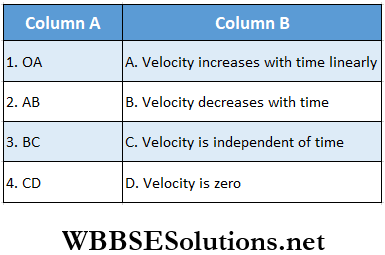
Unit 7 Properties Of Bulk Matter Chapter 5 Expansion Of Solid And Liquids Match Column 1 With Column 2.

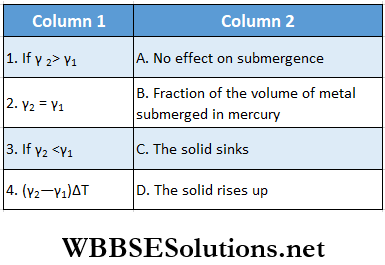
Question 1. A piece of metal of density ρ1 floats on mercury of density ρ2. The coefficients of expansion of the metal and mercury are. γ1 and γ2 respectively. The temperatures of both mercury and metal are increased by ΔT.

Class 11 Physics Unit 7 Properties Of Matter Chapter 5 Expansion Of Solid And Liquids Match The Column Question 1

Answer: 1. C, 2. A, 3. D, 4. B

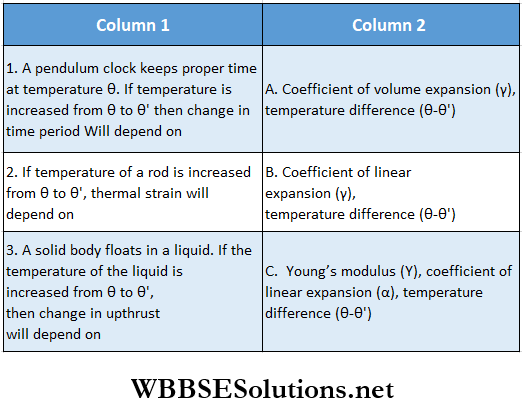
Question 2.

Class 11 Physics Unit 7 Properties Of Matter Chapter 5 Expansion Of Solid And Liquids Match The Column Question 2

Answer: 1. B, 2. C, 3. A

Unit 7 Properties Of Bulk Matter Chapter 5 Expansion Of Solid And Liquids Comprehension Type Question And Answers

Read the following passages carefully and answer the questions at the end of them.

Question 1. A copper collar is to fit tightly about a steel shaft that has a diameter of 6 cm at 20 °C. The inside diameter of the copper collar at that temperature is 5.98 cm.

1. To what temperature must the copper collar be raised so that it will just slip on the steel shaft, assuming the steel shaft remains at 20 °C? (αcopper= 17 x 10-6 K-1)

  1. 324 °C
  2. 21.7 °C
  3. 217 °C
  4. 32.4 °C

Answer: 3. 217 °C

2. The tensile stress in the copper collar when its temperature returns to 20 °C is (Y = 11 x 1010 N • m-2)

  1. 1.34 x 10⁵ N • m-2
  2. 3.68 x 10⁻¹² N • m-2
  3. 3.68 x 10⁸ N • m-2
  4. 1.34 x 10⁻¹² N • m-2

Answer: 3. 3.68 x 10⁸-12 N • m-2

3. If the breaking stress of copper is 230 N • m-2, at what temperature will the copper collar break as it cools?

  1. 20 °C
  2. 47 °C
  3. 94 °C
  4. 217 °C

Answer: 3. 94 °C

Unit 7 Properties Of Bulk Matter Chapter 5 Expansion Of Solid And Liquids Integer Type Question And Answers

In this type, the answer to each of the questions is a single-digit integer ranging from 0 to 9.

Question 1. A composite rod is made by joining a copper rod, end to end, with a second rod of a different material but of same cross-section. At 25 °C, the composite rod is lm in length of which the length of the copper rod is 30 cm. At 125 °C the length of the composite rod increases by 1.91 mm. The coefficient of linear expansion of copper is α = 1.7 x 10⁻⁵ °C-1 and that of the second rod is β = n x 10-5 °C-1. Find the value of n
Answer: 2

Question 2. The volume of a metal sphere increases by 0.24% when its temperature is raised by 40 °C. The coefficient of linear expansion of the metal is n x 10-5 °C-1.Find the value of n.
Answer: 2

Question 3. The coefficient of real expansion of mercury is 18 x 10-6 °C-1. A thermometer has a bulb of volume 10-6 m³ and the cross-section of the stem is 0.002 cm². Assuming the bulb to be filled with mercury at 0 °C, find the length (in cm) of the mercury column at 100 °C.
Answer: 9

Question 4. A thin copper wire of length l increases in length by 1 % when heated from 0 °C to 100 °C. If a thin copper plate of area 2lx l is heated from 0 °C to 100 °C, find the percentage increase in its area.
Answer: 2


WBCHSE Class 11 Physics Notes For One Dimensional Motion

One-Dimensional Motion

One-Dimensional Motion Introduction: Mechanics is the branch of science which deals with the motion of bodies and the effect of force on stationary or moving bodies.

The Branches Of MechanicsAre As Follows:
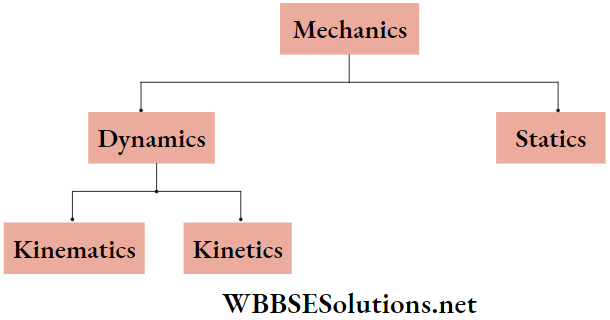
One Dimensional Motion Branches Of Mechanics

  1. Dynamics: A branch of mechanics in which the motion of a body and the effect of force on the motion of the body are discussed.
  2. Kinematics: It is restricted to the study of motion and not the causes of motion.
  3. Kinetics: It incorporates the study and analysis of the motion of a body together with the causes of motion. Also, the mass of a body and the effect of force on the mass are studied here.
  4. Statics: A branch of mechanics which deals with the equilibrium of a body under the action of a number of forces and studies the conditions of equilibrium.

One-Dimensional, Two-Dimensional And Three-Dimensional Motions: We will be discussing only one-dimensional motion in this chapter. The motion which is confined to a straight line is called one-dimensional motion or rectilinear motion.

  • This type of motion can be explained by one-dimensional, two-dimensional or three-dimensional coordinates. The motion of a car moving in a straight line or the motion of a body under gravity are examples of one-dimensional motion.
  • The motion which is confined to a plane is called two-dimensional motion or planar motion is called two- dimensional motion can only be described by two-dimensional or three-dimensional coordinates. The motion of a planet around the sun, a body revolving in a circle, a billiard ball moving over the billiard table etc. are examples of two-dimensional motion.
  • The motion which is not confined to a plane is called three-dimensional motion. This type of motion can only be explained by three-dimensional coordinates, flic examples of three-dimensional motion are the spiral motion of a particle or the motion of an aeroplane

Read and Learn More: Class 11 Physics Notes

Speed And Velocity Numerical Examples

Example 1. A particle moves in a circular path of radius 7 cm. It covers

  1. Half of the circle in 4 s and
  2. One complete round in 10 s. In each case find the average speed and average velocity.

Solution:

The circumference of the circle = 2πr = 2 x \(\frac{22}{7}\) x 7 = 44cm

1. The distance travelled by the particle = half of the circumference = \(\frac{44}{2}\) = 22 cm and time taken = 4 s.

∴ Average speed, v = \(\frac{22}{4}\) = 5.5 cm · s-1.

Displacement = diameter of the circle = 2 x 7 = 14 cm and time taken = 4s.

Hence average velocity, \(\vec{v}\) = \(\frac{14}{4}\) = 3.5 cm · s-1 along AB.

2. The distance travelled by the particle = circumference of the circle = 44 cm and time taken = 10 s.

∴ Average speed = = 4.4 cm · s-1.

Displacement in this case is 0 (as initial and final positions are the same.)

Hence, average velocity = \(\frac{\text { displacement }}{\text { time }}\)

WBCHSE Class 11 Physics Notes For One Dimensional Motion

Example 2. An aeroplane travels 2000 km to the west It then turns north and moves 2000 km more. Finally, it follows the shortest path to return to its starting point If the speed of the plane is 200 km · h-1, find its average velocity for the total journey.
Solution:

Since initial and final positions are the same, displacement is zero.

∴ Average velocity = \(\frac{\text { displacement }}{\text { total time }}=\frac{0}{\text { total time }}=0 \text {. }\)

Example 3. Find the speed of the tip of a 3 cm long second’s hand in a clock.
Solution:

The tip of the second’s hand describes an angle of 360° in 60 seconds when it completes the total circular path once.

Hence, distance travelled = circumference of the circle = 2π x 3 = 6π cm; time = 60 s.

∴ Speed = \(=\frac{6 \pi}{60}=\frac{\pi}{10}=0.314 \mathrm{~cm} \cdot \mathrm{s}^{-1} .\)

Example 4. A train travels from station A to station B at a constant speed of 40 km · h-1 and returns from B to A at 60 km · h-1. Find the average speed and average velocity of the train.
Solution:

Let the distance between stations A and B be x km.

Time taken by the train to move from A to B = \(\frac{x}{40}\)h and time taken to move from B to A = \(\frac{x}{60}\)h.

Total distance travelled = 2x km.

∴ Average speed = \(\frac{2 x}{\left(\frac{x}{40}+\frac{x}{60}\right)}=\frac{2 \times 40 \times 60}{100}=48 \mathrm{~km} \cdot \mathrm{h}^{-1}\)

Initial and final positions are the same so the total displacement becomes zero and hence average velocity is zero.

Example 5. The motion of a particle, along the x-axis, follows the relation x = 8t – 3t². Here x and t are expressed in metre and second respectively. Find

  1. The average velocity of the particle in time interval 0 to 1 s and
  2. Its instantaneous velocity at t = 1s.

Solution:

1. Let at t = 0, x = x1 and at t = 1, x = x2.

∴ x1 = 8 x 0 -3 x 0² = 0 and x2 = 8 x 1 -3 x 1² = 5m

∴ Displacement = x2 – x1 =5 m and time taken is 1 s

∴ Average velocity = \(\frac{5 m}{1 s}\) = 5 m · s-1.

2. Here instantaneous velocity,

v = \(\frac{d x}{d t}=\frac{d}{d t}\left(8 t-3 t^2\right)=8-2 \times 3 t=8-6 t\)

At t = \(1 \mathrm{~s}, \frac{d x}{d t}=8-6 \times 1=2 \mathrm{~m} \cdot \mathrm{s}^{-1}\).

WBBSE Class 11 One Dimensional Motion Notes

Acceleration: When the velocity of a particle increases with time, the particle is said to be accelerating. So, in case of acceleration, the final velocity is greater than the initial velocity.

Acceleration Definition: The rate of change of velocity with time is called acceleration.

Thus, acceleration (a) = \(\frac{\text { change in velocity }}{\text { time }}\)

= \(\frac{\text { final velocity }- \text { initial velocity }}{\text { time }}\)

Acceleration Example: A train at rest starts from a station and speeds up. In this case, we can say that the train is moving with acceleration.

Sometimes, acceleration is represented by the symbol ‘f’.

Nature Of Acceleration: Acceleration is related to the change in velocity of a body. So, like velocity, acceleration is also a vector quantity. It has to be specified by its magnitude and direction. However, to specify the acceleration vector, we have to use vector algebra to determine the change in the velocity.

This shows that velocity and change in velocity may have different directions, in general. Thus, the direction of the acceleration may or may not be the same as that of velocity.

Units And Dimension: Unit of acceleration = \(\frac{\text { unit of velocity }}{\text { unit of time }} \text {. }\)

CGS System: cm · s-2

SI: m · s-2

Dimension of acceleration = \(\frac{\text { dimension of velocity }}{\text { dimension of time }}=\frac{\mathrm{LT}^{-1}}{\mathrm{~T}}=\mathrm{LT}^{-2}\)

Motion With Uniform And Non-Uniform Acceleration: Uniform acceleration corresponds to a motion in which the velocity of a body changes equally in equal intervals of time.

If a particle moves with uniform acceleration, then its acceleration remains the same, both in magnitude and direction, at each point on its path. When a body falls freely from a height under gravity, its velocity increases. But its acceleration is uniform on or near the surface of the earth and is known as the acceleration due to gravity.

Non-uniform Acceleration corresponds to a motion in which the velocity of a body does not change equally in equal intervals of time.

The motion of an oscillating pendulum is an example of motion with non-uniform acceleration. The acceleration of the bob becomes maximum at its maximum displaced position and becomes zero at its mean position.

Average Acceleration: The acceleration of a particle may not always be uniform. Generally, we can find out the average acceleration using the following relation:

(a) = \(\frac{\text { final velocity }- \text { initial velocity }}{\text { time taken }}\)

= \(\frac{\text { change in velocity }}{\text { time }}\)

Instantaneous Acceleration: The acceleration of a particle at any moment is called its instantaneous acceleration.

Instantaneous Acceleration Definition: The instantaneous acceleration of a particle at a given point is the limiting value of the rate of change in velocity with respect to time when the time interval tends to zero.

According to differential calculus, instantaneous acceleration, a = \(\lim _{\Delta t \rightarrow 0} \frac{\Delta v}{\Delta t}=\frac{d v}{d t}=\frac{d}{d t}\left(\frac{d s}{d t}\right)=\frac{d^2 s}{d t^2}\)

Deceleration Or Retardation: when the velocity of a particle decreases with time, the particle is in a state of deceleration or retardation. Here, the final velocity is less than the initial velocity.

Deceleration Or Retardation Definition: The rate of decrease of velocity with time is called deceleration or retardation.

Class 11 Physics Class 12 Maths Class 11 Chemistry
NEET Foundation Class 12 Physics NEET Physics

Deceleration Or Retardation Example: When a train approaches a station, it slows down and finally stops. During this period the train decelerates to come to a halt.

Deceleration is a special case of acceleration where the final velocity is less than the initial velocity. Thus, deceleration is essentially a negative acceleration. It is not a different physical quantity.

Let us consider a particle moving with a velocity of 10 cm · s-1. It then slows down to 4 cm · s-1 in 3 s. Its acceleration is given by,

a = \(\frac{\text { final velocity }- \text { initial velocity }}{\text { time interval }}\)

= \(\frac{4-10}{3}=-2 \mathrm{~cm} \cdot \mathrm{s}^{-1}\)

This example clearly shows that deceleration is described mathematically as negative acceleration.

Distinction Between Acceleration And Retardation
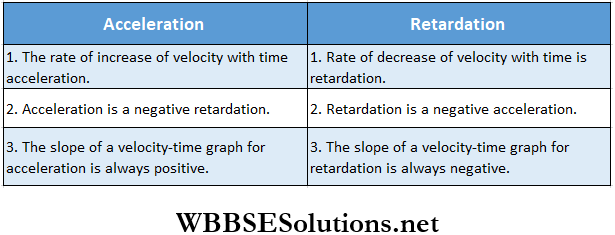
One Dimensional Motion Difference Between Acceleration And Retardation

Acceleration Due To Gravity: The earth attracts other bodies towards itself because of its gravity. A body released near the earth’s surface falls freely under the action of the force due to gravity. Whenever a body is allowed to fall freely, it undergoes an acceleration directed towards the earth. This is referred to as the acceleration due to gravity and is denoted by g. Its characteristics are:

  1. It is always directed towards the centre of the earth, i.e., vertically downwards.
  2. Its value is the greatest on the earth’s surface. It decreases slightly as we go away from the surface in such a way that at an altitude of 3.2 km, its value decreases only by 0.1%. Thus, for practical purposes, we may consider its value to be constant and equal to its value on the earth’s surface.
  3. It is independent of the characteristics of an object, such as mass, density or shape.

Bodies that move vertically downwards undergo constant acceleration, while bodies moving vertically upwards undergo constant retardation. In this discussion, we have neglected the small variations in g at different locations and the air resistance faced by freely falling bodies.

The value of g is usually taken as, g = 980 cm · s-2 = 9.8 m · s-2

Understanding Displacement in One Dimensional Motion

Motion In A Straight Line

When a body moves without changing its direction, the motion is naturally along a straight line. It is also known as rectilinear motion.

Vertical fall of a body under gravity, the motion of a car on a straight road, etc. are examples of such motion. The discussions henceforth in this chapter will be restricted to rectilinear motions only.

Representation Of The Physical Quantities Of Motion: For the rectilinear motion of a particle, the straight line of motion itself may be chosen as an axis (say, the x-axis) and a point O on it as the origin. Obviously, the motion is one-dimensional.
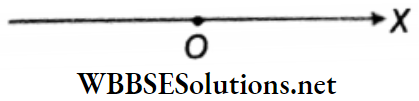
One Dimensional Motion Representation Of The Physical Quantities Of Motion

  • There is a basic difference in the representations of the scalar and the vector quantities related to rectilinear motion. The scalar quantities like distance travelled and speed have magnitudes only, and are always expressed by positive numbers. However, two directions, exactly opposite to each other, exist for the motion in a straight line.
  • So a vector quantity is expressed by a positive number for one direction and by a negative number for the exactly opposite direction. The direction towards the right may be taken as positive; then the direction towards the left naturally becomes negative. As an example, we may consider the vertical motion of a particle under gravity.
  • For a downward motion, we may take each of displacement, velocity and acceleration to be positive. Then, for an upward motion, displacement and velocity would be negative; but acceleration would still remain positive since the acceleration due to gravity (g) is always directed downwards.
  • It is important to note that simple algebraic operations are sufficient for calculations involving any quantity, a scalar or a vector, in a rectilinear motion. It means that vector algebra is not at all necessary even for the calculations involving vector quantities of a rectilinear motion.

For motion along a straight line,

  1. Distance travelled by a particle = magnitude of its displacement,
  2. Speed of the particle at any point = magnitude of its velocity at that point
  3. Displacement, velocity and acceleration vectors are along the same straight line.

Rectilinear Motion with Uniform Velocity: If a particle moves with a uniform velocity, its acceleration is zero. Let v be the uniform velocity of a particle and s be its displacement in time t. Therefore, according to the definition of uniform velocity, the particle moves a distance v x 1 in Is, v x 2 in2s, etc.

∴ In t s its displacement is v x t.

∴ s = vt…..(1)

i.e., displacement = uniform velocity x time .

Motion In A Straight Line Numerical Example

Example 1. A person travels half of a distance at an average velocity of 24 km · h-1. At what average velocity should he move to cover the second half of the path so that his average velocity for the total path becomes 32 km · h-1?
Solution:

Let the total length of the path = 2s km.

∴ Time required to cover the first half of the path = \(\frac{s}{24}\) h.

If the man travels the total path with an average velocity of 32 km · h-1, then the total time taken by him = \(\frac{2 s}{32}\) = \(\frac{s}{16}\) h.

∴ Time required to cover the second half of the path = \(\frac{s}{16}\) – \(\frac{s}{24}\) = \(\frac{s}{48}\) h

∴ Average velocity of second half = \(\frac{\text { distance }}{\text { time }}=\frac{s}{\frac{s}{48}}=48 \mathrm{~km} \cdot \mathrm{h}^{-1}\)

Rectilinear Motion With Uniform Acceleration

Rectilinear Motion With Uniform Acceleration: For a particle in motion, let

u = initial velocity

v = final velocity after a time t and

corresponding uniform acceleration = a.

Let the displacement = s in that time.

Then the above variables obey the following equations:

  1. v = u+at,
  2. s= ut+1/2 at²
  3. v² = u² + 2as
  4. st = M + \(\frac{1}{2}\) a(2t – 1) [where st = the displacement in the t th second]

Rectilinear Motion With Uniform Acceleration Derivations:

1. v= u+at

Let the initial velocity of a particle be u and its final velocity after time t be v.

∴ In time t, change in velocity = v – u

∴ Rate of change of velocity with time = \(\frac{v – u}{t}\) = a, by definition.

Hence, at = v – u or, v = u + at….(1)

For a particle starting from rest, u = 0 and thus, v = at ….(2)

In case of retardation, the relationship becomes v = u – at …(3)

2. s = ut + \(\frac{1}{2}\) at²

If a particle with initial velocity u and uniform acceleration a, attains final velocity v after time t, the average velocity, considering the two endpoints, is \(\frac{u + v}{2}\).

The acceleration a implies that the velocity increases by an after every second. Hence, the velocity 1 s after the start of motion = u + a and 1 s before the end of motion = v – a

Velocity and Speed in One Dimensional Motion

∴ Average velocity = \(\frac{u+a+v-a}{2}=\frac{u+v}{2}\)

Hence, the particle can be considered to have travelled a distance s with the average velocity \(\frac{(u+v)}{2}\) in time t.

Hence, displacement, s = \(\frac{u+v}{2} \times t=\frac{u+(u+a t)}{2} \times t\) (because v=u+a t)

or, \(s=\frac{2 u t}{2}+\frac{1}{2} a t^2\) or, \(s=u t+\frac{1}{2} a t^2\)…..(4)

For a particle starting from rest, u=0

So, \(s=\frac{1}{2} a t^2\)…..(5)

For a retarding particle, s = \(u t-\frac{1}{2} a t^2\)…..(6)

3. \(v^2=u^2+2 a s\)

From equation (1) we have, v=u+a t

or, \(v^2=(u+a t)^2=u^2+2 u a t+a^2 t^2\)

= \(u^2+2 a\left(u t+\frac{1}{2} a t^2\right)\)

or, \(v^2=u^2+2\) as [using equation (4)]…….(7)

Hence, for a particle starting from rest \(\nu^2=2 a s\)……(8)

and in case of retardation \(v^2=u^2-2 a s\)……(9)

4. \(s_t=u+\frac{1}{2} a(2 t-1)\)

Displacement in t seconds, s = \(u t+\frac{1}{2} a t^2\), from equation (4).

Displacement in (t-1) seconds, \(s^{\prime}=u(t-1)+\frac{1}{2} a(t-1)^2\)

Hence, the displacement in the t th second, \(s_t=s-s^{\prime}\)

or, \(s_t=u t+\frac{1}{2} a t^2-\left\{u(t-1)+\frac{1}{2}(t-1)^2 a\right\}\)

= \(u t+\frac{1}{2} a t^2-u t+u-\frac{1}{2} a t^2+\frac{1}{2} \cdot 2 t a-\frac{a}{2}\)

= \(u+a t-\frac{a}{2}=u+\frac{1}{2} a(2 t-1)\)…….(10)

For a particle starting from rest \(s_t=\frac{1}{2} a(2 t-1)\)……(11)

and in case of retardation \(s_t=u-\frac{1}{2} a(2 t-1)\)…..(12)

Rectilinear Motion With Uniform Acceleration Numerical Examples

Example 1. A velocity of 60 km · h-1 of a train is reduced by the application of brakes. A retardation of 40 cm · s-2 is produced. After how much time will the train stop? What will be the velocity of the train after 20 seconds?
Solution:

Given, \(u=60 \mathrm{~km} \cdot \mathrm{h}^{-1}=\frac{60 \times 1000}{60 \times 60}=\frac{50}{3} \mathrm{~m} \cdot \mathrm{s}^{-1}\)

a = 40 cm · s-2 = 0.4 m · s-2 and v = 0

Hence, from the relation v = u- at, we get \(0=\frac{50}{3}-0.4 \times t \quad \text { or, } t=\frac{50}{3 \times 0.4}=41.7 \mathrm{~s}\)

∴ The train will stop after 41.7.

The velocity after 20 s, v = \(\frac{50}{3}-0.4 \times 20\)

= \(\frac{26}{3} \mathrm{~m} \cdot \mathrm{s}^{-1}=8.7 \mathrm{~m} \cdot \mathrm{s}^{-1}\)

= \(\frac{8.7 \times 60 \times 60}{1000} \mathrm{~km} \cdot \mathrm{h}^{-1}\)

= \(31.3 \mathrm{~km} \cdot \mathrm{h}^{-1}\)

Example 2. A body covers 200 cm in the first 2 s of motion and 220 cm in the next 4 s. Calculate the velocity 7 s after the start.
Solution:

We know, s = ut + \(\frac{1}{2}\) at²

∴ Putting t = 2 s

200 = u x 2 + \(\frac{1}{2}\) a x 4 = 2u + 2a

or, u + a = 100….(1)

The displacement in (4 + 2) or 6 s = 200 + 220 = 420 cm

∴ 420 = u x 6 + \(\frac{1}{2}\) a x 36 = 6u + 18a

or, u + 3a = 70…..(2)

From equations (1) and (2) we get, a = -15 cm · s-2 and u = 115 cm · s-1

Velocity after 7 s of motion, v = u + at = 115 – 15 x 7 = 115 – 105 = 10cm · s-1

Example 3. A man is 9 m behind a train at rest. The train starts with an acceleration of 2 m · s-2 and simultaneously the man starts running. He is able to board the train somehow after 3 seconds. Find the acceleration of the man.
Solution:

While boarding the train, the positions of the man and of the train must be the same.

Let the acceleration of the man be a and the distance traversed by the train in 3 s be x.

We know, s = ut + \(\frac{1}{2}\)at².

Here u = 0 as the train as well as the man starts from rest.

So, for the train, x = \(\frac{1}{2}\) x 2 x (3)² or, x = 9 m

Thus, the distance traversed by the man in this time = 9 + 9 = 18 m

Then, s = 18 m , u = 0 and t = 3 s

∴ a = \(\frac{2 s}{t^2}\) = \(\frac{2}{3 ^2}\) x 18 = 4 m s

Example 4. A particle moves with a uniform acceleration along a straight line. It covers 41 cm and 49 cm in the 6th and the 10th seconds respectively. What will be the distance covered by the particle in 15 seconds?
Solution:

We know, distance covered in the nth second, s = u + \(\frac{1}{2}\)a(2n- 1)

According to the question, s0 = u + \(\frac{1}{2}\)a(2 x 6-1) or, 41 = u + \(\frac{11}{2}\) a….(1)

ans s10 = u + \(\frac{1}{2}\)a(2 x 10- 1) or, 49 = u + \(\frac{19}{2}\)a…..(2)

By solving equations (1) and (2) we get, u = 30 and a = 2

Now, putting t = 15 in s = ut + \(\frac{1}{2}\) at² we get,

s = 30 x 15 = \(\frac{1}{2}\) x 2 x (15)² = 450 + 225 = 675 cm

∴ The particle traverses 675 cm in 15 s.

Example 5. A train begins its journey from station A and stops at station B after 45 min. C is a certain point between A and B where the train attains its maximum velocity of 50 km · h-1. If the train travels from A to C with a uniform acceleration and from C to B with a uniform retardation, calculate the distance between A and B.
Solution:

Let the train start from A with a uniform acceleration a1 and reach C in time t1. From here it travels to B in time t2 with a uniform retardation a2.

The maximum velocity of A the train is v at point C.
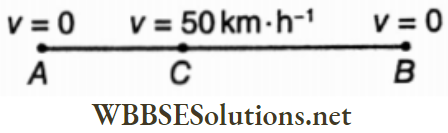
One Dimensional Motion A Train Begins From Station A To B

Let AC = s1 and CB = s2

So for the motion from A to C, v = \(a_1 t_1 \text { and } s_1=\frac{1}{2} a_1 t_1^2\)

and for the motion from C to B, \(0=v-a_2 t_2 \quad \text { or, } v=a_2 t_2\)

and \(s_2=v t_2-\frac{1}{2} a_2 t_2^2=a_2 t_2^2-\frac{1}{2} a_2 t_2^2=\frac{1}{2} a_2 t_2^2\)

So the distance between A and B,

s = \(A B=A C+C B=s_1+s_2\)

= \(\frac{1}{2} a_1 t_1^2+\frac{1}{2} a_2 t_2^2\)

= \(\frac{1}{2} v t_1+\frac{1}{2} v t_2\) (because \(v=a_1 t_1=a_2 t_2\))

= \(\frac{1}{2} v\left(t_1+t_2\right)=\frac{1}{2} \times 50 \times \frac{3}{4}\)

(\(v=50 \mathrm{~km} \cdot \mathrm{h}^{-1}, t_1+t_2=45 \mathrm{~min}=\frac{3}{4} \mathrm{~h}\))

=18.75 km

Example 6. A train moving with constant acceleration crosses an observer standing on the platform. The first and the second compartments, each 15 m long, cross the observer in 2 s and 2.5 s, respectively. Find the velocity of the train when its first compartment just crosses the observer and also find its acceleration.
Solution:

Let the velocity and the acceleration of the train as its 1st compartment just reaches the observer be u and a, respectively.

Hence, displacement in 2 s = length of the 1st compartment = 15 m

and displacement in (2 + 2.5) or, 4.5 s = total length of the two compartments = 2 x 15 = 30 m

Now from the equation s = ut + \(\frac{1}{2}\) at² we get,

∴ 15 = 2u + \(\frac{1}{2}\)a(2)²

or, u + a = \(\frac{15}{2}\)….(1)

and 30 = 4.5 u + \(\frac{1}{2}\) a(4.5)²

or, 36u + 81a = 240….(2)

Solving equations (1) and (2), we get, u = \(\frac{49}{6}\) and a = –\(\frac{2}{3}\)

The 1st compartment crosses the observer in 2 s; the velocity at that moment,

v = u + at = \(\frac{49}{6}\) x 2 = \(\frac{41}{6}\)

Therefore, the velocity and acceleration of the train as its 1st compartment just crosses the observer are \(\frac{41}{6}\) m · s-1 and –\(\frac{2}{3}\)m · s-2 respectively.

Example 7. A bullet with an initial velocity u penetrates a target. After penetrating a distance x, its velocity decreases by \(\frac{u}{n}\). How much farther will the bullet move through the target before it comes to rest?
Solution:

Let us assume that the retardation of the bullet inside the target is a and it is uniform.

After penetrating a distance x, the velocity, v = u – \(\frac{u}{n}\) = \(\frac{u(n-1)}{n}\)

∴ From \(v^2=u^2-2 a s\), we get, \(\frac{u^2(n-1)^2}{n^2}=u^2-2 a x\)

or, \(2 a x=u^2-\frac{u^2(n-1)^2}{n^2}\)

= \(u^2\left(1-\frac{n^2-2 n+1}{n^2}\right)=u^2 \cdot \frac{2 n-1}{n^2}\)

or,  a = \(\frac{u^2(2 n-1)}{2 x n^2}\)

Let the bullet travel an additional distance y before it comes to rest.

∴ \((0)^2=u^2-2 a(x+y) \quad \text { or, } x+y=\frac{u^2}{2 a}\)

or, \(y=\frac{u^2}{2 a}-x=\frac{u^2 \cdot 2 x n^2}{2 u^2(2 n-1)}-x=\frac{x n^2}{2 n-1}-x\)

= \(x\left(\frac{n^2-2 n+1}{2 n-1}\right)=\frac{x(n-1)^2}{2 n-1}\)

Example 8. Starting from rest, a train travels a certain distance with a uniform acceleration α. Then it travels with a uniform retardation β and finally comes to rest again. If the total time of motion is t, find

  1. The maximum velocity attained and
  2. The total distance travelled by the train.

Solution:

1. Let t1 be the time taken to travel a distance s1 with acceleration α, and t2 be the time taken to travel a farther distance s2 with retardation β. Let the maximum velocity attained by the train be v.

Here t = t1 + t2

∴ For the motion of the train with acceleration α,

v = \(\alpha t_1 \quad \text { or, } t_1=\frac{\nu}{\alpha}\)…..(1)

and \(\nu^2=2 \alpha s_1 or, s_1=\frac{\nu^2}{2 \alpha}\)…..(2)

Similarly, for the motion of the train with retardation β,

0 = \(\nu-\beta t_2\)

or, \(t_2=\frac{v}{\beta}\) and \(0^2=v^2-2 \beta s_2\) or, \(s_2=\frac{\nu^2}{2 \beta}\)

From (1) and (3) we get, \(t=t_1+t_2=v\left(\frac{1}{\alpha}+\frac{1}{\beta}\right) \quad \text { or, } \quad v=\frac{\alpha \beta t}{\alpha+\beta}\)

2. From (2) and (4), the total distance travelled,

s = \(s_1+s_2=\frac{\nu^2}{2}\left(\frac{1}{\alpha}+\frac{1}{\beta}\right) \)

= \(\left(\frac{\alpha \beta t}{\alpha+\beta}\right)^2 \times \frac{1}{2}\left(\frac{\alpha+\beta}{\alpha \beta}\right)=\frac{\alpha \beta t^2}{2(\alpha+\beta)} .\)

Example 9. A particle travelling with uniform acceleration along a straight line has average velocities v1, v2 and v3 in successive time intervals t1, t2 and t3, respectively. Prove that, \(\frac{v_2-v_1}{v_3-v_2}=\frac{t_1+t_2}{t_2+t_3}\)
Solution:

Let the initial velocity of the particle be w and its acceleration be a. Also, x, y and z are the velocities after the respective time intervals t1, t2 and t3.

∴ \(x=u+a t_1, y=u+a\left(t_1+t_2\right), z=u+a\left(t_1+t_2+t_3\right) \)

Again, \(v_1=\frac{u+x}{2}, v_2=\frac{x+y}{2}, v_3=\frac{y+z}{2}\)

∴ \(\frac{v_2-v_1}{v_3-v_2}=\frac{\frac{1}{2}(x+y)-\frac{1}{2}(u+x)}{\frac{1}{2}(y+z)-\frac{1}{2}(x+y)}\)

= \(\frac{y-u}{z-x}=\frac{u+a\left(t_1+t_2\right)-u}{u+a\left(t_1+t_2+t_3\right)-\left(u+a t_1\right)}\)

= \(\frac{t_1+t_2}{t_2+t_3}\)

Example 10. A bullet, moving with a velocity of 200 m • s-1 can just go through a 4 cm thick plank. What should be the velocity of a bullet for just going through a 10 cm thick identical plank?
Solution:

The retardation (a) should be the same inside both the planks. The final velocity of the bullet in both cases is zero.

Let the initial velocities of the bullet in the two cases be u1 and u2, respectively.

Then 0 = \(u_1^2-2 a s_1 or, u_1^2=2 a s_1\)

Similarly, \(u_2^2=2 a s_2\)

∴ \(\frac{u_1^2}{u_2^2}=\frac{s_1}{s_2}\)

or, \(u_2=u_1 \sqrt{\frac{s_2}{s_1}}=200 \times \sqrt{\frac{10}{4}}\)

= \(100 \sqrt{10}=316.2 \mathrm{~m} \cdot \mathrm{s}^{-1}\).

Example 11. The speed of a train drops from 48 km h-1 to 24 km h-1 after moving through a distance of 108 m with uniform retardation. How much farther would it move with the same retardation before coming to rest?
Solution:

⇒ \(v^2=u^2+2\) as; \(s=108 \mathrm{~m}=0.108 \mathrm{~km}\)

∴ \(a=\frac{v^2-u^2}{2 s}\)

= \(\frac{(24)^2-(48)^2}{2 \times 0.108}=-8000 \mathrm{~km} \cdot \mathrm{h}^{-2}\)

For the second part of the motion, u = \(24 \mathrm{~km} \cdot \mathrm{h}^{-1} \text { and } v=0\)

∴ \(s=\frac{v^2-u^2}{2 a}\)

= \(\frac{0-(24)^2}{2 \times(-8000)}=0.036 \mathrm{~km}=36 \mathrm{~m}\)

Example 12. A particle starts with a velocity u with a uniform acceleration f. In the p-th, q-th and r-th seconds, it moves through distances a, b and c respectively. Prove that, a(q- r) + b(r- p) + c(p- q) = 0.
Solution:

Distance travelled in the n-th second, \(s_n=u+\frac{1}{2} f(2 n-1)\)

∴ a = \(u+\frac{1}{2} f(2 p-1)\)

= \(u+f p-\frac{f}{2}=\left(u-\frac{f}{2}\right)+f p\)…..(1)

Similarly, b = \(\left(u-\frac{f}{2}\right)+f q\)…..(2)

and c = \(\left(u-\frac{f}{2}\right)+f r\)……(3)

Multiplying (1), (2) and (3) by (q-r),(r-p) and (p-q) respectively, and then adding, we get a(q-r)+b(r-p)+c(p-q)

= \(\left(u-\frac{f}{2}\right)[(q-r)+(r-p)+(p-q)]\) + \(f[p(q-r)+q(r-p)+r(p-q)]\)

= \(\left(u-\frac{f}{2}\right) \cdot 0+f \cdot 0=0\)

Example 13. From two stations A and B, two trains started simultaneously towards each other with velocities v1 and v2 respectively. After they crossed each other, the first train reached B in time t1 and the second train reached A in time t2. Show that v1: v2 = √t2:√t1
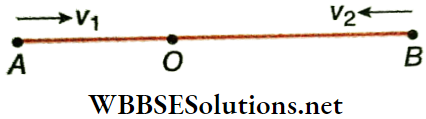
One Dimensional Motion Two Stations A And B Started Each Other

Solution:

Let the two trains cross each other at point O after time t.

So, AO = v1t and BO = v2t, i.e., \(\frac{A O}{B O}=\frac{v_1}{v_2}\)

Again, for the first train, OB = v1t1

and for the second train, OA = v2t2

∴ \(\frac{O A}{O B}=\frac{A O}{B O}=\frac{v_2 t_2}{v_1 t_1}\)

Then, \(\frac{v_1}{v_2}=\frac{v_2 t_2}{v_1 t_1} \quad or, \frac{v_1^2}{v_2^2}=\frac{t_2}{t_1} \quad or, \frac{v_1}{v_2}=\frac{\sqrt{t_2}}{\sqrt{t_1}}\)

Example 14. A train attains a velocity v after starting from rest with a uniform acceleration α. Then the train travels for some time with uniform velocity, and at last, comes to rest with a uniform retardation β. If the overall displacement is s in time t, show that \(t=\frac{s}{v}+\frac{v}{2}\left(\frac{1}{\alpha}+\frac{1}{\beta}\right)\).
Solution:

For the accelerated motion, \(\nu=0+\alpha t_1 \quad \text { or, } t_1=\frac{\nu}{\alpha}\)

and \(v^2=0+2 \alpha s_1 \quad or, s_1=\frac{v^2}{2 \alpha}\)

For the uniform motion, \(s_2=v t_2 or, t_2=\frac{s_2}{v}\)

For the retarded motion, \(0=v-\beta t_3 \quad or, t_3=\frac{\nu}{\beta}\)

and 0 = \(v^2-2 \beta s_3 \quad or, s_3=\frac{v^2}{2 \beta}\)

∴ \(s=s_1+s_2+s_3=\frac{\nu^2}{2 \alpha}+s_2+\frac{\nu^2}{2 \beta}\)

or, \(s_2=s-\frac{v^2}{2}\left(\frac{1}{\alpha}+\frac{1}{\beta}\right)\)

Then, t = \(t_1+t_2+t_3=\frac{\nu}{\alpha}+\frac{s_2}{\nu}+\frac{\nu}{\beta}=\frac{v}{\alpha}+\frac{1}{\nu}\left[s-\frac{v^2}{2}\left(\frac{1}{\alpha}+\frac{1}{\beta}\right)\right]+\frac{\nu}{\beta}\)

= \(v\left(\frac{1}{\alpha}+\frac{1}{\beta}\right)+\frac{s}{v}-\frac{\nu}{2}\left(\frac{1}{\alpha}+\frac{1}{\beta}\right)=\frac{s}{v}+\frac{\nu}{2}\left(\frac{1}{\alpha}+\frac{1}{\beta}\right)\)

Graphical Proof Of The Equations Of Motion: AB represents the velocity-time graph of a particle starting with an initial velocity u, attaining a final velocity v in time t, moving with a uniform acceleration a.
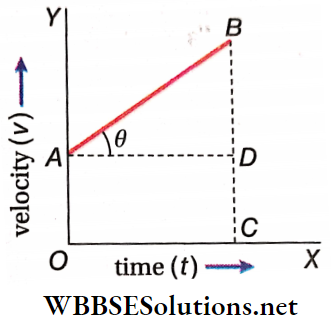
One Dimensional Graphical proof Of Equation Of Motion

Along the time and the velocity axes, OC = t, OA = u and CB = v.

∴ a = slope of AB

= tan θ= \(\tan \theta=\frac{D B}{A D}=\frac{C B-C D}{A D}=\frac{C B-O A}{O C}=\frac{\nu-u}{t} .\)

Proof Of v = u + at: We know the equation of a straight line of slope m with an intercept c on the y-axis is y = mx + c …..(1)

Comparing the corresponding values for AB, we get, y = v, m = a, x = t and c = u.

∴ The graph AB follows the equation v = u + at….(2)

Proof Of s = ut + \(\frac{1}{2}\)at²: The area under the graph AB and the time-axis, gives the displacement of the particle in time t.

The area under AB is the area of the trapezium OABC, which is the sum of the areas of the rectangle OADC and the triangle ABD.

Hence, the displacement of the particle in time t,

s = \(O A \times O C+\frac{1}{2} A D \times D B=O A \times O C+\frac{1}{2} \times \frac{D B}{A D} \times A D^2\)

∴ \(s=u t+\frac{1}{2} a t^2\) (because A D=O C=t) ……(3)

Proof Of v² = u² + 2as: Slope of AB = a = tanθ = \(\frac{D B}{A D}\)=\(\frac{DB}{O C}\)

∴ as = slope of AB X area of the trapezium OABC

= \(\frac{B D}{O C} \times \frac{1}{2}(O A+C B) \times O C\)

= \(\frac{1}{2} B D(O A+C B)=\frac{1}{2}(C B-C D)(O A+C B)\)

∴ as = \(\frac{1}{2}(v-u)(v+u)=\frac{1}{2}\left(v^2-u^2\right)\)

∴ 2as =\(v^2-u^2\)

or, \(v^2=u^2+2 a s\)

Acceleration in One Dimensional Motion Explained

Proof Of st = u + \(\frac{1}{2}\)a(2t-1): Let AP represent the velocity-time graph of a particle starting with an initial velocity u and moving with a uniform acceleration a.

Let points D and E represent the times (t – 1) and t respectively in the motion. Hence, the area of the trapezium BCED denotes the displacement st in the t th second.
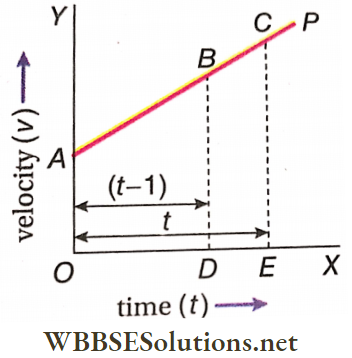
One Dimensional Motion Ap Represents Velocity Time Graph

∴ st = \(\frac{1}{2}\) (DB + EC) x DE

DE = OE- OD = t- (t- 1) = 1 s

DB = the velocity attained in time (t- 1) = u+ a(t- 1)

EC = velocity attained in time t = u+ at.

∴ st = \(\frac{1}{2}\)[{u+ a(t—1)} + (u+ at)] x 1

= u + \(\frac{1}{2}\) a(2t- 1)….(5)

Derivation Of The Equations Of Motion Using Calculus

Derivation of v = u + at: From definition, acceleration is the rate of change of velocity,

i.e., a = \(\frac{dv}{dt}\) or, dv = a dt

For motion with a uniform acceleration, a = constant.

∴ ∫dv = a∫dt

or, v = at + A [A = integration constant]……(1)

At t = 0, v = u. Then from equation (1), we get,

u = a·0 + A or, A = u

Hence, equation (1) becomes, v = u + at

Derivation of s = ut + \(\frac{1}{2}\) at²: We know the velocity of a particle is the rate of change of its displacement with time.

∴ v = \(\frac{ds}{dt}\) or, \(\frac{ds}{dt}\) = u + at

or, ds = u dt+ at dt, a and u are constants

∫ds = u∫dt+ a∫t dt

or, s = ut + \(\frac{1}{2}\) at² + A [A = integration constant]……(2)

From initial condition, at t = 0 , s = 0

∴ A = 0

∴ Equation (2) becomes, s = ut + \(\frac{1}{2}\) at²

Derivation Of v² = u² + 2as: Velocity of the particle,

v = \(\frac{ds}{dt}\) and acceleration, a = \(\frac{dv}{dt}\) \(\frac{ds}{dt}\) = v\(\frac{dv}{ds}\)

or, a ds = v dv, where a is a constant, a∫ds = ∫v dv

or, as = \(\frac{v^2}{2}\) + B [B = integration constant]…..(3)

At the start of motion, v = u and s = 0

∴ 0 = \(\frac{u^2}{dt}\) + B or, B = –\(\frac{u^2}{2}\)

Substituting this in equation (3), we get,

as = \(\frac{v^2}{2}\) – \(\frac{u^2}{2}\)

or, v² = u² + 2as…..(4)

Derivation Of The Equations Of Motion Using Calculus Numerical Examples

Example 1. s-t graph for a particle, moving with a constant acceleration, subtends 45° angle with the time axis at time t. That angle becomes 60° 1 s later. Find the acceleration of the particle.
Solution:

Let the velocity of the particle at P1 and P2 be u and v respectively.

∴ u = tanθ1 and v = tanθ2
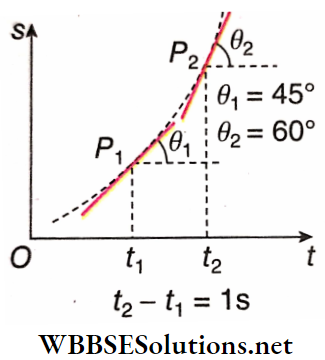
One Dimensional Motion st Graph For A Particle Moving Constant

∴ Acceleration of the particle

a = \(\frac{\nu-u}{t_2-t_1}\)

= \(\frac{\tan \theta_2-\tan \theta_1}{t_2-t_1}\)

= \(\frac{\tan 60^{\circ}-\tan 45^{\circ}}{1}\)

= \(\sqrt{3}-1=0.732 \text { unit. } \mathrm{s}^{-2} .\)

Equations of Motion for One Dimensional Movement

Example 2. Displacement x and time t, in a rectilinear motion of a particle, are related as t= √x+3. Here x is measured in metres and t in seconds. Find the displacement of the particle when its velocity is zero.
Solution:

Given, t = √x + 3 or, √x = t-3 or, x = (t-3)².

Velocity, v = \(\frac{dx}{dt}\) = 2(t – 3)

If velocity =0, 2(t – 3) = 0 or, t = 3 s

∴ At t = 3 s , the displacement, x = (3 -3)² = 0

Hence at zero velocity, the displacement is also zero

Example 3. A body starts from rest and moves with an acceleration proportional to time,

  1. Find its velocity n s after starting,
  2. What distance will it travel in ns?

Solution:

According to the problem, a ∝ t

or, a = kt, where k is the constant of proportionality.

Now, a = \(\frac{dv}{dt}\)

dv = kt dt or, ∫dv = k∫t dt

∴ v = \(\frac{k t^2}{2}\) = A(where A = integration constant) ……(1)

Also, as v = 0 at t = 0 , we get A = 0

∴ From equation (1 ) we get, v = \(\frac{k t^2}{2}\)….(2)

Again, if the displacement of the object is s, then v = \(\frac{ds}{dt}\)

∴ From equation (2), \(\)

On integration we get,

s = \(\frac{k t^3}{6}\) + B [where B = integration constant]

Also, at t = 0 , s = 0

∴ B = 0

∴ s = \(\frac{k t^3}{6}\)….(3)

At t = ns, from equations(2) and (3) we get,

  1. v = \(\frac{k n^2}{2}\)
  2. s = \(\frac{k n^2}{6}\)

Example 4. The velocity of a moving particle v decreases with its displacement. Given, v = v1 – ax where v0 = initial velocity, x = displacement and a is a constant. How long will the particle take to reach point B on the x-axis at a distance xm from the origin?
Solution:

Given, v = v0 – ax.

At the starting point, v = v0.

∴ v0 = v0– ax or, x= 0 [a = constant]

Hence, the particle was initially at the origin.

Now, \(v=\frac{d x}{d t}=v_0-\alpha x\)

or, \(\frac{d x}{v_0-\alpha x}=d t or, \frac{-\alpha d x}{v_0-\alpha x}=-\alpha d t\)

Then, \(\int \frac{-\alpha d x}{v_0-\alpha x}=-\alpha \int d t or, \log _e\left(\nu_0-\alpha x\right)=-\alpha t+c\); [c is the integration constant]

At t=0 (initially), x=0

∴ \(c=\log _e v_0\)

Therefore, \(\log _e\left(v_0-\alpha x\right)=-\alpha t+\log _e v_0\)

or, \(t=\frac{1}{\alpha} \log _e \frac{v_0}{v_0-\alpha x}\)

At the point \(B, x=x_m\).

Let the corresponding time be \(t_m\).

∴ \(t_m=\frac{1}{\alpha} \log _e \frac{v_0}{v_0-\alpha x_m} \text {. }\)

Example 5. The relation between the time taken and the displacement of a moving body is s = 2t²- 3t² + 4t³, where the unit of s is in metres and that of t is in seconds. Find out the displacement, velocity and acceleration of the body 2 s after initiation of the journey.
Solution:

Here, s = 2t – 3t³ + 4t³……(1)

∴ In 2 s the displacement of the body is,

s = (2 x 2)- [3 x (2)²] + [4 x (2)³]

= (4-12 + 32) = 24 m

Now, the velocity is, v = \(\frac{ds}{dt}\) = 2 – 6t + 12t²

∴ After 2s, v = 2- (6 x 2) +[12 x (2)²] = 38 m · s-1

Again, the acceleration is, a = \(\frac{dv}{dt}\) -6 + 24t

∴ Acceleration after 2 s, a = – 6 +.24 X 2 = -6 + 48 = 42 m · s-2.

Example 6. For a particle travelling along a straight line, the equation of motion is s = 16t + 5t². Show that it will always travel with uniform acceleration.
Solution:

Here, s = 16t + 5t²

∴ Velocity, v = \(\frac{ds}{dt}\) = 16 + 10t

Again acceleration, a = \(\frac{dv}{dt}\) = 10 = constant

∴ The particle will always travel with uniform acceleration.

Example 7. If a, b and c are constants of motion and s = at² + bt + c, then prove that 4a(s – c) = v² – b².
Solution:

Here, s = at² + bt+ c

∴ v = \(\frac{ds}{dt}\) = 2at+ b

∴ v² – b² =  (2at+ b)²- b² = 4a²t² + 4abt

= 4a(at² + bt) = 4a(at² + bt + c – c)

or, v² – b² = 4a(s-c) (Proved)

Example 8. The retardation of a particle in rectilinear motion is proportional to the square root of its velocity v. Assume that the constant A of proportionality Is positive. The initial velocity of the particle is v0. How far would the particle move before coming to rest? What would be the time required to travel that distance?
Solution:

⇒ \(a \propto-\sqrt{v}\)

∴ \(a=-A \sqrt{v}=-A \nu^{1 / 2}\)

or, \(\frac{d \nu}{d t}=-A v^{1 / 2}\)

or, \(v^{-1 / 2} d v=-A d t\)

∴ \(\int v^{-1 / 2} d v=-A \int d t+c\) [c=integration constant]

or, \(2 v^{1 / 2}=-A t+c\)…..(1)

Given, at t=0, v=\(v_0\). Putting in (1), \(c=2 v_0^{1 / 2}\)

∴ \(2 v^{1 / 2}=-A t+2 v_0^{1 / 2}\)

or, \(2\left(\sqrt{v_0}-\sqrt{v}\right)\)= At…..(2)

When the particle comes to rest after a time T, we have v=0 at t=T.

From (2), \(2 \sqrt{v_0}=A T \quad \text { or, } T=\frac{2}{A} \sqrt{v_0}
\)

Now, \(a=\frac{d v}{d t}=\frac{d v}{d x} \frac{d x}{d t}=\frac{d v}{d x} v\)

or, \(d x=\frac{1}{a} v d v=-\frac{1}{A \sqrt{v}} v d v=-\frac{1}{A} v^{1 / 2} d v\)

∴ \(\int d x=-\frac{1}{A} \int v^{1 / 2} d v+k\) [k = integration constant]

or, \(x=-\frac{1}{A} \cdot \frac{2}{3} \nu^{3 / 2}+k=-\frac{2}{3 A} v^{3 / 2}+k\)….(3)

At start, x=0 and \(v=v_0\), Putting in (3),

0 = \(-\frac{2}{3 A} v_0^{3 / 2}+k \quad \text { or, } k=\frac{2}{3 A} v_0^{3 / 2}\)

So, equation (3) becomes, \(x=\frac{2}{3 A}\left(v_0^{\frac{3}{2}}-v^{\frac{3}{2}}\right)\)……..(4)

When the particle comes to rest, v=0. Then the total distance travelled is, \(x_0=\frac{2}{3 A} v_0^{3 / 2}\)

Example 9. The acceleration-time graph of a particle starting from rest is given. Draw the corresponding velocity-time graph and hence find out the displacement in 6s.

Graphical Representation of One Dimensional Motion
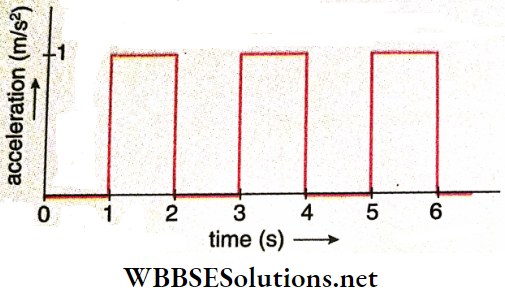
One Dimensional Motion Acceleration Time Graph

Solution:

In the intervals (0 →1), (2 → 3) and (4 → 5) seconds, acceleration is zero, i.e., velocity = constant.

Again, in the intervals (1 → 2), (3 → 4) and (5 → 6) seconds, the velocity increases uniformly and rises to 1 m/s, 2 m/s and 3 m/s respectively, because the uniform acceleration in each interval is 1 m/s²
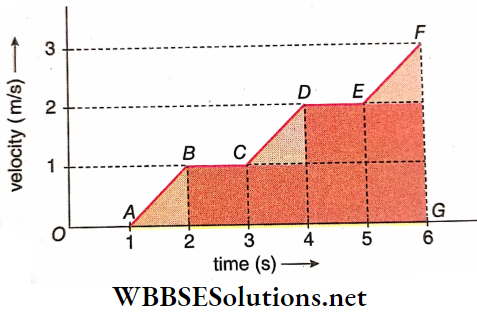
One Dimensional Motion Uniform Acceleration In Each Interval

∴ The velocity-time graph of the motion is ABCDEF

Displacement in 6 s = area under ABCDEF

= area of 6 unit squares + area of 3 triangles

= 6 x (1 x 1) + 3 x (\(\frac{1}{2}\) x 1 x 1) = 7.5 m

Vertical Motion Under Gravity

Acceleration Due To Gravity: when an object is released from a certain height above the earth’s surface, it moves with vertically downward acceleration. Again, when an object is thrown vertically upwards from the ground, it moves up with a deceleration. An upward deceleration is equivalent to a downward acceleration.

Actually, the acceleration is always downward, and its magnitude is the same for both downward and upward motions.

So, the equations of vertical motion are,

v = u + at ….(1)

h = ut + \(\frac{1}{2}\)at² ……(2)

and v² = u² + 2ah ……(3)

Here, initial velocity is u, velocity after time r is v, vertical displacement in time t is h, and acceleration is a.

This acceleration a is called the acceleration due to gravity or free fall acceleration and is represented by the letter g.

The direction of g is always vertically downwards.

If the downward direction is taken as positive, i.e., a = g, then we get the following equations of motion:

v = u + gt …..(4)

h = ut + \(\frac{1}{2}\)gt² …..(5)

and v² = u² + 2 gh …(6))

If the upward direction is taken as positive, i.e., a = we get the following equations: -g, then

v = u – gt …….(7)

h = ut – \(\frac{1}{2}\)gt² …..(8)

and v² = u² – 2gh …..(9)

Maximum Height Attained: When a body is thrown vertically upwards with a velocity u, it momentarily comes to rest on attaining the maximum height and then again starts falling vertically downwards.

Hence, at maximum height H, the velocity of the body, v = 0.

∴ 0 = u² – 2gH [from equation (9)]

or, H = \(\frac{u^2}{2g}\)…….(10)

Time To Reach The Maximum Height: Let the time required to reach the maximum height be T.

∴ 0 = u² – gT [from equation (7)]

or, T= \(\frac{u}{g}\)……(11)

Time Taken To Fall From The Maximum Height: if T1 is the time taken by the body to fall from the maximum height to the initial position then, using equation (5),

H = \(\frac{1}{2} g T_1^2\)[as at maximum height, u = 0]

or, \(T_1^2=\frac{2 H}{g}=\frac{2}{g} \cdot \frac{u^2}{2 g}=\frac{u^2}{g^2}\)

∴ \(T_1=\frac{u}{g}\)….(12)

Hence, the time to reach the maximum height is equal to the time to return to the starting point.

Time Of Flight: it is the total time required for upward and downward motions

T’ = T + T1 = \(\frac{u}{g}\) + \(\frac{u}{g}\) = \(\frac{2u}{g}\)

Time Of Flight Alternative Method: After completion of the upward and downward motions, the displacement becomes zero. Thus, using equation (8),

0 = uT’ – \(\frac{1}{2}\)gT’² or, u = \(\frac{1}{2}\)gT’ or, T’ = \(\frac{2u}{g}\).

Time Taken To Reach A Certain Height: Let the object reach a height h at time f. The initial upward velocity = u.

∴ h = \(u t-\frac{1}{2} g t^2\)

or, \(\frac{1}{2} g t^2-u t+h=0\)

or, \(t=\frac{u}{g} \pm \frac{\sqrt{u^2-2 g h}}{g}\)

From this equation, two different values of t are obtained. This is because the object crosses the point at a height h twice, first during the upward motion and then during the downward motion.

Velocity At Any Height: From the equation \(v^2=u^2-2 g h, \text { we get, } v= \pm \sqrt{u^2-2 g h} \text {. }\).

The positive (+) sign is applicable for upward motion and the negative (-) sign is applicable for downward motion. So, an object crosses any point with the same magnitude of velocity in its upward and downward motions.

Velocity Of Projection And Velocity Of Return: Let u = velocity of projection, v = velocity of return and total time of flight = T’.

∴ From equation (7), we can write,

v = u – gT’ = u – g · \(\frac{2u}{g}\) = -u (T’ = \(\frac{2u}{g}\))

Hence, the upward velocity of projection is equal in magnitude to the downward velocity with which an object hits the ground.

Vertical Motion Under Gravity Numerical Examples

Example 1. A stone is dropped from a height of 19.6 m. What is the time taken by the stone to travel the last metre of the path?
Solution:

In this case u = 0

∴ \(h=\frac{1}{2} g t^2 \quad \text { or, } t=\sqrt{\frac{2 h}{g}}\)

Let t1 and t2 be the time taken by the stone to travel (19.6-1) = 18.6 m and 19.6 m, respectively.

∴ \(t_1=\sqrt{\frac{2 \times 18.6}{9.8}} \text { and } t_2=\sqrt{\frac{2 \times 19.6}{9.8}}\)

or, \(t_1=1.948 \mathrm{~s} \) and \(t_2=2 \mathrm{~s}\)

Hence, the time taken to travel the last metre, \(t_2-t_1=2-1.948=0.052 \mathrm{~s}\)

Example 2. An object is thrown vertically upwards with an initial velocity of 40 m · s-1.

  1. How long will the object move upwards?
  2. What will be the maximum height attained?
  3. How much time will it take to reach the ground?
  4. When will the object be at a height of 25 m from the ground?
  5. What will be its velocity after 2 s ? [g = 9.8 m · s-2]

Solution:

1. Let the time taken for upward motion be t s. At maximum height, its velocity is zero. From equation v = u – gt, we get, 0 = 40 – 9.8 x t or, t = 4.1s.

2. Let the maximum height attained be h.

From equation v² = u² – 2gh, we get,

0 = (40)² – 2 x 9.8h or, h = 81.6 m .

3. Let the time taken to reach the ground be t1 starting from the time of projection. Considering both upward and downward motions of the body and using the equation h = ut – \(\frac{1}{2}\)gt², we get,

0 = \(40 t_1-\frac{1}{2} \times 9.8 \times t_1^2\) [total displacement is zero in this case]

∴ t1 = 8.2 s

4. Let the time after which the body is at a height of 25 m be x.

Hence, from h = ut – \(\frac{1}{2}\)gt² we get,

25 = 40 x – \(\frac{1}{2}\) · 9.8x² or, 49x² – 400x + 250 = 0

or, \(x=\frac{400 \pm \sqrt{(400)^2-4 \cdot 49 \cdot 250}}{2 \cdot 49}=\frac{400 \pm 10 \sqrt{1110}}{2 \cdot 49}\)

or, x = 0.682 s and x = 7.481 s

Two values of x signify that the object will be at a height of 25 m twice during its flight, once (x = 0.682 s) while moving upwards and the next (x = 7.481 s) during its downward motion.

5. Let the velocity acquired 2 s after the projection be v.

∴ v = 40 – 9.8 x 2 = 20.4 m · s-1.

Example 3. A ball falls freely on a perfectly elastic plate from a height of 3 m. At the instant t = 0, the velocity of the ball is zero. Draw a velocity-time graph for the motion of the ball, [g = 9.8 m · s-2]
Solution:

In this case, h = \(\frac{1}{2}\) gt²

The time taken by the ball to fall through 3 m is given by t = \(\sqrt{\frac{2 h}{g}}=\sqrt{\frac{2 \times 3}{9.8}}=0.783 \mathrm{~s}\)

According to the equation, v² = 2gh, the velocity of the ball just before striking the plate is given by

v = \(\sqrt{2 g h}=\sqrt{2 \times 9.8 \times 3.0}=7.67 \mathrm{~m} \cdot \mathrm{s}^{-1}\)
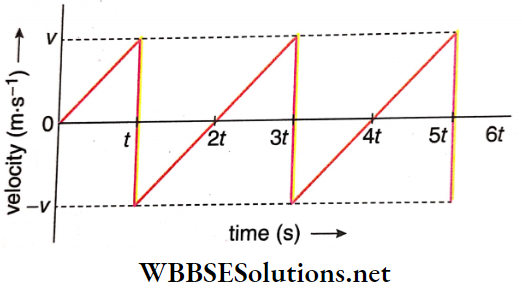
One Dimensional Motion Ball Falls Freely On A Perfectly Elastic Plate

Since the plate is perfectly elastic, the ball after striking it will rebound with the same velocity (7.67 m · s-1) and its velocity will become zero after the same time (0.78 s). This motion will be repeated again and again as shown in the above graph.

Example 4. A body is thrown vertically upwards. After attaining half of its maximum height its velocity becomes 14 m · s-1.

  1. How high will the body rise?
  2. What will be the velocity of the body 1 s and 3 s after its projection?
  3. What is the average velocity of the body in the first half second?

Solution:

1. Let the velocity of projection be u.

Hence, maximum height attained by the body, h = \(\frac{u^2}{2g}\) [using v² = u² – 2 gh]

or, u² = 2 gh

For half the maximum height, i.e., \(\frac{h}{2}\), we get

(14)² = u² – 2g\(\frac{h}{2}\) = 2gh –\(\frac{h}{2}\)(2gh) = gh

∴ h = 20 m [where g = 9.8 m · s-2]

∴ The body will rise up to a height of 20 m. nil Here, the velocity of projection,

2. Here, the velocity of projection, \(u=\sqrt{2 g h}=\sqrt{2 \times 9.8 \times 20}=19.8 \mathrm{~m} \cdot \mathrm{s}^{-1}\)

∴ The velocity of the body 1 s after projection is, v1 = u – g ·1 = 19.8 – 9.8 = 10 m · s-1.

Velocity 3 s after projection, v2 = u – g x 3 = 19.8 – 9.8 x 3 = -9.6 m · s-1

(Negative sign indicates downward motion of the body.)

3. Velocity after  \(\frac{1}{2}\)s

v’ = u – g x \(\frac{1}{2}\) = 19.8 – 9.8 x \(\frac{1}{2}\) = 149 m · s-1

Hence, average velocity during the given period = \(\frac{u+v^{\prime}}{2}=\frac{(19.8+14.9)}{2}=17.35 \mathrm{~m} \cdot \mathrm{s}^{-1} \text {. }\)

Short Answer Questions on One Dimensional Motion

Example 5. A piece of stone was dropped from a stationary balloon. The stone covered 13.9 m during the last 1/7 s of its descent. Find the height of the balloon and the velocity of the stone when it strikes the ground, [g = 9.8 m · s-2]
Solution:

Let h = height of the balloon, t = total time of fall of the stone, h’ = downward displacement in time (t – \(\frac{1}{7}\))s.

Hence, \(h-h^{\prime}=\frac{1}{2} g t^2-\frac{1}{2} g\left(t-\frac{1}{7}\right)^2\)

or, \(13.9=\frac{1}{2} \times 9.8 \times t^2-\frac{1}{2} \times 9.8\left(t-\frac{1}{7}\right)^2\)

or, \(13.9=4.9 t^2-4.9 t^2+1.4 t-0.1\)

or, \(1.4 t=14\) or, t=10

∴ Height of the balloon, \(h=\frac{1}{2} g t^2=\frac{1}{2} \times 9.8 \times(10)^2=490 \mathrm{~m}\)

The velocity of the stone when it strikes the ground is, \(v=u+g t=0+9.8 \times 10=98 \mathrm{~m} \cdot \mathrm{s}^{-1} \text {. }\)

Example 6. A stone is dropped from the top of a tower 400 m high. At the same time, another stone is thrown upwards from the ground with a velocity of 100 m · s-1. When and where will they meet each other? (g = 9.78 m · s-2).
Solution:

Let the two stones meet after a time t at a distance h from the top of the tower.

h = \(\frac{1}{2}\) gt² = \(\frac{1}{2}\) x 9.8 t² ……(1)

Considering the downward motion of the 1st stone 400 – h = 100t – \(\frac{1}{2}\) x 9.8 t² …..(2)

From equations (1) and (2) we get, 400 – \(\frac{1}{2}\)x 9.8t² = 100t – \(\frac{1}{2}\) x 9.8t²

or, 100t = 400 or, t = 4 s

Hence, from equation (1) we get, h = \(\frac{1}{2}\) x 9.8 x (4)² = \(\frac{1}{2}\) x 9.8 x 16 = 78.4 m

Hence, the two stones meet at 78.4 m below the top of the tower after 4 s.

Example 7. A stone is dropped from the top of a vertical pillar. When the stone has fallen through a height x, another stone is dropped from height y below the top of the pillar. Both the stones touch the ground at the same time. Prove that the height of the pillar should be \(\frac{(x+y)^2}{4 x}\).
Solution:

Let the height of the pillar be h and the velocity of the stone at x below the top of the pillar be v.

∴ \(v^2=2 g x \text { or, } v=\sqrt{2 g x}\)…..(1)

Let the first stone take \(t \mathrm{~s}\) to cover the distance (h-x).

∴ \(h-x=v t+\frac{1}{2} g t^2\)….(2)

According to the problem, the second stone is dropped from a height of (h-y) and this stone takes time t to cross that distance.

∴ \(h-y=\frac{1}{2} g t^2\)…..(3)

From equations (2) and (3) we get, \(h-x=\nu t+h-y \text { or, } y-x=v t \text { or, } y-x=t \sqrt{2 g x}\)

∴ t = \(\frac{y-x}{\sqrt{2 g x}}\)

From equation (3) we get, \(h-y=\frac{1}{2} g \frac{(y-x)^2}{2 g x}=\frac{(y-x)^2}{4 x}\)

or, \((h-y) \cdot 4 x=(y-x)^2 or, 4 x h-4 x y=y^2-2 y x+x^2\)

or, \(h=\frac{(x+y)^2}{4 x}\) (Proved).

Example 8. A, B, C and D are four points on a vertical line such that AB = BC = CD. A body is allowed to fall freely from A. Prove that the respective times required by the body to cross the distances AB, BC, and CD should be in the ratio 1: (√2- 1): (√3-√2).
Solution:

Let AB – BC = CD = x and the time taken by the body to cover these distances be t1, t2 and t3 respectively.

Now, \(x=\frac{1}{2} g t_1^2 \text { or, } t_1=\sqrt{\frac{2 x}{g}}\)…..(1)

2x = \(\frac{1}{2} g\left(t_1+t_2\right)^2 \text { or, } t_1+t_2=\sqrt{\frac{4 x}{g}}\)…..(2)

3 x = \(\frac{1}{2} g\left(t_1+t_2+t_3\right)^2 \text { or, } t_1+t_2+t_3=\sqrt{\frac{6 x}{g}}\)…..(3)

From (1) and (2) we get, \(t_2=\sqrt{\frac{4 x}{g}}-\sqrt{\frac{2 x}{g}}=\sqrt{\frac{2 x}{g}}(\sqrt{2}-1)\)

From (2) and (3) we get, \(t_3=\sqrt{\frac{6 x}{g}}-\sqrt{\frac{4 x}{g}}=\sqrt{\frac{2 x}{g}}(\sqrt{3}-\sqrt{2})\)

∴ \(t_1: t_2: t_3=1:(\sqrt{2}-1):(\sqrt{3}-\sqrt{2})\) (Proved).

Example 9. A rubber ball is thrown vertically downwards from the top of a tower with an Initial velocity of 14 m · s-1. A second ball is dropped 1 s later from the same place. In 2 s the first ball reaches the ground and rebounds upwards with the same velocity. When will they collide with each other?
Solution:

Height of the tower, h = distance covered by the first ball in 2s = 14 x 2 + \(\frac{1}{2}\)  x 9.8 x (2)² = 47.6 m

(h = ut + \(\frac{1}{2}\)gt²)

The velocity of the first ball just before touching the ground is v = 14 + 9.8 x 2 = 33.6 m · s-1

Hence, its velocity just after bouncing = 33.6 m · s-1

Downward displacement of the second ball in 1 s, x = \(\frac{1}{2}\) x 9.8 x (1)² = 4.9 m

Velocity of second ball after 1 s = 9.8 x 1 = 9.8 m · s-1

Hence, the distance between the two balls, 2 s after the projection of the first ball = 47.6- 4.9 = 42.7 m.

Let the two balls collide with each other ts after the first ball bounces off the ground.

Upward displacement of the first ball in ts, x1 = 33.6t – \(\frac{1}{2}\) X 9.8 x t² = 33.6t- 4.9t²

Downward displacement of the second ball in t s, x2 = 9.8t+ \(\frac{1}{2}\) x 9.8 x t² = 9.8t + 4.9t²

Now, x1 + x2 = 42.7

or, 33.6t – 4.9t + 9.8t+ 4.9 t³ = 42.7 or, 43.4t = 42.7

∴ t = \(\frac{42.7}{43.78}\) = 0.98 s

Example 10. A lift starts to move up with a constant acceleration of 2 m · s-2 from the earth’s surface. A piece of stone is dropped outside from the lift 4 s after the start of the lift When will the stone reach the earth’s surface?
Solution:

Initial velocity of the lift, u = 0; acceleration, a = 2 m · s-2

Let the rise of the lift in 4 s be s and its velocity at that point be v.

Hence, from equation v = u+ at we get,

v = 0 + 2 x 4 = 8 m · s-1

Also from equation s = ut + \(\frac{1}{2}\) at² we get

s = 0 x 4 + \(\frac{1}{2}\) x 2 (4)² = 16 m

∴ The stone piece was dropped with an initial upward velocity of 8 m · s-1 and was at a height of 16 m from the ground. If t is the time taken by the stone to reach the ground, then from equation h = ut + \(\frac{1}{2}\)gt²,

16 = \(-8 t+\frac{1}{2} \times 9.8 t^2\)

(because for the stone, \(u=-8 \mathrm{~m} \cdot \mathrm{s}^{-1}, g=9.8 \mathrm{~m} \cdot \mathrm{s}^{-2}\), h=16 m)

or, \(4.9 t^2-8 t-16=0\)

or, \( t=\frac{8 \pm \sqrt{(8)^2-4 \times 4.9 \times(-16)}}{2 \times 4.9}=\frac{8 \pm 19.4}{9.8}\)

Since time cannot be negative, \(t=\frac{8+19.4}{9.8}=2.8 \mathrm{~s}\).

Example 11. Two bodies released from different heights fall freely and reach the ground at the same time. The first body takes a time, t1 = 2 s and the second body takes a time, t2 = 1 s. What was the height of the first body at the time of the release of the second body?
Solution:

Let the height from which the first body is released be h1 above the ground. When it is at a height h2, the second body is released.

So, the first body falls through a height (h1 – h2) in time (t1– t2) before the release of the second body.
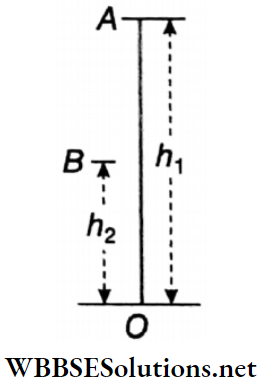
One Dimensional Motion Two Bodies Released From Different Heigths

According to the problem, \(h_1=\frac{1}{2} g t_1^2 \text { and } h_1-h_2=\frac{1}{2} g\left(t_1-t_2\right)^2\)

or, \(\frac{1}{2} g t_1^2-h_2=\frac{1}{2} g\left(t_1-t_2\right)^2\)

or, \(h_2=\frac{1}{2} g\left(2 t_1-t_2\right) t_2\)

= \(\frac{1}{2} \times 9.8(2 \times 2-1) \times 1=14.7 \mathrm{~m} .\)

Example 12. A balloon moves vertically upwards with a uniform velocity v0. A weight is tied to the balloon with a rope. When the balloon attains a height of h0, the rope snaps. How much time will the weight take to reach the ground?
Solution:

Let the time taken by the weight, after the rope snaps, to reach the ground be t. From the question, the weight ascends with the same velocity as that of the balloon, i.e., v0.

So, when the rope snaps the initial velocity of the weight =- v0 [the negative sign comes as the velocity of the weight is directed upwards just when the rope snaps].

∴ For the free fall of the weight, \(h_0=-v_0 t+\frac{1}{2} g t^2 \text { or, } \frac{1}{2} g t^2-v_0 t-h_0=0\)

∴ \(t=\frac{v_0 \pm \sqrt{v_0^2-4 \times \frac{1}{2} g\left(-h_0\right)}}{2 \cdot \frac{1}{2} g}=\frac{v_0 \pm \sqrt{v_0^2+2 g h_0}}{g}\)

So, the time taken by the weight to reach the ground is \(\frac{v_0+\sqrt{v_0^2+2 g h_0}}{g}\) (becasue t>0).

Example 13. According to the, three cars P, Q and R are at three points along the x-axis at a given moment. Now car P starts its motion towards P1 parallel to the y-axis with a uniform velocity v. Again, R is in motion parallel to the y-axis along RRX with uniform acceleration a. If car Q too moves parallel to the y-axis then under what condition will all of them remain collinear? Given PQ = QR
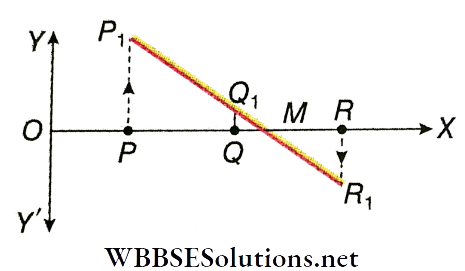
One Dimensional Motion Three Points Along x Axis At Given Moment

Solution:

Let the time be t after which P and R are at and respectively.

PP1 = vt and RR1 = \(\frac{1}{2}\)at²

According to the question, after time t, Q will be at Q1.

From the figure we have, \(\frac{P P_1}{P M}=\frac{Q Q_1}{Q M}=\frac{R R_1}{R M}=k\) (say)

∴ \(P P_1=k \cdot P M=k(P Q+Q M)\)

⇒ \(Q Q_1=k \cdot Q M\)

and \(R R_1=k \cdot R M=k(Q R-Q M)\)

∴ \(P P_1-R R_1=k \cdot(Q M+Q M)\) (because P Q=Q R)

= \(2 k \cdot Q M\)

∴ \(k \cdot Q M=\frac{P P_1-R R_1}{2}\)

∴ \(Q Q_1=k \cdot Q M\)

= \(\frac{P P_1-R R_1}{2}=\frac{P P_1}{2}-\frac{R R_1}{2}=\frac{\nu t}{2}-\frac{1}{4} a t^2\)

∴ \(Q Q_1=\left(\frac{\nu}{2}\right) t-\frac{1}{2}\left(\frac{a}{2}\right) \cdot t^2\)……..(1)

Comparing equation (1) with s = ut- \(\frac{1}{2}\)at², we can say that to remain in the same straight line joining the other two cars, the initial velocity of the car Q must be \(\frac{v}{2}\) along the positive y-axis and it should move with retardation \(\frac{a}{2}\).


 One-Dimensional Motion Conclusion

Dynamical quantities related to an object are determined with reference to some other object in the surroundings. This external object forms a frame of reference. A frame of reference is represented in forms like cartesian, polar, spherical etc.

  • The change of position of a moving object in a fixed direction is called displacement. Displacement is a vector quantity.
  • The rate of Hie distance covered by a body with respect to time is called speed. Speed is a scalar quantity.
  • The rate of the distance travelled from a point by a particle with respect to an infinitesimal interval of time is called the instantaneous speed of the particle at that point.
  • The rate of displacement of a body with respect to time is called velocity. Velocity is a vector quantity.

Applications of One Dimensional Motion in Real Life

The rate of the displacement of a particle from a certain point with respect to an infinitesimally small time interval is called the instantaneous velocity of the particle at that point.

  • An object moving in a straight line with uniform speed is said to be moving with uniform velocity.
  • An object with uniform velocity must have uniform speed but an object with uniform speed may not have uniform velocity.
  • For a moving object, zero average velocity does not necessarily mean a zero average speed, but zero speed always implies zero velocity.
  • For an object moving with a uniform velocity, its average velocity is the same as its instantaneous velocity.

The rate of change of velocity of an object with respect to time is called acceleration. Acceleration is a vector quantity.

  • The rate of change in velocity of a body at a point with respect to an infinitesimally small time interval is the instantaneous acceleration of the body at that position.
  • On a displacement-time graph of a particle, the inclination of the tangent at a point on the graph gives the instantaneous velocity of the particle at that point.
  • In a velocity-time graph for a particle, the inclination of the tangent at any point gives the instantaneous acceleration of the particle at that point.

The area enclosed between the velocity-time graph of a particle and the time axis gives the magnitude of the displacement of the particle.

 One-Dimensional Motion Useful Relations For Solving Problems

Speed, v = \(\frac{l}{t}\), where l = distance covered in time t.

Average speed = \(\frac{\text { total distance }}{\text { total time }}\)

or, \(v=\frac{l_1+l_2+l_3+\cdots+l_n}{t_1+t_2+t_3+\cdots+t_n}\)

Instantaneous speed, \(v_i=\lim _{\Delta t \rightarrow 0} \frac{\Delta l}{\Delta t}=\frac{d l}{d t}\)

Velocity, v = \(\frac{s}{t}\), where s= displacement in time t.

Average velocity = \(\frac{\text { total displacement }}{\text { total time }}\)

or, (v)= \(\frac{s_1+s_2+s_3+\cdots+s_n}{t_1+t_2+t_3+\cdots+t_n}\)

Instantaneous velocity, \(v_i=\lim _{\Delta t \rightarrow 0} \frac{\Delta s}{\Delta t}=\frac{d s}{d t}\)

For A Particle In Motion

  • Initial velocity = u
  • Acceleration = a
  • Distance covered in the n-th second =sn
  • Acceleration due to gravity = g
  • The final velocity after time t = v
  • Displacement in time t = sn
  • Height in time t = h

Acceleration or average acceleration = \(\frac{\text { final velocity }- \text { initial velocity }}{\text { time }}=\frac{\text { change in velocity }}{\text { time }}\)

or, (a) =\(\frac{v-u}{t}\)

Instantaneous acceleration, \(a_i=\lim _{\Delta t \rightarrow 0} \frac{\Delta v}{\Delta t}=\frac{d v}{d t}=\frac{d^2 s}{d t^2}\)

For a particle in motion with uniform acceleration,

  1. v = u + at,
  2. s = ut +\(\frac{1}{2}\)at²,
  3. v² = u² + 2as,

The displacement in the t th second st = u + \(\frac{l}{2}\)a(2t-1) In case of retardation,

  1. v – u -at,
  2. st = ut – \(\frac{1}{2}\)at²,
  3. v² = u² – 2as,
  4. st = u – \(\frac{1}{2}\)a(2t-1)

Equations of vertical motion under gravity (downward direction positive):

  1. v = u + gt,
  2. h = ut + \(\frac{1}{2}\)gt²,
  3. v² = u² + 2gh

(upward direction positive):

  1. v = u – gt,
  2. h = ut- \(\frac{l}{2}\)gt²,
  3. v² = u² – 2gh


One-Dimensional Motion Very Short Answer Type Questions

Question 1. A particle is in uniform motion with respect to a reference frame. Is it possible for the particle to be at rest with respect to another frame?
Answer: Yes

Question 2. Retardation is essentially a _______ acceleration
Answer: Negative

Question 3. For a particle, displacement (x) and time (t) are related by the following equation: x = (3t² + 2t+5)m. If time is expressed in seconds, find the initial velocity of the particle.
Answer: 2 m · s-1

Question 4. The displacement of a moving particle is directly proportional to the square of the time duration. State whether the particle is moving at a constant velocity or at a constant acceleration.
Answer: Constant acceleration

Question 5. When is the average velocity of a particle equal to its instantaneous velocity?
Answer: In motion with uniform velocity

Question 6. Does a particle with a uniform speed in a curved path possess any acceleration?
Answer: Yes

Question 7. How many dimensions are there in the motion of a ship in a turbulent sea?
Answer: Three

Question 8. If the position of a particle at instant t is given by x = t4, find the acceleration of the particle.
Answer: 12t²

Question 9.For a moving body, displacement y (in metre) and time t (in second) are related as y = – \(\frac{2}{3}\) t²+16t+2. When will the body stop?
Answer: After 12s

Question 10. The displacement equation for a particle moving in a straight line is x = αt³ + βt² + γt+ δ. The ratio of the initial acceleration to the initial velocity depends only on _______
Answer: β and γ

Question 11. The motion of an artificial satellite around the earth is a _________ dimensional motion.
Answer: Two

Question 12. An athlete runs with a velocity of 18 km · h-1. How much distance will he cover in 10 min?
Answer: 3 km

Question 13. What is the nature of the time-displacement graph for a particle moving with a constant velocity?
Answer: A straight line

Question 14. What does the slope of a position-time graph represent?
Answer: Velocity of a body

Question 15. The area under v-t graph =?
Answer: Displacement of the particle

Question 16. In the same displacement-time graph, two motions are represented by two straight lines having slopes of 45° and 60° respectively. Which line represents a higher velocity and what is the ratio between the first and the second velocities?
Answer: Second: 1: √3

Question 17. Velocity (in m · s-1 unit)-time (in s unit) graph, of a particle moving in a straight line, is a straight line and it is inclined at an angle 45 with the time axis. What is the acceleration of the particle?
Answer: 1 m s-2

One-Dimensional Motion Assertion Reason Type Questions And Answers

These questions have statements 1 and statement 2. Of the four choices given below, choose the one that best describes the two statements.

  1. Statement 1 is true, statement 2 is true; statement 2 is a correct explanation for statement 1.
  2. Statement 1 is true, and statement 2 is true; statement 2 is not a correct explanation for statement 1.
  3. Statement 1 is true, statement 2 is false.
  4. Statement 1 is false, and statement 2 is true.

Question 1.

Statement 1: The average velocity of a particle may be equal to its instantaneous velocity.

Statement 2: For a given time interval of a given motion, average velocity is single-valued while average speed can have many values.

Answer: 3. Statement 1 is false, statement 2 is true.

Question 2.

Statement 1: A scooter moves towards the north and then moves towards the south with the same speed. There will be no change in the velocity of the scooter.

Statement 2: Velocity is a vector quantity.

Answer: 4. Statement 1 is false, statement 2 is true.

Question 3.

Statement 1: An object can possess acceleration even when it has a uniform speed.

Statement 2: When the direction of motion of an object keeps changing, its velocity also changes with time.

Answer: 1. Statement 1 is true, statement 2 is true; statement 2 is a correct explanation for statement 1.

Question 4.

Statement 1: Acceleration of a moving particle can change its direction without any change in the direction of velocity.

Statement 2: If the direction of the change in the velocity vector changes, the direction of the acceleration vector also changes.

Answer: 2. Statement 1 is true, statement 2 is true; statement 2 is not a correct explanation for statement 1.

Question 5.

Statement 1: The distance between two particles moving with constant velocities always remains constant.

Statement 2: The relative motion between two particles moving with a constant is velocities.

Answer: 4. Statement 1 is false, statement 2 is true.

Question 6.

Statement 1: A particle with zero velocity may have a non-zero acceleration.

Statement 2: A particle comes to rest at the instant of reversing its direction of motion.

Answer: 1. Statement 1 is true, statement 2 is true; statement 2 is a correct explanation for statement 1.

Question 7.

Statement 1: A particle moving with uniform accelera¬tion has its displacement proportional to the square of time.

Statement 2: If the motion of a particle is represented by a straight line on the velocity-time graph, its acceleration is uniform.

Answer: 2. Statement 1 is true, statement 2 is true; statement 2 is not a correct explanation for statement 1.

Question 8.

Statement 1: A freely falling body travels through distances in this ratio 1: 3: 5: 7:…… in successive equal intervals of time (Galileo’s law of odd integers).

Statement 2: In one-dimensional motion, a particle with zero speed may have a non-zero velocity.

Answer: 3. Statement 1 is true, statement 2 is false.

Question 9.

Statement 1: If the average velocity of a body is equal in two successive time intervals, its velocity is a constant.

Statement 2: When a body travels with constant velocity, its displacement is proportional to time.

Answer: 1. Statement 1 is true, statement 2 is true; statement 2 is a correct explanation for statement 1.

Question 10.

Statement 1: If two bodies of different masses one dropped simultaneously from the same height, then they touch the ground simultaneously.

Statement 2: The time of flight of a freely falling body is independent of its mass.

Answer: 1. Statement 1 is true, statement 2 is true; statement 2 is a correct explanation for statement 1.

Question 11.

Statement 1: The distance between two bodies does not change if they move in the same direction with the same constant acceleration.

Statement 2: Two bodies moving with the same velocity are at rest relative to each other.

Answer: 4. Statement 1 is false, statement 2 is true.

Question 12.

Statement 1: A body is dropped from a height h and another body is thrown simultaneously from the ground with a velocity u in the vertically upward direction. They meet after a time of \(\frac{h}{u}\).

Statement 2: For a body projected in the vertically upward direction, the ascent in the last second is always 4.9 m, whatever the velocity of projection.

Answer: 2. Statement 1 is true, statement 2 is true; statement 2 is not a correct explanation for statement 1.

One-Dimensional Motion Match Column A And Column B

Question 1. In column 1 velocity-time graphs of a particle moving along a straight line are given and in column 2 the corresponding acceleration-time graphs are given.
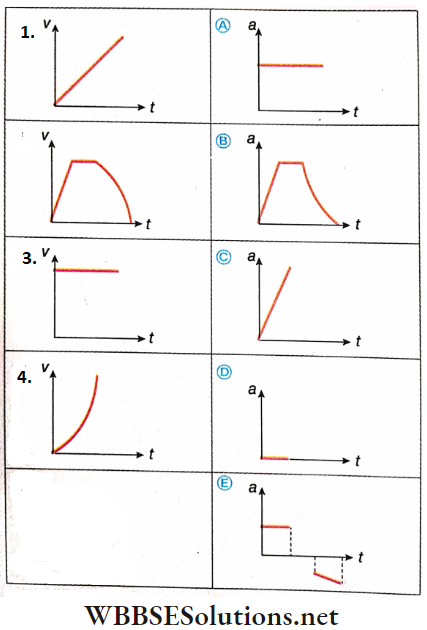
One Dimensional Motion Match The Colum Question 1

Answer: 1. A, 2. E, 3. D, 4. C

Question 2. In column 1 some statements related to various physical quantities are given while in column 2 information about the motion of a particle moving along a straight line are given.
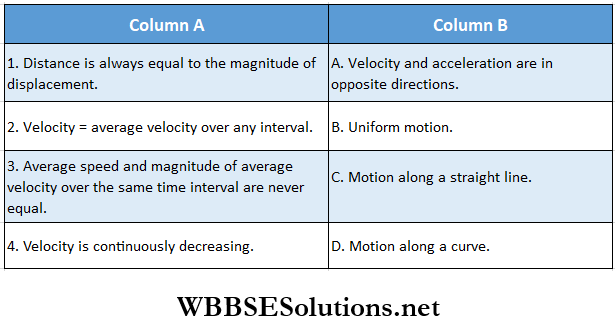
One Dimensional Motion Match the Colum Question 2

Answer: 1. C, 2. B, 3. D, 4. A

Question 3. The displacement-time curve of a moving particle is given.
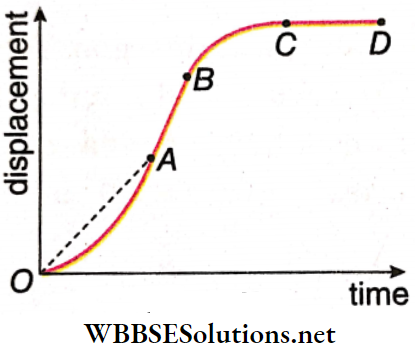
One Dimensional Motion Discplacement Time Curve Of A Moving Particle

One Dimensional Motion Match the Colum Question 3

Answer: 1. A, 2. C, 3. B, 4. D

Question 4.
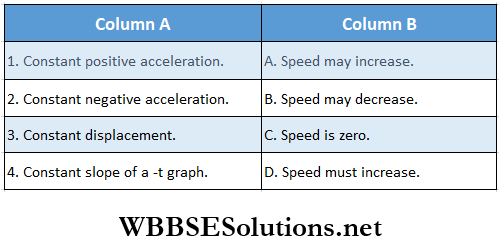
One Dimensional Motion match The Column Question 4

Answer: 1. A, B, 2. A, B, 3. C, 4. A, B

Question 5.
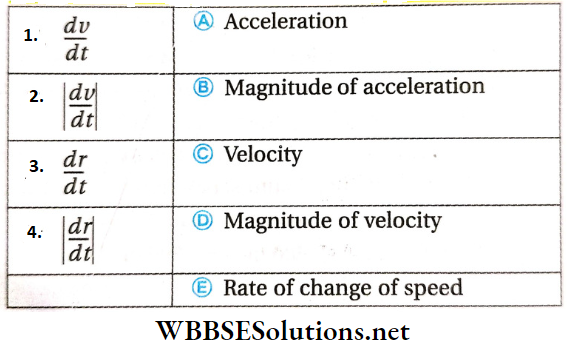
One Dimensional Motion Match the Colum Question 5

Answer: 1. A, 2. B, E, 3. C, 4. D

Question 6.
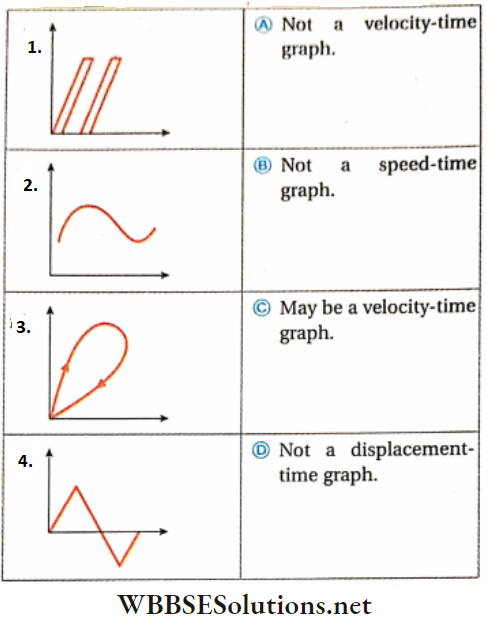
One Dimensional Motion match The Column Question 6

Answer: 1. A, B, 2. C 3. A, B, D, 4. C

Question 7.
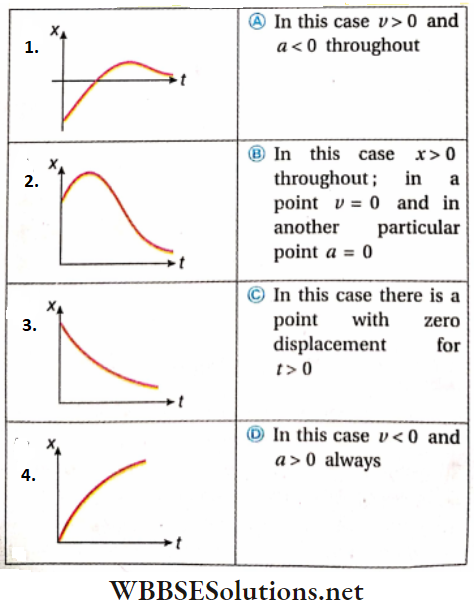
One Dimensional Motion Match the Colum Question 7

Answer: 1. C, 2. B, 3. D, 4. A

Question 8. For a moving particle, displacement and velocity at time t are s and v, respectively.
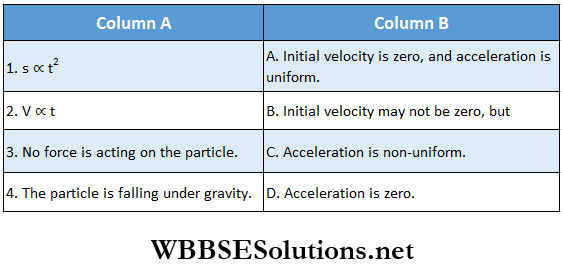
One Dimensional Motion Match the Colum Question 8

Answer: 1. A, 2. A, 3. D, 4. B

Question 9. Two cars start from the origin and move along the x-axis. Their displacements (in m) are related to time (in s) as, xA = 4t+ t² and xB = 2t² + 2t³. Then
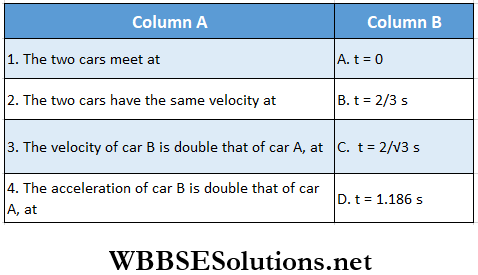
One Dimensional Motion Match the Colum Question 9

Answer: 1. D, 2. B, 3. C, 4. A

One-Dimensional Motion Comprehension Type Questions And Answers

Read the following passages carefully and answer the questions at the end of them.

Question 1. The vertical rise or fall of a particle under gravity is governed by the equations:

  1. v = u + gt,
  2. h = ut + \(\frac{1}{2}\)gt², and
  3. v² = u2² + 2gh, the symbols having their usual meanings. Then for a particle dropped from the top of a tower and falling freely, choose the correct options:

1. The distance covered by it after n seconds is directly proportional to

  1. n
  2. 2n-1
  3. 2n²-1

Answer: 1. n²

2. The distance covered in the nth second is proportional to

  1. n
  2. 2n-1
  3. 2n²-1

Answer: 3. 2n-1

3. The velocity of the body after n seconds is proportional to

  1. n
  2. 2n-1
  3. 2n²-1

Answer: 2. n

Question 2. Shows the speed-time graph of two cars A and B which are travelling in the same direction over a period of 40 s. Car A travelling at a constant speed of 40 m · s-1, overtakes car B at t = 0. In order to catch up with car A, car B immediately accelerates uniformly for 20 s.
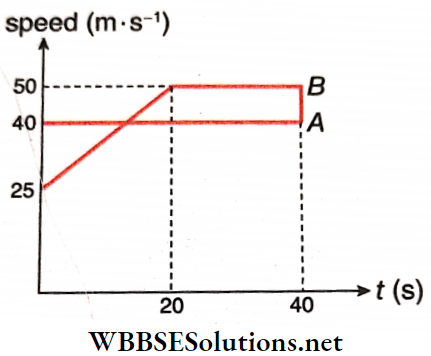
One Dimensional Motion Speed Time Graph

1. Distance travelled by car B in 20 s is

  1. 800 m
  2. 750 m
  3. 1000 m
  4. 500 m

Answer: 2. 750m

2. What is the acceleration of car B for the first 20 s?

  1. 1.25 m · s-2
  2. 3.75 m · s-2
  3. 2.5 m · s-2
  4. 5 m · s-2

Answer: 1. 1.25 m · s-2

3. At what time car B overtake car A?

  1. 12 s
  2. 50 s
  3. 18 s
  4. 25 s

Answer: 4. 25 s

4. What is the distance travelled by car A before car B overtakes it?

  1. 480 m
  2. 1000 m
  3. 800 m
  4. 1200 m

Answer: 2. 1000 m

5. What is the maximum separation between the two cars during the 40 s interval?

  1. 150 m
  2. 480 m
  3. 390 m
  4. None of these

Answer: 1. 150 m

Question 3. A ball is thrown up with velocity u = 50 m · s-1 as shown. The origin and positive and negative directions are also indicated in the figure. Neglect air resistance and take g = 10 m · s-2.
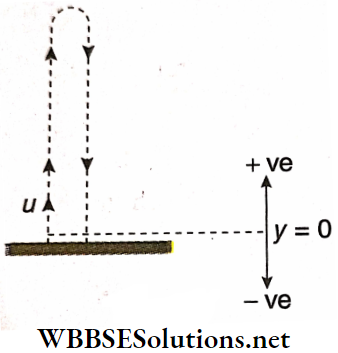
One Dimensional Motion A ball Is Thrown Up With velocity

1. How much time does the ball take to reach half the maximum height?

  1. 1.46 s
  2. 2.5 s
  3. 3s
  4. 1.82s

Answer: 1. 1.46 s

2. After how much time will it again cross the same position?

  1. 7.07 s
  2. 7.5 s
  3. 8.18 s
  4. Would not cross again

Answer: 1. 7.07 s

3. Determine the distance travelled by the ball in the 3rd second of its motion.

  1. Zero
  2. 45 m
  3. 25 m
  4. 80 m

Answer: 3. 25

One-Dimensional Motion Integer Answer Type Questions

In this type, the answer to each of the questions is a single-digit integer between 0 and 9.

Question 1. The displacement x of a particle moving in one dimension, under the action of a constant force, is related to time t by the equation t = √x + 3, where x is in meters and t is in seconds. Find the displacement (in metres) of the particle when its velocity is zero.
Answer: 0

Question 2. The motion of a body is defined by \(\frac{dv(t)}{dt}\) = 6-3v(t) where v(t) is the velocity (in m/s) of the body at time t (in seconds). If the body was at rest at t = 0, find its velocity (in m/s) when the acceleration is half the initial value.
Answer: 1

Question 3. A balloon is at a height of 40 m and is ascending with a velocity of 10 m · s-1. A bag of 5 kg weight is dropped from it. When will the bag reach the surface of the earth? Given g = 10 m · s-2.
Answer: 4

Question 4. A bike, initially at rest, travels the first 20 m in 4s along a straight line with constant acceleration. Determine the acceleration of the bike in m · s-2. Consider the bike as a particle.
Answer: 5

Question 5. Starting from rest, a particle moving along a straight line attains a speed of 2 m · s-1 in 1.5 s. What is the particle’s speed after an additional 3 s has elapsed assuming that the particle is moving with constant acceleration?
Answer: 6

 

WBCHSE Class 11 Physics One-Dimensional Motion Short Answer Questions

One-Dimensional Motion Short Answer Type Questions

Question 1. A particle starts from rest with constant acceleration. It travels a distance of x in the first 10 s and a distance of y in the next 20 seconds. The relation between x and y is

  1. y = x
  2. y = 2x
  3. y = 8x
  4. y = 4x

Answer:

We know, s = ut + \(\frac{1}{2}\)at²; u = 0

When t = 10 s, s = x; then x = \(\frac{1}{2}\) x a x 100 = 50a

When t = 10 + 20 = 30 s, s = x + y;

then x + y = \(\frac{1}{2}\) x a x 900 = 450a

∴ y = (x + y)-x = 450a-50a = 400a = 8x

The option 3 is correct.

WBCHSE Class 11 Physics One-Dimensional Motion Short Answer Questions

Question 2. Show that the instantaneous speed of a particle is equal to the slope of the distance-time graph.
Answer:

The slope of the distance-time graph is \(\frac{ds}{dt}\).

Again, if Δt is the time in which the displacement of the particle is Δs, then speed, \(\frac{\Delta s}{\Delta t}\)

Now, if Δt → 0, instantaneous speed = \(\lim _{\Delta t \rightarrow 0} \frac{\Delta s}{\Delta t}=\frac{d s}{d t}\)

Question 3. The position-time relation of a moving particle is x = 2t-3t².

  1. What is the maximum +ve velocity of the particle?
  2. When does the velocity of the particle become zero? (x is in metres and t is in seconds)

Answer:

x = 2t – 3t²

∴ v = \(\frac{dx}{dt}\) = 2 -6t

  1. As t less than nor equal to 0, so, the maximum positive velocity of the particle is 2 m/s (at t = 0).
  2. v = 0, when 2 – 6t = 0

∴ t = \(\frac{2}{6}\) = \(\frac{1}{3}\) s

Question 4. What information do we get from the slope of the velocity-time graph?
Answer:

We get the acceleration.

Question 5. A ball is thrown vertically upward. For the motion of the ball till it returns to the ground, draw the

  1. Height vs time graph
  2. velocity vs time graph
  3. Acceleration vs time graph
  4. Velocity vs height graph

Answer:

One Dimensional Motion A Ball Is Thrown Vertically Upward From The Motion Of The Ball

WBCHSE Class 11 Physics Short Answer Questions

Question 6. A particle moves in the xy-plane with a constant acceleration of 4 m · s-2 in the direction making an angle of 60° with the x-axis. Initially, the particle is at the origin and its velocity is 5 m · s-1 along the x-axis. Find the velocity and the position of the particle at t = 5s.
Answer:

According to the question, if the initial velocity of the particle along OA is u, then (given, ux = 5 m/s)

u = uxcos60° = 5 x \(\frac{1}{2}\) = \(\frac{5}{2}\) m/s

The velocity of the particle at t = 5 s,

v = u+at = \(\frac{5}{2}\) + 4 x 5 = 22.5 m/s

One Dimensional Motion Initial velocity Of The Particle Along OA

At the time, the distance travelled by the particle along OA.

s = \(u t+\frac{1}{2} a t^2=\frac{5}{2} \times 5+\frac{1}{2} \times 4 \times 5^2\)

= \(\frac{25}{2}+50=\frac{125}{2} \mathrm{~m}\)

If the coordinate of the particle is (x, y) at that time, then

x = \(\frac{125}{2} \cos 60^{\circ}=\frac{125}{2} \times \frac{1}{2}=\frac{125}{4}\)

and y = \(\frac{125}{2} \sin 60^{\circ}=\frac{125}{2} \times \frac{\sqrt{3}}{2}=\frac{125 \sqrt{3}}{4}\)

∴ Position of the particle at t = \(5 \mathrm{~s} is \left(\frac{125}{4}, \frac{125 \sqrt{3}}{4}\right)\).

Class 11 Physics Class 12 Maths Class 11 Chemistry
NEET Foundation Class 12 Physics NEET Physics

Question 7. A balloon is rising upwards from rest with acceleration \(\frac{g}{8}\). A stone is dropped from the balloon when it is at height H. Show that the time by which the stone will touch the ground is \(2 \sqrt{\frac{H}{g}}\).
Answer:

If the velocity of the balloon is v at a height H, \(v^2=2 \frac{g_8}{} H \quad \text { or, } \quad v=\frac{1}{2} \sqrt{g H}\)

The stone is dropped when the balloon is at height H.

If we consider the downward direction to be positive, the initial velocity of the stone,

u = \(-v=-\frac{1}{2} \sqrt{g H}\)

So, if the stone touches the ground by time t,

H = \(-\frac{1}{2} \sqrt{g H} \cdot t+\frac{1}{2} g t^2 \quad \text { or, } g t^2-\sqrt{g H} \cdot t-2 H=0\)

∴ t = \(\frac{\sqrt{g H} \pm \sqrt{g H+8 g H}}{2 g}=\frac{\sqrt{g H} \pm 3 \sqrt{g H}}{2 g}\)

Neglecting the negative value of t,

t = \(\frac{\sqrt{g H}+3 \sqrt{g H}}{2 g}=\frac{4 \sqrt{g H}}{2 g}=2 \sqrt{\frac{H}{g}}\)

Question 8. A car at rest accelerates at a constant rate for some time, after which it decelerates at a constant rate β to come to rest. If the total time elapsed is t second, find the maximum velocity attained.
Answer:

If t1 is the time taken to reach the maximum velocity v,

v = 0 + αt1 or, \(t_1=\frac{\nu}{\alpha}\)

After decelerating, if the car takes time \(t_2\) to come to rest,

0 = \(\nu-\beta t_2 \quad \text { or, } t_2=\frac{\nu}{\beta}\)

So, \(t=t_1+t_2=\frac{\nu}{\alpha}+\frac{\nu}{\beta}=\nu \frac{\alpha+\beta}{\alpha \beta}\)

∴ \(v=\frac{\alpha \beta}{\alpha+\beta} t\)

Question 9. The initial velocity of a particle is u and acceleration (f) is uniform. The final velocity and distance covered in the interval t are v and s respectively. Show that the velocity of the particle at half-distance is more than the velocity for half-time.
Answer:

⇒ \(\nu=u+f t \text { or, } t=\frac{\nu-u}{f}\)

Again, \(v^2=u^2+2 f s\) or, \(s=\frac{v^2-u^2}{2 f}\)

Velocity at half time, \(v_1=u+f \frac{t}{2}=u+f \frac{\nu-u}{2 f}=u+\frac{\nu-u}{2}=\frac{u+v}{2}\)

If the velocity at half-distance is \(v_2\), \(\nu_2^2=u^2+2 f \frac{s}{2}=u^2+2 f \frac{v^2-u^2}{4 f}\)

= \(u^2+\frac{u^2+v^2}{2}=\frac{u^2+v^2}{2}\)

∴ \(v^2-v_1^2=\frac{u^2+v^2}{2}-\frac{(u+v)^2}{4}\)

= \(\frac{1}{4}\left\{2\left(u^2+v^2\right)-(u+v)^2\right\}\)

= \(\frac{1}{4}\left\{u^2+v^2-2 u v\right\}\)

= \(\left(\frac{v-u}{2}\right)^2\); since it is a whole square, it is a positive quantity.

So, \(\nu_2^2-\nu_1^2>0\)

or, \(v_2>v_1\)

One-Dimensional Motion Short Answer WBCHSE

Question 10. The equation of displacement of a particle along the Xaxis is x = 40 + 12 t- t³. How much distance does it travel before stopping?

  1. 16 m
  2. 40 m
  3. 56 m
  4. 36 m

Answer:

x = 40 + 12t – t³ or, \(\frac{dx}{dt}\) = 12 – 3t²

After time t s, if the particle comes of rest, then 0 = 12 -3t² or, t² = 4

∴ t = 2s

The distance travelled by the particle is 2 s, x|t=2 = 2 = 40 + 12 x 2-8 = 56 unit

The option 3 is correct.

Question 11. In the s-t graph, a particle with uniform acceleration at time t makes an angle 45° with the time axis. After one second it makes an angle of 60°. What is the acceleration of the particle?
Answer:

Initial velocity of the particle, u = tan45° = 1 unit

After time 1 s, the final velocity of the particle, v = tan 60° = √3 unit

As the particle moves with uniform acceleration (a), so

a = \(\frac{\text { change in velocity }}{\text { time }}\) = (√3 – 1) unit

Question 12. Which of the following figures cannot be a speed-time graph?

One Dimensional Motion Time Dose Not Lag Behind

Answer:

Time does not lag behind.

The option 4 is correct.

Question 13. A ball is dropped from the top of a building while another is thrown horizontally at the same instant. Which ball will strike the ground first?
Answer:

Both the balls touch the ground simultaneously.

Question 14. A body is moving from rest with an acceleration a m/s², which is related to time t s, by a = 3t + 4. What will be its velocity in time 2s?
Answer:

Acceleration of the body,

a = \(\frac{dv}{dt}\) = (3t + 4) m/s² at

At t = 2 s, the velocity of the body,

v = \(=\int_0^2(3 t+4) d t=\left[\frac{3 t^2}{2}+4 t\right]_0^2=14 \mathrm{~m} / \mathrm{s}\)

Question 15. A car travelling on a straight road moves with a uniform velocity v1 for some time and with uniform velocity v2 for the next equal time. The average velocity of the car is

  1. \(\sqrt{v_1 v_2}\)
  2. \(\frac{1}{v_1}+\frac{1}{v_2}\)
  3. \(\frac{1}{2}\left(\frac{1}{v_1}+\frac{1}{v_2}\right)\)
  4. \(\frac{\left(v_1+v_2\right)}{2}\)

Answer:

If the car travels with velocity v1 for time t and then with velocity v2 for time t, then the displacement in time 2t = v1t+ v2t = (v1 + v2)t

∴ Average velocity = \(=\frac{\left(v_1+v_2\right) t}{2 t}=\frac{v_1+v_2}{2}\)

The option 4 is correct.

Class 11 Physics Kinematics Short Answers

Question 16. The displacement of a particle is directly proportional to the third power of time. What will be the nature of the acceleration of the particle?
Answer:

s = kt³, where k = constant

∴ \(\frac{ds}{dt}\) = 3kt² and acceleration, a = \(\frac{d^2s}{dt^2}\) = 6kt

hence, a ∝ t

So, the acceleration of the particle is directly proportional to time t.

Question 17. A bullet enters a block of wood with a velocity u. Its velocity decreases to v after going through a distance x inside. After covering a further distance y inside, the bullet stops. Prove that \(\frac{u}{v}=\sqrt{\frac{y+x}{y}}\).
Answer:

Retardation of the bullet inside the block, a = constant

According to the equation, v² = u² – 2as, v² = u² – 2 ax

and, \(0=u^2-2 a(x+y) \text { or, } 2 a=\frac{u^2}{x+y}\)

∴ \(v^2=u^2-\frac{u^2 x}{x+y}=u^2\left(1-\frac{x}{x+y}\right)=\frac{u^2 y}{x+y}\)

or, \(\frac{u^2}{v^2}=\frac{x+y}{y} \text { or, } \frac{u}{v}=\sqrt{\frac{y+x}{y}}\)

Question 18. The velocity (m · s-1)time(s) graph of a body is a straight line inclined at an angle of 45° with the time axis. The acceleration (in m · s-2 unit) of the body is

  1. 1
  2. \(\frac{1}{\sqrt{2}}\)
  3. \(\sqrt{2}\)
  4. \(\frac{1}{\sqrt{3}}\)

Answer:

If angle of inclination is θ, then acceleration, a = tanθ

∴ a = tan 45° = 1

The option 1 is correct.

Question 19. At any instant the speeds of two identical cars with the same retardation are u and 4u; starting from that instant the respective distances the cars travel before stopping are in the ratio

  1. 1:1
  2. 1:4
  3. 1:8
  4. 1:16

Answer:

The final velocity of both the cars, v = 0

Let the first and the second cars travel distances d1 and d2 before coming to rest. If the retardation of both the cars is a, then in the case of the first car,

⇒ \(-u^2=-2 a d_1 \text { or, } d_1=\frac{u^2}{2 a}\)

in the case of the second car, \(-(4 u)^2=-2 a d_2 \text { or, } d_2=\frac{8 u^2}{a}\)

∴ \(\frac{d_1}{d_2}=\frac{u^2}{2 a} \cdot \frac{a}{8 u^2}=\frac{1}{16}\)

Hence, \(d_1: d_2=1: 16\)

The option (4) is correct.

Question 20. The distance-time graph of a moving particle is given by x = 4t – 6t²

  1. What is the positive maximum speed?
  2. At what time would the speed of the particle be zero? (x is in metres and t is in seconds)

Answer:

Velocity of the particle, v = \(\frac{dx}{dt}\) = 4 – 12t

Acceleration of the particle, a = \(\frac{d^2 x}{dt^2}\) = -12 m/s²

So, the particle is moving with retardation.

At t = 0, the velocity is maximum. In this case,

  1. The maximum positive velocity of the particle = 4- 12 x 0 = 4m/s
  2. When v = 0; 4 – 12t = 0 or, t = \(\frac{1}{3}\)s

∴ The velocity of the particle will be zero after time \(\frac{1}{3}\) s.

Short Answer Questions for WBCHSE Physics

Question 21. A particle moves with constant acceleration along a straight line starting from rest The percentage increase in its displacement during the 4th second compared to that in the 3rd second is

  1. 33%
  2. 40%
  3. 66%
  4. 77%

Answer:

⇒ \(s_n=u+\frac{1}{2} a(2 n-1)\)

⇒ \(s_3=\frac{5}{2} a, s_4=\frac{7}{2} a\)

∴ \(\frac{s_4-s_3}{s_3} \times 100=\frac{a}{\left(\frac{5 a}{2}\right)} \times 100=40 \%\)

The option 2 is correct.

Question 22. Two particles A and B having different masses are projected from a tower with the same speed. A is projected vertically upward and B is vertically downward. On reaching the ground

  1. The velocity of A is greater than that of B
  2. The velocity of B is greater than that of A
  3. Both A and B attain the same velocity
  4. The particle with the larger mass attains a higher velocity

Answer:

Motion under gravity is independent of mass. The particle A will come back to the tower with the same velocity at which it was thrown vertically upwards. Hence, the downward velocities of both particles A and B at the top of the tower are equal. Therefore, both the particles will attain the same velocity on reaching the ground.

The option 3 is correct

Question 23. At a particular height, the velocity of an ascending body is \(\vec{u}\). The velocity at the same height while the body falls freely is

  1. 2\(\vec{u}\)
  2. –\(\vec{u}\)
  3. \(\vec{u}\)
  4. -2\(\vec{u}\)

Answer:

While moving up and moving down, at a particular height, the velocity of a body is the same and in opposite directions.

The option 2 is correct

Question 24. A train moves from rest with acceleration α and in time t1 covers a distance x. It then decelerates to rest at constant retardation β for distance y in time t2. Then

  1. \(\frac{x}{y}=\frac{\beta}{\alpha}\)
  2. \(\frac{\beta}{\alpha}=\frac{t_1}{t_2}\)
  3. \(x=y\)
  4. \(\frac{x}{y}=\frac{\beta t_1}{\alpha t_2}\)

Answer:

In the first case, \(\nu=u+a t \quad \text { or, } \nu=0+\alpha t_1=\alpha t_1 \quad \text { or, } x=\frac{1}{2} \alpha t_1^2\)

In the second case, \(v^2=u^2-2 a s \text { or, } 0=\alpha^2 t_1^2-2 \beta y\) (because \(u=\alpha t_1\))

or, \(y=\frac{\alpha^2 t_1^2}{2 \beta}\)

∴ \(\frac{x}{y}=\frac{\frac{1}{2} \alpha t_1^2}{\frac{\alpha^2 t_1^2}{2 \beta}}=\frac{\beta}{\alpha}\)

Also, \(\nu=u-a t\) or, \(0=\alpha t_1-\beta t_2\) or, \(\frac{t_1}{t_2}=\frac{\beta}{\alpha}\)

The options (1) and (2) are correct.

Question 25. From a tower of height H, a particle is thrown vertically upwards with a speed u. The time taken by the particle to hit the ground is n times that taken by it to reach the highest point of its path. The relation between H, u and n is

  1. 2gH = n²u²
  2. gH = (n-2)²u²
  3. 2gH= nu²(n-2)
  4. gH = (n-2)²u²

Answer:

Time taken to reach the highest point = \(\frac{u}{g}\)

Speed on reaching the, ground = \(\sqrt{u^2+2 g h}\)

One Dimensional Motion From A Tower Of Heigth A Particle Is Thrown Bertically Upwards With Speed

Now, v = u+ at

or, \(\sqrt{u^2+2 g h}=-u+g t\)

or, t = \(\frac{u+\sqrt{u^2+2 g H}}{g}\)

According to the question, \(\frac{u+\sqrt{u^2+2 g H}}{g}=\frac{n u}{g}\)

or, 2gH= n(n-2)u²

The option 3 is correct.

West Bengal Class 11 Physics One-Dimensional Motion

Question 26. Two stones are thrown up simultaneously from the edge of a cliff 240 m high with initial speeds of 10 m/s and 40 m/s respectively. Which of the following graphs best represents the time variation of the relative position of the second stone with respect to the first?

(Assume stones do not rebound after hitting the ground and neglect air resistance, take g = 10 m/s²) (The figures are schematic and not drawn to scale)

One Dimensional Motion Two Stones Thrown Up Fom The Edge

Answer:

We consider the upward direction to be positive,

∴ y = ut – \(\frac{1}{2}\)gt²

Till they reach the ground, for the first stone,

-240 = 10t – \(\frac{1}{2}\) x 10 t²

or, 5t² – 10t – 240 = 0 or, 5(t+4)(t-8) = 0

∴ t = 8

for the second stone,

-240 = 40t – \(\frac{1}{2}\) x 10 x t²

∴ t = 12 s

So, for the last (12 – 8=)4s, only the second stone will be in motion.

Hence, in the time span between 8 s and 12 s, y2 – y1 = (40t-5t²) – 0 = 40t – 5t² which is the equation of a parabola.

Now, in the time span between 0 s to 8 s, y2 – y1 = (40t-5t²)-(10t-5t²) = 30t

which is the equation of a straight line passing through the origin.

The option 3 is correct.

Question 27. A body is thrown vertically upwards. Which one of the following graphs correctly represent the velocity vs time?

One Dimensional Motion A Body Is Thrown Vertical Upwards

Answer:

Slope of the v-t graph indicates acceleration. Here acceleration due to gravity is constant.

The option 3 is correct

Question 28. All the graphs below are intended to represent the same motion. One of them does it incorrectly. Pick it up.

One Dimensional Motion All Graphs Are Intended To Represent The Same Motion

Answer:

Each of the graphs 1, 2 and 3 represents the motion of a body thrown vertically upward. But option 2 does not represent any motion like that.

Option 4 is correct.

Question 29. A particle Of unit mass undergoes one-dimensional motion such that its velocity varies according to v(x) = βx-2n, where β and n are constants and x is the position of the particle. The acceleration of the particle as a function of x is given by

  1. \(-2 n \beta^2 x^{-2 n-1}\)
  2. \(-2 n \beta^2 x^{-4 n-1}\)
  3. \(-2 \beta^2 x^{-2 n+1}\)
  4. \(-2 n \beta^2 e^{-4 n+1}\)

Answer:

Acceleration, a = \(\frac{d v}{d t}=\frac{d v}{d x} \cdot \frac{d x}{d t}=\frac{d v}{d x} v=\nu \frac{d v}{d x}\)

= \(\beta x^{-2 n}\left\{(-2 n) \beta x^{-2 n-1}\right\}=-2 n \beta^2 x^{-4 n-1}\)

The option 2 is correct.

Question 30. If the velocity of a particle is v = At+ Bt², where A and B are constant, then the distance travelled by it between 1s and 2s is

  1. 3A + 7B
  2. \(\frac{3}{2}A+\frac{7}{3}\)B
  3. \(\frac{A}{B}+{B}{3}\)
  4. \(\frac{3}{2}\)A + 4B

Answer:

The velocity of the particle, v = At+ Bt²

or, \(\frac{d s}{d t}=A t+B t^2\)

or, \(\int_0^s d s=\int_1^2\left(A t+B t^2\right) d t\)

or, \(s=\left[\frac{A t^2}{2}+\frac{B t^3}{3}\right]_1^2=2 A+\frac{8 B}{3}-\frac{A}{2}-\frac{B}{3}=\frac{3 A}{2}+\frac{7 B}{3}\)

∴ The distance travelled by it between 1s and 2s

= \(\frac{3 A}{2}+\frac{7 B}{3}\)

The option 2 is correct

Physics Short Answer Practice Class 11 WBCHSE

Question 31. A car moving with a speed of 50 km · h-1 can be stopped by brakes after at least 6 m. What will be the minimum stopping distance, if the same car is moving at a speed of 100 km · h-1?
Answer:

Final velocity, v = 0; if u = initial velocity, a = retardation and s = distance travelled after applying the brakes, then, v² = u²-2as or, 0 = u²-2as

or, s = \(\frac{u^2}{2a}\). In this example, a is the maximum retardation produced by the brakes.

So, s is the minimum stopping distance.

Then, \(\frac{s_1}{s_2}=\left(\frac{u_1}{u_2}\right)^2 \text { or, } s_2=s_1\left(\frac{u_2}{u_1}\right)^2=6 \times\left(\frac{100}{50}\right)^2=24 \mathrm{~m}\)

Question 32. The displacement-time graphs of two bodies P and Q are represented by OA and BC respectively. What is the ratio of the velocities of P and Q? ∠OBC = 60° and ∠AOC = 30°

One Dimensional Motion The Displacement Time Graph Of Two Bodies

Answer:

Velocity, v = \(\frac{ds}{dt}\) = tanθ = slope of the displacement-time graph, where θ = angle made with the time axis.

∴\(\frac{v_P}{v_Q}=\frac{\tan \theta_P}{\tan \theta_Q}=\frac{\tan 30^{\circ}}{\tan \left(-30^{\circ}\right)}=\frac{\tan 30^{\circ}}{-\tan 30^{\circ}}=\frac{\frac{1}{\sqrt{3}}}{-\frac{1}{\sqrt{3}}}=-\frac{1}{1}\)

So the ratio is 1: (-1).

Question 33. What does the slope of a velocity-time graph represent?
Answer:

Let time t be plotted along the horizontal axis and velocity v along the vertical axis. The slope of this velocity-time graph is \(\frac{dv}{dt}\). Again, by definition, acceleration a = \(\frac{dv}{dt}\), so the slope represents acceleration.

Question 34. Draw a velocity-time graph for an object starting from rest. Acceleration is constant and remains positive.
Answer:

For an object starting from rest, v = 0 at t = 0. This is represented by the origin O of the velocity-time graph.

One Dimensional Motion Velocity Time Graph For An Object Strating From Rest

The slope of the graph = acceleration. As the acceleration is constant and positive, the straight line OA, having a constant and positive slope represents the motion.

Question 35. An object moving on a straight line covers the first half of the distance at speed v and the second half at speed 2 v. Find

  1. Average speed,
  2. Mean speed.

Answer:

1. Let total distance = D.

So, time taken to cover the first half = \(\frac{D / 2}{v}=\frac{D}{2 v}\)

and time taken to cover the second half =\(\frac{D / 2}{2 v}=\frac{D}{4 v}\)

Hence, the average speed total distance \(=\frac{\text { total distance }}{\text { total time }}\)

= \(\frac{D}{\frac{D}{2 v}+\frac{D}{4 v}}=\frac{D}{D\left(\frac{2+1}{4 v}\right)}=\frac{4 v}{3}\)

2. Mean speed \(=\frac{v+2 v}{2}=\frac{3 v}{2}\)

Question 36. A ball is thrown vertically upwards. Draw its

  1. Velocity time graph,
  2. Acceleration-time graph

Answer:

  1. For the upward motion, the velocity decreases uniformly with retardation g, where g is the acceleration due to gravity. The line AB represents this motion. Then, for the downward motion, the velocity increases uniformly for the same time interval with acceleration g. The line BC same represents this motion.
  2. The entire motion is under acceleration due to gravity (g), which is a constant. So the acceleration-time graph is a horizontal straight line.

One Dimensional Motion A Ball IS Thrown Vertically Upwards

Question 37. A car is moving along a straight line in the given. It moves from O to P in 18 seconds and returns from P to Q in 6 seconds. What are the average velocity and average speed of the car in going

One Dimensional Motion A Car IS Moving Along Straight Line

  1. From O to P? and
  2. From O to P and back to Q?

Answer:

For the motion from O to P, distance travelled = displacement = OP = (360-0) = 360 m

So, average speed = \(\frac{\text { distance travelled }}{\text { time }}\)

= \(\frac{\text { displacement }}{\text { time }}=\text { average velocity }\)

This average speed or velocity is \(\nu=\frac{360 \mathrm{~m}}{18 \mathrm{~s}}=20 \mathrm{~m} \cdot \mathrm{s}^{-1}\)

Now, for this motion from O to P and back to Q, distance travelled = OP+ PQ

= 360 + (360 – 240) = 480 m

So, average speed = \(\frac{480 \mathrm{~m}}{(18+6) \mathrm{s}}=20 \mathrm{~m} \cdot \mathrm{s}^{-1}\)

But displacement = \(\overrightarrow{O P}+\overrightarrow{P Q}=\overrightarrow{O Q}\), whose magnitude = 240 m and the time taken = 18 + 6 = 24 s.

Hence, average velocity = \(\frac{240 m}{24 s}\) = 10 m · s-1

WBCHSE Class 11 Motion Questions with Answers

Question 38. Draw

  1. Position-time,
  2. Velocity-time and
  3. Acceleration-time graph for the motion of an object under free fall.

Answer:

We assume the downward direction as the positive direction during this free fall.

One Dimensional Motion Downward Direction As The Positive Direction During This Free Wall

1. As u = 0, the displacement at any time t is h = 1/2 gt² or t²= 2/g h.

So the position-time graph is a parabola passing through the origin [like x² = 4 ay on an x-y graph].

2. Initial velocity u = 0, so, at any time t the velocity is v = gt.

Hence, the velocity-time graph is a straight line of positive slope passing through the origin [like y = mx on a xy-graph]

3. Acceleration (a) = acceleration due to gravity (g) = constant and positive.

So, the acceleration-time graph is parallel with the time axis.

Question 39. The x-t graph of an object in straight-line motion is shown. Predict the type of motion it undergoes.

One Dimensional Motion x t Graph

Answer: It is a motion with uniform velocity, as the graph is a straight line

Question 40.

  1. Having seen a big stone falling from the top of a tower Rabi pulled his friend Kiran away. The stone hits Kiran slightly and he gets a little hurt. But he was saved from a major accident. What made Rabi act in such a way?
  2. From the top of a tower 100 m in height, a ball is dropped and at the same time, another ball is projected vertically upwards from the ground with a velocity of 25 m · s-1. Find when and where the two balls meet. Take g = 9.8 m · s-2.

Answer:

  1. Rabi’s first observation that the heavy object was falling freely from the top of the tower, and then registering in his brain of the danger of the object hitting his friend Kiran—these are the reasons that made Ravi act so quickly.
    • Fortunately, his reaction time was just low enough to save Kiran. In this case, the reaction time (τ) is equal to the time of flight (t) of the object in a free fall from the height (h) of the top of the tower. So, Ravi’s reaction time can be estimated from the knowledge of h.
  2. AB = height of the tower = 100 m

Let the two balls meet after a time t at point C, such that AC = h1, BC = h2 and h1 + h2 = 100 m.

One Dimensional Motion Big Stone falling From The Top Of A Tower

For the first ball, h1 = \(\frac{1}{2}{g t^2}\)

For the second ball, h2 = ut – \(\frac{1}{2}{g t^2}\)

By adding, we get h1 + h2 = ut

or, 100 = 25t or, t = 4 s

So, the two balls meet after 4 s.

The height of point C, where the two balls meet, from the ground is, h2 = ut – \(\frac{1}{2}{g t^2}\)

= 25 x 4 – \(\frac{1}{2}\) x 9.8 x 4² =100-78.4

Question 41. The displacement of a particle along the x-axis is given by x = 3 + 8t-2t². What is its acceleration? At what time it will come to rest? All are in SI units.
Answer:

Displacement, x = 3 + 8t – 2t²;

velocity, v = \(\frac{dx}{dt}\) = 8 – 4t

acceleration, a = \(\frac{dv}{dt}\) = -4 m · s-2.

This negative value means that the particle is moving with a uniform retardation.

When the particle comes to rest, v = 0; i.e., 8 – 4t = 0,

∴ t = 2 s

Question 42. The acceleration-time graph for a body is shown. Plot the corresponding velocity-time graph and draw the inference. The body starts with non-zero positive velocity.

One Dimensional Motion Acceleration time Graph For A Body

Answer:

The given figure shows that the acceleration a is a positive constant—it does not change with time. So, this represents a motion under uniform acceleration.

One Dimensional Motion velocity Time Graph Motion IS Given By A Staigth Line Of Positive Slope

Then, on the velocity-time graph, motion is given by a straight line of positive slope. The velocity increases uniformly from the initial value u to the final value v at time t.

Kinematics Short Answer Questions WBCHSE

Question 43. The position coordinate of a moving particle is given by x = 6 + 18t + 9t² (where x is in metres, t in seconds. What is its velocity and acceleration at t = 2s.
Answer:

Given position coordinate, x = 6 + 18t+ 9t² = 9t² + 18t+ 6

Differentiating the above equation with respect to t, \(\frac{dx}{dt}\) = 18t+ 18 or, v = 18t+ 18 dt ….(1)

Given, t = 2 s

Therefore the velocity at 2 s is v = 36 + 18 = 54 m/s

Again, differentiating equation (1) with respect to time t, \(\frac{dv}{dt}\)

Therefore the acceleration, a = 18 m/s²

Question 44. Is it possible to have a constant rate of change of velocity when velocity changes both in magnitude and direction?
Answer:

Yes, when a body moves upwards or downwards, the rate of change of velocity remains constant while the magnitude and direction of velocity change.

Question 45. The velocity of a moving particle is given by, v = 6 + 18t + 9t² (x in metre, t in second) what is its acceleration at t = 2 s?
Answer:

Given, u = 6 + 18t + t²

∴ Acceleration, a = \(\frac{dv}{dt}\) = 18 + 18t

Hence, acceleration at t = 2 s is \(\left.\frac{d v}{d t}\right|_{t=2}=18+18 \times 2=54 \mathrm{~m} / \mathrm{s}^2\)

Question 46. Plot the position-time graph for an object

  1. Moving with positive velocity,
  2. Moving with negative velocity and
  3. At rest.

Answer:

Moving with positive velocity

One Dimensional Motion Moving With Positive Velocity

Moving with negative velocity

One Dimensional Motion Moving With Negative Velocity

At rest

One Dimensional Motion Moving With Positive Velocity At Rest

Question 47. The position of an object moving along x -x-axis is given by x = a+bt² where a = 8.5 m, b = 2.5 m/s² and t is measured in seconds. What is its velocity at t = 0 and t = 2.0 s? What is the average velocity between t = 2.0 s and t = 4.0 s?
Answer:

Given, x = a+bt²

Now, instantaneous velocity, v = \(\frac{dx}{dt}\) = 2bt

So, at t=0, \(\left.\frac{d x}{d t}\right|_{t=0}=0\); at \(t=2 \mathrm{~s},\left.\frac{d x}{d t}\right|_{t=2}=4 b=10 \mathrm{~m} / \mathrm{s}\)

Now, at t=2s, \(x_1=a+4 b\) at t=4s, \(x_2=a+16 b\)

∴ Average velocity = \(\frac{x_2-x_1}{t_2-t_1}\) = \(\frac{(a+16 b)-(a+4 b)}{4-2}\)

= \(\frac{12 b}{2}=15 \mathrm{~m} / \mathrm{s}\) (because b=2.5)


WBCHSE Class 11 Physics One-Dimensional Motion Long Answer Questions

One-Dimensional Motion Long Answer Type Questions

Question 1. Can a particle, moving with a uniform speed have a non-uniform velocity?
Answer:

Speed is a scalar quantity having only magnitude. But velocity is a vector quantity having both magnitude and direction. Hence, if a particle having uniform speed changes its direction, its velocity will become non-uniform.

Example: uniform circular motion.

Question 2. Can a particle, moving with a uniform velocity have i a non-uniform speed?
Answer:

If a particle has uniform velocity, both its magnitude and direction remain constant. Speed is a scalar quantity having magnitude only. For uniform velocity, as the magnitude remains unaltered, speed cannot be non-uniform.

Question 3. Even if the average velocity of a body is zero, its average speed may be non-zero—is it possible?
Answer:

The displacement of a particle becomes zero if the particle returns to its starting point after completion of the journey.

Then the average velocity = \(\frac{\text { total displacement }}{\text { total time }}=0\)

Again, average speed = \(\frac{\text { total distance covered }}{\text { total time }}\); as total distance covered is non-zero here, and the average speed is not equal to zero.

Question 4. State whether a particle having an acceleration may have a velocity of constant magnitude.
Answer:

Velocity of constant magnitude may change its direction with time. This results in a change in velocity, as velocity is a vector quantity. Hence there is a non-zero acceleration because acceleration = \(\frac{\text { change in velocity }}{\text { time }}\).

Question 5. Velocity is zero but acceleration is non-zero —is it possible?
Answer:

A body may have zero velocity but non-zero acceleration. For example, when a body is thrown vertically upwards, at the maximum height the body momentarily comes to rest. At this point, the body attains zero velocity but still has an acceleration equal to the acceleration due to gravity directed downward.

Question 6. Can the directions of velocity and acceleration be
Answer:

The velocity and acceleration of a body can be in different directions. For example, if a body moves towards the east with a retardation, its velocity is directed towards the east. But as retardation is negative acceleration, the acceleration is directed towards the west.

WBBSE Class 11 One-Dimensional Motion Long Answer Questions

Question 7. Can there be any change in the direction of the velocity of a body moving under a constant acceleration?
Answer:

The direction of velocity of a body may change even if the body has a constant acceleration. In projectile motion, the path changes at every point with the change in direction of the velocity. But at every point, its acceleration is the acceleration due to gravity and hence, is a constant.

Question 8. What kind of motion is described by the equation; s = s0 + ut + \(\frac{1}{2}\)at²?
Answer:

The equation describes the linear motion of a particle with a constant acceleration a, the initial displacement and velocity being s0 and u, respectively.

Question 9. For a body moving with a uniform acceleration, prove that its average velocity is the arithmetic mean of its initial and final velocities.
Answer:

Let u be the initial velocity of a body and a be its uniform acceleration. After time t, the body acquires a velocity v (say) and s is its displacement. Hence, average velocity of the body = \(\frac{s}{t}\).

Again, the arithmetic mean of the initial and the final velocities of the body

= \(\frac{u+v}{2}=\frac{u+u+a t}{2}=u+\frac{1}{2} a t\)

= \(\frac{\left(u+\frac{1}{2} a t\right) t}{t}=\frac{u t+\frac{1}{2} a t^2}{t}=\frac{s}{t}\) (Proved).

WBCHSE Class 11 Physics One-Dimensional Motion Long Answer Questions

Question 10. Starting from rest, a body moves in a straight line with constant acceleration. Describe the nature of the graph relating the displacement with time.
Answer:

Displacement of the body that starts from rest and moves with a uniform acceleration, after a time t is given by

s = \(\frac{1}{2}\) at² or, t² = \(\frac{2s}{a}\)

One Dimensional Motion Displacemnet Of The Body Start From rest And Moves From Uniform Acceleration

This is the equation of a parabola with a vertex at (0, 0) and its axis along the displacement axis

Class 11 Physics Class 12 Maths Class 11 Chemistry
NEET Foundation Class 12 Physics NEET Physics

Example 11. State the nature of the graphs representing motions of a body with uniform velocity, uniform acceleration and uniform retardation respectively in a displacement-time graph.
Answer:

In a displacement-time graph, the slope of the graph = rate of displacement with time = velocity of the body.

For a body moving with uniform velocity, velocity = constant.

One Dimensional Motion Nature Of Graph Representing A Motion

Hence, the slope of the graph is constant. And its displacement-time graph is a straight line.

In case of motion with uniform acceleration, velocity increases and hence the slope of the graph also increases. Line 2 represents this motion. This line is a parabola.

On the other hand, in the case of motion with uniform retardation, the velocity decreases, and therefore, the slope of the graph also decreases. Line 3 represents this motion. This line is also a parabola.

Question 12. How can you represent

  1. Motion with uniform velocity,
  2. Motion with uniform acceleration and
  3. Motion with uniform retardation in a velocity-time graph?

Answer:

  1. For motion with uniform velocity, the velocity is constant. Hence the representative line for such a motion is a straight line parallel to the time axis. OA represents the magnitude of the uniform velocity.
  2. The slope of the line in the velocity-time (v-t) graph represents the acceleration and for motion with uniform acceleration, the slope is constant and positive.
  3. For constant retardation, the slope will be negative as represented by line 3.

One Dimensional Motion Motion With Uniform Velocity

Graphical Analysis of One-Dimensional Motion

Question 13. Draw the velocity-time graph of a body moving

  1. With uniform acceleration,
  2. With increasing acceleration and
  3. With decreasing acceleration.

Answer:

In a velocity-time graph, the slope of the graph gives the acceleration.

One Dimensional Motion Straigth Line Acceleration

  1. Graph in this case is a straight line as the acceleration of the body is uniform, i.e., constant and so the slope of the straight line is also constant as shown.
  2. The slope of the v-t graph will gradually increase with increasing acceleration. The graph will be a curved line represented by line 2.
  3. On the other hand, the slope decreases with decreasing acceleration. Thus, the graph will be a curved line represented by line 3.

Question 14. In a velocity-time graph how

  1. Uniform retardation,
  2. Gradually increasing retardation and
  3. Gradually decreasing retardation can be represented?

Answer:

In a velocity-time graph, a negative slope represents the rate of decrease in velocity with time.

  1. In the case of uniform retardation, the slope is constant and the graph is a straight line with a negative slope as shown by line 1
  2. In the case of gradually increasing retardation, the magnitude of the slope increases gradually. Thus the graph is a curved line, as shown by line 2.
  3. In case of gradually decreasing retardation the magnitude of slope will decrease gradually. The graph is a curved line (line 3). In each case, OA represents the initial velocity.

One Dimensional Motion Velocty Time graph

Question 15. A body with an initial velocity u and a uniform acceleration covers a distance s in time t and acquires a velocity v. Compare the velocity of the body at half of the distance covered with the velocity at half of the total time of travel.
Answer:

Let the acceleration of the body be a.

v = \(u+a t \text { or, } a=\frac{v-u}{t}\)

∴ Velocity at half of the total time of travel, \(v_t=u+a \frac{t}{2}=u+\frac{t}{2}\left(\frac{v-u}{t}\right)\)

= \(u+\frac{\nu-u}{2}=\frac{\nu+u}{2}\)

Also, \(v^2=u^2+2 a s\) or, \(a=\frac{v^2-u^2}{2 s}\)

∴ Velocity \(v_s\) at half of the distance covered, \(v_s^2=u^2+2 a \cdot \frac{s}{2}=u^2+\frac{s\left(v^2-u^2\right)}{2 s}=\frac{u^2+v^2}{2}\)

Now, \(v_t^2-v_s^2=\left(\frac{\nu+u}{2}\right)^2-\left(\frac{\nu^2+u^2}{2}\right)\)

= \(\frac{v^2+u^2+2 u v}{4}-\frac{v^2+u^2}{2}\)

= \(\frac{\nu^2+u^2+2 u v-2 v^2-2 u^2}{4}\)

= \(-\frac{\left(v^2+u^2-2 u v\right)}{4}=-\left(\frac{u-v}{2}\right)^2\) which is a negative quantity.

Hence vt <vs, i.e., the velocity of the body at half-distance is greater than the velocity at half-time.

Question 16. State whether anybody with a two-dimensional motion may have an acceleration in one dimension only.
Answer:

A body in a two-dimensional motion may have an acceleration in one dimension only.

Projectile motion is two-dimensional because at any instant, the object has both horizontal and vertical components of velocity. But the acceleration is one-dimensional—the acceleration due to gravity acting always downwards.

Step-by-Step Solutions to One-Dimensional Motion Problems

Question 17. The displacement of a particle during its motion is equal to half of the product of its instantaneous velocity and time. Show that the particle moves with a constant acceleration.
Answer:

Let the displacement be s, instantaneous velocity be v and the time be t.

From the given condition,

s = \(\frac{1}{2} v t=\frac{1}{2} \frac{d s}{d t} t \text { or, } \frac{d s}{s}=2 \frac{d t}{t}\)

Integrating, we get, \(\int \frac{d s}{s}=2 \int \frac{d t}{t}\)

or, \(\log _e s=2 \log _e t+\log _e c\) [where c is the integration constant]

= \(\log _e c t^2\)

∴ s = \(c t^2\)

v = \(\frac{d s}{d t}=2 c t,\)

and acceleration \(=\frac{d \nu}{d t}=2 c=\) constant .

Question 18. When the speed of a car is doubled, the distance required to stop it becomes 4 times—why?
Answer:

Let the retardation produced by applying the brakes be a. Let its initial velocity be u and the distance covered by the car before coming to rest be s.

Hence, 0 = u² – 2as [from equation v² = u² – 2as]

or, s = \(\frac{u^2}{2a}\)

If the retardation is constant, then, s ∝ u².

Hence, if u is doubled, s becomes 2² or 4 times.

Question 19. Does the magnitude of a physical quantity depend on the chosen frame of reference?
Answer:

The magnitudes of the physical quantities related to the intrinsic properties like mass, density, number of molecules, etc. are independent of the frame of reference.

But the magnitudes of the physical quantities denoting extrinsic or dynamic properties like position, displacement, speed, velocity, acceleration, etc. depend on the frame of reference. For example, a train moves with a velocity of 45 km · h-1 with respect to the ground. But with respect to another train, running with the same velocity, this velocity will be zero.

Note: According to Einstein’s special theory of relativity, intrinsic properties like mass, length, time etc. depend on the frame of reference.

Question 20. A particle in motion covers half of a circular path of radius r in time f. Find the average speed and average velocity of the body.
Answer:

The distance covered in this case = πr

∴ Average speed = \(\frac{\pi r}{t}\)

The displacement in this case = 2 r

Hence, average velocity = \(\frac{2r}{t}\)

Question 21. From the top of a tower, one ball is thrown vertically upwards and another ball vertically downwards with the same speed. Which of the balls will touch the ground with higher velocity?
Answer:

The initial velocity of the 1st ball =-u and that of the 2nd ball = u. If the height of the tower is h, and v1 and v2 are the final velocities of balls 1 and 2 respectively just before touching the ground,

⇒ \(v_1^2=(-u)^2+2 g h=u^2+2 g h\)

⇒ \(v_2^2=(+u)^2+2 g h=u^2+2 g h\)

∴ \(v_1=v_2\)

Both the balls will touch the ground with the same velocity.

Question 22. A ball is projected vertically upwards from the ground with a velocity. After some time the ball comes back to the ground and rebounds with a velocity v2(< v1). Neglecting air resistance, draw the velocity-time graph for the motion of the ball.
Answer:

The required graph is given

Explanation: Let the upward velocity be positive.

One Dimensional Motion Ball Is projected Vertically Upwards From The Ground

t1 = time to reach the maximum height

t2 = time to reach maximum height after rebound.

When projected upwards with velocity v1, the ball continues to rise up with a constant retardation due to the gravitational pull. At time t = t1, the ball acquires a downward velocity which is taken as negative but remains under the influence of the same gravitational pull, and hence the ball returns to the ground at time t = 2t1.

The ball rebounds with velocity v2 and at a time t = 2t1 + t2, attains the maximum height. At t = 2t1 + 2t2, it again comes back to the ground for the second time.

Real-Life Examples of One-Dimensional Motion Problems

Example 23. State whether the displacement can be more than the total distance covered by a particle
Answer:

No, displacement cannot be more than the total distance covered by a particle. Because, to calculate the displacement, we measure the minimum, i.e., rectilinear distance between the initial and the final positions of the particle.

Example 24. Two objects are thrown vertically upwards with the same velocity v from the same point. If the second object is thrown a time T later than the first object, when will the two objects collide with each other?
Answer:

Let us assume that at a time t after throwing the first object, the two will collide with each other at a height h above the initial point.

So, for the first and the second objects,

h = \(\nu t-\frac{1}{2} g t^2 \text { and } h=\nu(t-T)-\frac{1}{2} g(t-T)^2 \)

∴ \(v t-\frac{1}{2} g t^2=\nu(t-T)-\frac{1}{2} g(t-T)^2\)

= \(\nu t-v T-\frac{1}{2} g t^2-\frac{1}{2} g T^2+g t T\)

or,  \(v T+\frac{1}{2} g T^2=g t T \quad \text { or, } t=\frac{v}{g}+\frac{T}{2} .\)

Question 25. Sketch the nature of the position-time graph for the unidirectional motion of a particle, having a variable velocity.
Answer:

The curved line OP indicates the nature of the graph. It is to be noted that, the curve OP does not have a negative gra¬dient at any point on it. The negative gradient of a line like AB means that, time is running backwards—it is physically meaningless. On the other hand, the negative gradient of CD means that the particle is moving back; then it would not be a unidirectional motion.

One Dimensional Motion nature Of Position Time Graph

Question 26. Can you explain the translation of a car by the translation of a single particle? Justify your answer.
Answer:

Yes, the translation of a single particle can describe that of a car. A car is a combination of a large number of particles. By the definition of translation, each of these particles has a motion identical to that of the others. So the motion of any one of the particles is sufficient to describe the motion of the car.

Question 27. A particle travels for a time 2t0 with velocity v = c|t- t0|, where c is a constant. What Is the distance travelled?
Answer:

The velocities at contextual times are shown in the table:

One Dimensional Motion Particles Travels With Time In Graph

The corresponding velocity-time graph is shown.

One Dimensional Motion Corresponding Velocity Time Graph

∴ Distance travelled in time 2 t0

= area enclosed by the velocity-time graph and the time-axis

= area of ΔAOB + area of ΔBCD

= \(\frac{1}{2} \cdot t_0 \cdot c t_0+\frac{1}{2} \cdot\left(2 t_0-t_0\right) \cdot c t_0=\frac{1}{2} c t_0^2+\frac{1}{2} c t_0^2=c t_0^2\)

Question 28. The velocity displacement (v-x) graph of a moving particle is given. Draw the corresponding acceleration-displacement (a-x) graph.

One Dimensional Motion Velocity Displacment Graph

Answer:

For the given straight-line graph, slope = \(-\frac{v_0}{x_0}\) and intercept on \(\nu-axis=v_0\)

∴ Its equation is, \(v=-\frac{v_0}{x_0} x+v_0\)

Acceleration, \(a=\frac{d v}{d t}=-\frac{v_0}{x_0} \frac{d x}{d t}=-\frac{v_0}{x_0} v=-\frac{v_0}{x_0}\left(-\frac{v_0}{x_0} x+v_0\right)\)

i.e., \(a=+\frac{v_9^2}{x_0^2} x-\frac{v_0^2}{x_0}\)

So, the required graph is a straight line of slope \(\frac{v_0^2}{x_0^2}\), with an intercept of \(-\frac{v_0^2}{x_0}\) with a-axis.

One Dimensional Motion Graph is Straigth Line Of Slope

Short Notes on One-Dimensional Motion for Long Answers

Question 29. An object is thrown vertically upwards. What will be the nature of its displacement-time graph?
Answer:

The upward motion corresponds to a decreasing velocity, represented by a curve OA of decreasing slope on the x-t diagram.

On the other hand, the downward motion after attaining the highest point corresponds to an increasing velocity, represented by the curve AB on the same diagram. The curve OAB is a parabola.

One Dimensional Motion Object Thrown Vertically

Question 30. The equation x = Asinωt gives the relation between the time t and the corresponding displacement x of a moving particle, where A and ω are constants. Prove that the acceleration of the particle is proportional to its displacement and is directed opposite to it.
Answer:

x = Asinωt

∴ Velocity, v = \(\frac{dx}{dt}\) = ω A cosωt

and, acceleration, a = \(\frac{dv}{dt}\) = ωA(-ωsinωt)

= -ω²A sinωt = -ω²x

So, a ∝ -x

This means that

  1. a is proportional to x,
  2. The direction of a is opposite to that of x, as indicated by the negative sign.

Question 31. The velocity-time graph for a given particle is shown Draw the acceleration-time, displacement-time and distance-time graphs for the particle.

One Dimensional Motion Velocity time graphs For particles

Answer:

The acceleration-time, displacement-time and distance-time graphs for the particle respectively.

One Dimensional Motion

Question 32. The figure below represents the acceleration-time graph of a particle at a given time. Assuming that the particle starts from rest, draw the velocity-time and displacement-time graphs for the particle.

One Dimensional Motion Acceleration Time Graph Of A Particle

Answer:

The velocity-time and displacement-time graphs for the particle respectively.

One Dimensional Motion Velocity Time And Displacement Time Graph

Question 33. Identify the types of motion: whether it is one-dimensional, two dimensional or three-dimensional,

  1. Kicking a football
  2. The motion of the needle clock

Answer:

  1. Kicking a football produces a projectile motion. So, it is two-dimensional.
  2. The motion of the needle clock is a circular Motion. So, it is two-dimensional.

Question 34. Which of the following graphs represents the one-dimensional motion of a particle? Give reasons for your answer.

One Dimensional Motion Graph Represents One Dimensional Motion Of Particle

Answer: All four graphs of do not represent the one-dimensional motion of a particle.

Reasons:

  1. If we draw a line perpendicular to the time axis, it will cut the graph at two points which means that the particle has two different positions at the same time which is impossible. The arrows shown on the graph are meaningless.
  2. If we draw a line perpendicular to the time axis, then it shows that the particle has a positive as well as a negative velocity, i.e., velocities in opposite directions at the same time, which is actually not possible in one-dimensional motion.
  3. It shows that after a certain time, the total distance travelled by the particle decreases with time which is again not possible in one-dimensional motion.
  4. It shows that the particle has negative speeds at certain instants. This is not a real situation because speed is always positive.

Question 35. Considering that a particle starts its motion from rest, draw the displacement-velocity graph from the given acceleration-time graph.

One Dimensional Motion Particle Starts Its Motion From rest

Answer:

The displacement-velocity graph of the given acceleration-time graph is drawn below.

One Dimensional Motion Displacement velocity Graph

WBCHSE Class 11 Physics One-Dimensional Motion Multiple Choice Questions

One-Dimensional Motion Multiple Choice Questions And Answers

Question 1. A particle moves from A to B along the semicircle of radius 1.0 m in 1s. The magnitude of the average velocity of the particle is

One Dimensional Motion Particle Moves A To B Along Semicircle

  1. 3.14 m · s-1
  2. 2.0 m· s-1
  3. 1.0m· s-1
  4. Zero

Answer: 2. 2.0 m· s-1

Question 2. A vehicle is moving with a uniform speed 18 km · h-1. The distance covered by it in 1 s is

  1. 18m
  2. 5m
  3. 10m
  4. 1m

Answer: 2. 5m

Question 3. Distance travelled by a particle in motion is directly proportional to the square of the time of travel. In this stage, the acceleration of the particle is

  1. Increasing
  2. Decreasing
  3. Zero
  4. Constant

Answer: 4. Constant

Question 4. A person covers half of his path at a speed of 30 km · h-1 and the remaining half at 40 km · h-1. His average speed is

  1. 35 km · h-1
  2. 60 km · h-1
  3. 34.3 km · h-1
  4. 50km · h-1

Answer: 3. 34.3 km · h-1

WBCHSE Class 11 Physics One-Dimensional Motion Multiple Choice Questions

Question 5. Starting from rest, a car moves for some time with a constant acceleration x and then with a constant retardation y and finally, it comes to rest. If the car is in motion for a total time t, the maximum velocity of the car is

  1. \(\frac{x y}{x+y} \cdot t\)
  2. \(\frac{x y}{x-y} \cdot t\)
  3. \(\frac{x^2 y^2}{x^2+y^2} \cdot t\)
  4. \(\frac{x^2 y^2}{x^2-y^2} \cdot t\)

Answer: 1. \(\frac{x y}{x+y} \cdot t\)

Question 6. Displacement (x) and time (t) of a particle in motion are related as x = at+ bt² -ct³ where a, b and c are constants. The velocity of the particle when its acceleration becomes zero is

  1. \(a+\frac{a^2}{c} s\)
  2. \(a+\frac{b^2}{2 c}\)
  3. \(a+\frac{b^2}{3 c}\)
  4. \(a+\frac{b^2}{4 c}\)

Answer: 3. \(a+\frac{b^2}{3 c}\)

Question 7. The motion of a particle is described by the equation v = at. The distance travelled by the particle in the first 4 s

  1. 4a
  2. 8a
  3. 12a
  4. 6a

Answer: 2. 8a

Question 8. A particle starting from rest with constant acceleration travels a distance x in the first 2s and a distance y in the next 2s. then

  1. y = 3x
  2. y = 2x
  3. y = x
  4. y = 4x

Answer: 1. y = 3x

Question 9. The displacement of a particle is given by y = a + bt + ct² – dt4. The initial velocity and acceleration are respectively

  1. b, -4d
  2. b, 2c
  3. -b, -2c
  4. 2c, -4c

Answer: 2. b, 2c

Class 11 Physics Class 12 Maths Class 11 Chemistry
NEET Foundation Class 12 Physics NEET Physics

Question 10. The displacement of a particle, starting from rest (at t = 0) is given by s = 6t²  – t³. The time in seconds at which the particle obtains zero velocity again is

  1. 2
  2. 4
  3. 6
  4. 8

Answer: 2. 4

WBCHSE Class 11 Physics MCQs

Question 11. A car starts from rest and travels a distance s with a uniform acceleration f; then it travels with uniform velocity for a time f; and at last, comes to rest with a uniform retardation \(\frac{f}{2}\). If the total distance travelled is 5 s. Then

  1. s = ft
  2. s = \(\frac{1}{2}\)ft²
  3. s = \(\frac{1}{4}\)ft²
  4. s = \(\frac{1}{6}\)ft²

Answer: 2. s = \(\frac{1}{2}\)ft²

Question 12. Two stations A and B are 2 km apart. A train moves at first with uniform acceleration a1 and then with a uniform retardation a2 to travel the distance AB in 4 min. Then

  1. \(a_1+a_2=2 a_1 a_2\)
  2. \(\frac{1}{a_1}+\frac{1}{a_2}=\frac{1}{2}\)
  3. \(a_1+a_2=4 a_1 a_2\)
  4. \(a_1+a_2=2 \sqrt{a_1 a_2}\)

Hint: \(2=s_1+s_2=\frac{v^2}{2 a_1}+\frac{\nu^2}{2 a_2}=\frac{v^2}{2}\left(\frac{1}{a_1}+\frac{1}{a_2}\right)=\frac{v^2}{2}\left(\frac{a_1+a_2}{a_1 a_2}\right)\)

or, \(v^2=\frac{4 a_1 a_2}{a_1+a_2}\)

Also, \(4=t_1+t_2=\frac{v}{a_1}+\frac{v}{a_2}=v \frac{a_1 a_2}{a_1+a_2}\)

or, v = \(\frac{4 a_1 a_2}{a_1+a_2} or, v^2=\left(\frac{4 a_1 a_2}{a_1+a_2}\right)^2\)

∴ \(\frac{4 a_1 a_2}{a_1+a_2}=\left(\frac{4 a_1 a_2}{a_1+a_2}\right)^2\)

or, \(1=\frac{4 a_1 a_2}{a_1+a_2}\)
or, \(a_1+a_2=4 a_1 a_2\)

Answer: 3. \(a_1+a_2=4 a_1 a_2\)

Question 13. A car moves with a uniform velocity of 36 km · h-1 on a straight road. Then it attains a uniform acceleration and doubles its velocity in 10 s. The radius of the wheel of the car is 25 cm. The number of complete rotations of the wheel in those 10 s would be about

  1. 84
  2. 95
  3. 126
  4. 135

Hint: u = 36 km · h-1 = 10 m/s; v – 2u = 20 m/s;

a = \(\frac{v-u}{t}=\frac{20-10}{10}=1 \mathrm{~m} / \mathrm{s}^2\)

∴ Distance travelled in 10 s, s = 10 x 10 + \(\frac{1}{2}\) x 1 x 10² = 150 m

Number of rotations = \(\frac{s}{2 \pi r}=\frac{150}{2 \times 3.14 \times 0.25}=95.54\)

Answer: 2. 95

Question 14. Two scooters start at an interval of 1 min between them, each moving with a uniform acceleration of 0. 4 m/s². How much later the distance between them would be 4.2 km?

  1. 195 s
  2. 205 s
  3. 175 s
  4. 250 s

Hint: \(s_1-s_2=\frac{1}{2} a t^2-\frac{1}{2} a\left(t-t^{\prime}\right)^2\left(t^{\prime}=1 \mathrm{~min}=60 \mathrm{~s}\right)\)

= \(\frac{1}{2} a\left[t^2-\left(t^2+t^{\prime 2}-2 t t^{\prime}\right)\right]=a t t^{\prime}-\frac{1}{2} a t^{\prime 2}\)

or, \(t=\frac{1}{a t^{\prime}}\left\{\left(s_1-s_2+\frac{1}{2} a t^{\prime 2}\right)\right\}=\frac{s_1-s_2}{a t^{\prime}}+\frac{t^{\prime}}{2}\)

= \(\frac{4.2 \times 1000}{0.4 \times 60}+\frac{60}{2}=205 \mathrm{~s}\)

Answer: 2. 205 s

Question 15. A passenger in a train with a speed 72 km/h observed another train coming from the opposite direction with a speed of 32.4 km/h. What is the length of the second train if it crosses the passenger in 10 s?

  1. 300 m
  2. 110 m
  3. 2.9 m
  4. 290 m

Answer: 4. 290 m

Question 16. A runner wins a race in front of another runner. The uniform accelerations of were a1 and a2 respectively. The time taken by the first runner is less by t, and the velocity at the finishing point is higher by v, relative to the second runner. Then

  1. \(t=v \sqrt{a_1 a_2}\)
  2. \(v=t \sqrt{a_1 a_2}\)
  3. \(a_1=a_2 \sqrt{v t}\)
  4. \(\frac{1}{v}=t \sqrt{a_1 a_2}\)

Hint: \(s=\frac{1}{2} a_1 t_1^2\) = \(\frac{1}{2} a_2\left(t_1+t\right)^2\)

or, \(\frac{a_1}{a_2}=\left(\frac{t_1+t}{t_1}\right)^2\)

or, \(1+\frac{t}{t_1}=\sqrt{\frac{a_1}{a_2}}\)

Again, \(v=v_1-v_2\)

= \(a_1 t_1-a_2\left(t_1+t\right)=\left(a_1-a_2\right) t_1-a_2 t\)

= \(\left(a_1-a_2\right) \frac{t \sqrt{a_2}}{\sqrt{a_1}-\sqrt{a_2}}-a_2 t\)

= \(\left(\sqrt{a_1}+\sqrt{a_2}\right) \sqrt{a_2} t-a_2 t\)

= \(\sqrt{a_2} t\left(\sqrt{a_1}+\sqrt{a_2}-\sqrt{a_2}\right)=\sqrt{a_2} t \sqrt{a_1}\)

or, \(v=t \sqrt{a_1 a_2}\)

Answer: 2. \(v=t \sqrt{a_1 a_2}\)

Also, note that the expressions other than 2 do not satisfy the principle of dimensional homogeneity.

One-Dimensional Motion Questions WBCHSE

Question 17. A body is thrown vertically upwards at 40 m · s-1. After some time the body returns to the initial point at the same speed. The average velocity of the body for the motion is

  1. 45 m · s-1
  2. 40 m · s-1
  3. 48 m · s-1
  4. Zero

Answer: 4. Zero

Question 18. A body freely falling from rest has a velocity v after it falls through a height of h. The distance it has to fall down for its velocity to become 2 v is

  1. 4 h
  2. 6 h
  3. 8 h
  4. 10 h

Answer: 1. 4h

Question 19. A ball is thrown vertically upward with a speed v from a height h above the ground. The time taken for the ball to hit the ground is

  1. \(\frac{v}{g} \sqrt{1-\frac{2 h g}{v^2}}\)
  2. \(\sqrt{1+\frac{2 h g}{v^2}}\)
  3. \(\frac{v}{g}\left[1+\sqrt{1+\frac{2 h g}{v^2}}\right]\)
  4. \(\frac{v}{g} \sqrt{1+\frac{2 h g}{v^2}}\)

Answer: 3. \(\frac{v}{g}\left[1+\sqrt{1+\frac{2 h g}{v^2}}\right]\)

Question 20. A body A is thrown up vertically from the ground with a velocity v0 and another body B is simultaneously dropped from a height H. They meet at a height \(\frac{H}{2}\), if v0 is equal to

  1. \(\sqrt{2 g H}\)
  2. \(\sqrt{g H}\)
  3. \(\frac{1}{2} \sqrt{g H}\)
  4. \(\sqrt{\frac{2 g}{H}}\)

Answer: 2. \(\sqrt{g H}\)

Question 21. A stone is dropped from a height of h. Another stone is thrown simultaneously in the vertical direction so as to rise to a height of 4 h. How much later would the two stones cross each other?

  1. \(\sqrt{\frac{h}{8 g}}\)
  2. \(\sqrt{8 g h}\)
  3. \(\sqrt{2 g h}\)
  4. \(\sqrt{\frac{h}{2 g}}\)

Answer: 1. \(\sqrt{\frac{h}{8 g}}\)

Question 22. A stone is falling freely. The distance travelled in the last second is equal to that travelled in the first three seconds. The time spent by the stone in the air is

  1. 6s
  2. 5s
  3. 7s
  4. 4s

Answer: 2. 5s

Question 23. A stone is thrown vertically upwards from some high point P. The velocity of the stone at a height h above P is half that at a depth h below P. The maximum height attained by the stone is

  1. \(\frac{7}{3}\)h
  2. \(\frac{5}{3}\)h
  3. \(\frac{7}{5}\)h
  4. \(\frac{9}{7}\)h

Answer: 2. \(\frac{5}{3}\)h

Class 11 Physics Motion MCQ Practice

Question 24. A hail drop is falling freely due to gravity. It travels distances h1, h2 and h3 respectively in the first, second and third seconds of motion. The relation among h1, h2 and h3 is

  1. \(h_1=\frac{h_2}{3}=\frac{h_3}{5}\)
  2. \(h_2=3 h_1\) and \(h_3=h_2\)
  3. \(h_1=h_2=h_3\)
  4. \(h_1=2 h_2=3 h_3\)

Answer: 1. \(h_1=\frac{h_2}{3}=\frac{h_3}{5}\)

Question 25. A parachute is dropped from an aeroplane. The parachute opens after 10 s and then comes down with a uniform retardation of 2.5 m · s-2. If the aeroplane was at a height of 2.495 km and g = 10 m· s-2, then the velocity at which the parachute touches the ground is

  1. 2.5 m · s-1
  2. 7.5 m · s-2
  3. 5m · s-2
  4. 10m · s-2

Answer: 3. 5m · s-2

Question 26. A body falls freely from a certain height. It takes times t1 and t2 to travel the first and the last half distances, respectively. Then

  1. (√2 +1)t1 = t2
  2. (√2 +1)t2 = t1
  3. (√2 -1)t1 = t2
  4. (√2 +1)t2 = t1

Answer: 3. (√2 -1)t1 = t2

Question 27. A small cube falls from rest along a frictionless inclined plane. If this distance travelled between times t=n-1 and t=n be \(s_n\), then the value of \(\frac{s_n}{s_{n+1}}\) is

  1. \(\frac{2 n-1}{2 n}\)
  2. \(\frac{2 n+1}{2 n-1}\)
  3. \(\frac{2 n-1}{2 n+1}\)
  4. \(\frac{2 n}{2 n+1}\)

Hint: The acceleration is less than g, but still it is uniform, say a. So, st = \(\frac{1}{2}\)a(2t-1). Calculate sn, sn+1 and take the ratio.

Answer: 3. \(\frac{2 n-1}{2 n+1}\)

Question 28. For a freely falling body, the acceleration-time graph is a

  1. Straight line parallel to the acceleration axis
  2. Straight line parallel to the time axis
  3. A straight line passing through the origin
  4. Parabola passing through the origin

Answer: 2. Straight line parallel to the time axis

Question 29. The area under the velocity-time graph for a particle in a given interval of time represents

  1. Velocity
  2. Acceleration
  3. Work done
  4. Displacement

Answer: 4. Displacement

Question 30. Which one of the following displacement time graphs represents the one-dimensional motion of a particle?

One Dimensional Motion Displacement Time Graphs Represents One Dimensional Motion Of Particle

Answer: 4

WBCHSE Physics One-Dimensional Motion Quiz

Question 31. The displacement of a particle at different intervals of time is tabulated below

One Dimensional Motion Displacement Of A Particle At Different Time Intervals

Which one of the graphs correctly represents the motion of the particle?

One Dimensional Motion Graph Represents The Motion Of The Particle

Answer: 3

Question 32. A position-time graph for motion with zero acceleration is

One Dimensional Motion Position Time Graph Motion With Zero Acceleration

Answer: 3

Question 33. The displacement-time graph of two moving particles makes angles of 30° and 45° with the X-axis. The ratio of their velocities is

One Dimensional Motion Displacement Time Graph Of Two Moving Particles

  1. 3:2
  2. 1:1
  3. 1:2
  4. 1:3

Answer: 4. 1:3

Question 34. The displacement-time graphs of two particles moving along the X-axis. We can say that

One Dimensional Motion Displcment Time Graph Of two Moving Particles Along X Axis

  1. Both particles are uniformly accelerated
  2. Both the particles are uniformly retarded
  3. Particle (1) is uniformly accelerated while particle (2) is uniformly retarded
  4. Particle (1) is uniformly retarded while particle (2) is uniformly accelerated

Answer: 3. Particle (1) is uniformly accelerated while particle (2) is uniformly retarded

Question 35. The acceleration-time graph of a particle is shown which of the following would be the velocitytime graph?

One Dimensional Motion Acceleration Time Graph Of A Partical

One Dimensional Motion Velocity Time Graph Of A Paticle

Answer: 4

Physics MCQs for Class 11 West Bengal Board

Question 36. On an acceleration-time graph, the area under the graph represents

  1. Distance Travelled
  2. Active Force
  3. Change Of Acceleration
  4. Change Of Velocity

Answer: 4. Change Of Velocity

Question 37. Shows the velocity-time graph of a stone thrown vertically upwards with a velocity of 30 m · s-1. The maximum height attained by the stone is

One Dimensional Motion Velocity Time Graph Of A Stone Thrown Vertically Upwards Directly

  1. 30 m
  2. 45 m
  3. 60 m
  4. 90 m

Answer: 2. 45 m

Question 38. A ball is dropped on a fixed horizontal plane from a certain height. After recoil from the plane, it rises to a  lower height. The correct nature of the height-time graph is

One Dimensional Motion Ball Is Dropped A Fixed Horizontal Plane

Answer: 3

Question 39. The equation of motion of a particle in two-dimensional space is x = 5t²+ 2; y = 2t² + 5. The path traced out is

  1. Parabolic
  2. Circular
  3. A straight line
  4. Hyperbolic

Answer: 3. A straight line

Question 40. In a three-dimensional space of zero gravity, the equation of motion of a particle is

  1. One-dimensional
  2. Two-dimensional
  3. Three-dimensional
  4. Four-dimensional

Answer: 1. One-dimensional

Question 41. Which of the following is a one-dimensional motion?

  1. Landing of an aircraft
  2. Earth revolving around the sun
  3. Motion of wheels of a moving train
  4. Train running on a straight track

Answer: 4. Train running on a straight track

In this type of question, more than one option are correct.

Question 42. A body will speed up if

  1. Velocity and acceleration are in the same direction.
  2. Velocity and acceleration are in opposite directions.
  3. Velocity and acceleration are in perpendicular, directions.
  4. Velocity and acceleration are acting at an acute angle with respect to each other.

Answer:

1. Velocity and acceleration are in the same direction.

4. Velocity and acceleration are acting at an acute angle with respect to each other.

One-Dimensional Motion Physics Questions with Answers

Question 43. Two bodies having masses m1 and m2 are dropped from heights h1 and h2 respectively. They reach the ground after times t1 and t2 and strike the ground with velocities v1 and v2 respectively, Choose the correct relations from the following:

  1. \(\frac{t_1}{t_2}=\sqrt{\frac{h_1}{h_2}}\)
  2. \(\frac{t_1}{t_2}=\sqrt{\frac{h_2}{h_1}}\)
  3. \(\frac{v_1}{v_2}=\sqrt{\frac{h_1}{h_2}}\)
  4. \(\frac{v_1}{v_2}=\frac{h_2}{h_1}\)

Answer:

1. \(\frac{t_1}{t_2}=\sqrt{\frac{h_1}{h_2}}\)

3. \(\frac{v_1}{v_2}=\sqrt{\frac{h_1}{h_2}}\)

Question 44. The variation of quantity A with quantity B, plotted describes the motion of a particle in a straight line.

  1. Quantity B may represent time
  2. Quantity A is velocity if the motion is uniform
  3. Quantity A is displacement if the motion is uniform
  4. Quantity A is velocity if the motion is uniformly accelerated

Answer:

1. Quantity B may represent time

3. Quantity A is displacement if the motion is uniform

4. Quantity A is velocity if the motion is uniformly accelerated

Question 45. Mark the correct statements.

  1. Instantaneous velocity is always in the direction of motion
  2. Instantaneous acceleration is always in the direction of motion
  3. Instantaneous acceleration is always in the direction of instantaneous velocity
  4. Instantaneous velocity and instantaneous acceleration may be in opposite directions

Answer:

1. Instantaneous velocity is always in the direction of motion

4. Instantaneous velocity and instantaneous acceleration may be in opposite directions

Question 45. Of the following situations which are possible in practice?

  1. Zero velocity and non-zero acceleration
  2. Constant velocity and variable acceleration
  3. Variable velocity and constant acceleration
  4. Non-zero velocity and zero acceleration

Answer:

1. Zero velocity and non-zero acceleration

3. Variable velocity and constant acceleration

4. Non-zero velocity and zero acceleration

Question 46. In the motion of the tip of the second hand of a clock, which of the following quantities are zero after an interval of 1 minute?

  1. Displacement
  2. Distance Travelled
  3. Average speed
  4. Average velocity

Answer:

1. Displacement

4. Average velocity

Question 47. A particle is moving with a uniform acceleration along a straight line AB. Its velocity at A and B are 2 m/s and 10 m/s respectively. Then

  1. The velocity is 10 m/s at the midpoint C of AB
  2. The velocity is 6 m/s at an intermediate point P, for which AP: PB = 1:5
  3. The time taken to travel the distance AC (C is the midpoint of AB) is twice that for the distance CB
  4. At half-time, the particle travels one-fourth of the total distance

Answer:

  1. The velocity is 10 m/s at the midpoint C of AB
  2. The velocity is 6 m/s at an intermediate point P, for which AP: PB = 1:5
  3. The time taken to travel the distance AC (C is the midpoint of AB) is twice that for the distance CB

Question 48. The displacement (s) of a particle depends on time (t) as s = 2at² – bt³. Then

  1. The particle will come to rest after a time \(\frac{4a}{3b}\)
  2. The particle comes back to the starting point after a time \(\frac{2a}{b}\)
  3. The acceleration is zero at a time \(\frac{2a}{3b}\)
  4. The initial velocity is zero, but the initial acceleration is not

Answer: All options are correct

Question 49. An object falls from rest through a resistive medium. The equation of its motion is \(\frac{dv}{dt}\) = α – βv. Then

  1. The initial acceleration = α
  2. At time t, the velocity = \(\frac{\alpha}{\beta}\left(1-e^{-\beta t}\right)\)
  3. When the acceleration is zero, the velocity = \(\frac{a}{\beta}\)
  4. The constant β has the dimension of time

Answer:

  1. The initial acceleration = α
  2. At time t, the velocity = \(\frac{\alpha}{\beta}\left(1-e^{-\beta t}\right)\)
  3. When the acceleration is zero, the velocity = \(\frac{a}{\beta}\)

Question 50. The acceleration (a) and the velocity of a particle in rectilinear motion are related as a = -√v. Then

  1. If the particle comes to rest after is, its initial velocity =0.25 m/s
  2. If the initial velocity is v0, then after a time t, velocity = \(v_0-\sqrt{v_0} t+\frac{t^2}{4}\)
  3. If the initial velocity is v0, then after a time t, velocity =v0 – at
  4. If the initial velocity is 1 m/s, the particle comes to rest after 2 s

Answer:

1. If the particle comes to rest after is, its initial velocity =0.25 m/s

2. If the initial velocity is vq, then after a time t, velocity = \(v_0-\sqrt{v_0} t+\frac{t^2}{4}\)

4. If the initial velocity is 1 m/s, the particle comes to rest after 2 s

Question 51. A body thrown vertically upwards from a point with a velocity v0 rises to a maximum height and then comes back to the point. Then

  1. The average velocity of downward motion is \(\frac{v_0}{2}\)
  2. The average speed in the flight is zero
  3. The time of flight is \(\frac{2 v_0}{g}\)
  4. The acceleration in the whole flight is not uniform

Answer:

1. The average velocity of downward motion is \(\frac{v_0}{2}\)

3. The time of flight is \(\frac{2 v_0}{g}\)

WBCHSE Class 11 Physics Notes For Different Kinds Of Motion

One-Dimensional Motion – Different Kinds Of Motion: Translation And Rotation

WBBSE Class 11 Types of Motion Notes

Particle: In practical cases, when a body is in motion it can rotate too. When a wheel is pushed, it moves forward. At the same time, it also rotates about an axis through its centre. A raindrop can vibrate while it falls.

  • Representation of such motions are usually very complex. To avoid this complexity, an object is often taken as a geometrical point, ignoring its shape or size. This geometrical point is called a particle.
  • In the case of linear motion, the properties of the particle and of the object are identical so discussion about the motion of the particle is sufficient to describe the motion of the object.
  • To describe the motion of objects, sometimes we consider a body to be composed of many particles. In such cases, we do not consider a geometrical point but the aggregation of many particles.

Translation: If a body moves along a straight line, its motion is called translation. Motion of a freely falling body or the motion of a car along a straight road, are examples of translational motion.

Read and Learn More: Class 11 Physics Notes

Characteristics Of Translation:

  1. The direction of motion remains the same.
  2. The particles of an object under translatory motion traverse equal lengths in equal intervals of time and they also move parallel to one another. As in AA’A”, BB’B” and CC’C” lines are parallel and equal.
  3. Lines joining any two particles of the body in translation remain parallel to one another for any position of the object. Observe, the lines AB, A’B’ and A”B” are parallel to one another.

One Dimensional Motion Translatroy Motion

The motion of any particle along a curved line can be considered as the aggregate of a number of infinitesimally small translatory motions.

WBCHSE Class 11 Physics Notes For Different Kinds Of Motion

Rotation: When an object moves in a circular path about a fixed point or an axis, the motion is called rotation. The axis is called the axis of rotation. Shows some examples of rotation. However, the axis may be located outside the object.

One Dimensional Motion Rotation

Linear Motion Explained for Class 11

Characteristics Of Rotation:

  1. Each constituent particle of a rotating body rotates by an equal angle in a fixed interval of time.
  2. The Axis of rotation always remains stationary.

Complex Motion: If a body exhibits translational as well as rotational motion simultaneously, then it is said to be in a state of complex motion.

Complex Motion Example:

  1. The wheel of a running car executes a complex motion. The wheel rotates around the axis through its centre (rotation) and moves forward along the road (translation).
  2. The earth rotates around its own axis and at the same time it revolves around the sun following an elliptical path. As the orbit is elliptical the Earth sometimes comes close to the sun and sometimes moves away from it. So, the earth also exhibits a complex motion.

Comparison Between Translation And Rotation:

  1. Translation is motion in a straight line, whereas rotation is a circular motion in a plane.
  2. In translation, the direction of motion is fixed. In rotation, the axis of rotation is fixed.
  3. Translation of each constituent particle of the body is the same during the movement of the body. In rotation, constituent particles of the body at larger distances from the axis of rotation describe larger distances.

One-Dimensional Motion – Some Physical Quantities Related To Motion

Relative to a definite frame of reference, a body may be at rest, or in any form of motion like translation, rotation, vibration etc. For the convenience of the kinematical study of rest and motion of a body, a few important physical quantities are defined. These are the essential properties that represent the states of rest and motion of a body, and their measured values furnish the exact physical state.

Position: Let an object be located at the point A. To measure the position of the object, and express it in a well-defined manner, we have to

One Dimensional Motion Physical Quantities Related To Motion

  1. Choose a reference point, i.e., an origin—tiro point O is this origin.
  2. Measure the linear distance between OA; and
  3. Specify the direction of A relative to the origin O.

This would always lead to statements like: ‘The object A is situated 5 m east of the origin O’, or ‘The object B is 2 m north-east of O’. In short, we may write

⇒ \(\overrightarrow{O A}\) = 5 m towards east; \(\overrightarrow{O B}\) = 2 m to the north-east. These statements define the positions of the objects at A and at B. It is important to note that, each statement includes the magnitude of the linear distance, as well as the direction, relative to the origin.

Position Definition: The position of an object is defined as its linear distance as well as its direction with respect to a preassigned reference point.

Position Is A Vector Quantity: As per the definition, position is a physical quantity having both magnitude and direction. So it is a vector quantity. It is often called the position vector and denoted by the symbol \(\vec{r}\).

In the above examples, the position of A: \(\vec{r_1}\) = 5 in the east; the position of B: \(\vec{r_2}\) = 2 m north-east.

Another interesting point is that to find the position of B relative to A(\(\overrightarrow{A B}\)), a simple numerical calculation, using the values 5m and 2m, is not sufficient. The directions are to be considered as well. This technique leads to a new branch in mathematics, known as vector algebra.

Units And Dimension: The magnitude of the position vector is actually a distance. It has the units of length.

CCS system: cm

SI: m

Similarly, the dimension of the position vector is that of length, i.e., its dimension = L.

Displacement Definition: Displacement is defined as the change in position of a moving body in a fixed direction.

A and B are two fixed points. Many paths may exist between A and B. Three men move from A to B following different paths ACB, ADB and AEB. The lengths of these paths are different.

One Dimensional Motion Displacement

But as the initial and final positions of the men are the same, their displacements are also the same. The length of the minimum distance between A and B, i.e., the rectilinear path ADB is the measure of this displacement.

Magnitude And Direction Of Displacement: The length of the straight line connecting the initial and the final positions of a moving body is the magnitude of its displacement, and its direction is from the initial position to the final position along the straight line joining them. P and R are the initial and the final positions respectively of the body and the paths followed by it are PQ (3 m towards east) and QR (4 m towards north).

One Dimensional Motion magnitude And Direction Of Displacement

As defined, the displacement is  PR and it is independent of the path followed. From the measurements shown, PR =\(\sqrt{3^2+4^2}\) = 5 cm is the magnitude of displacement, and the direction is from P to R, shown by the arrowhead on PR.

Displacement Is A Vector Quantity: Displacement has both magnitude and direction and, hence, it is a vector quantity. It is represented by \(\overrightarrow{P R}\) in this case.

Zero Displacement: If a moving object starting from a point comes finally back to its initial position, then its displacement becomes zero.

Zero Displacement Example: A ball comes back to the hands of a thrower when it is thrown vertically upwards. The displacement of the ball is zero in this case. Hence, it can be concluded that the displacement of a moving object may be zero in spite of it travelling some distance.

Zero displacement is a null vector with magnitude zero and has no fixed direction.

Class 11 Physics Class 12 Maths Class 11 Chemistry
NEET Foundation Class 12 Physics NEET Physics

Geometric Representation Of Displacement: A reference frame helps to measure the magnitude and direction of a displacement. Let us Y consider a two-dimensional cartesian coordinate system where OX and OY are the two axes and O is the origin. Let a particle begin its journey from O and reach the point A(x, y).

The length OA gives the magnitude of the displacement of the particle— OA = \(\sqrt{x^2+y^2} \text {. }\). Now, if \(\overrightarrow{O A}\) makes an angle α with the X-axis, tanα = \(\frac{B A}{O B}\) = \(\frac{y}{x}\). In this case, we can say that the direction of displacement makes an angle α with the X-axis where α = tan-1\(\frac{y}{x}\)

Oscillatory Motion Examples and Applications

One Dimensional Motion Geometric Representation Of Displacement

For any particle in three-dimensional space, the displacement is represented by the straight line joining the initial and the final positions of the particle. If a particle travels from the point P1(x1, y1,z1) to the point P2(x2, y2, z2), then \(\overrightarrow{P_1 P_2}\) represents its displacement. The magnitude of the displacement is given by \(\sqrt{\left(x_2-x_1\right)^2+\left(y_2-y_1\right)^2+\left(z_2-z_1\right)^2} \text {. }\)

One Dimensional Motion Geometric Representation Three Dimnesional Space

Unit And Dimension Of Displacement: The length of a straight line determines the magnitude of displacement. Hence, a unit of length is the unit of displacement and its dimension is the dimension of length i.e., L.

One-Dimensional Motion – Physical Quantities Related To Motion Numerical Examples

Short Answer Questions on Types of Motion

Example 1. A particle moves along a circular path of radius 7 cm. Estimate the distance covered and displacement when the particle

  1. Covers half circular path and
  2. Completes the total circular path once.

Solution:

Given

A particle moves along a circular path of radius 7 cm.

Circumference of the circular path = 2πr = 2 x \(\frac{22}{7}\) x 7 = 44 cm.

  1. When it covers half the circumference, the particle moves from A to B along the path ACB. Hence, distance covered = \(\frac{44}{2}\) = 22 cm. Displacement is the length of straight line AB i.e., the diameter of the circle. Hence, displacement is 2 x 7 = 14 cm from A to B (\((\overrightarrow{A B})\)).
  2. On completion of the total circular path ACB A, the distance covered is equal to the circumference of the circle = 44 cm. As the particle comes back to its initial position, displacement is zero.

One Dimensional Motion Partical Moves Along A Circular Path Of Radius

Example 2. A particle moves 10√3 m towards the east and then 10 m towards the north. Find the magnitude and direction of its displacement.
Solution:

Given

A particle moves 10√3 m towards the east and then 10 m towards the north.

In this case AB = 10√3m, BC = 10m.

The initial and the final positions of the particle are A and C respectively.

One Dimensional Motion Particle Moves Towards East And North

∴ The magnitude of displacement,

A C = \(\sqrt{A B^2+B C^2}\)

= \(\sqrt{300+100}\)

= 20 m

If the angle between AC and AB is θ, then, \(\tan \theta=\frac{B C}{A B}=\frac{10}{10 \sqrt{3}}=\frac{1}{\sqrt{3}}\) or, θ = 30°.

This angle determines the direction of displacement.

Speed Definition: The distance travelled by a body in unit time is called its speed.

Distance is always measured along the path travelled by the moving body, irrespective of whether the path is straight or curved. Hence, if a body travels a length l in time t,

speed(v) = \(\frac{\text { distance travelled }(l)}{\text { time taken }(t)}\)

Speed is a scalar quantity.

Unit And Dimension Of Speed In Different Systems Of Units:

Unit of speed = \(\frac{\text { unit of length of the path travelled }}{\text { unit of time }}\)

CGS System: cm · s-1

SI: m · s-1

Dimension of speed = \(\frac{\text { dimension of distance }}{\text { dimension of time }}=\frac{\mathrm{L}}{\mathrm{T}}=\mathrm{LT}^{-1}\)

Relation Among Different Units: 1 m · s-1 = 100 cm · s-1

Dimension of speed = = k = LT-1

In addition, km · h-1 is also widely used.

1 km · h-1 = \(\frac{1000}{60 \times 60} \mathrm{~m} \cdot \mathrm{s}^{-1}=\frac{5}{18} \mathrm{~m} \cdot \mathrm{s}^{-1} \text {. }\)

For easy recall, 18 km · h-1 = 5 m · s-1.

Average Speed: The speed of a body can be uniform or variable. When a body travels equal distances in equal intervals of time, its speed is uniform.

When distances travelled in equal intervals of time are unequal, the body moves with a variable speed.

For convenience, the average speed is often calculated in case of motion with variable speed. Dividing the total distance travelled by the total time taken to travel the distance, we get the average speed.

Thus if l1, I2, l3 are the distances travelled by an object in times t1, t2 and t3 respectively, then its average speed

= \(\frac{\text { total distance travelled }}{\text { total time taken to travel the distance }}=\frac{l_1+l_2+l_3}{t_1+t_2+t_3} \text {. }\)

The average speed is not an average of speeds.

Instantaneous Speed: The speed of a moving body at any instant is called its instantaneous speed.

Let us consider that a running (rain travels 10 in in 0,5 s. For the motion of a train, this 0.5 s lime Interval Is very small. So, this interval of time may be considered as an instant. Dividing the distance travelled by the train in that short interval of time gives the Instantaneous speed of the train. Hence, the instantaneous speed of the train = \(\frac{10}{0.65}\) = 20 m· s-1.

Instantaneous Speed Definition: The instantaneous speed of a particle at a given point is the limiting value of the rate of the distance travelled with respect to a time when the time interval tends to zero.

Following the rule of differential calculus, if Δt is the time in which the distance travelled is Δl, then the instantaneous speed is

⇒ \(v_i=\lim _{\Delta t \rightarrow 0} \frac{\Delta l}{\Delta t}=\frac{d l}{d t}\)

where l is the distance or location of the particle along its locus from a given fixed point. For a body moving with uniform speed, the instantaneous speed at any instant is equal to the uniform speed.

For example, the speed of a moving car is measured by a speedometer. At any moment, the speedometer reads the instantaneous speed of the car. The pointer of the speedometer remains stationary when the car runs at a uniform speed. That is, the instantaneous speed is equal to the uniform speed of the car. The speedometer fluctuates when the car moves at varying speeds.

Distinction Between Average And Instantaneous Speed:

Average Speed: The total distance covered by a body in a certain interval of time, divided by the time interval is the average speed.

Instantaneous Speed: The rate of infinitesimal distance covered with respect to the corresponding infinitesimal time, is the instantaneous speed.

Velocity Definition: The rate of displacement of a body with time is called its velocity.

In other words, the rate of change of position of any object with respect to time is its velocity.

The change of position, i.e., the displacement is a vector quantity. If s Is the displacement of an object in time t, then,

velocity (v) = \(\frac{\text { displacement }(\mathrm{s})}{\text { time }(t)}\)

Velocity, like displacement, Is also a vector quantity.

Unit And Dimension Of Velocity: since the units of distance covered and of displacement are the same, the units of speed and velocity are also the same.

CGS System: cm · s-1

SI: m · s-1

Dimension of velocity = \(\frac{\text { dimension of displacement }}{\text { dimension of time }}\) = \(\frac{L}{T}\) = LT-1

Therefore, the dimension of velocity is also identical to that of speed.

Uniform And Non-Uniform Velocity: if the velocity of a particle has a constant magnitude and a constant direction it is called uniform velocity. On the other hand, if the velocity of a particle changes with time, either in magnitude or in direction or in both, it is termed as a nonuniform velocity.

Due to gravity, the velocity of a falling body increases in magnitude keeping its direction unchanged. Therefore, the velocity of the body is non-uniform. Again, a car moving with a constant speed along a curved path has a non-uniform velocity due to its continuous change in direction.

A uniform circular motion is an example of a motion with uniform speed but non-uniform velocity.

Real-Life Applications of Linear, Rotary, and Oscillatory Motion

Average Velocity:

Average velocity, (v) = \(\frac{\text { total displacement }(s)}{\text { total time }(t)}\)

i. e., by dividing the total displacement of a particle in a certain interval of time by the time interval, its average velocity is obtained.

‘A stone takes 4 s to reach the ground when dropped from a height of 80 m ’—this statement provides no information about the change in velocity of the stone along the path. But it can be said that the average downward displacement of the stone per second is \(\frac{80}{4}\) or 20 m. So the average velocity of the stone is 20 m · s-1.

Instantaneous Velocity: The velocity of a particle at any moment is called its instantaneous velocity. The instantaneous velocity can be defined similarly to the instantaneous speed.

Instantaneous Velocity Definition: The instantaneous velocity of a particle at a given point is the limiting value of the rate of 1 displacement from that point with respect to time when the time interval tends to zero.

Following the rule of differential calculus, if Δt is the time in which the displacement of any particle is Δs, then the instantaneous velocity is

⇒ \(v_i=\lim _{\Delta t \rightarrow 0} \frac{\Delta s}{\Delta t}=\frac{d s}{d t}\)

where s is the displacement of the particle from the given point.

Comparison Between Average Velocity And Instantaneous Velocity:

  1. Average velocity = \(\frac{\text{total displacment}}{\text{total time}}\) But instantaneous velocity = \(\frac{ds}{dt}\). Indeed, the average velocity in an infinitesimally small interval of time is called the instantaneous velocity.
  2. The instantaneous velocity becomes equal to the average velocity of a particle only if it moves with a uniform velocity. Otherwise, we cannot get any idea about the instantaneous velocities at different points from the average velocity of a particle.
  3. In kinematics, ideas about the equality of velocities, the change in velocity, etc. are very important. The knowledge of the average velocity alone does not give any idea about them. Thus, the concept of instantaneous velocity is more important.

Comparison Between Speed And Velocity:

  1. The rate of distance travelled with time is speed whereas the rate of displacement with time is velocity.
  2. The units and dimensions of distance travelled and of displacement are the same. So the units and dimen¬sion of speed and those of velocity are the same.
  3. Speed is a scalar quantity, but velocity is a vector quantity.
  4. An object moving along a straight line with uniform speed has a uniform velocity as well, i.e., uniform velocity means a uniform speed in a fixed direction.
  5. Uniform velocity always indicates uniform speed, but the converse is not true. A body moving with uniform speed in a curved path has a non-uniform velocity due to a change in its direction.
  6. Speed is always positive or zero, but velocity may also be negative depending on the direction of motion.
  7. The average speed of an object is zero means that the average velocity is zero too but the converse may not be true always.
  8. Instantaneous speed and instantaneous velocity at any point of motion are the same in magnitude and independent of the shape of the path. But if an object follows a curved path, its average speed and average velocity at any interval of time are different in magnitude.

WBCHSE Class 11 Physics Notes For Graphical Representation Of Motion

Graphical Representation Of Motion

WBBSE Class 11 Graphical Representation of Motion Notes

Displacement-time Graph: A graph obtained by plotting t (time) along the x-axis and s, the corresponding distances travelled by a particle along the y-axis is called a distance-time graph. When the corresponding distances (s) are plotted as displacements along the y-axis, the graph is called a displacement-time graph. These graphs represent the changes in position and, hence, the displacement of a particle with time.

One Dimensional Motion Dsiplacement Time Graph

Graphs for a particle

  1. At rest,
  2. In motion with uniform velocity,
  3. In motion with a uniform acceleration and
  4. In motion with non-uniform acceleration

Understanding Position-Time Graphs

One Dimensional Motion In Motion Uniform velocity And Non Uniform Velocity

The point P denotes the displacement OR of the particle in time OQ. In this figure, the gradient of the displacement-time graph determines the velocity of the particle. The straight line has a uniform gradient—so the velocity is uniform.

Read and Learn More: Class 11 Physics Notes

According to the particle is displaced by s2 – s1 = CB in the time interval t2 – t1 = AC.

Therefore, the average velocity of the particle in that interval = of time \(v=\frac{s_2-s_1}{t_2-t_1}=\frac{C B}{A C}=\) gradient of the chord AB.

WBCHSE Class 11 Physics Notes For Graphical Representation Of Motion

To find the instantaneous velocity of the particle at time t1, the time interval (t2 – t1) needs to be infinitesimally small. Hence, the point B is almost superimposed on point A.

In this condition, the gradient of the chord AB becomes equal to the gradient of the tangent drawn at A. Thus, the gradient of the tangent drawn at any point on the displacement-time graph denotes the instantaneous velocity of the particle at the corresponding moment.

Velocity-Time Graphs Explained

Class 11 Physics Class 12 Maths Class 11 Chemistry
NEET Foundation Class 12 Physics NEET Physics

Velocity-time Graph: A velocity-time graph is drawn by plotting time t along the x-axis and velocity v along the y-axis. Show velocity-time graphs for a particle

  1. Moving with a uniform velocity,
  2. Starting from rest and moving with a uniform acceleration,
  3. Starting with an initial velocity of u and accelerating uniformly and
  4. In motion with non-uniform acceleration

One Dimensional Motion Velocity Time Graph

The point B denotes the magnitude of the velocity OC of the particle in time OA. In these figures, the gradient of the velocity-time graph gives the acceleration of the particle. The gradient of CB is zero—so there is no acceleration. But the gradient of OB is positive and uniform—so the acceleration is uniform.

Short Answer Questions on Motion Graphs

  • The area under the velocity time graph and the time axis gives the displacement of the particle.
  • The average acceleration of the particle in the time interval (t2– t1) is equal to the gradient of the chord AB. The graph denotes the motion of a particle moving with non-uniform acceleration.
  • With the help of calculus, it can be shown that for a particle moving with a non-uniform acceleration, its displacement for any interval of time is equal to the area enclosed by the arc denoting the motion, the time interval and the time axis.

WBCHSE Class 11 Physics Notes For Application Of Calculus In Physics

One-Dimensional Motion – Application Of Calculus In Physics

WBBSE Class 11 Calculus in Physics Notes

Calculus In Physics

Calculus is a very important branch of mathematics. In this branch, the main pillar is the infinitesimal magnitudes and a multitude of infinitesimal numbers. There is no better tool in mathematics than calculus to express any physical quantity [which is a quantitative property] in mathematical terms.

Integration In Physics

Modern calculus was developed in the 17th century by Issac Newton and Gottfried Wilhelm Leibniz independently. Calculus is a Latin word; it means ‘small pebble used in an abacus for counting’. The word calculus is also used in Latin as a synonym of counting.

In physics, it is important to know the relation among the variable quantities or how the change in one quantity affects another. There is no other way to analyse without the use of infinitesimal magnitudes and numbers. So, in physics, calculus is an indispensable tool.

Variable And Constant: A variable is a value that may change within the scope of the given problem or set of operations. A constant is a value that remains unchanged. Suppose, a greengrocer has a stock of 10 kg bitter gourd and he sells it at a price of Rs. 16 per kg.

If the seller does not change the price, it is constant. But the quantity of bitter gourd bought by individual buyers and its price are variables, because these may vary from 0 kg to 10 kg and from Rs. 0 to Rs. 160.

Real Variable And Complex Variable: A variable to which only real numbers are assigned as values is called a real variable. A variable which can take on the value of a complex number is called a complex variable.

Any complex variable has two parts—the real part and the imaginary part. Suppose z(=x+ iy) is a complex variable. For this variable, x and iy are the real and imaginary parts respectively. Here, x and y are real variables and i = √-1 is unit imaginary number or the imaginary unit.

Read and Learn More: Class 11 Physics Notes

We will mainly be using real variables in our discussion.

Key Applications of Calculus in Physics

Function-Independent Variable And Dependent Variable: Any function relates to two variables or variable quantities. Of these, one is a dependent variable and the other, is an independent variable. Suppose a relation is expressed as y = f(x). We read the equation as y is a function of x. Here y and x are dependent and independent variables respectively. We generally express any functional relation as:

y = f(x) = ax²+ bx+ c or, y(x) = ax² + bx+ c

or, y = ax² + bx+ c [generally ‘(x) ’ is not written].

Here, if a, b and c are constants, then for any value of x, we can calculate the corresponding value of y.

Function: If we get only one value of a dependent variable y for a single value of independent variable x, then we can say y is a function of x. Calculus is based on such functions, y = x is a functional relation. But y² = x is not a functional relation. Actually, y² = x consists of two functions y = √x and y = -√x.

WBCHSE Class 11 Physics Notes For Application Of Calculus In Physics

Differentiation and Its Applications in Physics

Differentiation: Suppose, y = f(x) is a functional relation, where x and y are respectively the independent and dependent variables. If x increases to x+ Δx i.e., if the increment of x is Δx, then y changes to y + Δy i.e., the increment of y is Δy.

One Dimensional Motion Differentiaition

So we can write it as an equation: Δy = f(x+Δx)- f(x)

Dividing both sides by Δx, we get \(\frac{\Delta y}{\Delta x}=\frac{f(x+\Delta x)-f(x)}{\Delta x}\)….(1)

= the change of y caused by a unit change of x.

Now, if Δx → 0, (i.e., the value of Δx tends towards zero or the value x is very small) we can write \(\frac{\Delta y}{\Delta x}\) as

⇒ \(\lim _{\Delta x \rightarrow 0} \frac{\Delta y}{\Delta x}=\frac{d y}{d x}=f^{\prime}(x)\)….(2)

[we read \(\lim _{\Delta x \rightarrow 0}\)  as : limit Δx tends to zero]

If Δx → 0, then the limiting value of \(\frac{\Delta y}{\Delta x}\) is expressed as \(\frac{dy}{dx}\) or f'(x). \(\frac{dy}{dx}\) or f'(x) is “the derivative of y with respect to x”. Actually, \(\frac{dy}{dx}\) is the rate of change of y with respect to x.

Integration Techniques for Physics Problems

Integrals In Physics

The process of determining the derivative is called differentiation. It must be remembered that \(\frac{dy}{dx}\) does not mean dividing dy by dx. It is only the symbol of the limiting process which is shown in equation (2).

It is to be mentioned that, when Δx → 0, the straight line A’B’ is the tangent to the curve y = f(x) at a point A and θ = θ’. Besides \(\frac{dy}{dx}\) or f'(x), we can also express the derivative of y with respect to x with the symbols — y’ or y1 or Dy or \(\frac{d}{dx}\)(y) or \(\frac{d}{dx}\){f(x)}.

The Meaning Of Δx → 0: The value of Δx tending to 0 means that the value of Δx is never exactly 0. Whatever value is close to zero we may imagine, the value of Δx will be even closer to zero. Suppose we imagine a value 0.00001 (or -0.00001) which is nearly 0. In that case, Δx can assume any value between 0.00001 to 0 (or -0.00001 to 0).

Slope: If we consider two points A(x1,y1) and B(x2,y2) on a straight line (line number 1) on a plane xy, then the slope of the straight line

m = \(\frac{y_2-y_1}{x_2-x_1}=\tan \theta\)

One Dimensional Motion Slope

Now, instead of a straight line if we consider a curve (line number 2) then the slope is not equal at all the points on the curve. To measure the slope we need to take two points within a very small distance.

The curve between these two points is considered to be a part of a straight line. If the coordinates of these two points P and Q are (x, y) and (x+ dx, y+dy) respectively, then the slope of the curve at the point (x, y) is

m = \(\frac{(y+d y)-y}{(x+d x)-x}=\frac{d y}{d x}\)

So we can say, the slope of the curve on a plane xy at a point (x, y) = \(\frac{dy}{dx}\)

Derivatives Of Algebraic Functions

  1. \(\frac{d}{d x}\left(x^n\right)=n x^{n-1}\)
  2. \(\frac{d}{d x}\left(a x^n\right)=a n x^{n-1}\)
  3. \(\frac{d}{d x}\left(a^x\right)=a^x\) ln a [we can write \(\log _e a\) as ln a]
Class 11 Physics Class 12 Maths Class 11 Chemistry
NEET Foundation Class 12 Physics NEET Physics

Derivatives Of Trigonometric Functions

  1. \(\frac{d}{d x}(\sin x)=\cos x\)
  2. \(\frac{d}{d x}(\cos x)=-\sin x\)
  3. \(\frac{d}{d x}(\tan x)=\sec ^2 x\)
  4. \(\frac{d}{d x}(\cot x)=-{cosec}^2 x\)
  5. \(\frac{d}{d x}(\sec x)=\sec x \tan x\)
  6. \(\frac{d}{d x}{cosec} x=-{cosec} x \cot x\)
  7. \(\frac{d}{d x}(\sin a x)=a \cos a x\)
  8. \(\frac{d}{d x}(\cos a x)=-a \sin a x\)

Derivatives Of Inverse Trigonometric Or Cyclometric Functions:

  1. \(\frac{d}{d x}\left(\sin ^{-1} x\right)=\frac{1}{\sqrt{1-x^2}}(|x|<1)\)
  2. \(\frac{d}{d x}\left(\cos ^{-1} x\right)=\frac{-1}{\sqrt{1-x^2}}(|x|<1)\)
  3. \(\frac{d}{d x}\left(\tan ^{-1} x\right)=\frac{1}{1+x^2}\)
  4. \(\frac{d}{d x}\left(\cot ^{-1} x\right)=\frac{-1}{1+x^2}\)
  5. \(\frac{d}{d x}\left(\sec ^{-1} x\right)=\frac{1}{x \sqrt{x^2-1}}(|x|>1)\)
  6. \(\frac{d}{d x}\left({cosec}^{-1} x\right)=\frac{-1}{x \sqrt{x^2-1}}(|x|>1)\)

Derivatives Of Logarithmic And Exponential Functions:

  1. \(\frac{d}{d x}\left(\log _e x\right)=\frac{1}{x}\)
  2. \(\frac{d}{d x}\left(\log _a x\right)=\frac{1}{x} \log _a e\)
  3. \(\frac{d}{d x}\left(e^x\right)=e^x\)
  4. \(\frac{d}{d x}\left(e^{a x}\right)=a e^{a x}\)

Basic Properties Of Differentiation:

Derivative Of A Constant: If f(x) = c (constant) \(\frac{d}{d x}\{f(x)\}=\frac{d c}{d x}=0\)

Derivative Of The Sum Or Difference Of Two Functions: If f(x) = g(x)±h(x) then, \(\frac{d}{d x}\{f(x)\}=\frac{d}{d x}\{g(x) \pm h(x)\}=\frac{d g}{d x} \pm \frac{d h}{d x}\)

Derivative Of The Sum Or Difference Of Two Functions Example:

y = \(\frac{6 x^6+8 x^2-2}{x^3} \text { or, } y=\frac{6 x^6}{x^3}+\frac{8 x^2}{x^3}-\frac{2}{x^3}\)

or, \(y=6 x^3+8 x^{-1}-2 x^{-3}\)

∴ \(\frac{d y}{d x}=\frac{d}{d x}\left(6 x^3\right)+\frac{d}{d x}\left(8 x^{-1}\right)-\frac{d}{d x}\left(2 x^{-3}\right)\)

= \(6 \times 3 x^{3-1}+8(-1) x^{-1-1}-2(-3) x^{-3-1}\)

= \(18 x^2-8 x^{-2}+6 x^{-4}\)

Real-Life Applications of Calculus in Physics

Derivative Of The Product Of Two Functions:

If f(x) = g(x)h(x) then, \(\frac{d}{d x}\{f(x)\}=\frac{d}{d x}\{g(x) h(x)\}=g \frac{d h}{d x}+h \frac{d g}{d x}\)

Derivative Of The Product Of Two Functions Example:

y = \((3 x-7)(5-6 x)\)

∴ \(\frac{d y}{d x}=(3 x-7) \frac{d}{d x}(5-6 x)+(5-6 x) \frac{d}{d x}(3 x-7)\)

= \((3 x-7)(-6)+(5-6 x)(3)\)

= \(-18 x+42+15-18 x=-36 x+57\)

Derivative Of The Ratio Of Two Functions:

If f(x)= \(\frac{g(x)}{h(x)}\) then, \(\frac{d}{d x}\{f(x)\}=\frac{d}{d x}\left\{\frac{g(x)}{h(x)}\right\}=\frac{h \frac{d g}{d x}-g \frac{d h}{d x}}{h^2}\)

Derivative Of The Ratio Of Two Functions Example:

y = \(\frac{(2 x+1)(3 x-1)}{x+5}=\frac{6 x^2+x-1}{x+5}\)

∴ \(\frac{d y}{d x}=\frac{(x+5) \frac{d}{d x}\left(6 x^2+x-1\right)-\left(6 x^2+x-1\right) \frac{d}{d x}(x+5)}{(x+5)^2}\)

= \(\frac{6 x^2+60 x+6}{(x+5)^2}=\frac{6\left(x^2+10 x+1\right)}{(x+5)^2}\)

= \(\frac{6 x^2+60 x+6}{(x+5)^2}=\frac{6\left(x^2+10 x+1\right)}{(x+5)^2}\)

Chain Rule Of Differentiation: If f(x) = x = g(z) then, \(\frac{d y}{d z}=\frac{d y}{d x} \cdot \frac{d x}{d z}\)…..(3)

Chain Rule Of Differentiation Example:

y = \(u^5 \text { and } u=x^2+3\)

∴ \(\frac{d y}{d u}=5 u^4=5\left(x^2+3\right)^4 \text { and } \frac{d u}{d x}=2 x\)

∴ \(\frac{d y}{d x}=\frac{d y}{d u} \cdot \frac{d u}{d x}=5\left(x^2+3\right)^4 \cdot 2 x\)

= \(10 x\left(x^2+3\right)^4\)

We can also express y = f(x) as x = g(y). In that case, if the value of \(\frac{dy}{dx}\) is nor 0, then from equation (3), we get

1 = \(\frac{d y}{d x} \cdot \frac{d x}{d y} \text { or, } \frac{d y}{d x}=\frac{1}{\frac{d x}{d y}}\)

Second Order Derivative: Second order derivative means, the derivative of the derivative of the function y = f(x) and it is written as \(\frac{d}{d x}\left(\frac{d y}{d x}\right) \text { or, } \frac{d^2 y}{d x^2}\)

Second Order Derivative Example:

x = \(3 \cos \pi t+4 \sin \pi t\)

∴ \(\frac{d x}{d t}=3(-\sin \pi t) \pi+4(\cos \pi t) \pi\)

= \(-3 \pi \sin \pi t+4 \pi \cos \pi t\)

∴ \(\frac{d^2 x}{d t^2}=-3 \pi(\cos \pi t) \pi+4 \pi(-\sin \pi t) \pi\)

= \(-\pi^2(3 \cos \pi t+4 \sin \pi t)=-\pi^2 x\)

Integration: Integration is the inverse process of differentiation. Suppose f(x) is a function of x and \(\frac{d}{dx}\){f(x)} = F(x)

i. e., the derivative of f(x) with respect to x is F(x), and F(x) is also a function of x.

It may be said that the integral of F(x) with respect to x is f(x) and it can be expressed by the equation

∫F(x)dx = f(x)…..(1)

F(x) is called the integrand. ‘ ∫ ’ and ‘dx’ are the symbols of integration.

Constant Of Integration: it is known, \(\frac{d}{d x}\left(x^5\right)=5 x^4\)

and \(\frac{d}{d x}\left(x^5+c\right)=5 x^4\) [as c is a constant]

So, the derivatives of functions x5 and x5 + c are the same. Then the integration of 5x4 should be written in general as x5 + c because here c is a constant and when c = 0, we get the function x5.

So, \(\int 5 x^4 d x=5 \cdot \frac{x^{4+1}}{4+1}+c=x^5+c\)

This constant c is called the integration constant. As this constant is indefinite, it is called the indefinite integration constant.

Definite Integral: For definite integral, equation number (1) can be written as \(\int_a^b F(x) d x=f(b)-f(a)\).

So, if the value of x changes from a to b, then the value of f(x) changes by f(b)-f(a). This [f(b) -f(a)] is called the definite integral of F(x) within the limits a and b. Here b is called the upper limit and a is called the lower limit.

One Dimensional Motion Define Intergral

The definite integral can be described as the area under the curve, \(\int_a^b f(x) d x\) is the area confined within the lines y = f(x), x-axis, x = a and x = b i.e., this area may be written as

area = \(\lim _{\Delta x_i \rightarrow 0} \sum_i f\left(x_i\right) \Delta x_i=\int_a^b f(x) d x\)

The symbol of integration i.e., ‘∫’ comes from the first letter of ‘summation1 and it is written as ‘long S’.

Basic Properties Of Integration

Integration Of The Product Of A Function And A Constant: If f(x) = ag(x) then ∫f(x)dx = ∫ag(x)dx = a∫g(x)dx

Integration Of The Sum Or Difference Of Two Functions: If f(x) = g(x)±h(x) then, ∫f(x)dx =∫{g(x)±h(x)}dx

=∫g(x)dx ± ∫h(x)dx

Integration Of The Product Of A Function And A Constant Example: \(f(x)=3 x^4-6 x^2+8 x-5\)

∴ \(\int f(x) d x=\int 3 x^4 d x-\int 6 x^2 d x+\int 8 x d x-\int 5 d x\)

= \(3 \times \frac{x^{4+1}}{4+1}-6 \times \frac{x^{2+1}}{2+1}+8 \times \frac{x^{1+1}}{1+1} -5 \times \frac{x^{0+1}}{0+1}+c\)

= \(\frac{3}{5} x^5-2 x^3+4 x^2-5 x+c\)

Interchange Of Upper Limit And Lower Limit Of A Definite Integral: \(\int_a^b f(x) d x=-\int_b^a f(x) d x\)

Interchange Of Upper Limit And Lower Limit Of A Definite Integral Example:

⇒\(\int_1^2 x^2 d x=\left[\frac{x^3}{3}\right]_1^2=\frac{8}{3}-\frac{1}{3}=\frac{7}{3}\)

But, \(\int_2^1 x^2 d x=\left[\frac{x^3}{3}\right]_2^1=\frac{1}{3}-\frac{8}{3}=-\frac{7}{3}\)

∴ \(\int_1^2 x^2 d x=-\int_2^1 x^2 d x\)

Short Answer Questions on Calculus in Physics

Insertion Of Any Intermediate Limit Between The Upper And Lower Limits: \(\int_a^b f(x) d x=\int_a^c f(x) d x+\int_c^b f(x) d x\)

[c may be greater or less than both the upper and lower limits b and a]

Insertion Of Any Intermediate Limit Between The Upper And Lower Limits Example: \(\int_0^{\frac{\pi}{2}} \cos x d x=[\sin x]_0^{\pi / 2}=\sin \frac{\pi}{2}-\sin 0=1\)

Again \(\int_0^{\frac{\pi}{4}} \cos x d x+\int_{\frac{\pi}{4}}^{\frac{\pi}{2}} \cos x d x\)

= \([\sin x]_0^{\pi / 4}+[\sin x]_{\pi / 4}^{\pi / 2}\)

= \(\sin \frac{\pi}{4}-\sin 0+\sin \frac{\pi}{2}-\sin \frac{\pi}{4}=1\)

∴ \(\int_0^{\frac{\pi}{2}} \cos x d x=\int_0^{\frac{\pi}{4}} \cos x d x+\int_{\frac{\pi}{4}}^{\frac{\pi}{2}} \cos x d x\)

Integrals Of Algebraic Functions:

  1. \(\int x^n d x=\frac{x^{n+1}}{n+1}+c(n \neq-1)\)
  2. \(\int a x^n d x=a \int x^n d x=\frac{a x^{n+1}}{n+1}+c(n \neq-1)\)
  3. \(\int \frac{d x}{x}={m}|x|+c\)
  4. \(\int a^{m x} d x=\frac{a^{m x}}{m \ln a}+c \quad(a>0, a \neq 1)\)

Integrals Of Trigonometric Functions:

  1. \(\int \sin x d x=-\cos x+c\)
  2. \(\int \cos x d x=\sin x+c\)
  3. \(\int \tan x d x=\ln |\sec x|+c\)
  4. \(\int \cot x d x=\ln |\sin x|+c\)
  5. \(\int \sec x d x=\ln |\sec x+\tan x|+c=\ln \left|\tan \left(\frac{\pi}{4}+\frac{x}{2}\right)\right|+c\)
  6. \(\int {cosec} x d x=\ln |{cosec} x-\cot x|+c=\ln \left|\tan \frac{x}{2}\right|+c\)
  7. \(\int \sin m x d x=-\frac{\cos m x}{m}+c\)
  8. \(\int \cos m x d x=\frac{\sin m x}{m}+c\)
  9. \(\int \sec ^2 x d x=\tan x+c\)
  10. \(\int {cosec}^2 x d x=-\cot x+c\)
  11. \(\int \sec x \tan x d x=\sec x+c\)
  12. \(\int {cosec} x \cot x d x=-{cosec} x+c\)

Integrals Of Logarithmic And Exponential Functions:

  1. \(\int \ln a x d x=x(\ln a x-1)+c\)
  2. \(\int e^x d x=e^x+c\)
  3. \(\int e^{m x} d x=\frac{e^{m x}}{m}+c\)

WBCHSE Class 11 Physics Notes For Reference Frame

One-Dimensional Motion Rest And Motion

WBBSE Class 11 Reference Frame Notes

Rest: When a body does not change its position with time, the body is said to be at rest. for example, buildings roads, trees, etc. appear to be in rest.

Motion: When a body changes its position with time, the body is said to be in motion. A moving ear, an aeroplane flying in the air, the earth revolving around the sun, etc. are examples of moving objects.

Absolute Rest: The earth revolves around the sun and also simultaneously spins on its own axis. It is therefore classified as a moving object. So the plants and buildings on Earth which seem to be at rest are actually in states of motion, with respect to the sun and other heavenly bodies.

The sun is also in motion with respect to other stars in our galaxy. Different galaxies are also in motion with respect to one another. Hence, nothing can be identified to be in absolute rest in the universe. Rest is the apparent state of an object.

Absolute Motion: The motion of an object with respect to other bodies or objects at absolute rest (if it exists) can be defined as absolute motion. But, a body in absolute rest is yet to be known; hence absolute motion too, of an object, cannot be identified.

Read and Learn More: Class 11 Physics Notes

One-Dimensional Motion Reference Frame

Applications of Reference Frames in Physics

We just realised that the concepts of absolute rest and absolute motion are physically meaningless. As a consequence, the states of rest and motion of a body are always studied with respect to some other body in the surroundings. This ‘some other body’ provides the frame of reference.

Suitable Reference Frame: For the study of the position or motion of different objects in nature, a number of different reference frames are available. In every individual case, only one of those reference frames is chosen and that choice is entirely determined by convenience and simplicity of the study of rest and motion.

A few examples are:

  1. Motion Of The Earth: The sun is the most convenient reference frame. Here, the sun is considered to be at rest, and the motion of the Earth and the other planets is studied with reference to the sun.
  2. Motion Of Objects On The Earth: Here, the Earth provides the most convenient stationary frame of reference. It then becomes easy to study the rest and motion of almost everything around us that we observe in our daily life.
    • Actually, we instinctively take the earth as stationary and use it as the most advantageous reference frame in our day-to-day observations. When we say that ‘the car is at rest’ or ‘the train is moving’, the reference frame is obviously the earth; we even feel it unnecessary to specify the reference frame at all.
  3. Motion Inside A Running Train: The states of passen¬gers sitting or moving inside a train compartment can be best described by taking the train itself as a stationary frame of reference.
    • It may be noted that, for the study of rest and motion of any object, the choice of any one of the different reference frames is physically allowed. But obviously, every reference frame is not equally convenient.
    • For example, the sun may be chosen as the reference frame to study the motion of a car on the Earth. But then, the study would be highly complicated and therefore the choice would be impractical.
    • Any state of rest or motion is relative. A body at rest in one reference frame may be in motion with respect to another frame of reference. This is in accordance with the concept that, all motions in the universe are relative, as there exists no absolute rest or absolute motion.
    • Once a reference frame is conveniently chosen, we come to the task of measurements. For example, we may have to measure the position, velocity, acceleration etc. of a moving body at any instant of time. For this purpose, the reference frame should initially be assigned with an origin, some reference axes and some reference coordinates.
    • This assignment is different in different types of use; accordingly, the measuring systems are classified as cartesian, plane polar, spherical polar, cylindrical etc. Loosely, the systems are called cartesian reference frames, polar reference frames etc, but it is important to note that there are often different ways of representing the same frame of reference.

Cartesian Frame Of Reference: The reference frame invented by the French mathematician Descartes is called the cartesian reference frame or cartesian coordinate system.

One-dimensional Reference Frame: The instantaneous position of a particle moving in a straight line, can be specified conveniently and sufficiently by the distance x of the particle P from a fixed point O along the straight path OX. The motion in such a case is one-dimensional motion and the line OX is a one-dimensional frame of reference.

One Dimensional Motion One Dimesional Reference Frame

Two-dimensional Reference Frame: To denote the position of a particle on a plane, two mutually perpendicular axes OX and OY are taken. In this case, the position of the particle P is uniquely expressed by the coordinates (x, y). The reference frame, constituted of the X and Y axes, is called a two-dimensional frame of reference.

If r is the linear distance of the particle P from the origin O at any instant, r = OP = \(\sqrt{O A^2+A P^2}=\sqrt{x^2+y^2}\)

WBCHSE Class 11 Physics Notes For Reference Frame

The motion of a particle on a fixed plane is called two-dimensional motion. The two-dimensional motion of a particle cannot be described by less than two coordinates, x and y.

Graphical Representation of Motion in Different Frames

One Dimensional Motion Two Dimensional Reference Frame

Understanding Inertial and Non-Inertial Frames

Three-dimensional Reference Frame: This is obtained by drawing three perpendicular lines OX, OY and OZ from a chosen origin O. The position of a particle P in space is completely expressed by the coordinates (x, y, z). This system is known as a three-dimensional reference frame. The linear distance of a particle P from the origin O, is given by r = \(\sqrt{x^2+y^2+z^2}\).

The motion of a particle in a three-dimensional space is called three-dimensional motion. The three-dimensional motion of a particle cannot be described by less than three coordinates, x, y and z.

Polar Frame Of Reference: This is an alternative choice of frame for the two-dimensional motion of particles.

In this reference frame, the position of the particle P is determined in terms of

  1. Its linear distance r, from the origin (or pole) O, and
  2. The polar angle θ, that the line joining OP subtends with the polar axis OX. The coordinates of P are taken as (r, θ).

One Dimensional Motion Polar Frame Of Reference

If the coordinates of P in the cartesian frame of reference are (x, y), then we can write, x = rcosθ, y = rsinθ

∴ r = \(\sqrt{x^2+y^2} \text { and } \tan \theta=\frac{y}{x}\)

The polar coordinates of any point are related to the cartesian coordinates by the above equations.

Class 11 Physics Class 12 Maths Class 11 Chemistry
NEET Foundation Class 12 Physics NEET Physics


Real-Life Examples of Inertial and Non-Inertial Frames

Spherical Frame Of Reference: In this frame of reference, which is three-dimensional, the position of the particle P is denoted by

  1. The linear distance r of the particle from the origin or pole O,
  2. The angle θ between the line OP and the Z-axis and
  3. The angle ø between OP’ (projection of OP on the XY plane) and the X-axis. Hence the coordinates of P are denoted by (r, θ, ø), and they are called the spherical polar coordinates.

Note that while r is a linear coordinate, θ and ø are angular coordinates. θ and ø are called polar angle and azimuthal angle respectively. If it is necessary to define a unique set of spherical coordinates for each point, one must restrict their ranges. The ranges of the three coordinates are —r ≥ 0, 0°≤θ<180° (πradian), 0°≤ø≤360° (2π radian).

One Dimensional Motion Spherical Frame

Spherical Frame Of Reference Example: The latitude and longitude of a place on the earth are the angular coordinates of that place. Actually, if the sphere is the earth and the axis OZ passes through the north pole, then for a place P on the earth’s surface, latitude = 90° – θ and longitude = ø. The direction of the axis OX is defined in such a way that the longitude of Greenwich, London is ø = 0.