WBBSE Solutions For Class 8 School Science Chapter 1 Physical Environment Heat Review Questions

Chapter 1 Physical Environment Review Questions MCQs

Question 1. Cgs unit of heat is

  1. Joule
  2. Calorie
  3. Dyne
  4. °C

Answer: 2. Calorie

Question 2. The latent heat of vaporization of water at 100°c and 1 atmospheric pressure is

  1. 80 Cal/g
  2. 537 Cal/g
  3. 100 Cal/g
  4. None of these

Answer: 1. 80 Cal/g

Question 3. The magnitude of heat exchanged (gained or lost) by a substance can be measured by

  1. Calorimeter
  2. Thermometer
  3. Barometer
  4. Ammeter

Answer: 1. Calorimeter

Question 4. Which one is the bad conductor of heat?

  1. Copper
  2. A thick sheet of paper
  3. Graphite
  4. None of these

Answer: 2. A thick sheet of paper

Question 5. Which one is the good conductor of heat?

  1. Water
  2. Graphite
  3. Paper
  4. None of these

Answer: 2. Graphite

Read And Learn More WBBSE Solutions For Class 8 School Science Review Questions

Question 6. Nights are cooler in the desert because

  1. Sand radiates heat less quickly as compared to earth:
  2. The sky remains clear
  3. Sand radiates heat more quickly as compared to earth
  4. The sky remains cloudy

Answer: 3. Sand radiates heat more quickly as compared to earth

Question 7. Which one of the following does not have a sharp melting point?

  1. Glass
  2. Aluminium
  3. Copper
  4. Ice

Answer: 1. Glass

WBBSE Solutions For Class 8 School Science Long Answer Type Questions WBBSE Solutions For Class 8 School Science Short Answer Type Questions
WBBSE Solutions For Class 8 School Science Very Short Answer Type Questions WBBSE Solutions For Class 8 School Science Review Questions
WBBSE Solutions For Class 8 School Science Solved Numerical Problems WBBSE Solutions For Class 8 School Science Experiments Questions
WBBSE Solutions For Class 8 Maths WBBSE Class 8 History Notes
WBBSE Class 8 History Multiple Choice Questions WBBSE Solutions For Class 8 History
WBBSE Solutions For Class 8 Geography


Question 8. The boiling point of saline water is

  1. Same as that of pure water
  2. Less than that of pure water
  3. More than that of pure water
  4. Same as that of freezing mixture

Answer: 1. Same as that of pure water

Question 9. Heat is transferred within a solid substance by

  1. Conduction
  2. Convection
  3. Radiation
  4. Diffusion

Answer: 1. Conduction

Question 10. Formation of dew is facilitated by

  1. Cloudless night
  2. Cloudy night
  3. Good flow of air
  4. Warm night

Answer: 1. Cloudless night

Question 11. During the boiling of a liquid, its temperature

  1. Increases
  2. Remains unchanged
  3. Decreases
  4. Keeps changing continuously

Answer: 2. Remains unchanged

Question 12. The density of water is

  1. More than that ice
  2. Less than that ice
  3. Same as that of ice
  4. Not constant

Answer: 1. More than that of ice

Review questions on heat for Class 8 Science

Question 13. Sea breeze flows during

  1. Very early morning
  2. Evening
  3. Night
  4. Daytime

Answer: 4. Daytime

Question 14. If we place our hands a bit away from a fire, we feel hot. The heat comes from the fire to our hands by

  1. Conduction
  2. Convection
  3. Radiation
  4. Osmosis

Answer: 3. Radiation

Question 15. For a certain application, it is required to raise the temperature of a given mass of a body as quickly as possible. The material should have

  1. High specific heat capacity
  2. Low specific heat capacity
  3. High density
  4. Low density

Answer: 2. Low specific heat capacity

Question 16. If pressure is increased, the boiling point of a liquid is

  1. Increased
  2. Decreased
  3. Unchanged
  4. None of these

Answer: 1. Increased

Question 17. The transfer of heat by convection can take place in

  1. Solids and liquids
  2. Solids and vacuum
  3. Gases and liquids
  4. Gases and vacuum

Answer: 3. Gases and liquids

Question 18. At the top of Mount Everest, the boiling point of water is

  1. Less than 100°c
  2. Greater than 100°c
  3. 100°C
  4. Does not boil at all

Answer: 1. Less than 100°c

Question 19. Evaporation of water is facilitated by

  1. The flow of air over the liquid surface
  2. Presence of moisture in the air
  3. The low surface area of the liquid
  4. Low ambient temperature

Answer: 1. Flow of air over the liquid surface

WBBSE Chapter 1 heat review questions and answers

Question 20. Which one of the following contains more heat?

  1. 1 G of steam at 100°c
  2. 1 G of water boiling at 100°c
  3. 1 G of water at 0°c
  4. All have an equal heat content

Answer: 1. 1 G of steam at 100°c

Question 21. The convection currents in air transfer heat

  1. Downwards
  2. Upwards
  3. Sideways
  4. In all directions

Answer: 2. Upwards

Question 22. A pressure cooker works on the principle that

  1. The boiling point of water does not depend on the pressure
  2. The boiling point of water increases due to soluble impurities
  3. The boiling point of water decreases with an increase in pressure
  4. The boiling point of water increases with an increase in pressure

Answer: 4. Boiling point of water increases with an increase in pressure


Chapter 1 Physical Environment Fill In The Blanks

Question 1. When pressure is increased the melting point of ice is________.
Answer: Decreased

Question 2. The higher the surface area of a liquid,________will be the rate of its evaporation.
Answer: More

Question 3. When brass solidifies, its volume________.
Answer: Increases

Question 4. When water vaporizes, its volume________.
Answer: Increases

Question 5. Heat transfer by radiation does not require the presence of any________.
Answer: Medium

Question 6. More the boiling point of a liquid, the________volatile it will be.
Answer: Less

Question 7. A cloudy night is comparatively a cloudless ________night.
Answer: Hotter

Question 8. 1 calorie________
Answer: 4.2

Question 9. Ether is a________
Answer: Volatile

Question 10. If pressure is increased, the boiling point of water is________
Answer: Increased

Heat concepts summary and review questions for Class 8

Question 11. current is responsible for the flow of ________ air.
Answer: Convention

Question 12. During the burning of kerosene or coal, poisonous ________ is formed along with carbon dioxide.
Answer: Carbon monoxide

Question 13. The melting point of a fuse wire is________.
Answer: Low

Question 14. If 80 cal of heat is supplied to 1 gram of ice at 0°C and 1 atmospheric pressure, its temperature will be ________
Answer: 0

Question 15. During the change of state of a substance, it remains ________ unchanged.
Answer: Temperature

Question 16. ________is a slower process than boiling.
Answer: Evaporation

Question 17. A mixture of ice and common salt is known as ________ °C.
Answer: Freezing the mixture

Question 18. We should wear colored clothes during ________ in summer.
Answer: White


Chapter 1 Physical Environment Identify as ‘True’ or ‘False’

Question 1. The specific heat of water is the highest among the known liquids.
Answer: True

Question 2. The CGS unit of heat is Joule.
Answer: False

Question 3. The latent heat of the fusion of ice at 1 atmospheric pressure and 0°C is 80 cal/g.
Answer: True

Question 4. Two blankets are warmer than one since they enclose air layer that does not allow the cold to penetrate.
Answer: True

Question 5. Water is a good conductor of heat.
Answer: False

Question 6. When heat is supplied to a substance, its temperature is bound to increase.
Answer: False

Question 7. In presence of impurities, the melting point of a pure substance increases.
Answer: False

Question 8. Heat cannot be transferred by the process of convection in absence of gravitation.
Answer: True

Question 9. We should wear white clothes during summer.
Answer: True

Question 10. Mercury is a bad conductor of heat.
Answer: False

Question 11. The latent heat of the vaporization of water can be measured by a thermometer.
Answer: False

Question 12. When a few drops of spirit or ether is poured on our hand, it feels cold.
Answer: True

WBBSE Class 8 Science practice review questions on heat

Question 13. Graphite is a good conductor of heat.
Answer: True

Question 14. The change in the physical state of a substance is a chemical process.
Answer: False

Question 15. The rate of evaporation of a liquid depends on the nature of the liquid and the surface area of the liquid.
Answer: True

Question 16. The boiling point of water when boiled in a pressure cooker is higher than 100°C.
Answer: True

Question 17. Heat cannot be transferred from one place to another through a vacuum.
Answer: False

Question 18. Sea breeze flows during day time.
Answer: True

Question 19. During the boiling of water, its temperature remains constant.
Answer: True

Question 20. Evaporation occurs at all temperatures.
Answer: True

Question 21. When equal masses of water and iron are heated to undergo the same change in temperature, the heat absorbed by iron is more than the heat absorbed by water.
Answer: False


Chapter 1 Physical Environment Match The Columns

Question 1.

Column-A Column- B
A. Measurement of heat 1. Thermometer
B. Measurement of temperature 2. Calorimeter
C. SI unit of heat 3. 537 cal/g
D. Latent heat of Vapartion of water 4. Joule

Answer: A-2, B-1 C-4,4-3

Question 2.

Column – A Column – B
A. Davy 1. Flow of air from land towards the sea
B. Thermos-flask 2. Flow of air from the sea towards the land
C.  Land breeze 3. Safety lamp
D. Sea breeze 4. Dewar

Answer: A-3, B-4 C-1,4-2

Question 3.

Column – A Column – B
A.  Graphite 1. Melting point of ice at 1 atm pressure
B. Glass 2. Latent heat of fusion of ice
C. 0°C 3. Good conductor of heat
D. 80 cal/g 4. Bad conductor of heat

Answer: A-3, B-4 C-1,4-2

Examples of heat review questions for Class 8

Question 4.

Column – A Column – B
A.  increase in pressure  1. Boiling point of water increases
B. melting of ice 2. Increase in volume
C. solidification of brass 3. Decrease in volume
D. presence of a soluble impurity 4. Melting point of ice decreases

Answer: A-4, B-3 C-2,4-1

Question 5.

Column – A Column – B
A. radiation 1. Does not occur in absence of gravity
B. convection is a must 2. Presence of medium
C. conduction not required 3. Presence of medium

Answer: A-3,B-1,3-2

WBBSE Solutions For Class 8 School Science Chapter 1 Physical Environment Heat Solved Numerical Problems

Chapter 1 Physical Environment Solved Numerical Problems

Problem 1 How much heat will be required to raise the temperature of 200 grams of water from 30°C to 90°C? (Given: specific heat of water is 1 cal/g.°C)
Solution:

Given:

Temperature of 200 grams of water from 30°C to 90°C

Initial temperature of the water, t = 30°C

The final temperature of the water, t2 = 90°C

Change in temperature,

(t2-t1) = (90-30)°C = 60°C

Mass of water, m = 200 g

Specific heat of water, s = 1 cal/g.°C

The heat required = m.s. (t2 – t1) = 200 x 1 x 60 cal = 12000 cal.

WBBSE Class 8 Heat solved numerical problems

Problem 2. A brass utensil of 400 g weight at 100°C cools down to 25°C by radiating heat. Calculate the amount of heat released by the brass utensil. (Given: specific heat of brass = 0.09 cal/g.°C)
Solution :

Given:

A brass utensil of 400 g weight at 100°C cools down to 25°C by radiating heat.

The initial temperature of brass, t1 = 100°C

The final temperature of brass, t2 = 25°C

Change in temperature, (t1-t2) = ( 100-25)°C = 75°C

Mass of brass, m = 400 g Specific heat of brass,

s = 0.09 cal/g.°C Heat rejected by the brass utensil = m.s.(t1 -t2)

= 400 x 0.09 x 75 cal = 2700 cal

Read And Learn More WBBSE Solutions For Class 8 School Science Solved Numerical Problems

Problem 3. 100 grams of water is taken at 20°C temperature. If 50 grams of a substance at 100°C is dropped in that water, the final temperature becomes 50°C. Calculate the specific heat of that substance.
Solution:

Given:

100 grams of water is taken at 20°C temperature. If 50 grams of a substance at 100°C is dropped in that water, the final temperature becomes 50°C.

Heat gained by water,

= 100 x l x (50 – 20) cal = 3000 cal Heat released by the substance,

H2 = 50 x s x (100 – 50) cal,

where “s” is the specific heat of the substance

We know that, heat rejected = heat gained or, H2 = H1

or, 50 x s x (100 – 50) = 3000 cal

or,s =3000/50×50 =1.2 cal/g°.C

WBBSE Solutions For Class 8 School Science Chapter 1 Physical Environment Heat Solved Numerical Problems

Chapter 1 Physical Environment Solved Numerical Problems

Problem 1. The latent heat for melting ice at 0°C and 1 atm is 80 cal/g. How much heat has to be supplied to completely convert 200g ice at 0°C to water at 0°C
Solution:

Given:

Latent heat for melting of ice at 0°C and 1 atm = 80 cal/g

The heat required to completely convert 1 g ice at 0°C to water at 0°C = 80 cal

So, the heat is required to completely convert 200 g ice at 0°C to water at 0°C = (80 x 200) cal = 16000 cal.

WBBSE Solutions For Class 8 School Science Long Answer Type Questions WBBSE Solutions For Class 8 School Science Short Answer Type Questions
WBBSE Solutions For Class 8 School Science Very Short Answer Type Questions WBBSE Solutions For Class 8 School Science Review Questions
WBBSE Solutions For Class 8 School Science Solved Numerical Problems WBBSE Solutions For Class 8 School Science Experiments Questions
WBBSE Solutions For Class 8 Maths WBBSE Class 8 History Notes
WBBSE Class 8 History Multiple Choice Questions WBBSE Solutions For Class 8 History
WBBSE Solutions For Class 8 Geography


Problem 2. The latent heat for melting ice at 0°C and 1 atm is 80 cal/g. Calculate its value in the SI units.
Solution:

Given:

Latent heat for melting of ice at 0°C and 1 atm is 80 cal/g

The heat required to completely convert 1 g ice at 0°C to water at 0°C = 80 cal

So, the heat required to completely convert

1000 g ice at 0°C to water at 0°C

= (80 x 1000) cal = 80000 cal

We know that 1 cal = 4.2 J

Hence, 80000 cal

= (80000 x 4.2) J = 336000 J So, latent heat of melting of ice = 336000 J/kg


WBBSE Notes For Class 8 School Science Chapter 1 Physical Environment Heat

Chapter 1 Physical Environment Heat

Measurement of Heat and Its Unit

Heat is a form of energy. Heat energy flows from a hot body to a cold body. Temperature is a measure of heat energy in a body.

It is the degree of hotness or coldness of a body. Absorption of heat increases the temperature of a body, while extraction of heat from a body decreases its temperature.

  1. The amount of heat gained (or lost) by a body to change its temperature of the body depends on
  2. The mass of the body
  3. Nature of the material of the body, and
  4. The amount of change in the temperature. This can be understood by the following experiments.

WBBSE Notes For Class 8 School Science Chapter 1 Physical Environment Heat

Change of State of substance

Substances generally exist in either of the three forms:

  1. Solid – for example, wood, iron, gold, aluminum, ice, etc.
  2. Liquid – for example, water, alcohol, milk, etc.
  3. Gas or vapor – for example, steam, oxygen, nitrogen, etc.

Read And Learn More WBBSE Notes For Class 8 School Science

1. Melting and Freezing

These three states are inter-convertible with Melting (or fusion) meaning the transformation of exchange of heat.

For example, the supply of heat to a solid to its liquid state at some fixed solid ice produces liquid water and supplies temperature by absorption of heat energy.

The more heat to water produces steam the fixed temperature at which melting occurs is Again, on cooling (i.e. by extracting heat) liquid called the melting point of the substance, and water is formed from steam and extraction of different for different substances, further heat from the water will produce solid ice.

Freezing (or solidification) is the process of Thus the exchange of heat and plays the most transformation of liquid to its solid state at some important role in the interconversion of the three fixed temperatures by extraction of heat energy, states of matter.

Physical Environment Heat summary

The fixed temperature at which the freezing (or solidification) occurs is called the freezing point of the substance.

The melting point and freezing point of metals and crystalline solids are the same under the same pressure. For example, the freezing point of water and melting point of ice at normal pressure (1 atmospheric pressure) is 0°C.

But non-crystalline substances like wax, glass, butter, pitch, etc. melt and freeze at two different temperatures. For example, the butter melts at a temperature between 28°C to 37°C and freezes between 20°C to 25°C.

2. Change of volume during melting and solidification

Normally, a solid expands in volume on melting, and liquid contracts on freezing. So, in general, the density of the liquid is less than that of its solid state.

An example is wax. But water is an exception. In the case of water, the density of ice (solid state) is less than that of water (liquid state). So, during freezing, water expands in volume as it becomes solid.

3. Factors Affecting The Melting Point Of A Substance

The melting point of a solid substance depends on two factors:

  1. The pressure applied to the substance
  2. Presence of impurities in the substance
  3. Effect of pressure on the melting point of a substance

For those substances whose volume increases due to melting, their melting point increases with increasing pressure.

For example, copper, gold, etc. Increased pressure resists the volume increase, thus increasing the melting point.

Melting point of wax increases by approximately 0.04°C due to an increase of pressure by one atmosphere.

For those substances, whose volume decreases due to melting, their melting point decreases with increasing pressure. For example, ice, brass, cast iron, etc.

Increasing pressure helps in melting by decreasing their volume. The melting point of ice decreases by approximately 0.0007°C due to an increase of pressure by one atmosphere.

When two pieces of ice are pressed together for some time and then released, they form a single lump. This is because when pressure is applied, then at the contact area between two pieces of ice, the melting point decreases.

So some ice melt at the contact point. When pressure is released, the melting point again returns to the original value.

So the water formed at the contact area again freezes, forming a single lump of ice. This is called regelation.

Effect Of Presence Of Impurity In The Substance On Melting Point

The presence of impurities or presence of any other substance decreases the melting point of the substance. For example,

1. Melting point of ice is 0°C at normal pressure. But if some salt is added, its melting point becomes much lower than 0°C.

Again, a mixture of metals (called alloys) has a melting point lower than the melting point of any of its constituents.

[Example: The melting point of a Fuse wire used in safety fuse, is made up of lead and tin. The melting point of their mixture is lower than the melting point of either of them.

When excess current flows through this wire, heat is produced and the wire melts easily thereby preventing further passage of electricity through it and thus preventing fire hazards.

A freezing mixture is prepared by mixing two substances. At the existing temperature, one of them should melt requiring heat for this.

This heat is taken from the mixture and as a result, the temperature of the mixture falls. When salt is mixed with ice, its temperature decreases. This mixture is called a freezing mixture.

When ice and common salt are mixed in a 3:1 weight ratio, part of the ice undergoes melting and the heat required for this is taken from the salt mixture as a result of which the temperature becomes approximately – 23°C.

This freezing mixture is frequently used for the preservation of fish, meat, etc. and to carry medicine at low temperatures from one place to another place.

WBBSE Class 8 Heat notes

Latent Heat

When a substance undergoes a change of state without changing temperature it either absorbs or releases a certain quantity of heat.

For example, when ice changes into water, it absorbs a definite quantity of heat without showing any rise in temperature.

Similarly, when water changes into steam, it also absorbs some definite quantity of heat without showing any rise in temperature.

In both cases, this hidden heat which simply changes the matter from one state to another without affecting its temperature is known as latent heat.

The same latent heat is given out by a substance when the change of state takes place in the reverse direction, ie when the substance changes from its liquid state to a solid state or from its gaseous state to a liquid state.

It has been found experimentally that the quantity of heat ‘O’ given out or absorbed by a substance during the change of its state without a change of its temperature is directly proportional to the mass ‘m’ of the substance.

a mixture of 87% (by weight lead in antimony is 246°C, while the melting point of pure lead is 327°C and that of pure antimony is 631°C.]

∴Q = L.m where L = latent heat of the substance.

If m = 1, then Q = L.

Definition: Latent heat is the quantity of heat absorbed or liberated by a substance of unit mass when it undergoes a change of state at a particular temperature.

Latent heat of fusion :

The latent heat of fusion of a substance is the quantity of heat that is required to convert the unit mass of the substance from its solid state to its liquid state without changing its temperature.

The CGS unit of latent heat is calorie per gram (or cal per g) and the SI unit is Joule per kilogram (J/kg).

The latent heat of the fusion of ice is 80 calories per gram at 0°C and normal atmospheric pressure.

This means that under normal pressure, 80 calories of heat has to be supplied to 1 gram of ice at 0°C to convert it into 1 gram of water at 0°C.

If an ice block at 0°C is taken inside a room, having room temperature greater than 0°C, and if some water is taken inside a hole made in the ice block, the water does not freeze.

This is because 80 calorie of heat has to be extracted per gram of water to freeze it. But only those substances maintained at a temperature less than 0°C can absorb this much heat from the water.

Heat concepts for Class 8

Since the temperature of the ice block is 0°C and the room temperature is greater than 0°C, they cannot absorb heat from water placed Freezing is the reverse process of melting or fusion.

The same amount of heat, ie. equal to the latent heat of fusion, is given out during within the hole made in an ice block.

The initial temperature of the water was equal to room temperature, which was greater than 0°C. So ice at 0°C will absorb some heat from the water.

the process of freezing (or solidification) and is called the latent heat of freezing or solidification.

Heat effects and applications for Class 8

Some ice will melt in this process and the temperature of the water will be lowered. After some amount of ice melts, the temperature of both the ice block and water will be at 0°C, and then an exchange of heat between the water and the ice block will stop.


Evaporation

It is our common experience that wet clothes get dry when left in the sunlight for some time. This is because of the evaporation of water from wet clothes.

During this process, the water on the surface of the cloth takes up heat from the surrounding and is slowly converted into vapor.

All liquids undergo evaporation but the rate of evaporation of volatile liquids such as spirits and alcohols is very fast.

Definition: Evaporation is a process in which liquid is slowly and gradually converted into vapor. It takes place from the surface of the liquid and it can occur at any temperature and pressure.

Characteristic properties of evaporation

1. More the exposed area of the liquid, more will be the rate of evaporation. For example, a folded sari left in the sun will take more time to dry compared to a sari left for drying in the sun without any fold.

2. Evaporation can occur at any temperature. No particular temperature is needed. But the higher the temperature the faster will be the rate of evaporation.

For example, a wet cloth becomes dry even in the winter season, but the time taken for that will be more than the time required during the summer.

3. If air flows over the liquid, it facilitates the process of evaporation and the rate of evaporation becomes faster.

Wet clothes become dry quickly if air flows over them. They dry up faster in the winter season than in the rainy season (when the moisture content in the air is very high).

4. The rate of evaporation depends on the nature of the liquids. Volatile liquids like spirits, alcohol, etc. evaporate more quickly than water.

Rate of evaporation increases as air pressure decreases.

Boiling

If we take some water in a container, dip a thermometer in the water and heat it, then the temperature of the water gradually rises and after some time, it starts boiling.

Turbulence occurs throughout the water. But if we notice the reading of the thermometer it shows 100°C. The temperature remains constant during boiling.

Definition: Boiling is the process due to which a liquid changes rapidly into a gaseous state at some fixed temperature by absorbing heat energy.

The fixed temperature at which a liquid is rapidly transformed into the gaseous state is called the boiling point of that liquid.

At normal pressure boiling point of pure water is 100°C. Factors affecting the boiling point of a liquid are following

1. Nature of the liquid: Volatile liquids like spirits, alcohol, etc. have lower boiling points than non-volatile liquids.

liquids generally increase. For example, the normal boiling point of water is 100°C, but in presence of some dissolved common salt, its boiling point increases.

2. Presence of soluble impurities in the liquid: In presence of soluble impurities, the boiling point of the liquids generally increases.

For example, the normal boiling point of water is 100°C, but in presence of some dissolved common salt, its boiling point increases.

3. Pressure over the liquid: The boiling point of the liquid increases or decreases with an increase or decrease in the pressure over it. When a liquid boils to form vapor, its volume increases.

If pressure over the liquid is increased, it requires more temperature to boil, and the boiling point increases. During cooking, the cooking utensil is generally covered with a lid.

hen covered with a lid, the vapor produced in the utensil cannot escape easily and increases the pressure over the liquid surface. As a result, water boils at a higher temperature (greater than 100°C).

So the food materials get properly boiled and cooked faster. The pressure cooker is used to cook faster because here the lid covers it very tightly and high pressure is generated within.

Thus boiling point increases more and cooking becomes faster.

Latent heat of vapourization:

The quantity of heat required for the unit mass of a liquid to convert it into vapor at a constant temperature is called the latent heat of vaporization.

The latent heat of the vaporization of water at normal pressure is 537 calories per gram. This indicates that under normal pressure (i.e., 1 atmospheric pressure) 537 calories of heat energy is required to convert 1 gram of water into 1 gram of vapor at 100°C.

Condensation

This is the reverse process of vaporization. This is the phenomenon by which vapor is transformed
In summer, when we sweat heavily, it feels comfortable if we stand beneath a fan.

This is because the airflow produced by the fan facilitates liquid. The latent heat of condensation is equal to the latent heat of vapourization. Condensation of water vapor in the air produces clouds, fog, etc. in nature.

1. Cloud: The water that evaporates from sea, ocean, river, lakes, etc. mixes with hot air. Air containing water vapor is lighter than “dry” air which contains much less water vapor.

So, lighter air goes upwards towards the higher altitudes. But with increasing altitude, the air pressure reduces. The air cools down and the water vapor of the air condenses as water droplets on the tiny dust particles floating in the air, forming clouds.

2. Fog: It is often seen during dawn in the winter season. During day time, water evaporates and water vapor thus formed mixes with the air.

At night, when the temperature falls, the air becomes saturated with water vapor. It then condenses as water droplets on suspended dust and smoke particles, coal dust, etc.

And floats in the air, thus forming fog. In big cities and industrial belts, where the pollution level is significantly high, the air contains more dust and smoke particles, thus increasing the chance of fog formation.

At noon, the fog disappears, because, at higher temperatures, the small water droplets are again converted to water vapor.

3. Dew: In the winter season, dew is found on leaves and grasses in the morning. During the daytime, the surface of the earth and objects near it becomes hot.

But after sunset, the earth gradually cools down by radiating heat. The air in contact with the earth’s surface also cools down and when it becomes sufficiently cold, it becomes saturated with water vapor.

The water vapor then condenses into water droplets on the cold surface of leaves and grasses, which is called dew.

Dew is not formed immediately after sunset but is formed in the later part of the night and at the dawn. This is because it takes time to cool down the earth’s surface temperature so that water vapor can condense.

The flow of Heat: Conduction, Convection, and Radiation

To carry heat from one part of an object to its other part or from one object to another object is called transfer of heat.

Transfer of heat energy from one place to another with or without the help of a medium can take place in three ways

  1. Conduction
  2. Convection
  3. Radiation.

1. Conduction

It is our common experience that when one end of a long metal rod is heated, the other end of it gradually warms up.

WBBSE Soulutions for class 8 Chapter 1 Physical environment Flow of heat


Obviously, heat propagates from the hotter region of the rod to its cooler end, without any actual movement of its constituent particles. This process of transfer of heat is called conduction.

Definition: The process by which heat energy is transmitted through a substance from a region of higher temperature to a region of lower temperature without any movement of its constituent particles from one place to another is called conduction.

By the process of conduction, heat is not only transferred within the same object but heat is also transferred from one object to another provided:

The two objects are in contact with each other, and They are at different temperatures

So long as there is a temperature difference between the two objects (or between two regions at the same object), the transfer of heat continues.

Once the temperature of the two objects (or two regions of the same object) becomes the same, heat transfer ceases.

WBBSE Chapter 1 Heat exercises

The substance through which heat can flow easily is called a good conductor of heat. The substances through which heat cannot flow easily are called the bad conductors of heat.

Generally, metals are good conductors of heat. For example, copper, steel, brass, etc. are good conductors. So cooking utensils (sometimes the base of the cooking utensils) are made up of these materials.

So, heat quickly reaches the foodstuffs that are being” cooked. Substances like wool, stone, glass, wood, water, air; diamond, paper, etc. are bad conductors of heat. Generally, most liquids and gases are also, bad conductors.

1. Demonstrative Experiments On Conduction Of Heat Describe a demonstrative experiment to show that water is a bad conductor of heat.

Apparatus needed: A glass test tube, some water, a small piece of ice, some iron wire, a test tube holder, bunsen burner.

Procedure: Let us take a small piece of ice and wrap it with iron wire such that when dropped inside a test tube filled with water, it sinks to the bottom of the test tube.

Now, by holding the test tube in a tilted position with the help of a test tube holder, the upper layer of water in the test tube is strongly heated till it starts boiling.

Observation: Even when the upper layer of water starts boiling, it is found that the piece of ice wrapped with iron wire does not melt.

WBBSE Soulutions for class 8 Chapter 1 Physical environment ice wraped with iron wire

Inference: This shows that water is a bad conductor of heat. Because when the heat energy was supplied to the upper layer of water, the water in the upper part of the test tube started boiling.

But the heat energy was not transferred to the lower part of the test tube. So the ice did not melt.

2. Boiling Of Water In A Paper Vessel

Let us take a thin piece of paper and let us fold it in quadrants and then by taking three folds of it together let us make a small packet or vessel.

Some little amount of water is taken in it and the water is now boiled by holding the thin paper packet into the flame of the fire. Surprisingly the paper does not burn.

It needs a higher temperature to burn the paper than to boil water. Heat actually flows easily through the thin piece of paper.

But if the same experiment is performed with a thick sheet of paper, the paper burns. Thick paper is a bad conductor of heat, so heat does not flow through it easily and the temperature of the paper rises quickly and it ultimately burns.

WBBSE Soulutions for class 8 Chapter 1 Physical environment paper vessel

2. Uses of good conductors of heat

1. Boilers, cooking utensils, etc. are usually made of copper or aluminum, which are good conductors of heat.

So the heat is rapidly transferred from the outside to the inside of the vessel and it heats up the contents inside and serves the necessary purpose.

2. Davy’s safety lamp: it is an oil lamp surrounded by a wire gauge of cylindrical shape. In mines, it is used mainly for lighting purposes.

If there is any inflammable gas, it may enter the wire gauze of the lamp and burns there. The wire gauge is made up of materials that are good conductors of heat.

When the inflammable gas (if any) burns, the major part of the heat produced during its burning, is evenly distributed throughout the wire gauge.

So the temperature cannot reach a higher value where the inflammable gas can catch fire and may eventually explode. So the lamp serves the purpose of lighting with safety.

WBBSE Soulutions for class 8 Chapter 1 Physical environment Safety lamp

3. Uses Of Bad Conductors Of Heat

1. Handles of cooking utensils are generally made up of or covered with bad conductors such as wood, cane, and bakelite so that the utensil can be held by the handle with our hands even when the rest of the utensil is very hot.

2. In winter, it feels warmer and more comfortable, if we wear two garments made up of thin threads rather than one made up of thick threads, the total thickness of the garments being the same in both cases.

This is because when we wear two garments, the air is trapped between the two. Air being a bad conductor of heat prevents the outflow of heat from our body to the colder surroundings.

So two shirts, one above the other, give more warmth than a single shirt of thickness equal to that of the two together.

2. Woollen clothes are more comfortable in winter. This is because wool itself is a bad conductor of heat. It has innumerable tiny pockets of air enclosed within its fibers.

Air is also a bad conductor of heat. So wool and air pockets together prevent the outflow of heat from our body to the colder surroundings.

4. Ice blocks are covered with sawdust. Saw dust is a bad conductor of heat. It prevents the easy flow of heat from the hotter surroundings to the ice blocks. Thus melting of ice is partly avoided.

5. Ice is a bad conductor of heat. So igloos are built with ice blocks. When the temperature of the surroundings is much below zero degrees centigrade, it is warmer inside the igloos.

6. Building materials should be bad conductors of heat. Hay and mud are bad conductors of heat. So mud houses or houses made up of hay are warmer in winter while colder in the summer.

7. ln winter, birds fluff their feathers. This is because when birds bulge out feathers, layers of air are trapped within the feathers. These layers of air prevent the outflow of heat from their body to the colder surrounding.

8. Table mats are made of poor conducting materials like rubber, spun jute, etc. This is because when hot utensils are placed on it, heat from the hot utensils cannot pass on easily through the mat, and the surface of the wooden table is not damaged.

9. In winter, a new cotton quilt is more comfortable than an old one. In a new quilt, cotton fibers remain in a loose state with plenty of air pockets in between.

Air being a poor conductor of heat prevents the flow of heat through it. But in an old quilt, fibers are in a compressed state, and the quantity of trapped air within the fibers is small. So, it is less effective in preventing heat flow across it.

10. Water is a bad conductor of heat. So the upper surface of the water of a pond is warmer in summer than its lower surface.

In winter, the situation is reversed. The upper layer of water in the pond is colder compared to its bottom layers.

11. A thick glass tumbler is cracked when hot water is poured on it. This is because glass is a poor conductor of heat.

So, when hot water is poured into it, the part of the glass in direct contact with the hot water is heated and it expands.

But glass is a poor conductor, the heat is not evenly distributed throughout the tumbler. So the heated portion (in direct contact with hot water) expands more than the portion which is not in direct contact with hot water. Due to uneven expansion of a different portion of the same tumbler, it cracks.

2. Convection

Heat is transmitted through liquids and gases by another mechanism, known as convection. Heat transfer by the convection process is limited to liquids and gases.

The mechanism may be demonstrated with an experiment. Some water and a small quantity of saw dust (they are insoluble in water) are taken in a beaker.

The beaker is slowly heated at the bottom. After some time, it will be seen that some sawdust is moving down and some are moving up.

The reason is that water particles at the bottom of the beaker are first heated and become lighter. They move up and carry some wet and heavy sawdust along with them.

Water particles in the upper part of the beaker are colder and heavier, so they move down and they also carry some sawdust along with them.

From the movement of sawdust within the water, we can realize that the water particles in the hotter region of the liquid move up while the water particles in the colder region of the beaker move down.

Thus a circulatory motion of water particles is created within the liquid. In this way ultimately the whole of the water is heated. The circulatory motion of the water particles during heating is called a convection current.

Definition: The process of transmission of heat within a liquid or gas by the actual movement of heated particles from a hotter region to a colder region is called convection. When liquids and gases are heated, they expand.

As a result, their densities decrease and they become lighter and move upwards. But the liquid and gas away from heat remains unchanged and is comparatively denser, which is heavier.

So, as the lighter liquid or gas moves upwards, the heavier liquid or gas comes downwards, thus creating a convection current.

[The downward or upward motions of the fluid (i;e. liquid and gas) particles are controlled by gravity. Particles of larger mass experience greater gravitational pull than lighter particles.

At a place, where the force of gravity is absent as in artificial satellites, the transmission of heat by convection will not take place.]

Demonstrative experiment to show convection current in water Let us fill a glass beaker with water and a small, pink-colored crystal of potassium permanganate is carefully dipped in it.

The beaker is heated gently over a flame. It is seen that violet-colored water is initially flowing upwards. From the movement of the colored water in the beaker, the convection current can be observed.

WBBSE Soulutions for class 8 Chapter 1 Physical environment hot water

This is the convection current due to which our hands feel hotter when placed over the oven than when placed beside the oven.


WBBSE Soulutions for class 8 Chapter 1 Physical environment density of air

1. Ventilation

The air which is breathed out by us is warm, damp, and less dense compared to ordinary air. So it rises upwards in a room and can escape through openings called ventilators, which are situated near the ceilings of the room.

The gap is replaced by cooler air entering the room through the doors and windows. So ventilation is the free circulation of air.

In some rooms, exhaust fans are also used to facilitate the escape of warm, damp, and relatively heavier air.

It may be noted that during winter, if a kerosene lamp or oven is placed inside a confined room, then it may prove fatal to sleep inside that room.

Kerosene lamps or fire burns with oxygen available in the room leaving behind carbon dioxide and poisonous carbon monoxide.

Since doors and windows are tightly shut on a winter night, it prevents fresh air from entering the room.

Gradually the concentration of oxygen decreases and the concentration of poisonous carbon monoxide gas within the room increases and it may eventually kill a human being if exposed to this poisonous gas for a longer time.

2. Sea Breeze And Land Breeze

Water has high specific heat than that land masses. So, during day time, absorption of heat by water will produce less temperature increase compared to the land masses.

As a result, the air above the warmer land mass becomes more warm compared to air over the sea. So, the air over the land moves up and creates a partial vacuum.

Relatively colder air from the sea moves toward the land to fill up the vacuum. This flow of air from the sea towards land is called sea breeze.

After sunset, both land and sea will radiate heat and become cooler. But due to the low specific heat of land mass, the rate of decrease of temperature of the land mass will be much more than that of seawater (having higher specific heat).

So at night, the land mass becomes colder than seawater. Now, the air over the sea will become warmer and moves upwards, creating a partial vacuum.

This is filled up by the movement of colder air from the land. This flow of air from land toward the sea is called the land breeze.


WBBSE Soulutions for class 8 Chapter 1 Physical environment day time breeze and night time breeze

Understanding Heat in Physical Environment

3. In a refrigerator the cooling unit is placed at the top, Why?
The reason is that air in contact with the cooling unit is cooled and becomes heavier. So it moves to a lower region.

To fill the vacuum formed near the said unit, warmer air from other parts of the refrigerator moves up. This air also cools and moves downwards. Thus the whole refrigerator is cooled.

Had the cooling unit been kept at the bottom, a small quantity of air would have been cool. This air being heavier would have remained at the bottom.

The warmer and lighter air would never come down near the cooling unit. Thus there would have been little and partial cooling inside the refrigerator,

4. Trade winds

The equatorial regions which receive sun rays directly are very hot compared to the polar regions, where the sun rays fall obliquely.

The hot air of the equatorial zones being lighter rises up and the colder air from the polar regions fills this gap. This flow of air from the polar region to the equatorial region is called trade winds.

Eagles can fly at a high altitude without flapping their wings This is possible because they fly over the rising convection currents of air, moving upwards and this lends support to float.

3. Radiation

If someone sits nearby a hot oven or a fireplace, he/she feels warm. Here the only medium between the oven and the person is air.

Air is a very poor conductor of heat, so heat cannot pass from the oven by the process of conduction.

Again, in the convection process, heated particles of air move upwards, so heat cannot also pass to the person by the convection process. Hence, heat must have reached the person without the help of any material medium.

In this case, the transfer of heat energy has occurred through a process called radiation. Every hot object emits invisible heat rays in all directions.

These heat rays carry heat energy. When these heat rays fall on a cold object, the cold object receives heat energy and gets heated.

This is the process of radiation. The best example of radiation is the transfer of heat energy of the sun to the earth.

When we come out in the sunshine, heat from the sun is transferred to us by radiation and we feel hot.

Definition: Radiation is the mode of transfer of heat that takes place from a hotter body to a colder space without the aid of any medium and in the process, the intervening medium, if any, is not heated up.

Properties of radiant heat The properties of the radiant heat (i.e. the heat transmitted by the radiation process) are as follows:

Radiant heat can travel even without the help of any medium.

Heat radiation travels as electromagnetic waves like light and has the properties of light such as rectilinear propagation, reflection, refraction, etc.

The radiant heat is called infrared radiation which is invisible. The frequency of infrared radiation is small in comparison to visible light. The velocity of propagation of radiant heat in a vacuum is equal to that of light in a vacuum.

It does not warm up effectively the intervening medium if any. It reflects better from a white surface than from a dark or colored surface.

The amount of radiant heat falling normally on a unit area at a point per second is inversely proportional to the square of the distance of the point from the source of radiant heat.

The amount of radiant heat generated from a black and rough surface is greater than the heat radiated from a white and polished surface, both surfaces being at the same temperature.

Utilization of radiation phenomena of heat The amount of heat that an object can absorb by radiation depends on color of the object.

Objects having dark colors absorb more heat radiations than objects having light colors. A white object is a poor absorber of heat radiation.

It also means that a white object is a good reflector of heat radiation. In summer we prefer to wear white clothes.

Since the white surface is a good reflector and poor absorber of heat, the white clothes we wear reflect most of the radiant heat of the sun and so we are relieved of intense heat,

WBBSE Class 8 Environmental Science Heat

2. Cloudy nights are hotter than cloudless nights. The reason is, after sunset, the heated surface of the earth begins to cool down by radiating heat.

If there is a cloud, the heat radiated by the earth is reflected by the clouds back to the earth. So the earth remains warm.

On a cloudless night, the earth is cooled by radiating the absorbed heat (absorbed during day-time) during the night without any chance of being reflected back to the earth.

3. Outer surface at bottom of the cooking utensils is coated black. The reason Is that a blackened surface absorbs heat very well and so cooking is done more quickly in such utensils than in a new one with a polished outer surface.

4. The box of the solar cooker (and solar water heater) is painted black from the inside. This is because a black surface is a very good absorber of heat and it will absorb maximum heat radiations coming from the sun.

Thermos-Flask

Thermos-flask is also called Dewar’s flask, named after its designer British scientist Sir James Dewar. It is normally used to keep hot things hot and cold things cold for a longer time.

Construction

It mainly consists of a double-walled glass bottle. The space between the two walls is made vacuum. The outer surface of the inner wall and the inner surface of the outer wall is silvered.

The bottle is placed inside a non-conducting cylindrical jacket. The space between the double-walled bottle and the jacket is filled with felt pads and springs

so that the bottle is not damaged due to any jerk. The mouth of the bottle is closed with a cork.

WBBSE Solutions for class 8 Chapter-1 Physical environment Thermos- flask

The efficiency of a thermos-flask in maintaining the temperature of a substance placed within it depends on the minimization of the heat transfer between the substances kept within it and the surroundings.

How does a thermos-flask function

Let some hot liquid be kept within a thermos- flask. Loss of heat from the liquid is kept in check in the following ways:

The space between the walls of the double-walled bottle is without any medium i.e.; vacuum; so heat transfer from the hot liquid by conduction and convection is significantly reduced.

WBBSE Class 8 science practice on Heat

The outer surface of the inner wall may, if at all, radiate a very small quantity of heat, but since it is silvered, the traces of radiated heat is reflected back from the silvered inner surface of the outer wall.

The mouth of the double-walled bottle is corked, so the loss of heat by evaporation is minimized. Thus, a thermos-flask minimizes the loss of heat from its content (placed within it).

WBBSE Class 8 School Science Chapter 1 Physical Environment Force Active Without Contact LAQs

Chapter 1 Physical Environment Long Answer Questions

Question 1. The intervening distance between two objects of masses m, and m, is r. The masses are attracting each other with a force F. What is the name of force F?
Answer:

Given:

The intervening distance between two objects of masses m, and m, is r.

The masses are attracting each other with a force F.

State the law in connection with the force. State the effect of the mass of the objects and the distance separating them on F. The force F is known as the Gravitational force of attraction.

It is governed by the universal law of Gravitation. The law states that any two bodies in the universe attract each other with a force that is directly proportional to the product of their masses and inversely proportional to the square of the distance between them. The mathematical expression of the law is, Here, m, and m, are the mass

of the two objects, separated by a distance r. G is the universal gravitational constant. From this expression, we can conclude that by keeping the distance between the two objects the same,

if the mass of the object(s) is increased, the gravitational force between them is also increased. For example, keeping the distance between them fixed,

if the mass of the two objects is doubled, the gravitational force is increased by 4 times. Similarly, we find that by keeping the mass of the two objects the same,

if the distance between them is increased, the gravitational force between them is decreased. For example, keeping the mass of the two objects the same,

if the distance between them is doubled, the gravitational force becomes or(½)² 1/4th of the former.

WBBSE Class 8 School Science Chapter 1 Physical Environment Force Active Without Contact LAQs

Question 2. Show that the force of gravity on unit mass is equal to the acceleration due to gravity.
Answer:

Given:-

The force of gravity on unit mass is equal to the acceleration due to gravity.

We know that Force = mass x acceleration or, F=mxa and 77 electrons before electrification. 5 number of electrons have been transferred from ‘Q’ to ‘P’ due to friction.

When F is the force of gravity on an object of Mm mass “m”, then, F-G So comparing equations 1. and 2. we can write, m.a = G Mm/R² or, a = G M/R² Or, a=g [since,g=GM/R²]

So, we can show that the force of gravity on unit mass is equal to the acceleration due to gravity, denoted by “g”.

Read And Learn More WBBSE Solutions For Class 8 School Science Long Answer Type Questions

3. State the laws of free-falling bodies. Two bodies of different masses are allowed to fall freely. If the heavier body touches the ground in 5s, how much time will the lighter body take to touch the ground?
Answer:

Given:

Two bodies of different masses are allowed to fall freely.

If the heavier body touches the ground in 5s, how much time will the lighter body take to touch the ground

Falling Bodies

Due to gravity, ail bodies lying within a certain distance above the earth, come down when they are released.

It is seen, usually, that a lighter body, for example., a piece of paper, descends more slowly than a heavier object for example., a piece of stone.

This is because when a body Is falling on the earth, the air resists its motion. When the heavier stone is falling,

Its weight prevails over the resistance offered by air So it comes down more quickly than the lighter object, which cannot overcome the resistance of air appreciably.

But, we should note that in absence of air, when there is no resistance, all bodies of different masses come down at the same time.

In fact, Galileo, the famous Italian scientist, demonstrated this phenomenon through an experiment in public.

From the top of the leaning tower of Pisa, Galileo simultaneously released two spheres of equal volume but of different masses (one made of wood and the other made of iron).

One was much lighter than the other. The people gathered there to witness this experiment saw that both spheres touched the ground almost at the same time.

Laws of Freely Falling Bodies

If you drop a stone from a cliff, in addition to gravity, air resistance acts on it. Hence not all bodies fall down freely.

When a body is falling on earth due to gravity in absence of air, there is no resistive force, and it is called a free-falling body.

A body is thus said to be falling freely or in a state of free fall when it is under the influence of gravity alone and no other force acts on it.

When bodies are in free fall, the acceleration due to gravity acting on them is the same and is independent of their masses.

Galileo established three laws for freely falling objects. The laws are:

1. In a vacuum, all bodies starting from rest fall with equal rapidity.

2. In a given time, the velocity acquired by a body falling freely from rest is directly proportional to time.

(This means that the speed of a freely falling body increases with the increase in the time of fall).

3. The distance traversed by a body falling freely from rest is directly proportional to the square of the time. (This means that the distance traversed by a freely falling body increases with the increase in time of fall)


WBBSE Solutions For Class 8 School Science Long Answer Type Questions WBBSE Solutions For Class 8 School Science Short Answer Type Questions
WBBSE Solutions For Class 8 School Science Very Short Answer Type Questions WBBSE Solutions For Class 8 School Science Review Questions
WBBSE Solutions For Class 8 School Science Solved Numerical Problems WBBSE Solutions For Class 8 School Science Experiments Questions
WBBSE Solutions For Class 8 Maths WBBSE Class 8 History Notes
WBBSE Class 8 History Multiple Choice Questions WBBSE Solutions For Class 8 History
WBBSE Solutions For Class 8 Geography


Understanding non-contact forces for Class 8

Newton’s Guinea And Feather Experiment Newton’s Guinea And feather Experiment

Newton’s Guinea and feather experiment Newton’s Guinea and feather experiment proves the 1st law as mentioned above.

Newton in his experiment used a hollow glass tube in which a guinea and a feather were introduced.

When the tube was inverted with air in it, the coin was found to come down earlier than the feather.

After that, the air was drawn out from the tube and again the tube was inverted. Both the guinea and the feather this time were seen to fall at the same time.

So, we find that, in absence of any opposing forces, like air resistance, gravity causes all bodies (heavier or lighter) to fall simultaneously if they start to fall simultaneously from rest.

This means the earth always produces the same acceleration on every object.

WBBSE Solutions for class 8 Physical Environment Section-2 Forces active without contact- newtons

10. Common Facts Due To The Action Of Gravity

1. It is our common experience that when an object is thrown vertically upward, its speed decreases with increasing altitude. Ultimately at a certain altitude, the speed becomes zero.

Then the direction of motion is altered and it comes back to the earth again. Acceleration due to gravity is directed towards the centre of the earth. So, while moving upwards, speed decreases with increasing altitude.

WBBSE Solutions for class 8 Physical Environment Section-2 Forces active without contactcommon facts due to action gravity

When the object starts falling down, acceleration occurs due to gravitational pull, and hence, the speed of fall increases with the time of fall.

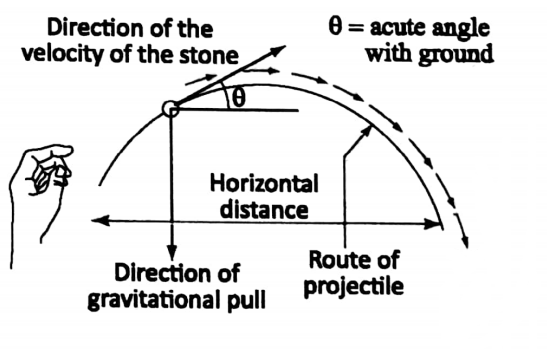
2. If the same object is thrown upwards (as a projectile), making an acute angle (0) with the ground, under the action of gravity the direction and speed of the projectile will continuously change as

WBBSE Solutions for class 8 Physical Environment Section-2 Forces active without contact- Direction of the velocity

WBBSE Chapter 1 detailed answers on forces

Moving along a curved path, the projectile ultimately comes back to the ground after traversing some horizontal distance.

If a stone is thrown with greater and greater force, then a situation will arise when the object will not return to the earth due to balancing between its velocity and gravitational pull by the earth.

It will then start revolving around the earth. During its revolution around the earth, along a path of circular trajectory, its velocity will change continuously due to changes in its direction

4. Artificial satellites: Man-made objects which revolve (or orbit) around the earth in outer space are called artificial satellites.

Aryabhatta (the first artificial satellite successfully launched by India), Bhaskara, Rohini, INSAT-1A etc. are some of the satellites launched by India.

Artificial satellites are “thrown” with a very great speed and they revolve around the earth. Moon is a natural satellite of the earth and also revolves around the earth following the same principle.


WBBSE Solutions for class 8 Physical Environment Section-2 Forces active without contact- pieces of paper

5. Escape Velocity: When a body is projected upwards, it comes down to the earth after some time due to the earth’s gravitational attraction.

So, one may think, whether it is possible to throw a body with such a velocity, that the body will not return to the earth again.

For an object to escape from the earth and never return, it must be launched with a velocity, which will take the body beyond the gravitational field of the earth. Such velocity is known as Escape Velocity”.

It Is defined as the least velocity with which a body must be thrown vertically upwards In order that it may just escape the gravitational pull of the earth. The value of escape velocity is estimated to be 11.2 km/s or approximately 7 mile/s.

Both the heavier body and the lighter body shall touch the ground with equal rapidity, ie., in 5s.

Long answer questions on force and pressure Class 8

Question 4. Will the weight of any particular object be the same anywhere on the earth’s surface? Is the value of G the same on earth and on the moon? Mathematically it can be shown that, g=G.

Answer:

Here, g is the acceleration due R² to gravity, G is the universal gravitational constant, M is the mass of the earth and R is the distance of an object placed on the earth’s surface from the centre of the earth.

From this expression, we find that the magnitude of “g” at any point on the earth’s surface depends on the distance of that point from the centre of the earth.

The shape of the earth is not perfectly spherical. The radius of the earth is minimum at the poles and maximum at the equator.

Hence, even if we place an object at sea level, the distance from the centre of the earth is not always the same, and it will be different at different places.

We know that the weight of a body is the product of the mass of the body and the acceleration due to gravity.

Hence, as the magnitude of “g” changes, the weight of the object will also change. G is a universal constant. Hence the value of G is the same on earth and in the moon.

Question 5. If an object is thrown upwards, making an acute angle with the ground, what will happen? What do you mean by Universal Gravitational Constant?
Answer:

Given:

An object is thrown upwards, making an acute angle with the ground.

If an object is thrown upwards making an acute angle with the ground, under the action of gravity, the direction and speed will continuously change as shown and the object shall come back to the ground after traversing some horizontal distance.

If m, = m, = 1 kg and r = 1m, then G = F. Thus, Universal Gravitational Constant (G) is defined as the force of attraction between two bodies of masses 1 kg each and separated by a distance of 1m.

WBBSE Solutions for class 8 Physical Environment Section-2 Forces active without contact- Direction of the velocity

In-depth analysis of non-contact forces for Class 8

Question 6. “Repulsion is a surer test for electrification”. Justify.
Answer:

“Repulsion is a surer test for electrification”.

When a charged body attracts a second body, then we can say that either, the second body is uncharged since the former induces an opposite charge in the latter, and as a result, the former attracts the latter;

or,  the second body is oppositely charged (since we know that two oppositely charged objects attract each other).

So, merely from the phenomenon of attraction, one cannot be sure whether a body is charged or not.

But if repulsion takes place between two bodies then it is sure that they are electrically charged, for repulsion only occurs between two similarly charged bodies.

Hence we find that repulsion is a surer test of the electrification of a body.

Question 7. What is the effect of the magnitude of charge and distance between the two point charges on the electrostatic force of attraction or repulsion?
Does the value of electrostatic force between two charged bodies change when they are dipped in water?
Answer:

Given:

The effect of the magnitude of charge and distance between the two point charges on the electrostatic force of attraction or repulsion.

According to Coulomb’s law, the magnitude of force exists between two charged particles.

Where, F is the electrostatic force of attraction or repulsion between two particles having the amount of charge q, and q2 on them, separated by a distance “r”.

“k” is a constant whose value depends on the nature of the intervening medium between the two charged particles.

From the above mathematical expression we can conclude that by keeping the distance between the two charged particles the same, if the charge of the particle(s) is increased, the electrostatic force between them is also increased.

For example, keeping the distance between them fixed, if the charge of the two particles is doubled, the magnitude of the electrostatic force is increased by 4 times.

Similarly, we find that by keeping the charge of the two particles the same, if the distance between them is increased, the electrostatic force between them is decreased.

For example, keeping the charge of the two particles the same, if the distance between them is doubled, the magnitude of electrostatic force becomes 1/4th of the former.

K is a constant whose value depends upon the intervening medium between the two point charges. Hence the value of electrostatic force between two charged bodies varies as the bodies are immersed in water.

Question 8. Prove with an experiment that “Like charges (or similar charges) repel each other”.

Answer:

Given:

“Like charges (or similar charges) repel each other”

Apparatus needed: Two ebonite rods, some wool, silk thread and two stands.

Procedure: Let us take an ebonite rod and rub it with wool. It is then suspended freely from some support by a silk thread.

It is then brought near to another ebonite rod which has also been rubbed with wool and suspended from a stand by a silk thread.

Observation: It is observed that the suspended ebonite rod is repelled (i.e. moves away).

Inference: When an ebonite rod is rubbed with wool, it acquires a negative charge. So when two negatively charged ebonite rods are brought closer to each other they repel. This proves that like charges repel each other.

WBBSE Solutions for class 8 Physical Environment Section-2 Forces active without contact-1 charged ebonite rod

Force Active Without Contact experiments and explanations for Class 8

Question 9. Prove with an experiment that “Unlike charges (or opposite charges) attract each other”.

Answer:

Given:

“Unlike charges (or opposite charges) attract each other”.

Apparatus needed: One ebonite rod, some wool, one glass rod, a piece of silk, silk thread and two stands.

Procedure: Let us take an ebonite rod and rub it with wool. It is then suspended freely from a stand by a silk thread.

It is then brought near to a glass rod which has been rubbed with a piece of silk and suspended from a stand by a silk thread.

Observation: It is observed that the suspended ebonite rod and the suspended glass rod come closer to each other (i.e. attract each other)

Inference: When an ebonite rod is rubbed with wool, it acquires a negative charge. When a glass rod is rubbed with silk, it acquires a positive charge.

So when two oppositely charged rods are brought closer to each other they move towards each other. This proves that opposite charges attract each other.


WBBSE Solutions for class 8 Physical Environment Section-2 Forces active without contact- charged glass rod

WBBSE Chapter 1 exercises long answers solutions

Question 10. Two objects one with a mass of 1 kg and the other with a mass of 2 kg are allowed to fall freely from a certain height. How does the weight of a body on the surface of the moon vary compared to that at the surface of the earth?
Answer: 

Given:

Two objects one with a mass of 1 kg and the other with a mass of 2 kg are allowed to fall freely from a certain height.

1. The gravitational pull of the earth will be more on which object?
2. Whose acceleration will be more?

Answer:
When the two objects of different mass are allowed to fall freely from the same height, the earth will pull the heavier object with more force.

Because, we know from the law of gravitation, that, other things remain constant, the higher the mass of the body, the more will be the force of gravitation by the earth.

But we also know that the earth always produces the same acceleration on every object. So the acceleration of both objects will be the same. Weight of a body on the surface of the moon=x weight of the body on the surface of the earth.

Question 11. The acceleration due to gravity on earth is 9.8 m/s² . If the radius of the earth is 6.37 x 10⁵ m and the value of G is 6.67/1011 N.M² /kg², then calculate the mass of the earth. Mathematically it can be shown that,
Answer:

Given

The acceleration due to gravity on earth is 9.8 m/s² . If the radius of the earth is 6.37 x 10⁵ m and the value of G is 6.67/1011 N.M² /kg²

g=GM/R²

Here, the acceleration due to gravity, g = 9.8 m/s²  the universal gravitational constant,

G = 6.67/1011 N.m² /kg²  the radius of the earth, R = 6.37 x 10° m and M is the mass of the earth
So, substituting these values in the above equation, we get,

WBBSE Solutions for class 8 Physical Environment Section-2 Forces active without contact-laq11

WBBSE Class 8 Science practice questions on force concepts

Question 12. Two point charges, each having a charge 6.5/ 10′ coulomb are separated by a distance of 50 cm in vacuum (k = 9 x 10°). Calculate the force of repulsion between them. When P is rubbed with Q, Q becomes positively charged. Which of the two materials gains electrons and which one loses electrons?
Answer:

Given:

Two point charges, each having a charge 6.5/ 10′ coulomb are separated by a distance of 50 cm in vacuum (k = 9 x 10°).

Here, q1 = q2 = 6.5/10′ coulomb
r = 50 cm = 0.5 m
k=9x 10°
The electrostatic force of repulsion,

WBBSE Solutions for class 8 Physical Environment Section-2 Forces active without contact-Laq12

Question 13. Compare the force of gravitation with electrostatic force.
Answer: 

Comparing the force of gravitation with electrostatic force:

Force of Gravitation Electrostatic force
1 The force of gravitation is attractive in nature. 1 The electrostatic force between two charged particles may be attractive or repulsive,

depending on whether the charges on two particles are opposite or similar.

2 The force of gravitation is existent between any two particles in this universe. 2 Electrostatic force exists only between two charged particles or between one charged and an uncharged particle.
3 The magnitude of the force of gravitation between two specific objects separated by a certain distance is independent of the intervening medium. 3 The magnitude of the electrostatic force between two particles depends on the intervening medium between them.
4 The magnitude of the force of gravitation between two objects separated by a certain distance depends on the mass of the two objects. 4 The magnitude of the electrostatic force between two particles depends on the charge of each particle.


Examples of non-contact forces in daily life for Class 8

Question 14. State the law of conservation of charge.
Answer:

law of conservation of charge:-

A charged thermocol ball is suspended by means of a nylon thread. When a neutral body is brought nearer to it, the thermocol ball is first attracted by it and then flies away from it. Explain the phenomenon.

When two bodies are rubbed together and if one body acquires a positive charge by losing some electrons, the second body acquires a negative charge of equal magnitude by gaining the same number of electrons as those lost by the first body.
Answer:
Thus the total electric charge on both the bodies put together, before and after electrification remains the same. Thus the charge is said to be conserved.

This is known as the law of conservation of charge, according to which charge can only be transferred from one body to another and can neither be created nor destroyed.

When the neutral body is brought nearer to the thermocol ball, an opposite charge is induced in the neutral body and so the thermocol ball is attracted to it.

As soon as the thermocol ball touches the body, both develop the same kind of charge due to conduction and then repel each other. Hence, the thermocol ball now moves away from the body.

Question 15. Enumerate the differences between the mass and weight of a body.
Answer:

The differences between the mass and weight of a body:

Mass Weight
1. Mass is the quantity of matter contained in the body. 2. Weight is the gravitational force of the earth acting on the body.
2.  Mass is a constant quantity. 2. Weight changes from place to place.
3. Mass can never be zero. 3.  Weight may be zero.
4. Its SI unit is Kilogram. 4. Its SI unit is Newton.


WBBSE Class 8 School Science Chapter 1 Physical Environment Force Active Without Contact SAQs

Chapter 1 Physical Environment Short Answer Type Questions

Question 1. State and explain Newton’s law of universal gravitation.
Answer:

Newton’s law of universal gravitation

The force of attraction between any two point objects having masses “m,” and “m² ” separated by a distance “r” acts along the line joining the particles and has the magnitude, F=Gm

G is called the Universal gravitational constant. From the mathematical expression of the law, we find that if the masses of the objects are increased, the gravitational force between them is increased.

Similarly, we find that by keeping the mass of the two objects the same, if the distance between them is increased, the gravitational force between them is decreased.

Force Active Without Contact.

Question 2. Why “G” is called the “universal” constant?
Answer:

“G” is called the “universal” constant:-

The constant “G” is called “universal” because it does not depend on the mass of the bodies or the medium in which they are placed.

Also, it is not affected by heat, light, magnetic or electric fields etc. It is independent of the presence of other bodies.

WBBSE Class 8 Force Active Without Contact short answer questions

Question 3. What do you mean by gravitation and gravity?
Answer:

Gravitation And Gravity:-

Gravitation is the measure of the force of attraction between any two objects in this ball, its density increases (due to a decrease in volume) and hence, resistance to its motion through air decreases.

Thus it falls faster than a sheet of paper. universe. But gravity is the measure of gravitational force with which the earth pulls an object near it towards its centre.

Question 4. What do you mean by the weight of an object? What is the relation between the weight and mass of an object?
Answer:

Weight Of An Object:-

The weight of a body (w) is the force with which the earth attracts it towards its centre.

Mathematically, we can write, w = m.g where, w is the weight of a body, m is the mass of the body and g is the acceleration due to gravity

Question 5. Can the weight of an object having non-zero mass be zero?
Answer:

At R= 0, that is at the centre of the earth, “g” is equal to zero. Since we know that, the weight of an object (w) = mass of the object (m) x acceleration due to gravity (g), hence, at the centre of the earth, where “g” is zero, “w” will also be zero.

Read And Learn More WBBSE Solutions For Class 8 School Science Short Answer Type Questions

Question 6. Name two contactless forces. Which one is the intrinsic property of a body mass or weight?
Answer:

Contactless Forces:-

Gravitational force and electrostatic force are two examples of contactless forces.
The mass of a body is constant, i.e. it remains the same at all places. The mass of a body can never

be zero. Since the value of g changes from place to place, therefore, the weight of a body is not constant.

The weight of a body can even be zero, for example at the center of the earth. Hence mass is the intrinsic property of a body.

WBBSE Class 8 School Science Chapter 1 Physical Environment Force Active Without Contact SAQs

Question 7. What do you mean by escape velocity?
Answer:

Escape Velocity:-

Escape velocity is defined as the least velocity with which a body must be thrown vertically upwards in order that it may just escape the gravitational pull of the earth and will not return to earth. (The value of escape velocity is estimated to be 11.2 km/s or approximately 7 mile/s).

Question 8. What do you mean by 1 coulomb of charge?
Answer:

1 Coulomb Of Charge:-

When two point charges containing the same magnitude of the charge is separated by a distance of 1 metre in a vacuum, then if the magnitude of the force exerted by each of the point charges on the other is 9 x 10° Newton, then the magnitude of the charge on each of the point charge is called 1 coulomb.

Examples of non-contact forces short answers for Class 8

Question 9. What is the unit of charge in the CGS and SI units? Define them. What is the relation between them?
Answer:

Unit Of Charge In the CGS and SI units:-

The CGS unit of charge is e.s.u. The SI unit of charge is the coulomb.

If the electrostatic force of repulsion between two like point-charges separated by a distance of 1 cm in a vacuum is 1 dyne, then the charge on each point-charge is 1 e.s.u. or 1 statcoulomb.

If the electrostatic force of repulsion between two like point-charges separated by a distance of 1 m in a vacuum is 9 x 10° Newton, then the charge on each point-charge is 1 coulomb. 1 coulomb = 3 × 10° e.s.u.

WBBSE Class 8 Science practice short answer questions

Question 10. Why an atom is uncharged although it contains charged sub-atomic particles?
Answer:

An atom is uncharged although it contains charged sub-atomic particles:-

We know that all things are made up of atoms. An atom consists of three types of sub-atomic particles electron, proton, and neutron. (The only exception is the hydrogen atom which does not have a neutron).

An electron has a unit negative charge it, a proton has a unit positive charge and a neutron is uncharged.

In an atom,the  total of the positive charge of all the protons is equal to the total of the negative charge of all the electrons. So an atom is neutral which means the net charge in an atom is zero.

Question 11. When an inflated balloon is rubbed against a sweater, then it automatically sticks to the sweater. Why?
Answer:

When an inflated balloon is rubbed against a sweater, then it automatically sticks to the sweater

When an inflated balloon is rubbed against a sweater, then static electricity is produced on the surface of both of them.

They are oppositely charged. Hence, the sweater and the balloon attract each other and as a result, the balloon sticks automatically to the sweater without any support.

WBBSE Solutions For Class 8 School Science Long Answer Type Questions WBBSE Solutions For Class 8 School Science Short Answer Type Questions
WBBSE Solutions For Class 8 School Science Very Short Answer Type Questions WBBSE Solutions For Class 8 School Science Review Questions
WBBSE Solutions For Class 8 School Science Solved Numerical Problems WBBSE Solutions For Class 8 School Science Experiments Questions
WBBSE Solutions For Class 8 Maths WBBSE Class 8 History Notes
WBBSE Class 8 History Multiple Choice Questions WBBSE Solutions For Class 8 History
WBBSE Solutions For Class 8 Geography


Question 12. What do you mean by induction?
Answer:

Induction:-

The process by which an uncharged body gets two electrically opposite ends when held near a charged body is called INDUCTION and the uncharged body is then said to be induced.

Force Active Without Contact explanations for Class 8

Question 13. Keeping the mass of the earth constant, if the radius of the earth is reduced by 4%, then how does the value of acceleration due to gravity at the surface of the earth change?
Answer:

Given:

Keeping the mass of the earth constant, if the radius of the earth is reduced by 4%.

∴ If the radius of the earth is reduced by 4%, then the value of acceleration due to gravity at the surface of the earth is increased by 8.5%.

Question 14. A glass rod is rubbed with wool. Again an ebonite rod is rubbed with silk. What will happen now if the piece of silk is brought near to the wool?
Answer:

Given:-

A glass rod is rubbed with wool. Again an ebonite rod is rubbed with silk.

When glass is rubbed with wool, wool acquires a positive charge. When ebonite is rubbed with silk, silk also acquires a positive charge.

If now the piece of silk is brought near to the wool, then they will repel each other since like charges repel each other.

WBBSE Chapter 1 short answer solutions

Question 15. ‘P’ contains 50 electrons and 45 protons and ‘Q’ contains 72 electrons and 77 protons after electrification by friction between them.

Find the number of electrons and protons in ‘P’ and ‘Q’ before electrification. How many electrons have been transferred between them?

Answer:

Given:-

‘P’ contains 50 electrons and 45 protons and ‘Q’ contains 72 electrons and 77 protons after electrification by friction between them.

A neutral body contains an equal number of electrons and protons. Hence, ‘P’ should contain 45 protons and 45 electrons before electrification. ‘Q’ should contain 77 protons


WBBSE Class 8 School Science Chapter 1 Physical Environment Force Active Without Contact VSAQs

Chapter 1 Physical Environment Force Active Without Contact VSAQs

Question 1. What is the unit of G in SI and CGS units?
Answer:

The unit of G in SI and CGS units:-

The unit of G in the SI unit is N.m² /kg²  and in the CGS unit is done.cm2/g²

Question 2. What is meant by gravitational force?
Answer:

Gravitational Force:-

Gravitational force is the force of attraction between any two point objects in this universe having masses “m,” and “m² ” separated by a distance “r”, acting along the line joining the objects and has the magnitude F-Gym²  (where G is a constant known as the universal gravitational constant).

WBBSE Solutions For Class 8 School Science Chapter 1 Physical Environment Force Active Without Contact Very Short Answer Type Questions

WBBSE Class 8 Force Active Without Contact very short answer questions

Question 3. The law of universal gravitation applies to two-point objects. Is this law valid for bigger objects (which obviously do not point objects)?
Answer:

Given:

The law of universal gravitation is applicable to two-point objects

If the distance between the two objects is much greater than the diameter of either of the objects, then the objects can be considered point masses.

Besides, the earth, moon, sun, stars, etc. have spherical shapes and their masses can be considered to be condensed at their geometric centre. So the law of universal gravitation can be directly applied.

Very short answer questions on non-contact forces for Class 8

Question 4. Why do raindrops fall on the earth?
Answer:

Raindrops fall on the earth because of 

Earth pulls anything near its surface towards its centre by a force called gravity. So, everything near its surface, for example, raindrops, shredded leaves and fruits from a tree fall on the earth.

Question 5. What do you mean by acceleration due to gravity?
Answer:

Acceleration Due To Gravity:-

The acceleration produced in a freely falling object due to the earth’s gravity is called acceleration due to gravity.

Question 6. What is the magnitude of the acceleration due to gravity in an SI unit?
Answer:

The magnitude of the acceleration due to gravity in an SI unit

The acceleration due to gravity is 9.8 m/s²  in the SI unit.

Read And Learn More WBBSE Solutions For Class 8 School Science Very Short Answer Type Questions

Question 7. Is “g” (acceleration due to gravity) a constant?
Answer:

No, “g” is not a constant. It depends on the distance from the centre of the earth.

Question 8. What is the magnitude of escape velocity on earth?
Answer:

The magnitude of escape velocity on earth

The magnitude of escape velocity on earth is 11.2 km/s.

WBBSE Chapter 1 quick answer solutions

Question 9. How far the Gravitational force exists between the two objects in this universe? 
Answer:

The force of Gravitation is zero only when two objects are separated by an infinitely large distance. But in reality, beyond a certain distance, the force of Gravitation becomes negligibly small.

Question 10. What is the unit of charge in the SI unit?
Answer:

The unit of charge in the SI unit is the coulomb.

Question 11. When a glass rod is rubbed with a piece of silk what type of charges are generated on each of them?
Answer:

When a glass rod is rubbed with a piece of silk, the glass rod acquires a positive charge and the silk acquires a negative charge.

Question 12. When an ebonite rod is rubbed with a piece of wool what charges are generated on each of them?
Answer:

When an ebonite rod is rubbed with a piece of wool, the ebonite rod acquires a negative charge and the wool acquires a positive charge.

Question 13. Why an atom is electrically neutral (i.e. uncharged)?
Answer:

In an atom, the total number of positive charges is the same as the total number of negative charges. Hence, an atom has no net charge.

WBBSE Solutions For Class 8 School Science Long Answer Type Questions WBBSE Solutions For Class 8 School Science Short Answer Type Questions
WBBSE Solutions For Class 8 School Science Very Short Answer Type Questions WBBSE Solutions For Class 8 School Science Review Questions
WBBSE Solutions For Class 8 School Science Solved Numerical Problems WBBSE Solutions For Class 8 School Science Experiments Questions
WBBSE Solutions For Class 8 Maths WBBSE Class 8 History Notes
WBBSE Class 8 History Multiple Choice Questions WBBSE Solutions For Class 8 History
WBBSE Solutions For Class 8 Geography


Question 14. What do you mean by static electricity?
Answer:

Static Electricity:-

When surfaces of two different objects are rubbed against each other, one of them may lose electrons and acquire a positive charge and the other gains the electrons and acquire a negative charge. The electricity so produced is called Static Electricity.

Question 15. The table to decide the nature of charges that develop due to rubbing is given here:
Answer:

What kind of charges would develop if silk is rubbed with resin?
Silk
wood
Human body
Resin
Celluloid
Silk- Positive charge 
Resin- Negative Charge 


Question 16. Name the device which is used to detect the presence of static charge in a body.
Answer:

Electroscope

WBBSE Class 8 Science very short answer practice

Question 17. Why does a sheet of paper fall slower than one that is crumpled into a ball?
Answer:

When the sheet of paper is crumpled into a ball, its density increase (due to a decrease in volume) and hence, resistance to its motion through air decreases. Thus it falls faster than a sheet of paper.

Question 18. Which force is responsible for the revolution of planets around the sun?
Answer:

Gravitational force of attraction between the sun and the planets.

WBBSE Solutions For Class 8 School Science Long Answer Type Questions WBBSE Solutions For Class 8 School Science Short Answer Type Questions
WBBSE Solutions For Class 8 School Science Very Short Answer Type Questions WBBSE Solutions For Class 8 School Science Review Questions
WBBSE Solutions For Class 8 School Science Solved Numerical Problems WBBSE Solutions For Class 8 School Science Experiments Questions
WBBSE Solutions For Class 8 Maths WBBSE Class 8 History Notes
WBBSE Class 8 History Multiple Choice Questions WBBSE Solutions For Class 8 History
WBBSE Solutions For Class 8 Geography


Question 19. A man can lift an object of mass 10 kg on the surface of the earth. What will be the maximum mass which he can lift at the surface of the moon by applying the same muscular force?
Answer:

10 kg x 6 = 60 kg

WBBSE Class 8 Science revision very short answers

Question 20. Two bodies attract each other with a force F in the air. What will be the value of the force when the same bodies are immersed in water?
Answer:

The force of gravitation does not depend on the intervening medium. Hence the force shall remain as F.

WBBSE Solutions For Class 8 School Science Chapter 1 Physical Environment Force Active Without Contact Review Questions

Chapter 1 Physical Environment MCQ Questions

Question 1. If you have a mass of 40 Kg, then the force with which the earth attracts you towards its center is

  1. 20 N
  2. 40 N
  3. 392 N
  4. 336 N

Answer: 3. 392 N

WBBSE Solutions For Class 8 School Science Chapter 1 Physical Environment Force Active Without Contact Review Questions

Question 2. If the mass of two objects is doubled, the force due to gravitation

  1. Increases by two times
  2. Increases by four times
  3. Decreases by four times
  4. Decreases by two times

Answer: 2. Increases by four times

Question 3. The mathematical expression of the Law of Universal Gravitation is

WBBSE Solutions for class 8 Physical Environment Section-2 Forces active without contact-mcq- 3

Answer:
WBBSE Solutions for class 8 Physical Environment Section-2 Forces active without contact-mcq- 3.

Read And Learn More WBBSE Solutions For Class 8 School Science Review Questions

4. Using a spring balance, we measure

  1. The mass of an object
  2. The weight of an object
  3. The pressure of an object
  4. The acceleration due to gravity at a place

Answer: 2. The weight of an object

Question 5. The weight of an object on earth is the product of its mass and

  1. G
  2. g
  3. Distance from the centre of the earth
  4. None of these

Answer: 2. g

Question 6. F (the gravitational force) is zero when the distance between two objects is

  1. Zero
  2. Infinitely large
  3. Less than the radius of the earth
  4. Does not depend on the distance between the two objects

Answer: 2. Infinitely large

WBBSE Class 8 Force Active Without Contact review questions

Question 7. The magnitude of escape velocity is

  1. 11.2 km/s
  2. 11.2 m/s
  3. 11.2 cm/s
  4. 11.2 km/h

Answer: 1. 11.2 km/s

8. The value of G in SI unit is

Question 9. If the acceleration due to gravity on earth is “g”, its value on the moon is

  1. g/6
  2. g
  3. 6g
  4. 0

Answer: 1. g/6

Question 10. When an ebonite rod is rubbed with wool, it acquires

  1. Negative charge
  2. No charge
  3. Positive charge
  4. Protons

Answer: 1. Negative charge

Question 11. Keeping masses of two bodies constant, if the distance between them is made twice then the gravitational force of attraction between them becomes

  1. Twice the previous
  2. Four times the previous
  3. Half of previous
  4. A fourth of previous

Answer: 2. Four times the previous

Question 12. The weight of a freely falling object

  1. Gradually increases
  2. Gradually decreases
  3. Remains same
  4. Vanishes

Answer: 3. Gradually decreases

Understanding non-contact forces for Class 8

Question 13. The net charge in an atom is

  1. Negative
  2. Zero
  3. Positive
  4. None of these

Answer: 2. Zero

WBBSE Solutions For Class 8 School Science Long Answer Type Questions WBBSE Solutions For Class 8 School Science Short Answer Type Questions
WBBSE Solutions For Class 8 School Science Very Short Answer Type Questions WBBSE Solutions For Class 8 School Science Review Questions
WBBSE Solutions For Class 8 School Science Solved Numerical Problems WBBSE Solutions For Class 8 School Science Experiments Questions
WBBSE Solutions For Class 8 Maths WBBSE Class 8 History Notes
WBBSE Class 8 History Multiple Choice Questions WBBSE Solutions For Class 8 History
WBBSE Solutions For Class 8 Geography


Question 14. Two identical metal spheres A and B are placed on insulating stands and kept in contact as shown. What kind of charges will appear on A and B when a negatively charged ebonite rod is brought near A ? Ebonite rod

WBBSE Solutions for class 8 Physical Environment Section-2 Forces active without contact-mcq- 14

  1. Both A and B will have a positive charge
  2. Both A and B will have a negative charge
  3. A will have a negative charge and B a positive charge
  4. A will have a positive charge and B a negative charge

Answer: 4. A will have a positive charge and B a negative charge

Question 15. The CGS unit of charge is

  1. Coulomb
  2. Statcoulomb
  3. E.S.U.
  4. Ampere

Answer: 3. E.S.U.

Question 16. An atom is electrically neutral because

  1. The number of protons is the same as the number of electrons
  2. The number of protons is the same as the number of neutrons
  3. The number of neutrons is the same as the number of electrons
  4. Atom does not exhibit static electricity

Answer: 1. Number of protons is the same as the number of electrons

Question 17. Keeping the distance between the two point- charges fixed, if the amount of charge on the point charges increases,

  1. The electrostatic force increases
  2. The electrostatic force decreases
  3. The electrostatic force remains unchanged
  4. It is independent of the magnitude of charges

Answer: 1. The electrostatic force increases

Question 18. The magnitude of the electrostatic force between two point charges

  1. Depends on the intervening medium
  2. Is independent of the distance between them
  3. Is independent of the charge on the point- charges
  4. All of these

Answer: 1. Depends on the intervening medium

Question 19. When no charge is supplied to or removed from a neutral body, then the amount of

  1. Positive charge > negative charge present in it
  2. Positive charge < negative charge present in it
  3. Positive charge = negative charge present in it
  4. No charge is present in the body initially

Answer: 3. positive charge < negative charge present in it

WBBSE Chapter 1 review questions and answers

Question 20. The law of gravitation gives the gravitational force between

  1. Earth and the sun only
  2. Earth and point mass only
  3. Two charged bodies only
  4. Any two bodies having a certain mass

Answer: 4. Any two bodies having a certain mass

Question 21. Two objects of different masses falling freely near the surface of the moon would

  1. Have the same velocities at any instant
  2. Have different accelerations
  3. Experience forces of different magnitudes
  4. undergo different distances at the same interval of time

Answer: 1. Have the same velocities at any instant

Chapter 1 Physical Environment Fill in the Blanks

Question 1. The earth pulls any object near it by the force of _______.
Answer: Gravity

Question 2. Weight = mass of an object x _______
Answer: Acceleration due to gravity

Question 3. The magnitude of “g” in SI unit is _______
Answer: 9.8m/s²

Question 4. The magnitude of “g” in the CGS unit is _______
Answer: 981 cm/s²

Question 5. The magnitude of “g” _______is than at the equator.
Answer: Less

Question 6. Speed of a freely falling body _______ at the poles with the increase in the time of fall.
Answer: Increases

Question 7. The distance traversed by a freely falling body _______ with the increase in time of fall.
Answer: Increases

Question 8. If the mass of one object is 2 kilograms, its weight is _______ Newton.
Answer: 19.6

Question 9. Electrons are _______ charged particles
Answer: Negative

Question 10. Like charges _______ each other.
Answer: Repel

Question 11. Unlike charges _______ each other.
Answer: Attract

Question 12. Statcoulomb is the unit of _______
Answer: Charge

Question 13. Keeping the number of charges on two-point- charges fixed, if the distance between them is increased, the electrostatic force will _______
Answer: Decreases

Force concepts review for Class 8 Science

Question 14. When a glass rod is rubbed with a piece of silk it acquires_____charge.
Answer: Positive

Question 15. When an ebonite rod is rubbed with wool, it acquires _______ charge.
Answer: Negative

Question 16. All the positive charges of an atom are contained in the _______
Answer: Nucleus

Question 17. If an atom loses an electron it becomes _______ charged.
Answer: Positively

Question 18. If an atom gains an electron, it becomes _______ charged.
Answer: Negatively

Chapter 1 Physical Environment Identify as ‘True’ or ‘False’

Question 1. When an object is thrown upwards, it comes down due to gravity.
Answer: True

Question 2. The force of gravitation can never be zero.
Answer: True

Question 3. G is called the Universal gravitational constant.
Answer: True

Question 4. The magnitude of “G” is affected by heat, light, magnetic or electric fields etc.
Answer: True

Question 5. The force of gravity on unit mass is equal to the acceleration dile to gravity.
Answer: True

Question 6. The unit of “G” in the CGS unit is dyne.cm² /g².
Answer: False

Question 7. Force always produces acceleration in the body on which it is applied.
Answer: False

Question 8. The value of “G” in the SI unit is 6.67/ 108 dyne.cm² / g²
Answer: False

Question 9. Spring balance is used to measure the weight of an object.
Answer: True

Question 10. The average value of “g” in SI unit is 9.8 m/s².
Answer: True

Question 11. In a vacuum, all bodies starting from rest fall with equal rapidity.
Answer: True

Practice questions on Force Active Without Contact for Class 8

Question 12. In absence of any resistance, a heavier object will fall more rapidly than a lighter object.
Answer: False

Question 13. Earth always produces the same acceleration on every object.
Answer: True

Question 14. Electrons are positively charged.
Answer: False

Question 15. Neutrons are negatively charged.
Answer: False

Question 16. Rubbing two objects against each other may produce static electricity.
Answer: True

Question 17. A freely falling body is weightless.
Answer: True

Question 18. If the magnitude of two-point charges is doubled, the electrostatic force will increase by 4 times.
Answer: True

Question 19. Repulsion is a surer test of electrification.
Answer: True

Question 20. Gravitational force is operational between an electron and a proton.
Answer: False

Chapter 1 Physical Environment Match the Columns

Question 1.

 Column – A Column – B
A. Law of Universal Gravitation 1. Galileo
B. Laws of freely falling bodies 2. Newton
C. Naming of different charges as positive and negative 3. Leaning tower of Pisa
D. Experiment with falling objects 4. Franklin

Answer: A-2,B-1,C-4,D-3

Question 2.

 Column – A Column – B
A. g 1. Unit of charge
B. G 2. 11.2 km/s
C. Coulomb 3. 9.8 m/s2
D. Escape velocity 4. 6.67/1011 N.m2/kg2

Answer: A-3,B-4,C-1,D-2

Question 3.

Column – A Column – B
A. Increase of altitude 1. G unchanged
B. Increase in distance between two objects 2. Force of gravitation
C. Decrease in distance between two objects 3. Decrease in gravitation
D.  Increase in mass of two objects 4. Force of increases

Answer: A-3,B-3,C-2,D-2

WBBSE Chapter 1 summary and review questions

Question 4.

Column – A Column – B
A. CGS unit of “g” 1. cm
B.  SI unit of 2. coulomb
C. SI unit of charge 3. N.m2/kg2
D. CGS unit of distance 4. cm/s2

Answer: A-4,B-3,C-2,D-1

Question 5.

Column – A Column – B
A. w = 1. G r2 m2
B. F = 2. k q1q2/r2
C. The electrostatic force of attraction 3. m.g
D. g = 4. w/m

Answer: A-3,B-1,C -2,D-4

WBBSE Solutions For Class 8 School Science Chapter 1 Physical Environment Force Active Without Contact Experiments

Chapter 1 Physical Environment Force Active Without Contact Experiments


Let us carry out the following three experiments:

Experiment-1

Let us take an ebonite rod and rub it with wool. It is then suspended freely from some support by a silk thread. Another ebonite rod, which has also been rubbed with wool, is then brought near it.

It is observed that the suspended ebonite rod is repelled (i.e. moves away) as

WBBSE Solutions for class 8 Physical Environment Section-2 Forces active without contact-1 charged ebonite rod

Experiments on force without contact for Class 8

Experiment-2

Let us take a glass rod. It is rubbed with silk and then it is suspended from a support by a silk thread. Another glass rod, which has been rubbed with silk, is now brought nearer to it. It is found that the suspended glass rod is repelled, as

WBBSE Solutions for class 8 Physical Environment Section-2 Forces active without contact- charged glass rod

Read And Learn More WBBSE Solutions For Class 8 School Science Experiments Questions

Experiment -3

let us take a glass rod. It is rubbed with silk and then suspended freely from a support by a silk thread. An ebonite rod, which has been rubbed with wool, is now brought near to it. It is found that the glass rod is attracted by the ebonite rod as

WBBSE Solutions for class 8 Physical Environment Section-2 Forces active without contact- charged rod

WBBSE Class 8 Force Active Without Contact notes

From experiments 1 and 2, it is found that when two objects have like charges or similar charges on them, they repel each other.

That is why two charged glass rods or two charged ebonite rods repel each other. From experiment 3,

we can understand that charges produced on the ebonite rod and charges produced on the glass rods are not similar. When they come closer, they attract each other.

The above experiments were carried out by Dr Gilbert. From the experiments, he came to the conclusion that like charges repel and unlike charges attract each other.

These are static charges produced by friction. When something is not moving, it is said to be static. Similarly, static electricity is the electric charge at rest.

Dr Gilbert was also able to establish that various bodies which get electrified on rubbing either acquired charges similar to those acquired by glass rod or that acquired by ebonite rod.

We can perform another experiment to show that equal charges are produced on two different rubbing surfaces.

Force and pressure experiments for Class 8 students

Experiment -4

A glass rod is rubbed with a piece of silk. The rod and the silk piece are separately held over some small pieces of paper. Each is found to attract paper pieces.

This proves that each is electrically charged. Now, both the glass rod and the silk piece are held over the paper pieces, keeping the rubber parts of the two objects close to each other.

This time no paper piece is attracted by either of the two. This is due to the fact that equal charges of opposite nature are developed when the two different bodies are rubbed.

WBBSE Solutions For Class 8 School Science Long Answer Type Questions WBBSE Solutions For Class 8 School Science Short Answer Type Questions
WBBSE Solutions For Class 8 School Science Very Short Answer Type Questions WBBSE Solutions For Class 8 School Science Review Questions
WBBSE Solutions For Class 8 School Science Solved Numerical Problems WBBSE Solutions For Class 8 School Science Experiments Questions
WBBSE Solutions For Class 8 Maths WBBSE Class 8 History Notes
WBBSE Class 8 History Multiple Choice Questions WBBSE Solutions For Class 8 History
WBBSE Solutions For Class 8 Geography


So, we can conclude that Like charges (or similar charges) repel each other.

Unlike charges attract each other. It will be convenient for us if we assign specific symbols to two different types of charges produced on the objects due to rubbing.

Renowned scientist Benjamin Franklin named the two different charges as positive charge (+) and negative charge (-).

The charge produced on the glass rod (when it is rubbed with silk) is positive and the charge produced on the ebonite rod (when it is rubbed with wool) Is negative.

How can we decide the nature of charges produced on the two objects when they are rubbed against each other? This can be decided using the following table

Wool Metal
Glass Ebonite
Paper Lac
Silk Amber
Wood Resin
Human body Celluloid


Understanding non-contact forces for Class 8

If any two objects listed in the table are rubbed with each other, then the object that lies above in the list will acquire a positive charge and the one that lies below acquires a negative charge.

WBBSE Notes For Class 8 School Science Chapter 1 Physical Environment Force Active Without Contact

Chapter 1 Physical Environment Force Active Without Contact Force Active Without

Contact Introduction

A force which can be exerted by an object even from a distance (without touching each other) is called a non-contact force or force active without contact.

There is no physical contact between the object which exerts the force and the object on which the force is exerted. Examples of non-contact type forces are Gravitational force and Electro- static force.

The force exerted by a magnet is called the magnetic force. The magnetic force acts even from a distance. Hence, the magnetic force is also a force that is active without contact.

Force Active Without Contact

Gravity and Gravitation

To explain the causes of the various natural phenomena, such as planetary motion, the fall of Gravitation is the mutual attractive force between any two material bodies in the universe that have mass.

The gravitational force that acts between the earth and any other object nearer to it is called gravity. In other words, gravity is the earth’s gravitational pull on a body lying on or near it.

The gravitational force between two bodies is a force of attraction that acts even if the two objects are not connected by any means.

For example, it is the gravitational force between the sun and the earth which holds the earth in its orbit around the sun.

Since this force acts on objects from a distance (without there being a physical Sir Isaac Newton proposed the Law of Universal Gravitation to calculate the magnitude of such attractive forces. The law is also known as Newton’s law of Universal Gravitation.

WBBSE Notes For Class 8 School Science Chapter 1 Physical Environment Force Active Without Contact

Newton’s law of universal gravitation states that any two bodies in the universe attract each other with a force that is directly proportional to the product of their masses and inversely proportional to the square of the distance between them.

The attractive force (F) between any two bodies having masses “m,” and “m”, separated by a distance “r” acts along the line joining the centres of two bodies and has the magnitude, F = Gm¹m²

where G is called Universal Gravitational Constant. The constant “G” is called “universal” because it does not depend on the mass of the bodies or the medium in which they are placed.

Also, it is not affected by heat, light, magnetic or electric fields etc. It is independent of the presence of other bodies.

contact), therefore, gravitational force or gravity is an example of non-contact force.
objects towards Earth’s surface, etc. scientists and

Read And Learn More WBBSE Notes For Class 8 School Science

1. The Law of Universal Gravitation

Sir Isaac Newton proposed the Law of Universal Gravitation to calculate the magnitude of such attractive forces. The law is also known as Newton’s law of Universal Gravitation.

philosophers put forward different hypotheses. But now we know that all these phenomena are the manifestations of gravity and gravitation.

That the weight of a body should be regarded as a force of attraction between the earth and that body, was an idea by Newton and some of his contemporary scientists.

It is the amount of gravitational force with which the earth pulls all the bodies near it. This is the reason that raindrops fall on the earth from the sky or shredded tree leaf falls on the ground.

Earth’s pull has been utilized in making spring balance, which measures the weight of the objects. Until the seventeenth century, the laws governing the celestial motions (e.g. planetary motions, revolving of the earth around the sun, etc.)

Were considered quite different from the laws practically governing the motions of the bodies on the earth. It was Sir Isaac Newton, who first pointed out that both motions might have the same origin.

The attractive force (F) between any two bodies having masses “m” and “m”, separated by a distance V’ acts along the line joining the centres of two bodies and has the magnitude,
where G is called Universal Gravitational Constant.

The constant “G” is called “universal” because it does not depend on the mass of the bodies or the medium in which they are placed.

Also, it is not affected by heat, light, magnetic or electric fields etc. It is independent of the presence of other bodies.

WBBSE Solutions for class 8 Physical Environment Section-2 Forces active without contact-1

2. Unit of Universal Gravitational Constant (G)

A century after Newton’s death, astronomer William Herschel (1738- 1822) discovered instances of far-distant stars that revolved around each other in strict accordance with Newton’s law of universal gravitation.

From the Law of Universal Gravitation, we have learnt that the gravitational force,

WBBSE Solutions for class 8 Physical Environment Section-2 Forces active without contact-1

or,

WBBSE Solutions for class 8 Physical Environment Section-2 Forces active without contact-2

Understanding Non-Contact Forces

Hence, a unit of G in SI unit is Newton.m² /kg²  (that is, Newton.metre2 per kg² or N.m² /kg² )

And in CGS system unit of G is dyn.cm² /g²  (that is , dyne.centimetre2 per gram² or dyne.cm² /g² )

3. Value of G

The value of G, as has been calculated from various experiments, in SI unit is 1011 N.m² /kg²  and in
CGS unit is6.67/108 dyne.cm² /g²

In 1798, the English scientist Henry Cavendish (1731 1810) devised an experiment to determine the value of “G”. What he obtained is a value very close to this.

From the mathematical expression of the law of Universal Gravitation, we find that for a pair of two-point objects of masses “m,” and “m”, the force of gravitation decreases as “r” (which is the distance between the two objects) increases.

Since G is a constant, F will be zero only when ” is infinitely large. So we can consider that F will always be a number other than zero, however large the value of “may be.

But actually after a certain value of “, the value of F becomes very small and the force due to gravitation becomes insignificant. Another point needs to be clarified at this stage.

In the statement of the Law of Universal Gravitation, we have mentioned point mass and. the mathematical expression has been proposed accordingly.

But, when we consider celestial bodies like the earth, moon etc. which are not point masses, how can one use the above mathematical expression?

Actually, if the distance between the two objects is much more compared to the diameter of either of the objects, then the objects can be considered as point masses.

Besides this, the earth, moon, sun, stars, etc. have spherical shapes and their masses can be considered to be condensed at their geometric centre.

So, while considering the gravitational force between the earth and an object placed on the surface of the earth, the distance between them has to be taken as equal to the average radius of the earth (which is approximately 6370 kilometres).

4. Relation between ‘G’ and ‘g

The force of gravity (F) exerted by the earth on an object of mass 1 kg can be alternatively shown as follows:

Let, the mass of the earth = M kg Mass of the object = 1 kg Distance of the object from the earth’s centre, (r) = average radius of the earth = R

So, applying Newton’s law of gravitation, we can show that, Image-

Let us denote the force of gravity of the earth on an object of unit mass by “g”.

So,

WBBSE Solutions For Class 8 Chapter-1 Section -2 force active with out contact 10

Also, from the calculation (2) above, we see that the gravitational force with which the earth pulls an object of mass 1 kg is 9.797 Newton.

So, we can say that g= 9.797 Newton So, the force of gravity of earth on an object of mass “m” will be,

WBBSE Solutions For Class 8 Chapter-1 Section -2 force active with out contact 13

5. Motion (where ‘w’ is the weight of the object) and Acceleration due to Gravity

If we allow a ball to fall freely when released from a certain height, it falls vertically down on the surface of the earth.

It is our general observation that starting from rest, as the ball starts falling down, the speed of the ball increases with the passage of time.

So the ball falls down with acceleration. This acceleration is produced due to the action of the earth’s gravity.

The acceleration produced in an object due to the earth’s gravity is called acceleration due to gravity.

We already know that,

Force = mass x acceleration

or, F = m x a

When F is the force of gravity on an object of mass “m”, then,

WBBSE Solutions For Class 8 Chapter-1 Section -2 force active with out contact 14

So, we can show that the force of gravity on unit mass is equal to the acceleration due to gravity, denoted by “g”.

Acceleration due to gravity means the increase in velocity of a freely falling body with time which is caused by the force of gravity acting on it. ,

The value of ‘g’ varies from place to place. The average value of “g” in the SI unit is taken as 9.8 rp/s²  and in the CGS unit 981 cm/s².

We have calculated earlier that g=GM/R² This means that magnitude of “g” at any point on the earth’s surface depends on the distance of that point from the centre of the earth.

The shape of the earth is not perfectly spherical. Hence, even if we place an object at sea level, the distance from the centre of the earth is not always the same, and it will be different at different places.

The value of “g” at the equator is 9.781 m/s²  and that at the poles is 9.831 m/s². In Kolkata, the value of “g” is 9.788 m/s²; in New Delhi, it is 9.79 m/s²; in Mumbai, it is 9.786 m/s²  and in Chennai, it is 9.784 m/s².

6. Difference and relation between Weight and Mass

The weight of a body (w) is the force with which the earth attracts it, whereas mass is the measure of the amount of matter in a body.

Now, Weight of a body = mass of the body x acceleration due to gravity or, w = m.g

SI unit of weight is the same as that of the force i.e., newton (N).

A weight of 1 kg mass is usually written as 1-kilogram weight (1 kg wt.). Similarly, the weight of a 10-gram mass is written as 10 g wt. and so on.

Some important points about the weight of a body:

  1. The weight of a body (w) can be zero if g is zero since mass (m) can not be zero.
  2. Since the value of g changes from place to place, therefore the weight of a body is not constant, i.e. it changes from place to place.
  3. Weight has magnitude and direction (towards the centre of the earth) both.
  4. At a given place, g is constant.
    ∴ At a given place w varies as mass (m). Thus weight is a measure of the mass of the body at a given place.

7. Value of acceleration due to gravity on the moon

The moon’s pull on an object on its surface is not the same as that of the earth. When an object is placed on the surface of the moon, the mass of the object (m) & G remains constant.

But the mass and radius of the moon are respectively 1/81 the 3/11 mass and the radius of the earth.

So, the mass of the M moon M = M/81 and the radius of the moon, r =3R/11 where M and R are the mass and radius of the earth respectively.

WBBSE Solutions For Class 8 Chapter-1 Section -2 force active with out contact 15

So, the Force of gravitation of the moon is only 1/6th of that of the earth.

We know that the weight of a body (w) is the force (Fmoon) with which the earth attracts it. So, for an object of mass “m”, we can write, F=m.g (where “g” is the acceleration due to gravity on earth).

When the same object is placed on the moon’s surface, the force (Fmoon) with which the moon attracts it is, F= m.gmoon (where the moon is the acceleration due to gravity on the moon).

Hence, we can show that Fmoon / F = g moon /g
But we have shown that Fmoon F = 1/6. Hence, gmoon/g=1/6

That means acceleration due to gravity on the surface of the moon is about l/6th of that on the surface of the earth.

8. Falling Bodies

Due to gravity, ail bodies lying within a certain distance above the earth, come down when they are released.

It is seen, usually, that a lighter body, e.g., a piece of paper, descends more slowly than a heavier object e.g., a piece of stone.

This is because when a body Is falling on the earth, the air resists its motion. When the heavier stone is falling,

Its weight prevails over the resistance offered by air So it comes down more quickly than the lighter object, which cannot overcome the resistance of air appreciably.

But, we should note that in absence of air, when there is no resistance, all bodies of different masses come down at the same time.

In fact, Galileo, the famous Italian scientist, demonstrated this phenomenon through an experiment in public.

From the top of the leaning tower of Pisa, Galileo simultaneously released two spheres of equal volume but of different masses (one made of wood and the other made of iron).

One was much lighter than the other. The people gathered there to witness this experiment saw that both spheres touched the ground almost at the same time.

Laws of Freely Falling Bodies

If you drop a stone from a cliff, in addition to gravity, air resistance acts on it. Hence not all bodies fall down freely.

When a body is falling on earth due to gravity in absence of air, there is no resistive force, and it is called a free-falling body.

A body is thus said to be falling freely or in a state of free fall when it is under the influence of gravity alone and no other force acts on it.

When bodies are in free fall, the acceleration due to gravity acting on them is the same and is independent of their masses.

Galileo established three laws for freely falling objects. The laws are:

1. In a vacuum, all bodies starting from rest fall with equal rapidity.

2. In a given time, the velocity acquired by a body falling freely from rest is directly proportional to time.

(This means that the speed of a freely falling body increases with the increase in the time of fall).

3. The distance traversed by a body falling freely from rest is directly proportional to the square of the time. (This means that the distance traversed by a freely falling body increases with the increase in time of fall)

Newton’s Guinea And Feather Experiment Newton’s Guinea And feather Experiment

Newton’s Guinea and feather experiment Newton’s Guinea and feather experiment proves the 1st law as mentioned above.

Newton in his experiment used a hollow glass tube in which a guinea and a feather were introduced.

When the tube was inverted with air in it, the coin was found to come down earlier than the feather.

After that, the air was drawn out from the tube and again the tube was inverted. Both the guinea and the feather this time were seen to fall at the same time.

So, we find that, in absence of any opposing forces, like air resistance, gravity causes all bodies (heavier or lighter) to fall simultaneously if they start to fall simultaneously from rest.

This means the earth always produces the same acceleration on every object.

WBBSE Solutions for class 8 Physical Environment Section-2 Forces active without contact- newtons

10. Common Facts Due To The Action Of Gravity

1. It is our common experience that when an object is thrown vertically upward, its speed decreases with increasing altitude. Ultimately at a certain altitude, the speed becomes zero.

Then the direction of motion is altered and it comes back to the earth again. Acceleration due to gravity is directed towards the centre of the earth. So, while moving upwards, speed decreases with increasing altitude.WBBSE Solutions for class 8 Physical Environment Section-2 Forces active without contactcommon facts due to action gravity

When the object starts falling down, acceleration occurs due to gravitational pull, and hence, the speed of fall increases with the time of fall.

Step-by-Step Guide to Force Concepts

2. If the same object is thrown upwards (as a projectile), making an acute angle (0) with the ground, under the action of gravity the direction and speed of the projectile will continuously change as

WBBSE Solutions for class 8 Physical Environment Section-2 Forces active without contact- Direction of the velocity

Moving along a curved path, the projectile ultimately comes back to the ground after traversing some horizontal distance.

3. If a stone is thrown with greater and greater force, then a situation will arise when the object will not return to the earth due to balancing between its velocity and gravitational pull by the earth.

It will then start revolving around the earth. During its revolution around the earth, along a path of circular trajectory, its velocity will change continuously due to changes in its direction

4. Artificial satellites: Man-made objects which revolve (or orbit) around the earth in outer space are called artificial satellites.

Aryabhatta (the first artificial satellite successfully launched by India), Bhaskara, Rohini, INSAT-1A etc. are some of the satellites launched by India.

Artificial satellites are “thrown” with a very great speed and they revolve around the earth. Moon is a natural satellite of the earth and also revolves around the earth following the same principle.

WBBSE Solutions for class 8 Physical Environment Section-2 Forces active without contact- pieces of paper

Examples of Non-Contact Forces in Everyday Life

5. Escape Velocity: When a body is projected upwards, it comes down to the earth after some time due to the earth’s gravitational attraction.

So, one may think, whether it is possible to throw a body with such a velocity, that the body will not return to the earth again.

For an object to escape from the earth and never return, it must be launched with a velocity, which will take the body beyond the gravitational field of the earth. Such velocity is known as Escape Velocity”.

It Is defined as the least velocity with which a body must be thrown vertically upwards In order that it may just escape the gravitational pull of the earth. The value of escape velocity is estimated to be 11.2 km/s or approximately 7 mile/s.

Electrostatic Force and Charge

1. Introduction to static electricity

When a plastic ruler is rubbed against dry hair or a woollen sweater for some time and then brought near to the small pieces of paper, we find that the paper pieces are flying towards.

The plastic ruler and sticking to it, as if the ruler is attracting them like a magnet, although they are not in contact with each other.

Another example of such a phenomenon is that a metal knife or blade does not attract pieces of Thermocol.

But immediately after cutting a sheet of thermocol with that knife or blade, it attracts small pieces of thermocol.

When an inflated balloon is rubbed against a woollen sweater, it sticks to the sweater.
So it is found that if knife or blade or plastic ruler etc.

are rubbed with another object for some time, and only then do they acquire the capability of attracting other objects.

It is interesting to note that ancient Greeks knew that when amber, a fossilized gum, is rubbed against wool, it acquired the property of attracting light objects like small leaves, dry straw etc.

Dr William Gilbert in the seventeenth century showed that glass on rubbing against silk, ebonite on rubbing against cat’s skin or sealing wax on rubbing against wool also acquire this property.

The substances which develop this property are said to be charged or electrified and the process is called electrification.

The formation of “charges” is evident from the following example. In winter, when we take off our clothes (made from synthetic materials like nylon, terylene, etc.) in darkness, we may see sparks (caused by electrical charges) fly off our bodies.

Similarly, if we comb dry hair in darkness while standing in front of a mirror, we will see sparks coming out from the hair.

So, we have found that a number of different objects can be charged by rubbing them with suitable materials. Let us now understand the nature of the electric charge produced on the objects.

Coulomb’s Law

We have just learnt that like charges repel each other and unlike charges attract each other. Attraction or repulsion occurs due to a force called electrostatic force.

The force exerted by an electrically charged object is called electrostatic force. An electrically charged object can exert an electrostatic force on an uncharged object or another charged object.

The electrostatic force can be exerted by a charged object on another object from a distance (even when they are not in contact with each other). So, an electrostatic force is an example of a non-contact force.

French scientist Charles Augustin invented the following formula to calculate the magnitude of force existing between two charged particles.

where, F is the electrostatic force of attraction or repulsion between two particles having the amount of charge q1 and q2on them, separated by a distance “r”. “k” is a constant whose value depends on the nature of the intervening medium between the two charged particles.

For example, the value of “k” is different for dry air, water and vacuum.

The unit of “F” is dyne (in the CGS system); [Symbol = ‘dyn’]. The unit of “r” is cm (in the CGS system) and the unit of charge is e.s.u. or statcoulomb.

∴The unit of “k” is dyne.cm² /(e.s.u)² according to the CGS system.

If the electrostatic force of repulsion between two like point-charges separated by a distance of 1 cm in a vacuum is 1 dyne, then the charge on each point-charge is 1 e.s.u. or 1 statcoulomb.

If vacuum (or air) is the medium and the quantities are measured in the CGS system, then k = 1.

SI unit of charge is coulomb; a unit of force is Newton; a unit of V’ is metre. So the unit of “k” is Newton.m² / (Coulomb)².

If the electrostatic force of repulsion between two like point-charges separated by a distance of 1 m in a vacuum is 9 x 10⁹ Newton, then the charge on each point-charge is 1 coulomb.

For all practical purposes, ‘k’ is taken to be equal to 9 x 10⁹ Nm² /C2 according to the SI system. From Coulomb’s law, we realize that,

1. Keeping the distance between the two point charges fixed, if the amount of charge on the point charges increases, the electrostatic force also increases.

For example, if the amount of charge on one point- charge is doubled and the amount of charge is tripled on the other, the electrostatic force will be increased by (2 x 3) times or 6 times.

2. Keeping the number of charges on two point-charges fixed, if the distance between them is increased, the electrostatic force will decrease and vice versa.

For example, if the distance between the two point charges is halved, the electrostatic force will be increased Similarly, if the distance between them is doubled, the electrostatic force will be (1/2)2 or l/4th of the former.

Electrification Due To Rubbing

We already know that All things are made up of atoms.

An atom consists of three types of subatomic particles – electron, proton and neutron. (The only exception is the hydrogen atom which does not have a neutron.)

Electron has a unit negative charge on them, a proton has a unit positive charge and a neutron is uncharged.

In an atom, sum total of the positive charge of all the protons is equal to the sum total of the negative charge of all electrons. So an atom is neutral, which means the net charge in an atom is zero.

Protons and neutrons form the central core of the atom, commonly called the nucleus. The electrons revolve around the nucleus in fixed orbits.

Electrons close to the nucleus are strongly held by electrostatic attraction. But the electrons away from the nucleus experience less attractive force and so electrons in the outermost orbit are loosely held.

When two objects (say A and B) are rubbed against each other, the loosely held electrons in the outermost orbit of one object (say, A) come out and are transferred to the other object (B).

Key Terms Related to Non-Contact Forces

After losing electrons, A has less number of electrons than the number of protons in its nucleus. So A becomes positively charged.

After gaining electrons, the number of electrons of B becomes more than the number of protons in its nucleus. So, B becomes negatively charged.

The number of electrons lost by A is equal to the number of electrons gained by B. So, equal but opposite charges are produced simultaneously in the two objects.

This transfer of electrons from one body to another takes place when these two bodies are rubbed and the cause of electron transfer is friction between the two bodies.

The process of charging a body is known as electrification and when it is done by rubbing one body over the other, it is called electrification by friction. The charge thus obtained is called frictional charge.

Charging A Body By Induction

Let us consider brushing dry hair with a plastic comb. After that, the comb is placed near small pieces of paper and we find that they are attracted.

We have learnt that opposite charges attract each other. The plastic comb can acquire a charge due to rubbing with dry hair.

But the small pieces of paper have not undergone any such rubbing. So, how can they acquire charges?

Actually, an uncharged object becomes charged when it is brought closer to any charged object.
This can be explained as follows.

Suppose a positively charged body (say, A) is brought nearer to an uncharged body (say, B). The negatively charged sub-atomic particles of B are attracted towards A and the positively charged sub-atomic particles of B are repelled by A.

As a result, the end closer to A becomes negatively charged and the other end of B becomes positively charged. Hence the positively charged A attracts the negatively charged end of B.

WBBSE Solutions for class 8 Physical Environment Section-2 Forces active without contact- induction

The process by which an uncharged body gets two electrically opposite ends when held near a charged body is called INDUCTION and the uncharged body is then said to be induced.

The charges on body B that are towards body A in, i.e. negative charges in this case, are called bound charges and the charges that are away from body A, i.e. positive charges in this case,

When the charged plastic comb is held near the pieces of paper, they are induced and get attracted to the plastic comb.

Motion due to Electrostatic Force From Newton’s law, we know that a change in the velocity of an object occurs due to the application of external force and acceleration takes place towards the direction of the applied force.

Similarly, we have learnt that like charges attract each other and opposite charges repel each other. This attraction and repulsion are also a kind of force.

Such force is termed an electrostatic force. The motion produced by electrostatic force can be found in the case of negatively charged electrons revolving around the positively charged nucleus inside an atom.

WBBSE Solutions for class 8 Physical Environment Section-2 Forces active without contact- revolving

The nucleus contains positively charged protons. Since electrons and protons are oppositely charged while moving,

electrons are attracted towards the nucleus and the direction of their motion is bent towards the centre of the atom.

The planets revolving around the sun resemble this situation, but here the force of attraction is gravitational.

There is also a resemblance between the mathematical expression of the law of universal gravitation and Coulomb’s law.

But we should remember that “m” is replaced by “q” in the case of the latter. Also in the case of gravitation, the forces are always attractive whereas electrostatic force may either be attractive or repulsive.


WBBSE Class 8 School Science Chapter 1 Physical Environment Force And Pressure LAQs

WBBSE Chapter 1 Physical Environment Force And Pressure Long Answer Questions

Question 1. State Newton’s laws of motion.
Answer:

Newton’s Laws of Motion

1. First Law: Everybody continues in its state of rest or of uniform motion along a straight line unless it is compelled to change that state by force impressed on it.

2. Second Law: The rate of change of momentum is directly proportional to the impressed force and takes place in the direction in which the force acts.

3. Third Law: To every action, there is an equal and opposite reaction. Newton’s first law gives us an idea about the inertia and definition of force. bicycle, then the speed of the bicycle decreases.

Even the shape of an object can change when we apply force to it. Force is required to expand or compress a spring.

WBBSE Solutions For Class 8 School Science Long Answer Type Questions WBBSE Solutions For Class 8 School Science Short Answer Type Questions
WBBSE Solutions For Class 8 School Science Very Short Answer Type Questions WBBSE Solutions For Class 8 School Science Review Questions
WBBSE Solutions For Class 8 School Science Solved Numerical Problems WBBSE Solutions For Class 8 School Science Experiments Questions
WBBSE Solutions For Class 8 Maths WBBSE Class 8 History Notes
WBBSE Class 8 History Multiple Choice Questions WBBSE Solutions For Class 8 History
WBBSE Solutions For Class 8 Geography


When we hammer a piece of aluminum metal, it undergoes a change in shape and an aluminum sheet is formed. We require force to lift an object.

Suppose, a book is lying on the table. Some force is required to lift this book from the table. The heavier the book, the greater the force needed to lift it.

A weightlifter uses enormous force to lift the weights. Even when we are standing on our feet, force plays the most important role in our muscles and bones.

Likewise, we can find several events in our everyday life where force plays an important role. Famous scientist Sir Isaac Newton put forward three laws of motion that elaborate the concept of force and motion.

Newton’s first law clearly states that no object can move unless force is applied to it. A body at rest does not take any initiative to move all by itself.

An external force is required for this purpose. Similarly, a moving body can change its velocity (either the direction or magnitude of velocity or both) only when an external force is applied to it.

WBBSE Class 8 School Science Chapter 1 Physical Environment Force And Pressure LAQs

To Understand Clearly What We Mean By The Term ‘Force’, Let Us Consider The Following Situations :

1. It is a matter of common experience that if a book is lying on a table, it continues to be lying on the table at the same position forever until somebody comes and displaces it to some other position. For moving it, one has to either lift it, push it, or pull it.

It shows that to bring a body into motion from its state of rest, some external agency or influence has to act on the body.

An isolated body (i.e., a body that is free from external influences) will maintain its state of rest forever. This fact demonstrates the inertia of rest. It is an intrinsic property of the material.

2. Let us now consider a ball rolling on a rough surface. We observe that the speed of the ball gradually decreases and finally the ball stops.

If the surface on which the ball is made to roll is made smooth, we see that it covers a much longer distance before coming to rest.

One can well imagine that the smoother the surface, the longer and longer will be the distance covered by the ball before it stops.

In an ideal situation where the surface is perfectly smooth, the ball would continue moving forever in the same direction with a constant speed. This fact demonstrates the inertia of motion.

Now the question arises—why does the ball stop after moving some distance on a rough surface? What does the rough surface do to the motion of the ball? The roughness of the surface provides an external influence called friction (or force of friction) which decreases the speed of the ball.

WBBSE Class 8 Force and Pressure long answer questions

3. In the game of football, a player can change the direction of the moving ball by kicking it. The kick applied by the foot is the external influence that changes the direction of the moving ball.

This external influence is called force which is necessary to change the state of rest or speed or the direction of motion of a body.

So from the first law, we realize that whether force is operating on an object, we have to observe the change of velocity of the object.

If the object remains static or its velocity remains unchanged, we can conclude that either no force is operating on the object or the aggregate of various forces operating on the object is zero.

In other words, we can say that if no net force acts on a body, its acceleration is zero. Net force implies the resultant or aggregate of various forces operating on an object.

Read And Learn More WBBSE Solutions For Class 8 School Science Long Answer Type Questions

Question 2. When a weight is placed on our hand, it is exerting a force on the hand, but the weight does not undergo acceleration. Explain.
Answer:

Measurement and Unit of Force

1. Unit of Momentum

Let a cricket ball and a loaded truck move equally fast toward you. It would be possible to stop the cricket ball but you just cannot think of stopping the truck even though both the ball and the truck move equally fast.

On the other hand, it is convenient to stop a slow-moving cricket ball as compared to a fast-moving one. This happens due to the quantity of motion contained in the body.

The quantity of motion contained in a body in turn depends on its mass and velocity. This defines another important physical quantity called momentum.

The momentum of an object is the product of its mass and velocity.
Momentum = mass x velocity

CGS unit of momentum is gram-centimeter per second [g.cm/s]

SI unit of momentum is kilogram-meter per second [kg.m/s]

When an object of mass 1kg is moving with a velocity of 1 meter per second then its momentum is 1 kg.m/s.

2. Measurement of Force

To measure the force on a particular object, we have to measure the acceleration of the object which is produced by the impact of the force.

From Newton’s law, it can be derived that force acting on an object is the product of its mass and its acceleration.

Force = mass of the object x acceleration or, F = m x a

The higher the force applied to an object, the greater will be its acceleration.

The higher the mass of the body, the lesser will be its acceleration for equal force.

The SI unit of force is Newton and the CGS unit of force is done.

The force which produces an acceleration of 1 meter per (second)2 when it acts on a mass of 1 kilogram is 1 Newton.

Similarly, the force which produces an acceleration of 1 centimeter per (second)2 when it acts on a mass of 1 gram is 1 dyne. It can be shown that 1 Newton =105 dyne as below :

1 Newton = 1kg×1m/s²
=1000g×100cm/s²
= 105 dyne

Long answer type questions on force and pressure for Class 8

Question 3. How do we measure force? Define momentum.
Answer:

Measurement and Unit of Force

1. Unit of Momentum

Let a cricket ball and a loaded truck move equally fast toward you. It would be possible to stop the cricket ball but you just cannot think of stopping the truck even though both the ball and the truck move equally fast.

On the other hand, it is convenient to stop a slow-moving cricket ball as compared to a fast-moving one. This happens due to the quantity of motion contained in the body.

The quantity of motion contained in a body in turn depends on its mass and velocity. This defines another important physical quantity called momentum.

The momentum of an object is the product of its mass and velocity.
Momentum = mass x velocity

CGS unit of momentum is gram-centimeter per second [g.cm/s]

SI unit of momentum is kilogram-meter per second [kg.m/s]

When an object of mass 1kg is moving with a velocity of 1 meter per second then its momentum is 1 kg.m/s.

2. Measurement of Force

To measure the force on a particular object, we have to measure the acceleration of the object which is produced by the impact of the force.

From Newton’s law, it can be derived that force acting on an object is the product of its mass and its acceleration.

Force = mass of the object x acceleration or, F = m x a

The higher the force applied to an object, the greater will be its acceleration.

The higher the mass of the body, the lesser will be its acceleration for equal force.

The SI unit of force is Newton and the CGS unit of force is done.

The force which produces an acceleration of 1 meter per (second)2 when it acts on a mass of 1 kilogram is 1 Newton.

Similarly, the force which produces an acceleration of 1 centimeter per (second)2 when it acts on a mass of 1 gram is 1 dyne. It can be shown that 1 Newton =105 dyne as below :

1 Newton = 1kg×1m/s²
=1000g×100cm/s²
= 105 dyne

Question 4. What are the effects of a force?
Answer:

Effects Of A Force:-

A force of 100N acting on a certain mass for 4s, gives it a velocity of 20m/s. Find the mass of the body if the body was initially at rest. A force can produce the following effects:

  1. It can move a stationary object.
  2. It can stop a moving object.
  3. It can change the speed of a moving object.
  4. It can change the direction of a moving object.
  5. It can change the shape of an object. We know, acceleration
  6. Final velocity-initial velocity /time= 20-0 / 4

(The body was initially at rest) = 5m/s2. Now, force = mass (m) x acceleration mass (m)= F/a = 100/ 5 = 20 kg.

WBBSE Chapter 1 detailed answers on forces and pressure

Question 5. You are given a rubber ball and two types of liquid. How would you assess which liquid has greater density?
Answer:

Given:

I Got a rubber ball and two types of liquid,

In what direction does the buoyant force on an object immersed in a liquid act?
We know that when an object floats in a liquid, the weight of the object and the weight of the displaced liquid are the same.

The more the density of a liquid, the less the volume of the displaced liquid. Then the liquid having greater density will produce greater buoyancy and consequently, the submerged volume of the ball will be lesser in that liquid.

The greater volume of the ball shall go inside the liquid having lesser density to generate upthrust same as the weight of the ball. The buoyant force acts on an object in a vertically upward direction.


WBBSE solutions for 8 Chapter-1 Physical environment Sec-1 Forces And pressure Liquid having


Question 6. A book can be moved by tilting the table a little as shown. In which direction would friction act in this case? Which force is responsible for the motion of the book?
Answer:

Given:

A book can be moved by tilting the table a little as shown.

Give some practical examples of where we intend to increase friction for our benefit.


WBBSE solutions for 8 Chapter-1 Physical environment Sec-1 Forces And pressure book


In this case force of gravity is responsible for the motion of the book. Since the book would move in the downward direction due to tilting under the effect of the force of gravity, the force of friction acts on it in the opposite direction – in the upward direction as shown.


WBBSE solutions for 8 Chapter-1 Physical environment Sec-1 Forces And pressure titled table


  1. Friction is increased by the following methods:
  2. Vehicle tires are made with treads to prevent skidding
  3. Grooves are made on the soles of shoes
  4. Spikes are provided in the shoes of athletes
  5. Rough machine belts are employed in some mills to prevent the slipping of wheels.

Understanding force and pressure long answers for Class 8

Question 7. An object just floats on water. What will happen to it if common salt is added to water? In which figure is the magnitude of buoyancy maximum?
Answer:

Given: An object just floats on water.


WBBSE solutions for 8 Chapter-1 Physical environment Sec-1 Forces And pressure Buoyancy


The addition of common salt increases the density of water which in turn increases the buoyancy of water. Thus the submerged volume of the object decreases as salt is added to the water.

Buoyancy is greater in B since the body is completely immersed in liquid and the volume of displaced liquid is the same as the total volume of the body.

Question 8. When a body floats in a liquid, what are the forces that act on the body? A metal ball is floating completely immersed anywhere inside a liquid. Explain it.
Answer:

When a body floats in a liquid, what are the forces that act on the body? A metal ball is floating completely immersed anywhere inside a liquid.

  1. During floatation following forces act on a body:
  2. Its weight acts vertically downward
  3. The upthrust or buoyancy of displaced
  4. liquid acting vertically upward.

The density of the metal ball is the same as the density of the liquid. Then the weight of the ball is exactly equal to the buoyancy offered by the displaced volume of the liquid.

Hence the metal ball floats anywhere inside the liquid.

Question 9. Write down the factors on which the pressure of a liquid depends at any point inside the liquid.
Answer:

Factors on which the pressure of a liquid depends at any point inside the liquid:-

The factors on which the pressure at a point within a liquid depends are the density of the liquid – the more the density of the liquid, the more will be the more pressure exerted by the liquid at that point.

The depth of that point from the surface of the liquid more the depth of the point within a particular liquid, and the more will be pressure exerted by the liquid on that point.

the acceleration due to gravity(g) at that place-more the magnitude of g, the more will be the pressure exerted by the liquid at a point at a certain depth within a particular liquid.

WBBSE Chapter 1 long answer solutions for Class 8 Science

Question 10. Give a practical application of the fact that a liquid always seeks its own height.
Answer:

Water supply system in a locality

Pressure of Liquid

When a solid block of 1 kg is kept on a table, the earth pulls it with a force of W = m x g = 1kg x 9.8m/s² = 9.8 Newton. The block is therefore applying pressure on the table on account of its weight.

Pressure is the force per unit area, applied to the surface of the object on which it is placed.

Pressure=Force/Area

SI unit of pressure is Newton per square meter (N/m²).

Let us consider a solid, wooden block of mass 5 kg, which is placed on a table. The total area of contact between the block and the table is 0.2 m².

We can calculate the pressure of the block exerted on the table.

Mass of the block = 5 kg

The magnitude of the force exerted by the block on the table

= 5 kg X 9.8 m/s² (D g = 9.8m/s²)

= 49 Newton

Area of contact of the block and the table =
0.2 m²

So, the pressure of the block exerted on the table = Force/Area

= 49 Newton / 0.2 m² = 245 N/m²


WBBSE solutions for 8 Chapter-1 Physical environment Sec-1 Forces And pressure Presuree of liquid


Since all liquids have weight, so when we pour a liquid into a vessel or tumbler, then the weight of the liquid pushes down on the base of the vessel producing pressure.

Therefore, to calculate the pressure exerted by a liquid on the base of a vessel using the formula, pressure =, we are to substitute ‘Force’ with the weight of the liquid and ‘Area’ by the area of the base of the vessel in which the liquid is placed.

Let us consider a tumbler filled with water of mass 10 kg. The area of the floor of the tumbler is 0.5 m². We can measure the pressure exerted by the water on the base of the tumbler.

Mass of the water in the tumbler = 10 kg Magnitude of the force exerted by water on the base of the tumbler

= 10 kg x 9.8 m/s²
= 98 Newton

Area of the base of the tumbler = 0.5 m²

So, Pressure exerted by water on the base of the tumbler

= Force / Area = 98 N / 0.5 m²
= 196 N/m²

In-depth explanations of force and pressure for Class 8

Question 11. Prove with an experiment that pressure at a point within a liquid depends on its depth from the surface of the liquid.
Answer:

Pressure of Liquid

When a solid block of 1 kg is kept on a table, the earth pulls it with a force of W = m x g = 1kg x 9.8m/s² = 9.8 Newton. The block is therefore applying pressure on the table on account of its weight.

Pressure is the force per unit area, applied to the surface of the object on which it is placed.

Pressure=Force/Area

SI unit of pressure is Newton per square meter (N/m²).

Let us consider a solid, wooden block of mass 5 kg, which is placed on a table. The total area of contact between the block and the table is 0.2 m².

We can calculate the pressure of the block exerted on the table.

Mass of the block = 5 kg

The magnitude of the force exerted by the block on the table

= 5 kg X 9.8 m/s² (D g = 9.8m/s²)

= 49 Newton

Area of contact of the block and the table =
0.2 m²

So, the pressure of the block exerted on the table = Force/Area

= 49 Newton / 0.2 m² = 245 N/m²


WBBSE solutions for 8 Chapter-1 Physical environment Sec-1 Forces And pressure Presuree of liquid

Since all liquids have weight, so when we pour a liquid into a vessel or tumbler, then the weight of the liquid pushes down on the base of the vessel producing pressure.

Therefore, to calculate the pressure exerted by a liquid on the base of a vessel using the formula, pressure =, we are to substitute ‘Force’ with the weight of the liquid and ‘Area’ by the area of the base of the vessel in which the liquid is placed.

Let us consider a tumbler filled with water of mass 10 kg. The area of the floor of the tumbler is 0.5 m². We can measure the pressure exerted by the water on the base of the tumbler.

Mass of the water in the tumbler = 10 kg Magnitude of the force exerted by water on the base of the tumbler

= 10 kg x 9.8 m/s²
= 98 Newton

Area of the base of the tumbler = 0.5 m²

So, Pressure exerted by water on the base of the tumbler

= Force / Area = 98 N / 0.5 m²
= 196 N/m²

WBBSE solutions for 8 Chapter-1 Physical environment Sec-1 Forces And pressure Vessel

WBBSE Chapter 1 exercises long answer type solutions

Experiment

A long jar with three outlets A, B, and C along its length is taken. The three outlets are closed with corks or with molten wax.

The jar is now filled with water or any other liquid. The three openings are then opened simultaneously. Liquid flows out through all the holes in the jets.

Observation: It is found that of the three liquid jets, the range of the lowest one is the longest as well as the strongest. As we go up, the range (i.e. the distance covered by the liquid jet) decreases.

Inference: Liquid is coming out from all three holes. This means the liquid exerts lateral pressure on the wall of the jar. The lateral pressure at any point within a liquid increases with the depth from the free surface of the liquid.


WBBSE solutions for 8 Chapter-1 Physical environment Sec-1 Forces And pressure Long jar


Question 12. Prove with an experiment that the pressure at any particular point within a liquid is the same in any direction.
Answer:

Experiment

Apparatus needed: A glass funnel with its mouth closed with a thin rubber sheet, a rubber tube, a glass tube that contains a drop of colored liquid, a scale, a beaker, and some liquid.

A glass funnel with its mouth closed with a thin rubber sheet is taken. A rubber tube is attached at the end of the stem of the funnel.

The other end of the rubber tube is connected to a glass tube that contains a drop of colored liquid (index). The glass tube is fixed horizontally on a stand.

A scale is also attached alongside the glass tube. Some liquid is taken in a beaker. The glass funnel (attached to the rubber tube) is immersed in the liquid and at a certain depth from the free surface of the liquid, the mouth of the funnel is made to face in different directions

Observation: The colored liquid drop in the horizontal glass tube remains at the same position, irrespective of the direction of the glass funnel immersed within the liquid (sideways or lateral, upward, downward, etc).

Inference: No change in the position of the liquid drop within the horizontal glass tube indicates that the pressure exerted by the liquid at a certain depth is equal in all directions.


WBBSE solutions for 8 Chapter-1 Physical environment Sec-1 Forces And pressure Glass funnel closed with thin rubber sheet


  1. Pressure at a point inside a liquid depends on the density of the liquid [Experiment 1].
  2. Pressure at a point within a liquid increases with depth [Experiment 2].
  3. So long as the depth remains the same, the pressure exerted by a liquid is the same in any direction. In other words, liquid exerts pressure evenly in all directions at a given depth [Experiment 3].

Some more experiments can be carried out to understand other properties related to the All these observations can be summarized as the pressure of a liquid. follows:

Examples of long answer questions on force and pressure Class 8

Question 13. Using the concept of buoyant force, explain the condition when an object will float on a liquid and when it will sink.
Answer:

Archimedes’ Principle

Approximately two thousand years ago, famous Greek philosopher and scientist Archimedes proposed the relation between the apparent loss of weight of an object when immersed in liquid and the weight of the liquid displaced due to immersion of the object.

This relation is known as Archimedes’ Principle. When a solid object is immersed in a liquid (partially or completely), it experiences an upward buoyant force, which is equal to the weight of the liquid displaced by the immersed -part of the object.

From the Experiment stated above we can also conclude that buoyant force is directly proportional to the volume of liquid displaced by the solid object.

When the object is completely immersed in water the weight loss is more because it displaces more water compared to when it is partially immersed.

Accordingly, the weight loss due to buoyant force is more in the case of complete immersion of the object in the water.

If the same object is now immersed completely in two different liquids having different densities, it is found that the weight loss is more in the case of liquid with higher density.

This is due to the fact that though the volume of liquid displaced by the object is the same in both cases, the mass of liquid displaced is more for the liquid Buoyancy is therefore absent in a vacuum since there is no medium to displace in a vacuum.

Principle, the buoyant force is more, which is evident from the higher weight loss in liquid with higher density.

For example, a piece of iron that sinks in water can float in mercury. Hence, we can summarize these observations as follows:

When a body is immersed in a liquid either completely or partly, it always experiences a buoyant force or upthrust.

The buoyant force is directly proportional to the volume of liquid displaced by the solid object.

The buoyant force is directly proportional to the density of liquid displaced by the solid object.

When a body floats in a liquid, the weight of the whole body acting vertically downward is completely balanced by the buoyant force produced by the displaced liquid.

The weight of a body immersed in a liquid is always less than its actual weight because of buoyancy or upthrust.

This weight of the body in the immersed condition is called the apparent weight which is always less than the true weight of the body.

Let us perform an experiment similar to that with higher density. So according to Archimedes shown earlier to verify Archimedes’ Principle.