WBBSE Solutions For Class 10 Life Science And Environment Chapter 3 Mendel’s Laws And Their Deviation

Chapter 3 Mendel’s Laws And Their Deviation Summary

WBBSE Class 10 Mendel’s Laws Overview

  • Mendel performed experiments on pea plants to study inheritance patterns. He chose seven characters of pea plants like stem height, seed colour and shape, pod colour and shape, flower colour and position.
  • Each character has a dominant and a recessive phenotype. He performed a monohybrid cross with a single character and a dihybrid cross with two characters.
  • Mendel derived his first law i.e. the law of segregation from the monohybrid cross. This law states that characters never get mixed but rather get segregated in the second generation.

Read and Learn More WBBSE Solutions for Class 10 Life Science And Environment

  • Mendel’s second law i.e. the law of independent assortment came from the dihybrid cross. This law states that characters not only segregate but rather are expressed in all possible combinations.
  • Deviation from Mendel’s principle is exhibited by certain organisms in terms of certain characters. The inheritance of flower colour of Mirabilis jalapa (4 o’clock plant) is one such example where the F1 hybrid organism shows an intermediate phenotype of two parents is and none of the parental phenotypes is completely dominant over the other.
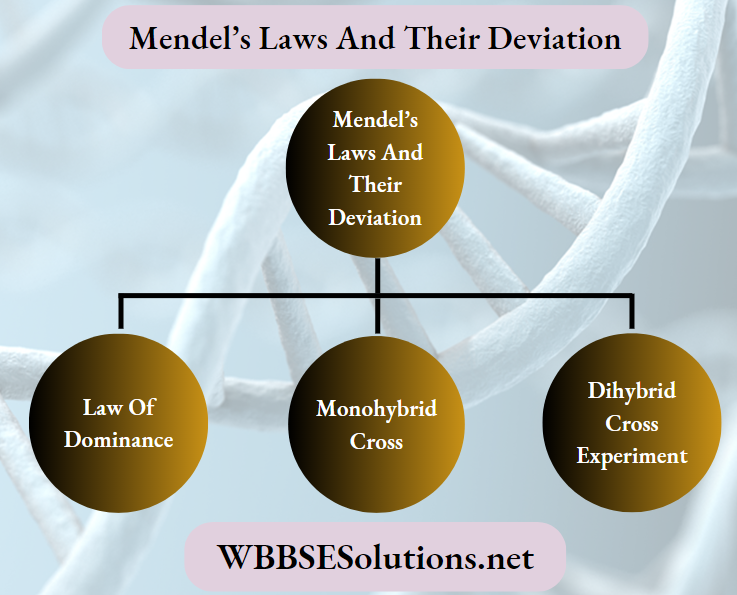
Mendel's Laws And Their Deviation Summary

Chapter 3 Mendel’s Laws And Their Deviation Long Answer Type Questions

Question 1. Explain the two conclusions of Mendel’s monohybrid cross. Rough coat (RR) is dominant and smooth coat (rr) is a recessive character for guinea pigs. If two heterozygous rough-coated guinea pigs are crossed, what will be the types of offspring in F1 generation?

Wbbse Class X Life Science
Answer:

Two conclusions of Mendel’s monohybrid cross Analysing the results of the monohybrid cross of garden pea plants, Mendel reached two conclusions. These are popularly known as the law of dominance and the law of segregation.

1. Law of dominance:

In a cross between two parents that are pure for contrasting traits, only one of the two expresses itself in the first filial generation. This is controlled by a dominant factor that helps to express the dominant trait by suppressing the recessive one. Here, the expressed one is the dominant trait and the suppressed one is the recessive trait.

2. Law of segregation:

This law states that during the formation of gametes, two alleles controlling each character, move apart due to the separation of the homologous chromosomes during meiosis. Thus, each gamete receives only one allele of each character on a random basis.

WBBSE Solutions for Class 10 History WBBSE Solutions for Class 10 Geography and Environment
WBBSE Class 10 History Long Answer Questions WBBSE Solutions for Class 10 Life Science And Environment
WBBSE Class 10 History Short Answer Questions WBBSE Solutions for Class 10 Maths
WBBSE Class 10 History Very Short Answer Questions WBBSE Solutions for Class 10 Physical Science and Environment
WBBSE Class 10 History Multiple Choice Questions


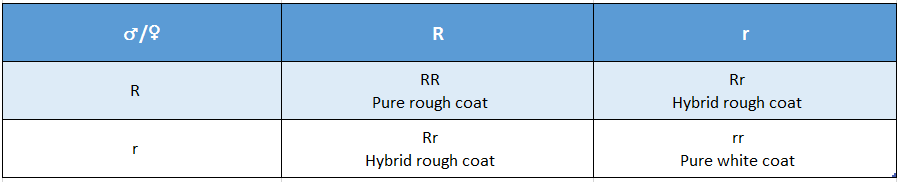
Monohybrid cross between heterozygous rough-coated guinea pigs

Let us mark the rough coat (dominant) as ‘RR’ and the smooth coat (recessive) as ‘rr

Therefore, the genotype of a heterozygous rough-coated guinea pig should be denoted as ‘Rr. The cross between two heterozygous rough-coated Rr guinea pigs is schematically represented here.

From this cross, we get two different phenotypes, 75% or 3/4th part of the progeny are rough-coated and the remaining 25% or 1/4th part are smooth-coated. Therefore, the phenotypic ratio is- Rough coat: Smooth coat = 3:1.

The genotypic ratio of this cross is- Pure rough coat: Hybrid rough coat: Pure smooth coat = 1:2:1.
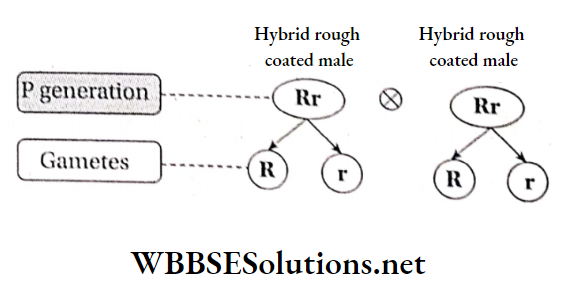
WBBSE Solutions For Class 10 Life Science And Environment Chapter 3 Mendel's Laws And Their Deviation Monohybrid cross between heterozygous rough coated gulinea pig

Checkerboard of F1 generation

WBBSE Solutions For Class 10 Life Science And Environment Chapter 3 Mendel's Laws And Their Deviation Checker board of F1 generation

Question 2. In a cross between two pea plants bearing, pure violet [dominant] and pure white [recessive] flowers, what will be the ratio of pure violet and pure white-flowered plants in the F2 generation?
Answer:

The ratio of pure violet and pure white-flowered plants in F2 generation

Let us represent the dominant pure violet flower character as (W) and the recessive pure white flower character as (w).

In a cross between the pure violet (W) and pure white (w) flowered pea plants, all Fj progeny grow violet flowers. This is due to the dominant nature of the violet flower colour. If self¬pollination is allowed in the F1 plants, two different phenotypes will appear in the F2 generation.

Among the F2 progeny, 3/4th parts of plants grow violet flowers and the remaining 1/4th part of plants bear white flowers. Of these 3/4th parts of plants beaming violet flowers, 1/4th part of plants grow pure violet and 2/4th parts of plants grow hybrid violet flowers.

Therefore, among the F2 progeny, 1/4th part of plants (25%) grow pure violet, 2/4th parts of plants (50%) grow hybrid violet and the remaining 1/4th part of plants (25%) grow pure white flowers. The cross is schematically represented here with a checkerboard.
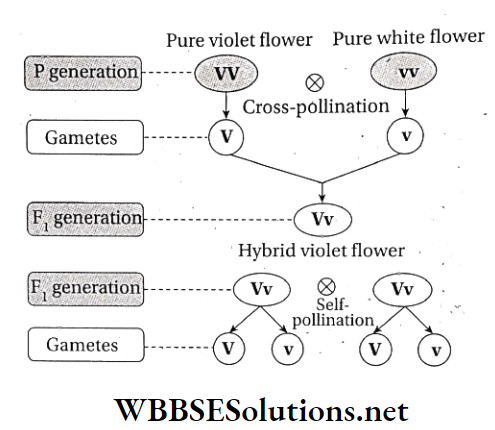
WBBSE Solutions For Class 10 Life Science And Environment Chapter 3 Mendel's Laws And Their Deviation Ratio of pur vioet and pure white flowered plants

Checker board of F2 generation

WBBSE Solutions For Class 10 Life Science And Environment Chapter 3 Mendel's Laws And Their Deviation Checker board of F2 generation of ratio

The phenotypic and genotypic ratio of pea plant of F2 generation
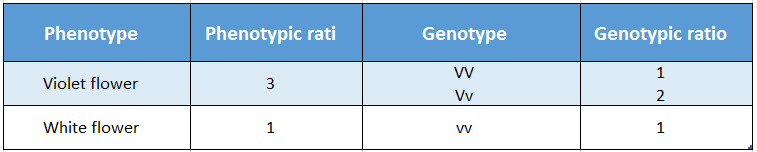
WBBSE Solutions For Class 10 Life Science And Environment Chapter 3 Mendel's Laws And Their Deviation Phenotype and genotypic ratio of pea plant of F2 generation

Therefore, the ratio of violet and white flowered pea plants (phenotypic ratio) is 3: 1. The ratio of pure violet, hybrid violet and pure white flowered pea plants of the F2 generation (genotypic ratio) is 1: 2: 1. The ratio of pure violet and pure white flowered plants of the F2 generation is 1: 1.

WBBSE Solutions For Class 10 Life Science And Environment Chapter 3 Mendel's Laws And Their Deviation

Mendel’s Law of Segregation Explained

Question 3. Explain with a checkerboard, how mendel reached the conclusion to his monohybrid cross experiment.
Answer :

The conclusion of Mendel’s monohybrid cross

Garden pea plants have seven different genetic characteristics, each having two distinct opposite traits.

For the monohybrid cross experiment, Mendel selected only one character, that is the height of the garden pea plant. The two opposite traits are denoted as “IT for pure tall and ‘tt’ for the pure dwarf. The steps of the experiment are mentioned here.

1. The first filial generation:

Mendel collected Pure tall plant Pure dwarf plant pollens from a flower of a pure tall pea plant and placed it on the stigma of some emasculated flowers (flowers, artificially. converted into unisexual female flowers by removing the anthers) of dwarf pea plants.

The progeny plants produced from this cross were the first filial or F1 generation, all of which were tall in phenotype.

Wbbse Class X Life Science

2. The second filial generation:

Mendel then allowed self-pollination among the F1 plants and got the F2 progeny with two different phenotypes. 75% of these were tall and 25% were dwarf. Hence the phenotypic ratio is Tall: Dwarf = 3:1., Among the F2 plants, 25% were pure tall, 50% were hybrid tall and 25% were pure dwarf.

Therefore, the genotypic ratio of a monohybrid cross is Pure tall: Hybrid tall: Pure dwarf = 1:2:1.

The cross is schematically represented here with checkerboard.
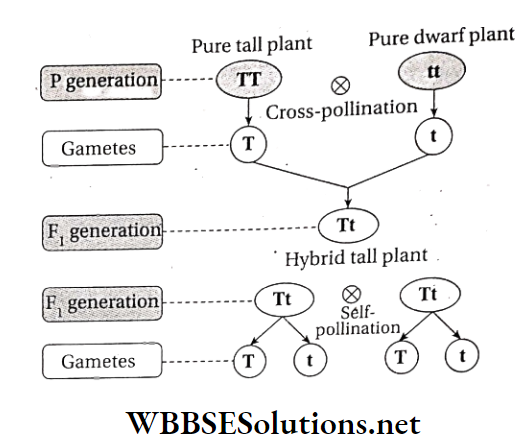
WBBSE Solutions For Class 10 Life Science And Environment Chapter 3 Mendel's Laws And Their Deviation The conclusion of Mendels momohybrid cross

Checker board of F2 generation

WBBSE Solutions For Class 10 Life Science And Environment Chapter 3 Mendel's Laws And Their Deviation Checker board of F2 generation in Mendals monohybrid cross

The phenotypic and genotypic ratio of pea plant of F2 generation
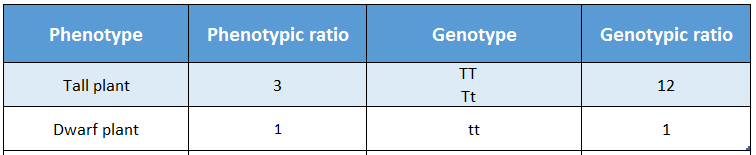
WBBSE Solutions For Class 10 Life Science And Environment Chapter 3 Mendel's Laws And Their Deviation Phenotypic and genotypic ratio of pea plant of f2 generation 3

Conclusion:

The experimental result shows that during hybridisation the parental factors, which come together in F1 generation, do not get mixed. During gamete formation of F1 generation, the factors segregate from each other and each gamete carries one factor. Thus, by analysing the result of the monohybrid cross, Mendel framed the law of segregation.

Question 4. Explain the monohybrid cross of an animal and draw a conclusion from this experiment.
Answer :

The monohybrid cross of an animal :

Monohybrid cross of an animal and its conclusion Monohybrid cross can be performed on guinea pig. The black coat (BB) of a guinea pig is a dominant trait over the white coat (bb).

In a cross between pure black and white coated guinea pigs, all F1 offsprings are black (Bb). These hybrid black F1 guinea pigs give birth to F2 offspring with different phenotypes, black and white. Out of this 75% is black and 25% is white. Therefore the phenotypic ratio is 3:1. Among F2 offspring, three different genotypes are found.

These are pure black (BB), hybrid black (Bb) and pure white (bb) in the ratio of 1:2:1.

The monohybrid cross of a guinea pig is schematically represented here
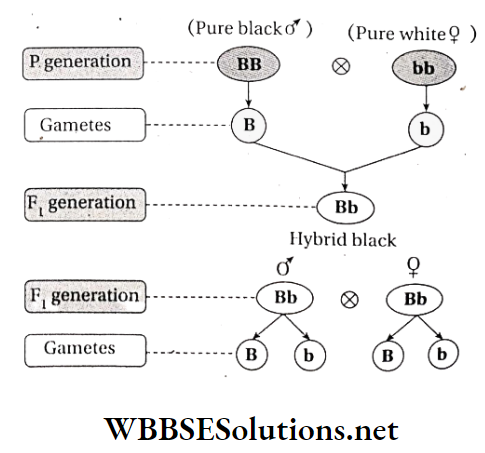
WBBSE Solutions For Class 10 Life Science And Environment Chapter 3 Mendel's Laws And Their Deviation Monohybrid cross of animal and its conclusion

Checker board of F2 generation

WBBSE Solutions For Class 10 Life Science And Environment Chapter 3 Mendel's Laws And Their Deviation Checker board of F2 generation in Monohybrid cross of an animal

The phenotypic and genotypic ratio of the guinea pig of F2 generation

WBBSE Solutions For Class 10 Life Science And Environment Chapter 3 Mendel's Laws And Their Deviation Phenotypic and genotypic ratio of guinea pig of F2 generation.

Conclusion:

The result of the monohybrid cross in between black and white guinea pigs maintains absolute similarity with the Mendelian monohybrid cross and supports the law of segregation.

Question 5. Describe. Mendel’s dihybrid cross experiment and explain the conclusion drawn from it.
Answer :

Dihybrid cross experiment:

For his dihybrid cross experiment, Mendel selected two different characters of garden pea plants, each having two distinct contrasting traits. The two characters are—

  1. Colour of  seed or cotyledon and
  2. The shape of seed. For colour of seed, the contrasting traits are yellow (YY) and green (yy), where yellow one is dominant over green. For the shape of the seed, the opposite traits are round (RR) and wrinkled (rr), where the round is dominant over wrinkled.
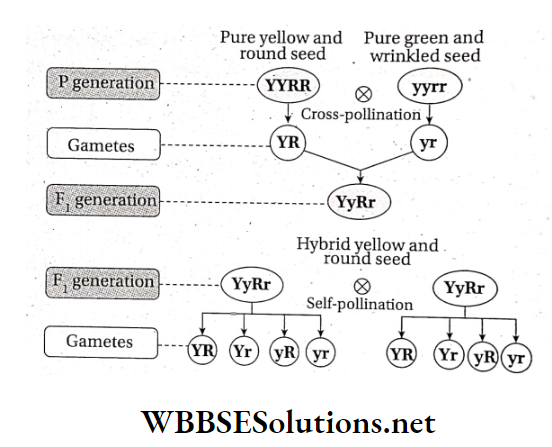
WBBSE Solutions For Class 10 Life Science And Environment Chapter 3 Mendel's Laws And Their Deviation Dihybrid cross experiment

1. First filial generation:

Mendel crossed pure round and yellow seed-bearing pea plants (RRYY) with wrinkled and green seed-bearing pea plants (rryy). From this cross, he got the F1 hybrids with yellow cotyledons and round seeds (YyRr).

2. Second filial generation:

Mendel allowed self-pollination among the F1 plants and F2 offspring were produced. These were of four different phenotypes—round yellow, wrinkled yellow, round green, and wrinkled green in the ratio of 9:3:3:1. By analysing the genotypes of these F2 plants, Mendel found nine different combinations in the ratio of 1:2:2:4; 1:2:1:2:1.

Mendel’s dihybrid cross experiment is schematically represented here.

Checkerboard of F2 generation
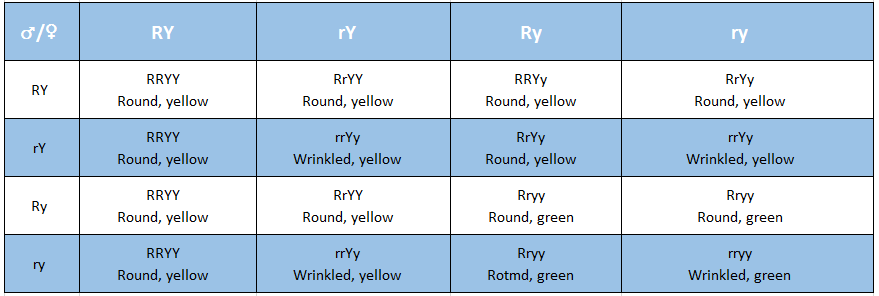
WBBSE Solutions For Class 10 Life Science And Environment Chapter 3 Mendel's Laws And Their Deviation Checker board of F2 generation in Dihybrid cross experiment

Phenotype and genotype of F2 generation of Mendelian dihybrid cross
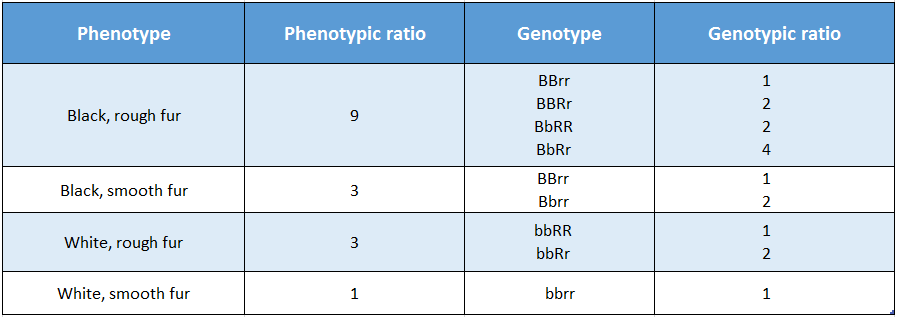
WBBSE Solutions For Class 10 Life Science And Environment Chapter 3 Mendel's Laws And Their Deviation Phenotype and F2 genotype of generation of Mendelian dihybrid cross

Conclusion:

From the results of this experiment, Mendel came to the following conclusions.

  1. The factors, responsible for any of the cotyledon colours and shapes of the seeds, do not get mixed in the F1 progeny. All four factors were segregated during the gamete formation of the F1 plants.
  2. The gametes, which carry the colour and shape regulating factors of pea seeds in a segregated manner, unite independently in all possible combinations to form the F2 progeny. Based on these conclusions, Mendel framed his second law of heredity or the law of independent assortment.

Question 6. Mention the seven pairs of contrasting characters of garden pea plants as selected by Mendel.
Answer :

Seven pairs of contrasting characters of garden pea plant:

For his experiment on heredity, Mendel selected seven pairs of opposite characters of garden pea plants, which are mentioned below in a table.
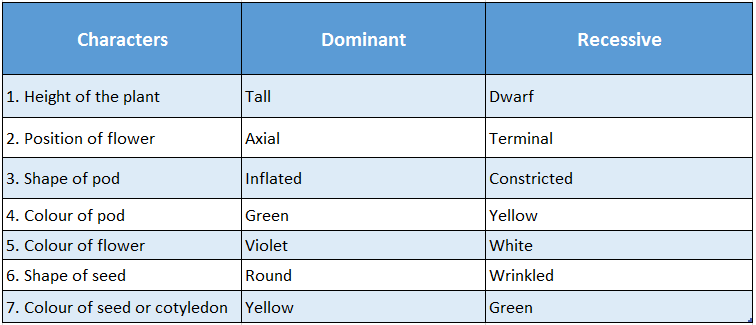
WBBSE Solutions For Class 10 Life Science And Environment Chapter 3 Mendel's Laws And Their Deviation Constrasting characters of garden pea plant 6

Question 7. Mention the causes of Mendel’s success in his experiments on heredity with garden pea plants. Which types of gametes unite to form a male baby?
Answer :

Causes of Mendel’s success in his experiments on heredity with garden pea plants

  1. Mendel selected the pure breed of pea plants for a particular character after two years of continuous successive self-breeding.
  2. The seven pairs of factors (genes), responsible for the selected contrasting traits, are present on seven separate sets of homologous chromosomes. This feature helps in the independent assortment of the factors.
  3. Pea plants are easy to breed, the life cycle is short and therefore, Mendel could study several generations in a short time. Pea flowers are bisexual, and naturally self-pollinating, but Mendel successfully manipulated it for artificial cross¬pollination. Fie was also successful in preventing any undesired pollination.
  4. Mendel, though selected seven traits of the pea plant, but worked on one or two at a time. This helped him in the collection and analysis of the data.
  5. The characters, selected by Mendel, were sharply contrasting and showed complete dominance.
  6. Mendel used many samples at a time for breeding to get a large number of progeny, which helped him for statistical analysis of the data and to get the correct ratio between two or more contrasting characters.

Gametes are required to produce a male baby

Union of an ovum with 22 autosomes and an X chromosome (22A+X) and a sperm with 2 autosomes and a Y chromosome (22A+Y) can produce a male baby with a genotype (44A+XY).

Question 8. What is a hybrid organism? What will be the phenotype of the F1 offspring from a cross between a hybrid black and a pure white guinea pig? Explain your answer.
Answer :

Hybrid organism

The progeny, produced from a cross between parents bearing two contrasting traits with respect to a single or more character, is called a hybrid organism.
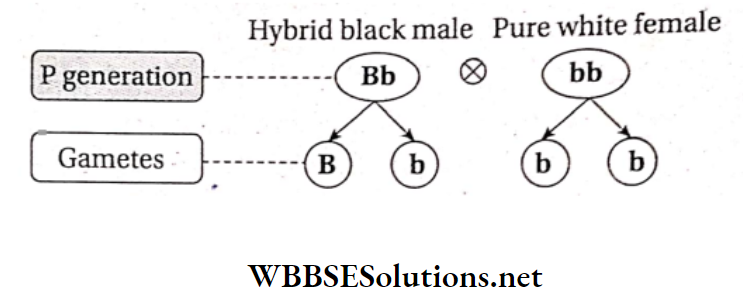
WBBSE Solutions For Class 10 Life Science And Environment Chapter 3 Mendel's Laws And Their Deviation cross between a Hybrid black and a pure white guinea pig

Checker board of F1 generation

WBBSE Solutions For Class 10 Life Science And Environment Chapter 3 Mendel's Laws And Their Deviation Checker board of F1 generation in Hybrid black and pure white guinea

Hybridisation experiment on guinea pig

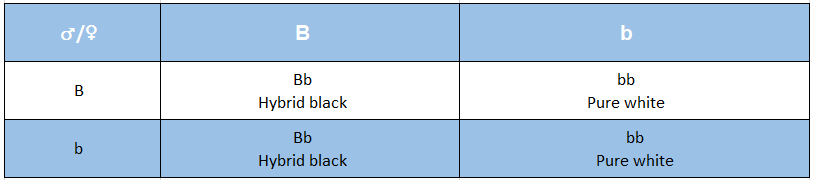
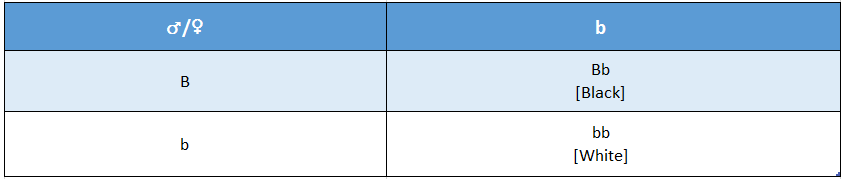
In a cross between hybrid black (Bb) and pure pHHH white (bb) guinea pigs, .two different b ‘ phenotypes will be seen among the F1 offsprings. 50% of the offspring will have “b ~ black coat and the remaining 50% will be white coated. Therefore, the phenotypic ratio will be Black: White = 1:1. The cross is schematically represented here.

Explanation:

The genotype of the hybrid black guinea pig is ‘Bb’. Therefore, this parent produces two different types of gametes, ‘B’ and ‘b! The other parent, a pure white guinea pig is homozygous recessive having a genotype of ‘bb! This parent produces only ‘b’ type of gametes. Union of ‘B’ and ‘b’ gametes produce hybrid black ‘Bb’ offspring.

On the other hand, the fertilisation between two ‘b’ gametes from two parents gives rise to pure white ‘bb’ offspring. The checker board of the F1 generation of this cross clearly shows that the proportion of hybrid black and pure white offspring is equal.

Mendel’s Law of Independent Assortment

Question 9. The black coat of the guinea pig is dominant over the white coat. If a cross is performed between two hybrid black guinea pigs, what will be the result in the F1 generation? Which types of gametes unite to form a female baby?
Answer :

Crossing of hybrid black guinea pig

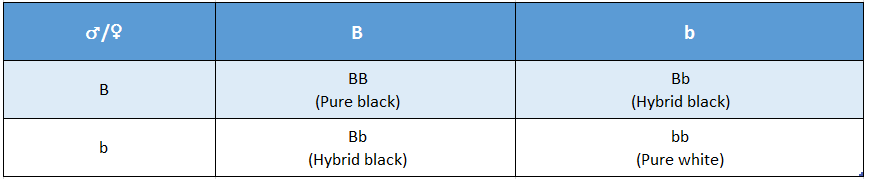
Let the allele for the dominant black coat colour be ‘B’ and the recessive white coat colour be ‘b’. So, the genotype of a hybrid guinea pig can be denoted as ‘Bb’.
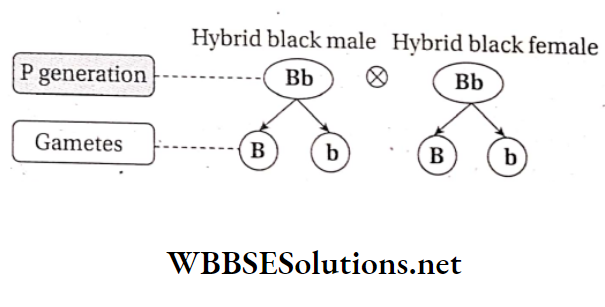
WBBSE Solutions For Class 10 Life Science And Environment Chapter 3 Mendel's Laws And Their Deviation crossing of hybrid black guinea pig

A hybrid black-coated guinea pig may produce two different types of gametes ‘B’ 1 and ‘b’. Therefore, the F1 progeny produced from a cross between two hybrid black guinea pigs will have two different phenotypes. 75% of them will be black and the remaining 25% will be white.

Hence, the phenotypic ratio for Black :

white is 3:1. If the genotypes of F1 progeny are analysed on a checkerboard, we will see three different types—25% of it is pure black, 50% is hybrid black and the remaining 25% is pure white. Therefore, the genotypic ratio for pure black: hybrid black: pure white is 1:2:1.
The cross and the checkerboard is shown here.

checker board of F1, generation
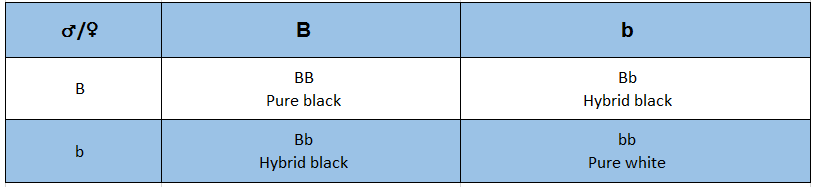
WBBSE Solutions For Class 10 Life Science And Environment Chapter 3 Mendel's Laws And Their Deviation Checker board of F1 generation in Hybrid black guinea

Gametes are required to produce a female baby

A Union of an ovum with 22 autosomes and an X chromosome (22A+X) and a sperm with 22 autosomes and an X chromosome (22A+X) can produce a female baby with genotype 44A+XX.

Question 10. Describe a dihybrid cross-experiment on an animal (guinea pig) and analyse the result.
Answer :

Dihybrid cross-experiment on animal

In the dihybrid cross experiment guinea pig, the coat colour and fur character are considered. The two opposite traits for coat colour are black and white. The opposite traits for fur characters are rough and smooth. The black coat (BB) and rough fur (RR) are dominant over the white coat (bb) and smooth fur (rr) respectively.
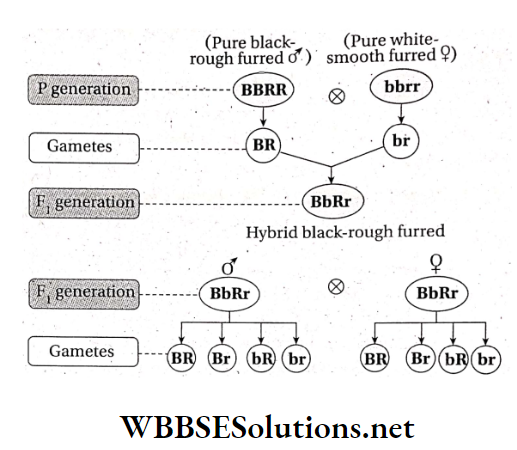
WBBSE Solutions For Class 10 Life Science And Environment Chapter 3 Mendel's Laws And Their Deviation Dihybrid cross experiment on animal

1. First filial generation:

First filial generation:

A cross is done between a black and rough-furred generation male and a white and smooth-furred female guinea pigs to get the F1 offspring. Eventually, all these hybrid offsprings are with black coats and rough fur (BbRr).

2. Second filial generation:

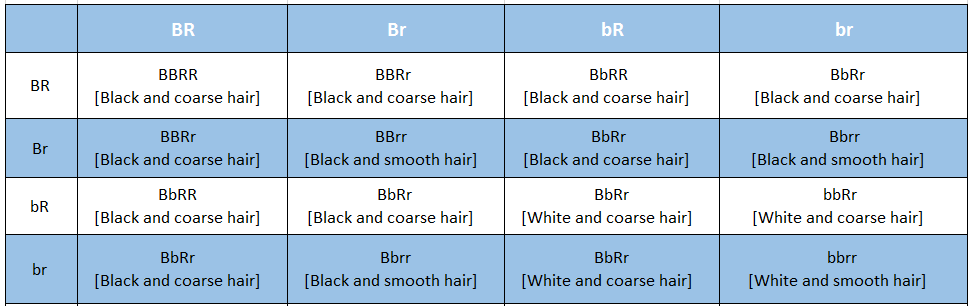
The F1 offspring are allowed to breed among themselves. They produce four different types of phenotypes. 9 animals of which are black-rough furred, 3 animals are black-smooth furred, 3 animals are white-rough furred and remaining 1 animal is white-smooth furred.

Therefore, the phenotypic ratio of this dihybrid cross is 9:3:3:1.

The F1 hybrids produce four different types of gametes— BR, Br, bR and br. These four different varieties of male and female gametes unite with each other in all possible combinations to produce F2 generation with nine different types of genotypes in the ratio of 1:2:2:4:1:2:1:2:1.

The checkerboard for the above-mentioned cross is represented here.

Checker board of F2 generation
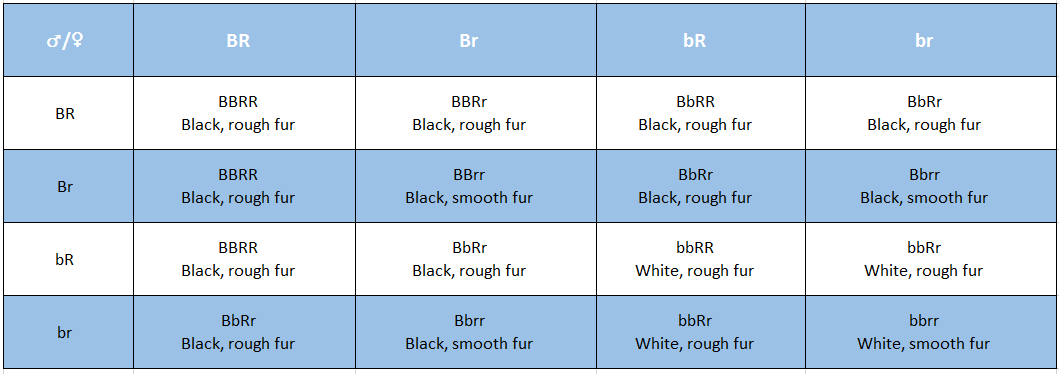
WBBSE Solutions For Class 10 Life Science And Environment Chapter 3 Mendel's Laws And Their Deviation Checker board of F2 generation in Dihybrid cross experiment on animal

Phenotype and genotype of F2 generation of Mendelian dihybrid cross
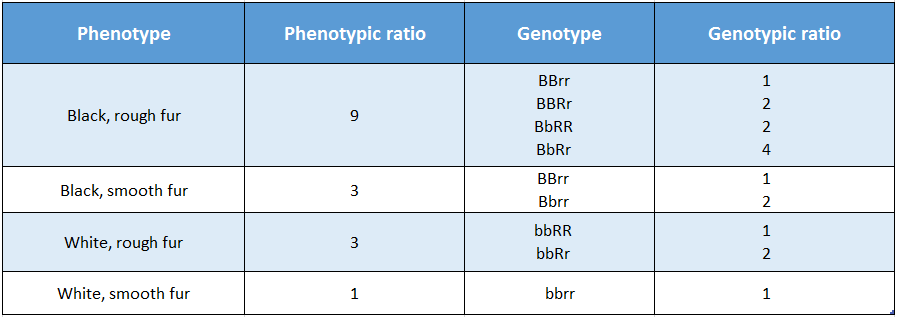
WBBSE Solutions For Class 10 Life Science And Environment Chapter 3 Mendel's Laws And Their Deviation Phenotype and F2 genotype of generation of Mendelian dihybrid cross

Conclusion:

The result obtained from this experiment on the dihybrid cross of guinea pigs is the same as that of the Mendelian dihybrid cross of garden pea plants. This experimental result confirms that the law of independent assortment is also applicable to the heredity of the animals like guinea pigs.

Examples of Mendelian Traits

Question 11. Why did Mendel select garden pea plants for his experiments on heredity? Or, Mention the main causes of the selection of pea plants sativum) by Mendel for his experiments on heredity.
Answer :

Causes of Selection of pea plants by Mendel

  1. Pea flower is naturally self-pollinating. The stamens and pistils always remain closed inside the petals, therefore, cross-pollination by insects and air does not occur. However, these flowers can be manipulated for artificial cross-pollination for experimental purposes.
  2. The bisexual pea flowers can be emasculated and transformed into female flowers by simply cutting the stamens and removing the anthers.
  3. Pea plants have distinct . contrasting phenotypic features and the characters remain unchanged for generations.
  4. The life cycle of pea plants is short, hence, a number of generations can be studied within a few years. The dormancy of seed is brief, therefore, a new generation can grow quickly.
  5. The hybrids of pea plants are fertile and these are suitable for both selling and crossing to produce the next generations.
  6. Each pea plant produces several seeds, therefore, analysis of the result can be done more accurately.

Question 12. Describe the experimental works of Mendel on garden pea plants.
Answer :

Mendel’s work on garden pea plant

  1. Mendel first visually selected seven distinct contrasting characters of the pea plant.
  2. To become sure of the homozygosity of the parental generation, he allowed the selfing of selected character-bearing plants for several successive generations.
  3. Before crossing, Mendel gently opened the petal cover to expose the stamens and cut the anthers before they mature. By this process, he emasculated the bisexual flowers to prevent undesired self-pollination.
  4. For crossing, Mendel collected pollens from a selected flower from a parental plant with a fine brush and placed it delicately on the stigma of the emasculated flowers of the other parental plant, bearing the opposite trait. He performed reciprocal crossing between two parental pea plants.
  5. After crossing, he covered the cross-pollinated flower with fine muslin cloth to prevent any undesired pollination.
  6. He collected seeds from the resultant fruits of the cross and sowed them to get the generation.
  7. Mendel meticulously studied the concerned characters of each generation and statistically analysed the result to reach a conclusion.

Through this process, Mendel performed separate experiments on different sets of contrasting traits before framing his famous laws of heredity.

Question 13. What is incomplete dominance? Explain with a suitable example.
Answer :

Incomplete dominance

In a cross between two pure contrasting trait-bearing parents, sometimes none of the traits dominates completely over the other so the phenotypic expressions of both the parents’ characters are subdued partially in the F1 generation. This event is treated as incomplete dominance.

Explanation of incomplete dominance

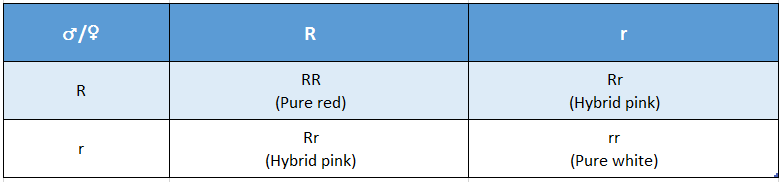
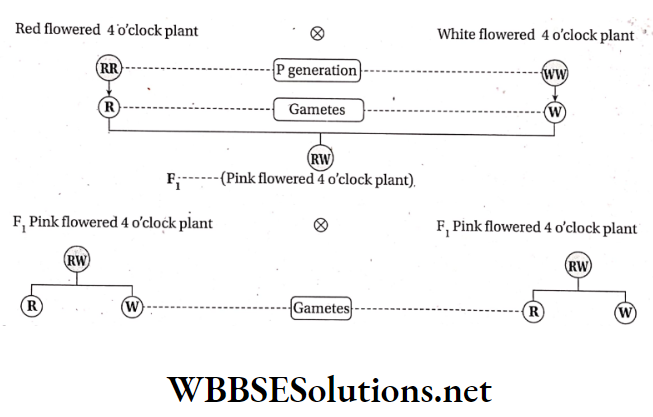
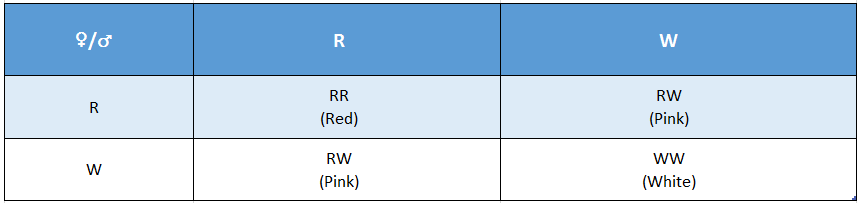
Among plants, incomplete dominance is clearly noticed in four o’clock (Mirabilis jalapa) plants. In this plant, two contrasting flower colours are red and white. Let us mark the pure red flower as ‘RR’ and pure white as ‘. When these two contrasting flower-bearing plants are crossed, the F1 generation grows neither red nor white flowers, instead, they grow pink flowers.

Here, phenotypic expressions of flower colour of both parents are subdued to some extent. When these F1 plants are self-pollinated, three different phenotypes are produced. These are- 25% red, 50% pink and 25% white. The genotypes of red, pink and white flower-bearing plants are ‘RR, ‘Rr’ and ‘rr. Here, both phenotypic and genotypic ratios are identical, i.e., 1: 2: 1, which is a deviation from the Mendelian monohybrid cross.
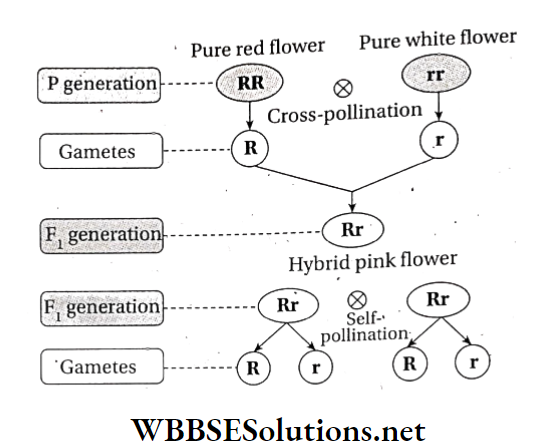
WBBSE Solutions For Class 10 Life Science And Environment Chapter 3 Mendel's Laws And Their Deviation Explanation of incomplete dominance

Checker board of F2 generation

WBBSE Solutions For Class 10 Life Science And Environment Chapter 3 Mendel's Laws And Their Deviation Checker board of F2 generation in incomplete dominance

The phenotypic and genotypic ratio of four o’clock flower of F2 generation
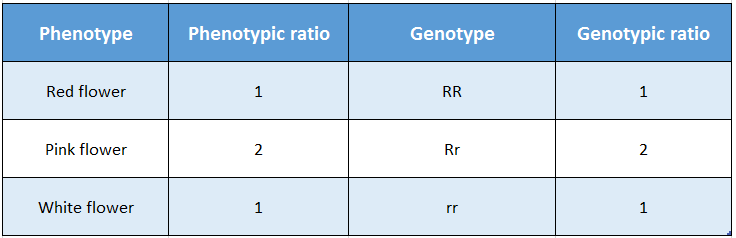
WBBSE Solutions For Class 10 Life Science And Environment Chapter 3 Mendel's Laws And Their Deviation Phenotypic and genotypic ratio of four 0 clock flower of F2 generation

Question 14. Distinguish between—monohybrid & dihybrid cross, homozygous and heterozygous state.
Answer :

Differences between monohybrid and dihybrid cross
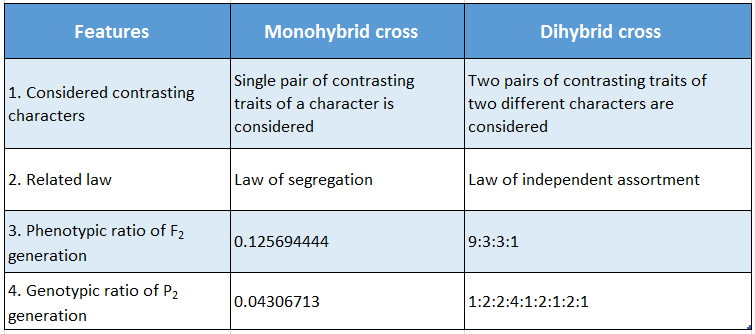
WBBSE Solutions For Class 10 Life Science And Environment Chapter 3 Mendel's Laws And Their Deviation Differences between monohybrid and dihybrid cross

Differences between homozygous and heterozygous state
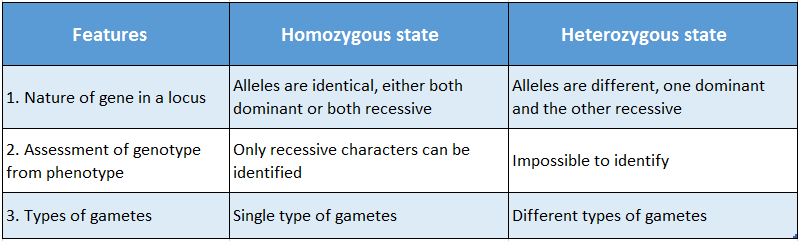
WBBSE Solutions For Class 10 Life Science And Environment Chapter 3 Mendel's Laws And Their Deviation Differences between Homozygous state and Heterozygous state

Question 15. State the differences between pure and hybrid organisms. Mention differences between complete and incomplete dominance.
Answer :

Differences between pure and hybrid organisms
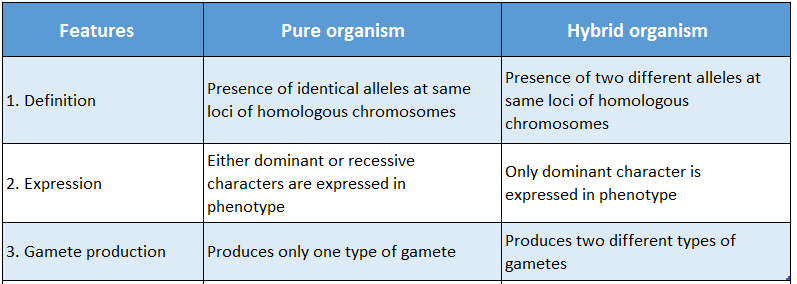
WBBSE Solutions For Class 10 Life Science And Environment Chapter 3 Mendel's Laws And Their Deviation Differences between pure and hybrid organisms

Differences between complete and incomplete dominance
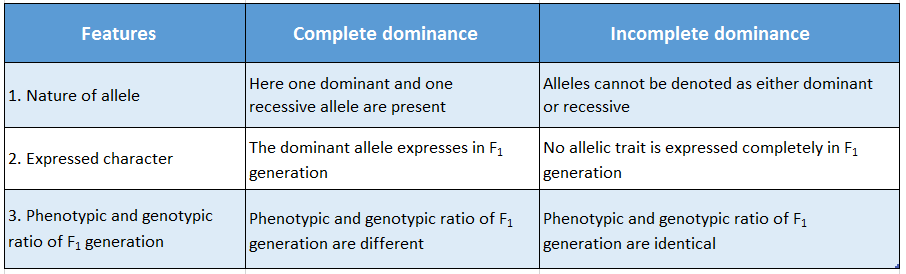
WBBSE Solutions For Class 10 Life Science And Environment Chapter 3 Mendel's Laws And Their Deviation Differences between complete and incomplete dominance

Deviations from Mendel’s Laws

Question 16. Colour of seed and shape of seed of a pea plant—taking these two characters Mendel performed a dihybrid cross. Write the genotypes of pea plants having yellow and round seeds produced in the F2 generation of this experiment. State the law of Independent Assortment of Mendel.
Answer :

The genotypes of yellow and round seeds of F2 generation are—

  1. YYRR
  2. YYRr
  3. YyRR
  4. YyRr.

Law of independent assortment

Mendel derived this law from the results of his dihybrid cross-experiment. It states that—each pair of alleles segregates independently of other pair of alleles during gamete formation.

In other words, the allele a gamete receives for one gene does not influence the allele received for another gene.

Question 17. State the opposite traits for each of the characters of flowers of the pea plant chosen by Mendel for his experiment. “For developing the scientific ideas on heredity the experiments performed by Mendel on pea plants are epochmaking.”—Mention three reasons behind his success in performing these experiments.
Answer :

Opposite traits for the characters of flowers of pea plant chosen by Mendel

WBBSE Solutions For Class 10 Life Science And Environment Chapter 3 Mendel's Laws And Their Deviation Chacters of flowers of pea plant chosen by Mendel

Three reasons behind success of Mendel’s experiment

  1. Mendel concentrated only on one or two characters at a time and kept accurate records. This prevented confusion and puzzle.
  2. The pea plant is an annual and self-pollinated plant. So plants are homozygous. Therefore the pure line of pea plants were easily available.
  3. The genes controlling characters chosen by Mendel are located on different chromosomes. This prevents the linkage and gave accurate results.

Question 18. With the help of a checker board show the types of offspring that might be produced in a cross between a hybrid black guinea pig and a pure white guinea pig. State the law of segregation as proposed by Mendel.
Answer :

Monohybrid cross in Guineapig

The black and white guinea pig will be produced by the cross in 1:1 ratio.
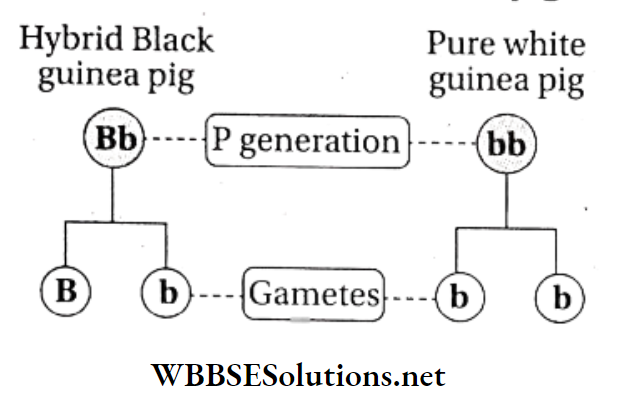
WBBSE Solutions For Class 10 Life Science And Environment Chapter 3 Mendel's Laws And Their Deviation Monohybrid cross in Guineapig

Checkerboard

WBBSE Solutions For Class 10 Life Science And Environment Chapter 3 Mendel's Laws And Their Deviation Checker board in Monohybrid cross in Guineeapig

Phenotypic ratio – Black: White – 1: 1
Genotypic ratio – Bb: bb – 1: 1

Law of segregation

The law of segregation states that the two alleles for a heritable character segregate (separate from each other) during gamete formation and end up in different gametes.

Question 19. Tabulate three pairs of dominant-recessive traits of pea plant as selected by Mendel. State the first law of Mendel as deduced from the experiment of a monohybrid cross.
Answer :

Three pairs of dominant-recessive traits of pea plant as selected by Mendel
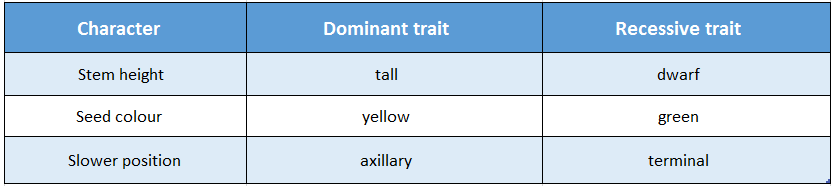
WBBSE Solutions For Class 10 Life Science And Environment Chapter 3 Mendel's Laws And Their Deviation Recessive traits of pea plant as selected by Mendal

Question 20. Show the result of hybridisation till F2 generation between a pure black (BB) coarse-haired (RR) guinea pig and a pure white (bb) smooth-haired (rr) guinea pig by a checkerboard. State the conclusion one can reach from this hybridisation experiment.
Answer :

Dihybrid cross in Guineapig
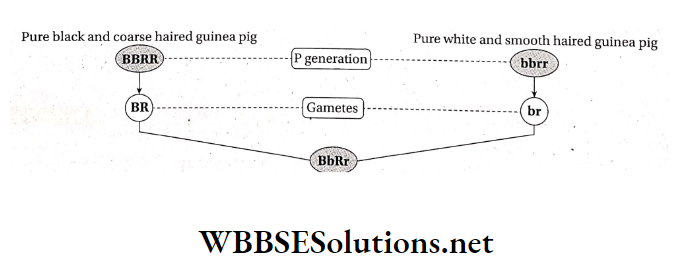
WBBSE Solutions For Class 10 Life Science And Environment Chapter 3 Mendel's Laws And Their Deviation Pure black and white coare haired guinea pig

F1………… Hybrid black and coarse-haired guinea pig.
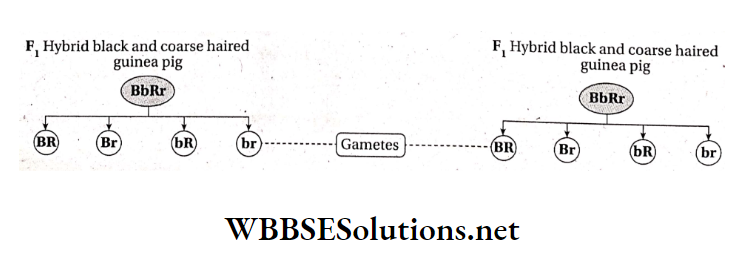
WBBSE Solutions For Class 10 Life Science And Environment Chapter 3 Mendel's Laws And Their Deviation Hybrid black and coarse haried guiena pig

Checkerboard of F2 generation

WBBSE Solutions For Class 10 Life Science And Environment Chapter 3 Mendel's Laws And Their Deviation Checker board of F2 generation

Phenotype and genotype of F2 generation
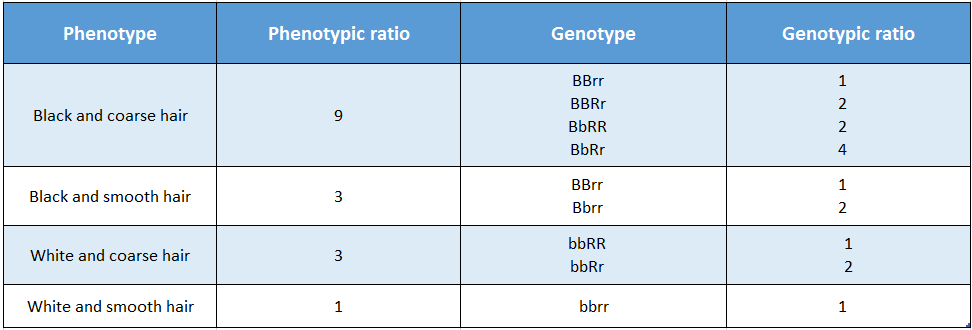
WBBSE Solutions For Class 10 Life Science And Environment Chapter 3 Mendel's Laws And Their Deviation Phenotype and genotype of F2 generation

In a cross between pure black and coarse-haired guinea pig and pure white and smooth-haired guinea pig all the F1 individuals will be black and coarse-haired guinea pig because these are dominant traits.

Each of the F1 individuals can produce four types of gametes and their cross produce four types of individuals in a ratio of 9:3:3:1.

Conclusion

The conclusion that can be reached from this hybridisation experiment i.e. —when two organisms with two or more characters with their opposite phenotypes are crossed then the characters not only get separated but remain expressed in all possible combinations independent to each other.

Non-Mendelian Inheritance Patterns

Chapter 3 Mendel’s Laws And Their Deviation Short Answer Type Questions

Question 1. Mention the Mendelian laws of heredity.
Answer :

Mendel proposed two laws of heredity, they are-

  1. Law of Segregation and
  2. Law of independent assortment.

Question 2. How did Mendel explain the occurrence of all tall pea plants in the F1, generation of his monohybrid cross experiment?
Answer :

In the monohybrid cross between pure tall and pure dwarf pea plants, all progeny of the F1 generation came out as tall.

From this observation, Mendel concluded that the tall character is a dominant one, which was expressed by the suppression of the recessive dwarf character. From this finding, Mendel framed a law of heredity, known as the law of dominance.

Question 3. Which type of offspring will come out of a Which type of monohybrid cross between a pure black and pure white guinea pig? Why does it happen?
Answer :

In a cross between a pure black and a pure white guinea pig, all F1 offspring will be hybrid black.
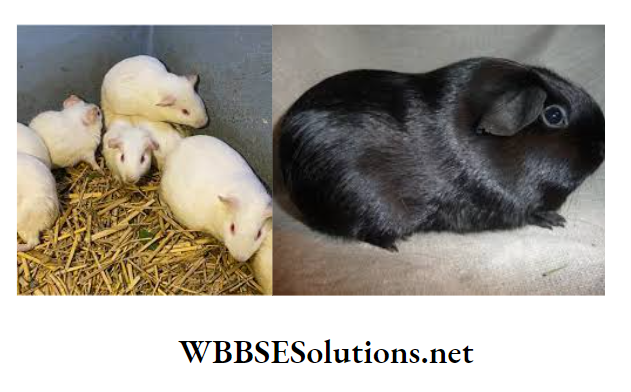
WBBSE Solutions For Class 10 Life Science And Environment Chapter 3 Mendel's Laws And Their Deviation White and black guinea pigs

In guinea pigs, the black coat colour is dominant over the white coat colour. Therefore, the gene for black coat colour will express itself by suppressing the gene for white coat colour.

Question 4. Which law of heredity did Mendel frame from the results of his famous monohybrid cross experiment? State the law.
Answer :

Law of heredity from monohybrid cross:

From the results of the monohybrid cross experiment on garden pea plants, Mendel framed the law of segregation.

Law of segregation:

During hybridisation, the factors of each character are transmitted to the F1 generation from their parents but do not get mixed. During gamete formation, these factors segregate from each other, so that each gamete receives only one factor for each character.

Question 5. What is a test cross?
Answer :

Test cross:

To determine the genotype of an individual exhibiting the dominant phenotype of a trait, it is crossed with an individual that is homozygous recessive for that trait. This cross is known as the test cross.

Example- To test the genotype of the tall F, pea plants in Mendel’s monohybrid cross, these can be crossed with homozygous recessive dwarf (tt) pea plants.

Question 6. What is a back cross?
Answer :

Back cross:

A cross between any of the parents or any individual with a genotype, identical to any of the parents, and a member of the F1, generation or any individual with a similar genotype to that of the F1 progeny is known as the back cross.

Example- A cross between “TT” and “Tt’ and ‘tt’ and ‘T’ are examples of backcrosses with respect to Mendel’s monohybrid cross.

Question 7. Explain: ‘Every test cross is a back cross’.
Answer :

‘Every test cross is a back cross’:

Across between any of the parents ‘TT’ or ‘tt’ and a member of the F, generation “Tt’ is a back cross. In the Mendelian monohybrid cross, one of the parents is homozygous recessive (tt).
When this recessive homozygous (tt) parent is used for back cross with a F1 progeny (Ti), it becomes a test cross.

Therefore, every test cross may be treated as a back cross

Question 8. What is incomplete dominance?
Answer :

Incomplete dominance:

Incomplete dominance is a genetic event where one of the alleles does not dominate completely over the other, but both the alleles express themselves partially when both are present together in the hybrid.

Question 9. What is a checkerboard? Why is it known as the Punnett square?
Answer :

Checkerboard:
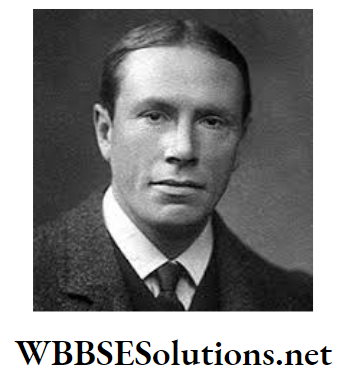
WBBSE Solutions For Class 10 Life Science And Environment Chapter 3 Mendel's Laws And Their Deviation R C Punnett


Checker board:

The tabular representation, of a genetic cross show- ing all genotypes of offspring, produced from every possible combination of gametes, is known as checkerboard.

Punnett Square:

Geneticist Reginald C Punnett first represented a cross in tabular form. Therefore, checker board is also known as the Punnett Square, after his name.

Punnett Squares for Monohybrid Crosses

Question 10. Give an example of incomplete dominance in a plant and an animal.
Answer :
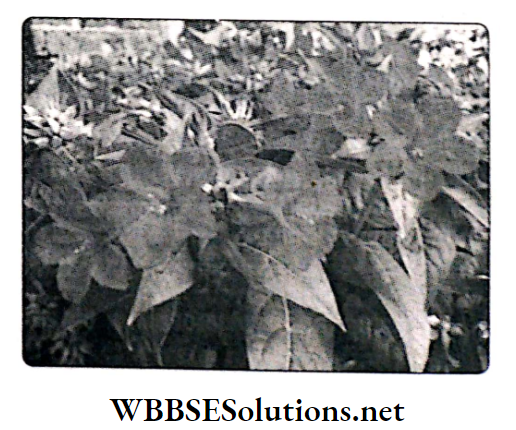
WBBSE Solutions For Class 10 Life Science And Environment Chapter 3 Mendel's Laws And Their Deviation Mirabilis jalapa

Example of incomplete dominance in a plant:

From a cross between red and white flowered four o’clock (Mirabilis jalapa) plants, we get pink flowers in F, generation.

Example of incomplete dominance in an animal:

If the pure black Andalusian hen is crossed with a pure white cock, the F, chicks will be blue in colour.

Question 11. Mention the contrasting traits of any two characters of the garden pea plant.
Answer :

Two characteristics of garden pea plants are height and flower colour. Opposite traits of height are tall and dwarf. Opposite traits of flower colour are violet and white.

Question 12. What will be the phenotypes of the two pea plants, when their genotypes are ‘TT’ and tt? Mention the chromosomal distribution of normal human males and females.
Answer :

Phenotypes of ‘TT’ and ‘tt’:

The phenotype of “TT” will be tall and ‘tt’ will be dwarf.

Chromosomal distribution of humans:

Chromo- somal distribution of normal human males is 44A+XY and that of females is 44A+XX.

Question 13. The genotype of a sweet pea plant bearing round and yellow seeds is ‘RrYy’. Which types of gametes may be produced from this plant?
Answer :

From a pea plant with the genotype ‘RrYy, four different types of gametes may be produced. These are ‘RY ‘Ry, ‘ry’ and ‘ry.

Question 14. In a dihybrid cross experiment, the black and rough-coated male is crossed with a white and smooth-coated female guinea pig. What will be the phenotypes of the F2 progeny?
Answer :

In a cross between a black and rough-coated male with a white and smooth-coated female guinea pig, the F, progeny will be of four types.

These are-

  1. Black and rough-coated,
  2. Black and smooth coated,
  3. White and rough coated and
  4. White and smooth coated.

Question 15. What is a genome?
Answer :

Genome:

All the genes present in the haploid set of chromosomes of an individual organism are collectively known as the genome. The genome is carried through the chromosomes of a gamete from an individual parent to its offspring.

Question 16. Mention some human characters and their respective dominant and recessive traits.
Answer :
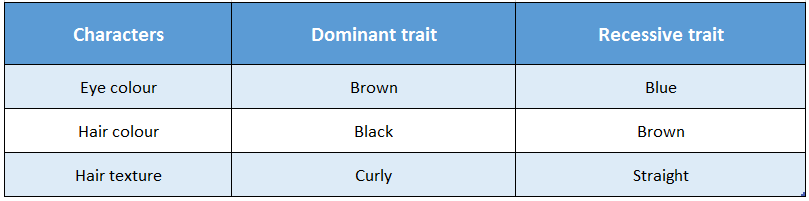

WBBSE Solutions For Class 10 Life Science And Environment Chapter 3 Mendel's Laws And Their Deviation Charatcers and their respective dominant and recessive traits

WBBSE Solutions For Class 10 Life Science And Environment Chapter 3 Mendel's Laws And Their Deviation curly and straight hair in human

Question 17. How did Mendel explain the combinations of different dominant and recessive factors in F2 generation of a dihybrid cross?
Answer :

In a dihybrid cross, all different types of gametes, carrying various combinations of dominant and recessive factors, unite randomly in all possible combinations to create the F2, offspring.

During this process, no factor affects the expression of any other. Mendel explained this random distribution of factors as an independent assortment.

Question 18. What are the limitations of law of segregation?
Answer :

The limitations of law of segregation:

  1. When one character is controlled by more than one gene then in that case, segregation may take place in a different ratio other than monohybrid cross.
  2. In case of incomplete dominance segregation takes place but not in a ratio of monohybrid cross.

Question 19. What is checker board?
Answer :

Checker board:

Checker board is a method of expressing different combinations of genotypes through a tabular representation of the genetic cross. It was discovered by Reginald Punnet.

Question 20. Dwarf plants are always pure’-Justify it.
Answer :

Dwarf plants are always pure

Dwarf phenotype is a recessive phenotype. In the presence of a dominant allele, the recessive one is not expressed. Therefore recessive character is always expressed in homozygous. So dwarf plants are always homozygous or pure.

Question 21. State with an example how dominant trait is expressed in the experiment of hybridisation.
Answer :

The expression of the dominant trait can be explained with the example of hybridisation between pea plants bearing white and purple-coloured flowers.

In the case of peas, the purple flower colouration is controlled by a dominant gene (designated here as ‘P’), while the white colouration is controlled by a recessive gene (designated here as ‘p’).

When these (PP and pp) were bred to create the first generation, the offsprings were pea plants bearing purple flowers, with a genotype Pp. So, although both alleles were passed down, the recessive white colour alleles were masked by the dominant purple colour alleles
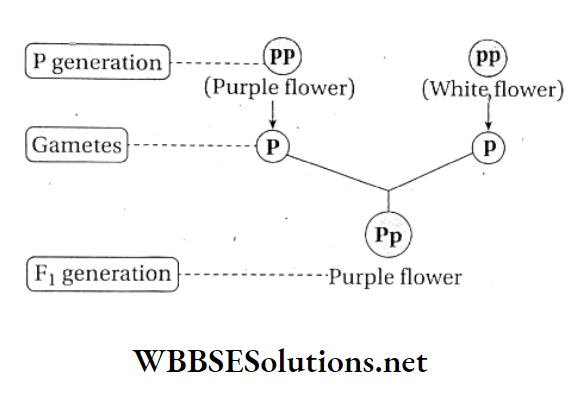
WBBSE Solutions For Class 10 Life Science And Environment Chapter 3 Mendel's Laws And Their Deviation dominant trait is expressed in the experiment of hybridisation

Question 22. What would be the ratio of phenotype and genotype of F2 generation in a monohybrid experiment in case of incomplete dominance?
Answer :
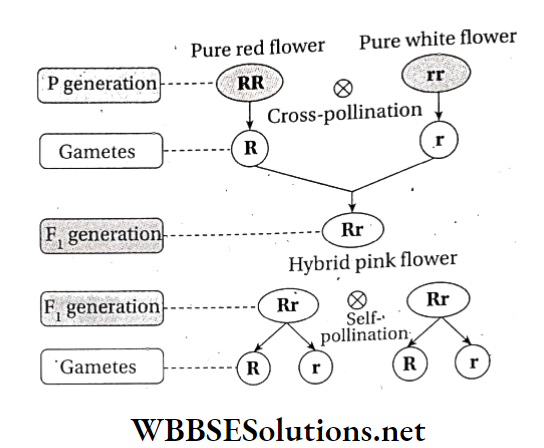
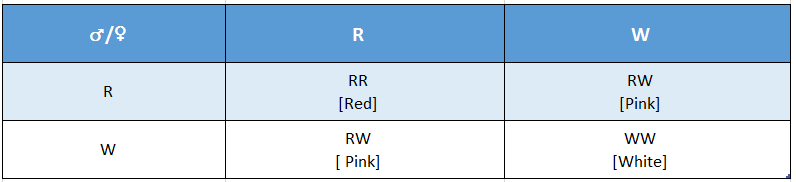
WBBSE Solutions For Class 10 Life Science And Environment Chapter 3 Mendel's Laws And Their Deviation Explanation of incomplete dominance

WBBSE Solutions For Class 10 Life Science And Environment Chapter 3 Mendel's Laws And Their Deviation monohybrid experiment in case of incomplete dominance

F2 generation

Genotypic ratio
– RR: RW : WW
– 1: 2: 1

Question 23. What are all probable gametes to be produced from the hybrid plant YyRr produced at F1 generation in a dihybrid cross experiment?
Answer :

The probable gametes to be produced from the hybrid plant YyRr at F1, generation in a dihybrid cross experiment are four types which are YR, Yr, YR, yr.

Question 24. To establish the law of segregation in case of pea plants, you are asked to select characters. Write two such characters having opposite traits.
Answer :

WBBSE Solutions For Class 10 Life Science And Environment Chapter 3 Mendel's Laws And Their Deviation Characters having oppisite traits

Question 25. Different genotypes produce the same phenotype-Justify the statement in the form of a table by taking an example from the result of the dihybrid cross of pea plant.
Answer :

WBBSE Solutions For Class 10 Life Science And Environment Chapter 3 Mendel's Laws And Their Deviation Different genotypes produce the same phenotype

Dominant phenotypes are expressed in both homozygous and heterozygous forms. So a dominant phenotype may have two genotypes one is homozygous and one is heterozygous yellow seeded plants have a single phenotype with yellow seed colour but its genotype is either YY or Yy.

Question 26. State the limitations of the Law of segregation.
Answer :

The limitations of the Law of segregation are-

  1. When a character is controlled by more than one pair of alleles, then though segregation occurs, it may not follow the Law of Segregation.
  2. In the case of incomplete dominance, though segregation occurs, the phenotypic ratio deviates from that of Mendel’s monohybrid cross.

Question 27. State the limitations of the Law of independent assortment.
Answer :

The limitations of the Law of independent assortment are-

  1. Often the genes on the same. chromosomes have a tendency of being transmitted together. This is called linkage. In this case, Law of independent assortment is not followed.
  2. Sometimes, during gametogenesis, homologous chromosomes may pass to the same gamete. This is called non-disjunction. This phenomenon can not be explained by the Law of independent assortment.

Question 28. Differentiate between monohybrid and dihybrid cross.
Answer :

Difference between monohybrid and dihybrid cross:
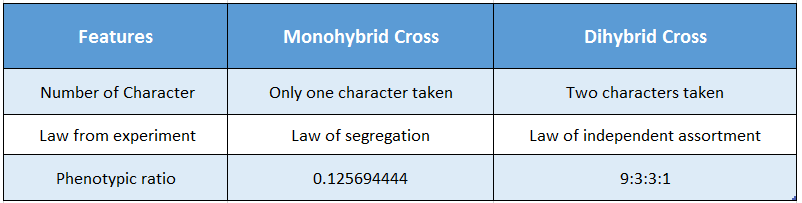
WBBSE Solutions For Class 10 Life Science And Environment Chapter 3 Mendel's Laws And Their Deviation differentiate between monohybrid and dihybrid cross

Chapter 3 Mendel’s Laws And Their Deviation Multiple Choice Questions B Answers [Mcq]

Question 1. The laws of heredity were framed by

  1. Hugo de Vries
  2. Darwin
  3. Lamarck
  4. Mendel

Answer: 4. Mendel

Question 2. Mendelian concept deviates in

  1. Law of segregation
  2. Law of dominance
  3. Law of incomplete dominance
  4. Law of independent assortment

Answer: 3. Law of incomplete dominance

Question 3. A genetic cross between hybrid offspring and one of the homozygous parental types is known as

  1. Back cross
  2. Test cross
  3.  Reciprocal cross
  4.  Final cross

Answer: 1. Back cross

Question 4.In a cross between red (WW) and white (ww) flower-bearing evening primrose plants, all plants of F1 generation bear pink (Ww) flowers. It is an example of

  1. Hybridisation
  2. Dominance
  3. Incomplete dominance
  4. Mutation

Answer: 3. Incomplete dominance

Question 5. A cross is performed between white (recessive) and violet (dominant) flower-bearing garden pea plants. What would be the percentage of white flower-bearing plants F2 generation?

  1. 100%
  2. 25%
  3. 50%
  4. 75%

Answer: 2. 25%

Question 6. What would be the genotypic ratio of the offspring from a test cross of an organism having an AaBb genotype?

  1. 1:1:1:1
  2. 1:2:1
  3. 3:1
  4. 9:3:3:1

Answer: 1. 1:1:1:1

Question 7. The findings of Mendel on heredity and the laws of inheritance are collectively known as

  1. Mendelism
  2. Monohybrid cross
  3. Genetics
  4. Dihybrid cross

Answer: 1. Mendelism

Question 8. The genotype of a pure dwarf pea plant is

  1. TT
  2. Tt
  3. tt
  4. Ttt

Answer: 3. tt

Question 9. How many pairs of contrasting traits of plants did Mendel select for carrying out his experiments on heredity?

  1. One pair
  2. Two pairs
  3. Seven pairs
  4. Nine pairs

Answer: 3. Seven pairs

Question 10. As per Mendel’s experiment on monohybrid cross, a cross is performed between a heterozygous tall (Tt) and a homozygous dwarf (tt) garden pea plant. What would be the percentage of tall pea plants in the first filial (F1,) generation?

  1. 25%
  2. 50%
  3. 75%
  4. 100%

Answer: 4. 100%

Question 11. The phenotypic ratio in F2 generation of Mendel’s monohybrid cross is

  1. 1:2:1
  2. 3:1
  3. 9:3:3:1
  4. 1:1

Answer: 3. 3:1

Question 12. The phenotypic ratio in F2 generation of Mendel’s dihybrid cross is—

  1. 1:2:1
  2.  3:1
  3. 9:3:3:1
  4. 1:1

Answer: 3. 9:3:3:1

Question 13. What would be the percentage of dwarf pea plants in F1 generation resulting from a cross between two hybrid tall pea plants?

  1. 25%
  2. 50%
  3. 75%
  4. 100%

Answer: 1. 25%

Question 14. Dwarf pea plants are always—

  1. Homozygous
  2. Heterozygous
  3. Hybrid tall
  4. Hemizygous

Answer: 1. Homozygous

Question 15. Name the Mendelian law that is derived from the dihybrid cross.

  1. Law of segregation
  2. Law of incomplete dominance
  3. Law of dominance
  4. Law of independent assortment

Answer: 4. Law of independent assortment

Question 16. A cross is performed between two hybrid tall pea plants. What would be the percentage of tall and dwarf offspring respectively, in the F1 generation of this cross?

  1. 50% and 25%
  2. 25% and 25%
  3. 75% and 25%
  4. 50% and 50%

Answer: 3. 75% and 25%

Question 17. The pea plants, produced from the seeds resulting from a cross between hybrid tali (Tt) and pure dwarf (tt) pea plants will be—

  1. All tall
  2. All dwarf
  3. 50% tall and 50% dwarf
  4. 75% tall and 25% dwarf

Answer: 3. 50% tall and 50% dwarf

Question 18. The numerical ratio of pure black and pure white offspring obtained in the F2 generation of a monohybrid cross between pure black (BB) and pure white (bb) guinea pig, is—

  1. 1:1
  2. 1:2
  3. 2:1
  4. 3:1

Answer: 1. 1:1

Question 19. The numerical ratio of pure white and hybrid black offsprings obtained in the F2 generation of a monohybrid cross between pure black (BB) and pure white (bb) guinea pig, is—

  1. 1:1
  2. 1:2
  3. 3:1
  4. 2:1

Answer: 2. 1:2

Question 20. The ratio of pure genotypes produced in F2 generation of a monohybrid cross is—

  1. 1:1
  2. 1:2
  3. 1:3
  4. 3:1

Answer: 1. 1:1

Question 21. The percentage of hybrid tall offspring obtained from a cross between two hybrid tall pea plants is—

  1. 25%
  2. 50%
  3. 75%
  4. 100%

Answer: 2. 50%

Question 22. The ABO blood group in humans is an example of— a”

  1. Dominance
  2. Codominance
  3. Polygene
  4. Incomplete dominance

Answer: 2. Codominance

Question 23. Mendel’s Law of segregation is derived from—

  1. Monohybrid cross
  2. Dihybrid cross
  3. Hybridisation
  4. Variation

Answer: 1. Phenotypic

Question 24. The 1:2:1 ratio in the F2 generation of Mendel’s monohybrid cross is—

  1. Phenotypic
  2. Genotypic
  3. Homozygotic
  4. Heterozygotic

Answer: 2. Genotypic

Question 25. Self-pollination is possible in garden pea flowers because it is a—

  1. Male flower
  2. Female flower
  3. Unisexual flower
  4. Bisexual flower

Answer: 4.  Bisexual flower

Question 26. Which of the following indicates the test cross of Mendel’s monohybrid experiment?

  1. Tt x TT
  2. Tt x Tt
  3. Tt x tt
  4. TT x TT

Answer: 3. Tt x tt

Question 27. In which of the following cases, both phenotypic and genotypic ratios are 1:2:1 in F2 generation of a monohybrid cross?

  1. Complete dominance
  2. Incomplete dominance
  3. Super dominance
  4. Mendelian dominance

Answer: 2. Incomplete dominance

Question 28. The allelic state or the genetic constitution of an organism is known as—

  1. Allelomorph
  2. Gene
  3. Genotype
  4. Phenotype

Answer: 3. Genotype

Question 29. Which of the following is a dominant character?

  1. Stem height-Dwarf
  2. Shape of seed-Wrinkled
  3. Cotyledon colour-Yellow
  4. Flower colour-White

Answer: 3. Cotyledon colour-Yellow

Question 30. Which of the following is a recessive character?

  1. Wrinkled seed
  2. Purple flower
  3. Yellow coloured seed
  4. Axillary flower

Answer: 1. Wrinkled seed

Question 31. o’ is a symbol of—

  1. Bisexual
  2. Male
  3. Female
  4. None of the above

Answer: 2. Male

Question 32. Which of the following cross will produce a 1:1 ratio?

  1. TTxtt
  2. TTxTt
  3.  tTtxTt
  4. Ttxtt

Answer: 4. Ttxtt

Question 33. How many genotypes are possible of a tall pea plant?

  1. 1
  2. 2
  3. 3
  4. 4

Answer: 2. 2

Question 34. How many individuals out of 500 will be heterozygous in the cross Tt x Tt?

  1. 100
  2. 250
  3. 350
  4. 500

Answer: 2. 250

Question 35. How many types of genotypes are obtained in Mendel’s monohybrid cross in the F2 generation?

  1. 1
  2. 2
  3. 3
  4. 4

Answer: 3. 3

Question 36. A test cross is done between—

  1. F1x F1
  2. F1 x dominant parent
  3. F1 x recessive parent
  4. None of the above

Answer: 3. F1 x recessive parent

Question 37. The phenotypic ratio of offspring obtained from a cross between a homozygous (bb) and heterozygous (Bb) individual—

  1. 3:1
  2. 2:1
  3. 1:1
  4. 1:2

Answer: 3.  1:1

Question 38. How many types of gametes will be produced from YyRr?

  1. 1
  2. 2
  3. 3
  4. 4

Answer: 4.  4

Question 39. How many types of gametes will be produced from the genotype YYRR?

  1. 1
  2. 2
  3. 3
  4. 4

Answer: 1. 1

Question 40. How many types of genotypes are obtained in Mendel’s dihybrid cross F2 generation?

  1.  4
  2. 6
  3. 8
  4. 9

Answer: 4. 9

Question 41. Which of the following traits in the pea plant is recessive?

  1. Wrinkled seed
  2. Yellow coloured seed
  3. Purple coloured flower
  4. Axial flower

Answer: 1. Wrinkled seed

Question 42. How many types of gametes are formed from pea plants having genotype YyRr?

  1. 1
  2. 4
  3. 2
  4. 3

Answer: 2. 4

Question 43. Which of the following is the genotypic ratio generation of Mendel’s monohybrid cross?

  1. 1:2:1
  2. 3:1
  3. 9:3:3:1
  4. 2:1:2

Answer: 1. 1:2:1

Question 44. What would be the phenotypic ratio in the F2 generation of a monohybrid cross in case of incomplete dominance?

  1. 3:1
  2. 2:1:1
  3. 9:3:3:1
  4. 1:2:1

Answer: 4. 1:2:1

Question 45. Asses how many types of gametes are produced from the pea plant having the genotype RRYY.

  1. One type
  2. Four types
  3. Two types
  4. Three types

Answer: 1. One type

Question 46. Identify which of the following is a dominant trait—

  1. Length of the stem—Dwarf
  2. The shape of the seed—Wrinkled
  3. Colour of the cotyledon—Yellow
  4. Colour of the flower—White

Answer: 3. Colour of the cotyledon—Yellow

Question 47. Select which of the following two genotypes are responsible for the expression of the phenotype wrinkled yellow in pea plants—

  1. RRYY and rryy
  2. RRYy and RrYy
  3. RRyy and Rryy
  4. rrYY and rrYy

Answer: 4. rrYY and rrYy

Question 48. Identify the genotype of a guinea pig having black colour and rough hair—

  1. BbRr, BBRr
  2. BBrr, Bbrr
  3. bbRR, bbRr
  4. bbrr, bbRr

Answer: 1.  BbRr, BBRr

Question 49. Decide which of the following two were selected by Mendel as recessive traits—

  1. Colour of flower—purple, the position of the flower—axial
  2. Length of stem—dwarf, form of ripe seed—wrinkled
  3. Form ol ripe seed—round, colour of seed—yellow
  4. Position of flower—axial, length of stem—tall

Answer: 2. Length of stem—dwarf, form of ripe seed—wrinkled


Chapter 3 Mendel’s Laws And Their Deviation VSAQs

Question 1. Write down the scientific name of the garden pea plant.
Answer: Pisum sativum

Question 2. What is the phenotypic ratio in F2 generation of a monohybrid cross?
Answer: The phenotypic ratio in F2 generation of a monohybrid cross is, Dominant: Recessive=31.

Question 3. What is the genotypic ratio in F2 generation of a monohybrid cross?
Answer: The genotypic ratio in F2 generation of a monohybrid cross is—Pure dominant : Hybrid: Pure recessive = 1:2:1.

Question 4. Give an example of a dominant character of guinea pig.
Answer: Black coat colour is a dominant character of guinea pig.

Question 5. In a monohybrid cross, the phenotypic and genotypic ratio of F2 generation are 3:1 and 1:2:1 respectively. What does this observation indicate?
Answer: This observation indicates the complete dominance of the concerned character.

Question 6. What does ‘Tt’ indicate in Mendel’s experiment?
Answer: In Mendel’s experiment, ‘Tt’ indicates the genotype of a hybrid tall pea plant.

Question 7. Which type of pea plant is denoted by ‘TT’ in Mendel’s experiment?
Answer: In Mendel’s experiment, ‘TT’ indicates a pure tall pea plant.

Question 8. Which type of pea plant is denoted by ‘tt’ in Mendel’s experiment?
Answer: In Mendel’s experiment, ‘tt’ indicates a pure dwarf pea plant.

Question 9. Mention a character and its opposite traits found in guinea pig.
Answer: Coat colour is a character of guinea pig, which has two opposite traits—black and white.

Question 10. Which is the dominant colour of flowers of garden pea plants?
Answer: The dominant colour of flowers of garden pea plant is violet.

Question 11. Which ratio indicates the external features of the progeny of a hybrid cross?
Answer: Phenotypic ratio

Question 12. In which journal Mendel’s paper on the heredity of garden pea plants was published?
Answer: Mendel’s paper on the heredity of garden pea plants was published in the Journal of Natural History Society at Brunn.

Question 13. What does the ratio of 3:1 indicate in genetics?
Answer: The ratio of 3:1 indicates the phenotypic ratio of the F2 progeny of the monohybrid cross.

Question 14. What does the ratio ail :2:1 indicate in genetics?
Answer: The ratio of 1:2:1 indicates the genotypic ratio of the F2 progeny of monohybrid cross

Question 15. What does the ratio of ot9:3:3:1 indicate in genetics?
Answer: The ratio of 9:3:3:1 indicates the phenotypic ratio ot the F2 progeny of dihybrid cross.

Question 16. Which Mendelian law is derived from the result ot a monohybrid cross experiment?
Answer: The law of segregation is derived from the result ol Mendel s monohybrid cross experiment.

Question 17. Which Mendelian law is derived from the result of a dihybrid cross experiment?
Answer: The law of independent assortment is derived from the result of Mendel’s dihybrid cross experiment.

Question 18. Who first designed the checker board?
Answer: Reginald C Punnett, a British geneticist, first designed the checker board.

Question 19. What does Mendelian factors mean?
Answer: Mendelian factors are the alleles of genes, which are responsible for expression of various hereditary characters

Question 20. What is mulatto?
Answer:

Mulatto

The medium complexioned offspring, bom to pure black and pure white parents, is called mulatto

Question 21. In case of guinea pig whether the phenotype of the two genotypes bbRR and bbRr is same?
Answer: Yes, the phenotype of the two genotypes bbRR and bbRr will be the same in case of guinea pig.

Question 22. Write the phenotypic ratio obtained in the F2 generation of Mendel’s dihybrid cross experiment.
Answer: 9:3:3:1

Question 23. Write the genotypic ratio obtained at 2nd filial generation in the monohybrid experiment done by Mendel.
Answer: 1:2:1

Question 24. Which law did Mendel conclude from his dihybrid cross experiment?
Answer: Law of independent assortment.

Impact of Environment on Genetic Expression

Chapter 3 Mendel’s Laws And Their Deviation Fill In The Blanks

Question 1. An individual which carries both dominant and recessive alleles is called _______ individual.
Answer: Hybrid

Question 2. Mendel’s first law of heredity is known as the law of ______
Answer : Segregation

Question 3. Mendel’s second law of heredity is known as the law of _______
Answer: Independent assortment

Question 4. In a monohybrid cross between red and white flower-bearing evening primrose plants, the phenotypic ratio of the F2 progeny is ______
Answer: 1:2:1

Question 5. The parental generation of a monohybrid cross is marked as ______ generation.
Answer : P

Question 6. Mendel performed ______ pollination between the flowers of pure tall and pure dwarf pea plants.
Answer: Cross

Question 7. To get F2 generation, Mendel allowed ______ pollination among F1 plants.
Answer: Self

Question 8. The yellow colour of cotyledons of pea plants is a ______character.
Answer: Dominant

Question 9. Hybridisation between two traits of a single character is known as ______ cross.
Answer: Monohybrid

Wbbse Class X Life Science

Question 10. Permanent and heritable change in the number and structure of gene or chromosome is known as _______
Answer: Mutation

Question 11. Mendel selected ______ number of characters of pea plant for his experiment.
Answer: Seven

Question 12. Different ______ of an individual may show the same phenotype.
Answer: Genotypes

Question 13. The white and smooth fur of a guinea pig is a __________ character.
Answer: Recessive

Question 14. The ratio of TT:Tt:tt in monohybrid cross is ______
Answer: 1:2:1


Chapter 3 Mendel’s Laws And Their Deviation State True Or False

Question 1. A temporary change in the number and structure of a gene or chromosome is known as mutation.
Answer: False

Question 2. Mendel selected seven pairs of opposite characters of the garden pea plant for his experimental observations.
Answer: True

Wbbse Class X Life Science

Question 3. The scientific name of evening primrose is Mirabilisjalapa.
Answer: False

Question 4. In F2 generation of Mendel’s dihybrid cross, both the phenotypic and genotypic ratio is 9: 3:3:1.
Answer: False

Question 5. In Mendel’s monohybrid cross, all F1 offsprings have pure dominant character.
Answer: False

Question 6. In genetics, cross denotes the union of a male and a female gamete.
Answer: True

Question 7. Round seed is a recessive character.
Answer: False

Question 8. Each character selected by Mendel was controlled by multiple alleles.
Answer: False

Question 9. In pea plant, both selfing and cross-pollination can be done.
Answer: True

Question 10. Mendel obtained 75% tall plant in F1 generation of a monohybrid cross.
Answer: False

Wbbse Class 10 Life Science Solutions

Question 11. Back cross always means test cross.
Answer: False

Question 12. In the Evening primrose plant incomplete dominance is seen.
Answer: True

Common Misconceptions About Mendel’s Laws

Question 13. Recessive character is always expressed in homozygous conditions.
Answer: True

Wbbse Class X Life Science

Question 14. The dominant phenotype may be both homozygous or heterozygous.
Answer: True

Question 15. In his monohybrid cross experiment, Mendel obtained 75% pure tall pea plants in the first filial generation.
Answer: False

Question 16. Mendel used the term ‘gene’ while describing his experiments related with heredity.
Answer: False


Chapter 3 Mendel’s Laws And Their Deviation Match The Columns

Question 1.
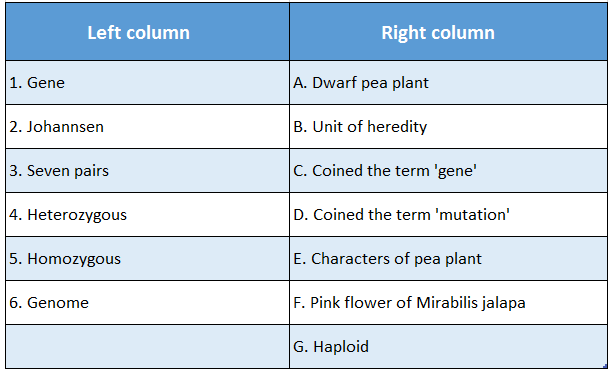
WBBSE Solutions For Class 10 Life Science And Environment Chapter 3 Mendel's Laws And Their Deviation Match the columns 1

Answer: 1. B, 2. C, 3. E, 4. F, 5. A, 6. G

Question 2.
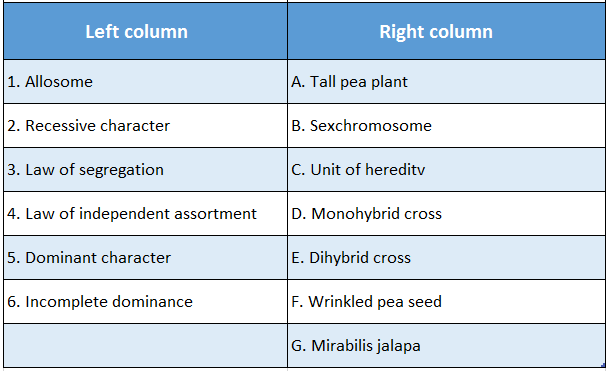
WBBSE Solutions For Class 10 Life Science And Environment Chapter 3 Mendel's Laws And Their Deviation Match the columns 2

Answer: 1. B, 2. F, 3. D, 4. E, 5. A, 6. G


Chapter 3 Mendel’s Laws And Their Deviation Find The Odd One Out

Question 1. Grefcn colour of the pod, White colour of the flower, Round shape of seed, Axial position of the flower
Answer: The white colour of the flower

Question 2. Crossing over, Meiosis, Genetic recombination, Mitosis
Answer: Mitosis

Question 3. Law of segregation, Law of independent assortment, Law of use and disuse, Law of dominance
Answer: Law of use and disuse

Wbbse Class X Life Science

Question 4. 9:3:3:1, independent assortment, 3:1 BbSs x BbSs
Answer: 3:1

Question 5. TT, Tt, tt, rr
Answer: rr

Wbbse Class 10 Life Science Solutions

Question 6. Round wrinkled, Yellow wrinkled, Green wrinkled, Tall
Answer: Tall

Question 7. Purple flower x white flower Yellow seed x green seed, Round seed x wrinkled seed, Yellow Round Seed x green wrinkled seed
Answer: Yellow Round seed x Green Wrinkled seed

Question 8. Purple flower, White flower, Green pea seed, Axial flower
Answer: White flower


Chapter 3 Mendel’s Laws And Their Deviation Fill In The Blanks By Looking At The First Pair

Question 1. Monohybrid cross: Law of segregation:: Dihybrid cross: ______
Answer: Law of independent assortment

Question 2. Purple flower: Dominant character:: White flower:______
Answer: Recessive character

Wbbse Class X Life Science

Question 3. Monohybrid phenotype ratio : 3:1 :: Dhybridphenotypic ratio :______
Answer: 9:3:3:1

Question 4. Mendelian inheritence: Pea plant :: Mendel’s deviation:______
Answer: Mirabilis Jalapa

Question 5. Mendel’s first law: Law of segregation:: Mendel’s second law: ______
Answer: Law of independent assortment

Question 6. Cross of P generation : Cross-pollination :: Cross of F1 generation:______
Answer: Self-pollination

Question 7. Axial flower: Dominant Character:: Terminal flower: ______
Answer: Recessive character


Chapter 3 Mendel’s Laws And Their Deviation Among The Four Concepts Given, Three Of Them Belong To One. Find That

Question 1. Monohybrid cross, Dihybrid cross, Hybridisation technique, Crossbreeding
Answer: Hybridisation technique

Question 2. TT x tt, Monohybrid Cross, Tt x Tt, BB x bb
Answer: Monohybrid Cross

Wbbse Class 10 Life Science Solutions

Question 3. Green Round, F2 phenotype, Yellow Wrinkled, Yellow Round
Answer: F2 Phenotype

Question 4. Mirabilis jalapa, Pink flower, Incomplete dominance, 1:2:1
Answer: Incomplete dominance

Question 5. Purple flower, Tall plant, Yellow seed, Dominant Character
Answer: Dominant character

WBBSE Solutions For Class 10 Life Science And Environment Chapter 3 Some Genetic Diseases

Chapter 3 Some Genetic Diseases Summary

WBBSE Class 10 Genetic Diseases Overview

  • There are some genetic diseases like-Thalassemia, Haemophilia, and Colour blindness seen in the human population.
  • Thalassemia is an autosomal recessive disease. It is mainly of two types-a and B thalassemia. On the basis of severity, it is of two types-Highly severe thalassemia major and relatively less severe thalassemia minor.
  • In thalassemia, globin protein synthesis is disturbed resulting in Anaemia. Due to the high accumulation of iron, deformities in bone are generated.

Read and Learn More WBBSE Solutions for Class 10 Life Science And Environment

  • Haemophilia is an X-linked disease in which due to the absence of blood clotting factor, blood clotting does not take place.
    Haemophilia on the basis of severity is of three types-
  1. Light haemophilia [Blood clotting factor 5-50%]
  2. Moderate haemophilia [Blood clotting factor 1-5%]
  3. Severe haemophilia [Blood Clotting factor <1%]
  • On the basis of the type of blood clotting factor that is absent, haemophilia is of 3 types- Haemophilia A, haemophilia B or Christmas disease and haemophilia C.
  • Colour blindness is another X-linked recessive disease where the affected person can not identify blue, green or red colour.
  • Cololur blindness is of three types-Protanopia [a person can not recognise red colour], Deuteranopia [a person can not recognise green colour], and Tritanopia [a person can not recognise Blue colour]. The inheritence pattern of haemophilia, thalassemia and colour blindness can be calculated by a genetic cross.
  • Genetic counselling is important to prevent genetic disease. Through genetic counselling, the chance percentage of a disease can be calculated.

Some Genetic Diseases

Chapter 3 Some Genetic Diseases  Long Answer Type Questions

Question 1. What is thalassemia? Briefly describe different types of thalassemia.

Answer:

Thalassemia:

The genetic blood disorder, in which any of the globin peptide chains of haemoglobin is not synthesised at all or produced in much less quantity than normal, is known as thalassemia.

In this disease, the quantity of haemoglobin is reduced, and RBC becomes smaller and abnormally shaped.

Wbbse Class X Life Science

Types of thalassemia:

Two types of thalassemia are seen in humans. These are-

  1. α-thalassemia and
  2. β-thalassemia.

1. α-thalassemia:

In this type of thalassemia, synthesis of the α-globin peptide chain of haemoglobin is either reduced or stopped. In the 16th homologous chromosome pair, there are two genes (HBA1 and HBA2) and their two sets of alleles to control a-globin peptide synthesis.

If a mutation occurs in one set of alleles, a-thalassemia. minor occurs. When both sets of alleles are mutated, the most severe, a-thalassemia major occurs.

WBBSE Solutions For Class 10 Life Science And Environment Chapter 3 Some Genetic Diseases

2. β-thalassemia:

If the synthesis of the β-globin peptide chain of haemoglobin is reduced or stopped in the body, a person suffers from β-thalassemia. A pair of alleles of the HBB gene is located on the 11th homologous pair of chromosomes of a human cell responsible for β-globin peptide synthesis.

In case of mutation in one of the alleles, β-thalassemia minor occurs. If both the alleles undergo mutation, β-thalassemia major occurs. American physician Thomas Benton Cooley discovered β-thalassemia, hence this disease is also known as Cooley’s anaemia.

Common Genetic Disorders in Humans

WBBSE Solutions for Class 10 History WBBSE Solutions for Class 10 Geography and Environment
WBBSE Class 10 History Long Answer Questions WBBSE Solutions for Class 10 Life Science And Environment
WBBSE Class 10 History Short Answer Questions WBBSE Solutions for Class 10 Maths
WBBSE Class 10 History Very Short Answer Questions WBBSE Solutions for Class 10 Physical Science and Environment
WBBSE Class 10 History Multiple Choice Questions


Question 2. Mention the symptoms of thalassemia.
Briefly describe the cause of thalassemia.

Answer:

Symptoms of thalassemia:

  1. Severe anaemia due to reduced synthesis of haemoglobin.
  2. Rapid breakdown of RBC leads to the release and accumulation of iron in different organs, resulting in their dysfunction.
  3. Excessive proliferation of bone marrow leads to deformity of bones, especially of the face and skull.
  4. Enlargement of the liver and spleen occurs. It leads to jaundice, stunted growth and a weakened immune system.

Cause of thalassemia:

Wbbse Class X Life Science

Thalassemia occurs due to mutation in the globin-synthesising genes. The haemoglobin molecule is composed of two a and β-globin peptide chains. The genes for synthesis of a and β-globin are located on the 16th and 11th autosomes of a human cell.

The mutant a and β-globin genes hinder the synthesis of respective globin chains, resulting into abnormal haemoglobin that leads to thalassemia.

Question 3. What is haemophilia? Briefly describe the different types of haemophilia.

Answer:

Haemophilia:

Haemophilia is a genetic disorder, caused by an X chromosome-linked mutant gene, in which bleeding time from any wound is so prolonged that a person suffers from a life-threatening level of blood loss.

Mutation in a single gene on X-chromosome causes this disease in males, while a mutation in two genes on both the X-chromosomes will cause haemophilia in females.

Types of haemophilia

In humans, two types of haemophilia are seen, these are-

1. Haemophilia A or classical haemophilia:

In case of deficiency of a blood coagulating factor, Factor VIII or anti-haemophilic factor (AHF) in plasma, this serious type of haemophilia occurs. In our country, 80% of haemophilic persons suffer from this particular disease.

2. Haemophilia B or Christmas disease:

Deficiency of a blood coagulating factor called factor IX or Christmas factor or plasma thromboplastin component (PTC) in plasma, causes this type of haemophilia. This is not as deadly as haemophilia A.

In India, 20% of haemophilic persons suffer from haemophilia B. This disease was first detected in a person named Stephen Christmas. Therefore, this is also known as Christmas disease.

Question 4. Mention the symptoms and causes of haemophilia.

Answer:

Symptoms of haemophilia:

Based on intensity, haemophilia may be classified into three different types-mild, moderate and severe haemophilia, which have different symptoms, as mentioned below.

1. Symptoms of mild haemophilia:

The symptoms of mild haemophilia remain suppressed for a long time. With ageing, the problem of blood clotting appears slowly. The problem of bleeding becomes prominent during surgical operations or major injury.

2. Symptoms of moderate haemophilia:

Wbbse Class X Life Science

Symptoms of moderate haemophilia appear since birth. The patients suffer from prolonged bleeding. Internal haemorrhage occurs in bone joints. Swelling of joints and joint stiffness are also seen.

3. Symptoms of severe haemophilia:

Patients suffering from severe haemophilia often bleed for no apparent reason, known as spontaneous bleeding. In the case of severe haemophilia, profuse internal haemorrhage occurs in bone joints resulting in to serious joint deformity (hemarthrosis).

Besides, haemorrhage also occurs from nasal mucosa, within the skull, which may result in to paralysis, even death of the patient.

Causes of haemophilia:

The causes of haemophilia A and haemophilia B are mentioned below.

1. Cause of Haemophilia A or classical haemophilia:

Deficiency of blood coagulating factor, called factor VIII or anti-haemophilic factor (AHF) in blood.

2. Cause of Haemophilia B or Christmas disease:

Deficiency of blood coagulating factor, called plasma thromboplastin component (PTC) or factor IX in blood.

Question 5. Mention the types and causes of colour blindness.

Answer:

Types of colour blindness:

Different types of colour blindness are seen in the human population.

1. Protanopia or red colour blindness:

In this disease, an individual cannot detect red colour. They see red as black or deep brown, orange-yellow-green as different shades of yellow and violet as blue.

2. Deuteranopia or green colour blindness:

In the case of deuteranopia, one cannot detect green colour. Deutaronopes cannot detect red, orange and yellow properly but their colour vision is better than protanopes.

3. Tritanopia or blue colour blindness:

In blue colour blindness, a person cannot detect blue colour.

Cause of colour blindness:

Colour detection in human eye depends upon the cone cells of the retina. There are three types of cone cells in human retina, which are sensitive to red, green and blue colours.

These cells contain separate photopsin pigments to sense the wavelengths of red, green and blue lights. Synthesis of red and green photopsin pigments are controlled by X-linked genes, whereas, the blue photopsin synthesis is controlled by an autosomal gene. In case of mutation in these genes, respective colour blindness occurs.

Mendelian Inheritance and Genetic Diseases

Question 6. What is meant by genetic counselling? Discuss the role of genetic counselling in combating thalassemia.

Answer:

Genetic counselling:

By analysing the history of genetic diseases of family members and performing some genetic tests, the probability of any genetic disorder being transmitted to the future generations can be predicted.

Based on these investigations, a pre-marriage suggestion is provided to a couple by the genetic counsellor so that they can have healthy offspring. This is known as genetic counselling.

WBBSE Solutions For Class 10 Life Science And Environment Chapter 3 Some Genetic Diseases Inheritance of thalassemiaWBBSE Solutions For Class 10 Life Science And Environment Chapter 3 Some Genetic Diseases Inheritance of thalassemia

Thalassemia and genetic counselling:

Thalassemia is an inherited genetic disease. Therefore, genetic counselling is needed to combat this disease. In this disease, haemoglobin is synthesised in insufficient amounts and thus oxygen transportation is hampered.

As a result, huge quantities of iron accumulate in the heart, liver and endocrine glands of the body. Therefore, genetic screening of haemoglobin synthesising genes must be done before marriage in families with histories of thalassemia.

Using this data, the probability of children having thalassemia can be reduced. With the help of genetic counselling, the probable percentages of offspring having thalassemia major or minor from thalassemia minor parents can be determined.

Thus genetic counselling plays very important role in combating thalassemia.

Wbbse Class X Life Science

Question 7. How is genetic counselling performed? Mention the importance of genetic counselling.

Answer:

Method of genetic counselling:

Generally, a genetic counsellor can offer genetic counselling. This counselling includes the following steps-

  1. At first, the counsellor collects the history of genetic diseases of different family members and related bloodlines. The collected data is then analysed to detect the genealogical trend of any disease.
  2. Next, the cells or blood samples of the concerned individual are collected and tested in laboratories to find any genetic abnormality.
  3. If any person is found with a genetic abnormality, the same tests are performed on his or her partner.
  4. After analysing the genetic status of both partners, the chance of inheritance of any disease and its expected intensity are estimated.
  5. Now, the couple is explained about the genetic status of their expected baby, either before their marriage or before conceiving.
  6. If a foetus is found positive to any serious genetic disease, the parents are advised for medical term of pregnancy.


WBBSE Solutions For Class 10 Life Science And Environment Chapter 3 Some Genetic Diseases Genetic counselling


Importance of genetic counselling:

Occurrence of thalassemia, haemophilia and some other genetic diseases may be determined by genetic counselling. Genetic counselling has been proven effective if-

  1. Both or any of the partners carry thalassemia-causing genes.
  2. The parents are aged, especially when the mother is in her forties.
  3. Genealogical lines show any history of thalassemia or other genetic diseases.
  4. Foetal death occurs or the baby is born with a genetic disorder.

Question 8. Differentiate between thalassemia and haemophilia.

Answer:

Differences between thalassemia and haemophilia:

Life Science Class 10 Wbbse

WBBSE Solutions For Class 10 Life Science And Environment Chapter 3 Some Genetic Diseases Differences between thalassemia and haemophilia

Causes of Genetic Disorders

Question 9. What symptoms are expressed in a child affected with thalassemia? What suggestions are given at the time of genetic counselling in such cases?

Answer:

Symptoms of thalassemia affected child:

  1. Continuous fatigue or weakness,
  2. Shortness of breath,
  3. Yellowing of skin and eyes,
  4. Slow growth and abdominal swelling,
  5. Facial bone deformities and anaemia,
  6. Dark colouration of urine

The suggestions are given at the time of genetic counselling

  1. Not to conduct marriage between carrier male and female.
  2. Not to conduct marriage between thalamic male and normal or carrier female or vice-versa.
  3. Must rest for genetic diseases before marriage or child planning

Question 10. A colour-blind female married a normal male. Judge the probability of colour blindness among their children in the first filial generation. Show with the help of a cross how the first law of Mendel is deviated in the case of the Four o’clock plant in F2 generation.

Answer:

Inheritance of colour blindness:

Life Science Class 10 Wbbse


WBBSE Solutions For Class 10 Life Science And Environment Chapter 3 Some Inheritance of colour blindness


Checker board of F1 generation:

WBBSE Solutions For Class 10 Life Science And Environment Chapter 3 Some Genetic Diseases Checker bord of F1 generation

In the F, generation all the female born will be carrier and all the male born will be colour blind.

Deviation from Mendel’s first law:


WBBSE Solutions For Class 10 Life Science And Environment Chapter 3 Some Genetic Diseases Deviation from Mendels first law

Checker board of F2 generation

WBBSE Solutions For Class 10 Life Science And Environment Chapter 3 Some Genetic Diseases Checker bord of F2 generation

Phenotypic ratio- Red: Pink: White = 1:2:1

Genotypic ratio-RR: RW: WW = 1:2:1
In the F1, generation the red and white colour is not segregated in a 3:1 ratio rather the phenotypic ratio is 1:2: 1. The phenotypic and genotypic ratios both are the same i.e. 1: 2: 1: Thus in this case Mendel’s 1st law is clearly deviated.

Symptoms of Common Genetic Diseases

Chapter 3 Some Genetic Diseases Short Answer Type Questions

Question 1. Name two autosomal and two sex-linked hereditary diseases.
Answer:

Autosomal

  1. Two autosomal hereditary diseases are- thalassemia and albinism.

Two sex-linked hereditary diseases

  1. Two sex-linked hereditary diseases are- haemophilia and colour blindness.

Question 2. What is thalassemia?
Answer:

Thalassemia:

Thalassemia is an autosomal hereditary disease caused due to abnormal synthesis of globin peptide chains of haemoglobin. The formation of haemoglobin in a thalassemic patient is either stopped or reduced.

RBC of a thalassemic patient is smaller in size and of shorter life span (the normal life span of RBC is 120 days) and the patient suffers from severe anaemia.

Question 3. What is thalassemia major?
Answer:

Thalassemia major:

When both a and B-globin chains of haemoglobin are incompletely formed due to genetic mutation in both a. and ẞ-globin genes located on the 16th and 11th chromosomes respectively, the disease that occurs is known as thalassemia major.

Question 4. What is haemophilia?
Answer:

Haemophilia:

Haemophilia is a hereditary haemorrhagic disease, caused by an X-linked recessive gene. In this disease, blood lacks the capacity to coagulate and a patient may bleed to death even due to a small cut.

This disease occurs due to a deficiency of any one of the two blood-coagulating factors- factor VIII and factor IX.

Question 5. What is thalassemia minor?
Answer:

Thalassemia minor:

When any one of a or β-globin chains of haemoglobin is incompletely formed due to mutation i.e., there is one defective allele, the disease that occurs, is called thalassemia minor.

Question 6. What are the different types of haemophilia occurring in man?
Answer:

The different types of haemophilia occurring in man:

Generally, two types of haemophilia occur in men. These are haemophilia A and haemophilia B. Besides, there is another variety of haemophilia, seen among a few people. This is known as haemophilia C.

Genetic Counseling for Inherited Disorders

Question 7. What is the cause of haemophilia A?
Answer:

The cause of haemophilia A:

In the case of a specific recessive gene mutation in the X chromosome, a blood-coagulating factor, namely Factor VIII or anti-haemophilic factor (AHF) is not synthesised in the body. A deficiency of AHF prevents blood coagulation and causes haemophilia A.

Life Science Class 10 Wbbse

Question 8. Why is haemophilia more common among males?
Answer:

Haemophilia more common among males because

Haemophilia is an X-linked recessive genetic disorder. It is more common among males because they inherit only one X-chromosome. Since males carry one X-chromosome and one Y-chromosome, they develop symptoms of the disease if the single X-chromosome carries the recessive mutant allele.

Question 9. Why a carrier female of haemophilia A gene does not get affected by the disease?
Answer:

Somatic cells of a female carry two X chromosomes. When one of the two X chromosomes carries the recessive allele for haemophilia but the other carries the normal dominant allele, the female becomes a carrier.

This normal dominant allele suppresses the recessive haemophilia allele and prevents the female from being haemophilic. Therefore, a female, carrying a single recessive allele for haemophilia is not affected by haemophilia A.

Question 10. What is the cause of haemophilia B?
Answer:

The cause of haemophilia B:

In the case of a specific recessive gene mutation in the X chromosome, a blood-coagulating factor, namely factor IX or Christmas factor is not synthesised in the body. Absence or deficiency of this factor prevents blood coagulation and causes Haemophilia B.

Question 11. What is crisscross inheritance?
Answer:

Crisscross inheritance:

The transmission of a genetic character from father to daughter and from mother to son is known as crisscross inheritance. All X-linked characters show crisscross inheritance.
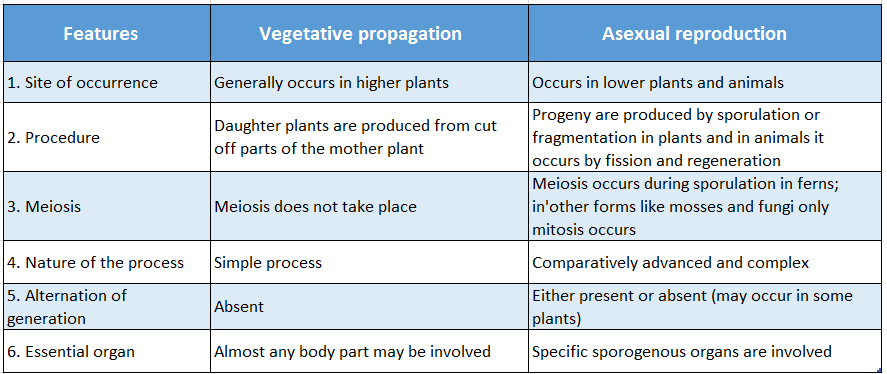
In this type of inheritance, the following inheritance pattern is seen-Father → Daughter → Grandson → Great granddaughter.

Question 12. Name few genetic disorders that can be prevented by undergoing genetic counselling.
Answer:

Genetic counselling is considered by couples before marriage to prevent the occurrence of any genetic disorder in their children. Examples of genetic diseases that can be prevented by undergoing genetic counselling are thalassemia, haemophilia, colour blindness, etc.

Life Science Class 10 Wbbse

Question 13. What is colour blindness?
Answer:

Colour blindness:

Colour blindness is a genetic disorder in which a person cannot detect red, green or blue colour. Red-green colour blindness occurs due to X-linked recessive mutation, but blue colour blindness is an autosomal recessive disorder.

Question 14. What is monochromacy?
Answer:

Monochromacy:

In the human retina, there are three types of colour-sensitive cone cells, which can detect red, Checkerboard green and blue colours separately. If 2 or 3 types of pigmented cone cells are absent the colour, and detecting ability is totally lost.

Such a person can view the world in black and white. This rare type of colour blindness is known as monochromacy.

Question 15. What is dichromacy?
Answer:

Dichromacy:

If out of the three types of cone cells, two remain active and one inactive, a person cannot detect that particular single colour. This type of colour blindness is called dichromacy.

The common red, green or blue colour blindness are an example of dichromacy.

X-Linked Genetic Disorders Explained

Question 16. Write down the symptoms of Thalassemia.
Answer:

Symptoms of Thalassemia

  1. Tiredness and fatigue.
  2. Malformation of bone, especially bone of the face.
  3. Blackish urine.
  4. The yellowish colouration of skin and retardation of growth.

Question 17. Which of the three organs of the human body are damaged due to thalassemia?
Answer:

Liver, spleen and heart of human is damaged in thalassemia due to high accumulation of iron.

Question 18. Why haemophilia is more expressed in males than females?
Answer:

Haemophilia is a sex-linked recessive disorder whose gene is present on X chromosome. Males have only one X chromosome so if it fears the allele for haemophilia then it is always expressed.

But females have two X chromosomes. So for be haemophilic, each of the two must have the allele for chromosomes haemophilia, otherwise the disease is not expressed in females, so haemophilia is more expressed is females than in males.

Wbbse Class 10 Life Science Solutions

Question 19. If the mother is a haemophilic carrier and the father is haemophilic then what will be the nature of spring? Show it with a cross.
Answer:


WBBSE Solutions For Class 10 Life Science And Environment Chapter 3 Some Genetic Diseases Haemophilic male and Carrier female


Checker board

WBBSE Solutions For Class 10 Life Science And Environment Chapter 3 Some Genetic Diseases Checker board


The nature of the offspring: 50%-haemophilic, 25%-Carrier, 25%-Normal.

Question 20. What will be the genotype of the father of a haemophilic girl?
Answer:

As both the chromosomes of a haemophilic girl contain an allele for colour blindness. So the father must have the X chromosome with an allele for colour blindness. He also possesses a Y chromosome. So his genotype is XCY.

Autosomal Recessive vs Dominant Disorders

Question 21. If the mother is colour blind then the son is always colour blind-Justify.
Answer:

A colour-blind mother always has two X chromosomes, each with an allele for colour blindness, i.e. genotype is XCXC. A son gets his X chromosome from the mother and his Y chromosome from the father.

So he will get an Xc chromosome from his mother and his genotype will be XCY. Thus he will be colour-blind.

Question 22. What is genetic counselling?
Answer:

Genetic counselling:

Genetic counselling is a process through which by analyzing the history of genetic disease Xin a family and by a genetic test, a prediction is made about the chances of the offspring to be normal or with the disease.

Wbbse Class 10 Life Science Solutions

Question 23. What is the importance of genetic counselling?
Answer:

The importance of genetic counselling:

  1. It prevents the birth of child with a genetic disease.
  2. It can help in calculating the chances of genetic disease of a child.

Question 24. Show with the help of the cross, how colour blindness is inherited.
Answer:

Colour blindness is a genetic disorder, caused by an X chromosome-linked mutant gene. Mutation in a single gene causes this disease in males, while a mutation in two genes on both the X- chromosomes will cause colour blindness in females.

So, when a colour-blind woman is married to a normal man, their sons will be colour-blind while daughters will be carriers of colour blindness. The cross is schematically represented below.


WBBSE Solutions For Class 10 Life Science And Environment Chapter 3 Some Genetic Diseases Normal Father and Colour blind Mother


Checker board

WBBSE Solutions For Class 10 Life Science And Environment Chapter 3 Some Genetic Diseases Checker board,.


Question 25. A daughter is born to a woman carrier for the colour-blind disease who married a colour-blind man. What would be the probability of expression of colour blindness in that girl child? Analyse your answer.
Answer:

Wbbse Class 10 Life Science Solutions


WBBSE Solutions For Class 10 Life Science And Environment Chapter 3 Some Genetic Diseases Carrier colour blind woman and man


Checker board

WBBSE Solutions For Class 10 Life Science And Environment Chapter 3 Some Genetic Diseases Checker board.


Colour blind girl =  ½ x 100 = 50%

There will be a 50% chance of the daughter being colour-blind. This is because the X chromosome that she will obtain from her father will definitely bear an allele for colour blindness.

However, the X chromosome that she will obtain from her mother may either bear the allele for colour blindness or that for normal vision. So, she has a 50% chance of being colour-blind.

Question 26. Write the names of two genetic diseases which are expressed in human populations.
Answer:

Two genetic diseases expressed in the human population are-

  1. Thalassemia and
  2. Haemophilia.

Question 27. Give your opinion about probable suggestions which can be given to a pair of contenders before marriage in order to prevent the spread of a genetic disease from the society already known to you.
Answer:

The pair of contenders should be suggested to test whether they are carriers or have any particular disease. If both are a carrier for an autosomal disease or one is a carrier and the other have the disease then the marriage should be cancelled.

If they both are normal or if one is normal and the other is a carrier then they can marry.

Wbbse Class 10 Life Science Solutions

Question 28. One day students read an article in the newspaper on thalassemia and were very scared to know the fate of a thalassemic patient. Write what kind of measure they can take to eradicate this disease from the population.
Answer:

The measure they can take to eradicate this disease from the population are-

  1. Genetic counselling before marriage and not to conduct marriage between carrier male and female or affected and normal individual.
  2. If genetic counselling is not done before marriage then it must be done before conceiving a child and not to conceive in sensitive cases.


Chapter 3 Some Genetic Diseases MCQs

Question 1. A sudden and permanent change in genes is called—

  1. Adaptation
  2. Inversion
  3. Mutation
  4. Recombination

Answer: 3. Mutation

Question 2. A symptom of thalassemia is—

  1. Scurvy
  2. Anaemia
  3. Rickets
  4. Malaria

Answer: 2. Anaemia

Question 3. Anti-haemophilic globulin factor is known as—

  1. Factor VII
  2. Factor VIII
  3. Factor IX
  4. Factor X

Answer: 2. Factor VIII

Question 4. Plasma thromboplastin antecedent is also known as—

  1. Factor VII
  2. Factor VIII
  3. Factor XI
  4. Factor X

Answer: 3. Factor XI

Question 5. Thalassemia minor is also known as—

  1. Thalassemia trait
  2. Thalassemia hydrops
  3. Cooley’s anaemia
  4. Thalassemia child

Answer: 1. Thalassemia trait

Wbbse Class 10 Life Science Solutions

Question 6. Which of the following is a wrong statement about thalassemia?

  1. It is a sex chromosome-linked trait
  2. It is a hereditary disease
  3. In this disease, structural deformity of haemoglobin is seen
  4. In this disease, iron is deposited in the blood

Answer: 1. It is a sex chromosome-linked trait

Question 7. The disease, where a patient faces the problem of haemorrhage is known as—

  1. Leukaemia
  2. Haemophilia
  3. Thalassemia
  4. Colour blindness

Answer: 2. Haemophilia

Question 8. Thalassemia major is also known as—

  1. Cooley’s anaemia
  2. Cooley’s syndrome
  3. Down’s syndrome
  4. Turner’s syndrome

Answer: 1. Cooley’s anaemia

Question 9. The human chromosome that carries the n-globin gene is—

  1. 11th
  2. 12th
  3. 14th
  4. 16th

Answer: 4. 16th

Question 10. The human chromosome that carries the y3-globin gene is—

  1. 11th
  2. 12th
  3. 14th
  4. 16th

Answer: 1. 11th

Question 11. The colours, which a colour-blind person is unable to detect, are—

  1. Violet-yellow
  2. Indigo-blue
  3. Red-green
  4. Orange-yellow

Answer: 3. Red-green

Question 12. An example of autosomal hereditary disease is—

  1. Haemophilia
  2. Colour blindness
  3. Thalassemia
  4. Scurvy

Answer: 3. Thalassemia

Wbbse Class 10 Life Science Solutions

Question 13. Which of the following is a sex-linked hereditary disease?

  1. Anaemia
  2. Scurvy
  3. Thalassemia
  4. Haemophilia

Answer: 4. Haemophilia

Question 14. An example of X-linked inherited disease is—

  1. Colour blindness
  2. Night blindness
  3. Thalassemia
  4. Malaria

Answer: 1. Colour blindness

Question 15. The type of colour blindness, in which a person cannot detect green colour, is—

  1. Haemophilia
  2. Thalassemia
  3. Protanopia
  4. Deuteranopia

Answer: 4. Deuteranopia

Question 16. Which of the following diseases occurs mostly among males?

  1. Red-green colour blindness
  2. Thalassemia
  3. Cancer
  4. Tuberculosis

Answer: 1. Red-green colour blindness

Question 17. The gene causing colour blindness is located on—

  1. X chromosome
  2. Y chromosome
  3. Z chromosome
  4. M chromosome

Answer: 1. X chromosome

Question l8. The other name of blood coagulating factor VIII is—

  1. ABB
  2. HBA
  3. PTA
  4. AHF

Answer: 4. AHF

Class 10 Life Science Wbbse

Question 19. The disease, caused due to abnormal structure of the globin peptide chain, is—

  1. Haemophilia
  2. Thalassemia
  3. Malaria
  4. Scurvy

Answer: 2. Thalassemia

Question 20. Christmas disease is—

  1. Haemophilia A
  2. Colour blindness
  3. Royal haemophilia
  4. Haemophilia B

Answer: 4. Haemophilia B

Question 21. The other name of blood coagulating factor IX is—

  1. AHF
  2. HBA
  3. HBB
  4. PTA

Answer: 4. PTA

Question 22. To whom should a person approach to get pre¬marriage suggestions to avert any genetic disease in his or her offspring?

  1. Psychologist
  2. Genetic counsellor
  3. Physician
  4. Surgeon

Answer: 2. Genetic counsellor

Question 23. Genetic counselling is advisable for—

  1. Thalassemia
  2. Malaria
  3. Hepatitis
  4. Diarrhoea

Answer: 1. Thalassemia

Class 10 Life Science Wbbse

Question 24. Deficiency of which of the following factors causes haemophilia?

  1. Factor VIII
  2. Factor IX
  3. Factor III
  4. Factors VIII And IX

Answer: 4. Factors VIII And IX

Question 25. The type of haemophilia carried by Queen Victoria was—

  1. Haemophilia A
  2. Haemophilia B
  3. Haemophilia C
  4. Haemophilia D

Answer: 1. Haemophilia A

Question 26. Criss-cross inheritance occurs in case of—

  1. Colour blindness
  2. Diabetes
  3. Anaemia
  4. Scurvy

Answer: 1. Colour blindness

Question 27. The main problem in haemophilia is—

  1. Disability of colour detection
  2. Internal haemorrhage
  3. Internal blood coagulation
  4. High fever and inflammation

Answer: 2. Internal haemorrhage

Question 28. The plasma protein, which is not synthesised in haemophilia, is—

  1. Albumin
  2. Globulin
  3. Fibrin
  4. Chitin

Answer: 3. Fibrin

Question 29. The disease in which the function of the liver and heart is hampered due to iron accumulation—

  1. Haemophilia
  2. Anaemia
  3. Thalassemia
  4. Blood Cancer

Answer: 3. Thalassemia

Question 30. Which of the following is not true for thalassemia?

  1. It is a sex-linked disease
  2. This is a genetic disease
  3. In this disease, haemoglobin is not formed properly
  4. Iron is accumulated in this disease

Answer: 1. It is a sex-linked disease

Question 31. The reason behind Cooley’s anaemia is

  1. Mutation
  2. Adaptation
  3. HbS
  4. HbF

Answer: 1. Mutation

Class 10 Life Science Wbbse

Question 32. Cooley’s anaemia is—

  1. α thalassaemia major
  2. α thalassemia minor
  3. β thalassemia major
  4. β thalassemia minor

Answer: 3. β thalassemia major

Question 33. If both the parents are carriers of thalassemia then the chance percentage of their child to be thalassemic is—

  1. 100%
  2. 75%
  3. 50%
  4. 25%

Answer: 4. 25%

Question 34. Which of the following is not controlled by the autosomal gene of humans?

  1. Roller tongue
  2. Haemophilia
  3. Thalassemia
  4. Attached ear hole

Answer: 2. Haemophilia

Question 35. The factor responsible for haemophilia A is—

  1. VI
  2. VII
  3. VIII
  4. IX

Answer: 3. VIII

Question 36. The haemophilia Known as classic haemophilia is—

  1. Haemophilia A
  2. Haemophilia C
  3. Haemophilia B
  4. None of the above

Answer: 1. Haemophilia A

Question 37. If a haemophilic male marries a homozygous normal female then what will be the chances of a haemophilic child?

  1. 0%
  2. 25%
  3. 50%
  4. 75%

Answer: 1. 0%

Question 38. If a carrier haemophilic female marries a normal male then what will be the chances of their of their child to be haemophilic?

  1. 0%
  2. 25%
  3. 50%
  4. 75%

Answer: 2. 25%

Question 39. Blue blindness is called—

  1. Presbyopia
  2. Tritanopia
  3. DuteranopiaProtanopia

Answer: 2. Tritanopia

Class 10 Life Science Wbbse

Question 40. The genotype of a colour-blind male is—

  1. XC+Y
  2. XCXC
  3. XCY
  4. XCYC

Answer: 3. XCY

Question 41. The phenotype of Xc+Xc will be—

  1. Normal female
  2. Normal male
  3. Carrier female
  4. Colour blind female

Answer: 3. Carrier female

Question 42. If a male is colour blind then the chance of his son to be colour blind by his gene—

  1. 0%
  2. 50%
  3. 75%
  4. 100%

Answer: 1. 0%

Question 43. The probability of haemophilic girl children born to haemophilia carrier mother and normal father is—

  1. 75%
  2. 50%
  3. 100%
  4. 0%

Answer: 4. 0%

Question 44. Assess from the following, the probable genotype of parents having haemophilic son and normal daughter-

  1. H || h, h2023-05-22 15_53_28-Life science class 10 chapter-3.pdf - Foxit PhantomPDF
  2. H || H, H2023-05-22 15_53_28-Life science class 10 chapter-3.pdf - Foxit PhantomPDF
  3. H || H, h2023-05-22 15_53_28-Life science class 10 chapter-3.pdf - Foxit PhantomPDF
  4. H || h, H2023-05-22 15_53_28-Life science class 10 chapter-3.pdf - Foxit PhantomPDF

Answer:  3. H || H, h2023-05-22 15_53_28-Life science class 10 chapter-3.pdf - Foxit PhantomPDF


Chapter 3 Some Genetic Diseases Answer In A Single Word Or Sentence

Question 1. Who coined the term ‘thalassemia’ and when?
Answer: Whipple and Bradford coined the term ‘thalassemia, in the year 1932.

Question 2. What percentage of iron is present in haemoglobin?
Answer: Haemoglobin contains 0.34% iron.

Question 3. Name the group of diseases caused due to defective haemoglobin.
Answer: A group of diseases caused due to defective haemoglobin is called haemoglobinopathy.

Question 4. Which protein is produced in reduced quantity in a thalassemia patient?
Answer: Haemoglobin, the conjugated protein, is produced in reduced quantity in a thalassemia patient.

Question 5. Which metal accumulates in the body of a thalassemia patient due to the rapid destruction of red blood cells?
Answer: Huge quantity of iron accumulates in the body of a thalassemia patient due to the rapid destruction of red blood cells.

Class 10 Life Science Wbbse

Question 6. Which organs of the body are mostly affected due to accumulation of excessive iron?
Answer: The heart, liver, spleen and endocrine system are mostly affected due to the accumulation of excessive iron.

Question 7. How much oxygen is carried by normal haemoglobin?
Answer: 1 g of normal haemoglobin carries 1.34 ml. of oxygen.

Question 8. What is the cause of the malformation of α and β- chains in the haemoglobin of a thalassemia patient?
Answer: Due to mutation in α and β-globin genes, α and β-peptide chains in the haemoglobin of a thalassemia patient are malformed.

Question 9. What is α thalassemia?
Answer:

α thalassemia

The type of thalassemia, caused due to incomplete formation of α-chains of haemoglobin, is known as thalassemia.

Question 10. What is β thalassemia?
Answer:

β thalassemia

The type of thalassemia, caused due to incomplete formation of β-chains of haemoglobin, is known as β thalassemia.

Question 11. In which disease, bleeding does not stop due to non-coagulation of blood?
Answer: In haemophilia, bleeding does not stop due to the non-coagulation of blood.

Question 12. Name the disease caused due to deficiency of clotting factor VIII in the blood.
Answer: Haemophilia A is caused due to deficiency of clotting factor VIII in the blood.

Question 13. Name the disease caused due to deficiency of clotting factor IX in blood.
Answer: Haemophilia B is caused due to deficiency of clotting factor IX in the blood.

Question 14. What is the other name of the haemorrhagic disease?
Answer: The other name of haemorrhagic disease is haemophilia.

Question 15. Which type of disease is haemophilia B?
Answer: Haemophilia B is an X chromosome-linked recessive hereditary disease.

Question 16. Why does haemophilia occur?
Answer: Haemophilia occurs due to a recessive mutation in an X-linked gene.

Impact of Genetic Mutations on Health

Question 17. In which chromosome of the human cell does the haemophilia gene occur?
Answer: Haemophilia gene occurs in X chromosome of a human cell.

Question 18. What is the other name of haemophilia A?
Answer: The other name of haemophilia A is classical haemophilia.

Question 19. Name the disease-causing gene, which was first carried by Queen Victoria of Britain.
Answer: Queen Victoria of Britain was the first to carry the disease-causing gene of haemophilia B.

Question 20. Who are called protanopes?
Answer: People who are suffering from protanopia and hence, cannot detect red colour, are called protanopes.

Question 21. Who are called deuteranopes?
Answer: People who are suffering from deuteranopia and hence, cannot detect green colour, are called deuteranopes.

Question 22. Who are called tritanopes?
Answer: People who are suffering from tritanopia and hence, cannot detect blue colour, are called tritanopes.

Wbbse Class 10 Life Science

Question 23. Which type of male baby is expected from a colour blind mother and a normal father?
Answer: A colour-blind mother and a normal father will have a colour-blind son.

Question 24. Which type of thalassemia is predominant in India?
Answer: α thalassemia

Question 25. Which type of haemophilia is not a sex-linked disease?
Answer: Haemophilia C is caused by an autosomal mutation and hence, not a sex-linked disease.

Question 26. What is the reason behind the name ‘thalassemia’?
Answer: The disease thalassemia was first discovered in the people living near the mediterranean sea. In the Latin language sea is called ‘thalassa’ and so the disease is called thalassemia.

Question 27. Which chromosomes contain genes for the production of α and β chains of globin protein?
Answer: α chain-chromosome 11 and β chain- chromosome 16

Question 28. Give two examples of X-linked inheritence.
Answer: Haemophilia and colour blindness

Question 29. How much oxygen is carried by 1 gm of haemoglobin?
Answer: 1 gm haemoglobin carries 1.34 ml 02,

Question 30. Which disease is also known as bleeder’s disease?
Answer: Haemophilia

Question 31. What is cyanopia?
Answer:

Cyanopia

Sensitivity to blue light is called cyanopia.

Question 32. Which type of chromosome in humans carries the gene responsible for the disease thalassemia?
Answer: Autosome in human carries the gene responsible for the disease thalassemia.

Question 33. What is the cause of expression of haemophilia disease only at homozygous conditions?
Answer: Recessive characters are always expressed in homozygous conditions. Haemophilia is a recessive character. So it is expressed only at homozygous conditions.


Chapter 3 Some Genetic Diseases Fill In The Blanks

Question 1. The genetic disease, which was expressed for the first time in the British royal family, is ________.
Answer: Haemophilia

Question 2. Thalassemia is a ________ disease.
Answer: Genetic

Question 3. If the synthesis of ________ is hampered, a person develops severe anaemia.
Answer: Haemoglobin

Question 4. Regular blood transfusion increases ________ content in the body of a thalassemia patient.
Answer: Iron

Question 5. Haemophilia is a/an ________ chromosome-linked genetic disease.
Answer: X

Wbbse Class 10 Life Science

Question 6. Almost ________ % of haemophilia is caused by the deficiency of AHF.
Answer: 80

Question 7. Haemophilia B or ________ disease is caused by the deficiency of blood clotting factor IX.
Answer: Christmas

Question 8. The colour-detecting cells of the retina are known as ________ cells.
Answer: Cone

Question 9. The gene responsible for blue colour blindness is a/an ________ gene.
Answer: Autosomal

Question 10. Only ________ can be carriers in case of genetic diseases.
Answer: Females

Question 11. In ________ disease O2 transport capacity diseases.
Answer: Thalassemia

Question 12. ________ is an example of a sex-linked disease.
Answer: Haemophilia

Question 13. In ________ chromosome of humans ẞ globin gene is present.
Answer: 11th

Question 14. Cooley’s anaemia is ________.
Answer: ẞ Thalassemia major

Question 15. The cells of the eye associated with colour recognition is ________.
Answer: Cone cell

Question 16. All ________ will be colour-blind if the mother is colour-blind and the father is normal.
Answer: Sons

Question 17. A disease in the human population caused by a recessive gene located in the ‘X’ chromosome is ________.
Answer: Haemophilia

Question 18. ________ is a disease created by a sex-linked gene.
Answer: Haemophilia


Chapter 3 Some Genetic Diseases State True Or False

Question 1. Malaria, AIDS. hepatitis etc., are examples of genetic diseases.
Answer: False

Question 2. In thalassemia, bone marrow proliferates at an excessive rate.
Answer: True

Question 3. In thalassemia, the synthesis of globin protein is hampered.
Answer: True

Question 4. Haemophilia is an autosome-linked genetic disorder.
Answer: False

Question 5. Haemophilia A is caused by the restricted synthesis of factor VIII.
Answer: True

Wbbse Class 10 Life Science

Question 6. Haemophilia B is caused by the restricted synthesis of factor X.
Answer: False

Question 7. A protanope is unable to detect red colour.
Answer: True

Question 8. The gene responsible for blue colour blindness is located in the 8th chromosome.
Answer: False

Question 9. The pre-marriage suggestion to a couple for having a baby without any genetic disorder is known as genetic counselling.
Answer: True

Question 10. In an anaemic patient, oxygen transport is seriously hampered.
Answer: True

Question 11. Night blindness is an X chromosome-linked disease.
Answer: False

Question 12. The blood coagulation process is hindered in a haemophilic patient.
Answer: True

Question 13. Rod cells of the human retina help in colour detection.
Answer: False

Question 14. In the case of serious haemophilia, blood contains 1% more blood-coagulating factors than normal.
Answer: False

Question 15. 5-8% male of the total global population are colour-blind.
Answer: True


Chapter 3 Some Genetic Diseases Match The Columns

Question 1.

WBBSE Solutions For Class 10 Life Science And Environment Chapter 3 Some Genetic Diseases Match The columns 1

Answer: 1-E; 2-A; 3-B; 4-C; 5-D; 6-G

Question 2.

WBBSE Solutions For Class 10 Life Science And Environment Chapter 3 Some Genetic Diseases Match The columns 2

Answer: 1-E; 2-A; 3-B; 4-F; 5-C; 6-G

Question 3.

WBBSE Solutions For Class 10 Life Science And Environment Chapter 3 Some Genetic Diseases Match The columns 3

Answer: 1-B; 2-A; 3-D; 4-C; 5-F; 6-E

Question 4.

WBBSE Solutions For Class 10 Life Science And Environment Chapter 3 Some Genetic Diseases Match The columns 4

Answer: 1-F; 2-C; 3-D; 4-A; 5-B; 6-G


Chapter 3 Some Genetic Diseases Find The Odd One Out

Question 1. Widow’s peak, Rolling tongue, Haemophilia, Thalassemia
Answer: Haemophilia

Question 2. Protanopia, Deuteranopia, Hypermetropia, Tritanopia
Answer: Hypermetropia

Question 3. Hepatomegaly, Splenomegaly, Iron accumulation, Haemophilia
Answer: Haemophilia

Wbbse Class 10 Life Science

Question 4. Bleeding, Swelling of the joint, Royal disease, Protanopia
Answer: Protanopia

Question 5. Protanopia, Deuteranopia, Tritanopia, Haemophilia
Answer: Haemophilia

Question 6. Thalassemia, Albinism, Haemophilia, Colour blindness
Answer: Thalassemia

Question 7. Haemophilia, Colour blindness, Thalassemia, Myopia
Answer: Myopia

Question 8. Protanopia, Factor IX, Antihaemophilic factor, PTA
Answer: Protanopia


Chapter 3 Some Genetic Diseases Fill In The Blanks By Looking At The First Pair

Question 1. Haemoglobin deficiency: Thalassemia :: Blood coagulation disorder: _________
Answer: Haemophilia

Question 2. Protanopia: Red colour blindness Deuteranopia: _________
Answer: Green colour blindness

Question 3. Colour blindness: Sex-linked :: Rolling tongue: _________
Answer: Autosomal

Question 4. Continuous bleeding: Haemophilia:: Iron accumulation: _________
Answer: Thalassemia

Question 5. Splenomegaly Increase of spleen:: Hepatomegaly: _________
Answer: Increase of liver

Question 6. Thalassemia: Autosomal disease: Colour blindness: _________
Answer: Sex-linked disease

Question 7. Factor VIII: AHF:: Factor IX:_________
Answer: PTC

Question 8. Classic haemophilia Haemophilia A:: Christmas disease: _________
Answer: Hemophilia B


Chapter 3 Some Genetic Diseases Among The Four Concepts Given Three Of Them Belong To One Find That

Question 1. Protanopia, Deuteranopia, Tritanopia, Colour blindness
Answer: Colour blindness

Question 2. Colour blindness, Genetic disorder, Thalassemia, Haemophilia
Answer: Genetic disorder

Question 3. Colour blindness, Haemophilia, Albinism, Sex-linked trait
Answer: Sex-linked trait

Wbbse Class 10 Life Science

Question 4. a globin, ẞ globin, Heme, Haemoglobin
Answer: Haemoglobin

Question 5. Thalassemia, Haemophilia, Genetic counselling, Colour blindness
Answer: Genetic counselling

Question 6. Protanopia, Deuteranopia, Tritanopia Colour blindness
Answer: Colour blindness


Chapter 3 Some Genetic Diseases Advanced Questions And Answers

Question 1. What are Mendelian and Non-Mendelian traits? Give example.
Answer:

Mendelian traits

The character which is controlled by one pair of alleles located on the same locus is called a Mendelian character. For example, the stem height of a pea plant.
Non-Mendelian traits

The character which is controlled by more than two alleles or more than two genes located in different loci are called Non-Mendelian traits.
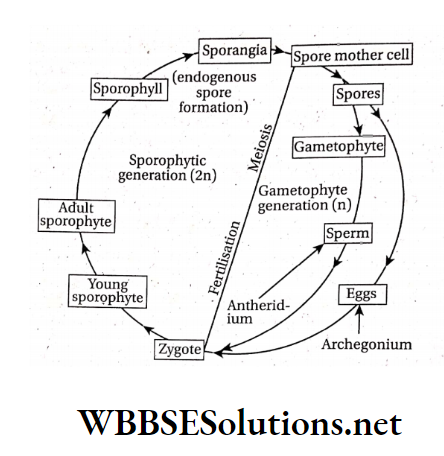
Example-human height.

Question 2. What are multiple alleles?
Answer:

Multiple alleles

When there are more than two alleles of a gene then they are called multiple alleles. The gene responsible for human blood.group is a gene with three alleles-IA, IB and i.

Question 3. What is a polygenic character?
Answer:

Polygenic character
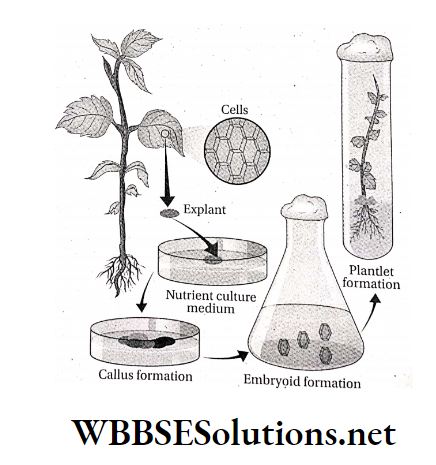
A character which is controlled by two or more than two genes is called a polygenic character. Example-Human body colour. It is a deviation from Mendelism.
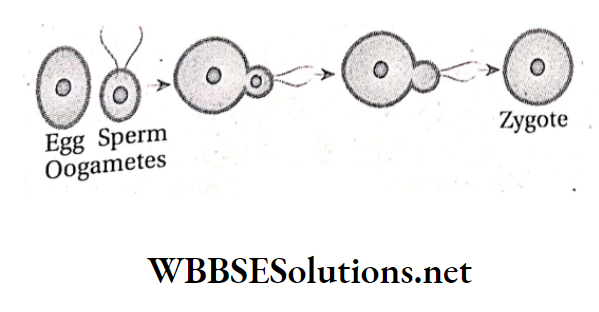
Question 4. Write down some methods of treatment for thalassemia.
Answer:

Methods of treatment for thalassemia

  1. Blood transfusion,
  2. Iron chelation,
  3. Bone marrow transplantation from a normal man.

Question 5. In which countries or regions of the world is thalassemia seen more?
Answer: Southeast Asia, India, Middle East and Africa.

Question 6. In which country or regions of the world is B thalassemia seen more?
Answer: Mediterranean region, Northern Africa, Western Asia.

Question 7. What is haemoglobin H disease?
Answer:

Haemoglobin H disease

Haemoglobin H disease is a form of alpha thalassemia in which reduced formation of a Globin chain takes place due to mutation in its gene. It leads to moderately severe anaemia.

WBBSE Solutions For Class 10 Life Science And Environment Chapter 2 Continuity Of Life Reproduction

Chapter 2 Continuity Of Life Reproduction Summary

WBBSE Class 10 Reproduction Overview

  • Reproduction is an important event for the existence of living organisms. Reproduction is mainly of two types-asexual reproduction and sexual reproduction. Vegetative reproduction is a special type of asexual reproduction.
  • The formation of new offspring from somatic cells without fertilization is called asexual reproduction and the formation of new offspring by fusion of gametes is called sexual reproduction.
  • The formation of the new individual directly from the segment of parent body is called vegetative reproduction. Asexual reproduction is mediated by single-parent cells, whereas in sexual reproduction two parent cells need to participate.

Read and Learn More WBBSE Solutions for Class 10 Life Science And Environment

  • In sexual reproduction, due to meiotic division, variation occurs in new offspring, so offspring with new characteristics will be produced.
  • Asexual reproduction may be of various types like fission [Amoeba] budding [Hydra, Yeast], fragmentation [Spirogyra], regeneration [Planaria], and sporulation [Moss, fern]
  • In vegetative reproduction, a part of the plant cell can produce new plantlets. It is of two types-natural and artificial. In the natural process, shoot, root, or leaf can give rise to new plantlets, whereas in the artificial process cutting, grafting or micropropagation can mediate the generation of new plantlets.
  • The alternation of a haploid and a diploid generation in the life cycle of an organism is called the alternation of generations. It is most distinct in fern.

Continuity Of Life Reproduction

Chapter 2 Continuity Of Life Reproduction Long Answer Type Questions

Question 1. Mention the common features of reproduction. Mention the significance of reproduction. Or, Why reproduction is important for an organism?

Answer:

Common features of reproduction:

Different phases of reproduction involve mitosis, meiosis, or both the processes of cell division. From gametogenesis to the embryonic development of a progeny, cell division is required in every phase.

  1. The molecular basis of reproduction is DNA replication.
  2. An offspring is formed through the union of gametes, germination of spores, or division of vegetative cells.

Significance of reproduction:

The significance of reproduction is as follows.

1. Increasing population size:

By means of reproduction, new individuals are born. As a result, the number of individuals in a population increases and the race of a species is maintained.

2. Maintaining the flow of genes:

By reproduction, the genes of a species flow from one generation to the next maintaining the hereditary characteristics.

3. Maintaining ecological balance:

Natural or unnatural death of individuals reduces the population size of a species. By reproduction, this loss is replenished in nature. This process keeps the ratio of different species in an ecosystem constant and thus maintains the ecological balance.

Life Science Class 10 Wbbse

WBBSE Solutions for Class 10 History WBBSE Solutions for Class 10 Geography and Environment
WBBSE Class 10 History Long Answer Questions WBBSE Solutions for Class 10 Life Science And Environment
WBBSE Class 10 History Short Answer Questions WBBSE Solutions for Class 10 Maths
WBBSE Class 10 History Very Short Answer Questions WBBSE Solutions for Class 10 Physical Science and Environment
WBBSE Class 10 History Multiple Choice Questions


4. Variation:

By sexual reproduction, different genetic variations come into existence. These variations assist any species to adapt in its surroundings and finally help in the evolution of new species.

WBBSE Solutions For Class 10 Life Science And Environment Chapter 2 Continuity Of Life Reproduction

Question 2. Briefly describe the different types of reproduction.

Answer:

Types of reproduction:

Two types of reproduction are seen in the living world. These are-

  1. Asexual reproduction and
  2. Sexual reproduction.

1. Asexual reproduction:

The type of reproduction, in which the formation of gametes and their fertilization do not occur, instead, certain body cells or specialized cells, like spores, divide to form the progeny, is known as asexual reproduction.

In this process, only one parent is required. All parental characters are inherited by the offspring. All the offspring become, genotypically and phenotypically identical to their mother.

For example Bacteria, several protists like Amoeba, and some fungi like Mucor, Penicillium, etc. perform asexual reproduction.

WBBSE Solutions For Class 10 Life Science And Environment Chapter 2 Reproduction Asexual reproduction in amoeba

2. Sexual reproduction:

The type of reproduction, that involves the union of two different types of gametes to produce a zygote and the development of a new progeny from it, is known as sexual reproduction. Most of plants and animals perform sexual reproduction.

This process requires a male and a female member of the same species or a single organism with two different types of gametangia to produce male and female gametes. In this process, the union of male and female gametes takes place.

As a result, the progeny gets genotypic and phenotypic characteristics different from its parents. Sexual reproduction essentially requires meiotic cell division for gamete formation and for keeping the chromosome number of a species constant.

Example: Sexual reproduction occurs in all higher animals and plants such as frogs, men, birds, angiosperms, etc.

Life Science Class 10 Wbbse

Question 3. Describe the five processes of asexual reproduction with one suitable example for each.

Answer:

Processes of asexual reproduction:

The following types of asexual reproduction can be seen in organisms-

1. Fission:

In most of the unicellular organisms two or more offspring are produced through mitosis or amitosis. This process is called fission. Some example are given below.

1. Amoeba:

Binary fission:

In favourable conditions, the nucleus of Amoeba undergoes amitotic division and gives of two nuclei. Its cytoplasm divides longitudinally creating a furrow and forms two offsprings.

Multiple fission:

In unfavorable conditions, the pseudopodia of Amoeba are destroyed and the body gets encapsulated by a cyst wall. Inside the cyst, numerous small spores are formed through multiple fission of nucleus and cytoplasm.

This type of multiple fission is called sporulation. When the condition becomes favorable, spores come out rupturing the cyst wall and giving rise to new Amoeba offspring.

2. Plasmodium:

In the case of Plasmodium, multiple fission takes place in two stages-Schizont and sporont. In the stomach of female Anopheles mosquito, numerous Plasmodium offsprings are born by the multiple fission called schizogony and sporogony is the schizont and sporont stages respectively.

The Plasmodium offsprings born through schizogony and sporogony are called merozoite and sporozoite respectively.

2. Budding:

Budding is a type of asexual reproduction in which a new organism develops from an outgrowth or bud of the parent body due to cell division at one particular site. Some examples of budding are given below.

Yeast:

Due to the unequal division of the yeast parent cell, a small outgrowth or bud is formed which contains the parent’s nucleus. Later on the bud separates from the parental body and develops into new yeast.

In special cases, the bud of yeast divides many times in the torula stage through the Tormulation process and forms mycelium.

Hydra:

In the case of Hydra, the bud is formed outside the parent body (exogenous bud). After the formation of the oral aperture, tentacles, etc. when the offspring matures, it gets detached from the parent body.

3. Fragmentation:

The type of asexual reproduction where the parent body is fragmented into two or more pieces and each fragment turns into new offspring, is called fragmentation.

Example:

The filamentous body of Spirogyra, an alga gets fragmented due to water currents or external damage. Each fragment undergoes mitotic cell division and gives rise to new offspring.

4. Regeneration:

The type of asexual reproduction where a mere body part of a parent organism creates a new offspring, is called regeneration. It is also called morphallaxis.

Life Science Class 10 Wbbse

Example:

If any body part of Planaria, a flatworm gets detached, it forms a new offspring. This process also can be seen in Hydra.

5. Sporulation:

Sporulation is a type of asexual reproduction in which unicellular spores are produced in moss, fern and fungi, they are dispersed and give birth to new offspring. Examples of sporulation are given below.

Fungi:

In fungi, spores with different structure and with or without motility can be seen. These spores germinate in favourable conditions and new fungi are born. Different types of spores are motile zoospores, non-motile aplanospores, thick-walled chlamydospores, oidia, and conidia formed from fragments of filaments, sporangiospores formed in sporangium.

Moss and Fern:

Spores are formed from the sporophytic tissue of the sporophytic plant body of moss. In the sporangium of sporophytic plant body of fern, spores with similar or different shapes are formed.

Types of Reproduction in Living Organisms

Question 4. Describe the mechanism of fission in Plasmodium with a diagram.

Answer:

Mechanism of fission in Plasmodium:

Plasmodium is a unicellular parasitic protist. It causes malaria in human beings. It goes through a number of multiple divisions to complete its life cycle. In human liver cells, this type of division is called schizogony.

The stage of Plasmodium undergoing schizogony is known as schizont. A schizont undergoes several successive karyokineses to produce many nuclei in it. Then each nucleus undergoes cytokinesis and liberates as a tiny daughter cell, called merozoites.

WBBSE Solutions For Class 10 Life Science And Environment Chapter 2 Reproduction Multiple division of Plasmodium

By this multiple fission, several hundreds of merozoites are formed, which again attack neighbouring liver cells and propagate in the same manner.

Inside the mosquito gut, the oocyst or sporont phase undergoes a similar type of multiple fission to produce sporozoites. This type of division is called sporogony.

Question 5. Briefly describe the asexual reproduction of Bryophyta, Pteridophyta, and fungi through spore formation.

Answer:

Bryophytes:

Bryophytes have two phases in their life cycle-the sporophytic (2n) and gametophytic (n) phases. The diploid sporophyte produces spores through meiosis in the specialized structure called sporangium.

All the spores are look alike i.e. homosporous. The sporangia are located in the capsule part of the sporophyte. The spores (n) are aplanospores, endogenous and when fall on a suitable substratum produce new gametophytes.

Pteridophyta:

In pteridophytes, spores (n) are formed by sporophytes (2n) in specialized sporangium. The spores may be homosporous or heterosporous. Homosporous spores are alike and produce a bisexual gametophyte.

Heterospores are of two types with microspores producing male gametophytes and megaspores producing female gametophyte. Spores are endogenous and haploid in nature as they are produced through meiosis from the spore mother cell.

Life Science Class 10 Wbbse

Fungi:

The spores in fungi may be endogenous in origin when produced in sporangia or may be exogenous origin like conidia produced by cutting the tip of fungi. In fungi, the endogenous spores are formed inside sporangia through mitosis.

The hyphal tip swells forming the sporangia. The nuclei undergo free nuclear division. Each nucleus with cytoplasm and membrane becomes a spore. The spores on suitable substratum germinate to produce new hypha.

Asexual Reproduction Methods

Question 6. What is meant by vegetative propagation? Briefly describe the processes of natural vegetative propagation. Part Question, ‘The adventitious leaf bud plays significant role in natural vegetative propagation of plant’-Evaluate the validity of the statement with a proper example.

Answer:

Vegetative propagation:

The asexual reproduction, in which any portion of the vegetative body of certain plants separates out from the mother’s body and finally grows into a new individual by mitotic cell division, is known as vegetative propagation.

Processes of natural vegetative propagation:

Vegetative propagation occurs by the growth of different parts of plants naturally, which are mentioned below.

1. By leaves:

Certain plants like Bryophyllum, Bigonia, etc. develop buds along the edges of their leaves. These are called leaf buds. These buds grow adventitious roots from their base.

When such a leaf detaches from the plant body and comes in contact with the soil, each of the buds grows into an individual daughter plant.

2. By roots:

Roots of sweet potato, pointed gourd, etc. grow adventitious buds. These are called root buds. When detached from the root, these buds grow into new daughter plants.

3. By stem:

Vegetative propagation by stem occurs by two different types of modified stems-

1. Underground modified stems:

The tuber of potato, bulb of onion, the rhizome of ginger, turmeric, etc. are underground stems, modified for storage of food. These organs have buds, which may grow into daughter plants.

2. Sub-aerial modified stems:

Nodes of sub-aerial modified stems of Mentha, Marsilea, Oxalis, Centella, water hyacinth, Chrysanthemum, etc. plants grow adventitious roots. When detached from the mother plant, the rooted branches grow as a daughter plant.

WBBSE Solutions For Class 10 Life Science And Environment Chapter 2 Reproduction natural vegetative propagation

Question 7. Mention the advantages and disadvantages of vegetative propagation.

Answer:

Advantages of vegetative propagation:

  1. Identical character-bearing plants can be produced by vegetative propagation.
  2. By this process, several daughter plants may be produced from a single mother plant within a brief period of time.
  3. Vegetative propagation can be practiced in any season throughout the year.
  4. Desired characteristics of the mother plant remain intact in the daughter plants.

Disadvantages of vegetative propagation:

  1. Daughter plants from vegetative propagation do not have any newer characters.
  2. The daughter plants formed by this type of reproduction do not show any variation. Therefore, these plants cannot adapt themselves to the changed environment.
  3. Vegetative propagation does not provide any chance for evolution of a new species. Hence, there is a chance of extinction.

Question 8. How is layering technique used for artificial vegetative propagation of certain plants? How is the “gootee” prepared for artificial vegetative propagation in certain plants?

Answer:

Use of layering technique for artificial vegetative propagation:

In the layering technique, a comparatively young and tender twig is bent, such that the nodal portion of it touches the soil. Now, the portion of the branch, touching the ground, is covered with a layer of moistened soil and then a brick or stone is placed on it.

The layered portion is watered regularly. After a few weeks, adventitious roots develop from that portion of the stem under the soil.

The branch is then chopped off from the mother plant and the twig with roots is planted elsewhere to grow further as a progeny. Layering is applicable to plants like lemon, jasmine, wood-apple etc.

Preparation of “Gootee” for artificial vegetative propagation:

In this artificial vegetative propagation technique, a strong and stiff twig of a shrub or tree is selected to prepare a Gootee. First, a few inches of the bark is peeled off with a knife.

Now this portion is covered with a muddy mixture of organic manure and soil. Then the soil layer is wrapped with moistened rag or coir. An additional layer of polythene sheet may be wrapped to prevent quick drying.

After a few weeks, adventitious roots grow there and appear on the surface of the goatee. Now, the twig is chopped off and used for plantation. Gootee is applicable in plants like mango, guava, litchi, etc.

Life Science Class 10 Wbbse

WBBSE Solutions For Class 10 Life Science And Environment Chapter 2 Reproduction Gootee

Question 9. Briefly describe the methods of cutting and grafting for artificial vegetative propagation.

Answer:

Methods of artificial vegetative propagation:

Artificial vegetative propagation of plants is done in different ways, which are mentioned below.

1. Cutting:

In this process, 20- 30 cm long twigs of certain plants are cut up from the mother plant. These are then planted in moistened soil.

Within a week or so, adventitious roots develop from the nodes and the twig grows as an individual plant. Cutting is successfully practiced upon the rose, china rose, drumstick plants, etc.

WBBSE Solutions For Class 10 Life Science And Environment Chapter 2 Reproduction Cutting

2. Grafting:

Grafting is the process of artificial vegetative propagation by which younger branches or buds of a superior variety of plants are affixed with an older and healthy stem of the same species to grow better varieties of plants in a short time.

WBBSE Solutions For Class 10 Life Science And Environment Chapter 2 Reproduction Grafting

It is of two types:

  1. Scion grafting and
  2. Bud grafting.

1. Scion grafting:

In scion grafting, stems of two different varieties of plants are attached together. Of these two, the stem of the older one is chopped off leaving a portion of it above the ground. This rooted portion is called the stock.

A younger stem branch with superior features is affixed with the stock, which is called the scion. The end of the scion is cut with a sharp knife to give it a shape of a wedge.

The top or side of the stock is also cut to allow the scion to fit there perfectly. This region is wrapped with a moist rag or coir. After some days, the scion joins to the stock and grows further.

Life Science Class 10 Wbbse

2. Bud grafting:

In this process, axillary bud from a superior variety of plants is sliced off. Now a T-shaped slit is made on the bark of a healthy quick-growing plant of the same species. The bud is then fitted in the slit and is tied with string.

Finally, the bud joins to the stem and grows as a branch with superior features. Grafting is applicable for plants like mango, guava, litchi, etc.

Question 10. Classify sexual reproduction based on the nature of gametes. Name the different types of asexual reproduction with example.

Answer:

Types of sexual reproduction:

Based on the nature of gametes, sexual reproduction can be classified into three types.

These are

  1. Anisogamy: It occurs by the union of two morphologically non-identical gametes.
  2. Isogamy: It occurs by the union of two morphologically and physiologically identical gametes.
  3. Oogamy: This type of sexual reproduction occurs by the union of a smaller motile and a larger non-motile gamete.

Types of asexual reproduction:

In the living world, different types of asexual reproduction are seen.

These are

  1. Fission (Amoeba, Plasmodium),
  2. Budding (Yeast, Hydra),
  3. Fragmentation (Spirogyra),
  4. Sporulation (Moss, fern, fungi),
  5. Regeneration (Planaria).

Question 11. Mention the advantages and disadvantages of sexual reproduction.

Answer:

Advantages of sexual reproduction:

  1. By sexual reproduction, the genetic characters of the parents are inherited by the offspring and this event is carried forward in the following generations as well.
  2. In sexual reproduction, the recombination of genes takes place, which results in to the formation of new genetic variations.
  3. New genetic variations, which develop among the progeny, help them to adapt efficiently with the changing environment.
  4. Due to better adaptability, the progeny of sexual reproduction come out as a winner in the struggle for existence. They get the favour of natural selection and finally take part in the evolution of new species.

Disadvantages of sexual reproduction:

  1. Sexual reproduction is a slow process. Therefore, it takes a longer time to produce offspring.
  2. The availability of two different types of gametes is essential, which may not always be available.
  3. The success rate of fertilization depends upon a large number of male gametes, which may not always be available.

Question 12. Mention the advantages and disadvantages of asexual reproduction. 

Answer:

Advantages of asexual reproduction:

  1. Asexual reproduction involves only one parental member, so it is an easier process.
  2. By this process, numerous offspring are produced at a time.
  3. This process needs very little energy.
  4. This is a very simple process and takes a very short time to complete.
  5. The parental features are retained within the progeny without any change.
  6. All progeny grow in close vicinity to its mother. Therefore, the progeny adapt easily to the known environment.

Disadvantages of asexual reproduction:

  1. Meiosis does not occur in asexual reproduction. Therefore, recombination of genes does not occur.
  2. Variations do not occur in the offspring of asexual reproduction.
  3. The chance of adaptability of these offspring is very low. Therefore, there is a possibility of their extinction.

Question 13. State the principle of micropropagation. Distinguish between asexual and sexual reproduction. 2+3 Or, Distinguish between asexual and sexual reproduction on the basis of the following features.

  1. Number of parents,
  2. Nature of offspring.

Answer:

Principle of micropropagation:

Certain plant cells have a unique ability to grow into a full plant body by means of cell division. This unique ability of plant cells is known as totipotency. Micropropagation is a tissue culture technique, which depends upon totipotency.

The word ‘micro’ means ‘very small. In micropropagation, very small portions are collected from vegetative parts of a plant and are cultured in a proper culture medium inside the laboratory to produce saplings.

Life Science Class 10 Wbbse

Differences between asexual and sexual reproduction

WBBSE Solutions For Class 10 Life Science And Environment Chapter 2 Reproduction Differences between Asexual and Sexual reproduction

Question 14. Distinguish between vegetative propagation and asexual reproduction.

Answer:

Differences between vegetative propagation and asexual reproduction

WBBSE Solutions For Class 10 Life Science And Environment Chapter 2 Reproduction Differences between Vegetative and Asexual reproduction

Question 15. What is meant by the alternation of generations? Mention the importance of meiosis in the alternation of generations.

Answer:

Alternation of generations:

The cyclic alternation between haploid gametophytic and diploid sporophytic generations in the life cycle of any sexually reproducing organism is called the alternation of generation.

Example:

In plants like moss, fern, etc., and protists like Paramoecium, Monocystis, etc. distinct alternation of generation is seen.

WBBSE Solutions For Class 10 Life Science And Environment Chapter 2 Reproduction Moss

Importance of mitosis in alternation of generations:

During the alternation of generation, the cyclic rotation continues between haploid (n) and diploid (2n) generations. Diploid spore mother cells divide by meiosis to give rise to haploid spores.

These spores germinate to grow as haploid (n) gametophytes. The gametophytes carry separate gametangia to produce haploid male and female gametes. These gametes fertilise to form diploid zygotes to initiate the sporophytic generation.

That is why meiosis is important for the alternation of generations.

Question 16. With the help of a schematic diagram represent the alternation of generations in fern. Similar Question, Represent the alternation of generation in fern with a suitable schematic diagram.
Or,
Depict the alternation of generations in a fern with the help of a flowchart.

Answer:

Alternation of generations in fern:

In the life cycle of ferns, two distinct phases, namely the sporophytic (2n) phase, and gametophytic (n) phase, are present. The sporophytic phase is the predominant one, which is perennial and conspicuous.

Within the sporangia, diploid spore mother cells undergo meiosis to produce numerous haploid spores. With the formation of spores, the haploid gametophytic generation sporophyte starts. These spores germinate to form gametophytes.

WBBSE Solutions For Class 10 Life Science And Environment Chapter 2 Reproduction Alternation Of generations in fern

In ferns, the gametophytes are short-lived and inconspicuous. The gametophytes develop male and female gametangia, named as antheridia and archegonia respectively.

Within antheridia, haploid male gametes are produced and female gametes originate in archegonia. These gametes fertilize to form diploid zygospores to mark the onset of the next sporophytic generation.

Sexual Reproduction Explained

Question 17. Briefly describe the micropropagation technique. Mention its advantages. Or, How micropropagation is done?

Answer:

Technique of micropropagation:

The stepwise technique of micro- propagation are as follows-

  1. At first, a disease-free plant is selected and a portion from the plant body is cut off with a sharp, well-sterilized instrument. This plant part is called an explant.
  2. The explants is sterilized by treating it with 70% ethyl alcohol for 1 minute. and kept in 10% hypochlorite solution for 15 minutes for further sterilization.
  3. The explant is then placed in a culture medium containing sucrose and a mixture of growth regulators like auxin and cytokinin.
  4. The containers are placed on agitators in a completely sterile laboratory room in ambient temperature.
  5. After a few days, a cluster of undifferentiated cells grow from the explant, these are called callus. Later, the cells of the callus divide and differentiate to form tiny somatic embryos or embryoids.
  6. By controlled treatment of hormones, the embroids are grown as small plantlets. These are then transferred to sterilized soil to grow more. As the plantlets grow as saplings these are planted in natural soil for further growth.

WBBSE Solutions For Class 10 Life Science And Environment Chapter 2 Reproduction Microprogation

Advantages of micropropagation:

  1. By micropropagation, a large number of saplings can be formed in a small place.
  2. The saplings, produced by this process are healthy and disease free.
  3. By this process, desired varieties of plants can be produced at any season throughout the year.
  4. The plants, which are unable to perform sexual reproduction, can be propagated by micropropagation.

Chapter 2 Continuity Of Life Reproduction Short Answer Type Questions

Question 1. Mention two characteristic features of sexual reproduction.

Answer:

Two characteristic features of sexual reproduction are as follows-

  1. In sexual reproduction, two different gametes, i.e., male and female gametes, unite to form the offspring.
  2. The progenies are born with variations, which in the long run, help in the formation of new and evolved species.

Question 2. How is a definitive nucleus formed during the sexual reproduction of angiospermic plants?

Answer:

Within the embryo sac of ovule of flowers in angiospermic plants, two haploids (n) polar nuclei unite together. As a result, a diploid (2n) definitive nucleus is formed.

Polar nucleus (n) + Polar nucleus (n) = Definitive nucleus (2n)

Question 3. What is syngamy?

Answer:

Syngamy:

Syngamy is a the complete and permanent union of two different gametes, i.e., male and female gametes, outside the gametangia. Syngamy is found in all sexually reproducing organisms.

Question 4. What is oogamy?

Answer:

Oogamy:

Oogamy is a type of sexual reproduction, where a small and motile male gamete fertilizes a large and non-motile female gamete. This is noticed among some algae like Oedogonium, Chara, etc., and in all higher plants and animals.

WBBSE Solutions For Class 10 Life Science And Environment Chapter 2 Reproduction Oogamy

Question 5. What is isogamy?

Answer:

Isogamy:

Isogamy is a type of sexual reproduction where two morphologically and physiologically identical gametes unite to form a zygote. Isogamy occurs in certain lower organisms like Chlamydomonas, Monocystis, etc.

WBBSE Solutions For Class 10 Life Science And Environment Chapter 2 Reproduction Isogamy

Question 6. What is anisogamy?

Answer:

Anisogamy:

Anisogamy is a type of sexual reproduction where two morphologically different gametes unite to form the zygote. This type of sexual reproduction is seen in certain species of Chlamydomonas.

WBBSE Solutions For Class 10 Life Science And Environment Chapter 2 Reproduction Anisogamy

Question 7. What is meant by asexual reproduction?

Answer:

Asexual reproduction:

The type of reproduction, in which the formation of male and female gametes and their fertilization do not occur. Instead, certain body cells or specialized cells like spores divide to form the progeny. This is known as asexual reproduction.

Example of Asexual reproduction:

Fungi, like yeast and certain lower animals perform asexual reproduction.

WBBSE Solutions For Class 10 Life Science And Environment Chapter 2 Reproduction Budding of yeast

Question 8. What is meant by asexual reproduction by fission?

Answer:

Asexual reproduction by fission:

For propagation, most unicellular organisms undergo two or multiple number of cell divisions to form two or more offspring, either through mitosis or amitosis. This type of asexual reproduction is called fission.

Example of Asexual reproduction by fission:

Amoeba and Plasmodium perform asexual reproduction by binary and multiple fissions respectively.

Question 9. What is budding?

Answer:

Budding:

In certain lower organisms, a small portion of the vegetative body swells out as an outgrowth and finally, it gets detached from the mother body and grows as a new progeny. This type of asexual reproduction is called budding.

Example of Budding:

Budding is commonly seen in yeast and Hydra.

WBBSE Solutions For Class 10 Life Science And Environment Chapter 2 Reproduction Budding in Hydra

Importance of Reproduction for Species Continuity

Question 10. What are the different steps of budding in yeast?

Answer:

The different steps of budding in yeast:

Initiation of bud as outgrowth → Division of parent nucleus into two nuclei → Migration of one nucleus into bud→ Wall formation between parent cell and bud→ Detachment of bud and formation of new cell

Question 11. What is meant by sporulation?

Answer:

Sporulation:

In certain lower plants, numerous, typically thick-walled cells or spores are produced in sporangia. On attaining maturity, these spores are liberated from the mother plant and fall on the ground and finally germinate to form the new progeny.

This type of asexual reproduction is known as sporulation.

Example of Sporulation: Sporulation occurs in fungi, moss, fern, etc.

Question 12. What is multiple fission?

Answer:

Multiple fission:

Multiple fission is a type of asexual reproduction in which the parent nucleus undergoes free nuclear division forming a huge number of nuclei. Each nuclei absorb little ammount of cytoplasm and forms a membrane around it to form a new daughter cell.

Example of Multiple fission: Amoeba.

WBBSE Solutions For Class 10 Life Science And Environment Chapter 2 Reproduction Multiple fission of Amoeba.

Question 13. What is meant by regeneration?

Answer:

Regeneration:

The process of asexual reproduction in which, a new progeny is formed from a fragment of the parent’s body, is known as regeneration.

Example of Regeneration: Planaria propagates by regeneration.

Question 14. What is meant by fragmentation?

Answer:

Fragmentation:

Filaments of certain lower plants often tear apart into fragments due to mechanical impact. By mitotic cell division, all these fragments may grow as individual progenies.

This type of vegetative propagation is known as fragmentation, for example-Spirogyra performs asexual reproduction by fragmentation.

WBBSE Solutions For Class 10 Life Science And Environment Chapter 2 Reproduction Fragmentaion in Spirogyra

Question 15. What is binary fission?

Answer:

Binary fission:

Binary fission is a type of asexual reproduction found in some prokaryotes and some unicellular eukaryotes in which the parent cell divides amitotically into two daughter cell.

Example of Binary fission: Amoeba.

WBBSE Solutions For Class 10 Life Science And Environment Chapter 2 Reproduction Amitosis in Amoeba

Question 16. What are the different type of fission found in Amoeba?

Answer:

The different type of fission found in Amoeba:

Amoeba is an unicellular eukaryote which reproduces asexually by two methods binary fission and multiple fission.

Amoeba produces two daughter cells from parent cells at a time by binary fission and numerous daughter cells by free nuclear division through multiple fission.

Question 17. What are zoospores?

Answer:

Zoospores:

Certain asexual spores are capable of locomotion with the help of cilia or flagella. These spores are called zoospores.

Example of Zoospores:

Spores of Volvox, Chlamydomonas, etc. are zoospores.

Question 18. What are aplanespores?

Answer:

Aplanespores:

The non-motile asexual spores, which do not possess any locomotory organ, are known as aplanospores.

Example of Aplanespores: Spores of Mucor, Penicillum, etc. are aplanospores.

Question 19. What is meant by zygospore?

Answer:

Zygospore:

In certain lower organisms, two different gametes unite to form a diploid cell by conjugation, which develops a thick protective is known as a zygospore.

Example of Zygospore:

Spirogyra, cell wall to form a typical spore. This type of spore Oedogonium have zygospores.

Question 20. What is propagule?

Answer:

Propagule:

The plant part from which a new plant is formed during reproduction is called the propagule. Bud is a propagule of asexual reproduction and seed is a propagule of sexual reproduction.

Question 21. What are the processes of asexual reproduction in spirogyra and planaria?

Answer:

Spirogyra mediates their reproduction by fragmentation, whereas planaria make it by regeneration.

Question 22. What is gametophyte and sporophyte?

Answer:

Gametophyte and sporophyte:

The plant gamete which is produced from spore and produces gamete is called gametophyte. The plant which is produced from a zygote and produces a spore is called a sporophyte.

Question 23. What is meant by artificial vegetative propagation?

Answer:

Artificial vegetative propagation:

In the practice of agriculture and horticulture, vegetative propagation of different plants is done under human manipulation. This is known as artificial vegetative propagation.

Question 24. What is stolen?

Answer:

Stolen:

The internodes of certain herbs grow to form arches which remain above the ground. However, their nodes remain affixed with the soil by adventitious roots.

This type of sub-aerial modified stem is known as stolon, which is seen in plants like Mentha, strawberry, etc.

Question 25. Give examples of a few plants, which naturally perform vegetative propagation.

Answer:

Many plants naturally perform vegetative propagation. These include sweet potato, potato, pointed gourd, onion, Bryophyllum, etc.

WBBSE Solutions For Class 10 Life Science And Environment Chapter 2 Reproduction Patato

Question 26. What is meant by stock and scion?

Answer:

Stock and scion:

In grafting, stems of two different varieties of plants are attached together. Of these two, the stem of the older plant is chopped off leaving a portion of it above the ground.

This rooted portion is called the stock and the younger stem branch with superior features which is affixed with the stock, is called the scion.

Question 27. Why grafting is not possible in paddy or maize plants.

Answer:

During grafting, stems of two different varieties of plant are attached together at the cambium region. So, for the grafting process, cambium plays a major role.

But paddy and maize, are monocot in nature and they do not contain cambium. So due to a lack of cambium, grafting is not possible in these plants.

Question 28. Which type of root is seen in sweet potato and what is its function?

Answer:

Fleshy tuberous adventitious roots are seen in sweet potatoes. The function of the roots of sweet potatoes is to store food. It also helps in vegetative propagation.

Question 29. Distinguish between cutting and grafting.

Answer:

Distinguishing features between cutting and grafting are-

WBBSE Solutions For Class 10 Life Science And Environment Chapter 2 Reproduction Differences between Cutting and Grafting

Question 30. What is micropropagation?

Answer:

Micropropagation:

The process by which tissues, cells, protoplasts or organs are collected from plants and cultured in laboratories within proper nutritive medium to produce progeny plants, is known as micropropagation.

By means of micro- propagation large number of identical progeny plants, can be produced within a short period.

Question 31. What is totipotency?

Answer:

Totipotency:

The inherent ability of any cell to divide and develop into a full-grown plant under proper environmental conditions outside the living body is known as totipotency.

Due to this unique ability, small segments of plant tissue can be cultured within the laboratories to produce tiny saplings from it.

Question 32. Mention two distinctive features of micropropagation.

Answer:

Two distinctive features of micropropagation are as follows-

  1. Micropropagation is a tissue culture technique by which several clones of plants can be produced vegetatively.
  2. By this process, the number of desired varieties of plants can be increased within a short time.

Question 33. Mention the disadvantages of micropropagation.

Answer:

The disadvantages of micropropagation-

  1. In micropropagation, no genetic variations are developed. Therefore, the plants produced in this process have lesser adaptability.
  2. Due to a lack of variation, micropropagation reduces the chance of evolution.

Question 34. What is meant by tissue culture?

Answer:

Tissue culture:

The biotechnological process in which tissues, collected from different organisms are cultured in the laboratory within a proper nutritive culture medium, under a suitable sterile environment, is known as tissue culture.

This process can form sprouts within laboratories from small plant tissues.

Question 35. Which plant hormones are mixed with a special tissue culture medium and why?

Answer:

Auxin and cytokinin are the hormones which are mixed in a special tissue culture medium. These two hormones regulate the growth of the cultured tissues. Therefore, these two growth regulators are used in tissue culture medium.

Comparative Study of Asexual and Sexual Reproduction

Question 36. What are explants?

Answer:

Explants:

The small plant parts, tissues, or cells, which are collected from plant bodies for culturing in laboratories, are called explants. The meristematic tissue-rich portions of plants, like apical buds, root tips, and tubers are mostly collected as explants.

Question 37. What is a callus?

Answer:

Callus:

While growing in sterile culture media, mitosis starts in explants. After some time, a cluster of undifferentiated cells are produced from the cells of explants.

This cluster of cells is known as a callus. The cells of the callus are totipotent in nature, which may divide to form a full-grown plant.

Question 38. What is meant by caulogenesis?

Answer:

Caulogenesis:

The development of stem from a callus, within a tissue culture medium, is called caulogenesis. This is a tissue differentiation process, which is initiated by a higher concentration of auxin and cytokinin in the culture medium.

Question 39. What is meant by histogenesis?

Answer:

Histogenesis:

The development of a root from a callus, within a tissue culture medium, is called histogenesis. This is a tissue differentiation process, which is initiated by a lower concentration of auxin and cytokinin in the culture medium.

Question 40. What is meant by histogenesis?

Answer:

Histogenesis:

The development of xylem and phloem tissues by the differentiation of a callus within a tissue culture medium is called histogenesis. This is a tissue differentiation process, which is regulated by auxin and cytokinin in the culture medium.

Question 41. What is an alternation of generations?

Answer:

Alternation of generations:

The alternation of a haploid (n) and a diploid (2n) generation in the life cycle of an organism showing sexual reproduction is called the alternation of generations.

Example: Fern.

Question 42. Mention the importance of the alternation of generations.

Answer:

The importance of the alternation of generations:

The cyclic rotation of haploid and diploid generations helps in keeping the chromosome number constant. The alternation of generations also helps in maintaining the genetic identity of any organism for generations.

Chapter 2 Continuity Of Life Reproduction Very Short Answer Type Questions Multiple Choice Questions And Answers [Mcq]

Question 1. Which of the following organisms performs reproduction by fission?

  1. Plasmodium
  2. Hydra
  3. Fern
  4. Planaria

Answer: 1. Plasmodium

Question 2. Which of the following organisms performs reproduction by budding?

  1. Amoeba
  2. Plasmodium
  3. Hydra
  4. Planaria

Answer: 3. Hydra

Question 3. Amoeba performs—

  1. Fission
  2. Budding
  3. Fragmentation
  4. Sporulation

Answer: 1. Fission

Question 4. Yeasts reproduce by—

  1. Fragmentation
  2. Sporulation
  3. Regeneration
  4. Budding

Answer: 4. Budding

Question 5. Which of the following organisms does not perform reproduction by spore formation?

  1. Moss
  2. Planaria
  3. Fern
  4. Fungi

Answer: 2. Planaria

Question 6. Fragmentation is seen in—

  1. Hydra
  2. Yeast
  3. Plasmodium
  4. Spirogyra

Answer: 4. Spirogyra

Question 7. Which of the following organisms performs reproduction by regeneration?

  1. Hydra
  2. Spirogyra
  3. Planaria
  4. Amoeba

Answer: 3. Planaria

Question 8. Adventitious bud formation occurs in the leaves of which of the following plants?

  1. Sweet potato
  2. Potato
  3. Water hyacinth
  4. Bryophyllum

Answer: 4. Bryophyllum

Question 9. Which of the following organisms performs reproduction by sporulation?

  1. Fungi
  2. Planaria
  3. Hydra
  4. Amoeba

Answer: 1. Fungi

Question 10. An example of the juicy root is—

  1. Water hyacinth
  2. Sweet potato
  3. Potato
  4. Bryophyllum

Answer: 2. Sweet potato

Question 11. Which of the following organisms shows both asexual as well as sexual reproduction?

  1. Hydra
  2. Amoeba
  3. Paramoecium
  4. Horse

Answer: 3. Paramoecium

Question 12. Grafting is a technique of—

  1. Sexual reproduction
  2. Asexual reproduction
  3. Vegetative propagation
  4. Parthenogenesis

Answer: 3. Vegetative propagation

Question 13. Reproduction in plants by cutting method is a type of—

  1. Artificial vegetative propagation
  2. Asexual reproduction
  3. Sexual reproduction
  4. Natural vegetative propagation

Answer: 1. Artificial vegetative propagation

Question 14. The reproductive stage, produced by the conjugation of similar gametes, is called

  1. Zygote
  2. Zygospore
  3. A zygospore
  4. Oospore

Answer: 2. Zygospore

Question 15. Which of the following performs reproduction by conjugation?

  1. Spirogyra
  2. Mucor
  3. Moss
  4. Fern

Answer: 1. Spirogyra

Question 16. Fern performs reproduction by—

  1. Budding
  2. Fragmentation
  3. Spore formation
  4. Regeneration

Answer: 3. Spore formation

Question 17. Fertilized ovum is known as—

  1. Spermatozoon
  2. Zygote
  3. Zygospore
  4. Spore

Answer: 2. Zygote

Question 18. An unfertilized egg, taking part in parthenogenesis, is known as—

  1. Zygote
  2. Zygospore
  3. A zygospore
  4. Oospore

Answer: 3. Azygospore

Question 19. The process of ovum formation is called—

  1. Spermatogenesis
  2. Oogenesis
  3. Parthenogenesis
  4. Gametogenesis

Answer: 2. Oogenesis

Question 20. The process of sperm formation is known as—

  1. Spermatogenesis
  2. Oogenesis
  3. Parthenogenesis
  4. Gametogenesis

Answer: 1. Spermatogenesis

Question 21. The Union of two identical gametes is called—

  1. Isogamy
  2. Anisogamy
  3. Oogamy
  4. Syngamy

Answer: 1. Isogamy

Question 22. The process of reproduction, in which offspring are formed by the division of body cells without the union of gametes, is called—

  1. Sexual reproduction
  2. Vegetative propagation
  3. Asexual reproduction
  4. Parthenogenesis

Answer: 3. Asexual reproduction

Question 23. In which of the following organisms sexual dimorphism is seen?

  1. Cockroach
  2. Earthworm
  3. Amoeba
  4. Plasmodium

Answer: 1. Cockroach

Question 24. External fertilization takes place in which of the following animals?

  1. Human
  2. Fish
  3. Deer
  4. Horse

Answer: 2. Fish

Question 25. Which of the following is an example of a hermaphroditic animal?

  1. Cockroach
  2. Snake
  3. Earthworm
  4. Toad

Answer: 3. Earthworm

Question 26. The formation of offspring from unfertilized egg is known as—

  1. Paedogenesis
  2. Parthenogenesis
  3. Parthenocarpy
  4. Oogenesis

Answer: 2. Parthenogenesis

Question 27. The process of asexual reproduction in bacteria is known as—

  1. Binary fission
  2. Fragmentation
  3. Multiple fission
  4. Mitosis

Answer: 1. Binary fission

Question 28. Which of the following plants performs reproduction by means of root buds?

  1. Rose
  2. Dahlia
  3. Pointed gourd
  4. Bryophyllum

Answer: 3. Pointed gourd

Question 29. The animal in which unfertilized eggs develop into offspring is—

  1. Toad
  2. Honey bee
  3. Pigeon
  4. Fish

Answer: 2. Honey bee

Question 30. Spore formation, from the spore mother cells in ferns, occurs by—

  1. Meiosis
  2. Amitosis
  3. Mitosis
  4. Binary fission

Answer: 1. Meiosis

Question 31. Sexual phase of alternation of generation is called—

  1. Gametophytic phase
  2. Sporophytic phase
  3. Gamete
  4. Parthenogenesis

Answer: 1. Gametophytic phase

Question 32. The asexual phase of alternation of generation in a plant is known as—

  1. Gametophytic phase
  2. Sporophytic phase
  3. Embryo
  4. Oogenesis

Answer: 2. Sporophytic phase

Question 33. The haploid phase of the alternation of generation in fern is—

  1. Gametophytic
  2. Sporophytic
  3. Parthenocarpic
  4. Both 1 and 2

Answer: 1. Gametophytic

Question 34. The sporophytic phase of the alternation of generation in fern is—

  1. Haploid (n)
  2. Diploid (2n)
  3. Triploid (3n)
  4. Quadruploid (4n)

Answer: 2. Diploid (2n)

Question 35. Vo I vox reproduces by—

  1. Sexual reproduction
  2. Asexual reproduction
  3. Vegetative propagation
  4. Parthenogenesis

Answer: 2. Asexual reproduction

Question 36. The modified sub-aerial stem of water hyacinth, which helps it in vegetative propagation, is called—

  1. Sucker
  2. Offset
  3. Runner
  4. Stolon

Answer: 2. Offset

Question 37. The buds, present on the margins of leaves of Bryophyllum, are called—

  1. Leaf buds
  2. Epiphytic buds
  3. Terminal buds
  4. Lateral buds

Answer: 1. Leaf buds

Question 38. Artificial vegetative propagation involving stock and scion is known as—

  1. Cutting
  2. Gootee
  3. Grafting
  4. Layering

Answer: 3. Grafting

Question 39. Artificial vegetative propagation which is applied for china rose and marigold, is—

  1. Cutting
  2. Gootee
  3. Grafting
  4. Layering

Answer: 1. Cutting

Question 40. The plant that performs vegetative propagation by bulbil is—

  1. Sweet potato
  2. Oxalis
  3. Air potato (Dioscorea)
  4. Dahlia

Answer: 3. Air potato (Dioscorea)

Question 41. A hermaphrodite animal that can perform self-fertilization is—

  1. Toad
  2. Liver fluke
  3. Ascaris
  4. Salamander

Answer: 2. Liver fluke

Question 42. A plant hormone, provided externally in tissue culture medium is—

  1. Thyroxine
  2. Artificial auxin
  3. Insulin
  4. Glucagon

Answer: 2. Artificial auxin

Question 43. Method of cloning is an example of—

  1. Micropropagation
  2. Genetic engineering
  3. Biotechnology
  4. All of these

Answer: 4. All of these

Question 44. The artificial reproduction in which culture medium is required is called—

  1. Cutting
  2. Grafting
  3. Micropropagation
  4. All of these

Answer: 3. Micropropagation

Question 45. Other than Planaria, which of the following animals shows regeneration?

  1. Spongilla
  2. Amoeba
  3. Pogonatum
  4. Paramoecium

Answer: 1. Spongilla

Question 46. The event of growth of any organism within the uterus is known as—

  1. Alternation of generation
  2. Vivipaiy
  3. External fertilisation
  4. Internal fertilisation

Answer: 2. Vivipaiy

Question 47. The physiological process by which an organism produces its own replica is known as—

  1. Respiration
  2. Circulation
  3. Excretion
  4. Reproduction

Answer: 4. Reproduction

Question 48. In grafting, the cut branch of the superior plant is called a ‘scion’. The inferior rooted portion, on which it is fixed, is called—

  1. Bark
  2. Stem
  3. Stock
  4. Bulb

Answer: 3. Stock

Question 49. The cutting, by which sugarcane plants can be propagated, is collected from—

  1. Root
  2. Stem
  3. Leaf
  4. All of these

Answer: 2. Stem

Question 50. A complete and permanent union of two identical gametes is called—

  1. Isogamy
  2. Anisogamy
  3. Syngamy
  4. Heterogamy

Answer: 3. Syngamy

Question 51. union of two male and female gametes of unequal size and shape is called—

  1. Isogamy
  2. Anisogamy
  3. Syngamy
  4. Heterogamy

Answer: 3. Anisogamy

Question 52. The presence of an organ, which is essential to distinguish between male and female of any unisexual organism, is called—

  1. Reproductive organ
  2. Respiratory organ
  3. Excretory organ
  4. Sensory organ

Answer: 1. Reproductive organ

Question 53. The continuous alternation of haploid and diploid generations in the life cycle of certain organisms is called—

  1. Alternation of generation
  2. Reproduction
  3. Conjugation
  4. Transformation

Answer: 1. Alternation of generation

Question 54. The cell division, by which the zygotes of higher plants and animals develop into full-grown organisms, is called—

  1. Meiosis
  2. Mitosis
  3. Both 1 and 2
  4. Amitosis

Answer: 2. Mitosis

Question 55. The fertilization between male and female gametes of higher organisms is known as—

  1. Isogamy
  2. Anisogamy
  3. Oogamy
  4. Syngamy

Answer: 3. Oogamy

Question 56. The first object produced from explants during micropropagation is—

  1. Callus
  2. Stock
  3. Scion
  4. Spore

Answer: 1. Callus

Question 57. The unequal-sized spores produced during asexual reproduction are called—

  1. Parthenocarpic
  2. Anthers
  3. Homospores
  4. Heterospores

Answer: 4. Heterospores

Question 58. Spores which are produced within sporangium, are called—

  1. Sporangiospores
  2. Aplanospores
  3. Zoospores
  4. Zygospores

Answer: 1. Sporangiospores

Question 59. An animal, capable of reproducing by sexual, asexual, and vegetative means, is—

  1. Spirogyra
  2. Hydra
  3. Spirogyra
  4. Hydra

Answer: 3. Spirogyra

Question 60. An animal,which performs asexual, asexual, and vegetative means is

  1. Spirogyra
  2. Hydra
  3. Spirogyra
  4. Hydra

Answer: 4. Hydra

Question 61. An aquatic organism that performs internal fertilization is—

  1. Mrigel fish
  2. Shark
  3. Rohu fish
  4. Catla fish

Answer: 2. Shark

Question 62. An example of an ovoviviparous animal is—

  1. Rohu fish
  2. Prawn
  3. Shark
  4. Whale

Answer: 3. Shark

Question 63. A plant that shows viviparous germination

  1. Garan
  2. Papaya
  3. Mango
  4. Pumpkin

Answer: 1. Garan

Question 64. The formation of offspring from any cut-off organs of a plant is called—

  1. Development
  2. Regeneration
  3. Transformation
  4. Reconstruction

Answer: 2. Regeneration

Question 65. The chromosome number of sperm is—

  1. Diploid
  2. Triploid
  3. Haploid
  4. Tetraploid

Answer: 3. Haploid

Question 66. The chromosome number of a zygote is—

  1. 2n
  2. n
  3. 3n
  4. 4n

Answer: 1. 2n

Question 67. The chromosome number of the ovum is—

  1. Diploid
  2. Triploid
  3. Pentaploid
  4. Haploid

Answer: 4. Haploid

Question 68. The capability of any tissue cell to form an entire plant body is called—

  1. Alternation of generation
  2. Parthenogenesis
  3. Totipotency
  4. Transformation

Answer: 3. Totipotency

Question 69. Which of the following pair is correct?

  1. Budding—Yeast
  2. Fragmentation—Earthworm
  3. Spore formation—Amoeba
  4. Regeneration—Dryopoteris

Answer: 1. Budding—Yeast

Question 70. Which one of the following statements is correct regarding sexual reproduction?

  1. Haploid gamete formation is essential in sexual reproduction
  2. Sexual reproduction depends only on mitosis
  3. In sexual reproduction, offspring could be produced from a single parental organism.
  4. The offsprings produced in sexual reproduction are genetically identical with a parental organism.

Answer: 1. Haploid gamete formation is essential in sexual reproduction

Question 71. Select the correct pair and write it—

  1. Multiple fission—Hydra
  2. Fragmentation—Spirogyra
  3. Regeneration—Fern
  4. Budding—Planaria

Answer: 2. Fragmentation—Spirogyra


Chapter 2 Continuity Of Life Reproduction Answer In A Single Word Or Sentence

Question 1. What is the process of formation of similar or dissimilar character-bearing offspring from parent organism called?
Answer: Reproduction

Question 2. What is the main cause of reproduction?
Answer: To maintain the race of a species

Question 3. What is the unit of sexual reproduction?
Answer: Gamete

Question 4. In which organ the spores for asexual reproduction of a plant are produced?
Answer: Sporangium

Question 5. What is produced after the union of sperm and ovum, during sexual reproduction?
Answer: A zygote is produced.

Question 6. Name a dioecious or unisexual plant.
Answer: Papaya plant

Wbbse Class X Life Science

Question 7. Name a bisexual but monoecious plant.
Answer: Mango plant

Question 8. Name a bisexual flower.
Answer: China rose (Hibiscus sp.)

Question 9. Name a unisexual flower.
Answer: Flower of pumpkin is a unisexual flower.

Question 10. Which is the unit of asexual reproduction of a plant?
Answer: Spore is the unit of asexual reproduction of a plant.

Question 11. Which type of reproduction is performed by Amoeba?
Answer: Amoeba performs asexual reproduction.

Question 12. Name a plant, which shows alternation of generation in its life cycle.
Answer: Selaginella (a fern)

Question 13. Name an animal, which shows an alternation of generations in its life cycle.
Answer: Obelia (a cnidarian)

Common Reproductive Strategies in Animals

Question 14. Name an animal, which performs reproduction by conjugation.
Answer: Paramoecium (a protist)

Question 15. Name an animal, which can reproduce by parthenogenesis.
Answer: Honey bee

Question 16. Name an oviparous animal.
Answer: Bird

Question 17. Name a viviparous animal.
Answer: Human

Question 18. Name the event of the union of male and female gametes in sexual reproduction.
Answer: Fertilisation

Wbbse Class X Life Science

Question 19. Name two hormones used for micropropagation.
Answer: Auxin and cytokinin

Question 20. In which type of reproduction new genetic features may appear in the offspring?
Answer: In sexual reproduction, new genetic features may appear in the offspring.

Question 21. By which process does Spirogyra perform sexual reproduction?
Answer: Spirogyra performs sexual reproduction by conjugation.

Question 22. Which type of offspring are produced in asexual reproduction?
Answer: The offspring produced in asexual reproduction, become genetically identical to its parents, i.e., no genetic variation occurs.

Question 23. How does the body fragment of a Planaria grow into a fully formed one?
Answer: By regeneration.

Question 24. How do you denote the union of a male and a female gamete of identical shape and size?
Answer: Isogamy.

Question 25. What is heterogamy?
Answer: Heterogamy is the union of two gametes with non-identical sizes and shape.

Question 26. How do you refer to the union of two gametes, produced in the body of the same animal?
Answer: The union of two gametes, produced in the body of the same organism, is called self-fertilization.

Question 27. How do you refer to the union of two gametes, produced in two different animals?
Answer: The union of two gametes, produced in two different animals, is called cross-fertilization.

Question 28. Name the type of fertilization that occurs in an open environment, outside the animal body.
Answer: External fertilization

Wbbse Class X Life Science

Question 29. Which phase of life cycle starts in an organism with the formation of haploid spores?
Answer: Gametophytic generation starts with the formation of haploid spores, in the life cycle of an organism.

Question 30. Name an organism, which performs asexual reproduction by multiple fission.
Answer: Plasmodium

Question 31. Name the process of fertilization of male and female gametes in the sexual reproduction of higher organisms.
Answer: The process of fertilization of male and female gametes in the sexual reproduction of higher organisms is known as oogamy.

Question 32. Upon which type of cell division does sexual reproduction depend directly?
Answer: Meiotic cell division

Question 33. Which type of cell division occurs during the gametogenesis of sexually reproducing higher organisms?
Answer: In higher organisms, meiotic cell division occurs during gametogenesis.

Question 34. Which type of cell division occurs during the sporogenesis of ferns and mosses?
Answer: Meiotic cell division

Question 35. Which type of cell division occurs during spore formation in Mucor and Penicillium?
Answer: Mitosis

Question 36. Which type of reproduction helps in creating variations among offspring?
Answer: Sexual reproduction

Wbbse Class X Life Science

Question 37. Name one organism that can reproduce through a motile spore.
Answer: Chlamydomonas

Question 38. Name one organism that can reproduce through a nonmotile spore.
Answer: Mucor

Question 39. Name fungi that reproduce through conidia.
Answer: Penicillium

Question 40. Give one example of a fleshy not, helping in vegetative reproduction.
Answer: Sweet potato

Question 41. Which plant vegetatively reproduces through stolon?
Answer: Mentha

Question 42. Which plant reproduces through a leaf?
Answer: Bryophyllum

Question 43. Who discovered micropropagation?
Answer: Frederick Campion Steward

Wbbse Class 10 Life Science Solutions

Question 44. Micropropagation is based on which property of a cell?
Answer: Totipotency

Question 45. What is a plantlet?
Answer: The small plants produced through micropropagation are called plantlets.

Question 46. Name one organism that reproduces through Conjugation.
Answer: Paramoecium

Question 47. What is the torula stage?
Answer: The bud of yeast looks like the animal Torula hence this stage is called the torula stage.

Question 48. What is syngamy?
Answer: Syngamy is the fusion of two different gametes.

Question 49. What is rhizogenesis?
Answer: Rhizogenesis is the production of roots in callus culture.

Question 50. Name one animal showing, vegetative, asexual, and sexual reproduction.
Answer: Hydra sp.


Chapter 2 Continuity Of Life Reproduction Fill In The Blanks

Question 1. A progeny comes from _________ generation.
Answer: Parental

Question 2. The individual of a new generation that originates from the parental generation is known as _________.
Answer: Offspring

Question 3. The number of a population _________ by reproduction.
Answer: Increases

Question 4. In sexual reproduction, _________ originate in a population.
Answer: Variations

Question 5. In asexual reproduction, only _________ parent is required.
Answer: One

Question 6. The union of male and female gametes is known as _________.
Answer: Fertilisation

Question 7. Based on the nature of gametes, sexual reproduction can be classified into _________ types.
Answer: Three

Wbbse Class 10 Life Science Solutions

Question 8. The sexual reproduction, in which the sizes of male and female gametes are unequal, is called _________.
Answer: Anisogamy

Question 9. The sexual reproduction, in which the sizes of male and female gametes are identical, is called _________.
Answer: Isogamy

Question 10. The sexual reproduction, in which the male gametes are small and motile, whereas the female gamete is large and non-motile, is called _________.
Answer: Oogamy

Question 11. Daughter cells of Plasmodium, produced by schizogony, are called _________.
Answer: Merozoites

Question 12. Daughter cells of Plasmodium, produced by sporogony, are called _________.
Answer: Sporozoites

Question 13. Planaria can perform asexual reproduction by _________ of its body fragments.
Answer: Regeneration

Question 14. Numerous _________ are produced from the sporogenous tissue of moss.
Answer: Spores

Question 15. Bryophyllum performs vegetative propagation by the on _________ its leaf margins.
Answer: Buds

Question 16. _________ is a type of tissue culture technique.
Answer: Micropropagation

Question 17. Spore-producing plants are known as _________ plants.
Answer: Sporophytic

Question 18. The _________, used in the grafting process, carries the superior characteristics of a plant.
Answer: Scion

Question 19. The diploid cell produced by fertilisation is _________.
Answer: Zygote

Question 20. Spore is formed within _________.
Answer: Sporangium


Chapter 2 Continuity Of Life Reproduction State True Or False

Question 1. The production of new offspring by a parental generation is called reproduction.
Answer: True

Question 2. Like nutrition, respiration or excretion, reproduction is also an essential life process of the living organisms.
Answer: False

Question 3. The unit of sexual reproduction is the gamete.
Answer: True

Question 4. The unit of vegetative propagation is spore.
Answer: False

Question 5. Amoeba divides by mitosis.
Answer: False

Question 6. Plasmodium reproduces by fragmentation.
Answer: False

Question 7. Yeast reproduces by spore production.
Answer: False

Question 8. Micropropagation is none other than a technique of tissue culture.
Answer: True

Question 9. Potato reproduces by stem buds.
Answer: True

Wbbse Class 10 Life Science Solutions

Question 10. Bryophyllum reproduces by root buds.
Answer: False

Question 11. Water hyacinth performs vegetative propagation by stolon.
Answer: False

Question 12. Birds show distinct alternations of generation.
Answer: False

Question 13. Scion, used in grafting, bears superior character.
Answer: True

Question 14. Apomixis is a process by which certain organisms can produce their progeny, without- out fertilization.
Answer: True

Question 15. The haploid phase of the alternation of generation in an organism is none other than the sexual phase.
Answer: True

Question 16. Fertilization is the union of male and female gametes.
Answer: True

Question 17. Planaria performs reproduction by regeneration.
Answer: True

Question 18. Paramoecium reproduces by budding.
Answer: False

Question 19. Plasmodium propagates by multiple fission.
Answer: True

Question 20. The most common process of sexual reproduction of animals and plants is syngamy.
Answer: True


Chapter 2 Continuity Of Life Reproduction Match The Columns

Question 1.

WBBSE Solutions For Class 10 Life Science And Environment Chapter 2 Reproduction Match the columns 1

Answer: 1. E, 2. D, 3. B, 4. A, 5. F, 6. G

Question 2.

WBBSE Solutions For Class 10 Life Science And Environment Chapter 2 Reproduction Match the columns 2

Answer: 1. E, 2. C, 3. A, 4. B, 5. D, 6. G

Question 3.

WBBSE Solutions For Class 10 Life Science And Environment Chapter 2 Reproduction Match the columns 3

Answer: 1. B, 2. A, 3. D, 4. C, 5. F, 6. E

Chapter 2 Continuity Of Life Reproduction Find The Odd One Out

Question 1. Cutting of rose plant, Grafting of lemon plant, Micropropagation of carrot plant, Formation of leaf bud of Bryophyllum plant.
Answer: Formation of leaf bud of Bryophyllum plant.

Question 2. Schizogony of Plasmodium, Zoospore formation of Phytophthora, Conidiospore, formation of Penicillium, Budding of yeast.
Answer: Budding of yeast

Question 3. Oidia, Conidia, Zoospore, Gamete.
Answer: Gamete

Question 4. Zoospore, Aplanospore, Gamete, Embryo.
Answer: Embryo

Wbbse Class 10 Life Science Solutions

Question 5. Sponge, Hydra, Yeast, Sporulation
Answer: Sporulation

Question 6. Regeneration, Fragmentation, Budding, Syngamy.
Answer: Syngamy

Chapter 2 Continuity Of Life Reproduction Fill In The Blanks By Looking At The First Pair

Question 1. Leaf bud: Bryophyllum:: Adventitious root bud: ________.
Answer: Sweet potato

Question 2. Spirogyra: Fragmentation:: Yeast: ________.
Answer: Buddings

Question 3. Regeneration: Asexual reproduction:: Micropropagation: ________.
Answer: Vegetative reproduction

Question 4. Bryopyllum: Leaf bud :: Water hyacinth: ________.
Answer: Offset

Question 5. Binary fission: Amoeba:: Regeneration: ________.
Answer: Planaria

Wbbse Class 10 Life Science Solutions

Question 6. Grafting: Mango:: ________: Chinarose.
Answer: Cutting

Question 7. Heterogamete: Anisogamy:: Isogamete:: ________.
Answer: Anisogamy

Question 8. Motile spore: Zoospore :: Non motile spore: ________.
Answer: Aplanopore

Chapter 2 Continuity Of Life Reproduction Among The Four Concepts Given Three Of Them Belong To One Find That

Question 1. Adventitious root bud, Offset of water hyacinth, Natural vegetative propagation, Leaf bud of Bryophyllum.
Answer: Natural vegetative propagation

Question 2. Cutting of rose twigs, Grafting of lemon plant, Artificial vegetative propagation, Layering of Chrysanthemum branch.
Answer: Artificial vegetative propagation

Question 3. Asexual reproduction, Sporulation, Fragmentation, Budding.
Answer: Asexual reproduction

Question 4. Cutting, Grafting, Micropropagation, Artificial Asexual reproduction.
Answer: Artificial asexual reproduction

Question 5. Gametophyte, Sporopyte, Fertilization, Alternation of generation.
Answer: Alternation of generation

Question 6. Cutting, Grafting, Vegetative reproduction; Micropropagation.
Answer: Vegetative reproduction

Question 7. Spore, Conidia, Sporangiospore, Oidia
Answer: Spore

Question 8. Asexual propagation of animals, Schizogony of Plasmodium, Binary fission of Amoeba, Regeneration of Planaria.
Answer: Asexual propagation of animals

WBBSE Solutions For Class 10 Life Science And Environment Chapter 4 Evidence For The Theory Of Evolution

Chapter 4 Evidence For The Theory Of Evolution Summary

WBBSE Class 10 Evidence for Evolution Overview

  • There are various compelling evidences of evolution and one of them is fossil. Fossils provide solid evidence for the fact that the ancestors of an organism were not the same as those found today. Fossils show the progression of the evolution of an organism.
  • Highly detailed fossil records have been discovered that depict the evolution of modern horses. The actual sequence of species in the evolution of horses is-Eohippus (first ancestor)→ Mesohippus (intermediate horse) → Merychippus → Pliohippus → Equus (Modern horse).
  • In the course of evolution, horses developed larger bodies, longer limbs, longer necks and longer and slimmer heads. Reduction in the number of toes and development of a third toe, reduction in the number of teeth and concentration on incisor and molar teeth are a few other features observed in the line of evolution of horses.

Read and Learn More WBBSE Solutions for Class 10 Life Science And Environment

Life Science Class 10 Wbbse

  • The organs with the same basic structural design and origin but with different functions are called homologous organs.
  • Example: Flipper of a whale, the hand of a human, patagium of the bat. Homologous organs are the result of divergent evolution.
  • Divergent evolution refers to the process by which interbreeding species diverge into two or more evolutionary groups mainly because of adaptation to different environmental conditions.
  • The organs with different origins but the same functions are called analogous organs.
  • Example: Wings of a bird and insect. Analogous organs develop because of convergent evolution. Convergent evolution is the process by which organisms, not closely related, independently evolve similar traits in order to adapt to similar environments.
  • The organ having no apparent functions within an organism, but was active in the ancestors of that organism, is called a vestigial organ.
  • Example: vermiform appendix and coccyx of human, wings of ostriches, pistinode of Cassia, etc.
  • Structures of hearts of vertebrates show gradual complexity and thus point out towards evolution. Embryos of all the vertebrates shows pharyngeal gill cleft and myotome muscle indicating their interrelationship.

Evidence For The Theory Of Evolution

Chapter 4 Evidence For The Theory Of Evolution LAQs

Question 1. Explain the importance of fossils in finding the evolutionary lineage of horse.

Answer:

Importance of fossils in finding the evolutionary lineage of horse

Fossils play very important role in finding the evolutionary lineage of any group of organisms. In case of horse’s evolution also, fossils played a very important role.

Palaeontologists have discovered the fossils of all the ancestors of horse, which helped the scientists to draw a complete evolutionary line of the modern horse from its earliest ancestor.

Life Science Class 10 Wbbse

It is now known that the earliest ancestor of horse, Eohippus, emerged about 55 million years ago. It was adapted in forest environment with its shorter legs consisting multiple digits.

Gradually, grassland developed and horses were adapted in the new environment by gradually acquiring changes in their physical structure. The evolutionary lineage of horse is-

Eohippus → Mesohippus → Merychippus → Pliohippus → Equus

WBBSE Solutions for Class 10 History WBBSE Solutions for Class 10 Geography and Environment
WBBSE Class 10 History Long Answer Questions WBBSE Solutions for Class 10 Life Science And Environment
WBBSE Class 10 History Short Answer Questions WBBSE Solutions for Class 10 Maths
WBBSE Class 10 History Very Short Answer Questions WBBSE Solutions for Class 10 Physical Science and Environment
WBBSE Class 10 History Multiple Choice Questions


By comparative analysis of fossil structures, scientists found the following features-

  1. Only 11 inches tall Eohippus has evolved into 60 inches tall modern horse, Equus.
  2. The hind legs have become more muscular to facilitate fast running.
  3. The number of digits in both limbs has reduced gradually and hoofs have developed.
  4. The length of the neck has increased.
  5. Sizes of cranium and cerebrum have increased significantly.
  6. The crowns of teeth have become higher to help in chewing of grass.

From this fossil study, the scientists have revealed almost all the adaptive features of the ancestral horses with the changing environment and presented the evolutionary lineage of modern horse from its ancestors.

WBBSE Solutions For Class 10 Life Science And Environment Chapter 4 Evidence For The Theory Of Evolution

Question 2. Briefly describe the evolution of horse.

Answer:

Evolution of horse:

The evolutionary lineage of horses has become clear today because palaeontologists have discovered fossils of all the ancestors of the modern horses.

The oldest ancestor of a horse was Eohippus, from which the modern horse, Equus, has come into being after crossing three other stages of evolution. Descriptions of the fossils of all ancestors of horses are mentioned below.

Homologous Chromosomes Definition

WBBSE Solutions For Class 10 Life Science And Environment Chapter 4 Evolution Evidence For The Theory Of Evolution Evolution of horse

WBBSE Solutions For Class 10 Life Science And Environment Chapter 4 Evolution Evidence For The Theory Of Evolution Evolution of horse

Fossil Evidence for Evolution

Question 3. How do homologous organs support organic evolution?

Answer:

Homologous organs in support of organic evolution:

Homologous organs support organic evolution to a great extent. This is explained as below.

1. Homologous organs of animals:

The basic skeletal structures of forelimbs of whale, bat, bird, cat. and man are same. All possess humerus, radius-ulna, carpals, metacarpals and phalanges.

However, these animals use their forelimbs in different ways to adapt to separate environments. Whale uses its forelimbs for swimming, but birds and bats use it for flying. Cat walks and captures prey with its forelimb and man uses it for grasping and eating.

Homologous

WBBSE Solutions For Class 10 Life Science And Environment Chapter 4 Evolution Evidence For The Theory Of Evolution Forelimbs of man,cat, Whale, bat

These evidences strongly indicate that all vertebrates have evolved from the same ancestor but separated from each other to adapt in separate environments.

2. Homologous organs in plants:

The thorn of the wood apple tree, stem tendril of the passion flower plant, phylloclade of cactus, etc. are modifications of the same organ but these perform different functions.

The above-mentioned examples prove that these organisms evolved from the same ancestor but with time, their organs have changed their shapes and functions to adapt in separate environments.


WBBSE Solutions For Class 10 Life Science And Environment Chapter 4 Evolution Evidence For The Theory Of Evolution Homologous organs of plant

Question 4. How do analogous organs support organic evolution?

Answer:

Analogous organs in support of organic evolution:

Analogous organs support organic evolution. This is explained below.

1. Analogous organs in animals:

Wings of birds and wings of insects are used for flying. However, structurally these two are different. Wings of birds are modifications of the forelimbs but the wings of insects are lateral folds of the cuticle of the thorax.

The sting of a scorpion and the sting of a honeybee are functionally identical, however, the sting of a scorpion is the modification of a telson and the sting of a honeybee is a modified ovipositor.

WBBSE Solutions For Class 10 Life Science And Environment Chapter 4 Evolution Evidence For The Theory Of Evolution Analogous organs

2. Analogous organs in plants:

The leaf tendril of the pea plant and the stem tendril of the passion flower plant are functionally similar. However, the former one is the modification of terminal leaflets and the latter one is the modified branch of the stem.

Homologous

Analogous organs indicate the adaptation of distantly related organisms in identical environments. Therefore, analogous organs provide strong support in favour of organic evolution.

Question 5. Distinguish between homologous and analogous organs. Mention differences between amphibian and reptilian hearts.

Answer:

Distinguishing features between homologous organs and analogous organs

WBBSE Solutions For Class 10 Life Science And Environment Chapter 4 Evolution Evidence For The Theory Of Evolution Distinguishing between homologous and analogous organs

Life Science Class 10 Wbbse

Differences between amphibian and reptilian heart

WBBSE Solutions For Class 10 Life Science And Environment Chapter 4 Evolution Evidence For The Theory Of Evolution Differences between Amphibian and Reptilian heart

Question 6. How do vestigial organs favour organic evolution?

Answer:

Vestigial organs as evidence for organic evolution:

  1. In many herbivores, like rabbits, guinea pigs, etc. a big saccular caecum is present at the junction of the large and small intestine. It gives shelter to symbiotic bacteria to facilitate their cellulose digestion. However, human food contains less cellulose. Therefore, this organ remains as a functionless, tiny worm-like projection in a man called a vermiform appendix.
  2. The tail of the monkey acts as a balancing organ in arboreal locomotion. In humans, tail is of no need, hence it is present as a tiny coccyx bone at the end of the spine.
  3. The nictitating membrane is active in amphibians but non-functional in humans. Muscles of pinnae are useless in humans but functional in cattle. Transverse abdominal muscles are essential for cheetahs but of no use in human beings.
  4. Wings of birds are essential organs but in flightless birds (ostrich, kiwi, emu, etc.), wings become vestigial.
  5. Scale leaves of the rhizome of ginger and turmeric, and staminodes of Cassia are examples of vestigial organs in plants.


WBBSE Solutions For Class 10 Life Science And Environment Chapter 4 Evolution Evidence For The Theory Of Evolution Vestigial organs of human

Homologous and Analogous Structures Explained

The presence of vestigial organs in certain organisms proves that in the course of evolution, those have become functionless and reduced but in ancestral forms, they were prominent and active. Therefore, vestigial organs can be treated as good evidence in favour of organic evolution.

Question 7. Explain the comparative anatomical evidence in support of organic evolution.
Or,
Explain the comparative anatomy of vertebrate hearts and forelimbs in support of organic evolution. Part question, How the comparative anatomy of hearts act as proof in favour of evolutionary theory?

Answer:

Comparative anatomical evidence in support of organic evolution:

A comparative study on related groups of organisms, clearly reveals the basic structural similarity among few of their organs. It also indicates the evolutionary trend of those organisms.

Here, comparative studies on some organs of different groups of vertebrates are mentioned below.

Homologous

1. Heart of vertebrates:

The basic structure of the hearts of fishes, amphibians, reptiles, birds and mammals is similar. All of them have an auricle as the blood-receiving chamber and a ventricle as the chamber that expels blood from the heart. However, in the course of evolution, the hearts of different vertebrates encountered some changes.

The heart of fish has one auricle and one ventricle and thus carries only deoxygenated blood along a single circuit. Amphibians have two auricles and one ventricle in their heart. Here, oxygenated and deoxygenated blood get mixed in the ventricle.

Apart from two auricles, the reptilian heart has a partially divided ventricle, in which partial mixing of oxygenated and deoxygenated blood occurs (exception-crocodile has a four-chambered, double-circuit heart).

Hearts of birds and mammals have two auricles and two ventricles. Therefore oxygenated and deoxygenated blood flow through separate circuits.

WBBSE Solutions For Class 10 Life Science And Environment Chapter 4 Evolution Evidence For The Theory Of Evolution Structure of heart of vertibrates

Conclusion:

The above-mentioned evidence proves that advanced and complex forms of animals have evolved from primitive and simple forms. The gradual development of the heart and circulatory system of different vertebrates point towards the evolutionary trend as mentioned below.

Fishes → Amphibians → Reptiles → Birds and mammals

Life Science Class 10 Wbbse

2. Forelimbs of different vertebrates:

The basic skeletal structures of the forelimbs of whales, bats, birds, horses and men are all alike. All possess humerus, radius-ulna, carpals, metacarpals and phalanges.

However, these animals use their forelimbs in different ways to adapt in different environments. As whale uses its forelimbs for swimming, birds and bats use them for flying. The horse runs with the help of their forelimbs and man use them for grasping.

Conclusion:

This evidence strongly indicates that all vertebrates have evolved from a single ancestor but diverged from each other to adapt in separate environments.

Question 8. Briefly describe the embryological evidence in favour of organic evolution.

Answer:

Embryological evidence in favour of organic evolution:

Comparative and chronological study of the embryos of fishes, amphibians, reptiles, birds and mammals reveals that all these groups of vertebrate organisms have many similarities in the shape and structure of the embryos for a period of time.

This observation directly indicates that all these different groups of organisms have evolved from a single ancestor.

Vestigial Organs and Evolution

The similarities are-

  1. Embryos of all these forms have developed from a unicellular zygote.
  2. The zygotes of these organisms have divided mitotically to form blastocysts.
  3. In the next phase of development, these blastocysts transform into gastrula.
  4. All these forms are triploblastic.

A comparative study of these vertebrates reveals two main structural similarities among them.

Homologous

1. Presence of pharyngeal gill clefts and internal gill pouches:

All these groups of animals have pharyngeal gill clefts at the lateral sides of their heads in their initial embryonic states. The endothelium of the pharynx infolds to form two laterally placed gill pouches in all these embryos.

The gill clefts and gill pouches jointly form the pharyngeal organ. In the course of maturity, fishes develop gills from this pharyngeal organ, but in other terrestrial organisms, the pouches either give rise to other structures or disappear.

In humans, the clefts develop into thyroid, parathyroid and thymus glands.

WBBSE Solutions For Class 10 Life Science And Environment Chapter 4 Evolution Evidence For The Theory Of Evolution Embryological similarities

2. Tail-like structure and myotome muscles:

Embryos of all these classes have a tail-like structure and laterally placed myotome muscles. For example, a frog bears a tail in its larval stages but not in its adult stage.

Similarly, in human beings, the tail becomes vestigial in the form of a coccyx after embryonic development. Further, in addition to fishes, myotome muscles are also found in human beings, in a specific segment of the spinal cord where the spinal nerve innervates.

These above-mentioned similarities indicate towards same ancestral lineage of these vertebrate classes and also support the concept of organic evolution.

Chapter 4 Evidence For The Theory Of Evolution SAQs

Question 1. Furnish some evidence in favour of Darwinism.
Answer:

The pieces of evidence in favour of Darwinism is as follows-

  1. Stick insects and leaf insects take the shape of dry branches and dry leaves respectively to camouflage in the plants to avoid predation. These typical shapes are naturally selected to help them survive on the earth.
  2. The length of the suckers of nectar-eating insects is so adjusted that can reach the nectar glands of their favourite flowers. This typical length of the sucker is naturally selected to let the insects get their food easily.

Question 2. What are fossils?
Answer:

Fossils:

Fossils are the petrified remains, impressions traces of extinct primitive organisms, preserved via natural processes within the layers of ancient sedimentary rocks.

Example-Fossils of dinosaurs, Archaeopteryx, etc.

WBBSE Solutions For Class 10 Life Science And Environment Chapter 4 Evolution Evidence For The Theory Of Evolution Fossil of dinosaur

Question 3. What are living fossils?
Answer:

Living fossils:

Certain primitive plants and animals are still surviving in the recent world without any significant characteristic change throughout the course of evolution. These organisms are called living fossils.

Example-Limulus (animal), Ginkgo biloba (plant), etc.

WBBSE Solutions For Class 10 Life Science And Environment Chapter 4 Evolution Evidence For The Theory Of Evolution Ginkgo biloba

Embryological Evidence for Evolution

Question 4. What are missing links?
Answer:

Missing links:

While drawing the evolutionary lineage of any group of organisms, it is often noticed that there are certain gaps in it due to the extinction of certain connecting species.

These extinct species are called missing links. Fossil of Archaeopteryx, for instance, is the missing link between reptiles and birds.

WBBSE Solutions For Class 10 Life Science And Environment Chapter 4 Evolution Evidence For The Theory Of Evolution Fossil of Archaeopteryx

Question 5. Mention the importance of fossils as evidence of organic evolution.
Answer:

Fossils provide strong evidence in favour of organic evolution in the following ways-

  1. Fossils provide the idea about the size, shape, food habit and approximate age of a fossilised organism.
  2. By studying fossils, scientists can acquire knowledge about the nature of flora and fauna present in the environment of that time.
  3. Fossils can trace the ancestral history of any modern species, thus depicting the evolutionary lineage.

Wbbse Class 10 Life Science Solutions

Question 6. Distinguish between fossil and living fossil
Answer:

The distinguishing features between fossil and living fossils are-

WBBSE Solutions For Class 10 Life Science And Environment Chapter 4 Evolution Evidence For The Theory Of Evolution Distinguish between fossil and living fossil

Question 7. What is palaeontology?
Answer:

Palaeontology:

Palaeontology is a branch of biology, in which fossils are studied to gain knowledge about the characteristic features of ancient animals. Palaeontology helps to draw the evolutionary trend of the related organisms.

Moreover, study of palaeontology helps the scientists to find out the lineage of emergence of a new species from it’s ancestors.

Question 8. Write in chronological sequence the names of four main fossil ancestors during the course of evolution of the horse.
Answer:

In chronological sequence, the four main fossil ancestors during the course of evolution of the horse are-Eohippus → Mesohippus → Merychippus → Pliohippus → Equus (modern horse)

Question 9. Write four important features modified in the evolution of horse.
Answer:

Four important features modified in the evolution of horse are-

  1. Gradual increase in height,
  2. Decrease in number of digits in both forelimbs and hindlimbs and formation of hoof,
  3. Increase in the size of crown of molar and pre- molar teeth,
  4. Increase in volume of cerebral hemisphere.

Question 10. Distinguish between Eohippus and Equus.
Answer:

The distinguishing features between Eohippus and Equus are-

Wbbse Class 10 Life Science Solutions

WBBSE Solutions For Class 10 Life Science And Environment Chapter 4 Evolution Evidence For The Theory Of Evolution differences between Eohippus and Equus

Molecular Evidence Supporting Evolution

Question 11. What are homologous organs?
Answer:

Homologous organs:

The organs of different organisms, having similar origin and fundamental structures but with differences in appearance and functions, are called homologous organs.

Example: Hands of humans and wings of birds.

Question 12. Which anatomical feature proves forelimbs of amphibians and wings of birds as homologous organs?
Answer:

Both the forelimbs of amphibians and wings of birds have same skeletal elements, i.e. humerus, radius-ulna, carpal, metacarpal and phalanges. This anatomical similarity proves that these two organs are homologous in nature.

Question 13. Mention two features of internal structures on the basis of which ‘flippers of whales and ‘wings of birds’ are considered homologous organ.
Answer:

Two features of internal structures on the basis of which ‘flippers of whale’ and ‘wings of birds’ are considered homologous organ are-

  1. The basic skeletal structures of flipper of whales and wings of birds are same. Both possess humerus, radius- ulna, carpals, metacarpals and phalanges.
  2. Well developed flexor and extensor muscles are present in flipper of whale and also in wings of birds.

Question 14. What is divergent evolution?
Answer:

Divergent evolution:

To adapt in dissimilar environments, certain organs, having same origin and structure, may take different shapes to perform separate functions in descendants coming from a common ancestral form. This type of adaptive evolution is called divergent evolution.

Example:

Homologous organs like forelimbs of horse, paddle of whale and hands of man are structurally similar but functionally different, which indicates divergent evolution.

Wbbse Class 10 Life Science Solutions

Question 15. What are analogous organs?
Answer:

Analogous organs:

The organs of different organisms having different origin and fundamental structures, but with somewhat similar appearances and identical functions are called analogous organs.

Example: Patagium of bats and wings of insects.

Question 16. Give examples of analogous organs in animals.
Answer:

Examples of analogous organs in animals

The wings of birds and insects are examples of analogous organs in animals. Both these animals use the wings for flight, but structurally these are completely different.

Question 17.

  1. Structure and function
  2. Indicating the nature of evolution

Based on the above two features, establish the concept of analogous organs with the help of proper example.
Answer:

Analogous organs are those organs which are different in structure and origin but perform similar functions.

Analogous organs indicate convergent evolution. For example, wings of bird, wings of insect and patagium of bat perform same function, i.e., they help the organisms to fly but they have different structures.

Wings of birds are modification of forelimbs, wings of insects are outgrowth of insects’ exoskeleton and patagium of bat is actually fold of skin between forelimbs and hind limbs.

All these structures point towards the fact that in same environment, different structures may evolve to perform same function. This further points toward convergent evolution.

Question 18. What is meant by convergent evolution?
Answer:

Convergent evolution:

Distantly related groups of animals or plants, inhabiting in identical surroundings for a long period, may develop analogous organs to adapt themselves in that particular environment.

This adaptive evolution is known as convergent evolution. Example-The terminal leaflets of pea plants and some branches of pumpkin plants are modified into tendrils.

WBBSE Solutions For Class 10 Life Science And Environment Chapter 4 Evolution Evidence For The Theory Of Evolution Convergent evo;ution

Question 19. Distinguish between homologous and analogous organs.
Answer:

The distinguishing features between homologous and analogous organs are-

WBBSE Solutions For Class 10 Life Science And Environment Chapter 4 Evolution Evidence For The Theory Of Evolution Distinguishing features between homologous and Analogous organ


Question 20. What is parallel evolution?
Answer:

Parallel evolution:

Two or more descendants from the same ancestor, inhabiting in identical surroundings may develop similar traits to adapt themselves in that particular environment. This adaptive evolution is known as parallel evolution.

Example:

Deer and antelopes have same ancestors, they thrive in similar environments and both have split hoofs for fast running.

Wbbse Class 10 Life Science Solutions

Question 21. What are vestigial organs?
Answer:

Vestigial organs:

Vestigial organs are the organs which have become reduced and non-functional due to prolonged disuse. These organs were previously functional and well-built in ancestral forms.

The muscles of the pinnae, vermiform appendix, and nictitating membrane of the eye are some vestigial organs in humans.

Question 22. Write the names of one each vestigial organ present in the vertebral column and alimentary canal in the human body.
Answer:

In the human body, the vestigial organ present in the vertebral column is the coccyx and that present in the alimentary canal is the appendix.

Question 23. Distinguish between the amphibian heart and the mammalian heart.
Answer:

The distinguishing features between the amphibian heart and the mammalian heart are-

WBBSE Solutions For Class 10 Life Science And Environment Chapter 4 Evolution Evidence For The Theory Of Evolution Distinguish between Amphibian and Mammalian heart


Question 24. Mention the biogenetic theory of organic evolution.
Answer:

The biogenetic theory of organic evolution:

Biogenetic theory of evolution or the theory of recapitulation, proposed by scientist Ernst Haeckel, states that ontogeny repeats phylogeny. It means the embryonic phases of a species resemble its evolutionary trend.

Question 25. Briefly mention the role of Ernst Haeckel in the field of comparative embryology.
Answer:

German scientist Ernst Haeckel explained the organic evolution under the light of comparative embryology and thus confirmed Darwinian concept on evolution.

He compared three embryonic stages of eight different vertebrates and reached to a conclusion that ontogeny repeats phylogeny. This means, the embryonic stages of animals resemble their evolutionary trend.


WBBSE Solutions For Class 10 Life Science And Environment Chapter 4 Evolution Evidence For The Theory Of Evolution Emst Haeckel

Natural Selection as Evidence of Evolution

Question 26. How do principles of Von Baer, on comparative embryology, support the organic evolution?
Answer:

To support the organic evolution in 1828, German scientist Von Baer had put forward certain principles on embryology. According to him-

  1. General species characters appear first in its early embryonic stages.
  2. With advance- ment of embryonic development, typical and specific characters of species appear in the embryos.

Question 27. What are pharyngeal gill clefts?
Answer:

Pharyngeal gill clefts:

In any of the stages of their life, chordates. possess several parallel clefts at two lateral sides of the pharynx. In aquatic forms, these clefts transform into gills.

In terrestrial forms, these ridges develop certain glands, which are known as pharyngeal gill clefts.


Chapter 4 Evidence For The Theory Of Evolution MCQs

Question 1. The stings of honeybees and wasps are—

  1. Homologous organs
  2. Analogous organs
  3. Vestigial organs
  4. Both 1 and 2

Answer: 2. Analogous organs

Question 2. The branch of science, dealing with the study of fossils, is called—

  1. Palaeontology
  2. Palaeogeography
  3. Herpetology
  4. Embryology

Answer: 1. Palaeontology

Question 3. Organs with similar structure and origin but different functions are called—

  1. Homologous organs
  2. Analogous organs
  3. Vestigial organs
  4. Connecting organs

Answer: 1. Homologous organs

Question 4. The feature of analogous organs is—

  1. Different in origin and functions are also different
  2. Different in origin but functions are the same
  3. Indicates divergent evolution
  4. Identical in origin and structure

Answer: 2. Different in origin but functions are the same

Question 5. A vestigial structure in the human body is—

  1. Humerus
  2. Caecum
  3. Vermiform appendix
  4. Trachea

Answer: 3. Vermiform appendix

Question 6. Which of the following is not vestigial in humans?

  1. Tail bone
  2. Appendix
  3. Nail
  4. Nictitating membrane

Answer: 3. Nail

Question 7. The connecting link between reptiles and mammals is—

  1. Archaeopteryx
  2. Platypus
  3. Peripatus
  4. Octopus

Answer: 2. Platypus

Question 8. The fossilised animal, Archaeopteryx, is treated as the missing link between which of the following two groups?

  1. Reptiles and mammals
  2. Birds arid mammals
  3. Amphibians and mammals
  4. Reptiles and birds

Answer: 4. Reptiles and birds

Question 9. The heart, carrying deoxygenated blood, is present in—

  1. Toad
  2. Fish
  3. Snake
  4. Crocodile

Answer: 2. Fish

Question 10. The tendril of pea and passion flower plants are—

  1. Homologous organs
  2. Vestigial organs
  3. Analogous organs
  4. Growth organs

Answer: 3. Analogous organs

Question 11. Horses evolved on earth approximately—

  1. 40 million years ago
  2. 65 million years ago
  3. 100 million years ago
  4. 55 million years ago

Answer: 4. 55 million years ago

Question 12. An example of a missing link is—

  1. Equus
  2. Archaeopteryx
  3. Eohippus
  4. Ostrich

Answer: 2. Archaeopteryx

Question 13. The modern horse evolved approximately—

  1. 5 million years ago
  2. 1 million years ago
  3. 15 million years ago
  4. 20 million years ago

Answer: 2. 1 million years ago

Question 14. Name an animal which is a living fossil.

  1. Earthworm
  2. Rohu fish
  3. Limulus
  4. Garden lizard

Answer: 3. Limulus

Question 15. The height of Eohippus was—

  1. 11-12 inches
  2. 51-52 inches
  3. 71-72 inches
  4. 81-82 inches

Answer: 1. 11-12 inches

Question 16. Name a plant which is a living fossil.

  1. Cooksonia
  2. Rhynia
  3. Pinus
  4. Ginkgo biloba

Answer: 4. Ginkgo biloba

Question 17. Dawn horse is more commonly called as

  1. Eohippus
  2. Merychippus
  3. Mesohippus
  4. Pliohippus

Answer: 1. Eohippus

Question 18. Which is known as a ‘ruminating horse’?

  1. Eohippus
  2. Pliohippus
  3. Mesohippus
  4. Merychippus

Answer: 4. Merychippus

Question 19. The intermediate horse is—

  1. Pliohippus
  2. Mesohippus
  3. Merychippus
  4. Equus

Answer: 2. Mesohippus

Question 20. The horse with a single digit is—

  1. Mesohippus
  2. Merychippus
  3. Pliohippus
  4. Equus

Answer: 4. Equus

Question 21. The oldest ancestor of the horse was seen in—

  1. Eocene era
  2. Miocene era
  3. Pliocene era
  4. Oligocene era

Answer: 1. Eocene era

Question 22. The 24 inches tall ancestor of the modern horse, which was seen in the Oligocene era, is—

  1. Eohippus
  2. Mesohippus
  3. Pliohippus
  4. Merychippus

Answer: 2. Mesohippus

Question 23. The horse of the Miocene era, having three digits in both the fore and hindlimbs, is—

  1. Merychippus
  2. Mesohippus
  3. Eohippus
  4. Pliohippus

Answer: 1. Merychippus

Question 24. The height of Merychippus was—

  1. 100 cm
  2. 60 cm
  3. 28 cm
  4. 160 cm

Answer: 1. 100 cm

Question 25. The reptilian heart has two auricles and a partly divided ventricle. An exception is seen in—

  1. Snake
  2. Garden lizard
  3. Tortoise
  4. Crocodile

Answer: 4. Crocodile

Question 26. The modern horse is called—

  1. Eohippus
  2. Mesohippus
  3. Pliohippus
  4. Equus

Answer: 4. Equus

Question 27. Who discovered the fossils showing the evolution of horse?

  1. Darwin
  2. Lamarck
  3. Wales
  4. Charles Marsh

Answer: 4. Charles Marsh

Question 28. Which of the following denotes a vestigial organ of plants?

  1. Stamen
  2. Leaf
  3. Staminode
  4. None of the above

Answer: 3. Staminode

Question 29. Which of the following has vestigial wings?

  1. Pigeon
  2. Hornbill
  3. Vulture
  4. Kiwi bird

Answer: 4. Kiwi bird

Question 30. “Ontogeny repeats phytogeny”—Who proposed this?

  1. Mendal
  2. Lamarck
  3. Darwin
  4. Haeckel

Answer: 4. Haeckel

Question 31. Number of chambers in the heart of reptiles—

  1. Two
  2. Three
  3. Incompletely four
  4. Four

Answer: 3. Incompletely four

Question 32. Which of the following sequence is right?

  1. Pishes → Amphibians → Birds and mammals → Reptiles
  2. Amphibians → Fishes → Reptiles → Birds and mammals
  3. Birds and mammals → Fishes → Amphibians → Reptiles
  4. Fishes → Amphibians → Reptiles → Birds and mammals

Answer: 4. Fishes → Amphibians → Reptiles → Birds and mammals

Question 33. Which of the following changes did not occur during the course of the evolution of the horse?

  1. Lengthening of limbs
  2. Increase in the length and thickness of all digits in limbs
  3. Increase in the length and thickness of only the third digit in limbs
  4. Increase in size of the whole body.

Answer: 2. Increase in the length and thickness of all digits in limbs


Chapter 4 Evidence For The Theory Of Evolution Answer In A Single Word Or Sentence

Question 1. What type of organs are the flippers of whales, the forelimbs of horses and the hands of man?
Answer: Homologous organs

Question 2. What type of organs are the wings of birds and wings of insects?
Answer: Analogous organs

Question 3. Which type of evolution is indicated by homologous organs?
Answer: Divergent evolution

Question 4. Which reptile has a four-chambered heart?
Answer: Crocodile

Question 5. Which group of animals has a venous heart?
Answer: Fish

Question 6. What is the scientific name of the modern horse?
Answer: Equus caballus

Question 7. Give an example of a vertebrate living fossil.
Answer: Tuatara (Sphenodon sp.)

Question 8. From the point of view of origin, which organ of the horse shows similarity with the wings of birds?
Answer: Forelimbs

Question 9. Certain organisms possess characteristics of two different groups of organisms. What are these organisms called?
Answer: Connecting link

Question 10. Certain organs have become non-functional in the course of evolution. What are these called?
Answer: Vestigial organs

Question 11. Which digit of a horse is modified into a hoof?
Answer: The third digit

Question 12. Which is the vestigial organ of an ostrich?
Answer: Wings

Question 13. Name an egg-laying mammal.
Answer: Duck-billed platypus

Question 14. Name the oldest ancestor in the evolutionary path of the horse.
Answer: Eohippus

Artificial Selection and Its Role in Evolution

Question 15. How many digits were there in the fore and the hindlimbs of an Eohippus?
Answer: The forelimbs and the hindlimbs of an Eohippus had four and three functional digits respectively.

Question 16. Which type of fossils are examined under the microscope?
Answer: Microfossils

Question 17. Name the connecting link between gymnosperms and angiosperms.
Answer: Gnetum

Question 18. On attaining maturity, what happens to the embryonic gill pouches and gill clefts in mammals?
Answer: On attaining maturity, the embryonic gill pouches and gill clefts in mammals transform into thyroid, parathyroid and thymus glands.

Question 19. Who proposed the concept, ‘ontogeny repeats phylogeny’?
Answer: Scientist Ernst Haeckel

Question 20. What is Archaeopteryx?
Answer: Archaeopteryx is the missing link between reptiles and birds.

Question 21. Which digit of the horse is transformed into a hoof?
Answer: The third digit

Question 22. Which is the vestigial organ of the kiwi?
Answer: Wings

Question 23. Which teeth of a human is vestigial?
Answer: The third molar teeth

Question 24. When was Merychippus originated?
Answer: Miocene

Question 25. How many chambers are there in a bird’s heart?
Answer: Four

Question 26. Write down the names of two vestigial organs of plants.
Answer: Staminode of Cassia and scale leaf present in the rhizome of ginger.

Question 27. What is the alternative name of biogenetic law?
Answer: Recapitulation theory


Chapter 4 Evidence For The Theory Of Evolution Fill In The Blanks

Question 1. The petrified remains or impression of any organism, kept for ages in the layers of sedimentary rocks are called ________.
Answer: Fossils

Question 2. Coccyx is a ________ organ of the human body.
Answer: Vestigial

Question 3. Among the ancestors of the horse, hoofs developed first in ________.
Answer: Merychippus

Question 4. The hoof of modern horse is the transformation of the digit number ________ of their ancestors.
Answer: Three

Question 5. Homologous organs evolve due to ________ evolution.
Answer: Divergent

Question 6. Analogous organs in different types of organisms, provide evidence of ________ evolution.
Answer: Convergent

Question 7. Phylloclade of cactus and tuber of potato are examples of two ________ organs.
Answer: Homologous

Question 8. The leaf tendril of pea plant and stem tendril of the passion plant are examples of ________ organs.
Answer: Analogous

Question 9. The appendix is a ________ organ of the human body.
Answer: Vestigial

Question 10. The heart of fish carries deoxygenated blood only, therefore, it is known as ________ heat.
Answer: Venous

Question 11. Hearts of birds and mammals have ________ chambers.
Answer: Four

Question 12. One living fossil animal is ________.
Answer: Limuliis

Question 13. The number of digits on the forelegs of Merychippus were ________.
Answer: 3

Question 14. The heart of fish is ________ chambered.
Answer: Two

Question 15. According to Haeckel, ontogeny repeats ________.
Answer: Phylogeny

Question 16. The name of the modern horse is ________.
Answer: Equus

Question 17. The earliest ancestor in the evolution of the horse is ________.
Answer: Eohippus


Chapter 4 Evidence For The Theory Of Evolution State True Or False

Question 1. Although a crocodile is a reptile, it has a four-chambered heart.
Answer: True

Question 2. The reptilian heart has a partly segmented ventricle.
Answer: True

Question 3. The sequence of vertebrate evolution can be represented as, fishes → amphibians → reptiles → birds and mammals.
Answer: True

Question 4. The wings of birds and insects are examples of analogous organs.
Answer: True

Question 5. The organs of different organisms, having same origin and fundamental structures but performing different functions, are called analogous organs.
Answer: False

Question 6. The hands of humans and the wings of birds are analogous organs.
Answer: False

Question 7. The Stem tendril of the passion flower plant and the thorn of the wood apple tree are examples of homologous organs.
Answer: True

Question 8. The branch of science that deals with the study of fossils to find out the line of evolution of any organism, is known as palaeontology.
Answer: True

Question 9. Staminodes of Cassia are its vestigial organs.
Answer: True

Question 10. Mesohippus is the earliest ancestor of the modern horse.
Answer: False

Question 11. Among the ancestors of horses, hoofs developed first in Merychippus.
Answer: True

Question 12. Pliohippus is called a ruminating horse.
Answer: False

Question 13. The pinnae are vestigial organs of the human body.
Answer: True


Chapter 4 Evidence For The Theory Of Evolution Match The Columns

Question 1.

WBBSE Solutions For Class 10 Life Science And Environment Chapter 4 Evolution Evidence For The Theory Of Evolution Match The Columns 1

Answer: 1. C, 2. E, 3. A, 4. D, 5. B, 6. F

Question 2.

WBBSE Solutions For Class 10 Life Science And Environment Chapter 4 Evolution Evidence For The Theory Of Evolution Match The Columns 2

Answer: 1. C, 2. F, 3. A, 4. E, 5. B, 6. D

Question 3.

WBBSE Solutions For Class 10 Life Science And Environment Chapter 4 Evolution Evidence For The Theory Of Evolution Match The Columns 3

Answer: 1. B, 2. A, 3. E, 4. C, 5. D, 6. G


Chapter 4 Evidence For The Theory Of Evolution Find The Odd One Out

Question 1. Forelegs of the horse, Wings of a pigeon, Wings of the bat, Wings of a butterfly
Answer: Wings of butterfly

Question 2. Eohippus, Merychippus, Mesohippus, Mammoth
Answer: Mammoth

Question 3. Eohippus, Dinosaur Archaeopteryx, Crocodile,
Answer: Crocodile

Question 4. Coccyx, Spleen, Appendix, Nictitating membrane
Answer: Spleen

Question 5. Wings of a bird, Forelegs of the horse, Hands of a human, Tail of a whale
Answer: Tail of a whale

Question 6. Adaptation in a particular environment, Analogous organ, Convergent evolution, Divergent evolution
Answer: Divergent evolution


Chapter 4 Evidence For The Theory Of Evolution Fill In The Blanks By Looking At The First Pair

Question 1. Amphibian heart: Mixed blood:: Reptilian heart: ___________
Answer: Partially mixed blood

Question 2. Vermiform appendix and nictitating membrane of man: Vestigial organ:: Wings of birds and insects: ___________
Answer: Analogous organs

Question 3. Biogenetic law: Ernst Haeckel:: Mutation theory: ___________
Answer: Hugo de Vries

Question 4. Eocene: Eohippus :: Oligocene: ___________
Answer: Mesohippus

Question 5. Homologous Organ: Divergent evolution Analogous organ: ___________
Answer: Convergent evolution

Question 6. Mammals Four chambered heart:: Amphibians: ___________
Answer: Three-chambered heart

Question 7. Functionally different: Homologous organ:: Difference in origin:___________
Answer: Analogous Organ

Question 8. Eohippus: Oldest ancestor of horse:: Equus: ___________
Answer: Modern horse


Chapter 4 Evidence For The Theory Of Evolution Among The Four Concepts Given Three Of Them Belong To One Find That

Question 1. Flippers of whales and hands of humans, Structurally similar but functionally different organs, Homologous organs, Wings of birds and bats
Answer: Homologous organs

Question 2. Reduction in the number of toes, Increasing running ability, Lengthening of legs, Development of single hard hoof all
Answer: Increasing running ability

Question 3. Pliohippus, Fossils of horse, Merychippus, Mesohippus
Answer: Fossils of horse

Question 4. Staminode, Wings of kiwi, Pistilode, Vestigial organs
Answer: Vestigial organ

Question 5. Human heart, Heart of a bird, Double circuit heart, Heart of a frog
Answer: Double-circuit heart

Question 6. Concept of evolution, the Concept of ancient environment, the Importance of fossils, Concept of the origin of an organism
Answer: The importance of fossil

WBBSE Solutions For Class 10 Life Science And Environment Chapter 4 Theories Of Organic Evolution

Chapter 4 Theories Of Organic Evolution Summary

Theory Of Organic Evolution

  • There are various theories regarding evolution, of which Lamarckism and Darwinism are the most significant.
  • In the year 1809, Lamarck published his book ‘Philosophie Zoologique’ where he proposed and explain his theories regarding the evolution of new species.
  • The main features of the theory of Lamarck are-
  1. Internal vital force
  2. New needs culminate in the formation of the new organ
  3. Law of use and disuse of an organ
  4. Inheritance of acquired characters
  5. Formation of new species
  • German biologist August Weismann conducted an experiment where he removed the tails of mice repeatedly over 22 generations and reported that no mice were born in consequence without a tail or even with a shorter tail.
  • This experiment opposed the theory of inheritance of acquired characters of Lamarck. Charles Robert Darwin sailed around the world, as a naturalist, aboard the HMS Beagle and this experience and studies that he made, helped him to propose the theory of evolution which was published in his book, ‘Origin of Species by Means of Natural Selection’.
  • The salient features of the theory of Darwin are-

Life Science Class 10 Wbbse

  1. Prodigality of production
  2. Limited food and shelter on earth
  3. Struggle for existence
  4. Variations
  5. Survival of the fittest
  6. Natural selection
  7. Origin of new species
  • Few limitations of Darwin’s theory concern the origin of variation, the origin of new characters, the arrival of the fittest, etc.

Theories Of Organic Evolution

Read and Learn More WBBSE Solutions for Class 10 Life Science And Environment

Chapter 4 Theories Of Organic Evolution Long Answer Type Questions

Question 1. Briefly describe the Lamarckian concept of evolution. Part question, Describe two major tenets of Lamarck’s evolutionary theory.

Answer:

Lamarckian concept of evolution:

In 1809, Lamarck proposed the concept of organic evolution in his famous book, titled ‘Philosophie Zoologique. This concept is popularly known as Lamarckism.

Lamarckism is based on the following basic propositions.

Wbbse Class 10 Life Science Solutions

WBBSE Solutions For Class 10 Life Science And Environment Chapter 4 Evolution Theories Of Organic Evolution Lengthening of giraffe's neck

WBBSE Class 10 Theories of Organic Evolution Overview

1. Internal vital force:

An internal vital force or energy in all life forms helps in the development of the body and organs.

WBBSE Solutions For Class 10 Life Science And Environment Chapter 4 Theories Of Organic Evolution

2. Development of new organs according to need:

With the change in environment, a need develops among the organisms for morphological and behavioural change. Newly developed organs help the organisms to adapt in the changing environment.

3. Law of use and disuse:

Any organ, which is used more, grows in size and strength, whereas, that which is used less, reduces in size, becomes weak and finally becomes extinct.

Example of use of organ:

Ancestors of giraffes had short necks. To collect the leaves of taller plants, they stretched their necks continuously. This conscious effort made their necks long and eventually, giraffes with longer necks evolved.

Example of disuse of organ:

The ancestors of snakes had limbs. While adapting to the fossorial habitat, their limbs were left unused. Finally, limbs. of snakes were lost during the course of evolution.

4. Inheritance of acquired characters:

Any change in the characteristics of an organism, which an organism achieves by conscious effort, is inherited by its offspring.

5. Formation of new species:

The characters acquired during the lifetime are passed onto the progeny and after a number of generations, new species is produced.

To get leaves from tall trees, ancestors of giraffes stretched their necks. By this process, one might have lengthened it a little, which was inherited directly by its offspring.

This process continued for several thousand generations and finally completely different-looking long-necked giraffes emerged as a new species from their ancestors.

WBBSE Solutions for Class 10 History WBBSE Solutions for Class 10 Geography and Environment
WBBSE Class 10 History Long Answer Questions WBBSE Solutions for Class 10 Life Science And Environment
WBBSE Class 10 History Short Answer Questions WBBSE Solutions for Class 10 Maths
WBBSE Class 10 History Very Short Answer Questions WBBSE Solutions for Class 10 Physical Science and Environment
WBBSE Class 10 History Multiple Choice Questions


Wbbse Class 10 Life Science Solutions

Question 2. What is meant by the ‘Inheritance of acquired characters’? Explain with an example. Mention the demerits in the Lamarckian concept of evolution.

Answer:

Inheritance of acquired characters:

According to Lamarck, any feature that organisms acquire during its conscious effort to adapt in to an environment is inherited by its offspring. This event is known as the ‘Inheritance of acquired characters.

Example:

The necks of ancient giraffes were short. With a continuous effort to reach the leaves of taller trees, they stretched to lengthen their necks. The little change achieved by this process in one generation was inherited by the next.

This process continued for several successive generations and gradually long-necked giraffes have arrived as a new species.

Demerits of Lamarckism:

  1. The law of use and disuse is not universally accepted. In some cases, active organs may reduce in size in the course of evolution.
  2. Only internal vital force cannot develop a new organ. An aquatic animal cannot become a terrestrial animal only by internal desire.
  3. Continuous use of any organ never always makes an organ stronger. The heart, for instance, never becomes larger and stronger with time.
  4. Inheritance of acquired characters is not always evident. No somatic change is inherited by the next generation, it may occur only in case of any change in the germ cells.

WBBSE Solutions For Class 10 Life Science And Environment Chapter 4 Evolution Theories Of Organic Evolution Lamarck

Darwin’s Theory of Natural Selection Explained

In this connection, Weismann’s experiment may be cited. He cut the tails of newborn rats for 22 successive generations; however, tail-less rats were never born.

Similarly, Drosophila flies were reared in complete darkness for 60 successive generations, but no blind fly was born. Based on this observations, Weismann strongly opposed the Lamarckian concept of inheritance of acquired characters.

Question 3. Explain the Darwinian concept on organic evolution. Part Questions, Discuss the following three events as mentioned in the evolutionary theory of Darwin:

  1. The prodigality of production,
  2. Origin of variation,
  3. Natural selection

Answer:

Darwinian concept on organic evolution:

In 1859, Charles Darwin explained the modern concept of organic evolution in his famous book ‘On. the Origin of Species by Means of Natural Selection, which has become famous as Darwinism or as the theory of natural selection. The basic thoughts of Darwinism are mentioned below.

1. Prodigality of production:

Darwin opined that all organisms increase their population in a geometric rate. For example, a pond snail lays 6 million eggs in a year. A female salmon fish releases 30 million eggs in a reproductive season.

2. Limited food and shelter on earth:

The space on the earth and supply of food do not increase in proportion to the rate of increase in population. Therefore, a scarcity of food and shelter occurs in the living world.

3. Struggle for existence:

Continuous increase in population size and scarcity of food and shelter results in to conflicts among the organisms for survival. Darwin referred to it as the struggle for existence. This struggle is of three types-

  1. Intraspecific struggle-The conflict among the members of a same species population for food, shelter and mating partners.
  2. Inter-specific struggle-The- conflict among the members of different species for resources and shelter.
  3. Environmental struggle- This struggle is for surviving different natural calamities, like drought, flood, earthquake, etc.

Wbbse Class 10 Life Science Solutions

WBBSE Solutions For Class 10 Life Science And Environment Chapter 4 Evolution Theories Of Organic Evolution Struggle for existence

Lamarckism vs Darwinism

4. Variation:

Darwin indicated that no two individuals of the same species are identical. There must be some differences between them, which he stated as variations.

5. Survival of the fittest:

Darwin mentioned two different types of variations-favourable and unfavourable. Favourable variations help an organism to adapt to changing environment but unfavourable variations cannot help in their adaptation.

The individuals with unfavourable variations face a defeat in the struggle for existence and become extinct in the course of time. Whereas, the organisms with favourable variations win that struggle and survive on Earth.

Scientist Herbert Spencer denoted this event as the ‘survival of the fittest.

6. Natural Selection:

According to Darwin, organisms with favourable variations are selected by nature for survival because they are fittest to face their surroundings. Darwin explained this event as ‘natural selection.

The naturally selected forms thrive successfully and propagate very fast to increase their population.

7. Origin of new species:

Accumulation of many favourable variations in any group of organisms for generations makes their descendants widely different from their ancestors. Finally, these completely changed descendants emerge as new species.

Question 4. What is natural selection? Mention the drawbacks of Darwinism. Part question, Explain the process of natural selection as proposed by Darwin with the help of a suitable example.

Answer:

Natural selection:

Natural selection means the selection of a suitable organism in an environment by nature itself. According to Darwin, organisms acquire either favourable or unfavourable variations during their struggle for existence.

Those with favourable variations are selected by nature. They can adapt perfectly with its environment and come out victorious in the struggle for life. They thrive successfully and propagate quickly.

On the other hand, the organisms, which have unfavourable variation, do not get the favour of natural selection and cannot adapt themselves in their environment. The population of these forms reduces gradually and finally, becomes extinct.

For example, in an ecosystem, some giraffes have long necks and others have short necks. If a situation arises, where there is a scarcity of low-lying shrubs, the giraffes with short necks would not get enough food. After a few generations, all the giraffes would have long necks.


WBBSE Solutions For Class 10 Life Science And Environment Chapter 4 Evolution Theories Of Organic Evolution Darwin

Evidence Supporting Organic Evolution Theories

Drawbacks of Darwinism:

  1. Darwin mentioned the role of variation in evolution but could not explain the sources of it.
  2. Darwin emphasised on small variations but in reality, small variations play no role in the origin of species.
  3. Darwin supported the concept of survival of the fittest, however, he could not explain the cause of the emergence of the fittest.
  4. According to Darwin, excessive development of any organ facilitates evolution but it is seen that over-specialisation often pushes a species towards extinction.
  5. Darwin did not differentiate between somatic and reproductive variations.
  6. During natural calamities, even the fittest organisms also die, where natural selection does not operate.

Question 5. What is ‘survival of the fittest’? Explain how do certain organs become vestigial giving examples of few vestigial organs in animals and plants.

Answer:

Survival of the fittest:

Here, the word ‘fittest’ means, the most competent individual or group among a number of individuals or groups. On the other hand, ‘survival’ means coming out victorious in the struggle for existence.

During the struggle for existence in a hostile environment, certain organisms acquire some favourable variations, which help them to survive in the struggle. However, there are some other organisms, which have unfavourable variations, cannot overcome environmental barriers and gradually become extinct.

Therefore, the fittest organisms win the battle for survival and thrive successfully. Herbert Spencer denoted this event as ‘survival of the fittest’.


WBBSE Solutions For Class 10 Life Science And Environment Chapter 4 Evolution Theories Of Organic Evolution Vermiform appendix

The emergence of vestigial organs:

Certain organs, which were once active and useful in ancestors, may become non-functional and weak in their descendants due to continuous disuse in the changed environment. Thus, certain active organs transform into vestigial and inactive organs.

1. Example of vestigial organs in animals:

Muscles of the pinna, the nictitating membrane of the eye, vermiform appendix are a few examples of vestigial organs in man. The pelvic girdle bones of a whale, and wings of ostrich are some vestigial organs of other animals.

2. Example of vestigial organs in plants:

Scale leaves of underground-modified stems, sterile gynoecia of coconut, staminodes of Cassia, and scale-like leaves of Cuscuta are some vestigial organs in plants.

Question 6. Explain the process of lengthening of giraffe’s neck under the light of Lamarckism and Darwinism.

Answer:

Explanation of lengthening of giraffe’s neck:

Lamarck and Darwin, the two pioneer figures of evolutionary science, explained the event of gradual lengthening of the giraffe’s neck in two different ways.

1. Lamarckian explanation:

Lamarck believed that the necks of the ancestors of giraffes were almost similar to that of recent horses. To reach the leaves of taller trees they used to stretch their necks continuously.

In this process, members of every generation lengthened their necks to a little extent. This changed feature was inherited by the next generation and this process continued for several successive generations.

Finally, after thousands of generations, the long-necked giraffes have emerged as a new species.

2. Darwinian explanation:

According to Darwin, in ancient days members of the giraffe population had various lengths of necks. Those with longer necks could reach the leaves of taller trees and hence got more food than the ones with shorter necks.

The long-necked giraffes became healthier and thrived successfully. On the other hand, the short-necked giraffes became weaker and reproductively incapable due to a shortage of adequate food.

Gradually, the number of these giraffes went down and at the end they became extinct. However, the long-necked giraffes came out victorious in the struggle for existence and survived on earth as a new species.

Types of Evolutionary Theories

Question 7. Distinguish between Lamarckism and Darwinism.

Answer:

Distinguishing features between Lamarckism and Darwinism

WBBSE Solutions For Class 10 Life Science And Environment Chapter 4 Evolution Theories Of Organic Evolution Distinguishing features between Lamarckism and Darwinism


Chapter 4 Theories Of Organic Evolution Short Answer Type Questions

Question 1. What made Lamarck famous?

Answer:

Lamarck :

Lamarck is famous for his two theories on organic evolution.

These are-

  1. Law of use and disuse and
  2. Law of inheritance of acquired characters.

Question 2. What do you mean by the ‘law of use and disuse’? Or, Mention the ‘law of use and disuse’ in relation to organic evolution.

Answer:

‘Law of use and disuse’:

According to Lamarck, any organ that is used more, becomes stronger and well built, whereas Put emphasis on three different types of struggles for existence; intra- specific struggle, inter-specific struggle and struggle any unused organ becomes weak and reduces in the course of time. This theory is known as the ‘law of use and disuse.

For example, flightless birds have evolved from their flying ancestors. As the ancestor birds do not use wings, their wings become vestigial structures.

Role of Adaptation in Organic Evolution

Question 3. What is meant by ‘inheritance of acquired characters’?

Answer:

‘Inheritance of acquired characters’:

According to Lamarck, the change in characteristics, which an organism acquires in the course of its adaptation to a changing environment, is inherited by its offspring.

These characteristics are also carried to successive generations. This proposition is known as the ‘inheritance of acquired characters.

Question 4. What is meant by germplasm theory?

Answer:

Germplasm theory:

According to Weismann, the inheritable features are never carried by the somatic cells from – parents to offspring. Only the germ cells carry these characteristics from one generation to the next. This concept is known as the germplasm theory.

Question 5. What is Neo-Lamarckism?

Answer:

Neo-Lamarckism:

A number of modern scientists, viz., Waddington, Packard, Spencer and others modified the original theory of Lamarck under the light of the interaction between life and the environment. This modified form is known as Neo-Lamarckism.

WBBSE Solutions For Class 10 Life Science And Environment Chapter 4 Evolution Theories Of Organic Evolution Spencer

Question 6. Why was Charles Darwin famous?

Answer:

Charles Darwin:

In 1859, Charles Darwin published his concept on organic evolution in his book, titled ‘On the Origin of Species by Means of Natural Selection. In his book, he explained the role of natural selection on the origin of new species from an older one.

This theory of natural selection made Darwin famous in the field of biology.

Question 7. What is meant by a struggle for existence?

Answer:

A struggle for existence:

To survive on the earth, every individual organism has to face competition for food, shelter and mating partners. In this context, it comes across either with the members of the same species or that of different species.

Apart from this, it has to fight against different natural adversities, like floods, droughts, volcanic eruptions, forest fires, etc. Charles Darwin described all these conflicts as the struggle for existence.

Question 8. How many types of the struggle for existence did Darwin suggest?

Answer:

Darwin suggested three different types of struggle for existence among the organisms on Earth.

These are-

  1. Intra-specific struggle (competition among the members of the same species),
  2. Inter-specific struggle (competition among the members of different species) and
  3. Environmental struggle or the struggle against nature (struggle against different natural calamities).

Question 9. What is an intra-specific struggle?

Answer:

Intra-specific struggle:

Members of the same species often get involved in conflict with each other for food, shelter and mating partners. Darwin explained this type of conflict as an intra-specific struggle.

Example: Dogs often fight among themselves for food and mating partners.

Molecular Evidence for Evolutionary Theories

Question 10. What is an inter-specific struggle?

Answer:

Inter-specific struggle:

Members of different species often fight with each other for food and shelter. Darwin explained this type of conflict as an inter-specific struggle.

Example: Dogs fighting with cats for the same food, sparrows fighting with common myna for food and shelter.

Question 11. Tigers are extinct but there are many deer in the jungle. A few tigers are brought from another sanctuary and released in such a jungle. Imagine and write the names of different kind of struggles for existence those tigers have to be involved in.

Answer:

The tigers, brought from another sanctuary, have to face mainly two types of struggle for existence.

These are-

Inter-specific struggle:

They have to get involved in an inter-specific struggle with deer for food.

The struggle against nature:

Firstly, the tigers will face difficulty in adjusting with the new environment and secondly, as the number of deer is high in that jungle, the jungle will be devoid of bushes which generally provide hiding space to tigers during hunting sessions.

Question 12. A good number of Tilapia fishes are released in a pond having only different indigenous fish species grown naturally. Think and write which types of a struggle for existence Tilapia fishes have to face in order to survive.

Answer:

The Tilapia fishes have to face three types of struggle for existence in the pond where they are released.

These are

Intra-specific struggle:

It is the struggle among all the newly released tilapia fishes for food and habitat

Inter-specific struggle:

It is the struggle between Tilapia and other naturally grown indigenous fishes for food and habitat.

Struggle with the environment:

Life Science Class 10 Wbbse

The Tilapia fishes struggle with the condition of the pond where they are newly released. Water content, Temperature of water, amount of dissolved oxygen, poisonous substances present in that pond water, etc. are the obstacles that they struggle against, to overcome.

Question 13. What is the variation?

Answer:

Variation:

The distinctive feature that separates one individual of a species from the other members of the same species is called variation. The difference in the colour of the human eye is an example of variation.

Artificial Selection as Evidence of Evolution

Question 14. What are favourable and unfavourable variations?

Answer:

Favourable variations:

According to Darwin, the variations, which help an organism to stay alive in the struggle for existence, are known as favourable variations.

Unfavourable variations:

According to Darwin, certain variations do not help an organism to survive in its struggle for existence but rather push them towards extinction. These variations are called unfavourable variations.

Question 15. How did Darwin apply the evidence of comparative embryology in his theory of evolution?

Answer:

Charles Darwin applied the concept of Von Baer’s comparative embryology in his evolutionary thought. According to him, embryo-logical similarity indicates the same ancestral lineage.

He also opined that the special features, which develop in the embryonic state, help an animal to adapt in its environment.

Question 16. What is mutation? Who is the proponent of the mutation theory?

Answer:

1. Mutation:

Any sudden, stable and inheritable change in a chromosome or gene that may or may not have a direct impact on the phenotype of an individual, is called a mutation.

2. Proponent: Hugo de Vries is the proponent of the mutation theory.

Question 17. What is the synthetic theory of evolution?

Answer:

Synthetic theory of evolution:

Modern scientists have found certain drawbacks of the Darwinian theory of evolution. Without completely discarding it, they added several new concepts to the basic natural selection theory under the light of modern scientific facts.

The compilation of all these concepts has developed a new theory of evolution, popularly known as the synthetic theory of evolution.

Question 18. Mention the he four main foundations of the synthetic theory of evolution.

Answer:

The synthetic theory of evolution is built on four main foundations.

These are-

  1. Gene mutation,
  2. Chromosomal aberration,
  3. Recombination of genes and
  4. Natural selection.

Question 19. What is Neo-Darwinism?

Answer:

Neo-Darwinism:

Modern scientists, viz. Morgan, Haldane, Dobjhansky and others modernised the original Darwinian theory of evolution by incorporating the concepts of variation, isolation, mutation and genetics into it.

This renewed and updated Darwinian theory of evolution is known as Neo-Darwinism.

Life Science Class 10 Wbbse

Chapter 4 Theories Of Organic Evolution Very Short Answer Type Questions Multiple Choice Questions And Answers [Mcq]

Question 1. Which of the following can be explained by the theory of natural selection?

  1. Over specialisation
  2. Discrete variation
  3. Survival of the fittest
  4. Vestigial organ

Answer: 3. Survival of the fittest

Question 2. The author of the famous book, ‘Philosophic Zoologique’ was—

  1. Darwin
  2. Weismann
  3. Lamarck
  4. Hugo de Vries

Answer: 3. Lamarck

Question 3. The author of the famous book, ‘On the Origin of Species by Means of Natural Selection was—

  1. Lamarck
  2. Hugo de Vries
  3. Darwin
  4. Spencer

Answer: 3. Darwin

Question 4. Who first used the statement ‘struggle for existence’?

  1. Darwin
  2. Lamarck
  3. Mendel
  4. Weismann

Answer: 1. Darwin

Question 5. Who propounded the theory of natural selection?

  1. Lamarck
  2. Darwin
  3. Mendel
  4. Weismann

Answer: 2. Darwin

Question 6. Who proposed the concept that organisms are evolved from mutation? Or, Who proposed the theory of mutation?

  1. Osborn
  2. Cuvier
  3. Weismann
  4. Hugo de Vries

Answer: 4. Hugo de Vries

Question 7. Determine the term related to the theory of Lamarck.

  1. Struggle for existence
  2. Origin of variation
  3. Inheritance of acquired characters
  4. Natural selection

Answer: 3. Inheritance of acquired characters

Question 8. The Lamarckian concept of inheritance of acquired characters was opposed by—

  1. Osborn
  2. Cuvier
  3. Darwin
  4. Weismann

Answer: 4. Weismann

Question 9. Who proposed the germplasm concept?

  1. Goldsmith
  2. Spencer
  3. Hugo de Vries
  4. Weismann

Answer: 4. Weismann

Question 10. Which one of the following is the intraspecific struggle for the same food? .

  1. The struggle between vulture and hyaena
  2. The struggle between the eagle and the kite
  3. The struggle among the members of rohu fish in the pond
  4. Struggle between Egret and Kingfisher

Answer: 3. Struggle among the members of rohu fish in the pond

Life Science Class 10 Wbbse

Question 11. Identify which of the following indicates interspecific struggle—

  1. A struggle among the members of guppy fish for feeding on mosquito larvae
  2. The struggle between snakes and owl
  3. Struggle within a group of deer for feeding on grass at the same location
  4. The struggle between tigers in a jungle for preying on deer.

Answer: 2. Struggle between snakes and owl

Question 12. Parthenium is an exotic species in our country. Other indigenous species cannot survive in such places where in grows. This establishes one of the postulates of Darwin’s theory. Identify the postulate—

  1. Intraspecific struggle
  2. Interspecific struggle
  3. Struggle with environment
  4. Origin of new species

Answer: 2. Interspecific struggle

Chapter 4 Theories Of Organic Evolution Answer In A Single Word Or Sentence

Question 1. Who is known as the father of evolution?
Answer: Charles Robert Darwin

Question 2. Who proposed the mutation theory?
Answer: Hugo de Vries

Question 3. What is the title of the famous book, authored by Darwin, featuring organic evolution?
Answer: On the Origin of Species by Means of Natural Selection

Question 4. On which ship, did Darwin set off for his tour around the world?
Answer: Darwin set off for a five years long tour (1831-1836) around the world on the ship named HMS (Her Majesty’s Ship) Beagle.

Question 5. Name the island, where Darwin found different types of finches and various other special birds.
Answer: Galapagos island

Question 6. Who proposed the theory of use and disuse?
Answer: Lamarck

Question 7. Which theory did Weismann propose in the year 1892?
Answer: The germplasm theory of evolution

Question 8. What is the name of the struggle, faced by different species, in search of food and shelter?
Answer: Inter-specific struggle

Life Science Class 10 Wbbse

Question 9. According to Darwin, what was the nature of the growth rate of a natural population?
Answer: According to Darwin, any natural population grows at a geometric rate.

Question 10. Name a scientist who advocated Neo- Lamarckism.
Answer: Herbert Spencer

Question 11. What are the main criteria of survival of the fittest?
Answer: Suitable variation and natural section

Question 12. Write down one limitation of Darwinism.
Answer: Darwin can not explain the reason of the formation of variation.

Common Misconceptions About Evolutionary Theories

Chapter 4 Theories Of Organic Evolution Fill In The Blanks

Question 1. For food, shelter and mating partners, members of the same species involve in _______ struggle.
Answer: Intra-specific

Question 2. Members of different species involved in _______ struggle for food and shelter.
Answer: Inter-specific

Question 3. Darwin described _______ as the ‘game of nature’.
Answer: Mutation

Question 4. Darwin had put special emphasis on small and unstable _______in the origin of a new species.
Answer: Variation

Question 5. According to _______, any organism in its lifetime is inherited by its successive generations.
Answer: Lamarck

Question 6. _______ opined that, the use and disuse of any organ results in to the physical change of the organ.
Answer: Lamarck

Question 7. _______ was the first to use the term ‘evolution.
Answer: Spencer

Question 8. It is now proven that the inheritance of acquired characters occurs only by_______ cells.
Answer: Germ

Question 9. Darwin observed the structure of the beak of _______ bird.
Answer: Finch

Question 10. Darwin termed the difference between two organisms as_______.
Answer: Variation

Chapter 4 Theories Of Organic Evolution State True Or False

Question 1. Darwin authored the famous book, ‘Origin of Life’.
Answer: False

Question 2. Lamarck proposed the concept of survival of the fittest.
Answer: False

Question 3. According to Lamarck, natural selection is the main driving force for organic evolution.
Answer: False

Question 4. According to Lamarck, the neck of the giraffe is long due to the use of organs.
Answer: True

Life Science Class 10 Wbbse

Question 5. According to Darwin, organisms reproduce at a geometric ratio.
Answer: True

Question 6. The concept of survival of the fittest is proposed by Lamarck.
Answer: False

Question 7. Darwin gives importance to mutation in his theory.
Answer: False

Question 8. Weismann opposed the theory of Lamarck.
Answer: True

Question 9. The fundamental tenet of the evolutionary theory of Darwin is the process of natural selection.
Answer: True

Chapter 4 Theories Of Organic Evolution Match The Columns

Question 1.

WBBSE Solutions For Class 10 Life Science And Environment Chapter 4 Evolution Theories Of Organic Evolution Match The Columns 1

Answer: 1. C, 2. F, 3. E, 4. B, 5. A, 6. D

Question 2.

WBBSE Solutions For Class 10 Life Science And Environment Chapter 4 Evolution Theories Of Organic Evolution Match The Columns 2

Answer: 1. E, 2. D, 3. A, 4. F, 5. C, 6. B

Chapter 4 Theories Of Organic Evolution Find The Odd One Out

Question 1. Law of use and disuse, Law of independent assortment, Theory of natural selection, Law of inheritance of acquired characters
Answer: Law of independent assortment

Question 2. Weismann, Hugo de Vries, Goldsmith, Darwin
Answer: Darwin

Question 3. Herbert Spencer, Charles Darwin, Gregor Johan Mendel, Jean Baptist L’amarck
Answer: Gregor Johan Mendel

Life Science Class 10 Wbbse

Question 4. Lamarkism, Darwinism, Haldane-Oparin hypothesis, Mendelism
Answer: Mendelism

Question 5. Use and disuse of organs, Inheritance of acquired character, Formation of new organs within organisms out of a need
Answer: Natural Selection

Question 6. Natural selection, Struggle for existence, Variation, Use and disuse of an organ
Answer: Use and disuse of an organ

Chapter 4 Theories Of Organic Evolution Fill In The Blanks By Looking At The First Pair

Question 1. Inheritance of acquired characters: Theory of Lamarck:: Survival of the fittest:________
Answer: The theory of Darwin

Question 2. On the Origin of Species by Means of Natural Selection: Charles Darwin:: Philosophie Zoologique: ________
Answer: Jean Baptist Lamarck

Question 3. Lamarckism: Inheritance of acquired characters:: Darwinism: ________
Answer: Natural selection

Life Science Class 10 Wbbse

Question 4. Neo-Lamarckism: Herbert Spencer :: Neo- Darwinism:________
Answer: Hugo de Vries

Chapter 4 Theories Of Organic Evolution Among The Four Concepts Given Three Of Them Belong To One Find That

Question 1. Fighting among members of the same species, Prey-predator interaction, Struggle for existence, Trying to survive against natural calamities
Answer: Struggle for existence

Question 2. Lamarckism, Use and disuse of organs, Inheritance of acquired characters, Formation of organs within organisms from the need
Answer: Lamarckism

Question 3. Drought, Heavy rain, Competition for food, Struggle for Existence
Answer: Struggle for existence

Question 4. HMS Beagle, Natural selection, Darwin, On the Origin of Species by Means of Natural selection
Answer: Darwin

Question 5. Darwinism, Lamarckism, Mutation theory, Evolution theory
Answer: Evolution theory

WBBSE Solutions For Class 10 Life Science And Environment Chapter 4 Concepts Of Evolution

Chapter 4 Concept Of Evolution Major Evolutionary Events Origin Of Life Summary

WBBSE Class 10 Evolution Overview

  • Evolution is the change in the heritable characteristics of the organisms over successive generations. Complex organisms are produced from simple organisms through evolution.
  • Various concepts and theories are proposed regarding the origin of life, of which the theory of Oparin and Haldane is mostly accepted. Earth formed around 4.6 billion years ago.
  • At that time, the temperature of earth was 5000-6000°C and the environment was reducing in nature. Gradually, organic compounds developed from inorganic compounds via a process called chemogeny.
  • According to Oparin and Haldane, life originated in the ancient seas, that contained hot water and a large amount of organic monomers and polymers.
  • Scientist Haldane named it ‘hot dilute soup! Oparin and Haldane propounded the idea of coacervate, which was described as a colloidal, membrane-bound, organic matter containing particles, formed within a hot dilute soup and acting as a precursor of life.
  • Sidney Fox proposed the theory of microsphere and according to him, life originated from microsphere. The first cell or protocell originated about 3.7 billion years ago in the hot, ancient seas.
  • In 1953, Miller and Urey conducted an experiment where, in the presence of water vapour, they combined methane, ammonia and molecular hydrogen at the ratio of 2:2:1 and pulsed that in a controlled environment with an electrical discharge.
  • The experiment was a success as simple organic molecules, including amino acids, had formed in that set-up, thus supporting the hypotheses of Oparin and Haldane.
  • The main events of the evolution of life are-Origin of earth-Origin of life-Origin of unicellular organisms-Origin of photosynthetic bacteria-Origin of multicellular organisms-Origin of aquatic vertebrates-Evolution of plants on land-Origin of four-legged terrestrial vertebrates.

Concept Of Evolution Major Evolutionary Events Origin Of Life

Wbbse Class 10 Life Science Solutions

Read and Learn More WBBSE Solutions for Class 10 Life Science And Environment

Chapter 4 Concept Of Evolution Major Evolutionary Events Origin Of Life Long Answer Type Questions

Question 1. Show the major evolutionary events with the help of a chart.
Or,
With the help of arrow signs, show the major evolutionary events as occurred gradually after the origin of life.

Answer:

The major evolutionary events:

WBBSE solutions For Class 10 Life Science And Environment Evolution Concepts Of Evolution The major evolutionary events

Darwin’s Theory of Natural Selection Explained

WBBSE Solutions For Class 10 Life Science And Environment Chapter 4 Concepts Of Evolution

Question 2. Describe the concept of chemosynthesis of life.

Answer:

Chemosynthesis of life:

Wbbse Class 10 Life Science Solutions

The chemosynthesis of life occurred in four phases. These are described below.

1. Phase 1-Origin of simple organic compounds:

In the primitive ocean, several inorganic substances reacted with each other to synthesize simple organic compounds, like acetylene, methane, ethylene, etc. In these reactions ultraviolet rays, lightning, extreme heat, etc.

supplied the requisite energy. Later, these organic substances reacted with water vapour to synthesize some hydrocarbon compounds, such as acetaldehyde.

2. Phase 2-Synthesis of complex organic compounds:

The interaction of these simple organic compounds later gave rise to complex organic matters, like carbohydrates (glucose, fructose, etc.), fatty acids and glycerol, amino acids (alanine glycine, etc) etc.

These complex compounds then reacted with each other to synthesize more complex and larger organic molecules, like simple proteins, nucleotides and lipids.

Finally, nucleic acids and complex proteins were produced in the hot water of the primitive ocean.

WBBSE Solutions for Class 10 History WBBSE Solutions for Class 10 Geography and Environment
WBBSE Class 10 History Long Answer Questions WBBSE Solutions for Class 10 Life Science And Environment
WBBSE Class 10 History Short Answer Questions WBBSE Solutions for Class 10 Maths
WBBSE Class 10 History Very Short Answer Questions WBBSE Solutions for Class 10 Physical Science and Environment
WBBSE Class 10 History Multiple Choice Questions


3. Phase 3-Formation of coacervates:

In the course of time, the organic macromolecules interacted to produce numerous spherical, double membrane-bound, divisible, colloidal microparticles, which were denoted as coacervates by Oparin.

According to Oparin and Haldane, these microparticles were composed of several components like proteins, nucleic acids, carbohydrates, etc. which were important for the origin of life on Earth.

Sidney Fox opined that… several protein molecules united in the primitive ocean to produce tiny proteinaceous particles called microspheres. According to him, life originated on Earth from microspheres.

4. Origin of protocells:

Scientists assumed that the tiny coacervates engulfed nucleic acids and proteins from the environment, enlarged in size and finally took the shape of protocells. These protocells are thought to be the earliest forms of life on Earth.

RNA was the genetic material of these protocells. These were heterotrophic in nature. In the course of organic evolution, chemosynthetic and photosynthetic forms of life emerged on Earth.

With the emergence of photosynthetic organisms, free oxygen was liberated into the primitive atmosphere.

Wbbse Class 10 Life Science Solutions

Question 3. What is hot dilute soup? Give a brief description of the ‘biogeny’ of the ‘evolution of life’ on earth.

Answer:

Hot dilute soup:

Before the origin of life on earth, several simple organic compounds reacted with each other to synthesize complex organic matter, like amino acids, nucleotides, lipids, carbohydrates, etc.

All these compounds remained suspended in hot water of the primitive ocean. Scientist Haldane described this mixture as ‘hot dilute soup. Sometimes it is also called ‘prebiotic soup. Scientists assumed that life on earth originated in this ‘hot dilute soup’.

Biogeny or evolution of life on Earth:

About 3.7 billion years back, life originated on Earth in the form of protocells. The successive events during the origin of life on Earth are mentioned below.

1. Origin of protocell:

By the process of chemosynthesis, coacervates were formed in the primitive ocean. Later, nucleic acids and protein molecules fused with coacervates to form protocells.

2. Origin of autotrophs:

The primitive organisms, that evolved from the protocells were chemo-heterotrophs. Later came the chemoautotrophs and then emerged the photosynthetic prokaryotic life forms.

With the emergence of photosynthetic organisms, free oxygen was released into the primitive atmosphere. Thus, the character of the atmosphere changed from reducing to oxidising one.
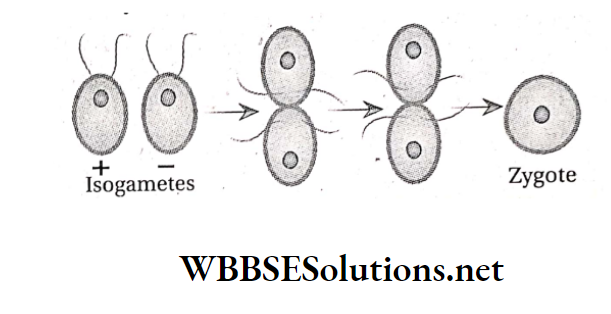
3. Origin of eukaryotes:

About 1.5 billion years ago, unicellular, aerobic eukaryotes evolved on Earth. In the course of evolution, multicellular complex organisms came into being from those unicellular forms.

Types of Evolutionary Adaptations

Question 4. Explain the important events of organic evolution.

Answer:

Important events of organic evolution:

The whole event, starting from the origin of life on Earth to the ongoing organic evolution, it has always been a very complex process.

By assembling the concepts and theories of different scientists, we have developed some ideas on the origin of life on Earth and the trend of organic evolution, which are mentioned below.

1. Origin of Earth:

Earth is the third planet in the solar system. It has originated from the solar nebula about 4.5 to 5.0 billion years back.

2. Origin of Life:

About 3.5 to 3.7 billion years ago, life originated on Earth. Two scientists, Haldane and Oparin, have put forward a clear idea on the origin of life in the water of primitive oceans by successive reactions among several inorganic and organic chemicals.

3. Origin of unicellular organisms:

The first living forms on earth were the primitive unicellular forms, which were the primitive heterotrophic prokaryotes. From the prokaryotes, emerged the unicellular eukaryotes.

4. Origin of photosynthetic prokaryotes:

From the primitive heterotrophic prokaryotes, there evolved some photosynthetic prokaryotes. With the emergence of photosynthetic forms, the production of free oxygen started and the primitive reducing atmosphere transformed into an oxidising one.

5. Emergence of multicellular organisms:

In the course of evolution, multicellular organisms emerged on Earth. These were more complex and advanced than their ancestors.

6. Emergence of different invertebrates and fish-like vertebrates:

With gradual advancement, different invertebrates came into being. After the emergence of higher invertebrates, there came some fish-like vertebrates.

7. Emergence of terrestrial plants:

Primitive plants originated in water. In the course of evolution, terrestrial plants emerged. These newly arrived terrestrial plants got themselves adapted to this new environment slowly and thereafter several advanced terrestrial plants emerged on Earth.

8. Emergence of terrestrial animals:

While living in an aquatic environment, some fish-like forms have developed some organs suitable for terrestrial living. Gradually some of these forms, for instance; amphibians, rejected the aquatic life and started dwelling on the land.

Later, different advanced terrestrial forms, like mammals and birds, emerged on Earth.

Wbbse Class 10 Life Science Solutions

Question 5. Describe the brief outline of the chemical origin of life mentioning Miller and Urey’s experiment. Similar question, Briefly describes the experiment conducted by Miller and Urey on the origin of life.

Answer:

The experiment of Miller and Urey:

Based on the concept of chemosynthesis of life, proposed by Oparin and Haldane, Stanley Miller and Harold Urey performed an experiment in 1953 in the laboratory of Chicago University.

1. Procedure:

They prepared a highly heat-resistant instrument with two inter-connected chambers of unequal diameters. The larger chamber was fitted with two electrodes and was filled with a mixture of hydrogen, methane and ammonia gases.

The outlet pipe of the larger chamber was fitted with a cooling device and a tap which was used to tap down the contents from it. The smaller chamber was used as a boiler and a connecting pipe was fitted with it to supply vapour to the larger chamber.

Powerful electric sparks were generated in the larger chamber to mimic the lightning-like situation (that prevailed in the primitive atmosphere). The water of the smaller chamber was boiled by heating it externally, thus the newly formed water vapour is pushed into the larger chamber.

The machine was run continuously for one week and the product from the larger chamber was tapped down after condensation.


WBBSE solutions For Class 10 Life Science And Environment Evolution Concepts Of Evolution Experimental set up of Miller and Urey

Life Science Class 10 Wbbse

2. Observation:

After analysing the product, scientists found a number of amino acids, viz. glycine, alanine, glutamic acid, aspartic acid, etc. in it.

3. Conclusion:

From the result, Miller and Urey concluded that in the primitive, free oxygen-lacking, reducing atmosphere, different inorganic matter reacted with each other to synthesize organic substances.

In this reaction, heat, lightning, ultraviolet ray and other cosmic rays provided the energy that was needed. The organic matter, thus synthesized, acted as the building blocks of cells and finally helped in the origin of life.

Significance of Miller and Urey’s experiment:

Miller and Urey’s experiment supports the abiogenetic theory of the origin of life. According to this theory, life was originated from abiotic or inorganic substances around 3.7 billion years ago.

Evidence of Evolution in Fossils

Chapter 4 Concept Of Evolution Major Evolutionary Events Origin Of Life Short Answer Type Questions

Question 1. Define life.

Answer:

Life:

Life is the condition that differentiates a living organism from a non-living object. Life shows the signs of growth, reproduction, metabolic activities, excitability, adaptability, ageing and senescence.

Life Science Class 10 Wbbse

Question 2. What do you mean by organic evolution? Or, What is meant by evolution?

Answer:

Organic evolution:

Organic evolution is the process of slow and steady changes in the characteristics of organisms. These changes result in to the origin of complex and higher descendent varieties or species from simpler and primitive ancestral types. Organic evolution is the cause of biodiversity on the earth.

Question 3. What do you mean by the cosmogenic origin of life?

Answer:

The cosmogenic origin of life:

Swiss author, Erik Von Daniken, in his number of books, claimed that life was introduced to Earth from other planets of other galaxies. This pseudo-scientific concept is known as the theory of the cosmogenic origin of life.


WBBSE solutions For Class 10 Life Science And Environment Evolution Concepts Of Evolution Erik Von Daniken


Question 4. What is meant by the cyanogen theory of the origin of life on Earth?

Answer:

The cyanogen theory of the origin of life on Earth:

According to German scientist Pflüger, when the earth was cooling down, carbon and nitrogen combined to form a complex compound, named cyanogen.

It is a protein-like compound, which in the course of time produced protoplasm. This concept is known as the cyanogen theory of the origin of life.

Life Science Class 10 Wbbse

Question 5. What is meant by the spontaneous creation of life or abiogenesis?

Answer:

The spontaneous creation of life or abiogenesis:

The Greek philosopher Aristotle and famous Belgian chemist, Van Helmont believed that life has originated on earth spontaneously from non-living matters.

This concept on the origin of life is known as the spontaneous creation of life or abiogenesis or biopoiesis.

Artificial Selection and Its Role in Evolution

Question 6. What is Chemogeny?

Answer:

Chemogeny:

Chemogeny is the origin of life, on earth through the ongoing synthesis of complex compounds by successive chemical reactions of different elements and simpler compounds.

Question 7. How did free oxygen evolve in Earth’s atmosphere?

Answer:

Free oxygen evolve in Earth’s atmosphere:

In primitive Earth, the pioneer life forms were chemoheterotrophs. In the course of evolution, these organisms were gradually transformed into photoautotrophs. These aerobic photosynthetic organisms released free oxygen in the primitive atmosphere by performing photosynthesis.

Question 8. What are coacervates?

Answer:

Coacervates:

According to Alexander Oparin, in the organic compound-rich hot water of the primitive ocean, many spherical colloidal droplets were formed.

These tiny droplets were composed of several amino acids, simple carbohydrates and lipid molecules. He denoted these colloidal droplets as coacervates.


WBBSE solutions For Class 10 Life Science And Environment Evolution Concepts Of Evolution Coacervates

Molecular Evidence for Evolution

Question 9. Write down the characteristics of coacervate.

Answer:

The characteristics of coacervate are

  1. It is a large organic compound, composed of carbohydrates, amino acids, proteins, etc.
  2. Coacervate was covered by a lipid membrane.
  3. Coacervate was able to absorb nutrients from the surroundings.

Question 10. What are microspheres?

Answer:

Microspheres:

According to Sidney Fox, in the primitive ocean, many amino acid molecules united to form a double-layered lipid membrane-bound, tiny, divisible, spherical droplets.

These are called microspheres, which are assumed to be the precursor of primitive cells. Sidney Fox opined that life has originated from microspheres, not from coacervates.

Life Science Class 10 Wbbse

Question 11. Write down the characteristics of the microsphere.

Answer:

The characteristics of a microsphere are-

  1. Microsphere originates from the polypeptide.
  2. Microsphere is more durable than coacervate.
  3. Microsphere is covered by a double membrane.
  4. It is capable of bud formation and can use ATP as a source of energy.
  5. It has self propagative properties.

Question 12. Distinguish between coacervate and microsphere.

Answer:

The distinguishing features between coacervate and microsphere are-

WBBSE solutions For Class 10 Life Science And Environment Evolution Concepts Of Evolution Distinguishing features between Coacervate and microsphere


Question 13. What are protobionts?

Answer:

Protobionts:

The earliest form of life originated on earth in the primitive ocean in form of a double-layered lipid membrane-bound, organic molecule-containing structure. These primitive rudimentary cell-like structures are called protobionts.

Scientists believe that prokaryotic cells have emerged from these protobionts. Example-Microspheres.

Question 14. What is the RNA world hypothesis?

Answer:

RNA world hypothesis:

A line of thought states that the first genetic material present in the protocell was RNA. Later, in the course of evolution, DNA molecules were formed from RNA by biochemical transformation. This concept is known as the RNA world hypothesis.

Question 15. What are naked genes?

Answer:

Naked genes:

In the second phase of Chermogenesis, a number of free nucleotides joined together to form polynucleotide or nucleic acid chains. These are called naked genes. These naked genes are nothing but the RNA molecules.

Question 16. What are proteinoids?

Answer:

Proteinoids:

At high temperatures and in the presence of ultraviolet rays, many protein molecules denature and form amino acids. With a gradual decrease in temperature, these amino acid molecules polymerise to form tiny protein-like globules, called proteinoids.

Scientists believe that the proteinoids played some role in the origin of primordial cells.

Life Science Class 10 Wbbse

Question 17. What are the characteristics of protocells?

Answer:

The characteristics of protocells are-

  1. Protocell contains nucleic acid.
  2. Protocell is covered by a bilayered membrane.
  3. Protocell has the ability to produce replicas by division.

Question 18. Write the name of the reactants used and one organic compound formed in the experiment of Miller and Urey in connection with the chemical origin of life.

Answer:

In the experiment of Miller and Urey in connection with the chemical origin of life, the reactants used were methane (CH4), ammonia (NH3), hydrogen (H2) and water vapour (H2O) experiment was amino acids, viz. glycine, alanine, and the organic compound formed in the glutamic acid, aspartic acid, etc.


Chapter 4 Concept Of Evolution Major Evolutionary Events Origin Of Life Very Short Answer Type Questions Multiple Choice Questions And Answers [Mcq]

Question 1. The theory of the origin of life was first proposed by —

  1. Pasteur
  2. Oparin
  3. Darwin
  4. Mendel

Answer: 2. Oparin

Question 2. Scientist Stanley Miller was able to synthesize simple amino acids from a mixture of—

  1. H2, O2, N2 and H2O
  2. H2, NH3, CH4 and water vapour (H2O)
  3. NH3, CH4, HCN
  4. N2, NH3, HCN and 02

Answer: 2. H2, NH3, CH4 and water vapour (H2O)

Question 3. Miller and Urey, in their experiment, were able to synthesize some preliminary constituents necessary for the creation of life. Identify the ones which were amino acids among them—

  1. Lactic acid, Acetic acid
  2. Urea, Adenine
  3. Glycine, Alanine
  4. Formic acid, Acetic acid

Answer: 3. Glycine, Alanine

Question 4. The most important organic matter for the origin of life is—

  1. Nucleic acid
  2. Nucleoside
  3. Amino acid
  4. Protein

Answer: 1. Nucleic acid

Question 5. The gas which was absent in the environment ^ during the origin of life is—

  1. Hydrogen
  2. Oxygen
  3. Methane
  4. Ammonia

Answer: 2. Oxygen

Question 6. Who was the first to disapprove the doctrine of spontaneous generation of life?

  1. Louis Pasteur
  2. Alexander Oparin
  3. Aristotle
  4. Miller

Answer: 1. Louis Pasteur

Question 7. The cause of biodiversity on earth is—

  1. Metabolism
  2. Locomotion
  3. Evolution
  4. Adaptation

Answer: 3. Evolution

Question 8. Where did life originate on Earth?

  1. In Ocean
  2. On land
  3. In space
  4. Under soil

Answer: 1. In  Ocean

Question 9. The cellular organisation appeared first in—

  1. Nucleoproteins
  2. Coacervates
  3. Bionts
  4. Protobionts

Answer: 2. Coacervates

Question 10. The chemosynthesis of life was clearly demonstrated by—

  1. Lamarck and Darwin
  2. Miller and Urey
  3. Plato and Dante
  4. Starling and Bayliss

Answer: 2. Miller and Urey

Question 11. The gradual development of a modern organisms from primitive ones is called—

  1. Variation
  2. Evolution
  3. Adaptation
  4. Behaviour

Answer: 2. Evolution

Question 12. The study of development of an organism in its life-span is called—

  1. Organic evolution
  2. Ontogeny
  3. Mutation
  4. Special creation

Answer: 2. Ontogeny

Question 13. Which of the following means—changes in the organisms for a prolonged time?

  1. Adaptation
  2. Accommodation
  3. Evolution
  4. Reproduction

Answer: 3. Evolution

Question 14. The term ‘evolution’ was coined by—

  1. Lamarck
  2. Darwin
  3. Hugo de Vries
  4. Herbert Spencer

Answer: 4. Herbert Spencer

Question 15. The unit of studying evolution is—

  1. DNA
  2. RNA
  3. Protein
  4. Species

Answer: 4. Species

Question 16. Life originated on Earth about

  1. 3.7 billion years ago
  2. 2.7 billion years ago
  3. 1.1 billion years ago
  4. 5.5 billion years ago

Answer: 1. 3.7 billion years ago

Question 17. According to the opinion of scientists, the prebiotic environment of the earth that led to the origin of life was like this—

  1. Hot dilute soup is the seawater
  2. Cold dilute soup in the seawater
  3. Cold dilute soup in the river water
  4. Hot dilute soup in the groundwater

Answer: 1. Hot dilute soup is the seawater


Chapter 4 Concept Of Evolution Major Evolutionary Events Origin Of Life Answer In A Single Word Or Sentence

Question 1. What is the approximate age of the earth?
Answer: About 4.6 billion years

Question 2. How many years ago did life originate on the earth?
Answer: About 3.7 billion years ago

Question 3. Which was the first nucleic acid on Earth?
Answer: RNA (Ribonucleic acid)

Question 4. In which form was carbon present in the primitive earth?
Answer: In the primitive earth, carbon was present in reduced form as hydrocarbons.

Question 5. Name a few hydrocarbons that were present in the primitive earth.
Answer: Methane, acetylene, ethylene, etc.

Question 6. Which concept states that life has originated from non-living substances?
Answer: The concept of abiogenesis

Evolutionary Mechanisms: Natural Selection vs Genetic Drift

Question 7. What will you call a nucleic acid-carrying coacervate?
Or,
What is formed when coacervate unites with nucleic acid?
Answer: Protocell

Question 8. Which end product did Miller and Urey get from their experiment? Similar question, Write down the names of two amino acids formed in the experiment of Miller and Urey.
Answer: Amino acids, viz. alanine, glycine, etc.

Question 9. Who is known as the father of evolution?
Answer: Charles Darwin

Question 10. Write two reasons of evolution.
Answer:

Two reasons of evolution

Mutation and adaptation

Question 11. What is biogeny?
Answer:

Biogeny

The chain of events, responsible for the origin of life and its evolution, is called biogeny.

Question 12. Who first introduced the concept of coacervate?
Answer: Alexander Oparin and JBS Haldane

Question 13. Who proposed the concept of a microsphere?
Answer: Sidney Fox


Chapter 4 Concept Of Evolution Major Evolutionary Events Origin Of Life Fill In The Blanks

Question 1. The process of emergence of complex organisms from simple ones by slow, continuous and irreversible changes is called ________ evolution.
Answer: Organic

Question 2. According to Greek philosopher ________, living forms have emerged on earth by the transformation of inanimate objects.
Answer: Aristotle

Question 3. The term ‘hot dilute soup’ was coined by ________.
Answer: Haldane

Question 4. The chemical basis of the origin of life is called ________.
Answer: Chemogeny

Question 5. The spherical aggregates of microdroplets of lipids that originated in the ‘hot dilute soup’ are known as ________.
Answer: Coacervates

Question 6. ________ was the aggregate of some large colloidal molecules during the early phase of the origin of life
Answer: Microsphere

Question 7. The first nucleic acid, produced in the primitive ocean was ________.
Answer: RNA

Question 8. Miller and ________ first proved the theory of chemogeny of life in a laboratory.
Answer: Urey

Question 9. The most acceptable theory on organic evolution was proposed by________.
Answer: Darwin

Question 10. The book titled ‘Origin of Life’ was authored by ________.
Answer: Oparin

Question 11. According to Sidney Fox, an organism originates from ________.
Answer: Microsphere

Question 12. The alternative name of hot dilute soup is ________.
Answer: Prebiotic

Question 13. The organic compound formed in the experiment of Miller and Urey was ________.
Answer: Amino acid

Question 14. On earth, life was originated in ________.
Answer: Primitive ocean


Chapter 4 Concept Of Evolution Major Evolutionary Events Origin Of Life State True Or False

Question 1. Protocells originated by the association of nucleic acid with coacervates.
Answer: True

Question 2. The materials necessary for the origin of life was present on the landmass of the primitive earth.
Answer: False

Question 3. Miller and Urey experimentally proved the chemosynthetic origin of life on Earth.
Answer: True

Question 4. Darwin coined the term ‘evolution.
Answer: False

Stages of Human Evolution

Question 5. Miller proposed the theory of coacervate.
Answer: False

Question 6. The first formed life was photosynthetic.
Answer: False

Question 7. According to some scientists, the dust particles of the universe condensed to from earth.
Answer: True


Chapter 4 Concept Of Evolution Major Evolutionary Events Origin Of Life Match The Columns

Question 1.

WBBSE solutions For Class 10 Life Science And Environment Evolution Concepts Of Evolution Match The Columns 1

Answer: 1. D, 2. F, 3. A, 4. E, 5. C, 6. B

Question 2.

WBBSE solutions For Class 10 Life Science And Environment Evolution Concepts Of Evolution Match The Columns 2

Answer: 1. C, 2. D, 3. B, 4. A, 5. F, 6. G

Common Misconceptions About Evolution

Chapter 4 Concept Of Evolution Major Evolutionary Events Origin Of Life Find The Odd One Out

Question 1. Amino acid, Fatty acid, Nucleic acid, Glucose
Answer: Nucleic acid

Question 2. DNA, RNA, Protein, Fatty acid
Answer: Fatty acid

Question 3. Acetylene, Methane, Ammonia, Ethylene
Answer: Ammonia

Question 4. Alexander Oparin, JBS Haldane, Jean Baptist Lamarck, Sidney Fox
Answer: Jean Baptist Lamarck

Question 5. CH4, NH3, H2, H2S
Answer: H2S


Chapter 4 Concept Of Evolution Major Evolutionary Events Origin Of Life Fill In The Blanks By Looking At The First Pair

Question 1. Coacervate : Alexander Oparin Microsphere:_________
Answer: Sidney Fox

Question 2. Oparin: Coacervate :: Haldane: _________
Answer: Hot dilute soup

Question 3. Protocell formation: Biogeny:: Formation of the compound from inorganic-organic compound: _________
Answer: Chemogeny


Chapter 4 Concept Of Evolution Major Evolutionary Events Origin Of Life Among The Four Concepts Given Three Of Them Belong To One Find That

Question 1. Abiogenesis, Coacervate, Microsphere, Hot dilute soup
Answer: Abiogenesis

Question 2. Double membrane covering, Ability to use ATP, Microsphere, Protenoid derivative
Answer: Microsphere

Question 3. Carbohydrate formation, Fat formation, Formation of an organic compound, Amino acid formation
Answer: Formation of organic compound

Question 4. Stages of development of life, Origin of unicellular. organisms, Origin of- photosynthetic bacteria, Evolution of plants on land
Answer: Stages of development of life

WBBSE Solutions For Class 10 Life Science And Environment Chapter 2 Growth And Development

Chapter 2 Growth And Development Summary

WBBSE Class 10 Growth and Development Overview

  • Growth is an important and distinct characteristic of life. Growth is an anabolic process through which the size, volume and dry weight of organisms is increased. Development is the increasing complexity in organisms.
  • There are three phases of growth, viz-
  1. A phase of cell division,
  2. A phase of cell enlargement and
  3. A phase of cell differentiation.
  • In the phase of cell division, the number of cells increases. The volume of protoplasm increases during the phase of cell enlargement, whereas, cells metamorphose into the tissue, organ through a phase of cell differentiation.
  • The physical, mental and emotional changes those are evident with the course of time is called development in human. In human life, there are five phases of development, viz.-
  1. Newborn,
  2. Childhood,
  3. Adolescence,
  4. Matured phase and
  5. Old age or late mature phase.

Growth And Development

Wbbse Class 10 Life Science

Chapter 2 Growth And Development Long Answer Type Questions

Question 1. What is growth? Explain different types of growth in living organisms.

Answer:

Growth:

Growth is an anabolic process by which the size and dry weight of any living organism increases permanently and irreversibly, by means of cell division.

Read and Learn More WBBSE Solutions for Class 10 Life Science And Environment

Types of growth in living organisms:

In living organisms, three different types of growth can be noticed. These are-

1. Vegetative growth:

By this process, a unicellular zygote divides consecutively to give rise to a fully formed multicellular organism. For example, the events of germination of seeds, growth of saplings, and formation a full-grown plant are treated as vegetative growth.

WBBSE Solutions For Class 10 Life Science And Environment Chapter 2 Growth And Development

2. Regenerative growth:

The damaged and injured parts of any living body are repaired or healed by this process of growth.

3. Reproductive growth:

This process of growth helps any organism to become reproductively capable. By this growth process, the reproductive organs of young organisms attain maturity and start producing gametes. In plants, this growth process is seen in flowers, fruits and seeds.

WBBSE Solutions for Class 10 History WBBSE Solutions for Class 10 Geography and Environment
WBBSE Class 10 History Long Answer Questions WBBSE Solutions for Class 10 Life Science And Environment
WBBSE Class 10 History Short Answer Questions WBBSE Solutions for Class 10 Maths
WBBSE Class 10 History Very Short Answer Questions WBBSE Solutions for Class 10 Physical Science and Environment
WBBSE Class 10 History Multiple Choice Questions


Question 2. Name three main phases of growth. Briefly describe those phases.

Answer:

Phases of growth:

The growth of multicellular organisms can be divided into three phases.

These are-

  1. The phase of cell division,
  2. The phase of cell enlargement and
  3. The phase of cell differentiation.

Description of the phases of growth:

Wbbse Class 10 Life Science

The three different phases of growth are described below.

1. Phase of cell division:

In this phase, cells divide mitotically to increase in number in a living body. Cells of apical and lateral meristem divide to make a plant body grow in length and width.

In animals, a unicellular zygote divides repeatedly and undergoes through different stages, like morula, blastula, and gastrula of a multicellular embryo to give rise to a fully grown animal body.

2. Phase of cell enlargement:

In this phase, the newly divided cells absorb water and synthesise different cellular components to increase the protoplasmic volume. By this process, the cells become larger and the tissues formed by these cells grow in volume irreversibly.

In some tissues, secretory materials accumulate in the intercellular spaces to increase the volume of that region, as we can see in bones and cartilage.

WBBSE Solutions For Class 10 Life Science And Environment Chapter 2 Growth And Development Phases of growth


3. Phase of cell differentiation:

In this phase, the fully grown daughter cells slowly modify and gain certain specialised features. These typical cells then form different tissues and tissue systems to perform specific functions.

Finally, these tissue systems form different organs and organ systems of a living body.

Wbbse Class 10 Life Science

Question 3. Briefly describe the five stages of human development.

Answer:

Phases of human development:

According to WHO human development includes five different stages which are described below.

1. Newborn or neonatal phase:

This phase of development lasts for the first one month after the birth of a baby. During this phase, the baby remains asleep most of the time and shows a very high rate of metabolism.

In this phase, a baby can detect light, the direction of sound, primary colours and above all, can recognise the mother’s face. Body weight may reduce during the first few days but soon it resumes. For newborn babies, laughing and crying are the main signs of communication.

2. Childhood:

This phase of life starts from the second month and continues up to ten years. During this period, physical, mental and emotional development occurs at a faster rate. Motor activities increase and limbs grow quicker than other parts of the body.

Power to memorise, the ability of reading, writing, drawing and problem-solving improve gradually. A child can express fear, anger and excitement but finer emotions are not expressed perfectly.

3. Adolescence:

This is the intermediate phase between childhood and adulthood. The span between the age of 10 to 19 years (according to WHO) is treated as adolescence. The age of adolescence is not fixed for all. It varies with gender, environment, nutrition, geographical location, etc.

During this phase, several hormones come into action to regulate the growth and functioning of sexual organs. An adolescent boy and girl go through significant changes in physical, mental, emotional and social aspects.

From this phase of life, sexual attraction towards the opposite gender emerges. Mature gamete formation starts during this phase. Concentration, thinking skills, analytical ability and intelligence grow very fast in adolescent individuals.

At this age, they dare to take risks. Therefore, adolescence is treated as the ‘period of turmoil.

4. Adulthood or matured stage:

The age between 19 to 60 years is denoted as adult age. This phase is characterised by maturity, self-confidence, practical, purposeful and self-directed attitude. In this period, physical growth reduces quickly and ultimately stops.

At this age, a sense of responsibility towards family and society grows significantly. An adult person gains experiences of life and mostly follows moral values.

Wbbse Class 10 Life Science

5. Old age:

The age beyond 60 years is treated as old age. In this age, cellular activities gradually slow down. Visual and auditory abilities get weakened. Old age is characterised by thinning and greying of hair.

Skin gets heavily wrinkled and muscles become weak. Bones gradually degenerate and joints lose their movability which are the consequences of different bone diseases like osteoporosis and osteoarthritis. People at old age lose memory and become mentally fatigued.


WBBSE Solutions For Class 10 Life Science And Environment Chapter 2 Growth And Development Phases of human life


Question 4. Distinguish between the growth and development processes in human beings.

Answer:

Difference between human growth and development processes

WBBSE Solutions For Class 10 Life Science And Environment Chapter 2 Growth And Development Difference between human growth and development

Types of Growth in Living Organisms

Question 5. Mention the changes that occur in adolescent males and females.

Answer:

Changes in adolescent males and females:

Several changes occur in adolescent males and females. These are mentioned below.

In male:

  1. The male reproductive organs become fully grown to produce gametes and secrete sex hormones.
  2. Development of the endocrine glands present all over the body is completed.
  3. Body weight and height increase at a faster rate.
  4. Sweat and sebaceous glands get stimulated. Hypersecretion of these glands results in oily facial skin, thereby causing acne.
  5. Beards grow on the face, hairs develop on the chest, armpit and pubic region.
  6. Muscles and bones become stronger and the voice becomes husky.


WBBSE Solutions For Class 10 Life Science And Environment Chapter 2 Growth And Development Adolescence


In female:

  1. Female reproductive organs become adolescence completely developed and start producing gametes and secreting sex hormones.
  2. The beginning of the menstrual cycle is the indication of the onset of puberty.
  3. Mammary glands grow in size during this time.
  4. Body weight and height increase in females during adolescence.
  5. Additional fat below the skin gives lustre to it.
  6. Deposition of extra fat in hip and thigh region gives the body a feminine shape.
  7. Hyperactivity of sweat and sebaceous glands makes the face oily, due to which acne grows.
  8. Hairs grow on armpits and pubic regions.


Chapter 2 Growth And Development Short Answer Type Questions

Question 1. What is meant by development?

Answer:

Development:

Development is the collective changes, including growth and other transformations, which occur continuously since the formation of a zygote until the death of any organism. It is a quantitative change in a multicellular organism.

Question 2. ‘Development is impossible without growth’- Explain.

Answer:

‘Development is impossible without growth’:

Growth refers to an increase in the measurable, physical size of the whole or any of definite part of an organism. Whereas, development refers to the quantitative as well as the qualitative changes in the organism as a of whole.

Life of any multicellular organism starts with a unicellular zygote which increases in cell number by cell division and increases complexity at the tissue or organ level by cell differentiation.

The development also can be defined as the increase of complexity. impossible without growth. So we can easily say that ‘development is impossible without growth’.

Wbbse Class 10 Life Science Solutions

Question 3. Write the differences between plant growth and animal growth.

Answer:

The differences between plant growth and animal growth are-

WBBSE Solutions For Class 10 Life Science And Environment Chapter 2 Growth And Development Difference between Plant growth and animal growth

Factors Affecting Growth and Development

Question 4. What is meant by human development?

Answer:

Human development:

Human development is the collective irreversible changes in a physical, mental and emotional state, that any human being encounters from its birth until death.

By this developmental process, a human baby grows into an adult and finally reaches the old age.

Question 5. What is meant by human growth?

Answer:

Human growth:

Human growth is the spontaneous and irreversible change in size, volume, height and weight of a human body with age. By this process, a newborn baby transforms into a fully grown human being.

Question 6. What is meant by positive growth?

Answer:

Positive growth:

When anabolic activities increase in comparison to catabolic activities, the dry weight of the body increases. This change is known as positive growth.

Example: Positive growth is noticed during a grand period of growth in all living beings.

Question 7. What is meant by negative growth?

Answer:

Negative growth:

When catabolic activities increase in comparison to anabolic activities, the dry weight of the body reduces. This change is known as negative growth.

Example: Negative growth is seen during the initiation of seed germination and during senescence.

Wbbse Class 10 Life Science Solutions

WBBSE Solutions For Class 10 Life Science And Environment Chapter 2 Growth And Development Germination of seed

Wbbse Class 10 Life Science Solutions

Question 8. Mention different types of growth depending on nature.

Answer:

Depending on nature, growth is of three types.

These are-

  1. Vegetative
  2. Regenerative growth and
  3. Reproductive growth.

Question 9. What is meant by the phase of cell division of ant by the phase of cell division of growth?

Answer:

The phase of cell division of ant by the phase of cell division of growth:

The phase of growth, in which an organism grows physically only by means of mitotic cell division, is known as the phase of cell division of growth.

Example: Growth of an embryo from the zygote, growth of shoot and root apices in plants, etc.

Stages of Plant Growth Explained

Question 10. What is meant by the phase of cell enlargement of growth?

Answer:

The phase of cell enlargement of growth:

The phase of growth, in which the newly divided cells absorb water, and synthesise various proteins, nucleic acids and other organic matters to increase the protoplasmic volume, is known as the phase of cell enlargement of growth. By this process, the overall size of a cell increases.

Question 11. What is meant by the phase of cell differentiation growth?

Answer:

The phase of cell differentiation growth:

After the phase of cell division and cell enlargement, cells undergo structural and functional transformations. In this process, cells develop specialised features and take part in the formation of different tissues and organs. This phase of growth phase of is called of growth cell differentiation.

Question 12. What is meant by continuous growth?

Answer:

Continuous growth:

The type of growth, in which the growing process starts since birth and continues until the attainment of ultimate size and maturity, is treated as continuous growth.

Example-All higher animals including humans – show continuous growth.

Wbbse Class 10 Life Science Solutions

Question 13. What is meant by discontinuous growth?

Answer:

Discontinuous growth:

In certain organisms, the growing process stops intermittently, after every quick period of growth. This type of growth is known as discontinuous growth.

Example: In insects and other arthropods, growth stops before moulting and it starts again after completion of it.

Question 14. How does the vegetative growth of plants occur?

Answer:

Vegetative growth of plants occurs by cell division of primary and secondary meristems. By this process, leaves, branches and roots of plants grow significantly.

Wbbse Class X Life Science

Question 15. What is meant by prenatal phase?

Answer:

Prenatal phase:

The phase of life, starting after the formation of the zygote and ending with the birth of a baby, is known as the prenatal phase. In humans, the span of the prenatal phase is 280 days.

Question 16. What is meant by the neonatal phase?

Answer:

Neonatal phase:

The span of life, starting from the birth of a baby till the completion of one month, is known as the neonatal phase. During this phase, a human baby remains completely dependent upon others.

WBBSE Solutions For Class 10 Life Science And Environment Chapter 2 Growth And Development Neonatal Child

Question 17. Write down the characteristics of neonates.

Answer:

A few mention-worthy characteristics of neonates are

  1. The child can recognise faces, some sounds, and lights.
  2. They express themselves only by crying.
  3. Their weight increase rapidly.

Question 18. What is meant by childhood?

Answer:

Childhood:

The phase of life, starting from the beginning of the second month until the end of ten years, is known as childhood. During this period, physical, mental and emotional development occurs at a faster rate along with various motor activities.

WBBSE Solutions For Class 10 Life Science And Environment Chapter 2 Growth And Development Childhood

Question 19. What is meant by adolescence?

Answer:

Adolescence:

The phase of human life, in which secondary sexual characters appear in males and females and the respective reproductive organs start producing gametes and secrete sex hormones, is known as adolescence. This span usually ranges between 10-19 years of age.

Question 20. What are the secondary sexual characters?

Answer:

The secondary sexual characters:

Secondary sexual characteristics are the features that appear during puberty in human beings. These visibe features include maturation of gonads, the emergence of public hair in both males and females, enlarged breasts, the onset of menstruation and widened hips in females and cracked voices, growth of facial hair as well as protrusion of Adam’s apple in males.

Human Growth Stages

Question 21. Write down some characteristics and features of the adolescent phase.

Answer:

Some characteristic features of the adolescent phase are as follows-

  1. The rapid growth of the body takes place.
  2. Secondary sexual characters develop on the body.
  3. Attraction towards the opposite sex develops.
  4. The rapid growth of thinking, analytical power and memory takes place.

Question 22. What do you mean by matured phase in human development?

Answer:

Matured phase in human development:

In the case of human development, the phase or period of life from the age of 19 to 60 years is treated as a matured phase. During this phase, physical growth declines and finally stops. Mental maturity, responsibility and decision-making ability reach their peak.

Wbbse Class 10 Life Science Solutions Chapter 2 Question 23.

Question 23. Mention the internal factors responsible for mental and physical changes in an adolescent boy.

Answer:

The internal factors responsible for mental and physical changes in an adolescent boy

In an adolescent boy, different hormones play an important role in changing the mental and physical state. These hormones include GnRH- from the hypothalamus, ICSH from the pituitary and testosterone from the testis.

Question 24. Mention the internal factors responsible for mental and physical changes in an adolescent girl.

Answer:

In an adolescent girl, different hormones play an important role in changing her mental and physical state. These hormones include GnRH from the hypothalamus, FSH and LH from the pituitary and oestrogen and progesterone from the ovary.

Question 25. Mention the signs of old age in a human being.

Answer:

As a person reaches the old age, several signs of old age or senescence appear.

These are as follows

  1. Bone and joints become weak.
  2. The power of vision and hearing weakens.
  3. Loss of memory, fatigue and lack of confidence are manifested.
  4. Hairs become thin and grey.

Question 26. What is meant by senescence?

Answer:

Senescence:

Beyond the age of 60 years, certain decelerating changes start to occur in the human body, which continues until death. In the course of time, these gradual changes make a person older. This process of ageing is known as senescence.

Question 27. Mention two changes related to vision and bones at late adulthood or the senescence phase of human development.

Answer:

During adulthood or the senescence phase of human development, some noticeable changes are-

  1. Vision: Due to the weakening of eyesight, symptoms of presbyopia can be seen.
  2. Bones: Due to the decaying of bones and joints, symptoms of osteoarthritis and osteoporosis can be noticed.

Question 28. What are the measures should be obeyed by people of old age to stay healthy?

Answer:

The measures should be obeyed by people of old age to stay healthy:

To stay healthy people at old age must follow some rules, like

  1. Eating adequate but healthy food as the metabolism rate decreases during this age.
  2. Easy but regular exercising to stay physically active.
  3. Starting a routine to enhance mobility, flexibility balance, to improve sleep and to boost mood and self-confidence.
  4. Remaining socially connected with friends and families to maintain physical and mental health.


Chapter 2 Growth And Development Very Short Answer Type Questions Multiple Choice Questions And Answers [Mcq]

Question 1. The phase of growth from start to end, when the process of growth occurs at a fast pace, is called—

  1. Grand period
  2. Lag period
  3. Steady period
  4. Stagnant period

Answer: 1. Grand period

Question 2. The branch of biological science that deals with the study of senescence and ageing is called—

  1. Anthropology
  2. Psychology
  3. Physiology
  4. Gerontology

Answer: 4. Gerontology

Question 3. A permanent increase of dry weight is called—

  1. Development
  2. Differentiation
  3. Division
  4. Growth

Answer: 4. Growth

Question 4. The number of phases of growth of organisms is—

  1. Four
  2. Five
  3. Three
  4. Two

Answer: 3. Three

Wbbse Class 10 Life Science Solutions Chapter 2

Question 5. The growth of a plant is measured with—

  1. Potometer
  2. Arc indicator
  3. Barometer
  4. All of these

Answer: 2. Arc indicator

Question 6. Which of the following is an example of an external factor of growth?

  1. Gene
  2. Sunlight
  3. Hormone
  4. All of these

Answer: 3. Hormone

Question 7. Which of the following occurs first during the growth of a developing organism?

  1. Cell maturation
  2. Cell transformation
  3. Cell development
  4. Cell division

Answer: 4. Cell division

Question 8. The growth in width of a plant is treated as—

  1. Vegetative growth
  2. Primary growth
  3. Secondary growth
  4. Reproductive growth

Answer: 3. Secondary growth

Question 9. The metabolic process that involves the increase in dry weight of the body is denoted as—

  1. Anabolic metabolism
  2. Catabolic metabolism
  3. Differential metabolism
  4. All of these

Answer: 1. Anabolic metabolism

Question 10. The metabolic process in which the dry weight of the body decreases is called—

  1. Anabolic metabolism
  2. Catabolic metabolism
  3. Differential metabolism
  4. All of these

Answer: 2. Catabolic metabolism

Question 11. In plants, the growth that occurs due to cell division of secondary meristem is called—

  1. Reproductive growth
  2. Secondary growth
  3. Vegetative growth
  4. Primary growth

Answer: 2. Secondary growth

Question 12. If catabolism takes over anabolism, the dry weight of the body decreases. This is called—

  1. Negative growth
  2. Regular growth
  3. Irregular growth
  4. Positive growth

Answer: 1. Negative growth

Question 13. The second phase of growth is—

  1. Cell enlargement phase
  2. Cell division phase
  3. Cell differentiation phase
  4. Late phase

Answer: 1. Cell enlargement phase

Wbbse Class 10 Life Science Solutions Chapter 2

Question 14. The last phase of growth is—

  1. The phase of cell enlargement
  2. The phase of cell division
  3. The phase of cell differentiation
  4. Late phase

Answer: 3. Phase of cell differentiation

Question 15. The phrase, in which the origin of different types of blood cells occurs from stem cells, is treated as—

  1. The phase of cell division
  2. The phase of cell enlargement
  3. The phase of cell differentiation
  4. The phase of cell ageing

Answer: 3. Phase of cell differentiation

Question 16. Increase in the number of cells in meristem can be treated as—

  1. The phase of cell enlargement
  2. The phase of cell division
  3. The phase of cell differentiation
  4. The phase of cell elongation

Answer: 2. Phase of cell division

Question 17. Transformation of meristematic tissue into permanent tissue occurs in—

  1. The phase of cell differentiation
  2. The phase of cell enlargement
  3. The phase of cell division
  4. All of these

Answer: 1. Phase of cell differentiation

Question 18. Which phase of human development is associated with the maturity of reproductive organs and reproductive glands?

  1. Childhood
  2. Adolescence
  3. Late adulthood
  4. Infancy

Answer: 2. Adolescence

Question 19. The gradual transformation occurring in a plant from germination of seed to the onset of ageing, is called—

  1. Senescence
  2. Metabolism
  3. Growth and development
  4. Assimilation

Answer: 3. Growth and development

Question 20. The gradual complexity, that appears in an organism during its life cycle, by means of growth and following changes, is known as

  1. Growth
  2. Development
  3. Division
  4. Degeneration

Answer: 2. Development

Question 21. The total number of developmental phases in human life is—

  1. Three
  2. Four
  3. Five
  4. Six

Answer: 3. Five

Question 22. If anabolism takes over catabolism, the dry weight of the body increases. This is called

  1. Negative growth
  2. Regular growth
  3. Irregular growth
  4. Positive growth

Answer: 4. Positive growth

Life Science Class 10 Wbbse

Question 23. The organ which is responsible for husky or cracked voice in males is—

  1. Chest muscle
  2. Larynx
  3. Bronchiole
  4. Tongue

Answer: 2. Larynx

Question 24. The developmental phase of human life, in which osteoporosis and osteoarthritis appear, I is called the—

  1. Childhood
  2. Adolescence
  3. Matured age
  4. Old age

Answer: 4. Old age

Question 25. The developmental phase of human life, in which motor activities grow more, is the—

  1. Childhood
  2. Neonatal stage
  3. Adolescence
  4. Matured age

Answer: 1. Childhood

Question 26. The human developmental phase, in which sexual urge starts to develop, is called the—

  1. Childhood
  2. Matured stage
  3. Adolescence
  4. Neonatal stage

Answer: 3. Adolescence

Question 27. The ultimate stage of human development is—

  1. Development of motor activity
  2. The quick development of intelligence
  3. Development of abstract idea
  4. Degeneration of bone joints

Answer: 4. Degeneration of bone joints

Question 28. Which of the following is not a character of senescence?
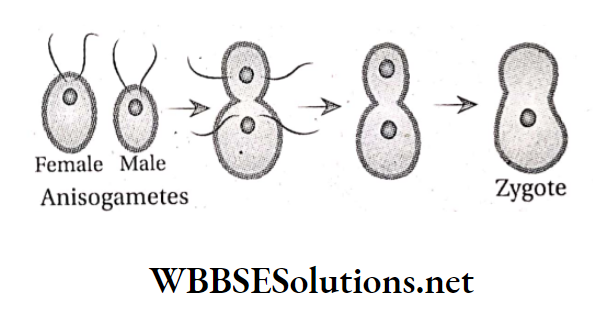
  1. Wrinkled skin
  2. Fatigue
  3. Development of bone
  4. Degeneration of bones

Answer: 3. Development of bone

Life Science Class 10 Wbbse

Question 29. The stage of human development, in which the ability for detecting light and sound develops is—

  1. Neonatal stage
  2. Childhood
  3. Adolescence
  4. Matured stage

Answer: 1. Neonatal stage

Wbbse Class X Life Science

Question 30. Among vertebrates, indirect development occurs in—

  1. Frogs
  2. Birds
  3. Reptiles
  4. Mammals

Answer: 1. Frogs

Question 31. The phase of cell enlargement is controlled by—

  1. Thyroxin
  2. Somatotropic hormone
  3. Insulin
  4. ADH

Answer: 2. Somatotropic hormone

Question 32. Development of an organism starts from—

  1. Egg cell
  2. Male gametes
  3. Zygote
  4. Ovary

Answer: 3. Zygote

Question 33. The glands which become hyperactive during adolescence are—

  1. Sebaceous glands
  2. Sweat glands
  3. Reproductive glands
  4. All of these

Answer: 4. All of these

Question 34. Secondary sexual characters appear during—

  1. Childhood
  2. Matured age
  3. Adolescence
  4. Neonatal stage

Answer: 3. Adolescence

Question 35. The quick loss of calcium occurs in the bones of human females—

  1. Before puberty
  2. Predelivery
  3. Postdelivery
  4. After puberty
Answer: 3. Postdelivery

Cell Division and Its Role in Growth

Chapter 2 Growth And Development Answer In A Single Word Or Sentence
Question 1. By which life process, the size, shape and dry weight of an organism increase permanently?
Answer: Growth

Question 2. Which type of growth occurs among woody perennial plants?
Answer: Indefinite growth

Question 3. Which type of growth occurs in plants that grow with time, produce flowers and fruits and then die?
Answer: Definite growth

Question 4. Name two plants showing indefinite growth.
Answer: Banyan and mango

Question 5. Name two plants showing definite growth.
Answer: Paddy and wheat

Life Science Class 10 Wbbse

Question 6. How do you denote the growth of an organism in unit time?
Answer: Growth rate

Question 7. Mention two internal factors of growth regulation.
Answer: Genes and hormones

Question 8. What is produced after the division of a zygote?
Answer: An embryo

Question 9. Which type of cell division leads to the development of an embryo from a fertilised ovum?
Answer: Mitotic cell division

Question 10. In which phase of growth are the tissues formed?
Answer: Phase of cell differentiation

Question 11. What happens to a cell with the synthesis of new organic matter within it?
Answer: With the synthesis of new organic matters within a cell, the size of the cell increases gradually.

Question 12. Why is the growth of plants treated as indefinite growth?
Answer: Since there is no fixed span of growth among plants, the growth of plants is treated as indefinite growth.

Wbbse Class X Life Science

Question 13. Why is the growth of animals treated as definite growth?
Answer: Since the growth of animals continues for a specific period, animal growth is treated as definite growth.

Question 14. Which phase of human growth is treated as a period of turmoil?
Answer: Adolescent period

Question 15. How do you denote the span of human life from the age of two months up to ten years?
Answer: Childhood

Question 16. How do you denote the phase between childhood and adulthood?
Answer: Adolescence

Question 17. At which phase, a maximum level of physical and mental changes occur in human life?
Answer: Adolescence

Question 18. How do you denote the period of human life between the age of 19 to 60 years?
Answer: Adulthood or matured phase

Question 19. How do you denote the growth of an organism, in which all parts of the body grow at an even rate?
Answer: The growth of certain organisms, like fishes, where all parts of the body grow at an even rate, is called isometric growth.

Question 20. How do you denote the growth of an organism, in which different parts of the body grow at uneven rates?
Answer: The growth of certain organisms, where different parts of the body grow at an uneven rate, is called allometric growth.

Question 21. Which part of the human body shows the slowest rate of growth?
Answer: Human head

Question 22. Which part of the human body shows the highest rate of growth?
Answer: Human legs

Life Science Class 10 Wbbse

Question 23. At which age of human life, does height increase at the highest rate?
Answer: During the first three years of human life, height’ increases at the highest rate.

Question 24. At which growth phase, do thickening and ornamentation of cell wall occur in plant cells?
Answer: Phase of cell differentiation

Question 25. Which hormone becomes highly active in human adolescent males?
Answer: Testosterone

Wbbse Class X Life Science

Question 26. In which type of growth, all the organs do not increase in the same proportion?
Answer: Allometric growth

Question 27. Give an example of an organism with allometric growth.
Answer: Human

Question 28. What is a toddler?
Answer:

Toddler

A toddler is a child who learns to walk with a great cognitive, emotional and social development of 1-3 years of age.

Importance of Nutrition in Growth

Question 29. Which age of a human is called the adolescent stage.
Answer: 10-19 years

Question 30. In which phase of growth of human metabolism decreases?
Answer: Old age

Question 31. Give one example of isometric growth.
Answer: Isometric growth can be seen in fish.

Question 32. Which is the first site of growth?
Answer: Embryo

Question 33. Which type of metabolism is growth?
Answer: Anabolism


Chapter 2 Growth And Development Fill In The Blanks

Question 1. Due to _________, structural complexity increases in a living body.
Answer: Development

Question 2. An organism attains _________ by the process of growth and development.
Answer: Maturity

Question 3. Growth in animals occurs for a _________ period of time.
Answer: Limited

Question 4. After fertilisation, a unicellular _________ is formed.
Answer: Zygote

Question 5. During cellular differentiation, _________ cell wall is formed.
Answer: 5Secondary

Question 6. The period of human life from birth to the end of the first month is called the _________ phase.
Answer: Neonatal

Life Science Class 10 Wbbse

Question 7. Attaining sexual maturity is denoted as the onset of _________.
Answer: Puberty

Question 8. During the cell enlargement phase, a young cell absorbs _________ to increase its volume.
Answer: Water

Question 9. In plants, the cell layer below _________ shows cellular enlargement.
Answer: Cambium

Question 10. During the _________ period, attraction towards the opposite sex increases significantly.
Answer: 1Adolescent

Question 11. During _________a human baby learns to utter meaningful words.
Answer: Childhood

Question 12. In human females, two hormones become highly active during puberty, these are _________ and progesterone.
Answer: Oestrogen

Question 13. The age 10-19 of humans is called _________ phase.
Answer: Adolescent

Question 14. The age of 60 or more is included in _________ phase.
Answer: Old age

Question 15. The motor activities of human is developed in _________ phase.
Answer: Childhood


Chapter 2 Growth And Development State True Or False

Question 1. The size of all organisms changes permanently during growth.
Answer: True

Question 2. Hormones play an important role in the growth of an organism.
Answer: True

Wbbse Class X Life Science

Question 3. Human development is divided into four phases.
Answer: False

Question 4. Cell enlargement occurs by continuous intake of water and synthesis of organic matter within the cell.
Answer: True

Question 5. The number of cells increases by mitosis.
Answer: True

Question 6. The growth of any organism occurs with an increase in dry weight of the cytoplasm of all its cells.
Answer: True

Life Science Class 10 Wbbse

Question 7. The age between 20 to 40 years denotes adulthood.
Answer: False

Question 8. In human life, 10 to 15 years of age indicates childhood.
Answer: False

Question 9. Germ cell production in gonads starts during adolescence.
Answer: True

Question 10. Gradual loss of memory occurs during old age.
Answer: True

Question 11. The study of human development is known as gerontology.
Answer: False


Chapter 2 Growth And Development Match The Columns

Question 1.

WBBSE Solutions For Class 10 Life Science And Environment Chapter 2 Growth And Development Match The columns 1

Answer: 1. B, 2. A, 3. D, 4. C, 5. F, 6. E

Question 2.

WBBSE Solutions For Class 10 Life Science And Environment Chapter 2 Growth And Development Match The columns 2

Answer: 1. B, 2. A, 3. D, 4. C, 5. F, 6. E

Wbbse Class 10 Life Science Solutions

Chapter 2 Growth And Development Find The Odd One Out

Question 1. Childhood, Adulthood, Old age, Birth
Answer: Birth

Question 2. The phase of cell division, Phase of cell enlargement, Phase of cell differentiation, Cell cycle
Answer: Cell cycle

Life Science Class 10 Wbbse

Question 3. Rapid growth, development of sexual character, Development of sex organs, Loss of bone density
Answer: Loss of bone density

Question 4. Neonate, Adolescent, Old age, Phase of cell differentiation.
Answer: Phase of cell differentiation


Chapter 2 Growth And Development Fill In The Blanks By Looking At The First Pair

Question 1. Formation of new cells: Phase of cell division:: Formation of different tissues:_____________
Answer: Phase of cell differentiation

Question 2. The phase of cell enlargement: Phase of growth:: Adolescence:_____________
Answer: Phase of development

Wbbse Class 10 Life Science Solutions

Question 3. 2 months year: Childhood:: 10-19 years: _____________
Answer: Adolescence

Question 4. The onset of activity of sex hormones: Adolescence Optimum activity of sex hormones: _____________
Answer: Adulthood

Question 5. Identification of sound: Neonate:: Decrease of hearing: _____________
Answer: Old age


Chapter 2 Growth And Development Among The Four Concepts Given Three Of Them Belong To One Find That

Question 1. Old age, Childhood, Adulthood, Phases of development
Answer: Phases of development

Question 2. Phase of cell division, Phase of cell enlargement, Phase of cell differentiation, Phases of growth
Answer: Phases of growth

Question 3. Formation of phloem tissue, Formation of nerve tissue, Formation of muscle tissue, Phase of cell differentiation
Answer: Phase of cell differentiation

Question 4. Loss of bone density, Old age, Loss of hearing, Loss of vision
Answer: Old age


Chapter 2 Growth And Development Advanced Questions and Answers

Question 1. What is fascicular cambium? What is its importance during grafting?

Answer:

Fascicular cambium:

The fascicular cambium is a meristem present between the primary xylem and phloem of vascular bundles.

Importance of Fascicular cambium:

During grafting it produces secondary xylem and secondary phloem in both stock and scion. This newly formed vascular tissues mix together through which it connect the two stems.

Question 2. How does the vegetative reproduction of plants take place through layering?

Answer:

In this process, the outer epidermis of a node portion of a branch is removed to expose the vascular tissue. This portion this then covered with soil, cow dung and cloth. Watering is done at regular intervals.

After a few days, roots develop in this portion by the activity of meristem. At this stage, the branch is removed from the main plant and is planted separately.

Wbbse Class 10 Life Science Solutions

Question 3. What is parthenogenesis?

Answer:

Parthenogenesis

The process through which an offspring is formed without fertilisation from an unfertilised egg is called parthenogenesis.

Example-Wasp, are honey bees, grape plants, etc.

Question 4. What is bulbil?

Life Science Class 10 Wbbse

Answer:

Bulbil

Bulbil is a type of vegetative reproductive structure in which a round, multicellular structure develop at the axil of leaves.

Example-Dioscorea sp.

Question 5. What is an actinomorphic flower?

Answer:

Actinomorphic flower

A flower which can be cut into two equal halves through more than one plane is called an actinomorphic or regular flower.

Example-Hibiscus.

Question 6. What is the zygomorphic flower?

Answer:

Zygomorphic flower

A flower which can be cut into two equal halves through only one plane is called a zygomorphic or irregular flower.

Example-Pea flower.

Question 7. What is the type of growth in perennial woody plants?

Answer: Indefinite growth

Question 8. The annual plants dies after growing for a certain period, flowering and fruiting. What type of growth it is?

Answer: Definite growth

Wbbse Class 10 Life Science Solutions

Question 9. What is the tanner scale or tanner stage?

Answer:

Tanner scale or tanner stage

The predefined chart used to measure the physical development of a child, adolescent and mature adult is called the tanner scale or tanner stage. It is mainly used to measure secondary sexual growth, so it is also known as Sexual Maturity Rating (SMR).

WBBSE Solutions For Class 10 Life Science And Environment Chapter 2 Sexual Reproduction In Flowering Plants

Chapter 2 Sexual Reproduction In Flowering Plants Summary

WBBSE Class 10 Sexual Reproduction Overview

  • A flower is the main reproductive part of sexual reproduction in flowering plants. A typical flower has four whorls of which the calyx is protective in nature and the corolla helps in pollination by attracting pollinating agents.
  • Therefore, these are called as accessory whorls, as they don’t take part in reproduction directly. Androecium contains stamen which produces pollen. The gynoecium consists of carpels. The female gamete is produced within the ovary of the carpel.

Read and Learn More WBBSE Solutions for Class 10 Life Science And Environment

  • The transfer of pollen from another of the stamen to the stigma of the carpel is called pollination. When the pollen of one plant is transferred to the stigma of a flower located in the same plant, then it is called as self-pollination.
  • Self-pollination within the same flower is called autogamy and between two flowers of the same plant is called geitonogamy. When pollens are deposited on the stigma located in different plants of same or different species, then it is called as cross-pollination.

Sexual Reproduction In Flowering Plants Summary

Wbbse Class 10 Life Science Solutions

  • Cross-pollination is also known as xenogamy or allogamy. Both self and cross-pollination have advantages and disadvantages. Cross-pollination needs vectors like air (rice) water (Hydrilla), insect (mango), bird (silk cotton), etc.
  • Offspring produced through cross-pollination are with greater genetic variation than the offspring of self-pollination. The male gamete from pollen and the female gamete in ovule fuses together to form a diploid zygote.
  • This fusion of gametes is called fertilization. The zygote forms the embryo. The ovule along with the embryo becomes a seed and the ovary along with the seed is transformed into fruit.
  • On getting favorable conditions seed germinates to produce a new baby plant at the end of dormancy.
WBBSE Solutions for Class 10 History WBBSE Solutions for Class 10 Geography and Environment
WBBSE Class 10 History Long Answer Questions WBBSE Solutions for Class 10 Life Science And Environment
WBBSE Class 10 History Short Answer Questions WBBSE Solutions for Class 10 Maths
WBBSE Class 10 History Very Short Answer Questions WBBSE Solutions for Class 10 Physical Science and Environment
WBBSE Class 10 History Multiple Choice Questions

Chapter 2 Sexual Reproduction In Flowering Plants Long Answer Type Questions

Question 1. Describe the structure of a typical flower.

Answer:

Structure of a typical flower:

A typical flower has all four floral parts (calyx, corolla, androecium, and gynoecium) arranged in concentric rings on the flat, thick disc-like thalamus (example-Hibiscus). The different floral parts of a typical flower are described below.

1. Calyx:

The calyx is the first or outermost whorl of the flower, which is green, cup-shaped, and composed of mostly five leafy segments, called sepals.

In certain plants, at the base of the calyx, there are some narrow leaf-like projections, which constitute the epicalyx (example-Hibiscus).

2. Corolla:

It is the second whorl, located towards the inner side of the calyx. Petals are white in colour with sweet smell or of any bright colour other than green. It is composed of leafy units called petals.

3. Androecium:

It is the third whorl, present at the inner side of the corolla. It is composed of three to many units, known as stamens. Each stamen has two parts, a fine, elongated, slender, cylindrical filament and a small, sac-like anther on it. Within the anther, the pollens are produced.

WBBSE Solutions For Class 10 Life Science And Environment Chapter 2 Sexual Reproduction In Flowering Plants

4. Gynoecium:

It is the fourth and central floral part of a typical flower. It may be composed of one or more units called carpels or pistils. Each carpel has three components-ovary, style and stigma. The ovary is the swollen base of a carpel.

The filamentous portion emerging from it is called style, which ends in a swollen, knob-like structure called the stigma.

Wbbse Class 10 Life Science Solutions

WBBSE Solutions For Class 10 Life Science And Environment Chapter 2 Sexual Reproduction In Flowering Plants Different parts of a typical flower

Stages of Sexual Reproduction in Plants

Question 2. Why is a flower called a modified shoot? Distinguish between the accessory and essential whorls.

Answer:

Flower is a modified shoot:

A flower is called a modified shoot due to the following features-

  1. Like leaf buds, floral buds also grow from the axil or tip of a stem.
  2. The floral parts are arranged on the thalamus like the arrangement of leaves on the stem.
  3. Like the stem, the thalamus also has nodes and internodes.
  4. Sepals and petals have similar venations like leaves.

Distinguishing features between the accessory and essential whorls

WBBSE Solutions For Class 10 Life Science And Environment Chapter 2 Sexual Reproduction In Flowering Plants Distinguish between Accessory and Essential whorls

Question 3. Mention the important features of self-pollination.

Answer:

Important features of self-pollination:

  1. Self pollination occurs in monoecious plant.
  2. The stamens and carpels of self-pollinating flowers mature at same time.
  3. This pollination occurs within the same flower (autogamy) or between separate flowers of the same plant (geitonogamy).
  4. It generally occurs in bisexual flowers.
  5. Loss of pollens in self-pollination is almost negligible.
  6. Plants produced from self-pollination do not have newer characters.
  7. Offspring produced through self-pollination show little or no genetic variations with their parents. On the contrary, qualitative degradation is evident in successive generations.
  8. Pollinating agents are usually not required in this pollination.

WBBSE Solutions For Class 10 Life Science And Environment Chapter 2 Sexual Reproduction In Flowering Plants Self Pollination

Question 4. Mention important features of cross-pollination.

Answer:

Important features of cross-pollination:

  1. Cross-pollination occurs mostly in unisexual flowers.
  2. The male and female floral parts of cross-pollinating bisexual flowers mature at different times.
  3. Due to structural barriers, self-pollination is hindered in some bisexual flowers, and as a result cross-pollination occurs.
  4. Pollinating agents are essential for cross-pollination.
  5. The hybrids produced through cross-pollination, show different higher genetic variations as compared to their parents.

WBBSE Solutions For Class 10 Life Science And Environment Chapter 2 Sexual Reproduction In Flowering Plants Cross Pollination

Question 5. Mention the advantages and disadvantages of self and cross-pollination.

Answer:

Advantages and disadvantages of self and cross-pollination:

WBBSE Solutions For Class 10 Life Science And Environment Chapter 2 Sexual Reproduction In Flowering Plants Advantages and disadvantages of self and cross pollination

Question 6. Explain with examples the methods of cross-pollination by various pollinating agents. Part question, Which agents perform the function of pollination in the following plants? Paddy, Hydrilla, Shimul, Mango

Answer:

Cross-pollination by different pollinating agents:

WBBSE Solutions For Class 10 Life Science And Environment Chapter 2 Sexual Reproduction In Flowering Plants Cross pollination by different pollinating agents

Question 7. Mention differences between self-pollination and cross-pollination.

Answer:

Differences between self-pollination and cross-pollination

WBBSE Solutions For Class 10 Life Science And Environment Chapter 2 Sexual Reproduction In Flowering Plants Differences between self and cross pollination

Question 8. Describe the structure of an ovule with a diagram of its longitudinal section.

Similar question, Draw a labelled diagram of the longitudinal section of an ovule of flowering plant. Structure of ovule Longitudinal section of an ovule reveals the structural detail of the same.

Answer:

1. Funiculus:

The small stalk-like structure, that attaches the ovule on the placenta, is called a funiculus.

2. Chalaza:

The base of the ovule from which the integuments develop is called a chalaza.

3. Hilum:

The point of attachment of the funiculus with chalaza is known as hilum.

4. Integument:

Single or double-layered coating of the ovule is called an integument.

5. Nucellus:

The thin nutritive tissue layer below the integuments, that surrounds the embryo sac, is called nucellus.

6. Micropyle:

The minute opening, just opposite to chalaza of the ovule, which is not covered by the integuments, is called the micropyle.

7. Embryo sac:

The thin membrane-bound, large sac-like cell, inside the nucellus is known as the embryo sac. It carries eight haploid (n) nuclei in the beginning of its formation. Out of these eight nuclei, three, present near the micropyle, constitute the egg apparatus.

One of these form the ovum or egg cell and two others form synergids. Three other nuclei arranged in a cluster near the chalaza are known as antipodal cells. The remaining two nuclei unite near the center of the embryo sac to form a diploid definitive nucleus (2n).

WBBSE Solutions For Class 10 Life Science And Environment Chapter 2 Sexual Reproduction In Flowering Plants LS of ovule

What Are Angiosperms Class 10

Question 9. Describe the method of fertilization and development of a new plant in angiosperms with a diagram. Similar question, Draw the labelled diagram of the fertilization process in angiospermic plant. Part question, State what happens in the following three phases of sexual reproduction of flowering plants

  1. Production of gamete or reproductive cell.
  2. Fertilization and
  3. Formation of an embryo and new plant.

Answer:

Fertilization in angiosperms and development of new plants:

The method of fertilization in angiosperms and the development of a new plant includes a number of steps, which are described below.

1. Pollen formation:

Numerous haploid pollen grains (n) are formed inside anthers by meiotic division of diploid (2n) pollen mother cells. The haploid nucleus of pollen divides mitotically to produce two haploid nucleus, viz.-tube nucleus, and generative nucleus.”


WBBSE Solutions For Class 10 Life Science And Environment Chapter 2 Sexual Reproduction In Flowering Plants Double fertilisation in angiosperms

2. Production of egg cell:

The ovary of a flower contains one to many ovules. Each ovule has a haploid (n) nucleus.

This nucleus undergoes three consecutive mitotic divisions to form eight nuclei, four of which stay at each pole of the ovule. Three of these nuclei stay at the chalazal pole in a cluster.

These are called antipodal cells (n) and one polar nucleus (n) moves to the center of the ovule. At the opposite pole, three nuclei remain near the micropylar pole and one polar nucleus moves towards the center.

Of these three, one nucleus becomes more conspicuous, which forms the egg cell or ovum (n), and the remaining two stay near the pole as the synergids (n). At the centre, the two polar nuclei unite to form a diploid definitive nucleus (2n).

What Are Angiosperms Class 10

3. Pollination:

In this phase, pollens from the same or separate flower of the same or another plant of the same species are transferred to the stigma. After successful pollination, the pollen grain germinates to produce a pollen tube which grows through the style towards the ovary.

Meanwhile, two haploid male gametes ar formed within the pollen from the generative nucleus.

4. Fertilisation and zygote formation:

As soon pollen tube enters into the style, two male gametes move toward the tip of it. The pollen tube then enters into the ovule by any of the three paths, viz.-through micropyle (porogamy), through chalaza (chalazogamy) or through integuments (monogamy).

After piercing the membrane of the embryo sac, the tip of the pollen tube dissolves to release the two male gametes inside it. Here, one male gamete fertilises the egg cell (n) to form a diploid (2n) zygote.

The other male gamete fertilizes the definitive diploid nucleus (2n) to form a triploid endosperm nucleus (3n). In the case of sexual reproduction in angiosperms plants, fertilization occurs two times. Therefore, this type of phenomenon is known as double fertilization.

5. Embryo formation:

The zygote undergoes continuous mitosis division to form a multicellular embryo.

6. Formation of fruit and seed:

The ovule with embryo transforms into seed and the ovary matures as fruit.

7. Germination of seed and formation of new plant:

In the presence of favourable temperature, light, oxygen, water, hormones, and enzymes, the seed germinates. The radicle gives rise to the root system and the plumule grows to form the shoot.

Chapter 2 Sexual Reproduction In Flowering Plants Short Answer Type Questions

Question 1. What is a flower?

Answer:

Flower:

A flower is a highly condensed, specially modified shoot of plants, with limited growth. It is customised to protect the reproductive whorls (androecium and gynoecium) within it and thus, help in sexual reproduction.

Question 2. Mention the important features of a flower.

Answer:

The important features of a flower are as follows-

  1. Flower is a specially modified shoot of a plant.
  2. Flower grows from apical or axillary buds.
  3. A flower has four whorls-calyx, corolla, androecium, and gynoecium.

Question 3. What is meant by a typical flower?

Answer:

Typical flower:

A typical flower is that flower, which has all the four floral parts, i.e. calyx, corolla, androecium, and gynoecium, arranged in a proper concentric circles on a thalamus.

Example-Hibiscus, lily rose, etc.

Question 4. What are the functions performed by a typical flower?

Answer:

Different functions of a typical flower are-

  1. Sexual reproduction in flowering plants is performed by a flower.
  2. After fertilization, the flower is transformed into a fruit which contains seeds for the formation of new generation.

Question 5. What is a pedicel? Mention its function.

Answer:

  1. Pedicel: The slender, cylindrical, stalk-like structure, that holds the thalamus of a flower on a branch of the stem, is called pedicel.
  2. Function of Pedicel: Pedicel connects the flower with the stem of a plant.

Question 6. What is meant by a pedicellate and sessile flower?

Answer:

1. Pedicellate flower:

The flower, which is held on a branch with the help of a pedicel, is called a pedicellate flower.

Example-Hibiscus rose, etc.

2. Sessile flower: The flower, which does not possess a pedicel and directly attaches with the stem, is called a sessile or non-pedicellate flower.

Example-Tube rose.


WBBSE Solutions For Class 10 Life Science And Environment Chapter 2 Sexual Reproduction In Flowering Plants Pedicellate and Sessile flowers

Gamete Formation in Flowering Plants

Question 7. What is the thalamus? Mention its function.

Answer:

Thalamus:

The convex or flat or concave, compact and thick disc-like structure, present on the top of the pedicel, is called the thalamus. It has nodes and internodes.

Function:

Upon the thalamus, the floral parts remain arranged in whorls or in a spiral fashion. Thus the thalamus holds these floral parts.

Question 8. What is meant by a complete flower?

Answer:

Complete flower:

A flower carrying all four floral parts or whorls, i.e. calyx, corolla, androecium, and gynoecium, is called a complete flower.

Example-Clitoria, Hibiscus, mustard flower, etc.

WBBSE Solutions For Class 10 Life Science And Environment Chapter 2 Sexual Reproduction In Flowering Plants Complete flower { Mustrad flower}

Question 9. What is meant by an incomplete flower?

Answer:

Incomplete flower:

A flower, lacking any one or more of the four floral parts or whorls, i.e. calyx, corolla, androecium, and gynoecium, is known as an Incomplete flower.

Example- Flowers pumpkins, gourds, etc.

WBBSE Solutions For Class 10 Life Science And Environment Chapter 2 Sexual Reproduction In Flowering Plants Incomplete flower Pumpkin

Question 10. What is meant by unisexual flowers?

Answer:

Unisexual flowers:

A flower, which has any one of the two reproductive floral parts, i.e. androecium and gynoecium, is known as an unisexual flower. The flower having androecium only is called a male flower or staminate flower.

On the other hand, the flower that carries the gynoecium only is known as a female or pistillate flower.

Example-Flowers of pumpkin.

Question 11. What is meant by a bisexual flower?

Answer:

Bisexual flower:

A flower, having both the reproductive whorls, i.e., androecium and gynoecium, is called a bisexual flower.

Example-Flowers of Hibiscus, Datura, etc.

Question 12. What is meant by neuter or sterile flower?

Answer:

Neuter or sterile flower:

A flower, lacking both androecium and gynoecium, is called neuter or sterile flower.

Example-Ray florets of sunflower, some flowers of arum, etc.

WBBSE Solutions For Class 10 Life Science And Environment Chapter 2 Sexual Reproduction In Flowering Plants Sterile flower (Arum)

Question 13. Differentiate between complete and incomplete flower.

Answer:

Differentiate between complete and incomplete flower are

WBBSE Solutions For Class 10 Life Science And Environment Chapter 2 Sexual Reproduction In Flowering Plants Differences between complete and incomplete flower

Question 14. What is meant by a regular flower?

Answer:

Regular flower:

The flowers, which have every single unit of a whorl like petals, sepals, etc. with identical size and shape, are called regular flowers.

Example-Flower of Hibiscus, datura, etc.


WBBSE Solutions For Class 10 Life Science And Environment Chapter 2 Sexual Reproduction In Flowering Plants Regular flower ( Datura flower)

Pollination Process Explained for Class 10 Students

Question 15. What is meant by an irregular flower?

Answer:

Irregular flower:

Α flower in which one or more members of single or several floral whorls differ in size and shape from other members, is called irregular flower. Irregular flower (Pea flower)

Example-Flowers of sweet peas, Clitoria, etc.

WBBSE Solutions For Class 10 Life Science And Environment Chapter 2 Sexual Reproduction In Flowering Plants Irregular flower (Pea flower)

Question 16. What is meant by an asymmetric flower? Give an example.

Answer:

Asymmetric flower:

A flower, which is indivisible into two equal halves at any of the planes through the axis, is called an asymmetric flower.

Example:

The orchid flower is the example of an asymmetric flower.

WBBSE Solutions For Class 10 Life Science And Environment Chapter 2 Sexual Reproduction In Flowering Plants Asymmetric flower (Orchild flower)

Question 17. What is meant by the monoecious plant?

Answer:

Monoecious plant:

The plant, which carries separate male and female flowers on the same plant body, is called a monoecious plant.

Example-Pumpkin, gourd, etc.

WBBSE Solutions For Class 10 Life Science And Environment Chapter 2 Sexual Reproduction In Flowering Plants Monoecious plant (Pumpkin)

Question 18. What is meant by the dioecious plant?

Answer:

Dioecious plant:

The plant, which carries male and female flowers on separate plant bodies, is called a dioecious plant.

Example-Papaya, palm, etc.

WBBSE Solutions For Class 10 Life Science And Environment Chapter 2 Sexual Reproduction In Flowering Plants Dioecious plant (papaya)

Question 19. What is meant by calyx?

Answer:

Calyx:

The green-colored outermost whorl of a flower, that protects all other floral parts within a bud, is called calyx. The leafy units of a calyx are called sepals.

Question 20. What are sepals?

Answer:

Sepals:

The green leafy units, which unite to compose a calyx, are known as sepals. Generally, three to five sepals form a calyx. Sepals of a flower are either free from each other or united together.

The sepals protect the other parts of a flower while those are inside the flower bud.

Question 21. Mention two functions of the calyx.

Answer:

Two functions of the calyx are-

  1. While in the bud, the calyx protects all other floral parts from bright light, heat, rain, and insect attacks.
  2. Calyx has mesophyll tissue which helps in photosynthesis.

Question 22. What is epicalyx?

Answer:

Epicalyx:

In some flowers (example-Hibiscus), an additional whorl of smaller leafy projections occurs at the junction of the calyx and thalamus. This whorl of floral part is called epicalyx.

In some floral buds, the epicalyces provide additional protection to the other floral parts along with the calyces.

Question 23. What is meant by corolla?

Answer:

Corolla:

The most conspicuous and second whorl of a flower, which is white or of any colour other than green is known as a corolla. Corolla is meant to attract insects for pollination and protecting the reproductive parts from external injury. The leafy units of the corolla are known as petals.

Question 24. Mention the functions of the corolla.

Answer:

The functions of the corolla are-

  1. It protects the androecium and gynoecium from external injury while in the bud and even after blooming.
  2. It attracts insects for helping in pollination by its sweet smell and bright colour.

Question 25. Why are calyx and corolla treated as ‘accessory floral parts’ of a flower?

Answer:

The calyx and corolla do not take part in the reproduction process directly. Instead, they protect androecium and gynoecium within the bud and the petals attract insects to help in pollination.

Therefore, calyx and corolla are treated as ‘accessory floral parts’.

Question 26. What is meant by a naked flower?

Answer:

Naked flower:

The flower which does not have any of the two accessory floral parts, i.e., calyx and corolla, so as to leave the essential reproductive parts (androecium and gynoecium) exposed, is called a naked flower.

Example-Poinsettia pulcherrima.

Question 27. Distinguish between calyx and corolla.

Answer:

Distinguishing features between calyx and corolla are-

WBBSE Solutions For Class 10 Life Science And Environment Chapter 2 Sexual Reproduction In Flowering Plants Distinguishing features between Caylx and Corolla

Question 28. What is meant by androecium? Mention its function.

Answer:

Androecium:

The essential third whorl of a flower, located towards the inner side of the corolla and composed of three to many stamens, is known as androecium.

Function:

Androecium is meant for the production of pollens, the male reproductive units of a flower.

Question 29. What is meant by gynoecium? Mention its function.

Answer:

Gynoecium:

The essential fourth whorl of a flower, composed of one or more carpels, located at the centre of the floral axis, is known as gynoecium.

Function:

Gynoecium produces the egg cell and acts as the centre for production of fruit and seed.

Question 30. What is meant by pollination?

Answer:

Pollination:

The transfer of pollens from the anther of a flower to the stigma of the same flower or another flower of the same plant or a separate plant of the same species is known as pollination.

Pollination successfully initiate the further development within the pollen and the ovary.

Question 31. Mention two differences between self-pollinating and cross pollinating plants.

Answer:

Two main differences between self-pollinating and cross pollinating plants are-

WBBSE Solutions For Class 10 Life Science And Environment Chapter 2 Sexual Reproduction In Flowering Plants Differences between Self and cross pollinating plant

Question 32. What is meant by autogamy?

Answer:

Autogamy:

In certain bisexual flowers, both stamens and carpels mature simultaneously, resulting in self pollination. Eventually, male gamete of a flower fertilises egg of the same flower. This event is known as autogamy.

Example-Autogamy occurs in flowers of sweet pea, Clitoria, Sesbania, etc.

Question 33. What is meant by geitonogamy?

Answer:

Geitonogamy:

In some monoecious plants, the pollen of a flower is transferred to the stigma of another flower of the same plant. The fertilization that occurs as a result of this pollination is known as geitonogamy.

Example-Geitonogamy occurs in the flowers of pumpkin.

Question 34. Differentiate Between autogamy and geitonogamy.

Answer: Differences Between autogamy and geitonogamy are-

Wbbse Class X Life Science

Question 35. Mention the characteristic features of wind-pollinated or anemophilous flowers.

Answer:

The characteristic features of anemophilous flowers are-

  1. Flowers are small, dull in colour, and inconspicuous.
  2. Sepals and petals are small to expose the reproductive parts.
  3. These flowers do not secrete nectar.
  4. The stamens have longer filaments to expose the anthers outside of the accessory floral whorls. Stamens are versatile, suspended, and well oscillated by wind currents for better dispersal of pollen.
  5. Pollens are very fine, light in weight, and numerous.
  6. Stigma is large, hairy or feathery for successful catching of pollens from air (example-Paddy flower).

WBBSE Solutions For Class 10 Life Science And Environment Chapter 2 Sexual Reproduction In Flowering Plants Anemophilous flower ( Paddy)

Fertilization Mechanisms in Angiosperms

Question 36. Why do the anemophilous flowers have small sepals and petals?

Answer:

In anemophily, wind acts as the pollinating agent. Therefore, the anthers need maximum exposure to wind. That is why the sepals and petals of anemophilous flowers become very small and wide apart to expose the stamens to the blowing wind.

Question 37. Mention the characteristic features of water-pollinated or hydrophilous flowers.

Answer:

The characteristic features of hydrophilous flowers are as follows-

  1. Hydrophilous flowers are small and inconspicuous.
  2. Sepals and petals are small. Calyx, corolla, and other floral parts are mostly water-resistant in nature.
  3. Nectar and fragrance are absent.
  4. Submerged flowers have heavier pollens but floating ones have lighter, floating pollens.
  5. The outer surface of pollens as well as the stigma are coated with a waxy water-resistant material (example-Hydrilla flower).

WBBSE Solutions For Class 10 Life Science And Environment Chapter 2 Sexual Reproduction In Flowering Plants Hydrophilous flower (Hydrilla)

Question 38. Mention the characteristic features of insect-pollinated or entomophilous flowers.

Answer:

Some characteristic features of entomophilous flowers are

  1. Petals are brightly coloured and widely open.
  2. The nectar gland is present at inner side of the flower.
  3. Nocturnal flowers are white but have a sweet smell. Nectar and fragrance are the rewards for the pollinators.
  4. The outer coating of pollens is rough or sticky to adhere to the body. parts of insects.
  5. The stigma is knob-shaped and with the rough, very sticky surface to adhere the pollens (example-Mango flower).

WBBSE Solutions For Class 10 Life Science And Environment Chapter 2 Sexual Reproduction In Flowering Plants Entomophilous flower (Mango)

Question 39. Why do entomophilous flowers have brightly coloured petals, sweet smell and nectar?

Answer:

Flowers blooming during the daytime are brightly colored, while nocturnal flowers have a sweet smell. All these three above-mentioned features are meant for attracting insects for pollination.

Therefore, entomophilous flowers have brightly coloured petals, sweet smell, and nectar.

Question 40. Why does the surface of stigma of the entomophilous flower has sticky fluid on it?

Answer:

The stigma of the entomophilous flower has sticky fluid on its surface to capture the pollens from the body parts of insects. This fluid also initiates pollen tube formation.

Question 41. How does the position of the nectar glands help in entomophilous pollination?

Answer:

Nectar glands are located at the innermost position of a flower. Insects have to enter deep into the flower to collect nectar. During this activity, the body parts of the insects come in contact of anthers (to collect pollens) and stigma (to deposit pollens), thus helping in pollination.

Question 42. Write about the characteristic features of bird-pollinated or ornithophilous flowers.

Answer:

Some of the characteristic features of ornithophilous flowers are-

  1. Flowers are large with big and widely open petals.
  2. The petals are vividly brightly colored, especially red.
  3. These flowers are highly rich in dilute nectar.
  4. Some of these flowers have tasty anthers, which are often eaten by birds (example-Silk cotton flowers).

WBBSE Solutions For Class 10 Life Science And Environment Chapter 2 Sexual Reproduction In Flowering Plants Ornithophilous flower (Slik Cotton)

Wbbse Class X Life Science

Question 43. Differentiate between wind and insect-pollinated flower.

Answer:

Differences between wind and insect-pollinated flowers are-

WBBSE Solutions For Class 10 Life Science And Environment Chapter 2 Sexual Reproduction In Flowering Plants Differences between Wind and insect pollinated flowers

Question 44. Cross-pollination is more beneficial than self-pollination Explain.

Answer:

Cross-pollination is more beneficial than self-pollination because

  1. In cross-pollination union/combination of genetic material from two different plants takes place, which gives rise to higher level of variation. As a result, the offspring possess advanced characteristics. They have higher immunity, stress tolerance, and productivity. These features/phenomena can not be seen in case of self-pollination.
  2. The offspring born due to cross-pollination help in evolution of that particular species as genetic variation takes place.

Question 45. What is micro gametogenesis?

Answer:

Micro gametogenesis:

The process by which haploid nucleus of pollen divides after the sucessful pollination and forms 3 nuclei, is called microgametogenesis. In pollen sac, microspore or pollen (n) is developed from pollen mother cell (2n).

It is the first cell of the male gametophyte. Division and development of the nucleus of pollen grain takes place through micro gametogenesis and gives rise to two male gametes and one tube nucleus.

Question 46. What is megagametogenesis?

Answer:

Megagametogenesis:

The process by which haploid (n) megaspore in the ovary of a flowering plant divides through mitosis and forms a multinuclear embryo sac or female gametophyte, is called megagameto- genesis.

During this process, two synergids (n), one ovule (n), two polar nuclei (n) [together they form a definitive nucleus (2n)] and three antipodal cells (n) are developed.

Question 47. What is meant by porogamy?

Answer:

Porogamy:

Sometimes the pollen tube enters in to the embryo sac through the micropyle of the ovule. This is known as porogamy.

Question 48. What is meant by chalazogamy?

Answer:

Chalazogamy:

Sometimes the pollen tube enters into the embryo sac through the chalazal end of the ovule. This is known as chalazogamy.

WBBSE Solutions For Class 10 Life Science And Environment Chapter 2 Sexual Reproduction In Flowering Plants Porogramy, Chalazogamy, Mesogamy

Question 49. What is meant by mesogamy?

Answer:

Mesogamy:

Sometimes the pollen tube enters into the embryo sac through the integuments of the ovule. This is known as mesogamy.

Question 50. What is ovule?

Answer:

Ovule:

The small, spherical or oval structure within the ovary is covered by an integument and holds the egg cell is called the ovule. The ovule transforms into seed after fertilization.

Question 51. What is egg apparatus?

Answer:

Egg apparatus:

In the embryo sac of flowering plants, out of 8 haploid (n) nuclei, 3 nuclei are situated towards micropyle. Out of these 3, one is ovule and rest of two are synergids. These three cells are together called egg apparatus.

Wbbse Class X Life Science

Question 52. What is meant by polar nuclei?

Answer:

Polar nuclei:

Within the embryo sac of angiosperms, a haploid nucleus undergoes three consecutive mitotic divisions to form eight haploid nuclei, distributed equally at two poles.

Out of these, two nuclei from two opposite poles approach the middle of the embryo sac. These two nuclei are called polar nuclei which ultimately fuse to form diploid definitive nuclei (2n).

Question 53. How is the definitive nucleus formed in the embryo sac?

Answer:

The developing embryo sac of angiosperms has eight haploids (n) nuclei, four distributed at each pole. Out of these, two polar nuclei from two opposite poles approach towards the middle.

At the final stage of development, they fuse to form a diploid definitive nucleus (2n) inside the embryo sac.

Question 54. How is the endosperm nucleus produced in angiosperms?

Answer:

During fertilization in angiosperms, a haploid male gamete (n) fertilizes the diploid) definitive nucleus (2n) within the embryo sac. By this process, a triploid endosperm nucleus (3n) is formed in the embryo sac of angiosperms.

Question 55. Explain what will happen to a bisexual flower if its carpels are removed.

Answer:

The Carpel of a flower is made up of stigma, style, and ovary. Removal of the carpel means removal of stigma, style, and as well as ovary. If we remove the carpel, then the process of pollination which is rendered by stigma will be hampered.

Consequently, the style and ovary can’t complete the process of fertilization. Thus the formation of fruit and seeds will not occur.

Double Fertilization Class 10

Question 56. What is double fertilization?

Answer:

Double fertilization:

In angiosperms, one of the two haploids (n) male gametes fertilizes the egg cell (n) and another male gamete (n) fertilizes the diploid (2n) definitive nucleus, inside the ovule.

Since, this process involves two successive fertilisations, so it is known as double fertilisation. The first fertilisation, results into a diploid zygote (2n) and the second one forms a triploid endosperm nucleus (3n).

Question 57. Write down the chromosome set number of the following cells (1 set = n)-

  1. Antipodal cell,
  2. Definitive nucleus,
  3. Tube nucleus,
  4. Endosperm,
  5. Male gamete,
  6. Spore mother cell,
  7. Egg mother cell.

Answer:

The chromosome set number of the cells mentioned in the question are-

  1. Antipodal cell- one (n),
  2. Definitive nucleus-two (2n),
  3. Tube nucleus-one (n),
  4. Endosperm-three (3n),
  5. Male gamete-one (n),
  6. Spore mother cell- two (2n),
  7. Egg mother cell-two (2n).

Wbbse Class X Life Science

Question 58. If the endosperm of a plant species contains 36 chromosomes, then what is the number of chromosomes present in male gamete and female gemete?

Answer:

In the angiosperms endosperm, there are 3 sets of chromosomes, i.e. 3n = 36. As the games contain 1 set of chromosomes, the number of chromosomes present in male gamete and female gamete or egg should be n = 12.

Question 59. Write the significance of fertilization.

Answer:

The significances of fertilization are-

  1. In sexual reproduction, a zygote can only be formed by the occurrence of the union of gametes or double fertilization is capable of storing food for fertilization.
  2. Endosperm developed through the future growing embryo.

Question 60. Mention the fate of different floral parts after fertilization.

Answer:

Fate of different floral parts after fertilization is enlisted below in the tabular form.

WBBSE Solutions For Class 10 Life Science And Environment Chapter 2 Sexual Reproduction In Flowering Plants Fate of different floral parts after fertilisation

Question 61. What is the embryonic axis?

Answer:

Embryonic axis:

The tiny axial. embryonic structure, from which the radicle (embryonic root) and plumule (embryonic shoot) germinate from the seed, is known as the embryonic axis.

The embryonic axis below the cotyledon-attachment site is called the hypocotyl, which is the progenitor of the root.

Question 62. Name the floral parts which get degenerated after fertilization.

Answer:

The floral parts which get degenerated after fertilization are calyx, corolla, the filament of stamen, style of the carpel, synergies, and antipodal cells inside the ovule.

Chapter 2 Sexual Reproduction In Flowering Plants Very Short Answer Type Questions Multiple Choice Questions And Answers [Mcq]

Question 1. Flower is a modified—

  1. Root
  2. Leaf
  3. Inflorescence
  4. Shoot

Answer: 4. Shoot

Question 2. The shoot with limited growth, which is modified for reproduction and meant for the production of fruits and seeds, is—

  1. Root
  2. Flower
  3. Leaf
  4. Branch

Answer: 2. Flower

Question 3. The floral parts remain arranged on a flat thick base, which is known as—

  1. Sepal
  2. Thalamus
  3. Petiole
  4. Ovary

Answer: 2. Thalamus

Question 4. The number of floral parts in a complete flower is—

  1. Three
  2. Four
  3. Five
  4. Six

Answer: 2. Four

Class 10 Life Science Wbbse

Question 5. The flower, which has sepals, petals,’ androecium, and gynoecium arranged on the thalamus, is called—

  1. Regular flower
  2. Complete flower
  3. Inflorescence
  4. Incomplete flower

Answer: 2. Complete flower

Question 6. The accessory floral parts of a flower are—

  1. Calyx and gynoecium
  2. Androecium and gynoecium
  3. Corolla and calyx
  4. Corolla and androecium

Answer: 3. Corolla and Calyx

Question 7. A flower having both androecium and gynoecium is called—

  1. Unisexual flower
  2. Bisexual flower
  3. Actinomorphic flower
  4. Irregular flower

Answer: 2. Bisexual flower

Question 8. Which of the following is not a bisexual flower?

  1. Datum
  2. Tube rose
  3. Bok (Sesbania) flower
  4. Bottle gourd flower

Answer: 4. Bottle gourd flower

Question 9. The flower, in which either androecium or gynoecium is absent, is called—

  1. Bisexual flower
  2. Regular flower
  3. Irregular flower
  4. Unisexual flower

Answer: 4. Unisexual flower

Question 10. Androecium and gynoecium directly take part in reproduction, therefore, these two floral parts are called—

  1. Helping whorls
  2. Accessory whorls
  3. Essential whorls
  4. Unnecessary whorls

Answer: 3. Essential whorls

Question 11. The outermost floral part is—

  1. Calyx
  2. Thalamus
  3. Corolla
  4. Androecium

Answer: 1. Calyx

Question 12. The number of sepals in the Hibiscus flower is—

  1. 3
  2. 4
  3. 5
  4. 6

Answer: 3. 5

Question 13. The number of sepals in a Datura flower is—

  1. Three
  2. Four
  3. Five
  4. Six

Answer: 3. Five

Question 14. Epicalyx is present in—

  1. Bok (Sesbania) flower
  2. Hibiscus
  3. Sweet pen flower
  4. Datum

Answer: 2. Hibiscus

Question 15. An example of an irregular flower is—

  1. Pea flower
  2. Pumpkin
  3. Datura
  4. Hibiscus

Answer: 1. Pea flower

Question 16. The complete, regular, polypetalous flower is—

  1. Datura
  2. Bok (Sesbania)
  3. Hibiscus
  4. Pumpkin

Answer: 3. Hibiscus

Question 17. A regular, unisexual flower is—

  1. Hibiscus
  2. Datura
  3. Pumpkin
  4. Pea flower

Answer: 3. Pumpkin

Question 18. Which of the following flowers is an example of a regular, complete, gamopetalous flower?

  1. Sweet pea flower
  2. Datura flower
  3. Aparajita (Clitoria) flower
  4. Bok (Sesbania) flower

Answer: 2. Datura flower

Question 19. Calyx and corolla unite to form a combined structure in some flowers. This structure is called— ,

  1. Thalamus
  2. Perianth
  3. Naked flower
  4. Bract

Answer: 2. Perianth

Class 10 Life Science Wbbse

Question 20. A flower without calyx and corolla is called—

  1. Unisexual flower
  2. Bisexual flower
  3. Naked flower
  4. True flower

Answer: 3. Naked flower

Question 21. Each unit of perianth is called—

  1. Tepal
  2. Petal
  3. Sepal
  4. Calyx

Answer: 1. Tepal

Question 22. The perianth is present in the flowers of—

  1. Tube rose
  2. Datura
  3. Sunflower
  4. Hibiscus

Answer: 1. Tube rose

Question 23. Plants of the same species, carrying male flowers on one plant and female flowers on another, is called—

  1. Zygomorphic
  2. Monoecious
  3. Bisexual
  4. Dioecious

Answer: 4. Dioecious

Question 24. A plant bearing male, female, and bisexual flower altogether, Is called—

  1. Monoecious
  2. Dioecious
  3. Polygamous
  4. Monogamous

Answer: 1. Monoecious

Class 10 Life Science Wbbse

Question 25. The discoverer of sex in plants is—

  1. Camerarius
  2. Nawaschin
  3. Linnaeus
  4. Sanger

Answer: 1. Camerarius

Question 26. Which of the following is not a component of androecium?

  1. Anther
  2. Filament
  3. Ovule
  4. Pollen

Answer: 3. Ovule

Question 27. In which part of the flower, pollens are produced?

  1. Stigma
  2. Filament
  3. Ovary
  4. Anther

Answer: 4. Anther

Question 28. The waxy coating is seen on the surface of pollens in—

  1. Anemophilous flowers
  2. Hydrophilous flowers
  3. Entomophilous flowers
  4. Ornithophilous flowers

Answer: 2. Hydrophilous flowers

Question 29. Which of the following is not a component of gynoecium?

  1. Stigma
  2. Style
  3. Pollen
  4. Ovule

Answer: 3. Pollen

Question 30. The number of stigma in the Hibiscus flower is—

  1. 2
  2. 3
  3. 5
  4. Numerous

Answer: 2. 5

Question 31. Embryo sac in flowering plants is formed by—

  1. Embryo
  2. Megaspore
  3. Zygote
  4. Nucellus

Answer: 2. Megaspore

Embryogenesis After Fertilization

Question 32. The embryo sac is present in—

  1. Anther
  2. Pollen tube
  3. Ovule
  4. Stigma

Answer: 3. Ovule

Question 33. The small pore present above the funiculus is called—

  1. Stoma
  2. Micropyle
  3. Node
  4. Epicoutyl

Answer: 2. Micropyle

Question 34. The polar nucleus is located in—

  1. Thalamus
  2. Egg cell
  3. Pollen tube
  4. Embryo sac

Answer: 4. Embryo sac

Question 35. Pollination means—

  1. Growth of pollen tube inside the ovule
  2. Visiting of flowers by insects
  3. Germination of pollen grain
  4. Transfer of pollens from anther to the stigma

Answer: 4. Transfer of pollens from anther to stigma

Question 36. In which of the following flowers does self-pollination occur?

  1. Gourd
  2. Pumpkin
  3. Papaya
  4. Evening primrose

Answer: 4. Evening primrose

Question 37. Pollination between two unisexual or bisexual flowers of the same plant is called—

  1. Homogamy
  2. Cleistogamy
  3. Geitonogamy
  4. Xenogamy

Answer: 3. Geitonogamy

Question 38. Pollination by transfer of pollens from anthers of a flower of a plant to the stigma of another flower borne on a separate plant of either same species or different species is treated as—

  1. Cross-pollination
  2. Homogamy
  3. Cleistogamy
  4. Geitonogamy

Answer: 1. Cross-pollination

Question 39. In which type of pollination, there is the possibility of variations in the next generation?

  1. Cross-pollination
  2. Self-pollination
  3. Autogamy
  4. Both 1 and 2

Answer: 1. Cross-pollination

Question 40. In which of the following plant’s water is not required for pollination?

  1. Hydrilla
  2. Maize
  3. Selaginella
  4. Vallisneria

Answer: 2. Maize

Question 41. Which type of pollination needs a pollinating agent?

  1. Cross-pollination
  2. Self-pollination
  3. Autogamy
  4. Both 1 and 2

Answer: 1. Cross-pollination

Question 42. Cross-pollination between flowers of two different plants of the same species is known as—

  1. Homogamy
  2. Cleistogamy
  3. Geitonogamy
  4. Xenogamy

Answer: 4. Xenogamy

Question 43. An example of an anemophilous flower is—

  1. Paddy
  2. Hydrilla
  3. Mango
  4. Shimul

Answer: 1. Paddy

Class 10 Life Science Wbbse

Question 44. An example of the hydrophilous flower is—

  1. Sugarcane
  2. Hydrilla
  3. Mango
  4. Shimul

Answer: 2. Hydrilla

Question 45. An example of the entomophilous flower is

  1. Maize
  2. Hydrilla
  3. Mango
  4. Shimul

Answer: 2. Hydrilla

Question 46. Pollination by the help of birds is known as

  1. Entomophily
  2. Omithophily
  3. Psychophily
  4. Anthropophily

Answer: 2. Omithophily

Question 47. Pollination by insects is known as—

  1. Omithophily
  2. Malacophily
  3. Anthropophily
  4. Entomophily

Answer: 4. Entomophily

Question 48. An example of an ornithophilous flower is—

  1. Hydrilla
  2. Hibiscus
  3. Shimul
  4. Maize

Answer: 3. Shimul

Question 49. In anemophily, the pollinating agent is—

  1. Water
  2. Insects
  3. Air
  4. Birds

Answer: 3. Air

Question 50. Select which of the following is the feature of cross-pollination.

  1. Occurs within the same flower of the same plant
  2. Agents are not required
  3. Lesser chance of new characters being transmitted
  4. More wastage of pollen grains

Answer: 4. More wastage of pollen grains

Development of Seeds and Fruit

Question 51. In which cellular state, pollen is liberated from the anther?

  1. Unicellular
  2. Two to three cellular state
  3. Four to five cellular state
  4. Six cellular state

Answer: 2. Two to three cellular state

Question 52. Entrance of pollen tube in embryo sac through integument of the ovule is called—

  1. Mesogamy
  2. Porogamy
  3. Chalazogamy
  4. Cleistogamy

Answer: 1. Mesogamy

Question 53. Entrance of pollen tube within the ovule through micropyle is known as—

  1. Monogamy
  2. Porogamy
  3. Chalazogamy
  4. Cleistogamy

Answer: 2. Porogamy

Question 54. Sexual reproduction in angiosperms was discovered by—

  1. Nawaschin
  2. Maheshwari
  3. Camerarius
  4. Strasburger

Answer: 4. Strasburger

Question 55. Fertilisation in angiospermic plants occurs inside—

  1. Stigma
  2. Ovum
  3. Anther
  4. Embryo sac

Answer: 4. Embryo sac

Question 56. Which one of the following statement is correct regarding sexual reproduction?

  1. Haploid gamete formation is essential in sexual reproduction
  2. Sexual reproduction depends only on mitosis
  3. In sexual reproduction, offspring could be produced from a single parental organism ‘
  4. The offspring produced in sexual v reproduction are genetically identical with a parental organism

Answer: 1. Haploid gamete formation is essential in sexual reproduction

Question 57. In which of the following plants’ double fertilization is seen?

  1. Angiosperms
  2. Gymnosperms
  3. Bryophytes
  4. Pteridophytes

Answer: 1. Angiosperms

Question 58. If the chromosome number of the root cells of an angiospermic plant is 32, the chromosome number of the gametes will be—

  1. 0
  2. 16
  3. 24
  4. 32

Answer: 2. 16

Question 59. The number of chromosomes in zygote is

  1. N
  2. 2N
  3. 3N
  4. 4N

Answer: 2. 2N

Question 60. Which of the following parts supplies food to the growing embryo?

  1. Cotyledons
  2. Water
  3. Soil
  4. Air

Answer: 1. Cotyledons

Question 61. Fertilized ovum matures to form—

  1. Embryo
  2. Seed
  3. Ovule
  4. Fruit

Answer: 1. Embryo

Question 62. Seeds are produced from—

  1. Stigma
  2. Ovule
  3. Ovum
  4. Ovary

Answer: 2. Ovule

Question 63. On attaining maturity, the integument of the ovule transforms into—

  1. Seed coat
  2. Ovum
  3. Endosperm
  4. Fruit

Answer: 1. Seed coat

Wbbse Class 10 Life Science Solutions

Chapter 2 Sexual Reproduction In Flowering Plants Answer In A Single Word Or Sentence

Question 1. What are the other names of sexual reproduction?
Answer: Amphimixis and syngenesis

Question 2. What is the name of the process of gamete formation?
Answer: Gametogenesis

Question 3. What does a zygote form by mitotic cell division?
Answer: An embryo

Question 4. How do you denote the arrangement of flowers on a plant?
Answer: Inflorescence

Question 5. What is main function of a flower?
Answer:

Main function of a flower

The main function of a flower is to carry out the sexual reproduction of the plant.

Question 6. Which portion of a shoot grows as a flower?
Answer: Floral bud

Question 7. How do you denote the axis of a flowering plant, which carries a cluster of flowers?
Answer: Peduncle

Question 8. Absence of which floral part reduces the attractiveness of a flower for the insects?
Answer: Petals

Question 9. How do you designate the small stal-like structure that holds a flower on a branch?
Answer: Pedicel

Question 10. Name the floral parts, which remain arranged on the thalamus.
Answer:

The floral parts, which remain arranged on the thalamus are-

  1. Calyx,
  2. Corolla,
  3. Androecium and
  4. Gynoecium.

Question 11. Name the units of a calyx.
Answer: Sepals

Types of Flowers with Unisexual Sex Organs

Question 12. What do you call each unit of the corolla of a flower?
Answer: Petal

Question 13. Name the long tubular part of gynoecium, that is connected to the ovary and holds the stigma.
Answer: Style

Question 14. From where are the male gametes of a flower produced?
Answer: Pollen grains

Question 15. What is the first cell of the male gametophyte?
Answer: Pollen grain

Question 16. What are the different cells present in pollen grain during pollination?
Answer: One generative nucleus and one tube nucleus

Question 17. Give example of a flower, which has a tube-like calyx.
Answer: Datura sp.

Question 18. How do you denote each unit of the gynoecium?
Answer: Carpel

Question 19. Give examples of two monoecious plants.
Answer: Gourd and pumpkin plants

Question 20. Give examples of two dioecious plants.
Answer: Papaya and palm trees

Question 21. Name the parts of a carpel.
Answer:

Parts of a carpel

Stigma, style, and ovary

Question 22. Which two parts of a flower mature to form fruit and seed?
Answer: The ovary and ovule of a flower respectively mature to form fruit and seed.

Question 23. How many thalami are present in a flower?
Answer: A flower has only one thalamus (A singular form of thalami).

Question 24. Name the event of a union of male and female gametes.
Answer: Fertilisation

Question 25. Which type of cell division, does a pollen mother cell undergo to form pollens?
Answer: Meiotic cell division

Question 26. Which famous scientist first observed the event of pollination in date palm tree?
Answer: Greek botanist Theophrastus

Question 27. Which scientist coined the term ‘double fertilization’?
Answer: Russian botanist S G Nawaschin (1898)

Question 28. Which are the reproductive parts of a flower?
Answer: Stamens and carpels

Question 29. State the location of the ovule in a carpel.
Answer: The ovule is located inside the ovary of a carpel.

Question 30. Mention the chromosome number of the definitive nucleus.
Answer: Diploid (2n) number of chromosomes

Question 31. What is the chromosome number of the endosperm nucleus?
Answer: Triploid (3n) number of chromosomes

Question 32. Write down the common name and scientific name of an anemophilous flower.
Answer: Common name of an anemophilous flower is paddy and its scientific name is Oryza sation.

Question 33. What is zoophily?
Answer:

Zoophily

Zoophily is a type of cross-pollination which is facilitated by different animals (example-bat, snails, insects, birds, etc.) is called zoophily.

Question 34. Write down the scientific name of a hydrophilous flower.
Answer: Hydrilla verticillata

Question 35. Write down the common name and scientific name of an entomophilous flower.
Answer: Common name of an entomophilous flower is the mango flower and its scientific name is Mangifera indica.

Question 36. Write down the common name and scientific name of an ornithophilous flower.
Answer: Common name of an ornithophilous flower is silk cotton and its scientific name is Bombax ceiba.

Question 37. What does the definitive nucleus create after fertilization?
Answer: After fertilization, the definitive nucleus (2n) produces an endosperm nucleus (3n), which later divides to create the endosperm of the developing seed.

Question 38. What does a pollen nucleus produce after its division?
Answer: The pollen nucleus divides to produce one generative nucleus and one tube nucleus.

Question 39. How many stamens are there in the flower of Hydrilla?
Answer: 30-40 stamens

Question 40. Name two flowers, which bloom at night and which do not have bright colours?
Answer: Flowers of Polianthes tuberosa and Cestrum nocturnum bloom at night and do not have bright colours

Question 41. Name the unit of androecium that is composed of a filament and an anther.
Answer: Stamen

Question 42. Name the first cell of male gametophyte.
Answer: Pollen

Question 43. Name the thicker outer coating of the pollen grain.
Answer: Exine

Question 44. Name the delicate inner coating of a pollen grain.
Answer: Intine

Question 45. What will happen to a bisexual flower if all of its stamens are removed?
Answer: If all stamens of a bisexual flower are removed, the flower will survive as a unisexual female flower.

Question 46. What does the funiculus of the ovule transform into after fertilization?
Answer: Funiculus is transformed into a seed-stalk after fertilization of ovule.

Question 47. What will happen to the Hibiscus flower it all is petals are cut off just after its blooming?
Answer: If the petals of a Hibiscus are cut off just after its blooming entomophily entomophily will be obstructed.

Question 48. Why is the stigma of paddy flowers long and feathery?
Answer: The stigma of paddy flowers is long and feathery to catch the air-borne pollens.

Question 49. Why do the pollens of entomophilous flowers have a spiny and sticky outer surface?
Answer: Pollens of entomophilous flowers have a spiny and sticky outer surface to adhere to the body parts of visiting insects.


Chapter 2 Sexual Reproduction In Flowering Plants Fill In The Blanks

Question 1. Flower is the _________ organ of a plant.
Answer: Reproductive

Question 2. Sepals and petals are the _________ parts of a flower.
Answer: Accessory

Question 3. Flowers grow from apical or _________ buds.
Answer: Axillary

Question 4. In angiosperms, certain portions of the _________ is modified into flower.
Answer: Shoot

Question 5. The leaf-like segments of a calyx are called _________.
Answer: Sepals

Question 6. The thin cylindrical portion of a stamen is known as _________.
Answer: Filament

Question 7. The capsular portion at the top of a filament is known as_________.
Answer: Anther

Question 8. Pollen divides to form _________ gametes.
Answer: Male

Question 9. The third floral part of a complete flower is called _________.
Answer: Androecium

Question 10. The calyx of the Datura flower appears like a _________.
Answer: Bell

Question 11. The tubular portion that remains in between stigma and _________ is known as style.
Answer: Ovary

Question 12. Pollens settle on _________of aflower during pollination.
Answer: Stigma

Question 13. The androecium of the Datura flower is composed of _________ stamens.
Answer: Five

Question 14 Sweet pea flower has _________ stamens in its androecium.
Answer: Ten

Question 15. The slightly swollen head-like portion of the style of a gynoecium is called _________.
Answer: Stigma

Question 16. Pollination within the same flower is called _________.
Answer: Homogamy

Question 17. Pollination between two flowers of the same plant is known as _________.
Answer: Geitonogamy

Importance of Genetic Diversity Through Cross-Pollination

Question 18. In _________ pollination, pollinating agents are required for the transfer of pollens.
Answer: Cross

Question 19. In _________, pollination occurs with the help of wind.
Answer: Anemophily

Question 20. In hydrophily, _________ acts as the pollinating agent.
Answer: Water

Question 21. Insects act as pollinating agents in the case of _________ flowers.
Answer: Entomophilous

Question 22. Palash is an ornithophilous flower, where _________ helps in pollination.
Answer: Birds

Question 23. When pollen tube enters into the ovule through _________, it is called porogamy.
Answer: Micropyle

Question 24. In the case of chalazogamy, the pollen tube enters into the ovule through _________ end.
Answer: Chalazal

Question 25. Radicle, plumule, and cotyledons develop from _________ of a seed.
Answer: Embryo

Question 26. The diploid _________ divides consecutively to form an embryo.
Answer: Zygote

Question 27. The embryo sac of an angiosperm ovary carries _________ haploid nuclei.
Answer: Eight

Question 28. A fertilized ovule matures to form a _________.
Answer: Seed

Question 29. The embryo of a plant remains protected inside a _________.
Answer: Seed

Question 30. _________ of a plant grows from the radicle.
Answer: Root

Question 31. _________ of a plant grows from the plumule.
Answer: Shoot

Question 32. The Union of a diploid (2n) definitive nucleus and a haploid (n) _________ gamete forms a triploid endosperm nucleus.
Answer: Male

Question 33. Xenogamy is a type of _________ pollination.
Answer: Cross

Question 34. Sessile flowers do not possess _________.
Answer: Pedicel

Question 35. A flower remains attached to the branch by _________.
Answer: Pedicel

Question 36. An ovary of a flower may contain one or more _________.
Answer: Ovules

Question 37. The petals of the Datura flower remain attached to each other along their length, hence, it is a _________ flower.
Answer: Gamopetalous

Question 38. Hibiscus carries all four floral parts, therefore, it is called a _________flower.
Answer: Complete

Question 39. The flower of the sweet pea plant has five asymmetrical petals, hence, it is called a /an _________ flower.
Answer: Irregular

Question 40. Pollination of paddy, maize, and sugarcane occurs by _________.
Answer: Win

Question 41. The sexual reproductión that occurs among two genotypically different organisms belonging to the same species is called _________.
Answer: Intraspecific hybridization

Wbbse Class 10 Life Science Solutions

Chapter 2 Sexual Reproduction In Flowering Plants State True Or False

Question 1. The accessory floral parts of a flower are sepals and petals.
Answer: True

Question 2. Each part of a corolla is called a petal.
Answer: True

Question 3. Pollens are haploid in nature.
Answer: True

Question 4. The future plant remains protected within a seed.
Answer: True

Question 5. The seed coat and fruit coat of maize are inseparable.
Answer: True

Question 6. An ovary may carry one to many ovules.
Answer: True

Question 7. The pollinating agent is not required for cross-pollination.
Answer: False

Question 8. Pollinating agents are essential for self-pollination.
Answer: False

Question 9. Paddy is a hydrophilous plant.
Answer: False

Question 10. Hydrilla is a anemophilous plant.
Answer: False

Question 11. The mango flower shows entomophily.
Answer: True

Question 12. Silk cotton plant shows ornithophily.
Answer: True

Question 13. Anthers contain pollens.
Answer: True

Question 14. Blastula develops from morula.
Answer: True

Question 15. Zygote is haploid in nature.
Answer: False

Question 16. Ovum is only produced as a result of mitosis.
Answer: False

Question 17. Self pollination or cross pollination can be exercised in flowers of pea plant according to the need.
Answer: True

Question 18. The carpel of flowering plants collects pollen grains with the help of a hairy and sticky style.
Answer: False


Chapter 2 Sexual Reproduction In Flowering Plants Match The Columns

Question 1.

WBBSE Solutions For Class 10 Life Science And Environment Chapter 2 Sexual Reproduction In Flowering Plants Match the columns 1

Answer: 1. C, 2. G, 3. D, 4. B, 5. F, 6. A

Question 2.

WBBSE Solutions For Class 10 Life Science And Environment Chapter 2 Sexual Reproduction In Flowering Plants Match the columns 2

Answer: 1. F, 2. E, 3. A, 4. B, 5. D, 6. G

Question 3.

WBBSE Solutions For Class 10 Life Science And Environment Chapter 2 Sexual Reproduction In Flowering Plants Match the columns 3

Answer: 1. D, 2. E, 3. C, 4. B, 5. A, 6. F

Question 4.

WBBSE Solutions For Class 10 Life Science And Environment Chapter 2 Sexual Reproduction In Flowering Plants Match the columns 4

Answer: 1. C, 2. A, 3. B, 4. E, 5. D, 6. F

Question 5.

WBBSE Solutions For Class 10 Life Science And Environment Chapter 2 Sexual Reproduction In Flowering Plants Match the columns 5

Answer: 1. C, 2. A, 3. B, 4. E, 5. D, 6. F

Question 6.

WBBSE Solutions For Class 10 Life Science And Environment Chapter 2 Sexual Reproduction In Flowering Plants Match the columns 6

Answer: 1. A, 2. E, 3. F, 4. C, 5. G, 6. B


Chapter 2 Sexual Reproduction In Flowering Plants Find The Odd One Out

Question 1. Ovary, Anther, Stigma, Style
Answer: Anther

Question 2. Sepal, Petal, Filament, Ovary
Answer: Ovary

Question 3. Hibiscus flower, Pea flower, Cucumber flower, Clitoria flower
Answer: Cucumber flower

Question 4. Antipodal cells, Definitive nucleus, Synergids, Tube nucleus.
Answer: Tube nucleus

Question 5. Self-pollination, Cross-pollination, Geitono gamy, Autogamy
Answer: Cross-pollination

Question 6. Porogamy, chalazogamy, Mesogamy, Isogamy
Answer: Isogamy

Question 7. Pollen, Egg, Fertilisation, Grafting
Answer: Grafting

Question 8. Ovary, Style, Stigma, Filament
Answer: Filament

Question 9. Synergids, Antipodal cell, Secondary fusion nucleus, Bud
Answer: Bud


Chapter 2 Sexual Reproduction In Flowering Plants Fill In The Blanks By Looking At The First Pair

Question 1. Ovary: Ovule :: Anther: ___________
Answer: Pollen

Question 2. Mango flower: Entomophilous flower:: Wheat flower: ___________
Answer: Anemophilous flower

Question 3. Calyx: Sepal:: Corolla: ___________
Answer: Petal

Question 4. Gynoecium: Carpel :: Androecium: ___________
Answer: Slamen

Question 5. Female gamete: n:: Endosperm: ___________
Answer: 3n

Question 6. Rose flower: Pedicellate:: Tube rose: ___________
Answer: Sessile

Question 7. Ovary: Fruit:: Ovule: ___________
Answer: Seed

Question 8. Porogamy: Micropyle:: Mesogamy: ___________
Answer: Integument

Question 9. Mitosis: Radicle :: ___________ :Spore mother cell
Answer: Meiosis


Chapter 2 Sexual Reproduction In Flowering Plants Among The Four Concepts Given Three Of Them Belong To One Find That

Question 1. Tiny colorless flower, Light pollen-bearing flower, Wind pollinating flower, Non-fragrant nectarless flower.
Answer: Wind-pollinating flower

Question 2. Entomophilous flower, Anemophilous flower, Hydrophilous flower, Cross-pollinating flower.
Answer: Cross-pollinating flower

Question 3. Sticky stigma and pollen-carrying flower, Insect pollinating flower, Fragrant night-blooming flower, Colourful day-blooming flower.
Answer: Insect-pollinating flower

Question 4. Androecium, Gynoecium, Calyx, Floral whorls.
Answer: Flower whorl

Question 5. Pea flower, Datura flower, Hibiscus flower, Complete flower.
Answer: Complete flower

Question 6. Air, Insect, Water, Vector of Pollination.
Answer: Vector of pollination

Question 7. Large flower, Bright colour, Tubular corolla, Ornithophilous flower.
Answer: Ornithophilous flower

WBBSE Solutions For Class 10 Life Science And Environment Chapter 2 Mitotic And Meiotic Cell Division

Chapter 2 Mitotic And Meiotic Cell Division Summary

WBBSE Class 10 Mitosis Overview

  • Mitotic cell division is mainly divided into two parts karyokinesis and cytokinesis. In karyokinesis, the division of the nucleus occurs in four stages-prophase, metaphase, anaphase and telophase and after completing karyokinesis, cytokinesis or cytoplasmic division takes place.
  • As said earlier, karyokinesis occurs in four phases-prophase, metaphase, anaphase and telophase. In prophase, chromatins are getting packed densely to form chromosomes along with spindle fibre.
  • In metaphase, chromosomes become arranged in an equatorial line. Chromatids move to opposite poles, during anaphase. And lastly, during telophase two daughter nuclei are formed at two poles of the cell.

Read and Learn More WBBSE Solutions for Class 10 Life Science And Environment

  • The cytokinesis process is quite different in animal and plant cells. In the case of animals, the cleavage method takes place to complete this process but in case of plant cells, cell plate formation is mandatory for cytokinesis.
  • Along with mitosis, meiosis cell division also takes place. It is important for the formation of the gamete. Meiosis is of two types-Meiosis I also known as reductional division and meiosis II, which is also known as equational division.
  • Like mitosis, meiosis is also divided into karyokinesis through prophase, metaphase, anaphase and telophase and cytokinesis. Though in the mitotic division, the number of chromosomes stays constant, in the meiotic division the chromosome number reduces to half.
  • During gametogenesis by meiosis, crossing occurs between two non-sister chromatids of two homologous chromosomes, helping to produce a variation.

Mitotic And Meiotic Cell Division Summary

Chapter 2 Mitotic And Meiotic Cell Division Long Answer Type Questions

Question 1. Mention the different phases of mitosis and point out the main events of each phase.

Answer:

Different phases of mitosis and the main events of each phase:

Life Science Class 10 Wbbse

Mitosis occurs in two main phases, karyokinesis or nuclear division and cytokinesis or cytoplasmic division. Karyokinesis is subdivided into four phases-prophase, metaphase, anaphase and telophase. The main events of these phases are mentioned below.

WBBSE Solutions For Class 10 Life Science And Environment Chapter 2 Mitotic And Meiotic Different phases of mitosis and the main events

Question 2. Describe the prophase of mitosis in plant and animal cells.

Answer:

Prophase of mitosis in plant and animal cells:

The first phase of karyokinesis is called prophase. The events which take place during this phase, in both plant and animal cells, are discussed here.

Prophase in plant cells:

The events occurring during prophase in plant cells are as follows-

  1. During this phase, the nucleus swells.
  2. The chromatin reticular start coiling, get dehydrated and form chromosomes.
  3. Each chromosome appears with two chromatids, which remain attached to each other by the centromere.
  4. Chromatids undergo coiling or serialisation to make the chromosome thick.
  5. Nucleolus gradually diminishes in size. At the end of this phase, both the nucleolus and nuclear membrane disappear.
  6. Within the cytoplasm, microtubules grow, which form the ancestral spindle during the later phases.

WBBSE Solutions For Class 10 Life Science And Environment Chapter 2 Mitotic And Meiotic Cell Division Prophase in plant cell- Early and Late Prophase

Life Science Class 10 Wbbse

WBBSE Solutions For Class 10 Life Science And Environment Chapter 2 Mitotic And Meiotic Cell Division

2. Prophase in animal cells:

The above-mentioned events also occur in animal cells except for the development of microtubules for spindle formation. Other than these, certain typical events occur in animal cells during prophase.

WBBSE Solutions for Class 10 History WBBSE Solutions for Class 10 Geography and Environment
WBBSE Class 10 History Long Answer Questions WBBSE Solutions for Class 10 Life Science And Environment
WBBSE Class 10 History Short Answer Questions WBBSE Solutions for Class 10 Maths
WBBSE Class 10 History Very Short Answer Questions WBBSE Solutions for Class 10 Physical Science and Environment
WBBSE Class 10 History Multiple Choice Questions


These are as follows-

  1. The two centrosomes with paired centrioles, formed during interphase, start moving to two opposite poles of the cell during early prophase.
  2. Astral rays radiate from the two centrosomes. Gradually, the rays grow in length, which in the later phase, prepare the astral spindle.

WBBSE Solutions For Class 10 Life Science And Environment Chapter 2 Mitotic And Meiotic Cell Division Prophase in animal cell- Early and Late Prophase

Stages of Mitosis Explained

Question 3. Describe the metaphase of mitosis in plant and animal cells.

Answer:

Metaphase of mitosis in plant and animal cells:

The second phase of karyokinesis is called metaphase. The events occurring during this phase in both plant and animal cells are discussed below.

1. Metaphase in plant cells:

The events occurring during metaphase in plant cells are as follows-

  1. The nuclear membrane and nucleolus disappear completely.
  2. Cytoplasmic microtubules arrange to form a spindle. This spindle is formed without the involvement of the centrosome, therefore, it is called an astral spindle.This spindle comprises two types of fibres, which are-
  3. Chromosomal spindle fibres, which bind one pole of the spindle to the centromere of chromosomes and
  4. Continuous spindle fibres, which connect the two poles of the spindle.
  5. All the chromosomes arrange along the equatorial plane of the dividing cell and the chromatids of each chromosome stay parallel to that plane. This typical distribution of the chromosomes forms the metaphase plate or equatorial plate across the cell.
  6. Chromosomes become the densest and thickest.
  7. At the end of this phase, the centromere of each chromosome starts to split longitudinally.

WBBSE Solutions For Class 10 Life Science And Environment Chapter 2 Mitotic And Meiotic Cell Division Metaphase in plant cell

2. Metaphase in animal cells:

All the above-mentioned events occur in animal cells also, except the spindle formation. Here, the spindle is formed by the extension of astral rays from the centrioles, positioned at the two opposite poles of the dividing cell.

WBBSE Solutions For Class 10 Life Science And Environment Chapter 2 Mitotic And Meiotic Cell Division Metaphase in animal cell

Life Science Class 10 Wbbse

Question 4. Describe the anaphase of mitosis in plant and animal cells. Or, Mention three changes that occur in the anaphase stage of mitosis in animal cells.
Or,
Draw a neat diagram of the anaphase of mitosis of an animal cell and label the following parts:

  1. Polar region,
  2. Spindle fibre,
  3. Chromatid,
  4. Centromere.

Answer:

Anaphase of mitosis in plant and animal cells:

The third phase of karyokinesis, in which the daughter chromosomes move from the equatorial plate towards the two opposite poles of the dividing cell, is called anaphase. The events which occur during this phase, in both plant and animal cells, are discussed below.

1. Anaphase in plant cells:

The events occurring during anaphase, in plant cells, are as follows-

  1. The Centromere of each chromosome splits longitudinally, as a result, two sister chromatids separate from each other with their own share of centromere and emerge as two daughter chromosomes.
  2. The Centromere of each daughter chromosome remains attached to the chromosomal spindle fibre.
  3. Inter-polar or Chromosomal continuous spindle fibres connect the two poles of the -spindle fibre spindle.
  4. Gradually, the chromosomal fibres contract. -Chromatid to pull half of the daughter chromosomes towards one separation Inter-zonal pole and the remaining half to the opposite pole. This is a spindle fibre called anaphasic movement.
  5. During anaphasic, movement, metacentric, sub-metacentric, acrocentric and telocentric chromosomes appear like the English letters ‘V’ ‘L’, ‘J’ and ‘I’ respectively, based on the position of centromere on the chromosome.

WBBSE Solutions For Class 10 Life Science And Environment Chapter 2 Mitotic And Meiotic Cell Division Anaphase in plant cell

2. Anaphase in animal cells:

The above-mentioned events also occur during anaphase in animal cells. Here, inter-zonal spindle fibres cluster in between separating chromosomes to form columnar stem bodies, which help in anaphasic movement.

WBBSE Solutions For Class 10 Life Science And Environment Chapter 2 Mitotic And Meiotic Cell Division Anaphase in animal cell

Life Science Class 10 Wbbse

Question 5. Describe the telophase of mitosis in plant and animal cells.

Answer:

Telophase of mitosis in plant and animal cells:

The fourth phase of karyokinesis, in which two daughter nuclei are formed within a dividing cell, is called telophase. The events which take place during this phase, in both plant and animal cells, are discussed below.

WBBSE Solutions For Class 10 Life Science And Environment Chapter 2 Mitotic And Meiotic Cell Division Telophase in plant cell- Early, Late telophase

Telophase in plant cells:

The events occurring during telophase, in plant cells, are as follows-

  1. At the start of telophase, an equal number of chromosomes reach the two opposite poles of the spindle.
  2. The chromosomes uncoil and rehydrate to become thin and long to form chromatin.
  3. The nuclear membrane reappears around chromatin.
  4. Nucleolus reappears within the nucleus.
  5. Finally, two equal numbers of chromosome-bearing and morphologically identical nuclei form within the dividing cell.
  6. After the formation of two daughter nuclei, during the end of telophase, cell plate formation starts by deposition of phragmoplast granules in the equatorial plane of the cell.

2. Telophase in animal cells:

The events of telophase in animal cells are the same as that of plant cells except, in the case of animal cells a cleavage or furrow appears in between the cytoplasm during the late telophase stage, instead of phragmoplast.

Life Science Class 10 Wbbse

WBBSE Solutions For Class 10 Life Science And Environment Chapter 2 Mitotic And Meiotic Cell Division Telophase in animal cell

Meiosis vs Mitosis Comparison

Question 6. Describe the events occurring during cytokinesis in plant and animal cells.

Answer:

Cytokinesis in plant and animal cells:

The cytokinesis phase actually starts from the late telophase stage and continues until the cytoplasm of the cell divides into two halves, thus creating two daughter cells.

1. Cytokinesis in plant cells:

The events which occur during cytokinesis in plant cells are as follows-

  1. At the end of telophase, microtubules, microfilaments and endoplasmic reticular elements arrange along the equatorial plane to form phragmoplast.
  2. Golgi vesicles align along the two sides of the phragmoplast and form the cell membrane of the two daughter cells.
  3. In the course of time, the phragmoplast forms a thin cell plate, which transforms into middle lamella, composed of calcium and magnesium pectate.
  4. Cellulose, hemicellulose, callose etc. accumulate at two sides of the middle lamella to form the primary cell wall. With the formation of the primary cell wall, the cytoplasm of the mother cell separates completely to give rise to two daughter cells.

WBBSE Solutions For Class 10 Life Science And Environment Chapter 2 Mitotic And Meiotic Cell Division Formation of phragmoplast, cell plate, two daughter cell

2. Cytokinesis in animal cells:

The events which occur during cytokinesis in animal cells are as follows-

  1. At the start of telophase, the cell membrane moves inward along the equatorial line to form a constriction or furrow. Microfilaments accumulate below the cell membrane and their interaction pulls it to develop the furrow.
  2. With time, as the cell enters cytokinesis, the furrow grows deeper and finally separates the cytoplasm to form two identical daughter cells.

Life Science Class 10 Wbbse

Cytokinesis in animal cells is therefore known as furrowing or cleavage.

WBBSE Solutions For Class 10 Life Science And Environment Chapter 2 Mitotic And Meiotic Cell Division Cytokinesis in animal cell- Cleavage, Daughter cells

Question 7. Distinguish between mitosis in plant and animal cells based on spindle formation and cytokinesis. What is mitotic meiosis?

Answer:

Differences between mitosis in plant cells and animal cells:

WBBSE Solutions For Class 10 Life Science And Environment Chapter 2 Mitotic And Meiotic Differences between mitosis in plant cell and animal cell

Mitotic meiosis

The haploid daughter cells produced during meiosis-I, undergo equational division in meiosis-II. Therefore, meiosis II is known as mitotic meiosis.

Question 8. Briefly describe the main features of meiosis-I and meiosis-II.

Answer:

Main features of meiosis-l:

The main features of meiosis-I are given below.

WBBSE Solutions For Class 10 Life Science And Environment Chapter 2 Mitotic And Meiotic Cell Division Anaphase Of meiosis I

1. Chromosomal separation:

  1. During prophase-I of meiosis-I, an exchange of chromosomal materials occurs between homologous chromosomes.
  2. In metaphase-I, the homologous chromosome pairs arrange along the equatorial plane.
  3. In anaphase-I, homologous chromosome pairs separate and two separated sets of chromosomes move towards two opposite poles of the cell.

2. Reduction in chromosome number:

In meiosis-I, each daughter nucleus gets half the pairs of homologous chromosomes. Therefore, the chromosome number of the daughter cell reduces to half of the somatic cell.

3. Crossing over:

The exchange of portions between non-sister chromatids of homologous chromosomes occurs in meiosis-1. This is called crossing over. In this process, the chromosomes get new genetic combinations.

Life Science Class 10 Wbbse

Main features of meiosis-II:

The main features of meiosis-II are given below.

1. Separation of chromosomes:

In anaphase of meiosis-II, the centromere of each chromosome splits, and sister chromatids get their share of centromeres and are transformed into daughter chromosomes.

Two sets of daughter chromosomes move to two opposite poles of the cell and get into two daughter nuclei.

2. Equational division:

Unlike mitosis, meiosis-II involves a haploid set of chromosomes. However, equal division of chromosomes takes place in meiosis II. As a result, the chromosome number of the daughter cells of meiosis-I and daughter cells of meiosis-II remains identical.

WBBSE Solutions For Class 10 Life Science And Environment Chapter 2 Mitotic And Meiotic Cell Division Anaphase of meiosis II

Question 9. Why is meiosis called reduction division? Distinguish between mitosis and meiosis based on site of occurrence, nature of chromosomal division and number of cells produced.
Or,
Meiosis is characteristically different from mitosis-how would you justify the statement?

Answer:

Meiosis is called as reduction division:

In meiosis, the chromosome number of a diploid mother cell reduces to its half to give rise to a haploid number of chromosome-bearing daughter cells. Thus, meiosis is called reduction division.

Differences between mitosis and meiosis:

WBBSE Solutions For Class 10 Life Science And Environment Chapter 2 Mitotic And Meiotic Differences between mitosis and meiosis

Phases of Meiosis

Question 10. Explain the process of crossing over and reduction in chromosome number. Mention the significance of crossing over and reduction in chromosome number in meiosis.

Answer:

Process of crossing over and reduction in chromosome number:

The reduction of chromosome number through the process of crossing over are given here.

1. Crossing over:

During prophase, homologous chromosomes arrange in parallel pairs, this event is called synapsis. The paired homologous chromosomes are known as bivalent. Later, each chromosome splits longitudinally into two sister chromatids.

In this state, the bivalent appears with four chromatids, which is called a tetrad. While coiling, the non-sister chromatids of a tetrad cross over each other at some points, which appear as chi. These points are called chiasmata.

During crossing over, non-sister chromatids reciprocally exchange their segments, which results into new allelic combinations in the homologous chromosomes.

WBBSE Solutions For Class 10 Life Science And Environment Chapter 2 Mitotic And Meiotic Cell Division Crossing over and chiasma formation

2. Reduction in chromosome number:

In anaphase-1, homologous chromosome pairs separate and the two separated sets of chromosomes move towards two opposite poles of the cell. Finally, during telophase-1, each set of chromosomes gets into each of the daughter nuclei.

By this process, a diploid number of chromosomes of the mother cell becomes haploid in daughter cells.

Significance of crossing over and reduction in chromosome number in meiosis:

The significance of crossing over and reduction in chromosome number in meiosis are given below.

1. Significance of crossing over:

By means of crossing over, genetic recombination takes place, which creates variation. Crossing over confirms the linear arrangement of genes on a chromosome.

2. Significance of reduction in chromosome number:

In meiosis, chromosome number reduces to give rise to haploid gametes. After fertilisation of two haploid gametes, diploid zygotes are formed. By this process, the chromosome number of a species remains constant.

Question 11. Write down the significance of mitotic cell division.

Answer:

Significance of mitotic cell division:

The significance of miotic cell division in plant and animal cells is mentioned below.

1. Growth in size:

The number of somatic cells in any organism increases by continuous mitotic division. Through this process, the overall size of the organism increases. The unicellular zygote undergoes mitosis to develop into a multicellular organism.

2. Cell replacement and healing of wounds:

Wbbse Class X Life Science

The damaged and aged cells of the body are replaced by new cells through mitotic division of the healthy neighbouring cells. This process heals any wound of our body.

For example, the epidermal cells of our body are depleted continuously by friction. These are replenished very quickly by the process of mitosis.

3. Regeneration:

Certain animals have the ability to regenerate their lost body parts. Arms of starfish, appendages of prawns and crabs, tail of house-lizard etc. can be regenerated. Mitotic cell division makes it possible.

4. Reproduction:

Several unicellular organisms undergo mitosis to perform asexual reproduction. Amoeba, Paramoecium, yeast etc. perform asexual reproduction by mitosis. The vegetative reproduction in plants like water hyacinth, sweet potato, Bryophyllum etc. occurs by mitosis.

5. Equational division:

The daughter cells produced by mitosis are genetically and morphologically identical to their mother cell. This process is essential to maintain the integrity of the cellular character of a tissue.

Question 12. What is meiosis? Explain the significance of meiosis.

Answer:

Meiosis:

The cell division in which, a germ mother cell of a diploid organism or zygote of a haploid organism undergoes two successive divisions to give rise to four daughter cells, each carrying half the number of chromosomes of its mother cell, is called meiosis.

Significance of meiosis:

The significance of meiosis are given below.

1. Keeping the chromosome number of a species constant:

During meiosis, chromosome number in daughter cells reduces to half of that of their mother cell. The haploid gametes, produced by this process, undergo fertilisation to produce a diploid zygote, which finally develops into a full-grown organism.

By this process, the chromosome number of parents remains identical to that of their offspring. If there had been no meiosis, the number of chromosomes in sexually reproducing organisms would have increased geometrically with generations.

2. Origin of genetic variation:

During crossing over, the exchange of segments of chromatids takes place between homologous chromosomes. By this process, the recombination of genes occurs, which results in the origin of new genetic variations.

3. Gamete formation:

By meiosis, haploid gametes (sperms and eggs) are formed from diploid germ mother cells.

4. Maintenance of alternation of generation:

By this cell division, a cyclic alternation occurs between diploid sporophytic generation and haploid gametophytic generation in several organisms. Thus, alternation of generation is maintained.

Question 13. Distinguish between-

  1. Mitosis and amitosis,
  2. Karyokinesis and cytokinesis.

Answer:

Differences between mitosis and amitosis

WBBSE Solutions For Class 10 Life Science And Environment Chapter 2 Mitotic And Meiotic Differences between Mitosis and amitosis

Differences between karyokinesis and cytokinesis

WBBSE Solutions For Class 10 Life Science And Environment Chapter 2 Mitotic And Meiotic Differences between Kayokinesis and Cytokinesis

Question 14. Distinguish between

  1. Meiosis-I And meiosis-II,
  2. Cytokinesis in plant cells And animal cells.

Answer:

Differences between meiosis-I and meiosis-II

WBBSE Solutions For Class 10 Life Science And Environment Chapter 2 Mitotic And Meiotic Differences between meiosis I and meiosis II

Differences between cytokinesis in plant cells and animal cells

WBBSE Solutions For Class 10 Life Science And Environment Chapter 2 Mitotic And Meiotic Differences between Cytokinesis in plant cell and animal cell

Question 15. Draw a neat diagram of the metaphase of mitosis of a plant c cell or an animal cell division and label the following parts:

  1. Chromosome,
  2. Spindle fibre,
  3. Polar region,
  4. Centromere

Similar Question, Draw a neat diagram of the metaphase of mitotic cell division in an animal  cell and label the following parts:

  1. Chromatid,
  2. Centromere,
  3. Polar region,
  4. Spindle fibre.

Answer:

WBBSE Solutions For Class 10 Life Science And Environment Chapter 2 Mitotic And Meiotic Cell Division Metaphase in plant cell

WBBSE Solutions For Class 10 Life Science And Environment Chapter 2 Mitotic And Meiotic Cell Division Metaphase in animal cell

Chapter 2 Mitotic And Meiotic Cell Division Short Answer Type Questions

Question 1. In which phase of mitosis the chromosomes appear with two chromatids (become double-stranded) and in which phase they appear again as single-stranded chromosomes?

Answer:

In late prophase, the chromosomes appear double-stranded with two chromatids. In anaphase, the chromatids reappear as single-stranded chromosomes.

Question 2. What are stem bodies?

Answer:

Stem bodies:

During anaphase in animal cells, several inter-zonal fibres appear as column-like structures in between the spindles. These structures are called stem bodies.

Question 3. What will happen to a cell if karyokinesis continues in it, but cytokinesis does not?

Answer:

If karyokinesis continues in a cell without cytokinesis, the cell will become multi-nucleated but the number of cells will not increase. Such cells with multiple nuclei in plants are known as coenocytes and in animals, it is known as syncytium.

Question 4. What are spindle fibres? Mention their types.

Answer:

Spindle fibres:

Spindle fibres are fine microtubular filaments, which are arranged like a spindle within a dividing cell. Spindle fibres hold the chromosomes at the equatorial plane and then shrink to help in the anaphasic movement of the chromosomes.

Types of spindle fibres:

Spindle fibres are of three types-chromosomal fibres, interpolar fibres or continuous fibres and inter-zonal fibres.

Question 5. At which position of a cell do the chromo- somes are arranged during metaphase? How many types of chromatin are seen in a nucleus?

Answer:

Arrangement of chromosomes during metaphase:

During metaphase, the chromosomes are arranged along the equatorial plane of the dividing cell.

Types of chromatin in a nucleus:

There are two types of chromatin found in a nucleus. These are euchromatin and heterochromatin.

Question 6. What is meant by bivalent and tetrad?

Answer:

Bivalent:

During the zygotene sub-phase of pro-phase-I in meiosis-1, homologous chromosomes come side by side to form pairs. These pairs of homologous chromosomes are called bivalent.

WBBSE Solutions For Class 10 Life Science And Environment Chapter 2 Mitotic And Meiotic Cell Division Bivalent and Tetrad

Tetrad:

During the pachytene sub-phase of prophase- I in meiosis-I, each chromosome of a bivalent splits along the length into two chromatids. At this state, each bivalent appears four-stranded, which is called a tetrad.

Question 7. How can you distinguish between the mitosis of plant cells and that of animal cells on the basis of the formation of spindle fibre and the process of cytokinesis?

Answer:

Distinguish between the mitosis of plant cells and that of animal cells are-

WBBSE Solutions For Class 10 Life Science And Environment Chapter 2 Mitotic And Meiotic Differences between mitosis in plant cell and animal cell

Question 8. What are chiasmata?

Answer:

Chiasmata:

During the late pachytene sub-phase of prophase I in meiosis-I, the non-sister chromatids of a tetrad cross over each other at certain points. These crossing points appear as the Greek letter chi (x).

These points of crossing over are called chiasmata (singular-chiasma).

Importance of Cell Division in Growth

Question 9. What is interkinesis?

Answer:

Interkinesis:

The brief phase in between meiosis-I and meiosis II is known as interkinesis. During this phase, DNA synthesis does not occur like interphase.

Question 10. What are meant by a sister and non-sister chromatids?

Answer:

A sister and non-sister chromatids:

In the zygotene sub-phase of meiotic prophase-I, the homologous chromosomes undergo pairing to form bivalent. During pachytene, each of the homologous chromosomes splits into two chromatids to form a four-stranded tetrad.

Out of these, the two chromatids of the same chromosome are called sister chromatids, whereas the two chromatids of two different chromosomes of a homologous pair are called non-sister chromatids.

WBBSE Solutions For Class 10 Life Science And Environment Chapter 2 Mitotic And Meiotic Cell Division Sister and non sister chromatids

Question 11. Mention the main features of meiosis-l.

Answer:

The main features of meiosis-I are as follows-

  1. In meiosis-I, crossing over and recombination of genes occur between homologous chromo- somes.
  2. The homologous pairs separate and each chromosome of the pairs move towards the two opposite poles of the cell.
  3. Finally, two hap-loid daughter nuclei are formed from a diploid (2n) nucleus.

Wbbse Class X Life Science

Question 12. Mention the main features of meiosis-II.

Answer:

The main features of meiosis-II

Events of meiosis-II are identical to a mitotic division. In anaphase of meiosis-II, chromatids of a chromosome split to form two separate chromosomes. Two haploid cells, produced after meiosis-I, divide in this phase to give rise to four haploid daughter cells.

Question 13. Mention two points of significance of meiotic cell division.

Answer:

Two points of significance of meiotic cell division are as follows-

  1. By meiotic cell division, chromosome number of sexually reproducing organisms reduces to half, so that it remains constant after fertilisation.
  2. In meiosis, the recombination of genes takes place, which produces new genetic variations and helps the organisms in adaptation and evolution.

Question 14. A somatic cell of a plant has 18 chromosomes. What will be the number of chromosomes in its

  1. Root cells,
  2. Endosperm nucleus and
  3. Definitive nucleus?

Answer:

A somatic cell is diploid, hence, 2n=18. Therefore

  1. The chromosome number of the root cells will be 2n=18,
  2. The chromosome number of the endosperm nucleus will be 3n=27,
  3. The chromosome number of the definitive nucleus will be 2n=18.

Question 15. What do you know about synapsis and syndesis? What is the significance of synapsis?

Answer:

Syndesis:

The pairing of two homologous chromosomes, at prophase I of meiosis I is called synapsis or syndesis. The synaptonemal complex helps in a pairing of this chromosome.

Significance:

By the process of synapsis, chiasma formation and crossing over take place. This leads to variation in new progeny.

Question 16. What do you know about dyad and monads?

Answer:

Dyad:

After completing the replication of the DNA of a chromosome, a conjugated pair of homologous chromosomes or sister chromatids are formed, called a dyad. This type of structure is mainly seen in prophase and metaphase.

Monad:

The single chromatid of chromosomes is called a monad. This type of structure is mainly seen in anaphase.

Question 17. What do you know about disjunction? When it is seen?

Answer:

Disjunction:

During anaphase of cell division, two chromatids of each chromosome moves to the opposite direction due to the constriction of the spindle fibre. This ‘process is called a disjunction. It is seen at the begin- ing of the anaphase stage of mitosis and meiosis.

Question 18. What is meant by crossing over?

Answer:

Crossing over:

In the pachytene sub-phase of meiotic prophase-I, the non-sister chromatids of homologous chromosome pairs cross each other at a number of points.

At these points of crossing, the chromatids cut and exchange the segments with each other. As a result, the chromosomes get new genetic combinations and this event is known as crossing over.

WBBSE Solutions For Class 10 Life Science And Environment Chapter 2 Mitotic And Meiotic Cell Division Crossing over

Question 19. What is the significance of crossing over?

Answer:

The significance of crossing over:

Body part exchange between two homologous chromosomes takes place during crossing over. This generates variation in the gamete. This variation brings new characters which helps in adaptation.

Question 20. What is the spindle apparatus?

Answer:

The spindle apparatus:

The specialized structure composed of centriole and spindle fibre to which chromosomes are attached during cell division is called the spindle apparatus.

Question 21. What is phagosome? What is its significance?

Answer:

  1. Pharagmosome: The thin cytoplasmic plate that form at the middle of the cell during miotic division in a plant cell is called phagosome.
  2. Significance: It helps in phragmoplast formation.

Question 22. What Is a metaphase plate?

Answer:

Metaphase plate:

All the chromosomes are arranged in the equatorial line of the cell during mitosis and meiotic cell division. This looks like a plate-like structure called metaphase plate.

Question 23. What is the synaptonemal complex?

Answer:

The synaptonemal complex:

The synaptonemal complex is a proteinaceous between two fibrous structures formed by homologous chromosomes during prophase I. It helps two forms divalent.

Question 24. What will happen if cytokinesis does not take place?

Answer:

If cytokinesis does not take place then the two cells will not separate. As a result a binucleate cell. will be formed. For example, an osteoclast cell of bone is such a cell with many nuclei.

Question 25. “In case of prophase and telophase changes of opposite nature happens”-Write two such changes.

Answer:

“In case of prophase and telophase changes of opposite nature happens”

In prophase, the nucleus and nucleolus get disappeared, but it reappeared in telophase.

In prophase, chromatin fibre gets condensed to form a distinct chromosome. Whereas in the case of telophase, the chromosome begins to uncoil and hydrated to form fine chromatin reticular.

Question 26. During the meiosis cell division, a reduction in the number of chromosomes and exchange of segments between chromatids take place- Analyze what are the significances of these two phenomena.

Answer:

During meiotic division, the number of chromosomes get reduced from 2n to n for gamete formation. Because during fertilization two cells get fused with each other and form Zygote (2n).

So if these cells have contain 2n chromosomes then the zygote will possess 4n number of chromosome, that is not impossible for the existence of an organism. For that reason, the gamete should contain only half the number of chromosomes (n).

This reduction in chromosome number is only possible because of meiotic division. Another important phenomenon is an exchange of segments between two chromatids.

This exchange can play an important role in genetic recombination, that will give rise to variation in the new progeny. This variation is most important for the newly formed progeny because it helps them tp with the changed environment and to survive. this has an ultimate effect on evolution.

Question 27. Differentiate between synapse and synapsis.

Answer:

Differences between synapse and synapsis are-

WBBSE Solutions For Class 10 Life Science And Environment Chapter 2 Mitotic And Meiotic Differences between Synapse and Synapsis

Question 28. Differentiate between Meiosis I and Meiosis II.

Answer:

Differences between meiosis I and meiosis II are-

WBBSE Solutions For Class 10 Life Science And Environment Chapter 2 Mitotic And Meiotic Differences between meiosis I and meiosis II.

Question 29. Identify the stages of karyokinesis of mitotic cell division depending on the following features:

  1. Alignment of chromosomes along the equator of the cell and their arrangement in a definite pattern.
  2. The disintegration of spindle fibre.
  3. The disappearance of nuclear membrane and nucleolus.
  4. Movement of daughter chromosomes to the opposite poles of the cell.

Answer:

  1. Alignment of chromosomes along the equator of the cell and their arrangement in a definite pattern-Metaphase
  2. The disintegration of spindle fibre-Telophase
  3. The disappearance of nuclear membrane and nucleolus-Prophase
  4. Movement of daughter chromosomes to the opposite poles of cell-Anaphase

Chapter 2 Mitotic And Meiotic Cell Division Very Short Answer Type Questions Multiple Choice Questions And Answers [Mcq]

Question 1. Mitotic cell division occurs in—

  1. Germ mother cell
  2. Egg cell
  3. Somatic cell
  4. Male gamete

Answer: 3. Somatic cell

Question 2. The phrase, of mitosis in which nucleolus reappears, is—

  1. Prophase
  2. Metaphase
  3. Anaphase
  4. Telophase

Answer: 4. Telophase

Question 3. The Nucleolus of a dividing cell disappears in—

  1. Prophase
  2. Metaphase
  3. Anaphase
  4. Telophase

Answer: 1. Prophase

Question 4. The stage of cell division in which sister chromatids separate and move towards two opposite poles is—

  1. Prophase
  2. Metaphase
  3. Anaphase
  4. Telophase

Answer: 3. Anaphase

Question 5. The term ‘karyokinesis’ was coined by—

  1. Lamarck
  2. Schleicher
  3. Darwin
  4. Johannsen

Answer: 2. Schleicher

Question 6. Who first stated that ‘two sets of ceil division occur during the formation of germ cells’?

  1. Oparin
  2. Haldane
  3. Flemming
  4. Weismann

Answer: 4. Weismann

Question 7. The formation of cell plate occurs with the help of—

  1. Golgi bodies
  2. Ribosomes
  3. Mitochondria
  4. Lysosomes

Answer: 1. Golgi bodies

Question 8. Which of the following help(s) in chromosomal movement during cell division?

  1. Spindle fibres
  2. Cytoplasm
  3. Ribosomes
  4. Mitochondria

Answer: 1. Spindle fibres

Question 9. Which of the following phases of cell division is a complex process?

  1. Amitosis
  2. Meiosis-I
  3. Meiosis-II
  4. Mitosis

Answer: 2. Meiosis-I

Question 10. Determine from the answers given below in which phases of karyokinesis during mitotic cell division following two incidents happen—

1. Daughter chromosomes tend to move apart from each other towards their own poles

2. Nuclear membrane and nucleolus disappear

  1. 1 Prophase 2 Anaphase
  2. 1 Anaphase 2 Prophase
  3. 1 Telophase 2 Metaphase
  4. 1 Metaphase 2 Telophase

Answer: 2. 1 Anaphase 2 Prophase

Question 11. The shortest phase of cell division is—

  1. Prophase
  2. Metaphase
  3. Anaphase
  4. Telophase

Answer: 3. Anaphase

Question 12. The longest phase of mitosis is—

  1. Prophase
  2. Metaphase
  3. Anaphase
  4. Telophase

Answer: 1. Prophase

Question 13. In which of the following organisms is an astral mitosis seen?

  1. All living beings
  2. Higher plants
  3. Higher animals
  4. Lower animals

Answer: 2. Higher plants

Question 14. Neither chromosomal movement nor disappearance of the nuclear membrane occurs in—

  1. Mitosis
  2. Meiosis
  3. Amitosis
  4. Both 1 and 2

Answer: 3. Amitosis

Question 15. During anaphasic movement, metacentric chromosomes appear like—

  1. I
  2. J
  3. V
  4. L

Answer: 3. V

Question 16. Sperms and Ova are produced by—

  1. Mitosis
  2. Meiosis
  3. Amitosis
  4. Budding

Answer: 2. Meiosis

Wbbse Class X Life Science

Question 17. The mitotic cell division, in which spindle fibres do not grow from the centriole, is called—

  1. Equal division
  2. Unequal division
  3. Astral mitosis
  4. Anastral mitosis

Answer: 4. Anastral mitosis

Question 18. The stage, in which you can get the best view of chromosomes within a cell, is—

  1. Prophase
  2. Anaphase
  3. Telophase
  4. Metaphase

Answer: 4. Metaphase

Question 19. Which of the following is the unit of crossing over?

  1. Chloroplast
  2. Ribosome
  3. Chromatid
  4. Lysosome

Answer: 3. Chromatid

Question 20. If chromosome number of a somatic cell is 46, by which type of cell division will it come down to 23?

  1. Mitosis
  2. Meiosis
  3. Amitosis
  4. Budding

Answer: 2. Meiosis

Question 21. The fourth phase of mitosis is called—

  1. Prophase
  2. Metaphase
  3. Anaphase
  4. Telophase

Answer: 4. Telophase

Question 22. Crossing over occurs during—

  1. Amitosis
  2. Mitosis
  3. Meiosis-I
  4. Meiosis-II

Answer: 3. Meiosis-I

Wbbse Class X Life Science

Question 23. The stage of cell division, in which astral and ancestral spindles develop respectively in animal and plant cells, is—

  1. Early prophase
  2. Late prophase
  3. Metaphase
  4. Anaphase

Answer: 2. Late prophase

Question 24. The main component of the cell wall of a plant cell is called—

  1. Chitin
  2. Protein
  3. Lipid
  4. Cellulose

Answer: 4. Cellulose

Question 25. The cell division, in which genetic variation takes place, is—

  1. Amitosis
  2. Mitosis
  3. Meiosis
  4. Both 2 and 3

Answer: 3. Meiosis

Question 26. The cell division, in which recombination of genes occurs, is—

  1. Meiosis
  2. Mitosis
  3. Amitosis
  4. Both 1 and 2

Answer: 1. Meiosis

Question 27. The chromosome number of germ cells is—

  1. Diploid
  2. Triploid
  3. Polyploid
  4. Haploid

Answer: 4. Haploid

Question 28. Spindle fibres are composed of—

  1. Humulin
  2. Intermediate filament
  3. Flagellin
  4. Tubulin

Answer: 4. Tubulin

Wbbse Class 10 Life Science Solutions

Question 29. The term ‘cytokinesis’ was coined by—

  1. Boveri
  2. Remak
  3. Whitman
  4. Lamarck

Answer: 3. Whitman

Question 30. The process of cell division that occurs in germ mother cells to give rise to germ cells is known as—

  1. Mitosis
  2. Meiosis
  3. Amitosis
  4. Endomitosis

Answer: 2. Meiosis

Question 31. Cytokinesis in animal cell occurs by—

  1. Cell membrane formation
  2. Cell plate formation
  3. Cleavage or furrowing
  4. Anaphasic movement

Answer: 3. Cleavage or furrowing

Question 32. The cell division, in which spindle fibres are not formed, is called—

  1. Amitosis
  2. Mitosis
  3. Meiosis-I
  4. Meiosis-II

Answer: 1. Amitosis

Question 33. The cell division that keeps a constant chromosome number of a species, is called

  1. Amitosis
  2. Mitosis
  3. Meiosis
  4. Both 1 and 3

Answer: 3. Meiosis

Wbbse Class 10 Life Science Solutions

Question 34. The phase of cell division, in which chromosomes take various shapes based on the location of centromere—

  1. Prophase
  2. Metaphase
  3. Telophase
  4. Anaphase

Answer: 4. Anaphase

Question 35. You have to observed the separation of two sister chromatids at one stage of mitotic cell division. The stage is—

  1. Prophase
  2. Telophase
  3. Anaphase
  4. Metaphase

Answer: 3. Anaphase

Question 36. In which stage of mitosis cell division, the nuclear membrane and nucleolus are seen to disappear?

  1. Anaphase
  2. Prophase
  3. Metaphase
  4. Telophase

Answer: 2. Prophase

Question 37. Determine which of the following statement is correct regarding the significance of meiosis—It results in overall growth and development of the body.

  1. It results in the growth of reproductive organs and embryo of the organism
  2. It produces haploid gamete containing hereditary variations
  3. It regenerates the organ in the body of some animals, if it is lost

Answer: 3. It produces haploid gamete containing hereditary variations


Chapter 2 Mitotic And Meiotic Cell Division Answer In A Single Word Or Sentence

Question 1. By which type of cell division does a cell develop its own replica?
Answer: By mitotic cell division a cell develops it own replica.

Question 2. Where does mitotic cell division occur?
Answer: Somatic cells of a living organism

Question 3. Which type of cell division increases the number of somatic cells in a living body?
Answer: Mitotic cell division

Question 4. Where does equational cell division occur?
Answer: Somatic cells

Wbbse Class 10 Life Science Solutions

Question 5. Which cellular component is formed to help cytokinesis in a plant cell?
Answer: Formation of cell plate

Wbbse Class X Life Science

Question 6. Where do the chromosomes lie within a cell during metaphase stage of cell division?
Answer: Equatorial plane of a dividing cell

Question 7. How many daughter cells are produced from a single cell after a mitotic division?
Answer: Two daughter cells are produced

Question 8. What is the role of the centrosome in animal cell division?
Answer: Centrosome helps in the formation of spindle fibres.

Question 9. Which parts of a plant cell help in spindle fibre formation during cell division?
Answer: Microtubules of the cytoplasm of a plant cell help in spindle fibre formation during cell division.

Question 10. How will the absence of a centrosome in an animal cell affect cell division?
Answer: The absence of a centrosome in an animal cell will not allow spindle fibre formation and thereby, the cell division process will stop.

Question 11. How many daughter cells will be produced after a single meiosis of a mother cell?
Answer: Four daughter cells will be produced after a single meiosis of a mother cell.

Question 12. Where does meiotic cell division occur?
Answer: Meiotic cell division occurs in the germ mother cell (inside the testis and ovary in animals and anther and ovary of flowers).

Question 13. Where does meiosis occur in lower plants?
Answer: In lower plants, meiosis occurs in zygotes and spore mother cells.

Cell Cycle Phases for Class 10

Question 14. To which portion of a eukaryotic chromosome does spindle fibre attach during metaphase?
Answer: During metaphase, spindle fibres attach to the centromere or kinetochore of an eukaryotic chromosome.

Question 15. What is a dyad?
Answer:

Dyad

A chromosome, with two distinctly visible. chromatids, is called dyads.

Question 16. Which cell organelle takes part in the formation of the two poles of mitotic spindle in an animal cell?
Answer: Centrosome

Wbbse Class X Life Science

Question 17. In which type of cell division does crossing over take place?
Answer: Crossing over takes place in meiotic cell division.

Question 18. Which special cellular components help in cytokinesis in plant cells?
Answer: Phragmoplasts

Question 19. Which type of cell division helps in the healing of wounds in living organisms?
Answer: Mitotic cell division

Question 20. What is Karyokinesis?
Answer:

Karyokinesis

Karyokinesis is the division of the nucleus

Question 21. In which phase of cell division spindle fibre is formed?
Answer: Prophase

Question 22. In which phase of cell division non-disjunction of chromosome takes place?
Answer: Anaphase

Question 23. What is the alternative name of synapsis?
Answer:

Alternative name of synapsis is

Syndesis

Question 24. In which phase of cell division chiasma is formed?
Answer: Prophase I of meiosis

Wbbse Class 10 Life Science Solutions

Question 25. Which protein form the spindle fibre?
Answer: Tubulin

Question 26. Name the five subphases of meiotic prophase I.
Answer:

The five subphases of meiotic prophase I

Leptone, zygotene, pachytene, diplotene and diakinesis.

Common Mistakes in Understanding Cell Division

Question 27. Mention the significance of crossing over.
Answer:

Significance of crossing over

Genetic recombination.

Question 28. Name the phase, where disintegration of spindle fibre occurs.
Answer: Telophase.

Question 29. Name the process by which cytokinesis of the plant cell happen.
Answer: Cell plate formation.


Chapter 2 Mitotic And Meiotic Cell Division Fill In The Blanks

Question 1. _________ takes part in spindle formation during animal cell division.
Answer: Centrosome

Question 2. _________ haploid daughter cells are produced by the meiotic division of a single mother cell.
Answer: Four

Question 3. Chromosomal movement is seen during _________ stage.
Answer: Anaphase

Question 4. By the formation of _________, cytokinesis occurs in plant cells.
Answer: Cell plate

Question 5. The intermediate stage in between meiosis-I and meiosis II is_________.
Answer: Interkinesis

Question 6. Each of the homologous pair of chromosomes, which occur during prophase-I is called _________.
Answer: Bivalent

Wbbse Class 10 Life Science Solutions

Question 7. The process of pairing of homologous chromosome pairs is called _________.
Answer: Synapsis

Question 8. A bivalent of two homologous chromosomes has four chromatids. This is called a _________.
Answer: Tetrad

Question 9. The X-shaped structure formed due to the crossing between two non-sister chromatids of a homologous chromosome pair is called _________.
Answer: Chiasma

Question 10. The third phase of karyokinesis is called _________.
Answer: Anaphase

Question 11. Chromosomes are arranged in an equatorial line in _________ phase.
Answer: Metaphase

Question 12. Gamete formation takes place by _________ cell division.
Answer: Meiosis

Question 13. The number of chromosomes is reduced in _________ phase of meiosis I.
Answer: Anaphase I

Question 14. The alternative name of crossing over is _________.
Answer: Recombination

Wbbse Class 10 Life Science Solutions

Question 15. _________ and _________ combinely formed phragmoplast.
Answer: Microfilament, Microtubule

Question 16. Interzonal fibre is formed during _________.
Answer: Anaphase

Question 17. The third phase of karyokinesis is called _________.
Answer: Anaphase

Question 18. Cytokinesis of animal cells occurs by _________.
Answer: Furrowing/ Cleavage

Chapter 2 Mitotic And Meiotic Cell Division State True Or False

Question 1. Mitochondria and chloroplasts can take part in spindle formation.
Answer: True

Question 2. Crossing over occurs by the exchange of segments between non-sister chromatids.
Answer: True

Question 3. Cytokinesis occurs in plant cells by cleavage.
Answer: False

Question 4. The parallel positioning of two homologous chromosomes is called a synapse.
Answer: False

Question 5. Astral ray is formed in mitosis.
Answer: True

Question 6. Spindle fibre disintegrates in metaphase.
Answer: False

Wbbse Class X Life Science

Question 7. Crossing over takes place more heterochromatin.
Answer: False

Question 8. DNA is doubled in G2 phase.
Answer: False

Question 9. Crossing over produces variation in organisms.
Answer: True

Question 10. Only one crossing-over can takes place between two homologous chromosomes.
Answer: False

Wbbse Class 10 Life Science Solutions

Question 11. The shortest phase of cell division is prophase.
Answer: False

Question 12. Ovum is only produced as a result of mitosis.
Answer: False


Chapter 2 Mitotic And Meiotic Cell Division Match The Columns

Question 1.

WBBSE Solutions For Class 10 Life Science And Environment Chapter 2 Mitotic And Meiotic Match the columns 1

Answer: 1. B, 2. C, 3. D, 4. A, 5. F, 6. G

Question 2.

WBBSE Solutions For Class 10 Life Science And Environment Chapter 2 Mitotic And Meiotic Match the columns 2

Answer: 1. D, 2. A, 3. B, 4. C, 5. F, 6. G

Wbbse Class 10 Life Science Solutions

Chapter 2 Mitotic And Meiotic Cell Division Find The Odd One Out

Question 1. Condensation of chromosomes, Moving of chromosomes to the equatorial plane, Anaphasic movement of chromosomes, Formation of cell plate
Answer: Formation of cell plate

Question 2. Formation of the chiasma, Formation of the tetrad, Synapsis, and Anaphasic movement.
Answer: Anaphasic movement

Question 3. Spiralization of the chromosome, Disintegration of the nucleus, Reappearance of the nucleolus, and Spindle fibre formation.
Answer: Reappearance of the nucleolus

Question 4. Prophase, Metaphase, Telophase, Cytokinesis.
Answer: Cytokinesis

Wbbse Class 10 Life Science Solutions

Chapter 2 Mitotic And Meiotic Cell Division Fill In The Blanks By Looking At The First Pair

Question 1. The single nucleus in a cell: Prophase:: Two nuclei in a cell: _________
Answer: Telophase

Question 2. Animal cell: Cleavage:: Plant cell: _________
Answer: Cell plate

Question 3. Growth: Mitosis:: Variation: _________
Answer: Meiosis

Question 4. Chromosomal disjunction: Anaphase 1:: Crossing over: _________
Answer: Prophase I

Question 5. Prophase: Disappearance of nuclear membrane and nucleolus:: _________: Reappearance of nuclear membrane and nucleolus.
Answer: Telophase

Question 6. Synopsis: Dyad::Crossing over: _________
Answer: Tetrad

Wbbse Class 10 Life Science Solutions

Chapter 2 Mitotic And Meiotic Cell Division Among The Four Concepts Given Three Of Them Belong To One Find That

Question 1. Regeneration, Cell replacement, Mitosis, Growth.
Answer: Mitosis

Question 2. Tetrad, Crossing over, Pachytene, Chiasma.
Answer: Pachytene

Question 3. Synopsis, Prophase I, Chiasma formation, Terminalisation.
Answer: Prophase I

Question 4. Alternation of generation, Meiosis, Recombination, and Gametogenesis.
Answer: Meiosis.

WBBSE Solutions For Class 10 Life Science And Environment Chapter 2 Cell Division And Cell Cycle

Chapter 2 Cell Division Associating Organelles Significance Type And Cell Cycle Summary

  • Cell organelle plays a major role in cell division. Most importantly nucleus is the container of chromosomes, while centrioles help to organize chromosomes before cell division, besides these functions, centrosomes and microtubules produce spindle fibre.
  • Ribosomes synthesize protein and mitochondria provide ATP for the whole process of cell division. Cell division is essential for the growth, reproduction and healing process of the body.
  • In living organisms, three types of cell divisions are mostly seen, These are-Amitosis, mitosis and meiosis. Amitosis are seen in the lower group of organism.

Read and Learn More WBBSE Solutions for Class 10 Life Science And Environment

  • Mitosis is responsible for growth and healing because it mainly occurs in somatic cells. Whereas meiosis takes place in gametes formation. Most importantly mitosis and meiosis are mostly found in higher order organisms.
  • A series of events that takes place in the cell cyclically during its growth and division is called the cell cycle. The cell cycle is mainly divided into two phases, these are-Interphase or undivided phases and the mitotic or dividing phase.
  • This interphase or undivided phase also divided into three phases-G1. S and G2. Cells which are going through G1, S and G2 phases, are prepared for cell division.
  • The mitotic phase is composed of karyokinesis (a division of the nucleus) and cytokinesis (a division of the cytoplasm). Karyokinesis also occurs through certain subphases, like prophase, metaphase, anaphase and telophase.
  • In the process of the cell cycle, there is a phase called G°, is a resting phase, where the cell exists in a quiescent state. By checking the physical status of the cell and the suitability of the environment for its division, the G decides whether the cell will be going to divide or stays quiescence.

Cell Division Associating Organelles Significance Type And Cell Cycle

Chapter 2 Cell Division And Cell Cycle Long Answer Type Questions

Question 1. Describe different phases of the cell cycle.
Or,
What types of chemical components are synthesized in different stages of interphase in a cell cycle? What might happen if normal control at different points of a cell cycle is lost?

Answer:

Different phases of cell cycle:

The systematic and cycle of events, which continuously occurs from the end of a cell division to the end of the next cell division, is called the cell cycle. A cell cycle has two main phases-

1. Interphase:

The longer phase of a cell cycle in which a new daughter cell grows by synthesis of DNA, proteins, RNA etc. and gets all necessary cellular components to become a fully matured cell, ready for division, is called interphase.

This phase is divided into three sub-phases-G1 or growth-1 phase, S or synthesis phase and G2 or growth-2 phase.

  1. G1, or growth-1 phase: It is the primary phase of interphase, where rRNA, mRNA, tRNA, ribosomes and the materials necessary for DNA synthesis are produced. Doubling of various cell organelles occurs in this phase.
  2. S or synthesis phase: This is the intermediate phase between G1, and G2 phases. During this phase, the synthesis or replication of DNA and the synthesis of histone proteins occur. Here, the DNA content of a chromosome becomes double.
  3. G2 or growth-2 phase: It is the last phase of the interphase. In this phase, the proteins, necessary for upcoming cell division, are synthesised.

Life Science Class 10 Wbbse

WBBSE Solutions for Class 10 History WBBSE Solutions for Class 10 Geography and Environment
WBBSE Class 10 History Long Answer Questions WBBSE Solutions for Class 10 Life Science And Environment
WBBSE Class 10 History Short Answer Questions WBBSE Solutions for Class 10 Maths
WBBSE Class 10 History Very Short Answer Questions WBBSE Solutions for Class 10 Physical Science and Environment
WBBSE Class 10 History Multiple Choice Questions


2. Mitotic phase:

It is the shortest phase of a cell cycle. This phase is divided into two sub-phases-

  1. Karyokinesis, where the nucleus of a cell divides through prophase, metaphase, anaphase and telophase.
  2. Cytokinesis, in which cytoplasm divides to give rise to two daughter cells.

A human needs 20-24 hours to complete a cell cycle, of which 19-23 hours go for interphase only and 1 hour for the mitotic phase.

WBBSE Solutions For Class 10 Life Science And Environment Chapter 2 Cell Division And Cell Cycle

Result of the uncontrolled cell cycle:

If for certain reasons, the checkpoints of cell cycle lost its function, then any diseased or torn-out cells can easily proceed towards cell division in an uncontrolled way and thereby give rise to cancer.

Question 2. Mention the significance of cell cycle. Write down the importance of cell division. Part Question, Analyze the role of cell divisions in controlling growth, reproduction and repair in an organism.

Answer:

Significance of cell cycle:

The significance of cell cycle is mentioned below-

1. Controlling cell division:

Certain points of the cell cycle control cell division. These are known as checkpoints. In case of any functional disruption at any of those points, the cell division process becomes uncontrolled, which may lead to tumour formation.

Tumours are of two types-benign tumour and malignant tumour. Benign tumours are harmless but malignant tumour cells invade other tissues through blood or lymph and form tumours there.

This phenomenon is called metastasis, which is a characteristic feature of cancer cells.

WBBSE Solutions For Class 10 Life Science And Environment Chapter 2 Cell Division And Cell Cycle Normal and nucontrolled cell division

WBBSE Class 10 Cell Division Overview

2. Normal growth and wound healing:

Cell division helps an organism to grow in size. It also assists in wound healing.

Importance of cell division:

The importance of cell cycle are given below.

1. Growth:

Number of cells of an organism increases due to cell division. The daughter cells produced by this process also grow in size. Therefore, the growth of any organism depends directly upon cell division.

2. Reproduction:

Amitosis, mitosis and meiosis help in different types of reproduction processes. Simple unicellular organisms like Amoeba, reproduce by the amitosis process. Mitosis helps in asexual and vegetative reproduction in animals and plants.

By meiotic division, gametes and spores are formed. Therefore, meiosis helps in sexual and asexual reproduction.

Life Science Class 10 Wbbse

3. Wound healing:

Mitosis helps in the repair of wounds and the regeneration of organs in plants and animals.

4. Transfer of genetic characters:

By cell division, the characters of the mother cell are transferred to the daughter cells. In a broader perspective, the newer characters in daughter cells help in adaptation and evolution.

Question 3. Name the cell organelles involved in cell division. Mention the role of those organelles in the cell division process.

Answer:

Cell organelles involved in cell division:

The cell organelles which are involved in the cell division process are-nucleus, centrosome, microtubules, ribosomes and mitochondria.

Role of cell organelles in cell division:

The roles of the cell organelles in cell division are discussed below.

1. Nucleus:

It carries chromosomes, which are transferred from mother cells to daughter cells along with the genetic materials during cell division.

2. Centrosome and microtubules:

In animal cells, centrosomes and in plant cells, cytoplasmic microtubules form spindle fibres during metaphase. These help in chromosomal movement during anaphase.

3. Ribosomes:

Ribosomes take part in protein synthesis. During cell division, they help in the formation of chromosomes and other cellular components, such as cell organelles, cytoplasm etc.

4 Mitochondria:

They supply the necessary energy for different activities in a dividing cell. They also regulate the cell cycle.

Chapter 2 Cell Division And Cell Cycle Short Answer Type Questions

Question 1. What is meant by cell division?

Answer:

Meaning Of Cell division:

The process, by which a fully matured cell or a mother cell divides to give rise to two or more daughter cells, is known as cell division. By means of cell division, unicellular organisms reproduce and multicellular organisms grow in size.

Question 2. How many types of cell division occur in the living world?

Answer:

Types of cell division occur in the living world:

In the living world, two main types of cell division occur. These are direct cell division and indirect cell division. Direct cell division includes amitosis.

Indirect cell division is of two types-

  1. Mitosis And
  2. Meiosis.

Question 3. Write down the significance of cell division.

Answer:

The significances of cell division are as follows-

  1. Increasing the number of cells for the growth of an organism.
  2. Production of germ cells for reproduction.
  3. Healing of wounds.

Types of Cell Division Explained

Question 4. Mention the role of mitosis in the growth of an organism.

Answer:

The role of mitosis in the growth of an organism:

As a somatic cell of an organism attains maturity, it undergoes mitosis. By this process, the number of body cells increases. As a result, the whole body of the organism grows. So, it can be said, mitosis is the cause and growth is its result.

Question 5. Mention the names of different phases of a cell cycle.

Answer:

The names of different phases of a cell cycle:

The two main phases of a cell cycle are- Interphase and mitotic phase. Interphase is sub-divided into three sub-phases, these are G1, S and G2, phase and the mitotic phase has two sub-phases – karyokinesis and cytokinesis.

Karyokinesis is further divided into four phases-prophase, metaphase, anaphase and telophase.

WBBSE Solutions For Class 10 Life Science And Environment Chapter 2 Cell Division And Cell Cycle Schematic representation of cell cycle

Question 6. What is meant by Go phase? State its by significance.

Answer:

Go phase:

In cell cycle, there is a certain point, where any change related to cell division stops completely.

G0 is an inactive state of the cell cycle, where cells remain in a quiescent state, or else it waiting for the favourable environment or particular signal for going to the divisional phase. This phase is also known as gap phase.

Significance:

It helps to keep the cell in a quiescent State and by that way if prevents the cell from undergoing uncontrolled division. Most cells bypass this phase, but a few, like nerve cells and cardiac muscle cells, enter this phase and do not undergo any cellular division.

Question 7. What is interphase?

Answer:

Interphase:

The phase of cell cycle between the end of a cell division to the start of the next cell division, in which the growth of a daughter cell and the preparatory events for the next cell division occur, is known as interphase. Interphase is also known as the resting phase of cell cycle.

WBBSE Solutions For Class 10 Life Science And Environment Chapter 2 Cell Division And Cell Cycle Cell during interphase

Question 8. Why is interphase necessary before cell division?

Answer:

During interphase, certain preparatory events occur within the cell to make it ready for division and to provide the daughter cell with their necessary cellular components. The events which occur during interphase are as follows-

  1. Synthesis of DNA and certain proteins, duplication of certain cell organelles and
  2. Synthesis of ATP to supply essential energy during cell division activities. Therefore, interphase is necessary before cell division.

Question 9. What is meant by mitotic cell division?

Answer:

Mitotic cell division:

Mitosis is a type of cell division, in which the mother cell divides to produce two identical daughter cells. The daughter cell contains the same number of chromosomes, like the mother cell.

Life Science Class 10 Wbbse

Question 10. Where does mitotic cell division occur?

Answer:

Mitotic cell division occurs in the following regions-

  1. It occurs in the meristematic tissues of plants and the body cells of animals.
  2. Mitosis occurs in the embryos of plants and animals during their development.
  3. In unicellular organisms, mitosis occurs during vegetative and asexual reproduction.

Question 11. What is karyokinesis?

Answer:

Karyokinesis:

The word ‘karyon’ means nucleus and the word ‘kinesis’ means to move. So karyokinesis is the first and prolonged phase of mitotic division, in which the nucleus of the mother cell divides to give rise to two daughter nuclei.

Question 12. What is cytokinesis?

Answer:

Cytokinesis:

The phase of cell division, in which the cytoplasm of the mother cell divides into two halves to give rise to two daughter cells, is called cytokinesis. Cytokinesis occurs after karyokinesis.

Question 13. What do you mean by checkpoints?

Answer:

Checkpoints:

To avoid unnecessary division, three stages are there in the cell cycle at which cells are go through internal and external cues to decide, whether it will be move forward for cellular division or stay quiescent.

Generally, three checkpoints are there-G1/S, G2/M and the mitotic checkpoint. All these checkpoints proceed only with healthy cells towards the division and pushed torn-out cells towards apoptosis. By this process, it maintains the cellular division in a healthy way.

WBBSE Solutions For Class 10 Life Science And Environment Chapter 2 Cell Division And Cell Cycle Cell cycle Checkpoints

Phases of the Cell Cycle for Class 10

Question 14. State the significance of cellular checkpoints. Or, Establish the relationship between the formation of malignant tumour in the human body with the loss of control in the cell cycle.

Answer:

The significance of cellular checkpoints:

Checkpoints prevent uncontrolled cellular growth and thereby cancer. It mainly checks the genetic as well as physical integrity, if they found any genetic defect, they immediately arrest the cell from going to cellular division.

All cells will be checked by three stages. But if the genes which are responsible for the synthesis of checkpoints are mutated then they lost their control over cell division and the cells are going to divide in an uncontrolled way.

This uncontrolled cellular division gives rise to a cellular lump, called a tumour.

Life Science Class 10 Wbbse

Question 15. Why is mitosis called equational division?

Answer:

Mitosis called equational division:

In mitotic cell division, the number of chromosomes acquired by two daughter cells is equal to that of their mother cell.

The size and shape of those daughter cells also become identical to the mother cell. That is why, mitosis is called equational division.

Question 16. In which phase of mitosis the chromosomes appear with two chromatids (become double-stranded) and in which phase they appear again as single-stranded chromosomes?

Answer:

In late prophase, the chromosomes appear double-stranded with two chromatids. In anaphase, the chromatids reappear as single-stranded chromosomes.

Question 17. Mention five different cell organelles taking part in the cell division process.

Answer:

Five different cell organelles taking part in the cell division process

The nucleus, centrosome, microtubules, Golgi bodies, ribosomes and mitochondria are five cell organelles taking part in cell division.

Question 18. Mention the roles of the nucleus and Golgi bodies in cell division.

Answer:

Role of the nucleus: During cell division, the chromosomes divide equally and thus distribute the genetic material within it evenly among the daughter cells.

WBBSE Solutions For Class 10 Life Science And Environment Chapter 2 Cell Division And Cell Cycle role of nucles and Golgi bodies in cell division

Mitosis vs Meiosis Comparison

Question 19. Mention the roles of centrosomes and microtubules in cell division.

Answer:

Role of centrosome:

In animal cells, the centrosome divides into two during prophase. Each centrosome with a pair of centrioles then moves to two opposite ends of the dividing cell to act as the poles of the spindle.

Role of microtubules:

Microtubules form the spindle fibres. These fibres attach with the centromeres of chromosomes and help them to split into daughter chromosomes during anaphase.

Question 20. Mention the role of mitochondria in cell division.

Answer:

The role of mitochondria in cell division:

Mitochondria are the powerhouse of a cell. During cell division, extra energy is needed. Mitochondria supply that energy to the dividing cell. Thus mitochondria also play an important role in controlling the cell cycle.

Question 21. Mention the role of the ribosome in cell division.

Answer:

The role of the ribosome in cell division:

Ribosomes help in the synthesis of proteins which are essential for cell division. They take part in the synthesis of enzymes necessary for protein synthesis. They also help to synthesise histone and non-histone daughter chromosomes.

Question 22. How does the absence of a centrosome affect the cell division of an animal cell?

Answer:

In animal cells, the centrosome helps in forming spindle fibres which help in chromosomal movement and it’s separation.

If there is no centrosome in an animal cell, chromosomal separation and daughter nuclei formation will not occur. As a result, cell division will not take place.

WBBSE Solutions For Class 10 Life Science And Environment Chapter 2 Cell Division And Cell Cycle Ribosome

Question 23. From where do spindle fibres develop during cell division in plant and animal cells?

Answer:

During cell division in plant cells, spindle fibres develop from cytoplasmic microtubules. In animal cells, spindle fibres grow from the two centrioles, positioned at two opposite poles of the dividing cell.

Life Science Class 10 Wbbse

Question 24. Which problems would a multicellular organism face if mitosis stops completely?

Answer:

If mitosis stops completely, then the following complications will occur in any multicellular organism-

  1. The growth and wound healing process will stop.
  2. Vegetative reproduction will stop.
  3. The dead and aged cells of the body will not be replenished.

Question 25. What are oncogenes?

Answer:

Oncogenes:

The genes, which transform a normal cell into a malignant cell or more simply the genes which are responsible for developing cancer, are called oncogenes.

Oncogenes are formed by mutations or by carcinogens and affect the regulatory system of cell cycle. Finally, uncontrolled cell division leads to cancer.

Question 26. What do you mean by metastasis?

Answer:

Metastasis:

Metastasis is the main characteristic of malignant tumours or cancer cells. By this process these cells can spread all over the organ of the body, not only that, it can form tumorous growth (2° tumour) of different regions of the body.

The process of spreading of cancerous cells through blood and lymph to other parts of the body is called metastasis.

Functions of Cell Division in Growth

Question 27. What are tumour suppressor genes? Give example.

Answer:

Tumour suppressor genes:

The genes which hinder the activity of oncogenes and thus prevent tumour formation, are called tumour suppressor genes.

Example:

p53, and pRb are tumour suppressor genes. If these genes are inactivated by any means, regulation of cell cycle disrupts and tumour formation occurs.

Question 28. What is meant by a malignant tumour?

Answer:

Malignant tumour:

Due to any irregularity in the cell cycle, normal cell division is hampered. In that case, uncontrolled cell division occurs to form a lump of cells in the body which are known as tumours.

If the tumour cells are spread through body fluids to invade other tissues of the body and form new fatal tumours, those are then called malignant tumours.

Question 29. What is amitosis?

Answer:

Amitosis:

Amitosis is a primitive type of cell division, in which the nucleus and cytoplasm divide directly into two daughter cells by simple cleavage formation without forming, a spindle apparatus Amoeba and few other unicellular organisms reproduce by amitosis.

Question 30. Mention the characteristic features of amitosis.

Answer:

The characteristic features of amitosis are as follows-

  1. During amitosis, the nuclear membrane remains intact and spindle formation does not occur.
  2. During this division, the nucleus develops a constriction at its centre that gives the nucleus a shape like a dumbbell.
  3. The cell cytoplasm also develops a constriction at the same position as the nucleus. Both the constrictions start increasing and finally, both cytoplasm and nucleus separate into two daughter cells at a time.

Question 31. A somatic cell of a plant has 18 chromosomes. What will be the number of chromosomes in its

  1. Root cells,
  2. Endosperm nucleus and
  3. Definitive nucleus?

Answer:

A somatic cell is diploid, hence, 2n=18. Therefore

  1. The chromosome number of the root cells will be 2n=18,
  2. The chromosome number of the endosperm nucleus will be 3n=27,
  3. The chromosome number of the definitive nucleus will be 2n=18.

Question 32. In a human somatic cell, diploid chromosome number is 46. What will be the chromosome number of a daughter somatic cell and a gamete?

Answer:

In a human somatic cell, the diploid chromosome number is 46 (2n). The chromosome number of the daughter somatic cell will be 46 (2n). The chromosome number of the gamete will be 23 (n).

Question 33. How many nuclear divisions occur in meiosis and mention the nature of those divisions.

Answer:

During meiosis, two nuclear divisions take place. The first of these two nuclear divisions is reduction division where the number of chromosomes is reduced to half and the second one is equational division as there is no replication of the existing chromatids.

Question 34. A diploid cell contains 24 chromosomes in its nucleus. How many chromosomes will be there in the daughter cells after-

  1. Mitosis,
  2. Meiosis-i and
  3. Meiosis-II?
  4. Answer:

The diploid cell contains 2n = 24 chromosomes in its nucleus. Therefore-

  1. After mitosis, the chromosome number will remain as the mother cell, i.e., 2n = 24,
  2. After meiosis-I chromosome number will reduce to half the number of chromosomes in its mother cell, i.e., n = 12,
  3. After meiosis-II chromosome number will remain as the daughter cells of meiosis-I, i.e., n = 12.

Question 35. What are meiocytes and meiospores?

Answer:

Meiocytes:

The diploid cells, which undergo meiotic division, are known as meiocytes.

Examples: Spermatocytes, oocytes etc.

Meiospores:

The haploid spores, which are produced from meiotic cell division, are called meiospores.

Example: Spores of ferns.

Question 36. Compare between meiosis-II And mitosis.

Answer:

Comparison between meiosis-II and mitosis are-

WBBSE Solutions For Class 10 Life Science And Environment Chapter 2 Cell Division And Cell Cycle Compare between meiosis and mitosis

Key Stages of Mitosis

Chapter 2 Cell Division And Cell Cycle Very Short Answer Type questions Multiple Choice Questions And Answers [MCQ]

Question 1. In 1840, the process of amitosis was first described by—

  1. Walther Flemming
  2. Strasburger
  3. Moore
  4. Robert Remak

Answer: 4. Robert Remak

Question 2. The term ‘mitosis’ was first coined by—

  1. Boveri
  2. Moore
  3. Walther Flemming
  4. Remak

Answer: 3. Walther Flemming

Question 3. The cycle of events occurring after the end of one cell division to the end of next cell division is called—

  1. Ornithine cycle
  2. Cori cycle
  3. Cell cycle
  4. Krebs cycle

Answer: 3. Cell cycle

Question 4. The cell cycle is broadly divided into—

  1. Two phases
  2. Three phases
  3. Four phases
  4. Six phases

Answer: 1. Two phases

Question 5. The phase in which DNA replication occurs is called—

  1. G1phase
  2. S phase
  3. G2 phase
  4. M phase

Answer: 2. Two phases

Question 6. The intermediate phase of DNA synthesis and the start of the prophase is—

  1. G0 phase
  2. G1 phase
  3. M phase
  4. G2 phase

Answer: 4. G2 phase

Question 7. Interphase is placed in between—

  1. Prophase and metaphase
  2. Metaphase and anaphase
  3. Telophase and prophase
  4. Anaphase and telophase

Answer: 3. Telophase and prophase

Question 8. Which is not a character of interphase?

  1. The volume of a cell increases
  2. Nuclear membrane disappears
  3. Energy is stored for next division
  4. DNA, RNA and proteins are synthesised

Answer: 2. Nuclear membrane disappears

Question 9. In which phase of cell cycle mitosis occurs?

  1. After G1 phase
  2. After S phase
  3. Before G2 phase
  4. After G2 phase

Answer: 4. After G2phase

Importance of the Cell Cycle in Organisms

Question 10. In which type of cell division two daughter cells are formed with chromosome numbers identical to the mother cell?

  1. Amitosis
  2. Mitosis
  3. Meiosis
  4. Both 1 and 3

Answer: 2. Mitosis

Question 11. The phase of cel! cycle, in which cell division-related activities are completely stopped, is called—

  1. G1 phase
  2. G2 phase
  3. S phase
  4. G0 phase

Answer: 4. G0 phase

Question 12. The phase of cell division in which counting the number of chromosomes becomes the easiest is—

  1. Prophase
  2. Metaphase
  3. Anaphase
  4. Telophase

Answer: 2. Metaphase

Question 13. Meiotic cell division is also called—

  1. Equal division
  2. Multiple division
  3. Unequal division
  4. Reduction division

Answer: 4. Reduction division

Question 14. Which of the following will you not draw in the diagram of a prokaryotic cell?

  1. Mitochondria
  2. Chromatophore
  3. Mesosome
  4. Nucleoid

Answer: 1. Mitochondria

Question 15. The phase in between two successive cell divisions is called—

  1. Prophase
  2. Interphase
  3. Metaphase
  4. Telophase

Answer: 2. Interphase

Question 16. Bacterial cell division is called—

  1. Mitosis
  2. Amitosis
  3. Meiosis
  4. Endomitosis

Answer: 2. Amitosis

Question l7. The chromosome number of an organism is 2n=24. What will be the chromosome number of its sperms or ova?

  1. 6
  2. 12
  3. 18
  4. 24

Answer: 2. 12

Question 18. The disease caused due to uncontrolled cell cycle is—

  1. Cancer
  2. Malaria
  3. Cirrhosis
  4. Tuberculosis

Answer: 1. Cancer

Question 19. Which of the following is called direct cell division?

  1. Mitosis
  2. Meiosis
  3. Amitosis
  4. Endomitosis

Answer: 3. Amitosis

Question 20. The mode of reproduction in unicellular organisms is—

  1. Somatic cell formation
  2. Cell cycle
  3. Cell membrane formation
  4. Cell division

Answer: 4. Cell division

Question 21. Which of the following helps in movement of chromosomes during cell division?

  1. Spindle fibre
  2. Cytoplasm
  3. Ribosome
  4. Mitochondria

Answer: 1. Spindle fibre

Question 22. Which of the following supplies energies during cell division?

  1. Centrosome
  2. Cytoplasm
  3. Ribosome
  4. Mitochondria

Answer: 4. Mitochondria

Question 23. Who coined the term amitosis?

  1. Walther Flemming
  2. Strasuburger
  3. Robert Remauk
  4. Robert Hook

Answer: 1. Walther Flemming

Question 24. Which of the following is a direct cell division?

  1. Mitosis
  2. Meiosis
  3. Endomitosis
  4. Amitosis

Answer: 4. Amitosis

Question 25. In which type of cell division metaphase does not take place?

  1. Mitosis
  2. Amitosis
  3. Meiosis
  4. None of the above

Answer: 2. Amitosis

Question 26. Meiosis is—

  1. Equational division
  2. Multiple fission
  3. Reductional division
  4. Unequal division

Answer: 3. Reductional division

Question 27. In which of the following phase cell can not divide?

  1. G1
  2. G2
  3. S
  4. G0

Answer: 4. G0

Question 28. Which of the following sequence is right?

  1. G1— s—M— G2
  2. G1—S—G2—M
  3. G1—G2—S—M
  4. M— G1—S— G2

Answer: 2. GJ—S—G2—M

Question 29. Which of the following is not a character of Interphase?
  1. Increase in volume of cell
  2. The disintegration of nuclear membrane
  3. Energy production
  4. DNA production

Answer: 2. Disintegration of the nuclear membrane

Question 30. On which of the following organism amitosis takes place?

  1. Human
  2. Amoeba
  3. Frog
  4. Mango plant

Answer: 2. Amoeba

Question 31. Determine the number of DNA molecules that get coiled to form each chromosome in a newly formed daughter cell produced by mitotic cell division in the human body.

  1. 46
  2. 1
  3. 23
  4. Numerous

Answer: 2. 1


Chapter 2 Cell Division And Cell Cycle Answer In A Single Word Or Sentence

Question 1. By which process two or more daughter cells develop from a single cell?
Answer: Cell division

Question 2. How much increase in DNA content within the nucleus initiates cell division?
Answer: When the content of DNA within a nucleus becomes double, cell division is initiated.

Question 3. Which organic matter initiates cell division process in plant and animal bodies?
Answer: Specific protein factors or growth hormones in animal and plant bodies initiate cell division.

Question 4. Name two compounds which prevent cell division.
Answer: Azides and cyanides

Question 5. What is karyokinesis?
Answer: Nuclear division within a cell is called karyokinesis.

Question 6. What is cytokinesis?
Answer: Splitting up of the cytoplasm in a dividing cell is called cytokinesis.

Question 7. Where does amitotic cell division occur?
Answer: Amitotic cell division occurs in lower groups of organisms like bacteria, yeast, an alga named Chara etc.

Wbbse Class X Life Science

Question 8. Name two animal cells which remain in G0 phase.
Answer: Nerve cells and cardiac muscle

Question 9. In which phase of cell cycle does DNA synthesis occur?
Answer: In the S phase

Question 10. The somatic cell of a plant carries 14 chromosomes. After mitotic division, how many chromosomes will be there in the daughter cell?
Answer: If the somatic cell of a plant carries 14 chromosomes, then after mitosis the daughter cell will also carry chromosomes.

Question 11. Why nerve cells do not undergo cell division?
Answer: Since nerve cells possess inactive centrosomes which are unable to produce spindle, so these cells do not undergo cell division.

Question 12. What type of cell division is the binary fission of Amoeba?
Answer: Binary fission of Amoeba is an amitotic cell division.

Question 13. Which cell organelle supplies energy for human cell division?
Answer: Mitochondrion

Question 14. Name a cell organelle that increases in number during the G2 phase.
Answer: Mitochondrion is the cell organelle which increases in number during the G2 phase.

Question 15. How many daughter cells will be available after five consecutive mitotic divisions of an animal cell?
Answer: After five consecutive mitotic divisions of an animal cell, 32 daughter cells will be available.

Question 16. Which substance produce spindle fibre in blant cell?
Answer: Microtuble

Question 17. What is the role of the centrosome in animal cell division?
Answer: Centrosomes produce spindle fibres during cell division in animal cells.

Question 18. Which cell organelle supplies phospholipids during membrane formation in cell division?
Answer: Smooth endoplasmic reticulum

Wbbse Class X Life Science

Question 19. Write down the name of a substance helping in cell division.
Answer: Growth hormone

Question 20. In which type of cell division chromosome is not seen?
Answer: Amitosis

Question 21. What type of cell division is the binary fission of Amoeba?
Answer: Amitosis

Question 22. Which type of cell division helps in the healing of the body?
Answer: Mitosis

Question 23. Which phase of cell division is called the quiescent phase?
Answer: Go phase

Question 24. Name two cells which are present permanently in Go stage.
Answer: Nerve cells and Muscle cells of the heart.

Question 25. Name one enzyme controlling cell cycle.
Answer: Cyclin Dependent Kinase (CDK).

Question 26. How many cells will be produced if a cell undergoes five mitotic divisions successively?
Answer: 32

Question 27. Which is the longest and shortest phase of Interphase?
Answer: Longest phase-G1, shortest phase-G2


Chapter 2 Cell Division And Cell Cycle Fill In The Blanks

Question 1. The whole body of an organism is formed from a single _______.
Answer: Cell

Question 2. The process of synthesis of DNA from another DNA is called _______.
Answer: Replication

Question 3. The membrane-less cytoplasmic organelle that plays an important role in protein synthesis is known as _______.
Answer: Ribosome

Question 4. Energy generated within mitochondria remains stored in _______ molecules.
Answer: ATP

Wbbse Class X Life Science

Question 5. _______ cell division is called equational division.
Answer: Mitotic

Question 6. Amitosis is a _______ cell division.
Answer: Direct

Question 7. Meiosis it is a _______ division.
Answer: Equational

Question 8. Cell organelles become doubled in phase.
Answer: G

Question 9. DNA synthesis takes place in _______ phase of the cell cycle.
Answer: S

Question 10. _______ phase of cell division is called the dormant phase.
Answer: Go phase


Chapter 2 Cell Division And Cell Cycle State True Or False

Question 1. Ribosome helps in protein synthesis.
Answer: True

Question 2. Uncontrolled cell division results in to cancer.
Answer: True

Question 3. The go stage is seen in all somatic cells.
Answer: False

Question 4. Mitochondria supply the necessary energy for cell division.
Answer: True

Wbbse Class 10 Life Science Solutions

Question 5. Amitotic cell division occurs in neurone.
Answer: False

Question 6. Mitotic cell division occurs in the germ mother cell.
Answer: False

Question 7. Chromosome number decreases in daughter cells after meiosis.
Answer: True

Question 8. The mitotic division is known as the equational division.
Answer: True

Question 9. Meiosis plays important role in the alternation of generations.
Answer: True


Chapter 2 Cell Division And Cell Cycle Match The Columns

Question 1.

WBBSE Solutions For Class 10 Life Science And Environment Chapter 2 Cell Division And Cell Cycle Match The columns 1

Answer: 1. E, 2. C, 3. B, 4. D, 5. F, 6. G

Question 2.

WBBSE Solutions For Class 10 Life Science And Environment Chapter 2 Cell Division And Cell Cycle Match The columns 2

Answer: 1. B, 2. C, 3. A, 4. E, 5. D, 6. G

Chapter 2 Cell Division And Cell Cycle Find The Odd One Out

Question 1. Spindle fibre formation, Energy generation, Protein production, O2 conduction
Answer: Oxygen conduction

Question 2. Amitosis, Direct cell division, Amoeba, Human
Answer: Human

Question 3. Reductional division, Gamete formation, Crossing over, Somatic cell formation
Answer: Somatic cell formation

Question 4. Interphase, Metaphase, Anaphase, Prophase
Answer: Interphase

Wbbse Class 10 Life Science Solutions

Question 5. G1, S, G2, M
Answer: M

Question 6. Cell number increase, Healing, Reproduction, Circulation
Answer: Circulation

Question 7. Uncontrolled cell division, Tumour formation, RBC formation, Cancer
Answer: RBC formation

Chapter 2 Cell Division And Cell Cycle Fill In The Blanks By Looking At The First Pair

Question 1. Mitochondria: Energy supply in cell division:: Centrosome: __________.
Answer: spindle fibre formation

Question 2. Spindle fibre formation in animal cell : Centrosome: Spindle fibre formation in plant cell: __________.
Answer: Microtubule

Question 3. Mitosis: equational division:: Meiosis: __________.
Answer: Reductional division

Question 4. Somatic cell formation: Mitosis :: Gamete formation: __________.
Answer: Meiosis

Question 5. Sperm formation: Mitosis: Growth of embryo: __________.
Answer: Mitosis

Wbbse Class 10 Life Science Solutions

Question 6. G phase: Interphase :: Metaphase: __________.
Answer: M phase

Question 7. Mitosis: Radicle:: __________:Spore mother cell.
Answer: Meiosis

Question 8. Mitosis: Radicle :: Meiosis __________.
Answer: Spore mother cell

Chapter 2 Cell Division And Cell Cycle Among The Four Concepts Given, Three Of Them Belong To One Find That

Question 1. Yeast, Paramoecium, Amitosis, Bacteria
Answer: Amitosis

Question 2. Growth of embryo, Spore mother cell formation, Mitosis, Healing
Answer: Mitosis

Question 3. G1, phase, S phase, Interphase, G2 phase
Answer: Interphase

Question 4. Ribose sugar, Phosphate, N2 base, RNA.
Answer: RNA

Wbbse Class 10 Life Science Solutions

Question 5. Sperm production, Egg production, Meiosis, Pollen formation
Answer: Meiosis

Question 6. N2 base, DNA, phosphate, Deoxyribose sugar
Answer: DNA

Question 7. H2A, H2B, H4, Histone
Answer: Histone