WBCHSE Class 11 Physics Nature Of Vibration Question and Answers

Nature Of Vibration Long Answer Type Questions

WBBSE Class 11 Nature of Vibration Q&A

Question 1. Why does an empty container emit a louder sound than a water-filled container when they are struck?
Answer:

When we strike the container, its wall vibrates. These vibrations produce forced vibrations in the air or water inside the container.

  • If the container is filled with water, it becomes heavy and the amplitude of vibration becomes small. But if the container is empty, it is comparatively lighter and the amplitude of vibration is large.
  • As the loudness of sound is proportional to the square of the amplitude of vibration, the empty container emits a louder sound.

Question 2. Why do buildings get demolished by earthquakes?
Answer:

Buildings get demolished by earthquakes

An earthquake induces forced vibration in the walls of buildings. For intense earthquakes, the amplitudes of the forced vibrations become very high, which in many cases cross the elastic limit of the constituent materials of the buildings. So many buildings get demolished.

Question 3. A vibrating tuning fork is held at the mouth of a cylindrical tube. The tube is dipped into water. It is found that when the level of water rises to a definite height, a sound of large intensity is heard. Explain the reason behind it.
Answer:

Given

A vibrating tuning fork is held at the mouth of a cylindrical tube. The tube is dipped into water. It is found that when the level of water rises to a definite height,

The empty cylindrical tube is filled with air. The vibrating tuning fork produces forced vibration in the air column of the tube. As a result of the forced vibration of the air column, an additional sound is produced.

  • The frequency of the sound produced depends on the length of the air column. By dipping the tube into water, the length of the air column can be changed.
  • So, when the level of water rises to a particular height, the frequency of the air column in the tube and that of the tuning fork become equal. Then resonance takes place and a sound of large intensity is heard.

Question 4. In the presence of a resonant body, the sound produced by a body Is intensified. Is the principle of conservation of energy violated here?
Answer:

The principle of conservation of energy is not violated here.

  • Suppose, a tuning fork is set into vibration. The loudness of the sound produced is not very large. If the vibrating fork is held on a hollow wooden box, the sound is intensified. In this case, the air inside the box acts as a resonant body.
  • But it is found that the sound of the tuning fork lasts for a long time in the first case. But in the second case, the sound of the tuning fork is short-lived. The total dissipation of energy in both cases is the same.
  • In the first case, the rate of dissipation of energy is low but continues for a long time. But in the second case, the rate of dissipation of the same amount of energy is comparatively high, and therefore the sound dies down in a short time. It does not violate the principle of conservation of energy.

WBCHSE Class 11 Physics Nature Of Vibration

Short Answer Questions on Vibration for Class 11

Nature Of Vibration Conclusion

If the effect of forces other than the restoring force acting on a vibrating body is negligible, then its vibration is called free or natural vibration.

If resistive forces act on a vibrating body in addition to the restoring force, its amplitude gradually diminishes. After some time, the body comes to rest at its position of equilibrium. This type of vibration is called damped vibration. The resistive effect is called damping.

If an external periodic force is applied to a freely vibrating body, the body tries to maintain its vibrations at its own frequency; but after some time, the body begins to vibrate with the frequency of the applied periodic force. Such a vibration of a body is called a forced vibration.

When the frequency of the applied periodic force matches the natural frequency of a vibrating body, its amplitude rapidly increases to a large value. This phenomenon is called resonance.

Nature Of Vibration Very Short Answer Type Questions

Question 1.Under the influence of which force the oscillation of a pendulum gradually dies out?
Answer: Resistive force

Question 2. Which force acts on a body during its free vibration?
Answer: Restoring force

Question 3. Which force acts on a body that vibrates freely?
Answer: Only a restoring

Question 4. A man with a wristwatch falls freely from a tall building. Will the watch give the correct time?
Answer: Yes, independent of g

Question 5. Which quantity of vibration gradually decreases during damped vibration?
Answer: Amplitude

Question 6.If a resistive force acts on a vibrating body, then its amplitude of vibration gradually ________
Answer: Decreases

Vibration Characteristics: Short Answer Questions

Question 7. What phenomenon will occur if the frequency of free vibration of a vibrating body becomes equal to the frequency of an external periodic force?
Answer: Resonance

Question 8. Which characteristic of sound increases during resonance?
Answer: Intensity

Question 9. A special case of ______ vibration is resonance.
Answer: Forced

Question 10. Which type of vibration is the vibration of the diaphragm of a microphone during a speech?
Answer: Forced

Question 11. What kind of external force has to act on a vibrating body, to occur forced vibration?
Answer: Periodic

Class 11 Physics Class 12 Maths Class 11 Chemistry
NEET Foundation Class 12 Physics NEET Physics

Nature Of Vibration Assertion Reason Type Questions And Answers

Direction: These questions have statement 1 and statement 2. Of the four choices given below, choose the one that best describes the two statements.

  1. Statement 1 Is true, statement 2 is true; statement 2 Is a correct explanation for statement 1.
  2. Statement 1 is true, and statement 2 is true; statement 2 is not a correct explanation for statement 1.
  3. Statement 1 is true, statement 2 is false.
  4. Statement 1 is false, and statement 2 is true.

Question 1.

Statement 1: A vibrating body always moves to and fro about an equilibrium position.

Statement 2: Due to inertia of motion a vibrating body does not stop at its equilibrium position.

Answer: 2. Statement 1 is true, statement 2 is true; statement 2 is not a correct explanation for statement 1.

Question 2.

Statement 1: The sound gets amplified when a vibrating tuning fork is made to touch the surface of a table.

Statement 2: The dimension of the table is more than that of the tuning fork.

Answer: 1. Statement 1 Is true, statement 2 is true; statement 2 Is a correct explanation for statement 1.

WBBSE Class 11 Sample Questions on Vibrational Motion

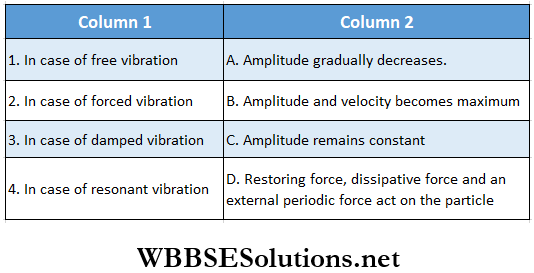
Nature Of Vibration Match The Columns

Question 1.

Class 11 Physics Unit 10 Oscillation And Waves Chapter 2 Nature Of Vibration Match The Column Question 1

Answer: 1. C, 2. D, 3. A, 4. B, D

Nature Of Vibration Integer Answer Type Questions

In this type, the answer to each of the questions is a single-digit integer ranging from 0 to 0.

1. The amplitudes of the first two oscillations of a damped pendulum are 9.0 cm and 3.0 cm respectively. What will be the amplitude (in cm) of the pendulum in its third oscillation?
Answer: 1

Question 2. After 50 complete oscillations a pendulum’s amplitude becomes 1/3 of its initial vibration. If its amplitude becomes \(\frac{1}{n^3}\) of its initial vibration after 150 complete oscillations, then find the value of n.
Answer: 3

WBCHSE Class 11 Physics Nature Of Vibration Multiple Choice Questions

Nature Of Vibration Multiple Choice Questions And Answers

WBBSE Class 11 Vibration MCQs

Question 1. In the case of free vibration of a body, the quantity that remains constant is

  1. Velocity
  2. Acceleration
  3. Time period
  4. Phase

Answer: 3. Velocity

Question 2. During vibration, the restoring force is

  1. Directly proportional to the displacement
  2. Directly proportional to the velocity
  3. Directly proportional to the kinetic energy
  4. Directly proportional to the potential energy

Answer: 1. Directly proportional to the displacement

Read And Learn More WBCHSE Class 11 Physics MCQs

Question 3. During the damped oscillation of a body, the force that acts is

  1. Only the restoring force
  2. Only the resistive force
  3. The restoring force along with the resistive force
  4. The restoring force along with the resistive force and the external periodic force

Answer: 3. The restoring force along with the resistive force

WBBSE Class 11 Practice Tests on Vibration Concepts

Question 4. During damped vibration, the quantity which gradually decreases is

  1. Velocity
  2. Phase
  3. Frequency
  4. Amplitude

Answer: 4. Amplitude

Question 5. In case of resonance, the characteristic property which is the same for free vibration of the body and the external periodic force is

  1. Amplitude
  2. Phase
  3. Velocity
  4. Frequency

Answer: 4. Frequency

WBCHSE Class 11 Physics Nature Of Vibration Multiple Choice Questions

Conceptual Questions on Vibrations for Class 11

Question 6. During the forced vibration of a particle

  1. Only the restoring force acts on the particle
  2. Both the restoring force and a dissipative force act on the particle
  3. Both the restoring force and an external periodic force act on the particle
  4. The restoring force, a dissipative force, and an external periodic force act on the particle

Answer: 4. The restoring force, a dissipative force, and an external periodic force act on the particle

Class 11 Physics Class 12 Maths Class 11 Chemistry
NEET Foundation Class 12 Physics NEET Physics

Question 7. During forced vibration, the frequency of the external periodic force is

  1. Equal to
  2. Less than
  3. Greater than
  4. Equal to, or greater than, or less than the frequency of free vibration of the body.

Answer: 4. Equal to, or greater than, or less than the frequency of free vibration of the body.

Practice MCQs on Types of Vibrations

Question 8. During forced vibration, if the frequency of free vibration of a body is equal to the frequency of the external periodic force, then the phenomenon that occurs is called

  1. Beats
  2. Interference
  3. Resonance
  4. Reverberation

Answer: 3. Resonance

Question 9. If a vibrating tuning fork is held at the open end of a tube closed at one end, then for a particular length of the tube an intense sound is heard. This phenomenon is known as

  1. Beats
  2. Stationary wave
  3. Interference
  4. Resonance

Answer: 4. Resonance

WBCHSE Class 12 Physics Electromagnetic Waves Question And Answers

Physics Electromagnetic Waves Questions And Answers

Question 1. Sound waves, unlike electromagnetic waves, cannot travel through a vacuum. Why?

Answer:

Sound is produced by the mechanical vibration of a body. Mechanical vibrations need a material medium with inertia and elasticity to sustain it for propagation. Hence, sound waves cannot travel through a vacuum.

On the other hand, electromagnetic waves are set up due to the oscillation of electric and magnetic fields. Electric and magnetic fields can spread without any medium. Hence, electromagnetic waves can travel through a vacuum.

Question 2. Electric fields or magnetic fields can independently exist in nature, but in electromagnetic waves, neither electric fields nor magnetic fields can exist independently. Why?

Answer:

The electric field or magnetic field, which does not vary with time, can exist independently. But fields, varying with time, cannot exist independently. Because during progression, the two fields continually create each other.

As varying electric and magnetic fields generate electromagnetic waves, none of the two fields of an electromagnetic wave can exist independently.

Question 3. The electric field and magnetic field of an electromagnetic wave advance as sinusoidal waves. Instead of being sinusoidal, If these fields had been different periodical waves, state whether any electromagnetic wave would have been formed or not.

Answer:

Any periodic wave can be expressed as a mixture of a large number of sinusoidal waves. The frequency of these waves is an integral multiple of the frequency of the main wave.

Hence, in this case, electromagnetic waves will be formed. It will contain many electromagnetic waves of different frequencies.

WBBSE Class 12 Electromagnetic Waves Q&A

Question 4. Name any two electromagnetic waves. State any one similarity and one dissimilarity between them.

Answer:

  1. Radio wave,
  2. Gamma rays.

Similarity: Each is a transverse wave traveling with the velocity of light.

Dissimilarity: Radio waves are used as carrier waves in distant communication, but gamma rays cannot be. On the other hand, gamma rays can initiate nuclear reactions, whereas radio waves can not.

Question 5. Light waves can travel in a vacuum but sound waves require a material medium. Why?

Answer:

A sound wave is an elastic wave. It travels by using the property of elasticity of material media. On the other hand, a light wave is an electromagnetic wave—the propagation of electric and magnetic fields does not need any Medium.

WBCHSE Class 12 Physics Electromagnetic Waves Questions And Answers

Short Answer Questions on Electromagnetic Spectrum

Class 12 Physics Electromagnetic Waves Short Questions And Answers

Question 1. A capacitor is made of two circular plates each of radius 12 cm, and separated by 5.0 cm. The capacitor is being charged by an external source. The charging current is constant and equal to 0.15 A.

  1. Calculate the capacitance and rate of change of potential difference between the plates.
  2. Obtain the displacement current across the plates.
  3. Is Kirchhoff’s first rule (junction rule) valid at each plate of the capacitor? Explain.

Answer:

1. ∵ \(V=\frac{Q}{C} \quad \text { or, } \frac{d V}{d t}=\frac{1}{C} \frac{d Q}{d t}=\frac{I}{C}\)

In this case,

⇒ \(C=\frac{\epsilon_0 A}{d}=\frac{8.854 \times 10^{-12} \times 3.14 \times\left(12 \times 10^{-2}\right)^2}{5 \times 10^{-2}}\)

= 8 x 10-12 F = 8 pF

∴ \(\frac{d V}{d t}=\frac{I}{C}=\frac{0.15}{8 \times 10^{-12}}=1.875 \times 10^{10} \mathrm{~V} \cdot \mathrm{s}^{-1}\)

2. Displacement current,

⇒ \(I_d=\epsilon_0 \frac{d \phi_E}{d t}=\epsilon_0 \frac{d}{d t}(E A)=\epsilon_0 A \frac{d E}{d t}=\frac{\epsilon_0 A}{d} \cdot \frac{d V}{d t}\)

⇒ \(C \cdot \frac{d V}{d t}=8 \times 10^{-12} \times 1.875 \times 10^{10}=0.15 \mathrm{~A}\)

3. Yes, because the conduction current entering a plate and the displacement current of the plate are identical.

Question 2. Which physical quantity is the same for X-rays of wavelength 10-10 m, red light of wavelength 6800 Å, and radio waves of wavelength 500 m?

Answer:

The speed of electromagnetic waves in a vacuum is fixed and is equal to 3 x l08 m. s-1. Since all three waves (viz. X-ray, redlight, and radio waves) are electromagnetic, their speed in vacuum remains the same.

Practice Questions on Applications of Electromagnetic Waves

Question 3. A plane electromagnetic wave travels in a vacuum along the z direction. What can you say about the directions of its electric and magnetic field vectors? If the frequency of the wave is 30 MHz, what is its wavelength?

Answer:

In this case, the electric field \(\bar{E}\) and magnetic field \(\bar{B}\) perpendicular to to other and lie on the xy -plane.

∵ c = fλ

∴ \(\lambda=\frac{c}{f}=\frac{3 \times 10^8}{30 \times 10^6}=10 \mathrm{~m}\)

Question 4. A charged particle oscillates about its mean equilibrium position with a frequency of 109 Hz. What is the frequency of the electromagnetic waves produced by the oscillator?

Answer:

The frequency of the oscillator and the frequency of the electromagnetic wave produced by it are the same. So in this case the frequency of the electromagnetic wave is 109 Hz.

Class 11 Physics Class 12 Maths Class 11 Chemistry
NEET Foundation Class 12 Physics NEET Physics

Question 5. In a plane electromagnetic wave, the electric field oscillates sinusoidally at a frequency of 2.0 x 10¹⁰ Hz and an amplitude of 48 V. m-1.

  1. What is the wavelength of the wave?
  2. What is the amplitude of the oscillating magnetic field?

Answer:

1. ∵ c = fλ

∴ \(\lambda=\frac{c}{f}=\frac{3 \times 10^8}{2.0 \times 10^{10}}=1.5 \times 10^{-2} \mathrm{~m}\)

2. ∵ \(c=\frac{E_0}{B_0}\)

∴ \(B_0=\frac{E_0}{c}=\frac{48}{3 \times 10^8}=1.6 \times 10^{-7} \mathrm{~T}\)

Question 6. Suppose that the electric field part of an electromagnetic wave in a vacuum is

\(\vec{E}\) = [(3.1 N.C-1)cos{(1.8 rad.m-1)y + (5.4 x 10⁶ rad. s-1)t}]\(\hat{i}\)

  1. What is the direction of propagation?
  2. What is the wavelength, λ?
  3. What is the frequency, f?
  4. What is the amplitude of the magnetic field part of the wave?
  5. Write an expression for the magnetic field part of the wave.

Answer:

The given equation

⇒ \(\vec{E}\) = [3.1 cos(1.8y + 5.4 x 10⁶t)]\(\hat{i}\) → (1)

may be compared with the standard equation of the electric field

⇒ \(\vec{E}\) = [E0 cos(ky + ωt)]\(\hat{i}\) →(2)

and following conclusions drawn.

  1. Along \(\hat{-j}\) direction (∵ coefficient of y is positive).
  2. Wavelength, \(\lambda=\frac{2 \pi}{k}=\frac{2 \times 3.14}{1.8}=3.49 \mathrm{~m}\)
  3. Frequency, \(f=\frac{\omega}{2 \pi}=\frac{5.4 \times 10^6}{2 \times 3.14}=0.86 \mathrm{MHz}\)
  4. \(B_0=\frac{E_0}{c}=\frac{3.1}{3 \times 10^8}=10 \mathrm{nT}\)
  5. \(\vec{B}\) = [B0 cos(ky + (ωt)]\(\hat{k}\)

= [10 cos(1.8y + 5.4 x 10⁶ t)] \(\hat{k}\) nT

Question 7. Given below are some famous numbers associated with electromagnetic radiations in different contexts in physics. State the part of the electromagnetic spectrum to which each belongs.

  1. 21 cm (wavelength emitted by atomic hydrogen in interstellar space)
  2. 1057 MHz (frequency of radiation arising from two close energy hydrogen, known as Lamb shift)
  3. 5890 Å-5896 Å (double lines of sodium)
  4. 14.4 keV [energy of a particular transition in 57Fe nucleus associated with a famous high-resolution spectroscopic method (Mossbouer spectroscopy)]

Answer:

  1. λ = 21 cm, is of the order of 10-2 m. i.e., the wavelength lies in the short radio wave region.
  2. f = 1057 MHz = 1.057 x 10⁹ Hz, which is in the short radio wave region.
  3. λ = 5890 Å – 5896 Å i.e.„ the wavelengths fall in the visible radiation (these are yellow lights of sodium).
  4. \(\lambda=\frac{h c}{E e}=\frac{6.63 \times 10^{-34} \times 3 \times 10^8}{14.4 \times 10^3 \times 1.6 \times 10^{-19}}=8.6 \times 10^{-11} \mathrm{~m}\)
  5. This wavelength is in the X-ray or soft gamma-ray region.

Question 8. Why do long-distance radio broadcasts use short-wave bands?

Answer:

Only radio waves of short wavelengths can be reflected from the ionosphere of Earth’s atmosphere. Long-distance radio broadcasts use these sky waves.

Question 9. Why use of satellites is necessary for long-distance TV transmission?

Waves of very high frequency necessary for long-distance TV transmission get transmitted through the ionosphere. The satellite is used to return these signals to Earth.

Question 10. Optical and radio telescopes are built on the ground but X-ray astronomy is possible only from satellites orbiting the earth. Why?

Answer:

The earth can receive visible and radio waves coming from the extra-terrestrial objects as the atmosphere can transmit these rays.

But the atmosphere absorbs X-rays and hence an X -telescope cannot receive these signals when set up on the ground. Thus an X-ray telescope has to be set up in a satellite orbiting the earth.

Question 12. The small ozone layer on top of the stratosphere is crucial for human survival. Why?

The ultraviolet rays coming from outer space are prevented by the ozone layer on top of the stratosphere from entering the inner layers of the earth’s atmosphere.

These rays are harmful to life on Earth, and the presence of the thin ozone layer is crucial for human survival.

Question 13. If the earth did not have an atmosphere, would its average surface temperature be higher or lower than what is now?

Answer:

In the absence of an atmosphere, there would be no greenhouse effect and the temperature of the earth would be lower than what it is now.

Question 14. Electromagnetic waves are produced by

  1. A static charge
  2. A uniformly moving charge
  3. An accelerated charge
  4. Neutral particle

Answer:

Electromagnetic waves are produced by accelerated charges.

The option 3 is correct.

Question 15. An electromagnetic wave of frequency 25 MHz travels in free space along the x-direction. At a particular point in space and time, \(\vec{E}\) = 6.3\(\hat{j}\) volt/meter. What is the value and direction of B of the wave at that point?

Answer:

Magnitude of magnetic field \(\vec{B}\)

∴ \(B=\frac{E}{c}=\frac{6.3}{3 \times 10^8}=2.1 \times 10^{-8} \mathrm{~Wb} \cdot \mathrm{m}^{-2}\)

The direction of wave propagation: x-axis

Direction of \(\vec{E}\): y-axis (unit vector is directed along \({j}\))

∴ \(\vec{B}\) is directed along z-axis.

∴ \(\vec{B}=\left(2.1 \times 10^{-8}\right) \hat{k} \mathrm{~Wb} \cdot \mathrm{m}^{-2}\).

Real-Life Applications of Electromagnetic Waves

Question 16. The speed of electromagnetic waves in a vacuum is

  1. \(\sqrt{\epsilon_0 \mu_0}\)
  2. \(\frac{1}{\sqrt{\epsilon_0 \mu_0}}\)
  3. \(\epsilon_0 \mu_0\)
  4. \(\frac{1}{\epsilon_0 \mu_0}\)

Answer:

2. \(\frac{1}{\sqrt{\epsilon_0 \mu_0}}\)

The option 2 is correct.

Question 17. Electromagnetic waves do not carry

  1. Energy
  2. Charge
  3. Information
  4. Momentum

Answer:

2. Charge

The option 2 is correct.

Question 18. A plane electromagnetic wave Ez = 100cos(6 x 10⁸t + 4x)V/m propagates in a medium. Find the refractive index of the medium.

Answer:

Comparing with the equation,

⇒ \(E=E_0 \cos (\omega t+k x)\)

we get, ω = 6 x 10⁸ s-1, k = 4 m-1

∴ The velocity of the electromagnetic wave in the medium,

⇒ \(v=\frac{\omega}{k}=\frac{6 \times 10^8}{4}=1.5 \times 10^8 \mathrm{~m} \cdot \mathrm{s}^{-1}\)

The refractive index of the medium,

∴ \(\mu=\frac{c}{v}=\frac{3 \times 10^8}{1.5 \times 10^8}=2\)

Question 19. The electric and magnetic fields of electromagnetic waves are

  1. In opposite phase and perpendicular to each other
  2. In opposite phases and parallel to each other
  3. In the same phase and perpendicular to each other
  4. In the same phase and parallel to each other

Answer:

3. In the same phase and perpendicular to each other

Question 20. The speed of an electromagnetic wave in a material medium is given by \(v=\frac{1}{\sqrt{\mu \epsilon}}\), μ being the permeability of the medium and e its permittivity. How does its frequency change?

Answer:

The speed and wavelength of an em wave change when it enters a material medium, but its frequency remains unchanged.

Question 21. Welders wear special goggles or face masks with glass windows to protect their eyes from electromagnetic radiation. Name the radiations and write the range at their frequency.

Answer:

To protect the eye from UV radiation.

Examples of Electromagnetic Wave Phenomena

Question 22. A capacitor made of two parallel plates each of plate area A and separation d is being charged by an external AC source. Show that the displacement current inside the capacitor is the same as the current charging the capacitor.

Answer:

The capacitance of the parallel plate capacitor

⇒ \(C=\frac{\epsilon_0 A}{d}\)

Effective emf in a purely capacitative circuit driven by an AC voltage V is

⇒ \(V^{\prime}=V-\frac{q}{C}\)

∴ The circuit equation is

⇒ \(V-\frac{q}{C}=0 \text { or, } q=C V\)

∴ Charging current, I = \(\frac{d q}{d t}=C \frac{d V}{d t}=\frac{\epsilon_0 A}{d} \frac{d V}{d t}\)

Displacement Current,

⇒ \(I_d=\epsilon_0 \frac{d \phi_E}{d t}=\epsilon_0 \frac{d}{d t}(E A)=\epsilon_0 \frac{d}{d t}\left(\frac{V}{d} A\right)=\frac{\epsilon_0} A \frac{d V}{d t}\)

∴ Id = 1

Question 23. To which part of the electromagnetic spectrum does a wave of frequency 3 x 10¹³ Hz belong?

Answer:

∴ \(\lambda=\frac{c}{f}=\frac{3 \times 10^{8}}{3 \times 10^{13}}=10^{-5} \mathrm{~m}\)

This belongs to the infrared part of the electromagnetic spectrum.

Question 24. Define the intensity of radiation based on a photon picture of light. Write its SI unit.

Answer:

1st Part: The intensity of radiation is the energy transmitted in unit time through photons across a unit area normal to the photon beam.

2nd Part: Its SI unit is J.m-2. s-1 or W. m-2

Question 25.

  1. Which one of the following electromagnetic radiations has the least frequency: UV radiations, X-rays, Microwaves
  2. How do you show that electromagnetic waves carry energy and momentum?

Answer:

  1. UV radiations.
  2. Electromagnetic waves are streams of photon particles. Since photon particles carry both energy and momentum, electromagnetic waves also carry energy and momentum.

Question 26. How are electromagnetic waves produced? What is the source of energy of these waves? Write mathematical expressions for electric and magnetic fields on an electromagnetic wave propagating along the z-axis. Write any two important properties of electromagnetic waves.

Answer:

Electromagnetic waves are produced when charged particles oscillate. The vibrations of charged particles result in energy which is emitted as electromagnetic radiation.

The mathematical expressions for electric and magnetic fields along the z-axis are

⇒ \(\vec{E}=E_0 \sin (\omega t-k z) \hat{i} \text { and } \vec{B}=B_0 \sin (\omega t-k z) \hat{j}\)

Properties of electromagnetic waves:

  1. They carry energy through space and this energy is distributed equally between the electric and magnetic fields at the time of propagation of electromagnetic waves.
  2. They do not require any material medium for their propagation.

Question 27. Why does current in a steady state not flow in a capacitor connected across a battery? However momentary current does flow during the charging or discharging of the capacitor explain.

Answer:

In a steady state, no current flows in a capacitor connected across a battery because no AC voltage is applied across the capacitor.

During the charging of the capacitor, current flows from the negative plate to the positive plate. The current flows in the opposite direction during the discharging of the capacitor.

Question 28. How is the speed of EM waves in a vacuum determined by the electric and magnetic fields?

Answer:

The speed of EM waves in vacuum in terms of the electric [E0] and magnetic field [B0] is, \(c=\frac{E_0}{B_0}\)

Question 29. Do electromagnetic waves carry energy and momentum?

Answer:

Yes, electromagnetic waves carry energy and momentum.

Question 30. Identify the electromagnetic waves whose wavelengths vary as

  1. 10-12m < λ < 10-8m and
  2. 10-3m < λ < 10-1m

Answer:

  1. X-rays—used in medical imaging
  2. Microwaves—used in radar

Question 31. What do you understand by the statement, “electromagnetic waves transport momentum”?

Answer:

The statement “electromagnetic waves transport momentum” means that electromagnetic waves carry momentum from one place to another in a vacuum or a medium.

Important Definitions in Electromagnetic Waves

Question 32. Name the electromagnetic radiation used for

  1. Water purification and
  2. Eye surgery.

Answer:

  1. Ultraviolet rays and
  2. Ultraviolet rays

Question 33. Why are infrared waves often called heat waves? Explain.

An object absorbs infrared waves incident on it and then its temperature increases. That is why infrared waves are called heat waves.

Question 34. Electromagnetic waves are produced by

  1. A static charge
  2. A uniformly moving charge
  3. An accelerated charge
  4. Neutral particle

Answer:

3. An accelerated charge

Electromagnetic waves are produced by accelerated charges.

The option 3 is correct

Question 35. An electromagnetic wave of frequency 25 MHz travels in free space along the x-direction. At a particular point in space and time,\(\vec{E}=6.3 \hat{j}\) volt/meter. What is the value and direction of \(\vec{B}\) of the wave at that point?

Answer:

Magnitude of magnetic field \(\vec{B}\),

⇒ \(B=\frac{E}{c}=\frac{6.3}{3 \times 10^8}=2.1 \times 10^{-8} \mathrm{~Wb} \cdot \mathrm{m}^{-2}\)

Direction of wave propagation: x-axis

Direction of \(\vec{E}\): y-axis (unit vector is directed along \(\hat{j}\))

∴ \(\vec{B}\) is directed along z-axis.

∴ \(\vec{B}=\left(2.1 \times 10^{-8}\right) \hat{k} \mathrm{~Wb} \cdot \mathrm{m}^{-2}\).

Question 36. Electromagnetic waves do not carry

  1. Energy
  2. Charge
  3. Momentum
  4. Information

Answer:

2. Charge

The option 2 is correct.

Question 37. A plane electromagnetic wave Ez = 100cos(6 x 10⁸ t + 4x)V/m propagates in a medium. Find the refractive index of the medium.

Answer:

Comparing with the equation,

E = E0 cos (ωt + kx)

we get, ω = 6 x 10⁸ s-1, k = 4 m-1

∴ The velocity of the electromagnetic wave in the medium,

⇒ \(v=\frac{\omega}{k}=\frac{6 \times 10^8}{4}=1.5 \times 10^8 \mathrm{~m} \cdot \mathrm{s}^{-1}\)

The refractive index of the medium,

∴ \(\mu=\frac{c}{v}=\frac{3 \times 10^8}{1.5 \times 10^8}=2\)

Question 38. The electric and magnetic fields of electromagnetic waves are

  1. In opposite phase and perpendicular to each other
  2. In opposite phases and parallel to each other
  3. In the same phase and perpendicular to each other
  4. In the same phase and parallel to each other

Answer:

3. In the same phase and perpendicular to each other

The option 3 is correct.

WBCHSE Class 12 Physics Electric Energy And Power Short Question And Answers

WBCHSE Class 12 Physics Electric Energy

Electric Energy And Power Short Question And Answers

Question 1. A parallel combination of three resistors 3Ω, and 5Ω is connected across a battery. Find which resistor will consume more electrical energy per second.
Answer:

As the three resistances are connected in parallel, the voltage drop across each of them will be the same.

Electric Energy And Power A parallel combination ofthree resistors

∴ ‍Power dissipated in 3 Ω resistance, \(P_1=\frac{V^2}{3}\)

Similarly, \(P_2=\frac{V^2}{4} \text { and } P_3=\frac{V^2}{5}\)

So, the resistance 3Ω will consume more energy in 1 s.

Read And Learn More WBCHSE Class 12 Physics Short Question And Answers

Question 2. The rate of heat developed in a resistor R connected to a supply of potential difference V is H. What will be the rate of heat developed if the potential difference is V/3 and the resistance doubles?
Answers:

In the first case,

⇒ \(H \propto \frac{V^2}{R} \text { or, } H=k \frac{V^2}{R}\) [where k = constant]

In the second case,

⇒ \(H^{\prime}=k \frac{\left(\frac{V}{3}\right)^2}{2 R}=\frac{1}{18} k \frac{V^2}{R}=\frac{1}{18} H\)

Electric Energy and Power Short Questions 

Electric Energy Short Q&A WBCHSE

Question 3. A light bulb is rated 100 W for a 220 V ac supply of 50 Hz.

  1. The resistance of the bulb,
  2. Therms current through the bulb.

Answer:

200 V = rms supply voltage = equivalent dc voltage

1. \(P=\frac{V^2}{R} \quad \text { or, } R=\frac{V^2}{P}=\frac{(220)^2}{100}=484 \Omega\)

2. \(I_{\mathrm{rms}}=\frac{V_{\mathrm{rms}}}{R}=\frac{220}{484} \approx 0.45 \mathrm{~A}\)

WBCHSE Class 12 Physics Electric Energy And Power Short Question And Answers

Class 12 Physics Electric Power Questions 

Question 4. Nichrome and copper wires of the same length and radius are connected in series. Current A is passed through them. Which wire gets heated up more?
Answer:

Heat dissipates in a wire, H = I²Rt

We know that,

⇒ \(R=\frac{\rho l}{A}\)

∴ \(H=I^2 \frac{\rho l}{A} t\)

If current I, length l, and area A remain the same, H depends on \(\rho\)

∴ \(H \propto \rho \text { and } \rho_{\text {nichrome }}>\rho_{\text {copper }}\)

Hence, the nichrome wire will heat up more.

Class 11 Physics Class 12 Maths Class 11 Chemistry
NEET Foundation Class 12 Physics NEET Physics

WBCHSE Physics Questions on Electric Power

Question 5. The potential difference applied across a given resistor is altered so that the heat produced per second increases by a factor of 9. By what factor does the applied potential difference change?
Answer:

We know that, \(H=\frac{V^2}{R} t\)

or, \(\frac{H}{t}=\frac{V^2}{R} \quad ∴ \frac{H}{t} \propto V^2\)

It is given that heat produced per second \(\frac{H}{t}\), increases by a factor of 9.

Hence, the applied potential difference V increased by a factor of 3.

Electric Energy and Power Class 12 Notes 

Question 6. The current is drawn from a cell of emf E and internal resistance r connected to the network of resistors each of resistance r. Obtain the expression for

  1. The current drawn from the cell
  2. The power consumed in the network.

Class 12 Physics Unit 2 Current Electricity Chapter 3 Electric Energy And Power a cell of emf E and internal resistance

Answer:

Class 12 Physics Unit 2 Current Electricity Chapter 3 Electric Energy And Power a cell of emf E and internal resistance.

Here r, 2r, 2r, and r are in parallel.

So, \(\frac{1}{R_{A B}}=\frac{1}{r}+\frac{1}{r}+\frac{1}{2 r}+\frac{1}{2 r}\)

or, \(\frac{1}{R_{A B}}=\frac{3}{r} \quad \text { or, } R_{A B}=\frac{r}{3}\)

The total resistance of the circuit,

⇒ \(R=r+R_{A B}=r+\frac{r}{3}=\frac{4 r}{3}\)

1. Current drawn from the cell,

⇒ \(I=\frac{E}{R}=\frac{E}{(4 r / 3)}=\frac{3 E}{4 r}\)

2. Power consumed in network, \(P=I^2 R_{A B}\)

∴ \(P=\left(\frac{3 E}{4 r}\right)^2 \cdot \frac{r}{3}=\frac{3 E^2}{16 r}\)

WBCHSE Physics Chapter 3 Solutions 

Short Answer Questions on Electric Energy WBCHSE

Question 7. Two electric bulbs P and Q have their resistances In the ratio of 1: 2. They are connected in series across a battery. Find the ratio of the power dissipation in these bulbs.
Answer:

Class 12 Physics Unit 2 Current Electricity Chapter 3 Electric Energy And Power Two electric bulbs P and Q have their resistances

We have, \(\frac{R_P}{R_Q}=\frac{1}{2}\)

Power consumed by a bulb,

P = I²R

Here, the current I is the same for both bulbs.

So, \(\frac{P_p}{P_Q}=\frac{R_p}{R_Q}=\frac{1}{2}\)

WBCHSE Class 12 Physics Electric Energy And Power Multiple Choice Questions

WBCHSE Class 12 Physics MCQs

Electric Energy And Power Multiple Choice Question And Answers

Question 1. Which quantity expresses the work done by an electrical machine?

  1. VI
  2. VIt
  3. I2R
  4. \(\frac{I^2 R t}{J}\)

Answer: 2. VIt

Question 2. A-s is a unit of

  1. Emf
  2. Energy
  3. Power
  4. Charge

Answer: 4. Charge

Question 3. Which one is the unit of power?

  1. A.s
  2. W.half
  3. \(\frac{\mathrm{A}^2}{\Omega}\)
  4. A².Ω

Answer: 4. A².Ω

Question 4. Two bulbs are marked 220V- 100 W and 110V-100W. The ratio of the resistances of the two bulbs is

  1. 1:4
  2. 1:2
  3. 2:1
  4. 4:1

Answer: 4. 4: 1

Read and Learn More Class 12 Physics Multiple Choice Questions

Question 5. What is the power of the combination?

Class 12 Physics Unit 2 Current Electricity Chapter 3 Electric Energy And Power Multiple Choice Question And Answers Question 5

  1. 50W
  2. 20W
  3. 10W
  4. 8W

Answer: 4. 8W

Electric Energy MCQs for WBCHSE

Question 6. What is the power of the combination?

Class 12 Physics Unit 2 Current Electricity Chapter 3 Electric Energy And Power Multiple Choice Question And Answers Question 6

  1. 2.5 W
  2. 2.0W
  3. 0.5W
  4. 0.8W

Answer: 1. 2.5W

Question 7. A fuse wire of length Z and radius r is connected in series with a circuit. The safe current that can pass through the circuit is proportional to

  1. r3
  2. r3/2
  3. l-3/2
  4. l-1

Answer: 2. r3/2

WBCHSE Class 12 Physics Electric Energy And Power Multiple Choice Questions

Question 8. The ratio of the resistances of 100 W and 40 W bulbs of the same rated voltage is

  1. 2:5
  2. 5: 2
  3. 25:4
  4. 4:25

Answer: 1. 2: 5

Power in Electric Circuits Questions WBCHSE

Question 9. If power dissipated in the 9 H resistor in the circuit shown is 36 W, the potential difference across the 2Ω resistor is

Class 12 Physics Unit 2 Current Electricity Chapter 3 Electric Energy And Power Multiple Choice Question And Answers Question 9

  1. 4 V
  2. 8 V
  3. 10 V
  4. 2 V

Answer: 3. 10 V

Question 10. 1 BOT unit is equal to

  1. 3600 W
  2. 3600 J
  3. 3.6 x 10⁶W
  4. 3.6 x 10⁻⁶ J

Answer: 4. 3.6 x 10⁶ J

Class 11 Physics Class 12 Maths Class 11 Chemistry
NEET Foundation Class 12 Physics NEET Physics

Question 11. BOT unit is a unit of

  1. Charge
  2. Energy
  3. Power
  4. Efficiency

Answer: 2. Energy

Question 12. 1 BOT unit is equal to

  1. lW.h
  2. 1000W.h
  3. \(\frac{1}{1000}\)
  4. \(\frac{1}{1000}\)V.A

Answer: 2. 1000W.h

WBCHSE Physics Questions on Electric Energy

Question 13. An electric conductor has a resistance R and its terminal potential difference is V. If charge Q passes through it in time t, then the amount of electrical energy transmitted is

  1. QV
  2. \(\frac{Q^2 R}{t}\)
  3. \(\frac{V^2 t}{R}\)
  4. \(\frac{Q V}{t}\)

Answer:

1. QV

2. \(\frac{Q^2 R}{t}\)

3. \(\frac{V^2 t}{R}\)

Question 14. Each of the two electric lamps has a voltage rating of V and a watt rating of P. If they are joined in series and are connected to a supply line of V volt, then,

  1. Current through each = \(\frac{P}{V}\)
  2. Current through each = \(\frac{P}{2V}\)
  3. Power consumed by each = \(\frac{P}{2}\)
  4. Power consumed by each = \(\frac{P}{4}\)

Answer:

2. Current through each = \(\frac{P}{2V}\)

4. Power consumed by each = \(\frac{P}{4}\)

Electric energy and power class 12 MCQs 

Question 15. A 10 kn carbon resistor has a watt rating of 1 W, i.e., it may be damaged if the power consumed exceeds 1 W. Which of the following currents are safe for the resistor?

  1. 5mA
  2. 8mA
  3. 12mA
  4. 20mA

Answer:

1. 5mA

2. 8mA

Electric energy and power class 12 MCQs 

Question 16. The powers consumed in the resistances \(\frac{R}{3}\), R and 2R are P1 P2 and P3 respectively. Then,

Class 12 Physics Unit 2 Current Electricity Chapter 3 Electric Energy And Power Multiple Choice Question And Answers Question 16

  1. P1<P2
  2. P1<P3
  3. P2 > P3
  4. P2<P3

Answer:

1. P1< P2

3. P2<P3

Multiple Choice Questions on Power and Energy WBCHSE

Question 17. A fuse wire has a length of l and a radius of r. The maximum safe. current through it is

  1. Proportional to r2
  2. Proportional to r3/2
  3. Inversely proportional to l
  4. Independent of l

Answer:

2. Proportional to r3/2

4. Independent of l

Question 18. For an electric lamp, ‘the voltage rating is V and the watt rating is P’- this means that the lamp will be brightest when its terminal potential difference is V volt, and in that condition, its power consumed will be P watt. The current through the’lamp is I = \(\frac{P}{V}\) and its resistance R = \(\frac{V}{l}\). A voltage higher than V is never applied between its terminals, as in that case the lamp may get damaged. On the other hand, the supply voltage may fall below V for different reasons say, the terminal voltage then is V'(V’ < V); the brightness of the lamp diminishes in this case. The resistance of the lamp, however, may be assumed to be unchanged, and it may be said that the current through the lamp, \(I^{\prime}=\frac{V^{\prime}}{R}\) and the power consumed, P’ = V’l’. The voltage rating of more than one lamp is V, and their watt ratings are P1, P2…. (suppose). When a voltage V is applied across a parallel combination of them, each lamp attains a terminal potential difference V. As a result, each lamp glows with its maximum brightness. On the other hand, when the same voltage V is applied at the two ends of their series combination, the lamps share the voltage V among themselves. As no lamp attains the rated terminal voltage V, none of them achieves the maximum brightness.

Class 12 Physics Unit 2 Current Electricity Chapter 3 Electric Energy And Power Multiple Choice Question And Answers Question 18

1. Two lamps have ratings of 200V-40W and 200V-60W respectively. The power consumed by their series combination, driven by a potential difference of 200 V, is

  1. 24 W
  2. 50 W
  3. 72 W
  4. 100W

Answer: 1. 24 W

2. Two lamps have ratings of 200V-40W and 200V-60W respectively. If the supply voltage across their parallel combination falls by 2% from 200 V, then the power consumed by the two lamps decreases by

  1. 1%
  2. 2%
  3. 4%
  4. 8%

Answer: 4%

Class 12 physics electric energy questions 

3. A potential difference of 100 V is applied across the parallel combination of two electric bulbs rated at 100 V-100 W and 200 V-100 W respectively. The ratio of the power consumed by them would be

  1. 1:1
  2. 2:1
  3. 4:1
  4. 16:1

Answer: 4: 1

4. The power of an electric heater is P. This becomes P’ when the heater coil is cut to have a slightly shorter length. P’ would be related to P as

  1. P’ = P
  2. P’ > P
  3. P’ < P
  4. P’ ≠ P

Answer: P’ > P

Question 19. Let us take an electrical conductor in which the electrical energy supplied is entirely converted into heat. If, for the conductor, the terminal potential difference = V, the current through it =I, and its resistance = R, then the electrical energy consumed in time t is, W = I²Rt (from Ohm’s law, R = \(\frac{V}{I}\)). So, if the electrical and the heat energies both are expressed in joule, the heat developed in time t is H = PRt. However, if H is expressed in the conventional unit calorie, then from the law, W = JR, we may write, H = \(H=\frac{I^2 R t}{J}\) where J = mechanical equivalent of heat = 4.2 J- cal-1. The resistance R of a conducting wire depends on its material, its length l, and its area of cross-section A. The resistivity of the material of the conductor is, \(\rho=\frac{R A}{l}\) When more than one heat-producing conductor is kept in series in a circuit, the same current passes through each of them; but as their resistances are different in general, the terminal potential differences are also unequal. On the other hand, each conductor has the same terminal potential difference in a parallel combination; however, the rents through them are different.

1. The terminal potential difference and the currents through two conducting wires are both in the ratio 2: 1. The ratio of the rates of heat evolved in them is

  1. 1: 1
  2. 2: 1
  3. 4: 1
  4. 8: 1

Answer: 3. 4: 1

Class 12 physics electric energy questions 

2. Heat is produced at the rate of 8 cal.s-1 in a uniform wire when its terminal potential difference is 10 V. What would be the rate in another wire of the same material, of the same length, but of half the diameter, for the same potential difference?

  1. 32 cal.s-1
  2. 16 cal.s-1
  3. 4 cal.s-1
  4. 2 cal.s-1

Answer: 2 cal.s-1

3. The first one of two wires, of the same material and of equal cross sections, is longer than the second. A current through their series combination produces heat in them at the rates h1 and h2, respectively. Then,

  1. h1 = h2
  2. h1>h2
  3. h1<h2
  4. h1 ≠ h2

Answer: h1>h2

Question 20. By how much will the power of an electric bulb decrease if the current drops by 0.5%?

  1. 0.25%
  2. 0.5%
  3. 1%
  4. 2%

Answer: 3. 1%

The resistance of an electric bulb can be assumed to be constant.

Power, P = I²R or, InP = 21nI + InR

∴ \(\frac{\Delta P}{P}=2 \frac{\Delta I}{I}\)

= 2 x 0.5 %

= 1%

The option 3 is correct

Class 12 physics electric energy questions 

Question 21. Consider the circuit. The value of the resistance X for which the thermal power generated in it is practically independent of small variation of its resistance is

Class 12 Physics Unit 2 Current Electricity Chapter 3 Electric Energy And Power Multiple Choice Question And Answers Question 21

  1. X = R
  2. X = \(\frac{R}{3}\)
  3. X = \(\frac{R}{2}\)
  4. X = 2R

Answer: 3. X = \(\frac{R}{2}\)

⇒ \(i=\frac{E}{\left(R+\frac{R X}{R+X}\right)}[i=\text { main current in the circuit }]\)

⇒ \(V_{R X}=\frac{E \frac{R X}{R+X}}{\left(R+\frac{R X}{R+X}\right)}=\frac{E X}{(R+2 X)}\) [potential difference across two terminals of R and X]

⇒ \(\left.P_X=\frac{V_{R X}^2}{X}=\frac{E^2 X}{(R+2 X)^2} \text { [power consumed by } X\right]\)

∴ \(\frac{d P_X}{d X}=E^2 \frac{(R-2 X)}{(R+2 X)^3} \text { or, } d P_X=\frac{E^2(R-2 X)}{(R+2 X)^3} d X\)

Now if X = \(\frac{R}{2}\), then for any value of dX, dPx = 0

The option 3 is correct.

Practice MCQs on Electric Energy for Class 12

Question 22. In a large building, there are 15 bulbs of 40 W, 5 bulbs of 100 W, 5 fans of 80, and 1 heater of 1 kW. The voltage of the electric mains is 220 V. The minimum capacity of the main fuse of the building will be

  1. 8A
  2. 10 A
  3. 12 A
  4. 14 A

Answer: 3. 12 A

15 x 40 + 5 x 100 + 5 x 80 + 1000

= 220 x I

∴ I = 11.36 A ≈ 12 A

The option 3 is correct.

Question The two cities are 150 km apart. Electric power is sent from one city to another city through copper wires. The fall of potential per km is 8 volts and the average resistance per km is 0.5Ω. The power loss in the wire is

  1. 19.2W
  2. 19.2 kW
  3. 19.2 J
  4. 12.2 kW

Answer: 2. 19.2 kW

Total resistance =0.5 X 150

= 75Ω

Total voltage drop = 8 x 150

= 1200 V

∴ Power dissipated

⇒ \(\frac{V^2}{R}=\frac{(1200)^2}{75}=19200 \mathrm{~W}=19.2 \mathrm{~kW}\)

The option 2. is correct.

WBCHSE physics electric energy MCQs 

Question 23. The charge flowing through a resistance R varies with time t as Q = at – bt², where a and b are positive constants. The total heat produced in R is

  1. \(\frac{a^3 R}{3 b}\)
  2. \(\frac{a^3 R}{2 b}\)
  3. \(\frac{a^3 R}{b}\)
  4. \(\frac{a^3 R}{6 b}\)

Answer: 4. \(\frac{a^3 R}{6 b}\)

Current passing through resistance R,

⇒ \(I=\frac{d Q}{d t}=a-2 b t\)

Now, I will be zero when \(a-2 b t=0 \text { or, } t=\frac{a}{2 b}\)

∴ Total heat produced in R

⇒ \(\int_0^t I^2 R d t=\int_0^{\frac{a}{2 b}}(a-2 b t)^2 R d t\)

⇒ \(\int_0^{\frac{a}{2 b}}\left(a^2 R+4 b^2 R t^2-4 a b R t\right) d t\)

⇒ \(\left[a^2 R t+\frac{4 b^2}{3} R t^3-\frac{4 a b R}{2} t^2\right]_0^{\frac{a}{2 b}}=\frac{a^3 R}{6 b}\)

The option 4 is correct.

WBCHSE Class 12 Physics Electric Energy And Power Questions And Answers

WBCHSE Class 12 Physics Electric Energy And Power Questions And Answers

Question 1. Among emf, energy, power, and charge, which one has the unit As?
Answer:

A.s = unit of current x unit of time

By definition, the charge (Q) flowing through a conductor in unit time, is called current (I).

∵ I = \(\frac{Q}{t}\)

or, Q = It

So, charge = current x time

∴ A.s is the unit of charge.

Question 2. How are lamps, fans, etc. connected in domestic electrical connection in series combination or parallel combination?
Answer:

The voltage rating of the lamp, fan, etc. is generally fixed at a definite value (for example, 220 V ), and at this voltage, they work at the maximum rate. Again, we know that if a few conductors are connected in parallel, the potential difference across each conductor is equal. So, in domestic electric wiring lamps, fans, etc. are connected in parallel combination.

Essential Questions on Electric Energy WBCHSE

Question 3. The speed of an electric fan is reduced with the help of a regulator. What will happen in the energy consumption?
Answer:

If an electric fan of resistance R runs under potential difference V for time t, then work done,

⇒ \(W=I^2 R t=\frac{I^2 R^2 t}{R}=\frac{V^2 t}{R}\)

To reduce the speed, some resistance, say R1 is added in series through a regulator. So the potential difference at the two ends of the combination of R and R1 is V.

So, work done in time t, \(W_1=\frac{V^2 t}{R+R_1}\)

Evidently, Wx is less than W. So, energy consumption decreases.

Question 4. Is the filament of the lamp marked ‘240 V-1000 W’ thin or thick in comparison to the filament of the lamp marked ‘240 V-100W’?
Answer:

Power, \(P=\frac{V^2}{R} \quad \text { or, } R=\frac{V^2}{P}\)

So, if the same potential difference is applied to both lamps, the resistance of the lamp having larger power will be less than that of the lamp having less power.

Again, the larger the cross-sectional area (A) of a conducting wire (filament), the smaller will be its resistance (since \(R \propto \frac{1}{A}\) ). So, the filament of a 1000 W lamp will be thicker than that of a 100 W lamp.

Question 5. A series combination of a 60 W and a 100 W lamp is connected to the mains. Which lamp will glow brighter and why?
Answer:

Resistance of 60 W lamp, \(R_1=\frac{V^2}{60}\);

V is the mains voltage.

Resistance of 100 W lamp, \(R_2=\frac{V^2}{100}\)

Obviously, R1 > R2.

As the two lamps connected in series, are connected to the mains, the same current will flow through them. So from Joule’s law [latex]H \propto I^2 R t[/latex], it can be said that more heat will be produced in the lamp having higher resistance i.e., 60 W lamp. Hence, the 60 W lamp will glow brighter than the 100 W lamp.

WBCHSE Class 12 Physics Electric Energy And Power Question And Answers

Electric Energy Questions and Answers WBCHSE

Question 6. A heater coil is cut into two equal parts and only one part is now used in the heater. What is the percentage of increase or decrease in the rate of production of heat?
Answer:

In both cases, the potential differences between the two ends of the coil (V) are the same. So, rate of production of heat \(\propto \frac{V^2}{R}\). When the coil is cut into two equal parts, the value of R becomes half. So, the rate of production of heat becomes double, i.e., this rate increases by 100%

Class 11 Physics Class 12 Maths Class 11 Chemistry
NEET Foundation Class 12 Physics NEET Physics

Question 7. A few wires of the same dimension but of different specific resistances are connected in parallel and then this parallel combination is connected to a battery. In which wire will the rate of production of heat due to the Joule effect be maximum?
Answer:

As the wires are connected in parallel, so potential difference across each wire will be the same.

Heat produced, \(H=\frac{V^2 t}{R J}=\frac{V^2 t}{J \cdot \rho \frac{l}{A}}\)

As each wire is of the same dimension, the rate of production of heat will be maximum in the wire, whose specific resistance is minimum.

Question 8. The specific resistance of the material of a conducting wire is p and the current through unit cross-sectional area of the wire (i.e., current density) is J. What is the power consumed per unit volume of the wire?
Answer:

Let the length of the wire = l, the cross-sectional area of the wire = A, and current through the wire = I.

So, resistance, \(R=\rho \cdot \frac{l}{A}\) ;

current density, \(J=\frac{I}{A}\) ; volume of the

wire = lA

Power consumed, P = I²R

So, power consumed per unit volume,

⇒ \(\frac{P}{l A}=\frac{I^2 R}{l A}=\frac{I^2}{l A} \cdot \rho \frac{l}{A}=\left(\frac{I}{A}\right)^2 \cdot \rho=J^2 \rho\)

Question 9. A few electric bulbs are connected in series to the 220 V mains. One bulb is fused, and the remaining bulbs are again put in series and connected to the same supply of 220 V. In which case will the bulbs glow brighter and why?
Answer:

In the second case, the bulbs will glow brighter. Let n be the number of bulbs and the bulbs be connected to 220 V mains.

So, potential difference across each bulb, V1 = \(\frac{220}{n}\)V.

One bulb out of them is fused. So, now the potential difference across each bulb,

⇒ \(V_2=\frac{220}{n-1} \mathrm{~V} \quad ∴ V_2>V_1\)

So, in the second case, the bulbs will glow brighter.

WBCHSE Physics Q&A on Electric Power

Question 10. Three resistances of equal value are connected in four different combinations. Arrange them in increasing order of power dissipation.

Electric Energy And Power Three resistances of equal value

Answer:

Let R be the value of each resistance.

The equivalent resistance of the circuit (a), R1 = 3R

Equivalent resistance of circuit (b), R2 = \(\frac{R}{3}\)

The equivalent resistance of the circuit (c), \(R_3=\frac{2 R \cdot R}{2 R+R}=\frac{2}{3} R\)

The equivalent resistance of the circuit (d), \(R_4=\frac{R}{2}+R=\frac{3}{2} R\)

∴ R2 < R3 < R4 < R1

Since, power, P = I²R

So, P2 < P3 < P4 < P1.

Question 11. A heater coil has been cut into two equal parts and one coil is used as a heater. What is the percentage change in heat generation?
Answer:

The potential difference across the coU in both cases is V.

Therefore rate of heat generation = \(\frac{V^2}{R}\)

If the coil is cut into half then the value of R becomes half. That’s why, the rate of heat generation has doubled.

That is, this rate increases by 100%.

Question 12. Two electric bulbs of 50 W and 100 W are connected in mains once in

  1. Series and next in
  2. Parallel combination. Which bulb will glow brighter in each case?

Answer:

1. In a series combination, a 50 W bulb will glow brighter than a 100 W bulb. We know, the resistance of the bulb,

⇒ \(R=\frac{V^2}{P}\) [V = potential difference, P = power]

So the resistance of the 50W bulb is greater than that of the 100W bulb.

In this combination, the current in both bulbs is are same.

As heat generation is proportional to I²R, that’s why a 50W bulb glows brighter than a 100W bulb.

2. In parallel combination, a 100W bulb will glow brighter than a 50W bulb

When the bulbs are connected in parallel combination potential difference across each one is the same.

As, heat generation is proportional to \(\frac{V^2}{R}\), that’s why a 100 W bulb glows brighter than a 50 W bulb in parallel combination.

Short Answer Questions on Electric Energy WBCHSE

Question 13. A wire, when connected to a 220 V mains supply, has power dissipation. Now the wire is cut into two equal pieces, which are connected in parallel to the same supply. Power dissipation in this case is P2. What is the ratio of P2 and P1?
Answer:

If R is the resistance of the wire, then the resistance of each of the two pieces is

⇒ \(\frac{R}{2}\).

Equivalent resistance of the parallel combination,

⇒ \(r=\frac{\frac{R}{2} \times \frac{R}{2}}{\frac{R}{2}+\frac{R}{2}}=\frac{R}{4} \quad \text { or, } \frac{R}{r}=4\)

So, \(\frac{P_2}{P_1}=\frac{\frac{V^2}{r}}{\frac{V^2}{R}}=\frac{R}{r}=4\)

Question 14. Power consumed in resistance R3 is P3. Determine the power consumed in resistances R1 and R2.

Electric Energy And Power Power consumed in resistance

Answer:

Let I1 and I2 be the currents flowing in the upward branch and downward branch respectively.

So, \(I_1\left(R_1+R_2\right)=I_2 R_3 \quad \text { or, } \frac{I_1}{I_2}=\frac{R_3}{R_1+R_2}\)

Now, \(\frac{P_1}{P_3}=\frac{I_1^2 R_1}{I_2^2 R_3}=\left(\frac{R_3}{R_1+R_2}\right)^2 \cdot \frac{R_1}{R_3}=\frac{R_1 R_3}{\left(R_1+R_2\right)^2}\)

or, \(P_1=P_3 \cdot \frac{R_1 R_3}{\left(R_1+R_2\right)^2}\)

Similarly \(P_2=P_3 \cdot \frac{R_2 R_3}{\left(R_1+R_2\right)^2}\)

Question 15. A generating station supplies electric power P at voltage V to a factory through a cable of resistance R. Show that the loss of power in the connecting cable is inversely proportional to V2.
Answer:

Supplied power, P = VI

∴ I = \(\frac{P}{V}\)

Loss in power, \(\Delta P=I^2 R=\frac{P^2 R}{V^2}\)

∴ \(\Delta P \propto \frac{1}{V^2}\)

Electric Power Study Questions for Students

Question 16. Prove that total heat produced in different resistors of the circuit is minimal when the current is divided into a number of branches.
Answer:

When the current is divided into a number of parallel branches, then I = I1 + I2

Heat produced in the circuit in time t,

⇒ \(H=\frac{I_1^2 r_1 t}{J}+\frac{\left(I-I_1\right)^2 r_2 t}{J}\)

Electric Energy And Power total heat produced

Differentiating both sides with respect to I1,

⇒ \(\frac{d H}{d I_1}=\frac{2 I_1 r_1 t}{J}-\frac{2\left(I-I_1\right) r_2 t}{J}\)

When the heat generated in the circuit is minimal,

⇒ \(\frac{d H}{d I_1}=0 \text { or, } \frac{2 I_1 r_1 t}{J}-\frac{2\left(I-I_1\right) r_2 t}{J}=0\)

or, \(\frac{2 I_1 r_1 t}{J}=\frac{2\left(I-I_1\right) r_2 t}{J} \text { or, } I_1 r_1=\left(I-I_1\right) r_2=I_2 r_2\)

∴ \(\frac{I_1}{I_2}=\frac{r_2}{r_1}\)

i.e., the heat produced in the circuit will be minimal if the current is divided into the branches such that the current in each branch is inversely proportional to the resistance.

WBCHSE Class 12 Physics Reflection Of Light Short Question And Answers

Reflection Of Light Short Question And Answers

Question 1. Use the mirror equation to deduce that:

  1. An object placed between ƒ and 2f of a concave mirror produces a real image beyond 2f
  2. The virtual image produced by a convex mirror is always diminished in size and is located between the focus and the pole
  3. A convex mirror always produces a virtual image independent of the location of the object
  4. An object placed between the pole and the focus of a concave mirror produces a virtual and enlarged image.

Answer:

1.  For a concave mirror, the mirror formula is given by:

⇒ \(\frac{1}{v}=\frac{1}{f}-\frac{1}{u}\)

The object lies between ƒ and 2f,

2f>u>f Or, \(\frac{1}{2 f}<\frac{1}{u}<\frac{1}{f}\)

Or, \(\frac{1}{2 f}-\frac{1}{f}<\frac{1}{u}-\frac{1}{f}<\frac{1}{f}-\frac{1}{f}\)

Or, \(-\frac{1}{2 f}<-\left(\frac{1}{f}-\frac{1}{w}\right)\)<0

∴ 0>v>2f

Since v is -ve, the image is real and lies beyond 2f.

Read And Learn More WBCHSE Class 12 Physics Short Question And Answers

2. In the case of a convex mirror:

⇒ \(\frac{1}{f}=\frac{1}{v}+\frac{1}{u}\)………………..(1)

Or, \(\frac{u}{v}=\frac{u}{f}-1\)

Or, \(-\frac{1}{m}=\frac{u-f}{f}\)

Or, – m\(=\frac{f}{u-f}\)

∴ – m = \(\frac{f}{f-u}\)

∴ In this case u is -ve and f is +ve ,f-u>f.

∴ m<1 i.e the image is diminished

From equation (1), v= \(\frac{u f}{u-f}\)

∴ When u= 0 , v= 0 and when  u = ∞, v= f [substituting equation (1)]

∴ The image lies between the pole and the focus

3. For a convex mirror, \(\frac{1}{v}=\frac{1}{f}-\frac{1}{u}\):

2. In this case ƒ is always +ve and u is always negative

∴ v is always +ve i.e., the image is virtual.

4. In case of a concave mirror, u and ƒ are both negative.

The general equation of mirror is

⇒ \(\frac{1}{v}=\frac{1}{f}-\frac{1}{u}\)

When the object lies between the pole and the focus,

f<u<0 or,> 0 \(\frac{1}{f}-\frac{1}{u}\)>0

∴ \(\frac{1}{v}>0\)  [using the mirror equation]

i.e., v is positive and lies to the right pole,

Since v > |u|, m is positive and greater than 1. So, the image is enlarged.

WBCHSE Class 12 Physics Reflection Of Light saqs

WBBSE Class 12 Reflection of Light Q&A

Question 2. You have learned that plane and convex mirrors produce virtual images of objects. Can they produce real images under some circumstances? Explain.
Answer:

When the incident beam is convergent, then the image formed by a plane or convex mirror produces a real image.

Class 12 Physics Unit 6 Optics Chapter 1 Reflection Of Light Beam Is Convergent Then The Image Formed By A Plane Or Convex Mirror

In both cases the convergent beam would meet at P in the absence of the mirrors i.e., P is the virtual object, and P’ is the real image of P.

Class 11 Physics Class 12 Maths Class 11 Chemistry
NEET Foundation Class 12 Physics NEET Physics

Question 3.  Light incident normally on a plane mirror attached to a galvanometer coil retraces backward as 1.55. A current in the coil produces a deflection of 3.5° of the
Answer:

For this reason, paraboloidal mirrors are used in car headlights and searchlights instead of spherical concave mirrors.

What is the displacement of the reflected spot of light on a screen placed 1.5 m away?

Class 12 Physics Unit 6 Optics Chapter 1 Reflection Of Light Reflected Spot Of Light On A Screen Placed

The reflected ray rotates through an angle 20 for a rotation of the mirror and the deviation of the spot of light on the scale is d (say).

∴ \(\frac{d}{A B}\) = tan2θ

∴ d = 1.5× tan 7°

= 1.5 × 0.122

= 0.183m

= 18.3 cm

v = f = 110 mm

For the secondary mirror,

Short Questions on Laws of Reflection

Question 4. A Cassegrain telescope is built with mirrors 20 mm apart. If the radius of curvature of the large mirror is 220 mm and the small mirror is 140 mm, then where will the final image of an object at infinity be?
Answer:

The image formed by the primary mirror is the virtual object for the secondary mirror.

For the primary mirror , u = ∞, f = \(\frac{220}{2}\)

= 110 mm

Class 12 Physics Unit 6 Optics Chapter 1 Reflection Of Light Eye Piece Of Primary And Secondary Mirror

∴ v= f = 110 mm

For the secondary mirror

f= \(\frac{140}{2}\)

= 70 mm

And u= 110- 20 = 90 mm

using mirror formula \(\frac{1}{v}=\frac{1}{f}-\frac{1}{u}\) we get

⇒ \(\frac{1}{v}=\frac{1}{70}-\frac{1}{90}\)

Or, v= 315mm

∴ The image will be formed at a distance of 315 mm on the right of the secondary mirror.

Question 5. At what position should an object be placed in front of a spherical mirror such that the size of the image is equal to that of the object?
Answer:

The spherical mirror has to be a concave mirror and the object should be placed at the center of curvature for the size of the image to be equal to that of the object.

Question 6.

1. Under what condition will the object and image always be on the same side of the focus of a concave mirror?
Answer:

Objects placed at focus or beyond the focus of a concave mirror, the image will always be formed at the same side of the focus.

Common Short Questions on Spherical Mirrors

2. An image of size = \(\frac{1}{n}\) times the object size is formed in a convex mirror. If r is the radius of curvature of the mirror, what would be the object distance?
Answer: 

⇒ \(\frac{1}{v}+\frac{1}{u}=\frac{1}{f}=\frac{2}{r}\)

Or, \(\frac{u}{\nu}+1=\frac{2 u}{r}\)

Or, \(\frac{u}{v}=\frac{2 u}{r}-1\)

= \(\frac{2 u-r}{r}\)

∴ Magnification, m= – \(\frac{v}{u}=\frac{r}{r-2 u}\)

According to the question , m= \(\frac{1}{n}\)

n= \(\frac{r-2 u}{r}\)

Or, nr= r- 2u

Or, 2u – r- nr

Or , u= \(\frac{(1-n) r}{2}\)

Thus, u = \(-\frac{(n-1) r}{2}\).

Practice Short Questions on Image Formation by Mirrors

Question 7. An object AB is kept in front of a concave mirror as shown in the 

1. Compare the ray diagram showing the image formation of the object.

Class 12 Physics Unit 6 Optics Chapter 1 Reflection Of Light Front Of A Concave Mirror

Answer:

The ray diagram and the Image formation are

Class 12 Physics Unit 6 Optics Chapter 1 Reflection Of Light The Ray Of AB

2. How will the position and intensity of the image be affected if the lower half of the mirror’s reflecting surface is painted black?
Answer:  The position will remain unchanged, but image intensity will reduce.

WBCHSE Class 12 Physics Reflection Of Light Question And Answers

WBCHSE Class 12 Physics  Reflection Of Light Long Questions And Answers

Question 1. What are the differences in reflection by

  1. A plane mirror,
  2. The wall of a building and 
  3. A clean glass plate?

Answer:

  1. Regular reflection of light takes place in a plane mirror and a bright and distinct image is formed.
  2. Diffuse reflection takes place from the wall of a building due to its rough surface and no image is formed. The wall itself is seen with equal brightness.
  3. If light is incident on a clean glass plate, a small portion of the incident light is reflected.
  4. A major portion of the light enters the glass plate and by refraction is transmitted to air through the other side. So, a dim but distinct image is formed.

Question 2. At night the objects situated outside a brightly illuminated room are not visible through the glass windows. But if the lights inside the room are off, external objects are visible. Explain the reason.
Answer:

  1. At nightlight, external objects enter a room through glass windows. If the bulb glows inside the room, reflected light from the glass window comes to the eyes of the observer.
  2. The intensity of this reflected light is much greater than that of the light coming from outside. So, the external objects are not visible.
  3. But if the room is made dark, the light coming from outside is sufficient to make the external objects visible.

Important Definitions Related to Reflection Q&A

Question 3. What type of mirror is used as a rear-view mirror in motor cars and other vehicles and why?
Answer:

Convex mirror is used as a rear-view mirror in motor cars and other vehicles. In a convex mirror, always erect and diminished virtual image is formed and the convex side of the mirror faces the object. As a result, the field of view is large. So, the driver can see a large number of vehicles approaching from behind.

Question 4. In the dial of a clock, lines are marked instead of numbers. Observing through a plane mirror the time appeared to be 7.25. What was the actual time?
Answer:

In the mirror, the image of the dial is laterally inverted. The hour hand actually between 4 and 5 appeared in the mirror between 7 and 8, and the minute hand actually at 7 appeared at 5. So, the actual time was 4.35.

Class 12 Physics Unit 6 Optics Chapter 1 Reflection Of Light Actual Time

WBBSE Class 12 Reflection of Light Q&A

Question 5. Can a plane mirror form a real image?
Answer:

A plane mirror can form a real image of a virtual object. As converging rays AB, CD, and PO would meet at P’ in the absence of the mirror P’ acts as the virtual object. But the rays after reflection meet at P and form a real image.

Class 12 Physics Unit 6 Optics Chapter 1 Reflection Of Light PLane Mirror Form A Real Image

Question 6. Why are paraboloidal mirrors used in car headlights and searchlights instead of using spherical concave mirrors?
Answer:

Parallel rays of high intensity even at a large distance are required for motor car headlights and searchlights. We know that if a source of light is placed at the focus of a concave mirror only paraxial rays travel parallel ahead after reflection in the mirror.

But the other rays do not travel parallel. So, the rays spread after traversing only a little distance, and the intensity at a large distance becomes very low.

But, if a source of light is placed at the focus of a paraboloidal mirror, all the reflected rays advance parallel to the principal axis. So, the intensity remains high even at a large distance.

For this reason, paraboloidal mirrors are used in car headlights and searchlights instead of spherical concave mirrors.

WBCHSE Class 12 Physics Reflection Of Light Long Questions And Answers

Question 7. Based on the relation among u, and f of a spherical mirror determine the nature, position, and size of the image of an object formed by a plane mirror.
Answer:

The radius of curvature of a plane mirror, r = ∞o; so, its focal length, f =\(\frac{r}{2}\)  = ∞

From the relation of a spherical mirror,

⇒ \(\frac{1}{v}+\frac{1}{u}=\frac{1}{f}=\frac{1}{\infty}\) = 0

Or, \(\) = \(\frac{1}{v}=-\frac{1}{u}\)

Or, v= -u

The negative sign indicates that the image is formed behind the mirror as the object is in front of the mirror and it is virtual.

Again the values of u and v are equal; so, object distance from the mirror = image distance.

Magnification of the image, m == 1, ie, the size of the object and image are equal.

Short Questions on Laws of Reflection

Question 8. Two persons of the same height are standing, one Inside a shop and another outside the shop, on either side of a glass window. The second man sees his image behind the glass window due to reflection in the glass and his image appears larger than the other person. What is the type of glass on the window?
Answer:

The outside of the glass window acts as a concave mirror. We know that if an object is placed within the focus of a concave mirror, a virtual, erect, and magnified image is formed behind the mirror.

In the case of a convex mirror, the image is diminished in size, and in the case of a plane mirror the image is of the same size as the object. So, for the man standing outside, the glass window behaves like a concave mirror.

Question 9. If an object of height I is placed perpendicularly on the principal axis of a spherical mirror at a distance u from it, prove that the height of Its image,
Answer:

We know, \(\frac{1}{v}+\frac{1}{u}=\frac{1}{f}\)

Or, \(\frac{1}{v}=\frac{1}{f}-\frac{1}{u}\)

Or, \(\frac{u-f}{f u}\)

Or,  \(\frac{v}{u}=\frac{f}{u-f}\)

Linear magnification, m= \(\frac{l^{\prime}}{l}=\frac{v}{u}=\frac{f}{u-f}\) [considering mod value of m only]

Or, l’ = \(l\left(\frac{f}{u-f}\right)\)

Question 10. Show that in a spherical mirror both the object and the image are situated on the same side of the focus. Answer:

In the case of a spherical mirror, if we take object distance and image distance from the focus as x and y respectively then, according to Newton’s equation,

xy = f² [f=focal length of the mirror]

f²  first always positive. Therefore xy is always positive. So, x and y must be of the same sign. Now x and y will be of the same sign if the object and the image are situated on the same side of the focus.

Question 11. Two concave mirrors are placed facing each other and have the same center of curvature. Where will the images of the point source kept at this common center of curvature be formed?
Answer:

The rays of light from a point source may fall on either of the concave mirrors and after reflection from the respective mirrors, all the reflected rays will meet at the common center of curvature. Therefore, the images will coincide at that point.

Class 11 Physics Class 12 Maths Class 11 Chemistry
NEET Foundation Class 12 Physics NEET Physics

Question 12. Show that a convex mirror always forms a virtual image of diminished size as compared to the object. Answer:

According to the equation of the spherical mirror,

⇒ \(\frac{1}{v}+\frac{1}{u}=\frac{1}{f}\)

Or, \(\frac{1}{v}=\frac{1}{f}-\frac{1}{u}\)

Or, \(v=\frac{u f}{u-f}\) ………………….. (1)

Now for a convex mirror ƒ is considered as positive. Again, as the object is real, u is taken as negative.

Following this sign convention, from equation (1) we get,

v= \(\frac{(-u) \times f}{-u-f}=\frac{u f}{u+f}\) ………………………(2)

As v is positive, so for any position of the object in front of a convex mirror, the image will be formed behind the mirror i.e., the image will always be virtual.

Again, magnification,

m =  \(\frac{v}{u}\) [considering the magnitude of m only]

= \(\frac{f}{u+f}\) [from equation:(2)]

U+f>f. So, m <1

i.e., the image formed by a convex mirror is diminished in size as compared to the object mirror.

Practice Questions on Image Formation by Mirrors

Question 13. Explain under what conditions a real image of a virtual object and a virtual image of a virtual object is formed in a convex mirror.
Answer:

According to the equation of a spherical mirror,

⇒ \(\frac{1}{v}+\frac{1}{u}=\frac{1}{f}\)

Or, \(\frac{1}{v}=\frac{1}{f}-\frac{1}{u}\)

Or, v=  \(\frac{u f}{u-f}\)

Now in the case of a convex mirror, f>0, and for a virtual object, u> 0.

Now, if f>u then v<0, i.e., if the virtual object is situated Now differentiating concerning u, between the pole and the focus, a real image will be formed.

And if f<u then v>0, i.e., if the virtual object is situated between the focus and infinity, a virtual image will be formed.

Question 14. An object is approaching a convex mirror from a long distance. Will the image move with the same velocity as the object? In which direction will the image move?
Answer:

In the case of a spherical mirror,

⇒ \(\frac{1}{v}+\frac{1}{u}=\frac{1}{f}\)

Differentiating concerning what we get,

⇒ \(-\frac{1}{v^2} \frac{d v}{d t}-\frac{1}{u^2} \frac{d u}{d t}\) = 0

Or, \(\frac{d v}{d t}=-\frac{v^2}{u^2} \frac{d u}{d t}\)

Here, \(\frac{d v}{d t}\)  – velocity of image \(\frac{d u}{d t}\) – velocity of object

The velocity of the image

= \(-\frac{v^2}{u^2} \times \text { velocity of the object }\)

= \(-\left(\frac{v}{u}\right)^2 \times \text { velocity of the object }\)

In the case of convex mirror, m = \(\left|\frac{v}{u}\right|\)  <1

So, the velocity of the image < velocity of the object. The negative sign of equation (1) indicates that the image is moving.  So, the image will move towards the mirror with less velocity than the object.

Question 15. The image of a candle formed by a concave mirror is cast on a screen. If some parts of the mirror are covered then how will the image be affected?
Answer:

The parts of the mirror that are covered do not take part in image formation. Therefore, the brightness of the image is diminished Still the full image will be formed no part of the image will be missing.

Conceptual Questions on Total Internal Reflection

Question 16. A small linear object of length I is placed along the principal axis of a concave mirror. The nearest point of the object is at a distance d from the mirror. If the focal length of the mirror is ƒ then, prove that the size (length) of the image will be l \(\left(\frac{f}{d-f}\right)^2\) 
Answer:

Equation of a concave mirror,

⇒ \(\frac{1}{v}+\frac{1}{u}=\frac{1}{f}\)

Now differentiating concerning u,

⇒ \(-\frac{1}{v^2} \frac{d v}{d u}-\frac{1}{u^2}\) = 0

Or, \(\frac{d v}{d u}=-\frac{v^2}{u^2}\)

Therefore, the magnitude of axial magnification of the image

m = \(=\left|\frac{d v}{d u}\right|=\left(\frac{v}{u}\right)^2\)

From the equation of mirror, we get,  \(\frac{u}{v}+1\) = \(\frac{u}{f}\)

Or, \(\frac{u}{v}=\frac{u-f}{f}=\frac{d-f}{f}\) [ given u = d]

∴ m = \(\left(\frac{v}{u}\right)^2=\left(\frac{f}{d-f}\right)^2\)

∴ Length of the image = l ×m = l\(\left(\frac{f}{d-f}\right)^2\)

Question 17. The focal length of a concave mirror is f. What will be the magnification of an object placed at a distance x from the principal focus (given, object distance>f)? For what value of x will the size of the object and the image be the same? 
Answer:

Object distance concerning the pole, u = f+x

⇒ \(\frac{1}{v}+\frac{1}{u}=\frac{1}{f}\)

Or, \(\frac{1}{v}=\frac{1}{f}-\frac{1}{u}\)

Or, \(\frac{u}{v}=\frac{u}{f}-1\)

=  \(\frac{f+x}{f}-1=\frac{x}{f}\)

Magnification of the image, m= \(=\frac{v}{u}=\frac{f}{x}\) [ take mod value of m].

If the size of the object and the image is the same then, m = 11
i.e., \(\frac{f}{x}=1\) = 1 or, x= f

Real-Life Scenarios Involving Reflection Questions

Question 18. What will be the magnification of the image of an object placed in the mid-point between the focus and the pole of a concave mirror?
Answer:

Equation of a concave mirror, \(\frac{1}{v}+\frac{1}{u}=\frac{1}{f}\)

∴ \(\frac{1}{v}+\frac{2}{f}=\frac{1}{f}\)

Since u = \(\frac{f}{2}\)

Or, \(\frac{1}{v}=\frac{1}{f}-\frac{2}{f}=-\frac{1}{f}\) Or, v = -f

∴  The image will be formed  at a distance of f behind the mirror

Magnificatiojn, m = \(m=\frac{v}{u}=\frac{f}{\frac{f}{2}}\)

= 2. [  considering the mod value of m]

Question 19. What is the minimum distance between the object and its real image formed by a concave mirror and when is it possible?
Answer:

The minimum distance between the object and its real image is zero when u = v = 2f; i.e., the object is placed at the
center of curvature of the concave mirror.

Question 20. What sort of a reflector is used with a street bulb to light up streets in a better way?
Answer:

A convex reflector is used. This is because the area of vision is larger for a convex mirror and this helps in illuminating a larger area.

Question 21. A cube is placed in front of a large concave mirror. Will the image of the cube be a cube?
Answer:

The height of the image of the front side of the cube facing the concave mirror will not be equal to that of the back side of it. the image of the cube will not be a cube.

Question 22. An object is placed at a distance of 20 cm in front of a concave mirror of a focal length of 10 cm. Determine the position of the image. What is the ratio of the size of the image to the size of the object?
Answer:

Here, u-20 cm, f = -10 cm according to the equation of spherical mirror,

⇒ \(\frac{1}{v}+\frac{1}{u}=\frac{1}{f}\)

⇒ \(\frac{1}{v}+\frac{1}{-20}=-\frac{1}{10}\)

⇒ \(\frac{1}{v}=\frac{1}{20}-\frac{1}{10}\)

⇒ \(\frac{1-2}{20}=-\frac{1}{20}\)

v= – 20 cm

∴ The image will be formed in front of the concave mirror at a distance of 20 cm.

Now, \(\text { Now, } \frac{\text { Size of the image }(I)}{\text { Size of the object }(O)}\)

= \(-\frac{v}{u}\)

= \(-\frac{-20}{-20}\)

= -1

The negative sign shows that the image is real. Hence the ratio of the size of the image to the size of the object is 1: 1.

Question 23. The inside of optical instruments like the camera and telescope are blackened. Explain.
Answer:

When light is incident on an object of black color, the light is not reflected and most of the light is absorbed by the object. If the inside of an optical instrument is not blackened, then the light will be reflected from the parts inside the instrument and it will overlap with the image.

Hence the image will become blurred. Thus if the inside of the optical instrument is blackened, then there is no unwanted reflection of light and the instrument can function properly.

Examples of Applications of Reflection in Daily Life

Question 24. Light from an object is incident on a concave mirror and forms a real image of the object. If both the object and the mirror are immersed in water, then does the position of the image change?
Answer:

The relation between object distance u, image distance v, and the radius of curvature of the mirror r for a concave mirror is,

⇒ \(\frac{1}{v}+\frac{1}{u}=\frac{2}{r}\)

According to this relation, the image distance remains constant if the object distance is constant. Since u and r are independent of the medium, the relation is the same for any medium. Thus if the object and the mirror are immersed in water, then the position of the image will not change.

Question 25. Can a plane mirror form an inverted image of an object?
Answer:

No, a plane mirror always forms a virtual and erect image of an object. So the image formed by a plane mirror is never inverted. It should be noted that the distance of the image from the mirror is the same as the object distance and the image is laterally inverted.

WBCHSE Class 12 Physics Kirchhoff’s Laws And Electrical Measurement Multiple Choice Questions

WBCHSE Class 12 Physics MCQs

Kirchhoff’s Laws And Electrical Measurement Multiple Choice Question And Answers

Question 1. Kirchhoff’s laws are valid for

  1. Linear circuits only
  2. Non-linear circuits only
  3. Both linear and non-linear circuits
  4. None of the above

Answer: 3. Both linear and non-linear circuits

Question 2. For the following circuit, the voltage across AB is

Kirchhoff’s Laws And Electrical Measurement Multiple Choice Question And Answers Question 2

  1. 2V
  2. 46V
  3. 3V
  4. 0.2V

Answer: 1. 2V

Question 3. In the circuit, the current I2 exceeds the current I1, by a factor of

Read and Learn More Class 12 Physics Multiple Choice Questions

Kirchhoff’s Laws And Electrical Measurement Multiple Choice Question And Answers Question 3

  1. 12
  2. 20
  3. 100
  4. 120

Answer: 4. 120

WBBSE Class 12 Kirchhoff’s Laws MCQs

Question 4. When the switch S is closed the current passing through the 4Ω resistance is

Kirchhoff’s Laws And Electrical Measurement Multiple Choice Question And Answers Question 4

  1. 4.5A
  2. 6A
  3. 3A
  4. zero

Answer: 1. 4.5A

Question 5. In the circuit, if the potential at point A is taken to be zero, the potential at point B is

Class 12 Physics Unit 2 Current Electricity Chapter 2 Kirchhoff’s Laws And Electrical Measurement Multiple Choice Question And Answers Question 5

  1. +1V
  2. -IV
  3. +2V
  4. -2 V

Answer: 1. +1V

Question 6. In the given network, if the potential at point A is taken to be zero, the potential at point B is

Class 12 Physics Unit 2 Current Electricity Chapter 2 Kirchhoff’s Laws And Electrical Measurement Multiple Choice Question And Answers Question 6

  1. -IV
  2. 2V
  3. -2V
  4. IV

Answer: 4. IV

Question 7. In the given network the magnitude of currents is shown here. The current I will be

Class 12 Physics Unit 2 Current Electricity Chapter 2 Kirchhoff’s Laws And Electrical Measurement Multiple Choice Question And Answers Question 7

  1. -3 A
  2. 3A
  3. 13 A
  4. 23 A

Answer: 3. 13 A

WBCHSE class 12 physics MCQs

Question 8. Current through 2Ω resistance is

Kirchhoff’s Laws And Electrical Measurement Multiple Choice Question And Answers Question 8

  1. Zero
  2. 2 A
  3. 4A
  4. 5A

Answer: 1. Zero

Key Concepts in Kirchhoff’s Laws

Question 9. Current through 2Ω resistance is

  1. 0
  2. 2A
  3. 4A
  4. 5A

Answer: 1. 0

Class 12 Physics Unit 2 Current Electricity Chapter 2 Kirchhoff’s Laws And Electrical Measurement Multiple Choice Question And Answers Question 9

Question 10. In the circuit, the source of emf E has negligile internal resistance. C is the midpoint of the potentiometer wire AB. The resistance of the voltmeter V is not very high compared to that of the potentiometer wire. Then the voltmeter reading will be

Class 12 Physics Unit 2 Current Electricity Chapter 2 Kirchhoff’s Laws And Electrical Measurement Multiple Choice Question And Answers Question 10

  1. E
  2. \(\frac{E}{2}\)
  3. greater than \(\frac{E}{2}\)
  4. less than \(\frac{E}{2}\)

Answer: 4. less than \(\frac{E}{2}\)

Question 11. For a potentiometer wire of fixed length, the potential gradient can be decreased by

  1. Increasing the current by the potentiometer wire
  2. Reducing the current in the potentiometer wire
  3. Decreasing the value of attached resistances
  4. None of the above

Answer: 2. Reducing the current in the potentiometer wire

WBCHSE Class 12 Physics Kirchhoff’s Laws And Electrical Measurement mcqs

Question 12. In which case, will the null condition of a Wheatstone bridge change?

  1. If the resistances in different arms are changed
  2. If the positions of the battery and the galvanometer are
    interchanged
  3. If a battery of different emf is used
  4. If a galvanometer of different resistance is used

Answer: 1. If the resistances in different arms are changed

Question 13. The resistances of the four arms of a Wheatstone bridge are 1Ω, 3Ω, 2Ω and 6Ω respectively and the resistance of the galvanometer is 1000Ω. The equivalent resistance of the combination is

  1. 12Ω
  2. 1000Ω
  3. 2.67Ω
  4. 2.4Ω

Answer: 2.67Ω

Question 14. If the value of each resistance is R then what will be the equivalent resistance between the points A and B?

Class 12 Physics Unit 2 Current Electricity Chapter 2 Kirchhoff’s Laws And Electrical Measurement Multiple Choice Question And Answers Question 14

  1. \(\frac{R}{5}\)
  2. \(\frac{R}{2}\)
  3. R
  4. \(\frac{3R}{2}\)

Answer: 3. R

Question 15. The resistances in the first and the second arms of a Wheatstone bridge are P = 10Ω and Q = 20Ω. The third and the fourth arm resistances R and S are so chosen that the bridge is balanced. Now, R is kept fixed, but P and Q are interchanged. The new value of the fourth arm resistance at balance is x% of the old value of S. The value of x is

  1. 25
  2. 50
  3. 200
  4. 400

Answer: 1. 25

Short Answer Questions on Kirchhoff’s Current Law

Question 16. Five equal resistances, each of resistance R, are connected. A battery of V volt is connected between A and B. The current flowing in FC will be

Class 12 Physics Unit 2 Current Electricity Chapter 2 Kirchhoff’s Laws And Electrical Measurement Multiple Choice Question And Answers Question 16

  1. \(\frac{3V}{R}\)
  2. \(\frac{V}{R}\)
  3. \(\frac{V}{2R}\)
  4. \(\frac{2V}{R}\)

Answer: 3. \(\frac{V}{2R}\)

Question 17. It is observed that the current is independent of the value of the resistance R6. Then the resistance values must satisfy the relation

Class 12 Physics Unit 2 Current Electricity Chapter 2 Kirchhoff’s Laws And Electrical Measurement Multiple Choice Question And Answers Question 17

  1. R1R2R3 = R3R4R5
  2. R1R4 = R2R3
  3. \(\frac{1}{R_5}+\frac{1}{R_6}=\frac{1}{R_1+R_2}+\frac{1}{R_3+R_4}\)
  4. R1R3 = R2R4 = R5R6

Answer: 2. R1R4 = R2R3

Question 18. Copper wire is not used as the bridge wire in a meter bridge because

  1. Resistance of copper wire changes due to changes in temperature
  2. The resistance of a copper wire is very small
  3. In the case of copper, the error due to the thermoelectric effect is very great
  4. The thermoelectric effect sets in at the two ends of a copper

Answer: 2. Resistance of a copper wire is very small

Class 11 Physics Class 12 Maths Class 11 Chemistry
NEET Foundation Class 12 Physics NEET Physics

Question 19. The effective length of the wire of a metre bridge is, in general, more than 1 m because of

  1. Joule heating of the wire
  2. Thermoelectric effect at the two ends of the wire
  3. Junction defects at the two ends of the wire
  4. Elastic stress generated in the wire

Answer: 3. Junction defects at the two ends of the wire

Question 20. A resistance of 1Ω is kept in the left gap of a metre bridge and another resistance of 3Ω is kept in the right gap. The left and right end errors of the metre wire are 3 cm and 1 cm respectively. The null point would be at

  1. 22.0 cm
  2. 23.0 cm
  3. 25.0 cm
  4. 26.0 cm

Answer: 2. 23.0 cm

Question 21. Resistance in the two gaps of a meter bridge are 10Ω and 30Ω respectively. If the resistances are interchanged the balance point shifts by

  1. 33.3 cm
  2. 66.67 cm
  3. 25 cm
  4. 50 cm

Answer: 4. 50cm

Question 22. A student chooses the standard resistance S to be 100 XI while measuring a resistance R by using a metre bridge. He finds the null point at l1 = 2.9 cm. He is told to attempt to improve accuracy. Which of the following is a useful way?

  1. He should measure l1 more accurately
  2. He should change S to 1000Ω and repeat the experiment
  3. He should change S to 3Ω and repeat the experiment
  4. He should give up hope of a more accurate measurement with a metre bridge

Answer: 3. He should change S to 3Ω and repeat the experiment

⇒ \(R=S \times \frac{l_1}{100-l_1}=\frac{100 \times 2.9}{100-2.9}=3 \Omega\)

Question 23. Two cells of emf’s approximately 5 V and 10 V are to be accurately compared using a potentiometer of length 400 cm.

  1. The battery that runs the potentiometer should have a voltage of 8 V
  2. The battery of the potentiometer can have a voltage of 15 V and R adjusted so that the potential drop across the wire slightly exceeds 10 V
  3. The first 50 cm portion of the wire itself should have a potential drop of 10 V
  4. The potentiometer is usually used for comparing resistances and not voltages

Answer: 2. The battery of the potentiometer can have a voltage of 15 V and R adjusted so that the potential drop across the wire slightly exceeds 10 V

Question 24. Kirchhoff’s junction rule is a reflection of

  1. Conservation Of Current Density Vector
  2. Conservation Of Charge
  3. The fact that the momentum with which a charged particle approaches a junction is unchanged (as a vector) as the charged particle leaves the junction
  4. The fact there is no accumulation of charges at the junction

Answer:

2. Conservation Of Charge

4. The fact there is no accumulation of charges at the junction

WBCHSE class 12 physics MCQs

Question 25. The measurement of an unknown resistance R4 is to be carried out using outusingWheatstonebridge. Two students perform an experiment in two ways. The first student takes R2 = 10Ω and R1= 5Ω. The other student takes R2 = 1000Ω and R1 = 500Ω. In the standard arm, both take R3 = 5Ω. Both find \(R_4=\frac{R_2}{R_1} \times R_3=10 \Omega\) within errors.

Class 12 Physics Unit 2 Current Electricity Chapter 2 Kirchhoff’s Laws And Electrical Measurement Multiple Choice Question And Answers Question 25

  1. The errors of measurement of the two students are the same
  2. Errors of measurement do depend on the accuracy with which R2 and R1 can be measured
  3. If the student uses large values of R2 and R1, the currents through the arms will be feeble. This will make a determination of a null point more difficult
  4. Wheatstone bridge is a very accurate instrument and has no errors in measurement

Answer:

2. Errors of measurement do depend on the accuracy with which R2 and R1 can be measured

3. If the student uses large values of R2 and R1, the currents through the arms will be feeble. This will make a determination of a null point more difficult

Common MCQs on Kirchhoff’s Voltage Law

Question 26. Consider a simple circuit. JR’ is a variable resistance which can vary from R0 to infinity, r is the internal resistance of the battery (r<< R << R0)

Class 12 Physics Unit 2 Current Electricity Chapter 2 Kirchhoff’s Laws And Electrical Measurement Multiple Choice Question And Answers Question 26

  1. The potential drop across AB is nearly constant as R’ is varied
  2. Current through R’ is nearly a constant as R’ is varied
  3. CurrentI depends sensitively on R
  4. I >= \(\frac{V}{r+R}\)always

Answer:

1. Potential drop across AB is nearly constant as R’ is varied

2. Current through R’ is nearly a constant as R’ is varied

Question 27. In a metre bridge point D is a neutral point.

Class 12 Physics Unit 2 Current Electricity Chapter 2 Kirchhoff’s Laws And Electrical Measurement Multiple Choice Question And Answers Question 27

  1. The metre bridge can have no other neutral point for this set of resistances
  2. When the jockey contacts a point on the metre wire left of D, current flows to B from the wire
  3. When the jockey contacts a point on the metre wire to the right of D, current flows from B to the wire through the galvanometer
  4. When R is increased, the neutral point shifts to the left

Answer:

1. The metre bridge can have no other neutral point for this set of resistances

3. When the jockey contacts a point on the metre wire to the right of D, current flows from B to the wire through the galvanometer

Question 28. The wires of lengths 3L and 4l are uniform. Then,

Class 12 Physics Unit 2 Current Electricity Chapter 2 Kirchhoff’s Laws And Electrical Measurement Multiple Choice Question And Answers Question 28

  1. VAB = 6V
  2. VBC = 3V
  3. VAC = 8V
  4. VCD = 4V

Answer:

1. VAB = 6V

3. VAC = 8V

4. VCD = 4V

Question 29. If I = 5 A, then

Class 12 Physics Unit 2 Current Electricity Chapter 2 Kirchhoff’s Laws And Electrical Measurement Multiple Choice Question And Answers Question 29

  1. VAB = 30 V
  2. VCD = 8V
  3. I1 = 3 A
  4. I2 = 2A

Answer:

1. VAB = 30 V

3. I1 = 3 A

4. I2 = 2A

Question 30. If I1 = 3 A and I2 = 1 A, then

Class 12 Physics Unit 2 Current Electricity Chapter 2 Kirchhoff’s Laws And Electrical Measurement Multiple Choice Question And Answers Question 30

  1. I3 = 2 A
  2. VOA = 12V
  3. VOB = 2V
  4. VOC = 10V

Answer:

3. VOB = 2V

4. VOC = 10V

Kirchhoff’s laws class 12 MCQs 

Question 31. The null point of a meter bridge is at 40 cm when resistances X and Y are placed in the left and right gaps, respectively. The following observations show the resistances in the left and the right gaps and the null point respectively. Which of them is correct?

  1. \(2 X, \frac{Y}{3}, 80 \mathrm{~cm}\)
  2. 3X, 2Y, 50 cm
  3. \(\frac{X}{2}, Y+\frac{X}{2}, 20 \mathrm{~cm}\)
  4. \(X+\frac{Y}{2}, \frac{Y}{2}, 70 \mathrm{~cm}\)

Answer:

1. \(2 X, \frac{Y}{3}, 80 \mathrm{~cm}\)

2. 3X, 2Y, 50 cm

3. \(\frac{X}{2}, Y+\frac{X}{2}, 20 \mathrm{~cm}\)

4. \(X+\frac{Y}{2}, \frac{Y}{2}, 70 \mathrm{~cm}\)

Question 32. In the given circuit which options are correct?

Class 12 Physics Unit 2 Current Electricity Chapter 2 Kirchhoff’s Laws And Electrical Measurement Multiple Choice Question And Answers Question 32

  1. The points A and B are at the same potential
  2. The current through the battery is 5 A
  3. The potential of A is 2.5 V higher than B
  4. The potential of B is 2.5 V higher than A

Answer:

2. The current through the battery is 5 A

4. Potential of B is 2.5 V higher than A

Question 33. Considering the circuit mention the correct options.

Class 12 Physics Unit 2 Current Electricity Chapter 2 Kirchhoff’s Laws And Electrical Measurement Multiple Choice Question And Answers Question 33

  1. Current passing through 2Ω is 2A
  2. Current passing through 3Ω is 4 A
  3. Current in the wire DE is zero
  4. The potential of point A is 10 V

Answer:

1. Currentpassingthrough 2Ω is 2A

2. Current passing through 3Ω is 4 A

3. Potential of point A is 10 V

Question 34. In the network shown, choose the correct options.

Class 12 Physics Unit 2 Current Electricity Chapter 2 Kirchhoff’s Laws And Electrical Measurement Multiple Choice Question And Answers Question 34

  1. I1 = 3 A
  2. I2 = 2 A
  3. The current through PQ is zero
  4. The potential at S is less than at Q

Answer:

1. I1 = 3 A

2. I2 = 2 A

3. The current through PQ is zero

4. The potential at S is less than at Q

Kirchhoff’s laws class 12 MCQs 

Question 35. Between the Kirchhoff’s laws of electric circuits,

  1. The First Law Signifies Conservation Of Charge
  2. The First Law; Signifies Conservation Of Energy
  3. The Second Law Signifies Conservation Of Charge
  4. The second law signifies the conservation of energy

Answer:

1. The First Law Signifies Conservation Of Charge

4. The second law signifies conservation of energy

Question 35. A potentiometer is formed by applying a steady emf E0 across a uniform wire AB of length L. An electric cell has an emf E and an internal resistance r. The potential difference in an external circuit is V = E-Ir, where I is the current in that external circuit. The quantity E-V = Ir is called the internal drop of potential or the lost volt of the cell. If the cell is connected to the potentiometer wire through a galvanometer G, keeping the key K open, then for a certain point C, the galvanometer shows zero current; let CB = l. In this case, the lost volt of the cell would be zero as I = 0. Now, a shunt resistance R is connected in parallel to the cell and the key K is closed. Some current will then flow through the cell due to the shunt circuit and the lost volt will no longer be zero. Under this condition, the null point of the potentiometer circuit will shift from C to D,’ where DB = l'(l’ < l).

Class 12 Physics Unit 2 Current Electricity Chapter 2 Kirchhoff’s Laws And Electrical Measurement Multiple Choice Question And Answers Question 35

1. In the circuit, E0 = 6 V and AB = 100 cm. When the key K is open, the null point is at C, with CB = 75 cm. The emf E of the cell is

  1. 1.5V
  2. 3.0V
  3. 4.5V
  4. 6.0V

Answer: 3. 4.5V

Practice MCQs on Circuit Analysis Using KCL and KVL

2. Next, a 2Ω resistance is used as the shunt R, and the key K is closed. If the null point shifts to a length of 60 cm (BD = 60 cm ), the value of r is

  1. 0.5Ω
  2. 1.0Ω
  3. 1.5Ω
  4. 2.0Ω

Answer: 1. 0.5Ω

3. If the 2Ω shunt resistance is replaced by 1Ω in the same circuit. Where will be the null point of the potentiometer when the key K is closed?

  1. 42.5 cm
  2. 50.0 cm
  3. 57.5 cm
  4. 65.0cm

Answer: 2. 50.0 cm

Question 36. The condition for balance of a Wheatstone bridge circuit, is \(\frac{P}{Q}=\frac{R}{S}\). Under this condition, no current passes through the galvanometer G. In that case, the galvanometer has no contribution to the equivalent resistance between points A and B and accordingly to the current I flowing through the circuit. So the resistance of G need not be taken into account in the calculations. Besides, the positions of the electric source E and of the galvanometer G are symmetric in the balanced condition. This means that the bridge retains its balance when they are exchanged to connect E between C and D and G between A and B.

Class 12 Physics Unit 2 Current Electricity Chapter 2 Kirchhoff’s Laws And Electrical Measurement Multiple Choice Question And Answers Question 36

1. In the circuit of, E = 3 V, P = 4Ω, Q = R = 6Ω and S = 9Ω. The current through P is

  1. 0.20A
  2. 0.30 A
  3. 0.40A
  4. 0.50 A

Answer: 2. 0.30 A

2. Now, if P and Q. are replaced by resistances of 6 n and 9Ω respectively, the current through P is

  1. 0.20 A
  2. 0.30 A
  3. 0.40A
  4. 0.50A

Answer: 1. 0.20 A

WBCHSE class 12 physics MCQs 

3. The arrangement is to be used as a Wheatstone bridge by connecting an electric source between O and C. The galvanometer is to be connected to the arm

Class 12 Physics Unit 2 Current Electricity Chapter 2 Kirchhoff’s Laws And Electrical Measurement Multiple Choice Question And Answers Question 36.3

  1. OA
  2. OB
  3. AB
  4. AC

Answer: 3. AB

4. The value of every resistance is R. The equivalent resistance between points A and B is

Class 12 Physics Unit 2 Current Electricity Chapter 2 Kirchhoff’s Laws And Electrical Measurement Multiple Choice Question And Answers Question 36.4

  1. \(\frac{R}{2}\)
  2. R
  3. 2R
  4. 4R

Answer: 2. R

WBCHSE class 12 physics MCQs 

Question 37. A wire of length 12 cm, resistance 12Ω, and of uniform area of cross-section is cut into twelve equal parts, which are connected to form a skeleton cube. A cell of emf 2V is connected across the two diagonally opposite comers of the cube. Using both Kirchhoff’s laws answer the following questions.

1. The effective resistance of the circuit is

  1. \(\frac{4}{5} \Omega\)
  2. \(\frac{5}{6} \Omega\)
  3. \(\frac{6}{7} \Omega\)
  4. \(\frac{7}{12} \Omega\)

Answer: 2. \(\frac{5}{6} \Omega\)

2. The current drawn from the battery is

  1. 2.5 A
  2. 2.4 A
  3. 2.3 A
  4. 3.4A

Answer: 2. 2.4 A

3. The maximum current flowing in an arm network is

  1. 0.4 A
  2. 0.8 A
  3. 1.2 A
  4. 2.4 A

Answer: 2. 0.8 A

4. The minimum potential difference across an arm of the network is

  1. 0.4V
  2. 0.8V
  3. 1.2V
  4. 2.4V

Answer: 1. 0.4V

WBCHSE class 12 physics MCQs 

Question 38. The current I in the circuit shown is

Class 12 Physics Unit 2 Current Electricity Chapter 2 Kirchhoff’s Laws And Electrical Measurement Multiple Choice Question And Answers Question 38

  1. 1.33 A
  2. zero
  3. 2.00 A
  4. 1.00 A

Answer: 1. 1.33 A

In the given circuit diagram, the clockwise circuit currents in the left and right circuits are fj and i2 respectively. According to Klrchhoff’s second law, for the left circuit,

2i1 + 2(i1 – i2) = 4

or, 2i1– i2 = 2 …(1)

For the right circuit, 2(i2– i1) + 2i2

= -4

or, – 2i1 + 4i2 = -4…(2)

Adding equations (1) and (2),

⇒ \(3 i_2=-2 \quad \text { or, } i_2=-\frac{2}{3} \mathrm{~A}\)

From equation (1),

⇒ \(2 i_1-\left(-\frac{2}{3}\right)=2 \text { or, } 2 i_1=\frac{4}{3} \quad \text { or, } i_1=\frac{2}{3} \mathrm{~A}\)

Hence, \(I=i_1-i_2=\frac{2}{3}-\left(-\frac{2}{3}\right)=\frac{4}{3} \mathrm{~A}=1.33 \mathrm{~A}\)

The option 1 is correct

Kirchhoff’s rules multiple choice questions 

Question 39. Two cells A and B emf 2 V and 1.5 V respectively, are connected as shown in through an external resistance 10Ω. The internal resistance of each cell is 5Ω. The potential difference EA and EB across the terminals of cells A and B respectively are

Class 12 Physics Unit 2 Current Electricity Chapter 2 Kirchhoff’s Laws And Electrical Measurement Multiple Choice Question And Answers Question 39

  1. EA = 2.0 V, EB = 1.5 V
  2. EA = 2.125 V, EB = 1.375 V
  3. EA = 1.875 V, EB = 1.625 V
  4. EA = 1,875 V, EB= 1.375 V

Answer: 3. EA = 1.875 V, EB = 1.625 V

Let the current I in the circuit flow in the anticlockwise direction.

According to Kirchhoff’s second law,

10I+5I+5I = 2-1.5

or, 20I = 0.5

or, I = 0.025 A

EA = E-Ir = 2- 0.025 x 5

= 1.875 V

EB = E-Ir

= 1.5- (-0.025) x 5

= 1.625 V

The option 3 is correct

Question 40 Consider the circuit where all the resistances are of magnitude 1 kΩ. If the current in the extreme right resistance X is 1mA, the potential difference between A and B is

Kirchhoff’s Laws And Electrical Measurement Multiple Choice Question And Answers Question 40

  1. 34V
  2. 21V
  3. 68V
  4. 55V

Answer: 1. 34V

Here = 1 mA and X = 1Ω

The potential difference between 7 and 8

= i2 – lkΩ

= V78

= i1 x (l +l)

=1 mA x 2 kΩ

= 2 V

Kirchhoff’s Laws And Electrical Measurement Multiple Choice Question And Answers Question 40.

∴ \(i_2=\frac{2 \mathrm{~V}}{1 \mathrm{k} \Omega}=2 \mathrm{~mA}\)

and i3 = i1 + i2

= 1 +2

= 3 mA

Similarly, the potential difference between 5 and 6,

V56 = 5 V

∴ i4 = 5 mA and i5 = 8 mA

In the same way, the potential difference between 3 and 4,

V34 = 13 V

∴ i6 = 13 mA and i7 = 21 mA

The potential difference between 1 and 2,

V12 = 13 + 21 = 34 V

∴ V12 = VAB

hence, VAB = 34 V

The option 1 is correct

Kirchhoff’s rules multiple choice questions 

Question 41. Consider the circuit given here. The potential difference VBC between points B and C is

Class 12 Physics Unit 2 Current Electricity Chapter 2 Kirchhoff’s Laws And Electrical Measurement Multiple Choice Question And Answers Question 41

  1. IV
  2. 0.5V
  3. 0V
  4. -1V

Answer: 2. 0.5V

⇒ \(i=\frac{V}{R}=\frac{3}{6 \times 10^3}=0.5 \times 10^{-3} \mathrm{~A}\)

⇒ \(V_{A D}=i R=\left(0.5 \times 10^{-3}\right) \times(1+2) \times 10^3=1.5 \mathrm{~V}\)

Equivalent capacitance,

⇒ \(C=\frac{1}{1+\frac{1}{2}}=\frac{2}{3} \mu \mathrm{F}\)

∴ The charge stored in the combination of capacitors,

⇒ \(Q=C V=\frac{2 \times 1.5}{3}=1 \mu \mathrm{C}\)

Applying Kirchhoff’s second law to the loop BDCB,

⇒ \(V_B-V_C=i R-\frac{Q}{C}=\left(0.5 \times 10^{-3} \times 2 \times 10^3\right)-\frac{1}{2}=0.5 \mathrm{~V}\)

The option 2 is correct.

Important Definitions in Electrical Measurements

Question 42. A non-zero current passes through the galvanometer G shown in the circuit when the key K is closed and its value does not change when the key is opened. Then which of the following statement(s) is/are true?

Class 12 Physics Unit 2 Current Electricity Chapter 2 Kirchhoff’s Laws And Electrical Measurement Multiple Choice Question And Answers Question 42

  1. The galvanometer resistance is infinite.
  2. The current through the galvanometer is 40 mA.
  3. After the key is closed, the current through the 200Ω resistor is the same as the current through the 300Ω resistor.
  4. The galvanometer resistance is 150Ω

Answer: 2, 3 and 4

Since the same current flows through the galvanometer for both cases when switch K is closed or open, so the Wheatstone bridge.

⇒ \(\frac{200}{300}=\frac{100}{G}\) [G = resistance of galvanometer]

or, \(G=\frac{150 \times 300}{200}=150 \Omega\)

When the switch is open, the current through the galvanometer

= \(\frac{10}{100+150} A=40 \mathrm{~mA}\)

Again, when the switch K is closed, the equivalent circuit is shown in the figure below.

Kirchhoff’s Laws And Electrical Measurement Multiple Choice Question And Answers Question 42.

∴ Equivalent resistance

⇒ \(\frac{200 \times 100}{300}+\frac{300 \times 150}{450}=166 \frac{2}{3} \Omega\)

⇒ \(\text { Current, } I=\frac{10}{166 \frac{2}{3}} \mathrm{~A}\)

∴ Current through 200Ω resistor

⇒ \(\frac{10}{166 \frac{2}{3}} \times \frac{100}{300}=\frac{10}{166 \frac{2}{3} \times 3} \mathrm{~A}\)

and current through 300Ω resistor

⇒ \(\frac{10}{166 \frac{2}{3}} \times \frac{150}{450}=\frac{10}{166 \frac{2}{3} \times 3} \mathrm{~A}\)

The options 2, 3, and 4 are correct.

Kirchhoff’s rules multiple choice questions 

Question 43. In the circuit shown the current in the lΩ resistor is

Kirchhoff’s Laws And Electrical Measurement Multiple Choice Question And Answers Question 43

  1. 1.3 A, from P to Q
  2. 0A
  3. 0.13 A, from Q to P
  4. 0.13 A, from P to Q

Answer: 3. 0.13 A, from Q to P

Let the clockwise circuit currents in the left and right circuits be I1 and I2, respectively.

For the left circuit, 3I1 +l(I1– 12) = -6

or, 4I1 – I2 = -6….(1)

For the right circuit, 3I2 + 2I2 + I(I2-I1) = -9

or, I1– 6I2 = 9

Solving equations (1) and (2), we get

I1 = -1.96A A and I2 = -1.83 A

∴ I2-I1 = -1.83 -(-1.96)

= 0.13 A

= current in the lΩ resistance, from Q to P

The option 3 is correct.

Question 44. In the given circuit the current in each resistance is

Kirchhoff’s Laws And Electrical Measurement Multiple Choice Question And Answers Question 44

  1. 1A
  2. 0.25 A
  3. 0.5 A
  4. Zero

Answer: 4. Zero

Each loop contains two cells of equal and opposite emf. So the net emf in each loop is zero and hence the current in each resistance is zero.

The option 4 is correct.

Examples of Kirchhoff’s Laws Applications

Question 45. Which of the following statements is false?

  1. Wheat stone bridge is the most sensitive when all four resistances are of the same order of magnitude.
  2. In a balanced Wheatstone bridge, if the cell and the galvanometer are exchanged, the null point is disturbed.
  3. A rheostat can be used as a potential divider.
  4. Khchhoff’s second law represents energy conservation.

Answer: 2. In a balanced Wheatstone bridge if the cell and the galvanometer are exchanged, the nullpoint is disturbed.

If the positions of the cell and the galvanometer are exchanged in a Wheatstone bridge, the null condition remains unchanged.

The option 2 is correct.

Question 46. In a potentiometer experiment, it is found that no current passes through the galvanometer when the terminals of the cell are connected across 52 cm of the potentiometer wire. If the cell is shunted by a resistance of 5Ω, a balance is found when the cell is connected across 40 cm of the wire. Find the internal resistance of the cell

  1. 2.5Ω
  2. 1.5Ω

Answer: 4. 1.5Ω

When a potentiometer is used for the determination of the internal resistance of a cell,

⇒ \(r=\left(\frac{l_1}{l_2}-1\right) R\)

[r is the internal resistance of the cell, R is the known
resistance l1 and l2 are the positions of the null point in the
two cases]

∴ \(r=\left(\frac{52}{40}-1\right) \times 5=1.5 \Omega\)

The option 4 is correct.

Class 12 physics circuit analysis MCQs 

Question 47. Two batteries with emf 12 V and 13 V are connected in parallel across a load resistor of 10 Ω. The internal resistances of the two batteries are 1Ω and 2Ω respectively. The voltage across the load lies between

  1. 11.4 V and 11.5 V
  2. 11.7 V and 11.8 V
  3. 11.6 V and 11.7 V
  4. 11.5 V and 11.6 V

Answer: 4. 11.5 V and 11.6 V

Applying Kirchhoff’s second law,

12 – x × 1 – 10(x+ y) = 0 [x and y are currents]

or, 12 = 11x + 10y ….(1)

Similarly, 13 = 10x + 12y …(2)

From equation (1) and (2) we get,

⇒ \(x=\frac{7}{16} \mathrm{~A}, y=\frac{23}{32}\)

∴ \(V=10\left(\frac{7}{16}+\frac{23}{32}\right)\)

= 11.56V

The option 4 is correct

Kirchhoff’s Laws And Electrical Measurement Multiple Choice Question And Answers Question 47

Question 48. On interchanging the resistances, the balance point of a metre bridge shifts to the left by 10 cm. The resistance of their series combination is 1 kΩ. How much was the resistance on the left slot before interchanging the resistances?

  1. 550Ω
  2. 910Ω
  3. 990Ω
  4. 505Ω

Answer: 1. 550Ω

The balance condition in the first case,

⇒ \(\frac{R_1}{l}=\frac{R_2}{100-l}\)

or, \(\frac{R_1}{R_2}=\frac{l}{100-l}\)

Kirchhoff’s Laws And Electrical Measurement Multiple Choice Question And Answers Question 48

When the resistances Rt and R2 are interchanged in the second case,

⇒ \(\frac{R_2}{R_1}=\frac{l-10}{100-(l-10)}\)

or, \(\frac{R_1}{R_2}=\frac{110-l}{l-10}\)…(2)

From equation (1) and (2) we get,

⇒ \(\frac{l}{100-l}=\frac{110-l}{l-10}\)

or, l(l — 10) = (100-l)(110-l)

or, l = 55 cm

From equation (1) we get,

⇒ \(R_1=\frac{55}{45} R_2\)

Given, R1 + R2 = 1000

∴ \(R_1=\frac{55}{45}\left(1000-R_1\right) \quad \text { or, } R_1=550 \Omega\)

The option 1 is correct.

Real-Life Scenarios in Electrical Measurement

Question 49. A circuit has been set up to find the internal resistance of a given cell. The main battery used across the potentiometer wire has an emf of 2.0 V and negligible internal resistance. The potentiometer wire itself is 4m long. When the resistance R, connected across the given cell, has values of

  1. Infinity,
  2. 9.5Ω the balancing lengths on the potentiometer wire are found to be 3m and 2.85m respectively.

The value internal resistance of the cell is

  1. 0.25Ω
  2. 0.95Ω
  3. 0.Ω
  4. 0.75Ω

Answer: 3. 0.5Ω

The internal resistance of the cell,

⇒ \(r=\left(\frac{l_1}{l_2}-1\right) R=9.5\left(\frac{3}{2.85}-1\right)=0.5 \Omega\)

The option is correct

Question 50. In an ammeter, 0.2% of the main current passes through the galvanometer. If the resistance of the galvanometer is G, the resistance of the ammeter will be

  1. \(\frac{1}{499}\)G
  2. \(\frac{499}{500}\)G
  3. \(\frac{1}{500}\)G
  4. \(\frac{500}{499}\)G

Answer: 3. \(\frac{1}{500}\)G

⇒ \(S=\frac{I_G}{I_S} \cdot G=\frac{I_G}{I-I_G} \cdot G=\frac{\frac{0.2}{100}}{1-\frac{0.2}{100}} G\)

⇒ \(\frac{0.2}{100} \times \frac{100}{99.8} G=\frac{1}{499} G\)

∴ Resistance of the ammeter

⇒ \(=\frac{S G}{S+G}=\frac{\frac{1}{499} \cdot G \cdot G}{\frac{1}{499} G+G}=\frac{\frac{1}{499} G}{\frac{500}{499}}=\frac{1}{500} G\)

The option 3 is correct.

Question 51. The resistance in the two arms of the meter bridge is 5Ω and RΩ respectively. When the resistance R is shunted with an equal resistance, the new balance at 1.6Ω. The resistance R is

Kirchhoff’s Laws And Electrical Measurement Multiple Choice Question And Answers Question 51

  1. 10Ω
  2. 15Ω
  3. 20Ω
  4. 25Ω

Answer: 2. 15Ω

In first case, \(\frac{5}{l_1}=\frac{R}{100-l_1}\)

In second case, \(\frac{5}{1.6 l_1}=\frac{\frac{R}{2}}{100-1.6 l_1}\)

∴ \(\frac{R \times 1.6}{2\left(100-1.6 l_1\right)}=\frac{R}{\left(100-l_1\right)} \text { or, } l_1=25\)

So, \(R=\frac{5}{l_1} \times\left(100-l_1\right)=\frac{5}{25} \times 75=15 \Omega\)

Option 2 Is correct.

Question 52. A potentiometer wire has a length of 4 m and a resistance of 8Ω. The resistance that must be connected in series with the wire and an accumulator of emf 2 V, so as to get a potential gradient 1 mV per cm on the wire is

  1. 32Ω
  2. 40Ω
  3. 44Ω
  4. 48Ω

Answer: 1. 32Ω

Resistance of the potentiometer wire of length 1 cm

⇒ \(\frac{8 \Omega}{400 \mathrm{~cm}}=\frac{1}{50} \Omega / \mathrm{cm}\)

If the potential difference at the two ends of the 1 cm portion is 1 mV or 10-3V

then the current through the wire \(I=\frac{10^{-3}}{\frac{1}{50}}=\frac{1}{20} \mathrm{~A}\)

For the entire circuit, \(I=\frac{E}{R_P+R}\)

or, \(R=\frac{E}{I}-R_P=\frac{2}{\frac{1}{20}}-8=32 \Omega\)

The option 1 is correct

Class 12 physics circuit analysis MCQs 

Question 53. A potentiometer wire is 100 cm long and a constant potential difference is maintained across it Two cells are connected in series first to support one another and then in opposite directions. The balance points are obtained at 50 cm and 10 cm from the positive end of the wire in the two cases. The ratio of emf’s is

  1. 5:4
  2. 3:4
  3. 3:2
  4. 5:1

Answer: 3. 3:2

The emf of the two cells are E1 and E2 then,

E1 + E2 = 50k

and E1 – E2 = 10k [where k = constant]

∴ \(\frac{E_1+E_2}{E_1-E_2}=\frac{5}{1}\)

or, \(\frac{E_1}{E_2}=\frac{5+1}{5-1}=\frac{3}{2}\)

The option 3 is correct

Class 12 physics circuit analysis MCQs 

Unit 2 Current Electricity Chapter 2 Kirchhoff’s Laws And Electrical Measurement Synopsis

  • Kirchhoff’s current law: The algebraic sum of all currents through the conductors meeting at any point in a circuit is zero.
  • Kirchhoff’s voltage law: In a closed loop of an electrical circuit, the algebraic sum of the products of each resistance and the associated current through them is equal to the algebraic sum of the electromotive forces present in that loop.
  • Uses of potentiometer: A potentiometer is used
    • As a variable resistor,
    • As a source of variable emf,
    • For the determination of the emf of a cell
    • To measure the internal resistance of a cell
    • To measure the potential difference between any two points in an electrical circuit.
  • Conditions for sensitivity Wheatstone Bridge:
    • The galvanometer should be sensitive so that even for a minute current flowing through the galvanometer, its indicator shows deflection and
    • The resistances of the four arms of the bridge and that of the galvanometer should approximately be equal in magnitude.
  • For the measurement of very high resistance (< 1Ω) and also of very high resistance (> 100Ω), the Wheatstone bridge cannot be used.
  • In the null condition of Wheatstone bridge,

Kirchhoff’s Laws And Electrical Measurement In the null condition of Wheatstone bridge

  • \(\frac{P}{Q}\) = \(\frac{R}{S}\) and in this condition, IG = 0
  • The formula for determination of unknown resistance with the help of a metre bridge:

⇒ \(S=R\left(\frac{100-l}{l}\right)\)

  • When the unknown resistance S is connected in the right gap of the metre bridge and l is the position of the null point on the metre wire.
  • In the circuit given below if the potential of the points A, B and C are V1, V2 and V3 then the potential of point O will be

⇒ \(V_O=\left(\frac{V_1}{R_1}+\frac{V_2}{R_2}+\frac{V_3}{R_3}\right)\left(\frac{1}{R_1}+\frac{1}{R_2}+\frac{1}{R_3}\right)^{-1}\)

Class 12 Physics Unit 2 Current Electricity Chapter 2 Kirchhoff’s Laws And Electrical Measurement In the circuit given belowifthe potential ofthe points

  • If R be the value of each resistance and V is the potential difference between the points A and B in the circuit given below then,
    • Equivalent resistance between the points A and B is RAB = R
    • Current through AF (or EB), I = \(\frac{V}{R}\)
    • Current through AFCEB (or AFDEB), I = \(\frac{V}{2R}\)

Kirchhoff’s Laws And Electrical Measurement equivalent resistance between the points A and B

  • In the balanced condition, the equivalent resistance between the points A and C of the Wheatstone bridge,

⇒ \(R_{A C}=\frac{(P+Q)(R+S)}{P+Q+R+S}\)

Kirchhoff’s Laws And Electrical Measurement the equivalent resistance

WBCHSE Class 12 Physics Kirchhoff’s Laws And Electrical Measurement Short Question And Answers

Kirchhoff’s Laws And Electrical Measurement Short Question And Answers

Question 1. Determine the current in each branch of the network

Class 12 Physics Unit 2 Current Electricity Chapter 2 Kirchhoff’s Laws And Electrical Measurement the current in each branch of the network

Answer:

Applying Kirchhoff’s second law to the network ABDA, we get,

⇒ \(10 I_1+5 I_2-5\left(I-I_1\right)=0 \quad \text { or, } 3 I_1+I_2-I=0\)….(1)

For the loop BCDB,

⇒ \(5\left(I_1-I_2\right)-10\left(I-I_1+I_2\right)-5 I_2=0\)

or, 3I1-4I2-27 =0….(2)

For the loop ABCGHA,

⇒ \(10 I+10 I_1+5\left(I_1-I_2\right)=0\)

or, 2I+3I1-I2 = 2….(3)

Solving the equations we get,

⇒ \(I=\frac{10}{17} \mathrm{~A}, I_1=\frac{4}{17} \mathrm{~A}, I_2=-\frac{2}{17} \mathrm{~A}\)

∴ Current through \(A B=\frac{4}{17} A\)

Current through \(B C=\frac{4}{17}+\frac{2}{17}=\frac{6}{17} \mathrm{~A}\)

Current through \(D C=\left(I-I_1+I_2\right)\)

⇒ \(=\frac{10}{17}-\frac{4}{17}-\frac{2}{17}=\frac{4}{17} \mathrm{~A}\)

Current through \(B D=\frac{2}{17} A\)

Current through \(A D=\left(I-I_1\right)=\frac{10-4}{17}=\frac{6}{17} \mathrm{~A}\)

WBCHSE Class 12 Physics Kirchhoff’s Laws And Electrical Measurement Saqs

WBBSE Class 12 Kirchhoff’s Laws Short Q&A

Question 2. A potentiometer with a cell of 2.0 V internal resistance 0.40Ω maintains a potential drop across the resistor wire AB. A standard cell that maintains a constant emf of 1.02 V (for very moderate currents up to a few) gives a balance point at 67.3 cm length of the wire. To ensure very low currents drawn from the standard cell, a very high resistance of 600 kΩ is put in series with it, which is shorted close to the balance point. The standard cell is then replaced by a cell of unknown emf e and the balance point found similarly, turns out to be at 82.3 cm length of the wire.

Class 12 Physics Unit 2 Current Electricity Chapter 2 Kirchhoff’s Laws And Electrical Measurement potentiometer with a cell

1. What is the value of e?

2. What purpose does the high resistance of 600 kΩ serve?

3. Is the balance point affected by this high resistance?

4. Is the balance point affected by the internal resistance of the driver cell?

5. Would the method work in the above situation if the driver cell of the potentiometer had an emf of 1.0 V instead of 2.0 V?

6. Would the circuit work well for determining an extremely small emf, say of the order of a few mV? If not, how will you modify the circuit?

Answer:

1. Using \(E \propto l, \frac{E_2}{E_1}=\frac{l_2}{l_1}\)

or, \(E_2=\frac{l_2}{l_1} \cdot E_1=\frac{82.3}{67.3} \times 1.02=1.25 \mathrm{~V}\)

2. The high resistor allows a very small current to flow
through the galvanometer when the circuit is not
balanced.

3. The balance point is not affected by the high resistance.

4. The internal resistance of the driver cell has no influence on the balance point.

5. If the emf of the driver cell is IV instead of 2V, no balance point will be obtained. Hence the arrangement will not work.

6. For determining extremely small emf, the balance point will be almost on end and the measurement will not be accurate.

For effective measurement tlÿVemf of the driver cell should be very small.

Question 3. Two resistances are compared by a potentiometer. The balance point with a standard resistor R = 10.0Ω is found to be 58.3 cm, while that with the unknown resistance X is 68.5 cm.

Class 12 Physics Unit 2 Current Electricity Chapter 2 Kirchhoff’s Laws And Electrical Measurement Two resistances are compared by a potentiometer

  1. What is the value of X?
  2. What would you do if no balance point is obtained using the given cell of emf E?

Answer:

1. \(\frac{E_2}{E_1}=\frac{X}{R}\)

or, \(X=R \cdot \frac{E_2}{E_1}=R \cdot \frac{l_2}{l_1}\)

or, \(X=10 \times \frac{68.5}{58.3}=11.75 \Omega\)

2. In order to obtain a balance point, either a cell of emf (E’) less than E has to be used or a suitable resistor has to be put in series with R and X so as to reduce the potential drop across AB.

Short Answer Questions on KCL and KVL

Question 4. 2.0 V potentiometer used for the determination of internal resistance of a 1.5 V cell. The balance point of the cell in an open circuit is 76.3 cm. When a resistor of 9.5Ω is used in the external circuit of the cell, the balance point shifts to the 64.8 cm length of the potentiometer wire. Determine the internal resistance of the cell

Class 12 Physics Unit 2 Current Electricity Chapter 2 Kirchhoff’s Laws And Electrical Measurement the internal resistance of the cell

Answer:

⇒ \(\left(l_1-l_2\right) R=l_2 r\)

∴ \(r=\left(\frac{l_1}{l_2}-1\right) R\) [Here, l1 = 76.3 cm, l2 = 64.8 cin, R = 9.5Ω]

⇒ \(\left(\frac{76.3}{64.8}-1\right) \times 9.5=1.68 \Omega\)

Question 5. Establish the balanced condition of Wheatstone’s bridge by applying Klrchhoff’s laws,
Answer:

In balanced condition, IG = 0.

Therefore, by using Klrchhoff’s second law,

for the loop ABDA, l1P-l2R = 0

or, \(\frac{I_1}{I_2}=\frac{R}{P}\)

For the loop BCDB, \(I_1 Q-I_2 S=0 \quad \text { or, } \frac{I_1}{I_2}=\frac{S}{Q}\)

∴ \(\frac{R}{P}=\frac{S}{Q} \quad \text { or, } \frac{P}{Q}=\frac{R}{S}\)

This is the balanced condition of Wheatstone’s bridge.

WBCHSE Class 12 Physics Kirchhoff’s Laws And Electrical Measurement Short Question And Answers

Common Short Questions on Electrical Measurement

Question 6. How can the sensitivity of a potentiometer be increased?
Answer:

The sensitivity of a potentiometer is increased if the null point is formed near the midpoint of the potentiometer wire.

Question 7. A potentiometer has 10 wires each 1 meter in length and the total resistance is 20Ω. Find the resistance to be connected to the driving battery of emf 2 volts to produce a potential drop of 1μV per millimeter. (Graph sheet is not required).
Answer:

The total length of the 10 wires = 1 x 10

= 10 m

Potential drop = 1μV/mm = \(\frac{10^{-6}}{10^{-3}} \mathrm{~V} / \mathrm{m}\)

= 10-3V/m

So, the potential drop across the whole wire

= 10-3 x 10

= 10-2 V

The resistance of the whole wire = 20Ω

∴ Currently the potentiometer wire

⇒ \(\frac{10^{-2}}{20}=0.5 \times 10^{-3} \mathrm{~A}\)

∴ Net resistance of the circuit = \(\frac{2}{0.5 \times 10^{-3}}=4000 \Omega\)

∴ The resistance connected to the driving battery

= 4000-20

= 3980Ω

Class 11 Physics Class 12 Maths Class 11 Chemistry
NEET Foundation Class 12 Physics NEET Physics

Question 8. Determine the value of I in the circuit

Class 12 Physics Unit 2 Current Electricity Chapter 2 Kirchhoff’s Laws And Electrical Measurement the value of I in tbe circuit

Answer:

Let VA = VB = VC = 0 and VF = V

Hence, VD = VE = 2; VG = V+2

Class 12 Physics Unit 2 Current Electricity Chapter 2 Kirchhoff’s Laws And Electrical Measurement the value of I in tbe circuit.

Applying Kirchhoff’s first law at the point F,

⇒ \(\frac{V-2}{2}+\frac{V-2}{2}+I=0 \quad \text { or, } I=2-V\)…(1)

Again, along with GB,

⇒ \(I=\frac{(V+2)-0}{2} \text { or, } 2 I=V+2\)….(2)

From equations (1) and (2) we get

⇒ \(3 I=4 \quad \text { or, } I=\frac{4}{3} \mathrm{~A}\)

Practice Short Questions on Circuit Analysis

Question 9. Calculate the value of the resistance R in the circuit. So that the current in the circuit is 0.2 A. What would be the potential difference between points B and E?

Class 12 Physics Unit 2 Current Electricity Chapter 2 Kirchhoff’s Laws And Electrical Measurement potential difference between points B and E

Answer:

Resistanceinbranch BCD = 10 + 5 = 15Ω

Let r = equivalent resistance between B and E.

Then, \(\frac{1}{r}=\frac{1}{30}+\frac{1}{10}+\frac{1}{15}\)

= \(\frac{1+3+2}{30}\)

= \(\frac{6}{30}\)

= \(\frac{1}{5}\)

i.e., r = 5Ω

The potential difference between points B and E

=Ir = 0.2 x 5

= 1V

Effective emf of the circuit = 8-3

= 5 V

∴ \(0.2=\frac{5}{15+R+5}=\frac{5}{20+R}\)

or 4 + 0.2R = 5

or, \(R=\frac{5-4}{0.2}=5 \Omega\)

Question 10. Two identical cells, each of emf E, having negligible internal resistance, are connected in parallel with each other across an external resistance R. What is the current through this resistance?
Answer:

The cells are in parallel; so the voltage applied on R = E.

The current through R is I = \(\frac{E}{R}\)

Question 11. Two circuits each having a galvanometer and a battery of 3 V. When the galvanometers in each arrangement do not show any deflection, obtain the ratio R1/R2

Class 12 Physics Unit 2 Current Electricity Chapter 2 Kirchhoff’s Laws And Electrical Measurement galvanometers

Answer:

In the first arrangement

⇒ \(\frac{4}{R_1}=\frac{6}{9} \quad \text { or, } R_1=\frac{4 \times 9}{6}=6 \Omega\)

In the second arrangement, \(\frac{12}{8}=\frac{6}{R_2} \quad \text { or, } \frac{6 \times 8}{12}=4 \Omega\)

So, \(\frac{R_1}{R_2}=\frac{6}{4}=\frac{3}{2}\)

Important Definitions in Kirchhoff’s Laws

Question 12.

  1. Why are the connections between the resistors in a meter bridge made of thick copper strips?
  2. Why is it generally preferred to obtain the balance point
    in the middle of the meter bridge wire?
  3. Which material is used for the meter bridge wire and why?

Answer:

1. The connections between the resistors in a meter bridge are made of thick copper strips because of their negligible resistance.

2. It is generally preferred to obtain the balance point in the middle of the meter bridge wire because the meter bridge is most sensitive when all four resistances are of the same order.

3. Alloy, manganin, or constant are used for making meter bridge wire due to the low-temperature coefficient of resistance and high resistivity

Question 13. A resistance of RΩ draws current from a potentiometer. The potentiometer has a total resistance of R0Ω. A voltage V is supplied to the potentiometer. Derive an expression for the voltage across R when sliding contact is in the middle of the potentiometer.

Class 12 Physics Unit 2 Current Electricity Chapter 2 Kirchhoff’s Laws And Electrical Measurement A voltage V is supplied to the potentiometer

Answer:

Equivalent resistance,

⇒ \(r=\frac{R_0}{2}+\frac{\frac{R_0}{2} \cdot R}{\frac{R_0}{2}+R}\)

⇒ \(=\frac{R_0}{2}+\frac{R_0 R}{R_0+2 R}=\frac{R_0^2+2 R_0 R+2 R_0 R}{2\left(R_0+2 R\right)}\)

⇒ \(\frac{R_0\left(R_0+4 R\right)}{2\left(R_0+2 R\right)}\)

Currently this circuit, \(I=\frac{V}{r}=\frac{2 V\left(R_0+2 R\right)}{R_0\left(R_0+4 R\right)}\)

So, the voltage across R is

⇒ \(V_R=V-I \cdot \frac{R_0}{2}=V-V \cdot \frac{R_0+2 R}{R_0+4 R}\)

⇒ \(\left(1-\frac{R_0+2 R}{R_0+4 R}\right) V=\frac{2 R}{R_0+4 R} V\)

Question 14. In the potentiometer circuit shown, the null point is at X State with reason, where the balance point will be shifted when

  1. Resistance R is increased, keeping all other parameters unchanged;
  2. Resistance S is increased, keeping R constant.

Class 12 Physics Unit 2 Current Electricity Chapter 2 Kirchhoff’s Laws And Electrical Measurement the potentiometer circuit

Answer:

1. When the resistance R is increased, the potential gradient increases resulting in a decrease in the balancinglength.

2. When the resistance S is increased, the terminal potential difference across the cell increases resulting in an increase in the balancing length.

Examples of Applications of Kirchhoff’s Laws

Question 15. In a meter bridge, the balance point is found at a distance l1 with resistances R and S. An unknown resistance X is now connected in parallel to the resistance S, and the balance point is found at a distance l2. Obtain a formula for X in terms of l1, l2, and S.

Answer:

According to the problem,

⇒ \(\frac{R}{S}=\frac{l_1}{100-l_1}\)…(1)

When unknown resistance X is connected in parallel with resistance S, the effective resistance becomes \(\frac{S X}{S+X}\)

∴ we get \(\frac{R}{\left(\frac{S X}{S+X}\right)}=\frac{l_2}{100-l_2}\)…(2)

Dividing equation (1) by (2), we get

⇒ \(\frac{X}{S+X}=\frac{l_1}{l_2}\left(\frac{100-l_2}{100-l_1}\right)\)

or, \(l_2\left(100-l_1\right) X=l_1\left(100-l_2\right)(S+X)\)

or, \(\left\{l_2\left(100-l_1\right)-l_1\left(100-l_2\right)\right\} X=l_1\left(100-l_2\right) S\)

or, \(X=\frac{l_1\left(100-l_2\right)}{100\left(l_2-l_1\right)} S\)

where l1 and l2 are in cm

Question 16. The current is drawn from a cell of emf E and internal resistance r connected to the network of resistors each of resistance r. Obtain the expression for

  1. The Current Drawn From The Cell And
  2. The power consumed in the network.

Class 12 Physics Unit 2 Current Electricity Chapter 2 Kirchhoff’s Laws And Electrical Measurement the power consumed in the network

Answer:

The circuit can be redrawn as

Class 12 Physics Unit 2 Current Electricity Chapter 2 Kirchhoff’s Laws And Electrical Measurement Net resistance of the circuit

Between points A and B r, 2r, 2r, and r are in parallel.

So, \(\frac{1}{R_{A B}}=\frac{1}{r}+\frac{1}{r}+\frac{1}{2 r}+\frac{1}{2 r}\)

⇒ \(\frac{1}{R_{A B}}=\frac{3}{r} \quad \text { or, } R_{A B}=\frac{r}{3}\)

Netresistance of the circuit,

⇒ \(R=r+R_{A B}=r+\frac{r}{3}=\frac{4 r}{3}\)

1. Current drawn from the cell

⇒ \(I=\frac{E}{R}=\frac{E}{(4 r / 3)}=\frac{3 E}{4 r}\)

2. Power consumed in network,

⇒ \(P=I^2 R_{A B}\)

∴ \(P=\left(\frac{3 E}{4 r}\right)^2 \frac{r}{3}=\frac{3 E^2}{16 r}\)

Real-Life Scenarios in Electrical Measurement

Question 17. A resistance of R draws current from a potentiometer. The potentiometer wire AB, has a total resistance of R0. A voltage V is supplied to the potentiometer. Derive an expression for the voltage across R when the sliding contact is in the middle of the potentiometer wire.

Class 12 Physics Unit 2 Current Electricity Chapter 2 Kirchhoff’s Laws And Electrical Measurement potentiometer wire

Answer:

When the sliding contact is in the middle of the potentiometer, the total resistance between A and C is given by

Class 12 Physics Unit 2 Current Electricity Chapter 2 Kirchhoff’s Laws And Electrical Measurement middle of the potentiometer

⇒ \(\frac{1}{R_1}=\frac{1}{R}+\frac{1}{\left(R_0 / 2\right)} \quad \text { or, } R_1=\frac{R_0 R}{R_0+2 R}\)

The total resistance between A and B = Rl +R0/2

∴ The current flowing through the potentiometer,

⇒ \(I=\frac{V}{R_1+R_0 / 2}=\frac{2 V}{2 R_1+R_0}\)

The voltage V1 taken from the potentiometer is given by

⇒ \(V_1=I R_1=\left(\frac{2 V}{2 R_1+R_0}\right) \times R_1\)

⇒ \(\frac{2 V}{2\left(\frac{R_0 \times R}{R_0+2 R}\right)+R_0} \times \frac{R_0 \times R}{R_0+2 R}\)

= \(\frac{2 V R}{R_0+4 R}\)

Question 18. In a potentiometer arrangement for determining the emf of a cell, the balance point of the cell in an open circuit is 350 cm. When a resistance of 9Ω is used in the external circuit of the cell, the balance point shifts to 300 cm. Determine the internal resistance of the cell.
Answer:

Here, = 350 cm, l2 = 300 cm, R = 9Ω

The internal resistance of the cell,

⇒ \(r=\left(\frac{l_1}{l_2}-1\right) R=\left(\frac{350}{300}-1\right) \times 9=1.5 \Omega\)