WBCHSE Class 12 Physics Magnetic Properties Of Materials Short Question And Answers

Magnetic Effect Of Current And Magnetism

Magnetic Properties Of Materials Short Question And Answers

Question 1. Answer the following questions regarding Earth’s magnetism.

  1. Name the three independent quantities conventionally used to specify Earth’s magnetic field.
  2. The angle of dip at a location in southern India is about 18 0. Would you expect a greater or smaller dip angle in Britain?
  3. If a map of magnetic field lines is prepared at Melbourne in Australia, would the lines seen; go into the ground or come out of the ground?
  4. In which direction would a compass be free to move in the vertical plane point, if located right on the geomagnetic north or south pole?

Answer:

1.

  1. Angle of dip
  2. Angle of declination
  3. Horizontal component of earth’s magnetic field.

2. Britain is situated far north compared to India. So the angle of the dip will be greater than 18°.

3. Australia is situated in the southern hemisphere. So the lines offeree would come out of the ground in Melbourne.

4. The geomagnetic north pole is a south pole. So the north pole of a compass needle would point vertically downwards. Similarly, the south pole of the needle would point vertically downwards at the geomagnetic south pole.

Read And Learn More WBCHSE Class 12 Physics Short Question And Answers

Question 2. The earth’s core is known to contain iron. Yet geologists do not regard this as a source of earth’s magnetism. Why?
Answer:

Iron present in the earth’s core is in the molten state. The temperature of this molten iron is much higher than the Curie point. So this iron cannot have any ferromagnetism.

Question 3. The age of the earth is 4 to 5 billion years. Geologists believe that during this period earth’s magnetism has changed, even reversing its direction several times. How can geologists know about Earth’s field in such a distant past?
Answer:

The magnetic field of the earth gets weakly recorded on some rocks during their solidification. Geologists trace the geomagnetic history, of the earth by analyzing these rocks.

Question 4. A short bar maghet placed on a horizontal plane has its axis aligned along the magnetic north-south direction. Null points are found on the axis of the magnet at 14 cm from the center of the magnet. The earth’s magnetic field at the place is 0.36G. What is the total magnetic field on the normal bisector of the magnet at the same distance as the null points (i.e., 14 cm ) from the center of the magnet (at null points, field due to a magnet is equal and opposite to. the horizontal component of earth’s magnetic field.)
Answer:

Axial magnetic field Bax is equal to the geomagnetic field (= 0.36) at the null points. Magnetic field at the equatorial line due to die magnet,

⇒ \(B_{\mathrm{eq}}=\frac{B_{\mathrm{ax}}}{2}=\frac{0.36}{2}=0.18 \mathrm{C}\)

∴ The total magnetic field at a point 14 cm away on the equatorial line,

B = Beq + Bax

= 0.36 + 0.18

= 0.54 G

WBBSE Class 12 Magnetic Properties Short Q&A

Question 5. Where will the new null points be located if the bar magnet in the previous Example is rotated through 180°?
Answer:

The new null point will be located on the perpendicular bisector of the axis of the magnet.

The magnetic field at a distance rax on the axis,

⇒ \(B_H=\frac{\mu_0}{4 \pi} \cdot \frac{2 p_m}{r_{\mathrm{ax}}^3}\)

The magnetic field at a distance req on the perpendicular bisector of the axis,

⇒ \(B_H=\frac{\mu_0}{4 \pi} \cdot \frac{p_m}{r_{\mathrm{eq}}^3}\)

∴ \(\frac{\mu_0}{4 \pi} \cdot \frac{2 p_m}{r_{\mathrm{ax}}^3}=\frac{\mu_0}{4 \pi} \cdot \frac{p_m}{r_{\mathrm{eq}}^3}\) [∵ at null point both the fields are equal]

∴ \(r_{\mathrm{eq}}=\frac{r_{\mathrm{ax}}}{\sqrt[3]{2}}=\frac{14}{\sqrt[3]{2}}\)

= 11.1 cm.

WBCHSE Class 12 Physics Magnetic Properties Of Materials saqs

Short Answer Questions on Ferromagnetic Materials

Question 6. A short bar magnet of magnetic moment 5.25 x 10⁻² J.T-1 is placed with its axis perpendicular to the earth’s magnetic field. At what distance from the center of the magnet, the resultant field is inclined at 45° with the earth’s, field on

  1. Its normal bisector
  2. Its axis.

The magnitude of the earth’s magnetic field at the place is 0.42 G. Ignore the length of the magnet in comparison to the” distances involved.
Answer:

1. Beq = BH = 0.42 x 10⁻⁴ T [∵ resultant field is inclined at an angle of 45º
to earth’s magnetic field]

⇒ \(B_{\mathrm{eq}}=\frac{\mu_0}{4 \pi} \cdot \frac{p_m}{r^3}\)

∵ \(r=\left(\frac{\mu_0}{4 \pi} \cdot \frac{p_m}{B_{\mathrm{eq}}}\right)^{\frac{1}{3}}=\left(\frac{10^{-7} \times 5.25 \times 10^{-2}}{0.42 \times 10^{-4}}\right)^{\frac{1}{3}} \mathrm{~m}\)

= 5cm

2. \(B_{\mathrm{ax}}=\frac{\mu_0}{4 \pi} \cdot \frac{2 p_m}{r^{\prime 3}}\left[\text { Here, } B_{\mathrm{ax}}=B_H\right]\)

∴ \(r^{\prime}=\left(\frac{\mu_0}{4 \pi} \cdot \frac{2 p_m}{B_H}\right)^{\frac{1}{3}}=\left(\frac{10^{-7} \times 2 \times 5.25 \times 10^{-2}}{0.42 \times 10^{-4}}\right)^{\frac{1}{3}} \mathrm{~m}\)

= 6.3cm

Class 11 Physics Class 12 Maths Class 11 Chemistry
NEET Foundation Class 12 Physics NEET Physics

Question 7. Why is diamagnetism almost independent of temperature?
Answer:

Almost none of the molecules of a diamagnetic material act’ as magnetic dipoles. So thermal motion of the molecules does not affect their magnetic properties. Thus diamagnetism is almost independent of temperature.

Question 8. Why does a paramagnetic sample display greater magnetization (for the same magnetizing field) when cooled?
Answer:

When a paramagnetic sample is placed in a magnetic field the magnetic dipoles of the sample align themselves along the magnetic field. At higher temperatures, the internal energy of the dipoles increases as a result of which this alignment is destroyed. Thus, at lower temperatures, the sample shows greater magnetization’ due to better dipole alignment.

Common Short Questions on Magnetic Susceptibility

Question 9. If a food uses bismuth for its core, will the field in the core be greater or less than when the core is empty?
Answer:

As bismuth is a diamagnetic material, the field in the core will be slightly less when bismuth is used.

Question 10. Is the permeability of a ferromagnetic material independent of the magnetic field? If not, is it more for lower or higher fields?
Answer:

The permeability of ferromagnetic material depends upon the magnetic field. It is more for the lower magnetic field.

Question 11. The hysteresis loop of a soft iron piece has a much smaller area than that of a carbon steel piece. If the material is to go through repeated cycles of magnetization, which piece will dissipate greater heat energy?
Answer:

Heat dissipated per second is directly proportional to the area of the hysteresis loop of the material. Hence carbon steel will dissipate more energy than soft iron.

Question 12. ‘A system displaying a hysteresis loop such as a ferromagnet is a device for storing memory.’ Explain the meaning of the statement.
Answer:

Magnetization of a ferromagnetic material indicates the number of magnetic cycles undergone by the sample in an applied magnetic field. Thus it can be said that the sample stores the history of its magnetization as its memory’.

Question 13. What type of ferromagnetic material is used as the memory store of modem computers?
Answer:

Normally ferrites, which are specially treated barium iron oxides, are used.

Practice Short Questions on Paramagnetic and Diamagnetic Materials

Question 14. Suggest a method to shield certain regions of space from magnetic fields.
Answer:

The space has to be enclosed by rings of soft iron or some other ferromagnetic material. The magnetic lines of force would pass through the material and keep the space inside free from the magnetic field.

Question 15. A long straight horizontal cable carries a current of 2.5 A in the direction from 10° south of west to 10° north of east The magnetic meridian of the place happens to be 10° west of the geographic meridian. The earth’s magnetic field at the location is 0.33 G and the angle of dip is zero. Locate the line of the neutral point. (Ignore the thickness of the cable.)
Answer:

As the angle of dip, θ = 0°

∴ BH = Bcosθ

= 0.33 x 1

= 0.33 G

If a is the distance of the neutral point, then,

⇒ \(B_H=\frac{\mu_0}{4 \pi} \cdot \frac{2 I}{a}\) [∵ magnetic field at neutral point = horizontal component of earth’s magnetic field)

∴ \(a=\frac{\mu_0}{4 \pi} \cdot \frac{2 I}{B_H}\)

= \(\frac{10^{-7} \times 2 \times 2.5}{0.33 \times 10^{-4}} \mathrm{~m}\)

= 1.5cm

Applying the thumb rule it is seen that the direction of the magnetic field is upwards from the tire cable. Thus, the neutral point is situated on a line above the cable at a distance of 1.5 cm and parallel to the cable.

Question 16. The magnetic moment vectors μs and μl associated with the intrinsic spin angular momentum \(\vec{s}\) and orbital angular momentum \(\vec{l}\), respectively, of on electron are predicted by quantum theory to be given by

⇒ \(\mu_s=-\left(\frac{e}{m}\right) s, \mu_l=-\left(\frac{3}{2 m}\right) l\)

Important Definitions in Magnetic Properties

Which of these relations is in accordance with the result expected classically? Outline the derivation of the classical result.
Answer:

From the definition of \(\overrightarrow{\mu_l} \text { and } \vec{l}\)

⇒ \(\mu_l=I A=\left(\frac{e}{t}\right) \cdot \pi r^2\)

and, \(l=m v r=m \cdot \frac{2 \pi r^2}{t}\)

where an electron of mass m and charge -e completes one rotation in an orbit of radius r in time t.

∴ \(\frac{\mu_l}{l}=\frac{e}{2 m}\)

The electron has a negative charge, therefore, μ1 and l are parallel and opposite to each other and both are perpendicular to the orbit

∴ \(\mu_l=-\frac{e}{2 m} \cdot l\)

This relation is obtained from classical physics.

But the relation \(\mu_s=-\left(\frac{e}{m}\right) s\) cannot be established without quantum theory.

Question 17. A magnetic dipole is under the influence of two magnetic fields. The angle between the field directions Is 60° and one of the fields has a magnitude of 1.2 x 10⁻²T. If the dipole comes to stable equilibrium at an angle of 15° with this field, what is the magnitude of the other field?
Answer:

Let the other field be B2.

The dipole makes an angle (60° – 15°) = 45° with B2.

∵ pmB1sinθ1 = pmB2sinθ2 [pm = dipole moment, tarque = \(\vec{p}_m \times \vec{B}\)]

∴ \(B_2=B_1 \frac{\sin \theta_1}{\sin \theta_2}=1.2 \times 10^{-2} \times \frac{\sin 15^{\circ}}{\sin 45^{\circ}}\)

= 4.39 x 10⁻³ T

Examples of Applications of Magnetic Materials

Question 18. A wire is kept horizontally at a place in the northern hemisphere of the earth. In what direction will force act on the wire due to the vertical component of the earth’s magnetic field, if electric current flows through the wire from south to north?
Answer:

When a wire is placed horizontally in the northern hemisphere and the current in it flows from south to north then according to Fleming’s left-hand rule, the direction of the force acting on the wire will be along the west. The vertical component of the earth’s magnetic field is along \(\otimes\) mark.
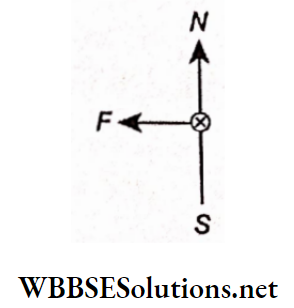
Electromagnetism A wire is kept horizontally

Question 19. A copper wire of length l meter is bent to form a circular loop. If i ampere current flows through the loop, find out the magnitude of the magnetic moment of the loop.
Answer:

The length of a copper wire = l, let the radius be r when the wire is bent to form a circular coil.

∴ \(2 \pi r=l \text { or, } r=\frac{l}{2 \pi}\)

∴ Area of the circular coil,

⇒ \(A=\pi r^2=\pi \times \frac{l^2}{4 \pi^2}=\frac{l^2}{4 \pi}\)

∴ Magnetic moment of the circular wire = \(i A=\frac{i l^2}{4 \pi}\)

Question 20. Suppose that the source of Earth’s magnetism is a magnetic dipole placed at the center of the Earth. Find the moment of this magnetic dipole if the strength of the earth’s magnetic field at the equator is 4 x 10⁻⁵T. Given, radius of the earth = 6.4 x 10⁶ m and \(\frac{\mu_0}{4 \pi}=10^{-7} \mathrm{~T} \cdot \mathrm{m} \cdot \mathrm{A}^{-1}\)
Answer:

The strength of the Earth’s magnetic field at the equator

= 4 x 10⁻⁵T

Radius of the earth, R = 6.4 x 10⁶ m

∴ \(B=\frac{\mu_0}{4 \pi} \cdot \frac{p_m}{R^3}\) [pm = the moment of the magnetic dipole of the earth]

or, \(4 \times 10^{-5}=10^{-7} \cdot \frac{p_m}{\left(6.4 \times 10^6\right)^3}\)

or, \(p_m=\frac{4 \times 10^{-5} \times\left(6.4 \times 10^6\right)^3}{10^{-7}}\)

= 1.05 x 10²³ A.m2

Conceptual Questions on Magnetic Field Strength and Measurement

Question 21. On what physical quantity does the magnetic moment of an electron revolving in an orbit depend?
Answer:

The magnetic moment of an electron depends on the specific charge of the electron \(\frac{e}{m}\) and the angular momentum of rotation of the electron \(\vec{L}\).

Question 22. A current-carrying loop behaves as a magnetic dipole.
Answer:

The torque acting on an electric dipole of the moment \(\vec{p}\) in an electric field \(\vec{E}, \vec{\tau}=\vec{p} \times \vec{E}\)

The torque acting on a loop of area A carrying current I in a magnetic field \(\vec{B}, \vec{\tau}=I \vec{A} \times \vec{B}\)

Hence, it can be said that a current-carrying loop behaves as a magnetic dipole.

Question 23. A circular coil of N turns and diameter d carries a current I. It is unwound and rewound to make another coil of diameter 2d, current I remaining the same. Calculate the ratio of the magnetic moments of the new coil and the original coil
Answer:

For the original coil, magnetic moment,

⇒ \(p_1=N I A=N I \cdot \frac{\pi d^2}{4}\)

For the new coil, the diameter becomes 2d, i.e., the circumference is doubled.

So the number of turns becomes \(\frac{N}{2}\). Magnetic moment,

⇒ \(p_2=\frac{N I}{2} \cdot \frac{\pi(2 d)^2}{4}=N I \cdot \frac{\pi d^2}{4} \cdot 2=2 p_1\)

∴ \(\frac{p_2}{p_1}=\frac{2}{1}\)

Question 24. A circular coil of closely wound N turns and radius r carries a current of 1.

  1. The magnetic field at its center,
  2. The magnetic moment of this coil

Answer:

1. \(B=\frac{\mu_0 N I}{2 r}\)

2. \(p_m=N I A=\pi N I r^2\)

Question 25. At a place, the horizontal component of the earth’s magnetic field is B, and the angle of dip is 60°. What is the value of the horizontal component of the earth’s magnetic field at the equator?
Answer:

Given, the horizontal component of the earth’s magnetic field, H = B.

The angle of dip, θ = 60°.

H = VcosB [V = vertical component of earth’s magnetic field]

= Vcos60°

= \(\frac{V}{2}\)

∴ V = 2H

At equator, θ = 0°

∴ \(H_{\text {eq }}=V \cos 0^{\circ} \text { or, } H_{\text {eq }}=2 H\)

Real-Life Scenarios in Magnetism Experiments

Question 26. A bar magnet of magnetic moment 6 J.T-1 is aligned at 60° with a uniform external magnetic field of 0.44 T. Calculate

  1. The work done in turning the magnet to align its magnetic moment
    1. Normal to the magnetic field
    2. Opposite to the magnetic field
  2. The torque on the magnet in the final orientation in case (2).

Answer:

Here, m = 6J.T-11 = 60° , B = 0.44 T

1. Work done in turning the magnet,

W = -mB(cosθ2 – cosθ1)

1. θ1 = 60° , θ2 = 90°

∴ W = -6 x 0.44 (cos90°- cos60°)

⇒ \(-6 \times 0.44\left(0-\frac{1}{2}\right)=1.32 \mathrm{~J}\)

2. θ1 = 60°, θ2 = 180°

W = -6 x 0.44 (cos180° – cos60°)

⇒ \(-6 \times 0.44\left(-1-\frac{1}{2}\right)\)

= 3.96J

2. The torque on the magnet in the final orientation in case (2),

⇒ \(\tau=m B \sin \theta=m B \sin 180^{\circ}=0\)

WBCHSE Class 12 Physics Magnetic Properties Of Materials Question and Answers

Magnetic Effect Of Current And Magnetism

Magnetic Properties Of Materials Long Questions and Answers

Question 1. Indicate the magnetic axis and magnetic length for a permanent horse-shoe (U-shaped) magnet.
Answer:

In a straight line, CD passes through the two poles of the horseshoe magnet. So, CD is the magnetic axis.

The line segment AB indicates the least distance between the two poles, N and S.

So, the length of AB is the magnetic length.

Electromagnetism Question 1 Indicate the magnetic axis and magnetic length

Question 2. A magnetized steel wire is bent in the form of L. One arm of E is of length 4 cm and the other arm Is of length 3 cm. If the magnetic moment before bending is pm, what will be the new magnetic moment?
Answer:

Length of the steel wire before bending,

l = 4 + 3

= 7 cm

∴ Pole-strength, \(m=\frac{p_m}{l}\)

Distance between the two poles after bending,

⇒ \(l^{\prime}=\sqrt{4^2+3^2}=5 \mathrm{~cm}\)

So, the new magnetic moment,

⇒ \(p_m^{\prime}=m \cdot l^{\prime}=\frac{p_m}{l} \cdot l^{\prime}=\frac{p_m}{7} \cdot 5=0.714 p_m\)

WBBSE Class 12 Magnetic Properties Q&A

Question 3. Two identical bar magnets having magnetic moments 2 pm and 3 pm are kept one over the other in such a manner that their

  1. Like poles
  2. Opposite poles are in contact. Determine the resultant magnetic moments in each case

Answer:

1. Magnetic moment is a vector quantity. If the like poles are in contact, the magnetic moments for the two magnets are in the same direction. So, the resultant magnetic moment = 2 pm + 3 pm = 5 pm, and this resultant magnetic moment acts in the direction of 3 pm and 2 pm.

2. If the opposite poles are in contact, 3 pm and 2 pm lie on the same straight line but opposite in direction. So, the resultant magnetic moment = 3 pm – 2 pm = pm, and this resultant magnetic moment acts in the direction of 3 pm.

WBCHSE Class 12 Physics Magnetic Properties Of Materials Question and Answers

Question 4. If a permanent bar magnet is cut along its breadth into two equal parts, what will be the pole strength and magnetic moment of each part?
Answer:

Let the pole strength of the bar magnet be m and its magnetic length is 2l.

∴ The magnetic moment of the bar magnet,

Pm = m.2l

If the magnet is cut along its breadth into two equal parts, the strength of each part remains m but the magnetic length of each part becomes l.

So, the magnetic moment of each part,

⇒ \(p_m^{\prime}=m \cdot l=\frac{p_m}{2}\)

Short Answer Questions on Ferromagnetic Materials

Question 5. If a permanent magnet is cut along the length into two equal parts, what will be the pole strength and magnetic moment of each part?
Answer:

Let the pole strength of the bar magnet be m and its magnetic length is 2l.

So, the magnetic moment of the magnet, pm = m.2l.

If the magnet is cut along its length into two equal parts, the number of free poles of the molecular magnets at its extremities will also be halved.

So, the poie-strength of each part = \(\frac{m}{2}\) and magnetic length = 2l.

∴ Magnetic moment, \(p_m^{\prime}=\frac{m}{2} \cdot 2 l=m l=\frac{p_m}{2}\)

Question 6. What is a ‘magnet-proof’ watch?
Answer:

A ring of soft iron is fitted around a watch to make it free from external magnetic influence. That ring acts as a magnetic screen. This kind of watch is called a ‘magnet-proof’ watch.

Question 7. An electron (charge = e) revolves around a nucleus along a circular path of radius r with frequency f. What will be the magnetic moment of the electron due to its orbital motion?
Answer:

Number of complete revolutions per second = f.

So, the amount of charge flowing through any point on the orbit per second = effective current (I) = ef.

Therefore, the required magnetic moment,

⇒ \(p_m=I A=e f \cdot \pi r^2\)

Common Questions on Magnetic Susceptibility

Question 8. According to the mariner’s compass, a ship is sailing toward the east. If the declination at the place is 20°E, what is the actual direction of motion of the ship?
Answer:

Let the ship be at A. The points E and E’ are on the geographical east and magnetic east of the point A.

According to the problem,

⇒ \(\angle N A N^{\prime} \doteq 20^{\circ}\)

∴ \(\angle E A E^{\prime}=20^{\circ}\)

So, the ship is moving towards point E’, i.e., along a direction of 20° south of the geographically east

Electromagnetism Question 8 the matiners compass

Question 9. Example why a mariner’s compass does not work inside a submarine?
Answer:

Due to the presence of a geomagnetic field, a mariner’s compass indicates directions. But the iron covering of a submarine acts as a magnetic screen. As a result, geomagnetic fields cannot penetrate the interior of a submarine. Thus, a mariner’s compass does not work inside a submarine.

Class 11 Physics Class 12 Maths Class 11 Chemistry
NEET Foundation Class 12 Physics NEET Physics

Question 10. In a hydrogen atom, an electron of charge e revolves in an orbit of radius r with speed v. Find the magnetic moment associated with the electron.
Answer:

The period of revolution of the electron, \(T=\frac{2 \pi r}{v}\)

equivalent current, \(I=\frac{e}{T}=\frac{e v}{2 \pi r}\)

∴The magnetic moment of the electron,

⇒ \(p_m=I A=\frac{e v}{2 \pi r} \cdot \pi r^2=\frac{1}{2} e v r\)

Practice Questions on Paramagnetic and Diamagnetic Materials

Question 11. A vertical iron pillar, partially dipped inside the ground, is found to be magnetized after several years. What will be the polarity at the top of the pillar when it is in the northern hemisphere of the earth?
Answer:

The vertical iron pillar gets magnetic induction in the presence of the earth’s magnetic field. We know that the south pole of Earth’s magnet lies in the northern hemisphere. As a result, following the rule of magnetic induction, a north pole will be induced at the underground end, and a south pole at the top of the pillar.

Question 12. A magnetic needle lying parallel to a magnetic field requires a W unit of work to turn it through 60°. How much torque should be needed to maintain the needle in this position?
Answer:

Work done in rotating the magnetic needle from 0° position through an angle θ in a magnetic field B is,

W = pmB(l- cosθ) [where pm = magnetic moment of the needle]

⇒ \(p_m^B=\frac{W}{1-\cos \theta}\)

∴ Required torque,

⇒ \(\tau=p_m^B \sin \theta=\frac{W \sin \theta}{1-\cos \theta}=\frac{W \sin 60^{\circ}}{1-\cos 60^{\circ}}=\sqrt{3} W\)

Question 13. I ampere current is flowing through a meter-long conducting wire. If the wire is shaped into a circular loop, then what will be its magnetic moment?
Answer:

If the radius of the circular loop is r then,

⇒ \(2 \pi r=l. \quad \text { or, } r=\frac{l}{2 \pi}\)

and area of the loop, \(A=\pi r^2=\frac{l^2}{4 \pi}\)

∴ The magnetic moment of the circular loop = \(I A=\frac{l^2}{4 \pi}\)

Important Definitions in Magnetic Properties

Question 14. Indicate the zero-potential line of a bar magnet.
Answer:

The perpendicular bisector of the magnetic axis of a bar magnet is the zero-potential line because any point lying on this line is equidistant from the two poles of the magnet. Let O be any point on the perpendicular bisector of the magnetic axis of the magnet NS having pole-strength qm. If the distance of the point O from each pole is r, then the potential at O is,

⇒ \(V=\frac{q_m}{r}-\frac{q_m}{r}=0\)

Electromagnetism Example 3 The length of a bar magnet

Examples of Applications of Magnetic Materials

Question 15. Two particles, each of mass m and charge q, are kept at the two ends of a light rod of length 2l and are rotated with a uniform angular velocity about the vertical axis passing through the center of the rod. Determine the ratio of the magnetic moment and the angular momentum of the combination with respect to the center of the rod.
Answer:

The radius of the path described = l.

If the angular velocity = ω, time period, \(T=\frac{2 \pi}{\omega}\)

In this duration of time, the amount of charge flowing through any point of the orbit = 2q.

So, the charge flows per second

= effective current (I)

⇒ \(\frac{2 q}{T}=\frac{q \omega}{\pi}\)

∴ Magnetic moment, \(p_m=L A=\frac{q \omega}{\pi} \cdot \pi l^2=q \omega l^2\)

and angular momentum, \(L=(2 m) l^2 \omega=2 m \grave{\omega} l^2\)

Therefore, \(\frac{p_m}{L}=\frac{q}{2 m}\)

Question 16. An iron nail gains kinetic energy due to the force of attraction by a magnet. What is the source of this kinetic energy?
Answer:

When an iron nail is kept in a magnetic field, it gains some magnetic potential energy. In this case, that potential energy is the source of the kinetic energy of the nail. When the nail. moves towards the magnet due to the force of attraction, the potential energy of the nail decreases and it is converted into the said kinetic energy.

WBCHSE Class 12 Physics Electromagnetism Short Question And Answers

Magnetic Effect Of Current And Magnetism

Electromagnetism Short Question And Answers

Question 1. Two moving coil meters M1 and M2 have the following particulars

Electromagnetism Two moving coil meters

(The spring constants are identical for the two meters.) Determine the ratio of

  1. Current sensitivity and
  2. Voltage sensitivity of M2 and Mx.

Answer:

Current sensitivity = \(\frac{N B A}{c}\) [c = restoring torque for unit deflection]

∴ \(\frac{\text { sensitivity of } M_2}{\text { sensitivity of } M_1}=\frac{N_2 B_2 A_2}{N_1 B_1 A_1} \quad\left[∵ c_1=c_2\right]\)

⇒ \(\frac{42 \times 0.50 \times 1.8 \times 10^{-3}}{30 \times 0.25 \times 3.6 \times 10^{-3}}\)

= 1.4

Read And Learn More WBCHSE Class 12 Physics Short Question And Answers

2. \(\text { Voltage sensitivity }=\frac{N B A}{c R}=\frac{\text { current sensitivity }}{R}\)

∴ \(\begin{aligned}
& \text { voltage sensitivity } \\
& \frac{\text { of } M_2}{\text { voltage sensitivity }}=1.4 \times \frac{R_1}{R_2}=1.4 \times \frac{10}{14}=1 \\
& \text { of } M_1 \\
&
\end{aligned}\)

WBBSE Class 12 Electromagnetism Short Q&A

Question 2.

  1. A circular coil of 30 turns and a radius of 8.0 cm carrying a current of 6.0 A is suspended vertically in a uniform horizontal magnetic field of magnitude 1.0 T. The field lines make an angle of 60° with the normal of the coil. Calculate the magnitude of the counter torque that must be applied to prevent the coil from turning.
  2. Would your answer change, if the circular coil in (a) were replaced by a planar coil of some irregular shape that encloses the same area? (All other particulars are unaltered.)

Answer:

1. The torque acting on the coil,

⇒ \(\tau=N B I A \sin \theta\)

=30 x 1 x 6 x π x (8x 10⁻²)2sin 60°

= 3.13 N.m

∴ If a torque of 3.13 N m is applied in the opposite direction, there will be no deflection of the coil.

2. The torque does not depend on the shape of the coil if the area remains the same. So the answer will not change

Question 3.Two concentric circular coils X and Y of radii 16 cm and 10 cm, respectively, lie in the same vertical plane oriented along the north-to-south direction. Coil X has 20 turns and carries a current of 16 A. Coil Y has 25 turns and carries a current of 18 A. The sense of the current in X is anticlockwise and in Y is clockwise, for an observer looking at the coils facing west. Give the magnitude and direction of the net magnetic field due to the coils at their center.
Answer:

⇒ \(B=\frac{\mu_0 n l}{2 a}\) [ n = no. of turns, I = current a = radius of the coil]

∴ For coil X,

⇒ \(B_X=\frac{4 \pi \times 10^{-7} \times 20 \times 16}{2 \times 16 \times 10^{-2}}\)

= 4π x 10-4 T (towards east)

For coil Y,

⇒ \(B_Y=\frac{4 \pi \times 10^{-7} \times 25 \times 18}{2 \times 10 \times 10^{-2}}\)

= 9π x 10-4 T (towards west)

⇒ \(\text { Net field }=B_Y-B_X=9 \pi \times 10^{-4}-4 \pi \times 10^{-4}\)

= 1.6 x 10⁻³ T (towards west)

Short Answer Questions on Faraday’s Law

Question 4. A uniform magnetic field of 100 G (1G = 10-4 T) exists in a region of length about 10 cm and an area of cross-section of about 10-3 m2. The maximum current carrying capacity of a given coil of wire is 15A and the number of turns per unit length that can be wound around a core is at most 1000 turns m-1. How would you utilize the coil to design a solenoid for the required purpose? Assume the core is not ferromagnetic.
Answer:

For the maximum number of turns the current through the solenoid is given by,

⇒ \(I=\frac{B l}{\mu_0 N}=\frac{B}{\mu_0\left(\frac{N}{l}\right)}\left[∵ B=\mu_0 \cdot \frac{N}{l} \cdot I\right]\)

⇒ \(\frac{100 \times 10^{-4}}{4 \pi \times 10^7 \times 100} \mathrm{~A}=7.96 \mathrm{~A} \approx 8 \mathrm{~A}\)

The length of the solenoid should be much more than its diameter.

For a current of 15 A to flow through the solenoid, the number of turns per unit length has to be decreased [as \(I \propto \frac{l}{N} \propto \frac{1}{N / l}\)]

∴ \(\frac{I^{\prime}}{I}=\frac{N / l}{N^{\prime} / l^{\prime}} \quad \text { or, } \frac{15}{8}=\frac{1000}{N^{\prime} / l^{\prime}}\)

∴ \(\frac{N^{\prime}}{l^{\prime}}=\frac{1000 \times 8}{15}=533 \approx 550 \text { turns } \cdot \mathrm{m}^{-1}\)

For a circular coil of radius R and number of turns N carrying a current I, the magnitude of the magnetic field at a point on its axis at a distance x from its center is given by

⇒ \(B=\frac{\mu_0 I R^2 N^{\prime}}{2\left(x^2+R^2\right)^{3 / 2}}\)

Question 5. Consider two parallel co-axial circular coils of equal radius R and number of turns N, carrying equal currents in the same direction and separated by a distance R. Show that the field on the axis around the mid-point between the coils is uniform over a distance that is small compared to R and is given by \(B=0.72 \mu_0 N I / R\), approximately. (Such an arrangement to produce a nearly uniform magnetic field over a small region is known as Helmholtz coils.)
Answer:

The magnetic field in a small region of length 2d about the midpoint of the space between the two coils

⇒ \(B=\frac{\mu_0 N I R^2}{2\left[\left(\frac{R}{2}+d\right)^2+R^2\right]^{3 / 2}}+\frac{\mu_0 N I R^2}{2\left[\left(\frac{R}{2}-d\right)^2+R^2\right]^{3 / 2}}\)

⇒ \(\frac{\mu_0 N I R^2}{2}\left\{\left[\frac{5 R^2}{4}\left(1+\frac{4 d}{5 R}\right)\right]^{-\frac{3}{2}}+\left[\frac{5 R^2}{4}\left(1-\frac{4 d}{5 R}\right)\right]^{-\frac{3}{2}}\right\}\)

⇒ \(=0.72 \frac{\mu_0 N I}{R}\)

WBCHSE Class 12 Physics Electromagnetism saqs

Common Short Questions on Lenz’s Law

Question 6. A charged particle enters an environment of a strong and non-uniform magnetic field varying from point to point both in magnitude and direction and comes out of it following a complicated trajectory. Would its final speed equal the initial speed if it suffered no collisions in the environment?
Answer:

Yes. The direction of the velocity of a charged particle can change in a magnetic field, but the magnitude of velocity remains the same.

Question 7. An electron traveling west to east enters a chamber having a uniform electrostatic field in the north-to-south direction. Specify the direction in which a uniform magnetic field should be set up to prevent the electron from deflecting from its straight-line path.
Answer:

The negatively charged electron tends to move towards the north due to the electric field. If an equal magnetic force acts in the south direction then the electron will not be deflected. Using the hand rule and considering the conventional direction of flow of charge from east to west we get the direction of magnetic field along the vertically download direction.

Electromagnetism An electron travelling

Question 8. An electron emitted by a heated; cathode and accelerated through a potential difference of 2.0 kV, enters a region of 1 uniform magnetic field of 0.15 T. Determine the trajectory of the electron if the field

  1. Is transverse to its initial velocity,
  2. Makes an angle of 30° with the initial velocity.

Answer:

1. The trajectory of the electron will be a circle of radius r with the magnetic field as its axis. The radius r is given by,

⇒ \(r=\frac{m v}{B e}\)

⇒ \(\text { Also, } e V=\frac{1}{2} m v^2\)

∴ \(r=\frac{1}{B}\left(\frac{2 m V}{e}\right)^{\frac{1}{2}}=\frac{1}{0.15} \sqrt{\frac{2 \times 9 \times 10^{-31} \times 2 \times 10^3}{1.6 \times 10^{-19}}}\)

= 1mm

2. The electron will move along the direction of the field with velocity, v’ = ysin30°, and radius r’ with the magnetic field as the axis.

⇒ \(r^{\prime}=\frac{m v^{\prime}}{B e}=\frac{\sin 30^{\circ}}{B} \sqrt{\frac{2 m V}{e}}\)

⇒ \(=\frac{\frac{1}{2}}{0.15} \sqrt{\frac{2 \times 9 \times 10^{-31} \times 2 \times 10^3}{1.6 \times 10^{-19}}}\)

= 0.5 x 10⁻³ m2

The electron will follow a helical path. Its pitch is,

⇒ \(2 \pi r^{\prime} \cot \theta=2 \times 3.14 \times\left(0.5 \times 10^{-3}\right) \times \sqrt{3}\)

= 5.44 X 10⁻³ m

= 5.44 mm

Class 11 Physics Class 12 Maths Class 11 Chemistry
NEET Foundation Class 12 Physics NEET Physics

Practice Short Questions on Induced EMF

Question 9. A magnetic field, set up using Helmholtz coils, is uniform in a small region and has a magnitude of 0.75 T. In the same region, a uniform electrostatic field is maintained in a direction normal to the common axis of the coils. A narrow beam of (single species) charged particles, all accelerated through 15kV, enters this region in a direction perpendicular to both the axis of the coils and the electrostatic field. If the beam remains undeflected when the electrostatic field is 9.0 x 10⁵ V.m-1, make a simple guess as to what the beam contains. Why is the answer not unique?
Answer:

qE = Bqv

∴ \(v=\frac{E}{B}=\frac{9 \times 10^5}{0.75}=1.2 \times 10^6 \mathrm{~m} \cdot \mathrm{s}^{-1}\)

⇒ \(\frac{1}{2} m v^2=q V\)

∴ \(\frac{q}{m}=\frac{1}{2} \frac{v^2}{V}=\frac{1}{2} \times \frac{\left(1.2 \times 10^6\right)^2}{15 \times 10^3}=4.8 \times 10^7 \mathrm{C} \cdot \mathrm{kg}^{-1}\)

He++ ‘, Li+++ 1H2 ion – for all these particles

⇒ \(\frac{q}{m}=4.8 \times 10^7 \mathrm{C} \cdot \mathrm{kg}^{-1}\)

∴ The charged particle may be any of these.

Question 10. A straight horizontal conducting rod of length 0.45 m and 60 g is suspended by two vertical wires at its ends. A current of 5.0 A is set up in the rod through the wires.

  1. What magnetic field should be set up normally to the conductor in order that the tension in the wires is zero?
  2. What will be the total tension in the wires if the direction of the current is reversed keeping the magnetic field the same as before? (Ignore the mass of the wires) 9.8 ms-2

Answer:

1. To keep the tension in the wire zero, the upward force exerted by the magnetic field should be neutralized by the downward force exerted by gravity (weight of the rod).

∴ BIl = mg

∴ \(B=\frac{m g}{I l}=\frac{60 \times 10^{-3} \times 9.8}{5 \times 0.45}=0.26 \mathrm{~T}\)

2. If the direction of the current is reversed, the tension in the wire will be doubled.

∴ T = 2 x weight of the rod

= 2 x 60 x 10-3 x 9.8 N

= 1.18 N

Question 11. A uniform magnetic field of 3θ G is established along the positive z-direction. A rectangular loop of sides 10 cm and 5 cm carries a current of 12 A. What is the torque on the loop In the different cases? Which case corresponds to stable equilibrium?

Electromagnetism corresponds to stable equilibrium

Answer:

Using \(\tau\) = IAsinθ

1. \(\tau\) = 12 x (10 x 5 x 10-4) x (3θ X 10-4)

= 1.8 x 10⁻² N.m-1 , along y-axis

2. \(\tau\) = 1.8 x 10⁻² N m-1 , along y-axis

3. \(\tau\) = 1.8 x 10⁻² N.m-1, along -X axis

4. \(\tau\) = 1.8 x 10⁻² N.m-1 , along a direction making 240° with +X axis

5. \(\tau\) = 0, stable equilibrium, because if this loop is slightly rotated, the torque generated tends to bring the loop back to its initial alignment.

6. \(\tau\) = 0, unstable equilibrium, because if the loop Is slightly rotated, the torque generated tends to rotate the loop farther.

Question 12. A 60 cm long solenoid of radius 4.0 cm has 3 layers of windings of 300 turns each. A 2.0 cm long wire of mass 2.5 g lies inside the solenoid (near its center) normal to its axis; both the wire and the axis of the solenoid are in the horizontal plane. The wire is connected through two leads parallel to the axis of the solenoid to an external battery which supplies a current of 6.0 A In the wire. What value of current (with appropriate sense of circulation) in the windings of the solenoid can support the weight of the wire? g = 9.8 m.s-2
Answer:

⇒ \(F=B I l \text { and } B=\mu_0 \cdot \frac{N}{l^{\prime}} \cdot I^{\prime}\)

∴ \(F=\mu_0 \cdot \frac{N}{l’} \cdot l’ \cdot l \cdot l\) [where I’m required current, I’ length of the solenoid, I current from the battery, I length of the wire.

This force will neutralize the gravitational force on the wire.

∴ \(\mu_0 N \cdot \frac{l}{l} \cdot I^{\prime} \cdot I=m g\)

or, \(I^{\prime}=\frac{m g}{\mu_0 N l \cdot l}\)

⇒ \(\frac{2.5 \times 10^{-3} \times 9.8 \times 60 \times 10^{-2}}{4 \pi \times 10^{-7} \times 3 \times 300 \times 2.0 \times 10^{-2} \times 6.0}\)

=108.3A

Question 13. Two long and parallel straight wires A and B carrying currents of 0.0 A and 5.0 A In the same direction are separated by a distance of 4.0 cm listen to the force on a 10 cm section of wire A.
Answer:

We know that, \(\frac{F}{l}=\frac{\mu_0 I_1 I_2}{2 \pi r} \quad\)

or, \(F=\frac{\mu_0 I_1 I_2}{2 \pi r} \cdot l\)

∴ \(F=\frac{4 \pi \times 10^{-7} \times 8 \times 5}{2 \pi \times 4 \times 10^{-2}} \times 10 \times 10^{-2}=2 \times 10^{-5} \mathrm{~N}\)

(attractive force Is towards A to B along the perpendicular)

Question 14. A uniform magnetic 1.5 T exists in a cylindrical region of radius 10.0 cm. Its direction is parallel to the axis along east to west. A wire carrying a current of 7.0 A In the north-to-south direction passes through this region. What is the magnitude and direction of the force on the wire lf,

  1. The wire intersects the axis
  2. The wire Is turned from N-S to the northeast-northwest direction
  3. The wire In the N-S direction Is lowered from the axis by a distance of 6.0 cm

Answer:

1. F1 = IBl sin90° = 1.5 X 7 X 0.2 x 1 = 2.1 N (directed vertically downwards)

2. If l1, be the effective length of the wire Inside the magnetic field,

F2 = IBl1 sin45° = IBl [since, l1 sin45° = l]

= 1.57 x 7 x 0.2

= 2.1 N (directed vertically, downwards)

3. When wire 16 is lowered by 6 cm from the axis, then the effective length of the wire inside the magnetic field is 2α.

Electromagnetism A uniform magnetic

a = 8 cm

F = IB.2a

= 1.5 x 7 x 0.16N

= 1.68 N (directed vertically downwards)

Important Definitions in Electromagnetism

Question 15. A square coil of side 10 cm consists of 20 turns and carries a current of 12 A. The coil i$ suspended vertically and the normal to the plane of the coil makes an angle of 30° with the direction of a uniform horizontal magnetic field of magnitude 0.80 T. What is the magnitude of torque experienced by the coil?
Answer:

Torque

⇒ \(\tau\) = NIABsinθ

= 20 x 12 x (10 x 10-2)2 x 0.8sin30°

= 0.96 N.m [Here, N= number of turns, I=current, A – area of the coil, B = magnetic field]

Question 16. A toroid has a core (non-ferromagnetic) of inner radius 25 cm and outer radius 26 cm, around which 3500 turns of a wire are wound. If the current in the wire is 11 A, what is the magnetic field

  1. Outside the toroid
  2. Inside the core of the toroid
  3. In the empty space surrounded by the toroid

Answer:

1. Zero

2. \(B=\mu_0 \frac{N I}{2 \pi r}=\frac{4 \pi \times 10^{-7} \times 3500 \times 11}{2 \pi \times 25.5 \times 10^{-2}}\) \(\left[\text { Here } r=\frac{25+26}{2}=25.5 \mathrm{~cm}\right]\)

= 3.02 x 10⁻² T

3. Zero

Question 17. A closely wound solenoid 80 cm long has 5 layers of windings of 400 turns each. The diameter of the solenoid is 1.8cm. If the current carried is 8.0 A, estimate the magnitude of B inside the solenoid near its center.
Answer:

⇒ \(B=\frac{\mu_0 \cdot N I}{l}=\frac{4 \pi \times 10^{-7} \times 400 \times 8 \times 5}{80 \times 10^{-2}}\)

= 8π x 10-3T

Question 18. A electron is moving with a velocity \(\vec{v}=(\hat{i}+2 \hat{j}) \mathrm{m} \cdot \mathrm{s}^{-1}\) in the magnetic field \(\vec{B}=(2 \hat{i}+2 \hat{j}) \mathrm{Wb} \cdot \mathrm{m}^{-2}\). Determine the magnitude and direction of the force acting on the electron. The charge of an electron is -1.6 x 10⁻¹⁹ C.
Answer:

The force acting on the electron,

⇒ \(\vec{F}=q(\vec{v} \times \vec{B})=-1.6 \times 10^{-19}[(\hat{i}+2 \hat{j}) \times(2 \hat{i}+2 \hat{j})]\)

⇒ \(-1.6 \times 10^{-19} \times[-2 \hat{k}]=+3.2 \times 10^{-19} \hat{k} \mathrm{~N}\)

So the magnitude of the force = 3.2 x 10⁻¹⁹N and the direction is along the positive z-axis.

Question 19. Which physical quantity has the unit Wb/m2? Is it a scalar or a vector quantity?
Answer:

Magnetic field or magnetic induction has the unit Wb/m2. It is a vector quantity.

Question 20. Write down the equation of Lorentz force acting on a moving charged particle.
Answer:

Lorentz force, \(\vec{F}=q(\vec{E}+\vec{v} \times \vec{B})\);

where \(\vec{E}\) is the electric field,

⇒ \(\vec{B}\) is the magnetic field,

q is the charge of the particle

and \(\vec{v}\) is the velocity ofthe particle.

Question 21.

  1. α – particle
  2. β – particle is both projected with the same velocity v perpendicularly to the magnetic field B. Which particle will experience greater force?

Answer:

The value of the charge of the a -particle (+2e) is more than that of the β-particle (-e).

Hence, the α-particle will experience greater force

Question 22. In a compact coil of 50 turns, the current strength is 10 A and the radius of the coil is 25 x 10-2 m. Find the magnitude of the magnetic field at its center.
Answer:

Number of turns, N = 50; radius of the coil, r = 25 x 10-2 m; current strength, I = 10 A.

∴ The magnetic field at the center of the coil,

⇒ \(B=\frac{\mu_0 N I}{2 r}=\frac{4 \pi \times 10^{-7} \times 50 \times 10}{2 \times 25 \times 10^{-2}}\)

= 1.256 X 10⁻³T

Real-Life Scenarios in Electromagnetism

Question 23. Two long parallel straight wires P and Q separated by a distance of 5 cm in air carry currents of 4A and 2A respectively in the same direction. Fruk the magnitude of the force acting per cm of the wire P and indicate the direction of the force.
Answer:

Distance between the two wires, \(r=5 \mathrm{~cm}=\frac{5}{100} \mathrm{~m}\)

Force acting per metre, \(F=\frac{\mu_0}{4 \pi} \cdot \frac{2 I_1 I_2}{r}=\frac{4 \pi \times 10^{-7}}{4 \pi} \times \frac{2 \times 4 \times 2}{\frac{5}{100}}\)

⇒ \(10^{-7} \times \frac{16}{5} \times 100=3.2 \times 10^{-5} \mathrm{~N} \cdot \mathrm{m}^{-1}\)

∴ Force acting per cm = \(=\left(3.2 \times 10^{-5}\right) \times \frac{1}{100}\)

= 0.032 dyn.cm-1

Since the wires are carrying currents in the same direction, the force acting between the wires is attractive, Hence the force on each wire is directed towards the other wire and perpendicular to them.

Question 24. Write the expression for the force \(\vec{F}\) acting on a particle of charge q moving with a velocity \(\vec{v}\) in the presence of both electric fields \(\vec{E}\) and magnetic field \(\vec{B}\). Obtain the condition under which the particle moves undeflected through the fields.
Answer:

1st Part: Force,

⇒ \(\vec{F}=\vec{F}_e+\vec{F}_m=q \vec{E}+q \vec{v} \times \vec{B}=q(\vec{E}+\vec{\nu} \times \vec{B})\)

2nd Part: The required condition is, either \(\vec{F}\) = 0; i.e., no resultant force acts on the particle. In that case,

⇒ \(q \vec{E}=-q \vec{v} \times \vec{B}\)

or, \(\vec{E}\) and \(\vec{B}\) are both along the direction of velocity of the particle; then \(\vec{\nu} \times \vec{B}=0\), and the force \(q \vec{E}\) along the direction of motion produces a constant acceleration without any deflection.

Question 25. A wire AB is carrying a steady current of 12 A and is lying on a table. Another wire CD carrying 5 A is held directly above AB at a height of 1 mm. Find the mass per unit length of the wire CD so that it remains suspended at its position when left free. Give the direction of the current flowing in CD with respect to that in AB. [Thke the value of g = 10 m.s-2 ]
Answer:

We take the unit length of each of the wires.

Upward force on CD,

⇒ \(F=\frac{\mu_0}{4 \pi} \frac{2 I_1 I_2}{d}=10^{-7} \times \frac{2 \times 12 \times 5}{10^{-3}}=12 \times 10^{-3} \mathrm{~N}\)

Downward force.on CD,

F’ = mg = 10m N [ m = mass of unit length of the wire CD ]

Under the given conditions,

F = F’

or, 12 x 10-3 = 10m

or, m = 1.2 x 10⁻³ kg

The currents in AB and CD are in opposite directions, so that CD is subjected to an upward repulsive force F.

Question 26. 

  1. Using Biot-Savart’s law, derive the expression for the magnetic field in vector form at a point on the axis of a circular current loop.
  2. What does a toroid consist of? Find out the expression for the magnetic field inside a toroid for N turns of the coil having an average radius r and carrying a current I. Show that the magnetic field in the open space inside and outside the toroid is zero.

Answer:

1. From the text, we get the expression,

⇒ \(B=\frac{\mu_0 N I}{2} \cdot \frac{r^2}{\left(r^2+x^2\right)^{3 / 2}}\)

Here, the center of the coil has been taken as the origin and the direction of the axis as the x-axis.

∴ \(\vec{B}=\frac{\mu_0 N I}{2} \cdot \frac{r^2}{\left(r^2+x^2\right)^{3 / 2}} \hat{i}\)

2. Circumference of the toroid = 2πr.

Number of turns per unit length, \(n=\frac{N}{2 \pi r}\)

Magnetic field inside the toroid, \(B=\mu_0 n I=\frac{\mu_0 N I}{2 \pi r}\)

The currents in every pair of diametrically opposite points of the toroid is equal and opposite. So, if we take Ampere’s loops in the open space inside and outside the toroid, the current enclosed by the loops respectively, 0-0 = 0 and Nl-NI = 0

Electromagnetism Ampere’s loops in the open space inside and outside

So, from Ampere’s circuital law, \(\oint \vec{B} \cdot d \vec{l}=\mu_0 I\) we have B = 0 in both cases.

Examples of Electromagnetic Applications

Question 27. What do you mean by the current sensitivity of a galvanometer? Write its SI unit.
Answer:

1st Part: The basic definition of the current sensitivity of a galvanometer is, \(S_i=\frac{d \theta}{d I}, \theta\), being the angular deflection of the coil.

2nd Part: As θ is dimensionless, the unit of Si is A-1.

Question An a -particle and a proton are released from the center of a cyclotron and made to accelerate.

  1. Can both be accelerated at the same cyclotron frequency?
  2. When they are accelerated, in turn, which of the two will have a higher velocity at the exit slit of the dees?

Answer:

Cyclotron frequency, \(n=\frac{1}{2 \pi}\left(\frac{q}{m}\right) B\)

1. For a proton, \(\frac{q}{m}=\frac{e}{m_p}\)

for an α-particle, \(\frac{q}{m} \approx \frac{2 e}{4 m_p}=\frac{1}{2} \frac{e}{m_p} .\)

⇒ \(\text { As } n \propto \frac{q}{m}\) they cannot be accelerated at the same
cyclotron frequency.

2. Velocity at the exit slit, \(v_0=\frac{q B R}{m} \text {, i.e., } v_0 \propto \frac{q}{m}\)

As \(\frac{q}{m}\) is higher for protons, it will hate a higher
velocity at the exit slit.

Question 28. Asha’s uncle was advised by his doctor to have an MRI (magnetic resonance imaging) scan of his brain. Her uncle felt that it was too expensive and wanted to postpone it. When Asha learned about this, she took the help of her family and when she approached the doctor, he also offered a substantial discount. She thus convinced her uncle to undergo the test to enable the doctor to know the condition of his brain. The resulting information greatly helped his doctor to treat him properly. Based on the above paragraph, answer the following questions.

  1. What according to you are the values displayed by Asha, her family, and the doctor?
  2. What in your view could be the reason for MRI tests to be so expensive?
  3. Assuming that the Mill test was performed using a magnetic field of 0.1 T, and the maximum and minimum values of the force that the magnetic field could exert on a proton (Charge = 1.6 x 10⁻¹⁹ C ) that was moving with a speed of 104 m/s.

Answer:

1. Asha, her family, and the doctor were sympathetic, caring, socially aware, and helpful.

2. MRI tests are expensive due to various factors. Firstly, the MRI machines are very expensive and the rooms where the scans are performed cost a fortune. To this the salaries of the doctors, other medical staff, hospital charges, and maintenance charges add up, resulting in a huge amount.

3. We know, F = qvBsinθ

= 1.6 x 10-19 x 104 x 0.1 x sinθ

We get the minimum value of force when θ = 0°.

∴ Fmin = 0

We get the maximum value of force when θ = 90°

∴ \(F_{\max }=1.6 \times 10^{-19} \times 10^4 \times 0.1=1.6 \times 10^{-16} \mathrm{~N}\)

Question 29. What can be the cause of the helical motion of a charged particle?
Answer:

A particle moves along a curved path if it moves in the presence of a magnetic field.

Now, when there is an angular projection, i.e. when the velocity of the particle is at an angle with respect to the magnetic field, then the particle will move in a helical path.

The velocity component (vsinθ) perpendicular to the field will rotate the particle in a circular path. But, the component (vcosθ) along this field will move the particle in a straight line path. So, the cumulative motion of the particle is a helix.

Question 30. Two identical circular coils, P and Q each of radius R, carrying currents 1 A and √3 A respectively, are placed concentrically and perpendicular to each other lying in the XY and YZ planes. Find the magnitude and direction of the net magnetic field at the center of the coils
Answer:

Field due to current in coil P is \(\vec{B}_1=\frac{\mu_0 I_1}{2 R} \cdot \hat{k}\)

Current in coil Q is \(\vec{B}_2=\frac{\mu_0 I_2}{2 R} \cdot \hat{i}\)

Net field \(\vec{B}=\vec{B}_1+\vec{B}_2\)

⇒ \(\vec{B}=\left(\frac{\mu_0 I_1}{2 R}\right) \hat{k}+\left(\frac{\mu_0 I_2}{2 R}\right) \hat{i}\)

⇒ \(=\left(\frac{\mu_0}{2 R}\right) \hat{k}+\left(\frac{\sqrt{3} \mu_0}{2 R}\right) \hat{i}\left(∵ I_1=1 \mathrm{~A} ; I_2=\sqrt{3} \mathrm{~A}\right)\)

⇒ \(|\vec{B}|=\sqrt{\left(\frac{\mu_0}{2 R}\right)^2+\left(\frac{\sqrt{3} \mu_0}{2 R}\right)^2}=\frac{\mu_0}{2 R} \sqrt{1+3}=\frac{\mu_0}{2 R} \times 2\)

∴ \(|\vec{B}|=\frac{\mu_0}{R}\)

The resultant magnetic field is directed in the xz plane.

Question 31. Two identical loops P and Q each of radius 5 cm are lying in perpendicular planes such that they have a common center as shown in the figure. Find the magnitude and direction of the net magnetic field at the common center of the two coils, if they carry currents equal to 3 A and 4 A respectively.

Electromagnetism Two identical loops

Answer:

Magnetic field induction due to the vertical loop at the center O is,

⇒ \(B_1=\frac{\mu_0 I_1}{2 R}=\frac{\mu_0}{10^{-1}} . \quad(∵ R=5 \mathrm{~cm})\)

Magnetic field induction due to the horizontal loop at the center O is,

⇒ \(B_2=\frac{\mu_0 I_2}{2 R}=\frac{3 \mu_0}{10^{-1}}\)

∵ B1 and B2 are perpendicular to each other, therefore the resultant magnetic field induction at the center O is,

⇒ \(B_{\text {net }}=\sqrt{B_1^2+B_2^2}\)

⇒ \(\sqrt{\left(\frac{4 \mu_0}{10^{-1}}\right)^2+\left(\frac{3 \mu_0}{10^{-1}}\right)^2}\)

⇒ \(\frac{\mu_0}{10^{-1}} \sqrt{9+16}=\frac{5 \mu_0}{10^{-1}}\)

= 50 x 4π x 10-7

= 62.8 x 10⁻⁶ T

= 62.8μT

The direction of the resulting magnetic field,

⇒ \(\tan \theta=\frac{B_2}{B_1}=\frac{3 \mu_0 \times 10^{-1}}{4 \mu_0 \times 10^{-1}}\)

or, \(\tan \theta=\frac{3}{4} \quad \text { or, } \theta \approx 37^{\circ}\)

Resultant magnetic field B makes an angle of 37° with B1

Electromagnetism Magnetic field induction due to horizontal loop and vertical loop

WBCHSE Class 12 Physics Electromagnetism Question and Answers

Magnetic Effect Of Current And Magnetism

Electromagnetism Long Questions and Answers

Question 1. State whether the mutual distances between the circular magnetic lines of force obtained on a plane, perpendicular to a straight long current-carrying wire would be the same or not.
Answers:

According to the formula \(B=\frac{\mu_0}{4 \pi} \cdot \frac{2 I}{r}\), the greater the distance from the current carrying wire, “lesser the value of the magnetic field.

Again, according to the properties of magnetic lines of force, the greater the Strength of the magnetic field at a place, the greater the number density of magnetic lines of force, and hence their mutual distances decrease.

So, the mutual distance between the circular magnetic lilies of force gradually increases with the increase of the radius of the lines.

Question 2. A magnet and a charged particle are placed near each other. State whether a force will act on the charged particle if

  1. Both the magnet and the charged particle are at rest,
  2. Both travel with equal velocity,
  3. The magnet is moving but the charged particle is at rest,
  4. The magnet is at rest but the charged particle is in motion.

Answer:

If there is a relative motion between the charged particle and the magnet, then only a force acts on the charged particle.

1. If both the magnet and the charged particle are resting, no force acts on the charged particle because there is a relative motion between them.

2. In this case, no relative motion exists between them and hence no force acts on the charged particle

3. In both cases there is a relative motion between the magnet and the charged particle. So, a force action the charged particle. But there is a special case. If the magnetic field stated above is uniform and the direction of the relative velocity between the magnet and the charged particle is parallel to the field, then no force acts on the charged particle.

Question 3. Current flowing in a long, straight conductor passes through the axis of a circular coil carrying current. What will be the mutual force acting between them?
Answer:

In the case of the straight conductor, if we apply Maxwell’s corkscrew rule, we see that at each point on the circular coil, the direction of the magnetic field is parallel to the direction of the current. We know that no force acts when the direction of the current and that of the magnetic field are parallel to each other. Hence, the mutual force between them will be zero.

Electromagnetism Currentis flowingin a long

WBBSE Class 12 Electromagnetism Q&A

Question 4. An electron and a proton are revolving along circular paths of equal radii in equal magnetic fields. Compare their kinetic energies.
Answer:

The magnitude of charge (e) of an electron and a proton are equal. The force acting on a charge e traveling with a velocity v normal to a magnetic field of strength B is Bev. This force supplies the necessary centripetal force to revolve the charge along a circular path.

So, for the electron \(\frac{m v^2}{r}\) = Bev

or, mv = Ber

Similarly, for the proton, MV = Ber

∴ mv = MV (i.e., the momenta of both of them are equal)

∴ \(\frac{kinetic energy of the electron}{kinetic energy of the proton}\)

= \(\frac{\frac{1}{2} m v^2}{\frac{1}{2} M V^2}\)

= \(\frac{(m \nu)^2}{m} \cdot \frac{M}{(M V)^2}=\frac{M}{m}\)

Since the mass of a proton (M) is about 1836 times that of an electron (m), the kinetic energy of the electron will be about 1836 times that of the proton.

Question 5. Four wires of infinite lengths are placed on a plane. The same current I is flowing through each of the wires. Determine the resultant magnetic field at the center O of the square ABCD.
Answer:

Since point O is at the center of the square ABCD, it is equidistant from the conductor’s AB, BC, CD, and DA. Since, each of the conductors carries equal current I, the magnetic field produced by each of them at the point O will be the same. But the magnetic fields at point O due to the conductors AB and CD are mutually opposite and similarly for the conductors AD and BC, magnetic fields at point O are also mutually opposite. Hence, at the point O, the resultant magnetic field is zero.

WBCHSE Class 12 Physics Electromagnetism Question And Answers

Short Answer Questions on Faraday’s Law

Question 6. When a charged particle moves through a particular region it is not deflected. From this, can it be inferred that no magnetic field is present in that region?
Answer:

We know that, when a charge q passes through a magnetic field B with a velocity v, the force acting on that charged particle is, \(\vec{F}=q(\vec{v} \times \vec{B})\)

The cross product \((\vec{v} \times \vec{B})\) signifies that \(\vec{F}\) = 0 when \(\vec{\nu} \| \vec{B}\). So, if the charged particle moves along or opposite to the direction of the magnetic field, no force acts on it. Hence, when a charged particle moves without suffering any deflection, it cannot be inferred definitely that no magnetic field is present there

Question 7. A charged particle is released from rest In a region of steady and uniform electric and magnetic fields, which are parallel to each other. What will be the nature of the path followed by the charged particle?
Answer:

The force on a particle of charge q and mass m acting along the direction of the uniform electric field E = qE, and its acceleration = \(\frac{qE}{m}\) = constant. So, this particle has a uniformly accelerated motion along \(\vec{E}\).

Now, \(\vec{E}\) and \(\vec{B}\) are parallel; thus the particle velocity is also parallel to \(\vec{B}\). Then, the magnetic force on the particle = 0, i.e., the magnetic field has no effect on the motion of the particle.

Question 8. An electron is not deflected in passing through a certain region of space. Can we be sure that there is no magnetic field in that region?
Answer:

The magnetic force on the electron would be zero if its velocity \(\vec{v}\) is along the magnetic field B, because

⇒ \(\overrightarrow{F_m}=\overrightarrow{e v} \times \vec{B}\).

Then the electron would not be deflected even if a non-zero magnetic field is present.

Class 11 Physics Class 12 Maths Class 11 Chemistry
NEET Foundation Class 12 Physics NEET Physics

Question 9. Equal currents are flowing through two infinitely long conducting wires. State whether a magnetic field will exist at a point midway between the wires if they carry current.

  1. In the same direction
  2. In the opposite direction?

Answer:

1. When equal current flows through two parallel wires in the same direction, at a point midway between the wires, the magnetic field will be zero because at that point magnetic fields for the two current-carrying wires are equal but opposite in direction.

2. When the direction of current in the two wires are opposite, at that point, the magnetic field will be twice the field due to any one wire because in this case the magnetic field due to the two wires will be the same and in the same direction.

Question 10. How will the magnetic field intensity, at the center of a circular coil carrying current, change if the current through the coil is doubled and the radius of the coll is halved?
Answer:

We know, \(B=\frac{\mu_0 N I}{2 r}[/laex]

∴ [latex]\frac{B_1}{B_2}=\frac{l_1}{I_2} \cdot \frac{r_2}{r_1}=\frac{1}{2} \times \frac{1}{2}=\frac{1}{4} \quad \text { or }\)

Practice Questions on Induced EMF

Question 11. A rectangular loop carrying a current is placed near a long straight wire in such a way that the wire is parallel to one of the sides of the loop and in the plane of the loop. If a steady current I is passed through the wire, then the loop

  1. Will rotate about an axis parallel to the wire
  2. Will move away from the wire
  3. Will move towards the wire
  4. Will remain stationary.

Answer:

The arm of the rectangular loop nearer to the wire will be attracted by the wire because the directions of current in them are the same and parallel to each other.

In the farther arm of the loop, the direction of the current is parallel but opposite with respect to the wire and hence they will repel each other. But the like parallel current-carrying arm being nearer to the current-carrying wire, the attraction dominates over the repulsion. Hence, the loop shifts towards the wire. Therefore, alternative 3 is correct.

Question 12. A steady current is flowing through a long wire. If it is converted into a single-turn circular coil, the magnetic field produced at its center is B. Now it is converted into a circular coil having n turns. What will be the magnetic field at the center of the coil?
Answer:

Magnetic field at the center of the single turn circular coil, \(B=\frac{\mu_0 I}{2 r}\)

If a coil of n turns is made, the radius reduces to \(\frac{r}{n}\).

Thus, the magnetic field at the center of the coil

⇒ \(\frac{\mu_0 n I}{2 \cdot \frac{r}{n}}=n^2 \cdot \frac{\mu_0 I}{2 r}=n^2 B\)

Question 13. A rectangular loop made of a very thin and flexible wire is kept on a table. The two ends of the wire are connected with two joining screws and a high direct current Is allowed to pass through the wire. What will be the shape of the wire and why?
Answer:

The rectangular loop. The directions of current in the parts AB and CD are parallel and opposite in direction and hence these two parts repel each other. If the current is too high, the loop will take almost the shape of a circle; that shape is shown by the dotted line.

Electromagnetism A rectangular loop

Question 14. In a region, a uniform electric field and uniform magnetic field are acting in the same direction. An electron is shot along the direction of the fields. What change will be observed In the magnitude and direction of the velocity of that electron?
Answer:

Since the direction of the magnetic field and that of the velocity of the electron is the same, the magnetic force will be zero. Since the charge of an electron is negative, Its velocity will decrease gradually in the direction of the electric field.

Question 15. Two wires of.equal length or bent in the form of two loops of one turn each. One of them Is square-shaped, whereas the other is circular. Both are suspended in a uniform magnetic field. When the same current is passed through them, which one will experience greater torque?
Answer:

The torque on a current loop of current I and area \(\vec{A}\), in a magnetic field \(\vec{B}, \text { is } \vec{\tau}=I \vec{A} \times \vec{B}\). For the two given loops, current I and magnetic field \(\vec{B}\) are both the same. Now, for equal lengths of the boundary, the area of a circle is greater than that of a square. So the torque would be greater for the circular current loop.

Question 16. A circular conducting loop of radius r carrying a currently placed in a magnetic field \(\vec{B}\) in such a way that the plane of the loop is perpendicular to \(\vec{B}\). What will be the magnitude of the magnetic force exerted on the loop?
Answer:

Let us consider an infinitesimal element \(\vec{dl}\) at point P of the Circular loop. The magnetic force on this element,

⇒ \(d \vec{F}=I d \vec{l} \times \vec{B}=I d l B \sin 90^{\circ}\) [∵ \(d \vec{l} \text { is perpendicular to } \vec{B}\)]

= IdlB (directed along \(\vec{OP}\))

Electromagnetism Question 16 a circular conducting loop

Similarly, if we consider an infinitesimal element \(\vec{dl}\) at point Q located on diametrically opposite end of P, then the magnetic force on this element will be IdlB (directed along \(\vec{OQ}\)).

So the net force on two infinitesimal elements located on opposite ends of a diameter is zero.

In this manner, if we divide the whole loop into such pairs of infinitesimal elements, the net force on each pair will be zero. Hence the net force on the loop will be zero

Question 17. The ratios of the masses and charges of a proton and an alpha particle are respectively 1 s 4 and 1:2. They enter a uniform magnetic field of magnitude B normally with

  1. Same velocity
  2. Same momentum and
  3. Same kinetic energy. What will be the ratio of the radii of the circular paths described by the particles in each case?

Answer:

Radius, of the circular path, \(r=\frac{m v}{a B} ; B=\text { constant }\)

1. If the velocity is the same then, \(r \propto \frac{m}{q}\)

⇒ \(\frac{r_1}{r_2}=\frac{m_1}{m_2} \times \frac{q_2}{q_1}=\frac{1}{4} \times \frac{2}{1}=\frac{1}{2}\)

2. If the momentum is the same then, \(r \propto \frac{1}{q}\)

⇒ \(\text { i.e., } \frac{r_1}{r_2}=\frac{q_2}{q_1}=\frac{2}{1}\)

3. \(r=\frac{m v}{q B}=\frac{\sqrt{\frac{1}{2} m v^2 \cdot 2 m}}{q B}\)

If kinetic energy \(\frac{1}{2}\) mv2 is the same then, \(r \propto \frac{\sqrt{m}}{q}\)

∴ \(\frac{r_1}{r_2}=\sqrt{\frac{m_1}{m_2}} \times \frac{q_2}{q_1}=\sqrt{\frac{1}{4}} \times \frac{2}{1}=\frac{1}{1}\)

Question 18. If current I passes through an infinitely long wire PQR bent at the right angle at Q, then the magnetic field at point M is H1. Now another wire is joined along QS in such a manner that the currents along PQ, QR, and QS are 1, \(\frac{1}{2}\) and \(\frac{1}{2}\), respectively. Now, if the magnetic field at the point M is H2, find the value of \(\frac{H_1}{H_2}\)

Electromagnetism Question 18 the magnetic field at the point M

Answer:

Due to the current through the wire QR, no magnetic field exists at point M. With respect to point M, the two wires PQ and QS are semi-infinite in length.

So, if MQ = r,

⇒ \(H_1=\frac{\mu_0}{4 \pi} \cdot \frac{I}{r} \text { and } H_2=\frac{\mu_0}{4 \pi} \cdot \frac{I}{r}+\frac{\mu_0}{4 \pi} \cdot \frac{\frac{I}{2}}{r}=\frac{\mu_0}{4 \pi} \cdot \frac{3 I}{2 r}\)

⇒ \(\text { Hence, } \frac{H_1}{H_2}=\frac{2}{3}\)

Conceptual Questions on Magnetic Fields and Forces

Question 19. If current I pass through a square-shaped conducting loop of side a, what is the value of the magnetic field at the point of intersection of its two diagonals?
Answer:

Distance of the point of intersection of two diagonals (O) from each arm of the square is r = \(\frac{a}{2}\) For two extreme points of each side, the angle subtended at O, θ1 = θ2 = 45°.

So, the magnetic field at O due to current I through each arm

⇒ \(B=\frac{\mu_0}{4 \pi} \cdot \frac{I}{r}\left(\sin \theta_1+\sin \theta_2\right)\)

⇒ \(\frac{\mu_0}{4 \pi} \cdot \frac{I}{\frac{a}{2}}\left(\sin 45^{\circ}+\sin 45^{\circ}\right)\)

⇒ \(\frac{\mu_0}{4 \pi} \cdot \frac{2 I}{a} \cdot 2 \times \frac{1}{\sqrt{2}}\)

= \(\frac{\mu_0}{4 \pi} \frac{2 \sqrt{2} I}{a}\)

The direction of the magnetic field at point O due to current I in each arm is the same.

Hence, the resultant magnetic field at the point O

⇒ \(4 B=\frac{\mu_0}{4 \pi} \cdot \frac{8 \sqrt{2} I}{a}\)

Electromagnetism square-shaped conducting loop of side

Question 20. If the current through a conducting loop in the shape of an equilateral triangle of side a is I, what will be the magnitude of the magnetic field at the point of intersection of its three medians?
Answer:

Length of each median of the triangular loop

⇒ \(\sqrt{a^2-\left(\frac{a}{2}\right)^2}=\frac{\sqrt{3}}{2} a\)

The distance of each side from the point of intersection O of the medians

⇒ \(r=O A=\frac{1}{3} \cdot \frac{\sqrt{3}}{2} a=\frac{a}{2 \sqrt{3}}\)

The angle subtended by the two extremities of each side at O, θ1 = θ2 = 60°.

So, due to current 7 through each side, the magnetic field at point O,

⇒ \(B=\frac{\mu_0}{4 \pi} \cdot \frac{I}{r}\left(\sin \theta_1+\sin \theta_2\right)\)

⇒ \(\frac{\mu_0}{4 \pi} \cdot \frac{I}{\frac{a}{2 \sqrt{3}}}\left(\sin 60^{\circ}+\sin 60^{\circ}\right)\)

⇒ \(\frac{\mu_0}{4 \pi} \cdot \frac{2 \sqrt{3} I}{a} \cdot 2 \times \frac{\sqrt{3}}{2}=\frac{\mu_0}{4 \pi} \cdot \frac{6 I}{a}\)

Electromagnetism Question 20 equilateral triangle

For current I flowing through each side, the direction of the magnetic field at the point O is identical, and hence, the resultant magnetic field at the point \(O=3 B=\frac{\mu_0}{4 \pi} \cdot \frac{18 I}{a}\)

Question 21. Due to the flow of current I through a square-shaped conducting loop, the magnetic field generated at its center is B. The magnetic field generated at the center of a circular conducting loop having the same perimeter as that of the square and for the flow of the same current is B’. Determine the ratio of B to B’.
Answer:

The magnetic field at the center of the circular loop of radius r,

⇒ \(B^{\prime}=\frac{\mu_0 I}{2 r} ; \text { circumference of the circle }=2 \pi r\)

So, the perimeter of the given square loop = 2πr, and hence the length of each side,

⇒ \(a=\frac{2 \pi r}{4}=\frac{\pi r}{2}\)

The magnetic field at the center of the square loop,

⇒ \(B=\frac{\mu_0}{4 \pi} \cdot \frac{8 \sqrt{2} I}{a}\)

⇒ \(\frac{\mu_0}{4 \pi} \cdot \frac{8 \sqrt{2} I}{\frac{\pi r}{2}}=\frac{4 \sqrt{2} \mu_0 I}{\pi^2 r}=\frac{8 \sqrt{2}}{\pi^2} \cdot \frac{\mu_0 I}{2 r}=\frac{8 \sqrt{2}}{\pi^2} B^{\prime}\)

So, \(\frac{B}{B^{\prime}}=\frac{8 \sqrt{2}}{\pi^2}\)

Question 22. The radius of the circular path of a revolving electron (charge = e) around the nucleus is r. Due to this revolution, the magnetic field generated at the nucleus is B. What is the angular velocity of the electron?
Answer:

If the angular velocity of the electron is ω, its time period of revolution,

⇒ \(T=\frac{2 \pi}{\omega}\)

Through any point on the orbit, tire amount of charge flowing per second = effective current (I)

So, \(I=\frac{e}{T}=\frac{e Q}{2 \pi}\)

The magnetic field at the center of the circular path,

⇒ \(B=\frac{\mu_0 I}{2 r}=\frac{\mu_0}{2 r} \cdot \frac{e \omega}{2 \pi}=\frac{\mu_0 e \omega}{4 \pi r}\)

So, \(\omega=\frac{4 \pi r B}{e \mu_0}\)

Question 23. An electron (mass m, charge e), accelerated through a potential difference V, enters normally a uniform magnetic field B. What will be the radius of the circular motion of the electron?
Answer:

If the electron is accelerated through a potential, difference V; then kinetic energy gained by it,

⇒ \(e V=\frac{1}{2} m v^2\)

or, \(v=\sqrt{\frac{2 e V}{m}}\)

Magnetic force = evB and centripetal force = \(\frac{m v^2}{r}\)

So, \(e v B=\frac{m v^2}{r}\)

or, \(r=\frac{m v}{e B}=\frac{m}{e B} \sqrt{\frac{2 e V}{m}}=\left(\frac{2 m V}{e B^2}\right)^{1 / 2}\)

Question 24. To detect whether current is flowing in a wire or not, the wire is brought near a magnetic needle but the needle shows no deflection. Hut when the wire is immersed in water kept In a calorimeter, the water gets heated.
Answer:

A current-carrying wire does not produce any deflection on a magnetic needle placed in its vicinity in the following two cases:

1. If the die wire and the needle are placed perpendicular to each other in the same plane.

2. If the needle Is along the same line as the wire. So, as per the problem, the wire-carrying current may not produce any deflection on the magnetic needle. But a current in a wire always produces heat due to the Joule heating effect. This heat produced is Independent of the direction of the rent and hence the temperature of water Increases when the wire is immersed in water kept in a calorimeter.

Question 25. An α-particle and a proton are moving in the plane of a paper in a region where there is a uniform magnetic field directed normally to the plane. If two particles have equal linear momenta, what will be the ratio of the radii of their trajectories in the field?
Answer:

The magnetic force acts as the centripetal force in the circular orbit, i.e.,

⇒ \(B q v=\frac{m v^2}{r} \quad \text { or, } r=\frac{m v}{B q}\)

For the same linear momentum my, in the same magnetic field,

⇒ \(r \propto \frac{1}{q} \quad ∴ \frac{r_1}{r_2}=\frac{q_2}{q_1}=\frac{e}{2 e}=\frac{1}{2}\)

Question 26. If a particle of charge q is moving with velocity v along the axis and a magnetic field B acts along the axis, find the force acting on it. What happens to its kinetic energy?
Answer:

⇒ \(\vec{v}=\hat{j} v, \vec{B}=\hat{k} B\)

∴ \(\vec{F}=q \vec{v} \times \vec{B}=q(\hat{j} \times \hat{k}) v B=\hat{i} q v B\)

\(\vec{v} \text { and } \vec{F}\) are mutually perpendicular. So the magnetic force does not change the magnitude of the particle velocity, i.e., the kinetic energy of the particle would remain unchanged.

Question 27. A circular loop of radius r is formed by bending some portion of an infinitely long wire. If current i flows through the wire, what will be the magnetic field at the center of the circle?
Answer:

The magnetic field at the center of the circle due to the current in the infinitely long wire,

⇒ \(B_1=\frac{\mu_0}{4 \pi} \cdot \frac{2 i}{r}\) [acts vertically downwards to the plane of the paper]

Magnetic field intensity at the center due to current in the circular loop,

⇒ \(B_2=\frac{\mu_0}{4 \pi} \cdot \frac{2 \pi i}{r}\) [acts vertically upwards to the plane of the paper]

So, the resultant magnetic field at the center of the circle,

⇒ \(B=B_2-B_1=\frac{\mu_0}{4 \pi} \cdot \frac{2 \pi i}{r}-\frac{\mu_0}{4 \pi} \cdot \frac{2 i}{r}=\frac{\mu_0}{4 \pi} \cdot \frac{2 i}{r}(\pi-1)\)

Which is vertically upwards to the plane of the paper.

Question 28. State the nature of the graph showing the change of magnetic field with the perpendicular distance from an infinitely long wire carrying a steady current.
Answer:

If current I flow through an infinitely long current-carrying wire, the magnetic field at a perpendicular distance r from the wire will be,

⇒ \(B=\frac{\mu_0 I}{2 \pi r}\)

∴ \(B \propto \frac{1}{r}\left[∵ \mu_0 \text { and } I \text { are constants }\right]\)

So, the B-r graph will be a rectangular hyperbola

vElectromagnetism Question 28 graph perpendicular distance

Question 29. Determine the force between two parallel circular coaxial coils of radius R each, which are a small distance d(d<<R) apart in free space and carry identical currents I. Assume that each of the coils has a sign.

Electromagnetism Question 29 two parallel circular coaxial coils

Answer:

Let the two coils be denoted by C1 and C2. As d is much smaller than the radius (R) of each coil, the force per unit length on one of the coils (say C1 ) due to the other coil (C2) can be approximated as

⇒ \(F_0=\frac{\mu_0}{2 \pi d}(I)(I)\)

The net force on \(C_1 \text { is, } F=2 \pi R F_0=\frac{\mu_0(I)(I) R}{d}=\frac{\mu_0 I^2 R}{d}\)

The two coils will attract each other with this force if I both are in the same direction.

Examples of Electromagnetic Applications

Question 30. A particle of mass m and charge q moves with a constant velocity v along the positive x-direction. It enters a region of uniform magnetic field B directed along the negative z-direction and extending from x = a to x = b. Find the minimum value of v so that the particle can just enter the region x > b.
Answer:

When a charged particle enters a uniform magnetic field directed perpendicular to its velocity, it moves in a circular path. Let r be the radius of the circular path.

If ( b-a) >= r then the particle cannot enter the region x > b.

So to enter the region x > b, r should be greater than (b-a)

Now we know, \(r=\frac{m v}{B q}\)

So, \(\frac{m v}{B q}>(b-a) \quad .. \quad v>\frac{q(b-a) B}{m}\)

So the minimum value of v is \(\frac{q(b-a) B}{m}\)

Question 31. Two Insulated Infinitely long wires are lying mutually perpendicular to each other. If the two wires carry currents I1 and I2 find the locus of the point, where the magnetic field due to the two wires Is zero.

Electromagnetism Question 31 Two Insulated Infinitely

Answer:

Let the point be P(x,y) where the magnetic field Is zero.

Let B1 and B2 be the magnetic fields at point P due to the wires carrying currents I1 and I2 respectively

Then, \(B_1=\frac{\mu_0}{4 \pi} \cdot \frac{2 I_1}{x}\) (In Inward direction and perpendicular to the plane of the paper)

and, \(B_2=\frac{\mu_0}{4 \pi} \cdot \frac{2 I_2}{y}\) (in an outward direction and perpendicular to the plane of the paper)

If the magnetic field is zero at that point, then

B1 = B2 (in magnitude)

⇒ \(\frac{\mu_0}{4 \pi} \cdot \frac{2 I_1}{x}=\frac{\mu_0}{4 \pi} \cdot \frac{2 I_2}{y} \quad ∴ y=\frac{I_2}{I_1} x\)

This is a straight line passing through the point of intersection.

Question 32. Any two points on the circumference of a uniform circular conductor are connected to the terminals of the u cell. Show that, the resultant magnetic field at the center of the circle is zero.
Answer:

In the circular conductor of radius, a is shown. There are two points X and, Y on the circumference and O is the center of the circle.

Let I1 and I2 be the currents flowing through the parts XMY and XNY respectively of the circular conductor. Let XMY and XNY subtend angles θ1 and θ2 respectively at the center.

Electromagnetism Question 32 magnetic field center of the circle

Now magnetic field intensity at O due to part XMY,

⇒ \(B_{X M Y}=\frac{\mu_0}{4 \pi} \cdot \frac{T_1}{a} \theta_1\)…(1)

and similarly for the part XNY,

⇒ \(B_{X N Y}=\frac{\mu_0}{4 \pi} \cdot \frac{I_2}{a} \theta_2\)…(2)

BXMY is directed into the plane of the conductor, while BXNY Is directed out of the plane of the conductor.

If r Is resistance per unit length of the conductor then the resistance of the parts XMY and XNY are given by, R1 = (αθ1)r and R2 = (αθ2)r respectively.

As potential differences across R1 and R2 are equal,

∴ VXMY = VXNY

or, \(I_1 R_1=I_2 R_2 \quad \text { or, } I_1\left(a \theta_1\right) r=I_2\left(a \theta_2\right) r\)

∵ \(I_1 \theta_1=I_2 \theta_2\)

Prom equations (1) and (2) follow that magnetic fields B1 and B2 due to the two parts of the circular conductor are equal and opposite. Hence the magnetic field at the centre of the circular conductor is zero.

Question 33. Write down the differences between electric lines of force and magnetic lines of force.
Answer:

Electromagnetism Electric lines of force and magnetic lines of force

Important Definitions in Electromagnetism

Question 34. “Increasing the current sensitivity of a galvanometer may not necessarily Increase Its voltage sensitivity”.
Answer:

The current sensitivity (Si) of a galvanometer increases with the increase in the number of its coils. But this increases the galvanometer resistance Rg. If the angle of deflection of the galvanometer, its voltage sensitivity

⇒ \(S_V=\frac{d \theta}{d V}=\frac{d i}{d V} \cdot \frac{d \theta}{d i}=\frac{1}{R_g} S_i\)

This decreases with the increase in Rg

Question 35. The range of an ammeter is Increased by n times. What is the change in its resistance?
Answer:

The shunt that is required to convert a galvanometer of range IG and resistance G into an ammeter of range I is,

⇒ \(S=\frac{I_G}{I-I_G} \cdot G=\frac{1}{\frac{I}{I_G}-1} \cdot G=\frac{G_{-}}{n-1}\) [ given \(\frac{I}{I_G}=n\)]

Now, if R is the equivalent resistance of the parallel combination of G and S, then

⇒ \(\frac{1}{R}=\frac{1}{G}+\frac{1}{S}=\frac{1}{G}+\frac{n-1}{G}={ }^{\prime} \frac{n}{G}\)

∴ \(R=\frac{G}{n}\)

So, if the range of the ammeter is n times, then its resistance decreases from G to \(\frac{G}{n}\)

Question 36. What is the change in resistance of a Voltmeter if its range is increased by n times?
Answer:

A galvanometer has a range of Ig and resistance G. When used as a voltmeter its range, = IG.G.

Resistance to be connected in series with G to convert it into a voltmeter of range V is,

⇒ \(R=\frac{V}{I_G}-G=G\left(\frac{V}{I_G \cdot G}-1\right)=G\left(\frac{V}{V_G}-1\right)\)

⇒ \(=G(n-1)\left[∵ \frac{V}{V_G}=n\right]\)

Now, the equivalent resistance of the series combination of G and R,

G + R= G + G(n – 1)

= nG

So, when the range of a voltmeter is n times its resistance becomes n times

Question 37. If the distance X of a point on the axis of a circular loop carrying current I is much larger than the radius of the loop, show that the magnetic field at that point is proportional to \(\frac{1}{x^3}\)
Answer:

The magnetic field, \(B=\frac{\mu_0 I}{2} \cdot \frac{r^2}{\left(r^2+x^2\right)^{3 / 2}}\)

Now, for x >> r,

⇒ \(\left(r^2+x^2\right)^{\frac{3}{2}}=\left[x^2\left(\frac{r^2}{x^2}+1\right)\right]^{\frac{3}{2}} \approx\left[x^2(0+1)\right]^{\frac{3}{2}}=x^3\)

∴ \(B \propto \frac{1}{x^3}\)

Question 38. Two wires of equal length arc bent in the form of two loops. One of the loops is a square whereas the other loop Is circular. These are suspended In a uniform magnetic field and the same current is passed through them. Which loop will experience greater torque?
Answer:

Torque on a current carrying loop is given by,

⇒ \(\vec{\tau}=I \vec{A} \times \vec{B}\)

Where, \(\vec{A}\) is the area of the loop, \(\vec{B}\) is the magnetic field and I is the current. According to the question, I and \(\vec{B}\) are same for both the loops

Now, for loops having the same perimeter, the loop has a greater area than the square loop. So, the circular loop will experience greater torque.

Question 39. A rectangular coil carrying current I is placed in a uniform magnetic field B such that the direction of B is perpendicular to the plane of the coll. Calculate the torque experienced by the coil.
Answer:

Torque acting on the coil,

⇒ \(\tau=B I A \sin \theta\)

Where I = current in the coil, A = area of the coil and 0 is the angle between the magnetic field and the normal to the surface of the coil.

As the coil is placed perpendicular to the direction of B, the normal to its surface is parallel to B, i.e., θ = 0. Hence sinθ = 0.

∴ \(\tau=B I A \cdot 0=0\)

Therefore no torque acts on the coil.

Question 40. Find the magnetic field at the point of the intersection of the diagonals of a square having sides a and carrying current I.
Answer:

Distance of the point of intersection (O) of the diagonals from every side,

⇒ \(r=\frac{a}{2}\)

From the angles at 0, θ1 = θ2 = 45°

Hence, for each side carrying current I, the magnetic field at O,

⇒ \(B=\frac{\mu_0}{4 \pi} \cdot \frac{I}{r}\left(\sin \theta_1+\sin \theta_2\right)\)

⇒ \(=\frac{\mu_0}{4 \pi} \cdot \frac{I}{\frac{a}{2}}\left(\sin 45^{\circ}+\sin 45^{\circ}\right)\)

⇒ \(=\frac{\mu_0}{4 \pi} \cdot \frac{2 I}{a} \cdot 2 \times \frac{1}{\sqrt{2}}=\frac{\mu_0}{4 \pi} \frac{2 \sqrt{2}}{a}\)

Now, the directions of the magnetic field at O due to all four sides are the same.

So, the net magnetic field at \(O, 4 B=\frac{\mu_0}{4 \pi} \frac{8 \sqrt{2} I}{a}\)

Electromagnetism Question 40 Distance of the point of intersection

Question 41. A charged particle enters a uniform magnetic field perpendicularly and experiences a force F. If the kinetic energy of the particle is doubled, then what will be the force on that particle?
Answer:

Force on a charged particle entering a magnetic field B perpendicularly with speed v is, F = qvB

or, \(F \propto v\)

Now, kinetic energy, \(E \propto v^2\)

or, \(F \propto \sqrt{E}[\text { since } F \propto \nu]\)

or, \(\frac{F}{F^{\prime}}=\sqrt{\frac{E}{E^{\prime}}}\)

or, \(F^{\prime}=F \sqrt{\frac{E^{\prime}}{E}}=F \sqrt{2}\)

Question 42. Two equally charged positive ions of Ne20 and Ne22 atom enters a uniform magnetic field perpendicular to the lines of force. Which trajectory will have a larger radius of curvatures?
Answer:

Ne22 ion is heavier than Ne20 ion

we know, qvB = \(q v B=\frac{m v^2}{r}\)

or, \(r=\frac{m v}{q B}\)

then, \(r \propto m\)

So, Ne22 will have a greater radius of curvature

WBCHSE Class 12 Physics Electromagnetic Waves Multiple Choice Questions

Class 12 Physics Electromagnetic Waves Multiple Choice Questions And Answers

Question 1. One requires 11ev of energy to dissociate a carbon monoxide molecule into carbon and oxygen atoms. The minimum frequency of the appropriate electromagnetic radiation to achieve dissociation lies in

  1. Visible region
  2. Infrared region
  3. Ultraviolet region
  4. Microwave region

Answer: 3. Ultraviolet region

E = hf and c = fλ

∴ \(\lambda=\frac{h c}{E}\)

=\(\frac{6.63 \times 10^{-34} \times 3 \times 10^8}{11 \times 1.6 \times 10^{-19}}\) = 1.13 x 10⁻⁷ m

‍∴ The wave lies in the ultraviolet region.

Question 2. A linearly polarized electromagnetic wave given by \(\vec{E}=E_0 \hat{i} \cos (k z-\omega t)\) is incident normally on a perfectly reflecting infinite wall at z = a. Assuming that the material of the wall is optically inactive, the reflected wave will be given as

  1. \(\vec{E}_r=-E_0 \hat{i} \cos (k z-\omega t)\)
  2. \(\vec{E}_r=E_0 \hat{i} \cos (k z+\omega t)\)
  3. \(\vec{E}_r=-E_0 \hat{i} \cos (k z+\omega t)\)
  4. \(\vec{E}_r=E_0 \hat{i} \sin (k z-\omega t)\)

Answer: 2. \(\vec{E}_r=E_0 \hat{i} \cos (k z+\omega t)\)

The phase difference between the incident and reflected wave being n, the reflected ray will be \(\vec{E}_r=E_0 \hat{i} \cos (k z+\omega t)\).

Question 3. An EM wave radiates outwards from a dipole antenna, with E0 as the amplitude of its electric field vector. The electric field E0 which transports significant energy from the source falls off as

  1. \(\frac{1}{r^3}\)
  2. \(\frac{1}{r^2}\)
  3. \(\frac{1}{r}\)
  4. Remains constant

Answer: 3. \(\frac{1}{r}\)

WBCHSE Class 12 Physics Electromagnetic Waves Multiple Choice Questions

WBBSE Class 12 Electromagnetic Waves MCQs

Question 4. The ratio of contributions made by the electric field and magnetic field components to the intensity of an EM wave is

  1. c:1
  2. c2:1
  3. 1:1
  4. √c:1

Answer: 3. 1:1

Question 5. A plane electromagnetic wave propagating along x -direction can have the following pairs of \(\vec{E}\) and \(\vec{B}\)

  1. Ex, By
  2. Ey, Bz
  3. Bx, By
  4. Bz, By

Answer:

2. Ey, Bz,

3. Ez, Ey

Since the wave is traveling along the x-direction, \(\vec{E}\) and \(\vec{B}\) will be along y and z -direction respectively, and vice versa.

Question 6. A charged particle oscillates about its mean equilibrium position with a frequency of 109 Hz. The electromagnetic wave produced

  1. Will have a frequency of 109 Hz
  2. Will have a frequency of 2 x 10⁹ Hz
  3. Will have a wavelength of 0.3 m
  4. Fall in the region of radio waves

Answer:

  1. Will have a frequency of 109 Hz
  2. Will have a frequency of 2 x 10⁹ Hz
  3. Will have a wavelength of 0.3 m

The frequency of electromagnetic waves is equal to the frequency of oscillating charged particles.

Question 7. The source of electromagnetic waves can be a charge

  1. Moving with a constant velocity
  2. Moving in a circular orbit
  3. At rest
  4. Falling in an electric field

Answer:

2. Moving in a circular orbit

3. At rest

Accelerated charged particles can produce electromagnetic waves.

Common MCQs on Properties of Electromagnetic Waves

Class 11 Physics Class 12 Maths Class 11 Chemistry
NEET Foundation Class 12 Physics NEET Physics

Question 8. μ0 and ε0 are the magnetic permeability and the electric permittivity, respectively, of free space. Φ is the electric flux across any Gaussian surface. Then the displacement current is defined as

  1. \(\frac{d \phi}{d t}\)
  2. \(\epsilon_0 \frac{d \phi}{d t}\)
  3. \(\mu_0 \frac{d \phi}{d t}\)
  4. \(\mu_0 \epsilon_0 \frac{d \phi}{d t}\)

Answer: \(\epsilon_0 \frac{d \phi}{d t}\)

Question 9. Electric flux enclosed by a surface A is given by

  1. \(\epsilon_0 \int \vec{E} \cdot d \vec{A}\)
  2. \(\frac{1}{\epsilon_0} \int \vec{E} \cdot d \vec{A}\)
  3. \(\epsilon_0 \mu_0 \int \vec{E} \cdot d \vec{A}\)
  4. \(\int \vec{E} \cdot d \vec{A}\)

Answer: 2. \(\frac{1}{\epsilon_0} \int \vec{E} \cdot d \vec{A}\)

Question 10. Electromagnetic waves are produced by

  1. A static charge
  2. A uniformly moving charge
  3. An accelerated charge
  4. Neutral particles

Answer: 3. An accelerated charge

Question 11. Of the following frequencies, which one may be the frequency of a radio wave?

  1. 102HZ
  2. 108HZ
  3. 1014HZ
  4. 1020HZ

Answer: 2. 108HZ

Question 12. Of the following frequencies, which one may be the frequency of X-rays?

  1. 102HZ
  2. 108HZ
  3. 1014HZ
  4. 1020HZ

Answer: 4. 1020HZ

Practice MCQs on Electromagnetic Wave Applications

Question 13. Of the following frequencies, which one may be the frequency of an infrared wave?

  1. 102HZ
  2. 108HZ
  3. 1014HZ
  4. 1020HZ

Answer: 3. 1014HZ

Question 14. Wavelengths of microwave, ultraviolet, and infrared rays are λm, λn, and λi respectively. Which one of the following is correct?

  1. λmni
  2. λinm
  3. λnim
  4. λmin

Answer: 4. λmin

Question 15. Which of the following is not an electromagnetic wave?

  1. Cosmic ray
  2. γ-ray
  3. β-ray
  4. x-ray

Answer: 3. β-ray

Question 16. Which of the following has the shortest wavelength?

  1. Microwaves
  2. Ultraviolet rays
  3. X-rays
  4. Infrared rays

Answer: 3. X-rays

Question 17. The frequency orders of y-rays, X-rays, and UV rays are a, b, and c respectively. Which of the following is correct?

  1. a>b, b<c
  2. a>b, b>c
  3. a<b, b>c
  4. a = b = c

Answer: 2. a>b, b>c

Question 18. The decreasing order of the wavelength of infrared, microwave, ultraviolet, and gamma rays is

  1. Microwave, infrared, ultraviolet, gamma rays
  2. Gamma rays, ultraviolet, infrared, microwaves
  3. Microwaves, gamma rays, infrared, ultraviolet
  4. Infrared, microwave, ultraviolet, gamma rays

Answer: 1. Microwave, infrared, ultraviolet, and gamma rays

Important Definitions in Electromagnetic Waves

Question 19. Electromagnetic wave is a kind of

  1. Matter-wave
  2. Stationary wave
  3. Longitudinal wave
  4. Progressive wave

Answer: 4. Progressive wave

Question 20. Which phenomenon proves that electromagnetic waves are transverse waves?

  1. Polarisation
  2. Interference
  3. Reflection
  4. Diffraction

Answer: 1. Polarisation

Question 21. The ratio between the amplitudes of electric and magnetic fields at any point on a progressive electromagnetic wave in free space is equal to

  1. \(\frac{1}{\mu_0 \epsilon_0}\)
  2. \(\frac{1}{\sqrt{\mu_0 \epsilon_0}}\)
  3. \(\sqrt{\mu_0 \epsilon_0}\)
  4. \(\mu_0 \epsilon_0\)

Answer: 2. \(\frac{1}{\sqrt{\mu_0 \epsilon_0}}\)

Question 22. In a plane electromagnetic wave, the electric field (E) having an amplitude of 48 V.m-1 oscillates at a frequency of 2.0 x 10¹⁰ Hz. The amplitude of the oscillating magnetic field (B) is

  1. 3.2 x 10⁻⁸ T
  2. 3 x 10⁷ T
  3. 16 x 10-7 T
  4. 1.6 x 10⁻⁷ T

Answer: 4. 1.6 x 10⁻⁷ T

Question 23. The electric and the magnetic field associated with an em wave propagating along the +z -axis can be represented by

  1. \(\left[\vec{E}=E_0 \hat{i}, \vec{B}=B_0 \hat{j}\right]\)
  2. \(\left[\vec{E}=E_0 \hat{k}, \vec{B}=B_0 \hat{i}\right]\)
  3. \(\left[\vec{E}=E_0 \hat{j}, \overrightarrow{B_1}=B_0 \hat{i}\right]\)
  4. \(\left[\vec{E}=E_0 \hat{j}, \vec{B}=B_0 \hat{k}\right]\)

Answer: 1. \(\left[\vec{E}=E_0 \hat{i}, \vec{B}=B_0 \hat{j}\right]\)

Question 24. An electromagnetic wave in a vacuum has the electric and magnetic fields \(\vec{E}\) and \(\vec{B}\), which are always perpendicular to each other. The direction of polarization is given by \(\vec{X}\) and that of wave propagation by \(\vec{k}\). Then

  1. \(\vec{X} \| \vec{E} \text { and } \vec{k} \| \vec{E} \times \vec{B}\)
  2. \(\vec{X} \| \vec{B} \text { and } \vec{k} \| \vec{E} \times \vec{B}\)
  3. \(\vec{X} \| \vec{E} \text { and } \vec{k} \| \vec{B} \times \vec{E}\)
  4. \(\vec{X} \| \vec{B} \text { and } \vec{k} \| \vec{B} \times \vec{E}\)

Answer: 1. \(\vec{X} \| \vec{E} \text { and } \vec{k} \| \vec{E} \times \vec{B}\)

Question 25. The electric field associated with an em wave in vacuum is given by \(\vec{E}=\hat{i} 40 \cos \left(k z-6 \times 10^8 t\right)\), where E, z and t are in V.m-1, meter and seconds respectively. The value of wave vector k is

  1. 2 m-1
  2. 0.5 m-1
  3. 6 m-1
  4. 3 m-1

Answer: 1. 2 m-1

Question 26. Electromagnetic waves

  1. Can show interference
  2. Can be polarised
  3. Are deflected by an electric field
  4. Are deflected by the magnetic field

Answer:

1. Can show interference

2. Can be polarised

Examples of Electromagnetic Wave Phenomena

Question 27. During the propagation of electromagnetic waves in a vacuum, the electric field \(\vec{E}\) and the magnetic field \(\vec{B}\) at each point

  1. Are mutually perpendicular
  2. Are you in the same phase
  3. Varry an equal amount of energy by dividing the average energy of the wave between them
  4. The ratio of amplitude of these fields is equal to the speed of light

Answer: All are correct

Question 28. When the electromagnetic wave enters into a medium from free space,

  1. The velocity of the wave decreases
  2. The frequency of the wave decreases
  3. The wavelength of the wave decreases
  4. Frequency increase and wavelength decreases

Answer:

2. Frequency of the wave decreases

3. The wavelength of the wave decreases

Question 30. c and v are the velocities of an electromagnetic wave in free space of permittivity e0 and permeability and a medium of permittivity e and permeability fi respectively. If the refractive index of the medium is n, then which of the following relations are correct?

  1. \(c=\frac{1}{\sqrt{\mu_0 \epsilon_0}}\)
  2. \(v=\frac{1}{\sqrt{\mu \epsilon}}\)
  3. \(n=\frac{v}{c}\)
  4. \(n=\sqrt{\frac{\mu \epsilon}{\mu_0 \epsilon_0}}\)

Answer:

1. \(c=\frac{1}{\sqrt{\mu_0 \epsilon_0}}\)

2. \(v=\frac{1}{\sqrt{\mu \epsilon}}\)

4. \(n=\sqrt{\frac{\mu \epsilon}{\mu_0 \epsilon_0}}\)

Real-Life Applications of Electromagnetic Waves

Question 31. On the surface of the earth, the average intensity of sunlight is 1300 W. m-2. If the electric permittivity of free space or air is 8.845 x 10⁻¹² F.m-1,

  1. The average amplitude of the electric field on the earth’s surface is almost 990 V.m-1
  2. The average amplitude of the magnetic field on the earth’s surface is almost 3.3 x 10⁻⁸ Wb.m-2
  3. The average energy density of sunlight on the earth’s surface is almost 4.33 x 10⁻⁶ J.m-3
  4. In case of normal incidence, the polarisation surface is parallel to the earth’s surface

Answer:

1. The average amplitude of the electric field on the earth’s surface is almost 990 V.m-1

3. The average energy density of sunlight on the earth’s surface is almost 4.33 x 10⁻⁶ J.m-3

WBCHSE Class 12 Physics Electromagnetic Induction Short Question And Answers

Electromagnetic Induction And Alternating Current

Electromagnetic Induction Short Questions And Answers

Question 1. Use Lenz’s law to determine the direction of induced current in the situations described:

Electromagnetic Induction Lenzs Law

  1. A wire of irregular shape turns into a circular shape.
  2. A circular loop is deformed into a narrow straight wire.

Answer:

  1. In this case, fine magnetic flux linked with the coil increases with the change in shape of the loop. The direction of the: induced current should be such that it will oppose the increase, the direction of the induced current should produce a magnetic Field in a direction upwards on the plane of the paper. Applying the thumb rule it can be said that the induced current will be in the direction adeba.
  2. In this case, the magnetic flux linked with the loop decreases. So the induced current will be along a’d’c’b’a’.

Question 2. A rectangular wire loop of sides 8 cm and 2 cm with a small cut is moving out of a region of uniform magnetic field of magnitude 0.3 T directed normally to the loop. What is the emf developed across the cut if the velocity of the loop is 1cm.s-1 in a direction normal to the

  1. Longer side,
  2. Shorter side, of the loop? For how long does the induced voltage last in each case?
  3. Suppose in this case the loop is stationary but the current feeding the electromagnet that produces the magnetic field is gradual. reduced so that the field decreases from its initial value of 0.3 T at the rate of 0.02 T s-1. If the cut is joined and the loop has a resistance of 1.611, how much power is dissipated by the loop as heat? What is the source of this power?

Answer:

1. e = Blv = 0.3 x 8 X 10-2 X 10-2 [in the longer side, l = 8 cm ]

= 2.4 X 10⁻⁴ V

∴ Time, t1 = \(t_1=\frac{l^{\prime}}{v}=\frac{2}{l}=2 \mathrm{~s}\) [l’ = shorter side = 2 cm]

2. e = Bl’v = 0.3 x 2 x 10-2 x 10-2 = 0.6 x 10⁻⁴ V

∴ Time, \(t_2=\frac{l}{v}=\frac{8}{1}=8 \mathrm{~s}\)

3. Induced emf, \(e=\frac{d \phi}{d t}=\frac{d B}{d t} \cdot A\)

= 0.02 x 8 x 2 x 10-4 = 3.2 x 10⁻⁵ V

Induced current, \(I=\frac{e}{R}=\frac{3.2}{1.6} \times 10^{-5} \mathrm{~A}=2 \times 10^{-5} \mathrm{~A}\)

Power dissipated = e x I = 6.4 x 10⁻¹⁰ W

The source of this power is the external agency which brings change in a magnetic field.

Read And Learn More WBCHSE Class 12 Physics Short Question And Answers

Question 3. Indicate the direction of induced current in each case.

Electromagnetic Induction The Direction Of Induced Current In Each Case

Answer:

  1. According to Lenz’s law S-pole forms at q and N-pole forms at p. Therefore induced current will flow along qrp.
  2. S-pole will be formed at both q And x. Therefore induced current will flow along prq in the first coil and along yzx in the second coil.
  3. Along xyz.
  4. Along zyx.
  5. Along xry.
  6. Since the lines of force are in the same plane as the coil, no emf will be induced. So there will be no induced current.

Question 4. A 1.0 m long metallic rod is rotated with an angular velocity of 400 rad s-1 about an axis normal to the rod passing through its one end. The other end of the rod is in contact with a circular metallic ring. A constant and uniform magnetic field of 0.5 T parallel to the axis exists everywhere. Calculate the emf developed between the centre and the ring.

Answer:

∴ \(e=\frac{B l v}{2}=\frac{0.5 \times 1 \times 1 \times 400}{2}=100 \mathrm{~V}\)

WBCHSE Class 12 Physics Electromagnetic Introduction Short Question And Answers

Key Concepts in Electromagnetic Induction Short Answers

Question 5. A circular coil of radius 8.0 cm and 20 turns rotates about its vertical diameter with an angular speed of 50 rad.s-1 in a uniform horizontal magnetic field of magnitude 3.0 x 10⁻² T. Obtain the maximum and average emf induced in the coil. If the coil forms a closed loop of resistance 10 Ω, calculate the maximum value of current in the coil. Calculate the average power loss due to Joule heating. Where does this power come from?

Answer:

Flux through each turn of the coil,

∴ \(\phi=\pi r^2 B \cos (\omega t)\)

∴ \(e=-N \frac{d \phi}{d t}=-N \pi r^2 B \frac{d}{d t} \cos \omega t=N \pi r^2 B \omega \sin \omega t\)

∴ \(e_{\max }=N \pi r^2 B \omega\)

= 20 x 3.14 x (8 X 10-2)2 x 3 x 10-2 x 50

= 0.603V

The average emf over a complete cycle is zero.

∴ \(I_{\max }=\frac{e_{\max }}{r}=\frac{0.603}{10}=0.0603 \mathrm{~A}\)

Average dissipated power = \(\frac{1}{2} e_{\max } \times I_{\max }\)

= \(\frac{1}{2} \times 0.603 \times 0.0603=0.018 \mathrm{~W}\)

The induced emf produces a torque, which opposes the motion of the coil. An external machine is to be used which will produce an equal and opposite torque to maintain the motion of the coil. This machine supplies the power apart which is being transferred to heat.

Question 6. A horizontal straight wire 10 m long extending from east to west is falling with a speed of 5 m s-1, at right angles to the horizontal component of earth’s magnetic field, 0.30 x 10⁻⁴ Wb.m-2.

  1. What is the instantaneous value of the emf induced in the wire?
  2. What is the direction of the emf?
  3. Which end of the wire is at higher electrical potential?

Answer:

1. e = Bvl

∴ e = 0.30 X 10-4 X 5 X 10V

[∵ B = 0.30 x 10⁻⁴ Wb m-2, v = 5.0 m.s-1, l = 10m]

⇒ 1.5 x 10⁻³V

2. Applying Fleming’s right-hand rule.it is seen that the direction of the induced emf is from west to east.

3. The west end is at a higher potential.

Short Answer Questions on Faraday’s Law

Question 7. A square loop of side 12 cm with its sides parallel to the X and Y axes is moved with a velocity of 8 cm.s-1 in the positive x-direction in an environment containing a magnetic field in the positive z-direction. The field is neither uniform in space nor constant in time. It has a gradient of 10-3 T.cm-1 along the negative x-direction and is decreasing in time at the rate of 10-3 T.s-1. Determine the direction and magnitude of induced current in the loop if its resistance is 4.50mil.

Answer:

Rate of change due to variation with time

= \(A \cdot \frac{d B}{d t}=\left(12 \times 10^{-2}\right)^2 \times 10^{-3}\)

= 1.44 x 10⁻⁵ Wb.s-1

Rate of change due to variation in space

= \(A \cdot \frac{d B}{d x} \cdot \frac{d x}{d t}=\left(12 \times 10^{-2}\right)^2 \times 10^{-3} \times 8 \times 10^{-2}\)

= 11.52 x l0-5 Wb s-1

Total rate of change of flux

= (1.44 + 11.52) x 10-5 Wb s-1

= 12.96 x 10⁻⁵ Wb.s-1

∴ e = 12.96 x 10⁻⁵ V

∴ \(I=\frac{e}{R}=\frac{12.96 \times 10^{-5}}{4.5 \times 10^{-3}}=2.88 \times 10^{-2} \mathrm{~A}\)

Question 8.

  1. Obtain an expression for the mutual inductance between a long straight wire and a square loop of side a as shown.
  2. Now assume that the straight wire carries a current of 50 A and the loop is moved to the right with a constant velocity v = 10 m.s-1. Calculate the induced emf in the loop at the instant when x = 0.2 m. Take a = 0.1 m and assume that the loop has a large resistance.

Electromagnetic Induction Square Loop Of A Side

Answer:

1. Consider a small portion of the coil of thickness dt at a distance t from the current carrying wire as shown.

Then the magnetic field strength experienced by this portion,

∴ \(B=\frac{\mu_0 I}{2 \pi t}\)

Magnetic Flux linked with this portion,

⇒ \(d \phi=B \cdot d A=\frac{\mu_0 I}{2 \pi t} \cdot a d t[d A=a d t]\)

∴ Magnetic flux linked with the coil,

⇒ \(\phi=\int_x^{a+x} \frac{\mu_0 I a}{2 \pi t} d t \quad \text { or, } M I=\frac{\mu_0 I a}{2 \pi} \ln \left(\frac{a+x}{x}\right)\)

∴ \(M=\frac{\mu_0 a}{2 \pi} \ln \left(\frac{a+x}{x}\right)=\frac{\mu_0 a}{2 \pi} \ln \left(1+\frac{a}{x}\right)\)

2. Induced emf,

⇒ \(e=\frac{\mu_0}{2 \pi x} \cdot \frac{I a^2 v}{a+x}=\frac{2 \times 10^{-7} \times 50 \times(0.1)^2 \times 10}{0.2(0.1+0.2)}\).

∴ \(1.67 \times 10^{-5} \approx 1.7 \times 10^{-5} \mathrm{~V}\)

Electromagnetic Induction Current Carrying Wire

Common Short Questions on Lenz’s Law

Class 11 Physics Class 12 Maths Class 11 Chemistry
NEET Foundation Class 12 Physics NEET Physics

Question 9. A metal rod PQ is resting on the rails A’B’ and positioned between the poles of a permanent magnet. The rails, the rod and the magnetic field are in three mutually perpendicular directions. A galvanometer G connects the rails through a switch K. Length of the rod = 15 cm, B = 0.50 T, and the resistance of the closed loop containing the rod = 9.0 mΩ. Assume the field to be uniform.

  1. Suppose K is open and the rod is moved with a speed of 12 cm s-1 in the direction shown. Give the polarity and magnitude of the induced emf.
  2. Is there an excess charge built up at the ends of the rods when K is open? What if K is closed?
  3. With K open and the rod moving uniformly, there is no net force on the electrons in the rod PQ even though they do experience magnetic force due to the motion of the rod. Explain.
  4. What is the retarding force on the rod when K is closed?
  5. How much power is required by an external agent to keep the rod moving at the same speed (= 12 cm.s-1 ) when K is closed? How much power is required when K is open?
  6. How much power is dissipated as heat in the closed circuit? What is the source of this power?
  7. What is the induced emf in the moving rod if the magnetic head is parallel to the rails instead of being perpendicular?

Electromagnetic Induction A Metal Rod Between The Poles Of A Permanent Magnet

Answer:

1. Induced emf, e = Bvl

∴ e = 0.50 x 12 x 10-2 x 15 x 10-2 = 9 x 10⁻³ V

[∵ B = 0.50 T, v = 12 x 10-2 m.s-1, l = 15 x 10-2 m ]

The electrons of the rod will experience a force along PQ. Therefore, the P, end is positive and the Q end is negative.

2. Yes. When K is open, excess charge is developed at the end of the rod. When K is closed, the continuous flow of current maintains this excess charge.

3. The electric force developed due to excess charge of opposite nature at the ends of the rod cancels the magnetic force.

4. \(F=B I l=B \cdot \frac{e}{R} \cdot l=0.5 \times \frac{9 \times 10^{-3}}{9 \times 10^{-3}} \times 15 \times 10^{-2}\)

= 7.5 X 10⁻² N

5. Power = F x v

= 7.5 x 10-2 x 12 x 10-2

= 9 x 10⁻³ W

No power is spent when K is open.

6. Power lost \(\frac{e^2}{R}=\frac{\left(9 \times 10^{-3}\right)^2}{9 \times 10^{-3}}\)

= 9 x 10⁻³ W

7. Zero, because the motion of the rod does not cut or link with field lines.

Question 10. Which of the following is the unit of magnetic flux?

  1. Tesla
  2. Tesla x m2
  3. Tesla/m2
  4. Weber/m2

Answer: 3. Tesla/m2

The unit of magnetic flux is Tesla x m2. The option 3 is correct

Question 11. A current flowing through a coil changes from +2 A to -2 A in 0.05 s and an emf of 8 V is induced in the coil. The value of self-inductance of the coil is

  1. 0.8 H
  2. 0.1 H
  3. 0.2H
  4. 0.4 H

Answer: 2. 0.1 H

We know, \(e=-L \frac{d I}{d t}\)

or, \(L=\frac{-e d t}{d I}=\frac{8 \times 0.05}{-2-(+2)}=\frac{0.4}{4}=0.1 \mathrm{H}\)

The option 2 is correct

Practice Short Questions on Induced EMF

Question 12. A metallic disc of radius 10 cm is rotating uniformly about a horizontal axis passing through its centre with angular v velocity 10 revolutions per second. A uniform magnetic field of intensity 10-2 T acts along the axis of the disc. Find the potential difference induced between the centre and the rim of the disc.

Answer:

Radius of the metallic disc, R = 10 cm = 0.1 m

Now, magnetic field, B = l0-2 T

Frequency, n = 10

Angular velocity, ω = 10 x 2 π rad = s-1

The value of the induced potential difference between the endpoint and the centre of the metallic disc

= \(\frac{1}{2} B \omega R^2=\frac{1}{2} \times 10^{-2} \times 10 \times 2 \pi \times(0.1)^2\)

∴ 3.14 x 10⁻³ V = 3.14 mV

Question 13. The dimension of magnetic flux is

  1. \(M L^2 T^{-2} A^{-1}\)
  2. \(M L T^{-1} A^{-2}\)
  3. \(M L^{-1} \mathrm{TA}^{-1}\)
  4. \(M L^{-1} A\)

Answer: 1. \(M L^2 T^{-2} A^{-1}\)

The option 1 is correct

Question 14. The magnetic flux through a coil varies according to the relation Φ = (4t2 + 2t – 5)Wb, t measured in seconds. Calculate the induced current through the coil at t = 2s, if the resistance of the coil is 5 Ω.

Answer:

Φ = 4t2 + 2t – 5

∴ \(\frac{d \phi}{d t}=8 t+2\)

When t = 2 s, \(\frac{d \phi}{d t}=8 \times 2+2=18\)

∴ Induced emf, e = 18V

Resistance of the coil, R = 5 Ω.

∴ Induced current through the coil, \(I=\frac{e}{R}=\frac{18}{5}=3.6 \mathrm{~A}\)

Question 15. The mutual inductance of two coils can be increased by

  1. Decreasing the number of turns on the coils
  2. Increasing the number of turns on the coils
  3. Winding the coils on the wooden core
  4. None of these

Answer: 2. Increasing the number of turns on the coils

The option 2 is correct.

Important Definitions in Electromagnetic Induction

Question 16. If L and R denote inductance and resistance respectively, then the dimension of \(\frac{L}{R}\) is

  1. \(\mathrm{M}^0 \mathrm{~L}^0 \mathrm{~T}^0\)
  2. \(M^0 L^0 T^1\)
  3. \(M^2 L^0 T^2\)
  4. \(M^1 L^1 T^2\)

Answer: 2. \(M^0 L^0 T^1\)

The option 2 is correct.

Question 17.

1. A horizontal straight wire. 5 m long extending from east to west is falling with a speed of 10 m/s at right angles to the horizontal component of the earth’s magnetic field 0.40 x 10⁻⁴ Wb. m-2.

  • Find the instantaneous value of emf induced in the wire.
  • What is the direction of the emf?
  • Which end of the wire will be at a higher potential? (Neglect acceleration due to gravity.)

2. Derive the expression for energy stored in an inductor of coefficient of self-inductance L carrying current i0.

Answer:

1. The wire is in an east-west direction, the horizontal component of the earth’s magnetic field is directed from south to north and the direction of the wire’s velocity is vertically downwards. These three are perpendicular to each other.

Hence the instantaneous emf induced across the wire,

e = vBl = 10 x (0.40 x 10-4) x 5

= 2 x l0-3V = 2 mV

2. From the relation, \(\vec{F}_m=q \vec{v} \times \vec{B}\) since \(\vec{v}\) is directed downwards and \(\vec{B}\) is directed towards north, so any positive charge in the wire experiences a force from west to east and moves in that direction. The direction of the induced emf is in the direction in which the positive charge moves, i.e., from west to east.

3. Since the direction of the induced emf is from west to east, the west end of the wire will be at a higher potential.

Question 18. A coil of metallic wire is at rest in a non-uniform magnetic field. Would any electromotive force be induced in the

Answer:

As the coil of metallic wire is at rest in a non-uniform magnetic field, the magnetic flux linked with the coil will not change concerning time. Hence no emf is induced in the coil.

Question 19. A very small circular loop of radius a is initially (at t = 0) coplanar and concentric with a much larger fixed circular loop of radius b. A constant current I flows in the larger loop. The smaller loop is rotated with a constant angular speed a) about the common diameter. The emf induced in the smaller loop as a function of time t is

  1. \(\frac{\pi a^2 \mu_0 I}{2 b} \omega \cos (\omega t)\)
  2. \(\frac{\pi a^2 \cdot \mu_0 I}{2 b} \omega \sin \left(\omega^2 t^2\right)\)
  3. \(\frac{\pi a^2 \mu_0 I}{2 b} \omega \sin (\omega t)\)
  4. \(\frac{\pi a^2 \mu_0 I}{2 b} \omega \sin ^2(\omega t)\)

Answer:

= \(B=\frac{\mu_0 I}{2 b}, A=\pi a^2\)

=\(\phi=\vec{B} \cdot \vec{A}=B A \cos \omega t\)

= \(e=-\frac{d \phi}{d t}=-\frac{\mu_0 I}{2 b} \cdot \pi a^2(-\omega \sin \omega t)\)

= \(\frac{\mu_0 I \pi a^2}{2 b} \omega \sin \omega t\)

The option 3 is correct.

Question 20. A straight conductor 0.1 m long moves in a uniform magnetic field of 0.1 T. The velocity of the conductor is 15 m/s and is directed perpendicular to the field. The emf induced between the two ends of the conductor is

  1. 0.10 V
  2. 0.15 V
  3. 1.50 V
  4. 15.00 V

Answer: 2. 0.15 V

The emf induced between the two ends of the conductor

= Blv = 0.1 x 0.1 x 15 = 0.15 V

The option 2 is correct.

Question 21. A conducting loop in the form of a circle is placed in a uniform magnetic field with its plane perpendicular to the direction of the field. An emf will be induced in the loop if

  1. It is translated parallel to itself
  2. It is rotated about one of its diameters
  3. It is rotated about its axis which is parallel to the field
  4. The loop is deformed from the original shape

Answer:

If the conducting loop is translated parallel to itself or rotated about its axis, it won’t intersect any magnetic line of force.

The options 2 and 4 are correct.

Question 22. Two coils of self-inductances 6mH and 8mH are connected in series and are adjusted for the highest coefficient of coupling. Equivalent self-inductance L for the assembly is approximately

  1. 50 mH
  2. 36 mH
  3. 28 mH
  4. 18 mH

Answer: 3. 28 mH

If the self-inductance of two coils are respectively L1 and L2 and their mutual inductance is M, then

⇒ \(L=L_1+L_2+2 M=L_1+L_2+2 k \sqrt{L_1 L_2}\) [k: = coefficient of coupling of the coils]

⇒ 6 + 8 + 2 x l x \(\sqrt{6 \times 8}\) [∵ L1 = 6mH, L1 = BmH and highest value of k = 1 ]

≈ 28mH

The option 3 is correct.

Question 23. As shown in the figure, a rectangular loop of a conducting wire is moving away with a constant velocity v in a perpendicular direction from a very long straight conductor carrying a steady current I. When the breadth of the rectangular loop is very small compared to its distance from the straight conductor, how does the emf E induced in the loop vary with time t?

Electromagnetic Induction A Rectangular Loop Of A Conducting Wire

  1. \(E \propto \frac{1}{t^2}\)
  2. \(E \propto \frac{1}{t}\)
  3. \(E \propto-\ln (t)\)
  4. \(E \propto \frac{1}{t^3}\)

Answer: 1. \(E \propto \frac{1}{t^2}\)

Electromotive force,

⇒ \(E=-\frac{d \phi}{d t}=-\frac{d}{d t}(\vec{B} \cdot \vec{A})\)

⇒ \(-A \frac{d B}{d t}\) [∵ the direction of A and B are same]

⇒ \(-A \frac{d}{d t}\left(\frac{\mu_0 I}{2 \pi v t}\right)\)

[Since for an infinity long conductor, magnetic field at a distance r is, \(B=\frac{\mu_0 I}{2 \pi r}. \text { Now, } r=v \times t\)]

⇒ \(-\frac{A \mu_0 I}{2 \pi \nu} \frac{d}{d t}\left(t^{-1}\right)=\frac{A \mu_0 I}{2 \pi \nu} t^{-2}\)

∴ \(E \propto \frac{1}{t^2}\)

The option 1 is correct

Question 24. In a coil of resistance 100 Ω, a current is induced by changing the magnetic flux through it as shown in the figure. The magnitude of change in flux through the coil is

Electromagnetic Induction Current Is Induced By Changing The Magnetic Flux

  1. 200 Wb
  2. 225 Wb
  3. 250 Wb
  4. 275 Wb

Answer: 3. 250 Wb

Induced emf,

⇒ \(|e|=\frac{d \phi}{d t} \quad \text { or, } t R=\frac{d \phi}{d t}\)

or, \(\int d \phi=R \int i d t\)

or, Φ = R x area enclosed by the graph and axes

= 100 x \(\frac{1}{2}\) x 0.5 x 10 = 250 Wb

The option 3 is correct.

Examples of Applications of Electromagnetic Induction

Question 25. A thin semicircular conducting ring (PQR) of radius falling with its plane vertical in a horizontal magnetic field B, as shown. The potential difference developed across the ring when its speed is v is

Electromagnetic Induction Radius Is Falling With Its Plane Vertical In A Horizontal Magnetic Field

  1. Zero
  2. \(\frac{B v \pi r^2}{2}\) and P is at higher potential
  3. πrBv and R is at higher potential
  4. 2rBv and R have a higher potential

Answer: 4. 2rBv and R have a higher potential

⇒ \(|e|=\frac{d \phi}{d t}=\frac{d}{d t}(B A)=B \frac{d A}{d t}\)

⇒ B x diameter x velocity = B x 2r x w = 2rvB

According to Fleming’s right-hand rule, if P and R are connected to a closed external circuit, the direction of the induced current is from P to R. In the external circuit, the current is from R to P so the potential of R is greater than that of P.

The option 4 is correct.

Question 26. A conducting square frame of side a and a long straight wire carrying current I are located in the same plane as shown. The frame moves to the right with a constant velocity v. The emf induced in the frame will be proportional to

Electromagnetic Induction A Conducting Square Frame

  1. \(\frac{1}{x^2}\)
  2. \(\frac{1}{(2 x-a)^2}\)
  3. \(\frac{1}{(2 x+a)^2}\)
  4. \(\frac{1}{(2 x-a)(2 x+a)}\)

Answer: 4. \(\frac{1}{(2 x-a)(2 x+a)}\)

The electromotive force and the current induced due to the motion of the frame are in the clockwise direction. Hence, the emf and the current will be oppositely directed in the left and right arms of the frame. If the magnetic field in those two arms due to current 1 is B1 and B2 respectively, then the emf induced will be directly proportional to (B1-B2).

Here, \(B_1-B_2=\frac{\mu_0}{4 \pi} \frac{2 I}{x-a / 2}-\frac{\mu_0}{4 \pi} \frac{2 I}{x+a / 2}\)

= \(\frac{\mu_0 I}{\pi}\left(\frac{1}{2 x-a}-\frac{1}{2 x+a}\right)\)

= \(\frac{\mu_0 I}{\pi} \frac{2 a}{(2 x-a)(2 x+a)}\)

∴ \(B_1-B_2 \propto \frac{1}{(2 x-a)(2 x+a)}\)

The option 4 is correct.

Question 27. A long solenoid has 1000 turns. When a current of 4 A flows through it, the magnetic flux linked with each turn of the solenoid is 4 x l0-3 Wb. The self-inductance of the solenoid is

  1. 3H
  2. 2H
  3. 1H
  4. 4H

Answer: 3. 1H

If the number of turns of the solenoid is N, the current through is I and the magnetic flux linked with each turn of the solenoid is Φ, then its self-inductance,

∴ \(L=\frac{N \phi}{I}=\frac{1000 \times\left(4 \times 10^{-3}\right)}{4}=1 \mathrm{H}\)

The option 3 is correct.

Question 28. A circular coil of radius 10 cm, 500 turns and resistance 2 Ω is placed with its plane, perpendicular to the horizontal component of the earth’s magnetic field. It is rotated about its vertical diameter through 180° in 0.25 s. The induced emf in the coil is (take HE = 3.0 x 10⁻⁵ T).

  1. 6.6 x 10⁻⁴ V
  2. 1.4 x 10⁻² V
  3. 2.6 X 10⁻² V
  4. 3.8 x 10⁻³ V

Answer: 4. 3.8 x 10⁻³ V

A = π x 102 = 3.14 x l02cm2 = 3.14 x 10⁻² m2

Considering the surroundings as vacuum or air,

B = 3.0 x 10⁻⁵T; N = 500

Initially, magnetic flux linked with the coil,

Φ1 = NBA

By rotating the coll through 180°, magnetic flux linked with the coil, Φ2 = -NBA

∴ Induced emf,

⇒ \(e=-\frac{\Delta \phi}{\Delta t}=-\frac{\phi_2-\phi_1}{\Delta t}=\frac{2 N B A}{\Delta t} .\)

⇒ \(\frac{2 \times 500 \times\left(3 \times 10^{-5}\right) \times\left(3.14 \times 10^{-2}\right)}{0.25}\)

≈ 3.8 x 10⁻³ V

The option 4 is correct.

Question 29. Inside a parallel plate capacitor, the electric field E varies with time as t2. The variation of the induced magnetic field with time is given by

  1. t2
  2. No variation
  3. t3
  4. t

Answer: 4. t

A varying electric field induces a magnetic field and this induced magnetic field is proportional to the rate of change in an electric field. According to the question, the electric field is proportional to \(t^2 \text { and } \frac{d}{d t}\left(t^2\right)=2 t\), so the induced magnetic field is proportional to t.

The option 4 is correct.

Question 30. The magnetic potential energy stored in a certain inductor is 25 mJ, when the current in the inductor is 60 mA. This inductor is of inductance

  1. 1.389 H
  2. 138.88 H
  3. 0.138 H
  4. 13.89 H

Answer: 4. 13.89 H

Energy stored in the inductor,

⇒ \(U=\frac{1}{2} L i^2\)

or, \(25 \times 10^{-3}=\frac{1}{2} \times L \times\left(60 \times 10^{-3}\right)^2\)

or, \(L =\frac{2 \times 25 \times 10^{-3}}{\left(60 \times 10^{-3}\right)^2}\)

or, L = 13.888 = 13.89 H

The option 4 is correct.

Question 31. A bar magnet is moved in the direction indicated by the arrow between two coils PQ and CD. Predict the directions of induced current in each coil.

Electromagnetic Induction Bar Magnet Is Moved In The Direction Indicated By The Arrow

Answer:

As per Lenz’s law, an S-pole is induced at the C-side of the coil CD. So the induced current in CD is such that it is clockwise when seen from the position of NS. Similarly, another S-pole is induced at the Q-side of PQ. So, the induced current in PQ is clockwise when seen from the position of NS.

Question 32. The motion of a copper plate is damped when it is allowed to oscillate between the two poles of a magnet. What is the cause of this damping?

Answer:

The eddy current generated in the copper plate is in such a direction, as per Lenz’s law, that its oscillation is damped.

Question 33. A rectangular conductor LMNO is placed in a uniform magnetic field of 0.5 T. The field is directed perpendicular to the plane of the conductor. When the arm MN of the length of 20 cm is moved towards the left with a velocity of 10 m.s-1, calculate the emf induced in the arm. Given the resistance of the arm to be 5 Ω, (assuming that the other arms are of negligible resistance) find the value of the current in the arm.

Electromagnetic Induction A Rectangular Conductor Lmno Is Placed In A Uniform Magnetic Field

Answer:

In unit time, the arm MN describes an area Iv. Sb, the rate of change of magnetic flux linked with MN is

⇒ \(\frac{d \phi}{d t}=\frac{d}{d t}(B \times \text { area })=B \frac{d}{d t}(\text { area })=B l v\)

∴ The magnitude of emf Induced in the arm (omitting the negative sign) is

⇒ \(|e|=\frac{d \phi}{d t}=B l v=0.5 \times\left(20 \times 10^{-2}\right) \times 10=1 \mathrm{~V}\)

∴ Induced current in the arm MN,

∴ \(i=\frac{1}{5}=0.2 \mathrm{~A}\).

Question 34. A wheel with 8 metallic spokes each 50 cm long is rotated with a speed of 120 rev.min-1 in a plane normal to the horizontal component of the Earth’s magnetic field. The Earth’s magnetic field at the place is 0.4 G and the angle of dip is 60°. Calculate the emf induced between the axle and the rim of the wheel. How will the value of emf be affected if the number of spokes were increased?

Answer:

Length of each spoke, L = 50 cm = 0.5 m;

⇒ \(\omega=\frac{2 \pi \times 120}{60}=4 \pi \mathrm{rad} \cdot \mathrm{s}^{-1}\)

Horizontal component of earth’s magnetic field,

B = 0.4 cos 60° = 0.2G = 0.2 x 10⁻⁴ T

∴ The emf induced between the two ends of a spoke,

= \(e=\frac{1}{2} B \omega L^2\)

= \(\frac{1}{2} \times 0.2 \times 10^{-4} \times 4 \pi \times(0.5)^2\)

= 3.14 x 10⁻⁵ V

Each metal spoke behaves like a cell of emf e. All such identical cells are connected in parallel. So the total emf does not depend on the number of spokes.

Question 35. How does the mutual inductance of a pair of coils change when

  1. Distance between the coils is increased and
  2. The number of turns in the coils is increased.

Answer:

  1. The flux linkage decreases in this case; so the mutual inductance decreases.
  2. The flux linkage increases in this case, so the mutual inductance increases.

Question 36. A light metal disc on the top of an electromagnet is thrown up as the current is switched on. Why? Give reason.

Answer:

Let at the top end of the electromagnet, the current in the coil is clockwise when observed from above. As per Lenz’s law, eddy current is induced, in the metal disc in such a direction that it would tend to neutralise the current, at this instant the current is switched on. So the eddy current will be anticlockwise. As unlike parallel currents repel each other, the metal disc is thrown up.

Question 37. The motion of copper plates is damped when it is allowed to oscillate between the two poles of a magnet. If slots are cut in the plate, how will the damping be affected?

Answer:

The damping is due to eddy currents induced in the copper plate. If slots are cut in the plate, the eddy current loops become much shorter as a result, the net value of the eddy current decreases. Then the damping becomes less.

Question 38. A conducting loop is held above a current-carrying wire PQ as shown in the figure. Depict the direction of the current induced in the loop when the current in the wire PQ is constantly increasing.

Electromagnetic Induction Conducting Loop Current Carrying Wire

Answer:

The current in the wire PQ is increasing constantly. So the magnetic field connected with the conducting loop will also increase constantly. As per Lenz’s law, the direction of the current induced in the loop will be such that the magnetic flux will tend to decrease.

Then this induced current will be anticlockwise [Use Max-well’s corkscrew rule to determine the directions of the magnetic fields due to the current in PQ, and due to the induced current in the loop].

Electromagnetic Induction Magnetic Flux Linked With The Conducting Loop

Real-Life Scenarios in Electromagnetic Induction

Question 39. How does one understand this motional emf by invoking the Lorentz force acting on the free charge carriers of the conductor? Explain.

Answer:

Let \(\vec{B}=B(-\hat{k})\) (in the negative z-direction)

The rod PQ is moved towards the right, i.e., in the y-direction. So, the f charge carriers (electrons) in the rod moves also in the y-direction Q with a velocity

∴ \(\vec{v}=v \hat{j}\)

As the charge of an electron is -e, the Lorentz magnetic force acting on it is

∴ \(\vec{F}=-e \vec{v} \times \vec{B}=-e[v \hat{j} \times B(-\hat{k})]=e v B \hat{i}\)

So, the electron drift in the rod PQ is in the x-direction, i.e., from P to Q. Then, as per convention, the motional emf in PQ will be directed from Q to P. This is the direction obtained by applying Flemings’s right-hand rule.

Electromagnetic Induction Negative Z-direction

Question 40. Two loops, one rectangular of dimensions 10 cm x 2.5 cm and the second of square shape of side 5 cm are moved out of a uniform magnetic field \(\vec{B}\) perpendicular to the planes of the loops with equal velocity v as is shown.

Electromagnetic Induction One Rectangular Of Dimensions

  1. In which case will the emf induced be more?
  2. In which case will the current flowing through the two loops be less?

Answer:

1. When the loop is completely inside the magnetic field there is no change in the magnetic flux.

∴ |e| = 0

When the loop is moving out of the field,

Φ = BA = Blx

∴ \(|e|=\frac{d \phi}{d t}=B l \frac{d x}{d t}=B l v\)

So, \(\left|e_{\text {rec }}\right|=(B \times 2.5 \times v) \mathrm{V}\)

∴ \(\left|e_{\mathrm{sq}}\right|=(B \times 5 \times v) \mathrm{V}\)

When the loop moves out of the field, |e| = 0 Hence, the emf induced in the square loop is more.

Electromagnetic Induction The Loop Is Completely Inside The Magnetic Field

2. Current, I = \(I=\frac{|e|}{R}\)

∵ |e| is less for the rectangular loop, the current induced in the rectangular loop will be less.

Question 41. Sketch the change in flux, emf and force when a conducting rod PQ of resistance R and length L moves freely and fro between A and C with speed v on a rectangular conductor placed in the uniform magnetic field as shown.

Electromagnetic Induction Rectangular Conductor Placed In Uniform Magnetic Field

Answer:

The flux enclosed by the rod is,

⇒ Φ = Blx for 0 ≤ x ≤ b = Blb for b ≤ x ≤ 2b

Now, the magnitude of induced emf is,

⇒ \(e=-\frac{d \phi}{d t}=-B L \frac{d x}{d t}=-B L v\) for 0 ≤ x ≤ b

⇒ \(-B L \frac{d b}{d t}=0\) for b ≤ x ≤ 2b

Now, the magnitude of induced current when induced emf is non-zero,

⇒ \(I=\frac{e}{R}=\frac{B L v}{R}\)

The force required to keep the conductor in motion is,

⇒ \(F=B I L=B \frac{B L v}{R} L=\frac{B^2 L^2 v}{R}\)

∴ \(F=\frac{B^2 L^2 v}{R}\) for 0 ≤ x ≤ b = 0 for b ≤ x ≤ 2b

Therefore, the variation of flux, emf and force are shown respectively.

Electromagnetic Induction The Variation Of Flux Emf And Force

Question 42. A long straight current-carrying wire passes normally through the centre of a circular loop. If the current through the wire increases, will there be an induced emf in the loop? justify.

Answer:

We know that, induced emf, \(e=-\frac{d \phi}{d t}=-\frac{d}{d t}(\vec{B} \cdot \vec{A})\)

In this case, the magnetic lines of force due to the current-carrying wire are parallel to the plane of the loop. So, the angle between the magnetic field and normal of the normal plane of the circular loop is 90°.

∴ e = 0 \( [∵ \vec{B} \cdot \vec{A}=0]\)

Hence, there will be no induced emf in the loop.

Question 43. Predict the polarity of the capacitor in the situation described below:

Electromagnetic Induction The Polarity Of The Capacitor

Answer:

According to Lenz’s law, the direction of induced emf is such that, this induced emf can oppose the motion of the tire magnet in both cases. So polarity of plate A will be positive concerning the plate B of the capacitor.

Question 44. What is the direction of induced currents in metal rings 1 and 2 when current I in the wire is increasing steadily?

Electromagnetic Induction The Direction Of Induced Current In Metal Rings

Answer:

The current in the wire is increasing steadily. So the magnetic flux linked with the metal rings 1, and 2 will also increase steadily. According to Lenz’s law, the direction of the current induced in the rings 1 and 2 will be such that the magnetic flux will tend to decrease.

So, the induced current in rings 1 and 2 will be clockwise and anticlockwise respectively.

Electromagnetic Induction The Direction Of The Current Induced In The Ring

Question 45. A horizontal conducting rod 10 m long extending from east to west is falling with a speed of 5.0 m.s-1 at right angles to the horizontal component of the Earth’s magnetic field, 0.3 x 10⁻⁴ Wb m-2. Find the instantaneous value of the emf induced in the rod.

Answer:

The instantaneous value of the induced emf in the rod,

e = Blvsind = 0.3 x 10-4 x 10 x 5 x sin90°

= 15 X 10-4 V = 1.5 mV

Question 46. An aeroplane is flying horizontally from west to east with a velocity of 900 km/h. Calculate the potential difference developed between the ends of its wings having a span of 20 m. The horizontal component of the Earth’s magnetic field is 5 x 10⁻⁴T and the angle of dip is 30°.

Answer:

A potential difference between the wings of the aeroplane

e = B sin30° .l.v

= \(l=20 \mathrm{~m}, v=900 \mathrm{~km} / \mathrm{h}=900 \times \frac{5}{18}=250 \mathrm{~m} \cdot \mathrm{s}^{-1}\)

= H = B sin 30 or, \(B=\frac{H}{\cos 30^{\circ}}\)

∴ e = H tan 30. l.v = \(5 \times 10^{-4} \times \frac{1}{\sqrt{3}} \times 20 \times 250\)

= 1. 44 V.

WBCHSE Class 12 Physics Electromagnetic Induction Questions And Answers

Electromagnetic Induction Long Questions And Answers

Question 1. A cylindrical bar magnet Is placed along the axis of a circular coll. If the magnet is rotated about that axis, will any current be induced in the coil?

Answer:

Since the bar magnet is cylindrical, its lines of force remain symmetric about its axis. As a result, if the bar magnet is rotated about its axis, i.e., for the axis of the coil, the number of magnetic lines of force Le., magnetic flux linked with the coil remains unchanged. The induced in the coil.

Question 2. Concerning where a small bar magnet M approaches a coil C (with ends connected to a galvanometer), show that Lenz’s law is consistent with the principle of conservation of energy. What will be the Magna polarity of the coil according to the diagram, as the magnet moves the night and comes out from the left?

Electromagnetic Induction A Small Bar Magnet

Answer:

According to Lenz’s law, the direction of induced current in the coil will be such that, the end Q opposes the motion of the magnet. Hence, a north pole is generated at the end Q, i.e., the direction of current is anticlockwise.

To continue the motion of the magnet against the repulsive force between the magnet and the coil, some external work must be done.

This external work is converted into electrical energy in the coil. Hence, Lenz’s law is the law of conservation of energy.

If the magnet moves through the coil and comes out from the left, the induced current in the coil again opposes that motion, i.e., the end P attracts the S pole.

So, the direction of the current in the coil will be reversed. This event can be noticed with the help of the galvanometer G.

WBBSE Class 12 Electromagnetic Induction Q&A

Question 3. A conducting wire is bent in the form of a circle and a straight conductor AB is kept outside but near the conducting circle. The wires are in the plane of the paper. If the current flowing from A to B gradually increases in magnitude, will there be any current in the circular conductor? If so, in what direction?

Electromagnetic Induction The Conducting Circle

Answer:

A magnetic field exists around the current-carrying conductor AB. The magnetic lines of force thus generated around AB) cut the plane of the circular wire.

With the increase in current, the magnetic field as well as the number of lines of force linked with the circular wire increases.

So, current is induced in the circular conductor; and its direction is such that the circular conductor tries to resist the increase of current in the wire AB (according to Lenz’s law).

This can occur only if the induced current flows in a clockwise direction (viewed from the upper face) in the circular conductor.

Question 4. Two conducting rings P and Q of radius r and 3r move in opposite directions with velocities 2v and v respectively on a conducting surface S. There Is a uniform magnetic field of magnitude B perpendicular to the plane of the rings. What Is the potential difference between the highest points of the two rings?

Electromagnetic Induction Two Conducting Rings

Answer:

The potential difference between highest point E and lowest point A of ring P,

⇒ \(V_A-V_E=B \cdot 2 v \cdot 2 r=4 B v r\) → (1)

A potential difference between highest point D and lowest point C of ring Q,

⇒ \(V_D-V_C=B \cdot v \cdot 6 r=6 B v r\) → (2)

As the two rings move on the same conducting surface S,

∴ \(V_A=V_C\)

From equations (1) and (2),

∴ \(V_D-V_E=10 B v r\)

Question 5. Two identical circular colls A and B are placed parallel to each other with their centres on the same axis. The coil B carries current in the clockwise direction as seen from A. What would be the direction of the induced current in A as seen from B when

  1. The current in B is increased,
  2. The coil B is moved towards A, keeping the current in B constant.

Answer:

  1. If the current in coil B is increased, a current will be induced in coil A and according to Lenz’s law, its direction will be such that, it will oppose the increase of current in coil B. Hence the direction of induced current in coil A will be opposite to the direction of current in coil B. So, when looking from coil B, the current in coil A will be clockwise.
  2. Keeping the current steady in coil B, if it is moved towards coil A, the number of magnetic lines’ 6f force linked with coil A will increase and current to that in coil B will be induced in coil A. Hence, in this case, if looked at from coil B, the current in coil A will be clockwise.

WBCHSE Class 12 Physics Electromagnetic Induction Questions And Answers

Key Concepts in Electromagnetic Induction

Question 6. Show that the units of RC and \(\frac{L}{R}\) arc of time. R, L and C carry their usual significance.

Answer:

Unit of RC = \(\Omega \times F=\frac{V}{A} \times \frac{C}{V}=\frac{C}{A}=\frac{C}{\underline{S}}=s\)

So, the unit of RC and the unit of time are the same.
Again, according to the law of electromagnetic induction,

⇒ \(e=-L \frac{d I}{d t}\)

So, \(V=H \times \frac{A}{s} \quad \text { or, } \frac{V}{A} \times s=H\)

Or, \(\Omega \times \mathrm{s}=\mathrm{H} \quad \text { or, } \frac{\mathrm{H}}{\Omega}=\mathrm{s}\)

So, the unit of \(\frac{L}{R}\) and the unit of time are the same.

Class 11 Physics Class 12 Maths Class 11 Chemistry
NEET Foundation Class 12 Physics NEET Physics

Question 7. Three identical closed coils A, B and C are placed parallel. Coils A and C carry equal currents as shown. Coils B and C are fixed and coil A is moved towards B with uniform speed. Will there be any induced current in B? If no, give a reason. If yes, mark the direction of the induced current in

Electromagnetic Induction Three Identical Closed Coils

Answer:

As coil A moves towards coil B, the number of magnetic lines of force linked with coil B will increase and hence a current will be induced in coil B.

Since there is no relative motion between coils B and C, the current in coil C cannot induce any current in coil B. So, according to Lenz’s law, the direction of current in coil B will be opposite to that in A, is depicted

Electromagnetic Induction The Direction Of Coil Current

Question 8. A coil of resistance R having n turns is connected with a galvanometer of resistance 4R. If the magnetic flux changes from Φ1 to Φ2 in time t in the circuit, what will be the value of the induced current?

Answer:

Effective resistance = R + 4R = 5R

For n turns the effective change in the magnetic flux = \(n\left(\phi_2-\phi_1\right)\)

So, the emf induced = \(-\frac{n\left(\phi_2-\phi_1\right)}{t}\)

∴ Induced current = \(-\frac{n\left(\phi_2-\phi_1\right)}{5 R t}\)

9. Self-Inductance of a coll is 2mH; current through this coll is, I = t2 e-t (t = time). After how much time will the Induced emf be zero?

Answer:

Induced emf \(E=-L \frac{d I}{d t}\)

Now, \(\frac{d I}{d t}=\frac{d}{d t}\left(t^2 e^{-t}\right)=2 t e^{-t}-t^2 e^{-t}\)

⇒ \(-e^{-t} \cdot t(t-2)\)

Hence, \(E=L e^{-t} t(t-2)\)

So, if E = 0, then t = 0 or 2

Therefore, after 2 s from the initial moment, the induced emf will be zero.

Question 10. The north pole of a bar magnet faces a closed circular coil. It oscillates rapidly along the common axis of the magnet and the coil. Determine the direction of induced current in the coil from Lenz’s law.

Answer:

When the north pole of the bar magnet comes nearer the coil, then according to Lenz’s law, the coil repels that pole. So, at the end of the coil facing the magnet, a north pole will be generated due to induced current.

When viewed from the side of the magnet, this current will appear anticlockwise in direction. Conversely, when the magnet is taken away from the coil, the induced current at the same end will be clockwise in direction.

If the magnet is oscillated periodically the induced current in the coil will also change direction periodically. Thus, an alternating current will be induced in the coil.

Electromagnetic Induction The Current Will Appear Clockwise And Anticlockwise Directions

Short Answer Questions on Faraday’s Law

Question 11. A bar magnet is pulled through a conducting loop along its axis with its south pole entering the loop first. Draw the graphs of

  1. The induced current,
  2. Joule heating as a function of time. Take the induced current to be positive, if it is clockwise when viewed along the path of the magnet.

Answer:

1. When the south pole of the magnet moves towards the conducting loop along its axis, then according to Lenz’s law, the induced current will be clockwise when viewed along the motion of the magnet.

According to the given question, induced current is positive in this case. Again, when the magnet goes to the other side of the loop.

The direction of the induced current will be anticlockwise. In this case, the induced current is negative. Variations of induced current with time are depicted.

Electromagnetic Induction Variation Of Induced Current With Time

2. Joule heat produced is directly proportional to the square of the current. Hence, the heat produced will always be positive and will be independent of the direction of the current. Variations of heat produced with time are depicted.

Electromagnetic Induction Variation Of Heat Produced With Time

Question 12. A semicircular wire of radius r Is rotating with angular velocity ω in a uniform magnetic field B with its radius as the axis. If the resistance of the circuit is R and if the axis of rotation remains perpendicular to B, f what will be the average power produced in each period?

Answer:

Magnetic flux, \(\phi=B A \cos \omega t=B \cdot \frac{\pi r^2}{2} \cdot \cos \omega t\)

∴ emf induced, \(e=-\frac{d \phi}{d t}=\frac{B \pi r^2}{2} \omega \sin \omega t\)

Power, \(P=\frac{e^2}{R}=\frac{\left(B \pi r^2 \omega\right)^2}{4 R} \sin ^2 \omega t\)

In a complete period, the average of \(\sin ^2 \omega t=\frac{1}{2}\)

So, the average power, \(\bar{P}=\frac{\left(B \pi r^2 \omega\right)^2}{8 R}\)

Question 13. Write down the dimensional formula for induced emf.

Answer: Induced emf e has the dimension of potential difference V.

Potential difference \((V)=\frac{work (W)}{charge (Q)}\)

∴ \([e]=[V]=\frac{[W]}{[Q]}=\frac{M^2 T^{-2}}{I T}=\left.M^2 T^{-3}\right|^{-1}\).

Question 14. A plot of magnetic flux (Φ) versus current (I) is shown In the figure for two Inductors A and B. Which of the two has a larger value of self-inductance?

Electromagnetic Induction A Plot Magnetic Flux

Answer:

As we know,

magnetic flux (Φ) = self-inductance (L) x current(I)

Or, \(L=\frac{\phi}{I}\) = slope of the graph

The slope of the Φ-I graph for inductor A is greater than that for inductor B. Therefore inductor A has a larger value of self-inductance.

Practice Questions on Induced EMF

Question 15. A circular conducting R is placed with its plane perpendicular to a magnetic field. The magnetic field varies with time according to the equation B = B0sin ωt. Obtain the expression for the Induced current in the coll. coll of radius a and resistance

Answer:

As we know, induced current,

⇒ \(I=\frac{\text { induced emf }(e)}{\text { resistance }(R)}\)

Again, \(e=-\frac{d \phi}{d t}\) = rate of change of magnetic flux with time

∴ \(I=\frac{-\frac{d \phi}{d t}}{R}=-\frac{1}{R} \cdot \frac{d}{d t}\left(B A \cos 0^{\circ}\right)\)

Or, \(I=-\frac{A}{R} \cdot \frac{d}{d t}\left(B_0 \sin \omega t\right)\) [∵B = B0 sin ω t]

⇒ \(-\frac{A \omega B_0}{R} \cos \omega t=-\frac{\pi a^2 \omega B_0}{R} \cos \omega t\)

Question 16. A conducting wire is bent in the form of an angle θ. The wire moves with velocity v along the bisector of ∠A ‘OB’ as shown. Find the EMF induced between the two ends of the wire If a magnetic field Is acting perpendicular to the plane of the paper and directed into It.

Electromagnetic Induction Length Of The Wire

Answer:

Let, 21 = length of the wire A’OB’

where, OA’ = OB’ =l

∴ \(v l \sin \frac{\theta}{2}\) = area described in unit time by the portion OA’.

⇒ \(B l v \sin \frac{\theta}{2}\) = magnetic flux intercepted by OA’ in unit time

= emf induced between O and A’.

Similarly, \(B l v \sin \frac{\theta}{2}\) = emf induced between O and B’.

Using Flemming’s right-hand rule, we get that the induced emf is directed from B’ to A’, i.e., A’ is at a higher potential.

∴ Net induced emf = \(2 \times B l v \sin \frac{\theta}{2}=2 B l v \sin \frac{\theta}{2}\).

Question 17. A Conducting Rod ab of length l, mass m and resistance R slides on a smooth, thick pair of metallic rails. The plane of the rails makes an angle of θ with the Horizontal. A magnetic field B acts along the perpendicular to the horizontal plane in an upward direction. If the rod slides down on the rails at a constant speed v, then shown that \(B=\sqrt{\frac{m g R \sin \theta}{i^2 v \cos ^2 \theta}}\)

Electromagnetic Induction Pair Of Metallic Rails

Answer:

During the sliding of the rod with constant speed, the net force acting on the rod is zero.

∴ Fmcosθ = mgsinθ

or, BIlcosθ = mgsinθ

or, \(m g \sin \theta=B\left(\frac{B l v \cos \theta}{R}\right) l \cos \theta\)

or, \(m g \sin \theta=\frac{B^2 l^2 v \cos ^2 \theta}{R}\)

or, \(B^2=\frac{m g R \sin \theta}{l^2 v \cos ^2 \theta}\)

∴ \(B=\sqrt{\frac{m g R \sin \theta}{l^2 v \cos ^2 \theta}}\) (Proved)

Electromagnetic Induction Slide Of The Rod With Constant Speed

WBCHSE Class 12 Physics Electromagnetic Induction Multiple Choice Questions

Electromagnetic Induction And Alternating Current

Electromagnetic Induction Multiple Choice Questions And Answers

Question 1. A cylinder bar magnet is rotated about its axis. A wire is connected from the axis and is made to touch the cylindrical surface through contact. Then

  1. A direct current flows in the ammeter A
  2. No current flows through A
  3. An alternating sinusoidal current flows through the ammeter A with period, \(T=\frac{2 \pi}{\omega}\)
  4. A time-varying non-sinusoidal current flows through ammeter A.

Electromagnetic Induction A Cylinder Bar Magnet Is Rotated

Answer: 2. No current flows through A

Since there is no change in magnetic flux linked with the circuit, no current will flow through the ammeter A.

Question 2. There are two coils A and B. When A is brought towards B, a current flows through B which stops when A stops moving. The current In B is counterclockwise. B is stationary when A moves. We can infer that

  1. A constant current flows through A in the clockwise direction
  2. A varying current is passing through A
  3. There is no current through A
  4. A constant counterclockwise current is passing through A

Electromagnetic Induction Two Coils

Answer: 4. A constant counterclockwise current is passing through A

Question 3. A loop, made ofstraight edges has six comers at A(0, 0, 0), B(L, 0, 0), C(L, L, 0), D(0,L,0), E(0,L,L) and F(0, 0, L). A magnetic field \(\) is present in the region. The flux passing through the loop ABCDEFA (in that order) is:

Electromagnetic Induction A Loop Made Of Straight Edges Has Six Corners

  1. \(B_0 L^2 \mathrm{~Wb}\)
  2. \(2 B_0 L^2 \mathrm{~Wb}\)
  3. \(\sqrt{2} B_0 L^2 \mathrm{~Wb}\)
  4. \(4 B_0 L^2 W \mathrm{~b}\)

Answer: 2. \(2 B_0 L^2 \mathrm{~Wb}\)

= \(\vec{A}=L^2 \hat{k}+L^2 \hat{i}=L^2(\hat{i}+\hat{k})\)

∴ \(\phi=\vec{B} \cdot \vec{A}=B_0(\hat{i}+\hat{k}) \cdot L^2(\hat{i}+\hat{k})=2 B_0 L^2 \mathrm{~Wb}\)

WBBSE Class 12 Electromagnetic Induction MCQs

Question 4. The number of turns of a solenoid of length l and area of cross-section A is N. The self-inductance L increases as

  1. l and A increase
  2. l decreases and A increases
  3. l increases and A decreases
  4. Both Z and A decrease

Answer: 2. l decreases and A increases

∴ \(L=\frac{\mu_0 N^2 A}{l}\)

WBCHSE Class 12 Physics Electromagnetic Induction mcqs

Question 5. The two coils A and B are the same as in Q. 2. The coil A is made to rotate about a vertical axis. No current flows in B if A is at rest. The current in coil A, when the current B (at t = 0) is counterclockwise and coil A is as shown at this instant t = 0, is

Electromagnetic Induction Coils Made To Rotate About A Vertical Axis

  1. Constant current clockwise
  2. Varying current clockwise
  3. Varying current counterclockwise
  4. Constant current counterclockwise

Answer: 1. Constant current clockwise

Common MCQs on Lenz’s Law

Question 6. A metal plate is getting heated. It can be because

  1. A direct current is passing through it
  2. It is placed in a time-varying magnetic field
  3. It is placed in a magnetic field which varies with space but not with time
  4. A current (either direct or alternating) is passing through it

Answer:

  1. A direct current is passing through it
  2. It is placed in a time-varying magnetic field
  3. It is placed in a magnetic field which varies with space but not with time

Question 7. An emf is produced in a coil, which is not connected to an external voltage source. This can be due to

  1. The coil is in a time-varying magnetic field
  2. The coil moving in a time-varying magnetic field
  3. The coil moving in a constant magnetic field
  4. The coil is stationary in an external spatially varying magnetic field, which does not change with time

Answer:

When a coil is not connected to an external source of voltage, then emf in the coil is produced due to changing magnetic flux with time,

∴ \(e=-\frac{d \phi}{d t}\)

Question 8. A circular coil expands radially in a region of magnetic field but no electromotive force is produced in the coil. It can be because

  1. The magnetic field is constant
  2. The magnetic field is in the same plane as the circular coil and it may or may not vary
  3. The magnetic field may have a perpendicular (to the plane of the coil) component with suitably decreasing magnitude
  4. There is a constant magnetic field perpendicular (to the plane of the coil) direction

Answer:

2. The magnetic field is in the same plane as the circular coil and it may or may not vary

3. The magnetic field may have a perpendicular (to the plane of the coil) component with suitably decreasing magnitude

When the magnetic field is in the plane of the coil, no magnetic flux is linked with the coil. Since there is no change in magnetic flux linked with the coil, induced emf is zero.

When the magnetic field perpendicular to the plane of the coil decreases suitably and the magnetic flux linked with the coil remains constant, e = 0.

Question 9. The mutual inductance M12 of coil 1 concerning coil 2

  1. Increases when they are brought nearer
  2. Depends on the current passing through the coils
  3. Increases when one of them is rotated about an axis
  4. Is the same as M21 coil 2 concerning coil 1

Answer:

1. Increases when they are brought nearer

4. Is the same as M21 coil 2 concerning coil 1

When the coils are brought nearer, the flux linked with them increases, thus M21 is increased.

Again, \(M_{12}=k \sqrt{L_1 L_2}=M_{21}\)

Practice MCQs on Magnetic Flux

Question 10. If the emf induced in an electrical circuit is e and the current induced by i then,

  1. Both e and i depend on the resistance of the circuit
  2. None of e and i depends on the resistance of the circuit.
  3. e depends on the resistance of the circuit but noti
  4. i depends on the resistance of the circuit but not e

Answer: 4. i depends on the resistance of the circuit but not e

Question 11. The magnetic flux across a coil, of 50 turns and a diameter of 0.1 m, changes from 3 x 10⁻⁴ to 10-4 Wb in 0.02 s. The EMF induced in the coil is

  1. 3.9 mV
  2. 10 mV
  3. 15 mV
  4. 196 mV

Answer: 2. 10 mV

Question 12. A coil with a small area of 10-5 m2 is lying on the xy-plane around point P. If the magnetic field at P is \(\)Wb.m-2, the magnetic flux passing through the coil would be

  1. 10-5 Wb
  2. 2 x 10⁻⁵ Wb
  3. 3 x 10⁻⁵ Wb
  4. 3 x 10⁻⁵ Wb

Answer: 1. 10-5 Wb

Question 13. The magnetic flux linked with a coil varies with time Φ = at2 + bt + c, where a, b and c are constants. The emf induced in the coil will be zero at a time of

  1. \(\frac{b}{a}\)
  2. \(-\frac{b}{a}\)
  3. \(\frac{b}{2a}\)
  4. \(-\frac{b}{2a}\)

Answer: 4. \(-\frac{b}{2a}\)

Question 14. The induced current in a coil due to electromagnetic induction does not depend upon

  1. Rate of change of flux
  2. Shape of the coil
  3. Resistance of coil
  4. None of these

Answer: 4. None of these

Class 11 Physics Class 12 Maths Class 11 Chemistry
NEET Foundation Class 12 Physics NEET Physics

Question 15. A metal ring is held horizontally with the ground and a bar magnet is dropped through the ring with its length along the axis of the ring. The acceleration of the falling magnet is

  1. Equal to g
  2. Less than g
  3. More than g
  4. Zero

Answer: 2. Less than g

Important Definitions in Electromagnetic Induction

Question 16. An electric potential difference will be induced between the die ends of the die conductor (AB) shown in the figure when the die conductor moves along

Electromagnetic Induction An Electric Potential

  1. OP
  2. OQ
  3. OL
  4. OM

Answer: 4. OM

Question 17. In a circular loop of radius r and resistance R is shown. A variable magnetic field of induction B = e-t exists inside the loop. If the key (K) is closed at t = 0, the electrical power developed in the circuit at diet instant is equal to

Electromagnetic Induction A Circular Loop Of Radius

  1. \(\frac{\pi r^2}{R}\)
  2. \(\frac{10 r^3}{R}\)
  3. \(\frac{\pi^2 r^4 R}{5}\)
  4. \(\frac{10 r^4}{R}\)

Answer: 4. \(\frac{10 r^4}{R}\)

Hint: Induced emf,

⇒ \(e=-A \frac{d B}{d t}=-\pi r^2 \frac{d}{d t}\left(e^{-t}\right)=\pi r^2 e^{-t}\)

or, \(\left.e\right|_{t=0}=\pi r^2\)

Hence the power developed in the circuit at the instant of closing the key,

∴ \(P=\frac{\left(\left.e\right|_{t=0}\right)^2}{R}=\frac{\pi^2 r^4}{R} \approx \frac{10 r^4}{R}\).

Question 18. Two identical circular loops of metal wire are lying on a table without touching each other. Loop A carries a current which increases with time. In response, the loop B

  1. Remains stationary
  2. Is attracted by the loop A
  3. Is repelled in the loop A
  4. Rotates about its centre of mass with the centre of mass fixed.

Answer: 3. Is repelled in the loop A

Question 19. A circular disc of ratlins 0.2 m is placed In a uniform magnetic field of induction \(\frac{1}{\pi} \mathrm{Wb} / \mathrm{m}^2\) in such a way that Its axis makes an angle 60° with the field. The magnetic flux linked with the disc is

  1. 0.01 Wb
  2. 0.02 Wb
  3. 0.06Wb
  4. 0.08 Wb

Answer: 2. 0.02 Wb

Question 20. A square wire loop of side 10 cm is placed at an angle of 45° with a magnetic field that changes uniformly from 0.1 T to zero in 0.7 s. If the resistance of the loop is 1 Ω, then die induced current in it is

  1. 1 mA
  2. 2.5 mA
  3. 3.5 mA
  4. 4 mA

Answer: 1. 1 mA

Examples of Electromagnetic Induction Applications

Question 21. A rod of length b moves with a constant velocity v in the magnetic field of an infinitely long straight conducting wire that carries a current i as shown in the figure. The induced emf in the rod is

Electromagnetic Induction a Rod Of Length

  1. \(\frac{\mu_0 i v}{2 \pi} \tan ^{-1}\left(\frac{a}{b}\right)\)
  2. \(\frac{\mu_0 i v}{2 \pi} \ln \left(1+\frac{b}{a}\right)\)
  3. \(\frac{\mu_0 i v \sqrt{a b}}{4 \pi(a+b)}\)
  4. \(\frac{\mu_0 i v(a+b)}{4 \pi a b}\)

Answer: 2. \(\frac{\mu_0 i v}{2 \pi} \ln \left(1+\frac{b}{a}\right)\)

Hint: The induced emf between two ends of a segment dx, de = Bv.dx

[B = magnetic field due to current i in the wire at perpendicular distance \(x=\frac{\mu_0 i}{2 \pi x}\)]

∴ \(e=\int d e=\frac{\mu_0 i v}{2 \pi} \int_a^{a+b} \frac{d x}{x}\)

∴ \(\frac{\mu_0 i v}{2 \pi} \ln \left(1+\frac{b}{a}\right)\)

Electromagnetic Induction Induced Emf Between Two Ends Of A Segment

Question 22. A boat is moving due east in a region where the earth’s magnetic field is 5.0 x 10⁻⁵ N A-1.m-1 due north and horizontal. The boat carries a vertical aerial 2 m long. If the speed of the boat is 1.50 m.s-1, the magnitude of the induced emf in the wire of the aerial is

  1. 0.75 mV
  2. 0.50 mV
  3. 0.15 mV
  4. 1 mV

Answer: 3. 0.15 mV

Hint: The induced emf,

e = BHlv = 5 x 10-5 x 2 x 1.50 = 0.15 mV

Question 23. SI unit Henry (H) of inductance can be written as

  1. \(\mathrm{Wb} \cdot \mathrm{A}^{-2}\)
  2. \(\mathrm{J} \cdot \mathrm{A}^{-1}\)
  3. \(\mathrm{V} \cdot \mathrm{s} \cdot \mathrm{A}^{-2}\)
  4. \(\Omega \cdot \mathbf{s}\)

Answer: 4. \(\Omega \cdot \mathbf{s}\)

Question 24. The self-inductance of a long straight solenoid isL Each of the length, the diameter and the number of turns of another solenoid is double that of the first. The self-inductance of the second solenoid is

  1. 2L
  2. 4L
  3. 8L
  4. 16L

Answer: 3. 8L

Question 25. The self-inductances of the two coils are 16 mH and 25 mH, and they have a mutual inductance of 10 mH. Their coupling constant is

  1. 0.025
  2. 0.05
  3. 0.25
  4. 0.5

Answer: 4. 0.5

Real-Life Scenarios in Electromagnetic Induction

Question 26. If current I passes through a pure inductor of self-inductance L, the energy stored is

  1. \(L I^2\)
  2. \(\frac{L I^2}{2}\)
  3. \(\frac{L I^2}{4}\)
  4. Zero

Answer: 2. \(\frac{L I^2}{2}\)

Question 27. Two solenoids of equal number of turns have their lengths and radii in the same ratio of 1:2. The ratio of their self-inductances will be

  1. 1:2
  2. 2:1
  3. 1:1
  4. 1:4

Answer: 1. 1:2

Hint: We know, the self-inductance of a solenoid,

∴ \(L=\frac{\mu_0 N^2 A}{l}=\frac{\mu_0 N^2\left(\pi r^2\right)}{l}\)

So, \(\frac{L_1}{L_2}=\left(\frac{N_1}{N_2}\right)^2\left(\frac{r_1}{r_2}\right)^2\left(\frac{l_2}{l_1}\right)=\frac{1}{4} \times \frac{2}{1}=\frac{1}{2}\)

Question 28. The current in a coil varies with time as shown. The variation of induced emf with time would be

Electromagnetic Induction The Current In A Coil Varies With Time

Electromagnetic Induction The Variation Of Induced Emf With Time

Answer: 1.

Hint: e = \(e=-L \frac{d i}{d t}\)

When, 0 ≤ t ≤ \(\frac{T}{4}, \frac{d i}{d t}\) = constant, so e is negative and constant.

When, \(\frac{T}{4} ≤ t ≤ \frac{T}{2}, \frac{d i}{d t}=0, \text { so } e=0\).

When, \(\frac{T}{2} ≤ t ≤ \frac{3 T}{4}, \frac{d i}{d t}\) = constant’ so e is Positive and constant.

When, \(\frac{3 T}{4} ≤ t ≤ T, \frac{d i}{d t}=0, \text { so } e=0\).

Question 29. In the case of electromagnetic induction in a conductor

  1. Electromotive force is induced whenever the conductor starts moving in a magnetic field
  2. Induced electromotive force is proportional to the magnetic flux linked with the conductor
  3. The induced current may be zero even if the induced emf is not zero
  4. Induced emf does not depend on the resistance of the conductor

Answer:

3. Induced current may be zero even if the induced emf is not zero

4. Induced emf does not depend on the resistance of the conductor

Question 30. The induced emf between the two ends of a straight conductor moving perpendicular to its axis in a uniform magnetic field is

  1. Proportional to the length of the conductor
  2. Proportional to the velocity of the conductor
  3. Proportional to the magnetic field
  4. Inversely proportional to the magnetic field

Answer:

1. Proportional to the length of the conductor

3. Proportional to the magnetic field

4. Inversely proportional to the magnetic field

Question 31. The length and radius of a solenoid of N turns are l and r respectively. The self-inductance of the solenoid is

  1. Proportional to N
  2. Proportional to N2
  3. Inversely proportional to r
  4. Inversely proportional to l

Answer:

2. Proportional to N2

4. Inversely proportional to l

Question 32. Which of the following relations is correct?

  1. Henry = ohm x second
  2. Farad = ohm/second
  3. Weber = volt x second
  4. Henry = weber/ampere

Answer:

1. Henry = ohm x second

3. Weber = volt x second

4. Henry = weber/ampere

Question 33. The mutual inductance of two adjacent coils depends on the

  1. Rate of change of current in any one of them
  2. Number of turns of the two solenoids
  3. Length of the solenoids
  4. Relative position of the solenoids

Answer:

2. Number of turns of the two solenoids

3. Length of the solenoids

4. Length of the solenoids

Conceptual Questions on Self and Mutual Inductance

Question 34. A conducting coil of resistance R and radius r has its centre at the origin of the coordinate system in a uniform magnetic field of induction B. When it is rotated about the y-axis through 90°, the change of flux in the coil is directly proportional to

  1. B
  2. R
  3. r2
  4. r

Answer:

1. B

3. r2

Question 35. A V-shaped conducting wire is moved with a speed of v in a magnetic field as shown in the figure. The magnetic field is perpendicular to the paper, directed inwards; then

Electromagnetic Induction A V Shaped Conducting Wire

  1. \(v_a=v_c\)
  2. \(v_a>v_c\)
  3. \(v_a>v_b\)
  4. \(v_c>v_b\)

Answer:

1. \(v_a=v_c\)

3. \(v_a>v_b\)

4. \(v_c>v_b\)

Question 36. The magnetic flux (Φ) linked with a coil varies with time (t) as Φ = atn, where a and n are constants. The induced emf in the coil is e. Which of the following is correct?

  1. if 0 < n < l,e = 0
  2. if 0 < n < l,e ii 0 and |e| decreases with time
  3. if n = 1, e is constant
  4. if n > 1, |e| increases with time

Answer:

2. if 0 < n < l,e ii 0 and |e| decreases with time

3. if n = 1, e is constant

4. if n > 1, |e| increases with time

Question 37. Current (i) passing through a coil varies with time t as i = 2t2. At 1 s total flux passing through the coil is 10 Wb. Then

  1. The self-inductance of the coil is 10 H
  2. The self-inductance of the coil is 5 H
  3. Induced emf across the coil at 1 s is 20 V
  4. Induced emf across the coil at 1 s is 10 V

Answer:

2. Self-inductance of the coil is 5 H

3. Induced emf across the coil at 1 s is 20 V

WBCHSE Class 11 Physics Doppler Effect In Sound and Light Question and Answers

Doppler Effect In Sound and Light  Question and Answers

Doppler Effect Question and Answers for Class 11

Question 1. Each of the two men A and B is carrying a source of sound of frequency. If A approaches B with a velocity u,

  1. How many beats per second will be heard by A and
  2. How many beats per second will be heard by B? (Velocityofsound =c)

Answer:

Given

Each of the two men A and B is carrying a source of sound of frequency.

Apparent frequency, n’ = \(\frac{c+u_o}{c-u_s} \times n\)

The distance between A and B is decreasing. So, the velocity of the listener u0 and that of the source us, are both positive.

1. When A is the listener, velocity of the listener, u0 = u; velocity of the source B, us = 0

So, \(n_A=\frac{c+u}{c} \times n\)

Evidently, nA > n

∴ Number of beats per second

= \(n_A-n=\left(\frac{c+u}{c}-1\right) \times n=\frac{u}{c} n .\)

2. When B is the listener, velocity of the listener, u0 = 0; velocity of the source A, us = u

So, \(n_B=\frac{c}{c-u} \times n\)

Evidently, \(n_B>n\)

∴ Number of beats per second

= \(n_B-n=\left(\frac{c}{c-u}-1\right) \times n\)=\(\frac{u}{c-u} n\)

WBCHSE Class 11 Physics Doppler Effect In Sound and Light Question and Answers

Question 2. A car Is approaching a hill at a high speed. At that time, if the horn of the car is blown, the driver hears the echo sharper than the original sound. Explain the reason.
Answer:

Given

A car Is approaching a hill at a high speed. At that time, if the horn of the car is blown, the driver hears the echo sharper than the original sound.

The original sound after being reflected from the hill approaches the car and the driver listens to the echo. So, in this case, the listener is moving towards the source of the echo. So, due to the Doppler effect, the echo is of a higher apparent frequency. Thus, it appears to be sharper than the original sound to the driver.

Question 3. Certain characteristic wavelength in the light from a galaxy has a longer wavelength compared to that from a terrestrial source. Is the galaxy approaching or receding?
Answer:

The galaxy is receding. It can be concluded from the increase in wavelength, i.e., decrease in frequency due to the Doppler effect, that the distance between the source of light (the galaxy) and the observer (the earth) is gradually increasing. Hence, the galaxy is receding.

Question 4. Show that the apparent frequency f’ of a source of sound moving with a speed vs towards a stationary receiver is \(f^{\prime}=\frac{f c}{c-v_s}\), where c is the velocity of sound and f is the frequency.
Answer:

If the source of sound approaches the stationary listener with velocity vs, the number of sound waves f produced per second occupies the distance c – vs.

∴ Apparent wavelength, \(\lambda^{\prime}=\frac{c-v_s}{f}\)

So, apparent frequency, f’ = \(\frac{c}{\lambda^{\prime}}=\frac{f c}{c-v_s}\)

Question 5. Two sources, each emitting a sound of wavelength A, are kept at a fixed distance. How many beats will be heard by a listener moving with a velocity u along the line joining the two sources?
Answer:

Given

Two sources, each emitting a sound of wavelength A, are kept at a fixed distance.

If n is the frequency and v is the velocity of sound, the apparent frequency to a listener in motion for a stationary source,

n’ = \(\frac{v+u}{v} \times n\)

The velocities of the listener for the two sources in question are -u and +u.

So, \(n_1^{\prime}=\frac{v-u}{v} \times n \text { and } n_2^{\prime}=\frac{v+u}{v} \times n\)

∴ Number of beats per second

= \(n_2^i-n_1^{\prime}=\frac{2 u}{v} \times n=\frac{2 u}{\frac{v}{n}}=\frac{2 u}{\lambda} .\)

Example 6. A car is moving towards a high cliff. The car driver sounds a horn of frequency f. The reflected sound heard by the driver has a frequency of 2f. If v is the velocity of sound, what will be the velocity of the car?
Answer:

Given

A car is moving towards a high cliff. The car driver sounds a horn of frequency f. The reflected sound heard by the driver has a frequency of 2f. If v is the velocity of sound,

If us and u0 are the velocities of the source of sound and the listener respectively,

the frequency of the echo, f’ = \(\frac{v+u_o}{v-u_s} \times f\)

Here, us = u0 = u(say) and f’ = 2f

∴ 2f = \(\frac{v+u}{v-u} \times f \text { or, } v+u=2(v-u) \text { or, } 3 u=v \text { or, } u=\frac{v}{3} \text {. }\)

Example 7. What should be the velocity of a source of sound so that the apparent frequency to a listener will be half the actual frequency of the source? The velocity of sound in air = v.
Answer:

If n is the actual frequency, apparent frequency = \(\frac{n}{2}\).

Here the listener is stationary, i.e., u0 = 0

Again decrease of frequency means that the source is receding from the listener. So the velocity of the source us is negative.

Therefore, from the relation n’ = \(\frac{v+u_o}{v-u_s} \times n\), we have

⇒ \(\frac{n}{2}=\frac{v}{v+u_s} \times n \text { or, } v+u_s=2 v \text { or, } u_s=v\)

i.e., the source is receding from the listener with the velocity of sound.

Examples of Doppler Effect Questions with Answers

Question 8. What should be the velocity of a source of sound so that the apparent frequency to a listener will be twice the actual frequency of the source? The velocity of sound in air = v.
Answer:

Apparent Frequency, \(n^{\prime}=\frac{v+u_o}{v-u_s} \times n\)

In this case n’ = 2n. The listener is stationary; so u0 = 0.

The apparent frequency is higher, i.e., the source is approaching the listener. So, the velocity of the source us is positive. Therefore,

2n = \(\frac{v}{\nu-u_s} \times n \text { or, } v=2\left(\nu-u_s\right) \text { or, } u_s=\frac{v}{2}\)

i.e., the source is approaching the listener with half the velocity of sound.

Question 9. What should be the velocity of a listener so that the apparent frequency of the sound coming from a stationary source to him will be twice the actual frequency? The velocity of sound in air = v.
Answer:

Apparent frequency, \(n^{\prime}=\frac{v+u_o}{v-u_s} \times n\)

In this case velocity of the source, us= 0.

Since the apparent frequency is higher, the listener is approaching the source, i.e., the velocity of the listener u0 is positive.

Again, n’ = 2n.

∴ 2n = \(\frac{v+u_o}{v} \times n \text { or, } 2 v=v+u_o \text { or, } u_o=v\)

i.e., the listener is approaching the stationary source with the velocity of sound.

Question 10. Doppler effect gives an idea of a continuously expanding universe—explain.
Answer:

Doppler effect gives an idea of a continuously expanding universe

Light coming from the distant star can be analysed with the spectrometer. The experiment shows that the wavelength of a spectral line for a light source situated for away from Earth is greater than that for the same light source on Earth i.e., frequency is comparatively low.

From this apparent decrease in frequency, known as the redshift in the Doppler effect, we conclude that all distant stars are receding from Earth which indicates that the Universe is continuously expanding.

Question 11. A listener moving with constant velocity passes a stationary source. Draw a graph to show the change of apparent frequency of the source to the listener with time. The actual frequency of the source is n.
Answer:

Given

A listener moving with constant velocity passes a stationary source.

While approaching the stationary source apparent frequency will be,

n’ = \(\frac{V+u_0}{V} n\)…(1)

[velocity of sound in air = V, velocity of listener = u0]

While receding the stationary source apparent frequency will be,

n” = \(\frac{V-u_0}{V} n\)…(2)

from equations (1) and (2) it is clear that nf and n” remain constant with time and also n’ > n> n”. The change of apparent frequency with time is shown below.

Class 11 Physics Unit 8 Oscillation And Waves Chapter 5 Doppler Effect In Sound Apprent Frequency

Here OS denotes the time taken by the listener to pass by the source. After that, the listener continually moves away from the source.

Question 12. Both of a sound source and a listener are approaching each other with the same speed \(\frac{c}{10}\) (speed of sound in air =c). What will be the percentage of apparent increase or decrease in frequency of sound?
Answer:

Given

Both of a sound source and a listener are approaching each other with the same speed \(\frac{c}{10}\) (speed of sound in air =c).

Apparent frequency,

n’ = \(\frac{c+u_0}{c-u_S} n\)

So, the apparent increase in frequency,

n’ – n = \(\frac{u_0+u_S}{c-u_S} n\)

∴ Percentage of change in frequency

= \(\frac{n^{\prime}-n}{n} \times 100=\frac{u_0+u_S}{c-u_S} \times 100\)

= \(\frac{\frac{c}{10}+\frac{c}{10}}{c-\frac{c}{100}} \times 100=\frac{2}{9} \times 100=22.2 \%\)

Doppler Effect Formulas: Q&A Guide

Question 13. A band of music at a frequency f is moving towards a wall at a speed vb. A motorist is following the band with a speed vm. If v is the speed of sound, obtain an expression for the beat frequency heard by the motorist.
Answer:

Given

A band of music at a frequency f is moving towards a wall at a speed vb. A motorist is following the band with a speed vm. If v is the speed of sound

Two separate sounds will be heard by the motorist, one is direct from the band and the other is the echo from the wall.

Apparent frequency of direct sound, \(f_1=f\left(\frac{v+v_m}{v+v_b}\right)\)

Apparent frequency of the echo, \(f_2=f\left(\frac{v+v_m}{v-v_b}\right)\)

Therefore, the beat frequency heard by the motorist,

n = \(f_2-f_1=f\left(v+v_m\right) \cdot\left[\frac{1}{v-v_b}-\frac{1}{v+v_b}\right]\)

= \(\frac{2 f v_b\left(v+v_m\right)}{v^2-v_b^2}\)

Question 14. Why Doppler effect is clearly realised in the case of sound but not in the case of light waves?
Answer:

Our auditory system is more sensitive to realise a small change in audible frequency. On the other hand, our visual system is not so sensitive to detect such a small change in the visible frequency of light. In our daily life, the magnitude of our relative velocity of us with a light source on earth is not high enough to observe such a noticeable change in frequency, i.e., the Doppler effect.

WBCHSE Class 11 Physics Doppler Effect In Sound and Light Multiple Choice Questions

Doppler Effect In Sound And Light Multiple Choice Questions

Doppler Effect MCQs for Class 11 WBCHSE

Question 1. A source of sound with a frequency of 256 Hz is moving with a velocity of v towards a wall and an observer is stationary between the source and the wall. When the observer is between the source and the wall

  1. He will hear beats
  2. He will hear no beats
  3. He will not get any sound
  4. He will get the sound of the same frequency

Answer: 2. He will hear no beats

Question 2. The frequency of a progressive wave may change due to

  1. Reflection
  2. Refraction
  3. Interference
  4. Doppler effect

Answer: 4. Doppler effect

Question 3. A train blowing a whistle of frequency 1000 Hz is moving with a uniform velocity from west to east. The apparent frequency of the sound of the whistle to a stationary listener is 990 Hz. The position of the listener relative to the train is

  1. On the north
  2. On the south
  3. On the east
  4. On the west

Answer: 4. On the west

Read And Learn More WBCHSE Class 11 Physics MCQs

Question 4. A source of sound and a listener are moving in the same direction with the same velocity. If the actual frequency of sound is 200 Hz, the apparent frequency of the sound to the listener is

  1. 200 Hz
  2. Less than 200 Hz
  3. Greater than 200 Hz
  4. None of these

Answer: 1. 200 Hz

Question 5. A bus is moving towards a huge wall with a velocity of 5 m · s-1. The driver sounds a horn of frequency 200 Hz. The beat frequency heard by the passenger will be

  1. 4
  2. 6
  3. 8
  4. 2

Answer: 2. 6

WBCHSE Class 11 Physics Doppler Effect In Sound and Light Multiple-Choice Questions

Practice MCQs on Doppler Effect in Sound

Question 6. A motor car sounding a horn is approaching a large reflector. If the frequency of the horn is 1000 Hz, the frequency of the echo to the driver will be

  1. 1000 Hz
  2. Less than 1000 Hz
  3. Greater than 1000 Hz
  4. None of these

Answer: 3. Greater than 1000 Hz

Question 7. An observer standing on a railway crossing receives frequencies of 2.2 kHz and 1.8 kHz when the train approaches and recedes from the observer. The speed of the sound in air is 300 m · s-1. The velocity of the train (in m · s-1)

  1. 60
  2. 30
  3. 90
  4. 70

Answer: 2. 30

Question 8. A whistle producing sound waves of frequency 9500 Hz and above is approaching a stationary person with speed v m · s-1. The velocity of sound in air is 300 m · s-1. If the person can hear frequencies upto a maximum of 10000 Hz, the maximum value of v up to which he can hear the whistle is

  1. 15√2 m · s-1
  2. 15/√2 m · s-1
  3. 15 m · s-1
  4. 30 m · s-1

Answer: 3. 15 m-s-1

Class 11 Physics Class 12 Maths Class 11 Chemistry
NEET Foundation Class 12 Physics NEET Physics

Question 9. What do you understand by the red shift of a star or of a galaxy of stars?

  1. They are gradually receding from the earth
  2. They are gradually approaching the earth
  3. They are stationary
  4. None of the above

Answer: 1. They are gradually receding from the earth

Question 10. When a source of light and an observer approach each other, the apparent change of the wavelength of light is called

  1. Redshift
  2. Violet shift
  3. Blueshift
  4. Black shift

Answer: 3. Blueshift

In this type of questions, more than one options are correct.

Question 11. State in which of the following cases, an observer will not see any Doppler effect?

  1. Both the source and observer remain stationary but a wind blows.
  2. The observer remains stationary but the source moves in the same direction and with the same speed as the wind.
  3. The source remains stationary but the observer and the wind have the same speed away from the source.
  4. The source and the observer move directly against the wind but both with the same speed.

Answer:

1. Both the source and observer remain stationary but a wind blows.

4. The source and the observer move directly against the wind but both with the same speed.

Practice MCQs on Doppler Effect in Light

Question 12. Consider a source of sound S and an observer P. The sound source is of frequency n0. The frequency observed by P is found to be n1 if P approaches S at speed v and S is stationary, n2 if S approaches P at speed v and P is stationary and n3 if each of P and S has speed \(\frac{v}{2}\) towards one another. Which of the following conclusions is correct?

  1. n1 = n2 = n3
  2. n1< n2
  3. n3 > n0
  4. n3 lies between n1 and n2

Answer:

2. n1< n2

3. n3>n0

4. n3 lies between n1 and n2

Sample MCQs on Frequency Shift Due to Doppler Effect

Question 13. An observer A is moving directly towards a stationary sound source while another observer B is moving away from the source with the same velocity. Which of the following conclusions are correct?

  1. The average of frequencies recorded by A and B is equal to the natural frequency of the source.
  2. The wavelength of waves received by A is less than that of waves received by B.
  3. The wavelength of waves received by two observers will be the same.
  4. Both observers will observe the wave travelling at same speed.

Answer:

1. The average of frequencies recorded by A and B is equal to natural frequency of the source.

3. The wavelength of waves received by two observers will be the same.

Question 14. Two cars, each moving with speed u on the same horizontal straight road, are approaching each other. Wind blows along the road with velocity w. One of these cars blows a whistle of frequency f1. An observer in the other car hears the frequency of the whistle to be f2. The speed of sound in still air is v. Correct statement(s) is are:

  1. If the wind blows from the observer to the source, f2 > f1
  2. If the wind blows from the source to observer, f2>f1
  3. If the wind blows from the observer to the source, f2<f1
  4. If the wind blows from the source to the observer, f2<f1

Answer:

  1. If the wind blows from the observer to the source, f2 > f1
  2. If the wind blows from the source to the observer, f2>f1
  3. If the wind blows from the observer to the source, f2<f1