Dual Nature Of Matter And Radiation Short Answer Questions

Dual Nature Of Matter And Radiation Short Answer Questions

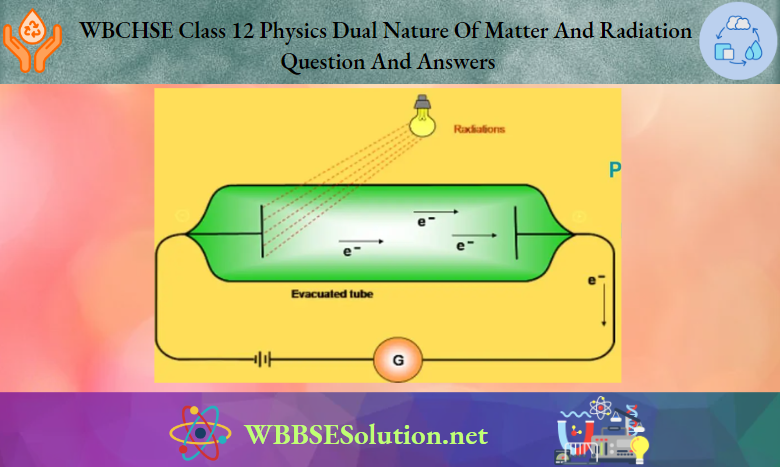
Question 1. Photoelectric current continues when the anode is even at a slight negative potential concerning the photocathode. Explain.
Answer:

Emitted photoelectrons possess some initial kinetic energy. Hence, a few electrons can reach the anode overcoming the repulsive force of the negative potential. If the value of the negative potential is not too high, the photoelectric current continues to flow

Question 2. When radiation of wavelength 2000A° is incident on a nickel plate, the plate gets positively charged. But when the wavelength of Incident radiation is raised to 3440 A°, the plate remains neutral. Explain
Answer:

The photoelectric effect takes place for incident radiation of wavelength 2000A and due to the emission of photoelectrons, the plate becomes positively charged. No photoelectric effect takes place when radiation of wavelength 3440A is incident on the plate, as the threshold wavelength for photoelectric effect is more than 2000 A but less than 3440A

Question 3. Give examples of the production of

  1. An electron by a photon and
  2. Photon by an electron.

Answer:

  1. When a photon is incident on the metal surface, the electron is emitted in a photoelectric effect.
  2. In the process of production of X-rays, when high-speed electrons in cathode rays are incident on a metal surface, an X-ray photon is emitted.

(Hence photoelectric effect and X-ray production are two opposite site effects)

Key Concepts in Dual Nature of Radiation

Question 4. A metal plate that emits photoelectrons under the influence of blue light, may not emit photoelectrons under the influence of red light. Explain.
Answer:

  • For the emission of electrons from a metal surface, the frequency of the incident light should be higher than the threshold frequency ofthe metal.
  • The frequency of blue light is greater than the frequency of red light.
  • If the frequency of blue light is higher than the threshold frequency for the metal, electrons will be emitted.
  • But if the frequency of red light is less than the threshold frequency, red light will not be able to emit electrons from that metal surface

Read And Learn More WBCHSE Class 12 Physics Short Question And Answers

Question 5. Radiation of frequency 1015 Hz is Incident separately on two photosensitive surfaces P and Q. The following observations were made:

  1. Surface P: Photoemission occurs but the photoelectrons have zero kinetic energy
  2. Surface Q: Photoemission occurs and electrons have non-zero kinetic energy.

Question 6. Which of these two has a higher work function? If the frequency of incident light Is reduced, what will happen to photoelectron emission In the two cases?
Answer:

The energy of the incident photon, hf = Ek + W0; here W0 – work function of the emitting surface, and Ek = kinetic energy of the emitted photoelectron

Given, for the surface P, Ek = 0; but for the surface Q, Ek> 0. For the same incident light, hf= constant. So the work function W0 is higher for the surface P.

If incident light of a lower frequency is taken, he would reduce. Then it would be less than the work function of the surface P; so, this surface would emit no photoelectron. The surface Q may emit photoelectrons, provided hf > W0 for that surface

WBCHSE Class 12 Physics Dual Nature Of Matter And Radiation saqs

Short Answer Questions on Dual Nature of Matter

Question 7. State two important properties of photons which
Answer:

The properties of photons used to write Einstein’s photoelectric equation are

  1. The rest mass of the photon is zero,
  2. The energy ofthe photon is E = hv

Question 8. An electron (charge = e, mass = m ) is accelerated from rest through a potential difference of V volt. What will be the de Broglie wavelength ofthe electron?
Answer:

The kinetic energy gained by the electron

= eV = ½mv²

Or, v = \(\sqrt{\frac{2 e V}{m}}\)

Hence, de Broglie wavelength,

λ = \(\frac{h}{m \nu}=\frac{h}{m} \sqrt{\frac{m}{2 e V}}\)

= \(\frac{h}{\sqrt{2 m e V}}\)

Question 9. When light incident on a metal ha* energy le** than the work function of the metal, then no electron h emitted from the surface of the metal. Mathematically justify this statement
Answer:

Einstein’s photoelectric equation,

½mv²max = hf – W0 = work function

If hf < W0, the maximum kinetic energy of electrons (½mv²max )is negative and so v²max   is negative. However, the magnitude of the square of a physical quantity cannot be negative. Hence photoelectrons are not emitted from the surface ofthe metal

Question 10. Is matter wave an electromagnetic wave?
Answer:

No, matter wave is not an electromagnetic wave, because the matter waves are not associated with periodic vibrations of the electric and magnetic fields

Class 11 Physics Class 12 Maths Class 11 Chemistry
NEET Foundation Class 12 Physics NEET Physics

Question 11. A beam of photons of energy 5.0 eV falls on a free metal surface of work function 3.0 eV. As soon as the photo-electrons are emitted, they are removed. But the emission comes to a stop after a while explain the reasons, i
Answer:

When the photons of energy 5.0 eV fall on a free metal surface of work function 3.0 eV, electrons are emitted from the surface instantaneously and the surface becomes positively charged. After a while, the number of free electrons in the metal surface decreases and more energy is required for the emission of electrons from the metal surface, i.e., the work function of the metal increases.

When the work function becomes greater than 5.0 eV, the photons of energy 5.0 eV are not able to eject electrons from the metal surface. So, the emission of electrons ceases after some time. To overcome this difficulty/the metal surface is connected to a negative pole of an electric source to make it negatively charged.

Question 12. Does the photoelectric emission take place due to the incidence of visible light and ultraviolet rays on the faces of different types of metals in our everyday experience?
Answer:

Yes, the photoelectric emission does take place. But in the absence of any positively charged collector, the emitted photoelectrons accumulate on the metal surface and make a layer of negative charges. Within a very short period, the emission of photoelectrons comes to a stop due to the repulsion of the negatively charged layer. Hence the photoelectric emission stops after a while

Question 13. Why the photoelectric emission can not be performed by using X-rays and gamma rays?
Answer:

When a photon of sufficient energy falls on a metal surface, the photon vanishes by imparting all its energy to an electron and the electron comes out of the metal surface. This phenomenon is known as the photoelectric effect. But in the case of X-rays and gamma rays, the photon energy is too high for the electron of the metal to absorb so that the photon, is not annihilated by imparting its whole energy to an electron. Hence the photoelectric emission does not take place with X-ray or gamma-ray photons.

Question 14. What is the relation of the de Broglie wavelength of a moving particle with temperature?
Answer:

If the thermal energy is not a source of kinetic of a proving,partic)e, then the de Broglie wavelength of that particle is independent of the temperature. Hence the de Broglie wavelength emitted particles in photoelectric effect radioactive radiation etc. have no relation with temperature. T is given by v ∝ \(\nu \propto \sqrt{T}\).

Therefore, the de Broglie wavelength

λ = \(\lambda=\frac{h}{m v} \quad \text { or, } \lambda \propto \frac{1}{\sqrt{T}}\)

Real-Life Applications of Wave-Particle Duality

Question 15. The threshold frequency for a certain, metal is 3.3 × 10 14 Hz. If the light of frequency 8.2 × 10 -14 Hz is incident on the metal, predict the cut-off voltage for the photoelectric emission.
Answer:

We know, eV0 = hf-hf0

Or, V0 = \(\frac{h}{e}\left(f-f_0\right)\)

= \(\frac{6.626 \times 10^{-34}\left(8.2 \times 10^{14}-3.3 \times 10^{14}\right)}{1.6 \times 10^{-19}}\)

= 2.03V

Question 16. What is the de Broglie wavelength of a bullet of mass 0.040 kg traveling at the speed of 1.0 km s-1?
Answer:

Here, m = 0.04 J kg, v = 1.0 km. s-1  = 103 m. s-1

∴ λ = \(\frac{h}{m v}=\frac{6.626 \times 10^{-34}}{0.040 \times 10^3}\)

= 1.66 ×10⁻³⁵m

Question 17. Every metal has a definite work function. Why do all photoelectrons not come out with the same energy if incident radiation is monochromatic?
Answer:

The work function of a metal is the minimum energy required to knock out an electron from the highest Tilled level of the conduction band. The conduction band comprises different energy levels forming a continuous band of levels. Electrons in different energy levels need different energy for emission. Thus, the electron, once emitted has different kinetic energies depending on the energy supplied to the emitter.

Question 18. Write the expression for the de Broglie wavelength associated with a charged particle having charge q and mass m, when it is accelerated by a potential V.
Answer:

Kinetic energy acquired, E = qV

Momentum, p = \(\sqrt{2 m E}=\sqrt{2 m q V}\)

So, de Broglie wavelength, λ =  \(\frac{h}{p}=\frac{h}{\sqrt{2 m q V}}\)

Common Questions on Photoelectric Effect

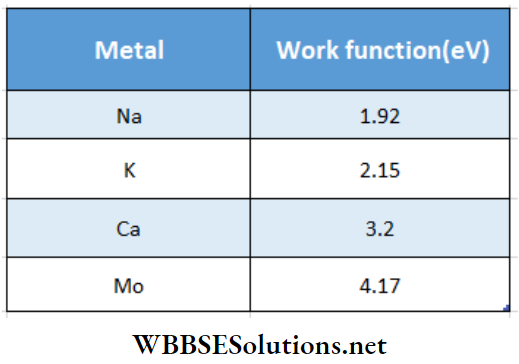
Question 19. If light of wavelength 412.5 nm is incident on each of the metals given in the table, which ones will show photoelectric emission and why?
Answer:

Dual Nature Of Matter And Radiation Metal And Work Function

The energy of incident light,

E = 12400/λ(in Å)

= \(\frac{12400}{4125}\)

= 3 eV

Na and K will show photoelectric emission because their work functions are less than the energy of incident light

Question 20. Does the stopping potential depend on

  1. The intensity and
  2. The frequency of the incident light? Explain

Answer:

  1. Stopping potential does not depend on the intensity of the incident light.
  2. Stopping potential Is directly proportional to the frequency of the incident light

WBCHSE Class 12 Physics Dual Nature Of Matter And Radiation Question And Answers

Dual Nature Of Matter And Radiation Long Questions And Answers

Question 1. The kinetic energy of a proton is the same as that of an α  -particle. What is the ratio of their respective de Broglie wavelengths?
Answer:

Kinetic energy

E = ½mv²=  \(\frac{1}{2} m v^2=\frac{(m v)^2}{2 m}\)

Or, mv = \(\sqrt{2 m E}\)

Hence, de Broglie wavelength,

λ = \(\frac{h^2}{m v}=\frac{h}{\sqrt{2 m E}}\)

Since the kinetic energy of a proton equals that of a-parade

⇒ \(\frac{\lambda_1}{\lambda_2}=\sqrt{\frac{m_2}{m_1}}=\sqrt{\frac{4}{1}}\)

= \(\frac{2}{1}\)
WBCHSE Class 12 Physics Dual Nature Of Matter And Radiation Long Question And Answers

Question 2. What should be the percentage increase or decrease of kinetic energy of an electron so that its de Broglie wavelength is halved?
Answer:

Kinetic energy, E = \(\frac{p^2}{2 m}\)

[p = momentum]

∴ p = \(\sqrt{2 m E}\)

de Broglie wavelength = \(\frac{h}{p}=\frac{h}{\sqrt{2 m E}}\)

∴ \(\frac{\lambda_1}{\lambda_2}=\sqrt{\frac{E_2}{E_1}}\)

Here \(\lambda_2=\frac{\lambda_1}{2}\) Or, \(\frac{\lambda_1}{\lambda_2}\) = 2

Hence \(\sqrt{\frac{E_2}{E_1}}\) = 2 Or, E2 = 4E1

∴ Increase in kinetic energy

= \(\frac{E_2-E_1}{E_1} \times 100 \%\) × 100%

= \(\frac{4 E_1-E_1}{E_1} \times 100 \%\) × 100%

= 300%

Question 3. The kinetic energy of a free electron is doubled. By how many times, would its de Broglie wavelength increase
Answer:

Kinetic energy, E = \(\frac{p^2}{2 m}\) [p= momentum of electron]

∴ p = \(\sqrt{2 m E}\)

de Broglie wavelength

λ = \(\frac{h}{p}=\frac{h}{\sqrt{2 m E}}\)

i.e \(\frac{\lambda_1}{\lambda_2}=\sqrt{\frac{E_2}{E_1}} \text { or, } \lambda_2=\lambda_1 \sqrt{\frac{E_1}{E_2}}\)

=  \(\lambda_1 \sqrt{\frac{1}{2}}=\frac{\lambda_1}{\sqrt{2}}\)

Hence, de Broglie wavelength will be \(\) times Original One.
WBCHSE Class 12 Physics Dual Nature Of Matter And Radiation Question And Answers

Dual Nature of Matter Q&A WBCHSE

Question 4. Energy of a photon = E; kinetic energy of a proton is also the same as energy of the photon. The corresponding wavelength of the photon and de Broglie wavelength of the proton are λ1 and λ2, respectively. What is the relation between E and the ratio of λ1 and λ2? 
Answer:

In the case of photon, E = hf = hc/λ1

Or, λ1 = hc/E

In case of proton, E = \(\frac{p^2}{2 m}\) [p = momentum of proton]

Hence, p = \(\sqrt{2 m E}\) and, \(\frac{h}{p}=\frac{h}{\sqrt{2 m E}}\)

i.e \(\frac{\lambda_2}{\lambda_1}=\frac{h}{\sqrt{2 m E}} \cdot \frac{E}{h c}\)

= \(\frac{1}{c} \sqrt{\frac{E}{2 m}} \quad \text { or, } \frac{\lambda_2}{\lambda_1} \propto \sqrt{E}\)

Question 5. Distinguish between matter wave and light wave
Answer:
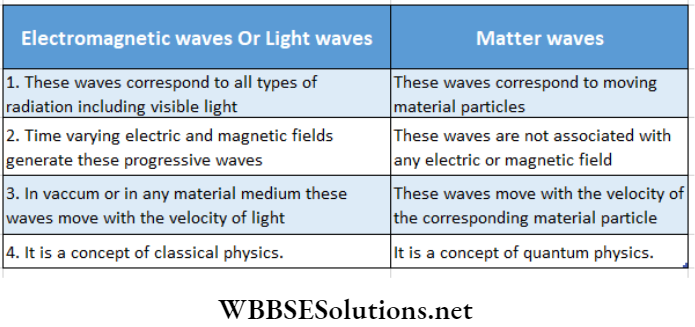
Dual Nature Of Matter And Radiation Electromagnetic Waves And Matter Waves

Question 6. The maximum kinetic energies of photoelectrons emitted from a metal surface when illuminated by radiations of wavelengths λ1 and λ2 are K1 and K2, respectively. If λ1 = 3λ2, show that,\(K_1<\frac{K_2}{3}\)
Answer:

If the work function of the metal is W, from Einstein’s equation

K1 = \(K_1=\frac{h c}{\lambda_1}-W \text { and } K_2=\frac{h c}{\lambda_2}-W\) – W

Hence,K1  – \(K_1-\frac{K_2}{3}=h c\left(\frac{1}{\lambda_1}-\frac{1}{3 \lambda_2}\right)-W+\frac{W}{3}\)

= hc. 0 –  \(\frac{2 W}{3}\)

Since λ1=  3λ2

= – \(\frac{2 W}{3}\)<0

K1 < \(\frac{K_2}{3}\)

Question 7. A proton and an electron have the same kinetic energy. Which one has a larger de Broglie wavelength?
Answer:

de Broglie wavelength, λ = \(\frac{h}{\sqrt{2 m K}}\)

Since h and K are constants, λ∝ \(\frac{1}{\sqrt{m}}\)

If I and mp are the masses of an electron and a proton respectively.

Then,  \(\frac{\lambda_e}{\lambda_p}=\sqrt{\frac{m_p}{m_e}}>1\)

∴ λe > λp

So, the de Broglie wavelength of electrons is greater

WBCHSE Physics Questions on Wave-Particle Duality

Question 8. A proton and an electron have the same de Broglie wave¬ length. Which one has higher kinetic energy?
Answer:

de Broglie wavelength,

λ = \(\frac{h}{\sqrt{2 m K}}\) [ K= kinetic energy]

Or, mK = \(\frac{h^2}{2 \lambda^2}\)

For the same λ, mK = constant

i.e \(K \propto \frac{1}{m} \quad \text { or, } \frac{K_e}{K_p}=\frac{m_p}{m_e}>1\)

∴ Ke>Kp

∴  Electron has higher kinetic energy.

Question 9. A photon and an electron have the same de Broglie wavelength. Which one has greater total energy?
Answer:

The total energy of a photon of wavelength λ is given by

Ep = hf = hc/λ ……………………………………………… (1)

de Broglie wavelength J of an electron (same as bf photon) of mass m moving with velocity v is given by

λ = \(\frac{h}{m v} \text { or, } m=\frac{h}{\lambda v}\)

The total energy of electron of mass m

Ee = mc²  (According to the theory of relativity)

= \(\frac{h c^2}{\lambda v}\) ………………………………… (2)

Dividing equation (2) by equation (1) we hive

⇒ \(\frac{E_e}{E_p}=\frac{\frac{h c^2}{\lambda v}}{\frac{h c}{\lambda}}=\frac{c}{v}\)

Since c>c.

∴ Ee >Ep

So the total energy of the electron is greater than that of a photon

Essential Q&A on Dual Nature of Matter WBCHSE

Question 10. Find the exp-session of de Broglie wavelength of a particle moving with a velocity close to the velocity of light.
Answer:

When a particle moves with a velocity v close to the velocity of light c, then the effective mass of the particle

m = \(\frac{m_0}{\sqrt{1-\frac{v^2}{c^2}}}\)

Where mQ = rest mass of the particle

Hence, the de Broglie wavelength associated with the particle is

λ = \(\frac{h}{m v}=\frac{h \sqrt{1-\frac{v^2}{c^2}}}{m_0 v}\)

= \(\frac{h}{m_0 v} \sqrt{1-\frac{v^2}{c^2}}\)

Question 11. If another the speed particle of anis 3v, electron ratio iso f the v and de Brogliethe speed wavelength of the electron to that of the particle Is 104/8.13. Is the particle a proton or an α  particle? Justify your answer
Answer:

de Broglie wavelength, λ = \(\frac{h}{m v}\)

[ h = Planck’s constant]

∴ For the electron and the other particle

⇒ \(\frac{\lambda_1}{\lambda_2}=\frac{m_2}{m_1} \cdot \frac{v_2}{v_1}\)

Or, = \(\frac{m_2}{m_1}=\frac{\lambda_1}{\lambda_2} \cdot \frac{v_1}{v_2}=\frac{10^4}{8.13} \times \frac{v}{3 v}\)

= \(\frac{410}{1}\)

∴ The other particle is 410 times heavier than an electron. It is neither a proton nor an α-particle

Question 12. Prove that the product of the slope of the V0-f graph and electronic charge gives the value of Planck’s constant.
Answer:

From Einstein’s photoelectric equation, we know that,

½mv² = hf – W0

But, ½mv²max  = eV0

∴ eV0 = hf – W0

Or,  \(\frac{h}{e} f-\frac{W_0}{e}\) ………………………………………….. (1)
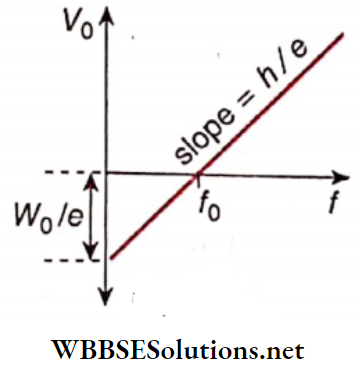
Dual Nature Of Matter And Radiation Slope Of V And f Graph

So the plot of stopping potential ( V0) versus frequency (f) will be a straight line

Comparing equation (1) with (the equation of a straight line y = mx + c, we get the slope of V0– f graph m = h/e

Planks constant h = me

Question 13.  The given graphs show the variation of photoelectric current (I) with the applied voltage ( V) when light of different Intensi¬ ties Is Incident on surfaces of different materials Identify the pairs of curves that correspond to different materials but the same intensity of incident radiations.
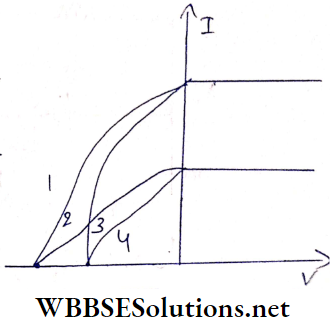
Dual Nature Of Matter And Radiation Variation Of Photoelectric Current

Answer:

Stopping potential depends on the material of the photocathode, but Is independent of the Intensity of the Incident radiation. So the pairs (1,3) and (2, 4) correspond to different materials but the same Intensity of incident radiation.

Class 11 Physics Class 12 Maths Class 11 Chemistry
NEET Foundation Class 12 Physics NEET Physics

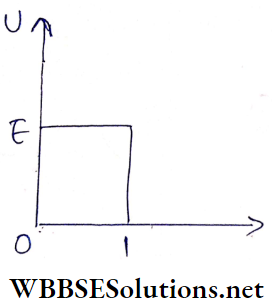
Question 14. The potential energy U of a moving particle of mass m varies with x as shown In the figure. The de Broglie wavelengths of the particle In the regions 0 <x< 1 and x > 1 are λ1 and λ2 respectively. If £ the total energy of the particle Is nE, find λ12

Dual Nature Of Matter And Radiation Potential Energy Of U

Answer:

Total energy =nE = potential energy + kinetic energy

In the region 0 < x < 1, potential energy, U1= E

∴ Kinetic energy Is K1 = nE- E = (n- 1 )E

∴ de Broglie wavelength,

λ1=  \(\frac{h}{\sqrt{2 m K_1}}=\frac{h}{\sqrt{2 m(n-1) E}}\) ………………………………………….(1)

In the region x > 1 , potential energy, U2 = 0

Kinetic energy, K2 = nE- 0 = nE

de Broglie wavelength

λ2 = \(\frac{h}{\sqrt{2 m K_2}}=\frac{h}{\sqrt{2 m n E}}\)………………………………..(2)

From equations (1) and (2) we get

⇒ \(\frac{\lambda_1}{\lambda_2}=\frac{h}{\sqrt{2 m(n-1) E}} \times \frac{\sqrt{2 m n E}}{h}\)

= \(\sqrt{\frac{n}{n-1}}\)

Question 15. Monochromatic light of wavelength 632.8 nm Is produced by a helium-neon laser. The power emitted is 9.42 mW.

  1. Find the energy and momentum of each photon in the light beam.
  2. How many photons per second, on average, arrive at a target irradiated by this beam? (Assume the entire beam to be incident on a small area of the target)
  3. What should be the velocity of a hydrogen atom to have the same momentum ofthe photon?

Answer:

1. Wavelength, λ  = 632.8 nm = 632.8 × 10 -9m

∴ The energy of each photon

E = \(\frac{h c}{\lambda}=\frac{6.626 \times 10^{-34} \times 3 \times 10^8}{632.8 \times 10^{-9}}\)

= 3.14 × 10⁻¹⁹ J and momentum

p = \(\frac{h}{\lambda}=\frac{6.626 \times 10^{-34}}{632.8 \times 10^{-9}}\)

= 1.05 × 10⁻²⁷ kg. m. s-1

2. Emission power

P = 9.42 mW = 9.42 × 10 -19 W

Number of photons emitted per second

n = \(\frac{P}{E}=\frac{9.42 \times 10^{-3}}{3.14 \times 10^{-19}}\)

3. Mass of hydrogen atom

= Mass of proton = 1.67 × 10 -27 kg

∴ Velocity of the hydrogen atom

= \(\frac{\text { momentum of photon }}{\text { mass of hydrogen }}=\frac{1.05 \times 10^{-27}}{1.67 \times 10^{-27}}\)

= 0.63 m. s-1

Question 16. The energy flux of sunlight reaching the surface of the earth is 1.388 × 10³ W .m-2. How many photons (nearly) per square meter are incident on the earth per second? Assume that the photons in the sunlight have an average wavelength of 550 nm.

Wavelength, μ  = 550 nm = 550 × 10 -9  m

Energy flux, Φ= 1.388 × 10 3 W .m-2

The energy of each photon,

E = \(\frac{h c}{\lambda}=\frac{6.626 \times 10^{-34} \times 3 \times 10^8}{550 \times 10^{-9}}\)

= 3.61× 10 -19J

∴ Number of photons incident on earth per square meter per second,

n = \(\frac{\phi}{E}=\frac{1.388 \times 10^3}{3.61 \times 10^{-19}}\)

= 3.85 × 10 21

Question 17. The work function for a certain metal is 4.2 eV. Will this metal give photoelectric emission for incident radiation of wavelength 330 nm?
Answer:

Work function, W0 = 4.2 eV = 6.72 × 10⁻¹⁹ J

Threshold frequency, f0  = \(\frac{W_0}{h}\)

⇒ \(\frac{6.72 \times 10^{-19}}{6.606 \times 10^{-34}}\)

= 1.101 × 10¹⁵ Hz

∴ Threshold wavelength,

λ0 = \(=\frac{6.72 \times 10^{-19}}{6.626 \times 10^{-34}}\)

= \(\frac{c}{f_0}=\frac{3 \times 10^8}{1.01 \times 10^{15}}\)

= 297 nm

∴ λ0 < λ

Where λ = incident wavelength

i.e f0 >f

∴ Photoelectric emission is not possible in this case.

Practice Questions for Dual Nature of Radiation

Question 18. Light of wavelength 488 nm is produced by an argon laser which is used in the photoelectric effect. When light from this spectral line is incident on the cathode, the stopping (cut-off) potential of photoelectrons Is 0.38 y and the work functional the material from which staff cathode Ht made

Frequency of Incidental light,

f = \(\frac{c}{\lambda}=\frac{3 \times 10^8}{488 \times 10^{-9}}\)

= 6.15 × 10¹⁴ Hz

∴ Work function,

W0 = hf-eV0

= 6.626 × 10-34 × 6.15 × 104 – 1.6 × 10-19 × 0.38

= 3.467 × 10⁻¹⁹ J = 2.167.eV

Question 19. The wavelength of light from the spectral emission line of sodium is 589 nm. Find the kinetic energy at which

  1. An electron and
  2. A neutron would have the same de Broglie wavelength

Answer:

de Broglie wavelength, A = \(\frac{h}{\sqrt{2 m E}}\)

Or, E = \(\text { or, } E=\frac{1}{2 m} \cdot \frac{h^2}{\lambda^2}\)

1. The kinetic energy of the electron

Ee= \(\frac{1}{2 \times 9.1 \times 10^{-31}} \times\left(\frac{6.626 \times 10^{-34}}{589 \times 10^{-9}}\right)^2\)

= 6.95 ×10⁻²⁵ J

2. Kinetic energy of neutron

En=  \(\frac{1}{2 \times 1.67 \times 10^{-27}} \times\left(\frac{6.626 \times 10^{-34}}{589 \times 10^{-9}}\right)^2\)

= 3.79 ×10⁻²⁸J

Question 20. The wavelength of each photon and electron is 1.00 nm, Find their

  1. Momentum and
  2. Energy.

Answer:

1. Momentum, p = \(\frac{h}{\lambda}\)

Or, p = \(\frac{6.626 \times 10^{-34}}{1 \times 10^{-9}}\)

= 6.626 ×10⁻²⁵J kg. m. s-1

2. Energy of photon

E = \(\frac{h c}{\lambda}=\frac{6.626 \times 10^{-34} \times 3 \times 10^8}{10^{-9}}\)

= 1.24 keV

The kinetic energy of the electron

½mv² = \(\frac{p^2}{2 m}\)

= \(\frac{\left(6.626 \times 10^{-25}\right)^2}{2 \times 9.1 \times 10^{-31}} \mathrm{~J}\)

= 1.51

Question 21. The average kinetic energy of a neutron at 300 K is \(\frac{3}{2}\) kT.  Find Its do Broglie wavelength.
Answer:

de Broglie wavelength

λ = \(\frac{h}{\sqrt{2 m E}}=\frac{h}{\sqrt{3 m k T}}\)

Since E = \(\frac{3}{2}\) KT

= \(=\frac{6.626 \times 10^{-34}}{\left(3 \times 1.67 \times 10^{-27} \times 1.38 \times 10^{-23} \times 300\right)^{1 / 2}}\)

K = 1.38 × 10-23

= 1.456A°

Question 22. What is the dc Broglie wavelength of a nitrogen molecule at 300 K ? Assume the molecule is moving with its rms speed. (Atomic mass of nitrogen = 14.0076 u J)
Answer:

vrms = \(\sqrt{\frac{3 k T}{m}}\)

de Broglie wavelength of nitrogen molecule

λ = \(\frac{h}{m v_{\mathrm{rms}}}=\frac{h}{\sqrt{3 m k T}}\)

= \(\frac{6.626 \times 10^{-34}}{\left(3 \times 28.0152 \times 1.38 \times 10^{-23} \times 300\right)^{1 / 2}}\)

= 0.275 ×10⁻¹⁰ m

Question 23. In an accelerator experiment on high-energy collisions of electrons with positrons, a certain event Is interpreted as the annihilation of an electron-positron pair of total energy 10.2 GeV into two ϒ – rays of equal energy. What is the wavelength associated with each γ-  ray ( lGeV = 109 eV )
Answer:

The energy of two γ-  ray = 10.2 GeV

∴ A Energy of each γ-  ray = 5.1 GeV = 5.1 ×10⁹eV

λ = \(\frac{h c}{E}=\frac{6.626 \times 10^{-34} \times 3 \times 10^8}{5.1 \times 10^9 \times 1.6 \times 10^{-19}}\)

= 2.44 ×10⁻¹⁶ m

Short Answer Questions on Wave-Particle Duality

Question 24. Estimating the following two numbers should be interesting. The first number will tell you why radio engineers need not worry much about photons! The second number tells you why our eye can never ‘count photons! even In barely detectable light.

  1. The number of photons emitted per second by a medium wave transmitter of 10 kW power, emitting radiowaves of wave-length 500 m
  2. The number of photons entering the pupil of our eye per second corresponds to the minimum intensity of white light that we humans can perceive (-10-10W.m-2). Take the area ofthe pupil to be about 0.4 cm2 and the average frequency of white light to be about 6 ×10¹⁴ Hz.

Answer:

1. Number of photons emitted per second,

n = \(n=\frac{\text { power of transmitter }}{\text { energy of each photon }}\)

= \(\frac{P}{h c / \lambda}=\frac{10^4 \times 500}{6.626 \times 10^{-34} \times 3 \times 10^8}\)

= 2.52 ×1031

This number is so very large that radio engineers need not worry much about photons.

2. Minimum intensity, I = 10-10 W.m-2

Area of pupil = 0.4 cm2 = 0.4 ×10⁻⁴m2

Average frequency, f  = 6 × 10⁻⁴ Hz

E = hf = 6.626 ×10-34 × 6 × 1014

= 3.98 ×10⁻¹⁹J

∴ Number of photons incident on the eye,

n = \(\frac{I A}{E}=\frac{10^{-10} \times 0.4 \times 10^{-4}}{3.98 \times 10^{-19}}\)

= 1.01 × 10⁴

This is quite a small number, but still large enough to be counted

Question 25. Monochromatic radiation of wavelength 640.2 nm? from a neon lamp irradiates photosensitive material made of calcium or tungsten. The stopping voltage is measured to be 0.54 V. The source is replaced by an iron source and its 427.2 nm line irradiates the same photocell. Predict the new stopping voltage
Answer:

The work function of the photoelectric cell

W0 = \(\frac{h c}{\lambda}\)eV0

= \(\left(\frac{6.626 \times 10^{-34} \times 3 \times 10^8}{640.2 \times 10^{-9}}-1.6 \times 10^{-19} \times 0.54\right)\)

= 1.40 eV

In the second case, A = 427.2 nm

V0 = \(\frac{1}{e}\left(\frac{h c}{\lambda}-W_0\right)\)

= \(\frac{1}{1.6 \times 10^{-19}}\) \(\times\left(\frac{6.626 \times 10^{-34} \times 3 \times 10^8}{427.2 \times 10^{-9}}-2.24 \times 10^{-19}\right)\)

= 1.51 V

Question 26. An electron microscope uses electrons accelerated by a voltage of 50 kV. determine the die deBroglie wavelength associated with the electrons. If other factors (such as numerical aperture etc.) are taken to be roughly the same, how does the resolving power of an electron microscope compare with that of an optical microscope with yellow light?
Answer:

Wavelength of electron

λe = \(\frac{h}{\sqrt{2 m e V}}\)

= \(\frac{6.626 \times 10^{-34}}{\left(2 \times 9.1 \times 10^{-31} \times 1.6 \times 10^{-19} \times 50 \times 10^3\right)^{\frac{1}{2}}} \mathrm{~m}\)

= 0.0549 A°

∴ Resolving power of a microscope ∝  1/ λ

The wavelength of yellow light, λy = 5900 A°

∴ \(\quad \frac{\text { resolving power of electron microscope }}{\text { resolving power of optical microscope }}\)

= \(\frac{\lambda_y}{\lambda_e}=\frac{5900}{0.0549}\)

= 1.07 × 10⁵

Question 27. Find the typical de Broglie wavelength associated with a He atom in helium gas at room temperature (27 °C) and 1 atm pressure.
Answer:

Here, T = 27°C = 300 K,

P = 1 atm = 1.01 × 10⁵ N . m-2

Mass of He atom,

mHe = \(\frac{4}{\text { Avogadro’s number }}=\frac{4}{6.023 \times 10^{23}}\)

= 6.64 × 10⁵  N.m-2

∴ Typical de Broglie wavelength

λ = \(\frac{h}{\sqrt{3 m_{\mathrm{He}} k T}}\)

= \(\frac{6.626 \times 10^{-34}}{\left(3 \times 6.64 \times 10^{-27} \times 1.38 \times 10^{-23} \times 300\right)^{1 / 2}} \mathrm{~m}\)

= 0.73A°

Question 28. Einstein’s photoelectric equation shows how the cut-off voltage and threshold frequency for a given photosensitive material can be determined with the help of a suitable photograph.
Answer:

Einstein’s equation: eV0 = h(f-f0)

Where, V0 = cut-off voltage due to frequency/ of incident light,

f0 = threshold frequency

Now, V0=  \(\frac{h f}{e}-\frac{h f_0}{e}\)

This is of the form y = mx + c. So the graph of V0 vs f will be a straight line AB of slope – v0,

The point of intersection of AB with the x-axis gives the value of f. For any incident frequency, corresponding to any point C on AB, the ordinate OD gives the value of the cut-off voltage V0.
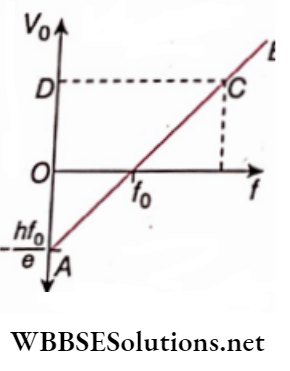
Dual Nature Of Matter And Radiation Straight Line AB Of Slope

Question 29. An electron microscope uses electrons, accelerated by a voltage of 50 kV. Determine the de Broglie wavelength associated with the electrons. Taking other factors, such as numerical aperture, etc. to be the same, how does the resolving power of an electron microscope compare with that of an optical microscope that uses yellow light? C Kinetic energy of the electron

E = 50 keV = 50 × 1.6  ×10-16 J

∴ de Broglie wavelength

λ = \(\frac{h}{\sqrt{2 m E}}\)

= \(\frac{6.626 \times 10^{-34}}{\sqrt{2 \times\left(9.1 \times 10^{-31}\right) \times\left(50 \times 1.6 \times 10^{-16}\right)}} \times 10^{10} \mathrm{~A}\)

= 0.055 A°

λ<< λ’

The wavelength of yellow light,

λ’≈ 5900 A°

λ<<λ’

So, λ<<λ’

The least distance (d) between two points that a microscope can observe separately is proportional to the wavelength of light used, i.e, d ∝ λ

As λ<<λ’ we have d<<d’. So an electron microscope can resolve two points very much closer. Then its resolving power is much higher than that of an optical microscope

Question 30. The graph shows the variation of stopping potential with the frequency of incident radiation for two photosensitive metals A and B. Which one ofthe two has a higher value of work function? Justify your answer.
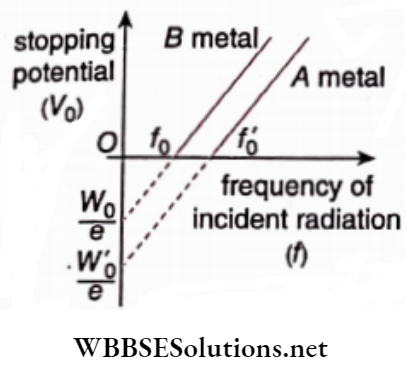
Dual Nature Of Matter And Radiation Stopping Potential With Frequency

Answer:

For metal A, W’0 = hf’0; For metal B , W0 = hf0

As f’ >f0

∴ W’0 >W0

So, the function of metal A is greater than that of metal B

Question 31. Determine the value of the de Broglie wavelength associated with the electron orbiting in the ground state of the hydrogen atom (given E0 = -(13.6/n²) eV and Bohr radius r0 = 0.53 A ). How will the de Broglie wavelength change when it is in the first excited state?
Answer:

We know, the de Broglie wavelength

λ = \(\frac{h}{m v}=\frac{h r}{m v r}\)

= \(\frac{h r}{\frac{n h}{2 \pi}}=\frac{2 \pi r}{n}\)

For ground State, n= 1

∴  \(\lambda_1=\frac{2 \pi r_0}{1}\)

For ground state, n = 1.

∴ λ1 = 2π × 0.53 ×  10-10

= 3.3 m ×  10-10= 3.3 Å

Again , λn=  \(\frac{2 \pi r_n}{n}=\frac{2 \pi n^2 r_0}{n}\)

= n2πr0

= n λ1

When n = 2 (for first excited state) = λ1 = 2λ1

Hence, de Broglie wavelength doubles in the first excited state

Physics Q&A on Dual Nature of Matter and Radiation

Question 32. Define the term ‘intensity of radiation’ in a photon picture of light Ultraviolet light of wavelength 2270 A° from 100 W mercury source irradiates a photocell made of a given metal. If the stopping potential is -1.3 V, estimate the work function of the metal. How would the photocell respond to a high intensity ( ~ 105 W. m-2 J red light of wavelength 6300 A° produced by a laser?
Answer:

The intensity of radiation can be defined as the amount of light energy incident per square meter per second.

V0 = 1.3 V; λ = 2270 × 10-10 m

We know that hf= hf0 + ±½ mv²max

Also, hf = W0+eV0

W0 = hf- ev0

W0 = hc/λ – eV0

W0 = \(\frac{6.62 \times 10^{-34} \times 3 \times 10^8}{2270 \times 10^{-10}}-1.3 \times 1.6 \times 10^{-19}\)

= \(6.669 \times 10^{-19} \mathrm{~J}=\frac{6.669 \times 10^{-19}}{1.6 \times 10^{-19}} \mathrm{eV}\)

= 4.168 eV

Again W0 = \(h f_0=\frac{h c}{\lambda_0}\)

Or, λ0 = \(\frac{h c}{W_0}=\frac{6.62 \times 10^{-34} \times 3 \times 10^8}{6.669 \times 10^{-19}}\) m

= 2.98 m = 2980 Å

The photocell would not respond to a high intensity ( ~ 105 W. m-2 ) red light of wavelength 6300 A° produced by a laser because this wavelength is greater than 2980 A°

Question 33. A proton and a particle are accelerated through the same potential difference. Which one of the two has (a) greater de Broglie wavelength, and (b) less kinetic energy? Justify your answer
Answer:

The de Broglie wavelength is related to the accelerating potential as

λ = \(\frac{h}{\sqrt{2 m e V}}\)

λp = \(\frac{h}{\sqrt{2 m_p e_p V}} \text { and, } \lambda_\alpha=\frac{h}{\sqrt{2 m_\alpha e_\alpha V}}\)

λα =  And \(\)

∴ \(\frac{\lambda_p}{\lambda_\alpha}=\frac{h}{\sqrt{2 m_p e_p V}} \times \frac{\sqrt{2 m_\alpha e_\alpha V}}{h}=\frac{\sqrt{m_\alpha e_\alpha}}{\sqrt{m_p e_p}}\)

Now, the mass and charge of a -particle is greater than that of a proton

λp > λα for the same potential difference.

The kinetic energy is related to accelerating potential as

K = eV

∴ Kp = epV and  Kα = eα V

∴ \(\frac{K_p}{K_\alpha}=\frac{e_p}{e_\alpha}\)

Since the charge on the proton is less than that on the alpha particle, Kp < Ka for the same potential difference

Question 34. In the study of a photoelectric effect the graph between the. stopping potential V and frequency u of the incident radiation on two different metals P and Q is shown in:

  1. Which one of the two metals has a higher threshold frequency?
  2. Determine the work function of the metal which has greater value.
  3. Find the maximum kinetic energy of electron emitted by light of frequency 8 × 10-33 Hz Hz for this metal.
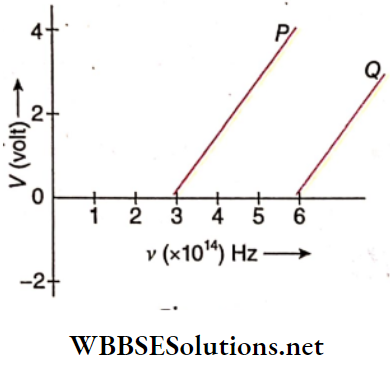
Dual Nature Of Matter And Radiation Stopping Potential V And Frequency

Answer:

1. Threshold frequency of P, νp = 3 × 10¹⁴ Hz

The threshold frequency of Q, νQ = 6  × 1014 Hz

So, metal Q has a higher threshold frequency.

2. Workfunction of metal Q,

W = hν0 .= 6.6  × 10-34  × 6 × 1014

= 39.6 × 10⁻²⁰ J

= 2.47 eV

3. The maximum kinetic energy of electron emitted from metal Q by light of frequency 8 × 10-14  Hz is,

= 6.6 × 10-34  ×  (8 × 1014– 6 ×10¹⁴ )

=13.2 × 10⁻²⁰ J

= 0.825 eV

Question 35. The following graph shows the variation of photocurrent for a photosensitive metal:
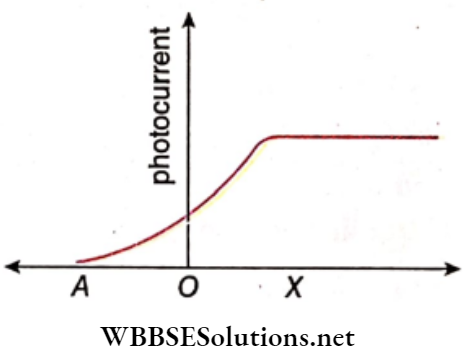
Dual Nature Of Matter And Radiation Photocurrent For A Photosensitive Metal

  1. Identify the variable X on the horizontal axis.
  2. What does point A on the horizontal axis represent?
  3. Draw this graph for three different values of frequencies of incident radiation, ν1, ν2, and ν3( ν123 )same intensity.
  4. Draw this graph for three different values of intensities of incident radiation I1 , I2 and I3(I1> I2> I3) having

Answer:

1. The variable X on the horizontal axis is the potential difference between the anode and the cathode.

2. The point A on the horizontal axis represents stopping potential
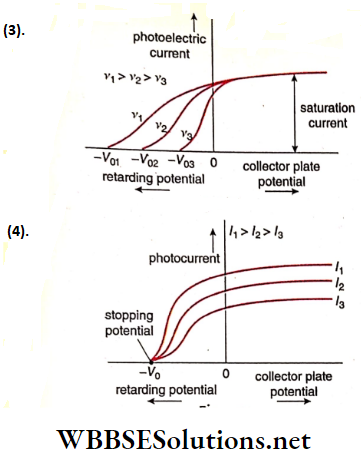
Dual Nature Of Matter And Radiation Different Values Of Frequencies And Intensities Of Incident Radiation

Question 36. The work functions of the following metals are given; Na = 2.75 eV, K = 2.3 eV, Mo = 4.17 eV, and Ni = 5.15 eV. Which of these metals will not cause photoelectric emission for radiation of wavelength 3300 A from a laser source placed 1 m away from these metals? What happens if the laser source is brought nearer and placed 50 cm away?
Answer:

Condition for photoelectric emission, hf> W0

Or, \(\frac{h c}{\lambda}>W_0\)

For λ = 3300 Å

⇒ \(\frac{h c}{\lambda}=\frac{6.6 \times 10^{-34} \times 3 \times 10^8}{3000 \times 10^{-10}} \mathrm{~J}\)

= \(\frac{6.03 \times 10^{-19}}{1.6 \times 10^{-19}} \mathrm{eV}\)

Mo and Ni will not cause photoelectric emission. If the laser source is brought nearer placed 50 cm away, then also there will be no photoelectric emission from Mo and Ni, since it depends upon the frequency of the source

Question 37. Radiation of frequency 1015 Hz Is Incident on two photosensitive surfaces P and Q. There is no photoemission from surface PhotoemUslon occurs from surface Q but photoelectrons have zero kinetic energy. Explain these observations and find the value of work function for surface
Answer:

There is no photoemission from surface I* because the frequency of incident radiation is less than its threshold frequency. Since photoemission occurs from surface Q and the photoelectrons have , zero kinetic energy, then the frequency of incident radiation is equal to the threshold frequency for surface Q .

Work function for surface Q, WQ = hf

= 6.6 × 10-34 × 1015

= 6.6 × 10-195

= 4.125 eV

Question 38. Find the energy required by an electron to have its de Broglie wavelength reduced from 10-10 m to 0.5 × 10⁻¹⁰ m.
Answer:

de Broglie wavelength

λ = \(\frac{h}{p}=\frac{h}{\sqrt{2 m E}}\)

Or,  \(2 m E=\frac{h^2}{\lambda^2} \quad \text { or, } E=\frac{h^2}{2 m} \cdot \frac{1}{\lambda^2}\)

∴ The energy required by the electron

E1 – E2 = \(\frac{h^2}{2 m}\left(\frac{1}{\lambda_2^2}-\frac{1}{\lambda_1^2}\right)\)

= \(\frac{\left(6.62 \times 10^{-34}\right)^2}{2 \times 9.1 \times 10^{-31}} \cdot\left[\frac{1}{\left(0.5 \times 10^{-10}\right)^2}-\frac{1}{\left(10^{-10}\right)^2}\right]\)

= 7.2 × 10⁻¹⁷J

E1 – E2 = \(\frac{7.2 \times 10^{-17}}{1.6 \times 10^{-19}} \mathrm{eV}\)

= 450 eV

Question 39.

  1. Draw the curve showing the variation of de Broglie wavelength of a particle with its momentum. Find the momentum of a photon of wavelength 0.01A.
  2. Mention the inference of Davisson Garmer’s experiment.

Answer:

1. If momentum =p, then the de Broglie wavelength of a particle

λ = h/p

Or, λp = h = Planck’s constant Hence the λ-p graph will be a rectangular hyperbola,

Given, λ = 0.01 A° = 10-12 m
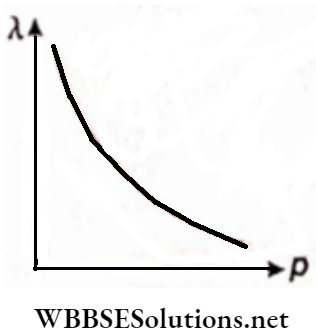
Dual Nature Of Matter And Radiation de Broglie Wavelength Of A Particle

Momentum ofthe photon

p = \(\frac{E}{c}=\frac{h f}{c}=\frac{h}{\lambda}=\frac{6.63 \times 10^{-34}}{10^{-12}}\)

= 6.63 ×10⁻²²  kg.m.s-1

2. The inference of this experiment is that an electron beam behaves as a matter wave. Hence the experiment proves de Broglie’s hypothesis.

Question 40. When light of wavelengths A and 2\ are incident on a metal surface, the stopping potentials are V0 and VQ/4 respectively. If c be the velocity of light in air, find the threshold frequency of photoelectric emission
Answer:

From Einstein’s photoelectric equation

eV0 =  hf-W0 or , W0 = hf – eV0 = \(\frac{h c}{\lambda}\) – eV0

In first case W0= \(\frac{h c}{\lambda}-e V_0\) …………………….(1)

In the Second case

W0 = \(\frac{h c}{2 \lambda}-\frac{e V_0}{4}\)

Or, W0 = \(\frac{2 h c}{\lambda}-e V_0\) …………………………(2)

From equations (1) and (2) we get,

4 W0 – W0 = 3W0 = \(\frac{h c}{\lambda} \text { or, } w_0=\frac{h c}{3 \lambda}\)

Threshold frequency \(\frac{W_0}{h}=\frac{c}{3 \lambda}\) =

∴ Threshold wavelength = 3λ

WBCHSE Class 12 Physics Light Interference Short Answer Questions

LightWave And Interference Of Light Short Question And Answers

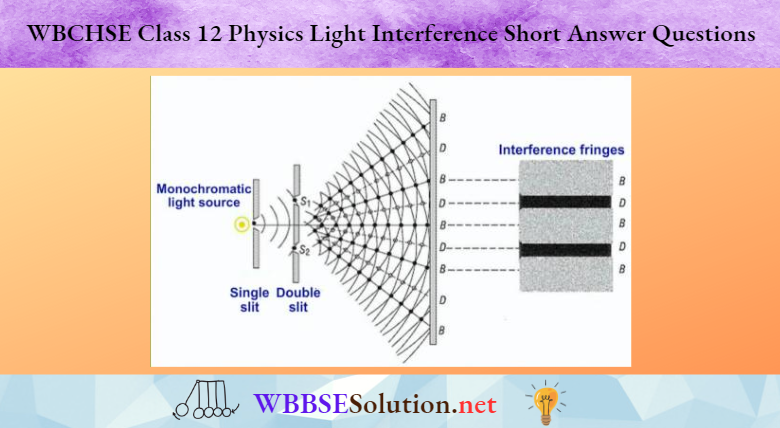
Question 1. What change will he observe in the interference pattern produced in Young’s double silt experiment, If a blue colour of the same intensity is used Instead of a yellow colour?

Answer: We know, the fringe width wavelength of incident light. The wavelength of blue light is less than that of yellow light. Hence on using blue light, fringe width will decrease

Question 2. In a double slit experiment using white light a white fringe is noticed on the screen. What will be the change in the position of the white fringe if the screen is shifted 0.05 m from the slits?
Answer: The white fringe is the central bright fringe. Its position does not change even when shifting the screen.

WBCHSE Class 12 Physics Light Interference saqs

WBBSE Class 12 Light Interference Short Q&A

Read And Learn More WBCHSE Class 12 Physics Short Question And Answers

Question 3. Why did Huygens Introduce the concept of secondary wavelets?
Answer:

Huygens introduced the concept of secondary wavelets to define the new position of a wavefront

Question 4. What is the distance between the first bright fringe and the first dark fringe in an interference pattern? (use con vocational symbols)
Answer:

The distance between the first bright fringe and the first dark fringe is half of the fringe width. Fringe width = A, where 2d = distance between the sources, A = wavelength of inci¬ dent light and D = distance of screen from the pair of sources.

Requred distance = \(\frac{D}{2 d} \cdot \lambda \times \frac{1}{2}=\frac{D}{4 d} \cdot \lambda\)

Question 5. In all interference patterns, the width of a dark fringe Is y1 and that of a bright fringe is y2. What will be the relation between y1 and y2?
Answer:

In an interference pattern, the width of a dark fringe is equal to that of a bright fringe. Hence, in this case, y1 = y2

WBCHSE Class 12 Physics Light Interference Short Answer Questions

Common Short Questions on Interference Patterns

Question 6. Monochromatic light was used in Young’s double slit experiment, for producing Interference fringes. If a thin mica sheet Is held on the path of any of the super-posing light beams what change will be noticed in the fringe pattern? ,
Answer:

On placing a thin mica sheet the path of any of the superposing light beams’ fringe width will remain the same but the entire fringe pattern will shift.

Question 7. What is the justification for applying the principle of linear superposition of wave displacement in explaining the distributions in interference and diffraction patterns?
Answer:

The linear combination of the wave equation is also an equation. This is the very basis of the superposition of waves. a wave

Question 8. When a low-flying aircraft passes overhead, sometimes a slight shaking of the pictures on our TV screen is observed. Why?
Answer:

The metallic body of the low-flying aircraft reflects the TV signal. Interference takes place between these reflected rays and the direct rays transmitted by the TV. Hence slight shaking of the pictures is observed.

Question 9. The width of an interference fringe is 1.5mm. What would be the width of the fringe if the separation between the slits is made twice the original value?

In the first case, y = \(\frac{D}{2 d} \lambda\)

= 1.5 mm

Where 2d = distance between the slits

In the second case, the distance between the slits = 2 (2d)

∴ y’ = \(=\frac{D}{2 \times 2 d}\)λ
= \(\frac{1}{2}\left(\frac{D}{2 d} \lambda\right)\)

= \(\frac{1}{2}\) × 1.5 = 0.75mm

= 0.75 mm

Question 10.

  1. State one defect of Huygens’ wave theory.
  2. Prove the laws of reflection by using Huygens’ principle

Answer:

1. According to Huygens’ principle each point on the second wavefront emanating from the source acts as a source and from this source wavelets are supposed to spread out uniformly in all directions including in the direction of the source But in reality, no such back wavefront exists and Huygens principle fails to explain the reason behind the absence of back wavefront.

Class 11 Physics Class 12 Maths Class 11 Chemistry
NEET Foundation Class 12 Physics NEET Physics

Question 11. In a certain medium, the path difference of 5 × 10⁻⁵ cm corresponds to a phase difference n. Estimate the speed of the light waves of frequency 3 × 10¹⁴ Hz in the medium
Answer:

Wavelength (λ) of the light waves used = path difference due to a phase difference of 2π = 2x (5 × 10-5)

= 10-4cm = 10-6 m

∴ Speed of the light waves  = νλ = (3 × 1014) × 10-6

= 3 × 10⁸ m.s-1

Short Answer Questions on Young’s Double Slit Experiment

Question 12.  In Young’s double slit experiment, the fringe width is 2.0 mm. Determine the separation between the 9th bright fringe and the 2nd dark fringe

Fringe width =2.0 mm. So the distance between the second dark fringe and the third bright fringe

⇒ \(\frac{\text { fringe width }}{2}\)

= 1.0 mm

Again, the distance between third bright fringe and 9th bright fringe =(9 – 3) × 2.0 = 12.0 mm

So the distance between the second dark fringe and 9th bright fringe

= 1.0+12.0 = 13.0 mm = 1.3 cm

Question 13. How does fringe the width, and distance in Young’s double slit experiment change the when of separation double between slit expert
Answer:

Fringe width, y = \(\frac{\lambda D}{2 d}\) where D is the distance between the slit and the screen.

So, if D is doubled then y is also doubled.

WBCHSE Class 12 Physics Light Interference Questions and Answers

Light Wave And Interference Of Light Questions and Answers

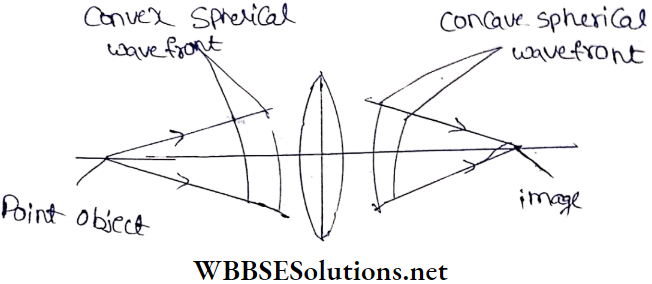
Question 1. A point object t is placed on the axis of a convex lens at a distance greater than the focal length of the lens. What is the shape of the refracted wavefront?
Answer:

The wavefront of light rays, emitted born a point source it spherical convex. After being refracted through the Iens, the wavefront becomes spherical concave. This implies that after refraction through the lens, light rays converge

Class 12 Physics Unit 6 Optics Chapter 6 Light Wave And Interference Of Light Concave And Convex Spherical Wavefront

Question 2. What will be the nature of the wavefront of the direct sunlight and why will it be so?
Answer:

Plane wavefronts. Actually, the spherical wavefronts with the sun at the centre be have effective as plane wavefronts on the earth, at a very large distance from the sun.

Question 3. Interference fringe does not contradict the law of conservation energy – justify
Answer:

In an interference pattern, there is no loss or destruction of light energy in the dark fingers area. The energy just gets shifted from the region of the dark band to the region of the bright band. Total energy remains the same.It can be shown that the average intensity of a set of simultaneous consecutive dark and bright fringes is the same as the intensity of usual illumination in the same region.

Hence, interference fringe does not contradict the law of conservation of energy

WBBSE Class 12 Light Interference Q&A

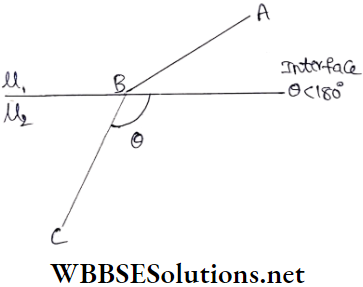
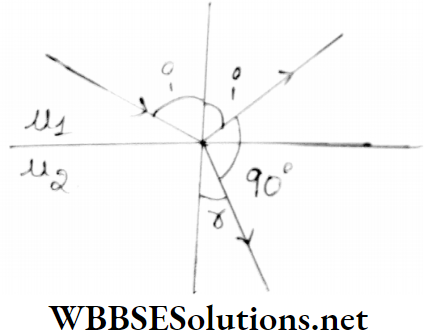
Question 4. Two media of refractive indices μ1 and μ21 and μ2 ) are separated by a plane surface. If some part of a plane wavefront is in the first medium and other port of the wavefront Is the second medium, show the shape of the wavefront In this position diagrammatically. stance colours reach here in the same phase and bri
Answer:

AB and BC are two plane wavefronts inclined to each other

Class 12 Physics Unit 6 Optics Chapter 6 Light Wave And Interference Of Light Two Plane Wavefronts

Question 5. Why don’t two light sources of the same type produce an Interference pattern?
Answer:

The primary condition for the formation of interference fringes is that the two sources must be coherent and the phase difference between the intended waves for interference pattern on superposition, must remain constant

Extended light sources are aggregations of point sources where temperature varies from point to point which affects the radiation. Due to the random vibration of particles emitting light, there is a continuous change in phase. Thus no two-point sources from extended sources, maintain a constant phase difference and, hence are not coherent. Interference can be produced by waves from coherent sources only. Therefore a general illumination is found all over the screen rather than any interference fringes

WBCHSE Class 12 Physics Light Interference Questions and Answers

Key Concepts in Light Interference Questions

Question 6. What are non-localised fringes?
Answer:

Interference fringes can be found on a screen placed anywhere in front of the coherent sources. Thus, the interference pattern is not localised in a region and hence these are called non-localised fringes

Question 7. Explain the change that occurs In the interference pattern in Young’s double slit experiment, if white light is used instead of monochromatic light
Answer: 

If white light is used instead of monochromatic light In Youngs’ double slit experiment, there will be bright-coloured fringes on either side of the white central fringe. White light of different coloured lights has different wavelengths Each of these waves produces a different characteristic interference pattern.

So the interference pattern looks coloured. But the line at the centre of this coloured. But the line at the centre of this interference coloured pattern remains at equal disfrom each of the coherent sources; hence light of all colours is here in the same phase and bright white light is produced.

Question 8. If all experiments related to Young’s double-slit Interference are performed underwater, what changes in
Answer:

The wavelength of light is smaller in water than in air. Since fringe width is proportional to the wavelength of light, fringe width will decrease and lines of interference pattern will be thinner

Question 9. Two waves whose Intensities are in the ratio 9: 1 interfere. Find the ratio of the intensities of bright and dark fringes.
Answer:

Let A1 and A2 be the amplitudes of two waves of intensities fj and J2 respectively

Given that \(\frac{I_1}{I_2}=\frac{9}{1}\)

Again \(\frac{I_1}{I_2}=\frac{A_1^2}{A_2^2}=\frac{9}{1}\)

Or, \(\frac{A_1}{A_2}=\frac{3}{1}\)

If Amax  and Amin are the amplitudes of bright and dark bands, then

⇒ \(\frac{A_{\max }}{A_{\min }}=\frac{A_1+A_2}{A_1-A_2} \text { or, } \frac{A_{\max }}{A_{\min }}=\frac{3+1}{3-1}\)

= \(\frac{4}{2}=\frac{2}{1}\)

⇒ \(\frac{I_{\max }}{I_{\min }}=\frac{A_{\max }^2}{A_{\min }^2}=\frac{4}{1}\)

Question 10. In Young’s double-slit experiment, one of the covered

  1. With translucent e silts is paper and an opaque plate.
  2. What changes will be observed In the Interference pattern in each case

Answer: 

1. An interference pattern will be formed and the fringe width will be unchanged. the difference in intensities of dark and bright fringes trill decreases i.e., bright fringes trill become less bright and dark fringers will become less dark.

2. Interference pattern trill vanishes and a continuous illumination trill be seen on the screen

Short Answer Questions on Young’s Double Slit Experiment

Question 11. What Is the effect on the interference pattern In Young’s double silt experiment if,

  1. The screen is moved away from the silts
  2. Separation between the slits is increased

Answer:

The width of interference fringes in Young’s double slit experiment, y = \(\frac{D}{2 d} \lambda\)

Here, D = distance of the screen from the slits,

2d = separation between the two slits,

λ = wavelength of light.

If the screen is moved away, D would increase, and so this fringe width would also increase.

If the separation 2d is increased, this fringe width will decrease

Class 11 Physics Class 12 Maths Class 11 Chemistry
NEET Foundation Class 12 Physics NEET Physics

Question 12. In Young’s double-slit experiment, if the distance between the two slits is halved and the distance between the screen a and plane of slits is doubled, how will the interference pattern be affected?
Answer: 

Fringe width, y = \(\frac{\lambda D}{2 d}\), 2d = separation between the slits, D = distance between screen and slits, A = wavelength of incident light wave.

Now if the distance between slits is d and the distance between the screen and the slit is changed to 2D then the fringe width will become,

⇒ \(\frac{\lambda D}{2 d}\)

Hence, the fringe width will become 4 times the earlier width.

Question 13. In Young’s double slit experiment, what is the path difference between the two light waves forming the 5th bright band on the screen?
Answer:

Path difference for the n-th bright band,

δ = 2n

\(\frac{\lambda}{2}\) = nλ

Given n = 5

So, δ = 5

Question 14. What is the significance of the optical path?
Answer:

The optical path is the distance travelled by light rays in a vacuum in the same time that it takes to traverse a certain distance (x) in a medium of refractive index. Its value is given by x.

Further, the change in phase for two rays of the same frequency will remain the same if they cover equal optical path lengths.

Question 15. Two light beams of intensities I and 4I, respectively form interference fringes on a screen. For the two beams, the phase difference at point A is \(\) and point B is. Find the difference in result intensities as A And B
Answer:

Resultant intensity at A,

\(I_A=I+4 I+2 \sqrt{I \cdot 4 I} \cos \frac{\pi}{2}\) = 5I

Resultant intensity at B,

⇒ \(I_B=I+4 I+2 \sqrt{I \cdot 4 I} \cos \pi=I\)

Hence, difference in resultant intensity = 5I – I = 4I

Question 16. The ratio of the amplitudes of two waves emitted from a pair of coherent sources is 2: 1. If the two waves superpose, what will be the ratio of the maximum and minimum intensities? What would have been the intensity at different points on the screen if the sources were not coherent?
Answer:

Let the amplitudes of the waves be A and A2 respectively.

By hypothesis

⇒ \(\frac{A_1}{A_2}=\frac{2}{1} \quad \text { or, } \frac{A_1+A_2}{A_1-A_2}=\frac{2+1}{2-1}=\frac{3}{1}\)

Or, \(\frac{A_{\max }}{A_{\min }}=\frac{3}{1}\)

⇒ \(\frac{I_{\max }}{I_{\min }}=\frac{A_{\max }^2}{A_{\min }^2}=\frac{9}{1}\)

Ratio of intensities =9:1.

For incoherent sources, at any point on the screen, the intensity

would be the sum of the intensities of two waves.

If amplitudes are 2A and A respectively then, intensities

7 = 4A² and 2 = A²

Resultant intensity at any point on screen = 4A²+ A² – 5

Common Questions on Interference Patterns in Light

Question 17. If the ratio of maximum to minimum intensities of the fringes, produced in Young’s double slit experiment is 4:1, what is the ratio of the amplitudes of light In a wave of coherent sources?
Answer: In this case

⇒ \(\frac{I_{\max }}{I_{\min }}=\frac{\left(A_1+A_2\right)^2}{\left(A_1-A_2\right)^2}\)

Or, \(\frac{4}{1}=\frac{\left(A_1+A_2\right)^2}{\left(A_1-A_2\right)^2} \text { or, } \frac{A_1+A_2}{A_1-A_2}=\frac{2}{1}\)

Or, \(\frac{A_1+A_2+A_1-A_2}{A_1+A_2-A_1+A_2}=\frac{2+1}{2-1}\)

Or, \(\frac{A_1}{A_2}=\frac{3}{1}\)

Question 18. Light waves of different intensities from two coherent sources superpose to interfere. If the ratio of the maximum intensity to minimum intensity is 25, find the ratio of the intensities of the sources.
Answer:

Here

⇒ \(\frac{I_{\max }}{I_{\min }}=\frac{\left(A_1+A_2\right)^2}{\left(A_1-A_2\right)^2}\)

Or, 25 = \(=\frac{\left(A_1+A_2\right)^2}{\left(A_1-A_2\right)^2} \quad \text { or, } \frac{A_1+A_2}{A_1-A_2}\) = 5

Or, \(\frac{A_1+A_2+A_1-A_2}{A_1+A_2-A_1+A_2}=\frac{5+1}{5-1}\)

Or, \(\frac{A_1}{A_2}=\frac{6}{4}=\frac{3}{2}\)

Or, \(\frac{I_1}{I_2}=\frac{A_1^2}{A_2^2}=\frac{9}{4}\)

I1= I2= 9:4

Question 19.  In a laboratory, interference fringes are observed In air medium. Tlie laboratory is now evacuated by removing air. If other conditions remain unaltered, what changes will be observed in the fringe pattern?
Answer:

The refractive index of air is slightly more than 1 . labora¬ tory being evacuated, the refractive index of the medium decreases. Hence wavelength increases. As fringe width is directly propor¬ tional to the wavelength of light used, fringes of marginally increased width will be observed

Question  20. In an Interference pattern by two identical slits, the intensity of the central maximum is I. What will be the intensity at the same spot if one of the slits is close

Let the amplitudes of the waves be a and a

amax = a+a = 2a

So, Imax  = a²max = 4a²

= 4I0

[I0 = Intensity due to each slit]

When one of the slits is closed, the intensity at the same spot is \(I_0=\frac{I_{\max }}{4}=\frac{I}{4}\)

Question 21. In a double-slit experiment, Instead of taking slits of equal width, one slit is made twice as wide as the other. Then how will the maximum and minimum intensities change?
Answer:

In case 0f interference of two waves with the same amplitude (a)

amax = a+a = 2a;

Amin = a-a = 0

Maximum intensity ∝ a² : minimum intensity = 0

In case of interference of two waves with amplitudes a and A (A>a)

amax = a+A: amin = A – a ≠ 0

Minimum intensity  0 and maximum intensity (a+A)> 4 about

Hence, the maximum and minimum intenpattern will increase

Question 22. Monochromatic light of wavelength 589 nm is incident on a water surface from air What are the wavelength, frequency and speed of

  1. Reflected and
  2. Refracted light?

1. For reflected waves, the length and speed remain the same.

∴  \(\frac{c}{\lambda}=\frac{3 \times 10^8}{589 \times 10^{-9}}\) and c= 3 × 10⁸m .s-1

∴  Frequency f = \(\frac{c}{\lambda}=\frac{3 \times 10^8}{589 \times 10^{-9}}\) = \(\)

= 5.09 × 10¹⁴ HZ

2. In the case of refraction only the frequency if fixed

= \(\frac{3 \times 10^8}{1.33}\)

= \(=\frac{v}{f}=\frac{2.20}{5.09 \times 10^{14}}\)

= 44 nm

Practice Questions on Coherent Sources in Interference

Question 23. What is the shape of the wavefront in each of the following cases?

  1. Light diverges from a point source.
  2. Light emerges out of a convex lens when a point source is placed at its focus.
  3. The portion of the wavefront of light from a distant star intercepted by the earth. Pt

Answer:

  1. Spherical
  2. Plane
  3. Plane

Question 24. In Young’s double slit experiment using monochromatic light of wavelength A, the intensity of light at a point on the screen where the path difference is A is k units. What is the intensity of light at a point where the path difference is
Answer: 

Resultant intensity at a point in Youngs double slit

⇒ \(I=I_1+I_2+2 \sqrt{I_1 I_2} \cos \phi\)

When path difference = λ, phase difference

β = \(\frac{2 \pi}{\lambda} \cdot \lambda=2 \pi\)

∴ I +I’+2\(\sqrt{I \cdot I}\) = 4I

∴ k = 4I

When path difference = \(\frac{\lambda}{3}\) , phase difference

Φ= \(\frac{2 \pi}{\lambda} \cdot \frac{\lambda}{3}=\frac{2 \pi}{3}\)

I” = I+I+2\(\sqrt{I \cdot I}\). cos \(\sqrt{I \cdot I} \cdot \cos \frac{2 \pi}{3}\) = I

I” = I = \(\frac{k}{4}\)

Question 25. In a double slit experiment, the angular width of a fringe is found to be 0.2° on a screen placed 1 m away. The wavelength of light used is 600 nm. What will be the angular width of the fringe if the entire experiment apparatus is immersed in water? hike refractive Index of water to be \(\frac{4}{3}\)

Angular width, θ = \(\frac{\lambda}{d}\) = 0.2°

When the entire experiment is done underwater,\(=\frac{\lambda}{u}\)and angular width,

= \(\frac{\lambda^{\prime}}{d}=\frac{\lambda}{\mu d}\)

= \(\frac{\theta}{\mu}=\frac{0.2}{4 / 3}\)

= 0.15

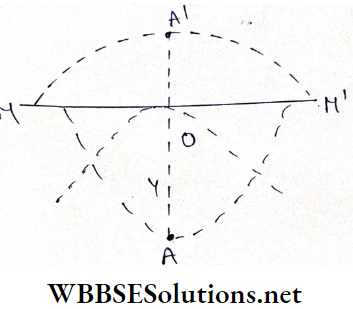
Question 26. Use Huygens’ principle to show that a point object placed in front of a plane mirror produces a virtual image at the back of the mirror whose distance is equal to the distance of the object from the mirror.
Answer:

Let A be a point source of light at a distance y from the plane mirror MM’. In the absence of the mirror let the wavefront travel A’ in time t. But due to the presence of the M mirror the reflected wavefront will reach We point A in the same time interval t.

Class 12 Physics Unit 6 Optics Chapter 6 Light Wave And Interference Of Light Distance y From The Plane Mirror MM

Thus AA’ = ct (here, c= velocity of light

i.e., AO+ OA’ = ct

Again, AO+OA = ct

OA = OA’

Important Definitions in Light Interference

Question 27. Following is a list of some factors which could possibly influence the speed of wave propagation. Nature of the source, The direction of propagation, Motion of the source and or observer, Wavelength, Intensity of the wave.

On which of these factors, if any, does:

  1. The speed of light in a vacuum,
  2. The speed of light in any medium like glass or water, depends.

Answer:

  1. The speed of light in a vacuum is an absolute (universal) constant and does not depend on any factor.
  2. The speed of light in any other medium depends only on the wavelength of light that the medium

Question 28. In a double slit experiment using light of wavelength 600 nm, the angular width of a fringe formed on a distant screen is 0.1 0. What is the spacing between the two slits?
Answer: 

Using, dsinθ = nλ we get

d = \(\frac{n \lambda}{\sin \theta}=\frac{1 \times 600 \times 10^{-9}}{\sin 0.1^{\circ}}\)

= \(3.43 \times 10^{-4}\)m

Question 29.

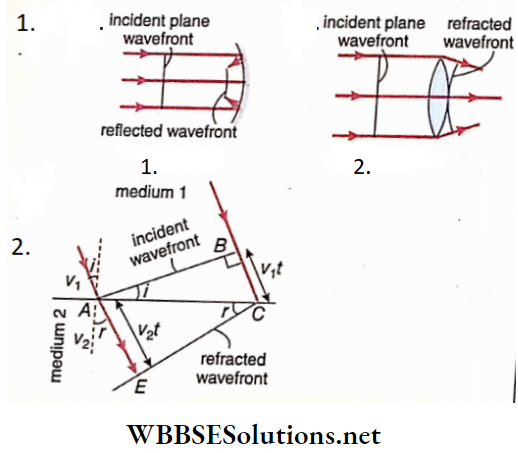
1. Using Huygens’ principle, draw the diagrams to show the nature of the wavefronts when an incident plane wavefront gets

  1. Reflected from a concave mirror,
  2. Refracted from a convex lens.

2. Draw a diagram showing the propagation of a plane wavefront from a denser to a rarer medium and verify Snell’s law of refraction
Answer:

Class 12 Physics Unit 6 Optics Chapter 6 Light Wave And Interference Of Light Incident Wavefront And Incident Wavefront

Let be the time taken by the wavefront to travel the distance BC, Thus BC = vt

Similarly AE. = v2t

For triangles ABC And AEC,

sin i = \(\frac{B C}{A C}=\frac{v_1 t}{A C}\)

And sin r \(\frac{A E}{A C}=\frac{v_2 t}{A C}\)

Where i and r are the angles of incidence and refraction respectively

\(\frac{\sin i}{\sin r}=\frac{v_1}{v_2}\)…………… (1)

If c is the speed of light vacuum, then

⇒ \(\mu_1=\frac{c}{v_1}\)

Or, \(v_1=\frac{c}{\mu_1}\)

And \(\mu_2=\frac{c}{v_2}\)

Or, \(v_2=\frac{c}{\mu_2}\)

Here, μ12 and μ2 are known “as the refractive indices of medium 1 and medium 2 respectively. From equation

⇒ \(\frac{\sin i}{\sin r}=\frac{c}{\mu_1} \times \frac{\mu_2}{c}=\frac{\mu_2}{\mu_1}\)

Or, in i = sin

This is Snell’s law of refraction.

Examples of Applications of Light Interference

Question 30. A beam of light consisting of two wavelengths, 800 nm and 600 nm is used to obtain the interfer¬ ence fringes in Young’s double slit experiment on a screen placed 1.4 m away. If the two slits are sepa¬ rated by 0.28 mm, calculate the least distance from /. the central bright maximum where the bright fringes of the two wavelengths coincide
Answer:

⇒ \(\frac{n_1 \lambda_1 D}{2 d}=\frac{n_2 \lambda_2 D}{2 d}\) [2d= distance between the slits

Or, \(\frac{n_1}{n_2}=\frac{\lambda_2}{\lambda_1}\)

= \(\frac{600}{800}=\frac{3}{4}\)

∴ 3rd order of 800 nm will overlap with 4th order of 600 nm

∴  Distance of the point from central bright maximum

y = \(\frac{n_1 \lambda_1 D}{2 d}=\frac{3 \times 800 \times 10^{-9} \times 1.4}{2.8 \times 10^{-4}}\)

= 12 × 10-3 m

= 12 mm

Question 31. If one of two identical slits producing interference in Young’s experiment is covered with glass, so diet die light intensity passing through it is reduced to 50%, find the ratio ofdie maximum and minimum intensity of the fringe in the interference pattern.

What kind of fringes do you expect to observe if white light is used instead of monochromatic light?
Answer:

Let the amplitudes of the light waves passing through the slits be and a2 and the corresponding intensi¬ ties be  I and I2.

According to the die problem,

⇒ \(I_2=0.5 I_1=\frac{I_1}{2}\)

∴ \(a_2^2=\frac{a_1^2}{2}\)

Or, \(a_2=\frac{a_1}{\sqrt{2}}\)

= \(\frac{I_{\max }}{I_{\min }}=\frac{\left(a_1+a_2\right)^2}{\left(a_1-a_2\right)^2}=\left(\frac{a_1+\frac{a_1}{\sqrt{2}}}{a_1-\frac{a_1}{\sqrt{2}}}\right)^2=\left(\frac{1+\frac{1}{\sqrt{2}}}{1-\frac{1}{\sqrt{2}}}\right)^2\)

= \(\left(\frac{\sqrt{2}+1}{\sqrt{2}-1}\right)^2 \approx 34\).

WBCHSE Class 12 Physics Light Polarisation Short Answer Questions

Optics

Diffraction And Polarisation Of Light Short Question And Answers

Question 1. In a single slit diffraction experiment, the width of the slit is made double the original width. How does this affect the size of the central diffraction band?
Answer:

The width ofthe central maxima = \(\frac{2 \lambda D}{d}\) . When d is doubled the width reduces to half.

Question 2. When a small circular obstacle is placed in front of a white wall in the path of light rays coming from a distant source, bright spots are observed at the center of the shadow. Explain.
Answer:

Diffraction of light waves takes place at the edges of the circular obstacle. Constructive interference of these diffracted rays gives rise to the bright spot at the center of the shadow on the wall.

Question 3. In a 10 m high room a partition of height 7 m separates two students on either side. Both light and sound waves can deviate from their path if they experience any obstruction. Then why is it that the two students can converse with each other even if one cannot see the other?
Answer:

For diffraction to occur, the size of the obstacle should be comparable to the wavelength. The wavelength of sound waves(≈ 0.33 m) is much larger than the wavelength of light.

Waves ((≈ 10-7 m) sound waves can be diffracted through the edges of much larger obstacles like walls or partitions. On the other hand, the wavelength of light is much smaller than the height of the partition making diffraction impossible. So the two boys can hear but cannot see each other.

Short Answer Questions on Polarisation of Light

Read And Learn More WBCHSE Class 12 Physics Short Question And Answers

Question 4. Ray optics is based on the assumption that light travels in a straight line. Diffractions observed when light propagates through small apertures/slits or around small objects disprove this assumption. Yet the ray optics assumption is so commonly used in understanding location and several other properties of images in optical instruments. What is the justification?
Answer:

The apertures of optical instruments are much larger than the wavelength of the light passing through them. So there is no possibility of any diffraction taking place and there is no anomaly in the wave optics and ray optics in all practical purposes.

Question 5. A parallel beam of light of wavelength 500 nm falls on a narrow slit and the resulting diffraction pattern is observed on a screen 1 m away.It is observed that the first minimum is at a distance of 2.5 mm from the center of the screen. Find the width of the slit. 
Answer: 

For the first darkband, sin = \(\frac{\lambda}{d}\)

But, = \(\frac{2.5 \times 10^{-3}}{1}\)

= \(\frac{\lambda}{\sin \theta_1}=\frac{500 \times 10^{-9}}{2.5 \times 10^{-3}}\)

= 0.2 mm

WBCHSE Class 12 Physics Light Polarisation Short Answer Questions

WBBSE Class 12 Polarisation Short Q&A

Question 6. What is understood by the diffraction of light? In the n single slit experiment, if the width of the slit increases, what will be the change of the angular width of the central maxima? State Brewster slaw. 

The angular width (2θ) offline central maximum decreases in the same ratio at which the width of the slit increases.

Question 7. The resolving power of a microscope at 6000 A° is 104. What resolving power at 4000 A°
Answer:

The resolving

⇒ \(R \propto \frac{1}{\lambda}\)

So, \(\frac{R_1}{R_2}=\frac{\lambda_2}{\lambda_1}\)

Or, \(R_2=R_1 \frac{\lambda_1}{\lambda_2}\)

⇒ \(R_2=10^4 \times \frac{6000}{4000}=1.5 \times 10^4\)

Class 11 Physics Class 12 Maths Class 11 Chemistry
NEET Foundation Class 12 Physics NEET Physics

Question 8. The critical angle of a transparent crystal for green light is 30°. Find the angle of polarization of that crystal.

If the angle of polarisation is ip then

tan ip = mu \(\) = 2

Or, ip= tan-1(2) = 63.435°

Conceptual Questions on Types of Polarisation

Question 9. Why are polaroids used In sunglasses?
Answer:

Unpolarised light is polarised by a polaroid. The polarising axis is kept horizontal in a sunglass so that the light is comforting for the eye

Question 10. How does the angular separation between fringes in a single slit diffraction experiment change when the distance of separation between the slit and screen is doubled?

The angular separation between fringes in a single slit diffraction pattern does not change with the distance between the slit and screen

Question 11. In a single slit diffraction experiment, the width of the slit is made double the original width. How does this affect the size and intensity of the central diffraction band?
Answer: 

The line width of the central diffraction fringe \(\propto \frac{1}{\text { slit width }}\)  The slit width is made double then the width of the central fringe becomes half of the initial value and intensity will increase

Question 12. In what way is diffraction from each slit related to the interference pattern in a double-slit experiment?
Answer:

The diffraction pattern of each slit modulates the intensity of interference fringes in a double-slit arrangement.

Question  13. When a tiny circular obstacle is placed in the path of light from a distant source, a bright spot is seen at the center of the shadow of the obstacle. Explain why.
Answer:

When a tiny circular obstacle is placed in the path of light from a distant source, waves diffracted from the edge of the circular obstacle interfere constructively at the center of the shadow, producing a right spot.

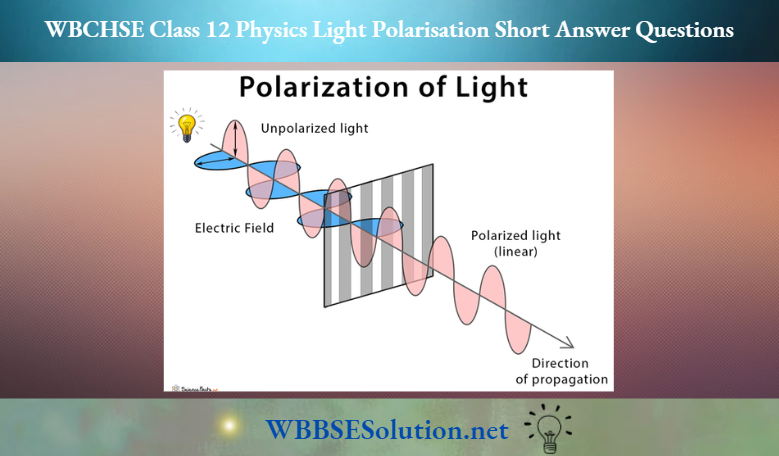
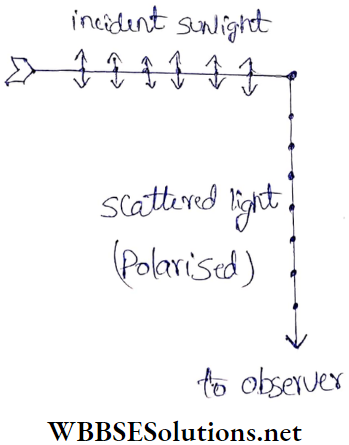
Question 14. The light coming from a portion of the sky is sunlight that has changed its direction due to scattering by molecules hr the earth’s atmosphere. This scattered light is polarised. Therefore, It shows a variation in intensity when viewed through a polaroid on rotation
Answer: 

The light coming from a portion of the sky is sunlight that has changed its direction due to scattering by molecules hr the earth’s atmosphere. This scattered light is polarised. Therefore, It shows a variation in intensity when viewed through a polaroid on rotation.

Common Short Questions on Polarising Filters

Question 15. When are two objects just resolved? Explain. How can the resolving power of a compound microscope be increased? Use relevant formulas to support your answer.
Answer:

Two objects are just resolved by an optical system when the central maximum of the diffraction pattern due to one falls on the first minimum of the diffraction pattern of the other

Question 16. A narrow beam of unpolarised light of intensity I0 is incident on a polaroid P1. The light transmitted by it is then incident on a second polaroid P2 with its pass axis making an angle of 60° relative to the pass axis of P1. Find the intensity of the light transmitted by P2
Answer:

Intensity of light transmitted by P1= \(\frac{I_0}{2}\)

Applying Malus’ law, the intensity of light transmitted by

P2= \(\frac{I_0}{2} \cos ^2 60^{\circ}=\frac{I_0}{8}\)

WBCHSE Class 12 Physics Light Polarisation Questions and Answers

Optics

Diffraction And Polarisation Of Light Long Question And Answers

Question 1. How will the diffraction pattern in a single slit be affected if

  1. The width of the slit is increased and
  2. The wavelength of the incident light is increased?

Answer:

The angular width of a diffraction pattern is given by θ= \(\frac{\lambda}{a}\), where X = wavelength of the incident light and a of the slit

If the width of the slit a is increased, θ will decrease. So the diffraction bands will come closer to each other. On increasing the slit width, at a certain value of a, the diffraction pattern will be no more distinct to observe.

If the wavelength of the incident light A is increased, the angular width of the pattern will increase. Hence the diffraction bands will be wider

Question 2. What will be the effect on the diffraction pattern in a single slit if red light is used instead of violet light?
Answer:

We know that the angular width of diffraction in a single slit is given by θ= \(\frac{\lambda}{a}\)

Now, the wavelength of red light (λr) is greater than that of violet (λν) i.e λrν

So, θrν

Therefore diffraction bands in red light will be wider

Question 3. Radio waves diffract strongly around big buildings but light waves do not. Why? 
Answer:

The wavelength range of 4 ×10⁻⁷ m to 7 ×10⁻⁷ m while that Qf radio waves is from 0.1 m to 10 4 i.e. the wavelength of radio waves is much greater than that of light waves. We know that the bending of waves increases with the increase of its wavelength. So radio waves are easily diffracted while the wavelength of light waves is too small to be diffracted around big buildings

Question 4. If a single slit is illuminated by white light, what will be the nature of color of the diffraction pattern?
Answer:

If a single slit is illuminated by white light, the central maximum of the diffraction pattern is produced due to the reinforcement of the diffracted waves having the same phase but different wavelengths. So the central maximum will be of white color. But in the case of secondary maxima on either side of the central maximum, the angle of diffraction θ ∝\(\) is taken very small.

Since λrν,   So, θrν

Hence the secondary maxima will be coloured. The inner portion of each maximum will be of violet color and the portion will be of red color

WBBSE Class 12 Polarisation Q&A

Question 5. A tourmaline crystal is placed in the path of a polarised beam of light. If it is rotated through one complete rotation, what change will be observed in the intensity of the transmitted light?
Answer:

The optic axis of the tourmaline crystal is placed along the direction of polarisation of the polarised light. The light will be transmitted through the crystal and its intensity will remain unchanged. Now taking the light ray as the axis of rotation of the crystal, it is rotated through one complete rotation.

WBCHSE Class 12 Physics Light Polarisation Questions and Answers

The observations are as follows:

  • The intensity will gradually diminish and become zero when the crystal is rotated through 90°
  • Next intensity begins to increase and becomes equal to its initial value when the crystal is rotated through 180°
  • Again intensity begins to decrease and becomes zero when the crystal is rotated through 270° and
  • finally, intensity begins to increase and becomes equal to its initial value when the crystal is rotated through 360°

Question 6. How will you identify experimentally whether a given beam oflight is plane polarised or unpolarised?
Answer:

A tourmaline crystal is placed in the path of. the given beam oflight and it is rotated.If the intensity of the transmitted light through the crystal remains unchanged, the beam is unpolarised. Intensity varies periodically and becomes zero twice in each rotation, then the beam is plane-polarised

Class 11 Physics Class 12 Maths Class 11 Chemistry
NEET Foundation Class 12 Physics NEET Physics

Question 7. Show that the width of the central maximum is twice that of a secondary maximum and if the width of slit is increased, the width of the diffraction fringes gets diminished.
Answer:

Distance of nth minimum from central maximum,

⇒ \(x_n=\frac{n D \lambda}{a}\)

[Where D = distance of slit from the screen, λ = wavelength of the light, a = width of the slit]

In a diffraction pattern, secondary maxima and minima alternatively and so the width of a secondary maximum

⇒ \(\beta=x_n-x_{n-1}=\frac{n D \lambda}{a}-\frac{(n-1) D \lambda}{a}=\frac{D \lambda}{a}\)

Now, the angular width of the central maximum

⇒  \(2 \theta=\frac{2 \lambda}{a}\)

Therefore, the linear width central maximum

⇒ \(\beta_0=D \cdot 2 \theta=\frac{2 D \lambda}{a}\) = 2β

i.e., the width of the central maximum is twice that of any secondary maximum

Again, both the width of the secondary maximum and central

⇒  \(\text { maximum } \propto \frac{1}{\text { width of }{slit}(a)}\)

So, if the width of slit is increased, the width of diffraction fringes gets diminished

Short Answer Questions on Polarisation of Light

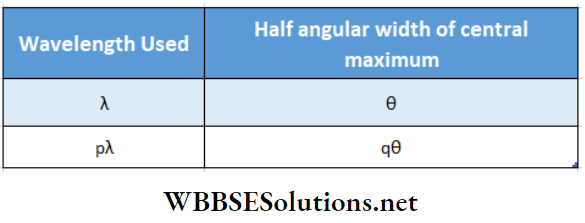
Question 8. Results of two experiments on single-slit diffraction

Class 12 Physics Unit 6 Optics Chapter 7 Diffraction And Polarisation Of Light Result Of Two Experiments On Single Diffraction

How can the ratio of widths of two slits used in the experiments be evulated from the given results?
Answer:

Let us assume the width of the two slits, used in the experiments are d and d’

⇒ \(\theta=\frac{\lambda}{d}\)

And \(q \theta=\frac{p \lambda}{d^{\prime}}\)

⇒ \(\frac{d}{d^{\prime}}=\frac{q}{p}\)

So, the ratio of widths of two slits = d: d’ – q : P

Question 9. If the diameter of the objective of a telescope is doubled, how will its resolving power change?
Answer:

Resolving power of telescope, R = \(\frac{a}{1.22 \lambda}\)

The revolving power of a telescope changes in direct proportion to the diameter of its objective. So,if the diameter of the objective of a telescope is increased two folds, its resolving power will also be increased twofold

Question 10. If a ray of light Is incident on a reflecting medium at the polarising angle, then prove that the reflected and the refracted rays are at 90° to each other
Answer:

Let a ray of light AO be incident on XY at the polarising angle p. The reflected ray OB which is plane polarised, also makes an angle p with the normal.

Class 12 Physics Unit 6 Optics Chapter 7 Diffraction And Polarisation Of Light Ray Of Light is Incident On reflecting Medium

Let the angle of refraction be r

According to Brewster’s law, tan p = p [where p = refractive index of the medium]

According to the law of refraction

mu = \(\frac{\sin \angle A O N}{\sin \angle N^{\prime} O C}=\frac{\sin p}{\sin r}\)

tan p = \(\frac{\sin p}{\sin r}\)

Or, \(\frac{\sin p}{\cos p}=\frac{\sin p}{\sin r}\)

or, sin r= cosp = sin (90°- p) or, r = 90°-polarising

r+p = 90°

So, the reflected ray OB and the refracted ray OC are at 90° to each other

Question 11. The critical angle between a and air is θc. A ray of light In air enters the transparent. medium at an angle of Incidence equal to the polarising angle. Deduce a relation between the angle of refraction r and critical angle θc. given transparent medium
Answer:

Let the refractive index of the transparent medium polarising angle = ip

So, \(\mu=\frac{\sin i_p}{\sin r}\)

Again, ip+ir= 90°

sin ip= sin (90°-r) = cost

⇒ \(\mu=\frac{\cos r}{\sin r}\)

According to SneU’s law, for critical angle 6

⇒ \(\mu=\frac{1}{\sin \theta_c}\)

⇒ \(\frac{\cos r}{\sin r}=\frac{1}{\sin \theta_c}\)

Or, \(\frac{\sin r}{\cos r}\)

Or, tan r = sin θc

Or, tan-1 (sin θc)

This is the required relation.

Common Questions on Polarising Filters

Question 12. Deduce a relation between the polarising angle and the critical angle.
Answer:

According to Brewster’s law

μ = tan ip = Where ip = polarising angle]

Again, according to Snell’s law

⇒ \(\mu=\frac{1}{\sin \theta_c}\)

Where = θc critical angle

⇒ \(\tan i_p=\frac{1}{\sin \theta_{\mathrm{c}}}\)

Or, tan ip  = cosec θc

or, ip = tan-1 (cosec θc )

This is the required relation.

Question 13. The optic axes of two polaroids are inclined at an angle of 45° with each other. Unpolarised light of intensity IQ being incident on the first polaroid emerges from the second polaroid. Find the intensity of the emergent light.
Answer:

In the first polaroid, the component of incident unpolarised light having polarisation parallel t6 the optic axis is transmitted through the polaroid, and the perpendicular component is absorbed. So the intensity of light incident on the second polaroid \(\frac{J_0}{2}\)

Again, the intensity of light ∝ (amplitude of light)²

If the amplitude of light incident on the second polaroid is Eo , then the amplitude of light having polarisation along its optic axis

⇒ \(E_0 \cos 45^{\circ}=\frac{E_0}{\sqrt{2}}\)

The angle between the optics axes = 45°

So the intensity of light transmitted through an incident on it

Hence the intensity of the emergent light = \(\frac{1}{2} \cdot \frac{I_0}{2}=\frac{I_0}{4}\)

Question 14. An unpolarised light is incident at the angle of polarization on a reflector. Determine the angle between the reflected and the transmitted rays

μ = tan ip [ip =a angle of polarisation]

Class 12 Physics Unit 6 Optics Chapter 7 Diffraction And Polarisation Of Light Angle Of Polarisation

Again  μ = \(\frac{\sin i_p}{\sin r}\)

Or, tan ip = \(\frac{\sin i_p}{\sin r}\)

Or, in r = cos ip = sin (90°- ip)

Or, r = 90° – ip

Or, ip+ r= 90°

From the figure, the angle between the reflected and the transmitted rays

= 180° – (ip + r)  100° -90° =90°

Practice Questions on Brewster’s Law

Question 15.

  1. How does the angular width of the central maxima in a single-slit Fraunhofer diffraction experiment change when the distance between the silt and screen is doubled?
  2.  In the Fraunhofer diffraction experiment, the first minima of red light = 660 ntn) is formed on the first maxima of another light of wavelength A’. Find the value of A

Answer:

The angular width of the central maxima will not change because it does not depend on the distance between the slit and the screen.

The angle of diffraction for the first minima

θ = \(=\frac{\lambda}{a}\)

The angle of diffraction for the first maxima

⇒ \(\theta^{\prime}=(2 n+1) \frac{\lambda^{\prime}}{2 a}=(2 \times 1+1) \frac{\lambda^{\prime}}{2 a}=\frac{3 \lambda^{\prime}}{2 a}\)

Given, θ  = θ ‘

⇒ \(\frac{\lambda}{a}=\frac{3 \lambda^{\prime}}{2 a} \quad \text { or, } \lambda^{\prime}=\frac{2}{3} \lambda\)

Question 16. Two polaroids A and B are kept in a crossed position. How should a third polaroid C be placed between them so that the intensity of polarised light transmitted by polaroid B reduces to 1/8 th of the intensity of unpolarised light incident on A
Answer:

Intensity of incident = IQ

Intensity of light after passing through polaroid

A = \(\frac{I_0}{2}\)

Intensity of light after passing through polaroid

C = \(\frac{I_0}{2} \cos ^2 \theta\)

Where θ is the angle between the pass axis of the A and C polaroid.

∴ Intensity of light after passing through B,

I = \(\frac{I_0}{2} \cos ^2 \theta \cos ^2\left(90^{\circ}-\theta\right)=\frac{I_0}{8} \sin ^2 2 \theta\)

If \(I=\frac{I_0}{8}\), then sin² 2θ = i Or, θ   = 45°

So thepolaroid C shouldbeplacedmaking an angle  45° with the pass axis ofpolaroid A

Question 17. A parallel beam of light of 500 nm falls on a narrow slit and the resulting diffraction pattern is observed on a screen 1 m away.It is observed that the first minimum is at a distance of 2.5 mm from the center of the screen. Calculate the width of the site
Answer:

Wavelength of incident light, A = 500 nm = 500 x 10-9 m Distance between slit and screen, D = 1 m For 1st minima, angular width on either side of central maxima = \(\)

⇒ \(\frac{\lambda}{a}\)

a = \(\frac{\lambda}{a} \cdot D=2.5 \times 10^{-3} \mathrm{~m}\)

a = \(\frac{\lambda \cdot D}{2.5 \times 10^{-3}}=\frac{500 \times 10^{-9} \times 1}{2.5 \times 10^{-3}}\)

= 2 × 10⁻⁴ m

= 0.2 mm

Important Definitions in Light Polarisation

Question 18. Two wavelengths of sodium light of 590 nm and 596 nm are used in turn to study the diffraction taking place at a single slit of aperture 2  × 10-6 m. The distance between the slit and the screen is 1.5 m. Calculate the separation between the positions of the first maxima of the diffraction pattern obtained in the two cases
Answer:

Angular position of first maxima, x = \(\frac{\lambda D}{a}\)

Where, D = 1.5 m, a = 2 × 10⁻⁶ m

For λ = 590 nm,

x1 = \(\frac{596 \times 10^{-9} \times 1.5}{2 \times 10^{-6}}\)

= 0.4425m

= 44.25cm

For λ = 596 nm

x2 =\(\frac{596 \times 10^{-9} \times 1.5}{2 \times 10^{-6}}\)

= 0.447m

= 44.7 cm

∴ Separation = x2 -x1 = 0.45 cm

Question 19.

1. Why does unpolarized light from a source show a variation in intensity when viewed through a period that is rotated? Show with the help of a diagram, how unpolarised light from the sun gets linearly polarised by scattering.

2. Three identical polaroid sheets P1, P2, and P3 are oriented so that the pass axis of P2 and P3 are inclined at § angles of 60° and respectively with the pass axis of O 90° P1. A monochromatic source S of unpolarized light of intensity IQ is kept in front of the polaroid sheet P2. Determine the intensities of light as observed by the observer at O. When polaroid P3 is rotated with respect to P2 at angles θ = 30° and 60°

Class 12 Physics Unit 6 Optics Chapter 7 Diffraction And Polarisation Of Light three Identical Polariod Sheets
Answer:

1. Polaroid films are produced by spreading ultramicroscopic crystals of her pathic on a thin sheet of nitrocellulose. The crystals are placed on the film by a special device in such a way that the optic axes of all the crystals are parallel. These crystals are

Highly dichroic and absorbs one of the doubt-refracted beams completely. The other refracted beam is transmitted from the crystals.

Class 12 Physics Unit 6 Optics Chapter 7 Diffraction And Polarisation Of Light Polaroid Films Are Produced By Spreading Ultramicroscopic Crystals

2. The ray of light passing through polaroid Px will have intensity reduced by half

⇒ \(I_1=\frac{I_0}{2}\)

Now, the polaroid P2 is oriented at an angle 60° respect to with

⇒ \(I_2=I_1 \cos ^2 60=\frac{I_0}{2} \times \frac{1}{4}=\frac{I_0}{8}\)

Class 12 Physics Unit 6 Optics Chapter 7 Diffraction And Polarisation Of Light Polaroids

Now, the polaroid P3 is originally oriented at an angle

90° – 60°  = 30°.

Hence, when P3 is rotated by 30°, the angle between

P2 and P3 is 60°.

Therefore, the intensity

⇒ \(I_3=I_2 \cos ^2 60\)

⇒ \(\frac{I_0}{8} \cos ^2 60\)

⇒ \(\frac{I_0}{8} \times \frac{1}{4}=\frac{I_0}{32}\)

Similarly, when P3 is rotated by 60°, the angle between

P2 and P3 is 90°.

Therefore, the intensity is

⇒ \(I_3^{\prime}=I_2 \cos ^2 90\)

⇒ \(\frac{I_0}{8} \times 0\)

= 0

Examples of Applications of Light Polarisation

Question 20. A monochromatic light of wavelength 500 nm is incident normally on a single slit of width 0.2 mm to produce a diffraction pattern. Find the angular width of the central maximum obtained on the screen. Estimate the number of fringes obtained in Young’s double slit experiment with fringe width 0.5 mm .which can be accommodated within the region of total angular spread of the central maximum due to single slit
Answer: 

λ = 500 nm = 5 ×10⁻⁷ m,

a = 0.2 mm = 2 ×10⁻⁴ m

Angular width of central maxima

⇒ \(\frac{2 \lambda}{a}=\frac{2 \times 5 \times 10^{-7}}{2 \times 10^{-4}}\)

⇒ \(5 \times 10^{-3}\)

The fringe width in Young’s double slit experiment,

β = 0.5 mm = 5 ×10⁻⁴  m

The number of fringes obtained

N = \(\frac{\theta_0 D}{\beta}=\frac{5 \times 10^{-3} \times 1}{5 \times 10^{-4}}\)

= 10 Assuming D = 1m

Question 21. Unpolarised light is passed through a polaroid P1. When this polarised beam passes through another polaroid P2 and if the pass axis of P2 makes an angle θ with the pass axis of P1, then write the expression for the polarised beam passing through P2. Draw a plot showing the variation of intensity when θ varies from 0 to 2π.

Let the intensity unpolarised light incident on Py be IQ.

Then the intensity of the light

In transmitted by P1 = \(\frac{I_0}{2}\)

Applying Malus’ law, the intensity of light transmitted

By P2 = \(\frac{I_0}{2} \cos ^2 \theta\)

Class 12 Physics Unit 6 Optics Chapter 7 Diffraction And Polarisation Of Light Malus Law

Real-Life Scenarios in Polarisation Experiments

Question 22. How is linearly polarised light obtained by the process of scattering of light? Find the Brewster angle for the air-glass interface, when the refractive index of glass = 1.5.
Answer:

Sunlight scattered by the sky is polarised. This is because the molecules of the Earth’s atmosphere acquire motion in two mutually perpendicular directions when sunlight falls on them, but an observer on Earth receives light only from those molecules that move in the transverse direction

The Brewster angle for the air-glass interface

= tan-1μ= tan-1 1.5 = 56.30°

Question 23.

1. In a single-slit diffraction experiment, the width of the slit is made double the original width. How does this affect the size and intensity of the central diffraction band? Explain
Answer: 

2. When a tiny circular obstacle is placed in the path of light from a distant source, a bright spot Is seen at the center of the obstacle. Explain why

Answer: 

The width of the central diffraction band = \(\frac{2 D \lambda}{a}\)

1. When the width of the slit is doubled, the size of the central diffraction band is halved, and its intensity increases.

2. Waves diffracted from the edge of the circular obstacle produce constructive interference at the tire center and form a bright spot

Question 24. How does the resolving power of a microscope depend on

  1. The wavelength of the light used and
  2. The medium used between the object and the objective lens?

Resolving power, R = \(\frac{2 \mu \sin \theta}{\lambda}\)

The resolving power of a microscope varies inversely with the wavelength of the light used.

The resolving power of a microscope is directly proportional to the refractive index of the medium used between the object and the objective lens.

Conceptual Questions on Types of Polarisation

Question 25. Unpolarised light incident from air on a plane surface of a material of refractive index μ. At a particular angle of incidence i, it is found that the reflected and refracted rays are perpendicular to each other. Which of the following options is correct for this situation?

i = \(\sin ^{-1}\left(\frac{1}{\mu}\right)\)

Reflected light is polarised with its electric vector perpendicular to the plane of incidence

i = \(\tan ^{-1}\left(\frac{1}{\mu}\right)\)

The reflected and refracted rays are perpendicular to each other when light incident at at Brewster’s angle

Class 12 Physics Unit 6 Optics Chapter 7 Diffraction And Polarisation Of Light Brewsters Angle

Hence the reflected light is polarised with its electric vector perpendicular to the plane of incidence.

WBCHSE Class 12 Physics Notes For Refraction Of Light Prism

WBCHSE Class 12 Physics Prism Notes

Optics Refraction Of Light Prism Of Some Definitions

Prism:

A prism is a portion of a transparent medium confined using two plane faces inclined to each other. In the DEFGHK is a prism and it is confined by the two planes DEHK and DFGK.

Class 12 Physics Unit 6 Optics Chapter 2 Refraction Of Light Prism

Refracting face:

The two plane faces inclined to each P S other at some angle by which the prism is bound are called the refracting faces. In, DEHK and DFGK are the refracting faces. BL

Edge:

The line along which the two refracting faces meet is called the edge of the prism. In Rg. 2.42, the line DK is the ‘ edge of the prism.

Refracting angle or angle of the prism:

The angle included between the two refracting faces is called the refract¬ ing angle or simply the angle of the prism. In the figure, ZEDF is the angle of the prism.

Side face and base:

In general, besides two refracting surfaces, a prism further on is enclosed by three more surfaces. Among these surfaces, two surfaces are triangular and are
placed perpendicular to the edge of the prism.

Read and Learn More Class 12 Physics Notes

In these two surfaces are DEF and KHG. These are the side faces of the prism. Another one is rectangular and situated perpendicular to the side face. In the surface is EFGH. It is called the base of the prism

Principal section:

The triangular cross-section cut by a perpendicular plane at right angles to the edge of a prism is called a principal section of the prism In ABC is a principal section of the prism

Light can enter or emerge from the prism through its refracting surfaces as those surfaces are plain and smooth In some cases, the base and side faces of a prism are made rough so that no light passes through it A prism is usually represented by its principal section

Refraction of Light along the Principal Section of a Prism

In ABC is the principal section of a prism. AB and AC are the refracting faces and BC is the base of the prism. A ray PQ is an incident on the face AB at Q where NQO is the normal. The prism is supposed to be an optically denser medium with

Class 12 Physics Unit 6 Optics Chapter 2 Refraction Of Light Principle Of The Prism

Respect to its surroundings. So, after refraction on plane AB, the refracted ray QR bends towards the normal NQO. The refracted ray QR is then incident on the face AC at H where N’RO is normal. The emergent ray RS bends av/ay from the normal N’RO after refraction.

So RQRS is the whole path of the ray of light. The angle between the direction of the incident ray and the direction of the’ emergent ray gives the angle of deviation. In, the angle of deviation, δ = ∠MTS.

WBCHSE class 12 physics prism notes Expression for the angle of deviation:

Let the angle of the prism = ∠BAC – A. For refraction on the face AB, the angle of incidence =∠PQN = i1, and the angle of refraction = ∠RQO = r1  for refraction on the face AC, the angle of incidence of QR = ∠QRO =r2, and the angle of refraction. = ∠N’RS =i2 .

Now we get from the ∠QRT, angle of deviation,

δ = ∠MTR = ∠TQR + ∠TRQ

= (i1 ~ r1) + (i2– r2) = i1 + i2– (r1+ r2) Now, from the quadrilateral AQOR, as NO and N’O are normals on AB and AC respectively, so A + ∠QOR = 180°.

Again, from the triangle QOR

∠QOR + r1 + r2 = 180°

∴ A = r1 + r2 and ……………………….(1)

δ  = i1 + i2-A ……………………….(2)

So the angle of deviation δ depends on the angle of incidence. From the principle of reversibility of light rays follows that, if a ray enters the face A C along SR at an angle of incidencei2 it will emerge along QP at an angle i1 and suffer the same deviation. In other words, the same deviation occurs for two values of i.

Angle of Minimum Deviation

‘The angle of deviation of a ray of light passing through a prism depends on the angle of incidence because in the relation

Class 12 Physics Unit 6 Optics Chapter 2 Refraction Of Light Angle Of Minimum Deviation

WBBSE Class 12 Refraction Through Prism Notes

δ= i1 + i2– A, A is constant and i2 depends on i2 . A graph is drawn taking the angle of incidence z as abscissa and the angle of deviation o as ordinateThe graph indicates that the deviation decreases at first with the increase in the angle of incidence and then attains a minimum (δm) for a particular value of the angle of incidence i0. Then with a further increase in the angle of incidence, the; deviation also increases.

So for every prism, there is a fixed angle of incidence for which the deviation suffered by a ray of light traversing the prism minimal. This angle of deviation is called the angle of minimum deviation of a prism. The position of the prism for which the value of the deviation becomes minimum is called the position of minimum deviation of the prism. This position of the prism is unique i.e., for only, one position of the particular prism, the deviation becomes minimal.

Class 11 Physics Class 12 Maths Class 11 Chemistry
NEET Foundation Class 12 Physics NEET Physics

Analysis of (i -δ) graph and condition of minimum deviation:

A line AB parallel to the i -i-axis is drawn. The coordinates of points, A and B are respectively (i1,  ) and (i2, δ ). The angle of deviation is o for an angle of incidence i1 or i2. We have seen that for angle of incidence i1 the emergent angle is z’2. The length of the line AB = (i2– i1). As the line AB moves parallel to itself downwards, the value of o decreases and the length of the line ( i2– i1) also decreases gradually. At point C, the length of the line AB becomes zero and o also becomes minimum. Then i2– i1 = 0 Or, i2= i1

So we can say that during refraction through a prism, when the angle of incidence and the angle of emergence are equal, the angle of deviation becomes minimal.

Condition of minimum deviation by calculus:

We know for refraction through a prism, the angle of deviation of a ray of light

Condition of minimum deviation by calculus: we know for refraction through a prism, the angle of deviation of a ray of light

δ = i1+i2-A ………………..(1)

And angle of the prism

A= r1 +r2 ………………..(2)

The angle of deviation 8 depends on the angle of incidence i1.

For minimum deviation δ

⇒ \(\frac{d}{d i_1}(\delta)=0\)

∴ \(\frac{d}{d i_1}\left(i_1+i_2-A\right)\) =0

Or, 1\(\frac{d i_2}{d i_1}\)

∴ \(\frac{d i_2}{d i_1}=-1\) ………………..(3)

Differentiating equation (2) we have,

⇒ \(\frac{d}{d r_1}(A)=\frac{d}{d r_1}\left(r_1+r_2\right)\)

⇒ \(0=1+\frac{d r_2}{d r_1} \quad \text { or, } \frac{d r_2}{d r_1}=-1\) ……………………(4)

For refraction at Q and R , according to Snell’s law we have, sin i1 = μ sin r1 and sin i2 = μ sin r2; where μ = refractive index of the. material of the prism.

Differentiating the above equations we have

⇒ \(\cos i_1 d i_1=\mu \cos r_1 d r_1 \quad \text { and } \cos i_2 d i_2=\mu \cos r_2 d r_2\)

∴  \(\frac{\cos i_1}{\cos i_2} \cdot \frac{d i_1}{d i_2}=\frac{\cos r_1}{\cos r_2} \cdot \frac{d r_1}{d r_2}\)  ………………………………(5)

From equations (3), (4) and (5) we have

⇒ \(\frac{\cos i_1}{\cos i_2}=\frac{\cos r_1}{\cos r_2^2} \quad \text { or, } \frac{\cos ^2 i_1}{\cos ^2 i_2}=\frac{\cos ^2 r_1}{\cos ^2 r_2}\)

Or, \(\frac{1-\sin ^2 i_1}{1-\sin ^2 i_2}=\frac{1-\sin ^2 r_1}{1-\sin ^2 r_2}\)

Or, \(\frac{1-\sin ^2 i_1}{1-\sin ^2 i_2}=\frac{\mu^2-\mu^2 \sin ^2 r_1}{\mu^2-\mu^2 \sin ^2 r_2}=\frac{\mu^2-\sin ^2 i_1}{\mu^2-\sin ^2 i_2}\)

Or, \(\frac{1-\sin ^2 i_1}{1-\sin ^2 i_2}=\frac{\left(\mu^2-\sin ^2 i_1\right)-\left(1-\sin ^2 i_1\right)}{\left(\mu^2-\sin ^2 i_2\right)-\left(1-\sin ^2 i_2\right)}\)

\(\frac{a}{b}=\frac{c}{d}=\frac{c-a}{d-b}\)

= \(\frac{\mu^2-1}{\mu^2-1}\)

= 1

∴ \(1-\sin ^2 i_1=1-\sin ^2 i_2 \quad \text { or, } \sin ^2 i_1=\sin ^2 i_2\)

Or, i1 =  i2

So the deviation is minimal when the angle of incidence (i1) is equal to the angle of emergence (i2)

WBCHSE Class 12 Physics Notes For Refraction Of Light Prism

The brightness of a ray of light at minimum deviation:

From the graph of the angle of incidence i and angle of deviation δ, it is found that generally if the angle of incidence is different, the angle of deviation is also different.

But if the angle of deviation attains its minimum value δm, then it is observed that for a wider range of angle of incidence (from i1 to  i2 vide, the angle of deviation of the ray becomes almost equal to the angle of minimum deviation δm, i.e., all the rays within this range emerge from the prism making a minimum angle of deviation δm.

Class 12 Physics Unit 6 Optics Chapter 2 Refraction Of Light Brightness Of A Ray Of Light At Minimum Deviation

So it can be said that in case of minimum deviation, the brightness of the emergent ray increases considerably. For this characteristic, the minimum deviation of a prism is of great importance

Path of Ray through a Prism for Minimum Deviation

Suppose a ray of light passes through a prism with minimum deviation along the path PQRS According to the condition of minimum deviation ix = i2. If the refractive index of the material of the prism is then

Class 12 Physics Unit 6 Optics Chapter 2 Refraction Of Light Path Of Ray A prism For Minimum Deviation

μ = \(\frac{\sin i_1}{\sin r_1}=\frac{\sin i_2}{\sin r_2}\)

r1 = r2

Since ∠AQR = 90°- r1 and ∠ARQ = 90°- r2 ,

So ∠AQR = ∠ARQ

Since, [r1 = r2]

So the triangle AQR is an isosceles triangle having AQ = AR.

So, for the minimum deviation of a ray, the point of incidence, Q and the point of emergence, R are equidistant from the vertex A of the prism.

So it is evident that when the deviation of a ray in a prism is minimum, the path of the ray through the prism becomes symmetrical.

Suppose, for the prism, AB = AC

∴ AQ= AR

∴ \(\frac{A Q}{A B}=\frac{A R}{A C}\)

i.e., the line QR is parallel to BC.

So, for an isosceles prism, when the deviation is minimum the path of the ray through the prism becomes parallel to the base of the prism.

Again the deviation of the ray due to refraction at AB = ( i1 – i2) and the deviation of the ray due to refraction at AC = ( i2 – i1). At the position of the minimum deviation of the prism,  i1= i2 and r1 = r2. So the deviations stated earlier become equal. Therefore, we can say that at the minimum deviation position of the prism, the total deviation is divided equally between the two refracting faces of the prism.

Short Notes on Dispersion by Prism

Refractive Index And Angle Of Minimum Deviation

We know that In the case of refraction of a prism, the angle of deviation of a ray δ = i1+ i2 = And the angle of the prism  A = r1 + r

For minimum deviation r1 = r2. , Again when i1 =  i2 then r1+ r2

So angle of minimum deviation

δm = i1+i2– A   = 2i1– A

Or, \(=\frac{A+\delta_{m}}{2}\)

Again, A = r1+r2 = 2r1

Now considering refraction at the face AB we have, angle of incidence = i1 and angle of refraction = r1

If the refractive index of the material of the prism is μ then

⇒ \(\frac{\sin i_1}{\sin r_1}=\frac{\sin \frac{A+\delta_m}{2}}{\sin \frac{A}{2}}\)

So, If we know the values of the angle of the prism μ, and the angle of minimum deviation δ , we can determine the value of the refractive Index of the material of the prism

Refraction Through Prism Class 12 Notes

Refraction Of Light Prism Of Some Definitions Numerical Examples

Example 1.  The refractive index of the material of a prism Is \(\sqrt{\frac{3}{2}}\) and the refracting angle Is 90°. of the angle of minimum deviation of the prism and the angle of Incidence at the minimum deviation position.
Solution:

Here A = 90°: Let the angle of the minimum deviation be m

We know, μ = \(\frac{\sin \frac{A+\delta_m}{2}}{\sin \frac{A}{2}}=\frac{\sin i_1}{\sin r_1}\)

⇒ \(\sqrt{\frac{3}{2}}=\frac{\sin \frac{90^{\circ}+\delta_m}{2}}{\sin \frac{90^{\circ}}{2}}=\frac{\sin \frac{90^{\circ}+\delta_m}{2}}{\sin 45^{\circ}}\)

Or, \(\sin \frac{90^{\circ}+\delta_m}{2}=\sqrt{\frac{3}{2}} \times \sin 45^{\circ}\)

= \(\frac{\sqrt{3}}{\sqrt{2}} \times \frac{1}{\sqrt{2}}=\frac{\sqrt{3}}{2}\)

⇒ \(i_1=\frac{90^{\circ}+\delta_m}{2}=60^{\circ}\)

Or, 90° + δm = 120°

δm = 120°- 90°

δm = 30°

⇒ \(r_1=\frac{A}{2}=\frac{90^{\circ}}{2}\)

= 45°

Class 12 physics prism refraction notes 

Example 2. The refractive of the material of a prism is \(\sqrt{2}\) and the angle of minimum deviation is 30. Calculate the value of the refracting angle of the prism.
solution:

Let the refracting angle of the prism be A We know, \(\)

⇒  \(\frac{\sin \frac{A+\delta_m}{2}}{\sin \frac{A}{2}}\)

Or, = \(\sqrt{2}=\frac{\sin \left(\frac{A+30^{\circ}}{2}\right)}{\sin \frac{A}{2}}\)

Or, \(\sqrt{2} \cdot \sin \frac{A}{2}=\sin \left(15^{\circ}+\frac{A}{2}\right)\)

= \(\sin 15^{\circ} \cdot \cos \frac{A}{2}+\cos 15^{\circ} \cdot \sin \frac{A}{2}\)

⇒ \(\frac{\sin \frac{A}{2}}{\cos \frac{A}{2}}=\frac{\sin 15^{\circ}}{\sqrt{2}-\cos 15^{\circ}}\)

Now, \(\sin 15^{\circ}=\sin \left(45^{\circ}-30^{\circ}\right)\)

= \(\frac{1}{\sqrt{2}} \cdot \frac{\sqrt{3}}{2}-\frac{1}{\sqrt{2}} \cdot \frac{1}{2}=\frac{\sqrt{3}-1}{2 \sqrt{2}}\)

Similarly , Cos 15°  \(\frac{\sqrt{3}+1}{2 \sqrt{2}}\)

∴ \(\tan \frac{A}{2}=\frac{\frac{\sqrt{3}-1}{2 \sqrt{2}}}{\sqrt{2}-\frac{\sqrt{3}+1}{2 \sqrt{2}}}\)

= \(\frac{\sqrt{3}-1}{3-\sqrt{3}}=\frac{1}{\sqrt{3}}\)

= tan 30°

\(\frac{\Lambda}{2}\) = 30°

Or, A= 60°

Common Questions on Light Refraction in Prisms

Example 3. The angle of minimum deviation is the same as the angle of a glass prism of refractive index = \(\sqrt{3}\). What is the angle of the prism
Solution:

According to the question,  δm = A

⇒ \(\frac{\sin \frac{A+\delta_m}{2}}{\sin \frac{A}{2}}\)

Or, \(=\frac{\sin \frac{A+A}{2}}{\sin \frac{A}{2}}=\frac{\sin A}{\sin \frac{A}{2}}\)

= \(\frac{2 \sin \frac{A}{2} \cos \frac{A}{2}}{\sin \frac{A}{2}}=2 \cos \frac{A}{2}\)

μ = \(\sqrt{3}\)

So, \(2 \cos \frac{A}{2}=\sqrt{3}\)

Or, \(\cos \frac{A}{2}=\frac{\sqrt{3}}{2}\) = cos 30°

Or, \(\frac{A}{2}=30^{\circ}\)

A = 30° × 2

A = 60°

Example 4. What- will be the angle of emergence of a ray of light -; n through a prism for an angle of incidence of 45°? The angle of the prism = 60°; refractive index of the prism = \(\sqrt{3}\)
Solution:

Here A = 60 ,μ =  \(\sqrt{3}\)

For refraction at the first face

μ = \(\frac{\sin i_1}{\sin r_1}\)

Or, \(\frac{\sin i_1}{\sin r_1}\)

Or, \(\sqrt{2}\)

Or, r1 =  30°

We know, that A = r1+r2

r2= A-r1 = 60°-30° = 30° = r1

So, the angle of emergence (i2) = angle of incidence (i1) = 45° The angle of emergence of the ray of light from the second face is 45°

Example 5. A ray of— light is incident at an angle- of- incidence- 40°—- on a prism having a refractive index of 1.6. What should be the value of the angle of the prism for minimum deviation? Given sin 40° = 0.6428; sin23°42; = 0.4018
Solution:

Here  μ = 1.6

The angle of incidence at the first face = i1 = 40

Let the angle of emergence at the second fac

For minimum deviation i1 = i2= 40

⇒ \(\delta_m=i_1+i_2-A=40^{\circ}+40^{\circ}-A\)

or, \(A+\delta_{m_1}=80^{\circ}\)

We know, \(\mu=\frac{\sin \frac{A+\delta_m}{2}}{\sin \frac{A}{2}} \text { or, } 1.6=\frac{\sin \frac{80^{\circ}}{2}}{\sin \frac{A}{2}}\)

or, \(\sin \frac{A}{2}=\frac{\sin 40^{\circ}}{1.6}=\frac{0.6428}{1.6}\)

= 0.4018= sin 23°42′

\(\frac{A}{2}\) = 23°42′

A = 23°42′ × 2

Or, A = 47° 24′

Practice Problems on Prism Refraction Angles

Example 6. The refracting angle of the n glass prism is 60° and the refractive Index of glass is 1.6 The angle of incidence of a ray of light on the first refracting surface is 45°. Calculate the angle of deviation of the ray. Given that sin 26°14′ = 0.4419, sin 33°46′ = 0.5558 and sin 62°47′ = 0.8893 .
Solution:

Here A = 60°; ft – 1.6

The angle of incidence on the first face = i1 = 45

For refraction on the first face, ft = \(\frac{\sin i_1}{\sin r_1}\)

⇒ \(\sin r_1=\frac{\sin t_1}{\mu}=\frac{\sin 45^{\circ}}{1.6}\)

= \(\frac{1}{\sqrt{2} \times 1.6}\)

= 0.4419

= sin 26.23°

Or, r1 = 26.23°

We, know A = r1 +r2

r2 = A- r1 = 60°- 26.23° = 33.77°

For refraction at the second face

⇒ \(\frac{\sin i_2}{\sin r_2}\)

Or, sin =1.6 \(\frac{\sin i_2}{\sin 33.77^{\circ}}\)

Or, sin i2 = 1.6 × sin 33.77°

= 1.6 × 0.5559 = 0.8894

= sin 62.8°

i2 = 62.8°

So, the angle of deviation,

δ = i1 + i2-A = 45° + 62.8°- 60°

= 47.8°

Example 7.  If the refracting angle of a prism is A, the refractive index of its material is fi and the angle of deviation of a ray of light Incident normally on the first refracting face is 8, then prove that ft
Solution:

The angle of deviation for refraction in the prism,

δ = i1 + i -A and A = r1 + r2

For normal incidence ix = 0 and rx = 0

∴ δ  = i2-A Or, i2 = A + δ

A = r2

The refractive index of the prism,

μ = \(\frac{\sin i_2}{\sin r_2}=\frac{\sin (A+\delta)}{\sin A}\)

Refraction through prism class 12 notes 

Example 8.  A ray of light Is an Incident at an angle of 60° a prism with a refracting angle 30°. If any emerges from the other face and makes an angle of 30° with the Incident ray then, show that the emergent ray passes perpendicularly through the refracting surface. Determine the refractive Index of the material of the prism.
Solution:

According to question’, δ = 30°, i1=6 0° and

A = 30°.

We know, δ = i1 + i2-A

∴ 30° = 60° + i1– 30° or, i2 = 0

The emergent ray Is perpendicular to the refracting surface.

Again, A = r2 + r1

As, i1 = 0 , so angle of incidence of the second face, r2 = 0

r1 = A = 30°

∴ The refractive index of the material of the prism

μ = \(\frac{\sin i_1}{\sin r_1}=\frac{\sin 60^{\circ}}{\sin 30^{\circ}}=\frac{\frac{\sqrt{3}}{2}}{\frac{1}{2}}\)

= \(\sqrt{3}\)

Refraction of light prism class 12 Important Definitions Related to Prism Refraction

Example 9. A glass prism with a refracting angle of 60° and of refractive index 1.6, is immersed in water (refractive Index is 1.33). What is its angle of minimum deviation? [sin 36.87° = 0.6
Solution:

Here, A = 60°; aμb = 1.6; aμw =1.33

⇒ \({ }_w \mu_g=\frac{{ }_a \mu_g}{{ }_a \mu_w}=\frac{1.6}{1.33}\)

= 1.2

Let the angle of minimum deviation for the immersed prism is

⇒ \(w^{\mu_g}=\frac{\sin \left(\frac{A+\delta_m}{2}\right)}{\sin \frac{A}{2}}]\)

Or, \(1.2=\frac{\sin \left(\frac{60^{\circ}+\delta_m}{2}\right)}{\sin \frac{60^{\circ}}{2}}\)

Or, \(1.2 \times \sin 30^{\circ}=\sin \frac{60^{\circ}+\delta_m}{2}\)

Or, \(\sin \frac{60^{\circ}+\delta_m}{2}=1.2 \times \frac{1}{2}\)

= 0.6 = sin 36. 87

Or, \(\frac{60^{\circ}+\delta_m}{2}\) = 36.87

Or, \(\delta_m=73.74^{\circ}-60^{\circ}=13.74^{\circ}\)

Example 10. A ray of light passes through an equilateral prism In such a way triangle of incidence becomes equal to the angle of emergence and each of these angles is \(\frac{3}{4}\) of the angle of deviation. Determine the angle of deviation.
Solution:

Here, A= 60 and i1= i2= \(\frac{3}{4} \delta\)

Now \(\)

= \(\frac{3}{2} \delta-60^{\circ}\)

Or, \(\frac{1}{2} \delta=60^{\circ}\)

Or = 120

∴ Angle od deviation = 120

Refraction of light prism class 12 Examples of Applications of Prisms in Optics

Example. 11  The angle of minimum deviation of a glass prism of refracting angle 60° is 30°. If the velocity of light In a vacuum is 3 × 10⁻⁸m s-1, then determine Its velocity In the glass
Solution:

The refractive index of the material of the prism,

μ =\(\frac{\sin \frac{A+\delta_m}{2}}{\sin \frac{A}{2}}\)

μ = \(\frac{\sin \frac{60^{\circ}+30^{\circ}}{2}}{\sin \frac{60^{\circ}}{2}}=\frac{\sin 45^{\circ}}{\sin 30^{\circ}}\)

= \(\frac{\frac{1}{\sqrt{2}}}{\frac{1}{2}}=\sqrt{2}\)

Again , \(\mu=\frac{\text { velocity of light in vacuum }}{\text { velocity of light in glass }\left(\nu_g\right)}\)

⇒ \(\sqrt{2}=\frac{3 \times 10^8}{v_g}\)

⇒  \(v_g=\frac{3 \times 10^8}{\sqrt{2}}=2.12 \times 10^8 \mathrm{~m} \cdot \mathrm{s}^{-1}\)

WBCHSE Class 12 Physics Notes For Types of Reflecting Prisms

Optics

Refraction Of Light Types of Reflecting Prisms

Total Reflecting Prism:

Total internal reflection of light can easily take place in a prism made of crown glass and whose principle cross-section is a right-angled isosceles triangle. So this type of prism is called a total reflecting prism.

ABC is die principal section of a total reflecting prism { Its sides.AS and BC are equal and ∠ABC = 90′. If the ray PQ is incident perpendicularly on the face AS, it is incident on the face AC at an angle of 45° which is greater than the critical angle of glass and air, about 42°. So it is totally
reflected and passes along RST perpendicular to the side SC. Thus the hypotenuse face

AC of the prison acts as a plane mirror. So it is called a total reflecting prism. it is to be noted that in this case, the deviation of the ray is 90°

Class 12 Physics Unit 6 Optics Chapter 2 Refraction Of Light Reflecting Prism

WBBSE Class 12 Reflecting Prisms Notes

Advantages of a total reflecting prism:

  1. In the case of a plane mirror multiple images may be formed due to several reflections from the front and the back surfaces of the mirror and the images thus formed is also bright.
  2. But in the case of a total reflecting prism, only one bright image is formed due to total internal reflection.
  3.  When the mercury coating of the back surface of a plane mirror is damaged, the image becomes indistinct.
  4. But such a problem arises in a totally reflecting prism mirror is damaged, and the image becomes indistinct. But such a problem arises in a totally reflecting prism

Disadvantages of a total reflecting prism:

  1. A total-reflecting prism is more costly than a plane mirror.
  2. If the glass of the prism is not completely homogeneous, the image becomes less distinct

Effecting prism: The inverted image of an object can be made erect with the help of a total reflecting prism.

Erecting of the image by deviating a ray through 0°:

ABC is an isosceles right-angled prism, where ∠A = 90° uniting side of prism for no emergent ray j and ∠B = ∠C = 45°. Suppose that QP is the inverted image of an object. The ray coming from Q after refraction on the face AB is incident on the face BC at an angle greater than the critical angle of glass and air. So the ray is totally reflected from this face and emerging from the face AC forms its image at Q1.

Similarly, a ray starting from P comes to the point P1. So this P1Q1 is inverted with respect to QP, thus erecting an inverted object. can type of prism is called a total reflecting prism.

Class 12 Physics Unit 6 Optics Chapter 2 Refraction Of Light Isosceles Right Angled Prism

In this case, no deviation of the ray has taken place.

In instruments like telescopes, binoculars, etc., total reflecting

RST is perpendicular to the side SC. Thus the hypotenuse face, prism is therefore used to erect an inverted image.

Erecting of the image by deviating 180°:

To get an erect Image, the above-mentioned prism can be used in another way. QP is the Inverted Image of an object. The hypotenuse faces BC of the prism ABC Is held In front of it. A ray of PX from P is incident normally on the face BC and enters the prism.

After refraction, it Is incident at Y on the face AB. ‘I lie angle of incidence of the ray AT at the face AH is 45° which Is greater than the critical angle (nearly 42) of glass and air. So the ray moves along YZ after total reflection at Y and is incident on the face AC.

For The same reason, the ray moves along ZR after total reflection at Z and incident normally on the face BC. It emergences RP’ and comes to the point P’

Class 12 Physics Unit 6 Optics Chapter 2 Refraction Of Light Inverted Image And The Hypotenuse Face

Similarly, a ray coming from Q comes to the point  Q’ obviously according to the figure, the image P’Q’ becomes inverted relative to PQ. So the erect image P’Q’ of an inverted object Is thus formed.

Each incident ray bends twice at 90°, thus producing a total deviation of 180°. So, an inverted image can be made erect by deviating a ray through 180°.

Short Notes on Total Internal Reflection Prism

Prism periscope:

Total reflecting prisms are commonly used nowadays in good-quality periscopes instead of inclined parallel mirrors. This type of periscope is called prism periscope and the image formed by a prism periscope is more bright than that formed by a simple periscope.

The periscope tube contains two right-angled isosceles prisms P1 and P2. P1 is fixed at the top in such a way that rays of light coming from a.Distant object enter the prism through a window and after total internal reflec¬ tion goes downwards. The hypotenuse face P2, which is fixed at the bottom receives these rays and reflects them totally In n horizontal direction through the ohworvinlon window. Thu observer thus sees an exact Image of the distant object.

Class 12 Physics Unit 6 Optics Chapter 2 Refraction Of Light Prism Periscope

Unit 6 Optics Chapter 2 Refraction Of Light Types of Reflecting Prisms Numerical Examples

Example 1. A man with a telescope can just observe point A on the circumference of the base of an empty cylindrical vessel.   When the vessel is filled completely with a liquid of refractive index 1.5 the man can just observe the middle point B of the base of the vessel without moving either the vessel or the telescope If The diameter of the base of the vessel is 10 cm, what is the height of the vessel.
Solution:

When the vessel Is empty, a light from point A enters the telescope ‘l’ following the straight path AO. When the vessel Is filled with the liquid, a ray of light from point II moves along BO and after refraction in air enters the telescope. Let h be the height of the vessel.

Class 12 Physics Unit 6 Optics Chapter 2 Refraction Of Light Empty Vessel

Here

According to the figure

⇒ \(\frac{\sin l}{\sin r}=\frac{1}{\mu} \quad \text { or, } \mu=\frac{\sin r}{\sin t}\)

Or, \(1.5=\frac{\frac{A C}{A O}}{\frac{B C}{B O}}=\frac{A C}{A O} \times \frac{B O}{B C}=\frac{A C}{B C} \times \frac{B O}{A O}\)

Or,\(1.5=\frac{10}{5} \times \frac{\sqrt{B C^2+C O^2}}{\sqrt{A C^2+C O^2}}=2 \times \frac{\sqrt{25+h^2}}{\sqrt{100+h^2}}\)

Or,\(2.25=\frac{4\left(25+h^2\right)}{100+h^2}\)

h = 8.45 cm

Example 2. A post remains above is dipped the water straight of the in a pond.“The rays of the sun are Inclined at an angle of 45° to the surface of water what will be the length of the shadow of the post at the bottom of the pond? The refractive index of water p
Solution:

ABC is the post and BFG is the surface of water

The length of the shadow at the bottom of the pond = CD

Class 12 Physics Unit 6 Optics Chapter 2 Refraction Of Light Pond

Let CE = BF= x = ED = yellow

According to the figure

∠AFN = i= angle of incidence

∠BAF = i

∠EFD = r = angle of refraction

We know, \(\mu=\frac{\sin i}{\sin r}\)

⇒ \(\frac{4}{3}=\frac{\sin 45^{\circ}}{\sin r}\)

Since i = 45°

Or, \(\frac{3}{4} \times \frac{1}{\sqrt{2}}=\frac{3}{4 \sqrt{2}}\)

From the

tan i= \(\frac{x}{1}\)

Or, \(\tan 45=\frac{x}{1}\)

Or, x = 1cm

tan 45° = \(\frac{x}{1}\)

Again, \(\sin r=\frac{y}{\sqrt{y^2+9}} \quad \text { or, } \frac{3}{4 \sqrt{2}}=\frac{y}{\sqrt{y^2+9}}\)

Or, y²× 32 = 9(y² + 9) or, 23y² = 81

Or, \(\frac{81}{23}\)

y²= 1.879 m

The length of the shadow of the post at the bottom of the pond = x+y= 1+1.876

= 2.876 m

Common Questions on Types of Reflecting Prisms

Example 3. There is a point object at a height above the surface of water in a tank. If the bottom of the tank acts as a plane mirror where will be the Imago formed? If on observer looks from the air at the surface of the water normally, calculate the distance of the image front the surface of the water of the tank formed by the mirror-like bottom surface of the tank. Refractive Index of water = \(\frac{4}{3}\)
Solution:

Q is a point source. For refraction in water, the apparent position of Q is Q’

Class 12 Physics Unit 6 Optics Chapter 2 Refraction Of Light Refractive Index In Water

So, \(\mu=\frac{\text { apparent height }}{\text { real height }}=\frac{P Q^{\prime}}{P Q}\)

= \(\frac{P Q^{\prime}}{h}\)

Or, PQ’ = μh =  \(\frac{4}{3}\)

Therefore the distance of Q’ from the bottom of the tank

= d +\(\frac{4}{3}\)

So the image of Q’ will be formed at a distance of (d +\(\frac{4}{3}\)) from the bottom of the tank

= d + d +\(\frac{4}{3}\)h = 2d +\(\frac{4}{3}\)h

⇒ \(\frac{4}{3}\) = \(\frac{2 d+\frac{4}{3} h}{x}\)

=  \(x\frac{3}{4}\left(2 d+\frac{4}{3} h\right)=\frac{3}{2} d+h\)

Example 4.  A rectangular glass slab of thickness 3 cm and of refractive Index 1.5 is placed in front of a concave mirror, perpendicular to Its principal axis. The radius of curvature of the mirror Is 10 cm. Where Is an object to be placed on the principal axis so that Its image will he formed on the object?
Solution:

The rectangular glass slab is placed perpendicular to the principal axis of the concave mirror M1M2 Suppose that if an object is placed at O on the principal axis, its image will be formed at
O. OABM1 is the path of the ray. Tiie ray after reflection at M1 retraces the path and forms an image at O. So the ray BM1 must be incident on the mirror at M1  perpendicularly. If Af, B must be incident on the mirror at Af, perpendicularly. If Af, B O’ is the centre of curvature of the concave mirror.

PO’ = 10 cm

Now OO’ = \(t\left(1-\frac{1}{\mu}\right)=3\left(1-\frac{1}{1.5}\right)\)

= 3-2 = 1cm

So, the distance of O from the concave mirror

= PO’ + OO’ = 10 + 1 = 11 cm

Class 12 Physics Unit 6 Optics Chapter 2 Refraction Of Light Rectangular Glass Slab

Practice Problems on Prism Applications

Example 5. A cross mark at the bottom of an empty vessel is focused with the help of a vertical microscope. Now! water (refractive Index = \(\frac{4}{3}\) ) Is poured into the vessel.  The height of water in the vessel Is 4 cm. Another lighter liquid which does not mix with water and has  a refractive index is, is poured into the water. The height of the liquid is 2 cm. How much should the microscope be raised vertically to focus the mark again?
Solution:

The real depth of the combination of water and the

liquid = 4 + 2 = 6 cm

The apparent depth of the cross-mark

⇒ \(\frac{4}{\frac{4}{3}}+\frac{2}{\frac{3}{2}}=3+\frac{4}{3}\)

= 4.33 cm

So, to focus the cross mark, the microscope is to be raised vertically through a height (6-4.33) = 1.67 cm.

WBCHSE Class 12 Physics Notes For Types Of Reflecting Prisms

Example 6. A concave mirror with a radius of curvature of 1 m Is placed at the bottom In a reservoir of water. When the sun Is situated directly over the head, the mirror forms an Image of the sun. If the depth of water Is  80 cm and  40 cm, calculate the Image distances from the mirror, f Given \(\mu_w=\frac{4}{3}\)

Solution:

The sun is an object situated at infinity. So its image will be formed by the concave mirror at its focus i.e. \(\frac{100}{2}\) = 50 cm above the mirror.

When the depth of water in the reservoir is 80 cm the image is formed at n distance of 50 cm inside water from the mirror. : § But when the depth of water is 40 cm the image will be formed in air. Light rays will be refracted while passing from water t0 ain So> the refracted rays wiU converge at O’ and an image will be formed at O’

Displacement of the image

= \(O O^{\prime}=t\left(1-\frac{1}{\mu}\right)=10\left(1-\frac{3}{4}\right)\)

= \(10 \times \frac{1}{4}\)

= 2.5 cm

Distance of image from the mirror

= PO’ = 50 – 2.5

= 47.5 cm

Class 12 Physics Unit 6 Optics Chapter 2 Refraction Of Light Refracted Rays

Important Definitions Related to Reflecting Prisms

Example 7. The width of a rectangular glass slab is 5 cm. From a point on Its bottom surface, light rays are incident on its top face and after total reflection form a circle of light of radius 8 cm. What is the refractive Index of the
Solution:

Let o be a bright point at the bottom face of the rectangular slab. light rays starting from

Return to the bottom face after total reflection from the upper face of the slab.

As a result, a circle of light of radius OA = OB = 8 cm formed on the bottom face. So the angle of incidence on the upper face is P(. (critical angle) glass slab

According to the

OP = \(\sqrt{O C^2+P C^2}=\sqrt{(4)^2+(5)^2}\)

= \(\sqrt{41} \mathrm{~cm}\)

Refractive index \(\)

\(\mu=\frac{1}{\sin \theta_c}=\frac{1}{\frac{O C}{O P}}\) \(=\frac{O P}{O C}=\frac{\sqrt{41}}{4}\)

= 1.6

Class 12 Physics Unit 6 Optics Chapter 2 Refraction Of Light Bottom Space Of Rectangular Slab

Example 8.  A glass sphere having a centre at 0 and two perpendicular diameters AOB and COD. A ray parallel to AOB is incident on the sphere at P where AP = PC and emerges from the sphere at B. Calculate the refractive index of glass and the deviation of the emergent ray
Solution:

Class 12 Physics Unit 6 Optics Chapter 2 Refraction Of Light Deviation Of The Emergent Ray

According to the  arc AP = arc PC

∠AOP = ∠POC = 45° = i,

∠POB = 45° + 90° = 135°

From the triangle POB,

r+r+ 135° = 180° or, 2r = 45° or, r = 22.5°

= \(\frac{\sin i}{\sin r}=\frac{\sin 45^{\circ}}{\sin 22.5^{\circ}}\)

= 2 cos 22.5° = 2 × 0. 924 = 1.85

Angle of deviation

δ  =i-r+i-r = 2 (i-r) = 2(45°-22.5°)

= 2 × 22.5° = 45°

Class 11 Physics Class 12 Maths Class 11 Chemistry
NEET Foundation Class 12 Physics NEET Physics

Example 9. A glass slab is placed on a page of a book kept horizontally. What should be the value of the minimum refractive index of the glass slab so that the printed letters of the page will not be visible from any vertical side of the slab? 
Solution:

It is assumed that there is a thin layer of air between the page of the book and the glass slab. So any ray coming from

any portion of the page of the hook Is Incident on the glass slab According to the figure, at an angle of almost

Class 12 Physics Unit 6 Optics Chapter 2 Refraction Of Light A Glass Slab

If the angle of refraction Is Φ and the refractive index of glass Is μ, S. then, sin Φ = \(\frac{1}{\mu}\)

If θC is the critical angle, then sin θC = \(\frac{1}{\mu}\)

This refracted ray is incident on any vertical l side of the slab at an angle θ  (say) So. θ + Φ = 90°.

If  . θ is greater than Φ, a total internal reflection of light takes place and the printed letters of the page will not be visible from any vertical side, μ will be minimum when. θ = Φ

2Φ = 90° , Or, Φ = 45°

∴ \(\mu_{\min }=\frac{1}{\sin \phi}=\frac{1}{\sin 45^{\circ}}\)

= \(\sqrt{2}\)

= 1.414

Examples of Applications of Reflecting Prisms

Example 10. A surface of a prism having a refractive index 1.5 is covered with n liquid of refractive index \(\frac{3 \sqrt{2}}{4}\) . What should be the minimum angle of incidence of an incident ray so that on the other surface of the prism tire ray will be totally reflected from the surface covered with liquid? The refracting angle of tho prism =75° [sin48°36′ = 0.75].
Solution:

Let the critical angle between the prism and the liquid be θC. If the ray of light is totally reflected from the surface covered with liquid then the angle of incidence of the ray on the surface is θC

Class 12 Physics Unit 6 Optics Chapter 2 Refraction Of Light Refracting Angle Of The Prism

So, 1.5 sin θC = \(\frac{3 \sqrt{2}}{4}\)

Or, \(\frac{3 \sqrt{2}}{4}\)

Or, \(\frac{3 \sqrt{2}}{4}\) x \(\frac{10}{15}\)

= \(\frac{1}{\sqrt{2}}\)

Again , r1+ θC = A

Or,  r1+ 45° = 75°  Or, = 30°

Now , sin i1 = μ sin r1 = 1.5 sin 30° = 0.75 Or, i1= 48° 36′

Example 11. A ray of light Is Incident normally on one, side of on isosceles right-angled prism and Is totally reflected on the other side.

  1. What Is the value of minimum refractive lodes of the material of the prism?
  2. If the prism Is Immersed In water, draw the diagram showing the direction of the emergent ray. In the diagram, point out the values of the angles,μ of water \(\frac{4}{3}\)

Solution:

1. ABC Is an Isosceles light-angled prism and Its sides are AB= BC The light lay PQ Is incident on the face AR normally and enters the prism. The ray Is an Incident at R on the face AC.

It Is evident from the figure that angle of Incidence of the ray at R Is 45° . Now if the ray Is to be totally reflected from R then this angle of incidence should he greater than the critical angle of the material of the prism μ maximum critical angle will be θC = 45° . If H be the minimum refractive Index of the material of the prism then,

sinθC  = \(\frac{1}{\mu}\)

Or, in 45° = \(\frac{1}{\mu}\)

Or, = \(\frac{1}{\mu}\)

= 1.414

Class 12 Physics Unit 6 Optics Chapter 2 Refraction Of Light Right Angled Prism And Totally Reflected From The Other Side

2. If the prism is immersed in water, then the refractive Index of glass relative to water is,

⇒ \({ }_u^{\mu_E}=\frac{\mu_S}{\mu_i}=\frac{\sqrt{2}}{\frac{4}{3}}=\frac{3 \sqrt{2}}{4}\)

If the critical angle between the prism and water is  θC

⇒ \(\theta_c^{\prime}=\sin ^{-1} \frac{1}{w^{\mu_g}}=\sin ^{-1}\left(\frac{4}{3 \sqrt{2}}\right)\)

= 70.53°

But the angle of Incidence at R is 45° [Fig. 2.64(b)] and it Is less than the critical angle. So at R, light rays will not be totally reflected. It will be refracted and will enter water. If the angle of refraction is r, then

⇒ \(\sqrt{2} \sin 45^{\circ}=\frac{4}{3} \sin r\)

sin r= \(\sqrt{2} \times \frac{3}{4} \times \frac{1}{\sqrt{2}}\)

= 0.75 = sin 48.59°

Or, r = 48.59°

Example 12.  A ray of light Is incident grazing the refracting surface of a prism having refracting angle A. It emerges the other refracting surface making an angle θ with the normal to the surface. Prove that the refractive index  of the material of the prism is given by \(\mu=\left[1+\left(\frac{\cos A+\sin \theta}{\sin A}\right)^2\right]^{1 / 2}\)
Solution:

For grazing incidence on the refracting surface AB of the prism, i1 = 90°

Class 12 Physics Unit 6 Optics Chapter 2 Refraction Of Light Grazing The Refacting Surface Of Prism

So, in this case r1 = dc (critical angle)

Now, A = r1 + r2 or, r2= A-r1 = A – θC

Considering refraction at the second refracting surface, AC

We get \(\mu=\frac{\sin \theta}{\sin r_2}\)

Or, \(\sin \theta=\mu \sin r_2=\mu \sin \left(A-\theta_c\right)\)

⇒ \(\mu\left[\sin A \cos \theta_c-\cos A \sin \theta_c\right]\)

But \(\sin \theta_c=\frac{1}{\mu} \text { and } \cos \theta_c=\sqrt{1-\frac{1}{\mu^2}}=\frac{\sqrt{\mu^2-1}}{\mu}\)

⇒ \(\sin \theta=\mu\left[\sin A \frac{\sqrt{\mu^2-1}}{\mu}-\cos A, \frac{1}{\mu}\right]\)

⇒ \(\sin A \sqrt{\beta^2-1}-\cos A\)

Or, \(\sin \theta+\cos A=\sin A \sqrt{\mu^2-1}\)

Or, \(\frac{\sin \theta+\cos A}{\sin A}=\sqrt{\mu^2-1}\)

Or,\(\mu^2-1=\left(\frac{\sin \theta+\cos A}{\sin A}\right)^2\)

Or,\(\mu^2=1+\left(\frac{\sin \theta+\cos A}{\sin A}\right)^2\)

Or,\(\mu=\left[1+\left(\frac{\sin \theta+\cos A}{\sin A}\right)^2\right]^{\frac{1}{2}}\)

Conceptual Questions on Light Behavior in Reflecting Prisms

Example 13. A ray of light incident normally on a refracting surface of the prism it totally reflated from the other refracting surface. If the prism it Immersed In water how will the ray act? The refractive index of a glass of =1.5; the refractive index of water = 1.33.
Solution:

At the ray of light it incident on the face of the prism normally so it goes straight through the surface. The ray it incident j on the second refracting face and is totally reflected. So the angle i or, of Incidence of the ray at the second face is greater than the critical  angle θC

⇒ \(\sin \theta_C=\frac{1}{a^{\mu_E}}=\frac{1}{1.5}=0.667\)

= sin 41.8°

θC = 41.8°

Now, if the prism is immersed in water, the refractive index of glass j with respect to water is,

wμg =aμg /aμw

= \(\frac{1.5}{1.33}\)

= 1.128

In this case, if the critical angle is  θ’C then

⇒ \(\sin \theta_C^{\prime}=\frac{1}{u^{\mu_g}}\)

= \(\frac{1}{1.128}\)

θ’= sin 62.44°

So the angle of incidence of the ray at the second face (41.8) is less than the critical angle (62.44). Hence, instead of being . totally reflected from the second face, the ray is refracted through it.

Example 14. A tank height of 33.25 cm is completely filled with liquid (μ= 1.33).An object is placed at the bottom of the tank on the axis of a concave mirror.   Image of the object is formed 25 cm below the surface of the liquid . What is the focal length of the mirror?

Class 12 Physics Unit 6 Optics Chapter 2 Refraction Of Light Height Of The Tank On The Axis Of Concave Mirror
Solution:

Here, R is the actual position of the object and A is the apparent position of the image

We, know, \(\mu=\frac{\text { real depth }}{\text { apparent depth }}\)

Or, 1.33  \(=\frac{33.25}{x_a}\)

Therefore, the apparent depth of the object

Here, object distance , u = \(-\left(15+\frac{33.25}{1.33}\right)\)

And image distance, v= -(15+25)cm = -40 cm

Applying the mirror equation, we get

⇒ \(-\frac{1}{40}-\frac{1}{40}=\frac{1}{f}\)

Or, f = \(-\left(\frac{40 \times 40}{40+40}\right)\) = -20

Therefore, the required focal length is 20 cm.

Example 15. What should be the minimum value of the refractive index of a right-angled isosceles prism to that the is F prism can deviate a ray through 180′ by total internal reflection

Class 12 Physics Unit 6 Optics Chapter 2 Refraction Of Light Rigt Angled Isosceles Prism

Solution:  ABC is a right-angled isosceles triangle, whose ∠ABC is 90 and AB = BC

Here light ray is incident along MN on the side AB and is reflected back along NO. Now, the reflected ray NO is incident on side BC and gets reflected along the path OP.

Therefore, light rays suffer total internal reflection when incident ic onsides AB and BC

It is clearly seen that the value of incident angle ig on sides AB and BC is 45° or less than 45°

ic ≤ 45°

sin-1 1/μ <45°

Or, 1/μ < sin 45°

Or,μ > \(\sqrt{2}\)

Therefore, the refractive index of the material of the prism is at least Jz so that the prism can deviate a ray through 180° by total internal reflection

Real-Life Scenarios Involving Reflecting Prisms

Example 16. The face of the prism of refracting angle A is coated with silver. A light ray after first being Incident at an angle of Incidence 2A on the first face of the prism, is refracted and is then reflected from the second face, retracing its path. Calculate the value of the refractive index of the prism
Solution:

Let PQR be a glass prism. The refracting surface PR of the prism is coated with mercury

Class 12 Physics Unit 6 Optics Chapter 2 Refraction Of Light Prism Is Coated With Mercury

In the, incident ray DB is refracted along BC and the light ray returns following the same path after getting reflected from the surface PR

∴ ∠PCB = 90°

And ∠PBC = a = (90°-A) ………………………………… (1)

Where BPC= refracting angle of the prism = A-\theta_c\right

Again, from the a+r = 90°

∴ a =  (90°-r) ……………………………….(2)

Comparing equations (1)and (2), we may write

Where , \(=\frac{\sin i}{\sin r}=\frac{\sin 2 A}{\sin A}\)

Or, \(\mu=\frac{2 \sin A \cos A}{\sin A}\)

μ = 2cos A

Therefore, the required refractive index is 2 cosA.

Example 17. A ray of light falls normally on one side other than the hypotenuse of a right-angled isosceles prism of refractive index 1.5. From which side will the ray emerge from the prism? Find the deviation of the incident ray
Solution:

ABC is a right-angled isosceles triangle i.e., Angle of prism A = 90

Class 12 Physics Unit 6 Optics Chapter 2 Refraction Of Light Right Angled Isosceles Triangle

∠ABC = ∠ACB = 45°

AB. The ray of light is incident normally on the side AC and is inci¬ dent on the side BC at an angle 45°

.As a result, after total internal reflection, the ray passes along QR perpendicular to the side

Now, the angle of deviation = ∠SQR = δ = 90°

Example 18. A vessel contains a liquid of refractive index \(\frac{5}{3}\). Inside j the liquid, S is a point source which is observed from above the liquid. An opaque disc ot radius 1 cn, is floating on the liquid such that its centre is just the source, at this circumstance liquid of the vessel is leaving gradually through a hole. What is the depth of the liquid, so that the source no more remains visible from above
Solution:

Let x be the required dÿepth obviously, at this position light rays from the source S must be incident at a critical angle (dc) at the edge of the disc

Class 12 Physics Unit 6 Optics Chapter 2 Refraction Of Light Critical Angle At Edge Of The Disc

So, \(\sin \theta_c=\frac{1}{\sqrt{1+x^2}}\)

Also \(\sin \theta_c=\frac{1}{\mu}=\frac{3}{5}\)

\(\frac{3}{5}=\frac{1}{\cos \sqrt{1+x^2}}\)

Or, \(\)

Or, \(1+x^2=\frac{25}{9}\)

= \(x=\frac{4}{3}\)

= 1.33 cm

WBCHSE Class 12 Physics Refraction Of Light Short Questions And Answers

Optics

Refraction Of Light Short Questions And Answers

Question 1. A prism is made of glass of unknown refractive index A parallel beam of light incident on the face of the prism. By rotating the prism, the angle of minimum deviation la j measured to be 40° What is the refractive Index of the material of the prism? If the prism is placed In water j (refractive index  1.33 ). predict the new angle of minimum j deviation of a parallel! a beam of light Refracting angle of the prism is 60°
Answer: 

The refractive index of the material of the prism

μ = \(\frac{\sin \frac{A+8}{2}}{\sin \frac{A}{2}}=\frac{\sin \frac{60^{\circ}+40^{\circ}}{2}}{\sin \frac{60^{\circ}}{2}}\)

= \(\frac{\sin 50^{\circ}}{\sin 30^{\circ}}\)

= 1.53

When placed in water,

w μg= aμg /aμw

= \(\frac{1.53}{1.33}\)

w μg= \({ }\frac{\sin \frac{A+\delta_m^{\prime}}{2}}{\sin \frac{A}{2}}\)

Or, 1.15\(\sin \frac{60^{\circ}}{2}=\sin \frac{60^{\circ}+\delta_m^{\prime}}{2}\)

∴ δ’m= 10.2°

= 10. 12′

Read And Learn More WBCHSE Class 12 Physics Short Question And Answers

Question 2. A small pin fixed on the table and top of it is viewed from above from a distance of 50 cm. By what distance would the tire pin appear to be raised if it is viewed from the same point through a 15 cm thick glass slab held parallel to the table?

The refractive index of glass = 1.5. Does the answer depend on the location of the slab? The apparent displacement of the pin

x = d\(\left(1-\frac{1}{\mu}\right)\)

[ d= apparent depth and = refractive index]

= 15 (1-\(\left(1-\frac{1}{1.5}\right)\) = 5 cm

Fors mall angles of Incidence the answer will not depend on the position of the glass

Class 12 Physics Unit 6 Optics Chapter 2 Refraction Of Light Internal Reflection Inside The Pipe Take Place

Question 3. A cross glass fiber with a refractive Index of 1.68. The outer covering of the pipe is made of material with a refractive index of 1.44. What Is the tango of the angles of Incident rays with the axis of the pipe for which the total internal reflection inside the pipe takes place as shown In the figure? What is the answer If there is no outer covering of the pipe?  If there is no covering, then

If there is no covering, then

⇒ \(i^{\prime}=\sin ^{-1}\left(\frac{1}{1.68}\right) \approx 36.5^{\circ}\)

We know, \(\frac{\sin t}{\sin r}=\mu\)

∴  sin i =  sin 53.5° × 1.65 a 80.3 × 1.65 = 1.33 which is absurd as sin imax  = sin 90° = 1

A mass must be less than 53.5° which means

0°<K90° Thus total internal reflection will take a plate for any angle of incidence ranging from 90°

WBBSE Class 12 Refraction of Light Short Q&A

Question 4. A diver underwater looks obliquely at a fisherman standing on the bank of a lake. Would the fisherman look taller or shorter than he Is?
Answer:

The displacement of the Image of the head of the fisherman The displacement of the Image of the head of the fisherman

Question 5. At what angle should a ray of light be Incident on the face of a prism of refractive angle 60° so that it Just suffers total internal reflection at the other face? The refractive index of the material of the prism Is 1.524. 
Answer:

The limiting value of the angle of incidence,

i = \(\sin ^{-1}\left[\sin A \sqrt{\mu^2-1}-\cos A\right]\)

= \(\sin ^{-1}\left[\sin 60^{\circ}\left(\sqrt{1.524^2-1}\right)-\cos 60^{\circ}\right]\)

= 29.73 30

WBCHSE Class 12 Physics Refraction Of Light Short Questions And Answers

Question 6. Calculate the speed of light in a medium whose critical angle is 45s. Mention two practical applications of optical fiber. 

It is the critical angle of any medium concerning vacuum or air and // is the refractive index of the medium

⇒ \(\sin \theta_c=\frac{1}{\mu}\)

According to the question

⇒ \(\frac{1}{\sin \theta_c}=\frac{1}{\sin 45^{\circ}}=\frac{1}{\frac{1}{\sqrt{2}}}=\sqrt{2}\)

The velocity of light in air or vacuum,

c = 3 x 10⁸ m/s

Velocity of light in the medium

ν = \(\frac{c}{\mu}=\frac{3 \times 10^8}{\sqrt{2}}\) ‘

= 2.12

Short Answer Questions on Spherical Surfaces

Question 7. The refracting angle of a prism is 60° and the refractive index of its material is \(\sqrt{\frac{7}{3}}\) Find the minimum angle of incidence of a ray of light falling on one refracting face of the prism such that the emerging ray will graze the other refracting face
Answer:

⇒ \(i_1=\sin ^{-1}\left[\sin A \sqrt{\mu^2-1}-\cos A\right]\)

Here, \(\mu=\sqrt{\frac{7}{3}}\)

Or, \(\mu^2-1=\frac{4}{3}\)

⇒ \(\sqrt{\mu^2-1}=\sqrt{\frac{4}{3}}=\frac{2}{\sqrt{3}}\)

Given that A = 60

Sin A = \(\frac{\sqrt{3}}{2}\)

Cos A = \(\frac{1}{2}\)

Hence, \(\sin ^{-1} \frac{\sqrt{3}}{2} \times \frac{2}{\sqrt{3}}-\frac{1}{2}\)

= \(\sin ^{-1} \frac{1}{2}\)

= 30°

Class 11 Physics Class 12 Maths Class 11 Chemistry
NEET Foundation Class 12 Physics NEET Physics

Question 8. For the same value of angle of incidence, the angle of refraction in three media A, B, and C are 15°, 25’, and 35° respectively. In which medium would the velocity of light be minimum?

Refractive index μ = \(\frac{\sin i}{\sin r}\)

For the same value of i, μ ∝ \(\frac{1}{\sin r}\)

In the given problem

r1<r2<r3 Or, sin r1<sinr2< sinr3

As velocity oflight, v = \(\frac{c}{\mu}\) i.e \(\nu \propto \frac{1}{\mu}\) , we have ν123

So In the Grst medium, the die velocity of light Is minimal.

Question 9.  Two monochromatic rays of light are incident normally on the face AB of an isosceles right-angled prism ABC. The refractive indices of the glass prism for the two rays 1 and 2 are respectively13 and13. Trace the path of these rays after entering through the prism

Class 12 Physics Unit 6 Optics Chapter 2 Refraction Of Light Monochromatic Rays Of Light Are Incident

Both the rays enter the glass prism through the face AB without deviation

Class 12 Physics Unit 6 Optics Chapter 2 Refraction Of Light Enter The Glass Prism

Now, the critical angles for glass-to-air refraction are

For ray 1 : = \(\sin ^{-1} \frac{1}{1.3}=50.3^{\circ}\) = 50.3

For ray 1 : = \(\sin ^{-1} \frac{1}{1.5}\) = 41.8

Both the rays are incident on the surface AC at an angle of 45°. As 45° < θ1, ray 1 refracted across AC to reenter air. But, as 45° > θ12, ray 2 suffers total internal reflection at AC and the reflected ray is incident normally on BC and then escapes to air without deviation

Conceptual Short Questions on Critical Angle and Total Internal Reflection

Question 10. For the same angle of incidence, the angle of refraction in two media A and B are 25° and 35° respectively. In which medium is the speed of light less?

We know,

∴ VA<VB

Hence, the speed of light is less in medium A

Question 11. A ray of light incident on an equilateral glass prism propagates parallel to the base Ifne of the prism Inside it Find the angle of incidence of this ray. Given refractive index of the material of the glass prism is \(\sqrt{3}\). 

From the diagram r = 30

Also \(\mu=\frac{\sin i}{\sin r}\)

Or, \(\sqrt{3}=\frac{\sin i}{\sin 30^{\circ}}\)

Or, sin i \(\sqrt{3} \times \frac{1}{2}\)

Hence i = 60

Class 12 Physics Unit 6 Optics Chapter 2 Refraction Of Light Equilateral Glass Prism

The required angle of incidence is 60°

Question 12. A ray PQ incident on the refracting face BA is refracted in the prism BAC shown in the figure and emerges from the other refracting face AC as BS such that AQ = AB. If the angle of prism A = 60° and the refractive index of the material of the prism is \(\sqrt{3}\), calculate angle θ

Class 12 Physics Unit 6 Optics Chapter 2 Refraction Of Light PQ Incident On The Refracting Face

The angle of the prism is A = 60°. It is also given that AQ = AR. Therefore, the angles opposite to these two sides are also equal

Now for the triangle AQR

∠A+∠AQR+∠ARQ= 180

∠AQR= ∠ARQ= 60

r1=  r2= 30

r1+r2= 60

When r1 and r2 are equal, we have i =  e

Now, according to Snell’s law, \(\mu=\frac{\sin i}{\sin r_1}\)

\(\sin i=\mu \sin r_1=\sqrt{3} \sin 30^{\circ}=\frac{\sqrt{3}}{2}\)

i = 60°

Now, the angle of deviation

= i + e-A = 60°+60°- 60 = 60°

Practice Short Questions on Snell’s Law

Question 13. Monochromatic light of wavelength 589 nm is incident from air on a water surface. If μ for water is 1.33, find the face wavelength, frequency, and speed of the refracted light
Answer:

The velocity of light in air is nearly equal to the velocity of light in free space.

Velocity of light in air  \(\) = 2.99 × 10⁸m. s-1

Frequency n = \(\frac{v_a}{\lambda_a}=\frac{2.99 \times 10^8}{589 \times 10^{-9}}\)

= \(5.07 \times 10^{14}\) Hz

Frequency is a fundamental property and does not change with a change in medium

= \(\frac{\text { velocity of light in air }\left(v_a\right)}{\text { velocity of light in water }\left(v_w\right)}=\frac{n \lambda_a}{n \lambda_w}\)

= \(\frac{\lambda_a}{\mu}=\frac{589}{1.33}\)

⇒ \(frac{589}{1.33}\) = 443nm

∴ The wavelength of the refracted light = 443nm.

∴ Speed of the refracted light, vw \(=\frac{\nu_a}{\mu}=\frac{2.99 \times 10^8}{1.33}\)

How does the angle of minimum deviation of a glass prism vary, if the incident violet light is replaced by red light? give reason

We know, \(\lambda_{\text {red }}>\lambda_{\text {violet }} \text { and } \mu=A+\frac{B}{\lambda^2}\)

Where A and B are constant

So, the increase of wavelength refractive index of the material for different colored rays decreases

∴ \(\mu_{\text {red }}<\mu_{\text {violet }}\)

Since, \(\mu=\frac{\sin \left(\frac{A+\delta_m}{2}\right)}{\sin \frac{A}{2}}\)

∴ \(\left(\delta_m\right)_{\text {red }}<\left(\delta_m\right)_{\text {violet }}\)

Question 14.

1. A ray of light incident on face AB of an equilateral glass prism, shows the minimum deviation of 30°. Calculate the speed of light through the prism

2. Find the angle of incidence at Find the angle of incidence at face AC.

Class 12 Physics Unit 6 Optics Chapter 2 Refraction Of Light A Ray Light Incident On Face AB

Answer:

1 . The refractive index for the material of the prism,

μ = \(\frac{\sin \left(\frac{A+\delta_m}{2}\right)}{\sin \frac{A}{2}}=\frac{\sin \left(\frac{60^{\circ}+30^{\circ}}{2}\right)}{\sin 30^{\circ}}\)

[Given A = 60, = 30]

= \(\frac{\sin 45^{\circ}}{\sin 30^{\circ}}=\frac{1}{\sqrt{2}} \times 2\)

Since,

⇒ \(\mu=\frac{c}{v}\)

Speed of light through the prism = 2.12 ×10⁸m .s-1

2. Critical Angle = \(=\sin ^{-1}\left(\frac{1}{\mu}\right)\) = r2

θc= \(\sin ^{-1}\left(\frac{1}{\sqrt{2}}\right)\) = 45°

Class 12 Physics Unit 6 Optics Chapter 2 Refraction Of Light Critical Angle

A= r1+ r2

rx= A- r2= 60°- 45° = 15°

Considering refraction at face AB,

μ = \(\frac{\sin i_1}{\sin r_1}\)

= \(\sin i_1=\mu \sin r_1=\sqrt{2} \times \sin 15^{\circ}\)

Or, i1 = 21.47

Real-Life Scenarios Involving Refraction Questions

Question 15. A ray of light passing from the air through an equilateral gla?s prism undergoes minimum deviation when the angle of incidence| of the angle of prin. Calculate the speed of light in the prism.

Here, refracting angle (A) = 60°

We know, minimum deviation (8m) = 2i1– A

⇒ \(\delta_m=2 \times \frac{3}{4} A-A\)

Given \(i_1=\frac{3}{4} A\)

= \(\frac{A}{2}\)= 30

= \(\frac{A}{2}\)

The refractive index of the prism

μ = \(\frac{\sin \frac{A+\delta_m}{2}}{\sin \frac{A}{2}}=\frac{\sin 45^{\circ}}{\sin 30^{\circ}}\)

= \(\frac{1}{\sqrt{2}} \times 2\)

= \(\sqrt{2}\)

Also μ = \(\frac{c}{v}\) [ v = velocity of light in the prism]

v = \(\frac{c}{\mu}\) = ~998 x 108 = 2.12 × 10⁸ m .s1

Question 16. The figure shows a ray of light falling normally on the face AB of an equilateral glass prism having refractive index \(\frac{3}{2}\) placed in water of refractive index \(\frac{4}{3}\) Will this ray suffer total internal reflection on striking the face AC? Justify your answer.

Class 12 Physics Unit 6 Optics Chapter 2 Refraction Of Light A Ray Light A Ray Of Light Falling

For an equilateral prism, the angle of the prism is A – 60°.

Critical angle of the glass relative to water medium

⇒ \(\theta_c=\sin ^{-1}\left(\frac{1}{w^g}\right)=\sin ^{-1}\left(\frac{\mu_w}{\mu_g}\right)\)

= \(\sin ^{-1}\left(\frac{4}{3} \times \frac{2}{3}\right)=\sin ^{-1}\left(\frac{8}{9}\right)\)

Class 12 Physics Unit 6 Optics Chapter 2 Refraction Of Light A Ray Light A Ray Of Light Falling

On the face AC, the ray is incident at an angle of 60° which is less than 6 c. Thus the ray suffers no total internal reflection rather it is refracted in a water medium.

WBCHSE Class 12 Physics Refraction Of Light Questions and Answers

Optics

Refraction Of Light Long Questions and Answers

Question 1. Monochromatic rays of light coming from a vacuum are refracted in a medium of refractive index μ. Show that the ratio of the wavelength of the incident ray and that of the refracted ray is equal to the refractive index of the medium.
Answer:

Suppose the wavelength of light in a vacuum is λ and its velocity is c. The corresponding values in a medium of refractive index μ are λ’ and c’. The frequency of light is v . The frequency of light remains the same in all media. So the velocity of light in vacuum, c = vλ  and velocity of flight in the referred medium c’ =  vλ’

Now refractive index of the medium,

= \(\frac{\text { velocity of light in vacuum }}{\text { velocity of light in the medium }}=\frac{c}{c^{\prime}}\)

= \(\frac{\nu \lambda}{\nu \lambda^{\prime}}=\frac{\lambda}{\lambda^{\prime}}\)

Question 2. Can the value of the absolute refractive index of a medium be less than 1?
Answer:

The absolute refractive index of a medium is the ratio of the velocity of light in a vacuum to the velocity of light in that j medium. Since the velocity of light in vacuum is greater than that in any other medium, the value of the absolute refractive index of a medium cannot be less than 1.

Question 3. A beam of converging rays of light meets at a point on a screen. A parallel plane glass slab is kept in the path of the converging rays. How far will the intersecting point of the rays be shifted? Draw a diagram to show it

If a parallel plane glass slab is placed on the path of the beam of converging rays, the intersecting point of the rays will be shifted away from the previous point. We know that a ray of light incident obliquely on a parallel glass slab emerges with a lateral displacement. In the path of the rays has been drawn and the displacement of the intersecting point has been shown. In the absence of a glass slab, the rays PQ, XY and RS would meet at 0. But due to the presence of the glass slab, the rays meet at O’. Hence, the displacement of the intersecting point = OO’

Class 12 Physics Unit 6 Optics Chapter 2 Refraction Of Light A Beam Of Covering Rays Of Light Meets

WBBSE Class 12 Refraction of Light Q&A

Question 4. A ray of light is refracted from medium 1 to medium 2. Show that the ratio of the sine of the angle of incidence and the sine of the angle of refraction is equal to the ratio of the speed of light in medium 1 and that in medium 2.
Answer:

If the absolute refractive indices of medium 1 and We know, medium 2 are //j and p2 respectively we know

⇒ \(\frac{\sin i}{\sin r}={ }_1 \mu_2=\frac{\mu_2}{\mu_1}\) ……………….(1)

Now \(\mu_1=\frac{c}{v_1}\) [c = speed of light in vacuum, = speed of light in medium]

⇒ \(\mu_2=\frac{c}{v_2}\) [v2= Speed of light in medium 2]

⇒ \(\frac{\mu_2}{\mu_1}=\frac{\frac{c}{v_2}}{\frac{c}{v_1}}\)

= \(\frac{v_1}{v_2}\) ……………. (2)

From (1) and (2) we get,

⇒ \(\frac{\sin i}{\sin r}=\frac{v_1}{v_2}\)

Question 5.  μ1 are μ2 the refractive indices of a medium for two electromagnetic waves. If μ1 is greater than /2, then which wave will move faster than the other?
Answer:

Let c1 and c2 be the velocities of the two electromagnetic waves in the given medium

μ1 = \(\frac{c}{c_1}\)

μ2= \(\frac{c}{c_2}\)

c = velocity of an electromagnetic wave in vaccum]

⇒ \(\frac{\mu_1}{\mu_2}=\frac{\frac{c}{c_1}}{\frac{c}{c_2}}\)

⇒ \( \frac{c_2}{c_1}\)

Now since μ1 > μ2, therefore c1 >c2

So the second wave moves faster through the medium.

WBCHSE Class 12 Physics Refraction Of Light Questions And Answers

Short Answer Questions on Refraction

Question 6. An object is placed at a certain depth from the upper surface of a liquid. When it is seen from the air, it appears that the object is raised through \(\frac{1}{3}\)  of the depth. Again if water is taken instead of the liquid it appears that the object is raised above through \(\frac{1}{4}\)  of the real depth. The refractive index of liquid =  \(\frac{3}{2}\) and refractive index of water| = \(\frac{4}{3}\)  Explain the matter
Answer:

Suppose that the real depth of the object below the surface of the liquid is d and the apparent depth is d.

The refractive index of the liquid  μ1= 1.5

We know, μ = \(\frac{\text { real depth }}{\text { apparent dept }}\)

Or, \(\frac{3}{2}=\frac{d}{d}\) Or,  d ‘= \(\frac{2}{3}\) d

∴ The apparent change in depth

= d-d’ = d –\(\frac{2}{3}\) = \(\frac{1}{3}\)d

= Apparent upward displacement of the object.

Again refractive index of water,μw = \(\frac{4}{3}\)

So in the case of water,

μw  = –\(\frac{d}{d^{\prime}}=\frac{4}{3}\)

Or, d’ = –\(\frac{3}{4}\)

The apparent change in depth

= d-d’ = d – \(\frac{3}{4}\) d

= \(\frac{1}{4} d\)

= apparent upward displacement of the object

Question 7. What sort of arrangement is to be taken so that an object cannot be visible even in light? Or, why is a piece of glass immersed In glycerine not visible?

Answer: An object having nearly the same refractive index as to be same. But if the rod is the medium will not be visible in that medium. Since the refractive indices of both of them are nearly the same, reflection or refraction of visible rays almost does not take place at their surface of separation and light will travel almost undefeated through them.

Then it cannot be understood that light is travelling from one medium to another. It seems as if light is moving in die same medium. As a result, the surface of separation is not visible. So a medium vanishes in the other medium

The refractive indices of glycerine and glass are almost equal. So when a piece of glass is immersed in glycerine kept in a vessel, the piece of glass is not visible

Class 11 Physics Class 12 Maths Class 11 Chemistry
NEET Foundation Class 12 Physics NEET Physics

Question 8. There is a branch hanging from a tree on the bank of a lake. It is at a height of h1  from the surface of the water. A diver underwater sees it at a height of h2. What Is the relation between h1 and h2 Given, μw
Answer:

As the object is situated in a rarer medium and it is seen from the denser medium, the apparent height of the object

= \(\frac{\text { from the surface of water }}{\text { real height of the object }}=\frac{h_2}{h_1}\)

Or, 1.33 \(=\frac{h_2}{h_1}\) Or, 1.33 h1

Question  9. A red ray and a violet ray passing through a glass slab Fig 2.72 ly c arc incident simultaneously on an interface with air. It is seen that the red ray is refracted but the violet ray is reflected. Explain the reason behind it.
Answer:

The refractive index of glass for red light is smaller than that of glass for violet light. Since the critical angle, θc  = sin \(\sin ^{-1} \frac{1}{\mu}\), the critical angle of glass for red light is comparatively greater. So the angle at which the red and the violet rays are incident is smaller than the critical angle of red light but greater than the critical angle of violet light. So the red light is refracted and the violet light is reflected

Question 10. A rod immersed horizontally in water does not appear small when viewed normally but appears small if It is kept vertically. Explain. What sort of arrangement is to be taken so that an object cannot be visible even in light? Or, why is a piece of glass immersed In glycerine not
Answer:

When the rod is kept horizontally underwater, every point of the rod appears to be upward equally due to refraction.

So, the length of the rod appears immersed vertically, and different points of the rod appear to be and form an image. Since its depth, is apparent dis upward with different distances displacement of a point depends placement of the lower point of the rod is larger than the higher point. Thus, the apparent displacement of the lowest and highest points of the rod are maximum and minimum respectively. So, the rod appears to be small

Practice Questions on Lens and Refraction

Question 11. The critical angle of glass and air is 42’. If a ray of light Is incident normally on the face of an equilateral prism, show that the ray will emerge from the base of the prism normally. Calculate the deviation of the ray.
Answer:

ABC is an equilateral prism. Each angle of the prism is 60°. A ray of light PQ is incident normally on the face AB. Without changing direction it travels along QR and Is incident at R on the face of AC

Class 12 Physics Unit 6 Optics Chapter 2 Refraction Of Light Critical Angle Of Glass And Air

According to the  ∠ARQ = 30°

The angle of incidence at R = 60°

We know that the critical angle of glass and air Is 42°.

So the ray incident at R will be reflected and will follow the path RST.

∠NRS = 00°

Again ∠ACB = 60°

So, ∠CRS = 30°

So, ∠CSR = 90°

So the ray RST will emerge along the normal to the face BC. The angle of deviation of the ray = 180°- (60° + 60°) = 60°

12. A beam of light consisting of red, green and blue colours Is incident on the right-angled prism. The refractive Indices of the material of the prism for red, green and blue lights are 1.39, 1.44 and 1.47 respectively. Will the prism separate the colours?
Answer:

Let the critical angles for red, green and blue lights be θrg, and θb respectively.

So, sin θr =   \(\frac{1}{1.39}\) Or, sin θr = 0.719 Or,  θr=, 46

Again, sin θg = \(\frac{1}{1.44}\) Or,  sin θ = 0.694 Or,  θr=, 44

And sin θb = \(\frac{1}{1.47}\) Or, sinθb =  0.680 Or, =, 42.9

Class 12 Physics Unit 6 Optics Chapter 2 Refraction Of Light A Beam Of Light Consisting Of Red Green And Blue Colours

According to, the rays are incidentally on the first face and are refracted without deviation. So the rays of all the colours are incident on the second face at an angle of incidence 45°. The green and blue rays are incident on the second face at angles greater than their respective critical angles. So these two rays are reflected from the second face and after reflection emerge from the base of the prism perpendicularly.

So the rays of these two colours will not be separated. The ray of red colour is incident on the second face of the prism at an angle less than the critical angle. So it will emerge from the face after refraction through it. Therefore, only the red light becomes separated from the incoming beam of light

Question 13. A ray of light is Incident on medium A If the emergent ray through medium C is parallel to the ray incident on medium A, then find the refractive index of medium C

Class 12 Physics Unit 6 Optics Chapter 2 Refraction Of Light A Ray Of Incident On The Medium

Answer:

As the incident ray and the final emergent ray are Parsi to each other, the two rays are in the same medium. So, the active index of the medium C is the same as that of air

14. The phenomenon of refraction is associated with the change in the velocity of light. When a ray of light is incident normally on a glass slab, a change in the velocity of light takes place. Then state why there is no change in the direction of light
Answer:

Suppose, v and v’ are the velocities of tight in vacuum and glass medium respectively. According to Snell’s law,

⇒ \(\frac{\sin i}{\sin r}=\frac{v}{v^{\prime}}\)

⇒ \(\sin r=\frac{v^{\prime}}{\nu} \sin i\)

For normal incidence, i = 0

sin i = 0

∴ sin r = 0 or, r = 0

So, for normal incidence though the change in velocity takes place, there is no change in direction—since both the angle of incidence and the angle of refraction are zero.

Important Definitions Related to Refraction Q&A

Question 15. A ray is incident at a small angle θ on a glass slab of thickness t. If the refractive index of glass is μ, show that the lateral displacement of the emergent ray from 45°/ the slab is t θ (μ-1)/μ.
Answer:

The lateral displacement of the emergent ray BD relative to the incident ray AO is BC

⇒ \(O B \cdot \frac{B C}{O B}=O P \cdot \frac{O B}{O P} \cdot \frac{B C}{O B}\)

= OP sec ∠BOP. sin ∠BOC

= t sec θ’ sin(θ – θ’ )

Class 12 Physics Unit 6 Optics Chapter 2 Refraction Of Light A Ray Incident At Small Angle

θ and  θ’ being small we have

sec  θ’ = \(\frac{1}{\cos \theta^{\prime}} \approx \frac{1}{1}\) = 1

sin( θ- θ’)≈θ- θ’

Bc= t(θ- θ’)= \(t \theta\left(1-\frac{\theta^{\prime}}{\theta}\right)\)

Again, \(\mu=\frac{\sin \theta}{\sin \theta^{\prime}} \approx \frac{\theta}{\theta^{\prime}}\)

Or, \(\frac{1}{\mu}=\frac{\theta^{\prime}}{\theta}\)

∴ Lateral displacement

BC = tθ \(\left(1-\frac{1}{\mu}\right)=t \theta \frac{(\mu-1)}{\mu}\)

Question 16. When a rectangular glass slab is placed on different coloured letters, the violet-coloured letter appears to be raised more. What is the reason behind it?

⇒ \(x=t\left(1-\frac{1}{\mu}\right)\)

Or, \((t-x)=\frac{t}{\mu}\)

Where t = thickness of the slab and u – refractive index for the particular colour of light.

Since Mv for violet colour is maximum, the value of (f-x) i.e., the distance of the letter from the top of the slab will be minimum, thus the letters of violet colour will seem to be raised more than other colours

17. For a few minutes before sunrise and a few minutes after sunset we can see the sun explain with proper reason
Answer:

As the height above the earth’s surface increases, the density of air decreases. Any ray coming obliquely from near the horizon gradually enters denser layers from rarer layers of air. So due to refraction, the ray bends towards the ground. This incident happens when the sun is below the horizon just after sunset and just before sunrise. If we see along the direction of the rays reaching us, the sun appears raised in position in the sky above the horizon

Class 12 Physics Unit 6 Optics Chapter 2 Refraction Of Light Sky Above The Horizon

Question 18. A ray of light passing through the medium of refractive index μ1 is incident on the surface of separation of another medium of refractive index μ2. A part of the ray is reflected and another part is refracted. What should be the angle of incidence so that the reflected ray and the refracted ray are at right angles to each other?
Answer:

According to

i+ 90°+r = 180°

Or, r = 90°- i-r

By Snells law

μ1 sin i= μ2 sir r

Class 12 Physics Unit 6 Optics Chapter 2 Refraction Of Light A Light Passing Through The Medium Of Refractive Index

∴ \(\frac{\sin i}{\sin \left(90^{\circ}-i\right)}=\frac{\mu_2}{\mu_1}\)

Or, \(\frac{\sin i}{\cos i}=\frac{\mu_2}{\mu_1}\)

Or, \(\tan i=\frac{\mu_2}{\mu_1}\)

i = \(\tan ^{-1}\left(\frac{\mu_2}{\mu_1}\right)\)

Examples of Applications of Refraction in Optics

Question 19. A ray of light passes through a glass slab of thickness t and refractive index μ  If the velocity of light in vacuum c is then how much time will the light take to emerge from the slab?
Answer:

Velocity of light in the glass

v = \(\frac{c}{\mu}\)

∴ To overcome the glass slab of thickness t, time is taken by light

⇒ \(\frac{t}{v}=\frac{t}{\frac{c}{\mu}}\)

⇒ \(\frac{\mu t}{c}\)

Question 20. A bird is moving towards the water surface perpendicularly downwards. To a fish in the water just below the bird, where will the bird appear to be in comparison to its actual position?
Answer:

We know that if the object is in a rarer medium and the observer is in the denser medium then the refractive index of the denser medium,

μ = \(\frac{\text { apparent height of the object }}{\text { real height of the object }}\)

Here, \(\mu_w=\frac{\text { apparent height of bird }(x)}{\text { real height of bird }(d)}\)

x= μw × d

μw >1

∴ x>d

Therefore to the fish, the bird appears to be slightly higher than its actual position

Question 21. For a beam of light emerging from the glass into the air, for which visible spectral colour the critical angle of glass will be minimal?
Answer:

The wavelength of violet rays is the least among all the visible spectral colours. If wavelength decreases, the refractive index increases. Again when the refractive index increases, the critical angle decreases. Therefore,’ during refraction from glass to air the critical angle will be minimum for the violet-ray

Question 22. For the same angle of incidence, the angles of refraction for, Three different media A, H and C are 15°, 25° and 35° respectively. In which is the velocity of light minimum?
Answer:

The absolute refractive Index of a medium Is given by

= \(\frac{\sin i}{\sin r}=\frac{c}{v}\)

v = \(c \frac{\sin r}{\sin i}\)

Here, i = Angle of incidence,

r = Angle of refraction

c- Velocity of light in vacuum (constant)

v = Velocity of light In the required medium.

So, for the same angle of incidence i, v ∝ sin r. Therefore v mill is the minimum for the medium where slur i.e., r will be the minimum.

In this case, since the angle of refraction r is minimum In a medium A, the velocity of light is minimum in this medium.

Question 23. A glass prism is Immersed In winter. What change will take place In the value of the angle of minimum deviation? Answer: If the refractive indices of the material of the prism in air and water are aub and respectively. Then we can write,

⇒ \(a^{\mu_g}=\frac{\sin \frac{A+\delta_m}{2}}{\sin \frac{A}{2}}\)

⇒  \(w^{\mu_g}=\frac{\sin \frac{A+\delta_m^{\prime}}{2}}{\sin \frac{A}{2}}\)

Since wμg< aμg

Therefore δg< δg

That is The angle of minimum deviation decreases due to immersion of the prism in water.

Conceptual Questions on Total Internal Reflection

Question 24. A ray of light is incident on the face of a triangular glass prism and is reflected. What conclusion will you draw regarding the value of the refractive index of the glass prism?
Answer:

According to the ray of light is incident at a gle of 45° on the’ hypotenuse face and is reflected, I.e., in o. glass

The critical angle of gliosis concerning air-less

For the same angle of incidence the angles of refraction for than 45μ

We, know \(i_c=\sin ^{-1} \frac{1}{f}\)

⇒ \(\sin ^{-1} \frac{1}{11}<45^{\circ}\)

Or, \(\frac{1}{\mu}<\sin 15^{\circ}\)

Or, \(\frac{1}{\mu}<\sin 45^{\circ}\)

Or, \(\mu>\frac{1}{\sin 45^{\circ}} \quad \text { or, } \mu>\sqrt{2}\)

= 1.414

So, the value of the refractive index of glass will be higher than 1.414

Question 25. On placing a transparent glass cube page of a hook, it was found that the covered printed words are not visible from any of the lateral sides of the [WI3CHSE Sample Question] on the printed cube. Explain why? Answer: The refractive index of glass relative to air, (i = 1.5. So, the critical angle for the two media,
Answer:

The refractive index of glass relative to air, (i = 1.5)

So, the critical angle for the two media

= \(\sin ^{-1}\left(\frac{1}{\mu}\right)=\sin ^{-1}\left(\frac{1}{1.5}\right)\)

= 42° (nearly)

There is always a thin layer of air between the glass cube and the paper. If any ray from the printed words is incident on the lower surface of the cube even with the maximum angle of 90°, then it enters the glass with a maximum angle of refraction of 42°.

Then, the minimum angle of incidence of the ray on the side face of the cube becomes'(90°- 42°) or 48°. A total internal reflection occurs as this angle is greater than the critical angle, and no ray can emerge out of the side face.

Class 12 Physics Unit 6 Optics Chapter 2 Refraction Of Light Transparent Glass Cube