WBCHSE Class 11 Physics Newton Law Of Motion Long Answer Questions

Unit 3 Laws Of Motion Chapter 1 Newton Law Of Motion Long Answer Type Questions

WBBSE Class 11 Long Answer Questions on Newton’s Laws

Question 1. A metal ball is suspended from the roof of a train by a string. When the train is in uniform motion, will the string remain vertical? What happens to the string if the train accelerates?
Answer:

Given

A metal ball is suspended from the roof of a train by a string. When the train is in uniform motion

When the train moves in a straight line with a uniform speed, the speeds of the string and the ball are the same as that of the train. Hence the string remains vertical.

  • When the train accelerates, the speed of the attached end of the string increases but the metal ball, because of its inertia of rest, tends to resist the change.
  • As a result, the string shifts obliquely backward with respect to the vertical, i.e., shifts opposite to the direction of acceleration.

WBCHSE Class 11 Physics Newton Law Of Motion Long Answer Questions

Question 2. When a bullet is fired at a glass window, it creates a round hole on the glass pane without shattering the whole pane. But when we throw a stone, the glass pane shatters. Explain.
Answer:

Given

When a bullet is fired at a glass window, it creates a round hole on the glass pane without shattering the whole pane. But when we throw a stone, the glass pane shatters.

The interatomic forces between the molecules of a substance are much higher in solids compared to that in liquids and gases. If a part of a solid is set in motion, the neighboring parts also try to be in motion due to this interatomic force. If the speeds of different parts are different, the body breaks.

  • In this case, the speed of the bullet is much higher than the speed of the piece of stone thrown. The bullet, therefore, remains in contact with the glass for a very short time.
  • In this short period of time, only the part of the glass that comes in direct contact with the bullet gets into a state of motion while the other parts remain static due to inertia.
  • Hence, only a small bullet-sized round hole is formed in the glass pane. But the stone, because of its lower velocity, remains in contact with the glass for a longer period and can impact its momentum to a large area of the glass. Thus, within this time, other parts also acquire different speeds and so, the glass shatters.

Question 3. A body is kept on the floor of a train. When the train accelerates forward, the body gains a backward acceleration. Which force is responsible for the backward acceleration?
Answer:

Given

A body is kept on the floor of a train. When the train accelerates forward, the body gains a backward acceleration.

A train moving with an acceleration forms a noninertial frame of reference. A pseudo force develops in such a frame. The pseudo force in this instance acts opposite to the direction of acceleration, and it causes a backward acceleration of the body kept on the floor.

Detailed Explanation of Newton’s First Law

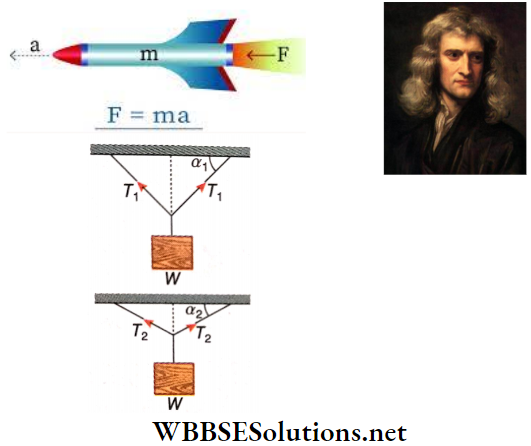
Question 4. Two bodies of equal weight W are suspended exactly from the midpoints of two stretched, horizontal strings. The two strings make angles α1 and α21 > α2), with the horizontal. In which of the strings, would the tension be higher? Explain.
Answer:

Given

Two bodies of equal weight W are suspended exactly from the midpoints of two stretched, horizontal strings. The two strings make angles α1 and α21 > α2), with the horizontal. In which of the strings, would the tension be higher

As the weights are suspended from the midpoints, the tensions in the two sides are the same. If it is T, then the resultant of upward components of T = T sinα + T sinα = 2 T sinα. At equilibrium, the resultant has to balance the weight.

∴ W = \(2 T \sin \alpha \quad \text { or, } T=\frac{W}{2 \sin \alpha} .\)
Newtons Law Of Motion Two Bodies Of Equal Weigth

Thus, when the value of a is small, the value of T is large.

In this case, \(T_1=\frac{W}{2 \sin \alpha_1} \text { and } T_2=\frac{W}{2 \sin \alpha_2}\)

As \(\alpha_1>\alpha_2, T_2>T_1\), i.e., the second string has a higher tension.

Question 5. A force is applied on a particle in a lift moving upward with an acceleration aα. Can Newton’s second law of motion be applied to describe the motion of this particle?
Answer:

Given

A force is applied on a particle in a lift moving upward with an acceleration aα.

A lift moving with an acceleration forms a non-inertial frame of reference. Newton’s second law of motion is not applicable in a non-inertial frame of reference directly. In such frames, a pseudo force acts on the particle in addition to the real force applied. Newton’s second law of motion can be applied if the expressions for both the real and the pseudo forces are known.

Question 6. Masses 1 kg and 3 kg move towards each other, due to their mutual attraction; no other external force acts on them. When their velocity of approach is 2 m · s-1, the velocity of the center of mass is 0.5 m · s-1. What will be the velocity of the center of mass of this system when the velocity of approach is 3 m · s-1?
Answer:

Given

Masses 1 kg and 3 kg move towards each other, due to their mutual attraction; no other external force acts on them. When their velocity of approach is 2 m · s-1, the velocity of the center of mass is 0.5 m · s-1.

The two masses may be considered to be constituents of a single system, and there is no external force acting on the system. As per the first law of motion, the velocity of the system remains constant. The velocity of a system is the velocity of its center of mass. So the velocity of the center of mass will continue to be 0.5 m · s-1.

Class 11 Physics Class 12 Maths Class 11 Chemistry
NEET Foundation Class 12 Physics NEET Physics

Understanding Newton’s Third Law: Long Answer Format

Question 7. Is it possible, for a person sitting inside a car at rest, to make the car move by pushing it from inside?
Answer:

The described push is an internal force, acting only inside the car. For causing the motion of the car on the road, no external force has been applied. By Newton’s first law of motion, in the absence of an external force, the car remains at rest.

Question 8. A meteorite conserved burns in air. Is the momentum of the meteorite conserved?
Answer:

A meteorite conserved burns in air.

Momentum is conserved even when the meteorite bums in the air. The meteorite loses some momentum which gets transferred to the surrounding air particles and to the gases that the meteorite is transformed into. The total momentum is conserved because there is no external force.

Question 9. A man of mass m is standing on a rope ladder attached to and kept vertically by a balloon of mass M at rest in the air. The man starts climbing up the rope ladder at a constant speed v with respect to the ladder. What will be the velocity of the balloon at that time?
Answer:

Given

A man of mass m is standing on a rope ladder attached to and kept vertically by a balloon of mass M at rest in the air. The man starts climbing up the rope ladder at a constant speed v with respect to the ladder.

Since there is no external force, the momentum of the system will be conserved.

Initially, the momentum of the system was zero. When the man starts climbing up, let the velocity with which the balloon moves downwards be V with respect to the ground.

The Upward velocity of the man with respect to the rope ladder = v.

Hence, upward velocity with respect to the ground = v- V.

Hence, from the conservation law of momentum, 0 = m(v-V)-MV or, m(v-V) = Mv

∴ V = \(\frac{m v}{m+M}\).

Question 10. When a body is thrown upwards, the magnitude of its momentum decreases at first and then increases. Does this defy the law of conservation of momentum?
Answer:

Given

When a body is thrown upwards, the magnitude of its momentum decreases at first and then increases.

The momentum of a body is conserved only when there is no external force acting on the body. In the case under discussion, the force of gravity is acting on the body as an external force. So the change in momentum of the body does not signify any violation of the law of conservation of momentum.

Question 11. In a game of tug of war, if both the parties exert a force of Tdyn from either side, what will be the tension in the rope?
Answer:

Given

In a game of tug of war, if both the parties exert a force of Tdyn from either side

Tension in the rope will be T dyn

Long Answer Questions on Force and Acceleration

Question 12. Two persons pull a rope by its two ends, exerting equal but opposite forces F. In another situation, one end of the rope is tied to a rigid support and a person pulls it with a force of 2F. In which case will the tension in the rope be greater?
Answer:

Given

Two persons pull a rope by its two ends, exerting equal but opposite forces F. In another situation, one end of the rope is tied to a rigid support and a person pulls it with a force of 2F

Tension in the rope in the second case will be greater i.e., T’ = 2F, whereas the tension, in the first case is T = F.
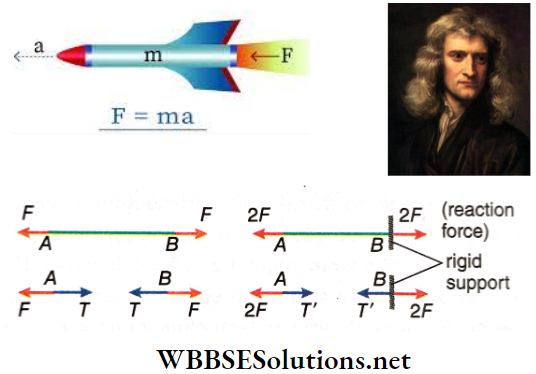
Newtons Law Of Motion Two Persons Pull A Rope By Its Tow Ends

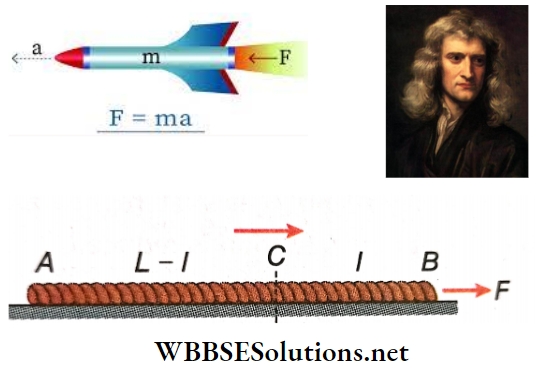
Question 13. A uniform rope of length L rests on a smooth plane. One end of the rope is pulled with a force F. What is the tension in the rope at a distance l from that end?
Answer:

Given

A uniform rope of length L rests on a smooth plane. One end of the rope is pulled with a force F.

Let the mass of the rope be M.

Hence, mass per unit length of the uniform rope = \(\frac{M}{L}\).
Newtons Law Of Motion Uniform Rope Of Length Rests On Smooth Plane

Length of the part BC of the rope =l, length of the part AC = L-l,

and mass of the part AC = \(\frac{M}{L}\)(L- l).

Acceleration of the rope due to the force F is a = \(\frac{F}{M}\).

Let the tension at C be T.

Hence, part AC of the rope gains acceleration due to the tension T.

∴ T = mass of AC x acceleration of the rope

= \(\frac{M}{L}\)(L- l). \(\frac{F}{M}\) = \(\frac{F}{L}\)(L-l)

WBBSE Class 11 Sample Questions on Motion

Question 14. A boat is floating on still water. A man walks from one end of the boat to the other. What will be the displacement of the boat?
Answer:

Given

A boat is floating on still water. A man walks from one end of the boat to the other.

The initial momentum of the man-boat system is zero, and no external force acts on it. So, as the person walks from one end of the boat to the other, the boat moves backward as per the law of conservation of momentum.

Let the length of the boat = L, t = time required by the man to move from one end to the other. In this time, let the distance which the boat moves back by be x.

Hence, the average velocity of the boat = \(\frac{x}{t}\), and the average velocity of the man with respect to the bank = \(\frac{L – x}{t}\).

Let the mass of the boat be M and that of the man be m.

So, \(\frac{m(L-x)}{t}-\frac{M x}{t}=0\), from the conservation law of momentum.

∴ Displacement of the boat, x = \(\frac{m L}{m+M}\)

Question 15. A jet plane usually flies at a considerable height but a propeller plane files at a low altitude, Expalin?
Answer:

Given

A jet plane usually flies at a considerable height but a propeller plane files at a low altitude

A jet plane functions on the principle of conservation of linear momentum. Gas is ejected from the rear end of the plane at a high speed and thus the plane moves forward.

  • At high altitudes, though the density of air is low, it is sufficient for providing oxidants to the fuel of the plane. Moreover, as the density of air is low at higher altitudes, the production of heat due to friction is reduced.
  • On the other hand, a propeller plane exerts a backward thrust on the air by rotating its blades. The reaction causes the plane to move. This thrust depends on the density of air and therefore this plane flies at lower altitudes where the air density is higher.

Question 16. Which principle of conservation can explain the flight of a rocket?
Answer:

Given

The flight of a rocket can be explained by the principle of conservation of momentum. The initial momentum of the rocket, along with its fuel, is zero.

  • The burnt fuel is ejected backward, through a hole, with some momentum. This momentum should be canceled by an equal and opposite momentum so that the net momentum is still zero.
  • This requirement for an equal and opposite momentum is responsible for the forward motion of the rocket.

Real-Life Examples of Newton’s Laws: Long Answer Questions

Question 17. Two persons are facing each other on two boats floating on still water. They are holding the two ends of a rope. When either of them or both pull the rope, then the boats meet at the same point whatever the pull on the rope may be. Give reasons for this. Is there any difference in the times taken by the boats to meet, for different forces applied on the rope?
Answer:

Given

Two persons are facing each other on two boats floating on still water. They are holding the two ends of a rope. When either of them or both pull the rope, then the boats meet at the same point whatever the pull on the rope may be

Let the masses of the first and the second men together with their respective boats be m1 and m2.

Let the force applied by one of them on the rope be F.

Acceleration of the 1st boat = \(\frac{F}{m_1}=a_1\), and that of the 2nd boat = \(\frac{F}{m_2}=a_2\).

Let the displacements of the two boats before meeting be Sj and s2 respectively. They meet after a time t.

∴ \(s_1 =\frac{1}{2} a_1 t^2=\frac{1}{2} \frac{F}{m_1} t^2 ;\)

∴ \(s_2=\frac{1}{2} a_2 t^2=\frac{1}{2} \frac{F}{m_2} t^2\)

Hence, \(\frac{s_1}{s_2}=\frac{m_2}{m_1}\).

Thus for any value of the force F, the meeting point of the two boats divides the initial distance in the ratio of m2: m1. Hence, the contact point is a fixed point.

Now, \(t^2=\frac{2 s_1 m_1}{F}=\frac{2 s_2 m_2}{F}\)

As s1m1= s2m2, time remains unchanged for a fixed F. But the time taken would be different for different values of F.

Question 18. A block of mass m is suspended from the ceiling using a string C. Another piece of string D is fitted to the other end of the block. When the string D is pulled suddenly, it snaps. But when D is pulled slowly, the string C snaps. Explain.
Answer:

Given

A block of mass m is suspended from the ceiling using a string C. Another piece of string D is fitted to the other end of the block. When the string D is pulled suddenly, it snaps. But when D is pulled slowly, the string C snaps.

The application of a sudden pull (T) on string D does not disturb the block due to its inertia.

  • The extension of the string C is negligible as the block practically remains at the same place. In this case, only the weight W acts on C and the string does not snap. On the other hand, the force T may be sufficient for D to snap.
  • But when string D is slowly pulled, the applied force acts on the whole system. So, the tension T’ on the string D becomes less than the tension T’ + W on C as the block also starts coming down. The tension, being higher, causes the string C to snap.
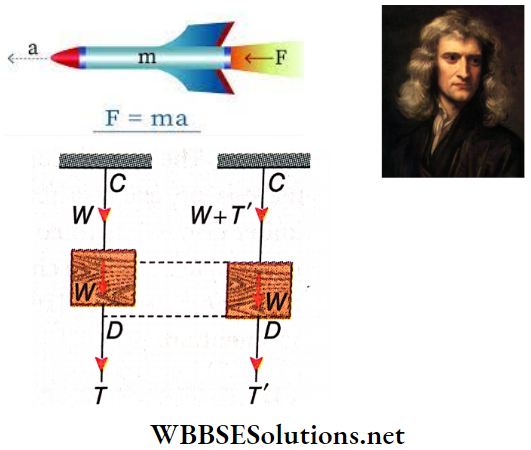
Newtons Law Of Motion A Block Of mass Is Suspended From Celling Using A String

Question 19. Rocket is the only means of travel in space—explain.
Answer:

Rocket is the only means of travel in space

Usually, a vehicle applies some force on its surrounding objects; the reaction force exerted by those objects on the vehicle is actually responsible for its motion.

  • On the other hand, let a system of two comparable masses be initially at rest so that the total momentum is zero. Let one of the masses be somehow detached, and allowed to move with a certain momentum in a definite direction.
  • Then the other mass would acquire an equal momentum in the opposite direction.
  • Hence, the total momentum will still be zero, i.e., be conserved. In this way, the masses can acquire motion without any external force, and without the aid of the surrounding objects.
  • A rocket in space utilizes this principle. The spaceship and the fuel constitute the two different masses. As the fuel is ejected backward, the spaceship successfully moves forward. It should be noted that, in space,
  • No external force can be applied on a vehicle, and
  • The vacuum in outer space can provide no surrounding object. A rocket is, therefore, the only means of travel in outer space.

Question 20. Two balls of different masses have the same volume. If the air resistance on both the balls is the same, prove that, when dropped from the same height, the heavier ball reaches the ground earlier.
Answer:

Given

Two balls of different masses have the same volume. If the air resistance on both the balls is the same

Let the mass of one of the balls be m, and the air resistance acting upward, be f.

Hence, total downward force on the ball, F = mg – f

∴ Acceleration, = \(\frac{F}{m}=\frac{m g-f}{m}\)

= \(g-\frac{f}{m}\)

Thus, from the equation, the ball with more mass has a smaller value of \(\frac{f}{m}\) and therefore a greater acceleration. So, it reaches the ground earlier.

Applications of Newton’s Second Law: Long Answers

Example 21. A balloon of mass M, carrying some sand is descending with an acceleration a. When 1/4th of the sand is emptied out of the balloon, the balloon descends with a uniform velocity. Find the initial mass of sand in the balloon.
Answer:

Given

A balloon of mass M, carrying some sand is descending with an acceleration a. When 1/4th of the sand is emptied out of the balloon, the balloon descends with a uniform velocity.

Let the initial mass of sand in the balloon be m and the upward thrust of air on the balloon or air resistance be F.

Hence, the equation of motion initially is, (M + m)g-F = (M+ m)a…(1)

After 1/4th of the sand is emptied out, the equation changes to \(\left[M+\left(m-\frac{m}{4}\right)\right] g-F=0\)…(2)

From (1) and (2), \((M+m) g-\left[M+\left(m-\frac{m}{4}\right)\right] g=(M+m) a\)

or, \(\frac{m}{4} g=(M+m) a\)

or, \(m=\frac{M a}{\left(\frac{1}{4} g-a\right)}=\frac{4 M a}{g-4 a}\)

Question 22. Two forces, F1 and F2 are applied at the two ends of a rope of length l. F2 > F1 and they are oppositely directed. What will be the force that will act at a point at a distance x from one of the extreme ends of the rope?
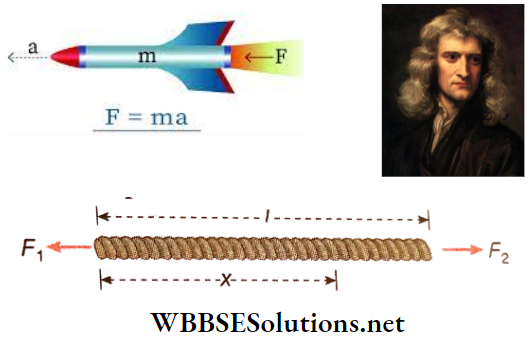
Newtons Law Of Motion Two Forced Are Applied At The Two Ends Of Rope

Answer:

Given

Two forces, F1 and F2 are applied at the two ends of a rope of length l. F2 > F1 and they are oppositely directed.

Let the mass of the rope be M.

∴ Mass per unit length of the rope = \(\frac{M}{l}\).

∴ Mass of length x of the rope = \(\frac{Mx}{l}\)
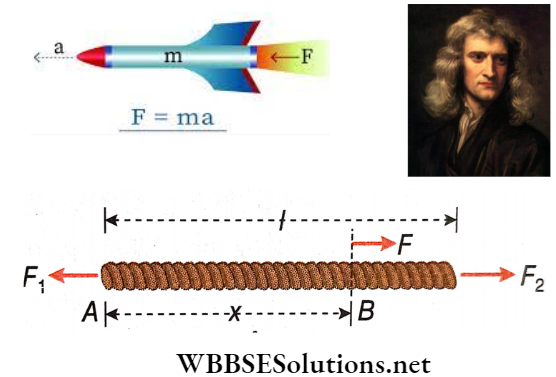
Newtons Law Of Motion Two Forced At The Two Ends Of Ropes

Now if the acceleration of the entire rope is a, F2 – F1 = Ma …(1)

Suppose, the force acting at a point, say B, at a distance x from the left end is F. Therefore, the equation of motion of the length AB of the rope is, \(F-F_1=\frac{M x}{l} \cdot a\)…(2)

From (1) and (2) we get, \(F-F_1=\frac{x}{l}\left(F_2-F_1\right) \quad \text { or, } F=\frac{l-x}{l} F_1+\frac{x}{l} F_2 \text {. }\)

Question 23. If you stand on the floor it exerts an upward reaction on you. Then why don’t you go up?
Answer:

Here, two forces act on the body:

  1. The downward force of weight due to earth’s attraction and
  2. Reaction of the ground. They are equal and opposite.

So, resultant force = 0, and there is no motion of the body

Question 24. A body of weight W1 is suspended from the ceiling of a room by a rope of weight W2. What is the force exerted by the ceiling on the body?
Answer:

Given

A body of weight W1 is suspended from the ceiling of a room by a rope of weight W2.

In this case, a total weight ( W1 + W2) is suspended from the ceiling. It is the force exerted on the ceiling. Hence, the ceiling exerts a reaction force of (W1+ W2) on the body.

Question 25. A ball of mass m is suspended by a light thread attached to the hook of a car At the precise moment when the car began to descend a smooth inclined plane under gravity, the thread was perpendicular to the plane. When the car begins to descend, what angle will the thread make with the plane? The angle of inclination = a.
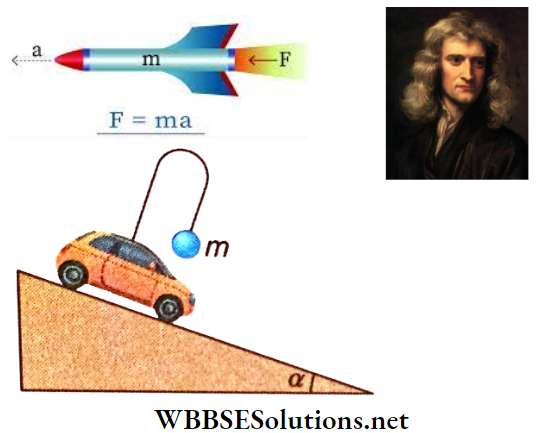
Newtons Law Of Motion A Ball Of Mass Is Suspended By A Ligth Thread Attaches To The Hook Of A Car

Answer:

Given

A ball of mass m is suspended by a light thread attached to the hook of a car At the precise moment when the car began to descend a smooth inclined plane under gravity, the thread was perpendicular to the plane. When the car begins to descend

As the car descends along the inclined plane under gravity, its acceleration is gsinα.

The acceleration of the ball is also gsinα.
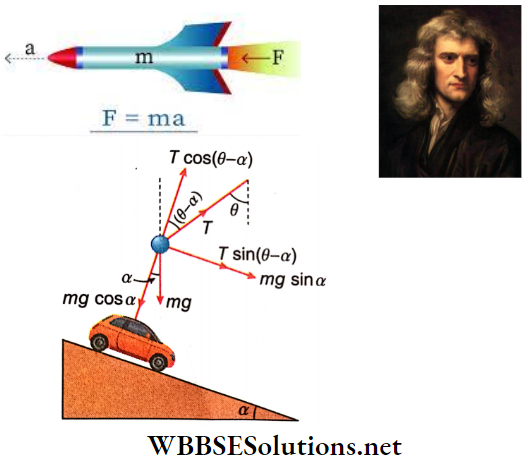
Newtons Law Of Motion Car Descends Along The Inclined Plane Under Gravity

Suppose, while descending, the thread makes an angle θ with the vertical.

So, the equation of motion of the ball is, Tsin(θ-α) + mgsinα = m · gsinα

or, sin(θ-α) = 0 or, θ = α

Therefore, the thread will be inclined at an angle α with the vertical, i.e., it will still be perpendicular to the inclined plane.

Question 26. A body of mass 1 kg initially at rest explodes and breaks into three fragments of masses in the ratio 1:1:3. The two pieces of equal mass fly off perpendicular to each other with a speed of 30 m/s each. What is the velocity of the heavier fragment?
Answer:

Given

A body of mass 1 kg initially at rest explodes and breaks into three fragments of masses in the ratio 1:1:3. The two pieces of equal mass fly off perpendicular to each other with a speed of 30 m/s each.

Let the 1kg mass break into three fragments with masses m1, m2, and m3 and their velocities are v1, v2, and v3 respectively.

Here, \(m_1+m_2+m_3=1 \mathrm{~kg}\)

As \(m_1: m_2: m_3=1: 1: 3\)

∴ \(m_1=m_2=0.2 \mathrm{~kg}, m_3=0.6 \mathrm{~kg}, v_1=v_2=30 \mathrm{~m} / \mathrm{s}\)
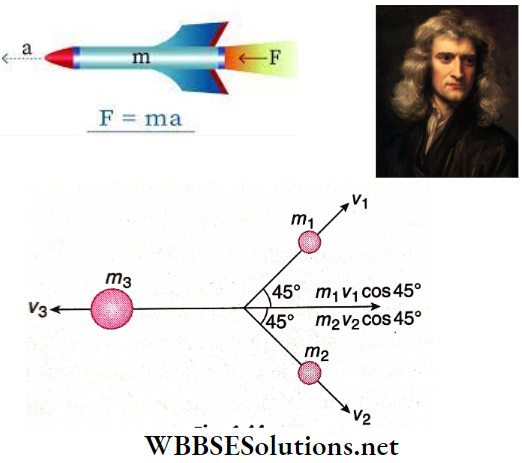
Newtons Law Of Motion A Body Of Mass 1 Kg Initially At Rest Explodes And Breaks Into Three Fragments

Applying the law of conservation of linear momentum along the horizontal direction, \(m_3 v_3=m_1 v_1 \cos 45^{\circ}+m_2 v_2 \cos 45^{\circ}\)

or, \(0.6 v_3=0.2 \times 30 \times \frac{1}{\sqrt{2}}+0.2 \times 30 \times \frac{1}{\sqrt{2}}\)

or, \(v_3=\frac{2 \times 0.2 \times 30}{0.6} \times \frac{1}{\sqrt{2}}=\frac{20}{\sqrt{2}} \mathrm{~m} / \mathrm{s}=14.14 \mathrm{~m} / \mathrm{s}\)
WBCHSE Class 11 Physics Newton Law Of Motion Multiple Choice Questions And Answers

Unit 3 Laws Of Motion Chapter 1 Newton Law Of Motion Multiple Choice Questions And Answers

WBBSE Class 11 Newton’s Laws MCQs with Answers

Question 1. A closed container filled with gas is moving horizontally with some acceleration. The pressure of the gas in the container (neglecting gravitational pull) is

  1. Same throughout
  2. Comparatively less at the front
  3. Comparatively less at the back wall
  4. Comparatively less in the upper part

Answer: 2. Comparatively less at the front

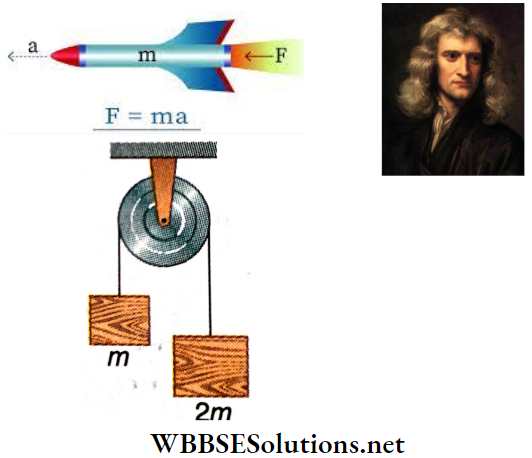
Question 2. Two masses, m and 2 m are connected by a string that passes over a frictionless pulley. When the mass 2m is released, the acceleration of the mass m upwards will be

  1. g/3
  2. g/2
  3. g
  4. 2g

Newtons Law Of Motion Two Masses m And 2m Are Connected Pulley

Answer: 1. g/3

Read And Learn More WBCHSE Class 11 Physics MCQs

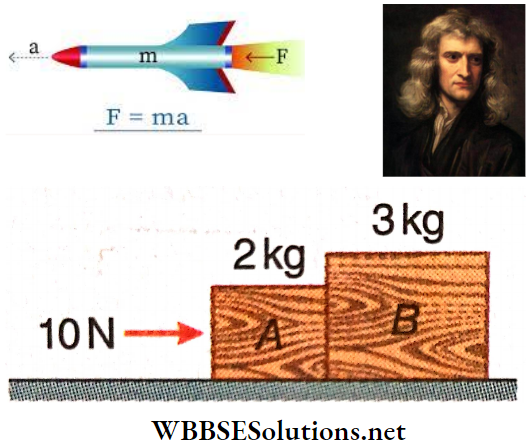
Question 3. The masses of blocks A and B are 2 kg and 3 kg respectively. The blocks are kept at rest on a frictionless horizontal table. When a horizontal force of 10 N is applied to A, the force applied on B by A will be

  1. 4N
  2. 6N
  3. 8N
  4. 10N

Answer: 2. 6N

Conceptual MCQs on Newton’s Laws for Class 11

Question 4. A person of mass M is at a height h from a floor in a place free from gravitational force. The person throws a ball of mass m, downward with a velocity u. Distance of the person from the floor, when the ball touches the floor, will be

  1. \(h\left(1+\frac{m}{M}\right)\)
  2. \(h\left(2-\frac{m}{M}\right)\)
  3. 2h
  4. \(5 h\left(4+\frac{m}{2 M}\right)\)

Answer: 1. \(h\left(1+\frac{m}{M}\right)\)

WBCHSE Class 11 Physics Newton Law Of Motion Multiple Choice Questions And Answers

Question 5. A block is released from the top of an inclined plane of inclination θ and height h. The time required to reach the foot of the inclined plane is

  1. \(\sqrt{\frac{2 h}{g}}\)
  2. \(\sin \theta \sqrt{\frac{2 h}{g}}\)
  3. \(\frac{1}{\sin \theta} \sqrt{\frac{2 h}{g}}\)
  4. \(\frac{1}{\cos \theta} \sqrt{\frac{2 h}{g}}\)

Answer: 3. \(\frac{1}{\sin \theta} \sqrt{\frac{2 h}{g}}\)

Question 6. A plumb line is hanging from the roof of a car. When the car moves with acceleration a, the angle that the plumb line makes with the vertical is

  1. \(\tan ^{-1} \frac{a}{g}\)
  2. \(\tan ^{-1} \underset{a}{g}\)
  3. \(\cos ^{-1} \frac{a}{g}\)
  4. \(\sin ^{-1} \frac{g}{a}\)

Answer: 1. \(\tan ^{-1} \frac{a}{g}\)

Practice Questions on Newton’s First Law

Question 7. Consider an elevator moving downwards with an acceleration a, the force exerted by a passenger of mass m in the floor of the elevator is

  1. ma
  2. ma-mg
  3. mg- ma
  4. mg+ ma

Answer: 3. mg- ma

Question 8. A monkey is descending from the branch of a tree with a constant acceleration. If the breaking strength of the branch is 75% of the weight of the monkey, the minimum acceleration with which the monkey can slide down without breaking the branch is

  1. g
  2. 3g/4
  3. g/2
  4. g/4

Answer: 4. g/4

Question 9. A car moving with a speed of 50 km/hr can be stopped by brakes, over a distance of 6 m. If the same car is moving at a speed of 100 km/hr, the stopping distance is

  1. 12 m
  2. 18 m
  3. 6 m
  4. 24 m

Answer: 4. 24 m

Question 10. The x and y coordinates of a particle at any time t are given by x = 7t + 14t² and y = 5t, where x and y are in meters and t is in seconds. The acceleration of the particle at t = 5 s is

  1. Zero
  2. 8 m · s-2
  3. 20 m · s-2
  4. 40 m · s-2

Answer: 2. 8 m · s-2

Class 11 Physics Class 12 Maths Class 11 Chemistry
NEET Foundation Class 12 Physics NEET Physics

Question 11. A ball of mass 0.5 kg is moving with a velocity v of 2 m · s-1. It is subjected to a force of xN in 2 s. Because of this force, the ball moves with a velocity of 3 m · s-2. The value of x is

  1. 5 N
  2. 8.25 N
  3. 0.25 N
  4. 1N

Answer: 3. 0.25 N

Key MCQs on Newton’s Second Law of Motion

Question 12. A force F1 of 500 N is required to push a car of mass 1000 kg slowly at constant speed on a level road. If a force F2 of 1000 N is applied, the acceleration of the car will be

  1. Zero
  2. 1.5 m · s-2
  3. 1 m · s-2
  4. 0.5 m · s-2

Answer: 4. 0.5 m · s-2

Question 13. A cricket ball of mass 0.5 kg, moving at 30 m · s-1, hits a bat perpendicularly and rebounds with a velocity of 20 m · s-1. The impulse of the force exerted by the ball on the bat is

  1. 0.5 N · s
  2. 1.0 N · s
  3. 25 N · s
  4. 50 N · s

Answer: 3. 25 N · s

Question 14. A rocket consumes fuel at the rate of 100 kg · s-1. Gas ejects out of it with a velocity of 5 x 10  m · s-1. If the gravitational pull is neglected, the impulsive force experienced by the rocket is

  1. 5 X10²N
  2. 5 X 10⁴N
  3. 5 X10⁶N
  4. 5 X10⁸N

Answer: 3. 5X10⁶N

Question 15. A ball of mass m is bowled at a velocity v to a batsman. The batsman hits the ball, deflecting its direction by an angle θ, without changing the magnitude of velocity. The impulse of the ball is

  1. mv cosθ
  2. mv sinθ
  3. \(2 m v \cos ^2 \frac{\theta}{2}\)
  4. \(2 m v \cos \frac{\theta}{2}\)

Answer: 4. \(2 m v \cos \frac{\theta}{2}\)

Question 16. A bird sits on a stretched telegraph wire. The increase in tension in the wire is

  1. Equal to the weight of the bird
  2. More than the bird’s weight
  3. Less than the bird’s weight
  4. Zero

Answer: 2. More than the bird’s weight

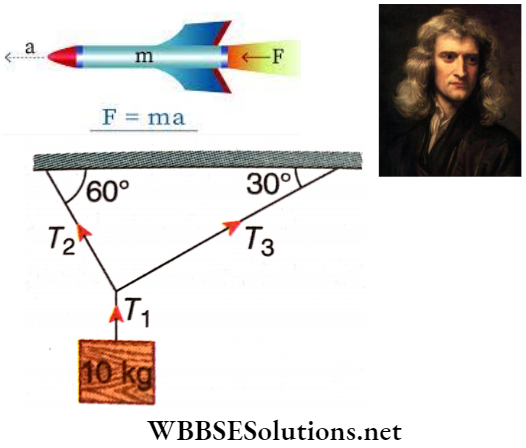
Question 17. A block of mass 10 kg is suspended by three strings as shown. The tension T2 is

Newtons Law Of Motion Block Of Mass 10Kg Is Suspended By Three Strings

  1. 100 N
  2. \(\frac{100}{\sqrt{3}} \mathrm{~N}\)
  3. √3x 100 N
  4. 50√3N

Answer: 4. 50√3N

Sample Questions on Newton’s Third Law

Question 18. Two bodies of masses 5 kg and 3 kg respectively are connected to two ends of a light string passing over a horizontal frictionless pulley. The tension in the string is (g = 9.8 m/s²)

  1. 60 N
  2. 36.75 N
  3. 73.50 N
  4. 18 N

Answer: 2. 36.75 N

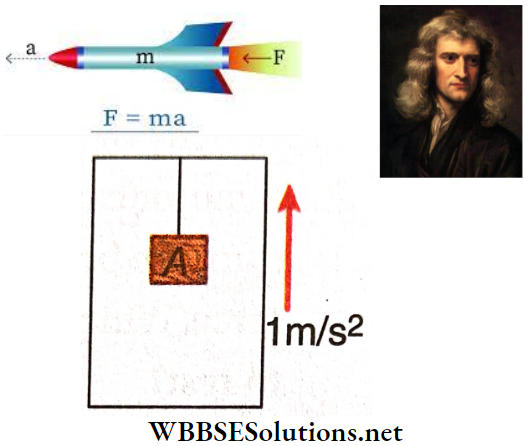
Question 19. If the elevator is moving upwards with a constant acceleration of 1 m/s², the tension in the string connected to block A of mass 6 kg would be (g = 10 m/s²)

  1. 60 N
  2. 66 N
  3. 54 N
  4. 42 N

Newtons Law Of Motion The Elevator Moving Upwards With Constant Acceleration

Answer: 2. 66 N

Question 20. A man of weight w is in a lift that is moving up with an acceleration a. If acceleration due to gravity is g, the apparent weight of the man will be

  1. \(w\left(1+\frac{a}{g}\right)\)
  2. \(w\left(1-\frac{a}{g}\right)\)
  3. w
  4. Zero

Answer: 1. \(w\left(1+\frac{a}{g}\right)\)

Question 21. A thief steals a treasure box of weight w. He then jumps off a wall of height h with the box on his head. The weight felt on his head before he touches the ground is

  1. 2 w
  2. w
  3. \(\frac{w}{2}\)
  4. Zero

Answer: 4. Zero

Question 22. The working principle of a jet engine is based on the principle of

  1. Conservation of mass
  2. Conservation of energy
  3. Conservation of linear momentum
  4. Conservation of angular momentum

Answer: 3. Conservation of linear momentum

WBBSE Class 11 Practice Tests on Laws of Motion

Question 23. A free particle of mass m was in motion along the x-axis on a horizontal x-y plane kept at a fixed height above the earth. On sudden explosion, the particle broke up into two pieces of masses \(\frac{m}{4}\) and \(\frac{3m}{4}\). After an interval of time, the position of the smaller fragment along the y-axis became y = 15 cm. At that moment, the position of the larger piece was

  1. y = -5 cm
  2. y = + 20 cm
  3. y = + 5 cm
  4. y = -20 cm

Answer: 1. y = -5 cm

Question 24. A truck, carrying sand, moves with uniform velocity u on a smooth horizontal road. If Δm mass of sand falls in time Δt from the truck, then to maintain the speed u, the truck needs a force

  1. \(\frac{\Delta m u}{\Delta t}\)
  2. \(\frac{\Delta m u}{2 \Delta t}\)
  3. \(\frac{\Delta m u^2}{\Delta t}\)
  4. Zero

Answer: 4. Zero

Question 25. A few lead pellets, each of mass m, fall on a horizontal plane. Each pellet touches the plane with velocity u. If n number of pellets fall per second and none renounces, applied force on the horizontal plane will be

  1. \(\frac{m u}{n}\)
  2. \(n m u\)
  3. \(\frac{n m}{u}\)
  4. \(\frac{m}{n u}\)

Answer: 2. \(n m u\)

Question 26. A boy of mass m is standing on a wooden plank, of mass M and length l, floating on water. If the boy walks over the plank at a constant velocity from one end to the other, the displacement of the plank is

  1. \(\frac{m l}{M}\)
  2. \(\frac{M l}{m}\)
  3. \(\frac{m l}{(M+m)}\)
  4. \(\frac{m l}{(M-m)}\)

Answer: 3. \(\frac{m l}{(M+m)}\)

In this type of question, more than one options are correct.

Question 27. Suppose a body that is acted on by exactly two forces is accelerated. For this situation mark out the incorrect statements.

  1. The body can not move with constant speed
  2. The velocity can never be zero
  3. The resultant of two forces cannot be zero
  4. The two forces must act in the same line

Answer:

1. The body can not move with constant speed

2. The velocity can never be zero

4. The two forces must act in the same line

Interactive MCQs on Applications of Newton’s Laws for Students

Question 28. Which of the following statements can be explained by Newton’s second law of motion?

  1. To stop a heavy body (say truck), greater force is needed than to stop a light body (say motorcycle) in the same time if they are moving at same speed
  2. For a body of given mass, the greater the speed, the greater the opposing force needed to stop the body in a particular time duration
  3. To change the momentum of a body by given value, the force required is independent of time
  4. The same force acting on two different bodies for same time causes the same change in momentum for the different bodies

Answer:

1. To stop a heavy body (say truck), greater force is needed than to stop a light body (say motorcycle) in the same time if they are moving with same speed

2. For a body of given mass, the greater the speed, the greater the opposing force needed to stop the body in a particular time duration

4. The same force acting on two different bodies for the same time causes the same change in momentum for the different bodies

WBCHSE Class 11 Physics Dimensions Of Physical Quantities Notes

Measurement And Dimension Of Physical Quantity

Dimensions Of Physical Quantities

The dimension of a physical quantity is its relationship with the seven quantities, each of which has been assigned, by convention, a base unit.

These seven quantities, shown earlier are

  1. Length (l),
  2. Mass (m),
  3. Time (t),
  4. Electric current (l),
  5. Thermodynamic temperature (T or θ),
  6. Amount of substance (n), and
  7. Luminous intensity (Iv).

The dimension of each of them is expressed as a single symbolic factor, as shown.

Dimensions Of The Base Quantities

Measurement And Dimension Of Physical Quantity Dimensions Of base Quantities

A short and compact notation for expressing the dimension of a quantity is as follows : [length] = L or [l] = L, which is read as “the dimension of length is L”. Here L is a factor that may have multiplication or division with other similar factors, as and when demanded by the relationships among different physical quantities.

WBCHSE Class 11 Physics Dimensions Of Physical Quantities Notes

Dimensions Of The Base Quantities Example:

Volume (V): v = length x breadth x height. Breadth and height are quantities equivalent to length; each has a dimension L.

So, the dimension of volume = L x L x L, i.e., [V] = L³.

Density (ρ): \(\rho=\frac{\text { mass }}{\text { volume }} \text {. Then, }[\rho]=\frac{[\text { mass }]}{[\text { volume }]}\)

Now, [mass] = M and [volume] = L³.

So, the dimension of density, i.e., \([\rho]=\frac{M}{L^3}=M L^{-3} \text {. }\)

Read and Learn More: Class 11 Physics Notes

Dimensions From Units:

1. The SI unit of density is kg/m³. This unit itself shows that density is actually \(\frac{\text { mass }}{(\text { length })^3}\), i.e., its dimension is \(\frac{\mathrm{M}}{\mathrm{L}^3} \text { or } \mathrm{ML}^{-3}\). There are many quantities, like density, for which the dimensions may directly be obtained from the units.

2. The SI unit of force is Newton (N). This derived unit, however, does not show its direct relationship with the base units. To get that, some convenient physical relationship is to be used. Here, a useful relation is force = mass x acceleration

So, the unit of force = unit of mass x unit of acceleration

= kg x m/s² (in SI)

Then, we know that force actually is \(\frac{\text { mass } \times \text { length }}{(\text { time })^2}\)

Hence its dimension is \(\frac{M L}{T^2}\) or MLT-2.

The last example shows that the dimension always clearly relates a derived quantity with the base quantities, whereas its unit may or may not. A useful physical formula is often necessary to get this dimensional relationship.

In essence, the connection of all derived physical quantities with the base ones is explicitly displayed by the dimensions, but not always by the conventional units.

Dimensionless Quantities: Some physical quantities are actually ratios of other quantities that have the same dimensions. As a result, the ratio becomes dimensionless.

Dimensionless Quantities Example

1. Angle (θ): The angle subtended by a circular arc at its center is defined as,

θ = \(\frac{\text { length of the circular arc }}{\text { radius of the circle }}\)

Here, both the length and the radius have the dimension of length, i.e., L.

So, the dimension of angle is, \([\theta]=\frac{L}{L}=L^0=1\)

Dimension 1 actually indicates that angle θ is a dimensionless quantity.

2. Specific gravity (s): By definition, the specific gravity of the material of a body is,

s = \(\frac{\text { mass of the body }}{\text { mass of an equal volume of water }}\)

So, the dimension of specific gravity, [s] = \(\frac{M}{M}\) = M0 = 1. This means that specific gravity is a dimensionless quantity.

If a quantity is dimensionless, its dimension is written as 1. However, expressions like L0, M0, L0M0T0, etc. are equally valid.

Even a dimensionless quantity may have units. Such units are to be assigned to denote different methods of scaling the quantity. For example, an angle θ is dimensionless; but radian and degree are two popular units for the measurement of θ (there are also other, mostly obsolete, units of angle). They actually correspond to the following scalings:

Angle in radian \(\left(\theta^c\right)=\frac{\text { arc }}{\text { radius }} ;\)

Angle in degree \(\left(\theta^{\circ}\right)=\frac{180}{\pi} \times \frac{\text { arc }}{\text { radius }}\)

It is to be noted that,

  1. All real numbers are dimensionless;
  2. A few physical constants (like π, the ratio between the circumference and diameter of any circle) are dimensionless, whereas some others (like the velocity of light or gravitational constant)

Physical Quantities Of The Same Dimension: Every physical quantity has a definite dimension. But the converse is not true a dimensional expression alone cannot identify the corresponding physical quantity. There are many examples where different quantities have the same dimension. A few of them are given in the following table.

Measurement And Dimension Of Physical Quantity Physical Quantities

Dimensional Analysis: Any theoretical probe involving the dimensions of different fundamental and derived physical quantities is called dimensional analysis. Usually, from this analysis,

  1. The dimensional correctness of a physical expression or equation can be checked
  2. The value of a measured quantity can be converted from one system of units to another;
  3. Relations among different physical quantities can be determined.

Dimensional analysis stands on the following basic principle:

Class 11 Physics Class 12 Maths Class 11 Chemistry
NEET Foundation Class 12 Physics NEET Physics

The Principle Of Dimensional Homogeneity: This principle states that, in any mathematical expression or equation involving physical quantities, each term in the expression or each term on either side of the equation must have the same dimension.

For example, let us take an expression a + be, or an equation d = a+bc. The principle asserts that, each term—a, be, and d—in the expression or the equation has the same dimension.

This is obvious, because, for example, some mass cannot be added with some length, or some work can never be equal to some density, etc.

Further, in a polynomial series of form 1 + ax + bx² + cx³ + …., the variable x must be dimensionless.

Otherwise, the different terms of the expression would have different dimensions and they cannot be added. It is to be noted that functions like ex, sinx, cosx, etc. are widely used in physics each of them is actually a polynomial series; hence, x should be dimensionless.

Dimensional Correctness Of An Equation: From the principle of dimensional homogeneity, by analyzing the dimensions of both sides of an equation, the dimen¬sional correctness of an equation may be checked.

Dimensional Correctness Of An Equation Example: Let us check the dimensional correctness of the equation of motion, s = ut + \(\frac{1}{2}\) at².

On LHS, \([s]=\mathrm{L}\)

On RHS, \([u]=\mathrm{LT}^{-1},[t]=\mathrm{T} and [a]=\mathrm{LT}^{-2}\)

i.e., RHS = \([u t]+\left[\frac{1}{2} a t^2\right]\)

= \(L T^{-1} \times \mathrm{T}+1 \times \mathrm{LT}^{-2} \times \mathrm{T}^2=\mathrm{L}+\mathrm{L}=\mathrm{L}\)

Thus, the dimension of physical quantities on both sides of the equation is L. So the equation is dimensionally correct

Conversion Between Unit Systems: The following examples are sufficient to illustrate the method:

1. Relation Between Joule And Erg: 1 joule (J) and 1 erg are the SI and CGS units of work, respectively. Let, 1 J = n erg.

The dimension of work is ML²T-2. Using the SI and CGS fundamental units directly as per the dimension, we have

1 J = \(n \mathrm{erg} \quad \text { or, } 1 \mathrm{~kg} \cdot \mathrm{m}^2 \cdot \mathrm{s}^{-2}\)

= \(n \mathrm{~g} \cdot \mathrm{cm}^2 \cdot \mathrm{s}^{-2}\)

or, n = \(\frac{\mathrm{kg} \cdot \mathrm{m}^2 \cdot \mathrm{s}^{-2}}{\mathrm{~g} \cdot \mathrm{cm}^2 \cdot \mathrm{s}^{-2}}=\left(\frac{\mathrm{kg}}{\mathrm{g}}\right) \cdot\left(\frac{\mathrm{m}}{\mathrm{cm}}\right)^2=1000 \times(100)^2\)

= \(10^7 \quad[\mathrm{As} 1 \mathrm{~kg}=1000 \mathrm{~g} \text { and } 1 \mathrm{~m}=100 \mathrm{~cm}]\)

Thus, 1 J = \(10^7\) erg and 1erg = \(10^{-7} \mathrm{~J}\).

2. Conversion Of The Value Of Young’s Modulus From CGS System To SI: The value of Young’s modulus (Y) of iron is 2 x 10¹² dyn · cm-2. The corresponding SI unit is N · m-2. Let, 2 x 10¹² dyn · cm-2 = n N · m-2.

The dimension of Y is ML-1T-2.

Using the fundamental units directly in the dimension, we get

2 x \(10^{12} \mathrm{dyn} \cdot \mathrm{cm}^{-2}=n \mathrm{~N} \cdot \mathrm{m}^{-2}\)

or, \(2\times 10^{12} \mathrm{~g} \cdot \mathrm{cm}^{-1} \cdot \mathrm{s}^{-2}=n \mathrm{~kg} \cdot \mathrm{m}^{-1} \cdot \mathrm{s}^{-2}\)

or, n= \(2 \times 10^{12} \times \frac{\mathrm{g} \cdot \mathrm{cm}^{-1} \cdot \mathrm{s}^{-2}}{\mathrm{~kg} \cdot \mathrm{m}^{-1} \cdot \mathrm{s}^{-2}}\)

= \(2 \times 10^{12} \times\left(\frac{\mathrm{g}}{\mathrm{kg}}\right) \times\left(\frac{\mathrm{m}}{\mathrm{cm}}\right)\)

= \(2 \times 10^{12} \times \frac{1}{1000} \times 100=2 \times 10^{11}\)

So, \(Y=2 \times 10^{11} \mathrm{~N} \cdot \mathrm{m}^{-2}\)

Relationship Among Different Physical Quantities

1. Dependence of time period (T) of a simple pendulum on its effective length (t), acceleration due to gravity (g), and mass of the pendulum bob (m):

Let us assume,

T ∝ mx [when T and n are constant]

T ∝ ly [when l and n are constant]

T ∝ g² [when l and T are constant]

∴ \( T \propto m^x D_{g^2}\)

or, T = \(k m^x D g^2\), where k is a dimensionless constant of proportionality and x,y, z are numeric indices.

Now, [m] = \(\mathrm{M},[l]=\mathrm{L}\) and \([g]=\mathrm{LT}^{-2}\).

Expressing LHS and RHS in terms of dimensions, \(M^0 L^0 T=M^x \times L^y \times\left(L^{-2}\right)^z\)

or, \(M^0 L^0 T=M^x L^{y+z}-2 z\)

Equating powers of the same bases from both sides we get, x=0

y + z = 0 or, y = -z

-2 z=1 or, z = \(-\frac{1}{2}\)

∴ y = \(+\frac{1}{2} \quad therefore T=k \sqrt{\frac{l}{g}} .\)

We cannot determine the value of k from this analysis. It is also important to note that, x = 0 means the time period does not depend on the mass of the pendulum.

2. Dependence of frequency of vibration (n) of a stretched string on its length (l), mass per unit length (μ), and tension in the string (T):

Let us assume,

n \(\propto l^x\) (when T and μare constant)

n  ∝ Ty (when l and μ are constant)

n \(\propto \mu^z\) (when l and T are constant)

∴ \(n \propto \mu^x T_{\mu^2}\)

or, \(n=k l^x T^y \mu^z\), where k is a dimensionless constant of proportionality and x, y, z are numeric indices.

Here, \([n]=\mathrm{T}^{-1}, \quad[l]=\mathrm{L}, \quad[T]=\mathrm{MLT}^{-2} \quad and [\mu]=\mathrm{ML}^{-1}\).

Then, \(\mathrm{M}^0 \mathrm{~L}^0 \mathrm{~T}^{-1}=\mathrm{L}^x \cdot\left(\mathrm{MLT}^{-2}\right)^y \cdot\left(\mathrm{ML}^{-1}\right)^z\)

or, \(\mathrm{M}^0 \mathrm{~L}^0 \mathrm{~T}^{-1}=\mathrm{L}^{x+y-z} \cdot \mathrm{M}^{y+z} \cdot \mathrm{T}^{-2 y}\)

Equating the power of same bases, x + y – z = 0, -2y = -1

So, y = \(x\frac{1}{2}\)

Then, z = –\(frac{1}{2}\) and x = -1

Hence, n = \(\frac{k}{l} \sqrt{\frac{T}{\mu}}\).

3. Dependence of viscous force (F) on the radius of a ball falling through a viscous fluid (a), coefficient of viscosity of the fluid (η), and terminal velocity (v) of the ball:

Let us assume,

F ∝ ax [when 77 and v are constant]

F ∝ ηy [when a and v are constant]

F ∝ vz [when a and η are constant]

∴ \(F \propto a^x \eta^y \nu^z\)

or, \(F \propto a^x \eta^y \nu^z\), where k is a dimensionless constant of proportionality and x, y, z are numeric indices.

Here, [F] = \(\mathrm{MLT}^{-2}, \quad[a]=\mathrm{L}, \quad[\eta]=\mathrm{ML}^{-1} \mathrm{~T}^{-1} and [\nu]=\mathrm{LT}^{-1}\).

So, \(M L T^{-2}=L^x \cdot\left(M L^{-1} T^{-1}\right)^y \cdot\left(\mathrm{LT}^{-1}\right)^z\)

or, \(\mathrm{MLT}^{-2}=\mathrm{L}^{x-y+z} \cdot \mathrm{M}^y \cdot \mathrm{T}^{-y-z}\)

Equating powers of same bases, x-y+z =1; y =1

and -y-z = -2 or, y+z = 2

Then, z = 1 and x = 1

∴ F = kaηv

Detailed dimensional analysis shows that F does not depend on the densities of the fluid and of the material of the ball. We omitted those details here.

Limitations Of Dimensional Analysis

  1. The value of a constant in an equation cannot be determined.
    • Example: In a simple pendulum the time period of the bob depends on length and acceleration due to gravity.
    • The relation is \(T=k \sqrt{\frac{l}{g}}\). We cannot determine the value of constant k from dimensional analysis.
  2. No relation, containing a constant that is not dimensionless, can be established.
    • Example: We cannot determine the nature of the depen¬dence of force on mass and distance in Newton’s law of gravitation, as it contains a constant G which is not dimensionless.
  3. If any relation contains a dimensionless quantity, we cannot determine its nature of dependence on others present in the relation.
    • Example: If a body is displaced by a distance s when a force is acting on it, then work done by the force depends on the applied force, displacement of the body, and the angle between the force and displacement.
    • This is expressed by the relation W = Fs cos θ, where θ is the angle between the direction of applied force and that of displacement. As θ is a dimensionless quantity we cannot determine the relation by dimensional analysis.
  4. If a physical quantity depends on different quantities having the same dimension, the relation among them cannot be obtained.
    • Example: The volume of a right cylinder depends on its radius and on its length. Here, the radius and the length are entirely different quantities related to the cylinder, but they have the same dimension the dimension of length. So, the relation V ∝ r²l cannot be obtained from dimensional analysis.

Measurement And Dimension Of Physical Quantity Numerical Examples

Example 1. What will be the conversion factor when you change a value expressed in Newton to dyne?
Solution:

N and dyn are the units of force in SI and CGS systems respectively.

The dimension of force, [F] = MLT-2

Let 1 N = n dyn

Then using the base units in the dimension, \(1 \mathrm{~kg} \cdot \mathrm{m} \cdot \mathrm{s}^{-2}=n \mathrm{~g} \cdot \mathrm{cm} \cdot \mathrm{s}^{-2}\)

or, n = \(\frac{1 \mathrm{~kg}}{1 \mathrm{~g}} \times \frac{1 \mathrm{~m}}{1 \mathrm{~cm}} \times\left(\frac{1 \mathrm{~s}}{1 \mathrm{~s}}\right)^{-2}\)

= \(\frac{10^3 \mathrm{~g}}{1 \mathrm{~g}} \times \frac{10^2 \mathrm{~cm}}{1 \mathrm{~cm}} \times 1=10^5\)

∴ \(1 \mathrm{~N}=10^5 \mathrm{dyn}\)

So, the conversion factor is \(10^5\).

Example 2. Taking electric potential V as a fundamental quantity instead of electric current, find the dimension of electric current in terms of the dimension of the electric potential.
Solution:

Given

Taking electric potential V as a fundamental quantity instead of electric current

Since V (electric potential) = \(\frac{P(\text { power })}{I(\text { electric current })}\)

[I] = \(\frac{[P]}{[V]}=\frac{\mathrm{ML}^2 \mathrm{~T}^{-3}}{\mathrm{~V}}=\mathrm{ML}^2 \mathrm{~T}^{-3} \mathrm{~V}^{-1} .\)

Example 3. Find the dimension of the universal gravitational I constant, taking the units of density D, velocity V; and work W as base units instead of those of mass, distance, and time.
Solution:

Given

Taking the units of density D, velocity V; and work W as base units instead of those of mass, distance, and time.

From Newton’s law of gravitation, F = \(G \frac{M_1 M_2}{r^2}\) we have

[G] = \(\frac{[F]\left[r^2\right]}{\left[m^2\right]}=\frac{M L T^{-2} \times L^2}{M^2}=M^{-1} L^3 T^{-2}\)

Let \(\mathrm{M}^{-1} \mathrm{~L}^3 \mathrm{~T}^{-2}\) = \(\mathrm{D}^x \mathrm{~V}^y \mathrm{~W}^z\)

= \(\left(\mathrm{ML}^{-3}\right)^x \times\left(\mathrm{LT}^{-1}\right)^y \times\left(\mathrm{ML}^2 \mathrm{~T}^{-2}\right)^z\)

= \(\mathrm{M}^{x+z} \times \mathrm{L}^{-3 x+y+2 z} \times \mathrm{T}^{-y-2 z}\)

Equating powers of same bases, x + z = -1

-3x + y + 2z = 3

and -y – 2z = -2

Solving for x, y, z, we get \(x=-\frac{1}{3}, y=\frac{10}{3} and z=-\frac{2}{3}\)

∴ [G] = \(\mathrm{D}^{-\frac{1}{3}} \mathrm{~V}^{\frac{10}{3}} \mathrm{~W}^{-\frac{2}{3}}\)

Example 4. In a system of units, the unit of length is defined as the distance traveled by light in space in 1 s and the unit of time is the time taken by the earth to revolve around the sun once. Find the velocity unit in the CGS system.
Solution:

Given

In a system of units, the unit of length is defined as the distance traveled by light in space in 1 s and the unit of time is the time taken by the earth to revolve around the sun once.

In this system, unit distance = 3×1010 cm and unit time = 365.25 d = 3.156 x 10⁷ s

∴ Velocity unit in this system

= \(\frac{3 \times 10^{10}}{3.156 \times 10^7}=950.57 \mathrm{~cm} \cdot \mathrm{s}^{-1}\)

Velocity unit in this system = 950.57 cms-1

WBCHSE Class 11 Physics Measurement Of Physical Quantity Notes

Measurement And Dimension Of Physical Quantity

Measurement Of Physical Quantity

WBBSE Class 11 Measurement of Physical Quantities Notes

Units And Dimensions

Some characteristics like smell, taste, colour, etc. of matter are subject to qualitative observations only. We use our sense organs to perceive these. On the other hand, some properties like the mass or volume of a body, the density of a matter, change in energy, etc. are subject to qualitative as well as quantitative observations.

  • Measurement is an integral part of quantitative observation. Characteristics of matter or energy that can be expressed as measurable quantities are called physical quantities.
  • Hence, the mass of a body is a physical quantity while its smell is not. Generally, the color of a body is not a physical quantity but when the color of light is represented by wavelength, then it is a physical quantity.
  • Measurements of many physical quantities involve a measurement of time. Thus, time is also treated as a physical quantity, though time is not a direct characteristic of matter or energy.
  • One of the most important targets of physics is to measure physical quantities with accuracy. Observation of a physical quantity is meaningful only when it is measured and is expressed as a numerical value with a proper unit.

WBCHSE Class 11 Physics Measurement Of Physical Quantity Notes

Units Of Measurement: The result of measurement of any physical quantity is expressed in terms of its unit which is unique to that physical quantity and sets a standard for its measurement.

Any measurement is therefore written as a number of times this standard value. The standard of measurement of any physical quantity is represented by 1 and the name of the unit is
written beside 1. Therefore, the value of a physical quantity = ‘number’ ‘unit’.

Units Of Measurement Example: Suppose the length of a rod is 3 meters or 3 x 1 m. Here length is the physical quantity, meter (m) is the unit of length and the digit 3 implies that the length is 3 times the value of 1 meter (which is the standard of measurement of length).

Read and Learn More: Class 11 Physics Notes

To measure a physical quantity, the unit chosen should be

  1. Of convenient size,
  2. Unambiguous,
  3. Reproducible,
  4. Invariant under change of space and time and
  5. Acceptable to all.

Base Or Fundamental Units And Derived Units: There are hundreds of physical quantities in nature. Accordingly, their measurements demand hundreds of different units. If we start to assign one different unit to each of them, the entire measurement procedure will soon go beyond our control.

Fortunately, this is not actually necessary. It is observed that different physical quantities have very familiar relationships among them. As such, these units also have definite relations among them. So it is possible to

  1. Mark a few physical quantities that are independent of one another,
  2. Assign a convenient initial unit for each of them, and then
  3. Prepare appropriate units for all other physical quantities in terms of those initial units, using the well-known relationships among different quantities.

Key Concepts in Measurement for Class 11 Physics

Physical Quantities And Measurement

The initial independent units are called the base units or fundamental units and all other units structured from them are called the derived units.

  • Length, mass, and time—these are three quantities entirely independent of one another. So long as our study is connected to mechanics, these three fundamental units of length, mass, and time can serve our purpose of measurement. However, these units are not sufficient for the study of the whole of physics.
  • So it was decided to widen the scope of measurement by introducing some more fundamental quantities thereby increasing their number from three to seven.
  • It is observed that all other physical quantities are somehow related to or can be structured from the seven base units. They are the derived units. This simplifies the measurement procedure since it is no longer necessary to create a new unit for every measurable quantity.

Base Or Fundamental Units And Derived Units Example: From the units of the three fundamental quantities

  1. Metre (m) for length,
  2. Kilogram (kg) for mass and
  3. Second (s) for time, we can structure the units of other quantities.

Dimensional Analysis Notes for Class 11

A Few Examples Are Given Here:

Volume (V): For a rectangular parallelepiped, volume = length x breadth x height. Actually, length, breadth, and height belonging to the same physical quantity unit of each of them is meters.

So, the unit of volume = m x m x m = m³.

Density (ρ): By definition, \(\rho=\frac{{mass}(m)}{\text { volume }(V)}\).

So, the unit of density = \(\frac{\mathrm{kg}}{\mathrm{m}^3}=\mathrm{kg} / \mathrm{m}^3=\mathrm{kg} \cdot \mathrm{m}^{-3}\).

Velocity (ν): By definition, v = \(\frac{\text { displacement }}{\text { time }}\).

Displacement is measured in units of length, i.e., meters.

So, the unit of velocity = \(\frac{m}{s}\) = m/s = m · s-1.

Class 11 Physics Class 12 Maths Class 11 Chemistry
NEET Foundation Class 12 Physics NEET Physics

Fundamental and Derived Units Explained

Systems Of Units: A complete set of units that is used to measure all kind of fundamental and derived quantities is called a system of units. For defining the three basic units of length, mass, and time the following systems have been used :

  1. Centimetre-gram-second or CGS system (Metric system)
  2. Foot-pound-second or FPS system (Imperial system)
  3. Metre-kilogram-second or MKS system.

A few of the familiar derived units in the above-mentioned systems. The FPS system is almost obsolete nowadays and will not be discussed here.

Measurement And Dimension Of Physical Quantity Base Units

Measurement And Dimension Of Physical Quantity Familar Derived Units

Applications of Measurement in Physics

SI Units:: If physical quantities are measured using different systems of units, the magnitudes would be different. It would become inconvenient to compare experimental results. Taking this problem into account, the International Bureau of Weights and Measures in their General Conference in 1960 introduced the International System of Units (SI).

In addition to the base units of the MKS system, this system included units of

  1. Temperature, kelvin or K,
  2. Luminous intensity, candela or cd
  3. Amount of substance, mole or mol and
  4. Electric current, ampere, or A as base units. In addition, the units of angle, (radian or rad) and solid angle, (steradian or sr) were called supplementary base units.

So, there were seven base SI units and two supplementary base units. But finally, in 1995 the supplementary units were dropped and were called derived units. SI units provide an international standard of measurement and are used widely.

Measurement And Dimension Of Physical Quantity Base Quantities And Corresponding SI Base Units

Dimensional Formulas of Physical Quantities

Unit And Dimensions Notes

Shows the base quantities and their corresponding SI base units.

Symbol Of Units: Each unit is conveniently assigned a sign or a symbol by which it is represented. The exact method of symbolic representation of a unit follows some internationally accepted norms. The norms, with a few examples, are :

  1. There is no dot (.) within the symbol or at the end.
    • Example: Centimetre: cm (not c.m or cm.)
    • However, if a sentence ends with a symbol then a full stop should be used to indicate the end of the sentence.
  2. ‘s’ or ‘es’ is not to be used in a symbol to represent the plural.
    • Example: 10 g but not 10 gs.
    • But if the symbol is written in words and the magnitude is more than 1 (one), the plural form can be used.
    • Example: 10 metres per second or 1 metre per second is quite correct whereas 10 metres/s or 10 m/seconds is wrong.
  3. Symbols of units named after scientists should have only the first letters in the capital.
    • Example: N for newton, A for ampere, Pa for pascal.
    • But if the name of the unit is written instead of the symbol, it should start with a small letter.
    • Example: newton, ampere, pascal.
    • The symbol of all other units starts with lowercase letters. Example: m for meter, kg for Kilogram, dyn for dyne, etc.
  4. The symbol of the unit should be printed in regular font, not in italics. Even when the whole sentence is written in italics, symbols must be in roman. In general, symbols of physical quantities are printed in italics, although there are exceptions.
    • Example: Representation of mass (physical quantity): m (ital), but meter (unit): m (roman).
  5. Multiplication and division of units follow general algebraic rules.
    • Example: 10 m/s x 2s = 20 m; 20 m+2 s = 10 m/s
  6. A space should be inserted between two adjacent symbols to indicate multiplication. However, the use of ‘.’ or dot in that space is more common.
    • Example 1: N m or N · m. Again, to indicate division we can use the per or ‘l’ sign or the inverse power sign.
    • Example 2: J/(m² · s) or J · m-2 · s-1 or \(\frac{J}{m^2 · s}\) is correct, but J/m²/s and J/m² · s are wrong.
  7. It is improper to use a hyphen between the numerical value and the unit when the numerical value is used as an adjective. There should be a space between the numerical value and unit symbol except in the case of superscript units for plane angle.
    • Example: 16 -mm film is improper, but 16 mm film is proper.
  8. In thermometry, kelvin cannot be used with a degree (°) sign.
    • Example: 273 K, not 273°K; but the symbols °C, °F, etc. are right.
  9. Sec, sq. mm, cc, mps are the wrong uses. The correct representations are s, mm² or square millimeter, cm³ or cubic centimeter, and m/s or meter per second.

Measurement Techniques and Instruments Notes

While dealing with very large or very small measurements, it is convenient to express them in powers of 10. For example, 100 and 1000 can be expressed as 10² and 10³ respectively. Similarly, 1/10, 1/1000, and 1/10000 can be expressed as 10-1, 10-3, and 10-4 respectively. These are called metric prefixes. Separate names are given to these prefixes and are listed in the following table.

Measurement And Dimension Of Physical Quantity Submultiples And Multiples Prefixes

WBCHSE Class 11 Physics Measurement And Dimension Of Physical Quantity Short Answer Questions

Unit 1 Physical World And Measurement Chapter 1 Measurement And Dimension Of Physical Quantity Short Answer Type Questions

WBBSE Class 11 Short Answer Questions on Measurement

Question 1. To determine an unknown resistance R in the laboratory, readings of potential difference V and electric current I are taken. From these readings, percentage error is calculated and V and l are obtained as V = (100±5) volt, l = (10±0.2) amp. The percentage error in the value of R determined from these V and l will be

  1. 3%
  2. 4.8%
  3. 5.2%
  4. 7%

Answer:

We know, R = \(\frac{V}{l}\)

∴ Percentage error in the value of R, \(\frac{\Delta R}{R} \times 100 \%=\frac{\Delta V}{V} \times 100 \%+\frac{\Delta I}{I} \times 100 \%\)

= 5%+ 2% = 7%

The option 4 is correct.

Question 2. How many significant digits are there in 0.06900?
Answer: Number of significant digits = 4

Question 3. Assuming velocity (V), time (T), and force (F) as the fundamental quantities, find the dimension of density.
Answer:

Assuming velocity (V), time (T), and force (F) as the fundamental quantities

Dimension of velocity, [V] = LT-1; dimension of time, [T] = T; dimension of force, [F] = MLT-2; dimension of density, [D] = ML-3

As the dimension of density does not involve T, we have

[D] = \(\mathrm{ML}^{-3}=\frac{M L T^{-2}}{L^4 T^{-4} \times T^2}\)

= \(\frac{[F]}{[V]^4 \cdot[T]^2}=[F][V]^{-4}[T]^{-2}\)

i.e., \(\mathrm{FV}^{-4} \mathrm{~T}^{-2}\) is the dimension of density, assuming y, T, and F as the fundamental quantities.

Question 4. The velocity of a particle in time t is v = \(a t+\frac{b}{t+c}\). The dimensions of a, b, and c are

  1. L2, T, LT
  2. LT-2,L,T
  3. LT2, LT, L
  4. L, LT, T2

Answer:

[v] = LT-1

∴ [at] = LT-1 or, \([a]=\frac{\mathrm{LT}^{-1}}{\mathrm{~T}}=\mathrm{LT}^{-2}\)

Again, [t + c] = T

∴ [c] = T

Now, \(\left[\frac{b}{t+c}\right]=\mathrm{LT}^{-1} \quad \text { or. }[b]=\mathrm{LT}^{-1} \cdot \mathrm{T}=\mathrm{L}\)

The option 2 is correct.

WBCHSE Class 11 Physics Measurement And Dimension Of Physical Quantity Short Answer Questions

Question 5. If the error in measurement of the radius of a sphere is 2%. then the error in the determination of the volume of the sphere will be

  1. 4%
  2. 6%
  3. 8%
  4. 2%

Answer:

Let the actual and the incorrect radii be r and r’ respectively.

According to the question, \(\frac{r^{\prime}}{r}=\frac{102}{100}=1.02\)

(We could also take \(\frac{r^{\prime}}{r}=\frac{98}{100}=0.98\))

∴ \(\frac{\text { incorrect volume }}{\text { actual volume }}\)

= \(\frac{\frac{4}{3} \pi r^{\prime 3}}{\frac{4}{3} \pi r^3}=\left(\frac{r^{\prime}}{r}\right)^3\)

= \((1.02)^3 \approx 1.06\)

Therefore, percentage error =(1.06-1) x 100% = 6%

The option 2 is correct.

Alternate Method:

Volume, V = \(\frac{4}{3} \pi r^3 or, \ln V=\ln \left(\frac{4}{3} \pi\right)+3 \ln r\)

Differentiating, we get \(\frac{d V}{V}=0+3 \frac{d r}{r}\)

Here, error in measuring radius, \(\frac{d r}{r}=2 \%\)

Therefore, error in volume measurement, \(\frac{d V}{V}\) = 3×2% =6%

[This method is applicable only when percentage error << 100]

Dimensional Analysis Short Answer Questions for Class 11

Question 6. Given Z = \(\frac{A^4 B^{1 / 3}}{C D^{3 / 2}}\) where A, B, C, and D are physical quantities. What will be the maximum percentage error in Z. 
Answer:

Given Z = \(\frac{A^4 B^{1 / 3}}{C D^{3 / 2}}\) where A, B, C, and D are physical quantities.

Maximum percentage error in Z

= \(\frac{d Z}{Z} \times 100\)

= \(4 \frac{d A}{A} \times 100+\frac{1}{3} \frac{d B}{B} \times 100+\frac{d C}{C} \times 100+\frac{3}{2} \frac{d D}{D} \times 100\)

Question 7. What will be the dimension of Young’s modulus if velocity (v), acceleration (A), and force (F) are taken as fundamental quantities?
Answer: The dimension of Young’s modulus, [Y] = V-4A2F.

Question 8. The number of significant figures in 6.0025 is

  1. 1
  2. 4
  3. 5
  4. 2

Answer: The option 3 is correct.

Question 9. If velocity (v), acceleration (A), and force (F) are three fundamental quantities in a system, then what will be the dimension of linear momentum in this system?
Answer:

If velocity (v), acceleration (A), and force (F) are three fundamental quantities in a system

Mass = \(\frac{\text { force }}{\text { acceleration }} ;\)

Dimension of mass = \(\frac{\text { dimension of force }}{\text { dimension of acceleration }}=\frac{F}{A}\)

∴ Dimension of linear momentum = \(\frac{F}{A}\)V= VA-1F

Question 10. For a moving particle, the relation between the distance (5) and time (t) is S = a+ bt+ ct2 + dt3; which one among a, b, c, and d will represent the dimension of acceleration?
Answer:

For a moving particle, the relation between the distance (5) and time (t) is S = a+ bt+ ct2 + dt3

[S] = L = dimension of each term on the right-hand side

Hence,[ct2] = L or, [c]T2 = L

or, [c] = LT-2= dimension of acceleration

∴ The constant c will represent the dimension of acceleration.

Question 11. If the error in the measurement of the radius of a circular disc is 2%, the error in determining the area of the disc will be

  1. 4%
  2. 2%
  3. 6%
  4. 8%

Answer:

The error in the measurement of the radius of the circular disc =2%

Area of the disc, A = πr²

∴ dA = 2πrdr

Now, \(\frac{d A}{A}=\frac{2 \pi r d r}{\pi r^2}\) or, \(\frac{d A}{A} \times 100=\frac{2 d r}{r} \times 100\)

= 2 x 2 =4

The option 1 is correct.

Question 12. What are the significant figures in the result of the addition of 9.8 and 15.298?
Answer:

9.8 And 15.298

9.8 + 15.298 = 25.098

The number of significant figures = 5.

Question 13. Which two of the following physical quantities are dimensionally alike?

  1. Surface tension,
  2. Pressure,
  3. Coefficient of viscosity,
  4. Coefficient of elasticity.

Answer:

The dimension of both pressure and coefficient of elasticity is ML-1T-2.

Key Concepts in Measurement and Dimensions: Short Answers

Question 14. If n denotes a positive integer, h the Planck’s constant, q the charge, and B the magnetic field, then the quantity \(\left(\frac{n h}{2 \pi q B}\right)\) has the dimension of

  1. Area
  2. Length
  3. Speed
  4. Acceleration

Answer:

⇒ \({\left[\frac{n h}{2 \pi q B}\right] }=\frac{[m \nu r]}{[q B]}=\frac{[m \nu r][v]}{[F]}\)

= \(\frac{\mathrm{ML}^2 \mathrm{~T}^{-2} \mathrm{~L}}{\mathrm{MLT}^{-2}}=\mathrm{L}^2\)

The option 1 is correct.

Question 15. In which of the following pairs, do the two physical quantities have different dimensions?

  1. Planck’s constant and angular momentum
  2. Impulse and linear momentum
  3. Moment of inertia and moment of force
  4. Energy and torque

Answer: The option 3 is correct.

Question 16. If x = at+bt² where x is in meter (m) and t is in an hour (h), then a unit of b will be

  1. m²/h
  2. m
  3. m/h
  4. m/h²

Answer:

The dimensional formula of x, |x| = \(\left[b t^2\right] \quad \text { or, }[b]=\frac{[x]}{\left[t^2\right]}\)

∴ Unit of b = m/h²

The option 4 is correct.

Question 17. The dimension of the universal constant of gravitation G is

  1. ML2T-1
  2. M-1L3T-2
  3. M-1L2T-2
  4. ML3T-2

Answer:

[G] = \(\left[\frac{F r^2}{m_1 m_2}\right]\) [from Newton’s law of gravitation]

= \(\frac{M L T^{-2} \times L^2}{M^2}=M^{-1} L^3 T^{-2}\)

Question 18. A spherical liquid drop is placed on a horizontal plane. A small disturbance causes the volume of the drop to oscillate. The time period of oscillation (T) of the liquid drop depends on the radius (r) of the drop, density (ρ), and surface tension (s) of the liquid. Which among the following will be a possible expression for T (where k is a dimensionless constant)?

  1. \(k \sqrt{\frac{\rho r}{s}}\)
  2. \(k \sqrt{\frac{\rho^2 r}{s}}\)
  3. \(k \sqrt{\frac{\rho r^3}{s}}\)
  4. \(k \sqrt{\frac{\rho r^3}{s^2}}\)

Answer:

Given

A spherical liquid drop is placed on a horizontal plane. A small disturbance causes the volume of the drop to oscillate. The time period of oscillation (T) of the liquid drop depends on the radius (r) of the drop, density (ρ), and surface tension (s) of the liquid.

Let, \(T \propto r^a \rho^b s^c\)

or, \(T=k r^a \rho^b s^c\)

From dimensional analysis, \(\mathrm{T}^1=\mathrm{L}^a\left(\mathrm{ML}^{-3}\right)^b\left(\mathrm{MT}^{-2}\right)^c\)

= \(\mathrm{L}^{(a-3 b)} \cdot \mathrm{M}^{(b+c)} \cdot \mathrm{T}^{-2 c}\)

Equating the power of both sides, c = \(-\frac{1}{2} ; b=\frac{1}{2} ; a=\frac{3}{2}\)

⇔ From equation (1), \(T=k r^{\frac{+3}{2}} \cdot \rho^{\frac{1}{2}} \cdot s^{-\frac{1}{2}}\)

or, \(T=k \sqrt{\frac{\rho r^3}{s}}\)

The option 3 is correct.

Class 11 Physics Class 12 Maths Class 11 Chemistry
NEET Foundation Class 12 Physics NEET Physics


Applications of Dimensional Analysis: Short Answer Format

Question 19. The current-voltage relation of the diode is given by I = \(\left(e^{1000 \frac{V}{T}}-1\right) \mathrm{mA}\), where the applied voltage V is in volt and the temperature T is in kelvin. If a student makes an error of ±0.01 V in voltage while measuring the current of 5 mA at 300 K, what will be the error in the value of current in mA?

  1. 0.2 mA
  2. 0.02 mA
  3. 0.5 mA
  4. 0.05 mA

Answer:

Given

The current-voltage relation of the diode is given by I = \(\left(e^{1000 \frac{V}{T}}-1\right) \mathrm{mA}\), where the applied voltage V is in volt and the temperature T is in kelvin. If a student makes an error of ±0.01 V in voltage while measuring the current of 5 mA at 300 K,

5 = \(e^{1000 \frac{V}{T}}-1 \quad \text { or, } e^{1000 \frac{V}{T}}=6\)

Again, \(I=e^{1000 \frac{V}{T}}-1\)

∴ \(\frac{d I}{d V}=e^{\frac{1000 V}{T} \frac{1000}{T}} \text { or, } d I=\frac{1000}{T} e^{\frac{1000 V}{T}} d V\)

Using equation (1), \(\Delta I=\frac{1000}{T} \times 6 \times 0.01=\frac{60}{T}\)

ΔI = \(\frac{60}{300}=0.2 \mathrm{~mA}\)

Question 20. A student measured the length of a rod and wrote it as 3.50 cm. Which instrument did he use to measure it?

  1. A meter scale
  2. A vernier caliper where 10 divisions in the vernier scale match with 9 divisions in the main scale, and the main scale has 10 divisions in 1 cm (i.e. 1 smallest main scale division is 0.1 cm)
  3. A screw gauge having 100 divisions in the circular scale and a pitch as 1 mm
  4. A screw gauge having 50 divisions in the circular scale and a pitch as 1 mm

Answer:

Given

A student measured the length of a rod and wrote it as 3.50 cm.

The least count of vernier caliper is 1

1/10 mm = 0.1mm = 0.01 cm

The option 2 is correct

Question 21. The period of oscillation of a simple pendulum is T = \(2 \pi \sqrt{\frac{L}{g}}\) Measured value of L is 20.0 cm known to 1 mm accuracy and time for 100 oscillations of the pendulum is found to be 90 s using a wrist watch of 1 s resolution. The accuracy in the determination of g is

  1. 2%
  2. 3%
  3. 1%
  4. 5%

Answer:

Given

The period of oscillation of a simple pendulum is T = \(2 \pi \sqrt{\frac{L}{g}}\) Measured value of L is 20.0 cm known to 1 mm accuracy and time for 100 oscillations of the pendulum is found to be 90 s using a wrist watch of 1 s resolution.

g = \(4 \pi^2 \frac{L}{T^2}\)

or, lng = ln(4;r2) + InL-21nT

Differentiating, we get \(\frac{d g}{g}=\frac{d L}{L}+2\left(\frac{-d T}{T}\right) \)

= \(\frac{1 \mathrm{~mm}}{20.0 \mathrm{~cm}}+2 \times \frac{1 \mathrm{~s}}{90 \mathrm{~s}}\)

[To determine the maximum error, -dT has been taken as 1s]

= \(\frac{1}{200}\) + \(\frac{2}{90}\) = 0.0272 = 2.72% = 3%

The option 4 is correct.

Question 22. A student measures the time period of 100 oscillations of a simple pendulum four times. The data set is the 90s, 91s, 95s and 92s. If the minimum division in the measuring clock is ls, then the reported mean time should be

  1. 92±2 s
  2. 92±5.0 s
  3. 92±1.8s
  4. 92±3 s

Answer:

Given

A student measures the time period of 100 oscillations of a simple pendulum four times. The data set is the 90s, 91s, 95s and 92s. If the minimum division in the measuring clock is ls,

Average value of time period, \(\bar{x}=\frac{\sum_{i=1}^4 x_i}{N}=\frac{90+91+95+92}{4}=92\)

Average maximum error, \(\epsilon=\frac{\sum_{i=1}^4\left|\bar{x}-x_i\right|}{N}=\frac{2+1+3+0}{4}=1.5\)

As the clock is able to measure a minimum time of 1 s, the reported mean time = 92±2 s.

The option 1 is correct.

Question 23. A screw gauge with a pitch of 0.5 mm and a circular scale with 50 divisions is used to measure the thick¬ness of a thin sheet of Aluminum. Before starting the measurement, it is found that when the two jaws of the screw gauge are brought in contact, the 45th division coincides with the main scale line and that the zero of the main scale is barely visible. What is the thickness of the sheet if the main scale reading is 0.5 mm and the 25th division coincides with the main scale line?

  1. 0.75 mm
  2. 0.80 mm
  3. 0.70 mm
  4. 0.50 mm

Answer:

Given

A screw gauge with a pitch of 0.5 mm and a circular scale with 50 divisions is used to measure the thick¬ness of a thin sheet of Aluminum. Before starting the measurement, it is found that when the two jaws of the screw gauge are brought in contact, the 45th division coincides with the main scale line and that the zero of the main scale is barely visible.

Least count = \(\frac{\text { pitch }}{\text { total number of division in circular scale }}\)

= \(\frac{0.5}{50}\) = 0.01 mm

Error = -5 x least count = -0.05 mm

∴ Thickness = 0.5 mm + {(25 x 0.01) mm – (-0.05) mm}

= 0.5 mm + 0.3 mm = 0.80 mm

The option 2 is correct.

Short Answer Questions on Dimensional Formulas

Question 24. The following observations were taken for determining surface tension T of water by the capillary method: diameter of the capillary, D = 1.25 x 10⁻² m rises of water, h = 1.45 x 10⁻²m. Using g = 9.80 m/s2 and the simplified relation T =\(\frac{ r h g}{2}\) x 103 N/m, the possible error in surface tension is closest to:

  1. 0.15%
  2. 1.5%
  3. 2.4%
  4. 10%

Answer:

Given

The following observations were taken for determining surface tension T of water by the capillary method: diameter of the capillary, D = 1.25 x 10⁻² m rises of water, h = 1.45 x 10⁻²m. Using g = 9.80 m/s2 and the simplified relation T =\(\frac{ r h g}{2}\) x 103 N/m,

T = \(\frac{r h g}{2}x10^3\) = \(\frac{D h g}{4}x10^3\)

∴ \(\frac{\Delta T}{T}\) x 100 = \(\frac{\Delta D}{D}\) + \(\frac{\Delta h}{h}\) x 100

= \(\frac{0.01}{1.25}\) x 100 + \(\frac{0.01}{1.45}\) x 100

= 1.489 →1.5%

The option 2 is correct.

Question 25. The density of a material in the shape of a cube is determined by measuring three sides of the cube and its mass. If the relative errors in measuring the mass and length are respectively 1.5% and 1%, the maxi¬mum error in determining the density is

  1. 4.5%
  2. 6%
  3. 2.5%
  4. 3.5%

Answer:

Given

The density of a material in the shape of a cube is determined by measuring three sides of the cube and its mass. If the relative errors in measuring the mass and length are respectively 1.5% and 1%

ρ = \(\frac{M}{V}\) = \(\frac{M}{l^3}\)

∴ \(\left(\frac{d \rho}{\rho}\right)_{\max }\) = \(\frac{dM}{M}\) + 3\(\frac{dl}{l}\) = 1.5% + 3 x l% = 4.5%

Question 26. If energy (E), velocity (V), and time (T) are chosen as the fundamental quantities, the dimensional formula of surface tension will be

  1. EV-2T-1
  2. EV-1T-2
  3. EV-2T-2
  4. E-2V-1T-3

Answer:

Dimension of mass, [M] = ML2T-2 · L-2T2 = ML2T-2 ·(LT-1)-2 = EV-2

Therefore, the dimensional formula of surface tension, MT-2 = EV-2T-2

The option 3 is correct.

Question 27. A student performs an experiment of measuring the thickness of a slab with a vernier caliper whose 50 divisions of the vernier scale are equal to 49 divisions of the main scale. He noted that zero of the vernier scale is between the 7.00 cm and 7.05 cm mark of the main scale and 23rd division of the vernier scale exactly coincides with the main scale. The measured value of the thickness of the given slab using the caliper will be

  1. 7.73 cm
  2. 7.23 cm
  3. 7.023 cm
  4. 7.073 cm

Answer:

Given

A student performs an experiment of measuring the thickness of a slab with a vernier caliper whose 50 divisions of the vernier scale are equal to 49 divisions of the main scale. He noted that zero of the vernier scale is between the 7.00 cm and 7.05 cm mark of the main scale and 23rd division of the vernier scale exactly coincides with the main scale.

Smaller division of the main scale, a = 7.05 – 7.00 = 0.05 cm,

∴ Smallest division of vernier scale, b = 0.05 x 49/50 cm

∴ Vernier constant = a – b = 0.05( 1 – 49/50) = 0.05 x 1/50 = 0.001 cm

∴ Thickness of the slab = 7.00 + 23 x 0.001 = 7.023 cm

The option 3 is correct.

Measurement Techniques: Short Answer Questions

Question 28. A student measured the diameter of a small steel ball using a screw gauge of least count 0.001 cm. The main scale reading is 5 mm and zero of circular scale division coincides with 25 divisions above the reference level. If the screw gauge has a zero error of -0.004 cm, the correct diameter of the ball is

  1. 0.053 cm
  2. 0.525 cm
  3. 0.521 cm
  4. 0.529 cm

Answer:

Given

A student measured the diameter of a small steel ball using a screw gauge of least count 0.001 cm. The main scale reading is 5 mm and zero of circular scale division coincides with 25 divisions above the reference level. If the screw gauge has a zero error of -0.004 cm

Diameter of the ball,

D = main scale reading (m) + circular scale reading (n) x least count (c) – zero error

= 0.5 + 25 x 0.001 -(-0.004) = 0.529 cm

The option 4 is correct

Question 29. Percentage error in the measurement of the height and radius of the cylinder are x and y respectively. Find the percentage error in the measurement of volume. Which of the two measurements height or radius needs more attention?
Answer:

Given

Percentage error in the measurement of the height and radius of the cylinder are x and y respectively.

Height of cylinder = x

Radius of cylinder = y

Volume of cylinder = πy²x

Percentage error in volume, \(\frac{\Delta V}{V}\) x 100 = (2\(\frac{\Delta y}{y}\) + \(\frac{\Delta x}{x}\)) x 100

Hence, the radius needs more attention because any error in its measurement is multiplied 2 times.

Question 30. The length and breadth of a rectangle are measured as (a±Δa) and (b±Δb) respectively. Find:

  1. Relative error,
  2. Absolute error in the measurement of area.

Answer:

Relative error is \(\frac{ \pm \Delta A}{A}= \pm\left[\frac{\Delta a}{a}+\frac{\Delta b}{b}\right]\)

Absolute error is \(\pm \Delta A= \pm\left(\frac{\Delta a}{a}+\frac{\Delta b}{b}\right) A= \pm\left(\frac{\Delta a}{a}+\frac{\Delta b}{b}\right) a b\)

= \(\pm[(\Delta a) b+(\Delta b) a]\)

Question 31. A physical quantity P is related to four observables a,b,c, and d as follows: P = \(\frac{a^3 b^2}{\sqrt{c d}}\)

The percentage errors of measurement in a, b, c, and d are 1%, 3%, 4%, and 2% respectively. What is the percentage error in the quantity P? If the value of P calculated using the given relation turns out to be 3.763, to what value should the result be rounded off?

Answer:

Given

A physical quantity P is related to four observables a,b,c, and d as follows: P = \(\frac{a^3 b^2}{\sqrt{c d}}\)

The percentage errors of measurement in a, b, c, and d are 1%, 3%, 4%, and 2% respectively.

P = \(\frac{a^3 b^2}{\sqrt{c} d}=\frac{a^3 b^2}{c^{1 / 2} d}\)

So the errors are related as, \(\frac{\Delta P}{P}=3 \frac{\Delta a}{a}+2 \frac{\Delta b}{b}+\frac{1}{2} \frac{\Delta c}{c}+\frac{\Delta d}{d}\)

Putting the given values, \(\frac{\Delta P}{P}=3 \times \frac{1}{100}+2 \times \frac{3}{100}+\frac{1}{2} \times \frac{4}{100}+\frac{2}{100}\) = 13/100

Therefore, the percentage error in P = 13%

As the relative error 0.13 has 2 significant digits, it is useless to keep the subsequent digits.

So the calculated value of P should reasonably be rounded off as, P = 3.763 ≈ 3.8

Question 32. Define relative error and percentage error in a measurement.
Answer:

Relative error and percentage error in a measurement

Let the accurate value of a physical quantity = x and a measured value = x+Δx (Δx may be positive or negative).

Then in this measurement, relative error = \(\frac{\Delta x}{x}\) ; percentage error = \(\frac{\Delta x}{x}\) x 100%

Question 33. Write the dimensions of ‘light year’.
Answer:

The dimensions of ‘light year’

Dimension = L (as the light year is a unit of length).

Question 33. If A = (12.01±0.1) cm and B = (8.5±0.5) cm, find the value of (A – B).
Answer:

If A = (12.01±0.1) cm and B = (8.5±0.5) cm,

A = (12.0±0.1) cm

B = (8.5±0.5) cm

A-B =[(12.0±0.1)-(8.5±0.5)] cm

= [12.0-8.5]±1(0.1+0.5)

= (3.5±0.6) cm

Question 34. Name two physical quantities having dimension MLT-1.
Answer:

  1. Momentum,
  2. Impulse of force.

Question 35. A potential difference of V = (20±1) volt is applied across a resistance of (8±2) ohm. Calculate the current with error limits.
Answer:

Given

A potential difference of V = (20±1) volt is applied across a resistance of (8±2) ohm.

We know from Ohm’s law, V = IR or, l = \(\frac{V}{R}\)

Current without error limit is, l = \(\frac{20}{8}\) = 2.5 A

Next, the maximum fractional error in l is \(\frac{\Delta I}{I}\) = \(\frac{\Delta V}{V}\) + \(\frac{\Delta R}{R}\) = \(\frac{1}{20}\) + \(\frac{2}{8}\)

or, \(\frac{\Delta I}{I}\) = 0.05 10.25 = 0.30

∴ ΔI = 0.30 x 2.5 = 0.75 A

∴ The current with error limits is (2.5±0.75) A or, (2.5 ±0.8) A

Question 36. If x = a+ bt+ ct², where x is in meters and t is in seconds, what is the dimensional formula of c?
Answer:

If x = a+ bt+ ct², where x is in meters and t is in seconds,

Dimension of x = dimension of c x dimension of t² or, L = [c] x T²;

∴ [c] = LT-2

Question 37. A physical quantity X is connected from X = ab²/c. Calculate the percentage error in X, when the % error in a, b, and c are 4,2 and 3 respectively.
Answer:

A physical quantity X is connected from X = ab²/c.

n = ab²

The percentage error in n is, \(\frac{\Delta n \times 100}{n}=\frac{\Delta a \times 100}{a}+\frac{2 \Delta b \times 100}{b}+\frac{\Delta c \times 100}{c}\)

∴ \(\frac{\Delta n \times 100}{n}=4 \%+4 \%+3 \%=11 \%\)

Question 38. Write the dimensional formula of

  1. Pressure and
  2. Impulse.

Answer:

  1. The dimensional formula of pressure is ML-1T-2.
  2. The dimensional formula of impulse is MLT-1.

Question 39. Write the dimensional formula for

  1. Planck’s constant and
  2. Surface Tension.

Answer:

Planck’s Constant: ML2T-1

Surface Tension: ML0T-2

Question 40. A physical quantity, P = \(\) the percentage errors in measurement in a, b,c, and d are 1%, 3%, 4%, and 2% respectively. What is the percentage error in the measurement of quantity P?
Answer:

Given

A physical quantity, P = \(\) the percentage errors in measurement in a, b,c, and d are 1%, 3%, 4%, and 2% respectively.

P = \(\frac{a^3 b^2}{\sqrt{c d}}\)

Percentage error in P

= \(\frac{\Delta P}{P}=\left(3 \frac{\Delta a}{a}+2 \frac{\Delta b}{b}+\frac{1}{2} \frac{\Delta c}{c}+\frac{\Delta d}{d}\right) \times 100\)

So, \(\frac{\Delta P}{P} \times 100=3 \times \frac{\Delta a}{a} \times 100+2 \times \frac{\Delta b}{b} \times 100+\frac{1}{2}\)

x \(\frac{\Delta c}{c} \times 100+\frac{1}{2} \times \frac{\Delta d}{d} \times 100\)

∴ Percentage error in P

= 3(% error in a) + 2(% error in b) + 1/2 (% error in c) + 1/2(% error in d)

= 3 x 1% + 2 x 3% + 1/2 x 4% + 1/2 x 2%

= 3% + 6% + 2% + 1% = 12%

Question 41. Name the forces having the longest and shortest range of operation. 
Answer:

The gravitational force has the longest range of operation, and weak nuclear force has the shortest range of operation.

Question 42. What is the difference between mN and N • m?
Answer:

mN is millinewton which is the smallest unit of force.

N • m is newton • meter which is unit of work.

Question 43. If heat dissipated in a resistance can be determined from the relation: H = l²Rt joule If the maximum error in the measurement of current, resistance, and time are 2%, 1%, and 1% respectively, what would be the maximum error in the dissipated heat?
Answer:

Given

If heat dissipated in a resistance can be determined from the relation: H = l²Rt joule If the maximum error in the measurement of current, resistance, and time are 2%, 1%, and 1% respectively

H = l²RT

⇒ \(\frac{\Delta H}{H}\) = 2\(\frac{\Delta l}{l}\) + \(\frac{\Delta R}{R}\) + \(\frac{\Delta T}{T}\)

In terms of percentage error,( \(\frac{\Delta H}{H}\)x 100)

= 2(\(\frac{\Delta l}{l}\) x100) + (\(\frac{\Delta R}{R}\) x100) + \(\frac{\Delta T}{T}\) x 100)

= [2(2)+ 1 + 1]% = 6%

Question 44. The frequency (v) of a transverse wave on a string may depend upon

  1. Length L of string
  2. Tension T in the string and
  3. Mass per unit length m of the string. Derive the formula for frequency with the help of dimensions.

Answer:

Let the frequency of vibration of the string depend upon L, m, and T in the following way:

v ∝La …(1)

v ∝ mt ….(2)

v ∝ Tc …. (3)

Combining them, v ∝ LamtTc

or, v = kLamtTc…(4)

Putting dimensions on both sides,

(T-1) = (L)al(ML-1)t(MLT-2)c

or, (M0L0T-1) = (Mt+cLa-t+cT-2c)

Equating powers of M, L, T we get, t+ c = 0, a- t+ c = 0, -2c = -1

On solving we get a = -1, t = ^ , c = |

Putting the value of a, b, c in equation (4), v = \(\frac{k}{L} \sqrt{\frac{T}{m}}\)

WBCHSE Class 11 Physics Measurement And Dimension Of Physical Quantity Long Answer Questions

Unit 1 Physical World And Measurement Chapter 1 Measurement And Dimension Of Physical Quantity Long Answer Type Questions

WBBSE Class 11 Long Answer Questions on Measurement

Question 1. Name a dimensionless physical quantity and show that it is dimensionless.
Answer:

Dimensionless physical quantity

‘Angle’ is a dimensionless quantity.

As per the definition, the angle subtended at the center of a circle by an arc has a value equal to the ratio of the arc and the radius of the circle.

Thus, angle = \(\frac{\text { arc }}{\text { radius }} \text {. }\). Arc and radius both denote lengths.

Read and Learn More Class 11 Physics Long Answer Questions

Hence, dimension of angle = \(\frac{\mathrm{L}}{\mathrm{L}}=\mathrm{L}^{1-1}=\mathrm{L}^0=1\)

Hence, the angle is a dimensionless quantity.

WBCHSE Class 11 Physics Measurement And Dimension Of Physical Quantity Long Answer Questions

Question 2. What are

  1. Light year,
  2. Astronomical unit, and
  3. Parsec?

Answer:

Each of them is a unit of length.

  1. 1 light year (ly) is the distance traveled by light in a vacuum in 1 year.
    • 1 ly = (365.25 x 24 x 60 x 60 s) x (3 x 10⁸ m/s) ≈ 9.47 x 10¹⁵ m
    • It is often rounded off as 1 ly ~ 1016 m.
  2. 1 astronomical unit (AU) is the mean distance between the sun and the earth. 1AU ≈ 1.5 x 10¹¹ m.
  3. 1 parsec (pc) is the distance at which 1 AU subtends an angle of 1 arc-second (1″). 1pc ≈ 3.1 x 10¹⁶ m. Light year and parsec are used as very large units of length. Astronomical distances are usually expressed in ly or pc. 1 pc ≈ 3.26 ly

Long Answer Questions on Units and Measurements

Question 3. Is a light year a fundamental unit or a derived unit?
Answer:

The distance covered by light in 1 year in a vacuum is one light year. This is a unit of length and hence, fundamental.

Question 4. Units of three physical quantities X, Y, and Z are g · cm2 · s-5, g · s-1 and cm · s-2. Find the relationship between X Y and Z.
Answer:

Given

Units of three physical quantities X, Y, and Z are g · cm2 · s-5, g · s-1 and cm · s-2.

Let X = kYaZb, where k is a dimensionless constant, and a and b are numeric indices. From the given units, dimensions of X = ML²T-5, those of Y and Z are MT-1 and LT-2 respectively.

∴ \(\mathrm{ML}^2 \mathrm{~T}^{-5}=\left(\mathrm{MT}^{-1}\right)^a\left(\mathrm{LT}^{-2}\right)^b\)

= \(\mathrm{M}^a \mathrm{~L}^b \mathrm{~T}^{-a-2 b}\)

Equating powers of the same base, a = 1, b = 2

∴ X = kYZ².

Class 11 Physics Class 12 Maths Class 11 Chemistry
NEET Foundation Class 12 Physics NEET Physics

Dimensional Analysis Long Answer Questions for Class 11

Question 5. If force (F), Length (L), and time (T) have the bask units, what would be the dimension of mass?
Answer:

Given

If force (F), Length (L), and time (T) have the bask units,

From Newton’s second law of motion, force mass = \(\frac{\text { force }}{\text { acceleration }}\)

Dimension of force = F (as given)

Dimension of acceleration = LT-2

∴ Dimensional of mass = \(\frac{\mathrm{F}}{\mathrm{LT}^{-2}}=\mathrm{FL}^{-1} \mathrm{~T}^2 .\)

Long Answer Questions on Dimensional Formulas

Question 6. A famous relation in physics relates ‘moving mass’ m with the ‘rest mass’ m0 of a particle in terms of its speed v and the speed of light c. This relation first arose as a consequence of special relativity by Albert Einstein. A boy recalls the relation almost correctly but forgets where to put the constant c. He writes: \(m=\frac{m_0}{\left(1-v^2\right)^{1 / 2}}\). Guess where to put the missing c.
Answer:

Given

A famous relation in physics relates ‘moving mass’ m with the ‘rest mass’ m0 of a particle in terms of its speed v and the speed of light c. This relation first arose as a consequence of special relativity by Albert Einstein. A boy recalls the relation almost correctly but forgets where to put the constant c. He writes: \(m=\frac{m_0}{\left(1-v^2\right)^{1 / 2}}\).

1 is a dimensionless number, but v² has a dimension L²T-2, because [v] = LT-1.

So the expression (1 – v²) does not have dimensional homogeneity.

Here, v² should be replaced by a dimensionless quantity. As [c] = LT-1 and [c²] = L²T-2, we note that \(\frac{v^2}{c^2}\) is dimensionless.

So the correct relation should be: \(m=\frac{m_0}{\left(1-\frac{v^2}{c^2}\right)^{1 / 2}}\)

WBCHSE Class 11 Physics Measurement And Dimension Of Physical Quantity Multiple Choice Questions

Unit 1 Physical World And Measurement Chapter 1 Measurement And Dimension Of Physical Quantity Multiple Choice Questions

WBBSE Class 11 Measurement and Dimension MCQs

Question 1. X, Y, and Z are three physical quantities having units g · cm² · s-5, g · s-1, and cm · s-2. Relationship between X, Y, and Z can be represented by

  1. X ∝  YZ
  2. X ∝ YZ²
  3. X ∝ Y²Z
  4. X ∝ Y/Z

Answer: 2. X ∝ YZ²

Question 2. Steradian is the unit of

  1. Angle
  2. Solid angle
  3. Arc of a circle
  4. Circumference

Answer: 2. Solid angle

Read And Learn More WBCHSE Class 11 Physics MCQs

Question 3. The dimension of electric potential is the same as that of

  1. Current
  2. Force
  3. Electromotive force
  4. Energy

Answer: 3. Electromotive force

Question 4. The dimensional formula of potential difference is

  1. ML2T-3A-1
  2. MLT-3A-1
  3. ML3T-3A
  4. ML2T-3A-2

Answer: 1. ML2T-3A-1

Question 5. Which of the following is dimensionally correct?

  1. Pressure = energy per unit volume
  2. Pressure = energy per unit area
  3. Pressure = force per unit length
  4. Pressure = force per unit volume

Answer: 1. Pressure = energy per unit volume

Physical World And Measurement Chapter 1 Measurement And Dimension Of Physical Quantity Multiple Choice Questions

Conceptual MCQs on Measurement for Class 11

Question 6. The unit of specific conductivity is

  1. Ω • cm-1
  2. Ω-1 • cm-1
  3. Ω • cm-2
  4. Ω-1 • cm

Answer: 2. Ω-1 • cm-1

Question 7. As per quantum theory, the energy E of a photon is related to its frequency v as E = hv, where hv = Planck’s constant. Then, the dimension of h would be

  1. ML2T-2
  2. ML2T-1
  3. MLT-2
  4. MLT-1

Answer: 2. ML2T-1

Question 8. Which of the following quantities is dimensionless, if v = speed, r = radius of a circular path, and g = acceleration due to gravity?

  1. \(\frac{v^2 r}{g}\)
  2. \(\frac{v^2}{r g}\)
  3. \(\frac{v^2 g}{r}\)
  4. \(v^2 r g\)

Answer: 2. \(\frac{v^2}{r g}\)

Question 9. Considering force (F), length (L), and time (T) to be fundamental physical quantities, find the dimension of mass.

  1. FL-1T2
  2. FL-1T-1
  3. FLT-2
  4. F-1L-1

Answer: 1. FL-1T2

Question 10. The time period of a pendulum (T), its length (l), the mass of its bob (m), and acceleration due to gravity (g) are related as T = kmxlygz where,

  1. x = 1, y = 1/2, z = 1
  2. x = 0, y =1/2 z = 1
  3. x = 1, y = z = 1/2
  4. 0, y = 1/2 z = -1/2

Answer: 4. 0, y = 1/2 z = -1/2

Practice Questions on Dimensional Analysis

Question 11. The equation of the state of a gas is given by \(\left(p+\frac{a}{V^3}\right)\left(V-b^2\right)=c T\), where p, V, and T are pressure, volume and temperature respectively and a, b, c are constants. The dimensions of a and b are respectively

  1. \(\mathrm{ML}^8 \mathrm{~T}^{-2} and \mathrm{L}^{3 / 2}\)
  2. \(\mathrm{ML}^5 \mathrm{~T}^{-2} and \mathrm{L}^3\)
  3. \(\mathrm{ML}^5 \mathrm{~T}^{-2} and \mathrm{L}^6\)
  4. \(\mathrm{ML}^6 \mathrm{~T}^{-2} and \mathrm{L}^{3 / 2}\)

Answer: 1. \(\mathrm{ML}^8 \mathrm{~T}^{-2} and \mathrm{L}^{3 / 2}\)

Question 12. The unit of t is s and that of x is m in the expression, y = Acos(\(\frac{t}{p}\) – qx). Then

  1. x and q have the same unit
  2. x and p have the same unit
  3. t and q have the same unit
  4. t and p have the same unit

Answer: 4. t and p have the same unit

Question 13. The unit of both x and y is m in the expression y = \(A \sin \left[\frac{2 \pi}{\lambda}(c t-x)\right]\). Then

  1. x,  and λ have the same unit
  2. x and λ have the same unit, but the unit of A is different
  3. c and \(\frac{2\pi}{\lambda}\) have the same unit
  4. (ct-x) and \(\frac{2\pi}{\lambda}\) have the same unit

Answer: 1. x,  and λ have the same unit

Question 14. The dimension of ω in the expression y = Asin(ωt- kx) is

  1. M0LT
  2. M0L-1T0
  3. M0L0T-1
  4. M0LT-1

Answer: 3. M0L0T-1

Question 15. If the error in the measurement of the momentum of a particle is 50% then the error in the measurement of kinetic energy is

  1. 75%
  2. 100%
  3. 125%
  4. 200%

Answer: 2. 100%

Class 11 Physics Class 12 Maths Class 11 Chemistry
NEET Foundation Class 12 Physics NEET Physics

Sample Questions on Dimensional Formulas

Question 16. Percentage errors in the measurement of mass and speed are 2% and 3% respectively. The error in the estimation of kinetic energy obtained by measuring mass and speed will be

  1. 12%
  2. 8%
  3. 10%
  4. 2%

Answer: 2. 8%

Question 17. Choose the incorrect statement out of the following.

  1. Every measurement by any measuring instrument has some errors
  2. Every calculated physical quantity based on measured values has some error
  3. A measurement can have more accuracy but less precision and vice versa
  4. The percentage error is different from the relative error

Answer: 4. The percentage error is different from the relative error

Question 18. A screw gauge has a pitch of 0.5 mm and has 50 divisions on its circular scale. Its linear and circular scale readings are, respectively, 2 mm and 2 s when the diameter of a sphere is measured by the gauge. The result of this measurement is

  1. 1.2 mm
  2. 1.25 mm
  3. 2.20 mm
  4. 2.25 mm

Answer: 4. 2.25 mm

Question 19. The smallest main scale division of a vernier caliper = 1 mm. Here, 20 vernier divisions =16 main scale divisions. The vernier constant is

  1. 0.02 mm
  2. 0.05 mm
  3. 0.1mm
  4. 0.2 mm

Answer: 4. 0.2 mm

Question 20. The measured values of mass, radius and length of a wire are, respectively, (0.3 ± 0.003) g, (0.5 ± 0.005) mm, and (6 ± 0.06) cm. The maximum percentage error in the computed value of the density of the material of the wire would be

  1. 1
  2. 2
  3. 3
  4. 4

Hint: Fractional errors : \(\frac{\Delta m}{m}=\frac{0.003}{0.3}=\frac{1}{100}\);

Similarly, \(\frac{\Delta r}{r}=\frac{\Delta l}{l}=\frac{1}{100}\)

Density \((D)=\frac{m}{\pi r^2 l}\);

So, \(\frac{\Delta D}{D}=\frac{\Delta m}{m}+2 \frac{\Delta r}{r}+\frac{\Delta l}{l}=\frac{1}{100}+\frac{2}{100}+\frac{1}{100}=\frac{4}{100}=4 \%\)

Answer: 4. 4

Question 21. The dimension of a quantity is MaLbT-c. If the measurements of mass, length, and time involve errors of α%, β%, and γ%, respectively, then the error in the measurement of the given quantity is

  1. (αa-βb+γc)%
  2. (αa+ βb + γc)%
  3. (αa +βb-γc)%
  4. (αa-βb-γc)%

Answer: 2. (αa+ βb + γc)%

Question 22. What is the number of significant figures in (3.10 + 4.60) x 107?

  1. 5
  2. 3
  3. 4
  4. 7

Answer: 2. 3

Question 23. The sum of 6.75 x 103 cm and 4.52 x 102 cm, keeping the significant digits only, is

  1. 7.202 x 103 cm
  2. 72.0 x 102 cm
  3. 0.72 x 104 cm
  4. 7.20 x 102 cm

Answer: 2. 72.0 x 102 cm

Question 24. A rectangle has a length = 4.234 m and breadth = 1.05 m. What is its area in m²? Keep the significant digits only.

  1. 4.4457
  2. 4.45
  3. 4.446
  4. 4.44

Answer: 2. 4.45

In these type of questions, more than one option are correct.

Question 25. Photon is the quantum of radiation with energy E = hv where v is the frequency and h is Planck’s constant. The dimension of h is the same as that of

  1. Linear impulse
  2. Angular impulse
  3. Linear momentum
  4. Angular momentum

Answer:

2. Angular impulse

4. Angular momentum

WBBSE Class 11 Practice Tests on Measurement Concepts

Question 26. Choose the correct statements:

  1. If a physical equation is dimensionally correct, it always expresses the correct relation among the quantities involved.
  2. Even if a physical equation is dimensionally correct, it may not express the correct relation among the quantities involved.
  3. If a physical equation is dimensionally incorrect, cannot express the correct relation among the quantities involved.
  4. Even if a physical equation is dimensionally incorrect, it may express the correct relation among the quantities involved.

Answer:

2. Even if a physical equation is dimensionally correct, it may not express the correct relation among the quantities involved

3. If a physical equation is dimensionally incorrect, cannot express the correct relation among the quantities involved.

Question 27. A wave progresses along the x-axis with time t. The instantaneous displacement from the mean position is given by. y = asin[(ωt- kx) + θ]. Then, the dimensions are,

  1. [ω] = T-1
  2. [a] = L
  3. [θ] = 1
  4. [k] = L-1

Answer:

Question 28. The dimension of pressure is equal to that of

  1. The force exerted per unit area
  2. Energy density
  3. Change in momentum per unit area per second
  4. Momentum per unit volume

Answer:

  1. The force exerted per unit area
  2. Energy density
  3. Change in momentum per unit area per second
  4. Momentum per unit volume

Question 29. If P, Q, and R are physical quantities having different dimensions, which of the following can never be a meaningful quantity?

  1. (P-Q)/R
  2. PQ-R
  3. PQ/R
  4. (R+Q)/P

Answer:

1. (P-Q)/R

4. (R+Q)/P

WBCHSE Class 11 Physics Change Of State Of Matter Multiple Choice Questions

WBCHSE Class 11 Physics Change Of State Of Matter MCQs

Unit 7 Properties Of Bulk Matter Chapter 8 Change Of State Of Matter Multiple Choice Questions And Answers

Question 1. The approximate value of latent heat of melting of ice in SI is

  1. 0.336 J · kg-1
  2. 3.36 x 10⁵ J · kg-1
  3. 80 kcal · kg-1
  4. 80000 J · kg-1

Answer: 2. 3.36 x 10⁵ J · kg-1

Question 2. The function of the latent heat during vaporization is

  1. Breaking the crystalline structures of the molecules of the substance
  2. Restoring the crystalline structure of the molecules of the substance
  3. Increasing the intermolecular separation of the substance
  4. Decreasing the intermolecular separation of the substance

Answer: 3. Increasing the intermolecular separation of the substance

Read And Learn More WBCHSE Class 11 Physics MCQs

Question 3. Different articles of iron can be prepared by casting molten cast iron because

  1. The latent heat of solidification of iron is very high
  2. The latent heat of solidification of iron is very low
  3. Cast iron decreases in volume during solidification
  4. Cast iron increases in volume during solidification

Answer: 4. Cast iron increases in volume during solidification

Change of State of Matter MCQs for Class 11

Question 4. The ratio of the heat required to increase the temperature of some water from 0°C to 50°C to the heat required to convert the ice of same mass into steam is

  1. 5/6
  2. 1/8
  3. 16/31
  4. 5/72

Answer: 4. 5/72

Question 5. 300 g of water at 80°C is poured on a big piece of ice at 0°C. The mass of the molten ice will be

  1. 80 g
  2. 30 g
  3. 800 g
  4. 300 g

Answer: 4. 300 g

WBCHSE Class 11 Physics Change Of State Of Matter Multiple Choice Question

Question 6. What will be the final temperature if 90 g of water at 20°C is mixed with 10 g of ice at 0°C?

  1. 20°C
  2. 2°C
  3. 10°C
  4. 18°C

Answer: 3. 18°C

Question 7. The final temperature of the mixture when 1 g of water at 100°C is mixed with 1 g ice at 0°C will be

  1. 0°C
  2. 10°C
  3. 90°C
  4. 100°C

Answer: 2. 10°C

Class 11 Physics Change of State Multiple Choice Questions WBCHSE

Question 8. The final temperature of the mixture when lg of steam at 100°C be mixed with lg of ice at 0°C will be

  1. 0°C
  2. 10°C
  3. 90°C
  4. 100°C

Answer: 4. 100°C

Sample MCQs on Vaporization and Condensation

Question 9. Freezing point of water is 0°C. If some salt is dissolved in water then freezing point of the mixture will be

  1. 0°C
  2. More than 0°C
  3. Less than 0°C
  4. 10°C

Answer: 3. 10°C

Question 10. More time is required to cook food at Darjeeling, because

  1. Atmospheric temperature is less there
  2. Humidity of atmospheric is less there
  3. Atmospheric pressure is less there
  4. Atmospheric pressure is more there

Answer: 3. Atmospheric pressure is more there

Question 11. The relation between melting point and freezing point of a noncrystalline substance is

  1. Both the temperature are equal
  2. Melting point > freezing point
  3. Melting point < freezing point
  4. Melting point may be higher or lower than its freezing point depending on the nature of the substance

Answer: 2. Melting point > freezing point

Class 11 Physics Class 12 Maths Class 11 Chemistry
NEET Foundation Class 12 Physics NEET Physics

Question 12. To construct an electrical fuse,

  1. An alloy is used because its melting point is higher
  2. An alloy is used because its melting point is lower
  3. An alloy is never used because its melting point is lower
  4. An alloy is never used as its melting point is higher

Answer: 2. An alloy is used because its melting point is lower

Class 11 Physics Change of State Multiple Choice Questions WBCHSE

Question 13. Melting point of ice, due to increase in pressure on it,

  1. Decreases, because excess pressure helps melting
  2. Increases, because excess pressure helps melting
  3. Decreases, because excess pressure opposes melting
  4. Increases, because excess pressure opposes melting

Answer: 1. Decreases, because excess pressure helps melting

Question 14. The rate of melting of the lower surface of an iceberg is more than its upper surface because

  1. The surrounding temperature of the lower surface is higher
  2. The amount of impurities at the lower surface is greater
  3. More pressure acts on the lower surface so that melting point of ice decreases there
  4. The structure of ice at the upper surface is different

Answer: 3. More pressure acts on the lower surface so that mthe elting point of ice decreases there

Key Concepts in Change of State MCQs

Question 15. The ice line is the curve which shows the variation of melting point of ice with pressure. This graph

  1. Has a positive gradient
  2. Has a negative gradient
  3. Is parallel to the pressure axis
  4. Is parallel to the temperature axis

Answer: 2. Has a negative gradient

WBCHSE Physics Chapter 8 MCQs Change of State of Matter 

In this type of questions more than one options are correct

Question 16. With increase in pressure on a substance

  1. Boiling point may be elevated
  2. Boiling point may be depressed
  3. Melting point may be elevated
  4. Melting point may be depressed

Answer:

1. Boiling point may be elevated

3. Melting point may be elevated

4. Melting point may be depressed

Change of State of Matter MCQs for Class 11 Physics WBCHSE 

Question 17. We can get vapour state of a substance through the process of

  1. Boiling
  2. Evaporation
  3. Sublimation
  4. Regelation

Answer:

  1. Boiling
  2. Evaporation
  3. Sublimation

Practice Questions on Melting and Freezing

Question 18. When m g of water at 10°C is mixed with m g of ice at 0°C, which of the following statements are false?

  1. The temperature of the system will be given by the equation
    m x 80 + m x 1 x (T-0) = m x 1 x (10 – T)
  2. Whole of ice will melt and temperature will be more than 0°C but lesser than 10°C
  3. Whole of ice will melt and the temperature will be 0°C
  4. Whole of ice will not melt and temperature will be 0°C

Answer:

  1. The temperature of the system will be given by the equation
    m x 80 + m x 1 x (T-0) = m x 1 x (10 – T)
  2. Whole of ice will melt and temperature will be more than 0°C but lesser than 10°C
  3. Whole of ice will melt and the temperature will be 0°C

WBCHSE Class 11 Physics Properties of Bulk Matter MCQs 

Question 19. Which of the following statements are true?

  1. Water in a test tube can be made to boil by placing it in a bath of boiling water
  2. Heat cannot be stored in a body
  3. With increase in pressure melting point decreases
  4. Vapour can be directly converted into solid

Answer:

2. Heat cannot be stored in a body

4. Vapour can be directly converted into solid

WBCHSE Class 11 Physics Change Of State Of Matter Vaporisation Condensation Notes

Properties Of Bulk Matter – Change Of State Of Matter Vaporisation Condensation

Vaporization and Condensation Notes for Class 11

Condensation or liquefaction

The gaseous state ot a liquid is called the vapour of that liquid. The process by which a liquid changes into vapour is called vaporisation. The opposite process is called condensation, i.e. the conversion of vapour into liquid is called condensation or liquefaction.

Just as a solid substance absorbs latent heat when it converts into a liquid, a liquid also absorbs latent heat when it converts into vapour.

The amount of heat absorbed by unit mass of a liquid to convert into vapour is called latent heat of vaporisation. This value depends on the temperature at which the vaporisation occurs.

Read and Learn More: Class 11 Physics Notes

Vaporisation of liquids may take place in two ways:

  1. Evaporation and
  2. Boiling.


  1. The gradual change of a liquid to its vapour state, at any temperature, from the surface of the liquid is called evaporation.
  2. The rapid change of a liquid to its vapour state, at a certain temperature, from the whole volume of the liquid, is called boiling. This particular temperature depends on the pressure on the liquid and remains constant until the whole liquid transforms into vapour.

Sublimation: It is another process of vaporisation where a solid changes directly to its vapour state, without passing through the liquid state. The vapour when condensed, regains the solid state directly. Camphor, iodine, napthalene etc. change into vapour under normal temperature.

Evaporation: If we store water in a wide-brimmed pot, it is noticed that the level of water decreases in a couple of days. This happens due to evaporation from the surface of the water. During summers, small ponds and canals dry up because of evaporation.

  • This process is slow but continuous and can take place at all temperatures. The rate of evaporation increases with increase in temperature. Wet clothes dry up by the process of evaporation of water.
  • All liquids evaporate somewhat under ordinary temperatures. Liquids, which evaporate at ordinary temperature at a very high rate, are classified as volatile liquids. Ether, alcohol, chloroform, carbon tetrachloride are examples of volatile liquids.
  • Rate of evaporation for some liquids, at ordinary temperature, is very low. Such liquids are termed as nonvolatile liquids. Mercury, glycerine etc. belong to this group.

Change Of State Of Matter Vaporisation Condensation Notes

Factors affecting the rate of evaporation:

1. Nature of the liquid: Different liquids have different rates of evaporation. The liquids with low boiling points, also called volatile liquids, have high rates of evaporation. So, spirit, ether, petrol, etc. evaporate quickly.

2. Surface area of liquid: Rate of evaporation increases with the increase in surface area of the liquid. Due to larger surface area, a higher number of molecules of the liquid can leave the surface at a time. The surface area of wet clothes are increased by spreading them as much as possible; this increases the rate of evaporation and the clothes dry up faster.

3. Dryness of air: The drier the air (i.e., the lower the humidity), the faster the evaporation. The air is less humid in winter than during monsoon. So wet clothes dry faster in winter than during monsoon.

4. Atmospheric pressure: Higher the pressure on the liquid surface, lower the rate of evaporation. The converse is also true. For this reason, evaporation is very rapid in vacuum.

5. Temperature of liquid and the surrounding air: Higher the temperature of the liquid and the surrounding air, higher the rate of evaporation. Hence, ponds, tanks etc. dry up quickly in summer.

6. Flow of air: Flow of air over the liquid surface increases the rate of evaporation. Continuous flow of air shifts moist air from over the surface of the liquid replacing it with dry air that helps evaporation. So, perspiration dries up faster under a fan.

Cooling due to evaporation: A liquid needs some latent heat to change into its vapour state. If heat is not supplied from outside, liquid absorbs the latent heat from its own body and from the surroundings during evaporation. Hence, the liquid and the surroundings get cooled.

Cooling due to evaporation Example:

  1. Ether or spirit, dropped on our skin, produces a cooling effect. Such a volatile liquid, evaporates fast by absorbing latent heat from our body and this producing this cooling effect.
  2. Earthen pitcher keeps water cooler than a metal pitcher. An earthen pitcher has a large number of pores on its surface. Water comes out through the pores and evaporates, collecting the necessary latent heat from the pitcher and also from the water in the pitcher.
    • This causes a fall in the temperature of the water in the pitcher. Pores of old earthen pitchers get blocked by dust particles and so water kept in them do not cool down as much.
    • Water in metal or glass vessels do not cool down much because of the lack of pores on the surface of the container. Evaporation can only take place from the top of the liquid surface. So the water inside does not cool down as much.
  3. To keep a room cool in summer, vetiver grass (khas khas or khus khus) mattings with water sprayed on the surface, are hung on doors and windows. The sprayed water evaporates and collects the latent heat from the air inside, thereby cooling the room.
  4. Cloth pieces soaked in water are spread on the forehead of a person with high fever. Water in the wet cloth piece evaporates, taking the necessary latent heat from the forehead. So it helps in lowering the body temperature and hence the fever.
  5. Wet clothes, when allowed to dry on the body, often cause cough and cold. Water of the wet clothes evapo¬rates taking its latent heat from the body, thus lowering the body temperature; this is the reason for catching cold.
  6. If we stand under a fan (or in a breeze) after being covered in perspiration we immediately experience a cooling sensation. This is because perspiration evaporates rapidly under a fan and as a result, it takes away latent heat from the skin as well as the body.
  7. Water is poured on roads, room floors or rooftops to lower the temperature during summer. This water, while evaporating, absorbs latent heat from the roads, floors or rooftops, thereby creating a cooling effect.

Understanding Vaporization and Condensation in Physics

  • Saturated Vapour and Saturated Vapour Pressure
  • Unsaturated Vapour and Unsaturated Vapour Pressure

Vaporisation takes place at any temperature from the upper surface of a liquid. In a closed container when the liquid changes to vapour, the container gradually becomes filled with that vapour.

  • The vapour thus formed, exerts pressure on the surface of the container like any other gas. This pressure is termed as vapour pressure.
  • As the vapour formed due to evaporation in the closed container increases, vapour pressure also increases. There is a limit up to which a closed space of fixed volume can hold a certain amount of vapour at a fixed temperature. When these closed container holds maximum amount of vapour at a certain temperature that it can hold, the container is saturated with vapour.
  • In this condition, the vapour container over the liquid surface in the container is called I saturated vapour and the pressure exerted by that vapour on the container is called saturated vapour pressure.
  • On the other hand, if the vapour present is less than the amount that a closed space can hold maximum at that temperature, the space is called unsaturated with that vapour.
  • In this state, the amount of vapour that is present in the container is called unsaturated vapour, and the pressure it exerts on the surface of the container is known as unsaturated vapour pressure.

Saturated vapour and saturated vapour pressure: The maximum possible amount of vapour that a closed container can hold at a specific temperature is called saturated vapour and the pressure exerted by this vapour is known as saturated vapour pressure.

Unsaturated vapour and unsaturated vapour pressure: If the amount of vapour present in a closed container is less than the maximum possible amount that the closed container can hold at a specific temperature, then the vapour is known as unsaturated vapour and the pressure it exerts is called unsaturated vapour pressure.

It is important to note that though it is possible to get a fixed value of saturated vapour pressure at any certain temperature, unsaturated vapour pressure is devoid of any fixed value. Also, the saturated vapour pressure, of different liquids at a fixed temperature are different.

Change in Volume of Vapour at Constant Temperature:

Unsaturated vapour: Unsaturated vapour follows Boyle’s law at a constant temperature. Hence, in a closed space

  1. Unsaturated vapour pressure decreases with the increase in space (i.e., Volume)
  2. When the volume of the space is decreased, initially the vapour pressure increases in inverse proportion. As the reduction in space continues, the capacity of holding vapour in the space also decreases and unsaturated vapour finally changes to saturated vapour. Now, even on further reduction of volume in space, the vapour pressure does not follow boyle’s law any more.

Class 11 Physics Unit 7 Properties Of Matter Chapter 8 Change Of State Of Matter Unsaturated Vapour Graph

Saturated vapour: Saturated vapour pressure at a fixed temperature is independent of the volume of vapour i.e. saturated vapour does not obey Boyle’s law.

  • The observations can be represented graphically as shown. Curved portion of the graph, DC shows that unsaturated vapour obeys Boyle’s law. At point C, the vapour becomes saturated.
  • Its pressure remains constant even if its volume i$ decreased more and the saturated vapour gradually condenses into liquid under pressure. CB part of the graph represents this change.
  • Obviously, CB is parallel to the volume axis. At point B, the entire vapour condenses into liquid. No appreciable change in the volume of the liquid is noticed with the increase in pressure.
  • This is because liquid is almost incompressible. Hence, the BA pan of the graph is almost parallel to the pressure axis.

Change in Temperature of Vapour at Constant

Unsaturated vapour: Unsaturated vapour pressure is directly proportional to the temperature when volume remains constant, similar to the pressure law for gases.

Saturated vapour: Saturated vapour pressure also increases with the increase in temperature at a constant volume, but not as per pressure law. The nature of variation between saturated vapour pressure of water and temperature can be represented graphically as shown.

Initially, vapour pressure increases at a slower rate. Soon the rate of increase in pressure becomes very high. Two important points are to be noted here.

  1. Saturated vapour pressure of water at 0°c is not zero, but about 0.4 cm of mercury pressure and
  2. At 100°c, the saturated vapour pressure of water is 76 cm of mercury which is normal atmospheric pressure. For other pure liquids too, the graph is almost the same.

Class 11 Physics Unit 7 Properties Of Matter Chapter 8 Change Of State Of Matter Change In Temperature Of Vapour At Constant Volume

Differences between Saturated and Unsaturated Vapours

Class 11 Physics Unit 7 Properties Of Matter Chapter 8 Change Of State Of Matter Differences Between Saturated Vapour And Unsaturated Vapour

1. At a constant temperature, if the amount of any vapour and amount of the liquid in contact with that vapour do not change with time then it can be said that the vapour and the liquid are in equilibrium to each other.

2. Saturated vapour pressure of a liquid is equal to its superincumbent pressure during boiling. For example at 98°C the saturated vapour pressure of water is 707.3 mm, i.e., at the atmospheric pressure of 707.3 mm of mercury, water will boil at 98°C.

Saturated vapour pressure (SVP) of water at different temperatures (Regnaulfs list)

Class 11 Physics Unit 7 Properties Of Matter Chapter 8 Change Of State Of Matter Saturated Vapour Pressure Of Water At Different Temperatures

  • Critical Temperature
  • Gas and Vapour

Critical temperature: It has been observed that when a gas is cooled below a certain temperature, it can be converted to its liquid state by application of pressure alone. When the temperature of the gas is above that temperature, the gas cannot be compressed to liquid.

This fixed temperature for a gas is called the critical temperature. The pressure applied to change a gas to its liquid state at critical temperature is called its critical pressure. Every gas has its characteristic critical values of temperature and pressure.

Gas and vapour: A gas below its critical temperature is a vapour and vapours can be compressed to the liquid state. But when the temperature of a gaseous matter is above its critical temperature, it is a gas. Naturally, a gas cannot be liquefied only by application of pressure.

  • Critical temperatures of oxygen and hydrogen are -119°C and -24 °C respectively. Hence, at room temperature, these are permanent gases and cannot be liquefied by applying pressure alone.
  • But, the critical temperatures for carbon dioxide, ammonia, sulphur dioxide are 31°C, 132.2°C and 157.2°C respectively, and are above the normal room temperature.
  • So, they can be compressed to liquid at room temperature and are therefore called vapours. It is to be noted that to liquefy a gas it is, at first, cooled below its critical temperature and then appropriate amount of pressure is applied to convert it to liquid.

Boiling: The temperature of a liquid increases on heating and vapour starts rising from the surface. When the liquid reaches a particular temperature, it gets vigorously agitated and the whole volume of the liquid starts to transform into vapour.

This state of the liquid is called boiling. This temperature remains constant until the entire liquid changes into vapour, and is called the boiling point of the liquid. Heat supplied during boiling is entirely used for transition of liquid into its vapour and here is no rise in the temperature.

Boiling Definition: The temperature at which the whole volume of a liquid starts transforming into its vapour state rapidly, under a fixed pressure is called the boiling point of that liquid at that pressure.

Different liquids have different boiling points. The boiling point of any liquid depends on the pressure on the liquid surface. At standard atmospheric pressure, the temperature at which a liquid boils is called its normal boiling point. Every liquid has a normal boiling point. For example, the normal boiling point of water is 100°C, i.e., at standard atmospheric pressure, water boils and transforms into its vapour at 100°C.

Class 11 Physics Class 12 Maths Class 11 Chemistry
NEET Foundation Class 12 Physics NEET Physics

Normal boiling points of a few liquids

Class 11 Physics Unit 7 Properties Of Matter Chapter 8 Change Of State Of Matter Normal Boiling Points Of A Few Liquids

Differences between Evaporation and Boiling

Class 11 Physics Unit 7 Properties Of Matter Chapter 8 Change Of State Of Matter Differences Between Vapouration And Boiling

Examples of Vaporization and Condensation in Daily Life

Latent Heat of Vaporisation and Latent Heat of Condensation: We know that the heat applied during boiling does not increase the temperature of the liquid. This heat transforms liquid into its vapour. The heat required to transform unit mass of a liquid into its vapour is called latent heat of vaporisation.

Latent heat of vaporisation: The amount of heat required by unit mass of a liquid to change into its vapour at a constant temperature, is the latent heat of vaporisa¬tion of the liquid.

Similarly, if we cool a gas, it will start condensing on reaching the boiling point. Until the whole gas condenses, the temperature remains constant. Clearly, a gas loses heat during condensation. The amount of heat lost by unit mass of a gas during condensation is called latent heat of condensation.

Latent heat of condensation: The amount of heat extracted from unit mass of a vapour to change it into its liquid state at a constant temperature, is the latent heat of condensation of the vapour.

  • For any substance, the latent heat of vaporisation is equal to the latent heat of condensation and is denoted by L. Thus if a quantity H of heat is given or extracted to change the state of mass m, for vaporisation or condensation respectively then H = mL. Unit of L in CGS system is cal · g-1, and in SI it is J · kg-1
  • The latent heat of vaporisation of water or latent heat of steam is 537 cal · g-1; it means that 537 cal of heat is required by 1 g of water at 100°C to change into 1 g of steam at 100°C. Again, 537 cal heat is to be extracted from 1 g of steam at 100°C to change it into 1 g of water at 100°C.
  • So, it is clear that, 1 g of steam at 100°C can transfer 537 cal more heat than 1 g of water at 100° C. Hence, burns caused by steam at 100°C are more severe than those caused by boiling water at 100°C.
  • Besides, the latent heat of vaporisation of water is more than that of any other liquid. So steam at 100°C is a very good warming agent, in cold countries steam is used, instead of hot water to keep the houses warm.

Values of latent heat of vaporisation of water:

In CGS system, L = 537cal · g-1

In SI, L = 537 x 4.2 x 103 = 2.26 x 10⁶ J. kg-1

Latent heat of vaporisation of a few liquids

Class 11 Physics Unit 7 Properties Of Matter Chapter 8 Change Of State Of Matter Latent Heat Of Vaporisation Of Few Liquids

Latent heat of evaporation and latent heat of boiling are same for a particular liquid at a particular temperature. This is why both these quantities are referred to as latent heat of vaporisation. But in general, evaporation and boiling do not take place at the same temperature.

In case of water, the latent heat of vaporisation increases with decrease in temperature. For example, at 100°C, during boiling of water latent heat is 537cal-g-1. But when water is evaporated from ponds, rivers and other water bodies at 40°C or below, the latent heat of vaporisation is higher than 537 cal • g-1.

Properties Of Bulk Matter – Change Of State Of Matter Vaporisation Condensation Numerical Examples

Practice Questions on Vaporization and Condensation for Class 11

Example 1. How much heat is required to convert 1 g of ice at -10°C to steam at 100°C? Specific heat of ice = 0. 5 cal · g-1 · °C-1; latent heat of fusion of ice = 80 cal · g-1; latent heat of vaporisation of water = 540 cal · g-1
Solution:

Given

Specific heat of ice = 0. 5 cal · g-1 · °C-1; latent heat of fusion of ice = 80 cal · g-1; latent heat of vaporisation of water = 540 cal · g-1

Heat required to bring 1 g of ice from -10°C to 0°C

= 1 x 0.5 x {0 – (-10)} = 5 cal

Heat required to convert 1 g ice at 0°C to water at 0°C = 1 x 80 = 80 cal

Heat required to bring that water to 100°C 1 x 1 x (100-0) = 100 cal

To convert water at 100°C to steam at 100°C, heat required = 1 x 540 = 540 cal

∴ The total heat required to convert the ice to steam = 5 + 80 + 100 + 540 = 725 cal.

Example 2. What will be the consequence of extracting 64800 cai of heat from 100 g of steam at 100°C? Latent heat of condensation of steam = 540 cal · g-1; latent heat of fusion of ice = 80 cal · g-1.
Solution:

Given

Latent heat of condensation of steam = 540 cal · g-1; latent heat of fusion of ice = 80 cal · g-1.

The heat extracted from 100 g of steam at 100°C to form water at 100°C = 100 x 540 = 54000 cal.

Then, heat extracted to bring that water to 0°C = 100 x 100 = 10000 cal

The total heat extracted in these two stages = 54000 + 10000 = 64000 cal

The remaining amount of extracted heat = 64800 – 64000 = 800 cal. It freezes some amount of water into ice.

∴ The amount of ice formed = 800/80 = 10 g.

∴ On extracting 64800 cal of heat, the specimen will consist of 10 g of ice at 0°C and (100 – 10) g i.e., 90 g of water at 0°C.

Example 3. 100 g of steam is passed through a mixture of 1 kg ice and 1 kg water. The entire amount of steam is converted into water. What is the final temperature of the mixture? What amount of ice will melt? The latent heat of fusion of ice is 80 cal • g-1 and that of condensation of steam is 540 cal • g-1.
Solution:

Given

100 g of steam is passed through a mixture of 1 kg ice and 1 kg water. The entire amount of steam is converted into water.

The initial temperature of the mixture of ice and water = 0°C

The heat released by 100 g steam at 100°C to be converted to water at 100°C = 100×540 = 54000 cal

Heat released by that water from 100°C to 0°C = 100 x 100 = 10000 cal

∴ Total heat released by steam = 54000 + 10000 = 64000 cal

The heat required to melt 1 kg ice = 1000 x 80 = 80000 cal

So, all the ice will not melt as the total heat released is less.

So, the amount of ice that melts = 64000/80 = 800 g

and the final temperature of the mixture will be 0°C.

Example 4. Divide 1 kg of water at 5°C in two parts such that the heat released in freezing one part into ice at 0 C can be used to convert the other part into steam. Latent heat of the solidification of water and that of the vaporisation of water are 80 cal · g-1 and 540 cal · g-1 respectively.
Solution:

Given

Latent heat of the solidification of water and that of the vaporisation of water are 80 cal · g-1 and 540 cal · g-1 respectively

Solution: Let the mass of the first part of water = x g.

∴ Mass of the remaining part of water = (1000 – x) g

The heat released by xg water for converting into ice = x x (5 – 0) + x x 80 = 85x cal

The heat required to convert (1000 – x) g of water to steam = (1000 -x)x (100 – 5) + (1000 – x) x 540 = (1000-x) x 635 cal

∴ 85x = (1000-x) x 635

or, 720x = 635000

or, \(=\frac{63500}{72}=881.9 \mathrm{~g}\)

∴ Mass of the first part = 881.9 g and that of the other part = 1000-881.9 = 118.1 g.

Example 5. A certain amount of water is heated from CTC to 100°C in an electric kettle. It takes 15 min to raise the temperature and 80 min to completely convert the.water to steam. What is the latent heat of the vaporisation of water?
Solution:

Given

A certain amount of water is heated from CTC to 100°C in an electric kettle. It takes 15 min to raise the temperature and 80 min to completely convert the.water to steam.

Let amount of heat generated in the kettle every minute = H cal.

Amount of water contained in the kettle = x g

∴ According to the given data,

15H = \(x(100-0) or, \text { or, } \frac{H}{x}=\frac{100}{15}=\frac{20}{3} \mathrm{cal} \cdot \mathrm{g}^{-1}\)

Again, in case of vaporisation, 80 H – x x L [where L = latent heat of steam)

or, 80\(\frac{H}{x}\)= L

or, L = 80 \(\times \frac{20}{3}=533.3 \mathrm{cal} \cdot \mathrm{g}^{-1}\)

∴ Latent heat of steam = 533.3 cal · g-1.

Factors Influencing Boiling Point

1. Nature of the liquid: The boiling point of a liquid depends on the nature of the liquid. Different liquids have different boiling points. More volatile a liquid, the less its boiling point is.

2. Pressure on the liquid: The boiling point of a liquid depends on the pressure on the liquid. If the pressure decreases, boiling point decreases and vice versa.

3. Presence of impurities in the liquid: Boiling point of a pure liquid increases in presence of dissolved impurities. Saline water has a boiling point about 9 °C higher than pure water at the same pressure. Suppose, there is a possibility’ of presence of dissolved impurities in a liquid.

In this case, to determine the boiling point of the pure liquid, a thermometer is held in the vapour right above the liquid (instead of immersing it in the liquid). This works because if pressure on the liquid remains unchanged, the temperature of the vapour and the boiling point of the pure liquid (at the same pressure) are the same.

Effect of Pressure on Boiling Point: Boiling point of a liquid depends on the pressure on it. When pressure is reduced, the boiling point decreases. If the pressure on a liquid surface is increased, the boiling point of the liquid increases.

During vaporisation of any liquid, its volume increases. The pressure on the liquid opposes this expansion in volume. So to boil the liquid, it needs to be brought to a higher temperature.

Effect of Pressure on Boiling Point Application:

1. Decrease in the boiling point with the decrease in pressure—this property of a liquid is utilised in different cases. For example,

  1. In preparing a concentrated solution of hydrogen peroxide,
  2. Making of condensed milk,
  3. Forming sugar crystals from a sugar solution etc.

2. Increase in the boiling point with the increase in pres¬sure—this property is also utilised in different cases. For example,

  1. Cooking in a pressure cooker,
  2. Making paper pulp from sawdust and caustic soda,
  3. Making artificial silk,
  4. Sterilization of surgical instruments, bandages etc.,
  5. Preservation of food materials in tin containers,
  6. Extraction of pure alumina from bauxite, etc.,
  7. Modem electric power plants utilise water at high temperatures by exerting high pressure.

Effect of altitude on boiling point: The atmospheric pressure decreases with increase ip altitiicje from the earth’s surface. If the altitude from the earth’s stirface is not very high, the decrease in pressure is about 85 mm of mercury for every kilometer rise in altitude.

  • We know that the boiling point of a liquid depends on the pressure on its surface. So, the boiling point decreases with the rise in altitude. As the atmospheric pressure is low on mountains, water boils at a temperature lower than 100°C.
  • So it is harder to boil anything on mountains. It has been calculated that on the peak of Mt. Everest (about 9 km high) water boils at only 70°C. At Darjeeling (about 2.2 km high) the boiling point of water is 93.6°C.

Determination of altitude from boiling point: The altitude of a place or the difference in altitudes of two places can be determined by measuring the boiling point of water.

Let the atmospheric pressures at the base (A) and at the top (B) of a hill be pA and pB respectively. The boiling points of water at A and at B are determined using a pressure hypsometer. Let these be TA and TB respectively.

Class 11 Physics Unit 7 Properties Of Matter Chapter 8 Change Of State Of Matter Determination Of Altitude From Boiling Point

The normal boiling point of water is 100°C. Although the vapour pressure variation with temperature is non-linear in nature, the boiling point variation can be approximated near 100°C by an empirical result.

For a 2.7 cm Hg rise or fall of pressure, the normal boiling point of water rises or falls by 1°C approximately.

Let pressure difference between A and B be h cm Hg.

∴ h = pA -pB=2.7(TA-TB)…(1)

Now, Hρg = h x 13.6 x g

[where p is the average density of air]

H = \(\frac{h \times 13.6}{\rho}\)

We get from (1) and (2)

H = \(\frac{2.7\left(T_A-T_B\right) \times 13.6}{\rho} \mathrm{cm}\)

∴ H = \(\frac{2.7\left(T_A-T_B\right) \times 13.6}{\rho} \times 10^{-2} \mathrm{~m}\)

Laws of Boiling: The facts related to boiling can be expressed in the form of the following laws. These law’s are known as laws of boiling.

  1. Every liquid has a natural boiling point. The tempera¬ture at which a liquid starts boiling at normal atmospheric pressure is its normal boiling point. During boiling, the temperature remains constant until all the liquid changes to vapour.
  2. Boiling point increases with the increase in pressure on die liquid and decreases when the pressure is lowered.
  3. Boiling point of a liquid increases due to the presence of dissolved substances. But the temperature of the vapour above the liquid remains equal to the boiling point of the pure liquid.

Comparison Between Melting And Boiling Similarity:

  1. Both melting and boiling produce change of state at respective fixed temperatures, called melting point and boiling point, and these temperatures remain constant as long as the change continues.
  2. In both processes heat is absorbed.
  3. Both processes are affected by any change in pressure on the substance. In other words, both melting point and boiling point of a substance depend on pressure on the substance.
  4. In both processes there occur changes in volume.
  5. Unstirred pure liquid can be gradually cooled below its melting point and it can still retain its liquid state. This is called supercooling. Similarly, unstirred pure liquid can be gradually heated above its boiling point and it can still retain its liquid state. This is called superheating. However both the states are very unstable. Even the slightest change in environment can change these states.

Comparison Between Melting And Boiling Dissimilarity:

  1. Freezing point or melting point of a solution is always less than that of the pure solvent, but boiling point of a solution is always more than that of the pure solvent.
  2. The volume of a solid may increase or decrease on melting, depending on the material. However, the volume of all liquids increase on boiling.

WBCHSE Class 11 Physics Change Of State Of Matter Fusion And Solidification Notes

Properties Of Bulk Matter Change Of State Of Matter Fusion And Solidification

Fusion or Melting: When heat is applied to a solid, initially its temperature rises. After reaching a particular temperature, the solid begins to melt. Until the whole substance converts to a liquid, the temperature does not change thought heat is continuously applied.

Class 11 Physics Unit 7 Properties Of Matter Chapter 8 Change Of State Of Matter Fusion Or Melting Graph

As soon as the solid completely melts, any further application of heat raises the temperature of the liquid again. The variation of temperature (due to application of heat at a constant rate) with time is shown in the graph.

Point A represents the initial temperature of the solid. On heating, it continues to be in solid state but its temperature increases. The line AB represents this stage.

Point B corresponds to a temperature θ where melting starts. The temperature remains at θ up to point C even though the heating continues. The part BC in the graph represents this stage. At this stage the specimen remains as a mixture of its solid and liquid forms θ is called the melting point of the solid.

Read and Learn More: Class 11 Physics Notes

Point C represents the stage where the whole mass of the solid has changed to liquid, and on further heating, a rise in temperature is noticed. This is represented by the part CD of the graph.

Change Of State Of Matter Fusion And Solidifaction Notes

Solidification or freezing: On absorbing heat, a solid changes into a liquid and on losing heat, a liquid changes into a solid. Freezing, therefore, can be considered as the reverse process of melting.

Class 11 Physics Unit 7 Properties Of Matter Chapter 8 Change Of State Of Matter Solidification Or Freezing Graph

When heat is extracted from a liquid, its temperatilre decreases initially. On reaching a particular temperature, the liquid begins to freeze. Until the whole liquid freezes, its temperature remains constant despite extraction of heat.

Once the whole mass of liquid solidifies, further extraction of heat results in cooling of the solid substance. A graphical representation of the change in temperature of the liquid (due to extraction of heat at a constant rate) with respect to time is shown.

Point A denotes the initial temperature of the liquid. The line BC represents solidification at constant temperature θ, which is called the freezing point of the liquid and CD represents the cooling of the solid thus formed.

  • Melting Point
  • Freezing Point

Melting point: At a fixed pressure, the temperature at which a solid starts melting on absorbing heat, is called its melting point at that pressure.

Freezing point: At a fixed pressure, the temperature at which a liquid starts freezing into a solid by losing heat, is called its freezing point at that pressure.

  • Melting point or freezing point for different substances are different. Melting point or freezing point of a substance depends on the superincumbent pressure. Melting point or freezing point of a substance at standard atmospheric pressure is called its normal melting point or normal freezing point.
  • Melting point and freezing point are exactly equal and fixed only for a pure crystalline substance. A noncrystalline substance like glass, wax, fat, butter, pitctar etc., does not have any fixed freezing or melting point.
  • This type of substance has a temperature range within which it starts melting. (For example, Butter melts within 28 °C to 33°C whereas freezes within 20°C to 23°C).
  • On heating, non-crystalline substances, first attain a viscous stage which is neither purely a liquid state nor purely a solid state. So these substances, do not have any fixed melting or freezing point.

In pure substances and mixtures of substances do not have fixed melting points. Again, a few substances like magnesium oxide (MgO), calcium oxide (CaO) etc. do not melt at any temperature.

Normal freezing/melting points of some substances

Class 11 Physics Unit 7 Properties Of Matter Chapter 8 Change Of State Of Matter Normal Freezing Or Melting Point Substances

Melting point of an alloy: Melting point of an alloy is generally less than that of its individual constituents. Solder, an alloy of lead and tin, has a melting point of 180°C, lower than the melting points of tin (232°C) and lead (327°C). Wood’s metal (an alloy of tin, lead, bismuth and cadmium) has a melting point of 60.5°C, whereas its constituents have melting points greater than 60.5°C.

An alloy of lead, tin and bismuth, called Rose’s metal, melts at 94.5°C, while none of its constituents has a melting point lower than 210°C. Lower melting point of all alloy finds its application in the construction of fuse wires an electrical circuit. Such alloys are also used in fire alarms and circuit breakers.

Freezing point Of a solution: Any pure liquid has a fixed freezing point. When a solute is dissolved in it, the freezing point of the solution becomes lower than that of the pure liquid. For example, while the normal freezing point of pure water is 0°C, saline sea water freezes at -2°C.

If the amount of salt in saline water increases, freezing point of the solution decreases. It has been observed that the lowest freezing point of saline water is -22 °C when salt and water are in the mass ratio of 1: 3. So, water freezes in lakes, tanks etc. in cold countries, but sea water does not freeze easily. For the same reason, freezing point of milk is a little less than that of pure water.

  • In cold countries to prevent bursting of the radiator tube of a car due to the freezing of water, glycerine or glycol is mixed with water. As a result, the freezing point decreases and water does not freeze even at 0°C. Glycerine, glycol etc. are called antifreeze substances.
  • When a solution is gradually cooled and the solution starts solidifying, the pure solvent gets separated in crystalline form, from the solution. Hence, the proportion of solute gradually increases in the rest of the solution and the solution becomes denser.
  • At the same time the freezing point of the solution also decreases. If the cooling process is continued, then more solvent, in crystalline form, gets separated from the solution. Finally, at a certain temperature, the rest of the solution condenses as a whole into a solid. This particular temperature is called the eutectic temperature.

Freezing point Of a solution Definition: The temperature at which a solution as a whole condenses into a solid, is called the eutectic temperature of that solution.

Following the method given above both salt and pure water can be prepared. As the temperature of saline water starts falling below 0°C, pure ice gets separated from the solution. It can be melted to obtain pure water.

In cold countries, salt is prepared from seawater. Sea water starts freezing at -2°C. At this temperature, some amount of pure water gets separated as ice. Hence, the amount of salt increases in the rest of sea water. This seawater is vaporised to obtain salt.

Change of State of Matter Notes for Class 11

Freezing mixture: Freezing mixture is a mixture of salt and ice. For instance, the temperature of a mixture consisting of 3 parts crushed ice and 1 part common salt is -22CC, and that of a mixture of 2 parts ice and 3 parts decreased to calcium chloride is almost -50°C.

Practical uses of freezing mixture: For preservation and transport of food materials like fish, and meat, that decay easily due to putrefaction, freezing mixture is extensively used. It is also used for making ice cream, kulfi etc. and in laboratories to create low temperatures.

Latent Heat of Fusion Definition: The temperature at which a solution as a whole condenses into a solid, is called the eutectic temperature of that solution.

Similarly, the amount of heat that needs to be extracted to change a liquid of unit mass into its solid state, at a constant temperature, is called the latent heat of solidification of that liquid.

The latent heat of fusion and the latent heat of solidification of a substance are equal. Latent heat is generally denoted by L.

Latent Heat of Fusion Explained

If H is the quantity of heat that is to be supplied to or extracted from a mass m of a substance to melt or solidify it then H = mL.

unit of heat unit of mass = \(\frac{\text { unit of heat }}{\text { unit of mass }}\)

Units of Latent Heat:

  • CGS System: cal · g-1
  • SI: J · kg-1

∴ \(1 \mathrm{cal} \cdot \mathrm{g}^{-1}=\frac{4.2 \mathrm{~J}}{10^{-3} \mathrm{~kg}}=4200 \mathrm{~J} \cdot \mathrm{kg}^{-1}\)

Latent heat of fusion of ice or latent heat of ice is 80 cal · g-1: it means that to melt 1 g of ice at 0 °C into 1 g of water at 0 °C, 80 cal heat is to be supplied, or, to solidify 1 g of water 0°C into 1 g of ice at 0°C, 80 cal heat is to be extracted.

Latent heat of ice = 80 cal · g-1 = 80 x 103 cal · kg-1

= 80 x 103 x 4.2 J · kg-1

= 3.36 x 10⁵ J · kg-1

Therefore, in SI, the latent heat of ice is 3.36 x 10⁵ J · kg-1.

Latent heat of fusion some substances

Class 11 Physics Unit 7 Properties Of Matter Chapter 8 Change Of State Of Matter Latent Heat Of Fusion Some Substances

Examples of Phase Changes: Fusion and Solidification

Properties Of Bulk Matter – Change Of State Of Matter Fusion And Solidification Numerical Examples

Practice Questions on Change of State for Class 11

Example 1. A copper calorimeter of mass 300 g contains 270 g of water at 30° C. Now 20 g of ice at -10°C is added to it. What will be the final temperature? Specific heat capacity of copper = 0.1 cal · g-1 · °C , specific heat capacity of ice = 0.5 cal · g-1 · °C-1, latent heat of fusion of ice = 80 cal · g-1
Solution:

Given

A copper calorimeter of mass 300 g contains 270 g of water at 30° C. Now 20 g of ice at -10°C is added to it.

Heat lost by calorimeter and water in cooling from 30°C to 0°C = 300 x 0.1 x 30 + 270 x 30 = 9000 cal

Heat taken by ice to rise from -10°C to 0°C = 20 x 0.5 x 10 = 100 cal

Heat taken for melting of ice = 20 x 80 = 1600 cal.

Total heat required to raise 20 g of ice from -10°C to 0°C and to melt it = 100 + 1600 = 1700 cal.

As heat lost is greater than heat required, the whole of ice will melt and the extra (9000 – 1700) or 7300 cal of heat will increase the temperature of the calorimeter and the mixture. Let the final temperature = t°C.

∴ 300 x 0.1 x t+ (270 + 20) x 1 x t = 7300

or, \(320 t=7300 \text { or, } t=\frac{7300}{320}=22.81^{\circ} \mathrm{C}\)

∴ Final temperature of the mixture = 22.81 °C.

Class 11 Physics Class 12 Maths Class 11 Chemistry
NEET Foundation Class 12 Physics NEET Physics

Example 2. 90 g of water at 40°C is kept in a calorimeter of water equivalent lOg. What is the effect of immersion 100 g of ice at -10°C in it? The specific heat capacity of ice is = 0.5 cal · g-1 °C-1, latent heat of fusion of ice = 80 cal · g-1.
Solution:

Given

90 g of water at 40°C is kept in a calorimeter of water equivalent lOg.

Maximum heat that can be lost by the calorimeter and the contained water in cooling up to 0°C from 40°C = (10 + 90) x 40 = 4000 cal.

Heat taken by 100 g of ice to rise from -10°C to 0°C = 100 x 0.5 x 10 = 500 cal.
0°C

∴ Total heat required = 500 + 8000 = 8500 cal

Since, heat required is more than the maximum heat available, some ice will not melt. Let us assume that mg of ice melts.

∴ \(500+80 m=4000 \quad \text { or, } 80 m=3500\)

or, m = \(\frac{3500}{80}=43.75\)

Hence, only 43.75 g ice will melt. Mass of ice that remains unchanged = 100-43.75 = 56.25 g. The final temperature of the mixture will be 0°C.

Therefore, the calorimeter will finally contain 56.25 g of ice and (90 + 43.75) g or 133.75 g of water.

Example 3. Densities of ice and water at 0°C are 0.916 g- cm-3 and 1 g · cm-3 respectively. A metal piece of mass 10 g at 100°C is dropped in a mixture of ice and water. Some ice melts and the volume of the mixture decreases by 0.1cm³ without any change in temperature. If latent heat of fusion of ice is 80 cal · g-1, find the specific heat of the metal.
Solution:

Given

Densities of ice and water at 0°C are 0.916 g- cm-3 and 1 g · cm-3 respectively. A metal piece of mass 10 g at 100°C is dropped in a mixture of ice and water. Some ice melts and the volume of the mixture decreases by 0.1cm³ without any change in temperature. If latent heat of fusion of ice is 80 cal · g-1

Volume of 1 g ice at 0°C = 1/0.916 = 1.092 cm³

Volume of 1g of water at 0°C = 1/1 = 1 cm³

Hence, contraction in volume on melting of 1 g of ice = 1.092- 1 = 0.092 cm³

∴ Contraction of 0.1 cm³ in volume is due lo melting of \(\frac{0.1}{0.092} \mathrm{~g}\) or 1.087 8 of ice.

Heat needed to melt 1.087 g of ice = 1.087 x 80 cal

Let specific heat of the metal be s.

⇔ 10 x s x 100 = 1.087 x 80

or, \(s=\frac{1.087 \times 80}{1000}=0.087 \mathrm{cal} \cdot \mathrm{g}^{-1} \cdot{ }^{\circ} \mathrm{C}^{-1} \text {. }\)

Example 4. A calorimeter of mass 50 g contains 200 g of water j at 20°C. 20 g ice at 0°C is mixed with it. Final temperature of the mixture becomes 11 °C. What is the latent heat of fusion of ice? The specific heat of the material of the calorimeter is 0.095 cal · g-1 · °C-1.
Solution:

Given

A calorimeter of mass 50 g contains 200 g of water j at 20°C. 20 g ice at 0°C is mixed with it.

Let latent heat of fusion of ice = L cal • g-1.

Heat taken to change 20 g of ice at 0°C to water at 0°C = 20 L cal

Heat taken by 20 g of water to rise to 11°C from 0°C = 20x 1 x 11 = 220 cal.

Heat lost by the calorimeter and its contents in cooling from 20°C to 11°C

= 50 x 0.095 x (20 – 11)+ 200 x 1 x (20-11)

= 1842.75 cal

Heat gain = heat lost

∴ 220 + 20L = 1842.75 or, L = \(\frac{1622.75}{20}=\) = 81.137

Therefore, the latent heat of fusion of ice is 81.137 cal · g-1.

Example 5. When a solid of mass 50 g is heated at a constant rate of 5 cal · s-1, there is a rise in temperature of 11°C in the first minute. For the next 13 min of heating, the temperature remains constant. Rate of rise of temperature after this is 6°C ·min-1. Find

  1. specific heat in the solid state,
  2. specific heat in the liquid state and
  3. latent heat of fusion of the solid.

Solution:

Given

When a solid of mass 50 g is heated at a constant rate of 5 cal · s-1, there is a rise in temperature of 11°C in the first minute. For the next 13 min of heating, the temperature remains constant. Rate of rise of temperature after this is 6°C ·min-1.

1. Let specific heat in the solid state = s1

As per data, 50 x s1 x 11 = 5 x 60

or, s1 = \(\frac{300}{550}\) = 0.545 cal · g-1 · °C-1.

2. The second phase of heating, is a case of fusion of the solid since the temperature remains constant.

Let latent heat of fusion = L

∴ 50 x L = 13 x 60 x 5

∴ L = 78 cal · g-1.

3. In the third phase of heating, the temperature of the liquid state of the specimen increases.

Let s2 = specific heat of the substance in its liquid state.

∴ 50 x s2 x 6 = 5 x 60 or, s2 = 1 cal · g-1 · °C-1.

Change of Volume During Melting and Solidification: The change from the liquid to the solid state and vice versa involves a change in volume, even though the temperature remains constant.

  • For most materials, the volume decreases when a liquid changes to its solid state, and so the density increases. Conversely a change from solid to liquid state results in an increase in volume and therefore a decrease in density.
  • But there are a few exceptions to this phenomenon—ice, cast iron, brass, antimony, bismuth etc., decrease in volume on melting and increase in volume on solidification. So, these objects have lower densities in their solid states.

Advantages and disadvantages of change in volume with the change of state: it is seen that the volume of water increases when it solidifies. This expansion may create some problems. In cold countries, the water inside the pipes may freeze into ice during winters.

  • The expansion in volume exerts a huge force on the pipes causing them to burst. Again, hot water pipes burst more often than cold water pipes do. The amount of air dissolved in cold water is more than in hot water.
  • So when cold water freezes the dissolved air comes out of the ice. If it is possible for air to move out of the pipe the ice can occupies the space of that air. But hot water has less dissolved air. So hot water pipes are more prone to burst compared to cold water pipes.
  • In the same way, water deposits in the hill crevices expand on solidification and produce cracks on the stone surface.
  • The expansion of volume on solidification has some advantages too. It facilitates the survival of fish and other marine creatures even in extreme cold weather.

Metals such as cast iron and brass expand on solidification. This property makes it suitable for casting in foundries. As molten iron solidifies inside the cast, it expands and fills up the volume evenly. The object conforms to the shape of the cast perfectly without creating any defects.

Effect of Pressure on Melting Point

1. For substances whose volume decreases on melting: The melting point of a substance whose volume decreases on melting, decreases with increase in pressure i.e. the substance melts at a lower temperature.

  • Such substances are ice, brass, cast iron, antimony, bismuth etc. Increase in pressure helps in the decrease in volume. This makes melting easier and therefore the melting point decreases.
  • It is found that the melting point of ice decreases by 0.0073°C when the pressure on it is increased by one standard atmosphere.

Regelation: Regelation is defined as melting of ice under application of pressure and resolidification of the molten ice on withdrawal of the pressure. When two pieces of ice at 0°C are pressed together, the melting point at the surfaces in contact falls below 0°C .

  • But the temperature of ice remains 0°C; so ice melts at the junction. As the necessary latent heat is drawn from the ice itself, the temperature of the contact surface and of the molten ice falls below 0°C. On release of pressure, the melting point rises to 0°C again.
  • Water at the surface of contact, being at a temperature lower than 0°C, freezes and the two pieces stick together to form a single piece of ice. This process of resolidification of water into ice is known as regelation.

Factors Affecting Phase Changes in Matter

2. For substances whose volume increases on melting: Substances like wax, copper, naphthalene etc. increase in volume on melting. An increase in pressure on them increases the melting point i.e. they melt at a higher temperature.

As increased pressure opposes expansion in volume, melting becomes difficult and thus melting point increases. One standard atmosphere rise in pressure raises the melting point of wax by 0.04°C.

Laws of Fusion: The facts related to melting can be summarised as the following laws. These laws are known as laws of fusion.

  1. Any solid, at a fixed pressure, melts at a fixed tempera¬ture. The temperature remains constant until the whole solid specimen melts. This temperature is called the melting point of the solid at that pressure. Melting point of a solid is the same as tire freezing point of its liquid state. Different substances have different melting points.
  2. For solids which decrease in volume on melting, the melting point decreases on increase in pressure. Increase in pressure, however, increases the melting point of those solids which expand on melting.
  3. Unit mass of a solid absorbs a fixed quantity of heat during melting at a constant temperature. This quantity of heat is called its latent heat of fusion. Unit mass of the same material in liquid state releases the same amount of heat while freezing, The latent heat of fusion or latent heat of solidification is fixed for every substance but is different for different substances.
  4. Freezing point of a solution is always less than the freez¬ing point of the pure solvent.
  5. The melting point of an alloy is always less than the individual melting points of all of its constituent metals.