WBCHSE Class 11 Physics One-Dimensional Motion Short Answer Questions

One-Dimensional Motion Short Answer Type Questions

Question 1. A particle starts from rest with constant acceleration. It travels a distance of x in the first 10 s and a distance of y in the next 20 seconds. The relation between x and y is

  1. y = x
  2. y = 2x
  3. y = 8x
  4. y = 4x

Answer:

We know, s = ut + \(\frac{1}{2}\)at²; u = 0

When t = 10 s, s = x; then x = \(\frac{1}{2}\) x a x 100 = 50a

When t = 10 + 20 = 30 s, s = x + y;

then x + y = \(\frac{1}{2}\) x a x 900 = 450a

∴ y = (x + y)-x = 450a-50a = 400a = 8x

The option 3 is correct.

WBCHSE Class 11 Physics One-Dimensional Motion Short Answer Questions

Question 2. Show that the instantaneous speed of a particle is equal to the slope of the distance-time graph.
Answer:

The slope of the distance-time graph is \(\frac{ds}{dt}\).

Again, if Δt is the time in which the displacement of the particle is Δs, then speed, \(\frac{\Delta s}{\Delta t}\)

Now, if Δt → 0, instantaneous speed = \(\lim _{\Delta t \rightarrow 0} \frac{\Delta s}{\Delta t}=\frac{d s}{d t}\)

Question 3. The position-time relation of a moving particle is x = 2t-3t².

  1. What is the maximum +ve velocity of the particle?
  2. When does the velocity of the particle become zero? (x is in metres and t is in seconds)

Answer:

x = 2t – 3t²

∴ v = \(\frac{dx}{dt}\) = 2 -6t

  1. As t less than nor equal to 0, so, the maximum positive velocity of the particle is 2 m/s (at t = 0).
  2. v = 0, when 2 – 6t = 0

∴ t = \(\frac{2}{6}\) = \(\frac{1}{3}\) s

Question 4. What information do we get from the slope of the velocity-time graph?
Answer:

We get the acceleration.

Question 5. A ball is thrown vertically upward. For the motion of the ball till it returns to the ground, draw the

  1. Height vs time graph
  2. velocity vs time graph
  3. Acceleration vs time graph
  4. Velocity vs height graph

Answer:

One Dimensional Motion A Ball Is Thrown Vertically Upward From The Motion Of The Ball

WBCHSE Class 11 Physics Short Answer Questions

Question 6. A particle moves in the xy-plane with a constant acceleration of 4 m · s-2 in the direction making an angle of 60° with the x-axis. Initially, the particle is at the origin and its velocity is 5 m · s-1 along the x-axis. Find the velocity and the position of the particle at t = 5s.
Answer:

According to the question, if the initial velocity of the particle along OA is u, then (given, ux = 5 m/s)

u = uxcos60° = 5 x \(\frac{1}{2}\) = \(\frac{5}{2}\) m/s

The velocity of the particle at t = 5 s,

v = u+at = \(\frac{5}{2}\) + 4 x 5 = 22.5 m/s

One Dimensional Motion Initial velocity Of The Particle Along OA

At the time, the distance travelled by the particle along OA.

s = \(u t+\frac{1}{2} a t^2=\frac{5}{2} \times 5+\frac{1}{2} \times 4 \times 5^2\)

= \(\frac{25}{2}+50=\frac{125}{2} \mathrm{~m}\)

If the coordinate of the particle is (x, y) at that time, then

x = \(\frac{125}{2} \cos 60^{\circ}=\frac{125}{2} \times \frac{1}{2}=\frac{125}{4}\)

and y = \(\frac{125}{2} \sin 60^{\circ}=\frac{125}{2} \times \frac{\sqrt{3}}{2}=\frac{125 \sqrt{3}}{4}\)

∴ Position of the particle at t = \(5 \mathrm{~s} is \left(\frac{125}{4}, \frac{125 \sqrt{3}}{4}\right)\).

Class 11 Physics Class 12 Maths Class 11 Chemistry
NEET Foundation Class 12 Physics NEET Physics

Question 7. A balloon is rising upwards from rest with acceleration \(\frac{g}{8}\). A stone is dropped from the balloon when it is at height H. Show that the time by which the stone will touch the ground is \(2 \sqrt{\frac{H}{g}}\).
Answer:

If the velocity of the balloon is v at a height H, \(v^2=2 \frac{g_8}{} H \quad \text { or, } \quad v=\frac{1}{2} \sqrt{g H}\)

The stone is dropped when the balloon is at height H.

If we consider the downward direction to be positive, the initial velocity of the stone,

u = \(-v=-\frac{1}{2} \sqrt{g H}\)

So, if the stone touches the ground by time t,

H = \(-\frac{1}{2} \sqrt{g H} \cdot t+\frac{1}{2} g t^2 \quad \text { or, } g t^2-\sqrt{g H} \cdot t-2 H=0\)

∴ t = \(\frac{\sqrt{g H} \pm \sqrt{g H+8 g H}}{2 g}=\frac{\sqrt{g H} \pm 3 \sqrt{g H}}{2 g}\)

Neglecting the negative value of t,

t = \(\frac{\sqrt{g H}+3 \sqrt{g H}}{2 g}=\frac{4 \sqrt{g H}}{2 g}=2 \sqrt{\frac{H}{g}}\)

Question 8. A car at rest accelerates at a constant rate for some time, after which it decelerates at a constant rate β to come to rest. If the total time elapsed is t second, find the maximum velocity attained.
Answer:

If t1 is the time taken to reach the maximum velocity v,

v = 0 + αt1 or, \(t_1=\frac{\nu}{\alpha}\)

After decelerating, if the car takes time \(t_2\) to come to rest,

0 = \(\nu-\beta t_2 \quad \text { or, } t_2=\frac{\nu}{\beta}\)

So, \(t=t_1+t_2=\frac{\nu}{\alpha}+\frac{\nu}{\beta}=\nu \frac{\alpha+\beta}{\alpha \beta}\)

∴ \(v=\frac{\alpha \beta}{\alpha+\beta} t\)

Question 9. The initial velocity of a particle is u and acceleration (f) is uniform. The final velocity and distance covered in the interval t are v and s respectively. Show that the velocity of the particle at half-distance is more than the velocity for half-time.
Answer:

⇒ \(\nu=u+f t \text { or, } t=\frac{\nu-u}{f}\)

Again, \(v^2=u^2+2 f s\) or, \(s=\frac{v^2-u^2}{2 f}\)

Velocity at half time, \(v_1=u+f \frac{t}{2}=u+f \frac{\nu-u}{2 f}=u+\frac{\nu-u}{2}=\frac{u+v}{2}\)

If the velocity at half-distance is \(v_2\), \(\nu_2^2=u^2+2 f \frac{s}{2}=u^2+2 f \frac{v^2-u^2}{4 f}\)

= \(u^2+\frac{u^2+v^2}{2}=\frac{u^2+v^2}{2}\)

∴ \(v^2-v_1^2=\frac{u^2+v^2}{2}-\frac{(u+v)^2}{4}\)

= \(\frac{1}{4}\left\{2\left(u^2+v^2\right)-(u+v)^2\right\}\)

= \(\frac{1}{4}\left\{u^2+v^2-2 u v\right\}\)

= \(\left(\frac{v-u}{2}\right)^2\); since it is a whole square, it is a positive quantity.

So, \(\nu_2^2-\nu_1^2>0\)

or, \(v_2>v_1\)

One-Dimensional Motion Short Answer WBCHSE

Question 10. The equation of displacement of a particle along the Xaxis is x = 40 + 12 t- t³. How much distance does it travel before stopping?

  1. 16 m
  2. 40 m
  3. 56 m
  4. 36 m

Answer:

x = 40 + 12t – t³ or, \(\frac{dx}{dt}\) = 12 – 3t²

After time t s, if the particle comes of rest, then 0 = 12 -3t² or, t² = 4

∴ t = 2s

The distance travelled by the particle is 2 s, x|t=2 = 2 = 40 + 12 x 2-8 = 56 unit

The option 3 is correct.

Question 11. In the s-t graph, a particle with uniform acceleration at time t makes an angle 45° with the time axis. After one second it makes an angle of 60°. What is the acceleration of the particle?
Answer:

Initial velocity of the particle, u = tan45° = 1 unit

After time 1 s, the final velocity of the particle, v = tan 60° = √3 unit

As the particle moves with uniform acceleration (a), so

a = \(\frac{\text { change in velocity }}{\text { time }}\) = (√3 – 1) unit

Question 12. Which of the following figures cannot be a speed-time graph?

One Dimensional Motion Time Dose Not Lag Behind

Answer:

Time does not lag behind.

The option 4 is correct.

Question 13. A ball is dropped from the top of a building while another is thrown horizontally at the same instant. Which ball will strike the ground first?
Answer:

Both the balls touch the ground simultaneously.

Question 14. A body is moving from rest with an acceleration a m/s², which is related to time t s, by a = 3t + 4. What will be its velocity in time 2s?
Answer:

Acceleration of the body,

a = \(\frac{dv}{dt}\) = (3t + 4) m/s² at

At t = 2 s, the velocity of the body,

v = \(=\int_0^2(3 t+4) d t=\left[\frac{3 t^2}{2}+4 t\right]_0^2=14 \mathrm{~m} / \mathrm{s}\)

Question 15. A car travelling on a straight road moves with a uniform velocity v1 for some time and with uniform velocity v2 for the next equal time. The average velocity of the car is

  1. \(\sqrt{v_1 v_2}\)
  2. \(\frac{1}{v_1}+\frac{1}{v_2}\)
  3. \(\frac{1}{2}\left(\frac{1}{v_1}+\frac{1}{v_2}\right)\)
  4. \(\frac{\left(v_1+v_2\right)}{2}\)

Answer:

If the car travels with velocity v1 for time t and then with velocity v2 for time t, then the displacement in time 2t = v1t+ v2t = (v1 + v2)t

∴ Average velocity = \(=\frac{\left(v_1+v_2\right) t}{2 t}=\frac{v_1+v_2}{2}\)

The option 4 is correct.

Class 11 Physics Kinematics Short Answers

Question 16. The displacement of a particle is directly proportional to the third power of time. What will be the nature of the acceleration of the particle?
Answer:

s = kt³, where k = constant

∴ \(\frac{ds}{dt}\) = 3kt² and acceleration, a = \(\frac{d^2s}{dt^2}\) = 6kt

hence, a ∝ t

So, the acceleration of the particle is directly proportional to time t.

Question 17. A bullet enters a block of wood with a velocity u. Its velocity decreases to v after going through a distance x inside. After covering a further distance y inside, the bullet stops. Prove that \(\frac{u}{v}=\sqrt{\frac{y+x}{y}}\).
Answer:

Retardation of the bullet inside the block, a = constant

According to the equation, v² = u² – 2as, v² = u² – 2 ax

and, \(0=u^2-2 a(x+y) \text { or, } 2 a=\frac{u^2}{x+y}\)

∴ \(v^2=u^2-\frac{u^2 x}{x+y}=u^2\left(1-\frac{x}{x+y}\right)=\frac{u^2 y}{x+y}\)

or, \(\frac{u^2}{v^2}=\frac{x+y}{y} \text { or, } \frac{u}{v}=\sqrt{\frac{y+x}{y}}\)

Question 18. The velocity (m · s-1)time(s) graph of a body is a straight line inclined at an angle of 45° with the time axis. The acceleration (in m · s-2 unit) of the body is

  1. 1
  2. \(\frac{1}{\sqrt{2}}\)
  3. \(\sqrt{2}\)
  4. \(\frac{1}{\sqrt{3}}\)

Answer:

If angle of inclination is θ, then acceleration, a = tanθ

∴ a = tan 45° = 1

The option 1 is correct.

Question 19. At any instant the speeds of two identical cars with the same retardation are u and 4u; starting from that instant the respective distances the cars travel before stopping are in the ratio

  1. 1:1
  2. 1:4
  3. 1:8
  4. 1:16

Answer:

The final velocity of both the cars, v = 0

Let the first and the second cars travel distances d1 and d2 before coming to rest. If the retardation of both the cars is a, then in the case of the first car,

⇒ \(-u^2=-2 a d_1 \text { or, } d_1=\frac{u^2}{2 a}\)

in the case of the second car, \(-(4 u)^2=-2 a d_2 \text { or, } d_2=\frac{8 u^2}{a}\)

∴ \(\frac{d_1}{d_2}=\frac{u^2}{2 a} \cdot \frac{a}{8 u^2}=\frac{1}{16}\)

Hence, \(d_1: d_2=1: 16\)

The option (4) is correct.

Question 20. The distance-time graph of a moving particle is given by x = 4t – 6t²

  1. What is the positive maximum speed?
  2. At what time would the speed of the particle be zero? (x is in metres and t is in seconds)

Answer:

Velocity of the particle, v = \(\frac{dx}{dt}\) = 4 – 12t

Acceleration of the particle, a = \(\frac{d^2 x}{dt^2}\) = -12 m/s²

So, the particle is moving with retardation.

At t = 0, the velocity is maximum. In this case,

  1. The maximum positive velocity of the particle = 4- 12 x 0 = 4m/s
  2. When v = 0; 4 – 12t = 0 or, t = \(\frac{1}{3}\)s

∴ The velocity of the particle will be zero after time \(\frac{1}{3}\) s.

Short Answer Questions for WBCHSE Physics

Question 21. A particle moves with constant acceleration along a straight line starting from rest The percentage increase in its displacement during the 4th second compared to that in the 3rd second is

  1. 33%
  2. 40%
  3. 66%
  4. 77%

Answer:

⇒ \(s_n=u+\frac{1}{2} a(2 n-1)\)

⇒ \(s_3=\frac{5}{2} a, s_4=\frac{7}{2} a\)

∴ \(\frac{s_4-s_3}{s_3} \times 100=\frac{a}{\left(\frac{5 a}{2}\right)} \times 100=40 \%\)

The option 2 is correct.

Question 22. Two particles A and B having different masses are projected from a tower with the same speed. A is projected vertically upward and B is vertically downward. On reaching the ground

  1. The velocity of A is greater than that of B
  2. The velocity of B is greater than that of A
  3. Both A and B attain the same velocity
  4. The particle with the larger mass attains a higher velocity

Answer:

Motion under gravity is independent of mass. The particle A will come back to the tower with the same velocity at which it was thrown vertically upwards. Hence, the downward velocities of both particles A and B at the top of the tower are equal. Therefore, both the particles will attain the same velocity on reaching the ground.

The option 3 is correct

Question 23. At a particular height, the velocity of an ascending body is \(\vec{u}\). The velocity at the same height while the body falls freely is

  1. 2\(\vec{u}\)
  2. –\(\vec{u}\)
  3. \(\vec{u}\)
  4. -2\(\vec{u}\)

Answer:

While moving up and moving down, at a particular height, the velocity of a body is the same and in opposite directions.

The option 2 is correct

Question 24. A train moves from rest with acceleration α and in time t1 covers a distance x. It then decelerates to rest at constant retardation β for distance y in time t2. Then

  1. \(\frac{x}{y}=\frac{\beta}{\alpha}\)
  2. \(\frac{\beta}{\alpha}=\frac{t_1}{t_2}\)
  3. \(x=y\)
  4. \(\frac{x}{y}=\frac{\beta t_1}{\alpha t_2}\)

Answer:

In the first case, \(\nu=u+a t \quad \text { or, } \nu=0+\alpha t_1=\alpha t_1 \quad \text { or, } x=\frac{1}{2} \alpha t_1^2\)

In the second case, \(v^2=u^2-2 a s \text { or, } 0=\alpha^2 t_1^2-2 \beta y\) (because \(u=\alpha t_1\))

or, \(y=\frac{\alpha^2 t_1^2}{2 \beta}\)

∴ \(\frac{x}{y}=\frac{\frac{1}{2} \alpha t_1^2}{\frac{\alpha^2 t_1^2}{2 \beta}}=\frac{\beta}{\alpha}\)

Also, \(\nu=u-a t\) or, \(0=\alpha t_1-\beta t_2\) or, \(\frac{t_1}{t_2}=\frac{\beta}{\alpha}\)

The options (1) and (2) are correct.

Question 25. From a tower of height H, a particle is thrown vertically upwards with a speed u. The time taken by the particle to hit the ground is n times that taken by it to reach the highest point of its path. The relation between H, u and n is

  1. 2gH = n²u²
  2. gH = (n-2)²u²
  3. 2gH= nu²(n-2)
  4. gH = (n-2)²u²

Answer:

Time taken to reach the highest point = \(\frac{u}{g}\)

Speed on reaching the, ground = \(\sqrt{u^2+2 g h}\)

One Dimensional Motion From A Tower Of Heigth A Particle Is Thrown Bertically Upwards With Speed

Now, v = u+ at

or, \(\sqrt{u^2+2 g h}=-u+g t\)

or, t = \(\frac{u+\sqrt{u^2+2 g H}}{g}\)

According to the question, \(\frac{u+\sqrt{u^2+2 g H}}{g}=\frac{n u}{g}\)

or, 2gH= n(n-2)u²

The option 3 is correct.

West Bengal Class 11 Physics One-Dimensional Motion

Question 26. Two stones are thrown up simultaneously from the edge of a cliff 240 m high with initial speeds of 10 m/s and 40 m/s respectively. Which of the following graphs best represents the time variation of the relative position of the second stone with respect to the first?

(Assume stones do not rebound after hitting the ground and neglect air resistance, take g = 10 m/s²) (The figures are schematic and not drawn to scale)

One Dimensional Motion Two Stones Thrown Up Fom The Edge

Answer:

We consider the upward direction to be positive,

∴ y = ut – \(\frac{1}{2}\)gt²

Till they reach the ground, for the first stone,

-240 = 10t – \(\frac{1}{2}\) x 10 t²

or, 5t² – 10t – 240 = 0 or, 5(t+4)(t-8) = 0

∴ t = 8

for the second stone,

-240 = 40t – \(\frac{1}{2}\) x 10 x t²

∴ t = 12 s

So, for the last (12 – 8=)4s, only the second stone will be in motion.

Hence, in the time span between 8 s and 12 s, y2 – y1 = (40t-5t²) – 0 = 40t – 5t² which is the equation of a parabola.

Now, in the time span between 0 s to 8 s, y2 – y1 = (40t-5t²)-(10t-5t²) = 30t

which is the equation of a straight line passing through the origin.

The option 3 is correct.

Question 27. A body is thrown vertically upwards. Which one of the following graphs correctly represent the velocity vs time?

One Dimensional Motion A Body Is Thrown Vertical Upwards

Answer:

Slope of the v-t graph indicates acceleration. Here acceleration due to gravity is constant.

The option 3 is correct

Question 28. All the graphs below are intended to represent the same motion. One of them does it incorrectly. Pick it up.

One Dimensional Motion All Graphs Are Intended To Represent The Same Motion

Answer:

Each of the graphs 1, 2 and 3 represents the motion of a body thrown vertically upward. But option 2 does not represent any motion like that.

Option 4 is correct.

Question 29. A particle Of unit mass undergoes one-dimensional motion such that its velocity varies according to v(x) = βx-2n, where β and n are constants and x is the position of the particle. The acceleration of the particle as a function of x is given by

  1. \(-2 n \beta^2 x^{-2 n-1}\)
  2. \(-2 n \beta^2 x^{-4 n-1}\)
  3. \(-2 \beta^2 x^{-2 n+1}\)
  4. \(-2 n \beta^2 e^{-4 n+1}\)

Answer:

Acceleration, a = \(\frac{d v}{d t}=\frac{d v}{d x} \cdot \frac{d x}{d t}=\frac{d v}{d x} v=\nu \frac{d v}{d x}\)

= \(\beta x^{-2 n}\left\{(-2 n) \beta x^{-2 n-1}\right\}=-2 n \beta^2 x^{-4 n-1}\)

The option 2 is correct.

Question 30. If the velocity of a particle is v = At+ Bt², where A and B are constant, then the distance travelled by it between 1s and 2s is

  1. 3A + 7B
  2. \(\frac{3}{2}A+\frac{7}{3}\)B
  3. \(\frac{A}{B}+{B}{3}\)
  4. \(\frac{3}{2}\)A + 4B

Answer:

The velocity of the particle, v = At+ Bt²

or, \(\frac{d s}{d t}=A t+B t^2\)

or, \(\int_0^s d s=\int_1^2\left(A t+B t^2\right) d t\)

or, \(s=\left[\frac{A t^2}{2}+\frac{B t^3}{3}\right]_1^2=2 A+\frac{8 B}{3}-\frac{A}{2}-\frac{B}{3}=\frac{3 A}{2}+\frac{7 B}{3}\)

∴ The distance travelled by it between 1s and 2s

= \(\frac{3 A}{2}+\frac{7 B}{3}\)

The option 2 is correct

Physics Short Answer Practice Class 11 WBCHSE

Question 31. A car moving with a speed of 50 km · h-1 can be stopped by brakes after at least 6 m. What will be the minimum stopping distance, if the same car is moving at a speed of 100 km · h-1?
Answer:

Final velocity, v = 0; if u = initial velocity, a = retardation and s = distance travelled after applying the brakes, then, v² = u²-2as or, 0 = u²-2as

or, s = \(\frac{u^2}{2a}\). In this example, a is the maximum retardation produced by the brakes.

So, s is the minimum stopping distance.

Then, \(\frac{s_1}{s_2}=\left(\frac{u_1}{u_2}\right)^2 \text { or, } s_2=s_1\left(\frac{u_2}{u_1}\right)^2=6 \times\left(\frac{100}{50}\right)^2=24 \mathrm{~m}\)

Question 32. The displacement-time graphs of two bodies P and Q are represented by OA and BC respectively. What is the ratio of the velocities of P and Q? ∠OBC = 60° and ∠AOC = 30°

One Dimensional Motion The Displacement Time Graph Of Two Bodies

Answer:

Velocity, v = \(\frac{ds}{dt}\) = tanθ = slope of the displacement-time graph, where θ = angle made with the time axis.

∴\(\frac{v_P}{v_Q}=\frac{\tan \theta_P}{\tan \theta_Q}=\frac{\tan 30^{\circ}}{\tan \left(-30^{\circ}\right)}=\frac{\tan 30^{\circ}}{-\tan 30^{\circ}}=\frac{\frac{1}{\sqrt{3}}}{-\frac{1}{\sqrt{3}}}=-\frac{1}{1}\)

So the ratio is 1: (-1).

Question 33. What does the slope of a velocity-time graph represent?
Answer:

Let time t be plotted along the horizontal axis and velocity v along the vertical axis. The slope of this velocity-time graph is \(\frac{dv}{dt}\). Again, by definition, acceleration a = \(\frac{dv}{dt}\), so the slope represents acceleration.

Question 34. Draw a velocity-time graph for an object starting from rest. Acceleration is constant and remains positive.
Answer:

For an object starting from rest, v = 0 at t = 0. This is represented by the origin O of the velocity-time graph.

One Dimensional Motion Velocity Time Graph For An Object Strating From Rest

The slope of the graph = acceleration. As the acceleration is constant and positive, the straight line OA, having a constant and positive slope represents the motion.

Question 35. An object moving on a straight line covers the first half of the distance at speed v and the second half at speed 2 v. Find

  1. Average speed,
  2. Mean speed.

Answer:

1. Let total distance = D.

So, time taken to cover the first half = \(\frac{D / 2}{v}=\frac{D}{2 v}\)

and time taken to cover the second half =\(\frac{D / 2}{2 v}=\frac{D}{4 v}\)

Hence, the average speed total distance \(=\frac{\text { total distance }}{\text { total time }}\)

= \(\frac{D}{\frac{D}{2 v}+\frac{D}{4 v}}=\frac{D}{D\left(\frac{2+1}{4 v}\right)}=\frac{4 v}{3}\)

2. Mean speed \(=\frac{v+2 v}{2}=\frac{3 v}{2}\)

Question 36. A ball is thrown vertically upwards. Draw its

  1. Velocity time graph,
  2. Acceleration-time graph

Answer:

  1. For the upward motion, the velocity decreases uniformly with retardation g, where g is the acceleration due to gravity. The line AB represents this motion. Then, for the downward motion, the velocity increases uniformly for the same time interval with acceleration g. The line BC same represents this motion.
  2. The entire motion is under acceleration due to gravity (g), which is a constant. So the acceleration-time graph is a horizontal straight line.

One Dimensional Motion A Ball IS Thrown Vertically Upwards

Question 37. A car is moving along a straight line in the given. It moves from O to P in 18 seconds and returns from P to Q in 6 seconds. What are the average velocity and average speed of the car in going

One Dimensional Motion A Car IS Moving Along Straight Line

  1. From O to P? and
  2. From O to P and back to Q?

Answer:

For the motion from O to P, distance travelled = displacement = OP = (360-0) = 360 m

So, average speed = \(\frac{\text { distance travelled }}{\text { time }}\)

= \(\frac{\text { displacement }}{\text { time }}=\text { average velocity }\)

This average speed or velocity is \(\nu=\frac{360 \mathrm{~m}}{18 \mathrm{~s}}=20 \mathrm{~m} \cdot \mathrm{s}^{-1}\)

Now, for this motion from O to P and back to Q, distance travelled = OP+ PQ

= 360 + (360 – 240) = 480 m

So, average speed = \(\frac{480 \mathrm{~m}}{(18+6) \mathrm{s}}=20 \mathrm{~m} \cdot \mathrm{s}^{-1}\)

But displacement = \(\overrightarrow{O P}+\overrightarrow{P Q}=\overrightarrow{O Q}\), whose magnitude = 240 m and the time taken = 18 + 6 = 24 s.

Hence, average velocity = \(\frac{240 m}{24 s}\) = 10 m · s-1

WBCHSE Class 11 Motion Questions with Answers

Question 38. Draw

  1. Position-time,
  2. Velocity-time and
  3. Acceleration-time graph for the motion of an object under free fall.

Answer:

We assume the downward direction as the positive direction during this free fall.

One Dimensional Motion Downward Direction As The Positive Direction During This Free Wall

1. As u = 0, the displacement at any time t is h = 1/2 gt² or t²= 2/g h.

So the position-time graph is a parabola passing through the origin [like x² = 4 ay on an x-y graph].

2. Initial velocity u = 0, so, at any time t the velocity is v = gt.

Hence, the velocity-time graph is a straight line of positive slope passing through the origin [like y = mx on a xy-graph]

3. Acceleration (a) = acceleration due to gravity (g) = constant and positive.

So, the acceleration-time graph is parallel with the time axis.

Question 39. The x-t graph of an object in straight-line motion is shown. Predict the type of motion it undergoes.

One Dimensional Motion x t Graph

Answer: It is a motion with uniform velocity, as the graph is a straight line

Question 40.

  1. Having seen a big stone falling from the top of a tower Rabi pulled his friend Kiran away. The stone hits Kiran slightly and he gets a little hurt. But he was saved from a major accident. What made Rabi act in such a way?
  2. From the top of a tower 100 m in height, a ball is dropped and at the same time, another ball is projected vertically upwards from the ground with a velocity of 25 m · s-1. Find when and where the two balls meet. Take g = 9.8 m · s-2.

Answer:

  1. Rabi’s first observation that the heavy object was falling freely from the top of the tower, and then registering in his brain of the danger of the object hitting his friend Kiran—these are the reasons that made Ravi act so quickly.
    • Fortunately, his reaction time was just low enough to save Kiran. In this case, the reaction time (τ) is equal to the time of flight (t) of the object in a free fall from the height (h) of the top of the tower. So, Ravi’s reaction time can be estimated from the knowledge of h.
  2. AB = height of the tower = 100 m

Let the two balls meet after a time t at point C, such that AC = h1, BC = h2 and h1 + h2 = 100 m.

One Dimensional Motion Big Stone falling From The Top Of A Tower

For the first ball, h1 = \(\frac{1}{2}{g t^2}\)

For the second ball, h2 = ut – \(\frac{1}{2}{g t^2}\)

By adding, we get h1 + h2 = ut

or, 100 = 25t or, t = 4 s

So, the two balls meet after 4 s.

The height of point C, where the two balls meet, from the ground is, h2 = ut – \(\frac{1}{2}{g t^2}\)

= 25 x 4 – \(\frac{1}{2}\) x 9.8 x 4² =100-78.4

Question 41. The displacement of a particle along the x-axis is given by x = 3 + 8t-2t². What is its acceleration? At what time it will come to rest? All are in SI units.
Answer:

Displacement, x = 3 + 8t – 2t²;

velocity, v = \(\frac{dx}{dt}\) = 8 – 4t

acceleration, a = \(\frac{dv}{dt}\) = -4 m · s-2.

This negative value means that the particle is moving with a uniform retardation.

When the particle comes to rest, v = 0; i.e., 8 – 4t = 0,

∴ t = 2 s

Question 42. The acceleration-time graph for a body is shown. Plot the corresponding velocity-time graph and draw the inference. The body starts with non-zero positive velocity.

One Dimensional Motion Acceleration time Graph For A Body

Answer:

The given figure shows that the acceleration a is a positive constant—it does not change with time. So, this represents a motion under uniform acceleration.

One Dimensional Motion velocity Time Graph Motion IS Given By A Staigth Line Of Positive Slope

Then, on the velocity-time graph, motion is given by a straight line of positive slope. The velocity increases uniformly from the initial value u to the final value v at time t.

Kinematics Short Answer Questions WBCHSE

Question 43. The position coordinate of a moving particle is given by x = 6 + 18t + 9t² (where x is in metres, t in seconds. What is its velocity and acceleration at t = 2s.
Answer:

Given position coordinate, x = 6 + 18t+ 9t² = 9t² + 18t+ 6

Differentiating the above equation with respect to t, \(\frac{dx}{dt}\) = 18t+ 18 or, v = 18t+ 18 dt ….(1)

Given, t = 2 s

Therefore the velocity at 2 s is v = 36 + 18 = 54 m/s

Again, differentiating equation (1) with respect to time t, \(\frac{dv}{dt}\)

Therefore the acceleration, a = 18 m/s²

Question 44. Is it possible to have a constant rate of change of velocity when velocity changes both in magnitude and direction?
Answer:

Yes, when a body moves upwards or downwards, the rate of change of velocity remains constant while the magnitude and direction of velocity change.

Question 45. The velocity of a moving particle is given by, v = 6 + 18t + 9t² (x in metre, t in second) what is its acceleration at t = 2 s?
Answer:

Given, u = 6 + 18t + t²

∴ Acceleration, a = \(\frac{dv}{dt}\) = 18 + 18t

Hence, acceleration at t = 2 s is \(\left.\frac{d v}{d t}\right|_{t=2}=18+18 \times 2=54 \mathrm{~m} / \mathrm{s}^2\)

Question 46. Plot the position-time graph for an object

  1. Moving with positive velocity,
  2. Moving with negative velocity and
  3. At rest.

Answer:

Moving with positive velocity

One Dimensional Motion Moving With Positive Velocity

Moving with negative velocity

One Dimensional Motion Moving With Negative Velocity

At rest

One Dimensional Motion Moving With Positive Velocity At Rest

Question 47. The position of an object moving along x -x-axis is given by x = a+bt² where a = 8.5 m, b = 2.5 m/s² and t is measured in seconds. What is its velocity at t = 0 and t = 2.0 s? What is the average velocity between t = 2.0 s and t = 4.0 s?
Answer:

Given, x = a+bt²

Now, instantaneous velocity, v = \(\frac{dx}{dt}\) = 2bt

So, at t=0, \(\left.\frac{d x}{d t}\right|_{t=0}=0\); at \(t=2 \mathrm{~s},\left.\frac{d x}{d t}\right|_{t=2}=4 b=10 \mathrm{~m} / \mathrm{s}\)

Now, at t=2s, \(x_1=a+4 b\) at t=4s, \(x_2=a+16 b\)

∴ Average velocity = \(\frac{x_2-x_1}{t_2-t_1}\) = \(\frac{(a+16 b)-(a+4 b)}{4-2}\)

= \(\frac{12 b}{2}=15 \mathrm{~m} / \mathrm{s}\) (because b=2.5)


WBCHSE Class 11 Physics One-Dimensional Motion Long Answer Questions

One-Dimensional Motion Long Answer Type Questions

Question 1. Can a particle, moving with a uniform speed have a non-uniform velocity?
Answer:

Speed is a scalar quantity having only magnitude. But velocity is a vector quantity having both magnitude and direction. Hence, if a particle having uniform speed changes its direction, its velocity will become non-uniform.

Example: uniform circular motion.

Question 2. Can a particle, moving with a uniform velocity have i a non-uniform speed?
Answer:

If a particle has uniform velocity, both its magnitude and direction remain constant. Speed is a scalar quantity having magnitude only. For uniform velocity, as the magnitude remains unaltered, speed cannot be non-uniform.

Question 3. Even if the average velocity of a body is zero, its average speed may be non-zero—is it possible?
Answer:

The displacement of a particle becomes zero if the particle returns to its starting point after completion of the journey.

Then the average velocity = \(\frac{\text { total displacement }}{\text { total time }}=0\)

Again, average speed = \(\frac{\text { total distance covered }}{\text { total time }}\); as total distance covered is non-zero here, and the average speed is not equal to zero.

Question 4. State whether a particle having an acceleration may have a velocity of constant magnitude.
Answer:

Velocity of constant magnitude may change its direction with time. This results in a change in velocity, as velocity is a vector quantity. Hence there is a non-zero acceleration because acceleration = \(\frac{\text { change in velocity }}{\text { time }}\).

Question 5. Velocity is zero but acceleration is non-zero —is it possible?
Answer:

A body may have zero velocity but non-zero acceleration. For example, when a body is thrown vertically upwards, at the maximum height the body momentarily comes to rest. At this point, the body attains zero velocity but still has an acceleration equal to the acceleration due to gravity directed downward.

Question 6. Can the directions of velocity and acceleration be
Answer:

The velocity and acceleration of a body can be in different directions. For example, if a body moves towards the east with a retardation, its velocity is directed towards the east. But as retardation is negative acceleration, the acceleration is directed towards the west.

WBBSE Class 11 One-Dimensional Motion Long Answer Questions

Question 7. Can there be any change in the direction of the velocity of a body moving under a constant acceleration?
Answer:

The direction of velocity of a body may change even if the body has a constant acceleration. In projectile motion, the path changes at every point with the change in direction of the velocity. But at every point, its acceleration is the acceleration due to gravity and hence, is a constant.

Question 8. What kind of motion is described by the equation; s = s0 + ut + \(\frac{1}{2}\)at²?
Answer:

The equation describes the linear motion of a particle with a constant acceleration a, the initial displacement and velocity being s0 and u, respectively.

Question 9. For a body moving with a uniform acceleration, prove that its average velocity is the arithmetic mean of its initial and final velocities.
Answer:

Let u be the initial velocity of a body and a be its uniform acceleration. After time t, the body acquires a velocity v (say) and s is its displacement. Hence, average velocity of the body = \(\frac{s}{t}\).

Again, the arithmetic mean of the initial and the final velocities of the body

= \(\frac{u+v}{2}=\frac{u+u+a t}{2}=u+\frac{1}{2} a t\)

= \(\frac{\left(u+\frac{1}{2} a t\right) t}{t}=\frac{u t+\frac{1}{2} a t^2}{t}=\frac{s}{t}\) (Proved).

WBCHSE Class 11 Physics One-Dimensional Motion Long Answer Questions

Question 10. Starting from rest, a body moves in a straight line with constant acceleration. Describe the nature of the graph relating the displacement with time.
Answer:

Displacement of the body that starts from rest and moves with a uniform acceleration, after a time t is given by

s = \(\frac{1}{2}\) at² or, t² = \(\frac{2s}{a}\)

One Dimensional Motion Displacemnet Of The Body Start From rest And Moves From Uniform Acceleration

This is the equation of a parabola with a vertex at (0, 0) and its axis along the displacement axis

Class 11 Physics Class 12 Maths Class 11 Chemistry
NEET Foundation Class 12 Physics NEET Physics

Example 11. State the nature of the graphs representing motions of a body with uniform velocity, uniform acceleration and uniform retardation respectively in a displacement-time graph.
Answer:

In a displacement-time graph, the slope of the graph = rate of displacement with time = velocity of the body.

For a body moving with uniform velocity, velocity = constant.

One Dimensional Motion Nature Of Graph Representing A Motion

Hence, the slope of the graph is constant. And its displacement-time graph is a straight line.

In case of motion with uniform acceleration, velocity increases and hence the slope of the graph also increases. Line 2 represents this motion. This line is a parabola.

On the other hand, in the case of motion with uniform retardation, the velocity decreases, and therefore, the slope of the graph also decreases. Line 3 represents this motion. This line is also a parabola.

Question 12. How can you represent

  1. Motion with uniform velocity,
  2. Motion with uniform acceleration and
  3. Motion with uniform retardation in a velocity-time graph?

Answer:

  1. For motion with uniform velocity, the velocity is constant. Hence the representative line for such a motion is a straight line parallel to the time axis. OA represents the magnitude of the uniform velocity.
  2. The slope of the line in the velocity-time (v-t) graph represents the acceleration and for motion with uniform acceleration, the slope is constant and positive.
  3. For constant retardation, the slope will be negative as represented by line 3.

One Dimensional Motion Motion With Uniform Velocity

Graphical Analysis of One-Dimensional Motion

Question 13. Draw the velocity-time graph of a body moving

  1. With uniform acceleration,
  2. With increasing acceleration and
  3. With decreasing acceleration.

Answer:

In a velocity-time graph, the slope of the graph gives the acceleration.

One Dimensional Motion Straigth Line Acceleration

  1. Graph in this case is a straight line as the acceleration of the body is uniform, i.e., constant and so the slope of the straight line is also constant as shown.
  2. The slope of the v-t graph will gradually increase with increasing acceleration. The graph will be a curved line represented by line 2.
  3. On the other hand, the slope decreases with decreasing acceleration. Thus, the graph will be a curved line represented by line 3.

Question 14. In a velocity-time graph how

  1. Uniform retardation,
  2. Gradually increasing retardation and
  3. Gradually decreasing retardation can be represented?

Answer:

In a velocity-time graph, a negative slope represents the rate of decrease in velocity with time.

  1. In the case of uniform retardation, the slope is constant and the graph is a straight line with a negative slope as shown by line 1
  2. In the case of gradually increasing retardation, the magnitude of the slope increases gradually. Thus the graph is a curved line, as shown by line 2.
  3. In case of gradually decreasing retardation the magnitude of slope will decrease gradually. The graph is a curved line (line 3). In each case, OA represents the initial velocity.

One Dimensional Motion Velocty Time graph

Question 15. A body with an initial velocity u and a uniform acceleration covers a distance s in time t and acquires a velocity v. Compare the velocity of the body at half of the distance covered with the velocity at half of the total time of travel.
Answer:

Let the acceleration of the body be a.

v = \(u+a t \text { or, } a=\frac{v-u}{t}\)

∴ Velocity at half of the total time of travel, \(v_t=u+a \frac{t}{2}=u+\frac{t}{2}\left(\frac{v-u}{t}\right)\)

= \(u+\frac{\nu-u}{2}=\frac{\nu+u}{2}\)

Also, \(v^2=u^2+2 a s\) or, \(a=\frac{v^2-u^2}{2 s}\)

∴ Velocity \(v_s\) at half of the distance covered, \(v_s^2=u^2+2 a \cdot \frac{s}{2}=u^2+\frac{s\left(v^2-u^2\right)}{2 s}=\frac{u^2+v^2}{2}\)

Now, \(v_t^2-v_s^2=\left(\frac{\nu+u}{2}\right)^2-\left(\frac{\nu^2+u^2}{2}\right)\)

= \(\frac{v^2+u^2+2 u v}{4}-\frac{v^2+u^2}{2}\)

= \(\frac{\nu^2+u^2+2 u v-2 v^2-2 u^2}{4}\)

= \(-\frac{\left(v^2+u^2-2 u v\right)}{4}=-\left(\frac{u-v}{2}\right)^2\) which is a negative quantity.

Hence vt <vs, i.e., the velocity of the body at half-distance is greater than the velocity at half-time.

Question 16. State whether anybody with a two-dimensional motion may have an acceleration in one dimension only.
Answer:

A body in a two-dimensional motion may have an acceleration in one dimension only.

Projectile motion is two-dimensional because at any instant, the object has both horizontal and vertical components of velocity. But the acceleration is one-dimensional—the acceleration due to gravity acting always downwards.

Step-by-Step Solutions to One-Dimensional Motion Problems

Question 17. The displacement of a particle during its motion is equal to half of the product of its instantaneous velocity and time. Show that the particle moves with a constant acceleration.
Answer:

Let the displacement be s, instantaneous velocity be v and the time be t.

From the given condition,

s = \(\frac{1}{2} v t=\frac{1}{2} \frac{d s}{d t} t \text { or, } \frac{d s}{s}=2 \frac{d t}{t}\)

Integrating, we get, \(\int \frac{d s}{s}=2 \int \frac{d t}{t}\)

or, \(\log _e s=2 \log _e t+\log _e c\) [where c is the integration constant]

= \(\log _e c t^2\)

∴ s = \(c t^2\)

v = \(\frac{d s}{d t}=2 c t,\)

and acceleration \(=\frac{d \nu}{d t}=2 c=\) constant .

Question 18. When the speed of a car is doubled, the distance required to stop it becomes 4 times—why?
Answer:

Let the retardation produced by applying the brakes be a. Let its initial velocity be u and the distance covered by the car before coming to rest be s.

Hence, 0 = u² – 2as [from equation v² = u² – 2as]

or, s = \(\frac{u^2}{2a}\)

If the retardation is constant, then, s ∝ u².

Hence, if u is doubled, s becomes 2² or 4 times.

Question 19. Does the magnitude of a physical quantity depend on the chosen frame of reference?
Answer:

The magnitudes of the physical quantities related to the intrinsic properties like mass, density, number of molecules, etc. are independent of the frame of reference.

But the magnitudes of the physical quantities denoting extrinsic or dynamic properties like position, displacement, speed, velocity, acceleration, etc. depend on the frame of reference. For example, a train moves with a velocity of 45 km · h-1 with respect to the ground. But with respect to another train, running with the same velocity, this velocity will be zero.

Note: According to Einstein’s special theory of relativity, intrinsic properties like mass, length, time etc. depend on the frame of reference.

Question 20. A particle in motion covers half of a circular path of radius r in time f. Find the average speed and average velocity of the body.
Answer:

The distance covered in this case = πr

∴ Average speed = \(\frac{\pi r}{t}\)

The displacement in this case = 2 r

Hence, average velocity = \(\frac{2r}{t}\)

Question 21. From the top of a tower, one ball is thrown vertically upwards and another ball vertically downwards with the same speed. Which of the balls will touch the ground with higher velocity?
Answer:

The initial velocity of the 1st ball =-u and that of the 2nd ball = u. If the height of the tower is h, and v1 and v2 are the final velocities of balls 1 and 2 respectively just before touching the ground,

⇒ \(v_1^2=(-u)^2+2 g h=u^2+2 g h\)

⇒ \(v_2^2=(+u)^2+2 g h=u^2+2 g h\)

∴ \(v_1=v_2\)

Both the balls will touch the ground with the same velocity.

Question 22. A ball is projected vertically upwards from the ground with a velocity. After some time the ball comes back to the ground and rebounds with a velocity v2(< v1). Neglecting air resistance, draw the velocity-time graph for the motion of the ball.
Answer:

The required graph is given

Explanation: Let the upward velocity be positive.

One Dimensional Motion Ball Is projected Vertically Upwards From The Ground

t1 = time to reach the maximum height

t2 = time to reach maximum height after rebound.

When projected upwards with velocity v1, the ball continues to rise up with a constant retardation due to the gravitational pull. At time t = t1, the ball acquires a downward velocity which is taken as negative but remains under the influence of the same gravitational pull, and hence the ball returns to the ground at time t = 2t1.

The ball rebounds with velocity v2 and at a time t = 2t1 + t2, attains the maximum height. At t = 2t1 + 2t2, it again comes back to the ground for the second time.

Real-Life Examples of One-Dimensional Motion Problems

Example 23. State whether the displacement can be more than the total distance covered by a particle
Answer:

No, displacement cannot be more than the total distance covered by a particle. Because, to calculate the displacement, we measure the minimum, i.e., rectilinear distance between the initial and the final positions of the particle.

Example 24. Two objects are thrown vertically upwards with the same velocity v from the same point. If the second object is thrown a time T later than the first object, when will the two objects collide with each other?
Answer:

Let us assume that at a time t after throwing the first object, the two will collide with each other at a height h above the initial point.

So, for the first and the second objects,

h = \(\nu t-\frac{1}{2} g t^2 \text { and } h=\nu(t-T)-\frac{1}{2} g(t-T)^2 \)

∴ \(v t-\frac{1}{2} g t^2=\nu(t-T)-\frac{1}{2} g(t-T)^2\)

= \(\nu t-v T-\frac{1}{2} g t^2-\frac{1}{2} g T^2+g t T\)

or,  \(v T+\frac{1}{2} g T^2=g t T \quad \text { or, } t=\frac{v}{g}+\frac{T}{2} .\)

Question 25. Sketch the nature of the position-time graph for the unidirectional motion of a particle, having a variable velocity.
Answer:

The curved line OP indicates the nature of the graph. It is to be noted that, the curve OP does not have a negative gra¬dient at any point on it. The negative gradient of a line like AB means that, time is running backwards—it is physically meaningless. On the other hand, the negative gradient of CD means that the particle is moving back; then it would not be a unidirectional motion.

One Dimensional Motion nature Of Position Time Graph

Question 26. Can you explain the translation of a car by the translation of a single particle? Justify your answer.
Answer:

Yes, the translation of a single particle can describe that of a car. A car is a combination of a large number of particles. By the definition of translation, each of these particles has a motion identical to that of the others. So the motion of any one of the particles is sufficient to describe the motion of the car.

Question 27. A particle travels for a time 2t0 with velocity v = c|t- t0|, where c is a constant. What Is the distance travelled?
Answer:

The velocities at contextual times are shown in the table:

One Dimensional Motion Particles Travels With Time In Graph

The corresponding velocity-time graph is shown.

One Dimensional Motion Corresponding Velocity Time Graph

∴ Distance travelled in time 2 t0

= area enclosed by the velocity-time graph and the time-axis

= area of ΔAOB + area of ΔBCD

= \(\frac{1}{2} \cdot t_0 \cdot c t_0+\frac{1}{2} \cdot\left(2 t_0-t_0\right) \cdot c t_0=\frac{1}{2} c t_0^2+\frac{1}{2} c t_0^2=c t_0^2\)

Question 28. The velocity displacement (v-x) graph of a moving particle is given. Draw the corresponding acceleration-displacement (a-x) graph.

One Dimensional Motion Velocity Displacment Graph

Answer:

For the given straight-line graph, slope = \(-\frac{v_0}{x_0}\) and intercept on \(\nu-axis=v_0\)

∴ Its equation is, \(v=-\frac{v_0}{x_0} x+v_0\)

Acceleration, \(a=\frac{d v}{d t}=-\frac{v_0}{x_0} \frac{d x}{d t}=-\frac{v_0}{x_0} v=-\frac{v_0}{x_0}\left(-\frac{v_0}{x_0} x+v_0\right)\)

i.e., \(a=+\frac{v_9^2}{x_0^2} x-\frac{v_0^2}{x_0}\)

So, the required graph is a straight line of slope \(\frac{v_0^2}{x_0^2}\), with an intercept of \(-\frac{v_0^2}{x_0}\) with a-axis.

One Dimensional Motion Graph is Straigth Line Of Slope

Short Notes on One-Dimensional Motion for Long Answers

Question 29. An object is thrown vertically upwards. What will be the nature of its displacement-time graph?
Answer:

The upward motion corresponds to a decreasing velocity, represented by a curve OA of decreasing slope on the x-t diagram.

On the other hand, the downward motion after attaining the highest point corresponds to an increasing velocity, represented by the curve AB on the same diagram. The curve OAB is a parabola.

One Dimensional Motion Object Thrown Vertically

Question 30. The equation x = Asinωt gives the relation between the time t and the corresponding displacement x of a moving particle, where A and ω are constants. Prove that the acceleration of the particle is proportional to its displacement and is directed opposite to it.
Answer:

x = Asinωt

∴ Velocity, v = \(\frac{dx}{dt}\) = ω A cosωt

and, acceleration, a = \(\frac{dv}{dt}\) = ωA(-ωsinωt)

= -ω²A sinωt = -ω²x

So, a ∝ -x

This means that

  1. a is proportional to x,
  2. The direction of a is opposite to that of x, as indicated by the negative sign.

Question 31. The velocity-time graph for a given particle is shown Draw the acceleration-time, displacement-time and distance-time graphs for the particle.

One Dimensional Motion Velocity time graphs For particles

Answer:

The acceleration-time, displacement-time and distance-time graphs for the particle respectively.

One Dimensional Motion

Question 32. The figure below represents the acceleration-time graph of a particle at a given time. Assuming that the particle starts from rest, draw the velocity-time and displacement-time graphs for the particle.

One Dimensional Motion Acceleration Time Graph Of A Particle

Answer:

The velocity-time and displacement-time graphs for the particle respectively.

One Dimensional Motion Velocity Time And Displacement Time Graph

Question 33. Identify the types of motion: whether it is one-dimensional, two dimensional or three-dimensional,

  1. Kicking a football
  2. The motion of the needle clock

Answer:

  1. Kicking a football produces a projectile motion. So, it is two-dimensional.
  2. The motion of the needle clock is a circular Motion. So, it is two-dimensional.

Question 34. Which of the following graphs represents the one-dimensional motion of a particle? Give reasons for your answer.

One Dimensional Motion Graph Represents One Dimensional Motion Of Particle

Answer: All four graphs of do not represent the one-dimensional motion of a particle.

Reasons:

  1. If we draw a line perpendicular to the time axis, it will cut the graph at two points which means that the particle has two different positions at the same time which is impossible. The arrows shown on the graph are meaningless.
  2. If we draw a line perpendicular to the time axis, then it shows that the particle has a positive as well as a negative velocity, i.e., velocities in opposite directions at the same time, which is actually not possible in one-dimensional motion.
  3. It shows that after a certain time, the total distance travelled by the particle decreases with time which is again not possible in one-dimensional motion.
  4. It shows that the particle has negative speeds at certain instants. This is not a real situation because speed is always positive.

Question 35. Considering that a particle starts its motion from rest, draw the displacement-velocity graph from the given acceleration-time graph.

One Dimensional Motion Particle Starts Its Motion From rest

Answer:

The displacement-velocity graph of the given acceleration-time graph is drawn below.

One Dimensional Motion Displacement velocity Graph

WBCHSE Class 11 Physics One-Dimensional Motion Multiple Choice Questions

One-Dimensional Motion Multiple Choice Questions And Answers

Question 1. A particle moves from A to B along the semicircle of radius 1.0 m in 1s. The magnitude of the average velocity of the particle is

One Dimensional Motion Particle Moves A To B Along Semicircle

  1. 3.14 m · s-1
  2. 2.0 m· s-1
  3. 1.0m· s-1
  4. Zero

Answer: 2. 2.0 m· s-1

Question 2. A vehicle is moving with a uniform speed 18 km · h-1. The distance covered by it in 1 s is

  1. 18m
  2. 5m
  3. 10m
  4. 1m

Answer: 2. 5m

Question 3. Distance travelled by a particle in motion is directly proportional to the square of the time of travel. In this stage, the acceleration of the particle is

  1. Increasing
  2. Decreasing
  3. Zero
  4. Constant

Answer: 4. Constant

Question 4. A person covers half of his path at a speed of 30 km · h-1 and the remaining half at 40 km · h-1. His average speed is

  1. 35 km · h-1
  2. 60 km · h-1
  3. 34.3 km · h-1
  4. 50km · h-1

Answer: 3. 34.3 km · h-1

WBCHSE Class 11 Physics One-Dimensional Motion Multiple Choice Questions

Question 5. Starting from rest, a car moves for some time with a constant acceleration x and then with a constant retardation y and finally, it comes to rest. If the car is in motion for a total time t, the maximum velocity of the car is

  1. \(\frac{x y}{x+y} \cdot t\)
  2. \(\frac{x y}{x-y} \cdot t\)
  3. \(\frac{x^2 y^2}{x^2+y^2} \cdot t\)
  4. \(\frac{x^2 y^2}{x^2-y^2} \cdot t\)

Answer: 1. \(\frac{x y}{x+y} \cdot t\)

Question 6. Displacement (x) and time (t) of a particle in motion are related as x = at+ bt² -ct³ where a, b and c are constants. The velocity of the particle when its acceleration becomes zero is

  1. \(a+\frac{a^2}{c} s\)
  2. \(a+\frac{b^2}{2 c}\)
  3. \(a+\frac{b^2}{3 c}\)
  4. \(a+\frac{b^2}{4 c}\)

Answer: 3. \(a+\frac{b^2}{3 c}\)

Question 7. The motion of a particle is described by the equation v = at. The distance travelled by the particle in the first 4 s

  1. 4a
  2. 8a
  3. 12a
  4. 6a

Answer: 2. 8a

Question 8. A particle starting from rest with constant acceleration travels a distance x in the first 2s and a distance y in the next 2s. then

  1. y = 3x
  2. y = 2x
  3. y = x
  4. y = 4x

Answer: 1. y = 3x

Question 9. The displacement of a particle is given by y = a + bt + ct² – dt4. The initial velocity and acceleration are respectively

  1. b, -4d
  2. b, 2c
  3. -b, -2c
  4. 2c, -4c

Answer: 2. b, 2c

Class 11 Physics Class 12 Maths Class 11 Chemistry
NEET Foundation Class 12 Physics NEET Physics

Question 10. The displacement of a particle, starting from rest (at t = 0) is given by s = 6t²  – t³. The time in seconds at which the particle obtains zero velocity again is

  1. 2
  2. 4
  3. 6
  4. 8

Answer: 2. 4

WBCHSE Class 11 Physics MCQs

Question 11. A car starts from rest and travels a distance s with a uniform acceleration f; then it travels with uniform velocity for a time f; and at last, comes to rest with a uniform retardation \(\frac{f}{2}\). If the total distance travelled is 5 s. Then

  1. s = ft
  2. s = \(\frac{1}{2}\)ft²
  3. s = \(\frac{1}{4}\)ft²
  4. s = \(\frac{1}{6}\)ft²

Answer: 2. s = \(\frac{1}{2}\)ft²

Question 12. Two stations A and B are 2 km apart. A train moves at first with uniform acceleration a1 and then with a uniform retardation a2 to travel the distance AB in 4 min. Then

  1. \(a_1+a_2=2 a_1 a_2\)
  2. \(\frac{1}{a_1}+\frac{1}{a_2}=\frac{1}{2}\)
  3. \(a_1+a_2=4 a_1 a_2\)
  4. \(a_1+a_2=2 \sqrt{a_1 a_2}\)

Hint: \(2=s_1+s_2=\frac{v^2}{2 a_1}+\frac{\nu^2}{2 a_2}=\frac{v^2}{2}\left(\frac{1}{a_1}+\frac{1}{a_2}\right)=\frac{v^2}{2}\left(\frac{a_1+a_2}{a_1 a_2}\right)\)

or, \(v^2=\frac{4 a_1 a_2}{a_1+a_2}\)

Also, \(4=t_1+t_2=\frac{v}{a_1}+\frac{v}{a_2}=v \frac{a_1 a_2}{a_1+a_2}\)

or, v = \(\frac{4 a_1 a_2}{a_1+a_2} or, v^2=\left(\frac{4 a_1 a_2}{a_1+a_2}\right)^2\)

∴ \(\frac{4 a_1 a_2}{a_1+a_2}=\left(\frac{4 a_1 a_2}{a_1+a_2}\right)^2\)

or, \(1=\frac{4 a_1 a_2}{a_1+a_2}\)
or, \(a_1+a_2=4 a_1 a_2\)

Answer: 3. \(a_1+a_2=4 a_1 a_2\)

Question 13. A car moves with a uniform velocity of 36 km · h-1 on a straight road. Then it attains a uniform acceleration and doubles its velocity in 10 s. The radius of the wheel of the car is 25 cm. The number of complete rotations of the wheel in those 10 s would be about

  1. 84
  2. 95
  3. 126
  4. 135

Hint: u = 36 km · h-1 = 10 m/s; v – 2u = 20 m/s;

a = \(\frac{v-u}{t}=\frac{20-10}{10}=1 \mathrm{~m} / \mathrm{s}^2\)

∴ Distance travelled in 10 s, s = 10 x 10 + \(\frac{1}{2}\) x 1 x 10² = 150 m

Number of rotations = \(\frac{s}{2 \pi r}=\frac{150}{2 \times 3.14 \times 0.25}=95.54\)

Answer: 2. 95

Question 14. Two scooters start at an interval of 1 min between them, each moving with a uniform acceleration of 0. 4 m/s². How much later the distance between them would be 4.2 km?

  1. 195 s
  2. 205 s
  3. 175 s
  4. 250 s

Hint: \(s_1-s_2=\frac{1}{2} a t^2-\frac{1}{2} a\left(t-t^{\prime}\right)^2\left(t^{\prime}=1 \mathrm{~min}=60 \mathrm{~s}\right)\)

= \(\frac{1}{2} a\left[t^2-\left(t^2+t^{\prime 2}-2 t t^{\prime}\right)\right]=a t t^{\prime}-\frac{1}{2} a t^{\prime 2}\)

or, \(t=\frac{1}{a t^{\prime}}\left\{\left(s_1-s_2+\frac{1}{2} a t^{\prime 2}\right)\right\}=\frac{s_1-s_2}{a t^{\prime}}+\frac{t^{\prime}}{2}\)

= \(\frac{4.2 \times 1000}{0.4 \times 60}+\frac{60}{2}=205 \mathrm{~s}\)

Answer: 2. 205 s

Question 15. A passenger in a train with a speed 72 km/h observed another train coming from the opposite direction with a speed of 32.4 km/h. What is the length of the second train if it crosses the passenger in 10 s?

  1. 300 m
  2. 110 m
  3. 2.9 m
  4. 290 m

Answer: 4. 290 m

Question 16. A runner wins a race in front of another runner. The uniform accelerations of were a1 and a2 respectively. The time taken by the first runner is less by t, and the velocity at the finishing point is higher by v, relative to the second runner. Then

  1. \(t=v \sqrt{a_1 a_2}\)
  2. \(v=t \sqrt{a_1 a_2}\)
  3. \(a_1=a_2 \sqrt{v t}\)
  4. \(\frac{1}{v}=t \sqrt{a_1 a_2}\)

Hint: \(s=\frac{1}{2} a_1 t_1^2\) = \(\frac{1}{2} a_2\left(t_1+t\right)^2\)

or, \(\frac{a_1}{a_2}=\left(\frac{t_1+t}{t_1}\right)^2\)

or, \(1+\frac{t}{t_1}=\sqrt{\frac{a_1}{a_2}}\)

Again, \(v=v_1-v_2\)

= \(a_1 t_1-a_2\left(t_1+t\right)=\left(a_1-a_2\right) t_1-a_2 t\)

= \(\left(a_1-a_2\right) \frac{t \sqrt{a_2}}{\sqrt{a_1}-\sqrt{a_2}}-a_2 t\)

= \(\left(\sqrt{a_1}+\sqrt{a_2}\right) \sqrt{a_2} t-a_2 t\)

= \(\sqrt{a_2} t\left(\sqrt{a_1}+\sqrt{a_2}-\sqrt{a_2}\right)=\sqrt{a_2} t \sqrt{a_1}\)

or, \(v=t \sqrt{a_1 a_2}\)

Answer: 2. \(v=t \sqrt{a_1 a_2}\)

Also, note that the expressions other than 2 do not satisfy the principle of dimensional homogeneity.

One-Dimensional Motion Questions WBCHSE

Question 17. A body is thrown vertically upwards at 40 m · s-1. After some time the body returns to the initial point at the same speed. The average velocity of the body for the motion is

  1. 45 m · s-1
  2. 40 m · s-1
  3. 48 m · s-1
  4. Zero

Answer: 4. Zero

Question 18. A body freely falling from rest has a velocity v after it falls through a height of h. The distance it has to fall down for its velocity to become 2 v is

  1. 4 h
  2. 6 h
  3. 8 h
  4. 10 h

Answer: 1. 4h

Question 19. A ball is thrown vertically upward with a speed v from a height h above the ground. The time taken for the ball to hit the ground is

  1. \(\frac{v}{g} \sqrt{1-\frac{2 h g}{v^2}}\)
  2. \(\sqrt{1+\frac{2 h g}{v^2}}\)
  3. \(\frac{v}{g}\left[1+\sqrt{1+\frac{2 h g}{v^2}}\right]\)
  4. \(\frac{v}{g} \sqrt{1+\frac{2 h g}{v^2}}\)

Answer: 3. \(\frac{v}{g}\left[1+\sqrt{1+\frac{2 h g}{v^2}}\right]\)

Question 20. A body A is thrown up vertically from the ground with a velocity v0 and another body B is simultaneously dropped from a height H. They meet at a height \(\frac{H}{2}\), if v0 is equal to

  1. \(\sqrt{2 g H}\)
  2. \(\sqrt{g H}\)
  3. \(\frac{1}{2} \sqrt{g H}\)
  4. \(\sqrt{\frac{2 g}{H}}\)

Answer: 2. \(\sqrt{g H}\)

Question 21. A stone is dropped from a height of h. Another stone is thrown simultaneously in the vertical direction so as to rise to a height of 4 h. How much later would the two stones cross each other?

  1. \(\sqrt{\frac{h}{8 g}}\)
  2. \(\sqrt{8 g h}\)
  3. \(\sqrt{2 g h}\)
  4. \(\sqrt{\frac{h}{2 g}}\)

Answer: 1. \(\sqrt{\frac{h}{8 g}}\)

Question 22. A stone is falling freely. The distance travelled in the last second is equal to that travelled in the first three seconds. The time spent by the stone in the air is

  1. 6s
  2. 5s
  3. 7s
  4. 4s

Answer: 2. 5s

Question 23. A stone is thrown vertically upwards from some high point P. The velocity of the stone at a height h above P is half that at a depth h below P. The maximum height attained by the stone is

  1. \(\frac{7}{3}\)h
  2. \(\frac{5}{3}\)h
  3. \(\frac{7}{5}\)h
  4. \(\frac{9}{7}\)h

Answer: 2. \(\frac{5}{3}\)h

Class 11 Physics Motion MCQ Practice

Question 24. A hail drop is falling freely due to gravity. It travels distances h1, h2 and h3 respectively in the first, second and third seconds of motion. The relation among h1, h2 and h3 is

  1. \(h_1=\frac{h_2}{3}=\frac{h_3}{5}\)
  2. \(h_2=3 h_1\) and \(h_3=h_2\)
  3. \(h_1=h_2=h_3\)
  4. \(h_1=2 h_2=3 h_3\)

Answer: 1. \(h_1=\frac{h_2}{3}=\frac{h_3}{5}\)

Question 25. A parachute is dropped from an aeroplane. The parachute opens after 10 s and then comes down with a uniform retardation of 2.5 m · s-2. If the aeroplane was at a height of 2.495 km and g = 10 m· s-2, then the velocity at which the parachute touches the ground is

  1. 2.5 m · s-1
  2. 7.5 m · s-2
  3. 5m · s-2
  4. 10m · s-2

Answer: 3. 5m · s-2

Question 26. A body falls freely from a certain height. It takes times t1 and t2 to travel the first and the last half distances, respectively. Then

  1. (√2 +1)t1 = t2
  2. (√2 +1)t2 = t1
  3. (√2 -1)t1 = t2
  4. (√2 +1)t2 = t1

Answer: 3. (√2 -1)t1 = t2

Question 27. A small cube falls from rest along a frictionless inclined plane. If this distance travelled between times t=n-1 and t=n be \(s_n\), then the value of \(\frac{s_n}{s_{n+1}}\) is

  1. \(\frac{2 n-1}{2 n}\)
  2. \(\frac{2 n+1}{2 n-1}\)
  3. \(\frac{2 n-1}{2 n+1}\)
  4. \(\frac{2 n}{2 n+1}\)

Hint: The acceleration is less than g, but still it is uniform, say a. So, st = \(\frac{1}{2}\)a(2t-1). Calculate sn, sn+1 and take the ratio.

Answer: 3. \(\frac{2 n-1}{2 n+1}\)

Question 28. For a freely falling body, the acceleration-time graph is a

  1. Straight line parallel to the acceleration axis
  2. Straight line parallel to the time axis
  3. A straight line passing through the origin
  4. Parabola passing through the origin

Answer: 2. Straight line parallel to the time axis

Question 29. The area under the velocity-time graph for a particle in a given interval of time represents

  1. Velocity
  2. Acceleration
  3. Work done
  4. Displacement

Answer: 4. Displacement

Question 30. Which one of the following displacement time graphs represents the one-dimensional motion of a particle?

One Dimensional Motion Displacement Time Graphs Represents One Dimensional Motion Of Particle

Answer: 4

WBCHSE Physics One-Dimensional Motion Quiz

Question 31. The displacement of a particle at different intervals of time is tabulated below

One Dimensional Motion Displacement Of A Particle At Different Time Intervals

Which one of the graphs correctly represents the motion of the particle?

One Dimensional Motion Graph Represents The Motion Of The Particle

Answer: 3

Question 32. A position-time graph for motion with zero acceleration is

One Dimensional Motion Position Time Graph Motion With Zero Acceleration

Answer: 3

Question 33. The displacement-time graph of two moving particles makes angles of 30° and 45° with the X-axis. The ratio of their velocities is

One Dimensional Motion Displacement Time Graph Of Two Moving Particles

  1. 3:2
  2. 1:1
  3. 1:2
  4. 1:3

Answer: 4. 1:3

Question 34. The displacement-time graphs of two particles moving along the X-axis. We can say that

One Dimensional Motion Displcment Time Graph Of two Moving Particles Along X Axis

  1. Both particles are uniformly accelerated
  2. Both the particles are uniformly retarded
  3. Particle (1) is uniformly accelerated while particle (2) is uniformly retarded
  4. Particle (1) is uniformly retarded while particle (2) is uniformly accelerated

Answer: 3. Particle (1) is uniformly accelerated while particle (2) is uniformly retarded

Question 35. The acceleration-time graph of a particle is shown which of the following would be the velocitytime graph?

One Dimensional Motion Acceleration Time Graph Of A Partical

One Dimensional Motion Velocity Time Graph Of A Paticle

Answer: 4

Physics MCQs for Class 11 West Bengal Board

Question 36. On an acceleration-time graph, the area under the graph represents

  1. Distance Travelled
  2. Active Force
  3. Change Of Acceleration
  4. Change Of Velocity

Answer: 4. Change Of Velocity

Question 37. Shows the velocity-time graph of a stone thrown vertically upwards with a velocity of 30 m · s-1. The maximum height attained by the stone is

One Dimensional Motion Velocity Time Graph Of A Stone Thrown Vertically Upwards Directly

  1. 30 m
  2. 45 m
  3. 60 m
  4. 90 m

Answer: 2. 45 m

Question 38. A ball is dropped on a fixed horizontal plane from a certain height. After recoil from the plane, it rises to a  lower height. The correct nature of the height-time graph is

One Dimensional Motion Ball Is Dropped A Fixed Horizontal Plane

Answer: 3

Question 39. The equation of motion of a particle in two-dimensional space is x = 5t²+ 2; y = 2t² + 5. The path traced out is

  1. Parabolic
  2. Circular
  3. A straight line
  4. Hyperbolic

Answer: 3. A straight line

Question 40. In a three-dimensional space of zero gravity, the equation of motion of a particle is

  1. One-dimensional
  2. Two-dimensional
  3. Three-dimensional
  4. Four-dimensional

Answer: 1. One-dimensional

Question 41. Which of the following is a one-dimensional motion?

  1. Landing of an aircraft
  2. Earth revolving around the sun
  3. Motion of wheels of a moving train
  4. Train running on a straight track

Answer: 4. Train running on a straight track

In this type of question, more than one option are correct.

Question 42. A body will speed up if

  1. Velocity and acceleration are in the same direction.
  2. Velocity and acceleration are in opposite directions.
  3. Velocity and acceleration are in perpendicular, directions.
  4. Velocity and acceleration are acting at an acute angle with respect to each other.

Answer:

1. Velocity and acceleration are in the same direction.

4. Velocity and acceleration are acting at an acute angle with respect to each other.

One-Dimensional Motion Physics Questions with Answers

Question 43. Two bodies having masses m1 and m2 are dropped from heights h1 and h2 respectively. They reach the ground after times t1 and t2 and strike the ground with velocities v1 and v2 respectively, Choose the correct relations from the following:

  1. \(\frac{t_1}{t_2}=\sqrt{\frac{h_1}{h_2}}\)
  2. \(\frac{t_1}{t_2}=\sqrt{\frac{h_2}{h_1}}\)
  3. \(\frac{v_1}{v_2}=\sqrt{\frac{h_1}{h_2}}\)
  4. \(\frac{v_1}{v_2}=\frac{h_2}{h_1}\)

Answer:

1. \(\frac{t_1}{t_2}=\sqrt{\frac{h_1}{h_2}}\)

3. \(\frac{v_1}{v_2}=\sqrt{\frac{h_1}{h_2}}\)

Question 44. The variation of quantity A with quantity B, plotted describes the motion of a particle in a straight line.

  1. Quantity B may represent time
  2. Quantity A is velocity if the motion is uniform
  3. Quantity A is displacement if the motion is uniform
  4. Quantity A is velocity if the motion is uniformly accelerated

Answer:

1. Quantity B may represent time

3. Quantity A is displacement if the motion is uniform

4. Quantity A is velocity if the motion is uniformly accelerated

Question 45. Mark the correct statements.

  1. Instantaneous velocity is always in the direction of motion
  2. Instantaneous acceleration is always in the direction of motion
  3. Instantaneous acceleration is always in the direction of instantaneous velocity
  4. Instantaneous velocity and instantaneous acceleration may be in opposite directions

Answer:

1. Instantaneous velocity is always in the direction of motion

4. Instantaneous velocity and instantaneous acceleration may be in opposite directions

Question 45. Of the following situations which are possible in practice?

  1. Zero velocity and non-zero acceleration
  2. Constant velocity and variable acceleration
  3. Variable velocity and constant acceleration
  4. Non-zero velocity and zero acceleration

Answer:

1. Zero velocity and non-zero acceleration

3. Variable velocity and constant acceleration

4. Non-zero velocity and zero acceleration

Question 46. In the motion of the tip of the second hand of a clock, which of the following quantities are zero after an interval of 1 minute?

  1. Displacement
  2. Distance Travelled
  3. Average speed
  4. Average velocity

Answer:

1. Displacement

4. Average velocity

Question 47. A particle is moving with a uniform acceleration along a straight line AB. Its velocity at A and B are 2 m/s and 10 m/s respectively. Then

  1. The velocity is 10 m/s at the midpoint C of AB
  2. The velocity is 6 m/s at an intermediate point P, for which AP: PB = 1:5
  3. The time taken to travel the distance AC (C is the midpoint of AB) is twice that for the distance CB
  4. At half-time, the particle travels one-fourth of the total distance

Answer:

  1. The velocity is 10 m/s at the midpoint C of AB
  2. The velocity is 6 m/s at an intermediate point P, for which AP: PB = 1:5
  3. The time taken to travel the distance AC (C is the midpoint of AB) is twice that for the distance CB

Question 48. The displacement (s) of a particle depends on time (t) as s = 2at² – bt³. Then

  1. The particle will come to rest after a time \(\frac{4a}{3b}\)
  2. The particle comes back to the starting point after a time \(\frac{2a}{b}\)
  3. The acceleration is zero at a time \(\frac{2a}{3b}\)
  4. The initial velocity is zero, but the initial acceleration is not

Answer: All options are correct

Question 49. An object falls from rest through a resistive medium. The equation of its motion is \(\frac{dv}{dt}\) = α – βv. Then

  1. The initial acceleration = α
  2. At time t, the velocity = \(\frac{\alpha}{\beta}\left(1-e^{-\beta t}\right)\)
  3. When the acceleration is zero, the velocity = \(\frac{a}{\beta}\)
  4. The constant β has the dimension of time

Answer:

  1. The initial acceleration = α
  2. At time t, the velocity = \(\frac{\alpha}{\beta}\left(1-e^{-\beta t}\right)\)
  3. When the acceleration is zero, the velocity = \(\frac{a}{\beta}\)

Question 50. The acceleration (a) and the velocity of a particle in rectilinear motion are related as a = -√v. Then

  1. If the particle comes to rest after is, its initial velocity =0.25 m/s
  2. If the initial velocity is v0, then after a time t, velocity = \(v_0-\sqrt{v_0} t+\frac{t^2}{4}\)
  3. If the initial velocity is v0, then after a time t, velocity =v0 – at
  4. If the initial velocity is 1 m/s, the particle comes to rest after 2 s

Answer:

1. If the particle comes to rest after is, its initial velocity =0.25 m/s

2. If the initial velocity is vq, then after a time t, velocity = \(v_0-\sqrt{v_0} t+\frac{t^2}{4}\)

4. If the initial velocity is 1 m/s, the particle comes to rest after 2 s

Question 51. A body thrown vertically upwards from a point with a velocity v0 rises to a maximum height and then comes back to the point. Then

  1. The average velocity of downward motion is \(\frac{v_0}{2}\)
  2. The average speed in the flight is zero
  3. The time of flight is \(\frac{2 v_0}{g}\)
  4. The acceleration in the whole flight is not uniform

Answer:

1. The average velocity of downward motion is \(\frac{v_0}{2}\)

3. The time of flight is \(\frac{2 v_0}{g}\)

WBCHSE Class 11 Physics Notes For Different Kinds Of Motion

One-Dimensional Motion – Different Kinds Of Motion: Translation And Rotation

WBBSE Class 11 Types of Motion Notes

Particle: In practical cases, when a body is in motion it can rotate too. When a wheel is pushed, it moves forward. At the same time, it also rotates about an axis through its centre. A raindrop can vibrate while it falls.

  • Representation of such motions are usually very complex. To avoid this complexity, an object is often taken as a geometrical point, ignoring its shape or size. This geometrical point is called a particle.
  • In the case of linear motion, the properties of the particle and of the object are identical so discussion about the motion of the particle is sufficient to describe the motion of the object.
  • To describe the motion of objects, sometimes we consider a body to be composed of many particles. In such cases, we do not consider a geometrical point but the aggregation of many particles.

Translation: If a body moves along a straight line, its motion is called translation. Motion of a freely falling body or the motion of a car along a straight road, are examples of translational motion.

Read and Learn More: Class 11 Physics Notes

Characteristics Of Translation:

  1. The direction of motion remains the same.
  2. The particles of an object under translatory motion traverse equal lengths in equal intervals of time and they also move parallel to one another. As in AA’A”, BB’B” and CC’C” lines are parallel and equal.
  3. Lines joining any two particles of the body in translation remain parallel to one another for any position of the object. Observe, the lines AB, A’B’ and A”B” are parallel to one another.

One Dimensional Motion Translatroy Motion

The motion of any particle along a curved line can be considered as the aggregate of a number of infinitesimally small translatory motions.

WBCHSE Class 11 Physics Notes For Different Kinds Of Motion

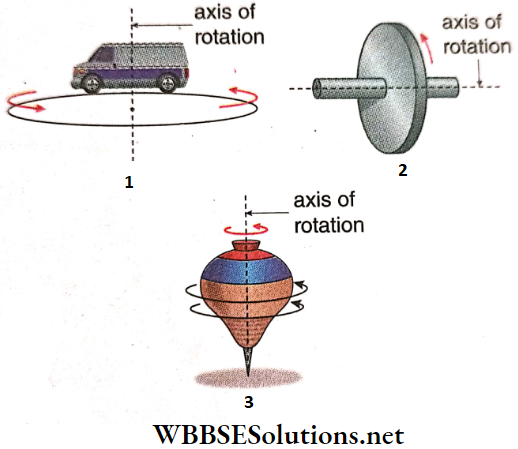
Rotation: When an object moves in a circular path about a fixed point or an axis, the motion is called rotation. The axis is called the axis of rotation. Shows some examples of rotation. However, the axis may be located outside the object.

One Dimensional Motion Rotation

Linear Motion Explained for Class 11

Characteristics Of Rotation:

  1. Each constituent particle of a rotating body rotates by an equal angle in a fixed interval of time.
  2. The Axis of rotation always remains stationary.

Complex Motion: If a body exhibits translational as well as rotational motion simultaneously, then it is said to be in a state of complex motion.

Complex Motion Example:

  1. The wheel of a running car executes a complex motion. The wheel rotates around the axis through its centre (rotation) and moves forward along the road (translation).
  2. The earth rotates around its own axis and at the same time it revolves around the sun following an elliptical path. As the orbit is elliptical the Earth sometimes comes close to the sun and sometimes moves away from it. So, the earth also exhibits a complex motion.

Comparison Between Translation And Rotation:

  1. Translation is motion in a straight line, whereas rotation is a circular motion in a plane.
  2. In translation, the direction of motion is fixed. In rotation, the axis of rotation is fixed.
  3. Translation of each constituent particle of the body is the same during the movement of the body. In rotation, constituent particles of the body at larger distances from the axis of rotation describe larger distances.

One-Dimensional Motion – Some Physical Quantities Related To Motion

Relative to a definite frame of reference, a body may be at rest, or in any form of motion like translation, rotation, vibration etc. For the convenience of the kinematical study of rest and motion of a body, a few important physical quantities are defined. These are the essential properties that represent the states of rest and motion of a body, and their measured values furnish the exact physical state.

Position: Let an object be located at the point A. To measure the position of the object, and express it in a well-defined manner, we have to

One Dimensional Motion Physical Quantities Related To Motion

  1. Choose a reference point, i.e., an origin—tiro point O is this origin.
  2. Measure the linear distance between OA; and
  3. Specify the direction of A relative to the origin O.

This would always lead to statements like: ‘The object A is situated 5 m east of the origin O’, or ‘The object B is 2 m north-east of O’. In short, we may write

⇒ \(\overrightarrow{O A}\) = 5 m towards east; \(\overrightarrow{O B}\) = 2 m to the north-east. These statements define the positions of the objects at A and at B. It is important to note that, each statement includes the magnitude of the linear distance, as well as the direction, relative to the origin.

Position Definition: The position of an object is defined as its linear distance as well as its direction with respect to a preassigned reference point.

Position Is A Vector Quantity: As per the definition, position is a physical quantity having both magnitude and direction. So it is a vector quantity. It is often called the position vector and denoted by the symbol \(\vec{r}\).

In the above examples, the position of A: \(\vec{r_1}\) = 5 in the east; the position of B: \(\vec{r_2}\) = 2 m north-east.

Another interesting point is that to find the position of B relative to A(\(\overrightarrow{A B}\)), a simple numerical calculation, using the values 5m and 2m, is not sufficient. The directions are to be considered as well. This technique leads to a new branch in mathematics, known as vector algebra.

Units And Dimension: The magnitude of the position vector is actually a distance. It has the units of length.

CCS system: cm

SI: m

Similarly, the dimension of the position vector is that of length, i.e., its dimension = L.

Displacement Definition: Displacement is defined as the change in position of a moving body in a fixed direction.

A and B are two fixed points. Many paths may exist between A and B. Three men move from A to B following different paths ACB, ADB and AEB. The lengths of these paths are different.

One Dimensional Motion Displacement

But as the initial and final positions of the men are the same, their displacements are also the same. The length of the minimum distance between A and B, i.e., the rectilinear path ADB is the measure of this displacement.

Magnitude And Direction Of Displacement: The length of the straight line connecting the initial and the final positions of a moving body is the magnitude of its displacement, and its direction is from the initial position to the final position along the straight line joining them. P and R are the initial and the final positions respectively of the body and the paths followed by it are PQ (3 m towards east) and QR (4 m towards north).

One Dimensional Motion magnitude And Direction Of Displacement

As defined, the displacement is  PR and it is independent of the path followed. From the measurements shown, PR =\(\sqrt{3^2+4^2}\) = 5 cm is the magnitude of displacement, and the direction is from P to R, shown by the arrowhead on PR.

Displacement Is A Vector Quantity: Displacement has both magnitude and direction and, hence, it is a vector quantity. It is represented by \(\overrightarrow{P R}\) in this case.

Zero Displacement: If a moving object starting from a point comes finally back to its initial position, then its displacement becomes zero.

Zero Displacement Example: A ball comes back to the hands of a thrower when it is thrown vertically upwards. The displacement of the ball is zero in this case. Hence, it can be concluded that the displacement of a moving object may be zero in spite of it travelling some distance.

Zero displacement is a null vector with magnitude zero and has no fixed direction.

Class 11 Physics Class 12 Maths Class 11 Chemistry
NEET Foundation Class 12 Physics NEET Physics

Geometric Representation Of Displacement: A reference frame helps to measure the magnitude and direction of a displacement. Let us Y consider a two-dimensional cartesian coordinate system where OX and OY are the two axes and O is the origin. Let a particle begin its journey from O and reach the point A(x, y).

The length OA gives the magnitude of the displacement of the particle— OA = \(\sqrt{x^2+y^2} \text {. }\). Now, if \(\overrightarrow{O A}\) makes an angle α with the X-axis, tanα = \(\frac{B A}{O B}\) = \(\frac{y}{x}\). In this case, we can say that the direction of displacement makes an angle α with the X-axis where α = tan-1\(\frac{y}{x}\)

Oscillatory Motion Examples and Applications

One Dimensional Motion Geometric Representation Of Displacement

For any particle in three-dimensional space, the displacement is represented by the straight line joining the initial and the final positions of the particle. If a particle travels from the point P1(x1, y1,z1) to the point P2(x2, y2, z2), then \(\overrightarrow{P_1 P_2}\) represents its displacement. The magnitude of the displacement is given by \(\sqrt{\left(x_2-x_1\right)^2+\left(y_2-y_1\right)^2+\left(z_2-z_1\right)^2} \text {. }\)

One Dimensional Motion Geometric Representation Three Dimnesional Space

Unit And Dimension Of Displacement: The length of a straight line determines the magnitude of displacement. Hence, a unit of length is the unit of displacement and its dimension is the dimension of length i.e., L.

One-Dimensional Motion – Physical Quantities Related To Motion Numerical Examples

Short Answer Questions on Types of Motion

Example 1. A particle moves along a circular path of radius 7 cm. Estimate the distance covered and displacement when the particle

  1. Covers half circular path and
  2. Completes the total circular path once.

Solution:

Given

A particle moves along a circular path of radius 7 cm.

Circumference of the circular path = 2πr = 2 x \(\frac{22}{7}\) x 7 = 44 cm.

  1. When it covers half the circumference, the particle moves from A to B along the path ACB. Hence, distance covered = \(\frac{44}{2}\) = 22 cm. Displacement is the length of straight line AB i.e., the diameter of the circle. Hence, displacement is 2 x 7 = 14 cm from A to B (\((\overrightarrow{A B})\)).
  2. On completion of the total circular path ACB A, the distance covered is equal to the circumference of the circle = 44 cm. As the particle comes back to its initial position, displacement is zero.

One Dimensional Motion Partical Moves Along A Circular Path Of Radius

Example 2. A particle moves 10√3 m towards the east and then 10 m towards the north. Find the magnitude and direction of its displacement.
Solution:

Given

A particle moves 10√3 m towards the east and then 10 m towards the north.

In this case AB = 10√3m, BC = 10m.

The initial and the final positions of the particle are A and C respectively.

One Dimensional Motion Particle Moves Towards East And North

∴ The magnitude of displacement,

A C = \(\sqrt{A B^2+B C^2}\)

= \(\sqrt{300+100}\)

= 20 m

If the angle between AC and AB is θ, then, \(\tan \theta=\frac{B C}{A B}=\frac{10}{10 \sqrt{3}}=\frac{1}{\sqrt{3}}\) or, θ = 30°.

This angle determines the direction of displacement.

Speed Definition: The distance travelled by a body in unit time is called its speed.

Distance is always measured along the path travelled by the moving body, irrespective of whether the path is straight or curved. Hence, if a body travels a length l in time t,

speed(v) = \(\frac{\text { distance travelled }(l)}{\text { time taken }(t)}\)

Speed is a scalar quantity.

Unit And Dimension Of Speed In Different Systems Of Units:

Unit of speed = \(\frac{\text { unit of length of the path travelled }}{\text { unit of time }}\)

CGS System: cm · s-1

SI: m · s-1

Dimension of speed = \(\frac{\text { dimension of distance }}{\text { dimension of time }}=\frac{\mathrm{L}}{\mathrm{T}}=\mathrm{LT}^{-1}\)

Relation Among Different Units: 1 m · s-1 = 100 cm · s-1

Dimension of speed = = k = LT-1

In addition, km · h-1 is also widely used.

1 km · h-1 = \(\frac{1000}{60 \times 60} \mathrm{~m} \cdot \mathrm{s}^{-1}=\frac{5}{18} \mathrm{~m} \cdot \mathrm{s}^{-1} \text {. }\)

For easy recall, 18 km · h-1 = 5 m · s-1.

Average Speed: The speed of a body can be uniform or variable. When a body travels equal distances in equal intervals of time, its speed is uniform.

When distances travelled in equal intervals of time are unequal, the body moves with a variable speed.

For convenience, the average speed is often calculated in case of motion with variable speed. Dividing the total distance travelled by the total time taken to travel the distance, we get the average speed.

Thus if l1, I2, l3 are the distances travelled by an object in times t1, t2 and t3 respectively, then its average speed

= \(\frac{\text { total distance travelled }}{\text { total time taken to travel the distance }}=\frac{l_1+l_2+l_3}{t_1+t_2+t_3} \text {. }\)

The average speed is not an average of speeds.

Instantaneous Speed: The speed of a moving body at any instant is called its instantaneous speed.

Let us consider that a running (rain travels 10 in in 0,5 s. For the motion of a train, this 0.5 s lime Interval Is very small. So, this interval of time may be considered as an instant. Dividing the distance travelled by the train in that short interval of time gives the Instantaneous speed of the train. Hence, the instantaneous speed of the train = \(\frac{10}{0.65}\) = 20 m· s-1.

Instantaneous Speed Definition: The instantaneous speed of a particle at a given point is the limiting value of the rate of the distance travelled with respect to a time when the time interval tends to zero.

Following the rule of differential calculus, if Δt is the time in which the distance travelled is Δl, then the instantaneous speed is

⇒ \(v_i=\lim _{\Delta t \rightarrow 0} \frac{\Delta l}{\Delta t}=\frac{d l}{d t}\)

where l is the distance or location of the particle along its locus from a given fixed point. For a body moving with uniform speed, the instantaneous speed at any instant is equal to the uniform speed.

For example, the speed of a moving car is measured by a speedometer. At any moment, the speedometer reads the instantaneous speed of the car. The pointer of the speedometer remains stationary when the car runs at a uniform speed. That is, the instantaneous speed is equal to the uniform speed of the car. The speedometer fluctuates when the car moves at varying speeds.

Distinction Between Average And Instantaneous Speed:

Average Speed: The total distance covered by a body in a certain interval of time, divided by the time interval is the average speed.

Instantaneous Speed: The rate of infinitesimal distance covered with respect to the corresponding infinitesimal time, is the instantaneous speed.

Velocity Definition: The rate of displacement of a body with time is called its velocity.

In other words, the rate of change of position of any object with respect to time is its velocity.

The change of position, i.e., the displacement is a vector quantity. If s Is the displacement of an object in time t, then,

velocity (v) = \(\frac{\text { displacement }(\mathrm{s})}{\text { time }(t)}\)

Velocity, like displacement, Is also a vector quantity.

Unit And Dimension Of Velocity: since the units of distance covered and of displacement are the same, the units of speed and velocity are also the same.

CGS System: cm · s-1

SI: m · s-1

Dimension of velocity = \(\frac{\text { dimension of displacement }}{\text { dimension of time }}\) = \(\frac{L}{T}\) = LT-1

Therefore, the dimension of velocity is also identical to that of speed.

Uniform And Non-Uniform Velocity: if the velocity of a particle has a constant magnitude and a constant direction it is called uniform velocity. On the other hand, if the velocity of a particle changes with time, either in magnitude or in direction or in both, it is termed as a nonuniform velocity.

Due to gravity, the velocity of a falling body increases in magnitude keeping its direction unchanged. Therefore, the velocity of the body is non-uniform. Again, a car moving with a constant speed along a curved path has a non-uniform velocity due to its continuous change in direction.

A uniform circular motion is an example of a motion with uniform speed but non-uniform velocity.

Real-Life Applications of Linear, Rotary, and Oscillatory Motion

Average Velocity:

Average velocity, (v) = \(\frac{\text { total displacement }(s)}{\text { total time }(t)}\)

i. e., by dividing the total displacement of a particle in a certain interval of time by the time interval, its average velocity is obtained.

‘A stone takes 4 s to reach the ground when dropped from a height of 80 m ’—this statement provides no information about the change in velocity of the stone along the path. But it can be said that the average downward displacement of the stone per second is \(\frac{80}{4}\) or 20 m. So the average velocity of the stone is 20 m · s-1.

Instantaneous Velocity: The velocity of a particle at any moment is called its instantaneous velocity. The instantaneous velocity can be defined similarly to the instantaneous speed.

Instantaneous Velocity Definition: The instantaneous velocity of a particle at a given point is the limiting value of the rate of 1 displacement from that point with respect to time when the time interval tends to zero.

Following the rule of differential calculus, if Δt is the time in which the displacement of any particle is Δs, then the instantaneous velocity is

⇒ \(v_i=\lim _{\Delta t \rightarrow 0} \frac{\Delta s}{\Delta t}=\frac{d s}{d t}\)

where s is the displacement of the particle from the given point.

Comparison Between Average Velocity And Instantaneous Velocity:

  1. Average velocity = \(\frac{\text{total displacment}}{\text{total time}}\) But instantaneous velocity = \(\frac{ds}{dt}\). Indeed, the average velocity in an infinitesimally small interval of time is called the instantaneous velocity.
  2. The instantaneous velocity becomes equal to the average velocity of a particle only if it moves with a uniform velocity. Otherwise, we cannot get any idea about the instantaneous velocities at different points from the average velocity of a particle.
  3. In kinematics, ideas about the equality of velocities, the change in velocity, etc. are very important. The knowledge of the average velocity alone does not give any idea about them. Thus, the concept of instantaneous velocity is more important.

Comparison Between Speed And Velocity:

  1. The rate of distance travelled with time is speed whereas the rate of displacement with time is velocity.
  2. The units and dimensions of distance travelled and of displacement are the same. So the units and dimen¬sion of speed and those of velocity are the same.
  3. Speed is a scalar quantity, but velocity is a vector quantity.
  4. An object moving along a straight line with uniform speed has a uniform velocity as well, i.e., uniform velocity means a uniform speed in a fixed direction.
  5. Uniform velocity always indicates uniform speed, but the converse is not true. A body moving with uniform speed in a curved path has a non-uniform velocity due to a change in its direction.
  6. Speed is always positive or zero, but velocity may also be negative depending on the direction of motion.
  7. The average speed of an object is zero means that the average velocity is zero too but the converse may not be true always.
  8. Instantaneous speed and instantaneous velocity at any point of motion are the same in magnitude and independent of the shape of the path. But if an object follows a curved path, its average speed and average velocity at any interval of time are different in magnitude.

WBCHSE Class 11 Physics Notes For Graphical Representation Of Motion

Graphical Representation Of Motion

WBBSE Class 11 Graphical Representation of Motion Notes

Displacement-time Graph: A graph obtained by plotting t (time) along the x-axis and s, the corresponding distances travelled by a particle along the y-axis is called a distance-time graph. When the corresponding distances (s) are plotted as displacements along the y-axis, the graph is called a displacement-time graph. These graphs represent the changes in position and, hence, the displacement of a particle with time.

One Dimensional Motion Dsiplacement Time Graph

Graphs for a particle

  1. At rest,
  2. In motion with uniform velocity,
  3. In motion with a uniform acceleration and
  4. In motion with non-uniform acceleration

Understanding Position-Time Graphs

One Dimensional Motion In Motion Uniform velocity And Non Uniform Velocity

The point P denotes the displacement OR of the particle in time OQ. In this figure, the gradient of the displacement-time graph determines the velocity of the particle. The straight line has a uniform gradient—so the velocity is uniform.

Read and Learn More: Class 11 Physics Notes

According to the particle is displaced by s2 – s1 = CB in the time interval t2 – t1 = AC.

Therefore, the average velocity of the particle in that interval = of time \(v=\frac{s_2-s_1}{t_2-t_1}=\frac{C B}{A C}=\) gradient of the chord AB.

WBCHSE Class 11 Physics Notes For Graphical Representation Of Motion

To find the instantaneous velocity of the particle at time t1, the time interval (t2 – t1) needs to be infinitesimally small. Hence, the point B is almost superimposed on point A.

In this condition, the gradient of the chord AB becomes equal to the gradient of the tangent drawn at A. Thus, the gradient of the tangent drawn at any point on the displacement-time graph denotes the instantaneous velocity of the particle at the corresponding moment.

Velocity-Time Graphs Explained

Class 11 Physics Class 12 Maths Class 11 Chemistry
NEET Foundation Class 12 Physics NEET Physics

Velocity-time Graph: A velocity-time graph is drawn by plotting time t along the x-axis and velocity v along the y-axis. Show velocity-time graphs for a particle

  1. Moving with a uniform velocity,
  2. Starting from rest and moving with a uniform acceleration,
  3. Starting with an initial velocity of u and accelerating uniformly and
  4. In motion with non-uniform acceleration

One Dimensional Motion Velocity Time Graph

The point B denotes the magnitude of the velocity OC of the particle in time OA. In these figures, the gradient of the velocity-time graph gives the acceleration of the particle. The gradient of CB is zero—so there is no acceleration. But the gradient of OB is positive and uniform—so the acceleration is uniform.

Short Answer Questions on Motion Graphs

  • The area under the velocity time graph and the time axis gives the displacement of the particle.
  • The average acceleration of the particle in the time interval (t2– t1) is equal to the gradient of the chord AB. The graph denotes the motion of a particle moving with non-uniform acceleration.
  • With the help of calculus, it can be shown that for a particle moving with a non-uniform acceleration, its displacement for any interval of time is equal to the area enclosed by the arc denoting the motion, the time interval and the time axis.

WBCHSE Class 11 Physics Notes For Application Of Calculus In Physics

One-Dimensional Motion – Application Of Calculus In Physics

WBBSE Class 11 Calculus in Physics Notes

Calculus In Physics

Calculus is a very important branch of mathematics. In this branch, the main pillar is the infinitesimal magnitudes and a multitude of infinitesimal numbers. There is no better tool in mathematics than calculus to express any physical quantity [which is a quantitative property] in mathematical terms.

Integration In Physics

Modern calculus was developed in the 17th century by Issac Newton and Gottfried Wilhelm Leibniz independently. Calculus is a Latin word; it means ‘small pebble used in an abacus for counting’. The word calculus is also used in Latin as a synonym of counting.

In physics, it is important to know the relation among the variable quantities or how the change in one quantity affects another. There is no other way to analyse without the use of infinitesimal magnitudes and numbers. So, in physics, calculus is an indispensable tool.

Variable And Constant: A variable is a value that may change within the scope of the given problem or set of operations. A constant is a value that remains unchanged. Suppose, a greengrocer has a stock of 10 kg bitter gourd and he sells it at a price of Rs. 16 per kg.

If the seller does not change the price, it is constant. But the quantity of bitter gourd bought by individual buyers and its price are variables, because these may vary from 0 kg to 10 kg and from Rs. 0 to Rs. 160.

Real Variable And Complex Variable: A variable to which only real numbers are assigned as values is called a real variable. A variable which can take on the value of a complex number is called a complex variable.

Any complex variable has two parts—the real part and the imaginary part. Suppose z(=x+ iy) is a complex variable. For this variable, x and iy are the real and imaginary parts respectively. Here, x and y are real variables and i = √-1 is unit imaginary number or the imaginary unit.

Read and Learn More: Class 11 Physics Notes

We will mainly be using real variables in our discussion.

Key Applications of Calculus in Physics

Function-Independent Variable And Dependent Variable: Any function relates to two variables or variable quantities. Of these, one is a dependent variable and the other, is an independent variable. Suppose a relation is expressed as y = f(x). We read the equation as y is a function of x. Here y and x are dependent and independent variables respectively. We generally express any functional relation as:

y = f(x) = ax²+ bx+ c or, y(x) = ax² + bx+ c

or, y = ax² + bx+ c [generally ‘(x) ’ is not written].

Here, if a, b and c are constants, then for any value of x, we can calculate the corresponding value of y.

Function: If we get only one value of a dependent variable y for a single value of independent variable x, then we can say y is a function of x. Calculus is based on such functions, y = x is a functional relation. But y² = x is not a functional relation. Actually, y² = x consists of two functions y = √x and y = -√x.

WBCHSE Class 11 Physics Notes For Application Of Calculus In Physics

Differentiation and Its Applications in Physics

Differentiation: Suppose, y = f(x) is a functional relation, where x and y are respectively the independent and dependent variables. If x increases to x+ Δx i.e., if the increment of x is Δx, then y changes to y + Δy i.e., the increment of y is Δy.

One Dimensional Motion Differentiaition

So we can write it as an equation: Δy = f(x+Δx)- f(x)

Dividing both sides by Δx, we get \(\frac{\Delta y}{\Delta x}=\frac{f(x+\Delta x)-f(x)}{\Delta x}\)….(1)

= the change of y caused by a unit change of x.

Now, if Δx → 0, (i.e., the value of Δx tends towards zero or the value x is very small) we can write \(\frac{\Delta y}{\Delta x}\) as

⇒ \(\lim _{\Delta x \rightarrow 0} \frac{\Delta y}{\Delta x}=\frac{d y}{d x}=f^{\prime}(x)\)….(2)

[we read \(\lim _{\Delta x \rightarrow 0}\)  as : limit Δx tends to zero]

If Δx → 0, then the limiting value of \(\frac{\Delta y}{\Delta x}\) is expressed as \(\frac{dy}{dx}\) or f'(x). \(\frac{dy}{dx}\) or f'(x) is “the derivative of y with respect to x”. Actually, \(\frac{dy}{dx}\) is the rate of change of y with respect to x.

Integration Techniques for Physics Problems

Integrals In Physics

The process of determining the derivative is called differentiation. It must be remembered that \(\frac{dy}{dx}\) does not mean dividing dy by dx. It is only the symbol of the limiting process which is shown in equation (2).

It is to be mentioned that, when Δx → 0, the straight line A’B’ is the tangent to the curve y = f(x) at a point A and θ = θ’. Besides \(\frac{dy}{dx}\) or f'(x), we can also express the derivative of y with respect to x with the symbols — y’ or y1 or Dy or \(\frac{d}{dx}\)(y) or \(\frac{d}{dx}\){f(x)}.

The Meaning Of Δx → 0: The value of Δx tending to 0 means that the value of Δx is never exactly 0. Whatever value is close to zero we may imagine, the value of Δx will be even closer to zero. Suppose we imagine a value 0.00001 (or -0.00001) which is nearly 0. In that case, Δx can assume any value between 0.00001 to 0 (or -0.00001 to 0).

Slope: If we consider two points A(x1,y1) and B(x2,y2) on a straight line (line number 1) on a plane xy, then the slope of the straight line

m = \(\frac{y_2-y_1}{x_2-x_1}=\tan \theta\)

One Dimensional Motion Slope

Now, instead of a straight line if we consider a curve (line number 2) then the slope is not equal at all the points on the curve. To measure the slope we need to take two points within a very small distance.

The curve between these two points is considered to be a part of a straight line. If the coordinates of these two points P and Q are (x, y) and (x+ dx, y+dy) respectively, then the slope of the curve at the point (x, y) is

m = \(\frac{(y+d y)-y}{(x+d x)-x}=\frac{d y}{d x}\)

So we can say, the slope of the curve on a plane xy at a point (x, y) = \(\frac{dy}{dx}\)

Derivatives Of Algebraic Functions

  1. \(\frac{d}{d x}\left(x^n\right)=n x^{n-1}\)
  2. \(\frac{d}{d x}\left(a x^n\right)=a n x^{n-1}\)
  3. \(\frac{d}{d x}\left(a^x\right)=a^x\) ln a [we can write \(\log _e a\) as ln a]
Class 11 Physics Class 12 Maths Class 11 Chemistry
NEET Foundation Class 12 Physics NEET Physics

Derivatives Of Trigonometric Functions

  1. \(\frac{d}{d x}(\sin x)=\cos x\)
  2. \(\frac{d}{d x}(\cos x)=-\sin x\)
  3. \(\frac{d}{d x}(\tan x)=\sec ^2 x\)
  4. \(\frac{d}{d x}(\cot x)=-{cosec}^2 x\)
  5. \(\frac{d}{d x}(\sec x)=\sec x \tan x\)
  6. \(\frac{d}{d x}{cosec} x=-{cosec} x \cot x\)
  7. \(\frac{d}{d x}(\sin a x)=a \cos a x\)
  8. \(\frac{d}{d x}(\cos a x)=-a \sin a x\)

Derivatives Of Inverse Trigonometric Or Cyclometric Functions:

  1. \(\frac{d}{d x}\left(\sin ^{-1} x\right)=\frac{1}{\sqrt{1-x^2}}(|x|<1)\)
  2. \(\frac{d}{d x}\left(\cos ^{-1} x\right)=\frac{-1}{\sqrt{1-x^2}}(|x|<1)\)
  3. \(\frac{d}{d x}\left(\tan ^{-1} x\right)=\frac{1}{1+x^2}\)
  4. \(\frac{d}{d x}\left(\cot ^{-1} x\right)=\frac{-1}{1+x^2}\)
  5. \(\frac{d}{d x}\left(\sec ^{-1} x\right)=\frac{1}{x \sqrt{x^2-1}}(|x|>1)\)
  6. \(\frac{d}{d x}\left({cosec}^{-1} x\right)=\frac{-1}{x \sqrt{x^2-1}}(|x|>1)\)

Derivatives Of Logarithmic And Exponential Functions:

  1. \(\frac{d}{d x}\left(\log _e x\right)=\frac{1}{x}\)
  2. \(\frac{d}{d x}\left(\log _a x\right)=\frac{1}{x} \log _a e\)
  3. \(\frac{d}{d x}\left(e^x\right)=e^x\)
  4. \(\frac{d}{d x}\left(e^{a x}\right)=a e^{a x}\)

Basic Properties Of Differentiation:

Derivative Of A Constant: If f(x) = c (constant) \(\frac{d}{d x}\{f(x)\}=\frac{d c}{d x}=0\)

Derivative Of The Sum Or Difference Of Two Functions: If f(x) = g(x)±h(x) then, \(\frac{d}{d x}\{f(x)\}=\frac{d}{d x}\{g(x) \pm h(x)\}=\frac{d g}{d x} \pm \frac{d h}{d x}\)

Derivative Of The Sum Or Difference Of Two Functions Example:

y = \(\frac{6 x^6+8 x^2-2}{x^3} \text { or, } y=\frac{6 x^6}{x^3}+\frac{8 x^2}{x^3}-\frac{2}{x^3}\)

or, \(y=6 x^3+8 x^{-1}-2 x^{-3}\)

∴ \(\frac{d y}{d x}=\frac{d}{d x}\left(6 x^3\right)+\frac{d}{d x}\left(8 x^{-1}\right)-\frac{d}{d x}\left(2 x^{-3}\right)\)

= \(6 \times 3 x^{3-1}+8(-1) x^{-1-1}-2(-3) x^{-3-1}\)

= \(18 x^2-8 x^{-2}+6 x^{-4}\)

Real-Life Applications of Calculus in Physics

Derivative Of The Product Of Two Functions:

If f(x) = g(x)h(x) then, \(\frac{d}{d x}\{f(x)\}=\frac{d}{d x}\{g(x) h(x)\}=g \frac{d h}{d x}+h \frac{d g}{d x}\)

Derivative Of The Product Of Two Functions Example:

y = \((3 x-7)(5-6 x)\)

∴ \(\frac{d y}{d x}=(3 x-7) \frac{d}{d x}(5-6 x)+(5-6 x) \frac{d}{d x}(3 x-7)\)

= \((3 x-7)(-6)+(5-6 x)(3)\)

= \(-18 x+42+15-18 x=-36 x+57\)

Derivative Of The Ratio Of Two Functions:

If f(x)= \(\frac{g(x)}{h(x)}\) then, \(\frac{d}{d x}\{f(x)\}=\frac{d}{d x}\left\{\frac{g(x)}{h(x)}\right\}=\frac{h \frac{d g}{d x}-g \frac{d h}{d x}}{h^2}\)

Derivative Of The Ratio Of Two Functions Example:

y = \(\frac{(2 x+1)(3 x-1)}{x+5}=\frac{6 x^2+x-1}{x+5}\)

∴ \(\frac{d y}{d x}=\frac{(x+5) \frac{d}{d x}\left(6 x^2+x-1\right)-\left(6 x^2+x-1\right) \frac{d}{d x}(x+5)}{(x+5)^2}\)

= \(\frac{6 x^2+60 x+6}{(x+5)^2}=\frac{6\left(x^2+10 x+1\right)}{(x+5)^2}\)

= \(\frac{6 x^2+60 x+6}{(x+5)^2}=\frac{6\left(x^2+10 x+1\right)}{(x+5)^2}\)

Chain Rule Of Differentiation: If f(x) = x = g(z) then, \(\frac{d y}{d z}=\frac{d y}{d x} \cdot \frac{d x}{d z}\)…..(3)

Chain Rule Of Differentiation Example:

y = \(u^5 \text { and } u=x^2+3\)

∴ \(\frac{d y}{d u}=5 u^4=5\left(x^2+3\right)^4 \text { and } \frac{d u}{d x}=2 x\)

∴ \(\frac{d y}{d x}=\frac{d y}{d u} \cdot \frac{d u}{d x}=5\left(x^2+3\right)^4 \cdot 2 x\)

= \(10 x\left(x^2+3\right)^4\)

We can also express y = f(x) as x = g(y). In that case, if the value of \(\frac{dy}{dx}\) is nor 0, then from equation (3), we get

1 = \(\frac{d y}{d x} \cdot \frac{d x}{d y} \text { or, } \frac{d y}{d x}=\frac{1}{\frac{d x}{d y}}\)

Second Order Derivative: Second order derivative means, the derivative of the derivative of the function y = f(x) and it is written as \(\frac{d}{d x}\left(\frac{d y}{d x}\right) \text { or, } \frac{d^2 y}{d x^2}\)

Second Order Derivative Example:

x = \(3 \cos \pi t+4 \sin \pi t\)

∴ \(\frac{d x}{d t}=3(-\sin \pi t) \pi+4(\cos \pi t) \pi\)

= \(-3 \pi \sin \pi t+4 \pi \cos \pi t\)

∴ \(\frac{d^2 x}{d t^2}=-3 \pi(\cos \pi t) \pi+4 \pi(-\sin \pi t) \pi\)

= \(-\pi^2(3 \cos \pi t+4 \sin \pi t)=-\pi^2 x\)

Integration: Integration is the inverse process of differentiation. Suppose f(x) is a function of x and \(\frac{d}{dx}\){f(x)} = F(x)

i. e., the derivative of f(x) with respect to x is F(x), and F(x) is also a function of x.

It may be said that the integral of F(x) with respect to x is f(x) and it can be expressed by the equation

∫F(x)dx = f(x)…..(1)

F(x) is called the integrand. ‘ ∫ ’ and ‘dx’ are the symbols of integration.

Constant Of Integration: it is known, \(\frac{d}{d x}\left(x^5\right)=5 x^4\)

and \(\frac{d}{d x}\left(x^5+c\right)=5 x^4\) [as c is a constant]

So, the derivatives of functions x5 and x5 + c are the same. Then the integration of 5x4 should be written in general as x5 + c because here c is a constant and when c = 0, we get the function x5.

So, \(\int 5 x^4 d x=5 \cdot \frac{x^{4+1}}{4+1}+c=x^5+c\)

This constant c is called the integration constant. As this constant is indefinite, it is called the indefinite integration constant.

Definite Integral: For definite integral, equation number (1) can be written as \(\int_a^b F(x) d x=f(b)-f(a)\).

So, if the value of x changes from a to b, then the value of f(x) changes by f(b)-f(a). This [f(b) -f(a)] is called the definite integral of F(x) within the limits a and b. Here b is called the upper limit and a is called the lower limit.

One Dimensional Motion Define Intergral

The definite integral can be described as the area under the curve, \(\int_a^b f(x) d x\) is the area confined within the lines y = f(x), x-axis, x = a and x = b i.e., this area may be written as

area = \(\lim _{\Delta x_i \rightarrow 0} \sum_i f\left(x_i\right) \Delta x_i=\int_a^b f(x) d x\)

The symbol of integration i.e., ‘∫’ comes from the first letter of ‘summation1 and it is written as ‘long S’.

Basic Properties Of Integration

Integration Of The Product Of A Function And A Constant: If f(x) = ag(x) then ∫f(x)dx = ∫ag(x)dx = a∫g(x)dx

Integration Of The Sum Or Difference Of Two Functions: If f(x) = g(x)±h(x) then, ∫f(x)dx =∫{g(x)±h(x)}dx

=∫g(x)dx ± ∫h(x)dx

Integration Of The Product Of A Function And A Constant Example: \(f(x)=3 x^4-6 x^2+8 x-5\)

∴ \(\int f(x) d x=\int 3 x^4 d x-\int 6 x^2 d x+\int 8 x d x-\int 5 d x\)

= \(3 \times \frac{x^{4+1}}{4+1}-6 \times \frac{x^{2+1}}{2+1}+8 \times \frac{x^{1+1}}{1+1} -5 \times \frac{x^{0+1}}{0+1}+c\)

= \(\frac{3}{5} x^5-2 x^3+4 x^2-5 x+c\)

Interchange Of Upper Limit And Lower Limit Of A Definite Integral: \(\int_a^b f(x) d x=-\int_b^a f(x) d x\)

Interchange Of Upper Limit And Lower Limit Of A Definite Integral Example:

⇒\(\int_1^2 x^2 d x=\left[\frac{x^3}{3}\right]_1^2=\frac{8}{3}-\frac{1}{3}=\frac{7}{3}\)

But, \(\int_2^1 x^2 d x=\left[\frac{x^3}{3}\right]_2^1=\frac{1}{3}-\frac{8}{3}=-\frac{7}{3}\)

∴ \(\int_1^2 x^2 d x=-\int_2^1 x^2 d x\)

Short Answer Questions on Calculus in Physics

Insertion Of Any Intermediate Limit Between The Upper And Lower Limits: \(\int_a^b f(x) d x=\int_a^c f(x) d x+\int_c^b f(x) d x\)

[c may be greater or less than both the upper and lower limits b and a]

Insertion Of Any Intermediate Limit Between The Upper And Lower Limits Example: \(\int_0^{\frac{\pi}{2}} \cos x d x=[\sin x]_0^{\pi / 2}=\sin \frac{\pi}{2}-\sin 0=1\)

Again \(\int_0^{\frac{\pi}{4}} \cos x d x+\int_{\frac{\pi}{4}}^{\frac{\pi}{2}} \cos x d x\)

= \([\sin x]_0^{\pi / 4}+[\sin x]_{\pi / 4}^{\pi / 2}\)

= \(\sin \frac{\pi}{4}-\sin 0+\sin \frac{\pi}{2}-\sin \frac{\pi}{4}=1\)

∴ \(\int_0^{\frac{\pi}{2}} \cos x d x=\int_0^{\frac{\pi}{4}} \cos x d x+\int_{\frac{\pi}{4}}^{\frac{\pi}{2}} \cos x d x\)

Integrals Of Algebraic Functions:

  1. \(\int x^n d x=\frac{x^{n+1}}{n+1}+c(n \neq-1)\)
  2. \(\int a x^n d x=a \int x^n d x=\frac{a x^{n+1}}{n+1}+c(n \neq-1)\)
  3. \(\int \frac{d x}{x}={m}|x|+c\)
  4. \(\int a^{m x} d x=\frac{a^{m x}}{m \ln a}+c \quad(a>0, a \neq 1)\)

Integrals Of Trigonometric Functions:

  1. \(\int \sin x d x=-\cos x+c\)
  2. \(\int \cos x d x=\sin x+c\)
  3. \(\int \tan x d x=\ln |\sec x|+c\)
  4. \(\int \cot x d x=\ln |\sin x|+c\)
  5. \(\int \sec x d x=\ln |\sec x+\tan x|+c=\ln \left|\tan \left(\frac{\pi}{4}+\frac{x}{2}\right)\right|+c\)
  6. \(\int {cosec} x d x=\ln |{cosec} x-\cot x|+c=\ln \left|\tan \frac{x}{2}\right|+c\)
  7. \(\int \sin m x d x=-\frac{\cos m x}{m}+c\)
  8. \(\int \cos m x d x=\frac{\sin m x}{m}+c\)
  9. \(\int \sec ^2 x d x=\tan x+c\)
  10. \(\int {cosec}^2 x d x=-\cot x+c\)
  11. \(\int \sec x \tan x d x=\sec x+c\)
  12. \(\int {cosec} x \cot x d x=-{cosec} x+c\)

Integrals Of Logarithmic And Exponential Functions:

  1. \(\int \ln a x d x=x(\ln a x-1)+c\)
  2. \(\int e^x d x=e^x+c\)
  3. \(\int e^{m x} d x=\frac{e^{m x}}{m}+c\)

WBCHSE Class 11 Physics Notes For Reference Frame

One-Dimensional Motion Rest And Motion

WBBSE Class 11 Reference Frame Notes

Rest: When a body does not change its position with time, the body is said to be at rest. for example, buildings roads, trees, etc. appear to be in rest.

Motion: When a body changes its position with time, the body is said to be in motion. A moving ear, an aeroplane flying in the air, the earth revolving around the sun, etc. are examples of moving objects.

Absolute Rest: The earth revolves around the sun and also simultaneously spins on its own axis. It is therefore classified as a moving object. So the plants and buildings on Earth which seem to be at rest are actually in states of motion, with respect to the sun and other heavenly bodies.

The sun is also in motion with respect to other stars in our galaxy. Different galaxies are also in motion with respect to one another. Hence, nothing can be identified to be in absolute rest in the universe. Rest is the apparent state of an object.

Absolute Motion: The motion of an object with respect to other bodies or objects at absolute rest (if it exists) can be defined as absolute motion. But, a body in absolute rest is yet to be known; hence absolute motion too, of an object, cannot be identified.

Read and Learn More: Class 11 Physics Notes

One-Dimensional Motion Reference Frame

Applications of Reference Frames in Physics

We just realised that the concepts of absolute rest and absolute motion are physically meaningless. As a consequence, the states of rest and motion of a body are always studied with respect to some other body in the surroundings. This ‘some other body’ provides the frame of reference.

Suitable Reference Frame: For the study of the position or motion of different objects in nature, a number of different reference frames are available. In every individual case, only one of those reference frames is chosen and that choice is entirely determined by convenience and simplicity of the study of rest and motion.

A few examples are:

  1. Motion Of The Earth: The sun is the most convenient reference frame. Here, the sun is considered to be at rest, and the motion of the Earth and the other planets is studied with reference to the sun.
  2. Motion Of Objects On The Earth: Here, the Earth provides the most convenient stationary frame of reference. It then becomes easy to study the rest and motion of almost everything around us that we observe in our daily life.
    • Actually, we instinctively take the earth as stationary and use it as the most advantageous reference frame in our day-to-day observations. When we say that ‘the car is at rest’ or ‘the train is moving’, the reference frame is obviously the earth; we even feel it unnecessary to specify the reference frame at all.
  3. Motion Inside A Running Train: The states of passen¬gers sitting or moving inside a train compartment can be best described by taking the train itself as a stationary frame of reference.
    • It may be noted that, for the study of rest and motion of any object, the choice of any one of the different reference frames is physically allowed. But obviously, every reference frame is not equally convenient.
    • For example, the sun may be chosen as the reference frame to study the motion of a car on the Earth. But then, the study would be highly complicated and therefore the choice would be impractical.
    • Any state of rest or motion is relative. A body at rest in one reference frame may be in motion with respect to another frame of reference. This is in accordance with the concept that, all motions in the universe are relative, as there exists no absolute rest or absolute motion.
    • Once a reference frame is conveniently chosen, we come to the task of measurements. For example, we may have to measure the position, velocity, acceleration etc. of a moving body at any instant of time. For this purpose, the reference frame should initially be assigned with an origin, some reference axes and some reference coordinates.
    • This assignment is different in different types of use; accordingly, the measuring systems are classified as cartesian, plane polar, spherical polar, cylindrical etc. Loosely, the systems are called cartesian reference frames, polar reference frames etc, but it is important to note that there are often different ways of representing the same frame of reference.

Cartesian Frame Of Reference: The reference frame invented by the French mathematician Descartes is called the cartesian reference frame or cartesian coordinate system.

One-dimensional Reference Frame: The instantaneous position of a particle moving in a straight line, can be specified conveniently and sufficiently by the distance x of the particle P from a fixed point O along the straight path OX. The motion in such a case is one-dimensional motion and the line OX is a one-dimensional frame of reference.

One Dimensional Motion One Dimesional Reference Frame

Two-dimensional Reference Frame: To denote the position of a particle on a plane, two mutually perpendicular axes OX and OY are taken. In this case, the position of the particle P is uniquely expressed by the coordinates (x, y). The reference frame, constituted of the X and Y axes, is called a two-dimensional frame of reference.

If r is the linear distance of the particle P from the origin O at any instant, r = OP = \(\sqrt{O A^2+A P^2}=\sqrt{x^2+y^2}\)

WBCHSE Class 11 Physics Notes For Reference Frame

The motion of a particle on a fixed plane is called two-dimensional motion. The two-dimensional motion of a particle cannot be described by less than two coordinates, x and y.

Graphical Representation of Motion in Different Frames

One Dimensional Motion Two Dimensional Reference Frame

Understanding Inertial and Non-Inertial Frames

Three-dimensional Reference Frame: This is obtained by drawing three perpendicular lines OX, OY and OZ from a chosen origin O. The position of a particle P in space is completely expressed by the coordinates (x, y, z). This system is known as a three-dimensional reference frame. The linear distance of a particle P from the origin O, is given by r = \(\sqrt{x^2+y^2+z^2}\).

The motion of a particle in a three-dimensional space is called three-dimensional motion. The three-dimensional motion of a particle cannot be described by less than three coordinates, x, y and z.

Polar Frame Of Reference: This is an alternative choice of frame for the two-dimensional motion of particles.

In this reference frame, the position of the particle P is determined in terms of

  1. Its linear distance r, from the origin (or pole) O, and
  2. The polar angle θ, that the line joining OP subtends with the polar axis OX. The coordinates of P are taken as (r, θ).

One Dimensional Motion Polar Frame Of Reference

If the coordinates of P in the cartesian frame of reference are (x, y), then we can write, x = rcosθ, y = rsinθ

∴ r = \(\sqrt{x^2+y^2} \text { and } \tan \theta=\frac{y}{x}\)

The polar coordinates of any point are related to the cartesian coordinates by the above equations.

Class 11 Physics Class 12 Maths Class 11 Chemistry
NEET Foundation Class 12 Physics NEET Physics


Real-Life Examples of Inertial and Non-Inertial Frames

Spherical Frame Of Reference: In this frame of reference, which is three-dimensional, the position of the particle P is denoted by

  1. The linear distance r of the particle from the origin or pole O,
  2. The angle θ between the line OP and the Z-axis and
  3. The angle ø between OP’ (projection of OP on the XY plane) and the X-axis. Hence the coordinates of P are denoted by (r, θ, ø), and they are called the spherical polar coordinates.

Note that while r is a linear coordinate, θ and ø are angular coordinates. θ and ø are called polar angle and azimuthal angle respectively. If it is necessary to define a unique set of spherical coordinates for each point, one must restrict their ranges. The ranges of the three coordinates are —r ≥ 0, 0°≤θ<180° (πradian), 0°≤ø≤360° (2π radian).

One Dimensional Motion Spherical Frame

Spherical Frame Of Reference Example: The latitude and longitude of a place on the earth are the angular coordinates of that place. Actually, if the sphere is the earth and the axis OZ passes through the north pole, then for a place P on the earth’s surface, latitude = 90° – θ and longitude = ø. The direction of the axis OX is defined in such a way that the longitude of Greenwich, London is ø = 0.

WBCHSE Class 11 Physics Circular Motion Very Short Answer Questions

Circular Motion Very Short Answer Type Questions

Very Short Answer Questions on Circular Motion for Class 11

Question 1. Name the unit of angular displacement.
Answer:

The unit of angular displacement

Degree or radian

Question 2. State true or false—an angle measured in radians is dimensionless.
Answer: True

Read And Learn More WBCHSE Class 11 Physics Very Short Question And Answers

Question 3. What kind of vector is angular velocity?
Answer: Axial vector

Question 4. What is the angular velocity of the second hand of a clock?
Answer:

The angular velocity of the second hand of a clock

10.105 rad · s-1

Question 5. Uniform circular motion is an example of uniform velocity’—state whether the statement is correct.
Answer: No

Question 6. What do you mean by the term frequency?
Answer:

Frequency

Complete rotation number per second

WBCHSE Class 11 Physics Circular Motion Vsaqs

Question 7. What is the relation between time period and frequency?
Answer:

Relation between time period and frequency

v = \(\frac{1}{T}\)

Question 8. What is the dimension of angular acceleration?
Answer:

Dimension of angular acceleration

T-2

Quetsion 9. 1 rps = ______ rpm = _______ rph
Answer: 60, 3600

Question 10. 1 rpm =? rad · s-1
Answer: π/30

Question 11. What is the vector relation of linear acceleration \(\vec{a}\) and angular acceleration (\(\vec{alpha}\))?
Answer: \(\vec{a}\) = \(\vec{alpha}\) x \(\vec{r}\)

Question 12. In the case of uniform circular motion, the velocity and the acceleration are perpendicular to each other. [State true or false]
Answer: True

Question 13. What is the angular velocity of the minute hand of a clock in rad •· s-1?
Answer: π/1800

Key Terms in Circular Motion: Very Short Answers

Question 14. If the frequency of revolution of a body is n, then what will be the velocity of revolution?
Answer: ω = 2πn

Question 15. A particle of mass m is moving in a circular path of radius r with a uniform speed v. The centripetal force on the body is \(\frac{m \omega^2}{r}\). When the particle is displaced half of the distance, then what is the work done by the centripetal force?
Answer: Zero

Question 16. What does supply the necessary centripetal force when a stone tied with a string is rotated along a circular Path?
Answer: Tension in the string

Question 17. What does provide a planet the necessary centripetal force to revolve around the sun?
Answer: The gravitational force of the sun

Question 18. If a particle moves in a circular path with constant speed, what should be the direction of its resultant acceleration?
Answer: Towards the centre

Question 19. In the case of railway tracks, which rail is to be kept at a slightly higher level near a bend?
Answer: Outer rail

Class 11 Physics Class 12 Maths Class 11 Chemistry
NEET Foundation Class 12 Physics NEET Physics

Question 20. The radius of a curved path is r and the coefficient of friction between a car and the path is μ. What is the maximum speed at which the car can turn at a bend without skidding?
Answer: \(V_m=\sqrt{\mu r g}\)

Question 21. Is it possible for a cyclist to lean through an angle of 45° with the vertical when he takes a turn?
Answer: No

Question 22. Why is a centripetal force so-called?
Answer: It is centre-seeking

Common Concepts in Circular Motion: Short Answers

Question 23. For uniform circular motion, does the direction of the centripetal force depend on the sense of rotation (i.e., clockwise or anti-clockwise)?
Answer: No

Question 24. A body is moving along a circular path such that its speed always remains constant. Should there be a force acting on the body?
Answer: Yes

Question 25. What type of acceleration does a body moving along a circular path possess?
Answer: Centripetal

Question 26. A piece of stone is tied with a thread and is rotated along a horizontal circular path. If the thread snaps suddenly, in which direction will the stone fly?
Answer: Tangentially

Question 27. What supplies the necessary centripetal force to the electrons in an atom to revolve around the nucleus?
Answer: Electrostatic force of attraction

Question 28. When a car turns towards the right while moving, the passengers inside the car lean towards _______.
Answer: Left

Question 29. To avoid an accident of a moving car near a bend, _______ force is supplied by banking the road.
Answer: Centripetal

Examples of Circular Motion with Very Short Answers

Question 30. A cyclist is riding on a cycle with speed v and while negotiating a circular path of radius r, he leans at an angle θ with the ground. Then, what will be the value of tanθ?
Answer: \(\frac{rg}{v^2}\)

Question 31. The angular momentum of a body of mass m rotating along a circular path of radius r with uniform speed is L. What is the magnitude of the centripetal force acting on it?
Answer: \(\frac{L^2}{mr^3}\)

Question 32. When a motor car moves speedily on a convex path, how do the passengers inside the car feel?
Answer: Lighter

Question 33. At which plane on earth, the centripetal force is maximum?
Answer: Equatorial plane

Question 34. Due to which type of force butter comes out during stirring of milk?
Answer: Centrifugal

Question 35. A body of mass m is rotated along a circular path of radius r with uniform speed v. Centripetal force acting on the body is \(\frac{m v^2}{r}\). If the body travels through a semicircular path, then what will be the work done by the centripetal force?
Answer: Zero

WBCHSE Class 11 Physics Circular Motion Multiple Choice Questions

WBCHSE Class 11 Physics Circular Motion MCQs

Circular Motion Multiple Choice Questions And Answers

Question 1. A wheel is rotating 300 times per minute. The angular velocity of the wheel in rad • s-1 unit is

  1. 10π
  2. 20π
  3. 30π

Answer: 1.10π

Question 2. Two bodies of masses m1 and m2 are moving at uniform speed along circular paths of radii r1 and r2 respectively. If they take equal time to describe the circles completely, the ratio of their angular velocities will be

  1. \(\frac{r_1}{r_2}\)
  2. \(\frac{m_1}{m_2}\)
  3. \(\frac{m_1 r_1}{m_2 r_2}\)
  4. 1

Answer: 4. 1

WBCHSE Class 11 Physics Circular Motion Multiple Choice Questions

Question 3. If a body travels along a circular path with uniform speed then its acceleration

  1. Acts along its circumference
  2. Acts along its tangent
  3. Acts along its radius
  4. Is zero

Answer: 3. Acts along its radius

Question 4. After switching on a ceiling fan it completes 10 resolutions in 3 s. The number of complete resolutions it will perform in the next 3 s (assuming uniform angular acceleration) is

  1. 10
  2. 20
  3. 30
  4. 40

Answer: 3. 30

WBCHSE Class 11 Physics Circular Motion MCQs 

Question 5. If a wheel revolves 120 times per minute then its angular velocity in rad · s-1 unit is

  1. π²
  2. 2π²
  3. 4π²
  4. 8π²

Answer: 2. 2π²

Circular Motion MCQs for Class 11 WBCHSE

Question 6. The angular velocity of the hour hand of a clock is

  1. \(\frac{\pi}{30} \mathrm{rad} \cdot \mathrm{s}^{-1}\)
  2. \(2 \pi \mathrm{rad} \cdot \mathrm{s}^{-1}\)
  3. \(\frac{\pi}{1800} \mathrm{rad} \cdot \mathrm{s}^{-1}\)
  4. \(\frac{\pi}{21600} \mathrm{rad} \cdot \mathrm{s}^{-1}\)

Answer: 4. \(\frac{\pi}{21600} \mathrm{rad} \cdot \mathrm{s}^{-1}\)

Question 7. If a particle rotates along a circular path of radius 25 cm with a frequency of 2 rps, its linear acceleration in m · s-2 unit is

  1. π²
  2. 2π²
  3. 4π²
  4. 8π²

Answer: 3.

Question 8. An artificial satellite takes 90 minutes to complete its revolution around the Earth. The angular speed of the satellite is

  1. \(\frac{\pi}{1800} \mathrm{rad} \cdot \mathrm{s}^{-1}\)
  2. \(\frac{\pi}{2700} \mathrm{rad} \cdot \mathrm{s}^{-1}\)
  3. \(\frac{2 \pi}{2700} \mathrm{rad} \cdot \mathrm{s}^{-1}\)
  4. \(\frac{\pi}{45} \mathrm{rad} \cdot \mathrm{s}^{-1}\)

Answer: 2. \(\frac{\pi}{2700} \mathrm{rad} \cdot \mathrm{s}^{-1}\)

Question 9. The driver of a truck suddenly finds a wall in front of him. To avoid collision with the wall he should

  1. Apply brake at once
  2. Turn speedily in a circular path
  3. Follow both the processes 1 and 2
  4. Do none of the above processes

Answer: 1. Apply brake at once

Question 10. Which of the following quantities does not remain constant in a uniform circular motion?

  1. Speed
  2. Momentum
  3. Kinetic energy
  4. Mass

Answer: 2. Momentum

WBCHSE Class 11 Physics Circular Motion MCQs 

Question 11. The angular velocity of a particle, \(\vec{w}=3 \hat{i}-4 \hat{j}+\hat{k}\) and its position vector, \(\vec{r}=5 \hat{i}-6 \hat{j}+6\hat{k}\). What is the linear velocity of the particle?

  1. \(-18 \hat{i}+13 \hat{j}+2 \hat{k}\)
  2. \(18 \hat{i}-13 \hat{j}-2 \hat{k}\)
  3. \(-18 \hat{i}-13 \hat{j}+2 \hat{k}\)
  4. \(18 \hat{i}+13 \hat{j}-2 \hat{k}\)

Answer: 3. \(-18 \hat{i}-13 \hat{j}+2 \hat{k}\)

Class 11 Physics Class 12 Maths Class 11 Chemistry
NEET Foundation Class 12 Physics NEET Physics

Question 12. The ratio of angular speeds of the minute hand and hour hand of a watch is

  1. 1:12
  2. 6:1
  3. 12:1
  4. 1:6

Answer: 3. 12:1

Question 13. A panicle moves with constant angular velocity in a circle. During the motion its

  1. Energy is conserved
  2. Momentum is conserved
  3. Energy and momentum both are conserved
  4. None of the above

Answer: 1. Energy is conserved

Sample MCQs on Centripetal Force and Acceleration

Question 14. The angular speed of a flywheel making 360 revolutions per minute is

  1. 12 π rad · s-1
  2. 6 π rad · s-1
  3. 3 π rad · s-1
  4. 2 π rad · s-1

Answer: 1. 12π rad · s-1

Question 15. A car moves on a circular road. It describes equal angles about the centre in equal intervals of time. Which of the following statements about the velocity of the car is true?

  1. The magnitude of velocity is not constant
  2. Both magnitude and direction of velocity change
  3. Velocity is directed towards the centre of the circle
  4. The magnitude of velocity is constant but the direction changes

Answer: 4. Magnitude of velocity is constant but the direction changes

Class 11 Physics Circular Motion Multiple Choice Questions WBCHSE 

Question 16. A wheel of radius R rolls on the ground with a uniform velocity v. The velocity of the topmost point relative to the bottommost point is

  1. v
  2. 2v
  3. \(\frac{v}{2}\)
  4. Zero

Answer: 2. 2v

Question 17. The angle with which a cyclist leans with the horizontally while turning a curved path of radius r with speed v is

  1. \(\theta=\tan ^{-1} \frac{v^2}{r g}\)
  2. \(\theta=\tan ^{-1} v^2 r g\)
  3. \(\theta=\tan ^{-1} \frac{r g}{v^2}\)
  4. \(\theta=\tan ^{-1} \frac{r}{v g}\)

Answer: 2. \(\theta=\tan ^{-1} v^2 r g\)

Class 11 Physics Circular Motion Multiple Choice Questions WBCHSE 

Question 18. While taking a turn on a plane horizontal road, a car can skid due to

  1. Gravitational force
  2. Absence of necessary centripetal force
  3. Rolling friction between the tyre of the car and the road
  4. Reaction force of the road

Answer: 2. Absence of necessary centripetal force

Question 19. A car is moving along a horizontal circular path of radius 10 m at a uniform speed of 10 m · s-1. A pendulum bob is suspended by means of a light rod from the ceiling of the car. The angle made by the rod with the horizontal path will be (g = 10 m s-2)

  1. Zero
  2. 30°
  3. 45°
  4. 60°

Answer: 3. 45°

Question 20. If maximum and minimum tension in the string whirling in a circle of radius 2.5 m are in the ratio 5 : 3 then its velocity is

  1. \(\sqrt{98} \mathrm{~m} \cdot \mathrm{s}^{-1}\)
  2. \(7 \mathrm{~m} \cdot \mathrm{s}^{-1}\)
  3. \(\sqrt{490} \mathrm{~m} \cdot \mathrm{s}^{-1}\)
  4. \(\sqrt{4.9} \mathrm{~m} \cdot \mathrm{s}^{-1}\)

Answer: 1. \(\sqrt{98} \mathrm{~m} \cdot \mathrm{s}^{-1}\)

WBCHSE Physics Circular Motion Chapter MCQs 

Question 21. The coefficient of friction between the road and the tyre of a car is 0.6. What is the maximum safe limiting speed with which the car can overcome a bend of radius 150 m?

  1. 60m · s-1
  2. 15m · s-1
  3. 30 m · s-1
  4. 25 m · s-1

Answer: 3. 30 m · s-1

Question 22. A body is moving in a circular path with centripetal acceleration a. If its speed gets doubled, find the ratio of the centripetal acceleration after and before the speed in changed.

  1. 1:4
  2. 1:2
  3. 2:1
  4. 4:1

Answer: 4. 4:1

Question 23. A ball of mass 0.12 kg is being whirled in a horizontal circle at the end of a string 0.5 m long. It is capable of making 231 revolutions in one minute. The breaking tension of the string is

  1. 3N
  2. 15.1 N
  3. 31.5 N
  4. 35.1 N

Answer: 4. 35.1 N

Circular Motion MCQs for Class 11 Physics WBCHSE 

Practice Questions on Uniform Circular Motion

Question 24. A car is moving in a circular horizontal track of radius 10 m with a constant speed of 10 m · s-1. A plumb bob is suspended from the roof of the car by a light rigid rod of length 1.0 m. The angle made by the rod with the track is (g = 10 m · s-2)

  1. Zero
  2. 30°
  3. 45°
  4. 60°

Answer: 3. 45°

Question 25. The motor of an engine is rotating about its axis with an angular velocity of 100 rpm. It comes to rest in 15 s, after being switched off. Assuming constant angular deceleration, what are the numbers of revolutions made by it before coming to rest?

  1. 12.5
  2. 40
  3. 32.5
  4. 15.6

Answer: 1. 12.5

In this type of question, more than one option are correct.

WBCHSE Class 11 Physics Circular Motion Questions and Answers 

Question 26. In uniform circular motion of a particle

  1. Particles cannot have uniform velocity
  2. Particles cannot have uniformly accelerated motion
  3. The particle cannot have net force equal to zero
  4. Particles cannot have any force in the tangential direction

Answer: All options are correct

Question 27. A particle is moving in a circular path with decreasing speed. For this situation, mark out the correct statements.

  1. The radial component of its acceleration is decreasing in magnitude
  2. The angular speed of the particle is decreasing
  3. The tangential components of its acceleration and velocity are in opposite directions
  4. The article is performing a ron-uniform circular motion

Answer: All options are correct

WBCHSE Class 11 Physics Circular Motion Short Answer Questions

Circular Motion Short Answer Type Questions

Short Answer Questions on Circular Motion for Class 11

Question 1. When a car takes a circular turn on a level road, which force acts as the centripetal force?
Answer:

When a vehicle takes a turn on a road, the frictional force acting between the tyres of the vehicle and the road supplies the necessary centripetal free.

Question 2.

  1. A particle is moving in a circle of radius r with constant angular velocity ω. At any point (r, θ) on its path, its position vector is \(\vec{r}=r \cos \theta \hat{i}+r \sin \theta \hat{j}\). Show that the velocity of the particle has no component along the radius.
  2. Find an expression for the acceleration of the particle and hence indicate its direction.

Answer:

1. \(\vec{r}=r \cos \theta \hat{i}+r \sin \theta \hat{j}\)

∴ \(\frac{d \vec{r}}{d t}=-r \sin \theta \frac{d \theta}{d t} \hat{i}+r \cos \theta \frac{d \theta}{d t} \hat{j}\)

Circular Motion A Particle Is Moving In A Circle Of Radius

= \(r \omega(-\sin \theta \hat{i}+\cos \theta \hat{j})\)

or, \(\nu=\left|\frac{d \vec{r}}{d t}\right|=\sqrt{r^2 \omega^2}=r \omega\)

So, \(\vec{r} \cdot \frac{d \vec{r}}{d t}=r^2 \omega(-\cos \theta \sin \theta+\cos \theta \sin \theta)=0\)

WBCHSE Class 11 Physics Circular Motion Saqs

As, \(\vec{r}\) and \(\frac{d \vec{r}}{d t}\) are mutually perpendicular, the component of \(\frac{d \vec{r}}{d t}\) along \(\vec{r}\) is zero.

2. Acceleration of the particle, \(\vec{a} =\frac{d \vec{v}}{d t}=r \omega(-\cos \theta \hat{i}-\sin \theta \hat{j}) \frac{d \theta}{d t}\)

= \(-r \omega^2(\cos \theta \hat{i}+\sin \theta \hat{j})\) [because ω = constant]

= \(-\omega^2 \vec{r}\)

∴ \(\vec{a}\) and \(\vec{r}\) are acted in opposite direction.

Question 3. Two particles having masses M and m are moving in a circular path having radii R and r respectively. If their periods are the same, then the ratio of their angular velocities will be

  1. \(\frac{R}{r}\)
  2. \(\sqrt{\frac{R}{r}}\)
  3. \(\frac{r}{R}\)
  4. 1

Answer:

Given

Two particles having masses M and m are moving in a circular path having radii R and r respectively. If their periods are the same

Time period = \(\frac{2 \pi R}{v_1}=\frac{2 \pi r}{v_2}\)

or, \(\frac{v_1}{v_2}=\frac{R}{r}\) [where \(v_1\) and \(v_2\) are linear velocities]

If the angular velocities are \(\omega_1\) and \(\omega_2\) respectively, \(v_1=\omega_1 R \quad \text { and } v_2=\omega_2 r\)

∴ \(\frac{\omega_1}{\omega_2}=\frac{v_1}{R} \cdot \frac{r}{v_2}=\frac{R}{r} \cdot \frac{r}{R}=1\)

The option 4 is correct.

Understanding Circular Motion: Short Answer Format

Question 4. Express in diagram, angular velocity, angular acceleration, linear velocity and linear acceleration as vector quantity.
Answer:

Here, \(\vec{v}\) = linear velocity ; \(\vec{\omega}\) = angular velocity ;\(\vec{a}\) = linear acceleration and \(\vec{\alpha}\) = angular acceleration

Circular Motion Vector Quantity

When velocity gradually increases, both \(\vec{\omega}\) and \(\vec{\alpha}\) act in the same direction. On the other hand, if the velocity gradually decreases, \(\vec{\alpha}\) acts in the direction opposite to that of \(\vec{\omega}\).

Question 5. The maximum velocity of the car which is moving in a circular path of radius 150m in the horizontal plane during banking is (coefficient of friction 0.6)

  1. 60 m/s
  2. 30 m/s
  3. 15 m/s
  4. 25 m/s

Answer:

Given

The maximum velocity of the car which is moving in a circular path of radius 150m

⇒ \(\nu_{\max }=\sqrt{r \mu g}=\sqrt{150 \times 0.6 \times 9.8} \approx 30 \mathrm{~m} / \mathrm{s}\)

The option 2 is correct

Question 6. If the radii of circular paths of two particles of the same masses are in the ratio 1:2, then, in order to have the same centripetal force, their velocities should be in the ratio of

  1. 1:√2
  2. √2:1
  3. 4:1
  4. 1:4

Answer:

Given

If the radii of circular paths of two particles of the same masses are in the ratio 1:2, then, in order to have the same centripetal force,

Centripetal force = \(\frac{m v^2}{r}\) as the masses of the two particles are equal.

\(\frac{m v_1^2}{r_1}=\frac{m v_2^2}{r_2}\)

or, \(\frac{v_1}{v_2}=\sqrt{\frac{r_1}{r_2}}=\sqrt{\frac{1}{2}}=\frac{1}{\sqrt{2}}\)

The option 1 is correct.

Question 7. Calculate the angular speed of a car which rounds a curve of radius 8 m at a speed of 50 km/h.
Answer:

v = \(50 \mathrm{~km} / \mathrm{h}=\frac{50 \times 1000}{60 \times 60} \mathrm{~m} / \mathrm{s}=\frac{125}{9} \mathrm{~m} / \mathrm{s}\)

∴ Angular velocity, \(\omega=\frac{\nu}{r}=\frac{125 / 9}{8}=\frac{125}{72}=1.736 \mathrm{~s}^{-1}\)

Class 11 Physics Class 12 Maths Class 11 Chemistry
NEET Foundation Class 12 Physics NEET Physics

Examples of Circular Motion with Short Answers

Question 8. A particle is moving uniformly in a circular path of radius r. When it moves through an angular displacement θ, then the magnitude of the corresponding linear displacement will be

  1. \(2 r \cos \left(\frac{\theta}{2}\right)\)
  2. \(2 r \cot \left(\frac{\theta}{2}\right)\)
  3. \(2 r \tan \left(\frac{\theta}{2}\right)\)
  4. \(2 r \sin \left(\frac{\theta}{2}\right)\)

Answer:

Given

Aparticle is moving uniformly in a circular path of radius r. When it moves through an angular displacement θ,

Here, \(\angle A O D=\frac{\theta}{2}=\angle B O D, A O=r, A D=B D\)

Circular Motion Linear Displacement

From \(\triangle A O D\)

∴ \(\sin \frac{\theta}{2}=\frac{A D}{O A} \quad \text { or, } A D=r \sin \frac{\theta}{2}\)

Linear displacement, \(A B=2 \times A D=2 r \sin \frac{\theta}{2}\)

The option 4 is correct

Question 9. A circular disc rolls on a horizontal floor without slipping and the centre of the disc moves with a uniform velocity v. Which of the following values the velocity at a point on the rim of the disc can have?

  1. v
  2. -v
  3. 2v
  4. Zero

Answer:

Given

A circular disc rolls on a horizontal floor without slipping and the centre of the disc moves with a uniform velocity v.

Velocity of the point of contact of the circular disc with respect to the horizontal floor = v – v = 0

Velocity of the farthest point = v + v = 2v

Horizontal velocity of the left or right endpoint

= velocity of the centre of the disc

= v

Option 1, 3 and 4 is correct.

Question 10. A particle is moving with a uniform speed in a circular orbit of radius R in a central force inversely proportional to the nth power of R. If the period of rotation of the particle is T, then

  1. \(T \propto R^{(n+1) / 2}\)
  2. \(T \propto R^{n / 2}\)
  3. \(T \propto R^{3 / 2}\) for any n
  4. \(T \propto R^{\frac{n}{2}+1}\)

Answer:

Given

A particle is moving with a uniform speed in a circular orbit of radius R in a central force inversely proportional to the nth power of R.

According to the given condition, \(F \propto \frac{1}{R^n} or, F=\frac{k}{R^n} \)

or, \(m \omega^2 R=\frac{k}{R^n} or, m\left(\frac{2 \pi}{T}\right)^2=\frac{k}{R^{n+1}} \quad or, \frac{4 \pi^2 m}{T^2}=\frac{k}{R^{n+1}}\)

So, \(\frac{1}{T^2} \propto \frac{1}{R^{n+1}} \quad or, T \propto R^{\frac{n+1}{2}}\)

The option 1 is correct

Question 11. A solid cylinder of mass 50 kg and radius 0.5 m is free to rotate about the horizontal axis. A massless string is wound around the cylinder with one end attached to it and the other hanging freely. Tension in the string required to produce an angular acceleration of 2 revolutions s-2 is

  1. 25 N
  2. 50N
  3. 78.5 N
  4. 157N

Answer:

Given

A solid cylinder of mass 50 kg and radius 0.5 m is free to rotate about the horizontal axis. A massless string is wound around the cylinder with one end attached to it and the other hanging freely.

Here, \(\alpha=2 \mathrm{rev} \cdot \mathrm{s}^{-2}=4 \pi \mathrm{rad} \cdot \mathrm{s}^{-2}\)

I = \(\frac{1}{2} M R^2=\frac{1}{2}(50)(0.5)=\frac{25}{4} \mathrm{~kg} \cdot \mathrm{m}^2\)

As, \(\tau=I \alpha, \text { so, } T R=I \alpha\)

∴ T = \(\frac{I \alpha}{R}=\frac{\left(\frac{25}{4}\right)(4 \pi)}{0.5}=50 \pi=157 \mathrm{~N}\)

The option 4 is correct

Centripetal Force and Acceleration: Short Answer Questions

Question 12. A car is negotiating a curved road of radius R. The road is banked at an angle θ. The coefficient of friction between the tyres of the car and the road is μs. The maximum safe velocity on this road is

  1. \(\sqrt{g R\left(\frac{\mu_s+\tan \theta}{1-\mu_s \tan \theta}\right)}\)
  2. \(\sqrt{\frac{g}{R}\left(\frac{\mu_s+\tan \theta}{1-\mu_s \tan \theta}\right)}\)
  3. \(\sqrt{\frac{g}{R^2}\left(\frac{\mu_s+\tan \theta}{1-\mu_s \tan \theta}\right)}\)
  4. \(\sqrt{g R^2\left(\frac{\mu_s+\tan \theta}{1-\mu_s \tan \theta}\right)}\)

Answer: Option 1 is correct

Question 13. A uniform circular disc of radius 50 cm at rest is free to turn about an axis which is perpendicular to its plane and passes through its centre. It is subjected to a torque which produces a constant angular acceleration of 2.0 rad/s². Its net acceleration in m/s² at the end of 2.0 s is approximately

  1. 7.0
  2. 6.0
  3. 3.0
  4. 8.0

Answer:

Given

A uniform circular disc of radius 50 cm at rest is free to turn about an axis which is perpendicular to its plane and passes through its centre. It is subjected to a torque which produces a constant angular acceleration of 2.0 rad/s².

Angular acceleration, a = 2 rad/s²

diameter of the disc, R = 50 cm = 0.5 m

The angular speed of the disc after 2 s,

ω = ω0 + αt

= (0 + 2×2) [ω0 = 0]

= 4 rad/s

At that instant, radial acceleration, ar = Rω² = 0.5 x (4)² = 8 m/s²

and tangential acceleration, at = Rα = 0.5 x 2 = 1 m/s²

∴ Resultant acceleration a = \(\sqrt{a_r^2+a_t^2}=\sqrt{8^2+1^2} \approx 8 \mathrm{~m} / \mathrm{s}^2\)

The option 4 is correct

Question 14. A cyclist on a level road takes a sharp circular turn of radius 3m (g = 10 m · s-2). If the coefficient of static friction between the cycle tyres and the road is 0.2, at which of the following speeds will the cyclist not skid while taking the turn?

  1. 14.4 km · h-1
  2. 7.2 km · h-1
  3. 9 km · h-1
  4. 10.8 km · h-1

Answer:

Given

A cyclist on a level road takes a sharp circular turn of radius 3m (g = 10 m · s-2). If the coefficient of static friction between the cycle tyres and the road is 0.2,

The maximum speed at which the cyclist will not skid is,

∴ \(v_m =\sqrt{\mu r g}=\sqrt{0.2 \times 3 \times 10}=2.45 \mathrm{~m} / \mathrm{s} \)

= \(\frac{2.45 \times 60 \times 60}{1000} \mathrm{~km} / \mathrm{h}=8.82 \mathrm{~km} \cdot \mathrm{h}^{-1}\)

Among the given options, 7.2 km · h-1 is less than this.

The option 2 is correct.

Real-Life Applications of Circular Motion: Short Answers

Question 15. Derive an expression for the acceleration of a body of mass m moving with a uniform speed v in a circular path of radius r.
Answer:

Let A = initial position of the body;

B = position of the body after a small time interval t.

So, the angular displacement θ = ∠AOB is also small, and the displacement x effectively coincides with the arc AB of the circular path. Then,

Circular Motion Circular Path

Now at A, the velocity v is horizontal; at B, the velocity makes the same angle θ with the horizontal direction, keeping its magnitude v to be the same, as the body moves with a uniform speed v.

Again, as θ is small, the change of velocity u, effectively coincides with a circular arc.

So, \(\theta=\frac{u}{v}\)

Then we get, \(\frac{x}{r}=\frac{u}{v}\) or, \(u=\frac{v}{r} x\)

Hence, the acceleration is, a = \(\frac{\text { change of velocity }}{\text { time }}=\frac{u}{t}=\frac{v x}{r t}\)

= \(\frac{v}{r} v=\frac{v^2}{r}\)

Shows that, as θ is small, u is normal to the velocity v. As v is tangential at every point on the circular path, the acceleration a is radial. This is the centripetal acceleration of a uniform circular motion.

Question 16. Why are circular roads banked? Deduce an expression for maximum speed of a vehicle which can be achieved while taking a turn on the banked curved road neglecting friction.
Answer:

The breadths of circular roads are sometimes kept slanted with the horizontal. This is called banking. In a banked road, the normal reaction of a vehicle would have a horizontal component. This contributes to the centripetal force of circular motion and thus helps a vehicle to have a greater safe speed.

Circular Motion Circular Roads Banked

θ = banking angle; N = normal reaction; Ncosθ = vertical component of N, which balances the weight mg of the vehicle; Nsinθ = horizontal component of N, which supplies the centripetal force \(\frac{m v^2}{r}\) for the vehicle moving with velocity v in a path of radius r.

∴ \(N \cos \theta=m g\) and \(N \sin \theta=\frac{m v^2}{r}\)

Then, \(\frac{N \sin \theta}{N \cos \theta}=\frac{\left(m v^2\right) / r}{m g}\)

or, \(\tan \theta=\frac{v^2}{r g} or, v=\sqrt{r g \tan \theta}\)

This is the maximum velocity that a vehicle may achieve in the curved path.

In this treatment, we neglected the effect of friction [However, friction plays a very important role in motions along curved paths. For example, if the road is not banked, θ = 0; then our formula gives v = 0. But in practice, vehicles can turn in curved paths even in the absence of banking. In that case, the entire centripetal force is provided by friction].

Question 17. What is the need for the banking of tracks?
Answer:

The need for the banking of tracks

A vehicle moving along a curved path needs some centripetal force. If the path is banked, i.e., inclined with the horizontal, then the horizontal components of friction and normal reaction help to provide this centripetal force. The vehicle may attain a velocity greater than that if the path has been horizontal along the curve.

Question 18. Why are the spokes fitted in a cycle wheel?
Answer:

To preserve the circular structure of the rim of the wheel.

To withstand the centripetal force, acting radially inwards, when the wheel is in circular motion during running along a road.

Question 19. An insect trapped in a circular groove of radius 12 cm moves along the groove steadily and completes revolutions in 100 s.

  1. What is the angular speed and the linear speed of the motion?
  2. Is the acceleration vector a constant vector? What is its magnitude?

Answer:

1. Here, the radius of the circular groove, r = 12 cm and

time period, T = \(\frac{100}{7}\)s

Hence, angular speed, \(\omega=\frac{2 \pi}{T}=\frac{2 \times 3.14 \times 7}{100}=0.44 \mathrm{rad} \cdot \mathrm{s}^{-1}\)

and linear speed, \(\nu=r \omega=12 \times 0.44=5.28 \mathrm{~cm} \cdot \mathrm{s}^{-1}\)

2. The acceleration is directed radially towards the centre of the circular groove. As the insect moves along the groove, its direction of acceleration changes but its magnitude remains constant.

Its magnitude is \(\frac{v^2}{r}=\frac{(5.28)^2}{12}=2.32 \mathrm{~cm} \cdot \mathrm{s}^{-2}\)

Question 20. Calculate the maximum speed with which a vehicle can travel on a banked circular road without skidding. A cyclist at a 18 km/h on a level road takes a sharp turn of radius 3 m without reducing the speed. The coefficient of static friction between the tyres and the road is 1. Will the cyclist slip while taking the turn?
Answer:

Given

Here, v = 18 km/h =5 m/s, r = 3 m and = 1

Only frictional force can provide the centripetal force on an unbanked road.

The condition for which the cyclist will not slip is \(\frac{m v^2}{r}\) ≤ \(F_s\)

or, \(\frac{m v^2}{r}\) ≤ \(\mu_s m g \quad \text { or, } v^2\) ≤ \(\mu_s r g\)

Here, \(v^2=25\)

and \(\mu_s r g=1 \times 3 \times 10=30\)

Since, 25 < 30, therefore it satisfies the condition v² ≤ \(\mu_s r g\)

Hence, the cyclist will not slip while taking the turn.

Question 21. A stone tied to the end of a string 80 cm long is whirled in a horizontal circle with a constant speed. If the stone makes 14 revolutions in 25 s. what is the magnitude and direction of acceleration of the stone?
Answer:

Given

A stone tied to the end of a string 80 cm long is whirled in a horizontal circle with a constant speed. If the stone makes 14 revolutions in 25 s.

According to the question,

r = 80 cm = 0.8 m

and ω = 2 x π X 14/25 rad/s

Now, the magnitude of acceleration produced,

∴ \(r \omega^2=0.8 \times\left(2 \times \pi \times \frac{14}{25}\right)^2=9.9 \mathrm{~m} / \mathrm{s}^2\)

The direction of this acceleration will be along the radius of the circle towards its centre.