WBCHSE Class 11 Physics For Simple Harmonic Motion: Definition, Examples

WBCHSE Class 11 Physics For  Oscillation And Waves Simple Harmonic Motion Mathematical Analysis Of SHM

WBBSE Class 11 Simple Harmonic Motion Overview

Differential Equation: Let x be the displacement from the equilibrium position of a particle executing SHM.

Then the velocity of the particle is, v = \(\frac{d x}{d t}\)

The acceleration of the particle (i.e., the rate of change of velocity), a = \(\frac{d v}{d t}=\frac{d}{d t}\left(\frac{d x}{d t}\right)=\frac{d^2 x}{d t^2}\)

So, the equation of SHM can be written as \(\frac{d^2 x}{d t^2}=-\omega^2 x \text { or, } \frac{d^2 x}{d t^2}+\omega^2 x=0\)…(1)

Equation (1) is called the differential equation of SHM.

Read and Learn More WBCHSE Class 11 Chemistry

Solution Of The Differential Equation: Let x = ept be a solution for equation (1).

∴ \(\frac{d x}{d t}=p e^{p t} \text { and } \frac{d^2 x}{d t^2}=p^2 e^{p t}\)

Putting the values obtained above in equation (1) we have,

⇒ \(p^2 e^{p t}+\omega^2 e^{p t}=0\)

or, \(\left(p^2+\omega^2\right) e^{p t}=0\)

or, \(p^2+\omega^2=0\) (because \(e^{p t} \neq 0\))

or, \(p^2=-\omega^2 \text { or, } p= \pm i \omega \quad[\text { Here, } i=\sqrt{-1}]\)

So, the general solution of equation (1) is x = \(A^{\prime} \sin \omega t+B^{\prime} \cos \omega t\)…..(2)

Where A’ and B’ are Integration constants.

Simple Harmonic Motion

Inserting emx in the equation \(\frac{d^2 y}{d x^2}+c_1 \frac{d y}{d x}+c_2 y=0\), if we get m = a’±ib’, then the general solution of the equation is y = \(e^{a^{\prime} x}\left(A^{\prime \prime} \sin b^{\prime} x+B^{\prime \prime} \cos b^{\prime} x\right) .\)

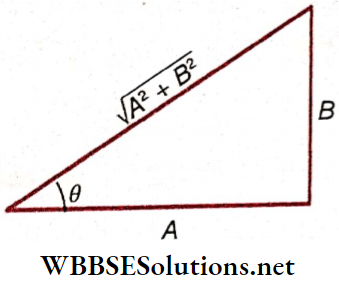
Let us put A’ = Acosα and B’ = Asinα in equation (2).

Then, A = \(\sqrt{A^{\prime 2}+B^{\prime 2}} \text { and } \alpha=\tan ^{-1} \frac{B^{\prime}}{A^{\prime}}\)

Thus, x = A(sinωtcosα + cosωtsinα) or, x = Asin(ωt+α)…..(3)

This represents the general equation of simple harmonic motion expressing the displacement of the particle.

WBCHSE Class 11 Physics For Simple Harmonic Motion Definition Examples

Definition of Simple Harmonic Motion for Students

Differential Equation Special Cases:

1. If A’ = A and B’ = 0, i.e., α= 0, we have from equation (2) or (3), x = Asinωt ……(4)

From this equation, it is seen that, at t = 0, x = 0,

i.e., initially the particle is at its position of equilibrium.

2. If A’ = 0 and B’ = A, i.e., a = \(\frac{\pi}{2}\), we have from equation (2) or (3), x = Asost……..(5)

From this equation, it is seen that when t = 0, x = A, which is the maximum value of displacement of the particle.

Simple Harmonic Motion Formula

So, if a particle executing SHM starts its motion from its equilibrium position, its displacement is expressed as a sine function. If it starts its motion from one end of its path, its displacement is expressed as a cosine function.

If the particle executing SHM starts its motion from another point of its path, then equation (3) is directly used.

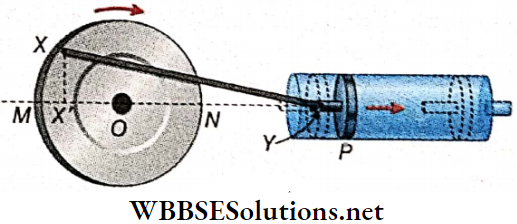
Relation Between SHM And Uniform Circular Motion: SHM is the simplest form of linear periodic motion. Again, uniform circular motion is the simplest form of rotational periodic motion.

  • The relation between SHM and uniform circular motion can be shown by a mechanical example.
  • A wheel is rotating with uniform speed about its center. A rod is connected between the circumference of the wheel and the handle of a frictionless piston fitted within a cylinder.
  • With the uniform rotation of the wheel, the piston moves to and fro along the shown path uniformly. As the motion of the wheel is uniform, the motion of the piston will be simple harmonic.
Simple Harmonic Motion Relation Between SHM And Uniform Circular motion

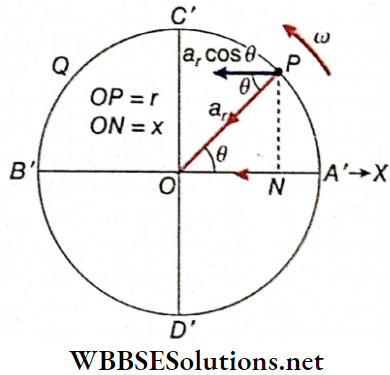
Geometrical Proof: Suppose a panicle is moving with a uniform angular velocity in an anticlockwise direction. This is shown by an arrow, along the circumference A’C’B’D’ of a circle hating its center at O. The foot of the perpendicular, drawn from different positions of the particle on the diameter B’OA’ (or C’OD’), will execute the simple harmonic motion. This is proved below.
Simple Harmonic Motion Geometric Proof

Examples of Simple Harmonic Motion in Daily Life

  • When the particle is at P, the foot of the perpendicular drawn from P on the diameter B’OA’ is at N. Now, as the particle moves around the circle, the foot of the perpendicular moves along the diameter A’OB’. Let the particle starting from A’, move around the circle in an anticlockwise direction and come back to A’.
  • Its projection on A’OB’ (N) also moves along A’OB’, reverses its direction, and then comes back along the same path to its starting point simultaneously. This to-and-fro motion of N along A’B’ is a linear periodic motion.

Similarly, if we draw a perpendicular from P on the diameter C’OD’, the foot to the perpendicular will execute a linear periodic motion along the diameter C’OD’. This linear periodic motion will be simple harmonic if it can be shown that the acceleration of N is proportional to its displacement from O and is directed towards the position of equilibrium O.

Class 11 Physics Class 12 Maths Class 11 Chemistry
NEET Foundation Class 12 Physics NEET Physics


Let ω be the uniform angular velocity of the particle and r be the radius of the circular path.

∴ The uniform linear speed of the particle is, ν = ωr

The centripetal acceleration of the particle at P along PO is, \(a_r=\frac{v^2}{r}=\omega^2 r\)

Let at any instant, OP make an angle θ with the diameter B’OA’ (taken as x-axis) and the displacement of the foot of the perpendicular (N) be x from the position of equilibrium.

∴ x = ON = OPcosθ = rcosθ

Again, the component of nr along the diameter A’OB’, i.e., die acceleration of N at that instant is a = arcosθ = ω²r cosθ = ω²x

Hence, the acceleration of N is proportional to its displacement from its position of equilibrium.

Velocity Of Simple Harmonic Motion

The component of ar along A’OB’ is related to the motion of N. Obviously, if the particle is at P, this component of acceleration is directed towards O, the position of equilibrium. So the motion of N is simple harmonic.

Therefore, when a particle is in a uniform circular motion, the motion of its projection on any diameter of the circular path is simple harmonic. The circle in the example above is called the circle of reference and the particle is called the reference particle.

Related To SHM Displacement: We know that the general equation for the displacement of a particle executing SHM is, x = Asin(ωt+α)….(1)

Simple Harmonic Motion Quantities Related To SHM

Related To SHM Displacement Special Cases:

  1. If the particle starts its motion from one of the extremities B or C of its path, then the equation becomes x = Acosωt …..(2)
  2. If the particle starts its motion from O, the position of equilibrium, then the equation becomes x = Asinωt……(3)

Related To SHM Velocity: From equation (1) we get,

sin (ωt+a) = \(\frac{x}{A}\)

∴ cos(ωt+ a) = \(\pm \sqrt{1-\frac{x^2}{A^2}}\)

So, the velocity of the particle executing SHM is

∴ v = \(\frac{d x}{d t}=A \omega \cos (\omega t+\alpha)= \pm A \omega \sqrt{1-\frac{x^2}{A^2}}\)

or, v = \(\pm \omega \sqrt{A^2-x^2}\)….(4)

It shows that the velocity of the particle depends on its displacement.

Characteristics of Simple Harmonic Motion

Related To SHM Velocity Special Cases:

  1. When x = 0, i.e., when the particle is at O, the position of equilibrium, v = ± ωA, which is the maximum velocity. ie.., νmax = ± ωA
  2. When x = ±A, i.e., when the particle is at B or C, the two extremities of its path, \(\nu= \pm \omega \sqrt{A^2-A^2}=0\), which is the minimum velocity. i.e., vmin = 0.

So, a particle executing SHM has different velocities at different points on its path. It passes the position of equilibrium with maximum velocity. The magnitude of its velocity gradually decreases as the particle moves towards its extremities from the equilibrium position and it momentarily comes to rest at the extreme points of its path.

Related To SHM Acceleration: From equation (1), we get

velocity, v = \(\frac{d x}{d t}=\omega A \cos (\omega t+\alpha)\)

∴ Acceleration, a = \(\frac{d v}{d t}=-\omega^2 A \sin (\omega t+\alpha)\)

or, a = -ω²x…..(5)

From this equation, we see that the acceleration of the particle depends on its displacement from its mean position. The negative sign indicates that acceleration and displacement are mutually opposite in direction.

Related To SHM Acceleration Special Cases:

  1. When x = 0, i.e., when the particle is at O, the position of equilibrium, a = 0, which is the minimum acceleration.
  2. When x = ±A, i.e., when the particle is at B or C, the extremities of its path, a =\(\mp\)ω²A, which is the maximum acceleration.

A particle undergoing SHM possesses different accelerations at different points on its path. It has zero acceleration at equilibrium and attains the maximum acceleration at the extreme positions of its path.

Instead of equation (1) if we use equation (2) or (3), we get the same equations (4) and (5) for velocity and acceleration.

Related To SHM Time Period And Frequency: Let the equation of a simple harmonic motion: x = Acosωt. In this case, at the beginning of the motion, i.e., at time t = 0, ωt = 0, and x = Acos0 = A. This implies that the particle begins its motion from one extreme end of its path.

Now, as time advances, when t = \(\frac{2 \pi}{\omega}\), again we get, x = Acos2π = A, i.e., the particle returns to the initial point from which it began its motion. Thus, an oscillation is completed.

So, for one complete oscillation, change in ωt = 2π-0 = 2π, i.e., for one complete oscillation, time taken is \(\frac{2 \pi}{\omega}\)(ωt = 2π).

As the total time elapsed for one complete oscillation is called the time period (T) of a SHM, we have, T = \(\frac{2 \pi}{\omega}\)….(6)

Mathematical Representation of SHM

Related To SHM Time Period And Frequency Definition: Frequency is defined as the number of complete oscillations per second of a particle executing SHM.

In time T the number of oscillations is 1. Hence in unit time, the number of oscillations is \(\frac{1}{T}\).

∴ Frequency, n = \(\frac{1}{T}=\frac{\omega}{2 \pi}\) …..(7)

or, ω = 2πn

ω is called the angular frequency.

Considering only the magnitude of the acceleration of a particle executing SHM, we get from equation (5), \(\omega^2=\frac{a}{x} \text { or, } \omega=\sqrt{\frac{a}{x}}\)

∴ Time period, T = \(\frac{2 \pi}{\omega}=2 \pi \sqrt{\frac{x}{a}}\)

= \(2 \pi \sqrt{\frac{\text { displacement }}{\text { acceleration }}}\)…(8)

∴ Frequency, n = \(\frac{1}{T}=\frac{1}{2 \pi} \sqrt{\frac{a}{x}}\)

= \(\frac{1}{2 \pi} \sqrt{\frac{\text { acceleration }}{\text { displacement }}}\)….(9)

Related To SHM Amplitude: The amplitude of simple harmonic motion = OB = OC. Since, -1 ≤ sinθ≤+ 1 and -1≤ cosθ ≤ + 1, we get from equation (1), the maximum value of displacement x = amplitude = |±A| = A

∴ \(\overrightarrow{O B}=\vec{A} \quad \text { and } \overrightarrow{O C}=-\vec{A}\)

From equations (8) and (9) it is evident that the time period and frequency of an SHM do not depend on the amplitude A. So, if the amplitude of oscillation of a simple pendulum diminishes gradually due to air resistance, its time period remains unchanged (law of isochronism). For this, simple harmonic motion is called an isochronous motion.

Related To SHM Phase: The phase of a particle executing SHM at any instant, is defined as its state of motion at that instant. The term ‘state of motion’ indicates displacement, velocity, acceleration, etc., of the particle at any instant.

Suppose in equation (1),  θ= ωt + α……(10)

velocity, v = \(\pm \omega \sqrt{A^2-x^2}= \pm \omega A \cos \theta \text {; }\)

acceleration, a = -ω²x = -ω²Asinθ

Now, ω and A are both constants. So displacement, velocity, and acceleration of the particle at any instant depend entirely on the angle θ. The angle θ, expressed by equation (10), is called the phase angle of the simple harmonic motion. It is seen from equation (10), that, θ depends on time t. Thus, the phase of a particle executing SHM changes continuously with respect to time.

Applications of Simple Harmonic Motion in Physics

Related To SHM Phase Special Cases:

  1. If θ = 0, then x = Asinθ = 0, i.e., the particle is at O. If the value of θ becomes 90°, then x = Asin90° = A, i.e., the particle is at the end B of its path, i.e., the change of phase = 90° = \(\frac{\pi}{2}\).
  2. If θ = 270°, then x = Asin270° = -A, i.e., the particle is at C. So, when the particle moves from B to C, the change of phase angle = 270° -90° = 180° = π. The positions B and C are then said to be in opposite phases.

If θ = 450° = 360° + 90° , then x = Asin450° = Asin90° = A;

i.e., the particle is at B. So, when the particle starts its motion from B, goes to C, and then returns to B, the change of phase angle = 450° – 90° = 360° = 2π. In this case, the initial and the final positions are in the same phase.

Related To SHM Epoch: It is defined as the initial phase of motion (i.e., at t = 0) of the particle executing SHM.

If the equation of SHM is x = Asin(ωt+ α), then phase angle, θ = ωt+ α.

Putting t = 0 in this equation, we get epoch, θ = α

As a special case, if the particle starts its motion from one extremity of its path we have,

x = \(A \cos \omega t=A \sin \left(\omega t+\frac{\pi}{2}\right)\).

Here phase angle, θ = cot+\(\frac{\pi}{2}\) . If t = 0 , epoch = \(\frac{\pi}{2}\).

Again, if the particle starts its motion from the position of equilibrium, we have, x = Asinωt

Here, phase angle θ= ωt. Putting t = 0, epoch = 0 .

Related To SHM Epoch Phase Difference: In the case of two particles executing SHM, if the phase angle of the first particle is θ1 and that of the second particle is θ2 at an instant, then the phase difference of the SHMs is θ = θ2 – θ1 (or θ1 – θ2). Two simple harmonic motions having the same time period, frequency, and amplitude may have different phases. For example, if at an instant when the first particle reaches C, the second particle is at B, then their phase difference = 180°= π.

If the phase difference between two SHMs remains constant, i.e., it does not change with time, they are said to be coherent; the particles executing these SHMs are said to be in coherent motion.

Relations Among Displacement Velocity And Acceleration: Suppose a particle executing SHM starts its motion from the extremity B of its path. If T is the time period, then the particle crosses the position of equilibrium O in time \(\frac{T}{4}\); reaches C, the other extremity of the path in time \(\frac{T}{2}\) again on its way back crosses O, the position of equilibrium in time \(\frac{3T}{4}\) and returns to B in time T.

Simple Harmonic Motion Displacement Velocity And Acceleration Relations

Using v = \(\pm \omega \sqrt{A^2-x^2} \text { and } a=-\omega^2 x\), we can calculate displacement, velocity, and acceleration of the particle at different times, as shown in the table below.
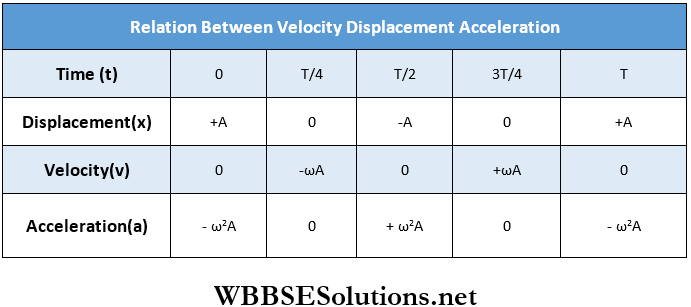
Simple Harmonic Motion Relation Between Velocity Displacement Acceleration

The graph of displacement and velocity against time is shown, and the graph of displacement and acceleration against time.

Phase Difference Of Velocity And Acceleration With Displacement: Displacement of a particle executing a SHM is, x = Acosωt,

velocity, v = \(-A \omega \sin \omega t=A \omega \cos \left(\omega t+\frac{\pi}{2}\right)\)

and acceleration, a = -Aω² cosωt = Aω²cos(ωt+π)
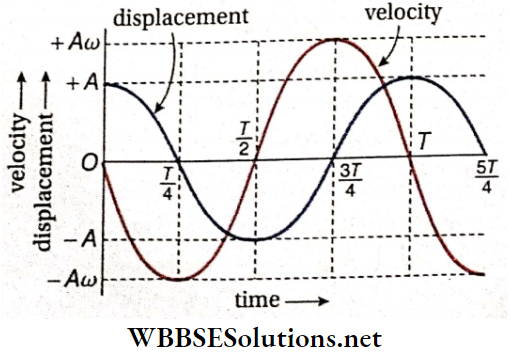
Simple Harmonic Motion Phase Difference Of Velocity With Displacement

So, the phase difference between velocity and displacement is \(\frac{\pi}{2}\) or 90°, and the difference between acceleration and displacement is π or 180°.
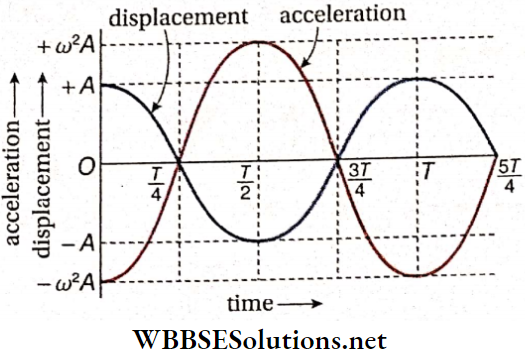
Simple Harmonic Motion Phase Difference Of Acceleration With Displacement

Graphical Representation of Simple Harmonic Motion

Characteristics Of SHM

  1. Simple harmonic motion is a kind of linear periodic motion, i.e., in this motion, the particle moves to and fro following the same path repeatedly at regular time intervals.
  2. The acceleration of the particle executing SHM is always directed towards the position of equilibrium.
  3. The acceleration of the particle is proportional to its displacement from the position of equilibrium at any instant.
  4. When the particle passes the position of equilibrium, its velocity becomes maximum. The velocity of the particle gradually reduces and momentarily comes to zero at the extremities of its path.
  5. The time period of SHM does not depend on the amplitude. Though the amplitude decreases gradually due to various external resistances, the time period remains unchanged.

It is to be noted that SHM is a special form of periodic motion. If the periodic motion is

  1. Linear and
  2. The acceleration of the particle is proportional to its displacement from the position of equilibrium and is directed towards it, only then the motion of the particle is called simple harmonic.

The motion of the hands of a clock or the motions of the planets and satellites are periodic, but as these motions do not satisfy the above two conditions, they are not considered as simple harmonic. So, it can be said that all simple harmonic motions are periodic, but all periodic motions are not simple harmonic.

Oscillation And Waves Simple Harmonic Motion Mathematical Analysis Of SHM Numerical Examples

Example 1. A particle of mass 0.5 g is executing SHM with a time period of 2 s and an amplitude of 5 cm. Calculate its

  1. Maximum velocity,
  2. Maximum acceleration and
  3. Velocity, acceleration, and force acting on the particle when it is at a distance of 4 cm from its position of equilibrium.

Solution:

Given

A particle of mass 0.5 g is executing SHM with a time period of 2 s and an amplitude of 5 cm.

Amplitude, A = 5 cm; time period, T = 2 s

∴ ω = \(\frac{2 \pi}{T}=\frac{2 \pi}{2}=\pi \mathrm{rad} \cdot \mathrm{s}^{-1}\)

  1. Maximum velocity, \(v_{\max }=\omega A=\pi \cdot 5=5 \pi =5 \times 3.14=15.7 \mathrm{~cm} \cdot \mathrm{s}^{-1}=0.157 \mathrm{~m} \cdot \mathrm{s}^{-1}\)
  2. Maximum acceleration, \(a_{\max }=\omega^2 A=\pi^2 \cdot 5 =5 \times(3.14)^2=49.298 \mathrm{~cm} \cdot \mathrm{s}^{-2} \approx 0.493 \mathrm{~m} \cdot \mathrm{s}^{-2}\)
  3. When x = 4cm,

velocity, v = \(\omega \sqrt{A^2-x^2}=\pi \sqrt{5^2-4^2}\)

= \(3.14 \times 3=9.42 \mathrm{~cm} \cdot \mathrm{s}^{-1}\)

= \(0.094 \mathrm{~m} \cdot \mathrm{s}^{-1}\)
\end{aligned}

acceleration, = \(39.438 \mathrm{~cm} \cdot \mathrm{s}^{-2}\)

= \(0.394 \mathrm{~m} \cdot \mathrm{s}^{-2}\)

And force,F = \(m a=0.5 \times 39.438\)

= 19.72 dyn \(\approx 0.197 \times 10^{-3} \mathrm{~N} .\)

Conditions for Simple Harmonic Motion

Example 2. A particle executing SHM possesses velocities 20cm · s-1 and 15cm · s-1 at distances 6 cm and 8 cm respectively from its mean position. Calculate the amplitude and the time period of the particle.
Solution:

Given:

A particle executing SHM possesses velocities 20cm · s-1 and 15cm · s-1 at distances 6 cm and 8 cm respectively from its mean position.

Velocity of the particle executing SHM, \(\nu=\omega \sqrt{A^2-x^2}\)

In the first case, 20 = \(\omega \sqrt{A^2-6^2}\)….(1)

In the second case, 15 = \(\omega \sqrt{A^2-8^2}\)…(2)

Dividing (1) by (2) we get, \(\frac{20}{15}=\frac{\omega \sqrt{A^2-6^2}}{\omega \sqrt{A^2-8^2}} \text { or, } \frac{4}{3}=\frac{\sqrt{A^2-36}}{\sqrt{A^2-64}} \text { or, } \frac{A^2-36}{A^2-64}=\frac{16}{9}\)

or, \(16 A^2-1024=9 A^2-324\)

or, \(7 A^2=700 \text { or, } A^2=100 \text { or, } A=10 \mathrm{~cm}=0.1 \mathrm{~m}\)

From equation (1) we get,

20 = \(\omega \sqrt{10^2-6^2}=8 \omega \text { or, } \omega=\frac{20}{8}=\frac{5}{2} \mathrm{rad} \cdot \mathrm{s}^{-1}\)

∴ T = \(\frac{2 \pi}{\omega}=\frac{2 \pi}{5} \times 2=\frac{4}{5} \times 3.14=2.51 \mathrm{~s} .\)

Example 3. The time period and amplitude of a particle executing SHM are 10 s and 0.12 m respectively. Find its velocity at a distance of 0.04 m from its position of equilibrium.
Solution:

Given:

The time period and amplitude of a particle executing SHM are 10 s and 0.12 m respectively.

Here T = 10 s; A = 0.12 m

∴ \(\omega=\frac{2 \pi}{T}=\frac{2 \pi}{10}=\frac{\pi}{5} \mathrm{rad} \cdot \mathrm{s}^{-1}\)

So, v = \(\omega \sqrt{A^2-x^2}=\frac{\pi}{5} \sqrt{0.12^2-0.04^2}=\frac{\pi}{5} \sqrt{0.0128}\)

= \(0.071 \mathrm{~m} \cdot \mathrm{s}^{-1}\).

Example 4. The frequency of a vibrating wire is 200 Hz. The velocity of a particle on the wire is 4.35m · s-1 when it is at a distance of half its amplitude. Calculate the acceleration of the particle at that instant
Solution:

Given:

The frequency of a vibrating wire is 200 Hz. The velocity of a particle on the wire is 4.35m · s-1 when it is at a distance of half its amplitude.

Here, ω = 2πn = 2π ·200 = 400π rad · s-1 [n = 200 Hz]

Let A be the amplitude of the particle.

If x = \(\frac{A}{2}\), then v = 4.35 m · s-1

∴ v = \(\omega \sqrt{A^2-x^2}\)

or, \(4.35=400 \pi \sqrt{A^2-\frac{A^2}{4}}=400 \pi \cdot \frac{A \sqrt{3}}{2}\)

or, \(A=\frac{4.35 \times 2}{400 \pi \times \sqrt{3}} \mathrm{~m}\).

∴ Required acceleration, a = \(\omega^2 x=\omega^2 \cdot \frac{A}{2}=(400 \pi)^2 \times \frac{1}{2} \times \frac{4.35 \times 2}{400 \pi \sqrt{3}}\)

= \(\frac{400 \pi \times 4.35}{\sqrt{3}}=3154 \mathrm{~m} \cdot \mathrm{s}^{-2} \text { (approx.) }\)

The acceleration of a rapidly vibrating object may reach an exceptionally high value.

Example 5. Two particles executing SUM possess the same frequency. When the first particle just pusses the mean position of its path, the second particle moving lit the same direction is at a distance of 3 cm from its mean position. If the amplitude of vibration of the second particle is 6 cm, what is the phase difference of the two particles?
Solution:

Given:

Two particles executing SUM possess the same frequency. When the first particle just pusses the mean position of its path, the second particle moving lit the same direction is at a distance of 3 cm from its mean position. If the amplitude of vibration of the second particle is 6 cm

If A is the amplitude and θ is the phase angle, then displacement, x = Acosθ

For the first particle, \(x_1=A_1 \cos \theta_1 \text { or, } 0=A_1 \cos \theta_1\)

or, \(\cos \theta_1=0 or, \theta_1= \pm 90^{\circ}\)

For the second particle, \(x_2 =A_2 \cos \theta_2 \text { or, } \cos \theta_2=\frac{x_2}{A_2}=\frac{3}{6}=\frac{1}{2}\)

or, \(\theta_2= \pm 60^{\circ}\)

At the given instant, the two particles are in motion in the same direction.

So,

  1. If θ1 = 90° , then θ2 = 60°; phase difference θ21 = -30°
  2. If θ1 =-90°, then θ2 = -60°; phase difference θ21 = +30°

∴ The required phase difference is ± 30°.

Example 6. A particle executing SHM possesses velocities v1 and v2 when it is at distances x1 and x2 respectively from its mean position. Show that, the time period of oscillation is given by T = \(2 \pi\left(\frac{x_2^2-x_1^2}{v_1^2-v_2^2}\right)^{1 / 2}\)
Solution:

Given:

A particle executing SHM possesses velocities v1 and v2 when it is at distances x1 and x2 respectively from its mean position.

We know, \(v=\omega \sqrt{A^2-x^2}\)

According to the question, \(v_1=\omega \sqrt{A^2-x_1^2} \text { or, } v_1^2=\omega^2\left(A^2-x_1^2\right)\)…..(1)

Also, \(v_2=\omega \sqrt{A^2-x_2^2} or, v_2^2=\omega^2\left(A^2-x_2^2\right)\)

Subtracting (2) from (1) we get, \(v_1^2-v_2^2=\omega^2\left(x_2^2-x_1^2\right) or, \quad \omega^2=\frac{v_1^2-v_2^2}{x_2^2-x_1^2}\)

or, \(\omega=\left(\frac{v_1^2-v_2^2}{x_2^2-x_1^2}\right)^{\frac{1}{2}}\)

We know that, T = \(\frac{2 \pi}{\omega}=\frac{2 \pi}{\left(\frac{u_1^2-u_2^2}{x_2^2-x_1^2}\right)^{\frac{1}{2}}}=2 \pi\left(\frac{x_2^2-x_1^2}{u_1^2-u_2^2}\right)^{\frac{1}{2}}\),

Example 7. The equation of a simple harmonic motion is  x = \(10 \sin \left(\frac{\pi}{3} t-\frac{\pi}{12}\right) \mathrm{cm}\). Calculate its

  1. Amplitude,
  2. Time period,
  3. Maximum speed,
  4. Maximum acceleration,
  5. Epoch and
  6. Speed after 1s of initiation of motion

Solution:

x = \(10 \sin \left(\frac{\pi}{3} t-\frac{\pi}{12}\right) \mathrm{cm}\)

Comparing this equation with the equation of SHM, x = A sin(ωt + α) we get,

  1. Amplitude, A = 1.0 cm.
  2. \(\omega=\frac{\pi}{3}\) so time period, T = \(\frac{2 \pi}{\omega}=\frac{2 \pi \times 3}{\pi}=6 \mathrm{~s} \text {. }\)
  3. Maximum speed, \(\omega A=\frac{\pi}{3} \times 10=\frac{10 \pi}{3} \mathrm{~cm} \cdot \mathrm{s}^{-1} \text {. }\)
  4. Maximum Acceleration, \(\omega^2 A=\left(\frac{\pi}{3}\right)^2 \times 10=\frac{10 \pi^2}{9} \mathrm{~cm} \cdot \mathrm{s}^{-2}\)
  5. Epoch = \(-\frac{\pi}{12}=-15^{\circ}\)
  6. Displacement after 1s of initiation of motion, \(x_1=10 \sin \left(\frac{\pi}{3} \cdot 1-\frac{\pi}{12}\right)=10 \sin \left(60^{\circ}-15^{\circ}\right)\)

= \(10 \sin 45^{\circ}=\frac{10}{\sqrt{2}}=5 \sqrt{2} \mathrm{~cm}\)

And speed after 1 s of initiation of motion, \(v_1=\omega \sqrt{A^2-x_1^2}=\frac{\pi}{3} \sqrt{(10)^2-(5 \sqrt{2})^2}\)

= \(\frac{\pi}{3} \sqrt{50}=\frac{5 \sqrt{2}}{3} \pi \mathrm{cm} \cdot \mathrm{s}^{-1}\)

Example 8. Write down the equation of a simple harmonic motion whose amplitude Is 5 cm, epoch Is 0° and the number of vibrations per minute is 150.
Solution:

Given:

Amplitude Is 5 cm, epoch Is 0° and the number of vibrations per minute is 150.

According to the problem, amplitude, A = 0.05 m; epoch, α = 0°; frequency, n = \(\frac{150}{60}=\frac{5}{2} \mathrm{~Hz}\)

∴ \(\omega=2 \pi n=2 \pi \cdot \frac{5}{2}=5 \pi \mathrm{rad} \cdot \mathrm{s}^{-1}\)

So, the equation of the simple harmonic motion is

x = \(A \sin (\omega t+\alpha) \quad \text { or, } x=0.05 \sin 5 \pi t \mathrm{~m}\).

Example 9. The displacement of a vibrating particle at time t is given by x = \(A^{\prime} \sin \left(\frac{\pi}{6} t\right)+B^{\prime} \cos \left(\frac{\pi}{6} t\right)\), where A’ = 0. 03 m, B’ = 0.04m. Calculate the

  1. Amplitude,
  2. Epoch,
  3. Displacement, velocity, and acceleration of the particle after 2 seconds.

Solution:

Given:

The displacement of a vibrating particle at time t is given by x = \(A^{\prime} \sin \left(\frac{\pi}{6} t\right)+B^{\prime} \cos \left(\frac{\pi}{6} t\right)\), where A’ = 0. 03 m, B’ = 0.04m.

x = \(A^{\prime} \sin \left(\frac{\pi}{6} t\right)+B^{\prime} \cos \left(\frac{\pi}{6} t\right)\)….(1)

Let \(A^{\prime}=A \cos \alpha and B^{\prime}=A \sin \alpha\)

∴ \(A^2\left(\cos ^2 \alpha+\sin ^2 \alpha\right)=A^{\prime 2}+B^{\prime 2}\)

or, \(A=\sqrt{A^{\prime 2}+B^{\prime 2}} and \tan \alpha=\frac{B^{\prime}}{A^{\prime}}\)

So, x = \(A \sin \left(\frac{\pi}{6} t\right) \cos \alpha+A \cos \left(\frac{\pi}{6} t\right) \sin \alpha\)

or, x = \(A \sin \left(\frac{\pi}{6} t+\alpha\right)\)….(2)

From this equation we get,

  1. Amplitude, A = \(\sqrt{A^{\prime 2}+B^{\prime 2}}\) = \(\sqrt{(0.03)^2+(0.04)^2}=0.05 \mathrm{~m}\)
  2. Epoch, \(\alpha=\tan ^{-1} \frac{B^{\prime}}{A^{\prime}}=\tan ^{-1} \frac{4}{3}\)
  3. When t = 2 s, we get from equation (1) displacement, x = \(A^{\prime} \sin \left(\frac{\pi}{6} t\right)+B^{\prime} \cos \left(\frac{\pi}{6} t\right)\)

= \(0.03 \sin \frac{\pi}{3}+0.04 \cos \frac{\pi}{3}\)

= \(0.03 \times \frac{\sqrt{3}}{2}+0.04 \times \frac{1}{2}\)

= \(0.04598 \mathrm{~m} \approx 0.046 \mathrm{~m}\)

From equation (2) we get, \(\omega=\frac{\pi}{6} \mathrm{rad} \cdot \mathrm{s}^{-1}\)

So, velocity after \(2 \mathrm{~s}\),

ν = \(\omega \sqrt{A^2-x^2}\)

= \(\frac{\pi}{6} \sqrt{(0.05)^2-(0.046)^2}=1.03 \mathrm{~m} \cdot \mathrm{s}^{-1}\)

Again, acceleration after 2s,

a = \(\omega^2 x=\left(\frac{\pi}{6}\right)^2 \times 0.046=1.26 \mathrm{~m} \cdot \mathrm{s}^{-2}\).

Example 10. The equation of motion of a particle executing SHM is expressed by x = \(10 \sin \left(10 t-\frac{\pi}{6}\right)\). Establish an equation to express its velocity and also calculate the magnitude of its maximum acceleration.
Solution:

Given, x = \(10 \sin \left(10 t-\frac{\pi}{6}\right)\)

The equation of motion of a particle executing SHM is expressed by x = \(10 \sin \left(10 t-\frac{\pi}{6}\right)\).

∴ Velocity, \(\nu=\frac{d x}{d t}=10 \times 10 \cos \left(10 t-\frac{\pi}{6}\right)\)

= \(100 \cos \left(10 t-\frac{\pi}{6}\right) \text { unit. }\)

Again, acceleration, a = \(\frac{d v}{d t}=-10 \times 100 \sin \left(10 t-\frac{\pi}{6}\right)\)

= \(-1000 \sin \left(10 t-\frac{\pi}{6}\right) \text { unit. }\)

Acceleration will be maximum when, \(\sin \left(10 t-\frac{\pi}{6}\right)=1\)

∴ Magnitude of maximum acceleration, \(a_{\max }=1000\) units.

Example 11. Equation of a simple harmonic motion is y = \(2 \sin \left(4 t+\frac{\pi}{6}\right)\).  Find out its time period and initial phase.
Solution:

Given:

Equation of a simple harmonic motion is y = \(2 \sin \left(4 t+\frac{\pi}{6}\right)\).

Comparing the given equation with the general equation of SHM, y = Asin(ωt+θ), we get, ω = 4, i.e., time period, T = \(\frac{2 \pi}{\omega}=\frac{2 \pi}{4}=\frac{3.14}{2}=1.57 \mathrm{~s}\)

Phase = \(4 t+\frac{\pi}{6}\); and initial phase, i.e., phase at t = 0

∴ \(\theta=\frac{\pi}{6}=30^{\circ}\)

Example 12. The equations of the two SHMs are x1 = Asin(ωt + δ1) and x2 = Asin(ωt+δ2) respectively. They superimpose on each other. Find the amplitude of the resultant.
Solution:

Given:

The equations of the two SHMs are x1 = Asin(ωt + δ1) and x2 = Asin(ωt+δ2) respectively. They superimpose on each other.

Resultant, x = \(x_1+x_2\)

= \(A\left[\sin \left(\omega t+\delta_1\right)+\sin \left(\omega t+\delta_2\right)\right]\)

= \(2 A \sin \frac{\left(\omega t+\delta_1\right)+\left(\omega t+\delta_2\right)}{2} \cos \frac{\left(\omega t+\delta_1\right)-\left(\omega t+\delta_2\right)}{2}\)

= \(2 A \cos \frac{\delta_1-\delta_2}{2} \sin \left(\omega t+\frac{\delta_1+\delta_2}{2}\right)\)

∴ The amplitude of the resultant SHM is \(2 A \cos \frac{\delta_1-\delta_2}{2}\).

Example 13. The displacements of a particle executing SHM at three consecutive seconds are 6 cm, 10 cm, and 6 cm respectively. Find out the frequency of oscillation of the particle.
Solution:

Given:

The displacements of a particle executing SHM at three consecutive seconds are 6 cm, 10 cm, and 6 cm respectively.

Displacement, x = A cos(ωt+θ)

Let initially at t = 0, displacement = 6 cm.

So, at t = 1 s, displacement = 10 cm

and at t = 2s, displacement is = 6 cm

∴ 6 = A cosθ….(1)

10 = A cos(ω + θ)…(2)

6 = A cos(2ω + θ)…(3)

From (1) and (3) we get,

cos(2ω + θ) = cosθ = cos(-θ)

or, 2ω + θ = -θ or, ω = -θ

∴ From (2), we get,

10 = A cos0 or, A = 10 cm .

From (1), we get,

6 = 10cos(-ω) or, cosω = \(\frac{3}{5}\)

or, ω = 0.927 rad · s-1

∴ Frequency = \(\frac{\omega}{2 \pi}=\frac{0.927}{2 \times 3.14}=0.148 \mathrm{~s}^{-1} \text {. }\)

Common Misconceptions About Simple Harmonic Motion

Example 14. The equation of a SHM is y = 3sin60πt. Calculate its amplitude, time period, and acceleration at its position of maximum displacement.
Solution:

Given:

The equation of a SHM is y = 3sin60πt.

Comparing the given equation with y = Asinωt, we get amplitude, A = 3 units; ω = 60π.

∴ Time period, T = \(\frac{2 \pi}{\omega}=\frac{2 \pi}{60 \pi}=\frac{1}{30} \mathrm{~s}\)

∴ Acceleration at its position of maximum displacement = ω²A = (60π)² x 3 = 1.065 x 10⁵ unit · s-2.

Example 15. Displacement of a particle is given by x = 4(cosπt + sinπt) m. Find its amplitude.
Solution:

Given:

Displacement of a particle is given by x = 4(cosπt + sinπt) m.

x = \(4(\cos \pi t+\sin \pi t)\)

= \(4 \sqrt{2}\left(\cos \pi t \cdot \frac{1}{\sqrt{2}}+\sin \pi t \cdot \frac{1}{\sqrt{2}}\right)\)

= \(4 \sqrt{2}\left(\cos \pi t \cdot \cos \frac{\pi}{4}+\sin \pi t \cdot \sin \frac{\pi}{4}\right)\)

= \(4 \sqrt{2} \cos \left(\pi t-\frac{\pi}{4}\right) \mathrm{m}\)

∴ Amplitude = 4√2 m.

Example 16. Equation of motion of a particle executing SHM is x = \(5 \sin \left(4 t-\frac{\pi}{6}\right) \mathrm{m}\), where x is the displacement. If the displacement is 3 m, find the velocity of the particle.
Solution:

Given:

Equation of motion of a particle executing SHM is x = \(5 \sin \left(4 t-\frac{\pi}{6}\right) \mathrm{m}\), where x is the displacement. If the displacement is 3 m.

Velocity, v = \(\frac{d x}{d t}=5 \times 4 \cos \left(4 t-\frac{\pi}{6}\right)\)

= \(20 \sqrt{1-\sin ^2\left(4 t-\frac{\pi}{6}\right)}=20 \sqrt{1-\left(\frac{x}{5}\right)^2}\)

If x = 3m, then v = \(20 \sqrt{1-\left(\frac{3}{5}\right)^2}=20 \times \frac{4}{5}=16 \mathrm{~m} \cdot \mathrm{s}^{-1} .\)

Example 17. A point mass oscillates along the axis according to the law, x = \(x_0 \cos \left(\omega t-\frac{\pi}{4}\right)\). If the acceleration of the particle is written as a = Acos(ωt+δ), find A and δ.
Solution:

Given:

A point mass oscillates along the axis according to the law, x = \(x_0 \cos \left(\omega t-\frac{\pi}{4}\right)\). If the acceleration of the particle is written as a = Acos(ωt+δ),

x = \(x_0 \cos \left(\omega t-\frac{\pi}{4}\right)\)

∴ Velocity, \(v=\frac{d x}{d t}=-\omega x_0 \sin \left(\omega t-\frac{\pi}{4}\right)\)

and acceleration, \(\alpha=\frac{d v}{d t}=-\omega^2 x_0 \cos \left(\omega t-\frac{\pi}{4}\right)\)

= \(+\omega^2 x_0 \cos \left(\omega t-\frac{\pi}{4}+\pi\right)\)

= \(\omega^2 x_0 \cos \left(\omega t+\frac{3 \pi}{4}\right)\)

Given \(\alpha=A \cos (\omega t+\delta)\)

So comparing the two equations we have, \(A=\omega^2 x_0\) and \(\delta=\frac{3 \pi}{4}\)

Example 18. Two simple harmonic motions are represented by the equations \(y_1=0.1 \sin \left(100 \pi t+\frac{\pi}{3}\right)\) and y2 = 0.1 cos πt. What is the initial phase difference of the velocity of the first particle with respect to the second?
Solution:

Given:

Two simple harmonic motions are represented by the equations \(y_1=0.1 \sin \left(100 \pi t+\frac{\pi}{3}\right)\) and y2 = 0.1 cos πt.

∴ \(y_1=0.1 \sin \left(100 \pi t+\frac{\pi}{3}\right)\);

Velocity, \(v_1=\frac{d y_1}{d t}=100 \pi \times 0.1 \cos \left(100 \pi t+\frac{\pi}{3}\right)\)

= \(10 \pi \cos \left(100 \pi t+\frac{\pi}{3}\right)\)

Phase, ø1 = \(\frac{\pi}{3}\) at time t = 0

y2 = 0.1 cos πt

Velocity, \(\nu_2=\frac{d y_2}{d t}=-0.1 \pi \sin \pi t=0.1 \pi \cos \left(\pi t+\frac{\pi}{2}\right)\)

Phase, \(\phi_2=\frac{\pi}{2}\) at time t = 0

∴ Phase difference = \(\theta_1-\theta_2=\frac{\pi}{3}-\frac{\pi}{2}=-\frac{\pi}{6}\)

Example 19. The displacement of an object attached to a spring and executing SHM is given by x = 2 x 10⁻² cosπtm. In what time the object attain maximum speed first?
Solution:

Given:

The displacement of an object attached to a spring and executing SHM is given by x = 2 x 10⁻² cosπtm.

x = 2 x 10⁻² cosπt

∴ v = \(\frac{d x}{d t}=-\left(2 \times 10^{-2} \pi\right) \sin \pi t\)

v is maximum when sinπt = ±1.

or, \(\pi t=\frac{\pi}{2}, \frac{3 \pi}{2}, \frac{5 \pi}{2} \ldots\)

The speed becomes maximum first when n t = \(\frac{\pi}{2}\)

or, t = \(\frac{1}{2}\) = 0.5

Example 20. If x, v, and a denote the displacement, the velocity and the acceleration of a particle executing simple harmonic motion of time period T, show that the expressions \(\frac{aT}{x}\) and a²T² + 4π²v² do not change with time.
Solution:

Given:

If x, v, and a denote the displacement, the velocity and the acceleration of a particle executing simple harmonic motion of time period T

If A is the amplitude, ω is the angular frequency and x is the displacement of a particle executing SHM then,

velocity v = \(\pm \omega \sqrt{A^2-x^2}\)

acceleration a = \(-\omega^2 x\)

time period T = \(\frac{2 \pi}{\omega}\)

∴ \(\frac{a T}{x}=\frac{-\omega^2 x \cdot \frac{2 \pi}{\omega}}{x}\)

∴ \(a^2 T^2+4 \pi^2 v^2=\left(-\omega^2 x\right)^2\left(\frac{2 \pi}{\omega}\right)^2+4 \pi^2 \omega^2\left(A^2-x^2\right)\)

= \(\omega^4 x^2 \frac{4 \pi^2}{\omega^2}+4 \pi^2 \omega^2 A^2-4 \pi^2 \omega^2 x^2 \)

= \(4 \pi^2 \omega^2 A^2=\text { constant }\)

Example 21. Two simple harmonic motions of angular frequencies 100 and 1000 rad · s-1 have the same displacement amplitude. What is the ratio of their maximum acceleration?
Solution:

Given:

Two simple harmonic motions of angular frequencies 100 and 1000 rad · s-1 have the same displacement amplitude.

Acceleration, f= -ω²x

If the amplitude is a, maximum acceleration =ω²a

∴ Ratio of maximum accelerations = \(\frac{\omega_1^2 a}{\omega_2^2 a}=\left(\frac{\omega_1}{\omega_2}\right)^2=\left(\frac{100}{1000}\right)^2=\frac{1}{100}\)

Example 22. A particle initially at rest at a distance of 5 cm from its mean position performs a SHM completing 60 oscillations in 2 seconds. Find the equation representing the displacement of the particle at any subsequent instant. What will be its equation if initially the particle were at the mean position?
Solution:

Given:

A particle initially at rest at a distance of 5 cm from its mean position performs a SHM completing 60 oscillations in 2 seconds. Find the equation representing the displacement of the particle at any subsequent instant.

Time taken by the particle in SHM to complete 60 oscillations = 2 s.

∴ Time period of the particle, T = \(\frac{2}{60}\) =\(\frac{1}{30}\) s .

Angular velocity of the particle, \(\omega=\frac{2 \pi}{T}=\frac{2 \pi}{\frac{1}{30}}=60 \pi\)

The particle was at rest and about 5 cm away from its equilibrium position.

∴ The amplitude of the particle, a = 5 cm.

Let, at any time t, the particle is x cm away from its equilibrium position.

∴ Displacement of the particle, x = 5cos(60πt+ θ) cm

At t = 0, x = 5 cm

∴ 5 = 5cosθ or, cosθ =1 or, θ = 0

∴ x = 5cos60πt

If the particle starts its oscillation from the equilibrium position, then, x = 5 sin60πt.

Example 23. The equation of two SHMs are \(y_1=10 \sin \left(4 \pi t+\frac{\pi}{4}\right)\), \(y_2=5(\sin 3 \pi t+\sqrt{3} \cos 3 \pi t)\), What is thne ratio of therir amplitudes?
Solution:

Given:

The equation of two SHMs are \(y_1=10 \sin \left(4 \pi t+\frac{\pi}{4}\right)\), \(y_2=5(\sin 3 \pi t+\sqrt{3} \cos 3 \pi t)\),

The amplitude of the first SHM, A1= 10

Now, \(y_2=5(\sin 3 \pi t+\sqrt{3} \cos 3 \pi t)\)

= \(5 \times 2\left(\frac{1}{2} \sin 3 \pi t+\frac{\sqrt{3}}{2} \cos 3 \pi t\right) \)

= \(10\left(\cos \frac{\pi}{3} \sin 3 \pi t+\sin \frac{\pi}{3} \cos 3 \pi t\right) \)

= \(10 \sin \left(3 \pi t+\frac{\pi}{3}\right)\)

∴ The amplitude of the second SHM, \(A_2=10\)

Hence, \(\frac{A_1}{A_2}=\frac{10}{10}=1 or, A_1: A_2=1: 1\).

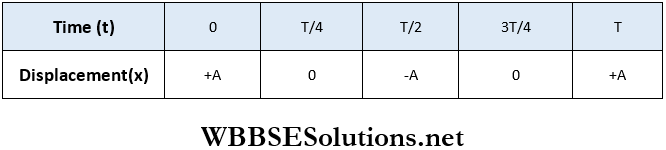
Graphical Representation Of SHM: If a particle executing simple harmonic motion begins its motion from the position of equilibrium, then the equation of motion of the particle is x = \(A \sin \omega t=A \sin \frac{2 \pi}{T} t\)

During a complete period, i.e., from t = 0 to t = T, the variation of displacement with time is shown in the following table:
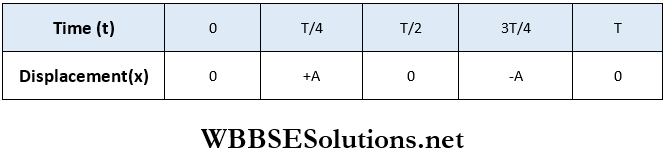
Simple Harmonic Motion Graphical Representation Of Simple Harmonic Motion At T Equal To Zero

Now on graph paper, time is placed along the horizontal axis and displacement along the vertical axis. The points O, B, C, D, and E are plotted according to their corresponding coordinates in the above table. The points are connected with a curved line. The graph OBCDE is obtained. This is a sine curve. This curve represents a simple harmonic motion.
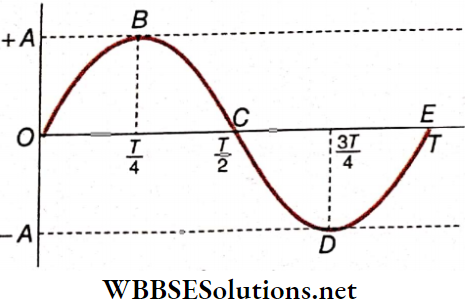
Simple Harmonic Motion Graphical Representation Of Simple Harmonic Motion With Sine Curve

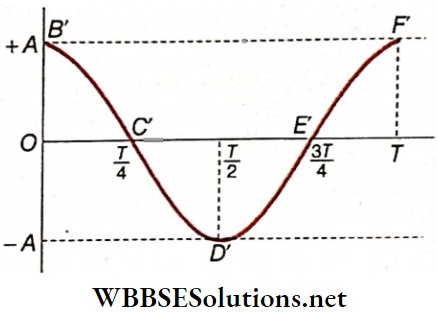
If a particle executing simple harmonic motion starts its motion from one end of Its path, then the equation of motion of the particle is x = \(A \cos \omega t=A \cos \frac{2 \pi}{T} t\)

Proceeding similarly, we get the following table and the graph. The graph B’C’D’E’F’ is a cosine curve.
Simple Harmonic Motion Graphical Representation Of Simple Harmonic Motion At T Equal To 1

The sine and the cosine curves are identical except for their initial phase difference. For their special symmetry, sine and cosine functions are called sinusoidal functions. As a simple harmonic motion is represented by any one of these sinusoidal functions, they are also known as harmonic functions.
Simple Harmonic Motion Graphical Representation Of Simple Harmonic Motion

Composition Of Two Colinear SHMs Of The Same Frequency By Graphical And Analytical Methods: Two simple harmonic motions, having the same frequency n (i.e., time period, T = \(\frac{1}{n}\) and angular frequency, ω = 2πn, are being executed along the x-axis, i.e., they are collinear. To obtain the resultant motion due to the superposition of the two SHMs, we have to know their phase difference.

1. Two SHMs Are In Phase: The two SHMs of the same time period are in phase.

Let the equation of the first motion be \(x_1=A \sin \omega t=A \sin \frac{2 \pi}{T} t.\)

and the equation of the second motion be \(x_2=B \sin \omega t=B \sin \frac{2 \pi}{T} t.\)

The resultant displacement at any instant is the vector sum of the displacements of the two individual motions at that instant.

So, the resultant displacement, \(x=x_1+x_2=A \sin \frac{2 \pi}{T} t+B \sin \frac{2 \pi}{T} t=(A+B) \sin \frac{2 \pi}{T} t\)

Therefore, the resultant motion is an SHM of the same frequency with an amplitude equal to (A + B).

The displacements of the two individual motions and their resultant displacement at different times (from t = 0 to t = T) are shown in the table below.
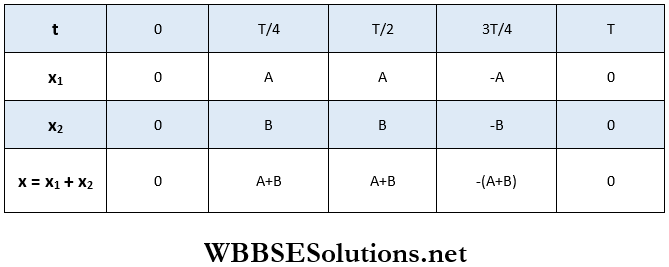
Simple Harmonic Motion Two Simple Harmonic Motion Are In Phase

Plotting the referred values in the table, we get the graph of the resultant displacement x. From the graph, we come to know
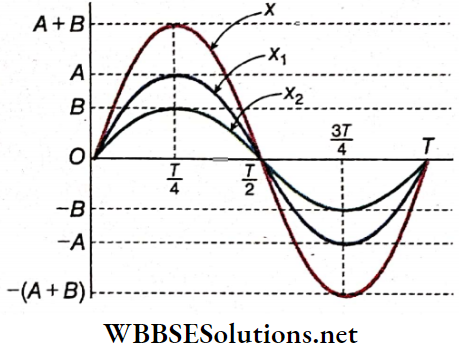
Simple Harmonic Motion Graphical Representation Two Simple Harmonic Motion Are In Phase

  1. The resultant motion is also simple harmonic.
  2. The frequency and the time period of the resultant motion are equal to those of the individual motions.
  3. The amplitude of the resultant motion is equal to the sum of the amplitudes of the individual motions.
  4. The resultant motion is also in phase with the individual motions.

2. Two SHMs In Opposite Phase: Two simple harmonic motions have the same frequency and the same time period, but they are in opposite phases.

So, the equation of the first SHM: \(x_1=A \sin \omega t=A \sin \frac{2 \pi}{T} t\).

The equation of the second SHM: \(x_2=B \sin (\omega t+\pi)=-B \sin \omega t=-B \sin \frac{2 \pi}{T} t \text {. }\)

[As the two motions are in opposite phases, the phase difference between them = 180° = π]

∴ Resultant displacement, x = \(x_1+x_2=A \sin \frac{2 \pi}{T} t-B \sin \frac{2 \pi}{T} t=(A-B) \sin \frac{2 \pi}{T} t\)

From t = 0 to t = T, the values of x1, x2, and x are given in the tables below.
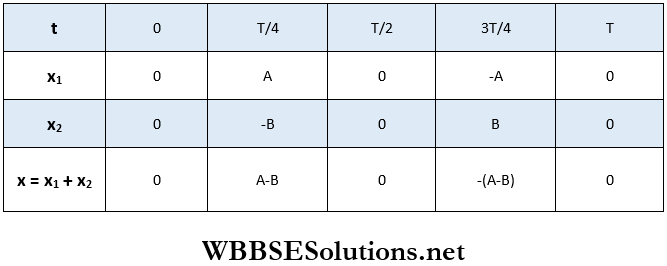
Simple Harmonic Motion Two Simple Harmonic Motion Are In Opposite Phase

Plotting the referred values in the table, we get the graph of the resultant displacement x. From the graph, we come to know
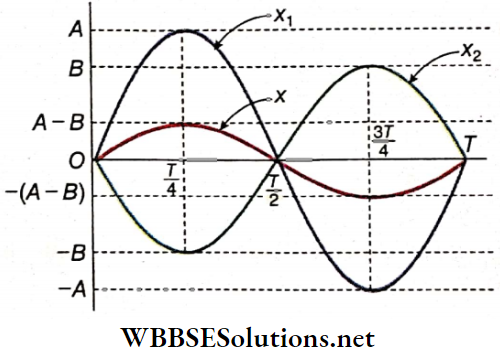
Simple Harmonic Motion Graphical Representation Of Two Simple Harmonic Motion Are In Opposite Phase

  1. The resultant motion is also simple harmonic.
  2. The frequency and the time period of the resultant motion are equal to those of the individual motions.
  3. The amplitude of the resultant motion is equal to the difference of the amplitudes of the individual motions.
  4. The resultant motion is in phase with the motion having a larger amplitude but in the opposite phase with the motion having a smaller amplitude.

Due to the superposition of two SHMs of the same amplitude but of opposite phases, the resultant displacement is x = x1 + x2 = 0 for all values of t. It implies that the particle, on which these two SHMs superpose, remains at rest.

WBCHSE Class 11 Physics Simple Harmonic Motion Short Answer Type Questions

 Simple Harmonic Motion Short Answer Type Questions

Question 1. The kinetic energy (K) and potential energy (V) of a particle performing a simple harmonic motion are such that, always

  1. K> V
  2. K< V
  3. K= V
  4. K+V= constant

Answer: The option 4 is correct.

Question 2. A particle situated in a homogeneous medium performs a simple harmonic oscillation of amplitude 3 cm and frequency 25 Hz. The velocity of the waves generated is 300 cm • s-1. Find the equation of the waves propagating in the positive direction of the x-axis.
Answer:

If  Amplitude, A = 3 cm; frequency, n = 25 Hz; velocity, V = 300 cm · s-1

So, angular velocity, ω = 2πn = 2π X 25 = 50π

Hence, the equation of the wave along the positive x-axis,

x = \(A \sin \omega\left(t-\frac{x}{V}\right) \quad \text { or, } x=3 \sin 50 \pi\left(t-\frac{x}{300}\right) \mathrm{cm}\)

Question 3. Show that the equation x = acos²ωt represents a simple harmonic motion. Find the

  1. Amplitude,
  2. Time period and
  3. Position of equilibrium of the particle.

Answer:

x = \(a \cos ^2 \omega t=\frac{1}{2} a \cdot 2 \cos ^2 \omega t=\frac{1}{2} a(\cos 2 \omega t+1)\)

= \(\frac{a}{2}+\frac{a}{2} \cos 2 \omega t\)

The term \(\frac{a}{2} \cos 2 \omega t\) indicates simple harmonie motion

Amplitude = \(\frac{1}{2} a\)

Here, \(\omega^{\prime}=2 \omega\)

So, time period, \(T=\frac{2 \pi}{\omega^{\prime}}=\frac{2 \pi}{2 \omega}=\frac{\pi}{\omega}\)

For the term \(\frac{a}{2} \cos 2 \omega t\) of simple harmonic motion acceleration \(=-\omega^{\prime 2} x^{\prime}=-4 \omega^2 x^{\prime} \quad\left[because \omega^{\prime}=2 \omega\right]\)

At the equilibrium position, acceleration =0

∴ 0 = \(-4 \omega^2 x^{\prime} \quad \text { or, } x^{\prime}=0\)

As, \(x=\frac{a}{2}+\frac{a}{2} \cos 2 \omega t=\frac{a}{2}+x^{\prime}\) so, equilibrium position is,

x = \(\frac{a}{2}+0 \quad \text { or, } x=\frac{a}{2}\)

WBCHSE Class 11 Physics Simple Harmonic Motion S A Qs

Question 4. Can a simple pendulum experiment be performed inside a satellite?
Answer:

  • All objects are weightless inside an artificial satellite. Hence, the effective value of the acceleration due to gravity is zero.
  • However, the working principle of a simple pendulum depends upon gravity.
  • Therefore, a simple pendulum experiment cannot be performed inside a satellite.

Question 5. The Earth revolves around the sun. Is it an example of a simple harmonic motion? Explain.
Answer:

In the case of the motion of the earth (if we consider the earth’s orbit to be spherical), its acceleration is directed towards a particular point (sun). But this motion is not linear. Also, the value of acceleration does not vary pro¬portionally with the distance of the earth from the sun. Hence, the earth’s revolution around the sun is not an example of simple harmonic motion.

WBCHSE Class 11 SHM Short Answer Questions

Question 6. A particle executes a simple harmonic motion of amplitude A. The distance from the mean position where its kinetic energy is equal to its potential energy is

  1. 0.81 A
  2. 0.71A
  3. 0.61A
  4. 0.51A

Answer:

⇒ \(\frac{1}{2} m \omega^2\left(A^2-x^2\right)=\frac{1}{2} m \omega^2 x^2 \text { or, } A^2=2 x^2\)

or, x = 0.71 A

The option 2 is correct.

Question 7. Show that the equation x = asinωt + bcosωt represents a simple harmonic motion.
Answer:

x = asinωt+ bcosωt

or, \(\frac{d x}{d t}=a \omega \cos \omega t-b \omega \sin \omega t\)

or, \(\frac{d^2 x}{d t^2}=-a \omega^2 \sin \omega t-b \omega^2 \cos \omega t\)

or, \(\frac{d^2 x}{d t^2}=-\omega^2(a \sin \omega t+b \cos \omega t)\)

or, \(\frac{d^2 x}{d t^2}=-\omega^2 x \quad or, \frac{d^2 x}{d t^2}+\omega^2 x=0\)

This is the differential equation of simple harmonic motion.

Question 8. The equation of motion of a particle executing SHM is x = asin(cot+ \(\frac{\pi}{6}\)) with time period T. Find the time interval at which the velocity is half of its maximum value.
Answer:

Displacement of the particle executing simple harmonic motion,

x = \(a \sin \left(\omega t+\frac{\pi}{6}\right)\)

∴ Velocity, v = \(\frac{d x}{d t}=a \omega \cos \left(\omega t+\frac{\pi}{6}\right)\)

∴ Maximum velocity, \(v_{\max }=a \omega\)

Here, \(v=\frac{v_{\max }}{2}\)

or, \(a \omega \cos \left(\omega t+\frac{\pi}{6}\right)=\frac{a \omega}{2}\)

or, \(\cos \left(\omega t+\frac{\pi}{6}\right)=\frac{1}{2}=\cos \frac{\pi}{3}\)

∴ \(\omega t+\frac{\pi}{6}=\frac{\pi}{3} or, \frac{2 \pi}{T} \cdot t=\frac{\pi}{6}\left[because \omega=\frac{2 \pi}{T}\right]\)

∴ \(\frac{t}{T}=\frac{1}{12}\)

So, after 1/12 of the time period, the velocity of the particle is half of its maximum value.

Class 11 Physics Class 12 Maths Class 11 Chemistry
NEET Foundation Class 12 Physics NEET Physics

Question 9. If the displacement and the restoring force acting on a particle executing simple harmonic motion are x and F respectively, then P = -kx. Here the negative sign on the right-hand side indicates that

  1. The restoring force is directed toward the equilibrium position
  2. The restoring force is directly proportional to the displacement
  3. The force constant is always negative
  4. The restoring force is always negative

Answer:

The negative sign indicates restoring force directed opposite to the displacement of the particle and towards the equilibrium position.

The option 1 is correct.

Question 10. Show that in SHM the ratio of acceleration and displacement of a particle always remains unchanged.
Answer:

For particle of mass m executing SHM, F = -kx [ k = constant] or, ma = -kx

or, \(\frac{a}{x}=-\frac{k}{m}\) [a = acceleration]

∴ \(\frac{a}{x}=\text { constant }\)

Simple Harmonic Motion Short Answer Type WBCHSE

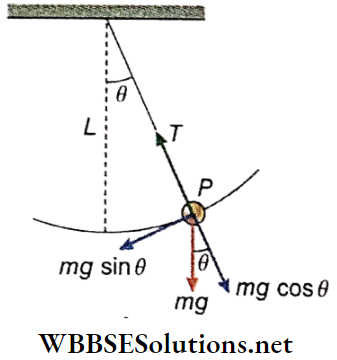
Question 11. A simple pendulum of length swings in a vertical plane. The tension of the string when it makes an angle θ with the vertical and the bob of mass m moves with a speed v is (g is the gravitational acceleration)

  1. mv²/L
  2. mgcosθ+mv²/L
  3. mgcosθ-mv²/L
  4. mgcosθ

Simple Harmonic Motion A Simple Pendulum Of length Swings In A Vertical Plane

Answer:

At point P, the resultant of the tension in the string (T) and the component of weight (mgcosθ) provide the necessary centripetal force for the circular motion of the bob,

i.e., \(T-m g \cos \theta=\frac{m v^2}{L} \text { or, } T=m g \cos \theta+\frac{m v^2}{L}\)

The option 2 is correct.

Question 12. A particle vibrating simply harmonically has an acceleration of 16 cm · s-2 when it is at a distance of 4 cm from the mean position. Its time period is

  1. 1s
  2. 2.572s
  3. 3.142s
  4. 6.028s

Answer:

Acceleration of particle executing SHM at a distance x from the equilibrium position, a = ω²x

∴ Angular velocity, \(\omega=\sqrt{\frac{a}{x}}=\sqrt{\frac{16}{4}}=2 \mathrm{rad} / \mathrm{s}\)

Therefore, time period T = \(\frac{2 \pi}{\omega}=\frac{2 \pi}{2}=\pi=3.142 \mathrm{~s}\)

The option 3 is correct.

Question 13. The velocity of a particle executing a simple harmonic motion is 13 m • s-1 when its distance from the equilibrium position (Q) is 3 m and its velocity is 12 m • s-1 when it is 5 m away from Q. The frequency of tire simple harmonic motion is

  1. \(\frac{5 \pi}{8}\)
  2. \(\frac{5}{8 \pi}\)
  3. \(\frac{8 \pi}{5}\)
  4. \(\frac{8}{5 \pi}\)

Answer:

We know that, v = \(\omega \sqrt{A^2}-x^2\)

13 = \(\omega \sqrt{A^2-3^2}\)

and 12 = \(\omega \sqrt{A^2-5^2}\)

Solving (1) and (2), we get, ω = \(\frac{5}{8 \pi}\)

The option 2 is correct

Question 14. In case of a simple harmonic motion, if the velocity is plotted along the X-axis and the displacement (from the equilibrium position) is plotted along the Y-axis, the resultant curve happens to be an ellipse with the ratio \(\frac{\text { major axis (along } X \text { ) }}{\text { minor axis (along } Y \text { ) }}=20 \pi\). What is the frequency of the simple harmonic motion?

  1. 100Hz
  2. 20Hz
  3. 10Hz
  4. 1/10Hz

Answer:

Let x = A sinωt

∴ \(\frac{d x}{d t}=A \omega \cos \omega t\) or, v = \(A \omega \cos \omega t\)

∴ \(\frac{x^2}{A^2}+\frac{v^2}{(A \omega)^2}=\sin ^2 \omega t+\cos ^2 \omega t=1\)

According to the question, \(\frac{\text { major axis (along } X)}{\text { minor axis (along } Y \text { ) }}=20 \pi\)

or, \(\frac{2 A \omega}{2 A}=20 \pi \text { or, } \omega=20 \pi\)

or, \(2 \pi f=20 \pi \text { or, } f=10 \mathrm{~Hz}\)

The option 3 is correct.

Class 11 Physics SHM Short Answer Practice

Question 15. A particle moves with simple harmonic motion in a straight line. In the first τs, after starting from rest it travels a distance a, and in the next τs, it travels 2a, in the same direction, then

  1. The amplitude of motion is 3 a
  2. The time period of oscillations is 8τ
  3. The amplitude of motion is 4 a
  4. The time period of oscillations is 6τ

Answer:

The particle starts from rest at one end of its motion

i.e., from x = A.

So, x = Acosωt.

In the first τs, as it travels a distance, its position is

x = \(A-a=A \cos \omega \tau \quad \text { or, } a=A(1-\cos \omega \tau)\)

Similarly, \(A-(a+2 a)=A \cos 2 \omega \tau\)

or, \(3 a=A(1-\cos 2 \omega \tau)=A \cdot 2 \sin ^2 \omega \tau\)

or, \(3 A(1-\cos \omega \tau)=A\left(2-2 \cos ^2 \omega \tau\right)\)

or, \(2-2 \cos ^2 \omega \tau=3-3 \cos \omega \tau\)

or, \((\cos \omega \tau-1)(2 \cos \omega \tau-1)=0\)

Now if \(\cos \omega \tau-1=0\), then \(\cos \omega \tau=1=\cos 0\) or, \(\omega=0\)

This is unphysical.

∴ \(2 \cos \omega \tau-1=0 \text { or, } \cos \omega \tau=\frac{1}{2}=\cos \frac{\pi}{3}\)

or, \(\omega=\frac{\pi}{3 \tau}\)

So, \(T=\frac{2 \pi}{\omega}=6 \tau\)

Then, \(a=A\left(1-\frac{1}{2}\right)\) or, A = 2a

The option 4 is correct.

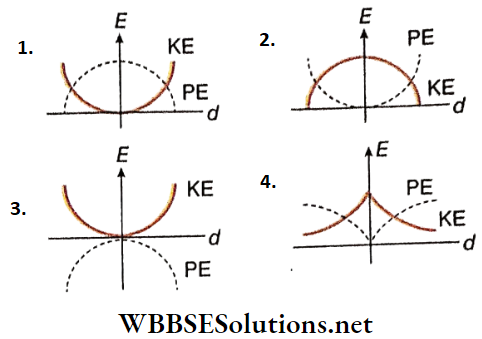
Question 16. For a simple pendulum, a graph is plotted between its kinetic energy (KE) and potential energy (PE) against its displacement d. Which one of the following represents these correctly? (Graphs are schematic and not drawn to scale)

Simple Harmonic Motion A Simple Pendulum A Graph Is Plotted Between Its Kinetic And Potential Energy

Answer: The option 2 is correct.

Question 17. A pendulum made of a uniform wire of cross-sectional area A has a time period T. When an additional mass M is added to its bob, the time period changes to TM. If the Young’s modulus of the material of the wire is Y, then \(\frac{1}{Y}\) is equal to (g = gravitational acceleration)

  1. \(\left[\left(\frac{T_M}{T}\right)^2-1\right] \frac{A}{M g}\)
  2. \(\left[\left(\frac{I_M}{T}\right)^2-1\right] \frac{M g}{A}\)
  3. \(\left[1-\left(\frac{T_M}{T}\right)^2\right] \frac{A}{M g}\)
  4. \(\left[1-\left(\frac{T}{T_M}\right)^2\right] \frac{A}{M g}\)

Answer:

In the first case, the time period of the simple pendulum,

T = \(2 \pi \sqrt{\frac{L}{g}}\)

When an additional mass M is added to its bob, the new time period, \(T_M=2 \pi \sqrt{\frac{L+l}{g}}\)

and \(\frac{M g}{A}\) = longitudinal stress

Then, \(\frac{1}{Y}=\frac{\text { strain }}{\text { stress }}=\left[\left(\frac{T_M}{T}\right)^2-1\right] \frac{A}{M g}\)

The option 1 is correct.

WBCHSE Physics Short Answer Questions on SHM

Question 18. A particle performs simple harmonic motion with amplitude A. Its speed is trebled at the instant that it is at a distance \(\frac{2A}{3}\) from the equilibrium position. The new amplitude of the motion is

  1. \(\frac{A}{3} \sqrt{41}\)
  2. 3 A
  3. \(A \sqrt{3}\)
  4. \(\frac{7 A}{3}\)

Answer:

Velocity of particle executing SHM, \(\nu=\omega \sqrt{A^2-x^2}\)

[ω = angular velocity of a particle]

At \(x=\frac{2 A}{3}, v^{\prime}=\omega \sqrt{A^2-\frac{4 A^2}{9}}=\omega \sqrt{\frac{5 A^2}{9}}\)

At x = \(\frac{2 A}{3}\), the speed of the particle is trebled.

∴ \(\omega \sqrt{A^{\prime 2}-x^2}=3 \omega \sqrt{\frac{5 A^2}{9}}\)

[A’ = new amplitude]

or, \(A^{\prime 2}-x^2=5 A^2\)

or, \(A^{\prime 2}=5 A^2+x^2=5 A^2+\left(\frac{2 A}{3}\right)^2=5 A^2+\frac{4 A^2}{9}\)

= \(\frac{49 A^2}{9}\)

∴ A’ = 7A/3

The option 4 is correct.

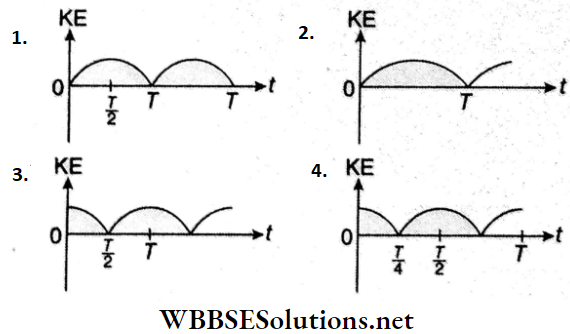
Question 19. A particle is executing simple harmonic motion with a time period T. At time t = 0, it is at its position of equilibrium. The kinetic energy-time graph of the particle will look like:

Simple Harmonic Motion Kinetic Energy Of A Particle Executing Simple Harmonic Motion

Answer:

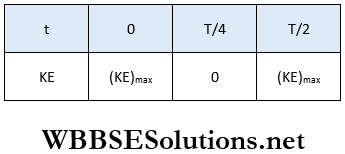
Expression for the kinetic energy of a particle executing SHM,

KE = \(\frac{1}{2} m \omega^2 A^2 \cos ^2 \omega t=(\mathrm{KE})_{\max } \cos ^2 \omega t\)

Simple Harmonic Motion A Particel Is Moving The Executing Simple Harmonic Motion

The option 4 is correct.

Question 20. A silver atom in a solid oscillates in simple harmonic motion in some direction with a frequency of 1012 s-1. What is the force constant of the bonds connecting one atom with the other? (Mole wt. of Silver =108 and Avogadro number =6.02 x 10²³ g · mol-1)

  1. 2.2 N/m
  2. 5.5 N/m
  3. 6.4 N/m
  4. 7.1 N/m

Answer:

Two atoms with their bond executing SHM be compared to the vibration of a spring.

Now, T = \(2 \pi \sqrt{\frac{m}{k}}\) [k is spring constant]

Thus, \(f=\frac{1}{T}\)

or, \(f=\frac{1}{2 \pi} \sqrt{\frac{k}{m}} \quad or, 10^{12}=\frac{1}{2 \pi} \sqrt{\frac{k}{m}}\)

or, k = \(4 \pi^2 m \times 10^{24}=\frac{4 \times \pi^2 \times 108 \times 10^{-3}}{6.02 \times 10^{23}} \times 10^{24}\)

= \(7.08 \mathrm{~N} / \mathrm{m} \approx 7.1 \mathrm{~N} / \mathrm{m}\)

The option 4 is correct.

WBCHSE Class 11 Physics MCQS – Simple Harmonic Motion

Simple Harmonic Motion Multiple Choice Question And Answers

WBBSE Class 11 Simple Harmonic Motion MCQs

Question 1. The motion of any hand of a clock is a (an)

  1. Periodic motion
  2. Simple harmonic motion
  3. Vibration
  4. Oscillation

Answer: 1. Periodic motion

Question 2. if the mass of a particle executing SHM is m and its angular frequency is ω, then the force constant of that SHM will be

  1. \(m \omega\)
  2. \(m \omega^2\)
  3. \(\sqrt{\frac{m}{\omega}}\)
  4. \(\sqrt{\frac{\omega}{m}}\)

Answer: 2. \(m \omega^2\)

Read And Learn More WBCHSE Class 11 Physics MCQs

Question 3. In the case of a simple harmonic motion, which of the following statements is not true?

  1. The moving particle repeats the same path periodically
  2. The restoring force acting on the particle is always directed toward the equilibrium position
  3. The restoring force acting on the particle is always proportional to its displacement
  4. The restoring force acting on the particle is always proportional to the velocity of the particle

Answer: 4. The restoring force acting on the particle is always proportional to the velocity of the particle

Question 4. If the displacement and the restoring force acting on a particle executing simple harmonic motion are x and F respectively, then F = – kx. Here the negative sign on the right-hand side indicates that

  1. The restoring force is directed toward the equilibrium position
  2. The restoring force is directly proportional to the displacement
  3. The force constant is always negative
  4. The restoring force is always negative

Answer: 1. The restoring force is directed toward the equilibrium position

Question 5. If the mass of a particle executing SHM is m and its angular frequency is ω, then the period of its oscillation will be

  1. \(\frac{1}{\omega}\)
  2. \(\frac{m}{\omega}\)
  3. \(\frac{\omega}{2 \pi}\)
  4. \(\frac{2 \pi}{\omega}\)

Answer: 4. \(\frac{2 \pi}{\omega}\)

WBCHSE Class 11 Physics MCQS – Simple Harmonic Motion

Conceptual Questions on Simple Harmonic Motion for Class 11

Question 6. The magnitude of the maximum velocity of the SHM expressed by the equation x – Asinωt is

  1. A
  2. Aω²
  3. A²ω

Answer: 2.

Question 7. The magnitude of maximum acceleration of the SHM expressed by the equation x = A sinωt is

  1. A
  2. Aω²
  3. A²ω

Answer: 3. Aω²

Question 8. If the equation x = asinωt represents a simple harmonic motion of a particle, then its initial position is

  1. Equilibrium point
  2. Terminal point
  3. Any point in the right side of the point of equilibrium
  4. Any point in the left side of the point of equilibrium

Answer: 1. Equilibrium point

Question 9. The time period of the SHM expressed by the equation x = 4sin4πt is

  1. 4s
  2. 4πs
  3. 2s
  4. \(\frac{1}{2}\)s

Answer: 4. \(\frac{1}{2}\)s

Question 10. If the displacement and the acceleration of a particle executing SHM at any instant are x and a respectively, then the time period of that motion will be

  1. \(2 \pi \sqrt{\frac{a}{x}}\)
  2. \(2 \pi \sqrt{\frac{x}{a}}\)
  3. \(\frac{1}{2 \pi} \sqrt{\frac{a}{x}}\)
  4. \(\frac{1}{2 \pi} \sqrt{\frac{x}{a}}\)

Answer: 2. \(2 \pi \sqrt{\frac{x}{a}}\)

Practice MCQs on SHM Characteristics

Question 11. Which one of the following is not the equation of an SHM?

  1. F = -kx
  2. a = –\(\frac{k}{m}\)x
  3. a = -ω²x
  4. a = ω²x

Answer: 4. a = ω²x

Question 12. A particle executing SHM follows a straight path of length l. The amplitude of its motion is

  1. 2l
  2. l
  3. \(\frac{l}{2}\)
  4. \(\frac{l}{4}\)

Answer: \(\frac{l}{2}\)

Question 13. The phase difference between two SHMs x = Bcosωt and x = Asinωt is

  1. 180°
  2. 90°
  3. -90°
  4. Zero

Answer: 2. 90°

Question 14. The amplitude of vibration of the SHM represented by the equation x = A sinωt+ B cosωt is

  1. A+B
  2. A-B
  3. \(\sqrt{A^2+B^2}\)
  4. \(\sqrt{A^2-B^2}\)

Answer: 3. \(\sqrt{A^2+B^2}\)

Key MCQs on SHM Equations and Formulas

Question 15. The initial phase or epoch of the SHM represented by the equation x = A sinωt+ B cosωt is

  1. \(\frac{A}{B}\)
  2. \(\frac{B}{A}\)
  3. \(\tan ^{-1} \frac{A}{B}\)
  4. \(\tan ^{-1} \frac{B}{A}\)

Answer: 4. \(\tan ^{-1} \frac{B}{A}\)

Question 16. The SHM executed by a particle of mass 2 kg is represented by the equation x = 4sin4πtm. Total mechanical energy of the particle (in joule) will be

  1. 256π²
  2. 6π²
  3. 16π²
  4. 16π

Answer: 1. 256π²

Question 17. A particle is executing SHM with frequency a. The frequency of the variation of its kinetic energy is

  1. \(\frac{a}{2}\)
  2. a
  3. 2a
  4. 4a

Answer: 3. 2a

Question 18. The distance between the positions of maximum potential energy and maximum kinetic energy of a particle executing SHM is

  1. \(\pm \frac{A}{2}\)
  2. \(\pm \frac{A}{\sqrt{2}}\)
  3. \(\pm A\)
  4. \(\pm 2 A\)

Answer: 3. \(\pm A\)

Sample Questions on Energy in SHM

Question 19. If the amplitude of an SHM is A, then for what position of the particle, half of its total energy will be potential energy and the remaining half will be kinetic energy?

  1. \(\pm \frac{A}{2}\)
  2. \(\pm \frac{A}{\sqrt{2}}\)
  3. \(\pm \frac{A}{3}\)
  4. \(\pm \frac{A}{2 \sqrt{2}}\)

Answer: 2. \(\pm \frac{A}{\sqrt{2}}\)

Question 20. Kinetic energy and potential energy of a simple harmonic motion are K and V respectively. Then which one is always true

  1. K>V
  2. K<V
  3. K = V
  4. K+V = constant

Answer: 4. K+V = constant

Question 21. When a spring is stretched by 3 cm, stored potential energy becomes u and when it is stretched by 6 cm potential energy becomes

  1. 2u
  2. 3u
  3. 4u
  4. 6u

Answer: 3. 4u

Class 11 Physics Class 12 Maths Class 11 Chemistry
NEET Foundation Class 12 Physics NEET Physics

Question 22. The time period of a simple pendulum is 2 s. If its length is doubled, then the new time period will be

  1. 2s
  2. √2 s
  3. 2√2 s
  4. 4s

Answer: 3. 2√2 s

WBBSE Class 11 Practice Tests on Simple Harmonic Motion

Question 23. If the time period of a simple pendulum of effective length L is T, then the effective length of a simple pendulum having time period 2 T will be

  1. \(\frac{L}{2}\)
  2. L
  3. 2 L
  4. 4L

Answer: 4. 4L

Question 24. The time period of a second pendulum is

  1. 1s
  2. 2s
  3. \(\frac{1}{2}\)s
  4. \(\frac{1}{2}\)s

Answer: 2. 2s

Question 25. If a second pendulum is taken to the surface of the moon from the earth, its time period would be (acceleration due to gravity on the surface of the moon is 1/6th that on the earth’s surface)

  1. 12 s
  2. 6 s
  3. 26 s
  4. \(\frac{2}{\sqrt{6}}\)s

Answer: 3. 26 s

Question 26. The nature of the graph of the effective length of a pendulum versus its time period will be

  1. Linear
  2. Parabolic
  3. Exponential
  4. Sinusoidal

Answer: 2. Parabolic

Question 27. The length of a second pendulum on the surface of the earth is

  1. 1 m (approx.)
  2. 1.1m (approx.)
  3. 0.25m (approx.)
  4. 2m (approx.)

Answer: 1. 1 m (approx.)

Question 28. The time period of a simple pendulum on the surface of the earth is T1 and at a height R above the surface of the earth is T2; where R is the radius of the earth. The ratio T1/T2 is

  1. 1
  2. √2
  3. 4
  4. 2

Answer: 4. 2

Question 29. A simple pendulum has time period T1. The point of suspension is now moved upwards according to the relation y = Kt² (K=1m · s-2) where y is the vertical displacement. The time period now becomes T2 . The ratio of \(T_1^2 / T_2^2 \text { is }\left(\mathrm{g}=10 \mathrm{~m} \cdot \mathrm{s}^{-2}\right)\)

  1. \(\frac{6}{5}\)
  2. \(\frac{5}{6}\)
  3. 1
  4. \(\frac{4}{5}\)

Answer: 1. \(\frac{6}{5}\)

Question 30. The length of a pendulum is l. The bob is pulled to one side to make an angle with the vertical and is then released. The velocity of the bob, when it crosses the position of equilibrium, is

  1. \(\sqrt{2 g l}\)
  2. \(\sqrt{2 g l \cos \alpha}\)
  3. \(\sqrt{2 g l(1-\cos \alpha)}\)
  4. \(\sqrt{2 g l(1-\sin \alpha)}\)

Answer: 3. \(\sqrt{2 g l(1-\cos \alpha)}\)

Question 31. A simple pendulum of length l has a maximum angular displacement θ. The maximum kinetic energy of the bob of mass m will be

  1. mgl(1-cosθ)
  2. mgl cosθ
  3. mgl sinθ
  4. None of these

Answer: 1. mgl(1-cosθ)

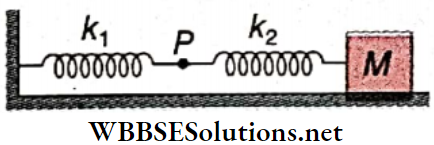
Question 32. The mass M shown oscillates in simple harmonic motion with amplitude A. The amplitude of the point P is

Simple Harmonic Motion The Mass M Oscillates In Simple Harmonic Motion

  1. \(\frac{k_1 A}{k_2}\)
  2. \(\frac{k_2 A}{k_1}\)
  3. \(\frac{k_1 A}{k_1+k_2}\)
  4. \(\frac{k_2 A}{k_1+k_2}\)

Answer: 4. \(\frac{k_2 A}{k_1+k_2}\)

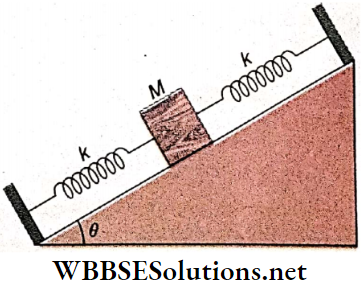
Question 33. A body of mass M is held between two massless springs, on a smooth inclined plane as shown. The free ends of the springs are attached to firm supports. If each spring has force constant k, the period of oscillation of the body is

Simple Harmonic Motion A Body Of Mass Is Held Between Two Massless Springs

  1. \(2 \pi \sqrt{\frac{M}{2 k}}\)
  2. \(2 \pi \sqrt{\frac{2 M}{k}}\)
  3. \(2 \pi \sqrt{\frac{M g \sin \theta}{2 k}}\)
  4. \(2 \pi \sqrt{\frac{M g \sin \theta}{k}}\)

Answer: 1. \(2 \pi \sqrt{\frac{M}{2 k}}\)

Interactive MCQs on Oscillations and SHM

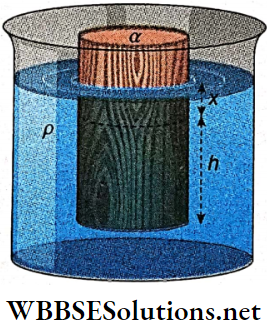
Question 34. A wooden cube (density of wood d) of side l floats in a liquid of density ρ with its upper and lower surfaces horizontal. lf the cube is pushed slightly down and released, and it performs simple harmonic motion of period T, then T is equal

  1. \(2 \pi \sqrt{\frac{l \rho}{(\rho-d) g}}\)
  2. \(2 \pi \sqrt{\frac{l \rho}{d g}}\)
  3. \(2 \pi \sqrt{\frac{l d}{\rho g}}\)
  4. \(2 \pi \sqrt{\frac{l d}{(\rho-d) g}}\)

Answer: \(2 \pi \sqrt{\frac{l \rho}{d g}}\)

Question 35. A spring is cut into two pieces in such a way that one piece is double the length of the other. If the force constant of the main spring is k then fore constant of the longer part is

  1. \(\frac{2}{3}k\)
  2. \(\frac{3}{2}k\)
  3. 3k
  4. 6k

Answer: 2. \(\frac{3}{2}k\)

In this type of question, more than one option is correct.

Question 36. The displacement-time relation for a particle can be expressed as x = 0.5 [cos²(nπt)-sin²(nπt)]. This relation shows that

  1. The particle executes SHM with an amplitude 0.5 m
  2. The particle executes SHM with a frequency n times that of a second pendulum
  3. The particle executes SHM and the velocity in its mean position is (3.142 n)m • s-1
  4. The article does not execute SHM at all

Answer:

1. The particle executes SHM with amplitude of 0.5 m

3. The particle executes SHM and the velocity in its mean position is (3.142 n)m • s-1

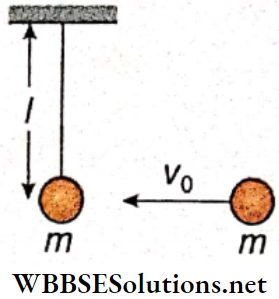
Question 37. A simple pendulum consists of a bob of mass m and a light string of effective length L as shown,

Simple Harmonic Motion Identical Ball Moving With A Small Velocity Collides With Pendulums Bob And Sticks

Another identical ball moving with a small velocity v0 collides with the pendulum’s bob and sticks to it. For this new pendulum of mass 2m, mark the correct statement(s).

  1. Time period of the pendulum is \(2 \pi \sqrt{\frac{L}{g}}\)
  2. The equation of motion for this pendulum is \(\theta=\frac{v_0}{2 \sqrt{g L}} \sin \left[\sqrt{\frac{g}{L}} t\right]\)
  3. The equation of motion for this pendulum is \(\theta=\frac{v_0}{2 \sqrt{g L}} \cos \left[\sqrt{\frac{g}{L}} t\right]\)
  4. Time period of the pendulum is \(2 \pi \sqrt{\frac{2 L}{g}}\)

Answer:

Question 38. The function, x = A sin²ωt + B cos²ωt+ C sinωtcosωt represents SHM

  1. For any value of A, B, and C (except C = 0)
  2. If A = -B, C = 2B, amplitude = |B√2|
  3. If A = B; C = 0
  4. If A = B; C = 2B, amplitude = |B|

Answer:

2. If A = -B, C = 2B, amplitude = |B√2|

4. If A = B; C = 2B, amplitude = |B|

Question 39. Choose the correct statement(s).

  1. The time period of the spring-mass system will change when it is made to oscillate horizontally and vertically.
  2. Natural frequency depends upon elastic properties and dimensions of the body.
  3. At the mean position, the energy is entirely KE, and at extreme positions, the energy is entirely potential.
  4. A pendulum having a time period of 2 seconds is called a second’s pendulum.

Answer:

2. Natural frequency depends upon elastic properties and dimensions of the body.

3. At the mean position, the energy is entirely KE and at extreme positions, the energy is entirely potential.

4. A pendulum having a time period 2 seconds is called a second’s pendulum.

Question 40. A rectangular block of mass m and area of cross-section A floats in a liquid of density ρ. If it is given a small vertical displacement from equilibrium, it undergoes oscillation with a time period T.

  1. \(T \propto \sqrt{m}\)
  2. \(T \propto \sqrt{\rho}\)
  3. \(T \propto \frac{1}{\sqrt{A}}\)
  4. \(T \propto \frac{1}{\sqrt{\rho}}\)

Answer:

1. \(T \propto \sqrt{m}\)

3. \(T \propto \frac{1}{\sqrt{A}}\)

4. \(T \propto \frac{1}{\sqrt{\rho}}\)

Question 41. A linear harmonic oscillator of force constant 2x 10⁶ N/m and amplitude 0.01m has a total mechanical energy of 160 J. Its

  1. Maximum potential energy is 160J
  2. Maximum kinetic energy is 160J
  3. Maximum potential energy is 100J
  4. Maximum potential energy is 0

Answer:

  1. Maximum potential energy is 160J
  2. Maximum kinetic energy is 160J

Question 42. A particle of mass m is attached to one end of a massless spring of force constant k, lying on a frictionless horizontal plane. The other end of the spring is fixed. The particle starts moving horizontally from its equilibrium position at time t = 0 with an initial velocity u0. When the speed of the particle is 0.5u0, it collides elastically with a rigid wall. After this collision

  1. The speed of the particle when it returns to its equilibrium position is u0
  2. The time at which the particle passes through the equilibrium position for the first time is t = \(pi \sqrt{\frac{m}{k}}\)
  3. The time at which the maximum compression of the spring occurs is t = \(\frac{4 \pi}{3} \sqrt{\frac{m}{k}}\)
  4. The time at which the particle passes through the equilibrium position for the second time is t = \(\frac{5 \pi}{3} \sqrt{\frac{m}{k}}\)

Answer:

1. The speed of the particle when it returns to its equilibrium position is u0

4. The time at which the particle passes through the equilibrium position for the second time is t = \(\frac{5 \pi}{3} \sqrt{\frac{m}{k}}\)

WBCHSE Class 11 Physics Simple Harmonic Motion Long Answer Type Questions

Oscillation And Waves  Simple Harmonic Motion Long Answer Type Questions

Question 1. Simple harmonic motion is a periodic motion, but alt periodic motions are not simple harmonic — explain.
Answer:

The motion that repeats itself at regular intervals of time is called periodic motion. If the periodic motion is

  1. Linear and
  2. The acceleration of the particle executing the motion is proportional to its displacement front the position of equilibrium and is always directed towards the mean position, only then the motion of the particle is said to be simple harmonic.

The motion of the hands of a dock or the motion of the planets and satellites are periodic in nature. But as these motions do not satisfy the above conditions, they cannot he called simple harmonic. So it can be said that all simple harmonic motions are periodic but all periodic motions are not simple harmonic.

Read and Learn More Class 11 Physics Long Answer Questions

Question 2. What should be the displacement of a particle, executing SHM, from Its position of equilibrium so that the velocity of the particle is half of its maximum velocity?
Answer:

If the angular frequency of a particle executing SHM is ω and the amplitude of motion is A, then the maximum velocity of the particle = ωA

For a displacement x, velocity of the particle, v = \(\omega \sqrt{A^2-x^2}\)

WBCHSE Class 11 Physics Simple Harmonic Motion Long Answer Type Questions

According to the question, \(\omega \sqrt{A^2-x^2}=\frac{1}{2} \omega A\)

or, \(\frac{A}{2}=\sqrt{A^2-x^2} \text { or, } \frac{A^2}{4}=A^2-x^2\)

or, \(x^2=A^2-\frac{A^2}{4} \text { or, } x^2=\frac{3}{4} A^2\)

or, x = \(\pm \frac{\sqrt{3}}{2} A\); this is the required displacement.

Simple Harmonic Motion Long Answer Type Questions WBCHSE

Question 3. What should be the displacement of a particle, executing SHM, from its position of equilibrium so that its acceleration is half of its maximum acceleration?
Answer:

According to the definition of SHM, acceleration ∝ displacement.

So, the acceleration of the particle will be half of its maximum value, if the displacement is half of the maximum displacement, i.e… half the amplitude.

Example 4. What should be the displacement of a particle, executing SHM, from its position of equilibrium so that the kinetic energy of the particle is half of its max imum kinetic energy?
Answer:

Maximum kinetic energy of a particle executing SHM = \(\frac{1}{2}\)mω²A²

When the displacement of the particle is x from the position of equilibrium, kinetic energy of the particle = \(\frac{1}{2}\)mω²(A² – x²)

According to the question, \(\frac{1}{2} m \omega^2\left(A^2-x^2\right)=\frac{1}{2} \times \frac{1}{2} m \omega^2 A^2\)

or, \(A^2-x^2=\frac{A^2}{2}\)

or, \(x^2=A^2-\frac{A^2}{2}=\frac{A^2}{2}\)

or, \(x= \pm \frac{A}{\sqrt{2}}\); this is the required displacement.

WBCHSE Class 11 SHM Long Answer Questions

Question 5. What should be the displacement of a particle, executing SHM, from its position of equilibrium so that the kinetic energy and the potential energy of the particle are equal?
Answer:

Kinetic energy of a particle executing SHM = \(\frac{1}{2}\) mω²(A² – x²).

Its potential energy = \(\frac{1}{2}\)mω²x²

According to the question, \(\frac{1}{2} m \omega^2\left(A^2-x^2\right)=\frac{1}{2} m \omega^2 x^2 \text { or, } A^2-x^2=x^2\)

or, \(2 x^2=A^2 or, x^2=\frac{A^2}{2}\)

or, x = \(\pm \frac{A}{\sqrt{2}}\); this is the required displacement.

Class 11 Physics Class 12 Maths Class 11 Chemistry
NEET Foundation Class 12 Physics NEET Physics

Question 6. Two equal masses M and N are suspended from the ends of two separate weightless springs having spring constants k1 and k2. If the maximum velocities of the two masses for their vertical oscillations are the same, what is the ratio of the amplitudes of vibration of M and N?
Answer:

If angular frequency = ω and amplitude = A, then maximum velocity = ωA.

So for the two given masses, ω1A1 = ω2A2

or, \(\frac{A_1}{A_2}=\frac{\omega_2}{\omega_1}=\frac{\frac{2 \pi}{T_2}}{\frac{2 \pi}{T_1}}=\frac{T_1}{T_2}=\frac{2 \pi \sqrt{\frac{m_1}{k_1}}}{2 \pi \sqrt{\frac{m_2}{k_2}}}\)

or, \(\frac{A_1}{A_2}=\sqrt{\frac{k_2}{k_1}} \quad\left[because m_1=m_2=m\right]\).

Question 7. A weight is suspended from a spring balance and the time period for its vertical oscillatory motion is T. The spring is divided into two equal parts and from any one of them the same weight is suspended. Determine the time period of the vertical oscillatory motion of that spring.
Answer:

If the increase in length of the spring is l due to the suspension of the weight, then spring constant, k = \(\frac{mg}{l}\), i.e., if the weight remains constant, then k \(\frac{1}{T}\).

Now, if the spring is halved and the same weight is suspended, then the increase in length is also halved. So the spring constant (k) is doubled.

Now, time period, T = \(2 \pi \sqrt{\frac{m}{k}} \text { or, } T \propto \frac{1}{\sqrt{k}}\)

So, as k is doubled, the time period becomes \(\frac{1}{\sqrt{2}}\)times the original time period, i.e., the required time period = \(\frac{T}{\sqrt{2}}\).

Question 8. Show that the equation x = Asinωt represents a simple harmonic motion.
Answer:

The equation of displacement is, x = Asinωt

∴ Velocity, v = \(\frac{dx}{dt}\) = ωAcosωt

and acceleration, a = \(\frac{dv}{dt}\) = -ω²Asinωt = -ω²x.

Now, from the equation, a = -ω²x, it is evident that

  1. The acceleration of the particle is proportional to the displacement and
  2. The direction of acceleration is opposite to that of displacement, i.e., the acceleration is directed towards the position of equilibrium. So, by definition, it is a simple harmonic motion.

Class 11 Physics SHM Detailed Questions

Question 9. The potential energy of a spring pendulum, with a mass m connected to it, is given by V = \(\frac{1}{2}\)kx² (where x = displacement from the position of equilibrium and k = a constant). How does the applied force on the mass vary with displacement?
Answer:

Suppose, the force applied on the mass m = F.

If V is the potential energy of the spring pendulum, then F = \(-\frac{d V}{d x}=-\frac{d}{d x}\left(\frac{1}{2} k x^2\right)=-\frac{1}{2} k \cdot 2 x=-k x\)

So, the applied force F is proportional to x and acts in a direction opposite to that of x.

Question 10. A billiard boll strikes perpendicularly on one side of a smooth billiard table and after rebounding it strikes the opposite side. As there is no friction the motion continues. Thus the ball makes a to and fro oscillation with repeated rebounds. Is the motion of the billiard ball simple harmonic?
Answer:

In this case, if the collision of the billiard ball with the edge of the table is elastic, then the motion of the billiard ball is periodic. But all periodic motions are not simple harmonic.

  • If in a periodic motion, the acceleration of the particle is proportional to its displacement from the position of equilibrium and is directed towards it, then that periodic motion of the particle is called simple harmonic.
  • The billiard ball oscillates to and fro with repeated rebounds, but it does not fulfill the above conditions of SHM. The table is smooth. So the ball has no acceleration on its path of motion except at the time of collision with the two edges of the table. Hence, the motion is not simply harmonic.

Question 11. A small spherical body is placed on the concave side of a curved surface of radius of curvature R The curved surface is placed on a table. The spherical body is displaced a little from its position of equilibrium and then released. If the displacement of the body is very small in comparison to the radius of curvature of the curved surface, show that the spherical body will perform an SHM and also calculate its time period.
Answer:

The spherical body of mass m is displaced a little from its position of equilibrium A’, and then released. Suppose the body is at B at any instant. O is the center of curvature of the concave surface. ∠A’OB = θ(say).

Simple Harmonic Motion A Small Spherical Body Is Place On Concave Side Of Curved Surface

The weight mg of the spherical body at B in resolved into two mutually perpendicular components;

  1. mgcosθ, acting perpendicular to the concave surface at B, and
  2. mgsinθ, acting tangentially to the concave surface at B.

The normal reaction N balances the component mgcosθ.

The component mgsinθ produces an acceleration of the spherical body.

∴ Acceleration of the spherical body is, a = \(\frac{-m g \sin \theta}{m}\)

(Negative sign indicates that m acceleration and displacement are mutually opposite in direction]

= -gsinθ = -gθ [as θ is very small, sinθ = θ]

= \(\frac{-g.x}{R}\) [x = displacement of the body from A = Rθ]

i.e., a = \(-omega^2 x \text {, where } \omega=+\sqrt{g / R} \text {. }\)

Therefore, the motion of the spherical body is simple harmonic.

Time period of the SHM, T = \(\frac{2 \pi}{\omega}=2 \pi \sqrt{\frac{R}{g}}\)

Question 12. A body of mass m is Suspended from a weightless wire of length l. If Y Is Young’s modulus of the material of the wire, calculate the frequency of vibration In the vertical direction.
Answer:

If the mass m causes an elongation x of the wire, then longitudinal stress = Young’s modulus x longitudinal strain = Y · \(\frac{x}{l}\)

By definition, longitudinal stress = reaction force acting per unit area

∴ Reaction force = longitudinal stress x α [α = cross-sectional area of the wire]

= \(\frac{Y x}{l} \times \alpha=\frac{Y x \alpha}{l}\)

This reaction force acts as the restoring force.

So, acceleration of mass m, a = \(\frac{\text { restoring force }}{m}=\frac{Y x \alpha}{m l}\)

∴ Frequency, \(n=\frac{1}{2 \pi} \sqrt{\frac{\text { acceleration }}{\text { displacement }}}=\frac{1}{2 \pi} \sqrt{\frac{a}{x}}=\frac{1}{2 \pi} \sqrt{\frac{Y a}{m l}}\)

Question 13. A wooden cylinder floats in water with a length h immersed Into it. If it is pushed a little inside water and then released, show that it will perform a simple harmonic motion. Calculate the time period of this motion.
Answer:

Let the cross-sectional area of the cylinder be α.

Simple Harmonic Motion Wooden Cylinder Floats In Water

According to Archimedes’ principle,

The weight of the cylinder = weight of the displaced water at equilibrium = hαρg; [ρ = density of water]

Mass of the cylinder, m = hαρ

If the cylinder is pushed through a distance x inside the water, then an extra buoyant force acts on the cylinder in the upward direction. It tries to bring the cylinder back to its equilibrium position.

So the restoring force, F = extra buoyant force

= weight of the extra water displaced = -xαρg

∴ Acceleration of the cylinder,

a = \(\frac{F}{m}=\frac{-x \alpha \rho g}{h \alpha \rho}=\frac{-g}{h} \cdot x=-\omega^2 x\left[\text { where } \omega=\sqrt{\frac{g}{h}}\right]\)

As the motion of the cylinder obeys the equation a = -ω²x, it is simple harmonic.

Time period of the motion, T = \(\frac{2 \pi}{\omega}=2 \pi \sqrt{\frac{h}{g}} .\)

Long Answer Questions on Simple Harmonic Motion for Class 11

Question 14. An object attached to a spring is executing a SHM. If the spring constant of the spring is increased, what changes in its frequency will be noticed?
Answer:

Time period, T = \(2 \pi \sqrt{\frac{m}{k}}\); frequency, \(n=\frac{1}{T}=\frac{1}{2 \pi} \sqrt{\frac{k}{m}}\).

Hence, \(n \propto \sqrt{k}\)

Therefore, the frequency will increase with the increase of the spring constant k.

Question 15. A particle of mass m executes SHM with an amplitude A. If its mass is changed to 1/4 m, then what will be its

  1. New frequency and
  2. Total energy?

Answer:

Frequency, \(n=\frac{\omega}{2 \pi}=\frac{1}{2 \pi} \sqrt{\frac{k}{m}}\), where k= force constant.

Let \(n^{\prime}\) be the changed frequency.

∴ \(\frac{n}{n^{\prime}}=\sqrt{\frac{m^{\prime}}{m}} \text { or, } n^{\prime}\)=\(n \sqrt{\frac{m}{m^{\prime}}}=n \sqrt{\frac{m}{\frac{1}{4} m}}=2 n \text {, }\)

i.e., the frequency will be doubled.

Total energy, \(E=\frac{1}{2} m \omega^2 A^2=\frac{1}{2} k A^2\), i.e., the total energy remains the same.

Question 16. The equation, = \(\frac{d^2 x}{d t^2}+\alpha x=0\), represents an SHM. Find its time period.
Answer:

Comparing the given equation with the general equation of SHM, \(\frac{d^2 x}{d t^2}+\omega^2 x=0\), we get, ω²=α or, ω = √a

∴ Time period, T = \(\frac{2 \pi}{\omega}=\frac{2 \pi}{\sqrt{\alpha}} .\)

Question 17. What is the time period of the SHM indicated by the function sin²ωt?
Answer:

sin²ωt = \(\frac{1}{2}(1-\cos 2 \omega t)=\frac{1}{2}-\frac{1}{2} \cos 2 \omega t\)

Here, \(\frac{1}{2} \cos 2 \omega t\) indicates an SHM whose angular frequency = 2ω.

∴ Time period, \(T=\frac{2 \pi}{2 \omega}=\frac{\pi}{\omega}\).

Question 18. Write the equation of motion of a particle executing SHM if at t = 0, its displacement is maximum.
Answer:

The equation of SHM of a particle is x = Asin(ωt+ α)

Now if at t = 0, the displacement is maximum, i.e., x = A, then,

A = \(A \sin (\omega \cdot 0+\alpha) \text { or, } \sin \alpha=1=\sin \frac{\pi}{2} \text { or, } \alpha=\frac{\pi}{2}\)

So, the equation of the particle executing SHM is, x = \(A \sin \left(\omega t+\frac{\pi}{2}\right) \text { or, } x=A \cos \omega t \text {. }\)

WBCHSE Physics Long Answer Questions on SHM

Question 19. If the time period and amplitude are T and A respectively, then find the time taken by a particle executing SHM to reach the position x = \(\frac{A}{2}\) from x = A.
Answer:

Equation of an SHM, x = Acoscot – Acos\(\frac{2 \pi}{t}\)t.

Now at t = 0, x = A; when x = \([\frac{A}{2}\), we get from the above equation,

∴ \(\frac{A}{2}=A \cos \frac{2 \pi}{T} t \text { or, } \cos \frac{2 \pi}{T} t=\frac{1}{2}=\cos \frac{\pi}{3} \text { or, } t=\frac{T}{6}\)

The particle takes a time of \(\frac{T}{6}\) to move from x = A to x = \(\frac{A}{2}\)

Question 20. A simple harmonic motion is represented as x = Asinωt+ Bcosωt. Find its amplitude and initial phase.
Answer:

x = \(A \sin \omega t+B \cos \omega t\)

= \(\sqrt{A^2+B^2}\left[\frac{A}{\sqrt{A^2+B^2}} \sin \omega t+\frac{B}{\sqrt{A^2+B^2}} \cos \omega t\right]\)

= \(\sqrt{A^2+B^2}[\cos \theta \sin \omega t+\sin \theta \cos \omega t]\)

= \(\sqrt{A^2+B^2} \sin (\omega t+\theta)\)

Comparing with the general equation x=Asin(ωt+∅) of SHM, we get,

Simple Harmonic Motion A Simple Harmonic Motion Represented By Amplitude And Phase

Amplitude = \(\sqrt{A^2+B^2}\)

Initial phase = \(\theta=\tan ^{-1}\left(\frac{B}{A}\right)\)

WBCHSE Class 11 Physics Viscosity And Surface Tension Very Short Answer Questions

Viscosity And Surface Tension Very Short Answer Type Questions

Question 1. What is the nature of a fluid flow when the speed of the fluid exceeds critical velocity?
Answer: Turbulent

Question 2. Write down the dimension of the coefficient of viscosity.
Answer: ML-1T-1

Question 3. What is the dimension of the Reynolds number?
Answer: M0L0T0

Question 4. State the nature of the dependence of the terminal velocity of a body in a viscous medium with the coefficient of viscosity of the medium.
Answer: Inversely proportional

Question 5. Can two streamlines intersect each other?
Answer: No

Read And Learn More WBCHSE Class 11 Physics Very Short Question And Answers

Question 6. The viscous force is proportional to the velocity gradient.
Answer: Directly

Question 7. State whether the viscosity of a gas increases or decreases due to an increase in temperature.
Answer: Increases

Question 8. State whether the viscosity of a liquid increases or decreases due to an increase in temperature.
Answer: Decreases

Question 9. How does the viscosity of a liquid change with an increase in pressure?
Answer: Increases

Question 10. How does the viscosity of water change with an increase in pressure?
Answer: Decreases

WBCHSE Class 11 Physics Viscosity And Surface Tension Very Short Answer Questions

WBBSE Class 11 Viscosity and Surface Tension Very Short Answer Questions

Question 11. How does the velocity of flow change with the cross-sectional area of a tube of flow?
Answer: Increases with a decrease in cross-sectional area

Question 12. If a liquid flows through a tube, then what is the velocity of the layer of liquid in contact with the tube?
Answer: Zero

Question 13. 1 Pa • s =? poise.
Answer: 10

Question 14. Liquid : viscocity:: solid : _______
Answer: Friction

Question 15. Which conservation law is expressed by the equation of continuity?
Answer: Law of conservation of mass

Question 16. On which conservation principle is Bernoulli’s theorem established?
Answer: Principle of conservation of energy

Question 17. To what kind of liquid is Bernoulli’s theorem applicable?
Answer: Ideal liquid

Question 18. What is the name of the force of attraction between the molecules of two different substances?
Answer: Adhesive force

Question 19. What do you call the tendency of a liquid to contract its surface area?
Answer: Surface tension

Question 20. Write down the dimension of surface tension.
Answer: MT-2

Class 11 Physics Class 12 Maths Class 11 Chemistry
NEET Foundation Class 12 Physics NEET Physics

Question 21. What is the dimension of surface energy?
Answer: MT-2

Question 22. State whether the surface tension of a liquid increases or decreases due to an increase in temperature.
Answer: Decreases

Question 23. Does the surface tension of a liquid depend on the nature of the medium just above the free surface of tire liquid?
Answer: Yes

Question 24. If the temperature remains fixed, then the surface energy per unit area of a liquid surface is numerically equal to the surface tension of the liquid. Is the statement true or false?
Answer: True

Question 25. What is the SI unit of surface tension?
Answer: N · m-1

Question 26. If a liquid has dissolved organic matter in it, then how does the surface tension of the liquid change?
Answer: Decreases

Question 27. State whether mercury rises or falls inside a glass capillary tube when the tube is dipped into mercury.
Answer: Falls

Question 28. What will be the shape of the mercury meniscus inside a capillary tube when it is dipped into mercury?
Answer: Convex

Question 29. The angle of contact for a solid and a liquid is more than 90°. If the solid is dipped into the liquid, then will the liquid stick to the surface of the solid?
Answer: No

Key Concepts in Viscosity and Surface Tension Short Answers

Question 30. Name the material of a container for which the upper surface of water remains horizontal.
Answer: Silver

Question 31. State whether all liquids will rise in a capillary tube.
Answer: No

Question 32. Name the property due to which a blotting paper can absorb ink.?
Answer: Capillarity

Question 33. When a capillary tube is dipped into water, water rises inside the tube. If the tube is made thinner then how will the rise in the water level change?
Answer: Greater

Question 34. Give the nature of angle of contact for which the liquid wets the solid surface?
Answer: Acute

Viscosity And Surface Tension Match Column 1 With Column 2

Question 1. Two soap bubbles combine to form a single big bubble.

Class 11 Physics Unit 7 Properties Of Matter Chapter 3 Viscosity And Surface Tension Match The Column Question 1

Answer: 1. B, 2. A, 3. B

Question 2.

Class 11 Physics Unit 7 Properties Of Matter Chapter 3 Viscosity And Surface Tension Match The Column Question 2

Answer: 1. B, 2. C, 3. A

Question 3. Match the two following columns

Class 11 Physics Unit 7 Properties Of Matter Chapter 3 Viscosity And Surface Tension

Class 11 Physics Unit 7 Properties Of Matter Chapter 3 Viscosity And Surface Tension Match The Column Question 3

Answer: 1. B, 2. A, 3. A

Question 4.

Class 11 Physics Unit 7 Properties Of Matter Chapter 3 Viscosity And Surface Tension Match The Column Question 4

Answer: 1. B, 2. C, 3. A

Question 5.

Class 11 Physics Unit 7 Properties Of Matter Chapter 3 Viscosity And Surface Tension Match The Column Question 5

Answer: 1. D, 2. A, 3. B, 4. C

Comparative Analysis of Viscosity and Surface Tension

Viscosity And Surface Tension Comprehension Type Questions And Answers

Read the following passages carefully and answer the questions at the end of them.

Question 1. When liquid medicine of density p is to be put in the eye, it is done with the help of a dropper. As the bulb on the top of the dropper is pressed, a drop forms at the opening of the dropper. We wish to estimate the size of the drop. We first assume that the drop formed at the opening is spherical because that requires the minimum increase in its surface energy. To determine the size, we calculate the net vertical force due to the sur¬face tension T when the radius of the drop is R. When the force becomes smaller than the weight of the drop, the drop gets detached from the dropper.

1. If the radius of the opening of the dropper is r, the vertical force due to the surface tension of the drop of radius R (assuming r << R) is

  1. \(2 \pi r T\)
  2. \(2 \pi R T\)
  3. \(\frac{2 \pi r^2 T}{R}\)
  4. \(\frac{2 \pi R^2 T}{R}\)

Answer: 3. \(2 \pi r T\)

2. If r = 5 x 10⁻⁴ m, ρ = 103 kg · m-3, g = 10 m · s-2, T = 0.11 N · m-1 the radius of the drop when it detaches from the dropper is approximately

  1. 1.4 x 10⁻³ m
  2. 3.3 x 10⁻³ m
  3. 2.0 x 10⁻³ m
  4. 4.1 x 10⁻³ m

Answer: 1. 1.4 x 10⁻³ m

3. After the drop detaches, its surface energy is 

  1. 1.4 x 10⁻⁶ J
  2. 2.7 x 10⁻⁶ J
  3. 5.4 x 10⁻⁶ J
  4. 8.1 x 10⁻⁶ J

Answer: 2. 5.4 x 10⁻⁶ J

Question 2. The figure shows a glass capillary tube of radius r dipped into water. The atmospheric pressure is p0 and the capillary rise of water is h. Surface tension for water-glass is S.

Class 11 Physics Unit 7 Properties Of Matter Chapter 3 Viscosity And Surface Tension Glass Capillary Rise Of Water

1. The pressure inside water at the point A (the lowest point of the meniscus) is

  1. p0
  2. \(p_0+\frac{2 S}{r}\)
  3. \(p_0-\frac{2 S}{r}\)
  4. \(p_0-\frac{4 S}{r}\)

Answer: 3. \(p_0-\frac{2 S}{r}\)

2. Initially h = 10 cm. If the capillary tube is now inclined at 45°, the length of water rise in the tube will be

  1. 10 cm
  2. 10√2 cm
  3. \(\frac{10}{\sqrt{2}}\) cm
  4. None of these

Answer: 2. 10 72 cm

Real-Life Examples of Viscosity Effects – Brief descriptions of real

Question 3. A container with a large uniform cross-sectional area A resting on a horizontal surface, holds two immiscible, non-viscous, and incompressible liquids of densities d and 2d each of height H/2 as shown in Fig. The lower density liquid is open to the atmosphere having pressure p0. A tiny hole of area S (S << A) is punched on the vertical side of the container at a height h (h < H/2). As a result of this, liquid starts flowing out of the hole, with a range x on the horizontal surface.

Class 11 Physics Unit 7 Properties Of Matter Chapter 3 Viscosity And Surface Tension Horizontal Surfaec Of Uniform Area Of Cross Section

1. The initial speed of efflux of the liquid at the hole is

  1. \(v=\sqrt{\frac{g}{2}(3 H+4 h)}\)
  2. \(v=\sqrt{\frac{g}{2}(4 H-3 h)}\)
  3. \(v=\sqrt{\frac{g}{2}(3 H-4 h)}\)
  4. \(v=\sqrt{\frac{g}{2}(4 H+3 h)}\)

Answer: 3. \(v=\sqrt{\frac{g}{2}(3 H-4 h)}\)

2. The horizontal distance traveled by the liquid, initially is

  1. \(\sqrt{(3 H+4 h) h}\)
  2. \(\sqrt{(3 h+4 H) h}\)
  3. \(\sqrt{(3 H-4 h) H}\)
  4. \(\sqrt{(3 H-4 h) h}\)

Answer: 4. \(\sqrt{(3 H-4 h) h}\)

3. The maximum horizontal distance traveled by the liquid is

  1. \(x_{\max }=\frac{H}{4}\)
  2. \(x_{\max }=\frac{2 H}{4}\)
  3. \(x_{\max }=\frac{3 H}{4}\)
  4. \(x_{\max }=\frac{5 H}{4}\)

Answer: 3. \(x_{\max }=\frac{3 H}{4}\)

Question 4. Water flows through a horizontal tube of variable cross-section. The areas of cross-section at A and B are 4 mm2 and 2 mm2 respectively. Given that 10-6 m3 of water enters per second through A.

Class 11 Physics Unit 7 Properties Of Matter Chapter 3 Viscosity And Surface Tension Water Flows Through Horizontal Tube

1. The speed of the water at A is

  1. 1.00 m · s-1
  2. 0.75 m · s-1
  3. 0.25 m · s-1
  4. 0.50m · s-1

Answer: 3. 0.25 m · s·

2. The speed of the water at B is

  1. 1.00 m · s-1
  2. 0.30m · s-1
  3. 0.70 m · s-1
  4. 0.50 m · s-1

Answer: 4. 0.50 m · s-1

3. The pressure difference pA – pB is

  1. 85 N · m-2
  2. 94 N · m-2
  3. 100 N · m-2
  4. 105 N · m-2

Answer: 2. 94 N · m-2

Question 5. Let n number of little droplets of water of surface tension S dyn · cm-1, all of the same radius r cm, combine to form a single drop of radius R cm. J is Joule’s mechanical equivalent of heat. While using the CGS system of units answer the following questions.

1. The energy released is

  1. S x 4π nr²
  2. S X 4π R²
  3. S x 4πr²n [1 – n1/3]
  4. S x 4πR² [n2/3 – 1]

Answer: 3. S x 4πr²n [1 – n1/3]

2. If the whole energy released is taken by the water drop formed, then rise in temperature in °C is

  1. \(\frac{S}{J}\left[\frac{1}{r}-\frac{1}{R}\right]\)
  2. \(\frac{4 S}{J}\left[\frac{n}{r}-\frac{1}{R}\right]\)
  3. \(\frac{3 S}{J}\left[\frac{1}{r}-\frac{1}{R}\right]\)
  4. \(\frac{S}{J}\left[\frac{n}{r}-\frac{1}{R}\right]\)

Answer: 3. \(\frac{3 S}{J}\left[\frac{1}{r}-\frac{1}{R}\right]\)

3. What is the change in excess of pressure inside the big drop formed and a small drop if the change in temperature is ignored?

  1. \(2 S\left[\frac{1}{r}-\frac{1}{R}\right]\)
  2. \(S\left[\frac{1}{r}-\frac{1}{R}\right]\)
  3. \(S\left[\frac{n}{r}-\frac{1}{R}\right]\)
  4. \(2 S\left[\frac{n}{r}-\frac{1}{R}\right]\)

Answer: 1. \(2 S\left[\frac{1}{r}-\frac{1}{R}\right]\)

Question 6. A cylindrical tank is open at the top and has a cross-sectional area a1. Water is filled in it up to a height of h. There is a hole of cross-sectional area a2 at its bottom. Given a1 = 3a2

1. The initial velocity with which the water falls in the tank is

  1. \(\sqrt{2 g h}\)
  2. \(\sqrt{g h}\)
  3. \(\sqrt{\frac{g h}{2}}\)
  4. \(\frac{1}{2} \sqrt{g h}\)

Answer: 4. \(\frac{1}{2} \sqrt{g h}\)

2. The initial velocity with which the water emerges from the hole is

  1. \(\frac{1}{2} \sqrt{g h}\)
  2. \(\sqrt{2 g h}\)
  3. \(\frac{3}{2} \sqrt{g h}\)
  4. 2 \(\sqrt{2 g h}\)

Answer: 3. \(\frac{3}{2} \sqrt{g h}\)

3. The time taken to empty the tank is

  1. \(\sqrt{\frac{2 h}{g}}\)
  2. \(4 \sqrt{\frac{h}{g}}\)
  3. \(6 \sqrt{\frac{2 h}{g}}\)
  4. \(8 \sqrt{\frac{2 h}{g}}\)

Answer: 2. \(4 \sqrt{\frac{h}{g}}\)

Viscosity And Surface Tension Integer Type Questions And Answers

In this type, the answer to each of the questions is a single-digit integer ranging from 0 to 9.

Question 1. Two soap bubbles A and B are kept in a closed chamber where the air is maintained at a pressure of 8 N · m-2. The radii of bubbles A and B are 2 cm and 4 cm respectively. The surface tension of the soap water used to make bubbles is 0.04 N · m-1. Find the ratio nB/nA where nA and nB are the number of moles of air in bubbles A and B respectively. (Neglect the effect of gravity).
Answer: 6

Question 2. A vessel whose bottom has a round hole with a diameter of 1 mm is filled with water. Only surface tension acts at the hole. The surface tension of water is 75 x 10-3 N · m-1 and g = 10 m · s-2. What is the maximum height (in cm) to which water can be filled in the vessel without leakage?
Answer: 3

Question 3. A layer of glycerine of thickness 1 mm is present between a large surface area and a surface area of 0.1 m2. With what force (in N) the small surface is to be pulled, so that it can move with a velocity of 1 m · s-1? (Given the coefficient of viscosity = 0.07 kg • m-1· s-1)
Answer: 7

Question 4. A glass rod of diameter d1 = 1.5 mm is inserted sym-metrically into a glass capillary with inside diameter d2 = 2.0 mm. Then the whole arrangement is vertically oriented and brought in contact with the surface of water. To what height (in cm) will the liquid rise in the capillary? Surface tension of water = 73x 10-3 N · m-1
Answer: 6

Question 5. A metal ball of radius 2 mm and density 10.5 g · cm-3 is dropped in glycerine of coefficient of viscosity 9.8 dyn · cm-2 · s and density 1.5 g · cm-3. Find the terminal velocity (in cm · s-1) of the ball.
Answer: 8

WBCHSE Class 11 Physics Viscosity And Surface Tension Long Answer Questions

Viscosity And Surface Tension Long Answer Type Questions And Answers

Question 1. What is velocity gradient? What is its dimension?
Answer:

In a horizontal streamline flow, the rate of change of velocity with distance \(\left(\frac{d u}{d x}\right)\) a direction perpendicular to the flow of the liquid is called the velocity gradient.

Dimension of velocity gradient = \(\left(\frac{d u}{d x}\right)=\frac{\mathrm{LT}^{-1}}{\mathrm{~L}}=\mathrm{T}^{-1} \text {. }\)

Question 2. How can you detect whether the motion of a liquid is streamlined or turbulent?
Answer:

Let a liquid flow through a narrow pipe of uniform cross-section. A coloured solution is injected along the axis of the pipe at the point of entry. If this coloured solution flows like a thread along the axis of the pipe, then it is in streamlined motion. The coloured solution spreads all over the liquid in the case of turbulent motion.

Read and Learn More Class 11 Physics Long Answer Questions

Question 3. Write down the characteristics of streamline motion.
Answer:

Characteristics of streamline motion:

  1. The velocity of a fluid particle at any point of a streamline remains the same in magnitude and direction it does not change with time.
  2. The layer of liquid in contact with the solid surface remains at rest, i.e., the velocity of that layer is zero.
  3. In streamline motion, a liquid is assumed to be arranged in parallel layers one over the other.
  4. Two streamlines never intersect each other.
  5. In the tube of flow, if the streamlines get crowded, then the velocity of fluid flow is greater there, but if the streamlines remain comparatively apart then the velocity of fluid flow is less there.

Question 4. Discuss the differences between viscosity and friction.
Answer:

Class 11 Physics Unit 7 Properties Of Matter Chapter 3 Viscosity And Surface Tension Differnces Between Viscocoty And Friction

WBBSE Class 11 Viscosity and Surface Tension Long Answer Questions

Question 5. Why do two streamlines never intersect each other?
Answer:

If two streamlines intersect each other, then, at the point of intersection, we can draw two tangents to the two streamlines, which would imply two different directions of the velocity of the particle at that point. But in a streamline any particle can move only in one direction and hence two streamlines never intersect each other.

Class 11 Physics Class 12 Maths Class 11 Chemistry
NEET Foundation Class 12 Physics NEET Physics

Question 6. Why does the end of a glass rod become round on heating?
Answer:

When glass starts melting on heat absorption, the liquid surface tries to attain minimum surface area due to the property of surface tension. So the end of a glass rod attains a hemispherical shape.

WBCHSE Class 11 Physics Viscosity And Surface Tension laqs

Question 7. Why does machine parts get jammed in winter?
Answer:

The temperature of the atmosphere decreases in winter. So the viscosity of the lubricating oil increases very rapidly. Due to this reason the machine parts which are directly in contact with the oil. do not move smoothly, that is why they get jammed.

Question 8. What is an ideal fluid?
Answer:

An ideal fluid is incompressible, i.e., the density or volume of that fluid does not change on pressing it. It is non-viscous too. There is no tangential force acting between two adjacent layers of that fluid.

Question 9. Between two lubricating oils A and B, the coefficient of viscosity of A is greater than that of B. For a machine, which one of them is suitable in summer?
Answer:

In summer, the viscosity of a liquid decreases due to increase in temperature. A is more suitable because its coefficient of viscosity is greater.

Question 10. During a cyclone, bits of paper, leaves from a tree, etc.. enter the twister and move upwards revolving continuously. Explain.
Answer:

During a cyclone, the velocity of air inside the twister is greater than that of air outside it and hence the air pressure within the twister becomes low.

So, bits of paper, leaves, etc., enter the centre of the twister from the outer high-pressure zone. Inside the twister, the speed of air in the upward direction is higher; so the pieces of paper, leaves, etc., keep moving upwards revolving continuously.

Question 11. Discuss the importance of the streamlined shape of a fish.
Answer:

A fish experiences viscous drag force while moving through water. The body of a fish is tapered at the head and at the tail, and is compressed at the sides. This is a type of streamlined shape.

For this reason, a fish experiences less viscous drag force while swimming through water and the water flowing by the fish follows streamlines. So they are able to control their direction of motion very easily. For the same reason, the shape of airplanes, fast moving trains, or racing cars, are made streamlined.

Surface Tension Measurement Techniques

Question 12. State whether critical velocity and terminal velocity are the same?
Answer:

Critical velocity and terminal velocity are not the same. The critical velocity of a liquid is the limiting velocity for streamlining flow of the liquid, but terminal velocity is the constant velocity acquired by a body moving through a fluid.

Question 13. A lead ball is allowed to fall through an elongated column filled with glycerine. What sort of graph would we get on plotting the velocity (v) and the distance traversed (s) by the lead ball?
Answer:

Class 11 Physics Unit 7 Properties Of Matter Chapter 3 Viscosity And Surface Tension v s Graph Or velocity Displacement Graph

Glycerine is a viscous liquid. We know that the velocity of the lead ball will increase at first, and, after sometime, it will move with a uniform velocity (terminal velocity). The v-s graph or velocity-displacement graph obtained is as shown in Fig.

Question 14. To make a piece of paper float horizontally in air, we allow air to flow over the upper surface of the paper, but not below its lower surface. Why?
Answer:

If air is allowed to flow horizontally over the upper surface of the paper, the velocity of air above the paper will be comparatively higher than that below it. According to Bernoulli’s theorem, the lower surface of the paper will experience a higher pressure than the upper surface. The resultant upward pressure keeps the piece of paper floating horizontally in air.

Question 15. Why flags flutter in a windy day?
Answer:

Wind generally flows in different velocities by the two sides of a flag. According to Bernoulli’s theorem, the air pressure becomes lower at the side where the velocity of wind is more. A flag flutters in a windy day due to this difference in air pressure and also due to the random push by the particles present in the atmosphere.

Question 16. A large drop of water breaks up into a large number of small droplets. Does the surface energy increase?
Answer:

  • In this case, the surface energy will increase.
  • It can be shown by calculation that the total surface area of the smaller droplets of water is greater than the surface area of the large drop.
  • So, during the breaking up of a large drop of water into many small droplets, the surface area increases. So, increase in surface area x surface tension = increase in surface energy.

Question 17. If a large number of water droplets coalesce to form a single large drop, then state whether the total surface energy increases or decreases. Explain.
Answer:

In this case, the surface energy decreases.

  • The total surface area of the small droplets is greater than the surface area of the large drop formed.
  • So, when a large number of water droplets coalesce to form a single large drop, the surface area decreases.
  • Hence, it indicates a decrease in surface energy, because decrease in surface energy = decrease in surface area x surface tension.

Real-Life Examples of Surface Tension Effects

Question 18. Why are small drops of water in air spherical in shape?
Answer:

Due to surface tension, the liquid surface always tries to contract itself to minimise its surface area. Among all objects of equal volume, the surface area of a sphere is the minimum and hence in air every small drop of water takes the shape of a sphere.

Question 19. If a few spherical drops of a liquid coalesce to form a larger drop, will its temperature rise or fall? Explain.
Answer:

When a few spherical drops of a liquid coalesce to form a larger drop, the surface area decreases. As a result, some surface energy is released. This surface energy is converted into heat energy, thereby the temperature of the large drop increases.

Question 20. Mention a pair of solid and liquid for each of the following cases where the angle of contact is

  1. 90°
  2. less than 90°
  3. more than 90°.

Answer:

  1. In the case of silver and water, the angle of contact is
    9°.
  2. In the case of glass and water, the angle of contact is less than 90°.
  3. In the case of glass and mercury, the angle of contact is more than 90°.

Question 21. Why does water stick to the fingers, but mercury does not?
Answer:

  • Since the angle of contact of water with respect to our body is acute, it sticks to our fingers. It means that the adhesive force between water and our fingers is higher than the cohesive force between water molecules.
  • But the angle of contact of mercury with respect to our body is obtuse and hence it does not stick to our fingers. In this case, the cohesive force between mercury molecules is higher.

Question 22. Why does water rise through a capillary tube whereas mercury goes down through it?
Answer:

We know that if h is the rise of a liquid in a capillary tube, then h = \(\frac{2 T \cos \theta}{r \rho g} .\)

Here, T = surface tension, r = radius of the tube, p = density of the liquid, θ = angle of contact.

  • Now, in the case of water, the angle of contact θ < 90°. So cosθ is a positive quantity and hence h is positive. So, water rises in a capillary tube.
  • In the case of mercury, the angle of contact θ > 90°. So, cosθ is a negative quantity and hence h is negative. So, mercury goes down in a capillary tube.

Comparative Analysis of Viscosity and Surface Tension

Question 23. Why does the nib of a fountain pen have a slit at its centre?
Answer:

The slit helps the ink to flow to the tip of the nib through capillary action; sometimes against the force of gravity.

Question 24. Why do we use a detergent to wash dirty clothes?
Answer:

Since water has a comparatively high surface ten¬sion, it cannot penetrate the minute pores of dirty clothes. On mixing a detergent with water, the surface tension decreases; so water enters the pores and washes out the dirt of the clothes.

Question 25. To what height will water rise in a capillary tube provided there is no gravity acting on it?
Answer:

In the absence of gravity, there is no resistance against the rise of a liquid in 3 capillary tube due to surface tension. So, if the length of the capillary tube is infinite, water will rise to that infinite height.

Again, if the tube is of finite length, water fills it up completely. Even if water spills out, due to capillary action, more water will be drawn into the tube to fill it completely.

Capillary rise, \(h=\frac{2 T \cos \theta}{r \rho g}\)

In absence of gravity, g = 0.

So, h → ∞.

Question 26. In an experiment on surface tension, water rises up to a height of 0.1 m in a capillary tube. If the same experiment is performed in a satellite moving around the earth, what will be the rise in the capillary tube?
Answer:

The weight of the water column in the capillary tube will be zero in an orbiting satellite. Hence, due to surface tension, water will rise up to the top of the tube, and the capillary tube will be completely filled with water.

WBCHSE Class 11 Physics Viscosity And Surface Tension Short Answer Type Questions

Viscosity And Surface Tension Short Answer Type Questions

Question 1. A small spherical body of radius r made of material of density ρ is dropped into a long column of viscous liquid of density σ and coefficient of viscosity η. The graph of the terminal velocity (v) vs radius (r) of the body will be

  1. Straight line
  2. Parabola
  3. Ellipse
  4. None of these

Answer:

We know, terminal velocity, \(v=\frac{2}{9} \frac{r^2(\rho-\sigma) g}{\eta}\)

As v ∝ r² the graph v-r is a parabola.

The option 2 is correct.

Question 2. A spherical air bubble of radius r is formed in water. If T be the surface tension of water, the excess pressure inside the bubble is

  1. 4T/r
  2. 2T/r
  3. T/r
  4. None of these

Answer: The option 2 is correct.

Question 3. A During fall of water gently from a water tap the stream gets thinner at the bottom. Why?
Answer:

Velocity of the downward flow is higher. So the streamlines are crowded together. Hence the flow becomes thinner.

WBCHSE Class 11 Physics Viscosity And Surface Tension Short Answer Type Questions

Question 4. According to Jurin’s law, the graph of the diameter (d) vs height of the water column (h) of the capillary tube will be

  1. Circular
  2. Parabola
  3. Hyperbola
  4. Straight line

Answer: The option 3 is correct.

WBBSE Class 11 Viscosity and Surface Tension Short Answer Questions

Question 5. The work done in blowing a soap bubble of volume V is W. The work is to be done in blowing it of volume 2 V equals to

  1. 2W
  2. \(\sqrt[3]{4} W\)
  3. \(\sqrt[3]{2} W\)
  4. 2W

Answer:

When radius of the soap bubble is x, then excess pressure inside the bubble,

p = 4T/x [T = surface tension of soap water]

Volume, V = \(\frac{4}{3} \pi x^3\)

If the radius increases by dx, then increase in volume, dV = \(p d V=\frac{4 T}{x} \cdot 4 \pi x^2 d x=16 \pi T \cdot x d x\)

Now, work done for this increase, dW = \(p d V=\frac{4 T}{x} \cdot 4 \pi x^2 d x=16 \pi T \cdot x d x\)

If the radii of the rubbles of V and 2 V volume are R and R’ respectively,

V = \(\frac{4}{3} \pi R^3 \text { and } 2 V=\frac{4}{3} \pi R^3\)

∴ \(\frac{2 V}{V}=\left(\frac{R^{\prime}}{R}\right)^3 \text { or, } \frac{R^{\prime}}{R}=2^{1 / 3} \)

Work done to increase volume from 0 to V,

W = \(\int d W=16 \pi T \int_0^R x d x=\left.16 \pi T \frac{x^2}{2}\right|_0 ^R=8 \pi T R^2\)

Similarly, work was done to increase volume from 0 to 2 V,

W’ = \(8 \pi T R^{12}=8 \pi T R^2\left(\frac{R^{\prime}}{R}\right)^2\)

= \(W\left(2^{1 / 3}\right)^2=\sqrt[3]{4} W\)

The option 2 is correct.

Class 11 Physics Class 12 Maths Class 11 Chemistry
NEET Foundation Class 12 Physics NEET Physics

Question 6. Two solid spheres of same metal having masses M and 8 M respectively fall simultaneously on a same viscous liquid and their terminal velocities are v and nv, then the value of n is

  1. 16
  2. 8
  3. 4
  4. 2

Answer:

Ratio of the masses of the two spheres =1:8

So, ratio of their volumes =1:8 and ratio of their radii = \(1: 8^{1 / 3}=1: 2\)

Thus, terminal velocity, \(v=\frac{2}{9} \frac{r^2(\rho-\sigma) g}{n} \text { i.e., } v \propto r^2\)

Hence, ratio of the terminal velocities of the two spheres
= 1:22 = 1:4 = v:4

∴ n = 4

The option 3 is correct.

Key Concepts in Viscosity and Surface Tension Short Answers

Question 7. Two water drops of equal size are falling through air with constant velocity of 2 m/s. If the two drops are allowed to coalesce to form a single drop, what would be its terminal velocity?
Answer:

Ratio of volumes of the smaller and bigger water drop = 1:2

So, ratio of their radii = 1: \(2^{1 / 3}\)

Terminal velocity,

v = \(\frac{2}{9} \frac{r^2(\rho-\sigma) g}{\eta}, \text { i.e., } v \propto r^2\)

∴ \(\frac{v_1}{v_2}=\left(\frac{r_1}{r_2}\right)^2\)

or, \(v_2=v_1\left(\frac{r_2}{r_1}\right)^2=2 \times\left(\frac{2^{1 / 3}}{1}\right)^2=2^{5 / 3}\)

= \(\sqrt[3]{32}=3.175 \mathrm{~m} \cdot \mathrm{s}^{-1}\)

Question 8. What is the gain in potential energy of the water column in case of rise of water in a glass capillary tube? What is the work done by surface tension? Assume that the angle of contact between glass and water is 0°.
Answer:

Rise of water inside the capillary tube of radius r is,
h = \(\frac{2 T \cos \theta}{\rho g r}=\frac{2 T}{\rho g r}\) [where T = surface tension;

θ = angle of contact = 0°; ρ = density of water] Mass of water column of height h, m = nr^hp

The height of centre of mass of the water column = h/2

∴ The gain in potential energy,

U = \(m g \times \frac{h}{2}=\frac{1}{2} \pi r^2 \rho g h^2\)

= \(\frac{1}{2} \pi r^2 \rho g \times \frac{4 T^2}{\rho^2 g^2 r^2}=\frac{2 \pi T^2}{\rho g}\)

The work done by surface tension,

W = \(2 \pi r h T \cos \theta=2 \pi r \times \frac{2 T}{\rho g r} \times T \times \cos 0^{\circ}=\frac{4 \pi T^2}{\rho g}\)

Question 9. Water rises up to a height h in a certain capillary tube of a particular diameter. Another capillary tube is taken whose diameter is half that of the previous tube. The height up to which water will rise in the second tube is

  1. 3h
  2. 2h
  3. 4h
  4. h

Answer:

As, \(h \propto \frac{1}{r} \text {, so } \frac{h}{h^{\prime}}=\frac{r^{\prime}}{r}\)

Here, \(r^{\prime}=\frac{r}{2}\text { or, } r=2 r^{\prime} \)

∴ \(\frac{h}{h^{\prime}}=\frac{r^{\prime}}{2 r^{\prime}} \text { or, } h^{\prime}=2 h\)

The option 2 is correct.

Question 10. When two soap bubbles of radii r1 and r2(r2> r1) adjoin, the radius of curvature of the common surface
is

  1. \(r_2-r_1\)
  2. \(r_2+r_1\)
  3. \(\frac{\left(r_2-r_1\right)}{r_1 r_2}\)
  4. \(\frac{r_1 r_2}{r_2-r_1}\)

Answer:

If the atmospheric pressure is p0, then in case of the first bubble,

⇒ \(p_1-p_0=\frac{4 T}{r_1}\) [T = surface tension of soap solution]

In case of the second bubble,

⇒ \(p_2-p_0=\frac{4 T}{r_2}\)

⇒ \(p_1-p_2=4 T\left(\frac{1}{r_1}-\frac{1}{r_2}\right)\)

Again, if the radius of curvature of the common surface is r, then, \(p_1-p_2=\frac{4 T}{r}\)

∴ \(\frac{4 T}{r}=4 T\left(\frac{1}{r_1}-\frac{1}{r_2}\right) \text { or, } \frac{1}{r}=\frac{r_2-r_1}{r_1 r_2} \text { or, } r=\frac{r_1 r_2}{r_2-r_1}\)

The option 4 is correct.

Applications of Surface Tension in Real Life

Question 11. 27 number of droplets having same size are falling through air with the same terminal velocity of 1 m · s-1. If the small droplets merge to produce a new drop, what will be the terminal velocity of the new drop?
Answer:

The terminal velocity of a moving droplet is proportional to the square of its radius.

When 27 number of droplets having same size merge and form a new drop then the volume of the new drop becomes 27 times the volume of each small drop.

Hence, the radius of the new drop becomes 3√27 times or 3 times.

So, the terminal velocity will be (3)² or 9 times.

∴ The terminal velocity of the new drop = 9×1 = 9 m · s-1

Question 12. The dimension of surface tension is

  1. MLT-2
  2. MLT-1
  3. MT-2
  4. ML2T-2

Answer: The option 3 is correct.

Question 13. The speed of a ball of radius 2 cm in a viscous liquid medium is 20 cm · s-1. The speed of a ball of radius 1 cm in the same liquid will be

  1. 5 cm · s-1
  2. 10 cm · s-1
  3. 40 cm · s-1
  4. 80cm · s-1

Answer:

Terminal velocity, v ∝ r²

∴ \(\frac{v^{\prime}}{v}=\left(\frac{r^{\prime}}{r}\right)^2 \quad \text { or, } v=\left(\frac{1}{2}\right)^2 \times 20=5 \mathrm{~cm} \cdot \mathrm{s}^{-1}\)

The option 1 is correct.

Question 14. Write down Stokes’ law and derive it from dimensional analysis.
Answer:

[F] = MLT-2

[6πηrv] =[η]>[r] · [v] = ML-1T-1 · L · LT-1

= MLT-2

∴ F = 6πηv

Question 15. A small metal sphere of radius a is falling with a velocity through a vertical column of a viscous liquid. If the coefficient of viscosity of the liquid is η, then the sphere encounters an opposing force of

  1. \(6 \pi \eta a^2 v\)
  2. \(\frac{6 \eta \nu}{\pi a}\)
  3. \(6 \pi \eta a v\)
  4. \(\frac{\pi \eta v}{6 a^3}\)

Answer: The option 3 is correct.

Question 16. A drop of some liquid of volume 0.04 cm3 is placed on the surface of a glass slide. Then another glass slide is placed on it in such a way that the liquid forms a thin layer of area 20 cm² between the surfaces of the two slides. To separate the slides, a force of 16 x 105 dyne has to be applied normally to the surfaces. The surface tension of the liquid is (in dyn · cm-1)

  1. 60
  2. 70
  3. 80
  4. 90

Answer:

Thickness of layer,

h = \(\frac{\text { volume }}{\text { area }}=\frac{0.04}{20}=0.002 \mathrm{~cm}\)

Radius of curvature of concave surface,

r = h/2 = 0.001 cm.

Force, F = T/r x area

∴ Surface tension,

T = \(\frac{F \times r}{\text { area }}=\frac{16 \times 10^5 \times 0.001}{20}=80 \mathrm{dyn} \cdot \mathrm{cm}^{-1}\)

The option 3 is correct.

Real-Life Examples of Viscosity Effects

Question 17. A 20 cm long capillary tube is dipped vei tically in water and the liquid rises upto 10 cm. If the entire system is kept in a freely falling platform, the length of water column in the tube will be

  1. 5 cm
  2. 10 cm
  3. 15 cm
  4. 20 cm

Answer:

Height of water in the capillary tube, h = \(\frac{2 T}{r \rho g}\)

Here, T = surface tension of water

If the entire system is kept in a freely falling platform,
g = 0

But there will be no change in T.

∴ h → ∞

So, the maximum length of water column in the tube will be 20 cm.

The option 4 is correct.

Question 18. A gas bubble of 2 cm diameter rises through a liquid of density 1.75 g · cm-3 with a fixed speed of 0.35 cm · s-1. Neglect the density of the gas. The coefficient of viscosity of the liquid is

  1. 870 poise
  2. 1120 poise
  3. 982 poise
  4. 1089 poise

Answer:

The coefficient of viscosity of the liquid,

⇒ \(\eta=\frac{2}{9} \frac{r^2(\rho-\sigma) g}{v}\)

Here, r = 1cm, v = -0.35 cm/s, ρ = 0, σ = 1.75 g · cm-3

∴ \(\eta=\frac{2}{9} \times \frac{(1)^2(0-1.75) \times 980}{-0.35}\)

= 1088.8 ≈ 1089 poise

The option 4 is correct.

Question 19. 1000 droplets of water having 2 mm diameter each coalesce to form a single drop. Given the surface tension of water is 0.072 N · m-1. The energy loss in the process is

  1. 8.146 x 10⁻⁴ J
  2. 4.4 x 10⁻⁴ J
  3. 2.108 x 10⁻⁵ J
  4. 4.7 x 10⁻¹ J

Answer:

Let us consider the radius of the big drop of water = R

∴ \(\frac{4}{3} \pi R^3=\frac{4}{3} \pi(0.1)^3 \times 1000\)

or, R3 = 1 or, R = 1.0 cm

The area of the surface of the big drop to water = 4π(1.0)² – 4π cm²

The total area of the surfaces of 1000 droplets of water = 4π(0.1)² x 1000 cm²

Decrease in surface area = 47(0.1)² x 1000 -4π

= 4π(10 – 1)

= 36π cm² = 0.00367 m²

The energy loss =0.00367×0.072

= 8.143 x 10⁻⁴ J

The option 1 is correct.

Question 20. A drop of water detaches itself from the exit of a tap when [σ = surface tension of water, ρ = density of water, R =radius of the tap exit, r=radius of the drop]

  1. \(r>\left(\frac{2}{3} \frac{R \sigma}{\rho g}\right)^{\frac{1}{3}}\)
  2. \(r>\left(\frac{2}{3} \frac{\sigma}{\rho g}\right)\)
  3. \(\frac{2 \sigma}{r}>\) atmospheric pressure
  4. \(r>\left(\frac{2}{3} \frac{R \sigma}{\rho g}\right)^{\frac{2}{3}}\)

Answer:

Upward force due to surface tension

= Fsinθ = σ x 2π R sinθ

Class 11 Physics Viscosity And Surface Tension Short Answer Questions

= \(\sigma \times 2 \pi R \times \frac{R}{r}=\frac{2 \pi \sigma R^2}{r}\)

Weight of the drop of water = mg = \(\frac{4}{3} \pi r^3 \rho g\)

The drop will detach if, \(\frac{4}{3} \pi r^3 \rho g>\frac{2 \pi \sigma R^2}{r} \text { or, } r^4>\frac{3}{2} \frac{\sigma R^2}{\rho g}\)

∴ \(r>\left(\frac{3}{2} \frac{\sigma R^2}{\rho g}\right)^{\frac{1}{4}}\)

None of the options are correct.

Question 21. A uniform capillary tube of length l and inner radius r with its upper end sealed is submerged vertically into the water. The outside pressure is p0 and surface tension of water is γ. When a length x of the capillary is submerged into water, it is found that water levels inside and outside the capillary coincide. The value of x is

  1. \(\frac{l}{\left(1+\frac{p_0 r}{4 \gamma}\right)}\)
  2. \(\frac{l}{\left(1-\frac{p_0 r}{4 \gamma}\right)}\)
  3. \(\frac{l}{\left(1-\frac{p_0 r}{2 \gamma}\right)} \)
  4. \(\frac{l}{\left(1+\frac{p_0 r}{2 \gamma}\right)}\)

Answer:

When a length x of the capillary is submerged in water and the atmospheric pressure in the capillary tube is p’, then

⇒ \(p_0(l A)=p^{\prime}(l-x) A\)

or, \(p^{\prime}=\frac{p_0 l}{l-x}\) …..(1)

As the water levels inside and outside the capillary coincide, so \(p^{\prime}-p_0=\frac{2 \gamma}{r}\)…..(2)

Solving equation (1) and (2) we get,

x = \(\frac{l}{\left(1+\frac{p_0 r}{2 \gamma}\right)}\)

Question 22. What will be the approximate terminal velocity of a raindrop of diameter 1.8 x 10⁻³ m, when density of rain water ≈ 103 kg · m-3 and the coefficient of viscosity of air ≈ 1.8 x 10⁻⁵ N · s · m-2? (Neglect buoyancy of air)

  1. 49m · s-1
  2. 98m · s-1
  3. 392 m · s-1
  4. 980 m · s-1

Answer:

F = 6πηrv [v is the terminal velocity]

or, \(m g=6 \pi \eta r v \quad \text { or, } \frac{4}{3} \pi r^3 \times \rho \times g=6 \pi \eta r \nu\)

or, v = \(\frac{4 \pi r^3 \rho g}{3 \times 6 \pi \eta r}=\frac{2 r^2 \rho g}{9 \eta}\)

= \(\frac{2 \times 1.8 \times 1.8 \times 10^{-6} \times 10^3 \times 9.8}{4 \times 9 \times 1.8 \times 10^{-5}}=98 \mathrm{~m} / \mathrm{s}\)

The option 2 is correct.

Step-by-Step Explanations for Short Viscosity Questions

Question 23. On heating water, bubbles being formed at the bottom of the vessel detach and rise. Take the bubbles to be spheres of radius R and making a circular contact of radius r with the bottom of the vessel. If r<<R and the surface tension of water is T, value of r just before bubbles detach is (density of water is ρ)

  1. \(R^2 \sqrt{\frac{\rho_w g}{3 T}}\)
  2. \(R^2 \sqrt{\frac{\rho_{w g} g}{6 T}}\)
  3. \(R^2 \sqrt{\frac{\rho_w g}{T}}\)
  4. \(R^2 \sqrt{\frac{3 \rho_w g}{T}}\)

None of the options are correct.

Question 24. certain number of spherical drops of a liquid of radius r coalesce to form a single drop of radius R and volume V. If T is the surface tension of the liquid, then

  1. Energy = 4vt\(\left(\frac{1}{r}-\frac{1}{r}\right)\) is released
  2. Energy = 3vt\(\left(\frac{1}{r}+\frac{1}{r}\right)\) is absorbed
  3. Energy = 3vt\(\left(\frac{1}{r}-\frac{1}{r}\right)\) is released
  4. Energy is neither released nor absorbed

Answer:

⇒ \(A_f=4 \pi R^2=\frac{3}{3} 4 \pi \frac{R^3}{R}=\frac{3 V}{R}\)

⇒ \(A_i=n \times 4 \pi r^2=\frac{V}{\frac{4}{3} \pi r^3} 4 \pi r^2=\frac{3 V}{r}\)

Hence, energy released = \(\left(A_i-A_f\right) T=3 V T\left(\frac{1}{r}-\frac{1}{R}\right)\)

The option 3 is correct.

Question 25. A wind with speed 40 m/s blows parallel to the roof of a house. The area of the roof is 250 m2. Assuming that the pressure inside the house is atmospheric pressure, the force exerted by the wind on the roof and the direction of the force will be [ρair =1.2 kg/m3]

  1. 4.8 x 10⁵ N, downwards
  2. 4.8 x 10⁵ N, upwards
  3. 2.4 x 10⁵ N, upwards
  4. 2.4 x 10⁵ N, downwards

Answer:

According to Bernoulli’s theorem, \(p+\frac{1}{2} \rho v^2=\text { constant }\)

When the pressure inside the house = atmospheric pressure, P0.

Let the pressure on the roof be P.

∴ \(P+\frac{1}{2} \rho v^2=P_0+0\)

Clearly, P0 > P

So, effective pressure P0 – P will act in the upward direction.

⇒ \(P_0-P=\frac{1}{2} \rho v^2=\frac{1}{2} \times 1.2 \times(40)^2\)

Hence, effective force

= \(\frac{1}{2} \times 1.2 \times(40)^2 \times 250=2.4 \times 10^5 \mathrm{~N}\)

The option 3 is correct.

Question 26. A metal block of base area 0.2 m2 is connected to a 0.02 kg mass via a string that passes over an ideal pulley as shown in figure. A liquid film of thickness 0.6 mm is placed between the block and the table. When released the block moves to the right with a constant speed of 0.17 m/s. The coefficient of viscosity of the liquid is

Class 11 Physics Unit 7 Properties Of Matter Chapter 3 Viscosity And Surface Tension A Metal Block Of Base Area

  1. 3.45 x 10³ Pa · s
  2. 3.45 x 10⁻² Pa · s
  3. 3.45 x 10⁻³ Pa · s
  4. 3.45 x 10² Pa · s

Answer:

Velocity gradient of the liquid film between the block
and the table = \(\frac{v}{x}\) [x = thickness of film]

∴ Viscous force, F = \(\eta A \frac{v}{x}\)

As the block has no acceleration, therefore the resultant force is zero.

∴ mg = F= \(\eta A \frac{v}{x}\)

or, \(\eta=\frac{m g x}{A \nu}=\frac{0.02 \times 9.8 \times\left(0.6 \times 10^{-3}\right)}{0.2 \times 0.17}\)

= 3.46 x 10⁻³ Pa · s

The option 3 is correct.

Question 27. A small sphere of radius r falls from rest in a viscous liquid. As a result, heat is produced due to viscous force. The rate of production of heat when the sphere attains its terminal velocity, is proportional to

  1. r5
  2. r2
  3. r3
  4. r4

Answer:

The opposing force due to viscosity, F = 6πηrv

⇒ \(\frac{d Q}{d t}=P=F \cdot \nu=6 \pi \eta r v^2 \text { and } \nu \propto r^2 \text { or, } \nu=k r^2\)

∴ P = \(6 \pi \eta r\left(k r^2\right)^2=6 \pi k^2 \eta r^5\)

∴ \(P \propto r^5\)

The option 1 is correct.

Question 28. State and prove Bernoulli’s theorem.
Answer:

Let an incompressible, non-viscous liquid entering into the cross-sectional area A1 at point A with a velocity v1 and coming out at a height h2 at point B with velocity v2.

The values of the potential energy (PE) and kinetic energy (KE) are increased, since h2 > h1 and v2 > v1.

Class 11 Physics Unit 7 Properties Of Matter Chapter 3 Viscosity And Surface Tension Bernoullis Theorem

This is done by the pressure at the time of work done on (the liquid. If p1 and p2 are the pressure at A and B, for a small displacement at A and B, the work done on the liquid at A,

⇒ \(\Delta x_1=p_1 A_1 v_1 \Delta t\)

At = a small time so that the area may be same] and the work done by the liquid at B,

⇒ \(\Delta x_2=-p_2 A_2 \nu_2 \Delta t\)

So, net work done by pressure

= \(\left(p_1-p_2\right) A_0 v_0 \Delta t \text { [where } A_1 v_1=A_2 v_2=A_0 v_0 \text { ] }\)

From the conservation of energy,

⇒ \(\left(p_1-p_2\right) A_0 v_0 \Delta t=\text { change in } \mathrm{KE}+\text { change in } \mathrm{PE}\)

or, \(\left(p_1-p_2\right) A_0 \nu_0 \Delta t\)

= \(\frac{1}{2} A_0 v_0 \Delta t \rho\left(v_2^2-v_1^2\right)+A_0 v_0 \rho \Delta {tg}\left(h_2-h_1\right)\)

or, \(p_1-p_2=\rho g\left(h_2-h_1\right)+\frac{\rho}{2}\left(v_2^2-v_1^2\right)\)

or, \(p_1+\rho g h_1+\frac{\rho}{2} v_1^2=p_2+\rho g h_2+\frac{\rho}{2} v_2^2\)

∴ \(\frac{p}{\rho g}+h+\frac{v^2}{2 g}=\text { constant }\)

Comparative Analysis of Viscosity and Surface Tension

Question 29. Write two factors affecting viscosity. Which one is more viscous: pure water or saline water?
Amswer:

1st part: We know, viscous force F = \(\eta A \frac{d v}{d x}\)

∴ \(\eta=\frac{F}{\frac{d v}{d x}}A\)

If area A = 1, then, \(\eta=\frac{F}{\frac{d v}{d x}}\)

So the two factors which affect viscosity are force and velocity.

2nd part: Saline water is more viscous.

Question 30. The terminal velocity of a copper ball of radius 2.0 mm falling through a tank of oil at 20 °C is 6.5 cm · s-1. Compute the coefficient of viscosity of the oil at 20 °C. (Density of oil is 1.5 x 10³ kg · m-3, density of copper is 8.9 x 10³ kg · m-3)
Answer:

Terminal velocity of the ball, v = 6.5 cm · s-1

Radius of the ball, r = 2.0 mm = 2 x 10⁻³ m

Density of oil, σ = 1.5 x 10³ kg · m-3

Density of copper, p = 8.9 x 10³ kg · m-3.

Acceleration due to gravity, g = 9.8 m · s-2.

Hence, the coefficient of viscosity of the oil,

⇒ \(\eta=\frac{2}{9} \cdot \frac{r^2(\rho-\sigma) g}{\nu}\)

= \(\frac{2}{9} \cdot \frac{\left(2 \times 10^{-3}\right)^2(8.9-1.5) 10^3 \times 9.8}{6.5 \times 10^{-2}}\)

= 0.99 kg · m-1 · s-1

Question 31. When we try to close a water tap with our fingers fast jets of water gush through the openings between our fingers. Explain why.
Answer:

From the equation of continuity, vα = constant where v is the velocity of the fluid and α is the cross-sectional area of the tube.

When we try to close a water tap with our fingers, the cross-sectional area of the outlet of the water jet is reduced. Hence, the velocity of water increases greatly, and fast jets of water come through the openings between our fingers.

Question 32. What is the surface energy? Find the relation between surface tension and surface energy. Explain why, detergents should have small angle of contact.
Answer:

  • Surface tension of a liquid is the force acting per unit length on a line drawn tangentially to the liquid surface at rest. Since this force is independent of area of liquid surface, hence surface tension of a liquid is also independent of the area of the liquid surface.
  • A cloth has narrow spaces in the form of capillaries. The rise of liquid in a capillary tube is directly proportional to cosθ. If θ is small, cosθ will be large Due to this reason, there will be more capillary rise and so the detergent’s penetration in the cloth will be better. Hence, detergents should have a small angle of contact.

Question 33. Write any two limitations of Bernoulli’s theorem.
Answer:

  1. Viscous drag is not taken into account,
  2. It is assumed that there is no energy loss.

Question 33. A liquid of density ρ and surface tension S rises to a height h in a capillary tube of diameter D. What is the weight of the liquid in the capillary tube? Angle of contact is 0°.
Answer:

Rise of liquid in the capillary tube is given as,

h= \(\frac{2 S \cos \theta}{\rho r g}\)

Here, \(r=\frac{D}{2}, \theta=0^{\circ}, \cos 0^{\circ}=1\)

So, \(h=\frac{2 S \times 1}{\rho \times \frac{D}{2} \times g}=\frac{4 S}{\rho D g}\)

Now, weight of liquid in the capillary tube,

W = mass x g = (volume x density) x g

= \(\left(\pi r^2 \times h\right) \times \rho \times g\)

= \(\pi \frac{D^2}{4} \times\left(\frac{4 S}{\rho D g}\right) \times \rho \times g=\pi D S\)

This is the required result.


WBCHSE Class 11 Physics Viscosity And Surface Tension Multiple Choice Questions

Properties Of Bulk Matter

Viscosity And Surface Tension Multiple Correct Answers Type Questions

Question 1. A spherical steel ball released at the top of a long column of glycerin of length L falls through a distance L/2 with accelerated motion and the remaining distance L/2 with a uniform velocity. If t1 and t2 denote the times taken to cover the first and second half and W1 and W2 the work done against gravity in the two halves, then

  1. t1< t2 ; W1 > W2
  2. t1 > t2 ; W1 < W2
  3. t1 = t2; W1 = W2
  4. t1 > t2; W1 = W2

Answer: 4. t1 > t2; W1 = W2

Question 2. Falling raindrops acquire terminal velocity due to

  1. Upthrust of air
  2. Viscous force of air
  3. Surface tension
  4. Air current in the atmosphere

Answer: 2. Viscous force of air

Question 3. An iron ball and an aluminum ball of equal diameters are released from the upper surface of the water of a deep lake. The bottom of the lake is reached by

  1. The aluminum ball earlier
  2. The iron ball earlier
  3. Both the balls at the same time
  4. The iron ball only—the aluminum ball will never reach the bottom.

Answer: 2. The iron ball earlier

Question 4. When a small lead shot is released from the upper surface of a viscous liquid,

  1. The lead shot will go on descending with an acceleration g
  2. The velocity of the lead shot will decrease with time
  3. The velocity of the lead shot will increase with time
  4. After some time, the lead- ’shot will acquire a uniform velocity

Answer: 4. After some time, the lead- ’shot will acquire a uniform velocity

Read And Learn More WBCHSE Class 11 Physics MCQs

WBBSE Class 11 Viscosity and Surface Tension MCQs

Question 5. A spherical ball is falling with a uniform velocity v through a viscous medium of coefficient of viscosity η. If the viscous force acting on the spherical ball is F then

  1. \(F \propto \eta and F \propto \frac{1}{\nu}\)
  2. \(F \propto \eta and F \propto \nu\)
  3. \(F \propto \frac{1}{\eta} and F \propto \frac{1}{v}\)
  4. \(F \propto \frac{1}{\eta} and F \propto v\)

Answer: 2. \(F \propto \eta and F \propto \nu\)

Question 6. The velocity of efflux of a liquid through an orifice does not depend on

  1. Acceleration due to gravity
  2. Height of the liquid in the vessel
  3. Density of the liquid
  4. Viscosity of the liquid

Answer: 3. Density of the liquid

WBCHSE Class 11 Physics Viscosity And Surface Tension mcqs

Question 7. The ratio of the terminal velocities of two water drops, when they fall towards the earth’s surface, is 4 : 9. The ratio of their radii is

  1. 4:9
  2. 2:3
  3. 3:2
  4. 9:4

Answer: 2. 2:3

Question 8. In case of a falling body of radius r through a viscous medium with a terminal velocity y,

  1. v ∝ r
  2. v ∝ r-2
  3. v ∝ r-1
  4. v ∝ r²

Answer: 4. v ∝ r2

Question 9. A small spherical ball of radius r falls freely under gravity through a distance h before entering a tank of water. If, after entering the water, the velocity of the ball does not change, then h is proportional to

  1. r2
  2. r3
  3. r4
  4. r5

Answer: 3. r4

Question 10. A small metal sphere of radius r and density ρ falls from rest in a viscous liquid of density σ and coefficient of viscosity η. Due to friction heat is produced. The rate of production of heat when the sphere has acquired the terminal velocity is proportional to

  1. r2
  2. r3
  3. r4
  4. r5

Answer: 4. r5

Effects of Temperature on Viscosity MCQs

Question 11. If a fluid flows through the narrower region of a tube of non-uniform cross-section, then in that region of the tube

  1. Both the velocity and the pressure of the fluid will increase
  2. Both the velocity and the pressure of the fluid will decrease
  3. Velocity of the fluid will decrease but pressure will increase
  4. Velocity of the fluid will increase but pressure will decrease

Answer: 4. Velocity of the fluid will increase but pressure will decrease

Class 11 Physics Class 12 Maths Class 11 Chemistry
NEET Foundation Class 12 Physics NEET Physics

Question 12. Working principle of a sprayer or atomizer depends on

  1. Bernoulli’s principle
  2. Boyle’s law
  3. Archimedes’ principle
  4. Newton’s laws of motion.

Answer: 1. Bernoulli’s principle

Question 13. An incompressible fluid flows through a tube at a uniform rate. Radius of the tube at a point A is 2 r and that at a point B is r. If the velocity at the point A is v, then velocity at the point B will be

  1. 2v
  2. y
  3. v/2
  4. 4v

Answer: 4. 4v

Question 14. For a uniform flow of an incompressible, non-viscous fluid Bernoulli’s theorem expresses,

  1. Conservation Of Angular Momentum
  2. Conservation Of Density
  3. Conservation Of Momentum
  4. Conservation Of Energy

Answer: 4. Conservation Of Energy

Question 15. For a streamline flow, if the elevation head is h, then velocity head and pressure head will be

  1. \(\frac{1}{2} \nu^2 and \frac{P}{\rho}\)
  2. \(\frac{1}{2} \frac{v^2}{g} and \frac{P}{\rho g}\)
  3. \(\frac{1}{2} \frac{v^2}{g} and \frac{P}{\rho}\)
  4. \(\frac{1}{2} v^2 and \frac{P}{\rho g}\)

Answer: 2. \(\frac{1}{2} \frac{v^2}{g} and \frac{P}{\rho g}\)

Question 16. Water flows through a tube of non-uniform cross-section. Cross-sectional areas at parts A, B, and C of the tube are 25 cm², 5 cm², and 35 cm² respectively. In which part does the speed of water become maximum?

Class 11 Physics Unit 7 Properties Of Matter Chapter 3 Viscosity And Surface Tension Water IS Flowing Through A Tube Non Uniform Cross Section

  1. A
  2. B
  3. C
  4. Equal speed at all parts

Answer: 2. B

Surface Tension Measurement Techniques MCQs

Question 17. A cylinder of length 20 m is filled completely with water. Velocity of efflux of water through an orifice on the wall of the cylinder near its base is [g = 10 m • s-2]

  1. 10 m · s-1
  2. 20m · s-1
  3. 25.5m · s-1
  4. 5m · s-1

Answer: 2. 20 m · s-1

Question 18. Two metallic spheres of radii a1 and a2 are falling freely through a viscous medium. The ratio of their terminal velocities will be

  1. \(\frac{a_1}{a_2}\)
  2. \(\frac{a_2}{a_1}\)
  3. \(\frac{a_1^2}{a_2^2}\)
  4. \(\frac{a_2^2}{a_1^2}\)

Answer: 3. \(\frac{a_1^2}{a_2^2}\)

Question 19. A large container (with open top) of negligible mass and uniform cross-sectional Area A has a small hole of cross sectional area a in its side wall near the bottom. The container is kept on a smooth horizontal platform and contains a liquid of density ρ and mass m. If the liquid starts flowing out of the hole at time t = 0, the initial acceleration of the container is

  1. \(\frac{g a}{A}\)
  2. \(\frac{g A}{a}\)
  3. \(\frac{2 g a}{A}\)
  4. \(\frac{g A}{2 a}\)

Answer: 3. \(\frac{2 g a}{A}\)

Question 20. The velocity of the liquid when 75% of the liquid has drained out is

  1. \(\sqrt{\frac{3 m g}{4 A \rho}}\)
  2. \(\sqrt{\frac{2 m g}{A \rho}}\)
  3. \(2 \sqrt{\frac{m g}{A \rho}}\)
  4. \(\sqrt{\frac{m g}{2 A \rho}}\)

Answer: 4. \(\sqrt{\frac{m g}{2 A \rho}}\)

Question 21. The property of liquid lead utilised in making lead shots is

  1. Expansion of liquid lead on solidification
  2. Specific gravity of liquid lead
  3. Compressibility of liquid lead
  4. Surface tension of liquid lead

Answer: 4. Surface tension of liquid lead

Question 22. Surface energy of a water drop of radius r will be directly proportional to

  1. r3
  2. r2
  3. r
  4. 1/r

Answer: 4. 1/r

Question 23. The energy required to convert a large water drop of radius R into n smaller droplets of water, each having radius r, is [S = surface tension of water]

  1. \(\left(4 \pi r^2 n-4 \pi R^2\right) S\)
  2. \(\left(\frac{4}{3} \pi r^3 \cdot n-\frac{4}{3} \pi R^2\right) S\)
  3. \(\left(4 \pi R^2-4 \pi r^2\right) n S\)
  4. \(\left(4 \pi R^2-n \cdot 4 \pi r^2\right) S\)

Answer: 1. \(\left(4 \pi r^2 n-4 \pi R^2\right) S\)

Real-Life Examples of Viscosity and Surface Tension Applications

Question 24. Small liquid drops take the spherical shape because of

  1. Adhesion
  2. Gravitational force
  3. Equal pressure from all directions
  4. Surface tension.

Answer: 4. Surface tension.

Question 25. When a vertical capillary tube is dipped into a liquid, then the liquid level inside the tube rises or falls a little from the level outside the tube. The reason behind this is

  1. Viscosity of the liquid
  2. Surface tension of the liquid
  3. Diffusion
  4. Osmosis

Answer: 2. Surface tension of the liquid

Question 26. A solid substance is dipped in a liquid and then brought out of it. It is seen that some liquid sticks to the surface of the solid. The angle of contact between the solid and the liquid is

  1. Equal to 90°
  2. More than 90°
  3. Less than 90°
  4. Equal to 135°

Answer: 3. Less than 90°

Question 27. In an experiment on surface tension, water rises up to a height of 0.1 m in a capillary tube. If that experiment is performed inside an artificial satellite revolving a round the earth then water will rise in the capillary tube by

  1. 0.1m
  2. 0.2 m
  3. 0.98 m
  4. Entire length of the tube

Answer: 4. Entire length of the tube

Question 28. If a number of capillary tubes of different radii (r) are immersed in water, then water rises in the tubes through different heights (h). Then

  1. h/r² = constant
  2. h/r = constant
  3. hr = constant
  4. hr² = constant

Answer: 3. hr = constant

Question 29. Water rises up to a height of h in a certain capillary tube of a particular diameter. Another identical capillary tube is taken whose diameter is half that of the previous tube. The height up to which water will rise in this tube is

  1. 4h
  2. 3h
  3. 2h
  4. h

Answer: 3. 2h

Question 30. If surface tension of water is 0.06 N · m-1, then the height up to which water (θ = 0) will rise in a capillary tube of diameter 1 mm will be

  1. 1.22 cm
  2. 2.45 cm
  3. 3.12 cm
  4. 3.86 cm

Answer: 2. 2.45 cm

In this type of question, more than one options are correct.

Question 31. Excess pressure can be \(\left(\frac{2 T}{R}\right)\) for

  1. Spherical drop
  2. Spherical meniscus
  3. Cylindrical bubble in air
  4. Spherical bubble in water

Answer:

1. Spherical drop

2. Spherical meniscus

4. Spherical bubble in water

Question 32. Viscous force is somewhat like friction as it opposes the motion and is nonconservative but not exactly so, because

  1. It is velocity-dependent while friction not
  2. It is velocity independent while friction is not
  3. It is temperature-dependent while friction is not
  4. It is independent of area like surface tension while friction depends on area

Answer:

1. It is velocity dependent while friction not

3. It is temperature dependent while friction is not

Question 33. If the liquid rises to the same height in two capillaries of the same material at the same temperature

  1. The weight of liquid in both capillaries must be equal
  2. The radius of meniscus must be equal
  3. The capillaries must be cylindrical and vertical
  4. The hydrostatic pressure at the base of the capillaries must be same

Answer:

1. The weight of liquid in both capillaries must be equal

2. The radius of meniscus must be equal

4. The hydrostatic pressure at the base of the capillaries must be same

Question 34. n drops of a liquid, each with surface energy E, join to form a single drop. Then

  1. Some energy will be released in the process
  2. Some energy will be absorbed in the process
  3. The energy released will be E(n- n2/3)
  4. The energy absorbed will be nE(22/3– 1)

Answer:

1. Some energy will be released in the process

3. The energy released will be E(n- n2/3)

Question 35. The velocity of efflux of an ideal liquid does not depend on

  1. The area of orifice
  2. The density of liquid
  3. The area of cross section of the vessel
  4. The depth of the point below the free surface of the liquid

Answer:

  1. The area of orifice
  2. The density of liquid
  3. The area of cross-section of the vessel

Step-by-Step Solutions to Viscosity and Surface Tension MCQs

Question 36. A syringe containing water is held horizontally with its nozzle at a height, h = 1.25 m above the ground as shown in Fig. The diameter of the piston is 5 times that of the nozzle. The piston is pushed with a constant speed of 20 cm · s-1. If g = 10 m · s-2

  1. The speed of water emerging from the nozzle is 5 m · s-1
  2. The time taken by water to hit the ground is 0.5s
  3. The horizontal range, R = 2.5m
  4. The magnitude of the velocity with which the water hits the ground is 5√2m · s-1

Class 11 Physics Unit 7 Properties Of Matter Chapter 3 Viscosity And Surface Tension A Syringe Containg Water Is Held Horizontally

Answer: All are correct

Question 37. A liquid of density ρ is contained in a cylindrical vessel of radius r. When the vessel is rotated about its axis at an angular velocity ω, the liquid rises by h at the sides as shown in Fig. If pc is the pressure of the liquid at the centre and ps at the sides of the vessel, then

Class 11 Physics Unit 7 Properties Of Matter Chapter 3 Viscosity And Surface Tension Angular Velocity

  1. \(p_c>p_s\)
  2. \(p_c<p_s\)
  3. \(h=\frac{r^2 \omega^2}{2 g}\)
  4. \(h=\frac{r^2 \omega^2}{g}\)

Answer:

1. \(p_c>p_s\)

3. \(h=\frac{r^2 \omega^2}{2 g}\)

Question 38. A container of width 2 a is filled with a liquid. A thin wire of mass per unit length μ is gently placed on the middle of the surface. So the liquid surface is depressed by a distance y. The surface tension of liquid is given by

Class 11 Physics Unit 7 Properties Of Matter Chapter 3 Viscosity And Surface Tension Surface Tension Of Liquid

  1. \(\sigma=\frac{\mu g}{2 \cos \theta}\)
  2. \(\sigma=\frac{\mu g}{2 \sin \theta}\)
  3. \(\sigma=\frac{\mu g a}{2 y}, if y \ll a \)
  4. \(\sigma=\frac{\mu g a}{y}, if y \ll a\)

Answer:

2. \(\sigma=\frac{\mu g}{2 \sin \theta}\)

3. \(\sigma=\frac{\mu g a}{2 y}, if y \ll a \)

WBCHSE Class 11 Physics For Volume And Pressure Coefficients Of A Gas

Expansion Of Gases Volume And Pressure Coefficients Of A Gas

WBBSE Class 11 Volume and Pressure Coefficients Overview

In general, both the volume and the pressure of a fixed mass of a gas change due to any change in its temperature. However, for convenience, we at first consider the two extreme types of heating:

  1. Either by keeping its pressure constant or
  2. By keeping its volume constant.

It is not possible to change the temperature of a gas keeping both pressure and volume constant. Hence, there are two coefficients of a gas. When a gas is heated, keeping the pressure constant, its volume increases and we get the volume coefficient at constant pressure (γp).

Again when the gas is heated, keeping the volume constant, its pressure increases and we get the pressure coefficient at constant volume (γv).

Volume coefficient (γp): The volume coefficient of a fixed mass of a gas at a constant pressure is the increment of its volume when the temperature of a unit volume is raised by 1°C from 0°C.

Let at constant pressure, the volume of a specific amount of gas be V0 at 0°C and Vt at t °C.

∴ Increase in volume = Vt-VQ and increase in temperature = t-0 = t°C

∴ Increase in volume for 1°C rise in temperature of a unit volume of the gas = \(\frac{V_t-V_0}{V_0 t}\)

i.e., the volume coefficient \(\gamma_p=\frac{V_t-V_0}{V_0 t}\)….(1)

or, Vt =V0(1 + γpt)….(2)

Pressure coefficient (γv): The pressure coefficient of a fixed mass of a gas at a constant volume, initially at unit pressure, is the increment of its pressure when its temperature is raised by 1°C from 0°C.

Let at a constant volume the pressure of a specific amount of gas be p0 at 0°C and pt at t °C.

Increase in pressure = pt – p0 and increase in temperature = t-0 = t°C

∴ Increase in pressure for 1°C rise in temperature per unit

initial pressure of the gas = \(\frac{p_t-p_0}{p_0 t}\)…(1)

i.e., pressure coefficient, \(\gamma_\nu=\frac{p_t-p_0}{p_0 t}\)….(3)

or, pt=p0(l + γvt)….(4)

Relationship between the two coefficients of expansion of a gas: Suppose at 0°C a fixed mass of gas has volume V0 and pressure p0. The gas is heated to t °C. We can perform this increase in temperature in any of the two ways.

1. Keeping the volume V0 constant when pressure increases to pt from p0.

Class 11 Physics Unit 7 Properties Of Matter Chapter 6 Expansion Of Gases Relationship Between Two Coefficients Of Expansion Of A Gas

2. Keeping the pressure P0 constant when volume increases to Vt from V0.

Following pressure law in the first case, \(p_t=p_0\left(1+\gamma_\nu t\right)\)

In the second case as per Charles’ law, \(V_t=V_0\left(1+\gamma_p t\right)\)

Since the final temperature is t°C in both cases, as per Boyle’s law

⇒ \(p_t V_0=p_0 V_t \quad \text { or, } p_0 V_0\left(1+\gamma_v t\right)=p_0 V_0\left(1+\gamma_p t\right)\)

∴ \(\gamma_v=\gamma_p\)

Hence, for any ideal gas, the coefficient of volume expansion is equal to the coefficient of pressure expansion.

A comparison of equations (2) and (4) respectively with the corresponding expressions derived from Charles’ law and pressure law shows that

⇒ \(\gamma_p=\frac{1}{273} \text { or, } 0.00366^{\circ} \mathrm{C}^{-1}\)

and also \(\gamma_\nu=\frac{1}{273} or, 0.00366^{\circ} \mathrm{C}^{-1}\)

Definition of Volume Expansion Coefficient in Gases

Therefore,

  1. The pressure coefficient (γv) and the volume coefficient (γp) have the same value which is the same for all gases, though different solids and liquids have different values for the coefficients of volume expansion.
  2. Gases are heated in a container like liquids. However, the volume expansion of a gas is much higher (near about 100 times) than the corresponding expansion of the container. Unless much accuracy is required, two separate expansion coefficients (real and apparent) are not needed. Practically, the apparent expansion coefficient of a gas is the same as the real expansion coefficient of the gas.
  3. To find the volume coefficient (γp) of a gas, the initial volume is to be taken at 0°C and o to find the pressure coefficient of a gas, initial pressure is to be taken at 0°C.

To illustrate 3 or 4 the following example may be considered:

Let the initial volume V0 of a fixed mass of a gas at 0°C, be 273 cm³.

According to Charles’ law, volume at 100°C, \(V_{100} =V_0\left(1+\frac{100}{273}\right)\)

= \(273\left(1+\frac{100}{273}\right)=373 \mathrm{~cm}^3\)

and volume at 150°C, \(V_{150}=V_0\left(1+\frac{150}{273}\right)\)

= \(273\left(1+\frac{150}{273}\right)=423 \mathrm{~cm}^3\)

In the case of solids and liquids magnitudes of expansion coefficients are too small. So to find volume expansion in the case of solids and liquids it is not always necessary to take the initial volume at 0°C. Values of expansions do not differ much if we consider initial volume at some temperature other than 0°C.

WBCHSE Class 11 Physics For Volume And Pressure Coefficients Of A Gas

Pressure Expansion Coefficient Explained for Class 11

Expansion Of Gases Volume And Pressure Coefficients Of A Gas Numerical Examples

Example 1. The volume of a gas is doubled by raising its temperature at constant pressure. The initial temperature of the gas was 13°C. Find the final temperature.
Solution:

Given

The volume of a gas is doubled by raising its temperature at constant pressure. The initial temperature of the gas was 13°C.

As the pressure is constant, using Charles’ law we have \(\frac{V_1}{T_1}=\frac{V_2}{T_2}\)

Here V1 = xcm³ (suppose), T1 = 273+ 13 = 286 K and V2 = 2x cm³.

∴ \(\frac{x}{286}=\frac{2 x}{T_2}\) or, T2 = 572 K = (527-273)°C = 299°C.

Class 11 Physics Class 12 Maths Class 11 Chemistry
NEET Foundation Class 12 Physics NEET Physics

Example 2. The volume of fixed mass of a gas at 47°C is 640cm³ and its pressure is 75 cm of Hg. To which temperature should the gas be raised at constant volume to make its pressure double?
Solution:

Given

The volume of fixed mass of a gas at 47°C is 640cm³ and its pressure is 75 cm of Hg.

As volume is a constant, we get, using pressure law \(\frac{p_1}{T_1}=\frac{p_2}{T_2}\)

Here p1 = 75 cmHg, T1 = 273 + 47 = 320 K

and p2 = 2 x 75 = 150 cmHg.

⇒ \(\frac{75}{320}=\frac{150}{T_2}\)

or, T2 = 640 K = (640 – 273)°C = 367°C.

Mathematical Formulas for Volume and Pressure Coefficients

Example 3. The volume of a fixed mass of gas is 300 cm³ at STP. When the temperature is raised to 50°C at constant volume, the pressure exerted by the gas becomes 900 mmHg. What is the pressure coefficient of the gas?
Solution:

Given

The volume of a fixed mass of gas is 300 cm³ at STP. When the temperature is raised to 50°C at constant volume, the pressure exerted by the gas becomes 900 mmHg.

Here, pt = 900 mmHg, p0 = 760 mmHg and t = 50°C.

⇒ \(p_t=p_0\left(1+\gamma_\nu t\right)\)

∴ \(\gamma_\nu=\frac{p_t-p_0}{p_0 t}\)

or, \(\gamma_\nu=\frac{900-760}{760 \times 50}=\frac{140}{760 \times 50}=0.00368^{\circ} \mathrm{C}^{-1}\)

Example 4. At constant pressure, if the volume of a fixed mass of gas at temperature 80°C is 500 cm³ and that at 150°C is 600 cm3, what is the coefficient of volume expansion (γp) of the gas?
Solution:

Given

At constant pressure, if the volume of a fixed mass of gas at temperature 80°C is 500 cm³ and that at 150°C is 600 cm3,

We have, Vt = V0(1 + γpt)

Using the given conditions we get,

500 = V0(1 +γp x 80) ….(1)

and 600 = V0 (1 + γp x 150)…(2)

Dividing (2) by (1), we get,

⇒ \(\frac{6}{5}=\frac{1+150 \gamma_p}{1+80 \gamma_p} \text { or, } 6+480 \gamma_p=5+750 \gamma_p\)

or, \(270 \gamma_p=1 or, \gamma_p=\frac{1}{270}{ }^{\circ} \mathrm{C}^{-1}\).

Example 5. If heated to 35 °C at constant pressure, the volume of gas increases from 5 L at 0°C, by 640 cm³. What should be the value of absolute zero for this gas in the Celsius scale?
Solution:

Given

If heated to 35 °C at constant pressure, the volume of gas increases from 5 L at 0°C, by 640 cm³.

Let the absolute zero temperature for that gas be -T°C.

So, 0°C = TK = T1, 35°C = (T+35) K = T2,

V1 = 5000 cm³ and V2 = 5000 + 640 = 5640 cm³.

As per Charles’ law, \(\frac{V_1}{T_1}=\frac{V_2}{T_2}\) at constant pressure.

∴ \(\frac{5000}{T}=\frac{5640}{T+35}\)

or, 500(T+35)=564 T

64 T =17500,

T = \(\frac{17500}{64}=273.43\)

Hence, absolute zero in the Celsius scale =-273.43°C.

Applications of Volume and Pressure Coefficients in Real Life

Example 6. A hydrogen cylinder can withstand an internal pressure of 7 x 10⁶ Pa. The pressure of hydrogen in a cylinder at 15°C is 1.7 x 10⁶ Pa. At what minimum temperature an explosion may take place?
Solution:

Given, p1 = 1.7 x 10⁶ Pa and T1 = 273 + 15 = 288 K

A hydrogen cylinder can withstand an internal pressure of 7 x 10⁶ Pa. The pressure of hydrogen in a cylinder at 15°C is 1.7 x 10⁶ Pa.

The explosion may occur at a pressure p2 = 7 x 10⁶ Pa

As volume is constant in the cylinder, according to pressure law,

⇒ \(\frac{p_1}{T_1}=\frac{p_2}{T_2} \text { or, } T_2=\frac{p_2 T_1}{p_1}\)

∴ \(T_2=\frac{7 \times 10^6 \times 288}{1.7 \times 10^6}=1185.9 \mathrm{~K}\)

= \((1185.9-273)^{\circ} \mathrm{C}=927^{\circ} \mathrm{C}\)

Example 7. A glass vessel is filled with air at 30 °C. Up to which temperature should the vessel be heated keeping the pressure constant so that 1/3rd of the initial volume of air is expelled? \(\gamma_p=\frac{1}{273}^{\circ} \mathrm{C}^{-1}\).
Solution:

Given

A glass vessel is filled with air at 30 °C.

Let the initial volume of air = V1

∴ The final volume of an equal mass of air, \(V_2=V_1+\frac{V_1}{3}=\frac{4}{3} V_1\)

[as the volume of expelled air  = 1/3 V1]

Initial temperature, T1 = 273 + 30 = 303 K.

Let the required temperature be T2 K.

As pressure is constant,

⇒ \(\frac{V_1}{T_1}=\frac{V_2}{T_2} \text { or, } \frac{V_1}{303}=\frac{\frac{4}{3} V_1}{T_2}\)

or, \(T_2=\frac{4}{3} \times 303=404 \mathrm{~K}=(404-273)^{\circ} \mathrm{C}=131^{\circ} \mathrm{C} .\)

Example 8. At 27°C, and a pressure of 76 cmHg 100 cm³ of a gas is collected over the water surface. The space occupied by the gas is saturated with water vapour. Maximum vapour pressure of water at 27°C is 17.4 mmHg. What will be the volume of dry gas at STP?
Solution:

Given

At 27°C, and a pressure of 76 cmHg 100 cm³ of a gas is collected over the water surface. The space occupied by the gas is saturated with water vapour. Maximum vapour pressure of water at 27°C is 17.4 mmHg.

Let the volume of the dry gas at STP = V2 cm³, pressure p2 = 76 cmHg and temperature T2 = 0°C = 273 K.

Given V1 = 100 cm³, p1 = 76- 1.74 = 74.26 cmHg and T1 = 27 + 273 = 300K.

Hence, from the equation of state, \(\frac{p_1 V_1}{T_1}=\frac{p_2 V_2}{T_2} \text { or, } \frac{100 \times 74.26}{300}=\frac{V_2 \times 76}{273}\)

or, \(V_2=\frac{273 \times 74.26}{3 \times 76}=88.92 \mathrm{~cm}^3\).

∴ At STP, the volume of dry gas will be 88.92 cm³.

Factors Affecting Volume and Pressure Coefficients of Gases

Example 9. A person measures the pressure of his car tyre to be 2 x 10⁵ Pa. At that time the temperature and pressure of the atmosphere are 27°C and 1 x 10⁵ Pa respectively. Then he travels to another city where the temperature and pressure of the atmosphere are 12°C and 6.7 x 10⁴ Pa respectively. Then what will be the pressure of his car tyre at that time? Assume the volume of the tyre is the same in both cases.
Solution:

Given

A person measures the pressure of his car tyre to be 2 x 10⁵ Pa. At that time the temperature and pressure of the atmosphere are 27°C and 1 x 10⁵ Pa respectively. Then he travels to another city where the temperature and pressure of the atmosphere are 12°C and 6.7 x 10⁴ Pa respectively.

The pressure in a tyre is a gauge pressure, which is the difference between the pressure in the tyre and atmospheric pressure.

Hence, the absolute pressure in the tyre = gauge pressure + atmospheric pressure.

So in 1st case, absolute pressure, p1 = 2 x 10⁵ + 105 = 3 x 10⁵ Pa

and temperature, T1 = 273 + 27 = 300 K

Let in the 2nd case the measured pressure (gauge pressure) = x Pa.

So the absolute pressure, p2 = (x+ 6.7 x 10⁴) Pa and temperature, T2 = 273 + 12 = 285 K

Since the volume of the tyre is constant, \(\frac{p_1}{T_1}=\frac{p_2}{T_2}\)

or, \(\frac{3 \times 10^5}{300}=\frac{x+6.7 \times 10^4}{285} \text { or, } x=2.18 \times 10^5\)

So the measured pressure is 2.18 x 10⁵ Pa.

WBCHSE Class 11 Physics Expansion Of Gases Boyles Law Notes

Expansion Of Gases Boyles Law

Boyle’s Law Notes for Class 11 WBCHSE

Boyle’s law: The relation between the volume and the pressure of a gas, at constant temperature, was first proposed by the British scientist Robert Boyle in 1660 AD, and that relation is called Boyle’s law.

Statement: At constant temperature, the volume of a fixed mass of gas is inversely proportional to its pressure.

Mathematically, if V is the volume of a gas of certain mass, and p is its pressure, then according to Boyle’s law,

⇒ \(V \propto \frac{1}{p}\), when temperature remains constant.

or, \(V=\frac{k}{p}\) or, pV = k = constant ….(1)

The value of k depends on the mass and the temperature of the gas. Hence, the product of the pressure and the volume of a fixed mass of gas at a fixed temperature remains constant.

Thus at constant temperature, if V1, V2, V3 ….. are volumes of a fixed mass of a gas at pressures p1, p2, p3 …., then according to this law,

∴ \(p_1 V_1=p_2 V_2=p_3 V_3 \cdots\) =k (a constant)

Graphical representation of Boyle’s law: Boyle’s law can be expressed through different graphs:

1. p- V graph: Plotting volumes V of a fixed mass of gas, at constant temperature, along the horizontal axis and the corresponding pressures along the vertical axis, the obtained graph is a rectangular hyperbola, Such a graph is called the isothermal of the gas. At different values of fixed temperatures, the isothermals are different rectangular hyperbolas.

Class 11 Physics Unit 7 Properties Of Matter Chapter 6 Expansion Of Gases pV Graph

2. \(\frac{1}{V}-p\) graph: For a fixed mass of a gas at a constant temperature, the graph of pressure p plotted along the horizontal axis and reciprocal I of volume V plotted along the vertical axis, is a straight line passing through the origin. At different values of fixed temperatures, \(\frac{1}{V}-p\) graphs will be different straigth lines.

Class 11 Physics Unit 7 Properties Of Matter Chapter 6 Expansion Of Gases 1 By V - p Graph

A V-\(\frac{1}{p}\) graph is also of the same nature as that of a p-^ graph.

Understanding Boyle’s Law in Gas Expansion

3. pV-p graph: Graph obtained, by plotting pressures p of a fixed mass of gas at constant temperature along the horizontal axis and the corresponding products pV along the vertical axis, is a straight line parallel to the p axis, At different fixed temperatures, pV-p graphs will be different parallel lines.

Class 11 Physics Unit 7 Properties Of Matter Chapter 6 Expansion Of Gases pV - p Graph

At constant temperature, the pV- V graph is also similar.

These graphs, obtained experimentally, verify Boyle’s law.

WBCHSE Class 11 Physics Expansion Of Gases Boyles Law Notes

Expansion Of Gases Boyles Law Numerical Examples

Example 1. The volume of a fixed mass of gas at STP is 500 cm³. What will its volume be at 700 mmHg pressure If its temperature remains constant?
Solution:

The volume of a fixed mass of gas at STP is 500 cm³.

As temperature remains constant, Boyle’s law is applicable.

Given, p1 = 76 cmHg, V1 = 500 cm³, p2 = 70 cmHg.

∴ p1V1= p2V2

∴ 76 x 500 = 70 x V2

or, \(V_2=\frac{76 \times 500}{70}=542.86 \mathrm{~cm}^3\)

Class 11 Physics Class 12 Maths Class 11 Chemistry
NEET Foundation Class 12 Physics NEET Physics

Practice Questions on Boyle’s Law for Class 11

Example 2. While tabulating the pressures and volumes for a fixed mass of a gas at a fixed temperature, a student forgets to record a few observations, as shown below. Fill in the blanks.

Class 11 Physics Unit 7 Properties Of Matter Chapter 6 Expansion Of Gases Pressure And Volumes For A Fixed Gas

Solution:

Since the temperature is fixed, Boyle’s law is applicable here, i.e., pV = constant.

From reading 1 and 3, p1V1 = 100 x 80 = 8000 and p3V3 = 200 x 40 = 8000. Hence the value of the constant in this case is 8000.

∴ For reading (2), \(125 \times V_2=8000 \text { or, } V_2=\frac{8000}{125}=64 \mathrm{~cm}^3\)

and for reading (4) \(p_4 \times 32=8000 \text { or, } p_4=\frac{8000}{32}=250 \mathrm{mmHg} \text {. }\)

Example 3. The volume of a gas at 1 standard atmosphere is compressed to 1/6 th of its value at constant temperature. What will be its final pressure?
Solution:

Given

The volume of a gas at 1 standard atmosphere is compressed to 1/6 th of its value at constant temperature.

Let the initial volume at 1 standard atmosphere be x cm³ and the final pressure be p.

The temperature remains constant; so applying Boyle’s law, we get, 1 x x = p x x/6 or, p = 6 standard atmospheres.

Examples of Boyle’s Law in Everyday Life

Question 4. A 100 cm long vertical cylinder, closed at the bot¬tom end, has a movable, frictionless, air-tight disc attached at its other end. An ideal gas is confined within the cylinder. Initially, when the disc between the confined gas and atmosphere is in equilibrium, the gas column length is 90 cm. Mercury is poured slowly on the disc. When the disc descends by 32 cm, mercury over it is just about to overflow. Find the atmospheric pressure if the operation took place at a constant temperature of the gas. Neglect the weight or thickness of the disc.
Solution:

Given

A 100 cm long vertical cylinder, closed at the bot¬tom end, has a movable, frictionless, air-tight disc attached at its other end. An ideal gas is confined within the cylinder. Initially, when the disc between the confined gas and atmosphere is in equilibrium, the gas column length is 90 cm. Mercury is poured slowly on the disc. When the disc descends by 32 cm, mercury over it is just about to overflow.

Let the atmospheric pressure be p cmHg and α = area of the cross-section of the cylinder. Initially in equilibrium, the pressure of confined gas = atmospheric pressure p.

Now, the volume of enclosed gas V = 90α cm³.

When mercury just overflows from the cylinder, pressure of the gas p1 = (p + 42) cm and volume V1

= (90 – 32)α = 58α cm³.

As the temperature is constant, according to Boyle’s law, \(p V=p_1 V_1\)

Class 11 Physics Unit 7 Properties Of Matter Chapter 6 Expansion Of Gases Long Vertical Cylinder

or, \(p \times 90 \alpha=(p+42) \times 58 \alpha\)

90p = \(58 p+58 \times 42\)

or, \(32 p=58 \times 42\)

or, p = \(\frac {58 \times 42}{32}=76.125 \mathrm{cmHg}\)