WBCHSE Class 11 Physics Kinetic Theory Of Gases Multiple Choice Questions

Unit 9 Behavior Of Perfect Gas And Kinetic Theory Chapter 1 Kinetic Theory Of Gases Multiple Choice Questions And Answers

WBBSE Class 11 Kinetic Theory of Gases MCQs

Question 1. If the volume of a body is V1 and the total volume of the molecules of the body is V2, then

  1. V1 = V2
  2. V1 < V2
  3. V1 >V2
  4. V1 < V2 or V1 > V2 for different bodies

Answer: 3. V1 >V2

Question 2. The molecules of all solids

  1. Are relatively closer than those of liquids or gases
  2. Are relatively farther than those of liquids or gases
  3. Move faster than those of liquids or gases
  4. Are stationary as they cannot move inside the solid

Answer: 1. Are relatively closer than those of liquids or gases

Question 3. Which of the following statements is inconsistent with the characteristics of Brownian motion?

  1. The velocity of a particle increases as its size decreases
  2. The velocity of the particles increases as the temperature increases
  3. The velocity of the particles increases as the viscosity of the medium decreases
  4. The velocity of the particles increases when the container is shaken

Answer: 4. The velocity of the particles increases when the container is shaken

Read And Learn More WBCHSE Class 11 Physics MCQs

Question 4. A piece of wood floating on water does not have any Brownian motion, because

  1. A part of the wooden piece is above the water
  2. The resultant of the applied forces by the water molecules is zero
  3. An adhesive force acts between the molecules of wood and water
  4. The viscosity of water is comparatively less

Answer: 2. The resultant of the applied forces by the water molecules is zero

Question 5. The velocities of two particles moving towards the east are 4 m · s-1 and 6 m · s-1, respectively. The velocities of three other particles moving towards the west are 2 m · s-1, 3 m · s-1, and 5 m · s-1, respectively. The root mean square speed of these 5 particles is

  1. 0
  2. 4m · s-1
  3. 1.667 m · s-1
  4. 4.242 m · s-1

Answer: 4. 4.242 m · s-1

WBCHSE Class 11 Physics Kinetic Theory Of Gases Multiple Choice Questions

Conceptual MCQs on Kinetic Theory for Class 11

Question 6. The pressure and density of hydrogen gas, kept in a vessel, are 1.013 x 10⁶ dyn · cm-2 and 0.089 g · L-1, respectively. The rms speed of the gas molecules will be

  1. 18.5m · s-1
  2. 185m · s-1
  3. 1.85 km · s-1
  4. 18.5 km · s-1

Answer: 3. 1.85 km · s-1

Question 7. If the mean velocity, rms speed, and maximum probable velocity of gas are c, c, and cm, respectively, then

  1. \(c_m<\bar{c}<c\)
  2. \(\bar{c}<c<c_m\)
  3. \(c_m>\bar{c}>c\)
  4. None of these

Answer: 1. \(c_m<\bar{c}<c\)

Question 8. There is a mixture of hydrogen and oxygen gases in a vessel. The root mean square speed of the oxygen molecules is

  1. 4 times that of hydrogen molecules
  2. 16 times that of hydrogen molecules
  3. 1/4 times that of hydrogen molecules
  4. 1/16 times that of hydrogen molecules

Answer: 3. 1/4 times that of hydrogen molecules

Question 9. A mixture of 2 moles of helium gas (atomic mass = 4 amu) and 1 mole of argon gas (atomic mass = 40 amu) is kept at 300 K in a container. The ratio of the rms speeds is

  1. 0.32
  2. 0.45
  3. 2.24
  4. 3.16

Answer: 4. 3.16

Practice Questions on Ideal Gas Behavior

Question 10. At room temperature, the rms speed of the molecules of a certain diatomic gas is found to be 1930 m/s. The gas is

  1. H2
  2. F2
  3. O2
  4. Cl2

Answer: 1. H2

Question 11. If the volume of a container is V, the pressure on the walls of the container by a gas is p and the internal energy of the gas is U, then

  1. U = p V
  2. U = \(\frac{1}{3} p V\)
  3. U = \(\frac{2}{3} p V\)
  4. U = \(\frac{3}{2} p V\)

Answer: 4. U = \(\frac{3}{2} p V\)

Question 12. A certain amount of gas is at 27°C. The rms speed of the gas molecules becomes doubled at

  1. 327°C
  2. 600°C
  3. 927°C
  4. 1200°C

Answer: 3. 1200°C

Question 13. If a gas of a particular mass is expanded at a constant temperature, the variable which undergoes a change is

  1. Pressure of the gas
  2. Internal energy of the gas
  3. Rms speed of the gas molecules
  4. Kinetic energy of the gas molecules

Answer: 1. Pressure of the gas

Key MCQs on Gas Laws and Kinetic Theory

Question 14. At equilibrium conditions, the volume, pressure, and temperature of a gas kept in a closed container are V, p, and T, respectively. If the container is divided into two equal parts by a partition, the value of these quantities for each part will be

  1. \(\frac{V}{2}, \frac{p}{2}, \frac{T}{2}\)
  2. \(\frac{V}{2}, \frac{p}{2}, T\)
  3. \(\frac{V}{2}, p, \frac{T}{2}\)
  4. \(\frac{V}{2}, p, T\)

Answer: 4. \(\frac{V}{2}, p, T\)

Question 15. According to the kinetic theory of gases, there are no intermolecular attractions, so these molecules do not have

  1. Linear momentum
  2. Kinetic energy
  3. Potential energy
  4. Mechanical energy

Answer: 3. Linear momentum

Question 16. If k is Boltzmann constant and T is temperature, the average kinetic energy of each molecule of a gas will be

  1. \(\frac{2}{3} k T\)
  2. \(\sqrt{\frac{2}{3}} k T\)
  3. \(\frac{3}{2} k T\)
  4. \(\sqrt{\frac{3}{2}} k T\)

Answer: 3. \(\frac{3}{2} k T\)

Question 17. The rms speed of oxygen molecules at 47°C will be equal to the rms speed of hydrogen molecules at

  1. 80K
  2. -83K
  3. 3K
  4. 20K

Answer: 4. 20K

WBBSE Class 11 Revision MCQs for Kinetic Theory

Question 18. The pressure, volume, and temperature in two samples of a gas are p, V, T, and 2p,V/4, 2 T, respectively The ratio of the number of molecules in the two samples is

  1. 2:1
  2. 4:1
  3. 8:1
  4. 16:1

Answer: 2. 4:1

Question 19. The rms speed of gas molecules at 0°C will be reduced to half at

  1. 0°C
  2. -273°C
  3. 32°C
  4. -204°C

Answer: 4. -204°C

Question 20. A container of 5 L contains 1026 number of molecules of a gas. If the mass and rms speed of each molecule are 2.4 x 10⁻²⁵ g and 3.5 x 104 cm · s-1, respectively the pressure of the gas will approximately be

  1. 2 x 10⁶ dyn · cm-2
  2. 106 dyn · cm-2
  3. 3 x 10⁶ dyn · cm-2
  4. 5 x 10⁶ dyn · cm-2

Answer: 1. 2 x 10⁶ dyn · cm-2

Sample Questions on Molecular Speed and Temperature

Question 21. Air is filled in two heat-insulated vessels 1 and 2 having pressure, volume, and temperature p1, V1, T1 and p2, V2, T2 respectively. If the intermediate valve between the two vessels is opened, the temperature of the air at equilibrium will be

  1. \(T_1+T_2\)
  2. \(\frac{T_1 T_2\left(p_1 V_1+p_2 V_2\right)}{p_1 V_1 T_2+p_2 V_2 T_1}\)
  3. \(\frac{T_1+T_2}{2}\)
  4. \(\frac{T_1 T_2\left(p_1 V_1+p_2 V_2\right)}{p_1 V_1 T_1+p_2 V_2 T_2}\)

Answer: 3. \(\frac{T_1+T_2}{2}\)

Class 11 Physics Class 12 Maths Class 11 Chemistry
NEET Foundation Class 12 Physics NEET Physics

Question 22. A vessel contains a mixture of one mole of oxygen and two moles of nitrogen at 300 K. The ratio of the average rotational kinetic energy per O2 molecule to per N2 molecule is

  1. 1:1
  2. 1:2
  3. 2:1
  4. Depends on the moment of inertia of the two molecules

Answer: 1. 1:1

Question 23. 70 cal of heat is required to raise the temperature of 20 moles of an ideal diatomic gas at constant pressure from 30°C. The amount of heat required (in cal) to raise the temperature of the same gas through the same range (30°C to 35°C) at constant volume is

  1. 30
  2. 50
  3. 70
  4. 90

Answer: 2. 50

Question 24. Three closed vessels A, B, and C at the same temperature T contain gases that obey the Maxwellian distribution of velocities. Vessel A contains only O2, B only N2, and C a mixture of equal quantities of O2 and N2. If the average velocity of the O2 molecule in vessel A is v2 and that of the N2 molecule in vessel B is v2, the average velocity of the O2 molecule is vessel C is

  1. \(\frac{\left(v_1+v_2\right)}{2}\)
  2. \(v_1\)
  3. \(\left(v_1 \nu_2\right)^{\frac{1}{2}}\)
  4. \(\sqrt{\frac{3 k T}{M}}\)

Answer: 2. \(v_1\)

WBBSE Class 11 Practice Tests on Kinetic Theory

In this type of question, more than one option are correct

Question 25. From the following statements concerning ideal gas at any given temperature T, select the correct one(s).

  1. The coefficient of volume expansion at constant pressure is the same for all ideal gases
  2. The average translational kinetic energy per molecule of oxygen gas is 3kT, k being the Boltzmann constant
  3. The mean free path of molecules increases with a decrease in pressure
  4. In a gaseous mixture, the average translational kinetic energy of the molecules of each component

Answer:

1. The coefficient of volume expansion at constant pressure is the same for all ideal gases

3. The mean free path of molecules increases with a decrease in pressure

Question 26. Let \(\bar{v}, v_{\mathrm{rms}} \text { and } v_p\) respectively, denote the mean velocity, root mean square speed, and most probable velocity of the molecules in an feed monatomic gas at absolute temperature T. The mass of a molecule is m. Then

  1. No molecule can have a speed greater than \(\sqrt{2} v_{\mathrm{rms}}\)
  2. No molecule can have speed less than \(\frac{v_p}{\sqrt{2}}\)
  3. \(v_p<\bar{v}<v_{\mathrm{rms}}\)
  4. The average kinetic energy of a molecule is \(\frac{3}{4} m v_p^2\)

Answer:

3. \(v_p<\bar{v}<v_{\mathrm{rms}}\)

4. The average kinetic energy of a molecule is \(\frac{3}{4} m v_p^2\)

Question 27. For a jar containing H2 gases which of the following statements are correct?

  1. Both the gas molecules have same average energy
  2. Both the gas molecules have same average translational kinetic energy
  3. Hydrogen molecules have greater average energy than helium molecules
  4. Both the molecules have same average velocity

Answer:

3. Hydrogen molecules have greater average energy than helium molecules

4. Both the molecules have same average velocity

Question 28. The root mean square speed of the perfect gas molecules will be doubled if

  1. Pressure is doubled at constant volume
  2. Pressure is made 4 times at constant volume
  3. Volume is made 4 times at constant pressure
  4. Volume is increased by 41.4% at constant pressure

Answer:

2. Pressure is made 4 times at constant volume

3. Volume is made 4 times at constant pressure

Interactive MCQs on Gas Properties and Kinetic Theory

Question 29. According to the kinetic theory of gases, which of the following statements are true?

  1. Real gas behaves as ideal gas at high temperatures and low pressure
  2. The liquid state of an ideal gas is impossible
  3. At any temperature and pressure, ideal gas obeys Boyle’s law and Charles’ law
  4. The molecules of a real gas do not exert any force on one another

Answer:

  1. Real gas behaves as ideal gas at high temperatures and low pressure
  2. The liquid state of an ideal gas is impossible
  3. At any temperature and pressure, ideal gas obeys Boyle’s law and Charles’ law
WBCHSE Class 11 Physics Dissipation Of Energy Notes

Dissipation Of Energy

Dissipation of Energy Notes for Class 11 WBCHSE

Energy

According to the law of conservation of energy, energy cannot be destroyed. But during the transformation of energy, some energy may change into such a form that has no practical utility and cannot be recovered in any usable form. This is called the dissipation of energy.
Dissipation Of Energy Example: Energy has to be supplied to a machine to make it work. But the work output (i.e., energy) is generally less than the energy supplied. This is because a part of the supplied energy is used to overcome friction and other resistive forces and this part transforms into heat or sound energy that cannot be used for practical purposes and is lost forever.

This is the dissipation of energy. It does not mean the destruction of energy. It simply denotes the transformation of energy into unusable form, also called unavailable energy. Various methods are used to reduce this dissipation of energy. But this could not be minimized to zero yet.

WBCHSE Class 11 Physics Dissipation Of Energy Notes

Efficiency Of A Machine: The ratio between the work output of a machine and the energy supplied to it, is called its efficiency. In real life, efficiency is less than 1, and it is often expressed in percentage by multiplying the ratio by 100.

Therefore, the efficiency of a machine = \(\frac{\text { work output of the machine }}{\text { energy supplied (input) }} \times 100 \%\)

For example, 90% efficiency of a machine means that, if 100 units of energy is supplied to the machine, work done by it will be 90 units.

Work Done Against Friction: The total mechanical energy of a body, falling under gravity along a frictionless inclined plane remains conserved. But, a frictionless surface is an ideal one, and cannot be obtained in practice. A frictional force always acts against the motion, and some work has to be done by the body against this force. As a result, some energy is dissipated.

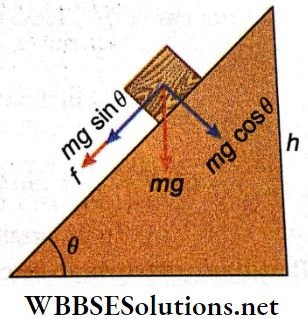
Work And Energy Workd Done Against Friction

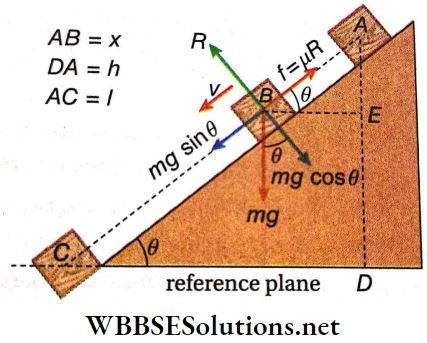
Suppose a body of mass m begins to move from point A under gravity along a rough inclined plane towards C.

The height of point A above the reference plane CD is h. Hence, the potential energy of the body at A = mgh. The body is at rest so its kinetic energy is zero there. Thus, the total mechanical energy of the body at A = mgh + 0 = mgh.

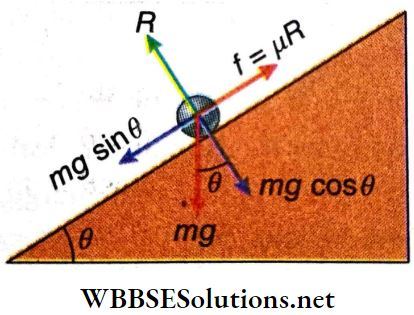
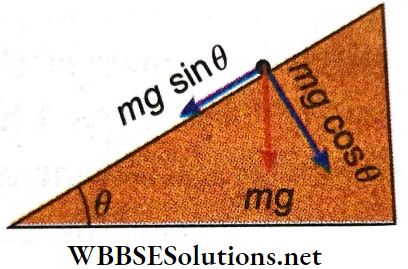
Under the action of the component mg sin# of the weight, the body starts moving down along the incline. Then a frictional force, f = μR = μmg cosθ acts upwards on the body along the inclined plane, where μ = coefficient of friction.

Understanding Energy Dissipation in Physics

Hence, the resultant downward force along the plane,

F = mg sinθ- μmg cosθ = mg(sinθ – μ cosθ)

the acceleration along the plane, a = \(\frac{F}{m}\) = g(sinθ-μcosθ)

If the velocity of the falling body at B is v, where AB = x, then v² = 2ax = 2xg(sinθ- μcosθ)

Kinetic energy at B = \(\frac{1}{2}\) mv²

= \(\frac{1}{2}\) m · 2xg(sinθ – μcosθ)

= mgx(sinθ-μcosθ)

The potential energy at B = mg · DE = mg(DA-EA) =mg(h- xsinθ)

Hence, total mechanical energy at B

= mg(h- xsinθ) + mgx( sinθ- μcosθ)

= mgh-μmg cosθ · x = mgh – fx…(1)

Equation (1) shows that the mechanical energy at B is less than that at A by fx, which is the work done against the frictional force to cover a distance x along the plane. This amount fx of energy is transformed into unavailable form, in order to overcome the frictional force against motion.

So, the total energy dissipated during the sliding of the body along an inclined plane of length l (=AC) = fl = μmgl cosθ.

The above discussions show that, in the presence of dissipative forces like friction, mechanical energy does not remain conserved for a system. We see that,

Total mechanical energy at A = total mechanical energy at B +fx

The work fx, done against friction, actually transforms into heat energy at the surface of contact of the body with the plane. This heat can never be recovered in any usable form. However, taking this heat into consideration, we see that the total energy is certainly conserved.

Class 11 Physics Class 12 Maths Class 11 Chemistry
NEET Foundation Class 12 Physics NEET Physics

Unit 4 Work Energy Power Chapter 1 Work And Energy

Dissipation Of Energy Numerical Examples

Examples of Energy Dissipation in Daily Life

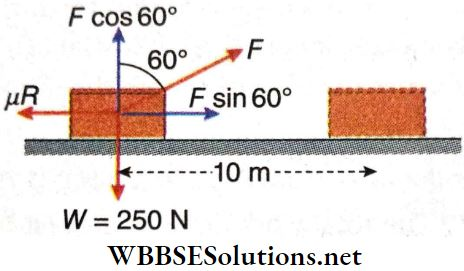
Example 1. A block weighing 250 N Is pulled over a horizontal plane at a constant velocity up to a distance of 10 m. The coefficient of kinetic friction Is 0.2 and the force is applied by a string, attached to the block, Inclined at 60° with the vertical. Find the work done against friction.
Solution:

Given

A block weighing 250 N Is pulled over a horizontal plane at a constant velocity up to a distance of 10 m. The coefficient of kinetic friction Is 0.2 and the force is applied by a string, attached to the block, Inclined at 60° with the vertical.

Let the force applied on the block be F

Horizontal component of the applied force along the plane

= \(F \sin 60^{\circ}=\frac{\sqrt{3}}{2} F\) and its vertical component

= \(F \cos 60^{\circ}=\frac{F}{2} .\)

Work And Energy A Block Weigthing Is Pulled Over A Horizontal Plane At A Constant Velocity

Since there is no vertical acceleration of the block, net force acting vertically is zero.

i.e., R + Fcos60° = W (where R is the normal reaction on the block)

∴ R = W – \(\frac{F}{2}\)

As the body is moving with a uniform velocity, the horizontal component of applied force = frictional force

or, \(\frac{\sqrt{3}}{2} F=\mu R=\mu\left(W-F \cos 60^{\circ}\right)=0.2\left(250-\frac{F}{2}\right)\) = 50-0.1 F

∴ F = \(\frac{50}{0.866+0.1}=\frac{50}{0.966} \mathrm{~N}\)

Hence, work done by the applied force

= \(F \sin 60^{\circ} \times 10=\frac{50}{0.966} \times \frac{\sqrt{3}}{2} \times 10=448.25 \mathrm{~J} .\)

Example 2. A particle Is sliding down along an inclined plane. The frictional force is 0.2 times the normal reaction, and the inclination of the plane is 60J. What Is the acceleration of the particle? If the mass of the particle is 1 g, find the change in the sum of potential and kinetic energies of the particle as it slides down the plane by 1 m.
Solution:

Given

A particle Is sliding down along an inclined plane. The frictional force is 0.2 times the normal reaction, and the inclination of the plane is 60J.

Let the acceleration of the particle along the inclined plane = a and the downward force on the particle along the plane = mg sinθ – f

Work And Energy A particle Slidding Down Along A Inclined Plane

∴ ma = mgsinθ – μR = mg sinθ – μmg cosθ

or, a = g (sinθ – nμcosθ) =9.8 (sin60° – 0.2cos60°)

= \(9.8\left(\frac{\sqrt{3}}{2}-0.2 \times \frac{1}{2}\right)=7.5 \mathrm{~m} \cdot \mathrm{s}^{-2}\)

Change in mechanical energy

= work done against friction = μmg cosθ · s

= 0.2 x 0.001 x 9.8 x \(\frac{1}{2}\) x 1 = 0.00098 J.

Change in mechanical energy = 0.00098 J.

Practice Questions on Energy Dissipation for Class 11

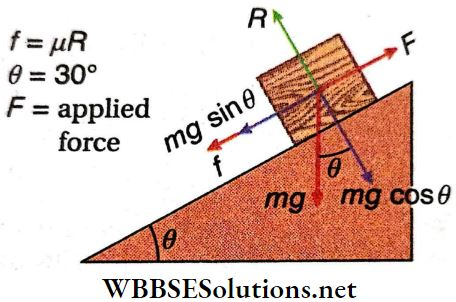
Example 3. A box of mass 12 kg is pushed up by a distance of 10 m on the application of a 100 N force along a plane of inclination 30°. If the coefficient of friction is \(\frac{1}{\sqrt{3}}\), find the work done against friction, [g = 10 m · s-2]
Solution:

Given

A box of mass 12 kg is pushed up by a distance of 10 m on the application of a 100 N force along a plane of inclination 30°. If the coefficient of friction is \(\frac{1}{\sqrt{3}}\),

Frictional force, f = μR = μmg cos30°

Work And Energy A Box Of Mass Is Pushed Up By A Distance Of Inclination

Hence work done against friction, W = fs

= μmg cos30° · s

= \(\frac{1}{\sqrt{3}} \times 12 \times 10 \times \frac{\sqrt{3}}{2} \times 10=600 \mathrm{~J}\)

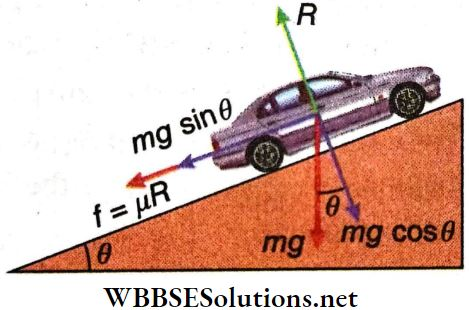
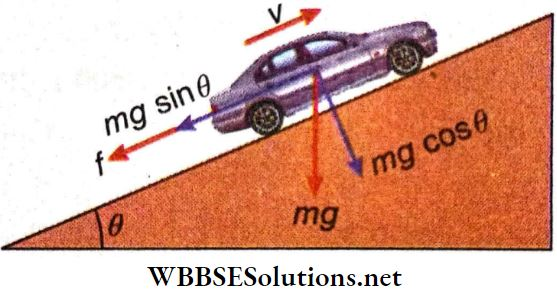
Example 4. A car of mass 1000 kg moves up at 40 km · h-1 along an inclined plane of slope \(\frac{1}{50}\). The coefficient of rolling friction between the road and the wheels of the car is 0.3. Find the power of the car engine.
Solution:

Given

A car of mass 1000 kg moves up at 40 km · h-1 along an inclined plane of slope \(\frac{1}{50}\). The coefficient of rolling friction between the road and the wheels of the car is 0.3.

The angle of inclination = θ.

∴ Slope = tanθ = \(\frac{1}{50}\) ≈ sinθ [θ is small]

Work And Energy A Car Of Mass 1000kgs Moving Up At Inclined Plane

The resultant downward force on the car along the incline

= mg sinθ + f

= mg sinθ + μR

= mg sinθ + μmg cosθ = mg(sinθ + μcosθ)

= \(1000 \times 9.8\left(\frac{1}{50}+0.3 \times 1\right)\) (as is very small cosθ ≅ 1)

= 9800 x 0.32 = 3136 N

Velocity of the car =40 km · h-1 = 11.11 m · s-1

∴ Power of the car =3136 x 11.11 N · m · s-1 =34840.96 W = 34.84 kW.

Example 5. An engine, working at a constant rate, is pulling a train of mass 500 tonne along a plane of inclination sin-1\(\frac{1}{100}\).frictional force per metric tonne is 49 N and the train is moving with a velocity of 10 m · s-1, what is the power of the engine in kilowatt? [1 tonne (metric ton) = 1000 kg]
Solution:

Given

An engine, working at a constant rate, is pulling a train of mass 500 tonne along a plane of inclination sin-1\(\frac{1}{100}\).frictional force per metric tonne is 49 N and the train is moving with a velocity of 10 m · s-1,

Downward effective force on the train along the inclined plane = mg sinθ + frictional force (f)

= 500 x 1000 x 9.8 x \(\frac{1}{100}\) + 500 x 49 = 7500 x 9.8 N

Velocity of the train = 10 m · s-1

Since the car is moving upward with a constant velocity, the force applied by the car’s engine, F must exactly balance the net downward force.

∴ F = 3136 N

Hence, power of the engine = 7500 x 9.8 x 10 = 735000 J · s-1 = 735000 W = 735 kW.

Example 6. A loaded lorry of total mass 5000 kg can come down from the top of a slope (1:40) effortlessly at 18 km · h-1. What should be the horsepower of its engine so that it can go up with the same speed, from the base to the top? Resistance due to friction may be taken to be the same in both cases.
Solution:

Given

A loaded lorry of total mass 5000 kg can come down from the top of a slope (1:40) effortlessly at 18 km · h-1.

Velocity of the lorry = \(18 \mathrm{~km} \cdot \mathrm{h}^{-1}=\frac{18 \times 1000}{60 \times 60} \mathrm{~m} \cdot \mathrm{s}^{-1}=5 \mathrm{~m} \cdot \mathrm{s}^{-1}\) \(\sin \theta=\frac{1}{40}\)

As the speed of the lorry remains constant for the downward journey, the friction just balances the downward active force mg sinθ.

∴ Frictional force, f = mg sinθ.

Effective force on the lorry for its upward journey = mg sinθ + f = mg sinθ + mg sinθ = 2mg sinθ

∴ Power of the engine = effective force on the lorry x velocity of the lorry

= 2mgsinθ x 5 = 2 x 5000 x 9.8 x \(\frac{1}{40}\) x 5

= 12250 W = \(\frac{12250}{746}\)hp = 16.42 hp.

Problems On Energy Dissipation

Example 7. A car of mass 500 kg is moving up along an inclined surface of slope \(\frac{1}{25}\) at a constant speed of 72 km · h-1. If the coefficient of friction between the road and the car wheel is 0.1, find the power of the car engine (g = 9.8 m · s-2).
Solution:

Given

A car of mass 500 kg is moving up along an inclined surface of slope \(\frac{1}{25}\) at a constant speed of 72 km · h-1. If the coefficient of friction between the road and the car wheel is 0.1,

Frictional force, f = μmg cosθ, v = 72 km · h-1 = 20 m · s-1, m = 500 kg, g = 9.8m · s-2, μ = 0.1 and tanθ = \(\frac{1}{25}\)

∴ sinθ  = \(\frac{1}{\sqrt{626}}\) and

cosθ = \(\frac{25}{\sqrt{626}}\)

Work And Energy A Car Of Mass Is Moving Up Along An Inclined Surface

F = force opposing the motion of the car = f + mg sinθ = mg(μcosθ + sinθ)

∴ Power of the car engine, P = Fv= mg(μcosθ + sinθ)v

= \(500 \times 9.8 \times\left(\frac{0.1 \times 25}{\sqrt{626}}+\frac{1}{\sqrt{626}}\right) \times 20\)

= \(13709 \mathrm{~J} \cdot \mathrm{s}^{-1}=13709 \mathrm{~W} .\)

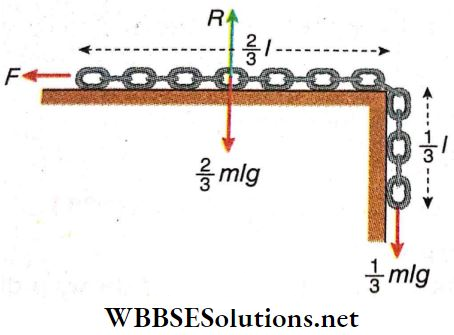
Example 8. A 1.5 m long chain of mass 0.8 kg is kept on a horizontal table and a part of its length hangs from the edge of the table. When the length of the hanging part is one-third the total length of the chain, it starts sliding off the table. What will be the work done by friction when the whole length of the chain slides off the table?
Solution:

Given

A 1.5 m long chain of mass 0.8 kg is kept on a horizontal table and a part of its length hangs from the edge of the table. When the length of the hanging part is one-third the total length of the chain, it starts sliding off the table.

When \(\frac{1}{3}\) of the chain is hanging, it starts sliding.

In this condition, frictional force = weight of the hanging part of the chain

or, μ x \(\frac{2}{3}\)mlg= \(\frac{1}{3}\)mlg [μ = coefficient of friction, m = mass per unit length of the chain, and l = length of the chain]

∴ μ = \(\frac{1}{2}\) = 0.5

Work And Energy A Long Chain Of Mass Kept On A Horizontal Table

When the whole length of the chain slides off the table, the effective frictional force on the chain = 0.

∴ Effective average frictional force on the chain = \(\frac{\frac{2}{3} \mu \mathrm{mlg}+0}{2}=\frac{1}{3} \mu \mathrm{mlg} .\)

The chain moves through a distance of \(\frac{2}{3}\). l against the effective friction. Work done against friction is, therefore,

W = \(\frac{1}{3} \mu m g l \times \frac{2}{3} l=\frac{2}{9} \mu m g l^2\)

= \(\frac{2}{9} \times 0.5 \times \frac{0.8}{1.5} \times 9.8 \times(1.5)^2\)

= \(1.3 \mathrm{~J} .\)

Example 9. A body of mass 10 kg is pushed up 50 cm from the ground, along a plane inclined at 45° to the horizontal. if the coefficient of friction is 0.2, then calculate the work done.
Solution:

Given

A body of mass 10 kg is pushed up 50 cm from the ground, along a plane inclined at 45° to the horizontal. if the coefficient of friction is 0.2

Here, h = 50 cm = 0.5 m, m = 10 kg, g = 9.8 m · s-2, θ = 45°, μ = 0.2

Let the friction acting on the body be f. Then, f = μmg cosθ

The force against which the body is pushed up is F = f + mg sinθ

= mg(μ cosθ + sinθ)

The body is pushed up by a distance \(\frac{h}{\sin \theta}\) along the inclined plane.

Therefore, the work done is, W = \(\frac{F h}{\sin \theta}=\frac{m g h}{\sin \theta}(\mu \cos \theta+\sin \theta)\)

= \(\frac{10 \times 9.8 \times 0.5}{\sin 45^{\circ}} \times\left(0.2 \times \cos 45^{\circ}+\sin 45^{\circ}\right)\)

= \(49 \times \sqrt{2} \times\left(0.2 \times \frac{1}{\sqrt{2}}+\frac{1}{\sqrt{2}}\right)=58.8 \mathrm{~J} .\)

Example 10. By application of a force F, a body of mass m Is raised to the top of a hill. F is tangential along the whole path. If the height of the hill Is h, the length of the base of the hill is l, and the coefficient of friction is μ, then find the work done.
Solution:

Given

By application of a force F, a body of mass m Is raised to the top of a hill. F is tangential along the whole path. If the height of the hill Is h, the length of the base of the hill is l, and the coefficient of friction is μ,

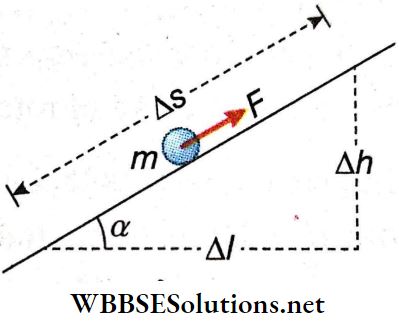
The total path from the bottom to the top of the hill can be considered as an assembly of a large number of inclined planes of varying angles of inclination. Consider an incline of length Δs.

Its vertical height is Δh and the angle of inclination is α.

Total work done in lifting the body along this inclined surface = work done against gravity + work done against friction.

Work And Energy By Application Of Force Is Raised By Hill

∴ \(\Delta W=m g \Delta h+\mu m g \cos \alpha \cdot \Delta s\)

= \(m g \Delta h+\mu m g \cos \alpha \frac{\Delta l}{\cos \alpha}=m g(\Delta h+\mu \Delta l)\)

∴ Total work done to lift the body up to the top of the hill,

W = \(\sum \Delta W=m g\left(\sum \Delta h+\mu \sum \Delta l\right)\)

= \(m g(h+\mu l)\)

WBCHSE Class 11 Physics Work Energy And Power Notes

Work

Work Definition: Work is said to be done when an object is displaced from its initial position under the action of a force. Work is measured as the scalar product of the applied force and the displacement of the object.

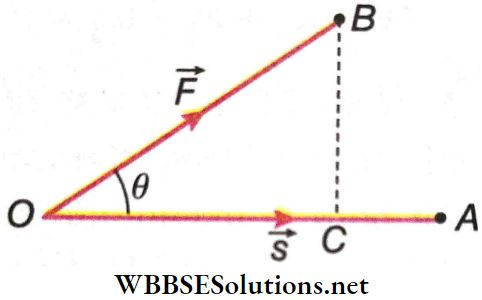
Let \(\vec{F}=\overrightarrow{O B}\) = force acting on a particle and \(\vec{s}=\overrightarrow{O A}\) corresponding displacement of the particle.

Work And Energy Work Disolacement Of Particle

Then, by definition, the work done is W = \(\vec{F}\) \(\vec{s}\)…..(1)

If θ = ∠BOA = angle between the force and the displacement vectors, then from the property of the scalar product, we have W = Fscosθ……(2)

From the figure we get, \(F \cos \theta=O B \cdot \frac{O C}{O B}=O C\) = component of the force \(\vec{F}\) along the direction of the displacement \(\vec{s}\).

Read and Learn More: Class 11 Physics Notes

Hence, from equation (2), it may be written that, work done = displacement x component of force along the direction of displacement

If the components of \(\vec{F}\) and \(\vec{s}\) are known, equation (1) can be expressed as,

W = \(\left(F_x \hat{i}+F_y \hat{j}+F_z \hat{k}\right) \cdot\left(s_x \hat{i}+s_y \hat{j}+s_z \hat{k}\right)\)

= \(F_x s_x+F_y s_y+F_z s_z\)

It is very important to note that, force and displacement are both vector quantities, but their product, work, is a scalar quantity.

WBCHSE Class 11 Physics Work Energy And Power Notes

Work Discussions:

1. Force Without Displacement: If an object is not at all displaced under the action of a non-zero force \(\vec{F}\), then work done is considered to be zero,

i.e., if s = 0 but F≠ 0, then

W = Fscosθ = Fcosθ x 0 = 0

2. Displacement Without Force: If an object is displaced in the absence of any force acting on it, i.e., if s≠0 when F = 0, we find from equation (2), W = 0. For example, an object moving with uniform speed in a straight line maintains its state of motion in the absence of any external force on it (Newton’s 1st law).

But its displacement is not zero, because it is actually moving and as a result changing its position. In this case, there is no work done, only because F = 0.

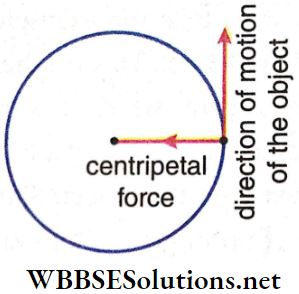
3. No-Work Force: If the force and the displacement vectors are perpendicular to each other, then θ = 90° or cosθ = 0. So, from the equation (2), we have W = 0. In such cases, the force acting on an object is called a no-work force.

Work And Energy No Work Force

For example, an object in a uniform circular motion is displaced along the tangent of the circle, whereas the active force, called the centripetal force, acts in the radial direction. As the tangential and the radial directions are perpendicular to each other, the centripetal force is a no-work force.

WBBSE Class 11 Work Energy Power Study Notes

Sign Convention Of Work: Work done (W) is conventionally defined as W = \(\vec{F}\) – \(\vec{s}\) = Fscosθ….(3)

The different values of cosθ give rise to different cases:

  1. If θ lies between 0 and 90°, cosθ is positive. So, from equation (3), the work done is positive.
  2. If θ lies between 90° and 180°, cosθ is negative. So, from equation (3), the work done is negative.

It should be mentioned that the opposite convention, W = –\(\vec{F}\)– \(\vec{s}\), may also be used. No error will occur if this alternative relation is consistently followed throughout.

In many problems, we need to deal only with the absolute value of work done. Then, the positive or negative sign of W would not be important.

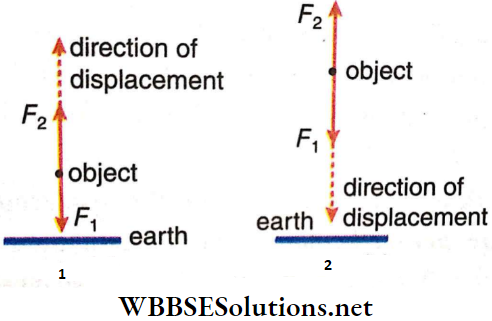
Sign Convention Of Work Discussion: When an object is displaced in a direction opposite to the force acting on it, it is said that the work is done against the force. In this situation, there must exist an external agent that is responsible for the displacement of this object against the force.

Lifting of an object upwards against the downward force of gravity acting on it, the motion of an object on a rough surface against the force of friction, etc., are examples of this type of work. In these cases, usually, some person or some machine acts as the external agent.

Work Energy Power Sign Conservation Of Work

Let us take the example of lifting an object against gravity. This can be explained in two ways:

  1. The external agent (which lifts the object) does positive work on the object by applying a force \(\vec{F}_2\) or
  2. Gravity \(\vec{F}_1\) does negative work on the object.

Similarly, when an object falls under the action of gravity and an external agent opposes the motion, it can also be explained in two ways:

  1. The external agent does negative work on the object or
  2. Gravity does positive work on the object.
Class 11 Physics Class 12 Maths Class 11 Chemistry
NEET Foundation Class 12 Physics NEET Physics


Work Done On A System Of Bodies: The application of a force on a system, comprising a number of bodies, may produce different displacements for different bodies within the system, In such cases, to calculate the work done, the displacement of the point of application of the force is considered.

Hence, in this case, work done = force on the system of bodies x displacement of the point of application

Work Done By A System Of Forces: Since work is a scalar quantity work done due to a number of forces acting on a body is the algebraic sum of the work done due to each of the forces. The resultant of the forces produces the same amount of work.

Let a system comprising three forces act on a body, and the work done due to this system be W. Work done due to the individual forces are, w1, w2, and w3. The resultant of the system of forces is \(\vec{F}\) and the displacement of the body is \(\vec{s}\). Hence W = w1 + w2+ w3 = \(\vec{F}\) · \(\vec{s}\)

Work Done By A Varying Or A Variable Force: So far we have considered the work done by a force that is constant both in magnitude and direction. But often the force doing work is variable. A varying force means, a force whose magnitude or direction or both changes continuously.

  • For example, when a rocket is fired upwards from the Earth, the force required to keep the rocket moving away from the Earth is not constant, it continuously decreases.
  • Similarly, when a spring, whose end is fixed to a rigid support, is stretched by a force through a small distance x then the restoring force F developed in the spring increases with x.
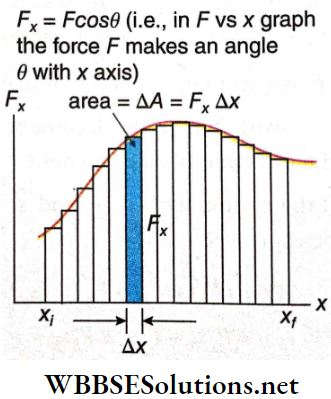
  • Let us consider a variable force F to be acting on a particle. Under the influence of this force, the particle is displaced along the x-axis from the initial position xi to the final position xj.
  • The x-component of the force is denoted by Fx. In this case, the work done cannot be simply stated by W = Fx(xf– xi). This equation is applicable when the applied force is a constant.
  • Here the force F varies with x and hence both F and Fx are functions of x. To calculate the work done in this case, the interval xi to xf is divided into a large number of small displacements Δx, so that Fx can be assumed to be constant over this displacement Δx.
  • Hence for a very small displacement Ax, work done can be considered to be ΔW = FxΔx.
  • This can also be considered to be the area of the shaded region.

Work And Energy Work Done By A Varying Or A Variable Force

Therefore total work done when the particle is displaced from the initial position xi to the final position xf is given by the relation

W = \(\sum_{x_i}^{x_f} F_x \Delta x\)…(1)

If \(\Delta x \rightarrow 0\), then \(\lim _{\Delta x \rightarrow 0} \sum_{x_i}^{x_f} F_x \Delta x=\int_{x_i}^{x_f} F_x d x\)….(2)

From (1) and (2) we obtain, \(W=\int_{x_i}^{x_f} F_x d x\)

In this case, the total work done can be considered to be the area enclosed by the curve between xi and xf on the x-axis.

Key Concepts in Work Energy and Power Notes

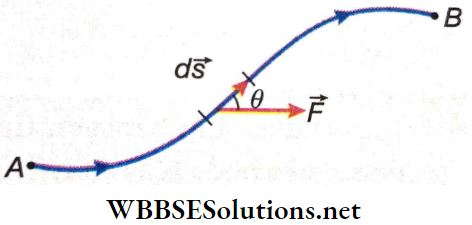
Work Done On A Particle Moving Along A Curved Path: Let us consider a particle being moved along the curve AB as shown by a force \(\vec{F}\) which continuously changes in magnitude as well as in direction.

Work And Energy Work Done OnA Particle Moving Along A Curved

According to the diagram, if \(\vec{ds}\) is a small displacement of the particle under the action of the force, then the total work done in displacing the A particle from A to B is

W = \(\int_A^B \vec{F} \cdot d \vec{s}=\int_A^B F \cos \theta d s\)

It is to be noted that in this integration, neither F nor θ is a constant.

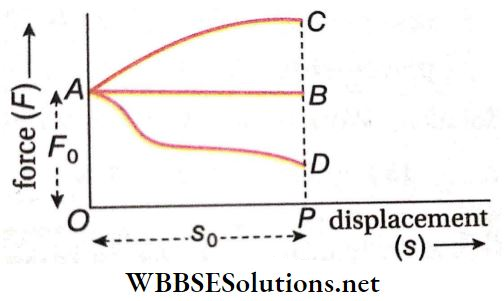
Graphical Representation Of Work: The relationship between forces acting on a body and its displacement can be represented in a force-displacement graph.

For A Constant Force: If the displacement of a body is s0 under the action of a constant force F0, we get a straight line graph AB. AB is parallel to the x-axis as F0 is constant.

Work And Energy Graphical Representation Of Work For A Constant Force

Obviously, the area under the graph, ABPO, is equal to F0S0 which is the magnitude of the work done.

For A Varying Force: If s0 is the displacement of a body under a varying force, the force-displacement graph is not a straight line, but a curved line like AC or AD. In these cases also, it can be proved that the area under the curve (AC or AD) gives the work done.

Hence, work done corresponding to graph AC = area ACPO; work done corresponding to graph AD = area ADPO.

Thus, in general, work done = area under the force-displacement graph.

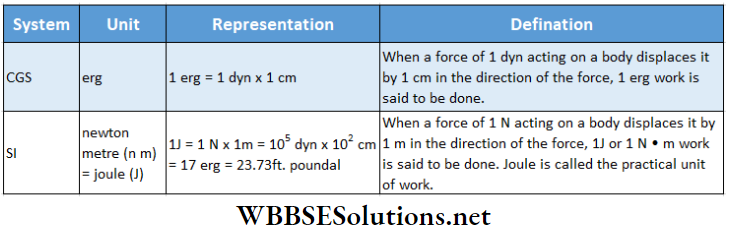
Absolute Units And Dimension Of Work: Work done = force x displacement of the body. Hence, a unit of work depends on units of force and displacement.

A unit work is said to be done when a unit force acting on a body produces a unit displacement along the direction of the force.

Work Energy Power Absolute Dimensional Work Forces

Dimension: Dimension of work = dimension of force x dimension of displacement = MLT-2 x L = M2T-2

Unit 4 Work Energy Power Chapter 1 Work And Energy

Work Numerical Examples

Comparative Analysis of Kinetic and Potential Energy

Example 1. To displace a body by 50 m, 150 J of work is done. What is the force applied in the direction of the displacement?
Solution:

Work done, W = Fs, where W = 150 J, s = 50 m

∴ 150 = 50F or, F = 3 N .

Example 2. A body of mass 10 kg is raised by 5m. What is the work done?
Solution:

Force, F= mg = 10 x 9.8 = 98 N ; displacement, s = 5 m

∴ Work done, W= Fs = 98 x5J = 490 J

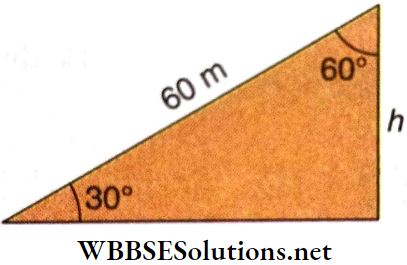
Example 3. A cycle with the rider has a total mass of 80 kg; it rolls down 60 m on a plane of inclination 30°. What is the total work done by gravity on the cycle?
Solution:

Force acting vertically downwards, F = 80 kg-wt = 80 x 9.8 N

Displacement, s = 60 m

The angle between force and displacement, θ = 60°

Work And Energy A Cycle With A Rider Has Total Mass 80 Kgs

∴ W=Fscosθ

= (80 x 9.8) x 60 x cos60°

= 80 x 9.8 x 60 x 0.5 = 23520 J

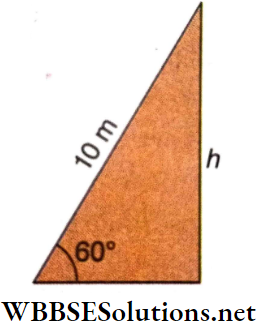
Example 4. A man of mass 100 kg climbs up a ladder of length 10 m. The ladder makes an angle 60° with the horizontal. Find the work done by the man against gravity in climbing up the ladder, [g = 9.8 m · s-2]
Solution:

Work done to climb up the ladder by 10 m is equivalent to the work done to climb up a vertical height h.

Here, \(\sin 60^{\circ}=\frac{h}{10}\)

Work Energy And Power Work Done To Climb Up The Ladder

or, \(h=\frac{10 \sqrt{3}}{2}\)

∴ Work done, \(W=m g \times h\)

= \(100 \times 9.8 \times 5 \sqrt{3}=8487.04 \mathrm{~J}\).

Example 5. A body is constrained to move along the z-axis is subject to a constant force F = \((-\hat{i}+2 \hat{j}+3 \hat{k}) \mathrm{N}\). Calculate the work done by this force in moving the body a distance of 4m along the z-axis.
Solution:

Displacement, \(\vec{s}=4 \hat{k} \mathrm{~m}\)

Force, \(\vec{F}=(-\hat{i}+2 \hat{j}+3 \hat{k}) \mathrm{N}\)

∴ Work done, W = \(\vec{F} \cdot \vec{s}=(-\hat{i}+2 \hat{j}+3 \hat{k}) \cdot 4 \hat{k}\)

= \(-4 \hat{i} \cdot \hat{k}+8 \hat{j} \cdot \hat{k}+12 \hat{k} \cdot \hat{k}\)

= \(0+0+12 \cdot 1=12 \mathrm{~J} .\)

Common Questions on Work Energy Power

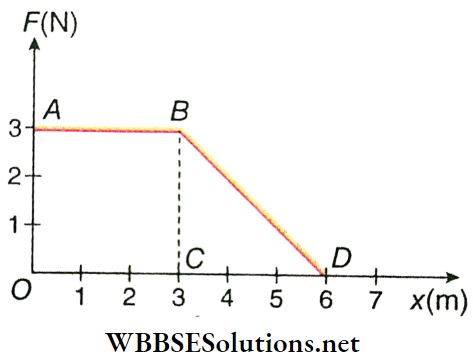
Example 6. A force F-acting on an object varies with distance x as shown here. The 2 force is in N and x in m. What is the amount of work done by the force in moving the object from x = 0 to x = 6m?

Work And Energy A Foce Acting On A Object Varibles With Distance

Solution:

Work done, W = area of the rectangle OABC + area of the triangle BCD,

= 3 x 3 + 1/2 x 3 x 3 = 13.5J

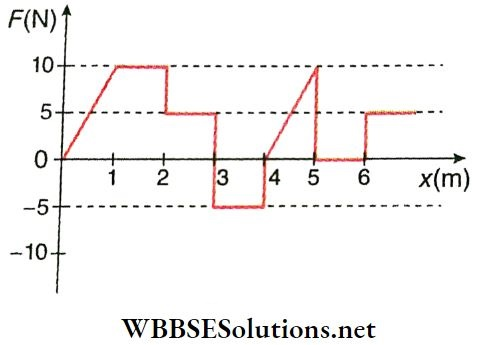
Example 7. The relationship between the force F and the position x of a body is as shown.  What will be the amount of work done in displacing the body from x = 1 m to x = 5m?

Work And Energy Relation Between Force And Position Of A Body

Solution:

Work done,

W = 10 x 1 5 x 1 + (-5 x 1) + 1/2 x 1 x 10

= 10 + 5 – 5 + 5

= 15J

Example 8. A position-dependent force F = (7 – 2x + 3x²) N acts on a body of mass 2 kg and displaces it from x = 0 to x – 5 m. Determine the amount of work done in i joule.
Solution:

Work done,

W = \(\int F d x=\int_0^5\left(7-2 x+3 x^2\right) d x\)

= \(\left[7 x-x^2+x^3\right]_0^5\)

= \(7 \times 5-5^2+5^3=35-25+125=135 \mathrm{~J}\)

WBCHSE Work Power And Energy Class 11 Notes

Work And Energy

Power

Definitions Related to Power, and Energy

Power Definition: The time rate at which work is done by a force is called power due to that force or simply work done per unit time is called power.

If W is the amount of work done by a force in the time interval t, then power, \(\bar{P}=\frac{W}{t}=\frac{\vec{F} \cdot \vec{s}}{t}=\vec{F} \cdot \vec{v}\)…(1)

In general, work may not be done at a uniform rate throughout the time t. So, equation (1) actually represents the average power.

On the other hand, if work is done at a variable rate i.e., work W( t) done by a force is a function of time (t), then power at any given instant or instantaneous power is more useful. Let dW be the work done in an infinitesimal time interval dt, then the instantaneous power is P = \(\frac{dW}{dt}\)…(2)

If in that interval dt an infinitesimal displacement \(d \vec{s}\) takes place, then dW = \(\vec{F} \cdot d \vec{s}\)

or, P \(=\frac{d W}{d t}=\vec{F} \cdot \frac{d \vec{s}}{d t}=\vec{F} \cdot \vec{v}=F v \cos \theta\); where, \(\vec{v}=\frac{d \vec{s}}{d t}\) = instantaneous velocity and θ = the angle between the direction of force applied and displacement.

Power Example: Suppose a robot does a work of 1000 erg in 5 s and another robot takes 10 s to do the same work. Hence, the power of the first robot = 1000/5 = 200 erg · s-1 and that of the second robot = 1000/10 = 100 erg · s-1.

Though both of them do the same amount of work, the power delivered by the first robot is greater.

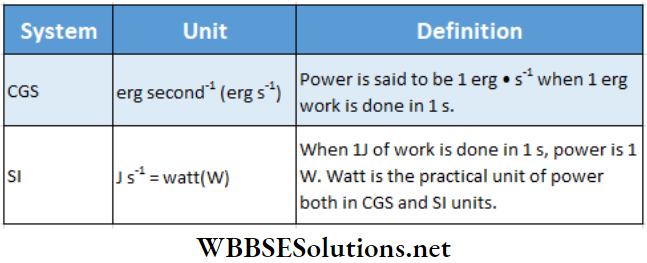
Absolute Units And Dimension Of Power: We know, power = \(\frac{work}{time}\). So the unit of power depends on the units of work and time.

The power to do unit amount of work in a unit time is the unit of power.

Abtokito Units:

Work Energy Power Absolute Units

Abtokito Units Relations:

1W = 1 J · s-1 = 107 erg ·  s-1

1 kW = 103 W, 1 MW = 106 W

The practical unit of power in FPS system is horsepower (hp). When a mass of 550 lb is raised by 1 ft in 1 s against gravity, the power is 1 hp. The power of heat engines or electric motors are usually measured and expressed in horsepower.

So, 1 hp = 550 ft · lb · s-1

Relation Between Horsepower And Watt: 1 hp =550 ft · lb · s-1

= (500 x 30.48) cm x (453.6 x 981) dyn · s-1

= 746 x 107 erg · s-1 = 746 J · s-1 = 746 W

∴ 1 kW = \(\frac{1000}{746}\) = 1.34 hp.

WBBSE Class 11 Work Power Energy Study Notes

Dimension:

Dimension of power = \(\frac{\text { dimension of work }}{\text { dimension of time }}\)

= \(\frac{M L^2 T^{-2}}{T}\)

= \(\mathrm{ML}^2 T^{-3}\)

Concept Of Power: Appliances used in our daily lives like electric bulbs, heaters, and motors are selected on the basis of their respective powers, and not of the total work that such devices can do. The power of a bulb is important as bulbs with higher wattage are more bright. The temperature of water can be raised faster with a high-power heater. The power ratings of appliances play a very important role in our practical lives.

WBCHSE Work Power And Energy Class 11 Notes

Unit 4 Work Energy Power Chapter 1 Work And Energy

Power Numerical Examples

Example 1. A man of mass 50 kg climbs up 20 steps of a staircase in 5 s. Each step is 30 cm high. Find the power applied by the man.
Solution:

Height of 20 steps =20 x 30 = 600 cm = 6 m

∴ Work done = 50 x 9.8 x 6 = 2940 J [as m = 50 kg, g = 9.8 m · s-2]

∴ Power = \(\frac{2940}{5}\) J · s-1 = 588 W

Class 11 Physics Class 12 Maths Class 11 Chemistry
NEET Foundation Class 12 Physics NEET Physics

Example 2. Find the power applied by a man of mass 70 kg, carrying a load of 45 kg, moving up at 6.4 km per hour along a plane of inclination \(\frac{1}{10}\).
Solution:

Velocity of the man, \(v=6.4 \mathrm{~km} \cdot \mathrm{h}^{-1}=\frac{6.4 \times 5}{18} \mathrm{~m} \cdot \mathrm{s}^{-1}\)

Total weight of the man and the load = (70 + 45)kg = 115 x 9.8 N

While moving up, the man has to work against the force mg sinθ

Work And Energy Power Applied By A Force

Hence, the power applied by the man, P = mg sinθ x v

= \(115 \times 9.8 \times \frac{1}{10} \times \frac{6.4 \times 5}{18}\)

[Here, tanθ = 1/10 ≈ sinθ (as θ is small)]

= 200.36 W

Common Questions on Work Power Energy

Example 3. Water is lifted to a vertical height of 90 m using a 7.46 kW engine. If the efficiency of the engine is 80%, find the amount of water lifted in a minute.
Solution:

Let the mass of water lifted per minute be m.

Effective power of the engine = 7.46 x 103 x 0.8 W

Now, work done per second = the effective power

∴ \(\frac{F s}{t}=\frac{m g s}{t}=7.46 \times 10^3 \times 0.8\)

or, m = \(7.46 \times 10^3 \times 0.8 \times \frac{t}{g s}\)

= \(\frac{7.46 \times 10^3 \times 0.8 \times 60}{9.8 \times 90}\)

(because \(t=1 \mathrm{~min}=60 \mathrm{~s}, g=9.8 \mathrm{~m} \cdot \mathrm{s}^{-2}, s=90 \mathrm{~m}\)) \(\approx 406 \mathrm{~kg}\)

WBCHSE Important Questions for Class 11 Physics For Work and Energy

Work And Energy Long Answer Type Questions

Question 1. A car is moving with a uniform velocity along a horizontal road. Does the engine of the car do any work in this instance?
Answer:

The force of friction acts opposite to the direction of motion of the car. The force applied by the engine of the car against friction maintains its uniform velocity. This force is doing work as displacement occurs against friction. If f = force of friction and v = velocity of the car, work done in 1 s by the engine = force of friction x constant velocity = fv.

Question 2. Earth revolves around the sun (say in a circular path) under the action of the force exerted by the sun on the Earth. Is the sun doing any work? Explain.
Answer:

Centripetal force (which is provided by the gravitational pull of the sun in this case) that acts on a body in a circular motion is perpendicular to the displacement of the body at every point of its motion and hence does not do any work. Component of this force in the direction of the displacement = Fcos90° = 0 (F = applied force). So, the gravitational pull of the sun does not do any work for the revolution of the earth, as the force acts perpendicular to the earth’s direction of displacement.

Question 3. A man is swimming against the current such that his position with respect to the river bank remains unaltered. Is the man doing any work?
Answer:

The relative displacement of the man with respect to the river bank is zero. So, no work is done by the man. The resistive force of river water just balances the force applied by the man. So this case is similar to a force applied against static friction.

WBCHSE Important Questions for Class 11 Physics For Work and Energy laqs

WBBSE Class 11 Work and Energy Important Questions

Question 4. When a weightlifter over his head, remains to how much stationary work does he do?
Answer:

To lift a weight mg above his head through a height h, work mgh has to be done against gravity. But when the weight is held stationary above his head, no displacement occurs and no work is done by the lifter at that stage.

Question 5. A bullet is fired from a rifle. The rifle is free to recoil. Compare the kinetic energy of the rifle with that of the bullet.
Answer:

K.E., \(K=\frac{1}{2} m v^2=\frac{1}{2} \frac{(m v)^2}{m}=\frac{p^2}{2 m}\) [p = momentum]

Both the rifle and the bullet were at rest before firing. After firing, the momenta of the rifle and the bullet must be equal in magnitude and opposite in direction in order to conserve linear momentum.

As p is the same for both, K ∝ \(\frac{1}{m}\). As the rifle is heavier, its K.E. is less than that of the bullet.

Question 6. If a car is driven along a straight path by an engine of constant power, find the displacement-time relation.
Answer:

Let the power of the engine be P (constant).

But P = velocity x force = \(\nu m a=v m \frac{d v}{d t}\)

or, \(v d v=\frac{P}{m} d t\).

Integrating, \(\frac{v^2}{2}=\frac{P}{m} t+C\), where C= integration constant.

or, \(v=\sqrt{2} \sqrt{\frac{P}{m} t+C}\)

or, \(d s=\sqrt{2} \sqrt{\frac{P}{m} t+C} d t\left[because v=\frac{d s}{d t}\right]\)

Let \(\frac{P}{m} t+C=z\)

∴ \(\frac{P}{m} d t=d z \quad \text { or, } d t=\frac{m}{P} d z\)

∴ ds = \(\sqrt{2} \frac{m}{P} z^{\frac{1}{2}} d z\)

By further integration we get,

s = \(\frac{\sqrt{2} m \frac{2}{P}}{3} z^{3 / 2}+C^{\prime}\)

= \(\frac{\sqrt{2} m}{P} \cdot \frac{2}{3}\left(\frac{P}{m} t+C\right)^{3 / 2}+C^{\prime}\)

[C’ = integration constant]

= \(\frac{2 \sqrt{2}}{3} \sqrt{\frac{P}{m}}\left(t+\frac{m C}{P}\right)^{3 / 2}+C^{\prime}\)

This is the required relationship between time and displacement.

Common Problems in Work and Energy for Class 11

Question 7. A car and a lorry are moving with the same kinetic energy. Both are brought to rest with the same opposing force applied through brakes. Which one will stop within a short distance?
Solution:

As soon as the lorry and the car come to rest, their kinetic energies become zero. Hence, the change in kinetic energy (= work done by the brakes) will be the same for both vehicles. Now, work done = force x displacement. As the force applied is the same, both the car and the lorry will cover the same distance before coming to rest.

Question 8. The magenta of a lighter and a heavier mass are equal. Which one of them has a greater kinetic energy?
Answer:

Let the mass of the lighter body = m and its velocity = v, the mass of the heavier body = M and its velocity = V

Given, mv = MV.

Now, the kinetic energy of the lighter body, \(K_l=\frac{1}{2} m v^2\) and the kinetic energy of the heavier body, \(K_h=\frac{1}{2} M V^2\)

∴ \(\frac{K_l}{K_h}=\frac{\frac{1}{2} m v^2}{\frac{1}{2} M V^2}=\frac{m^2 v^2}{m} \times \frac{M}{M^2 V^2}=\frac{M}{m}>1\) [because m v=M V]

So, the kinetic energy of the lighter body is greater than that of the heavier body.

Class 11 Physics Class 12 Maths Class 11 Chemistry
NEET Foundation Class 12 Physics NEET Physics

Question 9. The kinetic energy of a lighter body is equal to that of a heavier body. Which one of them has greater momentum?
Solution:

Let the mass and velocity of the lighter body be m and v, and those of the heavier body be M and V, respectively.

Given, \(\frac{1}{2} M V^2=\frac{1}{2} m v^2\) or, \(\frac{M^2 V^2}{M}=\frac{m^2 v^2}{m}\)

or, \(\frac{m^2 v^2}{M^2 V^2}=\frac{m}{M}\)

or, \(\frac{m v}{M V}=\sqrt{\frac{m}{M}}\) or, \(\frac{\text { momentum of the lighter body }}{\text { momentum of the heavier body }}\)

= \(\sqrt{\frac{m}{M}}<1\)

Hence, the momentum of the heavier body is greater.

Question 10. A body has mechanical energy but no momentum, or has momentum but no mechanical energy—is it possible?
Answer:

A body at rest at a height from the ground has potential energy, a form of mechanical energy, but no momentum.

A body with momentum must have some velocity and thus some kinetic energy associated with it. Since kinetic energy is a form of mechanical energy, a body with momentum must have some mechanical energy.

Question 11. A man with a bucket of water in his hand is standing inside a lift moving upwards. Write

  1. Whether the man does any work on the bucket of water
  2. Whether the energy of the bucket remains unchanged.

Answer:

  1. As there is no displacement of the bucket with respect to the man, no work is done by the man on it.
  2. The height of the bucket of water, with respect to the ground, increases as the lift moves up. So, the potential energy of the bucket increases. Hence, the total energy of the bucket increases.

Work-Energy Theorem Important Questions

Question 12. One gets less hurt when one jumps from a height on sand than on hard floor. Why?
Answer:

When a man jumps on any surface, the surface in contact with the man gets a little depressed. This depression is more in the case of a sandy surface than of a hard floor. The initial potential energy of the man is the same in both cases. So the kinetic energy just before hitting the ground is also the same.

Suppose, the mass of the man = m and he jumps from a height h. The average reaction force of the ground on him is R. He stops after depressing the ground by x. So his kinetic energy is used up in work done against the net reaction force R – mg.

As kinetic energy just before hitting the ground = potential energy at height h = mgh

(R- mg)x = mgh or, R = (1 + \(\frac{h}{x}\) mg)

As x is more for a sandy surface, R is less and hence, the man is less hurt.

Question 13. Does work done against gravity depend on the speed of lifting a body? Explain.
Answer:

Magnitude of work done to raise a body through a height h,

W = weight of the body x height

Thus work done does not depend on the time of rise, i.e., on the speed of doing the work.

Question 14. Inside a compartment of a train running with a uniform velocity, a boy throws a ball. Does the kinetic energy of the ball depend on the velocity of the train?
Answer:

Here, the train runs with a uniform velocity. So, if we consider the train as the frame of reference the velocity and the kinetic energy of the ball becomes zero and does not depend on the velocity of the train. When the kinetic energy is calculated, taking the earth’s surface as the inertial frame of reference, it will depend on the velocity of the train.

Question 15. To reach the same height, why is it easier to follow a path of lower inclination?
Answer:

To reach the same height, the work done is equal for all paths since the potential energy attained is the same. Now, work done = force x displacement. For a path of lower inclination, this displacement is higher; so the force required is less. Thus it is easier to follow such a path.

Question 16. Show that for a simple pendulum, the work done by the tension of the string becomes zero during its oscillation.
Answer:

Work done by a force is the product of the force with the component of the displacement along the force. In the case of an oscillating simple pendulum, the tension in the string always acts at right angles to the displacement of the bob. Hence, the component of displacement of the bob is zero in the direction of tension; therefore, the tension does not do any work.

Question 17. Prove that, a freely falling body of mass m loses its potential energy by \(\frac{1}{2}\)mg(2t-l) during its fall in the tth second.
Answer:

Suppose the body starts from rest. The displacement in t seconds,

X = \(\frac{1}{2}\)gt

The displacement in (t – 1) seconds, y = \(\frac{1}{2}\)g(t-1)²

∴ Displacement in the t th second,

h = \(x-y=\frac{1}{2} g t^2-\frac{1}{2} g(t-1)^2=\frac{1}{2} g(2 t-1)\)

∴ Decrease in potential energy in the t th second = \(m g h=m g \cdot \frac{1}{2} g(2 t-1)=\frac{1}{2} m g^2(2 t-1)\)

Numerical Problems on Work and Energy

Question 18. Gravitational force is a conservative force, but fric¬tional force is non-conservative —why?
Answer:

A conservative force is one for which the work done can be restored. To lift a bodywork has to be done against gravity. This work gets stored in the body as its potential energy. The body, while returning to its initial state, does the same amount of work using that stored potential energy. Hence, gravitational force is a conservative force.

If the work done against a force cannot be restored, the force is called non-conservative. To pull a body over a rough surface, work has to be done against friction. This work can never be recovered. To return the body to its initial state, again work has to be done against friction. So friction is a non-conservative force.

Question 19. Can the kinetic energy of a body be negative?
Answer:

A body of mass m moving with a velocity v has kinetic energy \(\frac{1}{2}\)mv². m cannot be negative, and v² being the square of a real quantity, cannot also be negative. Hence, the kinetic energy of a body cannot be negative.

Question 20. The momentum of a body is increased by 100%. What is the percentage increase in its kinetic energy?
Answer:

Let the mass of the body be m.

Initial momentum = p1; hence, final momentum after a 100% increase, p2 = 2p1.

If K1 and K2 are initial and final kinetic energies, \(K_1=\frac{p_1^2}{2 m} \text { and } K_2=\frac{p_2^2}{2 m}\)

∴ \(\frac{K_2}{K_1}=\frac{p_2^2}{p_1^2}=\frac{\left(2 p_1\right)^2}{p_1^2}=4=\frac{4}{1}\)

or, \(\frac{K_2-K_1}{K_1} \times 100=\frac{4-1}{1} \times 100=300\)

So, the kinetic energy increases by 300 %.


WBCHSE Class 11 Physics For Work And Energy Multiple Choice Questions

WBCHSE Class 11 Physics Work And Energy MCQs

Work And Energy Multiple Choice Questions And Answers

Question 1. A constant force \(\vec{F}=-\hat{i}+2 \hat{j}+3 \hat{k} \mathrm{~N}\) acts on a body, and shifts it 4 m along the z-axis and then 3 m along the y-axis. Work done by \(\vec{F}\) will be

  1. 6J
  2. 12 J
  3. 18 J
  4. 24 J

Answer: 3. 18 J

Question 2. A force acts on a particle of mass 3 kg, such that the position of the particle changes with time as per the equation x = 3t – 4t² + t3 if we express x in m and t in s, work done in 4 s will be

  1. 570 mJ
  2. 450 mJ
  3. 490 mJ
  4. 576 mJ

Answer: 4. 576 mJ

Question 3. A chain is on a smooth horizontal table with 1/3 of its length hanging off the edge. If the mass and length of the chain are M and l respectively, work done to pull up the hanging part of the chain will be [g = acceleration due to gravity]

  1. Mgl
  2. \(\frac{M g l}{3}\)
  3. \(\frac{M g l}{9}\)
  4. \(\frac{M g l}{18}\)

Answer: 4. \(\frac{M g l}{18}\)

Question 4. As an object revolves in a circular path of radius r, a force F is acting on it such that its direction is perpendicular to that of the instantaneous velocity v of the object. Work done by the force in one complete revolution is

  1. F · v
  2. F · r
  3. F · 2πr
  4. 0

Answer: 4. 0

Read And Learn More WBCHSE Class 11 Physics MCQs

Question 5. A particle moving on xy -plane is acted upon by a force \(\vec{F}=-K(y \hat{i}+x \hat{j})\), where AT is a constant. Starting from the origin, the particle is brought to the point (a, 0) along the positive x-axis and then to the point (a, a) parallel to the y-axis. Work done by the force on the particle will be

  1. -2Ka²
  2. 2 Ka²
  3. -Ka²
  4. Ka²

Answer: 3. -Ka²

WBCHSE Class 11 Physics For Work And Energy Multiple Choice Questions

Conceptual Questions on Work and Energy for Class 11

Question 6. A force is acting on a mass of 6 kg. Displacement x of the mass is related to time t as x = \(\frac{t^2}{4}\) m. Work done by the force in 2 s is

  1. 12 J
  2. 9J
  3. 6 J
  4. 3 J

Answer: 4. 3 J

Question 7. Work done by a force \(\vec{F}=(\hat{i}+2 \hat{j}+3 \hat{k}) \mathrm{N}\) acting on a particle in displacing it from the point \(\overrightarrow{r_2}=\hat{i}-\hat{j}+2 \hat{k}\) to the point \(\vec{r}_1=\hat{i}+\hat{j}+\hat{k}\) is

  1. -3 J
  2. -1J
  3. Zero
  4. 2J

Answer: 2. -1J

Class 11 Physics Work and Energy Questions 

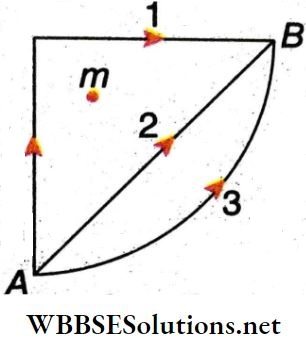
Question 8. A particle could be taken from point A to point B following three paths, 1,2, and 3, as shown Work done in these three cases are W1, W2, and W3 respectively. If these works are done in the gravitational field of a point mass m, W1, W2, W3 are related as

Work And Energy Work Are Done In The Gravitational Field Of A Point Mass

  1. W1 > W3> W2
  2. W1 = W2 = W3
  3. W1 < W3 <W2
  4. W1 < W2 < W3

Answer: 2. W1 = W2 = W3

Question 9. A mass M is lowered with the help of a string by a distance x at a constant acceleration The magnitude of work done by the string will be

  1. Mgx
  2. 1/2 Mgx²
  3. 1/2 Mgx
  4. Mgx²

Answer: 3. 1/2 Mgx

Question 10. Force acting on a particle is (\(2\hat{i}+3 \hat{j}\))N. Work done by this force is zero when a particle is moved on the line 3y+ kx = 5. Here value it is

  1. 2
  2. 4
  3. 6
  4. 8

Answer: 1. 2

Question 11. A particle of mass m accelerating uniformly has velocity v at time t1. What is work done in time t?

  1. \(\frac{1}{2} \frac{m v^2}{t_1^2} t^2\)
  2. \(\frac{m v^2}{t_1^2} t^2\)
  3. \(\frac{1}{2}\left(\frac{m}{t_1}\right)^2 t^2\)
  4. \(\frac{2 m v^2}{t_1^2} t^2\)

Answer: 1. \(\frac{1}{2} \frac{m v^2}{t_1^2} t^2\)

Work and Energy MCQs for Class 11 

Practice MCQs on Work-Energy Theorem

Question 12. A mass of 2 kg falls from a height of 40 cm on a spring with a force constant of 1960 N/m. The spring is compressed by (take g = 9.8 m/s²)

  1. 10 cm
  2. 1.0 cm
  3. 20 cm
  4. 5 cm

Answer: 1. 10 cm

Class 11 Physics Class 12 Maths Class 11 Chemistry
NEET Foundation Class 12 Physics NEET Physics

Question 13. A gardener pushes a lawn roller through a distance 20 m. If he applies a force of 20 kg-wt in a direction inclined at 60° to the ground, the work done by him is

  1. 1960 J
  2. 196 J
  3. 1.96 J
  4. 196 KJ

Answer: 1. 1960 J

Question 14. The power required to raise a mass of 120 kg vertically upwards at a velocity of 4.5 m · s-1 is

  1. 5kW
  2. 5.3 kW
  3. 8 kW
  4. 11.2 kW

Answer: 2. 5.3 kW

Question 15. A machine, applying a constant power, is driving an object along a straight line. Displacement of the object in time t is

  1. Directly proportional to √t
  2. Directly proportional to \(\sqrt[4]{t^3}\)
  3. Directly proportional to \(\sqrt{t^3}\)
  4. Directly proportional to t²

Answer: 3. Directly proportional to \(\sqrt{t^3}\)

Question 16. A windmill generates electrical energy. Suppose, the windmill converts a fixed part of the wind energy linked with the blades, to electrical energy. If the wind velocity is v, the output electric power is directly proportional to

  1. v
  2. v3
  3. v4

Answer: 3. v3

Question 17. A particle moves with a velocity \(5 \hat{i}-3 \hat{j}+6 \hat{k}\) m/s under the influence of a constant force, \(\vec{F}=10 \hat{i}+20 \hat{k} \mathrm{~N}\). The instantaneous power applied to the particle is

  1. 200 J/s
  2. 40J/S
  3. 140 J/s
  4. 170 J/s

Answer: 4. 170 J/s

Key MCQs on Kinetic and Potential Energy

Work and Energy MCQs for Class 11 

Question 18. A quarter-horsepower motor runs at a speed of 600 rpm. Assuming 40% efficiency, the work done by the motor in one rotation will be

  1. 7.46 J
  2. 7400 J
  3. 7.46 erg
  4. 74.6 J

Answer: 1. 7.46 J

Question 19. The energy of a body thrown upward is

  1. Maximum at the highest point
  2. Minimum at the highest point
  3. Same at all points
  4. Can be maximum at any point

Answer: 3. Same at all points

Question 20. A particle is moving in a straight line such that its retardation is directly proportional to its displacement. A decrease in the kinetic energy of the body is directly proportional to

  1. ex
  2. x
  3. logex

Answer: 1. x²

Question 21. Starting from rest a car moves on a plane. The coefficient of friction (μ) between the tyres and the plane increases linearly with the distance (x). The kinetic energy (K) of the car depends on x as

  1. \(K \propto \frac{1}{x^2}\)
  2. \(K \propto \frac{1}{x}\)
  3. \(K \propto x\)
  4. \(K \propto x^2\)

Answer: 4. \(K \propto x^2\)

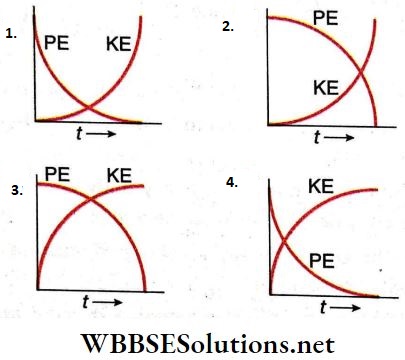
Question 22. A particle falls from rest under the action of gravity. Variation of kinetic energy (KE) and potential energy (PE) of the particle, with time t is represented by the graph

Work And Energy A Particle Falls From Rest Under The Action Of Gravity

Answer: 2

Work and Energy MCQs for Class 11 

Question 23. A long spring is stretched by 2 cm. Its potential energy is U. If the spring is stretched by 10 cm, its potential energy would be

  1. \(\frac{U}{25}\)
  2. \(\frac{U}{25}\)
  3. 5 U
  4. 25 U

Answer: 4. 25 U

Question 24. In which of the following cases the potential energy is defined

  1. Both conservative and non-conservative forces
  2. Conservative force only
  3. Non-conservative force only
  4. Neither conservative nor non-conservative forces

Answer:

WBBSE Class 11 Revision MCQs for Work and Energy .

Question 25. A body of mass m thrown vertically upwards attains a maximum height h. At what height will its kinetic energy be 75% of its initial value?

  1. \(\frac{h}{6}\)
  2. \(\frac{h}{5}\)
  3. \(\frac{h}{4}\)
  4. \(\frac{h}{3}\)

Answer: 3. \(\frac{h}{4}\)

Question 26. For a moving particle (mass m, velocity v) having a momentum p, which one of the followings correctly describes the kinetic energy of the particle?

  1. \(\frac{p^2}{2 m}\)
  2. \(\frac{p}{2 m}\)
  3. \(\frac{v^2}{2 m}\)
  4. \(\frac{v}{2 m}\)

Answer: 1. \(\frac{p^2}{2 m}\)

WBCHSE Physics Chapter Work and Energy 

Question 27. The potential energy of a system increase if work is done

  1. By the system against a conservative force
  2. By the system against a non-conservative force
  3. Upon the system by a conservative force
  4. Upon the system by a non-conservative force

Answer: 1. By the system against a conservative force

Question 28. Two bodies of masses 4 kg and 5 kg are moving with equal momentum. Then, the ratio of their respective kinetic energies is

  1. 4:5
  2. 2:1
  3. 1:3
  4. 5:4

Answer: 4. 5:4

Question 29. A particle of mass m at rest is acted upon by a force P for a time t. Its kinetic energy after an interval t is

  1. \(\frac{p^2 t^2}{m}\)
  2. \(\frac{p^2 t^2}{2 m}\)
  3. \(\frac{p^2 t^2}{3 m}\)
  4. \(\frac{P t}{2 m}\)

Answer: 2. \(\frac{p^2 t^2}{2 m}\)

Question 30. If the linear momentum of a body is increased by 50%, then the kinetic energy of that body increases by

  1. 100%
  2. 125%
  3. 225%
  4. 25%

Answer: 2. 125%

WBCHSE Physics Chapter Work and Energy 

Question 31. One end of a thread of length h has a stone tied to it. Taking the other end as the center, it revolves in a vertical plane. When the stone reaches the lowest point of its path, it attains the speed u. When the thread is horizontal, the speed of the stone is

  1. \(\sqrt{u^2-2 g h}\)
  2. \(\sqrt{u^2-g h}\)
  3. \(\sqrt{2 g h}\)
  4. \(2 \sqrt{u^2-g h}\)

Answer: 1. \(\sqrt{u^2-2 g h}\)

Question 32. Along the surface of a hemispherical container, a small ball is pushed down from a height of h, such that the ball rises up to the opposite edge. If the height of the container is R, the ball must be pushed with a velocity

  1. √2gh
  2. √2gR
  3. √2g(R+h)
  4. √2g(R-h)

Answer: 4. √2g(R-h)

MCQs on Power and Its Applications in Physics

Question 33. A bucket full of water is rotated in a vertical circle of radius r. If the water does not split out, the minimum speed of the bucket at top most point will be

  1. √rg
  2. √5rg
  3. √2rg
  4. √r/g

Answer: 1. √rg

Question 34. A ball with a momentum p falls on a floor vertically and bounces a number of times. If the coefficient of restitution is e, momentum transferred to the floor is

  1. p(1 + e)
  2. \(\frac{p}{1-e}\)
  3. \(p\left(1+\frac{1}{e}\right)\)
  4. \(\left(p\left(\frac{1+e}{1-e}\right)\right.\)

Answer: 4. \(\left(p\left(\frac{1+e}{1-e}\right)\right.\)

In this type of question, more than one option are correct.

WBCHSE Physics Chapter Work and Energy 

Question 35. The potential energy of a particle is given by the formula U = 100 – 5x+ 100x², U and x are in SI units. If the mass of the particle is 0.1 kg then the magnitude of its acceleration

  1. At 0.05 m from the origin is 50 m · s-2
  2. At 0.5 m from the mean position is 100 m· s-2
  3. At 0.05 m from the origin is 150 m · s-2
  4. At 0.05 m from the mean position is 200 m · s-2

Answer:

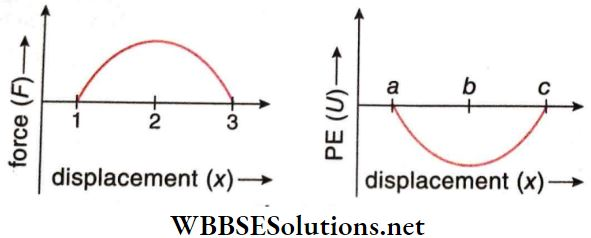
Question 36. With reference to the graphs, which of the following are correct?

Work And Energy A particle Has Stable equilibrium And No power And Least Kinetic Energy

  1. The particle has stable equilibrium at points 3 and b
  2. The article is in neutral equilibrium at points b and 2
  3. No power is delivered by the force on the particle at points 1, 3, and b
  4. The particle has the least kinetic energy at position 1

Answer:

1. The particle has stable equilibrium at points 3 and b

3. No power is delivered by the force on the particle at points 1, 3, and b

4. The particle has the least kinetic energy at position 1

Question 37. When a bullet is fired from a gun

  1. The kinetic energy of a bullet is more than that of a gun
  2. The acceleration of a bullet is more than that of a gun
  3. The momentum of the bullet is more than that of the gun
  4. The velocity of a bullet is more than that of gun

Answer:

1. The kinetic energy of a bullet is more than that of gun

2. The acceleration of the bullet is more than that of gun

4. The velocity of the bullet is more than that of the gun

WBBSE Class 11 Sample Questions on Work and Energy

Class 11 Work Energy and Power MCQs 

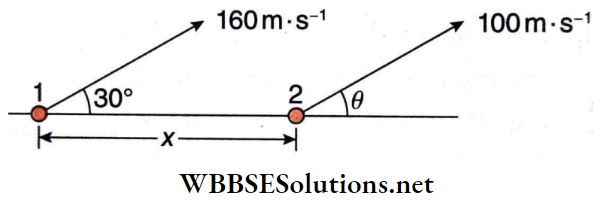
Question 38. Suppose two particles 1 and 2 are projected in the vertical plane simultaneously. Their angles of projection are 30° and θ, respectively with the horizontal. Suppose they collide after a time t in the air. Then

Work And Energy Two paticles Are projected In A Vertical Plane

  1. \(\theta=\sin ^{-1}\left(\frac{4}{5}\right)\) and they will have same speed just before the collision
  2. \(\theta=\sin ^{-1}\left(\frac{4}{5}\right)\) and they will have different speeds just before the collision
  3. x < (1280√3 – 960)m
  4. It is possible that the particles collide when both of them are at their highest points

Answer:

2. \(\theta=\sin ^{-1}\left(\frac{4}{5}\right)\) and they will have different speeds just before the collision

3. \(\theta=\sin ^{-1}\left(\frac{4}{5}\right)\) and they will have different speeds just before the collision

4. It is possible that the particles collide when both of them are at their highest points

WBCHSE Class 11 Physics Notes For Angular Momentum of Rotating Body

Rotation Of Rigid Bodies Angular Momentum

WBBSE Class 11 Angular Momentum Notes

The rotational analogues of the mass (m) of a body and its linear velocity (v) are moment of inertia (I) and angular velocity (ω), respectively. Hence, the rotational analogue of the linear momentum (mv) of the body is Iω. This physical quantity is called the angular momentum (L) of the body.

Angular Momentum Definition: The dynamical property generated in a body under rotational motion, due to the moment of inertia about an axis and angular velocity, is called the angular momentum of the body about that axis.

Angular momentum is measured by the product of moment of inertia and angular velocity, i.e., L = Iω.

Since I is a scalar and ω is an axial vector, angular momentum L is also an axial vector whose direction is along the axis of rotation, and in the direction of ω.

Unit And Dimension Of Angular Momentum:

CGS System: g · cm² · s-1

SI: kg · m² · s-1

Dimension of L = dimension of I x dimension of ω = ML² x T-1 = ML²T-1

Relation Between Linear Momentum And Angular Momentum: Suppose a body is revolving with an angular velocity ω about an axis. If m1, m2, m3,…. are the constituent particles of that body and they are at distances r1, r2, r3,…. respectively from the axis of rotation, then the moment of inertia of the body,

I = \(m_1 r_1^2+m_2 r_2^2+m_3 r_3^2+\cdots=\sum_i m_i r_i^2\)

In the case of pure rotation, the angular velocity of each particle becomes equal to the angular velocity of the body.

So, the angular momentum of the body,

L = \(I \omega=\sum_i m_i r_i^2 \cdot \omega=\sum_i m_i r_i v_i\) (because \(v_i=\omega r\))

= \(\sum_i r_i \times m_i v_i=\sum_i r_i \times p_i\)

[pi = mivi = linear momentum of i-th particle]

For the particles, the quantities r1 x m1v1, r2 x m2v2,…… etc., can be called the moments of linear momentum, or in brief, moments of momentum (in analogy with the moment of force).

So, the angular momentum of a body about an axis is the algebraic sum of the moments of linear momentum about the same axis, of all particles constituting the body.

Thus, for a particle rotating about a circle of radius r and having a linear momentum p, the angular momentum will be L = rp.

Vector Representation: The vector representation for the relation between linear and angular momentum is \(\vec{L} = \vec{r} \times \vec{p}\). This is often referred to as the defining equation of \(\vec{L}\).

We know the vector representation for the relation between linear velocity and angular velocity is \(\vec{v}=\vec{\omega} \times \vec{r}\).

If \(\vec{v}\) and \(\vec{\omega}\) are replaced by \(\vec{p}\) and \(\vec{L}\), respectively, the geometric form for the relation of \(\vec{L}\), \(\vec{p}\) and \(\vec{r}\) is obtained.

WBCHSE Class 11 Physics Notes For Angular Momentum of Rotating Body

Key Concepts of Angular Momentum in Rotational Motion

Relation Between Angular Momentum And Torque: In case of rotational motion, when a torque is applied to a body, an angular acceleration is produced in it. If the initial angular velocity of the body is ω1 and its angular velocity after time t is ω2, then the angular acceleration of the body,

α = \(\frac{\omega_2-\omega_1}{t}\)

Again, torque = moment of inertia x angular acceleration

or, \(\tau=I \alpha=I \times \frac{\omega_2-\omega_1}{t}=\frac{I \omega_2-I \omega_1}{t}\)

or, \(\tau t=I \omega_2-I \omega_1\)

Hence, torque x time = change in angular momentum of the body during that interval

This is the relation between torque and angular acceleration. From this relation, it is evident that a change in angular momentum takes place about the axis along which the torque acts on the body.

We know that in the case of translational motion, Ft = mv – mu and the rotational analogue of this equation is τt = Iω – Iω1. The quantity Ft is known as the impulse of force. Similarly, the quantity τt is known as the angular impulse or the impulse of torque.

Law Of Conservation Of Angular Momentum: Suppose the moment of inertia of a body changes from I1 to I2 in time t. In this case, the equation τt = Iω – Iω1 changes to τt = I2ω – I1ω1 Now, if no external torque acts on the body, i.e., if τ = 0, then from the equation, τt = I2ω – I1ω1 we get, I2ω – I1ω1 = 0, or, τt = I2ω = I1ω1

It means that the final angular momentum of the body is equal to its initial angular momentum, i.e., the angular momentum is conserved.

Law: if the net external torque on a body is zero, the angular momentum of the body rotating about an axis always remains conserved.

So, this law is nothing but the rotational analogue of the law of conservation of linear momentum.
Again we know, \(\frac{dL}{dT}\) = τext

From this, it is clear that, if total external torque acts on a body is zero; its angular velocity decreases with the increase of its moment of inertia and vice versa i.e., angular momentum remains constant.

Class 11 Physics Class 12 Maths Class 11 Chemistry
NEET Foundation Class 12 Physics NEET Physics

Related Experiments And Practical Examples:

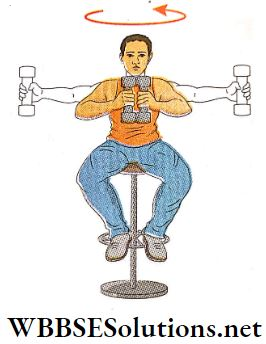
1. A man is sitting on a turntable holding a pair of dumbbells of equal mass, one in each hand with his arms out-stretched while the turntable rotates with a definite angular velocity, If the man suddenly draws the dumbbells towards his chest, the speed of rotation of the turntable is found to increase.

Rotation Of Rigid Bodies Law Of Conservation Of Angular Momentum Experiment
Angular Momentum Formula and Derivation

  • This is due to the fact that when the man draws the dumbbells towards his chest, the moment of inertia of the man about the axis of rotation decreases and his angular velocity increases due to conservation of angular momentum.
  • If the man again stretches his arms, his angular velocity decreases due to an increase in moment of inertia, and the turntable consequently rotates slowly.

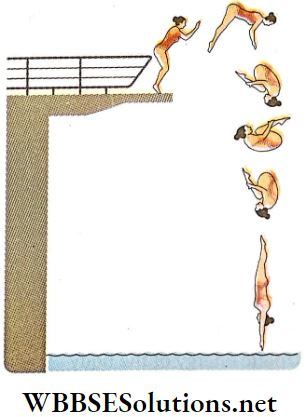
2. In a diving event, when a competitor dives from a high platform or springboard into water, he keeps his legs and arms outstretched and starts descending with less angular velocity, After that he curls his body by rolling the legs and arms inwards, his moment of inertia decreases.

Rotation Of Rigid Bodies Law Of Conservation Of Angular Momentum

  • As angular momentum is conserved, his angular velocity goes on increasing rapidly. As a result, his body begins to spin rapidly and before reaching the surface of the water, he can perform a good number of somersaults.
  • In the case of skating on the surface of ice or during the performance of acrobatics, the principle of conservation of angular momentum can be applied in a similar way.

Rotation Of Rigid Bodies Angular Momentum Numerical Examples

Understanding Angular Momentum in Rigid Bodies

Example 1. If the radius of the earth decreases by \(\frac{1}{2}\)%, then what will be the change in the length of a day? Assume that the earth is a uniform sphere and its moment of inertia, I = \(\frac{2}{5}\)MR², where M and R are the mass and the radius of the earth.
Solution:

Given

The radius of the earth decreases by \(\frac{1}{2}\)%,

If the mass of a solid sphere remains unaltered, then its moment of inertia ∝ (radius)².

Here, the changed radius \(=\frac{100-\frac{1}{2}}{100} R=\frac{199}{200} R\).

So, if the moment of inertia of the earth for its present radius R is I and the moment of inertia for its changed radius is I’, then

⇒ \(\frac{I}{I^{\prime}}=\frac{R^2}{\left(\frac{199 R}{200}\right)^2}=\left(\frac{200}{199}\right)^2\)

If the present angular velocity of the earth is ω and its changed angular velocity is ω’, then according to the principle of conservation of angular momentum,

⇒ \(I \omega=I^{\prime} \omega^{\prime}\)

or, \(\omega^{\prime}=\frac{I \omega}{I^{\prime}}\)

or, \(\frac{2 \pi}{T^{\prime}}=\frac{I}{I^{\prime}} \times \frac{2 \pi}{T}\)

or, \(T^{\prime}=\frac{I^{\prime}}{I} \cdot T=\left(\frac{199}{200}\right)^2 \times 24=23.76 \mathrm{~h}\)

∴ The length of the day will decrease by (24-23.76) = 0.24 h = 14 min 24 s

Example 2. A solid sphere of mass 1 kg and of radius 10 cm is rotating about one of its diameters with an angular; velocity of π rad · s-1. Calculate the kinetic energy of the sphere by using the relevant formula.
Solution:

Given

A solid sphere of mass 1 kg and of radius 10 cm is rotating about one of its diameters with an angular; velocity of π rad · s-1.

Let the moment of inertia of the sphere about its diameter I = \(\frac{2}{5}\)MR², M = mass of the sphere and R = radius of the sphere.

The kinetic energy of the body = rotational kinetic energy of the body

= \(\frac{1}{2} I \omega^2=\frac{1}{2} \times \frac{2}{5} M R^2 \cdot \omega^2\)

= \(\frac{1}{5} \times 1000 \times(10)^2 \times \pi^2\)

= \(197392.09 \mathrm{erg} .\)

Example 3. A thin rod of length l and mass m per unit length is rotating about an axis passing through the midpoint of its length and perpendicular to it. Prove that its kinetic energy \(\frac{1}{24}\) mω2l3 = ω = angular velocity of the rod.
Solution:

Given

A thin rod of length l and mass m per unit length is rotating about an axis passing through the midpoint of its length and perpendicular to it.

Kinetic energy of the rod = \(\frac{1}{2}\) mω2

According to the problem,

I = \(\frac{1}{12}\)Ml² [M = mass of the rod = ml]

= \(\frac{1}{12}\) x ml x l² = \(\frac{m l^3}{12}\)

∴ Kinetic energy of the rod = \(\frac{1}{2} \times \frac{m l^3}{12} \times \omega^2=\frac{1}{24} m \omega^2 l^3 .\)

Applications of Angular Momentum in Physics

Example 4. Calculate the moment of inertia of a solid cylinder of I length 10 cm and of radius 20 cm about its own axis. The density of the material of the cylinder = 9 g · cm-3.
Solution:

Given

The density of the material of the cylinder = 9 g · cm-3.

L= length of the cylinder, R = radius of the cylinder and M = mass of the cylinder

= volume of the cylinder x density

=  πR²L X density

= π x (20)² x 10 x 9 g

Moment of inertia of a solid cylinder about its own axis,

I = \(\frac{1}{2} M R^2\)

I = \(\frac{1}{2} \times \pi \times(20)^2 \times 10 \times 9 \times(20)^2\)

= \(22.6 \times 10^6 \mathrm{~g} \cdot \mathrm{cm}^2\)

Example 5. A solid sphere of diameter 2 cm and of mass 20 g is rolling with a velocity of 3 cm · s-1. What is the total kinetic energy of the sphere?
Solution:

Given

A solid sphere of diameter 2 cm and of mass 20 g is rolling with a velocity of 3 cm · s-1.

Let M = mass of the sphere, R = radius of the sphere, V = linear velocity of the sphere, I = \(\frac{2}{5}\)MR² (moment of inertia of the sphere about its diameter), ω = \(\frac{V}{R}\)

Total kinetic energy of the sphere = translational kinetic energy + rotational kinetic

= \(\frac{1}{2} M V^2+\frac{1}{2} I \omega^2=\frac{1}{2} M V^2+\frac{1}{2} \times \frac{2}{5} M R^2\left(\frac{V}{R}\right)^2\)

= \(\frac{1}{2} M V^2+\frac{1}{5} M V^2=\frac{7}{10} M V^2=\frac{7}{10} \times 20 \times(3)^2\)

= \(126 \mathrm{erg}\)

Example 6. A stone of mass m tied with a thread Is rotating along a horizontal circular path (force of gravity is neglected). The length of the thread decreases gradually in such a manner that the angular momentum of the stone remains constant with respect to the centre of the circle. If the tension in the thread Is T = Arn, where A = constant, r = instantaneous radius of the circle, then find the value of n.
Solution:

Given

A stone of mass m tied with a thread Is rotating along a horizontal circular path (force of gravity is neglected). The length of the thread decreases gradually in such a manner that the angular momentum of the stone remains constant with respect to the centre of the circle. If the tension in the thread Is T = Arn, where A = constant, r = instantaneous radius of the circle,

If the instantaneous angular velocity of the stone is w, then angular momentum,

L = Iω = mr²ω = constant (according to the problem)

or, ω = \(\frac{L}{m r^2}\)

Here the tension in the thread provides the necessary centripetal force for rotation.

So, T = \(A r^n=m \omega^2 r=m \cdot \frac{L^2}{m^2 r^4} r=\frac{L^2}{m} r^{-3}\)

= \(A r^{-3} \quad\left(A=\frac{L^2}{m}=\text { constant }\right)\)

∴ n=-3 .

Short Answer Questions on Angular Momentum

Example 7. Two ends of a uniform rod weighing W, are placed on supports so that the rod remains horizontal. If a support at one end is suddenly removed, what will be the force exerted on the horizontal rod by the support at the other end?
Solution:

Given

Two ends of a uniform rod weighing W, are placed on supports so that the rod remains horizontal. If a support at one end is suddenly removed,

Let the length of the rod = l cm, its weight = W = Mg, where M is the mass of the rod. When the support at one end is removed suddenly, the centre of gravity of the rod falls downwards with an acceleration a. Let R = reaction force at the end with the support. Hence, if the C.G. now falls with an acceleration a, the rod will turn about the point P.

Rotation Of Rigid Bodies Two Ends Of A Uniform Rod Weight

The torque on the rod = Mg · \(\frac{l}{2}\)

Also, Mg – R = Ma or, \(a=\frac{M g-R}{M}\)

Here moment of inertia, I =  \(\frac{1}{3}\)Ml² = moment of inertia of the rod about the perpendicular axis passing through the end of the rod and the angular acceleration, α = \(\frac{a}{V / 2}=\frac{2 a}{l}\)

∴ \(\frac{1}{3} M l^2 \alpha=M g \frac{l}{2}\) (because \(\tau=I \alpha\))

or, \(\frac{1}{3} M R^2 \cdot \frac{2 a}{l}=M g \frac{l}{2} \text { or, } \frac{2}{3} a=\frac{g}{2} \text { or, } \frac{2}{3}\left(\frac{M g-R}{M}\right)=\frac{g}{2}\)

R = \(\frac{M g}{4}=\frac{W}{4}\)

Therefore, when one support is removed, the support at the other end will exert a reaction force of \(\frac{W}{4}\)

Real-Life Examples of Angular Momentum

Example 8. A rod of length L and M is attached with a hinge on a wall at point O. After releasing the rod from its vertical position OA, when it comes to position OA’, what is the reaction on point O of the rod by the hinge?

Rotation Of Rigid Bodies A Rod Of length And Mass Is Attached With A Hinge On A Wall

Solution:

Given

A rod of length L and M is attached with a hinge on a wall at point O. After releasing the rod from its vertical position OA, when it comes to position OA’,

Let, the angular velocity of the rod at the horizontal position OA’ is ω.

∴ At that instant its kinetic energy = \(\frac{1}{2} I \omega^2=\frac{1}{2} \cdot \frac{M L^2}{3} \cdot \omega^2=\frac{M L^2 \omega^2}{6}\)

The centre of mass of the rod shifts down by \(\frac{L}{2}\) from OA to OA’.

So, decrease in potential energy of the rod = Mg\(\frac{L}{2}\)

According to the kinetic energy conservation law, \(M g \frac{L}{2}=\frac{M L^2 \omega^2}{6} \quad \text { or, } \omega=\sqrt{\frac{3 g}{L}}\)…(1)

Two forces act on the rod at position OA’

  1. Gravitational force (Mg) vertically downward direction and
  2. Reaction force (n) of the hinge

Let, the horizontal and the vertical n components of n are nx and ny respectively; the horizontal and the vertical components of the acceleration of the centre of mass of the rod area ax and ay respectively.

Rotation Of Rigid Bodies Two Forces Act On The Rod At The Position

∴ According to \(M g-n_y=M a_y\)….(2)

and \(n_x=M a_x=M \omega^2 \cdot \frac{L}{2}\)

(because \(a_x=\) centripetal acceleration)

= \(M \cdot \frac{3 g}{L} \cdot \frac{L}{2}=\frac{3}{2} M g\)

[putting the value of ω from equation (1)]

The rod starts to rotate due to the action of torque created by ny and Mg.

If the angular acceleration of the rod is α, \(M g \cdot \frac{L}{2}=I \alpha=\frac{M L^2}{3} \alpha\)

∴ \(\alpha=\frac{3 g}{2 L}\)

The acceleration along the vertical direction, \(a_y=\frac{L}{2} \alpha=\frac{3 g}{4}\)

Putting the value of ay in equation (2) we get, \(M g-n_y=\frac{3 M g}{4} \text { or, } n_y=\frac{M g}{4}\)

∴ n = \(\sqrt{n_x^2+n_y^2}=\sqrt{\left(\frac{3}{2} M g\right)^2+\left(\frac{M g}{4}\right)^2}=\frac{\sqrt{37}}{4} M g\)

Important Questions for Class 11 Physics Rotation Of Rigid Bodies

 Rotation Of Rigid Bodies Long Answer Type Questions

Question 1. Is there any change in the angular velocity of the earth when a body strikes the earth’s surface from outside?
Answer:

We know that, the angular momentum of a body = moment of inertia of that body x angular velocity of the body.

  • The velocity of anybody coming from outside and striking the surface of the earth is usually directed towards the centre of the earth. For this reason, the body possesses no angular momentum with respect to the axis of rotation of the earth.
  • As a result, the angular momentum of the earth remains conserved. However due to the inclusion of the body, the mass of the earth increases, and consequently, the moment of inertia of the earth also increases.
  • For this reason, the angular velocity of the earth decreases slightly. But actually, the mass of such a foreign body is so small that there is no appreciable change in either the moment of inertia or the angular velocity of the earth.

Question 2. Why is It easier to rotate an object tied to the end of a short string than that of a long string?
Answer:

We know that the moment of inertia of an object about the axis of rotation is, I = mr², where m is the mass of the object and r is the perpendicular distance of the object from the axis of rotation.

So, with the increase in the length of the string, the moment of inertia of the object also increases. The object is rotated along a circular path by applying a torque against the resistive force of the air.

Now, torque = moment of inertia x angular acceleration.

Hence, with the increase in moment of inertia, the magnitude of required torque also increases.

Moreover, the centrifugal reaction generated at the centre of rotation is mω²r, where ω is the angular velocity of the stone. So, keeping the value of ω constant, if the value of r is increased, centrifugal reaction also increases.

Hence, if the string is short, then less torque is required to rotate the stone tied to the string. Also, it has to withstand a smaller centrifugal reaction and as a result, it is easier to rotate the object.

Important Questions For Rotation Of Rigid Bodies

Question 3. A solid and a hollow sphere of the same mass have the same outer radius. Which one has a larger radius of gyration?
Answer:

The mass of the solid sphere is distributed uniformly from its centre. On the other hand, the mass of the hollow sphere is distributed over a comparatively further distance.

The more the distance of the mass distribution from the axis of rotation of two bodies of identical mass having the same outer radius, the more the radius of gyration.

In this sense, the mass of the hollow sphere is distributed over a comparatively larger distance from the axis of rotation than that of the solid sphere, and hence the radius of gyration of the hollow sphere will be greater.

Question 4. If the ice at the poles of the earth melts, how would this affect the length of the day?
Answer:

If the polar ice melts, a part of the water thus produced will shift from the poles towards the equatorial region, and hence, this water will shift away from the axis of rotation of the earth. Consequently, the moment of inertia of the earth will increase.

Now, according to the principle of conservation of angular momentum, with the increase in moment of inertia of the earth, its angular velocity will decrease, and hence, the length of the day will increase.

Question 5. A cricket ball sometimes rebounds from the cricket pitch with a velocity greater than which it was bowled with by a bowler. How can it be possible?
Answer:

If the cricket ball spins just before it hits the ground, then this spinning kinetic energy is added to the kinetic energy of the translation of the ball. As a result, the ball rebounds from the cricket pitch with a greater velocity by virtue of this spuming or rotational kinetic energy.

Question 6. Can the moment of Inertia of a body be different about different axes?
Answer:

The moment of inertia of a body depends on the mass of the body, the position of the axis of its rotation and the distribution of mass of the body about its axis of rotation. So, the moment of inertia of a particular body may be different in different axes.

Question 7. A man is standing on a rotating table and he drops a heavy mass from his hand outside the table. How will the angular speed of the table change?
Answer:

When the mem drops the heavy mass from his hand outside the table, the moment of inertia of the system about the axis of rotation decreases. We know that angular momentum = moment of inertia x angular velocity. Since no torque is applied from outside, according to the principle of conservation of angular momentum, the angular velocity of the system will increase due to a decrease of its moment of inertia.

Question 8. When a body of mass m slides down from the top of an inclined plane and reaches the bottom, its velocity becomes v. When a circular disc of the same mass is rolled down the inclined plane, it acquires a velocity v1. Show that, \(v_1=\sqrt{\frac{2}{3}} v\).
Answer:

Given

When a body of mass m slides down from the top of an inclined plane and reaches the bottom, its velocity becomes v. When a circular disc of the same mass is rolled down the inclined plane, it acquires a velocity v1.

Let the vertical height of the inclined plane be h. In case of the first body, \(\frac{1}{2} m v^2=m g h \quad \text { or, } \quad v=\sqrt{2 g h}\)…(1)

If the body is a circular disc, then it possesses both translational kinetic energy and rotational kinetic energy while rolling down the inclined plane.

If I am a moment of inertia of the circular disc and ω be angular velocity of the disc at the bottom of the inclined plane,

⇒ \(\frac{1}{2} m v_1^2+\frac{1}{2} I \omega^2=m g h\)

or, \(\frac{1}{2} m v_1^2+\frac{1}{2} \cdot \frac{1}{2} m r^2 \cdot \frac{v_1^2}{r^2}=m g h \)

r = (radius of the disc, \(I=\frac{1}{2} m r^2, \omega=\frac{v_1}{r}\))

or, \(\left(\frac{1}{2}+\frac{1}{4}\right) v_1^2=g h \text { or, } \frac{3}{4} v_1^2=g h \text { or, } v_1=\sqrt{\frac{4}{3} g h}\)

∴ \(\frac{v_1}{v}=\sqrt{\frac{4}{2} g h}=\sqrt{\frac{2}{3}} \text { or, } v_1=\sqrt{\frac{2}{3}} v .\)

Question 9. Prove that the length of a day becomes T’ = 6h instead of T = 24 h if the earth suddenly contracts to half its present radius (consider the earth as a spherical body), without having any change in its mass.
Answer:

Since the earth is a solid sphere, its moment of inertia, I ∝ R²(R = radius of the earth)

(moment of inertia of solid sphere = \(\frac{2}{5}\)MR²)

So, if the present radius is R and the changed radius is \(\frac{R}{2}\) then,

⇒ \(\frac{I}{I^{\prime}}=\frac{R^2}{\left(\frac{R}{2}\right)^2}=4\)

Again, if the present angular velocity is ω and the changed angular velocity is ω’, then according to the principle of conservation of angular momentum,

⇒ \(I \omega=I^{\prime} \omega^{\prime} \text { or, } \omega^{\prime}=\frac{I}{I^{\prime}} \omega=4 \omega\)

∴ \( \frac{2 \pi}{T^{\prime}}=4 \cdot \frac{2 \pi}{T} \quad \text { or, } T^{\prime}=\frac{T}{4}=\frac{24}{4}=6 \mathrm{~h} \text {. } \)

Question 10. Show that the torque acting on a body is equal to the rate of change of angular momentum of the body.
Answer:

We know that angular momentum, \(\vec{L}=\vec{r} \times \vec{p} \quad \text { or, } \vec{L}=\vec{r} \times m \vec{v}\)

⇒\(\frac{d \vec{L}}{d t}=\frac{d \vec{r}}{d t} \times m \vec{v}+\vec{r} \times \frac{d}{d t}(m \vec{v})\)

= \(\vec{v} \times m \vec{v}+\vec{r} \times \vec{F}=\vec{r} \times \vec{F}\) (because \(\vec{v} \times \vec{v}=0\))

= \(\vec{r}\)

So, the rate of change of angular momentum of a body is equal to the torque acting on the body

Class 11 Physics Class 12 Maths Class 11 Chemistry
NEET Foundation Class 12 Physics NEET Physics

Question 11. What is the relation between torque and angular acceleration?
Answer:

The relation between torque and angular acceleration

Torque, \(\vec{\tau}= \frac{d \vec{L}}{d t}=\frac{d}{d t}(I \vec{\omega})=I \frac{d \vec{\omega}}{d t}\)

(\(\vec{L}\)= angular momentum = \(I \vec{\omega}\))

= \(I \vec{\alpha}[\vec{\alpha}\) = angular acceleration

Question 12. Keeping the radius of the earth unchanged, If the mass of the earth is doubled, then what will be the length of a day?
Answer:

If the present angular velocity is ω and the changed angular velocity is ω’, then according to the principle of conservation of angular momentum, Iω = I’ω’

[here, I and I’ are the present and the changed moments of inertia of the earth respectively]

∴ \(\frac{2}{5} M R^2 \times \frac{2 \pi}{24}=\frac{2}{5} \times 2 M \times R^2 \times \frac{2 \pi}{T^{\prime}}\)

[here, the present mass of the earth is M, its radius is R and the changed length of a day is T’]

or, \(\frac{1}{24}=\frac{2}{T^{\prime}} \quad \text { or, } \quad T^{\prime}=48 \text { hours }\)

So, the length of a day will be 48 h.

Sample Problems on Torque and Angular Acceleration

Question 13. A circular disc of mass m and radius r is rolling over a horizontal table top with angular velocity ω. Prove that the total energy of the disc, K = \(\frac{3}{4}\)mω²r²
Answer:

Given

A circular disc of mass m and radius r is rolling over a horizontal table top with angular velocity ω.

The total kinetic energy of the disc,

K = translational kinetic energy+rotational kinetic energy

= \(\frac{1}{2} m v^2+\frac{1}{2} I \omega^2\)

Here, v = linear velocity of the disc = ωr

I = moment of inertia of the disc about the perpendicular axis passing through its centre

= \(\frac{1}{2} m r^2\)

K = \(\frac{1}{2} m(\omega r)^2+\frac{1}{2} \cdot \frac{1}{2} m r^2 \cdot \omega^2\)

= \(\frac{1}{2} m \omega^2 r^2+\frac{1}{4} m \omega^2 r^2=\frac{3}{4} m \omega^2 r^2\)

Question 14. Between two circular discs of equal mass and equal thickness but of different densities, which one would have a greater moment of Inertia about its central perpendicular axis?
Answer:

Suppose the mass of each disc is M, thickness d, densities of their materials ρ1 and ρ21 > ρ2), radii r1 and r2 respectively.

∴ \(M=\pi r_1^2 d \rho_1=\pi r_2^2 d \rho_2 \quad \text { or, } r_1^2 \rho_1=r_2^2 \rho_2\)

or, \(\frac{r_1^2}{r_2^2}=\frac{\rho_2}{\rho_1}\)

∴ \(\rho_1>\rho_2, \quad \frac{\rho_2}{\rho_1}<1\)

∴ \(\frac{r_1^2}{r_2^2}<1\)

The moment of inertia of the two discs about their central perpendicular axes are \(I_1=\frac{1}{2} M r_1^2 \text { and } I_2=\frac{1}{2} M r_2^2\)

∴ \(\frac{I_1}{I_2}=\frac{r_1^2}{r_2^2}<1\)

∴ \(I_1<I_2\)

So, the disc having a lower density will have a greater moment of inertia about its centred perpendicular axis.

Question 15. Given the moment of inertia of a disc of mass M and radius R about any of its diameters to be \(\frac{M R^2}{4}\). Find its moment of inertia about an axis normal to the disc and passing through a point on its edge.
Answer:

Given,

Rotation Of Rigid Bodies Momentum Of Interia Of A Disc Of Mass And Radius

According to the parallel-axes theorem, the moment of inertia of the disc about the axis AB, normal to the disc and passing through a point on its edge,

Question 16. ‘Moment of inertia plays the same role in rotational motion as mass plays in translational motion’explain the statement.
Answer:

When a force acts on a body, some linear acceleration is produced in that body. Similarly, angular acceleration is generated in a body due to the application of a torque on it. So the rotational analogues of force and linear acceleration are torque and angular acceleration, respectively.

Again, in the case of linear motion, force = mass x acceleration; and in the case of circular motion, torque = moment of inertia x angular acceleration. Comparing these two relations it can be inferred that the rotational analogue of mass is the moment of inertia.

So, moment of inertia in rotational motion plays the same role as mass plays in linear motion.

Question 17. Find the moment of inertia of a sphere about a tangent to the sphere. Given the moment of inertia of the sphere about any of its diameters to be \(\frac{2 M R^2}{5}\), where M is the mass of the sphere and R is the radius of the sphere.
Answer:

The centre of mass (cm) of C the sphere is on its diameter AB.

So, Icm = \(\frac{2}{5}\)MR²

Rotation Of Rigid Bodies Momentum Of Interia Of A Sphere Aboust Tangent Of Sphere

According to the parallel-axes theorem, the moment of inertia of the sphere about the tangent CD.

I = \(I_{\mathrm{cm}}+M R^2=\frac{2}{5} M R^2+M R^2=\frac{7}{5} M R^2\)

Step-by-Step Solutions to Rotational Motion Problems

Question 18. A solid sphere of mass m and radius R rolls down from the top of a table. With how much angular speed will it touch the ground?
Answer:

At position 2, the resultant of mgcosθ and n supplies the necessary centripetal force to roll on, i.e., mω²R = mgcosθ – n

[ω = angular speed of the spehere]

When n = 0, the sphere will not be in contact more with the table.

Rotation Of Rigid Bodies Solid Sphere Of Mass And Radius Rolls Down From the Top Of A Table

Then, \(m \omega^2 R=m g \cos \theta \quad \text { or, } \cos \theta=\frac{\omega^2 R}{g}\)

The centre of mass of the sphere is lowered down by R(1-cosθ).

Let I be the moment of inertia of the sphere about the tangent at the contact point between the table and the sphere. From the conservation law of mechanical energy,

⇒ \(m g \cdot R(1-\cos \theta)=\frac{1}{2} \times I \omega^2=\frac{7}{10} m R^2 \omega^2\) (because \(I=\frac{7}{5} m R^2\))

∴ \(m g R\left(1-\frac{\omega^2 R}{g}\right)=\frac{7}{10} m R^2 \omega^2\)

or, \(m g R-m \omega^2 R^2=\frac{7}{10} m R^2 \omega^2\)

∴ \( \omega=\sqrt{\frac{10 g}{17 R}}\)

Considering a free fall of the sphere, as no torque acts on it, this angular speed remains unaltered. It means that the sphere touches the ground with an angular speed \(\sqrt{\frac{10 g}{17 R}}\)

Hydraulic Systems and Rotational Motion Questions

Question 19. A uniform rod AB of mass M and length L is hung from a ceiling in such a way that the rod can rotate freely in the vertical plane around point A. An object of mass m coming horizontally with velocity v0 hits the rod at point B and sticks to the rod. What will be the maximum angle with the vertical that the rod makes in this type of collision? (Here, M = 6m)

Rotation Of Rigid Bodies A uniform Rod AB Of Mass And Length Is Hung Is Celling

Answer:

Given

A uniform rod AB of mass M and length L is hung from a ceiling in such a way that the rod can rotate freely in the vertical plane around point A. An object of mass m coming horizontally with velocity v0 hits the rod at point B and sticks to the rod.

In the case of the composite system of the rod and the object of mass m, applying the law of conservation of angular momentum about A,

⇒ \(m v_0 L=I \omega=\left[\frac{M L^2}{3}+m L^2\right] \omega=\left(\frac{M}{3}+m\right) L^2 \omega\)

∴ \(\omega=\frac{m v_0}{\left(\frac{M}{3}+m\right) L}=\frac{m v_0}{(2 m+m) L}=\frac{v_0}{3 L}\)

The distance of the centre of mass of the composite system from point A when the object sticks to the rod

= \(\frac{6 m \times \frac{1}{2}+m \times L}{6 m+m}=\frac{4}{7} L\)

Rotation Of Rigid Bodies Composite Of Rod

The rod makes the maximum angle θ with the vertical, and at that position, the centre of mass of the composite system raises at a height h from its initial position.

h = \(\frac{4}{7} L(1-\cos \theta)\)

According to the law of conservation of mechanical energy, \(\frac{1}{2} I \omega^2=(m+6 m) g h\)

or, \(\frac{1}{2}\left(\frac{1}{3} M L^2+m L^2\right) \times \frac{\nu_0^2}{9 L^2}=4 m g L(1-\cos \theta)\)

or, \(1-\cos \theta=\frac{v_0^2}{24 g L} therefore \theta=\cos ^{-1}\left[1-\frac{\nu_0^2}{24 g L}\right]\)

Question 20. A spherical object of mass m is released on a smooth inclined plane which is inclined at an angle θ with the horizontal. State whether it will roll or slip. Give reasons in support of your answer.
Answer:

Given

A spherical object of mass m is released on a smooth inclined plane which is inclined at an angle θ with the horizontal.

No frictional force acts on a smooth plane. The only downward force acting on the centre of mass of the object along the inclined plane is mgsinθ. But there is no torque about the centre of mass due to the absence of the frictional force. So, the object will slip down without rolling with acceleration gsinθ.

Unit 5 Motion Of System Of Particles And Rigid Body Chapter 2 Rotation Of Rigid Bodies Synopsis

Two equal, parallel but oppositely directed forces acting simultaneously along two different lines of action constitute a couple.

  • The vector quantity formed by the combination of the couple applied on a body and the arm of the couple, which produces a rotational tendency in that body is called the moment of the couple or torque.
  • The moment of the couple or torque is expressed by the product of the magnitude of any of the forces of the couple and the arm of the couple.
  • The torque about a point = the algebraic sum of the moments of the two forces of the couple with respect to that point. The torque acting on a body with respect to any axis of rotation divided by the corresponding angular acceleration generated is called the moment of inertia of that body with respect to that axis of rotation.

If the whole mass of a body is assumed to be concentrated at a point such that the moment of inertia of the whole body equals the moment of inertia of that point, then the radial distance of the point from the axis of rotation is called the radius of gyration.

Parallel-axes Theorem: The moment of inertia (I) of a rigid body about any axis is equal to the sum of its moment of inertia about a parallel axis through its centre of mass (Icm) and the product of the mass of the body (M) with the square of the perpendicular distance between the two axes (r²).

Mathematical expression: I = Icm + Mr²

Perpendicular-axes Theorem: The moment of inertia of a plane lamina about an axis perpendicular to its plane (Iz) is equal to the sum of the moments of inertia of the lamina about two mutually perpendicular axes (Ix +Iy) lying on the plane of the lamina and intersecting each other at the point through where the perpendicular axis passes. Mathematical expression: Ix+Iy= Iz

The dynamical property generated in a rotating body by the moment of inertia of the body about an axis and its angular velocity together is called the angular momentum of the body about that axis.

Principle Of Conservation Of Angular Momentum: If the net external torque on a body is zero, the angular momentum of the body rotating about an axis always remains conserved.

WBCHSE Class 11 Physics Rotation Of Rigid Bodies Multiple Choice Questions

Motion Of System Of Particles And Rigid Body

Rotation Of Rigid Bodies Multiple Choice Questions And Answers

Question 1. A stone is tied with a massless rope and is rotated with uniform speed. The angular momentum of the stone is L. Keeping the angular velocity unchanged if the length of the rope is halved, its angular momentum will be

  1. \(\frac{L}{4}\)
  2. \(\frac{L}{2}\)
  3. L
  4. 2L

Answer: 1. \(\frac{L}{4}\)

Question 2. Vector representation of angular momentum (\(\vec{L}\)) is

  1. \(\vec{L}=\vec{p} \times \vec{r}\)
  2. \(\vec{L}=\vec{r} \times \vec{p}\)
  3. \(\vec{L}=\vec{p}·\vec{r}\)
  4. \(\vec{L}=\vec{r}·\vec{p}\)

Answer: 2. \(\vec{L}=\vec{r} \times \vec{p}\)

Question 3. A thin circular ring of mass M and radius R is rotating about an axis perpendicular to the plane of the ring and passing through the centre, with an angular velocity ω. Two bodies each of mass m are placed gently on the ring. The angular velocity with which the ring is rotating now is given by,

  1. \(\frac{\omega M}{M+m}\)
  2. \(\frac{2(M-2 m)}{(M+2 m)}\)
  3. \(\frac{\omega M}{M+2 m}\)
  4. \(\frac{\omega(M+2 m)}{M}\)

Answer: 3. \(\frac{\omega M}{M+2 m}\)

Read And Learn More WBCHSE Class 11 Physics MCQs

Question 4. A particle of mass m is moving with a uniform velocity along a straight path parallel to the x-axis. The angular momentum of the particle with respect to the origin will be

  1. Zero
  2. Constant
  3. Increased gradually
  4. Decreased gradually

Answer: 2. Constant

WBCHSE Class 11 Physics Rotation Of Rigid Bodies Multiple Choice Questions

Question 5. A disc of mass M and radius R is revolving with an angular velocity ω on a horizontal plane. What will be the magnitude of angular momentum of the disc about the origin O?

Rotation Of Rigid Bodies A Disc Of Mass And Radius Is Revolving With Angular Velocity

  1. \(\frac{1}{2} M R^2 \omega\)
  2. \(M R^2 \omega\)
  3. \(\frac{3}{2} M R^2 \omega\)
  4. \(2 M R^2 \omega\)

Answer: 3. \(\frac{3}{2} M R^2 \omega\)

WBCHSE Class 11 Rotation MCQs

Question 6. The angular velocity of a smooth sphere A moving on a frictionless horizontal surface is ω and the velocity of its centre of mass is v. When it undergoes elastic head-on collision with another identical sphere B at rest, then the angular velocities of the two spheres become ωA and ωB respectively. If friction is neglected, the relation between ωA and ωB will be

  1. ωA < ωB
  2. ωA = ωB
  3. ωA = ω
  4. ωB = ω

Answer: 3. ωA = ω

WBCHSE Class 11 Physics Rotation Of Rigid Bodies Multiple Choice Questions

Question 7. The angular momentum of a moving body remains constant if

  1. An external force acts on the body
  2. Pressure acts on the body
  3. An external torque acts on the body
  4. No external torque acts on the body

Answer: 4. No external torque acts on the body

Class 11 Physics Class 12 Maths Class 11 Chemistry
NEET Foundation Class 12 Physics NEET Physics

Question 8. Angular momentum is

  1. Moment of momentum
  2. Product of mass and angular velocity
  3. Product of moment of inertia and velocity
  4. Moment in angular motion

Answer: 1. Moment of momentum

Question 9. A particle performs uniform circular motion with an angular momentum L. If the frequency of the particle motion is doubled, the angular momentum becomes

  1. 2L
  2. 4L
  3. \(\frac{L}{2}\)
  4. \(\frac{L}{4}\)

Answer: 1. 2L

Question 10. If r denotes the distance between the sun and the earth, then the angular momentum of the earth around the sun is proportional to

  1. \(\frac{1}{r}\)
  2. r
  3. √r

Answer: 4. r²

Question 11. The dimensional formula of torque is

  1. ML²T-2
  2. M²LT-1
  3. MLT-2
  4. ML²T-1

Answer: 1. ML²T-2

Question 12. The torque of a force \(\vec{F}=-6 \hat{i}\) acting at a point \(\vec{r}=4 \hat{j}\) about origin will be

  1. \(-24 \hat{k}\)
  2. \(24 \hat{k}\)
  3. \(24 \hat{j}\)
  4. \(24 \hat{i}\)

Answer: 1. \(-24 \hat{k}\)

Question 13. The moment of inertia of a circular ring of mass m and radius r about the normal axis passing through its centre is

  1. \(\frac{m r^2}{4}\)
  2. \(m r^2\)
  3. \(\frac{m r^2}{2}\)
  4. \(\frac{3}{4} m r^2\)

Answer: 2. \(m r^2\)

Question 14. The moment of inertia of a circular wire of mass m and radius r about its diameter is

  1. \(\frac{1}{2}\)mr²
  2. \(\frac{1}{4}\)mr²
  3. mr²
  4. 2mr²

Answer: 1. \(\frac{1}{2}\)mr²

Question 15. Thicknesses of two iron discs of radii r and 4r are t and \(\frac{t}{4}\) respectively. If their moments of inertia are I1 and I2 respectively, then

  1. \(I_2=64 I_1\)
  2. \(I_2=32 I_1\)
  3. \(I_2=16 I_1\)
  4. \(I_2=I_1\)

Answer: 1. \(I_2=64 I_1\)

Rigid Body Motion Multiple Choice Questions WBCHSE

Question 16. The moment of inertia of a hollow cylinder of mass M and radius r about its own axis is

  1. \(\frac{2}{3}\)Mr²
  2. \(\frac{2}{5}\)Mr²
  3. Mr²
  4. \(\frac{1}{2}\)Mr²

Answer: 3. Mr²

Question 17. The moment of inertia of a disc is 100 g · cm². The disc rotates with an angular velocity 2 rad/s. The rotational; kinetic energy of the disc is

  1. 100 erg
  2. 200 erg
  3. 400 erg
  4. 50 erg

Answer: 2. 200 erg

Question 18. The moment of inertia of a circular disc of mass m and radius r about a perpendicular axis passing through its centre is

  1. mr²
  2. \(\frac{m r^2}{4}\)
  3. \(\frac{m r^2}{2}\)
  4. \(\frac{5}{4}\) mr²

Answer: 3. \(\frac{m r^2}{2}\)

Question 19. Radius of gyration of a ring of radius R about an axis passing through its centre and perpendicular to its plane is

  1. \(\frac{5}{\sqrt 2}\) R
  2. \(\frac{R}{2}\)
  3. R
  4. \(\frac{R}{\sqrt 2}\)

Answer: 3. R

Question 20. Radius of gyration of a disc of mass 50 g and radius 0.5 cm about an axis passing through its centre of gravity and perpendicular to the plane is

  1. 6.54 cm
  2. 3.64 cm
  3. 0.35 cm
  4. 0.88 cm

Answer: 3. 0.35 cm

Question 21. The moment of inertia of a disc is 100 g · cm². If the disc rotates with an angular velocity of 2 rad · s-1, the rotational kinetic energy of the disc is

  1. 100 erg
  2. 200 erg
  3. 400 erg
  4. 50 erg

Answer: 2. 200 erg

Question 22. A man stands on a rotating table stretching his arms. He is rotating with a definite angular velocity. Now, the man draws his arms closer. His moment of inertia is reduced to 75% of its initial value. The angular kinetic energy of the man

  1. Will increase by 33.3%
  2. Will decrease by 33.3%
  3. Will increase by 25%
  4. Will decrease by 25%

Answer: 1. Will increase by 33.3%

Question 23. The total KE of the sphere of mass M rolling with velocity v is

  1. \(\frac{7}{10}\)mv²
  2. \(\frac{5}{6}\)mv²
  3. \(\frac{7}{5}\)mv²
  4. \(\frac{10}{7}\)mv²

Answer: 1. \(\frac{7}{10}\)mv²

Question 24. A body of mass 10 kg moves with a velocity of 2 m/s along a circular path of radius 8 m. The power produced by the body will be

  1. 10J/s
  2. 98 J/s
  3. 49 J/s
  4. Zero

Answer: 1. 10J/s

Question 25. If a sphere is rolling, then the ratio of its rotational kinetic energy to the total kinetic energy is

  1. 1:2
  2. 2:5
  3. 2:7
  4. 5:7

Answer: 3. 2:7

Class 11 Physics Rotational Motion Practice Questions

Question 26. If no torque acts on a rotating body and if its moment of inertia decreases, the angular velocity ω of the body increases in such a manner that

  1. \(\frac{1}{2}\)Iω² remains constant
  2. Iω remains constant
  3. \(\frac{1}{\omega}\) remains constant
  4. Iω² remains constant

Answer: 2. Iω remains constant

Question 27. The angular momentum of a particle revolving with uniform speed is L. If the frequency of the particle is doubled and its kinetic energy is halved, then its angular momentum becomes

  1. 2.5 L
  2. 0.25 L
  3. 5.0 L
  4. 0.50 L

Answer: 2. 0.25 L

Question 28. A particle is revolving along a circular path with decreasing speed. Which one of the following is true for the particle?

  1. The angular momentum of the particle is constant
  2. Only the direction of angular momentum of the particle is fixed
  3. Acceleration of the particle is always towards the centre
  4. The particle travels along a spiral path

Answer: 2. Only the direction of angular momentum of the particle is fixed

Question 29. Analogue of mass in rotational motion is

  1. Moment of inertia
  2. Angular momentum
  3. Gyration
  4. None of these

Answer: 1. Moment of inertia

Question 30. A constant torque of 3.14 N · m is exerted on a pivoted wheel. If the angular acceleration of the wheel is 4πrad · s-2, then the moment of inertia of the wheel is

  1. 0.25 kg · m2
  2. 2.5 kg · m2
  3. 4.5 kg · m2
  4. 25 kg · m2

Answer: 1. 0.25 kg · m2

Question 31. A small object of mass m is attached to a light string which passes through a hollow tube. The tube is held by one hand and the string by the other. The object is set into rotation in a circle of radius R and velocity v. The string is then pulled down, shortening the radius of the path of r. What is conserved?

  1. Angular momentum
  2. Linear momentum
  3. Kinetic energy
  4. None of these

Answer: 1. Angular momentum

Question 32. The moment of inertia of a disc of radius 5 cm is 0. 02 kg · m². A tangential force of 20 N is applied along the circumference of the disc. The angular acceleration of the disc will be (in unit rad · s-1)

Rotation Of Rigid Bodies The Moment Of Interia Of A Thin Sphere Plate

  1. 2.5
  2. 10
  3. 20
  4. 50

Answer: 4. 50

Question 33. A body of mass 10 kg and radius 0.5 m is moving in a circular path. The rotational kinetic energy of the body is 32.8 J. Radius of gyration of the body is

  1. 0.25 m
  2. 0.2 m
  3. 0.5 m
  4. 0.4 m

Answer: 4. 0.4 m

Question 34. Two discs of the moment of inertia I1 and I2 are rotating separately with angular velocities ω1 and ω2 respectively about a perpendicular axis passing through their centres. If these two rotating discs are connected coaxially then the rotational kinetic energy of the composite system will be

  1. \(\frac{I_1 \omega_1+I_2 \omega_2}{2\left(I_1+I_2\right)}\)
  2. \(\frac{\left(I_1+I_2\right)\left(\omega_1+\omega_2\right)}{2}\)
  3. \(\frac{\left(I_1 \omega_1+I_2 \omega_2\right)^2}{2\left(I_1+I_2\right)}\)
  4. \(\frac{\left(I_1+I_2\right)\left(\omega_1+\omega_2\right)^2}{2}\)

Answer: 3. \(\frac{\left(I_1 \omega_1+I_2 \omega_2\right)^2}{2\left(I_1+I_2\right)}\)

In this type of question, more than one option are correct.

Question 35. In which of the following cases is the angular momentum conserved?

  1. The planet Neptune moves in an elliptical orbit with the sun at one of the foci of the ellipse.
  2. An electron describes a Sommerfield elliptical orbit around the nucleus.
  3. An α-particle, approaching a nucleus, is scattered by the force of electrostatic repulsion between the two.
  4. A boy hurls a stone, tied to a string, in a horizontal circle.

Answer:

  1. The planet Neptune moves in an elliptical orbit with the sun at one of the foci of the ellipse.
  2. An electron describes a Sommerfield elliptical orbit around the nucleus.
  3. An α-particle, approaching a nucleus, is scattered by the force of electrostatic repulsion between the two.

Question 36. A particle of mass m is projected with a velocity v, making an angle of 45° with the horizontal. The magnitude of the angular momentum of the projectile about the point of projection, when it is at its maximum height h, is

  1. \(zero\)
  2. \(\frac{m \nu^3}{4 g \sqrt{2}}\)
  3. \(\frac{m v^3}{4 \sqrt{2 g}}\)
  4. \(\frac{m v}{2 g h^3}\)

Answer: 2. \(\frac{m \nu^3}{4 g \sqrt{2}}\)

WBCHSE Physics MCQs on Rotation of Rigid Bodies

Question 37. The moment of inertia of a thin square plate ABCD, of uniform thickness about an axis passing through the centre O and perpendicular to the plane is

  1. I1 + I2
  2. I3 + I4
  3. I1 + I3
  4. I1 + I2 + I3 + I4

Answer: 

  1. I1 + I2
  2. I3 + I4

Question 38. Choose the correct alternatives

  1. For a general rotational motion, angular momentum L and angular velocity ω need not be parallel
  2. For a rotational motion about a fixed axis, angular momentum L and angular velocity ω are always parallel
  3. For a general translational motion, momentum \(\vec{p}\) and velocity \(\vec{v}\) are always parallel
  4. For a general translational motion, acceleration \(\vec{a}\) and velocity \(\vec{v}\) are always parallel

Answer:

1. For a general rotational motion, angular momentum L and angular velocity ω need not be parallel

3. For a general translational motion, momentum \(\vec{p}\) and velocity \(\vec{v}\) are always parallel

Question 39. Net external torque on a system of particles about an axis is zero. Which of the following are compatible with it?

  1. The forces may be acting radially from a point on the axis
  2. Forces may be acting on the axis of rotation
  3. Forces may be acting parallel to the axis of rotation
  4. The torque caused by some forces may be equal and opposite to that caused by other forces

Answer:

1. The forces may be acting radially from a point on the axis

3. Forces may be acting parallel to the axis of rotation

WBCHSE Class 11 Physics Notes For Motion Of A Body In A Tunnel Through The Center Of The Earth

Oscillation And Waves – Simple Harmonic Motion

Motion Of A Body In A Tunnel Through The Center Of The Earth

WBBSE Class 11 Motion in a Tunnel Notes

Let the earth be considered as a sphere of uniform density (same density at every part of the earth). Let AB be the diameter of the earth. A frictionless tunnel is imagined along AB. (Such a tunnel has no physical existence.)

Simple Harmonic Motion Motion Of A Body In Tunnel Through The Center Of The Earth

To show the characteristic features of the acceleration due to gravity below the surface of the earth, such a tunnel is imagined. It can be shown that on releasing a body through the tunnel, the body will execute a simple harmonic motion.

Let a body of mass m be dropped in the tunnel AB. After some time, it reaches point C, at a distance x from the center of the earth. Taking O as the center and OC = x as the radius, a sphere is drawn. Here only the gravitational force due to the sphere of radius x is effective and the spherical shell of thickness AC(=R-x) applies no force on the body.

Hence, the force of attraction on the body at C,

F = \(\frac{G \times \text { mass of sphere of radius } x \times m}{x^2}\)

= \(G \cdot \frac{\frac{4}{3} \pi x^3 \rho m}{x^2}(\rho=\text { average density of the earth })\)

= \(\frac{4}{3} \pi G \rho m x\)

∴ Acceleration produced a = \(\frac{F}{m}=\frac{4}{3} \pi G \rho x\)…(1)

Hence, aαx [as \(\frac{\pi}{3}\)Gρ = constant]

Therefore,

  1. The acceleration of the body is directly proportional to its distance from the centre of the earth and
  2. It is always directed towards the center of the earth

Since, the gravitational force of attraction is always directed towards the center of the earth, but the distance is always measured away from the center of the earth, we may write, a ∝ -x.

Understanding Gravitational Effects in a Tunnel

Whenever the acceleration of a body with respect to a fixed point fulfills conditions (1) and (2) simultaneously, the body executes simple harmonic motion.

Time period of this motion, \(T=2 \pi \sqrt{\frac{\text { displacement }}{\text { acceleration }}}=2 \pi \sqrt{\frac{x}{a}}\)

From equation(1), \(\frac{x}{a}=\frac{3}{4 \pi G \rho}\)

∴ \(T=2 \pi \sqrt{\frac{3}{4 \pi G \rho}}\)=\(2 \pi \sqrt{\frac{3 \times 4 \pi R G}{4 \pi G \times 3 g}}\) as \(\rho=\frac{3 g}{4 \pi R G}\)

∴ T = \(2 \pi \sqrt{\frac{R}{g}}\)

Hence, the time period does not depend on the mass of the body.

Taking the radius of the earth R = 6400 km and the acceleration due to gravity on the surface of the earth g = 9.8 m · s-2,

T = \(2 \pi \sqrt{\frac{6400 \times 10^3}{9.8}}=1 \mathrm{~h} 24 \mathrm{~min} 38 \mathrm{~s}\)

The body will move from A to B in exactly half of the above-calculated time. Thus, anybody, from a certain point on the earth’s surface, will reach exactly the opposite endpoint in about 42 min.

If the tunnel were not through the center, but along a straight line joining any two points on the earth’s surface, the body would still have executed simple harmonic motion of the same period and would have taken 42 min to reach one end from the other.

WBCHSE Class 11 Physics Notes For Motion Of A Body In A Tunnel Through The Center Of The Earth

Oscillation And Waves – Simple Harmonic Motion

Motion Of A Body In A Tunnel Through The Center Of The Earth Numerical Examples

Short Answer Questions on Tunnel Motion

Example 1. The normal length of a steel spring is 8 cm. Keeping one end of the spring fixed at a point, if a weight is attached to the other end, its length becomes 14 cm. The weight is pulled down slightly and then released. Find the time period of oscillation of the spring.
Solution:

Given

The normal length of a steel spring is 8 cm. Keeping one end of the spring fixed at a point, if a weight is attached to the other end, its length becomes 14 cm. The weight is pulled down slightly and then released.

The increase in length of the spring for the mass m is, l = 14- 8 = 6 cm.

So, force constant, k (force required for a unit increase in length) = \(\frac{m g}{6} \mathrm{dyn} \cdot \mathrm{cm}^{-1}\)

Time period, T = \(2 \pi \sqrt{\frac{m}{k}}=2 \pi \sqrt{\frac{m}{\frac{m}{6}}}\)

= \(2 \pi \sqrt{\frac{6}{g}}=2 \times 3.14 \times \sqrt{\frac{6}{980}}=0.49 \mathrm{~s}\)

Example 2. Two bodies of mass m1 and m2 are suspended from a weightless spring. The force constant of the spring is k. When die bodies are in an equilibrium position, the body of mass m1 is taken away from the system such that the equilibrium condition of the system is not disturbed at that very moment. Determine the angular frequency and the amplitude of motion for the body of mass m2.
Solution:

Given

Two bodies of mass m1 and m2 are suspended from a weightless spring. The force constant of the spring is k. When die bodies are in an equilibrium position, the body of mass m1 is taken away from the system such that the equilibrium condition of the system is not disturbed at that very moment.

If the increase in length of the spring due to the two masses m1 and m2, is l. then

k = \(\frac{\left(m_1+m_2\right) g}{l} \text { or, } l=\frac{\left(m_1+m_2\right) g}{k}\)

Similarly for the mass m2 increase in length, \(l_2=\frac{m_2 g}{k}\).

This l2 is the increase in length for the final equilibrium position. So with the mass m1, displacement from the equilibrium position = amplitude of motion

= \(l-l_2=\frac{\left(m_1+m_2\right) g}{k}-\frac{m_2 g}{k}=\frac{m_1 g}{k}\)

Since only the mass m2 vibrates, the angular frequency & is given by, \(\omega^2=\frac{k}{m_2} \text { or, } \omega=\sqrt{\frac{k}{m_2}} \text {. }\)

Example 3. A spring is elongated by 2 cm due to a 80 g mass attached to it Another body of mass 600 g is attached to the end of the spring and it is displaced by 8 cm from its equilibrium position. Calculate the energy of the system in this position. Considering the principle of conservation of energy, determine the velocity of the body when it is at a distance of 4 cm.
Solution:

Given

A spring is elongated by 2 cm due to a 80 g mass attached to it Another body of mass 600 g is attached to the end of the spring and it is displaced by 8 cm from its equilibrium position.

The force constant of the spring, k = \(\frac{80 \times 980}{2}=40 \times 980 \mathrm{dyn} \cdot \mathrm{cm^-1}\)

Mass, m = 600 g; amplitude, A = 8 cm.

Total energy, E = maximum potential energy = potential energy at the ends of the path of the motion = \(\frac{1}{2} k t^2=\frac{1}{2} \times 40 \times 980 \times(8)^2=1254400 \mathrm{erg}=0.12544 \mathrm{~J}\)

Even x = 4 cm, the total energy remains unchanged, If v is the velocity at this position, then \(\frac{1}{2} m v^2+\frac{1}{2} k x^2=\frac{1}{2} \times 40 \times 980 \times 64\)

or, \(\frac{1}{2} m v^2 =\frac{1}{2} \times 40 \times 980 \times 64-\frac{1}{2} \times 40 \times 980 \times 4^2\)

= \(\frac{1}{2} \times 40 \times 980 \times(64-16)\)

= \(\frac{1}{2} \times 40 \times 980 \times 48\)

or, \(t^2=\frac{40 \times 980 \times 48}{m}=\frac{40 \times 980 \times 48}{600}=4 \times 49 \times 16\)

or, v = \(\sqrt{4 \times 49 \times 16}=2 \times 7 \times 4=56 \mathrm{~cm} \cdot \mathrm{s}^{-1} .\)

Class 11 Physics Class 12 Maths Class 11 Chemistry
NEET Foundation Class 12 Physics NEET Physics

Example 4. A particle is executing SHM. If time is measured from when it is at one end of its path of motion, calculate the ratio of its kinetic energy to the potential energy at t = \(\frac{T}{12}\). Here T is the time padod of the motion. Suppose the initial phase is zero.
Solution:

Given

A particle is executing SHM. If time is measured from when it is at one end of its path of motion,

If time is measured from when the particle is at one end of the path of motion, then the equation of SHM is x = Acosωt.

If t = \(\frac{T}{12}\), then \(x=A \cos \frac{2 \pi}{T} \cdot \frac{T}{12}=A \cos \frac{\pi}{6}=\frac{A \sqrt{3}}{2}=\frac{\sqrt{3}}{2} A\)

Kinetic energy of the particle at that time, K = \(\frac{1}{2} m l^2=\frac{1}{2} m \omega^2\left(A^2-x^2\right)\)

= \(\frac{1}{2} m \omega^2\left(A^2-\frac{3 A^2}{4}\right)=\frac{1}{8} m \omega^2 A^2\)

The potential energy of the particle at that time,

U = \(\frac{1}{2} m \omega^2 x^2=\frac{1}{2} m\left(\omega^2 \cdot \frac{3 A^2}{4}\right)=\frac{3}{8} m \omega^2 A^2\)

∴ \(\frac{K}{U}=\frac{\frac{1}{8} m \omega^2 A^2}{\frac{3}{3} m \omega^2 A^2}=\frac{1}{3} \quad therefore \quad K: U=1: 3 \)

Applications of Tunnel Motion Concepts

Example 5. When a man of mass 6okg sist inside a car, the center of gravity of the car descends by 0.3 cm, If the mass of the car is 1000kg, calculate the frequency of oscillation of the empty car.
Solution:

Given

When a man of mass 6okg sist inside a car, the center of gravity of the car descends by 0.3 cm, If the mass of the car is 1000kg,

Frequency of oscillation of the car, n = \(\frac{1}{2 \pi} \sqrt{\frac{k}{m}}\)

The force constant of the spring of the car, k = \(\frac{F}{x}=\frac{60 \times 9.8}{0.3 \times 10^{-2}}\)=\(196 \times 10^3 \mathrm{~N} \cdot \mathrm{m}^{-1}\)

∴ Frequency, n = \(\frac{1}{2 \times \frac{22}{7}} \sqrt{\frac{196 \times 10^3}{1000}}\)

= \(\frac{14 \times 7}{44}=2.23 \mathrm{~s}^{-1} .\)

Example 6. A wooden block of cross-sectional area 10 cm² is floating vertically on water. The volume of the immersed portion of the block is 200 cm³. The block is depressed slightly inside the water and then released. Calculate the time period of vibration of the block.
Solution:

Given

A wooden block of cross-sectional area 10 cm² is floating vertically on water. The volume of the immersed portion of the block is 200 cm³. The block is depressed slightly inside the water and then released.

Volume of displaced water = 200 cm³

∴ Mass of displaced water = 200 g, and mass of the wooden block = 200 g

Let the block be depressed inside water through x cm and then released.

∴ Upward restoring force on the block, F = 10x x 1 x g = 10xg

∴ Acceleration of the block, a = \(\frac{F}{m}=\frac{10 x g}{200}=\frac{x g}{20}\)

∴ Time period of vibration of the block, T = \(2 \pi \sqrt{\frac{x}{a}}=2 \pi \sqrt{\frac{20}{g}}=2 \pi \sqrt{\frac{20}{980}}=0.897 \mathrm{~s} .\)

Example 7. A small coin is kept on a horizontal platform. The platform oscillates vertically with a time period of 0.5 s. What should be the maximum amplitude of vibration so that the coin always remains in contact with the platform?
Solution:

Given

A small coin is kept on a horizontal platform. The platform oscillates vertically with a time period of 0.5 s.

The coin will always remain in contact with the platform if the downward acceleration of the platform does not exceed the acceleration of the coin due to gravity.

If A is the maximum amplitude of vibration, then ω²A = g

or, A = \(\frac{g}{\omega^2}=\frac{g}{\left(\frac{2 \pi}{T}\right)^2}=\frac{g T^2}{4 \pi^2}\)

= \(\frac{9.8 \times(0.5)^2}{4 \times(3.14)^2}=0.06205 \mathrm{~m} \approx 0.06 \mathrm{~m}\)

Simple Harmonic Motion in a Tunnel

Example 8. Two identical bodies, each of mass m, are connected by a spring having constant k and they are placed on a frictionless floor. The spring is compressed a little and then released. What will be the frequency of oscillation of the system?
Solution:

Given

Two identical bodies, each of mass m, are connected by a spring having constant k and they are placed on a frictionless floor. The spring is compressed a little and then released.

If the maximum compression of the spring from its position of equilibrium is A, then restoring force = -kA.

In this condition, the whole energy of the spring is its potential energy = \(\frac{1}{2}\)kA².

Again, during oscillation, when the two bodies just cross the position of equilibrium, the potential energy becomes zero and the total energy is then equal to the kinetic energy of the two bodies. At this stage, the velocity of each body = maximum velocity = ω\(\frac{A}{2}\), where = ω angular frequency and \(\frac{A}{2}\) = amplitude of vibration of each body.

∴ Kinetic energy of the two bodies = \(\frac{1}{2} m \omega^2\left(\frac{A}{2}\right)^2+\frac{1}{2} m \omega^2\left(\frac{A}{2}\right)^2=\frac{1}{4} m \omega^2 A^2 .\)

According to the principle of conservation of energy, \(\frac{1}{2} k A^2=\frac{1}{4} m \omega^2 A^2 \quad \text { or, } \omega=\sqrt{\frac{2 k}{m}} \text {. }\)

∴ Frequency of oscillation of the system = \(\frac{\omega}{2 \pi}=\frac{1}{2 \pi} \sqrt{\frac{2 k}{m}} .\)

Example 9. The time period of a body of mass M executing SHM, connected to a spring, is 2 s. If the mass of the body is increased by 2 kg, its time period increases by 1 s. Considering that Hooke’s law is obeyed, calculate the initial mass M.
Solution:

Given

The time period of a body of mass M executing SHM, connected to a spring, is 2 s. If the mass of the body is increased by 2 kg, its time period increases by 1 s.

The time period of SHM executed by the body connected to the spring, \(T=2 \pi \sqrt{\frac{M}{k}}[/latex; k = force constant of the spring

So, in the first case, 2 = [latex]2 \pi \sqrt{\frac{M}{k}}\)…(1)

and in the second case, 2 + 1 = 3 = \(2 \pi \sqrt{\frac{M+2}{k}}\)…(2)

Dividing (2) by (1) we get, \(\frac{3}{2}=\sqrt{\frac{M+2}{M}} \text { or, } \frac{9}{4}=\frac{M+2}{M}\)

or, 9M = 4M + 8 or, M = 1.6 kg

Example 10. The time period of a spring of negligible mass, with a mass M hanging from it, is T. The time period changes to \(\frac{5T}{3}\) on attaching an additional mass m to it. Find out the value of \(\frac{m}{M}\)
Solution:

Given

The time period of a spring of negligible mass, with a mass M hanging from it, is T. The time period changes to \(\frac{5T}{3}\) on attaching an additional mass m to it.

From the formula, T = \(2 \pi \sqrt{\frac{m}{k}}\), we get, \(\frac{T}{T^{\prime}}=\sqrt{\frac{m}{m^{\prime}}}\)

For the given cases, \(\frac{T}{\frac{5 T}{3}}=\sqrt{\frac{M}{M+m}} \text { or, } \frac{3}{5}=\sqrt{\frac{M}{M+m}}\)

or, \(\frac{M+m}{M}=\frac{25}{9} \text { or, } 1+\frac{m}{M}=\frac{25}{9}\)

∴ \(\frac{m}{M}=\frac{25}{9}-1=\frac{16}{9} .\)

Motion of a Body Through Earth’s Center

Example 11. A smooth-walled tunnel is made along the straight line connecting any two points on the earth’s surface. A body is released at one end of the tunnel. Considering the earth to be a sphere of uniform density, calculate the time period of oscillation of the partide for its simple harmonic motion.
Solution:

Given

A smooth-walled tunnel is made along the straight line connecting any two points on the earth’s surface. A body is released at one end of the tunnel. Considering the earth to be a sphere of uniform density,

Let a body of mass m be dropped into the tunnel AB and after some time, suppose the body reaches C. Force of attraction on the body at C,

F= \(\frac{G \cdot \frac{4}{3} \pi r^3 \rho m}{r^2}[\rho=\text { average density of the earth }]\)

Simple Harmonic Motion Smooth Walled Tunnel Is Made A Straight Line On Earth Surface

= \(\frac{4}{3} \pi G \rho \cdot m r=\frac{g}{R} m r\)

because \(\rho=\frac{3 g}{4 \pi R G}\)(R= radius of the earth)

F acts along \(C O^{\prime}\). So component of F along CO,

F \(\cos \theta=\frac{m g r}{R} \times \frac{x}{r}=\frac{m g}{R} x\)

∴ Acceleration of the body a = \(\frac{F \cos \theta}{m}=\frac{g}{R} x\)…(1)

Hence, a ∝ x (g/R is a constant)

Therefore,

  1. The acceleration of the body is directly proportional to its distance from O
  2. This acceleration is always directed toward the center O of the tunnel. Hence, it executes a simple harmonic motion, and its time period

T = \(2 \pi \sqrt{\frac{x}{a}}\)

From, (1) and (2), T = \(2 \pi \sqrt{\frac{R}{g}}\)

Acceleration of a Body in a Gravitational Field

Example 12. A particle at the end of a spring executes SHM with a period t1, while the corresponding period for another spring is t2. If the period of oscillation when the two springs are connected in series is T, then prove that, \(t_1^2+t_2^2=T^2\)
Solution:

Given

A particle at the end of a spring executes SHM with a period t1, while the corresponding period for another spring is t2. If the period of oscillation when the two springs are connected in series is T,

Let the mass of the particle be m and the spring constants of the springs be k1 and k2.

In first case, \(t_1=2 \pi \sqrt{\frac{m}{k_1}} \text { or, } t_1^2=4 \pi^2\left(\frac{m}{k_1}\right)\)…(1)

In second case, \(t_2=2 \pi \sqrt{\frac{m}{k_2}} \text { or, } t_2^2=4 \pi^2\left(\frac{m}{k_2}\right)\)…(2)

In series the equivalent spring constant is k,

Then, \(\frac{1}{k}=\frac{1}{k_1}+\frac{1}{k_2} \quad \text { or, } k=\frac{k_1 k_2}{k_1+k_2}\)

∴ Time period of the combination,

T = \(2 \pi \sqrt{\frac{m}{k}}\)=\(2 \pi \sqrt{\frac{m\left(k_1+k_2\right)}{k_1 k_2}}\)

or, \(T^2=\frac{4 \pi^2 m\left(k_1+k_2\right)}{k_1 k_2}\)

adding (1) and (2) we get, \(t_1^2+t_2^2=4 \pi^2\left(\frac{m}{k_1}+\frac{m}{k_2}\right)=4 \pi^2 m\left(\frac{1}{k_1}+\frac{1}{k_2}\right)\)

= \(4 \pi^2 m\left(\frac{k_1+k_2}{k_1 k_2}\right)\)

∴ \(t_1^2+t_2^2=T^2 \text { (Proved). }\)