WBCHSE Class 11 Physics For Principle Of Superposition Of Waves

Superposition Of Waves Beats

WBBSE Class 11 Superposition of Waves Overview

Beats

When two progressive waves with equal or nearly equal amplitudes, but with a slight difference in then- frequencies, move in the same direction and superpose in a region of space, the amplitude and intensity of the resultant wave increase and decrease periodically. This phenomenon is known as beats.

Principle Of Superposition

Beats Experiment: Let two tuning forks of the same frequency be kept on a hollow box. If the two forks are vibrated simultaneously, nothing special is observed in the emitted sound. Now, one arm of one of the forks is waxed slightly. Thus the frequency of this fork decreases slightly.

The two forks are vibrated again simultaneously keeping them close to each other. It is observed that the loudness of the emitted sound rises and falls periodically. This phenomenon is known as beats.

Characteristics Of Beats:

  1. Two progressive waves with equal or nearly equal amplitudes, but differing slightly in frequencies are allowed to superpose. The resultant amplitude rises and falls periodically and beats are formed.
  2. Rise and fall of resultant amplitude result in rise and fall of intensity. This corresponds to periodic increments and decreases of the loudness for sound waves and the brightness for light waves.
  3. If the resultant intensity goes to maximum (or minimum) n times per second, then n is called the number of beats per second or beat frequency. It is equal to the difference in the frequencies of the component waves, i.e., if n1 and n2 are the component frequencies (n1>n2), the beat frequency is n = n1-n2.
  4. The persistence of hearing of the human ear is \(\frac{1}{10}\)s. This means that if more than one sound of the same type comes to our ear within \(\frac{1}{10}\)s, we cannot distinguish them. So, if the beat frequency is more than 10 Hz, we cannot feel the effect of rise and fall of the intensity. We may conclude that to feel the effect of beats, the two superposing waves should have a frequency difference of less than 10 Hz.
    • For example, if two sound waves of frequencies 200 Hz and 205 Hz superpose, the beat frequency is (205 – 200) = 5; that can be easily perceived.
  5. For sound waves, two sources having a frequency difference of less than 10 Hz are often realized in practice. But for light waves, individual frequencies are of the order of 1015 Hz in the visible range. So, a frequency difference of less than 10 Hz is practically impossible to observe. For this reason, the formation of beats is a phenomenon useful for sound waves but has no physical significance for light waves.

The above discussions provide the precise definition of beats:

Beats Definition: The periodic rise and fall of the loudness of the resultant sound wave, produced by the superposition of two progressive sound waves of equal amplitude but of slightly different frequencies, is called beats.

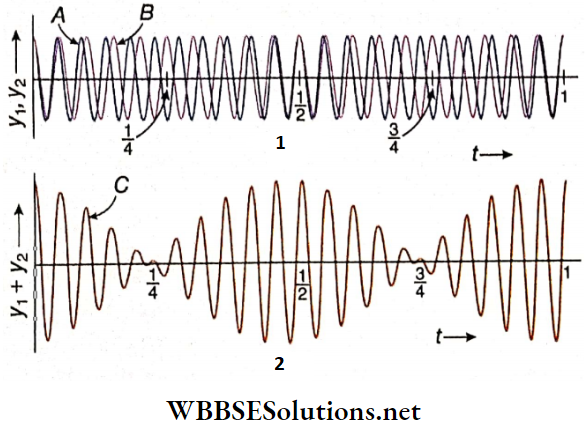
Graphical Representation Of Beat Formation: Let two sound waves of nearly equal amplitudes be incident on each other with the initial phase. For example, we take two progressive waves of frequencies 10 Hz and 8 Hz.

  • They superpose in a region of space with equal amplitude and with the same initial phase. Shows the displacements y1 and y2 of the two waves A and B, respectively. The resultant displacement is shown by C. From the principle of superposition, the algebraic sum (y1 + y2) denotes the resultant displacement y at any instant.
  • When t = 0, \(\frac{1}{2}\)s and 1 s, the two waves are in the same phase. So, the resultant y is the maximum. On the other hand, at t = \(\frac{1}{4}\)s and \(\frac{3}{4}\)s, the two waves are in opposite phase and the resultant y is nearly zero, i.e., minimum.
Superposition Of Waves Graphical Representation Of Beat Formation

  • So in a span of 1 s, rise or fall in the intensity of sound occurs twice, i.e., two beats are formed per second.
  • This means that \(\frac{1}{2}\)s time is required to produce a single beat. Moreover, shows that the time interval between two maximum amplitudes = \(\frac{1}{2}\) – 0 = \(\frac{1}{2}\)s; the time interval between two minimum amplitudes = \(\frac{3}{4}\) – \(\frac{1}{4}\) = \(\frac{1}{2}\)s.

So, it may be concluded that a beat is formed between two consecutive maxima or between two consecutive minima of the resultant amplitude.

Mathematical Analysis Of Beats: Let us consider two sound waves having frequencies n1 and n2 (n1> n2) traveling through a medium. They have equal amplitude A and equal initial phase. The displacements of the two waves at any point is \(y_1=A \sin 2 \pi n_1 t \text { and } y_2=A \sin 2 \pi n_2 t\)

According to the principle of superposition, the resultant displacement is

y = \(y_1+y_2=A\left(\sin 2 \pi n_1 t+\sin 2 \pi n_2 t\right)\)

= \(2 A \sin \left(2 \pi \frac{n_1+n_2}{2} t\right) \cos \left(2 \pi \frac{n_1-n_2}{2} t\right)\)

or, y = \(A^{\prime} \sin 2 \pi n t\)….(1)

where n = \(\frac{n_1+n_2}{2}\)…(2)

and \(A^{\prime}=2 A \cos 2 \pi \frac{\left(n_1-n_2\right) t}{2}\)…(3)

The factor sin2πnt in equation (1) implies that the resultant wave is a sound wave with frequency n = \(\frac{n_1+n_2}{2}\) = average of the component frequencies.

Besides, equation (3) shows that the amplitude of the resultant wave (A’) is not a constant, rather it varies with time t. As the intensity of sound is proportional to the square of the amplitude, this intensity also varies with time.

The amplitude changes with time between a maximum and a minimum. As a result, the intensity of sound periodically increases or decreases. This is known as beats.

Beat Frequency:

1. If \(\cos 2 \pi \frac{\left(n_1-n_2\right) t}{2}=0\), the intensity of sound becomes zero, i.e., A’ = 0.

In this condition, no sound is heard.

Here, \(\cos 2 \pi \frac{\left(n_1-n_2\right) t}{2}=0\)

This corresponds to \(2 \pi \frac{\left(n_1-n_2\right) t}{2}=\frac{\pi}{2}, \frac{3 \pi}{2}, \frac{5 \pi}{2}, \cdots\)

or, t = \(\frac{1}{2\left(n_1-n_2\right)}, \frac{3}{2\left(n_1-n_2\right)}, \frac{5}{2\left(n_1-n_2\right)}, \cdots\)

So, the time interval between two consecutive minima is

\(t_0 =\frac{3}{2\left(n_1-n_2\right)}-\frac{1}{2\left(n_1-n_2\right)}=\frac{1}{n_1-n_2}\)

= \(\frac{5}{2\left(n_1-n_2\right)}-\frac{3}{2\left(n_1-n_2\right)}\)

i.e, the number of minima per second = \(\frac{1}{t_0}=n_1-n_2\).

2. If \(\cos 2 \pi \frac{\left(n_1-n_2\right) t}{2}= \pm 1\), the intensity of sound becomes maximum, i.e., A’ = ±2A (maximum amplitude). In condition, aloud sound is heard.

Here, \(\cos 2 \pi \frac{\left(n_1-n_2\right) t}{2}= \pm 1\)

This corresponds to \(2 \pi \frac{\left(n_1-n_2\right) t}{2}=0, \pi, 2 \pi, \cdots\)

or, t=0, \(\frac{1}{n_1-n_2}, \frac{2}{n_1-n_2}, \frac{3}{n_1-n_2}, \cdots\)

The time interval between two consecutive maxima is \(t_0^{\prime}=\frac{1}{n_1-n_2}-0=\frac{1}{n_1-n_2}=\frac{2}{n_1-n_2}-\frac{1}{n_1-n_2} ;\)

i.e., the number of maxima per second

= \(\frac{1}{t_0^{\prime}}=n_1-n_2\)

So, the number of beats per second or the beat frequency = n1 ∼ n2 = magnitude of difference in frequencies of the two superposed waves.

It is to be noted that if the amplitudes A and B of the two superposed waves are slightly different, then for the resultant wave, maximum amplitude = (A+B) and minimum amplitude = (A-B)≠0

Definition of Superposition of Waves for Class 11

Superposition Of Waves

In this case, the sound intensity never falls to zero, that is, absolute silence is never achieved. Rather, a feeble sound is heard between every two loud maxima.

Conditions For The Recognition Of Beats: The beat frequency must be less than 10 Hz, i.e., more than one beat must not be formed within a time span of \(\frac{1}{10}\)s. Otherwise, beats cannot be separately recognized by the ear and a continuous sound is heard. This is known as a beat note.

The amplitudes and intensities of die two superposed waves must be equal or nearly equal. If they are widely different, the intensity variation between the maxima and the minima of the resultant wave is much less, and it becomes hard to recognize the resultant beats.

Application Of Beats:

Determination Of An Unknown Frequency: To determine the unknown frequency of a source of sound, a few tuning forks of known frequencies are taken. Let it be the unknown frequency of a source of sound and n1, n2, n3, ….. be the known frequencies of the standard tuning forks.

At first, die tuning forks, one by one, are vibrated simultaneously with the source of sound to detect whether recognizable beats are formed or not. Suppose, a particular tuning fork of frequency nf is able to form such beats. If the beat frequency is N, then

Either, n-ni = N i.e., n = ni + N;

or, n1 – n = N i.e., n = ni – N

Examples of Superposition of Waves in Real Life

  • For example, if a tuning fork of frequency 200 Hz forms 4 beats per second, the unknown frequency of the source will be either 200  4 = 204 Hz or 200 – 4 = 196 Hz
  • Now, the correct value between 204 Hz and 196 Hz is to be ascertained. For this purpose, a small drop of wax is put or a small piece of paper is pasted on one arm of the tuning fork.
  • This results in a slight decrease in the frequency of the fork. So the beat frequency will also change slightly, it may be less or more than its previous value.
  • If the number of beats is reduced, the unknown frequency will be 196 Hz. On the other band, if the number of beats is increased, the unknown frequency wall he 204 Hz.

Tuning Of A Musical Instrument: A musical instrument can be tuned with die help of beats. Let a particular string of a musical instrument be brought to unison with a standard source of musical sound. The string and the standard source are vibrated simultaneously.

The length and the tension of the string are gradually varied until beats are formed and recognized. It indicates that the frequency of the string is now within 10 Hz of the frequency of the standard source. Then a little more variation of the length and the tension would bring the string tuned exactly with the source. No more formation of beats would confirm this tuning.

WBCHSE Class 11 Physics For Principle Of Superposition Of Waves

Superposition Of Waves Beats Numerical Examples

Mathematical Representation of Superposition of Waves

Example 1. When two tuning forks are vibrated simultaneously, 4 beats are heard per second. The second fork is waxed slightly and then 6 beats are heard per second when both are vibrated again simultaneously. Find out the frequency of the second fork. Given, that the frequency of the first fork is 510 Hz.
Solution:

Given

When two tuning forks are vibrated simultaneously, 4 beats are heard per second. The second fork is waxed slightly and then 6 beats are heard per second when both are vibrated again simultaneously.

Let n2 be the frequency of the 2nd tuning fork.

We know, the number of beats per second = difference in frequencies of the two tuning forks.

If n2 > 510 Hz , then n2 -510 = 4 or, n2 = 514 Hz. When the 2nd fork is waxed, its frequency becomes less than 514 Hz. Then the number of beats per second decreases. So, 6 beats will not be formed per second.

If n2 < 510 Hz , then 510- n2 = 4 or, n2 = 506 Hz . The frequency decreases further for waxing. So, 6 beats can be formed per second. This means that the value n2 = 506 Hz matches with the given problem.

Class 11 Physics Class 12 Maths Class 11 Chemistry
NEET Foundation Class 12 Physics NEET Physics

Example 2. 2 of length 78 cm and 80 cm of a sonometer are kept at the same tension. A tuning fork produces 4 beats per second with each of them. Find out the frequency of the tuning fork.
Solution:

Given

2 of length 78 cm and 80 cm of a sonometer are kept at the same tension. A tuning fork produces 4 beats per second with each of them.

Fundamental frequency of the 78 cm long wire, \(n_1=\frac{1}{2 \times 78} \sqrt{\frac{T}{m}}\)

Fundamental frequency of the 80 cm long wire, \(n_2=\frac{1}{2 \times 80} \sqrt{\frac{T}{m}}\)

∴ \(\frac{n_1}{n_2}=\frac{80}{78} ; \text { clearly, } n_1>n_2\)

If n is the frequency of the tuning fork, then \(n_1-n=4 \text { and } n-n_2=4\)

∴ \(n_1-n_2=8 \text { or, } \frac{n_1}{n_2}-1=\frac{8}{n_2}\)

or, \(\frac{80}{78}-1=\frac{8}{n_2} \text { or, } \frac{2}{78}=\frac{8}{n_2} \text { or, } n_2=312 \mathrm{~Hz}\)

∴ n = \(312+4=316 \mathrm{~Hz}\).

Example 3. A 75 cm long stretched string is tuned with a tuning fork. If the length of the string is reduced by 3 cm, it produces 6 beats with the tuning fork per second. Find out the frequency of the timing fork.
Solution:

Given

A 75 cm long stretched string is tuned with a tuning fork. If the length of the string is reduced by 3 cm, it produces 6 beats with the tuning fork per second.

Frequency of the tuning fork, n = fundamental

Frequency of the 75 cm long string = \(\frac{1}{2 \times 75} \sqrt{\frac{T}{m}}\)

Again, the fundamental frequency of the (75 – 3) cm or 72 cm long string, \(n^{\prime}=\frac{1}{2 \times 72} \sqrt{\frac{T}{m}}\)

∴ \(\frac{n}{n^{\prime}}=\frac{72}{75} ; \text { clearly, } n<n^{\prime}\) .

As 6 beats are produced per second, we have,

n’ – n = 6

or, \(\frac{n^{\prime}}{n}-1=\frac{6}{n}\)

or, \(\frac{75}{72}-1=\frac{6}{n} \text { or, } \frac{3}{72}=\frac{6}{n} \text { or, } n=144 \mathrm{~Hz}\).

Question 4. A tuning fork of unknown frequency produces 5 beats per second with another tuning fork. The second fork can cause a closed organ pipe of length 40 cm to vibrate in its fundamental mode. The beat frequency decreases when a small amount of wax is dropped on the first fork. Find out the frequency of the first tuning fork. Given, the speed of sound in air = 320 m · s-1.
Solution:

Given

A tuning fork of unknown frequency produces 5 beats per second with another tuning fork. The second fork can cause a closed organ pipe of length 40 cm to vibrate in its fundamental mode. The beat frequency decreases when a small amount of wax is dropped on the first fork.

Length of the organ pipe =40 cm = 0.4 m

So, its fundamental frequency = \(\frac{V}{4 l}=\frac{320}{4 \times 0.4}=200 \mathrm{~Hz}\)

∴ The frequency of the 2nd tuning fork, n2 = 200 Hz.

Clearly, the frequency of the 1st tuning fork is n = (200+ 5) Hz or, (200-5) Hz;

The wax would decrease the frequency of the 1st fork. This decreased frequency must be closer to n2 = 200 Hz, as the beat frequency also decreases. So, the frequency of the 1st tuning fork is n1 = 205 Hz.

Example 5. Two tuning forks A and B, when vibrated simultaneously, produce 5 beats per second. 40 cm and 40.5 cm lengths of a sonometer wire, kept in the same tension, are tuned with the forks A and B, respectively. Find out the frequencies of the two tuning forks.
Solution:

Given

Two tuning forks A and B, when vibrated simultaneously, produce 5 beats per second. 40 cm and 40.5 cm lengths of a sonometer wire, kept in the same tension, are tuned with the forks A and B, respectively.

According to the question, \(n_A=\frac{1}{2 \times 40} \sqrt{\frac{T}{m}} \text { and } n_B=\frac{1}{2 \times 40.5} \sqrt{\frac{T}{m}}\)

∴ \(\frac{n_A}{n_B}=\frac{40.5}{40}=\frac{81}{80} ; \text { clearly, } n_A>n_B\)

As the number of beats per second is 5, we have, \(n_A-n_B=5 \quad \text { or, } \frac{n_A}{n_B}-1=\frac{5}{n_B} \quad \text { or, } \frac{81}{80}-1=\frac{5}{n_B}\)

or, \(\frac{1}{80}=\frac{5}{n_B} \quad \text { or, } n_B=400 \mathrm{~Hz}\)

∴ \(n_A=n_B+5=400+5=405 \mathrm{~Hz}\)

WBBSE Class 11 Revision Notes on Superposition

Example 6. Two wires are tied on a sonometer. The tensions, lengths, diameters, and densities of the materials of the two wires are in the ratio 8: 1, 36: 35, 4: 1, and 1:2, respectively. Find out the number of beats produced per second when the two wires are vibrated simultaneously. Given, the frequency of the wires are vibrated simultaneously. The frequency of the wire emitting a tone of higher pitch is 360 Hz.
Solution:

Given

Two wires are tied on a sonometer. The tensions, lengths, diameters, and densities of the materials of the two wires are in the ratio 8: 1, 36: 35, 4: 1, and 1:2, respectively.

Mass per unit length of a wire, m = \(\frac{\pi d^2}{4} \rho\), where d = diameter of the wire and ρ = density of the material.

∴ Fundamental frequency, n = \(\frac{1}{2 l} \sqrt{\frac{T}{m}}=\frac{1}{2 l} \sqrt{\frac{4 T}{\pi d^2 \rho}}=\frac{1}{l d} \sqrt{\frac{T}{\pi \rho}}\)

So, for the two wires, \(\frac{n_1}{n_2}=\frac{l_2}{l_1} \cdot \frac{d_2}{d_1} \cdot \sqrt{\frac{T_1}{T_2} \cdot \frac{\rho_2}{\rho_1}}=\frac{35}{36} \times \frac{1}{4} \times \sqrt{\frac{8}{1} \times \frac{2}{1}}=\frac{35}{36}\)

Clearly, n2 >n1 so the pitch of the tone emitted by the 2nd wire is higher.

Here, n2 = 360 Hz

∴ \(\frac{n_1}{360}=\frac{35}{36} \quad \text { or, } n_1=350 \mathrm{~Hz}\)

∴ Number of beats per second =360-350 = 10.

Example 7. Two tuning forks A and B, when vibrated simultaneously, produce 5 beats per second. The forks produce resonances respectively with 36 cm and 37 cm long air columns of a tube closed at one end. What are the frequencies of the tuning forks?
Solution:

Given

Two tuning forks A and B, when vibrated simultaneously, produce 5 beats per second. The forks produce resonances respectively with 36 cm and 37 cm long air columns of a tube closed at one end.

If is the velocity of sound air, the fundamental frequency of a tube of length l closed at one end, is

n = \(\frac{V}{4 l}\)

∴ \(n_A=\frac{V}{4 \times 36} ; n_B=\frac{V}{4 \times 37}\)

So, \(\frac{n_A}{n_B}=\frac{37}{36}\) ; clearly, \(n_A>n_B\).

As 5 beats are produced per second, we have \(n_A-n_B=5\)

or, \(\frac{n_A}{n_B}-1=\frac{5}{n_B} \quad \text { or, } \frac{37}{36}-1=\frac{5}{n_B} \quad \text { or, } \frac{1}{36}=\frac{5}{n_B} \\
\text { or, } n_B=180 \mathrm{~Hz}\)

∴ \(n_A=n_B+5=180+5=185 \mathrm{~Hz} .\)

Example 8. A diver sends an audio signal from some depth underwater. This signal produces 5 beats per second with the note emitted by a 20 cm long pipe whose one end is closed. Find out the frequency and the wavelength of the audio signal inside water. Given, the velocity of sound in air = 360 m · s-1 and that in water = 1500 m · s-1.
Solution:

Given

A diver sends an audio signal from some depth underwater. This signal produces 5 beats per second with the note emitted by a 20 cm long pipe whose one end is closed.

The fundamental frequency of the 20 cm long pipe closed at one end, \(n_0=\frac{V}{4 l}=\frac{360}{4 \times(20 \times 0.01)}=450 \mathrm{~Hz}\)

As 5 beats are produced per second, the frequency of the audio signal is either, (450- 5) = 445 Hz or (450 + 5) = 455Hz

The frequency does not change due to refraction from water to air. So the wavelength inside water is

Either \(\frac{1500}{445}=3.37 \mathrm{~m} \quad \text { or, } \frac{1500}{455}=3.30 \mathrm{~m}\)

Example 9. Two waves from 10 beats in 3s in a gas, The wavelength are  1m and 1.01m, respectively. Find out the velocity of sound in the gas.
Solution:

Given

Two waves from 10 beats in 3s in a gas, The wavelength are  1m and 1.01m, respectively.

Let V be the velocity of sound in the gas.

As 10 beats are formed in 3 s, the beat frequency = \(\frac{10}{3}\)Hz.

The frequency of the 1st wave, \(n_1=\frac{V}{\lambda}=\frac{V}{1} \mathrm{~Hz} \text {; }\)

The frequency of the 2nd wave, \(n_2=\frac{V}{\lambda_2}=\frac{V}{1.01} \mathrm{~Hz}\)

Here, \(n_1>n_2\)

∴ \(n_1-n_2=\frac{10}{3} \text { or, } \frac{V}{1}-\frac{V}{1.01}=\frac{10}{3}\)

or, V = \(336.7 \mathrm{~m} \cdot \mathrm{s}^{-1}\) .

Example 10. 24 tuning forks lire Otttutged lit the ascending writer of their frequencies. Itaeh fork produces 4 between per second with Ha Immediately preceding fork, The tell fork emits tut octave to Hint emitted by the first one, Find out the frequencies of the first the the last tuning forks.
Solution:

Given

24 tuning forks lire Otttutged lit the ascending writer of their frequencies. Itaeh fork produces 4 between per second with Ha Immediately preceding fork, The tell fork emits tut octave to Hint emitted by the first one,

Let the frequencies In ascending order of the 24 tuning forks be n1, n2,……… n24. frequencies tell that

\(\begin{gathered}
n_2-n_1=4 \\
n_3-n_2=4 \\
\ldots \ldots \ldots \ldots \ldots \ldots \\
n_{24}-n_{23}=4 \\
\hline \text { (on addition) } n_{24}-n_1=23 \times 4=92
\end{gathered}\)

As the 24th tuning fork emits an octave to that emitted by the first one, n24 = 2n1

∴ 2n1 – n1 = 92 or, n1 = 92 Hz.

∴ n24 = 2n1 = 2 x 92 = 104 Hz.

Example 11. A wire of length 25 cm and muss 2.5 g Is stretched with a fixed tension. The length of a pipe dosed at one end Is 40 cm. During vibrations, the first overtone of the wire produces 8 beats per second with the fundamental emitted by the pipe. The number of beats reduces with the decrease In tension In the wire. If the velocity of sound In air Is 320 m · s-1, find the tension in the wire.
Solution:

Given

A wire of length 25 cm and muss 2.5 g Is stretched with a fixed tension. The length of a pipe dosed at one end Is 40 cm. During vibrations, the first overtone of the wire produces 8 beats per second with the fundamental emitted by the pipe. The number of beats reduces with the decrease In tension In the wire. If the velocity of sound In air Is 320 m · s-1,

The fundamental frequency of the pipe closed at one end, \(n_1=\frac{V}{4 l}=\frac{(320 \times 100)}{4 \times 40}=200 \mathrm{~Hz}\)

The mass per unit length of the wire,m = \(\frac{2.5}{25}=0.1 \mathrm{~g} \cdot \mathrm{cm}^{-1}\)

The 1st overtone is the 2nd harmonic of the wire; the frequency is \(n_2=2 \times \frac{1}{2 l} \sqrt{\frac{T}{m}}=\frac{1}{25} \sqrt{\frac{T}{0.1}}=\frac{\sqrt{10 T}}{25} \mathrm{~Hz}\)

Clearly, n2 reduces with the decrease in tension T; so (n2 – n1) also decreases. For this reason, the beat frequency reduces. This means, n2 > n1.

As B beats are produced per second, we get n2  – n1 = 8

or, n2 = n1 + 8  = 200 + 8 = 208 Hz.

∴ 208 = \(\frac{\sqrt{107}}{25} \text { or, } 10 T=(208 \times 25)^2\)

or, T = \(\frac{(200 \times 25)^2}{10}=27.04 \times 10^5 \mathrm{dyn}=27,04 \mathrm{~N} .\)

Example 12. A sonometer wire Is stretched by hanging a 10cm high brass cylinder vertically from one of Its ends. The wire resonates with a tuning fork of frequency 250 Hz. Now the cylinder Is partially Immersed In water. If the wire and the tuning fork are vibrated simultaneously, 4 beats are heard per second. Calculate the length of the portion of the cylinder that was immersed In water. Given, the density of brass = 0,5 g · cm-3.
Solution:

Given

A sonometer wire Is stretched by hanging a 10cm high brass cylinder vertically from one of Its ends. The wire resonates with a tuning fork of frequency 250 Hz. Now the cylinder Is partially Immersed In water. If the wire and the tuning fork are vibrated simultaneously, 4 beats are heard per second.

The apparent loss of weight of the partially Immersed cylinder reduces the tension m the wire.

So, the frequency of the vibrating wire decreases. When the cylinder is partially immersed In water, the fundamental frequency of the wire is \(n_2=n_1-4=256-4=252 \mathrm{~Hz}\)

Now, \(\frac{n_1}{n_2}=\sqrt{\frac{T_1}{T_2}} or, \frac{256}{252}=\sqrt{\frac{T_1}{T_2}}\)

Here, T1 = weight of the cylinder

= 10αρg = 10α x 0.5 x g

T2 = weight of the partially immersed cylinder

= weight of the cylinder in the air – the weight of the water displaced

= 10α x 8.5 x g – lα x 1 x g

where α = area of the cross-section of the cylinder

l = height of the cylinder immersed in water

∴ \(\frac{256}{252}=\sqrt{\frac{10 \alpha \times 8.5 \times g}{10 \alpha \times 8.5 \times g-l \alpha \times 1 \times g}}=\sqrt{\frac{85}{85-l}}\)

or, \(\frac{85}{85-l}=\left(\frac{256}{252}\right)^2 \text { or, } 85-l=85 \times\left(\frac{252}{256}\right)^2\)

or, \(l=85 \times\left[1-\left(\frac{252}{256}\right)^2\right]=2.64 \mathrm{~cm}\)

Example 13. Two progressive waves y1 = 4 sin 500πt and y2 = 2 sin506π t are supported. Find the number of beats produced in one minute.
Solution:

Given

Two progressive waves y1 = 4 sin 500πt and y2 = 2 sin506π t are supported.

Comparing the given equations with the standard equation y = Asinωt,

We have, \(\omega_1=500 \pi \text { or, } n_1=\frac{\omega_1}{2 \pi}=\frac{500 \pi}{2 \pi}=250 \mathrm{~Hz} ;\)

and \(\omega_2=506 \pi \text { or, } n_2=\frac{\omega_2}{2 \pi}=\frac{506 \pi}{2 \pi}=253 \mathrm{~Hz}\)

∴ Number of beats per second = difference in frequencies =253-250 =3

∴ A Number of beats produced In one minute = 3 x 60 = 100

Example 14. Three transverse progressive waves are x1 = Acos(kx-ωt), x= Acos(kx + ωt) , x3 = Acos (ky-ωt). How may these be superposed to generate

  1. A stationary wave,
  2. A wave propagating In a direction inclined at an angle of 45° with both the positive x and y-axes? In each case, find out the positions where the resultant intensity would always be zero.

Solution:

Given

Three transverse progressive waves are x1 = Acos(kx-ωt), x= Acos(kx + ωt) , x3 = Acos (ky-ωt).

1. The first and the second waves are two identical but oppositely directed waves. So, they would generate a stationary wave.

The equation of the resultant wave would be

z = \(z_1+z_2 =A[\cos (k x-\omega t)+\cos (k x+\omega t)]\)

= \(2 A \cos k x \cdot \cos \omega t\)

The resultant intensity is zero, where 2Acos kx = 0

∴ coskx = 0 or, x = \(\frac{(2 n+1) \pi}{2 k}\{n=0,1,2,3, \ldots\}\)

2. The first wave directed along the positive x-axis and the third wave directed along the positive y-axis are identical waves. So the resultant wave propagates in a direction that Is Inclined at 45″ with both the x and the yaxes. The equation of the resultant wave would be

z = \(z_1+z_3=A[\cos (k x-\omega t)+\cos (k y-\omega t)]\)

= \(2 A \cos \frac{k(x+y)-2 \omega t}{2} \cdot \cos \frac{k(x-y)}{2}\)

Tire resultant intensity is zero, where \(2 A \cos \frac{k(x-y)}{2}=0\)

∴ \(\cos \frac{k(x-y)}{2}=0\)

or, \(\frac{k(x-y)}{2}=\frac{(2 n+1) \pi}{2}[n=0,1,2,3, \ldots]\)

or, \(x-y=\frac{(2 n+1) \pi}{k}\) .

WBCHSE Class 11 Physics Superposition Of Waves Question and Answers

Superposition Of Waves Long Answer Type Questions

Question 1. When you sing in the shower why is the sound heard so good?
Answer:

It is because of superposition. The sound waves you produce in the air bounce off the walls and interfere with each other in a way that produces a sweet sound.

Question 2. Which from an of a string the tone clamped will at be both absent ends, in the when note it is emitted strode at a distance of one-third of its length from one end?
Answer:

The stretched string AB is struck at the point C, where AC = \(\frac{1}{3}\)AB. As a result, an antinode will be formed at C; a node can never be formed there. So the modes of vibration, as shown in the figure, will be absent. This means that the absent ones would correspond to the 3rd, 6th 9th,… harmonics.

Question 3. What would be the change in the fundamental frequency of a stringed instrument if

  1. The length of the string is doubled,
  2. The tension is doubled,
  3. The diameter is doubled?

Answer:

  1. The frequency is inversely proportional to the length of the string. So, if the length is doubled, the fundamental frequency would be reduced to half.
  2. Frequency is proportional to the square root of the tension. So, if the tension is doubled, the fundamental frequency would be √2. or 1.414 times of its initial value.
  3. If the diameter is doubled, the area of the cross-section becomes 22 or 4 times the initial value. If the materials of the string is the same, the mass per unit length also becomes 4 times its original value. The frequency is inversely proportional to the square root of the mass per unit length. So, in this case, the frequency would be \(\frac{1}{\sqrt{4}} \text { or } \frac{1}{2}\) times, i.e., half the initial value.

Question 4. Compare the fundamental frequencies of the tones emitted by two pipes of equal length, one open at both ends and the other closed at one end.
Answer:

Let V be the velocity of sound in air and l, be the length of each of the pipes.

∴ The frequency of the fundamental tone emitted by the pipe open at both ends, \(n_1=\frac{V}{2 l}\)

and the frequency of the fundamental tone emitted by the pipe closed at one end, \( n_2=\frac {V}{4 l}.\)

∴ \(\frac{n_1}{n_2}=\frac{\frac{V}{2 l}}{\frac{V}{4 l}}=2 \quad \text { or, } n_1=2 n_2\)

So, the fundamental frequency for a pipe open at both ends is twice that of a pipe of the same length but closed at one end.

WBCHSE Class 11 Physics Superposition Of Waves L A Qs

WBBSE Class 11 Superposition of Waves Q&A

Example 5. A closed pipe and an open pipe emit fundamental tones of the same frequency. Find out the ratio of their lengths.
Answer:

Let the length of the closed pipe and the open pipe be l1 and l2, respectively. V is the velocity of sound in air.

For the closed pipe, the fundamental frequency is \(n_1=\frac{V}{4 l_1}\); for the open pipe, it is \(n_2=\frac{V}{2 l_2}\)

In the problem, \(n_1=n_2 \text { or, } \frac{V}{4 l_1}=\frac{V}{2 l_2} \text { or, } \frac{l_1}{l_2}=\frac{1}{2}\)

Therefore, the ratio of their lengths is  1: 2

Class 11 Physics Class 12 Maths Class 11 Chemistry
NEET Foundation Class 12 Physics NEET Physics

Question 6. Would the frequencies of the tones emitted from a closed or an open pipe change If the temperature of the air column in the pipe increases?
Answer:

The frequencies of the tones are proportional to the velocity of sound in air, which increases with the increase of temperature. So, as the temperature increases, the frequencies of the tones emitted from the air column in the pipe would also increase.

Question 7. How would the fundamental frequency emitted from an organ pipe, open at both ends, change, If

  1. An open end is suddenly closed,
  2. The length of the pipe is increased,
  3. The diameter of the pipe is increased?
  4. What would happen if the air is blown heavily through an open end?

Answer:

  1. If an open end is suddenly closed, the pipe open at both ends becomes a closed pipe of equal length. In this case, the fundamental frequency would be halved.
  2. The frequency of the emitted fundamental tone is inversely proportional to the length of the pipe. So, the frequency would decrease with the increase in the length of the pipe.
  3. The end error of a pipe increases with the increase in diameter. As a result, the effective length of the pipe increases. The fundamental frequency is inversely proportional to the length of the pipe; so the frequency would decrease due to this increase in effective length.
  4. A heavier blow would increase the loudness of the emitted tones. Moreover, the hither (Le, 2nd, 3rd, 4th,…) harmonics would be. formed more easily.

Question 8. Why is the musical sound emitted from an open pipe more pleasant than that emitted from a closed pipe?
Answer:

A dosed pipe can emit the fundamental rone and its odd harmonics. But an open pipe can emit both the odd and the even harmonics as well as the fundamental tone. So, a note emitted from, an open pipe contains a larger number of constituent tones.

The quality of a note depends on the number of overtones present in it. Store the number of overtones present in a note, the more pleasant it sounds. This results in a higher quality of sound emitted from an open pipe.

Question 9. A stretched vibrating string is touched at a distance of 1/3 rd of its length from one end. What would happen to the musical sound emitted?
Answer:

The point of touch would be a nodal point. So only the 3rd, 6th. 9th…. harmonics, which have a node at 1/3 would be emitted. No other harmonics have a node at 1/3. So, all of them would be suppressed.

Mathematical Problems in Superposition of Waves

Question 10. Two tuning forks, vibrating simultaneously, produce 6 beats per second. The first of them has a frequency of 312 Hz. Some amount of wax is added to one arm of the second tuning fork; the number of beats per second reduces to 3. Find out the frequency of this second tuning fork. Is it possible to increase the beat frequency to 6 per second by adding some more wax to die second tuning fork?
Answer:

Initially, the number of beats per second is 6. So the frequency of the 2nd fork is either 312-*-6 = 318 Hz or 312 – 6 = 306 Hz. After putting the wax, the beat frequency is 3 per second.

  • So the changed frequency of the 2nd fork is, either 312÷3=315Hz or 312 – 3 = 309 Hz. But the addition of wax reduces the frequency of the 2nd fork; so it cannot change from 306 Hz to 309 Hz; the actual change is from 318 Hz to 315 Hz. This means that the actual frequency of the 2nd tuning fork is 318 Hz.
  • By adding a sufficient amount of wax on the 2nd fork, its frequency can be reduced from 318 Hz to 306 Hz. Then again the beat frequency would be 312 – 306 = 6 per second.

Question 11. Two Identical wires of equal lengths are stretched In such a way that their simultaneous vibrations produce 6 beats per second. The tension In one of the wires is changed slightly and it is observed that the beat frequency remains the same. How is it possible?
Answer:

The frequency of a stretched string is proportional to the square root of the tension. If the fundamental frequency in the 1st wire is more than that in the 2nd wire, the tension in the 1st ware (T1) > the tension in the 2nd wire (T2).

Then, n1 = n2 ÷ 6, where n1 and n2 are the fundamental frequencies of the two wires respectively. Now, the tension T2 is increased gradually until the fundamental frequency of the 2nd wire changes to n2‘ = n2 ÷ 12. Under these circumstances, the frequency difference becomes, \(n_2^{\prime}-n_1=\left(n_2+12\right)-\left(n_2+6\right)=6\)

This means that 6 beats would be heard again per second.

Question 12. Three tuning forks of frequencies n-x,n, and n + x are vibrated simultaneously. If the amplitudes of vibration are equal, show that the forks would form beats.
Answer:

Let A be the amplitude of the vibration of each tuning fork.

Then, the equations of the waves are y1 = Asin2π(n- x)t, y2 = Asin2πnt if and y3 = Asin2π(n + x)t.

∴ The equation of the resultant wave is

y = \(y_1+y_2+y_3\)

= \(A[\sin 2 \pi(n-x) t+\sin 2 \pi n t+\sin 2 \pi(n+x) t]\)

= \(A[\{\sin 2 \pi(n+x) t+\sin 2 \pi(n-x) t\}+\sin 2 \pi n t]\)

= \(A[2 \sin 2 \pi n t \cos 2 \pi x t+\sin 2 \pi n t]\)

= \(A(1+2 \cos 2 \pi x t) \sin 2 \pi n t\)

∴ The amplitude of the resultant wave = A(1 + 2 cos2πxt)

This amplitude clearly depends on time. As a result, the intensity of the emitted sound would also increase and decrease periodically with time [intensity ∝ (amplitude)²]. Thus beats are produced. So, beats can be produced not only due to the superposition of two waves but also due to the superposition of more than two waves.

Short Notes on Wave Superposition Concepts

Question 13. Three sources emitting sound waves of the same amplitude have frequencies 400 Hz, 401 Hz, and 402 Hz, respectively. Find out the number of beats heard per second.
Answer:

⇒ \(y_1=A \sin (2 \pi \cdot 400 t) ; y_2=A \sin (2 \pi \cdot 401 t)\)

⇒ \(y_3=A \sin (2 \pi \cdot 402 t)\)

∴ y = \(y_1+y_2+y_3\)

= \(A[\sin (2 \pi \cdot 400 t)+\sin (2 \pi \cdot 401 t)+\sin (2 \pi \cdot 402 t)\} \)

= \(A\left[\sin (2 \pi \cdot 401 t)+2 \sin \left\{2 \pi \frac{402+400}{2} t\right\}\right.\)

. \(\left.\cdot \cos \left\{2 \pi \frac{402-400}{2} t\right\}\right]\)

= \(A[\sin (2 \pi \cdot 401 t)+2 \sin (2 \pi \cdot 401 t) \cos 2 \pi t]\)

= \(A(1+2 \cos 2 \pi t) \sin (2 \pi \cdot 401 t)\)

Here, the amplitude of the resultant wave, \(A^{\prime}=A(1+\cos 2 \pi t).\)

This is maximum when \(\cos 2 \pi t=1=\cos 2 n \pi[n=0,1,2,3, \cdots]\)

or, t = \(n=0,1,2, \cdots\)

Then, the time interval between two consecutive maxima is Is; so the beat frequency = 1 per second.

Question 14. A 100 cm long stretched string is struck at a point 25 cm from one of its ends. Which of the overtones would be absent in the emitted note?
Answer:

At the striking point, an antinode would be formed. So, the overtones having a node at the point of 25 cm would not be formed. As 25 cm = \(\frac{100 \mathrm{~cm}}{4}=\frac{1}{4}\)(l = length of the stretched string), the absent overtones would be the 4th, 8th, 12th, …. harmonics.

Question 15. In a particular vibrating mode of a stretched string of length l clamped at both ends, n nodes are formed. What is the wavelength of the stationary wave formed in this mode?
Answer:

Both endpoints are nodes. So, the number of loops formed between the n nodes = n-1. Every loop has a length = \(\frac{\lambda}{2} \text {. So, } \frac{l}{n-1}=\frac{\lambda}{2} \text { or, } \lambda=\frac{2 l}{n-1} \text {. }\)

Question 16. The equation of two progressive waves superposing on a string is y1 = Asin[k(x- ct)] and y2 = Asin[k(x+ ct)]. What is the distance between two consecutive nodes?
Answer:

Here, \(y_1 \text { or } y_2=A \sin [k(x \mp c t)]\)

The general form of the two waves, y = \(A \sin \frac{2 \pi}{\lambda}(x \mp V t)\)

So, k = \(\frac{2 \pi}{\lambda} \text { or, } \lambda=\frac{2 \pi}{k}\)

∴ The distance between two consecutive nodes = \(\frac{\lambda}{2}=\frac{\pi}{k}\).

Real-Life Examples of Superimposed Waves

Question 17. Two waves represented as y1 = A1 sin ωt and y2 = A2 cosωt superpose at a point in space. Find out the amplitude of the resultant wave at that point.
Answer:

⇒ \(y_1=A_1 \sin \omega t ; y_2=A_2 \cos \omega t=A_2 \sin \left(\omega t+\frac{\pi}{2}\right) \text {. }\)

So, the phase difference between the two waves = \(\frac{\pi}{2}\).

Then, the amplitude of the resultant wave is A = \(\sqrt{A_1^2+A_2^2+2 A_1 A_2 \cos \frac{\pi}{2}}=\sqrt{A_1^2+A_2^2} .\)

Question 18. The length of a stretched string between two rigid supports is 40 cm. What would be the maximum length of a stationary wave that can be formed in the string?
Answer:

Let the maximum wavelength that can be formed for the given string be λ. For the stationary wave of maximum length, only two nodes are present and they are at the two ends of the string. There is only one antinode between them. So the string vibrates in a single loop. Then the length of this loop = \(\frac{\lambda}{2}\) = 40 cm; so, λ = 80 cm.

Question 19. The equation of a transverse progressive wave is y = 0.02sin(x+40t) m. Find out the tension In a wire of linear density 10-4 kg · m-1, if the wave travels along it.
Answer:

Comparing the given equation with the standard form y = A sin(ωt+ kx), we have k = 1 and ω = 40.

So, the wave velocity, V = \(\frac{\omega}{k}=\frac{40}{1}=40 \mathrm{~m} \cdot \mathrm{s}^{-1} \text {. }\)

If T = tension and m = linear density of the wire,

V = \(\sqrt{\frac{T}{m}} \text { or, } T=V^2 m=(40)^2 \times 10^{-4}=0.16 \mathrm{~N}\)

Question 20. The superposition of two progressive waves produces a stationary wave represented as y = Acos(0.01x)sin(100t) m. What is the velocity I of the two-component waves?
Answer:

Two progressive waves represented as y1 = A sin(ωt- kx) and y2 = A sin(ωt+ kx) superpose to form a stationary wave y = y1 + y2 = 2A cos kx sin ωt.

Comparing the given equation with this standard form, we have k = 0.01 m-1 and ω = 100 Hz. So the wave velocity,

V = \(\frac{\omega}{k}=\frac{100}{0.01}=10^4 \mathrm{~m} \cdot \mathrm{s}^{-1} \text {. }\)

Step-by-Step Solutions to Superposition Questions

Example 21. A uniform wire has length I and area of cross-section α and the density of its material is ρ. If the wire is stretched with a tension T, what would be the velocity of a transverse wave traveling along It?
Answer:

Volume of unit length of the wire = unit length x area of cross-section = 1 x α = α; then linear density = mass per unit length, m = ρα.

∴ Velocity of a transverse wave, V = \(\sqrt{\frac{T}{m}}=\sqrt{\frac{T}{\rho \alpha}}\)

WBCHSE Class 11 Physics Superposition Of Waves Multiple Choice Questions

 Superposition Of Waves Multiple Choice Question And Answers

Question 1. A wave y= asin(ωt- kx) being superposed with another wave produces a node at x = 0. The equation of the second wave should be

  1. y = asin(ωt+kx)
  2. y = -asin(ωt+kx)
  3. y= asin(ωt-kx)
  4. y = -asin(ωt- kx)

Answer: 2. y = -asin(ωt+kx)

Question 2. At the instant when all the particles in the medium of a stationary wave are at their equilibrium positions the

  1. Kinetic Energy Becomes Zero
  2. Potential Energy Becomes Zero
  3. Net Energy Becomes Zero
  4. None Of These Becomes Zero

Answer: 2. Potential Energy Becomes Zero

Question 3. Which of the following remains constant in case of vibration of the particles in a stationary wave?

  1. Velocity
  2. Acceleration
  3. Amplitude
  4. Phase

Answer:  3. Amplitude

Read And Learn More WBCHSE Class 11 Physics MCQs

Question 4. When two identical sound waves superpose at a point with a phase difference of 180°,

  1. The point will be a node
  2. The intensity of the sound will increase at that point
  3. The point will be an antinode
  4. Beats will be heard

Answer: 1. The point will be a node

Question 5. The equation of a progressive wave is y = A cos (kx-ωt). This wave superposes with another wave and produces a stationary wave by creating a node at x = 0. Which of the following equations is correct for the other wave?

  1. Asin(kx+ωt)
  2. -Asin(kx-ωt)
  3. -Acos(kx+ωt)
  4. -Asin(kx-ωt)

Answer: 3. -Acos(kx+ωt)

WBCHSE Class 11 Physics Superposition Of Waves Multiple Choice Questions

WBBSE Class 11 Superposition of Waves MCQs

Question 6. A fundamental tone of frequency n1 is produced when a string stretched at both ends is vibrated. The frequency of the fundamental tone changes to n2 when the tension in the string is doubled. What is the ratio of n1 and n2?

  1. 1: 2
  2. 2: 1
  3. 1:√2
  4. √2: 1

Answer: 3. 1: √2

Question 7. The waves generated due to the vibration of an air column in a pipe open at one end or a pipe open at both ends are

  1. Transverse progressive waves
  2. Transverse stationary waves
  3. Longitudinal progressive waves
  4. Longitudinal stationary waves

Answer: Longitudinal stationary waves

Question 8. When a fundamental tone is produced from a pipe of length l, open at both ends, the wavelength of the stationary wave is

  1. \(\frac{l}{2}\)
  2. l
  3. 2l
  4. 4l

Answer: 3. 2l

Class 11 Physics Class 12 Maths Class 11 Chemistry
NEET Foundation Class 12 Physics NEET Physics

Question 9. If the frequency of the fundamental tone emitted from a pipe closed at one end is 200 Hz, then the frequencies of the first three overtones will be

  1. 400 Hz, 600 Hz, 800 Hz
  2. 600 Hz, 1000 Hz, 1400 Hz
  3. 400 Hz, 800 Hz, 1200 Hz
  4. 600 Hz, 800 Hz, 1000 Hz

Answer: 2. 600 Hz, 1000 Hz, 1400 Hz

Question 10. A fundamental tone is emitted from a pipe closed at one end. If the closed end is suddenly opened,

  1. The pitch of the tone decreases
  2. The intensity of the tone decreases
  3. The pitch of the tone increases
  4. The intensity of the tone increases

Answer: 3. The pitch of the tone increases

Constructive and Destructive Interference MCQs

Question 11. When a fundamental tone is produced from a pipe of length l, closed at one end, the wavelength of the stationary wave is

  1. \(\frac{l}{2}\)
  2. l
  3. 2l
  4. 4l

Answer: 4. 4l

Question 12. Due to the end error in stationary waves produced in a closed or an open pipe

  1. Antinodes are not formed at the closed end
  2. Antinodes are formed inside the pipe very close to its open end.
  3. Nodes are formed slightly outside the open end of the pipe
  4. None of these

Answer: 3. Nodes are formed slightly outside the open end of the pipe

Question 13. When the temperature of the air in a closed or so open pipe increases, the frequency of stationary wave will

  1. Remain the same
  2. Increase
  3. Decrease
  4. Depending on other factors also

Answer: 2. Increase

Question 14. The frequencies of the fundamental tones in a dosed and an open, pipe are the state The talks of the lengths of the two pipes is

  1. 1:1
  2. 1:2
  3. 2:1
  4. 4:1

Answer: 2. 1:2

Question 15. While measuring the speed of sound by performing a resonance column experiment, a student gets the first resonance condition at a column length of 18 cm during winter. Repeating the same experiment during summer, he measures the column length to be x cm for the second resonance. Then,

  1. 18 > x
  2. x > 54
  3. 54 > x > 36
  4. 36 > x > 18

Answer: 2. x > 54

Question 16. A student is performing the experiment of the resonance column. The diameter of the column tube is 4cm The frequency of the turning fork is 512HZ. The air temperature is  38C in which the speed of sound is 336m/s. The zero of the meter scale coincides with the top end of the resonance column tube. When the first resonance occurs, the reading of the water level in the column is

  1. 14 cm
  2. 15.2 cm
  3. 16.4cm
  4. 17.6cm

Answer: 2. 15.2 cm

Mathematical Problems for Wave Superposition

Question 17. A student is performing an experiment using a resonance column and a turning fort of frequency 244 s-1. He is told that the air in the tube has been replaced by another (assume the fear fee column remains filled with gas). If the minimum height at which resonance occurs is (0.350 ± 0.005) m, the gas in tube is (using information: √167RT = \(640 \mathrm{~J}^{1 / 2} \cdot \mathrm{mol}^{-1 / 2}; \sqrt{140 R T}=590 \mathrm{~J}^{1 / 2} \cdot \mathrm{mol}\). The molar masses M in grams are given in fee options. Take the value of \(\sqrt{\frac{10}{M}}\) for each gas as given there)

  1. Neon \(\left(M=20, \sqrt{\frac{10}{20}}=\frac{7}{10}\right)\)
  2. Nitrogen \(\left(M=28, \sqrt{\frac{10}{28}}=\frac{3}{5}\right)\)
  3. Oxygen \(\left(M=32, \sqrt{\frac{10}{32}}=\frac{9}{16}\right)\)
  4. Argon \(\left(M=36, \sqrt{\frac{10}{36}}=\frac{17}{32}\right.\)

Answer: 4. Argon \(\left(M=36, \sqrt{\frac{10}{36}}=\frac{17}{32}\right.\)

Question 18. What should be fee beat frequency so that it is not audible to the human ear?

  1. Greater than 10 Hz
  2. 10 Hz
  3. 5 Hz
  4. Less than 5 Hz

Answer: 1. Greater than 10 Hz

Question 19. If n1 and n2 are fee frequencies of two sound waves, the frequency of the beat produced due to the superposition of these waves will be

  1. \(n_1-n_2\)
  2. \(n_1+n_2\)
  3. \(\frac{n_1+n_2}{2}\)
  4. \(2\left(n_1-n_2\right)\)

Answer: 1. \(n_1-n_2\)

Question 20. Beats are not observed for light waves, because

  1. There is no difference in the velocities of the two light waves
  2. It is impossible to stabilize the frequency difference of two light waves below 10 Hz
  3. It is impossible to keep the intensities of two light waves equal or nearly equal
  4. None of these

Answer: 2. It is impossible to stabilize the frequency difference of two light waves below 10 Hz

Question 21. When two waves y1 = A sin2008πt and y2 = A sin2008πt are superposed, the number of beats produced per second is

  1. 0
  2. 1
  3. 4
  4. 8

Answer: 3. 4

Question 22. A set of 25 tuning fork is arranged in a series of decreasing frequencies such that each fork gives 3 beats with the succeeding one. The first fork is the octave of the last. Frequency of fee 10th fork is

  1. 120Hz
  2. 117Hz
  3. 110Hz
  4. 89Hz

Answer: 2. 117Hz

Short Answer Questions Related to Wave Superposition

Question 23. The displacement of a particle in a medium at an instant due to the effect of more than one wave is

  1. Not dependent on the displacements due to the individual waves
  2. Equal to the vector sum of fee displacements due to fee individual waves
  3. Equal to fee displacement due to any one of the waves
  4. Random due to the effect of all the waves

Answer: 2. Equal to fee vector sum of fee displacements due to fee individual waves

Question 24. A sound wave of frequency 500 Hz is advancing along the positive x-axis with a speed of 300 m · s-1. The phase difference between the two points x1 and x2 is 60°. The least distance between those two points is

  1. 1 mm
  2. 1cm
  3. 10cm
  4. 1 m

Answer: 3. 10cm

Question 25. When two progressive waves y1= 4sin(2x-6t) and \(y_2=3 \sin \left(2 x-6 t-\frac{\pi}{2}\right)\) are superposed, the amplitude of the resultant wave is

  1. 5
  2. 6
  3. \(\frac{5}{3}\)
  4. \(\frac{1}{2}\)

Answer: 1. 5

Question 26. A hollow pipe of length 0.8 m is closed at one end. At its open end, a 0.5 m long uniform string is vibrating in its second harmonic and it resonates with the fundamental frequency of the pipe. If the tension in the wire is 50 N and the speed of sound is 320 m • s-1, the mass of the string is

  1. 5g
  2. 10 g
  3. 20 g
  4. 40 g

Answer: 2. 10 g

Question 27. A sound of 20dB is more intense than a sound of 10 dB by

  1. 100
  2. \(\frac{1}{10}\)
  3. 10
  4. 0.01

Answer: 3. 10

In this type of question, more than one option is correct.

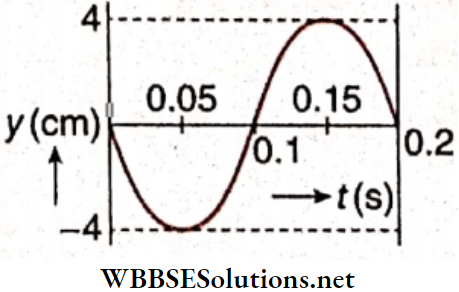
Question 28. For a certain transverse standing wave on a long string, an antinode is formed at x = 0, and next to it, a node is formed at x = 0.10 m. The displacement y(t) of the string particle at x = 0 is shown.

Superposition Of Waves Transverse Standing Wave On Long String

  1. The transverse displacement of the particle at x = 0.05 m and t = 0.05 s is -2√2 cm
  2. Transverse displacement of the particle at x = 0.04 m and t = 0.025 s is -2 √2 cm
  3. The speed of the traveling waves that interface to produce this standing wave is 2 m • s-1
  4. The transverse velocity of the string particle at x = \(\frac{1}{15}\)m and t = 0.1 s is 20π cm· s-1

Answer:

1. The transverse displacement of the particle at x = 0.05 m and t = 0.05 s is -2√2 cm

3. The speed of the traveling waves that interface to produce this standing wave is 2 m • s-1

4. The transverse velocity of the string particle at x = \(\frac{1}{15}\)m and t = 0.1 s is 20π cm· s-1

Question 29. Following are equations of four waves

  1. \(y_1=a \sin \omega\left(t-\frac{x}{v}\right)\)
  2. \(y_2=a \cos \omega\left(t+\frac{x}{v}\right)\)
  3. \(z_1=a \sin \omega\left(t-\frac{x}{v}\right)\)
  4. \(z_2=a \cos \omega\left(t+\frac{x}{v}\right)\)

Which of the following statements is correct?

  1. On superposition of waves (1) and (2), a traveling wave having amplitude a√2 will be formed
  2. Superposition of waves (2) and (3) is not possible
  3. On superposition of (1) and (2), a stationary wave having amplitude a√2 will be formed
  4. On superposition of (3) and (4), a transverse stationary wave will be formed

Answer:

1. On the superposition of waves (1) and (2), a traveling wave having amplitude a√2 will be formed

4. On superposition of (3) and (4), a transverse stationary wave will be formed

Question 30. One end of a taut string of length 3m along the x-axis is fixed at x = 0. The speed of the waves in the string is 100 m · s-1. The other end of the string is vibrating in the y-direction so that stationary waves are set up in the string. Obtain the possible waveforms of this stationary wave.

  1. \(y(t)=A \sin \frac{\pi x}{6} \cos \frac{50 \pi t}{3}\)
  2. \(y(t)=A \sin \frac{\pi x}{3} \cos \frac{100 \pi t}{3}\)
  3. \(y(t)=A \sin \frac{5 \pi x}{6} \cos \frac{250 \pi t}{3}\)
  4. \(y(t)=A \sin \frac{5 \pi x}{2} \cos 250 \pi t\)

Answer:

1. \(y(t)=A \sin \frac{\pi x}{6} \cos \frac{50 \pi t}{3}\)

3. \(y(t)=A \sin \frac{5 \pi x}{6} \cos \frac{250 \pi t}{3}\)

4. \(y(t)=A \sin \frac{5 \pi x}{2} \cos 250 \pi t\)

WBCHSE Class 11 Physics Notes For Displacement Relation of Progressive Wave

Wave Motion Equation Of A Travelling Or Progressive Wave

WBBSE Class 11 Displacement Relation of Progressive Waves Notes

Progressive Waves

A wave, that propagates through a medium in a fixed direction, is called a progressive wave in one dimension. Suppose, due to the propagation of the wave, the panicles in the medium are subjected to forced simple harmonic motions. Obviously, the wave reaches two different panicles at two different times.

  • As a result, there arises a time lag, and consequently a phase lag, between the vibrations of two different particles along the direction of wave motion.
  • This time lag or phase lag depends on the velocity of the wave. If the wave travels from left to right, each particle starts vibrating later than its predecessor on the left. So, the phase of a panicle lags behind that of any other panicle on its left.

Let the positive direction of the x-axis be chosen along the direction of propagation of a one-dimensional progressive wave. O is the origin.

Class 11 Physics Unit 10 Oscillation And Waves Chapter 3 Wave Motion Travelling Waves

Progressive Wave Equation

The particles of the medium vibrate simply harmonically. The displacement of the particle at O at any instant t from its mean position is given by, y = Asinωt

where A is the amplitude of vibration and ω is the angular frequency of the SHM executed by the particle.

If n is the frequency of the particle, ω = 2πn

y = Asin2πnt…(1)

The wave is traveling along the positive x -x-direction.

So, time taken by the wave to reach P at a distance x on the right-hand side of O is \(\frac{x}{V}\) i.e., with respect to time, the point P always lags behind the point O by \(\frac{x}{V}\). If t and t’ are the times at the points O and P, respectively, t’ = t – \(\frac{x}{V}\).

So, displacement of the particle at P is given by,

y = \(A \sin \omega t^{\prime}=A \sin \omega\left(t-\frac{x}{V}\right)=A \sin 2 \pi n\left(t-\frac{x}{V}\right)\)….(2)

This is the equation of a progressive wave traveling in the positive direction of x-axis.

If the wave propagates in the opposite direction, i.e., in the negative x-direction, we put -x in place of +x. So in that case, the equation of the progressive wave will be,

y = \(A \sin \omega\left(t+\frac{x}{V}\right)=A \sin 2 \pi n\left(t+\frac{x}{V}\right)\)…(3)

From equations (2) and (3) it is seen that the displacement of a vibrating panicle on the path of a progressive wave changes

  1. With time and
  2. With distance.

Each of these changes, with time or with distance, is periodic. Clearly, in each of the cases, the displacement graph of the particle (y-t graph or y-x graph) is a sine graph.

Any of the harmonic functions in sine and cosine forms may be used to express a simple harmonic motion. So we can express equations (1), (2), and (3) by cosine functions.

In equations (2) and (3), y is the displacement of a particle with respect to its mean position.

  1. In the case of a transverse wave, y is perpendicular to the x-axis.
  2. In the case of a longitudinal wave, y is parallel to the x-axis.

A Few Alternative Forms Of The Progressive Wave Equation: In equation (2), the angular function is, \(\theta=\omega\left(t-\frac{x}{V}\right).\)

By expressing θ in different ways, the equation of a progressive wave can be expressed in a few alternative forms

Class 11 Physics Class 12 Maths Class 11 Chemistry
NEET Foundation Class 12 Physics NEET Physics

Mathematical Representation of Progressive Waves

Frequency, \(n=\frac{\omega}{2 \pi} ;\) time period, \(T=\frac{1}{n}=\frac{2 \pi}{\omega}\) wavelength, \(\lambda=\frac{V}{n}\);

Wave number, \(k=\frac{2 \pi}{\lambda}=\frac{2 \pi n}{V}=\frac{\omega}{V}\)

  1. \(\theta=\omega\left(t-\frac{x}{V}\right)=\omega t-\frac{\omega}{V} x=\omega t-k x\)
  2. \(\theta=\omega\left(t-\frac{x}{V}\right)=\frac{\omega}{V}(V t-x)=k(V t-x)=\frac{2 \pi}{\lambda}(V t-x)\)
  3. \(\theta=\omega t-k x=2 \pi\left(\frac{\omega}{2 \pi} t-\frac{k}{2 \pi} x\right)=2 \pi\left(\frac{t}{T}-\frac{x}{\lambda}\right)\)

Using these values of θ, the equation of a progressive wave can be written as

\(\left.\begin{array}{rl}
y & =A \sin \omega\left(t-\frac{x}{V}\right) \\
& =A \sin (\omega t-k x) \\
& =A \sin \frac{2 \pi}{\lambda}(V t-x) \\
& =A \sin 2 \pi\left(\frac{t}{T}-\frac{x}{\lambda}\right)
\end{array}\right\}\)…(4)

Any of these alternative forms may be used as per convenience. Remember that if we put -x in place of x, we shall get the equation of a progressive wave moving in the negative direction of the x-axis.

WBCHSE Class 11 Physics Notes For Displacement Relation of Progressive Wave

Phase: The concept of phase has been discussed in the chapter Simple Harmonic Motion.

The equation of a progressive wave is written as y = Asinθ

where \(\theta=\frac{2 \pi}{\lambda}(V t-x)\)…(5)

If a progressive wave is not damped, the amplitude of vibration A remains constant. Except for amplitude, all other information about the wave is obtained from the angle θ. This angle θ is called the phase angle or phase. If this phase angle is known,

1. From the values of 2 and V we get,

frequency, \(n=\frac{V}{\lambda}\); time period T = \(\frac{1}{n}=\frac{\lambda}{V}\), etc.

2. For a particle in position x, the displacement at an instant t can be determined. Obviously, the phase 6 of the wave depends on x and t. At any instant, the phase changes with distance x. Again, at any point, the phase changes with time t.

Phase Difference: The phase difference of two particles at any two positions along the progressive wave at a particular instance of time is actually the difference of the phase angles at the two positions at that instant.

If x1 and x2 are the positions of the two particles along the direction of propagation of the wave, the path difference on the wave between the two particles is x2-x1.

From equation (5), at any instant t, the phase of the two particles are, respectively,

⇒ \(\theta_1=\frac{2 \pi}{\lambda}\left(V t-x_1\right) \text { and } \theta_2=\frac{2 \pi}{\lambda}\left(V t-x_2\right)\)

∴ \(\theta_1-\theta_2=\frac{2 \pi}{\lambda}\left(x_2-x_1\right)\)

i.e., phase difference = \(\frac{2 \pi}{\lambda}\) x path difference….(6)

From equation (6) we get,

1. If the path difference of two particles is 0, λ, 2 λ,…, the phase difference becomes 0, 2π, 4π,… In this case, the particles are in the same phase.

2. If the path difference of two particles \(\frac{\lambda}{2}, \frac{3 \lambda}{2}, \frac{5 \lambda}{2}, \ldots\) the phase difference becomes π, 3π, 5π,… In this case, the particles are in opposite phases.

Cosine form of the equation of a progressive wave: The equation of a progressive wave can be written using a cosine function instead of the sine function. Then,

y = \(A \cos (\omega t-k x)=A \sin \left(\omega t-k x+\frac{\pi}{2}\right)\)….(7)

Comparing equations (4) and (7), it is evident that the phase difference between these two progressive waves is \(\frac{\pi}{2}\) or 90°.

Initial Condition: In equation (4), if x = 0 and t = 0, y = 0, i.e., at the beginning, the displacement of the particle at the origin is zero. Similarly, in equation (7), if x = 0 and t = 0, y = A, i.e., at the beginning, the displacement of the particle at the origin is maximum. Obviously, due to different initial conditions, the phase difference between the two progressive waves given by equations (4) and (7) is 90°.

Generally, the displacement of a particle at t = 0 and x = 0 may have any value between +A and -A. So, the phase of a progressive wave may be different from those in equations (4) or (7). Denoting the initial phase by ø, the general form of a progressive wave can be written as:

\(\left.\begin{array}{rl}
y & =A \sin (\omega t-k x \pm \phi) \\
& =A \sin \left[\omega\left(t-\frac{x}{V}\right) \pm \phi\right] \\
& =A \sin \left[\frac{2 \pi}{\lambda}(V t-x) \pm \phi\right] \\
& =A \sin \left[2 \pi\left(\frac{t}{T}-\frac{x}{\lambda}\right) \pm \phi\right]
\end{array}\right\}\)…..(8)

According to equation (8), at t = 0 and x = 0, the phase angle of the particle is ±ø. This is called the epoch of the progressive wave at the origin.

Partial Derivatives: The equations in this section show that y is a function of two independent variables—x and r. So y has two independent derivatives one with respect to x and the other with respect to t. They are the partial derivatives:

1. \(\frac{\partial y}{\partial x}=\frac{d y}{d x} .\), when t is considered to be a constant = rate of change of y with respect to x when t is a constant.

2. Similarly, \(\frac{\partial y}{\partial t}\) = rate of change of y with respect to t, when x is a constant.

Particle velocity and acceleration in a progressive wave: Displacement of a particle in a progressive wave, y = \(A \sin (\omega t-k x \pm \phi)\)……(9)

So, the velocity of the particle,

v = \(\frac{\partial y}{\partial t}=\omega A \cos (\omega t-k x \pm \phi)\)

or, \(\nu =v_0 \cos (\omega t-k x \pm \phi)\)…..(10)

The maximum value of the velocity of the particle = \(\pm \omega A= \pm v_0\).

This v0 is called the velocity amplitude of the particle in a progressive wave.

From equation (9), \(\sin (\omega t-k x \pm \phi)=\frac{y}{A}\)

So, \(\cos (\omega t-k x \pm \phi)=\sqrt{1-\frac{y^2}{A^2}}=\frac{1}{A} \sqrt{A^2-y^2}\)

i.e., \(v=\omega A \cdot \frac{1}{A} \sqrt{A^2-y^2}\)

or, v = \(\omega \sqrt{A^2-y^2}\)

Differences Between Progressive And Non Progressive Waves

The phase difference between a sine function and a cosine function is 90°. So, the phase difference between displacement y and velocity v is also 90°.

From equation (11), it is also seen that if y = 0, v = ωA = v0 and again if y = A, v = 0,

i.e., if displacement is zero, velocity is maximum and if displacement is maximum, velocity is zero.

Acceleration of the particle in a progressive wave,

a = \(\frac{\partial^2 y}{\partial t^2}=-\omega^2 A \sin (\omega t-k x \pm \phi)\)

or, a = \(-\omega^2 y\)….(12)

From this equation it is evident that the displacement of the particle y and its acceleration a are in opposite phases, i.e., the phase difference between them is 180°.

Accordingly, the phase difference between velocity and acceleration is 90°.

The maximum acceleration of the particle = \(\pm \omega^2 A= \pm a_0\)

This a0 may be called the amplitude of acceleration of the particle in a progressive wave.

Relation between particle velocity and wave velocity in a progressive wave:

Displacement of the particle in a progressive wave, y = \(A \sin (\omega t-k x \pm \phi)\)

So, particle velocity, \(\nu=\frac{\partial y}{\partial t}=\omega A \cos (\omega t-k x \pm \phi)\)

Again, \(\frac{\partial y}{\partial x}=-k A \cos (\omega t-k x \pm \phi)\)

Wave Function and Displacement Relation

So, \(\frac{\partial}{\partial y}=-\frac{\omega}{k x}=-V\)

(As V is the wave velocity, \(k=\frac{\omega}{V}\) )

∴ v = -V \(\frac{\partial y}{\partial x}\)….(13)

This is the relation between particle velocity v and wave velocity V.

In case of a transverse wave, the direction of particle velocity is always perpendicular to that of wave velocity. In the case of a longitudinal wave, the direction of particle velocity is along or opposite to the direction of wave velocity.

Differential Equation Of A Progressive Wave: If y = \(A \sin (\omega t-k x \pm \phi)\)

⇒ \(\frac{\partial^2 y}{\partial t^2}=-\omega^2 A \sin (\omega t-k x \pm \phi)\)

and \(\frac{\partial^2 y}{\partial x^2}=-k^2 A \sin (\omega t-k x \pm \phi)\)

So, \(\frac{\frac{\partial^2 y}{\partial x^2}}{\frac{\partial^2 y}{\partial t^2}}=\frac{k^2}{\omega^2}=\frac{1}{V^2}\) (because wave velocity, \(V=\frac{\omega}{k}\))

or, \(\frac{\partial^2 y}{\partial x^2}=\frac{1}{V^2} \frac{\partial^2 y}{\partial t^2}\)…(14)

This equation is the differential equation of a progressive wave. Conversely, if any one-dimensional disturbance satisfies this equation, it is obviously a progressive wave.

Difference Between Particle Velocity And Wave Velocity:

  1. The particles of a medium in a progressive wave do not change their positions due to their velocities. Every particle only vibrates on both sides of its mean position But the progressive wave advances through the medium with its wave velocity.
  2. The velocities of the particles of the medium change continuously. It is maximum at the mean positions and zero at their extreme positions. However wave velocity remains constant for a particular medium. It depends only on the properties of the medium.
  3. A progressive wave possesses energy due to the motion of the particles of the medium. This energy propagates with the wave through the medium with the velocity of the wave.
  4. In a transverse wave, the direction of particle velocity is perpendicular to that of wave velocity. On the other hand, for a longitudinal wave, these two velocities are parallel.

The velocity of progressive waves in different media:

1. Velocity of a longitudinal wave in a solid medium, V = \(\sqrt{\frac{Y}{\rho}}\); Y = Young’s modulus of the medium, and ρ = density of the medium.

2. Velocity of a longitudinal wave in a liquid or gaseous medium, V = \(\sqrt{\frac{E}{\rho}}\); E = Bulk modulus of the medium, and ρ = density of the medium.

3. Velocity of sound wave in a gaseous medium, V = \(\sqrt{\frac{\gamma p}{\rho}}\); p = pressure of the gas, and γ = ratio of the two specific heats \(\left(\frac{c_p}{c_w}\right)\) of the gas.

Real-Life Examples of Displacement in Waves

4. Velocity of a transverse wave in a stretched string, V = \(\sqrt{\frac{T}{m}}\); T = tension in the string, and m = mass per unit length of the string.

5. Velocity of a longitudinal wave in a stretched string, \(V=\sqrt{\frac{Y}{\rho}}\); Y = Young’s modulus of the material of the string, and p ~ density of the material of the string.

6. Velocity of an electromagnetic wave, V = \(\frac{1}{\sqrt{\mu \epsilon}} ; \mu\) = permeability and ∈ = permittivity of the medium.

Characteristics Of Progressive Waves:

  1. Progressive wave continuously propagates through a medium, and if not damped, it can propagate to infinity.
  2. The progressive wave moves with a definite velocity. The wave velocity depends on the elastic properties and on the density of the medium. Energy is transferred with the wave through the medium with the velocity of the wave.
  3. Each particle of the medium vibrates about its mean position with identical frequency and amplitude. The direction of movement of the particles may be perpendicular (transverse wave) or parallel (longitudinal wave) with respect to the direction of wave motion.
  4. The velocity with which the phase of a vibrating particle of the medium is transferred to the next particle is called the wave velocity. For the same reason, it is also called the phase velocity. The phase difference between two vibrating particles is proportional to the distance of separation of the two particles along the line of wave propagation.
  5. The progressive wave carries energy from one point to another without displacing the particles of the medium. Energy is transferred perpendicular to the direction of the wavefronts, i.e., along the direction of the rays.
  6. Pressure and density in the medium, through which the progressive wave advances, follow the sinusoidal form of variation, like that of displacement, velocity, and acceleration.
  7. A progressive wave has double periodicity. One is time periodicity determined by the time period (T) of the wave and the other is space periodicity determined by the wavelength (λ).

Different Properties Of Progressive Waves: The distinctive properties of progressive waves are explained below

Absorption: While moving through any medium, damping of the progressive wave takes place. It means that the energy of the wave gradually decreases with the increase of distance because a part of the energy of the wave is absorbed by the medium as the wave propagates.

Reflection: When a progressive wave traveling in a homogeneous medium is incident on an interface with another medium, a part of the incident wave comes back to the first medium. This phenomenon is known as the reflection of a wave. The amount of energy of the incident wave that will be reflected depends on the nature of the interface of the two media.

Refraction: When a progressive wave traveling through a homogeneous medium is incident on an interface with another medium, a part of the incident wave is transmitted into the second medium. This phenomenon is known as the refraction of a wave. In refraction, the direction of wave motion generally changes.

Interference: Let us consider two progressive waves having the same wavelength and velocity. The phase difference of the two waves is always a constant. When these two waves superpose, the amplitude of the resultant wave increases at some places and decreases at some other places of the medium. This successive increase and decrease of the amplitude of the resultant wave is called interference of waves.

Diffraction: When a progressive wave passes through the edge of an opening or of an obstacle, the direction of the wave may change. This is called the diffraction of a wave.

Scattering: In the course of propagation, when a progressive wave falls on a material particle, the particle is subject to a forced vibration. So this particle also acts as a secondary source of wave, i.e., weaves propagate in all directions from the vibrating particle. This phenomenon is called the scattering of a wave.

Polarisation: During propagation of a transverse wave through a medium, each particle of the medium vibrates on a plane perpendicular to the direction of motion of the wave.

  • The plane is called the normal plane. If the vibrations of the particles on such planes arc somehow are restricted to a particular direction, then this phenomenon is called the polarisation of a wave. Obviously, polarization does not take place in case of longitudinal waves.
  • It is to be noted that, polarisation does not take place in the case of sound waves. This shows that sound waves are longitudinal. On the other hand, light waves can be polarised by suitable arrangements. So light waves are transverse.

In optics, these properties of waves are discussed in detail. In this chapter, the phenomena of reflection and refraction of sound waves are mainly discussed.

WBCHSE Class 11 Physics Wave Motion Multiple Choice Questions

Wave Motion Multiple Choice Questions And Answers

Question 1. Which one of the following phenomena differentiates transverse waves from longitudinal waves?

  1. Reflection
  2. Refraction
  3. Polarisation
  4. Interference

Answer: 3. Polarisation

Question 2. A sound wave is a

  1. Transverse elastic wave
  2. Transverse electromagnetic wave
  3. Longitudinal elastic wave
  4. Longitudinal electromagnetic wave

Answer: 3. Longitudinal elastic wave

Question 3. A light wave is a

  1. Transverse elastic wave
  2. Transverse electromagnetic wave
  3. Longitudinal elastic wave
  4. Longitudinal electromagnetic wave

Answer: 2. Transverse electromagnetic wave

Read And Learn More WBCHSE Class 11 Physics MCQs

Question 4. Polarisation of the sound wave does not occur, because the sound wave is

  1. Transverse wave
  2. Longitudinal wave
  3. Progressive wave
  4. Elastic wave

Answer: 2. Longitudinal wave

Question 5. If a child stands up while swinging on a swing, then the period of the swing will

  1. Increase
  2. Decrease
  3. Remain same
  4. Increase if the child is long and decrease if the child is short

Answer: 2. Decrease

WBCHSE Class 11 Physics Wave Motion Multiple Choice Questions

Question 6. A wave is advancing along the surface of water with a velocity of 80 cm · s-1. If the distance between two consecutive crests is 20 cm, then what will be the wavelength?

  1. 80 cm
  2. 20 cm
  3. 4 cm
  4. \(\frac{1}{4}\) cm

Answer: 2. 20 cm

WBBSE Class 11 Wave Motion MCQs

Question 7. When a wave coming from a medium enters another medium, the property of the wave which remains unchanged is

  1. Velocity
  2. Frequency
  3. Wavelength
  4. Amplitude

Answer: 2. Frequency

Question 8. A wave is advancing along the surface of water with a velocity of 80 cm • s-1. If the distance between two consecutive crests is 20 cm, then what will be the frequency of the wave?

  1. 80Hz
  2. 20Hz
  3. 4 Hz
  4. \(\frac{1}{4}\) Hz

Answer: 3. 4 Hz

Question 9. When a force F1 acts on a particle, the frequency is 6Hz, and when a force F2 acts, the frequency is 8 Hz. Now if both the forces act simultaneously in the same direction, then their frequency’ becomes

  1. 20Hz
  2. 14Hz
  3. 10Hz
  4. 2Hz

Answer: 3. 10Hz

Question 10. If the wavelength in a medium is reduced by 50%, keeping its velocity constant, the percentage change in its frequency is

  1. 50%
  2. 25%
  3. 100%
  4. 200%

Answer: 3. 100%

Question 11. The equation of a progressive wave is given by y = \(5 \sin \frac{\pi}{2}(100 t-x) \mathrm{cm}\). The wavelength is

  1. 2 cm
  2. 4 cm
  3. 50 cm
  4. 100 cm

Answer: 2. 4 cm

Question 12. The equation of a progressive wave is given by y = \(5 \sin \frac{\pi}{2}(100 t-x) \mathrm{cm}\). The frequency of the wave is

  1. 25 Hz
  2. 50 Hz
  3. 100 Hz
  4. 50π Hz

Answer: 1. 25 Hz

Question 13. The equation of a wave is given by y = \(10^{-4} \sin (60 t+2 x)\). Here x is expressed in metres and r in seconds. This represents a wave

  1. Which is moving in the negative direction of the x-axis with a velocity of 30 m • s-1
  2. Whose wavelength is  πm
  3. Whose frequency’ is \(\frac{30}{\pi}\) hz
  4. All the above options are correct

Answer: 4. All the above options are correct

Class 11 Physics Class 12 Maths Class 11 Chemistry
NEET Foundation Class 12 Physics NEET Physics

Question 14. The equation of a tramverse wave is given by Y = \(Y_0 \sin 2 \pi\left(f t-\frac{x}{\lambda}\right)\). If the wave velocity, then

  1. \(\lambda=\frac{\pi Y_0}{4}\)
  2. \(\lambda=\frac{\pi Y_0}{2}\)
  3. \(\lambda=\pi Y_0\)
  4. \(\lambda=2 \pi Y_0\)

Answer: 2. \(\lambda=\frac{\pi Y_0}{2}\)

Key Terms in Wave Motion Explained

Question 15. Which one of the following physical quantities moves with a wave at the same velocity?

  1. Amplitude
  2. Mass
  3. Momentum
  4. Energy

Answer: 4. Energy

Question 16. When temperature increases, the frequency of a turning fork,

  1. Increases
  2. Decreases
  3. Remains same
  4. Increases or decreases depending on the material

Answer: 2. Decreases

Question 17. The pressure, density, and ratio of two specific heats of a gas are p, ρ, and γ respectively. The velocity of sound in the gas is

  1. \(\frac{\sqrt{p}}{\rho}\)
  2. \(\gamma \frac{\sqrt{p}}{\rho}\)
  3. \(\sqrt{\frac{\gamma p}{\rho}}\)
  4. \(\sqrt{\frac{3 \gamma p}{\rho}}\)

Answer: 3. \(\sqrt{\frac{\gamma p}{\rho}}\)

Question 18. If the absolute temperature of a gas is T and the velocity’ of sound in the gas is V, then

  1. V ∝ T
  2. V ∝ √T
  3. \(V \propto \frac{1}{T}\)
  4. \(V \propto \frac{1}{\sqrt{T}}\)

Answer: 2. V ∝ √T

Question 19. The velocity of sound in moist air is greater than that in dry air, because

  1. Moist air is comparatively light
  2. Moist air is comparatively heavy
  3. The pressure of moist air is low
  4. The pressure of moist air is high

Answer: 1. Moist air is comparatively light

Question 20. Laplace concluded that the temperature of a gaseous medium cannot remain constant during the propagation of sound through it, because

  1. The pressure of the gas remains constant
  2. The volume of the gas remains constant
  3. The particles of the medium vibrate with a large amplitude
  4. The compressions and the rarefactions occur very rapidly

Answer: 4. The compressions and the rarefactions occur very rapidly

Question 21. According to Laplace’s correction, the propagation of sound through a gaseous medium is

  1. An isochoric process
  2. An isobaric process
  3. An isothermal process
  4. An adiabatic process

Answer: 4. An isochoric process

Common Wave Motion MCQs for Class 11

Question 22. In an adiabatic process, the bulk modulus of a gas is

  1. Equal to its density
  2. Greater than its density
  3. Equal to its pressure
  4. Greater than its pressure

Answer: 4. Greater than its pressure

Question 23. The velocity of sound in air at STP is 330 m· s-1. If the atmospheric pressure becomes 75 cm Hg, then the velocity of sound at the same temperature will be

  1. 330 m · s-1
  2. Less than 330 m · s-1
  3. Greater than 330 m · s-1
  4. Given data is insufficient

Answer: 1. 330 m · s-1

Question 24. For 1°C rise in temperature, the velocity of sound in air increases by

  1. About 2 m · s-1
  2. About 2 ft · s-1
  3. About 61 m · s-1
  4. About 61 ft · s-1

Answer: 2. About 2 ft · s-1

Question 25. The ratio of the velocities of sound through hydrogen and oxygen at STP is

  1. 1:16
  2. 1:4
  3. 4:1
  4. 16:1

Answer: 3. 4:1

Question 26. At what temperature the velocity of sound in a gas will increase by 10% of its value at 27 °C?

  1. 29.7°C
  2. 32.7°C
  3. 57°C
  4. 90°C

Answer: 4. 90°C

Question 27. TWo monatomic ideal gases of molecular masses m1 and m2 respectively are enclosed in separate containers and kept at the same temperature. The ratio of the speed of sound of 1st and 2nd gas is given by

  1. \(\sqrt{\frac{m_1}{m_2}}\)
  2. \(\sqrt{\frac{m_2}{m_1}}\)
  3. \(\frac{m_1}{m_2}\)
  4. \(\frac{m_2}{m_1}\)

Answer: 2. \(\sqrt{\frac{m_2}{m_1}}\)

Question 28. Velocity of sound is maximum in

  1. Water
  2. Air
  3. Vacuum
  4. Steel

Answer: 4. Steel

Types of Waves MCQs

Question 29. The ratio of the speed of sound in nitrogen gas to that in helium gas, at 300K is

  1. \(\sqrt{\frac{2}{7}}\)
  2. \(\sqrt{\frac{1}{7}}\)
  3. \(\frac{\sqrt{3}}{5}\)
  4. \(\frac{\sqrt{6}}{5}\)

Answer: 3. \(\frac{\sqrt{3}}{5}\)

Question 30. During a speech, the vibration of the diaphragm of a microphone is

  1. Natural vibration
  2. Damped vibration
  3. Forced vibration
  4. Resonant vibration

Answer: 3. Forced vibration

Question 31. Phon is the unit of

  1. Pitch
  2. Quality
  3. Timbre
  4. Loudness

Answer: 4. Loudness

Question 32. A sound absorber attenuates the sound level by 20 dB. The intensity decreases by a factor of

  1. 1000
  2. 10000
  3. 10
  4. 100

Answer: 4. 100

Question 33. Which one of the following phenomena does not take place in the case of sound waves?

  1. Reflection
  2. Refraction
  3. Polarisation
  4. Interference

Answer: 3. Polarisation

Question 34. A balloon full of carbon dioxide and another full of water behaves as lenses for the refraction of sound. What will be the nature of these lenses?

  1. Both are convergent
  2. Both are divergent
  3. The first one is divergent and the second one is convergent
  4. The first one is convergent and the second one is divergent

Answer: 4. The first one is convergent and the second one is divergent

Question 35. If a man standing at any place between two hills fires a gun, how many echoes will he hear?

  1. 1
  2. 2
  3. 4
  4. More than 4

Answer: 4. More than 4

Question 36. A sound is made in sea water from the bottom of a ship and its echo is heard after a time t. If v is the velocity of sound in sea water, the depth of the sea at that place is

  1. vt
  2. \(\frac{v t}{2}\)
  3. \(\frac{v t}{10}\)
  4. \(\frac{v t}{20}\)

Answer: 2. \(\frac{v t}{2}\)

Wave Properties and Characteristics MCQs

Question 37. An echo coming from a hill is heard 20 s after the original sound. If the velocity of sound in air is 330 m • s-1, the distance of the hill will be

  1. 3.3 km
  2. 6.6 km
  3. 1.65 km
  4. 13.2 km

Answer: 1. 3.3 km

Question 38. If the velocity of sound in air and in water are 330 m · s-1 and 1400 m · s-1 respectively, what will be the critical angle for refraction of sound going to water from air?

  1. About 29°
  2. About 13.6°
  3. About 76.4°
  4. No critical angle in this case

Answer: 2. About 13.6°

Question 39. A source of sound of frequency 600 Hz is placed in water. The speed of sound in water and air is 1500 m/s and 300 m/s respectively. The frequency of sound recorded by an observer who is standing in air is

  1. 660 Hz
  2. 600 Hz
  3. 540 Hz
  4. None of the above

Answer: 2. 600 Hz

In this type of question, more than one option is correct.

Question 40. A wave equation that gives the displacement along the y-direction is given by y = 10-4 sin(60t+2x) where x and y are in meters and t is time in seconds. This represents a wave

  1. Traveling with a velocity of 30 m · s-1 in the negative x -direction
  2. Of wavelength πm
  3. Of frequency \(\frac{30}{\pi}\) hz
  4. Of amplitude 10-4 m traveling along the negative x -direction

Answer: All options are correct

Question 41. For a transverse wave on a string, the string displacement is described by, y = f(x- at) where f represents a function and A is a negative constant. Then which of the following is/are correct statement(s)?

  1. The shape of the string at time t = 0 is given by f(x)
  2. The shape of the waveform doesn’t change as it moves along the string.
  3. Waveform moves in the positive x -x-direction
  4. The speed of the waveform is a.

Answer:

  1. The shape of the string at time t = 0 is given by f(x)
  2. The shape of the waveform doesn’t change as it moves along the string.

Question 42. Mark the correct statement(s) concerning waves

  1. A wave can have both transverse and longitudinal components
  2. A wave doesn’t result in the bulk flow of the materials of its medium
  3. A wave is a traveling disturbance
  4. A wave can be there even in the absence of an elastic medium

Answer: All options are correct

Real-Life Examples of Wave Motion Applications

Question 43. Mark the correct statements.

  1. Note emitted from any musical instrument is generally a combination of tones
  2. A tone can be compared with compound light
  3. Fundamental tone can be treated as the 1st harmonic
  4. Harmonics are only the odd multiples of the fundamental tone

Answer:

1. Note emitted from any musical instrument is generally a combination of tones

3. Fundamental tone can be treated as the 1st harmonic

Question 44. Suppose a musical instrument emits sound having frequencies 250 Hz, 300 Hz, 350 Hz, 400 Hz, 450 Hz, and 500 Hz respectively.

  1. Tones having frequencies 250 Hz, 300 Hz, 350 Hz, 400 Hz, 450 Hz, and 500 Hz are overtones.
  2. The tone of 250 Hz is the fundamental tone
  3. The combination of these six tones forms a note
  4. The tone of 500 Hz is the octave

Answer:

2. The tone of 250 Hz is the fundamental tone

3. Combination of these six tones forms a note

4. The tone of 500 Hz is the octave

WBCHSE Class 11 Physics Wave Motion Question and Answers

Wave Motion Question and Answers

Question 1. In the case of a transverse wave, do the particles of the medium vibrate in the u plane parallel to the plane of propagation of the wave?
Answer:

Let us assume that the wave is propagating along the z-axis. Then the plane of propagation of the wave, or the wavefronts, will be perpendicular to z -the axis, i.e., parallel to the xy-plane.

Again the direction of motion of tire vibrating particles of the medium in a transverse wave is perpendicular to z -the axis, i.e., parallel to the xy-plane. So, the particles of the medium vibrate in a plane parallel to the plane of propagation of the wave.

Question 2. The equation of a progressive wave In a stretched string Is given by, y = Asin(kx – ωt). What is the maximum particle velocity?
Answer:

Particle velocity, v = \(\frac{\partial y}{\partial t}=\frac{\partial}{\partial t}\{A \sin (k x-\omega t)\}\)

= \(-\omega A \cos (k x-\omega t)\)

Since the maximum value of a cosine function is ±1, the magnitude of maximum particle velocity is ωA.

Wave Properties and Characteristics Q&A

Question 3. Regular reflection of sound takes place from a large rough reflector, but not regular reflection of light. On the other hand, regular reflection of light takes place from a small smooth reflector, but not regular reflection of sound. What Is the reason for this?
Answer:

To obtain effective reflection of a wave from a reflector, its size should be greater than the wavelength. The wavelength of audible sound in air varies from 1.5 cm to 16 in.

  • On the other hand, the wavelength of visible light varies from 4 x 10⁻⁷ m to 8 x 10⁻⁷ m, i.e., the wavelength of sound is much greater than that of light. So light can be reflected from a very small reflector, but not sound.
  • Again for regular reflection, the size of the notches of the surface of a reflector should be smaller than the wavelength of the wave. The wavelength of light is very small.
  • So the size of the notches of the reflector should be very small, i.e., the reflector should be smooth. On the other hand, the wavelength of sound is large. So regular reflection of sound takes place even from a rough reflector.

Question 4. A sound wave travels from air to water. The angle of incidence at the surface of separation between air and water is i1 and the angle of refraction is l2. Snell’s law is applicable in this case. Determine which one of i1 and i2 is greater.
Answer:

According to Snell’s law, \(\frac{\sin i_1}{\sin i_2}\) = constant.

The value of this constant is equal to the ratio of the velocities of the wave in the two media.

i.e., \(\frac{\sin i_1}{\sin i_2}=\frac{V_1}{V_2}\)

Here, the first medium is air and the second medium is water. The velocity of sound in water is greater than that in air (i.e., V2>V1).

So, \(\sin i_2>\sin i_1 \quad \text { or, } \quad i_2>i_1\)

∴ i1 is smaller than i2.

WBCHSE Class 11 Physics Wave Motion Question and Answers

WBBSE Class 11 Wave Motion Q&A

Question 5. A balloon full of carbon dioxide and another frill of water behaves as lenses for the refraction of sound. What type of lens will they resemble?
Answer:

The velocity of sound in carbon dioxide is less than that in air, i.e., when sound enters carbon dioxide from air, its velocity decreases. So in the case of refraction of sound, carbon dioxide is a denser medium relative to air.

  • Hence, a balloon full of carbon dioxide, when placed in the air, behaves like a convex lens. In the case of a convex lens of glass, light rays incident on it become convergent. Similarly, sound rays passing through a balloon full of carbon dioxide become convergent.
  • On the other hand, when sound enters water from the air, its velocity increases, because the velocity of sound in air is 330 m · s-1, but that in water is about 1500 m · s-1. So, in case of refraction of sound, water is a rarer medium than air.
  • Hence, a balloon full of water behaves in an opposite manner. So in this case, since the sound wave moves to a rarer medium from a denser medium, the waves will diverge. Therefore, the balloon containing water will behave like a concave lens.
Class 11 Physics Class 12 Maths Class 11 Chemistry
NEET Foundation Class 12 Physics NEET Physics

Question 6. In a progressive wave, the maximum velocity and maximum acceleration of a particle in the medium are v0 and a0, respectively. Find the amplitude and the frequency of the waves.
Answer:

Let the equation of a progressive wave be y = \(A \sin \omega\left(t-\frac{x}{V}\right)\)

So, particle velocity v = \(\frac{\partial y}{\partial t}=\omega A \cos \omega\left(t-\frac{x}{V}\right)\),

i.e., v0 = ωA

Again, acceleration, a = \(\frac{\partial v}{\partial t}=-\omega^2 A \sin \omega\left(t-\frac{x}{V}\right),\)

i.e., a0 = ω²A

So, amplitude, A = \(\frac{(\omega A)^2}{\omega^2 A}=\frac{v_0^2}{a_0}\)

And frequency, n = \(\frac{\omega}{2 \pi}=\frac{1}{2 \pi} \cdot \frac{\omega^2 A}{\omega A}=\frac{a_0}{2 \pi v_0}\).

Question 7. A plane wave of sound traveling in the air is incident upon a plane’s water surface. The angle of incidence is 60. Assuming Snell’s law to be valid for sound waves, it will be refracted into the water away from the normal. State whether the statement is true or false and explain.
Answer:

The velocity of sound in water is about 4 times that in air. So for sound waves, air is a denser medium and water is a rarer medium. In this case, the sound wave is incident on a rarer medium (water) from the denser medium (air).

  • For sound waves, the critical angle in air with respect to water is about \(\sin ^{-1}\left(\frac{1}{4}\right)=14.5^{\circ}\).
  • So if the angle of incidence is 60°, sound waves will not be refracted in water, rather there will be a total internal reflection from the surface of the water. So the statement is false.

Question 8. Prove that the equation \(y=4 \sin \frac{2 \pi}{15}(60 t-x) \mathrm{cm}\) represents a progressive wave.
Answer:

Here the velocity of the wave is 60 cm · s-1.

If y1 is the displacement of a particle at the point (x + 60) at time (t+1), then

⇒ \(y_1=4 \sin \frac{2 \pi}{15}[60(t+1)-(x+60)]\)

= \(4 \sin \frac{2 \pi}{15}(60 t-x)=y\)

So, the motion of a particle at a distance x cm at time t is identical to the motion of the particle at a distance (x + 60) cm at time (t + 1). In this case, the disturbance in the medium moves 60 cm in 1 s. So, the given equation is an equation of a progressive wave.

Question 9. If the wavelength of an X-ray is 3Å, what is the frequency of the wave? [1A = 10-8 cm]
Answer:

Velocity of X-ray = velocity of light

= c = 3 x 1010 cm · s-1

Wavelength, λ = 3Å = 3 x 10⁻⁸ cm

∴ Frequency, n = \(\frac{c}{\lambda}=\frac{3 \times 10^{10}}{3 \times 10^{-8}}=10^{18} \mathrm{~Hz} .\)

Question 10. Which property of waves proves that sound wave is longitudinal?
Answer:

The polarisation property of wave proves it. It is not possible for any longitudinal wave to exhibit the phenomenon of polarisation, as in longitudinal waves, the vibrating particles always move along the direction of propagation of the wave. Since sound waves do not exhibit the phenomenon of polarisation, they are longitudinal.

Question 11. Which property of waves shows that light wave is transverse?
Answer:

The polarisation property of wave proves it. Any transverse wave exhibits the phenomenon of polarisation, as the vibrating particles always move perpendicular to the direction of propagation of the wave. Since light waves exhibit the phenomenon of polarisation, they are transverse.

Question 12. If the amplitude of a progressive wave at a distance r from a point source is A, what will be the amplitude at a distance 2r?
Answer:

Intensity of a wave ∝ (amplitude)²

Again, the intensity is inversely proportional to the square of the distance from a point source,

i.e., \(\text { intensity } \propto \frac{1}{(\text { distance })^2}\)

So, \(\text { amplitude } \propto \frac{1}{\text { distance }}\)

Hence, the amplitude will be half, i.e., \(\frac{A}{2}\) at a distance 2r,

Question 13. The equation of a wave la given by y = \(A \cos ^2\left(2 \pi n t-2 \pi \frac{x}{\lambda}\right)\), Determine the amplitude, the frequency, and the wavelength of the wave.
Answer:

y = \(A \cos ^2\left(2 \pi n t-2 \pi \frac{x}{\lambda}\right)=\frac{A}{2} \cdot 2 \cos ^2\left(2 \pi n t-2 \pi \frac{x}{\lambda}\right)\)

= \(\frac{A}{2}\left[1+\cos \left(4 \pi n t-4 \pi \frac{x}{\lambda}\right)\right] \)

= \(\frac{A}{2}+\frac{A}{2} \cos \left(4 \pi n t-4 \pi \frac{x}{\lambda}\right)\)

Here, the second term, i.e., the term containing the cosine function represents the wave. Comparing this term with the general equation y = A’ cos (ωt- kx), we have,

Amplitude, A’ = \(\frac{A}{2}\)

∴ \(\omega=4 \pi n, \text { i.e., frequency }=\frac{\omega}{2 \pi}=2 n,\)

k = \(\frac{4 \pi}{\lambda}, \text { i.e., wavelength }=\frac{2 \pi}{k}=\frac{2 \pi}{\frac{4 \pi}{\lambda}}=\frac{\lambda}{2}\).

Step-by-Step Solutions to Wave Motion Problems

Question 14. The equation of a progressive wave Is given by y = \(A \sin 2 \pi\left(p t-\frac{x}{5}\right)\). What Is the ratio of the maximum particle velocity of the medium to the wave velocity?
Answer:

y = \(A \sin 2 \pi\left(p t-\frac{x}{5}\right)=A \sin \left(2 \pi p t-\frac{2 \pi}{5} x\right)\)

Comparing the given equation with the general equation y = Asin(ωt- kx) we have,

∴ \(\omega=2 \pi p \text { and } k=\frac{2 \pi}{5}\)

∴ Wave velocity, V = \(\frac{\omega}{k}=\frac{2 \pi p}{\frac{2 \pi}{5}}=5 p\)

Again, particle velocity,

v = \(\frac{\partial y}{\partial t}=2 \pi p A \cos \left(2 \pi p t-\frac{2 \pi}{5} t\right)\)

Maximum particle velocity, v0 = 2πpA

So, the ratio of the maximum panicle velocity to the wave velocity = \(\frac{v_0}{V}=\frac{2 \pi p A}{5 p}=\frac{2}{5} \pi \lambda\)

Question 15. Even if the ratio \(\frac{p}{\rho}\) for helium and oxygen are kept equal, why la the velocity of sound not equal hi the two gases?
Answer:

The velocity of sound, c = \(\sqrt{\frac{\gamma p}{\rho}}\), Though the value of the ratio \(\frac{p}{\rho}\) for the two gases are equal, the velocity of sound c differs due to the different values of γ. Oxygen Is a diatomic gas and helium Is a monatomic gas. The values of γ for these two gases are \(\frac{7}{5}\) and \(\frac{5}{3}\) respectively. So, the velocity of sound In them is not equal.

Question 16. Why Is the velocity of sound In the air higher In the rainy season than in winter?
Answer:

Both the temperature and the humidity of the air are higher in the rainy season than In winter. We know, the velocity of sound in air is given by,

c = \(\sqrt{\frac{\gamma p}{\rho}}=\sqrt{\frac{\gamma R T}{M}}\)

Since c ∝ √T, the velocity of sound increases with the increase in temperature of the air.

Again with the increase in humidity, the amount of water vapour in air also increases. The density of water vapor Is less than the density of air. So the density ρ Is less in the rainy season and the velocity of sound increases.

Hence, the velocity of sound in air is higher in the rainy season In comparison to that in winter.

Question 17. At what temperature the velocity of sound In air Is twice its value at 0°C?
Answer:

The velocity of sound (c) in the air is proportional to the square root of its absolute temp (T), i.e., c α √T.

So the velocity of sound is doubled if the absolute temperature becomes four times. Since the initial temperature is 0°C or 273 K,

The required final temperature = 4x 273 K = 1092 K

= (1092 – 273)°C = 819°C.

Question 18. The velocity of sound is generally greater in solids than in gases why?
Answer:

The velocity of sound in a solid is given by, \(V_s=\sqrt{\frac{Y}{\rho}} ;\)

Y = Young’s modulus of the solid, ρ = density of the solid

The velocity of sound in a gas is given by, \(V_g=\sqrt{\frac{k}{\rho^{\prime}}}\)

k = bulk modulus of the gas, ρ’ = density of the gas.

Although the density of a solid medium is more than that of a gaseous medium, the modulus of elasticity of a solid (Y) is many times greater than that of a gas (k).

Hence, \(\frac{Y}{\rho}>\frac{k}{\rho^{\prime}}\)

Therefore, Vs > Vg, i.e., the velocity of sound is greater in solids than in gases.

Question 19. How will the velocity of sound be affected at high altitudes?
Answer:

The temperature decreases with increasing altitude. Furthermore, the humidity of air is generally less in hill areas. So, the velocity of sound will decrease due to a decrease in both temperature and humidity.

Real-Life Examples of Wave Motion Applications

Question 20. The speed of sound in water and in air are 1500 m • s-1 and 300 m • s-1 respectively. A source of sound of frequency 600 Hz is placed inside water. If the emitted sound enters air from the source, what will be its frequency?
Answer:

The frequency of the emitted sound will remain the same, i.e., 600 Hz, because the frequency of a wave does not change due to refraction.

Question 21. Determine the relationship between the rms velocity. f of the molecule of a gas and the velocity of sound in the gas.
Answer:

From the kinetic theory of gases, we have,

rms velocity of the gas molecules = \(\sqrt{\frac{3 p}{\rho}}\)

Again from the calculations of Newton and Laplace we have, the velocity of sound in a gaseous medium = \(\sqrt{\frac{\gamma p}{\rho}}\)

[γ = ratio of the two specific heats of the gas]

So, the ratio of the rms velocity and the velocity of sound in a gaseous medium = \(\sqrt{\frac{3}{\gamma}}\)

Question 22. If the velocity of sound in oxygen at STP is v, what will be the velocity of sound in helium under the same conditions?
Answer:

Velocity of sound, c = \(\sqrt{\frac{\gamma p}{\rho}}\),

i.e., if the pressure remains the same, for two different gases, \(\frac{c_1}{c_2}=\sqrt{\frac{\gamma_1}{\gamma_2}} \cdot \sqrt{\frac{\rho_2}{\rho_1}}\)

The ratio of the densities of oxygen and helium = \(\frac{16}{2}\) = 8

Again, for oxygen \(\gamma_1=\frac{7}{5}\) (oxygen is diatomic)

And for helium \(\gamma_2=\frac{5}{3}\) (helium is monatomic)

So, \(\frac{\gamma_1}{\gamma_2}=\frac{7 / 5}{5 / 3}=\frac{21}{25}\)

∴ \(\frac{c_1}{c_2}=\sqrt{\frac{21}{25}} \times \sqrt{\frac{1}{8}}\)

As \(c_1=v, c_2=v \sqrt{\frac{25 \times 8}{21}}=3.1 v\).

According To The Kinetic Theory Of Gases, The Pressure

Kinetic Theory Of Gases – Pressure Of A Perfect Gas According To The Kinetic Theory

Kinetic Theory of Gases Simplified

Gas molecules, due to their random motion, collide continuously with the inner walls of its container. As a result, an outward force or thrust acts on the walls. The pressure of a gas is defined as the force exerted normally by the gas molecules on unit area of the walls of its container.

There are a large number of molecules in the container and they have random velocities in all possible directions. Statistically, on unit surface of any wall of the container, equal number of molecules collide with equal average velocity. As a result, the gas exerts equal pressure on the walls in all directions.

Kinetic Theory Of Gases

It is evident that the pressure of a gas is high, if

  1. The gas molecules are heavy so that a large force acts on the walls,
  2. The molecules move fast, so that a big impact is exerted on the walls and
  3. The molecules are densely situated so that the number of collisions with the walls is high.

This means that the pressure of a gas on the walls of its container depends on

  1. The mass of each molecule,
  2. Average velocity of the molecules and
  3. The number of molecules in a unit volume inside the container.

Derivation of the Expression for Pressure of an Ideal Gas: Let us take a cubical container.

It is filled with a gas. The inside surfaces of the container are such that the molecules suffer elastic collisions with them.

Class 11 Physics Unit 9 Behavior Of Perfect Gas And Kinetic Theory Chapter 1 Kinetic Theory Of Gases Expression For Pressure Of An Ideal Gas

Let l be the length of each side of the container, m be the mass of each gas molecule and N be the total number of molecules in the container.ρ

Sp, A = \(l^2=\text { area of each of the six inner surfaces, }\)

V = \(l^3=\text { volume of the gas of the container, }\)

M = \(m N=\text { mass of the gas, }\)

ρ = \(\frac{M}{V}=\frac{m N}{V}=\frac{m N}{l^3}=\text { density of the gas, }\)

n = \(\frac{N}{V}=\frac{N}{\beta}\)= number of molecules in unit volume

= number density of the gas

= molecular concentration

Then, ρ = mn

Now, one corner O of the cubical container is taken as the origin, and the x, y, and z axes are chosen along the three mutually perpendicular sides at O.

Let c be the velocity of a gas molecule and u, v, w be the velocity components along the three axes, respectively.

So, c² = u² + v² + w²

Now, let us consider only the parallel surfaces R and S, which are perpendicular to the x-axis. As the collisions are elastic, the molecule hits the surface R at velocity u and rebounds from this surface In the opposite direction, i.e., the velocity of the molecule will he -u.

But v and w do not change In this case. So, for surfaces R and s, only the velocity component u or -u should be considered.

Thus, mu = momentum of the molecule before collision,

mu = momentum of the molecule after the collision,

So, a change in the momentum of the molecule

= final momentum- initial momentum

= – mu -(mu) = -2mu

Kinetic Theory of Gases and Temperature Effects

After a collision at R, the molecule moves towards S, Again the collision is S brings the molecule back to R, The effective distance traveled by the molecule between two collisions with the same surface = 2l.

The time taken between these two collisions, t = \(\frac{2 l}{u}\)

So, the rate of change in momentum of the molecule \(\frac{-2 m u}{\frac{2 m}{u}}=-\frac{m u^2}{1}\)

From Newton’s second law of motion, die force exerted by the surface R on the molecule = –\(\frac{m u^2}{l}\);

Again, horn Newton’s third law, the equal and opposite force exerted by the molecule on the die surface R = +\(\frac{m u^2}{l}\).

Then, pressure on surface R due to the molecule

= \(\frac{\text { force }}{\text { surface area }}=\frac{\frac{m u^2}{1}}{p^2}=\frac{m u^2}{p^3}=\frac{m u^2}{V}\)

Now, we consider all the N molecules and die components u1, u2…., uN respectively of velocities along the x-axis.

So, the net pressure on surface R, due to all the N molecules in the container, Is \(p_x=\frac{m_1}{v}\left(u_1^2+u_2^2+\cdots+u_N^2\right)\)

Similarly, the pressure on surfaces perpendicular to die y and z axes, respectively, are \(p_y =\frac{m}{v}\left(v_1^2+v_2^2+\cdots+v_N^2\right)\)

and \(p_2 =\frac{m}{v}\left(w_1^2+w_2^2+\cdots+w_N^2\right)\)

As the gas exerts equal pressure in all directions, \(p_{\mathrm{x}}=p_y=p_z=p=\) pressure of the gas.

So, p= \(\frac{1}{3}\left(p_x+p_y+p_z\right)\)

= \(\frac{1}{3}\frac{m}{V}[\left(u_1^2+u_2^2+\cdots+u_N^2\right)+\left(v_1^2+v_2^2+\cdots+v_N^2\right)\)

…. + \(\left.\left(w_1^2+w_2^2+\cdots+w_N^2\right)\right]\)

= \(\frac{1}{3} \frac{m}{V}\left[\left(u_1^2+v_1^2+w_1^2\right)+\left(u_2^2+v_2^2+w_2^2\right)+\right.\)

…… + \(\left(u_N^2+v_N^2+w_N^2)\right]\)

= \(\frac{1}{3} \frac{m}{V}\left(c_1^2+c_2^2+\cdots+c_N^2\right)\)

= \(\frac{1}{3} \cdot \frac{m N}{V} \cdot \frac{\left.\left.c_1^2+c_2^2+\cdots+v_N^2+w_N^2\right)\right]}{N}\)

= \(\frac{1}{3} m \frac{N c^2}{V}\left[c^2=\frac{c_1^2+c_2^2+\cdots c_N^2}{N}(c=\text { ms speed })\right]\)

= \(\frac{1}{3} \frac{M_0}{V} c^2 \text { [total mass of the gas, } M_0=m N]\)

= \(\frac{1}{3} \rho c^2\left[\text { density of the gas, } \rho=\frac{M_0}{V}\right]\)…(1)

This expression shows that pressure depends on the total volume V, but not on the length l of the cubical container. This means that the expression is true for containers of all shapes.

This is the expression for the pressure of an ideal gas, according to kinetic theory.

From equation (1), \(c=\sqrt{\frac{3 p}{\rho}}\)….(2)

In this relation, pressure p and density ρ are bulk thermodynamic properties that are measured by experiments. So, from these measured values, we get an estimate of the rms speed c of the molecules.

Molecular number density: The number of molecules in unit volume N/V = n, this ‘n’ is called the molecular number density of gas.

Now, density, \(\rho=\frac{M_0}{V}=\frac{m N}{V}=m n\)

∴ From equation (1) we get, p = \(\frac{1}{3} m n c^2\)….(3)

This equation is mainly used in chemistry. It can be understood that the pressure of gas depends on three quantities

  1. Mass of gas molecule (m),
  2. Number of gas molecules in unit volume (n) and
  3. rms Speed of the molecules.

Kinetic Theory Of Gases – Pressure Of A Perfect Gas According To The Kinetic Theory Numerical Examples

Kinetic Energy and Gas Pressure Relationship

Example 1. The velocity of 10 gas molecules in a container, are 2, 3, 3, 4, 4, 4, 5, 5,7, and 10 km • s-1, respectively. Find out the mean velocity and rms speed.
Solution:

Given

The velocity of 10 gas molecules in a container, are 2, 3, 3, 4, 4, 4, 5, 5,7, and 10 km • s-1, respectively.

Mean velocity, \(\bar{c}=\frac{2+3+3+4+4+4+5+5+7+10}{10}=\frac{47}{10}\)

= \(4.7 \mathrm{~km} \cdot \mathrm{s}^{-1} ;\)

rms speed \(\tilde{c}=\sqrt{\frac{2^2+3^2+3^2+4^2+4^2+4^2+5^2+5^2+7^2+10^2}{10}}\)

= \(\sqrt{\frac{269}{10}}=\sqrt{26.9}=5.1865 \mathrm{~km} \cdot \mathrm{s}^{-1} .\)

Example 2. Find out the rms speed of a gas of density 2 g · L-1 at 76 cm Hg pressure. Given, density of mercury = 13.6 g · cm-3 and 980 cm · s-2
Solution:

Given, density of mercury = 13.6 g · cm-3 and 980 cm · s-2

p = \(76 \times 13.6 \times 980 \mathrm{dyn} \cdot \mathrm{cm}^{-2},\)

ρ = \(2 \mathrm{~g} \cdot \mathrm{L}^{-1}=\frac{2}{1000} \mathrm{~g} \cdot \mathrm{cm}^{-3}\)

So, rms speed,

c = \(\sqrt{\frac{3 p}{\rho}}\)

= \(\sqrt{\frac{3 \times 76 \times 13.6 \times 980 \times 1000}{2}}\)

= \(3.9 \times 10^4 \mathrm{~cm} \cdot \mathrm{s}^{-1}=0.39 \mathrm{~km} \cdot \mathrm{s}^{-1} .\)

Class 11 Physics Class 12 Maths Class 11 Chemistry
NEET Foundation Class 12 Physics NEET Physics

Example 3. Determine the rms speed of air molecules at STP. Given, the density of mercury = 13.6 g · cm-3; the density of air = 0.00129 g · cm-3
Solution:

Given, the density of mercury = 13.6 g · cm-3; the density of air = 0.00129 g · cm-3

p = \(76 \times 13.6 \times 980 \mathrm{dyn} \cdot \mathrm{cm}^{-2},\)

ρ = \(0.00129 \mathrm{~g} \cdot \mathrm{cm}^{-3}\)

∴ c = \(\sqrt{\frac{3 p}{\rho}}=\sqrt{\frac{3 \times 76 \times 13.6 \times 980}{0.00129}}\)

= \(4.85 \times 10^4 \mathrm{~cm} \cdot \mathrm{s}^{-1}=0.485 \mathrm{~km} \cdot \mathrm{s}^{-1} .\)

Common Misunderstandings about Gas Pressure

Example 4. The rms speed of hydrogen molecules at STP 1.85 km s-1. What is the density of hydrogen gas?
Solution:

Given

The rms speed of hydrogen molecules at STP 1.85 km s-1.

Here, c = 1.85 km · s-1 = 1.85 x 105 cm · s-1

p = 76 x 13.0 x 980 dyn · cm-2

From the equation p = \(\frac{1}{3} \rho c^2\) we get,

ρ = \(\frac{3 p}{c^2}=\frac{3 \times(76 \times 13.6 \times 980)}{\left(1.85 \times 10^5\right)^2}\)

= \(0.000089 \mathrm{~g} \cdot \mathrm{cm}^{-3} .\)

Example 5. Find out the rms speed of nitrogen gas molecules at 0°C. The density of nitrogen gas at STP = 1.25 g · L-1 and the density of mercury = 13.6 g · cm-3.
Solution:

Given

The density of nitrogen gas at STP = 1.25 g · L-1 and the density of mercury = 13.6 g · cm-3

p = 76 x 13.6 x 980 dyn cm-2,

ρ = 1.25 g · L-1 = 1.25 x 10⁻³ g · cm-3

rms speed, = \(\sqrt{\frac{3 p}{\rho}}\)

= \(\sqrt{\frac{3 \times(76 \times 13.6 \times 980}{1.25 \times 10^{-3}}}\)

= \(4.93 \times 10^4 \mathrm{~cm} \cdot \mathrm{s}^{-1} .\)

Visualizing Gas Molecule Motion and Pressure

Example 6. Find out the ratio of the rms speeds of hydrogen and nitrogen molecules at STP.
Solution:

According to Avogadro’s law, at STP the volume of 1 mol gas is 22.4L.

∴ Density of hydrogen \(\rho_{\mathrm{H}}=\frac{2}{22.4} \mathrm{~g} \cdot \mathrm{L}^{-1}\)

and density of nitrogen, \(\rho_{\mathrm{N}}=\frac{28}{22.4} \mathrm{~g} \cdot \mathrm{L}^{-1}\)

∴ The ratio of the rms speeds of hydrogen and nitrogen is,

⇒ \(\frac{c_{\mathrm{H}_2}}{c_{\mathrm{N}_2}}=\frac{\sqrt{\frac{3 p}{\rho_{\mathrm{H}}}}}{\sqrt{\frac{3 p}{\rho_{\mathrm{N}}}}}=\sqrt{\frac{\rho_{\mathrm{N}}}{\rho_{\mathrm{H}}}}=\sqrt{\frac{28}{2}}=\sqrt{\frac{14}{1}}=3.74: 1\)

WBCHSE Class 11 Physics Notes For Law of Equipartition of Energy

Kinetic Theory Of Gases – Principle Of Equipartition Of Energy

WBBSE Class 11 Law of Equipartition of Energy Notes

The principle of equipartition of energy in kinetic theory came essentially from the concept of degrees of freedom. we have seen that the pressure of an ideal gas is p = \(\frac{1}{3}\left(p_x+p_y+p_z\right)\)

The number of degrees of freedom of an ideal gas molecule = 3. Clearly, it led to a factor of 1/3.

So, we get \(p=\frac{1}{3} \rho c^2 \text { or, } c^2=\frac{3 p}{\rho}\)(c = rms speed of the gas molecules).

Again, the total kinetic energy of the molecules in 1 mol of an ideal gas is \(\frac{3}{2} p V=\frac{3}{2} R T\). So, it may be said that the molecular kinetic energy of 1 mol of an ideal gas for each degree of freedom is \(\frac{1}{2}\) RT Scientist Ludwig Boltzmann analysed the motion of a single molecule in an ideal gas and theoretically established the principle of equipartition of energy

Statement of the principle of equipartition of energy: The average molecular kinetic energy of any substance is equally shared among the degrees of freedom; the average kinetic energy of a single molecule associated with each degree of freedom is \(\frac{1}{2} k T\)(T= absolute temperature, k = Boltzmann constant = 1.38 x 10⁻²³ J · K-1)

The number of degrees of freedom of an ideal gas molecule = 3. So, from the equipartition principle, the average kinetic energy of a molecule = 3 x \(\frac{1}{2}kT\) = \(\frac{3}{2}\)kT. The molecule has no potential energy. So, the average total energy of a molecule is e = \(\frac{3}{2}\)kT

Again, the total energy of 1 mol of an ideal gas is E = \(\frac{3}{2}\)RT.

So, the number of molecules in 1 mol of a gas = \(\frac{E}{e}\) = \(\frac{R}{k}\).

Clearly, this is the Avogadro number NA, i.e., \(N_A=\frac{R}{k} \text { or, } R=N_A k\)

This is the relation between the universal gas constant R, the Avogadro number NA, and the Boltzmann constant k. Then the total energy of 1 mol of an ideal gas is \(E=\frac{3}{2} N_A k T\)

For any amount of ideal gas containing N molecules, \(E=\frac{3}{2} N_A k T\). This relation is widely used particularly in chemistry.

It is to be noted that the equipartition principle is applicable to all substances, not only to gases. For any substance, solid, liquid, or gas, the average molecular kinetic energy associated with each degree of freedom is \(\frac{1}{2}\)kT.

For ideal gases, the molecular potential energy is zero; so it is easy to calculate the total energy. But for real gases, liquids, or solids, the potential energy calculations are not easy. However, for these substances, the kinetic energy strictly follows the principle of equipartition.

WBCHSE Class 11 Physics Notes For Law of Equipartition of Energy

Specific heat of a gas: The first law of thermodynamics is written as

dQ = dE+ dW [E is taken for internal energy]

At constant volume, dV = 0; so dW = pdV = 0.

Then, dQ = dE.

So, the heat absorbed or released at constant volume for a temperature change dT of 1 mol of gas is dQ = CvdT.

Here, Cv = molar specific heat at constant volume.

Then, \(C_v=\frac{d Q}{d T}=\frac{d E}{d T}\)

In the case of monatomic gas: The kinetic theory assumes that the ideal gas molecules are monatomic. Actually, gases like helium, neon, and argon are monatomic. For 1 mol of such a gas, E = \(\frac{3}{2}\)RT

So, \(C_v=\frac{d E}{d T}=\frac{3}{2} R\)

The molar-specific heat at constant pressure is Cp.

∴ \(C_p-C_\nu=R \quad \text { or, } C_p=C_\nu+R=\frac{3}{2} R+R=\frac{5}{2} R\)

The ratio between the two specific heats is \(\gamma=\frac{C_p}{C_v}=\frac{5}{3}=1.67\)

This value tallies with the experimentally determined values of γ in the case of helium, neon, etc.

In Case Of diatomic gas: The molecules of gases like oxygen, nitrogen, hydrogen, etc., are diatomic. The number of degrees of freedom of a diatomic molecule = 5; so for 1 mol of such a gas, E = \(\frac{5}{2}\) RT.

Then, \(C_\nu=\frac{d E}{d T}=\frac{5}{2} R ; C_p=C_\nu+R=\frac{5}{2} R+R=\frac{7}{2} R\)

∴ \(\gamma=\frac{C_p}{C_v}=\frac{7}{5}=1.4\)

This value of γ is also supported by experiments.

Understanding Equipartition of Energy in Physics

In general cases: if f is the number of degrees of free-dom of an ideal gas molecule then, the energy of 1 mol of such a gas E = \(\frac{f}{2}\)RT

⇒ \(C_\nu=\frac{f_R}{2} ; \quad C_p=\frac{f_2}{2} R+R=\left(\frac{f+2}{2}\right) R\)

So, \(\gamma=\frac{C_p}{C_v}=\frac{f+2}{f}=1+\frac{2}{f}\).

Specific heats of helium and hydrogen gases: We know that, R ≈ 2 cal • mol-1 • °C-1 For helium gas,

⇒ \(C_v=\frac{3}{2} R=\frac{3}{2} \times 2=3 \mathrm{cal} \cdot \mathrm{mol}^{-1} \cdot{ }^{\circ} \mathrm{C}^{-1}\)

⇒ \(C_p=\frac{5}{2} R=\frac{5}{2} \times 2=5 \mathrm{cal} \cdot \mathrm{mol}^{-1} \cdot{ }^{\circ} \mathrm{C}^{-1}\)

The molecular weight of helium =4.

So the specific heats are, \(c_\nu=\frac{C_v}{4}=\frac{3}{4}=0.75 \mathrm{cal} \cdot \mathrm{g}^{-1 \cdot{ }^{\circ} \mathrm{C}^{-1}}\)

⇒ \(c_p=\frac{C_p}{4}=\frac{5}{4}=1.25 \mathrm{cal} \cdot \mathrm{g}^{-1} \cdot{ }^{\circ} \mathrm{C}^{-1}\)

For hydrogen gas,

⇒ \(C_v=\frac{5}{2} R=\frac{5}{2} \times 2=5 \mathrm{cal} \cdot \mathrm{mol}^{-1} \cdot{ }^{\circ} \mathrm{C}^{-1}\)

⇒ \(C_p=\frac{7}{2} R=\frac{7}{2} \times 2=7 \mathrm{cal} \cdot \mathrm{mol}^{-1} \cdot{ }^{\circ} \mathrm{C}^{-1}\)

The molecular weight of hydrogen = 2.

So, the specific heats of hydrogen gas are,

⇒ \(c_\nu=\frac{C_\nu}{2}=\frac{5}{2}=2.5 \mathrm{cal} \cdot \mathrm{g}^{-1} \cdot{ }^{\circ} \mathrm{C}^{-1}\)

and \(c_p=\frac{C_p}{2}=\frac{7}{2}=3.5 \mathrm{cal} \cdot \mathrm{g}^{-1} \cdot{ }^{\circ} \mathrm{C}^{-1}\)

It may be noted that the value of cp for helium gas and the values of both cv and cp for hydrogen gas are greater than the specific heat of water (1 cal · g-1 · C-1).

Degrees of Freedom in Equipartition Theorem

cv, cp, and γ of a gas mixture: Let n1 mol of a gas (molar specific heat at constant volume and constant pressure be \(C_{v_1} \text { and } C_{p_1}\) respectively) is mixed with n2 mol of a gas (molar specific heat at constant volume and constant pressure be \(C_{\nu_2} \text { and } C_{p_2}\) respectively) such that they do not react chemically.

Therefore, the thermal capacity of (n1 + n2) mol gas of the mixture at constant volume is \(n_1 C_{v_1}+n_2 C_{v_2}\)

Hence, at constant volume effective molar specific heat of the mixture is, \(C_v=\frac{n_1 C_{v_1}+n_2 C_{v_2}}{n_1+n_2}\)

Similarly, at constant pressure, the effective molar specific heat of the mixture is \(C_p=\frac{n_1 C_{p_1}+n_2 C_{p_2}}{n_1+n_2}\)

∴ Ratio of the two molar specific heats of the mixure, \(\gamma=\frac{C_p}{C_v}=\frac{n_1 C_{p_1}+n_2 C_{p_2}}{n_1 C_{v_1}+n_2 C_{v_2}}\)

Now, if f1 and f2 be the degress of freedom of the molecules of two gases respectively then,

⇒ \(C_{v_1}=\frac{f_1}{2} R ; C_{p_1}=C_{v_1}+R=\left(\frac{f_1}{2}+1\right) R\)

and \(C_{v_2}=\frac{f_2}{2} R ; C_{p_2}=C_{v_2}+R=\left(\frac{f_2}{2}+1\right) R\)

Putting these values in equation(1), we can find γ of the gas mixure.

Class 11 Physics Class 12 Maths Class 11 Chemistry
NEET Foundation Class 12 Physics NEET Physics

Kinetic Theory Of Gases – Principle Of Equipartition Of Energy Numerical Examples

Example 1. The rms speed of the molecules of an ideal gas at STP is 0.5 km · s-1. Find the density of the gas. What will be the density at 21°C if the pressure remains the same? Given, atmospheric pressure = 105 N · m-2
Solution:

Given

The rms speed of the molecules of an ideal gas at STP is 0.5 km · s-1.

Atmospheric pressure = 105 N · m-2

rms speed, \(c=\sqrt{\frac{3 p}{\rho}}; so \rho=\frac{3 p}{c^2}\).

Here, p = \(10^5 \mathrm{~N} \cdot \mathrm{m}^{-2}\),

c = \(0.5 \mathrm{~km} \cdot \mathrm{s}^{-1}=0.5 \times 1000 \mathrm{~m} \cdot \mathrm{s}^{-1}=500 \mathrm{~m} \cdot \mathrm{s}^{-1}\)

∴ \(\rho=\frac{3 \times 10^5}{(500)^2}=1.2 \mathrm{~kg} \cdot \mathrm{m}^{-3}\)

At constant pressure, \(c \propto \frac{1}{\sqrt{\rho}}; also c \propto \sqrt{T}. So, \rho \propto \frac{1}{T}\)

Then, \(\frac{\rho_0}{\rho_{21}}=\frac{T_{21}}{T_0}\)

or, \(\rho_{21}= \rho_0 \frac{T_0}{T_{21}}\)

(\(T_0=0^{\circ} \mathrm{C}=273 \mathrm{~K}, T_{21}=21^{\circ} \mathrm{C}=(21+273) \mathrm{K}=294 \mathrm{~K}\))

= \(1.2 \times \frac{273}{294}=1.11 \mathrm{~kg} \cdot \mathrm{m}^{-3}\).

Example 2. Find out the energy of 1 mol of a gas and its average molecular kinetic energy at 27°C. Given, R = 8.3×10⁷ erg mol.Kl and NA = 6.02 x 10²³ mol-1.
Solution:

Given, R = 8.3×10⁷ erg mol.Kl and NA = 6.02 x 10²³ mol-1.

The energy of 1 mol of the gas is

E = \(\frac{3}{2} R T=\frac{3}{2} \times\left(8.3 \times 10^7\right) \times 300\left[T=27^{\circ} \mathrm{C}=300 \mathrm{~K}\right]\)

= 3.735 x 10¹⁰ erg

Average molecular kinetic energy is

e = \(\frac{3}{2} k T=\frac{3}{2} \frac{R}{N_A} T=\frac{3}{2} \times \frac{\left(8.3 \times 10^7\right) \times 300}{6.02 \times 10^{23}}\)

= \(6.2 \times 10^{-14} \mathrm{erg} .\)

Example 3. The average kinetic energy of a molecule in a gas at STP is 5.6 x 10⁻¹⁴ erg. Find out the number of molecules per volume of the gas. Given, density of mercury = 13.6 g · cm-3
Solution:

Given

The average kinetic energy of a molecule in a gas at STP is 5.6 x 10⁻¹⁴ erg.

Density of mercury = 13.6 g · cm-3

Pressure of the gas, p

= \(\frac{2}{3}\) x energy of gas molecules per unit volume

= \(\frac{2}{3}\) x n x average kinetic energy of 1 molecule

where n = number of molecules per unit volume of the gas

∴ n = \(\frac{3 p}{2 \times \text { average kinetic energy of } 1 \text { molecule }}\)

= \(\frac{3 \times(76 \times 13.6 \times 980)}{2 \times\left(5.6 \times 10^{-14}\right)}=2.71 \times 10^{19} .\)

Applications of Law of Equipartition of Energy

Example 4. Find out the temperature at which the rms speed of nitrogen molecules will be equal to the escape velocity from the earth’s gravity. Given, the mass of a nitrogen atom = 23.24 x 10⁻²⁴ g; average radius of the earth = 6390 km; g = 980 cm · s-2; Boltzmann constant = 1.37 x 10⁻¹⁶ erg · °C-1.
Solution:

Given, the mass of a nitrogen atom = 23.24 x 10⁻²⁴ g; average radius of the earth = 6390 km; g = 980 cm · s-2; Boltzmann constant = 1.37 x 10⁻¹⁶ erg · °C-1.

rms speed of a molecule = \(\sqrt{\frac{3 R T}{M}} ;\)

escape velocity = \(\sqrt{2 g R_1}\), where Rl = radius of the earth.

According to the question, \(\sqrt{\frac{3 R T}{M}}=\sqrt{2 g R_1}\)

T = \(\frac{2}{3} \frac{g M R_1}{R}\)

Now, R = Nk and M = mN

where m = mass of a nitrogen molecule

= 2 x (23.24 X 10-24) g ;

N = number of nitrogen molecules

So, T = \(\frac{2}{3} \cdot \frac{g m N R_1}{N k}=\frac{2}{3} \cdot \frac{g m R_1}{k}\)

= \(\frac{2}{3} \times \frac{980 \times\left(2 \times 23.24 \times 10^{-24}\right) \times\left(6390 \times 10^5\right)}{1.37 \times 10^{-16}}\)

= \(1.42 \times 10^5 \mathrm{~K} .\)

Example 5. Find out the temperature at which the average kinetic energy of a gas molecule will be equal to the energy gained by an electron on acceleration across a potential difference of 1 V. Given, Boltzmann constant = 1.38 × 10⁻²³ J · K-1; charge of an electron = 1.6 x 10⁻¹⁹ C.
Solution:

Given, Boltzmann constant = 1.38 × 10⁻²³ J · K-1; charge of an electron = 1.6 x 10⁻¹⁹ C

Energy gained by the electron

= 1 eV = (1.6 x 10~19 C) x 1 V = 1.6 x 10¹⁹ J.

Average kinetic energy of a gas molecule

= \(\frac{3}{2}\)kT = \(\frac{3}{2}\) x (1.38 x 1-23) x T J

∴ 1.6 x 10-19 = \(\frac{3}{2}\) × (1.38 x 10⁻²³) x T

or, \(T=\frac{2}{3} \times \frac{1.6 \times 10^{-19}}{1.38 \times 10^{-23}}=7729 \mathrm{~K}=7456^{\circ} \mathrm{C}\)

Example 6. Find out the molecular kinetic energy of 1 mol of oxygen gas at STP. Given, the molecular weight of oxygen = 32 density of oxygen at STP = 1.43 g · L-1 density of mercury = 13.6 g · cm-3.
Solution:

Given, the molecular weight of oxygen = 32 density of oxygen at STP = 1.43 g · L-1 density of mercury = 13.6 g · cm-3.

The volume of 1 mol or 32 g oxygen

= \(\frac{32}{1.43} \mathrm{~L}=\frac{32 \times 10^3}{1.43} \mathrm{~cm}^3 \text {; }\)

At STP, pressure p = 76 x 13.6 x 981 dyn · cm-2; temperature, T = 0°C = 273 K.

∴ The molecular kinetic energy of 1 mol oxygen gas at STP (diatomic gas) is

E = \(\frac{5}{2} R T=\frac{5}{2} \frac{p V}{T} T=\frac{5}{2} p V\)

= \(\frac{5}{2} \times(76 \times 13.6 \times 981) \times \frac{32 \times 10^3}{1.43}\)

= \(5.67 \times 10^{10} \mathrm{erg} .\)

Example 7. At what temperature will the rms speed of a hydrogen molecule be equal to that of an oxygen molecule at 47°C?
Solution:

The molecular weights of oxygen and hydrogen, respectively, are M1 = 32 and M2 = 2.

rms speed, c = \(\sqrt{\frac{3 R T}{M}}\)

∴ \(\frac{c_1}{c_2}=\sqrt{\frac{T_1}{T_2} \cdot \frac{M_2}{M_1}}\)

Here, \(c_1=c_2 and T_1=47^{\circ} \mathrm{C}=320 \mathrm{~K}\)

∴ \(\frac{T_1}{T_2} \cdot \frac{M_2}{M_1}=1\)

or, \(T_2 =T_1 \cdot \frac{M_2}{M_1}=320 \times \frac{2}{32}\)

= \(20 \mathrm{~K}=(20-273)^{\circ} \mathrm{C}=-253^{\circ} \mathrm{C} .\)

Equipartition Theorem and Specific Heat Capacity

Example 8. 0.76 g of a mixture of hydrogen and oxygen gases has a volume of 2 L, temperature of 300 K, and pressure of 105 N · m-2. Find out the individual masses of hydrogen and oxygen in the mixture.
Solution:

Given

0.76 g of a mixture of hydrogen and oxygen gases has a volume of 2 L, temperature of 300 K, and pressure of 105 N · m-2.

Let the number of moles of hydrogen and oxygen be n1 and n2 respectively.

Then, the pressure of the mixture

p = \(\frac{n_1 R T}{V}+\frac{n_2 R T}{V}=\left(n_1+n_2\right) \frac{R T}{V}\)

or, \(n_1+n_2=\frac{p V}{R T}=\frac{10^5 \times\left(2 \times 10^{-3}\right)}{8.3 \times 300}=0.08\)…(1)

Now, the mass of hydrogen gas = 2n1 and the mass of oxygen gas = 32n2.

So, 2n1 + 32n2 = 0.76

or, n + 16n2 = 0.38….(2)

(2)-(1)

15n2 = 0.3 or, n2 = 0.02

Then from (1), n1 = 0.08 – 0.02 = 0.06

∴ Mass of hydrogen = 2 x 0.06 = 0.12 g and mass of oxygen = 32 x 0.02 = 0.64g

Example 9. Find out the number of molecules in a gas of volume 20cm³ at a pressure of 76 cm of mercury, and at 27°C. Given, the average molecule kinetic energy at 27°C = 2 x 10-14 erg.
Solution:

Given

Given, the average molecule kinetic energy at 27°C = 2 x 10-14 erg.

The pressure of the gas,

p = \(\frac{1}{3} \rho c^2=\frac{1}{3} \frac{m N}{V} {c^2}\)

[m = mass of a molecule, N = number of molecules]

or, N = \(\frac{3 p V}{m c^2}=\frac{3 p V}{2 \times \frac{1}{2} m c^2}\)

[average molecular kinetic energy = \(\frac{1}{2}\) = 2 x 10-14 erg]

= \(\frac{3 \times(76 \times 13.6 \times 980) \times 20}{2 \times\left(2 \times 10^{-14}\right)}\)

= 1.52 x 10²¹

Example 10. Find the temperature at which the average kinetic energy of a gas molecule will be equal to the energy of a photon in 600Å radiation. Given, the Boltzmann constant, k = 1.38 X 10⁻²³ J · K-1; Planck’s constant, h = 6.625 x 10⁻³⁴ J · s.
Solution:

Given

Given, the Boltzmann constant, k = 1.38 X 10⁻²³ J · K-1; Planck’s constant, h = 6.625 x 10⁻³⁴ J · s.

Let the required temperature = T.

Average molecular kinetic energy = \(\frac{3}{2}\)kT;

Energy of a photon = hv = \(\frac{h c}{\lambda}\)

[Here, λ = 6000Å = 6000 x 10-10 m]

According to the question, \(\frac{3}{2} k T=\frac{h c}{\lambda}\)

∴ T = \(\frac{2}{3} \frac{h c}{\lambda k}=\frac{2}{3} \times \frac{\left(6.625 \times 10^{-34}\right) \times\left(3 \times 10^8\right)}{\left(6000 \times 10^{-10}\right) \times\left(1.38 \times 10^{-23}\right)}\)

= 1.6 x 10⁴ K.

Short Answer Questions on Equipartition of Energy

Example 11. Some amount of oxygen gas contained in a vessel has a density of 1.429 kg · m-3 at STP. The temperature is increased until the pressure is doubled. Neglecting the change in volume of the vessel, find the rms speed of the oxygen molecules.
Solution:

Given

Some amount of oxygen gas contained in a vessel has a density of 1.429 kg · m-3 at STP. The temperature is increased until the pressure is doubled. Neglecting the change in volume of the vessel,

Mass and volume of the gas remain the same; so the density also remains the same.

So, ρ =1.429 kg · m-3 = 1.429 x 10⁻³ g · cm-3

In the first case, rms speed of oxygen molecules,

⇒ \(c_1=\sqrt{\frac{3 p_1}{\rho}}=\sqrt{\frac{3 \times(76 \times 13.6 \times 980)}{1.429 \times 10^{-3}}}=46114 \mathrm{~cm} \cdot \mathrm{s}^{-1} .\)

In the second case, p2 = 2p1

∴ \(\frac{c_2}{c_1}=\sqrt{\frac{p_2}{p_1}}=\sqrt{2}\)

or, \(c_2=\sqrt{2} c_1=46114 \times \sqrt{2}=65215 \mathrm{~cm} \cdot \mathrm{s}^{-1}\)

Example 12. Two ideal gases at absolute temperatures T1 and T2 are mixed with each other. If the molecular mass and the number of molecules are m1, n1, and m2, n2, respectively, find out the temperature of the mixture.
Solution:

Given

Two ideal gases at absolute temperatures T1 and T2 are mixed with each other. If the molecular mass and the number of molecules are m1, n1, and m2, n2, respectively,

Molecular kinetic energy of the first gas = \(n_1 \cdot \frac{3}{2} k T_1\) and that of the second gas = \(n_2 \cdot \frac{3}{2} k T_2\)

So the net energy = \(\frac{3}{2} k\left(n_1 T_1+n_2 T_2\right)\)

The number of molecules in the mixture = n1 + n2.

Let the temperature of the mixture be T.

The total molecular kinetic energy = \(\left(n_1+n_2\right) \cdot \frac{3}{2} k T\)

From the principle of energy conservation \(\left(n_1+n_2\right) \cdot \frac{3}{2} k T=\frac{3}{2} k\left(n_1 T_1+n_2 T_2\right)\)

or, T = \(\frac{n_1 T_1+n_2 T_2}{n_1+n_2}\) .

Example 13. 2 mol of a monatomic gas is mixed with 1 mol of a diatomic gas, Find out the value of γ of the mixture.
Solution:

Given

2 mol of a monatomic gas is mixed with 1 mol of a diatomic gas,

For the monatomic gas, \(\gamma_1=1+\frac{2}{f}=1+\frac{2}{3}=\frac{5}{3}\)

where f = number of degrees of freedom

For the diatomic gas, \(\gamma_2=1+\frac{2}{f}=1+\frac{2}{5}=\frac{7}{5}\)

[f = 3 for a monatomic gas and f = 5 for a diatomic gas]

So, for the mixture, \(\gamma=\frac{n_1 \gamma_1+n_2 \gamma_2}{n_1+n_2}=\frac{2 \times \frac{5}{3}+1 \times \frac{7}{5}}{2+1}=1.58\)

Example 14. The mean free path for the collision of nitrogen molecules at STP is 6.44 x 10⁻⁶ cm. What is the mean time interval between collisions? Given, R = 8.31 x 10⁷ erg · mol-1 · K-1; molecular mass of nitrogen = 28.
Solution:

Given

The mean free path for the collision of nitrogen molecules at STP is 6.44 x 10⁻⁶ cm.

R = 8.31 x 10⁷ erg · mol-1 · K-1; molecular mass of nitrogen = 28.

rms speed, c = \(\sqrt{\frac{3 R T}{M}}=\sqrt{\frac{3 \times\left(8.31 \times 10^7\right) \times 273}{28}} \mathrm{~cm} \cdot \mathrm{s}^{-1}\)

∴ Mean time interval between collisions = \(\frac{\text { mean free path }}{\text { rms velocity }}\)

= \(6.44 \times 10^{-6} \times \sqrt{\frac{28}{3 \times\left(8.31 \times 10^7\right) \times 273}}\)

= \(1.306 \times 10^{-10} \mathrm{~s}\)

Example 15. The mass of a hydrogen molecule is 3.32 x 10⁻²⁷ kg. 1023 such molecules hit every second on a rigid wall of area 2 cm² at an angle of 45° with horizontal with a velocity of 103 m · s-1. If the molecules are reflected with the same velocity, then what is the pressure exerted on the wall?
Solution:

Given

The mass of a hydrogen molecule is 3.32 x 10⁻²⁷ kg. 1023 such molecules hit every second on a rigid wall of area 2 cm² at an angle of 45° with horizontal with a velocity of 103 m · s-1. If the molecules are reflected with the same velocity,

Suppose the molecules are incident along PO and reflected along OQ.

Here, ∠PON = ∠NOQ = 45°.

Change of momentum normal to the wall for each hydrogen molecule = 2mvcos45°.

∴ Net change of momentum in a second

= exerted force = n· 2mvcos45°

(where, n = number of molecules)

∴ Pressure exerted on the wall = \(\frac{\text { force }}{\text { area }}=\frac{n \cdot 2 m \nu \cos 45^{\circ}}{\text { area }}\)

= \(\frac{10^{23} \times 2 \times\left(3.32 \times 10^{-27}\right) \times 10^3 \times \frac{1}{\sqrt{2}}}{2 \times 10^{-4}}\)

= \(2.35 \times 10^3 \mathrm{~N} \cdot \mathrm{m}^{-2}\)

Real-Life Examples Illustrating Equipartition of Energy

Example 16. 22 g of CO2 gas at 27°C is mixed with 16g of O2 gas at 37° C. What will be the temperature of the mixture?
Solution:

Given

22 g of CO2 gas at 27°C is mixed with 16g of O2 gas at 37° C.

22 g CO2= \(\frac{22}{44}\) or  \(\frac{1}{2}\) mol of CO2

16 g O2 =  \(\frac{16}{32}\) or  \(\frac{1}{2}\) mol O2

Temperature of the mixture, T = \(\frac{n_1 T_1+n_2 T_2}{n_1+n_2}=\frac{\frac{1}{2}(27+273)+\frac{1}{2}(37+273)}{\frac{1}{2}+\frac{1}{2}}\)

= \(305 \mathrm{~K}=32^{\circ} \mathrm{C}\)

Example 17. A mixture of 8g oxygen, 14g nitrogen, and 22g carbon dioxide is contained in a vessel of volume 4L. What will be the pressure of the gas mixture if the temperature of the mixture is 27°C? [Given R = 8.315 J · mol-1 K-1]
Solution:

Given

A mixture of 8g oxygen, 14g nitrogen, and 22g carbon dioxide is contained in a vessel of volume 4L.

We know, pV = nRT [n =number of moles]

or, \(p=\frac{n R T}{V}=\frac{g}{M} \cdot \frac{R T}{V}\)

[g = mass of the gas, M = atomic weight of the gas]

Pressure exerted by \(\mathrm{O}_2 \text { is } p_{\mathrm{O}_2}=\frac{8}{32} \cdot \frac{R T}{V}=\frac{1}{4} \frac{R T}{V}\)

Pressure exerted by N is \(p_{\mathrm{N}_2}=\frac{14}{28} \cdot \frac{R T}{V}=\frac{1}{2} \frac{R T}{V}\)

and pressure exerted by \(\mathrm{CO}_2 \text { is } p_{\mathrm{CO}_2}=\frac{22}{44} \cdot \frac{R T}{V}=\frac{1}{2} \frac{R T}{V}\)

According to Dalton’s law, the pressure of the gas mixture,

p = \(p_{\mathrm{O}_2}+p_{\mathrm{N}_2}+p_{\mathrm{CO}_2}=\frac{R T}{V}\left(\frac{1}{4}+\frac{1}{2}+\frac{1}{2}\right)=\frac{5}{4} \frac{R T}{V} \)

= \(\frac{5}{4} \times \frac{8.315 \times 300}{4 \times 10^{-3}}=7.795 \times 10^5 \mathrm{~N} / \mathrm{m}^2\)

Example 18.  1 mol of He at 57°C is mixed with 1 mol of Ar at 27°C. Find the temperature of the gas mixture.
Solution:

Given

1 mol of He at 57°C is mixed with 1 mol of Ar at 27°C.

Average kinetic energy of 1 mol gas

= \(\frac{3}{2} R T=\frac{3}{2} k N_A T\)

Average kinetic energy of 1 mol of He =

= \(\frac{3}{2} k N_A(273+57)=\frac{3}{2} k N_A \times 330\)

Average kinetic energy of 1 mol of Ar

= \(\frac{3}{2} k N_A(273+27)=\frac{3}{2} k N_A \times 330\)

After mixing the two gases, the number of atoms in the mixture = 2 NA.

Let the temperature of the mixture is T.

Average kinetic energy of the mixture = \(\frac{3}{2} \times 2 N_A k T\)

∴ From the principle of conservation of energy,

⇒ \(\frac{3}{2} \times 2 N_A k T=\frac{3}{2} k N_A \times 330+\frac{3}{2} k N_A \times 300\)

or, T = \(\frac{1}{2}\)(330 + 300) = 315K = (315 – 273) = 42°C.

Example 19. Find the minimum radius of the planet of density 5.5 x 10³ kg/m³ and temperature 427°C which can hold O2 in its atmosphere. [Given G = 6.67 x 10⁻¹¹ N · m-2 · kg-2 and R = 8.3 J · mol-1 · K-1
Solution:

Given G = 6.67 x 10⁻¹¹ N · m-2 · kg-2 and R = 8.3 J · mol-1 · K-1

The escape velocity of any object at the surface of the planet of radius r and mass M1 is

v = \(\sqrt{\frac{2 G M_1}{r}}=\sqrt{\frac{2 G}{r} \cdot \frac{4}{3} \pi r^3 \rho}]\)

[where ρ is the material density of the planet]

= \(\sqrt{\frac{8}{3} G \pi r^2 \rho}\)

rms speed of a gas of molecular weight M at an absorb temperature T is \(c=\sqrt{\frac{3 R T}{M}}\)

Since the planet holds O2, hence vmin = c

∴ \(\sqrt{\frac{8}{3} G \pi r_{\min } \rho}=\sqrt{\frac{3 R T}{M}}\)

(\(r_{\min }\)= minimum radius of the planet)

or, \(\frac{8}{3} G \pi r_{\min }^2 \rho=\frac{3 R T}{M}\)

or, \(r_{\min }^2=\frac{9 R T}{8 G \pi \rho M}\)

or, \(r_{\min }=\sqrt{\frac{9 R T}{8 G \pi \rho M}}\)

= \(\sqrt{\frac{9 \times 8.3 \times(427+273) \times 7}{8 \times 6.67 \times 10^{-11} \times 22 \times 5.5 \times 10^3 \times 32 \times 10^{-3}}}\)

= \(421 \times 10^3 \mathrm{~m}=421 \mathrm{~km} .\)

Example 20. 1 mol O2 at temperature 27°C at STP (1.01 x 10⁵ N/m²) IJS kept in a vessel. Find the number of collisions the molecules experience (in SI) per second per unit area with the wall of the vessel. [Given Boltzmann constant k = 138 x 1013 J/K]
Solution:

Given

1 mol O2 at temperature 27°C at STP (1.01 x 10⁵ N/m²) IJS kept in a vessel.

Number of molecules in 1 mol of 02 = 6.023 x 10²³

∴ Mass of a molecule, m = \(\frac{32}{6.023 \times 10^{23} \times 1000}\)

= \(5.316 \times 10^{-26} \mathrm{~kg}\)

Momentum of the molecule, P = mv = \(m \sqrt{\frac{3 k T}{m}}=\sqrt{3 k T m}\)

Change in momentum due to each collision,

ΔP = \(2 P=2 \sqrt{3 k T m}\)

= \(2 \sqrt{3 \times 1.38 \times 10^{-23} \times 300 \times 5.316 \times 10^{-26}}\)

= \(5.139 \times 10^{-23} \mathrm{~kg} \cdot \mathrm{m} \cdot \mathrm{s}^{-1}\)

If the molecules experience ‘n’ number of collisions per second per square meter of the wall, then the pressure of the gas will be

p = nΔP or, 1.01 x 105 = n x 5.139 x 10⁻²³

or, n = 1.965 x 1027.

Example 21. 0.014kg N2 gas at 27°C is kept in a dosed vessel, How much heat is required to double the rms of the N2 molecules?
Solution:

Given

0.014kg N2 gas at 27°C is kept in a dosed vessel,

Heat received, ΔQ = nCvΔT

[Cv = molar specific heat at constant volume

Here, \(n=\frac{0.014 \times 1000}{28}=\frac{1}{2}\)

For diatomic molecule Cv = \(\frac{5}{2}\)R

and rms speed of N2 molecule, c ∝ √T

∴ To double the velocity c, the temperature should be 4 T.

∴ \(\Delta Q=\frac{1}{2} \times \frac{5}{2} R \times(4 T-T)\)

= \(\frac{5}{4} \times 2 \times(273+27) \times 3\left[because R=2 \mathrm{cal} \cdot \mathrm{mol}^{-1} \cdot \mathrm{K}^{-1}\right]\)

= 2250 cal

Example 22. If 2 mol of a gas at constant pressure, requires 70 cal heat to increase its temperature from 30°C to 35°C, then find its degrees of freedom.
Solution:

Given

If 2 mol of a gas at constant pressure, requires 70 cal heat to increase its temperature from 30°C to 35°C,

Work done at constant pressure,

ΔW = pΔV = nRΔT =2x2x5

[ΔT = (308-303) = 5K] = 20 cal

Given that, heat received, ΔQ = nCpΔT = 70 cal.

∴ \(C_p=\frac{70}{2 \times 5}=7 \mathrm{cal} \cdot \mathrm{mol}^{-1} \cdot \mathrm{K}^{-1}\)

∴ \(C_v=C_p-R=7-2=5 \mathrm{cal} \cdot \mathrm{mol}^{-1} \cdot \mathrm{K}^{-1}\)

∴ \(\gamma=\frac{C_p}{C_v}=\frac{7}{5}\)

Again, \(\gamma=1+\frac{2}{f}\)

∴ 1 + \(\frac{2}{f}=\frac{7}{5}\)

or, \(\frac{2}{f}=\frac{7}{5}-1=\frac{7-5}{5}=\frac{2}{5}\)

∴ f = 5

Degree of freedom of the gas molecule is 5.


WBCHSE Class 11 Physics Kinetic Interpretation of Temperature

Kinetic Theory Of Gases

Interpretation Of Temperature From Kinetic Theory

WBBSE Class 11 Kinetic Interpretation of Temperature Overview

Total energy (E) of gas molecules: According to the kinetic theory, the potential energy of gas molecules = 0; the entire energy of the gas comes from the kinetic energy of the molecules.

∴ E = \(\frac{1}{2} m c_1^2+\frac{1}{2} m c_2^2+\cdots+\frac{1}{2} m c_N^2\)

[m = mass of each molecule; c1, c2,….. cN = velocity of the N molecules in the container]

= \(\frac{1}{2} m\left(c_1^2+c_2^2+\cdots+c_N^2\right)=\frac{1}{2} m N \frac{c_1^2+c_2^2+\cdots+c_N^2}{N}\)

As mN = M = mass of the gas,

and c = \(\sqrt{\frac{c_1^2+c_2^2+\cdots+c_N^2}{N}}\)

= rms speed of the molecules,

∴ E = \(\frac{1}{2} M c^2=\frac{1}{2} M \cdot \frac{3 p}{\rho}\left[\text { As } p=\frac{1}{3} \rho c^2, \text { we have } c^2=\frac{3 p}{\rho}\right]\)

Again, as \(\frac{M}{\rho}\) = V = volume of the gas, we get

E = \(\frac{3}{2} p V\)…(1)

This is the expression for the total energy of a gas.

Relation between pressure and energy density: Energy density of a gas (u) = energy per unit volume = \(\frac{E}{V}\)

From relation (1), \(\frac{E}{V}=\frac{3}{2} p\)…(1)

or, \(u=\frac{3}{2} p \quad \text { or, } \quad p=\frac{2}{3} u\)…(2)

So, the pressure of a gas is \(\frac{2}{3}\)rd of its energy density. This relation (2) is a fundamental one, valid for all ideal gases.

Effect of heat absorbed by a gas: when a gas absorbs heat from its surroundings, two effects occur simultaneously.

  1. The temperature of the gas increases.
  2. Heat is converted to some other form of energy inside the gas. It is nothing but the kinetic energy of the molecules. This means that the kinetic energy of the molecules increases.

These two effects suggest that the temperature of a gas and the kinetic energy of its molecules are intimately related with each other. The definition of temperature in kinetic theory comes from this concept.

WBCHSE Class 11 Physics Kinetic Interpretation of Temperature

Definition of Kinetic Temperature for Class 11

Idea of temperature: Temperature (T) is a property of a gas, which is proportional to the kinetic energy of the gas molecules.

So, T ∝ E or, T = aE where a is a constant.

The constant a may have any value. Different values of a will give different temperature scales. Usually, the value of a is so chosen that the temperature scale is an exact match with the experimental Kelvin scale of temperature.

Let us take 1 mol of an ideal gas. Then E is the kinetic energy of the molecules present in 1 mol of the gas. Then we choose \(a=\frac{2}{3 R}\), where

R = universal gas constant = 8.31 J · mol · K-1

Then, for 1 mol of an ideal gas, \(T=\frac{2}{3 R} E \quad \text { or, } \quad E=\frac{3}{2} R T\)….(3)

With this choice of a, the quantity T becomes exactly the same as the Kelvin temperature.

  • We know that the potential energy of an ideal gas molecule is zero. So the total internal energy is essentially the kinetic energy of the molecules. But for real gases and also for liquids and solids, the molecular potential energy is not zero.
  • Then the total internal energy becomes the sum of the molecular kinetic and potential energies. Here, it must be noted that the temperature is taken to be proportional to the kinetic energy only of the molecules.
  • In this way, the concept of temperature is extended to all gases, liquids, and solids. This means that temperature is a property of all substances and is proportional to the kinetic energy of the molecules in the substance.

The proportionality constant is taken in such a way that the values of temperature exactly match with the values of the Kelvin scale. For this, the required absolute constant is the Boltzmann constant.

The idea of absolute zero of temperature: By definition, T ∝ E; so E = 0 when T = 0. This defines the absolute zero of temperature. It is the temperature at which the internal energy of the gas becomes zero, i.e., the molecular motions stop entirely.

Variation of the rms speed of gas molecules: Let M = molecular weight of a gas. Then, mass of 1 mol of the gas = M g.

The density of the gas is ρ = \(\frac{M}{V}\); so M = ρV.

Now, p = \(\frac{1}{3} \rho c^2 \text { or, } c^2=\frac{3 p}{\rho}=\frac{3 p V}{\rho V}=\frac{3 R T}{M}\)

∴ c = \(\sqrt{\frac{3 R T}{M}}\)….(3)

As R = constant and for a particular gas, M = constant, we get c ∝ √T. So, the rms speed of gas molecules is proportional to the square root of the temperature of the gas.

Average Kinetic Energy and Temperature Relationship

Most probable velocity of gas molecules: The kinetic theory assumes that a gas molecule may have a velocity between zero and infinity. But in reality, the number of molecules with very low or very high velocities is extremely small The majority of molecules have intermediate velocities.

  • Maxwell analysed the phenomenon with his velocity distribution curve. This curve has a peak at P and the point P corresponds to a velocity cm.
  • Among all velocities, the velocity cm is possessed by the highest number of gas molecules. This cm is known as the most probable velocity.

Class 11 Physics Unit 9 Behavior Of Perfect Gas And Kinetic Theory Chapter 1 Kinetic Theory Of Gases Most Probable Velocity Of Gas Molecules Graph

The most probable velocity of gas molecules Definition: The velocity which is possessed by the highest number of gas molecules in a container is called the most probable velocity.

Shows that, in general, cm is less than both the mean velocity \(\bar{c}\) and the rms speed c of gas molecules.

Actually, cm< \(\bar{c}\) <c.

Theoretically, we get an absolute temperature of T,

⇒ \(c_m=\sqrt{\frac{2 R T}{M}}, \bar{c}=\sqrt{\frac{8 R T}{\pi M}}, c=\sqrt{\frac{3 R T}{M}}\)

So, \(c_m: \bar{c}: c=\sqrt{2}: \sqrt{\frac{8}{\pi}}: \sqrt{3}=1: \frac{2}{\sqrt{\pi}}: \sqrt{\frac{3}{2}} .\)

Class 11 Physics Class 12 Maths Class 11 Chemistry
NEET Foundation Class 12 Physics NEET Physics

Interpretation Of Temperature From Kinetic Theory Numerical Examples

Examples of Kinetic Interpretation of Temperature

Example 1. At what temperature will the rms speed of molecules of nitrogen gas be twice of that at 0°C?
Solution:

T1 = 0°C = 273 K; rms speed at 0°C = c1

At temperature T2, rms speed = c2 = 2 c1.

As \(c=\sqrt{\frac{3 R T}{M}}\),

∴ \(c \propto \sqrt{T}\), we have \(\frac{c_1}{c_2}=\sqrt{\frac{T_1}{T_2}}\)

or, \(T_2 =T_1\left(\frac{c_2}{c_1}\right)^2=273 \times\left(\frac{2}{1}\right)^2=1092 \mathrm{~K}\)

= \((1092-273)^{\circ} \mathrm{C}=819^{\circ} \mathrm{C} .\)

Example 2. The temperature of a gas rises from 27°C to  327°C. Show that the rms speed of the gas molecules would be √2 times its initial value at die final higher temperature.
Solution:

Given

The temperature of a gas rises from 27°C to  327°C.

T1 = 27°C = (27 + 273) K = 300 K;

T2 = 327°C = (327 + 273) K = 600 K.

As \(c \propto \sqrt{T}\), we have \(\frac{c_1}{c_2}=\sqrt{\frac{T_1}{T_2}}\)

or, \(c_2=c_1 \sqrt{\frac{T_2}{T_1}}=c_1 \sqrt{\frac{600}{300}}=\sqrt{2} c_1\)

Mathematical Formulas for Kinetic Energy and Temperature

Example 3. The rms speed of oxygen gas molecules at STP is 4.5 x 104 cm · s-1. Find out the same for carbon dioxide gas molecules at STP. Given, the molecular weights of oxygen and carbon dioxide are 32 and 44, respectively.
Solution:

Given

The rms speed of oxygen gas molecules at STP is 4.5 x 104 cm · s-1.

We know, c = \(\sqrt{\frac{3 R T}{M}}\)

As the temperature is the same for both the gases, \(c \propto \frac{1}{\sqrt{M}}\)

So, \(\frac{c_{\mathrm{O}_2}}{c_{\mathrm{CO}_2}}=\sqrt{\frac{M_2}{M_1}}\)

[M1 = molecular weight of O2, M2 = molecular weight of CO2]

or, \(c_{\mathrm{CO}_2}=c_{\mathrm{O}_2} \sqrt{\frac{M_1}{M_2}}=4.5 \times 10^4 \times \sqrt{\frac{32}{44}}\)

= \(3.84 \times 10^4 \mathrm{~cm} \cdot \mathrm{s}^{-1} .\)

Example 4. Find out the kinetic energy of 2g of nitrogen gas at 27°C, Given, R = 8.3 x 10⁷ erg mol-1 K-1
Solution:

The Kinetic energy of the molecules of 1 mol gas = 3/2 RT

Here, T = 27°C = (27 + 273) K = 300 K ; mass of 1 mol nitrogen gas = 28 g.

So, the kinetic energy of the molecules in 2 g of nitrogen gas

= \(\frac{2}{28} \times \frac{3}{2} R T=\frac{3}{28} R T=\frac{3 \times\left(8.3 \times 10^7\right) \times 300}{28}\)

= \(2.668 \times 10^9 \mathrm{erg}=2.668 \times 10^2 \mathrm{~J}=266.8 \mathrm{~J} .\)

Example 5. At what temperature the average kinetic energy of the molecules of a perfect gas be doubled than that at 20°C?
Solution:

Here, T1 = 20 °C = 293 K.

As the average kinetic energy of gas molecules is proportional to the absolute temperature of the gas, the required temperature,

T2 = 2 x 293 = 586 K = (586 – 273) °C = 313 °C

Kinetic Interpretation of Temperature in Gases

Question 6. Find out the temperature at which the molecular rms speed of a gas would be 1/3rd its value at 100°C.
Solution:

Let the required temperature be T2K, molecular rms speed at this temperature be c2, and that at 100°C be c1.

According to the question, \(c_2=\frac{1}{3} c_1\)

Here, \(T_1=100^{\circ} \mathrm{C}=(100+273) \mathrm{K}=373 \mathrm{~K}\)

As \(c \propto \sqrt{T}\), we have, \(\frac{c_1}{c_2}=\sqrt{\frac{T_1}{T_2}}\)

or, \(T_2=T_1\left(\frac{c_2}{c_1}\right)^2 =373 \times\left(\frac{1}{3}\right)^2=\frac{373}{9}=41.44 \mathrm{~K}\)

= \((41.44-273)^{\circ} \mathrm{C}=-231.56^{\circ} \mathrm{C}\).

WBCHSE Class 11 Physics Kinetic Theory Of Gases Question and Answers

Kinetic Theory Of Gases Question And Answers

WBBSE Class 11 Kinetic Theory of Gases Q&A

Question 1. Will the rms speeds of molecules of different gases at the same temperature be the same?
Answer:

If c is the rms speed of 1 mol of a gas, then c = \(\sqrt{\frac{3 R T}{M}} \)

The value of gas constant R is the same for 1 mol of different gases. But different gases have different molecular weights M so at the same absolute temperature T, we have \(c \propto \frac{1}{\sqrt{M}}\)

This means that the rms speed will not be the same for molecules of different gases; gases with higher molecular weight walls have less molecular rms speed.

Question 2. 1 cm³ of hydrogen gas and 1 cm³ of oxygen gas are both at STP. Which one contains more number of molecules?
Answer:

Given

1 cm³ of hydrogen gas and 1 cm³ of oxygen gas are both at STP.

Avogadro’s law states that equal volumes of all gases at the same temperature and pressure contain an equal number of molecules. So, 1cm³ of hydrogen gas and 1cm³ of oxygen gas contain an equal number of molecules at STP.

Question 3. How does the kinetic theory explain the increase of temperature of a gas when heat is supplied from outside?
Answer:

Energy supplied in the form of heat is converted into the kinetic energy of the gas molecules. So the total kinetic energy of the molecules increases.

The kinetic theory states that the temperature of a gas is proportional to the kinetic energy of the gas molecules i.e.,  E ∝ T. Thus the tem¬perature of the gas increases.

Question 4. A porous container is filled with a gas mixture. Which gas would leak faster from the container when it is placed in a vacuum?
Answer:

If the temperature is constant, rms speed of gas molecules is inversely proportional to the molecular weight of the gas, i.e., \(c \propto \frac{1}{\sqrt{M}}\)

So, the rms speed of the lighter gas molecules is higher than that of heavier gas molecules. As a result, the lighter gas would leak faster through the pores of the container.

WBCHSE Class 11 Physics Kinetic Theory Of Gases Question and Answers

Short Answer Questions on Kinetic Theory of Gases

Question 5. An equal number of molecules of an ideal monatomic and an ideal diatomic gas are at the same temperature. Which gas will be more heated if an equal amount of heat is supplied from outside?
Answer:

Given

An equal number of molecules of an ideal monatomic and an ideal diatomic gas are at the same temperature.

Let, N = Number of molecules in each of the gases, kept at a temperature T. Degrees of freedom of an ideal monatomic molecule = 3.

So, the average kinetic energy of the monatomic gas, \(E_1=\frac{3}{2} N k T\) then its heat capacity at constant volume, \(C_{v_1}=\frac{3}{2} N k\)

[k = Boltzmann constant]

Similarly, for the diatomic gas, \(C_{v_2}=\frac{5}{2} N k\), as the number of degrees of freedom of a diatomic molecule = 5.

Now, an amount of energy E, in the form of heat, is supplied to each of the gases. If T1 and T2 be the increases in tem¬perature, respectively, then

E = \(C_{\nu_1} T_1=C_{\nu_2} T_2\),

or, \(\frac{T_1}{T_2}=\frac{C_{v_2}}{C_{v_1}}=\frac{\frac{5}{2} N k}{\frac{3}{2} N k}=\frac{5}{3}\)

So, T1 >T2, Le., this monatomic gas will be more heated.

Question 6. The motion of gas molecules ceases at the temperature of absolute zero. Explain.
Answer:

The average kinetic energy of a gas molecule at an absolute temperature T is 3/2 kT, where k is the Boltzmann constant At T = 0, this kinetic energy becomes zero. So, molecular motion ceases at the temperature of absolute zero.

Question 7. The velocity of a gas molecule is comparable to that of a rifle bullet. Yet a gas molecule spends a much longer time than a bullet does to travel equal distances. Explain.
Answer:

Given

The velocity of a gas molecule is comparable to that of a rifle bullet. Yet a gas molecule spends a much longer time than a bullet does to travel equal distances.

A gas molecule suffers multiple collisions with the other molecules in the gas. As a result, it cannot move straight but travels any finite distance along a random zigzag path. On the other hand, a rifle bullet is much heavier than gas molecules.

Collisions with very light air molecules cannot alter the straight path of the bullet. So the bullet travels a finite distance in a much shorter time.

Key Concepts in Kinetic Theory of Gases: Q&A Format

Question 8. How would the rms speed of an ideal gas change if

  1. Temperature increases,
  2. Density increases at constant pressure,
  3. Density increases at constant temperature.

Answer:

Let, the pressure, density, temperature, and molecular weight of an ideal gas are p, ρ, T, and M respectively.

∴ rms speed, c = \(\sqrt{\frac{3 p}{\rho}}=\sqrt{\frac{3 R T}{M}} .\)

  1. In the above equation, as c ∝ √T, the rms speed increases with the increase in temperature of the gas.
  2. As \(c \propto \frac{1}{\sqrt{\rho}}\) at constant pressure, the rms speed decreases with the increase in density of the gas.
  3. At constant temperature, V \(\frac{1}{p}\)

Again, as V \(\frac{1}{p}\)

∴ p ∝ ρ

Hence, \(\frac{P}{\rho}=\mathrm{constant}\)

∴ ρ = \(\sqrt{\frac{3 P}{\rho}}=\mathrm{constant}\)

∴ In this case, the rms speed does not change with an increase in the density of the gas.

Question 9. Why does a real gas obey Boyle’s and Charles’ laws at

  1. High temperature and
  2. Low pressure?

Answer:

The intermolecular force of attraction is not negligible for real gases. So, a real gas molecule has some potential energy in addition to its kinetic energy.

However, this potential energy can still be neglected in two extreme cases:

  1. High temperature: In this case, the molecular kinetic energy is so high that the potential energy is negligibly small.
  2. Low pressure: In this case, the distance between molecules is so high that the force of attraction among them is very small so the molecular potential energy may be neglected.

In these two cases, a real gas molecule essentially has a kinetic energy only. So it behaves as an ideal gas and obeys Boyle’s and Charles’ laws.

Class 11 Physics Class 12 Maths Class 11 Chemistry
NEET Foundation Class 12 Physics NEET Physics

Question 10. A gas mixture contains 1 mol each of two different gases. Would the average molecular kinetic energy of the two gases be equal? Would the rms speeds be equal?
Answer:

In the mixture, both gases are at the same temperature T. The average molecular kinetic energy is \(\frac{3}{2}\) kT.

So, this is equal for both gases.

But the rms speed is \(\sqrt{\frac{3 A T}{M}}\). As the molecular weight M is different for the two gases, the rms speed of the molecules is different.

Applications of Kinetic Theory: Questions and Answers

Question 11. State the conditions in which a real gas behaves as an ideal gas.
Answer:

Condition 1: Each molecule is effectively a point, i.e., molecular volume is negligible.

Condition 2: Intermolecular attraction is negligible.

Question 12. For a fixed mass of a gas at a constant temperature, the pressure falls when the volume increases, and vice versa. Explain according to the kinetic theory.
Answer:

When volume increases at a constant temperature, the intermolecular distance increases. So, there are less number of molecules in unit volume. As a result, the number of collisions of the molecules per second with the unit area of wall of the container decreases.

Thus, the change of momentum of the molecules i.e., force exerted by the molecules decreases. This is why the pressure of the gas falls. Conversely, the pressure rises due to an increased number of collisions per second when the volume of a gas decreases at a constant temperature.

Question 13. For a fixed mass of a gas at constant volume, pressure rises when temperature increases, and vice versa. Explain the kinetic theory.
Answer:

When the temperature increases at constant volume, the gas molecules move in the container with greater velocities. So the molecules collide with the wall with greater momenta. As a result, they exert greater force on the wall and the pressure of the gas rises.

Conversely, due to the opposite behavior of gas molecules, pressure falls with a decrease in temperature at constant volume.

Question 14. Find out the molecular kinetic energy of 1 mol of an ideal gas. Is it equal for all gases?
Solution:

Let the molecular weight, volume, pressure and temperature of an ideal gas be M, V, p, and T respectively. If the density of the gas is ρ and the rms speed of the molecules is c, then according to the kinetic theory of gases,

p = \(\frac{1}{3} \rho c^2=\frac{1}{3} \frac{M}{V} c^2\)

or, \(\frac{1}{3} M c^2=p V=R T\) (R= universal gas constant)

So, the molecular kinetic energy of 1 mol of the gas

= \(\frac{1}{2} M c^2=\frac{3}{2} \times \frac{1}{3} M c^2=\frac{3}{2} R T\)

In general, real gases do not obey the ideal gas conditions So, the value of molecular kinetic energy differs from the ideal gas value \(\frac{3}{2}\)RT.

Moreover, the value becomes different for different gases, However, when gases obey the Ideal gas conditions, the value of the molecular kinetic energy becomes the same for all gases at the same temperature T.

Question 15. In a closed container, the gas molecules have a highly random motion. Yet, the pressure throughout the container Is uniform at a constant temperature, Explain.
Answer:

The number of gas molecules in a container is extremely large, For example, 1 cm³ of a gas contains nearly 1023 molecules.

So, the individual behavior of the molecules are no longer important rather, the gross statistical behavior dominates, On every unit area anywhere on the wall, the number of collisions of molecules per second, the velocity of impact, etc., are all equal on the average.

The value of the mean velocity does not change if the temperature remains constant, So the pressure remains uniform, as long as the temperature of the gas remains the same.

Question 16. Why does a piece of wood floating on water have no Brownian motion?
Answer:

The piece of wood is very large compared to the dimension of water molecules. At every instant, a very large number of moving water molecules collide with this piece. The force exerted in any direction due to some colliding molecules is canceled by the equal and opposite force due to some other molecules. As a result, the resultant force on the piece of wood becomes zero and it has no Brownian motion.

Question 17. Light gases like hydrogen and arid helium are very rare in the Earth’s atmosphere. Why?
Answer:

Light gases like hydrogen and arid helium are very rare in the Earth’s atmosphere.

The escape velocity from the earth’s surface is 11.2 km · s-1, approximately. At the upper atmosphere, it is still lower. The atmospheric temperature was very high at the time of the formation of the Earth.

  • At that temperature, the rms speed of hydrogen gas molecules was 5 km · s-1 or higher. As this is an average velocity, a large number of molecules were moving with velocities higher than the escape velocity.
  • As a result, those molecules left the earth’s field of gravity forever. This incident occurred over a long period of time. So light gases like hydrogen and helium are rare in the earth’s atmosphere.

Question 18. If n is the number of degrees of freedom of the molecules of an Ideal gas, show that the ratio \(\frac{G_p}{C_p}\) is \(1+\frac{2}{n}\).
Answer:

Average kinetic energy of a gas molecule

= \(n \cdot \frac{1}{2} k T\) (k = Boltzmann constant)

As the molecules have no potential energy, the total Internal energy of 1 mol of a gas Is

E = \(N_0 n \cdot \frac{1}{2} k T=\frac{n}{2} N_0 k T=\frac{n}{2} R T\)

(\(N_0 k=R, \text { where } N_0=\text { Avogadro number }\))

∴ \(C_v=\frac{d E}{d T}=\frac{n}{2} R \text { and } C_p=C_v+R=\left(\frac{n}{2}+1\right) R,\) [for ideal gas]

Then, \(\frac{C_p}{C_p}=\frac{\frac{n}{2}+1}{\frac{n}{2}}=1+\frac{2}{n}\).

Mathematical Problems in Kinetic Theory: Q&A

Question 19. 1 mol of an ideal monatomic gas \(\left(\gamma=\frac{5}{3}\right)\) is mixed with 1 mol of an ideal diatomic gas \(\left(\gamma=\frac{7}{3}\right)\). Find the value of γ for the mixture.
Answer:

For the monatomic gas, \(C_v=\frac{3}{2} R\) and  \(C_p=\frac{5}{2} R\)

For the diatomic gas, \(C_v=\frac{5}{2} R \text { and } C_p=\frac{7}{2} R \text {. }\).

So, for 2 mol of the mixture,

⇒ \(C_v=1 \times \frac{3}{2} R+1 \times \frac{5}{2} R=4 R ;\)

⇒ \(C_p=1 \times \frac{5}{2} R+1 \times \frac{7}{2} R=6 R\)

or, \(\gamma=\frac{C_p}{C_v}=\frac{6 R}{4 R}=\frac{3}{2}=1.5 .\)

Question 20. The ratio between the specific heats of an ideal gas is γ. Show that the number of degrees of freedom of the gas molecules is n = \(\frac{2}{γ-1}\).
Answer:

Given

The ratio between the specific heats of an ideal gas is γ.

⇒ \(C_\nu=\frac{n}{2} R ; C_p=C_\nu+R=\frac{n}{2} R+R=\left(\frac{n}{2}+1\right) R\)

∴ \(\gamma=\frac{C_p}{C_v}=\frac{\frac{n}{2}+1}{\frac{n}{2}}=1+\frac{2}{n} ;\)

or, \(\frac{2}{n}=\gamma-1 \quad$ or, \quad n=\frac{2}{\gamma-1}\)

Question 21 If the absolute temperature of a perfect gas rises to j four times Its initial value, estimate the changes of

  1. Molecular rms speed and
  2. Total kinetic energy.

Answer:

1. Molecular rms speed, \(c \propto \sqrt{T}\)

∴ \(T_2=4 T_1\)

So, \(\frac{c_1}{c_2}=\sqrt{\frac{T_1}{T_2}}\)

or, \(c_2=c_1 \sqrt{\frac{T_2}{T_1}}=c_1 \sqrt{\frac{4 T_1}{T_1}}=2 c_1\)

2. Total kinetic energy, \(E \propto T\).

So, \(\frac{E_1}{E_2}=\frac{T_1}{T_2} \quad or, \quad E_2=E_1 \frac{T_2}{T_1}=4 E_1\)

Question 22. Some gas cylinders are kept on a running vehicle. What will be the change in temperature of the gas molecules inside the cylinders?
Answer:

The motion of the cylinders is an external motion. It does not alter the internal motion of the molecules. So the molecular kinetic energy does not change. As a result, the temperature of the gas remains the same.

Question 23. Find the dimension of the constant a in the van der Waals equation \(\left(p+\frac{a}{V^2}\right)(V-b)=R T\).
Answer:

The expression \(p+\frac{a}{V^2}\) shows that

⇒ \(\left[\frac{a}{V^2}\right]=[p]\)

So, \(\quad[a]=\left[p V^2\right]=\mathrm{ML}^{-1} \mathrm{~T}^{-2} \cdot\left(\mathrm{L}^3\right)^2=\mathrm{ML}^5 \mathrm{~T}^{-2}\).

WBBSE Class 11 Sample Questions on Gas Behavior

Question 24. Find the dimension of the constant b in the van der Waals equation \(\left(p+\frac{a}{V^2}\right)(V-b)=R T\).
Answer:

The expression V- b shows that [b] = [V].

So, [b] = L³.

Question 25. We have a sample of a gas characterized by p, V, T and another sample by 2p, \(\frac{V}{4}\),2T. What is the ratio of the number of molecules in the two samples?
Answer:

For the first sample, pV = n1RT (n1 = number of moles)

For the second sample, \(2 p \cdot \frac{V}{4}=n_2 R \cdot 2 T \quad\left(n_2=\text { number of moles }\right)\)

or, \(p V=4 n_2 R T\)

∴ \(n_1 R T=4 n_2 R T \quad \text { or, } \frac{n_1}{n_2}=4 .\)

So, the ratio of the number of molecules in the two samples Is also 4:1.

Question 26. Find out the ratio between the absolute temperatures of two samples of hydrogen and oxygen gases, if their molecular rms speeds are equal.
Answer:

rms speed, c = \(\sqrt{\frac{3 R T}{M}}\)

For hydrogen, molecular weight, M1 = 2, and for oxygen, M2 = 32.

∴ \(\frac{c_1}{c_2}=\sqrt{\frac{T_1}{T_2} \cdot \frac{M_2}{M_1}} \text { or, } \frac{T_1}{T_2}=\frac{M_1}{M_2} \cdot\left(\frac{c_1}{c_2}\right)^2=\frac{2}{32} \cdot\left(\frac{1}{1}\right)^2=\frac{1}{16} \text {. }\)

Question 27. At equilibrium, the volume, pressure, and temperature of a gas are V, p, and T, respectively. If the gas is divided into two parts by a partition, what will be the value of these quantities in each part?
Answer:

Given

At equilibrium, the volume, pressure, and temperature of a gas are V, p, and T, respectively. If the gas is divided into two parts by a partition,

The rms speed of gas molecules does not depend on the volume of the container. So, speed does not change when the volume of the gas is halved by using a partition.

As a result, the temperature remains the same. As the density of gas does not undergo any change and as p = \(\frac{1}{3} \rho c^2\), pressure will also remain the same. Thus only the volume becomes half, but pressure and temperature remain the same.

So, the values of volume, pressure, and temperature will be \([\frac{V}{2}\), p and T, respectively.

Interactive Q&A on Kinetic Theory for Students

Question 28. In a gas-filled container, a molecule of speed 200 m/s collides at an angle of 30° with the horizontal face of this container and rebounds with the same speed. Is the collision elastic or inelastic? In this momentum conserved in this collision?
Answer:

Given

In a gas-filled container, a molecule of speed 200 m/s collides at an angle of 30° with the horizontal face of this container and rebounds with the same speed.

As the molecule rebounds with the same speed, the collision is elastic. The momentum is always conserved in a collision, irrespective of whether the collision is elastic or inelastic.

Question 29. While considering the motion of gas molecules in a container, why do we use rms speed instead of the average speed of molecules?
Answer:

Since a large number of gas molecules is present in a container, therefore for the velocity of any molecule, there exists another molecule with an equal and opposite velocity.

As velocity is a vector quantity, the resultant velocity of all the molecules becomes zero. Hence average velocity also vanishes. So we could not derive any conclusion about the velocity of the gas molecules from it.

On the other side, if only the magnitudes of velocities (scalar) are considered to find the average, the average speed does not vanish.

But in the kinetic theory of gases, we find that the pressure, temperature, and molecular kinetic energy of a gas are proportional to the rms speed and not with the molecular velocity. Hence, rms speed of a molecule is preferable to the average speed in kinetic theory.