Current Electricity
Question 1. A wire of resistance 4 is stretched to twice its original length. The resistance of the stretched wire would be
- 4
- 6
- 8
- 16
Answer: 4. 16
Resistance = R = \(\rho \frac{l}{A}\).
When l is doubled, A is reduced to \(\frac{A}{2}\), so that volume remains constant.
∴ \(R^{\prime}=\rho \frac{l^{\prime}}{A^{\prime}}=\rho \frac{2 l}{A / 2}=4\left(\rho \frac{l}{A}\right)=4 R=4(4 \Omega)=16 \Omega\)

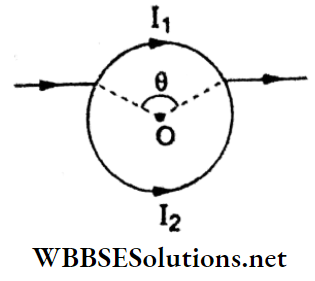
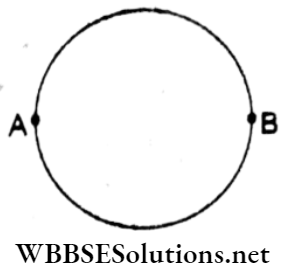
Question 2. A wire of resistance 12 SI m”1 is bent to form a complete circle of radius 10 cm. The resistance between its two diametrically opposite points A and B as shown in the figure is
electricity quiz
- 0.6
- 3
- 6
- 6
Answer: 1. 0.6
The total resistance of the wire,
⇒ \(R=\left(12 \Omega \mathrm{m}^{-1}\right) \text { (total length) }=\left(12 \Omega \mathrm{m}^{-1}\right)(2 \pi r)\)
⇒ \(\left(12 \Omega \mathrm{m}^{-1}\right)\left(2 \pi \times 10 \times 10^{-2} \mathrm{~m}\right)=2.4 \pi \Omega\)
Resistance of each half across AB is \(\frac{R}{2}\) = 1.2π Ω
∴ equivalent resistance across AB will be 0.6π Ω.
Read And Learn Also NEET Physics Multiple Choice Question and Answers
Question 3. A wire of a certain material is stretched slowly by 10 percent. What will be its resistance and resistivity respectively?
- 1.2 times and 1.1 times
- 1.2 times and remains unchanged
- 1.1 times and 1.2 times
- None of the above
Answer: 2. 1.2 times and remains unchanged
\(R=\rho \frac{l}{A}=\rho \frac{l}{V n}=\frac{\rho}{V} l^2\) (where volume V is constant).
Fractional change in the resistance,
\(\frac{d R}{R}=2 \frac{d l}{l}\) = 2(10%) = 0.2.
Increase in resistance, dR = 0.2R.
Hence, resistance becomes R + 0.2R = 1.2R, but resistivity remains unchanged.
current electricity pyq
Question 4. When a uniform wire of resistance R is stretched so that its radius r becomes r/2 then its resistance becomes
- R
- 4R
- 12R
- 16R
Answer: 4. 16R
Since volume V = Al remains constant,
⇒ \(A_1 l_1=A_2 l_2 \Rightarrow \frac{l_1}{l_2}=\frac{A_2}{A_1}=\frac{\pi(r / 2)^2}{\pi r^2}=\frac{1}{4}\)
⇒ Now, \(\frac{R_1}{R_2}=\frac{\rho l_1 / A_1}{\rho l_2 / A_2}=\left(\frac{l_1}{l_2}\right)\left(\frac{A_2}{A_1}\right)=\left(\frac{1}{4}\right)\left(\frac{1}{4}\right)=\frac{1}{16}\)
∴ \(R_2=16 R_1=16 R\)
Question 5. Three conductors have their conductances 2 S, 4 S, and 6 S. When they are joined in parallel, their equivalent conductance Will be
- 12 S
- \(\frac{1}{12} \mathrm{~S}\)
- \(\frac{12}{11} \mathrm{~s}\)
- \(\frac{11}{12} \mathrm{~S}\)
Answer: 1. 12 S
Conductance is reciprocal of the resistance and measured in Siemens ormhos. When connected in parallel,
\(\frac{1}{R}=\frac{1}{R_1}+\frac{1}{R_2}+\frac{1}{R_3}=(2+4+6) \mathrm{S}\).
∴ Equivalent conductance = \(G=\frac{1}{R}=12 \mathrm{~S}\).
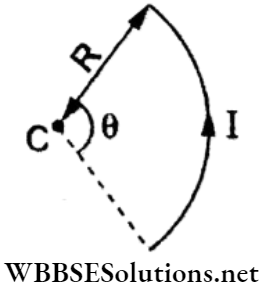
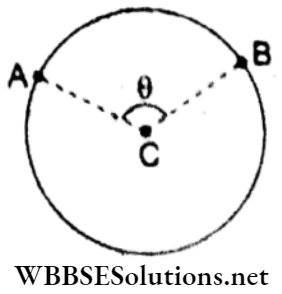
Question 6. A and B are two points on a uniform ring of resistance R. The ∠ACB = θ, where C is the center of the ring. The equivalent resistance between A and B is
- \(\frac{R \theta(2 \pi-\theta)}{4 \pi^2}\)
- \(R\left(1-\frac{\theta}{2 \pi}\right)\)
- \(\frac{R \theta}{2 \pi}\)
- \(\frac{R(2 \pi-\theta)}{4 \pi}\)
Answer: 1. \(\frac{R \theta(2 \pi-\theta)}{4 \pi^2}\)
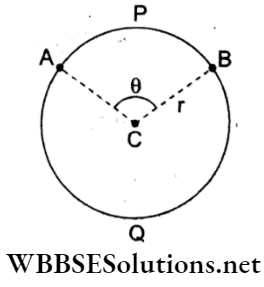
Let σ be the resistance per unit length of the wire. Hence, the resistance of the upper part of APB is
R1 = σ (length APB)
= σ (θr), where r is the radius of the circle.
Similarly, the resistance of the lower part of AQB is
R2 = σr(2π-θ).
These segments are joined in parallel, so their equivalent resistance is
⇒ \(R_{\text {eq }}=\frac{R_1 R_2}{R_1+R_2}=\frac{\sigma(\theta r) \sigma r(2 \pi-\theta)}{\sigma \theta r+\sigma r(2 \pi-\theta)}=\frac{\sigma r \theta(2 \pi-\theta)}{2 \pi} .\)
Substituting σ \(\sigma=\frac{R}{2 \pi r}\), we get
∴ \(R_{\text {eq }}=\left(\frac{R}{2 \pi r}\right)\left(\frac{r \theta}{2 \pi}\right)(2 \pi-\theta)=\frac{R \theta(2 \pi-\theta)}{4 \pi^2} .\)
Question 7. The masses of three wires of copper are in the ratio of 1 : 3: 5 and their lengths are in the ratio of 5 : 3: 1. The ratio of their resistances is
- 1:3:5
- 5:3:1
- 1:25:125
- 125:15:1
Answer: 4. 125:15:1
The Ratio of the masses = m1: m2: m3 = 1:3:5
m1=m, m2 : 3m, m3 = 5m.
Ratio of the lengths = l1 : l2 : l3 = 5:3:1
l1=5l, l2=3l, l3=l.
Now, resistance \(R=\rho \frac{l}{A}=\rho \frac{l^2}{V}=\rho D \frac{l^2}{m}\)
where V= volume and D = density.
Hence,
⇒ \(\rho D=\text { constant, so } R \propto \frac{l^2}{m} \text {. }\)
⇒ \(R_1: R_2: R_3=\frac{l_1^2}{m_1}: \frac{l_2^2}{m_2}: \frac{l_3^2}{m_3}=\frac{25 l^2}{m}: \frac{9 l^2}{3 m}: \frac{l^2}{5 m}\)
∴ \(25: 3: \frac{1}{5}=125: 15: 1\)
Question 8. N equal resistors are first connected in series and then connected in parallel. What is the ratio of the maximum to the minimum resistance?
- N
- \(\frac{1}{N^2}\)
- \(N^2\)
- \(\frac{1}{N}\)
Answer: 3. \(N^2\)
Equivalent resistance is maximum when connected in series, so
⇒ \(R_{\max }=(R+R+\ldots)_{N \text { times }}=N R\).
It will be minimal when connected in parallel, so
⇒ \(\frac{1}{R_{\min }}=\left(\frac{1}{R}+\frac{1}{R}+\ldots\right)_{N \text { times }}=\frac{N}{R} \Rightarrow R_{\min }=\frac{R}{N}\)
∴ Hence, the ratio \(\frac{R_{\max }}{R_{\min }}=\frac{N R}{R / N}=N^2\).
Question 9. Two wires of the same metal have the same length, but their cross sections are in the ratio 3:1. They are joined in series. The resistance of the thicker wire is 10 Ω. The total resistance of the combination will be
- 10
- 20
- 40
- 100
Answer: 3. 40
Given that \(l_1=l_2 \text { and } A_1: A_2=3: 1\)
Ratio of resistances, \(\frac{R_1}{R_2}=\frac{l_1}{l_2} \frac{A_2}{A_1}=\frac{1}{3}\)
Resistance of the thicker wire, \(R_1=10 \Omega\)
Hence, \(R_2=3 R_1=30 \Omega\)
Equivalent resistance when connected in series is \(R=R_1+R_2=10 \Omega+30 \Omega=40 \Omega\).
Question 10. A wire of resistance R is melted and recast to half of its length. The resistance of the new wire becomes
- \(\frac{R}{4}\)
- \(\frac{R}{2}\)
- R
- 2R
Answer: 1. \(\frac{R}{4}\)
When the length is halved, the area of the cross-section will be doubled so that volume remains constant
⇒ \(\frac{R^{\prime}}{R}=\frac{\rho l^{\prime} / A^{\prime}}{\rho l / A}=\left(\frac{l^{\prime}}{l}\right)\left(\frac{A}{A^{\prime}}\right)=\left(\frac{l / 2}{l}\right)\left(\frac{A}{2 A}\right)=\frac{1}{4}\)
∴ \(\text { Hence, } R^{\prime}=\frac{R}{4}\)
Question 11. Three resistances, each of 4 Q, are connected to form a triangle. The resistance between any two terminals will be
- 12
- 2
- 6
- \(\frac{8}{3} \Omega\)
Answer: 4. \(\frac{8}{3} \Omega\)
The combination across any two comers (say B and C) consists of 8 Ω and 4 Ω in parallel, for which the equivalent resistance is
∴ \(R=\frac{(8 \Omega)(4 \Omega)}{(8 \Omega)+(4 \Omega)}=\frac{8}{3} \Omega\)
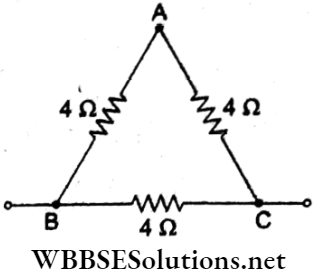
Question 12. When a wire of uniform cross-section a, length L, and resistance R is bent into a circle, the resistance between two of its diametrically opposite points will be
- 4R
- 2R
- \(\frac{R}{4}\)
- \(\frac{R}{2}\)
Answer: 3. \(\frac{R}{4}\)
Total resistance = R. This is equally divided into two parts across the diameter, each equal to \(\frac{R}{2}\).
Hence, for parallel combination, \(\frac{1}{R_{\mathrm{eq}}}=\frac{1}{R / 2}+\frac{1}{R / 2}=\frac{4}{R} \Rightarrow R_{\mathrm{eq}}=\frac{R}{4}\)
Question 13. N resistors, each of rΩ, when connected in parallel give an equivalent resistance of R Ω. If these resistors were connected in series, the combination would have a resistance in ohms equal to
- \(N^2 R\)
- \(\frac{R}{N^2}\)
- \(\frac{R}{N}\)
- NR
Answer: 1. \(N^2 R\)
Equivalent resistance of N resistances, each of resistance r, connected in parallel is \(R=\frac{r}{N} \Omega\).
When connected in series, the equivalent resistance is \(R^{\prime}=N r \Omega=N(N R) \Omega\)
\(N^2 R \Omega\). [∵\(R=\frac{r}{N}\)]
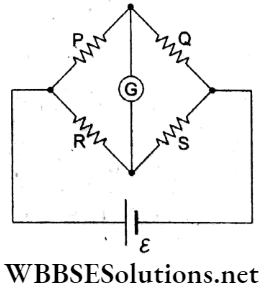
Question 14. A circuit consisting of five resistors, each of resistance R, forms a Wheatstone bridge. What is the equivalent resistance of the circuit?
- 2R
- R
- \(\frac{R}{2}\)
- \(\frac{2 R}{3}\)
Answer: 2. R
Equivalent resistance means resistance across the terminals of the cell which is a combination of two resistance of 2R in parallel. This is equal to R.
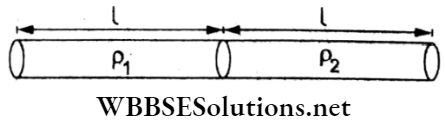
Question 15. Two metal wires of identical dimensions are connected in series. If \(\sigma_1 \text { and } \sigma_2\) are the conductivities of the metal wires respectively, the effective conductivity of the combination is
- \(\frac{\sigma_1+\sigma_2}{\sigma_1 \sigma_2}\)
- \(\frac{\sigma_1 \sigma_2}{\sigma_1+\sigma_2}\)
- \(\frac{\sigma_1+\sigma_2}{2 \sigma_1 \sigma_2}\)
- \(\frac{2 \sigma_1 \sigma_2}{\sigma_1+\sigma_2}\)
Answer: 4. \(\frac{2 \sigma_1 \sigma_2}{\sigma_1+\sigma_2}\)
Resistances of the component resistors are \(R_1=\rho_1 \frac{l}{A}\)
and \(R_2=\rho_2 \frac{l}{A}\)
∴ \(R_{\mathrm{eq}}=R_1+R_2=\left(\rho_1+\rho_2\right) \frac{l}{A}\)
If this is replaced by a single wire of equivalent resistivity p then \(\rho \frac{2 l}{A}=\left(\rho_1+\rho_2\right) \frac{l}{A}\)
\(2 p=\rho_1+\rho_2\).
Since conductivity \(\sigma=\frac{1}{\rho}\), we have
⇒ \(\frac{2}{\sigma}=\frac{1}{\sigma_1}+\frac{1}{\sigma_2}=\frac{\sigma_1+\sigma_2}{\sigma_1 \sigma_2}\)
∴ \(\sigma=\frac{2 \sigma_1 \sigma_2}{\sigma_1+\sigma_2}\)
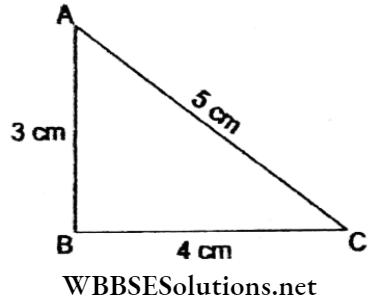
Question 16. A 12-cm-long wire is given the shape of a right-angled triangle ABC having sides 3 cm, 4 cm, and 5 cm as shown in the figure. The resistance between two ends (AB, BC, CA) of the respective sides are measured one by one by a multimeter, the resistances will be in file ratio
- 9:16:25
- 3:4:5
- 27:32:35
- 21:24:25
Answer: 3. 27:32:35
Let r be the resistance per unit length of the wire, so the three sides have the resistances 3r, 4r, and 5r respectively.
Resistances across AB, \(R_1=\frac{9 \times 3}{12} r\);
across BC, \(R_2=\frac{8 \times 4}{12} r \text { and across AC, } R_3=\frac{7 \times 5}{12} r\).
Hence, the ratio \(R_1: R_2: R_3=27: 32: 35\).
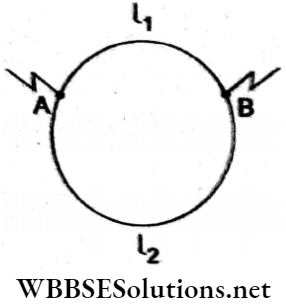
Question 17. A ring is made of a wire having a resistance of 12 Q. Find the points A and B, as shown in the figure at which a current-carrying conductor should be connected so that the resistance R of the sub-circuit between these two points is equal to (8/3)
- \(\frac{l_1}{l_2}=\frac{5}{8}\)
- \(\frac{l_1}{l_2}=\frac{1}{2}\)
- \(\frac{l_1}{l_2}=\frac{1}{3}\)
- \(\frac{l_1}{l_2}=\frac{3}{8}\)
Answer: 2. \(\frac{l_1}{l_2}=\frac{1}{2}\)
Let r be the resistance per unit length.
∴ Resistance of length\(l_1 \text { is } R_1=r l_1 \text { and } R_2=r l_2\).
Total resistance = \(\left(R_1+R_2\right)=r\left(l_1+l_2\right)=12 S\).
Equivalent resistance across AB is \(\frac{R_1 R_2}{R_1+R_2}=\frac{\left(r l_1\right)\left(r l_2\right)}{r\left(l_1+l_2\right)}=\frac{8}{3} \Omega\)
⇒ \(R_1 R_2=\frac{8}{3}\left(R_1+R_2\right)=\frac{8}{3} \times 12 \Omega=32 \Omega\)
Hence, \(R_1=8 \Omega, R_2=4 \Omega \text { and } \frac{R_1}{R_2}=\frac{l_1}{l_2}=\frac{8}{4}=\frac{2}{1}\).
The ratio is 2: l or 1: 2.
“electricity physics questions “
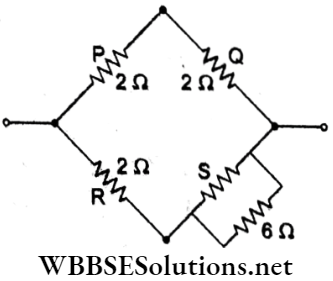
Question 18. Three resistors P, Q, and R each of 2Ω, and an unknown resistance S form the four arms of a Wheatstone bridge circuit When a resistor of 6 Ω is connected parallel to S, the bridge gets balanced. What is the value of S?
- 1
- 3
- 6
- 2
Answer: 2. 3
For the bridge to be balanced, the fourth arm must have equivalent resistance = \(2 \Omega\)
⇒ \(\frac{(6 \Omega) S}{6 \Omega+S}=2 \Omega\)
⇒ \(12 \Omega+2 S=6 S\)
⇒ \(4 S=12 \Omega \Rightarrow S=3 \Omega\)
Question 19. In a Wheatstone bridge, all four arms have equal resistance R. If the resistance of the galvanometer arm is also R, the equivalent resistance of the combination as seen by the battery is
- \(\frac{R}{4}\)
- \(\frac{R}{2}\)
- R
- 2R
Answer: 3. R
The equivalent resistance as seen by the battery is equivalent to the effective resistance across the battery, which is \(\frac{(2 R)(2 R)}{(2 R)+(2 R)}=R\). The galvanometer resistance R will be ineffective as current through the galvanometer, \(I_g=0\).
Question 20. A fuse wire is a wire of
- High resistance and high melting point
- High resistance and low melting point
- Low resistance and low melting point
- Low resistance and high melting point
Answer: 2. High resistance and low melting point
A fuse wire is used to reduce the damage of electrical appliances when a high current passes through the wire. A fuse wire should have high resistance and a low melting point so that it may melt easily if the current suddenly becomes high.
Question 21. The resistance of each arm of a Wheatstone bridge is 10 Ω. If a resistance of Ω is connected in series with the galvanometer, the equivalent resistance across the battery will be
- 10
- 15
- 20
- 40
Answer: 1. 10
When the die Wheatstone bridge is balanced, no current flows through the galvanometer, so galvanometer resistance remains ineffective. Any addition of resistance \((10 \Omega)\) connected in series or across the galvanometer will not change the effective resistance across the battery. In this case,
⇒ \(R_{\mathrm{eq}}=\frac{(20 \Omega)(20 \Omega)}{40 \Omega}=10 \Omega\)
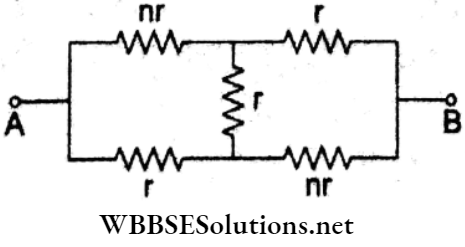
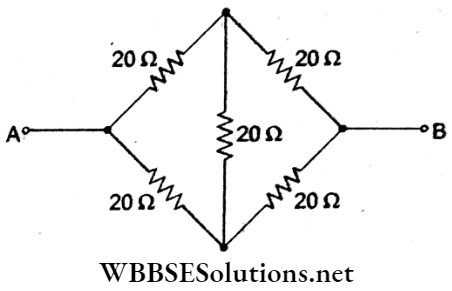
Question 22. What is the equivalent resistance between A and B in the given figure?
- 40
- 10
- 20
- 50
Answer: 3. 20
The given network of resistors represents a balanced Wheatstone bridge whose each branch has the same resistance of \(20 \Omega\). Hence, the equivalent resistance is \(R=\frac{(40 \Omega)(40 \Omega)}{40 \Omega+40 \Omega}=\frac{1600}{80} \Omega=20 \Omega\).
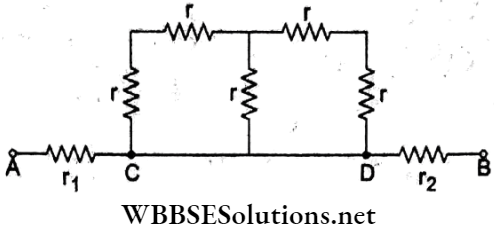
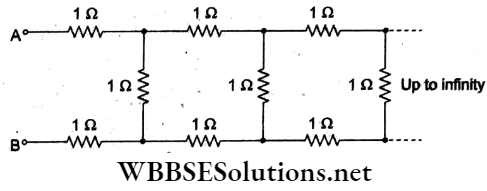
Question 23. The resistance across the terminal points A and B of the given infinitely long circuit will be
- \((\sqrt{3}-1) \Omega\)
- \((2-\sqrt{3}) \Omega\)
- \((\sqrt{3}+1) \Omega\)
- \((2+\sqrt{3}) \Omega\)
Answer: 3. \((\sqrt{3}+1) \Omega\)
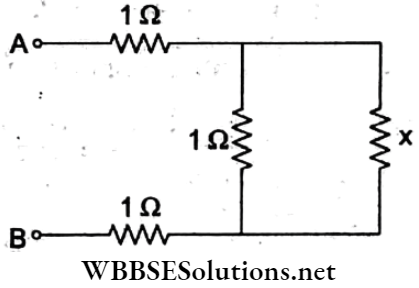
Let the equivalent resistance of the given infinitely long circuit be x. Hence, the given circuit can be replaced by the circuit shown in the adjoining figure. The equivalent resistance across AB will also be x.
Hence, \(x=1 \Omega+\frac{(1 \Omega) x}{1 \Omega+x}+1 \Omega\)
⇒ \(x^2-2 x-2=0\)
⇒ \(x=(\sqrt{3}+1) \Omega\).
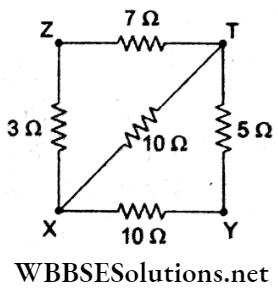
Question 24. The equivalent resistance between points X and Y in the given figure will be
- 10
- 7
- 5
- 3
Answer: 3. 5
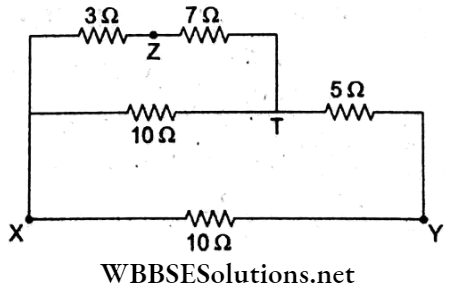
The given network of resistances can be redrawn in a simple form as shown in the adjoining diagram. 3 Ω and 7 Ω in series is equal to 10 Ω which in parallel with 10 Ω is equivalent to 5 Ω. Next, this 5 Ω x and 5 Ω in series is 10 Ω which finally combines in parallel with 10 Ω on XY and gives R = 5 Ω.
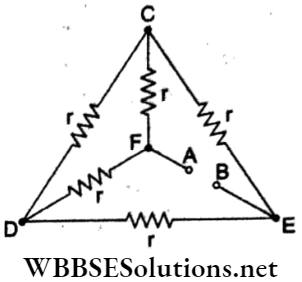
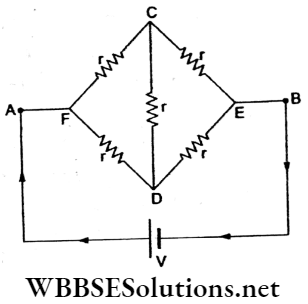
Question 25. Five identical resistors, each of resistance r, are connected as shown in the figure. A battery of V volt is connected between A and B. The current flowing through the branch AFCEB will be
- \(\frac{3 V}{r}\)
- \(\frac{V}{r}\)
- \(\frac{V}{2 r}\)
- \(\frac{2 V}{r}\)
Answer: 3. \(\frac{V}{2 r}\)
The given network of resistors can be redrawn as shown in this figure. This constitutes a balanced Wheatstone bridge for which the equivalent resistance across AB is \(\frac{(2 r)(2 r)}{4 r}=r\).
Current delivered by the cell is I = \(\frac{V}{r}\)
This current is divided equally into the upper and lower branches. Hence, current through the branch AFCEB is \(\frac{I}{2}=\frac{V}{2 r}\).
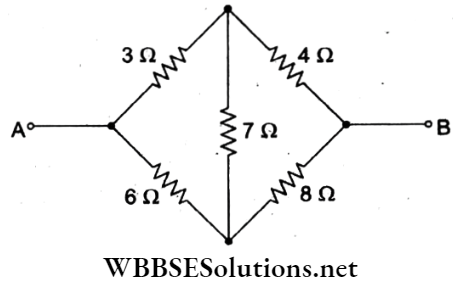
Question 26. The net resistance of a circuit between A and B is
- \(\frac{8}{3} \Omega\)
- \(\frac{14}{3} S\)
- \(\frac{16}{3} \Omega\)
- \(\frac{22}{3} \Omega\)
Answer: 2. \(\frac{14}{3} S\)
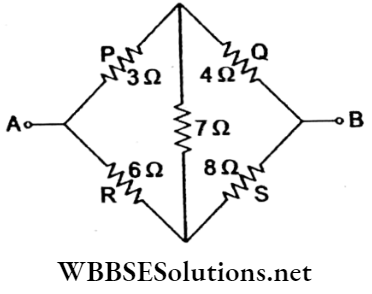
The given circuit represents a balanced Wheatstone bridge, since \(\frac{P}{Q}=\frac{3}{4}=\frac{R}{S}=\frac{6}{8}\).
Hence, the cross-connected resistance of 7 Ω is ineffective.
Resistance of upperbranch = 7 Ω
and that oflowerbranch =14 Ω.
∴ equivalent resistance = \(R=\frac{(7 \Omega)(14 \Omega)}{(7+14) \Omega}=\frac{14}{3} \Omega\)
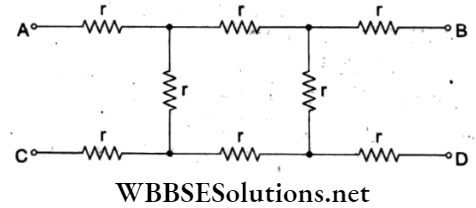
Question 27. In the given figure, each resistor has its resistance r =10. What will be the equivalent resistance between the terminals A and D?
- 10
- 20
- 30
- 40
Answer: 3. 30
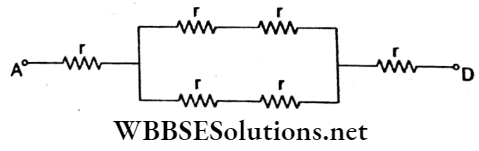
In order to find the equivalent resistance across AD, we imagine a cell whose terminals are connected to A and D respectively. The equivalent circuit is shown in the figure. The equivalent resistance across AD is \(R=r+\frac{(2 r)(2 r)}{2 r+2 r}+r=3 r=3(10 \Omega)=30 \Omega\).
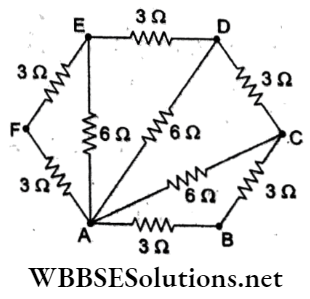
Question 28. Six resistors, each of 3 Q., are connected along the sides of a hexagon and three resistors of 6Q each are connected along AC, AD, and AE as shown in the figure. The equivalent resistance F between A and B is equal to
- 6
- 2
- 3
- 9
Answer: 2. 2
Resistors AF and FE, each of 3 Ω in series, give 6 £2. This 6 Ω with AE (= 6 Ω) in parallel gives 3 Ω. This, 3 £2 with ED (=3 Ω) gives 6 Ω which in parallel with AD (=6 Ω) gives 3 Ω. Proceeding in the same way, the equivalent resistance across AC is found to be Ω. Finally, we are left with 6 Ω and 3 Ω across AB in parallel which gives \(R_{\mathrm{AB}}=\frac{(6 \Omega)(3 \Omega)}{6 \Omega+3 \Omega}=2 \Omega\)
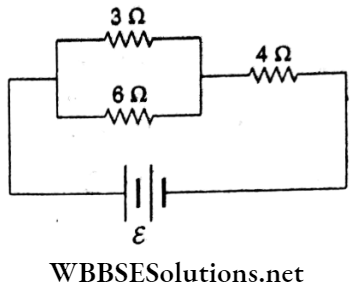
Question 29. In the given circuit, if the current through the 3 Q resistor is 0.8 A then the potential drop across the 4Q resistor is
- 9.6 V
- 1.2V
- 4.8 V
- 2.6 V
Answer: 3. 4.8 V
Potential difference (p.d.) across the 3-Ω resistor,
V-IR = (0.8 A)(3 ft) = 2.4 V.
p.d. is the same across the 6-Ω resistor, J'(6 Q) = 2.4 V.
Hence, current through the 6-Ω resistor,\(I^{\prime}=\frac{2.4 \mathrm{~V}}{6 \Omega}=0.4 \mathrm{~A}\).
Total current through the circuit = \(\left(I+I^{\prime}\right)=(0.8 \mathrm{~A})+(0.4 \mathrm{~A})=1.2 \mathrm{~A}\)
∴ p.d. across 4 Q resistor = (1.2 A)(4 £2) = 4.8 V
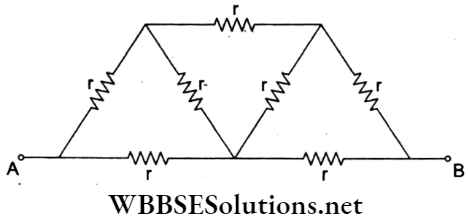
Question 30. In the given network, each resistance r =1 £1 The effective resistance between A and B is
- \(\frac{4}{3} \Omega\)
- \(\frac{8}{7} \Omega\)
- \(7 \Omega\)
- \(\frac{3}{2} \Omega\)
Answer: 2. \(\frac{8}{7} \Omega\)
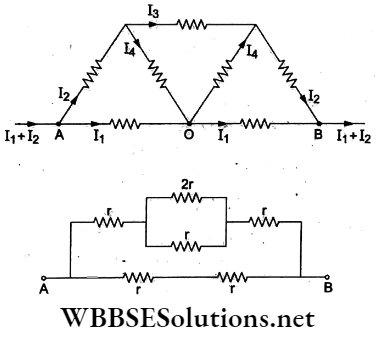
By symmetry, the current (I1 + I2), which enters at A must leave at B. So, does not get divided at O. Hence, point O can be detached from the arm. This circuit can be redrawn equivalently as shown in figure (2), for which the upper and lower arms have the resistances \(r+\frac{2 r}{3}+r=\frac{8}{3} r \text { and } 2 r\)
equivalent resistance across AB \(R_{\mathrm{AB}}=\frac{\left(\frac{8}{3} r\right)(2 r)}{\frac{8}{2} r+2 r}=\frac{8}{7} r=\frac{8}{7}(1 \Omega)=\frac{8}{7} \Omega\)
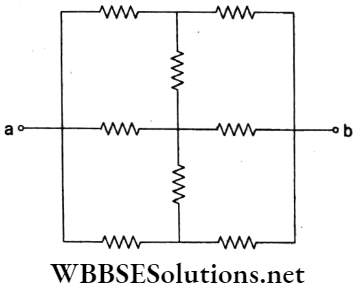
Question 31. In the network shown in the figure, each resistance is equal to r. The equivalent resistance between terminals A and b is
- 3r
- 6r
- \(\frac{3 r}{2}\)
- \(\frac{2 \pi}{3}\)
Answer: 4. \(\frac{2 \pi}{3}\)
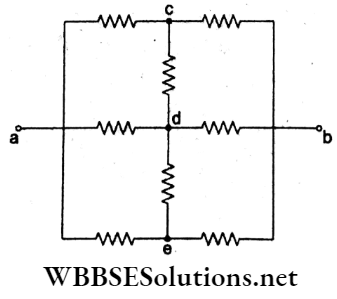
When the current enters the network through a, it gets equally divided through branches. Points c, d, and e will be at the same potential. Hence, no current flows through cd and de, and these two resistors are ineffective. The circuit is thus equivalent to three equal resistors in parallel, each equal to 2r.
∴ \(\frac{1}{R}=\frac{1}{2 r}+\frac{1}{2 r}+\frac{1}{2 r}=\frac{3}{2 r} \Rightarrow R=\frac{2}{3} r\)
“physics questions on electricity “
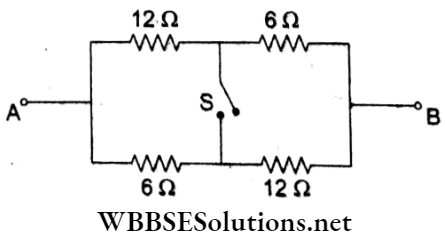
Question 32. In the given figure, let the equivalent resistance between terminals A and B be (when A°- switch S is open) and Rc (when switch S is closed). The ratio R0:Rc will be
- 9: 8
- 8:9
- 4:3
- 3:4
Answer: 1. 9:8
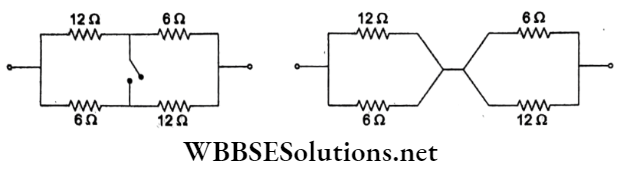
The two adjoining figures have been drawn with switch S open and with switch S closed.
So, \(R_{\mathrm{o}}=\frac{(18 \Omega)(18 \Omega)}{(18 \Omega)+(18 \Omega)}=9 \Omega\)
⇒ and \(R_c=\frac{(12 \Omega)(6 \Omega)}{(12 \Omega)+(6 \Omega)}+\frac{(6 \Omega)(12 \Omega)}{(6 \Omega)+(12 \Omega)}=8 \Omega\)
∴ \(\frac{R_0}{R_c}=\frac{9}{8}\)
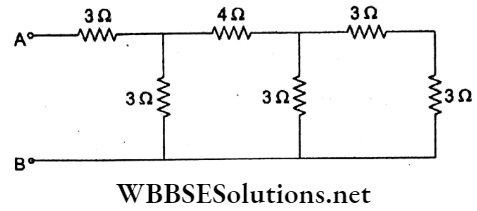
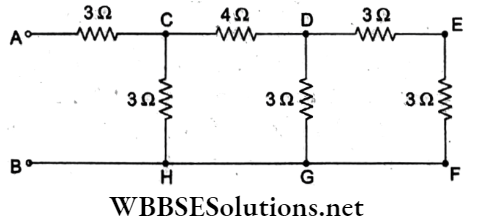
Question 33. The equivalent resistance between terminals A and B in the given figure is
- 2
- 5
- 4
- 6
Answer: 2. 5
Resistance of 3 Ω each in DE and EF in series gives 6 Ω which joined in
parallel with 3 Ω in branch DG gives \(\frac{6 \times 3}{9} \Omega=2 \Omega\).
This 2 Ω with 4 Ω in series with branch CD gives 6 ft which joined in parallel with 3 Ω in branch CH gives 2 ft.
⇒ Finally, \(R_{\mathrm{AB}}=3 \Omega+2 \Omega=5 \Omega\).
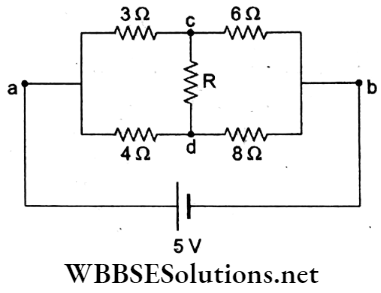
Question 34. In the given circuit, what should be the value of R so that no current flows through it?
- 9
- 12
- 18
- Any value
Answer: 4. Any value
The given network of resistors constitutes a balanced Wheatstone bridge since the ratio \(\frac{3 \Omega}{6 \Omega}=\frac{4 \Omega}{8 \Omega}=\frac{1}{2}\).
Hence, no current will flow through R for any value of R.
Alternative method
The voltage of 5 V of the source is divided in the upper and lower branches in the same proportion; so potential difference, \(V_c-V_d=0\). Hence, current through R is zero for any value of R.
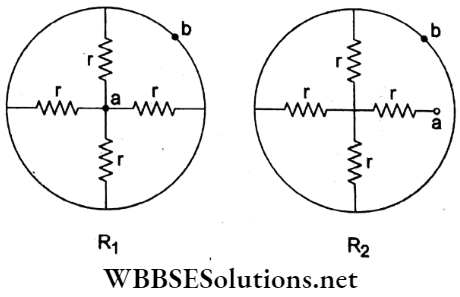
Question 35. The equivalent resistance for the given network of resistors between terminals a and b are R1 and R2 respectively. The ratio R1/R2 is
- \(\frac{4}{3}\)
- \(\frac{3}{16}\)
- \(\frac{2}{3}\)
- \(\frac{1}{2}\)
Answer: 2. \(\frac{3}{16}\)
In the first case, one end of all resistors is connected at a common point a, and the other ends to a common point b, so they are in parallel,
Hence, \(R_1=\frac{r}{4}\).
In the second case, the network can be redrawn as shown in the given figure.
Here,\(R_2=r+\frac{r}{3}=\frac{4}{3} r\).
Hence, \(\frac{R_1}{R_2}=\frac{r / 4}{4 r / 3}=\frac{3}{16}\)
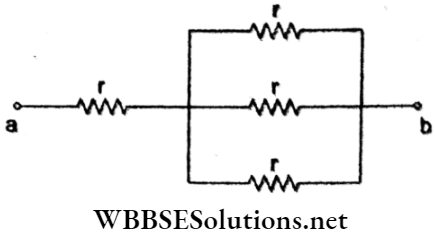
Question 36. In the given circuit, the potential difference between A and B is
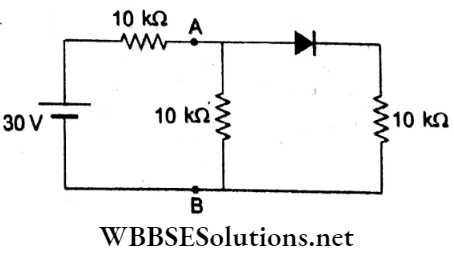
- zero
- 5 V
- 10 V
- 15 V
Answer: 3. 10 V
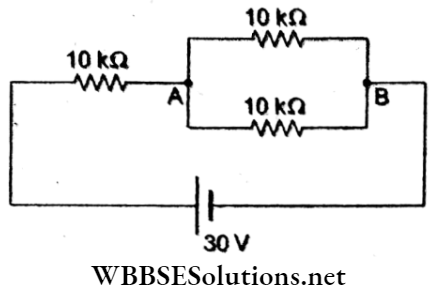
The p-n junction is forward biased, hence its resistance is negligible and the circuit can be redrawn as shown.
Equivalent resistance, \(R=10 \mathrm{k} \Omega+5 \mathrm{k} \Omega=15 \mathrm{k} \Omega\).
Maincurrent, \(I=\frac{30 \mathrm{~V}}{15 \mathrm{k} \Omega}\).
This current is equally divided atA, so p.d. across AB is
∴ \(V_{\mathrm{AB}}=\left(\frac{I}{2}\right)(10 \mathrm{k} \Omega)=\frac{(30 \mathrm{~V})(10 \mathrm{k} \Omega)}{2(15 \mathrm{k} \Omega)}=10 \mathrm{~V}\).
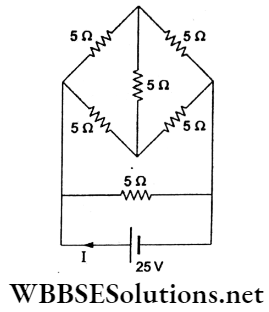
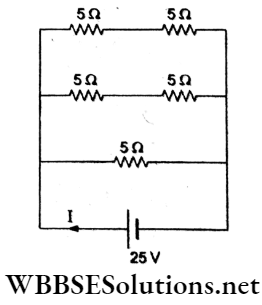
Question 37. For the given circuit, the value of the current I is
- 10 A
- 5 A
- 2.5 A
- 20 A
Answer: 1. 10 A
The four branches of the resistors7 network have equal resistance (=5 Ω), so they satisfy the balance condition of the Wheatstone bridge. The cross-connected 5-Ω resistor is ineffective, so the equivalent circuit can be redrawn as shown.
For a parallel combination of resistors,
⇒ \(\frac{1}{R}=\frac{1}{10}+\frac{1}{10}+\frac{1}{5}=\frac{2}{5}\)
⇒ \(R=\frac{5}{2} \Omega\)
Hence, \(I=\frac{25 \mathrm{~V}}{5 / 2 \Omega}=10 \mathrm{~A}\).
Question 38. Across a metallic conductor of a nonuniform cross-section, a constant potential difference is applied. The quantity which remains constant along the conductor is
- Current density
- Electric field
- Travelocity
- Current
Answer: 4. Current density
In a current-carrying metallic conductor, there is no accumulation of charge anywhere. So, the rate of flow of charge (ΔQ/Δt), or the current, remains constant Drift speed, current density, and electric field vary with change in cross-sectional area.
“electricity test “
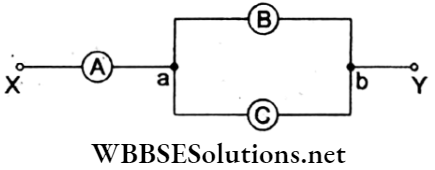
Question 39. A, B, and C are voltmeters of resistances R, 1.5R, and . 3R respectively as shown in the figure. x When some potential difference is maintained between X and Y, the voltmeter readings are VA, VB, and Vc respectively. Then,
- \(V_{\mathrm{A}}=V_{\mathrm{B}}=V_{\mathrm{C}}\)
- \(V_{\mathrm{A}} \neq V_{\mathrm{B}}=V_{\mathrm{C}}\)
- \(V_{\mathrm{A}}=V_{\mathrm{B}} \neq V_{\mathrm{C}}\)
- \(V_{\mathrm{A}} \neq V_{\mathrm{B}} \neq V_{\mathrm{C}}\)
Answer: 1. \(V_{\mathrm{A}}=V_{\mathrm{B}}=V_{\mathrm{C}}\)
The equivalent resistance of B and C is
⇒ \(R_{e q}=\frac{(1.5 R)(3 R)}{(1.5 R)+(3 R)}=\frac{(1.5)(3 R)}{(4.5)}=R \Omega\)
If l is the current through A then
⇒ \(V_{\mathrm{X}}-V_{\mathrm{a}}=V_{\mathrm{A}}=I R, V_{\mathrm{a}}-V_{\mathrm{b}}=V_{\mathrm{B}}=V_{\mathrm{C}}=I R_{\mathrm{eq}}=I R\)
∴ Thus, \(V_A=V_B=V_C\)
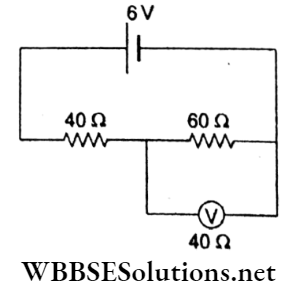
Question 40. The reading of the voltmeter in the given circuit is
- 2.25 V
- 4.25 V
- 2.75 V
- 6.25 V
Answer: 1. 2.25 V
Equivalent resistance in the given circuit is
⇒ \(R+R_{\text {eq }}=40 \Omega+\frac{(60 \Omega)(40 \Omega)}{60 \Omega+40 \Omega}=40 \Omega+24 \Omega=64 \Omega\)
Current through the cell is
⇒ \(I=\frac{6 \mathrm{~V}}{64 \Omega}=\frac{3}{32} \mathrm{~A}\)
Hence, the reading of the voltmeter is
⇒ \(V=I\left(R_{\text {eq }}\right)=\left(\frac{3}{32} \mathrm{~A}\right)(24 \Omega)=2.25 \mathrm{~V}\)
Question 41. The internal resistance of a cell of emf 2 V is 0.1 Ω. It is connected to a resistance of 3.9 Ω. The voltage across the cell (terminal voltage) will be
- 1.90 V
- 1.95 V
- 0.5 V
- 2 V
Answer: 2. 1.95 V
Given that \(\varepsilon=2 \mathrm{~V}, r=0.1 \Omega, R=3.9 \Omega\)
Current through the circuit is \(I=\frac{\varepsilon}{R+r}=\frac{2 \mathrm{~V}}{4 \Omega}=0.5 \mathrm{~A}\).
∴ The terminal voltage across the cell is
⇒ \(V=\varepsilon-I r=2 \mathrm{~V}-(0.5 \mathrm{~A})(0.1 \Omega)\)
= 2 V-0.05 V =1.95 V.
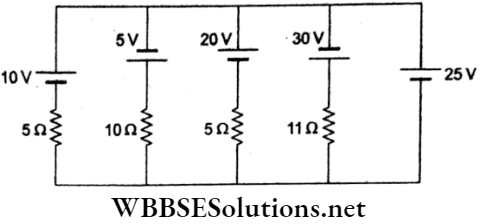
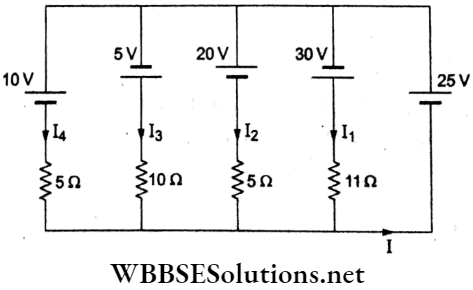
Question 42. In the given circuit, the current flowing through the 25 V cell is
- 7.2 A
- 14.2 A
- 10 A
- 12 A
Answer: 4. 12 A
The current through each branch is shown in the figure. Applying Kirchhoff’s voltage loop rule, we have for each closed loop formed with a 25 V cell,
-30+11 Ii -25 = 0;
20+5 I2 -25 = 0;
-5 +10 I3 -25 = 0;
10 + 5 I4 -25 = 0.
⇒ \(I_1=\frac{55}{11} \mathrm{~A}=5 \mathrm{~A}, I_2=1 \mathrm{~A}, I_3=3 \mathrm{~A}, I_4=3 \mathrm{~A}\)
Hence, current through the 25-V cell is
⇒ \(I=I_1+I_2+I_3+I_4=12 \mathrm{~A}\)
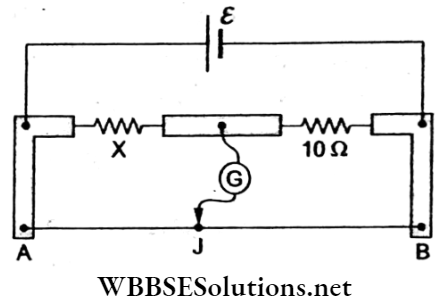
Question 43. A meter bridge is set up to determine resistance X using a standard 10 Ω resistor. The galvanometer shows a null point when the tapping key is at the 52 cm mark. The end-corrections are 1 cm and A 2 cm respectively for the ends A and B. The determined value of X is
- 10.2
- 10.8
- 10.6
- 11.1
Answer: 3. 10.6
From the balance condition,
⇒ \(\frac{X}{10 \Omega}=\frac{(52+1) \mathrm{cm}}{(48+2) \mathrm{cm}}=\frac{53}{50}\)
Unknown resistance is
⇒ \(X=\frac{53}{50} \times 10 \Omega=10.6 \Omega\).
Question 44. When a current is passed through a conductor, a 5°C rise in temperature is observed. If the strength of the current is made three times, the rise in temperature will be
- 5°C
- 15 °C
- 45 °C
- 20 °C
Answer: 3. 45 °C
Amount of heat produced, \(H=I^2 R t\)
⇒ \(\frac{H_1}{H_2}=\frac{I_1^2}{I_2^2}\)
⇒ \(\frac{H_1}{H_2}=\frac{m c \theta_1}{m c \theta_2}=\frac{I_1^2}{9 I_1^2}=\frac{1}{9} \quad\left(\text { given } I_2=3 I_1\right)\)
Hence, \(\theta_2=9 \theta_1=9\left(5^{\circ} \mathrm{C}\right)=45^{\circ} \mathrm{C}\)
Question 45. The amount of heat developed by a 100-W bulb in 1 minute will be
- 100 J
- 1000 J
- 600 J
- 6000 J
Answer: 4. 6000 J
Heat energy developed is
H = power x time = (100 W)(l m)
⇒ \(\left(100 \mathrm{~J} \mathrm{~s}^{-1}\right)(60 \mathrm{~s})=6000 \mathrm{~J}\)
“electricity test “
Question 46. A bulb of 25 W, 200 V’ and another bulb of 100 W, 200 V’ are connected in series with a supply line of 220 V. Then
- Both the bulbs will glow with the same brightness
- Both the bulbs will get fused
- The 25-W bulb will glow more brightly
- The 100-W bulb will glow more brightly
Answer: 3. The 25-W bulb will glow more brightly
Since watt = volt x ampere, so
⇒ \(\text { watt }=V(I)=V\left(\frac{V}{R}\right)=\frac{V^2}{R}\)
⇒ \(R=\frac{V^2}{\text { watt }}\)
Hence, the resistance of the 25-watt bulb will be more than that of the 100-watt bulb. Since the bulbs are in series, the same current flows through them.
Hence, heat \(\left(H=I^2 R t\right)\) will be more in the 25-W bulb and it will glow more brightly.
Question 47. A uniform wire consumes power P when connected across a given potential difference V. If it is cut into two equal halves and joined in parallel with the same potential difference V, it will consume power
- P
- 2P
- 4P
- \(\frac{P}{4}\)
Answer: 3. 4P
Power (in watt) \(P=V I=\frac{V^2}{R}\)
When the wire is cut and joined the equivalent resistance is \(R^{\prime}=\frac{R}{4}\)
∴ \(P^{\prime}=\frac{V^2}{R^{\prime}}=\frac{V^2}{R / 4}=4\left(\frac{V^2}{R}\right)=4 P\).
Question 48. An electric bulb marked ’40 W, 200 V’ is connected to a circuit of supply voltage 100 V. The power consumed will be
- 100 W
- 20 W
- 10 W
- 40 W
Answer: 3. 10 W
Resistance of the bulb, \(R=\frac{V^2}{P}\)
Here, V = 200 V, P = 40 W, hence \(R=\frac{(200 \mathrm{~V})^2}{(40 \mathrm{~W})}=1000 \Omega\)
When connected across a 100-V supply, the power consumed is
⇒ \(P=\frac{V^2}{R}=\frac{(100 \mathrm{~V})^2}{(1000 \Omega)}=10 \mathrm{~W}\)
Question 49. The potential difference \(\left(V_{\mathrm{A}}-V_{\mathrm{B}}\right)\) between the points A and B as shown in the figure is
image
- -3 V
- +3 V
- +6 V
- +9 V
Answer: 4. +9 V
Consider two points a and b across the cell.
Hence, \(V_{\mathrm{A}}-V_{\mathrm{B}}=\left(V_{\mathrm{A}}-V_{\mathrm{a}}\right)+\left(V_{\mathrm{a}}-V_{\mathrm{b}}\right)+\left(V_{\mathrm{b}}-V_{\mathrm{B}}\right)\)
⇒ \((2 A)(2 \Omega)+(3 V)+(2 A)(1 \Omega)=4 V+3 V+2 V=9 V\)
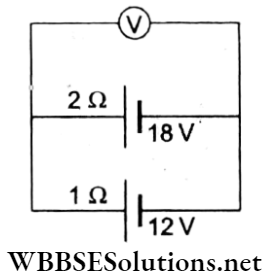
Question 50. Two cells, one of emf 18 V and internal resistance 2 and the other of emf 12 V and internal resistance 1 ft, are connected as shown. The reading of the voltmeter will be
- 15 V
- 30 V
- 14 V
- 18 V
Answer: 3. 14 V
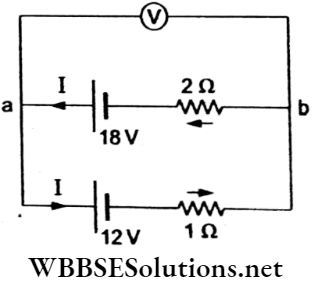
The given circuit is redrawn as shown in the figure. Let I be the current in the closed loop consisting of two cells only.
Applying the loop rule,
12 V +1(1 Ω)+(2 Ω)1-18 V =0
⇒ 1 = 2 A.
Voltmeter reading will be the p.d. across a and b, which is
⇒ \(V_{\mathrm{a}}-V_{\mathrm{b}}=(18 \mathrm{~V})-(2 \Omega)(2 \mathrm{~A})=18 \mathrm{~V}-4 \mathrm{~V}=14 \mathrm{~V}\)
Alternative method
The equivalent emf of the cells is
⇒ \(\varepsilon=\frac{e_1 r_2+e_2 r_1}{r_1+r_2}=\frac{(18 \mathrm{~V})(1 \Omega)+(12 \mathrm{~V})(2 \Omega)}{2 \Omega+1 \Omega}\)
⇒ \(\frac{(18+24) V \Omega}{3 \Omega}=\frac{42}{3} V=14 \mathrm{~V}\).
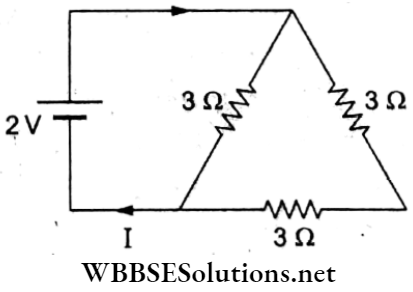
Question 51. The current through the cell in the circuit is
- 1 A
- \(\frac{2}{3} \mathrm{~A}\)
- \(\frac{2}{9} \mathrm{~A}\)
- \(\frac{1}{8} \mathrm{~A}\)
Answer: 1. 1 A
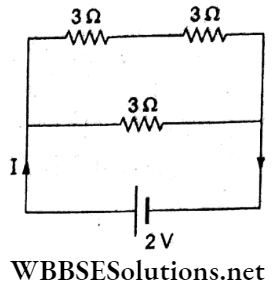
The circuit is redrawn as shown. Equivalent resistance across the cell is R, where \(\frac{1}{R}=\frac{1}{3}+\frac{1}{6}=\frac{2+1}{6}=\frac{1}{2} \Rightarrow R=2\)
Current through the cell is
⇒ \(I=\frac{\varepsilon}{R}=\frac{2 \mathrm{~V}}{2 \Omega}=1 \mathrm{~A}\).
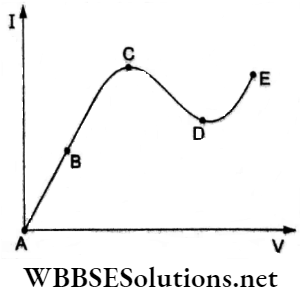
Question 52. From the graph of current I and voltage V as shown here, identify the region corresponding to negative resistance.
- DE
- CD
- BC
- AB
Answer: 2. CD
Resistance is. measured by \(\frac{\Delta V}{\Delta I}\) which is the slope of the V-I graph.
When the slope is negative, resistance is negative, hence the region where R is negative is CD.
Question 53. In a Wheatstone bridge, the resistance of each of the four arms is 10 Q. If the resistance of the galvanometer is also 10 £2 then the effective resistance of the bridge will be
- 10
- 5
- 20
- 40
Answer: 1. 10
When each of the four arms has the same resistance of 10 Ω, the bridge is balanced, and no current flows through the galvanometer. Hence, the effective resistance is
⇒ \(R=\frac{(20 \Omega) \times(20 \Omega)}{20 \Omega+20 \Omega}=10 \Omega\)
Question 54. A cell has an emf of 1.5 V. When connected across an external resistance of 2 Ω, the terminal voltage falls to 1.0 V. The internal resistance of the cell is
- 2
- 1.5
- 1.0
- 0.5
Answer: 3. 1.0
Given that ε =1.5 V, R = 2 Ω, V =1.0 V.
Terminal voltage, V = ε -Ir. →(1)
But V = IR => \(I=\frac{\dot{V}}{R}=\frac{1 \mathrm{~V}}{2 \Omega}=0.5 \mathrm{~A}\).
SubstitutingI = 0.5 A in (1),
⇒ \(1.0 \mathrm{~V}=1.5 \mathrm{~V}-0.5 r \Rightarrow r=\frac{0.5 \mathrm{~V}}{0.5 \mathrm{~A}}=1.0 \Omega\).
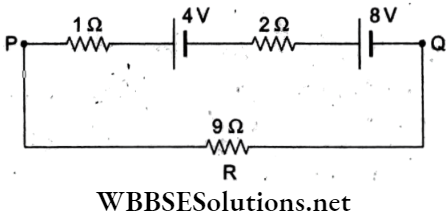
Question 55. Two batteries of emf 4 V and 8 V with internal resistances 1 and 2 are connected in a circuit with an external resistance R = 9 as shown in the figure. The current and potential differences between points P and Q are
- \(\frac{1}{3} \mathrm{~A} \text { and } 3 \mathrm{~V}\)
- \(\frac{1}{12} \mathrm{~A} \text { and } 12 \mathrm{~V}\)
- \(\frac{1}{6} \mathrm{~A} \text { and } 4 \mathrm{~V}\)
- \(\frac{1}{9} \mathrm{~A} \text { and } 9 \mathrm{~V}\)
Answer: 1. \(\frac{1}{3} \mathrm{~A} \text { and } 3 \mathrm{~V}\)
Net resistance, R = l Ω + 2 Ω + 9 Ω = 12 Ω.
Net voltage, V =8 V- 4 V = 4 V.
Current in the direction Q to P is
⇒ \(I=\frac{V}{R}=\frac{4 \mathrm{~V}}{12 \Omega}=\frac{1}{3} \mathrm{~A}\)
Now, the potential difference between P and Q is
⇒ \(V_{\mathrm{P}}-V_{\mathrm{Q}}=\left(V_{\mathrm{P}}-V_{\mathrm{a}}\right)+\left(V_{\mathrm{a}}-V_{\mathrm{b}}\right)+\left(V_{\mathrm{b}}-V_{\mathrm{c}}\right)+\left(V_{\mathrm{c}}-V_{\mathrm{Q}}\right)\)
⇒ \(-\left(\frac{1}{3} A\right)(1 \Omega)+(-4 V)+\left(-\frac{1}{3} A\right)(2 \Omega)+8 V\)
⇒ \(-\frac{1}{3} V-4 V-\frac{2}{3} V+8 V=3 V\).
Question 56. The resistivity of the material of a potentiometer wire is 10-7m and its area of cross section is 10-6 m2. When a current I = 0.1 A flows through the wire, its potential gradient is
- \(10^{-2} \mathrm{Vm}^{-1}\)
- \(10^{-4} \mathrm{~V} \mathrm{~m}^{-1}\)
- \(10 \mathrm{~V} \mathrm{~m}^{-1}\)
- \(0.1 \mathrm{~V} \mathrm{~m}^{-1}\)
Answer: 1. \(10^{-2} \mathrm{Vm}^{-1}\)
Resistance, \(R=\rho \frac{l}{A}\)
Hence, the potential difference across the ends of the wire is
⇒ \(V=I R=I\left(\rho \frac{l}{A}\right)\)
Potential gradient is
⇒ \(\frac{V}{l}=\frac{I \rho}{A}=\frac{(0.1 \mathrm{~A})\left(10^{-7} \Omega \mathrm{m}\right)}{10^{-6} \mathrm{~m}^2}=10^{-2} \mathrm{~V} \mathrm{~m}^{-1}\)
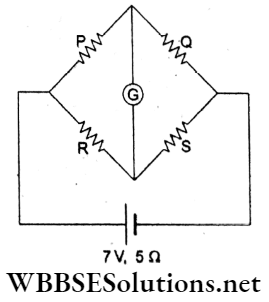
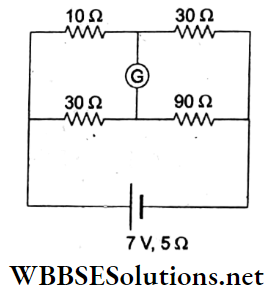
Question 57. The resistances of the four arms P, Q, R, and S of a Wheatstone bridge are 10 Ω, 30 Ω, 30, and 90 respectively. The emf and internal resistance of the cell are 7 V and 5respectively. If the galvanometer resistance is 50 Ω, the current drÿwn from the cell will be
- 1.0 A
- 0.2 A
- 0.1 A
- 2.0 A
Answer: 2. 0.2 A
With the given values of the four arms of the bridge, the balance condition \(\frac{P}{Q}=\frac{R}{S}\) is. satisfied.
So, the current through the galvanometer is zero for all values of G.
The equivalent resistance of the bridge is
⇒ \(R=\frac{(40 \Omega)(120 \Omega)}{40 \Omega+120 \Omega}=30 \Omega\)
Net resistance in the circuit is
= R + r = 30 Ω + 5 Ω = 35 Ω.
Hence, the current drawn from the cell is
⇒ \(I=\frac{\varepsilon}{R+r}=\frac{7 \mathrm{~V}}{35 \Omega}=0.2 \mathrm{~A}\).
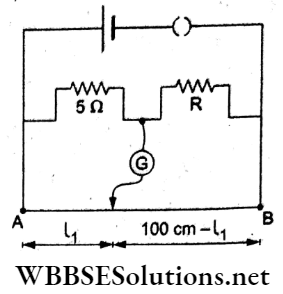
Question 58. The resistance for balance in the two arms of a meter bridge is 5 and R respectively. When the resistance R is shunted with an equal resistance, the balance point is at 1.6 l1. The resistance R is
- 10
- 15
- 25
- 20
Answer: 2. 15
In the first case of balance,
⇒ \(\frac{5 \Omega}{R}=\frac{l_1}{100 \mathrm{~cm}-l_1}\) → (1)
When R is shunted by an equal resistance R, its equivalent resistance will be
⇒ \(\frac{R}{2}\).
For this new condition of balance,
⇒ \(\frac{5 \Omega}{R / 2}=\frac{1.6 l_1}{100 \mathrm{~cm}-1.6 l_1}\) →(2)
Taking the ratio \(\frac{l}{2}\), we get,
⇒ \(\frac{1}{2}=\frac{l_1}{100 \mathrm{~cm}-l_1} \times \frac{100 \mathrm{~cm}-1.6 l_1}{1.6 l_1}\)
⇒ \(\frac{1.6}{2}=\frac{100 \mathrm{~cm}-1.6 l_1}{100 \mathrm{~cm}-l_1} \Rightarrow l_1=25 \mathrm{~cm}\)
∴ From (1) \(R=5 \Omega \frac{(100 \mathrm{~cm}-25 \mathrm{~cm})}{25 \mathrm{~cm}}=15 \Omega\)
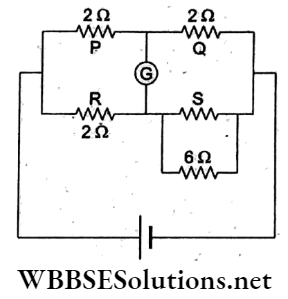
Question 59. Three resistors P, Q, and R, each of 2 Ω, and an unknown resistance S form the four arms of a Wheatstone bridge circuit. When a resistance of 6 is connected in parallel to S, the bridge gets balanced. The value of S is
- 2
- 3
- 1
- 6
Answer: 2. 3
For balance, the fourth arm must be of 2.
Hence, \(\frac{1}{S}+\frac{1}{6 \Omega}=\frac{1}{2 \Omega}\)
⇒ S = 3Ω.
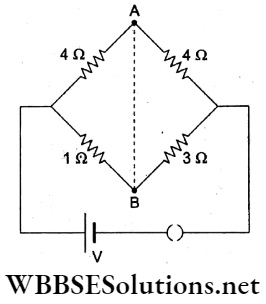
Question 60. In the circuit shown, if a conducting wire is connected between the points A and B, the current in this wire will
- Flow from A to B
- Flow from B to A
- Be zero
- Flow in the direction which will be decided by the value of V
Answer: 2. Flow from B to A
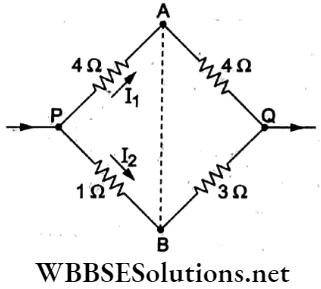
Let the current through the upper and lower branches be I1 and I2 respectively.
Hence,
VP – VQ = I1 (4+4) =8 I1 ,
VP – VQ = I2 (1 + 3) = 4 I2.
So, 4I2 = 8 I1 ⇒ I2 = 2 I1 → (1)
Now, VP- VA = 4 I1 ⇒ VA = Vp- 4 I1. → (2)
And Vp-VB = 1 ( I2 ) = 2 I1 ⇒ VB = VP – 2 I1. → (3)
From (2) and (3), VB>VA.
Hence, on joining A and B by a conducting wire, current will flow from B to A
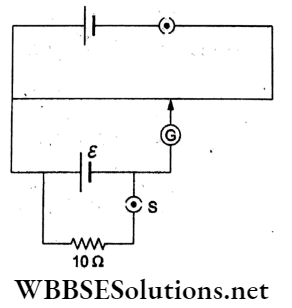
Question 61. A cell can be balanced against 110 cm and 100 cm of a potentiometer wire respectively, with and without being short-circuited through a resistance of 10 Ω. Its internal resistance is
- 1.0
- 0.5
- 2.0
- 0.2
Answer: 1. 1.0
With the switch open, balance l =110 cm is obtained across emf £ of
the cell. Thus, ε=kl.
When S is closed, the cell is shunted by a 10-Ω resistance so that the terminal voltage V is balanced at l’=100 cm.
Thus, V = kl’.
So, \(\frac{\varepsilon}{V}=\frac{l}{l^{\prime}}=\frac{110 \mathrm{~cm}}{100 \mathrm{~cm}}\) → (1)
But \(\varepsilon=I(R+r) \text { and } V=I R\)
∴ \(\frac{\varepsilon}{V}=\frac{R+r}{R}=\frac{10 \Omega+r}{10 \Omega}\) → (2)
Equating (1) and (2),
⇒ \(\frac{10 \Omega+r}{10 \Omega}=\frac{110}{100} \Rightarrow r=1 \Omega\)
Question 62. A potentiometer circuit has been set up for finding the internal resistance of a given cell. The main battery used across the potentiometer wire has an emf of 2.0 V and negligible internal resistance. The potentiometer wire itself is 4 m long. When the resistance R, connected across the given cell, has values of
- infinity and
- 9.5 ft, the balancing lengths on the potentiometer wire are found to be 3 m and 2.85 m respectively. The value of the internal resistance of the cell is
- 0.25
- 0.95
- 0.5
- 0.75
Answer: 3. 0.5
When the cell is without any parallel resistance, the balance length is at l =3 m and when shunted with R = 9.5 Ω, the balance length l’ = 2.85 m.
We know that internal resistance is
⇒ \(r=\left(\frac{l}{l^{\prime}}-1\right) R=\left(\frac{3 \mathrm{~m}}{2.85 \mathrm{~m}}-1\right) 9.5 \Omega=\frac{0.15 \mathrm{~m}}{2.85 \mathrm{~m}} \times 9.5 \Omega=0.5 \Omega\)
Question 63. A potentiometer wire of length l and resistance r is connected in series with a battery of emf80 and a resistance rx. A cell of unknown emf8 is balanced against the length of the potentiometer wire. The emf if will be given by
- \(\frac{L \varepsilon_0 r}{l r_1}\)
- \(\frac{\varepsilon_0 r}{\left(r+r_1\right)} \frac{l}{L}\)
- \(\frac{\varepsilon_0 l}{L}\)
- \(\frac{L \mathcal{E}_0 r}{\left(r+r_1\right) l}\)
Answer: 2. \(\frac{\varepsilon_0 r}{\left(r+r_1\right)} \frac{l}{L}\)
Current through the potentiometer wire by the driving cell ε0 is
⇒ \(I=\frac{\varepsilon_0}{r+r_1}\)
The potential drop across the ends of the potentiometer wire is
⇒ \(V=I r=\frac{\varepsilon_0 r}{r+r_1}\)
Hence, potential gradient = \(\frac{V}{L}=\frac{\mathcal{E}_0 r}{\left(r+r_1\right) L}\)
The balance point is obtained at distance Z, so the emf of the cell is
⇒ \(\varepsilon=\frac{V l}{L}=\frac{\varepsilon_0 r l}{\left(r+r_1\right) L}\)
Question 64. A potentiometer wire is 100 cm long and a constant potential difference is maintained across it. Two cells are connected in series first to support one another and then in opposite directions. The balance points are obtained at 50 cm and 10 cm from the positive end of the wire in the two cases. The ratio of emf is
- 5:4
- 3:2
- 3:4
- 5 :1
Answer: 2. 3:2
When the cells are in supporting order,
⇒ \(\left(\varepsilon_1+\varepsilon_2\right)=k l_1=k(50 \mathrm{~cm})\)
When the cells are in reverse order
⇒ \(\begin{aligned}
\left(\varepsilon_1-\varepsilon_2\right)=k l_2=k(10 \mathrm{~cm})\end{aligned} \)
⇒ \(\begin{aligned}\frac{\varepsilon_1+\varepsilon_2}{\varepsilon_1-\varepsilon_2}=5, \text { hence } \frac{\varepsilon_1}{\varepsilon_2}=\frac{3}{2}
\end{aligned}\).
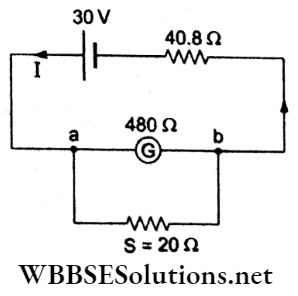
Question 65. A circuit contains an ammeter, a battery of 30 V, and a resistance of 40.8 all connected in series. If the ammeter has a coil of resistance 480 and a shunt of 20 then the reading in the ammeter will be
- 0.5 A
- 1 A
- 2 A
- 0.25 A
Answer: 1. 0.5 A
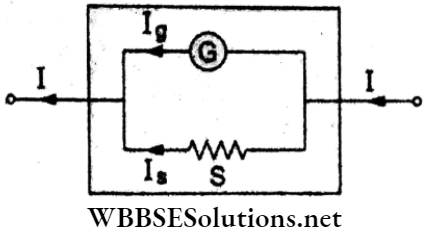
Equivalent resistance across ab is
⇒ \(R_{\mathrm{eq}}=\frac{G S}{G+S}=\frac{480 \times 20}{500} \Omega=19.2 \Omega\)
Total resistance in the circuit,
R = 40.8 Ω +19.2 Ω = 60 Ω.
Main currents
∴ \(I=\frac{30 \mathrm{~V}}{60 \Omega}=0.5 \mathrm{~A}\)
The current measured by the ammeter is the current flowing through the circuit, so the ammeter reading will be 0.5 A.
Question 66. A millivoltmeter of 25 mV range is to be converted into an ammeter of 25 A range. The value (in ohm) of the required shunt will be
- 0.001
- 0.01
- 1
- 0.05
Answer: 1. 0.001
For full-scale deflection, the current through the meter,
⇒ \(I_g=\frac{V}{G}=\left(\frac{25 \mathrm{mV}}{G}\right) A\) where G = resistance of the meter.
In order to increase the range to 25 A when used as an ammeter, the value of the required shunt is
⇒ \(S=\frac{I_{\mathrm{g}} \mathrm{G}}{I-I_{\mathrm{g}}} \approx \frac{I_{\mathrm{g}} \mathrm{G}}{I}\) [∵ Ig<<I]
⇒ \(\frac{25 \times 10^{-3} \mathrm{~V}}{25 \mathrm{~A}}=0.001 \Omega\).
Question 67. A galvanometer which has a coil of resistance 100 Ω, gives a full-scale deflection for 30 mA current. If it is to work as a voltmeter in the 30-V range, the resistance required to be added will be
- 900
- 1800
- 500
- 1000
Answer: 1. 900
Given that G =100 Ω, Ig = 30 mA.
The voltage across the galvanometer for full-scale deflection is
⇒ \(V=I_{\mathrm{g}} \cdot G=(30 \mathrm{~mA})(100 \Omega)=3 \mathrm{~V}\).
The factor n by which its measuring range as a voltmeter is increased is
⇒ \(n=\frac{30 \mathrm{~V}}{3 \mathrm{~V}}=10\)
The resistance required to be added in series with the meter will be
⇒ \(R=(n-1) G=(10-1)(100 \Omega)=900 \Omega\).
Question 68. The resistance of an ammeter is 13 Ω and its scale is graduated for a current up to 100 A. After an additional shunt has been connected to this ammeter, it becomes possible to measure currents up to 750 A by this meter. The value of the resistance of this shunt is
- 20
- 2
- 0.2
- 2k
Answer: 2. 2
Given that G =13 Ω, Ig =100 A.
p.d. across the ammeter for full-scale deflection is
V = Ig x G = (100 A)(13 Ω) =1300 V
When the measuring range is increased (I = 750 A), let the shunt resistance be S. Equivalent resistance of the parallel combination of G and S is \(\frac{G S}{G+S}\) and potential difference across this = \(I\left(\frac{G S}{G+S}\right)\)
For full-scale deflection, the p.d. across this combination must be V =1300 V.
⇒ \(1300 \mathrm{~V}=(750 \mathrm{~A}) \frac{13 \Omega \times S}{13 \Omega+S}\).
Hence, shunt=S = 2Ω.
Question 69. A battery is charged at a potential of 15 V for 8 h when the current flowing is 10 A. The battery during discharge supplies a current of 5 A for 15 h. The mean terminal voltage during discharge is 14 V. The watt-hour efficiency of the battery is
- 82.5%
- 87.5%
- 80%
- 90%
Answer: 2. 87.5%
During the charging process, the input energy is
E1 = coulomb x volt = (It)V J
= (10 A)(8 h)(15 V) =1200 W h.
During discharge, the energy output is
E0 = (5 A)(15 h)(14 V) =1050 W h
⇒ Efficiency = \(\eta=\frac{\text { output }}{\text { input }} \times 100 \%=\frac{1050}{1200} \times 100 \%=87.5 \%\)
Question 70. Two cells having the same emf are connected in series through an external resistance R. The cells have internal resistances r1 and r2 (r1 > r2) respectively. When the circuit is closed the potential difference across the first cell is zero. The value of R is
- \(r_1-r_2\)
- \(\frac{r_1-r_2}{2}\)
- \(\frac{r_1+r_2}{2}\)
- \(r_1+r_2\)
Answer: 1. \(r_1-r_2\)
Current through the circuit is
⇒ \(I=\frac{2 e}{R+r_1+r_2}\)
The potential difference across the first cell is
⇒ \(V_{\mathrm{a}}-V_{\mathrm{b}}=e-I r_1=0 \text { (given) } \Rightarrow e=I r_1\)
⇒ \(e=\frac{2 e r_1}{R+r_1+r_2}\)
⇒ \(R+r_1+r_2=2 r_1 \Rightarrow R=r_1-r_2\)
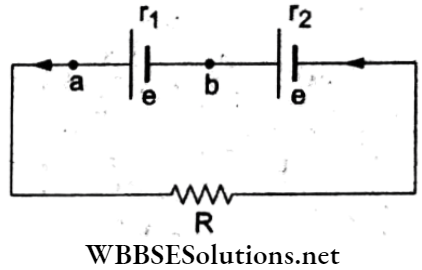
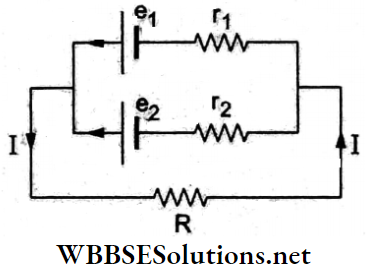
Question 71. Refer to the electrical circuit shown in the figure. Which of the following equations is the correct representation for the given circuit?
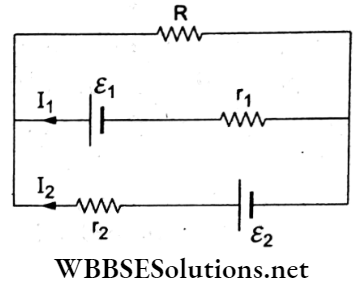
- \(\varepsilon_1-\left(I_1+I_2\right) R-I_1 r_1=0\)
- \(\varepsilon_2-I_2 r_2-\varepsilon_1-I_1 r_1=0\)
- \(-\mathcal{E}_2-\left(I_1+I_2\right) R+I_2 r_2=0\)
- \(\varepsilon_1-\left(I_1+I_2\right) R+I_1 r_1=0\)
Answer: 1. \(\varepsilon_1-\left(I_1+I_2\right) R-I_1 r_1=0\)
According to Kirchhoff’s junction rule, the current through the resistance R is ( I1 + I2 ). Applying Kirchhoff’s loop rule for the upper closed loop,
⇒ \(\begin{aligned}
R\left(I_1+I_2\right)+I_1 r_1-\varepsilon_1=0\end{aligned}\)
⇒ \(\begin{aligned}\varepsilon_1-\left(I_1+I_2\right) R-I_1 r_1=0
\end{aligned}\)
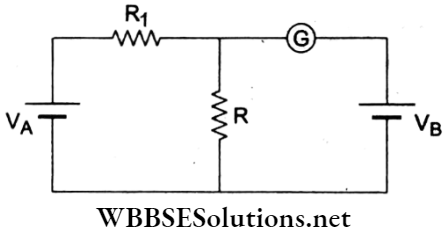
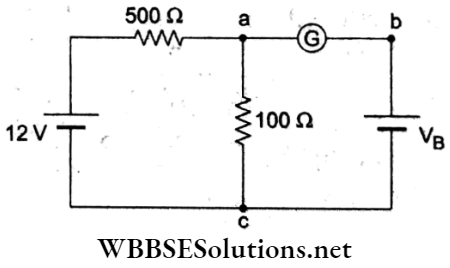
Question 72. In the given circuit, the cells A and B have negligible resistances. For VA =12 V, Rx = 500 Q, and R =100 Q, the galvanometer G shows null deflection. The value of VB is
- 4 V
- 2 V
- 12 V
- 6 V
Answer: 2. 2 V
For null deflection in the galvanometer, a and b must be at the same potential, and
⇒ \(\begin{aligned}
V_{\mathrm{B}} =V_{\mathrm{a}}-V_{\mathrm{c}}=I(100 \Omega)\end{aligned} \)
⇒ \(\begin{aligned}\frac{12 \mathrm{~V} \times 100 \Omega}{600 \Omega}=2 \mathrm{~V}
\end{aligned}\).
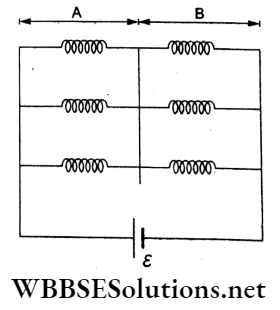
Question 73. Six identical bulbs are connected as shown in the figure with a DC source of emf E and zero internal resistance. The ratio of power consumed by the bulbs when
- All are glowing and
- Two from section A and one from section B are glowing and will be
- 4:9
- 9:4
- 1:2
- 2:1
Answer: 2. 9:4
Equivalent watt in series is given by \(\frac{1}{W_S}=\frac{1}{W_1}+\frac{1}{W_2}+\frac{1}{W_3}+\ldots\),and in parallel \(W_P=W_1+W_2+W_3+\ldots\)
If the voltage of each bulb is W then in case (1)
⇒ \(W_1=\frac{W}{2}+\frac{W}{2}+\frac{W}{2}=\frac{3}{2} W\)
and in case (2),
⇒ \(\frac{1}{W_2}=\frac{1}{2 W}+\frac{1}{W}=\frac{3}{2 W} \Rightarrow W_2=\frac{2 W}{3}\)
∴ Required ratio, \(\frac{W_1}{W_2}=\frac{3 W / 2}{2 W / 3}=\frac{9}{4}\).
Question 74. Which of the following acts as a circuit-protecting device?
- Conductor
- Inductor
- Switch
- Fuse
Answer: 4. Fuse
A fuse is an electrical safety device that operates to provide over-current protection to an electrical circuit. It has high resistance and low melting point so that when a high current flows through the circuit, the fuse wire melts and the current stops flowing.
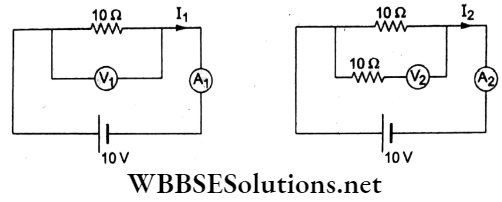
Question 75. In the circuit shown below, the readings of voltmeters and ammeters will be
- \(V_2>V_1 \text { and } I_1=I_2\)
- \(V_1=V_2 \text { and } I_1>I_2\)
- \(V_1=V_2 \text { and } I_1=I_2\)
- \(V_2>V_1 \text { and } I_1>I_2\)
Answer: 3. \(V_1=V_2 \text { and } I_1=I_2\)
An ideal voltmeter has infinite resistance whereas an ideal ammeter has effectively zero resistance. Under this ideal condition,
⇒ \(I_1=\frac{10 \mathrm{~V}}{10 \Omega}=1 \mathrm{~A}, V_1=(1 \mathrm{~A})(10 \Omega)=10 \mathrm{~V}\),
⇒ and \(I_2=\frac{10 \mathrm{~V}}{10 \Omega}=1 \mathrm{~A}, V_2=(1 \mathrm{~A})(10 \Omega)=10 \mathrm{~V}\).
Thus, V1 = V2 and I1 = I2
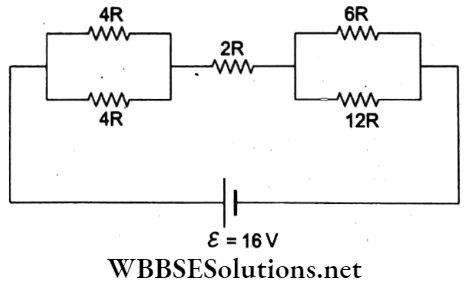
Question 76. The resistive network shown is connected to a DC source of 16 V. The power consumed by the network is 4 W. The value of R is
- l
- 16
- 8
- 4
Answer: 3. 8
The equivalent resistance of the given combination of resistors is
Rnet = 2R+ 2R + 4R = SR.
Power consumed = \(4 \mathrm{~W}=\frac{V^2}{R_{\text {net }}}\)
∴ \(4=\frac{(16)^2}{8 R}, \text { hence } R=\frac{16 \times 16}{4 \times 8} \Omega=8 \Omega\)
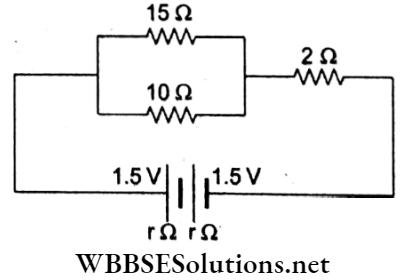
Question 77. In the given circuit, an ideal voltmeter connected across the 10-Q resistor reads 2 V. The internal resistance r of each cell is
- 0.5
- 0
- 1.5
- 1
Answer: 1. 0.5
The potential difference across the 10-Ω and 15-Ω resistors is 2 V, so the current is
⇒ \(i_1=\frac{V}{R_1}=\frac{2}{10} \mathrm{~A}\)
Similarly, \(i_2=\frac{V}{R_2}=\frac{2}{15} \mathrm{~A}\).
∴ total current \(I=i_1+i_2=\left(\frac{2}{10}+\frac{2}{15}\right) \mathrm{A}=\frac{1}{3} \mathrm{~A}\)
Applying Kirchhoff’s loop rule,
(10 Ω)i1 + (2 Ω)I + (2r)I = 3 V
⇒ \(\left(10 \times \frac{2}{10}\right) V+\left(2 \times \frac{1}{3}\right) V+(2 r)\left(\frac{1}{3} A\right)=3 V\)
⇒ \(\frac{2}{3} r=\left(3-2-\frac{2}{3}\right) \Omega\)
∴ internal resistance = r = 0.5 Ω.
Question 78. An ideal battery of 4 V and a resistance R are connected in series in the primary circuit of a potentiometer of length 1 m and resistance 5 Ω. The value of R to give a potential difference of 5 mV across 10 cm of the potentiometer wire is
- 480
- 490
- 495
- 395
Answer: 4. 395
The total resistance in the main circuit is (R +5 Ω) and current through the l primary circuit is
⇒ \(I=\frac{4 V}{R+5 \Omega}\)
Potential gradient is
⇒ \(\frac{V}{L}=\frac{I \times 5 \Omega}{100} \mathrm{~V} \mathrm{~cm}^{-1}\)
Hence, p.d. across the 10-cm wire will be
⇒ \(\left(\frac{I}{20} \times 10\right) \mathrm{V}=5 \mathrm{mV}=5 \times 10^{-3} \mathrm{~V}\)
From (1),
⇒ \(\frac{1}{2}\left(\frac{4 V}{R+5 \Omega}\right)=5 \times 10^{-3} V\)
⇒ \(\frac{2}{R+5 \Omega}=\frac{5}{1000} \Rightarrow R=395 \Omega\)
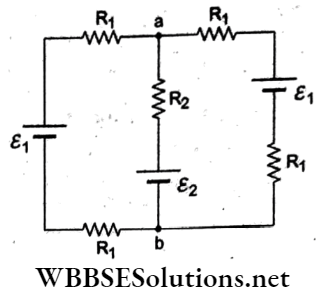
Question 79. For the circuit shown with R1=1 Ω, R2 =2 Ω, ε1=2 V, and ε2 = 4 V, the potential difference between points a and b is
- 2.7 V
- 3.3 V
- 2.3 V
- 3.7 V
Answer: 1. 2.7 V
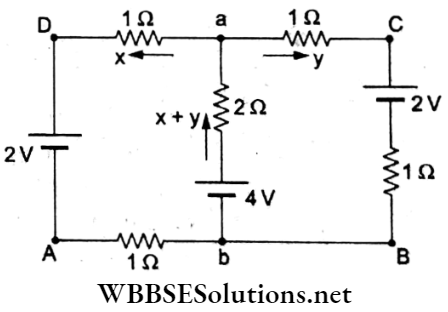
From the Kirchhoff loop rule for the closed path ABCDA,
1(x)+2 +(1)x-y-2-y = 0
⇒ 2x-2y = 0 ⇒ x = y → (1)
For the closed-loop AbaDA,
x-4+2(x + y)+x+2 = 0
⇒ 4x + 2y = 2
⇒ 2x+y =1 → . (2)
From (1) and (2),
⇒ \(x=\frac{1}{3}=y\)
⇒ \(V_{\mathrm{a}}-V_{\mathrm{b}}=-2(x+y)+4=4 \mathrm{~V}-2\left(\frac{2}{3}\right) \mathrm{V}=\frac{8}{3} \mathrm{~V}=2.67 \mathrm{~V} \approx 2.7 \mathrm{~V}\)
Question 80. A current of 2 mA was passed through an unknown resistor which dissipated 4.4 W of power. When a supply of 11 V is connected across this resistor, the dissipated power will be
- \(11 \times 10^{-4} \mathrm{~W}\)
- \(11 \times 10^{-5} \mathrm{~W}\)
- \(11 \times 10^{-6} \mathrm{~W}\)
- \(11 \times 10^{-3} \mathrm{~W}\)
Answer: 2. \(11 \times 10^{-5} \mathrm{~W}\)
Power dissipation = 4.4 W = I2R
⇒ \(R=\frac{4.4 \mathrm{~W}}{\left(2 \times 10^{-3} \mathrm{~A}\right)^2} \Omega=11 \times 10^5 \Omega\)
With a supply voltage of 11 V, the power dissipated is
⇒ \(\frac{V^2}{R}=\frac{(11 \mathrm{~V})^2}{11 \times 10^5 \Omega}=11 \times 10^{-5} \mathrm{~W}\).
Question 81. The drift speed of electrons, when A of electric current flows through a copper wire of cross section 5 mm2, is v. If the number density of electrons in copper is 9 x l028 m-3, the value of v in mm s-1 is close to
- 0.02
- 0.2
- 2
- 3
Answer: 1. 0.02
Current 1 through a conductor is given by I = Avdne, where I =1.5 A, rt = number density = 9 x1028 m-3, and A- cross-sectional area =5 mm2.
Drift speed is
⇒ \(v_{\mathrm{d}}=\frac{I}{A n e}\)
⇒ \(\frac{1.5 \mathrm{~A}}{\left(5 \times 10^{-6} \mathrm{~m}^2\right)\left(9 \times 10^{28} \mathrm{~m}^{-3}\right)\left(1.6 \times 10^{-19} \mathrm{C}\right)}\)
⇒ \(\frac{1.5 \mathrm{~A}}{72 \times 10^3 \mathrm{C} \mathrm{m}^{-1}}=0.02 \times 10^{-3} \mathrm{~m} \mathrm{~s}^{-1}=0.02 \mathrm{~mm} \mathrm{~s}^{-1}\)
Question 82. A copper wire is stretched to make it 0.5% longer. The percentage change in its electrical resistance is
- 2.0%
- 1.0%
- 0.5%
- 2.5%
Answer: 2. 1.0%
Resistance = \(R=\rho \frac{l}{A}=\rho \frac{l^2}{V}\), where Z = length and V = volume.
⇒ \(\frac{\Delta R}{R}=2 \frac{\Delta l}{l}=2(0.5 \%)=1.0 \%\).
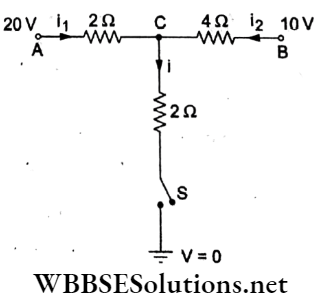
Question 83. When the switch S in the circuit shown is closed, the value of the current I will be
- 4 A
- 3 A
- 2 A
- 5 A
Answer: 4. 5 A
Let V be the potential at junction C.
We have, \(i_1=\frac{20-V}{2}, i_2=\frac{10-V}{4}\)
∴ i1 + i2 = i = \(\frac{V}{2}\)
⇒ \(\frac{20-V}{2}+\frac{10-V}{4}=\frac{V}{2}\) ⇒ V = 10 volts.
∴ Current = i \(\frac{V}{2 \Omega}=\frac{10 \mathrm{~V}}{2 \Omega}\) = 5 A.
Question 84. Two equal resistances when connected in series to a battery consume 60 W of electric power. If these resistances are connected in parallel combination to the same battery, the electric power consumed will be
- 240 W
- 120 W
- 30 W
- 60 W
Answer: 1. 240 W
In a series combination, equivalent wattage is
⇒ \(W_S=\frac{W_1 W_2}{W_1+W_2} \Rightarrow 60 \mathrm{~W}=\frac{W_1 \times W_2}{2 W_1}\)
The wattage of each resistor is
W1 = 120 W
Hence, the consumption of power when connected in parallel is
WP = W1 + W2 = 2 W1 = 2(120 W) = 240 W.
Question 85. The resistance of a galvanometer is 50and the maximum current of 0.002 A gives full-scale deflection. What resistance must be connected to it so as to convert it into an ammeter of range 0-0.5 A?
- 0.5
- 0.02
- 0.2
- 0.002
Answer: 3. 0.2
The initial measuring range is
I = 0.002 A and the final range is nl = 0.5 A.
∴ \(n=\frac{0.5 \mathrm{~A}}{0.002 \mathrm{~A}}=250\)
Required shunt is
⇒ \(S=\frac{G}{n-1}=\frac{50 \Omega}{249} \approx 0.2 \Omega\).
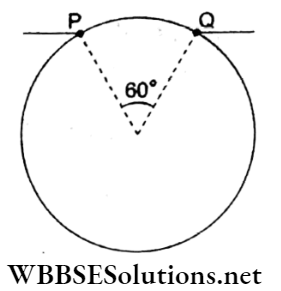
Question 86. A metal wire of resistance 3 is elongated to make it a uniform wire of double its previous length. This new wire is now bent and its ends are joined to make a circle. If two points P and Q on this circle make an angle of 60° at the center, the equivalent resistance across these two points will be
- \(\frac{5}{2} \Omega\)
- \(\frac{5}{3} \Omega\)
- \(\frac{12}{5} \Omega\)
- \(\frac{7}{2} \Omega\)
Answer: 2. \(\frac{5}{3} \Omega\)
Initial resistance, R =3 Ω.
When the length is doubled, its new resistance will become 4R =12 Ω.
Resistance of part \(P Q=\frac{1}{6}(12 \Omega)=2 \Omega\)
and that oflower part=12Ω- 2 Ω =10 Ω.
Equivalent resistance across PQ
∴ \(R_{\mathrm{eq}}=\frac{r_1 r_2}{r_1+r_2}=\frac{(2 \Omega)(10 \Omega)}{12 \Omega}=\frac{5}{3} \Omega\).
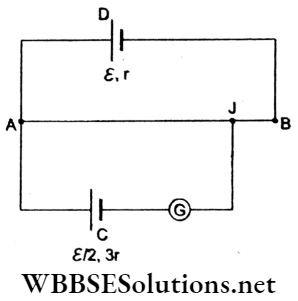
Question 87. A potentiometer wire AB having length L and resistance 12r is joined to a cell D of emf £ and internal resistance r. A cell C of emf \(\) and internal resistance 3r is connected to A as shown. The length AJ at which the galvanometer shows null deflection is
- \(\frac{5 L}{12}\)
- \(\frac{11 L}{12}\)
- \(\frac{13 L}{24}\)
- \(\frac{11 L}{24}\)
Answer: 3. \(\frac{13 L}{24}\)
The total resistance in the main circuit = r +12r =13r.
∴ current through the potentiometer wire = \(I=\frac{\varepsilon}{13 r} .\)
The potential drop across length L of the wire AB is
⇒ \(V=I(12 r)=\frac{\varepsilon}{13 r}(12 r)=\frac{12}{13} \varepsilon\)
Potential gradient = \(\frac{V}{L}=\frac{12}{13} \frac{\varepsilon}{L} \mathrm{~V} \mathrm{~m}^{-1}\).
When the galvanometer shows null deflection at length AJ = x, we have
⇒ \(\frac{\varepsilon}{2}=\frac{12}{13} \frac{\varepsilon}{L} x \Rightarrow x=\frac{13 L}{24}\)
Question 88. In the. given circuit, the cells have. zero internal resistance. The current (in ampere) passing through resistances JRj and R2 respectively are
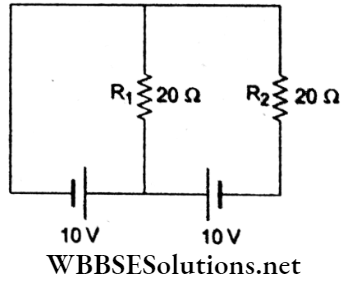
- 0.5,0
- 1.0,2
- 2, 2
- 0,1.5
Answer: 1. 0.5,0
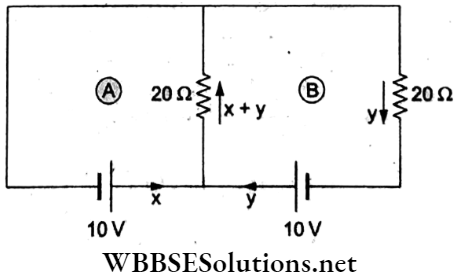
In the closed loop A,
-10 +(x + y) 20 = 0
⇒ \(x+y=\frac{1}{2}\) → (1)
In the closed loop B,
(x + y)20 + 20y-10 = 0
⇒ 2(x+y)+2y =l
⇒ 2x+4y =l
⇒ \(x+2 y=\frac{1}{2}\) → (2)
Solving (1) and (2),
⇒ \(x=\frac{1}{2}\) A and y = 0.
∴ Current in R1 is \((x+y)=\frac{1}{2}\) A and in R2 is y = 0.
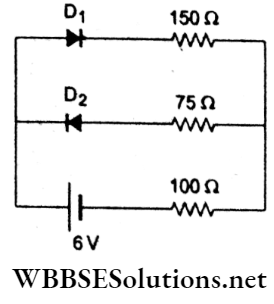
Question 89. The given circuit contains two ideal diodes, each with a forward resistance of 50 ft. If the battery voltage is 6 V, the current through the 100-12 resistance will be
- 0.027 A
- 0.036 A
- 0.020 A
- 0.030 A
Answer: 3. 0.020 A
In the given circuit, diode D2 is reverse-biased. Hence, nonconducting. D1 will be conducted with forward resistance of 50.
Thus, the total resistance is
R = 50 Ω+150 Ω +100 Ω = 300 Ω.
⇒ So, \(I=\frac{6 \mathrm{~V}}{300 \Omega}=0.02 \mathrm{~A}\)
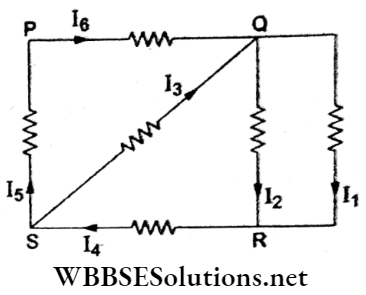
Question 90. In the given circuit, the currents I1=-03 A, I4 = 0.8 A, and I5 = 0.4 A are flowing as shown. The currents I2, I3 and I6 are respectively
- 1.1 A, 0.4 A, 0.4 A
- 1.1 A, -0.4 A, 0.4 A
- 0.4 A, 1.1 A, 0.4 A
- 0.4 A, 0.4 A, 1.1 A.
Answer: 1. 1.1 A, 0.4 A, 0.4 A
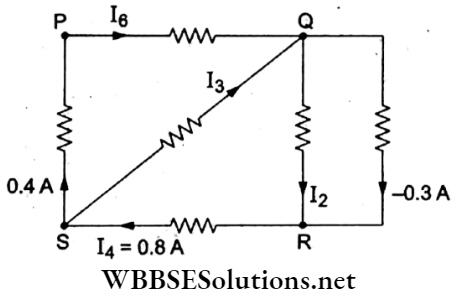
Applying junction Me:
At R, I2 +(-0.3 A) = 0.8 A
⇒ I2 = 1.1 A.
At S, I3 + 0.4 A = 0.8 A
⇒ I3 = 0.4 A.
At P, I6 = 0.4 A.
Thus, the values are 1.1 A, 0.4 A, and 0.4 A.
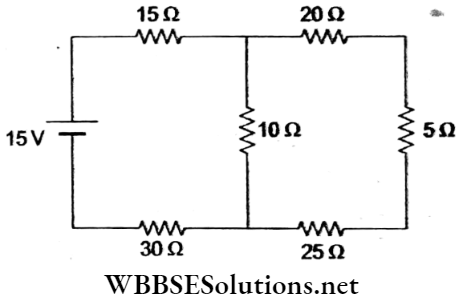
Question 91. In the figure shown, what is the current (in ampere) drawn by the battery?
- \(\frac{7}{38}\)
- \(\frac{20}{3}\)
- \(\frac{9}{32}\)
- \(\frac{13}{24}\)
Answer: 3. \(\frac{9}{32}\)
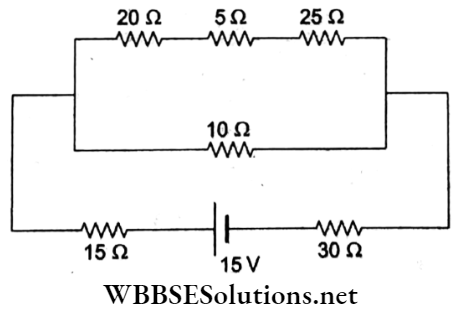
The given circuit can be redrawn in a simplified form as shown. The equivalent resistance of the parallel combination is
⇒ \(R_1=\frac{50 \times 10}{60} \Omega=\frac{25}{3} \Omega .\)
Net resistance in the circuit is
⇒ \(R=\frac{25}{3} \Omega+15 \Omega+30 \Omega=\frac{160}{3} \Omega\)
current delivered by the battery is
⇒ \(I=\frac{\varepsilon}{R}=\frac{15 \mathrm{~V}}{\frac{160}{3} \Omega}=\frac{9}{32} \mathrm{~A}\)
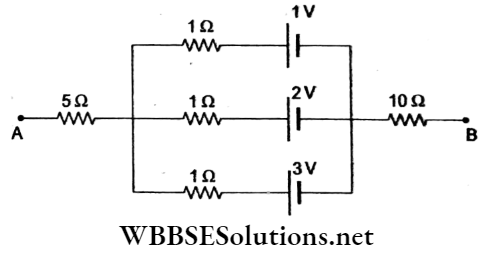
Question 92. The potential difference across A and B in the given circuit is
- 1 V
- 3 V
- 2 V
- 6 V
Answer: 3. 2 V
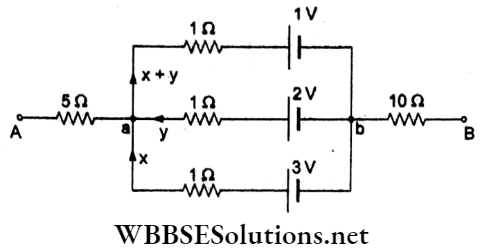
The current distribution in the different branches is shown in the diagram.
No current in 5 Ω and 10 Ω. Thus, VA-VB = Va-Vb.
For the upper loop, x+y+1-2+y = 0 => x + 2y = 1A.
For the lower loop, -y+2-3+x=0 => x-y =1 A.
Solving, we get x=1 A, y =0.
Now for any branch across ab,
Va-Vb = -(1 Ω)x +3V =-1V +3V = 2V.
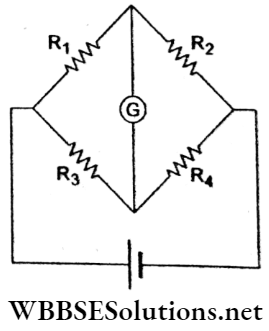
Question 93. The Wheatstone bridge shown in the figure gets balanced when the carbon resistor has the color code orange, red, and brown. The resistors R2 and R4 are 80 Ω and 40 Ω respectively. Assuming that the color code for the carbon resistor gives accurate values, the color code for R3 would be
- Brown, blue, black
- Brown, blue, brown
- Grey, black, brown
- Red, green, brown
Answer: 2. Brown, blue, brown
R1 has the color code
Orange – 3
Red – 2
Brown – 1
⇒ \(R_1=32 \times 10^1=320 \Omega\) .
⇒ For balance \(\frac{R_1}{R_2}=\frac{R_3}{R_4}\)
⇒ \(\quad R_3=\frac{R_4}{R_2} R_1=\frac{40 \Omega}{80 \Omega} \times 320 \Omega=160 \Omega \text {. }\)
The corresponding color code is
Brown – 1
Blue – 6
Brown -101
⇒ 16 x 101 Ω = 160 Ω
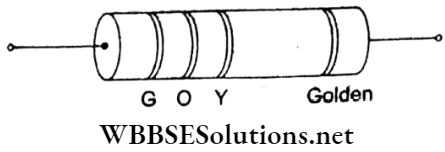
Question 94. A carbon resistor has the color code resistor indicated in the figure. What is the value of the resistance?
- 5.3 M ± 5%
- 64 k±10%
- 6.4 M ±5%
- 64 k±10%
Answer: 4. 64 k±10%
From the given color code
Green – 5
Orange – 6
Yellow – 4
Golden – 5%
⇒ R = 53 x 104 ± 5% = 530 kΩ ± 5% .
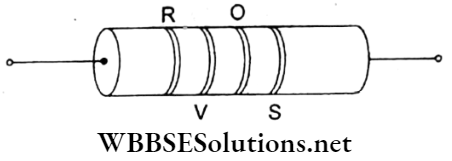
Question 95. A resistor is shown in the figure. Its value and tolerance are given respectively as
- 270Ω and 5%
- 27kΩ and 20%
- 27kΩ and 10%
- 270kΩ and 10%
Answer: 3. 27kΩ and 10%
The color rings are
Red – 2
Violet – 7
Orange – 3
Silver – 10%
∴ Resistance = R = 27 x 103 Ω,10% = 27 kΩ,10%.
Question 96. A cell of internal resistance r drives current through an external resistance R. The power delivered by the cell to the external resistance will be maximum when
- R = O.Olr
- R = 2r
- R = r
- R =10r
Answer: 3. R = r
According to the maximum power output theorem/ the external resistance R must be equal to the internal resistance r of the voltage source.
Question 97. A moving-coil galvanometer has a resistance of 50 Ω and it indicates full deflection at 4-mA current. A voltmeter is made using this galvanometer and a 5-kΩ resistance. The maximum voltage that can be measured using this voltmeter will be close to
- 10 V
- 15 V
- 40 V
- 20 V
Answer: 4. 20 V
Given that G = 50 Ω, Ig = 4 mA.
While using this galvanometer ‘ as a voltmeter (with measuring range V), a resistance of 5 kΩ is connected in series so as to get the same current Ig (=4 x10⁻³A) for full-scale deflection
∴ Hence, \(I_{\mathrm{g}}=\frac{V}{G+R}\)
⇒ V = (G + R)Ig = (50 Ω + 5000 Ω)(4 x10⁻³ A) = 20.2 V ≈ 20 V.
Question 98. A 200 resistor has a certain color code. If one replaces the red color with green in the code then the new resistance will be
- 100
- 200
- 400
- 500
Answer: 4. 500
For the 200-Ω resistor, the color code is red, black, and black. Red corresponds to 2 which is replaced by green (≡ 5) so the new resistance will be 500 Ω.
Question 99. A 2 W-carbon resistor is color-coded with green, black, red, and brown respectively. The maximum current that can be passed through the resistor is
- 0.4 mA
- 63 mA
- 20 mA
- 100 mA
Answer: 3. 20 mA
The color codes are
Green – 5
Black – 0
Red – 2
Brown – 1
Rmin = 50 x 102
⇒ \(I_{\max }=\sqrt{\frac{P}{R_{\min }}}=\sqrt{\frac{2 \mathrm{~W}}{50 \times 10^2 \Omega}}=2 \times 10^{-2} \mathrm{~A}=20 \mathrm{~mA}\)
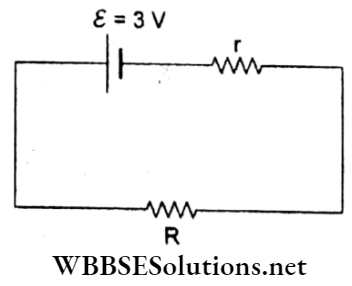
Question 100. The given figure shows a cell of emf S =s 3 V and internal resistance r connected across an external resistance R. If power dissipation in R is 0.5 W and the terminal voltage across the cell is 2.5 V then the power dissipation in the internal resistance r is
- 0.5 W
- 0.1W
- 0.3 W
- 1.0 W
Answer: 2. 0.1W
Power dissipation in external resistance is
W = V x I ⇒ 0.5 W = (2.5V) I.
∴ \(\text { current }=I=\frac{0.5 \mathrm{~W}}{2.5 \mathrm{~V}}=\frac{1}{5} \mathrm{~A}\)
The potential drop across internal resistance is
Vr = 3 V- 2.5 V = 0.5 V.
Power dissipation in the internal resistance r is
⇒ \(W_r=V_r \cdot I=(3 \mathrm{~V}-2.5 \mathrm{~V})\left(\frac{1}{5} \mathrm{~A}\right)=0.5 \times \frac{1}{5} \mathrm{~W}=0.1 \mathrm{~W}\)
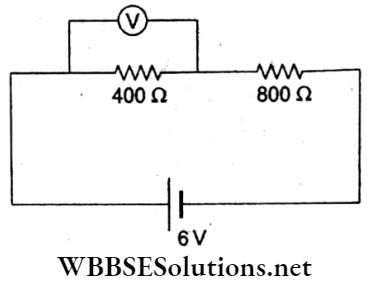
101. The resistance of the voltmeter in the given circuit is 10 k£l. Find the voltmeter reading.
- 4 V
- 3.25 V
- 1.25 V
- 1.95 V
Answer: 4. 1.95 V
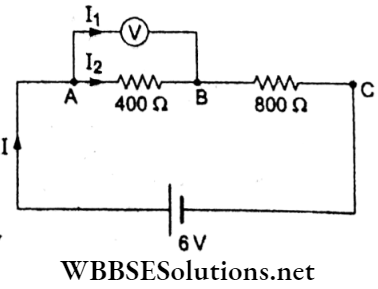
Let VA-VB = V = voltmeter reading.
The main current is
⇒ \(I=I_1+I_2=\frac{V}{10000}+\frac{V}{400}\)
V + 7(800 Ω) = 6 V
⇒ \(V+V\left(\frac{1}{10000}+\frac{1}{400}\right)(800 \Omega)=6 \mathrm{~V}\)
⇒ \(V+\frac{8 V}{100}+2 V=6 \mathrm{~V} \Rightarrow V=1.95 \mathrm{~V}\).
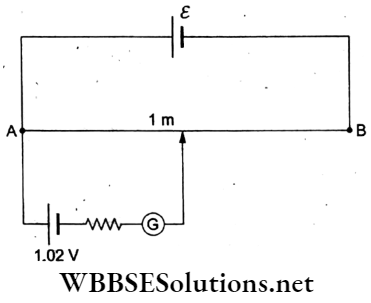
Question 102. In the given circuit, 1.02 V is balanced at 51 cm from end A of a 1.0-m-long potentiometer wire. Find the potential gradient along AB.
- \(0.1 \mathrm{~V} \mathrm{~cm}^{-1}\)
- \(0.02 \mathrm{~V} \mathrm{~cm}^{-1}\)
- \(0.3 \mathrm{~V} \mathrm{~cm}^{-1}\)
- \(0.4 \mathrm{~V} \mathrm{~cm}^{-1}\)
Answer: 2. \(0.02 \mathrm{~V} \mathrm{~cm}^{-1}\)
For null deflection, potential drop = ΔV =1.02 V for length l = 51 cm of the potentiometer wire.
Hence, the potential gradient is
⇒ \(\frac{\Delta V}{\Delta l}=\frac{1.02 \mathrm{~V}}{51 \mathrm{~cm}}=0.02 \mathrm{~V} \mathrm{~cm}^{-1}\)
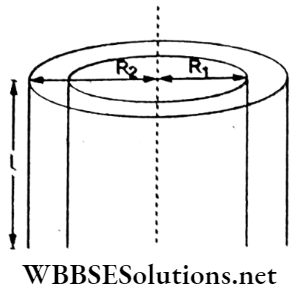
Question 103. A cylindrical shell of length l with inner and outer radii Rx and R2 is made of a material of resistivity p. Find its resistance if current flows radially outward.
- \(\frac{\rho}{2 \pi l} \ln \frac{R_2}{R_1}\)
- \(\frac{\rho}{\pi l} \ln \frac{R_2}{R_1}\)
- \(\frac{\rho}{4 \pi l} \ln \frac{R_2}{R_1}\)
- \(\frac{\rho}{3 \pi l} \ln \frac{R_2}{R_1}\)
Answer: 1. \(\frac{\rho}{2 \pi l} \ln \frac{R_2}{R_1}\)
Resistance of a coaxial cylindrical shell of radius r and thickness dr is
⇒ \(d R=\rho \frac{d r}{A}=\rho \frac{d r}{2 \pi r l}\)
total resistance is
⇒ \(R=\int d R=\frac{\rho}{2 \pi l} \int_{R_1}^{R_2} \frac{d r}{r}=\frac{\rho}{2 \pi l} \ln \frac{R_2}{R_1}\)
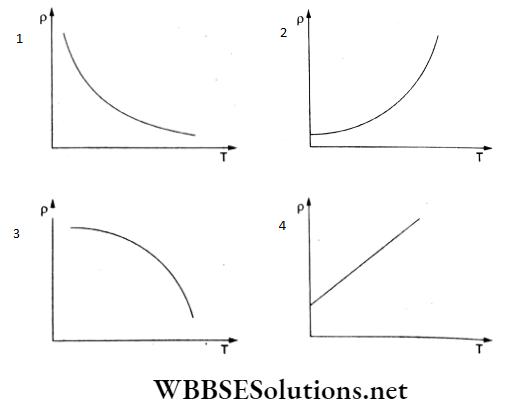
Question 104. Which of the following graphs represents the variation of resistivity (p) with temperature (T) for copper?
Answer: 2.
With the increase in temperature of a conductor, thermal agitation increases and the collisions become more frequent. Thus, copper being a good conductor, its conductivity decreases and resistivity(ρ)increases nonlinearly with temperature. Hence, graph (b).
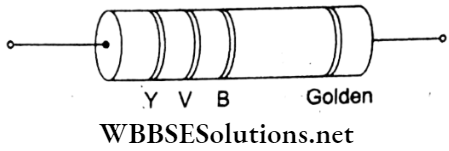
105. The color code of a resistor is given in the figure. The value of its resistance with tolerance is
- 47 kΩ, 10%
- 4.7 kΩ, 5%
- 470 Ω, 5%
- 470 kΩ, 5%
Answer: 3. 470Ω, 5%
The sequence of colors is
Yellow – 4
Violet – 7
Brown – 10
Gold – 5%
Hence, R =(47×10) Ω ± 5% = 470 Ω, 5%.
Question 106. The resistance wire connected in the left gap of a meter bridge balances a 10-Ω resistance in the right gap at a point that divides the bridge wire in the ratio 3: 2. If the length of the resistance wire is 1.5 m then the length of 1 Ω of the resistance wire is
- \(1.0 \times 10^{-1} \mathrm{~m}\)
- \(1.5 \times 10^{-1} \mathrm{~m}\)
- \(1.5 \times 10^{-2} \mathrm{~m}\)
- \(1.0 \times 10^{-2} \mathrm{~m}\)
Answer: 1. \(1.0 \times 10^{-1} \mathrm{~m}\)
For balance: \(\frac{R}{10 \Omega}=\frac{3}{2}\) R =15Ω.
⇒ Since R<*l, hence \(\frac{R^{\prime}}{R}=\frac{l^{\prime}}{l} \Rightarrow \frac{R^{\prime}}{15 \Omega}=\frac{l^{\prime}}{1.5 \mathrm{~m}}\)
⇒ \(l^{\prime}=\frac{(1.5 \mathrm{~m})}{(15 \Omega)} \times(1 \Omega)=\frac{1}{10} \mathrm{~m}=1.0 \times 10^{-1} \mathrm{~m}\).
Question 107. A charged particle having a drift velocity of \(7.5 \times 10^{-4} \mathrm{~m} \mathrm{~s}^{-1}\) in an electric field of3 x10-10 V m-1 has mobility (in m2 V-1 s-1) of
- \(2.5 \times 10^6\)
- \(2.5 \times 10^{-6}\)
- \(2.25 \times 10^{-15}\)
- \(2.25 \times 10^{15}\)
Answer: 1. \(2.5 \times 10^6\)
Mobility is defined as drift velocity per unit electric field \(\left(=\frac{v}{E}\right)\)
Given that
⇒ \(v=7.5 \times 10^{-4} \mathrm{~m} \mathrm{~s}^{-1}, E=3 \times 10^{-10} \mathrm{Vm}^{-1}\).
∴ Hence, mobility = \(\frac{7.5 \times 10^{-4}}{3 \times 10^{-10}} \text { units }=2.5 \times 10^6 \text { units. }\)
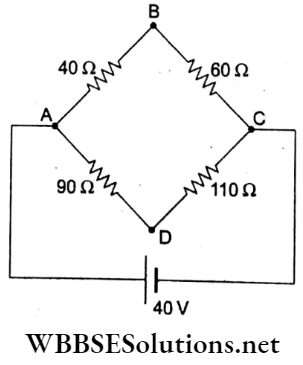
Question 108. In the given circuit, the cell has negligible internal resistance. The potential difference across BD is
- 4 V
- 3 V
- 2 V
- 1 V
Answer: 3. 2 V
Current in the upper branch ABC is
⇒ \(I_1=\frac{40 \mathrm{~V}}{(40+60) \Omega}=\frac{40}{100} \mathrm{~A}=0.4 \mathrm{~A}\)
Similarly, for the lower branch,
⇒ \(I_2=\frac{40 \mathrm{~V}}{90 \Omega+110 \Omega}=\frac{40}{200} \mathrm{~A}=0.2 \mathrm{~A}\)
Now, VA-VB = l1 (40 Ω) = 0.4 x 40 V =16 V;
VA-VD = l2 (90Ω) = 0.2 x 90 V =18 V.
∴ (VA-VD)-(VA-VB) = VB-VD = 2V.
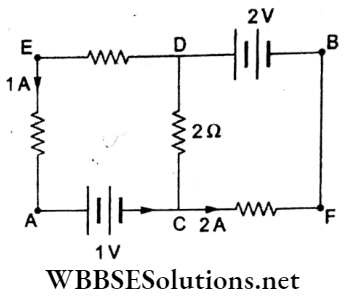
Question 109. For the given circuit, find the potential at B with respect to A.
- +2V
- -2 V.
- +1 V
- -1 V
Answer: 3. +1 V
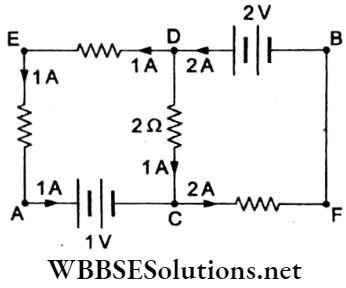
From the junction rule at D, the current in branch DC is 1 A.
Now,
VB-VA=(VB-VD)+(VD-Vc)-(Vc-VA)
= (-2V)+(2 V) + (1V) = +1 V.
Question 110. The value of the current l1 flowing from A to C in the circuit diagram is
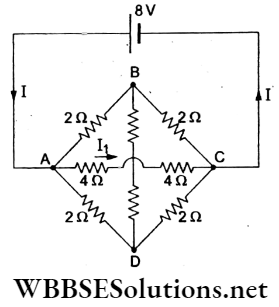
- 1 AB
- 5 A
- 4 A
- 2 A
Answer: 1. 1 AB
Potential difference = VA-Vc=8 V
∴ \(I_1=\frac{V}{R}=\frac{8 \mathrm{~V}}{8 \Omega}=1 \mathrm{~A}\).